Your Brief Guide to Using Goal Seek in Excel
Successful marketers make informed decisions quickly using a combination of gut instincts and data analysis. They know the end goal, and figure out what it takes to get there.
One way to fill in those gaps is by using Goal Seek in Excel. The function is helpful when you know your desired result, but you’re not sure how to reach it.
Maybe you want to improve your conversion rate to get more qualified leads but don’t know how many people you need to attract. Or let’s say your marketing team is aiming for an audacious revenue goal and you want to know how many customers you have to bring in with an upcoming campaign. If you’re running a promotion, you likely need to figure out what discount to apply so you don’t wind up with a loss.

Goal Seek is the answer. Understanding how to apply it to your marketing or sales efforts can inform your strategy by letting you calculate the numbers required to achieve your goals.
This post will explain how to use Goal Seek so you can start planning for your next campaign or making projections for the upcoming quarter.
What is Goal Seek in Excel?
Goal Seek is a powerful Excel function for conducting a what-if analysis. Also known as a sensitivity analysis, it helps you understand what can happen when you change one or more variables. Essentially, it’s a way to conduct a reverse calculation within an Excel spreadsheet.
Imagine you’re creating a marketing strategy for the next six months. You can use the Goal Seek Excel function to figure out the following unknowns.
- What percentage of month-over-month growth do you need to double your reach by the end of the year?
- How much can you spend on freelance design work without exceeding your outsourcing budget?
- How much revenue do you need to bring in to break even on (and profit from) your upcoming email marketing campaign?
Finding answers to these questions can prevent unexpected outcomes and missed goals. Instead of wondering “what-if” when building a strategy, you can cut out uncertainty and give yourself a roadmap for success.
Before you finalize any plans, let’s walk through the steps to conduct an analysis.
How To Use Goal Seek In Excel
Setting up a Goal Seek calculation is simple once your data is organized.
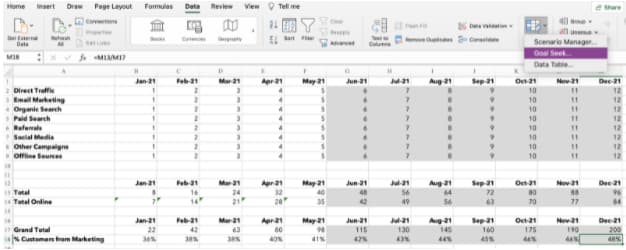
In the following example, I want to evaluate the percentage of customers coming in through various marketing channels. The goal is to bring in 50% of customers through marketing efforts by the end of the year.
I first populate the table using the average month-over-month (MoM) growth to see the projections for June to December. I know I have an email campaign planned for the beginning of December, and I want to see how many customers I’d have to bring in to reach my 50% goal.
Step 1: Select the cell with the output you want to change (i.e., % of customers from marketing).
Step 2: Under the Data tab, select What-If Analysis, then Goal Seek.
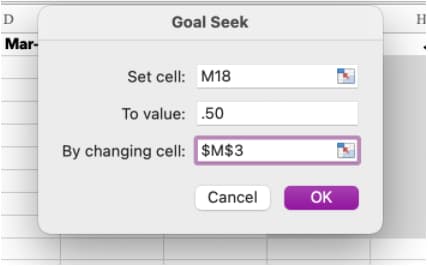
Step 3: A pop-up window will appear. Make sure the cell from Step 1 appears in Set cell.
Step 4: Write your desired value in To value.
Step 5: In the By changing cell box, select the cell you want to change to reach your desired outcome.
Step 6: Click OK to see the Goal Seek calculation. The new number will appear in the cell from Step 5, not in the pop-up box.
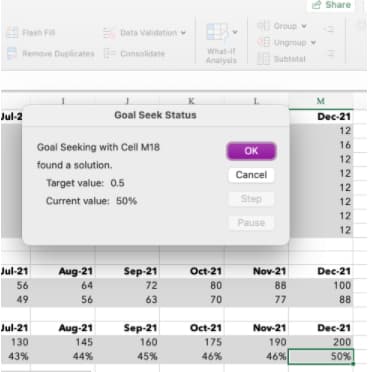
Step 7: If all looks good and you want to keep the calculation, click OK again.
Using Goal Seek, I can tell that if my MoM growth stays the same, I need to attract at least 16 customers through my December email campaign. Yes, this is a simple example. But you can expand it to much more complicated efforts, like projecting sales needed to meet revenue goals or calculating how much net income you’ll earn from a campaign.
Goal Seek Analysis In Excel
Let’s look at another example of Goal Seek analysis. I want to bring in 130 new customers, but I don’t know how many visits I’ll need to reach my goal. Before doing the Goal Seek analysis, I organize my data to find the average MoM visit-to-customer percentage.
Step 1: Select the cell with the output you want to change (In this case, the customer goal).
Step 2: Under the Data tab, select What-If Analysis, then Goal Seek.
Step 3: In the pop-up window, make sure the cell from Step 1 appears in Set cell.
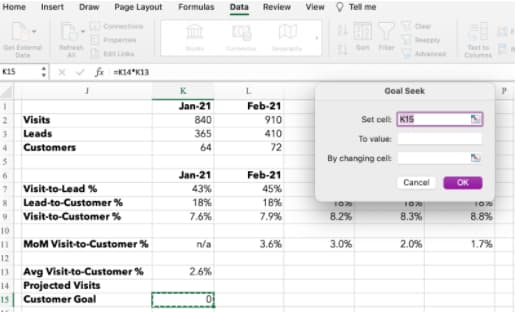
Step 4: Type the number you want to hit into To value (My goal is 130 customers).
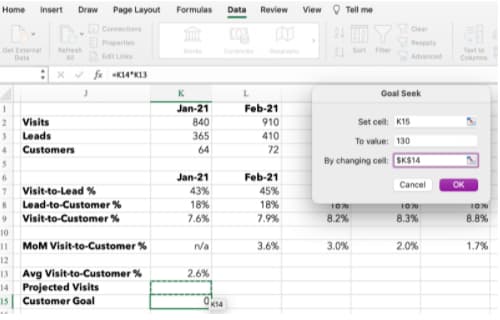
Step 5: Select the cell you want to change in the By changing cell box (Mine is for Projected Visits).
Step 6: Click OK to see the Goal Seek analysis. (Now, I know that in order to get 130 customers, I need to attract 5055 visits).
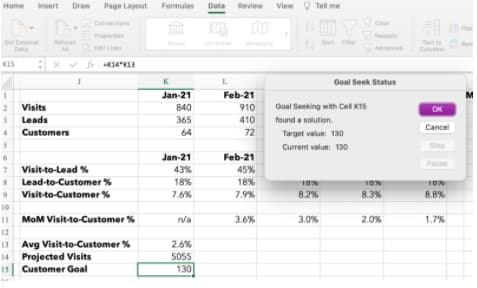
Once you fill in the missing variable using Goal Seek, you can figure out other variables. For instance, I found that with 5055 visits, I would need 910 leads to reach my desired number of customers. Having these numbers can also help me judge if the marketing and sales efforts for the month are on track to meet the goal.
Goal Seek Function In Excel
In business, uncertainty can spell the downfall of even the most thoughtful strategy. But you can take control of the variables that seem out of your control with the Goal Seek function.
Being proactive and judging the business impact of a marketing campaign or new sales effort can not only gain you respect within your company, but it can help you meet, and even exceed your goals. You’ll be ready when the unexpected happens. And you’ll know how to make informed decisions or tweak the strategy with your new what-if analysis skills.

The Simple Guide to Creating an HTML Email [+ Free Templates]
When you create an email using a drag-and-drop or module-based tool, you’re actually generating an HTML email.
There are two main types of email you can send and receive: plain text emails (these are exactly what they sound like — any email that contains just plain old text with no formatting) and HTML emails, which are formatted and styled using HTML and inline CSS.
HTML emails are easy to spot — most of the styled, multimedia marketing emails in your inbox are HTML emails.

As a marketer, you’ve probably compared HTML emails versus plain-text emails and realized that there are different benefits to each type. HTML emails aren’t inherently better than plain text emails, and in different situations, both types can be part of a successful email marketing program.
Here’s what an HTML looks like on the front-end. Click on the HTML button to see the code behind it.
See the Pen HTML Email Template from HubSpot by Christina Perricone (@hubspot) on CodePen.
In this article, we’ll cover how you can get started creating HTML emails, regardless of your experience level and comfort with coding, and share some free templates you can use. Let’s dive in.
How to Create an HTML Email
Good news: You actually don’t need to know how to code to create an HTML email.
Most tools that create and send email (like HubSpot) will offer pre-formatted, ready-to-go HTML templates that enable you to design emails without ever needing to access the actual code on the back-end.
As you make changes in the email editor, those changes will be automatically coded into the final product. Email building tools like this are an ideal option if you don’t have an email designer on your team, but you still want to send professional-looking marketing emails.
Still want to create an HTML email from scratch?
If you’re comfortable with HTML and want more direct control over the code of your emails, most email tools will allow you to import HTML files directly for use as custom email templates.
There are a wide variety of free HTML email templates available on the web (some of which we’ll share below), and if you know your way around an HTML file, it’s usually quite straightforward to adapt the template to the email building tool of your choice.
To create an HTML email completely from scratch, you’ll need to have an advanced knowledge of HTML (or work with a developer who does). This guide offers a solid overview of coding a basic HTML email. Because the process of creating an HTML email from scratch can be quite involved, we recommend working with a developer or using a pre-made HTML email template instead.
Developing an HTML email specifically for HubSpot?
If you’re developing an HTML email template specifically for use in HubSpot, you’ll want to make sure you include the required HubL tokens (these ensure your emails can be customized and are compliant with CAN-SPAM laws). You can find a complete guide to coding HubSpot-specific HTML email templates here. Or alternatively, just use our simple what-you-see-is-what-you-get email editor.
Now that you understand the basics of what goes into developing an HTML email, let’s go over a few important best practices you should keep in mind. No matter what method you plan to use to create HTML emails, these best practices will help improve the design, user experience, and deliverability of your emails.
1. Make sure your HTML email is responsive for different screen sizes and devices.
The way your email looks in a user’s inbox depends on a wide variety of different factors.
One of the biggest and most obvious factors is the screen size of the device it’s being viewed on. An email that looks amazing and well-formatted on a desktop can easily devolve into a tangle of illegible, overlapping text and images when viewed on a smartphone screen.
To ensure your HTML emails look the way you intended across a wide spectrum of screen sizes, the best thing you can do is keep your layout simple and straightforward. When you start adding more complex elements like multiple columns and floated images, it becomes more difficult to translate the format of your email for different screen sizes.
If you do decide to develop a more complex layout, make sure you’re actively solving for how the elements will be rearranged to suit different screen sizes. For example, if your email displays as multi-column on desktop, that same structure won’t fly on mobile — you’ll need to use media queries to define how elements will be displayed on different screen sizes.
Remember, developing truly responsive HTML emails goes beyond the structure and format of your message. Think about how the overall user experience of your email will be perceived on different devices. Make sure your font choices are just as legible on mobile as they are on desktop, and use mobile-friendly buttons or CTAs in place of hyperlinked text (have you ever tried to tap a little line of hyperlinked text on mobile? It’s not very easy).
You can find our more in-depth guide to mobile email best practices right here.
2. Make sure your styling works in different email clients.
Another big factor that heavily impacts the way your HTML emails appear in your subscribers’ inboxes is the email client they’re using to open the message. Every email client loads emails slightly differently, so an email that looks a certain way in Gmail will likely look different in Outlook.
Luckily, if you know how most popular email clients load particular HTML and CSS elements, you can create a pretty consistent experience across different users’ inboxes. It’s all about knowing which unsupported tags to avoid and adapting accordingly. This comprehensive guide explains how the most popular email clients (including Gmail and multiple versions of Outlook) support and render different styling elements.
You can also check out an article we wrote on optimizing emails for different email clients.
3. Be conscious of how long your HTML emails take to load.
How long your email takes to load could very well be the difference between gaining a new customer and losing a frustrated subscriber. While it can be tempting to take advantage of all the different styling options and opportunities to incorporate visuals that HTML emails offer, none of that matters if your email takes too long to load.
As you design your HTML email, remain conscious of how long your email will take to load — especially if someone is, say, opening your message on their morning subway commute with a weak data connection. Here are a few little steps you can take that will go a long way towards improving load time.
Use images sparingly.
That way, you’ll bolster the message you want to get across to subscribers. Always use an image compressor (like Compressor.io) to reduce the file size as much as possible. Most image compressors can significantly reduce the file size of an image without compromising on quality, so taking this extra step won’t hurt the visual integrity of your email.
Use standard web fonts.
Custom fonts are great for spicing up a landing page, but they can add an extraneous layer of complexity when added to an email. As we talked about above, all email clients handle style elements differently, and this especially extends to fonts. To be safe, use standard web fonts and check to make sure the email client most of your subscribers use supports a particular font.
Try an HTML minifier.
An HTML minifier (like minifycode.com and smallseotools.com) automatically removes code that isn’t needed in an HTML file. Repetitive, extra elements will be stripped out, but the actual rendering of your email should remain the same (always test it out!). Each line of code impacts how long an email takes to load, so taking the time to remove junk code can have a positive effect on load time.
Keep your message focused on a single objective.
The best way to reduce email load time is to reduce how much content you add to each of your email sends. It might seem obvious, but too many marketers try to stuff too much content into their emails. Not only does that lead to an off-putting user experience (nobody wants to read a novel in email form), but it can send your load time off the charts and cause users to abandon your email. Keep it simple, and your users will thank you.
4. Plan (as much as you can) for end-user inconsistencies.
The screen size and email client aren’t the only factors that can alter the way your HTML email renders in your subscribers’ inboxes. Elements like the version of their email client, their operating system, their unique user settings, their security software, and whether or not they’re automatically loading images can all impact how your email loads.
As you can probably guess by that hefty list of factors, trying to solve for all of them (every single time you send an email) would probably be enough to make you throw your computer across the room.
But you don’t have to be completely helpless in the face of these variables — you just have to do a little pre-planning.
Consider creating a webpage version of your email.
This is kind of like giving your email a fail-safe button. If for some reason — due to one of the many factors discussed above — your lovingly designed email renders like an absolute mess when a subscriber opens it, they will at least have the option to click “view as web page” and see the email as you intended it to be.
Since style elements render much more consistently across web browsers versus email clients, you’ll be able to have way more control over the web page version of your message. In HubSpot, there’s an option you can turn on that will generate a web page version automatically.
Create a plain text version of your email.
A plain text version is exactly what it sounds like — an alternative version of your HTML email that renders in completely plain text. Adding a plain text version of your HTML email is important because some email clients and user settings can’t (or choose not to) load HTML.
If this is the case, the client will look for a plain text alternative version of your HTML email to load for the user. If one doesn’t exist, it could signal to the recipient’s email server that your message is spam — or potentially dangerous.
Most email tools like HubSpot will automatically provide a plain text version that displays if a recipient’s email server requires it, but if you’re coding an HTML email from scratch, you’ll need to create something called a multipart MIME message.
A multipart MIME message is an email that contains both a plain text and HTML version of the same email. If a recipient’s email client or security system doesn’t allow HTML email, the plain text version will be displayed. This is a process that requires an advanced knowledge of coding, so we recommend working with a developer.
Make sure your email still makes sense if the images don’t load.
Some users have automatic image-loading turned off, which means they’ll see your email without images when they open it. For this reason, don’t rely entirely on images to get the meaning of your message across, and always add alt-text to the images you do include. Alt-text will load even when images don’t, so your subscribers can get the general idea of what the visuals include.
5. Conduct thorough testing.
Finally, you’ll need to test your HTML email at every stage of development to ensure it works across different email clients, operating systems, and device types. Don’t wait until the very end of the process to test out your email — testing as you work is the best way to spot inconsistencies between different email clients and ensure you’re creating the most consistent experience possible for your recipients.
Some email tools (like HubSpot) offer in-app testing within their email builders to make the process easier. If you’re working from scratch, you can use a tool like HTML Email Check or PreviewMyEmail to get a better idea of how your email will look in different email clients and devices.
Simple and Free HTML Email Templates
There are an overwhelming amount of HTML email templates available on the web, and they vary in quality, responsiveness, and price. We’ve pulled together a selection of free HTML email templates that provide a responsive user experience. Be sure to read the terms and conditions on each individual template before use.
1. HubSpot Free HTML Email Template
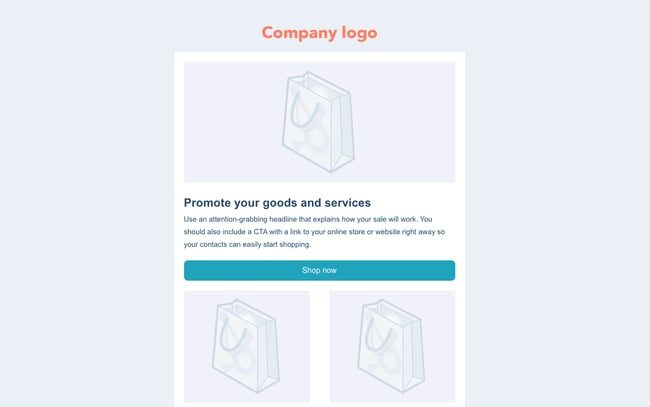
Included in the free version of Marketing Hub, this template is a great place to start if you’re looking for a template with more room for customization. You can easily add images, text, and buttons in an intuitive drag-and-drop editor, and you can be confident that the templates you design will be fully responsive on any device.
2. Company News HTML Email Template by Campaign Monitor
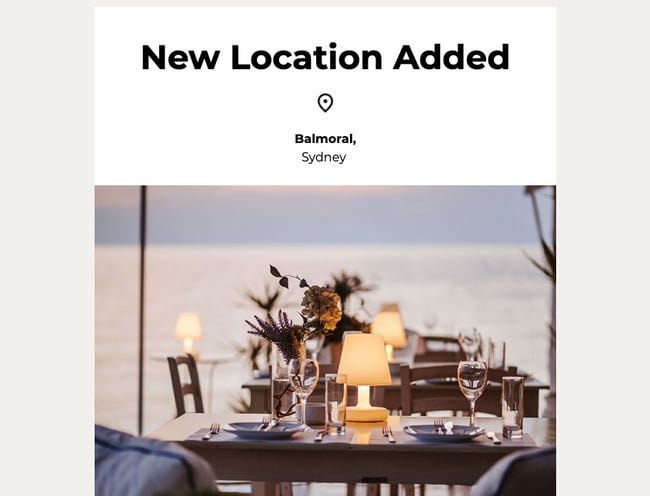 This modern template is sophisticated and minimal. The subtle color palette and simple design make it a versatile option for many different industries and purposes, and it’s been tested on different email clients and devices to ensure a consistent user experience across different platforms.
3. Free HTML Email Template by Unlayer
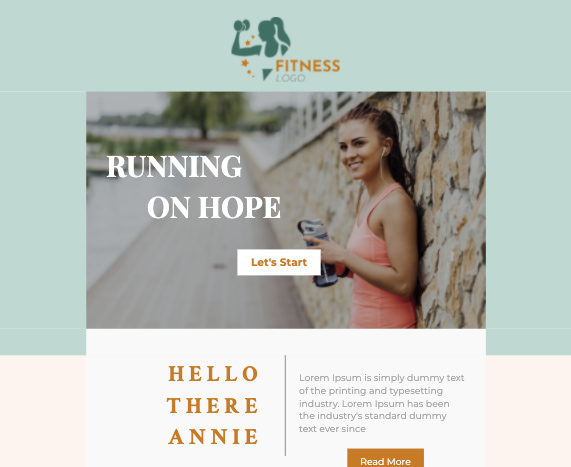
Though this template was designed for a fitness company, you can easily adapt it for your own. This clean, muted template is a great way to display content your team has created and connect subscribers with your most recent products or blog posts. The design features two fully responsive columns with multiple color scheme options, and room at the top to highlight a call-to-action.
4. MINImalist Free HTML Email Template
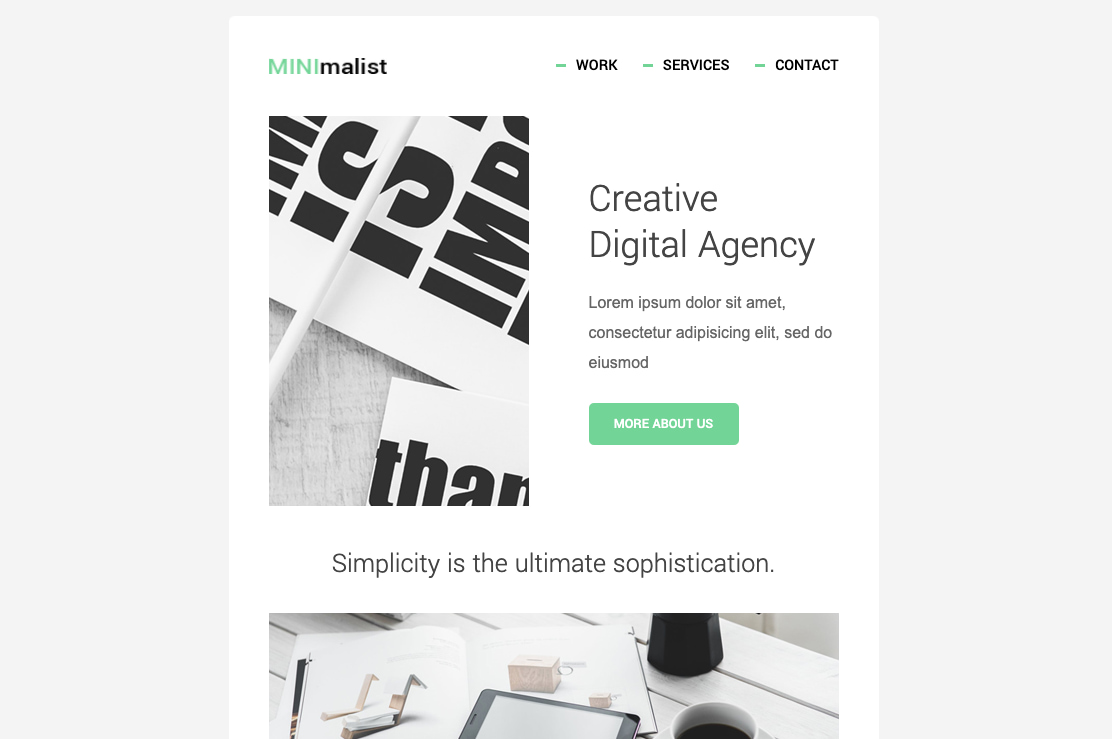
Proof that sometimes less really is more, this easy, fully responsive design makes the most of whitespace and keeps the focus firmly on your words and visual elements. Without design distractions, your content can really shine — on any device.
5. Free HTML Email Templates from Bee Free
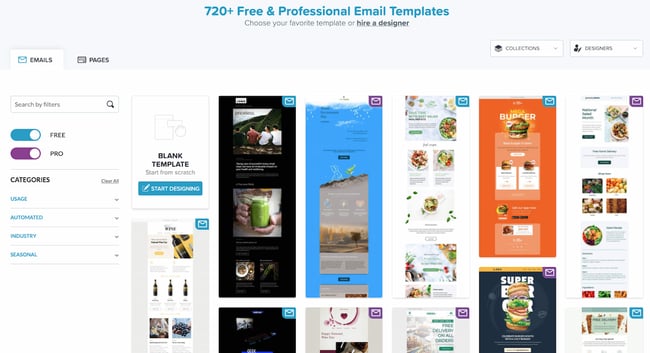
This collection of free, open-source templates are completely responsive and tested across popular email clients. You can edit and build on them on the Bee Free platform, then export the HTML file to your local drive.
These are an ideal option if you want a more styled, polished starting place, but you still want to be able to customize the design to fit your company’s needs. Each template is available in multiple formats for different marketing purposes, like transactional emails, NPS collection, and email subscriber re-engagement.
6. Free HTML Email Template by Campaign Monitor

This sleek, responsive design from Campaign Monitor would be perfect for sending out a discount code — but it could also serve as a stylish way to showcase your latest products to email subscribers. It’s also worth checking out Campaign Monitor’s full library of responsive email templates.
Create HTML Emails to Increase Your Subscriber Count
HTML emails are an engaging way to share what’s happening in your business and keep subscribers coming back for more. With the tips and templates we’ve shared, you’re well on your way to creating beautiful HTML emails without writing a single line of code.
Editor’s note: This post was originally published in June 2019 and has been updated for comprehensiveness.

How to Effectively Disavow Links & Protect Organic Ranking
If you’re confused about when, why, and how to disavow links — you aren’t alone.
We all know that backlinks are critical to your SEO success, but the quality of those backlinks can make all the difference in that success.
This post will help you understand when and how to submit a Google disavow file, which is important for protecting your domain.
Let’s dive in — but first, what is the disavow tool?

What is the disavow tool?
The disavow tool gives you the opportunity to ask Google to ignore low-quality backlinks to your website.
When you submit a disavow file to Google, you are asking them to ignore certain links that are pointing to your domain. There is no obligation for them to respect your request, but if they do, those links won’t be used in determining your ranking in search results.
It’s important to understand, however, that disavowing backlinks doesn’t remove them from your backlink profile.
Do you actually need to use the disavow tool?
Google has made it clear that they only want you to use the disavow tool if you need to.
They recommend using it if you have a manual spam penalty, or if you knowingly took part in link-building practices that might be harming you.
In 2019, Google Senior Webmaster Trends Analyst John Mueller talked about the disavow tool during Google Webmaster Central office hours.
He says, “I think for most websites out there, pretty much the really largest majority of websites, you don’t need to use the disavow tool. That’s why we have the disavow tool so separate from search console so that you don’t get tempted to using the disavow tool because it looks like this normal part of search console that everyone should be using.”
Mueller says, “[The disavow tool] is really something that you only really need to use in really extreme cases.”
To decide if you might benefit from filing a disavow, you’ll need to analyze your backlink profile, which you can learn more about below. But if you knowingly participated in what would be considered unethical backlink practices, chances are a disavow would be helpful.
What is considered a ‘bad’ backlink?
Before we tell you how to do a disavow, it’s important to understand what makes a backlink a bad one.
Google considers any link created to manipulate PageRank or a website’s ranking to be a bad link. They want you to work on creating great content that gets linked to naturally!
If you’ve purposely taken part in any kind of link-building campaign, then chances are you might have bad backlinks.
This could include:
- Purchased backlinks
- Link schemes
- Product for backlinks
- Link exchanges
- Footer links
You might look at your backlinks in various tools and see lots of spammy-looking backlinks and think you need to get rid of them — but you don’t need to worry about those.
Google will understand spammy links to some extent and ignore them.
As an example, here are some backlinks from a website pulled from Ahrefs. These are all spam, and none of them have DR ratings:
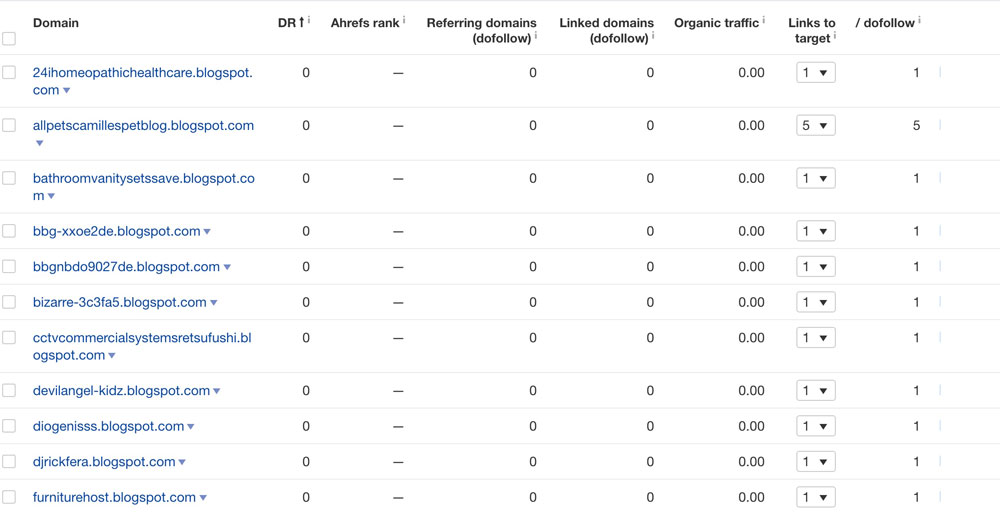
I wouldn’t bother disavowing these since these are probably backlinks that a lot of websites have, and Google is smart enough to know we didn’t create them to manipulate our backlink profile.
When should you create a disavow file?
Google has stated that most websites will not need to disavow links, and only in certain circumstances should it be used.
Below are some examples of when a disavow might be recommended or needed.
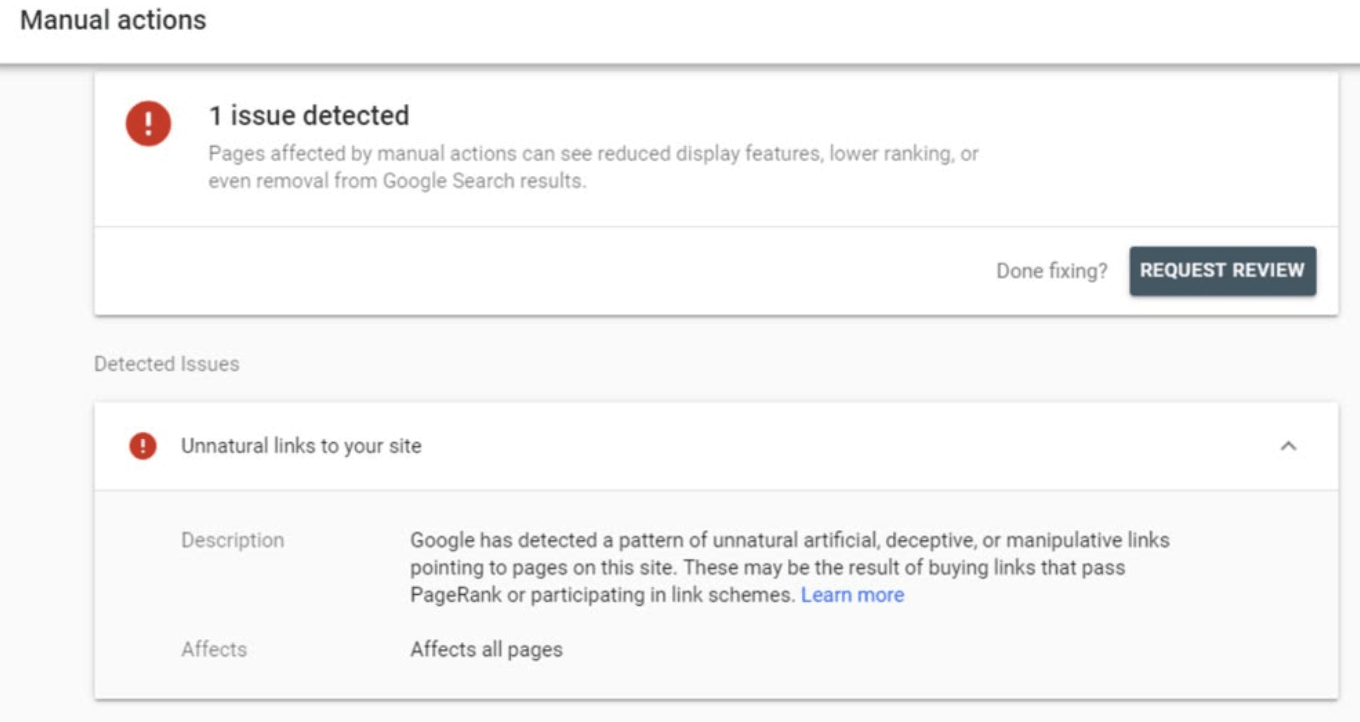
1. Manual Action: Unnatural Links To Your Site
This is the one occasion where you will absolutely want to file a disavow. If your website has been hit with a manual penalty due to link building practices, then disavowing links is a must to have that penalty removed.
If your website is connected with Search Console — and it should be — you will be notified if there is a manual action on your website.
At this point, you would begin analyzing the backlinks you have in Search Console and trying to find the links that may be seen as violating Google’s guidelines.
If you find offending backlinks, the first step would be to contact the website owner where the backlink is and ask them to remove it. If that doesn’t work, then you can try using a disavow file.
Once you have removed or disavowed the links, you can select the “Request Review” button in your Manual actions report to ask them to remove the action.
2. Link Schemes
If you knowingly participated in link schemes, then you may benefit from adding them to your disavow file. These are links you – or someone you may have hired – paid for. These may be private blog network (PBN) links or even guest posts on websites of no relevance to your niche.
3. Directories
A long time ago, adding profiles to every directory that existed with a link to your website with your “money keyword” as the anchor text was all the rage. Maybe you are guilty of this, or the SEO you hired is – but these are backlinks that should be removed. If you can manually remove them that would be best, but adding them to the disavow is recommended if you cannot remove the link.
4. Comments
Another old tactic was to spam comments on other blogs and add keyword rich anchor text in the comments box or even for the name field.
If you have any backlinks from comments, directories or editorial links with anchor text like “buy red widgets” or “best tennis shoes” it would be recommended to add them to your disavow file if you cannot get the link removed or changed. Normally for these types of links it would be expected to be your first name or brand name.
Finding all of Your Backlinks
To create the most accurate analysis, you will need to retrieve as much backlink data as you can and understand how to analyze that data.
You can use a variety of tools to review your backlinks, and you can choose to download them all to a spreadsheet to manually review them or do an analysis right from within the tool.
Here are a few options of tools to use for finding backlinks:
1. Google Search Console.
In Google Search Console you can go to the links area and click the export external links button and then the more sample links option to get a full list of the backlinks to your website.
2. Semrush, Ahrefs, Moz, or your preferred tool.
Export your list of backlinks and merge it with your Google Search Console file or analyze your data in the software.
3. A Link Audit Tool.
There are a few tools that can really minimize your time in auditing your backlinks like LinkResearchTools.
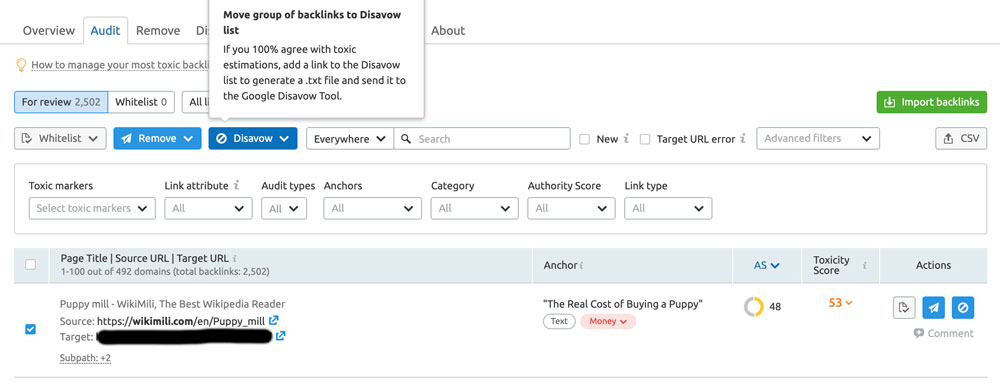
Semrush also has a backlink audit tool that shows all of your backlinks and gives them a toxicity score based on a variety of factors. You can work right from your dashboard to assess the links and determine if they truly are toxic or not.
If they are, you can then add them to a disavow right from the tool. When you are done reviewing them all you can then download the formatted disavow .txt file and submit it to the tool.
While this is a useful tool, it does not have all of your backlinks in its database! You should still do a manual review using other tools as well.
Creating A Disavow File
Once you are done assessing your links you can create the disavow.txt file that will be uploaded to Google Search Console.
Creating A Disavow.txt File
Below are some guidelines from Google on how to create your file.
- The file name must end in .txt
- File size can be no larger than 2MB and 100,000 lines
- Each URL should be on its own line
- If you want to disavow a whole domain you should start the line with domain:
- If you want to disavow a URL you can just enter the URL
Below is a sample portion of a disavow file that I recently created as an example.
By adding a # before text you can add comments, these lines will be ignored by Google.
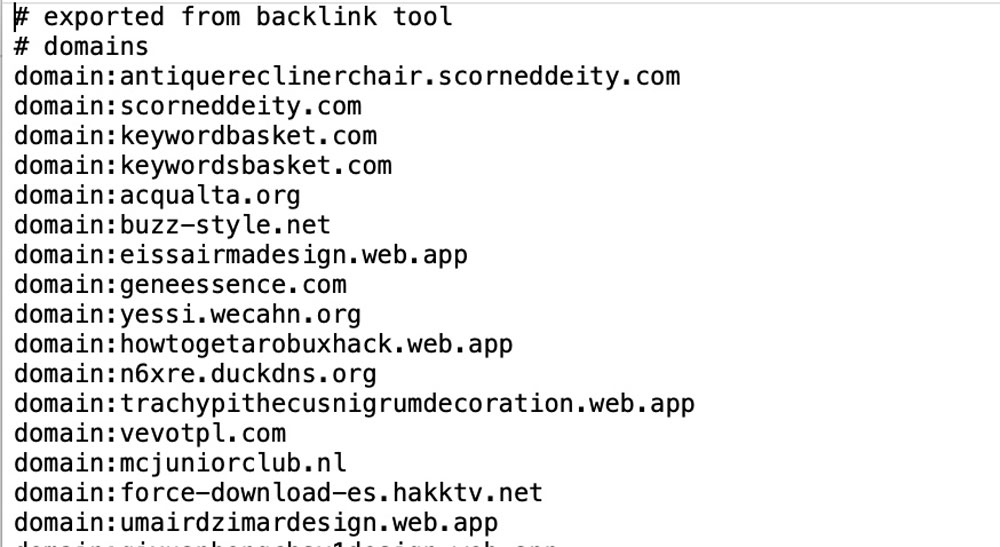
If you would like to test your disavow file before uploading it you can use the Disavow File Testing Tool which was created by Fili Wiese, a former Google Engineer.
Uploading a Disavow File
Once you have completed your disavow file it can be uploaded to the Disavow Tool in Google Search Console.
Below are a few easy steps to uploading your disavow.
- Login to Google Search Console
- Go to https://search.google.com/search-console/disavow-links
- Select the property you would like to add a disavow file to
- Click the upload disavow list button and find your .txt file to add
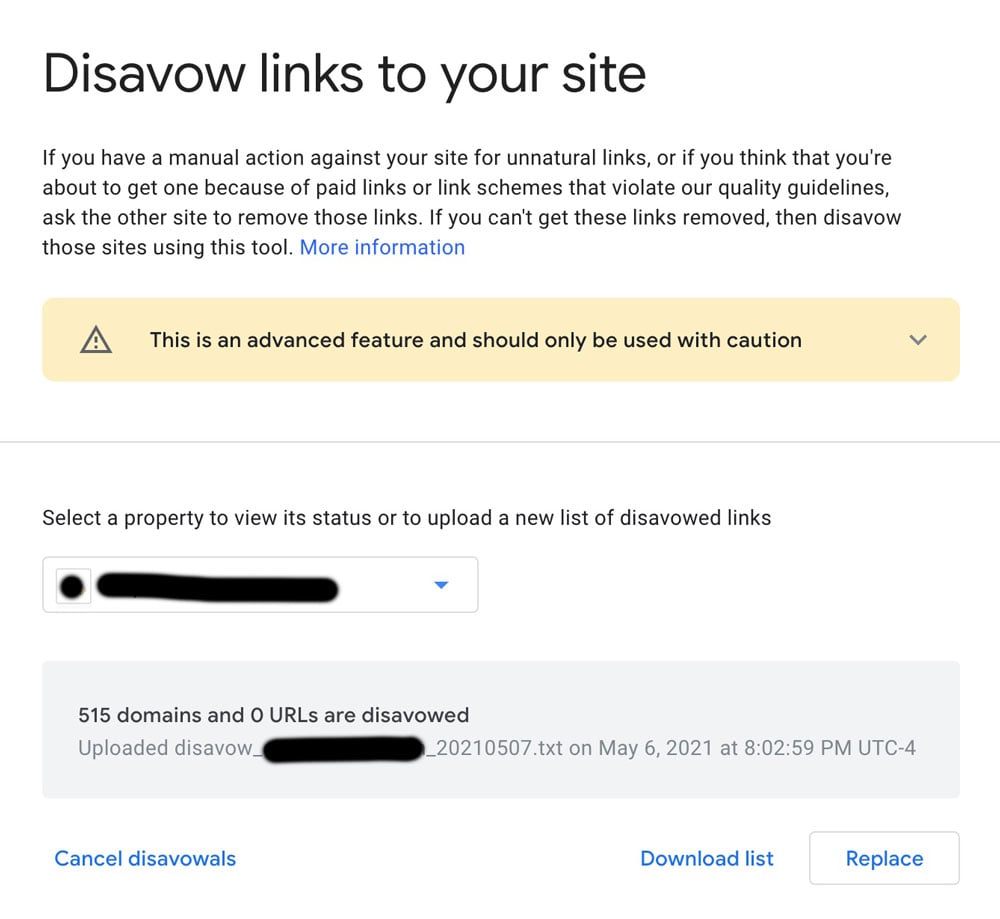
If you had uploaded a previous disavow.txt file, your new one will override that one. If your file has any issues, you will see error messages and be prompted to upload a corrected version.
While there is no guarantee that submitting a disavow file will help, there have been reports of success when using it.
It will take some time for Google to process the information you uploaded, so you will have to have a bit of patience.
There is no way to really know if the disavow.txt file is doing what you want it to do, but keeping an eye on your rank, organic traffic and impressions could be a good indicator.


How to Embed Video in Email [Quick Tip]
Nowadays, video is an undeniably popular channel for marketing purposes.
In fact, in 2021, 86% of businesses use video as a marketing tactic.
If you’re an email marketer, I’m willing to bet you’ve considered how you might spruce up your subscription and click-through rates with video. It’s a good idea in theory, with roughly two-thirds of consumers preferring video over text when learning about new products or services.
In reality, however, it can be tricky. Major email clients including Gmail, Yahoo, and Outlook don’t support embedded videos, so your subscribers either won’t be able to watch your video within the email, or worse — they won’t see your email at all, because it’ll end up in their spam folders.
Fortunately, there’s a creative workaround to help you embed part of your video within your email, and incentivize subscribers to click-through to watch the rest. Here, let’s explore how to do just that.
Embed YouTube (or Any Other) Video in Email
There are two options you might consider when embedding a video within your email — you can either embed a GIF of your video with a “click here to watch full video” CTA, or you can embed a still photo of your video, and when subscribers click the “Play” button, they’ll be re-routed to your video’s URL.
Let’s explore the GIF option, first.
You can use the following instructions on any video from a video hosting platform of your choosing, including YouTube, Vimeo, Facebook, DailyMotion, etc. In the following examples we used a Facebook URL, but a YouTube URL would work just as well.
1. Find the URL of the video you want to include, or download and save your video to your computer.
To create a GIF of a video I wanted to include in my email, I first went to HubSpot’s Facebook page and copied the URL of a recent video the team uploaded to the site — “How a Senior SEO Strategist Sees the World”.
 2. Go to Imgflip.com, a tool that enables you to create GIFs of videos.
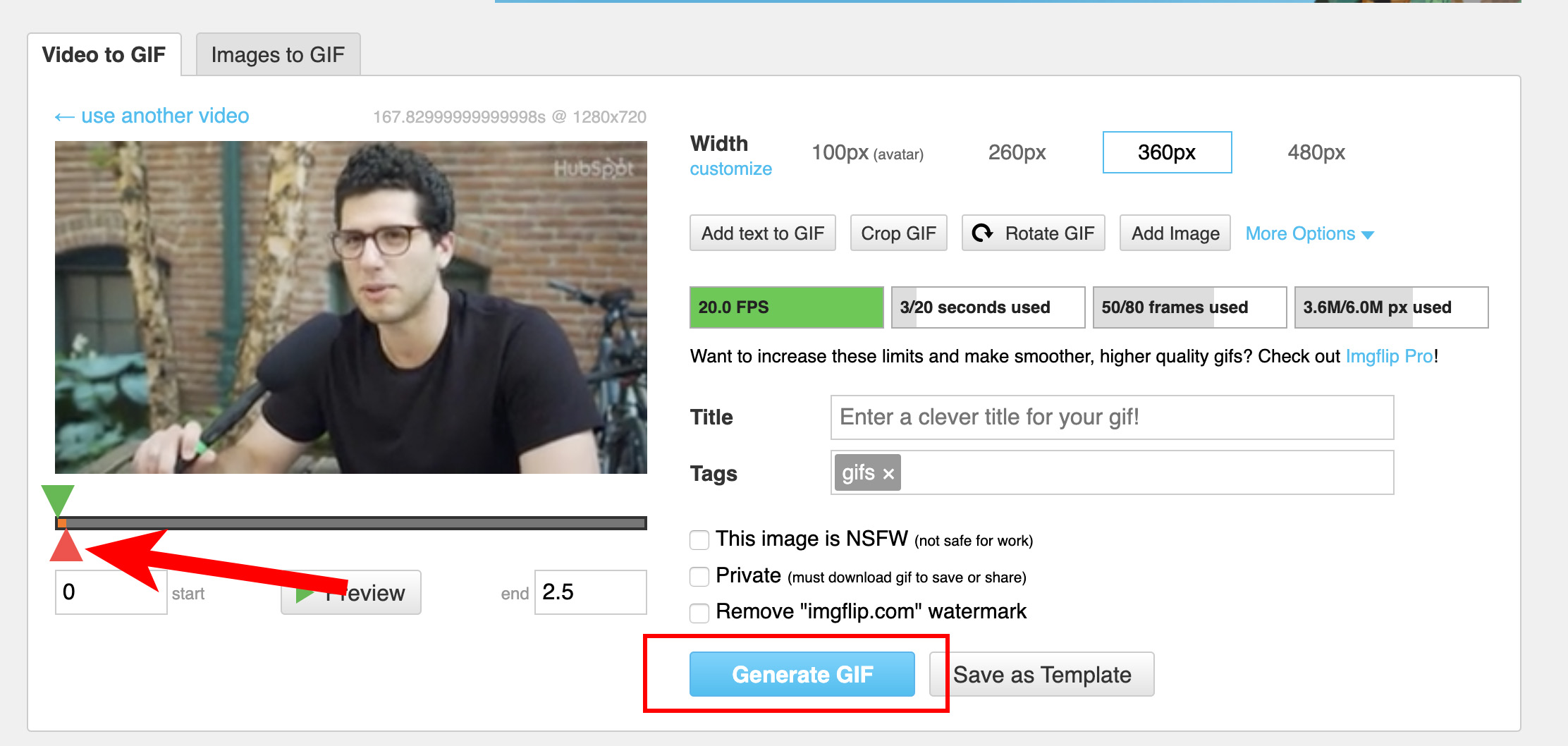
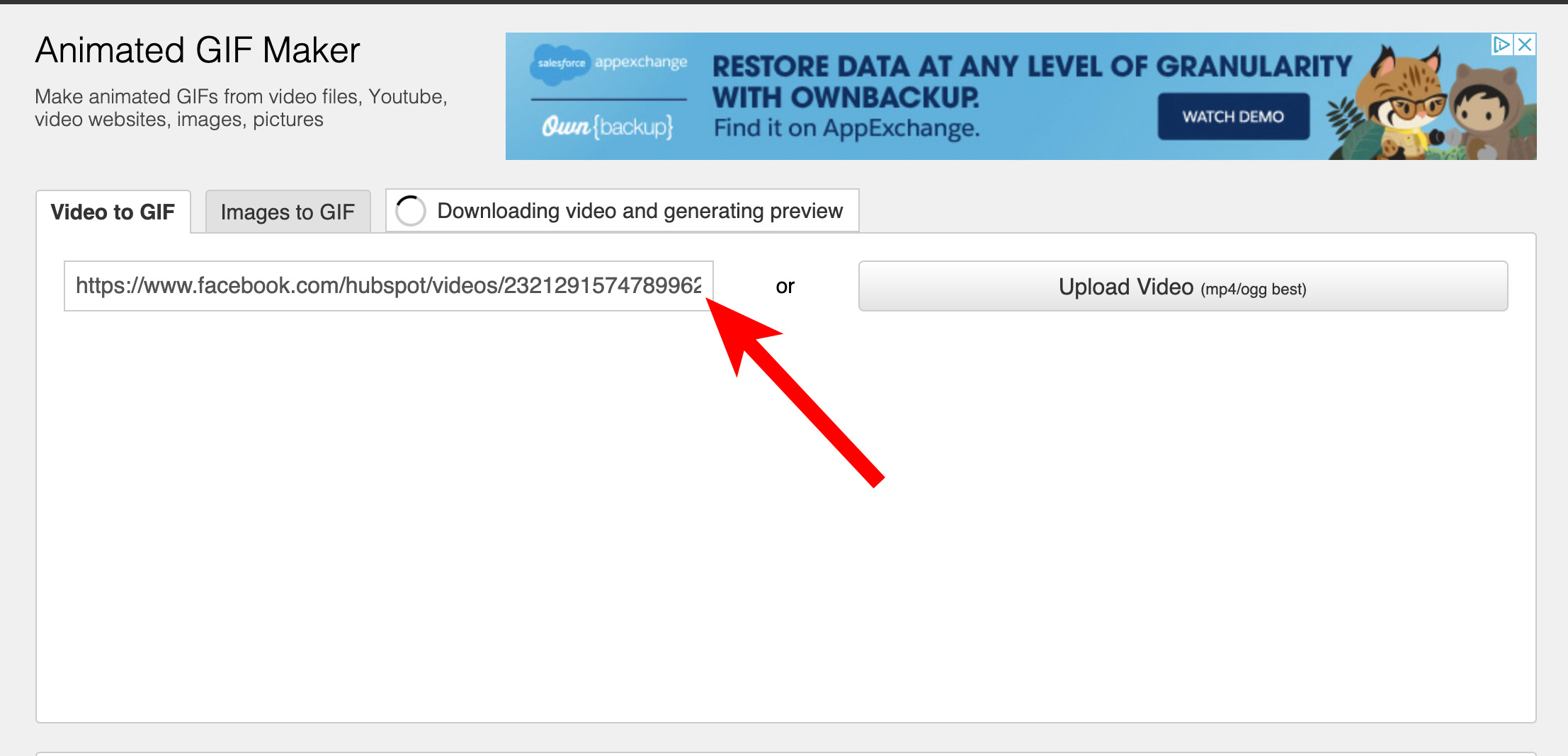 3. Choose a starting point and end point for your GIF.
Once you’ve chosen a clip you’d like to use for your GIF, click “Generate GIF”.
4. Download your GIF.
Once your GIF has been generated, you’ll have the option to copy-and-paste the image link or image URL. Instead, click “Download .gif”.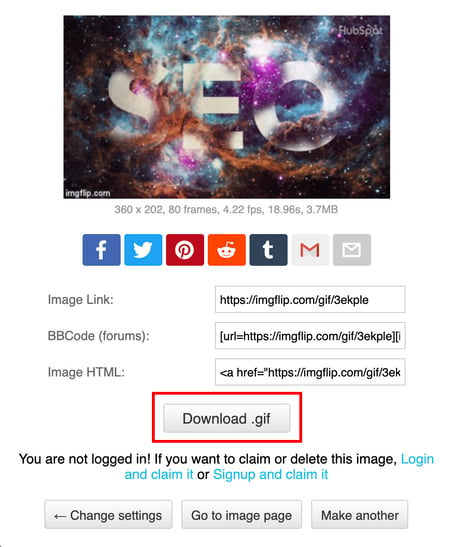
5. Drag-and-drop your GIF into your email, and add a video CTA linking to the full video.
Now comes the fun part! Simply create your email to send to your subscribers, and drag-and-drop your GIF from your desktop into the email itself.
Below the GIF, create a video CTA, like “Click to view full video here” with a URL to your video (the URL will likely lead to your own website, YouTube, Facebook, or another social platform).
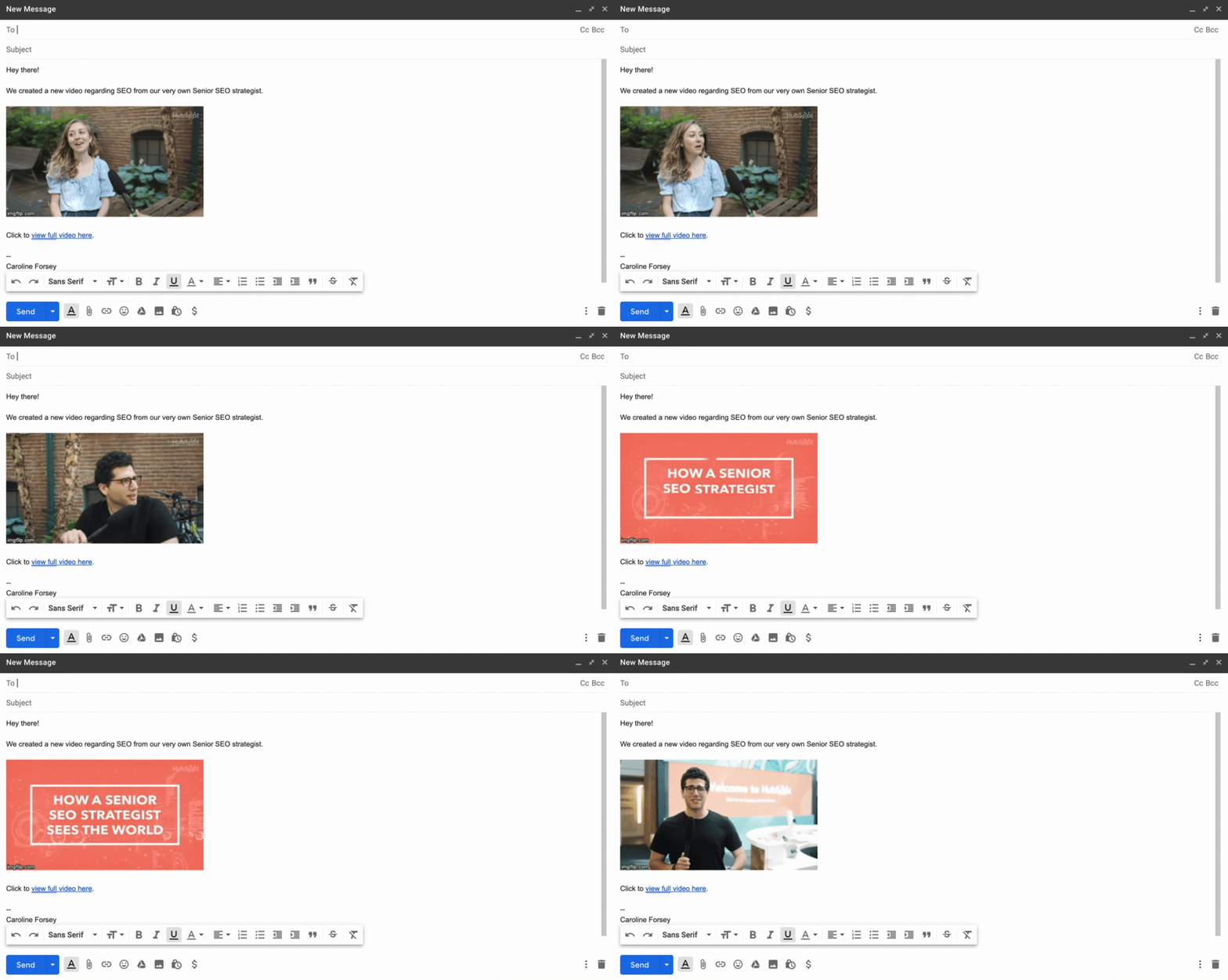
You can spruce up your email subject line with “Video included” to further incentivize click-through rates.
Of course, you’ll want to use email marketing best practices when embedding a GIF, and ensure the video you want to include is truly a compelling, interesting piece of content for your email subscribers.
This is a unique opportunity to further engage with your prospects and customers, so make sure to use it wisely — don’t just send a video advertisement for your products or services.
Next, let’s explore how you might include a still image of your video with a “Play” button.
How to Create a Still Image of Your Video With a Play Button
1. For this example, I’ll use the same video as before. Instead of copying the URL, however, I simply screenshotted a paused section of the video.

2. When I paused the Facebook video, it automatically included a “Play” button. However, if you screenshot a video while it’s playing, you might not have a “Play” button. To add one to a still image, go to the website Add Play Button to Image, upload your image, choose a play button design, and click “Create Play Button Image”.
Then, click “Download Image”.
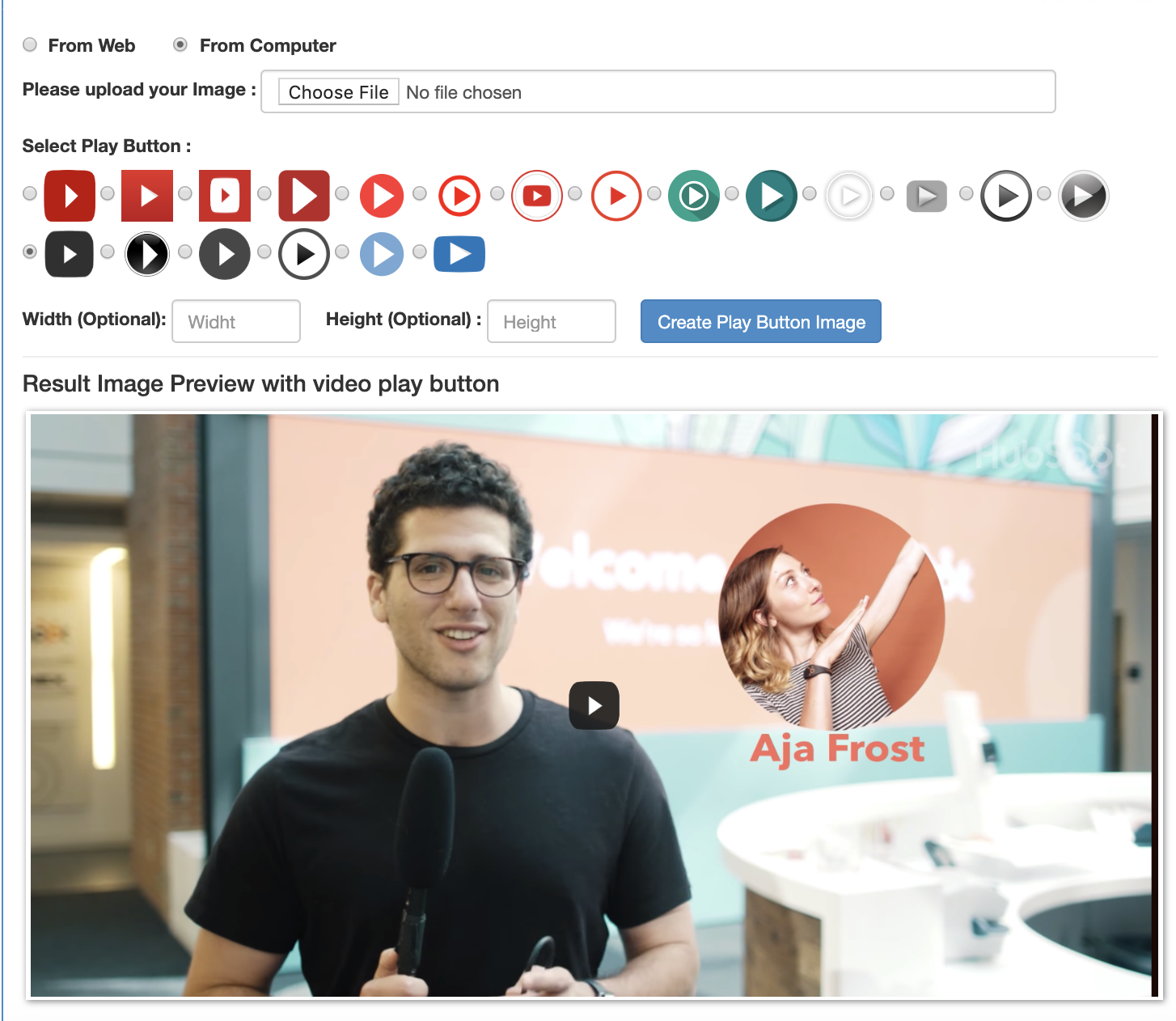
3. Next, simply click “Insert Photo” in your email to include the image with the Play button. Then, highlight the image and select “Insert Link”. Copy-and-paste the link to the full video (in this case I pasted the Facebook URL, but you can also paste a URL to a website with your video, or YouTube).
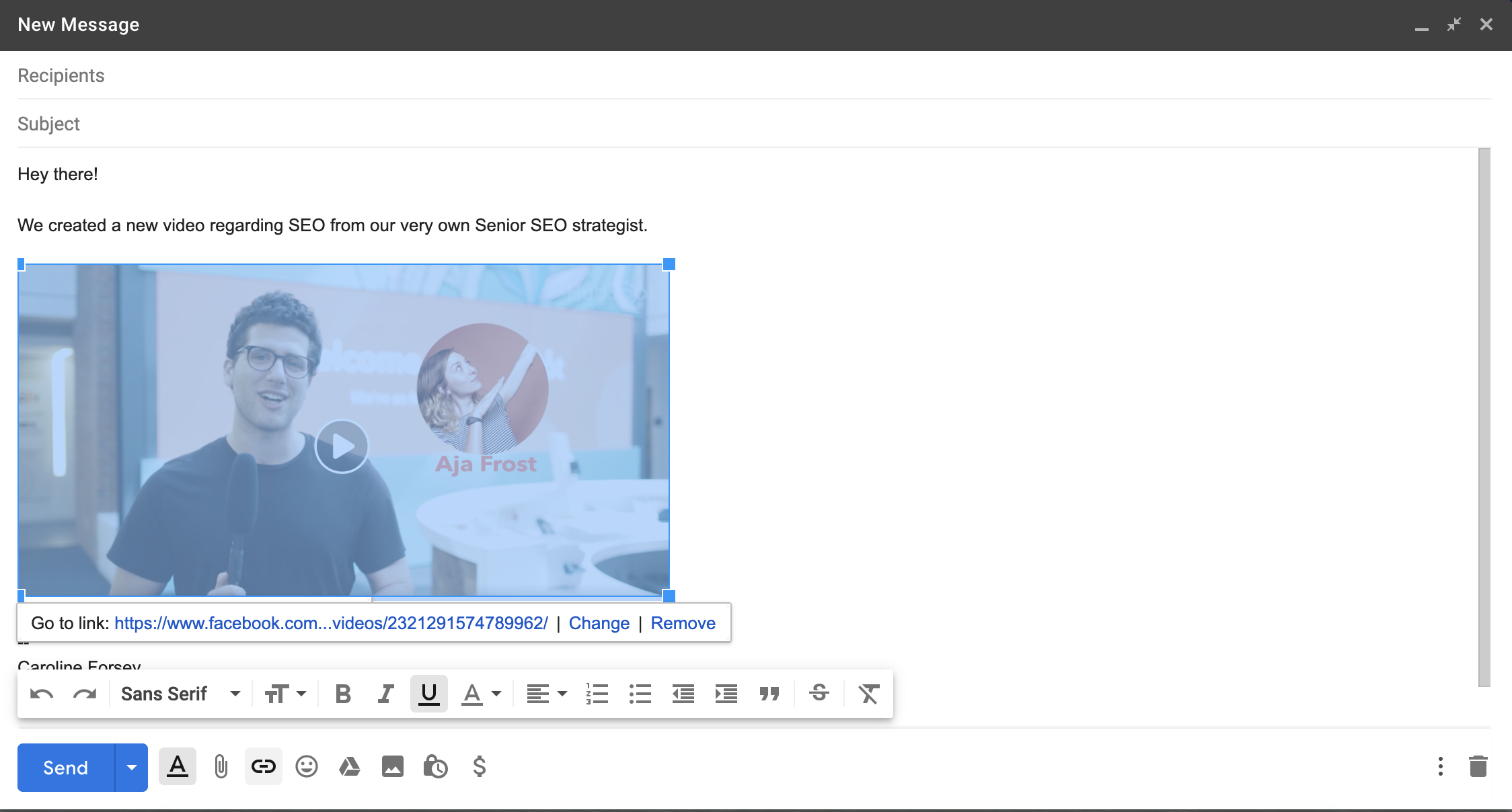
4. And that’s it! Now, when a subscriber clicks on your image, they’ll be redirected to the full video. Ensure the video auto-plays so the subscriber doesn’t have to click “Play” again.

How to Embed a Video in a HubSpot Email
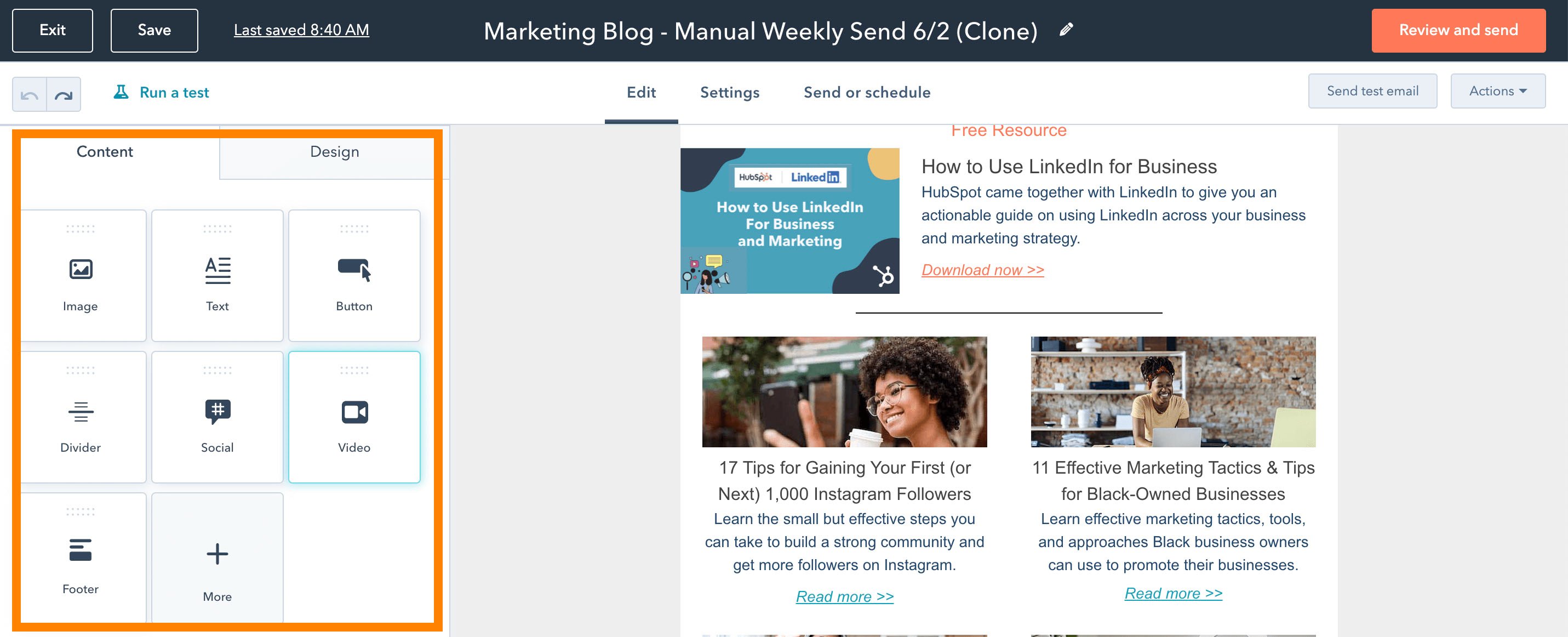
1. If you’re a HubSpot email tool user, you’ll see a Video module on the left-side of your screen when you’re creating an email.
Simply drag-and-drop the module into the section of the email you’d like to include a video.
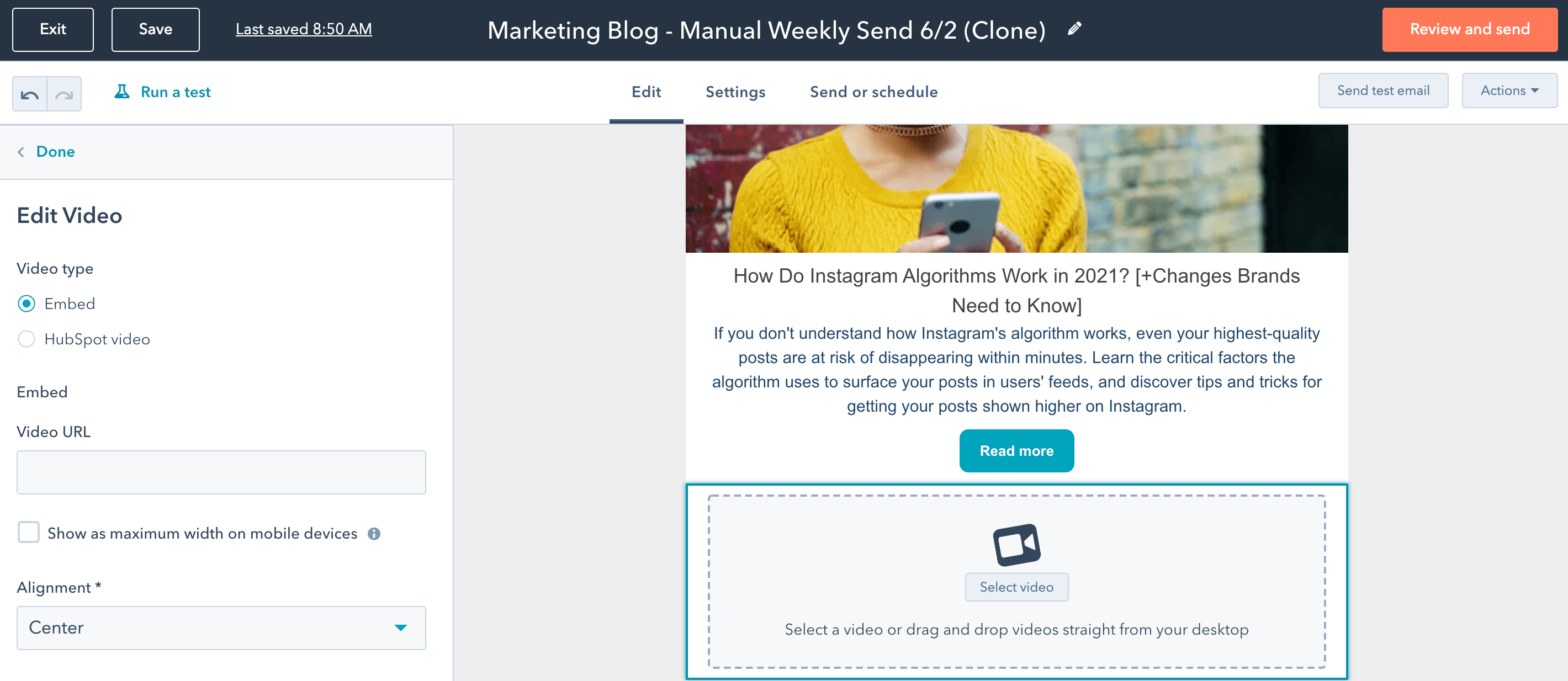
2. Next, you have the option to Embed a video using a URL, or uploading a video to your COS. For our purposes, let’s copy-and-paste a YouTube URL into the text box.
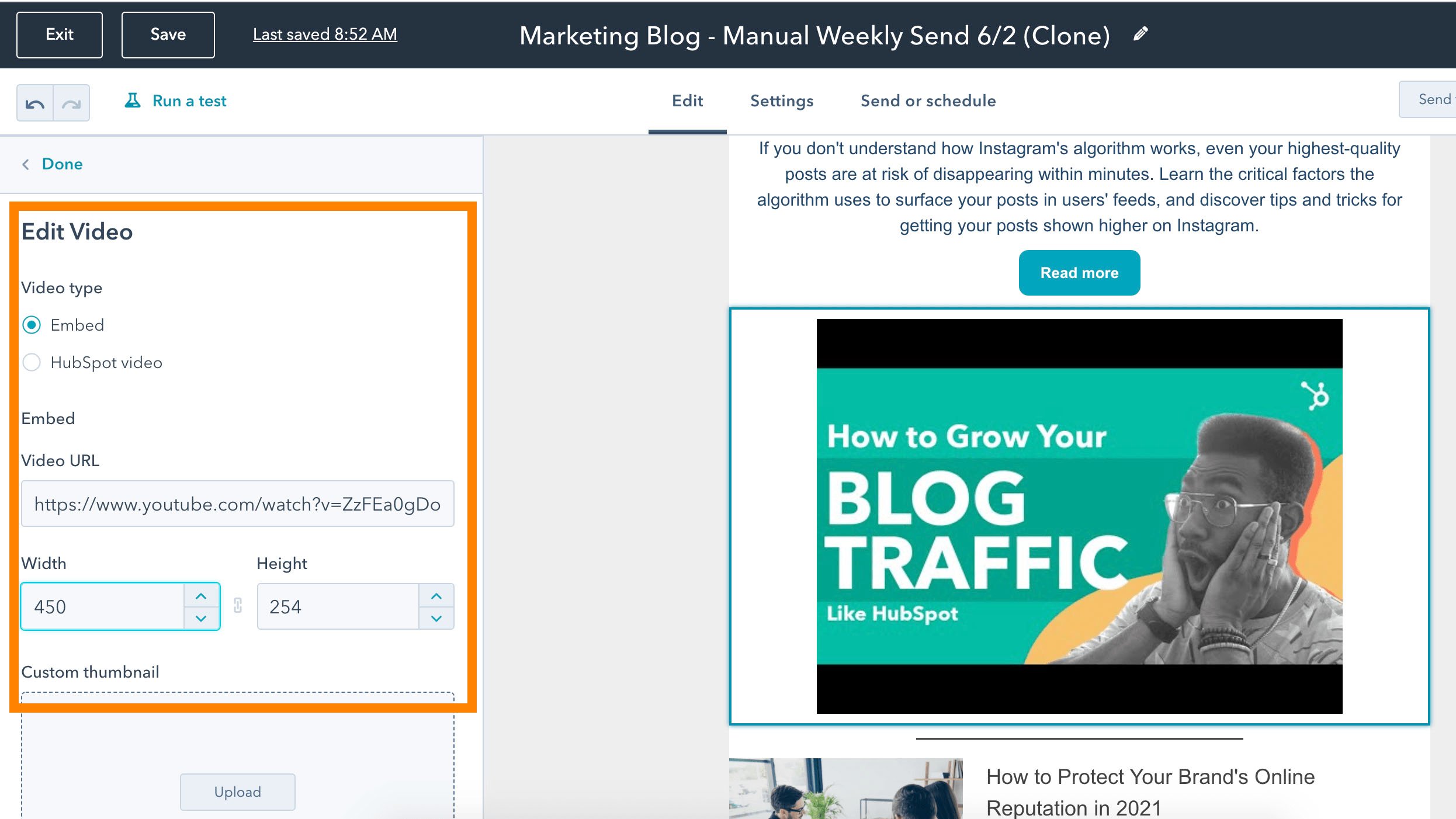
 3. Finally, edit the video to suit your needs. You can modify the video’s width and height, and even create a custom thumbnail.
 4. When you’re ready, click the orange “Review and send” button at the top-right of your screen.
How to Use HTML5 Code to Embed Video in Email
Finally, some email clients do support embedded video. If you feel it’s the right strategy for your subscribers, you can embed a video within email using HTML5.
Here’s an example of an HTML5 code you might use in your email:
<video width=”300″ height=”200″ controls>
<source src=”movie.mp4″ type=”video/mp4″>
<source src=”movie.ogg” type=”video/ogg”>
https://ift.tt/36q5Odu
</video>
If the video isn’t supported, your subscriber can see a static image linking to another page, instead.
If you don’t have experience coding, you might consider asking a developer to help you, or take a look at W3 School’s HTML5 Video article.
However, it’s important to note — we don’t recommend this strategy, since you risk either ending up in your subscribers’ spam folders, or using code that many of your subscribers’ email clients won’t support. Ultimately, it could be more trouble for many of your subscribers’ than it’s worth.
To ensure your video can be seen by all your subscribers, I’d recommend one of the strategies listed above, instead.
If you’re looking for other opportunities to boost email click-through rates and conversions, take a look at HubSpot’s free email marketing tool.

25 Google Search Statistics to Bookmark ASAP
In many ways, marketing is a game of trend watching. The marketer who’s best at spotting and using trends earns their business market share, brand recognition, and ultimately, revenue.
But how do you search for trends? And where do you start?
Well, since it owns more than 92% of the global search engine market, the answer to both of these questions is, Google.

Google’s nearest competitor, Bing, only holds 2.5% of market share, while Yahoo accounts for 1.5%. The distribution has remained relatively stable over the past few years with Google consistently claiming competitive victory thanks to detailed search results, in-depth analytics, and evolving service offerings.
Consider the rapid uptake of “Google” as a verb meaning, “to search” — “I’ll just Google it,” “can’t you Google that?” “isn’t it on Google?” It’s not an exaggeration to say that when it comes to searching for information online, Google is — by far — the digital frontrunner.
Google also makes efforts to personalize search results, in turn, increasing the chances that users will opt for Google the next time they have a question. For users that aren’t logged into a Gmail or another Google account, the company uses anonymously stored browser cookies to get a sense of search histories and preferences.
For users signed into their Google account, Chrome’s browser history provides the data necessary for Google to construct a profile based on age, language preference, gender and search preferences, which informs the type of search results returned. Location offers an easy example of this approach — if users have location services turned on, Google search results will be filtered by geographic location to increase overall relevance.
Now, let’s look at a few of this year’s top Google Search statistics and take a deeper dive into the trending searches that guide your marketing strategy.
Top Google Search Statistics in 2021
Now that we know how to search for trending topics, let’s look at how Google influences search with these latest statistics.
- The top five Google searches in 2020 were “Election results,” “Coronavirus,” “Kobe Bryant,” “Coronavirus update,” and — unsurprisingly — “Coronavirus symptoms.” (Google)
- More than 50% of Google searches end without a click. (Search Engine Land)
- 92% of all search queries are long-tailed keywords. (Backlinko)
- As of October 2020, there were more than 267 million unique U.S. visitors to Google. (Statista)
- 89% of URLs and 37% of URLs in positions 1-20 rank differently on mobile and desktop. (SEMRush)
- There are now more than 1.8 billion Gmail users worldwide. (TechJury)
- Compressing images and text could help 25% of web pages save more than 250KB and 10% save more than 1 MB. These changes reduce bounce rates and increase page rank on Google SERPs. (Google)
- Chrome accounted for 69% of web browser market share in 2020. (Net Marketshare)
- In 2021, 56% of web traffic took place on mobile phones. (Broadband Search)
- 14% of Google searches are a question. (Backlinko)
- In 2020, 500 keywords accounted for 8.4% of all search volume. (Backlinko)
- The average click-through rate for first place on desktop is higher than that of mobile, at 31.5% and 24% respectively. (Advanced Web Ranking)
- Four times as many people are likely to click on a paid search ad on Google (63%) than on any other search engine — Amazon (15%), YouTube (9%), and Bing (6%). (Clutch)
- 55% of teens use voice search on Google every day. (Marketing Dive)
- 55% of people clicking on Google search ads prefer those to be text ads. (Clutch)
- For every $1 businesses spend on Google Ads, they make an average of $2 in revenue. (Google)
- The average click-through rate in Google Ads across industries is 3.17% in the search network and 0.46% on the display network. (WordStream)
- The average cost-per-click for a keyword is about $0.61. (Backlinko)
- The average cost-per-click in AdWords across all industries is $48.96 for search and $75.51 for display. (WordStream)
- More than 90% of web pages receive zero organic traffic from Google. Just about 5% receive 10 visits or less each month. (Ahrefs)
- A third of all Google searches are for an image and 13% of SERPs feature an “Image Pack.” (Moz)
- The average keyword is roughly two words long. (Backlinko)
- The average conversion rate in AdWords across all industries is 3.75% for search and 1.77% for display. (WordStream)
- There are over 190 different versions of Google Search. (GiT Magazine)
- 25. When Google opened its proverbial doors in September 1998, it only averaged about 10,000 daily search queries. (“The Search
With search volumes constantly fluctuating in response to world events and evolving news coverage, it’s worth knowing what searches are trending, how quickly they’re ramping up, and how they tie into similar keyword queries.
While one option is a scattershot approach — simply type a potential trend term into Google and see how many total results are reported — more targeted options often provide an easier path to improved search performance.
Let’s review some of the most useful tools available in the section below.
1. Google Trends
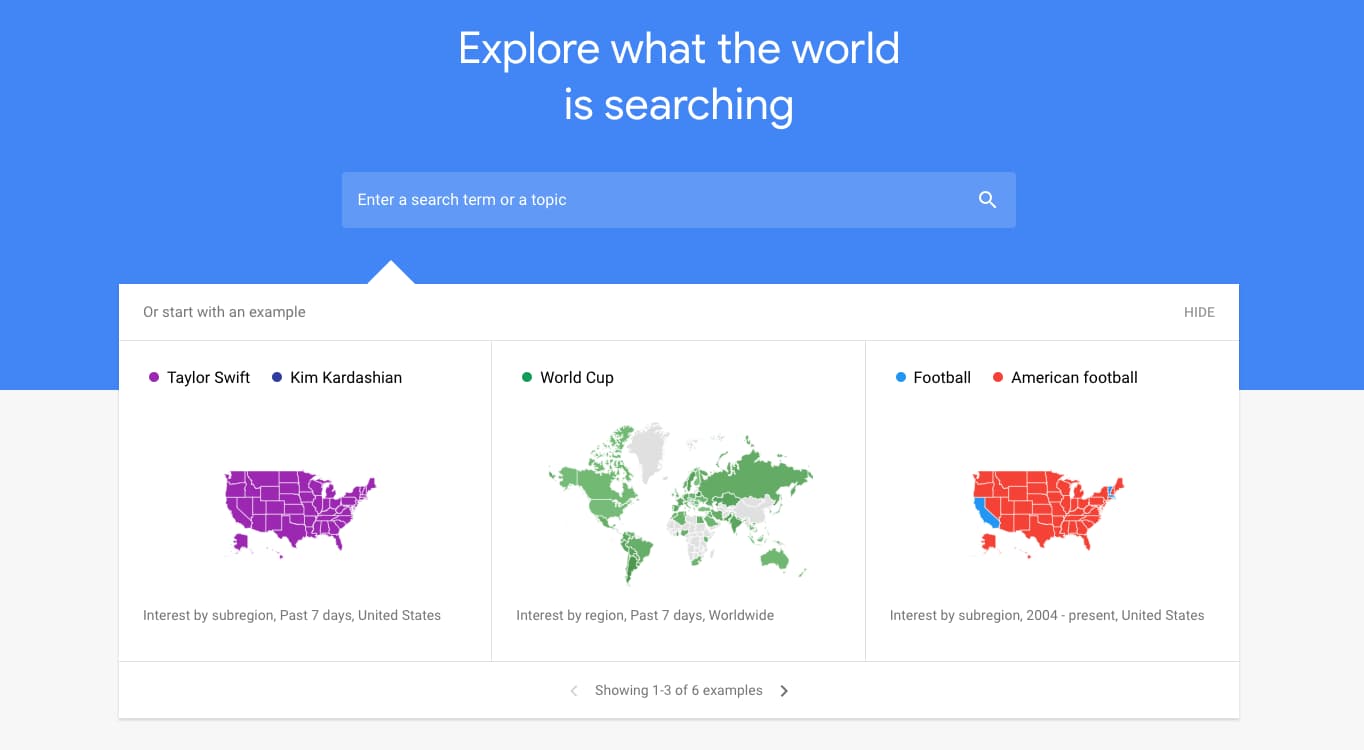
Review the “Year in Search,” take Google Trends lessons, and see what’s trending now. You can also view the peaks and valleys of topic interest over time, which uncovers seasonality and allows you to plan your marketing calendar accordingly. Plus, find related topics and queries, and identify sub-regions your topic has been trending to better target your campaigns.
2. Think with Google
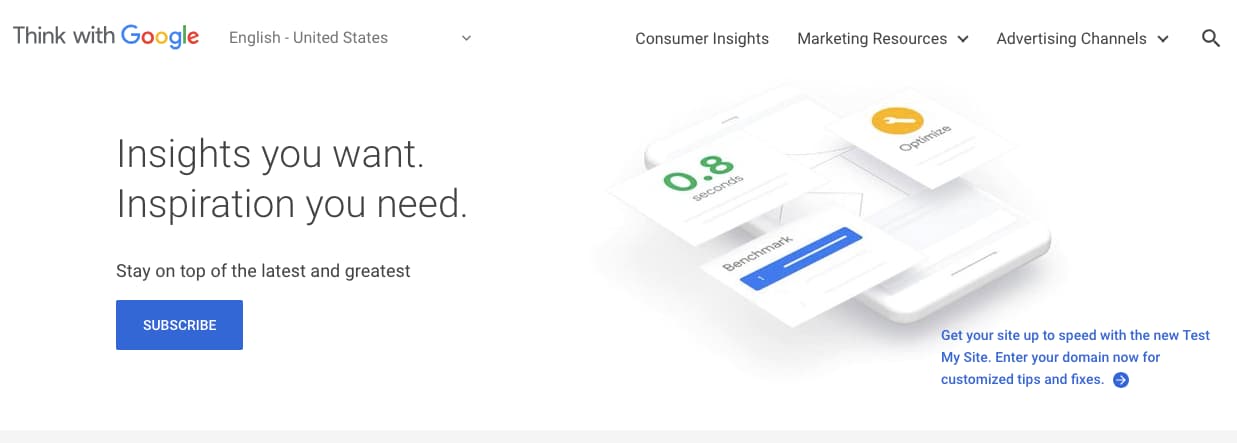
Discover articles, benchmark reports, and consumer insights that keep you up to speed on search. From ad bidding strategies to brand jingles, you’ll find interesting content that helps you think bigger while staying educated on how to leverage Google search for your business.
3. Twitter
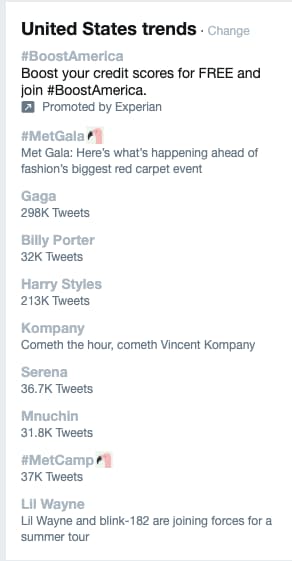
Sign on to Twitter for more than vaguely hostile political debates. Use the “trends” feature to uncover what’s trending in your state, country, or around the globe. When you click into a trend, you’ll see top tweets about the topic, relevant news stories, and live responses as well.
4. BuzzSumo
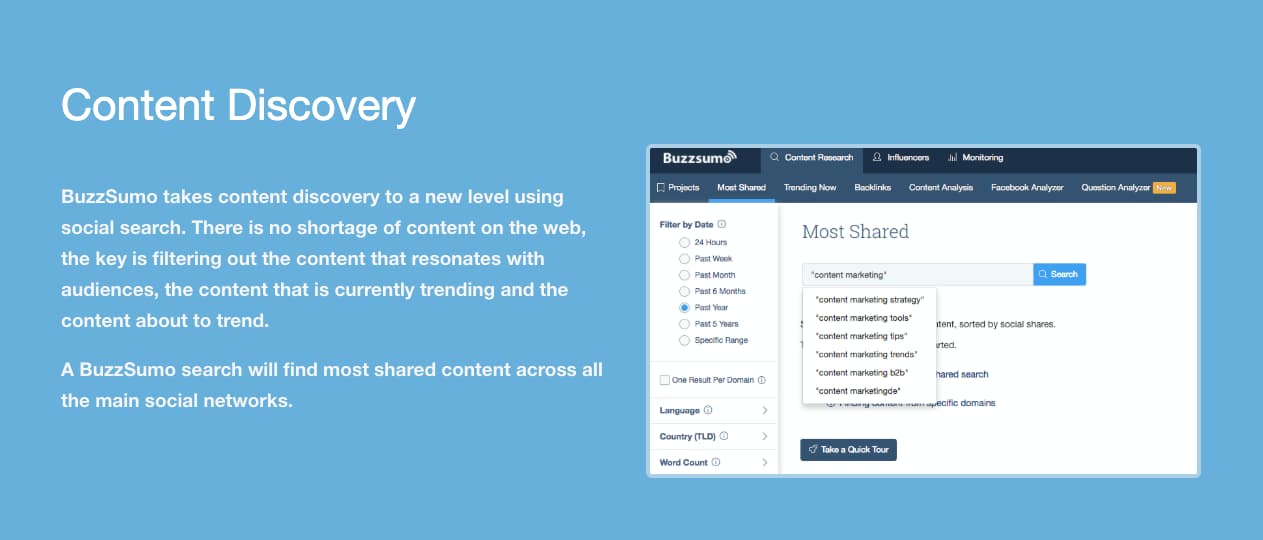
Identify the most shared content in the previous 12 months or the last 24 hours with BuzzSumo. BuzzSumo allows you to drill down and analyze the topics that matter to your industry, your competitors, and the influencers you learn from.
5. Feedly
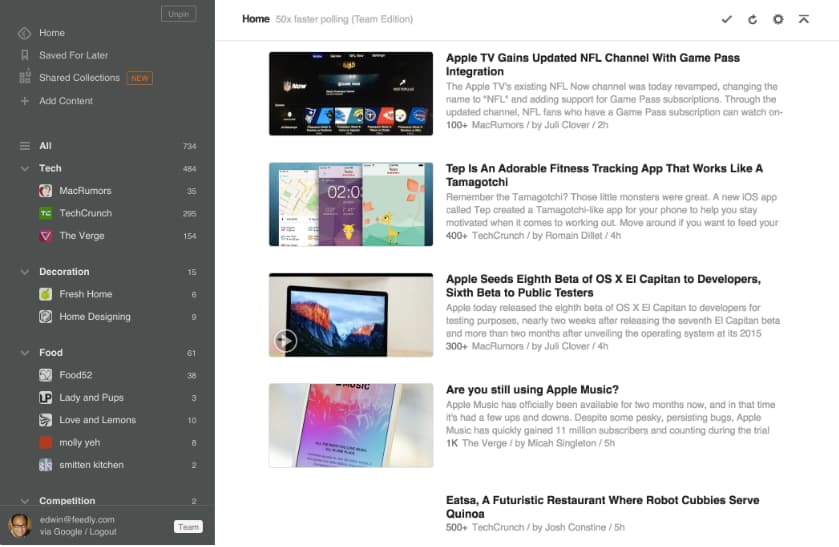
This RSS feed aggregator allows you to follow your favorite brands and see their most recent content in one place. Add your favorites and discover new publishers by searching your industry, skills, or — you guessed it — trending topics. Feedly also allows you to set up keyword alerts, so you’re always tracking the latest trends on topics you’re interested in.
6. Reddit
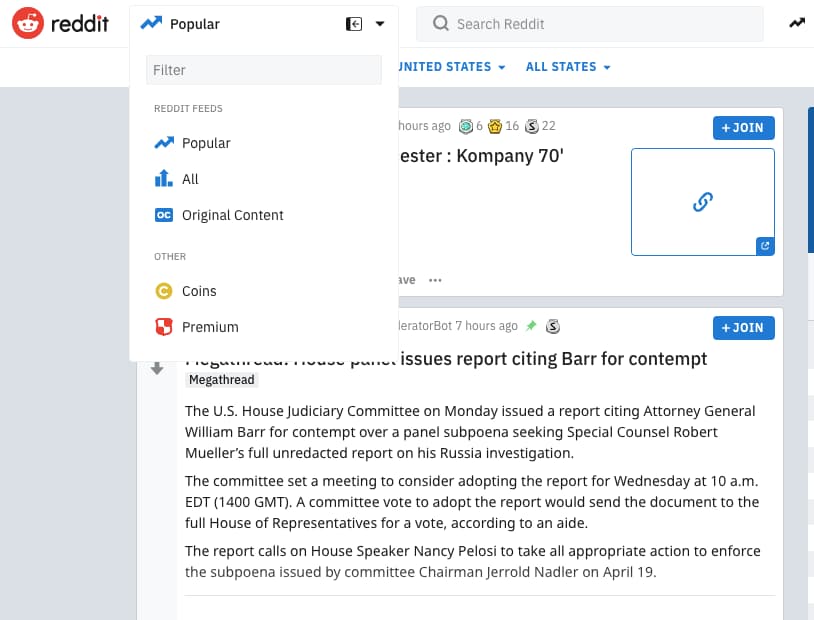
Freshness and user-based voting determine how content is prioritized on Reddit. A quick visit to the homepage shows you trending or popular posts. And, you can filter by country or recency for a more relevant feed.
7. Ahrefs
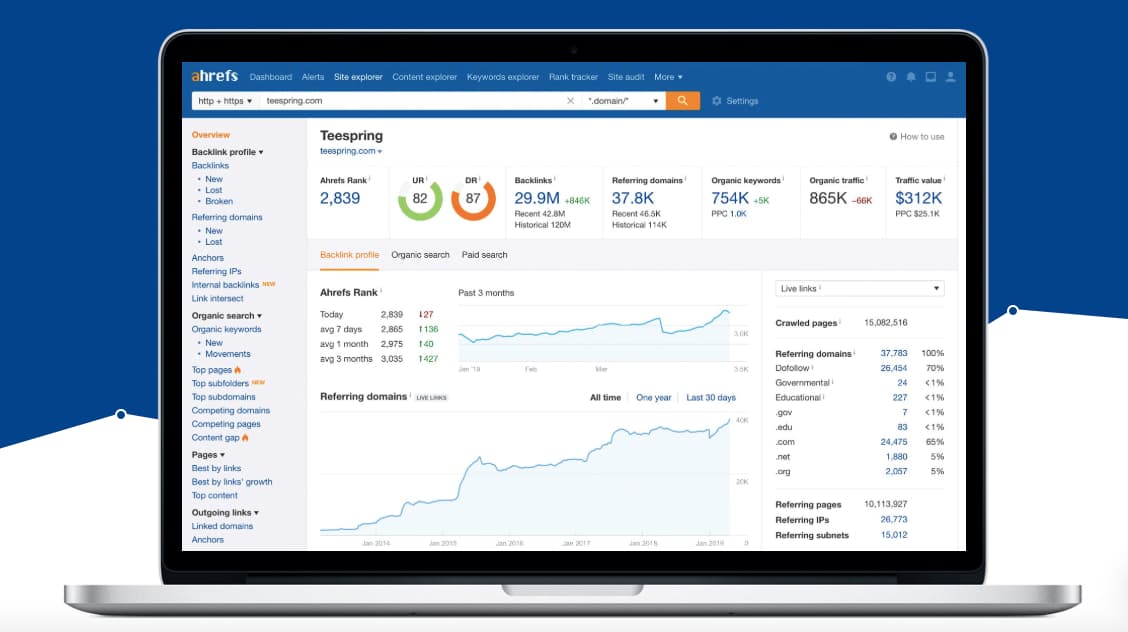
Conduct competitive research, home in on a keyword, or search for trending topics. Ahrefs helps you identify trending content and shows you what to do to outrank your competitors.
8. Pocket
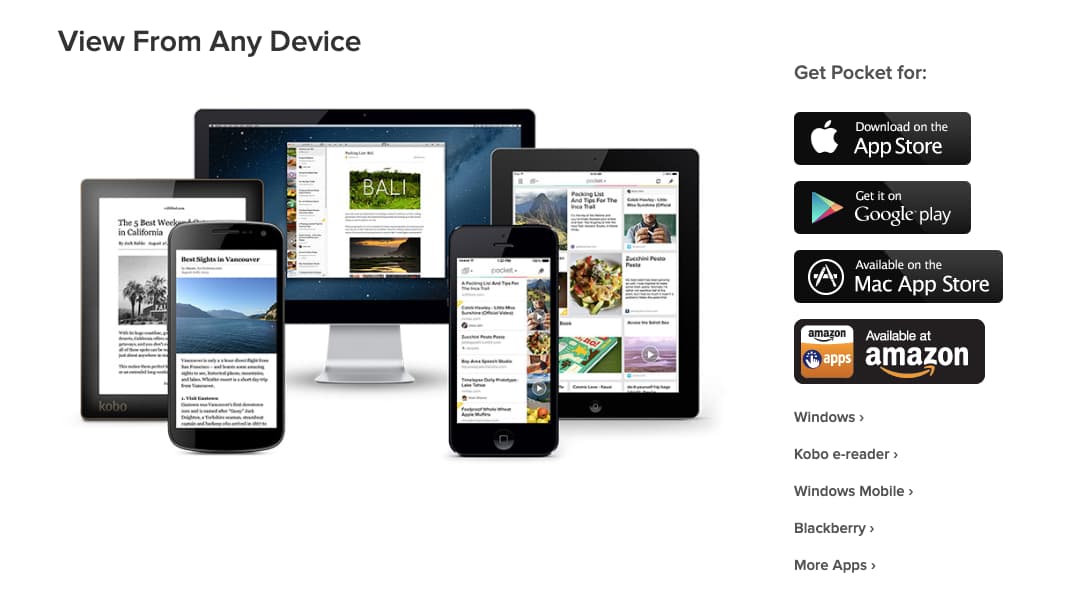
Pocket allows you to save content from anywhere on the web. Review your content whenever you wish and head to the Explore page to find trending topics that are relevant to you.
9. Quora
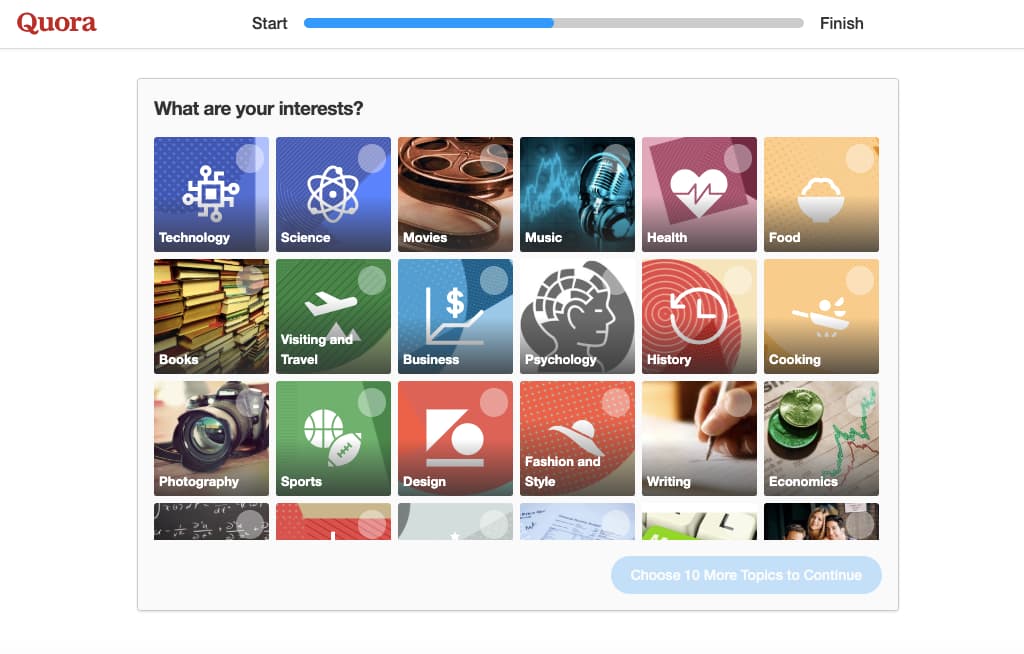
Sign up for Quora and select topic areas that interest you (e.g., “startups,” “marketing,” and “economics”). Quora will stock your feed with questions related to your content interests. This gives you insight into what your customers are asking, real-time debates about competitors, and even allows you to answer questions about topics you have experience in.
Expanding Your Google Impact
Bottom line? Google owns the largest piece of both search and web browser market shares and provides a host of interconnected services that empower the company to deliver personalized, real-time search results.
For marketers, this makes Google an irreplaceable tool for boosting consumer loyalty, courting new clients, and improving customer conversions. Armed with actionable trend data and relevant source statistics, marketing teams can expand their Google impact and ensure the right content gets seen by the right customers to jumpstart the sales process.


The Modern, Inside Scoop on Google PageRank In 2021
If you have been in SEO for a while, you may remember the days of working hard to increase the PageRank of websites — it was the metric every SEO cared about and wanted to improve.
Improving PageRank meant improving your authority (usually with backlinks), which in turn could result in higher rankings and more traffic.
But what happened to PageRank? It’s rarely talked about anymore.
Believe it or not, PageRank is still used as a ranking signal for Google, even if you haven’t heard it mentioned in a while. Here, we’ll explore what you need to know about Google PageRank in 2021.
What is Google PageRank?
Google PageRank is a very complex concept, but we are going to try and break it down to make it easy to understand.
PageRank uses a mathematical formula to score the value of a page based on the quality and quantity of the pages linking it to it.
The PageRank formula will look at the number of inbound links, external links, and the PageRank of those links to determine authority. The formula will create a score using a logarithmic scale with values ranging from 0-10.
The higher the PageRank score of a page, the more authoritative that page is.
You can get more in-depth information about the PageRank formula in the original paper that was published back in 1997.
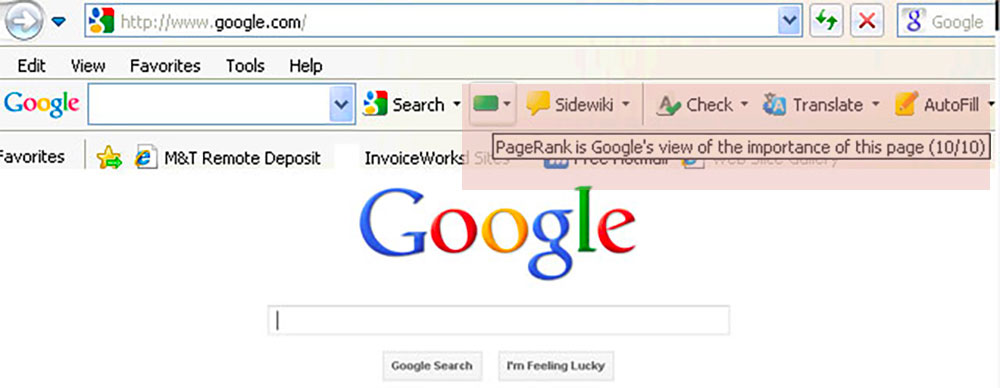
The PageRank Toolbar
Years ago, there used to be a toolbar that could show you the PageRank of any webpage you visited.
Unfortunately, the toolbar was removed by Google back in 2016 — and the mystery of what your PageRank is has existed ever since.
The problem with the toolbar was that it created an obsession and caused many SEOs to try and find ways to manipulate it.
Essentially, the Google team realized that making this score public was adding little value to website owners and decided to stop investing in it.
Does Google still use PageRank?
Yes, Google does still uses PageRank.
While it may not be a metric that website owners have access to, it is still used in their algorithms.
A tweet by John Mueller, a Senior Webmaster Trends Analyst at Google, solidifies that PageRank is still used as a ranking signal.
How important is PageRank?
There is no clear measure of how important PageRank is. With there being over 200 Google ranking factors, they do not provide data on the importance of each factor.
But we do know that backlinks play a very large part in SEO success. So it’s safe to assume that PageRank still plays a part in how highly your pages rank.
Spending time trying to improve your PageRank is probably not the best use of your time. But building relevant and authoritative backlinks to your website is an undeniably effective SEO strategy, and will likely improve your PageRank as a result.
You may not see the improvement as a metric, but you will see it in your organic traffic.
What influences Google PageRank?
There are some factors you should know about that can positively impact your PageRank. Let’s dive into a few of those, now.
1. Backlinks
The primary way to improve your PageRank is through backlinks. The more relevant, high authority websites that link to you — the higher your PageRank will be.
Below are some ways to build valuable backlinks:
- Build relationships with influencers and community members in your niche.
- Create original infographics, webinars, videos, and other creative assets that encourage website owners to share and link to your post.
- Participate in forums and communities that are related to your niche.
- Share your content on social networks — tag relevant people if they are part of your content so they can share, too.
- Create amazing content!
Building backlinks is one of the best ways to grow your website, but it needs to be done properly. Be authentic, do not spam groups or communities, and most importantly — create content with which people can engage.
You also want to be sure you have cleaned up any bad backlinks. You can learn more about how to Disavow Links here.
Getting links from directories or pages that have a lot of links is not as beneficial for improving PageRank. Every link on a page will dilute the value of your link, so while directory-type links can be valuable in other ways, they will not be a big help for improving RageRank.
2. Internal Linking
One of the most underrated SEO tactics is internal linking. By using internal links to pass PageRank from one page to another, you can make a big impact on your rank and traffic.
As an example — your homepage will usually have the highest PageRank because of the number of websites linking to it.
Every link from your homepage to another page on your website will boost the authority of the page being linked to.
Additionally, consider using an SEO tool to identify pages within your website that have high authority, and adding links from those pages to lower-authority pages (when relevant) to give your pages a boost.
A quick trick is to look at your Google Analytics — usually the pages with the most organic traffic are the highest authority pages. So you can start using those pages to build internal links to less authoritative pages to give them a quick boost, as long as the links are relevant to the content on the page.
3. External Linking
One of the biggest myths I can remember about external links is that linking out from your content can diminish the PageRank of that page.
This is not true. Remember, the whole premise behind PageRank is links.
While the number of links on a page might affect the “value” of that link to the page being linked to, it does not harm your own. If you find a resource that is helpful for your viewers, then you should absolutely add a link to that resource.
A study done by Reboot showed that there was a positive correlation between rankings and the outbound links of a page.
How To Check Your PageRank
Unfortunately, there is no way for you to accurately know what your PageRank is.
There are some websites that claim to provide you with your PageRank, but these are not verified tools so there is no proof they are providing accurate data.
Other tools — like Ahrefs, SEMrush, and Moz — have all created their own version of numerical values that were meant to replicate the PageRank score.
For example, SEMRush has what they call an “authority score”, which offers a numerical value that can signal how helpful a backlink from a website may be. This score is based on the following:
- Monthly traffic to a website
- Average keyword position
- Backlink data
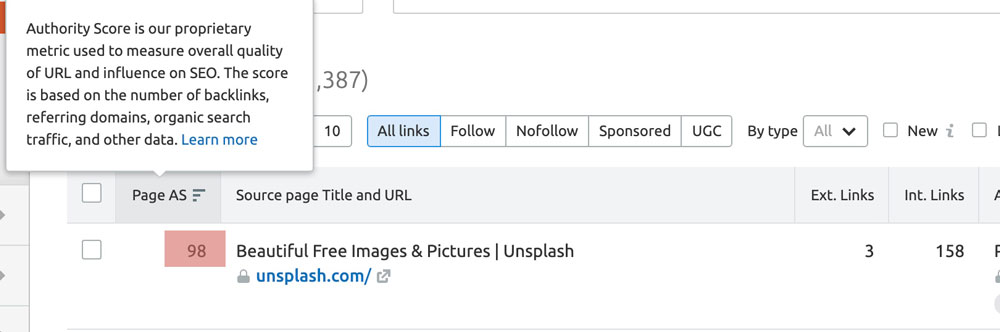
But Google doesn’t use these scores in their ranking algorithm. So, while you can use them as a guide to understand your website authority, they do not replace PageRank.
While most SEOs don’t give much thought to PageRank anymore, and do not try to optimize for it, it’s still worth understanding. Ultimately, if you’re working on building backlinks, improving your internal linking, and using authoritative external links, your PageRank will thank you for it.

How to Build a Market Development Strategy [Free Planning Templates]
Your business is getting by just fine – but still, the questions remain: Could you be selling more? Is there an opportunity to increase market share? Is there any way you could further your product diversification efforts?
Companies hoping to increase revenue can do so in a variety of ways — such as increasing their advertising budget, expanding their sales teams, and investing heavily in product development.
However, one of the often overlooked ways to strengthen your gross sales is a purposeful, well-researched, and expertly executed market development strategy.
In this article, we’ll explain what market development is and how you can employ it to increase sales and grow your business. Then, we’ll take a look at some examples of market development strategies that work for top businesses today.

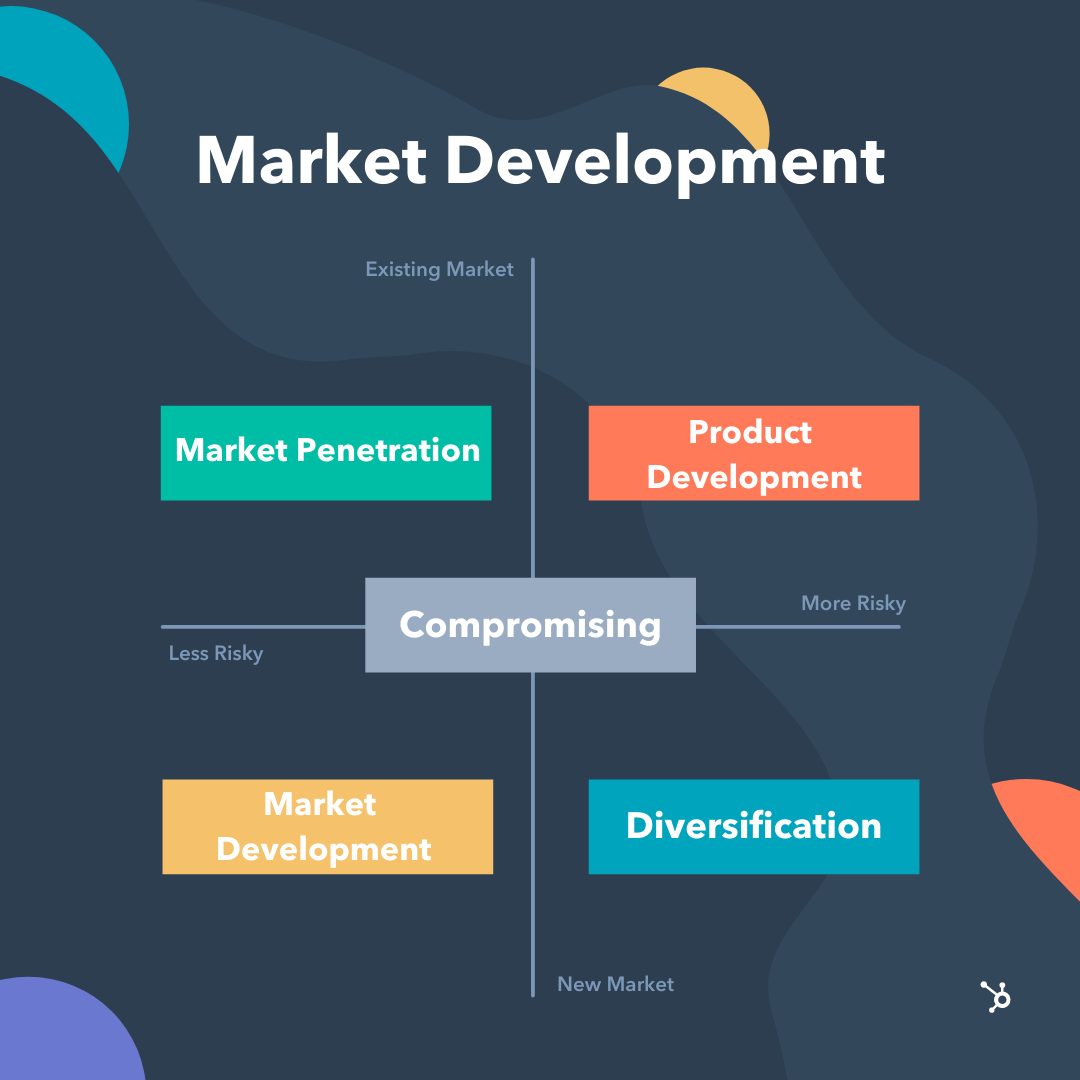
Each category rests upon two axes — one for market and one for risk. A company can expand its efforts into new or existing markets and each poses more or less risk to the business.
Market Penetration
When businesses want to expand within their existing markets with low risk, they might attempt a market penetration strategy. In this scenario, TAM increases because by offering a new product or service, a business can effectively increase the maximum amount of revenue it can possibly attain from its existing customer base. A product launch is an effective way to execute this strategy.
- Product Launches — A company may release new iterations of a product they already sell successfully within the market. The purpose of launching a new product is to generate excitement and buzz around the brand to increase sales.
Product Development
A more high-risk way to expand within an existing market is through product development, but make no mistake — this market development strategy can be rewarding. Developing new products is a delicate process. Businesses should be keenly aware of their market as market interest is a driving factor for product development. If the audience isn’t receptive due to a lack of education around the product, a poor marketing campaign to promote the product, or even poor timing of launching the product, this strategy can be difficult to execute. However, companies that have failed at developing new products usually have in-depth learnings to apply to their next market development strategy. Product development comes in many forms, here are a few:
- Rebranding — If a business has been around for a long time or has been in hot water recently, it’s possible that the market has become disconnected from the brand. This can happen due to a lack of advertising around the brand itself, outdated positioning of a product when compared to the competition, or distrust within the market. Companies can rebrand themselves to reconnect with their existing market while positioning themselves as a viable option among the competition. Adjusting the packaging of a product, offering a new size, flavor, or color, or even changing the name of the product or brand can help a company rebrand a product to have a better position within its existing market.
- Repricing — Another way to gain traction within an existing market is for a business to make its products more accessible or desirable to that market through its pricing. Repricing doesn’t necessarily mean lowering prices, although that is one way to execute a product development strategy. It could mean shifting the brand within the market to showcase value or luxury, thus justifying a rise in prices to capture those consumers.
Market Development
It’s possible to take a less risky approach when expanding into new markets. To develop a market, a business may offload some of the risks. In this example, TAM increases because a business is adding more people to its target market — thus being able to service new customers without investing in a new product line. Here are few ways a business can develop a new market:
- Geographic Expansion — Research can reveal markets that are suitable for a business to thrive within based on where the business currently operates. Geographical expansion can work for both brick-and-mortar as well as online businesses.
- Franchising — Giving individual business owners the right to use the brand and trademarks associated with a company is another way to expand into a new market without high risk. In franchising agreements, the franchisee usually pays an upfront fee to the franchisor to obtain the rights to operate the business.
Diversification
Occasionally, a business may step out of its normal operations and market to create a product for a completely different industry and market. For this reason, diversification can present a major risk to the business, but it can be very rewarding if it’s carried out effectively.
- Similar Product Diversification — A company may realize that the raw materials or byproducts of the goods they sell can be repurposed into a completely new product that can be marketed to a different audience than the one currently purchasing its products.
- Unique Product Diversification — Rather than using existing products, a company may take a completely unique approach to penetrate a new market by offering a product or service that is different from anything offered in its industry.
The decision of when and how to develop your existing market should be a methodical process.
Just because your business has struck lightning once does not mean your new expansion plan is a guaranteed success.
Because of that reality, follow these steps and use these resources to determine if you should develop your market, how it should be developed, and whether or not the initiative is successful.
Step 1: Research your development opportunities.
It’s always tempting to go after the hottest trends – whether that means adding more areas of focus to your consulting business or adding more items to your restaurant menu.
However, before you spend time, money, or resources on developing your market based on trends, take these steps to determine if the expansion is worthwhile.
Review Your Buyer Personas
Featured Tool: HubSpot Buyer Persona Templates

When expanding your market, you face the potential need for net new or revised buyer personas, which are semi-fictional representations of your ideal customer based on market research and real data about your existing customers.
Consider the motivations, demographics, and backgrounds of your new target market to help you decide whether or not the development initiative makes sense.
Research Your Market
Featured Tool: HubSpot Market Research Kit

Understanding your hypothetical positioning in a market is key before attempting to enter it. To that end, conduct market research exercises like Porter’s Five Forces Analysis or a SWOT Analysis to determine your strengths, weaknesses, buyer power, the threat of substitutes, or other attributes compared to competitors in this new market.
Additionally, you’ll want to calculate market penetration before moving forward with any plans to expand.
Survey Your Customers
Featured Tool: Customer Satisfaction Survey Templates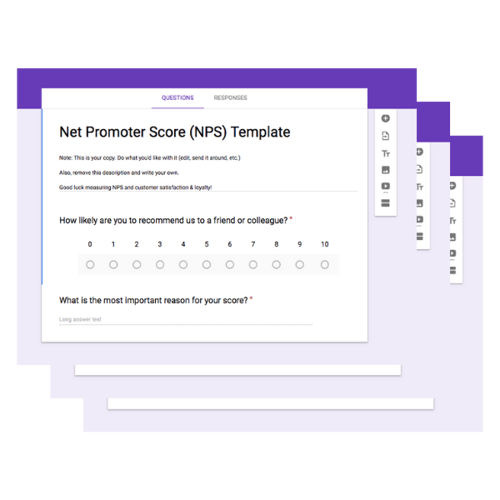
If you’re hoping to expand your current product line to generate more revenue from existing customers, make sure your intended expansion will be warmly received. Asking yourself why this development makes sense coming from your organization is a good first step.
However, talking to and surveying your customers to see if your proposed expansion is beneficial to their lives (and, more importantly, whether or not they would purchase it from you) is a necessary proof point before expanding your offerings as a business.
Step 2: Set your growth goals.
A successful market development will come with added sales, profit, employees, customers, products, users, locations, or some combination of these criteria.
Because there’s so much on the line, develop goals for which facets of your business you intend to grow, in addition to what your growth goal for each criterion is.
For example, by adding one more location, you may set the following growth goals:
- Increase customers by 90%.
- Increase revenue by 100%
- Double annual profits after recouping the initial investment.
- Increase employee headcount by 20 people.
During this stage, you should also consider the requirements needed to help you hit your growth goals, such as initial funding, tools, and software to help you get the initiative successfully up and running.
Lastly, the most important metric to measure before attempting to expand or develop your market is ROI. In this step of the process, compare the upfront costs of developing your market as intended with the projected revenue numbers of a successful expansion.
If the ROI is not encouraging enough to move forward with, you may need to go back to the drawing board and determine a new growth strategy and set of goals.
Featured Tool: Growth Strategy and Planning Template
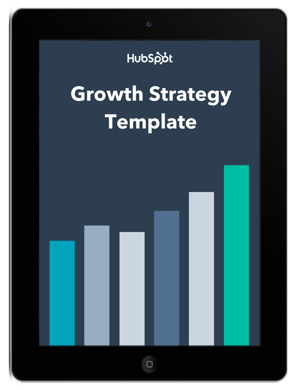
Using the template above, outline your growth goals and strategy to lay the foundation for your market development initiative. This template will help you plan out the steps necessary to achieve your goals and help you determine whether or not they are realistic for this project.
Step 3: Create your marketing plan.
An increased market means an increased need for effective marketing.
To generate demand – or to capture existing demand in your market – make sure your marketing plan is up-to-date and reflective of the initiatives it will take to grow your market share to its desired level.
Consider all of the following initiatives and how they’ll play a role in generating more revenue in your newly developed market:
- Email Marketing: Will you communicate with existing prospects via email to alert them of your initiative? Do you have a list of saved contacts who expressed interest in what you sell, were unable to make the purchase, and might now be able to purchase from you?
- Social Media: Do you have organic and paid initiatives to generate buzz and spread the word to grow awareness on social media?
-
Content & SEO: Do you have website and blog content planned to capture the interest of website visitors hoping to learn more about what you’re selling?
- Local Marketing: If you’re developing your market on a regional level, are you working with local publications, PR agencies, or advertising platforms to appeal to nearby potential customers?
Featured Tool: HubSpot’s Marketing Plan Template

Document your marketing plan supporting your market development with the template above, and make adjustments to it as needed to ensure you’re reaching your market in an accurate, appealing, and consistent fashion.
Step 4: Go to market.
The time has come – your research and planning are complete, and you’re ready to formally enact your development strategy, whether it’s opening the doors of your new location or making your new product available for purchase on your website.
But before you start collecting revenue, there are a few final steps to take – specifically, aligning your team on the best way to conduct this go-to-market launch.
Go to market successfully by managing three imperative internal tasks – all of which can be done with this Product Go-to-Market Kit:
Campaign Planning
The campaign plan should be a one-stop shop for anyone who has a stake in the success of this project. It should provide a general purpose for the market development project, in addition to the tactical and strategic elements team members need to adhere to in order to see the project go off without a hitch.
Sales Planning
The sales plan should provide more specific insights for the sales team – especially regarding overall projections, team or individual goals, and strategies for how the organization intends to meet these goals
Team Email Updates
For the company at large – particularly for individuals who need to be informed but may not have set tasks to complete – team email updates are a staple of communication during market development. This messaging should contain a status check for the launch timeline and outstanding tasks, and any notifications the company should be aware of during their day-to-day work.
Featured Tool: HubSpot Go-to-Market Kit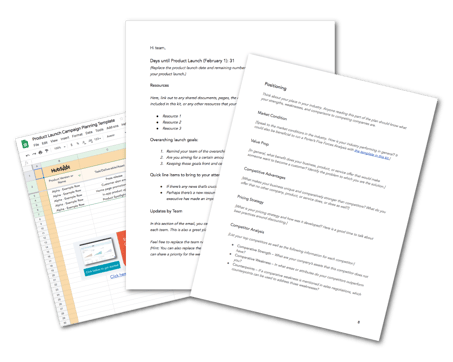
To centralize your internal planning and communication efforts during your market development process, use the HubSpot Go-to-Market Planning Kit.
Step 5: Analyze your results.
Once you’ve taken the necessary actions to develop your market, the work has only begun. After launch day, you’ll need to be sure customers are satisfied, products and services are high-quality, employees are retained, and – most importantly – goals are met.
Start collecting sales data as soon as possible so that you can begin analyzing whether or not you’ll meet your projections. If not, you may have to determine a plan to either adjust your goals to become more realistic or adjust your strategy to ensure your goals are met.
Once data is available, make sure you’re presenting your findings accurately and clearly so that stakeholders can fully understand what the results are, how you achieved them, and what the next steps of your market development strategy are.
Featured Tool: Marketing Reporting Templates
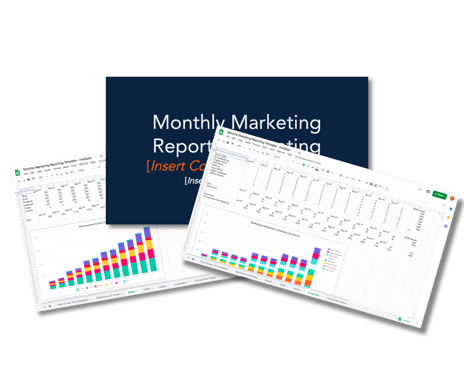
Available in PowerPoint, Excel, and Google Drive, these templates will help the project driver communicate the results of your market development strategy to your team.
Market Development Strategy Examples
1. Carl’s Jr. and Hardee’s – Geographic Expansion

Although these two companies started as separate restaurants — Carl’s Jr. on the west coast and Hardee’s on the east coast — they merged in the late 1990s to become one company under two names. From a high-level perspective, this might seem like a branding and marketing nightmare, but within their respective geographic markets, the different names have been successful. Carl’s Jr. took the opportunity to acquire Hardee’s, thus expanding the burger chain across the country, becoming one of the largest burger chains in the United States.
2. Popeyes Louisiana Kitchen – Market Penetration
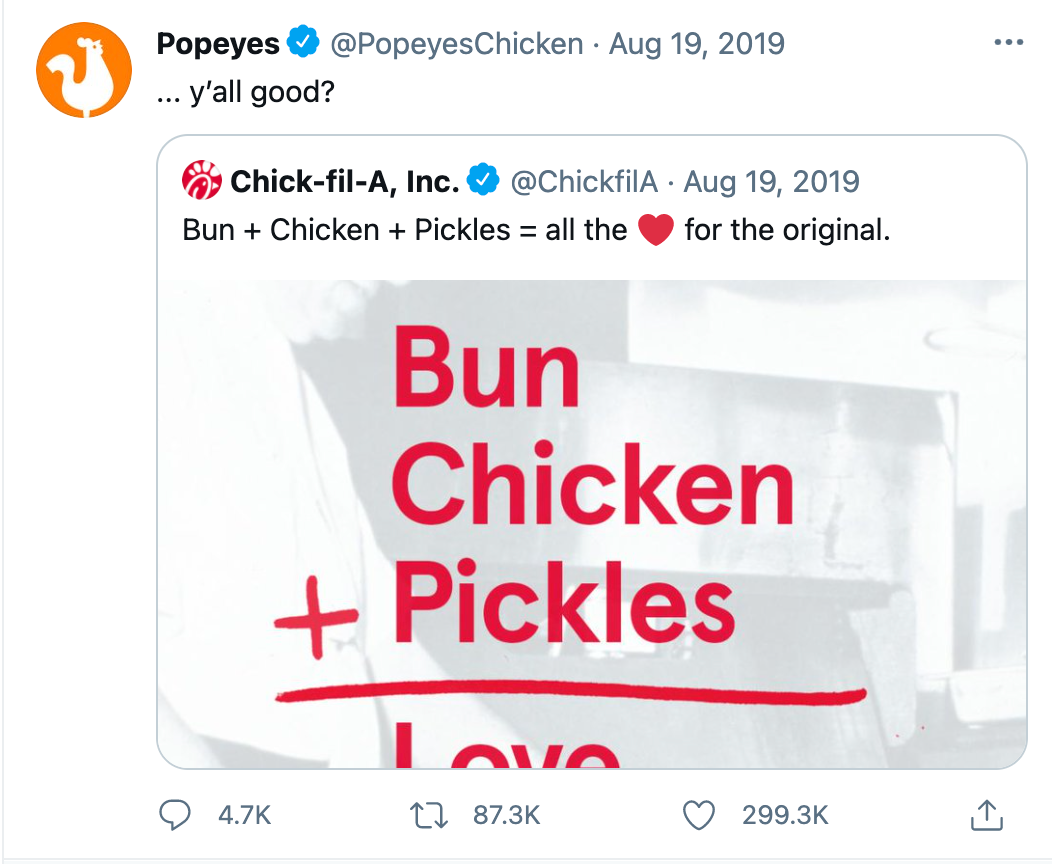
Sometimes, a market development opportunity can appear when you least expect it. That was the case with Popeyes Louisiana Kitchen. The company’s brand was so well-integrated into its marketing operations that a simple tweet in response to Chick-Fil-A prompted a tumultuous beef over which brand had the best chicken sandwich. Once the Tweet gained traction, Popeyes quickly capitalized on the opportunity to sell more of a product they had recently launched.
Although there were some logistics issues that caused supply and demand imbalances, the brand was able to maintain a stronghold on the market with lines wrapping around parking lots and into the streets once the sandwiches were back in stock.
As recently as Q2 2021, Popeyes is still running TV ad campaigns for the chicken sandwich — more than two years after the incredibly successful product launch.
3. The Lash Lounge – Franchise

Since 2010, The Lash Lounge has been scaling its presence across the United States through franchising. As of 2020, the company has grown to 108 locations, most of which opened around 2019. Franchising helped this company expand into new markets with relatively low risk.
The Lash Lounge team trains the new franchisees on their techniques and immerses them in the culture to create one cohesive team that doesn’t feel disjointed.
4. Unilever – Diversification
Today, we know Unilever as the parent company of some of the most notable brands like Dove, Breyers, and Hellmann’s. However, the company initially went into business selling soap. After realizing that the ingredients for making soap shared similarities with those needed for making margarine, they diversified and expanded into a new market with a new product. Over time, Unilever created and acquired new brands in the soap, cosmetics, butter, and ice cream industries, essentially diversifying its product line and market.
Developing Your Market
Before you follow the latest trend in marketing, take a moment to analyze your strategy thus far to forge a path that will yield success. By planning a market development strategy, you’ll have the opportunity to assess your company’s risk tolerance and understand where your business stands within the market so you can turn your market development idea into a reality.
Editor’s note: This post was originally published in November 2020 and has been updated for comprehensiveness.


The 7 Best Free Resume Builders We’ve Ever Discovered
A couple of weeks ago, my brother Max sent me his resume in a text message and asked me to “spruce it up a bit” for him. Undoubtedly, I needed to do more than copy-and-paste the text into a Word document. To truly stand out, I knew the resume needed to demonstrate a level of professionalism and effort — something content alone can’t always convey.
Fortunately, with the help of Zety, I was able to input Max’s resume information, choose a template, and have Zety design the piece for me within 20 minutes:

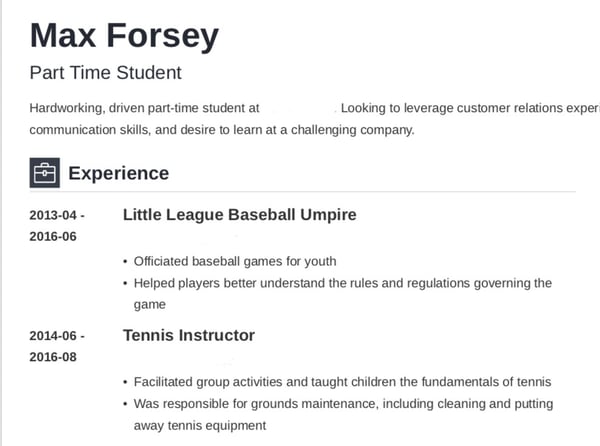
Looks a little better than a text message, doesn’t it?
Resume builders are incredibly helpful when creating a resume and can help you showcase your unique personality. Here, we’ve compiled a list of the best free resume builders we’ve discovered. Keep reading, and then get to work designing your own — trust me, with these tools, it’s almost as easy as sending a text.
Featured Resource: HubSpot Resume Templates

Download these free templates and plug in your experience and information for a custom, well-crafted resume.
1. Resume Genius – for easy and fast resume creation.
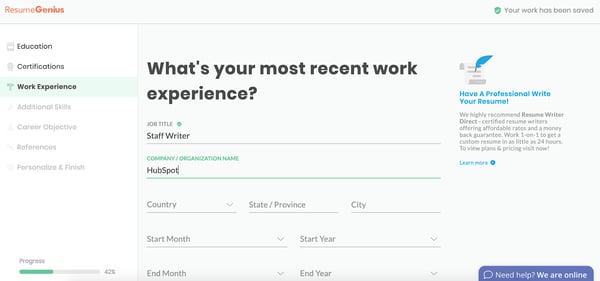
Resume Genius is undoubtedly one of the easiest and fastest resume tools you have at your disposal. With a clean and easy-to-use interface, the tool walks you (speedily) through categories including education, work experience, and references. It offers different templates varying from ‘Taj Mahal’ to ‘Classic.’ Resume Genius provides you with easy fill-in-the-blank sections so that you can have an impressive, comprehensive resume in no time.
| pros | Cons |
| Easy to use interface | Free download is a .txt file, you must pay for a 14-day trial to download as a PDF or different format |
| URL for sharing and performance tracking | There is no option to upload an existing resume, so you must start from scratch each time, making it difficult to make updates. |
| Can search for positions and choose from 50,000+ job description bullet points that relate to what you’re applying for. |
2. My Perfect Resume – for guided resume creation help.
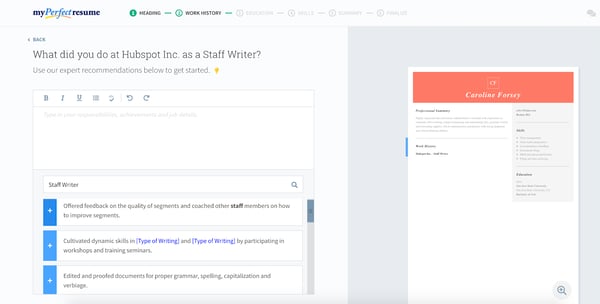
My Perfect Resume allows you to either start from scratch and input information into a blank template or upload a pre-existing resume if you already have one. Additionally, the tool provides you with expert recommendations as you move throughout the process, including suggested phrases you can include for specific roles.
My Perfect Resume also enables you to include optional sections like certifications, accomplishments, and affiliations, which is vital, particularly if you’re just starting out, or switching industries. This tool is particularly useful if you’re applying for a creative role and want to add color or a unique design to your resume.
To use My Perfect Resume for free, click “Download” on the left toolbar once you reach the final step of the builder — instead of selecting “Save and next.” Then, choose “Plain Text (.txt)” to download your resume for free.
Best for:
My Perfect Resume is excellent for those looking for guided help when creating their resumes. The tool recommends templates based on your experience level and provides expert recommendations for skills to include based on your job titles. Compared to other tools on the list, there are fewer customization options, and there are only nine templates to choose from.
3. Standard Resume – for active LinkedIn users.
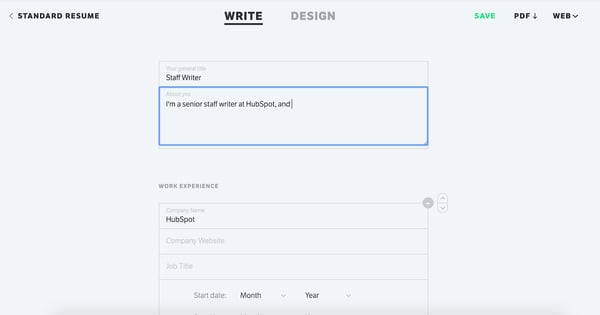
Standard Resume allows you to import your information straight from LinkedIn, making it an ideal time-saver if your LinkedIn profile is up-to-date.
Plus, the white background and minimalist features enable you to focus on what really matters — your content. You can switch back and forth between “Write” and “Design” to see how your resume looks as you go along and download it as a PDF when you’re finished. Best of all, the tool also makes your resume mobile-responsive so that you can view it on your smartphone.
| Pros | Cons |
| Free | Minimalist templates, not many customization options or design-focused tools |
| Easy import from existing LinkedIn profile | |
| Minimalist, helping you focus on your experience and achievements. |
4. Canva – for design creativity and expression.
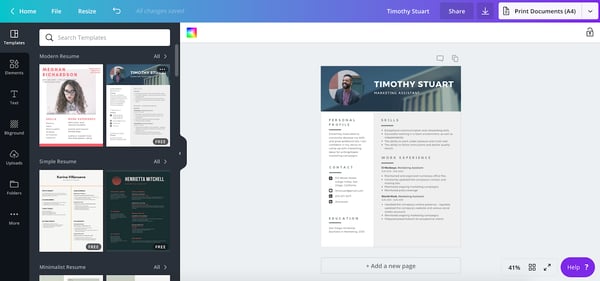
If you’re applying for a creative role or want a resume that truly lets you stand out, you might consider using one of Canva’s hundreds of free, designer-made templates. Canva’s selections are incredibly varied and unique, so you’ll undoubtedly find one you like, and inputting resume sections can be as easy as copy-and-paste. Additionally, the templates are separated into categories, such as ‘Graphic Design,’ ‘Corporate,’ and ‘Creative,’ making it easier to choose based on your preferred industry.
Best for:
Canva is best for those looking for design creativity and expression in their resumes. Although not specifically designed for resume building, the tool overs a wide variety of templates, layouts, and designs to choose from when creating your resume, and there are multiple download formats to ensure that your resumes can be viewed and picked up by ATS.
5. Indeed – for in-platform job seekers.
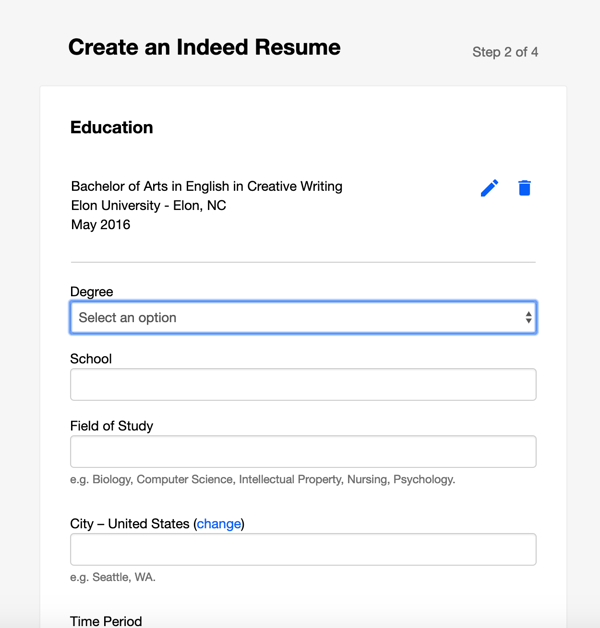
Creating an Indeed resume is an incredibly quick process, and best of all, the site allows you to automatically share your resume with employers on Indeed as soon as you’re finished. If you’ve already completed a resume, it’s still a good idea to upload it to the site for exposure to potential employers. While it admittedly doesn’t offer as many options for creativity as some of the others in this list, Indeed is an impressive option if you want to create a more traditional resume and start sharing it immediately.
| Pros | cons |
| Free | Only eight templates |
| Includes expert tips and advice | Limited design and customization options |
| Templates compatible with Applicant Tracking Systems (ATS) | Unable to import or upload an existing resume or LinkedIn profile |
| You can automatically share your completed resume on the site for employers and recruiters to see |
6. Zety – for expert resume creation tips.
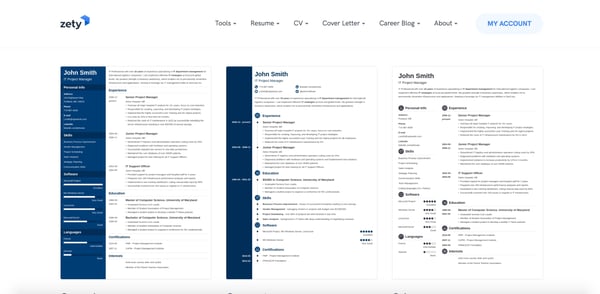
Zety is an excellent online resume builder because of the state-of-the-art templates. You can quickly start from scratch and input your information. My favorite element of this tool is that the site will walk you through the process. All you need to do is fill out the information, and then voila — you have a resume. While this tool is free, you will need to make an online account.
To use Zety for free, click “Download” on the left toolbar once you reach the final step of the builder — instead of selecting “Save and next.” Then, choose “Plain Text (.txt)” to download your resume for free.
Best for:
Zety is best for those looking for expert help in creating their resumes. The tool provides tips and prompts to help you create the content for your resume, and there are a variety of customization options to ensure your resume is unique to your needs. While you can download a .txt file for free, it costs $2.70 for a different file format, and some templates used graphics and color that interfere with ATS.
7. Resume.com – for minimalist resume creation.
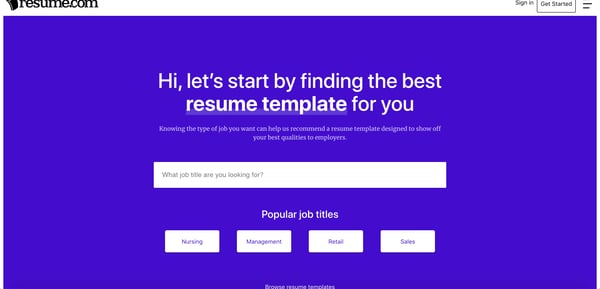
With Resume.com, you can build a beautiful resume in minutes. This tool is an excellent option if you’re looking for recommendations on what to include in your resume. Additionally, the site has popular templates for various job categories to help you stand out from the competition.
To use this for free, when you’re at the last stage, you’ll see a pop-up that says to create an account — instead, just click “Skip for now.” Then, in the top right-hand corner, you can click the download button.
| pros | cons |
| Completely free | Limited options for design and customization |
| LinkedIn importing | No pre-written content |
| Share, print, and download in multiple formats | Minimal guidance for resume creation |
Building a resume can feel like you’re staring at a blank canvas. But with an online resume builder, you can get recommendations and build a beautiful document that will stand out without needing a graphic design degree.
Editor’s note: This post was originally published in March 2019 and was updated in May 2021 for comprehensiveness.

How to Work From Home: 24 Tips From People Who Do It Successfully
Working from home is awesome, right up until the cat throws up on your computer. And your neighbor, who you can only assume is building a time machine, starts firing up all sorts of power tools and noisy machinery across the street.
COVID-19 has caused remote work to become a necessity instead of a luxury for many professionals. But which environment allows us to be more productive: the home office or the office office?
In the office office, your colleagues often pose the greatest threat to keeping you from getting some real, heads-down work done. They drop by your desk, engage you in conversation, and invite you to lunch — or so I hear. The social benefits are nice to have, but they can become a challenge if you’re easily distracted.
However, at the home office, while family members can be a distraction, I find that it’s easy for you to become your own worst enemy. Because without coworkers around, you’re free to drop those pesky inhibitions. At the home office, no one’s watching. You don’t necessarily feel that same peer pressure or communal obligation to get stuff done. (Also, you don’t have to wear pants.)

Below, I’ve compiled many great work-at-home tips and tricks from some of my awesome coworkers.
1. Communicate expectations with anyone who will be home with you.
Of course, you might be working from home but still have “company.” Make sure any roommates, family members, and dogs (well, maybe not dogs) respect your space during work hours. Just because you’re working from home doesn’t mean you’re home.
If you share space with another work-from-home adult, you may have to lay ground rules about meeting times, shared desks and chairs, and quiet times.
CEO Sam Mallikarjunan tells how he manages to get work done even when people are around.
“If anyone else is going to be at home when you’re working, they just have to be clear that when you’re in your ‘office’ (in my case, my signal to the family is having headphones on), you’re working — even if it looks like and feels like you’re hanging out at home.”
He continues, “It’s easy to get distracted by the many things that have to be done around the house during the day.”
2. Take clear breaks.
It can be so easy to get distracted as a telecommuter that you avoid breaks altogether. Don’t let the guilt of working in the building you sleep in prevent you from taking five minutes to relax.
However rather than just opening YouTube and watching some comfort clips, use your breaks to get away from your desk. Go for a walk, enjoy fresh air, or spend time with others who might also be in the house.
Take Ginny Mineo‘s advice. “Breaks, like making and eating lunch, can recharge you to do better work. Don’t assume you need to be working 100% of the time while you’re home to be more productive.”
3. Interact with other humans.
When your office starts working from home, you’ll likely miss the casual social interactions with colleagues you’re used to throughout the day. When working from home, you don’t have the small talk and other activities that make each day at the office unique.
So what can you do? Communicate.
Fight boredom and loneliness by frequent communication with other employees. Reach out to them through video chat via apps like Zoom and Slack or however else your company communicates.
Remember: You’re working from home, not the moon. Interacting with other people during the day is allowed, even if they’re not your colleagues. It’s a good idea to see another face during the day when most of your workday is solitary. So, use your breaks to interact with others.
“Go outside and find a human to interact with — ordering your coffee, running an errand, whatever. It keeps you sane.”
4. Prepare meals the night before.
When you’re in your own home, it can be tempting to spend time preparing a nice breakfast and lunch for yourself, chopping and cooking included. Don’t use precious minutes making your food the day of work — cook it the night before.
Preparing food ahead of time ensures you can use your meal times to eat and that you aren’t performing non-work tasks that spend energy better used at your desk.
Digital marketing strategist, Lindsay Kolowich, adds, “Cooking at home is time you wouldn’t have spent meal prepping if you’d been in the office that day, and I find the minutes can add up in the end. To mitigate that, I try to cook and prep my meals the night before, just like I would for a day at the office.“
5. Pick a definitive finishing time.
You might be under the impression that working from home establishes more work-life balance, but be careful with that assumption.
Working from home can also feel like being at a casino — you can get so caught up in your activity, in a relaxing environment, that you lose complete track of time.
“If you work from home full-time (or regularly), it’s really easy to let your work life bleed into your personal life,” says Tyler Littwin.
He continues, “Maintaining a boundary is important for both halves of the equation.”
In lieu of coworkers, whose packing up and leaving the office reminds you to do the same, set an alarm at the end of the day to indicate your normal workday is coming to an end. You don’t have to stop at exactly that time, but knowing the workday is technically over can help you start the process of saving your work and calling it quits for the evening.
6. Eat and sleep.
What is the biggest perk to working from home? One of the biggest benefits for some people (me), is complete access to the kitchen.
As soon as I take a break, I automatically drift towards the kitchen for some snacks.
An unhealthy diet can affect productivity and drain energy. When I switched to a healthier diet, it made me function better and get the most from my routine.
So eat well when working from home.
It’s also vital that you keep to a proper sleep schedule. Save binge-watching your favorite shows for the weekend. With the right food to keep energy levels high and sound sleep to refresh your body and mind, you can make a success of working from home.
7. Talk to your employer.
If you like your current job and don’t want to change it, the obvious step is to find a way to pivot the position.
One of the tips for doing this is folding the possibility of going remote into your next promotion cycle. Talk to your boss often about your intention to pivot.
And, if you’re not sure your employer will agree to working completely remotely, talk about the option of working remotely one or two days a week. When you use the work from home tips we’ve provided above, and your boss sees how productive you are, they could allow you more days to work from home.
8. Join a remote-friendly company.
If your work can be done remotely, but your current boss or organization doesn’t allow you to work from home, you might need to get a new job.
When looking for a work-from-home job, you can use the same methods you used in finding your regular office job. This includes channels like job sites, local job ads, and social media platforms.
Job sites that list work from home ads include:
Some remote-friendly firms include:
Check out these firms to see whether you meet the requirements to start working remotely for them.
9. Start a career as a freelancer.
If your current job isn’t remote work-friendly, you can go remote by starting your own business as a freelancer or a consultant.
Depending on the nature of your current job, you may start your own freelance business while still being employed.
The benefit of starting your freelance business while still employed is that it reduces the financial strain experienced by any new business.
10. Start a home business.
Starting a home business is one way to enjoy remote work.
Unlike other fields, certifications and education are not usually prerequisites. Instead, researching, having a smart business plan, and choosing the right business is more essential to the success of your business.
You can find more work-from-home tips in the books listed in this best remote work books article.
1. Get started early.
When working in an office, your morning commute can help you wake up and feel ready to work by the time you get to your desk. At home, however, the transition from your pillow to your computer can be much more jarring.
Believe it or not, one way to work from home productively is to dive into your to-do list as soon as you wake up. Simply getting a project started first thing in the morning can be the key to making progress on it gradually throughout the day. Otherwise, you’ll prolong breakfast and let the morning sluggishness wear away your motivation.
Lindsay Kolowich says, “When I work from home, I wake up, put on a pot of coffee, and start working immediately — much earlier than normal working hours. I only start making breakfast once I’ve hit a wall or need a break. I’m a morning person and find I can get a ton done in the early morning hours, so this works really well for me.”
2. Pretend like you are going into the office.
The mental association you make between work and an office can make you more productive, and there’s no reason that feeling should be lost when working remotely.
I know that you love working in your pajamas (I do, too), but the mere act of changing clothes to something more serious will give you a signal to get work done throughout the day.
When you dress up, you give your brain a reason for dressing up, and it can keep you pumped throughout your work hours.
So when working from home, do all the things you’d do to prepare for an office role: Set your alarm, make (or get) coffee, and wear nice clothes.
Internet browsers like Google Chrome even allow you to set up multiple accounts with different toolbars on the top — for example, a toolbar for home and a separate toolbar for work.
Take to heart the words of HubSpot graphic designer, Anna Faber-Hammond, who says, “Get fully ready for the day and pretend you’re actually going to work. Otherwise, you might find yourself back in bed.”
3. Structure your day like you would in the office.
When working from home, you’re your own personal manager and can choose your working hours.
However, without things like an in-person meeting schedule to break up your day, you can easily lose focus or burn out.
To stay on schedule, segment what you’ll do and when for the day. If you have an online calendar, create personal events and reminders that tell you when to shift gears and start on new tasks. Google Calendar makes this easy.
Structuring your day as you would in the office also saves you from work creep. With this structure in place, working from home will not cause your work to invade your personal life.
“Are mornings for writing while you’re in the office? Use the same schedule at home. This structure will help keep you focused and productive.” – Ginny Mineo
4. Choose a dedicated workspace.
Just because you’re not working at an office doesn’t mean you can’t, well, have an office. Rather than cooping yourself up in your room or on the couch in the living room — spaces associated with leisure time — dedicate a specific room or surface in your home to working remotely.
No matter the space or location, have an area of the home to work and stay committed to throughout the day. And, after choosing your dedicated workspace, make the most of it by making it quiet.
CEO, Sam Mallikarjunan says, “Have a place you go specifically to work. It could be a certain table, chair, local coffee shop — some place that’s consistently your ‘workspace.’ It helps you get into the right frame of mind.”
5. Don’t stay at home.
Is your home office just not getting it done for you? Take your work-from-home life a step further and get out of the house. Coffee shops, libraries, public lounges, and similar Wi-Fi-enabled spaces can help you simulate the energy of an office so you can stay productive even when you don’t sit in an official workplace.
Content marketer, Corey Wainwright, comments, “I get out of my home to work and go to an establishment with actual tables, chairs, and people. It helps simulate the work environment and removes the distractions I typically have at home, like the urge to finally clean my room, do laundry, or watch TV. “
6. Make it harder to use social media.
Social media is designed to make it easy for us to open and browse quickly. As remote workers, though, this convenience can be the detriment of our productivity.
To counteract your social networks’ ease of use during work hours, remove them from your browser shortcuts and log out of every account on your phone or computer.
You might even consider working primarily in a private (or, if you’re using Chrome, an “Incognito”) browser window. This ensures you stay signed out of all your accounts, and each web search doesn’t autocomplete the word you’re typing. It’s a guarantee that you won’t be tempted into taking too many social breaks during the day.
Also, many have found it helpful to shut off social media notifications during the hours they work from home.
Alec Biedrzycki, product marketer at AirTable, says, “I remove all social networks from my toolbar bookmarks… you can get sucked in without knowing it, so eliminating the gateway to those networks keeps me on track.”
7. Commit to doing more.
Projects always take longer than you initially think they will. For that reason, you’ll frequently get done less than you set out to do.
So, just as you’re encouraged to overestimate how much work hours you’ll spend doing one thing, you should also overestimate how many things you’ll do during the day.
Even if you come up short of your goal, you’ll still come out of that day with a solid list of tasks filed under ‘complete.’
“On days I’m working from home, I tend to slightly overcommit on what I’ll deliver that day. So even if I get the urge to go do something else, I know I’ve already committed a certain amount of work to my team.”- Corey Wainwright
8. Work when you’re at your most productive.
Nobody sprints through their work from morning to evening — your motivation will naturally ebb and flow throughout the day. However, when you’re working from home, it’s all the more important to know when those ebbs and flows will take place and plan your schedule around it.
To capitalize on your most productive periods, save your more challenging tasks for when you know you’ll be in the right headspace for them. Use slower points of the day to knock out the easier logistical tasks on your plate.
Verily Magazine calls these tasks “small acts of success,” and they can help build your momentum for the heavier projects that are waiting for you later on.
Product designer, Brittany Leaning, says about her routine, “For me, the most productive times of the day are usually early in the morning or late at night. I recognize this and try to plan my day accordingly. Also, music that pumps me up doesn’t hurt.”
The responsibility is on you to know when you are most productive and build your work schedule around the periods of maximum productivity.
9. Save calls for the afternoon.
Sometimes, I’m so tired in the morning, that I don’t even want to hear my voice — let alone talk to others with it.
You shouldn’t have to give yourself too much time to become productive in the morning, but you can give yourself some extra time before working directly with others.
If you’re struggling to develop a reasonable work schedule for yourself as a telecommuter, start with the solitary tasks in the morning.
Save your phone calls, meetings, Google hangouts meetings, video call, and other collaborative work for when you’ve officially “woken up.”
Senior Marketing Director, James Gilbert, advises that you “Take advantage of morning hours to crank through meaty projects without distractions, and save any calls or virtual meetings for the afternoon.”
10. Focus on one distraction.
There’s an expression out there that says, “if you want something done, ask a busy person.”
The bizarre but true rule of productivity is that the busier you are, the more you’ll do.
It’s like Newton’s law of inertia: If you’re in motion, you’ll stay in motion. If you’re at rest, you’ll stay at rest. And busy people are in fast-enough motion that they have the momentum to complete anything that comes across their desk.
Unfortunately, it’s hard to find things to help you reach that level of busyness when you’re at home — your motivation can just swing so easily. HubSpot’s principal marketing manager, Pam Vaughan, suggests focusing on something that maintains your rhythm (in her case, it’s her daughter).
She says, “When I work from home, my 20-month-old daughter is home with me, too. It seems counterintuitive, but because I have to manage taking care of her and keeping her happy and entertained while still getting my work done, the pressure helps to keep me focused. When she’s napping or entertaining herself, I go into super-productive work mode.
The ‘distraction’ of my daughter (I mean that in the most loving way possible) means I can’t possibly succumb to some of the other common distractions of home.”
11. Plan out what you’ll be working on ahead of time.
Spending time figuring out what you’ll do today can take away from actually doing those things. And, you’ll have planned your task list so recently that you can be tempted to change your schedule on the fly.
It’s important to let your agenda change if you need it to, but it’s equally important to commit to a schedule that outlines every assignment before you begin.
Try solidifying your schedule the day before, making it feel more official when you wake up the next day to get started on it.
“Plan out your week in advance to optimize for the environments you’ll be in.”- Niti Shah
12. Use technology to stay connected.
Working from home might make you feel cut off from the larger operation happening in your company.
Instant messaging and videoconferencing tools like Slack and Zoom can make it easy to check in with other remote employees and remind you how your work contributes to the big picture.
It’s also vital to invest in the right technology. For instance, a bad-performance router can take the steam right off your enthusiasm to work, so it’s better to invest in a high-performance router.
CMO and former HubSpot employee, Meghan Keaney Anderson, remarks, “At HubSpot, we use Slack to keep conversations going remotely, Trello to keep us organized around priorities, and Google Hangouts plus Webex to make remote meetings more productive. Getting the right stack of support tools to fit your work style makes a big difference.”
13. Match your music to the task at hand.
During the week, music is the soundtrack to your career (cheesy, but admit it, it’s true). And at work, the best playlists are diverse playlists — you can listen to music that matches the energy of the project you’re working on to boost your productivity.
Video game soundtracks are excellent at doing this. In the video game, the lyric-free music is designed to help you focus; it only makes sense that it would help you focus on your work.
Want some other genres to spice up your routine and make you feel focused? Take them from startup marketer, Ginny Mineo, who offers her work music preferences below.
“When I’m powering through my inbox, I need some intense and catchy rap/R&B (like Nicki Minaj or Miley Cyrus) blasting through my headphones, but when I’m writing, Tom Petty is the trick. Finding what music motivates and focuses me for different tasks (and then sticking to those playlists for those tasks) has completely changed my WFH productivity.”
14. Use laundry as a work timer.
You might have heard that listening to just two or three songs in the shower can help you save water. And it’s true; hearing a few of your favorite songs start and end, one after another, can remind you how long you’ve been in the bathroom and shorten your wash time.
Why bring this up? Because the same general principle can help you stay on task when working from home. But instead of three songs off your music playlist, run your laundry instead.
Doing your laundry is a built-in timer for your home. So, use the time to start and finish something from your to-do list before changing the load.
Committing to one assignment during the wash cycle and another during the dry process can train you to work smarter on tasks that you might technically have all day to tinker with. And when you know there’s a timer, it makes it hard for distractions to derail your work.
People ops manager, Emma Brudner, notes, “I also usually do laundry when I work from home, and I set mini-deadlines for myself corresponding to when I have to go downstairs to switch loads. If I’m working on an article, I tell myself I’ll get to a certain point before the wash cycle ends. Then I set another goal for the dryer.”
Staying Productive While Working From Home
While you might miss the office, working full time from home can be good for you.
For one, you don’t have to worry about commuting every day and you can better care for your loved ones by being around more often.
The work from home tips that we have provided can help you make the most of your new routine. Try out a few and you might find that you’re just as productive working from home as you are in the office.


How to Grow Your YouTube Channel [New Data]
Did you know that YouTube currently has 2 billion active users a month and is projected to grow to almost 3 billion active users by 2025?
It’s one of the fastest-growing and most popular social networks today. Plus, it helps people grow their businesses.
In fact, the number of channels earning six figures per year on YouTube grew more than 40% y/y, the number of channels earning five figures per year on YouTube grew more than 50% y/y, and the number of channels with more than one million subscribers grew by more than 65% y/y.
Now, all that being said, you might be wondering, “How do I grow my YouTube channel so I can drive more traffic to my website and revenue to my business?”
To help marketers and business owners answer this question, we asked 300 consumers why they most commonly subscribe to YouTube channels.
After looking into the data, we’ll dive into our findings to help you better design effective strategies toward connecting with your audience on YouTube.
Let’s get started.

Why Do Consumers Subscribe to YouTube Channels
30% of respondents said they most commonly subscribe to YouTube channels because the channel publishes how-tos or educational content about their career or industry.
21% of respondents subscribe to channels because the channel publishes how-tos or educational content about their hobbies.
And 17% of respondents said they subscribe to YouTube channels because they post funny or entertaining videos.
To review the rest of the answers, see the graphic below:
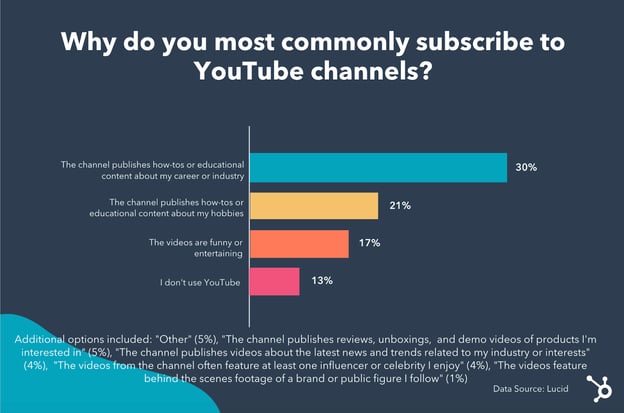
So, now that we know why people are subscribing to YouTube channels, let’s dive into how you can use this information to grow your channel.
1. Create educational content about your audience’s career.
As the survey said, the main reason that consumers subscribe to YouTube channels is that they post educational content about their careers.
Think about it. The reason people go online is to find an answer to a question they want (or to be entertained, but we’ll get to that later).
So, a great way to grow your channel is to publish the topics that your audience wants to see. For example, at HubSpot, we publish educational videos on YouTube about marketing, sales, service, and general business content.
All these videos help our audience learn and develop in their careers. Of course, we’d like people to use our software to do that, but you’ll get value out of the video whether you’re a HubSpot customer or not.
2. Publish educational content about your audience’s hobbies.
Now, let’s say that your business isn’t exactly geared toward your audience’s career. What do you post then?
Well, according to the survey, you can post content about your audience’s hobbies. Let’s say that you’re a landscaping company. On your website, you could post content about gardening and really target people who garden as a hobby. Then, there’s a clear conversion path to using your services.
However, while you’d like people to convert and become customers, your videos should give value away for free and educate your audience. The more they see you as an expert in the industry and the go-to people, the more likely they will be to convert later on.
3. Create interesting, dynamic, interactive videos.
The third most popular reason that people subscribed to YouTube channels was because the videos were entertaining or funny.
If you’re a creator who wants to post fun, interesting, entertaining videos, you can grow your YouTube channel by thinking about an audience who enjoys watching certain entertainment.
For example, let’s say you have a creator channel and you mostly post lifestyle videos. To make those interesting and entertaining, you need to know what your audience likes and dislikes. That brings me to the next strategy.
4. Know your audience.
The best way to grow your YouTube channel is to know what your audience likes and wants to see. Do they want to see educational content about their career? Or perhaps they’re just looking to unwind and watch people clean houses because it’s satisfying and entertaining.
Regardless, think about the reasons from our survey that will resonate with your audience the most, and then lean into those ideas.
5. Reformat well-performing content.
A great way to focus on growing your YouTube channel is to reformat content that has already performed well for you. That might mean turning your most popular blog post into a video.
You’ll need to rework the information and film a video about that topic, but you’re already starting out ahead. You know that your audience likes that content and wants to see it.
Think about your best-performing content from any content marketing channel and reformat it to video.
6. Optimize your content.
Now, of course, we can’t get through a content marketing discussion without talking about SEO. But, how do you optimize your YouTube videos?
To do this, you’ll want to include your target keywords in your titles and descriptions. Then, make sure you mention those keywords in your video.
The YouTube algorithm will use those context clues to understand what your video is about. And then if you get engagement, it will rank higher in the search results.
You might be wondering, “How do I grow my YouTube channel fast? And how long will it take to grow my YouTube channel?”
According to data, it takes an average of 22 months for a channel to reach 1,000 subscribers. Yet, if you don’t optimize your videos and have less than 1,000 subscribers, then you’ll get less than 10% of the total views on YouTube. That’s why it’s so important to grow your channel and subscriber list.
7. Find untapped keywords.
Another strategy you might use to grow your YouTube channel quickly is to find untapped keywords. You can look at related searches of a topic on YouTube or Google, and then look at those related searches in a keyword tool.
Which keywords get a lot of searches, but have low competition? Those are the keywords you’ll want to target.
8. Optimize for watch time.
Just like with any search engine, YouTube wants people on YouTube. So one of the main factors the site considers for ranking is watch time.
Whenever you post videos, it’s important to analyze how long people are watching your videos. According to research from Backlinko, longer videos tend to outrank short videos. And it makes sense. The longer your videos, the longer your watch time can be.
But, how can you make sure people get past the first few seconds of your video? A great way to do this is to cut extraneous content from your intro. In the first few seconds, a viewer should know what they’ll learn and what they’ll get out of watching your video.
If you’ve properly targeted your audience with the right content, that means they’ll end up watching your long videos because you’ve captured their attention.
Growing your audience on YouTube is a great way to attract audiences to your company. And having more than 1,000 subscribers is imperative for ranking higher in search results. So, that means you need to post content that your audience wants to see and is optimized so it shows up in the search results.