How HubSpot’s Customers Are Shaping the Next Normal
This week marked an important milestone for HubSpot. The company Dharmesh and I founded over 14 years ago welcomed its 100,000th customer and passed $1 billion in annual recurring revenue.
We’ve come a long way since we began banging the drum about inbound marketing, and yet, it feels like HubSpot is just getting started.
In many ways, it feels like the whole world is just getting started … or re-started.
The events of the past year have transformed entire industries, upended the way we work, and re-shaped human behavior en masse. The technologies we embraced and new habits we formed during the pandemic will not retreat when the coronavirus eventually does. Rather, they will come to define “the next normal.”
This represents one of the most profound outcomes of these times: that never before have companies, and the products and services they provide, had a greater capacity to influence human behavior.
When gyms re-open, people will still workout from home, facilitated by fitness apps. When offices re-open, people will still work from home, facilitated by work productivity and communications tools. When theatres re-open, people will still watch live concerts and new movies from home, facilitated by streaming services.
Without these products and services, many of which have gone from being novel to necessary in the past year, life during the pandemic would look very different. And it would be much more likely to snap back to the way it was in 2019.
Instead, we’ve witnessed countless companies urgently pivoting their plans to meet new customer needs. They’ve innovated, they’ve adapted, and they’ve re-shaped their products.
I’ve been inspired to see many of HubSpot’s 100,000 customers adapt and innovate in the face of uncertainty, and in doing so, play an instrumental role in defining the new ways in which we live, travel, work, and build a better future.
Mindfulness for the Masses
Take mindfulness apps, for example. One unequivocally positive outcome of these turbulent times has been the increased importance we all place on our mental wellness. Over the past year, HubSpot customers like Calm, Talkspace, and Headspace have gone from being helpful tools for people looking to practice mindfulness to vital services that millions of people use in their daily lives.
When Headspace was founded in 2010 — at a time when meditation was still largely the preserve of religious and spiritual organizations — the key question its founders asked was: “How do we put Headspace in places you wouldn’t expect to find it?” Now, 10 years later, it is a multi-media organization with a podcast division, a partnership with Sesame Street, and a recently announced Netflix series.
This progress would not have been possible without the level of scale the company has been able to achieve in the past 12 months. On the eve of the pandemic in February 2020, the app reached two million paid subscribers, and since then, its rate of downloads has increased by 20%. And when you look at data from the first few weeks of U.S. lockdowns, downloads increased by 100% against pre-pandemic levels.
Headspace was growing steadily prior to the pandemic, but when society was plunged into a period of unprecedented uncertainty, the need for its services surged. Thanks to a deep-rooted passion to serve its customers, the company was able to scale through 2020 and usher in a new era in which mindfulness is practiced by the masses.
New Tools for a New Way of Working
As the intertwined relationship between work and location continues to unravel, online productivity tools have gone from being a useful supplement to traditional workstyles to an indispensable part of the remote worker’s toolkit.
Numerous HubSpot customers have played a vital role in facilitating this shift: Trello has helped parents to manage their kids’ homeschooling schedules, SurveyMonkey has supported nearly a quarter of a million surveys about the coronavirus, and G2 has helped companies find new software solutions, seeing a 1,100% increase in searches for virtual classroom tools and a 550% increase in searches for webinar software in the weeks following the coronavirus outbreak.
Another HubSpot customer, Monday.com, had been growing rapidly in the years prior to the pandemic, announcing $120m in annual recurring revenue in February 2020 as its software helped thousands of scaling companies to collaborate more effectively. And then, as the ability to collaborate remotely became a critical need for all companies, the company changed its product roadmap to meet the sudden change in customer needs.
Among the new releases it prioritized were embedded Zoom calls, online whiteboards, and image annotations — all of which could add immediate value to customers. The impact of these changes was significant. Not only did Monday.com accelerate its hiring, increasing its headcount by 27% between April and June 2020, it also announced a new valuation of $2.7bn. Monday.com was even singled out for praise by Fast Company for its remarkably smooth transition to remote work.
The way we work has changed forever, and the impact of this change is still reverberating across multiple industries, affecting commercial real estate prices, triggering mass migrations, and reducing carbon footprints as commute times plummet.
At the heart of these major societal changes are companies like Monday.com, which initially sought to help scaling companies collaborate more effectively, and now finds itself providing an essential tool that is accelerating a once-in-a-generation shift in human behavior.
Destination: Anywhere
While the pandemic has forced entire populations to stay in one place, it has also dramatically changed the ways in which we move in the world. One HubSpot customer at the forefront of this shift is Airstream.
For decades, Airstream has been building its much-loved state-of-the-art travel trailers, and in doing so, has become one of the most iconic brands in the United States. As the pandemic unfolded, the company was quick to produce new, relevant resources about everything from how to exercise in small spaces, to how to learn and work remotely. As Airstream CEO Bob Wheeler put it, “these virtual products looked very different than the vehicles we’re used to producing.” But it was through this innovative adaptation to the new habits and interests of its customers that Airstream achieved a 45% year-on-year increase in sales in May, and a 100% increase in June.
The pandemic has made work less location-dependent and leisure less time-dependent. It is now possible for many to travel while working and adventure without taking large amounts of time off work. By recognizing this new dynamic and quickly adjusting its strategy, Airstream has gone from providing a means of travel between destinations to providing the destination itself.
Even after the pandemic has been brought under control, ongoing economic uncertainty and fears of a resurgent virus are likely to result in a continued reluctance to travel internationally. As a result, staycationing and domestic location-hopping are set to remain popular choices for years to come. By re-positioning its value proposition to suit the new habits of its customers, Airstream has further accelerated the shifts triggered by the pandemic, while also continuing to scale as a global business.
Scaling Better for Society
As the pandemic sent people indoors, racial injustice brought many out onto the streets to protest long-standing inequality in our society. Over the past year, customers have increasingly come to expect the companies they spend money with to be a force for good in the world.
Lemonade, the insurance provider and HubSpot customer, is an example of how companies can have the type of positive societal impact that now customers demand, while also scaling rapidly in the process.
Lemonade is a certified B-corp that gives all of its unclaimed premiums to non-profit organizations chosen by its customers. As the company’s website says, “Social good is baked into the core of our business model.”
When the pandemic hit, Lemonade allowed customers experiencing financial hardship to defer payments (and even in more normal times, it allows customers to cancel their policy at any time and receive a full refund). It also gave its customers the opportunity to switch their non-profit-of-choice to an organization directly involved in fighting the coronavirus outbreak — and tens of thousands of them took them up on the offer. And late last year, the company’s CEO, Daniel Schreiber, called on companies to encourage their employees to get vaccinated.
While using its influence to help in the fight against the coronavirus, Lemonade also showed its support for artists facing financial hardship during the pandemic by launching an Instagram campaign to highlight works of art it commissioned.
The insurance industry has not been immune to the downward economic pressures triggered by the pandemic, and yet, Lemonade was one of 2020’s most impressive growth stories. In December, after just four-and-a-half years in business, the company announced that it had passed 1 million clients. And just a few weeks after that, its stock hit an all-time high. The company achieved this level of scale while also racking up $1.1million to donate to nonprofits, including ACLU, March For Our Lives, and 350.org.
According to Edelman’s 2021 trust barometer, business is now the most trusted institution when compared to government, media, and NGOs. As Lemonade scales its business while simultaneously having a positive impact on the world, it represents the newly defined role companies are expected to play in society — where they are both for profit and for good.
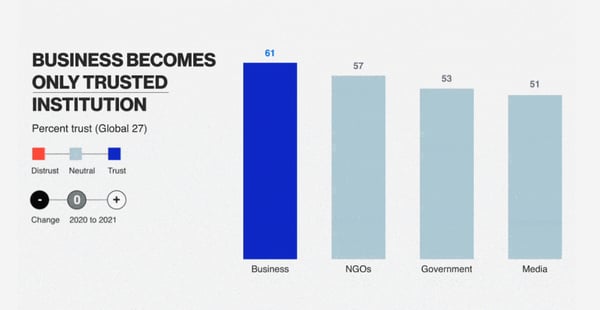
This new expectation of companies and their CEOs creates a responsibility and an opportunity for businesses to play an active role in building a better future for all in the next normal.
Preparing for the Next Normal
I’ve witnessed more change in the past 12 months than I did in the previous 12 years. But now, on the occasion of HubSpot welcoming its 100,000th customer and passing $1 billion, I’m not looking back as much as I’m looking forward.
The next normal won’t look anything like 2019, and it won’t look very similar to 2020 either. It will be an era unique in the trends it ushers in and the opportunities it presents. At HubSpot, it will be our job to help our future and existing customers take advantage of those opportunities, while also continuing to support the likes of Headspace, Monday.com, Airstream, and Lemonade as they scale and shape the behaviors that will define the next normal.
We plan on doing that first and foremost by listening to our customers, and by then using their feedback to provide a world-class CRM platform as unique as the times in which we live and capable of empowering scaling companies to thrive for years to come.
I want to thank every customer, partner, and employee for helping us get to where we are today. Without their passion, advocacy, trust, and feedback, the past 15 years would not have been as exciting, and the next 15 would not look as promising.
Our mission is to help millions of organizations grow better. This week, we reached an important milestone on that journey. But, just as the next normal is getting started, so too is HubSpot.

Be Mine: A Brief History of Valentine’s Day Marketing
When I was in grade school, Valentine’s Day was one of my favorite holidays. There were cards. There was the possibility that your crush actually liked you back. And, there was the chocolate — so much chocolate.
Little did I know that the roots of this holiday bore little-to-no resemblance to my childhood experience of it. We were never taught that Valentine’s Day actually originated with an arguably gruesome ancient festival, where there was no chocolate or exchange of cute, red-and-pink cards.

But love it or hate it, those are the types of things we associate with the holiday today. After all, there’s a reason roughly 114 million Valentine’s Day cards are exchanged each year — it’s what’s become expected of us.
So how the heck did we get from an ancient Roman festival to a holiday that compels many of us to spend no less than $147 on celebrating it? That story, it turns out, is thousands of years old — but we’ll try to condense it.
How Valentine’s Day Began and Evolved
Ancient Rome
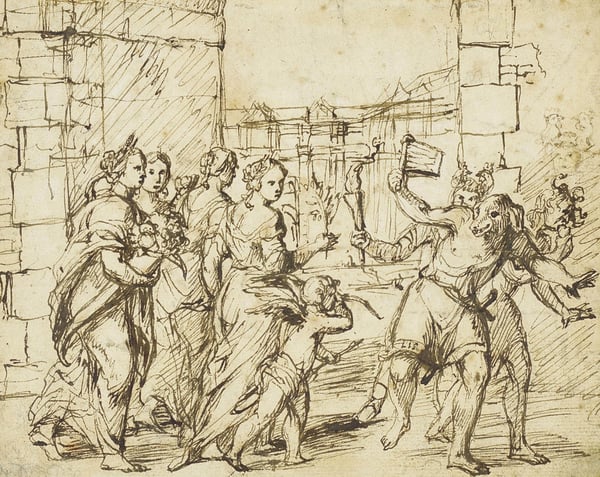
The roots of Valentine’s Day are cited by some sources to lie in the ancient Roman festival Lupercalia, largely because it took place annually on February 15 — the day after what is today the observed date of Valentine’s Day — and involved some very primitive forms of courtship and matchmaking. But it was also ancient Rome that saw the famous execution of a St. Valentine on February 14, around 278 A.D. According to legend, he wrote a letter on the night before his execution to his jailer’s daughter, whom he had befriended, and signed it, “From Your Valentine.”
Over two centuries later, Pope Gelasius ordered that Lupercalia be replaced with the February 14 observation of St. Valentine’s Day. That set the tone, some believe, for the day’s forthcoming tradition of exchanging “love messages,” perhaps in remembrance of St. Valentine’s farewell letter.
The Romans are also credited with constructing the idea of Cupid — a god of love often depicted with arrows that, as the legend goes, inflict love upon those who are hit by them. The Roman version of Cupid was adapted from Eros, a god of passion and fertility in Greek mythology. It seems that no one is quite sure when cupid became associated with Valentine’s Day, but the fact that both have origins in ancient Roman culture suggests that there may have been some very early overlap between the two.
Shakespeare (and Chaucer) in Love

When NPR’s Arnie Seipel set out to explore the history of Valentine’s Day, he found that it first became romanticized by classic authors like William Shakespeare in the late 16th century, and Geoffrey Chaucer in the 1300s.
Chaucer
Dartmouth English professor Peter Travis cites Chaucer’s epic poem The Parliament of Fowls, which was one of the first literary references to St. Valentine’s Day, or “Seynt Valentynes day,” as Chaucer spelled it. One such mention is made, Travis explains, alongside the line, “Now welcom somer, with thy sonne sonne, That hast this wintres weders over-shake.” In other words, when we celebrate love in the coldest depths of winter — in February, for instance — it’s so heartwarming that it makes summer feel less far away.
Shakespeare
Some literary historians credit Shakespeare for the permeation of love into popular culture with his composition of “Sonnet 18” — said to be written between 1593-1601 — a.k.a., “Shall I compare thee to a summer’s day?” It’s unclear when or how this particular work became associated with Valentine’s Day, but like Chaucer, Shakespeare compares love to the seasons.
“While summer days may fade and fall into” colder months, writes Shakespeare analyst Lee Jamieson, “his love is eternal.”
Of course, Saint Valentine’s day is alluded to outright in Hamlet — written between 1599-1601 — when the character Ophelia recites a song about a young lady’s experience with the holiday, which includes lyrics like, “Tomorrow is Saint Valentine’s day,” and, “To be your Valentine.”
The 17th Century and Beyond

By the 1700s, it’s said that Valentine’s Day made its way from Europe to the United States, which aligns with the establishment of the North American colonies between 1607-1770. It became traditional, according to HISTORY.com, “for friends and lovers of all social classes to exchange small tokens of affection or handwritten notes.” That was more common in England, however, where the Industrial Revolution began earlier and eventually included the production of “fancy valentines [that] were extremely expensive to import.“
It’s said that one American woman, Esther Howland, was so intrigued when she received her first English valentine greeting in 1847, that she became infatuated with the idea of manufacturing them in the U.S. She was an early entrepreneur, and instinctively believed that there could be an American market for these formal, English-style greetings. After procuring materials like high-quality paper and lace from her father, a stationer, she created what many credit as the earliest American Valentine’s Day greeting cards.
Today, Howland is still honored with the nickname “Mother of the American Valentine,” with many citing her work as the start of a multi-million-dollar industry. But it didn’t happen overnight — let’s take a look at how her work paved the way.
A Brief Timeline of Valentine’s Day Marketing
1714
Charles II of Sweden begins communicating with flowers, by assigning a different message to each type. This tradition allegedly assigned love and romance to the red rose, setting the stage for this flower to be exchanged during the later, commercialized era of Valentine’s Day. However, it remains unclear if a specific brand is responsible for first marketing flowers as part of Valentine’s Day gift-giving.
1822

In England, where Valentine’s Day had by now already been celebrated with the exchange of gifts and cards for many years, the Cadbury chocolate company sells the first heart-shaped box of chocolates.
1849
In Massachusetts, Howland produces a dozen sample Valentine’s Day cards and sends them off with her brother to distribute during a sales trip for their father’s company — S.A. Howland & Sons — hoping to earn $200. Instead, he returns with 25X that amount, indicating a much higher-than-expected demand.
Here’s an example of a card Howland created around this time.

1850
The first print advertisement for Howland’s cards appears in the Worcester Spy.
1866

Conversation candies are developed, when Daniel Chase — brother of New England Confectionery Company (NECCO) founder Oliver Chase — uses vegetable dye to print words onto confections.
1870
Howland incorporates her booming card business as the New England Valentine Company, operating out of her home via an assembly line that was largely comprised of her friends.
1879
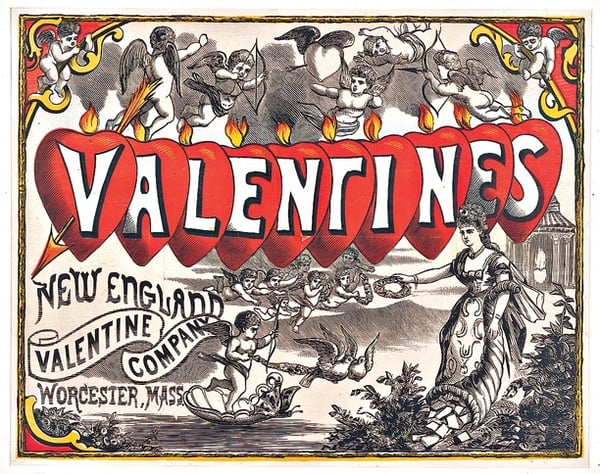
The New England Valentine Company moves operations from Howland’s home to a Main Street factory in Worcester, Massachusetts. That same year, the company publishes the Valentine Verse Book, which contained 131 “verses” that people could cut out and paste inside of cards that came without a greeting — or those with a greeting that the buyer didn’t like.
1880 – 1881
Howland sells the New England Valentine Company to the George C. Whitney Company.
1888

Whitney has acquired at least 10 competitors, including Berlin and Jones, which had become New York City’s “largest manufacturer of Valentines.” Ten years later, the company moves to large-scale headquarters on Worcester’s Union Street.
1894
The Hershey Chocolate Company is founded, bringing what was previously “a European luxury product” to the U.S.
1902
Conversation candies become heart-shaped.
1906
American Greetings is founded, eventually becoming one of Whitney’s chief competitors.
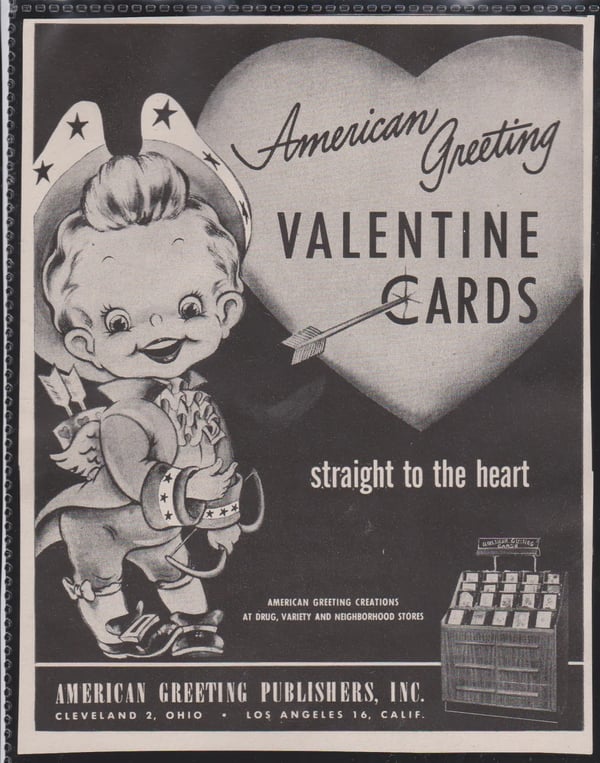
1907
The Hershey Chocolate Company introduces its Hershey Kisses candy product. Interestingly enough, the product was allegedly named Kisses because whenever a piece of chocolate was dropped on the conveyer belt at the Hershey factory, it sounded like a kiss.

1910
That January, a massive fire destroys much of Whitney’s headquarters. However, most of the Valentine’s Day products had already been shipped for the season, having little impact on that particular holiday.

That same year, Hallmark is founded. Meanwhile, 1910 also saw the creation of Florists’ Telegraph Delivery — today known as FTD — which pioneered the remote ordering and delivery of flowers, providing a way to send them to far-away loved ones.
1913
Hallmark produces its first Valentine’s Day card.
1948
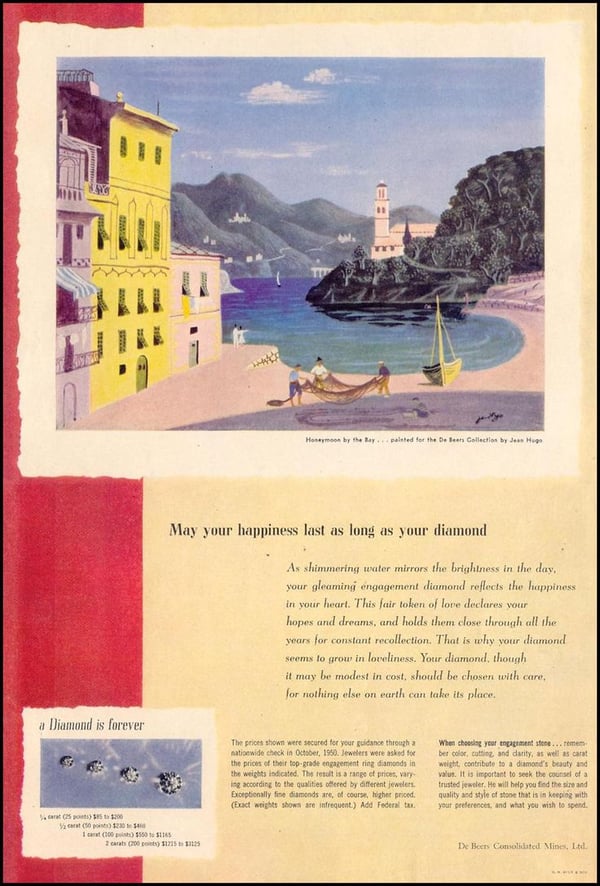
The De Beers diamond company launches its “A Diamond is Forever” campaign, sending the message that gifting high-end jewelry can be used as an expression of love.
1985
In the ’80s companies like Hallmark began launching more Valentine’s Day related commercials. In 1985, one commercial, which dubs Hallmark as “The Valentine’s Store” shows off all of the cards and heart-shaped products you can buy for your loved one in their locations.
1986
As if Kisses weren’t romantic enough based on their name, Hershey’s enforced them as a Valentine’s Day staple with one slight design tweak. The company began packaging Kisses candies in pink and red foil specifically for Valentine’s Day.
2004
As marketers continued to embrace new media, we saw an influx of high-quality and insanely high-budgeted commercials mark the holiday from the ’80s until now. One of the most iconic and beautifully shot commercials was a mini-romance drama, called “Le Film,” promoting Chanel No. 5 perfume.
In the ad, a man falls in love and runs away with a starlet, played by Nicole Kidman. In the end, she returns back to her life of fame. As she walks down the red carpet, he notes all the things he’ll remember about her, including the smell of her Chanel No. 5 perfume.
2005
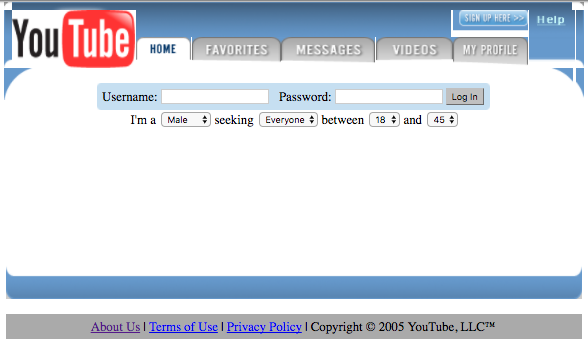
Valentine’s Day begins to go digital. On February 14, 2005, YouTube — which originated as an online dating site — makes its debut. Co-founder Steve Chen still credits its invention as the brainchild of “three guys on Valentine’s Day that had nothing to do.”
2013
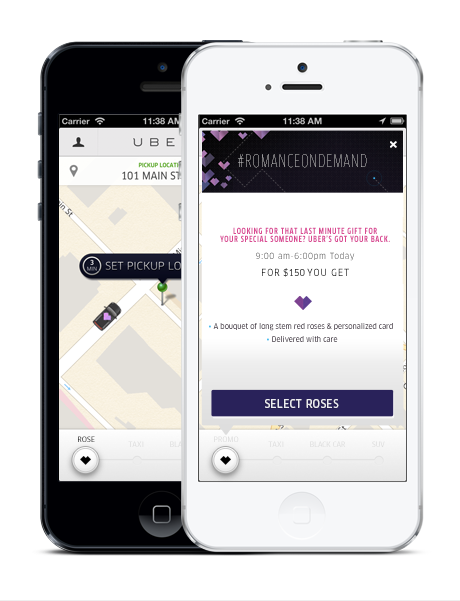
Ride sharing company Uber rolls out “Romance On Demand,” allowing users to send flowers on Valentine’s Day via the app. This initiative would continue to progress, with on-demand skywriting becoming available the following year.
2016
Well aren’t you accurate today, @netflix #HappyValentinesDay pic.twitter.com/pUK05gQ8Rs
— Tiffany Bukowski (@TheTiffy)
February 14, 2016
NetBase, a social media analytics platform, releases a Valentine’s Day Sentiment Analysis, measuring how people engage with and discuss the holiday on social media. In total, it measured nine million mentions of Valentine’s Day, with the vast majority of them mentioning a specific brand — Netflix. The top hashtag was #happyvalentinesday.
2017
In the earlier years of the Google Doodle, Google used Valentine’s Day to spread awareness of a rare species. In 2017, a series of Google Doodles shown in the days leading up to Valentine’s Day highlighted the stories of pangolins, the only mammal species with scales, as they give each other Valentine’s Day gifts or serenade their mates. Here’s one example:

While, at this point, Google didn’t need to market themselves with Doodles, this shows an early example of a brand that used its platform to creatively market another cause on the holiday.
2018 to Present Day
In recent years, Valentine’s Day marketing campaigns have gone completely digital, with a particularly strong presence on social media. With these new opportunities, smaller companies that don’t have Hallmark’s budget can easily spread awareness of their own brands during the holiday. Here’s one example of an Instagram post which highlighted a fine Italian restaurant ahead of Valentine’s Day:
While these real dog’s mimicking Lady and the Tramp grabbed attention, especially from the animal lovers on Instagram, this post’s caption encourages audiences to interact with the brand.
What Marketers Can Learn from Valentine’s Day Marketing
Like so many other holidays, Valentine’s Day has experienced a transition into pop culture that has shaped the way it’s perceived, discussed, and celebrated. Sure, it’s often accused of being nothing more than a money-making marketing holiday. But next time you hear someone label Valentine’s Day as a “Hallmark holiday,” you’ll have a wealth of historical information to respond with.
From our hearts to yours, Happy Valentine’s Day. We’ll be keeping an eye on its continued evolution.
Editor’s Note: This blog post was originally published in February 2017 and has been updated for comprehensiveness and freshness.


Whiteboarding: What It Is & How to Use It In Your Meetings
Do you remember those old school projectors they used to have in school? Whenever the projector was pulled out in class, I knew I was going to have fun. Teachers would allow us to go up and write on the projector, and it just felt more collaborative.
That’s kind of what whiteboarding is like in business. As marketers, you probably have a lot of brainstorming sessions where you’re laying out landing pages, writing copy, and creating a strategy for a campaign.
And brainstorming sessions and whiteboarding go together like peanut butter and jelly.
In this post, we’ll dive into whiteboarding and learn how you can use this process to improve your brainstorming sessions.

Whiteboarding Session
While whiteboarding sessions are great, it’s easy to lose control over a brainstorming session. To conduct a successful whiteboard session, we’ve gathered a few tips.
Whiteboarding Techniques
1. Be creative.
One of the best parts of a whiteboarding session is that it allows your team to be creative. People can share documents, put up sticky notes as reminders, and share their ideas with the team. When you’re in person, it’s fun to let all your team members use the whiteboard, so everyone has a chance to write down notes and share their thoughts.
2. Stay focused.
With any brainstorming session, it’s easy to lose track of what the goal is. To stay focused, we suggest writing out your goal at the top of your whiteboard, so everyone can see and knows what they’re supposed to be doing. When ideas that are off-topic are brought up, write them down in a section on the side for ideas to follow up on.
3. Encourage meaningful conversation.
Brainstorming sessions also allow teams to have meaningful conversations about different ideas. No idea is too small, and everyone should feel confident speaking their mind. The whole point of a whiteboarding session is to engage and collaborate with members of your team. It’s supposed to be interactive. These sessions also help people feel heard and like their ideas are being taken into consideration.
4. Keep the board organized.
When you’re running a whiteboard session, it’s important to keep the board organized. Even though it’s brainstorming, your ideas should be labeled in sections, so everyone knows what idea pertains to what topics. This is also where you can add a side section just for “off-topic” ideas. You’ll still want to write those down, even if it doesn’t have to do with the topic at hand, so you can come back to it later and keep the meeting focused.
Now that we know what whiteboarding is and how to be successful when you’re running a meeting, let’s review some remote whiteboarding tools to help you be successful in a virtual brainstorming session.
Remote Whiteboarding
As we’ve discussed above, whiteboarding can be done remotely as well. This doesn’t need to be an in-person activity. In fact, remote whiteboarding meetings can be just as effective because everyone can use the whiteboard at once, and have full visibility of it at the same time.
Below, let’s review some whiteboarding tools to use in your video conferencing meetings.
Remote Whiteboarding Tools
1. Zoom
A great thing about Zoom is that a whiteboarding tool is built into the video conferencing software. If you use Zoom for your remote meetings, then you don’t need to look any further for a whiteboard tool.
To access the Zoom whiteboard, click the Share Screen button, and then click Whiteboard. One of the features we like about this tool is that other participants can annotate and participate in writing on the whiteboard (if allowed). It’s also nice because you can turn that feature off if you want as well.
2. Microsoft Whiteboard
If you aren’t using Zoom, or would rather use another whiteboard tool, Microsoft has an excellent option. With this tool, all team members can edit and comment directly on the screen in real-time.
The whiteboard is also infinite, meaning you can draw, type, or add sticky notes as much as you need. You can also save your whiteboards, so you can continue using the tool as much as you want, while also going back to old sessions.
3. Conceptboard
Conceptboard is another remote whiteboarding tool you can use during your meetings. With this tool, you can see live cursors, and everyone can collaborate at once.
Additionally, this tool has video conferencing capabilities, so you can talk to your team while you’re brainstorming.
4. Limnu
Limnu is an online whiteboard tool that’s realism is the biggest seller. It feels like a real whiteboard, but it has the features of online whiteboarding such as collaboration. Anyone can edit in real-time, but you can also limit permissions if need be. Additionally, there’s a chat box function which is helpful for those who don’t have editing permissions to give their point of view.
Whiteboarding is a great way to collaborate and brainstorm with your team. And the best part is, you don’t need to be in-person to have collaborative meetings. With remote whiteboarding tools, you can hold a brainstorming session just as easily.

9 Valentine’s Day Marketing Campaigns We Love
Love, flowers, chocolate, bla bla bla …
Where are the marketing results?!
Okay, probably not what your Valentine’s date cares about. But if you’re a marketer, you might be interested in merging the most lovey-dovey of days with your marketing. But how?
Well, these companies have figured out some creative ways to leverage the warm and fuzzies (or unadulterated rage and crushing loneliness … whatever) that Valentine’s Day instills in people.
If you don’t have a marketing campaign planned for the 14th, maybe some of these will inspire you to get in on some last-minute Valentine’s Day action.
9 Effective Valentine’s Day Marketing Campaigns
1. Crook & Marker’s “OnlyCans” Website
In 2020, many online threads and message boards were discussing the controversial website “OnlyFans.” This platform invites users to purchase videos or images from people or influencers with profiles on the site.
Fast-forward to 2021, Crook & Marker is embracing the OnlyFans controversy with relatively PG marketing content.
The cheeky holiday campaign, which aims to earn donations for Muddy Paws Rescue, began with the brand launching a co-branded website called OnlyCans.dog.
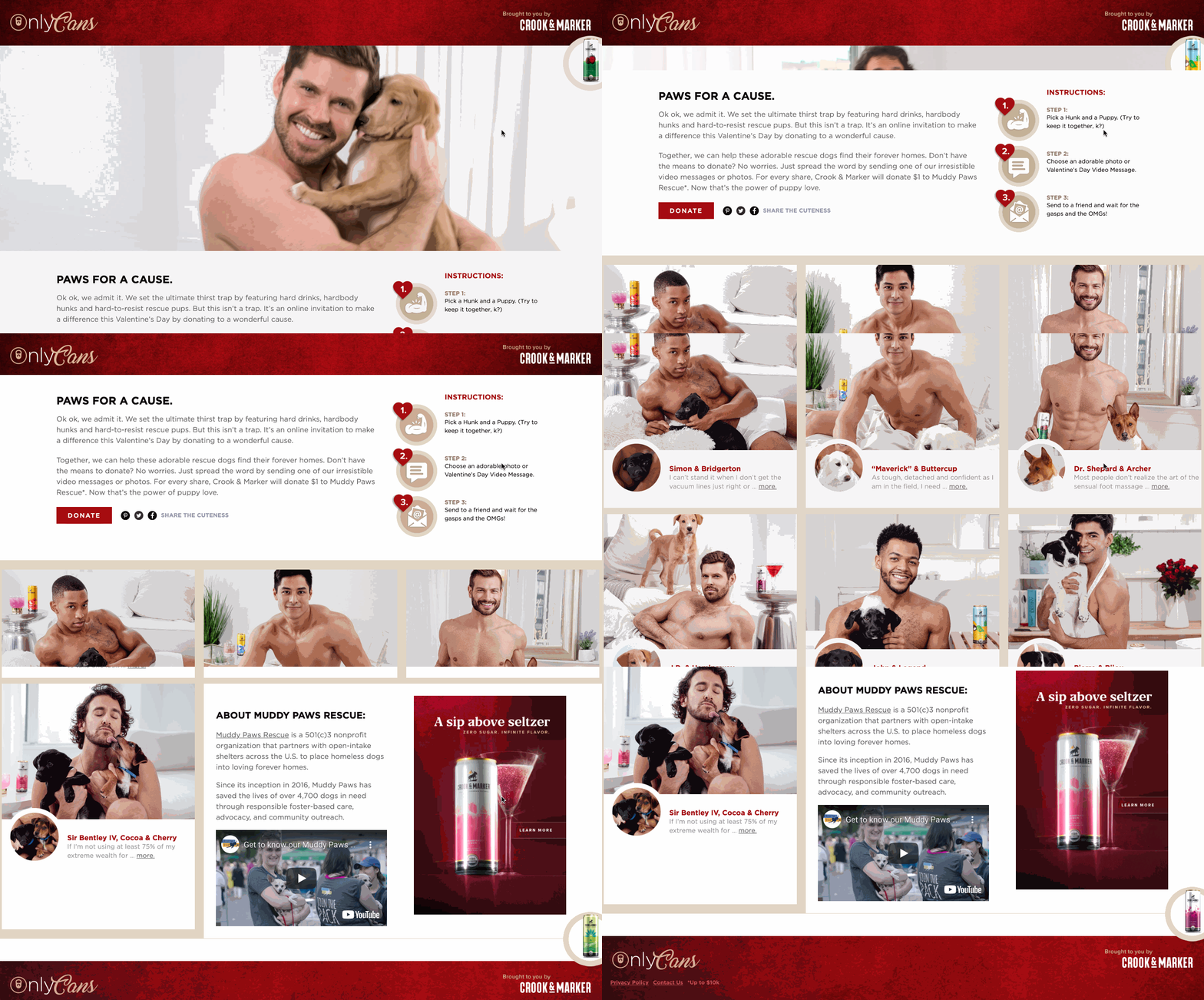 When visiting the “OnlyCans” website, you instantly see videos and images of shirtless men holding cute puppies. You can also browse the profiles or each man-puppy duo.
From each profile page, you can then pick and share a pre-recorded video message or photo of them with a friend or loved one.
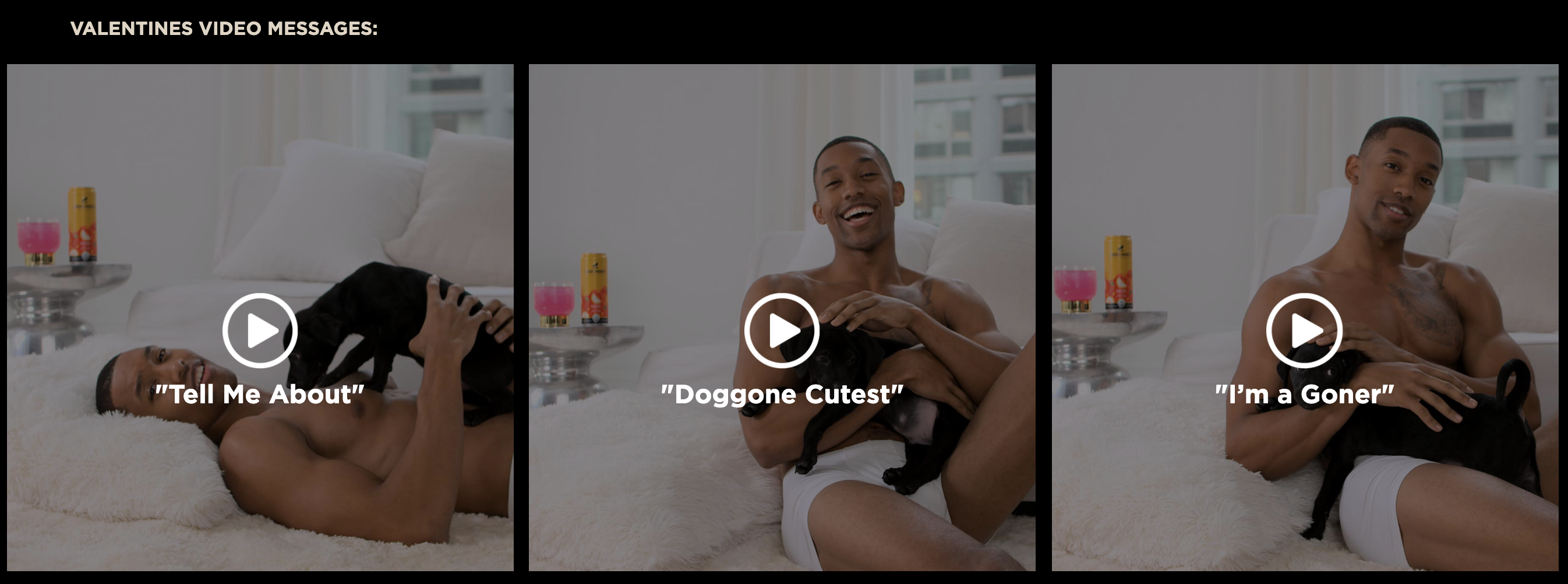 For every visitor who shares a video or photo message, Crook and Marker pledges to donate $1. Aside from the funny profiles, videos, photo messages from shirtless men, the site also features subtle ads for Crook and Marker products — as seen in the GIF above.
This is a great example of a co-marketing campaign that leverages edginess and current trends to create a campaign that catches your eye and makes you laugh. Although Crook and Marker are only subtly mentioned on the website, users know that they created it and that the campaign is for a good cause.
While this campaign isn’t specifically about marketing a brand, it’s fun and unique — which might enable shoppers to remember Crook & Marker next time they’re looking for a Spiked Seltzer product.
2. Ranch Dressing’s Customized Bottle
Nothing says Valentine’s Day like giving someone a bottle of — Ranch Dressing?
In 2021, while flower companies and B2C brands were highlighting the romantic gifts partners could give to each other, Hidden Valley took a funny approach to this strategy by offering audiences customized Valentine’s Day-themed bottles of Ranch salad dressing.
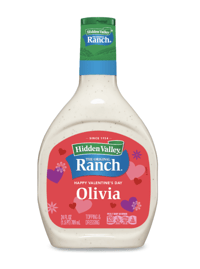
While this seems like an odd gift to some, Hidden Valley knows that they have fans out there that just love to cover everything they eat with Ranch dressing. To those audiences, this gift is funny, personalized, and potentially useful.
“I can’t wait to order some for my Valentine. And this totally isn’t just me,” Cirillo, who brought the campaign to our attention, admits.
3. Deliveroo’s “Third-Wheel Kevin”
Many people have identified as a “third-wheel,” or the only single person hanging out with one or more couples. And, many of these people know how awkward or uncomfortable couple’s holidays, like Valentine’s Day, can be.
That’s why Deliveroo’s 2020 Valentine’s Day ad told the story of a third-wheel named Kevin, rather than a romantic couples’ narrative.
The commercial, which is filmed to look like a documentary, follows the life of Kevin — an incredibly single man who’s always surrounded by couples. As the ad goes on, it tackles the strange, awkward, and completely untrue thoughts that single people might wrongly think about themselves.
The narrator, who’s seen throughout the commercial, explains, “Being a single doesn’t just effect Kevin when he’s at home. Many life-affirming activities are impossible alone. — It can be tiring being this lonely. He’s just a hollow shell.”
As the narrator dramatically describes the slight inconveniences of being single in a comedic and light-hearted way, Kevin’s seen playing boring single-person sports and posing in a two-person photo stand. As Kevin is seen doing these daily-life activities alone, the narrator and his partner are also shown playing team sports together and enjoying each other’s company
After the narrator is done explaining how boring the single life is, he adds, “Deliveroo can help you give the third-wheel in your life some love.”
If you’re single person, the commercial is pretty hilarious because it reminds you of all the strange, over-dramatic comments less-single people make. Meanwhile, if you aren’t single, you reflect on the times you were single and thought about the same awkward thoughts.
Because audiences might relate or laugh at the sarcasm of this ad, it might be more memorable to them. Because of this, they might think of Deliveroo next time they’re ordering a Valentine’s Day meal for themselves or “third-wheeeling” friends.
4. Twitter’s Offline Campaign
Believe it or not, one of Twitter’s great Valentine’s Day campaigns was actually not launched online.
In 2020, Twitter launched billboard ads around Valentine’s Day that only showed users’ incredibly sarcastic tweets about love and dating.
For example, in the image below, one tweet reads “Yo, I’m really awkward. Good luck to whoever is about to date me,” while another reads, “My husband said we had too much cheese in the fridge, so now I need to find a new husband.”
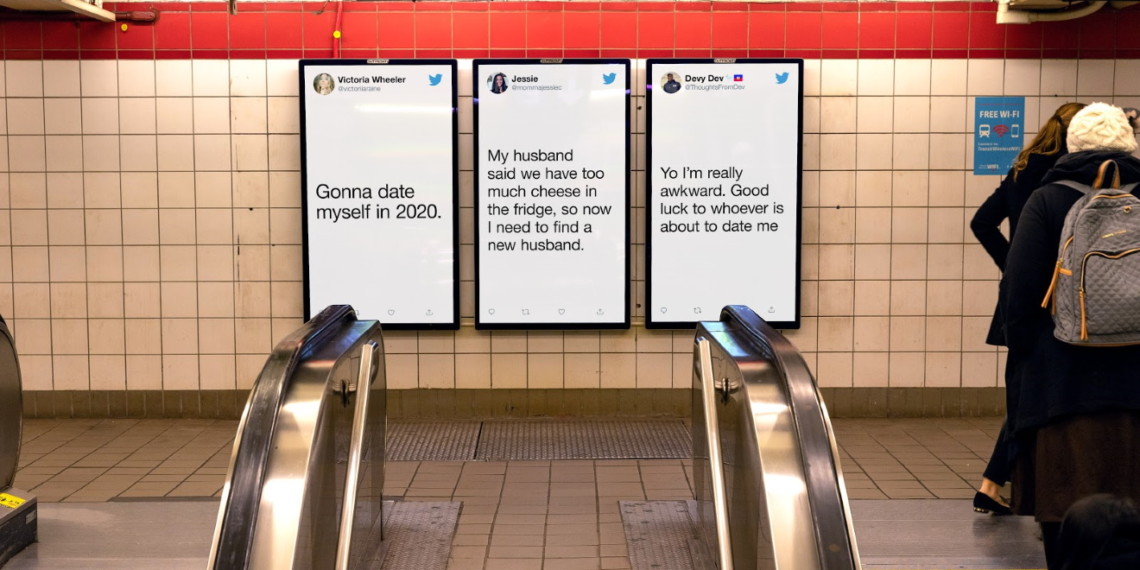
In this funny campaign, Twitter highlights the tweets of real users that have leveraged the platform to share their thoughts around Valentine’s Day. While other companies are zoned in on promoting ideal images of love and relationships, Twitter promotes relatable content from its actual users.
“The campaign not only feels authentic, but it reminds you that Twitter is a place to share your thoughts freely without judgement — even if they aren’t always pretty,” says Pam Bump, HubSpot Blog Audience Growth Manager.
5. 1-800 Flowers’ Cupid Commercial
In 2019, 1-800 Flowers launched a commercial where Cupid shared his grievances of how the bouquet company put him out of a job.
In the ad, which features a shirtless Cupid in his costume sitting in front of phones that are no longer ringing, Cupid yells “Ever since 1-800 Flowers, I’ve been out of a job!” He adds, “People no longer need Cupid to express their love. Now all they need is 1-800 Flowers.”
As Cupid continues to complain about 1-800 Flowers’ quality bouquet products, the video shows screenshots of the brand’s website and all the pretty flowers it has to offer.
Because you’re thrown into the scene of seeing Cupid as an angry, disgruntled grown man, the ad instantly grabs your attention. Then, as Cupid complains about how his competition is one-upping him, he also highlights how 1-800 Flowers is also better than competitors that also sell romantic products because they provide quick and painless scheduled delivery.
This ad is a great example of how a brand can playfully leverage their competition, and tell a fictional story, that highlights what makes their product different.
6. Frankie & Benny’s “Lady & the Tramp” Instagram Post
In 2019, the Italian restaurant chain Frankie & Benny’s referenced romantic scenes from notable films like “Lady and the Tramp.”
In a cute Instagram post, two real dogs are seen on a classy date at Frankie & Benny’s holding the same strand of pasta in their mouths. This mimics a class scene from Lady and the Tramp where two dogs kiss after accidentally eating the same strand of pasta.
The carousel post then highlights actual photos from iconic movies like, “When Harry Met Sally.” In the post’s caption, it encourages Instagram audiences to guess which movies are being referenced.
While the real dog’s mimicking Lady and the Tramp grabbed attention, especially from the animal lovers on Instagram, this post’s caption and other photos encourages audiences to interact with the brand by guessing which movies are being referenced.
This is both a fun way to boost brand awareness, and leverage the holiday to gain engagement on social media.
7. Panera’s Engagement Offer
In 2018, Panera tweeted that customers who got engaged in one of their restaurants on Valentine’s Day could win free wedding catering from the chain.
The tweet included a short and simple video which announced the promotion and showed two Panera employees cheering, as if they were witnessing a proposal.
Love is in the air. This Valentine’s Day, get engaged at a Panera and we might cater your wedding, for free. #PaneraProposalSweeps https://t.co/mpL5VbjSOd pic.twitter.com/VPRzu0QLNd
— Panera Bread (@panerabread)
February 9, 2018
This is a quick and sweet way to leverage the holiday and social media to gain foot traffic into a physical business. Although Panera is a giant corporation, this campaign strategy is so simple that smaller businesses could create something similar with a tweet, short video, and offer that drives foot traffic.
8. Facebook Messenger Heart Feature
Just before Valentine’s Day in 2018, Facebook Messenger’s Twitter announced that if you shared that you were “In a Relationship” with a friend you were messaging, celebratory hearts would rain down in your Messenger thread with that person.
It’s not official until it’s #FacebookOfficial. Update your relationship status on Facebook and shower bae with ❤️❤️❤️on Messenger. Also customize your chat emoji, color and more! pic.twitter.com/P6oy35fHmp
— Messenger (@messenger)
February 13, 2018
Although a small business probably can’t add a major feature to their product just because of a holiday, this is a good example of how you can theme something related to your product, such as your website, around a holiday temporarily.
Another thing that’s interesting about this campaign is that Facebook is using a competing social platform, Twitter, to announce this new feature. This slightly undermines Twitter, which also allows direct messaging but with less interactive features.
9. “Adults Meal” – Burger King
While Burger King’s “Adults Meal” campaign is one of the oldest on this list, it’s still a classic that marketers talk about today.
Burger King has always been no stranger to poking fun at its biggest competitor, McDonalds. This was no different on Valentine’s Day 2017 when they offered an “Adult Meal” alternative with a similar box shape to McDonalds’ kids’ meal.
In the ad for the meal, Burger King explains that Kids’ Meals are for kids. But, on the night of Valentine’s Day, Burger King customers can buy an adult meal with an “adult toy.”
This campaign is pretty cheeky. However, it’s edgy mission and subtle comments about its competitor’s product make it memorable and funny.
Honorable Mention: Match.com’s “Match Made in Hell” campaign.
Technically, this campaign wasn’t created for Valentine’s Day specifically. But, many of our marketers thought it had all the perfect elements of a great Valentine’s Day campaign. Because of this, we wouldn’t be surprised if it sees a lot of circulation in February.
In the commercial, directed by actor Ryan Reynolds, Satan sits in Hell using Match’s app when he sees he’s matched with a woman named 2020. When he meets up with her on Earth, he nervously says “Hi 2-0-2-0.” She replies, “Please, call me 2020” — pronouncing it like the year.
As the commercial continues, 2020’s character appears to be the epitome of everything that happened in 2020.
For example, which launched in December, shows Satan and 2020 causing mischief, stealing toilet paper from store shelves, having a picnic inn empty stadiums, and ultimately posing for a selfie in front of a dumpster fire.
The couple frolics to the familiar sounds of Taylor Swift’s hit song, “Love Story.” which also sparks a sense of rom-com nostalgia for millennials.
On the same day of this ad’s release, Match and Reynolds also shared another commercial showing the pair explaining how they met in couple’s counseling.
In this video, Satan explains how he found 2020 on Match:
“I started by using the Match custom search filter. I filtered out joy, happiness, toilet paper, and reason,” Satan says in the video below:
Although this didn’t launch in February, it was a very clever newsjacking example that many of our marketers say they enjoyed when they were asked to share their favorite Valentine’s campaigns.
While 2020 was a difficult year for many, Match and Reynolds identified a tasteful way to create content that audiences could relate to. At the same time, they still told an epic, hilarious love story with a pleasant, entertaining tone. Although they discussed a truly terrible year, they did so in a way that felt like escapism for the viewer.
Valentine’s Day Campaign Takeaways
As you create and launch Valentine’s Day campaigns, take note of these strategies many of the brands above used:
- Grab your audience’s attention: Like with any holiday, marketers around the globe are churning out content around it. To compete with this overly saturated Valentine’s Day ad landscape, you’ll need to grab and keep your viewer’s attention with entertaining elements or valuable information.
- Be relatable: Around this time of year, many people are inundated with high-budget Valentine’s Day ads that offer them no useful information or value. Even if you want to tell a mushy romance-fueled love story with your content, make sure it still feels relatable or authentic. To do this, you can leverage tactics like telling a story your audience will relate to, or leveraging user-generated content from your followers — like Twitter has.
- Test out different platforms: While some companies on this list took to Instagram, others embraced physical campaign strategies like special products or billboard use.
Editor’s Note: This blog post was originally published in Feb. 2013, but was updated for comprehensiveness on January 30, 2020.

20 Ways To Get More Views on YouTube
YouTube, launched in 2005, the second most visited website in the world. It’s available in 100+ countries, features videos in 80 different languages, and its users watch over a billion hours of content daily.
Many businesses take advantage of the large number of users and daily viewership to advertise for their business. In fact, YouTube is the second most popular channel for businesses sharing video content.
However, despite the sheer amount of hours watched every day, it can be challenging to hold up on YouTube. Creators sometimes struggle to get their channel off the ground, resorting to paying for YouTube views to generate engagement. The platform’s algorithm has become better at detecting bots, and, as you can guess, fake engagement doesn’t do much in the way of meeting your business goals.
Although it will take time, it is possible to generate views (for free) and grow your channel on YouTube. In this post, we’ll go over how to get more views on YouTube and how to continue growing your channel after reaching your first 1000 views.
How To Get More Views on YouTube For Free
Getting views on YouTube takes time and effort. But, if done right, it pays off (Forbes estimates that you can make anywhere from $3-$5 per 1000 views). Below, we’ll go over a few ways to get more views on your YouTube account.
1. Be mindful of SEO and organic search results.
YouTube is the second most popular search engine in the world, only topped by Google. To get more views on YouTube, follow the same SEO tactics you use to surface your content in organic Google search queries.
Since Google owns the platform, YouTube has similar algorithms for displaying the most relevant content. The video below goes into detail, but the tips that follow highlight the best steps you can take to obtain more views.
2. Use keyword-rich descriptions.
Your viewers initially see the first 100 characters of your video descriptions (example below), so you should aim to use keywords in snippets that provide the most relevant explanations to your viewers.

But using your keywords doesn’t mean an excuse to be dull. Get creative with your descriptions and aim to stand out. After all, the goal is to entice users to view your videos over your competitors.
Your first 100 characters should also entice users to click ‘Show more’ to learn more about what you have to say.
3. Use business-relevant tags.
YouTube’s algorithm determines 70% of what people watch on the platform. Using relevant tags for your business is key to surfacing your content in search results and obtaining more views.
Opt to use a combination of long-tail and short-tail keywords that truly relate to your video, listing the most important keywords first. Be mindful of keyword stuffing, as it is against YouTube policy and doesn’t help you generate more views.
4. Create unique, enticing titles.
Video titles are what people read first when browsing search results. So, aim to create compelling, unique video titles that clearly describe your video’s content and make people curious and interested in learning more. For SEO results, you can include your most relevant keyword in your video title.
Be mindful of clickbait, though, when creating your titles. It can be a valuable tool for getting users to click on your videos (see this article from a HubSpotter who was effectively clickbaited), but it can also backfire.
You don’t want to say your videos will be about one thing and have interested users find that you don’t touch on it at all. Ensure that your titles align with your content.
5. Use creative, relevant thumbnails.
Just as titles are the first exposure to your video content, thumbnails are the first images. Creating thumbnail previews that are exciting but relevant to your content is an excellent strategy for driving views. High-quality, engaging thumbnails can attract users in organic search results.
Your thumbnails can be screencaps from your videos or even text-based titles. Here’s an example of a thumbnail from popular YouTuber Marques Brownlee. He’s effectively created a thumbnail that depicts the content of the video: reactions to upcoming Apple product rumors.

6. Use closed captions and transcripts.
Subtitles and closed captions are another way to optimize your video SEO, as they highlight additional keywords and phrases for the algorithms to detect when indexing your videos.
Most importantly, closed captions and video transcripts make your YouTube account more accessible. If you solely rely on audio and visuals, you’re probably going to lose a large portion of your audience that’s unable to interact with your content in that form. When you create content that is accessible, all audiences can enjoy what you have to offer.
You should also opt for using closed captions instead of subtitles, as closed captions include dialogue and additional sound descriptions for actions like laughter or closing a door. Here are some resources that can help with understanding web accessibility and how to align your content with accessibility standards:
- Bureau of Internet Accessibility – Closed Captioning Guide
- Accessible Media Inc. YouTube Accessibility guide
- Google Accessibility Resource Database for Developers and Publishers
7. Encourage subscribers
While organic search results can be great, the algorithms won’t always surface your videos. Encouraging viewers to subscribe to your channel is another way to ensure that people can see your videos.
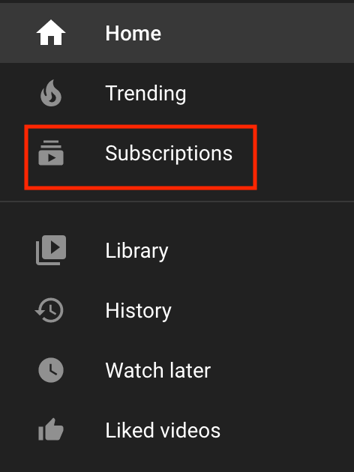
This means that when you post, your videos will show up in their subscriptions tab (shown below).
In addition to encouraging subscribers, ask users to turn on post notifications to get notified when you post a video.
Notifications can be a valuable tool for generating excitement. Users may feel they want to stop what they’re doing to watch your videos so they can actively participate in conversations about your content.
8. Repurpose your existing quality content.
Content repurposing is re-using existing content and presenting it in a new format to prolong its shelf life. Repurposing could mean creating a video from a high-performing how-to blog post (the bonus here is that YouTube users love how-to videos) or posting recording sessions from a popular podcast episode.
You’re repurposing helpful content and sharing it with a new audience in a format you know they enjoy.
9. Create a unique introductory hook for your videos.
It’s a unique tip, but it’s worth considering as many popular creators use this strategy.
Mr. Beast is a famous YouTube persona with almost 52 million subscribers. Each one of his videos begins with a clip of an exciting moment that doesn’t usually play out until at least halfway through the video.
Users must keep watching to see the moment unfold. Here’s an example:
10. Create a playlist.
If you create content clustered around a relevant, related topic, create playlists to encourage video views. The image below shows the playlists on the HubSpot YouTube account, where videos are organized by topic.
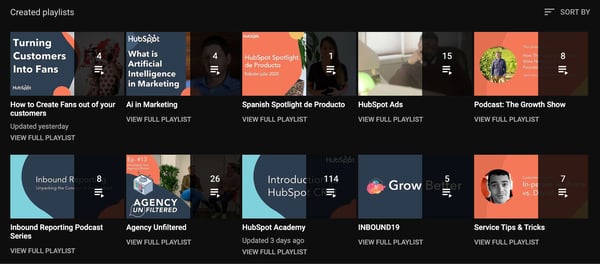
Playlists default to autoplay, so users can watch an entire playlist without taking action themselves.
Playlists and autoplay allow your users to view subject-relevant content that they may not have found themselves. This gives them a well-rounded experience and increases your video views.
11. Lead users to other videos in end screens.
End screens are the final 15-20 seconds of your video, sometimes called credits, used to recommend additional content on your channel as cards. Below is an example from the HubSpot YouTube account.
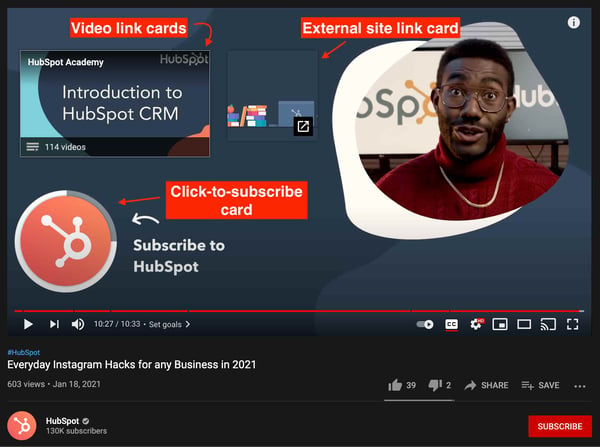
Your end screens can feature cards for single videos or entire playlists, a subscribe button, links to your associated websites, or secondary channels your business has (we’ll touch on this below.) It’s important to note that end screens should recommend relevant content.
12. Enable embedding.
Almost anything can be embedded these days, including YouTube videos. If you’ve created a YouTube strategy, you’ve likely identified your target audience on the platform. They’ll probably give you the most views, but enabling embedding can help you introduce yourself to additional viewers that may not have known your content would be relevant to them.
Here’s an example of a YouTube video embedded in a blog post.
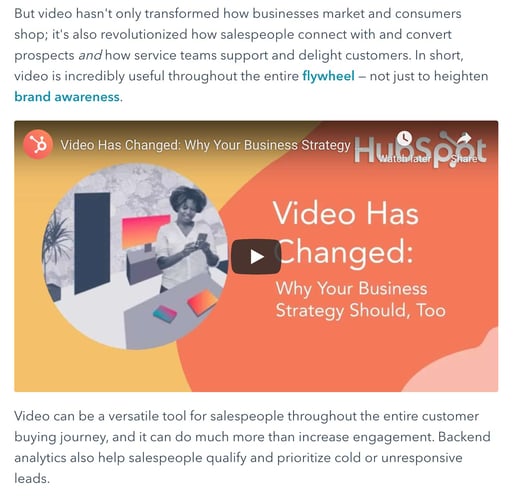
You can embed your videos in your content, like blogs and email newsletters, but it’s also a valuable way to expose your content to new audiences.
Other people can embed your content within their own pages and share your expertise with their audiences. These views still count towards your overall view count, even if they’re not on YouTube.
13. Promote videos on other platforms.
YouTube probably isn’t your only social media profile, and you should use this to your advantage. Share new video announcements on your Instagram Stories, share links and clips on Twitter and Facebook, and share them in your blog posts and emails.
You’ll expose new audiences to your content, and, as mentioned above, views on other platforms count towards your YouTube view count.
14. Leverage current trends.
Leveraging YouTube trends is a valuable tool for obtaining more video views. This doesn’t necessarily mean that you should create content that is exactly in line with a current, trending meme on YouTube, but you should pay attention to what types of videos get lots of views.
For example, Mediakix released a list in 2019 of the most popular types of videos. Among them are how-to and Q&A videos.
Suppose you’re a business hoping to utilize one of these trends. You could create a how-to video demonstrating how to use your product or service and a Q&A video where you troubleshoot consumer inquiries. You’re creating content that users want to see that provides value to them to generate more views.
15. Focus on creating relevant content.
Leveraging trends is important for generating views, but you shouldn’t abandon your topic type to get views.
A YouTube channel filled with unrelated content can generate views but won’t be seen as a source of authority. Your content would be scattered, users might write you off, and algorithms won’t know your niche. So, the two tips come together to leverage current trends to create content that aligns with your existing strategy.
Also, relevant content outweighs video quality. YouTube found that, when deciding what to watch, content relating to a user’s passions is 1.6x more important than the video’s quality (like visuals and camera quality), and 3x more important than whether it features well-known actors.
This means that the most valuable content you can create isn’t expensive and high budget — it’s content that’s in line with your audience’s needs. When you understand what they want, it’ll be easier to earn views.
16. Collaborate with similar accounts.
One of the exciting aspects of YouTube is its community. There are people creating all different types of content, from gaming videos to exercise classes. You’ll likely find people who make content like yours, and collaborating with them is a valuable tool for generating more views.
Collaborations usually involve creating two separate videos, one for your channel and another for the collaborators’ channel. When they’re posted, you’ll gain exposure to their audience group and them from yours.
If you’ve collaborated with a topic-relevant channel, new viewers will likely already be interested in your content and may even subscribe to your channel. It’s also a valuable way to create more content, and more content always inspires more views.
17. Post at the right time.
There is a right time to post on YouTube. The best times to post on YouTube are Thursday or Friday afternoons between 12:00 and 3:00 PM, and on Saturdays between 9:00 and 11:00 AM.
You can certainly leverage these numbers and obtain views, but it’s also essential to create a posting schedule that aligns with your existing viewership.
You can get this information from YouTube’s native analytics tool or your preferred service. If you’re a HubSpot user, you can connect your YouTube account to Marketing Hub and generate custom reports.
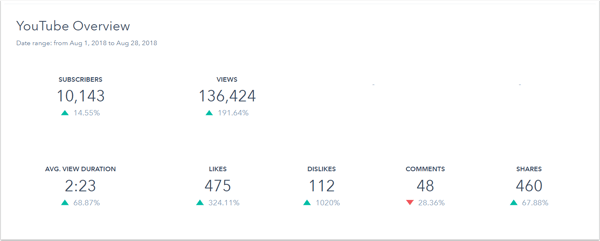
Posting at the right time translates into views, because your subscribers are more likely to watch during a time that they’re free versus when they’re at work.
18. Use a multi-channel approach.
If you’re a large business, consider creating multiple YouTube channels for different purposes. For example, HubSpot has five separate YouTube channels (shown below) tailored to different audience groups.
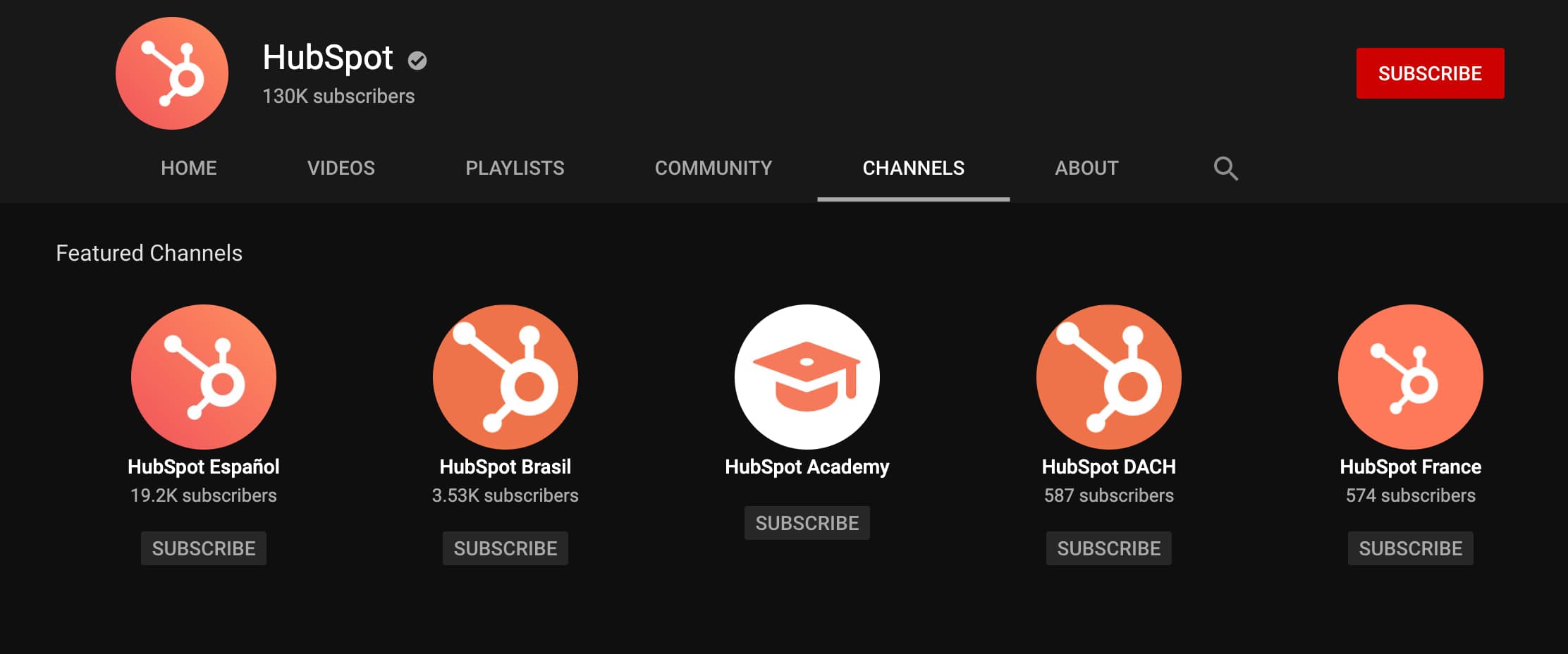
Multiple channels ensures that content is accessible to different viewers, and it generates more views.
This isn’t just a HubSpot thing — Interbrands says that the top 100 brands on YouTube have an average of 2.4 channels.
19. Optimize for mobile viewers.
More than 70% of YouTube watch time comes from mobile devices, so create content that these audiences can enjoy.
Optimizing for mobile viewers means creating videos that can adapt to different mobile device aspect ratios, video titles and thumbnails that don’t get distorted on smaller devices, and recommend videos in end-screen cards.
20. Remember to be patient.
As marketers, we all want virality and immediate success for the content we create. While you may sometimes get lucky, generating more YouTube views takes time and patience.
There’s not much concrete advice to give with this tip, but understand that if you’ve leveraged the tips on this list, you’ll likely gain more views to begin growing your channel.
Next, we’ll go over how to keep growing your channel after reaching your first 1000 views on YouTube.
How To Reach 1000 Views on YouTube and Keep Growing Your Channel
Although it certainly would be nice, there is no equation to help you generate your first 1000 views on YouTube. Some people gain instant success, while others struggle to reach even 100 views after making hundreds of videos. In fact, 88.4% of YouTube videos generate fewer than 1000 views.
This may be discouraging to hear, especially since you can only begin to monetize your videos on YouTube after having more than 4,000 public watch hours. Many creators, including Zac Snyder, have attempted to figure out the perfect formula.
Snyder highlighted his mathematical approach in a Medium article recommended that a good start could be to make 300 videos a year at 10 minutes a piece. However, this strategy may not work for all creators.
There are ways to generate more views sooner rather than later. First, you should use and reference the tips mentioned above when creating your videos. There are also four additional tips to consider to continue growing your YouTube channel after reaching 1000 views.
1. Increase your upload frequency.
If it’s taken you a long time to reach 1000 views, it may make you nervous to risk your viewership by doing anything differently. However, it’s easier to generate more views with more videos than to generate more views from one or two standalone videos.
Pay attention to your channel analytics, understand when you generate the most views, and increase your upload frequency to match your engagement metrics.
Once you’ve developed a schedule, identify time frames in which you’ll reassess your strategy. For example, maybe you’ll aim to upload three times per week until you reach 10k views, and then you’ll analyze your metrics and switch to uploading twice a week.
2. Keep introductions and opening credits short and to the point.
Attention spans are short, so any unnecessary content in your videos can cost you viewers. Once you’ve reached 1000 views and generated an audience, you don’t want to lose them.
Use analytics to understand their behavior and adjust accordingly. If viewers seem to stop watching after a certain amount of time, consider shortening your introductions so viewers get to the core of the content faster and feel more inclined to finish the video.
3. Optimize for ‘Suggested Video’ views.
Suggested videos show up in the sidebar of a desktop YouTube screen, as shown below in the red outline.
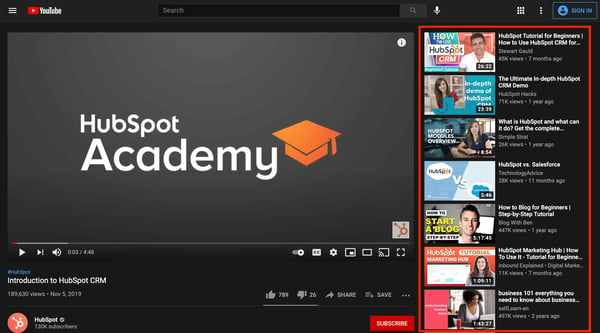
The algorithm recommends videos based on tags, so choose industry-relevant tags that your competitors are also using. When they match, you have a significant chance of showing up in suggested videos for the same tags.
YouTube also doesn’t discriminate by subscriber count, so even if you don’t have as many subscribers as your competitors, it’s still possible to be suggested after their videos.
4. Engage with subscribers in the ‘Community’ tab.
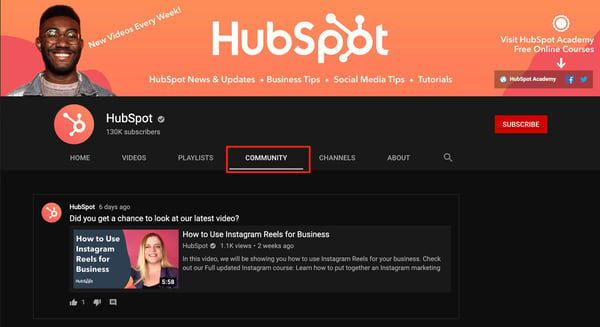
The Community tab is built for YouTube creators hoping to interact with their audience outside of their video comments. You can create polls, feature images, and generate hype for upcoming videos.
Post snippets to get subscribers excited about what’s to come, and they’ll likely be looking out for your video and ready to watch when it goes live.
If you’re interested in learning more in-depth strategies for growing your channel, check out this HubSpot Academy YouTube Course featured resource. You’ll learn how to build your brand, develop an audience, and gain insight from YouTube influencers on creating a successful channel.
Create Content That Inspires Subscribers and Encourages Views
You’re creating YouTube videos because you know you can provide value to your audience.
Remember, it may be frustrating if results aren’t immediately significant. But if you optimize your videos and channel for SEO, create consistent, relevant content, and engage with your audience, you’ll not only reach 1000 views but own a channel that just keeps on growing.

What is a Media Kit — and How to Make One [+ Examples]
Your competitor releases a new product or service. You offer something similar — but, of course, much better.
Then, suddenly, your competitor’s product is everywhere. News articles, online reviews, best-of lists, buyers’ guides, even TV segments.
How is this happening? And your real question: why isn’t it happening to you?
To compete against your competitors, there’s one thing you’ll need in your wheelhouse: a media kit.
Here, we’ll explore what a media kit is, and how it can help you increase brand awareness and, ultimately, sales.
Plus, how to make one for your own brand.

Media kits may live fully-online as responsive online press pages. Or, businesses may choose to make their press kits available as static, downloadable resources, like a presentation deck.
Whatever format you choose, this much is clear: businesses of all sizes benefit from having a professional, readily-accessible media kit. This vital resource is a key to the earned media coverage all businesses covet — from massive Fortune 500 corporations all the way down to individual influencers and solopreneurs.
A comprehensive media kit should include a description of the company or individual, contact information, social media statistics, case studies, information on partnerships and collaborations, and testimonials from past customers.
Basically, it’s all the information a journalist would need to feature your brand in a breaking news story — without the headache of a last-minute information request.
How to Make a Media Kit: What to Include
So, you want press coverage and partnerships (what brand doesn’t?). And you understand how a media kit helps make this all possible. But how do you make a media kit?
Here’s some good news: most of the content and creative assets you need to create your press kit likely already exist.
Key elements of a media kit include a bio or About Us page, social media statistics, case studies, partnerships and collaborations, and testimonials. To make it even easier for the press to cover your work, you’ll want to include high-quality brand identity images (think both logos, and other brand images or product/service images).
It’s up to you to (1) find this information, (2) make it look spectacular, and (3) make it painfully easy to find on your site. The rumors you’ve heard about journalists and how overworked they are? Entirely true.
To catch the attention of someone on tight deadlines with an internet full of story prospects, you’re going to want to make this simple. Most brands choose a direct page name like “Press” or “Media” –– or, if they’re really fancy, “Newsroom” –– and make it accessible directly from their homepage (often in the Footer).
Even if you prioritize a web version, having a downloadable media kit or deck is worth the time investment. Some media users might prefer the traditional form of this resource, and it gives you the best opportunity to control your pitch and tailor content to all audiences.
Biography or About Us
Let’s start with the star of your media kit: you. Here’s where you introduce your name, your logo, your mission. Make sure your media kit design reinforces your overall brand identity, utilizing the colors, fonts, and other visual hallmarks set out in your branding guide.
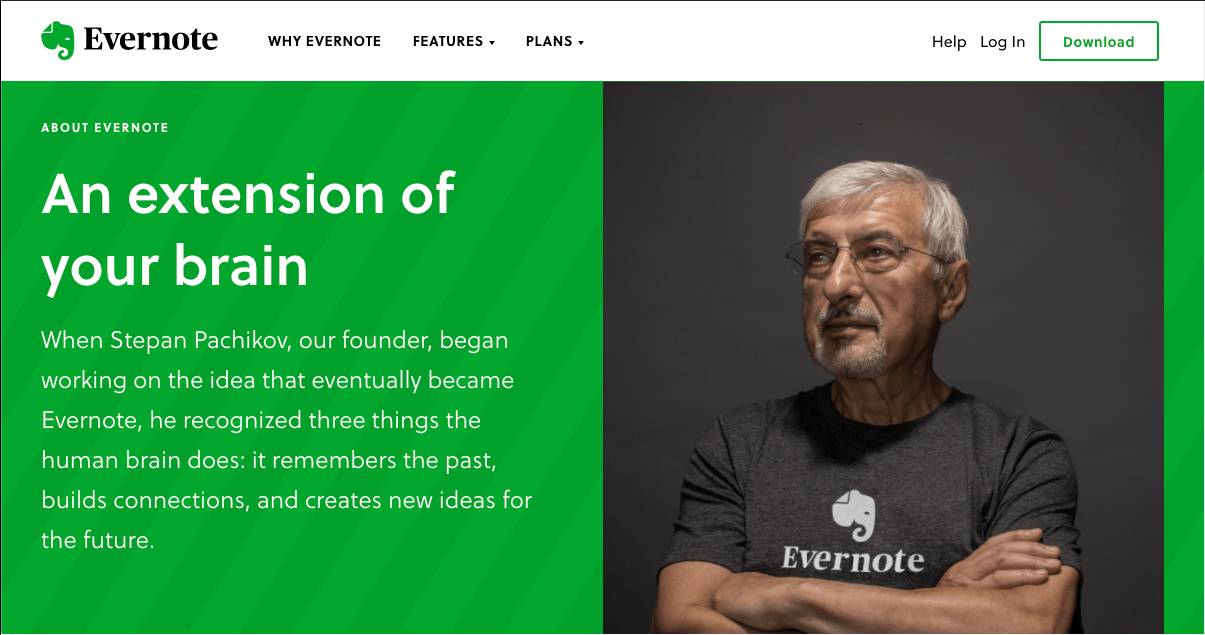
Evernote goes all-out in this section, housing their press kit information within the broader “About Us” portion of their website. All the essentials for journalists and partners are there too, but the organization’s values take center stage.
Social Statistics
For social stats, you’ll need to conduct a social media audit or collect this data from whoever manages your social channels. Remember your audience for the press kit: media and PR professionals.
Your media kit needs to effectively pitch your brand to people who specialize in getting people’s attention. So show them you’re capable of sparking conversation — and show them there’s already an audience eager for stories about you and your work.
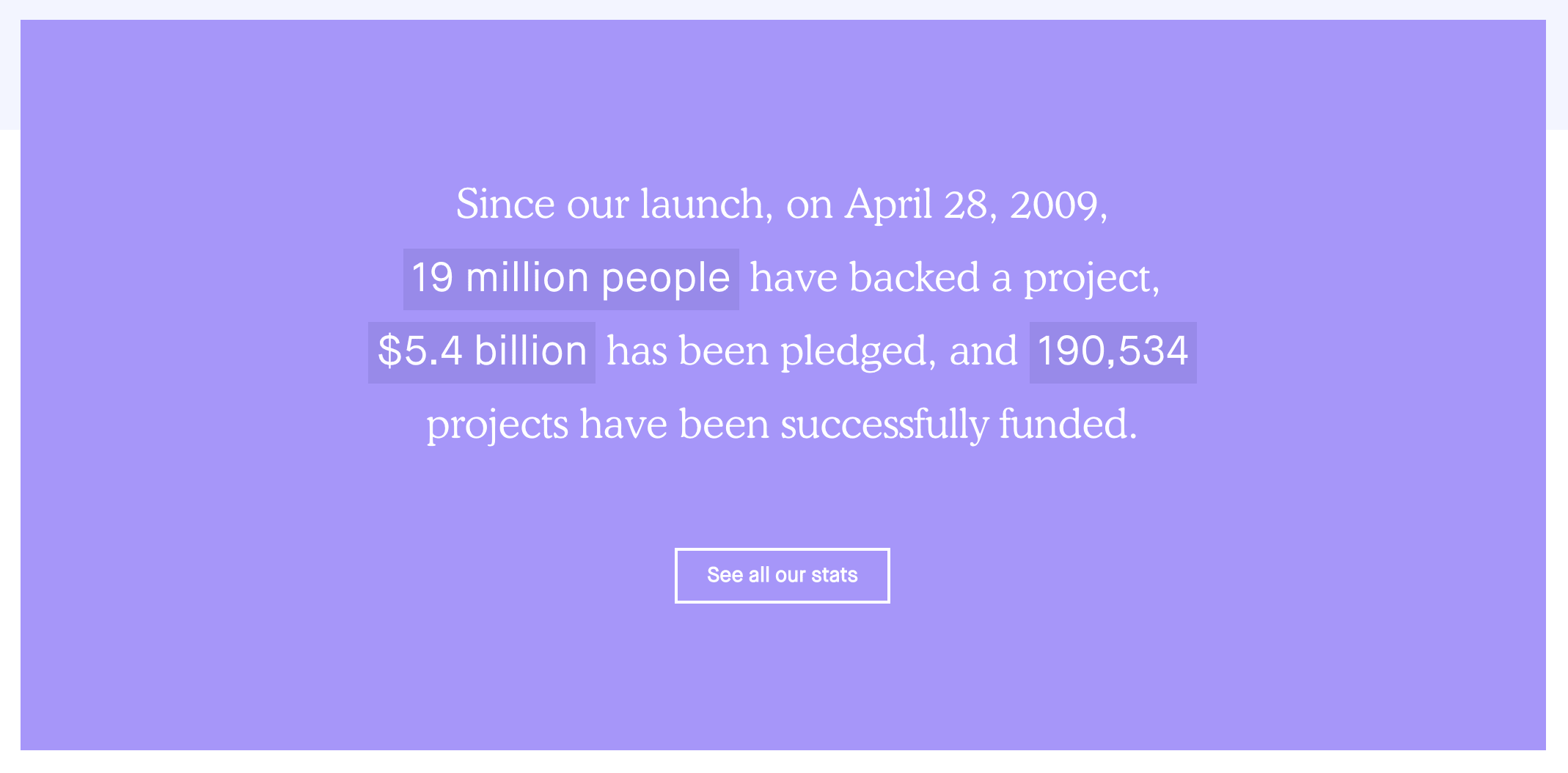
Kickstarter puts a unique stamp on this section of their media kit page, highlighting a few top metrics that show massive engagement with their service.
Media kits aimed at partnerships and collaborations should prioritize engagement rates and similar actionable metrics alongside the bread-and-butter statistics like follower counts. Savvy marketers want to partner with brands and influencers that move people to action.
[Note: If you are a HubSpot Social user, you can use Reports to analyze the performance of your social posts and determine how well your social media efforts are performing.]
Partnerships and Case Studies
This section is your chance to let past partnerships and brand collaborations speak for themselves. Let the old adage “show; don’t tell” be your guide here. Featuring the right partnerships –– either via logos or through short case studies –– is a subtle but powerful tool for positioning your brand.
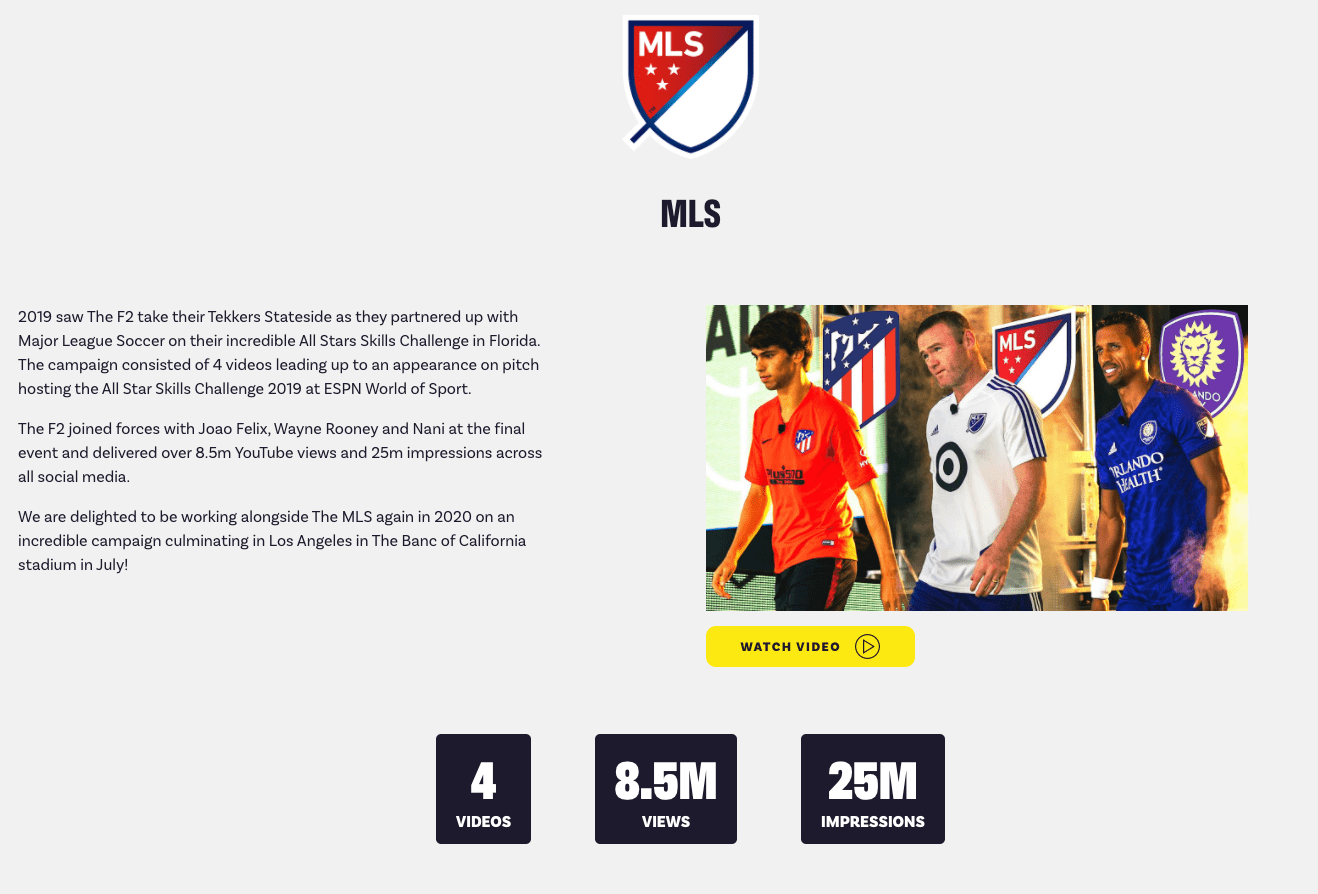
International football influencers The F2 highlight past campaigns, putting reputable brand names and logos front-and-center. They also note key engagement statistics for these campaigns
Testimonials
Testimonials are another great way to show media professionals the impact and effectiveness of your brand or product.
Keep this section succinct: just a single testimonial should suffice. Only a few lines of text (even just a single short quote) and a single related image gets the point across, lending your pitch greater credibility thanks to social validation.
Briogeo does a fantastic job highlighting testimonials on its Press & Buzz page, right below the rewards section for easy access: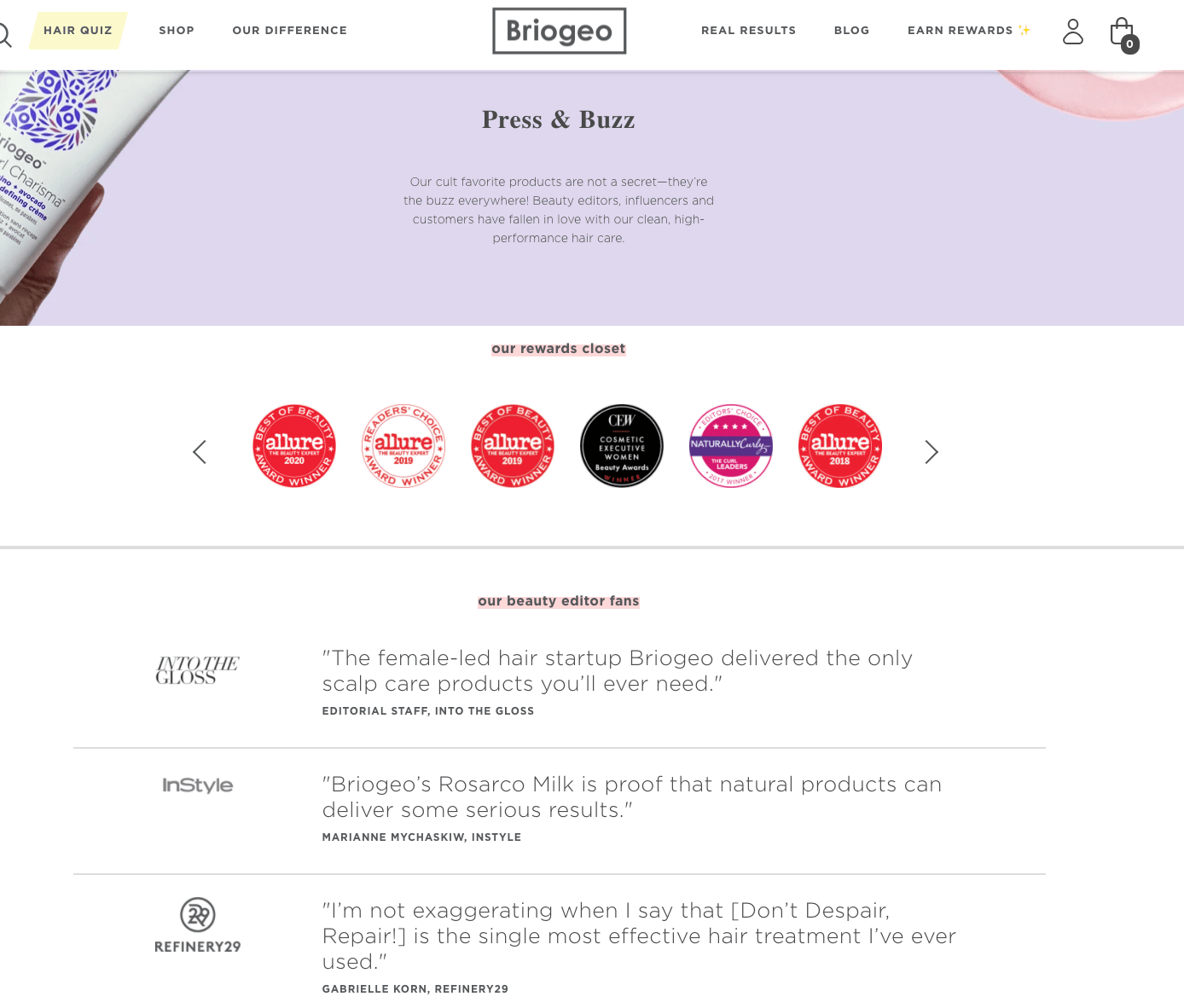
Visual Assets (Downloadables)
Your media kit isn’t a style guide, but it should pull in the most essential elements of your visual brand. Want your logo and that slick product screenshot to display correctly?
Provide exactly the images and files you want featured. Have a killer data visualization, infographic, or product video? Include that, too.
Journalists will especially appreciate portraits of your management team. They’re most likely to cover stories involving people, so show them the people they’ll want to write about.
Birchbox makes this easy. They highlight “Press Materials” and link to a short but comprehensive set of resources. Having everything in well-organized cloud folders is a nice touch –– especially for those browsing on mobile.
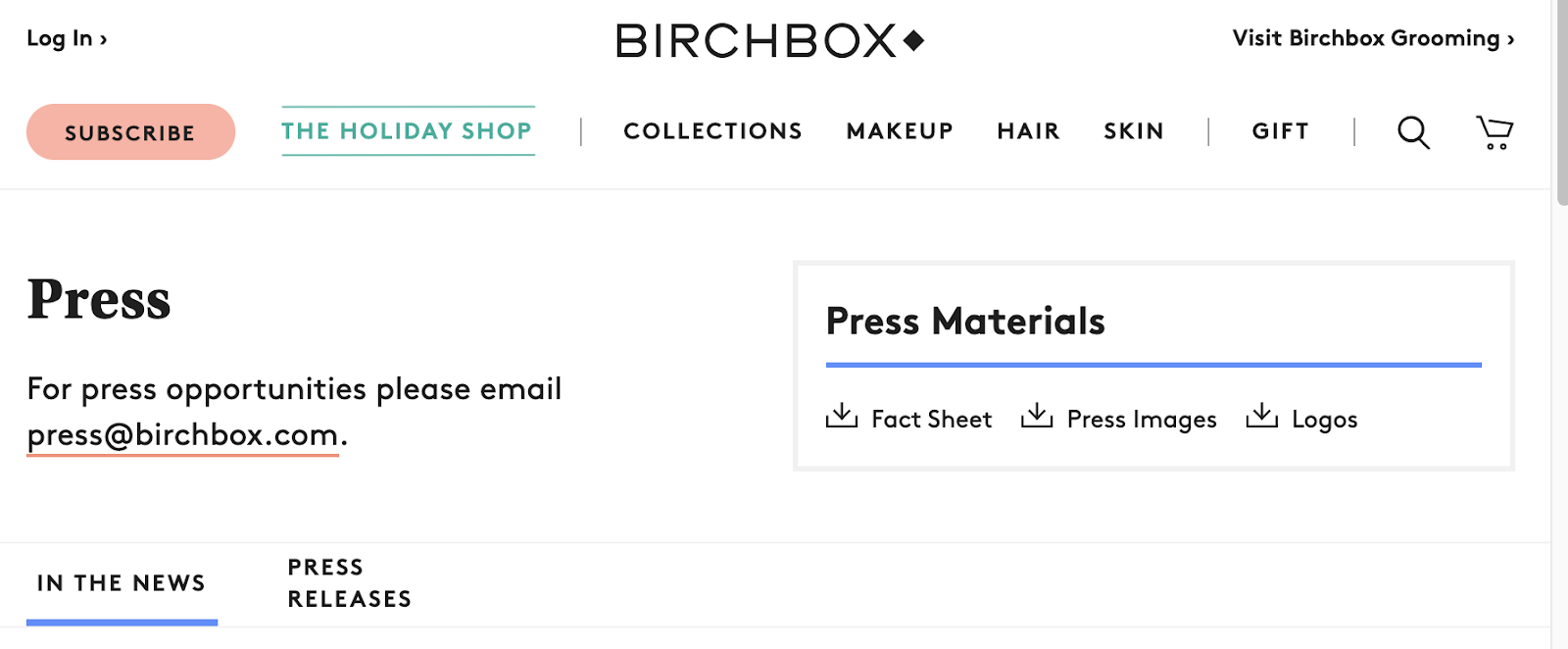


Without downloading or unzipping a large batch of images, visitors can quickly confirm you have visual assets to make their publication look good. Remember, the audience for your media kit is especially busy and juggling lots of competing priorities. Jump to the top of their “potential posts” pile by making their job as easy and painless as possible.
(Added bonus: your external media resources are easily updated –– sparing you anxiety about outdated media kits and image files misrepresenting your brand.)
Perhaps unsurprisingly, Instagram also really crushes it in this portion of their press resources. They even provide branded, editable templates for broadcast media use, making it easy for publishers to adhere to their iconic visual brand.
Now you know the what and the how of creating a media kit to garner beneficial coverage for your brand. Click here to download our free media kit template and get started.
And go ahead, give yourself a pat on the back when that Features story comes out. You won’t see your name on the byline, but we both know who the real hero is here.

What You Need To Know About Lead Conversion [With Expert Tips]
So, you’ve designed a lead generation strategy and it’s working. Your website visitors are coming to your website, filling out your forms, and boom, you’ve got leads. Now what?

That’s the question I ask myself after re-watching all nine seasons of The Office for the 19th time. But it’s also the question we, as marketers, have to answer when consumers have passed that first threshold.
Once your visitors have shown an interest in your brand, how do you turn them into customers? That process is called a lead conversion.
Let’s dive into how to build your brand’s lead conversion strategy and how to improve your current conversion rate.
A lead goes through several stages before becoming a customer. They start as a lead, then grow into a marketing-qualified lead (MQL), and then become a sales-qualified lead (SQL). This means brands have to nurture their leads at every stage and create opportunities for them to take action toward becoming customers.
How to Build a Lead Conversion Process
No two brands have the same process. Every brand builds its own conversion path tailored to its leads. Below, you’ll find a few strategies to help with your process.
1. Gather information on leads.
Start with the data you have on your leads: source, industry, company, employee size, pain points – any information that will help you build a strategy that aligns with your leads’ needs.
Remind me to trademark “leads’ needs” after writing this article. Now, back to the important stuff.
“You will waste a lot of time building out a conversion strategy that is not based around facts about your audience,” says Marwa Greaves, director of global messaging at HubSpot. “Ask yourself where your leads are. Are your leads most engaged in your newsletter? Your website? On messaging channels? Make sure you are meeting your audience where they are and not asking them to bend to your strategies.”
Jordan Pritikin, the head of email and growth marketing at HubSpot, also highlights another important element to consider.
“Understand why these leads are coming to your website in the first place. What is the underlying problem they are trying to solve?” says Pritikin. “If you can create email nurturing to help them solve that challenge, you’re much more likely to connect with them and convert them into a new customer.”
If you’re missing that information, work on obtaining it through forms and user research. From there, you can design a tailored conversion process.
2. Identify high-intent behaviors in each stage.
How do you know when a lead is ready to make a purchase? What behaviors will the lead exhibit? Having these answers is key to differentiating between leads who are ready to make a purchase and those who aren’t.
A lead who only reads your brand’s blog posts is likely not at the same purchase readiness as a lead who visits your pricing page. So, if you send an unqualified lead to the sales team, they will likely have a much harder time closing a sale.
How do you avoid that? Team up with your sales team to determine what signals low-intent and high-intent behaviors. Specifying those behaviors allows marketers to know what follow-up actions to take.
3. Use an SLA to align your sales and marketing teams.
A lead conversion strategy will struggle immensely without alignment between sales and marketing. One thing you’ll need to agree on is a handoff cadence that works for both teams. That’s where a service-level agreement (SLA) comes in.
It’s typically used to outline an agreement between a business and a customer. However, it’s also used internally between sales and marketing teams to better align their lead conversion strategy.
An internal SLA should include each team’s goals, initiatives, and accountability measures for a given time frame, say Q1. That said, this agreement will require regular updates as priorities change with the business.
4. Build the lead conversion path.
Think of your lead conversion path as a trail of breadcrumbs guiding your leads to purchase. The path itself will include offers and calls-to-action to offer opportunities to convert.
Lead Conversion Strategy Example
Let’s use Zion, a fictional UK SaaS company, as an example. Zion’s sales and marketing teams have collaborated on an SLA, which includes the following: Marketing commits to sending 100 qualified leads to the sales team every month and the sales team commits to following up with those leads within a week of receiving them.
Both teams have also identified high-intent behaviors that will trigger automated emails and have implemented a lead scoring system. For instance, when a lead reaches a score of 95, this will automatically trigger an email sequence inviting the lead to schedule a product demo with a sales rep.
On the back end, that sales rep will receive a notification, with information on the lead, their activity, and a timeline in which to follow up. If the lead does not take action within a certain time frame, an automated, personalized email on behalf of the sales rep will be sent to the lead.
This is an example of the path Zion can build to convert leads, both on the customer-facing end and on the back-end between sales and marketing.
How to Calculate Lead Conversion
Calculating your lead conversion rate is simple: Take your total number of conversions, divide that by your total number of leads and then multiply by 100. That final number is your LCR.
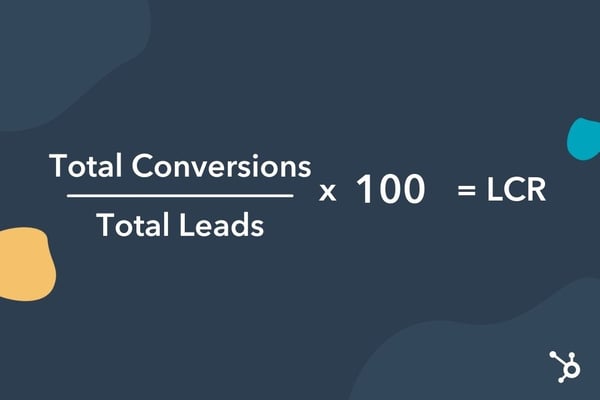
Example time: Let’s say from January to February, you generated 105 qualified leads. From those leads, 20 became customers. The formula will look like this: 20/105 x 100. This means the lead conversion rate for that month was 19.04%.
Average Lead Conversion Rates
Because lead conversion happens at several stages across various touchpoints, there is no single average that can be used across industries.
Your brand would benefit more from looking at conversion rates at a more granular level, such as by channel (i.e., email conversion versus landing page conversion) and/or by stage (i.e., MQL-to-SQL rate).
Lead Conversion Strategies
1. Implement behavior automation.
There are two reasons to use automation: it saves time and it scales well.
Let’s say a lead is sifting through testimonials on your website. That may indicate an interest in your product. With this in mind, why not automate a follow-up email that could bring the lead one step closer to a purchase? This could be a free trial offer or a product demo.
According to Pritikin, emails based on behavior perform much better than other types of automated emails. However, Greaves encourages brands to broaden their perspective when defining those behaviors that suggest purchase readiness.
“Activity-based triggers are an easy win for marketers, but think outside the box when creating them,” Greaves says. “It’s not just views on your pricing page that may require an automated follow-up, it could also be views of other customer stories or reviews on your site.”
Here is a list of behaviors that could benefit from automation. The lead:
- Reviews your pricing page
- Schedules a product demo
- Signs up for a free trial
- Engages often in email marketing
- Inquires about product features through chatbot, email, or other channels
- Downloads a high-intent content offer
Working with your sales team to recognize those key behaviors will be instrumental in automating follow-ups that convert.
2. Nurture your leads through email.
Email nurturing is the process of engaging your leads through email marketing with the end goal of turning them into customers. When nurturing leads via email, offering relevant and valuable information is key.
This is when the data piece becomes important. Using the information you’ve compiled on your leads, you can deliver content that piques their interest, aligns with their goals, and solves their challenges.
There are a few tips to make your emails stand out:
- Personalize your emails with the lead’s name.
- Use automation software to trigger actions based on email engagement.
- Segment your email list.
3. Leverage social proof.
When leads are considering your products or services, social proof can help nudge them toward a purchase. Examples of social proof include customer testimonials and reviews, which give leads a look into customers’ experiences with your brand.
They are best used when leads are in (or close to) the decision-making stage. So, you’ll often see them on landing pages and pricing pages.
User-generated content is another great use of social proof and can be incorporated into your social media and email marketing content.
4. Use lead scoring.
If you’re having trouble aligning your sales and marketing teams on MQLs and SQLs, lead scoring can help.
Lead scoring works by attributing points to actions taken by leads and helps marketers know where a lead falls in the funnel. It also helps sales reps prioritize leads and know which follow-up actions to take. It also ensures that both teams are qualifying leads in the same way.
A well-qualified lead means one that’s more likely to convert once they reach your sales team.
5. Retarget through PPC.
Retargeting is a great way to reach leads who have considered your brand before but weren’t quite ready to make a purchase. When you retarget them, you can re-introduce offers they may be interested in or present new ones that align better with their interests.
Retargeting is a proven method for lead generation. However, according to Greaves, it can also work well to turn leads into qualified leads. With the latest restrictions on cookies – commonly used for retargeting ads – brands will have to rely more on first-party data for their retargeting efforts.
How to Increase Lead Conversion
1. Start with the analytics.
If your lead conversion is low, your first step should be looking at your analytics. Specifically, your conversion path over a broad time frame to determine if the low rate has been consistent or is recent.
If it’s the latter, narrow down the period when the dip started and see what could have led to this change. If it’s been consistent, you may need to run various experiments with your conversion path.
Greaves recommends looking at your conversion CTA placements and the difference between them. You’ll want to look for the difference between high-performing and low-performing CTAs. If there are steep drop-offs on certain pages, that could indicate friction with your forms, like the length or the order of the fields, or even the type of information requested.
If the data shows that leads drop off shortly after the handoff to the sales team, it could be that marketing over-promised on what could be delivered.
With so many potential causes, start with the data to lead you in the right direction. Pun intended.
2. Redefine what is high-intent behavior.
Many brands may have lead qualification issues and not even know it. Marketing may be sending their sales team leads and later realize that those leads aren’t ready for sales engagement.
How do you identify the leads that are ready? It starts with gathering the right information. Reach out to your sales team to determine what information needs to be collected. Then, create a comprehensive list of high-intent behaviors and low-intent behaviors that the marketing team will use to segment leads.
This process can help pass on more qualified leads to the sales team and drive your conversion rate up.
3. Experiment with the conversion path.
Think of your lead conversion path as a house. I know you might be thinking, “Why not go with a road metaphor?” but stick with me for a second. Regardless of the condition in which you buy your house, there will always be room for improvement. Things to remove, fix, add, and revamp. And as your tastes change, so will your house’s look.
It’s the same with your path. There will always be room to improve your path. Besides, your leads’ interests, goals, and decision-making processes may change over time and require a different approach.
“Lead conversion requires a lot of experimentation. You will not succeed if you set one strategy and forget it,” Greaves says. “Creating an experimentation process that allows you to test every part of your flywheel will allow you to learn more about your leads and your own internal process than you would have before.”
Although the work is never fully done, every experiment you run will bring you that much closer to converting your leads.
3. Experiment with the conversion path.
When trying to scale your lead nurturing process, automation is the name of the game. Manually sending out personalized emails to your leads might have worked in the early days, but that will quickly get overwhelming as your business grows.
Automation allows you to maintain the same level of personalization at a quarter of the time and resources. Once you’ve set up your conversion path, automate the follow-ups that will be triggered when leads exhibit certain behaviors.
These tactics can not only save your team time but also streamline the conversion process so that no lead falls through the cracks. This practice also leaves room for your sales and marketing team to focus on big-ticket items.
The key takeaway here is that lead conversion isn’t a one-and-done process. It calls for strategy, cross-team collaboration, and a whole lot of experimentation.

How to Create a Communication Strategy [+ Free Templates]
There are certain characteristics that should be at the core of any successful business. For instance, every business should have a great product or service, awesome employees to keep the internal engine running, and loyal customers who support through purchases and advocacy.
There also has to be underlying elements to help establish the aforementioned characteristics. And one of the most necessary is clear and effective communication.
Communication is at the root of every interaction for businesses. Without transparent communication at every level, there’s more room for error, and — depending on the magnitude of the error — it can make or break a business.
But, while 89% of people feel communication is extremely important for work, 8 out of 10 people rate their own business’ communication as either average or poor.
Developing a communication strategy for your business will help you understand how your company best communicates, internally and externally, and can give you measurable results to better understand the efficacy of your communication tactics.
In this post, we’ll explain how to create a communication strategy and plan for your business to ensure efficient, cohesive communication with colleagues and customers alike.
What is a communication strategy?
A communication strategy is a process developed by the appropriate stakeholders to identify where communication efforts need to be improved. The next step in this process is to ideate and select measurable actions that will be used to develop a communication plan to achieve your desired outcome.
1. Use a communication plan template.
HubSpot’s Communication Plan Templates are a great resource to help you develop actionable steps without having to spend too much of your time on this task.
Your communication plan will clearly go through all of the steps you need to take to address the challenges you’re up against — like completing an audit, setting SMART goals, and understanding how long each step in your plan will take. Depending on your overall strategy, you may develop multiple plans to be carried out to meet the needs of different audiences.
You’ll want to break your plan into steps so you can easily make and measure progress on a daily, weekly, or monthly basis. Additionally, as you’re creating your communications plan, you’ll need to factor in a working timeline, potential budget, and ensure you’re delegating tasks to the appropriate team members.
Over time, you want to be able to reflect on what changes have been made and if these changes are actively contributing to helping you achieve your ideal results.
Download HubSpot’s Crisis Management & Communication Kit today!
2. Determine current and potential problems.
Identifying the problems hindering your company’s communication efforts is the first, and most important, step of developing a solid communication strategy.
Start by asking questions like:
- Are we experiencing communication problems internally or externally?
- If externally, is this across all channels of customer communication, or a specific team or department?
- If internally, is this a company-wide issue, or specific team or department?
- Is there a specific issue that arises consistently? If so, what is that issue?
- What are the problems that aren’t consistent, but still present challenges?
Ideally, the more questions you ask, the more you’ll be able to clearly identify areas for improvement that will influence your overall strategy. If you’re struggling to come up with questions, reach out to team members within your company, and/or your customers.
You can issue surveys, start organic conversations in the office or via social media, schedule one-on-ones — whatever you feel will get the most relevant answers.
When there are issues that directly impact company employees or customers, people are more willing to provide feedback. It’s also possible that someone may already be working to find a solution to some of the problems you’ll identify — which brings us to our next step.
3. Select key stakeholders who need to be involved.
Now that you’ve asked the right questions, you need to make sure that you involve the right people to help you carry out building your communication strategy.
If you’re at a smaller organization, it’s possible that you may be the only person you need on your team. However, for larger organizations, you’ll most likely want to include a few of your co-workers to help you divide and conquer.
Selecting which individuals should be involved should directly relate to the biggest challenges you identified from your list of questions. If the most pressing challenge is customer-related, you may want to include someone from your organization’s customer service or customer success team. If there’s an issue about how a product or service is being advertised or sold, include a representative from your marketing or sales team.
You’ll also want to make sure that appropriate leadership team members are aware and as involved as they need to be. This way, if you end up wanting to make any major company changes like purchasing a new tool or restructuring teams, leadership will already be aware of what’s happening.
If your coworkers are maxed out and don’t have the bandwidth to assist you, or the problems are more significant than expected, you may want to source an external agency or a consultant to assist your company. For instance, if you’re addressing a major external communications crisis, you may consider contracting a PR agency.
Overall, use your best judgment to select who will be involved and make sure they’re involvement ties directly into the specific challenges you’ve identified.
4. Understand your audience.
Understanding your audience is fairly simple. The audience is either internal (meaning your coworkers, and the company as a whole), external (meaning your customers, shareholders, etc.), or a combination of both.
From there you can get more specific:
- Are you addressing the entire company?
- Are you addressing a certain department or team?
- Are you addressing all customers?
- Are you only addressing certain customers? If so, can you segment by buyer persona or stages of the buyer’s journey?
It’s important to take the time to thoroughly understand who your audience is so you’re truly speaking to them in a way that will be well-received. Once you know who your audience is, you’ll be able to use audience insights to inform all stages of development for your communication strategy.
5. Brainstorm your ideal results, and then work backwards.
This is when you use all of the information that you’ve gathered to propose what your ideal outcome will be. This is a high-level goal that will be achieved through the implementation of a well thought-out plan.
If your business has struggled with communication regarding events, an ideal result could be improving internal alignment and providing clarity for customers.
Alternatively, if you find that employees at your company feel it’s difficult to voice their ideas or opinions, your goal might be ensuring all employees feel heard by developing a specific feedback system.
Whatever you specify as your ideal result, keep it simplified so it can be easily understood by anyone. It should carry weight because you’re addressing challenges, but it shouldn’t be too complex, either. Think of it as the central mission or vision statement of your communication strategy. The details will come after.
Developing an effective strategy is a process and may take a few different tries before you figure out what works best. However, it’s a necessary investment to ensure you’re clearly communicating the best way possible.
Check out How to Write an Effective Communications Plan [+ Template] and download HubSpot’s Free Communication Template to start achieving all of your communication strategy goals.

7 Types of Corporate Events [+ Virtual Event Ideas]
One of my favorite episodes of “The Office” is called Launch Party. During this episode, Dunder Mifflin hosts a corporate party, plus several satellite parties when its website launches. Hilarity ensues.
But during your corporate event, you probably don’t want to kidnap the pizza delivery person, and you might want to spell launch correctly on the sign.
As a business, you probably have several corporate events on the horizon, whether it’s a team-building event or a seminar.
In this post, we’ll learn about the different types of corporate events, plus give your party planning committee a few virtual event ideas.

Now, let’s dive into the different types of corporate events.
1. Seminars
A seminar is an event that’s focused on educating people, whether it’s your customers or employees. It’s similar to a conference or a workshop.
A seminar is usually a short event, while a conference might be a several-day event with multiple speakers. On the other hand, a workshop is usually a small, intimate event with only a few registrants.
You might consider hosting a seminar as a way to get leads and introduce people to your company.
2. Retreats
A retreat can be held to simply bond with your team, or you can sell tickets to customers. This is usually a several-day event with several workshops or seminars to attend.
Sometimes the purpose is just to relax, but other times it’s to learn, strategize, and plan for the future.
3. Team Building
Team building events are meant to boost team morale, and help people learn how to work together. Usually, these are collaborative events, where teams need to work together to solve something. It could be a ropes course, or perhaps an escape room.
Sometimes these events can even be formal if you’d prefer. For example, you could run a workshop about psychological safety or sensitivity training.
4. Milestones
Has your company just hit a revenue goal? Or perhaps you have a major anniversary coming up? Either way, it’s nice to celebrate with a corporate event.
These are similar to appreciation events (more on these below), where you can thank your team for achieving the milestone.
5. Launch Party
A launch party is when you throw a corporate event for the launch of something: your company, a product, a website (like “The Office”), etc.
These are celebratory events that are usually meant to create buzz around the release of something. Think Apple’s big product launch announcements.
6. Fundraising
A fundraising event is meant to raise money for charity, usually. Or sometimes it’s to help raise money for your company. These are usually concerts, golf tournaments, dinners, or festivals.
7. Appreciation Events
An appreciation event is meant to thank your customers, partners, or employees. These are usually fun events, such as holiday parties, private concerts, or a special dinner.
The goal is to spend informal time showing people how much you appreciate and care about the value they bring to your company.
1. Virtual MasterChef Team Building Event
A great corporate team building event is to host a virtual MasterChef. To do this, you can have one person host and send out a list of ingredients (or modified ingredients for dietary restrictions) and supplies.
On the night that you host the event, everyone will dial into Zoom and cook the same meal as the host walks them through the recipe.
When everyone is done cooking, you can have a virtual dinner party together. This is a great informal team-building event for your team to hang out and get to know each other.
2. Airbnb Online Experience Appreciation Event
One of my favorite virtual corporate events that I’ve researched is the Airbnb Experiences. On Airbnb, hosts put on virtual events that you can book for your team.
This is a great appreciation event idea for any team, customer, or partner. There are scavenger hunts, drag shows, and even remote escape rooms.
3. Mystery Dinner Partner Event
Mystery dinners are a fun way to treat your partners. You can have partners sign up to be a part of mystery dinners. Every month, you can select a partner randomly, and then host those partners to a mystery dinner party.
This could even be virtual if need be, and it’s a great way to show appreciation for your partners and to get to know them.
4. Professional Development Workshop
The classic corporate event is a professional development workshop. You can find workshops like the Disney Institute and have your team learn something from the experts. This shows appreciation, but also is a great learning opportunity.
5. Splash Webinar
If you need software to host a virtual corporate event, then Splash is a great product for you. Let’s say you want to host a webinar? You can do so on Splash. This helps with the registration process, invitations, virtual waiting rooms, and even post-event content. Everything you need for a corporate webinar is on this software.
Hosting a corporate event is a great way to boost morale, get to know your team, show appreciation, and even develop your company. Plus, hosting virtual events has never been easier.

What’s Attention Marketing, & Should You Use It?
Did you know that the cost of acquiring consumer attention has increased dramatically (seven- to nine-fold) in the past two decades?
It might not be surprising to hear, but overall our collective attention span has been narrowing.
You might be wondering, “What does this mean for marketers?”
As marketers, it’s our job to attract people to our brand. We need to deliver almost magnetic-like messaging to grab our audience’s attention. But when you only have seconds to do this, it might seem like an insurmountable task (hint: it’s not, we have some ideas).
In this post, let’s review what attention marketing is and how you can use it to grab your audience’s attention.

The term attention marketing was coined by Steve Jelley and popularized by Seth Godin, as a way to describe a business model that focuses on capturing users’ attention through non-invasive content rather than interrupting users’ attention with something like a pop-up ad. With attention marketing, once you have your audience’s attention, you can then engage with and convince them to purchase your product or service when the opportunity presents itself.
Before this concept was introduced, around the beginning of social media, the marketing landscape looked a lot different. Brands would usually market themselves on a massive scale, using TV ads, billboards, or radio spots. This means that they weren’t able to target individuals, but instead had to focus on appealing to a broader audience.
With social media, brands can now figure out what interests individual customers and then market to them individually. Ultimately, it’s important to consider using attention marketing because you want your marketing assets to engage customers and pull them in.
Marketing Attention Span
Now that you’re thinking about capturing your audience’s attention instead of interrupting it, let’s focus on some logistics. To start, you don’t have as much time as you think.
Years ago, Microsoft reported that the average person’s attention span was 8 seconds. A more recent study shows that our collective attention span is narrowing.
Essentially, you only have seconds to capture your audience’s attention before they continue scrolling or click through to something else.
So, how should you capture your audience’s attention? Let’s go over some ideas below.
Marketing Attention Grabbers
1. Be platform-specific.
A great way to grab your audience’s attention is for your content to show up natively in your audience’s feed (if we’re talking social media).
For example, if your video shows up as recommended on YouTube and they click the video and it’s clearly in sync with what your title was and what they were expecting, then you’ll probably be able to keep them watching.
But, if they click through and the content is a photo montage instead of a video (a vast difference from what they might expect), then you might lose them.
In that same vein, when brands repost content from Instagram on Twitter, instead of making a separate Twitter post, people are less likely to click on the link than if they were to see the post right on Twitter.
An important thing to remember here is that some users are on mobile and some on desktop. Think about how you can design your website or content for those platforms specifically, so it’s easier for the consumer to interact with your content.
2. Write super clear messaging.
When people can immediately tell what your value proposition is, it will hold their attention longer. It might seem simple, but review your marketing assets and ask yourself, “Is my value proposition clear for my audience? Can they tell within seconds the value we can provide?”
If so, that will hold people’s attention longer because if they clearly see the value in what you offer, then they’ll want to look further into your brand. Your messaging should be clear, concise, and written specifically for your target audience.
3. Use integrated media.
Integrated media, or a multichannel and multimedia approach to marketing, will help grab your audience’s attention.
This means that you use several forms of media, including video, images, podcasting, GIFs, memes, etc. Different types of media on different platforms will help you figure out what your audience likes and dislikes.
Your overall marketing strategy should also include interactive media as well. In fact, 81 percent of marketers say that interactive content is more effective than static content when it comes to grabbing consumers’ attention.
Ultimately, it’s important to play around with your media content — both the type of assets you create and the channels that you use to distribute it.
4. Tell a story.
People love a story. They love watching TV, reading books, or listening to a podcast. If you can capture your audience with a good story, then it’ll be easier to market to them.
To do this, you can start off your videos, blogs, or Facebook ads, with a storytelling hook. Once you’ve got your audience’s attention, then you can proceed to engage and delight them.
5. Consider emotional marketing.
Have you ever heard of emotional marketing?
This is the concept that your marketing assets should primarily use emotion to grab your audience’s attention. By tapping into a singular emotion, your audience will naturally have a response to your content. And isn’t the goal to get your audience to respond in some way?
6. Don’t forget about co-marketing.
Co-marketing is when you use brand partnerships and collaborations to grow your audience. It’s the process of working with another brand and sharing expertise and value with each other’s audiences.
In that same vein, you can also work with influencers. 51% of marketers believe that they can acquire better customers with influencer marketing.
By using influencers, or working with other brands, you can tap into their audience — which is usually large and engaged — to market your product or service and grab your audience’s attention.
7. Have a good website.
One of your greatest marketing assets is your website. It should be engaging, have a great user interface, and be built with user experience in mind.
If your homepage on your website can grab your audience’s attention within seconds, then you’ve done it right.
Attention marketing isn’t just about creating viral content like the name might imply. It’s about truly creating content that will grab your audience’s attention and keep it in the long run.