
How to Monetize Your Brand’s Blog, According to HubSpot’s Blog Leaders
Whether you’re running a personal blog or managing the official blog on your company’s website, monetizing your work is entirely possible — it just takes a good amount of time and effort.
While there’s no exact formula to start making money, there are some tried and true strategies you can start experimenting with to see what works best for your content, your business model, and your audience.
Below, we’ll dive into some of these monetization ideas and get advice from HubSpot’s own blog leaders.
How Do Blogs Make Money?
Before we dive into the monetization strategies, you might be wondering, “How will my blog make money?” Well, your blog can make money in several ways including lead generation, affiliate marketing, brand partnerships, collaborations, or advertising. To find out more, you can learn about the types of blogs that make money and see which strategy would work best for your blog.
Now that we know a few ways that blogs can make money, let’s dive into the top monetization strategies for your blog.
1. Map blog posts to specific conversion points.
As a company, you can use your blog to drive leads and conversions.
AJ Beltis, a marketing manager on HubSpot’s channel monetization team, says, “Conversion is the foundation of blog monetization. Whether it’s an ecommerce purchase, a demo request, or a content offer download, it’s imperative to have your blog posts point to an intentional, related next step in the buyer’s journey.”
So, you might be asking yourself, “How can I do that?”
Beltis’ advice is to ask yourself what somebody reading this specific blog post would want or need from your company. Then, you should create the assets you’ll need to make that conversion happen in the form of website pages, forms, or content. After that, you’ll naturally place your calls-to-action to that next step in the blog post so readers are reminded about what your recommended next step is.
“By placing these CTAs in appropriate sections of the blog, you’re more likely to capture the attention of readers with high intent. This process puts more readers on the path to become paying customers for your business,” Beltis adds.
2. Include information about your product or service in your blog posts — but do so sparingly, and thoughtfully.
When you’re writing blog posts, it’s important that each post isn’t just a sales tactic. Your blog posts should provide educational content that anyone could benefit from, not just your customers.
However, that doesn’t mean you shouldn’t ever mention your product or service.
According to Caroline Forsey, the editor of the HubSpot Marketing Blog, “If you’re writing content about the best tools for X, and your product or service is a good solution to that user’s search query, I’d highly recommend including it in your total roundup of tools to increase exposure and, ideally, drive more leads and customers towards your product. This is one of the most effective ways to monetize your blog for the long-term, particularly since that same piece of content might provide your business with leads 3-5 years into the future.”
Again, this doesn’t mean you should always and only promote your own product or service.
Forsey adds, “You risk damaging your blog’s reputation if you do this too often, or outside of the appropriate context. Readers don’t want to see a random ‘buy my product!’ CTA in a piece of content irrelevant to your product — and, if they feel like your content is actually just a gimmick or hidden advertisement, they’ll distrust your brand as a whole.”
To avoid this, Forsey suggests only mentioning your product or service where it makes sense, and in a list of other tools you’d suggest for businesses so they feel you’re arming them with useful information so they can make their own decision best-suited for their needs.
“Trust me: if readers enjoy reading your content and feel your brand is genuinely helpful, they’ll give your product or service a second look,” she says.
3. Build a lead funnel for your product.
If you work at a B2B company or have a long sales cycle, reading a blog post is usually a customer’s first and furthest interaction from their actual purchase. But it’s also arguably the most important stage of the inbound funnel. Attracting your audience’s attention with helpful, educational, or entertaining content creates a larger pool of people to convert into leads and close as customers. In other words, your blog marks the start of a relationship with your customers.
Lestraundra Alfred, the manager editor of the HubSpot Sales Blog, says, “If you’re looking to gain exposure from your blog, your content should help bridge the gap between the problem the reader is trying to solve and your product, which can serve as a solution. By creating content that your ideal customer is searching for and interested in, you can build a solid community of readers who are a great fit for your product, and when nurtured, can turn into customers for your business.”
Ideally, you’ll want to craft compelling blog content that your audience can discover easily through a Google search or social media. You can also pay to amplify your distribution on Facebook, which has the best targeting tools out of all the social media sites and is cost effective, or through paid search, which can thrust you to the top of a high-volume Google SERP, although some keywords are expensive.
After people start reading your blog content more, and want to read it on consistent basis, they’ll sign up for your blog’s email subscription. Once strangers to your brand, they’re now regular visitors.
When these visitors read enough blog posts, you can entice them to download conversion offers like Beltis mentioned above. Then, you can then nurture qualified leads with more blog posts and lead generators through email or Facebook ads. Consistently educating them and helping them solve their problems will build their trust, making it more likely they’ll move to the middle of your funnel when they’re ready. And once you see them researching your product or service by reading case studies, requesting a demo, or trying to contact sales, you can move them to the bottom of the funnel, where sales will qualify their fit as a customer.
Sales will close some of these leads into customers, and they’ll be thanking you when they do. Your blog introduced their customers to your brand.
4. Offer sponsored content opportunities to other brands.
Publishers like BuzzFeed and The Dodo produce content that floods social media every day. And they make money by helping other brands do it too.
Brands will collaborate with their video production, social media, and analytics teams to craft posts and videos that follow their formula for virality. Publishers also distribute this sponsored content to their massive social media and website followings. This content is similar to the publishers’ native content, so their audience will enjoy reading it, exposing their clients to a huge, engaged, and new viewership and boosting their followings and audience engagement.
If your blog generates a significant amount of traffic, you can leverage your editorial expertise and audience reach to help smaller brands tell captivating stories to a bigger and better viewership.
Doing sponsored content right can pay huge dividends for your brand. Not only does it create another revenue stream, but partnering with other marketing minds can help your team unleash unprecedented amounts of creativity. In fact, T Brand Studio, the New York Times native ad business, crafted paid posts that captured as much engagement as some of nytimes.com’s highest-performing articles.
5. Provide coaching services.
Your blog posts can serve as a teaser for how much your readers can learn from you about a certain subject matter. Because if you write about enhancing certain skills like selling, social savviness, sports, cooking, and music, your blog posts can only teach your readers so much. They need to practice these skills in real life to see substantial improvement.
But if your readers practice these skills on their own, they’ll only get so much better. If they really want to improve, training with a coach will guide them toward success faster than anything else. Think about it. What would improve your basketball skills the most? Reading Michael Jordan’s book about shooting and practicing his tips by yourself? Or reading his book and then taking shooting lessons with him?
If you’re running a personal brand, as a coach, your blog is your most important marketing asset. It helps your potential clients improve themselves while giving them a glimpse into what life would be like if they actually achieved one of their life-long goals. Your blog inspires readers to strive for their dreams. And when they’re more motivated to reach their potential, they’ll usually want an expert directing them toward greatness, not just themselves.
6. Market your freelance writing skills.
If you’re a freelance blogger, you need to show potential clients that you can write compelling content. To do this, you could try to attract their attention with your previous work, but you usually don’t have control over those topics. So what if they don’t pique their interest?
The best way to show potential clients you can write compelling content is by engaging them with your own content. When you start a blog, you have access to your post’s performance metrics and complete control over the topics you cover. This allows you to write content that you know your target audience will devour, attracting more and more potential clients to your blog. And once they realize they rely on you for content marketing advice, they’ll know they can trust you to help them improve their own content marketing.
For instance, Eddie Shleyner, a freelance copywriter and content marketer, markets his business called VeryGoodCopy by writing articles about copywriting, content marketing, and psychology. His articles are so engaging and insightful that organizations like The North Face, Geico, and Mercedes Benz hire him to write articles, eBooks, landing pages, website copy, and email campaigns.
7. Participate in affiliate marketing.
Affiliate marketing is one of the best ways to monetize a blog when you don’t sell a product or service. It’s a relatively simple process too. You’ll partner with an ecommerce platform or businesses that have affiliate programs and pick out relevant products to promote on your blog. Your partners will then send you custom links to their product pages that can track customers referred by your blog. And if someone clicks on the link and buys the product, you’ll earn a commission.
One of the most popular affiliate marketing programs is Amazon Associates. You can choose from over one million of Amazon’s ecommerce products to advertise on your blog, and you can earn up to 10% in commission.
Out of all the ways you can make money blogging, affiliate marketing requires the least amount of time, money, and resources. You don’t have to build, market, or sell a product or service and inserting affiliate links in your blog posts doesn’t cost any money. All you have to do is wait for people to click on them and buy something.
Start Making Money with Your Blog
Choosing your monetization strategy will depend on the type of blog you’re running and the type of product or service you offer. To up-level your blog, learn how to set yourself up for success and avoid the top blogging mistakes.
Editor’s note: This post was originally published in March 2018 and has been updated for comprehensiveness.

16 of the Best Professional Bio Examples We’ve Ever Seen [+ Bio Templates]
Does your professional bio make a statement?
In this article, we have great professional bio examples you should compare yours to — and a series of free bio templates you can use to make it perfect.
If you’re anything like me, you probably don’t think about your professional bio until you’re suddenly asked to “shoot one over via email.” You have approximately one afternoon to come up with it, and that’s when you scramble, and the bio ends up reading like this:
Rodney Erickson is a content marketing professional at HubSpot, an inbound marketing and sales platform that helps companies attract visitors, convert leads, and close customers. Previously, Rodney worked as a marketing manager for a tech software startup. He graduated with honors from Columbia University with a dual degree in Business Administration and Creative Writing.”
Woof, that was dull. Are you still with me? I swear, not even adding a tidbit about his cats would liven that bio up.
To be fair, in certain contexts, your professional bio does need to be more formal, like Mr. Erickson’s up there. But in many cases, writing a readable bio — even conversational — is a really good thing. That means dropping that traditional format of listing your accomplishments like a robot and cramming as much professional-sounding jargon in there as you can.
How to Write a Bio
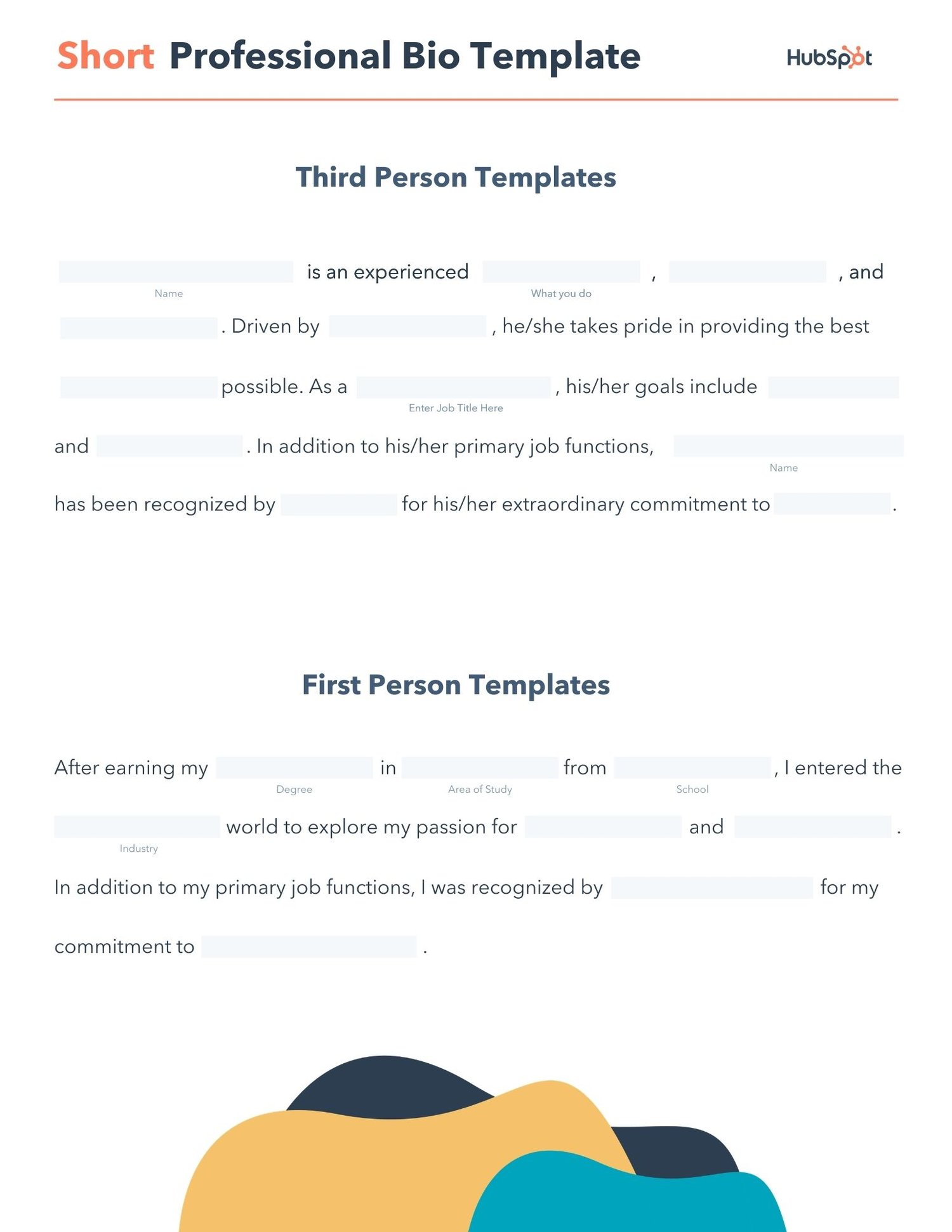
Download a free, editable short professional bio template.
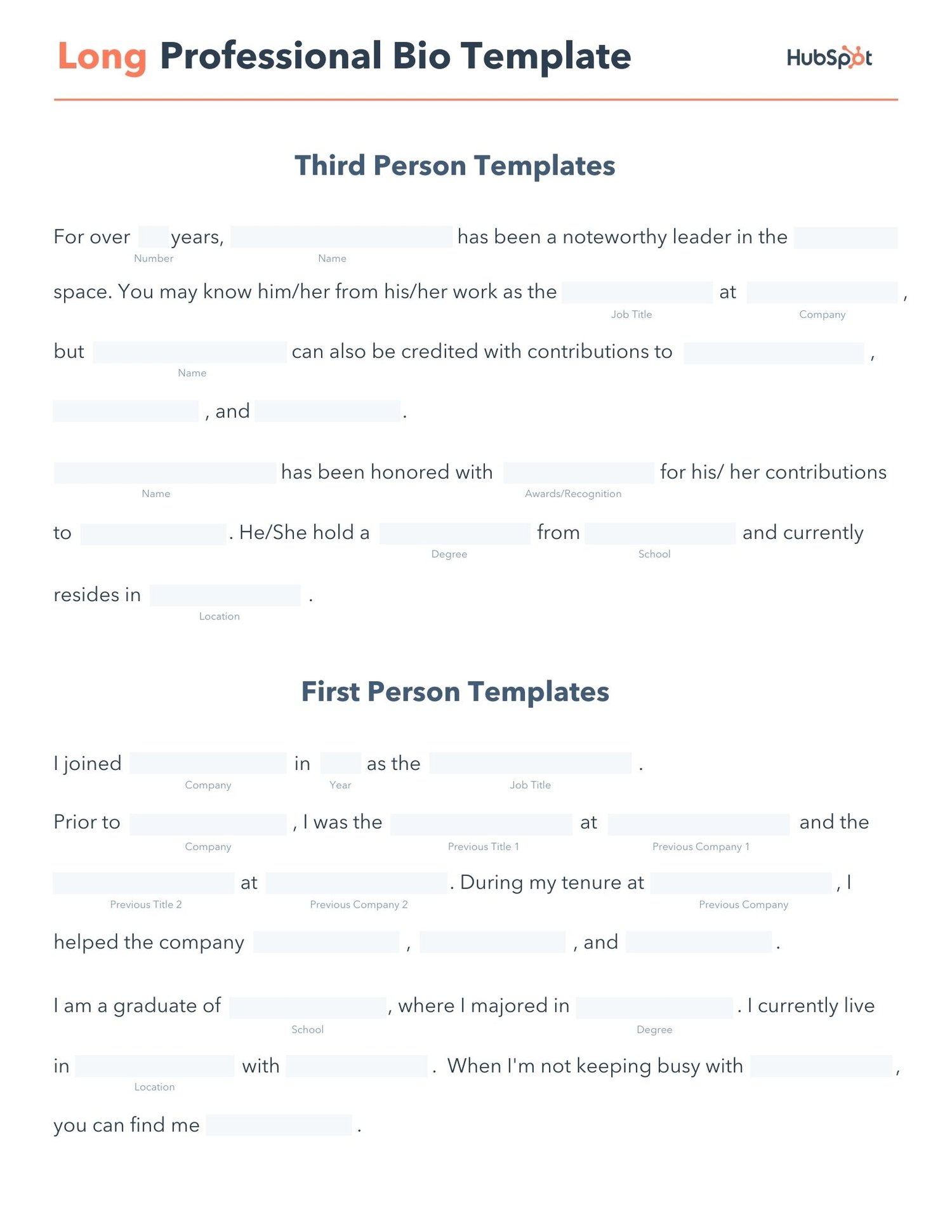
Download a free, editable long professional bio template.
Writing a professional bio that captures your brand and what you offer to your audience can help you grow better. But doing it right is just as important. Here’s how to write a bio, step-by-step.
1. Create an ‘About’ page for your website or profile.
Before you can publish your professional bio, you need a living space for it. Here are a few to consider (some of these you might already have in place):
- Facebook Business page
- LinkedIn profile
- Instagram account
- Personal website
- Personal blog
- Industry website
- Industry blog byline
As you’ll see in the professional bio examples below, the length and tone of your bio will differ depending on which of the above platforms you choose to be on. Instagram, for example, allows only 150 characters of bio space, whereas you can write virtually as much as you want on your personal website — or even your Facebook Business page. But once created, this bio should represent who you are in the eyes of your audience.
2. Begin writing your bio with your first and last name.
If your readers don’t remember anything else about your bio, make sure they remember your name. For that reason, it’s a good idea for your first and last name to be the first two words of your professional bio. Even if your name is printed above this bio (hint: it should), this is a rare moment where it’s okay to be redundant.
For example, if I were writing my own bio, I might start it like this:
Lindsay Kolowich
Lindsay Kolowich is a Senior Marketing Manager at HubSpot.
3. Mention any associated brand name you might use.
Will your professional bio represent yourself, or a business you work for? Make sure the brand you want to be associated with is mentioned in your bio. If you’re a freelancer, perhaps you have a personal business name or pseudonym you advertise to your clients. Here are a few examples:
- Lindsay Kolowich Marketing
- SEO Lindsay
- Kolowich Consulting
- Content by Kolowich (what do you think … too cheesy?)
Maybe you founded your own company, and you want its name to be separate from your real name. Don’t be afraid to keep it simple: “Lindsay Kolowich is the founder and CEO of Kolowich Consulting.”
4. State your current position and what you do.
Whether you’re the author of a novel or a mid-level specialist, use the next few lines of your bio to describe what you do in that position. Don’t assume your audience will naturally know what your job title entails. Make your primary responsibilities known to the reader, helping them paint a picture of who you are during the day and what you have to offer the industry.
5. Include at least one professional accomplishment.
Just as a business touts its client successes in the form of case studies, your professional bio should let your own audience know what you’ve already achieved. What have you done for yourself — as well as for others — that makes you a valuable player in your industry?
6. Describe your values and how they inform your career.
Why do you do what you do? What might make your contribution to the market different than your colleagues? Better yet, what values do you and your colleagues share that would make your business a worthwhile investment to others? Start to wrap up your professional bio by simply explaining what gets you up in the morning.
7. Briefly tell your readers who you are outside of work.
Transition from describing your values in work to describing who you are outside of work. This may include:
- Your family
- Your hometown
- Sports you play
- Hobbies and interests
- Favorite music and travel destinations
- Side hustles you’re working on
People like connecting with other people. The more transparent you are about who you are personally, the more likable you’ll be to the people reading about who you are professionally.
8. Consider adding humor or a personal story to add flavor to your professional bio.
End your professional bio on a good note — or, more specifically, a funny note. Leaving your audience with something quirky or uniquely you can ensure they’ll leave your website with a pleasant impression of you.
It’s important to follow the steps above when writing your bio, but don’t obsess over any one section. Remember, the people reading your bio are suffering from information fatigue. If you don’t hook ’em in the first line, you’ll lose them quickly.
(P.S. Want to give your professional brand a boost? Take one of HubSpot Academy’s free certification courses. In just one weekend, you can add a line to your resume and bio that’s coveted by over 60,000 marketers.)
Why Good Bios Are Important for a Professional
Alright, I know what you may be thinking … So what? It’s just a bio. I mean, how many people read professional bios, anyway?
The answer: A lot of people. More importantly, though, there’s no way to tell exactly who is reading it — and you always want it to be ready for when the right people come across it. And when they do, you want it to catch their eye. In a good way.
You see, while your resume is only useful for when you’re actively applying for specific positions, your professional bio is much more visible. It can live on your LinkedIn profile, your company’s website, your guest blog posts, your speaker profiles, your Twitter bio, and many other places.
And, most importantly, it’s the tool that you can leverage most when you’re networking.
Bottom line? People will read your professional bio. Whether they remember it, and whether it makes them care about you, is a matter of how well you present yourself to your intended audience.
So, what does a top-notch professional bio look like?
Below, we’ve curated some of the best real professional bio examples we’ve ever seen on Twitter, Instagram, Facebook, LinkedIn, and the various websites where you might describe yourself.
Check ’em out, and use them as inspiration when crafting your own.
The Best Professional Bio Examples We’ve Ever Seen
1. Chimamanda Ngozi Adichie
Bio Platform: Personal Website
Chimamanda Ngozi Adichie begins her professional bio with an invitation into her world. In just one sentence, she describes the depth and breadth of her body of work as it has been translated into thirty languages and several publications.
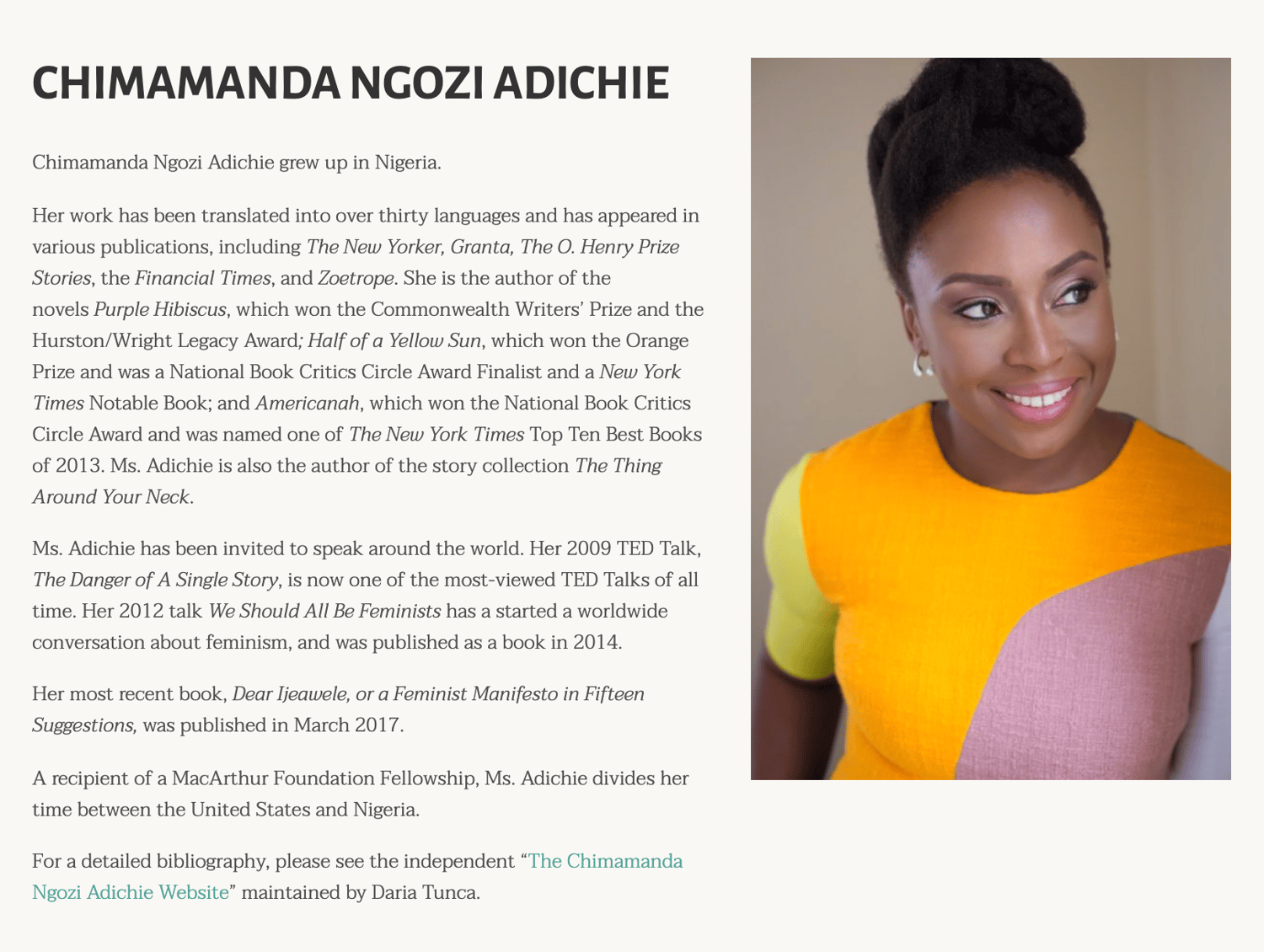
Along with her notable writing career, Chimamanda showcases her speaking career which introduces readers to a well-rounded view of who she is as a professional. From there, her bio seamlessly flows into her recent work and a glimpse into how and where she spends her personal time – the United States and Nigeria.
Finally, Chimamanda’s bio ends with a call-to-action to read a more detailed biography, giving the reader a choice to read the information available about her life and career.
2. Ann Handley
Bio Platform: Personal Website
If you’re a marketer, you’ve likely heard of Ann Handley. Her list of credentials is lengthy, and if she really wanted to, she could go on and on and on about her accomplishments.
But when people list out all their accomplishments in their bios, they risk sounding a little egotistical. Sure, you might impress a handful of people with all those laurels, but many people who read your bio will end up feeling either intimidated or annoyed. Think about it: Is that how you want the majority of your readers to feel when they read your bio?
To minimize the egoism that comes with talking about yourself, think about how you can list out your accomplishments without sounding like you’re bragging. Ann does this really well, choosing a tone in her bio that’s more approachable.
It starts with the excerpt in the footer of her personal website. Give it a quick read, paying close attention to the opening and closing lines:
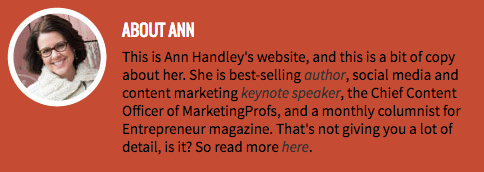
“This is Ann Handley’s website, and this is a bit of copy about her … That’s not giving you a lot of detail, is it? So read more here.” This is the kind of simple, friendly language that invites the reader in rather than shutting them out.
Follow the link and you’ll be led to a page dedicated to a fuller bio, which she’s divided into two parts: a “short version” (literally a bulleted list of key facts) and a “long version,” which includes traditional paragraphs. There’s something in there for everyone.
3. Rebecca Bollwitt
Bio platform: Instagram
Instagram is a notoriously difficult platform on which to write a good bio. Similar to Twitter, you simply don’t have room for a professional bio that includes everything about you. And because Instagram is primarily a mobile app, many viewers are reading about you passively on their mobile device.
Instagram’s limited bio space requires you to highlight just your most important qualities, and blogging icon Rebecca Bollwitt does so in her own Instagram bio in an excellent way.
Rebecca’s brand name is Miss604, and cleverly uses emojis in her Instagram bio to tell visitors exactly what makes her a valuable content creator. Take a look in the screenshot below.
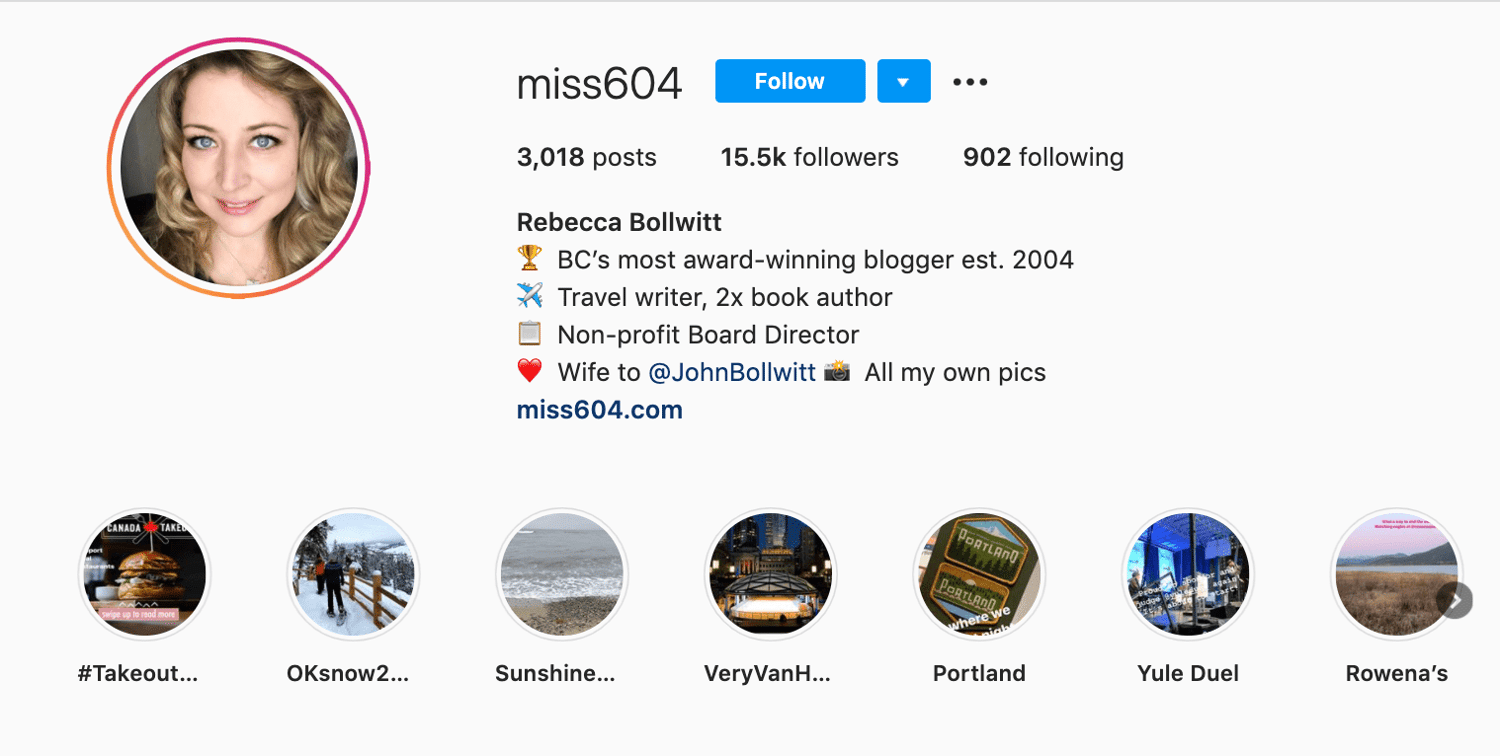
Starting with a trophy emoji, Miss604 says she’s BC’s most award-winning blogger. I haven’t even looked at her pictures yet and the introduction of her bio has already sucked me in.
The rest of her bio follows suit, breaking up the text with an appropriate emoji and a perfect collection of nouns to tell me who she is as a person. She even links out to her husband’s Instagram account after the heart emoji (an adorable addition), and assures her followers that all of her pictures are authentically hers.
Take a lesson from Miss604, and show your personal side. Just because you’re branding yourself as a professional doesn’t mean you have to take your human being hat off. Often your most personal attributes make for the best professional bio content.
4. Mark Gallion
Bio Platform: Twitter
As a venture capitalist and an executive at several start-ups, Mark Gallion has different versions of his bio all over the internet. You can imagine some are more formal than others. But when it comes to his Twitter bio, he carefully phrased his information in a way that helps him connect with his audience — specifically, through the use of humor.
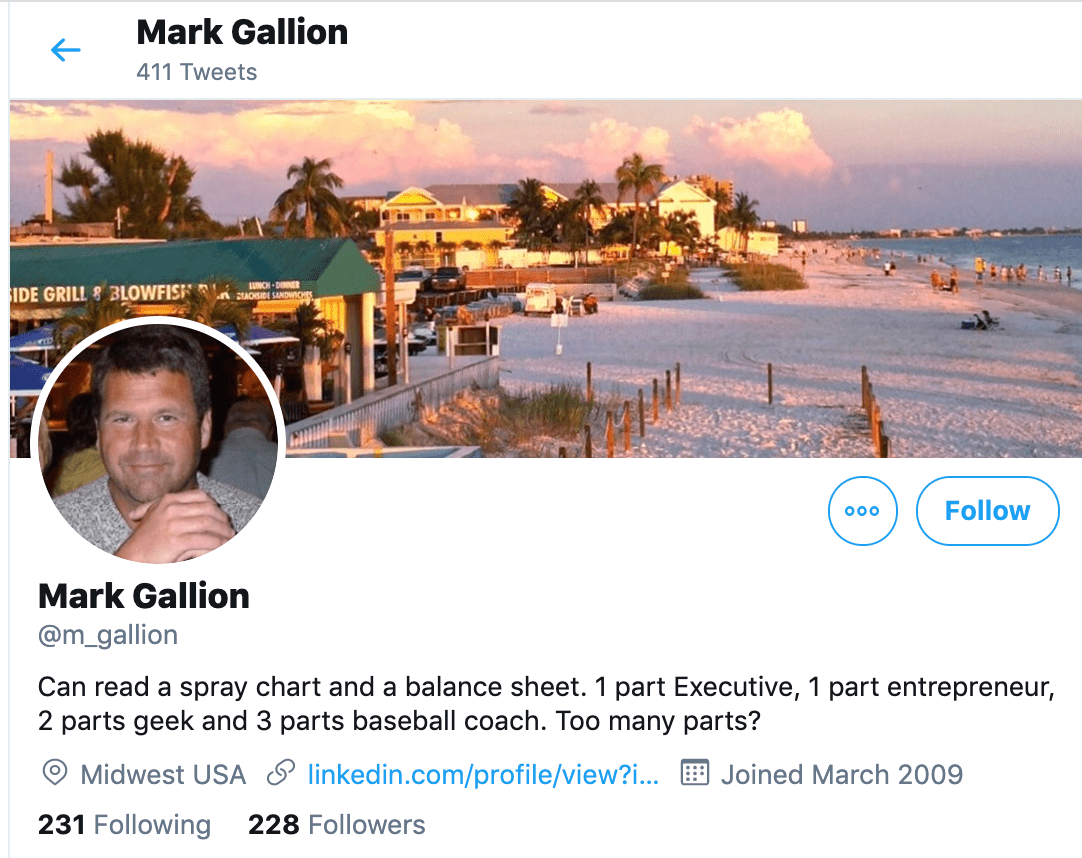
Why would he choose humor when he runs four start-ups and constantly seeks funding for them? Well, Mark’s tactic is totally intentional: it’s a lever he pulls to refresh his brand while maintaining his already impressive and established identity as an entrepreneur.
Mark leverages his Twitter bio because it’s place where he can be human. And it helps him relate to his followers and potential investors.
When crafting your own Twitter bio, consider your audience and the personal brand you’re trying to create for yourself. Use it as an opportunity to be relatable. (And check out this list of amusing Twitter bios for inspiration.)
5. Chime Mmeje
Bio Platform: LinkedIn
A bio with a hook is sure to keep you reading. Chima Mmeje is a freelance SEO copywriter who’s “extremely good at one thing”: helping companies rank for their target keywords. By leading with a strong hook that aligns with her target audience’s marketing needs, she’s able to keep readers engaged.
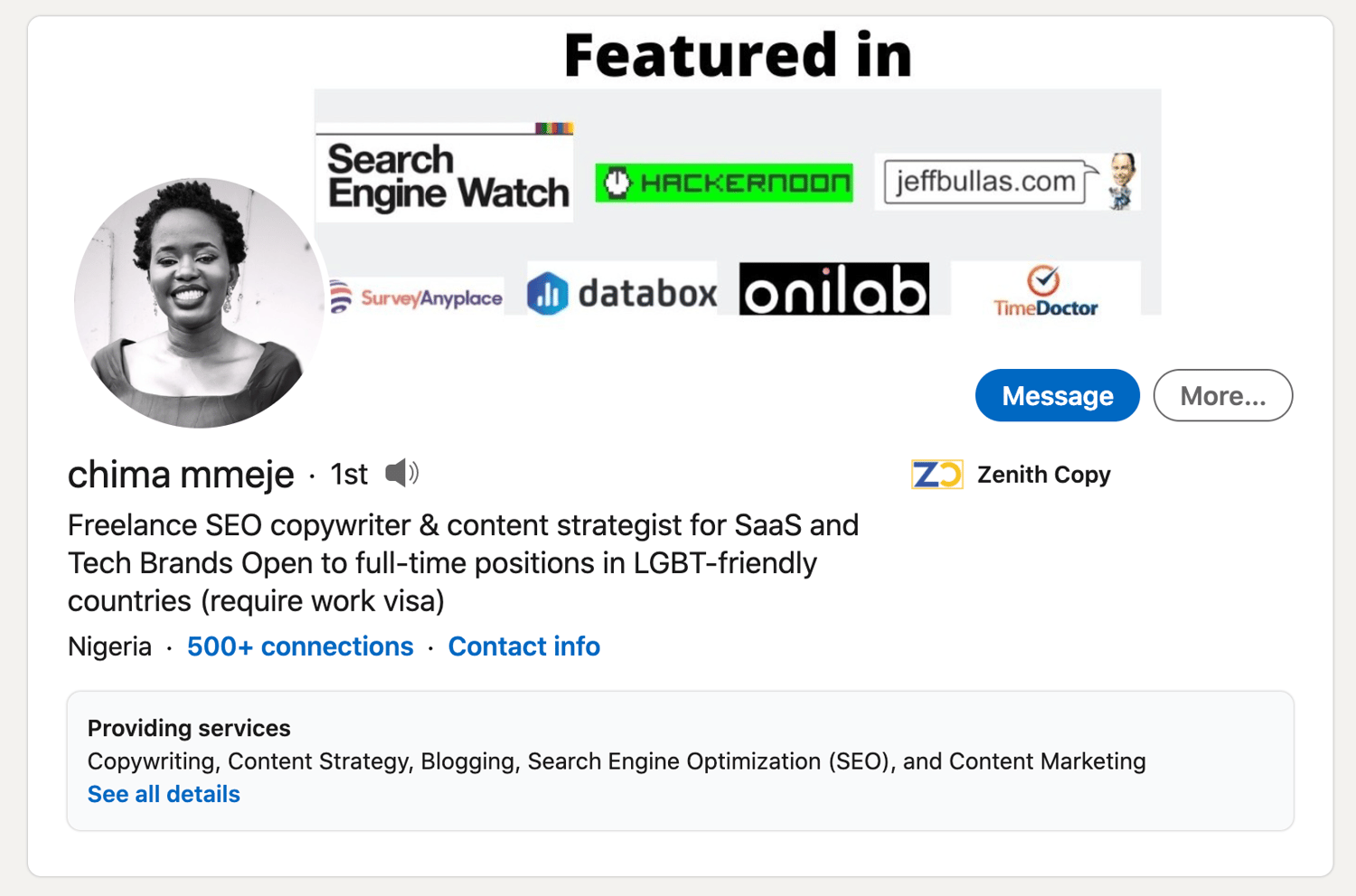
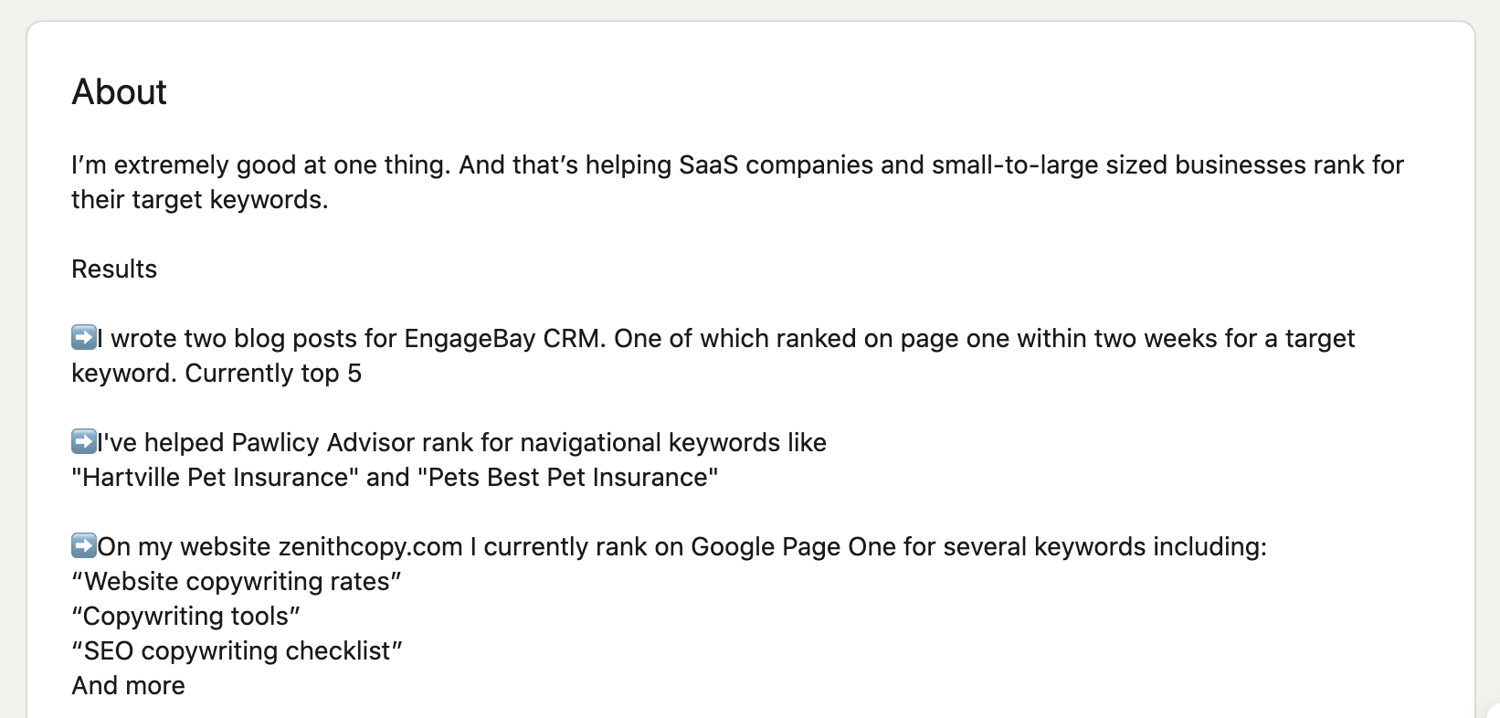
What comes next is a unique differentiator in a professional bio. Instead of listing accolades, Chima shares a few wins she’s secured for her clients. This nifty section does two things: it builds the readers’ confidence in her ability to deliver results and it’s a practical way to name-drop her clients in a professional bio.
In the body of her professional bio, Chima briefly lists her process at a high level, giving her potential clients a birds-eye view of what they can expect when they book her services.
The simple call to action “Drop a message” in her email inbox is a casual invitation to learn more about her services.
6. DJ Nexus
Bio Platform: Facebook
This New England-based DJ has single-handedly captured the Likes of more than 2,000 people in and beyond Boston, MA. And even if you don’t listen to the type of music he produces, it’s hard not to listen to his compelling Facebook bio.
Stage-named DJ Nexus, Jamerson’s professional bio makes use of nearly every Page field inside the About tab. Right away, his audience knows which genres he plays in, where he’s from, and who else he’s worked with. The latter — under “Affiliation,” as shown in the screenshot below — is unique and seldom mentioned in professional bios today.
Our favorite part about DJ Nexus’s bio? His tagline, under “About” — “Quiet during the day. QUITE LOUD at night!” DJ Nexus tells you when he works in an awesome way. I got goosebumps just imagining a dance club he might play his music in.
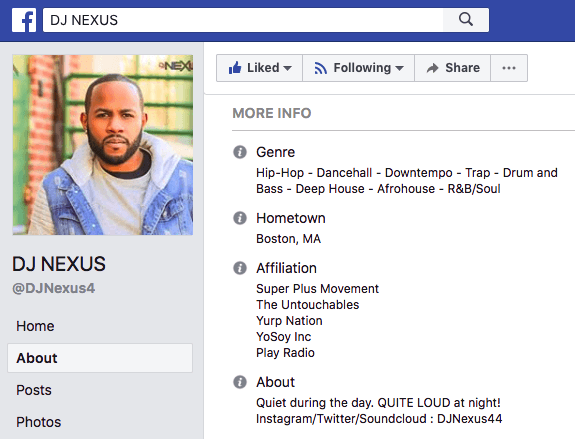
DJ Nexus’s bio brilliance doesn’t stop there.
The great thing about Facebook Business Pages is that you can write as much as you want without overwhelming your Page visitors. For those who just want Jamerson’s basic info, they have the four categories shown above. For those who want to learn more about him, he tells an excellent story of his career. Here’s just a preview of his story, below:
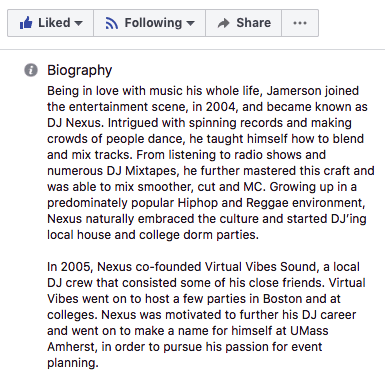
In this story, DJ Nexus describes both when he “became known as DJ Nexus” and a company he founded shortly afterward — all before going to college. This is a terrific lesson for Facebook Businesses today: customers want to learn about you, and as Facebook increasingly becomes a place for meaningful interactions, there’s no better place to tell your story than on your Facebook Business Page.
7. Lena Axelsson
Bio Platform: Industry Website
When it all comes down to it, your professional bio is no different than any other piece of persuasive copy — no matter where it lives. One of the most common mistakes people make is thinking of it as its own beast, separate from other pieces of writing. If you think about it that way, you’re far more likely to write something painfully uninteresting.
When you sit down to write your professional bio and you’re watching that cursor blinking on the screen, think about how you would introduce a blog post. You don’t just dive right into the meat of the thing, now, do you? No. You start with an introduction.
The best bios are often concise (around 200–300 words), so you don’t have a lot of room to play around. But a single sentence that tees your reader up and provides context for the accomplishments that follow could make the rest of your bio that much more persuasive.
Take Lena Axelsson’s bio, for instance. She’s a marriage and family therapist — a job where empathy and compassion are a big part of the job description. That’s why she chooses to open her bio with a great introductory sentence: “When human beings experience trauma or severe life stressors, it is not uncommon for their lives to unravel.”

Then, she goes into why she’s passionate about her job, how she helps her clients, and how she caters her approach to each individual patient. The necessary educational information is left for the end, after the reader has been hooked.
Your bio doesn’t have to be super serious, nor does it have to start with a joke. This bio shows how you can capture your reader’s attention by being empathetic and showing how that empathy shapes a valuable professional.
8. Mark Levy
Bio Platform: Personal Website
Mark Levy is a small business owner who’s taken a more traditional approach to the professional bio on his website — but in a way that takes care to speak to his intended audience.
What we love about his bio is the way he’s set it up: On his business’ “About” page, he’s listed two biographies, which he’s labeled “Mark Levy’s Biography #1” and “Mark Levy’s Biography #2.”
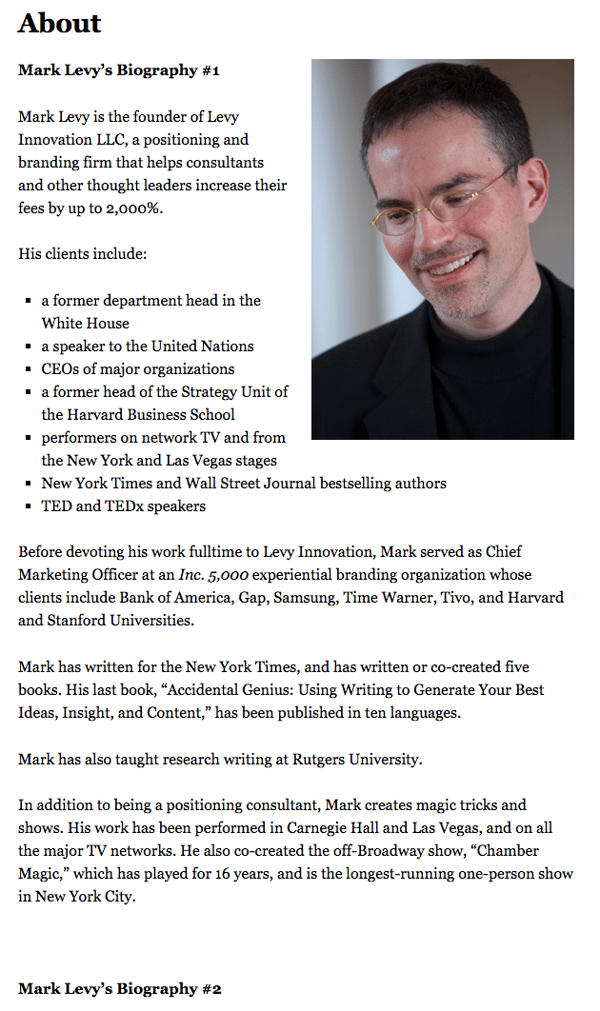
Click here to see the full version.
Like Ann, Mark’s given his readers two different options. The first biography is a “short version,” which includes a combination of bullet points listing his credentials and a few short paragraphs.
The second is the “long version,” which is actually even more interesting than the first one. Why? Because it reads like a story — a compelling one, at that. In fact, it gets really funny at parts.
The second sentence of the bio reads: “He was frightened of public school, loved playing baseball and football, ran home to watch ape films on the 4:30 Movie, listened to The Jam and The Buzzcocks, and read magic trick books.”
Here’s another excerpt from the middle:
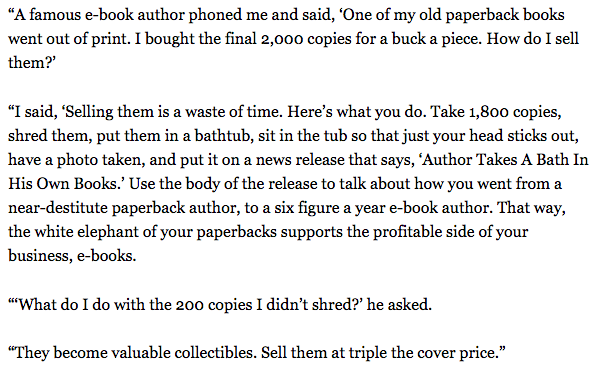
Of course, the fantastic copywriting isn’t a surprise, given that this guy wrote several books. But the conversational tone and entertaining copy let his quirky personality (and great writing skills) shine.
9. Audra Simpson
Bio Platform: Personal Website
With a classic take on the professional bio, Audra Simpson crafts a brief overview of her career in just a couple of paragraphs. The “why” behind her work is emphasized in the first half of her bio before transitioning to the way she carries out that work in practice.

The second half of her bio combines her bodies of work and the awards she’s won for each from the year 2014 to 2020. This subtle timeline gives readers a picture of her experience in the field of political anthropology without listing her resume in detail.
Audra’s professional bio is an example for those of us with several years of experience to communicate, but a strict word-limit to write within.
10. Corey Wainwright
Bio Platform: Blog Byline
Corey Wainwright is the director of content here at HubSpot. She’s written content for HubSpot’s Marketing Blog for years, and her blog author bio has caught my eye since before I ever started working for HubSpot. (Back then, it started with, “Corey just took a cool vacation.”)
What I love most about Corey’s bio is that it’s a great example of how to deliver information about yourself without taking things too seriously. And in this context, that’s totally appropriate.
Despite having a number of impressive accomplishments under her belt, she simply doesn’t like displaying them publicly. So, she prefers making her author bio a little more “light.”
Her bio (pictured below) reads, “Corey is a Bruce Springsteen fan who does content marketing, in that order.”
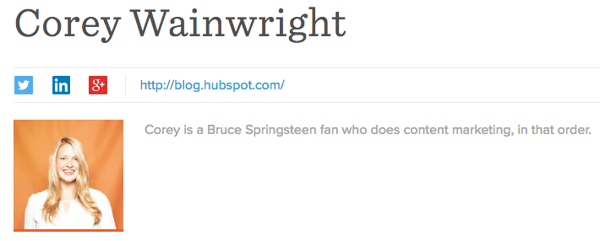
It works in this particular context because, at HubSpot, our blog authors often prefer to make themselves as friendly and approachable as possible — while letting the content speak for itself.
It helps that authors’ social media accounts are located right below our names and above our pictures. For folks who really do want a list of Corey’s credentials, they can click the LinkedIn button to go to her LinkedIn page. (You can read this blog post to learn how to create social media buttons and add them to your website.)
11. Marie Mikhail
Bio Platform: LinkedIn
Marie Mikhail checks off nearly every box for what makes an excellent bio. A professional recruiter, she expresses her “passion for recruiting” upfront, in the first sentence, while using that sentence to hook her profile visitors into a brief story of her background.
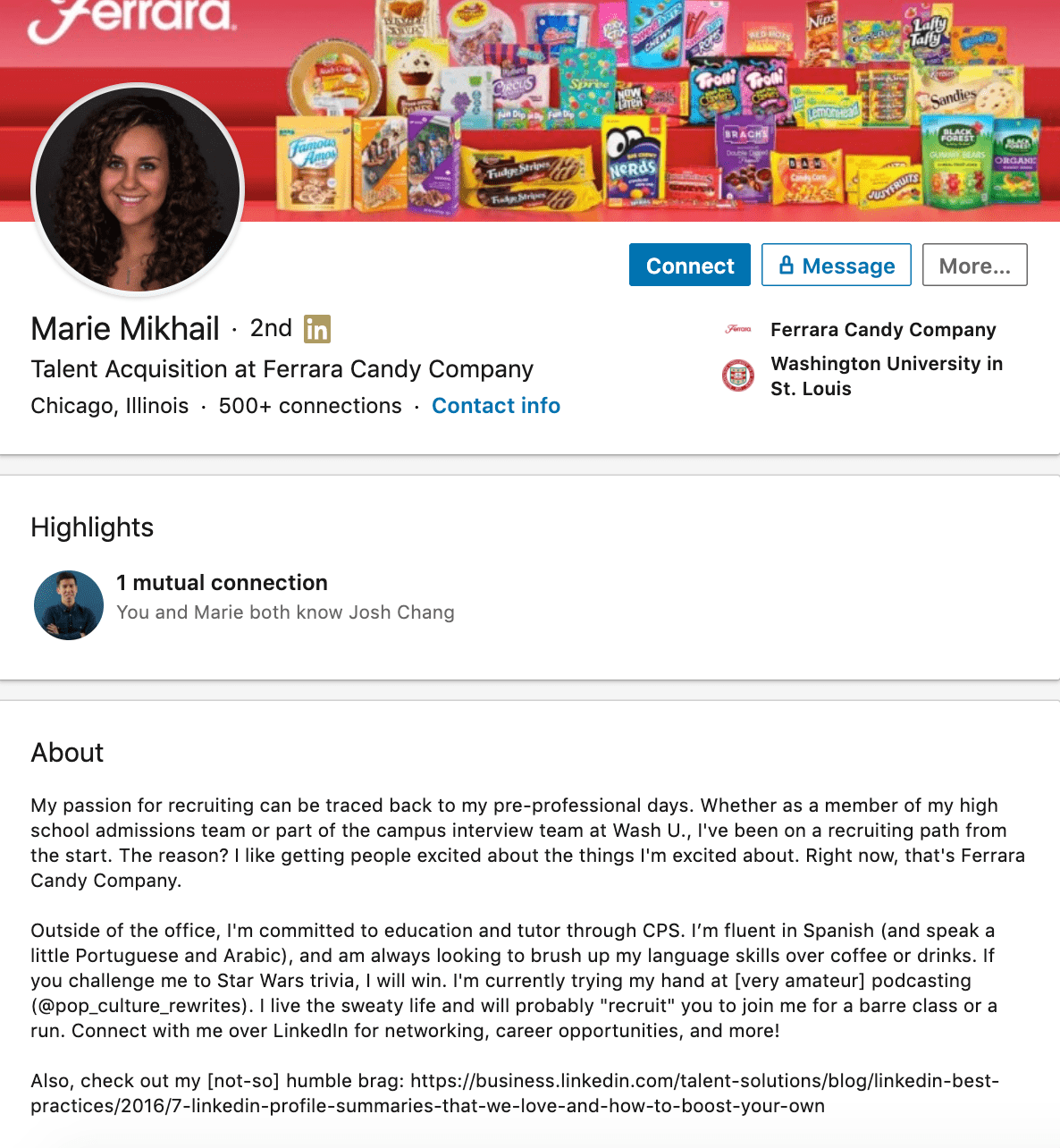
But there are a lot of recruiters out there, and Marie knows that. So, to differentiate herself, she closes the first paragraph of her bio explaining that she likes “getting people excited about the things [she’s] excited about.” It’s a well-put value proposition that sets her apart from the rest of the HR industry.
Marie Mikhail finishes off her bio by including a smooth mixture of professional skills, such as her Spanish fluency; and personal interests, such as podcasting and Star Wars (she mentions the latter with just the right amount of humor).
12. Wonbo Woo
Bio Platform: Personal Website
Wonbo Woo is the executive producer of WIRED’s video content, and he has a number of impressive credits to his name. What does this mean for his professional bio? He has to prioritize. With this in mind, Wonbo opens his bio with the most eye-catching details first (if the image below is hard to read, click it to see the full copy).
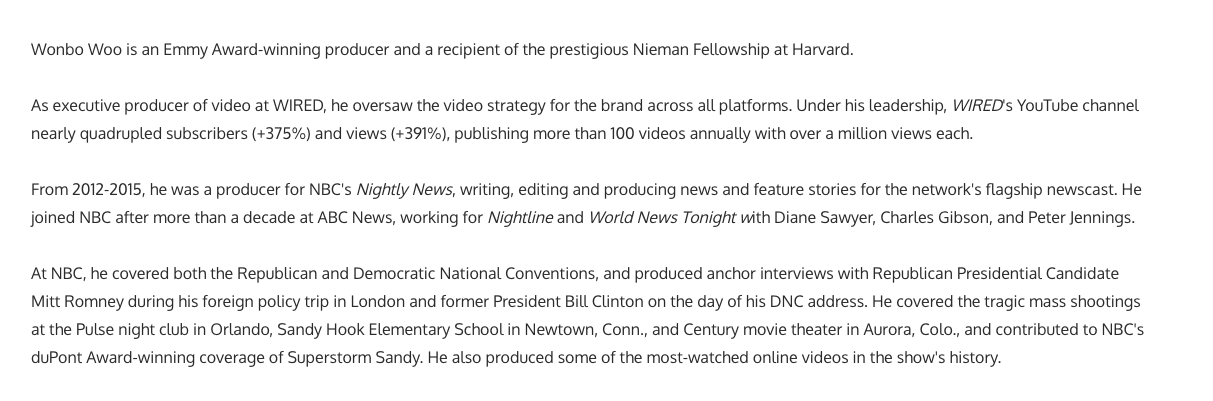
Not only does Wonbo’s bio start strong, but he also takes readers on a suspenseful journey through some of his most harrowing assignments — where he was when news broke and how he responded. You can see this quality below.
 The accomplished journalist concludes his gripping bio as strong as it began, measuring his experience by the number of states, countries, and continents to which he’s traveled in his career. See how this looks above. All in all, it’s a fantastically concise bio for as much detail as it holds.
13. Van Jones
Bio Platform: Twitter
Someone who’s known for a variety of talents and skills may find it difficult to capture who they are in a professional bio. When limited to just over 100 characters on Twitter, the feat is nearly impossible. But Van Jones effortlessly explains who he is and why it matters to everyone who visits his Twitter profile.
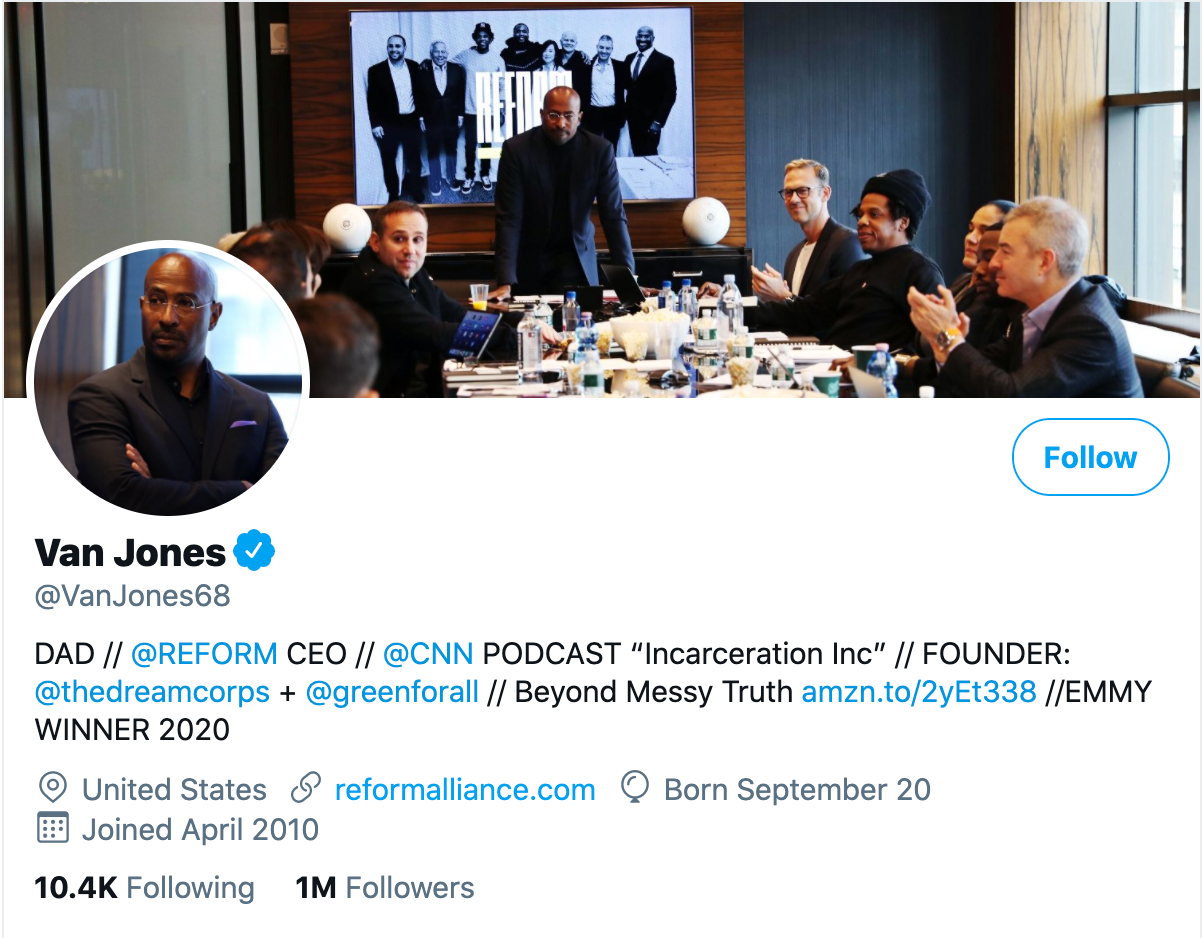
He starts his professional bio with a token of personalization and prioritization of his values. By mentioning that he is a dad first, we recognize what’s important to him in his long list of successes. As we’ve seen in other bios, sharing who we are outside of work makes us more personable and should find its way into your bio, if possible. Van leaves plenty of room to share a variety of professional experiences in his bio including CEO of REFORM and his 2020 Emmy award.
What’s great about Van’s Twitter bio is his ability to link valuable offerings to his readers. He invites us to check out his latest book and has his website reformalliance.com linked at the top.
14. Chris Burkard
Bio Platform: LinkedIn
If you’re writing your bio but having trouble figuring out how to showcase your accomplishments without boasting, photographer Burkard’s LinkedIn bio is a great example for inspiration.
Written in third-person, his bio tells a fluid story, starting with his ultimate mission — “capture stories that inspire humans to consider their relationship with nature” — before diving into more tangible accolades (giving a TED talk, publishing books, etc.).
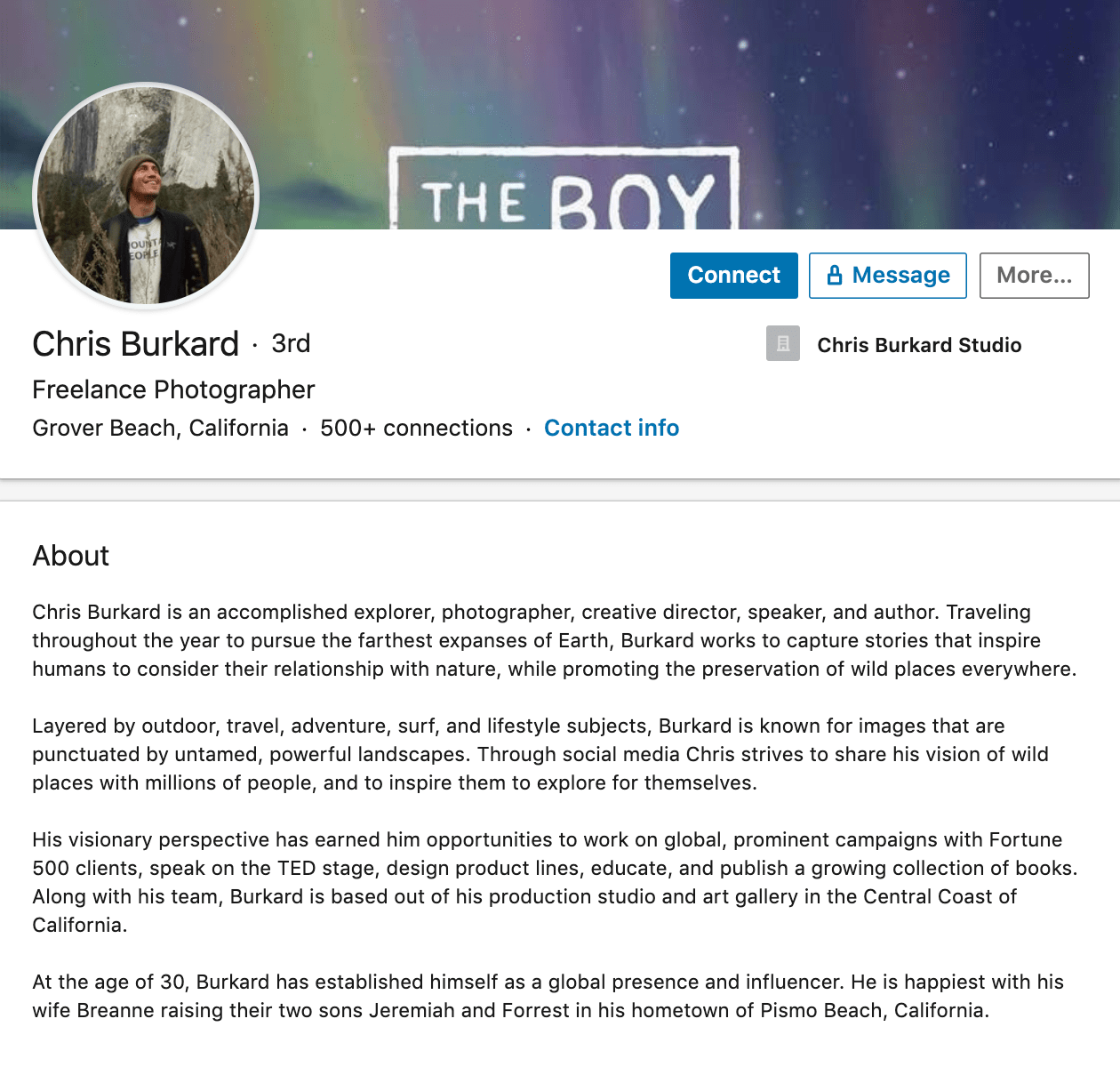
Best of all, rather than using his bio as an opportunity to brag, he instead ties his talents into how he hopes to help others, writing, “Through social media Chris strives to share his vision … and inspire [his followers] to explore for themselves.” I wouldn’t necessarily be inclined to follow Chris if his bio had simply read “I post beautiful images” … but inspire me to travel? Now that’s something I can get behind.
Lastly, he ends on a humble, sweet note, writing “He is happiest wth his wife Breanne raising their two sons”. Don’t be afraid to inject some personal information into your bio — it could help you seem more approachable as a result.
15. Megan Gilmore
Bio Platform: Instagram
Megan Gilmore is a best-selling cookbook author, and she often posts healthy recipes on her Instagram page to inspire followers’ to realize that you don’t have to sacrifice taste for the sake of health.
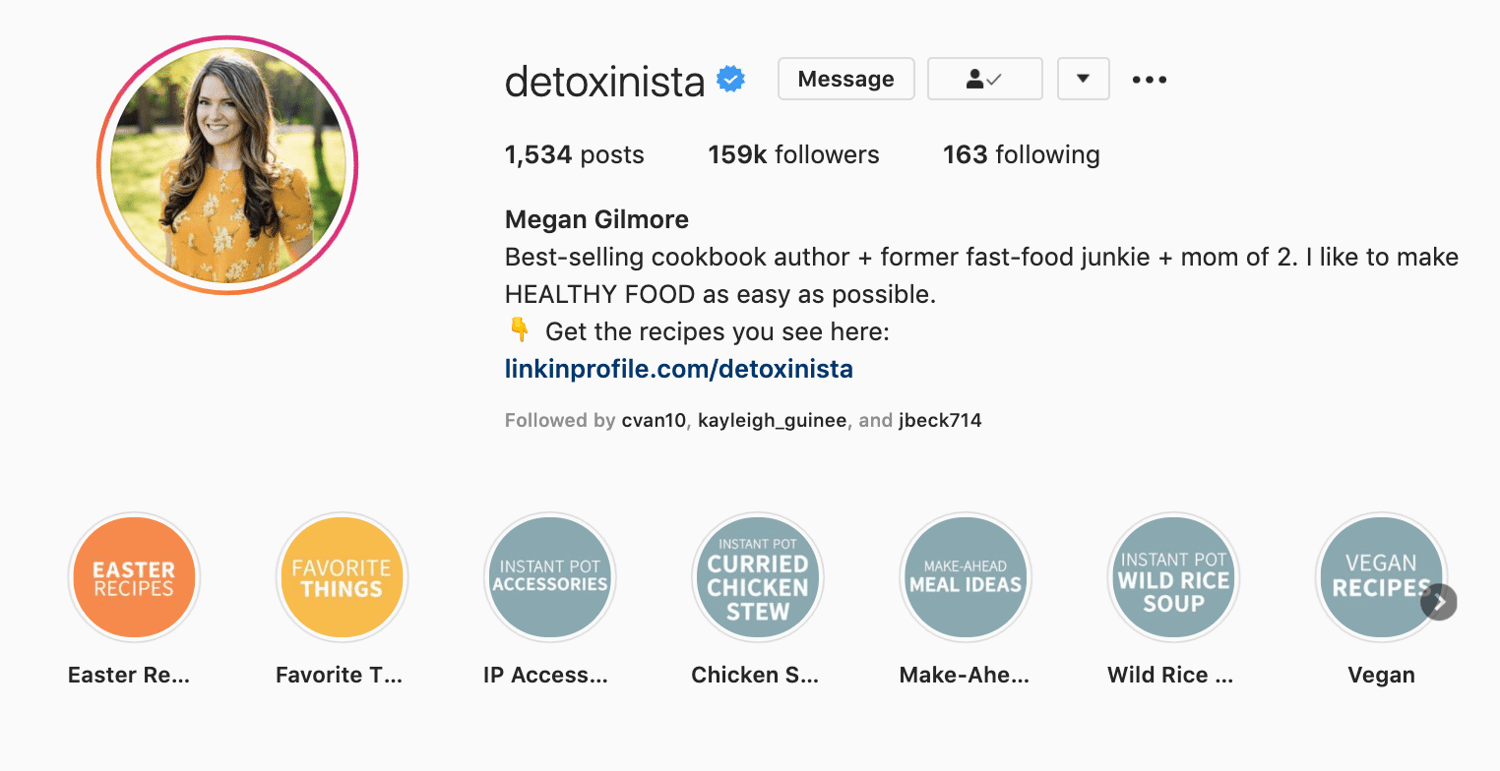
Fortunately, you glean most of this information immediately from her Instagram bio, which is short and to-the-point: “Best-selling cookbook author + former fast-food junkie + mom of 2. I like to make healthy food as easy as possible.” Her “former fast-food junkie” call-out shows followers she’s relatable (and that her recipes are likely delicious yet healthy alternatives), and by mentioning she’s a mother, you get the sense that her recipes really will actually be quick and easy.
Plus, Gilmore includes a CTA link within her Instagram bio that leads followers to free, ready-to-use recipes. You might be thinking — Why would she do that, since it discourages people from buying her book? But that couldn’t be further from the truth.
By giving her followers the chance to try out her recipes, she’s slowly turning leads into customers. After I tried a few of her Instagram recipes and loved them, I decided to go ahead and buy her book, knowing I’d like more of what she had to offer.
16. Lisa Quine
Bio Platform: Portfolio Website
Although a picture is worth 1,000 words, a portfolio is quite different from a professional bio. While this might present a challenge for creative professionals who specialize in visual art to tell their stories, Lisa Quine quantifies her creativity to give her professional bio balance. Throughout her bio, you’ll notice the number of murals she’s completed and a brief timeline of her career thus far which helps paint the picture of who she is as a professional.

Lisa’s bio checks the box on nearly all of our recommendations for a great bio. She begins with her full name, her location, and what she does best. From there, she gets creative by appropriately mentioning the brands she’s worked with and highlights some of her favorite projects. With a third-person approach to the writing, this bio invites the reader behind a metaphorical door to meet Lisa as a professional, traveler, learner, wife, and mother.
Create Your Own Professional Bio
Prim and proper, relaxed, or studded with accomplishments, your bio is a reflection of your best professional self. Your professional bio will often precede your physical presence. Before people meet you for the first time, they’ll probably read your bio. Whether you’re creating an about page for your website or social media profile, one thing’s for sure, you’ll want to put your best foot forward with a top-notch professional bio.
Editor’s Note: This post was originally published in November 2019 and has been updated for accuracy and comprehensiveness.

13 Graphic Design Trends to Use in 2021 — and Two to Avoid
2020 was — in a word — unprecedented.
The only thing nearly as unprecedented as the events of the year itself? The number of times 2020 was described as “unprecedented.”
With the conclusion of a year unlike any other, it’s natural to seek out new looks and approaches.
Desires for new and different –– but also reassuring and less overwhelming –– experiences will exert significant influence over customer appetites in 2021, including in visual communications and graphic design.
Here, let’s dive into the graphic design trends you’ll see in 2021. Plus, what design techniques you’ll want to avoid.
2021 Graphic Design Trends
Current graphic design trends for 2021 offer opportunities to update your brand’s aesthetic, earn customers’ attention, and unlock greater results.
These trends fall into three dominant themes or moods: socially-conscious design, dissonance, and optimism.
Within each theme, there are a number of design techniques and styles you’re going to see artists and brands employ.
You’re going to want to see this –– and not just because it means 2020 is over.
1. Socially-Conscious Design
Design and culture are integrally connected. Designer and author Robert L. Peters makes it clear where he thinks real change begins: “Design creates culture. Culture shapes values. Values determine the future.”
To strive for a better future, it helps to visualize it.
Social unrest and movements for anti-racism have captured national attention, and every brand and business has to take notice and evaluate where they stand.
Socially conscious design gained traction throughout the past year, and it’s poised for even greater impact in 2021. Within the theme of socially conscious design, key trends include authentic representation, sustainability, and celebrating diversity and imperfection.
2. Authentic Representation
Nike’s instantly-iconic ad featuring Colin Kaepernick exemplifies the push for authenticity and design that includes diverse voices and perspectives.
After widespread protests following the killings of George Floyd and Breonna Taylor in 2020, Nike spoke up again, unveiling “For Once, Don’t Do It” – subverting the brand’s instantly-recognizable tagline.
You’ll continue to see brands pushing boundaries in 2021 when it comes to creating authentic, meaningful, and deeply powerful content over more superficial designs.
3. Diversity and Imperfection
The trend to more socially-conscious design aligns with broader cultural pushes to make all forms of media more diverse, inclusive, and affirming of all our various identities and imperfections.
DesignStudio applies these values and approaches in their authentic, intentionally ‘imperfect’ rebrand for insurance company Getsafe. 
4. Sustainability
Sure, humans had a rough 2020, but the Earth didn’t fare much better.
And with all our time spent indoors, we had ample time to cultivate awareness (okay, anxiety) about climate change and other environmental issues. This –– plus the near-universal experiences of cabin fever after a year filled with pandemic-related lockdowns –– has sustainability featuring prominently in graphic design in 2021.
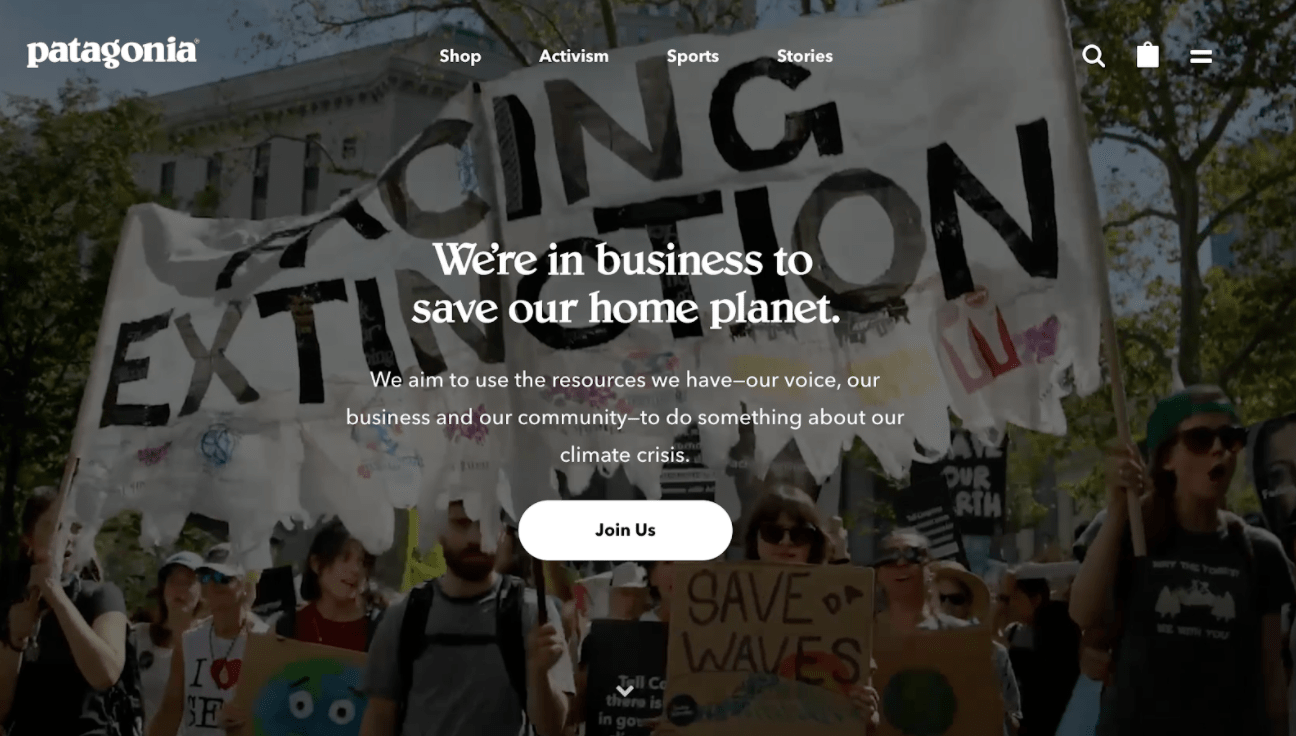
As consumers think about waste and their environmental footprint more than ever before, brands dealing in physical goods are especially sensitive to potential tension. Expect to see more and more packaging designs that emphasize sustainability through natural iconography, neutral color palettes, and eco-conscious materials.


5. Natural and Manufactured Juxtaposition
Global lockdowns have disrupted our connections to our environment.
Graphic design is leaning into this tension through regular juxtaposition of the natural and the manufacture, earth and metal, organic and inanimate.
Gucci played with all of these themes when launching their Gucci Bloom fragrance, creating a gamified virtual experience for visitors to explore an animated garden:

Exploring contrasts and intersections between these forces is especially appealing for spaces hardest hit by the pandemic. Industries like fashion and travel will emphasize elements conveying solidity and technological progress while also reinforcing connections to nature through floral and herbal patterns, cheery hues, and blue skies.
These elements bring a sense of destination, movement, and outdoor exploration –– even when there’s nowhere to go.

6. Color Trends in Graphic Design
Socially conscious design is interesting and impactful –– but it’s also mentally demanding. As people have found themselves spending more and more time at home grappling with monumental and unfamiliar stressors, tastes in color have shifted to hues that are proven to reduce anxiety and promote a sense of ease.
Unsurprisingly, organic and natural shades can provide welcome respite for people who stare at walls and screens all day. For best results, move past standard browns and greys. Understated oranges and teals evoke warmth and comfort, while providing more energy and optimism than their more drab neutral peers.

These color trends are influencing interior design for homes and workplaces, as luxury paint brand Farrow & Ball reports.
Gone: dramatic accent walls and high contrast color schemes. In: calm and muted tones.
For paint companies, at least, pandemic-related quarantines have them seeing another earth tone: green. Revenue for Farrow & Ball, for instance, was up 20% compared to a year prior.
7. Dissonance
While some design currents aim to push society forward or distract from all sorts of stress we’re under, other impulses in graphic design reflect our chaotic, tumultuous present moment.
Designs that embrace uncertainty often appear relatable to people living in unpredictable circumstances.
8. Color Blur
One trend playing up the theme of dissonance melds color and texture by adding grains and/or gradients. Such blending or layering adds depth and tactility to rendered or printed images.
With darker, brighter color schemes, color blur adds a level of broodiness, implying a depth of emotion and feeling, as well as a sense of three-dimensional space.
For a more disconcerting effect, pair a color blur or gradient with distorted text, as well.

9. Outsized Typography
Another dissonant trend in graphic design intentionally misplaces typography in ways that defy expectations and flout design conventions. Images cut off or obscure portions of text or unpolished elements disrupt sleek designs, among other glaring “errors” that catch the eye.
Exaggerated sizes and violating conventional hierarchies, this approach plays with both scale and alignment – two of the basic elements of graphic design. The effect: arresting and memorable.

Designer Danielo Silveira‘s designs for Puma “This is My Flow” uses these concepts with visually stunning results.
Hype and buzz-focused streetwear brands employ these techniques with a studied nonchalance, leaving the uninitiated viewer feeling off balance –– and rewarding their die-hard fans for being in the know.
10. Surrealism
“The real is intertwined with the surreal, and in no year was that more deeply felt than in 2020” — 99designs.com
I feel this. Don’t you?
Considering how mixed up –– and messed up –– day-to-day life often seems, it’s no wonder graphic design is exploring imagery that bends the edges of reality.
What does that mean, if you’re not a Salvador Dali-afficionado or modern art critic? Well, you should probably prepare yourself to make sense of more images like this one:

11. Optimism and Reassurance
You’re not alone if you’re yearning for reassuring, optimistic visual experiences.
The third and final big theme in graphic design for 2021 reflects a common desire for brighter, more familiar, comfortable days.
12. Retro-futurism
Retro-futurism represents the first trend within this broader inclination towards optimistic design in 2021.
No, this isn’t another new sub-genre of music known only to the most avant-garde of your college dorm mates. Retro-futurism refers to designs that take symbols and approaches from the past and present them “mashed up with elements of the imagined future.”
Think: NASA’s worm logo and “space-age” designs. These forms, originating in the forward-looking decades around the first moon landing. This type of design manages to feel both new and familiar at the same time. It reinforces humanity’s confidence in the potential of technology and interstellar flight.

Yes, nostalgia promises to do well in 2021. Colors and shapes that seem both vintage and tech-inspired blend reassurance with a sense of progress.
13. Symbol Revival
In an environment where so much is routinely challenged or called into question, graphic design offers key tools to connect with the universal and the uniquely human elements within us all. Carefully-chosen and constructed symbols possess this potential –– for communication that transcends language.
The simple, powerful imagery of a square peg fitting into a round hole makes a strong statement in the brand identity Pentagram’s Paula Scher designed for the Mental Health Coalition.
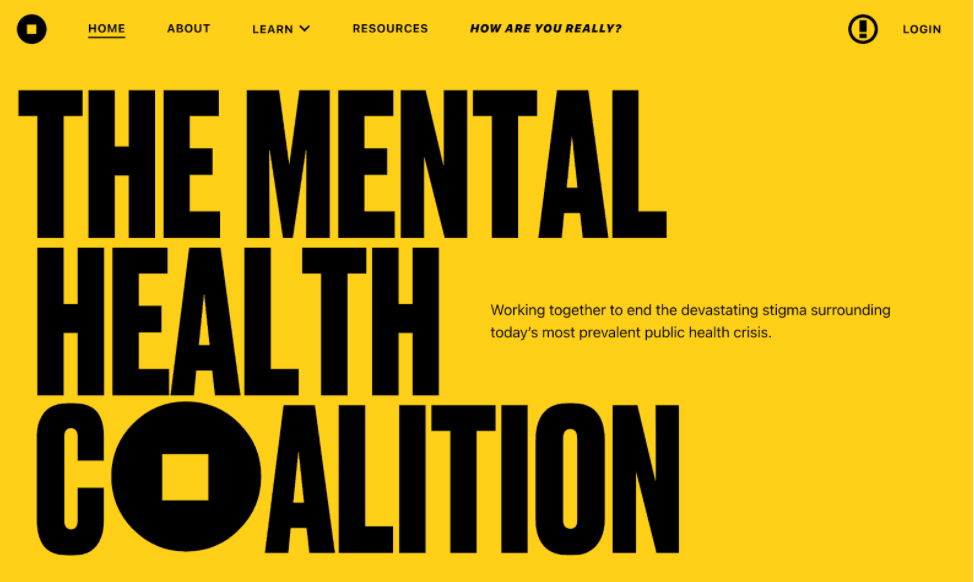
Here, a symbol typically used to connote exclusion or ill-fittedness is reclaimed as a visual metaphor for inclusivity and acceptance. It’s socially conscious, reflective, and also calling the viewer towards a better future –– and you can look forward to much more graphic design like in in 2021.
Graphic Design Trend to Avoid: Faking Authenticity
The ‘trend’ you definitely want to avoid: swerving away from allyship to co-opt complex and painful issues as if they’re just more trends to copy.
Nike, Glossier –– these brands had already taken proactive anti-racist stances, embracing this as a prominent part of their identity. They can speak authentically about related events and issues.
Many chose to amplify or echo similar messages to reflect their own values or affirm a call for change. This is well and good. Opportunism? Not so much.
In short: make sure your design accurately, and authentically, reflects your values.
(If you decide to reexamine your values, more power to you –– but work on your values first, and hold off on pressing ‘send’ on some trendy graphic.)
How to Keep Up with Graphic Design Trends
Designers gravitate towards visually-driven platforms like Instagram, or Behance — Adobe’s proprietary social media platform geared to showcase creative work. Instagram, as the most visually-driven of the ubiquitous social media platforms, offers a wealth of opportunities to observe, learn from, and keep up with graphic design trends.
You can easily see broad trends and also drill down into specific skills or minutiae of the field through keyword searches and following hashtags. Interested in hand-lettering styled after 1950’s tattooing? You’ve come to the right place.
YouTube is also an invaluable resource for designers of all stripes and skill levels. You may never make it out from the rabbit hole of top 10 lists, design techniques, and how-to guides –– but you sure will learn a lot while you’re down there.
Pick a Timeless Design to Ensure It Lasts
Before you go and apply all the 2021 graphic design trends in making delightful and chaotic – but somehow calm and reassuring and progressive –– imagery, there’s one word of warning to take with you. Employ trends sparingly and with care, or risk becoming a quickly-outdated caricature.
This is especially true in logo design, where you’ll need to avoid looking outdated –– and perhaps even worse to constantly change your primary branding. Go for something modern, but timeless, and make design decisions with your organizational values in mind.
Strike this balance well to benefit and learn from 2021 trends while not putting yourself on course to need a rebrand in 2022.
What to Expect from Graphic Design in 2021
In 2021, graphic design will continue to both draw inspiration from and exert influence to change culture. Perhaps it will be as tumultuous and unpredictable as 2020 (although we can certainly hope not).
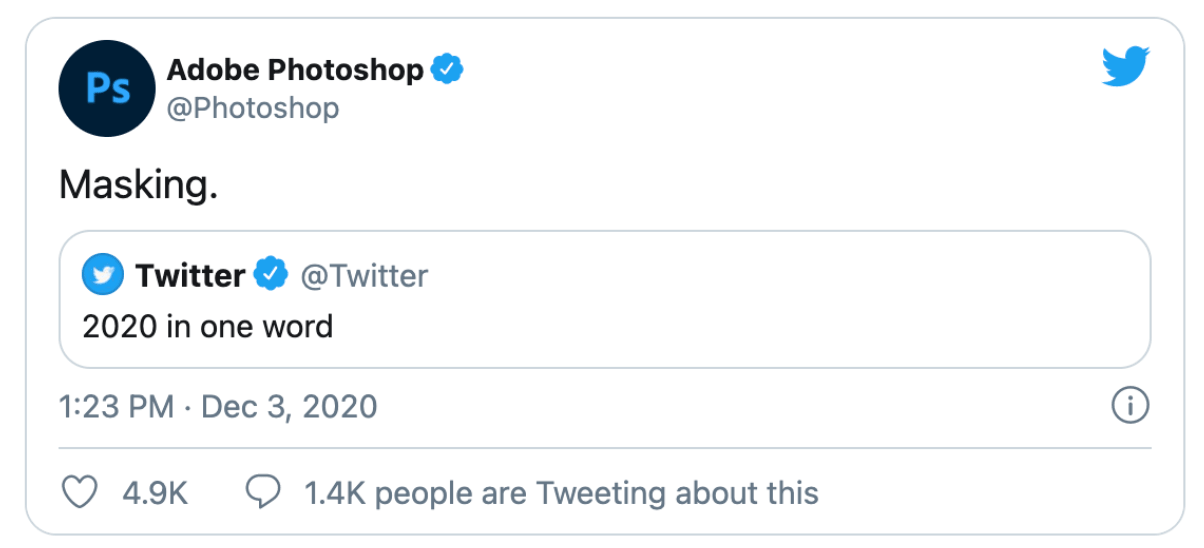
One thing about 2021 is certain, though. For the foreseeable future, Adobe‘s Photoshop team deserves credit for calling the trend most likely to carry over from 2020 into the new year:

How to Get on Board With the Digital Transformation [+ Examples]
Ten years ago, I couldn’t have cared less if the new burger place downtown had a website. Now, I don’t trust one that doesn’t. If your business is online, you’re a part of the digital transformation. But it’s not enough these days to just “be online.” Businesses that will thrive in 2021 that are operating online — and the COVID-19 pandemic has proved this.
Consumer buying behavior has drastically changed — today, most consumers are purchasing products online, including almost 70% of millennials. In 2019, nearly two-thirds of businesses ( 64% ) had a website. If you don’t have one, you could be falling behind your online competition.
So, while it’s a great step to have a website and a Facebook page, there’s more to the transformation than just having an online presence — technology should be ever-present in all of your business operations. This piece will explore the digital transformation, why businesses are getting on board, and outline the roadmap for enacting one for your business. We’ll also give some real-life success stories from companies that have bought into the digital transformation.
Essentially, a digital transformation fundamentally changes how businesses provide value to their customers and streamline their processes. It’s a reminder that materials and processes your company uses during day-to-day operations, no matter how big or small, might need a new medium — technology. Let’s take a look at why this transformation exists in the first place, with particular reference to the present pandemic.
Why do businesses undergo a digital transformation?
Simply put, things are often easier when they’re online. New technology makes website building more accessible and creates more opportunities for businesses to connect with their audiences. A digital shift also saves time. You may already be using some methods of digital strategy, like Standard Operating Procedures (SOPs) , social media scheduling tools, and instant messaging apps; these are all examples of small digital transformations that replace paper instructions, outbound marketing, and an extra trip to your managers’ desk.
A shift to digital processes also makes it easier to conduct overall large-scale business tasks. For instance, online databases that sort and catalog customer information, and automation tools that take over day-to-day activities and allow employees to focus their efforts on more pressing tasks.
Customers have also begun to expect the businesses they interact with to have some sort of digital presence, whether it’s an optimized Google My Business profile for easy access to mapping instructions or an automated chatbot that can answer their questions over Facebook Messenger .
In addition, the COVID-19 pandemic has further proven and accelerated the need for businesses to get on board with a digital transformation. As companies around the world were forced to pivot to providing service online or at a distance from their customers, having digital tools at their disposal was, and is, critical to survival.
Many businesses have adopted different online practices during the pandemic, like providing digital customer service . It’s likely that, as a result of the pandemic and general trends, customers will expect that they’ll be able to conduct business online with their favorite brands.
70% of businesses today are finding that the digital shift is worth it, and these businesses either have a digital strategy in place, or are earnestly working towards one.
As a whole, 70% of businesses today are finding that the digital shift is worth it. These businesses either have a digital strategy in place or are earnestly working towards one. Whether you’re already one of these businesses or you’re hoping to begin your journey, let’s go over three critical questions that you can use as a roadmap for implementing your strategy.
Digital Transformation Strategy
Business leaders are faced with a variety of options for enacting a digital transformation. As technology becomes more commonplace, there are a significant number of tools to choose from. While it may be exciting (and overwhelming) to imagine all of the possible upgrades you can make to your business, a digital transformation strategy will help you become more focused.
This strategy is essentially a structured way to move through the process, how you get from point A (pre-transformation) to point B (post-transformation). Let’s go over some guiding questions and additional requirements to help you create a viable digital transformation strategy.
1. Why do we need a transformation?
Like all plans and strategies you’ve created for your business, designing your roadmap begins with identifying your purpose. You can start this process by uncovering the challenges your business faces that have significantly impacted success or processes that you feel may become easier with technology. This could be anything from day-to-day automation tasks like sending out email newsletters or more essential business needs like data collection and storage.
You may also be hoping to address multiple challenges at once. For example, say your business has had trouble handling customer service requests because you’re using different platforms to store customer data and communicate with customers. Reps may have difficulty accessing a client’s history with your company because they need to sift through other records and jump between platforms to find the information they need. This takes time, and clients may report being frustrated by how long it takes to resolve their issues.
In this case, the answer to why do we need a transformation? is that your customer service team struggles to give customers the experiences they desire because of long wait times and a disorganized data storage system. Whatever your reasons are, identifying the challenges that expose the need for a digital transformation makes it easier to create further goals and metrics that will define your process’s success.
2. What do I need to achieve to transform?
As mentioned above, the challenges and pain points you’ve identified answer why you need to transform. Once you have this why, it becomes easier to figure out what needs to be done and what steps you need to take to overcome the challenges you’ve outlined.
Aim to come up with metrics or objectives you can use to guide yourself and your teams through this process, including workflows, identifying key stakeholders, and assigning critical tasks. If you have multiple pain points, come up with at least one objective or goal for each one of them.
When you identify these objectives, come up with a time frame in which they should be met to succeed in your transformation. Continuing with the previous example, your challenge is that reps don’t have access to a summary of client history. Your objective can be that, over the course of the year, you want a streamlined process for inputting and cataloging customer information and a less than one minute wait time for accessing customer records during service interactions. With this goal in mind, you know what you need to achieve to say that you’ve transformed your process. With this, it becomes easier to identify the tools that will assist you along the way.
3. What do I need to change to meet these goals?
The final question involves researching and identifying the technology you’ll need to successfully transform. Some of these may be middle-of-the-road tools that help you reach your end goal, while others may be the permanent solution you implement and use forever.
Using the same example as before, you’ll want to know the tools you’ll need to use to begin the process of transferring the data you already have into the tool that your representatives will use to access customer data within the timeframe you laid out. This could mean that your initial tool is a simple data integration platform that you’ll use to merge existing data from your different sources. After this, maybe you’ll need a sorting tool that catalogs and organizes data into business-relevant categories, and this data will be further integrated into a Customer Relationship Platform (CRM) that all of your representatives have access to during customer interactions.
4. Get company wide buy-in.
A digital transformation affects all areas of your business. Given this, it’s critical that you obtain company wide buy-in , from packing and fulfillment to C-Suite executives. You can’t just say “Okay we’re doing this!” and expect a seamless process, though. This is why this principle comes after the first three guiding questions — inspire buy-in using the understandings you’ve previously gathered.
One of the first things you should do is present teams with a clear why statement that explains the reasons your business needs to undergo a digital transformation. Along with the why statement, present a value proposition to explain the benefits the business (and employees) will obtain from this transformation. Maybe you can share sample projections you’ve come up with or a case study you’ve created based on market research and competitive analysis (which we’ll cover below).
Lastly, you should let them know that it’s an involved process. You’re not demanding that they get on board and deal with it — you want them to participate in the process. They can pose questions, offer suggestions, or simply ask about their new tasks.
5. Research industry and market competitors.
As with most new projects, it’s important to understand what your competitors are doing. Conducting a competitive analysis can help you do this, as you’ll generate a well-rounded picture of how they’re performing.
The results of your research will likely give you an understanding of how they do their business, if they’ve implemented and succeeded in a digital transformation, and uncover possible areas for your business to outperform them. It’s also important to conduct overall market research to understand what trends your industry is experiencing to understand how you compare, or as a means of inspiration to further guide your process.
6. Create a budget.
A digital transformation is a costly process, especially if it’s a complete overhaul of your current methods. Once you understand your purpose and outline how you’ll need to change, create a budget . This budget should address all possible expenses you’ll encounter throughout the process: software costs for transitional and permanent tools, any costs to hire new talent, employee training for new processes, and allocation of funds for any unexpected costs.
The unexpected costs section of your budget may be the most important, as a digital transformation is based on change. These changes are likely new, so you’ll want to be prepared if any issues arise from adaptation difficulties along the way.
7. Create a digital transformation roadmap.
Once you have all necessary information, the next step is to implement your strategy. Specifically, as mentioned above, how you’ll get from point A to point B. A digital transformation roadmap is the way to do this, and we’ll outline the steps below.
Digital Transformation Roadmap
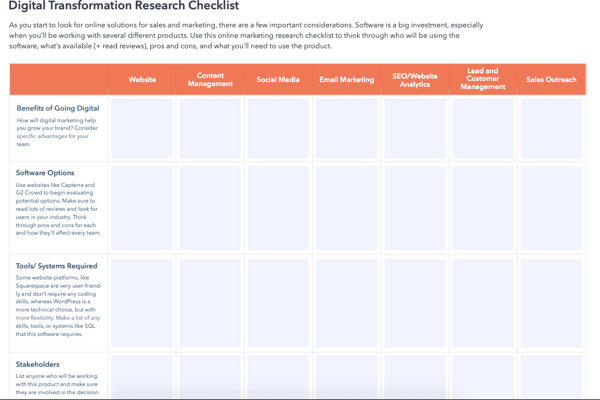
After you’ve created your strategy, a detailed plan will guide you through implementation. HubSpot offers a free template that will help you schedule and work through a digital transformation roadmap, broken down into seven weeks.
Firstly, this template comes with a checklist that you can fill in with the information you’ve gathered while creating your strategy. You can input benefits, what you need to achieve to transform, the tools you’ll need to transform, and key stakeholders for your business. Having all information in one place makes it easier to refer back to a common document as you navigate through your process.
Week one is all about gathering existing sales and marketing materials on paper, while week two dives into transferring your business online, and so on. These small steps are designed to fit into your busy schedule and help you remain organized as you transition.
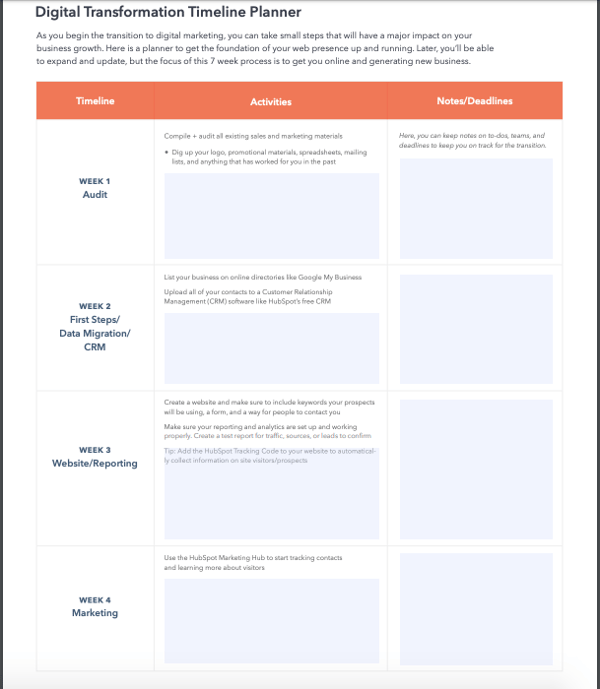
Week two is all about data migration. A free CRM, like HubSpot, can help you input business data, customer profiles, into an easy to access database.
During weeks three and four, you should have a functioning website and marketing resources that will help you learn more about your visitors and their behavior.
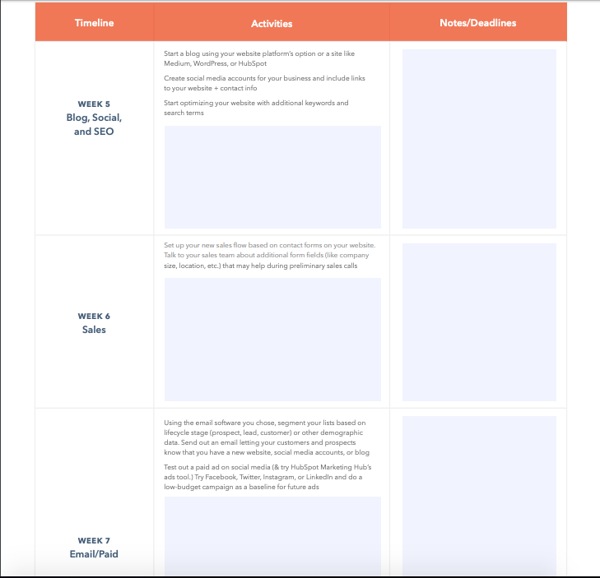
The latter half of the weekly plan ramps up your online presence. Using this template can help you organize your new digital shift by area to avoid doing one huge push all at once and confusing employees.
Creating a blog during week five will help you find your target audience online. Posts should be about your target market (if you’re a tech marketing company, posts should center around the intersection between the two) to demonstrate your expertise. This will build your reputation as a thought leader in your industry.
By week six, you should set up a sales flow that will digitize your sales process. Online sales tools allow you to keep track of all your contacts, log your conversations, and keep tabs on-call schedules and upcoming meetings.
Email and paid ads should be rocking-and-rollin’ by week seven. The email software you choose will help you through the process of sending automated emails to subscribers and let you test out paid ad software.
In a month and a half, most of your business processes will be digital.
Best of all, this template can be tailored to meet your business’ transformation individual needs and gives you the wiggle room to expand as your business continues to scale — but as a starting point, it gets you up and running.
Once you’ve created your digital roadmap, it becomes easier to go more in-depth into your processes and create a finalized list of the technology you’ll need to succeed in your transformation. Below, we’ll go over some popular digital transformation tools to consider using.
Digital Transformation Tools
Depending on your overall transformation goals, there are multiple platforms available to help you succeed and meet your objectives. However, there are various multipurpose tools that can benefit all types of businesses, and we’ll go over a few of them below.
1. Instant Messaging
Instead of having a meeting or a long email thread for a quick message, consider using a company-wide instant messaging tool for quick and easy communications. Some instant messaging services are made for corporate settings, like Slack or Flock .
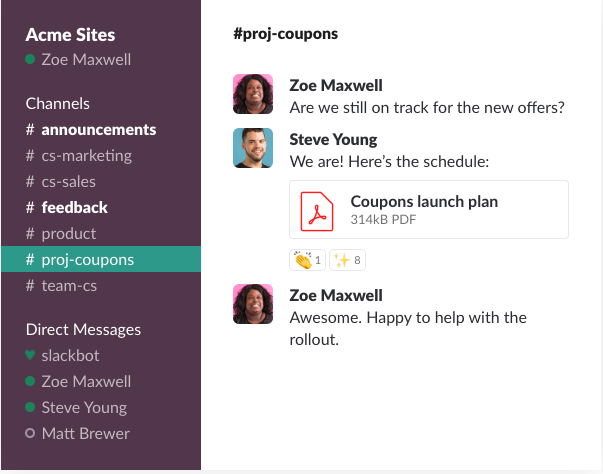
With these services, you can file share, direct message, and create channels where teams can collaborate and discuss projects. Think of it as the office water cooler — just online.
2. Application Tools
Are you looking for new talent? The best candidates (especially ones who prefer to work digitally) are online. For instance, LinkedIn, a site for professional networking, is an excellent source for recruiting candidates:
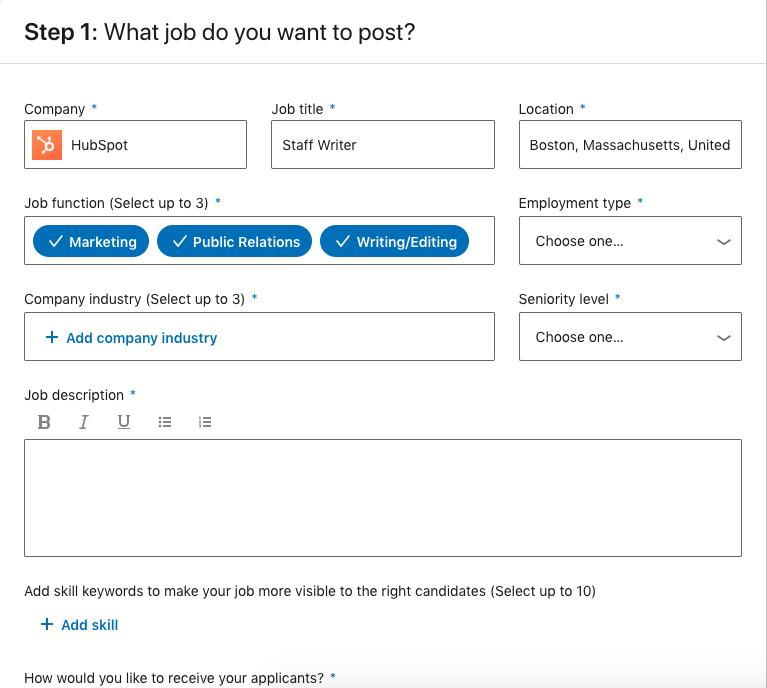
Using LinkedIn’s template will help you post a listing, and you can use LinkedIn’s industries function to ensure it’s shared with relevant candidates. LinkedIn will alert you of new entries and send you their applications, making the selection process an online breeze. This is an alternative to collecting application materials via email, where it might be difficult to structure, organize, and compile applications.
3. Sales Management
Software is available to help manage many facets of your business, including sales. This software enables you to manage calls, pipelines, reporting, and follow-up resources to help your process migrate smoothly online.
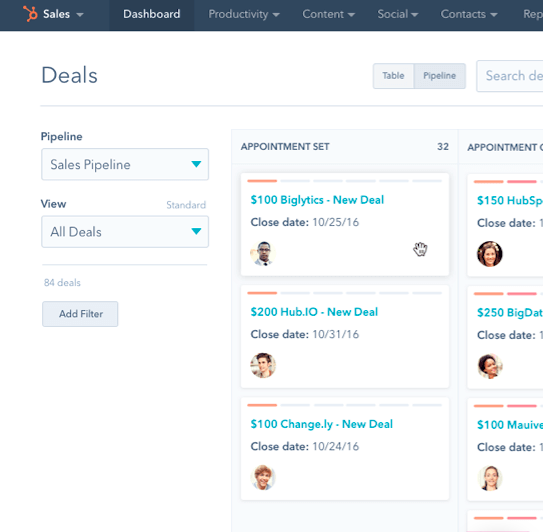
For instance, as shown above, HubSpot’s Sales Hub can be used to organize all of your sales materials online. Within the platform, you can manage deals, filter contacts, and create different tasks using a dashboard to help you keep track of your sales processes.
4. Standard Operating Procedures (SOPs)
If you have certain aspects of your day-to-day that require multiple steps typically written down on paper, transfer it online. This will reduce paper trail and make the processes shareable and accessible to all employees.
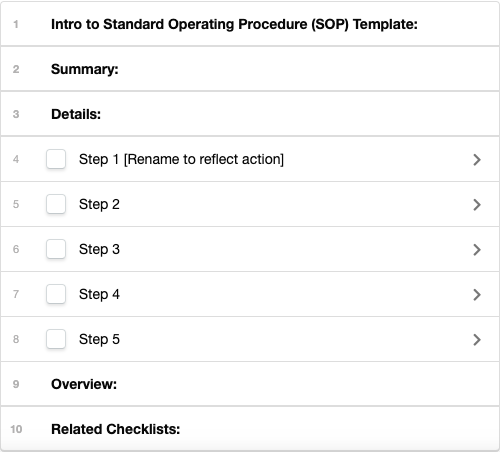
Online SOP software makes it easy to list procedures and job functions, which can be beneficial for onboarding and employee training. To make a smooth transition to your new digital tool, consider talking to employees and asking them to contribute and collaborate with you in the process. The image below is an example of a digital SOP workflow management tool by Process.st .
5. Customer Relationship Management (CRM) Software
A CRM is going to be your best friend when shifting to an all-digital business. Whether your goals are to transform the customer experience, streamline sales, or digitize your marketing process, a CRM will make these processes more straightforward and even automate repetitive tasks. HubSpot’s free CRM offers three hubs that give you an all-in-one business platform designed for scalable growth.
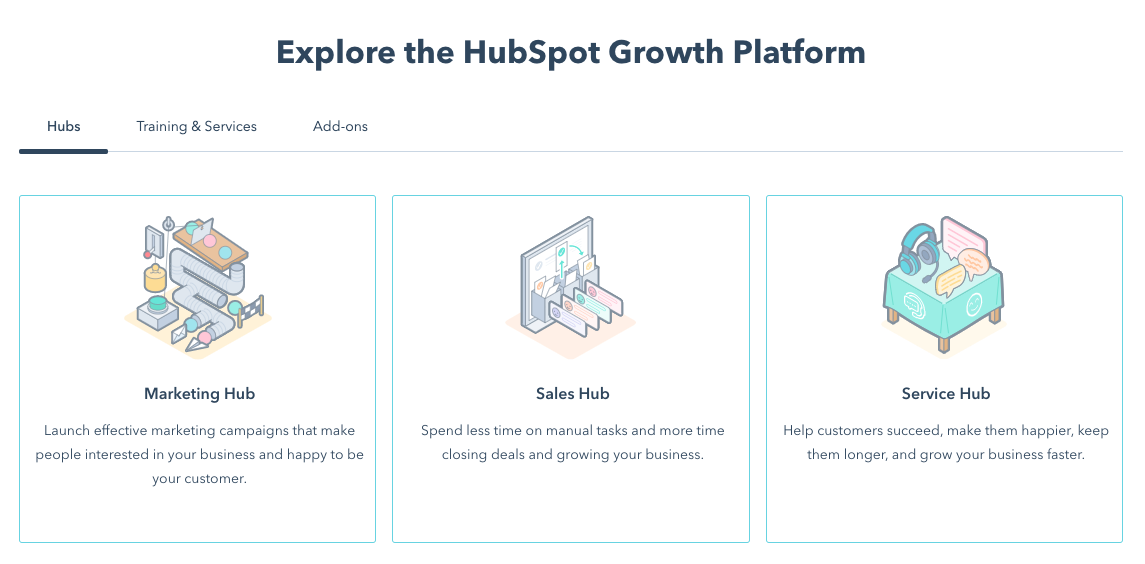
HubSpot’s free CRM offers three hubs that give you an all-in-one business platform experience. From customer service reps to sales leaders and business owners, this free CRM helps you fully transfer your business online and drive growth.
6. Video Chat Software
Is your team out of town but you need to schedule a meeting? Are your representatives transitioning to a remote, work-from-home model but you still want to maintain a collaborative environment? Use video chat software to meet virtually and maintain employee connections.
Software like Skype for Business and Zoom offer free web-chatting services for professional use.
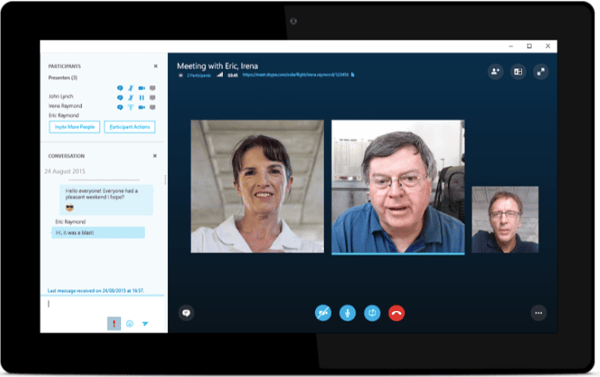
Skype has automatic subtitle settings and 1:1 capabilities, and the option to host multiple people on calls at once. Most software also has mobile applications to make sure you’re accessible and able to meet at any point during the workday.
Though these tools are designed to make your life easier, you may be confused about how they can apply to your business. Thankfully, many companies that are joining the digital revolution are doing so because they have similar needs. Below, we’ll go over digital transformation trends that you can use to further guide your process and understand how to apply the tools to meet your business needs.
Digital Transformation Trends
As the digital world grows, many businesses are jumping on the transformation trend. Whether you already have your own plan or you’re hoping to get inspiration for a future transformation, let’s go over digital transformation trends to look out for in 2021.
Rapid Adoption of a Digital Operating Model
COVID-19 has required businesses to quickly adapt to online models. As the pandemic could not have been predicted, many businesses were left scrambling to scale their processes as in-person, and on-site business models became unsafe. Most industries needed to rise to the occasion unless they simply could not adapt to a work-from-home or work-from-online model.
For example, customer service businesses found themselves needing to integrate online processes to successfully meet customer needs, like chatbots to answer routine and simple questions. Restaurants and grocery stores offering food services were forced to adapt to online food and grocery delivery options to continue to safely provide nourishment to customers.
As COVID-19 related outbreaks become controlled, the need to adapt won’t die out but instead will become a requirement. Businesses will need to continue to utilize the new tools they’ve adapted or create detailed plans for future unpredictable circumstances that may force them to adapt quickly.
AI and Machine Learning
Consumers are expecting personalized experiences now more than ever. Personalized experiences are also a driving factor of customer loyalty, as 41% of customers have reported switching companies because of poor personalization . This doesn’t just mean that customers want you to refer to them by their name when they call you on the phone; they want your business to know what they want before they know they want it.
Because of this, a popular transformation trend is the adoption of AI and Machine Learning tools that contribute to personalized and customer-tailored experiences. A typical example of this is the algorithms on Netflix. It analyzes your previous watch history, likes and dislikes, and content ratings to figure out what you’re most likely to enjoy and recommends new content. This process works, as approximately 80% of the TV shows people watch on Netflix are discovered through recommendations.
However, outside of providing different experiences for your customers, AI and Machine Learning can also involve streamlining rote processes that your employees do themselves, like cleaning up and organizing your data or using a social media scheduling tool to post and analyze your social profiles. McKinsey has predicted that, across the board, this kind of automation can increase productivity by 14% annually.
Location-Adaptable Technology
Also influenced by COVID-19, businesses in 2020 have realized how important it is to have an arsenal of tools available that will allow their employees to work remotely whenever necessary. Some of these tools are familiar options, like Google Suite, Microsoft Office Teams, and Trello, but additional tools have gained popularity throughout 2020.
Ring Central is one of these tools, as it enables calls to your business line to be forwarded to mobile phones, or remote working employees. This is extremely beneficial for customer experience focused businesses. Zoom is another tool that has become a communication powerhouse over the last few months. It is an easy-to-use desktop platform for scheduling, hosting, and recording company meetings.
All in all, COVID-19 has shown us that working from home is a valuable modell for businesses to consider, both during and after the pandemic. Some businesses have already committed to continuing this practice as time goes on. For example, Google has pushed back planned office returned dates to September 2021 and has said that the company will be testing a flexible workweek model where employees can split their workweek between working from home and participating in office collaboration days.
Application Programming Interface (API) Security
As processes become digital, it becomes even more important to protect the private, sensitive information you store within your company platforms. Given this, a recent digital transformation trend is an increased need for API security.
In short, the APIs you’re using are the products you’ve implemented due to your digital transformation strategy, like Slack. Slack is a tool that can house business communications between internal teams and business employees. You’re likely using Slack to send out private information that is business-sensitive, but how are you going to ensure that this data isn’t taken advantage of?API security.
API security involves using safety measures that ensure your sensitive information is secure and safe from hackers or external threats, like encryption services and two-factor authentication. While these measures are essential for your business information, API security is also important to consumers.
For them, this means that the information you collect from them is stored securely and also safe from external threats. This means that if they enter banking information on your site to make a purchase, they want that information safe from malware. If you have an app that they’ve downloaded onto their phone, they want to know that the app is secure, and no third-party has access to this information. 84% of customers are more loyal to companies with robust security, so it’s worth adapting these processes.
Given the trends mentioned above, it’s clear that digital transformation is something to focus on for 2021 if you haven’t already begun the process for your business. Or, if you have, maybe you’re hoping to address a different business challenge and start a new process entirely. Whatever your desires are, let’s go over four real-life examples of brands that have gone digital in a notable way.
1. Nike
Nike, a sportswear company, has focused their digital transformation strategy on mobile devices. Rather than needing to visit a store and consult with an in-person employee, their mobile application uses machine learning and AI algorithms to study customer preferences and previous purchases to recommend products they may enjoy.
The company also created a scanning tool where customers can scan their feet and the AI uses 13 data points to recommend the best pair of shoes. This automation eliminates the need to obtain recommendations from an in-store employee, so users can make decisions at home and spend less time in stores because they already know what they want.
During the pandemic, this tool has become especially useful as customers can get shoe recommendations and make purchases online, ensuring the safety of in-house employees and other visitors.
2. Wepow
Wepow is a Human Resources tech company. They have enacted a digital transformation to digitize the application and hiring process. Like Nike, the company has used AI and machine learning to analyze data to make it easier for employers and applications to connect digitally through online video interviewing and online applications.
During the pandemic, businesses like this have become a beneficial resource as an alternative to in-person interviewing as remote work and safety requirements do not allow for in-house interviewing.
3. Target
Target, a U.S. based department store, has spent the past eight years enacting a digital transformation that bridges the gap between in-person and Ecommerce shopping.
Many of their stores have been remodeled and equipped with new technology like self-checkout kiosks and in-store scanners to obtain information about products they’re interested in rather than asking for help from a store attendant. As a result, employees spend less time on rote processes and focus on customer service needs that can’t be solved with a digital tool.
A transformation that has become increasingly beneficial during COVID-19 is their online shopping and curbside pickup option. Even though customers may be shying away from visiting a store, they may not want to wait for a shipped item to arrive at their house. Curbside pickup allows them to order everything they need online and seamlessly pick up their items at a physical Target location without leaving their car and entering a store.
4. Museo Nacional Thyssen-Borenmisza
Part of the allure of visiting a museum is the ability to aimlessly walk through exhibits and lose track of time. This desire hasn’t changed, but unfortunately, health and safety regulations have limited or gotten rid of the ability to safely browse your favorite galleries.
Museo Nacional Thyssen-Borenmisza, an art museum in Madrid, has risen to the occasion and undergone a digital transformation that allows art enthusiasts to continue enjoying what the museum has to offer from the comfort of their own home. They’ve digitized some of their most popular galleries and created an online museum walkthrough for interested visitors to explore and immerse themselves in the art.
Join In on the Digital Transformation
Digital transformation is digital because technology is used to solve traditional business problems and enhance the customer experience. For most businesses, some sort of digital presence has always been essential. However, recent health and safety requirements have shown that now, more than ever, businesses must have the ability to rise to the occasion and meet customers online.
To make sure that you’re one of these businesses, take the time to create a digital transformation roadmap, research the necessary tools, and understand the trends that have inspired other businesses to change. Being prepared now sets you up for success, regardless of what the future holds.

19 Brilliant Examples of Holiday Marketing Campaigns
Every year, as soon as Halloween is behind us, it seems like the floodgates open. Without warning, there are holiday marketing campaigns everywhere, with countless businesses rushing to cash in on a spending frenzy. There are holiday emails, social media posts, and TV ads — oh, my.
It might seem like holiday marketing is out of control. But some brands do it very, very well.
How? Well, these brands create campaigns that actually delight customers instead of adding to holiday “noise.” They evoke emotions and promote sharing, sometimes even connecting people with their loved ones, or partnering with a charitable organization.
Great holiday marketing campaigns come in many different shapes and sizes. Check out our favorites below, and use these ideas to fuel your own holiday marketing ideas.
1. Walkers: All Mariah Carey Wants for Christmas
While the holiday season is a time for caring and sharing, Walkers shows musician Mariah Carey doing the exact opposite. After filming a music video for her famous song, “All I Want for Christmas Is You,” Mariah Carey gets angry with an elf for taking her Walkers chips. To fend him off, she sings a highnote which makes him block his ears and let go of the chips.
This is a hilarious commercial because it shows that the only thing you might not want to share on Christmas is Walkers products. It also shows how even stars, like Carey, enjoy the brand.
2. Coca-Cola Canada:Give Something Only You Can Give
In a recent holiday commercial, Coca-Cola brings us the story of a dad doing everything possible to deliver his daughter’s letter to Santa.
The dad enjoys a Coke while deciding what to do with the letter. We can sense that he’s not sure whether he’ll get there in time.
We see him sail through a sea, hike through a forest, ride across a desert, and climb a snowy mountain as he searches for Santa. Finally, he gets there, but Santa’s closed for Christmas. Just when we think the situation’s hopeless, Santa saves the day by cruising in on a Coca-Cola-branded truck and taking the dad home.
His little girl’s wish? For him to be home for Christmas. (This ad will definitely make you cry.)
While we’re always tempted to give expensive gifts, the best thing that you can give to your loved ones is your presence and time.
This installment is just one of the latest in the Coca-Cola company’s legendary holiday marketing campaigns — I mean, who doesn’t love the annual debut of the Coke-drinking polar bears?
3. Microsoft: Find Your Joy
The year 2020 was difficult for many of us. We spent more time on Zoom than ever before, and we heavily relied on technology to distract us from the COVID-19 pandemic. But that doesn’t mean we still shouldn’t celebrate the holidays and make the most out of it with our loved ones and pets.
Microsoft’s holiday commercial takes a fun spin on this theme. The commercial begins with a puppy named Rufus. Rufus longs to play and approaches each member of the family, but everyone, from the mother to the grandpa, is enjoying a Microsoft product and doesn’t pay attention.
Rufus grabs his best bud, a puppy from next door. Together, they go on an imaginary adventure involving the games and activities their humans had been enjoying. The ad not only showcases Microsoft’s offerings, but reminds us to cherish our loved ones (and to pay attention to our pets!).
4. Macy’s: In Dad’s Shoes
Macy’s campaign offers a new spin on what might be considered an overdone gift: socks.
“In Dad’s Shoes” takes a little girl through a “Freaky Friday”-like adventure, where she finds herself literally walking in her dad’s shoes for a day. Even though we see her as the daughter, everyone else, from neighbors to passerby, greets her as if she’s her dad.
Throughout the ad, she realizes how much work her dad does and how many places he frequents throughout the course of the day. He spends a lot of time walking. That’s how she gets an idea for what she’ll get him: socks. We all know that you can’t get anywhere without a good pair of socks.
We love that Macy’s showcases a simple gift borne out of empathy. This ad tells us that gifting doesn’t have to be complicated, expensive, or over-the-top.
5. Airbnb: Airbnb Hosts Ring Our Opening Bell
This is a great example of an ad that doesn’t explicitly allude to the holidays, but rather emphasizes the value of community and gratitude.
Airbnb celebrates the season by thanking its four million hosts for opening their homes to strangers all over the world. The video shows various hosts from different countries ringing the bell and opening the door. We go from the United States to Japan, from Kenya to New Zealand, from Brazil to Spain. (We love that each of these countries were listed in their original languages!)
This campaign demonstrates that you don’t need string lights or artificial trees to create an amazing campaign that embodies the holiday spirit. You can uplift your company’s values, celebrate your wins, and appreciate those who’ve played a role in your success.
6. Amazon: The Show Must Go On
If you lived through the 2020 pandemic (which you most likely did if you’re reading this), then you know how much it derailed any and all plans. Being quarantined keeps us from achieving things, it turns out. Unless it requires alone time.
In this ad, Amazon effectively punches us in the gut with the story of a ballerina who was chosen to play the lead in her dance school’s winter show. The girl is thrilled to be chosen, but as the months pass and the pandemic gains traction, the event is canceled. Ballet classes are moved online. The girl’s initial thrill fades, a feeling we can all relate to.
Her little sister remedies the situation by putting together a DIY event next to their apartment building. All of the tenants look down on her as she dances. The event is socially-distant, and the girl gets to dance the ballet she’d been practicing for since the beginning of the year.
What we love most is Amazon’s tasteful product placement. Rather than showing everyone ordering all supplies from Amazon, the ad showcases the purchase of a single product: a flashlight. The flashlight is the critical piece that allowed the tenants to watch the show from their balconies.
7. Woodie’s: #WereAllHomemakers
This one made us cry. Woodie’s, an Irish home improvement store, reminds us of what the holidays are about through the story of Mrs. Higgins, an elderly woman who’s beloved in her neighborhood.
Throughout the ad, we see multiple people greet her. Neighbors and passersby are fond of her. Even the rowdy teens who loiter in front of her house love her. She has one problem: the door that leads to her yard is missing a hinge. In the United Kingdom, homes typically have a fence with a gate. Every time she leaves and comes home, she struggles opening and closing that door, as one corner drags across the ground.
When Mrs. Higgins comes home on one particularly snowy day, she finds that her door opens smoothly. The picture focuses on the new hinge that had been installed.
Who fixed it? It turns out it was a one of the teenagers who loitered in front of her home. With this advertisement, Woodie’s not only subverted expectations but also effectively communicated what’s so wonderful about the holidays.
8. Hinge: See What We’re Thankful For
This holiday season, what are you thankful for? Recently, dating app Hinge sent around an email posing the same question to its members, using the opportunity to talk about its recent rebrand and subsequent growth — something for which Hinge itself has enormous gratitude, according to the email.
The timing for this sort of marketing is impeccable. The holidays are notorious for the sentimentality they invoke among the masses, and the desire to spend them with “someone special.”
Hinge used this email to harness the holiday spirit and redirect attention to an app that helps people find meaningful relationships, instead of, well, shorter-term alternatives.
[Click here to see the full email]
9. Lagavulin: Nick Offerman’s Yule Log
This one is an oldie but a goodie. Actor, writer, and humorist Nick Offerman loves his whisky. He’s sung about it before, and during a previous holiday season, he joined his favorite whisky brand, Lagavulin, to film a 45-minute video of — wait for it — Offerman sitting in a leather chair next to a crackling fire, drinking whisky and looking calmly at the camera. Where do we sign up for that gig?
“This is smart branding on Lagavulin’s part,” Kristina Monllos wrote for AdWeek. “Creating an extended ad that can serve as a conversation starter — should consumers swap the traditional Yule Log video for Offerman’s at parties — will also get everyone talking about the brand.”
Since the video was initially released, a new 10-hour version of it became available. Consider it our gift to you.
10. BarkPost: Yappy Thanksgiving Eve
Holidays are traditionally a time to be spent with family. For many of us, that includes our dogs.
BarkPost is no stranger to marketing campaigns that help “dog ruvers” include their furry friends into day-to-day life. In November, the pet-friendly brand showed how to do that at Thanksgiving, with a clever email that included holiday-themed cartoons and videos, feeding safety tips, and other holiday survival techniques — which, of course, involve your dog.
Plus, check out that adorable call to action at the bottom of the email: “Stop getting cute dogs in your email. Unsubscribe.” I mean, who would want to unsubscribe from that?

11. reMarkable: Keep Your Goals for the New Year
You may not have heard of reMarkable, but no matter: this company is the definition of cool and simple. Their single offering is a tablet that acts as a “digital notebook.” When you jot anything down, the reMarkable tablet automatically turns your writing into typed notes. Pretty cool, huh?
In its New Year email ad, reMarkable embodied the simplicity of its product by creating an equally simple campaign. In the email, they entice you to splurge with a $50 discount. Everyone knows that New Years is a time to make plans, set goals, and get your things in order.
reMarkable presents its product as the way to do that. They want to help you save time, which will help you spend more time with your loved ones and pets in the upcoming year. And who likes transferring notes from a notebook to a tablet?
12. Kool-Aid: All I Really Want for Christmas feat. Lil John
In a music-video styled ad, rapper Lil John quietly sits down to drink a glass of Kool-Aid as the Kool-Aid man smashes through his wall. At that moment, the bass drops as a festive musical video begins showing Lil John rapping in front of a family Christmas gathering. The video goes on to show Lil John, the Kool-Aid Man, and Santa dancing along with shots of holiday food, presents, and Lil John’s Christmas list.
By launching a full-fledged music video with a prominent rapper, Kool-Aid both entertains prospects and demonstrates how “Kool” their brand is. Along with being humorous and entertaining, this ad also reminds you that you can still drink Kool-Aid during a time of the year where you’re mostly thinking about hot beverages.
13. Resy: Where to Spend New Year’s Eve
Don’t want to cook for New Year’s Eve? We don’t want to, either—mostly because washing dishes is a chore.
That’s what Resy bets on in a recent New Year email campaign. In a short but effective email, the company invites its subscribers to the best places to dine in the San Francisco Bay Area for the New Year. (If you’re not in San Francisco, you have the option to look for local eateries near you, also curated.) Like OpenTable, Resy allows you to make effortless reservations for you and your loved ones.
We love that this simple email keeps the focus on what we can do to celebrate New Year’s Eve. And what better way to do that than through delicious, local food that we don’t have to cook ourselves?
14. Erste Group Bank: #EdgarsChristmas #believeinlove #believeinchristmas
You might not recognize this company, but you’d definitely recognize their holiday ad from 2018. Remember the cute porcupine who couldn’t get any friends because his spikes were, well, spiky? The short film has more than fifty million views on YouTube and touched millions of people’s hearts on other social media platforms.
Erste Group Bank did it again during their 2020 holiday campaign. This time, they made it just a little bit more clear what they offer: loans that can help you purchase something that may feel out of reach, but that may help bring your family together.
The ad begins with a granddaughter handing her grandfather his hearing aids. Throughout the video, the grandfather seems unhappy. We later find out that it’s because he’s been wanting to play music, but has no way to because he doesn’t own a piano.
The granddaughter purchases a piano for him. In the end, the grandfather gets to play a song he’d written for his mother. The entire family joins in, and they play the song together.
15. Sonos + Spotify: #PlaylistPotluck
One great way to celebrate the holiday season is with an event. And with events typically come music. Spotify is aware of that tradition, which is why it created #PlaylistPotluck.
It started with a partnership with Sonos. The brands got together to turn playlists into something like a potluck in which everyone contributes something to bring the event together (the tagline of the campaign is “One home. One host. Everyone brings a dish.”) Only, instead of contributing food or drink, everyone contributes a tune to a collaborative playlist.
Oh, look. That feature is available with Spotify!
The idea is delightfully interactive. Instead of using traditional invitations, guests RSVP to the potluck by adding songs to the collaborative playlist. And the cherry on top? Both brands also partnered with the PBS series “Mind of a Chef” for a televised holiday special, in which various celebrity chefs will be using the feature for their own meals.
What we love about this campaign is the fact that it incorporates several different elements and media formats to make it cohesive — a speaker system, a music-streaming app, and a televised special. Plus, if you participate, you’re entered for a chance to win your very own dinner party, hosted by a world-renowned chef. Bon appetit — and rock on.
16. Google: Santa Tracker
While Google’s Santa Tracker has been around for a few years now — and we recommend checking out the back story here — its features have evolved over time. Now there are interactive mini-games such as “Santa Selfie,” “Wrap Battle,” and “Build & Bolt.” Additionally, you can watch delightful short films such as “A Day at the Museum,” so you can see what Santa’s day-to-day looks like.
It’s hard to narrow down what makes the Santa Tracker so delightful, but if we had to summarize it, we’d say this — it combines the holiday wonder of a belief in Santa with real-life technology. What a wonderful way to teach kids about the web, while also allowing them to be kids. (Although, we adults certainly appreciate it, too.)
Google even introduced a B2B element of the Santa Tracker by sharing the code with developers and releasing other elements of the tool as open source. Why make all of that information public? To inspire developers to create their “own magical experiences based on all the interesting and exciting components that came together to make Santa Tracker,” writes Google’s Developer Programs Engineer Sam Thorogood.
Up until Christmas Eve each year, visitors can have a peek at the “North Pole,” to see what Santa’s elves are up to as the holiday approaches.

17. Disney: From Our Family to Yours
Culture, history, and holiday cheer come together in this holiday advertisement from Disney. The media giant takes advantage of their long-standing name to take us back to 1940, when a young girl gets her first Mickey Mouse plush toy.
As the video goes on, we see the little girl grow older until she becomes a grandma. She hands down the plush toy to her granddaughter, who doesn’t appreciate it as much as she becomes a young adult.
The granddaughter realizes how much it means to her grandma and restores the toy back to its former glory. We definitely did not cry when the grandma opened her holiday gift and saw her old toy fixed and restored.
We expected something quite touching from Disney, and this one did not disappoint. We especially love how Filipino culture has been showcased to three million viewers and counting.
18. Black Owned Everything: Jingles and Things (with “Jingle Jangle: A Christmas Journey”)
Black Owned Everything, an Instagram curator of Black-owned businesses and brands, creates the perfect gift guide in Jingles and Things.
Done in partnership with Netflix and the musical “Jingle Jangle: A Christmas Journey,” Jingles and Things curates the very best gifts for the holiday season, including items ranging from fragrance to dishware to dolls. There’s truly something for everyone here—and the best part is that we can support Black businesses while completing our holiday shopping.
Zerina Akers, the owner and head curator of Black Owned Everything, introduces us to the shop by explaining that it’s not just a marketplace but an inclusive platform. There’s nothing more that encapsulates the holiday spirit than inclusivity, community, and belonging, and we love that Jingles and Things uplifts that theme.
19. Heathrow Airport: The Heathrow Bears Return
This adorable holiday commercial from Heathrow Airport shows the journey of two grandparent teddy bears as they decide to pack up, leave their sunny home, and go visit their teddy-bear grandchildren for Christmas. At the end, you see the bears reunite with their family in London’s Heathrow Airport.
For many, these bears are both nostalgic and relatable. They remind you of the bears you might have played with as a child and the average grandparents. At the end, when you see the teddy bears join their family, you might also remember the happiness you felt when your grandparents came and brought you gifts or hugs during the holidays.
This commercial is a sequel to a similar commercial the Heathrow launched a year before, titled “Coming Home for Christmas”. This ad follows the bears riding and exiting the plane to meet up with their family at a Heathrow Airport Gate:
This series of commercials has all the great aspects of an ad campaign because it’s relatable, nostalgic, and incredibly heartwarming.
Go Forth and Be Merry
Out of all the things that we appreciate about these campaigns, there might be one thing we like the most — the fact that they put the fun back in holidays. This season, don’t let the stress get to you. Have a laugh or a cry with these examples, and please, be merry.
From our family to yours, happy holidays.
Editor’s Note: This post was originally published in December 2015 and was updated in January 2021 for freshness, accuracy, and comprehensiveness.

The State of Video Marketing in 2021 [New Data]
It’s well established that video has been one of the breakout trends in the marketing world for the past decade.
But how is that assertion standing up to the twists and turns of a global pandemic?
The challenges — and changes — brought about by this most surreal year have affected us all.
At Wyzowl, we’ve released an annual State of Video Marketing survey every year since 2015, charting usage, spend, channels and opinions among video marketers and consumers.
We recently released our seventh State of Video Marketing report and, in light of the chaos of the past year, it’s perhaps our most fascinating set of findings yet.
Our research suggests:
- Video remains a key priority for marketers with usage and spend both, overall, increasing slightly throughout 2020, and plans to increase again in the next 12 months.
- The pandemic has impacted the video marketing landscape in contrasting ways – while video is generally seen as a more necessary tool by both marketers and consumers, many have seen budgets restricted and plans shelved.
- The pandemic has overwhelmingly increased the amount of online video people watch.
- Marketers feel more positive about the return on investment offered by video than ever, as it continues to strongly influence traffic, leads, sales, and audience understanding.
- Consumers continue to use video as an integral part of their journey with brands, and are excited to see even more video content in the year ahead.
About the Survey
Wyzowl’s State of Video Marketing Survey is an annual report, now in its seventh iteration. Every year, we ask a range of questions — many of them the same from year-to-year — to evaluate how the video marketing landscape is changing and growing.
This time round, our survey was taken by a sample of 813 unique respondents (our highest ever sample) consisting of professional marketers and consumers.
The key findings …
86% of businesses use video as a marketing tool, up slightly from 85% in 2019.
This is the high point in a general story of video usage growing which can be traced back to 2016 (the first time we asked this particular question in this way.)
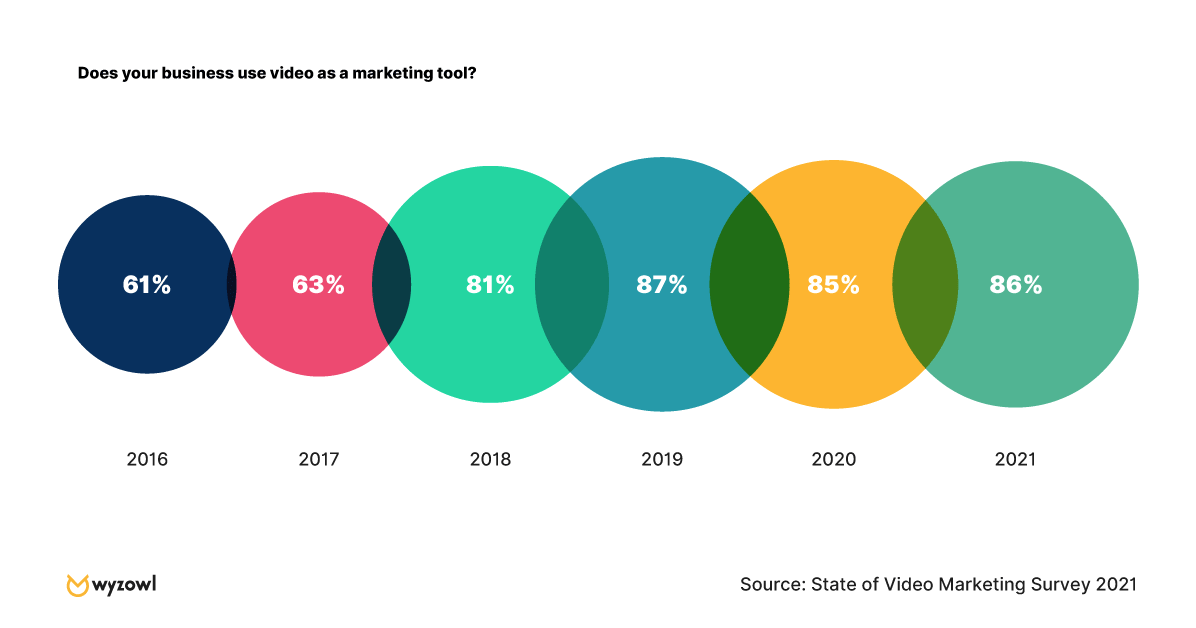
What’s more, 93% of marketers who use video say that it’s an important part of their marketing strategy — an increase from 92% in 2020, making this the highest percentage of any year since 2015.
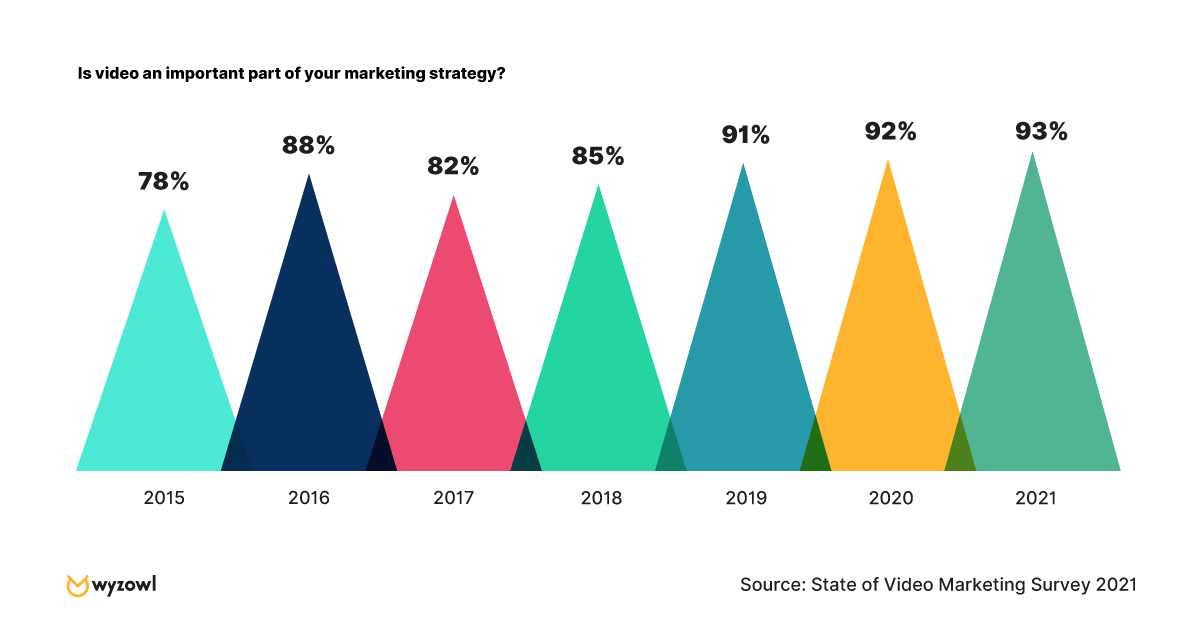
Perhaps most strikingly, 87% of video marketers reported that video gives them a positive ROI — a world away from the lowly 33% who felt that way in 2015. This could well be attributed to greater understanding of how to use video, as well as how to track and quantify its impact
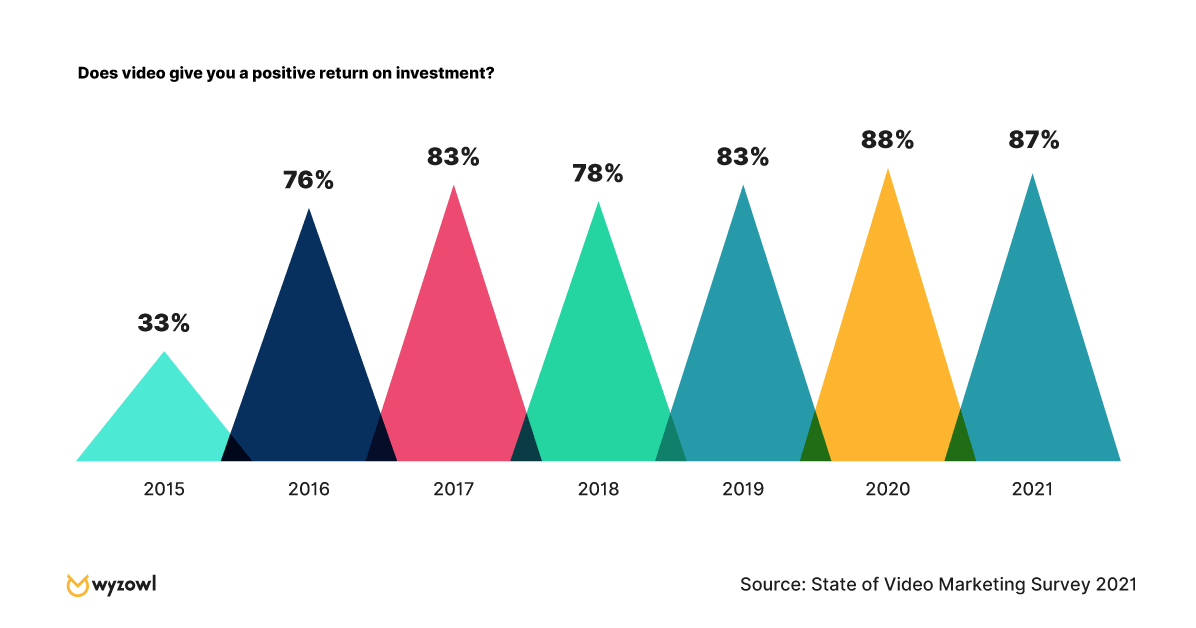
Pandemic Impact
So what about the impact of the global pandemic?
Let’s begin with the fact that 91% of marketers feel the pandemic has made video more important for brands.
A fairly considerable 40% of video marketers said their plans to create video were affected by the events of the last year — with around 74% of these saying they were more likely to use video, and 26% saying it was less likely.
Around 60% of video marketers say they expect their budget to be affected for 2021, with around 70% of those people expecting a higher video marketing budget, and the other 30% expecting it to be lower.
68% of consumers say the pandemic has impacted the amount of video content they’ve watched online, with the overwhelming majority (96%) saying this has increased.
Looking forward …
All the signs suggest that usage and spend are on course to continue their growth in 2021.
More than 99% of current video marketers told us they’ll continue using video in 2021, and 96% plan to increase or maintain their spend (again, up slightly from 95% last year.)
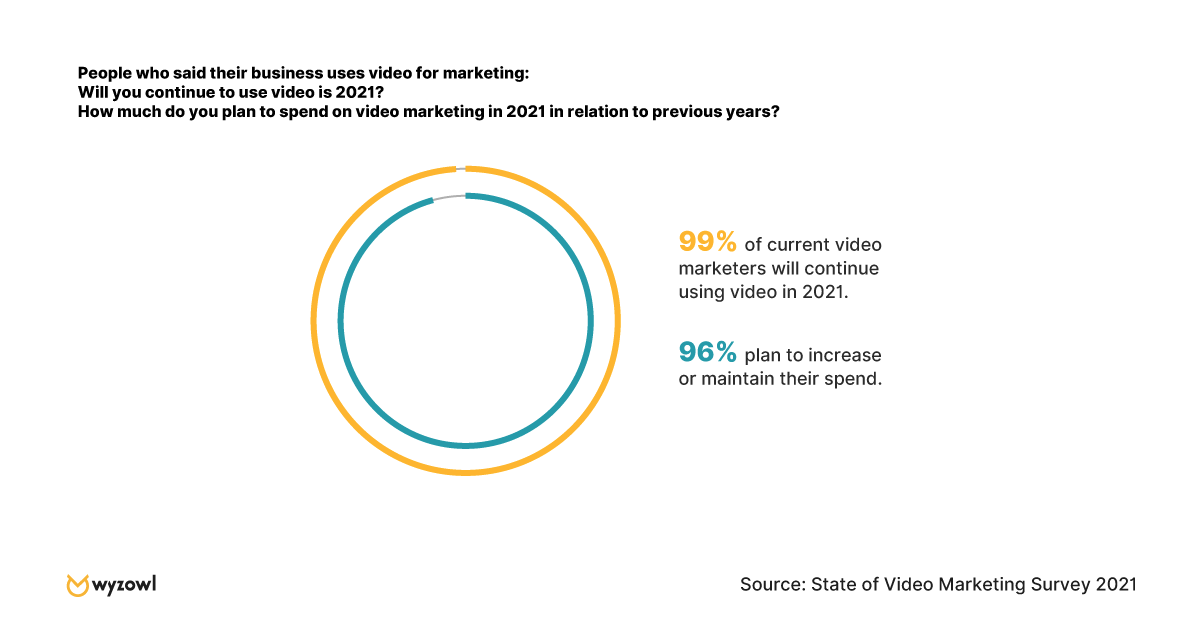
What’s more, from the people who told us they don’t currently use video, 69% told us they expect to start in 2020. (This is 10% higher than last year’s figure of 59%.)
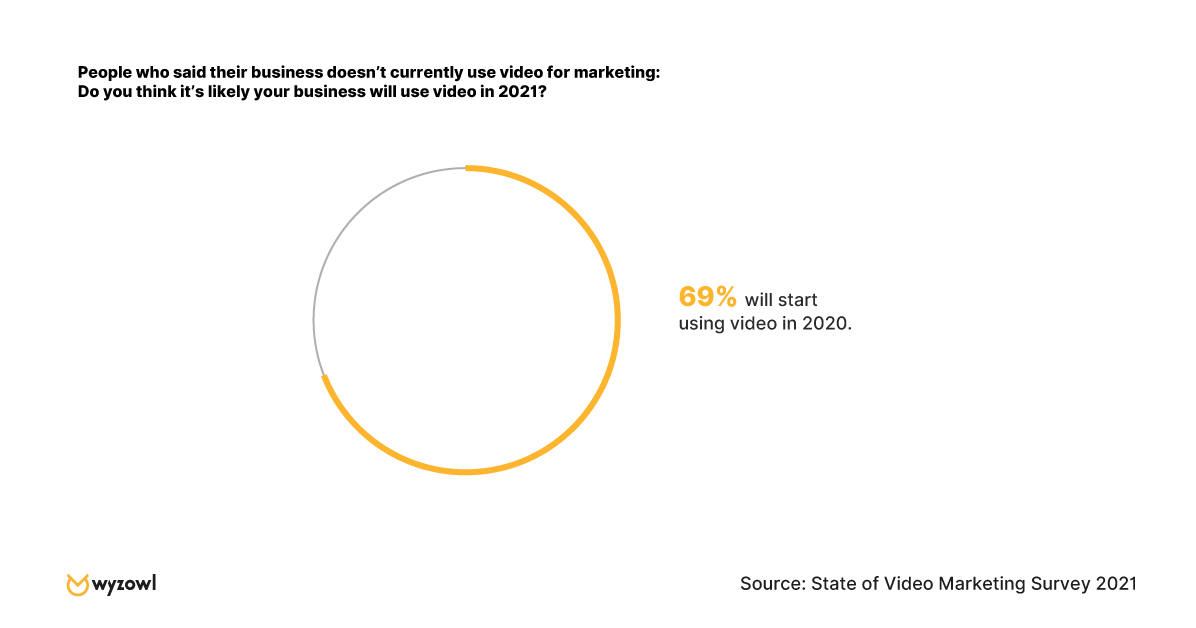
The net result of this is that we can all expect to see more noise and competition for audience attention in the coming 12 months.
Of course, while this is a challenge, it isn’t an insurmountable one. It simply raises the bar in terms of content quality. Video needs to be well-planned, and very well-executed.
The big opportunities …
You’d be forgiven for looking at these numbers and feeling that video might be on the verge of reaching saturation point. Most of the data around usage, spend, and consumer opinion are in the 80s and 90s — where they’ve held, consistently, for a number of years.
But the good news is that there still seems to be underutilized opportunities for marketers to explore around video.
Unsurprisingly, YouTube and Facebook are the most widely used platforms among video marketers — used by 87% and 70%, respectively.
But some of the lesser-used video tactics also seem to be reaping real results for video marketers.
Most notably, perhaps given global events and an increased desire for remote connection, 2020 seems to have been the year of the webinar. In 2019, just 46% used webinars — but in 2020, this rose significantly to 62%.
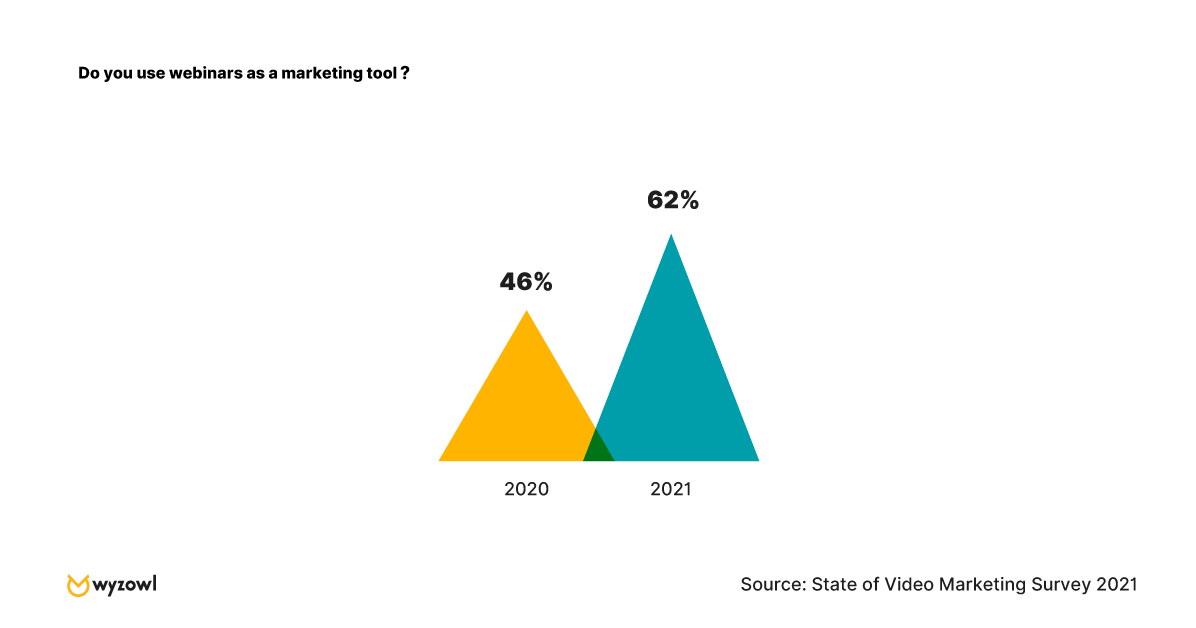

What’s more, an overwhelming 91% of webinar marketers say they’ve been a success, making it the most effective video marketing channel of all those listed.
To Sum Up
The events of 2020 did, and are doing, little to slow the rise of video.
In many ways, with people being isolated in their homes, and some teams working with less budgeting and resources than pre-pandemic, the demand (and consumption) of video has been accelerated.
Video looks set to continue its ten-year overnight success story into the coming decade. These stats paint a picture of a media type that’s almost universally popular among both marketers and their audiences, helping achieve a number of incredibly important goals.
You can check out the full report — with plenty more data points — and get a downloadable version by visiting Wyzowl’s State of Video Marketing 2021 page.

How to Use Schema Markup to Improve Your Website’s Structure
Just like when I first watched The Matrix, when I initially heard the term “schema markup,” I was intimidated by the technical know-how I felt I needed to understand it.
However, just like the movie, understanding schema markup isn’t as difficult as you might think.
As a marketer, schema markup is important because you want to make it as easy as possible for search engines to crawl your website.
The easier it is for Google to understand your site, the higher in search engines your website can appear.
Below, let’s review what schema markup is, where to add it, and how it can improve your website’s structure.
What Is Schema Markup?
Schema markup is code you can add to your website that helps search engines return better results for users. Essentially, it gives vital information to search engines to include in your listing that can improve visibility online, as well as click-through rates.
In 2011, top search engines including Google, Yahoo, Bing, and Yandex collaborated to create schema.org, which is a “collaborative, community activity with a mission to create, maintain, and promote schemas for structured data on the Internet, on web pages, in email messages, and beyond.”
Ultimately, schema markup is a form of microdata. According to Wikipedia, “microdata is an HTML specification used to nest metadata within existing content on web pages. Search engines, web crawlers, and browsers can extract and process microdata from a web page and use it to provide a richer browsing experience for users.”
For instance, schema markup will create an enhanced description — sometimes referred to as a rich snippet — which will appear in search results.
As a result of using microdata, your website’s structure will be simple and easy for search engines to crawl, making it easier to appear higher in search results.
1. iPhone 11 Example
Below is an example of a search engine results page featuring listings with and without schema markup data. As you can see, three of the top four results for the iPhone 11 have schema markup data including ratings, reviews, and price.
Although T-Mobile and Tom’s Guide are the third and fourth listing down, using schema markup microdata can improve its click-through-rate. Plus, it helps the listing stand out from the rest.
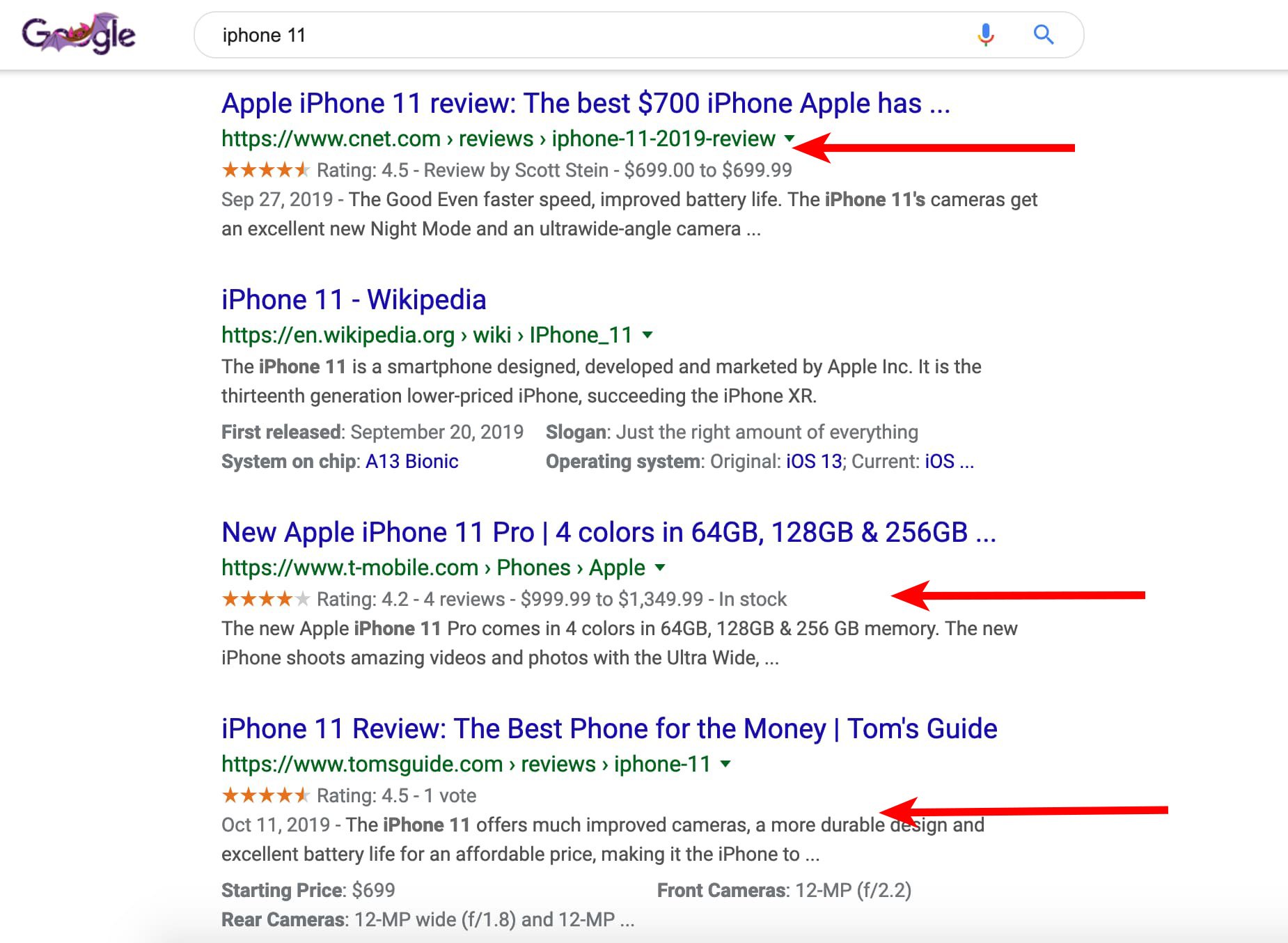
2. Betabrand Example
However, the one from Amazon includes ratings and reviews.
Again, including this type of information helps search engines provide more information that can persuade users to click on your listing.
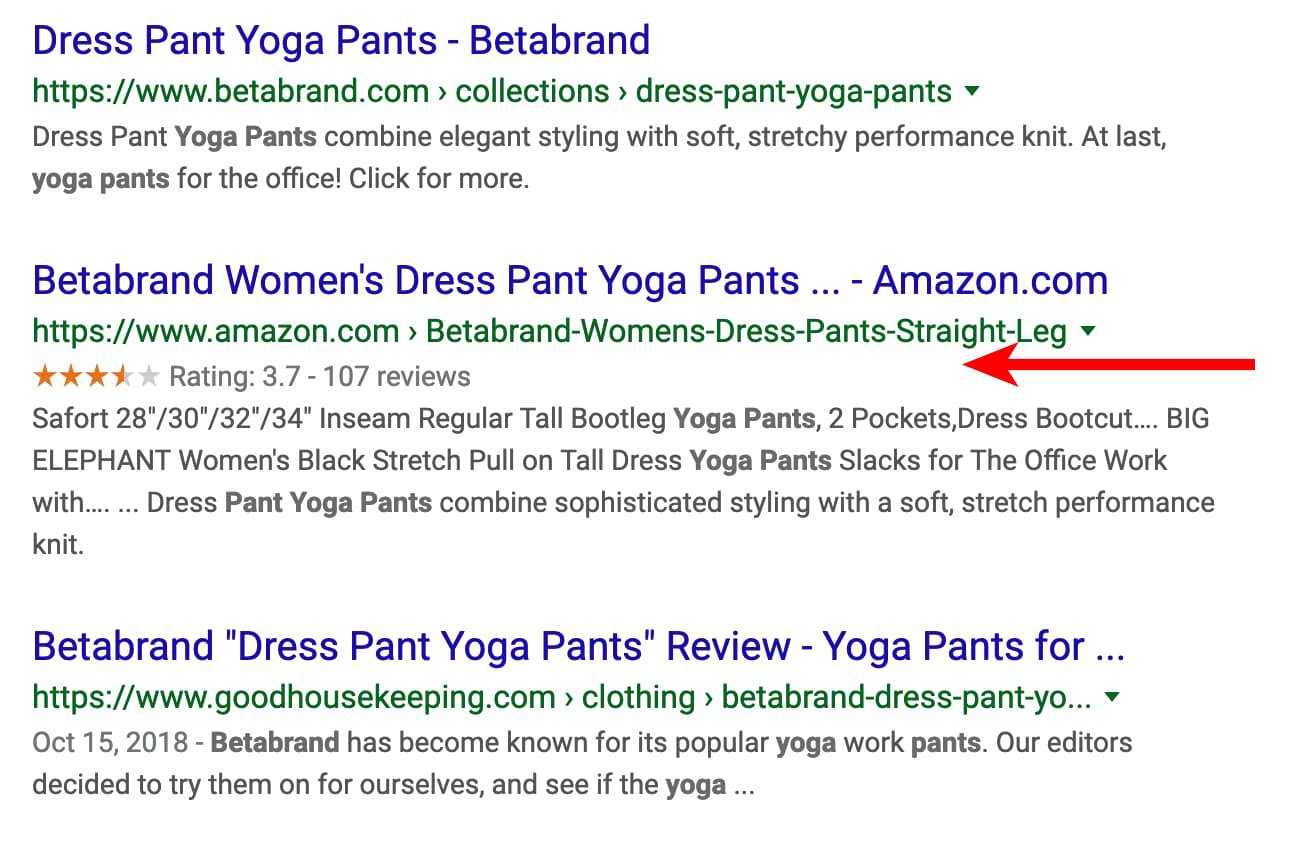
3. Booking.com Example
If someone is searching for and might be staying in that hotel they can learn how close it is to the airport, the average cost, and the ratings.
Where to Add Schema Markup
You can add a variety of microdata depending on your service or product.
For example, you can include:
- Reviews
- Star ratings
- Pricing
- Availability
- Events
- Location
- Price range
- Payment options
- Store hours
The options are endless. No matter what service or product you sell, you can use schema markup to enhance your search engine listings.
So, how do you add schema markup to your site?
Schema Markup Generator
The process is actually pretty simple. All you need to do is use a schema markup generator.
Step 1: Go to Google’s Structured Data Markup Helper
Step 2: Select the type of listing you want to add schema markup to. Then, copy and paste the URL in the form field.
Step 3: Add schema markup data on the right pane by filling in the information you want to show up.
Step 4: Hit “Create HTML” button.
Step 5: Copy and paste the yellow, highlighted code. This is your schema markup code. Alternatively, you can hit the “Download” button to grab the code.
Step 6: Paste the code into your content management system.
Once you’ve gone through this process, you’ll want to then test your schema markup to make sure it shows up correctly in search engines.
If you use HubSpot, you can actually use a Schema Helper integration to add schema markup to your posts.
Below, let’s review how to test your listing.
Schema Markup Tester
Now that you’ve added the schema markup code to your site, it’s time to test it out. You can do this by using the Google Structured Data Testing Tool.
You can test your schema markup two ways: by URL or code.
To test the URL, all you need to do is copy and paste the URL of the webpage you want to see. Then, the tool will showcase a preview of your listing.
To test the code, you can copy and paste the code the structured data markup tool generated for you. Again, a preview of your listing will appear.
While schema markup may seem technically intimidating, it’s actually a simple process. By using schema markup code, you can increase the visibility of your search engine listings and improve click-through-rates.

How to Do a SWOT Analysis [With Template & Examples]
As your business grows, you face more obstacles, challenges, opportunities, and projects in general. It’s a good and natural part of scaling an organization, but how do you determine your priorities? Which initiatives should you execute on first, and which challenges should you address right away?
Enter the SWOT analysis, a framework that can help you develop a roadmap for moving forward with your business, maximizing opportunities and minimizing roadblocks along the way.
While it may seems simple on the surface, a SWOT analysis allows you to make unbiased evaluations on:
- Your business or brand
- Market positioning
- A new project or initiative
- A specific campaign or channel
Practically anything that requires strategic planning, internal or external, can have the SWOT framework applied to it, helping you avoid unnecessary errors down the road from lack of insight.
Importance of SWOT Analysis
You’ve noticed by now that SWOT stands for Strengths, Weaknesses, Opportunities, and Threads. The framework seems simple enough that you’d be tempted to forego doing using it at all, relying instead on your intuition to take these things into account.
But you shouldn’t. Doing a SWOT analysis is important because:
- It gives you the chance to worry and to dream. Adding the SWOT analysis as an important step in your strategic process, you’re giving yourself the space to dream, evaluate, and worry before taking action. Your insights in this regard then turn into assets as you create the roadmap for your project or initiative.
- It forces you to define your variables. Instead of diving head first into the planning and execution, you’re taking inventory of all your assets and roadblocks. These can help you create a more specific and effective roadmap.
- It allows you to think more critically and account for mitigating factors. As you identify weaknesses and threats, you’re better enabled to account for them in your roadmap, improving your chances for success.
- It helps you keep a written account. As your organization grows and changes, you’ll be able to strike things off your old SWOTs and add new things as the industry changes. It can be illuminating to look back to where you started as you look ahead at what’s to come.
Here, we’ll tackle how to best do a SWOT analysis, provide you with a SWOT analysis template, and conduct SWOT analyses on major brands Apple and Starbucks. When you’re done reading, you’ll have all the inspiration and tactical advice you need to tackle a SWOT analysis for yourself.
How Do You Write a Good SWOT Analysis?
There are several steps you’ll want to take when evaluating your business and conducting a strategic SWOT analysis.
1. Download HubSpot’s SWOT Analysis Template.
There’s no need to start from scratch for your analysis. Here, I’ve created a sample using a free, editable template — feel free to use the model yourself, or create your own as it suits your needs.
Download a free, editable SWOT analysis template.
2. Arrange each section into a table with four quadrants.
Whether you use the template above as a model or create your own to suit your needs, it can be helpful to start in table format to visualize your SWOT analysis. This can be done by arranging each of the four sections into separate quadrants.
3. Identify your objective.
Before you start writing things down, you’ll need to figure out what you’re evaluating with your SWOT analysis. Be specific with what you want to analyze. Otherwise, your SWOT analysis may end up being too broad, and you’ll get analysis paralysis as you are making your evaluations.
If you’re creating a social media program, you’ll want to conduct an analysis to inform your content creation strategy. If you’re launching a new product, you’ll want to understand its potential positioning in the space. If you’re considering a brand re-design, you’ll want to consider existing and future brand conceptions.
All of these are examples of good reasons to conduct a SWOT analysis. By identifying your objective, you’ll be able tailor your evaluation to get more actionable insights.
3. Identify your strengths.
“Strengths” refers to what you are currently doing well. Think about the factors that are going in your favor as well as the things you offer that your competitors just can’t beat.
For example, let’s say you want to use a SWOT analysis to evaluate your new social media strategy.
If you’re looking at a new social media program, perhaps you want to evaluate how your brand is perceived by the public — is it easily recognizable and well-known? Even if it’s not popular with a widespread group, is it well-received by a specific audience in particular?
Next, think about your process: is it effective or innovative? Is there good communication between your marketing and sales to ensure both departments use similar vocabulary when discussing your product?
Finally, evaluate your social media message, and in particular, how it differs from the rest of the industry. I’m willing to bet you can make a lengthy list of some major strengths of your social media strategy over your competitors, so try to dive into your strengths from there.
4. Identify your weaknesses.
Similarly to your strengths, what are the roadblocks hindering you from reaching your goals? What do your competitors offer that continue to be a thorn in your side. This section isn’t about being a Negative Nancy. Rather, it’s critical to foresee any potential obstacles that could mitigate your success.
When identifying weaknesses, consider what areas of your business are the least profitable, where you lack certain resources, or what costs you the most time and money. Take input from employees in different departments, as they’ll likely see weaknesses you hadn’t considered.
If you’re examining a new social media strategy, you might start by asking yourself these questions: First, if I were a consumer, what would prevent me from buying this product, or engaging with this business? What would make me click away from the screen?
Second, what do I foresee as the biggest hinderance to my employees’ productivity, or their ability to get the job done efficiently? What derails their social media efforts?
5. Consider your opportunities.
This is your chance to dream big. What are some opportunities for your social media strategy you hope, but don’t necessarily expect, to reach?
For instance, maybe you’re hoping your Facebook ads will attract a new, larger demographic. Maybe you’re hoping your YouTube video gets 10,000 views, and increases sales by 10%.
Whatever the case, it’s important to include potential opportunities in your SWOT analysis. Ask yourself these questions: What technologies do I want my business to use to make it more effective? What new target audience do I want to reach? How can the business stand out more in the current industry? Is there something our customers complain about that we could fix with our social media strategy?
The opportunities category goes hand-in-hand with the weaknesses category. Once you’ve made a list of weaknesses, it should be easy to create a list of potential opportunities that could arise if you eliminate your weaknesses.
6. Contemplate your threats.
It’s likely, especially if you’re prone to worrying, you already have a good list of threats in your head.
If not, gather your employees and brainstorm: What obstacles might prevent us from reaching our social media goals? What’s going on in the industry, or with our competitors, that might mitigate our success? Is there new technology out there that could conflict with our product?
Writing down your threats helps you evaluate them objectively. For instance, maybe you list your threats in terms of least and most likely to occur, and divide and conquer each. If one of your biggest threats is your competitor’s popular Instagram account, you could work with your marketing department to create content that showcases your product’s unique features.
SWOT Analysis Examples
The template above helps get you started on your own SWOT analysis.
But, if you’re anything like me, it’s not enough to see a template. To fully understand a concept, you need to see how it plays out in the real world.
These SWOT examples are not exhaustive, and I’m sure you could add some yourself, but hopefully, it’s enough to inspire you as you do your own SWOT analysis.
Apple’s SWOT analysis
Here’s how we’d conduct a SWOT analysis on Apple.
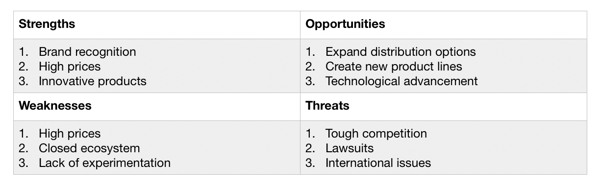
Strengths
First off, strengths. While Apple has many strengths, let’s identify the top three:
- Brand recognition
- High prices
- Innovative products
Apple’s brand is undeniably valuable, and their business is considered the most valuable in the world. Since it’s easily recognized, Apple can produce new products and almost ensure a certain degree of success by virtue of the brand name itself.
This degree of recognition lends itself to Apple’s ability to sell products. For instance, in 2019, Apple sold 72.9 million iPhones compared to 70 million Galaxy phones by Samsung. This is despite the price disparity between the two (the flagship Galaxy phone is $100 cheaper). Often, people don’t care about price as much as they care about brand recognition.
Lastly, their innovative products: Apple didn’t earn its reputation for nothing. They create highly innovative products, which are often at the forefront of the industry.
Weaknesses
Next, let’s look at three of Apple’s weaknesses.
- High prices
- Closed ecosystem
- Lack of experimentation
While the high prices don’t deter Apple’s middle and high class customer-base, they do hinder Apple’s ability to reach a lower-class demographic.
Apple also suffers from its own exclusivity. Apple controls all its services and products in-house, and while many customers become loyal brand advocates for this reason, it means all burdens fall on Apple employees.
Ultimately, Apple’s tight control over who distributes their products limit their market reach.
Lastly, Apple is held to a high standard when it comes to creating and distributing products. Apple’s brand carries a high level of prestige, but that level of recognition inhibits Apple from taking risks and experimenting freely with new products that could fail.
Opportunities
Now, let’s take a look at opportunities for Apple.
It’s easy to recognize opportunities for improvement, once you consider Apple’s weaknesses. Here’s a list of three we came up with:
- Expand distribution options
- Create new product lines
- Technological advancement
One of Apple’s biggest weaknesses is its distribution network, which, in the name of exclusivity, remains relatively small. If Apple expanded its network and enabled third-party businesses to sell its products, it could reach more people globally, while alleviating some of the stress currently put on in-house employees.
There are also plenty of opportunities for Apple to create new products. Apple could consider creating more affordable products to reach a larger demographic, or spreading out into new industries — Apple self-driving cars, perhaps?
Finally, Apple could continue advancing its products’ technology. Apple can take existing products and refine them, ensuring each product offers as many unique features as possible.
Threats
Finally, let’s look at threats to Apple.
Believe it or not, they do exist.
Here are three of Apple’s biggest threats:
- Tough competition
- Lawsuits
- International issues
Apple isn’t the only innovative tech company out there, and it continues to face tough competition from Samsung, Google, and other major forces. Many of Apple’s weaknesses hinder Apple’s ability to compete with the tech corporations that have more freedom to experiment, or that don’t operate in a closed ecosystem.
A second threat to Apple is lawsuits. Apple has faced a bunch of lawsuits, particularly between Apple and Samsung, and so far it has only won one case. These lawsuits interfere with Apple’s reputable image, and could steer some customers to purchasing elsewhere.
Finally, Apple needs to improve its reach internationally. It isn’t number one in China, and doesn’t have a very positive relationship with the Chinese government. Then, in India, which has one of the largest consumer markets in the world, Apple’s market share is low, and the company has trouble bringing stores to India’s market.
If Apple can’t compete globally the way Samsung or Google can, it risks falling behind in the industry.
Starbucks SWOT Analysis
Now that we’ve explored the nuances involved with a SWOT analysis, let’s fill out a SWOT template using Starbucks as an example.
Here’s how we’d fill out a SWOT template, if we were Starbucks:
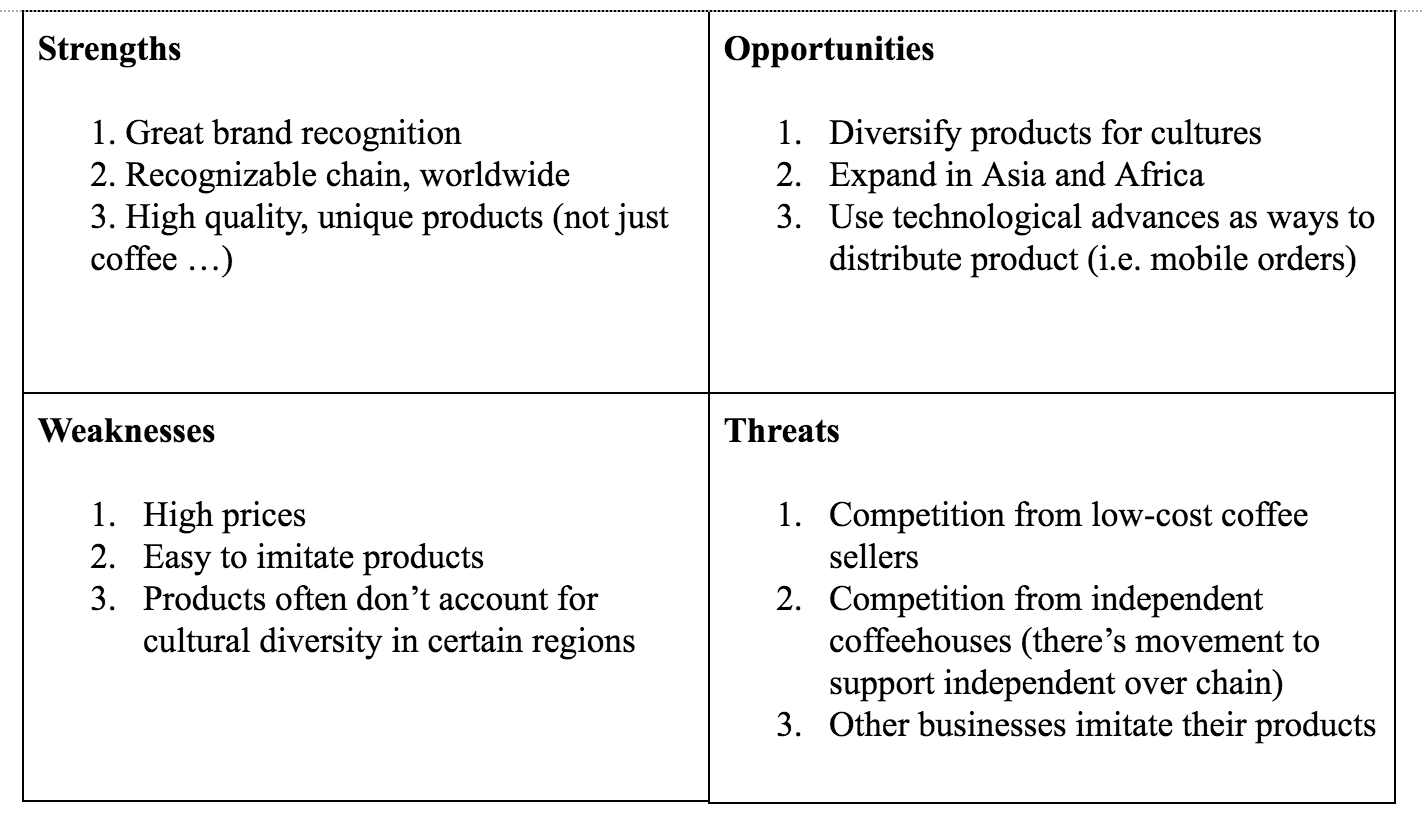
Dine-In Thai Restaurant SWOT Analysis
Some small-business marketers may have difficulty relating to the SWOT’s of big brands like Apple and Starbucks, so here’s an example of how a restaurant might visualize each element:
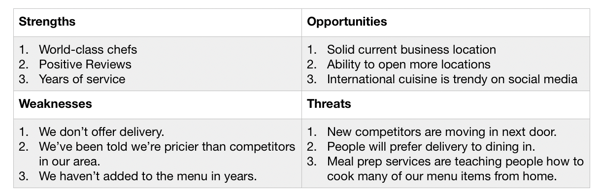
While a Thai or any other restaurant might not be as worried about high-level lawsuits like Apple, the small business might be more worried about competitors or disruptors that might enter the playing field.
Local Boutique SWOT Analysis
In another small-business example, a local boutique might be well known in its neighborhood, but it also might take time to build an online presence or get its products in an online store. Because of this, some of its strengths and opportunities might relate to physical factors while weaknesses and threats might relate to online situations.
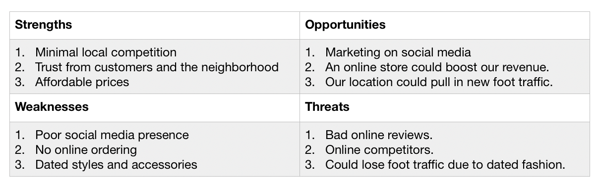
When to Use a SWOT Analysis
Ultimately, a SWOT analysis can measure and tackle both big and small challenges, and opportunities, and both big and little strengths and weaknesses.
While the examples above focus on businesses in general, you can also use a SWOT analysis to evaluate and predict how a singular product will play out in the market.
Hopefully, our SWOT template will supplement your market research and business analysis, and provide fair insights into how to optimize your products for bigger payoffs, and less hurdles.
Editor’s note: This post was originally published in May, 2018 and has been updated for comprehensiveness.

Why You Might Want to Be More Negative in Your Marketing
Ever wake up on the wrong side of the bed?
Of course you have. We all have.
Ever wake up on the wrong side of the bed, and then have to be cheery? Like, interact in social media? Write an engaging blog post? Put together a lovable email marketing campaign?
Ugh. Those are the times you wish you could shut out the world, or at least channel a little of your inner snark. Well, the good news is you can do that once in a while, and your marketing results may even thank you for it! Sometimes, it’s good to embrace a little bit of the negative. (Trust me — this will all make sense in a second.)
So, here we go … if you ever wake up wanting to shut out the world, here’s how you can take it out (positively!) in your marketing.
Keep in mind, however, that negative marketing shouldn’t be deployed simply because you want to be cranky. Instead, it should be implemented strategically with one (or more) of these goals in mind:
- Empathizing with customer struggles
- Differentiating your brand with that of competitors, especially those who may not be willing to take a stand or acknowledge certain truths in the industry
- Cutting through the noise of “neutral” messaging that might not be resonating
If you’re successful, the end result causes you to stick in your audience’s mind, which gives you the bandwidth to prove your brand as a superior alternative.
How to Be Negative in Your Marketing
So how do you implement this tactic successfully? Here are some opportunities to be “more negative” in your marketing.
1. Create negative, or exclusionary, personas.
Let’s start with something a little bit easier to swallow than just being a total grumpy pants: exclusionary personas. Exclusionary personas, sometimes also referred to as negative personas, are kind of like the opposite of buyer personas — they’re the personas of the people you do not want to target in your marketing.
This is about more than just recognizing that not everyone in the world is a potential future customer — it’s about recognizing that your marketing attracts certain types of people who totally clog up your funnel, waste your sales team’s time, and will never become customers.
Why won’t they ever become a customer? Could be a lot of things — they don’t have the budget, or they’re just fans of your content or social media presence. Or maybe they do become customers, but they cost you a ton of money; for instance, they could have a high acquisition cost or a high propensity to churn.
In this case, it behooves you to identify who these folks are so you can ensure you either 1) stop creating content that draws in the wrong people, or 2) let them keep reading and engaging with your content to help you spread your reach, but keep them from getting rotated to sales reps using methods like assigning them a low lead score.
2. Leverage a little exclusivity.
This is the VIP, red-carpet tactic we all know and love (or love to hate). When you tell someone they can’t have something or what they want is scarce, it often makes them want it more. You know, the whole “playing hard to get” thing.
This just so happens to be a common sales tactic, but marketers can use it, too. Tell prospects they can have an offer … but only for a limited time. Or only for the first 10 that respond in social media. Heck, you don’t even always have to tell them what it is.
This tactic is particularly popular with savvy ecommerce shops, too — ModCloth, for instance, frequently sends me emails letting me know that an item I like is so popular, it’s almost out of stock. “Oh no! Everyone else is snagging it! I have to get it before I’m left out!”
The moral of the story? Leave people out once in a while. If everyone gets something, it’s not as special. And when you go VIP, the ones who do get it feel uber-special. (There… we just turned a negative into a positive. See?)
3. Craft “negative” headlines and titles.
I don’t know what this says about human nature, but there’s an undeniable correlation between page views and negativity. Consider some of these titles you might find on a news site like CNN:
- What you get wrong about BBQ
- Could our favorite flavorings be damaging our DNA?
- Beware the parental overshare
These are about clicks. No question about it. We all know the news has gone the negative route for years, and — for better or worse — they do it because it is effective at grabbing attention.
Now, you absolutely shouldn’t throw out some inflammatory headline just to get clicks — if you’re going to get negative with your titles, you have to back it up with some solid content that actually merits that title of yours. Here are a few examples that worked out extremely well for us:
- 15 Things People Absolutely Hate About Your Website
- 10 Cliché Marketing Taglines We Should All Stop Using
- 13 Hilarious Examples of Truly Awful Stock Photography
- 17 Sales Closing Mistakes That’ll Stop a Deal in Its Tracks
4. Create a bond over a shared negative experience — but don’t dwell.
Alright, now we’re getting warmed up! So you’re throwing out some negative titles, but have you considered drawing that negativity into your content? When you draw on a negative situation in your content — particularly right in the beginning — it can actually help reader retention and engagement. Some marketers are afraid to stir up negative feelings in their reader, but it can actually create a shared experience and tap into a level of emotion that some may not expect to get while reading marketing content, particularly if you’re a B2B marketer.
I mean, that’s why I started this post the way I did — getting up on the wrong side of the bed is an experience everyone I know can relate to. And sometimes, it’s easier to form a bond with someone over a shared negative experience than something warm and fuzzy.
But be forewarned — once you have a bond with the reader based on a shared negative experience, it’s crucial to shift the mood to something more positive and solution-oriented. People like to know they’re not alone (misery loves company), but most don’t like to dwell on the negativity.
5. Cast some villains.
Just like we can all bond over a shared negative experience, so too can we bond over a common enemy. Casting a villain has been a common marketing tactic for years, and I’m not just talking about the Hamburglar. Villains can take more subtle forms, playing on common tropes — the jerk boss, the slob roommate, bureaucratic drone.
These take common experiences and personify them in order to elicit a feeling in the consumer, and help tell the story you’re trying to tell. A great example of this is Genesis’s “Going Away Party” commercial where they use the “stuffy” party trope and the “villains” within it to demonstrate that luxury doesn’t have to be stuffy.
6. Take a stand for something you believe in, even if it’s controversial.
If you feel confident about your brand, your PR team, and your position on an issue, you can take a controversial stance on a popular topic. Controversial marketing is a risky play because, in many cases, your brand could be seen as capitalizing on an issue just to peddle your products. However, when done well, your brand could be seen as socially responsible.
Controversial marketing can also do a few other things for your marketing:
- Position you as a thought leader (only if your thought was a good one — so try to make sure it is)
- Help you define your brand in the eyes of consumers and what it stands for
- Drive natural publicity
- Elicit strong emotions from audiences, both positive and negative
That last one is what I want you to pay the most attention to. When you take a staunch position on a polarizing issue, you will have people who like you less for it. You will also generate some seriously ardent supporters. If you’re going to play the controversy game, be prepared to deal with both, because while some results could be really exciting for your brand, some backlash will inevitably come with it.
7. Use data to build a case study around why something stinks.
Let’s start off with an example: [New Research] It’s Official — Lots of Salespeople Hate Their CRM. It gets props off the bat for its grabby negative headline, but it’s also full of interesting statistics like this one:
50% of sales leaders say that their CRM is difficult to use, and 18% say this has caused them to lose opportunities or revenue.
You build a case around why one thing stinks (traditional CRMs) so you can show why something else is awesome (the new HubSpot Sales Hub Enterprise).
This can be made even more compelling if you have two data points that demonstrate a stark contrast; the juxtaposition of positive and negative paints a pretty dramatic picture in readers’ minds, and the succinct data points make it easy to quickly demonstrate the bad versus the good.
8. Poke some fun at your competitors.
This is perhaps what most people think of when negative marketing is discussed, but it’s rarely executed because of how delicate the situation can be. On one hand, a little healthy competition can be a good thing, especially if you want to position yourself as a better option. However, if done poorly, your audience may actually think less of your brand for “playing dirty” or being too low-brow. In addition, if you leverage false claims, you could be asking for legal trouble.
There are two types of negative marketing with regard to your competitors:
- Attack: Focuses on the negative sides of your competition’s offerings.
- Contrast: Focuses on the positive sides of your offerings and establishes the gap. This is more subtle but still highlights what your competition may lack.
Typically, it’s easier for larger brands to engage in negative marketing with their competition because they’re already well-known, so the reward can be greater than the risk to highlight value propositions.
Pepsi has a famous “attack” ad in which a child dispenses two Coca-Cola cans from a vending machine and stands on them in order to reach the Pepsi button.
Bud Light uses the more subtle “contrast” approach in their “Special Delivery Corn Syrup” ad:
This ad works because it’s a light narrative and doesn’t engage in serious mud-slinging (it merely highlights a differentiator).
Nonetheless, controversy brewed even in this case as the company was sued for potentially misleading consumers by not acknowledging the difference between corn syrup and high-fructose corn syrup, which demonstrates exactly why this tactic is risky.
If your brand isn’t a household name, it may be better to highlight value propositions and differentiators in less risky ways.
For example, some brands engage in competitor criticism without mentioning any names. Doing this ensures you’re not giving your competition free airtime while you capitalize on ideas your consumers know to be true. For example, Domino’s does this in their “Designed to Be Delivered” ad, which doesn’t mention a single competitor (but does imply them):
9. Make fun of yourself.
Another less risky way would be to turn that negativity inward. A little self-deprecation can be fun for others, makes you seem more human, and actually might make you feel better about your slip-ups. After all, we all have them, and it’s important to learn how to make light of your mistakes. Speaking of Domino’s, one of the best examples of recent self-deprecating advertising is when Domino’s admitted their pizza tasted like cardboard and what they’re doing about it:
When Negativity Backfires
All this being said, it’s important to always consider whether your negativity is going to backfire. Are you being an unadulterated jerkface? Is this negativity going to be lost on your audience? Does your buyer persona really hate this kind of stuff?
For instance, something that almost always comes off as totally petty and unnecessarily negative is bickering with competitors. I mean, think about how annoying political ads are; you certainly don’t want to come off like that. I think one piece of advice from my childhood can sum up how you should approach bickering with competitors:
“If you don’t have anything nice to say, don’t say anything at all.”
Yes, even if they started it.
It’s also important to remember that any negativity you draw on needs to be tempered with some positivity.
Finally, I think striving to be inspirational should always be an aspiration for marketers. There’s no question that marketers capable of inspiring people see unbelievable success from their efforts. In fact, I think if you’re able to inspire people in your marketing, the effects last much longer and are much stronger than any of these negative tactics.
Editor’s note: This post was originally published in April 2013 and has been updated for comprehensiveness.

How to Run Marketing Team Meetings That Don’t Suck
Meetings suck. They’re time for people to avoid doing actual work, stare blankly at each other, throw in generic comments to look like they’re paying attention, and if you’re lucky, maybe come out with some wicked notebook doodles.
Is that how people perceive your marketing meetings? I hope not, because they don’t actually have to be that way.
Turn your marketing meetings into something useful by — you guessed it — creating compelling content! (Oh my gosh, inbound marketing concepts work in real life, too!)
As your team grows, it’s important for everyone to get in a room together and talk about what they’ve been working on in their corner of the world. So to ensure those marketing meetings aren’t blocks of time your team dreads, make note of these tips for how to make marketing team meetings truly useful for your employees.
How to Run an Effective Meeting
While this post will primarily focus on marketing meetings, I want to address a team-agnostic section about effective meetings as a whole.
As I said above, meetings can be a grandiose waste of time. It’s tempting to run your work by others, gather feedback or affirmation, or simply avoid the tough stuff by calling meetings.
I’m here to tell you — don’t do it. The first step to running effective meetings is to only schedule meetings when absolutely necessary.
Quarterly meetings to report on company progress and important news? Of course. Monthly meetings to touch base on KPIs and recruit help for projects? Sounds great. Weekly meetings to report on current responsibilities and asks? I’m torn on whether this one is necessary, but for large teams or teams with new employees, this could be a good move.
Every moment in a meeting is time away from heads-down work, the work that arguably moves your business forward. Are meetings necessary to take a break, touch base, and rally with your team? Of course.
Secondly, to understand the effectiveness and efficiency of a meeting, ask your team. Ask, “is [meeting] helpful for you? If so, what are its top two benefits for you?” This can help you understand what percentage of your teams finds value in your meetings and what components or agenda items may be able to be removed to save time.
Speaking of agendas, let’s discuss next what your marketing meeting agendas should resemble.
Marketing Meeting Agenda
Whether your marketing team meeting is weekly monthly, this section will explain the content you should every single time. We also recommend creating a slide deck that you project for your team in each meeting so you can all follow along with each agenda item.
Marketing Meeting Agenda Example
For every meeting, you should have a dedicated agenda slide that lays out three things:
- What will be discussed in today’s meeting
- Who will be leading each discussion
- How much time is allotted for each discussion
Take a look at one of our recent marketing team meeting agenda slides:
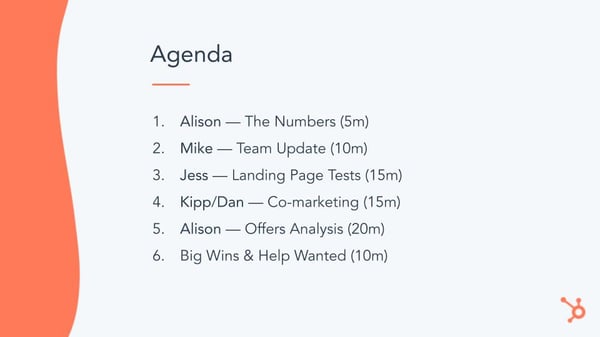
Outlining who is talking, what they’re covering, and how much time they have to discuss it will help prevent the meeting from getting derailed. It will also prevent people from delving into unproductive conversations that are best had at another time and place.
As for what components should be on your marketing meeting agenda, let’s discuss what to cover during your marketing meeting.
Review Important Metrics
Do a quick review of your most important marketing metrics. These shouldn’t be niche metrics, like email unsubscribe rate, social media reach, or blog subscriber growth; save those for your monthly meetings where you review month-over-month progress.
These should be the metrics your marketing team is measured on. In other words, at the end of the month, what metrics will tell you whether the marketing team succeeded?
While every business will likely review something different depending on their business model, here are some ideas for you:
- Leads waterfall
- Sales waterfall
- Volume of marketing qualified leads(MQLs)
- Paid vs. organic leads breakdown
- Website traffic
It’s important to review your team’s important metrics because these are how you’re measured onas an overall marketing team. And if you don’t all know how you’re faring as the month progresses, individual contributors can’t do anything to step up and help your team’s numbers improve.
A Bit of Education
Marketing meetings should be a healthy mix of state-of-the-union content and educational content. Each week, have a couple team members present briefly about interesting projects they’ve been working on. This serves two purposes: it lets people know what their team members do all day, and they get to learn something new!
Think about it … wouldn’t it be interesting for a blogger to learn a little bit about a PPC experiment? Or for a social media intern to learn about the results of the latest email A/B test?
Sharing lessons from projects helps everyone expand their knowledge base, sidestep landmines if a project backfired, and implement effective new techniques that they never knew worked.
Boom — everyone leaves your weekly meeting a smarter, better marketer!
The Nitty Gritty Retrospective
Your meeting should also contain a review of the projects each employee (or if you’re a larger marketing department, each team) worked on last month/quarter/year, plus the results they’ve seen.
This is good for a few reasons. First, it keeps everyone accountable knowing that each meeting they need to stand up in front of their colleagues and explain just what they do all day. Second, everyone gets to learn from what everyone else worked on and become generally better marketers. Third, it helps everyone identify how individual teams are faring, and what projects they’re doing to improve their own metrics.
For example, if you have a social media team, this is their opportunity to report on the success of every single social network they manage. How is their reach faring? How much traffic are those networks sending to your site? How many leads are being generated? Why are some networks more successful than others?
While your weekly meetings (if you have them) may focus on more high-level, team-based metrics, a monthly or quarterly meeting is a good opportunity to do a deep dive into the channels and metrics that enable the entire team to meet its goals.
How You’ll Meet This Month’s Goals
After the retrospective, each employee or team should also present on their individual goals for the month or quarter, and how exactly they will meet those goals. This is not the time to be generic.
Teams should explain, point by point, everything they’ll be doing during the time period to meet the metrics they’re measured by.
For example, let’s say the email marketing team is responsible for driving more reconversions this month. What exactly will they do to, well, do that? Well, that slide might have some initiatives like A/B test email copy with and without a P.S., anoffers analysis to determine which offers convert at the highest rate, list segmentation experiments, tailoring lead generation offers to align more closely with personas to improve CTR … the list could, and should, go on.
This is also a critical time in your meeting for feedback. Build in time during every presentation — at least 5 minutes, more if you find you need it after a few meetings — for each team to solicit feedback on their proposed projects. This will help individual teams from getting derailed on projects that might not help them meet their goals, or perhaps other members of the marketing team have fantastic ideas that the teams hadn’t even thought of yet!
Big Wins
A little bit of recognition is a good thing. Set aside a couple of minutes — come on, you can’t find 5 minutes? — to showcase some of the amazing things your team members or department as a whole have accomplished.
This could be anything from press coverage, speaking engagements, engaging with power players on social media, a smash hit blog post, an email that received unprecedented click-through rates … you get the point. It’s easy to harp on where you’re falling behind, but a little cheerleading can help rally your team and remind them just how successful they can be when they put their mind to it.
Solicit Help
Everyone should have the opportunity to solicit help from team members during your marketing team meetings. The larger your team gets, the easier it is to work in silos — but everyone has their own little super powers that sometimes go unnoticed.
If there is a platform during every meeting for employees to share (if they need it) something they need a little help with, you may find others pipe up with a simple solution or resource that solves the problem.
There should also be a few minutes built into each presentation for a little feedback. If someone is presenting on the progress of an ongoing project, part of “soliciting help” may be getting feedback on what steps to take next. For example:
- Is this project still worth pursuing?
- How should we measure the success of this project?
- Does anyone have a solution to a major roadblock?
So while there should be a few minutes at the end of each meeting dedicated solely to giving employees the floor to solicit help, time for feedback should be built into presentations if the presenter needs it.
You know what content to include in your marketing team meetings. Now, let’s discuss how to make those meetings run smoothly. These tips, despite helpful content, can make or break the usefulness of any marketing meeting.
1. Stay on time.
Start on time, you end on time, and honor the budgeted time set for individual presentations. I know it’s hard, especially when there’s a good discussion going on, but delegate a timekeeper who lets presenters know when they’re coming up to the end of their allotted time.
If you’re vigilant about this, people will start to self-edit their presentation, and meeting-goers will self-censor their comments, only contributing what truly needs to be said.
2. Don’t allow computers …
… said the internet marketing company. Seriously though, only the meeting coordinator should have a computer to pull up the agenda and presentations.
If others bring their laptops, you’ll find people can’t help but check their emails, get little bits of work done, and chat online, no matter how riveting the presentations are.
3. Build in time for a break.
Your weekly meeting may only be 30 or 60 minutes, but your monthly meeting could take a lot longer. In that case, build in time for people to get up, stretch their legs, go to the bathroom, get coffee, whatever.
You’ll start losing people’s attention otherwise.
4. End every meeting with action items.
Whatever you talked about during your meeting should be revisited briefly at the end of the meeting, preferably by the meeting coordinator. If you spend 20 minutes talking about how to solve your lead shortage problem at the beginning of your 90-minute meeting, there’s a good chance some of the to-dos and initiatives trickled out of people’s minds.
Make sure there’s someone taking notes throughout the meeting, and allot five minutes at the end of every meeting to review what people should start doing once they walk out of that meeting room.
5. Consider your remote folks.
Whether your entire team or just a few members are remote, it’s important to consider the remote meeting experience. As a remote worker myself, dialing into meetings as one of the few remote attendees takes a bit to get used to.
Research helpful technology to mitigate the gap between in-office and remote workers. Zoom is obviously a great choice, but other technology like The Meeting Owl by Owl Labs may be a good fit for your team. At the start of each meeting, test your connectivity and walk through your slides to be sure the message is clear for folks at home.

Source: Getty Images
Most importantly, gather separate feedback from your remote team members to understand their struggles and accommodate their requests.
6. Review metrics and celebrate wins.
You know those marketing metrics you decided to measure and review in the first section? The ones that noted your team’s progress throughout the month?
Now’s the time to see whether you hit your goals or not! If you hit your goals, do two things: celebrate, and explain exactly why you hit those goals. That second one is critical. Someone should explain what marketing activities strongly contributed to you hitting, say, your leads goal. That way you can repeat those activities this month!
Meetings Don’t Have to Suck
Meetings are a necessary part of work. They’re a time to celebrate wins, ask for feedback or help, and get aligned with your team and company.
Sit down with your colleagues to audit your meeting schedule and see where you can trim time or cut meetings altogether. Effective and efficient meetings are much more important than meetings for the sake of it. Your team will thank you.
Editor’s note: This post was originally published in July 2012 and has been updated for comprehensiveness.
