The Best B2B Lead Gen Campaigns for Every Channel
As a marketer, you’re always on the hunt for more leads. However, building the best lead generation strategy involves an in-depth understanding of tried-and-tested channels. Then, you’ll need to find the most effective combination of tactics for your unique goals.
In this post, you’ll gain insights into each major channel for B2B lead generation, including social media, PPC, blogging, and email. Best of all, you’ll learn effective strategies and impressive real-world examples for each.
Table of Contents
- Social Media Marketing Strategies
- PPC Lead Generation Strategies
- Blogging Lead Generation Strategies
- Email Marketing Lead Generation Strategies
- Top 10 Lead Generation Best Practices
What is B2B lead generation?
B2B lead generation is the process of bringing prospective customers to your organization. These leads should be potential buyers who would benefit from your business’ product or service.
The types of leads generated vary by campaign and marketing platform. Disciplined B2B marketers understand the different dynamics, budgets, and expectations typical of each lead generation channel.
Learn more about B2B lead generation in the video below.
Social Media Marketing Strategies
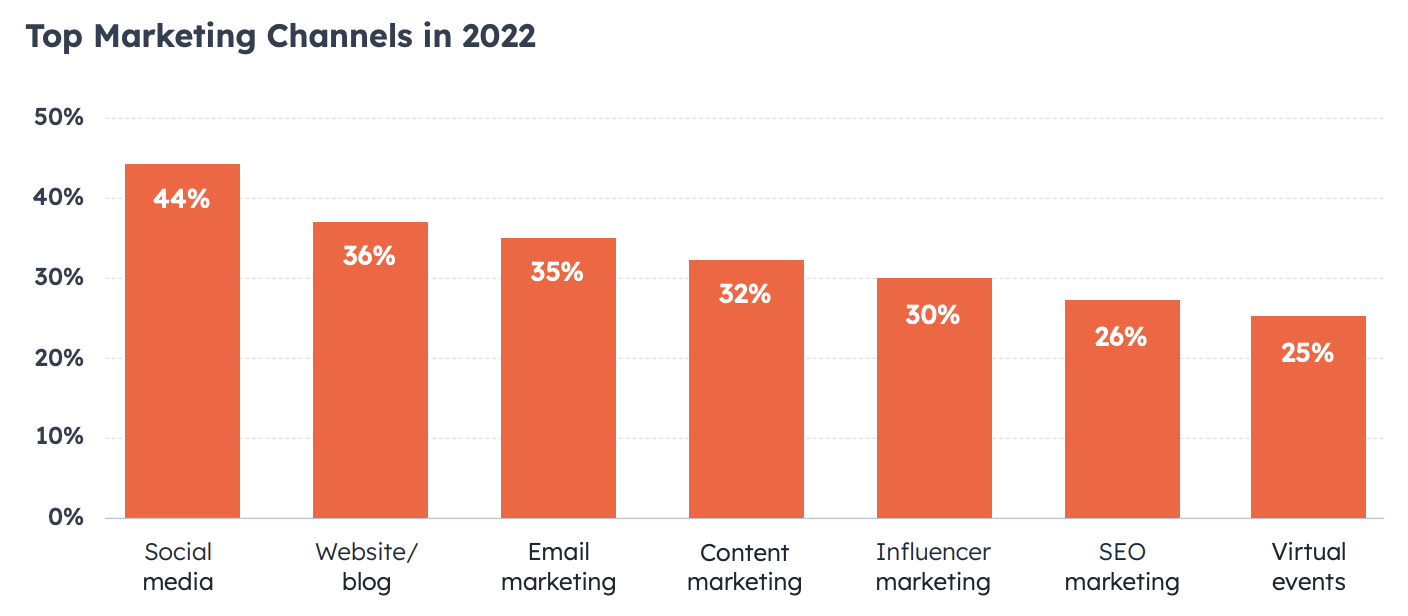
Social media is a critical component of B2B marketing. Social media marketing is typically less expensive than traditional advertising costs and offers broad mileage. In fact, 44% of marketers identified social media as their top channel for acquiring new customers, according to 2022 HubSpot Research.
Here’s how your team can perfect your social media strategy.
What is the conversion rate of social media?
While there’s no single answer for B2B social media conversion rates, there are some calculated assumptions you can use to gauge efficacy. For B2B companies, social media conversion rates fall around 1.55% on average, according to 2021 research from Ruler Analytics.
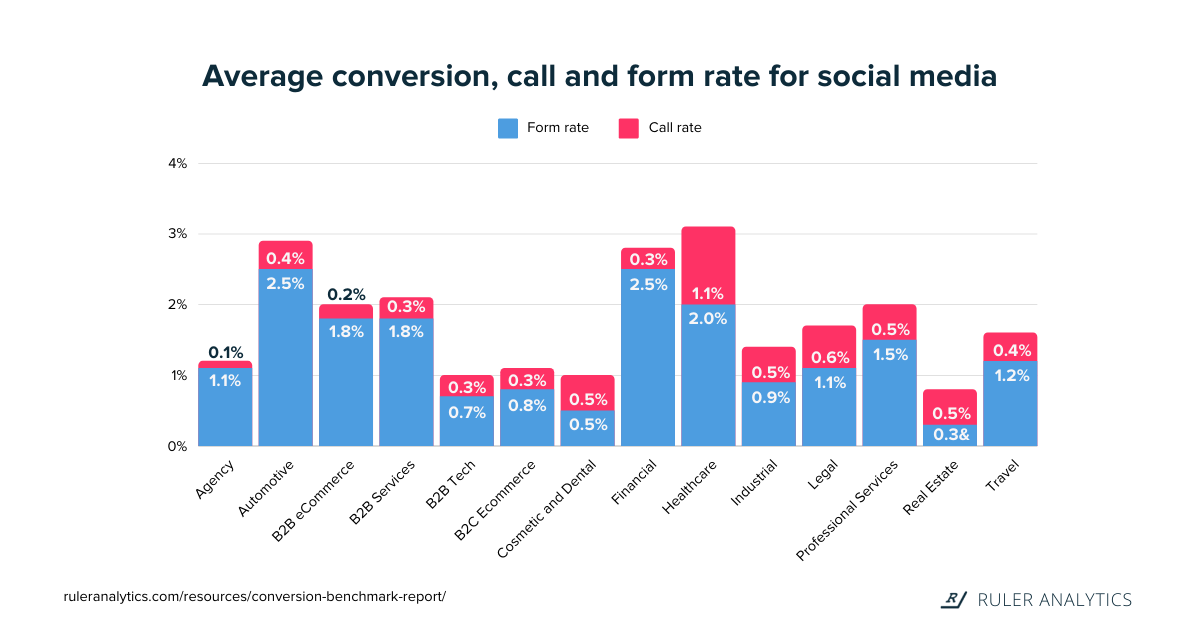
While social media is an important means of generating leads, these platforms have a lower conversion rate compared to other B2B digital channels. Ruler Analytics found that social media had the lowest average conversion rate for B2B companies when compared to paid marketing, organic search, email marketing, and referrals.
Remember: Social media is an important channel for top-of-the-funnel awareness. Even if you see higher conversion rates elsewhere, social media can keep your brand top-of-mind for potential buyers.
To increase conversion rates, focus on promoting helpful content behind lead capture forms. For example, you might promote a downloadable ebook to capture quality leads with an initial offer.
There are two main channels you should focus on:
- LinkedIn Ads.
- Facebook Lead Ad.
Let’s dive into each of these primary B2B social media channels now.
LinkedIn Ads
It’s no surprise that LinkedIn, the go-to B2B social network, has above-the-board figures when it comes to social media conversion. LinkedIn is the top social media platform for B2B marketers, so it’s a viable channel to pursue.
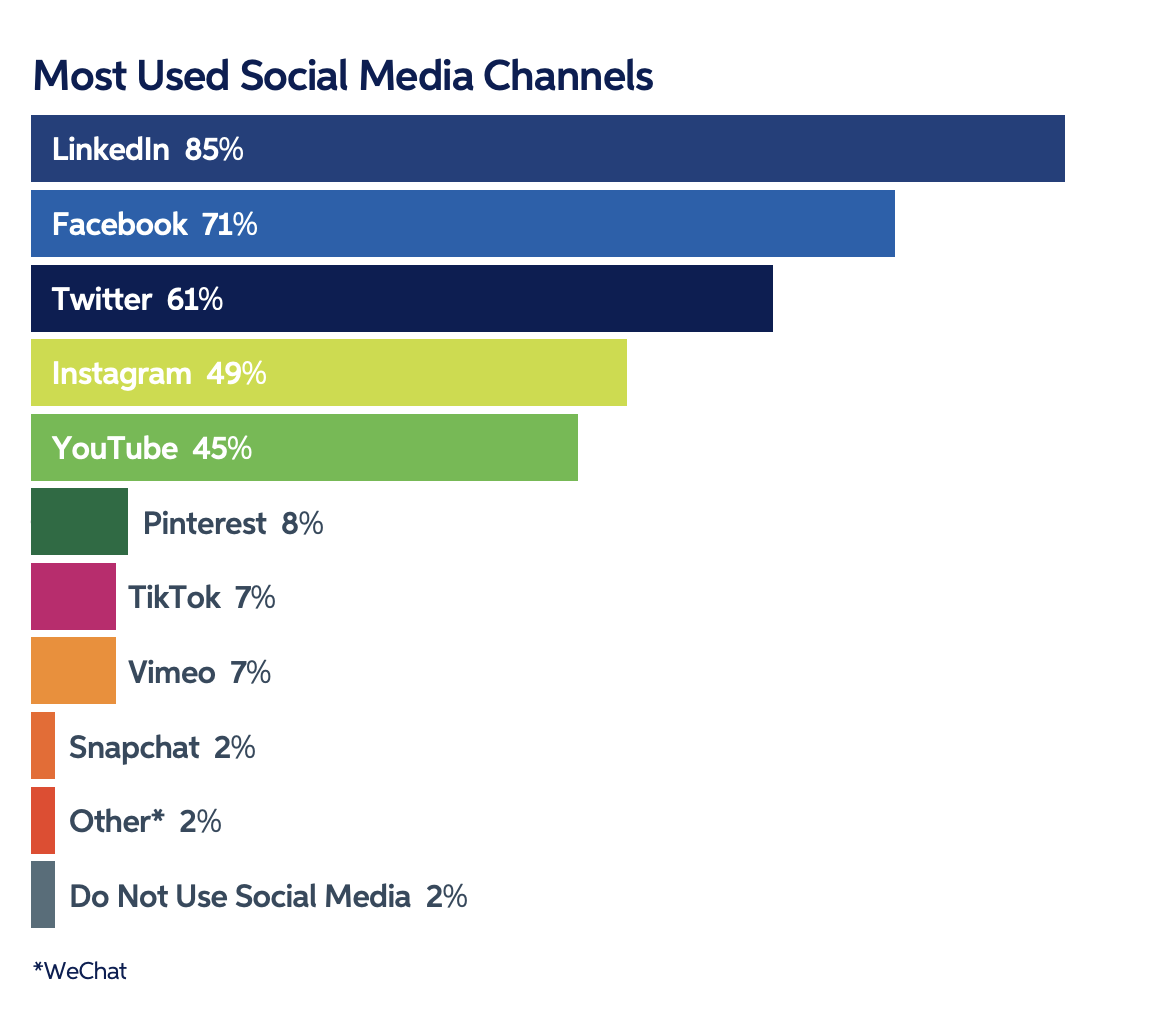
However, investing your energy in a channel with high engagement rates doesn’t automatically guarantee success. On LinkedIn, you must:
- Target your audience based on buyer persona.
- Make sure your ads have a newsworthy, topical angle.
- Continuously test CTAs, images, and copy.
Pro tip: LinkedIn can be a helpful platform to display social proof. Consider sharing testimonials or case studies. Potential customers can then see which brands in their network you’ve already helped with your offering.
You can learn more about the nitty-gritty of LinkedIn Ad strategies from this LinkedIn-HubSpot 2-week free course.
Facebook Lead Ads
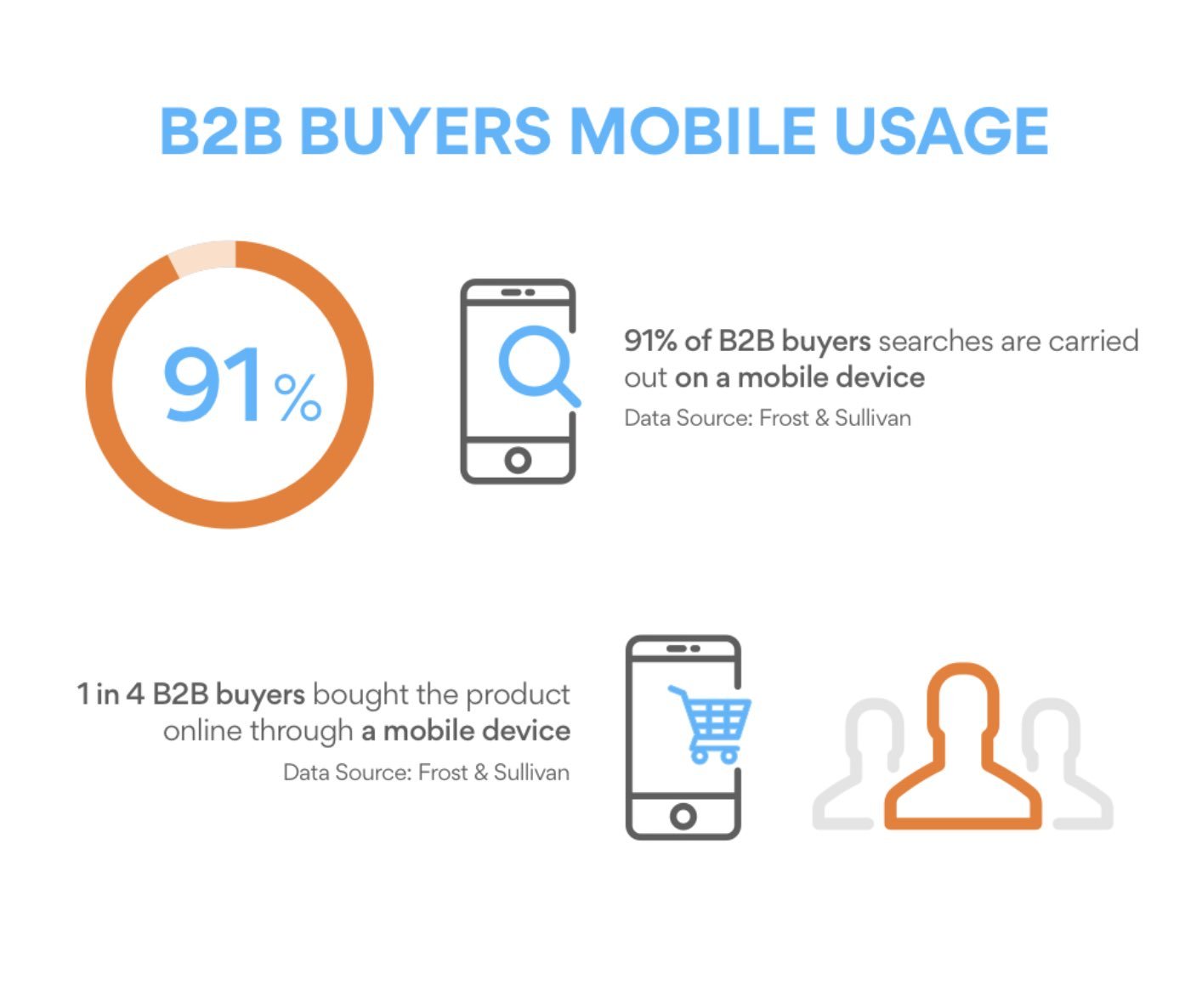
Ninety-one percent of B2B buyer searches are carried out on a mobile device, according to 2022 research from Frost & Sullivan. Using Facebook lead ads in your marketing strategy can help you navigate the shift to mobile.
Facebook lead ads allow your prospects to sign up for offers inside a mobile interface. These ads also allow you to generate leads generation inside the world’s largest social media channel.
Designed to be both targeted to your audience and highly customizable, Meta launched this service in 2015. Customers can now sign up for your offer in just two taps, without leaving the social network.
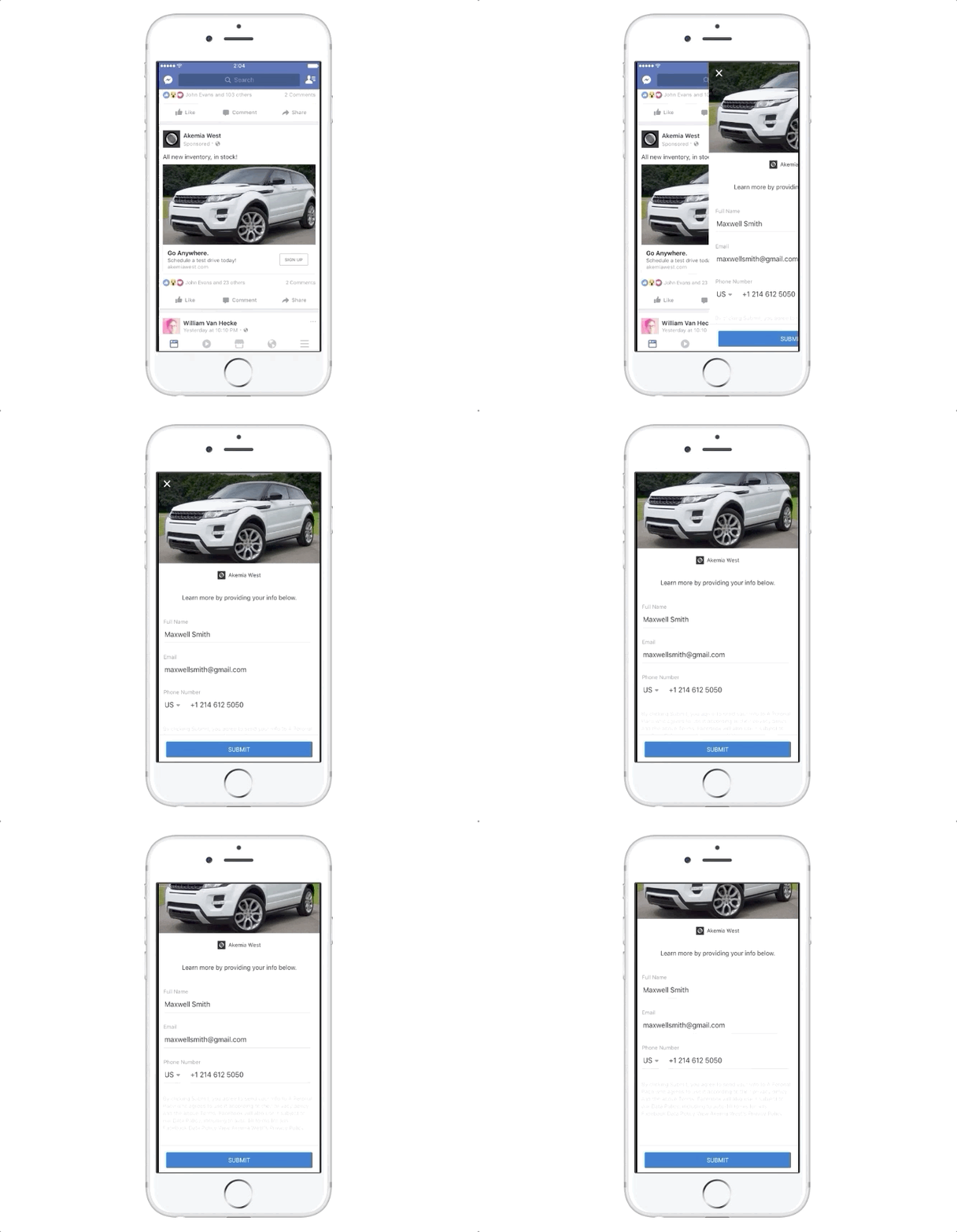
Remember: Facebook lead ads aren’t designed to replace your landing pages. While Facebook Lead Ad helps you capture leads inside Facebook, your landing pages are still necessary for capturing leads from organic search and PPC.
For more details, check out this step-by-step procedure on how to create Facebook Lead Ads.
Tip for Running Great Social Media Lead Generation Campaigns
Case 1. Using Scarcity and Exclusivity
Virgin Active South Africa used scarcity (a limited-time offer) to increase the value of their offer. Their slogan — “Is summer ready for you?” — rings of seasonality. The question, along with the related offer, is only for the summer season.
What we like: In addition to seasonal messaging, the accompanying image emphasizes summer fun. The key messages and CTAs are also clearly highlighted.

Case 2. Giving Before You Get
DigitalMarketer doesn’t sell — it gives something valuable away for free. That’s a compelling deal. By creating a clear value proposition, leads are more likely to share information with DigitalMarketer.
Their image amplifies the message and the CTA is clear but subtle. DigitalMarketer hooks leads through the law of reciprocity, which makes users feel they should return the favor through a later engagement.
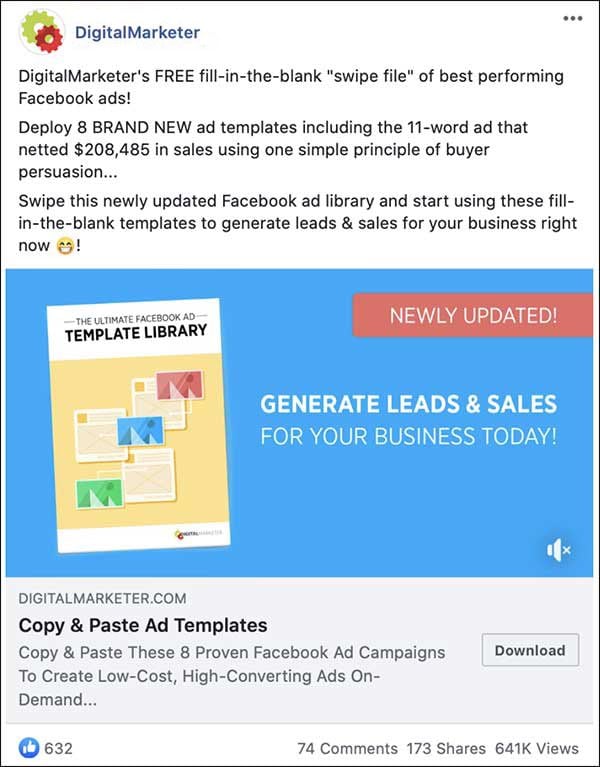
What we love: Digital Marketer’s copy emphasizes how templates can both save time and generate sales. Find ways to demonstrate your value ad to entice leads to your offering.
Case 3. Finding the Right CTA
Your call-to-action should be enticing and tell readers exactly what will happen when they click. The phrase “Book Now” creates a sense of urgency. The viewer feels like they should book their ticket for the Van Gogh event before time runs out.

What we love: This ad describes the art installation in the text and shows the experience visually. The viewer can picture the experience in their head when they click “Book Now.”
PPC Lead Generation Strategies
Pay-per-click (PPC) lead generation campaigns focus on a wide range of paid advertising platforms — the most popular being Google AdWords and Display Network. However, you’ll find a wide range of PPC lead generation options outside of Google, including:
- B2B review directories or comparison sites.
- Trade media display ads.
- Social media advertising.
- Affiliate marketing.
What is the conversion rate in PPC lead generation?
Adwords conversion rates fall around 2.41% for B2B companies, according to 2021 data from WordStream. Meanwhile, display conversion is averaged at 0.77%. However, rates vary depending on your industry.
It’s important to know your industry benchmarks. A good starting point is to ask each PPC vendor for their average conversion ratio across the board. This lets you evaluate your campaign results better.
Should PPC replace organic marketing? No — they complement each other. For instance, many high-value keyword searches have only PPC ads above the fold like this.
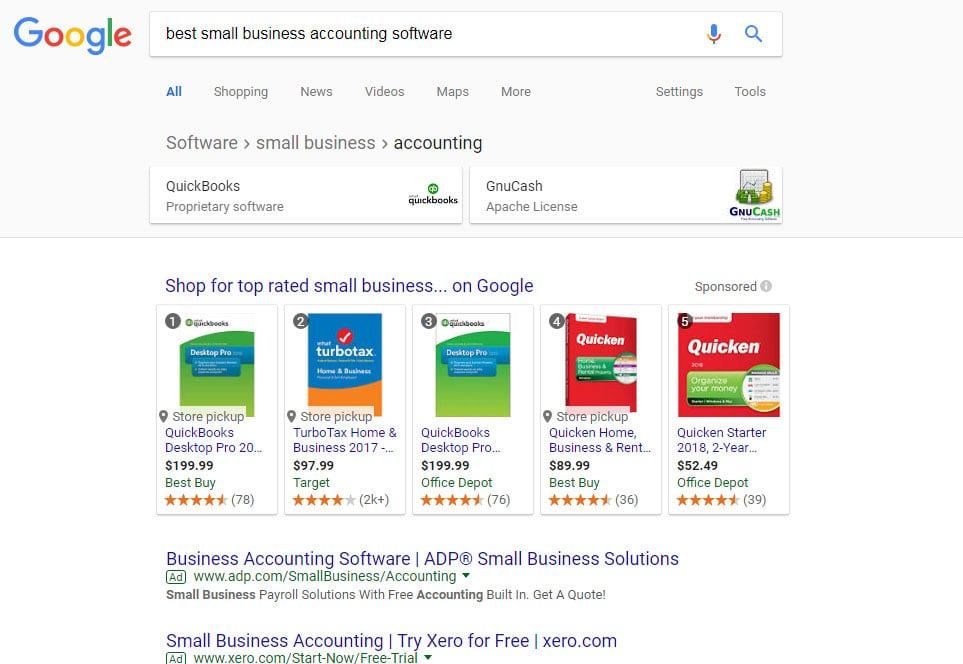
In other words, even if you have a good organic ranking, it may be buried under PPC ads.
An Example of an Efficient PPC Lead Generation Channel
Among the PPC platforms mentioned above, B2B review directories and comparison sites can provide a uniquely fresh lead source. Other PPC channels are likely already saturated by big players in your space, the ones with deep pockets.
For instance, in SaaS, a highly competitive industry across verticals, AdWords bidding is highly competitive. To win, you’ll need to target a lot of relevant keywords. Sometimes competitors even bid for keywords against your own brand — like this example, where Netsuite ranks higher for “Intuit Accounting.”
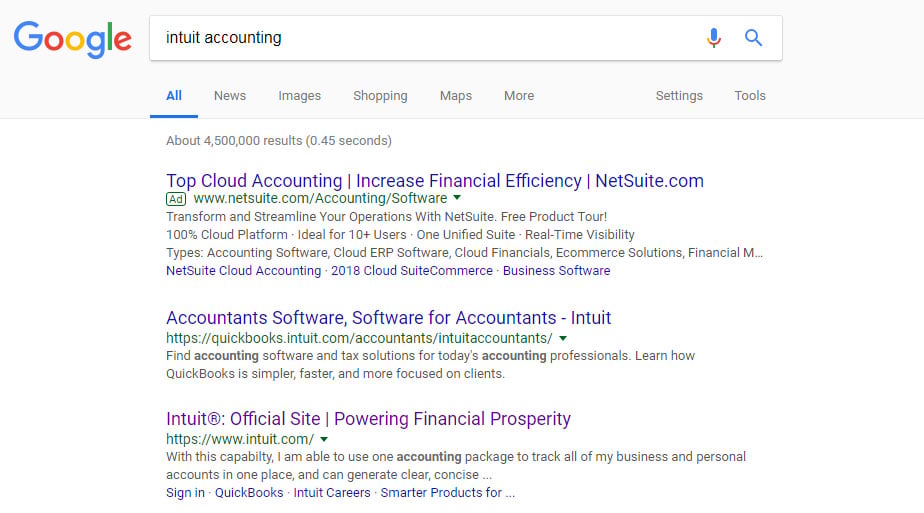
For many SaaS startups and SMBs, having another lead source like B2B review sites provides the option to meet and even surpass monthly lead quotas.
Let’s take a closer look at which popular marketing tools are used for lead generation by such sites. For example, here’s what FinancesOnline, one of the top software review platforms, offers:
- Lead generation campaigns: The review site can link directly to a vendor’s sign-up landing page, encouraging people who read your review to try out your free trial next. These campaigns can generate as much as a 24% conversion rate.
- Premium placement: In an increasingly commodified SaaS category, like a CRM where features are more standardized than unique, being included in a premium placement can make or break your sales opportunity. You have a much higher chance of attracting new leads if you’re listed among the most popular solutions, as prospects will usually only try out a few products. Make sure you get on such a list, because your competitors are probably already there.
- Industry awards: When buyers are comparing your product to your closest competitors, having your product stand out thanks to a featured quality award can have a critical impact on your sales. FinancesOnline, like many other review platforms, can give your product an edge with such awards.
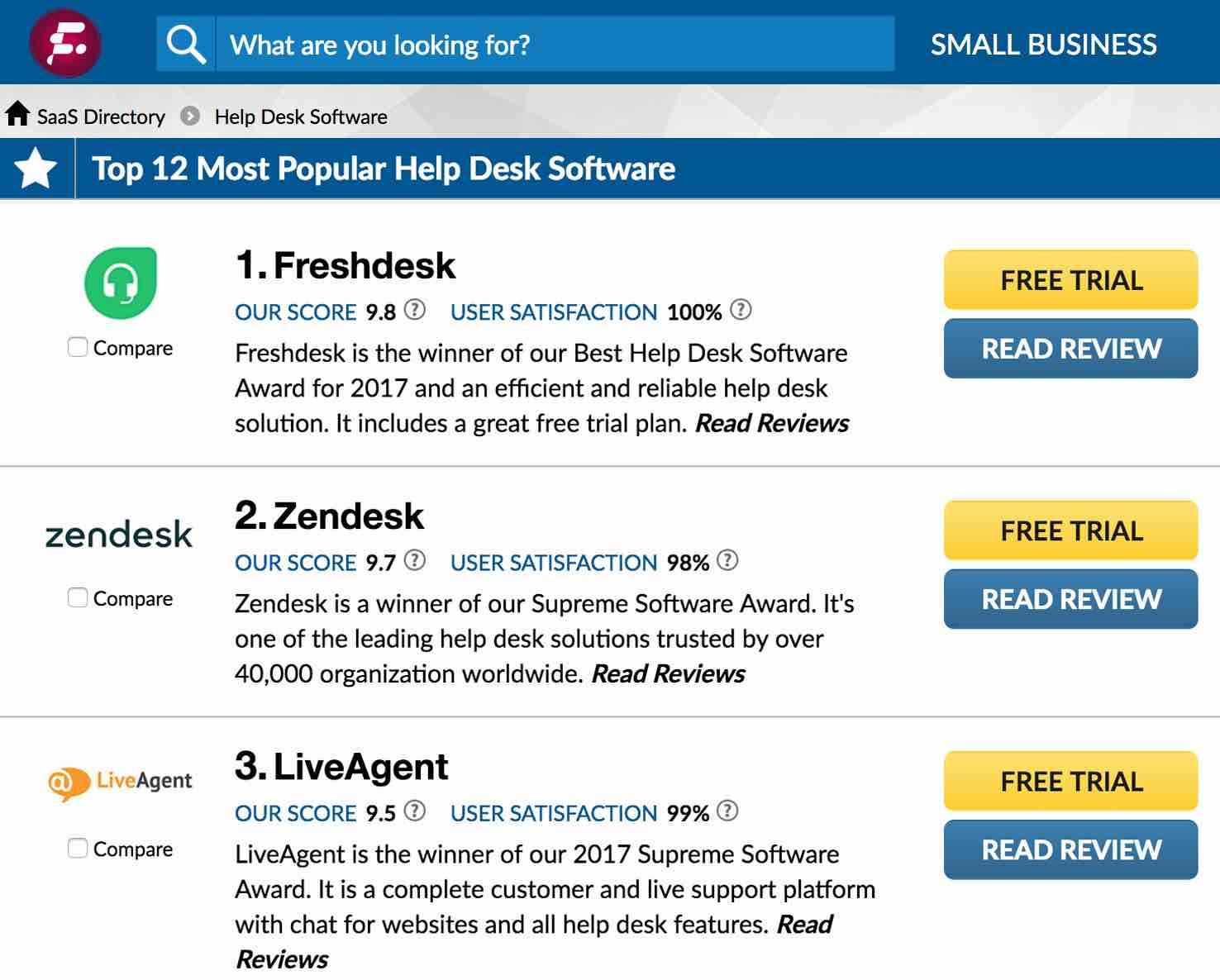
Look for a third-party online marketplace in your industry, and get in touch with these intermediaries to ensure your product is listed.
Blogging Lead Generation Strategies
Blogging is at the core of content marketing. This strategy focuses on creating content that is interesting or valuable to your defined audience. The goal is to attract and sustain online engagement for leads down the road.
A lot has been said about the benefits of business blogging. Let’s reiterate the major benefits.
- You can drive traffic to your website. With the right SEO planning, your blog gives you search presence, linking you to keywords relevant to prospects. Every blog post you write is one additional indexed page that helps get your content on Google.
- You can convert traffic to leads. A well-placed CTA in a compelling blog post can direct prospects to your landing page for leads.
- You can gain repeat business. A blog can delight existing customers with fresh content for repeat business or referrals.
Blogging also establishes niche authority and places prospects within your sphere of influence. Blogging is a large part of the HubSpot Strategy. Just search “inbound marketing” or its derivatives, and you’ll come across HubSpot consistently.
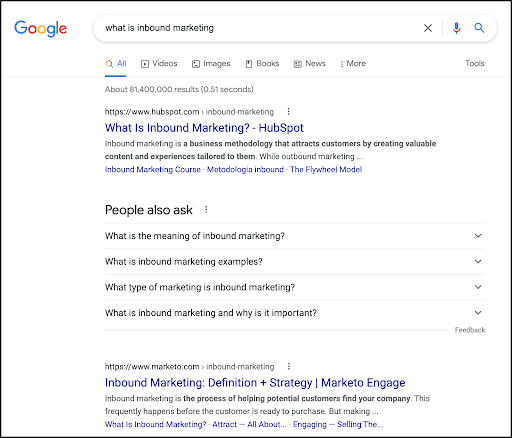
How effective is blogging in the long run? At HubSpot, about 90% of the leads our marketing team generates each month come from blog posts that were published many months — or sometimes years — ago.
Which content types drive lead generation?
If you’re planning on just writing a blog or only working with video, you’re out of luck. Robust content marketing strategies use a variety of formats to engage their audiences. Video, blogs, and images are among the top media that marketers use.
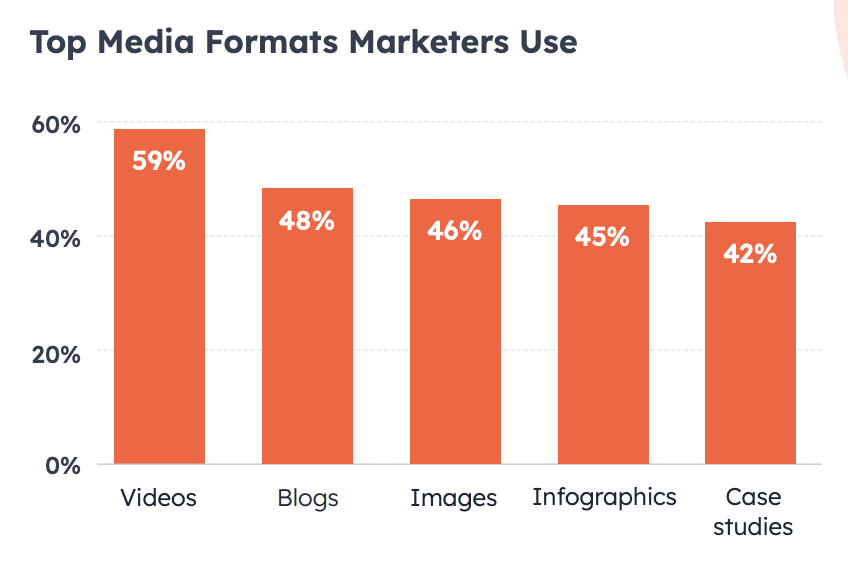
When building your content marketing strategy, consider including the following content.
- Authoritative posts are blog posts about subjects you’re an expert in. Readers should leave understanding with a better understanding of the topic at hand.
- Solid opinion pieces can help you spread brand awareness. However, this shouldn’t just be your ideas and thoughts. Persuading option pieces are backed by data and research.
- Original research is commissioned for industry consumption. Focus on questions that have yet to be answered or data sets that need a refresh.
- How-tos provide tips and tutorials to address prospects’ problems. By the end, they’ll have their issue resolved and you to thank.
- Trending content can help you capitalize on popular topics. Have any headlines and trends been related to your business? Consider a blog post that connects the dots.
- Infographics turn information into digestible visual bits for easy consumption. Encourage your audience to share these images where applicable.
- Videos on the upswing in content marketing. In fact, 72% of prospects prefer to watch a video over reading about a product. If your company does not have video talent in-house, consider contracting a team to help you produce this content.
Remember: These content types are most effective when they align with your marketing goals. In short, the hard work is still on you — you have to develop topics that are lead magnets to your audience.
Examples of Great B2B Blogging Campaigns
Case 1: Running Your Blog Like a Media Pro
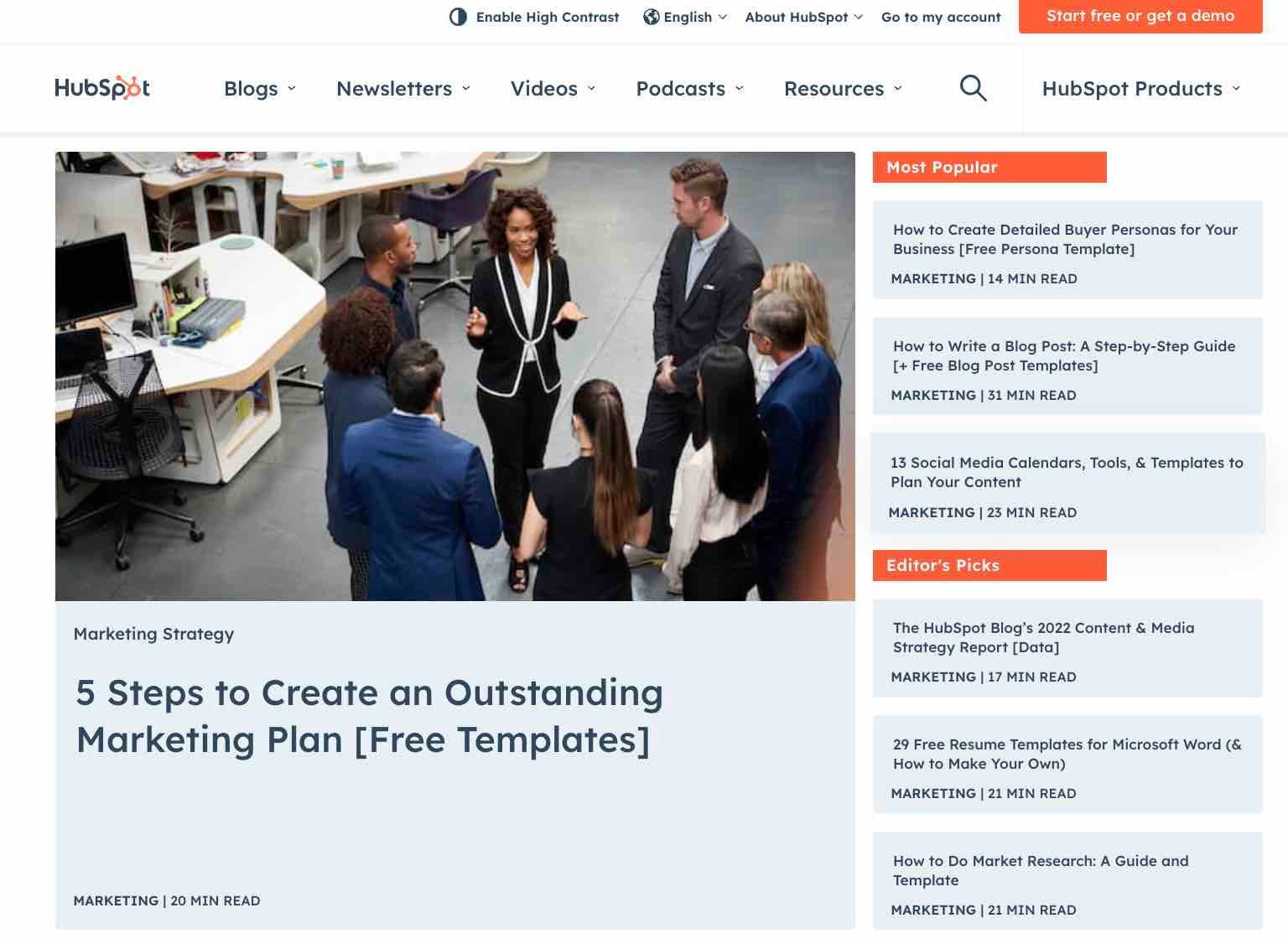
HubSpot is influential when it comes to inbound marketing. But it didn’t happen by accident — HubSpot’s marketing team works hard to run its blog as a media site with a full editorial calendar.
HubSpot’s blog publishes tips, listicles, ideas, inspiration, insights, reports, ebooks, white papers, videos, and more. All of this content relates to inbound methodology across its niche segments in marketing, sales, website, and service. The blog even outperforms entrenched business media like Forbes and CNN Money in SERPs about inbound marketing.
Case 2: Knowing Your Audience
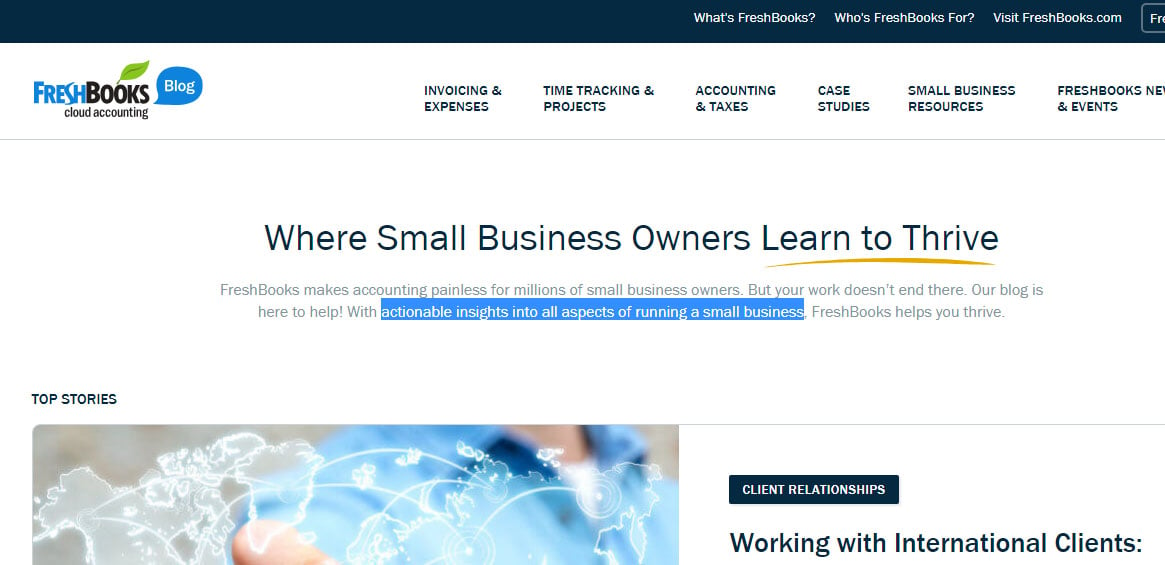
FreshBooks is clear about its target audience. In fact, the first step to having great content is to know your audience (your “Ideal Customer” personas). For FreshBooks, this means delivering “actionable insights into all aspects of running a small business.”
Case 3: Leveraging Thought Leaders
Have any die-hard supporters or thought leaders in your base? Have them put their insights and opinions about your industry in your blog posts.
Your thought leader should be writing regular posts to leverage SEO and brand association, both of which can result in more leads down the road.
Email Marketing Lead Generation Strategies
Email is often the bridge between marketing automation and CRM, two cloud solutions most widely used by marketers today. The email opt-in is still the starting point of lead generation and email marketing is the core of lead nurturing.
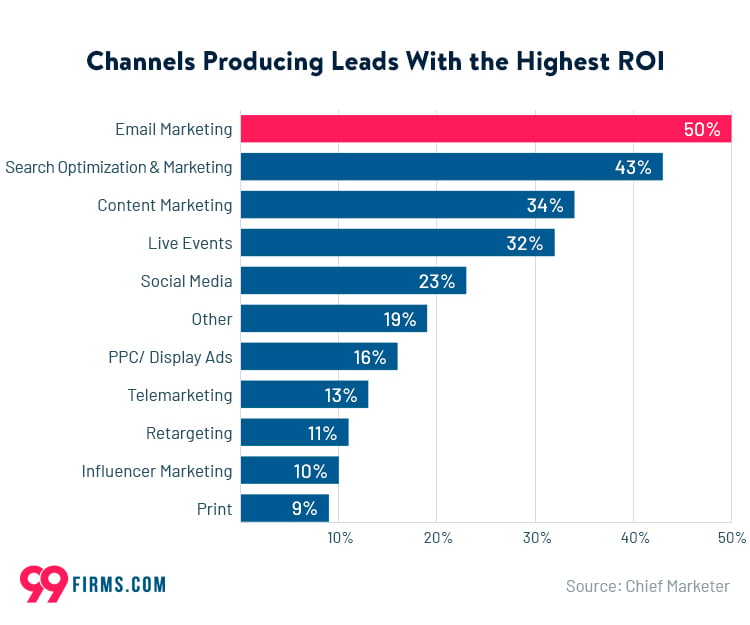
How does email marketing hold up today? Actually, it was the best B2B digital marketing channel in 2019, according to a Statista study. 99Firms released its B2B Marketing Statistics report, which showed email marketing is right at the top of digital channels driving leads and revenues for U.S. B2B marketers in 2022.
The advent of automated lead scoring, predictive analytics, and AI algorithms only reinforces email marketing with laser-focused, personalized touches, and real-time delivery. In short, email marketing is still one of your best tools to engage intent signals, distribute content, and deliver pitches.
What is the conversion rate of email marketing?
You’re looking at two variables when it comes to email marketing:
- Open rate.
- Click-through rate (CTR).
A GetResponse study puts the overall email open rate average at 82.20% and CTR at 21.69%. The report further divided the figures by location, with North America at a 23.53% open rate and 3.86% CTR.
By industry, internet marketing has a 14.97% open rate and 1.66% CTR, as of 2022.
Meanwhile, Marketing Insider Group puts email marketing conversion into another perspective: You earn $44 for every dollar spent on email marketing. The consensus is, yes, email marketing has one of the highest conversion rates, corroborating the DemandWave findings above.
Which factors influence email marketing conversion?
It takes creativity to brainstorm your content or offer, but with that aside, email marketing is more of a science. You can measure it, analyze it, and improve it. Here are the key factors that affect your email marketing conversion rates:
- Value offers. You must have a lead magnet to attract email sign-ups, whether it’s value content, freebies, deals, or anything that is interesting to your audience.
- Landing pages. Optimize these pages by having a clear offer of your lead magnet, compelling CTA, permission, and appealing visuals.
- Email subject lines. Keep your subjects short, crisp, and compelling with clear benefits to the recipient.
- Segmentation. Split your list into sublists for more targeted messages, which will allow you to increase your open and click-through rates.
- Analytics. Run analytics to do regular clean-up of your lists and update it as necessary based on past recipient actions.
Examples of Great B2B Email Marketing Campaigns
Case 1: Storytelling
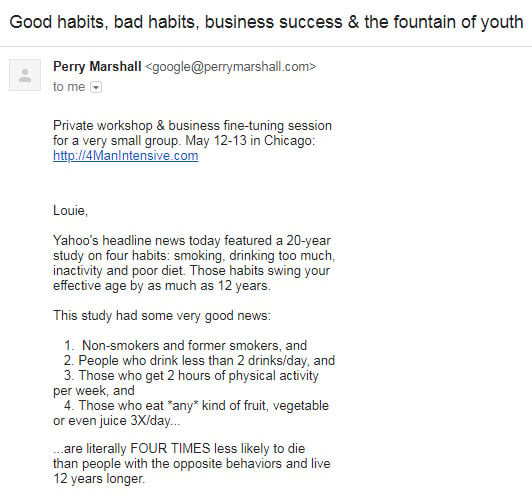
At its core, email marketing is about your message, and here’s where your skill in storytelling can weave magic into a bland topic like a business workshop, captivating the prospect’s interest.
Perry Marshall, the best-selling author of Ultimate Guide to Google AdWords, is a master of storytelling. He can hook seemingly unrelated subjects together, all leading to his value offer.
Case 2: Use of Humor/Allegory
Email marketing favors the clever, and this message from Grammarly is a great example. To emphasize the benefit of spell-checking software, the email visually alludes to the alphabet. By turning the “A” into rocket exhaust, the brand emphasizes the importance and adventure of your grammar journey. Grammarly is witty and helps engage readers for those few critical seconds.
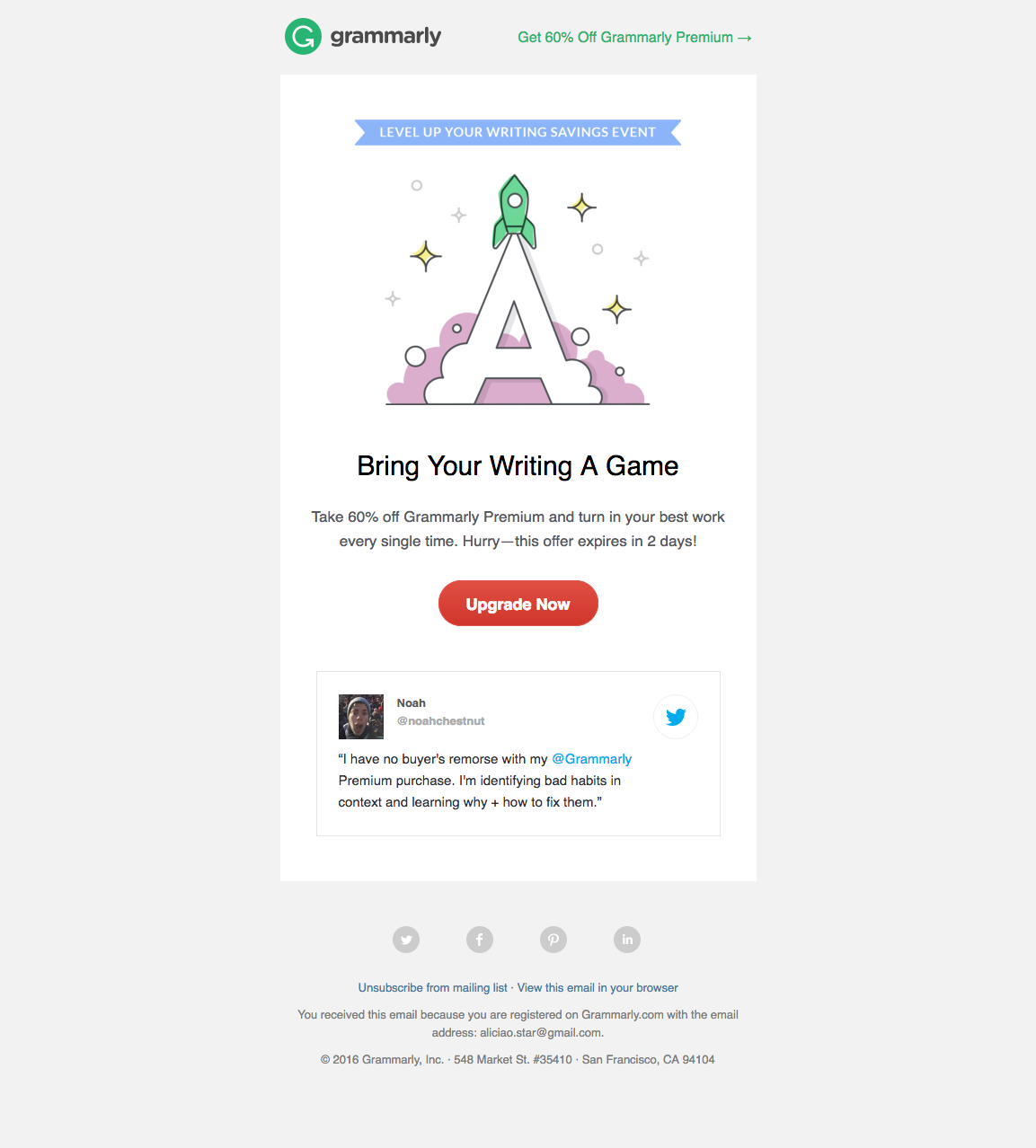
Remember: The use of humor is tricky and can backfire if executed poorly. Make sure any humor or allegory is something everyone can understand.
Case #3: Housekeeping
Email marketing isn’t all about the welcome — some goodbyes are in order, too. Cleaning up your list is one step toward qualifying leads for higher conversions down the funnel.
Framebridge makes sure its list is updated by sorting out inactive subscribers.
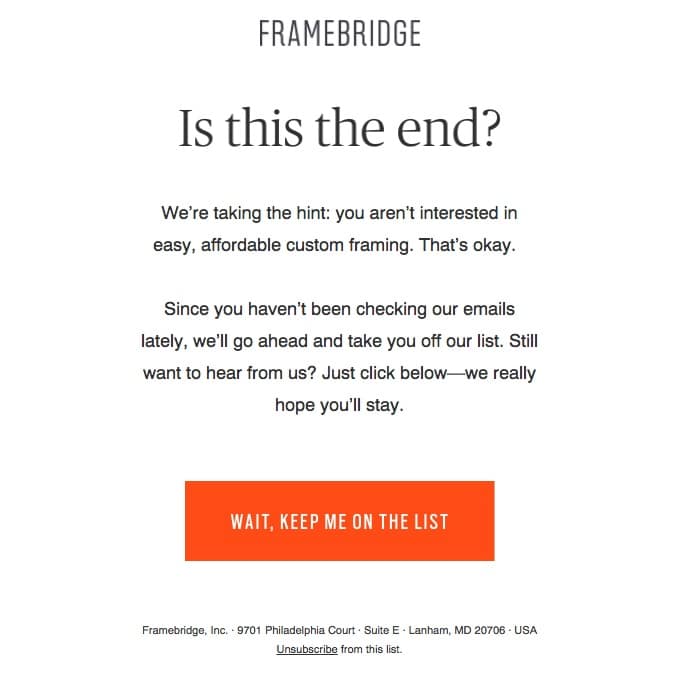
Pro tip: Breakup emails like the one above are a great way to reengage folks on your list and clean out inactive emails.
The 10 Best Lead Generation Strategies
In this post, we’ve shared best practices for different types of lead generation. Below are best practices that work across channels. Put these best practices into action, and maximize your lead generation.
1. Target the right audience.
Know your buyer personas. In B2B, your audience could be different people in different departments. Often, you don’t have a single audience, but micro-audiences with varying interests and pain points.
2. Create lead magnets.
Develop content or offers that pique the interest of your target audience. The best lead magnets use NLP techniques in marketing, such as, clear, tangible benefit, urgency, exclusivity, social proof, authority, and immediate gratification.
3. Explore new lead channels.
Search, social media, and top media sites are unsurprisingly crowded with high-value sponsorships. You can, however, discover unique PPC channels and similar third-party marketplaces for your industry. Because these sites cater to your customers, they tend to have higher conversion rates and dominate high-value general organic search keywords.
4. Capture the right information.
The rule of thumb is to get only the most basic customer data at the initial stage (e.g., name and email address) and, as you work the lead down the pipeline, ask for a little more data.
5. Score, sort, and segment leads.
Not all leads are valuable and not all have the same value. Based on your metrics, run a lead scoring tool to sort leads into proper segments. This will let you target your micro-audiences with personalized messages and offers. Today’s marketing automation software, like HubSpot, are very powerful and can automate this important process.
6. Blog consistently.
Regularly posting content improves your SEO, authority, brand awareness, industry stickiness, and, generally, your web presence.
7. Integrate organic and PPC.
These two marketing channels complement each other. When executed together, they can fill in the gaps. For example, you can run paid search for any organic keywords for which you’re not ranking highly.
8. Benchmark your conversion rates.
Don’t be content with seeing your rates improve month-to-month or year-to-year. Compare them with the competition. That’s the true picture of your business’ competitiveness.
9. Automate.
The best marketing automation will put your lead generation into a workflow. The software can then capture leads from your campaign, score them, nurture them throughout the lead pipeline, and qualify them. Then, your leads will be ready for your sales team.
10. Go mobile.
Mobile marketing is the next battlefield for B2B leads. More business buyers are using their smartphones in the purchase journey. Make sure your forms, emails, websites, and ads are optimized for mobile.
Those are some of the best B2B lead generation campaigns and techniques at your fingertips. Apply or reapply these time-tested techniques and share with us how much they improve your lead volume.

What to Do if Your Email is Hacked (+ Sample Messages To Send)
If you’ve received an email from someone claiming to have hacked your account, don’t panic. It’s important to stay calm and take the necessary steps to protect yourself and your data.
This blog post will provide sample emails you can send to your contacts after being hacked. We will also share tips on protecting yourself from future hacking attempts.

What To Do if Your Email is Hacked
You can’t always tell if you were hacked immediately. Some hackers may send corrupted emails to your contacts without leaving a trail.
Other times, filter settings might catch suspicious messages and automatically place them in “Spam” or “Trash,” so you never even see them.
Luckily, there are a few signs to watch out for if you suspect someone has hacked your account:
- You receive strange or unsolicited emails from someone with your own name or a third-party name. Look for blurred images, poor grammar, and strange email addresses.
- People you know tell you they’ve received unusual emails from you. They’ll likely delete them immediately, so don’t be surprised if no one has any to show you.
- Your password stops working out of nowhere. One day, you just can’t log into your account anymore.
- You see unexpected activity on your account, such as new contacts or messages you didn’t write.
If all signs point to hacking, keep calm. Hacking is a hassle, but it’s nothing you can’t resolve in a few steps.
Steps to Follow After You’ve Been Hacked

1. Change your password.
If you think someone’s hacked your email, the first thing you should do is change your password. It might seem obvious, but it’s an effective way to stop the hacker from further accessing your account.
2. Set up two-factor authentication.
After you’ve changed your password, we recommend enabling two-factor authentication (if it’s not already enabled). Two-factor authentication adds an extra layer of security to your account by requiring you to enter a code from a second device when you sign in.
If you’re unsure how to change your password or enable two-factor authentication, contact your email provider for help.
3. Keep your software up-to-date.
Another way to protect yourself from hackers is to ensure that your software is always up-to-date. This includes your operating system, web browser, antivirus software, and any other programs you use.
Outdated software can have security vulnerabilities that hackers can exploit to gain access to your account. Keeping your software up-to-date can help close these security holes and make it harder for hackers to get into your account.
4. Email your contacts.
Once you’ve changed your password and enabled two-factor authentication, email your contacts, letting them know someone hacked your account. They’ll know to be cautious of any emails they received from you.
Doing this as soon as possible ensures they remain on high alert and protect them from future attacks.
Sample Letters for Hacked Email
Messages in this situation serve two purposes: to inform people of what happened and to provide directions on how to protect themselves. Being brief and apologetic will allow them to quickly turn their attention to the necessary steps, such as remaining vigilant.
Use the templates below if you ever are hacked.
1. Hello, This is [Your Name], and I’m writing to let you know that my email account was hacked.
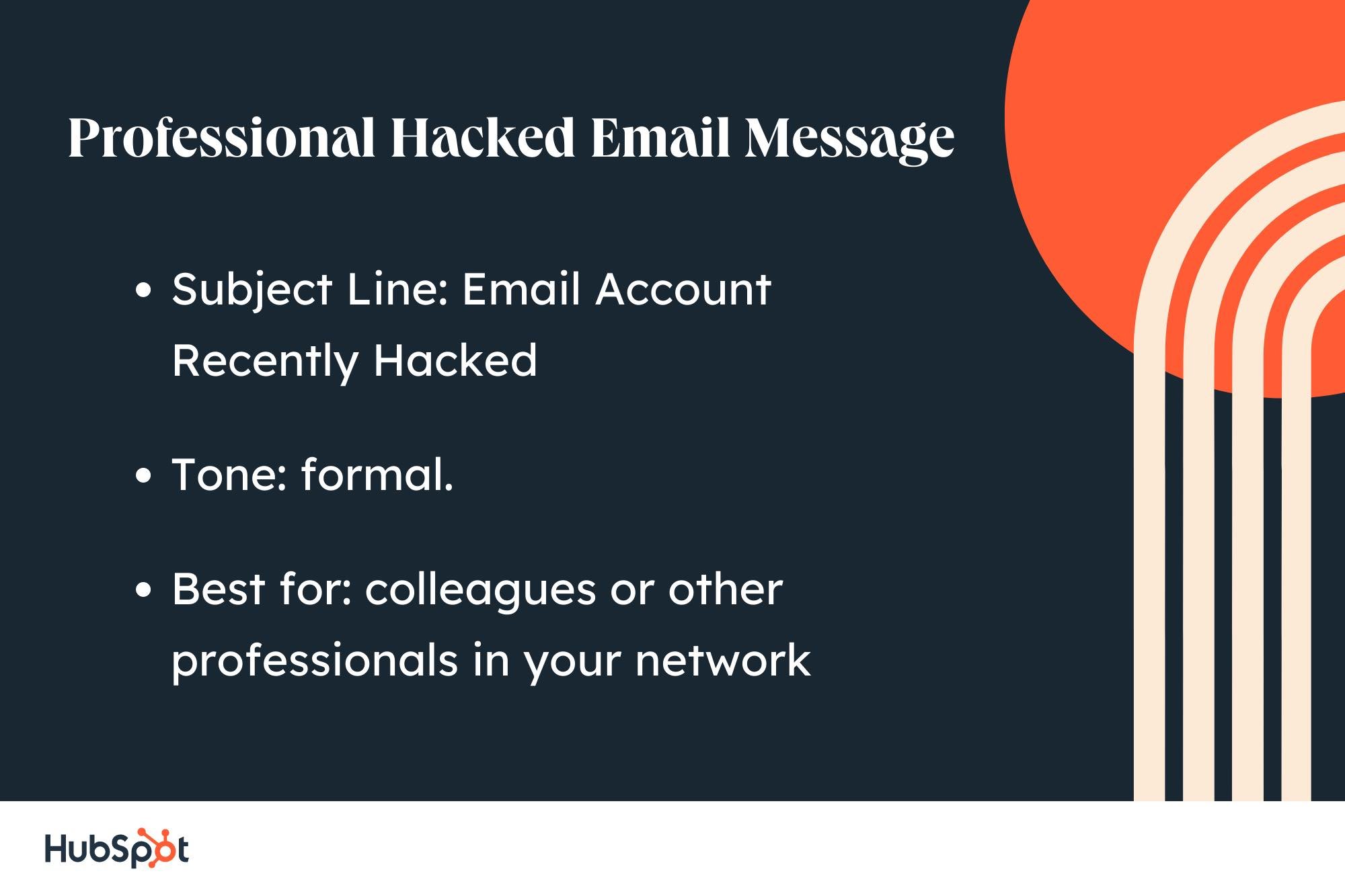
Hi [Recipient Name],
I wanted to let you know that my email account was recently hacked. I’ve changed my password and taken steps to secure my account, but I wanted to warn you in case you received any suspicious emails from me.
If you received any suspicious messages, please delete them, and do not click on any links.
I’m sorry for the inconvenience. Thank you for understanding.
Take care,
[Your Name]
2. Sorry, my account was hacked.
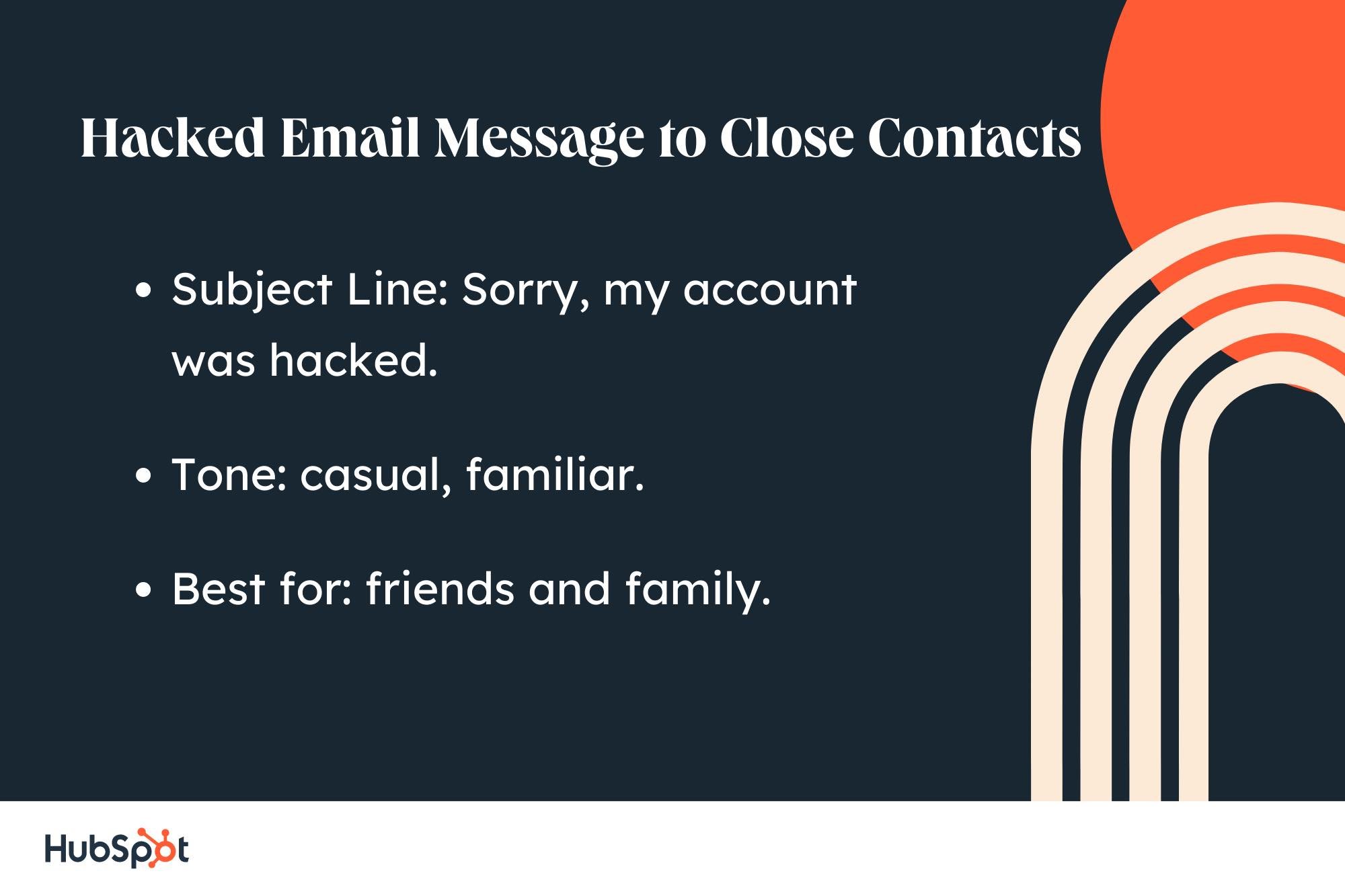
Hey [Recipient Name],
If you got any weird emails from me over the past few days, I’m sorry. My account was hacked, but I’ve since changed my password and added two-factor authentication.
Delete any suspicious emails you’ve received, and don’t click on any links.
Sorry about this, and thanks for bearing with me.
[Your Name]
3. Hey, it’s [Your Name] ― I got hacked.

Hi [Recipient Name],
Today, I discovered that someone had hacked my email and social media accounts. Any unwanted emails and messages you’ve received are spam — many of my contacts have gotten spam emails from my account.
My apologies for any inconvenience this may have caused you. I have taken steps to ensure that it won’t happen again.
Thanks for your patience!
[Your Name]
4. Sorry [Recipient Name], I was hacked.

Hello,
I apologize for any unwanted emails you might have received in the last [timeframe]. My email account was hacked around [date], and spam messages were sent to my contacts, including you.
I’d never voluntarily sent this out to anyone, so I’m sorry if it made a wrong impression. Rest assured, I’ve secured everything already, so things should be secure moving forward.
Thanks for understanding,
[Your Name]
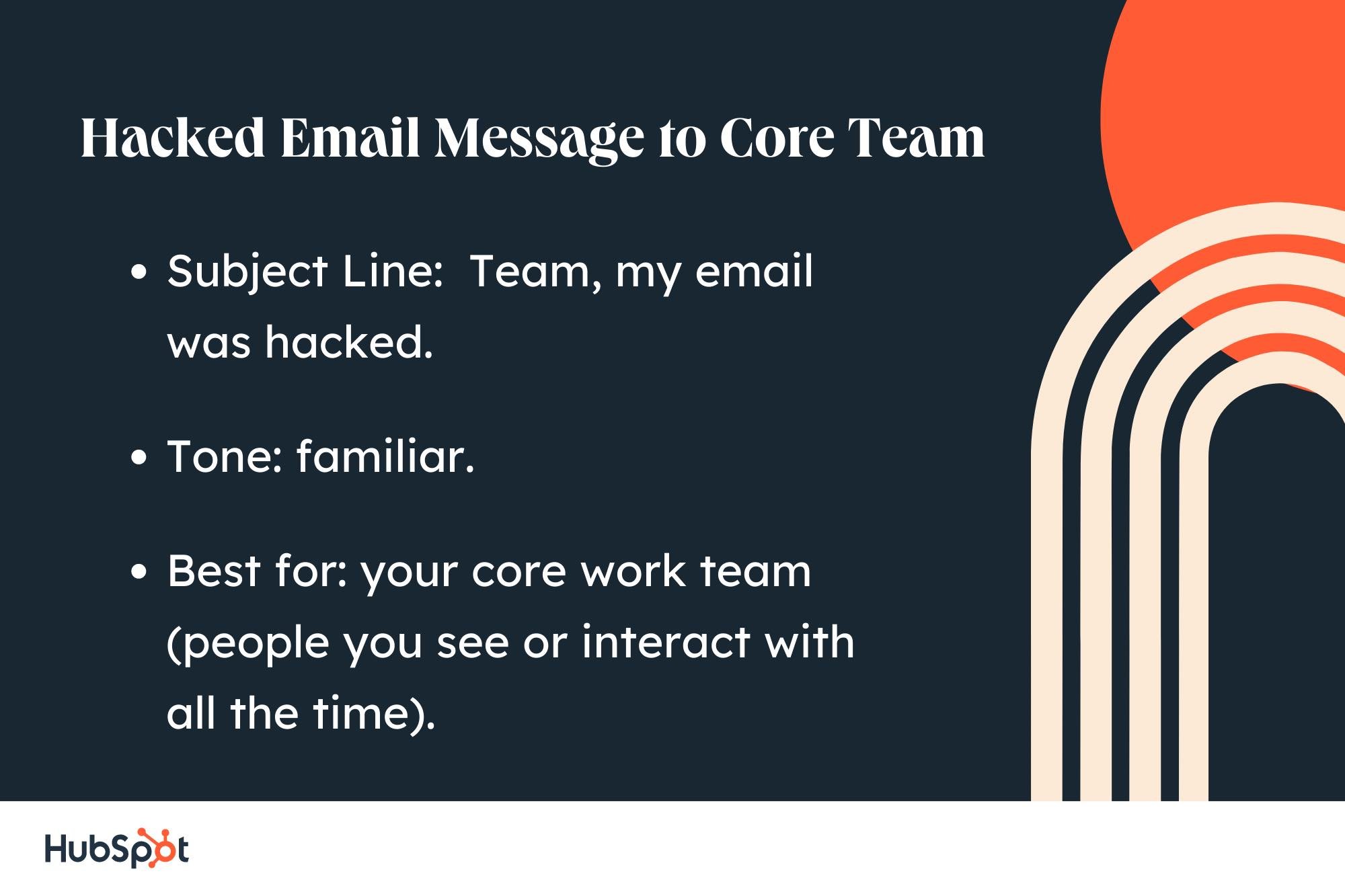
5. Team, my email was hacked.
Hey Team,
I got hacked on [date], and I think spam messages have been going out [timeframe]. Sorry about that — I just noticed it and took the necessary steps to fix everything on my end.
Keep an eye out for anything suspicious, and let me know if you continue getting any strange messages.
Thanks,
[Your Name]
Stay protected with HubSpot
Getting hacked is never fun, but it doesn’t have to be the end of the world. By taking some simple steps, you can quickly get your account back under your control. Plus, you can help protect yourself and your contacts from future attacks.
At HubSpot, your security and safety are paramount. Our CRM platform for front office teams ensures the privacy of the data you entrust to us. Check out our site to learn more about how we keep you protected.

20 Questions to Ask When Creating Buyer Personas [Free Template]
Knowing your customers is a crucial component of successful inbound marketing. Get started with buyer persona questions that can help you understand customers’ mindsets.
We’ve gathered 20 questions that can help you identify your audience. After you explore the answers, use this free buyer persona template to share your findings with the rest of your company.
Remember: you’ll need a content marketing strategy to reach your buyer personas. Find out how with HubSpot Academy’s free content marketing training resource page.
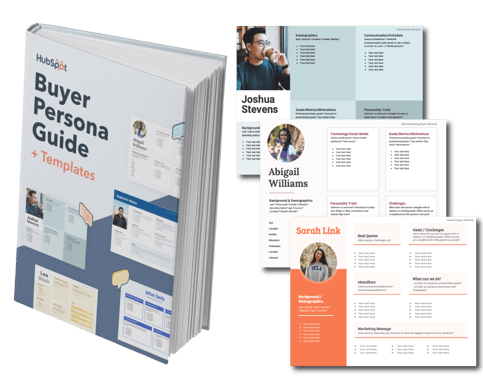
Download our free buyer persona template here to learn how to create buyer personas for your business.
Questions About Their Personal Background
1. Describe your personal demographics.
Collecting demographic information is a great place to begin drafting your personas. These questions paint a clearer, more personal picture of your customer.
Understand what communities they are a part of, and how those identities impact their interaction with your brand.
What to Look for in the Answer
Are they married? What’s their annual household income? Where do they live? What are their cultural and racial backgrounds? What is their gender identity? How old are they? Do they have children?
2. Describe your career path.
Having an idea of your client’s background tells you a lot about the type of information that they consume and the problems that they can face regarding their work. This can be especially helpful if you sell a B2B product.
What to Look for in the Answer
How did they end up where they are today? Has their career track been pretty traditional, or did they switch from another industry?
3. Describe your educational background.
Get specific here. “Boston University” is better than “liberal arts college.” Where a person went to school can impact their worldview. That includes both the size of the college, their major, and the location of the school.
What to Look for in the Answer
What level of education did they complete? Which schools did they attend, and what did they study?
Questions About Their Company
4. What is the size of your company?
Keep an eye out for specific details about the company. The size of a business impacts how many people use your product, as well as the way they use your offering. Understanding the amount of revenue can help you set appropriate pricing.
Knowing details about your persona’s company, like the number of employees, will help you when you’re building the fields for your landing page forms.
What to Look for in the Answer
How many people work at the company? How much revenue does the company generate? How many customers does the company serve?
5. In which industry or industries does your company work?
The answer to this question isn’t the department in which your buyer persona works. Your buyer persona’s industry is the type of service they deliver to their clients, and knowing this can help you measure your business’s impact in the markets you’re targeting.
Depending on the challenges your buyer persona faces, it might also be worth getting information on the industries your client’s business serves, not just the actual service they provide.
For example, if your buyer persona provides renewable energy plans for hospitals. They are in the environmental services industry for education and medical customers.
What to Look for in the Answer
What sector do potential buyers work in? Are they in a broad industry like healthcare or insurance? Are they in a more niche market?
Questions About Their Role
6. What is your job role? Your title?
The importance of your buyer persona’s job depends on the product or service you’re selling.
If you’re a B2C company, you may simply consider this information as another way to better understand the nuances of your persona’s life.
If you’re a B2B company, this piece of information becomes more crucial. Is your persona at a managerial or director level, and well versed in the intricacies of your industry? They’ll need less education than someone at an introductory level, who may need to loop in other decision-makers before making purchasing decisions.
What to Look for in the Answer
How long have they had this role and title? Are they an individual contributor, or do they manage other people?
7. To whom do you report? Who reports to you?
If you have a B2B offering, knowing your buyers’ seniority levels is especially important. This information can help your sales team understand who prospects might be.
For B2C companies, your users’ seniority level can give you insight into their lifestyles. Do people spend most of their time in the office? Are they often in meetings? That will impact when and where they use your product.
What to Look for in the Answer
How senior is your buyer? How many people work for them? Where are they in the larger organization?
8. Which skills are required to do your job?
If they were hiring someone to replace them and had to write a job description of what’s required, what would it say? Understanding your buyer’s skillsets can help you understand the level of training they need when using your product.
Or perhaps, your product is intended to supplement a skill they lack. Knowing where their strengths are can help you focus your product development efforts.
What to Look for in the Answer
What are the ideal skills for this job, and how good is your persona at each of them? Where did they learn these skills? Did they learn them on the job, at a previous job, or by taking a course?
9. What does a typical day look like?
This should include both the tasks they do for their job, as well as what happens during the day outside their job. Knowing your personas’ schedules can help you understand when they use your offering. That holds true for both B2B and B2C products.
What to Look for in the Answer
For their time in the office, look for the following.
- What time do they get to work and what time do they leave?
- What do they do when they’re most productive?
- What’s their “busy work” look like?
For time spent outside of the office, take note of the following.
- Are they spending more time at work or at home?
- Where would they rather be?
- What do they like to do for fun?
- Who are the people in their life that matter most?
- What kind of car do they drive?
- Which TV shows do they watch?
- Heck, what outfit are they wearing? Get personal here.
10. How is your job measured?
You should know what metrics will make your user successful, and what they might be worried about when it comes to “hitting their numbers.” This can help your marketing team identify which features to highlight.
What to Look for in the Answer
Which metric(s) is your persona responsible for? Which numbers or charts or waterfall graphs do they look at every day?
11. What knowledge and tools do you use in your job?
Understanding what products they love (and hate) to use can help you identify commonalities in your own product (and adjust your positioning accordingly). You can also understand how your product integrates with their pre-existing tech stack.
What to Look for in the Answer
Which applications and tools do buyers use every single day? Every week? How much do they like these existing tools?
Questions About Buyer Goals
12. What are you responsible for?
This goes beyond the metrics they’re measured on. Your team should know what their primary job responsibilities are. With this knowledge, you can better explain how your offering makes buyers’ lives easier.
You can also identify ways to help your persona achieve their goals and overcome their challenges.
What to Look for in the Answer
What’s their primary goal at work? What about their secondary goal? What are their daily responsibilities? Quarterly responsibilities? Annual responsabilities?
13. What are your biggest challenges?
You’re in business because you’re solving a problem for your target audience. How does that problem affect their day-to-day life? Go into detail, and focus on the nuances that illustrate how that problem makes them feel.
For example, let’s say your company sells personal tax software directly to consumers. One of your personas may be a first-time tax preparer. What are the pain points of first-time tax preparers? They’re probably intimidated by the prospect of doing their taxes by themselves for the first time, overwhelmed by a tax code they don’t understand, and confused about where to start. These pain points differ from those of a seasoned tax preparer.
Try coming up with real quotes to refer to these challenges. For example, “It’s been difficult getting company-wide adoption of new technologies in the past,” or “I don’t have time to train new employees on a million different databases and platforms.”
What to Look for in the Answer
What are the different challenges for demographics? How do pain points vary by seniority and experience level? How do these challenges affect their daily life?
14. What does it mean to be successful in your role?
Companies that take the time to understand what makes their personas successful will likely enjoy more effective communications from both the sales and marketing teams.
What to Look for in the Answer
What can you do to make your personas look good? What features of your product already help them achieve their goals?
Questions About How Buyers Learn
15. How do you learn new information for your job?
If you’re going to market and sell to these personas, you need to understand how they consume information. Dive into their required upskilling at work, as well as the professional development your buyer individual sought. Your goal should be to best understand their learning style.
What to Look for in the Answer
Do they go online, prefer to learn in person, or pick up newspapers and magazines? If they’re online learners, do they visit social networks? To Google? Which sources do they trust the most — friends, family, coworkers, or industry experts?
16. Which associations and social networks do you participate in?
You should already be investing time and resources in social media marketing. Identify the associations and social networks where your buyers spend their time. Then, you can prioritize which accounts to create and which conversations to participate in.
What to Look for in the Answer
What in-person or community-based gatherings do buyers attend? How are these gatherings promoted? What do they learn from these events?
What social media platforms do your buyers prefer? How much time do they spend on these platforms? What platform features do they actually use?
17. Which publications or blogs do you read?
To piece together a typical day in their life, figure out where they regularly go to stay informed. If you know how they prefer to gather information, you can make yourself present in those spots. The next step is to establish credibility in those communities.
What to Look for in the Answer
What magazines or news outlets do they read? Are there blogs they frequent? Which trusted thought leaders do they turn to?
Questions About Their Shopping Preferences
18. Describe a recent purchase.
You should understand your buyers’ evaluation process when making a purchase. How do they decide what they buy?
If you can anticipate the objections your persona will have, you can be prepared for them in the sales process. You will also be able to educate them in your marketing collateral to help allay fears right away.
What to Look for in the Answer
Why did you consider a purchase, what was the evaluation process, and how did you decide to purchase that product or service?
Is this their first time purchasing a product or service of your kind? If not, what caused them to switch products or services? What might make them reticent to buy from providers in your industry?
19. Do you use the internet to research vendors or products? If yes, how do you search for information?
These questions will help you determine which sources of information your buyer trusts. This can help you identify what type of reviews you would like to elicit. You can also plan your marketing collateral appropriately.
What to Look for in the Answer
Which avenues are they using to find new information? Do they search online, look at review websites, ask their friends and family, or do something else?
20. How do you prefer to interact with vendors?
You should know the best ways to get in touch with potential buyers. From there, you can understand how they want to interact with you — as well as how frequently. The experience of purchasing your product should align with your persona’s expectations.
What to Look for in the Answer
What should their sales experience feel like? Is it consultative? How much time do they expect to spend with a salesperson? Do they anticipate an in-person meeting, or would they rather conduct the sales process online or over the phone?
What’s next?
Once you’ve gone through this exercise and worked out any lingering questions about what makes your persona tick, browse through some stock imagery and find an actual picture to associate with your persona. Going through this exercise forces you to clarify an image of your target audience in your entire organization’s mind that will help keep your messaging consistent.
Another useful exercise is to practice being able to identify your buyer persona so you can tailor your communications. How will you know when you’re talking to this persona? Is it their job title?
Once you’ve established not only who your persona is, but also how you can identify them when you encounter one or another, your employees will be able to maintain a consistent voice that is still customized to each person they talk to.
Then, use our free, downloadable persona template to organize the information you’ve gathered about your persona. Share these slides with the rest of your company so everyone can benefit from the research you’ve done and develop an in-depth understanding of the person (or people) they’re targeting every day at work.
Want to learn about some of the best real buyer personas? Check out seven companies with awesome buyer personas.



How to Determine Your A/B Testing Sample Size & Time Frame
Do you remember your first A/B test you ran? I do. (Nerdy, I know.)
I felt simultaneously thrilled and terrified because I knew I had to actually use some of what I learned in college for my job.
There were some aspects of A/B testing I still remembered — for instance, I knew you need a big enough sample size to run the test on, and you need to run the test long enough to get statistically significant results.
But … that’s pretty much it. I wasn’t sure how big was “big enough” for sample sizes and how long was “long enough” for test durations — and Googling it gave me a variety of answers my college statistics courses definitely didn’t prepare me for.
Turns out I wasn’t alone: Those are two of the most common A/B testing questions we get from customers. And the reason the typical answers from a Google search aren’t that helpful is because they’re talking about A/B testing in an ideal, theoretical, non-marketing world.
So, I figured I’d do the research to help answer this question for you in a practical way. At the end of this post, you should be able to know how to determine the right sample size and time frame for your next A/B test. Let’s dive in.

A/B Testing Sample Size & Time Frame
In theory, to determine a winner between Variation A and Variation B, you need to wait until you have enough results to see if there is a statistically significant difference between the two.
Depending on your company, sample size, and how you execute the A/B test, getting statistically significant results could happen in hours or days or weeks — and you’ve just got to stick it out until you get those results. In theory, you should not restrict the time in which you’re gathering results.
For many A/B tests, waiting is no problem. Testing headline copy on a landing page? It’s cool to wait a month for results. Same goes with blog CTA creative — you’d be going for the long-term lead generation play, anyway.
But certain aspects of marketing demand shorter timelines when it comes to A/B testing. Take email as an example. With email, waiting for an A/B test to conclude can be a problem, for several practical reasons:
1. Each email send has a finite audience.
Unlike a landing page (where you can continue to gather new audience members over time), once you send an email A/B test off, that’s it — you can’t “add” more people to that A/B test. So you’ve got to figure out how squeeze the most juice out of your emails.
This will usually require you to send an A/B test to the smallest portion of your list needed to get statistically significant results, pick a winner, and then send the winning variation on to the rest of the list.
2. Running an email marketing program means you’re juggling at least a few email sends per week. (In reality, probably way more than that.)
If you spend too much time collecting results, you could miss out on sending your next email — which could have worse effects than if you sent a non-statistically-significant winner email on to one segment of your database.
3. Email sends are often designed to be timely.
Your marketing emails are optimized to deliver at a certain time of day, whether your emails are supporting the timing of a new campaign launch and/or landing in your recipient’s inboxes at a time they’d love to receive it. So if you wait for your email to be fully statistically significant, you might miss out on being timely and relevant — which could defeat the purpose of your email send in the first place.
That’s why email A/B testing programs have a “timing” setting built in: At the end of that time frame, if neither result is statistically significant, one variation (which you choose ahead of time) will be sent to the rest of your list. That way, you can still run A/B tests in email, but you can also work around your email marketing scheduling demands and ensure people are always getting timely content.
So to run A/B tests in email while still optimizing your sends for the best results, you’ve got to take both sample size and timing into account.
Next up — how to actually figure out your sample size and timing using data.
How to Determine Sample Size for an A/B Test
Now, let’s dive into how to actually calculate the sample size and timing you need for your next A/B test.
For our purposes, we’re going to use email as our example to demonstrate how you’ll determine sample size and timing for an A/B test. However, it’s important to note — the steps in this list can be used for any A/B test, not just email.
Let’s dive in.
Like mentioned above, each A/B test you send can only be sent to a finite audience — so you need to figure out how to maximize the results from that A/B test. To do that, you need to figure out the smallest portion of your total list needed to get statistically significant results. Here’s how you calculate it.
1. Assess whether you have enough contacts in your list to A/B test a sample in the first place.
To A/B test a sample of your list, you need to have a decently large list size — at least 1,000 contacts. If you have fewer than that in your list, the proportion of your list that you need to A/B test to get statistically significant results gets larger and larger.
For example, to get statistically significant results from a small list, you might have to test 85% or 95% of your list. And the results of the people on your list who haven’t been tested yet will be so small that you might as well have just sent half of your list one email version, and the other half another, and then measured the difference.
Your results might not be statistically significant at the end of it all, but at least you’re gathering learnings while you grow your lists to have more than 1,000 contacts. (If you want more tips on growing your email list so you can hit that 1,000 contact threshold, check out this blog post.)
Note for HubSpot customers: 1,000 contacts is also our benchmark for running A/B tests on samples of email sends — if you have fewer than 1,000 contacts in your selected list, the A version of your test will automatically be sent to half of your list and the B will be sent to the other half.
2. Use a sample size calculator.
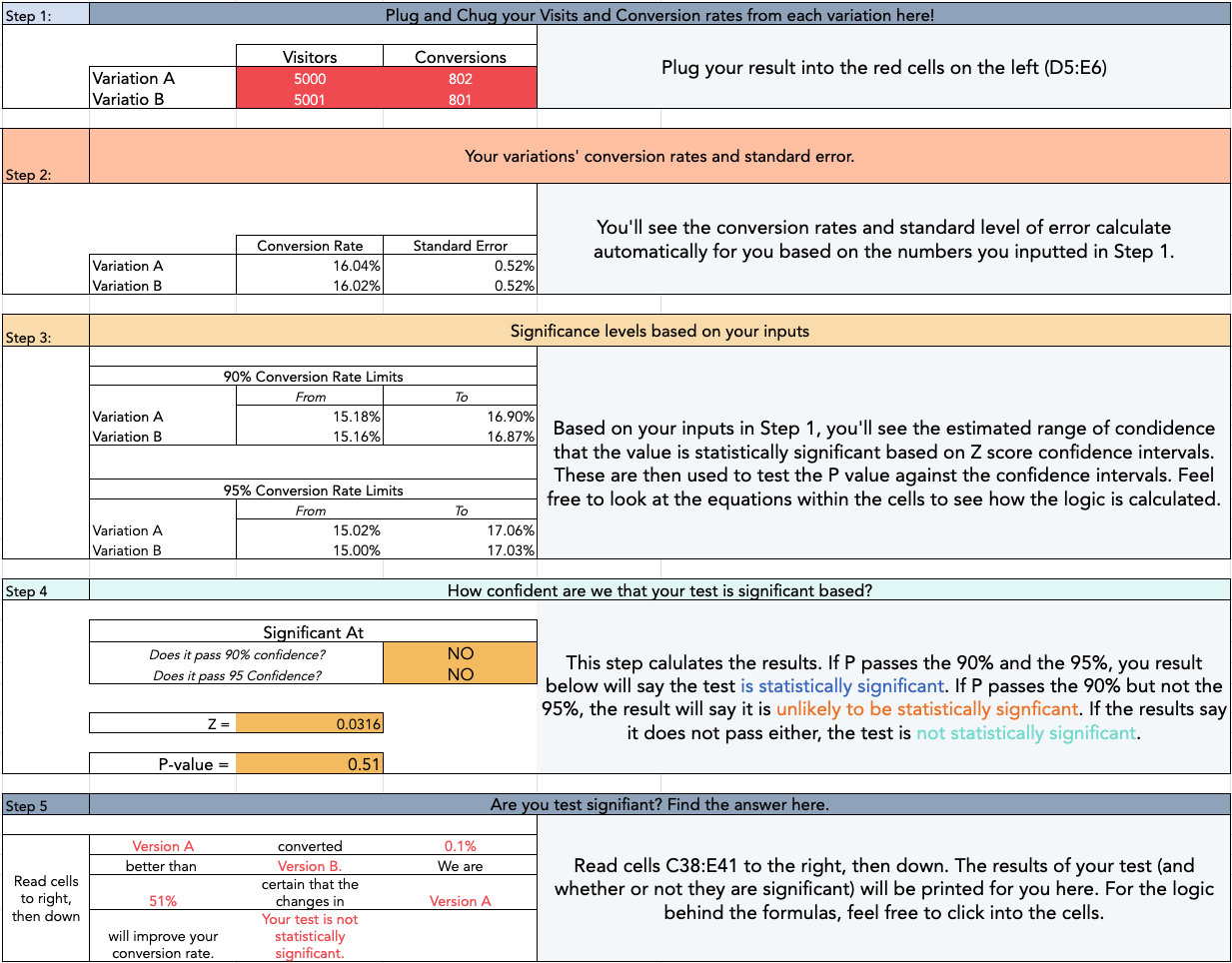
Next, you’ll want to find a sample size calculator — HubSpot’s A/B Testing Kit offers a good, free sample size calculator.
Here’s what it looks like when you download it:
3. Put in your email’s Confidence Level, Confidence Interval, and Population into the tool.
Yep, that’s a lot of statistics jargon. Here’s what these terms translate to in your email:
Population: Your sample represents a larger group of people. This larger group is called your population.
In email, your population is the typical number of people in your list who get emails delivered to them — not the number of people you sent emails to. To calculate population, I’d look at the past three to five emails you’ve sent to this list, and average the total number of delivered emails. (Use the average when calculating sample size, as the total number of delivered emails will fluctuate.)
Confidence Interval: You might have heard this called “margin of error.” Lots of surveys use this, including political polls. This is the range of results you can expect this A/B test to explain once it’s run with the full population.
For example, in your emails, if you have an interval of 5, and 60% of your sample opens your Variation, you can be sure that between 55% (60 minus 5) and 65% (60 plus 5) would have also opened that email. The bigger the interval you choose, the more certain you can be that the populations true actions have been accounted for in that interval. At the same time, large intervals will give you less definitive results. It’s a trade-off you’ll have to make in your emails.
For our purposes, it’s not worth getting too caught up in confidence intervals. When you’re just getting started with A/B tests, I’d recommend choosing a smaller interval (ex: around 5).
Confidence Level: This tells you how sure you can be that your sample results lie within the above confidence interval. The lower the percentage, the less sure you can be about the results. The higher the percentage, the more people you’ll need in your sample, too.
Note for HubSpot customers: The HubSpot Email A/B tool automatically uses the 85% confidence level to determine a winner. Since that option isn’t available in this tool, I’d suggest choosing 95%.
Email A/B Test Example:
Let’s pretend we’re sending our first A/B test. Our list has 1,000 people in it and has a 95% deliverability rate. We want to be 95% confident our winning email metrics fall within a 5-point interval of our population metrics.
Here’s what we’d put in the tool:
- Population: 950
- Confidence Level: 95%
- Confidence Interval: 5
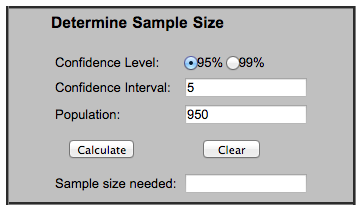
4. Click “Calculate” and your sample size will spit out.
Ta-da! The calculator will spit out your sample size.
In our example, our sample size is: 274.
This is the size one your variations needs to be. So for your email send, if you have one control and one variation, you’ll need to double this number. If you had a control and two variations, you’d triple it. (And so on.)
5. Depending on your email program, you may need to calculate the sample size’s percentage of the whole email.
HubSpot customers, I’m looking at you for this section. When you’re running an email A/B test, you’ll need to select the percentage of contacts to send the list to — not just the raw sample size.
To do that, you need to divide the number in your sample by the total number of contacts in your list. Here’s what that math looks like, using the example numbers above:
274 / 1,000 = 27.4%
This means that each sample (both your control AND your variation) needs to be sent to 27-28% of your audience — in other words, roughly a total of 55% of your total list.

And that’s it! You should be ready to select your sending time.
How to Choose the Right Timeframe for Your A/B Test
Again, for figuring out the right timeframe for your A/B test, we’ll use the example of email sends – but this information should still apply regardless of the type of A/B test you’re conducting.
However, your timeframe will vary depending on your business’ goals, as well. If you’d like to design a new landing page by Q2 2021 and it’s Q4 2020, you’ll likely want to finish your A/B test by January or February so you can use those results to build the winning page.
But, for our purposes, let’s return to the email send example: You have to figure out how long to run your email A/B test before sending a (winning) version on to the rest of your list.
Figuring out the timing aspect is a little less statistically driven, but you should definitely use past data to help you make better decisions. Here’s how you can do that.
If you don’t have timing restrictions on when to send the winning email to the rest of the list, head over to your analytics.
Figure out when your email opens/clicks (or whatever your success metrics are) starts to drop off. Look your past email sends to figure this out.
For example, what percentage of total clicks did you get in your first day? If you found that you get 70% of your clicks in the first 24 hours, and then 5% each day after that, it’d make sense to cap your email A/B testing timing window for 24 hours because it wouldn’t be worth delaying your results just to gather a little bit of extra data.
In this scenario, you would probably want to keep your timing window to 24 hours, and at the end of 24 hours, your email program should let you know if they can determine a statistically significant winner.
Then, it’s up to you what to do next. If you have a large enough sample size and found a statistically significant winner at the end of the testing time frame, many email marketing programs will automatically and immediately send the winning variation.
If you have a large enough sample size and there’s no statistically significant winner at the end of the testing time frame, email marketing tools might also allow you to automatically send a variation of your choice.
If you have a smaller sample size or are running a 50/50 A/B test, when to send the next email based on the initial email’s results is entirely up to you.
If you have time restrictions on when to send the winning email to the rest of the list, figure out how late you can send the winner without it being untimely or affecting other email sends.
For example, if you’ve sent an email out at 3 p.m. EST for a flash sale that ends at midnight EST, you wouldn’t want to determine an A/B test winner at 11 p.m. Instead, you’d want to send the email closer to 6 or 7 p.m. — that’ll give the people not involved in the A/B test enough time to act on your email.
And that’s pretty much it, folks. After doing these calculations and examining your data, you should be in a much better state to conduct successful A/B tests — ones that are statistically valid and help you move the needle on your goals.

10 YouTube Trends to Leverage in 2022 [Data + Expert Tips]
In 2020, I looked up more recipes than I ever have. Mostly Italian if you’re wondering.
I also spent a lot of time watching videos on YouTube, letting the autoplay feature take me down a rabbit hole of videos covering all kinds of topics.

Most consumers were doing the same thing.
So, what should marketers expect on YouTube in 2021? Read on and find out.
Consumers want videos that reflect their daily life.
If 2020 showed marketers anything, it was the necessity for agility and authenticity.
Every marketer had to shift their priorities and deliver marketing collateral that reflected the time we were all living through.
YouTube data from July 2019 to July 2020 shows a 215% increase in daily uploads for content with “self-care” in the title. From the viewer’s side, TV screen watch time went up over 180% for videos relating to well-being, such as fitness, meditation, and yoga.
Now, in 2021, consumers are still seeking out content that reflects their current state of mind.
This isn’t to say that your brand should start a “30 Days of Yoga” series. It’s to highlight how closely tied current events are to the type of content we consume. If you stay in tune with how your audience is feeling and the type of content they’re seeking out, you can embed it into your YouTube strategy.
“Viewers really want content that not only educates them but also engages them. Our new style is putting big stock in the authenticity and personality of its presenters,” said Jamal Meneide, associate video producer/editor and on-screen talent for HubSpot’s YouTube Channel.
Brands must now pay attention to the social climate and general consumer feelings, and incorporate these elements into the content.
Not sure how to keep your finger on the pulse? Jump to this section to learn how to research YouTube trends.
Short-form video is growing in popularity.
In September 2020, YouTube launched “Shorts” in India, a new short-form video platform on YouTube. It’s now making Shorts available in the US, as of March 2021.
Similar to other short-form platforms, videos on Shorts are formatted vertically to be viewed on a phone. Although it’s still in beta, users can create 15-second clips, edit them with several tools and add music from YouTube’s music library.
According to a Search Engine Journal article, Shorts already gained steam, gaining over 3.5 billion daily views. But why would YouTube, a platform known for long-form content invest in this strategy? Meneide has a theory.
“YouTube is trying to compete with TikTok, which is evident in their play to introduce ‘Shorts.’ For a time, it felt like there was a pendulum swing toward really long, unedited content,” said Meneide.
“While this is still prevalent,” he adds, “it seems like we’ve swung back the other way with short to mid-length content really killing it. Viewers want easily consumable, entertaining content that won’t be as demanding on their time.”
This is an opportunity for brands to experiment with short-form content on YouTube and see what audiences are responding to.
One strategy is using Shorts to create teasers for your upcoming videos or create condensed, shareable versions of your long-form videos.
But long-form videos aren’t going anywhere.
Even with the push toward shorter videos, consumers still enjoy the traditional long-form approach.
In June 2020, YouTube reported that 46% of survey respondents said they were more likely to watch videos over 20 minutes long than they were six months ago.
Some YouTubers creators credit long-form video content for their engagement rates, and they’ve got data on their side.
A 2019 Pixability study found that branded videos over 10 minutes long had higher engagement than shorter videos.
But length won’t be enough to keep your audience’s attention.
“Driving music and animation also play a big part in building engagement. Whenever you see animation as a viewer, you know it’s either reinforcing a key concept or adding to a joke,” said Meneide.
“In either case, you’ve been delighted by that extra visual we decided to throw in. With music, we can shift the tone and mood of a video – from driving hip hop beats, to chill jazz.”
He adds that music creates a sonic bed for the viewer to situate themselves on, inviting the audience to lean in as you speed things up or sit back and relax as you slow things down.
“These kinds of stylistic and production choices are ones that many large channels on YouTube have decided to make,” Meneide said. “While content with a more ‘homemade’ feeling still crushes it, there is also an audience who wants to see well-produced, highly engaging content.”
Marketers will start leveraging audio ads.
In November 2020, YouTube introduced audio ads, a new way for brands to reach consumers.
It was a surprising announcement, given that the platform is known for video content. However, according to a Think With Google article, over two billion people go to YouTube for music.
The article also reported a 100% increase in watch time for live music performance between July 2019 and July 2020. This sets the stage for marketers to include YouTube as an ad platform for their audio content.
How To Research YouTube Trends
We’ve covered a few YouTube trends for 2021, but marketers need to know how to identify trends as they come.
“On the HubSpot YouTube team, we’re always looking at trends, which we corroborate with monthly search volume and keyword research to help define our content strategy,” Meneide said. “We want to serve our audience content that they’re looking for when they’re looking for it, and being sensitive to when a topic bubbles up is key to the process.”
Your first resource is Google Trends, a free online resource that is updated with real-time data on the popularity of certain topics and search terms on YouTube.
You can also rely on tools like VidIQ and TubeBuddy to determine which ideas are worth pursuing. A good rule of thumb, according to Meneide is asking what big “how” or “why” questions you can answer for your viewers.
Then, you have keyword research – this tells you what consumers are searching for and if it’s worth your time and resources.
For instance, let’s say your brand wants to cover the latest tech apps in your next video. You go to Google Keyword Planner and find out that it has a monthly search volume of about 100. This may indicate that while there is some interest, it’s not high enough to warrant a whole video.
It’s also important to look at the news and see what topics are trending. However, know the difference between something that’s just in the news cycle and a trend worth incorporating into your YouTube strategy.
One way to decipher between the two is asking, “How far does this reach, and will it matter in a few weeks or months?”
“Hopping onto news can be just as explosive for growth or your marketing strategy as trends, but makes it a bit harder when you’re always relying on the latest, ‘hottest’ news piece to inform your content strategy,” Meneide said. “By focusing on longtail trends, you can ride out a wave of sustained interest in a topic, rather than capturing what could potentially be a fleeting interest.”
As we navigate through this year, more trends will likely pop up and might inform your YouTube strategy. What’s most important is being flexible and knowing when something is worth exploring further.

The Top 5 B2C Marketing Trends of 2023 [New HubSpot Blog Data]
In 2022, 51% of B2C marketers plan to increase their marketing budget.
The question is where is that budget going? Will marketers reinvest in the same strategies or try new trends?
To understand what trends B2C marketers are leveraging in 2022, we surveyed 1,067 global marketing professionals working in B2B and B2C companies.
From influencer marketing to virtual events, there are so many efforts brands can focus on. Let’s see what our latest research says about what worked well for B2C marketers this year and where they plan to invest in 2022.
1. Short-form video will be a priority.
Short-form video took off in early 2020 and shows no signs of slowing down.
Back then, TikTok was the number one place to go for short-form content. Today, Instagram Reels and YouTube Shorts are also competing for users’ attention.
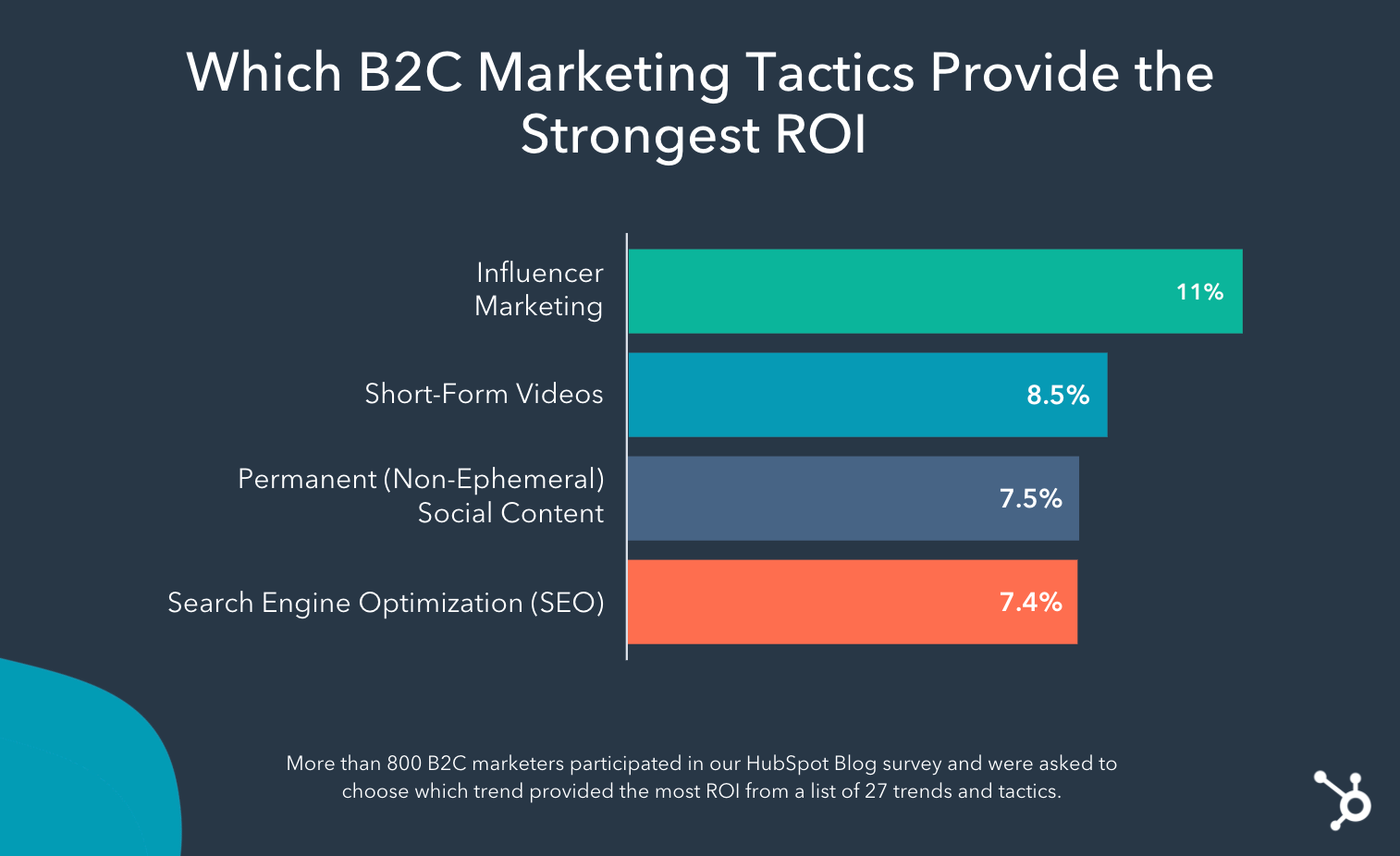
This is good news for brands, as the short-form video trend content offered the second-highest ROI for B2C marketers in 2021, behind influencer marketing.
Despite coming in second for ROI, it’s the trend marketers plan to invest in the most in 2022. Roughly 33% of B2C marketers already invest in short-form content, while one-third of those who haven’t will do so for the first time in 2022.
Why now? Well, short-form video is such a key feature in social media today. And according to the data, social media takes the lead in marketing investments for businesses.
That’s likely because three key goals B2C brands will have when running marketing campaigns in 2022, will be increasing brand awareness (49%), advertising products (44%). and increasing revenue (43%).
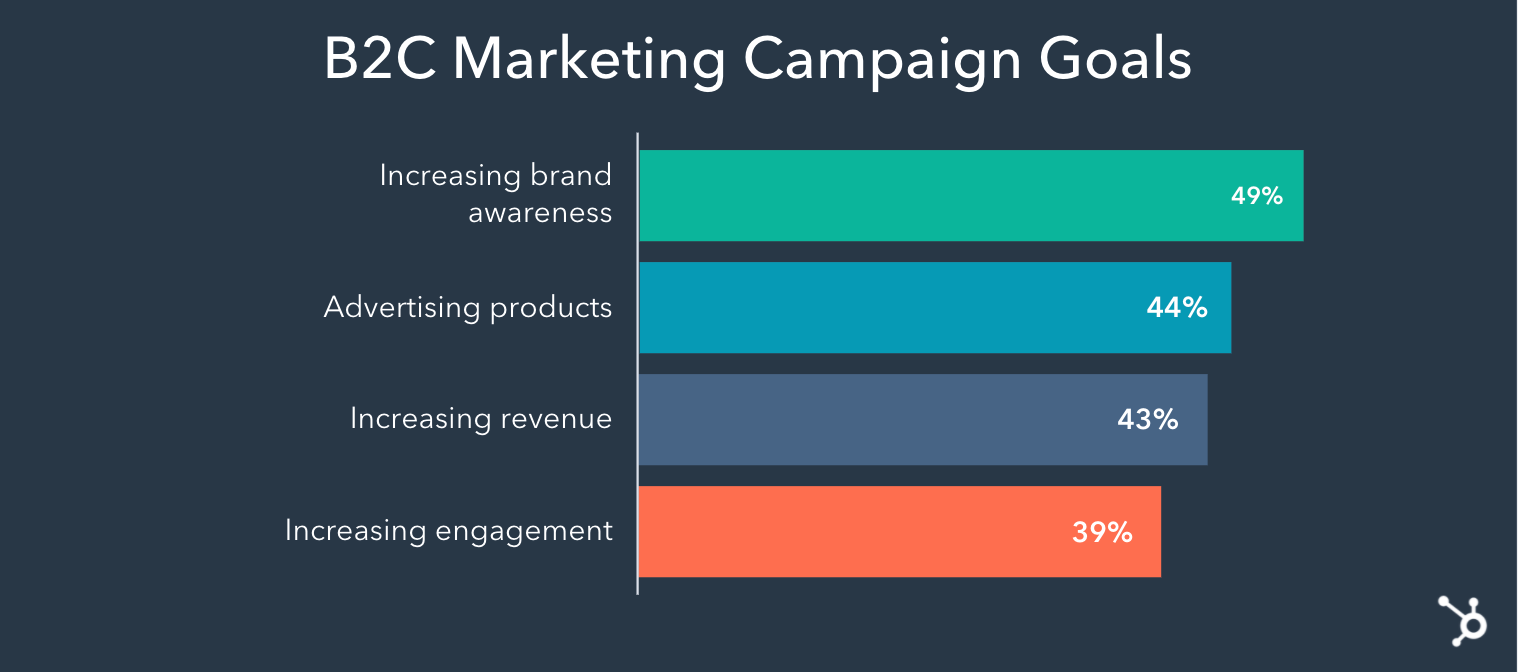
With social media, you can accomplish at least two out of three. Brand awareness was always the main benefit of using social media but things have evolved.
Today, with so many platforms offering in-app shopping experiences and advanced ad formats, brands can meet more of their marketing goals.
2. Influencer marketing will still be a key lead/revenue driver.
For most B2C marketers, the power of influencers is clear.
In 2022, 61% of B2C marketers surveyed in the study plan to leverage it. In fact, it’s the third-highest trend they plan to prioritize, behind short-form video content and inbound marketing.
This is because in 2021, it offered B2C brands the best returns. When asked to select their top ROI driver from a list of 27 tactics and strategies, 11% of B2C marketers chose influencer marketing.
What might be different in the future is the type of influencer brands focus on. Historically, brands have focused on the biggest and most popular influencers to partner with.
However, some data suggest that micro-influencers with under 100K followers may be more effective.
While the verdict is still out on that, one thing is clear: Influencer marketing isn’t going anywhere.
3. Audio content will take a front seat.
Data suggests that video is the leader when it comes to content marketing. However, audio is slowly creeping up into the mix.
According to the survey, only 19.1% of B2C marketers use podcasts or other audio content in their marketing. Of those who do use it, 37.4% find it to be one of their most effective trends.
Even though adoption was seemingly low in 2021, the data suggests that more B2C marketers will add audio content to their marketing efforts in the new year.
Roughly 43% of B2C marketers plan to increase their investment in podcasts in 2022 while 38.4 plan to keep it the same. Another interesting fun fact is that this particular piece of data is virtually the same for B2B marketers.
This suggests that across all industries, brands recognize the power of audio content.
4. Social responsibility will be more important.
Now more than ever, consumers want and expect brands to be more transparent and take a stand on social media.
In fact, a 2020 Edelman Trust Barometer survey revealed that many consumers see trust as a leading factor in their purchasing decisions.
In the past two years, particularly in the height of the COVID-19 crisis and calls for social justice, consumers have started holding brands more accountable. In 2022, brands will be addressing that demand.
Currently, only a third of B2C marketers surveyed find social responsibility to be an effective marketing trend. Despite that fact, 45% plan to increase their investment in 2022.
5. Brands will continue to apply inbound marketing strategies.
Inbound marketing is all about meeting consumers where they are. Instead of marketing efforts that push messaging out to consumers, this focuses on attracting them toward you.
Behind short-form video, inbound marketing is the top trend marketers will invest in next year.
In fact, over 80% of marketers plan to keep the same budget or add more for this strategy.
This is done by following the “Attract, Delight, Engage” model that leverages content marketing, SEO, marketing automation, social media, and more to nurture consumers at every stage of the buyer’s journey.
There you have it – some of the top trends B2C marketers will invest in 2022. Between publishing regular video/audio content on social media and developing a strong inbound marketing strategy, marketers have a busy year ahead.
To keep up with the latest trends in marketing, stay tuned for more upcoming marketing strategy research posts, download the 2021 HubSpot Not Another State of Marketing report to learn what marketing professionals focused on this year.


The Top 10 Marketing Challenges Expected Globally in 2023 [HubSpot Data + Expert Tips]
Every marketer faces different challenges. And, ever since 2020, the ways we’ve had to pivot, adjust campaigns, and address challenges has been unlike anything many of us have had to do before.
And, even if you’ve somehow navigated the past three years without any surprising or tough marketing challenges, there’s likely at least one task, tactic, or strategy you’ve always wanted to improve upon.
Today, marketing is so fast-paced that it can be difficult to identify which areas you’ll want to develop to facilitate stronger growth in 2022 and beyond. For that reason, it’s important to pause for a moment and reflect on the biggest challenges marketers feel they’re facing this year.
Below, let’s review the current global marketing issues impacting the industry, according to data from HubSpot’s 2023 Marketing Industry Trends Report and marketing experts.
1. Generating Traffic and Leads
While this was the second biggest marketing challenge in 2022, it’s the top challenge marketers will focus on in 2023, with 19% of survey respondents saying it will be their biggest hurdle. As you might expect, generating traffic and leads is always top of mind with marketers. And, even if teams are doing well with these metrics, they’ll always want to improve them.
Why It’s a Challenge
John Lee, Head of Evangelism at Microsoft Advertising, believes that generating leads will be a particularly big challenge for marketers. He told me, “Getting quality traffic isn’t a challenge today, and likely won’t be tomorrow. There has been growth in search and content marketing in 2021. New channels continue to surface and show promise, too (TikTok or audio chat rooms anyone?).”
Lee adds, “‘Sea change’ is the phrase that comes to mind for the state of digital marketing today. Change in the realm of privacy, identity, and changes to cookies. Change in the form of lost data clarity (will cookie-based conversion tracking continue to work, GA4, access to search queries, etc.). And all of this sits within the context of change to how and where we work and economies in flux as the world continues to move through the pandemic.”
Fortunately, privacy changes don’t mean the end of generating leads — it simply means learning how to re-think strategy.
As Lee told me, “To weather this storm of change, marketers need to be vigilant in monitoring and understanding industry-wide acceptance of privacy protocols and updates to search, social, and display/native platforms (consumer-side and marketing/advertising-side). And last, but not least — lean into the power of peer support and networking for sharing best practices and learning.”
Additionally, marketers are struggling with producing enough demand for their content. And as the year’s progress and competition stiffens, this will only become truer. With so many options of platforms for marketers to publish their content and even more ways to promote it, it’s hard to know where to focus your efforts.
What You Can Do
When it comes to creating content that produces enough traffic and leads, marketers should ask themselves two questions: Are you truly creating high-quality content — the type of content people would pay for? And, do you know the type of content your audience actually wants?
For instance, when asked how they’d most like to learn about a product or service, 69% said they’d prefer to watch a short video over a text-based article, infographic, or ebook. This means, if most of your product-related content is in ebook format, you could be missing out on the majority of consumers who prefer video.
Additionally, the length of videos produced by businesses has increased (albeit more slowly than the increased creation rate of short video). While short-form video is still King/Queen, the number of videos in the 30-60 minute category grew 140% in 2021, compared to 2019 — suggesting that long-form video content is still a viable option for companies.
To ensure you’re creating content that resonates best with your audience, you’ll want to refer to analytics often. Use effective tools to properly track the types of content that perform best with your audience to generate more leads in 2022.
Additionally, once you know you’re creating the type of content your audience wants, the focus shifts to promoting it in a way that makes your audience take notice.
More than ever before, people are being flooded with content. Consumers don’t have to use a search engine to find answers. Instead, articles fill their news feed or buzz in their pocket via mobile notifications. To keep up, consider exploring alternate distribution methods — like social media or podcasting — to increase brand awareness.
Lastly, if you have the budget for online advertising, one example of a helpful distribution method is by promoting your content with HubSpot’s LinkedIn Ads Integration. Learn more about it here.
2. Hiring Top Talent
While “Hiring Top Talent” was low on the list of challenges faced by marketers in 2022, it’s expected to be the biggest challenge of 18% of marketers in 2023.
And, we’re not too surprised. Hiring talent with a great track record takes time, effort, and money — which many marketing teams do not have.
While hiring is a challenge marketing teams have faced throughout the past five years or so, concerns are continuing news of worker shortages and recruiters competing for applicants that have chosen to shift roles due to the global pandemic or management interests in mandatory office returns.
Why It’s a Challenge
Many companies are shifting more resources to inbound marketing, which means higher and higher demand for top marketing talent. But supply simply isn’t keeping up. From sourcing the right candidates to evaluating for the right skills, finding the perfect person could take months … or more.
What’s more, the type of marketing talent companies are looking for is changing, too. According to a report from LinkedIn, employers are seeking marketers with soft creative skill sets as well as hard technical skills. And the quick rate at which the demand for these jobs are rising has caused a marketing skills gap, “making it difficult to find candidates with the technical, creative, and business proficiencies needed to succeed in digital marketing.”
What You Can Do
In 2023, hiring talent could grow even more difficult — particularly as more companies deal with transitions back to office life, competitive hybrid perks, as well as salary budget limitations due to the shifting economy.
Stefanie Grieser, co-founder of Shine Bootcamp, a professional speaker accelerator for women, understands the challenge of hiring top talent.
She told me, “When I talk to high-growth companies or marketing agencies (and the marketers running those teams), I’ve found that hiring not only top talent, but diverse top talent is extremely challenging. In fact, I was just having a conversation with an agency owner who hires SEO and paid marketers, and he told me, ‘Hiring is still the biggest challenge we face.'”
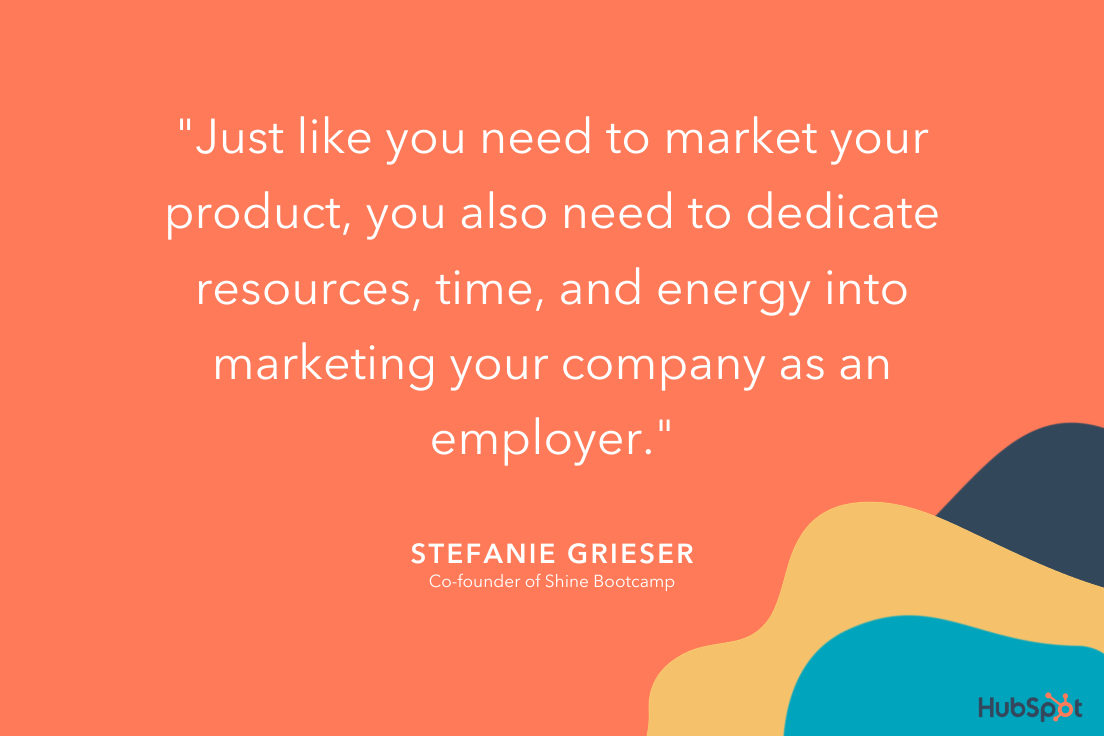
Fortunately, Grieser provided me with a few tips for employers to stand out from the crowd. She told me, “My suggestion here is for marketers to invest heavily in their employer brand for the long-term. Just like you need to market your product, you also need to dedicate resources, time and energy into marketing your company as an employer.”
 Grieser adds, “I would suggest Diversity Tech Co, Tech Ladies, and Girlboss as go-to resources to post jobs. These organizations are run by incredible individuals who really care about diversity, equity, inclusion and intersectionality. I’m also seeing niche communities and job boards pop up. For marketers specifically, I would post your open roles here: Dave Gerhardt Marketing Group, Hey Marketers, and Superpath (which is focused on content marketers specifically).”
While it might seem random to discuss employer branding in a post about marketing challenges, it isn’t — since it’s often the marketing team that cultivates a strong employer brand.
As Grieser points out, “Airbnb has an Engineering and Data Science blog, Intercom has an Instagram dedicated to their design team, and Dooly posts short, LinkedIn posts (see an example here) interviewing their fun team with a few fun hashtags #doolydreamteam and #meetadooligan.”
“Guess who leads this initiative? The marketing team. Think about how you and your team can showcase your work and your team’s work. I won’t try to assume that employer brand falls solely in your court, but as a marketer, you have natural skills that will lend themselves to marketing the company as whole.”
LinkedIn data shows that the number one reason candidates will consider or accept a job is career growth. This means that job listings and a company culture that offers employees a plan for growth will see the most interest from talent.
3. Marketing Plan Pivots
In 2020, we began learning the art of the pivot as many brands had to stop everything they had planned, observe the current state of everything, and navigate the bbest way forward. But, every time we think we get closer to a boring day in the marketing world, something evolves or changes that will cause us to need to pivot.
And, while some marketers are excited by the idea of working in a fast-paced, ever-evolving environment, it can get very tiring for others. That’s why we’re not shocked that 17% of marketers say that marketing strategy pivots will be the biggest challenge they face in the new year.
Why It’s a Challenge
While you might think pivoting during COVID-19 gave you all the skills needed to change course when its necessary, every unprecedented event that we aren’t expecting often poses new challenges (as those definitions suggest). When marketers don’t plan for the unexpected, they could risk their performance metrics, budget, or even their audience if they market to targets that are forward-thinking and find untrendy or out of touch brands uninteresting to them.
What You Can Do
At HubSpot, and many other companies with excellent marketing departments, our marketers always try to be one-step ahead of the potential result (or even a lack of results).
When creating a large campaign or implementing a big strategy, it’s important to ask yourself and your team, “What do we do if it doesn’t work?” or “How do we pivot if the world changes overnight?”
When it’s time to make that pivot, try to gather as much information as you can about your customers, audiences, and platforms to learn how everything has changed or evolved, and then use what you’ve learned to determine the best course of action. For example, when COVID-19 was declared an emergency, many of our marketers paused comms with audiences and notified them through emails or social posts that it was because we wanted to focus on offering the most helpful or valuable content unrelated to sales and revenue at that time. Then, while we were on pause, we met with each other and performed market research to help us put ourselves in the audience’s shoes and learn how we could best help them.
If you do pivot, learn from what worked effectively and what didn’t. This will help you in future scenarios where a pivot is necessary — even if the situation is totally different next time.
For more information and expert tips on how to change up your content plan in a rush, check out this helpful post.
4. Training Marketing Teams
In 2022, training top talent was the top challenge marketers were focused on. However, as more marketers now focus on recruiting and retaining greaat talent in this time of faster workplace movement, training seems to have fallen to number four.
However, this doesn’t mean training isn’t an important factor to pay attention to, especially if you have a growing workforce.
After all, even top-tier talent need to have paths to grow, challenge themselves, learn, and become even better at what they do.
If you’re a manager or marketing leader, you’ll need to take time to teach that employee how your company works. This could include voice and messaging training, helping them understand buyer personas, or getting them acclimated to the tech stack or processes you use.
Meanwhile, regardless of whether you’re a seasoned marketing team employee or new hire, you might wish your company had more opportunities for training, onboarding, or professional development that could allow you to excel and learn while also hitting your KPIs.
Why It’s a Challenge
Unfortunately, in the fast-paced world of marketing, it can be challenging for leaders to find the time to train while employees might not have the time or money to access professional development outside of their day-to-day tasks.
That’s why it’s not shocking that 30% of marketers say that team training was the biggest challenge of 2021 and 21% say it will continue to be the top challenge for marketing departments in 2022.
What You Can Do
The first step to solving this problem, regardless of whether you’re an individual contributor or manager, is reframing what “training” means to you. Remember that even the most top-tier, ROI-generating unicorn marketer will need time to get used to how your company works and grow as an employee and potential leader.
Ultimately, businesses should think of training and professional development offerings as indirect ROI generators. Ultimately, even the most top-tier, unicorn talent will need time to get used to how your company works.
On one end of the spectrum, companies and leadders can retain employees and save money on talent searches because of their offerings. Meanwhile, their talent will learn more, grow more, become even more competitive, and — most importantly — feel more fulfilled and supported in their role. Additionally, you don’t always have to hire instructors or take time out of your day to train. For example, you can:
- Encourage project managers or individual contributors looking for visibility to present experiments, strategies, or learnings at events, weekly meetings, or annual team conferences.
- Book an annual professional development day during a slow season where all employees are asked to take a free online course of their choosing and report back on how it went.
- Consider hosting quarterly or bi-annual new employee or new manager training days where newer hires and new managers can plan to go to in order to train with minimal impact on their quarterly projects.
- Create evergreen training videos, internal quizzes, or other resources that you can send to new or newly promoted employees on their first day.
- Have managers develop 100-Day Plans for new hires or those that transfer to their team which includes training assignments, resources to read through, and a contact list of people to meet or schedule training with.
On the other hand, if you’re an individual contributor, participating in your company’s professional development training and/or taking free or affordable courses online could help you negotiate a stronger role and salaries for yourself at your company or elsewhere.
If your company doesn’t offer training or reimbursement for it, check out this list of free courses.
5. Keeping Up With the Latest Trends
As you’ve seen, the world is always changing. Even aside from the things you’ve seen all over the news, a brief skim of any social media feed once weekly will show you how much trends change. In one day, we’ll open our TikTok feed and see constant clips filled with “Stranger Things” references all over the place. The next day, we’ve moved on to “CornTok” (a trend that involved us sharing videos with a remixed song sung by a boy who really loves corn).
Why It’s a Challenge
Essentially, no matter where you look, trends are constantly changing. And, if you’re publishing out of touch content that leverages very out of date or out of touch trends, your audiences might get bored and move on to a brand that feels more interesting to them.
Unfortunately, marketers might not always have the bandwidth or budget to lean into every trend out there. So, what are we supposed to do?
What You Can Do
Just like picking the right channels or social platforms that make the most sense for your brand, pay attention to the industries and trends that make the most sense for you to lean into, or brands that you know most of your target audience is leaning into. For example, one brand that perfectly leaned into “CornTok” was Rumba, which creatively published a TikTok of its products cleaning up — you guessed it — corn.
6. Facing Competition
In our 2023 survey, 16% of marketers cited their biggest challenge as “increasing competition from other brands.” And, that’s not shocking at all.
Business competition is a tale as old as time. And, even when you feel like you’re winning on one channel or another, competitors can come at any moment ready to outperform you. That’s why every platform, from social media to search engines, has gotten vastly more competitive over the past 10 years — and will only get more saturated with competition.
What You Can Do
The concerns of competition are obvious. Ultimately, they could take business or attention away from you and harm your revenue. Luckily, it doesn’t take a marketing genius to get ahead of them.
Start with a competitive analysis of all of your biggest competitors that you’re most likely to lose audiences or customers to.
Examine their websites, social media, search keyword profiles, and other channels and make a list of what they’re doing right that you can learn from, what they’re doing wrong that you’ll avoid, and the gaps in their strategy that you can take advantage of.
While we encourage you to highlight your unique perks and not copy the competition exactly, use your analysis results to think about the competitive selling points you can market and strategies you can use to innovate on what they’re missing.
7. Securing Your Budget
In 2023, 16% of marketers are concerned about securing. gaining, and keeping stakeholder support for their marketing budgets. And, although we aren’t surprised that a large chunk of marketers selected this concerm, we were a bit shocked that more marketers aren’t seeing this as top of mind given the current economic landscape.
Why It’s a Challenge
Securing a budget has always been a pressing challenge for marketing globally. And, while marketers seemed to be getting what they needed for budget in 2022, companies could be eager to shift back to pre-pandemic strategies of placing money into sales, facilities, and other departments in the future — especially if the U.S. or other countries enter a recession.
Often, getting and keeping more budget is easier said than done — especially for smaller organizations that aren’t working with sizable or flexible marketing spend. But the key to securing more money for your team might not be that complex. Here’s what you can do.
What You Can Do
The key to unlocking budget lies in being able to prove the ROI, of your marketing efforts (as we’ve noted above). Use your whole budget to demonstrate need, but also ensure you’re spending money on things that will provide high performance, like high-traffic, lead-gen, or revenue-generating projects or headcount.
According to our research, organizations that can calculate ROI are more likely to receive higher budgets.
Again, success with inbound marketing also plays a large role in driving higher budgets. Effective strategies obviously produce results and make a strong case for increasing your budget. But remember, inbound marketing is a long game. If you get off to a slow start, you shouldn’t back off — in fact, you might consider doubling down.
To learn more about how to understand and leverage marketing ROI, check out this simple guide.
8. Demonstrating ROI of Marketing Activities
While this item didn’t make our top challenge list this year, we still think it’s very important to highlight here and focus on in 2023, especially if your business is focused on spending budget wisely — or only on things that provide ROI.
And, in 2021. 28% of marketers saw it as their top challenge, while 21% of marketers expect to see this continue to be their biggest issue in 2022.
Measuring and gaining ROI continues to be a vital way for marketers to understand the effectiveness of each particular marketing campaign or piece of content. It also can be what decision-makers at your company rely on when determining if they’ll invest more in your project, deparment, or team headcount in the future.
Ultimately, proving ROI often goes hand-in-hand with making an argument to increase budget: No ROI tracking, no demonstrable ROI. No ROI, no budget.
Providing ROI often comes down to using effective analytics measurement tools. For instance, Beautiful.ai Director of Marketing Kim Giroux told me, “Marketers are constantly challenged to illustrate the ROI of their efforts and [this year] is no exception. Proving ROI doesn’t always have to mean extra work or effort though. In fact, certain technologies bake ROI into existing work processes.”
Giroux adds, “Take presentation software, for instance. Savvy marketers today can create and use pitch decks with built-in presentation analytics that offer real-time data — such as how much time was spent viewing individual slides. Armed with these insights, marketers can better gauge stakeholder interest, inform their strategies, and adjust their campaigns.”
Christina Mautz, CMO of Moz, believes measuring ROI comes down to redefining the marketing process as a whole. She told me, “My biggest challenge, and one all marketers face in providing ROI, is the prospect of meeting traditional KPIs in the modern workspace.”
Mautz says, “Instead of leads and trade show success, marketing wins are now largely digital: engaging prospects and generating more clicks, downloads, and page visits.”
CMO of Moz Christina Mautz says, “To better measure marketing progress, we have to redefine the marketing process, encouraging collaboration with sales and reaching KPIs together.”
“For example, statistics such as page visits per sale or rising higher in the search engine results page (SERP) give marketers and SEOs tangible evidence as to how their work is meeting their ROI. New buying patterns and a customer-centric world require a divergence from the old, but measuring ROI will look far different than it did before and some leaders may not understand how or why.”
When it comes to providing ROI, there’s a strong case to be made for dedicating time and resources to establishing links between marketing activities and sales results.
This means using both marketing software (like HubSpot) and a CRM solution (like HubSpot’s free CRM) and then tying them together to close the loop between your marketing and sales efforts with a service-level agreement (SLA). That way, you can directly see how many leads and customers are generated through your marketing activities.
Other Common Challenges
While our survey identified the biggest challenges in marketing, teams are still facing dozens of other challenges that are worth mentioning, but weren’t one of the top concerns. Here are just a few:
Website Management
In 2021, 64% of companies said they were investing in website upgrades. Meanwhile, 27% of survey participants said that managing their website was the top challenge in that year, with a chunk more saying they continued to rise to this challenge in 2022.
In 2023, website challenges aren’t going anywhere. If you have an online presence for your business, your website serves as a key place that consumers will go to when researching your brand.
There, they might find company information, marketing content, and other resources that nurture them into becoming a lead or buying your product. On the marketing end, your site can also be a tool that can help you drive search result and social media awareness when it is optimized and shared around the web.
Although managing a website is consistently a challenge to marketers, it seems to be growing less threatening. While website management was the third-biggest challenge facing marketers in 2021, it didn’t even make the Top Five Challenge list for 2022.
Chances are, your website’s performance is high on your list of priorities — particularly since website speed and performance plays a major role in your website’s SEO ranking. It’s an asset that works around the clock to draw in visitors, convert them, and help you hit your goals.
Issues with website management include a variety of different factors, from writing and optimizing the content to designing beautiful webpages. Here are a few things marketers can do to deal with this challenge.
What Can You Do?
First, try HubSpot’s free website grader to determine how your website stacks up on key metrics including SEO, mobile, and security performance — and how you can improve it.
If your primary challenge with managing a website has to do with the skills and resources you have available, you aren’t alone. This is especially true for small companies who don’t have all the talent in-house required to cover content, optimization, design, and back-end website management.
One solution? Hire freelancers and agency partners. To find freelancers, we recommend:
- Tapping into your personal and professional network by posting on LinkedIn, Facebook, and other social networks with a description of what you’re looking for.
- Browsing freelance writers and designers based on their portfolios and areas of interest.
- Browsing HubSpot’s Services Marketplace, which lists a wide variety of designers from partner companies and agencies we’ve deemed credible.
Overall, you can make website management easier on your team by hosting your website on a platform that integrates all your marketing channels like HubSpot’s CMS.
Social Media Marketing Challenges
In our survey, 16% of marketers said that their biggest challenge of 2023 will involve keeping up with the latest social media platforms, as well as their growing lists of new features.
And, with the constant evolution of how social media looks, feels, and functions comes a mess of other social media challenges that marketers are worried about, including — but certainly not limited to:
- Creating engaging content (which 22% of social media marketers cited)
- Gaining and keeping followers (22%)
- Reaching your target audiences (21%)
- Finding ideas for content (21%)
- Creating content that generates leads (20%)
Content Marketing Challenges
The content marketing world is vast and full of different strategies. And, each major tactic comes with its own challenge.
For example, if you’re a blogger or video creator, SEO and ranking on Google will likely be one of the biggest hurdles and opportunities your team will face because both blogs and videos are always competing for the covered first page of search results on Google.
Meanwhile, if you focus on multimedia, such as videos, podcasts, or design, views, view-time, and shareability could be key to nurturing a lead. And, as many marketers struggle with demonstrating ROI — your efforts will be no different. While bloggers could include a form, purchasing link, or landing page URL in their posts which are easier to track, you won’t always be able to easily determine the ROI of content that doesn’t allow URL embedding in it.
As a content marketer, it’s important to determine which goals are most important to your team and company’s growth and focus first on the challenges that will hinder reaching them.
Email Marketing Challenges
Over the last year, email marketers have run into all sorts of challenges, such as pandemic-related low engagement and Apple iOS 15‘s privacy protection policy impacting open tracking and open-rate based strategies.
But, by far, the biggest challenge email marketers will probably always face is gaining and retaining subscribers. In fact, our research found that 19% of marketers see email and social media list growth being a top challenge throughout the year.
If you identify with our participants, check out this post with more data on why consumers subscribe and unsubscribe from email.
Some of these challenges aren’t new.
If you’re a marketer who sees the same challenge year-over-year, it might be a barrier worth putting on your radar. However, some challenges can be industry-wide. Year-over-year challenges across the industry are incredibly important to note, regardless of whether they impact you or not.
Why? These challenges might not just be something you’re facing, but could also be faced by your competitors. If you can figure out how to navigate a reoccurring industry challenge effectively, you could have a leg up against the competition.
Way back in 2021, I surveyed over 120 marketers on our HubSpot Marketing Blog subscriber list to gauge the biggest challenges affecting the industry. Here’s a quick graph highlighting what they said.
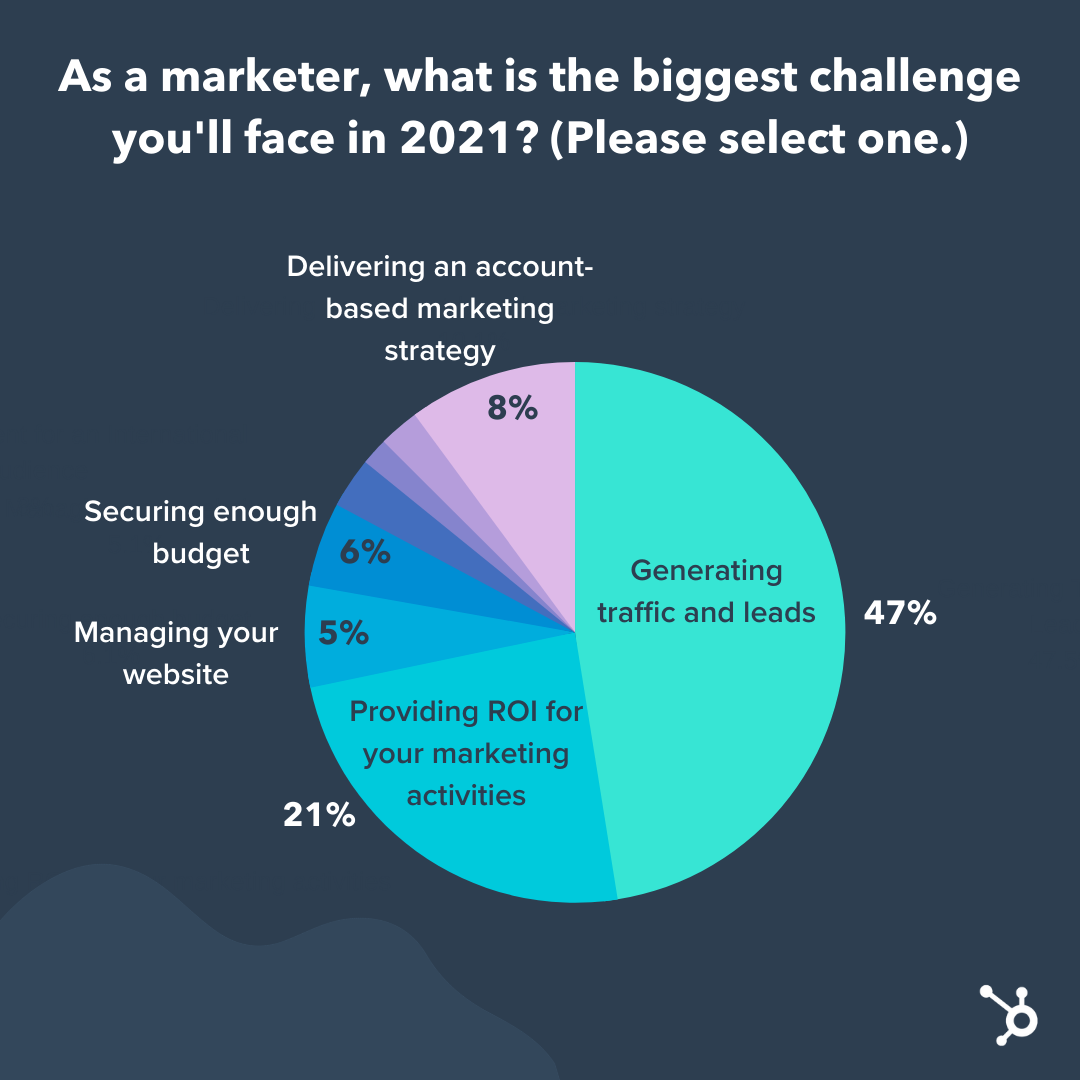 By far, “Generating traffic and leads” was marked by nearly half as the biggest challenge marketers are facing this year.
This challenge was followed by 21% who said “providing ROI for your marketing activities” was their biggest challenge.
“Delivering an account-based marketing strategy” (8%), “securing enough budget” (6%), and “managing your website” (5%) were the other three notable challenges marketers feel they’re facing in 2021.
It’s important to note, a few other marketers marked “targeting content for an international audience”, “training your team”, and “hiring top talent” as their top challenge … but these three challenges were marked by less than 3% of the respondent pool, so they’re less statistically significant.
Identifying Your Marketing Challenges
A thorough analysis of your marketing strategy and its current performance will help you discover where your biggest marketing opportunity lies. This will allow you to focus on improving the areas that need the most attention, so you can start making your marketing far more effective.
Another thing to keep in mind is that, sometimes, the best challenges to focus on could involve solving for the biggest pain points of your companies executives or leaders. And while the post above focuses on the challenges of general marketers at all levels, we also did a follow-up survey to learn about the key challenges and pain points director+ marketing leaders are facing daily. Check out this post, from our Act Like a Leader, Think Like a Leader blog series (fully launching Nov. 1), which includes tips from marketing execs and experts at companies like Microsoft, HubSpot, Help Scout, ZoomInfo, Sprout Social, and more.
Just interested in learning about general marketers? Be sure to check out our 2022 State of Marketing Report, which you can download for free below — or get our predictions for how marketing will change in the next year with the HubSpot Blog’s follow-up 2023 Marketing Trends Report.
Editor’s Note: This post was originally published in November 2012 and has been updated annually to include new, exclusive HubSpot data and expert insights.

The HubSpot Blog’s 2023 Marketing Strategy & Trends Report: Data from 1,200+ Global Marketers
If the last few years taught us anything, the real test of a marketer’s skill is how well they adapt to change.
In fact, in our most recent research, nearly 80% of marketers say their industry changed more in the past three years than in the last 50.
That also means consumer attitudes and preferences are changing just as quickly. And, it’s up to brands to keep up.
So, how can you succeed in a world where the unprecedented has become common?
To help you answer that and other burning questions, we surveyed 1,200+ global B2B and B2C marketers on their goals, challenges, and strategies.
Before we dive into the sections of our survey, let’s quickly discuss the biggest theme we found across the results.
Our Biggest Finding: Agile, Data-Driven Marketers Will Win 2023
Overall, the survey results pointed to two tactics that will be vital in keeping up the pace in the coming year:
1. Use deeper data to know the ins and outs of your audience.
Go beyond basic demographic information – it’s crucial to know their interests and hobbies, how they like to shop, where they consume media, the online communities they are part of, the challenges they face, and the social causes they care about.
2. Always plan to pivot.
From pandemics to political turmoil – and now a looming recession – the last few years have been a roller coaster for brands and consumers alike. Not only did over half of marketers pivot in 2021, 83% of those who pivoted changed course two to four times in one year.
We also found that 20% of marketers have already pivoted due to the potential recession. Chances are 2023 will continue to see shifts around this.
Ultimately, you need a plan for when things go off course. Will you increase your marketing budget? Will you cut down on marketing channels? How will you adapt your messaging to resonate with consumers’ evolving experiences? Most importantly, do you have the data you need to guide your decisions?
While the two tactics above reflect the broad findings in this report, let’s dive more specifically into the biggest strategic changes marketers expect to see in 2023 and how that’s changed from our last 2022 survey.
While we discussed some of these strategies an trends in our 2022 Report,
it’s worth noting that we’re seeing more emphasis on data-based decision-making, agile marketing, as well as social media brand-building (which often majorly contributes to the fast-paced tactics and pivots needed in the marketing industry each day). All in all, more marketers are speeding up processes and tactics to meet the digital, hyper-connected world we’re existing in today.
Below, we’ll discuss a few of these items in more depth. But, we’ll also continue to release more deep-dive data content to help you meet all of these changing strategies with success.
The top trends marketers are currently leveraging are short-form video, mobile-friendly web design, creating content that reflects their brand’s values, and using social media DMs for customer service. Not far behind are SEO, mobile messaging, influencer marketing, and selling products directly in social apps.
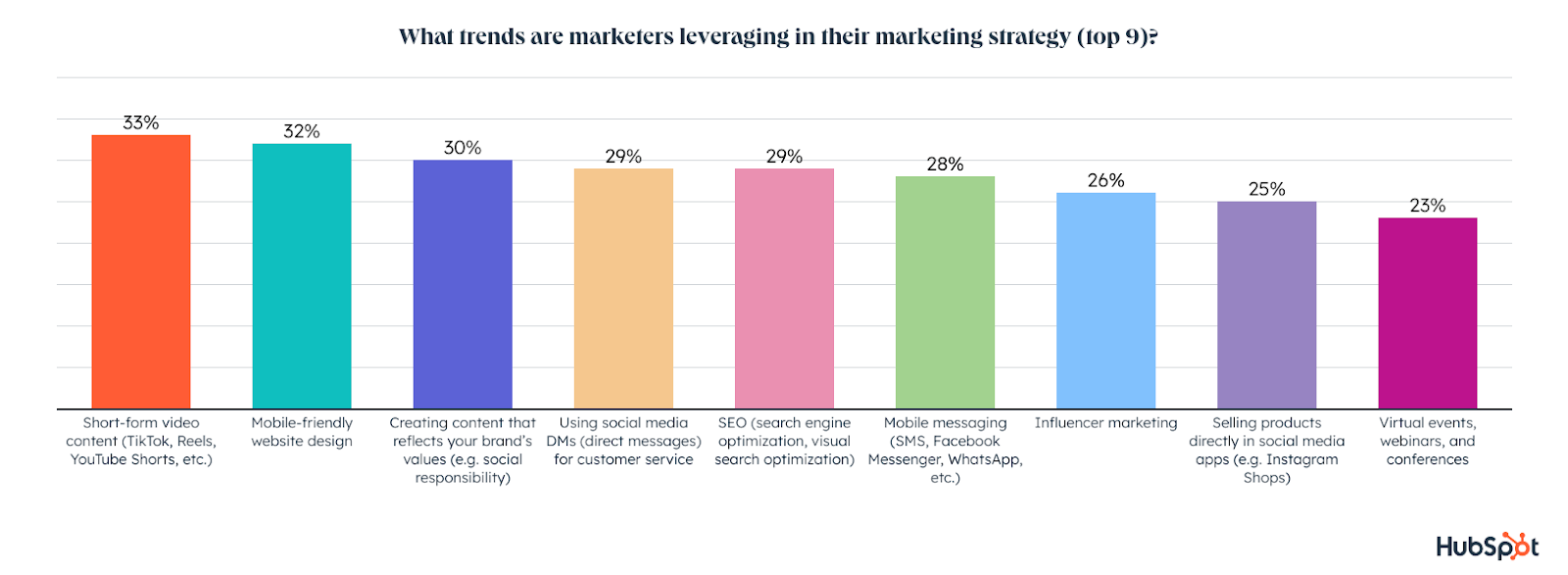
1. Short-form video will see the most growth in 2023
Not only is short-form video the most popular trend among marketers, with one-third using it, but it’s also the most effective and has the highest ROI.
On top of all that, short-form video will see the most growth of any trend in 2023, with marketers planning to invest more in it than any other trend.
90% of marketers using short-form video will increase or maintain their investment next year, and 21% of marketers plan to leverage short-form video for the first time in 2023, also the highest of any trend.
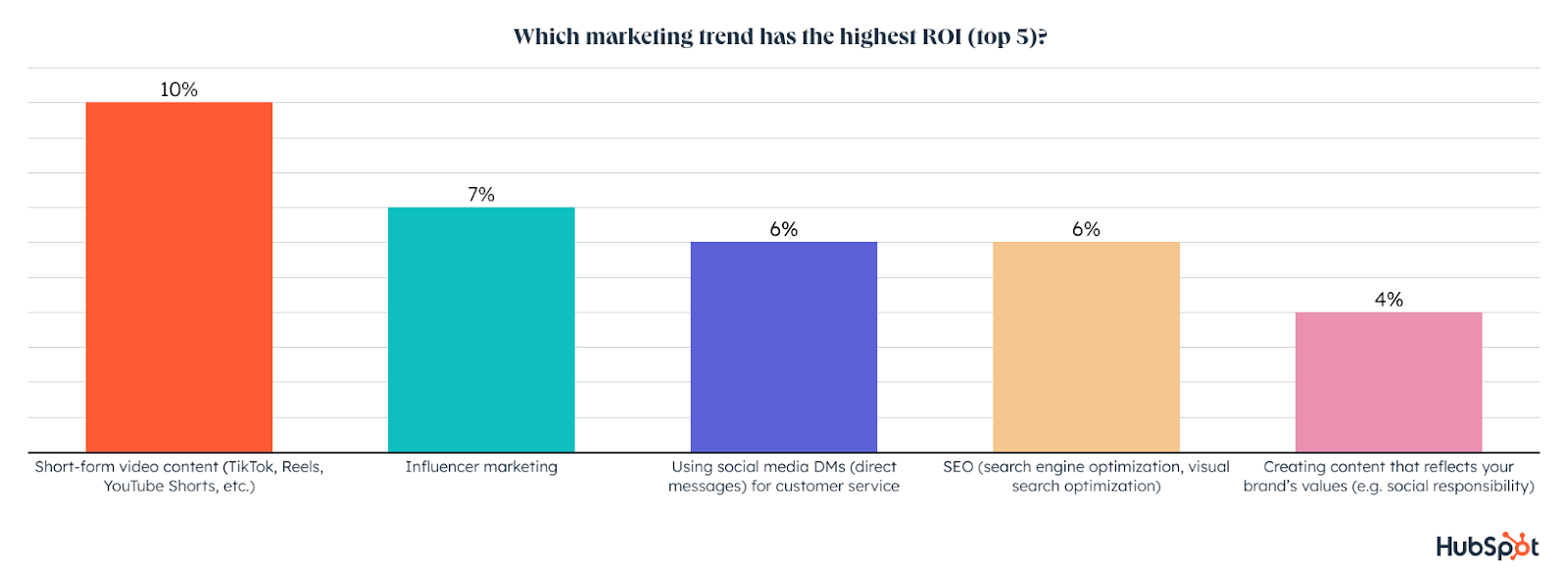
2. Influencer marketing will continue to grow its high ROI.
Over 1 in 4 marketers currently leverage influencer marketing and it offers the 2nd highest ROI of any trend. Luckily it can be leveraged with short-form video to take advantage of both of the highest ROI trends at the same time!
Influencer marketing will also see significant growth in 2023 with 17% of marketers planning to invest in it for the first time, the 2nd highest of any trend.
Influencer marketing also comes in second for the trend marketers plan to invest in more than any other in 2023 and 89% of marketers using it will increase or maintain their investment next year.
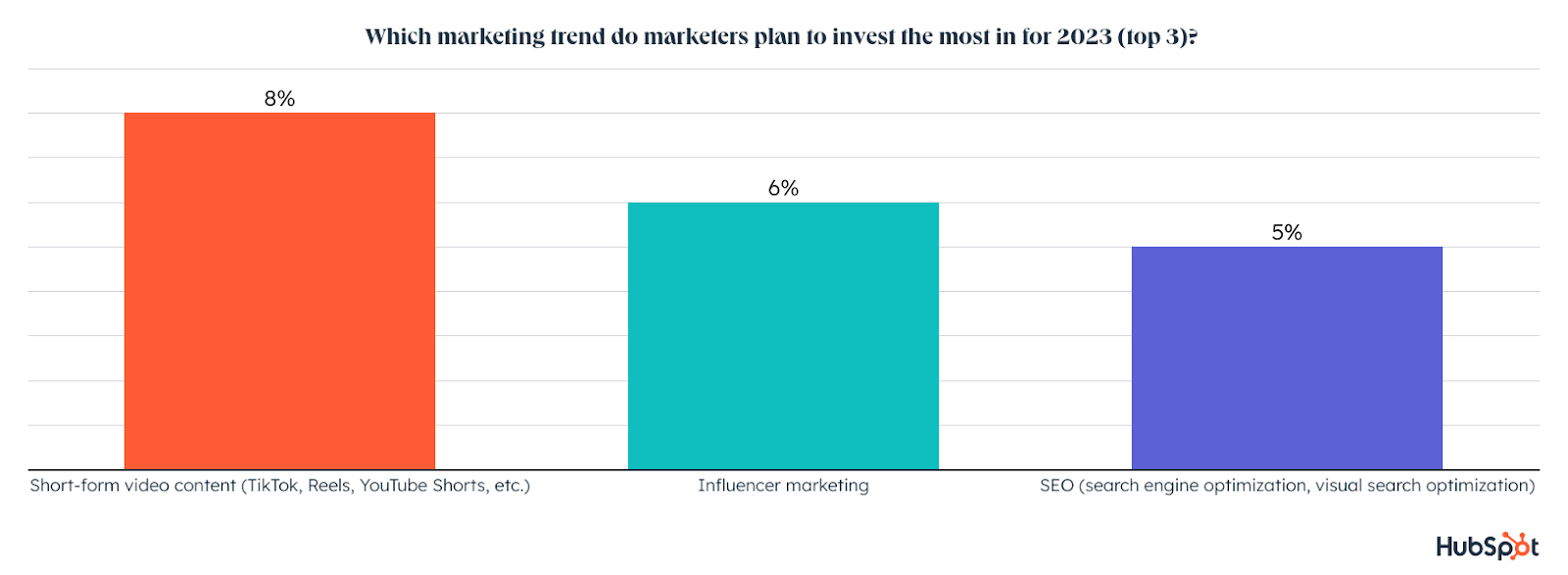
On top of all that, our consumer trends survey shows that 33% of Gen Zers have bought a product based on an influencer’s recommendation in the past three months. And when they’re making purchase decisions, Gen Z says influencer recommendations are more important than recs from their friends and family.
3. Branded social media DM tactics are growing.
Using social media DMs for customer service is relatively new, but already used by 29% of marketers. It has the 3rd highest ROI of any marketing trend and use will grow in 2023, with 15% of marketers planning to try it for the first time.
On top of that, 87% of marketers using social media DMs for customer service will increase or maintain their investment in 2023.
As social media apps like Instagram, Twitter, and Facebook continue developing their e-commerce capabilities, providing customer service through DMs will only become more crucial.
Our Consumer Trends survey also found that over 1 in 5 Gen Zers and nearly 25% of Millennials have contacted a brand on social media for customer service in the past three months.
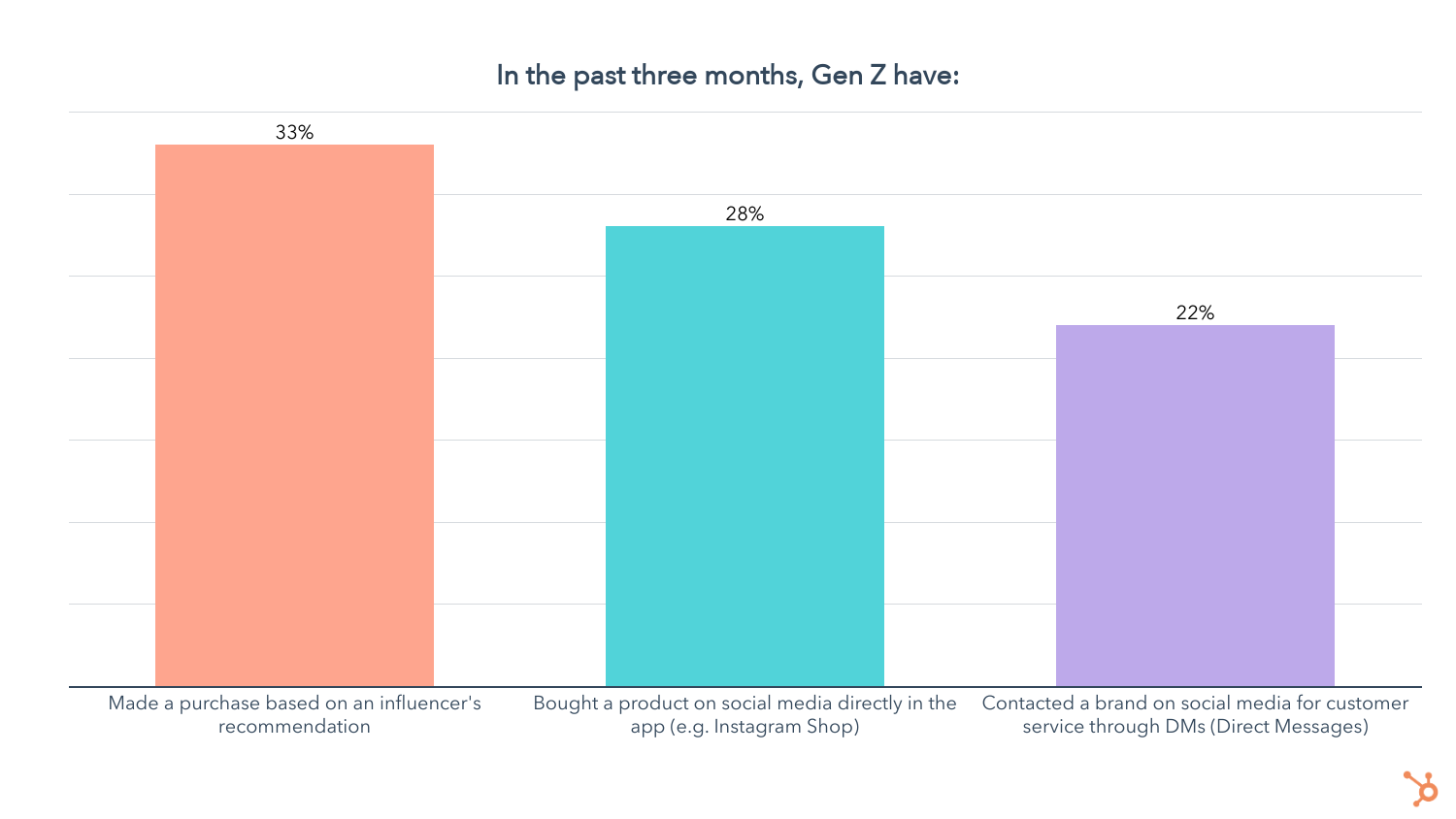
Using social media shopping tools is another growing, high ROI marketing trend that goes hand in hand with providing support through DMs, with almost 30% of Gen Z and Millennials having bought a product on social media in the past three months.
4. Website SEO continues to shine.
While not new, leveraging a blog with an effective SEO strategy continues to be a powerful tool, with 29% of marketers using a website to attract and convert leads.
Leveraging SEO ranks #4 in terms of ROI and effectiveness and 88% of those who use it will increase or maintain their investment in 2023.
When it comes to the trend marketers will invest the most money in for 2023, SEO ranks third behind short-form video and influencer marketing.

5. Marketers will continue to humanize their brands.
30% of marketers are currently creating content that reflects their brand’s values, making it the third most popular trend right now.
It has the 5th biggest ROI of any trend and will see growth in 2023. 16% of marketers plan to leverage content that reflects their brand’s values for the first time in 2023, and 89% of those already investing in it plan to increase or maintain their investment.
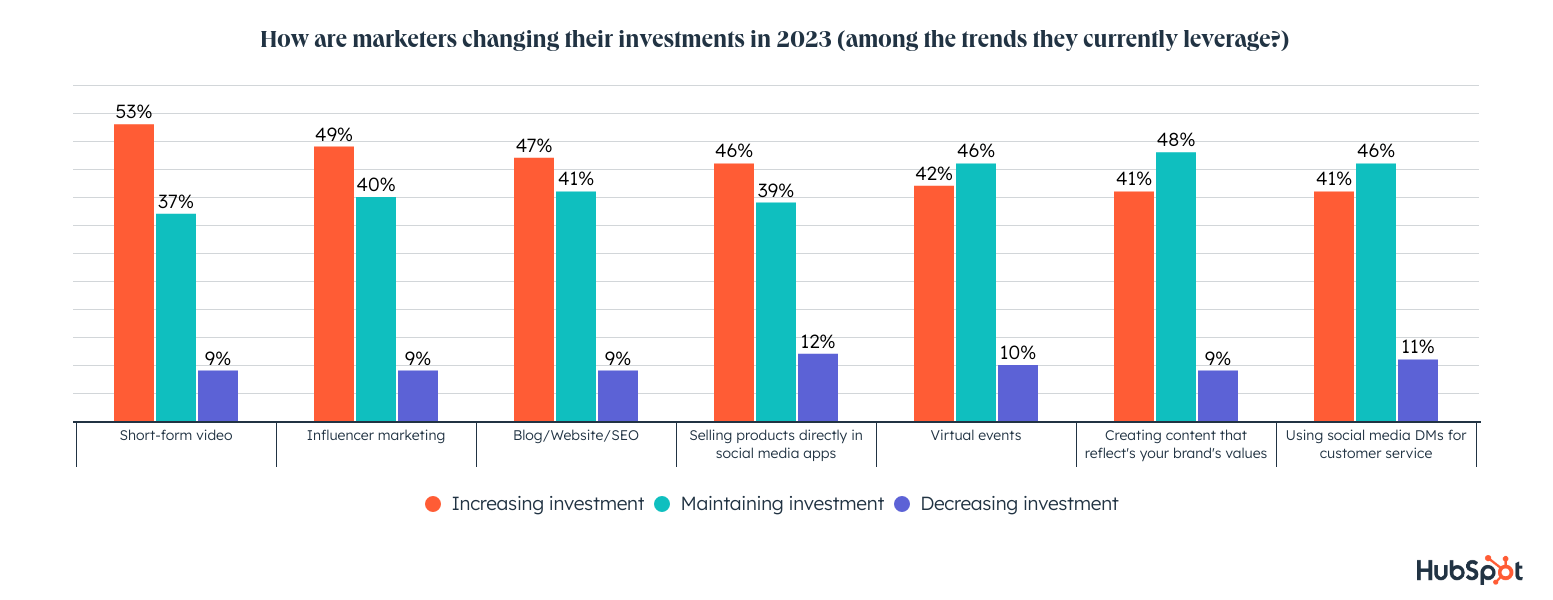
6. Marketers will benefit from data in 2023.
As we discussed above, we believe that data-driven marketers will win in 2023. After all, some of the biggest advantages marketers get from using data to inform their marketing strategy are that data helps them reach their target audience more effectively, create more effective marketing content, understand which marketing strategies are most effective, increase the ROI of their marketing efforts, and prove the value of their marketing and activities.
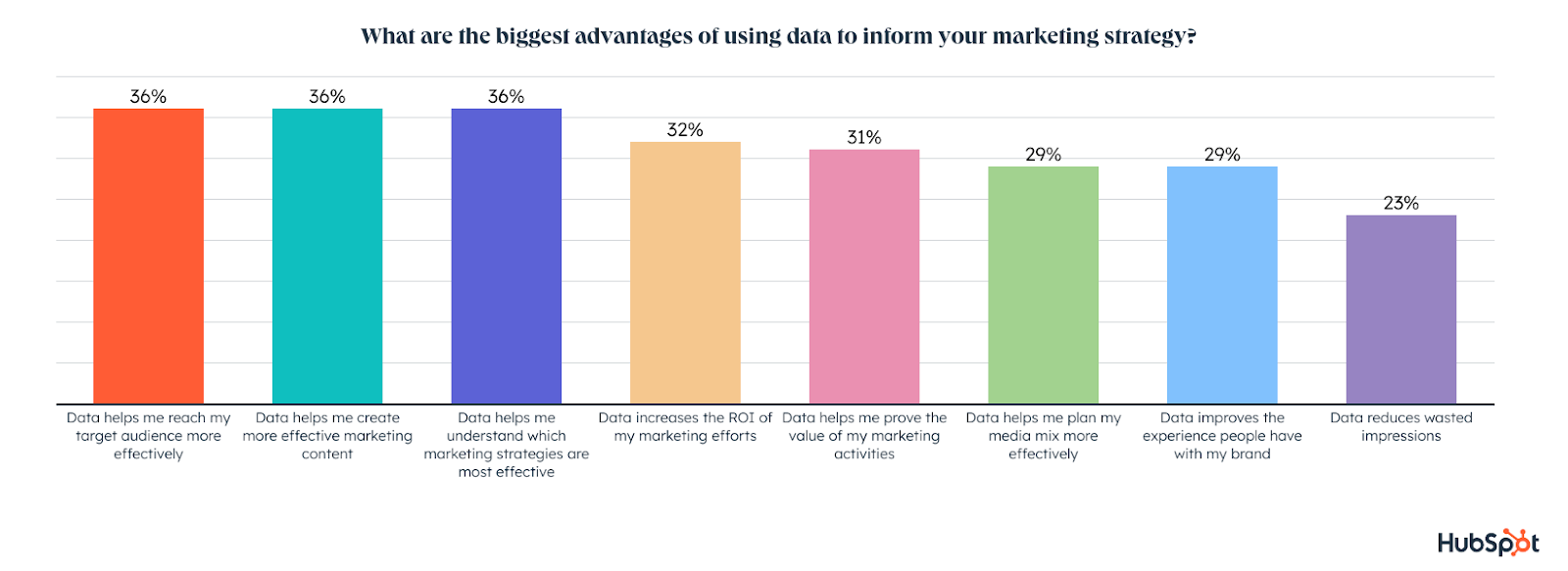
Which Marketing Trends Will Grow in 2023?
Short-form video, selling products directly in social apps, and influencer marketing will see the most first-time use by marketers in 2023.
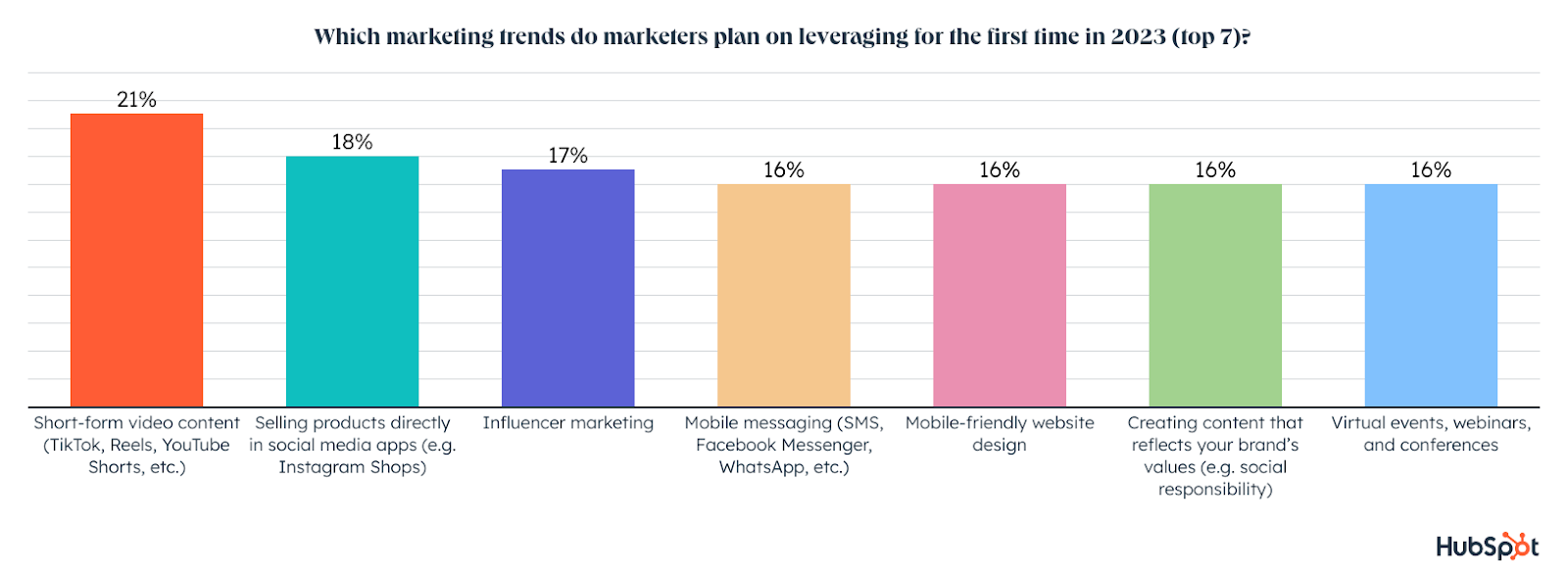
Which Trends Could Marketers Leave Behind?
Now let’s take a look at the trends marketers are going to stop leveraging in 2023.
One in three marketers plan to stop using NFTs and 29% plan to cut out marketing in the metaverse and audio chat rooms in 2023. Voice search optimization and VR/AR are also at the top of the list of trends marketers plan to stop using next year.
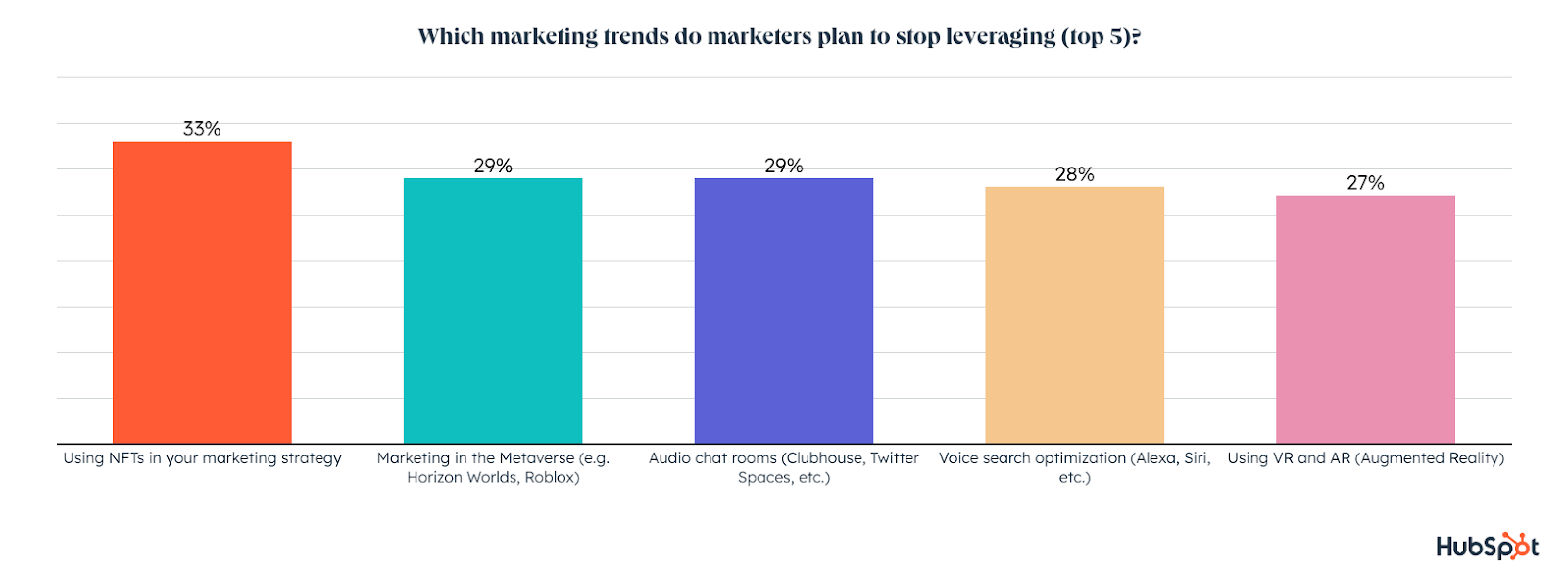
While that may seem bleak, there are plenty of marketers who plan on exploring these same trends for the first time in 2023:
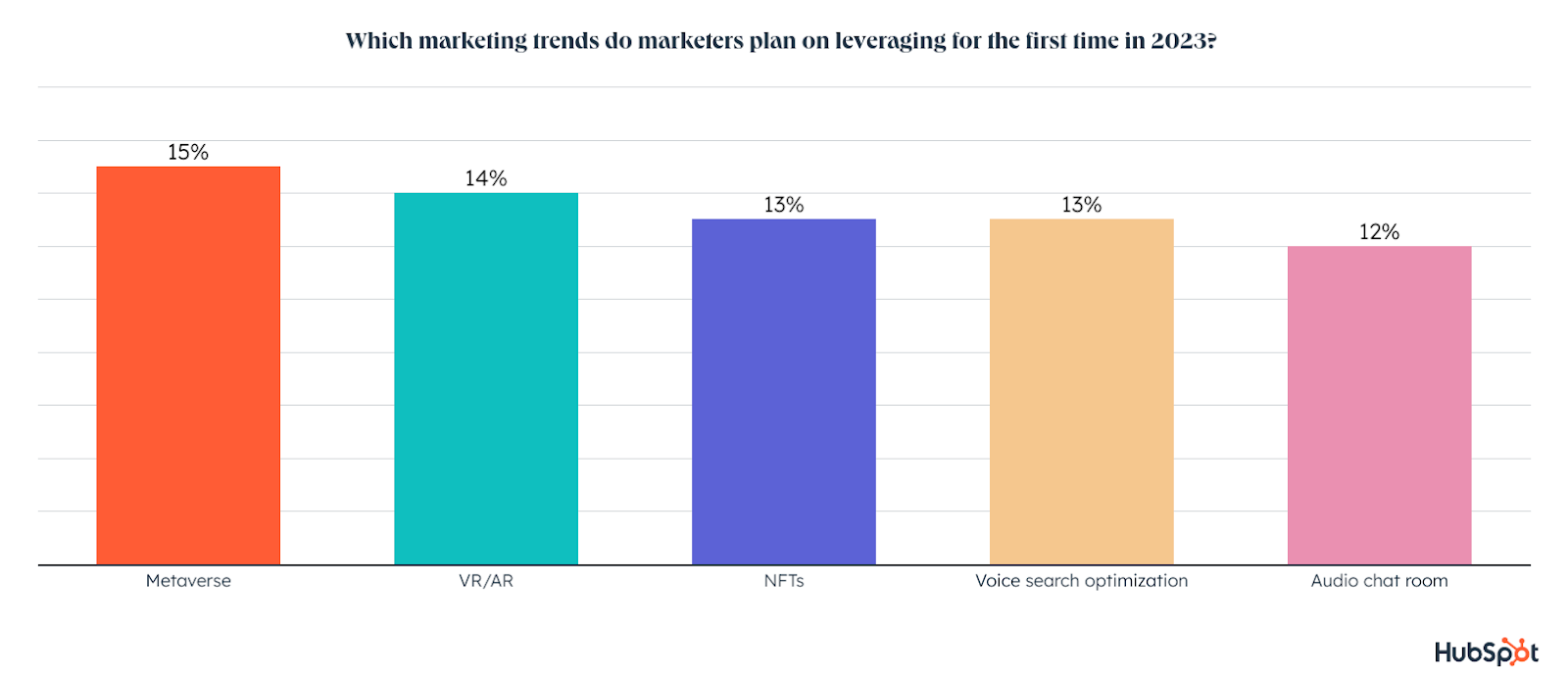
Next, let’s look into the top marketing channels for this year and 2023.
The Top 3 Marketing Channels of 2023
Marketers leverage an average of four different marketing channels in their role. Social media is used by over 42% of marketers, making it the #1 channel marketers are currently leveraging. It also has the highest ROI of any channel and will grow significantly in 2023. Additionally, one in four marketers say they use social media shopping tools.
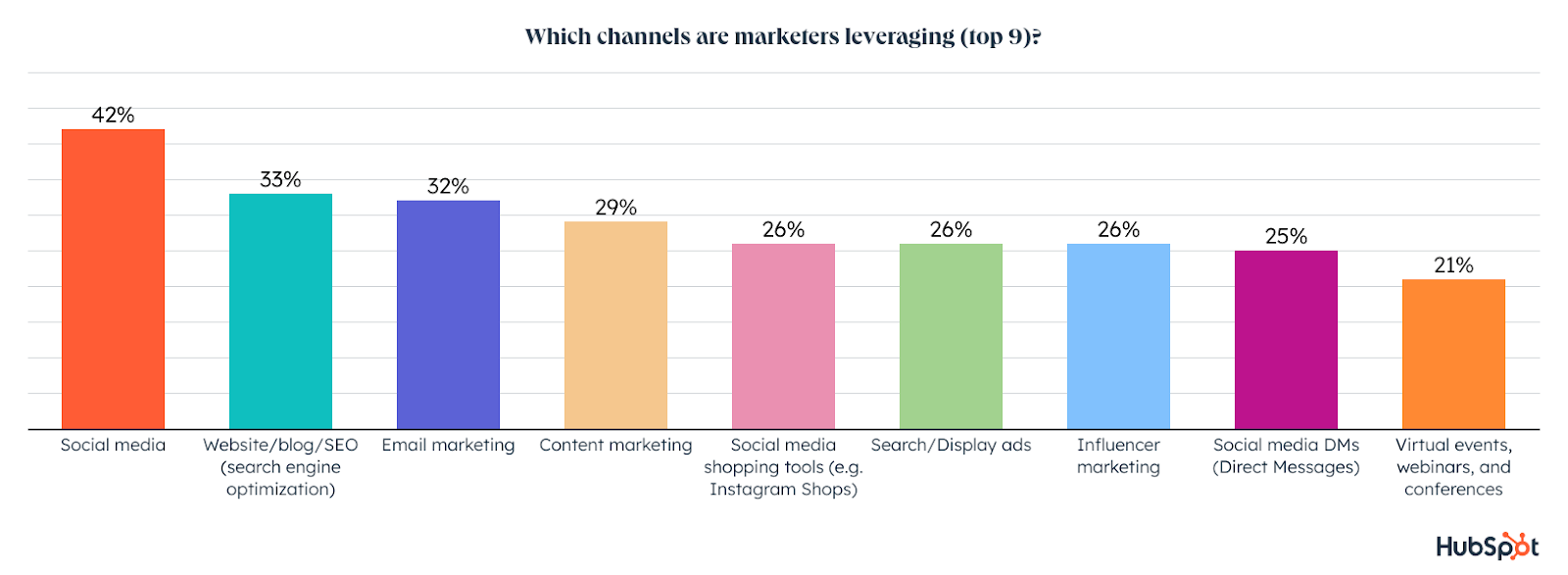
One in three marketers are leveraging their own blog or website, as well as SEO, to land on SERPs. Meanwhile, 32% use email marketing.
Blogs, social media shopping tools, and influencer marketing are neck and neck for the highest ROI of any marketing channel.
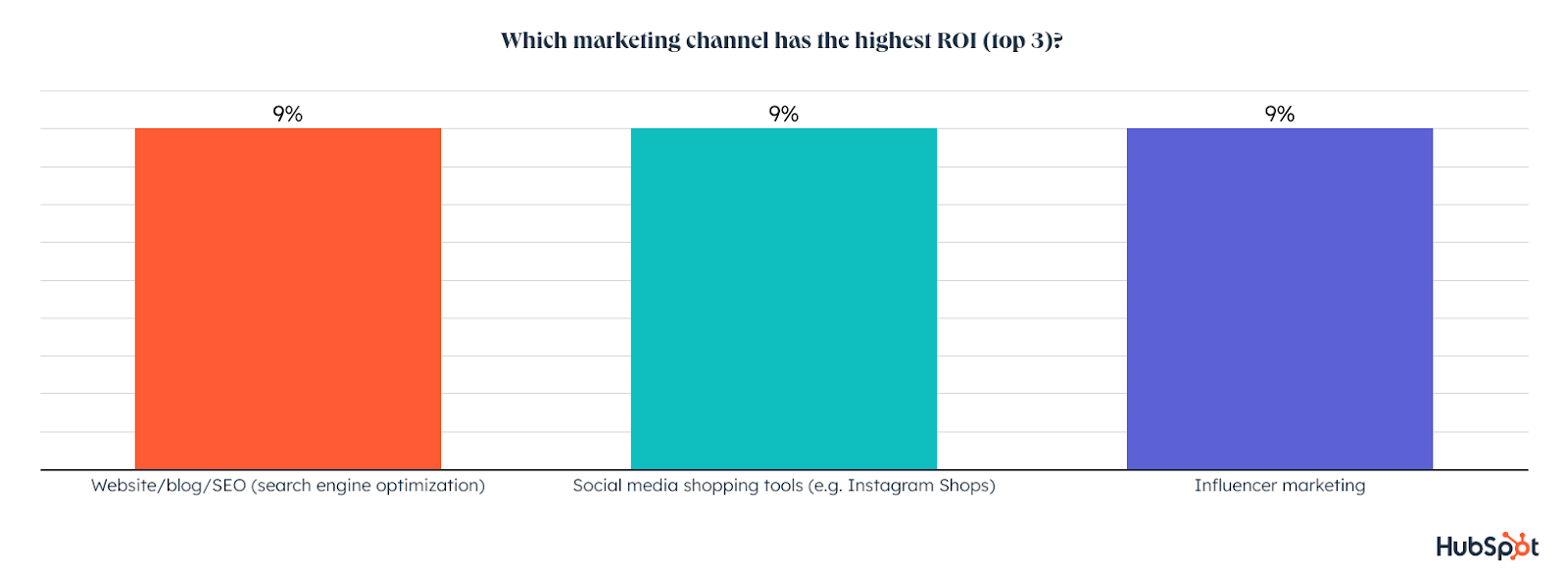
Since social media is far and above the top marketing channel, let’s dive into which social media platform is the most effective.
Marketers leverage an average of four social media platforms in their roles. Facebook is the most used social media platform, leveraged by 64% of marketers, followed by Instagram (58%), YouTube (57%), Twitter (43%), TikTok (42%), and LinkedIn (33%).
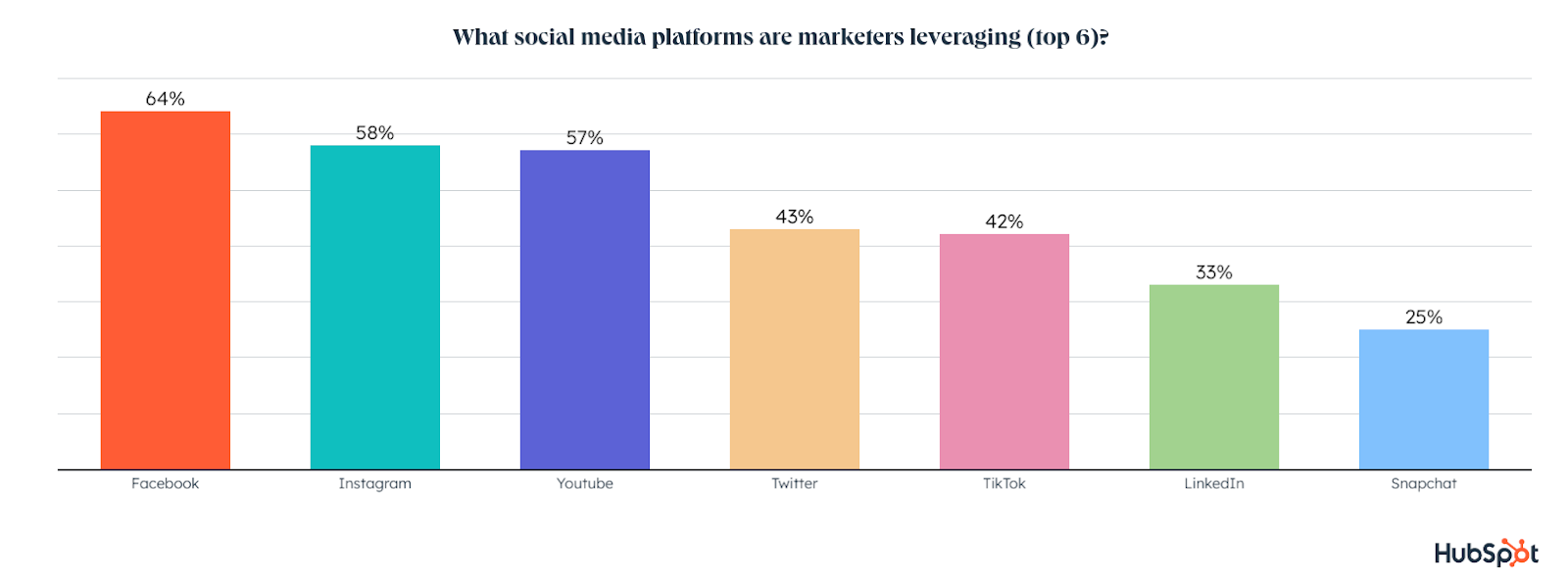
Now that we’ve looked at what both general and B2B marketers use most often, let’s take a look at each platform more in-depth (in order of their general-marketer popularity) and see how they stack up against one another.
1. Facebook leads in ROI, though other apps will see more growth
Facebook is not only the most used social media platform among marketers but also offers the highest ROI. Facebook is the channel marketers plan to invest the most in for 2023, higher than any other channel.
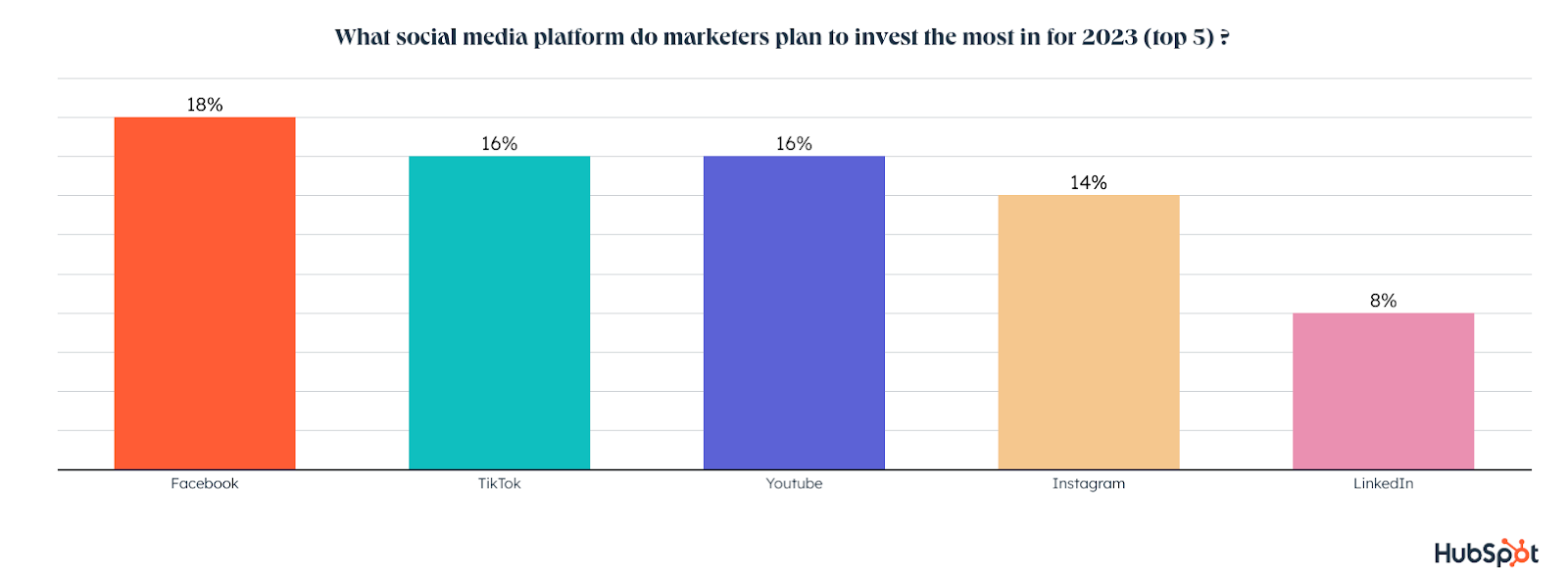
While nearly 25% of marketers plan to invest in Facebook for the first time in 2023, this growth is slower than other apps like YouTube, Instagram, TikTok, and Twitter will see next year.
2. YouTube will see the most growth of any platform in 2023
YouTube’s currently used by 57% of marketers and ties for 2nd in ROI with YouTube and TikTok.
YouTube will see the most growth of any platform in 2023, with 91% of those using it planning to increase or maintain their investment. At the same time, 29% of marketers plan to try YouTube for the first time, the highest of any social app.

3. Instagram is #2 for ROI and will see high first-time use in 2023
Instagram is used by 58% of all marketers, the 2nd highest of any platform. It also ties in 2nd for ROI with YouTube and TikTok and will see significant growth in 2023.
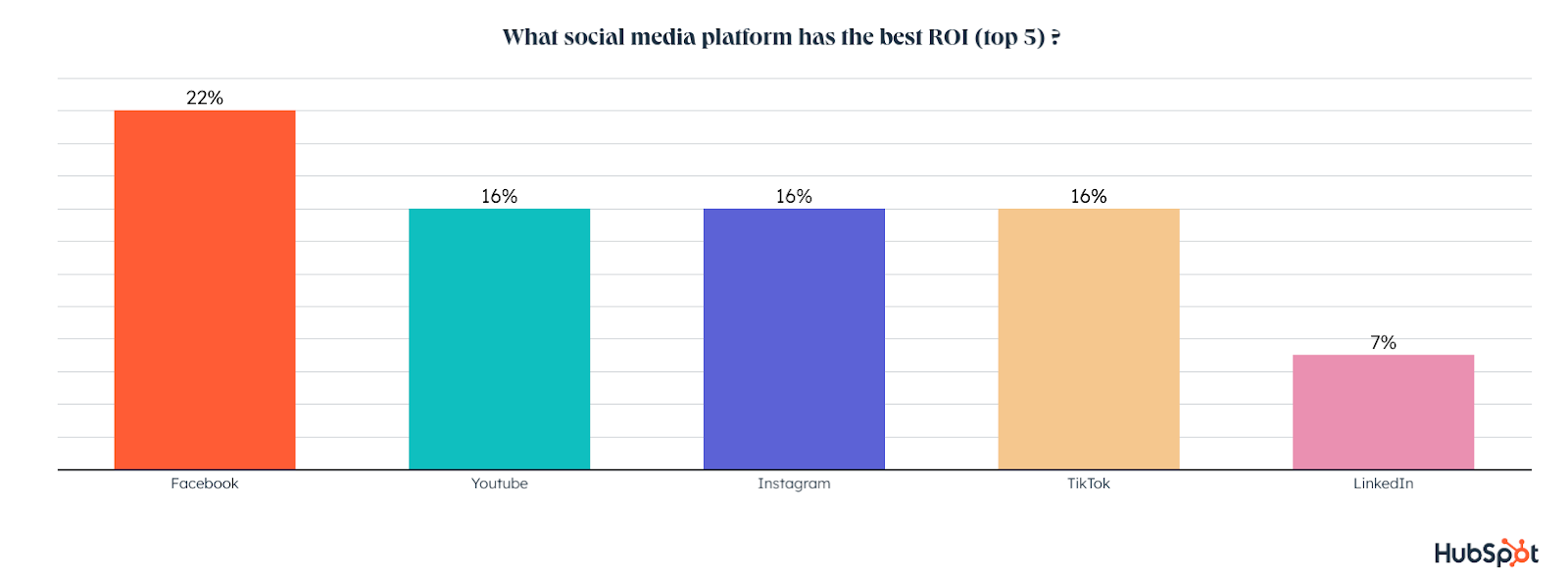
14% of marketers will invest more in Instagram than any other platform in 2023, and 29% of marketers plan to try Instagram for the first time next year.
4. Over half of marketers eye TikTok for future investments.
TikTok has quickly become much more than just a trendy social app which was once primarily used by Gen Z, and marketers are taking heavy notice.
TikTok is used by 42% of marketers and ties for 2nd with YouTube and Instagram as a top ROI-generating platform.
TikTok will only continue to see growing brand interest in 2023, with 56% of those using it planning to increase their investment next year, the highest increase of any social media app, while 34% plan to maintain their current investment.

On top of the points above, 26% of marketers plan to use TikTok for the first time in 2023, while 16% of marketers will invest more in the app than any other next year.
With TikTok, a solid B2C platform, seeing such high marketing growth, you might wonder how the top platforms compare when analyzing B2B and B2C markers. Let’s take a quick look.
B2B vs. B2C Social Media Marketing Data
In terms of which platforms they use, both B2B and B2C marketers look very similar, with the biggest difference being that B2B marketers are more likely to use LinkedIn:
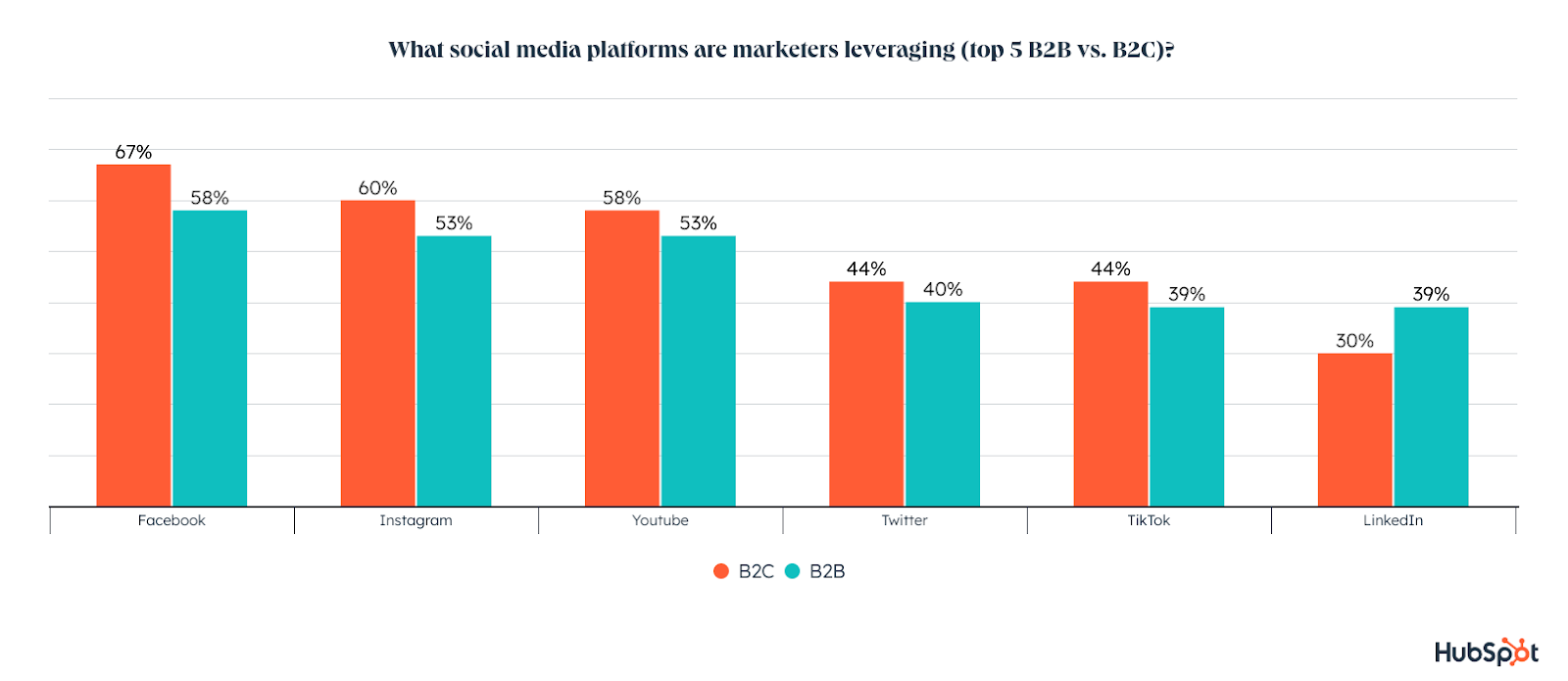
That might not be surprising, but does LinkedIn actually offer B2B marketers a better ROI than other platforms?
Just 14% of B2B marketers using LinkedIn say it gives them the highest ROI of any platform. That’s a lower percentage than Facebook, Instagram, and TikTok.
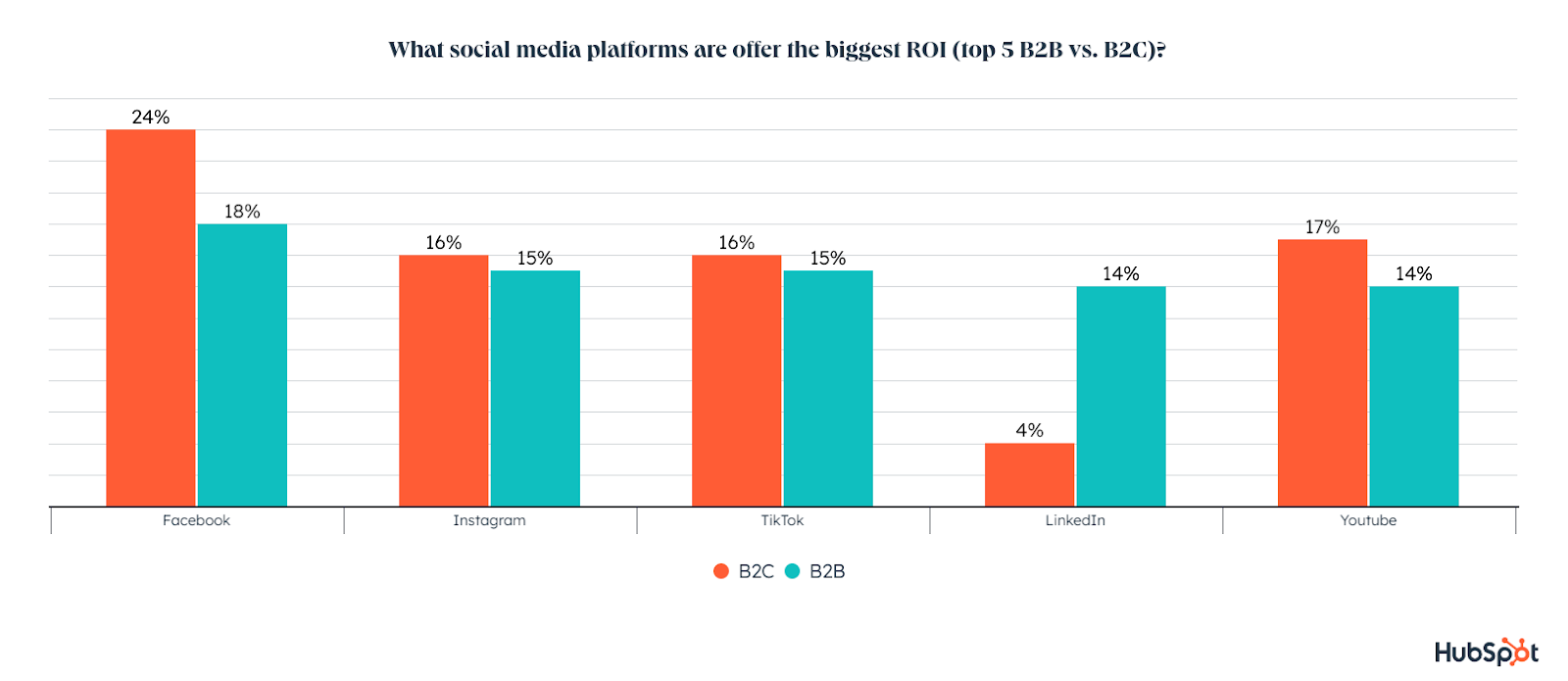
How Marketers Share Content on Social Media
Since marketers are using so many social media apps at once, you may be wondering if they are tailoring their content to each one, or just sharing the same content across the board.
It turns out that almost half of marketers re-post the same exact content across various social media platforms, while 35% tailor it to fit each app and 19% do a bit of both.
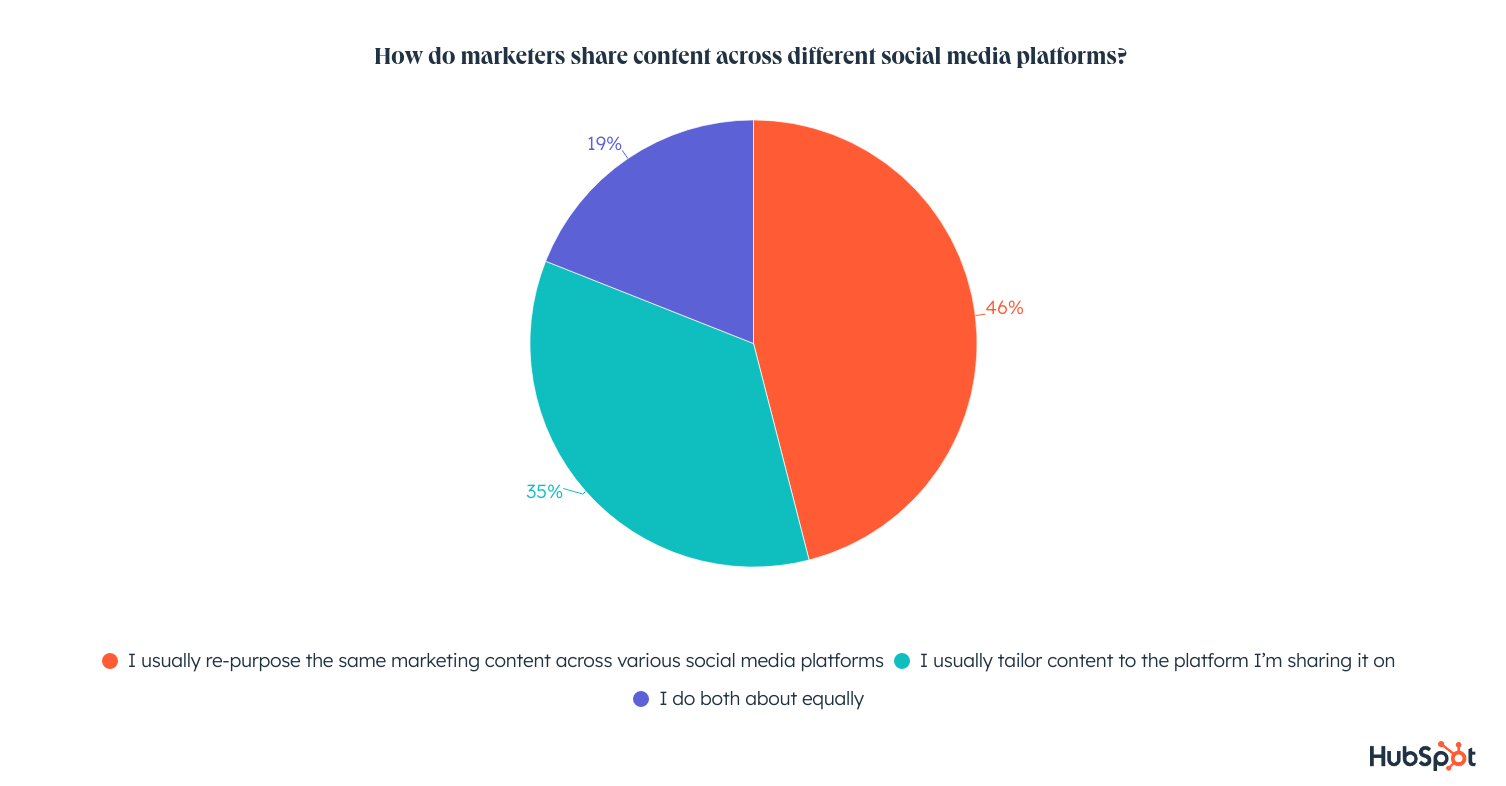
The Biggest Social Media Marketing Challenges
The top challenges social media marketers face are creating engaging content, gaining and keeping followers, reaching their target audience, finding ideas for new content, generating leads, keeping up with trends, and measuring ROI.
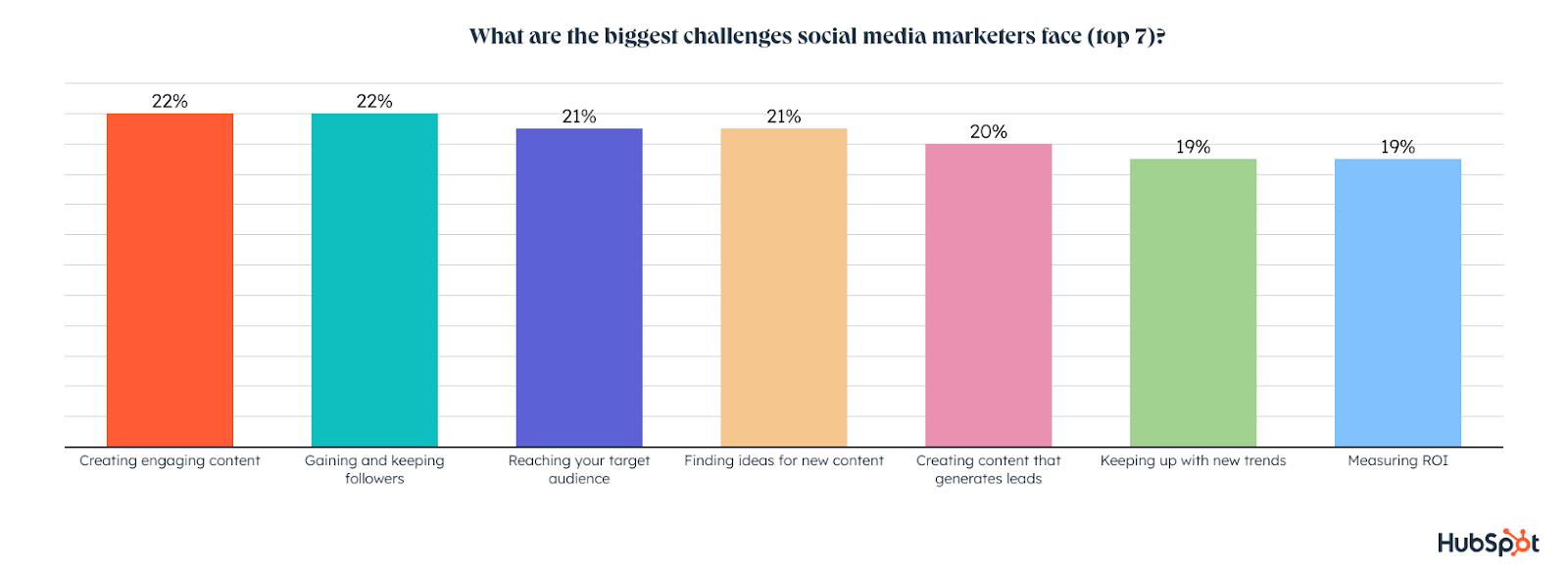
Now that we’ve talked all about the top trends, channels, and social platforms, we can take a look at which media formats marketers are most effective.
In the coming month, we’ll be diving deeper into these themes by surveying more global social media marketers about all the specifics related to their roles. Stay tuned as we’ll continue to publish findings from our additional research.
Which Media Formats are Marketers Leveraging?
Half of marketers are using videos, with 47% leveraging images, followed by 33% posting blogs articles, infographics (30%) and podcasts or other audio content (28%).
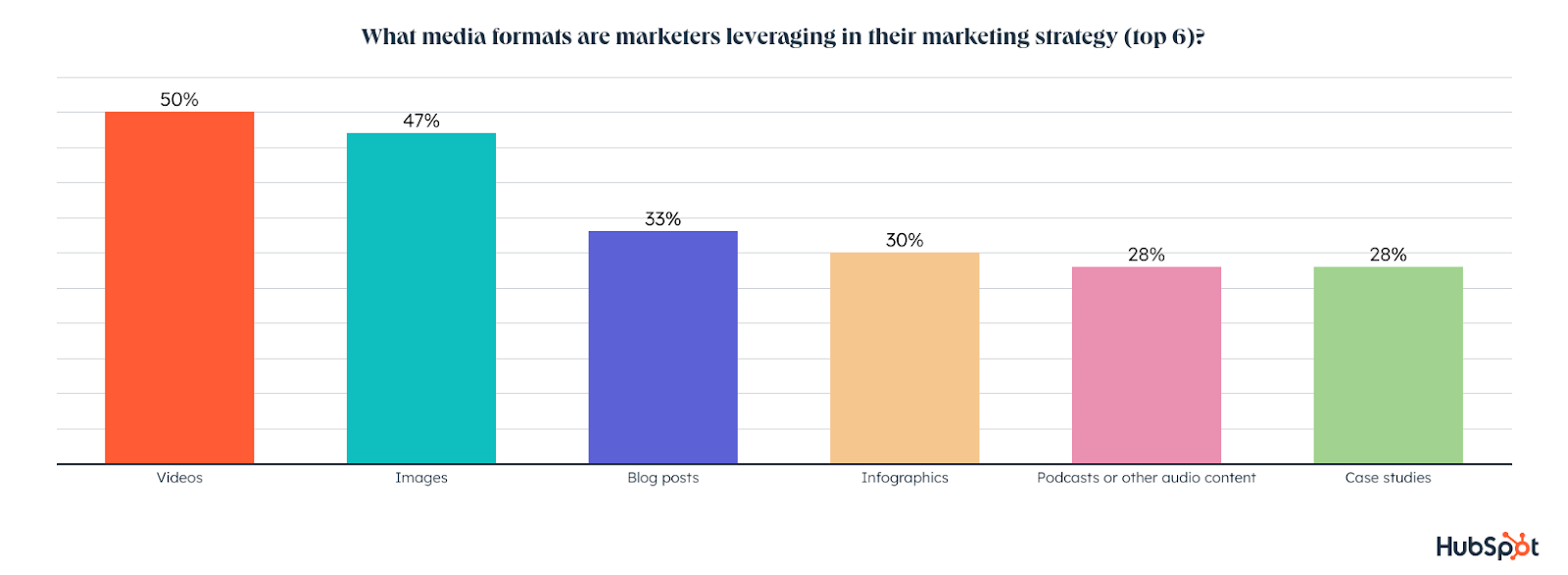
Video has the highest ROI of any media format by far, followed by images, blog posts, and podcasts or other audio content.
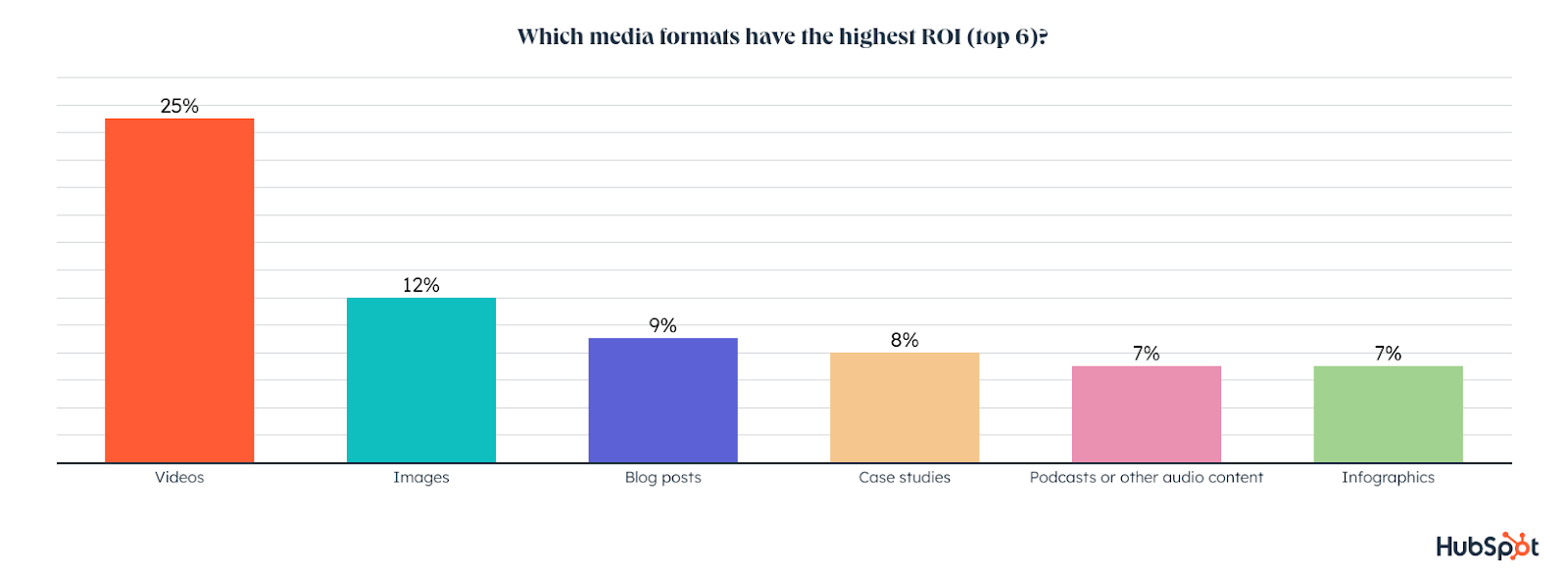
Use of video will grow significantly in 2023, with 24% of marketers planning to invest more in video than any other media format. Podcasts will see the 2nd highest investment, with 10% of marketers investing more in audio content than any other media format.
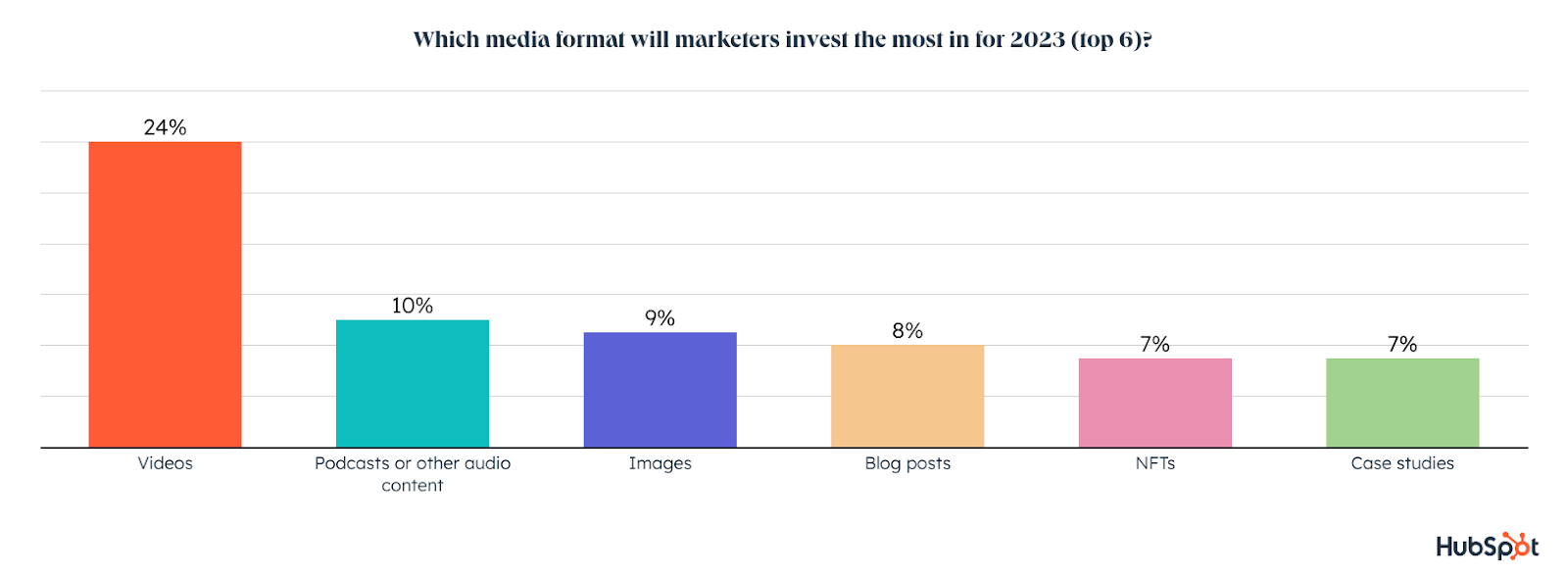
Video will also grow the most among first-time users in 2023, with 1 in 3 planning to try leveraging video next year. Images (29%), blog posts (26%), interview (25%), and podcasts (24%) will also see high first-time use among marketers in 2023.

You might also be wondering how often marketers publish content across these formats.
One-third of marketers publish content a few times a week, while another third publish daily. Just 13% of marketers put out content multiple times a day.
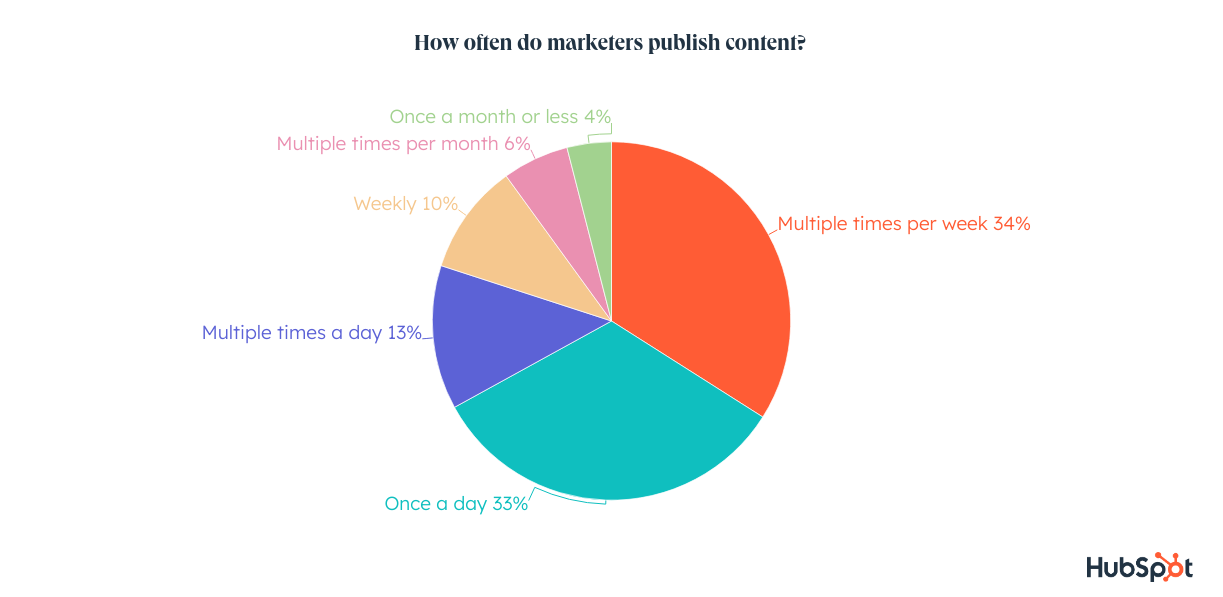
We also asked content marketers about the biggest challenges they face with their content strategy. Content marketers are currently struggling most with creating content that gets high levels of engagement, reaching their target audience, finding ideas for new content, creating content that generates leads, and creating content that attracts traffic to their website.
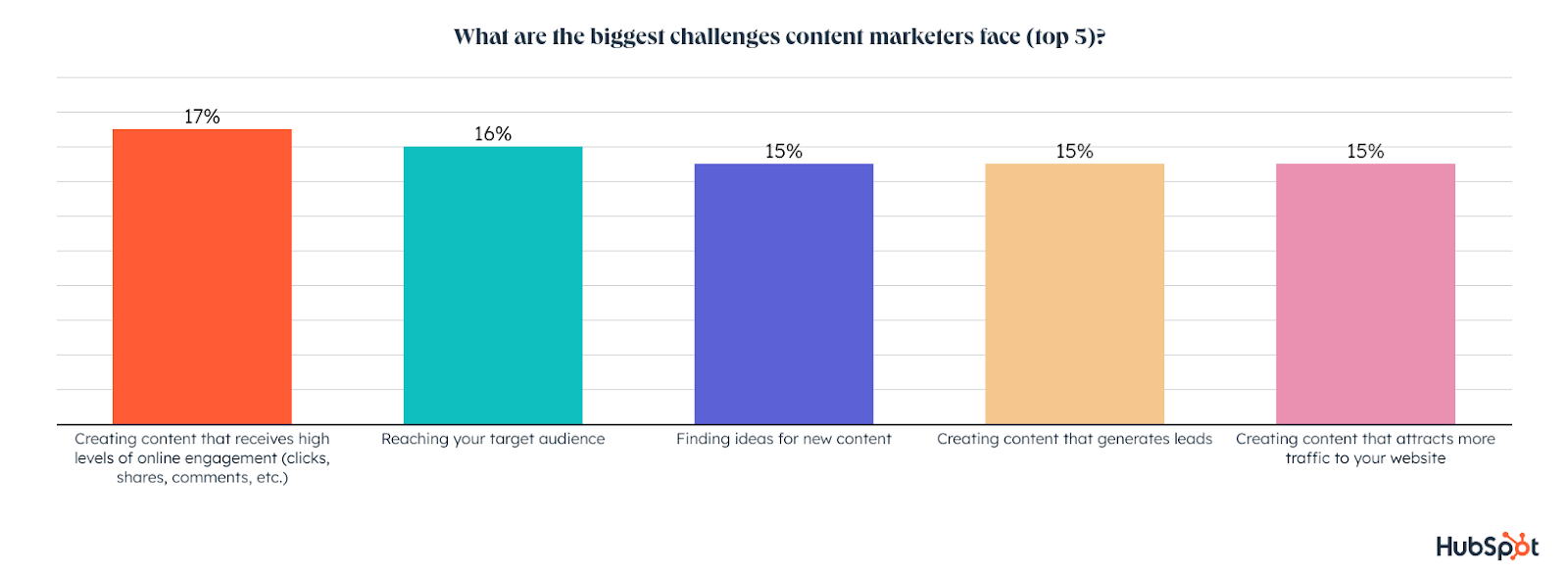
What are the Top Challenges Marketers Face?
The top challenges marketers are facing are generating traffic and leads, hiring top talent, pivoting their marketing strategy, training their team, keeping up with the latest trends, and increasing competition with other brands.
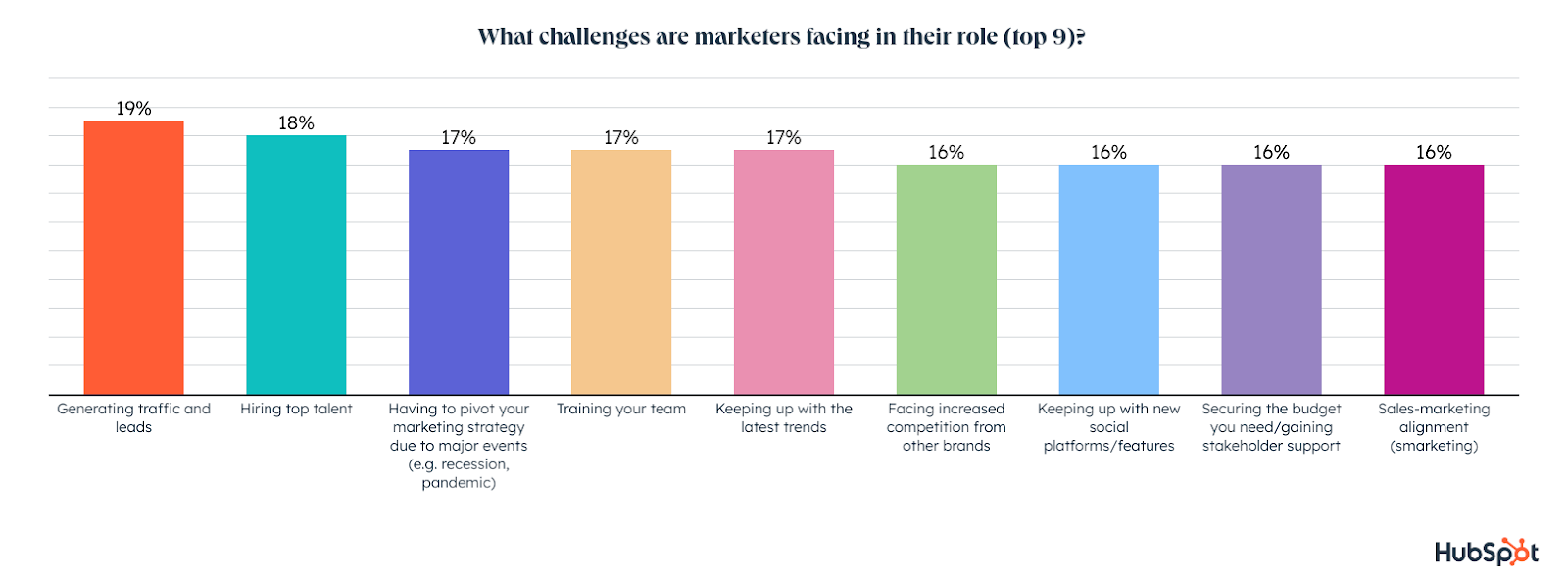
While we ran this survey in late 2022, these challenges are fairly consistent with what marketers cited in the research we did for our State of Marketing Report, which you can download for free here.
Of the challenges marketers face, those they struggle with most right now are:
- Updates to data privacy regulations,
- Growing a global audience,
- Using their CRM to its fullest potential
- Sales/marketing alignment
- A lack of high-quality data
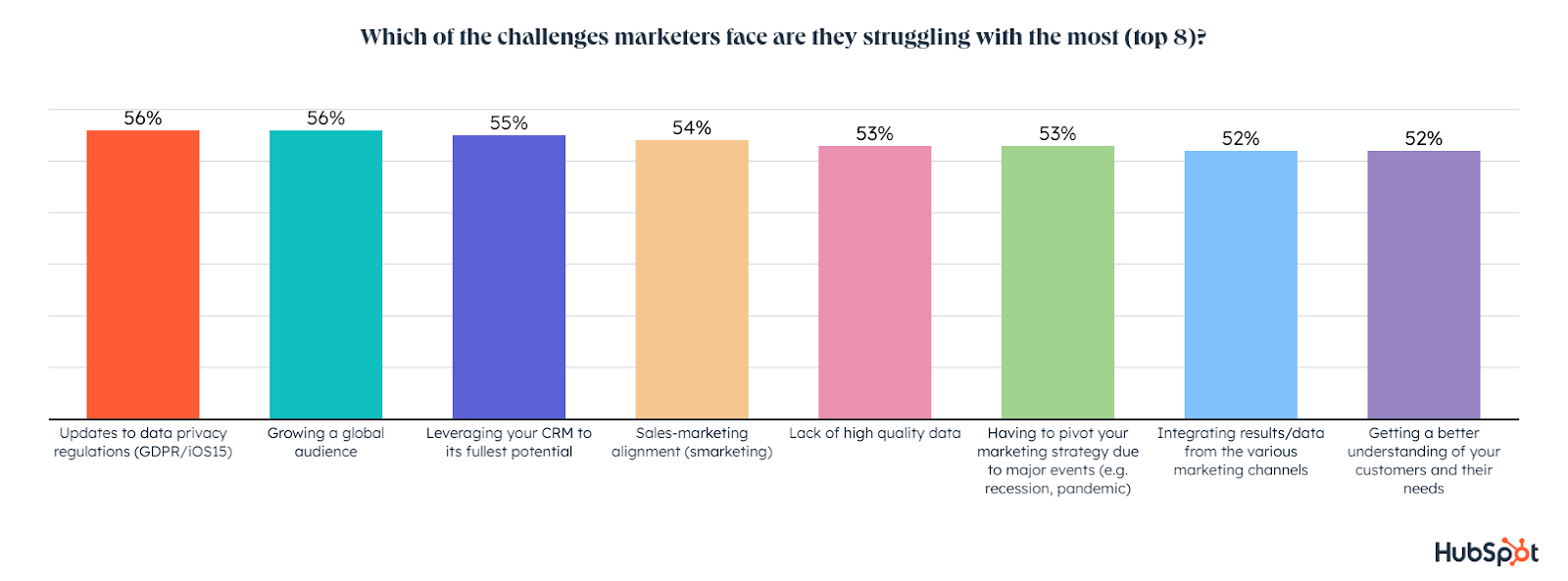
When it comes to the biggest challenges marketers anticipate in 2023, keeping up with the latest trend tops the list, followed by increased competition, leveraging their CRM to its fullest potential, and having to pivot their marketing strategy.
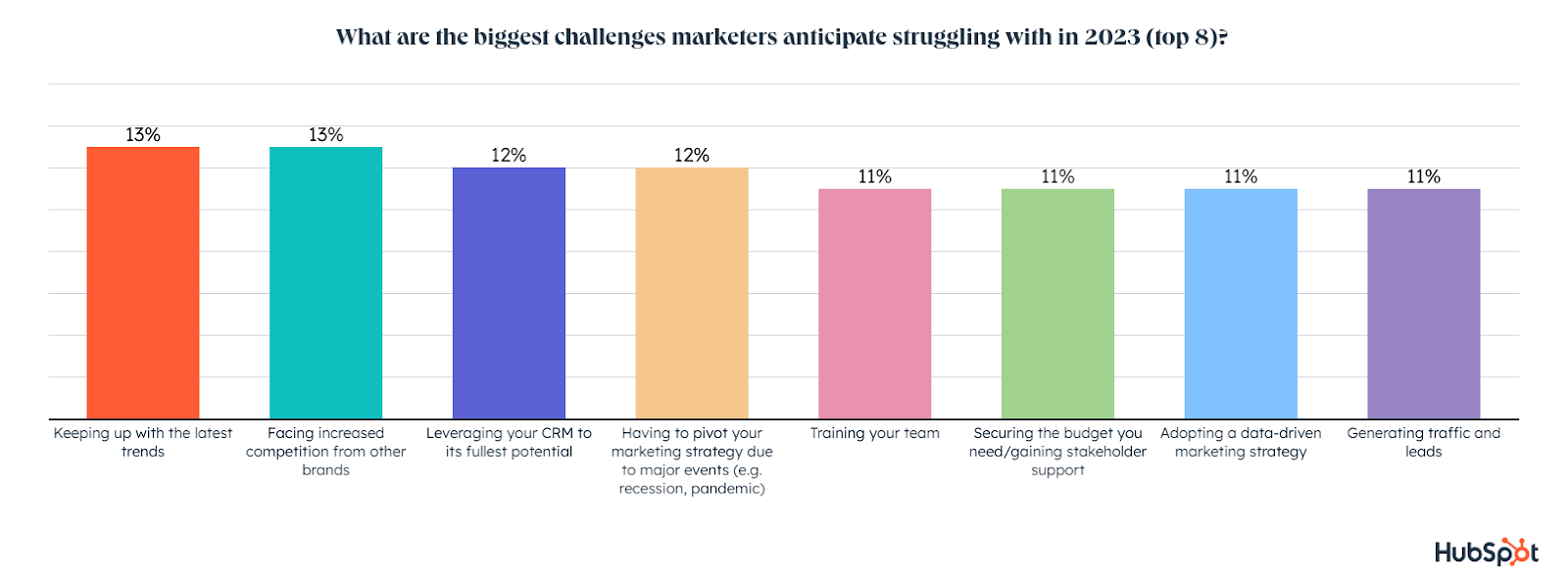
Key Theme: Marketers Still Struggle to Understand Target Audiences
What’s stopping marketers from having the data they need on their target audience?
The biggest challenges involve data privacy regulations, consumers being less trusting with their personal data, how fast their audiences evolve,, a lack of information on their shopping habits, and the technological issues and learning curves that come with collecting data.
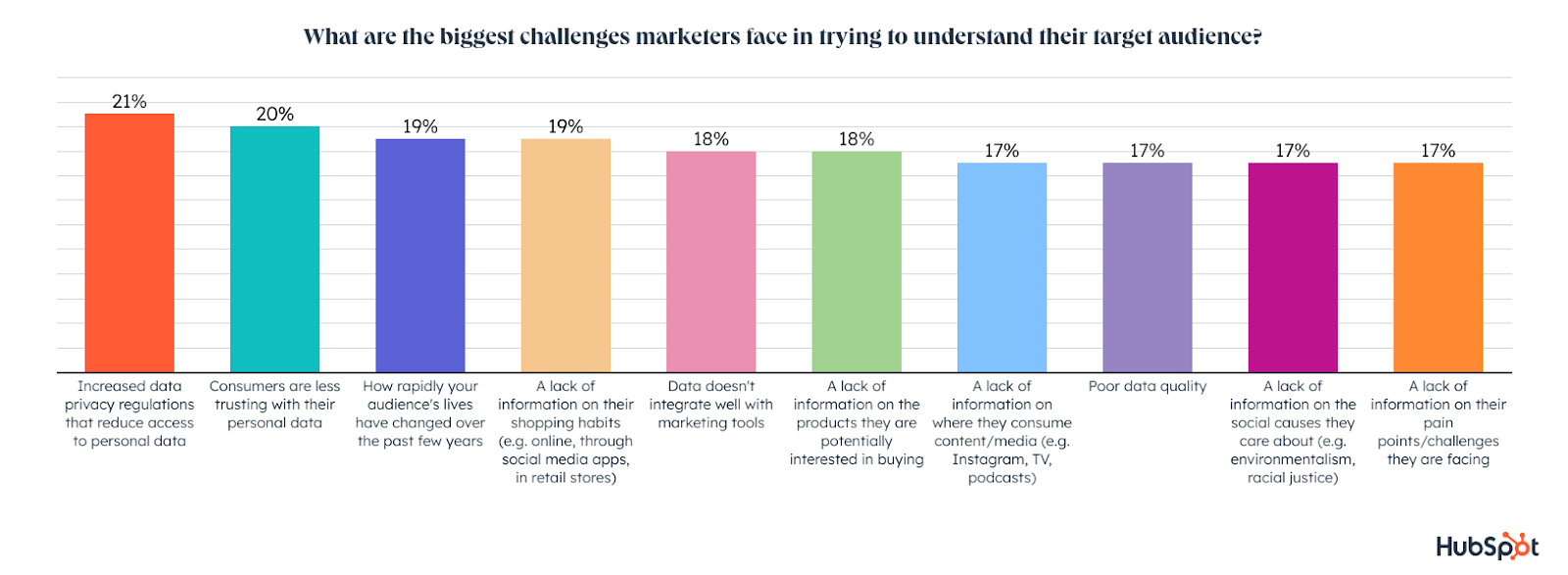
If marketers are able to collect data with the tools and technology they have, data privacy regulations and consumer distrust in sharing personal data can cause marketers to miss critical information. On top of that, poor data quality caused by these and other impacts noted above, can make it harder to keep up with the rapid changes happening in your targets’ lives.
While we surveyed general marketers for this portion of the report, we also did a follow up survey to learn about the key challenges and pain points executive and director+ marketing leaders are expecting to face. Check out this post, from our Act Like a Leader, Think Like a Leader blog series (fully launching Nov. 1), which includes tips from marketing execs and experts at companies like Microsoft, HubSpot, Help Scout, ZoomInfo, Sprout Social, and more.
Let’s dive more into how they performed in 2022 and how it compares to the data we collected earlier for our State of Marketing Report. If you want to dive deeper into the challenges we’ve discussed above, check out this post.
In 2022, marketing goals revolved around increasing revenue/sales (27%), improving the customer experience (22%), boosting brand awareness/reaching new audiences (20%), as well as increasing engagement, and strengthening brand loyalty through customer relationships (18%).
Marketers also focused their 2022 strategy on better understanding their customers, growing their social media following or community, and improving sales-marketing alignment.
But in 2023, half of marketers say these goals will change.
For those marketers making a pivot, increasing revenue/sales still tops the list, but the focus will shift to improving sales/marketing alignment, fostering relationships with customers to increase brand loyalty, revving up advertising, improving customer understanding of their products/services, and understanding audience targets better.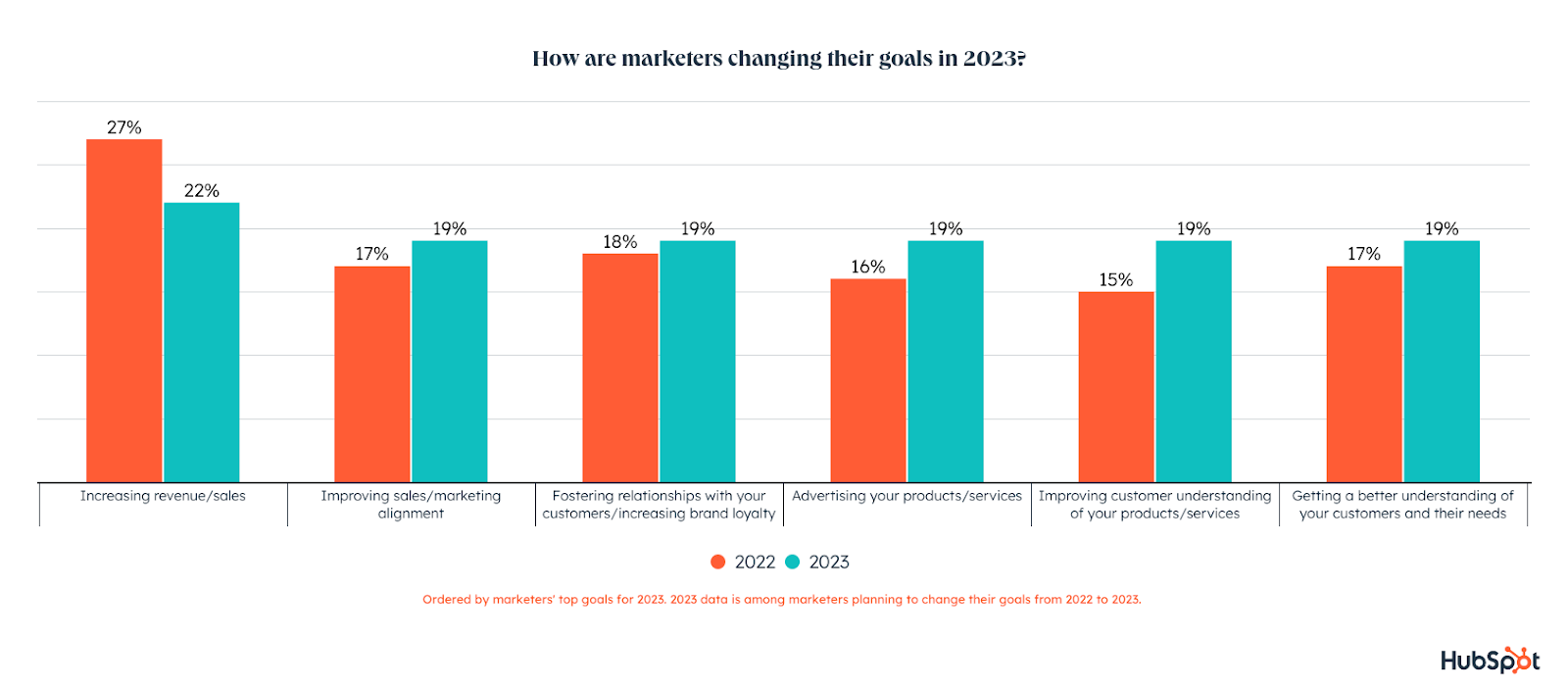
How are Marketers Performing in 2022?
With the year nearly over, we asked marketers to reflect on their 2022 marketing strategy, and 91% say what they’re doing has been effective.
Just 2% called their strategies ineffective while 7% say their marketing efforts made no major negative or positive impacts.
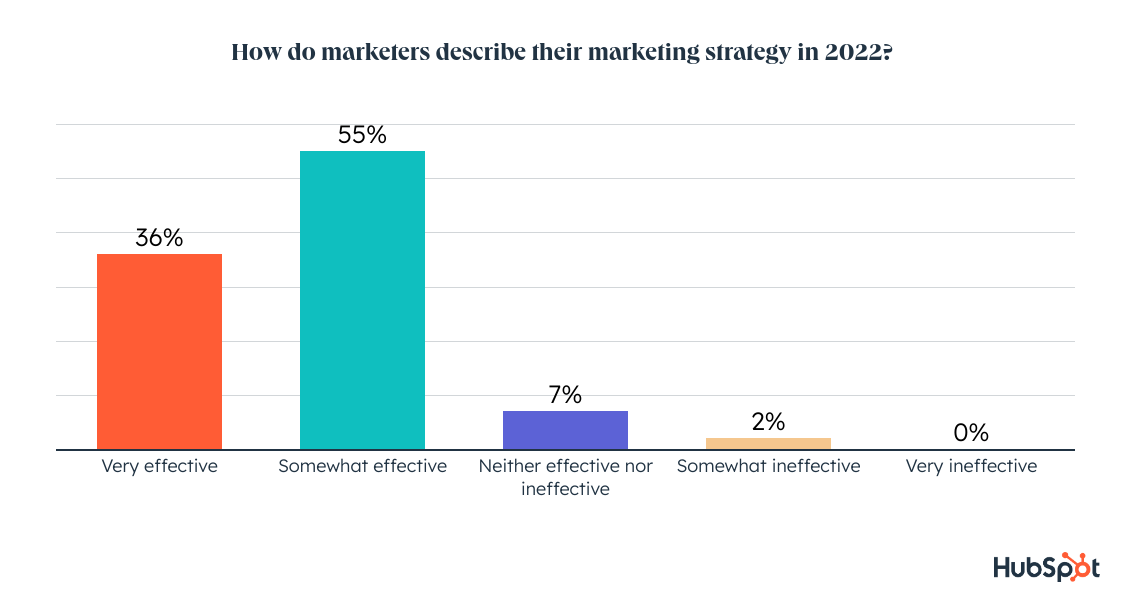
Most marketers see their strategy as effective, so let’s dive into the marketing metrics or KPIs they use to measure their success.
The Most Important Marketing Metrics and KPIs
When it comes to measuring the effectiveness of their content marketing strategy, marketers say sales, web traffic, and social engagement are the most important metrics, followed by conversion rate, follower/subscriber growth, and lead generation.

When planning out the next year’s goals, strategies and KPIs, especially without knowing if we are or aren’t going into a recession, you might ask yourself, “How we’ll I pay for these things? And what are other marketing teams doing.
Next, let’s take a look at how marketing budgets have recently changed and will continue to change in the coming months.
How are Marketing Budgets Changing?
54% of marketers saw their budgets stay the same from 2021 to 2022, while 39% saw an increase and just 8% report a reduction in budget.
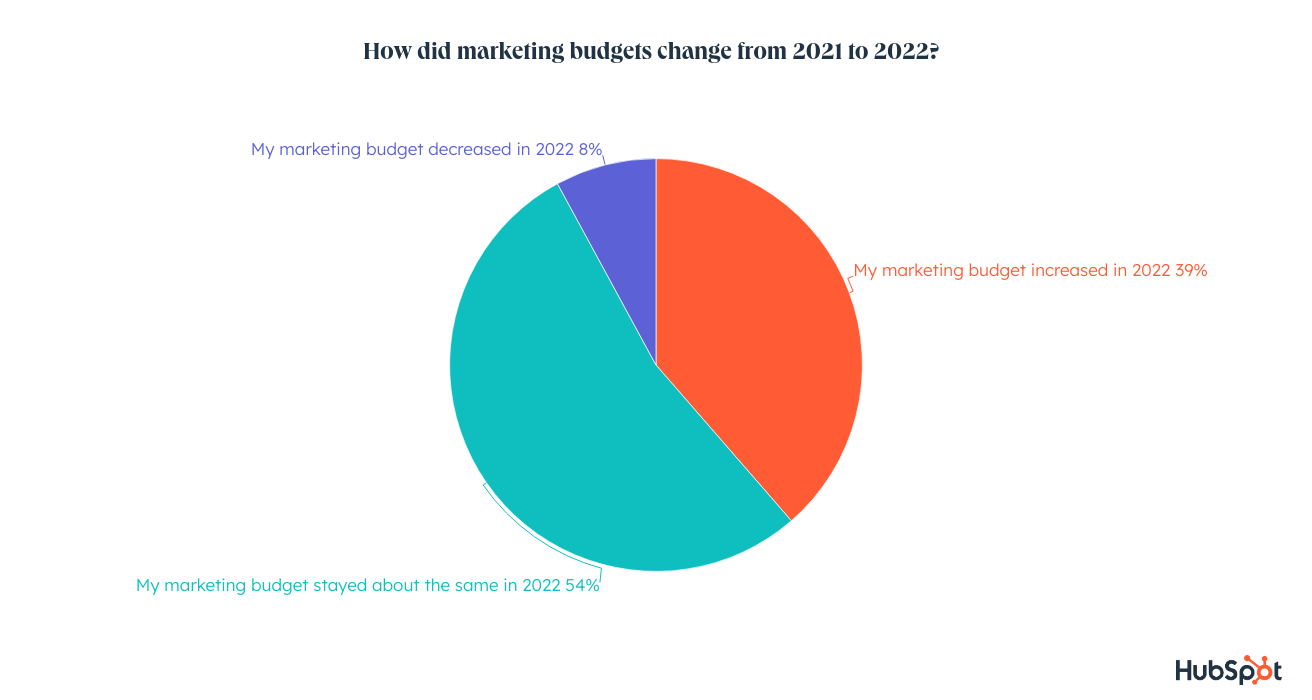
For 2023, 47% of marketers expect their budget to increase, while 45% expect it to stay the same, and 7% think it will decrease.
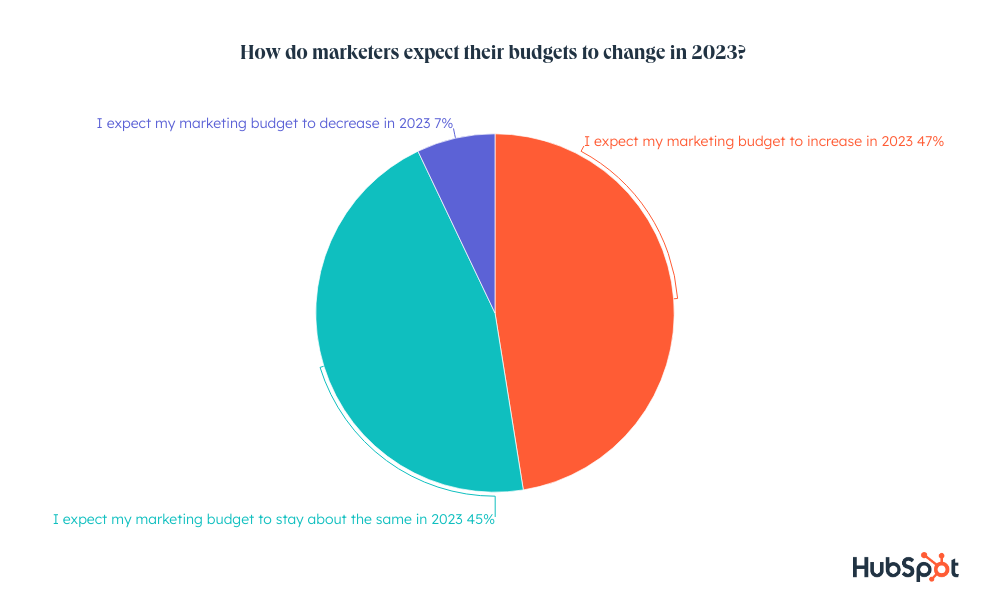
When it comes to how that budget is invested, most (58%) marketers are somewhat confident when deciding how to invest their budget to maximize ROI, while just 28% feel very confident. About 14% do not feel confident in how they invest their marketing budget.
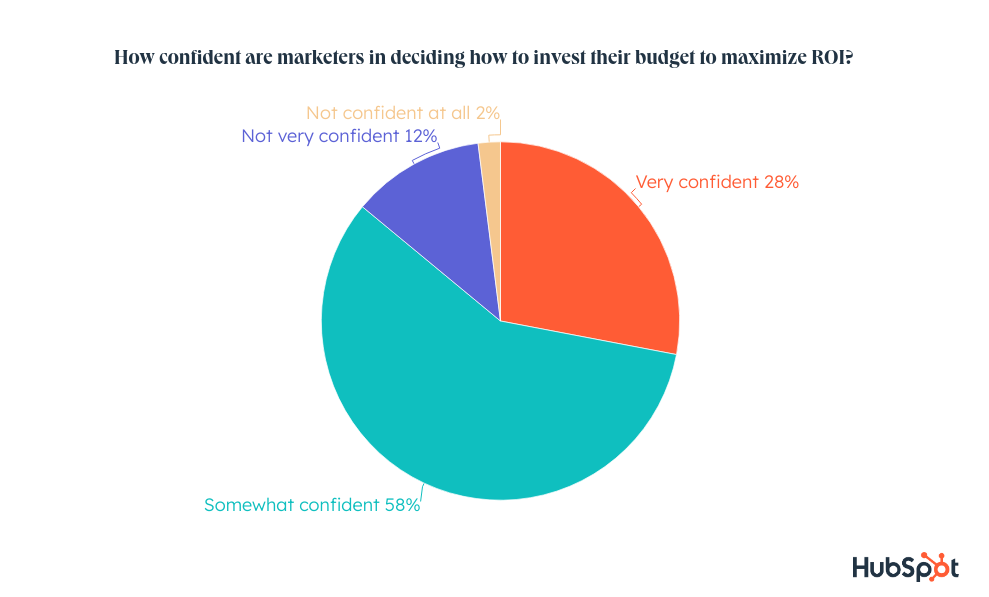
To round out the Marketing Trends 2023 report, we’ll dive into some work trends to understand how and where marketers are working this year.
Marketing Workplace Trends
In our State of Marketing Report published earlier this year, we revealed how marketers were thinking about their goals and what work they planned to do to get there. With this most recent survey, we dove into what that work and their work environment looks like.
Where Marketers Work
Whether by force or by choice, marketers are shifting back to the office in 2022. 80% of marketers are back in the office at least part-time, while just 20% are fully remote.
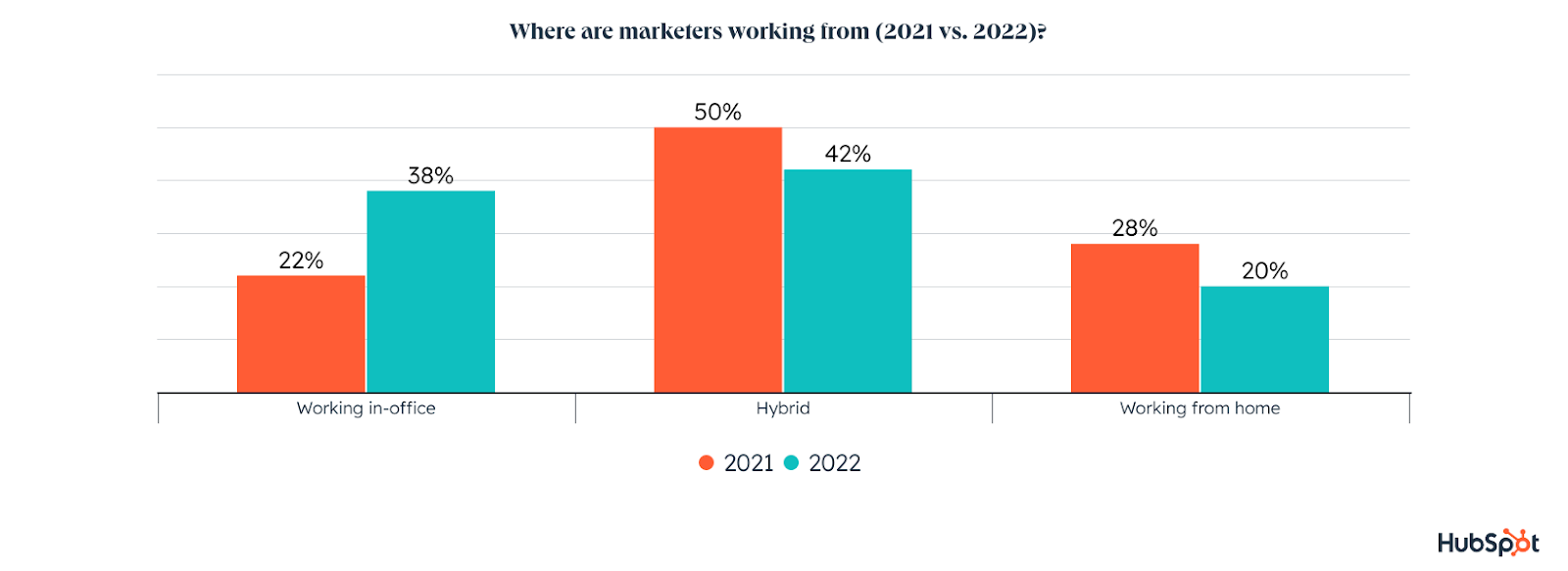
- 38% of marketers work in-office in 2022, a 73% YoY increase
- 42% of marketers work in a hybrid model in 2022, a 16% YoY decrease
- 20% of marketers work from home or remotely in 2022, a 29% YoY decrease
How Marketers Feel About There Workloads
When it comes to their workload, 70% of marketers describe their workload as high, while 26% say it is neither high nor low, and only 5% describe it as low. On top of that high workload, 46% of marketers say their workload increased from 2021 to 2022.

The average marketer works on five campaigns at a time and a total of seven campaigns per quarter. Additionally, 42% of marketers say the number of campaigns they work on each quarter increased from 2021 to 2022. Marketers think their workload will increase again in 2023, when they expect to be working on nine campaigns per quarter.
The Biggest Timesuck for Marketers
Needless to say, marketers are strapped for time and they only expect their workload to keep getting heavier. To make matters more difficult, marketers spend an average of six hours per day on manual, administrative, or operational tasks, leaving them less time to do more impactful work.
Luckily, automation is here to help – our data shows that marketers who report an effective marketing strategy this year are more likely to use automation in their role than ineffective marketers.
Biggest Marketing Takeaways for 2023
While you might think so much change has happened that the industry could eventually slow down – think again. In the most recent months, 20% of marketers have already had to pivot their plans due to the potential recession.
Ultimately, our data shows that marketers who invest in understanding their target audience, the latest trends, and how their audience is changing will be most prepared to pivot their strategy and beat out their competition in 2023.
To wrap up, here are some highlights from each section that you should take away with you when planning a new year of marketing strategies:
- Short-form video, influencer marketing, and social shopping/using DMs for customer service were the top trends marketers used in 2022 and could continue to gain steam in 2023.
- Facebook takes the throne as the highest-ROI social media platform, but YouTube, Instagram, and TikTok will see more growth than Facebook in 2023.
- Marketing budgets aren’t shrinking. Despite the pandemic, recession, data-privacy changes, and whatever else 2023 will throw at us, it seems marketers are actually being given funding needed to step up in unexpected or difficult times.
- Marketing roles are shifting back to in-person. A whopping 80% of marketers are at least partially back in the office in 2022, while only 20% are fully remote.
- Marketers have a high workload with no relief in sight. They reported workload increases from 2021 to 2022, and expect to see more pile up in 2023. Leveling up your automation tools can help you and your team spend more time on high-impact tasks.
Like what you’ve read and want more? Keep following the blog for even more coverage of this report, and check out our 2022 State of Marketing Report below to compare the 2022 data with the 2023 predictions above.

How to Increase Email Sign-ups With Better Forms (+Examples)
In the last 12 months, 77% of marketers have seen an increase in email engagement. Cold prospects get to know and trust you, while you stay top of mind (or top of inbox). However, your team needs to drive signups to reap the benefits.

That all starts with your sign-up form. Better email sign-up forms can help grow your lists, increasing your brand’s engagement. See these email newsletter sign-up form examples for inspiration.
Table of Contents
What Is an Email Sign-up Form?
Ways to Increase Subscribers for Your Email List
Email Sign-up Form Best Practices
Great Email Newsletter Sign-up Form Examples
The best thing about email opt-ins is that you can build a pipeline of leads to nurture. Over time, your email list can turn into a valuable source of revenue. Here are our tips for how to get more mailing list sign-ups.
1. Monitor your metrics.
Your conversion rate refers to the percentage of website visitors who convert on your opt-in. To calculate your conversion rate, divide the number of conversions from that form or offer by the amount of traffic to the page or post it’s on.
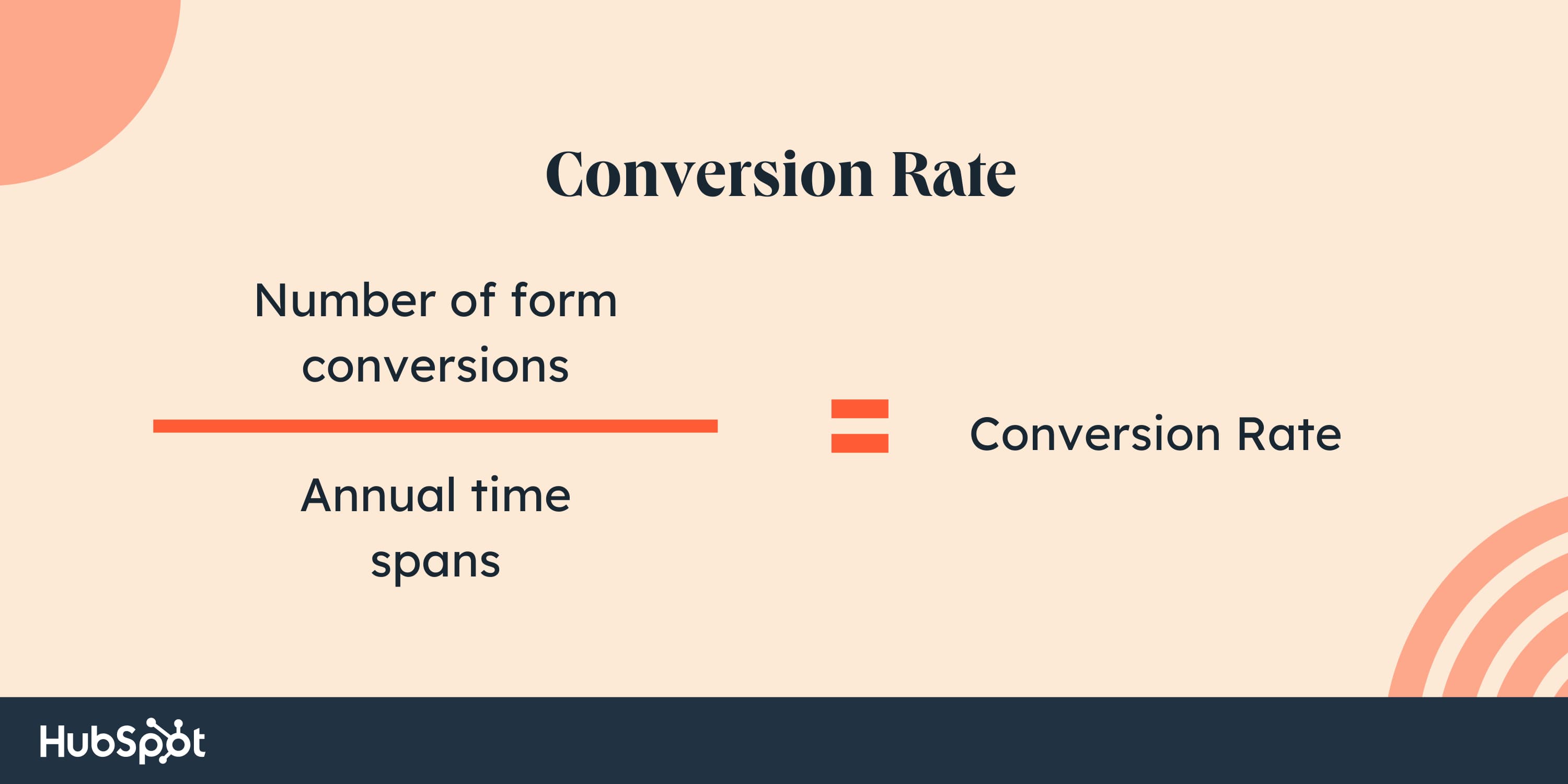
Let’s say you have two forms for the same newsletter. One form has a 3% conversion rate. The second converts .8% of page visitors. The form with the higher conversion rate generates more leads and produces more value for the sales team.
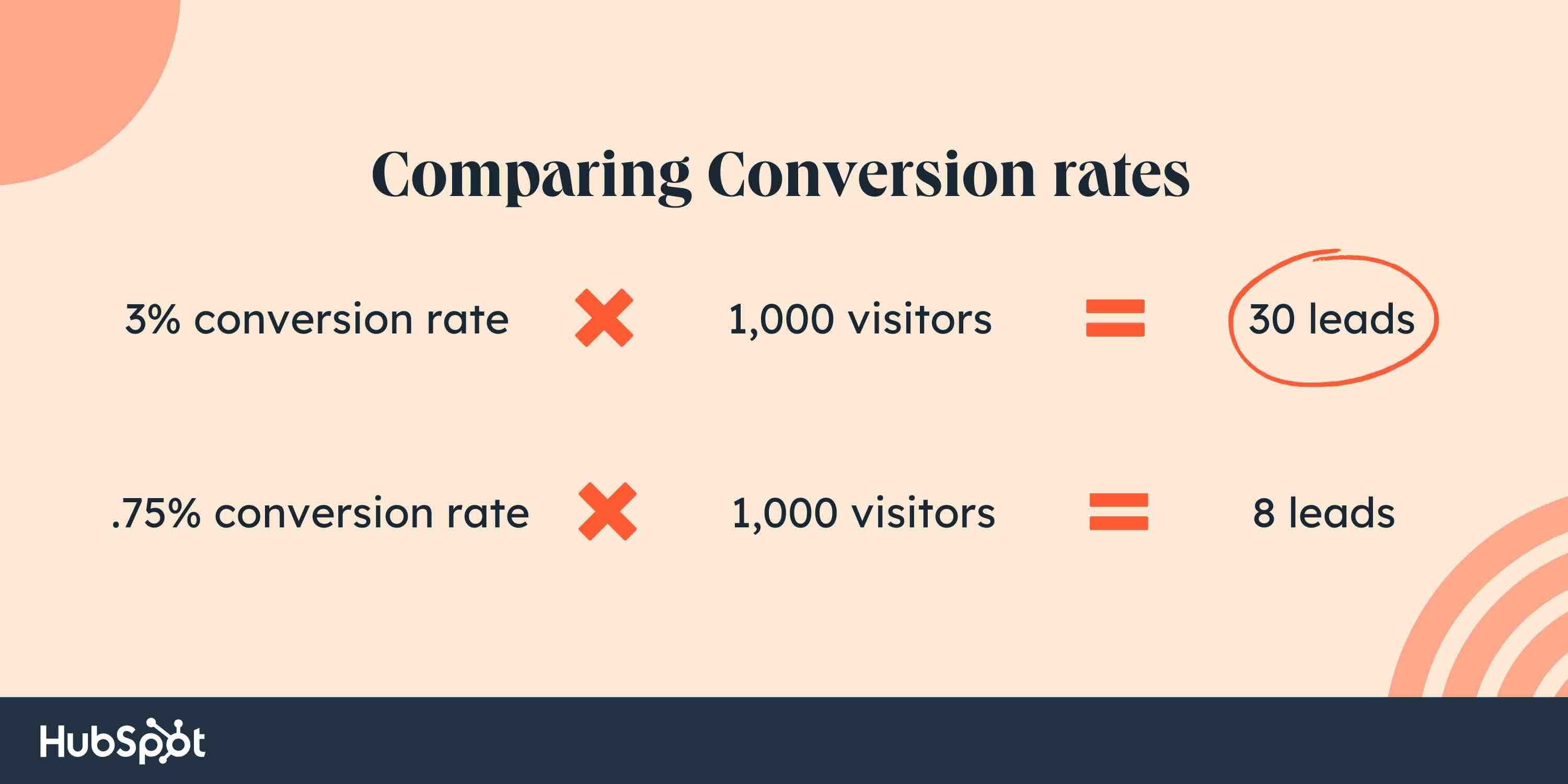
With 1000 website visitors, the first form would generate 22 more leads than the second. That’s why conversion rate optimization is so important.
2. Incorporate calls-to-action.
Conversions to your email sign-up form only happen if the form is seen. For this reason, you should be putting the opportunity in front of your website visitors.
Identify your highly visited pages and put your form or calls-to-action (CTA) on them to maximize visibility.
3. Investigate pipeline gaps.
If you don’t have a large amount of traffic, finding ways to increase it may be a more worthwhile activity. Conversions only happen when there’s an opportunity to convert. With no traffic, there’s no opportunity.
You won’t have the means to increase your conversion rate if the starting number is zero. If traffic is low, your conversion rates may not be statistically significant.
4. Use contrasting colors.
The last thing you want is for a potential subscriber to miss the opportunity to convert simply because they didn’t notice it was there. Use contrasting colors to make these conversion elements stand out.
For instance, in the example below, Kiss Metrics has identified correlations between specific colors and shopper psychology. Specific hues and contrasts elicit specific responses. Using color theory can encourage prospects to act.
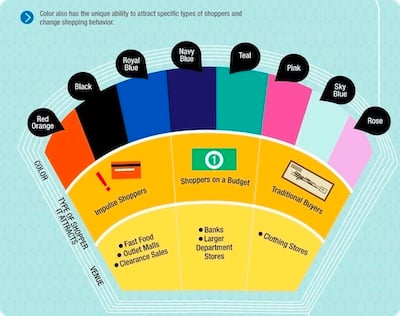
5. Consider placement.
Prominent page placement is a game-changer when it comes to increasing conversion rates on email sign-up forms. A form or call-to-action can go in many places, including:
- The top of the page.
- Within the text of the page.
- In the sidebar.
- At the bottom of the page.
- As a pop-up generated from a user action.
You’ll want to test which placements work for your conversion rates. For example, if people aren’t making it to the bottom of a post, they may not see your call-to-action. Through testing, you’ll be able to determine the placements that work best for your audience.
6. Offer value and choice.
Today’s internet user knows handing over their email address may result in email solicitation or, in some cases, spam. That may not be your intention, but that doesn’t erase their caution. To overcome this caution, you must incentivize them to give it up.
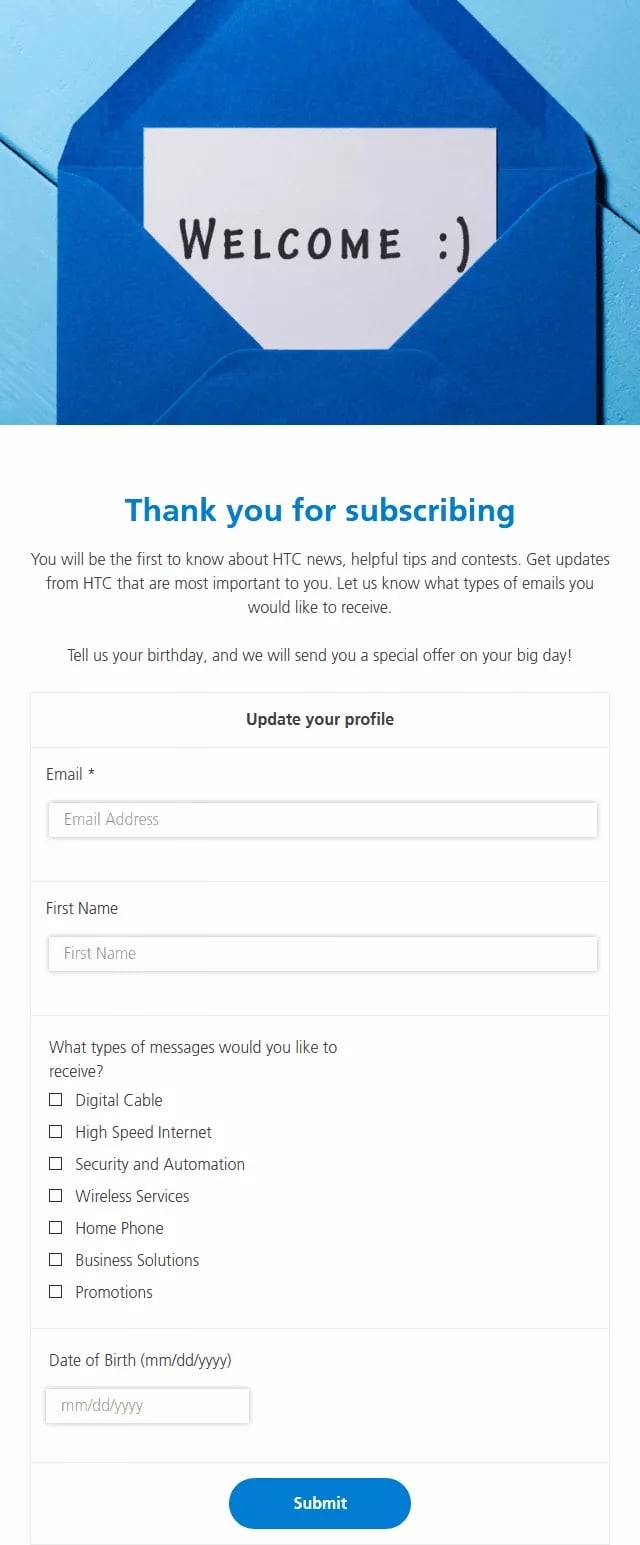
Promising high-value content that they want, providing social proof that your newsletter is valuable, holding giveaways or contests, and being transparent about what they can expect are all ways to provide the incentive.
Another option is to offer the user the choice of what type/category of content they’d like to receive. Nothing like autonomy to keep ’em coming back!
7. Reduce friction.
“Dollars flow where friction is low.”
— Brian Halligan, INBOUND 2019
The more friction that a visitor encounters, the less likely they’ll sign up.
One way that you can reduce friction is by removing form fields to make the process of signing up faster. The number of required form fields should be proportional to the amount of value you’re providing. Too many fields will cause the user to bounce. Instead, ask for less up front and have your team gather additional information after the individual has become a lead.
8. Try out different phrasing.
Don’t be afraid to scrap phrasing that is underperforming. Maybe the word “newsletter” fails to appeal to your specific audience. Switch it out with something different and monitor your metrics to see what happens.
9. Consider user intent.
Your website visitors landed on your page for a reason. If your offer doesn’t help them meet that need, they won’t be incentivized to convert.
For example, let’s say you have a blog post that compares your product or service to a competitor’s. The visitor arrived here because they want to see how well you match up with others in the industry.
If your on-page offer is an ebook with “Reasons Why You Should Buy [Product/Service],” you may fall flat. If the user is already comparing providers, they already know the value of the product or service. They’re just figuring out which provider to go with.
In this scenario, an offer suited to this intent, like a product demo, will work much better.
Consider the intent on your pages and craft offers that match up with that intent.
10. Minimize the number of forms and CTAs.
As the old saying goes, “A confused mind says no.” If you present website visitors with too many choices, you run the risk of driving them away completely.
Consider presenting one offer or conversion element per page. If that’s not possible, find other ways to reduce the confusion and make it clear exactly what you want the website visitor to do.
11. Use a form builder.
Some form builders (like HubSpot’s) can remove form fields if the CRM already knows the information. This clears the friction of the user typing that information again. Creating an easy user experience will increase your conversion.
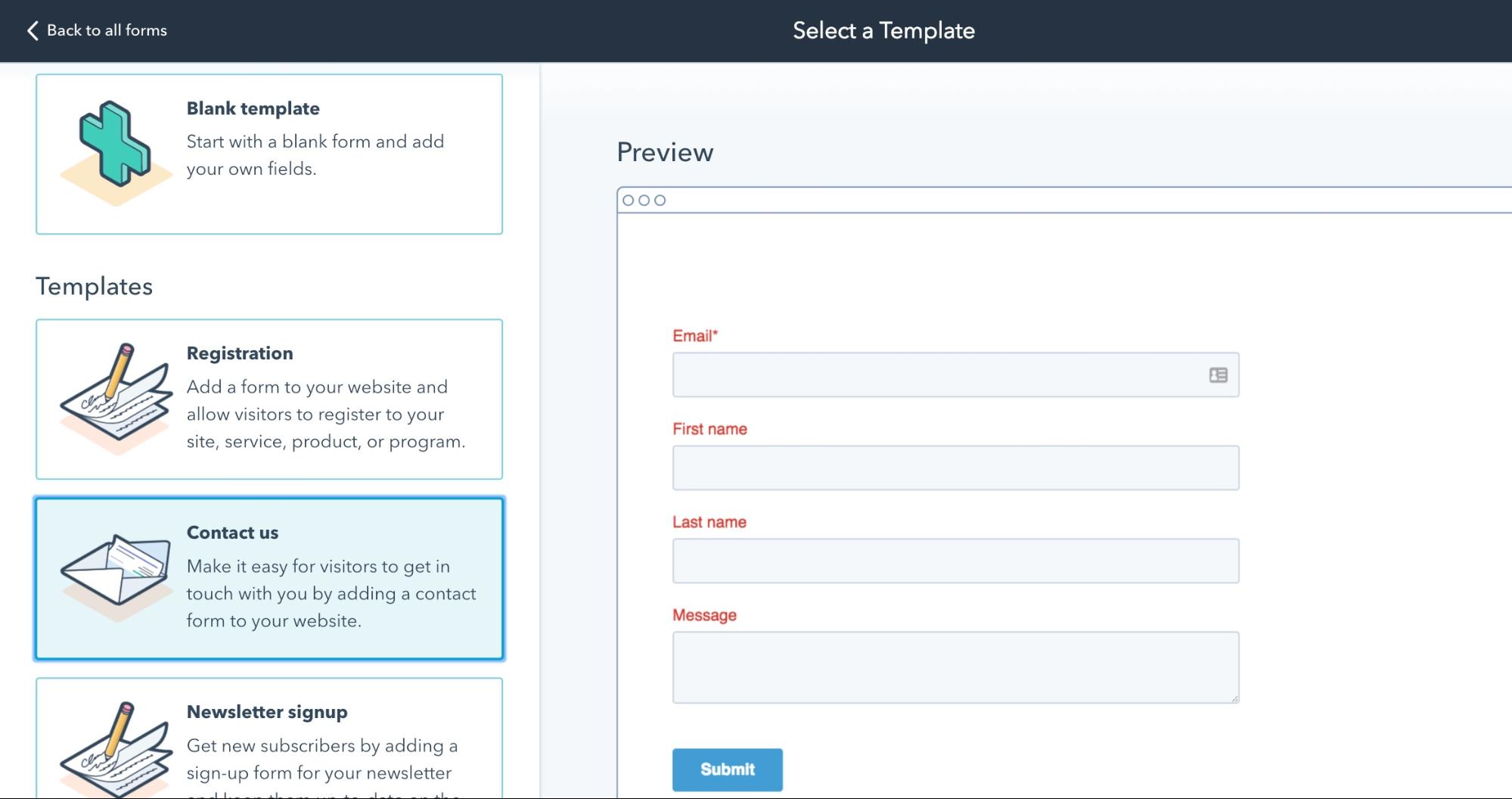
12. Use pop-ups.
Pop-ups may seem intrusive. However, when used correctly, they convert! By using a pop-up tool, offering something of value, and using specific triggers (such as exit intent), you can create a pop-up experience that isn’t annoying and generates leads.
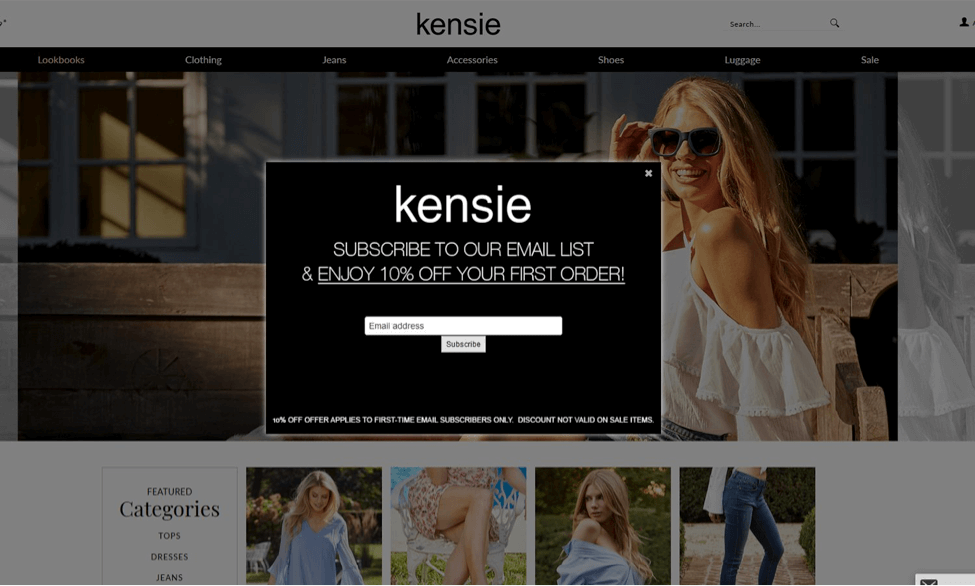
13. Test everything.
Testing has been mentioned already in a few of the tips above, but it stands to get its own section. Improvement doesn’t happen in a vacuum. By testing hypotheses and continuing to iterate improvements, you’ll learn about your audience and increase email sign-ups as a result.
A lead might provide their email address for any number of reasons — to receive details about sales, blog post notifications, a discount code, or information about your business. In any case, that makes your email sign-up form one of the most important things on your site.
Let’s go over some ways to create a sign-up form that will get more leads on your email list.
Whether you’re looking to reach ten people or ten million, you’ll need to create a sign-up form that gets people excited to sign up. Here are some best practices that will help you create a high-converting email sign-up form.
1. Clear Value Exchange
An email address is a valuable commodity. Your offering should be worth their while. Add a short description to the top of your email sign-up form that describes what your lead will get in return for signing up and make it good.

For example, instead of saying ”Sign up for our weekly newsletter” you should say, “Sign up for our newsletter to receive exclusive deals.” A strong incentive means your website visitors are more likely to convert.
Pro tip: Your leads should be able to answer the question, “What’s in it for me?” when they complete your form.
2. Double Opt-In
You don’t necessarily need more sign-ups. You need quality sign-ups. These quality sign-ups mean fewer fake leads wasting your time. Plus, there are fewer chances that you’ll end up in SPAM.
To ensure quality sign-ups on your form, consider using a double opt-in. This is the type of email subscription that confirms your lead wants to be added to your email list twice. The first time is when the lead enters and submits their information using your web form, and the second requires the lead to click an additional CTA (usually in their inbox) that confirms their submission.
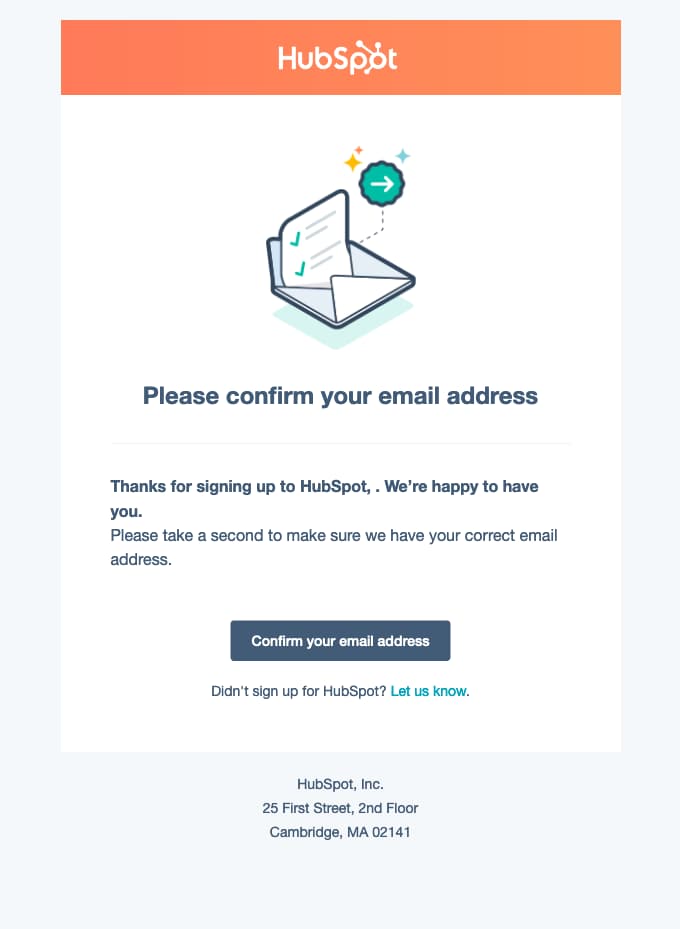
A double confirmation means a high-quality relationship with your leads.
3. Simplicity
Successful email sign-up forms are straightforward and clear. A lead should be able to look at the form, enter their information, hit “submit”, and carry on with their lives within a matter of seconds. If your form is too complex, you risk losing the interest of your website visitors.
Remember: Your email sign-up form is just a way for visitors to sign up for emails. Your team can build from there.
4. Place and Time
The placement of your email sign-up form on your website matters. Think about how you want your website visitors to find your form. Do you want your form to pop up on the page the second someone lands on your website? Do you want them to scroll down to the bottom of your homepage to find your form? Or do they need to land on a specific page on your site?
Form placement isn’t one-size-fits-all. Think about where most visitors land on your site, how your buyer personas want to interact with your brand, and the overall user experience.
Consider questions like, “Will my target audience get frustrated with a pop-up the second they enter our site, or will they find it helpful?”
5. Kickback Emails
Once someone completes your form, thank and welcome them.
A kickback email gives your new lead something in return for their information. In the case of an email sign-up, you’ll want to welcome your new lead and perhaps offer them links to useful content. Get them excited about their decision to give you their personal information.
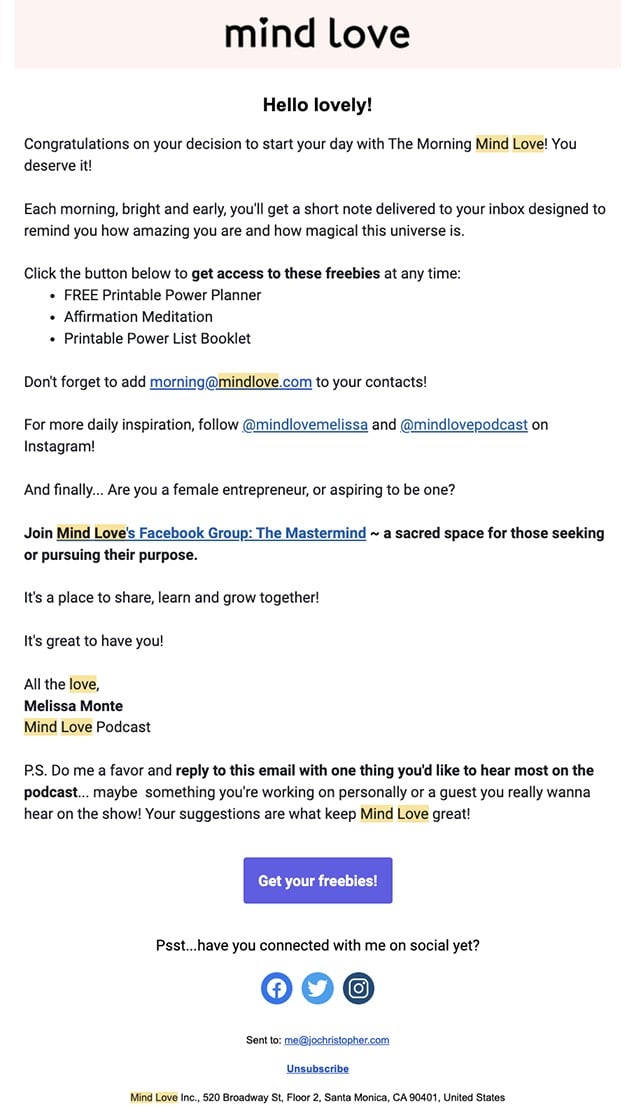
This is also where you can provide your new leads with their discount codes, details on future sales, access to exclusive communities, why you value their interest in your business, and how you will support them in the future.
Now that we’ve reviewed email sign-up form best practices, let’s dive into some examples. Here’s a collection of our favorite email newsletter forms and CTAs.
1. The Hustle
The Hustle website has an email sign-up form with a clear benefit statement. Any website visitor could look at this subscription landing page and understand what they will get from signing up in a matter of seconds.
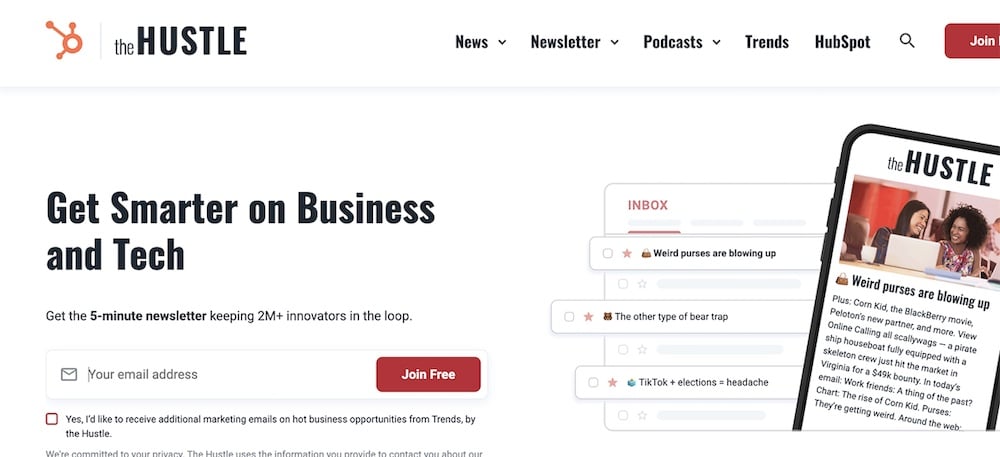
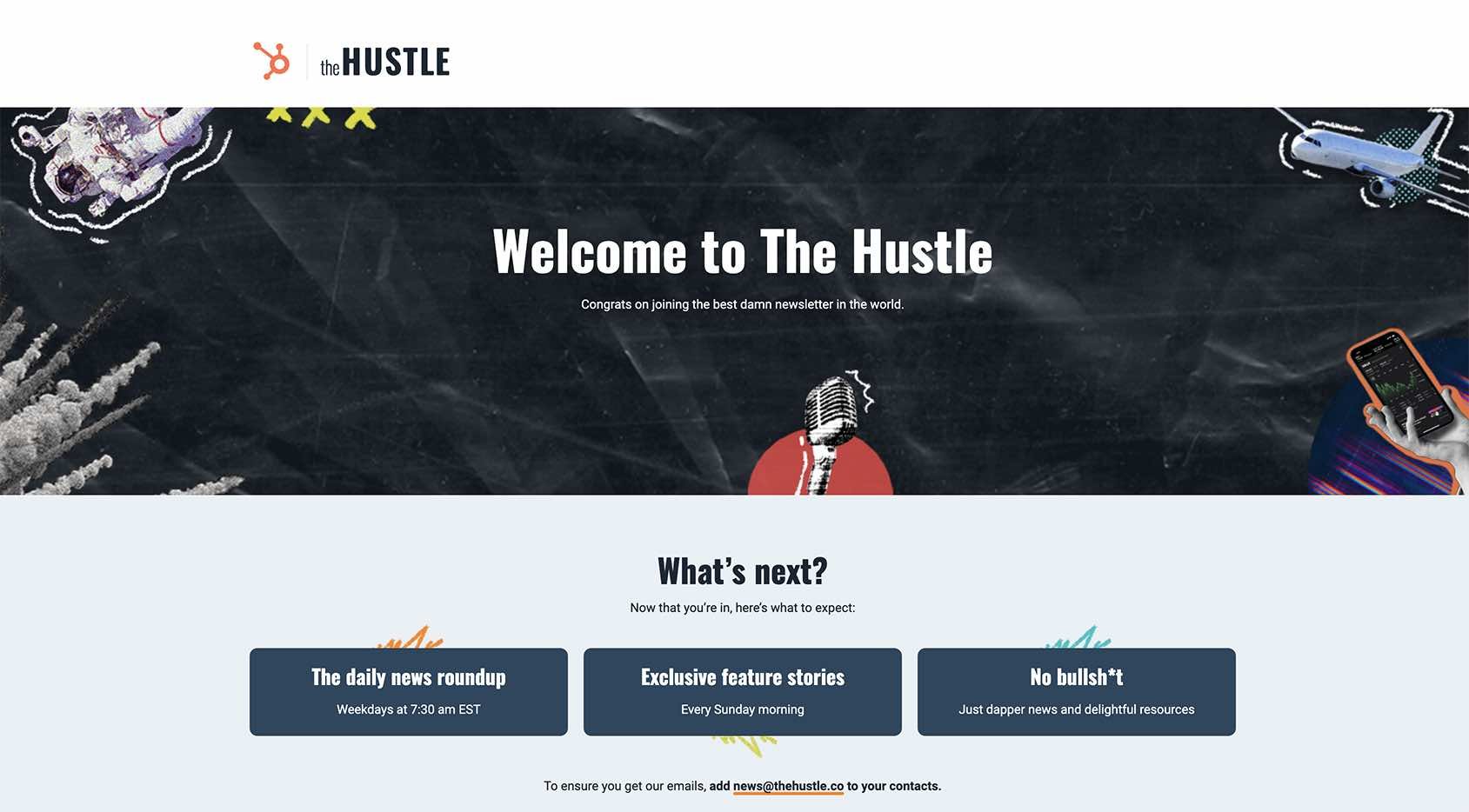
They also utilize the “Thank You” page to convey a direct statement of how the company values the subscriber’s time and will intentionally curate scheduled-themed content.
2. Blavity
When you head to Blavity’s website, the first thing you see is their email pop-up. That’s because their entire business revolves around a subscription. Blavity is an online publication that gathers top news stories from around the globe. The placement of their sign-up form fits with its offering.
Blavity also has a landing page specifically devoted to email sign-up.

3. Anthropologie
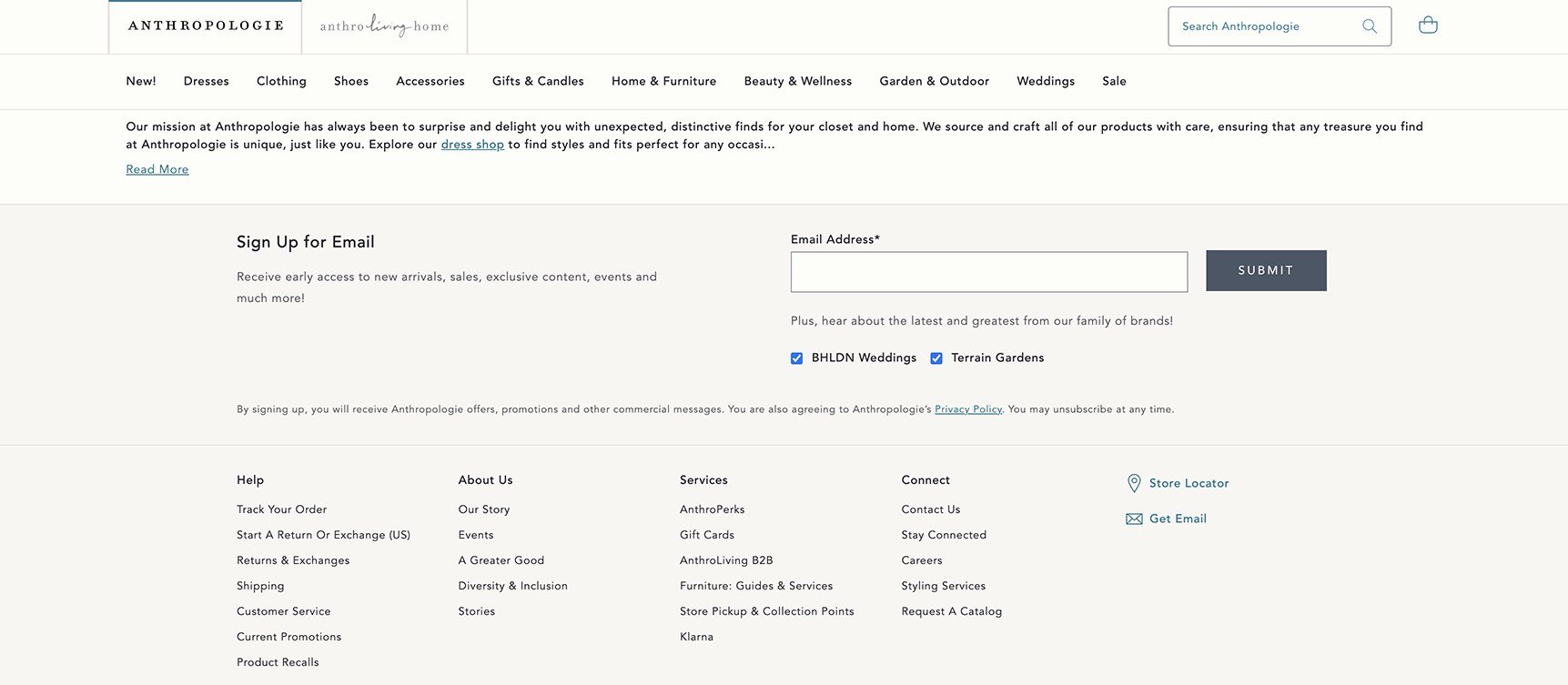
Anthropologie places their email sign-up form towards the bottom of their homepage after users have had a chance to look around and become familiar with the site. Their sign-up form has a short description of what leads can expect once they sign up. Anthropologie also respects their visitors’ time by simply asking for an email address.
4. Lulus
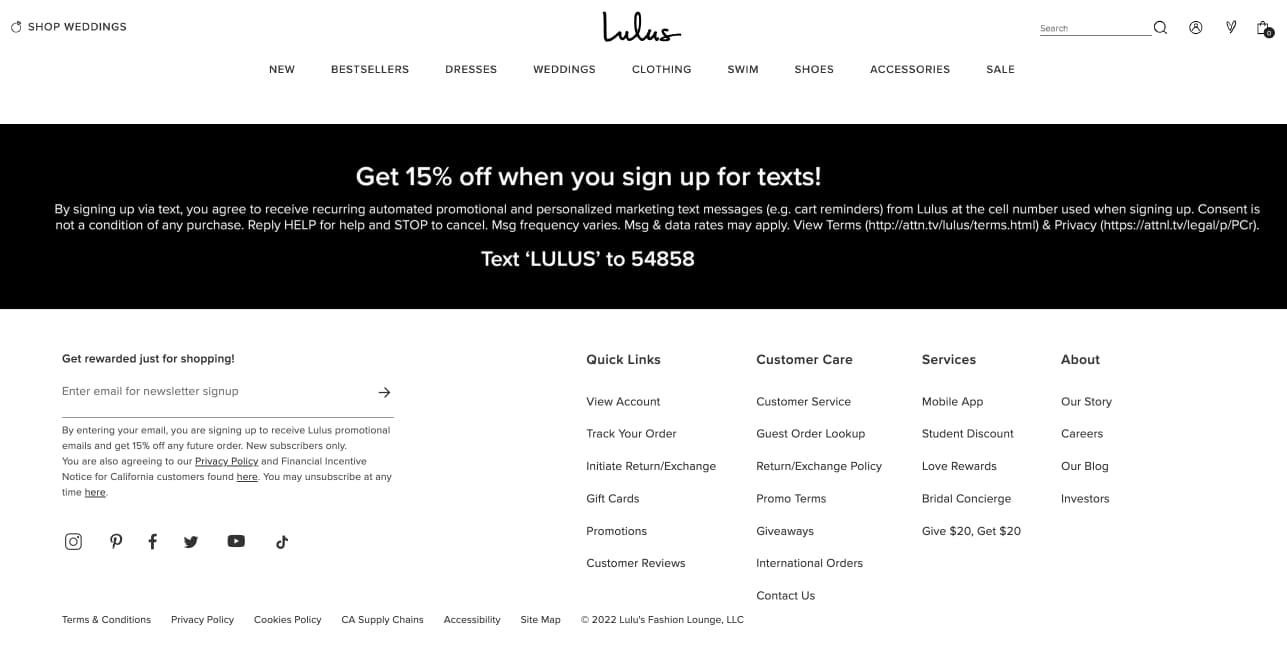
Lulus form is located towards the bottom of their homepage. Their email sign-up form gets website visitors excited about converting with an offer: a 10% discount code upon signing up.
The form is simple and only requires an email address. After form submission, new leads receive a kickback email that welcomes them and provides them with the code, as promised.
5. Quest Nutrition
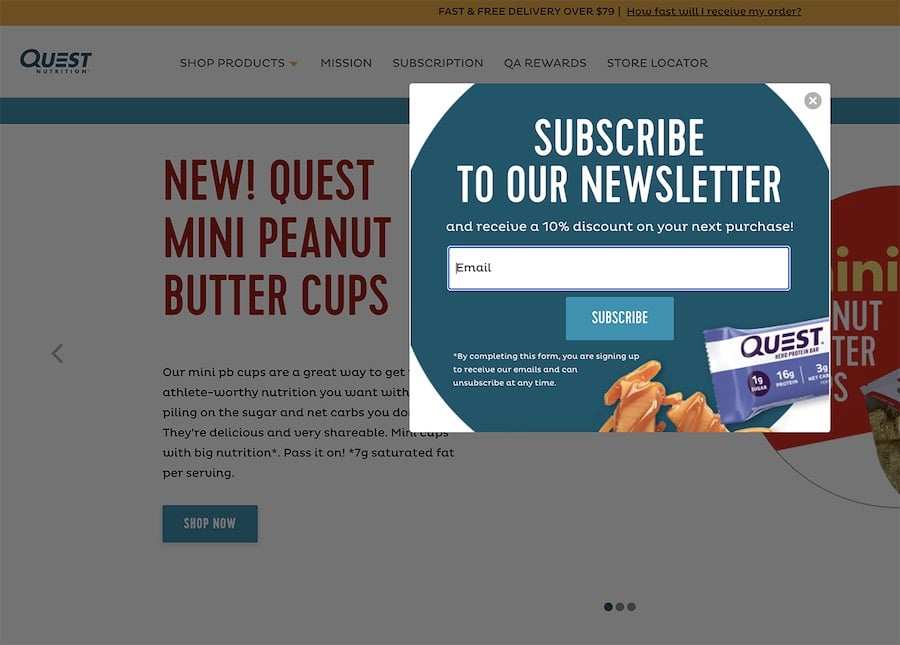
Quest Nutrition’s form is in a pop-up window that dims the background, eliminating any distractions. The form offers incentives like recipes, discounts, and surprises for visitors to sign up. Only an email address is required. Website visitors also have the option to bypass the pop-up and look around the site instead.
Email sign-up forms are a simple, efficient, and effective way to obtain leads, create more conversions, and increase your overall sales. You’ll reach your audience with email sign-up forms that are straightforward and embedded in a convenient location on your website.
So, take a few minutes to create your own email sign-up form and get started broadening your customer base, developing relationships with your potential customers, and increasing your number of leads today. From there, you can close the gap between lead and customer through email marketing.
Editor’s note: This post was originally published in October 2018 and has been updated for comprehensiveness.

The Ultimate Guide to Service Level Agreements (With Help Desk SLA Examples)
At many companies, it can feel as if there are 100 miles between sales and marketing. In a recent LinkedIn survey, 60% of global respondents believed that misalignment between sales and marketing could damage financial performance, yet there are a number of disconnects between the teams from strategy to process.
One of the most critical steps for aligning your sales and marketing efforts is creating a service level agreement (SLA). Traditionally, an SLA serves to define exactly what a customer will receive from a service provider. But SLAs serve internal operations as well, and sales and marketing agreements are among the most crucial.
.
Ultimately, a service level agreement is designed to create alignment between two parties by setting clear expectations and mitigating any issues before they happen. With that in mind, there are multiple types of SLA depending on your use case.
1. Customer Service Level Agreement
A customer SLA is just what it sounds like: an agreement by a vendor to deliver a certain level of service to a particular customer. Here’s a fun example:
In the TV show The Office, the company, Dunder Mifflin, supplies paper to various organizations. They might have a customer SLA stipulating that Dunder Mifflin will supply [Company X] with 50 reams of paper per month, shipped every Monday to [Address 1] and [Address 2] by Darryl Philbin — with a confirmation of delivery sent to Jim Halpert. (Sorry, we had a little too much fun with the references in that one.)
2. Internal Service Level Agreement
An internal SLA only concerns parties from within the company. While a business might have an SLA open with each of its clients, it can also have a separate SLA between its sales and marketing departments.
Let’s say Company X’s sales department has to close $5,000 worth of sales per month in total, and each sale is worth $100. If the sales team’s average win rate for the leads they engage with is 50%, Company X’s marketing director, Amir, can work with the sales team on an SLA, stipulating that Marketing will deliver 100 qualified leads to sales director, Kendra, by a certain date every month. This might include four weekly status reports per month, sent back to Amir by Kendra, to ensure the leads Kendra’s team is receiving are helping them keep pace with their monthly sales goal.
3. Multilevel Service Level Agreement
Multilevel SLAs can support a business’s customers or the business’s various internal departments. The point of this type of SLA is to outline what is expected of each party if there’s more than just one service provider and one end user. Here’s an example of a multi-level SLA in an internal situation:
Company X’s sales and marketing teams partner up on an internal SLA that delivers leads from Marketing to Sales every month. But what if they wanted to incorporate a customer retention strategy into this contract, making it an SLA between Sales, Marketing, and Customer Service?
After sales closes 50 new deals for the month, it’s Customer Service’s job to keep these customers happy and successful while using the product. In a multi level SLA, Company X can have sales director, Kendra, send monthly “customer friction” reports to Joan, the VP of service, based on dialogue the sales team has regularly with its clients. This helps the customer service team build a knowledge base that better prepares them for the pain points customers call them about.
You can learn more about customer service’s increasing role to business growth in the HubSpot Academy.



What does an SLA include?
The details of an SLA will differ among internal and external agreements. Nonetheless, there are common building blocks that each SLA should include, whether the recipient of the service is your customer or your sales team.
Featured Resource: Free Marketing & Sales SLA Template
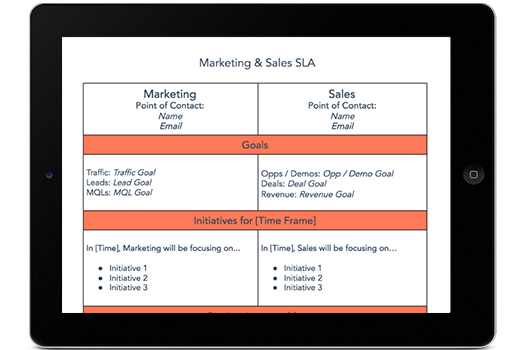 Download this Template
HubSpot’s Sales & Marketing SLA Template is the ideal resource for outlining your company’s goals and reaching an agreement between these two crucial teams. Download it now for free.
1. A Summary of the Agreement
The first item on your SLA should be an overview of the agreement. What service have you agreed to deliver to the other party? Summarize the service, to whom it’s being delivered, and how the success of that service will be measured.
2. The Goals of Both Parties
In external SLAs — those between a business and its customers — the goals stated in the agreement are primarily those of the customer. If this is your intention, work with your client to marry their needs with the abilities of your product, and come up with a measurable goal that your company can feasibly meet for the client on a regular basis.
Is this an internal SLA between your sales and marketing departments? Both teams should have their goals outlined in this section of the contract, while making sure that when Marketing hits its goal, Sales can reach its own goal as a result.
3. The Requirements of Both Parties
SLAs should include what each party needs in order to reach their goals. In agreements that serve a customer, keep in mind their needs might go beyond simply “the product.” They might need more than that to reach their goals — such as weekly consulting, reporting, and technical maintenance from you.
SLAs between sales and marketing teams should describe what they might need from the opposite department in order to help them hit their targets. Marketing, for example, might need weekly status reports on Sales’ pipeline so the marketers can adjust their lead-generating campaigns accordingly.
4. The Points of Contact
Who’s in charge of making sure each party’s goals are met? Sort out which team does what, and who talks to whom, in this section of your SLA. Is there a separate employee using the services, in relation to the employee who reports on performance every week? Make it clear who’s involved in the SLA, and how.
5. A Plan if Goals Aren’t Met
You might not want to think about it, but there should be formal consequences when a goal isn’t met as part of an SLA. Don’t freak out, though — these consequences aren’t always business-ending situations. Include a form of compensation to the service’s end user for when the service doesn’t meet their agreed-upon goals. In external SLAs, according to PandaDoc, this compensation can come in the form of “service credits.” Grab PandaDoc’s free SLA template here to find out more.
For Sales and Marketing SLAs, work with your sales team to establish a plan for how any lost revenue is to be made up as a result of an unreached sales quota. You might settle on a strike system that holds certain employees — in both Sales and Marketing — accountable for diagnosing and resolving issues of low performance.
6. The Conditions of Cancellation
Under what circumstances will your SLA be terminated? Whether your contract serves a customer or two internal departments, you’ll typically find yourself putting the SLA on the chopping block when it’s just not working. Maybe your goals have gone unmet for the last three months, or the current agreement simply doesn’t have buy-in from everyone involved.
Come up with formal conditions under which you’d cancel the current SLA in pursuit of, hopefully, a better SLA.
Examples of SLAs
While an SLA will be unique to your needs, here are some examples and templates that can give you an idea of what an SLA may look like.
1. HubSpot’s Marketing & Sales SLA Template

As previously mentioned, HubSpot has a template for marketing and sales service level agreements. Instead of being overly complicated, the template provides straightforward, no-nonsense sections so that any party can skim at a glance.
What we like best: It’s laid out in a two-column style to easily denote which team is responsible for which activities and metrics. Having them side-by-side like this further underscores the goals of partnership and alignment.
How to Implement This in Your SLA
Simplicity is the key to recreating this SLA template. Whether you use HubSpot’s offering or create your own, effectively implementing this type of SLA means resisting the temptation to list out every possible outcome and instead focus on the big picture of goals, initiatives, and accountability.
2. Hivehouse Digital’s Marketing & Sales SLA Template

This sales and marketing SLA template focuses heavily on metrics, making it a great choice for high-performance teams. The design relies on tables for easy information input and even comes with prompts/examples to help you define the agreement.
What we like best: The document is organized step-by-step, making it a great choice for teams without a formalized SLA process (yet).
How to Implement This in Your SLA
Implementing the Hivehouse model for your SLA means leaning into its step-by-step strengths. By breaking down SLAs into smaller and more manageable steps, there’s less chance of you and your team getting overwhelmed.
3. Lucidchart’s Marketing and Sales SLA Template With Examples

Instead of going through the process of creating an SLA, this template organizes sections by the marketing and sales process itself, from goals to lead qualification, handoff, and nurturing.
What we like best: The template takes a visual approach with columns for marketing, sales, and shared goals. This makes ownership of deliverables crystal clear throughout the process.
How to Implement This in Your SLA
Seeing is believing in this type of SLA template. While the nitty-gritty details are there, this approach uses color and shape to highlight important categories and actions. If you’re planning to take this approach to your SLA, use color psychology and graphic design principles to create a visually appealing SLA.
4. AT&T’s Small Business Service Agreement Example
Here’s a real-world example in the wild. Not all SLAs are between marketing and sales teams or even other internal departments. Here’s an SLA that lays out a service agreement between AT&T and its customers, setting expectations for the engagement. They make this SLA publicly accessible for all their users.
What we like best: The agreement is plain and simple, leveraging bullet points to make each detail clear and understandable.
How to Implement This in Your SLA
AT&T’s real-world example highlights the importance of calling out what matters — in this case, by using bullet points. Applying the same approach to your SLA means distilling larger and more complicated outcomes into easily-understood snippets that don’t leave room for confusion.

5. Microsoft Azure SLA Example for Cloud Services
As a service provider, Microsoft Azure also makes its SLA for customers public. The SLA uses bullet points to clearly identify its offerings and customer promises, which are unique depending on the plan and services rendered.
What we like best: The SLA is organized with headings for quick navigation to the offerings that are most pertinent, and information is kept concise with an optional “View full details” link.
How to Implement This in Your SLA
In-depth SLAs are naturally complicated, making it easy to get bogged down in the details despite best efforts to keep things simple. Microsoft’s example offers a streamlined approach to implementation: Call out the key details and then provide links to the full SLA text.

6. PandaDoc’s Multi-Page SLA Template
PandaDoc provides another option for provider/client agreements and is a great choice for more formal arrangements.
What we like best: This template makes for a clear and concise SLA with times, dates, and solid expectations.
How to Implement This in Your SLA
While this type of SLA leans more toward legalese with language like “whereas” and “therefore”, it has the advantage of a solid narrative structure to describe expectations. If you’re planning to implement something similar, consider using a template to speed up the process rather than starting from scratch.

How to Make an SLA for Marketing and Sales Alignment
While SLAs are common between businesses and new customers, they can also improve internal alignment. When one exists between sales and marketing departments in particular, this agreement details marketing goals (like number of leads or revenue pipeline) and the sales activities that’ll follow and support them (like engaging leads that were qualified by the marketing team).
Both the sales and marketing departments use this document as a commitment to support each other based on concrete, numerical goals. And guess what? 87% of sales and marketing leaders say collaboration between sales and marketing enables critical business growth.
Now, if you don’t have a Sales and Marketing SLA in place, fear not: We’ve outlined how to create one below so that you can easily start aligning your sales and marketing teams.
To draft your SLA, you first need to align your Sales and Marketing teams around a shared set of goals — or, as we put it before, the harmonious “Smarketing.” This alignment can then dictate the creation of a written SLA that reflects these goals. Here’s how to create an SLA with “Smarketing” in mind:
1. Calculate a numerical marketing goal based on the sales team’s quotas.
As a marketing department, not only should you have a concrete goal for each campaign you run, but you also should have a high-level numerical goal that aligns with the sales team’s operations. At the end of the day, that’ll mean qualified leads and actual sales from those leads.
Salespeople are driven almost entirely by their sales quotas — the numerical goals that correlate with their compensation and job security. If Marketing commits to a similar, related numerical goal, it shows that the team is being held accountable in a manner similar to Sales. The trick, however, is to make sure your numerical goal can effectively power the sales team’s numerical goal.
In order to calculate the marketing side of your SLA, you’ll need the following four metrics:
- Total sales goal (in terms of revenue quota)
- % revenue that comes from marketing-generated leads (as opposed to sales-generated ones)
- Average sales deal size
- Average lead-to-customer close %
Then, it’s time to do some calculations:
- Sales quota x % revenue from marketing-generated leads = Marketing-sourced revenue goal
- Marketing-sourced revenue goal ÷ Average sales deal size = # of customers needed
- Customers ÷ Average lead-to-customer close % = # of leads needed
2. Segment your goals by specific intervals during the year.
It might also be a good idea to reevaluate the marketing side of the SLA each month, as a variety of factors can change the numbers used in your calculations over time. To do so, create a document that tracks your SLA calculations by month, which should include the following metrics:
- # of marketing-generated leads
- # of those leads that became customers
- Revenue from those closed customers
- Total revenue closed that month from marketing-generated leads only
- Total revenue closed that month
You will also need:
- The average sales cycle length
With the figures above, you can re-calculate the metrics you started with on a monthly basis, or at whichever interval suits your business — quarter, year, etc. Just make sure the same measure of time is used for both Sales and Marketing to maintain alignment. Have a look:
- # marketing-generated leads that became customers ÷ # marketing-generated leads = lead-to-customer close %
- Revenue from closed customers ÷ # of marketing-generated leads that became customers = sales deal size
- Total revenue closed from marketing-generated leads / total revenue closed = % revenue from marketing-generated leads
You could also take it one step further, and incorporate quantity and quality into these metrics. The above calculations provide you with a quantitative volume goal of marketing-generated leads. However, we know that not all leads are created equal, and as a result, some may be considered higher- or lower-quality than others.
For example, a decision-making executive might be a more valuable contact than an intern. If that’s the case, you can do the above analysis for each subset of leads, and set up separate goals for each type/quality level.
Want to take it even further? Measure in terms of value, instead of volume. For example, a CEO may be worth $100, for instance, while a director is $50, a manager is $40, and so on.
3. Calculate sales’ figures and their goals.
The sales side of the SLA should detail the speed and depth to which a salesperson should follow up with marketing-generated leads. When establishing this end of the SLA, consider these two sales statistics:
- Salespeople who follow up with leads within an hour are nearly seven times more likely to have meaningful conversations with a decision maker on the other end.
- However, only 7% of leads respond to a follow-up contact within five minutes after filling out a form.
Bottom line? Not all leads may be fit to send to sales immediately. They often need to meet some minimum level of quality, like reaching a certain activity level, which can only take place after being nurtured by Marketing.
Nonetheless, engaging a lead the short time after he/she converts is critical to maintaining a relationship with them — the question you have to answer is what that engagement should look like. Either sales or marketing should take action to start building that relationship, make nurturing easier, and set up the sales rep for success when she eventually does reach out.
Keep in mind this advice is futile if you don’t consider the bandwidth of your sales reps. Sure, in a perfect world, they’d make six follow-up attempts for each lead — in reality, though, they may simply not have enough hours in the day to do that. For that reason, you’ll also need to factor in the number of leads each rep is getting (based on the marketing SLA), how much time they spend on marketing-generated leads versus sales-generated leads, and how much time they have to spend on each one. If you’re looking to conserve time, some of the follow-up — email, in particular — could be automated, so look into options there.
4. Set up marketing SLA reporting.
Now that you have your SLA goals, it’s time to track your progress against that goal — daily.
To start, graph the goal line using this formula:
(1÷n x g)
Where n is the number of days in the month and g is your monthly goal.
That should determine what portion of your monthly goal you need to achieve each day. You’ll want to graph that cumulatively throughout the month and mark your cumulative actual results on the same chart. We call that a waterfall graph, and it looks something like this:

5. Set up sales SLA reporting.
For the sales SLA reporting, you’ll have two graphs — one monitoring the speed of follow-up, and the other monitoring the depth of follow-up.
To graph the speed of follow up, you’ll need the date/time the lead was presented to sales, and the date/time the lead received her first follow-up. The difference between those two times equals the time it took for sales to follow up with that particular lead.
Take the averages of lengths of time it took for sales to follow up with all leads within a particular timeframe — day, week, month — and chart it against the SLA goal.

To graph the depth of follow-up — e.g., the number of attempts — look specifically at leads that have not been connected with, since the goal of the follow-up is to get a connection. For leads over a certain timeframe that have not received outreach, look at the average number of follow-up attempts made, and graph that against the SLA goal.

6. Communicate, celebrate, and address the achievement (or lack thereof).
Maintaining strong communication regarding how each team is performing on goals boosts transparency. If either team isn’t reaching their goals, addressing that confirms their importance, while celebrating hitting those goals can aid motivation.
If you’re not sure where to begin when it comes to setting these goals, check out our free Marketing & Sales Lead Goal Calculator, designed to help you determine and track the goals that will eventually become part of your SLA.
To ensure you’re getting the most from SLA creation, implementation and management, it’s worth aligning your efforts with industry best practices. Some of the most common include:
Define Realistic Goals
While promising the moon might seem like a good idea, things can quickly go off track when SLA outcomes aren’t met. As a result, it’s worth starting SLA creation with a brainstorming session that includes relevant stakeholders. Here, the goal is to define what you want to do, what you can do, and what you can reasonably offer.
Ensure Everyone is On Board
Next, make sure all relevant parties feel like their needs are being met with your draft SLA. Better to find out up-front that there are potential problems — and make proactive changes — than face pressure to scrap in-place service level agreements and start over.
Get Specific
Specificity is what makes SLAs work. For example, if you’re an IT service company drafting an SLA about uptime, the number of “nines” — 99.999 percent, 99.9999 percent, etc. — defines exactly how much uptime you’re agreeing to provide. Using specific terminology reduces the risk of conflict around SLA expectations by removing ambiguity.
Pinpoint Key Metrics
While specific SLAs are a solid starting point, you also need ways to effectively measure the success of your agreement. In the uptime example above, minutes of downtime per year are often used to determine if goals are being met. When it comes to marketing or sales, meanwhile, metrics could include leads generated, deals closed, or any other measurement that makes sense under your SLA structure.
Account for the Unexpected
Unexpected events — such as severe weather, staffing challenges, or sudden IT failures — can make SLA goals challenging to reach. As a result, it’s worth creating clauses that account for unexpected events. While there’s no way to predict exactly what will happen, and obligations remain to meet at least minimum standards, building in some breathing room for the unexpected is well worth the effort.
Double-Check the Details
Even small details matter. Consider the example above: While 99.999 percent uptime works out to just over 5 minutes of downtime per year, 99.9999 percent is 31 seconds. Here, a misplaced 9 could put your company on the hook for providing service levels that are almost impossible to reach. As a result, it’s worth getting your SLA double-checked by a fresh pair of eyes before moving forward.
Review and Revise as Needed
Service level agreements aren’t static documents. While they cover a set period and describe a specific set of actions, both provider and partner needs can change during that time. As a result, it’s worth building in the option for review part way through the SLA agreement period and conducting a full review when the contract is up to determine if changes are required.
One Last Step When It Comes to SLAs
When it comes to what should be in your service level agreement, there’s one final piece: Review these metrics on a regular basis to monitor your progress, and make sure both Sales and Marketing have access to the reports for both sides of the SLA.
This step helps to maintain accountability and transparency and allows for both teams to address issues — or congratulate each other on productive results.
Editor’s Note: The post was originally published in January 2019, but was updated in December 2019 for comprehensiveness.