53 Focus Group Questions for Any Purpose
Whether your focus group is there to give feedback on a product or service or help you assess how your brand stands out in your competitive landscape, thought-provoking, open-ended questions are essential to a productive discussion.
However, it’s easier said than done. What can you ask beyond “What do you think of our product?” that can provoke the most useful answers?
Here, we’ve pulled together 53 questions you can ask in your next focus group to pull the most interesting and useful insights you can out of your participants.
Simply copy-and-paste the questions you like below into the notetaking template for a ready-to-go, printable document you can bring to the session.
Featured Resource: Market Research Focus Group Template
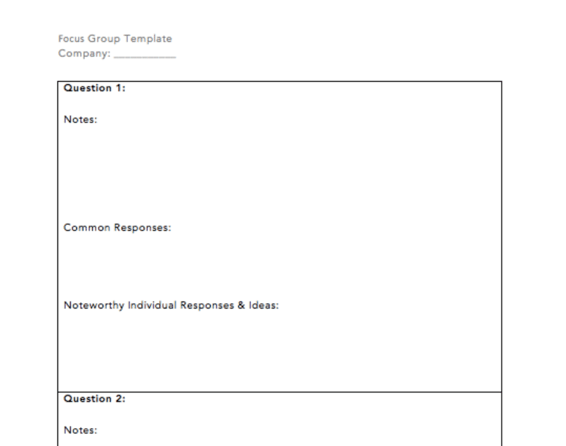
For a free template for notetaking during focus groups, a guide on conducting market research, and several other templates, download our Market Research Kit.
Questions for Building Trust Among Focus Group Members
Before diving into deeper questions, it’s best to warm up the group with a couple of open-ended questions that allow participants to get to know each other a little bit. Participants should be able to decide how much they want to share with the group — don’t force anyone to share something they may not feel comfortable sharing.
By including a question that allows people to talk about something tangential to the topic of the focus group, your participants will begin to build empathy for each other. That empathy can grow into trust, which is key for eliciting honest insights out of your group.
Here are a few questions you might ask to build trust:
- Share an aspect of your work or life experience that’s brought you here today.
- Why did you decide to join our focus group today?
- When and how did you first come across our brand/product/service?
Questions to Encourage Follow-up and Continuation of Ideas
The most helpful insights that come out of focus groups are often the most specific points. Challenge your participants to reflect more on the points they’ve made if you hear something that you’re curious about. For instance:
- That’s a fascinating point that [name] just said — what do you all think of that?
- Do you agree or disagree with [name]’s statement, and why?
- [Name], you’ve been a bit quiet recently. Did you have any thoughts on this topic that you wanted to share?
Questions for Understanding Customer Perception of Your Product or Service
These questions will help you understand how people truly feel about your brand, product, or service. The focus here is on your company — not the larger industry landscape or your competitors.
Avoid stopping conversation here unless the group gets completely sidetracked. Open-ended questions can be daunting at first. Participants may not know where to start. However, hearing from the other participants will spark reflection on various aspects of your product or service. Be sure to allow each group member who has something to say to speak up before moving on to the next question.
- How would you describe our company to other people?
- How would you describe our product/service to other people?
- What words or feelings come to mind when you think about our company?
- How likely are you to recommend our product/service to a friend?
- How well do you feel we incorporate feedback from you, our customers, into our service/product?
- What ultimately pushed you to purchase this product/service?
- Where would you buy this product/service?
- What do you like about this product that you may not find in a similar one?
- When you think about our industry, which brands come to mind first?
- Which other brands in our industry did you consider when you were shopping around?
- Why didn’t you go with one of our competitors?
- What other products/services come to mind when you look at this one?
Questions to Learn What Your Leads and Customers Want to See From You
Listening to your customers’ feedback and suggestions for improvement is crucial to retaining customers and turning them into promoters of your brand. It may be difficult to hear the answers to these questions, but turning customer pain points around will elevate your product or service to the next level.
Avoid defending your product or service or setting any limitations on these questions. Instead, frame them in a way that allows anyone to voice anything at all that they’re feeling. Recognize that it can be daunting for anyone (especially people with whom you’ve built relationships) to share negative feedback, so thank them for their candor.
- If you could wave a magic wand and change one thing about our product/service, what would it be?
- What would you most like to add to or improve about this product?
- What do you envision is the lifespan of this product/service before you upgrade or replace it?
- Is there anything we haven’t touched on today that you’d like us to know?
Questions for Understanding Your Buyer Personas
The following eight questions will help you understand what motivates your target buyer persona, their habits, their responsibilities and decision-making power, and their preferences.
These questions are written to spark discussion about topics other than your company, product or service, and the competitive landscape.
Don’t worry if the conversation seems to stray far from your brand, as the insights that people end up sharing will likely reveal what’s significant to them in their life and work. However, it’s important you keep the group focused on the specific question you’ve asked.
- Describe your job title and your day-to-day responsibilities.
- What’s one task on which you feel you spend way too much time?
- How do you define success in your role/your life?
- What is the biggest challenge you face in your role/when it comes to the problem to which this product is a solution?
- When you’re browsing online, on which websites do you spend most of your time?
- What are the first three apps you open on your phone in the morning?
- How do you prefer to receive communications from our company? (Specify what type of communication here — product updates, renewal notices, product/service coaching, meeting reminders, urgent alerts, etc.)
- Would you be the one using this product/service most in your household/job? If not, who would be?
Questions for Getting a Better Sense of the Competitive Landscape
These questions are intended to spark discussion about the brands in your industry that are top-of-mind for consumers. These are helpful in removing any biases that you and your team might have as people who work in the industry and know various players very well.
To encourage honesty, avoid agreeing with any disparaging comments that your participants make about your competitors. Instead, use the opportunity to ask follow-up questions about exactly what the participants don’t like about a specific product or brand.
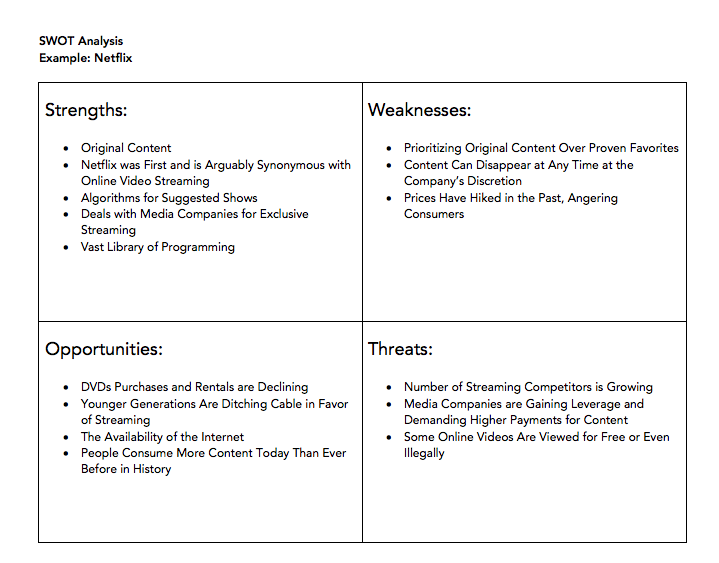
If you’re looking to do a complementary research-based analysis of your competitors, download our Market Research Kit to gain access to a S.W.O.T. analysis template.
Questions for Generating Content on Your Industry
You might be looking to develop a content strategy for your brand, branch out into a new content medium, or simply generate new content ideas. Any successful content strategy prioritizes what’s most engaging and interesting for your target buyer persona, so a focus group can be an effective way to be sure that you’re producing material on the right topics and in the medium that your audience wants to consume.
- What is one recent trend you’ve noticed in our industry?
- What’s one strategy or tactic you think is underrated in our industry?
- Where do you go to get a pulse on the things going on in our industry?
- Who are the people in our industry who you look to as experts?
- What format of content do you consume to keep up with our industry? Social media posts? Blogs/long-form posts? Podcasts? News outlets?
- Which specific sources do you go to for information on our industry?
- What gaps do you see in the content about our industry online? What are the topics on which you’d like to see more education?
Questions for Understanding Product Demand for Something You Haven’t Yet Put Out in the Market
These eleven questions are intended to help you understand the demand for a new product or service. These questions will uncover buying habits for a product like the one you’re envisioning and whether there’s true product-market fit.
- What is/was your first reaction to the product?
- How often do you/would you use this type of product?
- Would you be the one deciding to purchase this product/service? If not, who would be?
- When and where do you use our product?
- When you think about the product, do you think of it as something you absolutely need, something you could do without, or something that’s somewhere in the middle?
- How much would you be willing to pay for a product like this?
- How would you ideally like to buy this product? Would you talk to a sales rep, or would you rather purchase it on your own?
- What do you think this product is missing?
- How would you describe someone who you think would use this product/service?
- If you ended up liking your experience with this product, could you see yourself repurchasing it? If so, how often?
- If you could either have this product/service or the equivalent dollar value for you/your business, which would you choose? Why? (Specify the dollar value of your product/service when asking this question.)
Questions for Establishing (or Re-establishing) Your Name and Branding
The following questions are helpful for running word association brainstorms and generating potential names or parts of names for a new product or company.
- What words come to mind when you think of our product category? (Example: “What words come to mind when you think of food delivery?”)
- What words come to mind when you think of [insert a word that symbolizes the main value prop of your product/service here – for example, ‘efficiency,’ ‘speed,’ ‘health’]?
- If you have candidate names already:
- What is your initial reaction to this name?
- What words come to mind when you hear this name?
- How would you pronounce this? (Spell out the name on a piece of paper or whiteboard.)
And there you have it! 53 questions you can ask in your next focus group. If you’re unsure how to conduct a successful focus group, take a look at How to Run a Focus Group for Your Business.

18 Core Company Values That Will Shape Your Culture & Inspire Your Employees
Consider one of American Express’s company values — “Customer Commitment”. Ideally, if you’ve had a positive experience with one of American Express’s customer service reps, you’ve seen this value displayed first-hand.
Alternatively, take a look at one of Google’s values — “Focus on the user and all else will follow.”
Any Google search will show you they stand by their purpose to serve the user. Undoubtedly, you find most answers to your common questions on page one of Google, and more recently, it’s likely separated in its own featured snippet, as well.
Having core company values can help you ensure each of your employees, from top leadership to entry-level, are working towards the same common goal, and share a bigger purpose.
Purpose is undeniably critical for employee satisfaction. In fact, an Imperative survey of LinkedIn members found 73% of purpose-oriented members are satisfied in their jobs, compared to 64% who are not purpose-oriented.
Plus, purpose doesn’t just improve employee satisfaction — it also increases your bottom line. The same Imperative survey found 58% of companies with a clearly articulated and understood purpose experienced growth of +10%, compared to just 42% of companies that don’t prioritize purpose.
Ultimately, core values are critical if you want to create a long-lasting, successful, and motivating place to work.
Whether you work for a new company in need of core-value inspiration, or an older company in need of a value revamp, you’re in luck — here, we’ve cultivated a list of some of the best company values. Additionally, we’ll examine how some companies truly honor their values.
Company Values
- Integrity
- Boldness
- Honesty
- Trust
- Accountability
- Commitment to Customers
- Passion
- Fun
- Humility
- Continuous Learning
- Ownership
- Constant Improvement
- Leadership
- Diversity
- Innovation
- Quality
- Teamwork
- Simplicity
Examples of Companies with Inspiring Core Values
1. American Express
- Customer Commitment: We develop relationships that make a positive difference in our customers’ lives.
- Quality: We provide outstanding products and unsurpassed service that, together, deliver premium value to our customers.
- Integrity: We uphold the highest standards of integrity in all of our actions.
- Teamwork: We work together, across boundaries, to meet the needs of our customers and to help our Company win.
- Respect for People: We value our people, encourage their development and reward their performance.
- Good Citizenship: We are good citizens in the communities in which we live and work.
- A Will to Win: We exhibit a strong will to win in the marketplace and in every aspect of our business.
- Personal Accountability: We are personally accountable for delivering on our commitments.
American Express doesn’t just hit the bare minimum when it comes to polite, helpful customer service — they go above-and-beyond to solve for their customers, even when there’s no protocol in place.
For instance, Raymond Joabar, the Executive Vice President at American Express, recently told this story in a Forbes interview: “One time, a hotel café manager [an Amex merchant] alerted my team that he had accidentally sold a display cake with harmful chemicals and needed to find the customers before they ate it. Obviously, there’s no procedure for that, but our team took ownership of the problem. They gathered all the information they could from the record of charge, identified 21 Card Members who used their cards at the café during that time frame, reviewed the accounts to find the right match, and then called the Card Member in time before they served the cake at an anniversary party.”
“The important point here,” Joabar noted, “other than that everybody ended up safe and sound — is that there isn’t a script for every situation, so we empower our care professionals to do what’s right for the customer. And we recognize what they do with this empowerment as well. We give awards to employees who go above and beyond to help customers and we share their stories across the company.”
This anecdote exemplifies American Express employees’ commitment to their customers even when it’s not easy, and demonstrates the company’s dedication to living by its values.
2. Google
- Focus on the user and all else will follow.
- It’s best to do one thing really, really well.
- Fast is better than slow.
- Democracy on the web works.
- You don’t need to be at your desk to need an answer.
- You can make money without doing evil.
- There’s always more information out there.
- The need for information crosses all borders.
- You can be serious without a suit.
- Great just isn’t good enough.
On Google’s philosophy page, they don’t just list their core values — they also provide examples.
For instance, consider their value, “You can make money without doing evil.” While many companies likely tout the benefits of integrity, Google references strategic efforts its made to avoid “evil” business, including — “We don’t allow ads to be displayed on our results pages unless they are relevant where they are shown … We don’t accept pop–up advertising, which interferes with your ability to see the content you’ve requested … [and] Advertising on Google is always clearly identified as a ‘Sponsored Link,’ so it does not compromise the integrity of our search results.”
Ultimately, a core value doesn’t have much power if your company can’t list intentional, calculated decisions it’s made to put values ahead of profit.
3. Coca Cola
- Leadership: The courage to shape a better future.
- Collaboration: Leverage collective genius.
- Integrity: Be real.
- Accountability: If it is to be, it’s up to me.
- Passion: Committed in heart and mind.
- Diversity: As inclusive as our brands.
- Quality: What we do, we do well.
Coca Cola demonstrates its diversity core value with its public Global Diversity Missionpage, which lists the company’s diversity-related efforts, such as, “[collecting employee] feedback through formal surveys and informally through their participation in our business resource groups, various diversity education programs and our Resolution Resources Program, where associates can work to resolve issues they face in our Company.”
Additionally, Coca Cola’s Global Diversity Mission page exemplifies their commitment to accountability, as well — they’ve publicly included pie charts with statistics regarding their global employee gender and race ratios. By acknowledging both their efforts and their shortcomings, Coca Cola is able to show their desire to live up to their values, while taking responsibility for any mis-match between their ideals and reality.
4.Whole Foods
- We Satisfy And Delight Our Customers — Our customers are the lifeblood of our business and our most important stakeholder. We strive to meet or exceed their expectations on every shopping experience.
- We Promote Team Member Growth And Happiness — Our success is dependent upon the collective energy, intelligence, and contributions of all of our Team Members.
- We Care About Our Communities And The Environment — We serve and support a local experience. The unique character of each store is a direct reflection of a community’s people, culture, and cuisine.
- We Practice Win-Win Partnerships With Our Suppliers — We view our trade partners as allies in serving our stakeholders. We treat them with respect, fairness and integrity – expecting the same in return.
Underneath each of its values on its core value page, Whole Foods provides a link, such as, “Learn more about how we care about our communities and the environment.”
Ultimately, their page demonstrates their ability to walk the walk. For instance, to exemplify their commitment to local communities, Whole Foods created a Local Producer Loan Program, in which they provide up to $25 million in low-interest loans to independent local farmers and food artisans.
Additionally, Whole Foods provides a list of environmentally-friendly efforts they’ve practiced since 1980, including “Printing and packaging using recycled paper and water- or vegetable-based, composting to decrease landfill waste, and no single-use plastic bags at checkout since 2008”.
If you’ve ever been to a Whole Foods, you know they’re serious about their efforts to reduce waste and help the local community. In fact, its part of the reason so many customers are brand loyalists — because they support those efforts, too.
Ultimately, good core values can help an audience identify with, and stay loyal to, your brand, rather than flipping between you and competitors. To ensure long-term success andlong-term employee retention, it’s critical you create — and live by — certain non-negotiable company values.

The Ultimate Guide to Marketing Interview Questions From HubSpot’s CMO
Alright, everyone: I’m about to let you in on a few of my best-kept interviewing secrets.
In this post, I’ll uncover real questions I use when interviewing candidates for inbound marketing positions and the answers I’m looking for.
These questions are meant to assess candidates not only for their marketing talent, but also for who they are as people.
Keep in mind that the best candidates aren’t just qualified to do the job you’re trying to hire them for. You want to look for people who are also passionate about marketing, fit with your culture, and show potential for growth at your company.
Here’s a quick look into my interview approach, followed by 14 excellent interview questions I recommend adapting for your industry and hiring needs.
My Interview Approach
During interviews, I put a lot of stake into each candidate as an individual. My goal is always to find someone amazing who also has great long-term potential, no matter where they are in their career.
To uncover this, I like to ask questions that get at the core of who they are, how they think about things specifically, and how they’ve gotten things done in the real world. I then balance these questions with case-style questions, which usually involve a hypothetical business situation, because they give the candidate an opportunity to show how they think about and work on problems.
Below is a list of 14 questions that make for an effective marketing job interview, the majority of which I’ve asked candidates with whom I’ve personally gotten to meet.
Keep in mind that I don’t ask all of these questions during a single interview. In fact, one case-style question can evolve into a discussion lasting anywhere from 10 to 30 minutes, so I often only have time to cover two or three questions during one session.
I also don’t limit these questions to the position levels you’ll see in each section below. This list is just one reasonable way to organize your job interviews based on the average experience of an intern, coordinator, manager, and director. Depending on the candidate and the needs of the role, a question to a marketing manager candidate might be a good question to ask a marketing coordinator candidate as well.
Before the interview starts, carefully choose the questions you want to use based on the person’s role and background. For an inbound marketing generalist, you could ask any or all of these questions. For someone with a more specific role on a larger inbound marketing team, like a blogger, you could focus only on the questions about blogging and content creation.
Learn more in the following video, and check out some of my favorite interview questions below.
14 Interview Questions to Ask Marketing Job Candidates
Case-Style Interview Questions
1. “Draw a funnel on the whiteboard showing 10,000 visitors, 500 leads, 50 opportunities, and 10 new customers (or any other numbers you think are interesting). Now, pretend you’re the CMO for the company, and you have to decide what your marketing team should do to improve on these metrics. Which areas of the funnel would you focus on, and what would you do differently to change these results?”
The Follow-Up: The follow-up here is simply pushing on the candidate’s answers. Typically, they’ll pick one part of the funnel to focus on. (And if they don’t, I like to push them to do just that.)
Once they pick one area, I ask them follow-up questions like: “Which tactics would you think about changing?,” “What have you done in your past role that’s worked?,” “Do you think our company has any unique advantages to get some leverage out of that stage of the funnel?” I don’t just want them to tell me to “improve the visitor to lead conversion rate” — they need to tell me how.
If I have time, I’ll tell them to pretend they’ve implemented their ideas, and I’ll ask them to go back through the whole funnel and explain how they think each of those initial metrics have changed.
What to Look For: Everyone on the marketing team needs to be able to understand how to think about and optimize the funnel. Here’s where you assess their thought process, whether they have an intuitive sense of what good and bad conversion rates are, and whether they understand how the funnel steps are connected.
You’ll also gain some insight into whether they understand which different tactics you can use at each step to improve that particular step. (For example, if they say the lead-to-opportunity conversion rate is bad, the right answer is not to write more blog articles.)
2. “We have two potential designs for the homepage of our website, but we don’t know which one to use. The CEO likes one, and the COO likes another. Half the company likes one, and the other half of the company likes the other. Which one should we use?”
The Follow-Up: This type of question should elicit a ton of questions from the candidate, like who the target audience for the homepage is. If it doesn’t, then they’re either making up their answer or don’t have enough knowledge to address the situation. Follow up by answering their questions with hypotheticals and seeing how they work through the problem.
If they do pick one side or the other and give you a reason, ask them what the goals are for the homepage. Then, ask them how they’d determine which homepage meets those goals best. From there, tell them that Homepage A performed well based on one of the criteria, and Homepage B performed well based on another one of the criteria. This way, you can assess how they make choices when it’s not possible to get data that’s 100% conclusive, and they have to choose between two, imperfect variations.
What to Look For: While it might seem like this question is all about design, what you’re really doing is understanding how candidates approach a conflict of interest. Do they care what each of these people think, or do they go to the data for their answers, such as through A/B testing, user testing, and customer interviews. The best candidates introduce logic and marketing methodology into their answers, while removing opinions. I also like when candidates say you should be constantly tweaking and improving the homepage, rather than always doing a complete redesign every nine or 18 months.
3. “Let’s say you have an Excel spreadsheet with 10,000 leads from a few months back — long enough that those leads’ sales cycle has passed. The file contains information about each lead, like their industry, title, company size, and what they did to become a lead (like downloading an ebook). Also in the file is whether they closed as a customer and how much their order was for. Can you use this information to create a lead score? How would you do it?”
Note: I often start this question by simply asking, “How should you create a lead score?” This is how I sort out the people who don’t take a data-driven approach. Folks who answer, “You create a lead score by talking to the sales team and then assigning five or ten points to each of the criteria they say they want” are actually wrong. That is not a data-driven approach to lead scoring, and it is way too simplistic to work effectively in most cases.
The Follow-Up: Most people will answer by talking about “looking at the data” and “sorting the data.” Push them to tell you how they’d do that in Excel (or another program if they prefer something else). It’s not practical to just “look” at the data when you have 10,000 rows — you need to use statistical analysis.
They also might zone in on one factor, perhaps industry, all alone. If they do that, you should ask them what they would say if the small companies in one industry are good leads, but the big companies in another industry are also good leads? Basically, just keep pushing them until they’re at a loss for what to do next.
What to Look For: This case-style question is meant to test a candidate’s quantitative abilities, and I’d only ask it for people applying for certain marketing roles (like operations). Here, I’m trying to figure out how the candidate thinks about analyzing data and what their sophistication level is around data.
Most people don’t get very far and are either unwilling or unable to look at more than one variable at a time, or understand how to analyze a lot of data in a simple way. At a minimum, you want to find candidates who:
- Look at the leads who closed in one group and compare them to the leads who did not close
- Look at multiple variables at a time
- Use statistical functions in Excel or another program to do that, like summary tables, pivot tables, and so on
If you find someone who starts making a coherent argument about why you might want to use logistic regression, factor or cluster analysis, actuarial science, or stochastic modeling to figure this out … refer them to me.
Marketing Internship Interview Questions
4. “What is one of your hobbies? How do you do it?”
This question will help you assess a candidate’s ability to explain a concept they know intimately to someone who isn’t as familiar with it. If their hobby is training for a marathon, ask them what advice they’d give you if you woke up one day deciding you wanted to train for a marathon. Are they able to communicate it clearly?
One candidate taught me how to make tagliatelle, which is hand-cut Italian pasta. She gave me the full run-down on how you make the noodles, how you form them and cut them, and which ingredients go into the sauce. She relayed the step-by-step process to me in a way that was very clear and understandable. I felt like I could’ve gone home and made tagliatelle myself. Not only did this tell me she knows how to convey information clearly, but it also gave me insight into her personality and interests.
5. “What brands do you like or follow on social media and why?”
This is another casual but useful question, as it can tell you both about a candidate’s personal interests and how they perceive marketing content on social media. The best answers go further than which companies a candidate likes buying from — they indicate why he or she trusts certain companies, what about their content strategy appeals to the candidate, and what specifically about those companies the candidate looks up to (and maybe wants to emulate in their own work).
If you need a candidate to elaborate, follow up by asking them to describe a post from a brand they like or follow, and what made that post so memorable to them.
Marketing Coordinator Interview Questions
6. “What do you read, and how do you consume information?”
Marketing is changing constantly at a rapid pace — so anyone in a marketing role needs to know how to stay on top of and adapt to these changes. Do they know where to look for industry news? Are they familiar with and subscribed to top marketing blogs? What do they do when they see a change has taken place, like when Google updates their algorithm?
7. “What’s an example of a lead-generating campaign you’d be excited to work on here?”
Not every marketing campaign you run generates the same type or quality of leads. This is what makes this question so interesting. It’s a chance for you to see how a marketing candidate thinks about the buyer’s journey and what that journey should look like in your company.
If you do pose this question to a candidate, don’t expect him or her to know exactly how your business generates its leads. The ideal answer simply demonstrates an awareness of your customer and perhaps some on-the-spot brainstorming the candidate might be asked to participate in while on the job.
Expect follow-up questions from the interviewee, too, especially if you pose this question to a more experienced candidate. For example, they might ask how qualified the leads should be, or how leads are scored as a result of this hypothetical campaign. The specific parameters matter less than the follow-up question itself — a positive sign of an analytical marketer.
8. “What are three components of a successful inbound or digital marketing strategy?”
There’s no “right” answer to this question — a digital marketing strategy thrives on more than three things — but certain answers show the candidate is up to date on how businesses attract and delight their customers today.
“A Facebook page,” for instance, isn’t a wrong answer, but it doesn’t give you context around how a business would use this page in their marketing strategy. Here are a few sample answers to this interview question that are on the right track:
- A blog with calls to action (CTAs), landing pages for website visitors to download more content, and a defined social media strategy.
- An SEO strategy, website chat, and an analytics tool to track campaign performance.
- Buyer personas, a Marketing and Sales Service Level Agreement, and a customer success strategy.
You won’t learn everything about a candidate from just these terms and phrases. But you should listen for them as the candidate responds — and expect more sophisticated answers if you pose this question to managers or directors.
Ultimately, the value you place on each of these inbound marketing components will depend on how important they are to your business and what the candidate would focus on as your employee. Before asking this question to anyone you interview, talk to your team and define your marketing strategy. Otherwise, you won’t have an accurate measure on which to evaluate a candidate’s answer.
Interview Questions for Marketing Manager
9. “Why do you love marketing?”
Or, “Which aspects of our business are you passionate about?” You want to hire someone who’s both qualified and has the desire to do the work. Otherwise, why would they work for you instead of the company next door?
Part of their answer will lie in their body language and enthusiasm. The other part will lie in how concrete their answer is. Get at the details by asking a follow-up question, like: “Let’s say you’re at home, kicking around, and doing something related to marketing. What is it that you’re doing?” Perhaps they’re reading their five favorite marketing sites, or analyzing traffic patterns of websites for fun, or writing in their personal blog, or optimizing their LinkedIn profile. Whatever it is, you want to be sure they’re deeply passionate about the subject matter you’d hire them for.
10. “Between videos, ebooks, blog articles, photos, podcasts, webinars, SlideShare, Facebook, Twitter, LinkedIn, and Pinterest … there’s a lot of potential content our team should produce for inbound marketing. How do we do it all?”
The wisest candidates know you should not do it all, but rather, you should start with the content that’s most important to your prospects and customers. They should also have a plan for talking to customers and prospects by way of interviews or surveys to figure out which social networks they use and which types of content they prefer.
11. “Let’s pretend we have very convincing data that shows none of our potential customers use social media. Should we still do it? Why?”
Look for candidates who understand that being successful in social media is important even if your customers aren’t there today. Here are a few reasons qualified candidates might cite:
- Your customers will be there in the future, so you should get started now.
- You’ll gain industry clout. After all, journalists and influencers in your industry are probably using social media — and it’s important for them to follow you even if they don’t ever become customers.
- Social media activity impacts your organic search presence, helping your content rank higher in search engines.
- You’ll have more control over your online presence.
- Your competitors are likely using social media.
- It may cost less to generate customers via social media.
Marketing Director Interview Questions
12. “We have a new product coming out in three months. What would you do to launch it?”
This’ll show you how well a candidate understands all the different tactics of inbound marketing and how to tie them together into a holistic plan. It’ll also give you insight into how creative they are and whether they can come up with new and interesting ways to do marketing.
13. “Our CEO wants you to evaluate our blog. What would you say?”
Before giving you an answer, the best candidates will come back and ask you about the blog’s metrics, how many leads and customers it generates, what the goals are for it, how much you’re investing in it, and so on. This is also a great way to test whether they actually prepared for the interview by reading your blog.
14. “What’s the main relationship between marketing and sales?”
The relationship between Marketing and Sales is known for its unrest (Sales wants better leads from Marketing, and Marketing wants Sales to close more, faster).
Similar to question #8, there’s no right answer here, but there are answers you should listen for. “Marketers are the lead generators and salespeople are the lead closers” isn’t necessarily wrong, but the candidate who ends his/her answer here might not be someone who can align both departments around a single, unified approach.
The best answers describe the responsibilities that Sales and Marketing have to each other, and the duties each commits to as part of this partnership. They have a plan for forging consensus on what makes leads marketing-qualified versus sales-qualified, creating a shared Service Level Agreement with agreed-upon metrics, and using content at different points in the marketing and sales funnel to turn strangers into customers.
The Candidate’s Follow-Up
Most candidates know to follow up with each of their interviewers in the form of a thank-you note or email. But part of my assessment is the depth at which candidates follow up with me.
The most impressive follow-ups are the thoughtful ones, where candidates call upon details of our discussion to show they’re really engaged in the interview process. Perhaps they did more concrete thinking about a specific question I asked, and they send a long email including research on a question they don’t think they nailed. Many times, they’ll send me a light strategy document with ideas and/or research on something we talked about. These candidates tend to stand out.
Well, the cat’s out of the bag. You’ll have to use these marketing interview questions as a basis to create your own, similar questions that are relevant to your industry and hiring needs. Good luck, and happy hiring!
Want more interview tips? Learn about some of the questions candidates should ask hiring managers.

The Ultimate Guide to Branding in 2020
Products are never just products, right?
Coca-Cola is more than a soda. Starbucks is more than a coffee. Ray-Ban is more than a pair of sunglasses. Glossier is more than a tube of concealer.
Interacting with these products provide experiences, and we buy them with that experience in mind. Better yet, the companies that create and market them know exactly the experience they want you to have when you make (or consider) a purchase. That’s why they create a brand.
From the language in their Instagram caption to the color palette on their latest billboard to the material used in their packaging, companies who create strong brands know that their brand needs to live everywhere. They know their names extend far beyond the label.
The result? These brands are known, loved, and chosen out of a long lineup of options.
Who doesn’t want that? I know I do. That’s why we built this guide — to equip you to create and manage a strong brand that’ll help your business be admired, remembered, and preferred.
Use the links below to jump ahead to sections of interest, and don’t forget to bookmark this guide for later.
What’s a brand?
Before I dive into the importance of branding and how to build a brand, let’s go back to basics: What is a brand?
A brand is a feature or set of features that distinguish one organization from another. A brand is typically comprised of a name, tagline, logo or symbol, design, brand voice, and more. It also refers to the overall experience a customer undergoes when interacting with a business — as a shopper, customer, social media follower, or mere passerby.
What is branding?
Branding is the process of researching, developing, and applying a distinctive feature or set of features to your organization so that consumers can begin to associate your brand with your products or services.
Branding is an iterative process and requires getting in touch with the heart of your customers and your business. It’s important for a variety of reasons — I dive into these next.
Branding can be the deciding factor for consumers when they make a purchase decision. In a 2015 global Nielsen survey, almost 60% of shoppers said they actively buy from brands they know, and 21% said they bought a product because they liked the brand.
Branding gives your business an identity beyond its product or service. It gives consumers something to relate to and connect with.
Branding makes your business memorable. It’s the face of your company and helps consumers distinguish your business across every medium (which I discuss later).
Branding supports your marketing and advertising efforts. It helps your promotion pack that extra punch with added recognition and impact.
Branding brings your employees pride. When you brand your company, you’re not only giving your business identity, you’re also creating a reputable, highly-regarded workplace. Strong branding brings in strong employees.
Branding Terms to Know
Here are some other brand-related buzzwords you should know. They further demonstrate the importance and value of branding your business.
Brand awareness
Brand awareness refers to how familiar the general public and your target audience is with your brand. High brand awareness leads to brands being referred to as “trending,” “buzzworthy, or “popular.” Brand awareness is important because consumers can’t consider purchasing from your brand if they’re not aware of it.
👉🏼 Strong branding makes your business known.
Brand extension
Brand extensions are when companies “extend” their brand to develop new products in new industries and markets. Consider Honda lawn mowers or Martha Stewart bedding. Brand extensions allow companies (or individuals) to leverage brand awareness and equity to create more revenue streams and diversify product lines.
👉🏼 Strong branding brings in more money.
Brand identity
Brand identity is the personality of your business and the promise you make to your customers. It’s what you want your customers to walk away with after they interact with your brand. Your brand identity is typically comprised of your values, how you communicate your product or service, and what you want people to feel when they interact with it.
👉🏼 Strong branding gives your business more than a name.
Brand management
Brand management refers to the process of creating and maintaining your brand. It includes managing the tangible elements of your brand (style guide, packaging, color palette) and the intangible elements (how it’s perceived by your target audience and customer base). Your brand is a living, breathing asset, and it should be managed as such.
👉🏼 Strong branding requires consistent upkeep.
Brand recognition
Brand recognition is how well a consumer (ideally in your target audience) can recognize and identify your brand without seeing your business name — through your logo, tagline, jingle, packaging, or advertising. This concept goes hand-in-hand with brand recall, which is the ability to think of a brand without any visual or auditory identifiers.
👉🏼 Strong branding keeps your business top-of-mind.
Real-life brand example: Want to test your brand knowledge? Take this Logo Quiz by Business Insider to see how well you know your corporate brands. This is brand recognition at work.

Brand trust
Brand trust refers to how strongly customers and consumers believe in your brand. Do you deliver on your marketing promises? Do your salespeople and customer service go above and beyond? These things can create trust among your customers, which is important in a world where a mere 25% of people feel confident in large businesses.
👉🏼 Strong branding builds trust with your customers.
Brand valuation
Brand valuation is the commercial valuation of your brand derived from consumer perception, recognition, and trust. This concept goes hand-in-hand with brand equity. A powerful brand can make your business invaluable to investors, shareholders, and potential buyers.
👉🏼 Strong branding increases your business’s value.
Want to build an effective, measurable brand? Download our free guide on How to Build a Brand in 2019.
Here’s how you can create a brand — or begin the process of rebranding your current one.
There’s a lot that goes into a brand, and there’s a lot to consider when building a strong one. So, grab a notebook and jot down ideas as you move through this section. Recognize that branding is an iterative process, so you might be repeating some of these steps as you brainstorm and build your brand.
1. Determine your target audience
Branding leads to awareness, recognition, trust, and revenue. We’ve talked about that. But let’s take a step back and understand where those stem from: consumers. And not just any consumers — your target audience and customers.
If your brand doesn’t resonate with your audience, it won’t lead to that awareness, recognition, trust, and revenue. That’s where target market research comes in.
Before pressing pen to paper (or cursor to digital document), you must understand to whom your branding will be speaking. Who does your product serve? Who is your ideal customer? Why did you create your business in the first place?
What you learn about your target market and buyer personas will influence your branding decisions down the line, so make this step your first priority.
Download our free Persona Templates to easily organize your target audience research and strengthen your marketing.
2. Establish your mission statement
Let’s return to a question I asked in the previous step: Why did you create your business? Answering this will help you build your mission statement, which defines your purpose and passion as an organization.
Before you can craft a brand that your audience recognizes, values, and trusts, you must be able to communicate the purpose that your business provides. Then, every part of your brand (logo, tagline, imagery, voice, and personality) can reflect that mission and vision.
Your mission statement is a building block of your brand manifesto, which encompasses why your organization exists and why people should care about your brand.
Download our free guide to Defining Inspiring Mission and Vision Statements and learn the ins-and-outs of two of the most valuable strategic planning elements for businesses.
3. Define your unique values, qualities, and benefits
There are probably lots of businesses in your industry and niche. It’s easy to focus on your competition (and there’s a time and place for competitive analysis), but, for now, let’s focus on you.
What’s one thing that your business has that no one else can mimic (er, legally)? Your brand.
Because of that, you must ensure that your brand is comprised of and inspired by elements that are solely yours: the values, benefits, and qualities that make your company unique.
Take a moment to jot down a list of what sets your business apart from others. I’m not talking about product features (like appearance, components, or capabilities); I’m referring to how your products or services improve lives and contribute to success.
Real-life brand example: Alani Nutrition
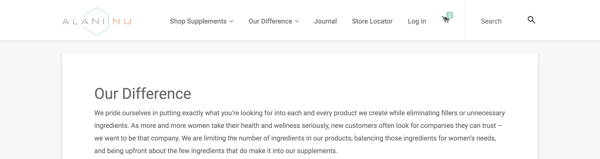
You’ve probably never heard of Alani Nu; they’re a nutrition company based in my hometown of Louisville, Kentucky. I order their vitamins because 1) they’re proven to work, and 2) I trust and respect the brand (and it’s gorgeous!). On their website, they’ve clearly and simply outlined their unique values and benefits as part of their overall brand. Highlighting these makes it easy for customers like me to trust their products and choose them over competitors.
4. Create your visual assets
At this point, you should understand your target audience, your mission statement, and the unique qualities that make up your business.
If you can say with confidence that you’ve mastered these steps, it’s time to move onto one of the more exciting parts of branding — the visual design. We’re talking about your logo, color palette, typography (fonts), iconography, and other visual components.
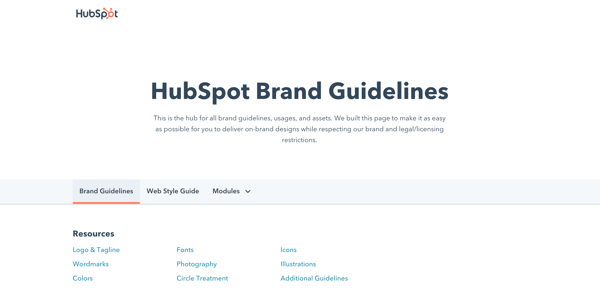
As you create these elements, build a set of brand guidelines (or a brand style guide) to govern the composition and use of your visual assets. This will ensure that whoever uses your new branding does so accurately and consistently. Check out HubSpot’s brand guidelines for reference.
Note: Design can be just as intimidating as it is exciting. Consider hiring a professional with logo and identity design experience or starting with a few helpful design templates.
5. Find your brand voice
Next, consider the auditory component of your brand. What would your brand sound like if you had a conversation with it, or if it texted you?
How you communicate with your target market is also considered part of your branding. You want to define a brand voice that connects and resonates with your audience — otherwise, they probably won’t pay attention. Because of that, don’t hesitate to return to step one to get familiar with to whom you’re speaking.
From your advertising campaigns and social media captions to your blog posts and brand story, ensure your tone is consistent throughout all of your written content. Give your audience a chance to get familiar with your brand and learn to recognize the sound of your voice. Better yet, master a fun, entertaining voice, and your customers will look forward to your social media and email updates.
Real-life brand example: MailChimp
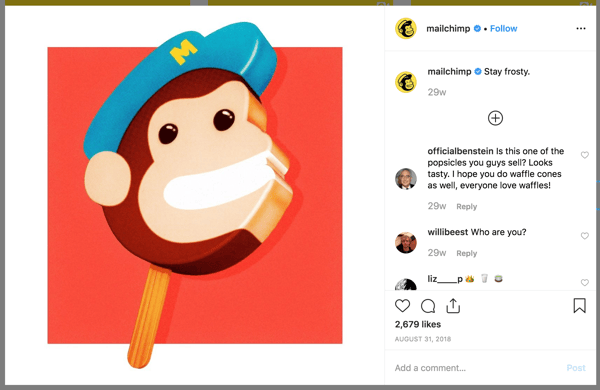
MailChimp is a great example of a brand that speaks with a clear, consistent tone. When I used their free plan for my small business, I always chuckled when receiving their emails and working in their interface. From its web copy to its email blasts and social media captions, MailChimp has established a brand voice and personality that is personable, fun, and accessible — it can be hard to explain the technical parts of a software product (like A/B testing), but MailChimp has mastered that, too.
6. Put your branding to work
Your brand only works if you do. Once you finish designing and creating your new brand (or rebrand) integrate it throughout every inch of your business. Pay extra attention to ensure it’s displayed anywhere your business touches customers. Here are a handful of tips for applying your brand across your organization.
Website
Splash your logo, color palette, and typography across your website. Don’t use anything but your predefined assets in your brand guidelines. Your website is a major part of your company identity — if it doesn’t reflect your brand, it will only provide a jarring customer experience. Also, be sure that all web copy, calls-to-action, and product descriptions reflect your brand voice.
Social media
All profile photos, cover art, and branded imagery should reflect your brand. Consider putting your logo as your profile photo — this will make it easier for customers to recognize your business. As with your website, be sure all profile information, posts, and captions reflect your brand voice.
Packaging
If you have a physical products business, your product is probably the most tangible way that customers interact with your brand. For that reason, your packaging should reflect your new branding — in its design, colors, size, and feel.
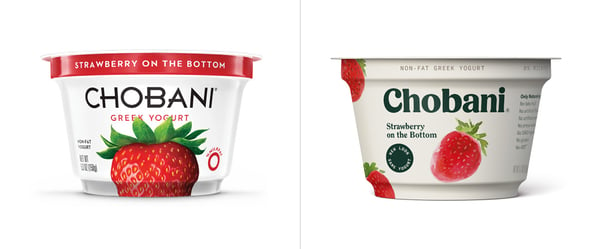
Real-life brand example: Chobani
I love Chobani yogurt (confession: I’m eating it right now). Their new branding immediately tells me that they produce authentic, healthy Greek yogurt. That’s one of the main reasons I buy Chobani. Recently, I realized that their yogurt packages are made with a very earthy, textured material — an intentional decision that supports the overall experience they’ve paired with purchasing and eating the Chobani brand.
Advertising
Because advertisements (digital and print) are often used to establish brand awareness and introduce consumers to your brand, it’s critical that they reflect your branding. In fact, your branding should make the ad creation process easier — with your brand style guide, you already know how your ads should appear and what type of copy to write.
Sales and customer service
A brand is only as powerful as the people behind it, and if your people aren’t putting your brand to work, it won’t work for you. Moreover, your brand applies to more than your marketing. Inform your sales and customer service folks of your brand guidelines and tell them to use it, especially when they engage directly with customers. Whether they are sharing a branded product demo or answering customer support inquiries, encourage them to use your logo, tagline, imagery, and brand voice.
Treat your brand as a person
To best wrap your head around the branding process, think of your brand as a person. Your brand should have an identity (who it is), personality (how it behaves), and experience (how it’s remembered).
Ask yourself these questions about your brand:
- How would your brand introduce itself? If it had to describe its appearance, how would it do so?
- How would your brand talk about your products or services? Would it be serious and professional, or would it be humorous and edgy?
- What would someone say about your brand after “meeting” it for the first time? What are a few sentences they’d use to describe it?
The purpose of branding is to create relationships with your customers. The easiest way to do this is to treat your brand as a person and understand that you want your customers to do the same.
Real-life brand example: Whiskey Riff
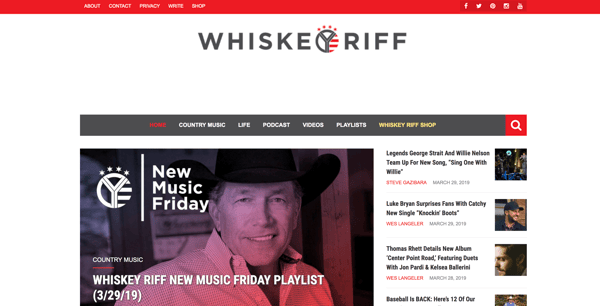
Whiskey Riff is another brand you’re probably not familiar with. It’s a two-man media company based here in Chicago that’s dubbed themselves “the most entertaining country music site ever”. I’m a fan because I love country music, enjoy their written and podcast content, and proudly wear some of their awesome apparel.
If Whiskey Riff was a person, here’s how I’d think it would answer the questions above:
- “Hey, I’m Whiskey Riff. I love country music and, you guessed it, Whiskey. My logo was inspired by the Y in the circle on the Chicago Theater marquee, and I’m adorned with horizontal red stripes and stars — which represent the American and Chicago flags.”
- “I publish in-your-face content about what’s going on in country music today. If you don’t like it, don’t read it. My podcast featured my founders interviewing country music artists and telling hilarious stories. Check out my apparel line; my t-shirts, tanks, hats, and accessories can be seen at country music festivals (and on stages) nationwide.”
- “Whiskey Riff is like that first shot of Jack Daniels — that much-needed, refreshing drink after a long day. Its a break from that cookie-cutter way of life, and you immediately appreciate — and trust — its candidness. There’s absolutely nothing like it in the industry.”
Prioritize consistency
Inconsistency is the number one branding mistake that companies make. Inconsistency undermines your brand and confuses your customers. Recognizable, valuable brands prioritize consistency — and they reap the benefits. When your brand is a unified presence across mediums and platforms, customers can easily get familiar with, recognize, and come to prefer your brand over time. Brand guidelines can help with this initiative.
Build and follow a brand strategy
A brand strategy is more than your brand guidelines; it’s a plan with specific, long-term goals that can be achieved as your brand evolves. These goals typically revolve around your brand’s purpose, emotion, flexibility, competitive awareness, and employee involvement.
Remember how I said that branding is a continuous process? There’s a lot that goes into it. A brand strategy can help you turn that process into a well-oiled practice that keeps your brand moving toward success and recognition.
Don’t let inspiration turn into imitation
Competitive analysis is important. Not only does it educate you on where your competition stands and how they are excelling, but it can also give you ideas on how you can improve or further set apart your brand.
However, be conscious to not fall into an imitation trap. Keep your competitive research limited and focus on what your organization brings to the table. Just because a competitor (or two) has branded their company in a certain way doesn’t mean that you have to follow suit. New, unique, provocative brands are memorable brands.
Use branding to hire
Strong branding makes your employees proud. I know I’m proud to be associated with HubSpot, much less work there. Leverage your branding to attract talented people. If hiring is a strong initiative for your organization, dedicate some of your resources to employer branding. Employer branding is how you market your company to job seekers and current employees. If you’re publically proud of your organization, others will be, too.
Ready, Set, Brand
Branding is your organization’s name, logo, color palette, voice, and imagery. It’s also more. It’s that intangible feeling your customers have when they interact with your brand. You know … that experience we talked about in the beginning.
That’s how powerhouse brands deviate from all the others. The tangible components contribute to this — a gorgeous logo, a clever tagline, an authentic manifesto, and a clear brand voice — but truly strong brands thrive when they focus on the big picture of their brand. Get to the heart and soul of your target audience and your organization, and a successful brand will follow.

The Ultimate Guide to Storytelling
An art.
Not a process, method, or technique. Storytelling is described as an art … the “art” of storytelling.
And — like art — it requires creativity, vision, skill, and practice. Storytelling isn’t something you can grasp in one sitting, after one course. It’s a trial-and-error process of mastery.
Sounds like a lot of work, right? It is, and rightfully so because storytelling has become a crucial component of the most successful marketing campaigns. It sets apart vibrant brands from simple businesses and loyal consumers from one-time, stop-in shoppers.
It’s also the heart of inbound marketing.
Storytelling is an incredibly valuable tool for you to add to your proverbial marketing tool belt. That’s why we’ve compiled this guide, to help you discover and master storytelling and weave gorgeous, compelling tales for your audience.
Pick up your pen, and let’s dive in.
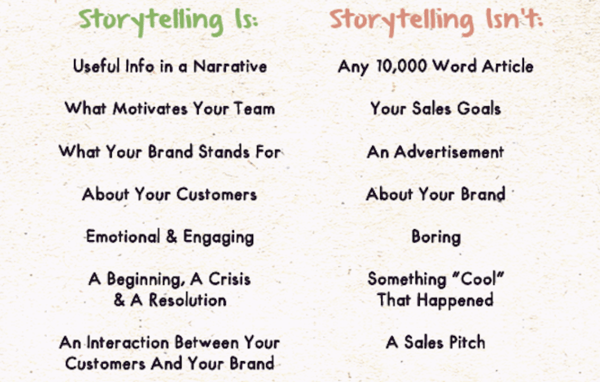
While this definition is pretty specific, stories actually resemble a variety of things. This graphic from ReferralCandy helps outline what stories are and are not.
Storytelling is an art form as old as time and has a place in every culture and society. Why? Because stories are a universal language that everyone — regardless of dialect, hometown, or heritage — can understand. Stories stimulate imagination and passion and create a sense of community among listeners and tellers alike.
Telling a story is like painting a picture with words. While everyone can tell a story, certain people fine-tune their storytelling skills and become a storyteller on behalf of their organization, brand, or business. You might’ve heard of these folks — we typically refer to them as marketers, content writers, or PR professionals.
Every member of an organization can tell a story. But before we get into the how, let’s talk about why we tell stories — as a society, culture, and economy.
Why Do We Tell Stories?
There are a variety of reasons to tell stories — to sell, entertain, educate or brag. We’ll talk about that below. Right now, I want to discuss why we choose storytelling over, say, a data-driven powerpoint or bulleted list. Why are stories our go-to way of sharing, explaining, and selling information?
Here’s why.
Stories solidify abstract concepts and simplify complex messages.
We’ve all experienced confusion when trying to understand a new idea. Stories provide a way around that. Think about times when stories have helped you better understand a concept … perhaps a teacher used a real-life example to explain a math problem, a preacher illustrated a situation during a sermon, or a speaker used a case study to convey complex data.
Stories help solidify abstract concepts and simplify complex messages. Taking a lofty, non-tangible concept and relating it using concrete ideas is one of the biggest strengths of storytelling in business.
Take Apple, for example. Computers and smartphones are a pretty complicated topic to describe to your typical consumer. Using real-life stories, they’ve been able to describe exactly how their products benefit users … instead of relying on technical jargon that very few customers would understand.
Stories bring people together.
Like I said above, stories are a universal language of sorts. We all understand the story of the hero, of the underdog, or of heartbreak. We all process emotions and can share feelings of elation, hope, despair, and anger. Sharing in a story gives even the most diverse people a sense of commonality and community.
In a world divided by a multitude of things, stories bring people together and create a sense of community. Despite our language, religion, political preferences, or ethnicity, stories connect us through the way we feel and respond to them … Stories make us human.
TOMS is a great example of this. By sharing stories of both customers and the people they serve through customer purchases, TOMS has effectively created a movement that has not only increased sales but also built a community.
Stories inspire and motivate.
Stories make us human, and the same goes for brands. When brands get transparent and authentic, it brings them down-to-earth and helps consumers connect with them and the people behind them.
Tapping into people’s emotions and baring both the good and bad is how stories inspire and motivate … and eventually, drive action. Stories also foster brand loyalty. Creating a narrative around your brand or product not only humanizes it but also inherently markets your business.
Few brands use inspiration as a selling tactic, but ModCloth does it well. By sharing the real story of their founder, ModCloth not only makes the brand relatable and worth purchasing, but it also inspires other founders and business owners.

Source: ModCloth
What makes a good story?
Words like “good” and “bad” are relative to user opinion. But there are a few non-negotiable components that make for a great storytelling experience, for both the reader and teller.
Good stories are …
- Entertaining: Good stories keep the reader engaged and interested in what’s coming next.
- Educational: Good stories spark curiosity and add to the reader’s knowledge bank.
- Universal: Good stories are relatable to all readers and tap into emotions and experiences that most people undergo.
- Organized: Good stories follow a succinct organization that helps convey the core message and helps readers absorb it.
- Memorable: Whether through inspiration, scandal, or humor, good stories stick in the reader’s mind.
According to HubSpot Academy’s free Power of Storytelling course, there are three components that make up a good story — regardless of the story you’re trying to tell.
- Characters. Every story features at least one character, and this character will be the key to relating your audience back to the story. This component is the bridge between you, the storyteller, and the audience. If your audience can put themselves in your character’s shoes, they’ll be more likely to follow through with your call-to-action.
- Conflict. The conflict is the lesson of how the character overcomes a challenge. Conflict in your story elicits emotions and connects the audience through relatable experiences. When telling stories, the power lies in what you’re conveying and teaching. If there’s no conflict in your story, it’s likely not a story.
- Resolution. Every good story has a closing, but it doesn’t always have to be a good one. Your story’s resolution should wrap up the story, provide context around the characters and conflict(s), and leave your audience with a call-to-action.
Now that you know what your story should contain, let’s talk about how to craft your story.
The Storytelling Process
We’ve confirmed storytelling is an art. Like art, storytelling requires creativity, vision, and skill. It also requires practice. Enter: The storytelling process.
Painters, sculptors, sketch artists, and potters all follow their own creative process when producing their art. It helps them know where to start, how to develop their vision, and how to perfect their practice over time. The same goes for storytelling … especially for businesses writing stories.
Why is this process important? Because, as an organization or brand, you likely have a ton of facts, figures, and messages to get across in one succinct story. How do you know where to begin? Well, start with the first step. You’ll know where to go (and how to get there) after that.
1. Know your audience.
Who wants to hear your story? Who will benefit and respond the strongest? In order to create a compelling story, you need to understand your readers and who will respond and take action.
Before you put a pen to paper (or cursor to word processor), do some research on your target market and define your buyer persona(s). This process will get you acquainted with who might be reading, viewing, or listening to your story. It will also provide crucial direction for the next few steps as you build out the foundation of your story.
2. Define your core message.
Whether your story is one page or twenty, ten minutes or sixty, it should have a core message. Like the foundation of a home, it must be established before moving forward.
Is your story selling a product or raising funds? Explaining a service or advocating for an issue? What is the point of your story? To help define this, try to summarize your story in six to ten words. If you can’t do that, you don’t have a core message.
3. Decide what kind of story you’re telling.
Not all stories are created equal. To determine what kind of story you’re telling, figure out how you want your audience to feel or react as they read.
This will help you determine how you’re going to weave your story and what objective you’re pursuing. If your objective is to …
- … incite action, your story should describe a how a successful action was completed in the past and explain how readers might be able to implement the same kind of change. Avoid excessive, exaggerated detail or changes in subject so your audience can focus on the action or change that your story encourages.
- … tell people about yourself, tell a story that features genuine, humanizing struggles, failures, and wins. Today’s consumer appreciates and connects to brands that market with authenticity and storytelling is no exception.
- … convey values, tell a story that taps into familiar emotions, characters, and situations so that readers can understand how the story applies to their own life. This is especially important when discussing values that some people might not agree with or understand.
- … foster community or collaboration, tell a story that moves readers to discuss and share your story with others. Use a situation or experience that others can relate to and say, “Me, too!” Keep situations and characters neutral to attract the widest variety of readers.
- … impart knowledge or educate, tell a story that features a trial-and-error experience, so that readers can learn about a problem and how a solution was discovered and applied. Discuss other alternative solutions, too.
4. Establish your call-to-action.
Your objective and call-to-action (CTA) are similar, but your CTA will establish the action you’d like your audience to take after reading.
What exactly do you want your readers to do after reading? Do you want them to donate money, subscribe to a newsletter, take a course, or buy a product? Outline this alongside your objective to make sure they line up.
For example, if your objective is to foster community or collaboration, your CTA might be to “Tap the share button below.”
5. Choose your story medium.
Stories can take many shapes and forms. Some stories are read, some are watched, and others are listened to. Your chosen story medium depends on your type of story as well as resources, like time and money.
Here are the different ways you can tell your story.
- A written story is told through articles, blog posts, or books. These are mostly text and may include some images. Written stories are by far the most affordable, attainable method of storytelling as it just requires a free word processor like Google Docs … or a pen and paper.
- A spoken story is told in person, like a presentation, pitch, or panel. TED talks are considered spoken stories. Because of their “live”, unedited nature, spoken stories typically require more practice and skill to convey messages and elicit emotions in others.
- An audio story is spoken aloud but recorded — that’s what sets it apart from the spoken story. Audio stories are usually in podcast form, and with today’s technology, creating an audio story is more affordable than ever. (For a great story-driven podcast, check out The Growth Show!)
- A digital story is told through a variety of media, such as video, animation, interactive stories, and even games. This option is by far the most effective for emotionally resonant stories as well as active, visual stories … which is why it’s also the most expensive. But don’t fret: video quality doesn’t matter as much as conveying a strong message.
6. Write!
Now it’s time to put pen to paper and start crafting your story.
With your core message, audience objective, and call-to-action already established, this step is simply about adding detail and creative flair to your story. Read more about our storytelling formula to help you with this step.
7. Share your story.
Don’t forget to share and promote your story! Like with any piece of content, creating it is only half the battle — sharing it is the other.
Depending on your chosen medium, you should definitely share your story on social media and email. In addition, written stories can be promoted on your blog, Medium, or through guest posting on other publications. Digital stories can be shared on YouTube and Vimeo. While spoken stories are best conveyed in person, consider recording a live performance to share later.
The more places you share your story, the more engagement you can expect from your audience.
Storytelling Resources
Storytelling is a trial-and-error process, and no one tells a story perfectly on the first try. That’s why we’ve collected these resources to help you fine-tune your storytelling skills and learn more about the different ways a story can be told.
For a Written Story
For a Spoken Story
For an Audio Story
For the Digital Story
Over To You
Storytelling is an art. It’s also a process worth mastering for both your business and your customers. Stories bring people together and inspire action and response. Also, today’s consumer doesn’t decide to buy based on what you’re selling, but rather why you’re selling it.
Storytelling helps you communicate that “why” in a creative, engaging way. Plus, isn’t storytelling more fun?

17 of the Best Examples of Beautiful Blog Design
According to a recent U.K. survey, bloggers have ranked as the third most trustworthy source of information, following only friends and family. That’s right — bloggers are trusted more than celebrities, journalists, brands, and politicians.
But how do you get people to fall in love with your blog in the first place? (Aside from remarkable content, of course.)
Well, just as your website homepage is like the front door to your business, your blog’s design — much like a welcome mat — is the front door to your business blog.
If you’re not attracting people visually, how will you get them to take the next steps to actually read (and, hopefully, subscribe to) your content? Once you’re done creating the quality content, you still have the challenge of presenting it in a way that clearly dictates what your blog is about. Images, text, and links need to be shown off just right — otherwise, readers might abandon your content, if it’s not showcased in a way that’s appealing, easy to follow, and generates more interest.
That’s why we’ve compiled some examples of blog homepages to get you on the right track to designing the perfect blog for your readers. Check ’em out, below.
Beautiful Blog Examples to Inspire You
17 Inspiring Examples of Beautiful Blog Homepage Design
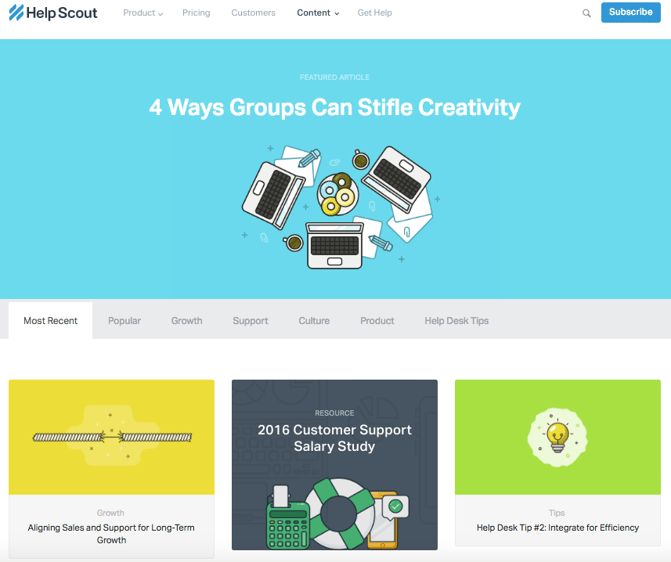
1. Help Scout
Sometimes, the best blog designs are also the simplest. Help Scout, makers of customer service software, uses a unique but minimalist design on its blog that we love — it limits the use of copy and visuals and embraces negative space.
What we particularly like about this blog is its use of featured images for all posts, including a banner one at the top that highlights a recent or particularly popular entry. These icons are set in front of bright, block colors that catch the readers’ eye and signal what the post is about. And it works — everything about this blog’s design says “clean” and “readable.”
2. Microsoft Stories
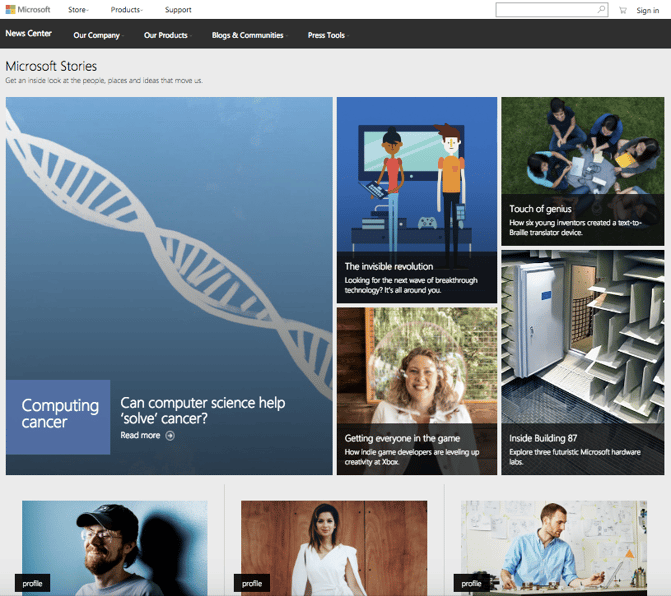
Full disclosure: We’ve totally gushed over Microsoft’s “Stories” microsite before. We can’t help it — what better way to revitalize an old-school brand than with a blog that boasts beautiful, interactive, and inspiring branded content? Plus, the square layout of these stories is reminiscent of the Microsoft logo, which achieves a valuable brand consistency.
Microsoft Stories is also a prime example of how a business blog can be a major asset for an overall rebrand. In recent years, Microsoft has worked to humanize its brand, largely in response to a rivalry with Apple. The “Stories” microsite has a simple tagline — “Get an inside look at the people, places and ideas that move us.” It’s the softer side of Microsoft, so to speak.
When you’re trying to convey a certain brand message, your blog can be used to communicate it — both aesthetically, and content-wise.
3. Pando
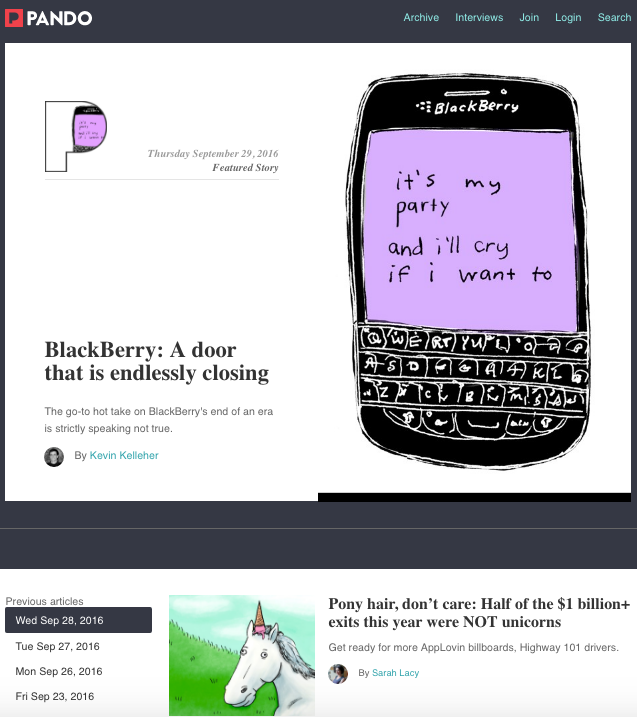
An important aspect of a well-designed blog is a consistent color scheme and style — after all, 80% of consumers say that color boosts their recognition of a brand.
It’s interesting to see how color consistency can unify the more diversified elements of design. Pando, a blog that explores the startup cycle, incorporates blue tones in several sections of its site — the background, highlight bars, and certain areas of text. But it also uses several different fonts — all of which manage to look seamless together, when tied together by a cohesive color scheme.
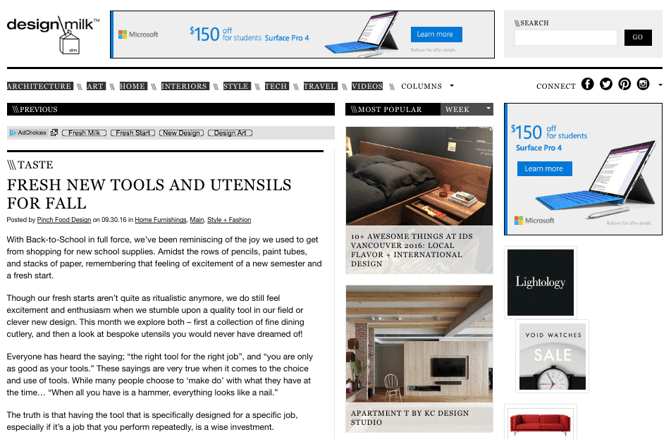
4. Design Milk
Design Milk, an online contemporary design outlet, uses a very simple layout to highlight its posts. The sidebar to the right — which remains visible when a blog post is opened to read — is perfect for showcasing thumbnail images for new articles. That’s an internal link strategy, which helps to encourage readers to remain on the site longer.
The social icons at the top are a pleasant addition to the overall look and feel of the site — they’re easy to spot, and make it easy to share Design Milk’s content. (And to learn more about adding social buttons to your blog, check out this post.)
5. Fubiz
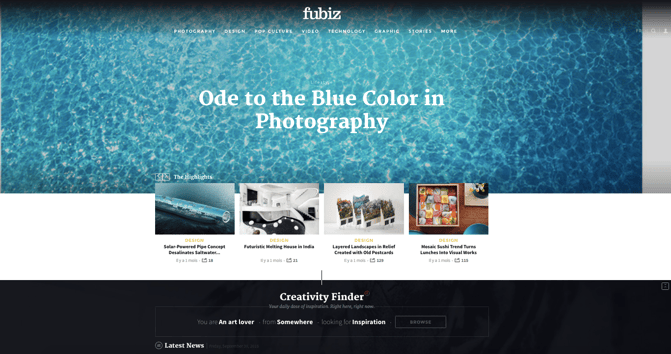
Fubiz, an art and design blog, is an example of a really sleek design that also includes some cool personalization.
Near the top of the blog’s homepage, readers can side-scroll through “highlighted” posts. Below that is the Creativity Finder, where visitors can select their chosen personas — from “Art Lover” to “Freelance” — location, and the type of content they’re looking for. From there, readers can browse content specifically catered to them.
We can’t help but love the header image, too. It uses something called “blue mind” psychology, which has found that the sight of open water can naturally draw us in. By using it in a design scheme, Fubiz is able to visually attract visitors to its content.
6. Webdesigner Depot
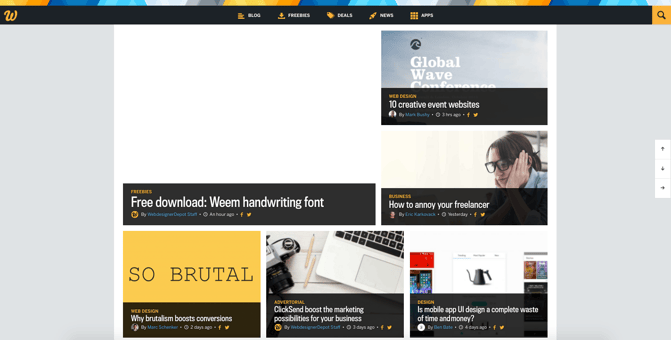
With a name like “Webdesigner Depot,” it’s no wonder that this design news site is visually appealing.
One thing that we particularly like is the way Webdesigner Depot has incorporated social sharing icons on each individual post. While we of course suggest actually reading each piece, having those links readily available helps visitors immediately share a headline they find interesting. And check out those navigation arrows on the right — never before has it been so easy to scroll to the top or bottom of a page.
What’s more, the color scheme, background, and fonts are all consistent — which keeps this blog looking professional, but still distinct from the basic blog templates we might be used to seeing.
7. Mashable
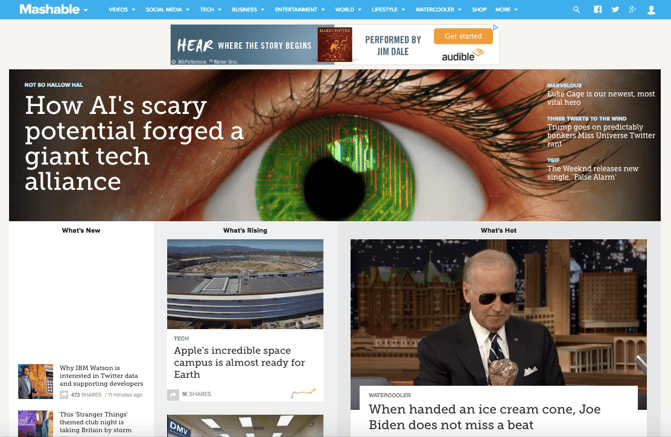
I mean, just look at that header image. The bold colors, the wiring overlay, the gripping pupil and the contrasting text. It absolutely catches the reader’s eye — no pun intended.
Mashable breaks its content into three noticeable sections on the homepage: New posts are listed on the left in the smallest sized thumbnails. “What’s Rising” posts are displayed in the center column as large thumbnails, and the “What’s Hot” posts are shown to the right, also as large thumbnails. This three-pronged approach to displaying content can help readers decide which kind of news matters to them the most — the attention-grabbing top story, or other posts that are currently trending.
Plus, we like that the number of shares is displayed in each post preview — that’s a great form of social proof.
8. Brit + Co
Everything about the Brit + Co homepage says “clean,” “warm,” and “welcoming.” It’s free of clutter, making the content more digestible, and the layout is extremely organized.
We dig the seasonality of the site, too. I mean, avocado jack-o’-lanterns on the dawn of October? Adorable, and replete with a colorful, fun photo to illustrate the story’s content.
The subtle “trending” header also serves as a nice way to promote popular content, without being too in-you-face about it. Plus, with such great visuals, we took note of the nod to Pinterest — that icon is important to include when your blog incorporates attractive imagery.
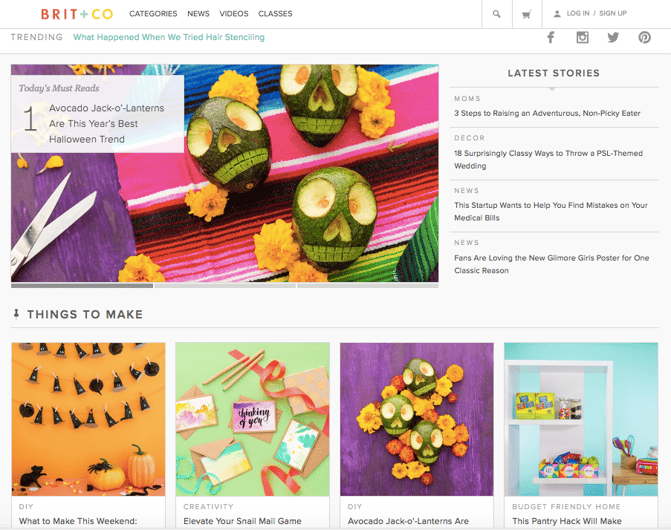
9. Tesco Living
We love the colorful, consistent design of Tesco Living, the blog site of British grocery chain Tesco.
Remember how we keep harping away at brand consistency? Check out the rhombus-like designs in the top banner — that reflects the same ones that appear in Tesco’s logo.
What Tesco Living has achieved is a great balance of simplicity and boldness. The layout is extremely minimal, but it isn’t dull. Warm and welcoming shades underscore each content category, and the photos add dashes of colors throughout the site. It’s a great example of how the right imagery can achieve an appealing “less-is-more” appearance, especially if that fits in with your overall brand concept.
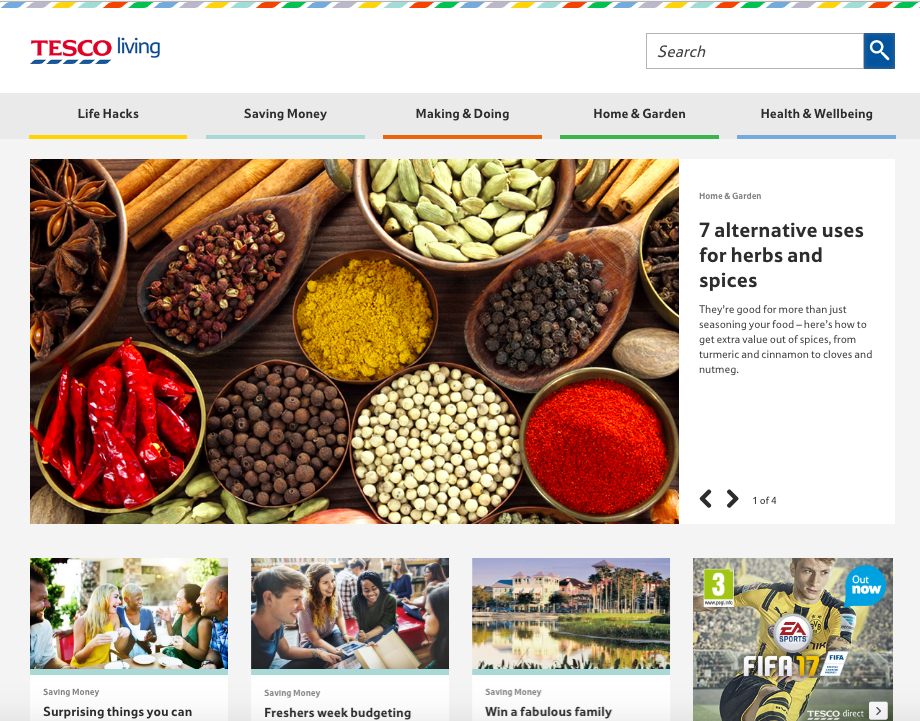
10. Crew
Crew Backstage, the blog of the Crew platform for designers and developers, has a fabulously minimalist blog design, but quiet a unique one.
Notice that, above the fold, it features one blog post with a large title, subtitle, and call-to-action to read more.
To the left, there’s an equally minimalist call-to-action that makes it easy for readers to connect with Crew, or learn more. Plus, there’s that consistency again — everything above the fold is the same shade of blue, which has been shown to invoke brand trust.
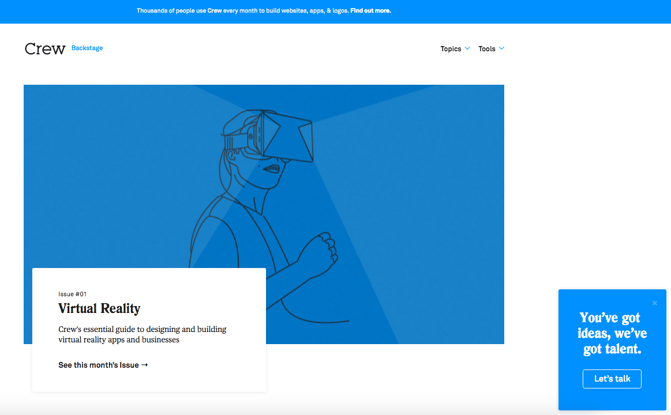
11. Innocent Drinks
Not only are the folks at Innocent Drinks great copywriters, but the design of its blog is also a great reminder that blog designs don’t have to get super fancy.
Notice how the logo — displayed in the upper left — is simple, cartoonish, and almost delightfully child-like. It works for Innocent Drinks (hint: childhood innocence), and that brand presence is maintained throughout the company’s blog.
The colorful fonts, for example, match the logo and stay in line with the brand’s casual, playful voice. We also like the easily-navigable archive links on the left, which are complemented by the geometric social sharing buttons on the right.
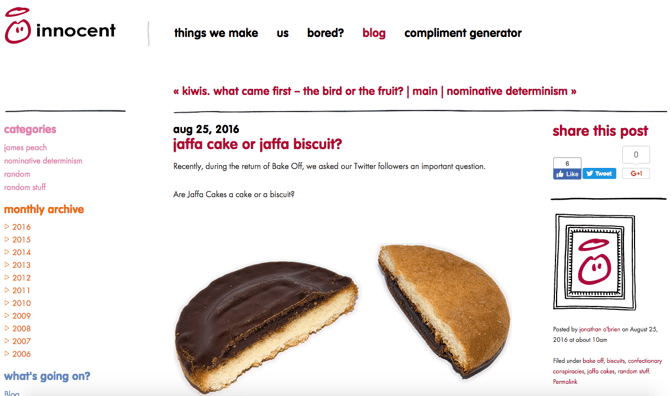
12. 500px
Much like Crew, the photography blog, 500px, leads with one featured article and a big, bold, high-definition photo to draw the reader in. That makes is pretty clear what the blog is about — it boasts valuable content on photography with gripping photography.
Plus, how cool is it that the social links are right there, obviously displayed above the fold? They keep readers engaged with the content, and make it easy to share the photography — and, content with images is up to three times as likely to be shared on social media.
13. Pixelgrade
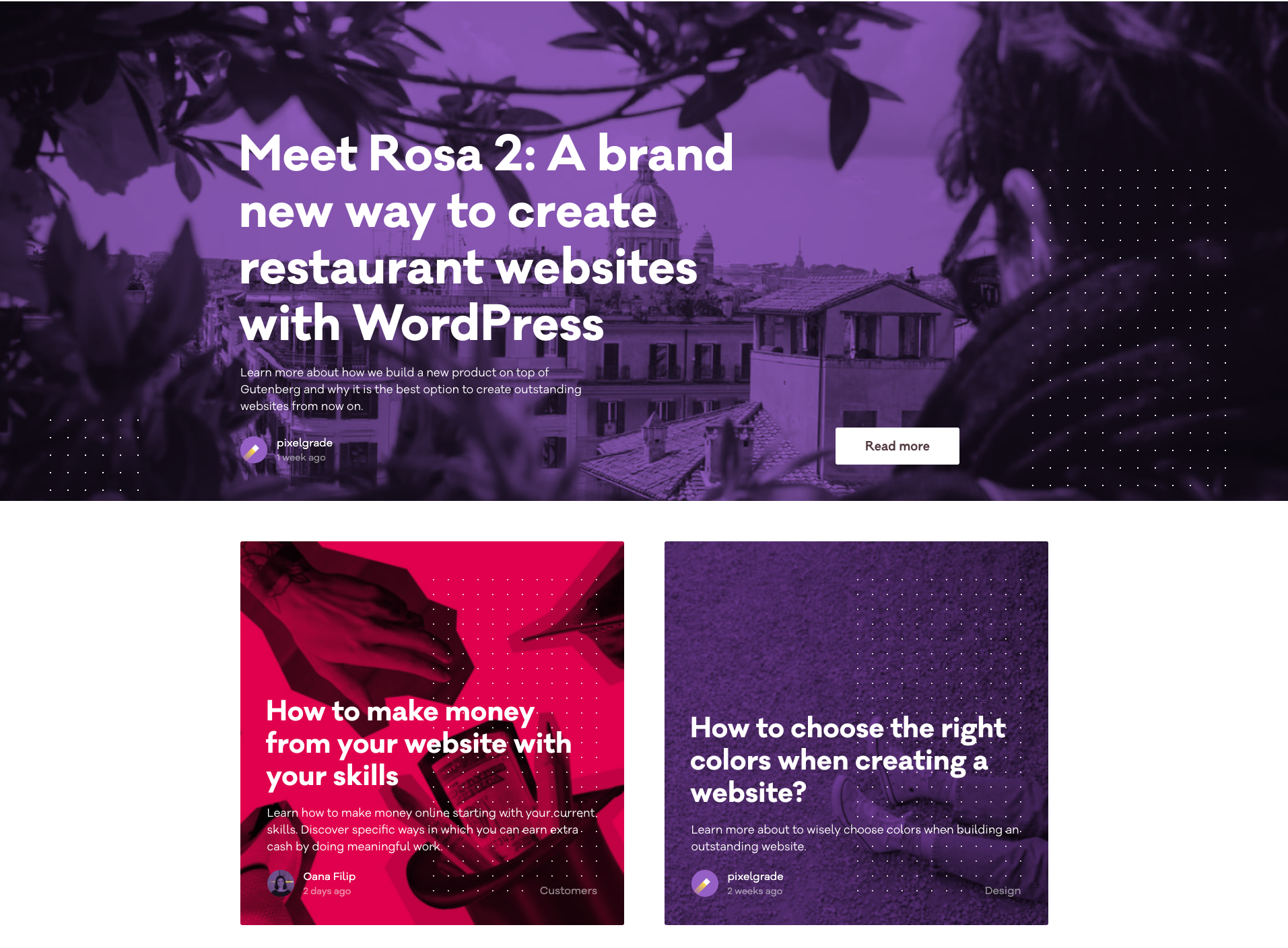
14. BarkPost
It’s no secret that we kind of like dogs here at HubSpot. So when a blog dedicated to life as a dog owner came across our radar, it got our attention.
BarkPost, the blog of canine subscription box company BarkBox, is a great example of design for a number of reasons. First, look how easy it is to subscribe — the call to action is right there, above the featured content. The social share icons are easily noticeable, too — and, of course, all in the brand-matching, trustworthy blue.
We also like that BarkPost draws attention to its sister companies, all of which are owned under the Bark & Co portfolio of brands. But at the same time, the blog doesn’t hock its own products — rather, it serves as an informational resource to dog parents and lovers alike.
15. Goodwill Industries International
Who says nonprofit organizations can’t blog? Nay, they should — and Goodwill’s clean, colorful navigation (again — the trustworthy blue) draw the reader to the important elements of this blog.
The posts are also neatly positioned and easily accessible to readers. And, visitors can pick the type of information that matters to them the most by choosing a topic from the drop-down menu on the top right.
Finally, we love that there’s a collaborative call to action in the introductory text that invites readers to contribute content to the Goodwill blog. After all, the organizations services have reached 37 million people — here’s a way for them to share their stories, or invite donors to write about why they chose to support Goodwill.
16. charity: water
Keeping the nonprofit blogging train going is charity: water, which makes excellent use of high-quality photography.
Recently, the organization redesigned its blog with a lengthy post dedicated to its 10-year anniversary. Using that opportunity to share its impact over the past decade, charity: water maintained a simplistic design with concise text and bright images from the anniversary event.
Plus, there’s a clear CTA to donate at the top of the page. Placing that above a story about charity: water’s impact is a double-edged sword, by both inspiring people to contribute to the cause while making it easy to do so.
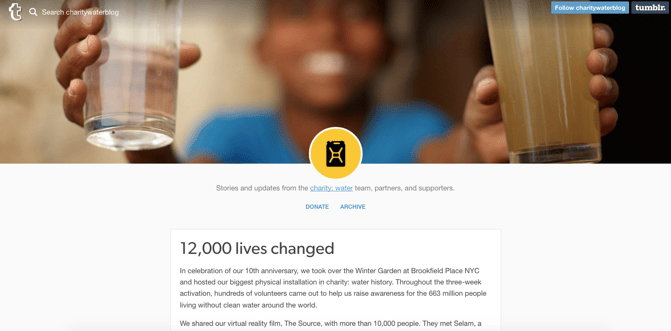

17. Johnny Cupcakes
To clear up any confusion, Johnny Cupcakes doesn’t actually make cupcakes. It makes clothing. But the company has done a great job of playing up its brand’s association with baked goods — its blog uses the subdomain “kitchen.”
Plus, the folks at Johnny Cupcakes know a thing or two about brand consistency across channels. Its blog’s simple color scheme and matching fonts help to create a unified user experience from the shop to general content, all the while throwing in bold, colorful images to catch readers’ attention.
Also, visit the website and have a scroll — we think it’s pretty cool how the background images vary, but stay positionally static for each entry.
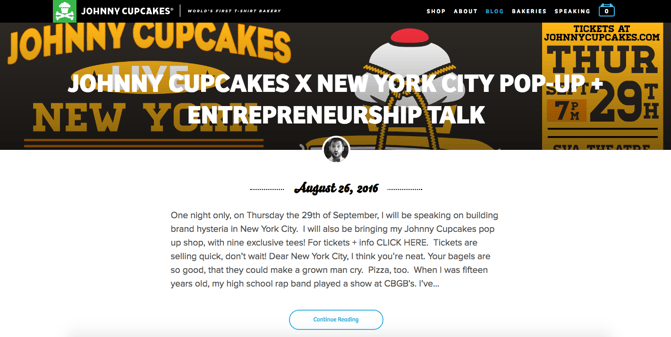
Here are 15 more award-winning website design examples.

Brand Strategy 101: 7 Essentials for Strong Company Branding
Let’s say you’ve come to the difficult realization that quite frankly your brand — if you can even call it that — is all over the place. Or perhaps worse, you have a defined brand, but you’re noticing that it just doesn’t seem to mesh with who you really are and what you really do.
Don’t panic.
Before you get all hung up on what shade of green to use for your logo or what tone you’re going to use when engaging with people on Twitter, you need to step back and take a look at the big picture.
What is Brand Strategy?
Brand strategy is a plan that encompasses specific, long-term goals that can be achieved with the evolution of a successful brand — the combined components of your company’s character that make it identifiable.
(We’ll get into that more in a bit.)
A well-defined and executed brand strategy affects all aspects of a business and is directly connected to consumer needs, emotions, and competitive environments.
First, let’s clear up the biggest misconception about brand strategy: Your brand is not your product, your logo, your website, or your name.
In fact, your brand is much more than that — it’s the stuff that feels intangible. But it’s that hard-to-pin-down feeling that separates powerhouse and mediocre brands from each other.
So to help you rein in what many marketers consider more of an art and less of a science, we’ve broken down seven essential components of a comprehensive brand strategy that will help keep your company around for ages.
7 Components for a Comprehensive Branding Strategy
1) Purpose
“Every brand makes a promise. But in a marketplace in which consumer confidence is low and budgetary vigilance is high, it’s not just making a promise that separates one brand from another, but having a defining purpose,” explains Allen Adamson, chairman of the North America region of brand consulting and design firm Landor Associates.
While understanding what your business promises is necessary when defining your brand positioning, knowing why you wake up every day and go to work carries more weight. In other words, your purpose is more specific, in that it serves as a differentiator between you and your competitors.
How can you define your business’ purpose? According to Business Strategy Insider, purpose can be viewed in two ways:
- Functional: This concept focuses on the evaluations of success in terms of immediate and commercial reasons — i.e. the purpose of the business is to make money.
- Intentional: This concept focuses on success as it relates to the ability to make money and do good in the world.
While making money is important to almost every business, we admire brands that emphasize their willingness to achieve more than just profitability, like IKEA:
Source: IKEA
IKEA’s vision isn’t just to sell furniture, but rather, to “create a better everyday life.” This approach is appealing to potential customers, as it demonstrates their commitment to providing value beyond the point of sale.
When defining your business’ purpose, keep this example in mind. While making money is a priority, operating under that notion alone does little to set your brand apart from others in your industry.
Our advice? Dig a little deeper. If you need inspiration, check out the brands you admire, and see how they frame their mission and vision statements.
2) Consistency
The key to consistency is to avoid talking about things that don’t relate to or enhance your brand. Added a new photo to your business’ Facebook Page? What does it mean for your company? Does it align with your message, or was it just something funny that would, quite frankly, confuse your audience?
In an effort to give your brand a platform to stand on, you need to be sure that all of your messaging is cohesive. Ultimately, consistency contributes to brand recognition, which fuels customer loyalty. (No pressure, right?)
To see a great example of consistency, let’s look at Coca-Cola. As a result of its commitment to consistency, every element of the brand’s marketing works harmoniously together. This has helped it become one of the most recognizable brands in the world.
Even on the surface of its social media accounts, for example, the seamlessness of its brand is very apparent:
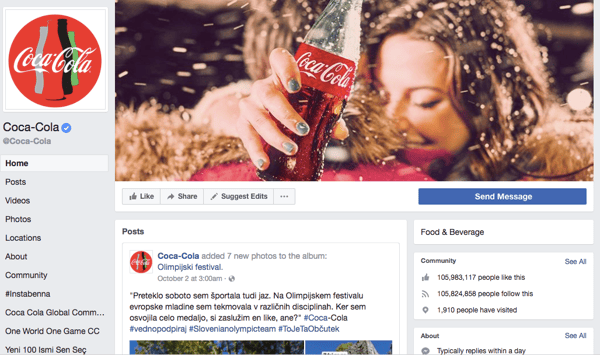
To avoid leaving potential customers struggling to put the disconnected pieces of your business together, consider the benefits of creating a style guide. A style guide can encompass everything from the tone of voice you’ll use to the color scheme you’ll employ to the way you’ll position certain products or services.
By taking the time to define and agree upon these considerations, your brand will benefit as a whole.
3) Emotion
Customers aren’t always rational.
How else do you explain the person who paid thousands of dollars more for a Harley rather than buying another cheaper, equally well-made bike? There was an emotional voice in there somewhere, whispering: “Buy a Harley.”
But why?
Harley Davidson uses emotional branding by creating a community around its brand. It began HOG — Harley Owners Group — to connect their customers with their brand (and each other).
Source: HOG
By providing customers with an opportunity to feel like they’re part of a larger group that’s more tight-knit than just a bunch of motorcycle riders, Harley Davidson is able to position themselves as an obvious choice for someone looking to purchase a bike.
Why? People have an innate desire to build relationships. Research from psychologists Roy Baumeister and Mark Leary best describes this need in their “belongingness hypothesis,” which states: “People have a basic psychological need to feel closely connected to others, and that caring, affectionate bonds from close relationships are a major part of human behavior.”
Not to mention, belongingness — the need for love, affection, and being part of groups — falls directly in the middle of Maslow’s hierarchy of needs, which aims to categorize different human needs.
The lesson to be learned? Find a way to connect with your customers on a deeper, more emotional level. Do you give them peace of mind? Make them feel like part of the family? Do you make life easier? Use emotional triggers like these to strengthen your relationship and foster loyalty.
4) Flexibility
In this fast-changing world, marketers must remain flexible to stay relevant. On the plus side, this frees you to be creative with your campaigns.
You may be thinking, “Wait a minute, how am I supposed to remain consistent while also being flexible?”
Good question. While consistency aims to set the standard for your brand, flexibility enables you to make adjustments that build interest and distinguish your approach from that of your competition.
In other words, “effective identity programs require enough consistency to be identifiable, but enough variation to keep things fresh and human,” explains president of Peopledesign, Kevin Budelmann.
A great example of this type of strategic balance comes from Old Spice. These days, Old Spice is one of the best examples of successful marketing across the board. However, up until recently, wearing Old Spice was pretty much an unspoken requirement for dads everywhere. Today, it’s one of the most popular brands for men of all ages.
The secret? Flexibility.
Aware that it needed to do something to secure its place in the market, Old Spice teamed up with Wieden+Kennedy to position their brand for a new customer base.
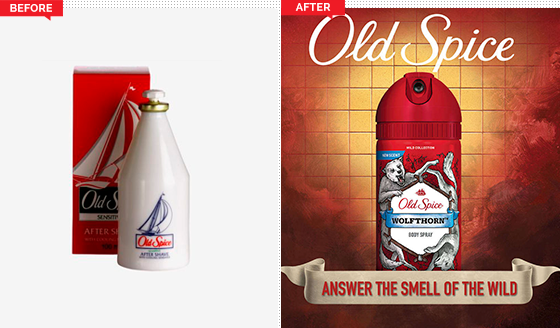
Source: Works Design Group
Between new commercials, a new website, new packaging, and new product names, Old Spice managed to attract the attention of a new, younger generation by making strategic enhancements to its already strong brand.
So if your old tactics aren’t working anymore, don’t be afraid to change. Just because it worked in the past doesn’t mean it’s working now.
Take the opportunity to engage your followers in fresh, new ways. Are there some out-of-the-box partnerships your brand can make? Are there attributes about your product you never highlighted? Use those to connect with new customers and remind your old ones why they love you.
5) Employee Involvement
As we mentioned before, achieving a sense of consistency is important if you wish to build brand recognition. And while a style guide can help you achieve a cohesive digital experience, it’s equally important for your employees to be well versed in the how they should be communicating with customers and representing the brand.
If your brand is playful and bubbly through Twitter engagements, then it wouldn’t make sense if a customer called in and was connected with a grumpy, monotone representative, right?
To avoid this type of mismatched experience, take note of Zappos’ approach.
If you’ve ever been on the line with a customer service representative from Zappos, you know what I’m talking about. If you haven’t, check out this SlideShare which details some of its most inspiring customer support stories.
Zappos is so committed to ensuring that not only its brand, but all brands, remain consistent across digital and human interactions that they’ve dedicated an entire department to the cause called Zappos Insights.
Come join us and learn the Zappos WOW approach to customer service! Learn more about the Zappos School of WOW: https://t.co/g3tU4179q9 pic.twitter.com/eRkpcfYAKD
— Zappos Insights (@ZapposInsights)
August 21, 2017
By holding all Zappos employees to its core values
and helping other companies implement the same approach, Zappos has built a strong reputation for solid, helpful, and human customer service.
6) Loyalty
If you already have people that love you, your company, and your brand, don’t just sit there. Reward them for that love.
These customers have gone out their way to write about you, to tell their friends about you, and to act as your brand ambassadors. Cultivating loyalty from these people early on will yield more returning customers — and more profit for your business.
Sometimes, just a thank you is all that’s needed. Other times, it’s better to go above and beyond. Write them a personalized letter. Sent them some special swag. Ask them to write a review, and feature them prominently on your website. (Or all of the above!)
When we reached 15,000 customers here at HubSpot, we wanted to say thank you in a big way, while remaining true to our brand … so we dropped 15,000 orange ping pong balls from our fourth-floor balcony and spelled out thank you in big metallic balloons:
And while it may have seemed a little out of the ordinary to some folks, for those who know our brand, the gesture made perfect sense.
Loyalty is a critical part of every brand strategy, especially if you’re looking to support your sales organization. At the end of the day, highlighting a positive relationship between you and your existing customers sets the tone for what potential customers can expect if they choose to do business with you.
7) Competitive Awareness
Take the competition as a challenge to improve your own strategy and create greater value in your overall brand. You are in the same business and going after the same customers, right? So watch what they do.
Do some of their tactics succeed? Do some fail? Tailor your brand positioning based on their experience to better your company.
A great example of how to improve your brand by learning from your competitors comes from Pizza Hut:
@TheRealElysium You know our vote. ^AB
— Pizza Hut (@pizzahut)
March 20, 2016
When a pizza lover posed this question to his Twitter following, Pizza Hut didn’t miss a beat, and playfully responded in minutes, before Domino’s had a chance to speak up.
If Domino’s is keeping an eye on the competitors, they’ll know to act fast the next time a situation like this arises.
For HubSpot customers, keeping tabs on your competitor’s social mentions is easy using the Social Monitoring App. Check out this article to learn more about how to set up custom social streams.
And while staying in tune with your competitor’s strategies is important if you want to enhance your brand, don’t let them dictate each and every move you make.
Sure, you probably sell a similar product or service as many other companies, but you’re in business because your brand is unique. By harping on every move your competitor makes, you lose that differentiation.

Data Visualization 101: How to Choose the Right Chart or Graph for Your Data
Types of Charts to Use for Your Data
- Column Chart
- Bar Graph
- Line Graph
- Dual Axis Chart
- Area Chart
- Stacked Bar Graph
- Mekko Chart
- Pie Chart
- Scatter Plot Chart
- Bubble Chart
- Waterfall Chart
- Funnel Chart
- Bullet Chart
- Heat Map
You and I sift through a lot of data for our jobs. Data about website performance, sales performance, product adoption, customer service, marketing campaign results … the list goes on.
When you manage multiple content assets, such as social media or a blog, with multiple sources of data, it can get overwhelming.What should you be tracking? What actually matters? How do you visualize and analyze the data so you can extract insights and actionable information?
More importantly, how can you make reporting more efficient when you’re busy working on multiple projects at once?
One of the struggles that slows down my own reporting and analysis is understanding what types of graphs to use — and why. That’s because choosing the wrong visual aid or simply defaulting to the most common type of data visualization could cause confusion with the viewer or lead to mistaken data interpretation.
To create charts that clarify and provide the right canvas for analysis, you should first understand the reasons why you might need a chart. In this post, I’ll cover five questions to ask yourself when choosing a chart for your data.
Then, I’ll give an overview of 14 different types of charts you have at your disposal.
5 Questions to Ask When Deciding Which Type of Chart to Use
1. Do you want to compare values?
Charts are perfect for comparing one or many value sets, and they can easily show the low and high values in the data sets. To create a comparison chart, use these types of graphs:
- Column
- Mekko
- Bar
- Pie
- Line
- Scatter Plot
- Bullet
2. Do you want to show the composition of something?
Use this type of chart to show how individual parts make up the whole of something, such as the device type used for mobile visitors to your website or total sales broken down by sales rep.
To show composition, use these charts:
- Pie
- Stacked Bar
- Mekko
- Stacked Column
- Area
- Waterfall
3. Do you want to understand the distribution of your data?
Distribution charts help you to understand outliers, the normal tendency, and the range of information in your values.
Use these charts to show distribution:
- Scatter Plot
- Mekko
- Line
- Column
- Bar
4. Are you interested in analyzing trends in your data set?
If you want to know more information about how a data set performed during a specific time period, there are specific chart types that do extremely well.
You should choose a:
- Line
- Dual-Axis Line
- Column
5. Do you want to better understand the relationship between value sets?
Relationship charts are suited to showing how one variable relates to one or numerous different variables. You could use this to show how something positively effects, has no effect, or negatively effects another variable.
When trying to establish the relationship between things, use these charts:
- Scatter Plot
- Bubble
- Line
14 Different Types of Graphs and Charts for Presenting Data
To better understand each chart and how they can be used, here’s an overview of each type of chart.
1. Column Chart
A column chart is used to show a comparison among different items, or it can show a comparison of items over time. You could use this format to see the revenue per landing page or customers by close date.
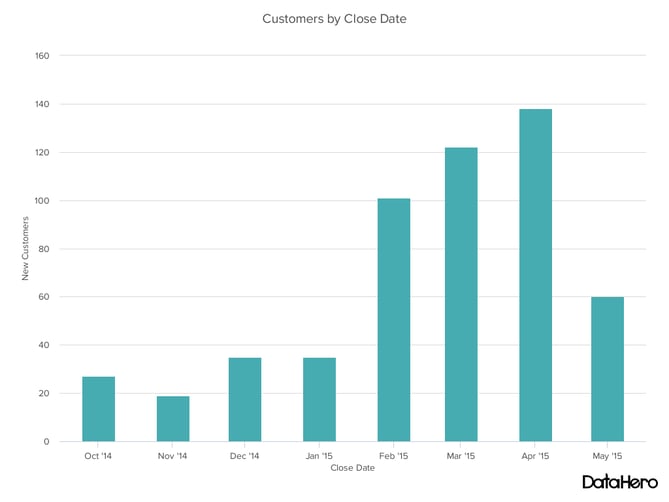
Design Best Practices for Column Charts:
- Use consistent colors throughout the chart, selecting accent colors to highlight meaningful data points or changes over time.
- Use horizontal labels to improve readability.
- Start the y-axis at 0 to appropriately reflect the values in your graph.
2. Bar Graph
A bar graph, basically a horizontal column chart, should be used to avoid clutter when one data label is long or if you have more than 10 items to compare. This type of visualization can also be used to display negative numbers.
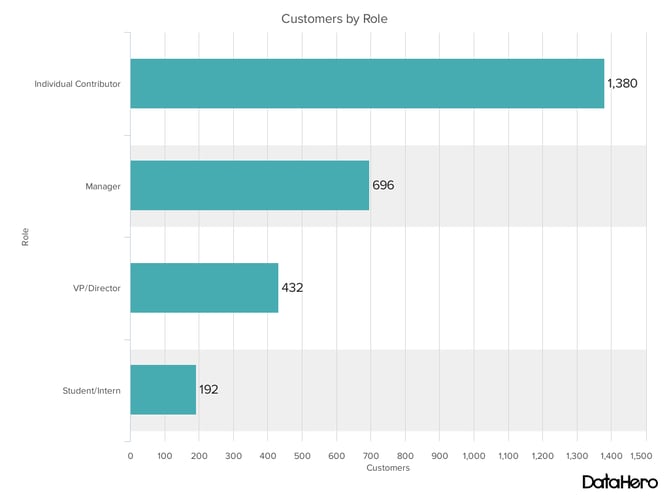
Design Best Practices for Bar Graphs:
- Use consistent colors throughout the chart, selecting accent colors to highlight meaningful data points or changes over time.
- Use horizontal labels to improve readability.
- Start the y-axis at 0 to appropriately reflect the values in your graph.
3. Line Graph
A line graph reveals trends or progress over time and can be used to show many different categories of data. You should use it when you chart a continuous data set.

Design Best Practices for Line Graphs:
- Use solid lines only.
- Don’t plot more than four lines to avoid visual distractions.
- Use the right height so the lines take up roughly 2/3 of the y-axis’ height.
4. Dual Axis Chart
A dual axis chart allows you to plot data using two y-axes and a shared x-axis. It’s used with three data sets, one of which is based on a continuous set of data and another which is better suited to being grouped by category. This should be used to visualize a correlation or the lack thereof between these three data sets.
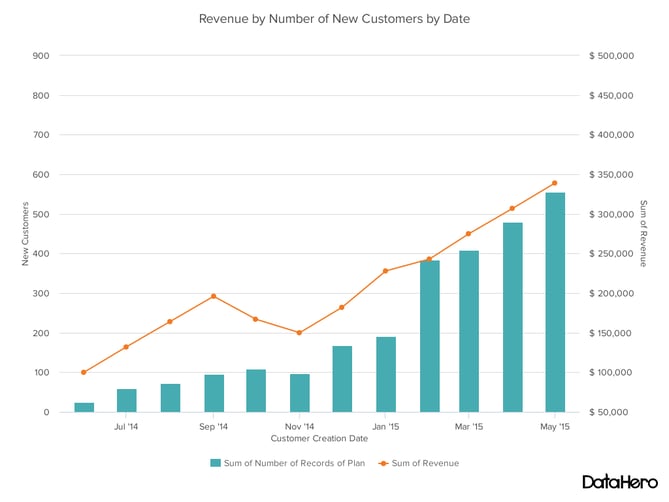
Design Best Practices for Dual Axis Charts:
- Use the y-axis on the left side for the primary variable because brains are naturally inclined to look left first.
- Use different graphing styles to illustrate the two data sets, as illustrated above.
- Choose contrasting colors for the two data sets.
5. Area Chart
An area chart is basically a line chart, but the space between the x-axis and the line is filled with a color or pattern. It is useful for showing part-to-whole relations, such as showing individual sales reps’ contribution to total sales for a year. It helps you analyze both overall and individual trend information.
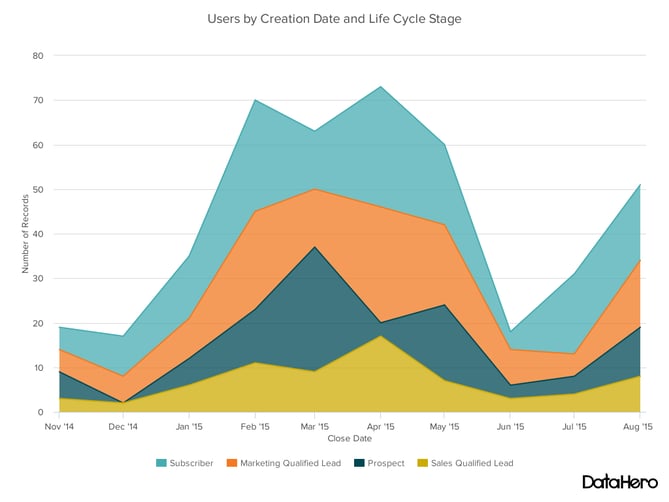
Design Best Practices for Area Charts:
- Use transparent colors so information isn’t obscured in the background.
- Don’t display more than four categories to avoid clutter.
- Organize highly variable data at the top of the chart to make it easy to read.
6. Stacked Bar Chart
This should be used to compare many different items and show the composition of each item being compared.
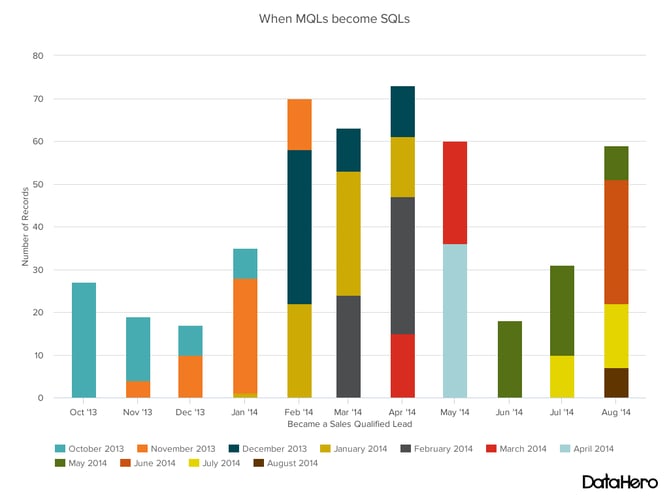
Design Best Practices for Stacked Bar Graphs:
- Best used to illustrate part-to-whole relationships.
- Use contrasting colors for greater clarity.
- Make chart scale large enough to view group sizes in relation to one another.
7. Mekko Chart
Also known as a marimekko chart, this type of graph can compare values, measure each one’s composition, and show how your data is distributed across each one.
It’s similar to a stacked bar, except the mekko’s x-axis is used to capture another dimension of your values — rather than time progression, like column charts often do. In the graphic below, the x-axis compares each city to one another.
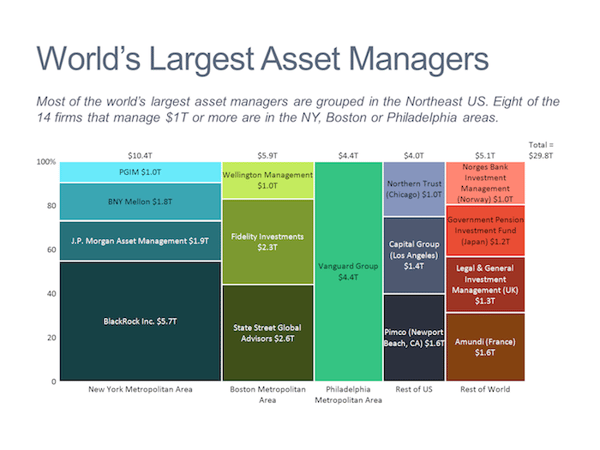
Image via Mekko Graphics
Design Best Practices for Mekko Charts:
- Vary you bar heights if the portion size is an important point of comparison.
- Don’t include too many composite values within each bar. you might want to reevaluate how to present your data if you have a lot.
- Order your bars from left to right in such a way that exposes a relevant trend or message.
8. Pie Chart
A pie chart shows a static number and how categories represent part of a whole — the composition of something. A pie chart represents numbers in percentages, and the total sum of all segments needs to equal 100%.
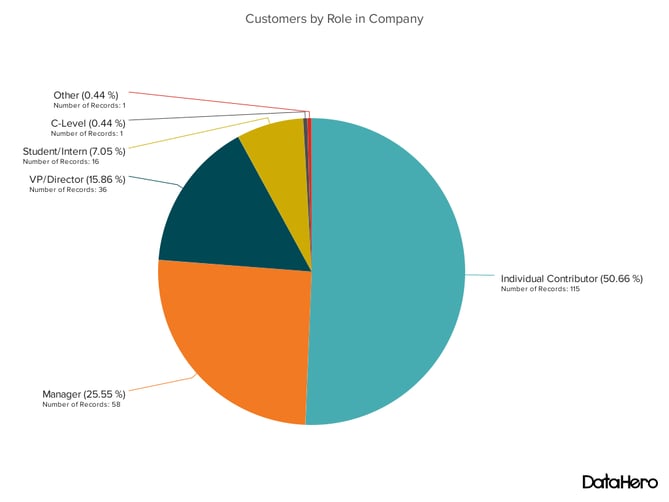
Design Best Practices for Pie Charts:
- Don’t illustrate too many categories to ensure differentiation between slices.
- Ensure that the slice values add up to 100%.
- Order slices according to their size.
9. Scatter Plot Chart
A scatter plot or scattergram chart will show the relationship between two different variables or it can reveal the distribution trends. It should be used when there are many different data points, and you want to highlight similarities in the data set. This is useful when looking for outliers or for understanding the distribution of your data.
Design Best Practices for Scatter Plots:
- Include more variables, such as different sizes, to incorporate more data.
- Start y-axis at 0 to represent data accurately.
- If you use trend lines, only use a maximum of two to make your plot easy to understand.
10. Bubble Chart
A bubble chart is similar to a scatter plot in that it can show distribution or relationship. There is a third data set, which is indicated by the size of the bubble or circle.
Design Best Practices for Bubble Charts:
- Scale bubbles according to area, not diameter.
- Make sure labels are clear and visible.
- Use circular shapes only.
11. Waterfall Chart
A waterfall chart should be used to show how an initial value is affected by intermediate values — either positive or negative — and resulted in a final value. This should be used to reveal the composition of a number. An example of this would be to showcase how overall company revenue is influenced by different departments and leads to a specific profit number.
Chart via Baans Consulting
Design Best Practices for Waterfall Charts:
- Use contrasting colors to highlight differences in data sets.
- Choose warm colors to indicate increases and cool colors to indicate decreases.
12. Funnel Chart
A funnel chart shows a series of steps and the completion rate for each step. This can be used to track the sales process or the conversion rate across a series of pages or steps.
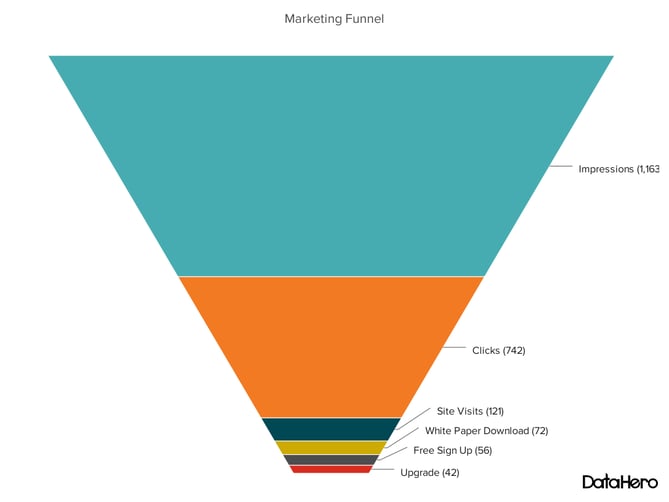
Design Best Practices for Funnel Charts:
- Scale the size of each section to accurately reflect the size of the data set.
- Use contrasting colors or one color in gradating hues, from darkest to lightest as the size of the funnel decreases.
13. Bullet Graph
A bullet graph reveals progress toward a goal, compares this to another measure, and provides context in the form of a rating or performance.
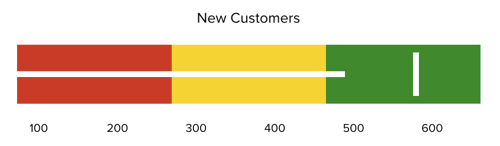
Design Best Practices for Bullet Graphs:
- Use contrasting colors to highlight how the data is progressing.
- Use one color in different shades to gauge progress.
14. Heat Map
A heat map shows the relationship between two items and provides rating information, such as high to low or poor to excellent. The rating information is displayed using varying colors or saturation.
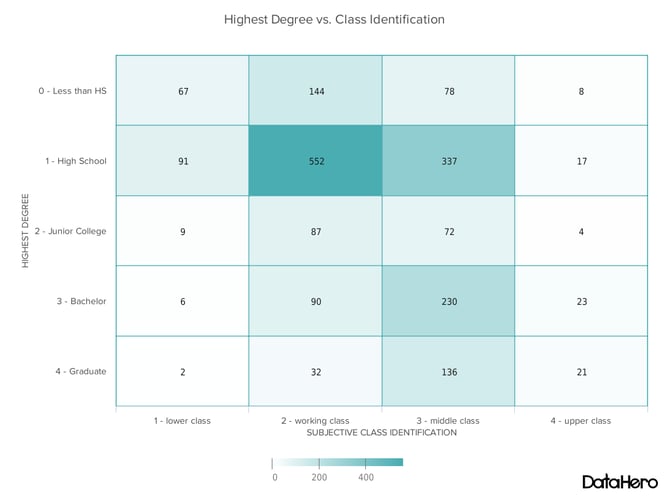
Design Best Practices for Heat Map:
- Use a basic and clear map outline to avoid distracting from the data.
- Use a single color in varying shades to show changes in data.
- Avoid using multiple patterns.

9 Types of Organizational Structure Every Company Should Consider
Choosing the best organizational structure for your company, division, or team is a lot like picking out a new car.
At the most basic level, you’re always looking for something road-worthy — something that can take you (and your passengers) from point A to point B without a hitch.But beyond that, there are a lot of options to consider. Automatic or manual? Four-wheel drive or two? Built-in GPS? Leather interior? Flux capacitor? (Only if you’re going back in time, of course.)
In the world of organizational structures, the options you have to choose from include things like chain of command (long or short?), span of control (wide or narrow?), and centralization (centralized or decentralized decision-making?), just to name a few.
Organizational Structure
An organizational structure is a visual diagram of a company that describes what employees do, whom they report to, and how decisions are made across the business. Organizational structures can use functions, markets, products, geographies, or processes as their guide, and cater to businesses of specific sizes and industries.
What’s the point of an organizational structure? As a business leader, do you even need one? As I said, org structures help you define at least three key elements of how your business is going to run.
As your company gets bigger, an organizational structure can also be helpful for new employees as they learn who manages what processes at your company.
Then, if you need to pivot or shift your leadership, you can visualize how the work flows would work by adjusting your organizational structure diagrams.
To put it simply, this chart like a map that simply explains how your company works and how its roles are organized.
Here’s what each of those elements means to an organization:
Chain of Command
Your chain of command is how tasks are delegated and work is approved. An org structure allows you to define how many “rungs of the ladder” a particular department or business line should have. In other words, who tells whom to do what? And how are issues, requests, and proposals communicated up and down that ladder?
Span of Control
Your span of control can represent two things: who falls under a manager’s, well, management … and which tasks fall under a department’s responsibility.
Centralization
Centralization describes where decisions are ultimately made. Once you’ve established your chain of command, you’ll need to consider which people and departments have a say in each decision. A business can lean toward centralized, where final decisions are made by just one or two entities; or decentralized, where final decisions are made within the team or department in charge of carrying out that decision.
You might not need an org structure right away, but the more products you develop and people you hire, the harder it’ll be to lead your company without this crucial diagram.
(To dive deeper into what all of these different organizational structure components are, check out my earlier post, “The 6 Building Blocks of Organizational Structure.”)
In this post, we’ll explore how you can combine those components to form different types of organizational structures. We’ll also highlight the benefits and drawbacks of different structure types so you can evaluate which is the best option for your company, division, or team. Let’s dive in.
Mechanistic vs. Organic Organizational Structures
Organizational structures fall on a spectrum, with “mechanistic” at one end and
“organic” at the other.
Take a look at the diagram below. As you’ll probably be able to tell, the mechanistic structure represents the traditional, top-down approach to organizational structure, whereas the organic structure represents a more collaborative, flexible approach.
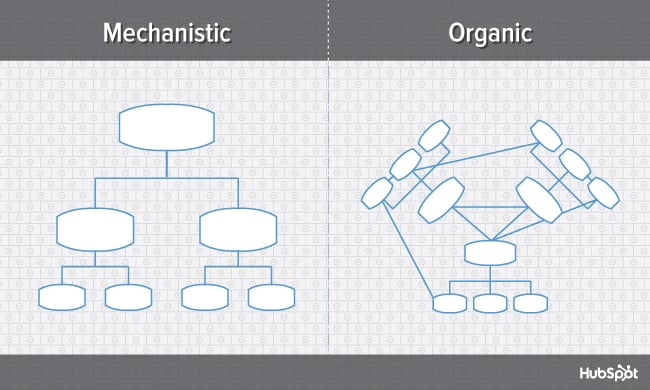
Here’s a breakdown of both ends of the structural spectrum, their advantages and disadvantages, and which types of businesses are suited for them.
Mechanistic Structure
Mechanistic structures, also called bureaucratic structures, are known for having narrow spans of control, as well as high centralization, specialization, and formalization. They’re also quite rigid in what specific departments are designed and permitted to do for the company.
This organizational structure is much more formal than organic structure, using specific standards and practices to govern every decision the business makes. And while this model does hold staff more accountable for their work, it can become a hindrance to the creativity and agility the organization needs to keep up with random changes in its market.
As daunting and inflexible as mechanistic structure sounds, the chain of command, whether long or short, is always clear under this model. As a company grows, it needs to make sure everyone (and every team) knows what’s expected of them. Teams collaborating with other teams as needed might help get a business off the ground in its early stages, but sustaining that growth — with more people and projects to keep track of — will eventually require some policymaking. In other words, keep mechanistic structure in your back pocket … you never know when you’ll need it.
Organic Structure
Organic structures (also known as “flat” structures) are known for their wide spans of control, decentralization, low specialization, and loose departmentalization. What’s that all mean? This model might have multiple teams answering to one person and taking on projects based on their importance and what the team is capable of — rather than what the team is designed to do.
As you can probably tell, this organizational structure is much less formal than mechanistic, and takes a bit of an ad-hoc approach to business needs. This can sometimes make the chain of command, whether long or short, difficult to decipher. And as a result, leaders might give certain projects the green light more quickly but cause confusion in a project’s division of labor.
Nonetheless, the flexibility that an organic structure allows for can be extremely helpful to a business that’s navigating a fast-moving industry, or simply trying to stabilize itself after a rough quarter. It also empowers employees to try new things and develop as professionals, making the organization’s workforce more powerful in the long run. Bottom line? Startups are often perfect for organic structure, since they’re simply trying to gain brand recognition and get their wheels off the ground.
Now, let’s uncover more specific types of organizational structures, most of which fall on the more traditional, mechanistic side of the spectrum.
Types of Organizational Structure
- Functional Organizational Structure
- Product-Based Divisional Structure
- Market-Based Divisional Structure
- Geographical Divisional Structure
- Process-Based Structure
- Matrix Structure
- Circular Structure
- Flat Structure
- Network Structure
1. Functional Organizational Structure
One of the most common types of organizational structures, the functional structure departmentalizes an organization based on common job functions.
An organization with a functional org structure, for instance, would group all of the marketers together in one department, group all of the salespeople together in a separate department, and group all of the customer service people together in a third department.
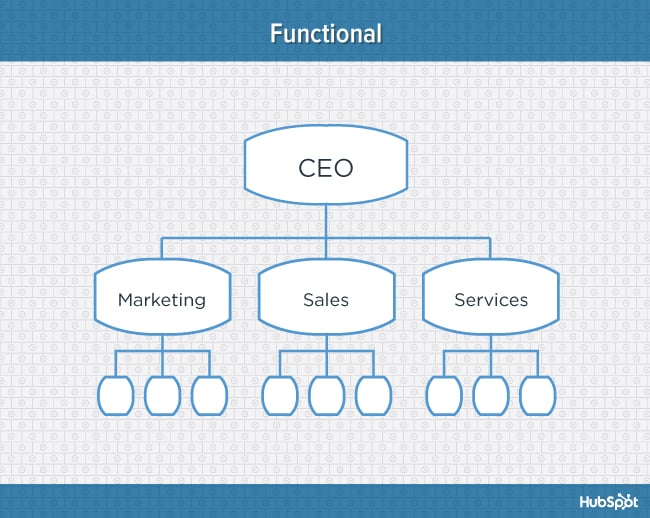
The functional structure allows for a high degree of specialization for employees, and is easily scalable should the organization grow. Also this structure is mechanistic in nature — which has the potential to inhibit an employee’s growth — putting staff in skill-based departments can still allow them to delve deep into their field and find out what they’re good at.
Disadvantages
Functional structure also has the potential to create barriers between different functions — and it can be inefficient if the organization has a variety of different products or target markets. The barriers created between departments can also limit peoples’ knowledge of and communication with other departments, especially those that depend on other departments to succeed.
2. Product-Based Divisional Structure
A divisional organizational structure is comprised of multiple, smaller functional structures (i.e. each division within a divisional structure can have its own marketing team, its own sales team, and so on). In this case — a product-based divisional structure — each division within the organization is dedicated to a particular product line.
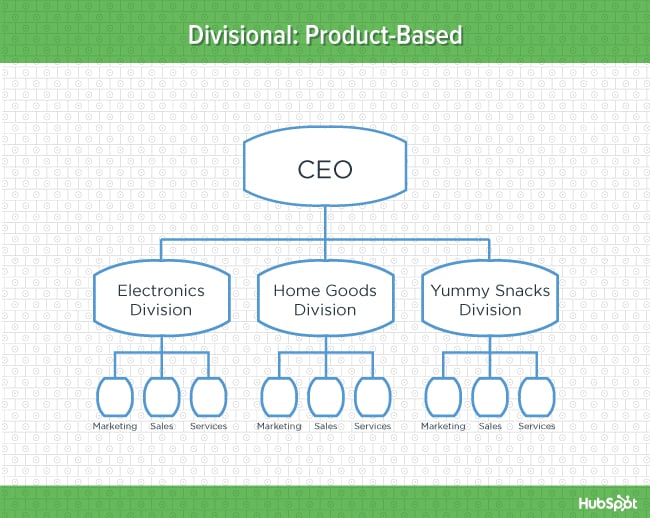
This type of structure is ideal for organizations with multiple products and can help shorten product development cycles. This allows small businesses to go to market with new offerings fast.
Disadvantages
It can be difficult to scale under a product-based divisional structure, and the organization could end up with duplicate resources as different divisions strive to develop new offerings.
3. Market-Based Divisional Structure
Another variety of the divisional organizational structure is the market-based structure, wherein the divisions of an organization are based around markets, industries, or customer types.
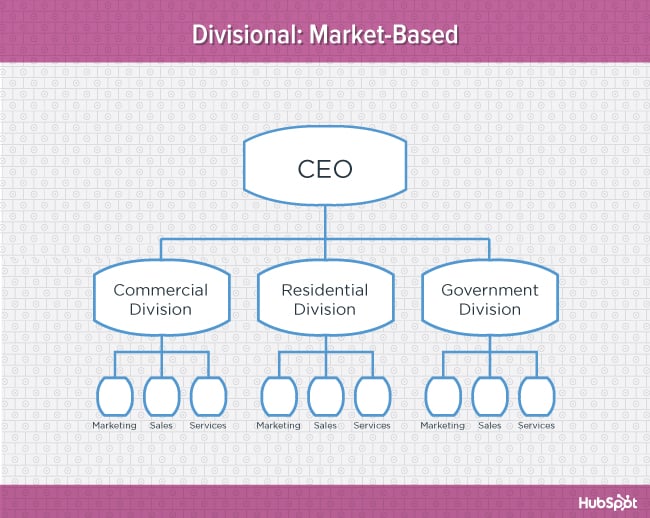
The market-based structure is ideal for an organization that has products or services that are unique to specific market segments, and is particularly effective if that organization has advanced knowledge of those segments. This organizational structure also keeps the business constantly aware of demand changes among its different audience segments.
Disadvantages
Too much autonomy within each market-based team can lead to divisions developing systems that are incompatible with one another. Divisions might also end up inadvertently duplicating activities that other divisions are already handling.
4. Geographical Divisional Structure
The geographical organizational structure establishes its divisions based on — you guessed it — geography. More specifically, the divisions of a geographical structure can include territories, regions, or districts.
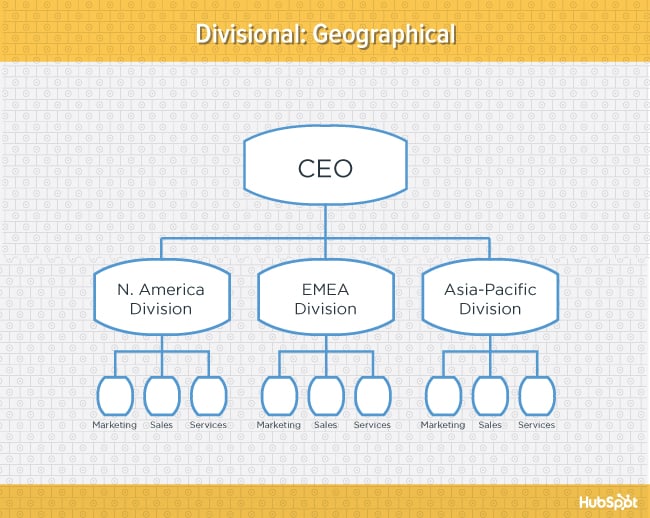
This type of structure is best-suited to organizations that need to be near sources of supply and/or customers (e.g. for deliveries or for on-site support). It also brings together many forms of business expertise, allowing each geographical division to make decisions from more diverse points of view.
Disadvantages
The main downside of a geographical org structure: It can be easy for decision- making to become decentralized, as geographic divisions (which can be hundreds, if not thousands of miles away from corporate headquarters) often have a great deal of autonomy. And when you have more than one marketing department — one for each region — you run the risk of creating campaigns that compete with (and weaken) other divisions across your digital channels.
5. Process-Based Structure
Process-based organizational structures are designed around the end-to-end flow of different processes, such as “Research & Development,” “Customer Acquisition,” and “Order Fulfillment.” Unlike a strictly functional structure, a process-based structure considers not only the activities employees perform, but also how those different activities interact with one another.
In order to fully understand the diagram below, you need to look at it from left to right: The customer acquisition process can’t start until you have a fully developed product to sell. By the same token, the order fulfillment process can’t start until customers have been acquired and there are product orders to fill.
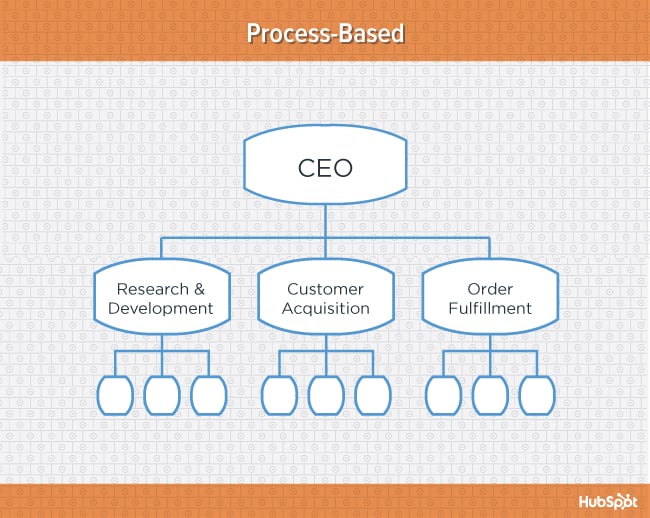
Process-based organizational structure is ideal for improving the speed and efficiency of a business, and is best-suited for those in rapidly changing industries, as it is easily adaptable.
Disadvantages
Similar to a few other structures on this list, process-based structure can erect barriers between the different process groups. This leads to problems communicating and handing off work to other teams and employees.
6. Matrix Structure
Unlike the other structures we’ve looked at so far, a matrix organizational structure doesn’t follow the traditional, hierarchical model. Instead, all employees (represented by the green boxes) have dual reporting relationships. Typically, there is a functional reporting line (shown in blue) as well as a product- based reporting line (shown in yellow).
When looking at a matrix structure org chart, solid lines represent strong, direct-reporting relationships, whereas dotted lines indicate that the relationship is secondary, or not as strong. In our example below, it’s clear that functional reporting takes precedence over product-based reporting.
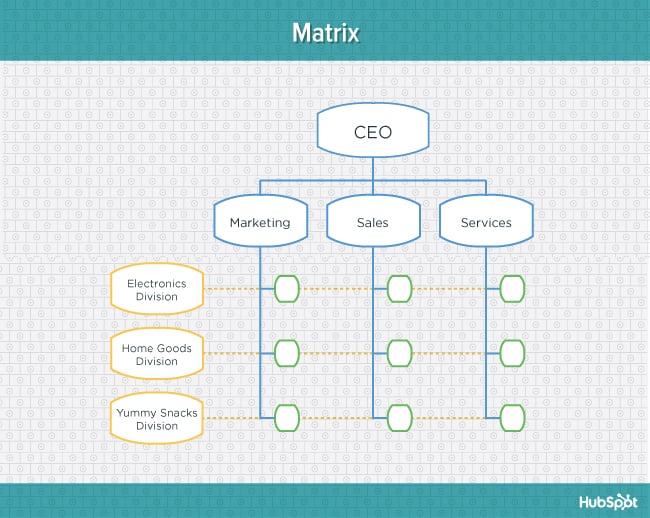
The main appeal of the matrix structure is that it can provide both flexibility and more balanced decision-making (as there are two chains of command instead of just one). Having a single project overseen by more than one business line also creates opportunities for these business lines to share resources and communicate more openly with each other — things they might not otherwise be able to do regularly.
Disadvantages
The primary pitfall of the matrix organizational structure? Complexity. The more layers of approval employees have to go through, the more confused they can be about who they’re supposed to answer to. This confusion can ultimately cause frustration over who has authority over which decisions and products — and who’s responsible for those decisions when things go wrong.
7. Circular Structure
While it might appear drastically different from the other organizational structures highlighted in this section, the circular structure still relies on hierarchy, with higher-level employees occupying the inner rings of the circle and lower-level employees occupying the outer rings.
That being said, the leaders or executives in a circular organization aren’t seen as sitting atop the organization, sending directives down the chain of command. Instead, they’re at the center of the organization, spreading their vision outward.
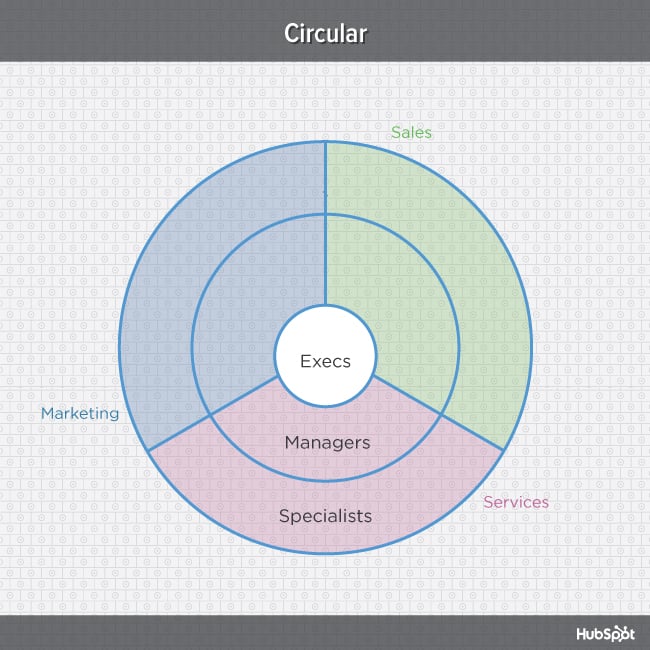
From an ideological perspective, a circular structure is meant to promote communication and the free flow of information between different parts of the organization. Whereas a traditional structure shows different departments or divisions as occupying individual, semi-autonomous branches, the circular structure depicts all divisions as being part of the same whole.
Disadvantages
From a practical perspective, the circular structure can be confusing, especially for new employees. Unlike with a more traditional, top-down structure, a circular structure can make it difficult for employees to figure out who they report to and how they’re meant to fit into the organization.
8. Flat Structure
While a more traditional organizational structure might look more like a pyramid — with multiple tiers of supervisors, managers and directors between staff and leadership, the flat structure limits the levels of management so all staff are only a few steps away from leadership. It also might not always take the form or a pyramid, or any shape for that matter. As we mentioned earlier, It’s also a form of the “Organic Structure” we noted above.
 This structure is probably one of the most detailed, It’s also thought that employees can be more productive in an environment where there’s less hierarchy-related pressures. This structure might also make staff feel like the managers they do have are more like equals or team members rather than intimidating superiors.
Disadvantages
If there’s a time when teams in a flat organization disagree on something, such as a project, it can be hard to get aligned and back on track without executive decisions from a leader or manager. Because of how complicated the structure’s design is, it can be tricky to determine which manager an employee should go to if they need approval or an executive decision for something. So if you do choose to have a flat organization, you should have a clearly marked tier of management or path that employers can refer to when they run into these scenarios.
9. Network Structure
A network structure is often created when one company works with another to share resources — or if your company has multiple locations with different functions and leadership. You might also use this structure to explain your company workflows if much of your staffing or services is outsourced to freelancers or multiple other businesses.
The structure looks nearly the same as the Divisional Structure, shown above. However, instead of offices, it might list outsourced services or satellite locations outside of the office.
If your company doesn’t do everything under one roof, this is a great way to show employees or stakeholders how outsourcing of off-site processes work. For example, if an employee needs help from a web developer for a blogging project and the company’s web developers are outsourced, the could look at this type of chart and know which office or which person to contact outside of their own work location.
Disadvantages
The shape of the chart can vary based on how many companies or locations you’re working with. If it’s not kept simple and clear, there may be a lot of confusion if multiple offices or freelancers do similar things. If you do outsource or have multiple office locations, make sure your org chart clearly states where each specific role and job function lies so someone can easily understand your basic company processes.
Navigating Organizational Structures
That concludes our exploration of different types of organizational structures. Keep in mind that what we’ve just looked at are simply archetypes — in real-world applications, organizations often use hybrid structures, which can borrow elements from multiple structure types.
Want to see some real-world examples of marketing team org structures from companies like GitHub and Rue La La? Download the complete resource, An Illustrated Guide to Organizational Structures.
To learn more about working on a marketing team, check out the 6 Building Blocks of Organizational Structure [Diagrams].

The Ultimate List of Email SPAM Trigger Words
Editor’s Note: Spam filters have become much more sophisticated than the subject line triggers listed in this post. For a more up-to-date guide to email marketing, check out our free guide to creating email newsletters people actually read here.
Writing the subject lines for your emails can be one of the most stressful steps of email marketing. Is it engaging? Too short? Too long? Too boring? Will people click ‘delete’ because of it? Or will they open it? Will it even get to them, or will it trigger SPAM filters? It’s the last of these concerns that we’re here to help with today.
SPAM filters can be triggered for a variety of reasons, causing your email to skip recipients’ inboxes and land straight in their SPAM box. One of easiest ways to avoid SPAM filters is by carefully choosing the words you use in your email’s subject line. Trigger words are known to cause problems and increase the chances of your email getting caught in a SPAM trap. By avoiding these words in your email subject lines, you can dramatically increase your chances of getting beyond SPAM filters.
Next time you sit down to write an email subject line, consult the exhaustive list below and make sure you aren’t using any words that will get you in trouble. In fact, you might want to bookmark this list so you can refer back to it every time you craft an email subject line. Back off, SPAM filters!
Email Spam Words to Avoid
Commerce
| As seen on | Buy | Buy direct |
| Buying judgments | Clearance | Order |
| Order status | Orders shipped by | shopper |
Personal
| Dig up dirt on friends | Meet singles | Score with babes |
Employment
| Additional Income | Be your own boss | Compete for your business |
| Double your | Earn $ | Earn extra cash |
| Earn per week | Expect to earn | Extra income |
| Home based | Home employment | Homebased business |
| Income from home | Make $ | Make money |
| Money making | Online biz opportunity | Online degree |
| Opportunity | Potential earnings | University diplomas |
| While you sleep | Work at home | Work from home |
Financial – General
| $$$ | Affordable | Bargain |
| Beneficiary | Best price | Big bucks |
| Cash | Cash bonus | Cashcashcash |
| Cents on the dollar | Cheap | Check |
| Claims | Collect | Compare rates |
| Cost | Credit | Credit bureaus |
| Discount | Earn | Easy terms |
| F r e e | Fast cash | For just $XXX |
| Hidden assets | hidden charges | Income |
| Incredible deal | Insurance | Investment |
| Loans | Lowest price | Million dollars |
| Money | Money back | Mortgage |
| Mortgage rates | No cost | No fees |
| One hundred percent free | Only $ | Pennies a day |
| Price | Profits | Pure profit |
| Quote | Refinance | Save $ |
| Save big money | Save up to | Serious cash |
| Subject to credit | They keep your money — no refund! | Unsecured credit |
| Unsecured debt | US dollars | Why pay more? |
Financial – Business
| Accept Credit Cards | Cards accepted | Check or money order |
| Credit card offers | Explode your business | Full refund |
| Investment decision | No credit check | No hidden Costs |
| No investment | Requires initial investment | Sent in compliance |
| Stock alert | Stock disclaimer statement | Stock pick |
Financial – Personal
| Avoid bankruptcy | Calling creditors | Collect child support |
| Consolidate debt and credit | Consolidate your debt | Eliminate bad credit |
| Eliminate debt | Financially independent | Get out of debt |
| Get paid | Lower interest rate | Lower monthly payment |
| Lower your mortgage rate | Lowest insurance rates | Pre-approved |
| Refinance home | Social security number | Your income |
General
| Acceptance | Accordingly | Avoid |
| Chance | Dormant | Freedom |
| Here | Hidden | Home |
| Leave | Lifetime | Lose |
| Maintained | Medium | Miracle |
| Never | Passwords | Problem |
| Remove | Reverses | Sample |
| Satisfaction | Solution | Stop |
| Success | Teen | Wife |
Greetings
| Dear [email/friend/somebody] | Friend | Hello |
Marketing
| Ad | Auto email removal | Bulk email |
| Click | Click below | Click here |
| Click to remove | Direct email | Direct marketing |
| Email harvest | Email marketing | Form |
| Increase sales | Increase traffic | Increase your sales |
| Internet market | Internet marketing | Marketing |
| Marketing solutions | Mass email | Member |
| Month trial offer | More Internet Traffic | Multi level marketing |
| Notspam | One time mailing | Online marketing |
| Open | Opt in | Performance |
| Removal instructions | Sale | Sales |
| Search engine listings | Search engines | Subscribe |
| The following form | This isn’t junk | This isn’t spam |
| Undisclosed recipient | Unsubscribe | Visit our website |
| We hate spam | Web traffic | Will not believe your eyes |
Medical
| Cures baldness | Diagnostics | Fast Viagra delivery |
| Human growth hormone | Life Insurance | Lose weight |
| Lose weight spam | Medicine | No medical exams |
| Online pharmacy | Removes wrinkles | Reverses aging |
| Stop snoring | Valium | Viagra |
| Vicodin | Weight loss | Xanax |
Numbers
| #1 | 100% free | 100% Satisfied |
| 4U | 50% off | Billion |
| Billion dollars | Join millions | Join millions of Americans |
| Million | One hundred percent guaranteed | Thousands |
Offers
| Being a member | Billing address | Call |
| Cannot be combined with any other offer | Confidentially on all orders | Deal |
| Financial freedom | Gift certificate | Giving away |
| Guarantee | Have you been turned down? | If only it were that easy |
| Important information regarding | In accordance with laws | Long distance phone offer |
| Mail in order form | Message contains | Name brand |
| Nigerian | No age restrictions | No catch |
| No claim forms | No disappointment | No experience |
| No gimmick | No inventory | No middleman |
| No obligation | No purchase necessary | No questions asked |
| No selling | No strings attached | No-obligation |
| Not intended | Obligation | Off shore |
| Offer | Per day | Per week |
| Priority mail | Prize | Prizes |
| Produced and sent out | Reserves the right | Shopping spree |
| Stuff on sale | Terms and conditions | The best rates |
| They’re just giving it away | Trial | unlimited |
| Unsolicited | Vacation | Vacation offers |
| Warranty | We honor all | Weekend getaway |
| What are you waiting for? | Who really wins? | Win |
| Winner | Winning | won |
| You are a winner! | You have been selected | You’re a Winner! |
Calls-to-Action
| Cancel at any time | Compare | Copy accurately |
| Get | Give it away | Print form signature |
| Print out and fax | See for yourself | Sign up free today |
Free
| Free | Free access | Free cell phone |
| Free consultation | Free DVD | Free gift |
| Free grant money | Free hosting | Free installation |
| Free Instant | Free investment | Free leads |
| Free membership | Free money | Free offer |
| Free preview | Free priority mail | Free quote |
| Free sample | Free trial | Free website |
Descriptions/Adjectives
| All natural | All new | Amazing |
| Certified | Congratulations | Drastically reduced |
| Fantastic deal | For free | Guaranteed |
| It’s effective | Outstanding values | Promise you |
| Real thing | Risk free | Satisfaction guaranteed |
Sense of Urgency
| Access | Act Now! | Apply now |
| Apply Online | Call free | Call now |
| Can’t live without | Do it today | Don’t delete |
| Don’t hesitate | For instant access | For Only |
| For you | Get it now | Get started now |
| Great offer | Info you requested | Information you requested |
| Instant | limited time | New customers only |
| Now | Now only | Offer expires |
| Once in lifetime | One time | Only |
| Order now | Order today | Please read |
| Special promotion | Supplies are limited | Take action now |
| Time limited | Urgent | While supplies last |
Nouns
| Addresses on CD | Beverage | Bonus |
| Brand new pager | Cable converter | Casino |
| Celebrity | Copy DVDs | Laser printer |
| Legal | Luxury car | New domain extensions |
| Phone | Rolex | Stainless steel |