
The Ultimate List: 57 Online Local Business Directories
What is a business directory?
A business directory is an online list of businesses within a particular niche, location, or category. One way local businesses can get found by online searchers is through inclusion in business directories.
Today, Google is inserting itself between consumer and local business websites much more often.
You need look no further than Google My Business conversion points, AMP, and featured snippets for proof.
So it makes sense to get your local business information into the places people are already going to find businesses like yours, rather than simply hoping they’ll find you in search results.
Getting your local business’ NAP (Name, Address, Phone number) information listed on directories, online business listing sites, and citation sites helps to improve visibility, but backlinks from these sites can also have a benefit to SEO. Here are a few things to make sure your company listing has in it once you add it to a directory:
- Consistent NAP. If you add or update your business on multiple business listing sites, make sure you’re providing the same company information across each directory.
- A link to your website. Backlinks — also known as inbound links — are crucial to your company website’s domain authority. Consider adding a tracking link at the end of this URL as well, so you can see how much traffic your website specifically gets from the business directories that are linking to it.
- A company description. Make sure you have a detailed description of your business that reflects your organization’s mission, culture, and values.
- Multimedia. Give company searchers a visual taste of your business with a picture or video of your office, your employees, or your daily business operations.
There are plenty of location-specific directories and industry-specific business listing sites to which you can submit your data, but local businesses should start with the big guns and work their way toward the more niche directories.
With that in mind, we’ve put together a list of the biggest and most important business listings sites today (based on Domain Authority gathered from Moz Link Explorer in May 2018). Many of these directories are completely free.
Local Business Listings & Directories for Small Business Marketing
- Facebook (Domain Authority = 100)
- Apple Maps (Domain Authority = 100)
- Google My Business (Domain Authority = 100)
- LinkedIn Company Directory (Domain Authority = 98)
- Bing (Domain Authority = 94)
- Yelp (Domain Authority = 94)
- Better Business Bureau (Domain Authority = 93)
- Foursquare (Domain Authority = 92)
- MapQuest (Domain Authority = 92)
- HubSpot (Domain Authority = 91)
- Yellow Pages (Domain Authority = 91)
- Angies List (Domain Authority = 91)
- Yahoo! Local (Domain Authority = 91)
- Manta (Domain Authority = 87)
- Merchant Circle (Domain Authority = 86)
- Super Pages (Domain Authority = 84)
- Yellow Book (Domain Authority = 83)
- Thumbtack (Domain Authority = 82)
- Local.com (Domain Authority = 77)
- Kudzu.com (Domain Authority = 76)
- Hot Frog (Domain Authority = 76)
- Communitywalk.com (Domain Authority = 75)
- Brownbook.net (Domain Authority = 73)
- Tupalo.com (Domain Authority = 72)
- La Cartes (Domain Authority = 68)
- 2findlocal.com (Domain Authority = 67)
- ezlocal.com (Domain Authority = 67)
- ebusinesspages.com (Domain Authority = 67)
- Spoke (Domain Authority = 66)
- Chamberofcommerce.com (Domain Authority = 66)
- City Squares (Domain Authority = 66)
- Cylex USA (Domain Authority = 66)
- yelloyello.com (Domain Authority = 66)
- BOTW (Domain Authority = 65)
- worldweb.com (Domain Authority = 65)
- ibegin.com (Domain Authority = 63)
- Get Fave (Domain Authority = 63)
- Fyple.com (Domain Authority = 63)
- Company.com (Domain Authority = 60)
- Call Up Contact (Domain Authority = 60)
- Finduslocal.com (Domain Authority = 60)
- My Huckleberry (Domain Authority = 59)
- Hub.biz (Domain Authority = 59)
- where2go.com (Domain Authority = 58)
- City Insider (Domain Authority = 58)
- n49.com (Domain Authority = 58)
- My Sheriff (Domain Authority = 57)
- opendi.us (Domain Authority = 56)
- Bizhwy.com (Domain Authority = 55)
- Smartguy.com (Domain Authority = 55)
- Wherezit.com (Domain Authority = 55)
- DiscoverOurTown.com (Domain Authority = 54)
- Nexport.com (Domain Authority = 52)
- USdirectory.com (Domain Authority = 50)
- Wowcity.com (Domain Authority = 49)
- Bizadee (Domain Authority = 48)
- Wand.com (Domain Authority = 47)
Making sure that you have a presence everywhere your potential customers might find you is critical to any local marketing plan. Don’t wait — add your local business to some of these business listings and directories as soon as you can.

YouTube Ads for Beginners: How to Launch & Optimize a YouTube Video Advertising Campaign
You’ve spent months perfecting the script, storyboarding, finding the right talent, shooting, and editing. The end result? A blockbuster brand or product video.
With all that time invested, you can’t stop at just embedding the video on a homepage or sharing it on social media and hoping someone watches.
While great content is bound to be found, it’s also important to be proactive about gaining the attention of and educating prospects and those unfamiliar with your brand. Running a series of YouTube ads is one way to make sure more of your target audience finds the video content you’ve produced.
And with new formats and tracking capabilities, you can also use this information to report on its ROI.
The thing is, advertising on YouTube is very different from running a PPC or paid social campaign. There are specific creative constraints and a ton of options for this platform, and you need a base knowledge before you even scope out your next video project to make the most of the paid possibilities.
What’s New With YouTube Advertising
In January 2017, Google announced it would make changes to AdWords to allow advertisers to reach more viewers on YouTube — especially across mobile devices, where 50% of YouTube views take place. Among the changes it rolled out, possibly the biggest announcement was that advertisers will soon be able to target viewers based on their Google search history, in addition to their viewing behaviors YouTube was already targeting.
Marketers can now target ads at people who recently searched for a certain product or service to target the video ads they’ll be served on the platform. If the content of a video ad is closely related to a search the viewer has been researching, they might be more likely to watch the entire ad or click through the ad to the website.
Keywords are relatively less expensive to target on YouTube than in traditional Google Search: Views cost an average of $0.06 per click on YouTube, compared to the average Google Search cost per click, which is estimated to be between $1-2. When YouTube targeting includes search history, it may be a more cost-effective way to target your audience with a more engaging form of content — video.
The 3 Types of YouTube Video Ads
There are three key types of video ads in which you can invest on YouTube: TrueView, Preroll, and Bumpers.
1. TrueView Ads
TrueView ads are the standard video ad type on YouTube. Advertisers only pay for TrueView ads when viewers watch or interact with their ad (for example, by clicking on a call-to-action), and videos can be easily customized to share a variety of content.
Advertisers only pay when a user watches the ad for at least 30 seconds or until the end of the video or if the viewer takes an action, such as clicking on a call-to-action. YouTube requires that skippable TrueView ads be between 12 seconds and 6 minutes in length, and that non-skippable TrueView ads be 15-20 seconds in length.
There are two types of TrueView ads with which you can optimize your YouTube channel:
Video Discovery Ads (Previously Named In-Display Ads)
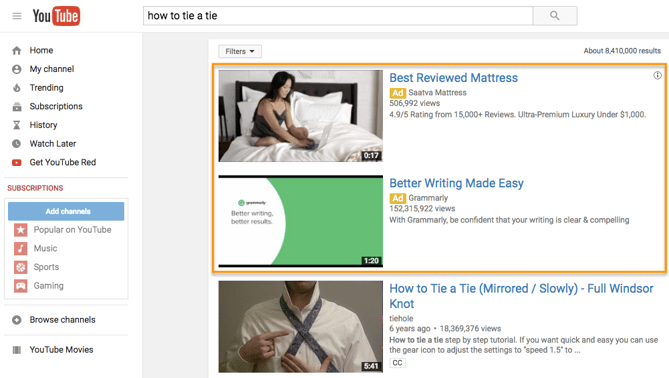
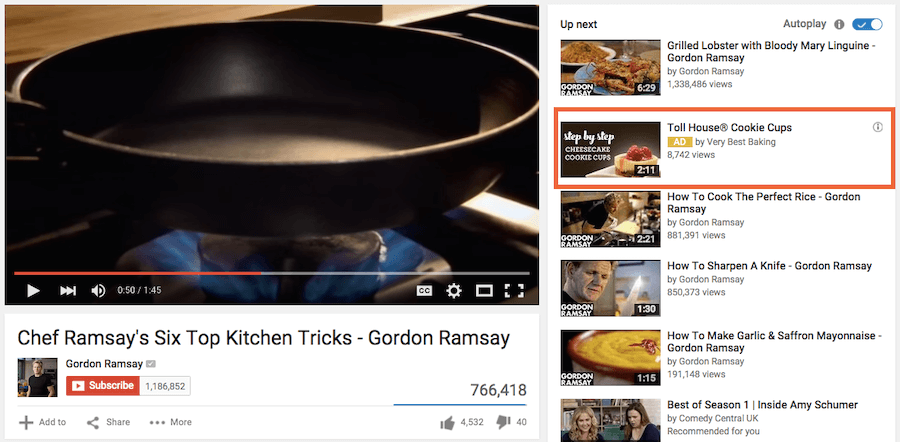
Video discovery YouTube ads show up on the YouTube homepage, search results pages, and as related videos on YouTube video watch pages.
These ads appeared after performing a YouTube search:
This display ad appears as a related video on the right-hand video sidebar:
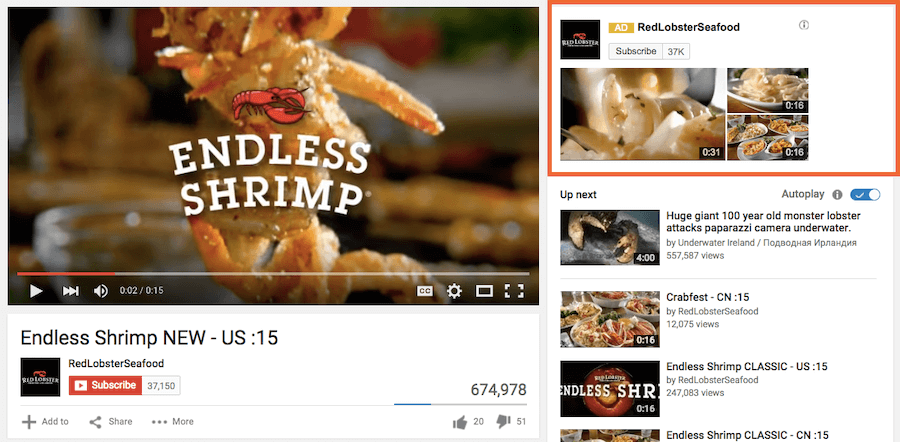
Once a user clicks on the ad, the destination video page features a spot on the right-hand column where a companion banner display ad will appear.
In-Stream Ads
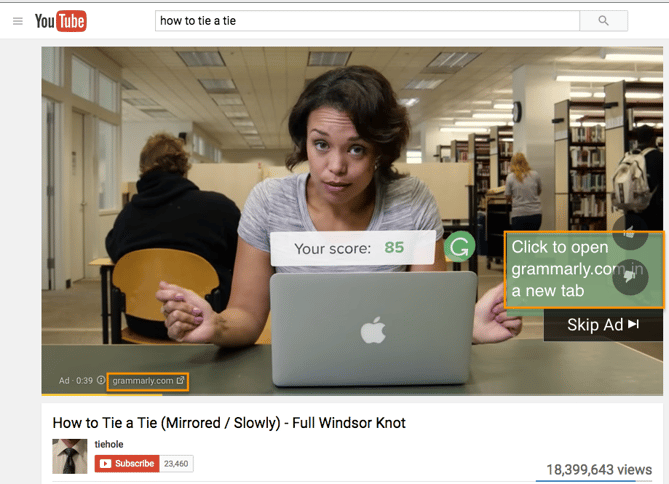
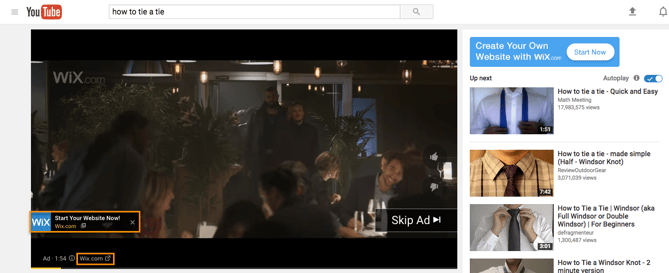
TrueView in-stream ads play before someone watches the video they’ve selected on YouTube. Viewers sometimes have the option to skip the ad after watching it for five seconds. You can also make them play anywhere in the Google Display Network (GDN) — or sites that purchased Google video ad space.
In-stream ads let marketers customize video ads with different CTAs and overlay text, as highlighted in the skippable in-stream ad example below from Grammarly.
Here’s what another skippable in-stream ad from Wix looks like. In this example, there’s another CTA from Wix on top of the right-hand video menu display:
What TrueView Videos Can Include
TrueView video campaigns can include people, dialogue, and music that was retrieved with permission — or is considered royalty-free. However, it’s best not to run a standard promotional commercial. Because these videos can be skipped, you need to give your audience a reason to keep watching, and product plugs historically don’t get the views you might expect.
Instead, tell a story with the time you have in this video. People love seeing case studies of those who faced a struggle that they can empathize with. It’s a source of entertainment that makes your brand memorable and less tempting to skip.
With TrueView ads, advertisers can gain a ton of information about the performance of their ads for optimization and testing purposes.
Using AdWords, YouTube account managers can collect data on an ad’s completed views, partial views, if the video drives channel subscriptions, clickthrough rates on CTAs, views sourced from a user sharing the content, and views on the brand’s other content that can be attributed to a person initially viewing a video ad.
These actions help advertisers better understand the full value of their video ad spend and where to allocate budget to increase results.
2. Preroll Ads
Some in-stream ads are non-skippable and can play before, mid-roll, or after the main video. These are called Preroll ads, and they can be 15 to 20 seconds in duration.
Here’s an example of a non-skippable video ad before the main content on YouTube:
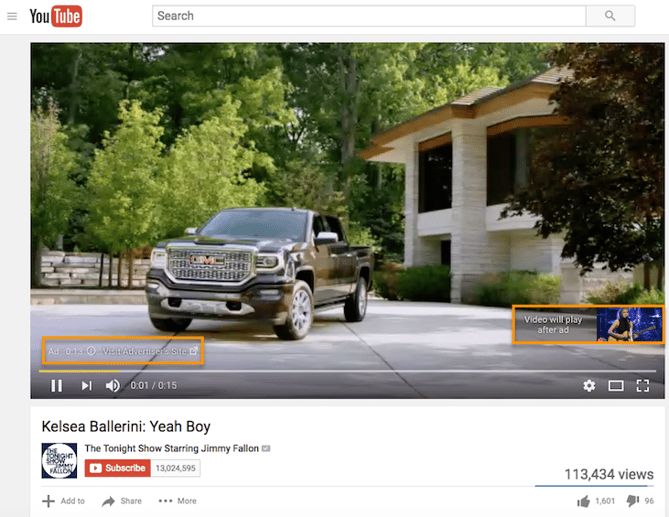
There are also non-skippable, mid-roll video ads, which appear midway through a YouTube video that’s 10 minutes or longer in length.
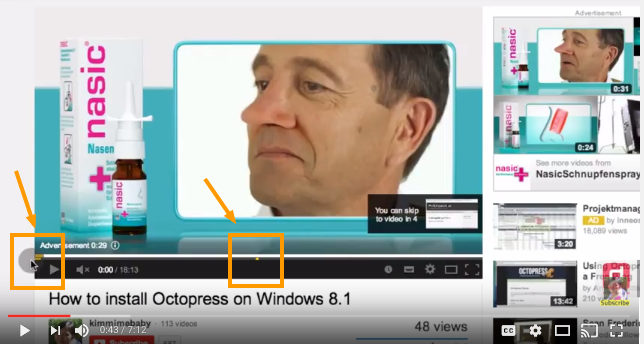
Source: PC Daily Tips
What Preroll Videos Can Include
Preroll ads give you just as much freedom as TrueView ads in their allotted content. You can include people, dialogue, audio, and more elements that you find best represent your brand in 15 to 20 seconds.
Because preroll ads can’t be skipped, these videos are best created with a call-to-action (CTA) so you can optimize the attention you do have from the viewer. In other words, encourage viewers to click on your ad and receive something in return. Perhaps you’ve released a new product or promoting a major event this season and are looking for signups — use this preroll ad to get those clicks.
Keep in mind YouTube sells Preroll video space on a pay-per-click (PPC) basis. Make the click worth it.
3. Bumpers
Bumpers are the third and shortest type of YouTube video ad available to you. At just six seconds per bumper, these ad spots play before a viewer’s chosen video.
Bumper video ads obviously can’t tell a good-enough story in just six seconds, but they make terrific complements to larger video campaigns on a new product launch or event. Just be sure to use this six seconds wisely, and include only the components of your brand you want your audience to remember.
How to Set Up & Launch a YouTube Video Advertising Campaign
Once you’ve created a marketing video you want to advertise on YouTube, it’s time to create your video ad campaign. (If you haven’t made a video yet, here’s how to get started with Animoto or Wistia, along with a few great examples.) Then, upload your video to YouTube.
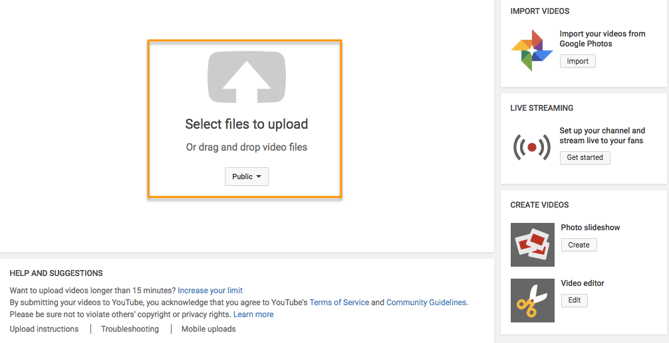
Now, you’re ready to set up your advertising campaign. First, go to your Google AdWords account to set up your campaign.
Campaign Type
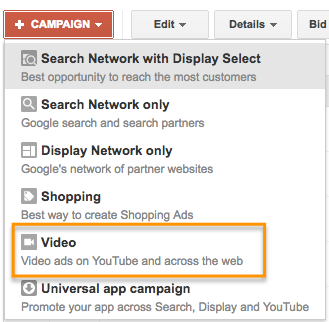
Tap the drop-down menu on the right-hand side of the red “+ Campaign” button on your Google AdWords homepage and select “video.”
Campaign Name
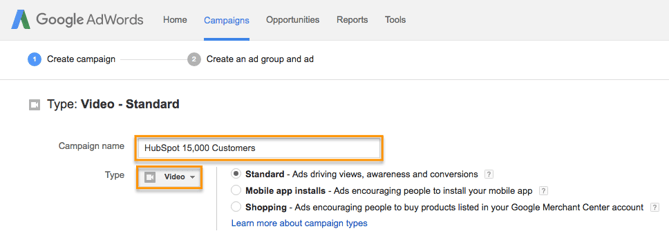
Enter a name for your campaign, and make sure Video has been chosen from the Type drop-down menu.
Video Ad Format
Select “In-stream or video discovery ads” to ensure your video ad will be in TrueView format (in the style of the examples outlined above).

Budget
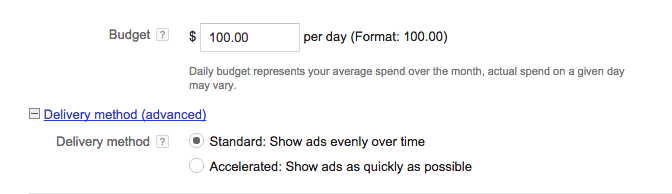
Set your budget per day. You can also select a delivery method — either the standard delivery, which shows ads evenly during the day, or accelerated delivery, which drives views as quickly as possible. The latter would be useful if you want to capitalize on a trend or news item relevant to your brand’s video.
Networks
Decide where you want your ad to appear.
- YouTube Search: Your video ad will appear in results for searches and will appear on the YouTube home page, channel pages, and video pages.
- YouTube Videos: This runs TrueView ads that can appear in-display ads or in-stream ads. With this option, you can choose for your video ad to appear before or around videos shown across the Google Display Network.
You should create separate campaigns for YouTube Search and YouTube Video as this will help you to better track performance metrics. These ads are served to people performing very different activities and require a different amount of commitment from the viewer, so it’s best to monitor performance separately.

Locations
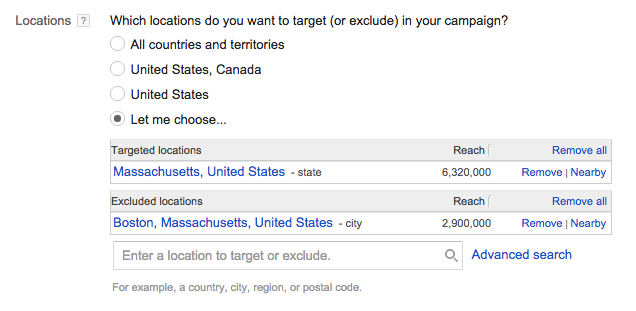
Define the location of users whom you want the ad to be shown to. You can also exclude certain locations.
Language, Device & Mobile Bidding
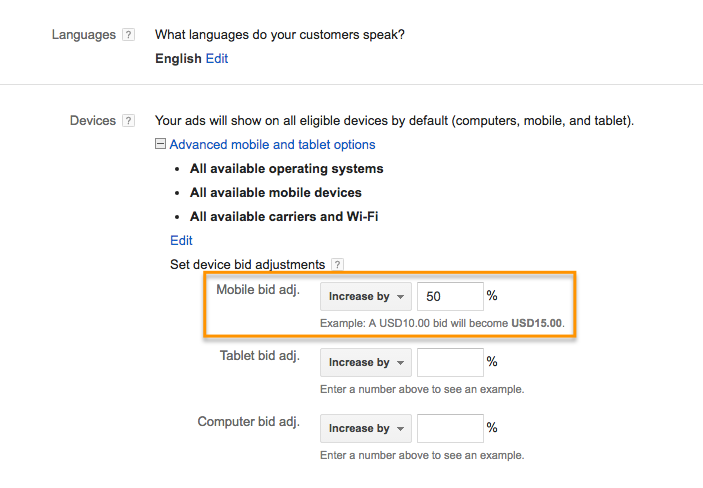
AdWords will let you specify the operating system, device, and carrier for more advanced targeting. This is especially useful for mobile app ads, and there’s an option to increase or decrease your bid based on if the video ad is shown to someone on a mobile device.
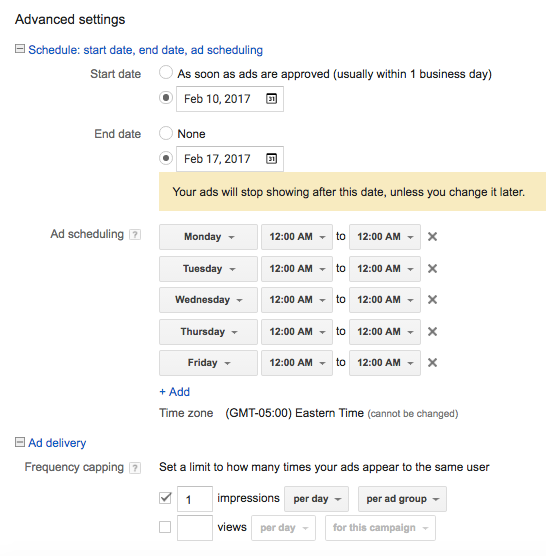
Advanced Settings
With the advanced settings section, you can set begin and end dates for your campaign, create a custom schedule for when your video ad should be shown, and limit the daily impressions and views for users. This all helps you to get the most return for your ad spend.
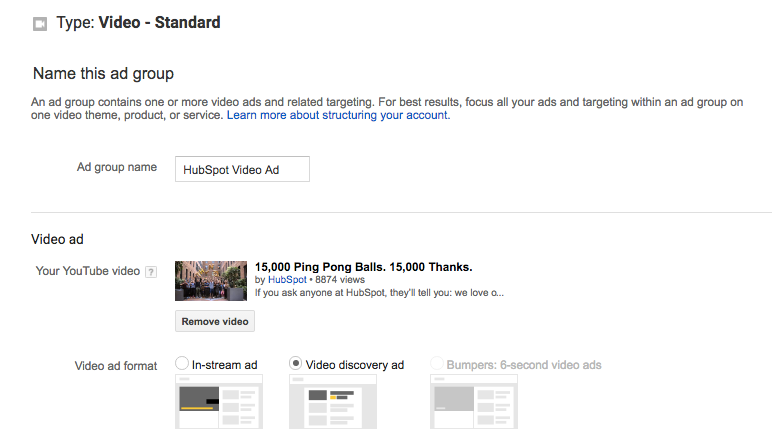
Creating the Video Ad Creative
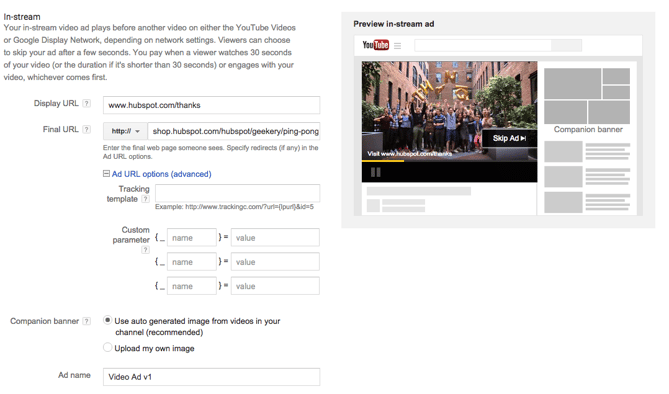
Name your ad group, and then insert the YouTube link for the video you would like to run the ad for. You will then choose whether you want this to run as an in-stream ad or an in-display ad.
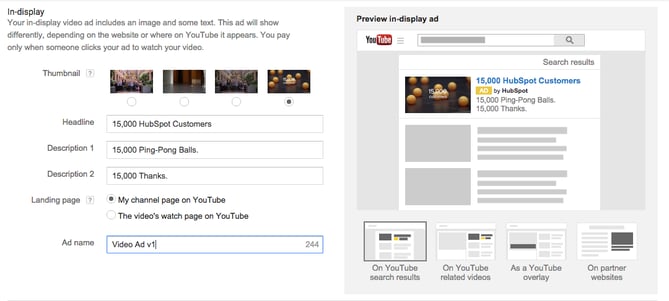
For in-display, you’ll need to include a title and short description, which is entered on two separate lines. Note: Titles are limited to 25 characters, and the description lines are limited to 35 characters each.
In-stream ads provide you with the option to overlap a display URL on top of the video. You should use a vanity URL that directs to another final URL to make it more memorable. You can include advanced URL tracking options. In addition, a companion banner made from images from your video will appear on the right side of the video ad.
Bidding
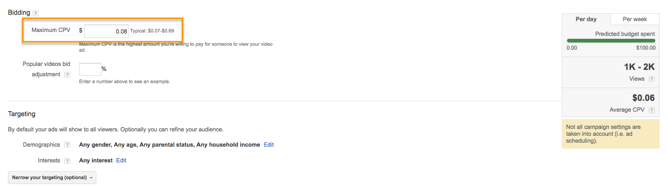
You’ll then determine the max price you will pay for each view, which you can adjust to increase the number of projected views your video may receive.
Targeting
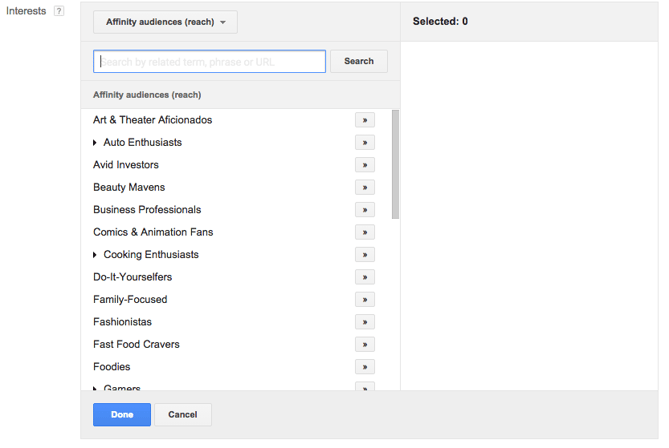
Finally, you can further define the audience you would like the video to be shown — options include gender, age, and parental status. You can also target individuals by their interests, such as beauty mavens, cooking enthusiasts, horror movie fans, etc. Try running multiple campaigns to target different groups of users to discover who is most engaged, rather than including everyone you want to target in one campaign.
Advanced Targeting
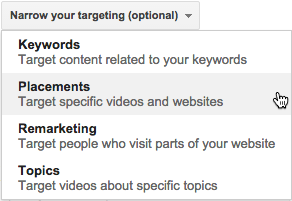
You can also target individuals by keywords, topics, or websites where you would like your video ad to appear. Keyword targeting with in-display ads can be a powerful tool for finding individuals who are looking for a visual answer to a question. Be sure to do your research, and try testing out different groups of keywords to see which leads to more views, clicks, or conversions.
Additionally, you can use AdWords video ads to remarket to people who have been in contact with your brand already. This can help you to re-engage those who are already familiar with your brand.
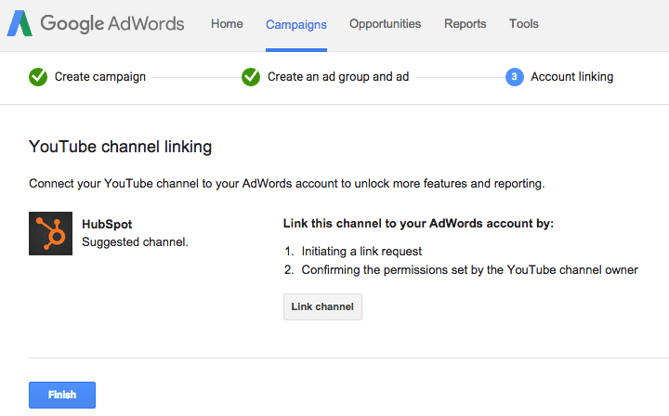
Linking Your Account
You should link your AdWords account to the YouTube channel where the video is hosted if you haven’t already. You can also click “finish” to begin running your video ad campaign.
10 Tips for Optimizing Your AdWords for Video Ads
Launching a video ad campaign is a great step, but there are some things you should set up prior to starting to pay for views to make the most of your budget and to see the highest return for your client.
1. Define your metrics and goals.
When analyzing the results, there are four main categories of metrics you can track for each video. These are located under the “column” drop-down in your campaigns interface.
Views
Under the “views” category, you can better understand what percentage of the ad people viewed and understand how the ad drove earned views or views on your brand’s other videos.

Audience
This category can be used to track likes and shares for each video ad.

Branding
The view rate should signal if the creative and message are interesting or entertaining enough for people to watch the ad. By increasing your view-through rate (VTR), you will lower your cost per view.

Conversions
Conversions will help you better understand if your ad is driving leads and returning a high ROI for your brand.

Depending on the goals for the brand, you should determine a few goals based on these metrics and formalize a plan for optimizing creative and trying different targeting criteria to improve results. Your goals should also determine the type of content you will feature in the ad — some metrics are better for branding goals and others will drive leads and conversions.
2. Track low performing placements.
If you’re running in-display ads that will appear across the Google Display Network, you can review where the ad has appeared in by navigating to Video Targeting > Placements > Where ads were shown > Display network from your Google AdWords Campaigns dashboard. Review this list to see if any particular sites are contributing to poor performance for your desired metrics. Exclude these sites from your ad campaign moving forward to increase your average CPV.
3. Use a custom thumbnail image.
Design or use a high-quality still image from the video to entice a viewer to click on your video. Remember, this image needs to be legible by users on different devices, including mobile. If your image contains a person, make sure he or she is looking into the camera. If you are featuring a product, make sure the background isn’t distracting.
4. Drive people to buy with cards.
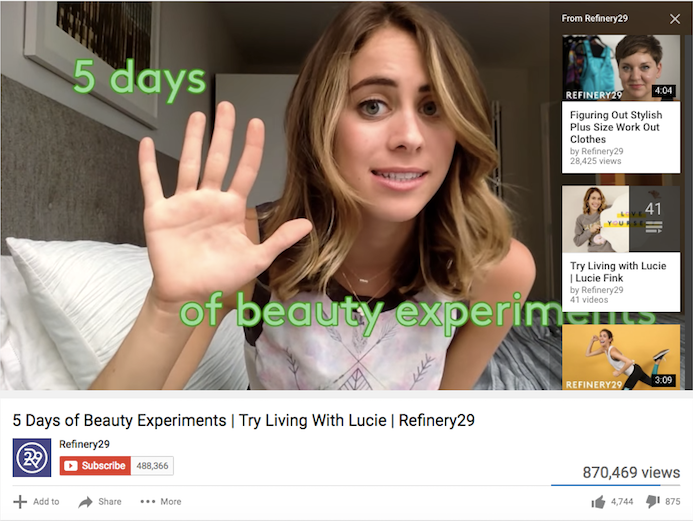
A YouTube card is teased with a small “i” symbol, which the viewer can click to expand. You can time this appearance so only users engaged with the video and content will see the notification.
With cards, you can feature a product related to or featured in the video to drive product purchases. You can also use cards to drive fundraising donations, traffic to a URL, or traffic to other videos as shown in the example below from Refinery29. Each format will allow you to customize the card with text, images, and other options.
5. Create calls-to-actions.
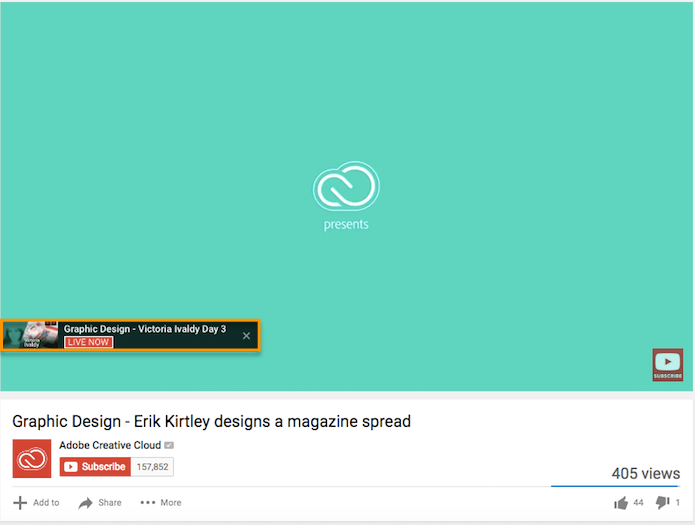
When promoting a video on YouTube, you can include call-to-action overlays that link to a URL. You could link to a landing page, product page, information page, career page … whatever you’d like. You could also send people to a favorable report or interview featuring the brand.
Adobe highlights one of its live videos using a call-to-action overlay:
6. Create a YouTube end slate.
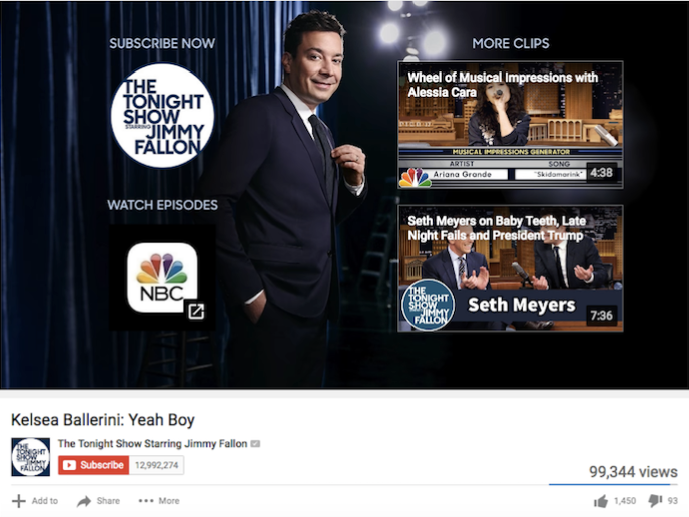
Create an end screen to drive subscribers to your channel, promote your social networks, or increase interest in your brand. If someone has watched a video until the end, it’s a good sign they enjoy your content and might be interested in subscribing to your channel for future updates. The Tonight Show Starring Jimmy Fallon‘s end slate uses this screen to drive subscribers and social media fans while also highlighting other interesting topics its host has featured. Once you build the image, you will be able to annotate the end screen in YouTube’s video editor.
7. Use negative remarketing.
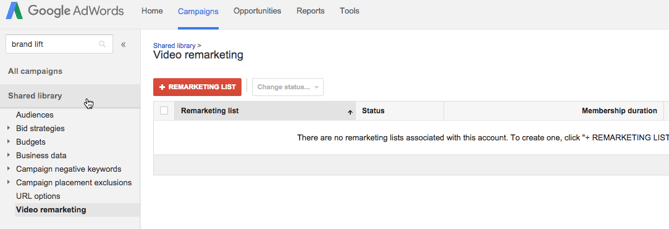
If you are running a campaign for a longer period of time and want to only attract new users to a brand, consider creating a list of people who your ad will not be shown to. When viewing your AdWords Campaign screen, select “Shared library” on the lower left sidebar. Then select “Video remarketing” and “+ Remarketing List”. You can stretch your campaign budget and target only unique users by selecting to not show your video ad to someone who has previously viewed the specific video, who has visited your YouTube channel, or shared, liked, or commented on any of your videos on your channel.
8. Use close captioning to cater to viewer’s needs and wants.
This tip applies to all YouTube videos — but it’s a general best practice that’s not followed by many brands. Include a quality video transcription you’ve generated and approved. Only user-uploaded transcriptions are indexed by Google because YouTube’s automatic captioning can be less than reliable. Depending on your target audience, you may also want to include transcriptions in various other languages. You can also offer users the option to download or visit a site page with the full transcription in your video description.
9. Qualify viewers.
Sometimes, your ad will be seen by people who have no interest in your product. Encourage them to skip the ad if the content isn’t relevant so you don’t have to pay for the view and they don’t waste their time watching irrelevant advertising.
10. Consider making your ad longer.
When it comes to TrueView ads, if the ad is under 30 seconds, you pay only if a viewer watches until the end. If the ad is longer than 30 seconds, you pay if the viewer watches it for at least 30 seconds. In both cases, you pay if the viewer interacts with your ad before it’s over. Consider this when you are coming up with ideas for content for the ad. You may want to put messaging at a certain point so uninterested viewers can skip the ad, or you might provide special offers towards the end of the video.
The Future of Video is Bright
We’ve told you before: Video content is a must-have part of your content strategy. This is even truer now that YouTube lets marketers target users based on their search histories. YouTube advertising is more targeted than ever, and it’s less competitive real estate than the world of Google Search because video content is newer to the content scene and less popular than blog posts.
Stay tuned for more from us about how to make great video ads for YouTube and social media, and where we think YouTube marketing is headed next.

How to Tweet on Twitter: 12 Templates to Get You Started
How to write and post a Tweet:
- Sign into Twitter.
- Begin compsing your Tweet above the feed, or click on the new Tweet button at the top of your screen.
- Compose your Tweet with less than 140 characters.
- Include a #hashtag so relevant followers can find your account.
- Tag a person using ‘@’ followed by their twitter handle.
- Follow a Tweet formula as a starting point for ideas.
Not sure what to tweet to get your followers to engage with you? Whether you’re just getting started with Twitter or you’ve been using it for a while, but feel like you’re in a rut, it can be hard to come up with new ideas for what to publish.
Sometimes, it can help to follow some tried-and-true tropes. Here are several Twitter “formulas” you can follow.
Just make the following changes to each one:
- Fill in the “blanks” where the [BRACKETS] are.
- Edit the #hashtag with the actual hashtag you’d like to use (e.g. #marketingtips). Hashtags make it easy for people to find your tweets when they’re tracking that hashtag, so you can find more relevant followers.
- Replace @TwitterHandle with a person’s real Twitter handle (e.g. @HubSpot).
Download our free guide to generating more Twitter followers here for even more helpful Twitter tips.
Note: Each audience is different, so you may find that some of these formulas work better than others to grow your following.
How To Tweet: Here Are 12 Templates You Can Customize
1. Use “The Basic Shared Content Tweet”
[ARTICLE TITLE]: https://ift.tt/1rf7FGW by @TwitterHandle
This go-to tweet style is the easiest to execute, but many times, people forget to include a relevant hashtag and the author’s Twitter handle. The hashtag could get your tweet more exposure to people following that hashtag. And always credit your information source (the author or the site you got the post from) on social media. It’ll show appreciation to the original content creator — and they might return the favor by sharing some of your content with their followers.
Example: 12 Tweet Formulas to Get You Started on Twitter: http://hub.am/Sgsvt5 #twittertips by @HubSpot
2. Try “The Shared Content Tweet With Commentary”
[YOUR OPINION] > [ARTICLE TITLE]: https://ift.tt/1rf7FGW by @TwitterHandle
[ARTICLE TITLE]: https://ift.tt/1rf7FGW by @TwitterHandle > [YOUR OPINION]
Like the basic shared content tweet, this tweet includes the article title (or a shortened version), a relevant hashtag, and the author’s Twitter handle. But in addition, you’ll add your opinion — whether it’s a quick “+1” or something a little more in-depth. Something personal like that might increase engagement rate with your tweet.
Example: Bookmarking this. > 12 Tweet Formulas to Get You Started on Twitter: http://hub.am/Sgsvt5 #twittertips by @HubSpot
3. Retweet With Commentary
Typically, when you want to retweet someone’s tweet, you’ll simply click the retweet button and share the content with your followers. But if you want to know how to retweet with a little flavor, we’re going to show you. There are two ways to add commentary to a retweet: using the “retweet with comment” feature or composing a new tweet and publishing it manually.
a) Using the “retweet with comment” feature.
[YOUR OPINION] #hashtag
[EMBEDDED ORIGINAL TWEET]
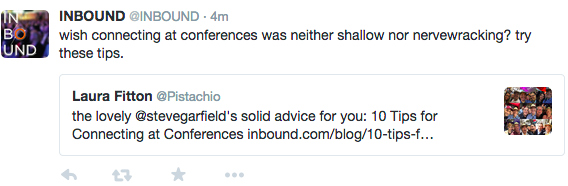
The “retweet with comment” feature allows you to embed an original tweet within your own message, and then comment on it in up to 116 characters. To do this, click the retweet icon at the bottom of the tweet. In the window that appears, add your comment to the “Add a Comment” section (and include a hashtag, if you so desire).
Example:
(For more details on how this feature works, read this blog post.)
b) Manually retweeting with commentary.
[YOUR OPINION] #hashtag – RT @TwitterHandle [ARTICLE TITLE] – http://url.com
To retweet with commentary in this way, simply copy and paste the person’s tweet into a brand new tweet, preface the tweet with RT @TwitterHandle, and add commentary to the beginning. If you modify their tweet at all (e.g. to make the tweet a bit shorter, allowing more room for your comment), use MT — which stands for “modified tweet” — instead of RT.
Example: #7 is important but often forgotten. – RT @mvolpe “10 Things Great Marketers Do Every Day” http://hub.am/1m6RPK4 by @kellykranz
4. Use “The .@TwitterHandle Tweet”
.@TwitterHandle [REST OF TWEET]
If you put someone’s Twitter handle at the very beginning of your tweet, Twitter assumes you’re @replying to that person — so they omit that tweet from showing up on your Twitter followers’ feeds. While this is usually a good thing (otherwise, your feed might get taken over by @reply tweets), there may be times when you want your followers to see that tweet on their feeds. To do that, simply add a period right before their Twitter handle.
Example: .@HubSpot redesigned their blog! Check it out here: http://blog.hubspot.com #webredesign
5. Try “The Problem/Solution Tweet”
Don’t let your [ASSET] [NEGATIVE RESULT]. Find out how to [GOAL] here: https://ift.tt/1rf7FGW
Fear is a powerful motivator. Nobody wants to suck, or fail, or flounder, or fall short, or whatever [negative result] you use. And if they do, they want to learn how to remedy the situation, fast — that’s where you can help them. Also, if there’s a relevant hashtag you can use here, don’t forget to include it!
Example: Don’t let your blog fall into a rut. Find out how to churn out new blog posts quickly: http://hub.am/1nD3y5M #blogging
6. Utilize “The Stat or Fact Tweet”
Did you know that [STAT]? https://ift.tt/1rf7FGW
Don’t just find any old data point here — find something that will really intrigue your target audience. Once they get this little preview, they could want to read the full story to understand (1) why this data point is true, and (2) what they should do about it. Just be sure your statistic is recent and from a reputable source.
Example: Did you know 6.5% of blog posts are published on the weekends & they get 18% of all social shares? http://hub.am/1otH7QF #blogging
7. Tweet “The Endorsement Tweet”
I loved this article by @TwitterHandle about [TOPIC] – http://url.com #hashtag
Lots of valuable info on [TOPIC] in this article by @TwitterHandle – http://url.com #hashtag
This tweet can take many forms, but instead of tweeting a basic shared content tweet, you’re adding your endorsement to the tweet and possibly including info on why you enjoyed the piece.
Example: I loved this article by @lkolo25 about how to not screw up your landing pages – http://hub.am/1p2LQwy #leadgen
8. Embed a SlideShare in a Tweet
[PRESENTATION TITLE]: https://ift.tt/1rf7FGW by @TwitterHandle
Did you know you can embed a SlideShare presentation directly into a tweet? That way, your followers can flip through the presentation without ever having to leave Twitter (or the page a tweet is embedded on).
To embed a SlideShare presentation into a tweet, all you have to do is link to the presentation and it will embed automatically. This is also true for documents and videos from SlideShare as well.
Example:
20 Facebook, Twitter, LinkedIn & Pinterest Features You Didn’t Know Existed: http://t.co/yLFzTr392P via @HubSpot #socialmediatips
— Lindsay Kolowich (@lkolo25)
April 27, 2015
9. Ask a Question in a Tweet
[QUESTION] #hashtag
[QUESTION] – https://ift.tt/1rf7FGW
Twitter, like all social networks, is a two-way conversion. You should regularly ask your followers questions. These can be tied to an article you’ve read or could be something a little more random (though still tied to your brand). Not every tweet needs to drive traffic to a website page.
Example: What tool do you use to schedule your social media posts? #socialmedia
10. Use “The Tip or Advice Tweet”
[YOUR OWN WORDS OF WISDOM] #hashtag
[QUESTION] #hashtag 1) [ANSWER #1] 2) [ANSWER #2] 3) [ANSWER #3]
Again, not every tweet needs to drive traffic to a website page — in fact, tweeting bits of advice that obviously aren’t traffic drivers is a great way to build credibility. Tweets like this are retweeted frequently and can get you more engagement and followers, so don’t look as a “sacrifice.”
Example: Do you pass reshare test? Be valuable on #socialmedia: 1) Provide information 2) Provide analysis 3) Provide assistance 4) Be entertaining.
11. Try “The Inspiring Quote”
“[QUOTE]” – @TwitterHandle #quote
“[QUOTE]” – [NAME OF PERSON NOT ON TWITTER] #quote
Everyone loves a daily dose of inspiration! It’s difficult to research quotes and find the perfect one, so inspirational quotes are best shared when you randomly come across them and get inspired yourself. So keep your eyes peeled for great quotes, takeaways, data, etc. Just make sure to give credit where it’s due!
Example: “Our time is limited so don’t waste it living someone else’s life.” – Steve Jobs #quote
12. Post “The Photo Tweet”
[PHOTO CAPTION] #hashtag [ATTACH PHOTO]
There are lots of ways to spice up your tweets with visual content. The simplest of them all is adding a photo to your tweet, using the text part of the tweet as a caption, and sharing that with your followers. This is great for sharing pictures of your office space and employees, or promoting events and webinars. Remember to include any relevant Twitter handles or hashtags.
Example:
Fantastic shot taken by yours truly from the 2014 @HubSpot Inbound Marketing Conference in Boston. #INBOUND14 pic.twitter.com/cRufJyTH7n
— David Roberts (@DavidatJDR)
November 17, 2014
Want to share this post? Here are some ready-made tweets:
Click to tweet: 12 Tweet Formulas to Get You Started on Twitter: https://ift.tt/1ds2mTp @HubSpot #TwitterTip
Click to tweet: Check out these fill-in-the-blank tweet formulas: https://ift.tt/1GEUF5O
Click to tweet: Running out of tweet ideas? Here are some fill-in-the-blank formulas – https://ift.tt/1GEUF5O
Editor’s Note: This post was originally published in June 2014 and has been updated for accuracy and comprehensiveness.

20 YouTube Tricks, Hacks, and Features You’ll Want to Know About This Year
When people talk about today’s most popular social sharing websites, YouTube often gets left out of the conversation in favor of sites like Facebook and Twitter.
But don’t be fooled: YouTube has a lot going for it. Although Facebook might be the largest social networking site, YouTube has the second greatest reach after Facebook in terms of general usage. It’s also the second biggest search engine behind its parent company, Google.
And there are a ton of cool things you can do with YouTube that you might not know about, whether you use YouTube to watch videos, post them, or both. For example, did you know YouTube has its own virtual reality (VR) setting to view any video in 360 degrees? Or that you can create a YouTube time link that brings viewers to a specific moment in the video?
Mind-blowing stuff, people. To help you make the most out of the still very popular platform, we’ve put together a list of 20 of the lesser-known hacks, tips, and features YouTube has to offer.
YouTube Tricks, Hacks, and Features
- Turn any video into a GIF.
- Create a YouTube time link to start a video at certain points.
- See the written transcript of a video.
- Get found in search by uploading your own written transcript.
- Use YouTube to make a written transcript.
- Create, share, and collaborate on video playlists.
- Save videos to watch later.
- Create your own custom YouTube URL.
- Add an end screen or cards to promote similar content.
- Browse and download from YouTube’s free sound and music library.
- Add creative effects with YouTube Enhancements.
- Play videos in the background on mobile devices.
- Live stream videos to YouTube.
- Upload and watch videos in 360 degrees and VR.
- Watch for a new YouTube ads algorithm.
- Remove ads from YouTube videos for $10/month.
- Use Google Trends to explore popular YouTube search terms.
- Turn on a ‘safer’ YouTube for your kids.
- Clear your watch history.
- Learn about YouTube’s copyrights in a new way.

20 YouTube Tricks, Hacks, and Features You’ll Want to Know About
1. You can turn any YouTube video into a GIF using the URL.
Everyone loves GIFs, but knowing how to make them isn’t common knowledge. Well, it should be, because all it takes is a little YouTube URL trick.
To create a GIF from a YouTube video: Select a video to watch on YouTube and find the URL at the top of your browser. Add the word “gif” right before the domain name so it reads, “www.gifyoutube.com/[your-video-tag].”
This will bring you to gifs.com, with your video already uploaded and ready for editing. Here, you’ll find a menu of options to the left-hand side with a timeline bar along the bottom of your video. You can set the GIF duration, crop its frame, add captions, and more.
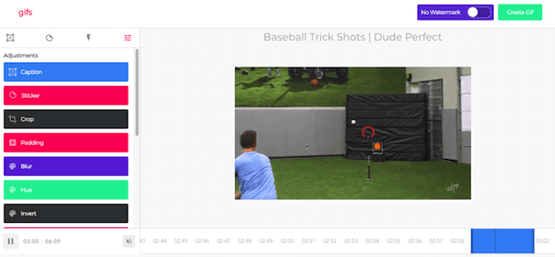
Click “Create GIF” on the top-right and it’ll prompt you for a GIF title and set of tags. Then click “Next,” and you have a handy landing page from which to share your newly minted GIF. Keep in mind you can only download this GIF to an offline file by signing up with gifs.com.
2. You can create a link that starts a YouTube video at a certain time.
Ever wanted to send someone a YouTube video, but point them to a specific moment? Let’s say you’re trying to recruit your friends to learn the dance in Justin Bieber’s “Sorry” music video with you.
Instead of sending your friends the general YouTube link and instructing them to fast-forward to the 0:50 minute mark, you can actually send them a specific YouTube time link that starts the video at whichever time you choose. Click here to see what I mean.
Alright, here’s how to do it:
To create a link that starts a YouTube video at a certain time: Open up the video and click “Share” to the far right of the video title. Then, in the window of options that appears, check the box next to “Start at:” and type in the time (in hours:minutes:seconds) you want. Alternatively, you can pause the video at the time you want it to start and that field will autofill.
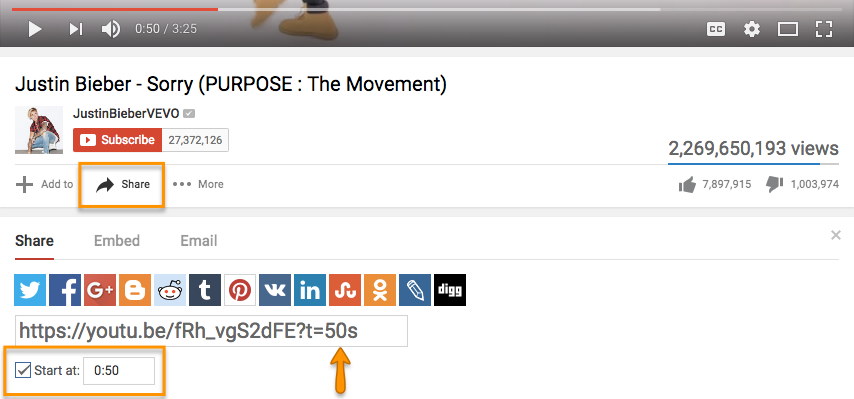
After a few moments, you’ll see a tag add itself to the end of the generic YouTube link (in this case, ?t=50s). Simply copy that link and paste it wherever you’d like.
It’s worth noting that you can’t embed a video so it starts at a certain time; you can’t only link to it.
3. You can easily see the written transcripts of people’s videos.
Did you know YouTube automatically generates a written transcript for every single video uploaded to its website? That’s right — and anyone has access to that transcript unless the user manually hides it from viewers.
I can think of a number of different situations where video transcripts can come in handy. For example, maybe you want to write down a quote from a video, but the tedium of pausing-and-typing, pausing-and-typing would drive you up a wall. Or perhaps you need to find a specific section of a video, but don’t want to rewatch the whole thing to find it. With a transcript in hand, you can find information like this without doing it all by hand.
To see a video’s transcript: Open the video in YouTube and press the “More” tab underneath the video title. Choose “Transcript” from the drop-down menu.
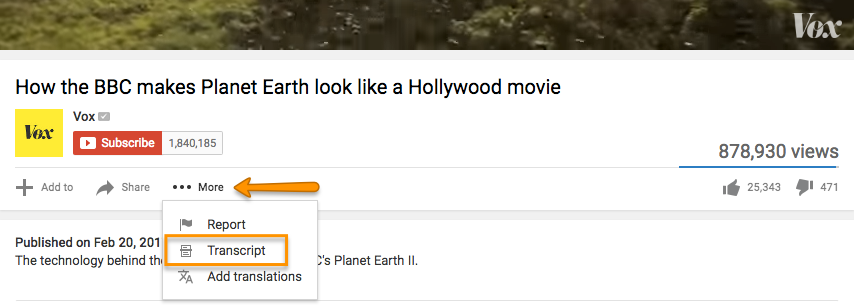
(If you aren’t seeing this option, it’s because the user chose to hide the transcript.)
This transcript will appear as a new module in the same window. In many cases, the user who uploaded the video will not have gone back and manually polished the transcript, so it won’t be perfect. But it’ll certainly save you some time and pain.
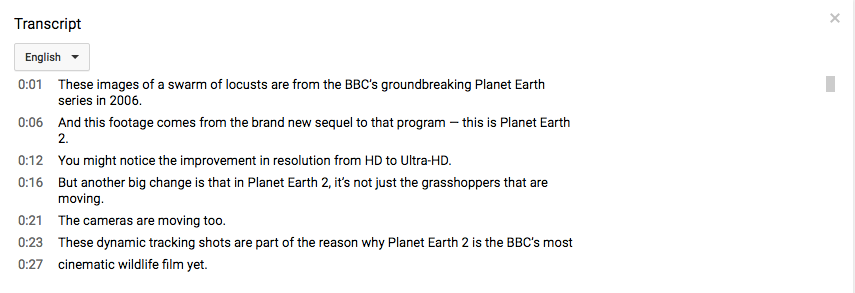
4. You can help your video get found in search by editing or uploading a transcript.
Both YouTube and its parent company Google look at a number of factors when ranking videos in search to determine what your video is about, and your transcript is one of them. (An even bigger ranking factor is your video’s description, which is why Digital Marketing Consultant Ryan Stewart suggests that you actually paste your transcript right into the description box, too.)
To add a transcript to your video: Open the video on YouTube, and you’ll see a row of icons just below the play button. Click the icon on the far right for “Subtitles/CC.” (CC stands for “Closed Captions.)
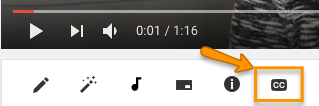
Set your language if you haven’t already. Then, you’ll then be prompted to choose among three different ways to add subtitles or closed captions to your video …
- Upload a pre-written text transcript or a timed subtitles file. (Learn more about the file types you can upload and more here.)
- Paste in a full transcript of the video, wherein subtitle timings will be set automatically.
- Type them in as you watch the video.
The folks at YouTube have done some great things to make that third option (typing as you watch) as painless as possible. For example, if you check a box next to “Pause video while typing,” it’ll make the whole process a lot faster. Here’s a GIF showing that in action:
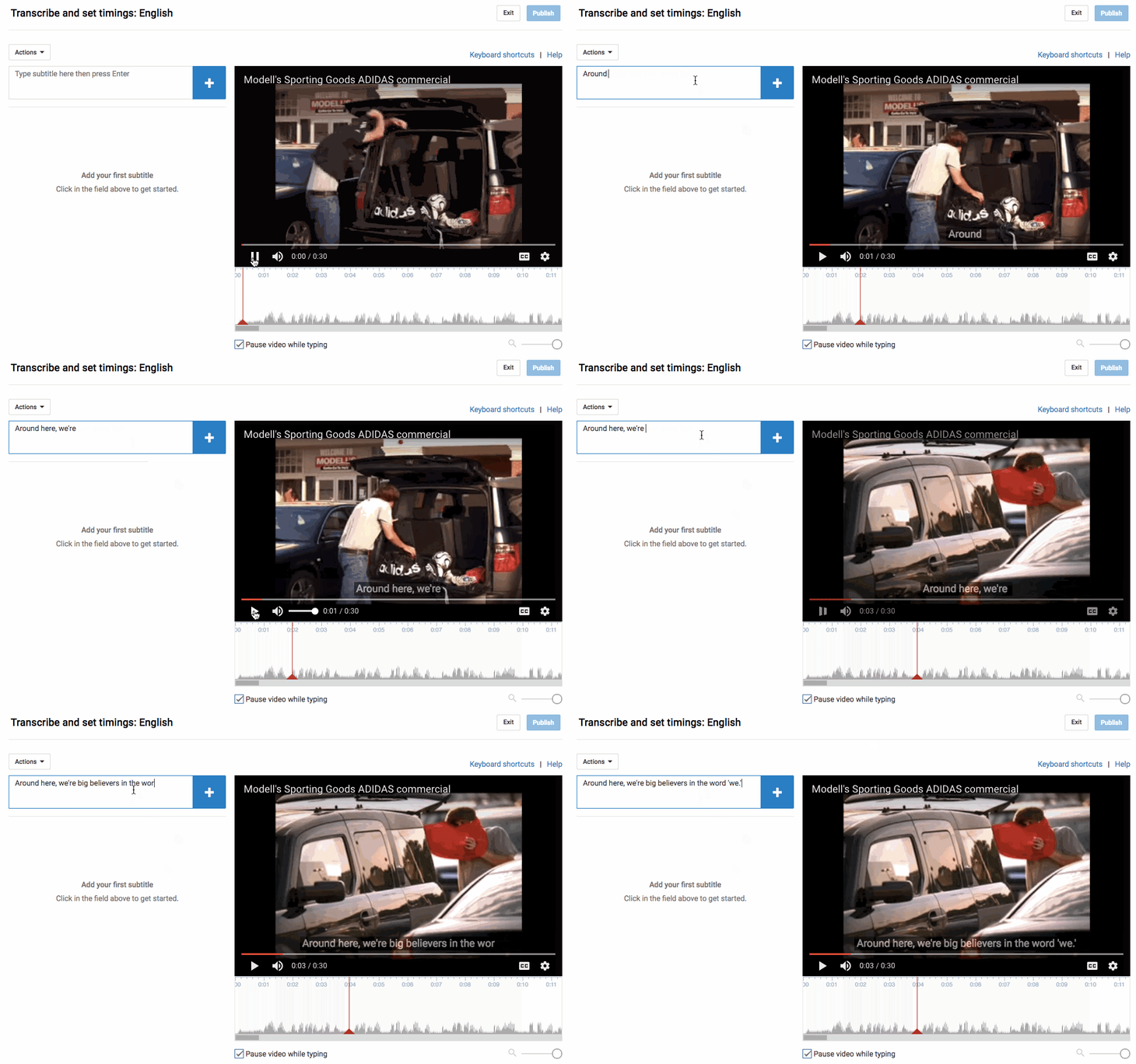
Learn more about optimizing your YouTube videos for search in the below video.
5. You can use YouTube to easily get free transcriptions of your videos and audio files.
This is the last one about transcripts, I promise — but I’ll bet you never thought about them this way. As you know from #3, YouTube automatically adds a transcript to every video. But if you’re looking for a one-off transcription of an audio or video file and don’t want to pay for a service, YouTube’s built-in captioning system isn’t a bad place to start. You can always clean it up later.
To get an automated transcription for a video: Simply upload your video to YouTube, open it on YouTube’s website, press the “More” tab underneath the video title, and choose “Transcript” from the drop-down menu. The transcript will appear as a new module in the same window. If you want to clean it up, follow the steps outlined in #3 for a user-friendly experience.
To get an automated transcription for an audio file: You’ll need to upload your audio recording to YouTube using a service like TunesToTube. It’ll take anywhere between 2–30 minutes for YouTube to upload it. Then, follow the instructions for getting an automated transcription for a video, outlined above.
6. You can create, share, and collaborate on video playlists.
Just like on your other favorite media sharing sites like Spotify and iTunes, you can create a “playlist” on YouTube — which is really just a place to store and organize the videos (your own and others’). You can keep playlists private, make them public, or even share them directly with others.
Playlists are useful for many different types of users, from an individual collecting cooking videos for their upcoming dinner party to a brand that’s segmenting its YouTube video content by topic. For example, Tasty’s YouTube playlists break up recipes by meal type, making it easier for people to browse and find what they’re looking for:
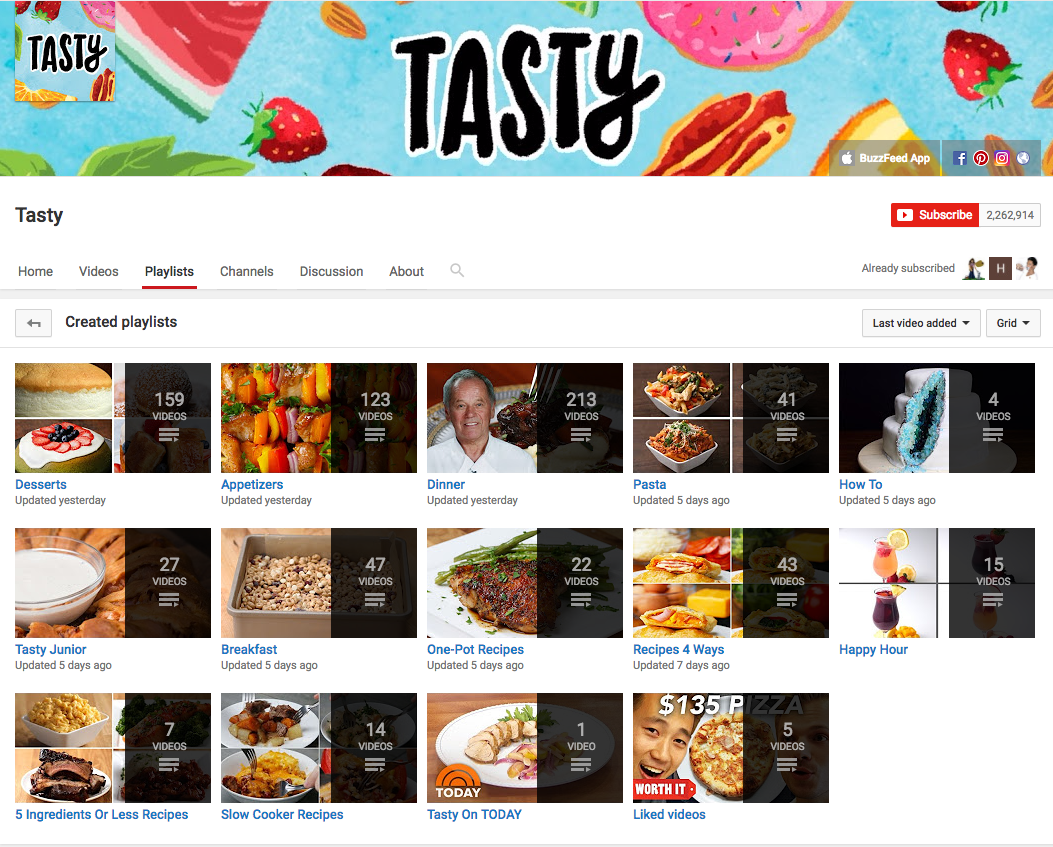
To create a playlist on desktop: Go to your Playlists page by clicking here or clicking your account icon in the top right, choosing “Creator Studio,” clicking “Video Manager” on the left, and choosing “Playlists.” Then, click “New Playlist” on the top right and choose whether you’d like to keep it private or make it public.
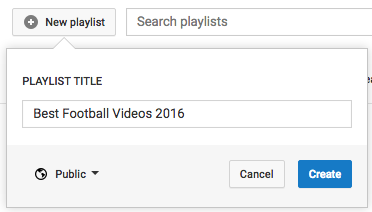
To create a playlist on mobile: Click here for instructions explaining how to create new playlists using your iOS or Android mobile devices.
To add a video to a playlist: If you’re adding a video to a playlist while you’re watching it, click the “Add to” icon below the video title and check the box next to the playlist to which you’d like to add it.
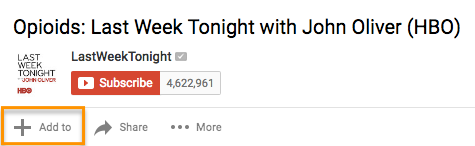
If you want to add a video to a playlist right from your Playlists page, simply click “Add Video” and either paste in a video URL, choose a video from your uploads, or search for a video on YouTube. Once you find the video you want to add, select the “Add to” menu from that video and add it to the playlist.
Your friends can contribute to your playlists, too. All you have to do is turn on the ability to collaborate on playlists. Once you turn it on, anyone you share a playlist link with can add videos to that playlist. (They can also remove any videos they’ve added, too.)
To add friends to a playlist: Go to your Playlists page again and open the playlist you want to collaborate on. Click “Playlist Settings” and choose the “Collaborate” tag. Toggle on the setting that allows collaborators to add videos to the playlist, and from there, you can send them a link where they can add videos to the playlist.
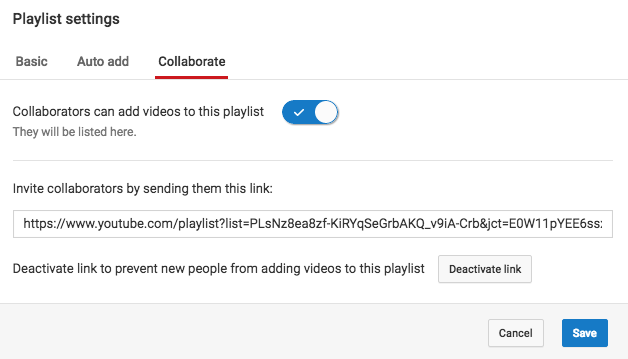
Once your friend’s been invited to a playlist, they’ll be able to add new videos to it and remove videos they’ve added in the past. They just have to follow some on-screen instructions first to confirm they want to be a contributor and to save the playlist to their own account.
When you add a video to a playlist you’re collaborating on, your name will appear next to the video in the playlist, and everyone who’s been invited to collaborate on that playlist will get a notification that a new video has been added.
(To learn more about how to manage contributors, stop accepting contributions to a playlist, and so on, read this YouTube Support page.)
7. You can save videos to watch later.
Ever seen YouTube videos you wished you could bookmark for later? Maybe you aren’t able to turn the sound on at the moment, or perhaps you just don’t have time to watch it. Well, YouTube took a page out of Facebook’s … book … by adding something very similar to Facebook’s “Save for Later” feature. On YouTube, you can save videos to a “Watch Later” playlist to access whenever you want.
The “Watch Later” playlist operates just like a normal playlist, so the instructions are identical to the previous step (except you can’t invite others to collaborate on your “Watch Later” playlist).
To add a video to your “Watch Later” playlist: Open the video on YouTube and click the “Add to” icon below the video title and check the box next to the playlist you’d like to add it to, just like you did in the previous step. The steps are very similar on mobile, but click here if you want the full instructions from YouTube’s Support page.
To access those videos: Simply go to your YouTube homepage and choose “Watch Later” from the menu on the upper left-hand side of your screen.
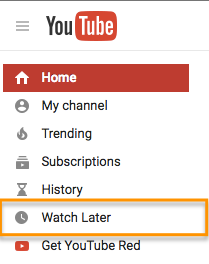
From there, you can watch the videos you were saving, as well as easily remove videos from that list that you’ve already watched.
8. You can create your own custom YouTube URL.
Want to give people an easy-to-remember web address to get to your YouTube channel? You can actually create a custom URL, which you can base on things like your display name, your YouTube username, any current vanity URLs that you have, or the name of your linked website. HubSpot’s, for example, is https://www.youtube.com/hubspot.
Important Note: Before you do this, make sure you’re positive this is the custom URL you want — because once it’s approved, you can’t request to change it, nor can you transfer it to someone else. Keep in mind that it’ll be linked to both your YouTube channel and your Google+ identity, too.
Unfortunately, not everyone’s eligible for a custom URL. To get one, you have to have 100 or more subscribers, be at least 30 days old, have an uploaded photo as your channel icon, and have uploaded channel art. If that sounds like you, keep reading.
To claim your custom URL: Open up your YouTube account settings and click “Advanced” in your name section.
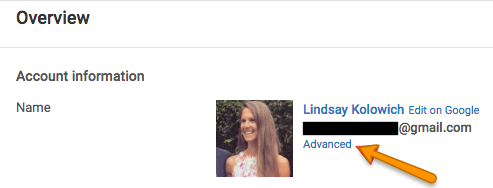
If you’re eligible for a custom URL, you’ll be prompted to claim yours by clicking a link.
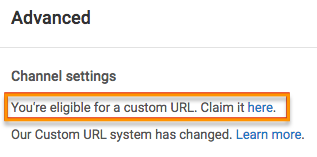
Select the box next to “I agree to the Terms of Service.” Then, once you’re absolutely sure it’s the URL you want (since you can’t ever change it), click “Change URL” to make it final.
9. You can add an end screen or cards to promote content.
In 2008, YouTube began allowing clickable links YouTube called “annotations” that you could insert into your videos. These annotations worked kind of like call-to-action buttons for directing people to subscribe to your channel, see merchandise or a fundraising campaign, visit another resource to learn more, and so on.
In order to make them more natural parts of the viewing experience, YouTube has replaced annotations with end screens, where you can display more visually pleasing call-to-action cards in the last 30 seconds of your content.
How to Add an End Screen
Do your favorite YouTube creators have a fancy closing screen that encourages you to keep watching their videos? For example, here’s one from Saturday Night Live:
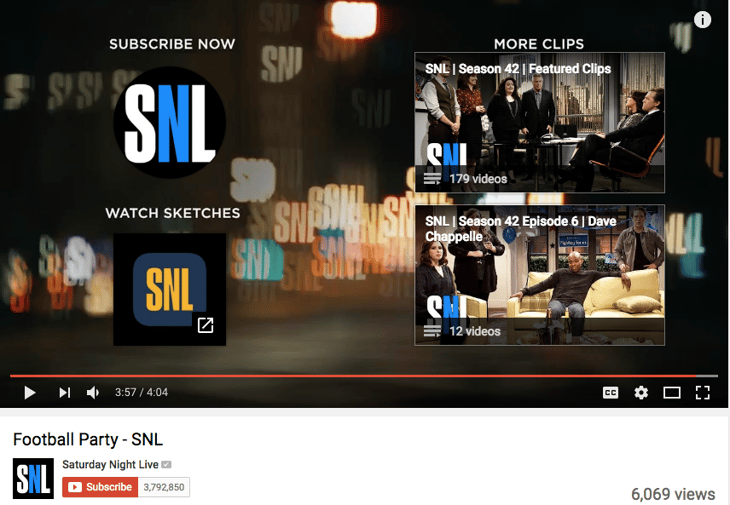
You can create a customized end screen, too. They help keep viewers on your channel by suggesting other videos and sites they can check out. Here’s how to do it:
Navigate to your Video Manager, tap “Edit,” and select “End screen & Annotations” from the drop-down menu:
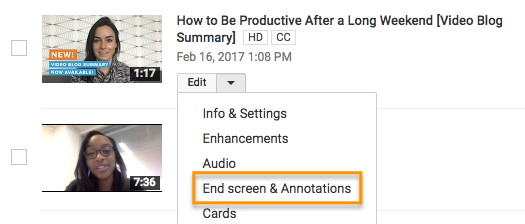
From there, you’re taken to the End screen creator studio, where you can play around with different templates and background to determine how you want your end screen to appear. Then, click the “Add element” menu to decide where you want to send viewers from your end screen.
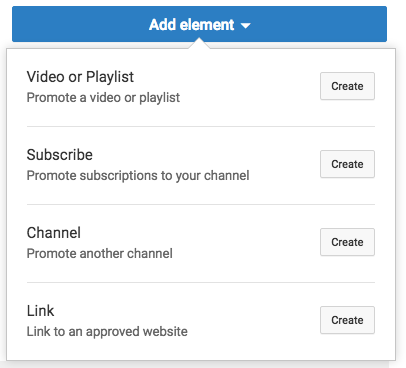
Any YouTube creators can add an end screen to customize their channels. Here’s an explainer article with more details and inspirational ideas.
How to Add a Card
You can use cards to advertise products used in your videos or links on your website you want to market on YouTube. If viewers tap the “i” in the upper-right hand corner of a video, the cards expand, as in the example below:
To add a card to a YouTube video, head to your Video Manager, tap “Edit,” and select “Cards” from the drop-down menu.
Then, choose where in the video you want cards to appear, and tap the “Add card” drop-down menu to choose what you want the card to promote. From there, customize the content that will appear to viewers when they tap the “i” while viewing your video:
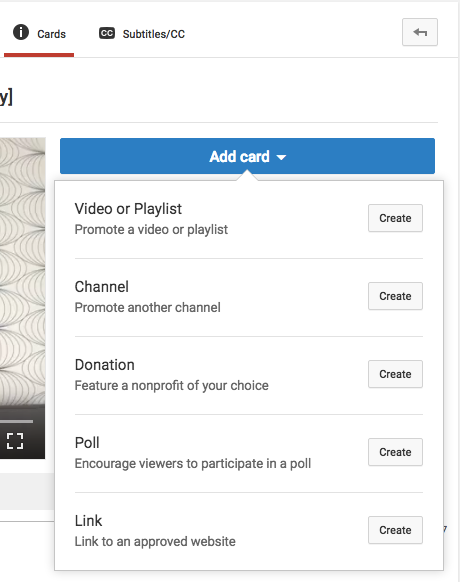
10. YouTube has a big library of high-quality, royalty-free sound effects and music you can browse and download.
Want to add some cool sound effects or music to your YouTube video (or any video)? YouTube is there for you. It has a whole library of high-quality, 320kbps audio tracks and sound effects that you can download royalty-free and add to your videos. (Or listen to in your free time. We won’t judge.)
To add music or sound effects to your video: Open YouTube’s Audio Library by clicking here or opening your Creator Studio, clicking “Create” in the menu on the left-hand side, and choosing “Audio Library.”
Now, the fun begins. By default, it’ll start you on the “Sound effects” tab. Here, you can search sounds using the search bar, like I did in the screenshot below for motorcycle sounds.
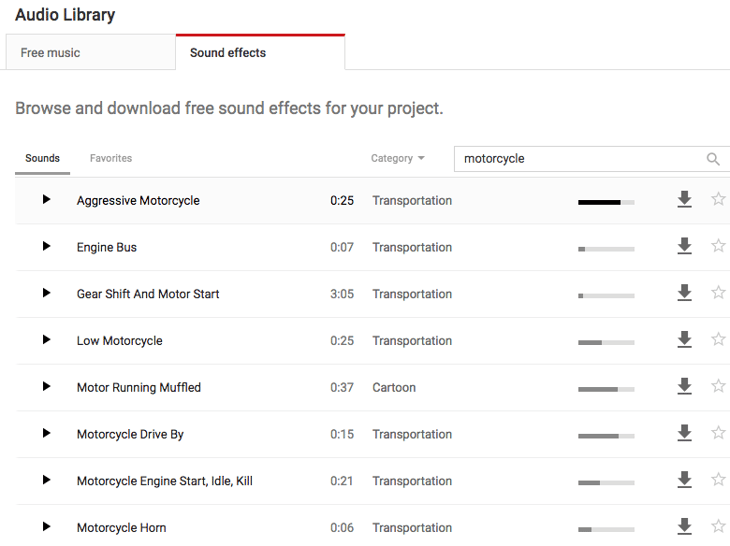
You can also toggle by category (everything from human voices to weather sounds) or scroll through favorites that you’ve starred in the past. For easy access in the future, select the star to add the track to your Favorites. The bars next to the songs show how popular a track is.
If you switch over to the “Music” bar, you can browse through all of its royalty-free music. You won’t find the Beatles in here, but you will find some good stuff — like suspenseful music, uplifting music, holiday music, jazz, and more. Instead of toggling by category, you can toggle by genre, mood, instrument, duration, and so on.
(Note: Some of the music files in there may have additional attribution requirements you have to follow, but those are pretty clearly laid out on a song-by-song-basis. You can learn more on YouTube’s Support page here.)
Once you’ve found a track you like, click the arrow to download it and it’ll download directly to your computer as an MP3 file. Then, you can do whatever you want with it.
If you want to source sounds for your videos outside of YouTube, you’ll just have to make sure to you’re following all the rules for sourcing them. Refer to this YouTube Support page for best practices for sourcing audio, and this one to learn YouTube’s music policies.
11. Add adjustments and creative effects with YouTube Enhancements.
YouTube has faded a number of features it experimented with at one time — including annotations and a not-so-popular slideshow creator — but one editing tool that remains quite handy is Enhancements. Nine effects you’d normally find on third-party video editing software, you can now take advantage of natively through YouTube:
- Auto-fix lighting and color
- Stabilize shaky camera motions
- Apply slow motion
- Apply time lapse
- Trim out parts of your video
- Rotate the view
- Apply filters
- Custom blurring
- Blur faces
To make enhancements to an existing video: Click into your Video Manager and find a video you’d like to edit. Select the drop-down icon next to “Edit” to the right of the video, and select “Enhancements.”
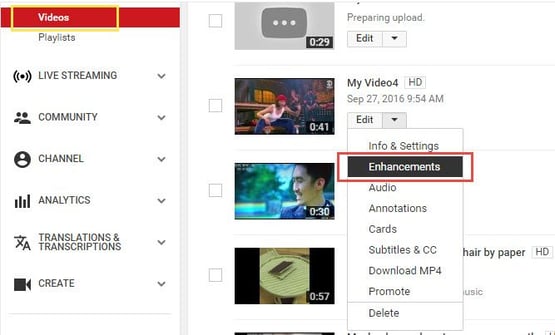
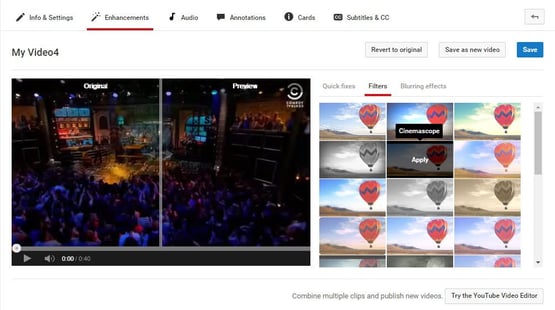
Images via filmora
If you’re editing on a computer, this button will open all nine tools to the right of your video, where you can add various fixes, filters, and blurring effects and see how they change the final product in real time.
Note that not all enhancements are available on mobile devices. On Apple and Android smartphones and tablets, you can only trim, add music, and apply filters. Read this article to learn more about YouTube enhancements.
12. Play YouTube videos in the background on mobile devices.
Sometimes, your own music playlist just isn’t cutting it. Or maybe you want to listen to your favorite artist’s performance at an awards show.
Either way, if you’ve tried listening to music on YouTube via your mobile device, you may have noticed one thing: You can’t navigate out of the app. You have to keep YouTube open, and you can’t use your phone for anything else, in order to listen to something on YouTube. Kind of frustrating if you’re trying to multitask on your commute home, right?
Now, there are hacks so you can listen to YouTube content in the background while still using your mobile device. Here’s what you do:
How to Watch YouTube Videos in the Background: iOS
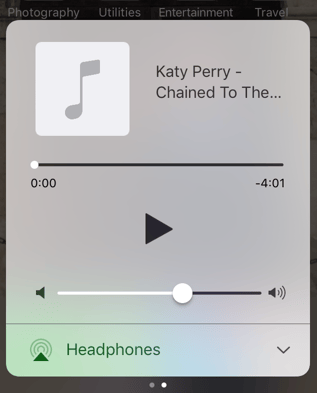
Open Safari on your mobile device, and navigate to a video you want to watch on https://www.youtube.com. Start playing the video you want to listen to, then tap the Home button to close out of Safari. (I chose Katy Perry.)
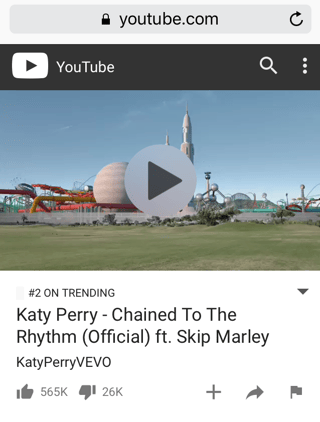
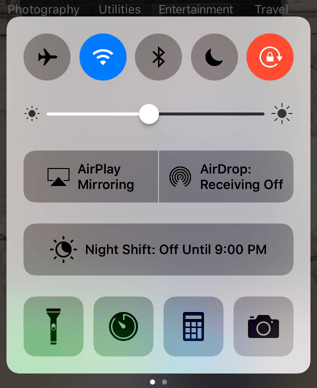
Then, swipe up on your home screen to reveal the Action Center.
Then, swipe left to reveal the second screen on your Action Center. The details of the video you selected on YouTube should appear, and from there, simply tap Play to keep jamming.
How to Watch YouTube Videos in the Background: Android
Launch Firefox or Chrome on your mobile device, and navigate to a video you want to play on https://www.youtube.com. Then, tap the “Settings” menu in the upper right-hand corner (the ellipses) and select “Request Desktop Site.”
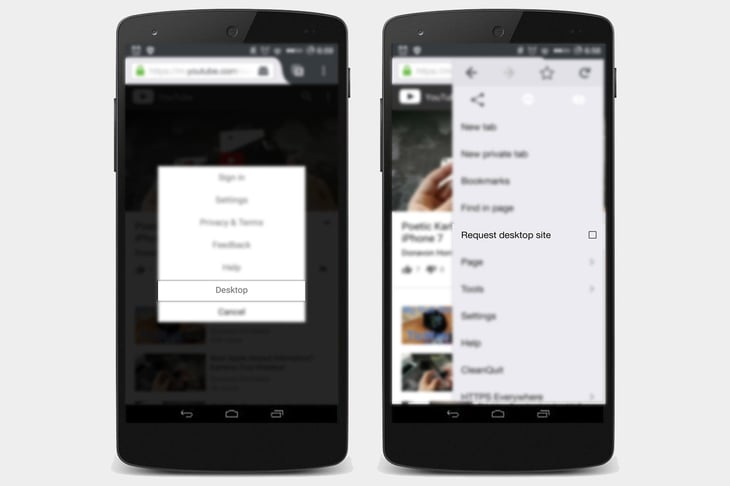
Image via DigitalTrends
Then, start playing the video on YouTube, and tap the Home button to return to your home screen. The audio will keep playing in the background as you use other apps.
13. You can live stream videos to YouTube.
Live streaming video has been a big topic of conversation for the past few years. It’s seen massive growth, especially in the past few years with the advent of Twitter’s Periscope, Facebook Live, and Instagram live videos.
Learning how to go live on YouTube is a little more complex (and confusing) than live streaming using similar platforms. On YouTube’s easier streaming option, there’s no simple “start” button; instead, you actually have to download encoding software and set it up to use live streaming at all. YouTube has identified 13+ encoders that are Live Verified.
If you’re streaming a live event, though, all you need is a webcam. We’ll get to that in a second.
Live Stream From Your Desktop Computer
Log in to YouTube and click the “Upload” button at the top-right of your screen. Normally, this is where you’d upload a pre-existing video — but instead, you’ll want to find the “Live Streaming” module on the right-hand side of your screen. Click “Get Started” in that module.
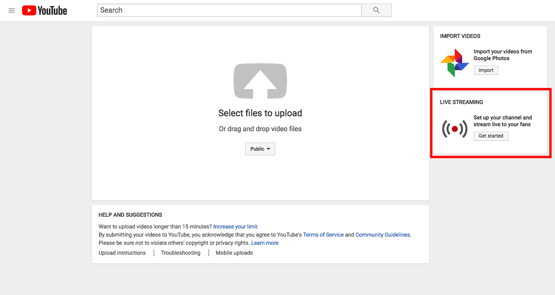
Before you go live, YouTube will first confirm that your channel is verified and that you have no live stream restrictions in the last 90 days. Once that’s all set, you have two options for streaming: “Stream now” and “Live Events.”
Stream Now
Stream Now is the simpler, quicker option for live streaming, which is why it’s YouTube’s default for live streaming. You’ll see a fancy dashboard like the one below when you choose “Live Streaming” on the left-hand Creator Studio menu:
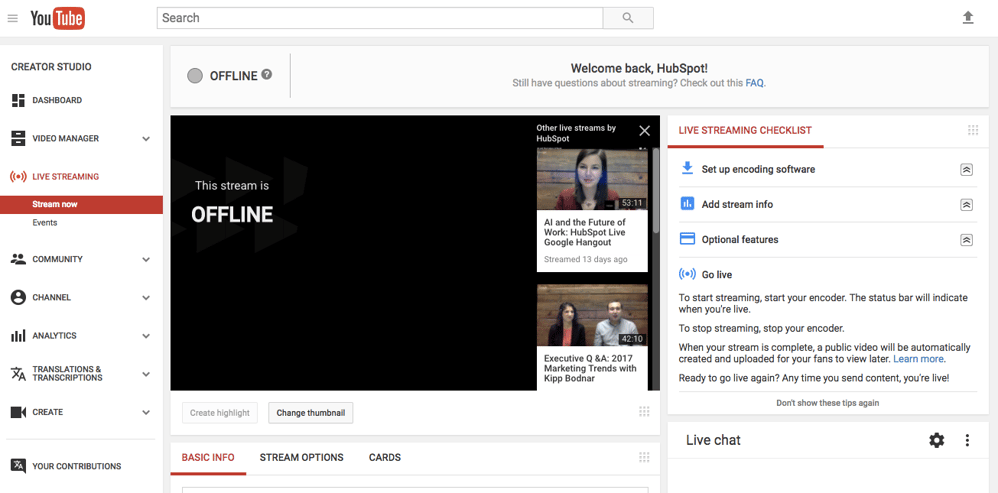
Again, you’ll notice there’s no “start” button on the dashboard. This is where you’ll need to open your encoder and start and stop your streaming from there. Here’s YouTube’s Live Streaming FAQ page for more detailed information.
Live Events
Live Events gives you a lot more control over the live stream. You can preview it before it goes live, it’ll give you backup redundancy streams, and you can start and stop the stream when you want.
Choose “Live Events” from your live streaming dashboard once you’ve enabled it. Here’s what the events dashboard looks like, and you can learn more about it here.
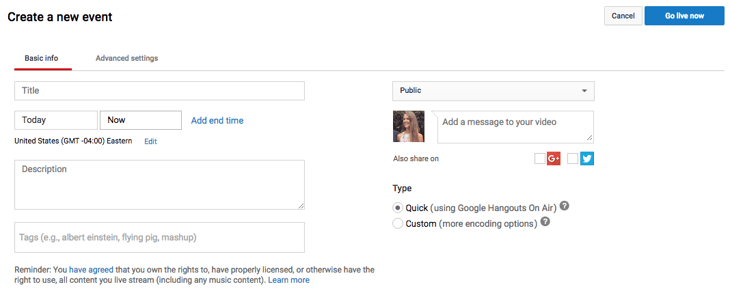
When you stop streaming, we’ll automatically upload an archive of your live stream to your channel. Note that your completed live stream videos are automatically made public on your channel by default as soon as you’re done recording. To make them disappear from the public eye once you’re done, you can select “Make archive private when complete” in the “Stream Options” section of your live dashboard.
Live Stream From Your Mobile Device
YouTube has also rolled out live streaming from mobile devices for YouTube creators with 10,000 or more subscribers (as of the date of this posting — that will be available to all creators soon, according to YouTube’s blog post).
Live streaming is more intuitive from mobile devices than on desktop computers. Qualified creators can simply open their YouTube app on mobile, tap the camera icon at the top of the screen, and choose “Go Live.”
From there, creators can enter details about the broadcast before immediately recording live for their subscribers, as shown below:
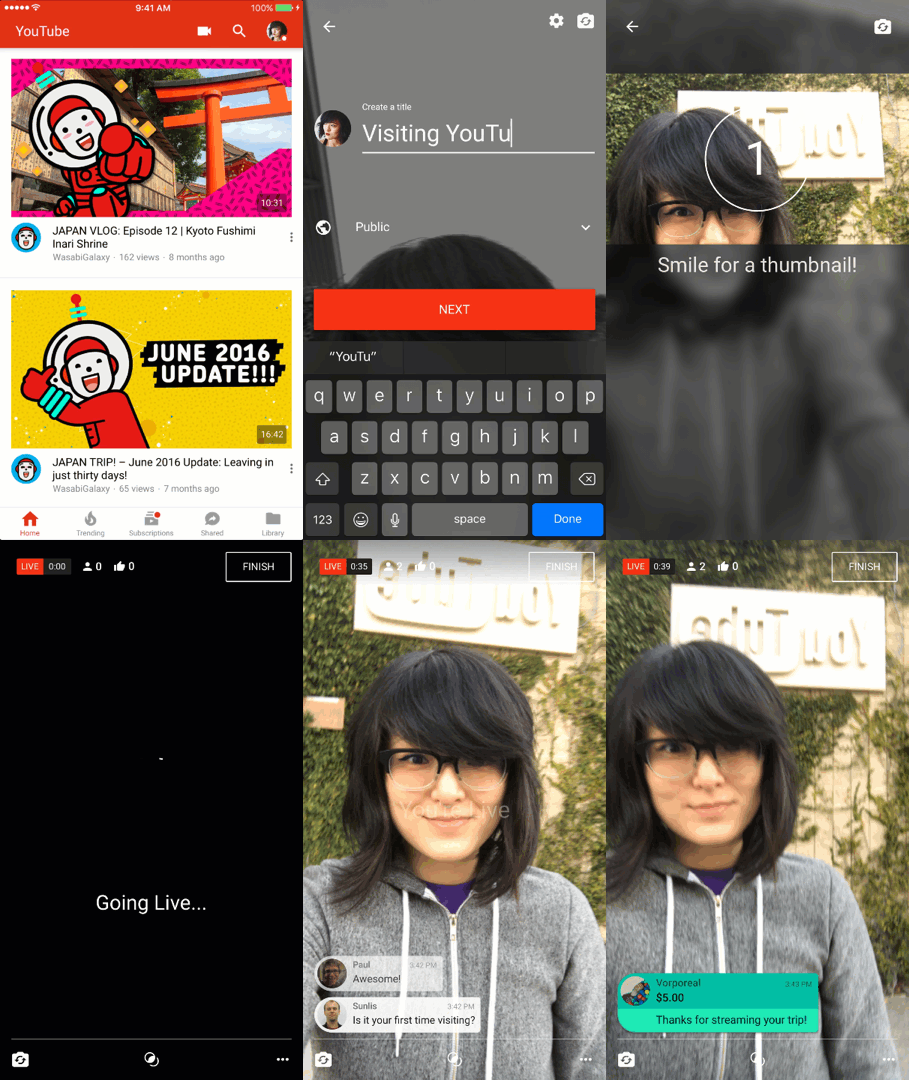
Image via YouTube
For more instruction on how to go live on YouTube across devices, YouTube published a Help article here. Want to see what live videos others are recording on YouTube? You can browse popular YouTube videos that are live right now by clicking here.
14. You can upload and watch 360-degree videos (live and pre-recorded) — and in VR.
YouTube first announced its support for 360-degree videos back in March 2015, and it was a total novelty — not to mention a game-changer. Since then, brands, athletes, and other users have created some awesome 360-degree content, like this video from Samsung:
As you can see, the experience as a viewer is really, really cool. On desktop, you can click around the video to see all the different angles while the video plays. On mobile, it’s even cooler: You can move your camera around to change the angle. You can browse the trending 360-degree and VR videos here.
How to Create a 360-degree Video on YouTube
For this, you’ll need some serious equipment. Cameras with 360-degree capability that are compatible with YouTube are listed here on YouTube’s Support page, along with how to create and upload a 360-degree video file.
What about live video in 360 degrees? That announcement would come a year after the first one, in April 2016 — the very same week Facebook announced its own design for a 360-degree camera. Luckily for the folks at YouTube, it beat out Facebook by supporting both live video and 360-degree footage all at once.
How to Watch Any YouTube Video in VR
The Verge called 360 live-streamed videos “the gateway drug to virtual reality” for YouTube. Other than the YouTube website or app, you don’t need any fancy equipment to be able to watch a 360-degree live video and feel like you’re basically there.
That doesn’t mean a headset isn’t an option — and an awesome one at that, since YouTube released its Cardboard feature. Cardboard is available on any YouTube video you watch or upload, and works with Google Cardboard (an actual VR headset by Google) and several other VR headsets available today.
To use Cardboard while watching a YouTube video via mobile: Select any video in your YouTube mobile app, then tap the three dots in the upper-right hand corner of the video. In the drop-down, select “View in Cardboard.” You may already see this option visible in the bottom-right of 360-degree videos.
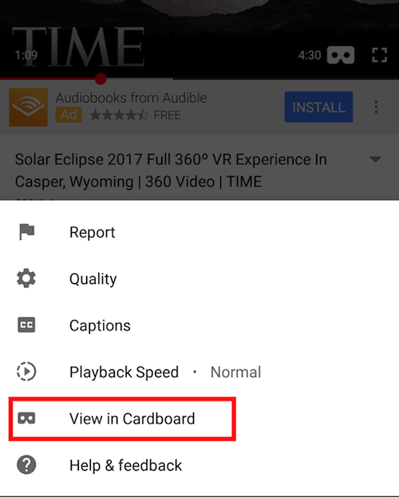
This will prompt you to connect your mobile device to a compatible VR device. Once you do, prepare for a stellar experience, and just imagine what this could mean for the content with which you populate your own YouTube channel.
15. YouTube ads target you based on an algorithm similar to Google and Facebook.
How does the YouTube algorithm decide which ads play on the videos you watch?
Turns out it works a lot like Google and Facebook ads do. Like on other free sites, the advertisers help fund the YouTube experience in return for exposure to ads. You’ll see certain ads over others because of your demographic groups, your interests (which is judged in part by what you search on Google and YouTube) and the content you’ve viewed before, including whether or not you’ve interacted with the advertiser’s videos, ads, or YouTube channel.
YouTube’s algorithms also try to make sure people aren’t overloaded with ads while watching videos — so it actually sometimes won’t show ads on monetizable videos, even when there’s a demographic match.
Here are the five ad formats you can expect to see on YouTube, and how they work:
A. Display ads, which show up next to the video and only appear only on desktop and laptop computers. The advertiser gets paid when you see or click on the ad, depending on their selection.
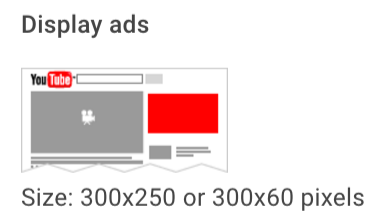
Image via YouTube’s Creator Academy
B. Overlay ads, which appear across the bottom 20% of the video window and currently only appears only on desktop and laptop computers. You can X out of the ad at any time.
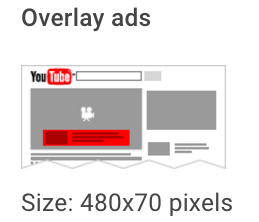
Image via YouTube’s Creator Academy
C. TrueView in-stream, skippable video ads, which are most common ads. These are the ones you can skip after watching for five seconds. Advertisers can put it before, during (yikes!), or after the video plays, and they get paid only if you watch at least 30 seconds of the clip or to the end of the video ad — whichever comes first.
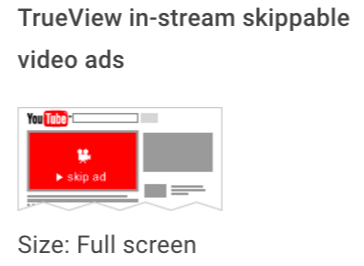
Image via YouTube’s Creator Academy
D. Non-skippable video ads, which are those longer, 15-or-more-second ads you see before plays and can’t skip after any period of time, no matter how much you shout at your screen.
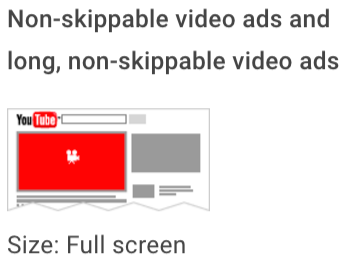
Image via YouTube’s Creator Academy
E. Midroll ads, which are ads that are only available for videos over 15 minutes long that are spaced within the video like TV commercials. You need to watch the ad before continuing through the video. How the advertiser gets paid depends on the type of ad: If the midroll is a TrueView ad, you’d have to watch 30 seconds of the end or the entire ad — whichever is shorter. If it’s a CPM-based ad, you have to watch the entire ad no matter how long it is.
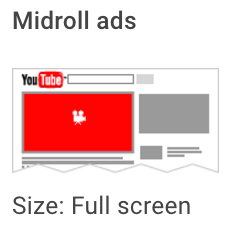
Image Credit: YouTube’s Creator Academy
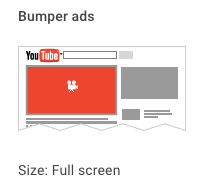
F. Bumper ads, which are short, non-skippable ads up to six seconds long that play before the video the viewer has selected. Bumper ads are optimized for mobile devices and must be watched in their entirety before viewers can progress to the video they want to view.
16. You can remove ads from YouTube videos (and watch videos offline) for 10 bucks a month.
Video ads are the reason you can watch videos for free on YouTube. It’s a fact many of us have come to accept. But with YouTube’s subscription service YouTube Red, that doesn’t necessarily have to be true anymore.
For $9.99 a month, you can watch YouTube videos … without any ads. And, in addition to ad-free videos, you can save videos on your mobile device and watch them in the background and/or offline, and you can use YouTube’s Music App (on iOS and Android) in the background, offline, and/or on audio mode. This is not a drill.
You’d think the lure of ad-free videos would have caused more of an uproar since its launch in late 2015, especially given YouTube’s domination in the music space. Surprisingly, I haven’t heard much noise about it. But YouTube hasn’t disclosed subscriber numbers (the service reportedly has around 1.5 million subscribers) so it’s hard to tell how well it’s doing. Either way, it’s good to know about — especially if you like collecting songs and music videos like I do, but don’t like when they get broken up by ads.
17. You can use Google Trends to explore and compare popular YouTube search terms over time.
You might already use Google Trends to look at the popularity of specific search terms over time. (It can be a great marketing tool for making smarter keyword choices, for instance.) But did you know you can use it to compare the popularity of YouTube search queries, specifically?
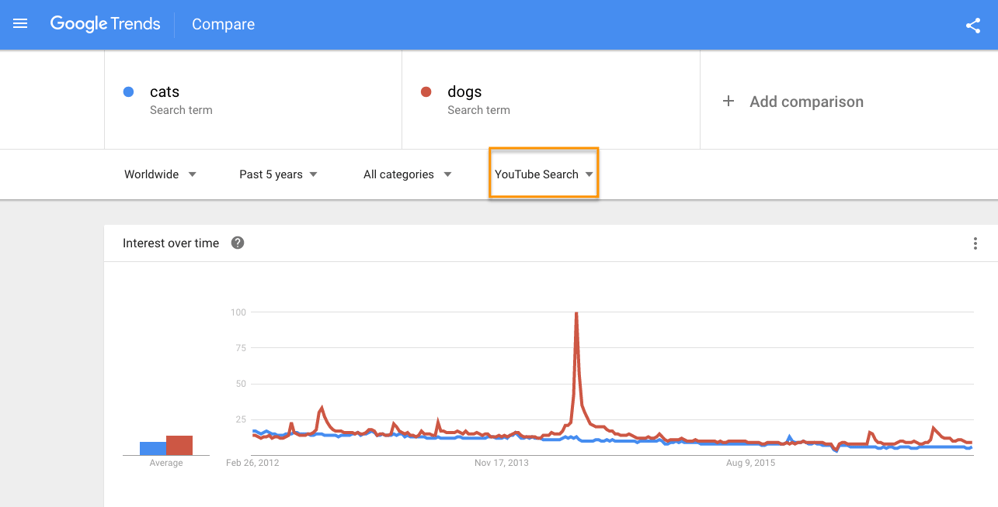
All you have to do is open Google Trends and type a search term into the “Explore topics” search bar at the top. Once that page opens up, click on “Web Search” to open a drop-down menu, and choose “YouTube Search” so it filters by YouTube searches specifically.
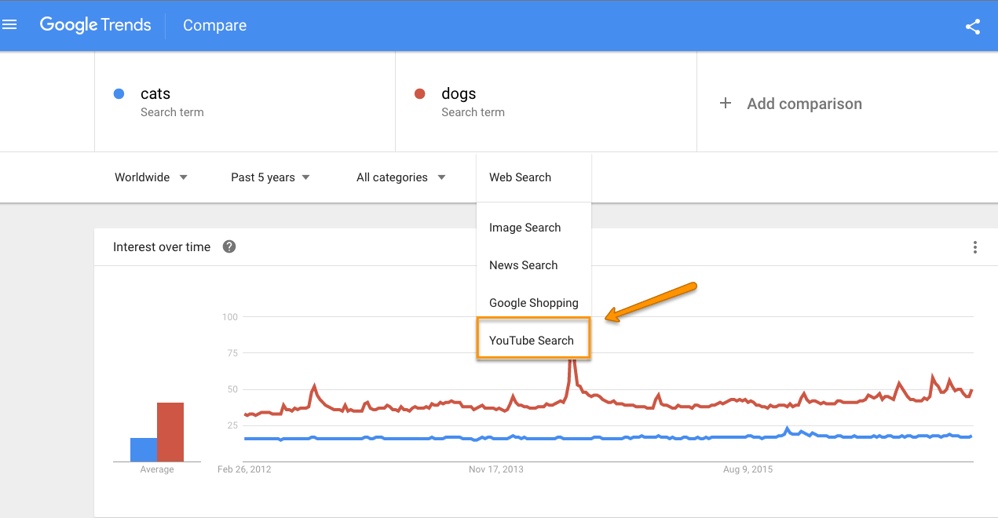
You might find that, for some search terms, the search trends are very different on Google (above) than on YouTube (below).
18. There’s a ‘safer’ version of YouTube available for your kids.
Any parent will tell you how scary it is for their kids to theoretically have access to everything public on the internet. But for your younger kids, there are ways to curb that access and have more control of what they’re watching and finding — including a kids’ version of YouTube called YouTube Kids.
The folks at YouTube call YouTube Kids “a safer version of YouTube.” It’s not a wide-open library of online videos like YouTube is; instead, it uses filters powered by algorithms to select videos from YouTube that are safe for kids to watch. It’s also totally free, thanks to ads (which are regulated as carefully as possible).
You can either turn the search feature on or off, depending on whether you’re cool with your kids searching for videos themselves — or if you’d rather limit them to a certain set of videos selected by the app, along with those the app recommends based on what they’ve watched already. You can set a timer to limit how much time a child spends on the app, which is music to many parents’ ears.
The algorithm is darn good — remember, Google is YouTube’s parent company — but, as it warns in its parents’ guide, “no algorithm is perfect.”
19. You can now clear your YouTube History.
You might eventually want to delete items from your YouTube search or watch history. YouTube lets you completely clear your history, pause your history so it stops recording what you search for and watch from that point forward, or go through your history and delete certain videos.
To delete your history on your desktop or mobile device: Navigate to the “Watch History” menu. Here’s where it lives on your desktop browser homepage and in your mobile app, respectively:
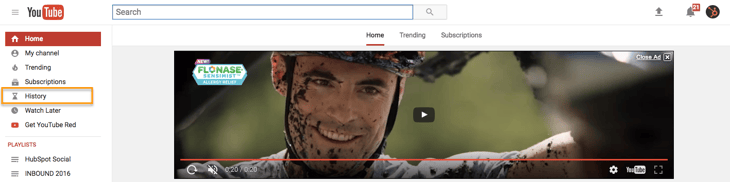
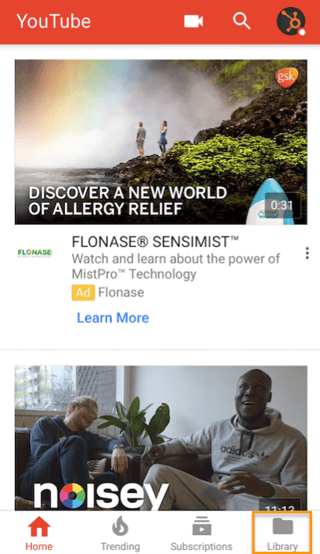
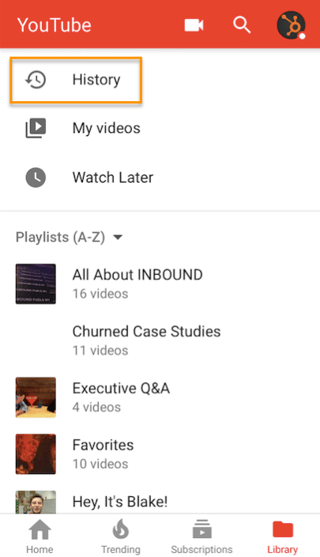
From there, you can “clear all watch history” (permanently delete the record of everything you’ve watched), “pause watch history” (stop recording the videos you watch going forward), or individually remove videos from your history by tapping the X or ellipses next to videos. Here’s what it looks like on desktop and on mobile, below:
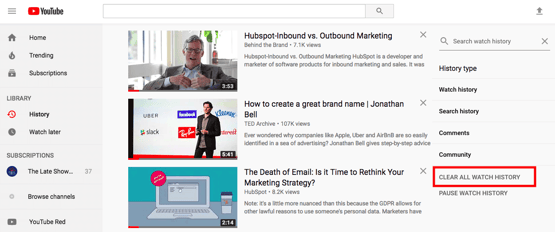
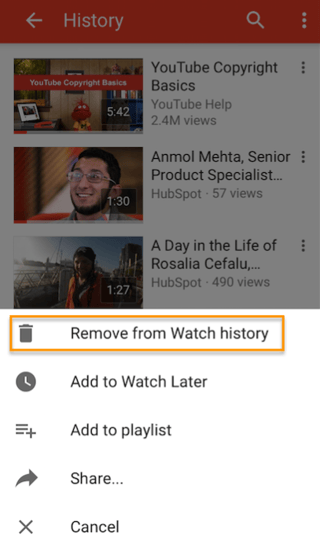
YouTube published a Help article if you need more instruction for deleting items from your YouTube watch history, too.
20. You can learn about YouTube’s copyrights terms from a cast of ridiculous puppets.
Made it this far? Here’s a little reward: YouTube’s “Copyrights Basics” FAQ page, which is, fittingly a YouTube video — and features a pretty colorful cast of characters. It’s actually super informative, and it looks like YouTube’s video team had a lot of fun making it.
My favorite line is probably, “You know there are links on this webpage, right? You don’t have to watch this.” Although the chorus of gorilla puppets was pretty great, too.
Enjoy.
We hope we’ve opened your eyes to some of the more awesome YouTube hacks, tips, and features out there that you may not have known about. Now log on to YouTube and do some exploring yourself. The platform certainly isn’t going anywhere.

7 of the Best Promotional Product Videos Ever
One of the wisest things I’ve ever read about product marketing came from the writer of a children’s book.
“If you want to build a ship, don’t drum up people to collect wood and don’t assign them tasks and work, teach them to long for the endless immensity of the sea,” said Antoine de Saint-Exupéry, creator of The Little Prince.
The goal in crafting a perfect product video is not far off. If you want your video to resonate, it should be about more than just the product. It should be about the problem, the solution, the experience, and the larger vision of what you’re trying to build.
Considering the right video can put a product on the map for the first time or reinvigorate a company that has long been stale, it’s important that marketers have a strong grasp on this. So to inspire your own efforts, we’ve collected a list of impressive product videos for marketing a product or new release.
What is a product video?
Product Videos Defined
A product video is one that explains and visually exhibits a product’s tangible benefits. A lot of product videos tend to emphasize a product’s unique features, but one chief thing that truly differentiates a good product video is its ability to exhibit how it solves problems.
What Makes a Good Product Video?
As a rule, remarkable product videos encompass the following:
- Engaging dialogue and narration
- Long enough to fully explain the product and its benefits, but short enough to keep the viewer’s attention
- Professionalism, without being “stuffy”
- Empathy and relatability
Want to see how these elements are put into action? Check out the examples below.
7 Promotional Product Videos That Make You Want to Buy
1) Blendtec: Will it Blend?
I’m digging into the archives for this one, but in the world of videos that add life to a product, few have done it better than Blendtec. The company’s CEO, Tom Dickson, became a YouTube icon back in 2006 with the introduction of his Will it Blend? series.
Since then, Blendtec has expanded the tremendous success of these videos to other channels, enabling viewers to suggest things to blend on Facebook. The company even has its own Wikipedia page dedicated to the series.
The success of this video comes down to two things: a clear, unwavering message and a company with a personality. In seven years, the series has never changed. The point of each video and the underpinning of the product positioning is essentially, “Why yes, it will blend.”
For years, we’ve been watching this product blend everything from glow sticks to an iPhone. The videos are minimally expensive, product-focused, and garner millions of views. In a recent interview, Dickson explained the history and success of the video series:
“‘Will it Blend?’ was developed accidentally by a new marketing director hired in 2006. I have always been one to try to break my blenders to find their fail points and determine how I can improve them. George, the new marketing director, discovered some of the wacky things I was doing to my blenders … With a $50 budget, George bought a Happy Meal, a rotisserie chicken, Coke cans, golf balls, and a few other items, and they made five videos. Six days later, we had six million views on YouTube. Six years, 120-plus videos, almost 200 million views later, ‘Will it Blend?’ has been named as the number one viral marketing campaign of all time [by Ad Age].”
Here’s Tom blending a Facebook request: Justin Bieber. The video earned 2.8 million views (and counting) on YouTube.
2) Dollar Shave Club: Our Blades are Great
Dollar Shave Club also made waves with their first product video. I’ll warn you now: they’re not shy with the F-bombs or referring to “your handsome-ass grandfather,” so you may want to throw in the headphones before pressing play. Having said that, what’s singular about this product launch video is how well the company knows its audience and the problem it’s trying to solve.
Dollar Shave Club was trying to crack into a demographic of young, professional men who habitually purchase big-brand razors at local stores. The problem they attempt to highlight is the absurdly high cost of store-bought razor cartridges. Thus, the company needed an absurdist, well-targeted product launch video to match.
CEO Michael Dubin, who studied improv with the Upright Citizens Brigade, wrote the spot himself and hired a comedian friend, Lucia Aniello, to produce the video. According to reports on Quora, the video cost approximately $4,500 — and yet, it got more than 11 million views and coverage on countless media outlets.
3) Purple Feather: The Power of Words
In tight marketing budgets, professional copywriting services are often the first to be cut. Instead of hiring professional copywriters, companies opt to take on the writing themselves, figuring it’s not all that different from other writing they do. They assume the words they choose won’t make much of a difference one way or the other. Based in Glasgow, Purple Feather is a copywriting agency that set out to prove that assumption wrong.
Words matter. In fact, they can change everything. Purple Feather made that point exceptionally clear in this powerful video:
4) Google Chrome: Jess Time
The best product videos focus not on the product itself, but on the stories of the people who use it.
Technology writer and NYU Professor Clay Shirky has a great chapter in his first book about the pervasiveness of communications tools in our lives. In it, he explains that technology doesn’t truly get interesting until it becomes so ingrained in our lives that it turns invisible.
No product video shows this “invisibility” of really good products better than Google’s “Loretta” Super Bowl commercial, which tells the story of a man reminiscing about the love of his life with help from Google.
The video below demonstrates how seamlessly Google and all of its products have melded into our lives and become a part of how we interact. It’s a video about an experience, not software, and that is arguably what the company truly creates.
5) Apple: The Only Thing That’s Changed
Launch videos like the Dollar Shave Club video above have a bit of an advantage when it comes to resonating with an audience. They represent a brand new company, product, or idea. But what if your company has been around for a long time? What if the announcement you’re making is really more of a set of enhancements to an existing product than a brand new launch?
This year, Apple tackled that challenge head-on with the following video. This video takes a collection of seemingly small enhancements and strings them together in a way that underscores just how advanced the total new functionality is. Take a look:
6) Google: Google, Evolved
This year Google introduced a new logo for the company and a new parent company, Alphabet. It was the perfect moment for retrospection. So the company took to video to show not only how much Google’s products have evolved, but how much progress those products have enabled in the world around them.
The brilliance of this video is that it uses others to tell the story. Whereas some companies may have pointed the camera at their own designers and developers (looking at you, Apple), Google put the focus on the users, media, and cultural leaders that have adopted and promoted the products along the way. The resulting video plays more like a historical chapter than a commercial.
7) InVision: Design Disruptors
I want to end this list with a bit of an anomaly, because it pushes at the boundaries of what can be considered a product video and, as such, opens up all sorts of opportunities.
InVision, a prototyping, collaboration, and workflow platform wants to empower designers — their primary users. Much of their content strategy is bent on this mission. This year, InVision will launch a documentary on the role of design in the modern business.
Design Disruptors looks at how 15 top businesses prioritize design in their products and overall user experience. Unlike traditional product videos, Design Disruptors will run in theaters and on Netflix. And unlike traditional product videos, Design Disruptors never actually promotes the product. The goal is bigger than the product.
“We’re trying to bring attention to the increased importance of design in a company’s success,” explains David Malpass, InVision’s vice president of marketing. “A lot of our work is based on doing things that’ll create a positive effect on the design community and that will elevate the role of the designer within their organization.”
Want more tips on creating visual content? Check out this list of the best websites for finding GIFs.
Editor’s note: This post was originally published in October 2017 and has been updated for comprehensiveness.


Copywriting 101: 6 Traits of Excellent Copy Readers Will Remember
Mad Men fans everywhere remember the pivotal first scene where we learn just how talented Don Draper is at his job.
Faced with an almost-impossible copywriting task, he rose to the occasion to solve a huge problem for his client, Lucky Strike. In spite of research warning customers of the dangers of cigarettes, Draper delivered the iconic slogan — “It’s toasted” — to differentiate the brand from its competitors.
Now, we definitely aren’t advocating for smoking cigarettes (or many of Draper’s health choices). But fictional or not, you can’t deny the memorability and catchiness of that tagline.
It’s easy to recognize good copywriting when you see it, but there are actually several characteristics that really separate outstanding writing from the rest of the pack. Want to know them? Read on below to find out.
What is copywriting?
Copywriting is one of the most critical elements of any and all forms of marketing and advertising. Copywriting consists of the words, either written or spoken, marketers use to try to get people to take an action after reading or hearing them.
Copywriting is like a call-to-action, but on a bigger scale: Copywriters are trying to get people to feel, think, or respond — or, ideally, to Google the slogan or brand to learn more about the campaign. And where a blog post like this one has the luxury of hundreds of words with which to make a case, copywriters only have a few words to make their case.
But short and sweet isn’t the only characteristic of good copywriting. Keep reading to learn more characteristics of truly memorable copy.
6 Traits of Good Copywriting
1) It tilts your perspective.
Sometimes, all a message needs to break through is a slight shift in angle. We’ve grown so accustomed to blocking out marketing messages, we don’t even see them anymore. One of the most powerful things a copywriter can do is break down a reader’s guard with an unexpected approach. Every story has a myriad of angles — your job as a copywriter is to find the one that resonates.

This ad from Sage Therapeutics pressing the importance of talking about postpartum depression works because instead of asking readers to care about something they don’t know, it puts them in the position of experiencing the struggle that mothers suffering do. Did they miss some readers who quickly passed by the ad thinking it was for adult pacifiers? Most definitely. But the ad resonated that much more thoroughly with those who read it.
The next time you sit down to write, try out this approach. Don’t take the topic head on. Instead, ask yourself why it matters. Each time you write down an answer, challenge yourself to push it further. Find the larger story happening behind your message.
2) It finds connections.
In 1996, Steve Jobs let the cat out of the bag. He was speaking with a journalist from Wired on the topic of creativity and explained:
“Creativity is just connecting things. When you ask creative people how they did something they feel a little guilty because they didn’t really do it, they just saw something. It seemed obvious to them after awhile.”
Let’s say you have to write an ad for a new pair of sneakers. You could take the assignment head on. You could write about the elasticity of the shoe’s sole or the lightweight design. Indeed, many have. Or you could put all of that aside and instead draw the connection between the product and the experience it evokes.
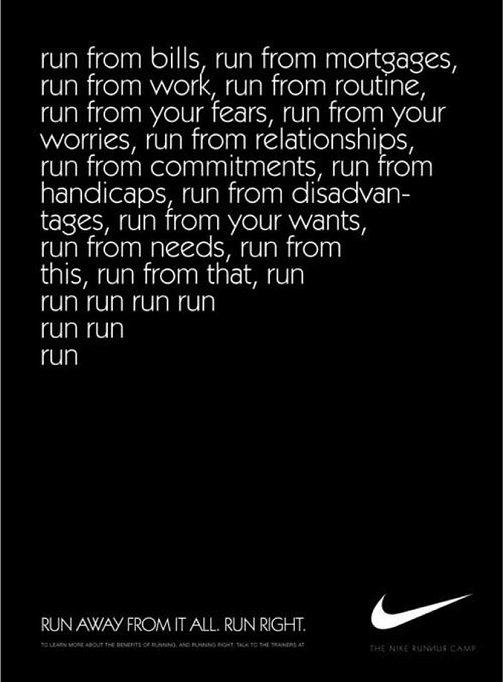
Source: Pinterest
Two things are happening in this ad. First, the copy recognizes that for many, running isn’t about running at all — it’s about solitude, peace, and restoring sanity to an otherwise hectic life. Second, not only does Nike connect the ad to the experience of running, it actually connects to the sound that those shoes make as they hit the pavement.
This ad is about the complexity of one’s life fading away and being replaced by simplicity and clarity. As the copy progresses, the sentences simplify and the copy’s complexity is slowly replaced by the simple and rhythmic pounding of words: run, run, run, run. The same rhythm one hears when all but their footsteps have faded away. That’s connection.
3) It has a stunning lead.
The following are all headlines or leading sentences from Urban Daddy, an email-based magazine drawing attention to new products, experiences, and eateries.
- “Six days. That’s how long you have until 65% of your body is turkey.”
- “There are 8,760 hours in a year. And just one hour in which a stand will be dispensing gratis latkes with homemade applesauce and sour cream in Harvard Square. Yeah, it’s not fair. But 60 minutes is 60 minutes.”
- “Ewoks. Talk about living.”
What’s common among each of these leads? They make us want to read the next line. I mean, seriously, how much do you want to know where that Ewok thing is headed?
There’s an adage in copywriting that’s loosely credited to copywriter and business owner Joe Sugarman, which roughly states that the purpose of the headline is to get you to read the first line. The purpose of the first line is to get you to read the second line, and so on. In short, if your first line doesn’t enthrall your readers, all is lost.
4) It is born out of listening.
Seeing its plans to launch yet another gym in the greater Boston region, an outsider might have called the Harrington family a wee bit crazy. The market was already flush with gyms, including a new breed of luxury ones that seemed to be in an arms war for the flashiest perks. Gyms across the region were offering massage services, smoothie bars, and fleets of personal trainers. And GymIt wouldn’t have any of that.
What did GymIt have? An understanding of its core audience. Before launching its new gym, the brand did a ton of listening to its primary market of gym-goers. For many in GymIt’s target market, the added benefits associated with luxury gyms were nice to have, but came with a lot of baggage — namely expensive rates and overly complex contracts.
GymIt decided to simplify the gym-going experience for people who predominately cared about getting in and working out. The copy in its launch campaign and across its marketing materials reflects that understanding.
In an older blog post, Copyblogger‘s Robert Bruce put this nicely. “Humble yourself and truly serve your audience, listen to their needs and desires, listen to the language they use,” he said. “If you listen carefully, your audience can eventually give you everything you need, including much of your copy. Get out of their way.”
5) It avoids jargon and hyperbole.
Groundbreaking. Revolutionary. Business Solutions. Targetable Scale. Ideation. Evidence-based approaches. Industry-wide best practices.
Have I lost you yet?
When writers struggle to convey what is truly special about their company, product, or service, they sometimes fall back on jargon or hyperbole to underscore their point. The truth is, good copywriting doesn’t need dressing up. Good copywriting should speak to the reader in human terms.
This isn’t to say you should never celebrate awards or achievements. Just be direct in the way you explain that achievement. This homepage from Basecamp does a nice job of highlighting its popularity in concrete terms.
6) It cuts out excess.
Good writing gets to the point — and that means cutting out excessive phrases, and rewording your sentences to be more direct. In an ad celebrating its “academic” readership, The Economist playfully demonstrates this below.
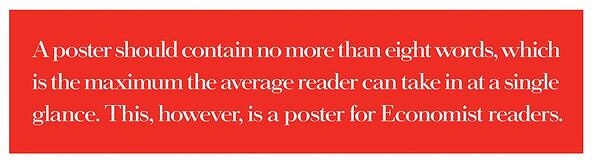
How do you rid excess words from your writing? It’s half practice, half knowing where to cut. This article from Daily Writing Tips is one of the most effective summaries I’ve found on precise writing. Included in its tips:
- Reduce verb phrases: For instance, turn “The results are suggestive of the fact that” to “The results suggest.”
- Reduce wordy phrases to single words: You can change “in order to” into “to.” Another example: Turn “Due to the fact that” into “because.”
- Avoid vague nouns: Phrases formed around general nouns like “in the area of” or “on the topic of” clutter sentences.
- Read the full list of brevity tips here.
In general, if you can afford to cut without losing the meaning of a sentence, do so. Push yourself to strip down your word count. Turn 50-word homepage copy into 25, then push yourself again to make that 25-word sentence into 15 words. It’s not about brevity so much as it is about making sure every word counts in your writing.
Since my last point was about getting to the point, I’ll keep this brief: Words matter. Every time you sit down to write an ad, web page, video script, or other content for your company, you have the opportunity to break through to people. Find those opportunities in your marketing and make sure that you’ve made the most of them.
Editor’s note: This post was originally published in November 2017 and has been updated for comprehensiveness.


5 Brands That Won Australian Advertising Awards [+What Marketers Can Learn From Them]
With all the work marketing teams are responsible for, it can be hard to make time to get reinspired and capture a spark of creativity that leads to a new, marketing strategy. This can be even more problematic for brands in physically isolated areas.
Take Australia for example. Its distance from other English-speaking regions like America and Europe can make it challenging for marketers to spread brand awareness globally. Ultimately, to gain even regional awareness, Australian brands must build competitive and innovative marketing strategies to stand out and grab attention from audiences.
So, what do you do when you work for a brand in a place like Australia, and just can’t come up with a marketing idea that takes your company to the next level?
Look to award-winning brands for inspiration.
One great place to start could be country-specific award ceremonies. By following these competitions, you can learn more about how brands in your area are effectively working towards national or global awareness.
In Australia, one major advertising and marketing award competition that brands and agencies look to is The Effies.
The Effies is a marketing and advertising competition that includes regional and global ceremonies. Each year, brands are awarded for advertising strategies, rebranding tactics, effective marketing techniques, and innovative campaigns. Brands that win the Grand Effie in their region are also eligible for the global competition. Past global winners include major brands like Dove, Coca-Cola, and Microsoft.
While this year’s Global Effie Awards have already been announced, Australia’s 2020 Effie Winners will be revealed at the end of October.
To help inspire innovative strategies or campaigns from marketers, advertisers, and agencies in Australia or similar territories, here are five past Effie Award winners, plus two 2020 nominees to learn from.
5 Australian Effie Award Winners Marketers Can Learn From
Great Northern Brewing Co.’s 2019 Ads – Carlton & United Breweries
Awards: 2019 Gold and Grand Effie Award
Way back in 2015, Carlton & United Breweries’ team launched Great Northern Brewing Co. But, the young brand found it difficult to compete with beer brands that already had decades of Australian credibility and brand loyalty behind them.
But, after the new beer brand teamed up with Clemenger BBDO to launch ads targeting young adult adventurers and older Australian beer lovers — Great Northern became the top-selling beer in Australia.
Great Northern’s effective advertising strategy involved video content and commercials that embraced young and old beer drinkers, as well as Australia’s great outdoors. One of the most memorable pieces of content within the Great Northern strategy was a video called, “The Great ReCamp.”
The mini-documentary, which launched ahead of Father’s Day in 2019, tells the story of a real father and adult son who go camping after a life-threatening cancer diagnosis.
The video begins with the words, “For most of us, our first memories of the great outdoors begin with our fathers.”
After presenting footage of a young boy camping with his dad, the documentary flashes forward into the future where that boy, now an adult, talks about how he loved going camping but eventually lost touch with his family when he moved away to focus on his career.
After years away, the son explains that he rushed home when his father was battling life-threatening cancer. When his father recovered, the son says he decided to take him on the same camping trip they used to go on.
The documentary shows visuals of the father and son bonding by the fire, fishing together, swimming in rivers, and subtly drinking Great Northern Beer at multiple points.
As the camping montage comes to a close, the son narrates, “We don’t need everything we’ve got these days. Sometimes we need to remind ourselves of that. Camping does that. — You can’t bring everything with you.”
The video ends with the two men sitting at their campsite. The father passes his son a Great Northern and asks, “You know that happy place?” He looks out at the grassy Australian landscape before clinking beers with his son.
Text appears that says, “Sometimes you need to go far and wide to stay close. — Go camping with Dad this Father’s Day.”
With content like that above, Great Northern positions itself as a beer for Australian adventurers of all ages. By telling the story of a nostalgic father-son journey, Great Northern ties emotion, relatability, and Australian pride to its beer. This enables the beer to compete against major breweries that have decades of brand loyalty.
When the Grand Effie was announced, the Judges’ statement said, “This is a classic case of how good marketing and advertising can still build a minor brand into a market leader.”
“In 2015, XXXX Gold outsold Great Northern by a factor of six to one. Four years later, Great Northern became Australia’s top-selling beer. This was achieved through well-considered insight, strategy, and execution,” the statement added. “The Great Northern case study is a model for all students of advertising.”
“Help is Who We Are” – NRMA Insurance
Award: 2019 Gold Effie
After seeing customer decline since 2014, NRMA insurance, a home insurance policy company, teamed up with The Monkeys to create a campaign that brought a “new purpose” to its brand and product.
As Australian forest fires rendered koala’s nearly extinct, NRMA’s campaign aimed to market an initiative where the insurance company would plant a tree for every home insurance policy sold. Unsurprisingly, the campaign’s mascot was an adorable koala bear.
The title of NRMA’s campaign, which ran across TV, radio, print, and social media was, “Help is who we are.”

One of the campaign’s commercials, titled “Every Home Is Worth Protecting,” tells the story of a boy who befriends and tries to save an endangered koala.
At the beginning of the ad, the boy’s riding his bike down a street with no trees when he sees the scared bear holding a wooden powerline pole. After stopping, wondering if he should do something, and ultimately riding away from the bear, the boy lies awake at night with guilt as he stares at a picture of a koala in his bedroom.
When he returns to the powerline the next day with a wagon, he sees no koala and gets angry — assuming that it was hurt or killed.
Luckily, he turns around to find the koala peacefully sitting in his wagon.
The boy brings the koala to the wilderness, where multiple new trees are planted. The bear climbs up a fully-grown tree as the boy waves goodbye. A text overlay on the screen reads, “We’re planting a tree for every home insurance policy.”
By working with Conservation Volunteers Australia to plant trees in Queensland and New South Wales, as well as marketing the initiative on multiple channels, NRMA demonstrates that it’s an insurance company that cares about its clients as well as the environment.
Additionally, by planting a tree for every policy sold, NRMA gives prospects more motivation to choose its insurance company. When customers buy a policy, they protect themselves from home damage, but can also feel good about helping a koala in need.
“When it comes to reviving your brand, its original purpose can be easily overlooked. This is an important reminder that sometimes it’s best to go back to your roots, and that exceptional value can be unlocked by reinterpreting what made your brand great to begin with,” NRMA wrote in its Effie submission.
According to the submission, “NRMA Insurance reversed 8-years of declining customer numbers and reached customers for the first time since April 2014, despite a growing price premium.”
“For an insurance brand synonymous with helping Australians, it made so much sense when we landed on the idea of home insurance for koalas. A campaign dedicated to protecting the homes of our furry friends,” said Vince Lagana, executive creative director of The Monkeys, in a statement to Campaign Brief.
“Coolest Suit on the Planet” – M.J. Bale
Award: 2018 Gold Effie
Through market research, M.J. Bale, an Australian men’s fashion brand, discovered that 82% of male shoppers think of wool as a winter fabric. Because of this association, M.J. Bale feared that prospects might sacrifice a wool suit’s classic and professional look for more comfortable attire — especially in hot climates like Australia.
To prove that people can comfortably wear suits in any hot climate, M.J. Bale created a line of wool suits — called “Cool Wool” and teamed up with TBWA\Sydney to launch a partially immersive campaign called, “Coolest Suit on the Planet.”
Half of the campaign featured a video series that was aired in M.J. Bale stores and on its social media channels. This content followed Good Morning Britain weatherman Alex Beresford as he tracked and traveled to the hottest places on Earth wearing M.J. Bale’s Cool Wool suit.
As the weatherman traveled to areas like China, Africa, and India, which were often over 43 degrees Celsius, M.J. Bale shoppers in Australia could go into the brand’s shops, put on a Cool Wool suit, and stand in a heating chamber that enabled them to experience wearing the suit in hot locations around the world.
You can check out a reel that highlights the overall campaign by clicking here.
According to its Effie submission, ‘The Coolest Suit on the Planet’ campaign increased M.J. Bale suit sales by 78%, rose foot-traffic by 54%, and delivered a 344% ROI
This was a great example of how videos, influencers, and immersive marketing tactics can be used to address prospects’ concerns about a product and persuade them to buy it anyway. By combining in-store experiences and video content, M.J. Bale increased store visits that led to purchases.
Ultimately, If audiences aren’t persuaded to buy an M.J. Bale Cool Wool suit after seeing a weather expert comfortably travel through hot terrain in it, they might be convinced once they actually get to stress-test the outfit for themselves.
Dare Iced Coffee’s Nonsensical Ads – Lion Dairy and Drinks
Awards: 2017 Gold and Grand Effies
Have you ever felt confused and in a fog before drinking your coffee in the morning? This is a feeling that Dare Iced Coffee played up to extremes in a series of funny ads that led to Gold and Grand Effies.
Beginning in 2016, Dare Iced Coffee, and its owner Lion Dairy and Drinks, partnered with AJF to create commercials where everyday people do something completely nonsensical because they haven’t had their daily dose of iced coffee yet. Once the protagonists in each ad take a sip of the product, they instantly start thinking clearly again.
In one of the campaign’s funniest ads, a father named Dave carries his dog in a baby carrier instead of his infant.
When Dave’s friend sees him, waves, and looks confused, an Australian narrator says, “Uh oh. Dave’s got his fur child mixed up with his real child?” Dave looks down startled to realize the predicament he’s placed himself in. Meanwhile, the dog looks up at the camera and barks, “Dave-o!”
From there, the ad cuts to product shots of iced coffee being poured as the narrator explains the taste-related benefits of Dare’s product.
The narration ends with, “A Dare fix’ll fix it!”, as viewers see the father confidently drinking his coffee with his child back in the carrier.
Dare’s ads were short, sweet, and memorable for their humor. They also impressively manage to fill short 30-second slots with full comedic storylines and valuable facts about Dare coffee. Not only are the ads entertaining, but they also differentiate Dare from its many competitors.
“Dare successfully took on Australian iced coffee brands and international pick-me-ups by creating a new consumption occasion: becoming the habitual choice for whenever people are not thinking straight,” notes an article on the Effies’ official website. “Effie judges noted that the strategic challenge was significant given the breadth and strength of competition in the category. The objective was both clear and ambitious, and delivered outstanding growth and ROI.”
Narellan Pools’ Data-Driven Ad Campaign – Narellan Pools
Awards: 2016 Gold Effie
Because most of its customers only consider installing pools in the summer months, Narellan Pools wanted to create a marketing strategy that would increase conversion earlier in the year.
Narellan worked with Affinity, an Australian agency, to build a database of market research, their company’s conversion history, and weather data to determine the times of the year when interested pool prospects were getting serious about home installations.
Through the data-backed strategy, Narellan and Affinity discovered that the most optimal time for pool-related conversions was during the first two consecutively warm days of each calendar year. From there, Narellan increased ad spend and targeting of prospective pool buyers just before the weather started to get warm, with some of the heaviest spend being used during the first two consecutive hot days.
The content within the targeted ads emphasized the “bliss” one feels when diving into a pool. Here’s one of the ads, titled, “A Splash of Bliss.”
The short video shows a woman diving into a pool as a narrator describes how magical an early morning swim can feel — especially in a Narellan Pool.
Through Narellan and Affinity’s data-driven strategy, Narellan reduced its annual media spend by 30% while increasing sales by 23%.
Below is a video case study that describes how the paid ad strategy worked:
Narellan’s strategy is a great example of how brands can leverage data to learn more about prospective buyers and make their advertising tactics even more effective.
“Our data-driven targeting allowed maximized exposure of our insightful campaign to exactly the right audience – and only at their tipping point of purchase consideration – delivering game-changing results,” Affinity notes on its website.
Australian Effie Nominees
“You don’t need Australia’s Best Network — Until You Do.” – Telstra
In 2019, Telstra — a telecommunications brand used by millions of Australians — partnered with The Monkeys for a series of advertisements showing how people benefit from a strong network.
One of the campaign’s most emotional and inclusive ads follows a man coming out about his sexuality to his parents by telling them he’s engaged to his partner.
At the beginning of the ad, the couple sits in their car following a proposal. The man who was proposed to nervously wonders how he’s going to tell his parents as his supportive partner says, “You’ll have to tell them sometime.”
When the nervous man whispers, “I’m gonna do it,” and pulls out his phone, he sees he has no reception. His partner says, “It’s okay. Use mine.”
Using his partner’s smartphone powered by Telstra’s network, the man successfully reaches his parents and nervously reveals he’s engaged to a male partner. The parents happily congratulate and accept the son for who he is.
Telstra’s campaign and the commercial above is effective because it highlights the major milestones or moments when we all want or need our phone service to work properly. Not only does the ad show us how well the service works, but it also allows us to relate to the brand and its mission on a more human level.
“Whether it’s sharing big news, changing plans in a hurry, or quickly looking up something important, it’s nice to know that Australia’s best network is there for you when you need it,” said The Monkeys’ Creative Director Stuart Alexander in an interview.
“The Bedroom Report” – Bedshed
Working with the Australian agency Rare, Bedshed — an Australian bedding chain — launched a campaign that merged great video content with market research data.
The first portion of Bedshed’s initiative involved a two-year study where the brand surveyed consumers all over Australia about sleeping habits.
Once the survey was complete, Bedshed launched a web page — which looks like a large interactive infographic — to highlight interesting findings. Many of the facts revealed in this study explain how important sleep is to overall health, what gets in the way of it, and how purchasing a great bed and mattress can help prevent insomnia.
For example, Bedshed’s study found that “23% of men talk in their sleep,” while 66% of their partners lie awake listening to what they say. It also revealed that 1.7 million people wake up in the middle of the night due to bad pillows or mattresses.
 Along with creating a data-fueled web experience, Bedshed launched a series of ads that present key study findings and direct prospects to its store to learn more or try a new mattress:
Bedshed’s campaign is a great example of how a brand can draw audiences with data-driven content. Its detailed research also positions the brand as an expert in the crowded bed industry.
When a prospect is shopping for an expensive product — like a bed — they might want to get recommendations from a person who knows a lot about the product. After seeing Bedshed’s content, these prospects might think that a company that knows so much about its industry will sell good quality products.
What We Can Learn From Effie Winners
Even if you don’t have a huge budget or an agency to help you market your brand, here are a few strategies that any brand can use to spread brand awareness and engage new audiences — just like the companies above:
- Be human: While Great Northern Brewing embraced fatherhood and Australian Pride to market its product, Dare Iced Coffee made ads that were comedically relatable to coffee drinkers. When your brand’s content is relatable, it can also be memorable. Not to mention, people who find brands more relatable and authentic trust them more.
- Embrace a bigger purpose: Although NRMA sells home insurance, they realized helping the environment would allow them to fulfill an even greater purpose. And, through their marketing, people might trust their brand more because they care about something more beyond policy purchases.
- Leverage data: While M.J. Bale’s campaign was inspired by market research, Narellan Pools’ advertising strategy was fueled by analytics. While creativity is key to drawing attention from audiences, data can help you optimize your content and share it at just the right time.
To learn more about the latest Australian marketing tactics, check out this list of the country’s most innovative website designs, or these fascinating Australian Instagram stats. Or, download the offer below to get more expert tips on creating a winning campaign.

6 SEO KPIs Every Search Marketer Should Know
Ever since I was first introduced to search engine optimization (SEO), I’ve had to use it in every role I’ve had from editorial writing jobs to marketing blogging.
While SEO was never my sole focus, I had to learn how to measure the success of my efforts.
As a marketer, it’s important to look at key performance indicators (KPIs) to show how you’re doing.
Below, let’s look at SEO KPIs you should measure to track success.
Organic Search KPIs
1. Organic traffic.
Organic traffic is one of the most important metrics to track for SEO. However, keep in mind that this shouldn’t be the only metric you track. You’ll track this in combination with other KPIs.
Aja Frost, the head of SEO content at HubSpot, says, “Any metric—in isolation—can be misleading. For example, HubSpot’s SEO team used to obsess over organic traffic. And it seemed like our focus was paying off: Monthly organic sessions skyrocketed. However, we’d lost sight of the quality of those users… and leads and signups weren’t following sessions.”
So, while you’ll want to know what your organic traffic is doing and how it’s trending, it’s important to use the other SEO KPIs on this list in addition.
2. MRR-based metric.
Paired with your organic traffic, you should measure a monthly recurring revenue (MRR) based metric.
So, what does that mean?
According to Frost, “I recommend SEO teams pair organic traffic with one or two MRR-based metrics (if possible). You can figure out which MRR-based metrics are the right ones by talking to leadership and/or the other team(s) you support. What numbers do they care about? How does organic traffic feed into those numbers?”
A few examples include:
- Organic search
- Demo requests
Or:
- Organic search
- Purchases
Or:
- Organic search
- Percentage of chats that convert into customers
For HubSpot, we track content leads and user signups in addition to organic traffic.
Frost says, “If all three of those metrics are trending in the right direction, we know we’re generating the right type of traffic.”
Paid Search KPIs
3. Cost-per-click (CPC).
Cost-per-click (CPC) is the amount that you’ll pay for each click on your ad. You set your CPC at the maximum price you are willing to pay per click on your ad. What you actually pay is determined by the following formula: (Competitor’s Ad Rank / Your Quality Score) + 0.01 = Actual CPC.
Victor Pan, a principal marketer and technical SEO at HubSpot, says, “When you’re just starting to grow organic traffic and you just don’t have the full picture on what the return on investment will be, the average cost per click is a great KPI to use as a temporary replacement for average organic traffic value. For example, if there’s an average of 2400 searches for X/year and the average CPC is $20, then you can make projections on the advertising value gained from capturing 5%, 10%, or 20% of that traffic in a year to be $120, $240, or $480 per year respectively.”
He adds, “Average CPC is a KPI that can also be used to capture content strategy gaps. There are a lot of high purchase intent keywords where the ROAS (return on ad spend) in pay per click ads does not make business sense. These are golden opportunities to consider longer-term organic search tactics to win as a part of your overall content marketing strategy to become a trusted authority on a particular topic.”
Laura Mittelmann, a marketing manager on the paid acquisition team at HubSpot, says, “CPC tells me how much on average I’m paying for a click. This is important when setting bids and working within the constraints of a set budget, and can also help me decide which keywords and match types to bid on.”
4. Clickthrough rate (CTR).
Clickthrough rate reveals how often people who view your ad end up actually clicking it.
Mittelmann says, “There are many helpful paid search KPIs to watch depends on the goal of the campaign. CTR helps me to understand how effective and relevant my ad copy is, and if it matches the intent of the user searching for my keywords.”
5. Cost per acquisition (CPA).
Cost per acquisition is a great metric that can help you track how much you’re spending for each acquisition.
Mittelmann remarks, “CPA is typically the KPI I use most to optimize on a daily basis. CPA factors in other metrics and ultimately tells me how much I paid for a conversion.”
6. Return on ad spend (ROAS).
Return on ad spend is a metric that measures the revenue that’s generated compared to every dollar of an advertising campaign. For example, let’s say you made $10 for every $1 spent on an advertising campaign. That means your ROAS for that campaign is 10:1.
Mittelmann says, “While there are many KPIs to track and use for paid search optimizations, at the end of the day I measure the success of a campaign based on its return on ad spend. It’s important for me to know that the value of the conversions the campaign is generating outweighs the cost of the campaign.”
It’s important to keep in mind that any metric in isolation can be misleading. It’s critical to track several SEO KPIs to truly measure success. And if you need any help, you can use HubSpot’s SEO tool.

The 9 Best Free Email Accounts and Service Providers of 2020
You need it for networking, job recruitment, downloading resources, transferring files, setting reminders, meeting with colleagues, and so much more.
Even with the rise of office chat platforms, you still depend on email for a surprising number of things. But unfortunately, not every email service is completely free. And even the free ones might not be the easiest to use or have all the features you need.
It can be a challenge to find an email service provider at no cost that balances the right features with usability. To help make your search easier, we put together a list of the different types of email accounts you can set up, followed by the nine best email service providers you can host your account on right now for free.
Types of Email Accounts
There are two main types of email service providers to choose from: email clients and webmail. When you use your provider to access your email from a different device or location online, you can use one of three major email protocols to do so: POP3, IMAP, and Exchange.
Let’s briefly go over these different types of providers and protocols.
Email Clients
Email clients are software applications that you install onto the computer itself to manage the email you send and receive. To access this email, the client interacts with a remote email server.
Email clients you’ve likely heard of include Microsoft Outlook, Mozilla Thunderbird, and Apple Mail.
If you want to access this type of email from the web, rather than the client’s computer application, the email client uses one of the email protocols described below. For example, although you might have Outlook installed on your computer, you can also log in to your email account via outlook.com using a specific email protocol.
Webmail
Webmail is a form of email you access exclusively from the internet, and therefore exists primarily on the cloud rather than your computer. Instead of an installed application fetching your email, you manage your inbox right from your internet browser.
Webmail providers you’ve likely heard of include Gmail, Yahoo! Mail, and AOL (all of which have made our list of best free email accounts, below).
If you want to access your webmail from a mail app on your mobile device, rather than your desktop web browser, your webmail provider can use one of the email protocols described below.
Now, before we get into the best free email accounts, let’s talk about those email protocols.
Email Protocols
Email protocols are the systems that actually retrieve your email for you. They can be used to fetch email client accounts on the internet, and fetch webmail accounts on a mobile app. Here are the three main types of email protocol your account can use.
POP3
POP stands for “post office protocol,” and is best suited for people who have just one email account and email client. POP3 is the latest version of this email protocol, and allows you to access email while offline. It therefore requires less internet bandwidth.
IMAP
IMAP stands for “internet mail access protocol,” and is one of the older email protocol available today. IMAP4 is considered the latest version, and unlike the POP protocol, you do not download your email to your offline email client. Instead, all your email stays online while you’re accessing and managing it.
IMAP is particularly useful for people who have more than one email account and access them from multiple devices or locations.
Exchange
Exchange is a Microsoft email protocol, and is pretty similar to the IMAP protocol explained above. This protocol allows you to not only access your email over the internet from multiple devices, but also tasks, calendars, and contact information tethered to that email address. For this reason, it’s particularly helpful to organizations whose employees share many types of information and collaborate remotely.
Now, take a look at seven of the best free email service providers you can get your hands on today — both webmail and email clients included. For each email service provider, we highlighted a unique feature to help you find the best fit.
Best Free Email Accounts
- Gmail
- AOL
- Outlook
- Zoho
- Mail.com
- Yahoo! Mail
- ProtonMail
- iCloud Mail
- GMX Mail
- Mozilla Thunderbird
- Yandex Mail
1. Gmail
Unique Feature: Native File Collaboration
Sign up here.
Type of email: Webmail
Who should use it: anyone who already uses and loves the rest of Google’s products.
It might seem like an obvious top pick, but Gmail is just too versatile to not award the first slot. Gmail has the second-highest email provider market share (behind Apple iPhone’s native email app), according to Litmus Labs. And ironically, one of the reasons Gmail has become so popular is because of all the communication options in your inbox that don’t involve email.
Gmail is an everyday email inbox you can sign up for by registering for a Google account. But it’s built into Google Suite, a group of free apps that allow you to chat, video-conference, and share files with the people in your contact list.
Google Hangouts, available from your inbox’s left sidebar (or the right — you can customize how you inbox is displayed), lets you text and video chat with other Gmail users for the things that might not warrant an email message. Like most other email accounts today, Gmail also has an intuitive calendar where you can set meetings and reminders.
Pro tip: You can also use a free product like HubSpot Meetings to easily schedule meetings without back-and-forth emails.
Unlike other email accounts, you can use your Gmail address to log into and manage your YouTube account, as well as collaborate on shared documents and spreadsheets right from a cloud-based Google Drive.
Offering a generous 15 GB of free email storage, Gmail does everything it can to make your inbox less chaotic, including advanced filters that automatically push emails into separate folders as they arrive. And none of these functions costs a dime.
2. AOL
Unique Feature: Unlimited Storage
Sign up here.
Type of email: Webmail
Who should use it: people who use email for most of their communication.
America Online (I feel nostalgic just typing those words) has quietly kept up with today’s standards for a good user experience. The classic AOL is now once again one of the best free email accounts available to you.
Purchased by Verizon in 2015, AOL delivers you email from its classic news-driven homepage, and comes with the contemporary spam filters and virus protection you’d expect from your email provider. You can also send text and instant messages from specific windows in your email inbox.
AOL does have something over Gmail, though: unlimited storage. Additionally, you can import email contacts from a CSV, TXT, or LDIF file so you’re not creating your “buddy list” (get it?) from scratch.
3. Outlook
Unique Feature: Multiple App Integrations
Sign up here.
Type of email: Email client
Who should use it: people who use many different platforms to connect with others.
If you ever cringed at the sight of a “Hotmail.com” email address, you can thank Outlook for this outdated domain name. But there’s good news: Microsoft has reinvented its longstanding email service, and your free Outlook.com email address has many progressive features waiting for you.
While it touts a calendar and message filter that is similar to Gmail, Outlook also integrates with a number of other popular communication apps. You can connect Skype, Facebook, PowerPoint, PayPal, and even task-management software such as Trello — making it very easy to reach and work with non-Outlook users without leaving your inbox.
Outlook offers 15 GB of free storage for each user, along with a super-clean interface.
4. Zoho
Unique Feature: 25 Business Addresses
Sign up here.
Type of email: Webmail
Who should use it: startups and small businesses.
This is the first of the lesser-known free email accounts to make our list, but it holds a lot of potential for businesses.
The first thing you’ll notice about Zoho is its user-friendliness. From integrating with Google Drive, Box, and other cloud-based file managers, to its built-in task manager, this email service offers a simple way to accomplish all of your daily tasks.
The real difference-maker, though, is the ability to customize the domain name for up to 25 connected email addresses. Want to replace “@zoho.com” with the name of your business’s website? You can do so under Zoho Lite, which gives you 5 GB for free — all under username@yourdomainname.com.
5. Mail.com
Unique Feature: 200 Custom Domain Names
Sign up here.
Type of email: Webmail
Who should use it: small businesses, freelancers, and the self-employed.
It doesn’t get more self-explanatory than “Mail.com,” does it? This email provider knows its audience — or should I say, audiences.
Right off the bat, you’ll probably notice Mail.com doesn’t have stellar storage space compared to the options above: only 2 GB. But what this webmail service lacks in gigabytes it makes up for with … drumroll … 200 free custom domain names. You can replace “@mail.com” at the end of your username with just about anything that describes you. Here are some options Mail.com has precreated for you to choose from:
- Bartender.net
- Musician.org
- Columnist.com
- Engineer.com
- Accountant.com
- Toothfairy.com (who knew she was online?)
Mail.com doesn’t rest on its 200 laurels, though, as the email provider also comes with a calendar for creating and tracking your events each week.
6. Yahoo! Mail
Unique Feature: Media and attachment history
Sign up here.
Type of email: Webmail
Who should use it: creatives and those who send and receive attachments frequently via email.
Yahoo! Mail, another well-known platform, sits just behind AOL in storage space with a whopping 1 TB (that’s a terabyte) for free, along with a few key social media integrations.
In addition to custom background themes and being able to search key information from your inbox, Yahoo! Mail also makes it easy to find every photo, video, and document you’ve ever attached or received via email in their own tabs on your inbox’s sidebar. This makes the platform especially appealing to those who share documents on a regular basis or simply want an album made of every photo they’ve ever had shared.
7. ProtonMail
Unique Feature: Encrypted email
Sign up here.
Type of email: Webmail
Who should use it: people who send and receive sensitive information.
ProtonMail offers just 500 MB of free space, but for the worthy trade of encrypted email, allowing you to send messages that nobody else can see, and disappear after a month.
What’s the catch? Is the service hard to use? As with most webmail platforms, ProtonMail is easy to use on any device without any software needed to encrypt your emails. Its inbox interface is as easy to understand at a glance as the other email services on this list, and offers quick color-coded labels to help you further organize which emails deserve the most care and protection.
8. iCloud Mail
Unique Feature: Label senders as VIPs
Sign up here.
Type of email: Webmail
Who should use it: people who use Mac and want everything on one system.
If you’re a Mac user, you may want to consider using iCloud Mail as your email provider. Their free email account comes with 5GB of storage that you can use to sync your photos, files, or email. It’s important to note that storage is shared between all of your apps and devices — so if you take a lot of photos on your iPhone, you may eat into your email storage allowance for the month. Upgraded plans start at $0.99/month and go up to $9.99/month.
One of the biggest advantages of using iCloud over other email providers on this list is the ease of integration. Apple builds its desktop and iPhone mail apps with all email clients in mind, but it pays special attention to making the experience delightful for iCloud users.
Some of the pros of iCloud Mail include an easy to use search functionality, easy-to-use rules, and an ability to label senders as VIP. When a contact is marked as VIP, new messages will automatically filter to a separate tab on the left, saving you both time and energy.
9. GMX Mail
Unique Feature: Alias email addresses
Sign up here.
Type of email: Webmail
Who should use it: people who need multiple emails with one central inbox.
While you may not have heard of GMX Mail, it’s been around for quite a while (since 1997) — and it has a bunch of features that make it worth considering. First off, GMX offers 65GB of storage. That’s a lot of storage for a free email service. In fact, they claim that allows you to keep nearly half a million messages in your Inbox!
Another feature worth noting is the ability to send large attachments. While many services have caps for your email attachments, GMX Mail allows you to send files up to 50GB. That’s great if you share a ton of photos, presentations, or other large files from your account.
But the feature of GMX Mail that really sets it apart is the ability to set up to 10 alias email addresses all from within one account. This can be useful in many situations — both personally and professionally. On a personal note, you could use one alias for all of your online purchases and logins — to keep marketing emails separate from your personal messages. From a business perspective, multiple email addresses can be useful for managing role based emails such as support@yourdomain.com or sales@yourdomain.com.
10. Mozilla Thunderbird
Unique Feature: Customization features, and the ability to open multiple emails in tabs
Sign up here.
Type of email: Email clients
Who should use it: anyone looking for a simple, but customizable email inbox.
Thunderbird, a free email application from Mozilla, known for Firefox, offers a quick email inbox setup and a simple, easy-to-use user interface.
The app offers customizable features, such as theme settings and app extensions that can improve your email experience. The email app also allows you to open multiple emails in tabs, similarly to how you would open multiple web pages in Firefox browsers.
11. Yandex Mail
Unique Feature: 10 GB of free cloud storage
Sign up here.
Type of email: Webmail
Who should use it: anyone seeking a free email with additional storage capabilities.
Yandex is a Russian web company that offers a global email tool. With the tool, you can sign up for a free account, link it to your Facebook, Twitter, or Gmail accounts, and personalize your email inbox.

Like many of the other providers on this list, Yandex’s email inbox can be set to filter or prioritize emails so you see messages from real people. It can also recognize keywords in messages and subject lines and organize emails into categorized inboxes. Additionally, users who sign up for Yandex mail get 10 GB of free cloud storage.
Making the Most of Your Email
And with that, you have some of the best options for free email accounts this year. But who knows? Your next email address could be entirely different while giving you just what you need to succeed.
Once you’ve chosen an email provider and launched a new email address specifically for your marketing needs, you should also leverage apps, outside software, and APIs to add to your email strategy.
One powerful tool worth noting is HubSpot’s Free Email tool. The tool allows you to link your email address to the HubSpot CRM, while also allowing you to build email templates and send messages straight from the HubSpot software. Even more beneficial? The software even lets you track basic analytics and collect email subscriber contacts in your CRM — which can then be added to your email marketing lists.
To learn more about our free email tool, click here.

What is a website taxomomy?
The structure users want is called taxonomy. Scientifically, a taxonomy is a classification scheme that dictates how things are organized and classified based on their characteristics.
A website’s taxonomy can dictate the user experience, and can also influence search engine rankings. This post will go over what a website taxonomy is, and give you the resources to create a successful organization system for their site.
Website taxonomy is also related to URL structure, which is how URLs are organized to reflect content within specific site pages. Every website domain stays the same for every URL address, but subdirectories and URL slugs change as page content gets more specific.
For example, say your website’s primary domain is www.samplewebsite.com.
Your taxonomic structure will include subdirectories within your domain that are relevant to the page’s content. So, if your samplewebsite has a ‘Contact’ or ‘Announcements’ page, the URLs would change to reflect the information displayed on each page. The URLs for these pages would be https://ift.tt/34kt9hU and https://ift.tt/34nDBW0, respectively.
Why is a website taxonomy important?
A well-planned taxonomy can transform how users interact with your site, especially when your content is organized logically. If users can get to your site and find what they’re looking for, they’ll view you as a reputable source and they’ll stay longer.
Websites that don’t have a specific structure tend to be difficult for people to understand. In fact, an average of 38% of site visitors will leave a site if it’s poorly organized.
A carefully crafted taxonomy is also crucial for search engine optimization (SEO), as a taxonomic organization is easier for search engine bots to recognize as they analyze and index your site.
Let’s put all of this in context with a hypothetical website. Say you own www.recipes.com. Since you know that your visitors are coming to your site for specific recipes, you want to set up categories that help them find what they’re looking for as quickly as possible. If they’re looking for desserts, for example, they likely want to find those recipes through the corresponding category page, not by browsing through a list of unrelated meals.
The URL for this page would be https://ift.tt/3kpyvOe. A user knows what they’ll find within this subcategory of recipes. For search engine bots, the URL subdirectory helps them understand what the page is about and when they should show the page in search results.
Best Practices for Creating a Website Taxonomy
Ultimately, you want both users and search bots to understand your site. You don’t want them to be bombarded with content that isn’t going to fulfill their needs. While it may seem clear cut, various factors go into creating a successful website taxonomy.
Know your audience.
Just like all types of marketing, the key to creating your taxonomy is understanding your users.
You’ll want to know who they are, why they’re visiting your site, and what they want to find on your site. It’s essential to understand what their specific needs are so you can structure your content accordingly. To better understand your users, you can do things like create buyer personas.
Continuing with the recipes.com example, whoever runs the site knows that their visitors are coming because they want help with their cooking. It’s great to know this, but is there anything else they’ll want from your site? They may also want you to recommend kitchen supplies that will help them make these recipes, or recommend brands to buy ingredients from.
If you take the time to get to know your future users, you can design your site accordingly.
Conduct keyword research.
When you know who your users are and what they want, you want to make sure you have the necessary information to keep them on your site.
You can use your site’s primary purpose to rank in search results, but it’s essential to have multiple keywords for the additional categories you’ll create within your site. These keywords should be directly related to the content that users will find on those specific pages.
For instance, if you run a blog on travel tips, travel tips can be your main keyword. However, your research may show that users also associate travel tips with travel packing tips and travel insurance tips. You’ll want to use that information when creating your structure.
Be consistent.
Consistency with categories and the content within those categories makes it easier for users to understand your site. It also makes it easier for those executing your content strategy to create relevant content. For example, on the HubSpot Blog, we have four different properties: Service, Sales, Marketing, and Website.
Blog posts are categorized based on their relationship to each property, and this organizational consistency makes it easier for visitors to find relevant information. For example, a user would know to search within blog.hubspot.com/website rather than blog.hubspot.com/service for a tutorial on how to use WordPress.
Consistency is also important for SEO, as bots dislike poorly organized websites, and sites with jumbled and unrelated content is considered spammy. Bots also recognize contextual relationships between categories and content, and they’ll learn how to index your site for specific search queries.
Keep it simple.
While there are certainly hundreds of categories and subcategories you could come up with to sort content on your site, less is more. The ideal web taxonomy is focused and straightforward.
With recipes.com, there are so many different types of dishes that it would (and will) become overwhelming for users to sift through hundreds of different categories.
Keeping it simple means creating fewer high-level categories that can house lower-level categories. You can have a high-level category page dedicated entirely to baking recipes, and the content you post within that page will be specific to baking recipes.
The URL for this category would be recipies.com/baking rather than recipes.com/pie-recipies and recipes.com/scone-recipies. Then, if a user goes on your site to find a blueberry pie recipe, the page URL may be https://ift.tt/3mbM0BR.
Leave room for growth.
Taxonomy can, and should, change as your business scales.
If you create new forms of content, you may need to shuffle categories to ensure that they still relate to each other and have room for new content.
Say you’re running a blog about content marketing, but you cover the topic generally. It’s unlikely that you’ll have multiple page categories or subfolders within those pages. However, suppose you decide to hire new team members who are experts in specific types of content creation. In that case, you’ll want to create different taxonomic categories to distinguish between the different types of content.
You may also realize that certain categories and subcategories aren’t as intuitive as you’ve hoped, per user feedback. Taking the time to understand what is and isn’t working for those who interact with your site is essential.
Types of Website Taxonomy
Once you know your audience and have created your keyword-relevant categories, it’s essential to decide on the taxonomic structure that works best for your site. Since taxonomy is a classification system, it may seem like the logical structure is a hierarchical one, organized by importance. However, this isn’t always the case. Let’s review the different types of website taxonomies so you can select the one that works best for your site.
Flat Taxonomy
A flat taxonomy, sometimes called unlayered taxonomy, is a simple list of top-level categories. All categories on this site carry equal weight in comparison to each other. It’s a perfect structure for smaller websites that don’t have a large amount of content.
For example, a veterinarian’s office likely doesn’t have many needs to fulfill. Their homepage may only have three to four categories, like ‘About Us,’ ‘Book an Appointment,’ ‘Location,’ and ‘Services.’ Users visiting the site won’t need much more than that.

Image Source
Hierarchical Taxonomy
A hierarchical taxonomy is an arrangement of categories by order of importance. Larger websites typically use it, and top-level categories are broad.

Moving down a hierarchical structure means getting more specific. This allows users to quickly identify and navigate between different sections and categories. Search engines will recognize these relationships as well.
For example, hubspot.com displays three main categories at the top of the page: Software, Pricing, and Resources. Each of those categories is broad and overarching. If a user mouses over them, they’re then shown more specific categories.
In turn, our URLs for these categories look like this: hubspot.com, hubspot.com/products, hubspot.com/products/marketing, and hubspot.com/marketing/seo.
It’s important to note that there shouldn’t be too many high-level categories or subcategories, as excessive groups can become confusing for users and SEO crawlers.
Network Taxonomy
A network taxonomy involves organizing content into associative categories. The relationships and associations between categories can be basic or arbitrary, but they should be meaningful to users.
For example, a ‘Most Popular’ category within a website may contain lists of different articles covering a broad range of topics that are popular among that audience. Still, they’re all similar in the sense that they are highly rated, viewed, and visited by others.

Facet Taxonomy
A facet taxonomy is used when topics can be assigned to multiple different categories. Sites that typically use this structure allow users to find content by sorting for specific attributes. It’s also great for users who will likely arrive at certain content by different means.

For example, Nike sells a variety of different products. While there are specific categories for shoes and clothing, there are also subcategories for color, size, and price. A shoe that shows up on a search for ‘blue shoes’ may also show up on a list of cheap shoes because they’re currently on sale.
Put time into your website’s taxonomy.
Creating and maintaining a successful website taxonomy that makes sense for users and search engines essential to your marketing strategy.
If other elements of your site are already optimized for other SEO ranking factors, the addition of a structured taxonomy will help your site rank highly in search query results, not to mention, it’ll keep users on your site.
If you want to learn more about website best practices, consider taking the HubSpot Academy Website Optimization course!
