
What Is a Landing Page? All Your Questions, Answered
If you could do one thing to dramatically improve your marketing ROI today, would it be to use landing pages on your website?
If you’re trying to generate leads for your business, and you don’t have at least a few landing pages on your website, you’re missing out on a key opportunity to turn website visitors into something more.
Here, we’ll explore what a landing page is, the myriad of landing page benefits and how you might use a landing page to reach your business goals, and how to make your landing pages as powerful as possible.
What is a landing page?
A landing page is a page on your website where you can offer a resource from your business in exchange for a visitor’s contact information. Marketers can capture this contact information using a lead-capture form, where visitors can enter details like their name, email address, and job title.
A good landing page is focused on a particular stream of traffic — say, from an email campaign that’s promoting an ebook. Because the landing page is targeting just people who are (presumably) interested in this ebook, and because this ebook has exclusive information that elaborates on a topic your audience cares about, you can convert a higher percentage of your website visitors into leads whom you can then follow up with.
How to Create a Landing Page
To create a landing page, you’ll want to start by exploring various landing page builders — unless, of course, you’re using a content management system that already provides landing page templates, like HubSpot.
Once you’ve determined the right tool for you, explore pre-built templates or consider whether it’s better to build your own. You might also use this as an opportunity to A/B test two different designs to explore which design elements result in the highest conversions.
Additionally, it’s critical any landing page you design effectively communicates the value you’re providing visitors in exchange for contact information. And, of course, you’ll want to include a form you’re asking visitors to fill out in exchange for whatever offer you’ve provided on your landing page.
To learn more about how to create a landing page in detail, take a look at How to Create a Landing Page: The Simple Step-by-Step Guide.
Landing pages have one chief purpose: to generate leads for your business. However, you can define those leads in a number of ways and offer more than one type of content or experience through this landing page.
Here are some of the ways you can use a landing page to start a relationship with your future customers:
1. Ebooks and Whitepapers
If you wrote a blog post that introduces a topic relevant to your audience, you can satisfy deeper interests in that topic by elaborating on the subject in an ebook or whitepaper. Using a landing page, you can “gate” this resource behind a lead-capture form for people to download.
2. Email Newsletter Subscription
Let’s say you write a lot of blog content on a similar topic. Sure, you can develop an ebook or whitepaper that elaborates on specific details, but you can also offer your readers an email newsletter they can subscribe to for the latest content around your industry. On various blog posts, use a call-to-action (CTA) to invite readers to subscribe to your blog. This CTA can link to a separate landing page where they enter their contact information for addition to your email list.
3. Online Course Enrollment
Whether you’re in the education industry or you offer various skill-based certifications to your audience, online courses should have their own landing pages, too. Using these pages, you can invite new students to sign up for a class you offer and capture information on them that can lead to a customer relationship that goes beyond the courses they take with you.
4. Event Registration
Similar to online courses, industry events require you to collect information on your audience so they can receive updates prior to the event. An event, as well as its various sessions and keynotes, can have their own individual landing pages to turn event goers into event attendees and business leads.
5. Free Trial of a Product
Offering people a free demo of your product? Your demo offering could use its own landing page. Bring users to a page where they can sign up for a free trial of your software using their name, email address, job title, and any other information you deem necessary to give them the best customer experience.
6. Community Membership
If your business thrives on conversation among your audience — perhaps you have a website dedicated to dialogue between users — there’s no harm in making it invitation-only. In fact, it’s a great way to generate leads through the people who want to become members of your community. Create a landing page that lets website visitors sign up to become a bigger part of your business.
7. App Download
Developing a mobile app for your product doesn’t just improve your customer experience — it also gives you another avenue to capture leads from your audience. A lead-optimized landing page that invites users to download an app is quite common in the app-maker community.
Landing Page Benefits
1. Landing pages can lead to increased conversions.
Having a targeted page that directly ties into a certain offer or next step is critical for providing value upfront, and can encourage new site visitors to provide their information in exchange for an immediate, tangible reward.
For instance, let’s say you’ve landed on a business’ website and you’re immediately greeted with a pop-up form asking for your name and email. A bit jarring before you even know what the company is about, isn’t it?
Alternatively, imagine you’ve found a business’ free e-book on social media, which outlines ten immediate solutions to your problem. I’m willing to bet you’re more likely to provide your email and name for that valuable content, right?
Ultimately, a landing page can help increase conversions while providing a better user experience. Plus, a landing page can help you determine which types of content to serve certain visitors for faster, more effective lead generation.
Too many companies send their advertising, email, or social media traffic to their homepage. This is a huge missed opportunity. When you know a stream of targeted traffic will be coming to your website, you can increase the likelihood of converting that traffic into leads by using a targeted landing page.
For instance, those users who convert on your social media e-book landing page are clearly interested in social media. To further nurture those leads, you might follow-up with a personalized email, detailing additional content you can provide related to social media.
2. Landing pages can provide additional insights into your target audience.
By creating various landing pages with segmented offers, you can track which topics convert at the highest rate. This can give you valuable insights into your audience’s interests.
You might use the data you collect from your landing pages to create a more targeted, personalized marketing strategy. Plus, landing pages don’t just tell you which content your audience likes best — they also tell you which channels your leads prefer. This can enable your marketing team to refine your strategy further, promoting content and engaging with your audience on the channel(s) they’re already using.
For example, let’s say you notice your landing pages related to e-commerce perform exceptionally well, and most of those users find your landing page from your paid ads on Facebook and LinkedIn. This information can help you target future campaigns primarily towards your social audience, and consider how you might incorporate additional e-commerce content into your marketing strategy as a whole.
3. Landing pages can grow your email subscriber list.
In exchange for the content offered on your landing page, you’ll typically ask users to provide their email and name. This can help you quickly grow your email subscriber list, and segment that list to provide more personalized follow-up emails.
People who’ve filled out a form in exchange for content, or information on your product or service, have shown an interest in what you have to offer — which ensures your subscriber list is filled with potentially high-quality leads.
Consider how you might further nurture them by sending a kick-back “Thank you” email after they download your landing page offer, with additional resources related to the content in which they’ve shown interest.
4. Landing pages are testable.
A landing page is oftentimes a fantastic opportunity to get creative and test out various designs to determine which visuals and text perform best with your target audience. Additionally, it’s often lower risk to test out a new landing page, rather than making major design changes to your entire blog or website infrastructure.
For instance, AJ Beltis, HubSpot’s Content & Acquisition Manager, told me, “If you’re using a content management system with a built-in A/B testing tool (like HubSpot), you can easily set up and run a test to see which copy, design featured, imagery, and page elements yield a stronger conversion rate. This means you can quickly uncover new ways to drive more leads and contacts for your business.”
5. Landing pages allow you to measure metrics directly tied to business goals.
If you’ve created a specific landing page to market your new product or service, you can then use that landing page to measure metrics directly tied to your business goals.
For instance, let’s say your marketing team is tasked with increasing sales for your new email tool. To accomplish this, your team creates a campaign with a landing page offering a free demo of your tool.
You might measure conversion metrics on that landing page to determine how well your campaign is performing, or whether you need to make tweaks to communicate the true value of your new product. Additionally, you can measure which sites drive the highest conversions to your landing page, and put more resources into marketing your email tool on those sites — or social media apps — in particular.
6. Landing pages add context to your offer.
AJ Beltis told me one of the biggest benefits of a landing page is the opportunity to add context to your marketing offer. “Marketers feel motivated to bypass the landing page process and skip right to the conversion by encouraging form fills in other methods, such as through a chatbot,” Beltis told me.
Beltis adds, “However, this process eliminates the opportunity to add more context to what it is you’re offering. Imagery and essential information that can only be shared with a landing page provide content to those who need it before deciding to convert.”
7. Landing pages increase brand value and help make a good first impression.
Ultimately, a sleek, well-designed landing page can impress new visitors and turn them into leads by demonstrating the valuable content your company can deliver. A landing page is space you can use to tell your visitors what you’re offering, and how it can positively impact them. Even if a viewer doesn’t immediately convert, a well-designed landing page can increase brand recognition and help nurture leads for future sales.
For instance, take a look at this impressive landing page created by Talisker, a whisky brand. Using Ceros’ landing page product to design an immersive experience, Talisker is demonstrating brand value and, ideally, making a fantastic first impression on new visitors.
This is proof a landing page doesn’t have to be boring — in fact, it shouldn’t be. Take the time to create an engaging, interactive, interesting landing page that convinces visitors in the value of your brand.
What makes a landing page most effective?
Ready to create your first landing page, or improve on a landing page you already have? Here are some of the most important elements to make sure your landing page is working hard for you:
1. Limit Navigation
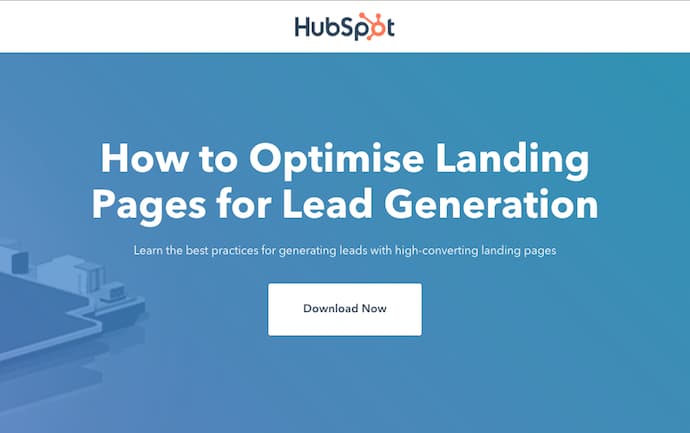
You’ve brought your targeted traffic to a page where they can take your desired action. Don’t distract them! Limit the number of exits from your landing page so that your visitors are focused on filling out your form. A key part of this is to remove the website navigation elements on landing pages. This helps put the focus back on the content you’re offering.
See how the landing page below does this — aside from the HubSpot logo, there are no navigation buttons to confuse or distract visitors.
2. Enable Sharing
Tap into a huge community of your best (and free) marketers: your audience. Add share links to your landing page to encourage your website visitors to share your content with their audiences.
3. Deliver Value
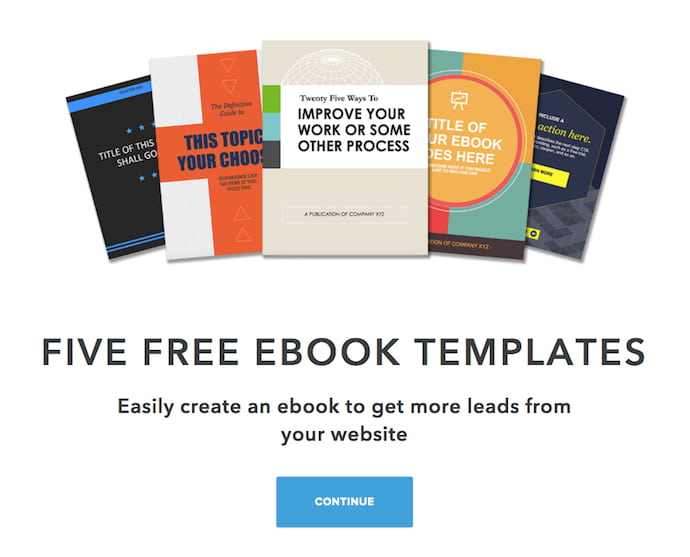
First and foremost, if you have a valuable offer, your visitors will give up their contact information in exchange for your offer. Ask yourself if your offer is compelling to your audience and make sure your landing page demonstrates that value. One way to ensure your landing page adds value is to show your audience the content they’re going to receive — directly on the page. See how this can look in the example landing page below.
4. Keep it Short
The longer your landing page and form, the more friction you add to the lead-generation process. Keeping your lead form short and straightforward will increase your conversion rate.
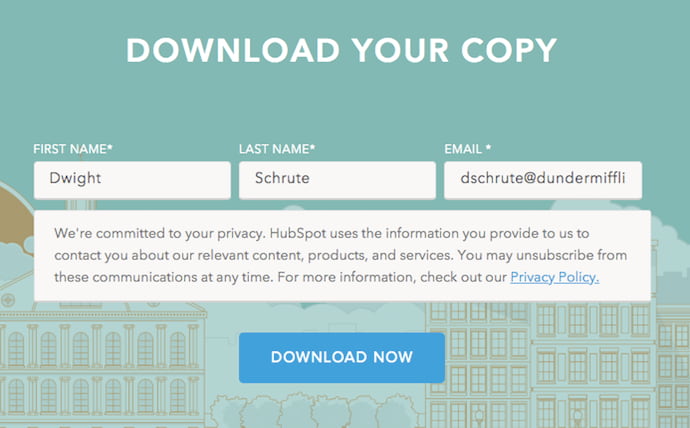
Here’s a tip: Put as many contact fields as you can on the same line. Shortening the height of your lead-capture form helps you limit the more trivial fields you might be tempted to include, and prevents your landing page visitors from getting spooked by a form that’s asking too much of them. As shown below, sometimes all you need is a first and last name, followed by an email address.
5. Test, Test, Test
As many best practices as you may read about online, your landing page can always use more testing and improvement. Make sure you have a landing page creation tool that allows you to create and test many different landing pages to see what works best for your business. Additionally, if you’re a HubSpot customer, consider some of the landing page tool integrations, such as briX.
Are you a landing page guru? Check out some of our advanced tips and data around landing page best practices on effective calls to action and the best/worst button text (hint: don’t use “Submit”). Do you need to make any of these 10 Quick Fixes to Build Killer Landing Pages?
If you’re working hard to drive traffic to your website, don’t make the mistake of not capturing that traffic as leads.

The Ultimate Guide to SEM (Search Engine Marketing)
Search Engine Marketing, or SEM, is one of the most effective ways to grow your business and reach new customers.
While it’s critical you employ organic strategies to attract traffic over the long-term, sometimes, you can’t properly compete on the SERPs without putting money behind it — and that’s where SEM comes into play.
For instance, consider what happens when I type “summer shoes” into Google:

Zappos clearly has an effective SEO strategy, since its “Summer shoes” page ranks first organically. However, their paid “Summer Shoes” ad, circled above, ranks as the first search result overall.
With 35% of product searches starting on Google, and the average Google search lasting only a minute, it’s critical your business’s product or service appear at the top of a SERP when a user is searching for it. This isn’t always possible organically, particularly when other businesses are paying to ensure their products appear above yours. When this is the case, it’s critical you invest in a SEM strategy.
What is Search Engine Marketing (SEM)?
SEM, or search engine marketing, is using paid advertising to ensure that your business’s products or services are visible in search engine results pages (SERPs). When a user types in a certain keyword, SEM enables your business to appear as a result for that search query.
To ensure you’re able to use SEM to properly advertise your products or services on the SERPs, we’ve cultivated a list of the best SEM tools, as well as the components of a SEM Ad Auction.
How an Ad Auction Works
Once you’re ready to invest in SEM, you’ll need to enter into an ad auction — for our purposes, we’ll focus on the ad auction in Google Ads.
In simple terms, every Google ad you see goes through an ad auction before appearing in the SERPs. To enter into an ad auction, you’ll first need to identify the keywords you want to bid on, and clarify how much you’re willing to spend per click on each of those keywords.
Once Google determines the keywords you bid on are contained within a user’s search query, you’re entered into the ad auction.
Not every ad will appear on every search related to that keyword. Some keywords don’t have enough commercial intent to justify incorporating ads into the page — for instance, when I type “What is Marketing?” into Google, I don’t see any ads appear.
Additionally, even if your keyword is a good fit for an ad, it doesn’t mean you’ll “win” the bidding. The ad auction considers two main factors when determining which ads to place on the SERP — your maximum bid, and your ads Quality Score.
A Quality Score is an estimate of the quality of your ads, keywords, and landing pages. You can find your Quality Score, which is reported on a 1-10 scale, in your keywords’ “Status” column in your Google Ads account. The more relevant your ad is to a user, as well as how likely a user is to click through and have an enjoyable landing page experience, all factor into your overall Quality Score.
With this in mind, here are some of the factors that should go into your strategy if you want to earn paid ads success:
Keyword Intent
Pay-per-click, or PPC, strategy starts with choosing the right keywords to bid on. That means doing research to determine what keywords to bid on or, in other words, what queries you want your ad to show up for. Start by brainstorming brand terms, terms that describe your product, and even terms that describe your competition.
If you have a small budget, you may only want to bid on keywords that have buying intent. However, if you have a larger budget, you may find that you have room to bid on keywords targeting earlier stages of the buyer’s journey or even terms that are loosely related to your products.
Keyword Volume and Competition
If no one’s searching for your target keywords, you won’t get any results from your ads. At the same time, keywords with extremely high volume attract more competition (and, in some cases, lose relevancy). When doing keyword research, relevant high-volume and low-competition keywords are a sweet spot, but they may not be easy to come by. It then becomes a balancing act between demand (volume) and budget (competition).
Keyword Cost
Ad placement is determined by the bid you specific for the keyword and the quality score Google has given your ad. Higher bids and higher quality ads win the best placement. With this in mind, high competition keywords end up being more expensive. Bidding too low means your ad will not be shown, so you’ll want to ensure that you can be competitive based on how much competition is for the keyword.
Account and Campaign Structure
In theory, you could lump all of your keywords together in a single bucket and display one ad for the aggregate lot. But your budget would be eaten up by a handful of high-volume keywords, and your quality score would go down. That’s why structuring your Google Ads account properly is so important.
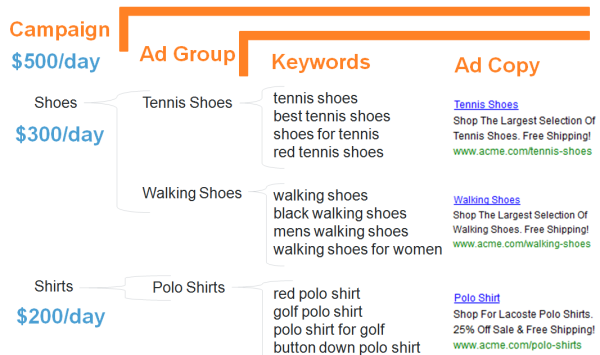
There are several levels for Google Ads campaign organization:
- Ad – The copy that’s displayed for the keywords you’ve chosen.
- Keywords – The queries you’re bidding on.
- Ad Group – Sets of like keywords grouped by theme.
- Campaign – Highest level for managing ad groups.
At each level, you’ll be able to determine what’s working and not working, making you more informed about performance and how your money is being spent.
Copy
At the end of the day, when your keywords are chosen and your account is structured, you still have to write good ads and “earn” the click.
An ad is made up of a few components:
- Title
- Display URL
- Description
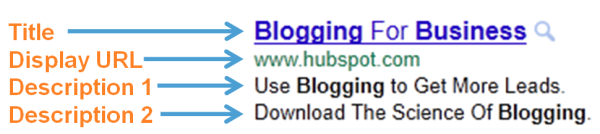
Understand exactly what the searchers are looking for with their queries and see if you write a great ad that makes your offer attractive.
Keep in mind also that SEM isn’t a set-it-and-forget-it activity. Ongoing PPC management helps you eliminate budget waste, experiment with ads, and optimize keywords you’re bidding for to ensure that you’re getting the most ROI from your efforts.
Best SEM tools
- HubSpot’s Ad Tracking Software
- SEMrush
- Google Trends
- Keywordtool.Io
- Google Ads Keyword Planner
- SpyFu
- WordStream
1. HubSpot’s Ad Tracking Software
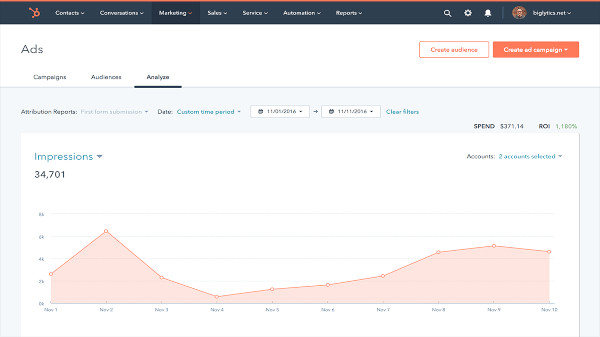
You’re not paying for ads for the fun of it; you’re paying for ads because you want to generate leads and drive revenue for your business. The HubSpot Ads tool helps you go beyond traffic and click metrics to analyze exactly how ads are influencing contacts where they are in the buyer’s journey. This will help you understand which ads actually work, justify SEM as a channel, and integrate your advertising in with the rest of your marketing efforts.
2. SEMrush
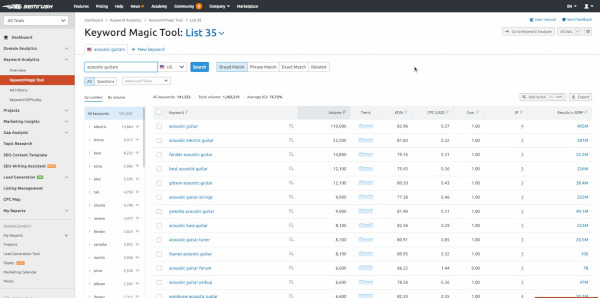
SEMRush allows you to conduct extensive keyword research, keyword rank tracking, site audits, traffic analysis, and more. SEMRush is a fantastic tool for finding opportunities to rank for long-tail keywords organically, but additionally, you can use the tool for various SEM efforts. For instance, you can use SEMRush to figure out where your competitors are concentrating their marketing efforts, and analyze their regional presence, to figure out how much money you want to put behind certain keywords.
Additionally, SEMRush enables you to discover your main paid search competitors, figure out which keywords they’re bidding on, and study the composition of their ads. This is vital information when you’re cultivating your own paid strategy and are unsure how to out-rank other businesses on the SERPs.
3. Google Trends
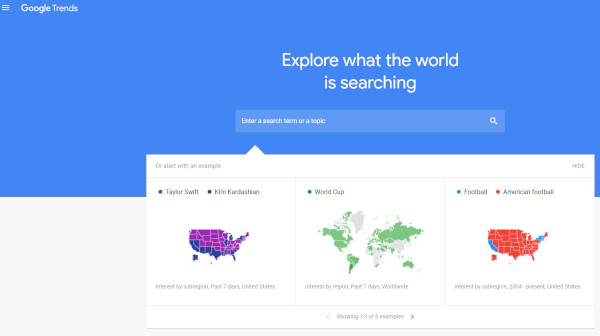
Google Trends allows you to track search volume for a particular keyword across a specific region, language, or time frame — which can enable you to identify which search terms are trending, and which ones aren’t. Since you don’t want to put money behind a keyword that’s decreasing in popularity, this is an incredibly useful tool for your SEM efforts.
Additionally, particularly if you work for an ecommerce business, the ability to gauge interest in your product or service in a certain geographical area is undoubtedly powerful for ensuring you tailor your paid efforts to specific locations, saving you money in the long-run.
4. Keywordtool.io
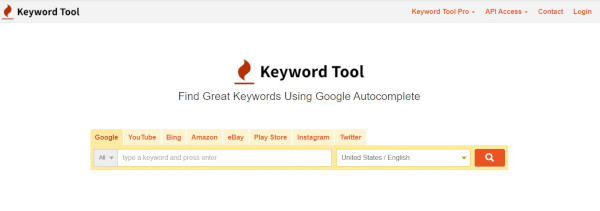
One of the most helpful features of Keywordtool.Io is its ability to tap into Google, Bing, YouTube, Amazon, Instagram, Twitter, and the App Store, so that you’re able to segment your keyword research through various channels and better target your efforts. Additionally, the tool takes your base keyword and provides you with variations of words and phrases, which allows you to cultivate a more extensive list of possible keywords you might want to include in a paid ad.
Using Google Autocomplete to provide relevant keywords for you, the free version of Keywordtool.Io lets you generate up to 750 long-tail keywords and keyword suggestions for every search term. Plus, you can use the tool to analyze search trends on Google, to ensure your desired keywords are increasing in popularity and will continue to serve you well over the long-term.
5. Google Ads Keyword Planner
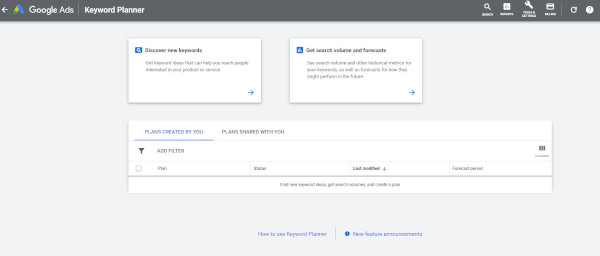
Since Google is likely where you want your ads to appear, it makes sense to consider using Google Ads Keyword Planner to research relevant keywords for your business, and keep track of how searches for certain keywords change over time. The Keyword Planner will help you narrow down a list of possible keywords to ensure you’re choosing the most effective ones for your business.
Additionally, Keyword Planner will give you suggested bid estimates for each keyword, so you can determine which keywords work with your advertising budget. Best of all, once you’ve found your ideal keywords and are ready to launch an ad campaign, you can do it all from within the tool.
6. SpyFu
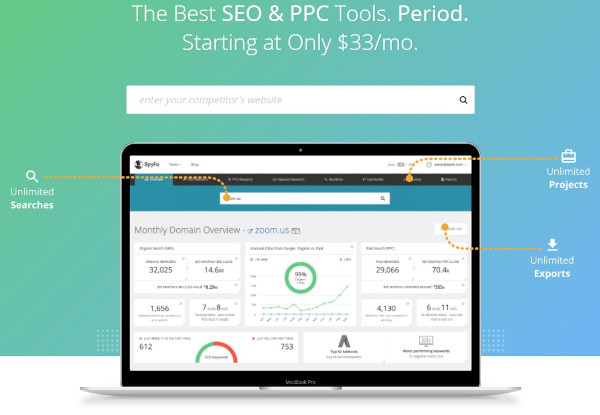
Ever wish you could see which keywords your competitors are buying on Google, or check out which ad tests they’ve run? With SpyFu, you’re able to do just that — simply search a domain, and you’ll see every keyword that business has bought on Adwords, every organic keyword for which they’ve ranked, and every ad variation they’ve had in the last 12 years. Plus, you can monitor your own paid and SEO rankings on Google, Bing, and Yahoo.
7. WordStream
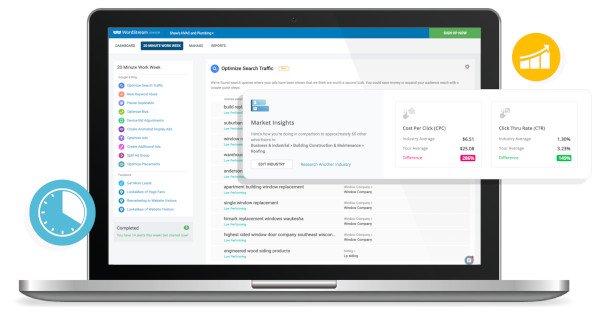
WordStream is a advertising management solution that can help you research, measure, and optimize your ads for performance. You get access to advanced reporting features for data analysis and tools for creating great ads. In addition, WordStream has alerts and workflow tools to help you make decisions about your campaigns.
With the above tools and a killer strategy, SEM can be a great strategy for lead generation. There’s no reason why you shouldn’t start your PPC campaign today.
Editor’s note: This post was originally published in April 2019 and has been updated for comprehensiveness.

A Brief Timeline of the History of Blogging
Greetings, readers. Welcome to the HubSpot Marketing Blog.
We’re very happy to have you here. You might not realize it, but getting here was no easy task. Today, in 2016, I blog for a living, which is pretty great. But were it not for the long, twisty journey that got blogging to its current state, I might not be here. You might not be reading this.
We’ve found that there’s quite a history behind blogs. According to the documentation we uncovered — and will share with you below — they’ve been around since 1994. They looked a lot different back then, and had many different names and meanings.
Merriam Webster currently defines a blog as “a web site on which someone writes about personal opinions, activities, and experiences.” Remember that — it’s going to come in handy later. But first, let’s talk about how we got here.
The Blogging Vernacular
The early vocabulary and semantics around blogging are more than a little muddy. As the practice developed, some of the more popular monikers were “weblog,” “personal web page,” and “online diary.” We’ll dive into each of these a bit as we explore the more primitive days of blogging.
Now, we simply say “blog” — that’s a pretty popular term in our vocabulary. But what it means continues to change. Bloggers have dozens of platforms and formats available (fun fact: HubSpot has a blogging platform, too), and there’s no longer a standard for what a blog is supposed to look like.
And their former look and feel was dictated by the language people used to use to describe the act of blogging. As you’ll see below, the word is primarily rooted in the idea of a log on the web. At one time, in fact, blogging was somewhat restrictive and limited to web-only subject matter.
Luckily, we’ve evolved and expanded how and why we blog since then. One day, someone figured out that we don’t have to stick to strictly technical topics when we put things on the Internet. (And thank goodness — remember that thing I said about blogging for a living?)
So, let’s see if we can better understand how that all took place. Grab some popcorn — you’re in for a 22-year-long tale.
The History of Blogging
1994-1997: First blogs

There’s a bit of debate around the first stages of blogging, much like the rest of its history — in the first half of the nineties, for example, there wasn’t a ton of online record-keeping, and most primitive blogs are either now archived or nowhere to be found.
Many of these original bloggers — despite not having yet earned that title — were the same people who first understood the value of the World Wide Web in the 1980s. One of them was then-Swarthmore-College undergrad, Justin Hall, who created a site called links.net in January 1994. It was essentially a review of HTML examples he came across from various online links, but it was enough for the New York Times Magazine to dub him the “founding father of personal bloggers”.
In that article, Hall brought up the semantics of blogging, and how he was assigned many titles during his primary days online (some of which are hilariously documented here).
“When I first started [blogging], they called it a personal home page,” he said, “then they said I’m one of the first Web diarists, and now I’m one of the first Web bloggers.”
That same year, Claudio Pinhanez (who today is a Social Data Analytics Senior Manager at IBM) began to log short entries into what he called an “Open Diary.”
But it wasn’t until December 1997 that the term “weblog” came to be. It was first used by Jorn Barger, creator of the website Robot Wisdom. He pioneered the term to describe a “log” of his internet activity, much like Hall did in 1994, which largely amounted to a list of the links he visited.
That may have set the tone for the new era of blogging that would follow less than a year later, when blogging-specific platforms began to debut.
1998-2001: More resources for bloggers
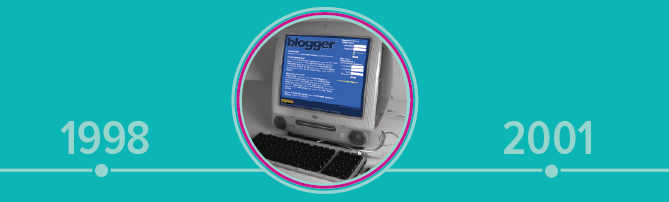
The later part of the nineties saw an uprising in resources created just for bloggers. One of them, Open Diary, launched in October 1998 and became one of the most pivotal blogging platforms — its name, was a nod to its open, community approach to blogging, as Open Diary was the first of its kind to have a membership model that allowed members of the community to comment on the work of others.
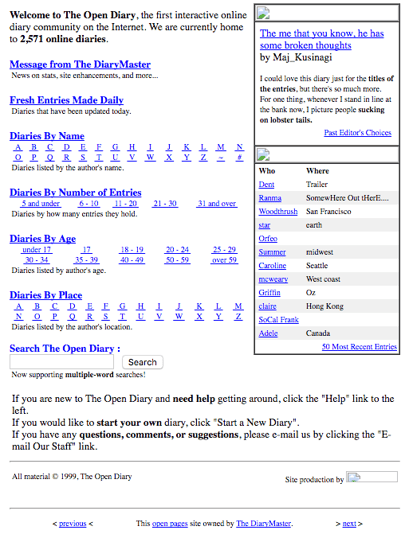
Open Diary, c. 1999. Source: Wayback Machine
In 1999 — though no one is quite sure exactly when — then-programmer Peter Merholz (who later went on to head up design at Groupon, OpenTable, and Jawbone, among others) shortened the term “weblog” to “blog.”
It was part of a period that displayed an influx of blogging opportunities, with each platform attempting to boast its own unique set of features for a particular audience. In 1999 alone, Blogger, (which would go on to be acquired by Google), LiveJournal, and Xanga all launched.
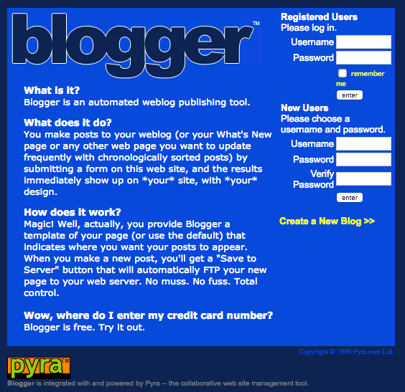 Blogger, c. 1999. Source: Wayback Machine
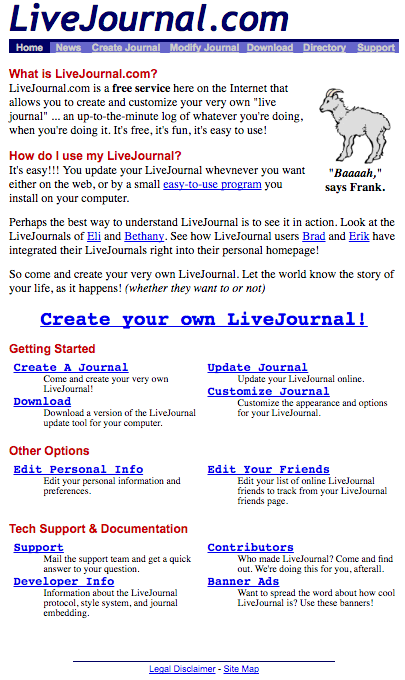
LiveJournal, c. 1999. Source: Wayback Machine
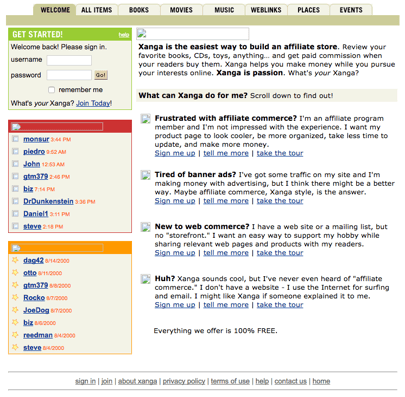
Xanga, c. 2000. Source: Wayback Machine
Xanga (for whom Twitter co-founder Biz Stone once served as creative director) actually began as a social networking site — sometimes compared to MySpace — and didn’t add blogging features until 2000.
This period of time also saw some of the first rumored video blogs. In January 2000, a man named Adam Kontras accompanied a written blog post with a video that updated friends and family on what he was doing. That November, professor Adrian Miles posted what some speculate to be one of the first video blogs, as well, calling it a “vog.”
“NO PETS ALLOWED. We smuggled him in. It was awesome. Felt all undercover.” Source: Adam Kontras
As the sun set on the nineties, blogging began to have quite an impact on many lives. People were starting to figure out how to monetize their blogs — which we’ll get into in a bit — and the stage was set for businesses and individuals alike to take bloggers seriously.
2002: A big year for blogging
The early 2000s saw a few significant events within the blogging realm. Technorati, one of the first blog search engines, launched in February 2002.
That month, blogger Heather B. Armstrong was fired for writing about her colleagues on her personal blog, Dooce.com. While it’s not clear if she was the first blogger to be terminated because of her personal website’s content, it sparked a conversation about the privacy and freedom of expression for bloggers.
The subject arose again in 2004, when Congressional aide and controversial blogger Jessica Cutler would experience the same fate as Armstrong. Cutler, however, blogged anonymously until her identity was revealed by the website Wonkette.
The year 2002 also saw the dawn of “Mommy Bloggers,” which largely consisted of mothers blogging about parenting, aiming to create a sense of support and learning for their readers. Melinda Roberts founded TheMommyBlog.com — “one of the original mom blogs,” she writes — that April, creating a category that would continue to take storm for over a decade.
The following month, Newsweek predicted that blogs will replace traditional media and, rather in December of that year, it partially came to fruition, when Talking Points Memo broke the written transcript of Trent Lott’s infamous call into “Larry King Live” — when Lott illustriously sang the praises of Strom Thurmond. Blog entries like these would serve as a precursor to live blogging, which took shape the following year.
In August, Blog Ads was launched by Pressflex LLC. Less than a year later, Google would debut AdSense, which paired blogs with relevant advertisements (at the discretion of the blogger). Being able to advertise on blogs was a major milestone for bloggers, as it created the opportunity to monetize their work. It set the stage for blogs to be sponsored by major brands that fit their respective credos, or receive free products in exchange for endorsements or reviews. Blogging was turning into a business — and soon, a small population of bloggers would be using what used to be a hobby as their primary source of income.
The tumultuous Gawker — which New York Magazine cited as the initiation of gossip blogs — also launched in December 2002, only to cease operations in August 2016 after a high-profile legal battle.
2003: The momentum continues

TypePad and WordPress launched in 2003, continuing the trend of providing platform options to a growing number of bloggers. That’s the same year that live blogging is estimated to have started — the Guardian was one of the first outlets on record to make use of live blogging during the 2003 prime minister’s question time. The BBC refers to this blogging activity as “live text,” and has frequently used it for sporting events.
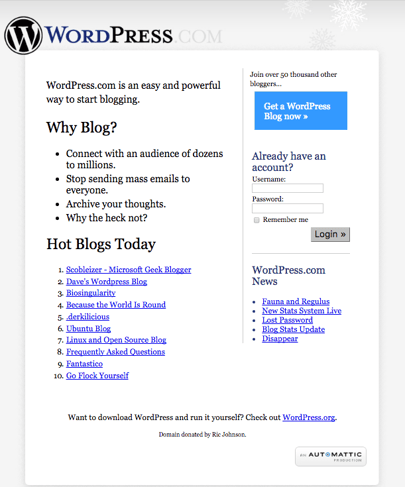 WordPress, c. 2005. Source: Wayback Machine
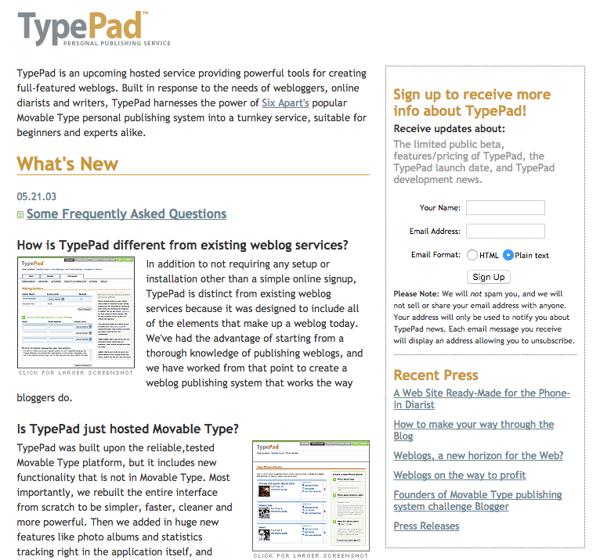
TypePad, c. 2003. Source: Wayback Machine
February 2003 also marked Google’s acquisition of Pyra Labs — the makers of Blogger. That was a sign of the growing business of blogging, particularly in the wake of the monetization programs that launched the previous year.
The early 2000s showed the first signs of a rise in political blogs. In 2003, for example, several traditional media outlets were encouraging staff writers and columnists to double as “cyberjournalists,” as Matt Welch called them in a piece for the Columbia Journalism Review. It reflected a growing number of political bloggers, with many seasoned reporters looking to blogging for opinion and beat outlets.
That climate primed the blogosphere for what would follow in the latter half of the decade, when the perspectives and analyses of political bloggers began to be preferred sources of information on current events. The line between traditional media and the blogosphere would start to bend, as bloggers were fated to become members of the press.
2004 – 2005: Video and the press
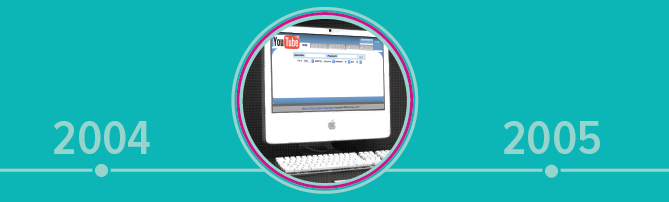
Despite the earliest video blogs being recorded in 2000, it wasn’t until the middle part of the decade that visual content really had the opportunity to take root. In February 2004, videographer Steve Garfield — who went on to be one of the Web’s first video bloggers declared it to be the “year of the video blog.”
As fate would have it, YouTube launched only a year later in February 2005, shortly thereafter inviting the public to upload their own videos. But it wasn’t always what people associate it with now — it actually began as a short-lived dating site, where singles could use videos to introduce themselves and state their romantic criteria.
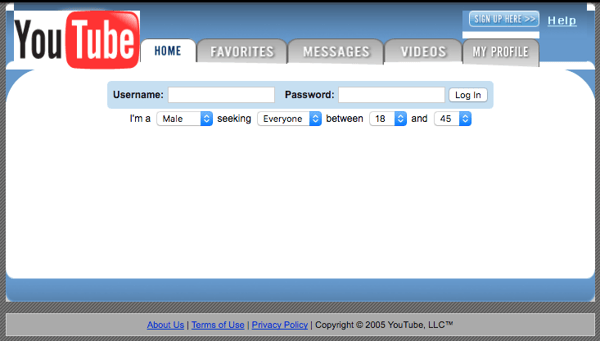 YouTube, c. 2005. Source: Wayback Machine
But once YouTube turned its focus to general video uploads (which seemed to take effect by June 2005 according to Wayback Machine), it was part of a series of developments that showed the growing credibility of the online user. With ample resources already built for writers, developers were starting to address other content creators.
And it wasn’t just developers who were lending credibility these online users. In March 2005, blogger Garrett Graff was the first to be granted White House press credentials.
That might have been when the line between news reporting and blogging began to diminish, which some attribute to the launch of the Huffington Post that May. It began as what one case study named a “political forum” — and the Washington Post called it a “group blog” in a 2007 profile — but is today one of the highest-profile content aggregators.
Huffington Post is largely a mix of syndicated material and original content from staffers, columnists, and unpaid bloggers. Visit the website, though, and you’ll land on a page of global headlines, lending the visual impression that it’s a news outlet.
It comes as no surprise that one of Huffington Post‘s co-founders, Jonah Peretti, went on to co-found BuzzFeed. Though BuzzFeed wouldn’t refer to itself as a content aggregator — it instead identifies as “a cross-platform, global network for news and entertainment” — it contains a similar vast range of content and, despite having an editorial staff, anyone can post to the site.
These newer platforms raised the question: “Is it a newspaper, or is it a blog?” And as the 21st century progressed, the answer to that question wouldn’t become any clearer.
2006-2007: The rise of microblogging and rules
The start of life in 140 characters (or less) began in March 2006, when Twitter co-founder and CEO Jack Dorsey sent out the world’s first tweet.
just setting up my twttr
— 🚶🏽jack (@jack)
March 21, 2006
It was the introduction of microblogging — sharing stories, news, and other types of content in the smallest format possible.
Microblogging continued to gain momentum in February 2007 with the launch of Tumblr — yet another blogging platform that encouraged users to be brief. It was built, wrote former CNET reporter Josh Lowensohn, for those “who feel they may not have enough content or time to write a full blog, yet still want to write and share links and media.”
But with the introduction of short-form, real-time information sharing also came increasingly visceral communication. There would be countless mean tweets, as well as harmful comments left on blogs. It got to a point where, in March 2007, new media mogul Tim O’Reilly proposed a Blogger’s Code of Conduct in response to threatening comments that a friend had received on her blog. The rules were as follows:
- Take responsibility not just for your own words, but for the comments you allow on your blog.
- Label your tolerance level for abusive comments.
- Consider eliminating anonymous comments.
- Ignore the trolls.
- Take the conversation offline, and talk directly, or find an intermediary who can do so.
- If you know someone who is behaving badly, tell them so.
- Don’t say anything online that you wouldn’t say in person.
It showed that the blogosphere had come a long way since the 1998 introduction of Open Diary. Being able to comment on blogs was becoming less of a novelty, and more a point of contention. Several years later — in 2013 — the Huffington Post finally took a cue from rule #3 on the code of conduct, banning anonymous comments on its content and requiring commenters to link their feedback to a Facebook profile.
2008-2011: Blogging Dark Ages
During this period of four years, there weren’t many major events that propelled how or why people blogged.
There were a few developments of note, however. In January 2009, the White House blog debuted.
Later that year, the film Julie & Julia premiered, which followed the success of one food blogger whose online work eventually became a book. It was one of the first pop cultural references to the professional success of bloggers, and stood to inspire others — by 2010, Technorati shared that 11% of bloggers reported earning their primary income from blogging.
Google also made some changes that would impact bloggers in 2011 with its rollout of the “Panda” algorithm change. Its purpose was to lower the rank of sites with what Moz called “thin content,” which hurt bloggers producing content that Google deemed to be of lower quality. A lot of that had to do with bloggers having a lack of inbound links — a link to your website that comes from another one. (My colleague, Lindsay Kolowich, wrote more about that here.) Without many sites linking to these blogs, Google’s algorithm would begin to interpret them as less relevant.
2012: Medium is founded

In August 2012, a co-founder of Pyra Labs — the creators of Blogger — Evan Williams, created Medium: One of the newest blogging platforms.
Today, Medium is more than that. People can use it to write and publish original content, like most other blogging platforms. But Medium is continuing to blur the line between news reporting and blogging. In fact, on its website, the company describes itself as serving up “daily news reimagined, straight from the people who are making and living it.”
It was a notable introduction of decentralized content: A concept that allows users to share their work that has been published elsewhere on a content creation platform. That’s different than sharing links on social media, for example, where limited content is displayed. Instead, the full text and images of the work are shared, with the original author and source credited, on a site different from its origin.
It might sound kind of confusing and pointless. But my colleague, Sam Mallikarjunan, explains the benefits of doing something like that in his article, “Why Medium Works.” In sum: Medium has roughly three million viewers, all sharing and reading content. Does your blog have that kind of reach? If it doesn’t, you can reach Medium’s vast audience by syndicating your own content on their platform, drawing more attention to your work.
The same year that Medium launched, LinkedIn introduced its Influencers program, which recruited notable business figures to guest blog on LinkedIn’s publishing platform. Eventually, that platform became open to all LinkedIn members in 2014.
Though LinkedIn’s platform worked a bit differently than Medium’s — users can’t re-post full bodies of work in the same seamless way on the former — it does provide another outlet for people to share original content with an audience much larger than they may have received on their own domains.
2017 saw the latest development of the blogging realm — the creators of WordPress announced they would be rolling out the .blog domain.
Here’s the cool thing about .blog — even though it was made by the creators of WordPress, you don’t have to use the WordPress platform in order to build a blog on that domain.
“The domain registrations are open to anyone,” wrote Adario Strange of Mashable, “regardless of publishing platform.”
What’s Next?
I don’t know about you, but after diving into the history of blogging, I’m pretty excited to see what its future looks like.
Of course, it probably helps that blogging is my line of work. But I’m certainly not alone. Here at HubSpot, our content team has at least three full-time bloggers, and there are an increasing number of job titles that either indicate or include a blogging as a major function.
It makes sense, when you look at the state of blogging now. It’s an integral part of marketing and content strategy, and has even shown to increase lead flow up to 700% for some businesses.
How blogging continues to change will determine what our careers look like, and I encourage all marketers — corporate or otherwise — to blog on behalf of their respective brands. It might seem like a lot of work, but if the evolution of blogging has indicated nothing else, it’s that the sphere will only continue to expand.
And that’s something marketers should continue to pay attention to — not just the growth of blogging, but how many different interpretations of it exist. Just look at Facebook Live, Facebook Instant Articles, and Snapchat Stories against the context of the dictionary definition of a blog from above: “a web site on which someone writes about personal opinions, activities, and experiences.” Replace “writes about” with “shares,” and you could make the case that most of today’s content platforms — including social media networks — are their very own versions of blogs.
Want to learn more about the future of blogging and marketing as a whole? Check out the latest edition of our State of Marketing report.
Editor’s note: This post was originally published in September 2016 and has been updated for comprehensiveness.

9 Australian Websites That Will Inspire Your Design
It’s no question that Australia is one of the most visually stunning places on Earth.
And, for generations, Australian artists have embraced the continent’s colorful culture in their work.
When walking through a museum or historical location in Australia, you might find canvases covered with vibrant colors and energetic images that feel like they’re transporting you into an intense or action-packed scene.
Take, for example, this 1994 painting by Emily Kame Kngwarreye, an Australian high-colorist artis. Here, the painter uses explosions of different colors to simulate the action-packed beginning of Earth.

But Australia’s colorful, energetic art aesthetic doesn’t stop at art museums. Today, it can be seen in architecture, graphic design, and online. In fact, many Australian brands exemplify the region’s immersive or eye-popping artistic techniques in web design and user experience.
Whether you’re an international marketer learning how to design a unique web experience for visitors around the world, or an Australian designer hoping to get a leg up on the local competition, we’ve compiled a list of nine stunning Australian company websites you can learn from.
Examples of Australian Websites
Vbreathe
Vbreathe, which sells a high-tech, compact air detoxification system for homes,leverages a full video experience on the homepage of its website.
When you enter Vbreathe’s site, you instantly see a silent video that uses animations and special effects to demonstrate how the detoxifier works. Then, when you click on the video’s overlaid play button, you enter a full-screen product demo video that explains how the product works and why consumers should consider it.
After viewing the silent or full-screen video, visitors can scroll down to find more text-based product details and links to content air detoxification.
All in all, Vbreathe’s site does a great job of combining stunning images, videos, and text-based content that educate visitors about in-home air quality and give them the information they need to justify making a purchase.
Kua Coffee
Kua Coffee pulls visitors into its website with an interactive homepage scale that simply asks, “How many coffees do you have a day?”
When you click an amount of coffee you drink on the scale and press “GO,” you’re sent through a slide show that calculates interesting measurements related to the amount of coffee you drink and explains where that coffee would be sustainably sourced from if you purchase brews from Kua.
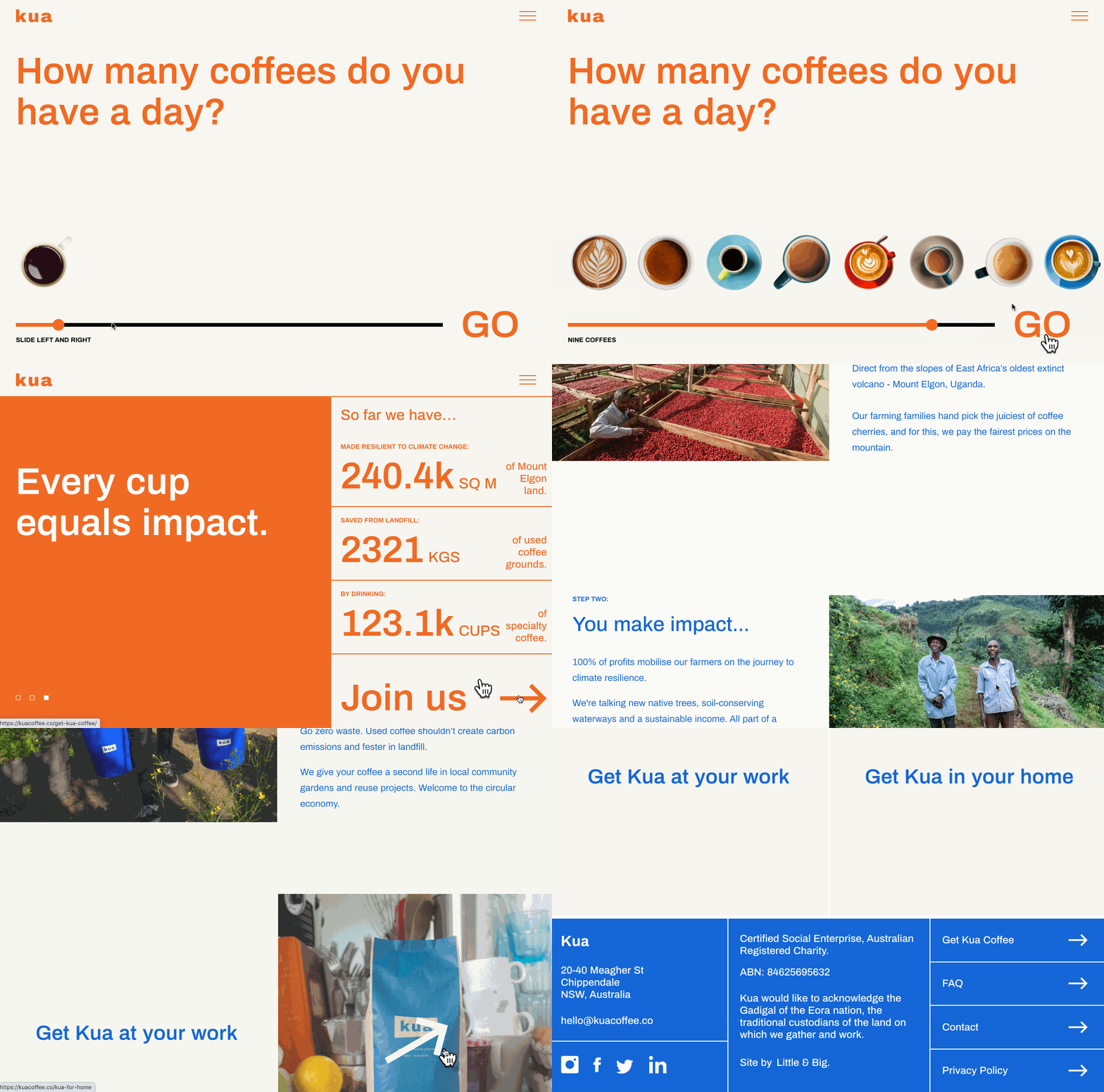
Once you complete Kua’s slideshow, you can scroll through a page that informs you more about the impact of environmentally-friendly coffee brewing and where Kua’s ingredients are sourced from.
Kua Coffee’s site is a great example of how a brand can create an interactive experience that allows a visitor to think about how they use or consume a product, learn more about how that type of product is made, and find out why a particular brand’s product is better than its competition.
Slaven Torline
While some designers might find it difficult to create a memorable site around something as logistical as financial planning, Slaven Torline — an Australian firm that advises struggling companies — embraces whitespace and simple animations to create an intriguing, effective, and professional website.
On Slaven Torline’s homepage, all you’ll find a brief mission statement, an image with a sphere and a cube, and a headline asking “How can we help?”
When you hover over the sphere, you’ll see the word “Insolvency” appear with a few list items to the side explaining how the business can help. When you hover over the square, you’ll see something similar around the word “Restructuring.
When you click “Learn more” for either Insolvency or Restructuring, the page expands with the associated shape moving down to a lower corner. From there, the shape’s shadow will change based on where your mouse is moving, adding light interactivity to the page.
Overall, Slaven Torline’s a great example of how a corporate or B2B company with less visual offerings can still leverage a clever — yet professional — aesthetic to create a memorable, interesting, and smooth user experience for its visitors.
SeeMakePlay
SeeMakePlay is a company that coordinates and teaches arts and crafts to children in schools or at parties. When you visit the site, you’ll see a colorful SeeMakePlay logo surrounded by colorful animated characters. And, on the lower-right, you can click a color and a pencil icon which enables you to scribble all over the page and characters.

As you scroll down, you continue to see playful animations, testimonials, and images of happy children, as well as an explanation of how the business works. You can also find an inquiry form allowing you to learn more about the brand.
With SeeMakePlay’s website, visitors can experience the fun and excitement of arts and crafts at the top of the homepage, scroll to learn more about the business, and ultimately find out where and how to schedule a class when they reach the bottom. This is an excellent way to pull a visitor through the flywheel as the design attracts, engages, and delights them.
PacVac
PacVac, an Australian vacuum company, offers its homepage visitors a highly visual and somewhat interactive experience that highlights the major value points of its Velo vacuum cleaner.
When you enter the site, you see a simple image of a woman vacuuming her home. Then as you scroll, you begin to see product shots of the Velo, which pop in front of a white background.
Just when you think this is a standard product site, you might notice that the product shots are animated. For some of them, you can twist and move the Velo in different directions with a simple swipe of your mouse, allowing you to get an interactive 360-degree view of the product.
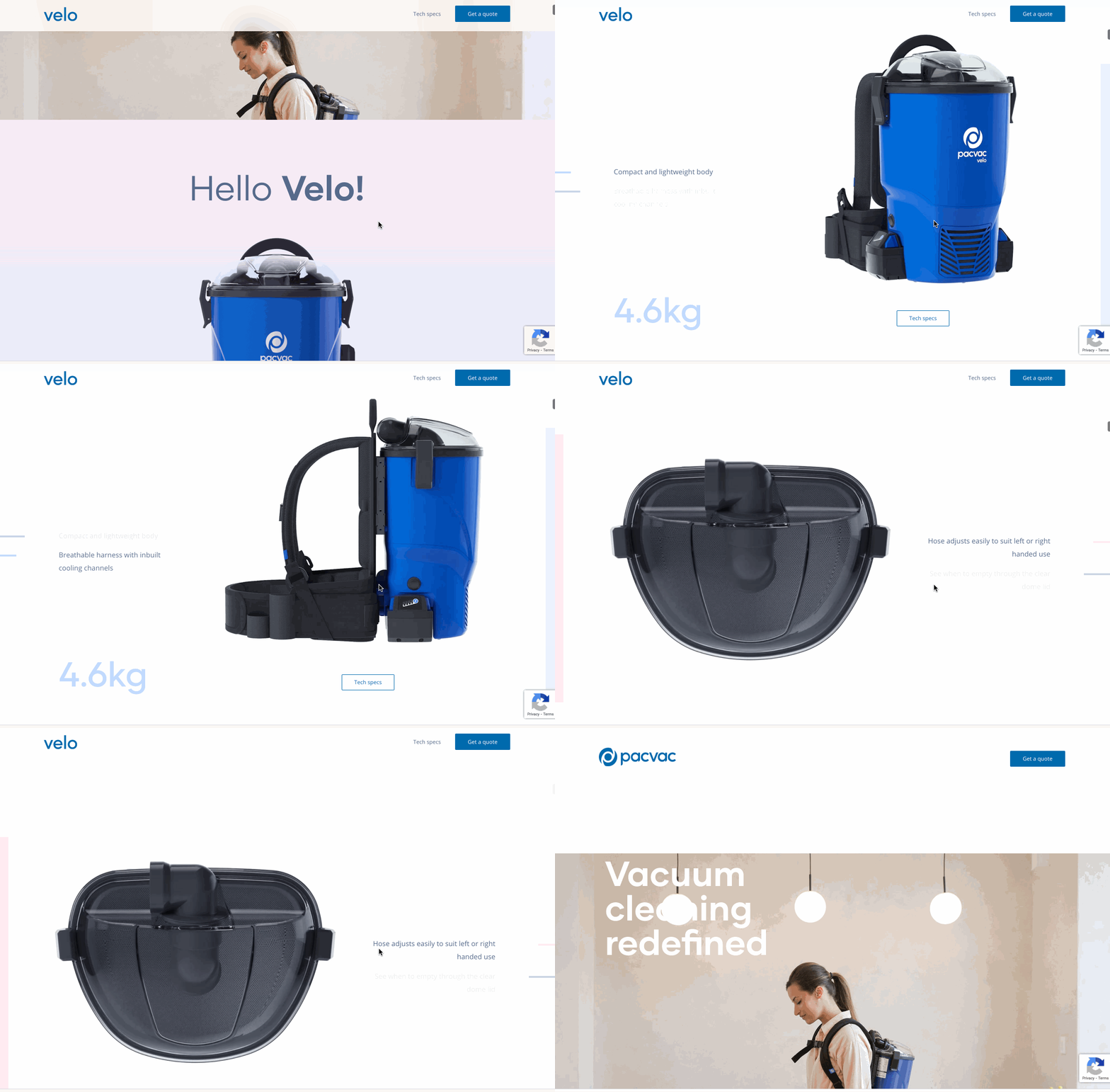
From there, the animations continue to get more advanced with each scroll. At one point you can scroll to see how each piece of Velo’s inner machinery works.
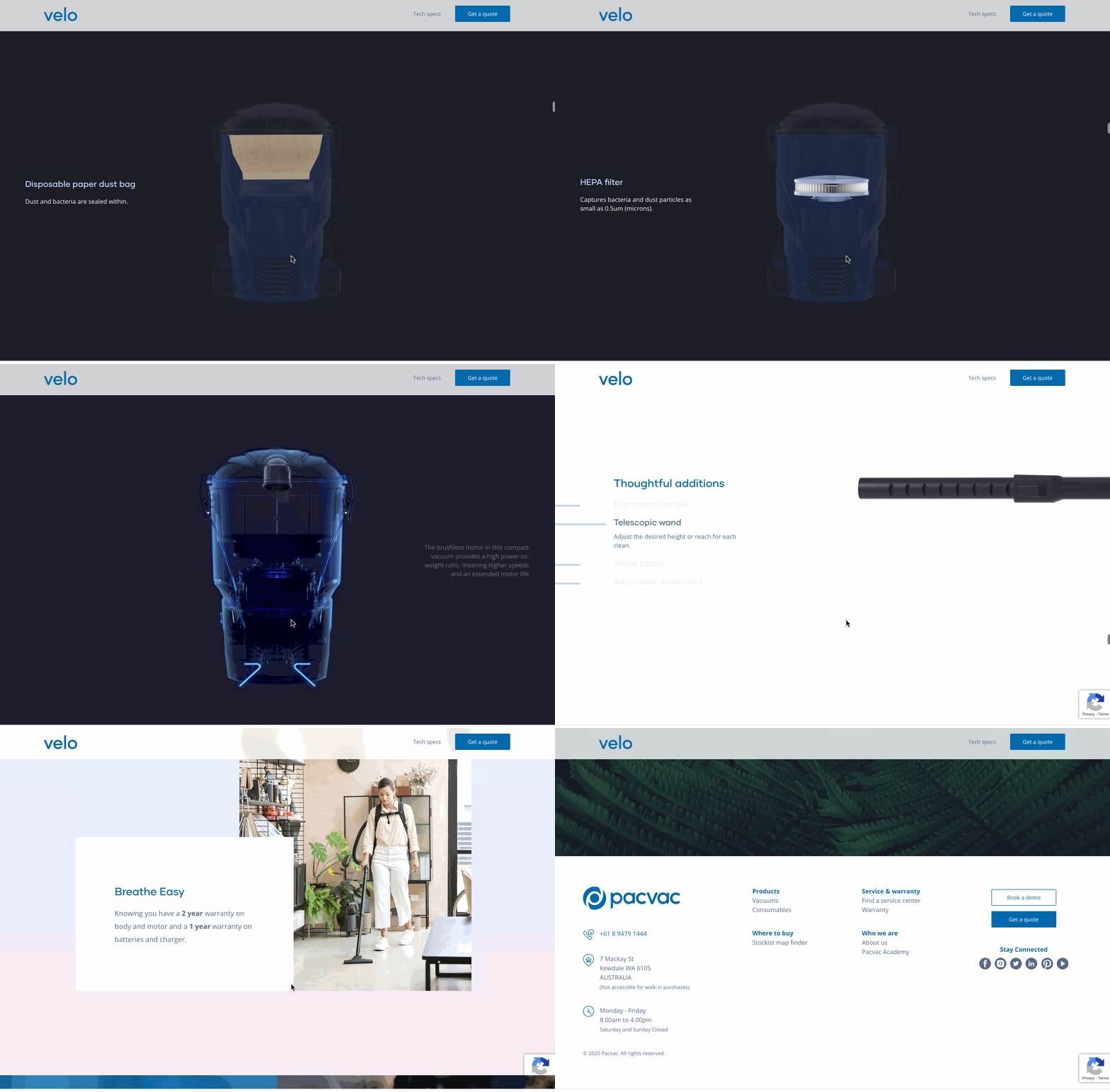
Essentially the home-page of this site feels like a self-paced, interactive video demonstration that shows a visitor everything they need to know about a vacuum without completely overwhelming them. The more you scroll, the more complex the details and animations get.
The progression of VacPac’s homepage content lines up well with the average buyer’s journey. When a prospect is doing initial research, they might just skim a site for light product information. But, as they get more serious about purchasing a product, they’ll look for a longer list of details and specifications before making an informed decision.
The Rocks Markets
The Rocks Markets is a retail and dining space in Sydney, Australia. While this business could easily place static food shots and basic information on its site and still get great foot traffic as a notable tourist destination, the web designers used the site to embrace color, video, and a sense of movement with each scroll.
When you land on the homepage, you can see that the background is a video of delicious foods from different vendors at The Rocks Market. As you scroll, you’ll continue to see photos and notice that the page navigation shrinks to give space to the beautiful food photography.
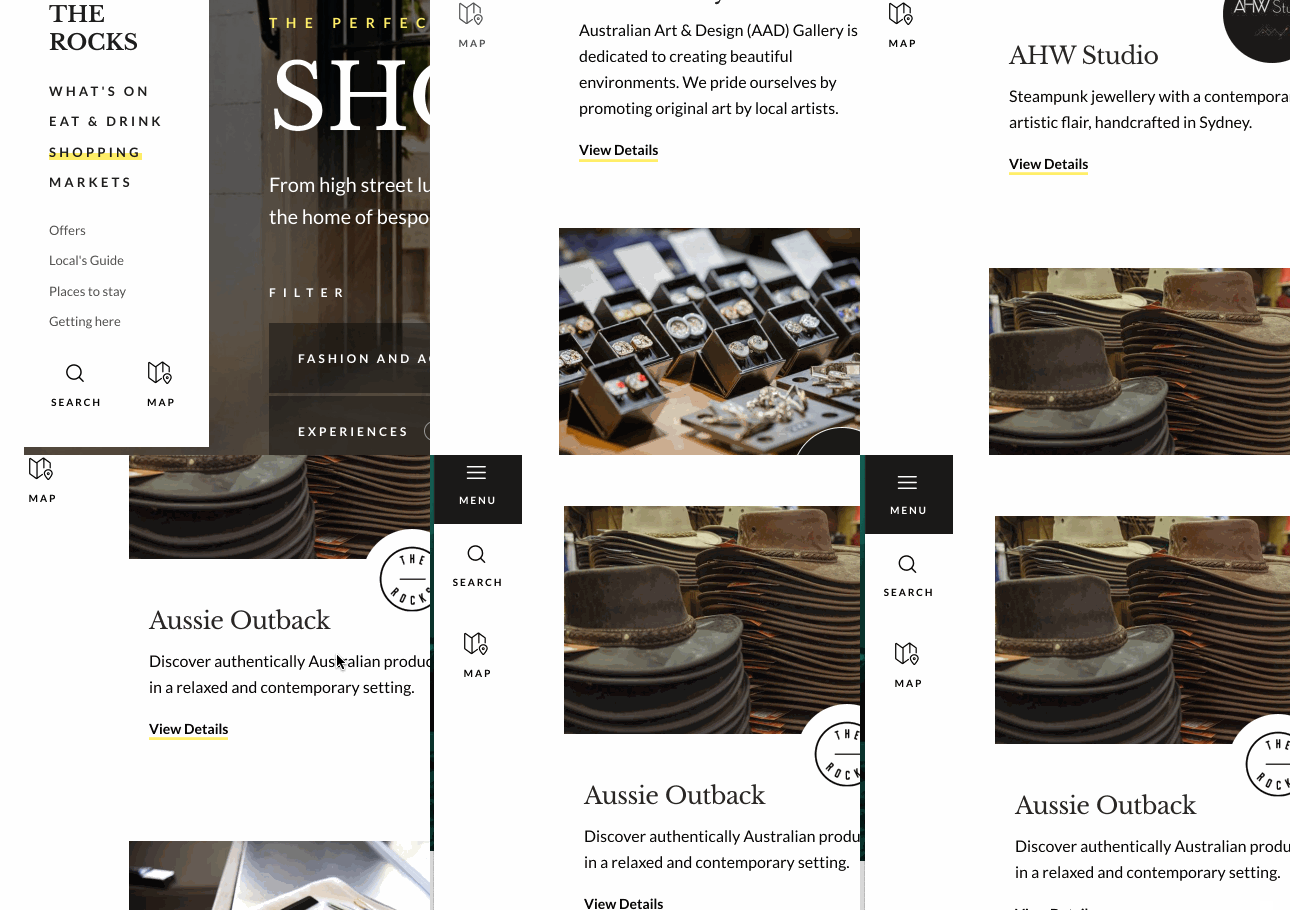
The Rocks Markets’ site is a great example of how a brand can highlight product videos and imagery, text-based content, a detailed navigation bar, and other information without making a homepage look too busy or overwhelming to understand. When visiting this site, you feel like you’ve learned almost everything you need to know about the Rocks Market, but still know exactly where to click if you have remaining questions before your visit.
Australian Shopping Sites
Boyd Blue
Boyd Blue is a women-fun ecommerce site and store chain that sells a wide range of Australian-made home products — from furniture to decor.
While many other sites on this list have amped up interactivity, Boyd Blue’s designers aired on the side of simplicity by focusing each web page’s format around large, high-resolution images of products in natural home settings.
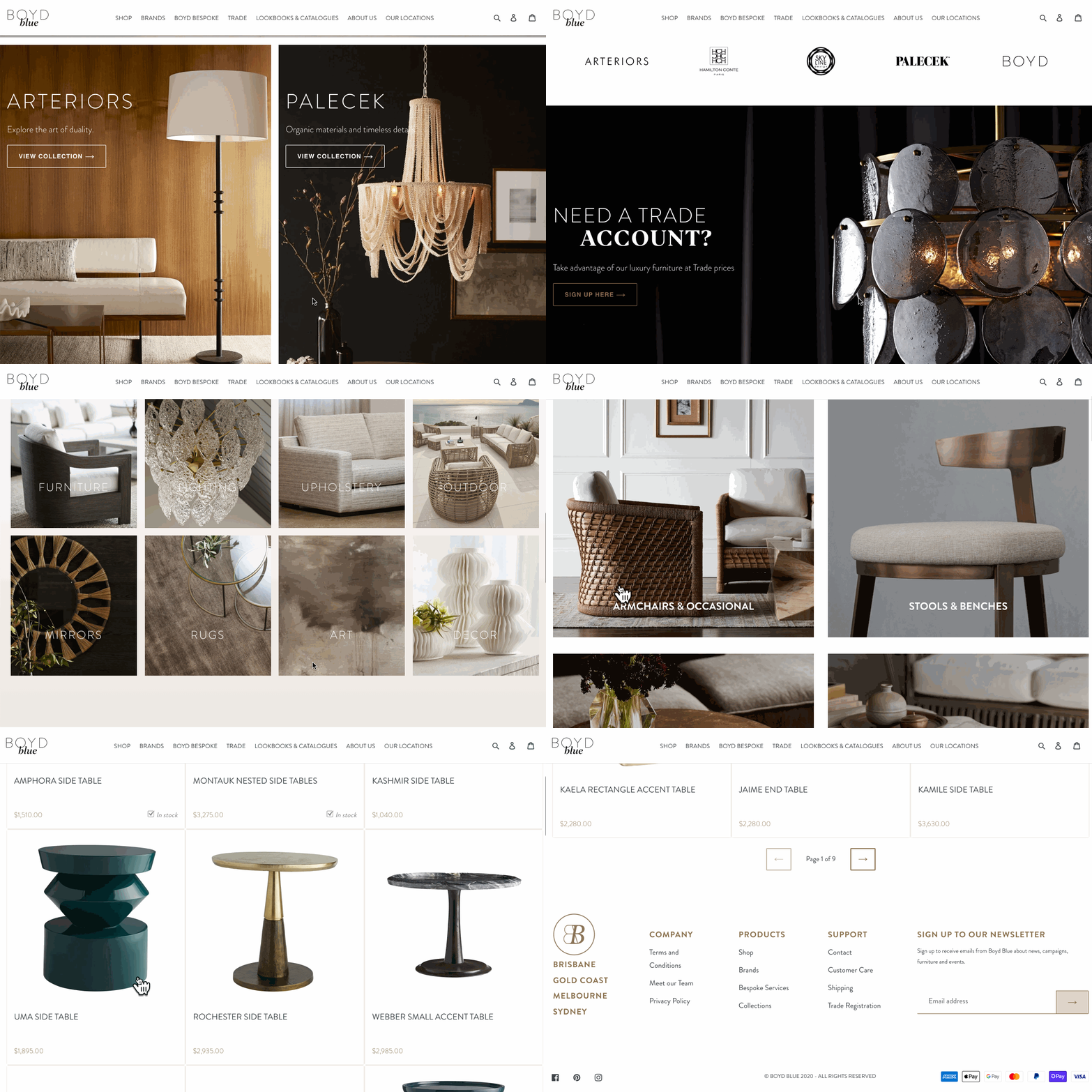
Aside from its beautiful homepage, Boyd Blue’s website also features an ecommerce store with a design and UX that’s also simple and easy to navigate for quick, frictionless purchases:
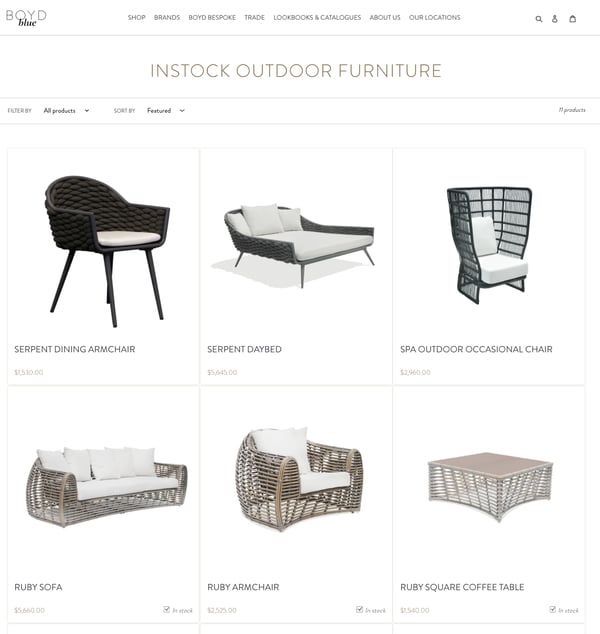
Rather than burying basic product shots in a page design with tons of descriptive text, the image-centered, light-text design allows users to get an accurate idea of what products will look like in real life, while also enjoying a smooth, aesthetically pleasing web experience.
Queen Garnet is an Australian brand that sells plum-based health and wellness products such as supplements, powders, and beverages.
Like a Queen Garnet plum, which has been dubbed a “queen of antioxidants,” the QueenGarnet.com’s homepage is purple, decorative, and uses regal-looking imager and fonts. When you enter the homepage, you’ll see a short, but memorable automatic video that presents one of Queen Garnets products in a castle with a moat surrounding it.
As you scroll down the homepage, you’ll see light animations that show each recent Queen Garnet product and basic information about it. With each product listing, visitors can click to buy it or learn more about it.
Visitors can also click to the Queen Garnet’s ecommerce shop, which has a similar purple aesthetic, and lists all of its products:
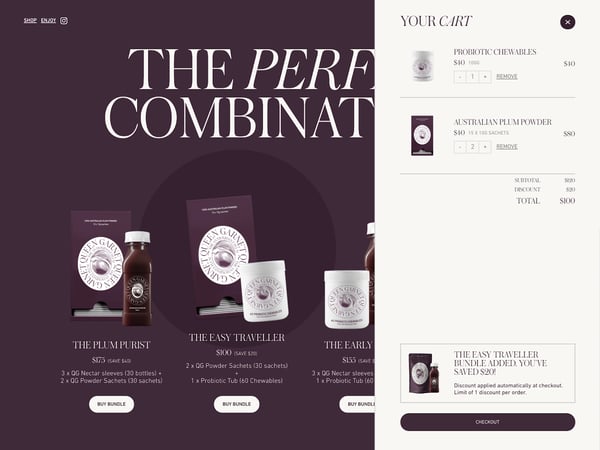
Queen Garnet’s site is a great example of how brands can benefit from light video, basic animations, and a consistent color and style aesthetic. The site’s royal-purple theme is not only fun and vibrant, but it could also be very memorable to visitors sifting through a handful of health and wellness sites for the perfect product.
Birdsnest
Birdsnest is an ecommerce clothing site that allows you to skim through product listings or get automated product recommendations based on your interests.
The ecommerce brand’s website design balances whitespace with colorful product shots to give off a simplistic, friendly, care-free aesthetic.
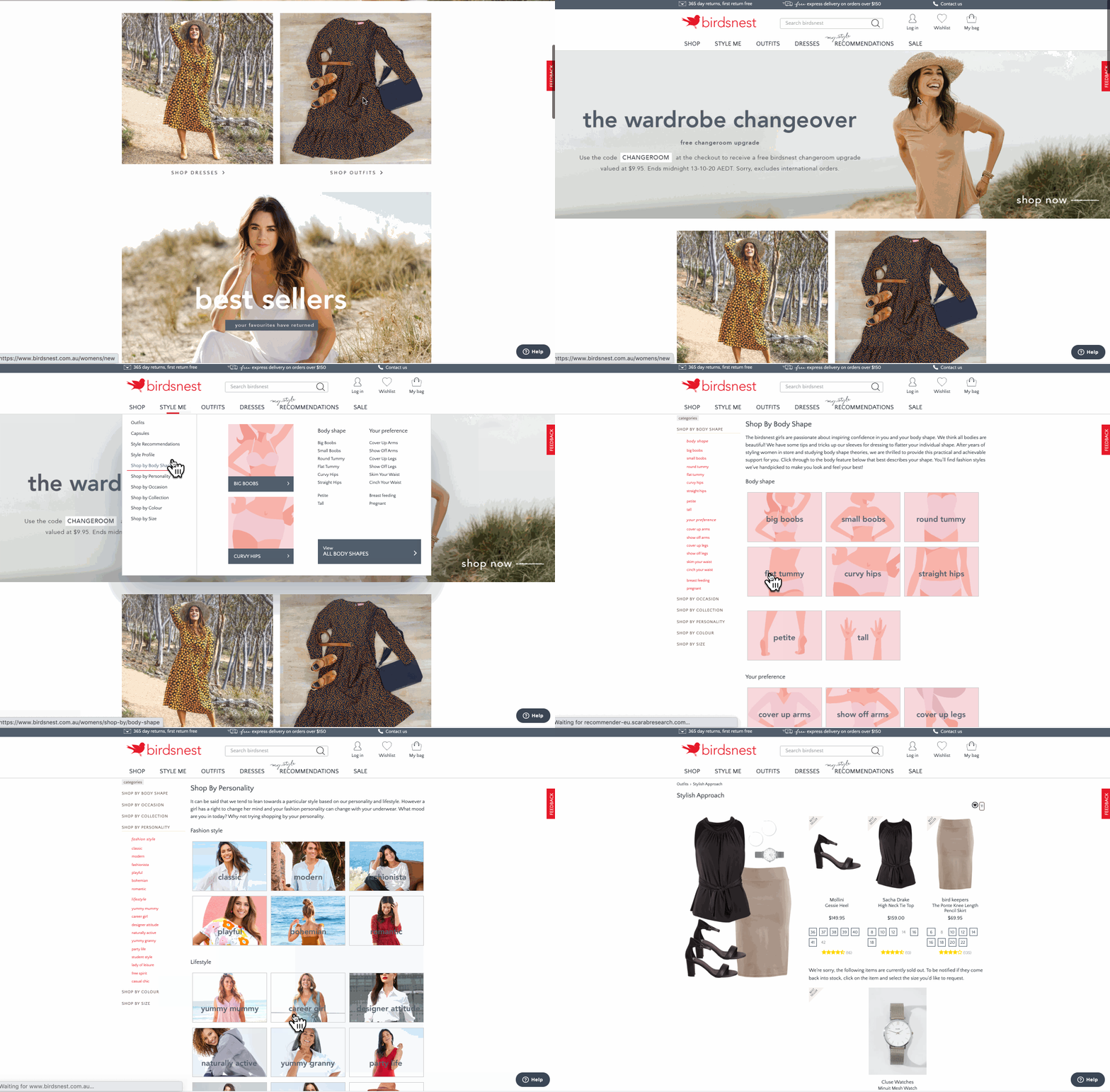
What’s most memorable about Birdsnest’s site is its user experience.
If you’re a first time visitor, you can browse products using search filters, or shop by categories including body type, occasion, and even personality. You can also answer a few questions about yourself and your clothing interests to generate a Style Profile that will help the website send you suggestions.
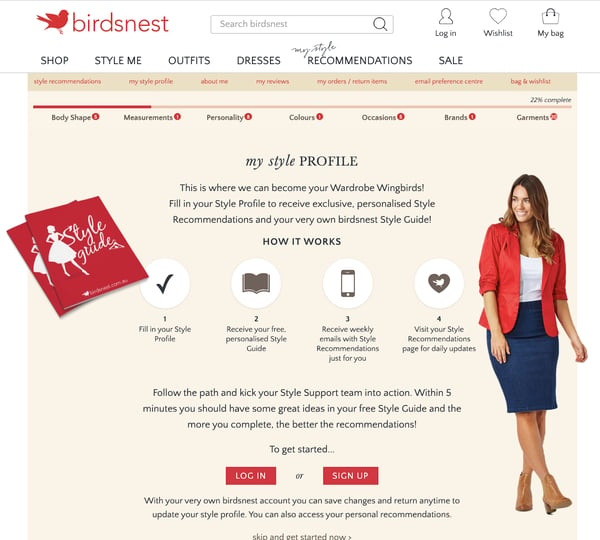
As you fill out your Style Profile, look at different products, or buy different outfits, the site will learn more about you and give you product suggestions in its Style Me section or through via an email subscription.
This is a great example of how designers and marketing teams can work together to create a highly-personalized shopping experience that can lead multiple groups of people with different interests to product purchases.
If you’re interested in building a website and design that does something similar, there are plenty of affordable ecommerce tools that can help businesses in any region with personalization and ecommerce recommendations. Check out this guide to learn more about them.
What Marketers Can Learn From Australian Web Design
Whether you’re in Australia or designing a website globally, the examples on this list have highlighted how brands can use color, video, and other elements to make their websites (and brands) seem memorable and unique to all visitors.
Here are a few techniques you can try leveraging:
- Immersive or Interactive Experiences: Many of the sites above drop the visitor into a video or interactive experience that makes navigating the homepage feel like an entertaining journey. These experiences not only engage the visitor, but they’re also memorable and allow prospects to easily digest lots of information about a brand in a short time.
- High-Resolution Imagery: All of these websites played up imagery, whether the graphics related to products or stirring up emotion. Regardless of the photo strategy, solid photos with great quality will be very memorable to your visitors.
- Vivid Color Schemes: While some websites on this list masterfully played with white space, all of the examples above had a design scheme that allowed colors related to their images or brands to stand out.
To learn more about designing the best website for achieving your brand’s awareness or sales goals, check out this guide. Already have a website? Click here for redesign tips. You can also download the free resource below for even more handy advice.

How to Host a Virtual Holiday Party & Bond With Your Team
Throughout my career, I’ve worked at a company that was fully remote, a company that was partially remote, and several fully in-person organizations.
Each company approached holiday parties differently. In fact, most of the remote organizations didn’t even offer team bonding activities.
While we’ve all probably participated in various holiday parties and team bonding events, those might not have been virtual.
Hosting a virtual team bonding or holiday party can seem daunting. How can you plan activities online? What logistics are involved?
If you’re planning a virtual holiday party this year, don’t stress.
Let’s review some tips from HubSpot’s remote workforce on how to host a virtual holiday party.
1. Use a spreadsheet to organize your activities.
Planning a virtual holiday party requires plenty of logistics. That’s why you should use a spreadsheet to stay organized.
Kara Korosec, a remote senior customer success manager at HubSpot, says, “I used to coordinate Secret Santa at my last company, a 100% remote company. I set up a spreadsheet where everyone listed some of their interests, then we used a random generator to assign secret Santas. Everyone had a budget of $50 and used the spreadsheet as inspiration for what to get. After the gifts were mailed, we had a Zoom where we shared our gifts and guessed who our secret Santa was.”
Regardless of the activity you’re doing, it’s important to stay organized so it’s clear who’s running the activities and when the deadlines are.
2. Make it interactive.
Virtual events might automatically feel “hands-off.” However, these events can still be interactive. In Korosec’s secret Santa example, they opened the gifts on a live Zoom call.
The goal here is to be creative.
Eimear Marrinan, a director of culture at HubSpot, says, “There are a ton of amazing remote vendors and minority-owned businesses that we partner with in the Culture Team. They are doing amazing work. If your budget allows for it, consider outsourcing to the experts. A few brilliant events I have seen: Ski Chalet Experience, Walkthrough Christmas Markets, Cocktails in a Winter Wonderland!”
There are several online games and activities you can use for your virtual holiday party. Below are some of our favorite interactive remote activities:
- Virtual MasterChef: Ask one person to host and send out a list of ingredients (or modified ingredients for dietary restrictions) and supplies. On the cooking night, have everyone dial into the Zoom to cook the same meal together as the host walks them through the recipe. Once the recipe is ready, sit down and have a virtual dinner together!
- Jack Box Games
- Airbnb Experiences
- Patchwork Adventures
- Pinturillo
- Virtual Tea & Coffee Tasting
- Virtual Floral Arrangement Class with Alice’s Table: They deliver farm-fresh flowers to your door.
- Travel to Paris and tour the Musée d’Orsay or pop over to London and tour The British Museum
- Goat 2 Meeting: Virtual Farm Tours & Animal Cameos in Zoom Meetings
- Two Bit Circus
- Splash
- ON24
3. Incorporate food.
When you have an event in person, usually the meal is provided. With remote holiday parties, don’t forget about this element.
Emily Tong-Sanchez, a remote revenue operations specialist at HubSpot, says, “Let people comp their meal!”
This gives people a reason to celebrate and enjoy the party.
Marrinan adds, “Ask questions if you’re incorporating food. Are there allergies or preferences? If you’re arranging a cocktail hour, does everyone drink alcohol? This is all about being inclusive in how you’re arranging your event.”
If you’re sending food, it’s important to be aware of any restrictions so your event is inclusive of all participants.
4. Encourage people to dress up.
Holiday parties are usually fun events where everyone can dress up and celebrate. Being remote shouldn’t change this.
Tong-Sanchez says, “Encourage people to dress up. We like having a reason to put on fancy clothes!”
5. Always lead with an inclusive mindset.
A major obstacle with remote meetings is that it’s hard to feel included.
Marrinan remarks, “We are working in a distributed and remote world right now, so when thinking through a holiday event for you and your team think big & think global. Will the timezone work for all on your team? Do ‘The Holidays’ resonate across the globe? Make sure you plan something fun, and inclusive that everyone can get involved in!”
6. Plan in advance.
If you’re planning a virtual holiday party, it’s important to plan in advance.
Marrinan says, “The end of the year is busy. Really busy! Give people advanced notice and book time in advance. A lot of people are juggling right now, so being protective of time is important! Similarly, be mindful of caregivers on your team, or anyone that may have blocked time in their day.”
7. Send something physical.
Just because your event is remote, doesn’t mean you can’t include a physical element in your virtual holiday party.
“Can you send something out to the team in advance to spur some excitement? This doesn’t have to be a physical gift — maybe it is a handwritten card or a note of gratitude,” Marrinan remarks. “A holiday event doesn’t have to be a big, big thing. Sometimes it’s the simple acts of kindness that go a long way for people.”
8. Pick a goal.
When you’re planning your holiday party, it’s important to decide what your goal is. For example, it’s hard to play a game while also getting to know each other.
Caroline Merewether, a strategy and operations manager at HubSpot, says, “The biggest takeaway is to figure out if it’s more about deepening relationships or playing a game.”
One of Merewether’s favorite events her team put on was an Airbnb experience which was a virtual escape room.
“That was fun to do something different and it was a fun mental shift. But it wasn’t great for getting to know people because we were trying to solve for clues. For our next party, we wanted to drive conversation between us,” she adds.
For her team’s next virtual holiday party, they’re going to send international candies that will be a great conversation starter for breakout rooms. Then, they’re going to do a costume contest and online trivia.
Jeff Boulter, an engineering lead at HubSpot, decided to combine the interactive activity with a way of getting to know each other via an interactive trivia game.
To start, Boulter sent out a Google Form with a mixture of icebreaker questions. A few examples included:
- What was your first online handle or email address?
- What course did you do the worst at college?
- What’s the weirdest job you’ve ever had?
- What’s your least favorite song?
- What’s your favorite conspiracy theory?
- What’s an unusual skill you have?
- Star Wars or Star Trek?
- Yanni or Laurel?
- If you could commit any crime and get away with it, what would it be?
- What’s the worst gift you’ve ever received?
- Who would get eaten first if we all got stuck in the 1C elevator?
Then, they used a free online trivia site called MyQuiz. Here, the answers were either picking one person from their squad (who’s least favorite song is “It’s a Small World”, for example) or picking the correct answer amongst 3 other made-up answers. They ended up with 54 questions. See the picture below for what this looked like.

Ultimately, planning a virtual holiday party takes some planning. But with a little research, you could end up with a fun, interactive game.
As a remote leader, your holiday party can be just as fun and interactive as an in-person event. To learn more, consider taking HubSpot’s Remote Leadership Training.

Why You Shouldn’t Buy Instagram Followers (& What to Do Instead)
You might know your Instagram content is good, but imagine how much better it will seem if it looks like 10,000 people agree.
Whether you’re trying to become a social media celebrity or simply looking to spread brand awareness on Instagram, it can seem tempting to take shortcuts wherever you can in order to expand your audience, including ‘buying’ Instagram followers.
Here, we’ve gone ahead and covered all the questions you might have about buying Instagram followers to give you a better idea of how it actually works. We’ve also explored the pros and cons, so you can decide for yourself if it’s a good move for your brand.
Can you buy Instagram followers?
Yes, you can buy Instagram followers. There are plenty of cheap services available that allow you to buy 1,000 followers for as little as $10 USD. But you’re only paying for a number. Many of those followers are either bots or inactive accounts, which means they’ll never engage with your posts.
1,000 followers seems like a good deal for the price of a small Starbucks latte. But of course, if it really was that cheap and easy, everyone would be doing it. So what’s the catch? Is buying Instagram followers legal and safe for your business? Is it a worthwhile investment?
The main reason buying Instagram followers can prove to be a wasted investment is because the accounts you follow often aren’t real.
Buying ‘Fake’ Instagram Followers
The vast majority of purchasable followers are either bots or inactive accounts. Here’s how it works:
Instagram Bots
As of 2018, Instagram may have as much as 95 million bots, which accounts for approximately 9.5% of its total user base. There are companies out there who have automated the process of creating bots so well that they can then sell these bots as followers. In some cases, the bots may even assume the identity of a real person, using stolen images and names.
Depending on the service, these dummy accounts may even seem organic, running on automation to share and like content. Some can even be programmed to produce content. However, because they’re not real people, they will not have an organic-looking following to follower ratio. As a result, the engagement they do produce will have little impact.
Without real followers to engage with your content, your posts are essentially hidden from everyone except your inauthentic audience. Plus, your bot followers won’t discuss your brand in real life with friends or family, because, well … they don’t exist in real life (no offense, bots).
Inactive Accounts
However, not all fake followers are bots. There are some companies who sell followers that are genuine accounts.
In this situation, the accounts are created either because they’re managed by users whose only goal is to get followed in return or for the sole reason to offer this service. And while these followers might show early engagement, they’ll ultimately become a drain on your Instagram account’s performance metrics when their accounts go dormant.
After all, if their account was created for the sole purpose of fulfilling sponsorship requests, the real person behind the account has little reason to dwell on the newsfeed, interact with content, or purchase the goods and services being advertised.
Without that interaction, your follower numbers are inflated with none of the value that organic followers would bring.
When you buy Instagram followers, you’re paying for a number alone. Engagement is not guaranteed, or even likely.
In addition to buying followers directly, you can also pay services to strategically follow other accounts on your behalf based on your preferences (location, hashtag usage, account type, and gender). Ideally, those followed accounts will then follow you back.
With this option, your followers are more likely to be real people, but engagement is still unlikely. Since you can’t even guarantee these accounts will follow you back, it’s a risky investment. Most accounts won’t follow you back, and even if they do, they probably aren’t going to be long-term, loyal, or active followers.
Should you buy Instagram followers?
It’s not a good idea to buy Instagram followers. The purchased followers are likely bots or inactive accounts, so they won’t engage with your posts. This means your posts won’t show up on Explore Pages, or on your real audience’s newsfeeds. It will also make it hard to measure metrics.
You’ll get early engagement that tapers off.
Purchased Instagram followers also provide no long-term value to your profile’s content. The followers you buy might give you views, likes, and comments early into acquiring them as a follower, but the attention they throw you now won’t be there later — when you start reporting on how your Instagram account is performing.
And how helpful, really, are 10,000 followers that don’t engage with you? Engagement is key to how Instagram’s algorithm displays posts to users. Without likes or comments, your post probably won’t show up on your audience’s newsfeeds, and it also won’t show up on any Explore Pages.
You could hurt your credibility.
Having a lot of followers could convince users to follow you organically, but it’s not a guarantee.
Remember the risks: these followers will probably never like or comment on a post, and if you’re caught with a ton of fake followers, you could ruin your credibility with your real audience.
Users might notice you don’t have a ton of engagement on your posts, which could deter them from following you. If you have 10,000 followers but only four likes per post, it won’t take people long to realize something is up.
Think of it this way: would you keep following an account if you saw that most of their “loyal audience” were inactive accounts or bots? I’m guessing not. It could seem deceitful, and lead you to believe the brand couldn’t get authentic followers through good content alone.
Bought Instagram followers can distort your performance metrics.
It’s practically impossible to measure how well your target audience is connecting with your brand if a high percentage of that audience isn’t real. How will you measure posts that do well with your real audience if those bots and inactive accounts skew the ratio?
If you don’t know how well your posts are doing or what your real audience thinks, you’ll never convert your Instagram followers into real customers. And isn’t that the point?
Ultimately, if you pay for Instagram followers, you aren’t paying for quality, real-life followers. You’re paying for a blank number. And since Instagram’s algorithm is largely tied to engagement, not followers, buying followers isn’t a long-term solution. In fact, it isn’t really a solution at all.
Take the time, energy, and money that you would’ve dedicated to buying followers, and focus instead on building genuine relationships with a real audience. If your content is engaging and authentic, your loyal followers will spread the word and engage with your brand without needing any bribes.
Instagram Identifies and Purges Fake Followers
Recently, Instagram has updated its terms of use to identify and remove inauthentic accounts from its platform. Instagram is removing any likes, follows, or comments from third-party apps that are designed to artificially grow accounts’ audiences. By buying followers, you violate Instagram’s community guidelines and it may trigger a reaction from Instagram moderators.
Instagram is looking to maintain genuine interactions on its site, protecting real accounts and experiences. Fake or bought activity infringes upon this mission and might result in consequences, so it’s better to grow your audience organically.
Alternatives to Buying Instagram Followers
Instagram’s new algorithm rewards engagement more than follower count, displaying content similar to posts users engaged with in the past. In order to drive engagement, there are many different actions one can try on the platform to get in front of your ideal audience.
By using good Instagram marketing practices — whether you are building your personal brand or a company account — you can better reach the nearly 800 million monthly Instagram users and build an authentic audience.
1. Make your account public.
First, make your account public so that users can see your profile and content. This way, you can grow your audience organically when your content pops up on users’ explore pages, attracting and delighting your target viewership.
2. Give users a reason to follow you by publishing quality content.
Next, publish a variety of posts to your feed: you can post images, GIFs, videos, Boomerangs, quizzes on your story, how-tos, user-generated content, and so much more. Build trust and excitement among your followers by using high-quality photos, writing catchy captions, posting consistently, and keeping up a unique style overall to differentiate yourself from other accounts. Do your research on which hashtags generate a lot of buzz and which are aligned with your brand — hashtags can be a great way to reach new audiences if done correctly.
Depending on your brand personality, it can help to be funny or witty in your content. Having an acute awareness of how your brand is perceived and the trends going around Instagram will serve you when choosing content to post and how to interact with your Instagram community.
3. Use Instagram to its fullest capability.
Lastly, utilize the many different channels on the platform, like Instagram Live, IGTV, Instagram Stories, or Shopping on Instagram. There are so many different ways to connect with users, and by driving engagement through these features, you can drive engagement and traffic organically and authentically.
Editor’s note: This post was originally published in March 2020 and has been updated for comprehensiveness.

20 Stats About Australian Instagram Users & Trends
In July, nearly 41% of Australia’s population was on Instagram.
And, with Australia being one of the biggest internet and social media growth regions, its Instagram audiences are likely to keep getting bigger.
Yes. No matter what country you’re marketing in, Instagram’s platform is primed for brand awareness. You might think with growth stats like this, Australian brands are rushing to Instagram.But that’s not the case — many Australian businesses are actually missing out on the opportunities Instagram offers. In fact, recent research reveals that only 32% of Australian SMBs use it in their social media strategy.
Although Instagram sounds promising, SMBs with limited time, budget, or bandwidth might be hesitant to add any new social platform.
Why? Even though an Instagram account can majorly boost local and global brand awareness, building a scalable strategy for it can seem intimidating and time-consuming for smaller brands.
Luckily, Australian businesses don’t just have to launch an Instagram account and hope it works. In 2020, there’s plenty of data that can help these brands determine if the platform is appropriate for their goals, and how to engage Australian audiences once they’ve made a Business page.
If you’re an Australian social media marketer looking to improve your Instagram strategy or are working to boost a brand’s Australian presence from afar, here are 20 stats to know about Australian Instagram usage, marketing, and peak engagement times.
Australian Instagram Usage Stats to Know
Australian Instagram Users
- There were 10.45 million Instagram users in Australia in July 2020: roughly 40.8% of its entire population. (NapoleonCat, 2020)
- Australian Instagram users grew from just over 9 million to 10.45 million between May 2019 and July 2020. (NapoleonCat, 2020)
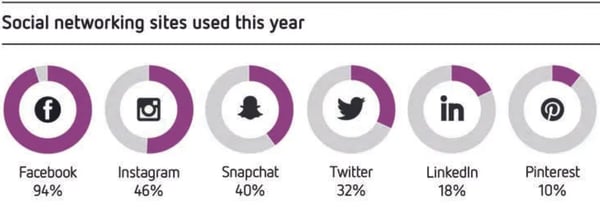
- 46% of Australian social media users say they regularly use Instagram, making it the second most popular channel in the region. (Yellow Sensis Social Media Report, 2018)
- Most Australian Instagram users are women, with the highest ratio of women to men being in the 45-to-54 age group. (NapoleonCat, 2020)
- More than 3.2 million Australian Instagram users are 25 to 34, making them the largest user group. (NapoleonCat, 2020)
- Roughly 9.1 million Instagram users are listed as over 18. (Laurel Papworth, 2020)
- 48% of Australian Instagram users follow a brand on the platform. (Yellow Sensis Social Media Report, 2020)
- Instagram is the third-most-used non-gaming mobile app in Australia. (We Are Social, 2019)
Instagram User Behavior in Australia
- More than 51% of Australian Instagram users log on to the app at least three to five times a week. (Statista, 2018)
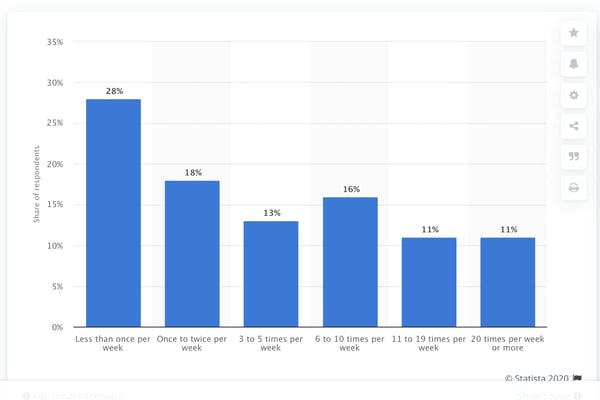
- Three regularly-trending Instagram hashtags in Australia are #photography, #Australia, and #Sydney, which have 450 million, 55 million, and 28 million posts associated with them, respectively. (Talkwalker, 2019)
- 45% of Australian social media users have taken a selfie for platforms such as Instagram. Selfies posts are more common among men and 18 to 29-year-olds. (Yellow Sensis Social Media Report, 2018)
- Roughly 40% of Australian social media users have posted a picture of food on channels such as Instagram. (Yellow Sensis Social Media Report, 2018)
Australian Business on Instagram
- 22% of Australian SMBs have advertised on Instagram (Yellow Sensis Social Media Report, 2020)
- 32% of Australian SMBs have an Instagram account, compared to 90% and 33% respectively on Facebook and LinkedIn. (Yellow Sensis Social Media Report, 2020)
- Instagram influencers whose accounts were about yoga experienced 127% growth in overall Australian engagement in March 2020. (Statista, 2020)
- Also in March 2020, hotel-related Instagram accounts experienced a 100% decrease in Australian engagement. (Statista, 2020)
Peak Engagement Times in Australian
- When using Instagram in any global region, the best time to post to get local post engagements is 2 PM and 3 PM in your brand’s timezone. (HubSpot, 2020)
- The best day to post on Instagram in Australia is Thursday in the AEDT timezone. (ShareMyInsights, 2020)
- Weekday posts on Instagram get more impressions from Australians than weekend posts. (ShareMyInsights, 2020)
- When aiming for global post engagement, the best times to post on Instagram from Australia are 12 AM to 2 AM, 6 AM to 8 AM, and 9 PM to 10 PM AEDT. (ShareMyInsights, 2020)
Growing Australian Brand Awareness with Instagram
From looking at the data above, it’s clear that Australian businesses can benefit from Instagram, which has a huge pool of users that will follow, engage with, and potentially purchase products from all sorts of brands on the platform.
But, simply creating an Instagram account and forgetting about it won’t boost your brand awareness. To truly gain audience engagement, you’ll want to create an active account with content that entertains users, grabs their attention, and educates them about your brand and your products.
If this list has inspired you to get ahead of the one-third of Australian SMBs missing out on Instagram, check out this guide or the free resource below for proven tips on building an effective Instagram strategy.

Google Cache: How to View Cached Pages
Cached pages is an undeniably useful tool when you come across a web page that is performing poorly, or temporarily down for some reason.
At its most basic, Google crawls web pages and then makes raw HTML copies of them — a cached page. This can enable you to view a website that is slow or not responding, and it can also help SEO experts figure out indexation issues with a site.
What is a cached page?
A cached page is a backup of the raw HTML and content of a page taken at a single point in time to be stored on a server and retrieved later.
For example, when Google crawls a web page, it will take a screenshot of that page and index the content for future reference. Additionally, Google will provide the date of the last time the page was indexed on the cache page, i.e. “This page is a snapshot of the page as it appeared on Feb 20, 2020”.
If you’ve come across a page that isn’t responding, or if you want to make sure your site is being properly indexed, keep reading to figure out how cached pages can help you solve both.
How to View Cached Pages
- In Google’s search box, type the website or page you’re trying to see.
- Beside the URL, click the down arrow.
- Select “Cached”.
- You are now viewing the cached page.
- Alternatively, type the word “cache” in front of the web page’s URL. i.e. “cache:https://examplesite.com”.
1. In Google’s search box, type the website or page you’re trying to see. Beside the URL, click the down arrow. Select “Cached”.
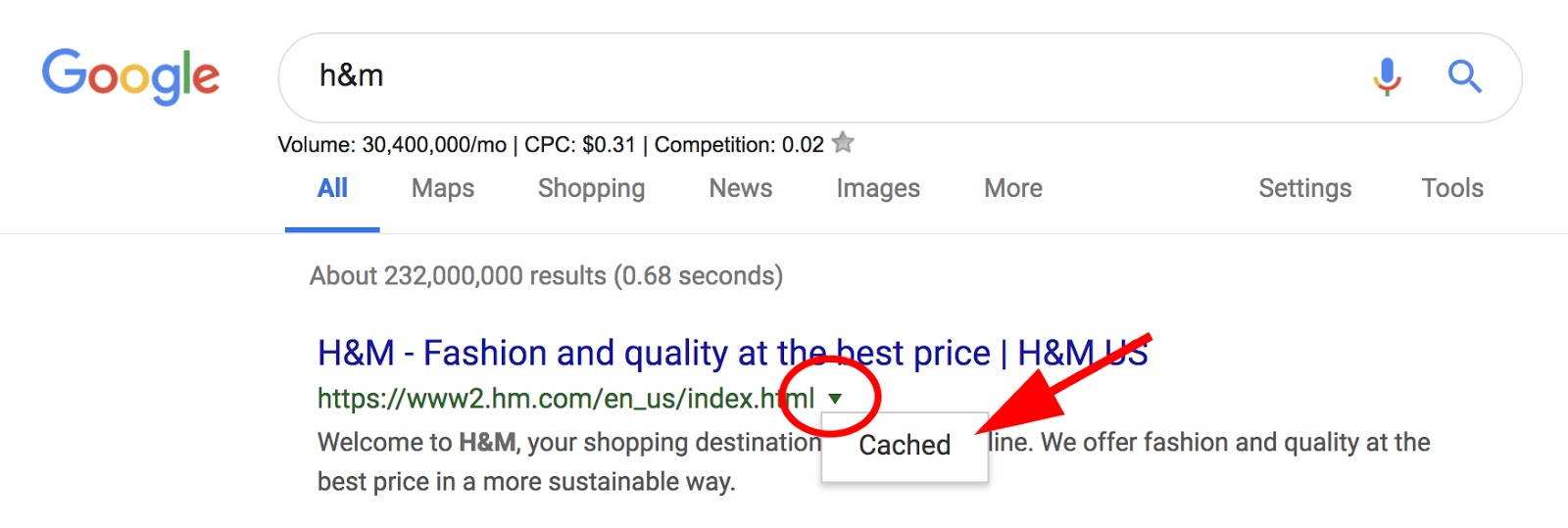
2. You are now viewing the cached page.

2. Alternatively, type the word “cache” in front of the web page’s URL. i.e. “cache:https://examplesite.com”.

It’s important to note, the cache is the part of the website written in plain HTML — it doesn’t also save JavaScript. Webmaster Trends Analyst at Google, John Mueller, verifies this, stating on his Twitter:
JavaScript content is typically inaccessible from the cache, but that doesn’t mean it wasn’t indexed — to check how a Google bot views your website, try using the Fetch and Render tool in Google Search Console instead.
Next, let’s explore how you can use Google Cache for website optimization.
How to Use Google Cache
- Use Google Cache if you’re on a web page that is slow or unresponsive.
- Use Google Cache to check when a particular page was last visited by a Googlebot.
- Check how your website is indexed online.
1. Use Google Cache if you’re on a web page that is slow or unresponsive.
If you’re trying to find information on a website but it seems the page is down (or just slow), you might try alternating to the Google Cache version. Of course, the page might not look aesthetically identical, but you’ll be able to see the HTML from the last time a Googlebot crawled the page.
2. Use Google Cache to check when a particular page was last visited by a Googlebot.
If you want to know the last time a Googlebot visited a certain page, but don’t have access to server logs, you can now see when the page was last visited by checking out the Cache version of the page. It can be helpful to see the last time the page was successfully fetched by a bot — if you’ve made changes that make the page unresponsive, you might need to know which changes you need to un-do.
3. Check how your website is indexed online.
You might be curious to see whether your website is cached online. If it’s not cached, there are a few potential reasons — first, you’ll want to check there is no content=”noarchive” attribute in the source code of the page. If the page is non-indexable or blocked from crawling, it won’t be cached. Alternatively, if a page is new, it might take a little while for the cache to become available.
If it’s not able to be cached, it’s still visible online. But if you want your site viewers to have the option of viewing it in a cache-version if your site is slow or unresponsive, you might consider digging deeper to figure out what the problem is.
Editor’s note: This post was originally published in February 2019 and has been updated for comprehensiveness.

7 Best Link Shorteners to Shorten that URL
Trying to convince people to click on a long, jumbled link is almost as bad as a door-to-door salesman trying to sell people financial services.
If your audience sees a link they perceive to be spammy in one of your social media posts, they’ll do the digital equivalent of slamming the door in your face — scroll past it.
To avoid being perceived as spammy or sloppy when you have a legitimate link to share, check out our list of the seven best link shorteners that’ll clip your links into clean, consistent, and clickable URLs.
What are the benefits of using link shorteners?
Using link shorteners can benefit your brand in three main ways:
- When you post long links on social media, it can look like spam or deter users from clicking on something they don’t recognize. In particular, adding tracking parameters to your links can result in URLs that look long and confusing to someone who’s unfamiliar with typical link tracking practices. Link shorteners can prune spammy-looking links into clear and concise links.
- Many link shorteners also let you track each of your link’s performance and analytics, which can help you understand which pieces of content perform best on specific platforms.
- Every social media network limits the amount of characters you can include in your posts. Twitter and LinkedIn have the shortest character limits at 280 and 700 characters, respectively, so if you need to squeeze a link or an extra hashtag in one of your posts, link shorteners can help you stay within the limit.
1. Bit.ly
Bit.ly is a link shortener platform that features a comprehensive dashboard displaying your links’ performance metrics, such as click-through rates, channel stats, and geographic information of the people clicking on your links.
They also offer branded links and have integrations with social media management software, like Sprinklr, Sprout Social, Buffer, Hootsuite, and HubSpot to help you seamlessly distribute your shortened links through your social media profiles.
Bit.ly’s free account offers up to 1,000 unbranded links and link reporting for 30 days, which is ideal for small businesses. Their enterprise plan lets you brand 3,000+ links a month and provides all the data and metrics mentioned above, which is best for large businesses who want to brand and track every link in their marketing campaigns.
2. Bl.ink

As one of the more robust link shorteners out there, Bl.ink offers smart branded links that allow you to create custom links that contain relevant words and not just a random string of characters.
They also provide analytic reports that can track clicks by date, time, language, referrers, device, and location and integrate with web analytic tools like Google Analytics and Adobe.
Bl.ink offers six subscriptions tiers from a free to an enterprise plan. Starting at $12 per month, they price their plans based off the amount of links you’d like create and track.
3. Rebrand.ly

Trusted by over 250,000 customers, Rebrand.ly is a link shortener platform that can brand your links, track their performance metrics, or integrate with over 50 other platforms to seamlessly distribute your links.
With three plans for individuals and two plans for teams, Rebrand.ly offers link shortening solutions for both small business and enterprise companies. For instance, their free plan offers 5,000 tracked clicks, 500 branded links, and 5 custom domain names, while their premium plan offers 1,500,000 tracked clicks, 150,000 branded links, and 20 custom domain names for $499 per month.
4. Ow.ly

Developed by the social media management platform, Hootsuite, Ow.ly is a link shortener that’s included in every free Hootsuite account. With Ow.ly, you can distribute your links and track their performance metrics directly in the Hootsuite platform, which allows you to shorten every single link you post to all your social media profiles. Ow.ly is a great option for anyone who already uses Hootsuite as their social media management platform.
5. Buff.ly

Image Source
Similar to Hootsuite’s link shortener tool, Buff.ly is integrated in Buffer, another social media management platform. With Buff.ly, you can shorten your links, customize them, distribute them to all your social media profiles, and track their performance metrics right in the Buffer platform. Buff.ly is perfect for anyone who uses Buffer as their social media management platform.
6. TinyURL
TinyURL is a free link shortening platform that’s perfect for users who have one-off links they want to shorten.
Using TinyURL is simple. All you have to do is go to TinyURL.com and follow the instructions. You can quickly fill in the link you want a short URL for, as well as a custom alias. If no one uses your alias, the link you will get will look something like “tinyurl.com/alias.”
Once you fill in the URL information and press submit, you’ll be shown three types of URLs: the long link, a generated short link, and a third that can serve as a web page’s preview link. Here’s an example:
7. Tiny.CC
Tiny.CC is another free link shortener that allows you to create temporary short links by simply pasting your long link into a text box and pressing Shorten. Like TinyURL, you can also customize these links.
If you register or become a paid subscriber, you can have non-expiring links and edit URLs later. If you’re a free user, the link will eventually expire and you cannot edit them once they’re generated.
Navigating Link Shorteners
If you have to share a few ginormous links, there’s no harm in shortening them because the process is quick and simple. Aside from being easier to look at, shortened links can also be helpful for print ads, physical signage, or places where you can’t link to another site.
There are a handful of free or affordable link shortening websites out there. But you might be wondering which to choose. To help you, we’ll leave you with two quick tips:
- If you don’t use an analytics software, like Google, you might want to use a link-shortener that includes basic stats, like page views.
- On the other hand, if you want to customize your link, you’ll also want a shortener that allows you to do that.
After you master shortening your URLs, you might also want to look into a similar process of creating QR codes. If so, check out this guide for tips and tricks.
Editor’s note: This post was originally published in January 2019 and has been updated for comprehensiveness.

9 Quick Ways to Reduce Page Loading Speed
When it comes to your site’s performance, page speed is of the utmost importance.
However, unless you understand how this metric works — and, more specifically, the factors that influence it — you may find it difficult to improve.
To reduce your bounce rate and increase visitor engagement, it’s essential that your web pages load quickly and seamlessly.
A site that is optimized for speed not only enhances the user experience (UX) but can also help to boost your search engine rankings.
In this article, we’ll explain what page speed is, why it’s important, and how to measure it. Then we’ll provide you with nine quick solutions you can use to reduce page loading speed.
Let’s get started!
What is page speed?
In a nutshell, page speed refers to how quickly your content loads when someone visits a page on your site. Not to be confused with website speed, page speed represents the loading time of a specific page.
There are a variety of factors that can influence page speed. Some of the most important include:
- How many images, videos, and other media files are contained on the page
- What themes and plugins are installed on your site
- Your site’s (and the specific page’s) coding and server-side scripts
All of these elements affect your page loading speed and in turn your website’s UX. After all, visitors dislike slow-loading pages and are more likely to click away from them.
Why is page speed important?
When it comes to page loading speed, every second counts. In fact, Google research shows that when loading times increase from one to three seconds, the probability of a bounce (the visitor leaving right away) increases by 32 percent.
If the page takes five seconds to load, the probability of a bounce rises by 90 percent:
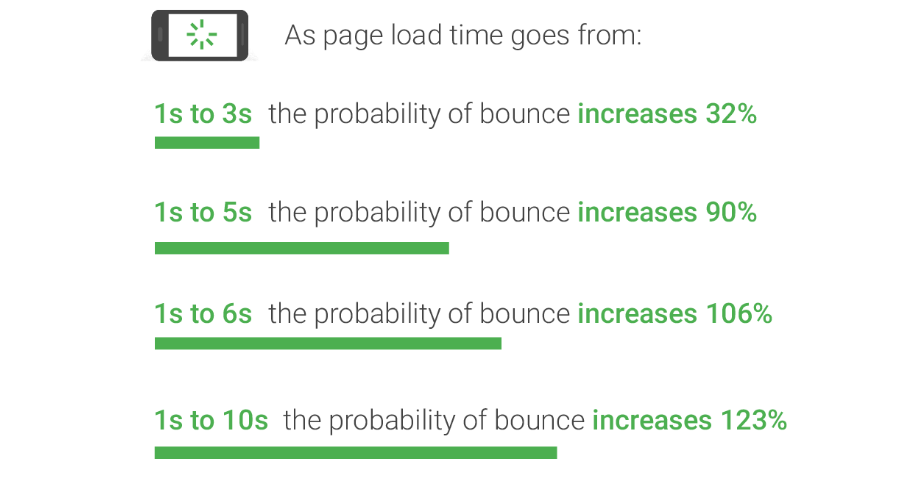
In other words, if your pages don’t load within a few seconds, it significantly increases the chance that visitors will leave your site. Additionally, if your web pages are sluggish, that can hurt your ability to drive engagement and conversions.
Page speed also plays a pivotal role in Search Engine Optimization (SEO). Google takes a wide variety of factors into consideration when deciding how to rank web pages.
However, speed is an important ranking signal for both desktop and mobile searches.
Another reason page speed matters is because it can influence consumers’ perception of your brand. If your web pages take too long to load or anything goes wrong during the process, it can make you look unprofessional, and your website unreliable.
If you want to run a highly-effective website, therefore, it’s necessary to focus on optimizing page speed. The first step in doing that is figuring out how your pages are currently performing.
How to Measure Page Speed
Before making any changes to your site, you’ll need to gauge your web pages’ performance. There are various tools you can use to test and measure page speed. Two popular solutions are Pingdom Website Speed Test and GTmetrix, which are both beginner-friendly options.
However, we recommend starting with Google PageSpeed Insights. This is an easy-to-use tool that enables you to measure and test the speed of your web pages on both desktop and mobile devices.
Plus, as a Google-supported tool, it can help you make sure you’re hitting the performance benchmarks required for high search result placements.
To use PageSpeed Insights, simply enter the URL of the web page you want to test into the text field, and select the Analyze button:
Google PageSpeed Insights.
PageSpeed Insights will then analyze the content on your page, and score it on a scale of 0 to 100. Below your score, you’ll find a list of suggestions on ways you can reduce page loading speed:
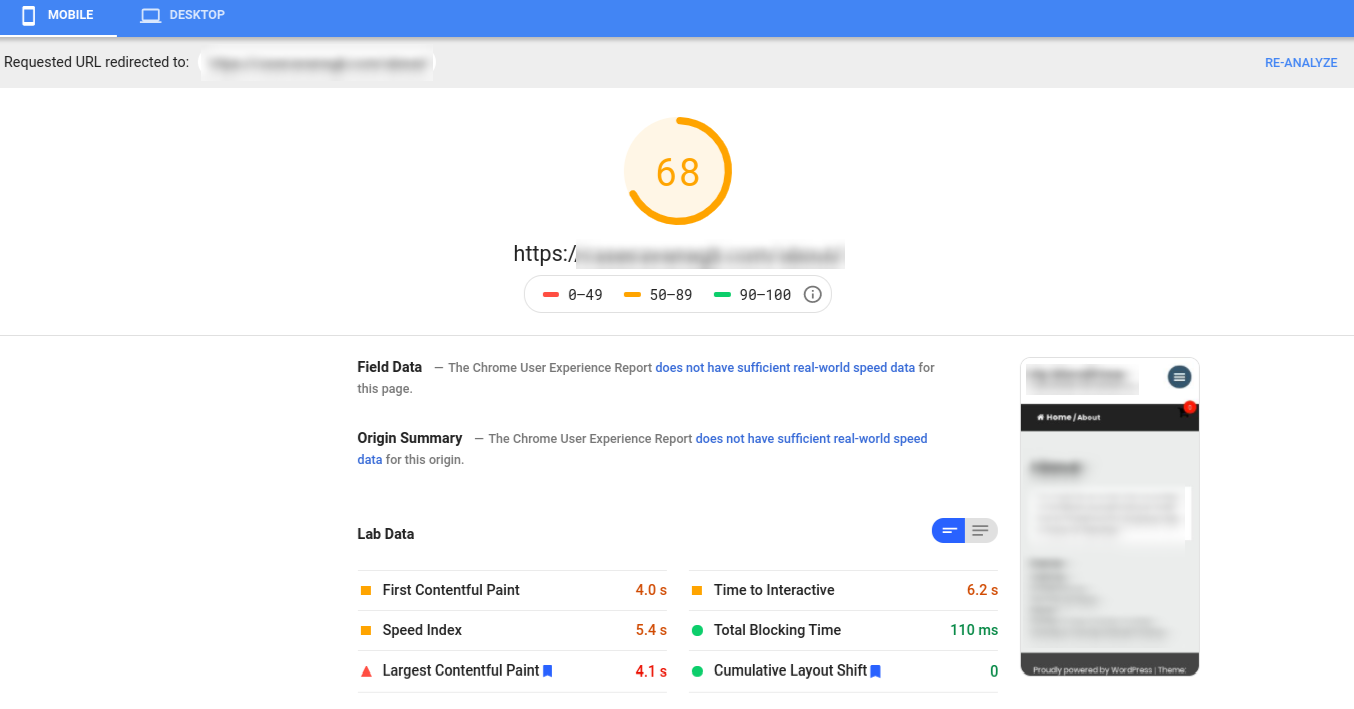
Suggestions for improving performance.
It’s worth noting that you’ll get a separate score and list of suggestions for both the desktop and mobile versions of your site.
This information gives you a solid starting point for gauging how fast your web pages are, and offers tangible actions you can take to improve page loading speeds.
9 Quick Ways to Reduce Page Loading Speed
Now that you understand the importance of page speed and how to test your site’s performance, it’s time to work on improving this key metric.
With that in mind, let’s take a look at nine easy ways to make your pages load faster.
1. Choose a performance-optimized hosting solution.
The hosting provider you use plays a major role in your website’s management and performance. That includes its page speeds.
One of the worst mistakes you can make is settling for mediocre hosting in order to get a lower monthly rate.
Cheap hosting often translates to poor performance. It can mean sharing resources between multiple websites on an overloaded server, which can end up straining your page loading times.
On the other hand, there are a handful of performance-focused hosting solutions you can use that provide a powerful platform designed for speed. Usually, these providers don’t offer shared hosting, which means you’ll never have to worry about other websites draining your pool of potential resources.
2. Compress and optimize your images.
Images help enhance the appearance of your web pages and increase the quality of your content. However, large images can also delay loading times.
Therefore, one of the easiest ways to reduce page loading speeds is to compress and optimize your images. This can include changing their file formats, enabling lazy loading, and compressing images through lossy or lossless compression.
By reducing your images’ file sizes, you can reduce their ‘weight’, ultimately helping your pages load more quickly. There are a variety of image optimization plugins you can use for this purpose, such as WP Smush.
After you install and activate this plugin, it will automatically resize and compress your images without affecting their quality. It includes features for lossless compression, lazy loading, and even optimizing images in bulk.
If you’re not using WordPress as your CMS, you might want to try with tinypng.com, which can reduce your image sizes anywhere from 25% to 80%, and a free website app called Squoosh.
3. Reduce your redirects.
Too many redirects on your website can really hurt loading times. Every time a page redirects somewhere else, it prolongs the HTTP request and response process.
Of course, in some cases redirects may be necessary, such as when you’re moving to a new domain. However, eliminating unnecessary redirects on your site can result in significantly lower page loading times.
There are a few different ways to reduce redirects in WordPress. One is to avoid creating unnecessary ones when building internal links and menus. Another is making sure your Top-Level Domain (TLD) resolves with a maximum of one redirection.
If you need help identifying redirects that are incorrectly set up on your site, you can use the Patrick Sexton Redirect mapper tool:
The Patrick Sexton Redirect mapper tool.
This will uncover any duplicate redirects. You can also use a tool such as Screaming Frog to identify all the redirects on your site and where they lead to. This should make it easier to identify redirects that aren’t serving a purpose. Then you can delete the ones you don’t need via your site’s .htaccess file.
4. Cache your web pages.
Caching is one of the most effective ways to speed up your web pages. Caching stores copies of your site’s files, minimizing the work needed for the server to generate and serve a web page to a visitor’s browser.
Caching your web pages can help with lowering Time to First Byte (TTFB), by requiring the server to use fewer resources to load a page.
There are various ways to cache your web pages. You can do this at the server level, meaning that your host handles it for you.
Another option is to use a caching plugin such as W3 Total Cache, which is a free WordPress plugin that makes caching your web pages quick and easy. After you install and activate it, simply navigate to General Settings > Page Cache and select the Enable option.
5. Enable browser caching.
Browser caching is another form of caching you can leverage to reduce page loading speeds. This technique enables the browser to store a variety of information, including stylesheets, images, and JavaScript files, so it doesn’t have to reload the entire page every time a user visits it.
Similar to W3 Total Cache, WP Rocket is a powerful caching plugin you can use on your WordPress site. It employs page caching and cache pre-loading to optimize the speed of your pages, and create lightning-fast loading times. WP Rocket is a premium plugin, with a variety of pricing plans to choose from.
6. Use asynchronous and defer loading for your CSS and JavaScript files.
Your site is made up of CSS and JavaScript files. These scripts can load either synchronously or asynchronously.
Synchronously means that the files load one at a time, in the order in which they appear on your web page.
With this method, when the browser encounters a script, it will stop loading other elements on the page until that file has been fully loaded first.
Conversely, asynchronous loading enables multiple files to load at the same time, which can speed up the page’s performance. Setting this up involves eliminating render-blocking resources.
If you’re using WordPress, you could either use a combination of the Autoptimize and Async JavaScript plugins to take care of this task easily.
7. Minify CSS, JavaScript, and HTML.
Optimizing the way your files load can help reduce page loading speed. Similarly, so can minifying your CSS, JavaScript, and HTML code. This means removing unnecessary spaces, characters, comments, and other unneeded elements to reduce the size of the files.
Decreasing your files’ sizes also makes it easier to combine them. The result is cleaner code, and leaner web pages that load faster.
Of course, combing through every line of code for each of your site’s files isn’t exactly efficient.
Instead, you can minify your CSS, JavaScript, and HTML with a free plugin: Autoptimize instead. This popular plugin makes it easy to aggregate and minify your scripts and styles automatically:
The Autoptimize WordPress plugin’s settings.
Considering the wide variety of features and settings it offers, configuring this plugin can be a bit overwhelming at first. To make your job easier, feel free to check out this guide on how to set up Autoptimize on your website.
8. Leverage a content delivery network (CDN).
A Content Delivery Network (CDN), also referred to as a ‘content distribution network’, is a network of servers that can help reduce page loading speed. It does this by hosting and delivering copies of your site’s static content from servers located across the globe.
A CDN works with, rather than in place of, your host. In addition to the server that hosts your primary website, you can leverage a CDN to distribute copies of your site’s files among strategically-chosen data centers.
This can maximize performance, by reducing the distance data requests have to travel between browsers and your host’s servers. By loading the content for a web page from a server close to each visitor, a CDN helps reduce network latency and produce lower TTFBs.
You have a variety of CDN options to choose from, one of which is opting for a host that provides a CDN you can enable it directly from your own dashboard.
9. Eliminate unnecessary plugins.
Not all plugins are created equal. Having too many plugins on your site can cause unnecessary bloat that slows it down.
Additionally, plugins that are outdated or aren’t well maintained can pose a security threat, and even introduce compatibility issues that hamper performance.
Therefore, it’s a smart idea to minimize the number of plugins you use on your WordPress site. Of course, one of the easiest ways to do this is by disabling and deleting any plugins you don’t currently use.
We also recommend reviewing the plugins you have installed, to evaluate whether they’re actually necessary. There might be some tools that have overlapping functionalities and features, and others that are simply no longer relevant to your needs.
Finally, certain plugins may slow your site down more than others. To identify any plugins that are reducing your page speeds, you can try testing them individually.
First, deactivate all of your plugins (it’s safest to do this on a staging site):
Deactivating WordPress plugins.
Then turn them back on one by one. Each time you activate a plugin, use a speed testing tool such as PageSpeed Insights to see if your score and timings have been affected.
Many plugins might increase your page speeds by a small margin. However, if you see a sudden large increase, it may be time to find an alternative tool that serves the same purpose (but is better optimized).
Ultimately, reducing page loading speed improves not only the overall performance and UX of your website but its SEO as well. Luckily for you, there are a variety of methods you can use to decrease your loading times.
In addition to leveraging a CDN and caching your pages, you can use plugins to optimize your images, defer loading scripts, and minify your site’s files.
Using a hosting solution optimized for performance can also have a major influence on your site’s speed.
Remember, though — every second your web pages take to load drastically increases the chance your visitors will leave. How long will you able to run your business while losing leads?
