
The 5 Kinds of Digital Marketing Collateral You Should Be Creating
It goes without saying, but your marketing materials shouldn’t be limited to conventional outbound advertisements — particularly if your business is B2B. Sure, capturing attention is part of the battle, but what happens when a prospect visits your website and sees nothing but some product descriptions and a pricing page?
There has to be more there. You need to have some material to show that you can walk the walk. One kind of content that helps get you there is known as marketing collateral, and it can come in a variety of shapes and sizes.
Here, we’ll get a more in-depth understanding of the concept and go over the five most important marketing collateral formats you can use to help establish legitimacy and supplement your sales efforts.
At its core, marketing collateral is a way to let prospects know that you know what you’re talking about. It’s not supposed to be as flashy as conventional advertisements. In creating marketing collateral, your first priority generally isn’t to capture attention — it’s to retain and enhance it.
In most cases, the prospects who are looking at your marketing collateral are curious about your company, but they might not be intimately familiar with you or your offering. Well-crafted marketing collateral can put them at ease. It can help build the kind of trust necessary to start and sustain a customer relationship.
Marketing collateral tends to be educational in some capacity. When done right, the informative nature of the format lets you separate yourself from the competition by letting you showcase an extensive understanding of your industry that others in your space might not be projecting.
If all of your marketing materials are solely dedicated to talking up your product or service, you’re selling yourself short. When prospects are deciding to buy, they’re not just considering what’s for sale — they’re considering your company as a whole.
They want to know they’ll be taken care of by a competent, capable, knowledgeable organization that they can rely on to address any issues and concerns they might have as they arise. Creating thoughtful marketing collateral is one way to help that cause.
1. Blog Posts
Producing good marketing collateral is often a matter of consistently providing value to your audience. One of the better forums to create and promote the kind of material that does that on an ongoing basis is a well-maintained company blog.
It allows you constantly to supplement your sales efforts with helpful insight and audience engagement — driving traffic to your website and generating leads through actionable advice, expertise, and entertainment.
Like any other kind of effective marketing collateral, good blog posts can project authority in your industry. You want to show you’re staying abreast of industry trends and understand the nuances of your space — constantly churning out high-quality, helpful content can help that cause and put your prospects at ease.
2. Ebooks
Ebooks are similar to blog posts in that they should project industry authority through engagement, but they tend to be longer, more in-depth, and less snackable than typical blog content. This type of marketing collateral generally attracts prospects with a vested interest in your industry. Here are some examples from HubSpot.
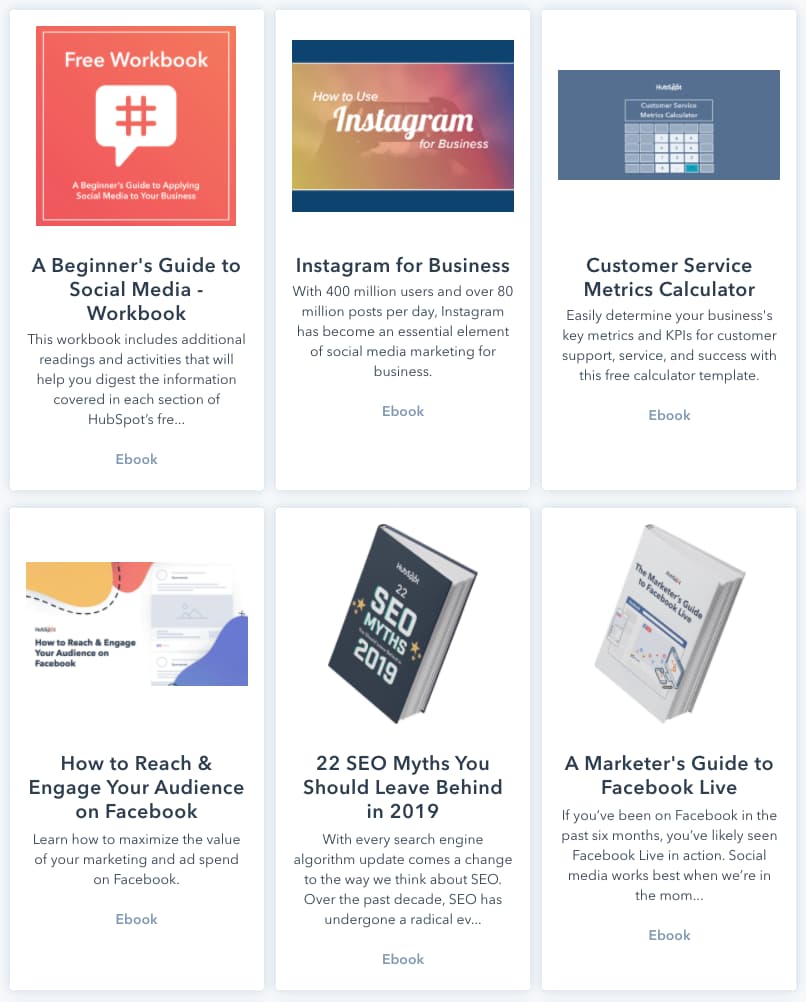
In some ways, an Ebook could be likened to an extended blog post or a few blog posts strung together. Like blog content, an Ebook generally contains accessible language and directly actionable advice.
In many cases, Ebooks are downloadable and can only be accessed in exchange for a prospect’s contact information — making them a powerful vehicle for lead generation.
No matter where your company stands, you likely have the resources and knowhow to channel your industry-specific knowledge into a thoughtful Ebook. Remember, your marketing collateral should be designed to build trust with prospects and customers.
If you can put out Ebooks to reliably bolster their knowledge of your industry, you can convince them they’re in good hands when they buy your product or service.
3. Case Studies
Case studies are offering-specific documents that detail how specific customers saw success as a result of leveraging your product or service. This format is different from the previous two in that it’s never product-agnostic. Here’s an example from HubSpot:
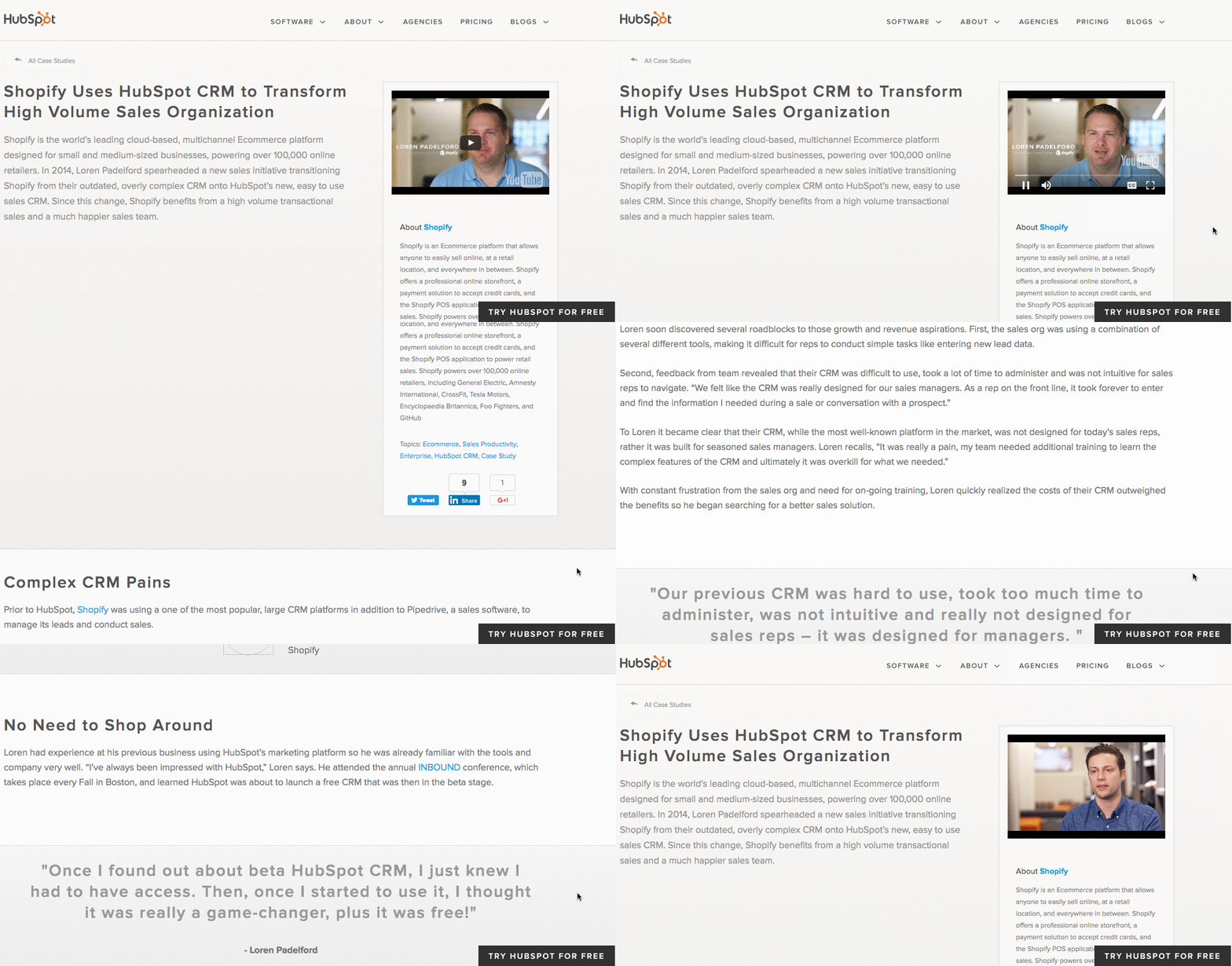
Every case study is made in collaboration with a satisfied customer. It’s a form of cross-promotion that shows what your product or service is like in practice — a roadmap that lets prospects imagine what you could do for their business.
Like almost every other example on this list, case studies are educational. They provide a more thorough explanation of how your product or service works through an active example. It’s also another avenue for building trust.
If you can point to reputable customers who are willing to vouch for your business in extensive detail, you can bolster your company’s reputation as a solid, knowledgeable organization with a product or service that delivers results.
4. Testimonials
Testimonials are essentially condensed, snackable case studies. Many — if not most — prospects don’t have the time or interest to delve into a full-on case study. If you want to reach them, you’re going to have to provide quick-hitting content that they can glance over passively. Testimonials can do just that.
Here’s an example of one from HubSpot:
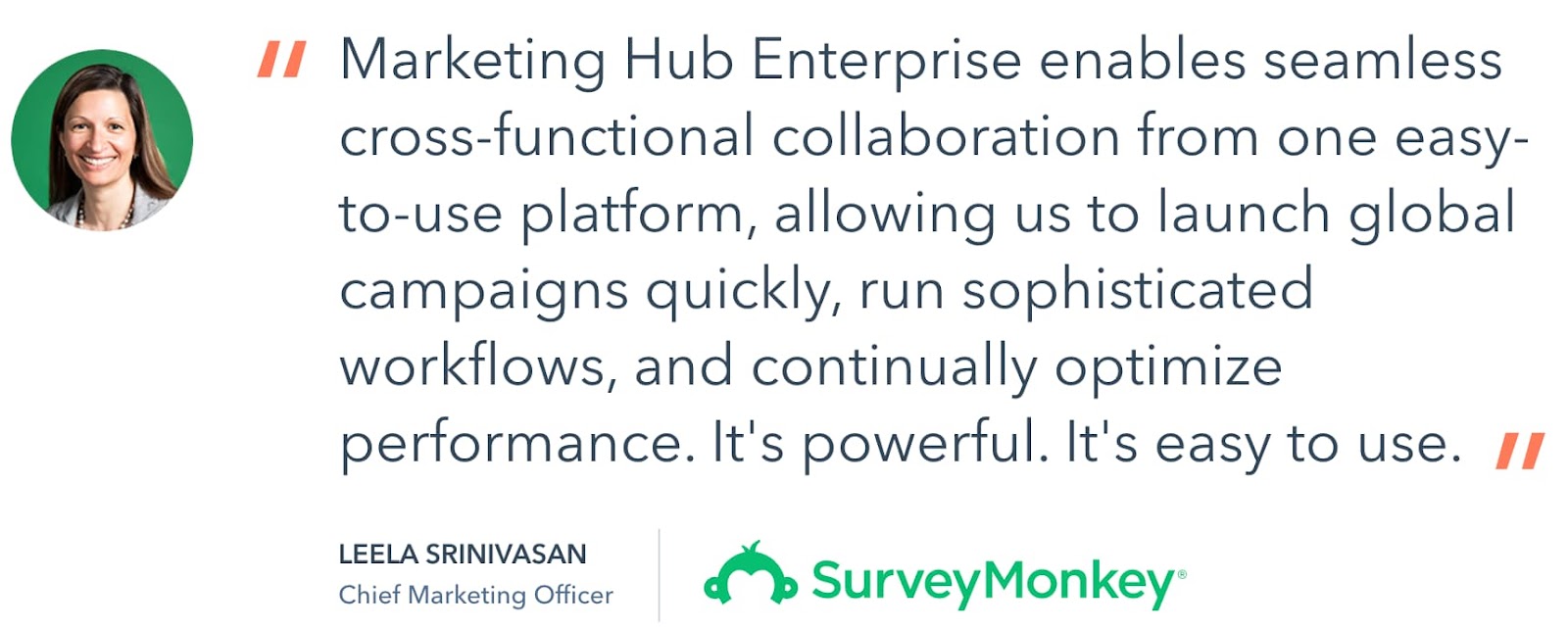
This testimonial follows the format’s best practice. It’s visually engaging, clearly establishes who provided the quote, and references specific benefits — a solid example of an appropriately informative, easily digestible piece of marketing collateral. Ultimately, a good testimonial helps project the company’s legitimacy while inspiring potential customers to further explore the product it’s promoting.
5. White Papers
A white paper is a persuasive, authoritative, in-depth report on a specific topic. Generally, one of these documents will raise a problem and present a solution to it.
It’s typically more technical and less accessible than an Ebook. It’s meant to draw a crowd more intimately involved with or interested in your industry — an audience that might naturally run into the issue at the core of the document.
White papers shouldn’t be product pitches. It’s best practice to keep them objective and educational. That being said, the topics you choose need to be relevant to your company or space.
This kind of collateral also needs to be thoroughly researched, thoughtfully formatted, polished, and written in a serious tone. That means no flashy language or cute gimmicks. Here are some examples of topics from HubSpot’s Not Another State of Marketing Report.
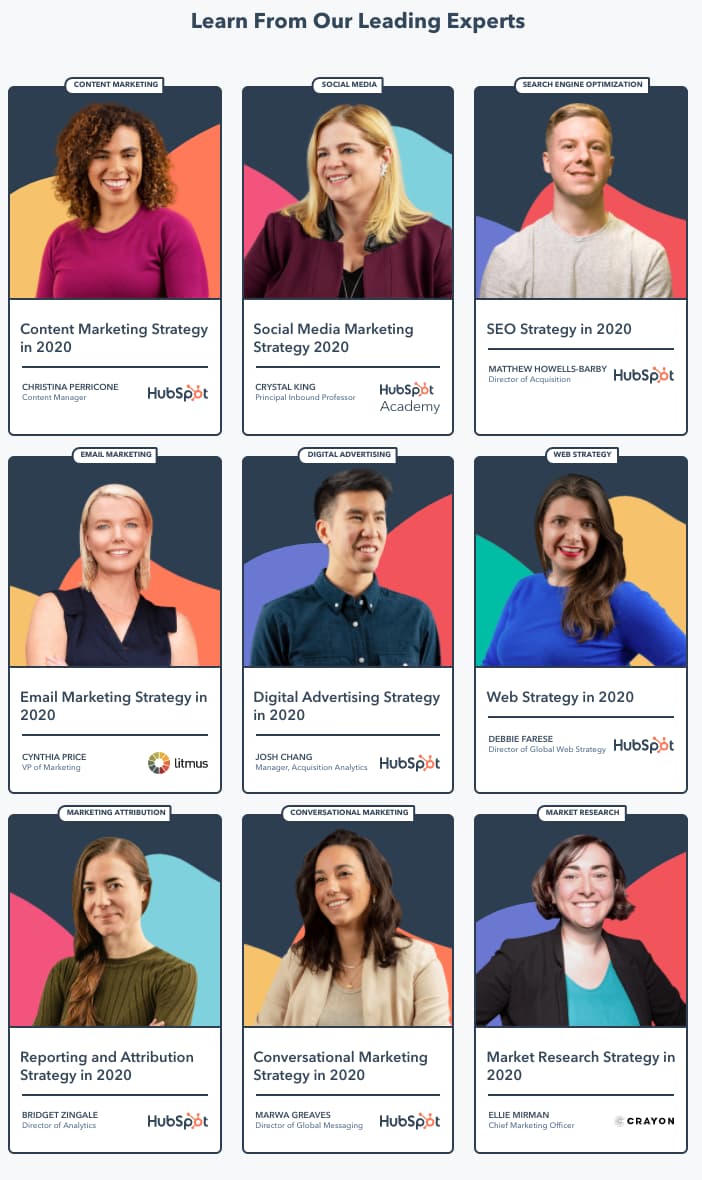
As I keep mentioning, every format listed in this article is tailored to project authority to some extent — the white paper is the purest example of that trend. It’s a technical document that’s meant to demonstrate technical knowledge to a crowd with technical prowess.
Well-crafted marketing collateral can give you a leg up on your competition. Not only is it an excellent vehicle for lead generation, but it can also offer your business an element of authority and trustworthiness to make potential customers more comfortable and inclined to buy from you. If your company isn’t producing it, consider trying out one of the formats listed above.

12 Tried-and-True Ways to Promote Your Blog Posts
The initial phase of starting your blog is one of the most fun and exciting parts of your journey.
After pouring all that time and effort into the ideation process, researching your target market, and narrowing in on your niche — this is the part where your efforts begin to pay off.
However, in order for your blog to be successful from the get-go, there are certain steps you have to take to lay the groundwork. That’s right: There’s research involved in this stage, too.
If you don’t have a good plan of action for the launch of your blog, things can fall apart during execution.
Here, we’ll walk you through a simple but thorough blog promotion checklist.
Read on to learn about all the things you should have in place when you first go live with your blog, plus, what you can do to ensure your blog is successful for the long-run.
Benefits to a Blog Promotion Checklist
You might be thinking, “Haven’t I already done enough planning and research? Let’s get the ball rolling!”
Yes, you have put a lot of hours into the blog already. But without a proper promotion plan, all that hard work will go to waste. Nobody wants to have a grand opening to crickets.
By having a checklist to work with, you gain the following benefits:
- Less procrastination: It’s easy to slip up once all the planning and research is done and go a little ‘easy’ on your execution. Focusing on your efforts at this stage will change that.
- Better content management: As your blog goes live, you’ll still have to write a consistent amount of quality content regularly and keep up with the momentum you set at the start. Having the right plan and tools to organize your tasks can help you stay on track.
- Better organized marketing: A lot of your efforts at the start of your blog going live will center around its promotion. How else will people know it exists? Knowing what the promotion phase will look like can help you better organize a strong blog marketing strategy.
A lot of this is dependent around how you structure your time and activities. It’s a lot like having a standard operating procedure for blog promotion.
Rolling out your blog in a phase-by-phase approach will add the above perks and ensure the entire process of execution won’t seem as overwhelming.
Pre-Promotion Checklist
Before starting a blog promotion campaign, you need to make sure that it’s ready for the world to see.
Remember: not all blogs get the spotlight. The ones that do are there for a reason — they have a strong selling point. No influencer will be interested in promoting a spammy blog.
As such, you have to find out what makes your blog stand out and work towards promoting that.
Let’s see what you should put on your pre-promotion checklist.
1. Figure out whether you need to hire freelancers.
Promoting your blog is no easy feat! It involves a lot of overlapping tasks and resources.
Depending on where you are, that can be anything from doing the campaign yourself to hiring a bunch of freelancers.
In my case, I do a combination of both. I do the important tasks (think: strategy, optimization, etc.) myself, and outsource menial tasks to my VAs.
This option is great if you have other priorities, as promoting your blog by yourself can be quite the hustle. What’s more, it’s typically relatively cheap to hire freelancers. Plus, you can hire several freelancers and manage a remote team to work on your blog while on-the-go.
Another important factor to look into is organization, which involves how you’ll go about promotion. Here, you can follow a phase-by-phase approach to focus on what’s best first, and even create a solid project management plan to manage your blog promotion strategy.
My point is, promoting a blog is no easy feat, but today, there’s several ways to (successfully) promote it without too much time or money. That said, you just need to know your blog well, who you’re targeting, and how.
Which brings me to my next point.
2. Make visuals to complement blog posts.
Media like images and videos make your blog posts more visually appealing and memorable. Consumers remember 65% of visual content versus only 10% of written content, meaning that adding visual media to your blogs can help readers retain information and remember your brand.
Another way to help your blog content resonate with readers is to develop original images for your blog. This applies to blog headers as well as original infographics, graphs, and other types of visual media.
Save countless hours by using these pre-made templates to design your infographics.
Visual content can also help drive traffic to your blog. Image alt text alone can help boost your blog SEO — an experiment we ran at HubSpot that saw a 25% increase in blog traffic. (Image alt text also contributes to your blog’s accessibility, an equally important feature to optimize.)
3. Ensure you have high-quality content.
Before you consider how you’ll promote your blog, make sure you’re creating high-quality blog content. Creating content for the sake of creating content won’t help your business in the long run. Your blog should contain helpful, unique content that relates to your product and brand.
Aside from how-to content and ultimate guides, feature guest writers on your blog, too. Not only will this mix up the type of content you’re publishing, but it will highlight different voices from your network, employee base, and even current customers, which provides valuable insight for readers.
Don’t shy away from trends. While every blog needs evergreen content, content based on trends, seasonality, and recent news can keep your brand relevant and blog interesting.
Remember, even the best promotion plan won’t matter if you’re promoting low-quality blog content.
4. Make your blog searchable.
In addition to creating interesting, helpful content, don’t forget to optimize your blog content for search. Employ on-page and off-page search engine optimization (SEO) tactics to help your content show up on search engine results pages (SERPs).
To write blog posts for SEO, do keyword research to identify high-ranking terms and naturally integrate those terms throughout your content. Link to relevant internal pages as well as influential external sites.
Optimizing your blog for search allows readers to organically discover, read, and share your high-quality blog content. Better yet, it’s more cost-effective than paid promotion.
5. Build real relationships with your readers.
Not all blog promotion needs to happen online and on your blog; building real relationships with readers can be just as beneficial.
First, establish and build a loyal base of readers. (One way to cultivate this base is via email, which we’ll talk about in the next section.) You can count on these readers to provide feedback for and share your blog content, effectively distributing it for you.
Another way to leverage real relationships for blog promotion is to build off-site relationships with other bloggers and businesses. Share other people’s content on social media, in your emails, and through links in your blog content — you never know who will share yours in exchange.
1. Repurpose your content.
Content repurposing requires you to re-imagine your top posts into other forms of content. This can only be done if you have a birds-eye view of what you have published already and what each one offers to your audience.
For example, a blog post can be repurposed by turning it into an infographic, a video for YouTube, a podcast, or even a presentation on Slideshare.
You can also leverage your blog post with CTAs that encourage your readers to become leads. For instance, you might add an online course to it for readers to sign up, or a free e-book.
Repurposing your content can triple your blog traffic, and will also provide a better engagement rate.
2. Build links to your site.
Once you know the ins-and-outs of the content you have, you can start to build organic links.
You must have heard this a lot of times already. If you really want to rank on Google, then you want to invest in link-building.
Building links to your site is one of the best ways to ensure you’re cultivating a good, long-term SEO strategy for your blog.
Of course, there are different ways to build backlinks to your sites. One of them is guest posting, which we’ll discuss more in phase three.
3. Create a UTM link to track marketing campaigns.
What is one technical opportunity you can capitalize on with your content? UTM links.
UTM links add some code to the end of your blog post URL, which makes it easy to monitor and track your marketing campaigns on Google Analytics.
Using Google Analytics alone will only provide you with some simple metrics, such as which websites or search engines your users are coming from. But with a UTM link added to your post URL, you can see a detailed result that makes it easier to track the exact content driving the traffic.
You can also use a custom link management tool or URL shortener to track your links.
Pro tip: If you organize your content ahead of time on the basis of which posts you want to drive for a specific marketing campaign, you can then assign priority UTM links to those.
4. Share your blog on social media.
This is likely not your first time hearing about social media promotion.
Sharing your blog post on social media will always be one of the best ways to promote your content.
Of course, you’ll want to take the time to cultivate a strong social media presence, and ensure you aren’t posting swipe-up links to your content daily. Instead, try creating a diverse social media content calendar with a variety of engaging posts, and have 3-4 a month drive traffic to a new or relevant blog post.
Even if a social media post doesn’t explicitly mention a blog post, you can still aim to increase followers on your social media accounts, and over time, those followers will become naturally curious and take a look at your blog for themselves.
Additionally, try leveraging a social media automation tool that helps you share and manage all your social media accounts from one dashboard.
5. Answer questions on Quora.
Quora is one of the best platforms for engaging with people that might be interested in topics you discuss on your blog. And, as a new blogger, Quora can be a great promotion opportunity.
Create a Quora account and make it a daily obligation to go on Quora and answer questions relating to your niche.
Don’t simply copy-and-paste your blog URL into each Quora answer, though, which can come across as spammy and might even get you blocked on Quora. Instead, try to genuinely help Quora users with useful answers, and simply keep the URL of your blog on your profile for users to find on their own if they’d like.
6. Post on subreddits.
Subreddits on Reddit are another good place for sharing your knowledge with a ready audience looking for more information on a topic.
Just like Quora, Subreddits are topics in which you can join and add to the conversation. This is another way of sharing your post and building your influence.
7. Flip posts to Flipboard.

Flipboard is a social network site that aggregates news from the web and stores it on its cloud for readers.
Flipboard also allows bloggers to flip their blog posts to Flipboard and allow their followers to read the content directly from the platform.
Flipboard could be another opportunity to drive traffic to your blog depending on your content and audience’s preferred channels.
8. Reach out to influencers.
Reaching out to influencers in your niche is one of the most promising opportunities to promote your blog, but comes with a good number of rejections by influencers.
To get an influencer to say yes to your outreach email, you need to build a relationship with the influencer before asking for a favor in return.
As mentioned above, it can be helpful if you link to influencers’ blogs or social media sites in your blog posts, which might help you form a relationship with them that you can nurture for the long-run.
Pro tip: While working on your outreach campaign, make sure to verify emails to increase your email delivery rate.
9. Guest post on popular blogs.
Guest posting is one of the oldest marketing techniques around, and it’s still as effective as ever.
Guest posting requires you to reach out to similar blogs in your niche and then pitch ideas for them to publish to their blog. This is a win-win for the two parties involved — it provides a high-quality, unique piece of content for the blog host, while giving you a backlink to your own website.
However, guest blogging isn’t easy and requires a lot of work. Other than sending outreach emails to the bloggers in your niche, you also need to take the time to craft high-quality guest blog posts.
To do this on a larger scale, you will need to hire freelance writers that can help you write the blog post while you conduct the outreach process.
10. Network on related or similar blogs.
Many bloggers have neglected to leave a comment on other blogs simply because they believe it won’t affect their SEO rankings. And yes — they’re right, it won’t. But the benefits of leaving a comment on another, related blog are still worthwhile.
Leaving a comment on another blog can help you get on the radar of other bloggers in your industry, and begin cultivating relationships within your community.
While admittedly small, this is still a potential avenue for getting your name out there without spending money or sacrificing too much time.
11. Use heat maps.
Creating a website heat map is a great way to review user engagement on a page-by-page level.
Heat maps are a great visual way for you to collect your data into insights that you can use to make your user experience even better. In terms of websites, they show which features users engage with and rank them from a ‘hot’ to ‘cold’ level using appropriate colors.
This can vary from showing elements such as what pages users click on, where they choose to exit, where they scroll, what content they look at, etc.
By using a heatmap, you can better visualize your user’s experience and work toward improving it.
12. Leverage SEO tools to audit and monitor your website performance.
Ultimately, your blog content won’t rise to the top of search engines if you don’t have a healthy website.
You might consider using an SEO tool to conduct an analysis on your website performance and identify areas for improvement to ensure your website is optimized for both users and search engines alike.
Where to Promote Your Blog
Where you promote your blog posts is just as important as how you promote them. In this section, we’ll talk about where you can distribute your content and grow your audience.
Email is a uniquely powerful blog promotion tool. You can use it to cultivate your reader audience as well as connect with industry experts and guest writers.
First, consider starting a blog newsletter to build your list of readers. Include a simple call-to-action (CTA) on your blog for those interested in reading new posts. This is a great way to convert readers into subscribers and, eventually, into paying customers.
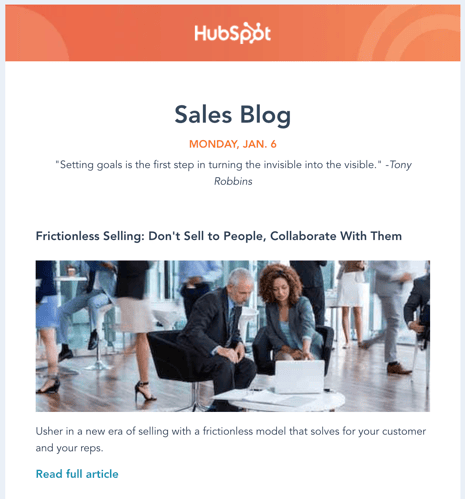
Once you build a substantial list, start to segment your subscribers by topic interest. You can decipher these interests based on what blog links each subscriber clicks on, what content offers they download, or what products they buy.
Another way to leverage email for blog promotion is to reach out to people you mentioned or quoted in your content. Not only does this alert them to their name or brand being mentioned, but it gives them an incentive to share your content with their networks. Email, in this case, is also more personal than Twitter, which we’ll discuss next.
Social Media
Social media is a great way to share blog content in a friendly way as well as engage with readers and customers. Twitter is beneficial for content promotion as many professionals are active on the network and can jump into conversations or mention your blog with a short tweet. As you promote your content on Twitter, tag relevant people (including those you mentioned in your blog or may be interested in your post).
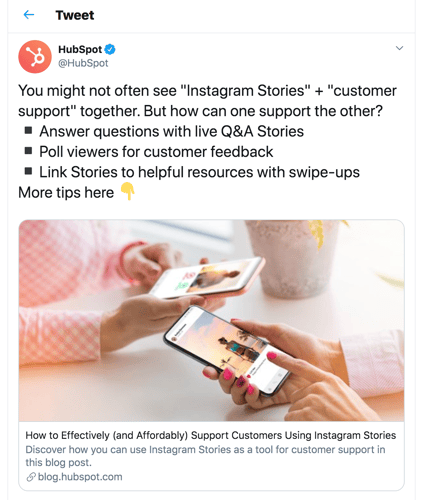
When posting on social media — Twitter included — take note of the timing of your posts. Research when your audience is online and post within those windows. Promote your blog on as many channels as possible, sometimes posting multiple times with the same link. Also, be sure to add context with each link you share, otherwise, your followers may not open and read it.
Website
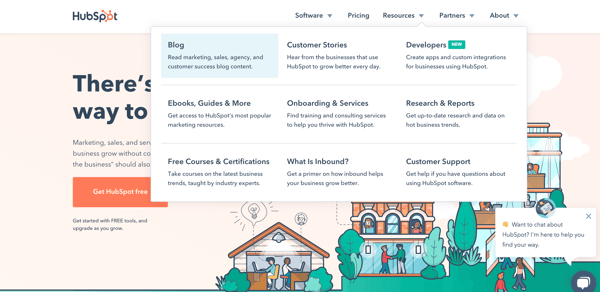
Your website can be a helpful tool for promoting your blog content. First, make sure your blog is a prominent link on your site menu. Throughout your website, encourage readers to check out your blog. Also, include a subscription CTA on your website so that visitors can sign up to receive new posts.
Ultimately, it’s important to remember that blog promotion won’t happen overnight. You’ll want to lay a strong foundation to ensure your blog is successful in the long-run, rather than relying on tactics that only encourage “quick hits” in traffic.
The very best blog content can’t engage readers and convert customers without a solid promotion plan. Put these blog promotion tactics to work to grow your reader base and convert more customers.

How 6 Brands Use Instagram Live in Their Marketing Strategy
83% of Instagram users say they find new products or services by browsing the platform. So, how can you ensure your brand attracts new audiences on Instagram?
One way is with Instagram Live.
The live feature is part of Instagram Stories and allows you to stream video and engage with followers in real-time. When a user goes live, Instagram notifies their followers and highlights their profile picture in the Stories section, making it appear first in line on their followers’ feeds.
Live video can be an effective tool to highlight your business offerings and host engaging events for users to join. In fact, 82% of people prefer live video over social posts from a brand according to a survey hosted by Vimeo Livestream and New York Magazine!
But enough from me — now, I’ll let you take inspiration from those already using Instagram Live to grow their brand.
How 6 Brands Use Instagram Live
1. Global Citizen
Global Citizen is a non-profit organization with a mission to end extreme poverty by 2030. Earlier this year, the brand used Instagram Live to promote their #TogetherAtHome campaign — an effort to encourage social distancing in order to slow the spread of coronavirus.
To attract viewers, Global Citizen partnered with numerous celebrities to host an at-home concert series. Below is their Instagram Live collaboration with H.E.R., a musical artist.
In this livestream, H.E.R. advocated for quarantine, performed a few songs, and responded to live comments to lift spirits during difficult times. Besides the many heart-eye emoji reactions, viewers also shared comments such as, “This song brings me so much peace.” and “Music does heal.” to express their enjoyment.
Our socially-distant world also helped to make the #TogetherAtHome campaign popular because it was able to bring people together virtually.
The takeaway for your business: Research influencers in your industry to collaborate with and host Instagram Live takeovers. By doing so, your business will likely reach new audiences who are more willing to learn about your brand. You can also interact with the viewers in real-time in the comments or have your guest share a message about your business.
Lastly, consider tying Lives to current events to make your livestreams relevant to national or global conversations. These actions will boost your brand awareness.
2. Barry’s Bootcamp
Barry’s Bootcamp is a worldwide fitness studio offering workout classes. The company has been using Instagram Live to their advantage by sharing high energy workout sessions.
The live feature works well here because it can be more engaging for viewers to follow along with a live class rather than watching a pre-recorded session. In Live, they can also see how many other viewers are tuning in and watch their reactions to the class. The instructors also offer motivational words of encouragement to keep the energy going.
For Barry’s Bootcamp, live fitness classes align with their company brand and mission while providing valuable content to fitness enthusiasts. This helps to increase their brand equity and capture future converting customers.
The takeaway for your business: Instagram Live can also be used to host live workshops from your business. Lives make it easy for users to follow along and can serve as something people look forward to in their day.
Think of Instagram Lives as a way to create a virtual community of people coming together to do something. Similarly, a wellness company may host live meditation sessions. Any activity is up for grabs as long as it supports the business vision.
3. Chipotle
Chipotle is a fast food chain serving Mexican food and the company uses Instagram Live to share tasty recipes. In the below example, Chipotle’s executive chef shares how to make margaritas for Cinco de Mayo.

In this Live, Chef Chad takes viewers step-by-step through his margarita-making process and explains his thought process behind each step. This tutorial is one that viewers can trust and learn from since it comes from a top chef at the restaurant, especially if they’re already a fan of Chipotle.
It’s also worth noting how this Instagram Live celebrates Cinco de Mayo, which naturally ties into the restaurant’s Mexican cuisine. Chipotle leveraged this holiday as a great opportunity to provide entertaining and informational content.
The takeaway for your business: Ask yourself: What can we, as a business, teach members of our audience? Depending on the answer to that question, Instagram Live could be a great place to educate your audience while responding to their feedback and questions in real-time.
From the above Chipotle example, you can also better understand how acknowledging well-known events and holidays (e.g. cultural events, sports, and awards seasons) can work in your favor for this type of marketing strategy.
4. Bon Appetit
Speaking of food, Bon Appetit is a magazine all about cooking and recipes. Recently, Bon Appetit used Instagram Live as an opportunity to host a virtual dinner party with various celebrity guests. Each guest pairing was also creatively named after courses of a meal, from appetizer to digestif. Below is a screenshot from dessert:

Throughout the series, the chefs and guests carried out relaxed and casual conversations about anything and everything (you know how it goes at a dinner party). Bon Appetit was able to create a laid-back, yet engaging atmosphere. For those watching, this could’ve been an immersive experience to feel as if they were chatting with their friends over dinner.
The takeaway for your business: Instagram Live doesn’t have to be formal. Let your guard down and show your authenticity. Bon Appetit’s Dinner Party concept is both fun and creative — brainstorm potential themes you may be able to incorporate into your livestreams to achieve the same results.
Moreover, creating a series of Lives will incentivize people to follow your account and stay tuned for new content. Also, take advantage of Instagram’s guest feature to add someone else into your brand’s conversation.
5. Chewy
If you prefer more structured programming, then look to Chewy, an online retailer for all pet essentials, for inspiration. Targeting pet owners, Chewy provides educational content on how to care for a variety of pets. An example of this is their Vet to Vet Live:
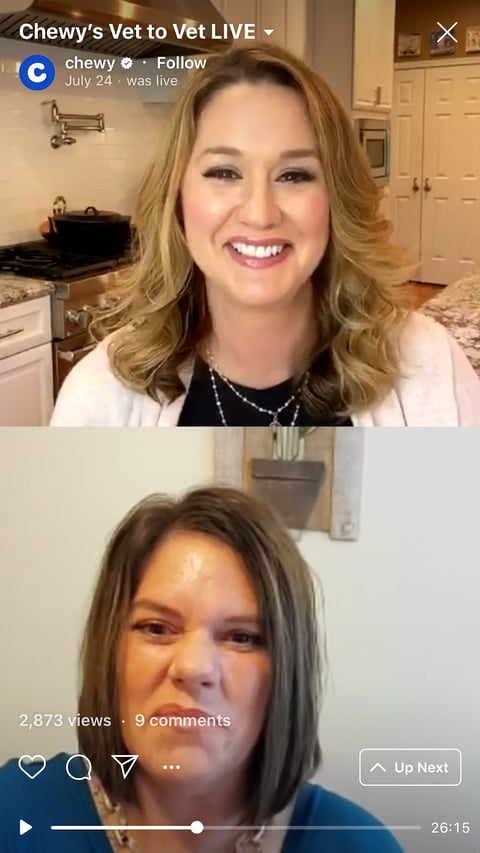
These Q&A sessions provide valuable insight from experts for pet owners. Pet parents can also input their questions in the comment section for instant expert advice. As a brand, these informational videos help Chewy establish itself not only as a place to shop, but also as a resource they can turn to for any pet-related needs.
The takeaway for your business: Using Instagram Live to conduct Q&As and interviews can provide insightful tips and advice for your audience. This educational content will be appreciated by your audience members who are eager to learn and help you increase customer loyalty. Additionally, listening to a conversation between multiple people, and watching that interaction live, can also be more enjoyable than a one-man show.
6. Origins
Origins is a cosmetics company creating products from naturally-derived ingredients. Origins aligns Instagram Live with their brand by showcasing products and hosting conversations about skincare.

As shown in the screenshot, the Origins representative presents one of their products up close to the camera. This is important because products online often only show the packaging of the product, so revealing what the product itself looks like lends potential customers a better understanding of how they might expect the product to look and feel.
The two hosts also share what they like about the products and how they use it in their day-to-day lives. Sharing their stories provokes viewers to consider how they can incorporate the product into their own routines, which ultimately pushes them closer to purchase.
The takeaway for your business: Live is the perfect place for product demos and to show customers what they can expect from your business. This can resolve any hesitations related to making a purchase. It also offers a place for experts and current users to answer any concerns about the product a prospect may have. Assess your current offerings and create a live session to discuss how the customer can use and benefit from your products.
No matter which industry your business is in, all successful Lives have one theme in common — they provide valuable content for viewers that’s entertaining and/or educational.
Now that you know how other companies are marketing with Instagram Live, see the exact steps you need to start your next Live.

9 Guidelines for Exceptional Web Design, Usability, and User Experience
When it comes to designing or redesigning a website, it’s easy to get hung up on the aesthetics.
That shade of blue doesn’t look right…
Wouldn’t it be cool to have the logo on the right side of the screen?
How about we put a giant animated GIF in the middle of the page?
However, if you’re truly trying to accomplish something with your online business (e.g., brand awareness, lead generation, etc.), you’ll need to focus on more than just how your website looks.
In a world where folks have more than a billion websites they can potentially land on, you need to make sure yours is designed for usability, how easy your website is to use, and user experience (UX), how enjoyable it is to interact with your website.
Now, you could spend years studying the ins and outs of usability and UX. But for the sake of giving you a jumping-off point, we’ve assembled a list of the fundamental guidelines you can apply to your next website redesign or website launch. Then, we’ll review 10 features you’ll need on your site to put these recommendations into practice. Let’s dive in.
1. Simplicity
While the appearance of your website is certainly important, most people aren’t coming to your site to evaluate how slick the design is. They want to complete some action, or to find some specific piece of information.
Therefore, unnecessary design elements (i.e., those which serve no functional purpose) will only overwhelm and make it more difficult for visitors to accomplish what they’re trying to accomplish.
From a usability and UX perspective, simplicity is your best friend. If you have all the necessary page elements, it’s hard to get too simple. You can employ this principle in a variety of different forms, such as:
- Colors: Basically, don’t use a lot. The Handbook of Computer-Human Interaction recommends using a maximum of five (plus or minus two) different colors in your design.
- Typefaces: The typefaces you choose should be highly legible, so nothing too artsy and very minimal script fonts, if any. For text color, again, keep it minimal and always make sure it contrasts with the background color. A common recommendation is to use a maximum of three different typefaces in a maximum of three different sizes.
- Graphics: Only use graphics if they help a user complete a task or perform a specific function (don’t just add graphics willy-nilly).
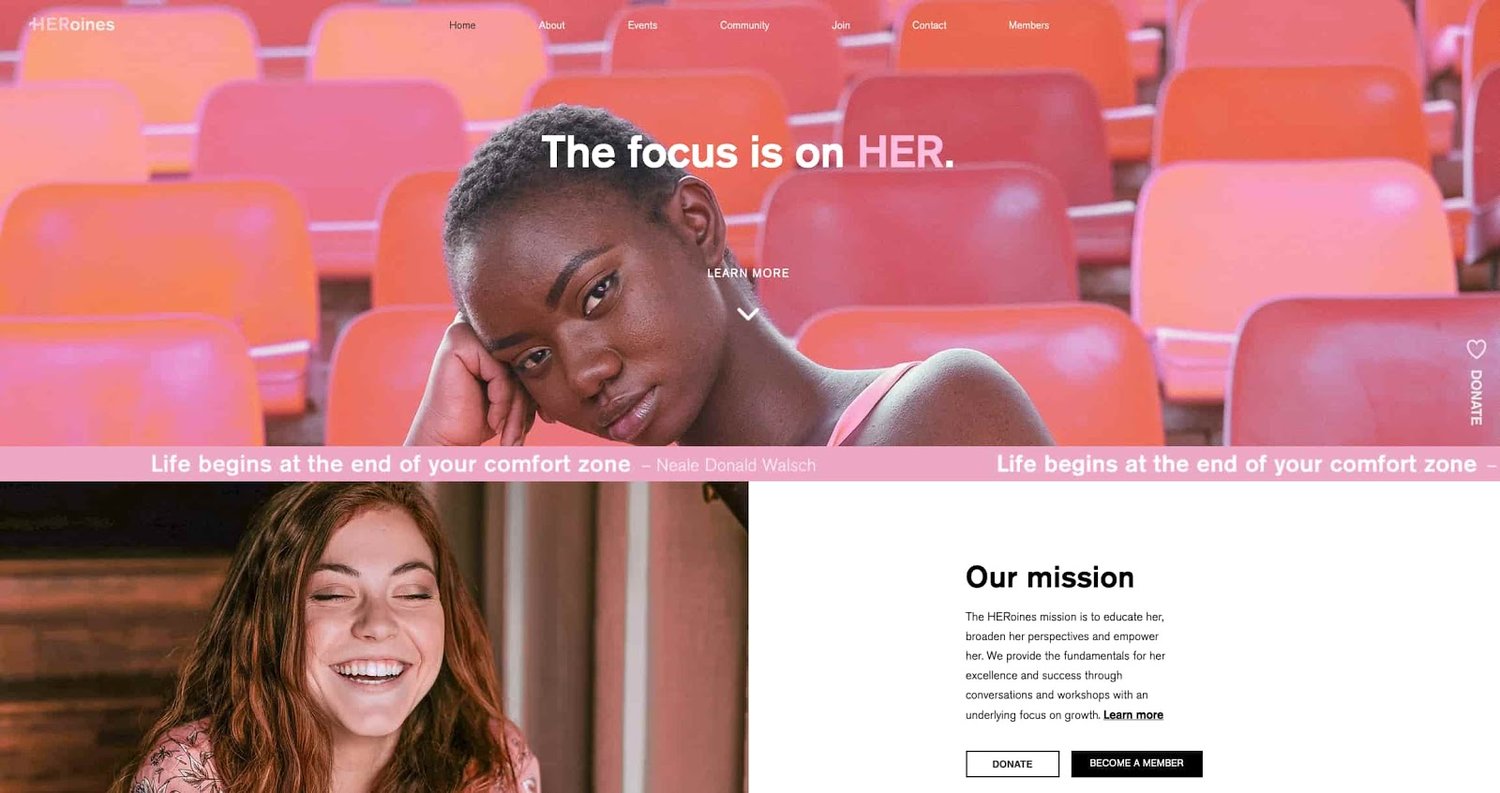
Here’s a great example of a simple but effective homepage design from HERoines Inc:
2. Visual Hierarchy
Closely tied to the principle of simplicity, visual hierarchy means arranging and organizing website elements so that visitors naturally gravitate toward the most important elements first.
Remember, when it comes to optimizing for usability and UX, the goal is to lead visitors to complete a desired action, but in a way that feels natural and enjoyable. By adjusting the position, color, or size of certain elements, you can structure your site in such a way that viewers will be drawn to those elements first.
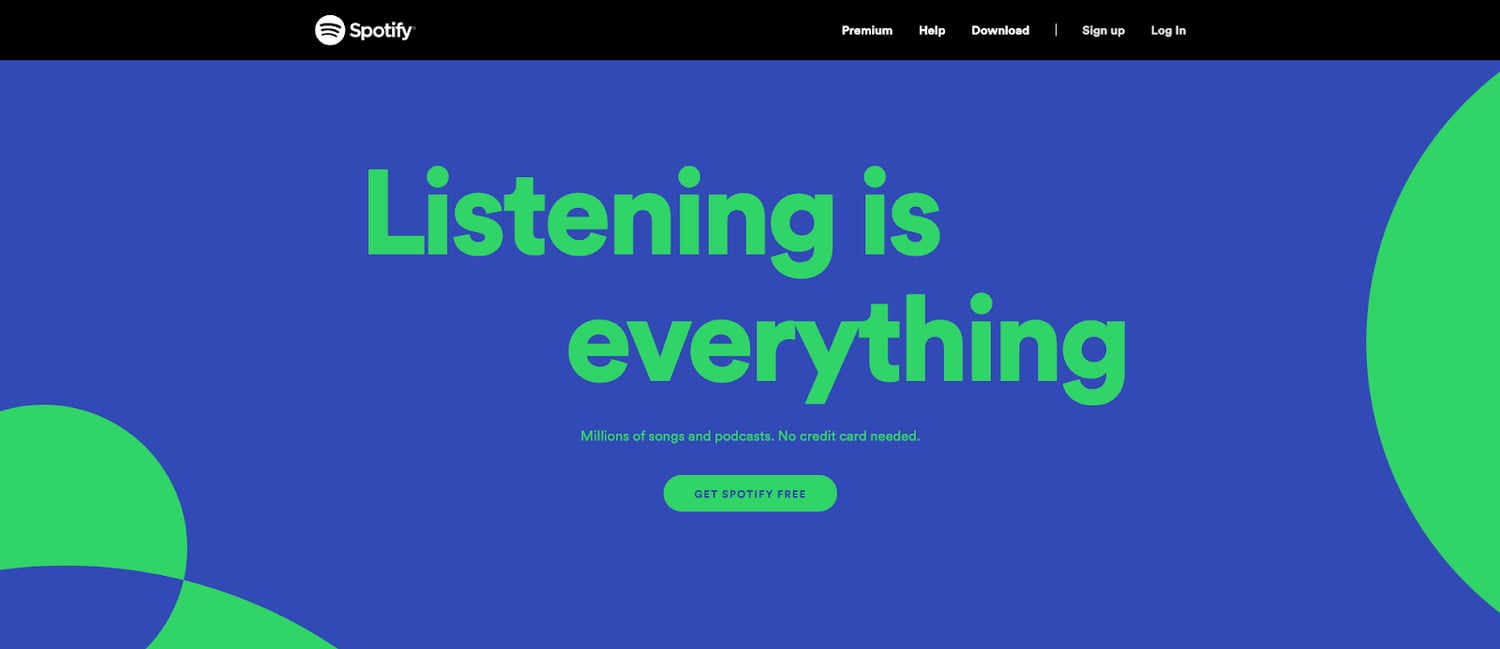
In the example below from Spotify, you can see that the main header “Listening is everything” sits atop the visual hierarchy with its size and page position. It draws your eye to their mission before anything else. This is followed by the “Get Spotify Free” CTA, which prompts action. Users can click this CTA, or scan the menu items above for more actions.
3. Navigability
Planning out intuitive navigation on your site is crucial to help visitors find what they’re looking for. Ideally, a visitor should land on your site and not have to think extensively about where to click next. Moving from point A to point B should be as frictionless as possible.
Here are a few tips for optimizing your site’s navigation:
- Keep the structure of your primary navigation simple (and near the top of your page).
- Include navigation in the footer of your site.
- Consider using breadcrumbs on every page (except your homepage) so users remember their navigation trail.
- Include a search bar near the top of your site so visitors can search by keywords.
- Don’t offer too many navigation options per page. Again, simplicity!
- Include links within your page copy, and make it clear where those links go.
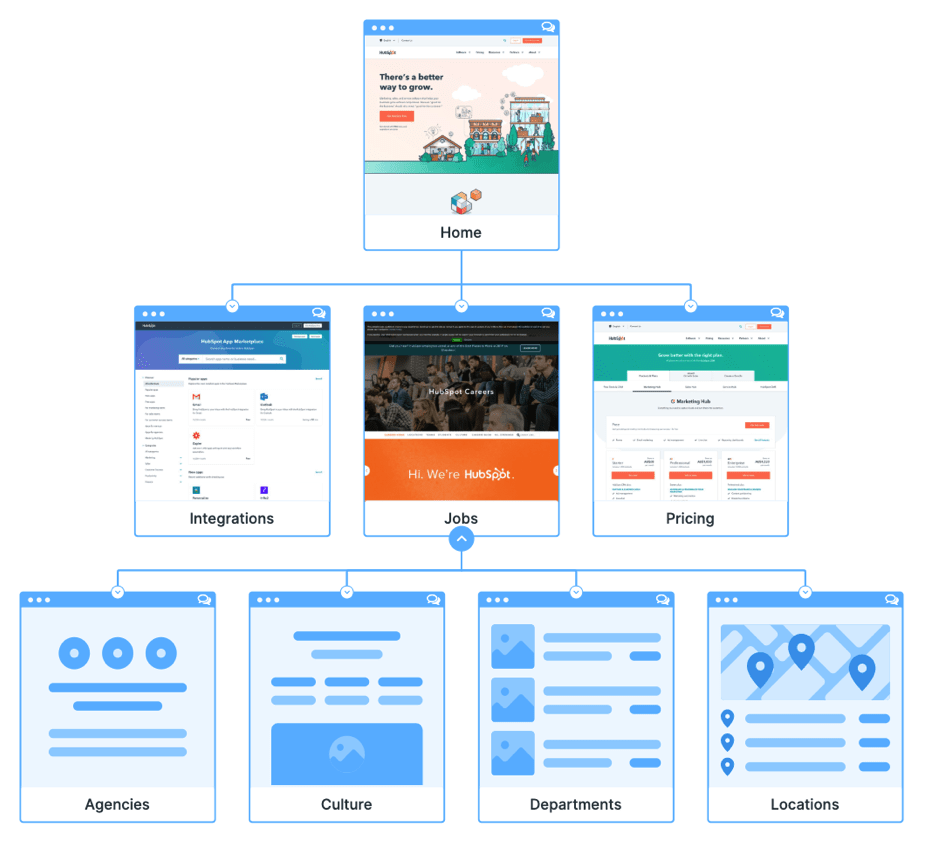
- Don’t make users dig too deep. Try making a basic wireframe map of all your site pages arranged like a pyramid: Your homepage is at the top, and each linked page from the previous forms the next layer. In most cases, it’s best to keep your map no more than three levels deep. Take HubSpot’s site map, for example.
One more pointer: Once you’ve settled on what your site’s main (top) navigation will be, keep it consistent. The labels and location of your navigation should remain the same on every page.
This leads us nicely into our next principle…
4. Consistency
In addition to keeping your navigation consistent, the overall look and feel of your site should be similar across all of your site’s pages. Backgrounds, color schemes, typefaces, and even the tone of your writing are all areas where consistency has a positive impact on usability and UX.
That’s not to say every page should follow the same layout. Instead, create different layouts for specific types of pages (e.g., landing pages, informational pages, etc.). By using those layouts consistently, you’ll make it easier for visitors to understand what type of information they’re likely to find on a given page.
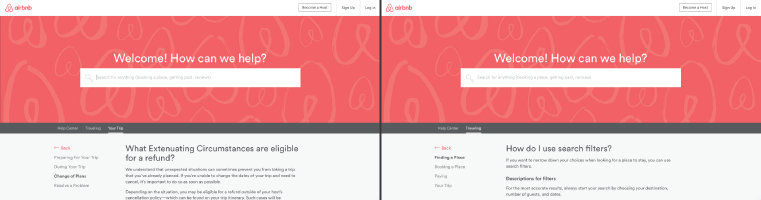
In the example below, you can see that Airbnb uses the same layout for all of its “Help” pages, a common practice. Imagine what it would be like from a visitor’s perspective if every “Help” page had its own, unique layout. There would probably be a lot of shoulder shrugging.
5. Responsivity
According to Statista, 48% of page global views were from mobile devices like smartphones and tablets. And according to our research, 93% of people have left a website because it didn’t display properly on their device.
The takeaway here: To provide a truly great user experience, your site has to be compatible with the many different devices that your visitors are using. In the tech world, this is known as responsive design.
Responsive design means investing in a highly flexible website structure. On a responsive site, content is automatically resized and reshuffled to fit the dimensions of whichever device a visitor happens to be using. This can be accomplished with mobile-friendly HTML templates, or by creating a special mobile site.
Ultimately, it’s more important to provide a great experience across different devices than look identical across those devices.
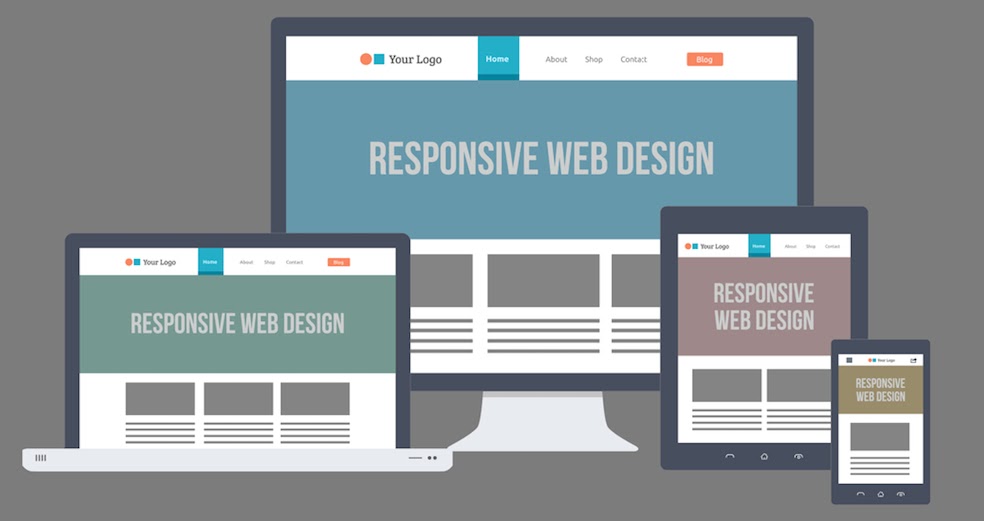
Alongside mobile-friendliness, it’s worth your while to test your website’s cross-cross browser compatibility. In all likelihood, you’ve only viewed your site on one web browser, be it Google Chrome, Safari, Firefox, or something else.
Now is the time to open your pages on each of these browsers and evaluate how your elements appear. Ideally, there won’t be much difference in presentation, but you can’t know for sure until you see for yourself.
6. Accessibility
The goal of web accessibility is to make a website that anyone can use, including people with disabilities or limitations that affect their browsing experience. As a website designer, it’s your job to think of these users in your UX plan.
Like responsiveness, accessibility applies to your entire site: structure, page format, visuals, and both written and visual content. The Web Content Accessibility Guidelines (WCAG), developed by the Web Accessibility Initiative and the World Wide Web Consortium, set the guidelines for web accessibility. In a broad sense, these guidelines state that websites must be:
- Perceivable: Visitors are aware of the content on your site.
- Operable: The functionality of your website should be possible in different ways.
- Understandable: All content and alerts can be easily understood.
- Robust: Your website is usable across different assistive technologies, devices, and browsers.
For a deeper dive into this topic, see our Ultimate Guide to Web Accessibility.
7. Conventionality
A big challenge in web design is balancing originality with your expectations. Most of us are expert internet users, and there are specific conventions we’ve grown accustomed to over time. Such conventions include:
- Placing the main navigation at the top (or left side) of a page.
- Placing a logo at the top left (or center) of a page.
- Making the logo clickable, so it always brings a visitor back to the homepage.
- Having links and buttons that change color/appearance when you hover over them.
- Using a shopping cart icon on an ecommerce site. The icon also has a number badge signifying the number of items in the cart.
- Ensuring image sliders have buttons users can click to manually rotate slides.
While some might opt to throw these out the window for the sake of uniqueness, this is a mistake. There’s still plenty of room for creativity within the constraints of web conventionality.
Let’s briefly consider another field of design, architecture. Building codes are put in place so that folks can easily and safely use indoor spaces. An architect doesn’t complain about these codes or violate these designs because, aside from being against the law, they assure safety and comfort. It doesn’t matter how dazzling the building appears — if you trip on uneven stairs, or you can’t get out in a fire, you’re going to hate that building.
In the same way, you can craft a memorable experience while meeting user expectations. If you violate what users anticipate, they may feel uncomfortable or even frustrated with your site.
8. Credibility
Sticking to web conventions lends your site credibility. In other words, it increases the level of trust your site conveys. And if you’re striving to build a site that provides the best user experience possible, credibility goes a long way.
One of the best methods to improve your credibility is to be clear and honest about the product or service you’re selling. Don’t make visitors dig through dozens of pages to find what it is you do. Be up-front on your homepage, and dedicate some real estate to explaining the value behind what you do.
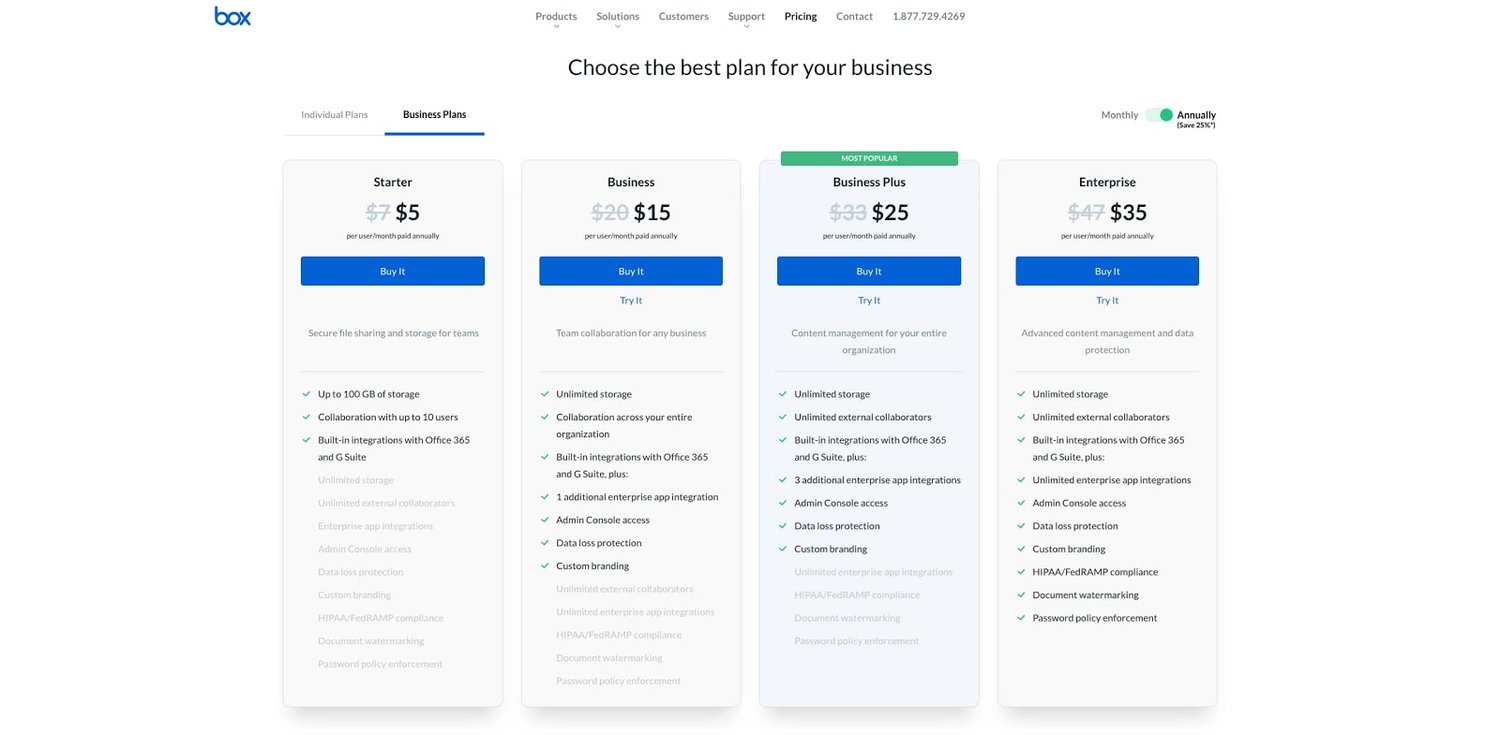
Another credibility tip: Have a pricing page, also linked on the homepage. Rather than force people to contact you to learn more about pricing, list your prices clearly on your site. This makes your business appear more trustworthy and legitimate.
Here’s an example of an effective pricing page from the Box website:
9. User-Centricity
At the end of the day, usability and user experience hinge on the preferences of the end-users. After all, if you’re not designing for them, who are you designing for?
So, while the principles detailed in this list are a great starting point, the final key to improving the design of your site is to conduct user testing, gather feedback, and implement changes based on what you’ve learned.
And don’t bother testing usability by yourself. You’ve already invested a lot of time into your design, which brings your own biases into the equation. Get testers who have never seen your site before, the same as any first-time visitor.
Here are a few user testing tools to get you started:
- Website Grader: Our free tool evaluates your website based on several factors: mobile, design, performance, SEO, and security. It then offers tailored suggestions for improvement. You can learn more about Website Grader in our dedicated blog post.
- Crazy Egg: Track multiple domains under one account and uncover insights about your site’s performance using four different intelligence tools — heat map, scroll map, overlay, and confetti.
- Loop11: Use this tool to easily create usability tests — even if you don’t have any HTML experience.
- The User Is Drunk: Pay Richard Littauer to get drunk and review your site. Don’t believe me? We tried it.
For even more helpful options, see our list of the best user testing tools.
Hopefully, these guidelines are useful in informing the structure of your web pages and website as a whole. But, how does one put these guidelines into practice? In the next section, I’ll run down the essential page elements that you should strongly consider including in your design plan.
1. Header and Footer
The header and footer are a staple of just about every modern website. Try to include them on most of your pages, from your homepage, to your blog posts, and even your “No results found” page.
Your header should contain your branding in the form of a logo and organization name, menu navigation, and maybe a CTA, and/or a search bar if well-spaced and minimal. On the other end, your footer is where many users will instinctively scroll for essential information. In your footer, place contact information, a signup form, links to your common pages, legal and privacy policies, links to translated versions of your site, and social media links.
2. Menu Navigation
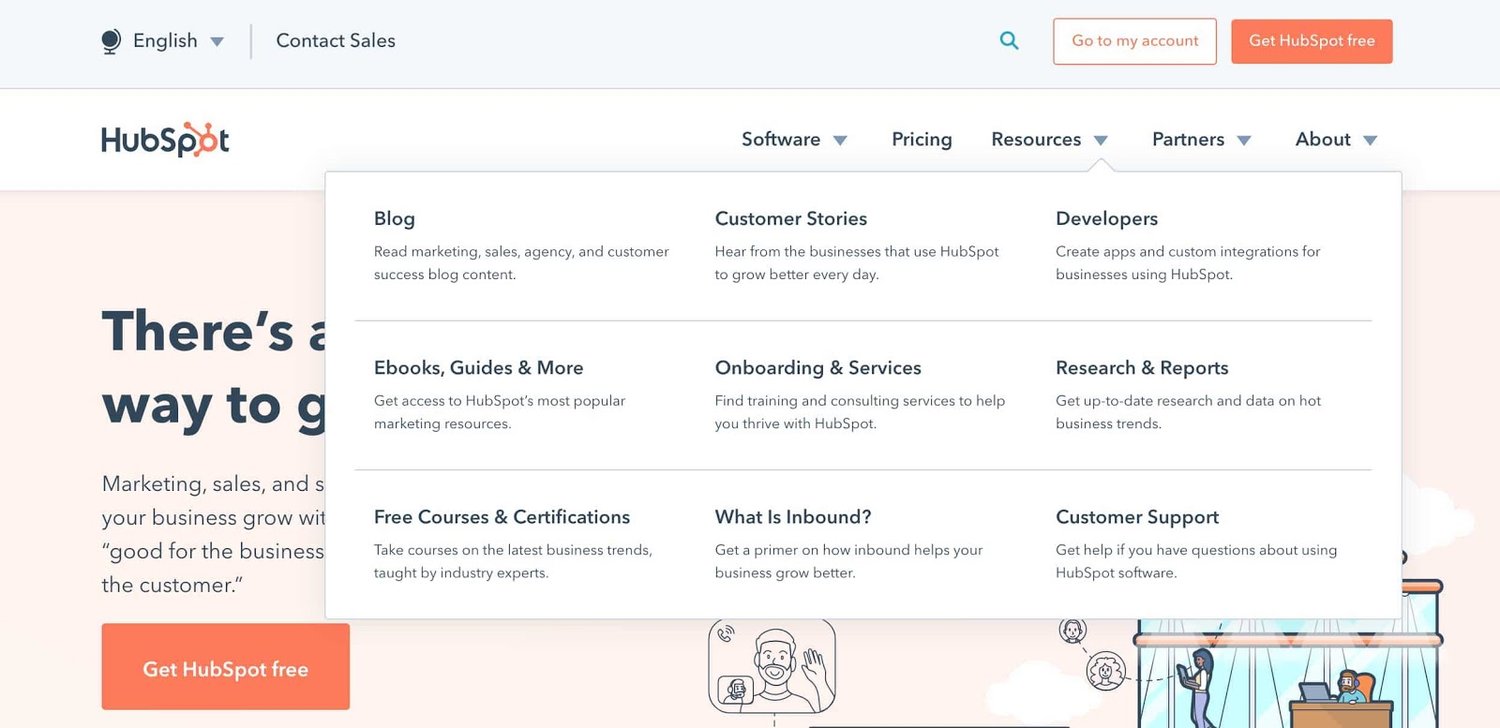
Whether it’s a list of links across the header or a tidy and compact hamburger button in the corner, every website needs a guide for navigation positioned at the top of at least your homepage and other important pages. A good menu limits the number of clicks to reach any part of your website to just a few.
To reduce clutter, you might consider making some or all menu options a dropdown menu with links within it, as can be seen on HubSpot’s homepage.
3. Search Bar
In addition to menu navigation, strongly consider placing a search bar at the top of your pages, so users can browse your site for content by keyword. If incorporating this functionality, make sure your results are relevant, forgiving of typos, and capable of approximate keyword matching. Most of us use a high-quality search engine every day, be it Google, Amazon, YouTube, or elsewhere. These all set the standard for your own site search.
4. Branding
Remember the conventions we’ve discussed? One that you see practically everywhere is a logo in the top left corner. On first landing, many visitors’ eyes will instinctively shift to this region to check they’re in the right place. Don’t leave them hanging.
To reinforce this notion, incorporate your company branding into every element you add, piece of content you post, and color scheme you create. That’s why we recommend establishing brand guidelines if you haven’t already — check out our style guide for a reference.
5. Color Palette
Color choice plays a major role in your site’s usability and UX as well. This decision tends to be more subjective than other requirements in this list. But, like everything else we’ve discussed, try to simplify — limit your color selection to 3-4 prominent colors at most.
Starting a color palette from scratch can be surprisingly difficult the first time. We seem to intuitively pick up on which colors work well together and which don’t, but we stumble when trying to pick from the infinite combinations available.
The solution? Try a color palette that’s been shown to work on other websites. Take influence from your favorite sites, and see our list of our favorite website color schemes to get started.
6. Headers
Headers are key to establishing the visual hierarchy we discussed earlier, especially on text-heavy pages. As users skim your pages what you need, a clear and to-the-point header alerts readers to stop scrolling after finding what they want. Use only as many headers as there are distinct sections of your page, as too much blown-up and bolded text will dampen this effect.
7. Clear Labels
Whenever a user takes an action on your website, it must be obvious exactly what they’re doing and/or where they’re going. All buttons should have clear text or an icon to precisely and concisely signal their purpose. The same goes for in-text links and widgets (simple interactive elements, like dropdowns and text forms).
For example, a button linking to a pricing page should just read “Pricing” — anything beyond that (e.g., “See our prices”, “Check out the pricing page for a deal”) is superfluous. A search bar/button only needs a search glass icon (🔍), and perhaps also the word “Search”, to denote its purpose.
User testing can be a major help here. While you yourself know what all of your interactive page elements do, the same can’t be said for a new user. Testing will give valuable insight into what users think your labels mean beyond your own perspective.
8. Visuals and Media
When incorporating static images, gifs, videos, and other media into your pages, remember to be consistent and intentional in your choices. These elements will draw attention over most other text and will likely stay in users’ minds, so choose wisely.
Here’s just one example of effective media on a homepage. Notice how every image complements the page aesthetic and supports the offer of personalized fitness training with results.

Also, all images and videos should be optimized for search engines and include descriptive alt text for accessibility.
9. Calls to Action (CTAs)
Having a pleasing website is great, but how do you know whether your visitors are actually doing what you want? Are they engaging with your content? This is where CTAs come into play.
A CTA is any page element that prompts user action. The action could be adding a product to a card, downloading a content offer, or signing up for an email list. Make your CTA elements prominent in the visual hierarchy (remember our Spotify example), but not intrusive or distracting like many click-through ads tend to be.
If you need ideas for sleek CTAs that drive more conversions, see our CTA examples list.
10. Whitespace
That’s right, sometimes it’s about the elements you don’t include. After reading these guidelines and requirements, you may feel tempted to stuff your pages with all the bits and bobs needed for a flawless UX. Don’t forget that your viewers need room to digest all this new info, so give your elements room to breathe.
But, how much whitespace should you have? That’s another personal call, and varies from site to site. So, user testing is handy here as well. What are people focusing on? Do they feel overwhelmed with the density of content? Once again, it all ties back to our first guideline, simplicity.
Design that Puts Users First
Indeed, web design is largely subjective — your website’s look and experience isn’t going to please everyone. However, there are also tried-and-true UX principles that, when carefully considered and incorporated, help visitors feel more at home.
According to Amazon Web Services, 88% of website visitors are less likely to return to a website after a poor experience. And how could you blame them? We’ve surely all been there.
So, as a final bit of usability/UX wisdom, start caring more! Imagine yourself into the shoes (or, more accurately, browser windows) of your visitors, and keep them in mind every step of the design process.

How to Launch a Virtual Conference for Lead Generation and Customer Acquisition: A Step-by-Step Guide
When we say “virtual conference,” we don’t just mean webinars. We mean interactive, live panels, and microsites dedicated to the single purpose of promoting one event with various sessions a person can “attend.”
Virtual conferences have become a popular medium to develop and reach large audiences. From marketing to recruiting and sales to education, businesses in various industries have realized hosting online events are far cheaper than an in-person event — thus making it cheaper to build awareness around a brand.
We’re going to get into a lot, but by the end of this post, you’ll see the value in hosting a virtual conference and know how to organize and host your own event. You’ll have another medium to accelerate brand awareness, generate more leads, and develop authority as an industry leader.
In 2017, I helped launch Inbound Sales Day here at HubSpot, and I’m here to teach you how it’s done. Continue reading to download my project management templates and emails I used to book speakers — all available for free.
Table of Contents
1) What is a virtual conference?
2) Why should you host a virtual conference?
3) A Virtual Conference by HubSpot
4) How to plan a virtual conference
Set the vision
Speaker outreach
Creation of assets
Promotion
Go live
Analysis
5) Virtual Conference Takeaways and Tips
What is a virtual conference?
Imagine a conference. There are dozens of rooms, booths with vendors trying to sell you their product, and a lot of people walking around. You might run into some very influential leaders in your industry, and you expect to see people on stage sometime during the event. You’re excited to hear them share lessons and tips they’ve learned from their own experience and journey to success.
Now, imagine a similar experience — but without having to leave your desk.
You log into an “event” online, where you can meet and interact with people through messaging platforms. You go into “rooms” (aka web pages) where you can watch speakers present their knowledge in the form of a recorded video.
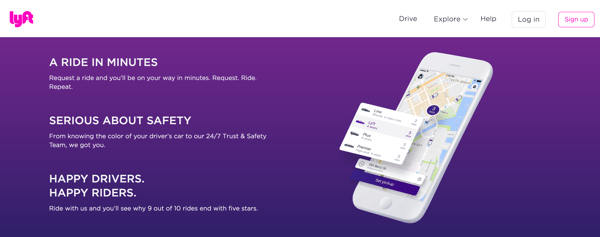
It’s a simple concept: Get the content you would receive at a conference on your own time, when it’s convenient for you. It aligns perfectly with the culture and popularity of on-demand services, such as:
Lyft, with on-demand car rides
Drizly, with on-demand alcohol
Soothe, with on-demand massages
Virtual conferences, with on-demand quality content and insights about the industry.
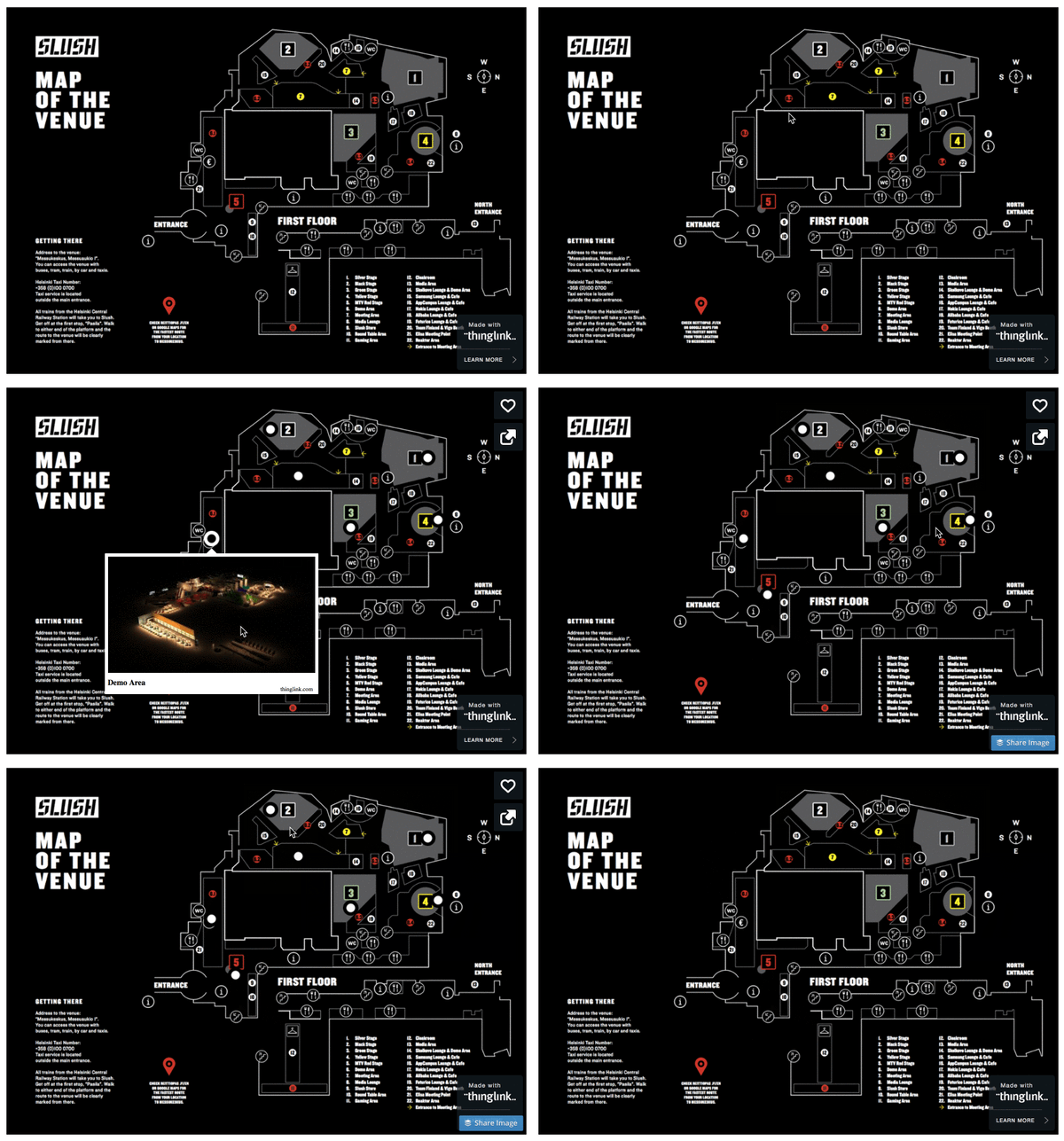
Virtual events began in 1993, presented by Alan Saperstein and Randy Selman. They started by videotaping trade show exhibitors booths and attaching the video to HTML floor maps. These events have become more popular among marketers for their lower cost and effort to produce.
Here’s an example of an HTML floor map:
Examples of virtual events include:
- Inbound Sales Day, hosted by HubSpot
- Digital Agency Day, hosted by HubSpot and Unbounce
- Sales Acceleration Summit, hosted by InsideSales
- Digital Sales Engine, hosted by Sales For Life
You might be thinking, “There’s no way these events were produced by a small team.”
That’s fair. But I can tell you that I coordinated and launched Inbound Sales Day, a full-day virtual event with over 10 hours of video that garnered over 15,000 registrations globally. And I did most of it by myself in only three months. For a comparison, the team that organizes HubSpot’s live INBOUND event has over 10 people involved in planning the event for the entire preceding year.
It’s possible to host and launch one of these things, even with a small team, but why should you host a virtual conference in the first place? Why not just host a physical event instead?
There are numerous benefits to hosting online events. Let’s dive in.
Why should you host a virtual conference?
Consider some of the reasons you’d host a conference, either virtual or in-person:
- To grow awareness for your business. Depending on your market, there may already be competitors or other companies targeting the same target audience as you. You can use an an online conference as a means of partnering with those other companies.
- To generate leads.
- To acquire new customers.
- To create a revenue stream from sponsorships. People host these conferences strictly as a revenue stream. (Curious how? Sam Parr explains how he made a profit from hosting Hustle Con.)
- To build relationships with influencers.
Below are expenses to consider for a physical event (based on a 400-person hosted by Hustle Con):
- Venue ($5,000)
- Vendors, i.e., caterer, bartender, decorator, photographer, videographer, etc. ($10,000)
- Equipment rental ($2,000)
- Licenses and permits (dependent on venue)
- Transportation and parking for attendees and speakers (dependent on venue)
- Service fees and gratuities ($1,000)
- Speakers’ fees ($0 – $10,000+ per speaker)
- Signage ($500)
- Registration materials ($300)
- Security and staff ($2000)
Even for a smaller event, that totals at least $20,000. Soon, you’re underwater and either hiring contractors or using half your team’s day to get all the little details right. To top it off, there always seem to be attendees or speakers who are an absolute nightmare to deal with.
I’m getting stressed just thinking about it.
For an online conference, a few weeks of work and a small budget are all that’s needed. In fact, all of the software I used to organize everything was free:
- Trello for project management (check out my free template below)
- Google Sheets to manage the assets (you’ll get a template of this, too)
- YouTube to host videos
- Dropbox to host files
- Canva to create images
Plus, when you create assets for your event online, you continue reaping the benefits of long-tail keyword SEO and organic traffic from evergreen content for months to come.
Depending on your resources, you may want to hire freelancers to help you with asset creation or to run Facebook ads to get more awareness about your event.
In many cases, you end up cutting expenses dramatically by hosting an online event instead of an in-person conference. Let’s dive into how we decided HubSpot should host an online conference about inbound sales.
A Virtual Conference by HubSpot
HubSpot revolutionized marketing in 2006 by introducing the concept of inbound marketing and telling the story of how marketing had changed. Since then, sales has also changed, and we’ve introduced the concept of inbound selling.
However, similar to when inbound marketing was a new concept in 2006, people needed to be educated about the concept of inbound selling.
We had various goals that overlapped with each other when thinking about hosting a virtual event:
- Spread the message of inbound selling
- Generate leads for our sales products
- Develop authority in the sales industry
- Promote the first sales-focused track at our INBOUND event
What better way to educate our audience and develop credibility around inbound selling than by hosting real experts to talk about it? Influencers already have an audience who will listen to them. They have their own methodologies and many of those ideas aligned perfectly with inbound selling.
By hosting a virtual conference, we were able to scale influencer marketing and associated the credibility of those influencers with the HubSpot brand.
Plus, with the changing landscape of content and more consumers preferring video content, this was an opportunity to develop high-quality video content we could continue to use.
Still interested in hosting your own online conference? I’m going to lay out all the steps I took to organize Inbound Sales Day that you can replicate for your own event. I’ll also give you the project management and email templates I created that kept me organized throughout the whole process.
How to Plan and Execute A Virtual Conference
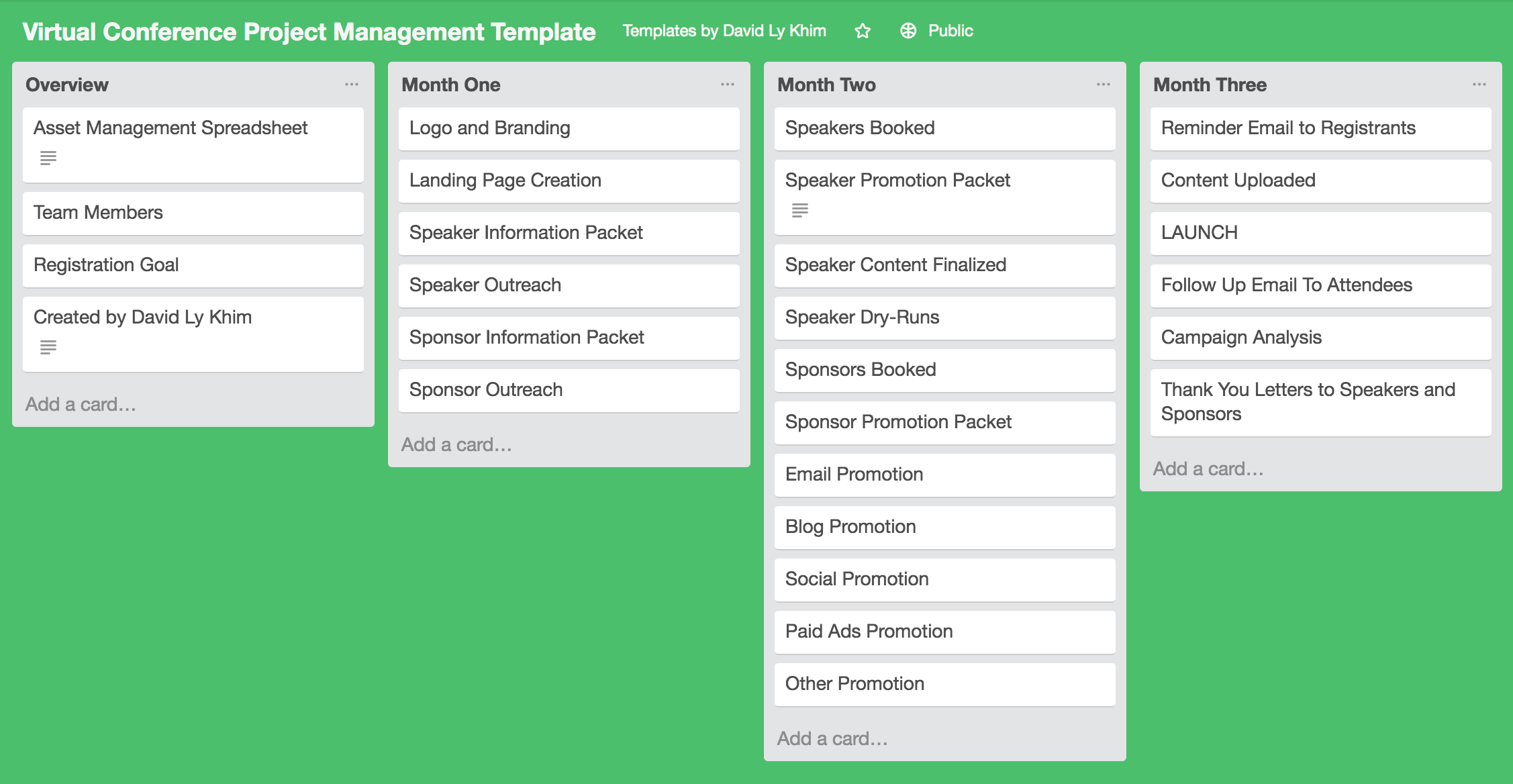
Before we jump into the planning, decide how you’re going to manage the project. I used a combination of Trello and spreadsheets to manage my work.
I laid out all activities in my project management Trello board, which gave me a bird’s-eye view of the timeline, what needed to be done at the moment, and what was coming up. This allowed me to catch situations where I would need to delegate work or ask for help ahead of time.
All assets that were created (landing pages, emails sent, social posts, videos, etc.) were listed in an asset management spreadsheet. This way, I had access to every asset in one place without having to search for it.
The campaign was executed in six phases, which I’ll walk you through below:
- Set the vision
- Conduct speaker outreach
- Create assets
- Promote
- Launch
- Analyze
Phase 1: Set the vision
What do you want the event to look like? What topics do you want to cover? Who’s your audience? How many registrations do you expect?
All of this will be important for your speaker outreach as those will be your selling points. If you can pinpoint your target audience (try the MakeMyPersona tool to help with that), you can find speakers who also want to reach that audience. If you have a set number of expected registrations, you can attract speakers with an idea of what their reach will be if they participate.
Phase 2: Conduct speaker outreach
The most important step to producing a viable virtual conference is to get speakers in your industry. This will benefit you in two ways:
- You can build relationships with these industry experts.
- You can associate your brand with these experts, making yours more credible.
I highly recommend getting experts within your company to speak on the subject matter and promote the event by giving a talk or interviewing another expert so that your employees will come to be seen as trusted industry thought leaders.
My goal was to get on a video call with the potential speakers I emailed. A video call allows you to sell them on the idea and show them how excited you are.
Here’s the email template I used:
Hi [NAME]!
[YOUR COMPANY] is launching [NAME OF VIRTUAL CONFERENCE], a virtual event for [#] [TYPE OF PEOPLE YOU’RE TARGETING] on [DATE] and we would love to have you as a featured speaker.
We’re inviting top experts in [INDUSTRY] to help [PROFESSIONALS] become more successful by providing actionable information about [BROAD OVERVIEW OF TOPICS].
I watched your talk on [TOPIC] and think you’d be a great fit for our audience.
If you’re interested in speaking, we have many speaking options available that can be flexible with your schedule. I’d love to discuss them with you on a quick call.
Let me know if you’re interested and we can schedule time this week or next to talk through the details.
For your convenience, here’s a link to my calendar so we can schedule time right away: [MEETINGS LINK]
Best,
[YOUR NAME]
Pro tip: If you’re a HubSpot customer, I recommend using the HubSpot Sales Meetings and Templates tools to make scheduling meetings really, really easy.
Once I got the meeting scheduled, I made sure to hit the following points for each conversation:
- Explain the event and why you’re doing it.
- Emphasize what the speaker would get out of participating. (We emphasized that we were aiming to reach over 10,000 salespeople and they would get their own landing page with links to their website and social profiles.)
- Tell them about other speakers you’ve booked to develop credibility around your event and that it’s something worth being a part of.
- If they’re interested, explain what we need from them right then and there: I asked for a rough title and outline of their talk, and the format they preferred (live Q&A, recorded interview, or recorded lecture-style video).
After the call, I immediately sent a follow-up email which:
- Recapped the call included topic and format of their talk
- Attached a speaker agreement form
- Asked for their availability to schedule introduction to interviewer, recordings, and dry-runs
- Listed specific deadlines of when everything is due
Here’s a template I used:
Hi [NAME]!
I’m glad we got to connect today. We’re very excited that you’re going to join us for [CONFERENCE NAME]. Here’s a recap of what we discussed earlier — feel free to revise any of it.
- Working session title: [SESSION TITLE]
- Working session description: [DESCRIPTION]
- Format: [FORMAT]
- What I need from you by [DATE]:
- Bio (max 200 words)
- Preferred headshot
- A page you want us to link to
- A rough outline of your presentation
Again, it was great connecting today! Please let me know if you have any questions.
Hope you have a great week!
Best,
[YOUR NAME]
A week later, I followed up again for all those items. Speakers are really busy, and it’ll take a few emails and calls to get those details from them. This is why I suggest you begin the process at least two months before your launch date.
Some speakers will ask for a packet with more details. You can use this template to create your own speaker packets.
Phase 3: Create assets
On my Trello board, I laid out a timeline of when all assets were created and used a spreadsheet to keep track of them as they were created.
Landing Pages
Your landing page is going to be a selling point for your event to get speakers and attendees. Don’t expect to attract many of either if your page doesn’t look sharp.
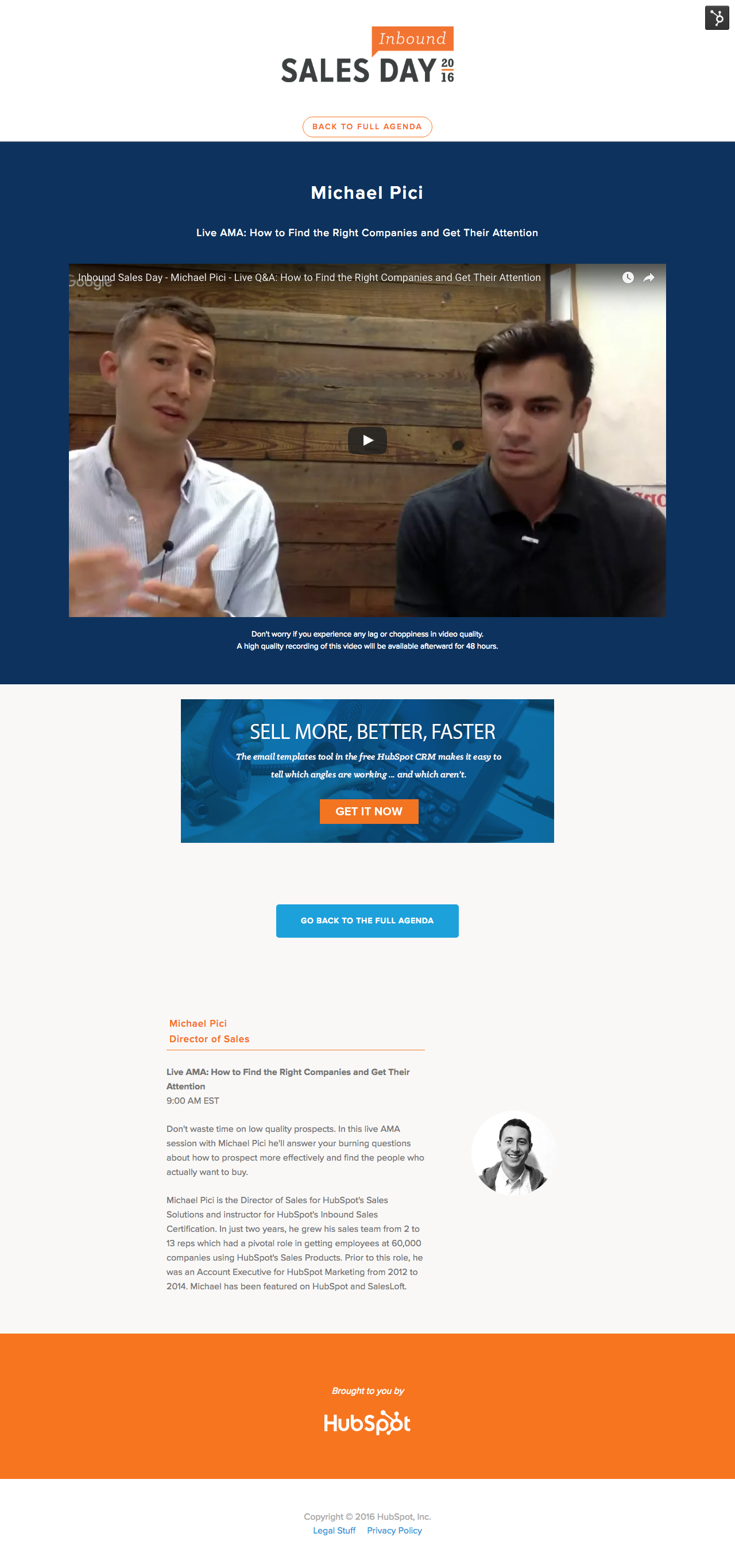
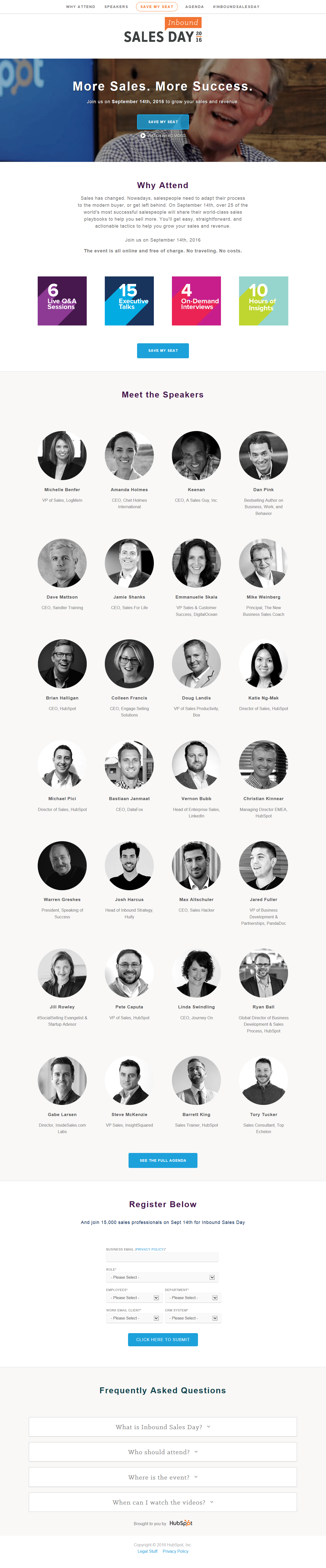
Below you can see the homepage, agenda page, and session pages we created for Inbound Sales Day.
The homepage highlighted the benefits of attending and the various speakers we featured.
The agenda page shared more details about what topics will be discussed and the main takeaways of each talk. This gave viewers an opportunity to see who would be speaking and do their research or reach out to influencers before the event.
The session page is where the fun happened. Each video had its own landing page on the HubSpot domain so viewers wouldn’t have to leave our website to see the content. We had over two-dozen of these pages.
| Landing Page | Agenda | Session Page |
|
|
 |
 |
Click the images to see the full versions
Video Hosting
I recommend using YouTube Live to broadcast live videos and to host all videos to take advantage of its video SEO. I then embedded all the videos on landing pages so people wouldn’t have to leave our website to watch the video.
Video Production
There were three different session formats which each required different preparatory measures. Here was my process for each format:
Live Q&A
- Speaker chose topic
- Researched their online material (blogs, videos, interviews) and created a Google Doc of canned questions
- Introduced the speaker to the employee who would host the session via email and set up a call to develop their rapport
- They reviewed the list of questions together and brainstorm more questions
- We prioritized top five canned questions to ask in case there were no live questions
- A week before the live session, get on a call with the speaker to do a final check-in (the meeting was hosted using a private YouTube Live session so they understood how to sign in)
- Live broadcast: Speaker was expected to sign into YouTube Live an hour ahead of time for audio and video check, review the talk points with HubSpot host, and build rapport for the session
Recorded Interview
- Speaker chose topic
- Researched their online material (blogs, videos, interviews) and created a Google Doc of canned questions
- Introduced the speaker to the employee who would host the session via email and set up a call to develop their rapport
- They would review the talk track outline and go back and forth about what topics the speaker would want to hit on
- We agreed on five questions that would be asked by the interviewer to guide the conversation
- Booked an hour with the speaker and interviewer which gave enough time for audio and video check, review talking points, and record at least twice (in case the first run was too rough
Recorded Lecture
- Speaker chose topic and provided outline of talk track
- Provided feedback on their outline based on what our sales audience is interested in (based on previous campaigns and blog performance)
- Two recording options:
- Book an hour of their time to record the session via YouTube Live
- They recorded on their own and sent the video
Question Submission Form
For live events, we created a Google Form for people to submit questions ahead of time. These questions were used to inform talking points for relevant sessions.
Social Media Images
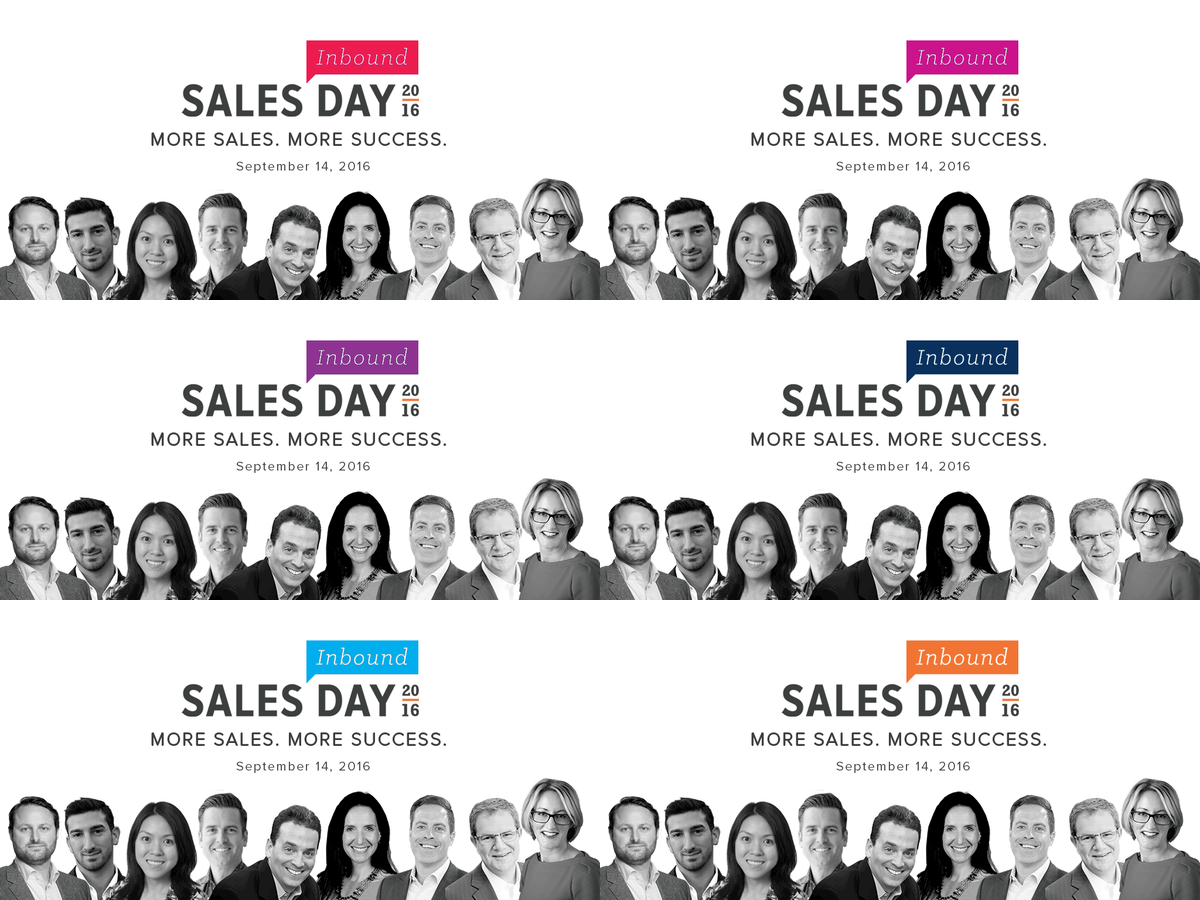
The obvious goal for social media images is to make a person stop scrolling through their newsfeed and read what the event was about. We went with blinking GIFs that included photos of the speakers.
Phase 4: Promote
As with content distribution in general, this was the most difficult part of the process. We leaned into speakers a lot and asked them to promote the event to their email list and on their blogs and social profiles.
Speakers: Email, Blog & Social
We asked each speaker to send an email to their list, write a blog post, and post on social media about the upcoming event. We made it as easy as possible for speakers to promote the event by creating speaker promotion packets, which provided pre-written emails, blog posts, social media copy, and images. All they had to do was copy and paste the text and insert the image.
We also gave each speaker their own unique tracking URL (learn how to do it using HubSpot software) to use in promotional materials. This showed us how much interest each speaker drove and how many registrations they contributed.
Don’t start a packet from scratch, get the free speaker promotion packet template.
Blog Posts
Brainstorm blog post topics based on the topics your speakers will discuss, and come up with a publishing cadence for your promotional posts. If you already have an editorial calendar, I’d suggest you avoid making every post promotion and instead periodically insert promotional posts.
Social Posts
I met with HubSpot’s Social Media team two months before the event launch to discuss the campaign and come up with a promotional cadence that made sense for each channel.
I used a spreadsheet to organize all social media posts. I wrote most of the copy in bulk and scheduled the posts in batches as each date came up.
Your promotion strategy will vary depending on which channels you have access to. I sat with my team and brainstormed promotional tactics before deciding which were most viable. A few of those included:
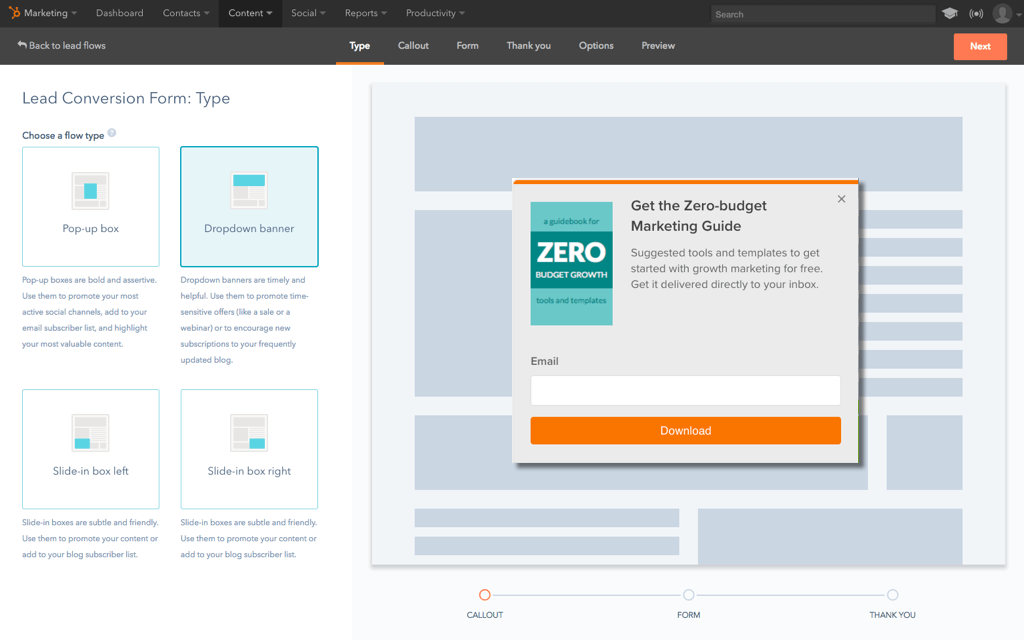
- Pop-up forms on highly trafficked site pages
- Calls-to-action on the home page
- Posts in relevant LinkedIn and Slack groups
- Links to the event in sales reps’ email signatures
Phase 5: Launch
The night before your launch, make sure:
- All recorded videos were hosted on YouTube
- Landing pages that hosted videos were tested
- Reminder email to registrants have been scheduled so they remember to watch the videos
- Emails are pre-scheduled to notify speakers to log into YouTube Live an hour before the broadcast time
On the day of the event:
- Monitor your social media hashtag if you have one
- Keep an eye on your email if case people have trouble accessing the event
Phase 6: Analyze
To prove that the virtual conference was worth the time and effort, do an analysis of the traffic and registrations you received, how many video views you got, and send a survey to your registrants.
The best way to prove value is to tie it all back to revenue. How many qualified leads did you get, and what is the monetary value of a lead? How many new software signups did you get and what is the worth of each signup? How many new clients did you get and how much are they paying you?
Learning Lessons and Tips for Hosting A Virtual Conference
As always, no matter how successful the event, things can always be better. Here are a few things I wish I had done differently that you can learn from.
Align with your sales team.
This event would’ve been great for sales enablement. Sales reps could use the conference as a piece of content to share with prospects and be helpful. It’s also good to let reps know about the event and how to talk about it in case prospects bring it up on a call.
Get speakers with large audiences.
This may be more difficult for your first event as you start developing credibility for your event, but get speakers with large audiences if you can. It’s even better if you can get them to commit to driving a certain number of registrations.
Have a post-event plan.
Ideally, you’re going to get a lot of registrations for the event. What are you going to do with them after the event? Have a communication plan for your registrants, whether it’s sending them content, telling them about your products or services, or asking for feedback. Don’t leave them hanging.
Build anticipation before the event.
How can you get registrants to share the event before it happens? Maybe a contest or giveaway? How can you get registrants to engage with speakers before the event?
As more companies work to get a foothold in their industries and the marketing industry evolves to encompass more video content, virtual conferences will become more and more common. And as with any marketing tactic, as virtual conferences become more common the medium will become less effective.
Host your first virtual conference now before your competitors and gain first-mover advantage. Good luck.
Here are all the resources and templates I’ve shared throughout this post:
- Project management template for Trello
- Speaker information packet template
- Speaker promotion packet template
Thanks to Kendrick Wang, Cambria Davies, and Scott Tousley for reviewing drafts of this post.
Editor’s note: This post was originally published in April 2017 and has been updated for comprehensiveness.

Everything Our Paid Team Learned From Attempting a Reddit Advertising Strategy
With a ranking as one of the top ten most popular sites on the internet, Reddit is undoubtedly an intriguing channel for advertising purposes.
However, the site can often seem intimidating, and perhaps even too random to create a cohesive advertising strategy. Plus, since its primary purpose is to expose viewers to the top-trending content of the moment, Reddit users are notoriously anti-marketing.
Regardless of its challenges, its potential advantages proved too good an opportunity to pass up. At HubSpot, we decided to implement a strategy to see for ourselves whether Reddit can serve as a promising channel for the future.
Here, learn what our team figured out about advertising on Reddit, and whether it’s worth the attempt for your own company. Plus, we’ve provided a step-by-step tutorial on how you can advertise on Reddit if you determine it’s a valuable option for your own company.
The Strategy Behind Reddit Advertising
1. Identify subreddit topics which are well-aligned with your target audience.
To investigate the benefits of advertising on Reddit, I first spoke with Josh Chang, a Senior Marketing Manager at HubSpot. He told me HubSpot’s initial strategy on Reddit involved highly targeted campaigns on specific subreddits, including r/entrepreneur and r/sales.
“The goal of the campaign,” Chang explained, “was to drive awareness and conversion for our products. In terms of results, we saw cost-per-acquisition similar to what we’ve achieved on Facebook in North America, although we did notice a lower activation rate from Reddit — suggesting lower-quality conversions.”
If you’re interested in testing out a campaign for yourself, then, you’ll want to start by identifying subreddits which can likely help foster genuine connections between your brand and your ideal audience. Consider topics your target audience is most interested in, and make a list. Then, narrow your list by investigating how many subscribers each subreddit topic has, whether it’s relatively active, and whether self-promotion or sharing content is allowed on the subreddit topic.
Chang told me, “One of the main things we learned was targeting subreddits specifically was much more effective than broader interest targeting. However, this strategy requires a lot of research, and getting to know which subreddits are most relevant to your audience.”
Additionally, Chang said, “We noticed tailoring our ad creative for individual subreddits helped improve our conversion rates.”
2. Begin engaging with your subreddit communities.
Once you’ve cultivated a list of subreddits that are likely of interest to your target audience, it’s time to start engaging with those subreddit communities.
However, it’s critical you don’t begin by promoting your own content.
To build a level of trust and authentic connection, begin by upvoting other submissions you find interesting and that align well with your brand. Next, share valuable content — but not your own. Instead, post interesting content produced by other media outlets or blogs that you believe will be useful to your subreddit community.
It’s vital you genuinely use the Reddit platform as an opportunity to get to know your target audience before you offer them your own content. Not only will this show your community you’re not simply joining the site to self-promote, but it will also help you tailor your content more accurately down-the-road.
3. Begin promoting your own content, paid or otherwise, on the subreddit platforms.
At this point, you might consider simply posting valuable content from your company that you feel will benefit your community — for free.
However, you might alternatively try spending money on a paid sponsored post, which essentially guarantees your post will be pinned to the top of the subreddit. Here’s what a sponsored post looks like, for context:
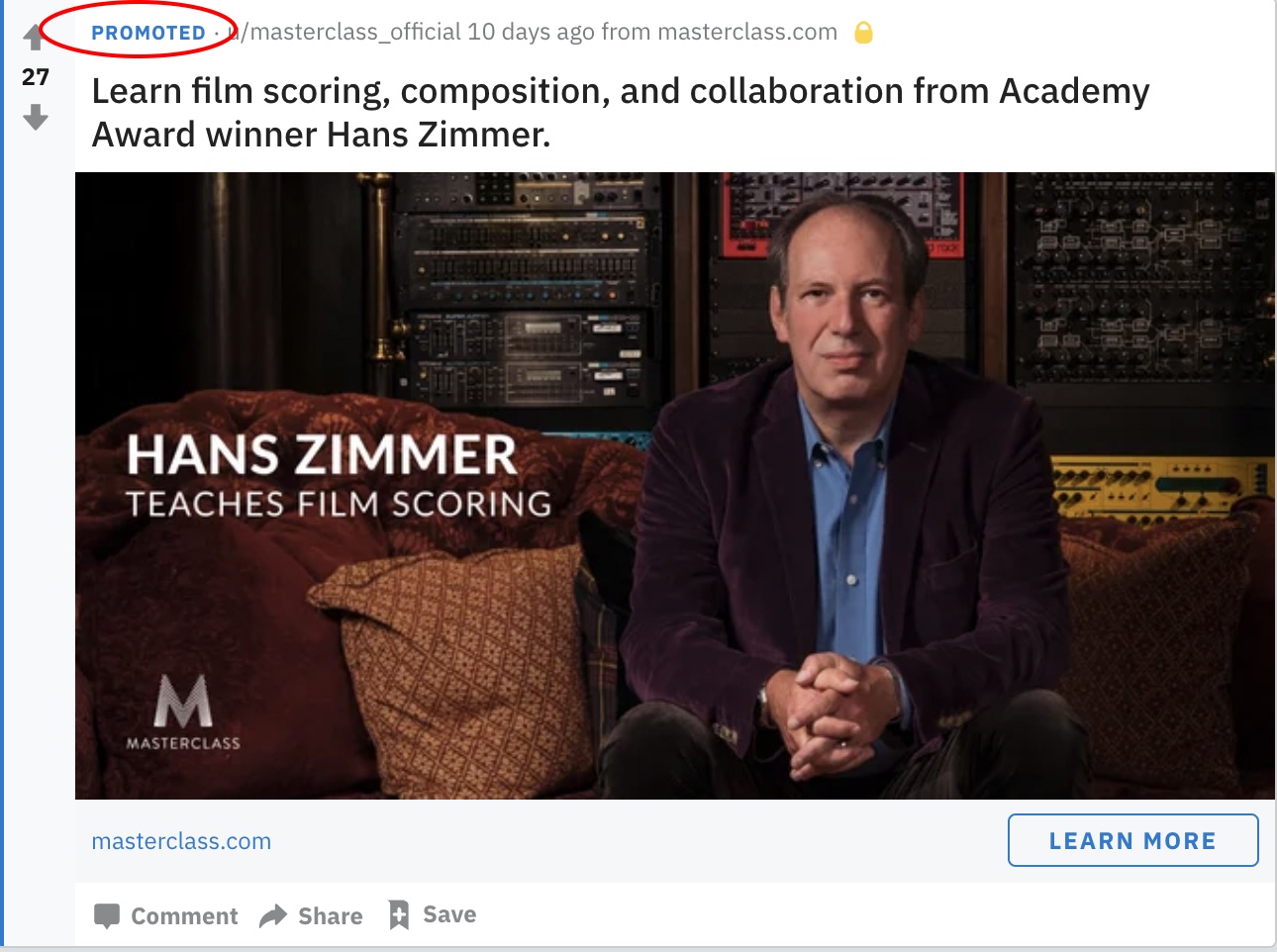
In many ways, this post looks similar to all other Reddit content. However, there’s a blue “Promoted” tag in the top left, signifying it’s a paid ad.
In HubSpot’s case, we decided to test out the power of paid advertising on the site. However, it’s still critical you follow the steps listed above to cultivate authentic relationships with your subreddit communities.
Think of it this way — if I begin engaging with a brand on one of the subreddit groups I’ve joined, and notice they typically post helpful content (including content from other publications), then I’m much more likely to take notice when they pay for a sponsored post. If they appear out of nowhere, I have no sense of brand awareness and probably won’t trust the advertisement.
Reddit Advertising Cost
As of right now, the minimum daily spend for an ad on Reddit is $5.
Additionally, Reddit FAQ states, “The Reddit Ads platform uses a second price auction based system, which means you pay a cent higher than the next highest bidder. Because we are using an auction based system, there is a risk of 20% over-delivery when setting up an individual campaign.”
However, as of January 2019, Reddit changed their pricing model from CPM (cost-per-impression) bidding to CPC (cost-per-click). The CPC model will likely make it easier for brands to track conversion or traffic goals, and could result in changes in prices over time.
Advertising on Reddit: Worth it?
When I asked Chang whether he felt advertising on Reddit is a worthwhile investment, he offered a candid response, admitting HubSpot has temporarily halted its efforts on Reddit.
“We saw promising results,” Chang told me, “But because we were targeting specific subreddits, it wasn’t crazy volume that could really move the needle. However, we have on our docket to re-test Reddit to see if we can improve performance and scalability in the future.”
It’s important to note, there have been success stories — Findlay Hats, for instance, drove $28,000 in sales from one viral Reddit post.
However, most brands see better results simply by relying on Reddit for community engagement and brand awareness. Alex Berman found one of his free, unpromoted videos got 25,000 views when it hit the top of a subreddit — but, when he put $250 behind his Reddit posts, he acquired zero leads.
1. Make a company profile.
You’ll want to ensure you’re running advertising campaigns on your company profile, not your personal Reddit account.
Along with evoking a sense of professionalism, a company Reddit profile is necessary since users can click on your account and see other content you’ve viewed and upvoted — so you want to ensure that content aligns well with your brand. Additionally, when responding to comments on your ad, you’ll want to be able to respond from a company profile, not a personal one.
To set up a profile, go to https://ssl.reddit.com/login and fill out the Sign Up form, shown below:
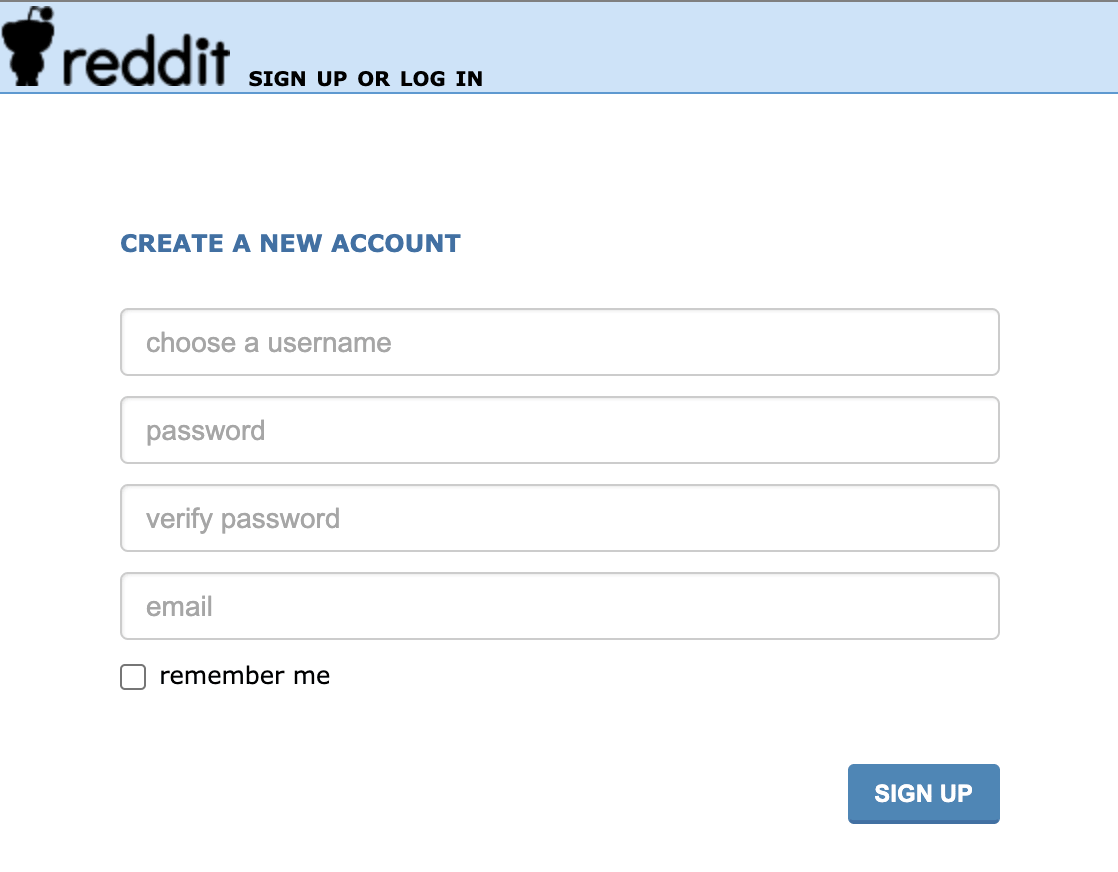
2. Set up an advertising account.
To start advertising on Reddit, you’ll need to set up an advertising account. To do this, go to ads.reddit.com and fill out the necessary fields:
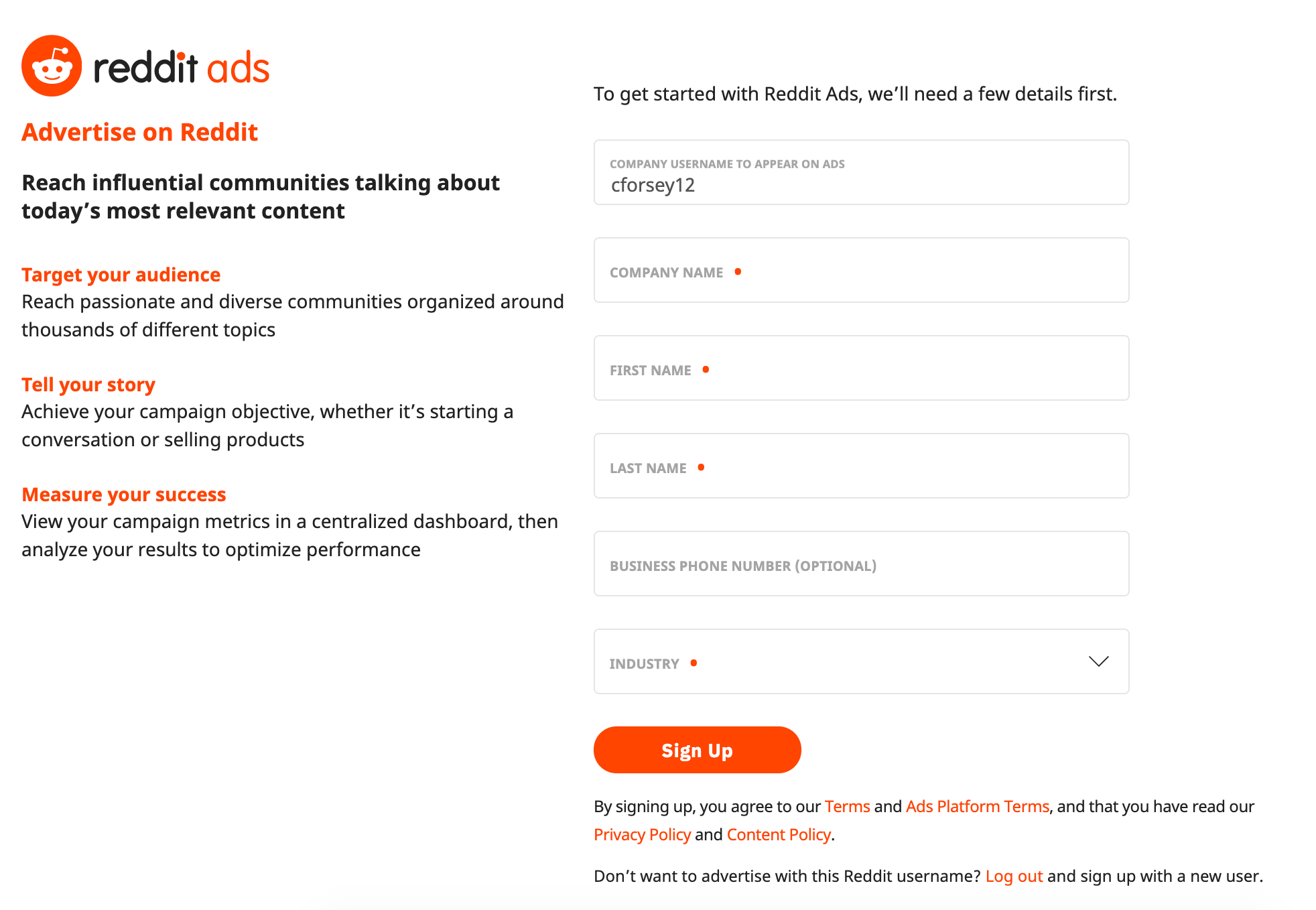
Once you’ve inputted your information and selected “Sign Up”, you’ll see an advertising dashboard, as shown below:
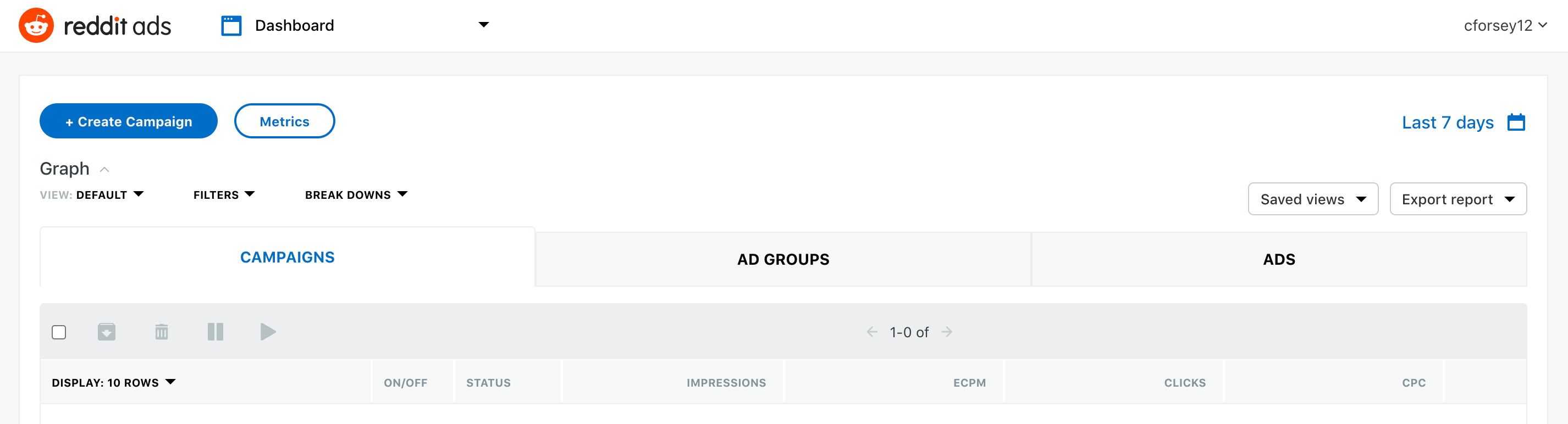
Before you can begin advertising on Reddit, you’ll want to add your billing information by clicking the drop-down menu on your username and selecting “Billing”:
Additionally, if multiple people on your team will be involved in advertising on Reddit, ensure you add users by clicking “Manage permissions” underneath your username, and then adding their emails and permission level (including “Analyst”, “Creator”, and “Administrator”):
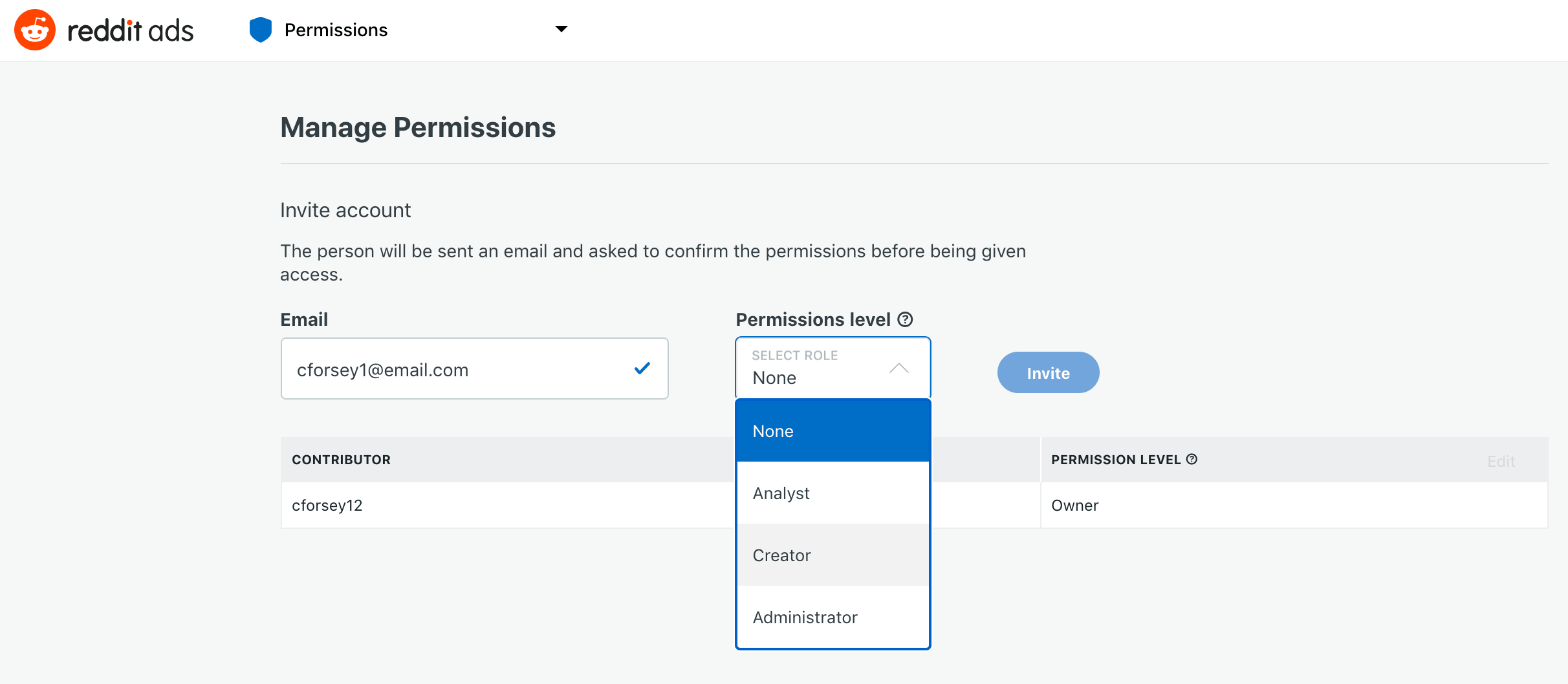
Once you’ve clicked the blue “Invite” button, your colleagues should receive an email with next steps.
3. Find your audience on subreddits.
It’s important to note, you don’t want to spend money advertising on the homepage of Reddit. Reddit users visit the homepage to browse popular posts and trending news, so it’s too big of an audience for you to target your ideal persona.
Instead, you’ll want to explore subreddits to find your ideal Reddit audience. For instance, let’s say you sell e-commerce software. To find an interested audience, then, you’ll want to explore retail-related subreddits, such as r/retail (8.2K members), r/AskRetail (4.5K members), or even r/retailmemes (733 members).
Make a list of subreddits that might fit your audience, and then spend some time perusing the content that already exists on that subreddit. Does it seem to match content your customer would be interested in? Additionally, does it look like the subreddit community could be filled with high-intent prospects (like a retail advice subreddit), or is it too superficial for your needs (like retail memes)?
To help you find your audience, try a tool like RedditList to sort through various reddit communities and find the ones of highest value for you.
4. Ensure the subreddit(s) you find have enough page views.
This is important enough to warrant its own section: you can’t necessarily advertise on any subreddit you want. Once you make your list of potential subreddits, you’ll need to ensure it has enough page views to be eligible for advertising.
To figure out whether a subreddit has enough page views, consider that one Reddit advertising campaign has a minimum spend of $5, and it costs $0.75 per thousand page views. Additionally, you can purchase up to three months out.
With those requirements, you’ll need roughly 6,700 page views over three months to achieve the $5 minimum spend.
To figure out how many page views you’re likely to receive on a subreddit, take a look at how many users are currently on the subreddit. For instance, you can see at 2 p.m. on a Monday, there are roughly 2K users on the r/marketing subreddit:
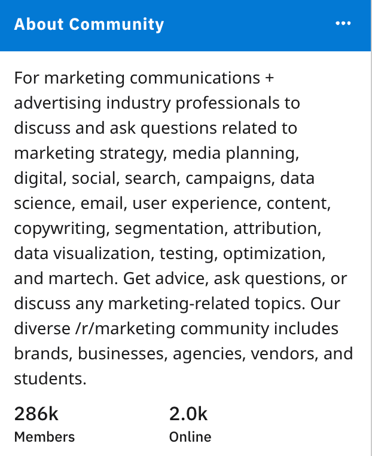
Dividing 6,700 by 90, you’ll note you need roughly 74 viewers per day on a subreddit to reach the minimum requirement — r/marketing, then, is way over the daily required page views, but there are other smaller subreddits with only 5-10 users per day, which could make it more difficult for you to reach minimum spend. Plus, you want to choose subreddits that enable you to have the highest reach possible.
5. Set up your campaign.
Once you’ve chosen your subreddits, it’s now time to set up your campaign. In your account, start by clicking on “Dashboard” in the top left of your screen, and then select “Create Campaign”.
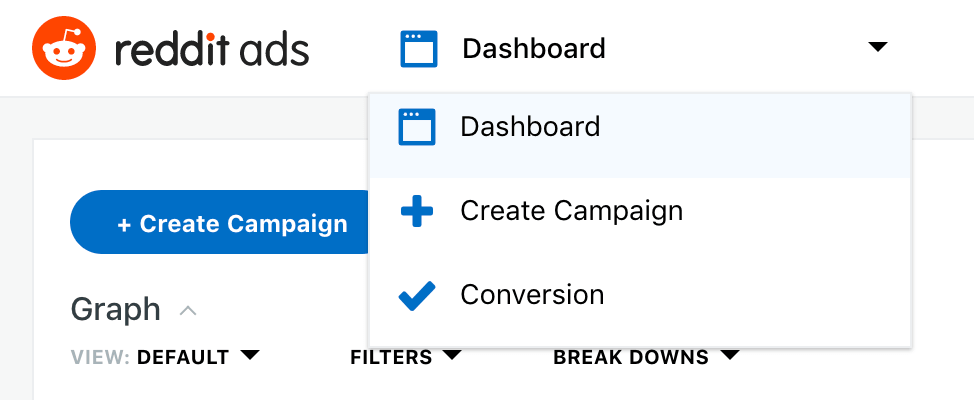
Next, you’ll need to create a name for your campaign, a funding instrument, and a campaign objective:
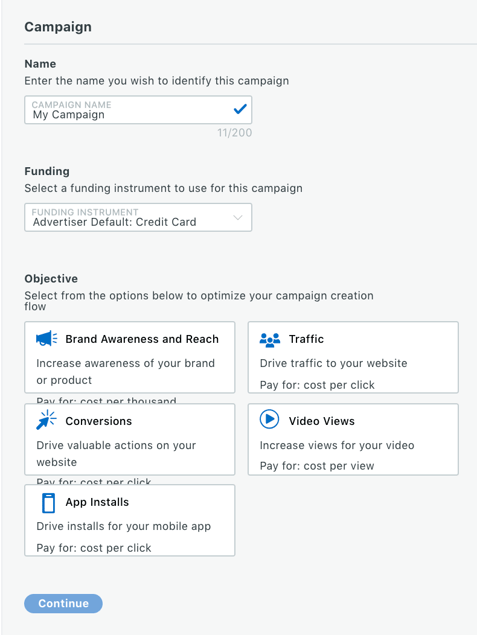
After you click “Continue”, you’ll need to narrow down your audience — including interests, communities, and device type — your budget, and your bid (the maximum price you’re willing to pay per 1,000 impressions). Additionally, you’ll need to figure out a schedule for your ad, including what time(s) of day you want it to appear, and when you want your campaign to end.
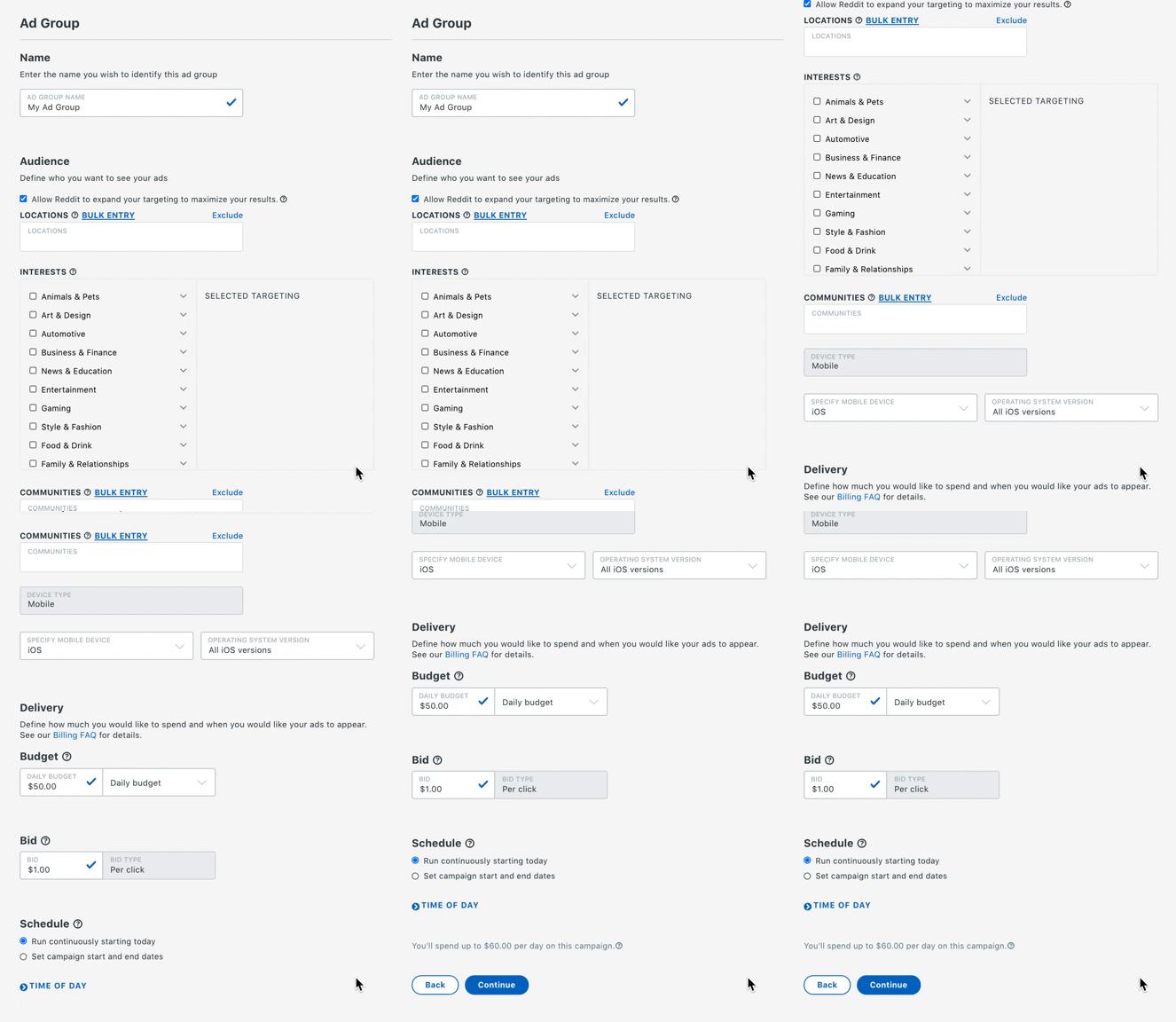
Once you click “Continue” again, you’ll be able to add third-party trackers to distinguish how many unique web page visits or social media viewers you’ve gained from your Reddit advertisement.
Here, you’ll also either create a new post or upload an existing advertisement that you might’ve designed for another platform. Feel free to take a look at Reddit’s internal advertising resources — including Reddit’s Advertising Help page — to learn best practices when designing an ad for Reddit.
Once you’re happy with the creative assets, click “Review”:
Once you’ve reviewed all the information regarding your campaign and have determined it’s accurate, click the blue “Submit” button to submit your advertisement for consideration. You’ll get an email once your ad is live.
6. Analyze your campaign performance to improve over time.
Once your campaign is up-and-running, you’ll want to track its performance. You can monitor within the Reddit advertising dashboard itself, as well as through third-party tools like Google Analytics. Additionally, ensure you’re taking the time to respond to any comments left on your ad.
As with any advertising campaign you run, you’ll want to use analytics on this campaign to iterate and improve for the next one.
Ultimately, it’s worth considering using Reddit as a platform for sharing content for the sake of helpfulness and audience engagement, rather than as a cost-effective advertising strategy.

These Two Simple Strategies Led to a 71% Increase in Qualified Leads for the HubSpot French Market
My role at HubSpot is the French Marketing Automation Manager — essentially, I’m in charge of the marketing automation for HubSpot leads and free users in our French market. This past January, we noticed that one of our key automation programs — our onboarding and nurturing email program for our free users — was dated and needed a revamp.
When our free users sign up, they receive a series of onboarding emails that helped them get set up and answered any potential questions. Here are some screenshots of the old onboarding emails:
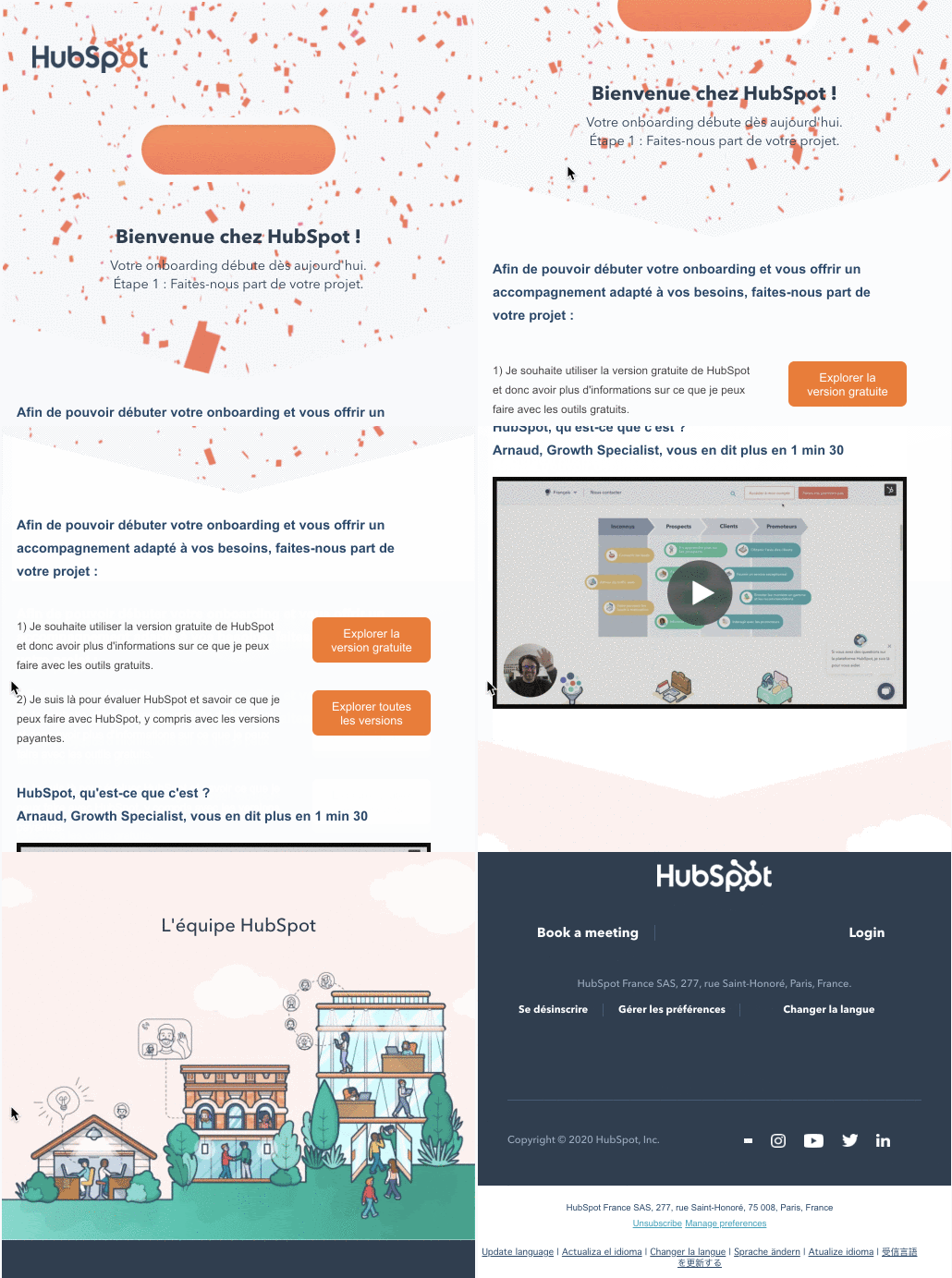
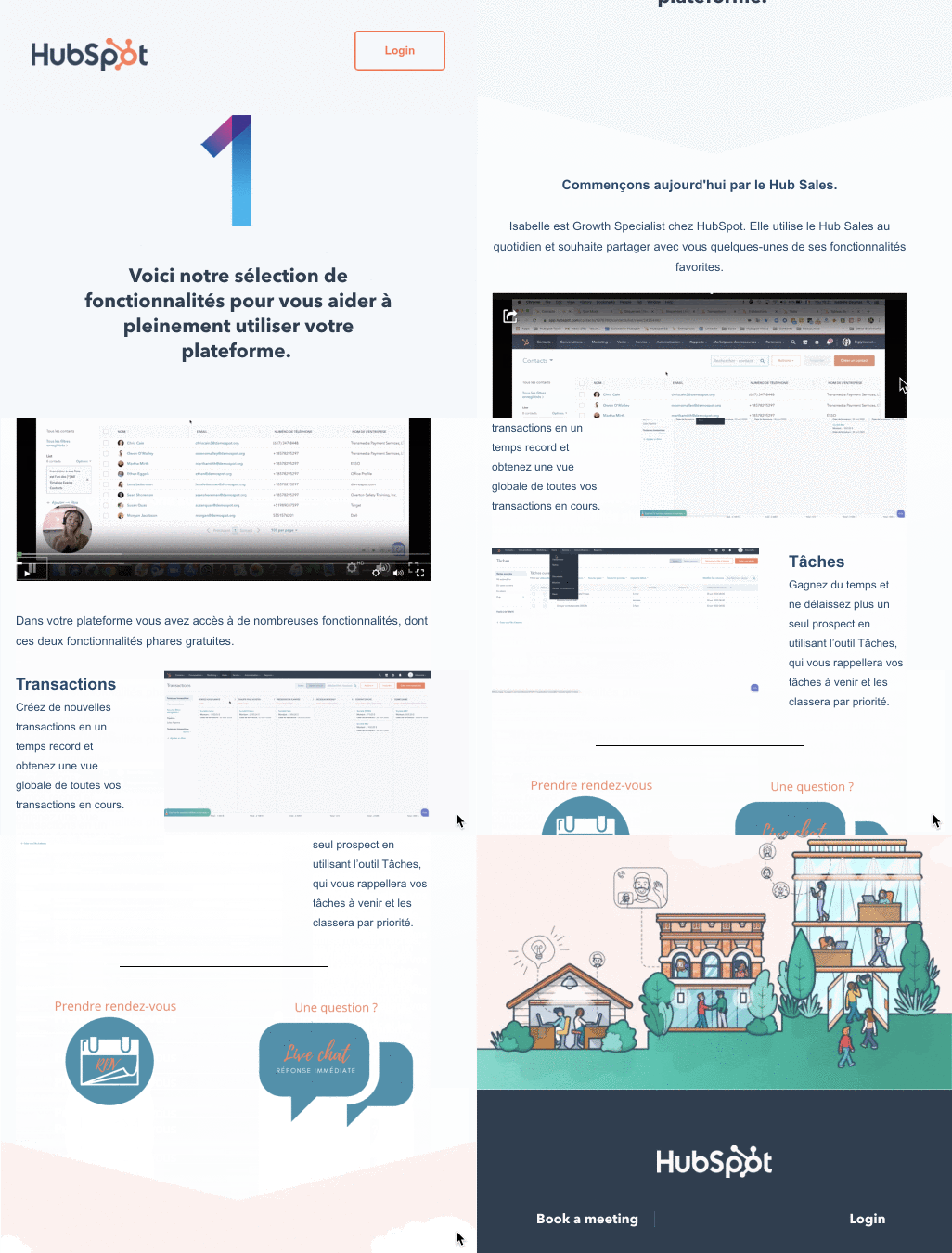
As helpful as these emails were, we decided we could do better by our users and leads.
As we started brainstorming and creating proposals for this program revamp, we came across a core challenge: We didn’t really understand our users’ needs, challenges and goals.
At HubSpot, we do a lot of user research, but much of this research is focused on English users. Also, as marketers, we don’t talk to our customers as much as our sales and customer service teams do. Yet, we can all agree on one thing: The better you know your audience, the better you can serve them and help them.
Phase One: Researching our Free Users
Before working on our email program revamp, we decided to get to know our audience better. We chose to conduct research on our French free users. We did this by releasing one survey and holding several interviews.
The survey was first sent to two audiences: active free users and inactive free users (those who haven’t used their portal for more than 30 days). We were curious if there were differences between the two audiences, but we didn’t discover many.
When analyzing the survey results, we identified contacts with various job titles and different expectations when they signed up. Users that I named “end users” represent about 80% of our free users and signed up only to use the free tools. The other 20% represent what I call “evaluators,” and they signed up to discover HubSpot while thinking of buying a paid version. They are here to evaluate the tool and use the sign up as a trial.
For the interviews, I wanted to get a mix of evaluators and end users and also people from different job fields and departments to better understand their needs. So, I interviewed a wide variety of our free users. Here are a few responses that stood out when I asked “Why HubSpot?”
“[To] find a database, more automated and fluid and adapted than Excel.” — Marketing Manager
“The objective was to bring together [my] various contacts from different bases. [I] then discovered the other features of HubSpot. ” — CEO
The results of the survey and interviews were incredibly insightful. We learned a number of important things about our free users. Here are a few main takeaways:
- Most of our free users are part of small to medium-sized enterprises (SMEs) and therefore, wear multiple hats and do multiple jobs. For example, some folks were CEO and made sales.
- They mainly come to HubSpot for the free CRM. They want and need a CRM, and that’s why they signed up for HubSpot.
- Our free users are not aware of everything that’s included in their free plan, so they are even less aware of what’s included in the paid plans. For example, some users didn’t know they had access to the Form Builder or Email Marketing tools and were using external tools for these functions. Additionally, some users didn’t realize the Landing Page Builder and Workflows features were available with the paid plan. When discussing this during the interviews, they confirmed that they are interested in knowing more about HubSpot paid plans.
What we discovered about our audience and free users changed our thinking quite a bit. For example, before conducting this research, we weren’t promoting our paid plans and features to our free users. That was about to change.
Phase Two: Email A/B Testing
With our new research in mind, we were ready to address our onboarding and nurturing email program.
Before rolling out a new nurturing email sequence to our free users, however, we first wanted to test their reactions to the new content. They’d told us during the market research that they’d be interested in learning more, but how would that translate to reality?
We decided to run an email A/B test to measure how our audience responded to this new approach.
First, we set a hypothesis: Our free users were not aware of the possibilities and features included in their free plan and even fewer of those included in paid plans. If we provided more visibility into what they could do with a paid HubSpot plan and made an effort to educate them about how to try those premium features, they would be pleasantly surprised and sign up for trials — and eventually purchase.
We believed this because our free users mentioned they weren’t fully aware of what was included in the paid plan and why they should subscribe.
So, we developed an experiment to test this new approach. For this our A/B test, I didn’t want to target all of our free users — only the ones who’d been actively using the HubSpot free tools in prior few months. I assumed this audience would be interested in learning more about what they could do and achieve with a paid version since they were already so active in the free version.
Download our free guide on lead nurturing to learn how to use lead nurturing for smarter marketing.
We divided these active free users into two segments:
- Our control group didn’t receive any nurturing emails, as this was the case before the experiment.
- Our variant group received a series of two emails promoting key paid features, including Attribution Reporting, Workflows, and Sequences, and offering them a trial to test out those features.
Here are some screenshots of the text emails:
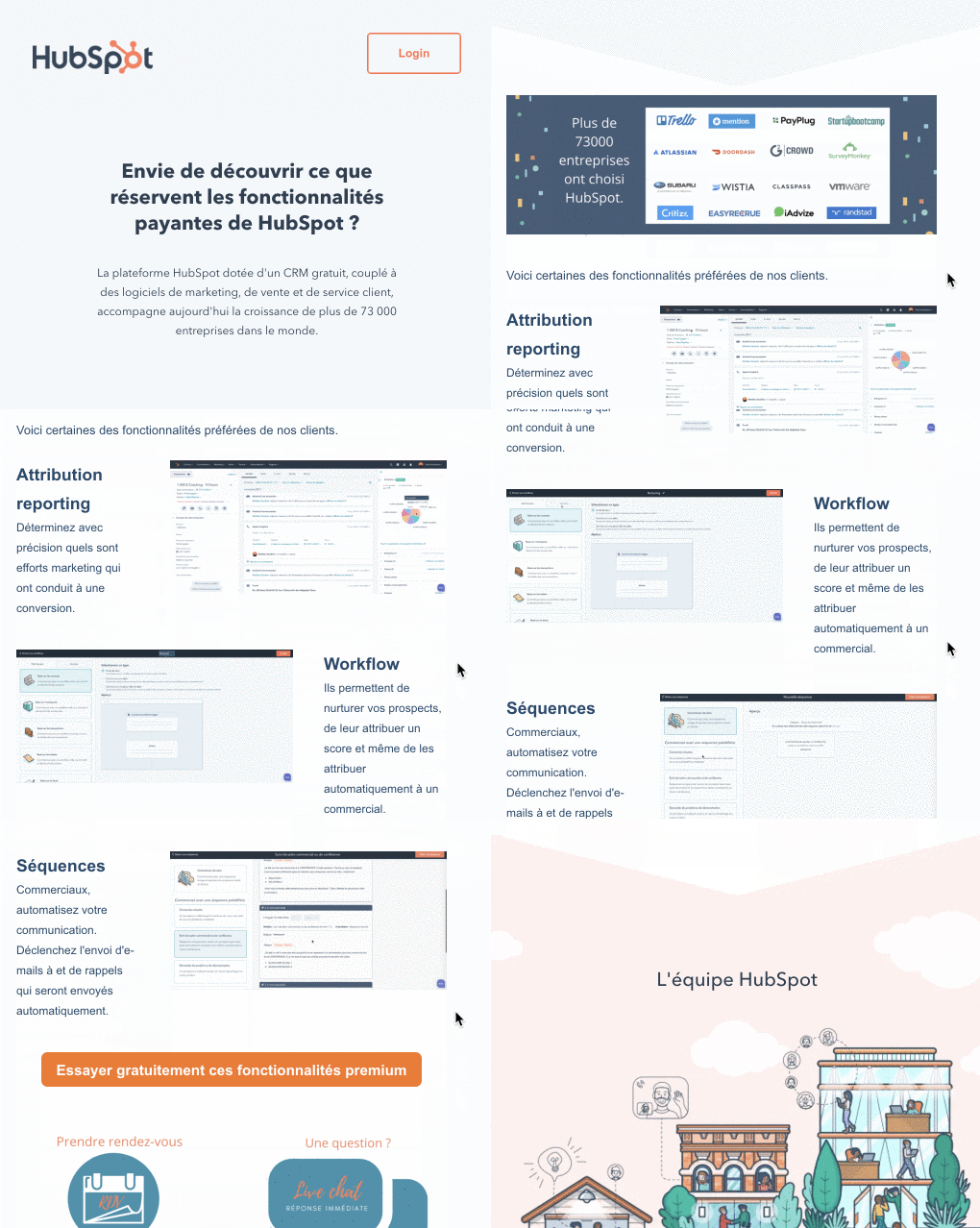
Our Email A/B Test Results
We ran our email experiment over the course of four weeks and sent about 3,000 emails.
At the conclusion of the test, we were pleased with the results as they were highly conclusive and confirmed our original hypothesis. When we compared the control and variant groups after one month, we found that the emails sent to the variant group:
- Generated 71% more qualified leads
- Created 125% more deals
- Generated 12% more trials
- Generated 15% more revenue
Wow!
Learnings and Takeaways
Both the research and experiment we conducted yielded valuable insights and takeaways. Here are my top four:
First, get to know your audience. As marketers, we don’t often have the opportunity to discuss with our audience.
If you can chat with your target market and customers, I highly recommend it! This can be a gamechanger for your marketing strategies and alert you to insights and trends you otherwise wouldn’t have known.
Second, align with Sales. Sales talks to hundreds of prospects and free users per week, so they know what features and components of your product or service are most important for certain leads.
You probably can’t promote your entire product in one email and have to select some features. For this reason, you should better align with Sales to better understand who your audience is and what their goals, needs, and pain points are.
Third, test your content formats and information to know what your audience prefers.
For example, we’ve seen in France that doing short videos or GIFs of HubSpot tools was highly appreciated. For each feature or functionality of the tool, our emails included a text description, and, next to it, a video or GIF of it. This helped our readers see what the tool looked like in action.
Finally, experiment as much as you can.
Even if your experiment is not conclusive or doesn’t yield the results you were looking for, it’s not a waste of time if you’ve learned something new and valuable about your audience, content, or product.
Bonne chance!

The Ultimate Guide to Instagram Stories Ads in 2020
Ah, Instagram Stories — the one-stop-shop to find short, engaging content from high school friends, celebrities, and major brands alike.
With over 500 million daily active users, Instagram Stories is an undeniably powerful opportunity to connect with new audiences.
And, if you’re not using Instagram Stories as a marketing tool, you should be. In fact, Instagram reports that of the 500 million accounts using Instagram Stories, one-third of the most viewed stories come from businesses.
I can personally attest to the power of Instagram Stories to incentivize purchasing decisions. For instance, the other day I was mindlessly scrolling through Stories when I came across an ad for Crest 3D whitestrips — with a $50 off coupon attached. I swiped up to purchase without ever leaving the app itself.
Here, let’s dive into what Instagram Story ads are, and how you can run Instagram Story ads for your own business. Plus, we’ll explore examples of Instagram Story ads and best practices to ensure your ads are as powerful as they can be.
What are Instagram Story ads?
Instagram Story ads are vertical ads you can run on Instagram’s Stories feature. (To recap, Instagram Stories are photos and videos visible to an Instagram account’s audience for 24-hours, and is published separately from the content found on your Instagram profile.)
Instagram allows you to target your ads by reach, video views, traffic, conversions, app installs, and brand awareness. Additionally, unlike an organic Instagram Story, an Instagram Story ad doesn’t disappear after 24-hours — instead, you can choose the length of the campaign and frequency of ads on Facebook’s ad platform, like any other ad created for Instagram or Facebook.
An Instagram Story ad is immersed seamlessly into a user’s Stories viewing experience. Additionally, a user doesn’t have to follow your account to see an ad from your brand. For instance, I don’t follow Crest on Instagram, but I was still shown a Crest ad.
You have a few different options for ad formatting, including video, photo, or carousel. A video ad plays for up to 15 seconds, an image ad will play for five seconds, and a carousel ad lets brands play three separate pieces of content (video, photos, or both) within one ad.
If you aren’t sold on running ads on Instagram Stories yet, consider these facts:
- Ad spending on Instagram is 23% higher than on Facebook.
- Videos get 21.2% more interactions compared to images and 18.6% more interactions compared to carousels.
- 71% of U.S. businesses use Instagram. It surpassed Twitter in business users in 2017.
- 500 million Instagram users use the app daily.
If you’re convinced Instagram ads could be a good platform for you, let’s dive into how you can run your own Instagram Story ads, next.
How to Run Instagram Story Ads
1. Go to your Ads Manager, and click “Create”, which will bring you to “Quick Creation”. If you’d prefer, you can switch to “Guided Creation”, instead.
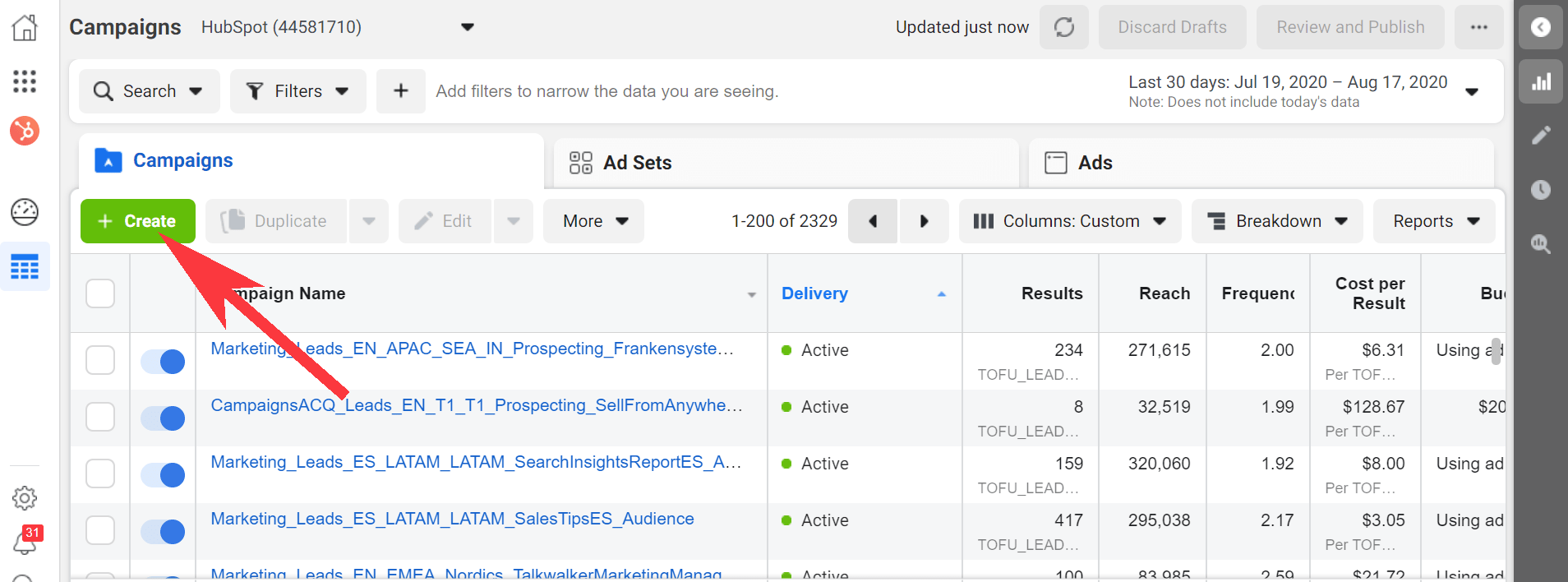
2. Next, select a marketing objective — your options for Instagram Stories include “Brand Awareness”, “Reach”, “Video views”, “Conversions”, “App installs”, “Lead Generation”, or “Traffic”.
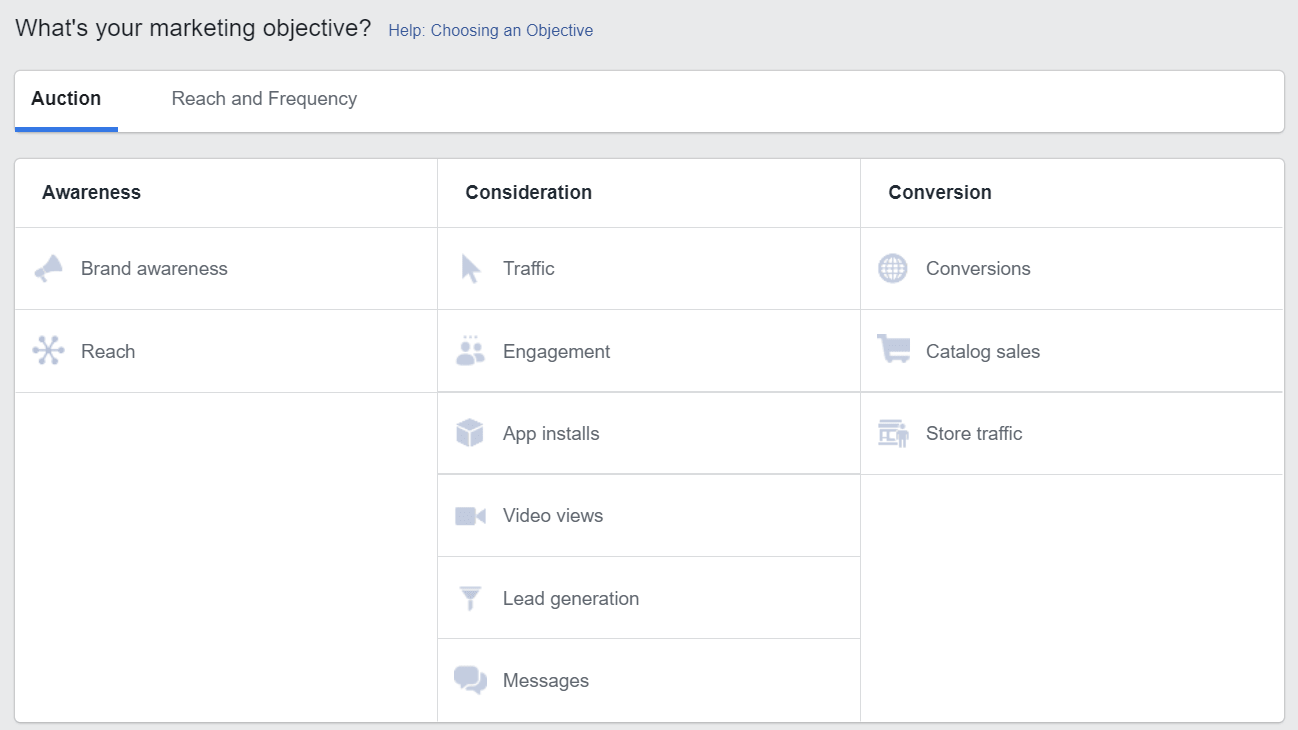
3. In the Placements section, you’ll want to select “Automatic Placements”, where Instagram Stories is selected by default. However, if you choose “Manual Placements”, check the box for “Stories” under Instagram.
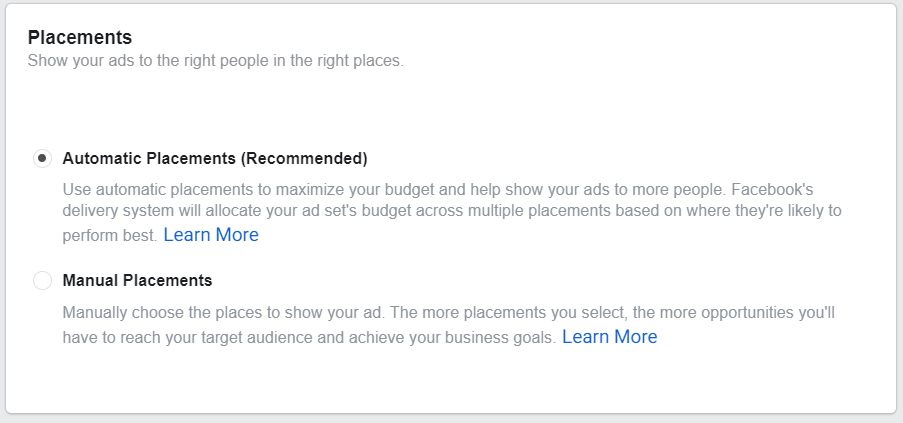
4. Next, set your ad’s budget and schedule.
5. Next, you’ll want to choose “Single Image or Video” or “Carousel” as your ad’s format.
6. Add videos or images to your ad, and finish including any other details, including headline and description. If you’d prefer, you can use Stories Templates, which will transform your image into an ad automatically, and add movement to grab a viewer’s attention.
7. Once you’re happy with your ad, select “Confirm” to finish the process.
Instagram Story Ads: Cost, Specs, & Length
There are three separate areas you can place an ad on Instagram: Stories, Feed, and Explore.
For the purposes of this post, we’ll focus on the cost, specs, and length of an Instagram Stories ad.
First, all feed photo and video dimensions are supported in Stories (anywhere from 1:91 to 4:5). However, 9:16 ratio is encouraged to fit the full-screen, vertical format of Stories.
Additionally, .mp4 or .mov is recommended for video ads, and .jpg or .png file type is recommended for photo ads.
If you’re creating a video ad, 4GB file size is encouraged — and, for a photo, 30MG file size is suggested.
If you’re creating a video ad, the length can’t surpass 120 seconds. For a photo ad, five seconds is the default for how long the image will be shown.
Finally, the recommended resolution is 1080 x 1920, with a minimum dimension of 600 x 1067.
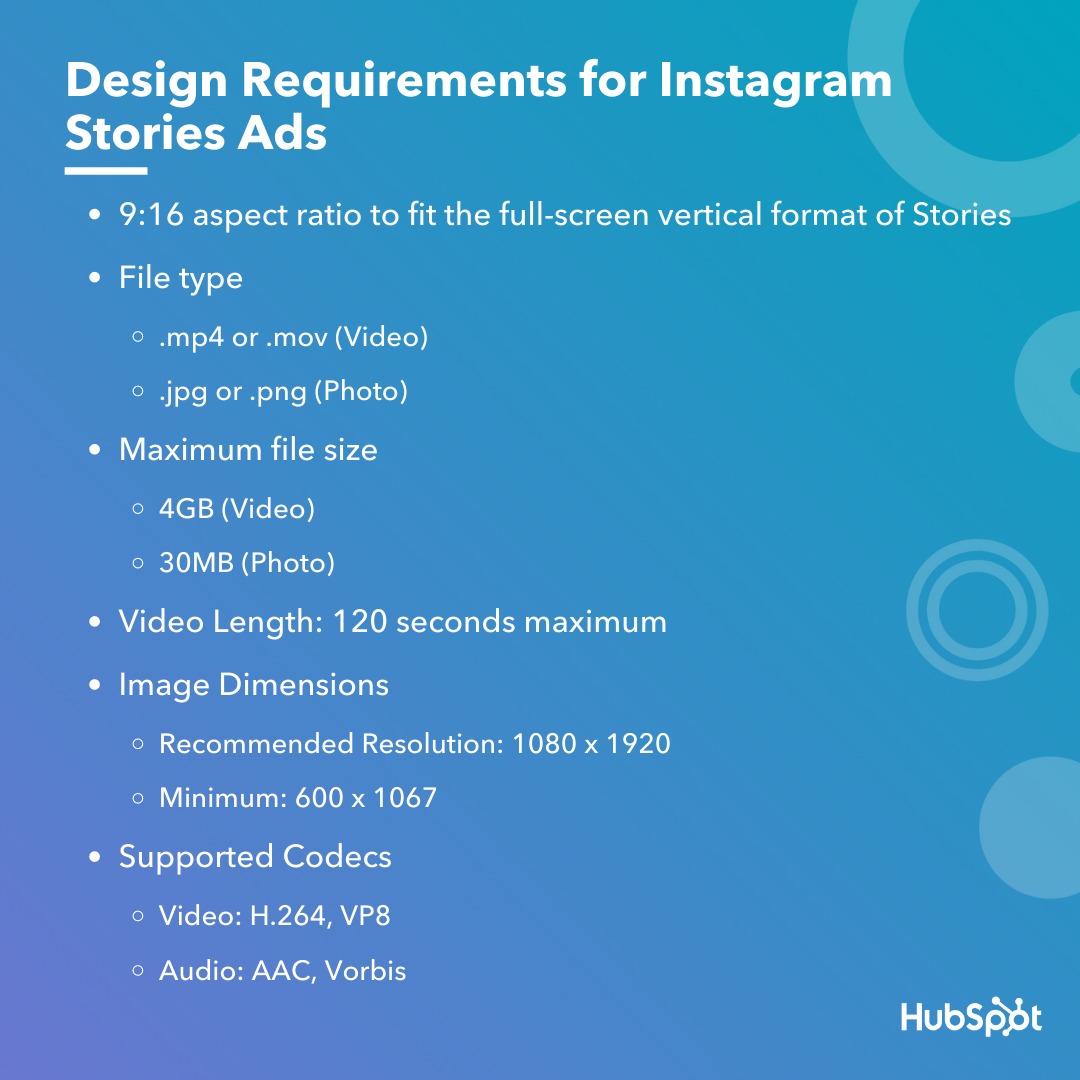
Instagram ads, including Instagram Story ads, cost between $0.70 to $1.00 per-click on average — although cost varies depending on industry, days of the week, time of year, targeted ages and sexes, ad placement, and plenty of other factors. In some cases, Instagram ads can exceed $5.00 per-click.
Fortunately, you have plenty of control over how much your ads cost by setting a pre-determined budget. You can choose your budget based on how much your company is willing to spend daily, or the total cost you’re willing to spend over a campaign’s lifecycle.
Examples of Instagram Story Ads
Below, I’ve collected a few impressive examples I found on my own Instagram Story feed. While most of these examples are bigger brand names, there are plenty of small-to-medium sized businesses using Instagram
1. Aveeno
Aveeno’s Instagram ads are clean and simple, with neutral colors — apart from the brand’s signature green — drawing attention to the brand’s daily moisturizer. The ad features a short clip of a hand pointing to a shopping cart, with a “Shop Now” swipe-up link. The ad focuses on the brand’s product and doesn’t distract with people, making it effective for anyone scrolling who’s in the mood to refill their moisturizer.
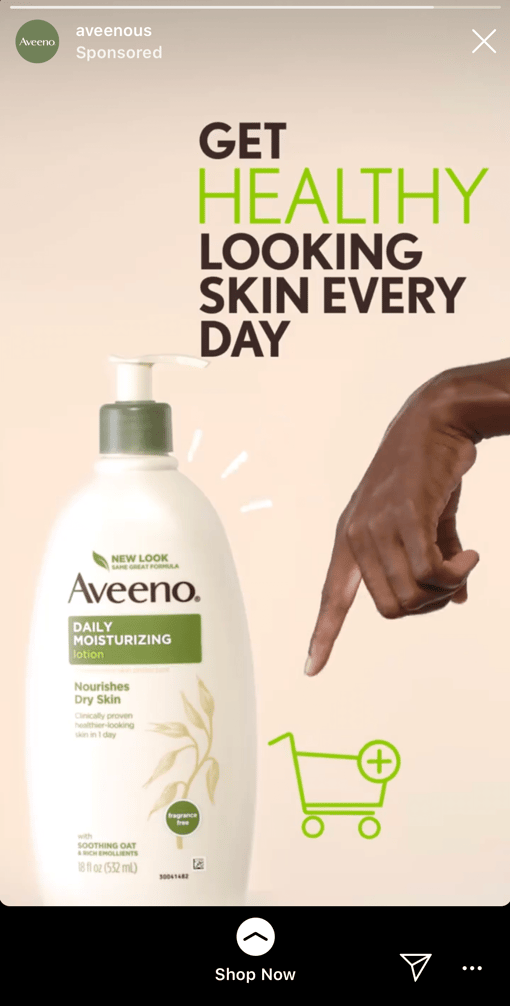
2. Miller Lite
This is an example of an ad that felt tailored towards me, a 27-year-old female in the Boston area. First, the ad features a call-out to the Boston Celtics, immediately capturing my attention. Once I’m intrigued, the ad segues into a picture of their Lite drink, with the text, “Great taste, only 96 calories, 3.2G carbs”. In this example, the ad does a good job drawing my attention to the things I care about most: namely, low-calorie alternatives to beer (and Celtics).
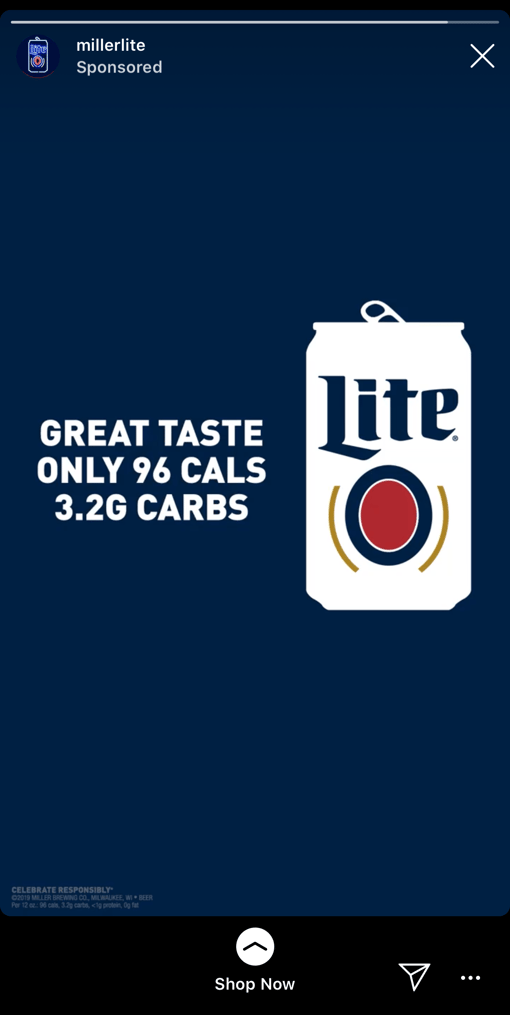
3. Trunk Club
This engaging, fast-moving ad shows a few different outfit options on the screen with the text, “Keep what you love, send the rest back”. The ad shows a few different outfits, ranging from dresses and cardigans to dress pants and heels, to capture the attention of a wider range of people than it could if it featured only one style. With the plain white background and easy-to-read black text, it’s simple, clean, and hard to miss.
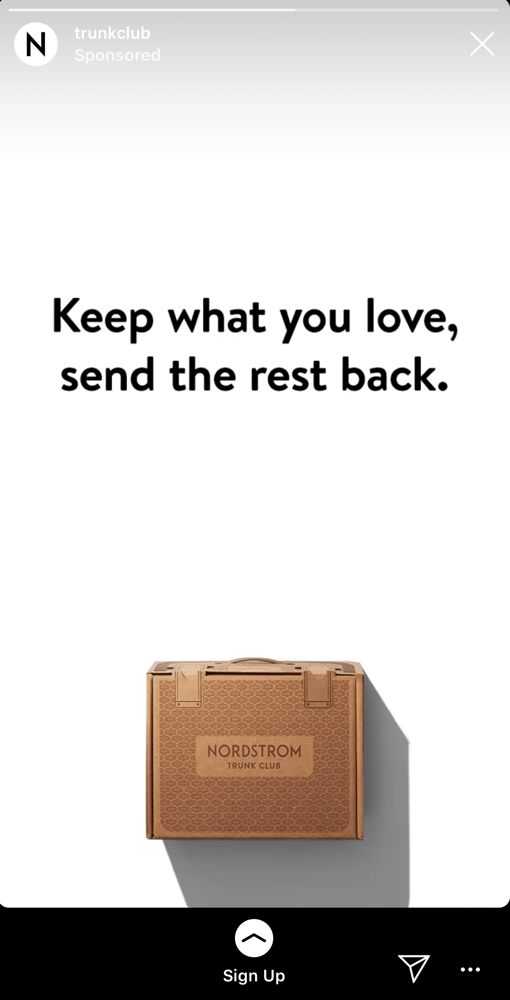
4. Febreze
I mean, come on … who doesn’t love a puppy? This fun, clever Febreze ad shows an adorable puppy on a couch with the text, “Refresh wherever they roam”, with their Febreze product at the bottom of the screen. While most of the other ads in this list featured subdued, plain colors, Febreze goes all out with light blues, greens, and purples, inviting a sense of playfulness and fun into the user’s feed.
5. Tractor Beverage Co.
What I love most about Tractor Beverage Co.’s Instagram video is the end, which features a different call-to-action from most of the others in this list. Rather than “Shop Now,” this ad reads, “Now Available at Chipotle” with a “Learn More” swipe-up function. As a lesser-known brand, Tractor Beverage Co. wisely aims to use their ad space to increase brand awareness, so that next time you’re at your favorite nearby Chipotle, you might give their drink a try.
6. Crest
If you have the means, it makes a lot of sense to include a coupon or discount in your Instagram Story ad, like Crest does in its 3D Whitestrips ad. The $50 off encourages viewers to purchase immediately so they don’t miss out on the deal, and the fun, bright colors effectively capture viewers attention. With the limited time allotted in an Instagram Story, it makes sense for these brands to get straight to the point.
7. Kayak
Kayak, a travel search engine, created this impressive, engaging Instagram Story video ad to demonstrate how easy it is for Kayak users to filter flights depending on airline, price, cabin seating, and destination. Kayak served the ads to lookalike audiences based on the characteristics of its current website customers, and saw 5X increase in sales conversions, as well as a 50% increase in overall ROI, with combined ad placements on Instagram Stories, Instagram’s news feed, and Facebook’s news feed.
Instagram Story Ads Best Practices
Now that we’ve explored a few impressive examples, let’s dive into some best practices to follow when creating your own Instagram Story ad. With four million active advertisers on Stories as of January 2020, it’s going to take a lot to ensure you’re able to stand out and drive results. Let’s dive in.
1. Pay attention to speed.
Facebook reports that Instagram Stories are consumed faster “tahn any other mobile format”. People’s attention is severely limited when perusing Stories, especially since the content has a 24-hour time limit before disappearing forever.
For that reason, you’ll want to ensure you get straight to the point and capture a viewer’s attention from the first frame. Unlike other forms of content, suspense isn’t usually effective here, especially since images can’t surpass five seconds, and videos have a 120-second limit. You’ll want to jump the viewer right into the message you’re hoping to deliver.
2. Include motion in your ad.
Facebook reports that “ads that use motion perform better.” Motion captivates the viewers’ attention and can help you tell a story faster than you could with a static image. Even if you’re using animation, consider how you might add motion to create more engaging content.
3. Ensure you’re using sound in your ad.
60% of Stories are viewed with the sound on, so you’ll want to ensure you use sound in your ad to provide optimal value to your audience. Consider how you might use music, sound effects, or voice-over to capture viewers’ attention in a new way. If you’re unsure which types of sound work best in your ad, try A/B testing to conclude what your audience prefers.
4. Create your ad for Stories first — rather than attempting to repurpose an existing ad made for another vertical.
It can be tempting to simply copy-and-paste the ad you’ve already created for Facebook or Instagram news feed, but that could result in a less-than-ideal experience for those viewing your ad in Instagram Stories. For one, your ad might not follow Instagram Story sizing best practices, resulting in key parts of your ad being cropped out. Additionally, you’ll want to play around with features exclusive to Stories to ensure your ad is as effective as possible.
5. Use your call-to-action wisely.
Ultimately, your Instagram Stories ad won’t be effective if you don’t include a clear call-to-action you want viewers to follow. You might use language like “Learn More”, “Shop Now”, or “Swipe Up” to encourage viewers to take action, depending on your goal — for instance, if your goal is brand awareness, “Learn More” tells viewers you simply want to educate them about your brand’s offerings, which is a very different CTA from “Shop Now”.
Take a look at the examples, mentioned above, for more CTA inspiration.
6. Include text to emphasize key message.
Including text is a best practice for accessibility in general, as it helps viewers’ who are hard-of-hearing decipher your ad’s message. Additionally, text can help emphasize your key points — for instance, Aveeno’s “Get Healthy Looking Skin Every Day” text illustrated their main point, and convinced me to purchase.
7. Test out mobile shots.
Facebook reports, “Mobile shots outperform studio shots for ad recall and intent, while studio shots tend to drive higher brand awareness.” For this reason, consider forgoing fancy studio equipment for video shot and edited straight from a mobile phone.
The majority of users consume Instagram’s content from their own smartphones, so you might as well try creating content on the same device. And, when in doubt, don’t be afraid to A/B test this theory for your own brand, as well.
For more best practices related to advertising in general, take a look at The Ultimate Guide to Mastering the Basics of Effective Social Media Advertising.
And there you have it! You’re all ready to begin creating an inspiring Instagram Story ad of your own. Just remember — you know your brand, and your audience, better than anyone. Use these best practices and examples as inspiration, but feel free to A/B test to figure out what works best for your unique business goals and social media objectives. Good luck!

Cultural Competence: What Is It and How To Develop It At Your Company
When I went to college, it was the first time I truly interacted with a bunch of people who were completely different from me.
I grew up in Orange County, an almost infamously undiverse, homogeneous place.
It was during college that I was able to broaden my horizons and I quickly realized how important diversity is to every area of life whether it be education, or even business.
In fact, did you know that companies in the top quartile for racial and ethnic diversity are 35% more likely to have financial returns greater than their industry mean?
Additionally, findings show that diverse teams make better business decisions 87% of the time.
As business leaders, it’s impossible to ignore those stats.
But, if you have a similar background (or lack thereof) in diversity as I did growing up, you might not know how to develop cultural competence and cultivate a diverse team.
To help, I talked to a wide range of experts on diversity, inclusion, and belonging, from both internal HubSpot employees to external thought leaders.
In this post, we’ll learn what cultural competence is, why it’s important, and how to develop it at your company.
It’s important to discuss that cultural competence isn’t about hitting a diversity quota. It’s about facilitating an environment of open and honest communication in a diverse setting. If you aren’t culturally competent, you might not attract the best talent for your employee base.
On the consumer side, cultural competence is important because customers might not support your company if they don’t think you’re inclusive.
So, what does cultural competence really mean?
According to Martin Tettey, co-chair of diversity and inclusion at PRSA-NY, “To be culturally competent in business, an organization must be fully aware of their surroundings to ensure that the contributions being shared are from a diverse group of people — differences in race, gender or sexual identity.”
Mita Mallick, the head of diversity and cross-cultural marketing at Unilever, says “While companies are focused on diversity of representation and who gets to sit around the table, they can no longer ignore how their products, services and content show up in the marketplace. Consumers are voting with their wallets and want to buy from inclusive companies and brands.”
Being a culturally competent company means that your organization actively and vocally invests in continued learning, listening, and change (when need be).
Your business should benefit all your customers and your employees, so people from all backgrounds and experiences can find success.
Additionally, Melissa Obleada, a previous diversity, inclusion, and belonging team member at HubSpot, says “Cultural competency positively impacts your company culture, which we know has a multitude of benefits for your employees as well as your bottom line.”
Being aware of the space you take up, and exist within, will allow you to navigate those differences with empathy and understanding.
Cultural competence should impact all areas of your business from hiring practices to company culture to marketing.
Lucy Alexander, a coordinator of a HubSpot discussion group focused on diversity and inclusion, says doing this will “Allow you to think about questions like, ‘How will this sales approach resonate with cultural norms of that country?’ or ‘How could this marketing campaign be perceived by this group of people?'”
She continued, “It’s about creating truly inclusive strategies from the ground up. Crucially, you need employees of all different racial, ethnic, and religious backgrounds who represent different genders and sexualities if you hope to apply this lens consistently — otherwise, you’ll come off as inauthentic and you won’t be walking the walk.”
1. Provide workplace bias training.
To develop cultural competence, Tettey suggests providing workplace bias training.
With bias training that’s focused on empathy through academic and experiential learning, you can create a more inclusive workplace.
The training strategy should help get the conversation started on implicit bias and how to minimize workplace bias through education and discussion.
Remember, this shouldn’t be the only thing your company is doing to become culturally competent. Rather, this is a good first step to lay the foundation.
Additionally, it’s important to keep in mind that implicit bias training should include conversations on systemic and structural issues at your company. This means that you might discuss company practices and hold the leadership team accountable for enacting change on a structural level.
Tettey says, “Companies shouldn’t do these things just to avoid lawsuits or fulfill a quota, but make it a part of the backbone that fuels the company and keeps it standing.”
2. Have an ethical hiring process that ensures opportunities are readily available to all.
Another suggestion from Tettey is to implement an ethical hiring process that ensures opportunities are readily available to everybody.
Think about it like this — how can you become culturally competent if your own employee base isn’t very diverse?
To attract a diverse pool of candidates, you should advertise jobs through diverse channels, like diverse job boards. Plus, your recruiters should proactively recruit from a diverse talent pool.
Alexander says, “If your employee base is not very diverse yet (and the vast majority of companies in America could do better), you must couple efforts to tangibly change the makeup of your organization with internal education efforts.”
For instance, “That means that while you’re improving your hiring process to bring more diverse talent in and setting up your employees from underrepresented backgrounds for success and promotion, you’re also running internal education initiatives like content discussion clubs or anti-bias training. Do not give up when you hit roadblocks. The work takes time, and consistent effort is key.”
3. Proper compensation that is based on experience.
Another way to develop cultural competence is to evaluate your compensation packages. You should ensure that people with the same experience and professional backgrounds are being offered the same compensation.
Doing this will help you attract the top talent, increase employee retention, and improve job satisfaction.
It might feel difficult to evaluate your own compensation packages, but it’s important to recognize that implicit bias could have impacted compensation offerings. If it did, you need to correct it.
4. Invest in meaningful cross-cultural relationships.
Cultural competence is really all about knowing your customer.
According to Mallick, “My job as a marketer is this: To surprise and delight a consumer with a product or service they never would have expected. In order to do that, I need to intimately know the consumer. But do I know their history, and the history of their communities? And the bigger question is, in today’s environment, how can I as a marketer afford not to know all of this?”
The answer is that developing cultural competence starts outside of work. That means that your leadership team should invest in cultivating meaningful cross-cultural relationships.
Additionally, you should encourage your employees to do this as well.
Mallick says, “How can we expect to show up and be culturally competent in our workplaces if we live the majority of our lives in communities surrounded by people who only look like us?”
5. Prioritize cultural competence learning and work on your leadership team.
To truly develop cultural competence, continued education in diversity, inclusion, and belonging is imperative.
Obleada says, “Your organization — particularly leadership — needs to make it clear to everybody internally that you prioritize this type of learning and work. Look into resources – blogs, podcasts, consultants, workshops, etc — that focus on building this particular muscle, and make sure that you’re making it possible for your colleagues to share their feedback (both positive and constructive) with those leading these initiatives.”
Essentially, this means that you should implement cultural learning into the fabric of your company culture. You could invest in resources to help cultivate culturally competent teams and practices.
“Rome wasn’t built in a day, so it’s not like you can flip a switch (or attend one training) and magically be culturally competent,” Obleada says. “It’s a process that involves being more open as individuals and bringing our learnings and empathy into each workplace interaction we have. Have patience with yourselves and one another as you work on developing your cultural competence.”
6. Be willing to listen.
A major part of cultural competence learning is listening. In fact, most cultural competence education is about listening to other people about their experiences.
Gabrielle Thomas, a program manager on the diversity, inclusion, and belonging team at HubSpot, says “Listen to those inside and outside of your organization and make sure those voices create a diverse group. You can’t build that awareness if you aren’t willing to listen. It means you have to truly be okay with hearing feedback that may not always be positive and to make progress you have to be okay with doing things differently.”
7. Evaluate where you stand.
Just like you did with your compensation packages, you should look at where your company currently stands in terms of cultural competence.
Alexander says, “Look critically at who gets opportunities to lead in your company (not just in official leadership positions, but who gets to lead projects? Lead meetings? Own initiatives?). Survey your employees anonymously and regularly solicit feedback, and create tangible action plans to address inequities. Then, revisit those plans to create accountability and ask where you could’ve done better and what needs to change.”
You can only get better when you know where you’re starting from and what needs to be done. It’s time to make space for this type of work in your business strategies.
8. Create a psychologically safe environment.
Psychological safety is essential in the workplace. This means that employees have the option to be included and feel safe to have conversations with their coworkers or managers when they don’t feel included.
Richard Ng, a coordinator of a HubSpot discussion group focused on diversity and inclusion, says, “To become culturally competent, you need to invest in psychological safety to enable day-to-day communication between employees.”
Creating psychological safety can help build true allyship among your employees. With allyship, the burden of speaking up is fairly distributed across everyone on your team.
To create a psychologically safe environment, it’s important to have solid guidelines and training for conflict and de-escalation.
So, you might be wondering, “Why are we talking about this?” Below, let’s dive into why cultural competence is important.
Why is Cultural Competency Important?
Cultural competence is important for both your bottom line and creating a workplace culture that employees are proud of.
Mallick says, “It’s not the job of your employees to lead diversity and inclusion efforts on top of their day jobs. You need a diversity and inclusion strategy, which then informs the structure you will need to implement your vision. You need to make a commitment to invest with headcount/resources, budget and time. If you don’t see the benefits of having a diversity and inclusion team, your organization will be left behind in the marketplace.”
Tettey would agree. He says, “Companies are nothing without a team that strategically helps with the D&I efforts.”
In that same vein, Obleada says that companies with leadership that don’t dedicate itself to diversity, equity, and inclusion are in the minority.
“A 2017 Deloitte study showed that over 75% of employees at all levels would consider leaving their current organization for a more inclusive one,” Obleada adds. “Exclusive and rigid company environments where only certain types of people are granted access and set up for success hurt everyone involved – your employees, your business, and your customers.”
Essentially, when it comes to diversity and inclusion efforts, you get what you give.
Thomas says, “We invest in what we value. If you don’t invest energy, money, or both into D&I then that makes it clear to your team and customers that you don’t value an experience based on an inclusively built foundation.”
This work is important because it’s essential to see your company and employees grow and thrive.
Alexander adds, “In a fair work environment that celebrates a variety of backgrounds and diversity of thought, employees will be more prone to share ideas, stay longer, and feel brought into the company’s mission and work. Most importantly, they’re more likely to feel valued as human beings, which is crucial for personal happiness and professional fulfillment.”
Additionally, cultural competence is important because it takes into account that minorities face a harder time when it comes to making a living.
Ng says, “We should also acknowledge that people’s value comes not from their ability to generate revenue for your company but from the fact that they are human. What happens when they don’t improve company numbers? Do they not matter then? They, like everyone else, deserve a chance at working and growing at a company that recognizes the steeper climb minorities face when making a living and supports them through it.”
Ultimately, cultural competence can benefit your company in many ways. You’ll have better employee retention, customer satisfaction, and attract the top talent and customers. Cultural diversity impacts every area of your business, and you should give it the attention it deserves when you’re developing your overall business strategy.

79 Marketing Tools and Software for Every Business & Budget
In the world of marketing, it seems like there are always new tools, tips, tricks, and trends to discover and incorporate into your marketing strategy. How is it possible to keep up with them all?
As a marketer myself, I often wish I had a better sense of all of the tools available to me — and what sets each of them apart — so I can make more informed decisions on how to create and optimize content.
Luckily, I have the privilege of working on a team of 150+ other marketers who specialize in different functions than I do. And because of that, I was able to curate this list of the top tools every marketer should know about and use.
The list of recommended tools below is sorted into different sections so you can get a better sense of what tools are available for different functions of the job.
Above lists the different types of tools for every part of your job. Below is our roundup of the best marketing tools in each category.
Marketing Tools |
| Customer Relationship Management (CRM) Tools |
| 1. HubSpot CRM |
| 2. Zoho CRM |
| 3. Zendesk |
| 4. Pipedrive |
| Online Advertising Tools |
| 5. AdStage |
| 6. HubSpot Ads Tracking Software |
| 7. Perfect Audience |
| 8. Google Keyword Planner |
| 9. AdRoll |
| 10. WordStream |
| Social Media Tools |
| 11. Iconosquare |
| 12. Buffer |
| 13. Hootsuite |
| 14. BuzzSumo |
| 15. HubSpot Social Inbox |
| Search Engine Optimization (SEO) Tools |
| 16. Ryte |
| 17. Ahrefs |
| 18. SEMrush |
| 19. Moz |
| 20. Keywords Everywhere Chrome Extension |
| 21. HubSpot Content Strategy Tool |
| Content Creation and Design Tools |
| 22. Adobe Spark |
| 23. Venngage |
| 24. Piktochart |
| 25. Canva |
| 26. Recordit |
| 27. Kap |
| 28. Adobe Color CC |
| Video Marketing Tools |
| 29. Wistia |
| 30. Vidyard |
| 31. Vimeo |
| 32. Loom |
| Event Marketing Tools |
| 33. Eventbrite |
| 34. Facebook Events |
| 35. AddEvent |
| Lead Capture and Conversion Tools |
| 36. HubSpot’s Free Marketing Tools |
| 37. HubSpot’s Free Pop-up Forms Tool |
| 38. Typeform |
| 39. OptinMonster |
| 40. Sumo |
| 41. Convertflow |
| Lead Generation Tools |
| 42. Unbounce |
| 43. Leadpages |
| 44. Instapage |
| 45. HubSpot’s Landing Page Builder |
| Website Optimization and CRO Tools |
| 46. Hotjar |
| 47. Optimizely |
| 48. Lucky Orange |
| 49. Google Optimize |
| 50. Clicky |
| Lead Nurturing and Email Marketing Tools |
| 51. HubSpot’s Email Marketing Software |
| 52. Constant Contact |
| 53. Campaign Monitor |
| 54. MailChimp |
| 55. AWeber |
| 56. ActiveCampaign |
| Marketing Automation Tools |
| 57. HubSpot Marketing Automation |
| 58. Drip |
| 59. Marketo |
| 60. Omnisend |
| Data Reporting and Analytics Tools |
| 61. Digital Marketing Tuner |
| 62. Google Analytics |
| 63. Google Search Console |
| 64. Databox |
| 65. RavenTools |
| Digital Asset Management Tools |
| 66. Dropbox |
| 67. Google Drive |
| 68. Box |
| 69. Shift |
| 70. Brandfolder |
| Team Communication and Collaboration Tools |
| 71. Slack |
| 72. Join.Me |
| 73. Zoom |
| 74. Skype |
| Project Management Tools |
| 75. Trello |
| 76. HubSpot Projects |
| 77. Asana |
| 78. Airtable |
| 79. Wrike |
Customer Relationship Management (CRM) Tools
You and your sales team want to sell your product or service — not fight with messy spreadsheets, cluttered inboxes, or clunky tools that slow you down. That’s why using a Customer Relationship Management System — also known as a CRM — is essential. Not only will it help your sales team manage relationships, but a CRM will also give you a place to deliver those leads you generated to your sales team.
CRMs are such an essential part of any good marketing and sales team that we think everyone should have one. That’s why the HubSpot CRM is completely free.
Featured CRM Tool:
1. HubSpot CRM
HubSpot CRM automates the tasks salespeople hate and takes minutes to learn — not months. That means doing more deals and less data entry.
Other CRM Tools:
2. Zoho CRM
3. Zendesk
4. Pipedrive
Online Advertising Tools
If your team is making investments into PPC ad campaigns on platforms like Google, Bing, Facebook, Twitter, or LinkedIn, it’s probably a bit of a hassle to manage all the different ad campaigns you’re running across each different network. Besides just managing them, you then have to try and report on the results of all of them. What a struggle. Luckily, there’s tools for that.
Featured Online Advertising Tool:
5. AdStage
AdStage takes the hassle out reporting on all of the PPC campaigns you’re running and puts it all in one place. AdStage helps you automate, create, and manage your campaigns across all of the major PPC platforms, then allows you to report on your results. With visual features and powerful automation tools, AdStage is a must for PPC experts and newbies alike.
Other Online Advertising Tools:
6. HubSpot Ads Tracking Software
9. AdRoll
10. WordStream
Social Media Tools
Social media managers know the pain of posting that perfect social media post only to have a follower find a typo a minute later and call you out. For marketers, using a social media tool to schedule all of your posts (so you catch those typos beforehand) is a must. But it also helps to get the right analytics from your social posts, especially on channels where it can be hard to get that information.
Featured Social Media Tool:
11. Iconosquare
Iconosquare is the perfect tool for marketers to grow their brand on Instagram with easy-to-use analytics. It’s not always easy to know what’s working and what’s not on Instagram. But, as the second most popular social channel and one that’s quickly approaching first most popular among some age groups, it’s a channel that marketers can’t afford to miss out on. Try Iconosquare now to maximize your Instagram analytics and optimize your brand Instagram channel for success.
Other Social Media Tools:
12. Buffer
13. Hootsuite
14. BuzzSumo
Search Engine Optimization (SEO) Tools
Whether its keyword research, content optimization, or checking your current page rankings, every marketer needs a go-to tool for planning what content to create and how to optimize it for SEO.
Featured SEO Tool:
16. Ryte
Marketers need tools to plan which keywords to rank for and making sure the content they create actually meets their goal once created. Ryte is the ideal tool marketers can use to make sure their SEO efforts are having a real impact on their marketing strategy.
Other SEO Tools:
17. Ahrefs
18. SEMrush
19. Moz
20. Keywords Everywhere Chrome Extension
21. HubSpot Content Strategy Tool
Content Creation and Design Tools
In the world of content creation, there are admittedly tons of different tools you could use to create various types of content. Whether it’s social images, logos, blog posts, or ebooks — the options and tools are endless.
That said, a newcomer among the Adobe Suite of tools is winning the hearts of many marketers, including this one, for its ease of use to create stunning webpages, awesome videos, and eye-catching graphics. The best part? It’s completely free and impossibly easy.
Featured Content Creation Resource:
22. Adobe Spark
Adobe Spark is a suite of three web or mobile apps — Spark Page, Spark Post, and Spark Video — that allows marketers to easily create graphics, webpages, and videos in a variety of themes in minutes.
You can completely avoid the hassle of page layout, video editing knowledge, or a CMS and start creating content that looks remarkable immediately. For example, we use Spark Page at HubSpot to create some of our online guides and promote them with Spark Videos and Posts. You can too!
Other Content Creation and Design Tools:
23. Venngage
24. Piktochart
25. Canva
26. Recordit
27. Kap
28. Adobe Color CC
Video Marketing Tools
Haven’t you heard? Video is the thing everyone is talking about. But how do you actually implement it into your marketing?
Maybe your strategy is just to put a YouTube video embed on one of your blog posts or landing pages. But then what happens? Someone else’s ad plays on your landing page before your video even begins. That’s bad for your conversion rates, brand, and your user. Luckily, there’s a solution.
Featured Video Marketing Resource:
29. Wistia
Wistia is a powerful video hosting platform that allows you to host your videos on your website — ad free — with a guaranteed smooth playback and responsive player. Wistia also helps you prove the ROI of your video efforts by offering you video analytics and key metrics to fine-tune your video marketing efforts over time. Ready to take your video marketing to the next level?
Other Video Marketing Tools:
30. Vidyard
31. Vimeo
32. Loom
Event Marketing Tools
Whether your team holds monthly customer and prospect events, yearly conferences, or just occasional community outreach parties and events, it’s important to have the best event marketing tool up your sleeve when the time comes to use it. After all, in-person events are some of the best ways to interact with potential customers and create a brand experience that prospects, customers, and your community will remember.
Featured Event Marketing Resource:
33. Eventbrite
Eventbrite is an efficient, easy-to-use tool tons of marketers rely on not only to manage the logistics (like ticketing) of events but also to promote their events. Eventbrite lets you create an event landing page and allows you to set up your ticketing and payment for the event all within the same platform. The best part? Eventbrite is always free if you’re hosting a free event!
Other Event Marketing Tools:
34. Facebook Events
35. AddEvent
Lead Capture and Conversion Tools
When it comes to your bottom-line goals, you probably want a few tools for not only attracting prospects to dedicated marketing campaigns, but just as importantly, converting those visitors into leads and customers.
Featured Lead Capture and Conversion Resource:
36. HubSpot’s Free Marketing Tools
HubSpot’s free marketing tools can help do just that. The moment a lead shares their email, you’ll know who they are, where they work, and what pages they visited — all in real time. When they view an offer or check your pricing, you’ll be ready to follow up right away.
And with simple but powerful analytics, you’ll learn more about what’s working and what’s not — like which traffic sources or pieces of content are driving the most conversions. It’s a risk-free way to find out what inbound marketing can do for you. No budget necessary.
Other Lead Capture and Conversion Tools:
37. HubSpot’s Free Pop-up Forms Tool
38. Typeform
39. OptinMonster
40. Sumo
41. Convertflow
Lead Generation Tools
If you’re in the mood for demand generation, you probably have your eyes on the prize: converting anonymous website visitors into contacts with email addresses that you can successfully nurture. Landing pages are a must for capturing lead information on important offers and opt-ins.
Featured Lead Generation Resource:
42. Unbounce
Thanks to a drag and drop interface, Unbounce lets you quickly build mobile responsive landing pages without developer assistance. The tool also integrates with a number of different CMS platforms and software.
With Unbounce Convertables, you can also launch targeted overlays on top of any web page, each with a dedicated call to action. Customizable triggers and targeting rules give you control over who sees your offers and when so you can serve the most relevant offers to the right audience.
Other Lead Generation Tools:
43. Leadpages
44. Instapage
45. HubSpot’s Landing Page Builder
Website Optimization and CRO Tools
As marketers, sometimes it feels like we’re constantly making educated guesses about how our site visitors are going to interact with our content. While we might design a page to draw our user’s eye to a spot on a page, how do we ever really know where their focus is so that we can improve that experience?
Featured CRO Resource:
46. Hotjar
Hotjar is a new and easy way to truly understand what your web and mobile site visitors are looking at when they interact with your site. With its visual heatmap tools, you can understand what users want, care about, and interact with on your site. Hotjar visually represents visitors’ clicks, taps and scrolling behavior, giving you the ability to find hot areas for growth and conversion rate optimization.
Other CRO Tools:
47. Optimizely
48. Lucky Orange
49. Google Optimize
50. Clicky
Lead Nurturing and Email Marketing Tools
It’s not enough to drive traffic to your website and then convert them. Many of your website visitors may not be ready to buy, and that’s where lead nurturing comes in. Email marketing is a great way to nurture contacts toward a purchasing decision.
Featured Lead Nurturing Resource:
51. HubSpot’s Email Marketing Software
HubSpot offers robust email marketing software from free to enterprise. You’ll be able to create emails in a simple drag-and-drop interface, personalize emails for better experience and performance, and see email activity in your free CRM. HubSpot also offers automation solutions in their paid plans.
Other Lead Nurturing and Email Marketing Tools:
52. Constant Contact
53. Campaign Monitor
54. MailChimp
55. AWeber
56. ActiveCampaign
Marketing Automation Tools
Automation is nothing new to marketers. Whether you want to save time doing marketing tasks or simply cut time wasted doing those daily tasks like saving emails and files to spreadsheets, having a tool that makes your life easier and saves you time is ideal.
Featured Marketing Automation Resource:
57. HubSpot Marketing Automation
As previously mentioned, HubSpot has a powerful automation tool included in its paid marketing tiers. It doesn’t just send drip sequences. You can also use it to trigger specific actions such as updating a contact record or adding a contact to a list when certain criteria is met.
Other Marketing Automation Tools:
58. Drip
59. Marketo
60. Omnisend
Data Reporting and Analytics Tools
Most tools that automate some of your marketing strategy will also provide reports that allow you to see and present your campaigns’ performance to other employees in your company. What if you want a more holistic look at the health of your marketing?
Featured Data Reporting and Analytics Resource:
From the efficiency of your content calendar to the effectiveness of your lead-generation methods, Digital Marketing Tuner offers a helpful overview of all of your latest marketing activities.
Developed by OverGo Studio, an inbound marketing agency and HubSpot Agency Partner, Digital Marketing Tuner guides you through a brief survey where you can submit basic information about your company’s content volume, email open rates, website traffic, and more. The tool then sends you a detailed report in which you can better visualize your team’s strengths and weaknesses so you can make even better decisions for your company moving forward.
Other Data Reporting and Analytics Tools:
62. Google Analytics
64. Databox
65. RavenTools
Digital Asset Management Tools
In any marketing team, the inevitable happens: there’s a million files and pieces of content between everyone on your team without one place to keep it all. Organization on any team — let alone a marketing team — is essential. That’s why it’s important to have a collaborative organization tool to keep you sane.
Featured Digital Asset Management Tool:
66. Dropbox
Dropbox is the perfect tool to keep your team organized and your files under control. With cloud-based software to keep your files accessible anywhere at anytime, Dropbox helps your team store all of its files in a central location. Dropbox makes it easy to collaborate, too. With tools like Dropbox Paper, which allows you to write and collaborate in real time on the same doc — and sharing tools for shared folders and files, you’ll be organized and ready for any project that comes your way.
Other Digital Asset Management Tools:
67. Google Drive
68. Box
69. Shift
70. Brandfolder
Team Communication and Collaboration Tools
Where would your work day be without accessibility and communication between you and your colleagues? Probably pretty frustrating. Marketers can’t shy away from communication when it comes to aligning with team members and across the company, so having the right team communication tools is necessary every single day.
Featured Communication and Collaboration Resource:
71. Slack
I wouldn’t be given any slack if I didn’t make the world aware of this tool.
Slack is a powerful messaging app that allows you and your teammates to quickly message back and forth without the hassle of email. But it’s not just AOL instant messenger 2.0. Slack has powerful features and integrations that make it possible for you to integrate all of your other daily tools — like Trello, Gmail, Giphy, and so many more — right where you’re already communicating. You can start channels between different teams or just chat with specific colleagues. Slack makes remote and in-person work possible and easier than ever.
Other Communication and Collaboration Tools:
72. Join.Me
73. Zoom
74. Skype
Project Management Tools
File management and organization is one thing, but how do you manage all of the moving pieces of a marketing campaign or project? There are many different tools you can use for project management, but only one sticks out when it comes to the number of integrations and features at the price of — oh yeah — free!
Featured Project Management Resource:
75. Trello
Trello is a great project management tool for small teams and individuals. With it’s Kanban-style setup and fun user interface, Trello lets you set up to-do lists and tag individual cards with due dates, members, labels, and more. You can attach files, links, images, and more to your cards and easily get a full-view of any project that you’re working on. At HubSpot, we use Trello daily to manage our team campaigns and individual to-do lists. Want an example of how we do this? Check out our guide to managing marketing campaigns in Trello.
Other Project Management Tools:
76. HubSpot Projects
77. Asana
78. Airtable
79. Wrike
You’ve got all the tools you need, but are you looking for a place to start putting them all together? Check out our free marketing plan. It’ll walk you through creating your own marketing plan and teach you how to use all of these tools together.
Editor’s note: This post was originally published in February 2019 and has been updated for comprehensiveness.
