
Your Blueprint to Create the Perfect Content Marketing Strategy
Creating content can feel discouraging.
For instance, you might spend hours producing something that’s amazing, only to get little engagement, traffic, or leads. What’s more, later, you’ll have to explain that ROI to your boss — talk about a dreadful workday.
If you’re feeling frustrated or burnt out with your content creation process, you’re in luck. Here, we’ve created a complete blueprint to a successful content marketing strategy.
In this post, I’ll walk you through the different aspects of the content blueprint and why each facet is so important for marketers to include in an overall strategy. For more information on content marketing strategies, we’ve created a content marketing workbook that’s free to download.
Otherwise, let’s dive into creating a content marketing strategy that will bring you that ROI you’re looking to earn.
How to Develop and Implement a Successful Content Marketing Strategy
We’re going to look at three different stages that make up the blueprint. These stages will outline the main steps you can take to create your strategy. Then, we’ll go into depth with details about making that happen.
Let’s start with step one — getting decision-makers on-board with your strategy.
Stage 1: Getting buy-in from your stakeholders in order to green light your strategy.
All great content marketing plans start with getting people within the company to buy into your vision — basically, the people who can give you the resources, budget, or information that’s required to make your plans a successful reality.
For example, internal customer-facing teams, such as customer support, can share their expertise and help fuel your content creation efforts. Because they have regular contact with customers, they’ll know some of your audience’s biggest challenges or what they care most about — which comes in handy when you need to create content those customers care about.
Additionally, your marketing team likely has a limited budget. To implement certain strategies and forgo others, it’s vital you’re able to get leadership on board with your vision.
To make this happen, you’ll need a pretty awesome pitch. Generally, this pitch should do three things:
1. Talk about key challenges you will solve with your strategy.
You’ll want to give an overview of the key challenges your content marketing plan will solve. Instead of complicating this step with an overload of data points, keep it simple and concise. Summarize your key challenges in just a couple of charts so it’s more comprehensive.
For example, in this chart below, the marketer’s key challenge is that their overall CPL (cost per lead) is being inflated by the amount of money they are spending to acquire leads through paid programs.
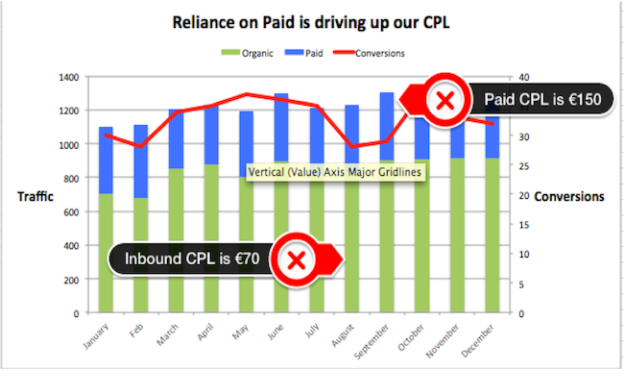 By implementing a solid content strategy, CPL can be reduced. Notice how this chart states the need for a strategy, presents key supporting data, and makes that information easy to comprehend.
2. Talk about how your strategy will relate to business metrics.
Try to always keep your audience in mind. Senior management will be focused on cost and revenue. How can your marketing strategy help with those metrics?
In the example above, the answer is clear: Reducing the CPL reduces the cost it takes to acquire a customer, which can increase profit down the road.
When you present your pitch to decision makers, make sure to outline how reaching your goal will also help reach the greater goals of your business.
3. Give high-level details on your strategy to achieve these goals.
Finally, you might consider talking through how your content strategy is going to help solve these key challenges and influence those business metrics. You can use this template generator to help you organize your ideas. The goal of this step is to prove to senior-level management that you’ve thought through your plan and what resources you need to make it a reality.
Now, you’ve created your pitch and you’re ready to present to upper-level management. Remember, this pitch will help you convince the right people that your content marketing strategy will be successful.
You should have a pitch before you begin planning your content strategy because you’ll stakeholders will be aware of what campaign you plan to run to achieve your business goals. However, while you don’t need to fully develop your strategy until you get support from leadership, it’s still critical you spend time reviewing metrics and making a tentative game-plan for when you do develop the strategy.
Next, we’re going to talk about how to develop that aforementioned winning strategy.
Stage 2: Develop your content strategy.
In a HubSpot report, it was found that 56% of survey respondents said they were doing content marketing without a plan. Content creation can definitely be difficult, but having a content plan helps. It takes into account key challenges, business goals, and metrics, which will make you more successful in the long term.
Let’s talk about what a winning content strategy should include.
1. Include the buyer personas you are targeting.
At HubSpot, we align content around different buyer personas. This allows us to stay really focused on for whom we’re creating content. We keep our buyer personas’ goals and challenges in mind so we can address these at each stage of the buying process.
As an example, here is a persona I’ve built for a company software company that provides tools that streamline day-to-day business processes, offers inbound marketing courses, and makes reporting easier.
Meet “Marketing Macy”:
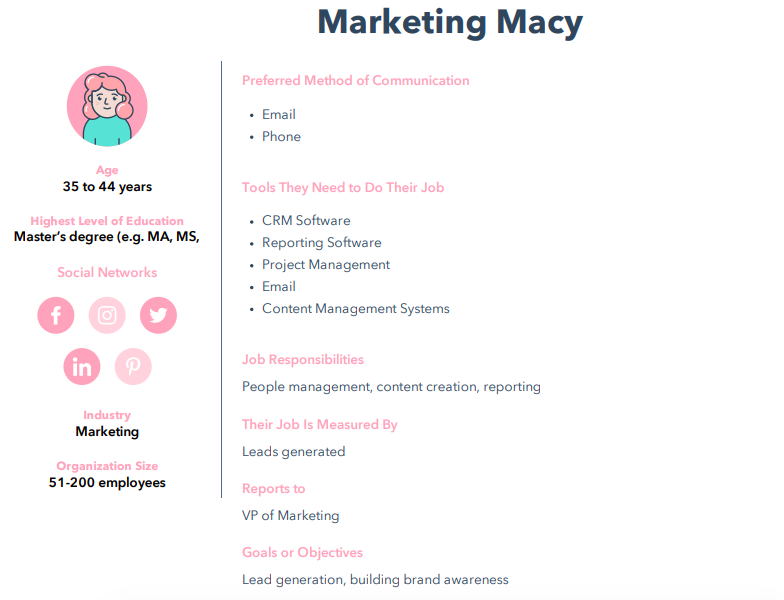
To make this persona, I used a free persona builder that made the process incredibly fun. In addition, I was able to point out exactly how to connect with a target audience by identifying why they would love a company and what challenges they were looking to solve.
To create content that’s going to be relevant to Macy at each stage of the buying cycle, we’ve included key information about her goals, challenges, and why she would love a company that offers CRM and CMS software. Knowing an ideal target customer like Macy makes it easier to connect with them.
2. Understand where the content gaps are in your buying cycle.
Make sure you understand where the content gaps are in the buying cycle for your buyer personas. To achieve this, you should conduct a content audit. Additionally, ask yourself if your buyer persona has the information they need at each point of the buying cycle.
For example, at HubSpot, content is created that attracts Mary to our site and helps her evaluate our software based upon what we know about her goals and challenges. We then ask ourselves if she has everything necessary to feel confident in purchasing our product based on those goals and challenges.
If you identify those gaps, you can focus on making sure that content is in your strategy. For instance, let’s say that you have a gap in content for the evaluation stage. Identifying that is the first step in creating helpful content for that stage.
Next, we’ll talk about how to create and push the content that will bridge those gaps.
3. Create relevant content ideas and stick to an editorial calendar.
Once you have identified your personas and understand what content you need to move them through the buyer process, it’s time to brainstorm content ideas to fill in those holes.
When you understand to whom you’re marketing, it can be easier to come up with relevant content. To ease the process further, check out our post about how to map out content. Ultimately, though, make sure every piece of content you create is engaging, delightful, and created with intent.
Ask yourself during the creation process if your content achieves those three things. Let’s look at this social media post as an example:
This post is engaging because it includes a graphic that attracts the attention of audiences. It’s delightful, because the graphic and supporting copy are easy to comprehend and uses emojis to illustrate a point. Additionally, it’s created with the intent to provide value to customers who may be looking for remote working tips.
Creating content is half the battle, though. Another thing to figure out is when to schedule the publishing of that content so it gets seen by the right people and is delivered consistently.
That is why all great content plans have an editorial calendar so that people within the company can see what content is being published and what dates that content is going live. Editorial calendars keep teams in sync and organized — as far as visual workflows go, it’s a necessity.
When you’ve identified your persona, created content for them, and have finalized a calendar-based schedule, this stage is complete. The next stage is to figure out the publishing details.
Stage 3: Determine a publishing plan for your content strategy.
One of the biggest shifts in marketing today is transforming our mindset from that of a traditional marketer to that of a publisher. Sometimes, as marketers, we think in terms of immediate wins, which is why we tend to prioritize our ad budget for paid media. We invest a certain amount of spend in return for an approximate number of leads and customers.
Moving to a publisher model means investing more upfront to start creating content assets that will have a far greater impact over a longer period of time. For example, the HubSpot blog generates most of its traffic from blog posts not published in that month. This is because the content we’ve created in the past has long-term value for the company in both the leads and customers they generate each month.
A lot of companies talk themselves out of publishing before they even get started due to a lack of immediate resources. However, a content team of one can be successful if they know how to source content effectively.
Here are two tips to keep in mind to become a publishing rockstar:
1. Think about scaling your content by repackaging in several formats.
Consumers today connect with brands across different channels, whether that be on social media, through email marketing, or on your website. When developing a new piece of content, think about how you can repurpose that content into various formats.
For example, if you’ve developed a series of blog posts, such as a series about customer retention, you could turn them into a comprehensive customer service ebook.
2. Make sure the quality of your content always remains high.
Whether you’re creating a single piece of content a week or several pieces a day, the quality of your content should always remain extremely high if you want it to pay off in the long run.
Creating an editorial checklist will help you manage this process. With a checklist, you can quickly check each piece of content for quality issues and educate your team on what it takes to publish content for your company.
In HubSpot’s content blueprint, you’ll find a range of templates that make scaling content really easy and provides an intuitive, ready-made editorial checklist.
Stage 4: Promote your content early and regularly.
So, you know about your target audience and you’ve created content specifically tailored to them. The task now is how to distribute that content to your audience effectively.
The key to effective distribution is to increase the number of distribution channels, such as blogs, email, and social properties. Additionally, you have to expand the reach of that content to a broader audience.
Promotion is a critical part of a content blueprint and something marketers should think about at great length during their planning phase.
To become an expert at promotion, you should:
1. Make promotion an essential part of the planning process.
When my team is planning out a content campaign, we put as much thought into the distribution of that content as we do into the campaign development. We want to know who that content is for and how can we make sure they get it.
For instance, if you are distributing content on social media platforms, discuss in great length how to prioritize budget, posting schedule, and using the tools offered by social channels to expand the reach of your content.
2. Make sure your team is equipped with promotional skills.
Being able to promote content to the right audience isn’t an easy job. Over time, the skills to distribute content effectively will be critical to long-term success.
If you want to learn more about how you can be effective at promoting your content, we have lots of information on outreach, seeding your content, and even the best way to repackage it for different networks to increase its exposure right inside — you’ve guessed it —our content blueprint.
Sometimes, learning the proper promotional skills comes with trial and error. You have to figure out what your audience responds to the most. For instance, you can create an A/B test with the content you want to push on social channels to see what types of messaging your audience prefers.
Additionally, you can experiment with multiple content types to get a gauge of what targeted content really resonates with your audience. To get an idea, check out what your competition is doing, and what works for them. You can also do some social listening to observe the patterns in web behavior of your target customers.
How are you doing with your content strategy so far in 2020? Where do you hope to improve your content marketing the most this year? With this guide, you’ll be fully prepared to take on the world of content marketing, and do it successfully.

The Ultimate List of Types of Marketing [41 and Counting]
Like many of the people who work in the industry, digital marketing was born in the 1990s. Back then, email was the age of most college graduates, AT&T launched the first banner ad, and the CRM industry was just starting to thrive.
Needless to say, marketing has evolved at breakneck speed since then, sprouting many more types of marketing. Some are definitely more effective and relevant than others, so read on to learn about the top types of marketing around today.
The Ultimate List of Types of Marketing
1. Traditional Marketing
Traditional marketing refers to brand promotion on any kind of channel that has been around since before the advent of the internet. Because information wasn’t as easily accessible and readily available, the majority of traditional marketing relied on outbound tactics such as print, television ads, and billboards.
2. Outbound Marketing
Outbound marketing refers to intrusive promotion such as print ads, TV ads, cold calling, and email blasts. This marketing method is called “outbound” since the brand is pushing their message out to all consumers to spread awareness — whether they are in need of it or not.
3. Inbound Marketing
Inbound marketing, on the other hand, is focused on attracting customers rather than interrupting them. The majority of inbound marketing tactics fall under digital marketing as consumers are empowered to do research online as they progress through their own buyer’s journey (more on that later).
The focus for inbound is on creating valuable experiences that have a positive impact on people and your business to pull prospects and customers to your website with relevant and helpful content. Once they arrive, you engage with them using conversational tools like email and chat and by promising continued value. Finally, you delight them by continuing to act as an empathetic advisor and expert.
4. Digital Marketing
Digital marketing is the opposite of traditional marketing, leveraging technology that didn’t exist traditionally to reach audiences in new ways. This type of marketing encompasses all marketing efforts that use an electronic device or the internet. Businesses leverage digital channels such as search engines, social media, email, and other websites to connect with current and prospective customers. We’ve broken some of these down in more detail below.
5. Search Engine Marketing
Search engine marketing, or SEM, includes all activities in the effort of ensuring your business’s products or services are visible on search engine results pages (SERPs). When a user types in a certain keyword, SEM enables your business to appear as a top result for that search query. The two types of SEM include search engine optimization (SEO) for organic search results and pay-per-click (PPC) advertising for sponsored SERPs.
To get started with SEO, you must familiarize yourself with search engine ranking factors and produce content for search engines to index.
To get started with pay-per-click SEM, you must work with the search engine you’re looking to purchase placements with. Google Ads is a popular choice. There are also ads management tools to make creating and managing PPC campaigns a breeze.
6. Content Marketing
Content marketing is a key instrument in inbound and digital marketing because content is what allows audiences as well as search engines, such as Google, to find the information they need on the web. By definition, it involves creating, publishing, and distributing content to your target audience. The most common components of a content marketing program are social media networks, blogs, visual content, and premium content assets, like tools, ebooks, or webinars.
With content marketing, the goal is to help your audience along their buyer’s journey. First, identify common FAQs and concerns your buyers have before they are ready to make a purchase. Then, create an editorial calendar to help you create and manage your content. It also helps to have a content management system to make publishing easy.
7. Social Media Marketing
Social media marketing is creating content to promote your brand and products on various social media platforms like Facebook, Instagram, LinkedIn, and Twitter. Remember your audience as you create content. No one logs on to social media looking for something to purchase, so think through what types of content that is useful, informative, entertaining, and/or compelling. Your unique content should be tailored to the specific platform you share it on to help you boost your post’s reach.
In order to make publishing content across platforms easy, there are a number of social media tools out there such as that simplify the process.
8. Video Marketing
Video marketing is a type of content marketing that involves using video as a medium. The idea is to create videos and upload them to your website, YouTube, and social media to boost brand awareness, generate conversions, and close deals. Some video marketing apps even allow you to analyze, nurture, and score leads based on their activity.
9. Voice Marketing
Voice marketing is leveraging smart speakers like Amazon Alexa and Google Home to educate people and answer questions about their topics of interest. Optimizing your website for voice search is very similar to optimizing for organic search, but beyond that, you can also get inventive by creating a Google action or Alexa skill.
10. Email Marketing
Email marketing involves sending educational or entertaining content and promotional messages to people who willingly subscribe to your receive messages from you. The primary goal is to deepen your relationship with the customer or prospect by sending marketing messages personalized to them. Pushing that idea further, you can also use email marketing to nurture leads with content that moves them along the buyer’s journey.
Depending on your location, you must stay compliant with GDPR, the CAN-SPAM Act, and other regulations governing email. At their core, they boil down to responsible commercial email sending: Only send to people who are expecting messages from you (i.e. they’ve opted in), make it easy for them to opt out, and be transparent about who you are when you do make contact.
With that in mind, the first thing you’ll need to do is strategize how you’ll build your email list — the database of contacts you can send email to. The most common mechanism is through lead capture forms on your website. Then, you’ll need email marketing software and a CRM to send, track, and monitor the effectiveness of your emails. To push your email strategy further and maximize productivity, you may also want to look into email automation software that sends emails based on triggering criteria.
To learn the ins and outs of email marketing, you can take the free email marketing course from HubSpot academy.
11. Conversational Marketing
Conversational marketing is the ability to have 1:1 personal conversations across multiple channels, meeting customers how, when, and where they want. It is more than just live chat, extending to phone calls, texts, Facebook Messenger, email, Slack, and more.
When you’re getting started, you’ll first identify which channels your audience is on. The challenge, though, is being able to manage multiple channels without slow response times, internal miscommunication, or productivity loss. That’s why it’s important to use conversational marketing tools, such as a unified inbox, to streamline your efforts.
12. Buzz Marketing
Buzz marketing is a viral marketing strategy that leverages refreshingly creative content, interactive events, and community influencers to generate word-of-mouth marketing and anticipation for the product or service the brand is about to launch.
Buzz marketing works best when you reach out to influencers early and have a plan in place to generate suspense and perhaps even mystery. To track your buzz marketing efforts, it’s best to use social listening software to keep a pulse on how your audience is responding.
13. Influencer Marketing
Influencer marketing is designed to tap into an existing community of engaged followers on social media. Influencers are considered experts in their niches. These individuals have a large influence over an audience you might be trying to reach and can be helpful marketing to those buyers.
To get started with influencer marketing, you must first create your influencer marketing strategy and define what type of influencer you’re targeting (their niche). Then, you’ll want to create a list of criteria that would make an influencer in that niche a good fit with you, considering things such as the size of their audience, how active that audience is, and the vibe on their profile.
From there, you can find influencers and reach out to them by:
- Manually searching on social media
- Using an influencer marketing platform
- Hiring an agency to do the influencer research and outreach for you
From there, you’ll want to understand that the influencer is the one who knows their audience the best, so maintain a good relationship with that individual and allow them some creative freedom with how they handle your promotion.
14. Acquisition Marketing
While all types of marketing is geared toward acquiring customers, the majority of types have broader and softer goals such as improving brand awareness or driving traffic. In contrast, acquisition marketing is laser-focused on acquiring customers.
Acquisition marketing is an umbrella type of marketing that employs the tactics and strategies of other types of marketing but focuses on how to turn those marketing benefits into revenue. Ultimately, the focus is on lead generation from the results you get driving website traffic from inbound marketing, including content, social media, and search engine marketing.
Once you have website traffic, you must turn that traffic into leads and, eventually, sales. That’s where acquisition marketing comes in. Acquisition marketing may involve a number of tactics to turn a website into a lead generation engine, including offering freemium products, launching education hubs, tightening the copywriting on the site, conversion rate optimization, and lead optimization. It may even include a lead optimization and nurturing strategy to facilitate the hand-off between marketing and sales.
15. Contextual Marketing
Contextual marketing is targeting online users with different ads on websites and social media networks based on their online browsing behavior. The number one way to make contextual marketing efforts powerful is through personalization. A CRM combined with powerful marketing tools such as smart CTAs can make a website seem more like a “choose your own adventure” story, allowing the user to find the right information and take the right actions more effectively.
Contextual marketing takes strategy and planning, so start off on the right foot by accessing HubSpot’s free contextual marketing course.
16. Personalized Marketing
The goal here is to be thought-provoking and generate discussion so that your brand is remembered and associated with positive sentiment.
In order to begin brand marketing, you need to deeply understand your buyer persona and what resonates with them. You must also consider your position in the market and what makes you unique from competitors. This can help shape your values and what you stand for, giving you fodder for storytelling campaigns.
17. Brand Marketing
Brand marketing is shaping your brand’s public perception and forging an emotional connection with your target audience through storytelling, creativity, humor, and inspiration.
The goal here is to be thought-provoking and generate discussion so that your brand is remembered and associated with positive sentiment.
In order to begin brand marketing, you need to deeply understand your buyer persona and what resonates with them. You must also consider your position in the market and what makes you unique from competitors. This can help shape your values and what you stand for, giving you fodder for storytelling campaigns.
18. Stealth Marketing
Stealth marketing is when a brand hires actors or celebrities or uses pseudonyms to promote their product or service without consumers realizing they’re being marketed to. Some examples of stealth marketing are hiring actors to subtly promote products to the public, sockpuppeting, paying influencers to post about a product or service without disclosing that it’s actually an ad, creating fake viral videos, and product placement in movies.
19. Guerrilla Marketing
Guerrilla marketing is placing bold, clever brand activations in high-traffic physical locations to reach audiences in a creative and cost-effective way, grow brand awareness, and spread the word about your brand. Examples of guerilla marketing include altering outdoor urban environments, targeting indoor locations such as train stops, and promoting during a live event without permission from the sponsors.
20. Native Marketing
Native marketing is when brands pay reputable publishers to collaborate in the creative process of crafting a sponsored article or video that covers one of the publisher’s main topics and looks like a regular piece of content on their website. They also pay these publishers to distribute this sponsored content to their massive audience through social media and their website. In sum, when brands pay for a publisher’s native advertising services, they can leverage their editorial expertise and reach to help their brand tell captivating stories to a bigger and better viewership.
In order to benefit from native marketing, you’ll need to either reach out to media publications yourself or go through a native advert network that helps find and facilitate ad placement.
21. Affiliate Marketing
Affiliate marketing is when an online retailer rewards a website with a commission for each customer they refer through their promotion of one of the online retailers’ products. The website, often called an affiliate, will only get paid when their promotion generates a sale.
If you already have marketing assets that are performing, such as a website that generates traffic or an engaged network on social media or elsewhere, affiliate marketing is a great way to further leverage those assets. Choose a product or brand that closely aligns with what you sell (but does not compete with you) and promote it to your audience.
22. Partner Marketing
Partner marketing is attracting new partners to sell your product or service to another pool of customers. For example, a HubSpot, we have an agency partner program where inbound marketing agencies sell our product to their clients, and we give our partners a cut of the revenue.
23. Product Marketing
Product marketing is bringing a product to market and driving demand for it. This includes deciding the product’s positioning and messaging, launching the product, and ensuring salespeople and customers understand its benefits and features. This can be done through many of the marketing methods discussed in this article but with a focus on the product rather than an organization as a whole.
24. Account-based Marketing
Account-based marketing (ABM) is a hyper-focused marketing strategy where teams treat an individual prospect or customer like its very own market. Marketing teams create content, host events, and launch entire campaigns dedicated to the people associated with that account, rather than the industry as a whole.
The advantage of this is having personalized campaigns for your ideal client. Here’s how you can start:
- Identify key accounts.
- Create messaging based on issues that matter to those accounts.
- Learn how to put that messaging in action with HubSpot’s introductory ABM lesson.
- Find ABM software that can enable your efforts.
25. Customer Marketing
In contrast to acquisition marketing where the focus is on acquiring new customers, customer marketing is focusing on retaining your existing customers, delighting them with your product or service and customer service, and turning them into advocates for your brand who can spread the word about your brand. This is a great strategy because the cost of acquisition is much higher than what it takes to retain or upsell existing customers.
Customer marketing relies on constant improvement of the customer experience — or the impression you leave with a customer after you’ve provided service. Simple ways to improve the customer experience — and, as a result, tap into customer marketing — is by eliminating friction in the customer service process, providing ways for them to self-service such as through online knowledge bases, and using customer service software to manage and improve customer communication.
26. Word of Mouth Marketing
Word of mouth marketing is customers’ recommendations of a brand, which is the most trusted form of marketing today. To create as much word of mouth marketing as possible, you need to stay laser-focused on developing the best product or service possible and providing top-notch customer service. In other words, you need to serve your customers’ needs before your own. Only then will your customers turn into a loyal, passionate tribe that will recommend your brand to their friends and family.
27. Relationship Marketing
Relationship marketing is a type of customer marketing that focuses on cultivating deeper, more meaningful relationships with customers to ensure long-term brand loyalty. Relationship marketing is not focused on short-term wins or sales transactions. Instead, it’s focused on creating brand evangelists that become promoters for the long-haul.
The key to doing this is by focusing on delighting your customers who are already satisfied with your brand. Start by using customer feedback software to run a Net Promoter Score (NPS) campaign to help you find out who those customers are. Then, come up with ways to turn those happy customers into raving fans. From there, you can request that they leave a testimonial, participate in a case study, or help you achieve your customer delight goals in some other way.
28. User-generated Marketing
User-generated marketing is when businesses ask the public for ideas, information, and opinions on social media or run contests to help them craft better marketing material, like a logo, jingle, or commercial.
29. Campus Marketing
Campus marketing is hiring college students to become campus ambassadors for your brand. They usually market your products or services to other students by setting up booths around campus or hosting giveaways.
30. Proximity Marketing
Proximity marketing is when brands use Beacons, which are Bluetooth devices that send alerts to people’s smartphones based on their proximity to one of their stores, to promote discounts to any customer who walks by one of their stores and has their app. Beacons can also pinpoint people’s locations in a store and send them deals on the products and brands that are in the same section as them.
31. Event Marketing
Event marketing is planning, organizing, and executing an event for the purpose of promoting a brand, product, or service. Events can take place in-person or online, and companies can either host an event, attend as an exhibitor, or participate as a sponsor. Many organizations leverage their unique experience in the industry to provide present helpful informational sessions in exchange for the cost of admission and the brand positioning that results after being seen by attendees as an authority on the topic. Alternatively, or in conjunction with that strategy, there may be a pitch at the end of the event to prompt interested attendees to make a purchase.
32. Experiential Marketing
Experiential marketing encompasses in-person events, experiences, and interactions that forge lasting emotional connections between a brand and its target audience. Experiential marketing takes event marketing just one step further with the goal of making the experience magical for attendees, providing something they can take with them after the event is over — other than just information, of course.
At HubSpot, we do our best to make our INBOUND conference an immersive experience that extends beyond breakout sessions by including networking opportunities, entertainment, parties and happy hours, food truck lunches, and other immersive experiences. Instead of a conference, INBOUND becomes a celebration.
33. Interactive Marketing
Interactive marketing is an innovative type of marketing where your audience can interact with engaging visuals or videos within your content. This new form of marketing unleashes your creativity and, in turn, allows you to tell more gripping stories, crowning it as one of the best ways to capture your audience’s attention. Examples of interactive marketing include immersive video and interactive infographics.
34. Global Marketing
Global marketing is focusing on the needs of potential buyers in other countries. Typically, a global marketing strategy requires a business to do new market research, identify countries where the business’s product might be successful, and then localize the brand to reflect the needs of those communities.
35. Multicultural Marketing
Multicultural marketing is devising and executing a marketing campaign that targets people of different ethnicities and cultures within a brand’s overarching audience. Not only does it help you relate to and resonate with minority groups, but it also recognizes their ethnicities and cultures and helps majority groups realize that most countries are melting pots and not dominated by one main ethnicity or culture.
36. Informative Marketing
Informative marketing is a kind of marketing that refers primarily to the type of message your marketing gets across, focusing more on the facts and less on emotions. This marketing tactic highlights how your product’s features and benefits solve your customers’ problems and can even compare your product to your competitors’ product. Although this type of marketing relies on facts and figures to trigger a desired action, it’s usually framed in a compelling way.
37. Neuromarketing
Neuromarketing blends neuroscience and marketing to help brands gauge the emotional resonance of their current and future marketing campaigns. To do this, companies like Immersion Neuroscience and Spark Neuro have developed technology that can gauge certain neurochemical and physiological responses, which both signal emotional engagement while consuming marketing content.
38. Persuasive Marketing
Persuasive marketing focuses more on the emotions and less on the facts. It aims to make an audience feel something, associate those emotions with a brand, and trigger a desired action.
39. Cause Marketing
Cause marketing is a type of corporate social responsibility that aims to simultaneously improve society and boost a brand’s awareness by promoting and supporting a charitable cause.
Sheryl Green, author of Do Good to Do Better, a book on cause marketing, describes this scenario: “There’s nothing fun about selling widgets … [so] Susan is about to discover the power of Cause Marketing. She pledges 1% of her gross sales to support her local food bank. She spends her Saturday mornings at soup kitchens serving the homeless. She has donation boxes set up in her employee break rooms and gives comp time to her employees who want to volunteer. And, she has switched her commercials from a description of the widget making process to a story about how her employees give back to the community and how they’ve served over 6000 meals in the last year. Susan is no longer selling widgets… now she’s selling warm fuzzies.”
All of this is because Susan, the fictitious owner of the widget company, chose to marry her business with her desire to support the community.
Cause marketing begins by answering three questions:
- What causes do I care most about?
- How can I leverage my company’s position to support those causes?
- How can I tell my prospects and customers about my efforts so that they can get involved?
That last question benefits both your business and the cause/charity you’re supporting.
40. Controversial Marketing
Controversial marketing doesn’t aim to polarize an audience. It’s an attention-grabbing technique for stating an opinion, and brands use it to spark productive conversations about certain moral values. In recent years, any stance taken on sensitive social issues can be considered controversial marketing. While you may turn off potential customers who disagree with you, your audience who agrees with you will be more committed to your brand and more likely to promote your message as it aligns with their world view.
41. Field Marketing
Field marketing is creating sales enablement content like case studies, product overviews, competitor comparisons, and more to help sales close their prospects into customers during the last stage of the buyer’s journey.
There’s no right or wrong way to do marketing — as long as it’s effective for connecting with your desired audience. Many companies use one, a few, or multiple types of marketing to promote their message across campaigns and other efforts.
Ultimately, you’ll want to choose what works best for your buyers, niche, budget, and resources. It’s up to you to be on top of current trends and leverage that knowledge as you create your marketing plan.

5 Common Integrated Marketing Mistakes and How to Avoid Them
Say there’s a mattress company that’s just designed a revolutionary new waterbed. Upon the model’s release, sales are less than stellar, and the business is struggling to make headway in the unforgiving, dog-eat-dog world known more commonly as the waterbed industry.
The company decides it needs to make a concentrated effort to stand out and looks to its marketing department for answers. The marketers at the company decide to promote a contest — one where consumers submit videos of themselves drinking individual glasses of water in creative ways.
Whoever submits the video deemed most creative wins a free waterbed and an all-expense-paid trip to Water Country — the preeminent waterpark in the greater Portsmouth, New Hampshire area.
To enact this campaign, the company sends out promotional email blasts to its subscribers. Its blog writers place calls-to-action referencing the sweepstakes in their posts. The company runs TV and print advertisements detailing how consumers can enter. And finally, its social media team regularly posts participants’ submissions across its various profiles.
The process that company undertook — its cohesive coordination of its marketing channels to work in tandem for its campaign — is known as integrated marketing.
It’s a practice that can have tremendous payoffs, but there are some typical pitfalls that many companies that attempt it often run into. Here we’ll discuss some common integrated marketing mistakes and how to avoid them.
Integrated Marketing Mistakes and How to Avoid them
1. Tone-Deaf Messaging
Messaging is the lifeblood of successful integrated marketing campaigns. It’s the focal point that ties your various channels together, and its efficacy often hinges upon your sense of cultural awareness and flat-out common sense. If your messaging is offensive, hypocritical, or unjustifiably controversial, you’re setting your entire integrated marketing campaign up for failure.
Case in point, Levi’s “Hotness comes in all shapes and sizes” campaign. Though the underlying principle of Levi’s campaign sounded good on paper — empowering women to feel comfortable in their own bodies — the way the company executed its messaging was completely off-base.
Though the campaign was rooted in the idea that women of all “shapes and sizes” were beautiful, their marketing materials only featured thin models.

Levi’s messaging was misguided, hypocritical, and lacked self-awareness. In other words, it was tone-deaf. The advertisements ran in print and online, but the controversy they stirred poured over into social media and the general blogosphere. Ultimately, the campaign might have been more trouble than it was worth.
The best way to avoid this potential pitfall is to run your core ideas and materials by a diverse team that can identify which aspects of your messaging might go awry. Your consumer base and the world around it have a variety of perspectives, so it’s in your best interest to have different voices partially vet the messages the general population is going to hear.
2. Inadequate Results Analysis
Successful integrated marketing efforts often rest on lessons learned from previous campaigns. Your integrated marketing initiatives need to be the byproduct of creativity within parameters set by knowledge and experience — accrued, in large part, through results analysis. That’s why it’s surprising to see so many companies hastily analyzing campaign data or neglecting to do so altogether.
Integrated marketing is a matter of progression. Your campaigns can’t be a series of entirely independent, uninformed, “I have a feeling this will work” events — they need to have some factual, analytical basis to them.
If your campaign produces a considerable amount of raw data. Don’t gloss over it. If no one within your organization can thoroughly make sense of the information, seek the advice of outside experts.
One way or another, make sure any results your campaigns produce are comprehensively analyzed and understood. Doing so will ensure you have legitimate, factual insight behind the choices you make with your future integrated marketing efforts — not just hunches and speculation.
3. Making promises you can’t deliver on
In 1996, Pepsi enacted its “Pepsi Points” integrated marketing campaign. The company ran ads through print and on television to promote a system where consumers could collect “points” through labels on Pepsi products that they could redeem for prizes like t-shirts and sunglasses.
The campaign was partly centered around a tongue-in-cheek bit about how consumers could redeem 7 million “Pepsi points” for a Harrier fighter jet. One advertisement featured a teenager flying the plane to school saying, “This sure does beat the bus!”

As I said, the advertisement was intended to be a joke, but a 21-year-old business student decided to take it seriously. He realized that it would cost $700,000 to accrue enough Pepsi points to buy the jet — which was valued at roughly $33.8 million. After finding enough investors to lend him the money he needed, he tried to buy the jet from Pepsi.
When Pepsi told him that they weren’t going to sell him a military-grade fighter plane for less than 2% of its value, he took them to court. A surprisingly extensive legal battle ensued before the courts officially ruled that the campaign was clearly in jest — saying, “The callow youth featured in the commercial is a highly improbable pilot, one who could barely be trusted with the keys to his parents’ car, much less the prize aircraft of the United States Marine Corps.”
Still, Pepsi’s integrated marketing campaign — where they supported their sweepstakes and point redemption system with print and television ads — was a bit careless. Though the company was making a joke, it was still making a promise that someone might take advantage of.
That’s a factor to be mindful of when constructing your integrated marketing campaigns. You always have to walk the walk. For instance, if you’re aligning your marketing channels and messaging with a specific social justice cause, you have to practice what you preach.
Integrated marketing campaigns often have a single, fundamental focal point. If yours is in that boat, make sure you understand what’s at its core and any promises it might imply. If you can’t handle them, you’ll need to adjust your efforts.
4. Neglecting Small Overlaps
Integrated marketing is the practice of creating a cohesive brand experience. And cohesion can often be measured by how seamlessly consumers can transition from channel to channel. Make sure you’re comprehensive in addressing any overlaps between different marketing facets — no matter how insignificant they might seem.
For instance, your email signature is an excellent place to plug your social media handles, website URL, or video links. You can include links to your website, blog posts, content offers, or other digital content in your social media bios. And your blog and website are prime territories to incorporate social sharing buttons.
Almost every channel presents some sort of potential for crossover. The steps required to get the most out of those opportunities are easy to take and offer consistent, substantial payoffs. So take the time to go through all your channels and see if there’s room for cross-promotion. If you’re thorough and thoughtful, you’re bound to find different ways to link the various aspects of your integrated marketing efforts.
5. Lack of Commitment to Cohesion
Integrated marketing takes a special kind of dedication. If you’re marketing through a single channel like television ads or email campaigns, addressing the issues and challenges the campaign might raise tends to be fairly straightforward.
That’s not the case with integrated marketing. Enacting a cohesive campaign that spans several different channels, mediums, and platforms takes extra effort and clearer communication across departments.
For instance let’s imagine a panini-maker company called Jay’s Sandwich Systems. It’s just released a new product — a panini-grill that doubles as a waterproof speaker.
The company opts to implement an integrated marketing campaign to promote it. The focal point of which is trying to get users to post videos of them using the grill to dance to the campaign’s official theme song, “Big Girls Don’t Cry” by Fergie.
That’s what its TV spots, email marketing efforts, digital videos, and company blog are all pushing. But the campaign stalls as soon as it starts. Very few people are posting the videos Jay’s Sandwich Systems had hoped to see.
The company’s social media team notices that people online don’t think the song pairs well with the machine. Instead, there’s a movement where social media users are posting videos of the grill playing Judas Priest’s “Breaking the Law.”
A solid commitment to cohesion in this situation would entail the social media manager relaying that information to the other departments. They would communicate clearly and determine whether it would make sense to shift the marketing efforts across their various channels away from Fergie to Judas Priest. If it made sense financially and culturally, they would make the shift across every channel that was part of their campaign
If your channels are completely siloed without consistency and communication, your integrated marketing campaigns won’t actually be integrated. Cohesion is mission-critical in these types of efforts. If your whole marketing team isn’t prepared to commit to that, you’re kneecapping the potential efficacy of your campaign.
In all likelihood, the success of your integrated marketing campaign is going to rest on your channels’ ability to move and adjust together. You have to maintain a cohesive message, and that takes thorough planning and consistent communication.
If the ideas at your campaign’s core are sound and well-informed, and you’re prepared to keep all the aspects of your marketing efforts on the same page, you’re going to be in a good position to implement an effective integrated marketing effort.

24 Data-Backed Reasons to Personalize Your Marketing
When Larry Drebes, CEO of Janrain, set out to study online consumer experiences earlier this summer, he knew that relevant content would be at the forefront of consumer minds. We’ve seen for years that emails which are personalized to the recipient do better than their generic counterparts.
But perhaps what he could not have anticipated was just how much consumers have come to expect personalization at every stage in their buying process. In truth, nearly three-fourths of respondents in the national poll expressed frustration at content that does not recognize them and adapt to their interests.
“These results [indicate] that consumers have reached the tipping point when it comes to being shown content that isn’t relevant to them,” Drebes explained. “Consumers have been pretty consistent and clear in their feedback, the way to avoid alienating them is to give them what they want — personalized, relevant content using their data in a responsible and transparent way.”
To put it plainly, consumers don’t just like personalized marketing experiences. They expect them. Here are 24 stats to prove why you need to embrace personalized marketing in 2020.
Benefits and Challenges of Personalized Marketing
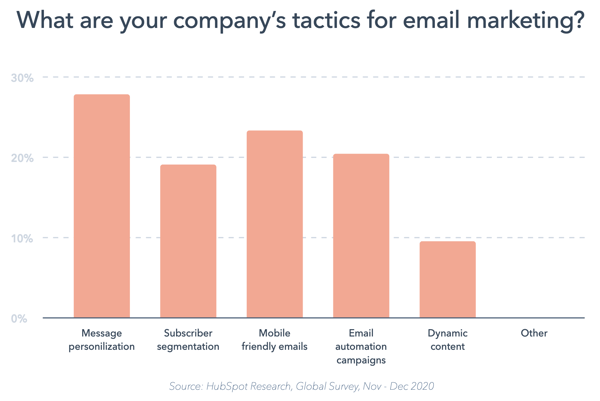
- Message Personalization is the #1 tactic used by email marketers to increase engagement rates. (HubSpot)
- More than 20% of marketers say personalization can improve email engagement. (HubSpot)
- 99% of marketers say personalization helps advance customer relationships, with 78% claiming it has a“strong” or “extremely strong” impact. (Evergage)
- 80% of consumers are more likely to make a purchase when brands offer personalized experiences. (Epsilon)
- 90% of U.S. consumers find personalized marketing content somewhat to very appealing. (Statista)
- 78% of marketers say email is the most personalized channel, followed by websites, which 56% of marketers noted. (Evergage)
- The biggest challenge that ABM teams face is personalizing their strategy. (HubSpot)
- 40% of marketers say their biggest challenge with personalization is linking to data-related technologies, while 34% struggle with poor data quality. (Experian)
- 78% of brands say they struggle with “data debt” or not having enough quick data about their customers to not launch relevant personalization tactics. (Experian)
Consumer Preferences of Personalized Marketing
- 92% of marketers say customers and prospects expect a personalized experience — up from 85% in 2019. (Evergage)
- 45% of consumers say the “coolest” personalized tactic they’ve seen is when a brand apologizes for poor shopping experiences. (Accenture)
- 74% of consumers would find “living profiles” valuable if they could be used to curate the experiences, offers, and products they receive. (Accenture)
- 67% of consumers think it’s important for brands to automatically adjust content based on current context. When brands don’t adjust accordingly, 42% of consumers will “get annoyed” that content isn’t personalized. (Adobe)
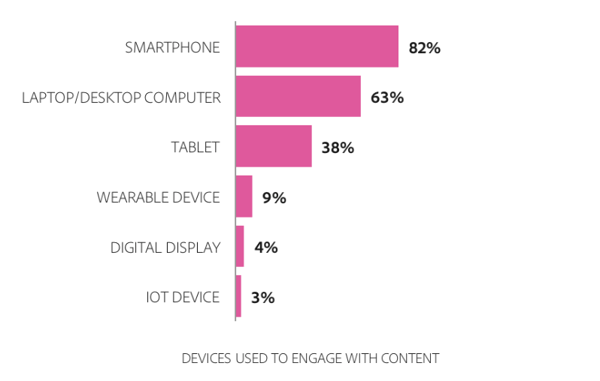
- 82% of consumers primarily engage with marketing content on smartphones, while 63% engage with content primarily on computers. (Adobe)
Data Privacy Preferences
- 83% of shoppers would exchange data for a more personalized experience. (Accenture)
- In a 2019 study, 79% of consumers surveyed believed companies knew too much about them, but 90% were still willing to share behavioral data for a cheaper and easier brand experience. (SmarterHQ)
- Three out of four consumers say a business has never communicated with them online in a way that felt too personalized or invasive. (Accenture)
- Of the one quarter of consumers who’ve received a personal or invasive brand experience, 64 percent) say it was because the brand had information about them that they didn’t share knowingly or directly. (Accenture)
- In an Accenture survey, consumers said the “creepiest” personalized marketing tactics involved texting or sending a notification when someone walked past a brand’s store and launching social media ads for items consumers browsed on a brand website. (Accenture)
Anonymous vs. Permission-Based Personalization
There are varying opinions in marketing about the appropriate time in the customer lifecycle to use personalization.
While some argue that personalization should only take place after the end-viewer has consciously provided information to the company, other companies use anonymous data, like the location attached to a viewer’s IP address, in order to target viewers by location. In developing your personalization strategy, you’ll need to decide what the right approach is for your company and customers.
- Regardless of what technology enables, it’s essential that your strategy start and end with the needs and preferences of the customer. For many, that will mean waiting until the customer has engaged with you before personalizing content.
- 42% of surveyed marketers claim they personalize using anonymous data. (eConsultancy/Adobe)
- 57% are okay with providing personal information on a website as long as it’s for their benefit and being used in responsible ways. (Janrain)
- 77% would trust businesses more if they explained how they’re using personal information to improve their online experience. (Janrain)
- 62% of adults under 34 are willing to share their location for more relevant content. (Jiwire)
Navigating Marketing Personalization
We have entered into an exciting time for marketers and buyers alike. The ability to create unique experiences for each prospective customer will undoubtedly lead to buying experiences that are more relevant, useful, and enjoyable. As we navigate this new space and develop strategies, it will be important to keep an open discussion going about what’s working and what’s not in the world of personalization.
This data is helping to frame the early stages of that conversation. Hopefully the coming year will result in more results and good case studies of companies using personalization to create a more “human” marketing experience.
Editor’s Note: This post was originally published in September of 2013, but was updated in May 11 for comprehensiveness and freshness.

Deal Pipelines Gain Positive Momentum in Mid-May [COVID-19 Benchmark Data]
For the last few months, businesses around the world have had to rapidly adapt to the impact of COVID-19.
In a time where it seems like things change every day, it can be difficult to gauge whether the challenges your business is facing are widespread.
That’s why we’re publishing week-over-week benchmark data for core business metrics like website traffic, email send and open rates, sales engagements, close rates, and more. These core metrics are split by region, company size, and industry cuts, so you can explore data for companies most similar to yours. You can find the data, and more context on the dataset and sources, here.
Because the data is aggregated from our customer base, please keep in mind that individual businesses, including HubSpot’s, may differ based on their own markets, customer base, industry, geography, stage, and/or other factors.
These insights are refreshed every Thursday morning ET, and will be accompanied by this short writeup. You can find past writeups using this timeline.

We hope to establish useful benchmarks to measure your business against, and serve as an early indicator of when short- or long-term adjustments may be needed in your strategy.
What We’re Seeing
Here are the three key takeaways from the most recent week’s data:
1. Deals created and closed gain positive momentum as some industries and countries show encouraging performance towards mid-May.
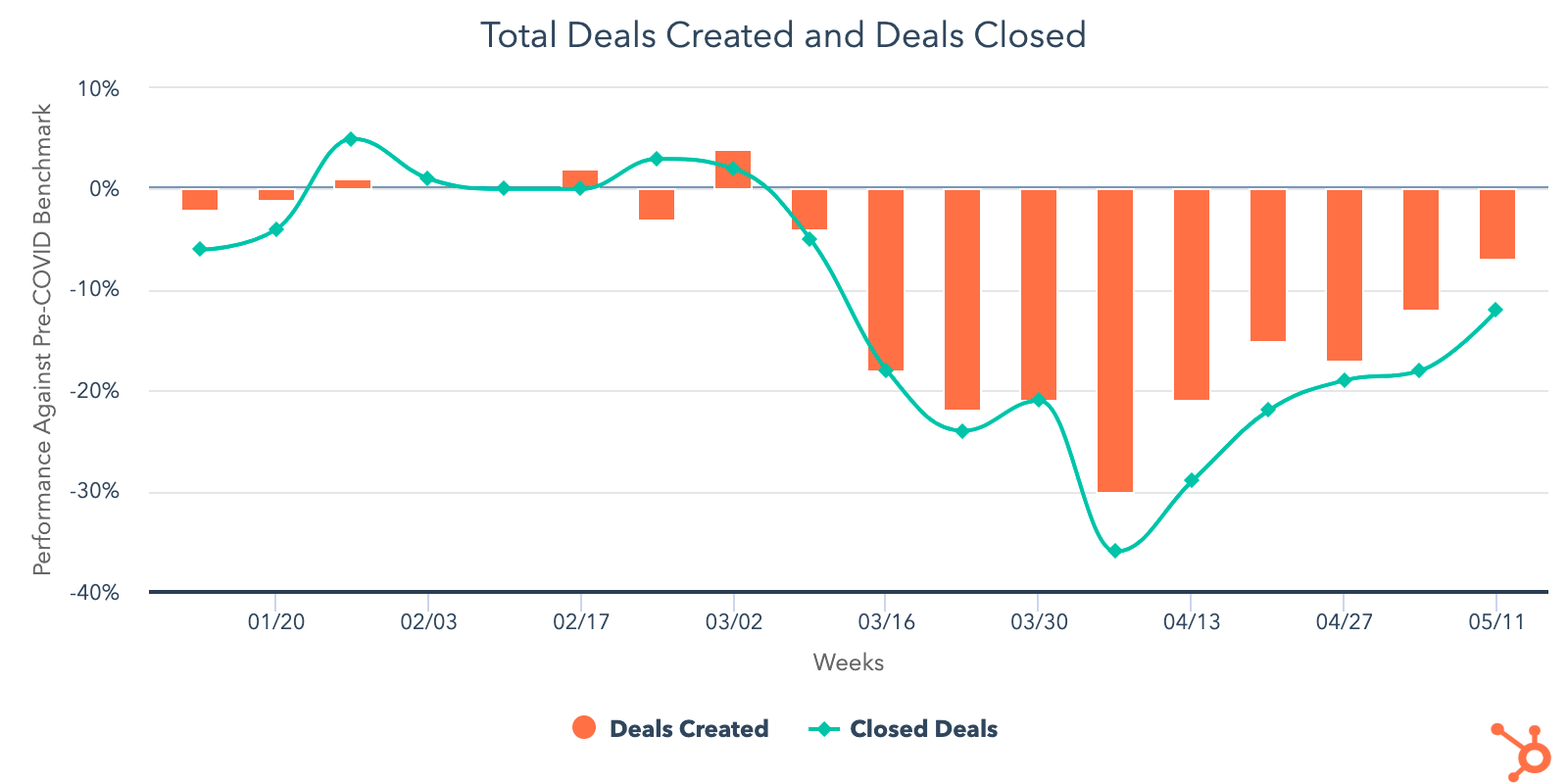
After a 6% increase during the week of May 4, global deals created rose another 6% last week. Deal creation is still 7% below pre-COVID levels, but this metric has been trending in a positive direction over the past few weeks. The number of deals closed also increased by 8%, which is a promising sign after seeing the recent rise in deals created earlier this month. The combined growth of deals created and deals closed should provide optimism for sales teams, especially those working in industries that haven’t been as structurally impacted by COVID-19.
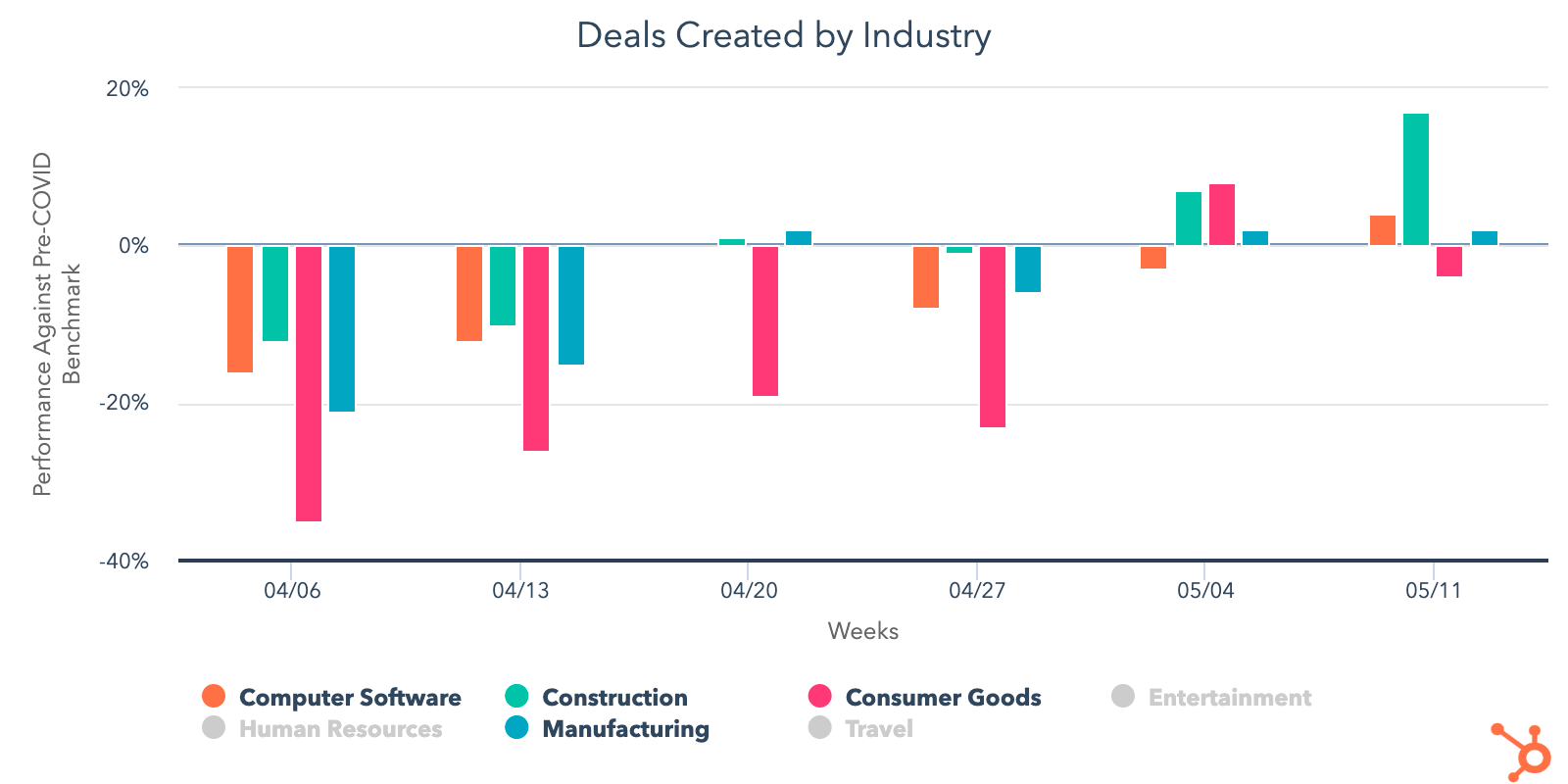
Almost all industries experienced an increase in deal creation during the week of May 11, except for consumer goods which dropped 11% from the previous week. There are now four industries that are trending close to or above pre-COVID levels as construction is 17% above, computer software is 4% above, and manufacturing is 2% above the benchmark. Consumer goods is trending 4% below pre-COVID levels, and although it experienced a drop in deals created last week, that dip was accompanied by a 17% increase in deals closed-won, which is a hopeful sign for sales teams as we move towards the end of May.
For the last several weeks, we’ve been paying attention to countries that have been in the news for reopening their economies. Italy, Spain, and Germany, all saw increases in deals created during the week of May 11. Italy experienced the largest bump with a 12% increase in deal creation and a 14% increase in deals closed. Germany had a 5% increase in deals created and stayed on par with global averages for deals closed. Germany’s performance is similar to Australia’s as deals created there were 6% higher during the week of May 11 and are now trending just above pre-COVID levels.
The United States is another country that’s near the top of our watchlist. You can explore its macro-regional data here, but we’ll provide a more detailed breakdown later in this post.
2. Sales teams return to calling, marketing metrics show strong engagement, and the demand on inbound channels remains high.
After weeks of remaining flat, sales email response rates saw a slight increase during the week of May 11. While response rates are still below pre-COVID levels, this recent rise in engagement has given way for more sales activity.
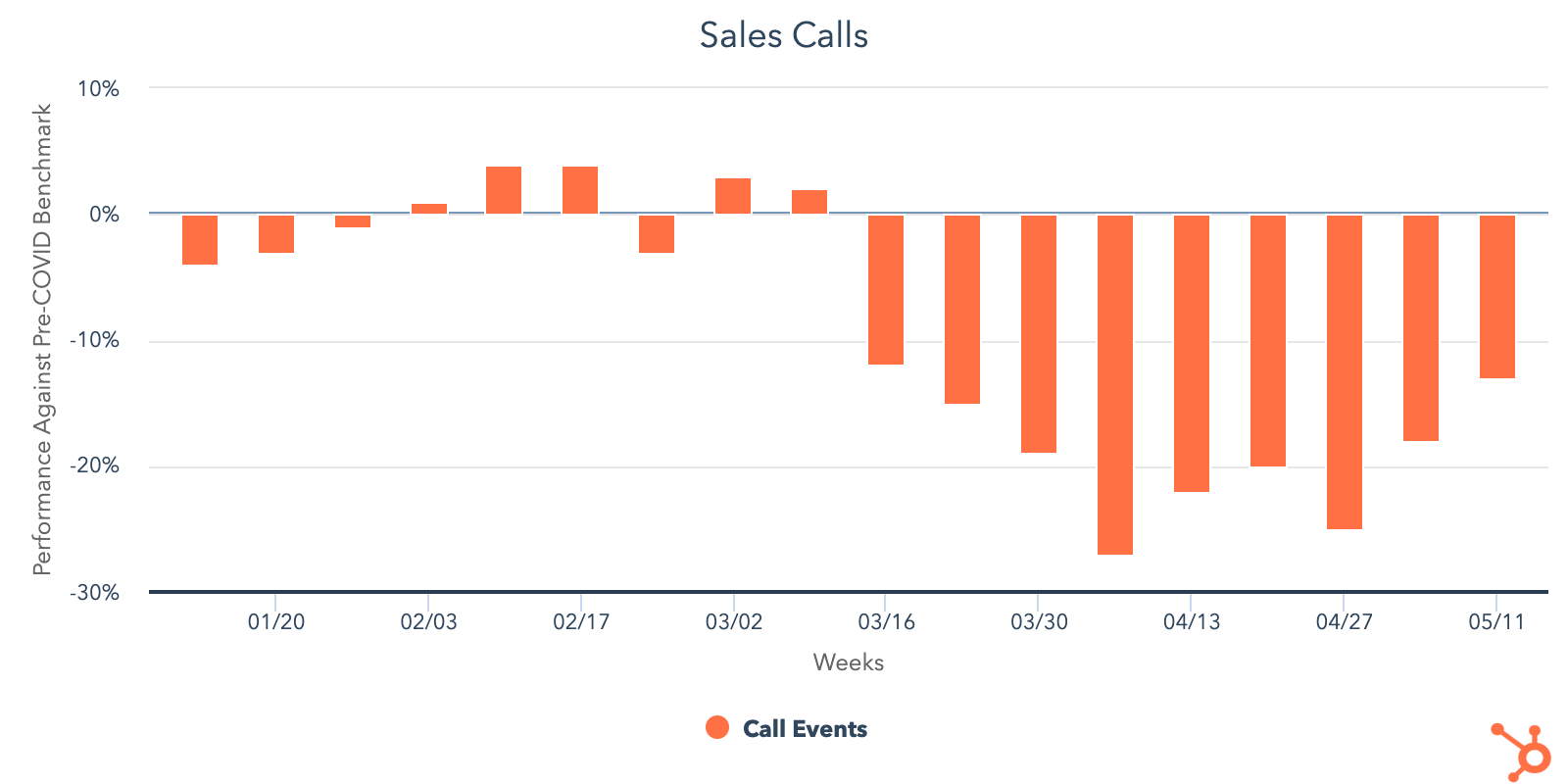
Previously, email response rates reached their lowest average this year, but as they show signs of recovery in May, sales teams are able to resume higher levels of other, more direct prospecting activities, like phone calls. Call volume has increased 16% since the week of April 27 and contact growth has remained consistent with pre-COVID averages during the week of May 11. Now that more countries and states are starting to open back up, we’re seeing businesses returning to traditional outreach channels like calling clients and booking meetings.
Marketing metrics, on the hand, remain strong. Marketers sent fewer emails this week, but send and open rates continue to trend well above pre-COVID levels. Email engagement was particularly high during the week of May 11 as open rates are currently trending 29% above the benchmark. That’s roughly a 10% boost from the previous week.
Engagement for other marketing channels remains strong as well. Customer-initiated conversations increased 4% during the week of May 11 and are 33% above pre-COVID levels. Web traffic was up last week, too, sitting at 23% above the benchmark. This indicates that there’s still a great demand for inbound strategies as people start to gravitate towards different marketing channels.
3. The United States remains on par with global sales activity as the country begins to reopen its economy.
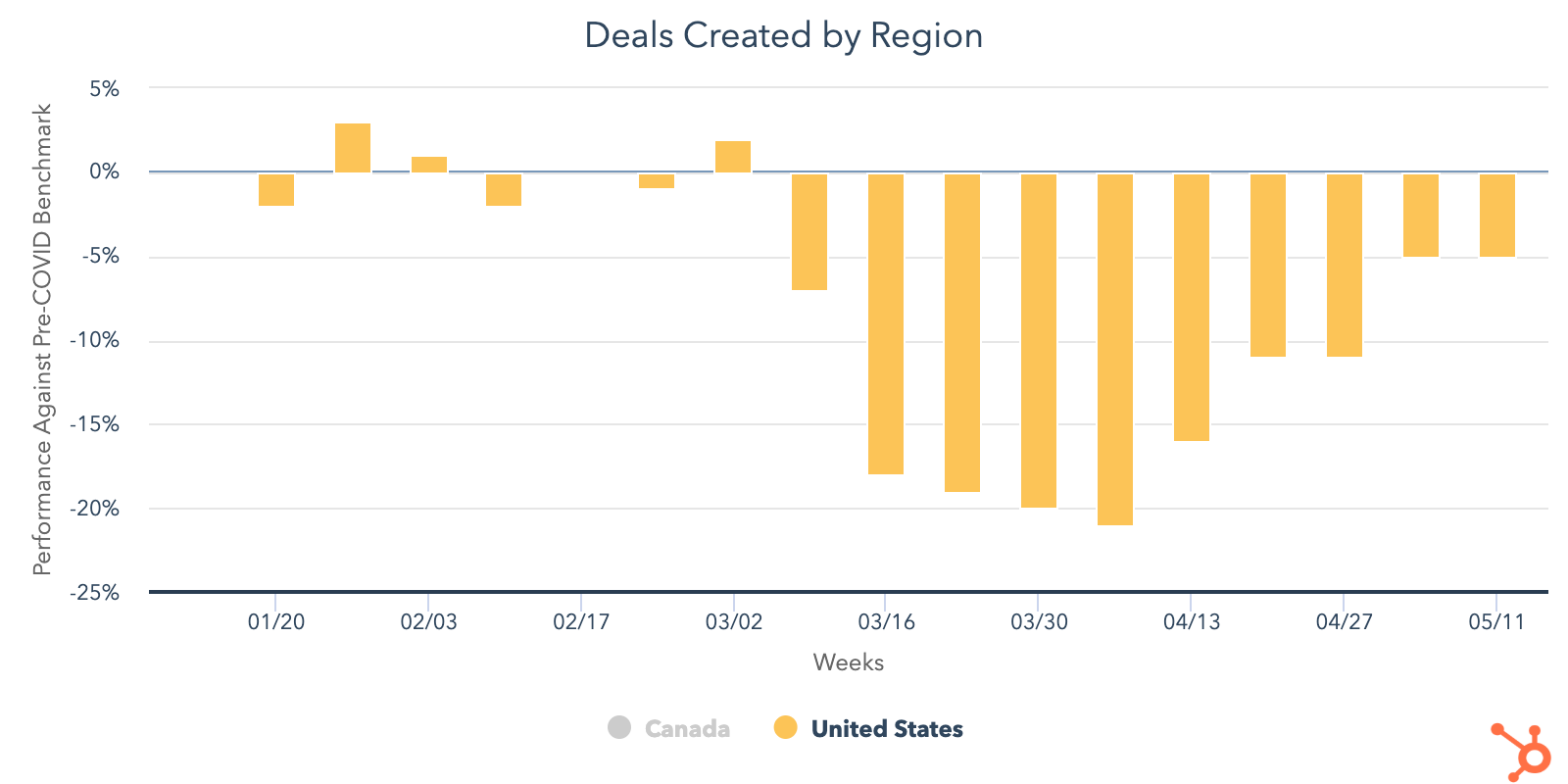
As states across the U.S. continue to reopen businesses and lighten COVID-19 restrictions, sales activity has begun to rebound. Deal creation has remained steadily improved over the past five weeks and currently the U.S. is only trending 5% below pre-COVID levels. Deals closed-won increased by 2% as well, resulting in the most closed-won deals for the country since the week of April 6, when nearly all of the countries we’re tracking experienced a significant dip. Although the U.S. is still 10% below the pre-COVID benchmark for deals closed, we hope this will improve as we near toward the end of May.
The volume of sales emails for the U.S. continues to trend above pre-COVID levels landing at 70% for the week of May 11. Response rates remain below pre-COVID averages and, like sales volume, remained flat compared to the previous week. Additionally, after trending downward in mid-March, call volume in the U.S. is now up 4%, but still sits 10% below pre-COVID levels. As more states start to relax their COVID-19 legislation, we expect sales activity to yield a positive trend over the next few weeks.
Marketing metrics for the U.S. have remained on par with global averages. Email send and open rates have been trending well-above the benchmark since mid-March and last week open rates hit a year-best, reaching 31% above pre-COVID levels. Web traffic has been really strong in the U.S., too, as last week marked the 15th week in a row where web traffic has been recorded above the benchmark. It’s now sitting at 28% above pre-COVID levels.
What This Means for Businesses
Sales teams need to reinvent how they prospect.
While sales results are incrementally improving week-over-week, salespeople are still spending a great deal of time reaching out to poor-fit prospects. The deal pipeline metrics are an encouraging sign that more businesses are reentering buying processes, but it’s still too early to tell how much of this growth will be sustained. For now, it’s a safe bet that your sales team should continue prioritizing high-interest, good-fit buyers rather than indiscriminately prospecting.
Resources to Help
- Watch the replay of our Adapt 2020 webinar on selling through uncertainty
- Refresh your email outreach with these sales templates.
- Start using video in your sales outreach to engage more prospects.
- Use this guide to increase your sales close rates.
- Lead with empathy in sales emails to build rapport and increase response rates.
Consider whether online advertising is a fit for your business.
The significant dip in advertising spend tells us that many businesses have paused their ad campaigns either temporarily or indefinitely. There’s an opportunity for companies to enter a more affordable market. Whether or not this approach is right for your company entirely depends on your audience and offering, but if online ads work for your business, now may be a good time to un-pause campaigns.
Resources to Help
- Attend next week’s Adapt 2020 webinar on retaining customers during difficult times like these
- Get up to speed on using Facebook Lead Ads with this beginner’s guide to building audiences and ads
- Read our ultimate guide to online advertising
- Plan your investment with this guide to budgeting for advertising
- Set up and run campaigns using HubSpot Ads, Facebook Lead Ads, or Google Ads
Free Software to Get Started
- HubSpot CRM is free and comes with included advertising and sales acceleration tools, including free 1:1 video, meetings, and chatbot tools
- Gmail and Google Calendar integrations with HubSpot
- Zoom integration with HubSpot
- LinkedIn Sales Navigator integration with HubSpot
- Check out what HubSpot’s app partners are offering at this time with this list of relief initiatives

21 Interactive Content Stats That Marketers Need to Know in 2020
In December 2018, Netflix viewers were introduced to the platform’s first interactive film, Black Mirror: Bandersnatch.
Bandersnatch followed a character named Stefan, a tormented game developer who was forced to make a number of simple and tough decisions to release a video game.
Each time Stefan had to make a decision — such as eating Sugar Puffs or Frosties for breakfast — two options would appear on the screen. Stefan’s fate was then in the Netflix viewers’ hands as they could choose what happened next.
The choose-your-own-adventure film — which allowed viewers to go down one of nearly one trillion paths based on their choices — was a viral hit.
Bandersnatch generated a ton of buzz on social media for Netflix, and the streaming giant was also able to use data from the decisions viewers selected. At one point, the streaming site released data to show which choices users commonly made.
Since Bandersnatch’s success, the entertainment industry and brands have continued to jump on the interactive content bandwagon with high-priced AR/VR and even video-game based campaigns.
But, as a small or medium-sized business marketer who isn’t ready to dabble in AR/VR just yet, you might be wondering, “Is interactive content really worth its price?”
Yes, interactive content is highly engaging, attracts customers, and provides value. But, you don’t necessarily need expertise in emerging technology to leverage it.
Below are 21 stats that highlight how interactive content is growing, the benefits it provides for brands, emerging interactive marketing technology, and a few of the most effective content types that marketers are using today.
21 Interactive Content Stats to Know
General Interactive Content Stats
- 45% of B2B buyers say interactive content is one of their top three preferred content types. (SnapApp)
- 51% of B2B buyers say interactive content is helpful when tackling business challenges. (SnapApp)
- 62% of B2B marketers are already using interactive content. (DemandGen)
- Interactive content gains two times more engagement than static content. (DemandGen)
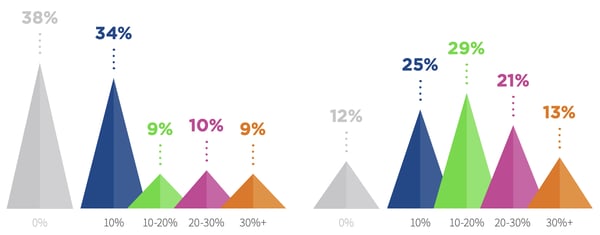
- 34% of marketers say at least 10% of their content is interactive. (DemandGen)
- Meanwhile, 88% of marketers say at least 10% of their static content will be made interactive in the next two years. (DemandGen)
- 77% of marketers agree that interactive content has “reusable” value, resulting in repeat visitors and multiple exposures. (Content Marketing Institute)
- 73% agree that combining traditional content marketing tactics with interactive content enhances the retention of their organization’s message. (Content Marketing Institute)
Interactive Content Types
Quizzes, Polls, and Interactive Infographics
- 85% of B2B marketers are already using or plan to use interactive infographics as part of their strategy. (DemandGen)
- Women.com owns well over half the engagement for online quizzes, dominating even Buzzfeed, which is better known for this kind of interactive content. (Buzzsumo)
- 75% agree that non-gated interactive content can provide a “sample” of the brand, resulting in a higher degree of lead nurturing. (Content Marketing Institute)
- In a HubSpot poll, 15% of consumers preferred to tap through Instagram Stories with quiz or poll features. This interactive content type was the third most popular Story format. (HubSpot)
Interactive Videos, AR, and VR
- 62% of B2B marketers plan to use or are already using interactive videos in their tactics. (DemandGen)
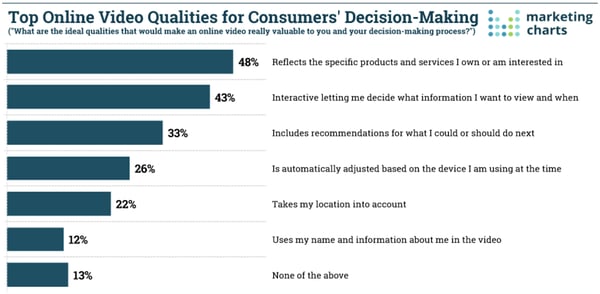
- 43% of consumers prefer interactive video content over other types of video content because it gives them the ability to decide what information they want to view and when they want to view it. (MarketingCharts)
- 38% of agency experts say they help produce webinars for clients. (Content Marketing Institute)
- 45% of agency employees help brands create live experiences, such as virtual events or Q&As. (Content Marketing Institute)
- In 2019, 42.9 million people in the US used a VR product, and 68.7 million people used an AR once monthly. (eMarketer)
- In 2018, 88% of companies with budgets between $100 million and $1 billion were already experimenting with different forms of AR. (Deloitte)
- A quarter of VR users believe it has a strong potential for brands and marketers. (GlobalWebIndex)
- 71% of consumers would prefer to shop at stores with an AR experience (Lumus Vision)
- 64% of consumers say VR has the most potential in gaming, while 52% recognize its potential in Film and TV. (GlobalWebIndex)
Testing the Waters With Interactive Content
If you’re primarily used to creating static content, wrapping your mind around how to make your branding more interactive can feel overwhelming.
Luckily, in 2020, you don’t need to be an AR expert or a coder to test the waters with low-cost interactive content. For example, you could leverage Instagram or Facebook Stories to poll or quiz your audiences, use an online quiz creator to generate an assessment for your website, or plan a live stream on a social platform that allows you to ask an expert questions from those who are commenting on it.
For a few great examples of how brands are getting interactive, check out this blog post. Ready to get started with your own content? Here are a few easy-to-use tools that can help you.

I Failed at Podcasting, and So Can You
In 2016, I thought I had the perfect plan.
My Georgetown graduate students desperately needed to get away from books and learn about start-ups through real world experience. And Washington, D.C. was booming with startups.
So I figured — why not launch a podcast called “Students vs. Startups … Showdown on the Potomac?”
In hindsight, “Students vs. Startups” encountered a perfect storm, and I steered right into it. Ultimately, the podcast’s failure boiled down to five major factors.
Here, let’s dive into the five factors that led to the failure of my first podcast, and what you can learn from them.
1. Have multiple sponsors who are eager to support your podcast.
In my case, my sponsor was a hot startup seeking great resumes to grow their company — and grow, it did.
Eventually, the startup caught the attention of a larger company that bought it out. Marketing decisions were taken out of the hands of my success-at-any-cost champion.
While it’s easy to blame the sponsor, I realized I failed on several levels:
- By assuming the new organization would have the same hunger as the aggressive startup. From the new corporate perspective, sponsorship for the podcast was delegated to the marketing department, and funding eventually dried up when the marketing teams prioritized other avenues.
- By not seeking other sponsors during the podcast. I should’ve had a backup sponsor in case my first sponsor backed out.
- By not devoting 100% effort to the success of the podcast. I treated it as a line item in a month of activities. In addition to teaching, I was conducting corporate workshops, doing video interviews, speaking onstage, and consulting. I put the difficult work of finding a backup sponsor on hold for the relatively mechanical activities of the podcast: getting guests, students, and managing the freelance audio engineers.
Lesson: Launching a successful podcast means all hands-on deck. It shouldn’t be an isolated activity. To ensure long-term success, you’ll want multiple sponsors who are eager to financially support your podcast endeavors.
2. Ensure your host is engaging and can connect with the audience.
In my long broadcast career, I realized I’m able to control the energy of the show.
This is a subtle but powerful characteristic of the audio format — there are no visual clues to allow the audience to understand what is going on, so the speaker must give plenty of verbal clues to make the exchange appealing.
If the focal point was the students interacting with startups, the premise of my show was flawed. By letting the conversation flow organically, I missed out on opportunities to make the dialogue more engaging for the audience.
Listening to “Students vs. Startups” after a couple of years gave me a new perspective: Many times, the excitement dissolved after my opening. A mitigating issue must be the fact that the podcast was recorded at 6:30 PM, after everyone had worked a long day.
Lesson: If you are staking your reputation on the success of a podcast, take it upon your shoulders to handle the magic of the microphone, and ensure you have engaging talking points ready for your subjects.
3. Ensure your podcast can show up in search.
We know that humans search. A lot. A recent article indicates that Google receives 63,000 searches per second, on any given day — so it makes sense that you’d need a strong digital presence to enable searchers to find your podcast in the first place.
Search engines seek text, so you can more easily attract search bots by including text with your Show Notes page. This page should be the target of your inbound and outbound marketing efforts.
In your Show Notes page, make sure you have keywords placed appropriately, include images, the full transcript of the podcast, and a summary. These “Blog Basics” can help your podcast get discovered through search.
One essential in digital marketing is the art of the launch. Unfortunately, it was an afterthought for “Students vs. Startups”. If you have an established email list with thousands of followers, the launch of a podcast can be much smoother. When email recipients click on the Show Notes page, Google will get signals of popularity and can improve the domain authority of that page, making it easier to find.
“Students vs. Startups” began from scratch. It had no email list or promotion budget. It was remarkable the podcast got any listeners at all. An email list allows you to question, survey, and learn about the needs and desires of your intended audience.
Lesson: Hire a professional to take care of the audio and scheduling. Bring in someone to structure a Show Notes page that is fast, mobile-friendly, and can be found easily through search.
4. Listen to your audience.
Ultimately, the most important part of my podcast show was missing: the audience. I failed to connect to the audience and gain a better understanding of what questions they had for entrepreneurs.
And, of all the people in the world, I should’ve known this. For ten years I wrote a weekly technology column for The Washington Post called, “Ask the Computer Guy.” The idea of the column was to listen to the audience and help with their problems. This simple formula worked well — the column lasted a decade and had national syndication. Perhaps my hubris didn’t allow me to reach out to the startup audience to see what they wanted.
You may want to go face-to-face at trade shows and ask what topics people would like to hear. Beyond that, read forums, participate in LinkedIn groups, absorb Reddit responses, and see what questions come up on Quora.
Lesson: Get off your high horse and ask what the audience wants.
5. Your success ratio should be one hour recording, and 10 hours promoting.
For a successful podcast, you’ll want to budget one hour for studio time, and at least 10 hours for promotion efforts.
If you aren’t an audio engineer, you should outsource the audio editing to a professional. This will give you more time to promote your podcast.
For promotion, a great use of your time is to become a guest on other podcasts, which almost guarantees more downloads for you.
Lesson: 10X your promotion efforts. If you’ve done your homework and listened to the audience, when you promote it, people will say, “Wow, I was just wondering about that topic. I’m going to give it a listen.”
If you want to launch a corporate podcast, it’s critical you have a detailed plan for success. If you have a sponsor, deepen that relationship in case there are mitigating circumstances that can impact your financial situation. Always develop new business contacts in case things change.
The moderator can make-or-break the podcast. Lead with enthusiasm, stick with a theme, and control the interview.
Now, a little over four years later, I now have two successful podcasts: Federal TechTalk and Constellations. I’ve learned something from my past mistakes — I hope you can, too.

Why HubSpot’s Director of Analytics Wants You to Make Data More Human
Reporting and attribution have revolutionized marketing in every industry. Marketing data allows businesses to make more informed decisions about their audiences’ needs, challenges, and interests.
For years, demographic reporting has done wonders for marketers. Data points such as age, ethnicity, gender, location, education, and employment have informed marketing teams and heightened the impact of campaigns across the board.
Unfortunately, there’s only so much that demographic data can tell us about the people searching for and purchasing our products and services.
2020 is the time to make data more human.
Key Takeaways & Expert Insights
Humanizing a historically inhuman component of marketing (such as reporting and attribution) can be tough. Let’s talk about a few ways to do this.
Firstly, start to switch your reporting focus from demographic data to psychographic and behavioral data. This should be a major change your organization makes in how and why you collect data. We’ll talk more about how to do this later in this article.
Secondly, expect democratization of data. Today, data is difficult to gather and is typically controlled by a dedicated marketing analytics team. While this may be a good way to collect and manage your company’s data, it can create a silo that alienates your data from the people at your company who can actually apply and learn from it.
In 2020, expect analytics teams to start making data more accessible for all employees. To jump start this process within your organization, invest in systems that automate your marketing reporting and make it easier for your employees to access that information. Teach employees how to properly apply this data, too.
Strive for efficiency and alignment across your organization. Here are a few ways to do this:
1. Align all departments within the organization around being a data-driven company and agreed-upon goals.
2. Choose and define a home for your marketing data. Where does your data live? Is it currently available? How can employees access it?
3. Avoid common marketing reporting mistakes, including one-off reports and random data pulls. These waste time and produce inconsistent data that doesn’t speak to your audience or contribute to real results.
4. Document your marketing reporting process — this might look something like: gather data, define important patterns, automate, and repeat. Instead of assigning different roles or teams to each part of the process, consider dividing up your marketing reporting workload by data source. This will allow the same people to see your data through from collection to application.
Keep Investing in Attribution to Identify Bottom-Line Impact
In 2020, continue focusing on marketing attribution reporting. When did customers first touch your brand? When did they last touch it? Where are your visitors and customers coming from?
According to our 2020 State of Marketing report, only 50% of companies are currently using attribution reporting — and almost 30% answered “No.”
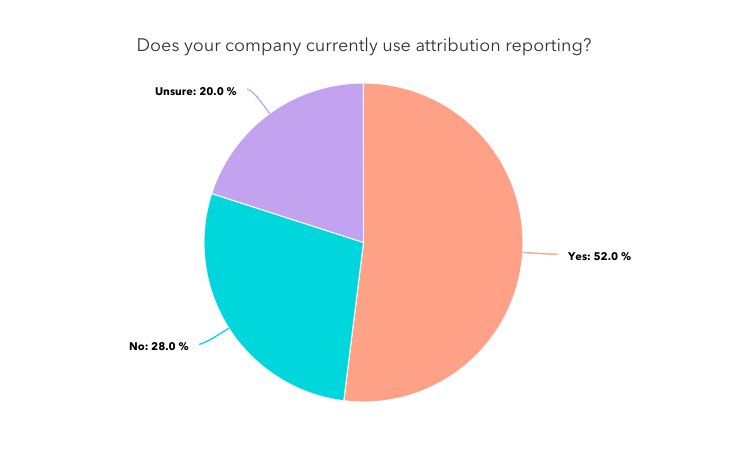

Everything You Need to Know About Marketing Operations In One Place
One of my favorite movies is “School of Rock,” which also happens to be one of 2003’s best films.
In the movie, Jack Black poses as a substitute teacher at a private school, and, after noticing the students are musically talented, he turns the 10-year-olds into a fully-fledged rock band.
When assigning roles to the students, such as “lead singer,” “lead guitarist,” and “keyboardist,” he approaches the class president and deems her band manager because she had the organization skills needed to help the band run smoothly.
“Summer,” he says, “You’re in charge of the whole thing.”
I think of this quote when I think about marketing operations. Without a marketing operations team, businesses that depend on technology would have a less-than-seamless experience carrying out their duties.
Known affectionately as “MOps” at HubSpot, the marketing operations team is responsible for making sure the highly complex technology used at HubSpot is always top-notch, which helps the greater marketing team (and business as a whole).
Let’s learn more about marketing operations and why these teams are essential to a business.
What is marketing operations?
Marketing ops enables the greater marketing team to run at an efficient level. They also have the ability to scale their operations as the company grows larger.
At HubSpot, the marketing ops team is responsible for supporting the systems and processes that enable the marketing team to perform optimally in their roles. This includes everything from permissions, conversational marketing, user data, forms, and email operations.
Without marketing operations, it would be tough for marketing teams to effectively complete essential marketing activities. Because technology is necessary to carry out most marketing tasks, a team to manage the complexity of that technology is also necessary.
That’s where marketing ops comes in. This team is responsible for being the powerhouse of the company — they align the processes, historical data, goals, and people of a business.
Marketing ops teams have a hand in multiple stages of marketing duties, including the creation and management of important projects. For example, a marketing ops professional might oversee the budgeting and planning for an automated email marketing campaign so they can document the ROMI.
A marketing ops department tracks the Return on Marketing Investment (ROMI). This is because the team’s core function is to keep track of how the efficiency of their strategies is contributing to initial investments.
A key function of how well a marketing ops team works is proper management. So, in the next section, we’re going to talk about marketing ops management and what it entails.
Marketing Operations Management
Before we get into the details of marketing ops management, let’s put a definition behind the term.
Marketing operations management is the framework for how a marketing operations team runs. It describes the optimization of a marketing strategy from beginning to end.
The goal of marketing ops management is to make marketing activities efficient. Because of this, it’s not uncommon for a marketing operations team to have a hand in content planning and campaign analysis. It’s also likely to find the tools needed to achieve this to-do list in software that handles marketing and business, like HubSpot’s all-in-one CRM.
Marketing operations defines the process of strategizing and optimizing, while marketing ops management defines how that happens.
Now that we have an understanding of what marketing ops is and what they do, let’s talk about the details of a marketing ops strategy.
Marketing Operations Strategy
Marketing operations team members need to have an expansive skillset. Some of the common roles within this department or team are email operations, systems analysis, customer data and marketing, user operations, and lead rotation.
All of these roles come together to align the process and platforms needed to carry out marketing tasks for the greater marketing team.
When thinking about a marketing ops strategy, think about the problems the marketing ops team needs to solve. For instance, it’s common for marketing operations strategies to solve the needs of customers, stakeholders, and the employees of your company.
To understand what a marketing operations strategy is, we’ll start with an example: Let’s say a marketing ops team wanted to make email marketing a more valuable process for both parties involved (customers and marketers).
1. Identify what you want your operations strategy to accomplish for stakeholders.
The first step in defining a marketing ops strategy is outlining major goals. For instance, your marketing ops team might decide sending email marketing messages, enabling sales to source quality leads, and identifying key marketers to execute that process are three goals they have for quarter one.
When you identify those major goals, make sure you also determine which stakeholders you are targeting. You might be targeting one group or many, but being positive about who you’re planning for will make sure your plan is actionable and valuable.
2. Determine actionable steps in your plan that will help you reach your goals.
Then, the team would look at how these tasks would help them complete their goals. For instance, the team would ask themselves, “How will enabling teams to effectively send email marketing help us reach our goals?” and estimate with an answer such as, “We should see a decrease in email churn rate.”
Determining these steps will help your marketing ops team stay organized as they work through their tasks. Additionally, by outlining these steps, your team can figure out what needs to be done and the resources needed to see success.
3. Figure out a measurable metric to determine the success of your strategy.
After identifying the tasks and the benefits for their challenge, the next step in strategizing would be to identify how the team would measure the success of the project. In this example, the team might conclude, “We will calculate churn by dividing the number of contacts who unsubscribed from emails in a month by the number of unique email recipients in a month.”
When you figure out a measurable metric, you’ll be able to keep track of the strategy’s success as your team works through the plan. The metric will remind your team of the goal you want to accomplish, and what stakeholders want to see as a result of your plan.
4. If needed, communicate how colleagues can take part in refining your strategy.
With the goal and measuring method identified, next, the team would outline what this change would mean for affected colleagues, for instance, the team members who create and distribute email marketing messages.
The team might conclude that, “Marketers can expect an easier email guideline process, a more effective format and to receive a form to offer input about how to make that happen.”
When you include relevant colleagues in the creation of your plan, you can have reassurance that your strategy will end up providing the most effective solution.
5. Assign team members to specific tasks that will contribute to the completion of your goals.
Having that set in place, what’s next for the marketing ops team is to assign team members certain tasks to help them achieve their goal. For instance, one team member might be in charge of redefining email marketing contact lists. Another might be in charge of auditing the current workflows in place for email marketing.
As team members complete these tasks, they would check them off in a centralized space so the entire team can stay updated on the status of the project.
This is how a marketing operations strategy would lead to solving for one of the most important parts of a business: the customer.
How will your marketing ops strategy empower the most important parts of your company?
Marketing operations teams are equally as effective with their strategies and management capabilities as Summer’s character in “School of Rock.” With her system of processes, the group was able to obtain their own rehearsal space and offer music classes.
They are able to come up with ways to increase customer satisfaction and ease the job of marketers. Their strategies make marketing activities and duties accessible to all, and because of that, are an essential part of a business.

How to Craft the Perfect Email for Every Stage of the Buyer’s Journey
Collectively, 103 trillion emails are sent worldwide every year … that’s not a typo.
And 58% of people check their email before doing anything else online. It’s no secret that email isn’t dead despite the abundance of messaging apps and social media platforms sprouting up everywhere you look.
There’s a reason 81% of businesses rely on email marketing for customer acquisition — the impressive return on investment (ROI).
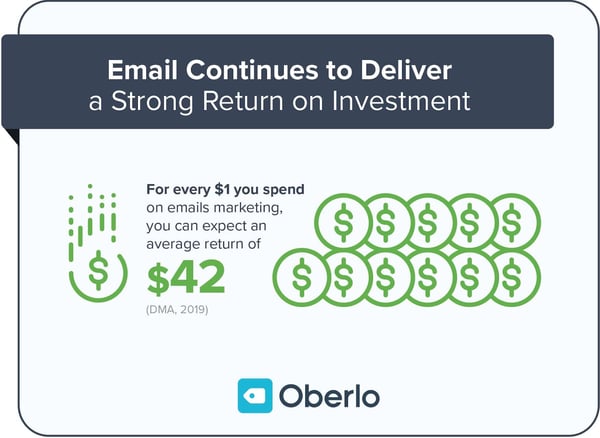
We all know it’s important. Yet many marketers get lost in the trillions of emails floating through cyberspace.
While there’s no such thing as a perfect email strategy, it’s important to consider the thought process of users at each stage of the buyer’s journey along the way. What kind of information are they looking for? Why should they trust you?
What’s going to help them the most, right this second?
If you’re not sure, don’t worry. You’re in the right place.
Keep reading to learn how to answer these questions and start delivering the right emails at the right time for your audience. By the end, you’ll know what to offer, when to send your emails, and how to stand out in an endless sea of email oblivion.
What is an email funnel?
An email funnel is an automated campaign or series of emails that guides your audience from one stage of the buyer’s journey to the next. Each email’s job is to nudge your readers one step closer to the final action you want them to take.
There are four stages (or five depending on who you ask) in this funnel.
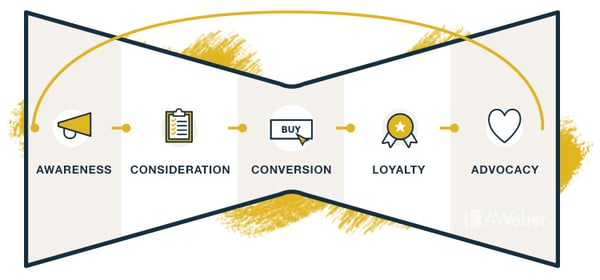
The types of content you create and send should differ from one stage to the next. This is because readers at different stages are interested in different types of information. In other words, not all stages are created equal.
So, let’s start at the beginning.
Stage 1: Awareness
New subscribers enter the buyer’s journey at the top. It’s the largest portion of the journey because it includes a wide net of readers interested in what you have to say. As we move through the stages, the net becomes smaller and smaller.
For most, joining your list is the first time they’re interacting with your brand.
So, they enter at the awareness stage. At this point, they’re not ready to buy anything from you. New subscribers aren’t interested in an inbox full of annoying and repetitive product promotion emails (you know the ones).
They want to know:
- What’s in it for them
- Why they should stay on your list
- How you’re going to help them
The average open rate in North America is 19.49%. But, welcome emails have an open rate closer to 50%. New subscribers expect to get a warm welcome, so this is your chance to show them why they made a smart decision in joining your list.
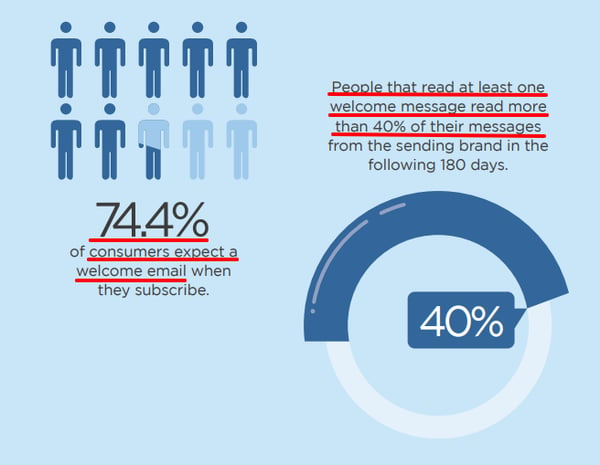
The goal of introductory emails is to turn new subscribers into potential customers without asking them to spend money. They’re not ready for that. They want to get to know you and develop trust in your brand.
To nurture that relationship, give them something valuable they can use right away. Help them get one step closer to their goals by offering:
- Educational content including ebooks, email courses, and white papers that offer exclusive insight into your brand or how to accomplish something new. For instance, Upwork offers their The Fast Lane to Great Design ebook which is targeted to marketers looking for smart tips on how they can leverage freelancers for better design. Then, Upwork can convert their list into customers by promoting available contract designers, helping subscribers to not only learn ways to good designers but also helping to match them with the right resource.
- Actionable content like templates and workbooks that allow your subscribers to work through complex problems they’re facing. At HubSpot, we’ve created an editorial calendar and template that content managers can download and customize for their own purposes. Beyond that, we also email them with additional content they might be interested in based on their company size and industry.
- Impactful newsletters that give subscribers a chance to learn new things on a regular basis. To capture recurring readers, the sleep blog eachnight uses a handy Sleep Calculator which reminds readers what their ideal bedtime is based on their required wake up time. If users opt in to having eachnight email them personalized results, they’ll also get newsletter emails each time new sleep articles get published so you can learn more about how to achieve a restful night’s sleep.
Stage 1 Email Example
Everyone loves examples, right? This one comes from Brendan Hufford at SEO For the Rest of Us. His welcome email is a real-world example of an impactful newsletter. Give it a read.
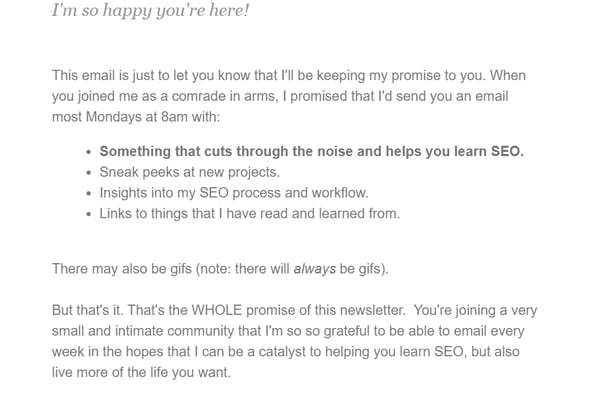
This email oozes with empathy, personality, humor, informative content, and promise of gifs. No product mentions or sales tactics for you to roll your eyes at.
This example works SO well because he outlines what you’re going to get by joining his list. If you want to learn more about SEO, you know you’re in the right place. Right away, you can tell if this is the newsletter for you.
Pro tip: Use customer personas with your emails to craft emails that are uber relevant to your target audience.
Stage 2: Consideration
Audience segmentation and email automation flow can help identify new potential customers who’ve made their way to the consideration stage. They’re interested in your offer.
But they’re not ready to click “buy now”.
Nudging new subscribers towards your offer helps create buzz for your brand while delivering valuable content without shoving your product in their face. Which is exactly what should happen at this stage of the buyer’s journey.
According to Jeremy Noronha, “The middle of the funnel also gives you an opportunity to understand your customers goals and interests. You can then leverage this to recommend suitable solutions for them to solve their problems.”
After you identify potential customers and match them to one of your offers, you can start generating excitement around your product. These emails should introduce your offering and explain why they should care about it.
Valuable, educational content will help turn potential customers into qualified leads who are ready to buy something. You can do this using:
- Customer journeys like case studies and relevant testimonials.
- Hyper-relevant educational content by recording webinars, or product tutorials.
- High-level resources, knowledge base, and how-to guides.
At the end of each email, don’t forget to include a clear call-to-action.
Stage 2 Email Example
Visme is a visual content tool for individuals, businesses, and enterprises. Their tools allow you to create presentations, infographics, social media graphics, and more.
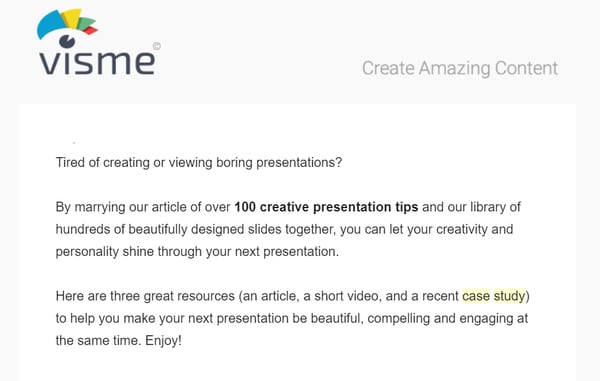
This email is great because it offers a high-level resource, a prerecorded tutorial, and a case study. Each one introduces the product and explains why you should care about creating visual content.
It works because you’re not slapped in the face with another promotional email deserving of the delete button. It’s short and punchy with a call-to-action to download the goods.
Stage 3: Decision
Qualified leads are ready to make a decision. They’re weighing the pros and cons of buying your product (and other products, too). Since 59% of consumers say that marketing emails influence their buying decisions, these emails should be top-notch.
This is your chance to prove you have the solution to their problems. They should walk away wondering how they ever lived without you.
Your approach depends on your offer and the lead. But, all successful decision stage emails display an offer in a way that’s relevant to the person receiving it.
When someone reaches this stage, you’ve already built a strong foundation for a long-term, beneficial relationship. They know who you are and they know what you have to offer.
These emails act as the last push someone needs to pull out their wallet. Get them excited, show them what they’re missing, and always fall back on giving away valuable information for free.
Consider offering:
- Free trials, time-based offers, and discount codes
- Live Demos or Q&A Sessions: The GetVOIP’s web-conferencing library is full of detailed reviews for different live conferencing tools. Use these to make an educated decision on which is right for your business.
- Proposals, estimates, or a free consultation
Stage 3 Email Example
Grammarly is a freemium online writing assistant. Everyone using the tool gets weekly usage statistics in their inbox.

They use this as an opportunity to highlight their time-based premium offer. This email works because they present the offer surrounded by interesting stats about how you use their tool and the opportunities you’re missing out on.
Many people enjoy seeing this information. Grammarly takes advantage of this by offering you a discount without coming across as scammy.
Stage 4: Advocacy
Customers are the life-blood of your business. When someone buys something, it’s important to take a moment and celebrate the win. When you’re done, think about how you’re going to keep them around.
It costs 6-7 times more to gain new customers than it does to retain existing ones. So, turning previous customers into repeat customers and brand ambassadors should be at the top of your to-do list.
On average, 65% of business comes from existing customers. And 80% of businesses rely on email marketing to increase their retention rate. Giving away valuable and nurturing email content doesn’t stop once a consumer becomes a customer. It actually becomes more important than ever.
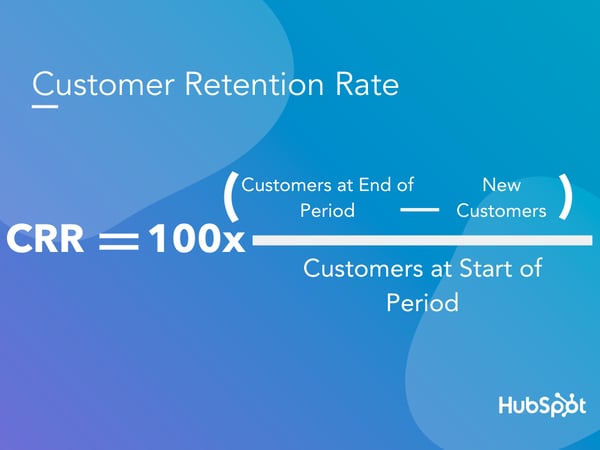
To help increase your customer retention rate, consider offering:
- Educational content, tutorials, and exclusive webinars that teach customers how to use your product to solve their biggest problems.
- Discount codes and offers that encourage customers to buy from you again.
- Personalized product recommendations and relevant cross/up-sell opportunities.
- Referral/loyalty programs that reward existing customers for spreading your message and attracting new customers.
- Consider integrating your emails with copywriting practices for better conversions.
- Create user personas to tailor emails to personal preferences of the target.
Additionally, customers are the only people who can give accurate and honest information on the flow of your business, your products, and your customer service efforts.
Because 88% of consumers trust testimonials as much as they trust their friends and family, displaying positive testimonials on your website can help you build trust with your audience.
So, use this opportunity to:
- Ask for an online review: 92% of consumers trust non-paid reviews over any other form of advertising. A few days after their purchase, ask for an honest review and make sure to reply to each one.
- Send out periodic product surveys: Use surveys to ask the right questions and gain valuable insight into your business and product offerings. Existing customers are the best source for this kind of information.
Stage 4 Email Example
Allbirds is a shoe manufacturer dedicated to carbon neutrality and environmentally friendly fashion. From responsibly sourced materials to mindful manufacturing, they hold themselves responsible for helping reduce environmental impact.
This email works because they showcase their fun and quirky message while suggesting the perfect pair of socks to go with your new pair of kicks. No gross sales tactics involved.
Writing the perfect email isn’t easy. Especially when you consider the different stages of the buyer’s journey. But, putting in the effort to do it right will work wonders for your business.
At HubSpot, our email marketing tool can help with this process. The tool gives you the power to brainstorm, write, automate, and send the perfect emails at the right time. You’ll have automated and data-driven email campaigns running before you know it.
Take the time to test different campaigns and types of content with each segment of your audience. What works for one may not work for others. You can use the ideas listed here to create multiple campaigns to see what works for you.
