
9 Employee Satisfaction Survey Questions That Will Reveal A Lot
Employee satisfaction is critical for more than just glowing Glassdoor reviews — it can also greatly impact your company’s long-term growth.
When employees are happy, they’re more likely to be productive and engaged at work. To produce exceptional results, then, it’s critical your team feels fulfilled at the office. But, while you might think you have a pulse on your employee’s satisfaction, there’s a chance you’re not seeing the whole picture.
To find out whether your employees are truly happy and engaged at work, send out an anonymous employee satisfaction survey.
9 Employee Satisfaction Survey Questions That Will Reveal A Lot
Consider asking these nine questions to gather truly helpful insights regarding your employees’ happiness.
1. Do you find your work meaningful?
A survey found the number one reason people stick with their companies was “My job — I find the work meaningful”. 32% of respondents chose this as their first option, surpassing compensation, company culture, and coworkers or managerial support.
People need to feel their work is meaningful. For many, there’s no increase in compensation (or other perks) you can offer to make them stick around if they don’t feel their work matters. To ensure low employee turnover, hire people who find meaning in your company and the specific work they’ll be doing as well as work to motivate and inspire your team often.
2. On a scale of 1 to 10, how would you rate your work-life balance?
Without good work-life balance, your employees could quickly burn out or become resentful that the company they work for doesn’t afford them time to pursue their hobbies or spend time with family. To ensure long-term satisfaction at work, it’s critical you encourage a good work-life balance for all employees.
Having a healthy work-life balance at your company doesn’t just satisfy your current employees — it also helps you attract a valuable and impressive talent pool of recruits. According to a 2017 report, 45% of employees say a good work-life balance is a key contributor to a company’s attractiveness.
3. Are you inspired by the purpose and mission of our company?
Similar to the above discussion about the importance of employees feeling their work is meaningful, if they don’t believe in your company’s purpose or mission, it’s unlikely they’ll feel fulfilled, motivated, or engaged.
Without a strong mission statement that states your purpose, it’d be difficult to encourage strong leadership and unity across the organization. But you don’t need to work for UNICEF to find purpose in your brand.
For instance, Zappos is an online shoe and apparel retailer. On the surface, it might seem like Zappos’ purpose is to provide shoes and clothing. But Zappos takes a different approach — their mission includes, “… delivering happiness to customers, employees, and vendors.”
Ask your employees if they feel inspired by your company’s purpose or mission. If they’re not, consider how you can adjust your mission statement and philosophy to ensure your employees understand their work is directly tied to a greater purpose.
4. Do you like our company culture?
Creating a delightful company culture is necessary for retaining top talent. It’s critical your employees enjoy your work culture, which includes workplace environment, company goals and expectations, and company values.
We’ve discussed already how important it is that your employees’ are happy for long-term productivity and growth. Additionally, a good workplace environment can foster better relationships between coworkers, enabling greater collaboration and efficiency.
5. On a scale of 1-10, how likely are you to recommend our company as a good place to work?
Many companies offer referral incentives when an employee recommends a strong candidate for a position. For good reason, too — it reduces cost, time, and effort normally used to find and recruit top talent. Additionally, your current employees are likely good judges of someone who would fit in well with your company’s culture.
Ideally, your employees want to recommend your company as a good place to work to members of their networks. If not, you’re likely losing out on some exceptional candidates, and it’s also an indicator your current employees aren’t as happy as they could be.
6. Hypothetically, if you were to quit tomorrow, what would your reason be?
This question is a fantastic opportunity to uncover unforeseen reasons you risk losing employees down the road. You might find employees feel undervalued or believe there aren’t enough growth opportunities. By identifying these issues, you can create new strategies that attempt to mitigate those problems and create a better culture for everyone in the long run.
7. Do you feel valued at work?
Feeling valued and appreciated at work is a necessary component for low turnover rates and high employee satisfaction. In fact, 79% of employees who quit their jobs cite a lack of appreciation as a key reason for leaving.
If your employees feel valued, they will often go the extra mile (e.g. stay late, volunteer to help other teams, and put optimal effort into their work). On the contrary, if they don’t feel respected by leadership, they won’t feel as inclined to deliver phenomenal results.
It’s critical everyone at your company — from intern to VP — feels valued and appreciated for their contributions. If they don’t feel like important assets to your team, they’ll likely eventually look for alternative opportunities.
8. Do you feel there is a scope for personal growth such as skill enhancement?
The more your company can nurture growth, the longer your employees’ will stick around. Not to mention, it’s cheaper for you to train and develop your current employees than to hire and train new ones.
Career training and professional development are key motivators to employee retention, so it’s critical you discover whether your employees feel satisfied with their current growth opportunities.
9. Does your team inspire you to do your best work?
Employees spend a good deal of time around their team members, so their happiness and productivity rely heavily on whether they feel motivated by (most) coworkers (remember, it’s not possible for everyone to be friends at all times while at work — but employees should respect, support, and challenge one another to ensure team-wide success).
If your team is able to inspire one another, it will promote increased creativity and collaboration. Additionally, it makes your job as a leader easier if coworkers are able to find renewed inspiration and motivation from each other. (If most of your employees’ don’t feel inspired, consider implementing team-building exercises to foster a better team environment.)
How to Get the Best Results From Your Employee Satisfaction Survey
There’s more to an employee satisfaction survey than the questions you ask — it’s also about how you ask them. Here are a few things you should keep in mind while creating your employee satisfaction survey, according to Lauren Pope from G2 Crowd:
1. Allow employee anonymity.
The most important part of creating an employee satisfaction survey is to allow your employees to answer anonymously. If there’s a fear of backlash, your employees may avoid answering honestly.
2. Avoid using confusing language.
Leave the industry terms and complicated language out of your employee survey. You want these questions to be accessible and easy to understand for maximum participation.
3. Keep your survey’s consistent.
It can be tempting to change your survey style and questions up every year, but you should avoid doing this. Keeping things consistent year over year will help you track your data more efficiently.
4. Don’t ask too many questions.
The worst thing you can do is overload your employees with too many questions. The longer and more time-consuming your employee satisfaction survey is, the less likely your employees will want to complete it.
5. Technology is your friend.
If your company is large enough that you’ll be handling dozens of employee satisfaction surveys, you may consider investing in an employee engagement software to lighten your workload and help streamline the process.
Editor’s note: This post was originally published in October 2018 and has been updated for comprehensiveness.

How to Launch a Successful Multichannel Marketing Strategy
If you’re even a casual reader of the business blogosphere, you’ve probably heard more than once about this great big shift in how consumers buy. And although we have plenty of jargon in the marketing world, another term is rising in popularity in response to that shift: multi-channel marketing.
What Is Multi-Channel Marketing?
Multi-channel marketing is defined by many organizations, unsurprisingly, as communicating with and marketing to prospects and customers across many channels, online and offline.
That means instead of running a single start-and-stop campaign or using one marketing tactic, like TV or email, marketers today are pacing with how consumers operate: in lots of places all at once.
Think about your own habits: We have enormous choices facing us every day, between thousands of TV channels, numerous screens and devices, and millions of websites and individual pieces of content.
That means you might want to perform research and execute a purchase in a lot of different places — by reading a blog post on your tablet,by checking for deals in your inbox,or by visiting a store so you can speak to someone in-person.
Multi-channel marketers,then,are ones who identify the channels their target customers are usingand understand how their target customers move from one channel to another to create a congruous experience.
What Are the Hallmarks of Great Multi-Channel Marketing Strategies?
Multi-channel marketing seeks to establish a marketer’s presence across these many places. Online, that includes search engines, blogs, social networks, email, and more. Offline, that means print, TV, and radio among others.
Success, however, doesn’t come by just being present on these channels. Nope — just like the inbound methodology describes, marketers need to address their multi-channel marketing in several areas to be successful:
- Brand Reach – The advantage (and thus the goal of) multi-channel marketing is to increase brand awareness by expanding reach. You’ll want to choose the channels that will accomplish this goal.
- Message – The effectiveness of multi-channel marketing will be predicated on how well your message resonates with your target buyer.
- Consistency – One key to multi-channel marketing is not just choosing the right message but also staying consistent in that message across channels.
- Engagement – Not all channels are solely for content distribution. Social media, in particular, requires a level of engagement — prospects with your contentandyou with your prospects — in order to sustain long-term success.
- Experience – If prospects will be interacting across multiple channels, their experience must be exceptional across those channels. That means channel integration and unified communication.
How to Launch a Successful Multi-Channel Marketing Strategy
Once you know that multi-channel is the right thing for you, here’s how you get started:
1. Identify your buyer persona.
Having a clearly definedbuyer persona(or multiple ones) that entails specifics about their ideal buyer is a necessity. This information helps marketers decide on which channels they should focus their efforts and what kind of tone and messaging to have.
2. Choose the channels you want to target.
If youcouldshow up everywhere, no doubt you would, but the fact of the matter is that effective multi-channel marketing can be costly. With each channel comes a larger time and monetary investment as you craft strategy, produce content, and pay for ads or sponsored placement.
That’s why you need to decide which channels to target. Depending on your buyer persona and your unique goals, there may be some channels that make more sense than others. Start with those and expand to other channels as you see increased success.
That said, don’t be afraid to experiment when resources permit. You might be surprised at the channels that end up performing.
3. Create singular messaging for that persona.
You likely have team members who specialize in different channels, so it’s easy to end up with a siloed approach where each team or department operates independently. However, with multi-channel marketing, it’s important to have a cohesive experience across channels. Otherwise, your audience will be jarred or confused when switching from one platform to another.
Ensure that each member of your team understands your persona and the messaging that you’re using to target that persona.
Marketers also need to be useful and helpful, sharing relevant, consumer-first content instead of pushing me-first marketing messages. This useful philosophy — in other words, the inbound approach — must be apparent in every tactic deployed.
4. Play by the rules of each channel.
Even though the messaging must be consistent, you’ll also have to be strategic with regard to what works on each channel. For example, extremely visual channels such as Instagram may see more success with images while articles may perform better on more editorial platforms like LinkedIn.
For that reason, despite having similar messaging, you’ll likely need to create individual strategies for each channel and create varying types of content.
5. Figure out how you’ll integrate the experience across channels.
All channels marketers decide to use must also work together. It’s not enough to just set up and use Twitter, Facebook, email, a website, a blog, et al, if they don’t work in harmony to attract and convert business. The same consumer moves across all of these places quickly, so your strategy and your analytics need to adapt similarly.
An integration strategy may include using a unified inbox to track customer communication across channels, an all-in-one marketing management platform to help you manage your publishing and analytics efforts, and a CRM to track interactions and engagement.
6. Implement marketing automation.
Speaking of tracking interactions and engagement, marketing automation for your multi-channel marketing efforts is a must. Paired with a CRM that stores information such as pages visited, CTA clicks, and email opens, your marketing automation can help you make make decisions and take action personalized to your leads’ unique paths.
7. Keep in mind that your website is a channel.
Given consumers use multiple platforms (from social, to email, to blogs) and devices (from desktops, to tablets, to smartphones) to get their content, marketers implementing multi-channel efforts will need a responsive website — which can be created inHubSpot’s COS — so that their audience will have easy, uniform access to all marketers have to offer them.
8. Plan how you’ll measure attribution.
With multiple channels in play, marketers will need to carefully measure the results of their multi-channel approach. Closed-loop analytics (through HubSpot or other analytics software) will inform them as to which channels were effective, which channels influenced other channels, and which channels they can eliminate from their efforts.
As you’re evaluating performance, you may want to consider attribution models, such as:
- Linear Attribution Model – Providing attribution to all touch points equally per sale, not taking into account influence.
- Time Decay Model – Providing more attribution to the most recent touch points.
- Position-Based Model – Providing more attribution to touch points along certain stages of the lifecycle of the lead.
9. Invest in retargeting.
Retargeting — a form of advertising that targets your website’s bounced traffic on other platforms — is powerful when used in conjunction with multi-channel marketing. By having multiple platforms from which your audience can find your website, you’ll end up increasing website traffic. Anyone who bounces away will see retargeting ads on other platforms, ones that you may have a presence on.
In the end, your goal in this consumer-first world is to step beyond just being present on multiple channels and start connecting them all together into one, thriving, multi-channel approach to inbound marketing.

Adjusting Digital Media Strategies in a Changing Business Climate
We’ve all been experiencing recent lifestyle changes in 2020 — both personally and professionally.
For marketers, the resulting shift in business landscape has required us to review our previous strategies and make adjustments that will allow our clients to continue thriving in the wake of unforeseen circumstances.
The good news is that current challenges can translate into tremendous opportunity if we can find an effective way to continue reaching our audiences.
While each business is different and there are many factors to consider, understanding current media trends is an important step in adjusting your approach to advertising.
Here, we’re going to explore whether or not you should be advertising at all, where you should focus your advertising efforts, and shifting paid priorities in 2020.
Should you be advertising in 2020?
The big question a lot of advertisers are asking themselves – “Should I be advertising right now?” — has a wide range of answers that vary depending on your circumstance.
The airline and hospitality industries are facing serious challenges at the moment, but at the same time this changing business climate presents unique opportunities for brands focused on other verticals.
While job security and unemployment has become an unfortunate reality for many, there are also a significant number of consumers who are benefiting from increased disposable incomes due to cancelled events and forced lifestyle changes.
For ecommerce brands, this can translate into increased sales from both new and existing customers. This can be a very lucrative time to promote your brand and convey your value proposition.
For the healthcare and education verticals, now is the ideal opportunity to increase your brand awareness and create a positive sentiment around your brand. Show your support for the community as a whole and explain how you can be part of the solution.
While it’s easy to highlight verticals that sit on the two ends of the spectrum, most brands are going to fall somewhere in between these examples.
As consumers begin adapting to their recent lifestyle changes, it’s important that brands develop an advertising plan that shifts along with this consumer behavior.
Where should you advertise?
If your business is in a space that warrants digital investment, let’s consider how to make best use of your budget.
CTV/OTT Inventory
Digiday describes Over-The-Top (OTT) as video that’s delivered “via the internet, without requiring users to subscribe to a traditional cable or satellite pay-TV service” — i.e. Netflix, HBO Go, etc.
Connected TV (CTV) refers to the device where the video is streamed from (Smart TV, Roku, Chromecast, etc.).
As society continues to spend more time indoors, we can expect an increase in TV consumption to continue as a trend. But what does this mean for advertisers?
This translates into an increase in available CTV/OTT inventory, lowering the barrier to entry on a media channel that was poised to grow even before the recent shift in consumption patterns.
Does your brand have video assets readily available? Do you have marketing campaigns focused on branding, awareness, reach or other upper funnel objectives? If so, now is a great time to assess adding CTV/OTT inventory to your media mix.
We’re seeing home improvement and B2B businesses taking advantage of this influx of ad inventory by incorporating OTT into its awareness budget. For brands focused on entertainment or CPG, investment in this area is further increasing. For information related to your brand, reach out to your agency or a media vendor offering OTT solutions.
Premium Inventory
Within the programmatic ecosystem, private marketplace (PMP) deals are available. These deals include specific ad inventory that is available from a publisher’s website. There are many options available from a wide range of well-known websites and publications.
In the programmatic world, ‘premium inventory’ is often a hot topic of discussion — namely the finite amount of premium inventory available and the demand typically associated with it.
However, the recent increase in digital consumption – especially content centered around news and current events – has translated to a greater amount of premium inventory being available.
In certain instances, CPMs have decreased by as much as 15% of the normal clearing price. As advertisers continue pulling back budgets and publishers struggle to meet fill rates, this is a trend that could continue well into Q2.
If you’re in the programmatic space, increase your focus on PMP deals and pay attention to contextual relevancy more than ever. Take advantage of increased supply and lower demand by increasing your focus on premium publisher inventory.
The easiest way to leverage PMP deals is by purchasing media through a demand side platform, or DSP. This can be done on both a self-serve or managed service capacity, or you can use a media vendor.
Be sure to reach out to your agency for a POV; your choice of DSP/vendor and the level of service required is dependent on your business/brand, budget level, and long-term objectives.
Search Volume & CPCs
When shifting focus to paid search, the changing business climate has also impacted search terms, volume, and CPCs. Paid search has always offered an incredible opportunity to drive sales and grow your business, so as the digital landscape changes it’s important to continue effectively managing your strategy and budget to maximize results.
Within the healthcare vertical, we’ve seen CPCs on certain keywords increase by as much as 10X in recent weeks. Ecommerce and D2C brands are also experiencing spikes in CPCs. As a result, the value of these keywords relative to your brand have shifted.
To continue growing your business and maximizing results, it’s important to update your bid strategy and keyword optimizations to match current trends.
Consider reducing investment on campaigns focused on products or services that are in lower demand. While now might not be the best time to implement a keyword expansion strategy, it’s important to maintain a focus on areas of high demand for your business.
CPCs may be higher than normal, but continuing to focus on the most profitable areas of your business remain as essential as ever.
An effective approach within the healthcare vertical could involve capping bids for keyword categories that drive the highest CPCs. Remaining budget can be shifted to other categories where you can increase your impression share.
Efficiencies on Paid Social
When users begin spending more time online, it goes without saying that social channels will stand to benefit. This increase in supply has helped reduce CPMs on Facebook & Instagram. Some campaigns have seen CPMs reduced by 10-20% across verticals ranging from CPG & entertainment to healthcare & B2B.
This has helped improve KPIs for multiple clients – from decreasing cost per engagement on awareness campaigns to decreasing CPAs and increasing ROAS on direct response efforts.
Your media budget can benefit from these CPM efficiencies in multiple ways. For DR campaigns showing strong performance, this can mean scaling spend to maximize revenue. In other instances, your business may be able to generate the same level of brand exposure at a lower cost, meaning that you can save incremental advertising dollars for later in the year.
Within the entertainment vertical, we’re seeing clients shift budget into social. When campaigns are scalable and CPM efficiencies are helping to improve performance that was strong to begin with, expanding your efforts may be the ideal way to capitalize on affordable ad inventory.
This is not the first time world events have shifted the business landscape, and it certainly won’t be the last. It’s important for marketers to recognize this shift, but it’s even more important to embrace it.
Many brands will look back and this moment and realize there were missed opportunities to engage with their customers. However, businesses who successfully shift their marketing strategies can continue driving revenue and creating value for their customers.

What You Need to Know About DKIM Authetnication
Have you ever really explored the depths of marketing emails you receive?
If you haven’t, you’re not alone. I hadn’t either until yesterday. However, by exploring the details of email marketing messages, I’ve been able to find spoofed or phishing emails.
Take this marketing email I received, for example. If I look at the original message, I can search for a specific component that proves the message’s legitimacy:
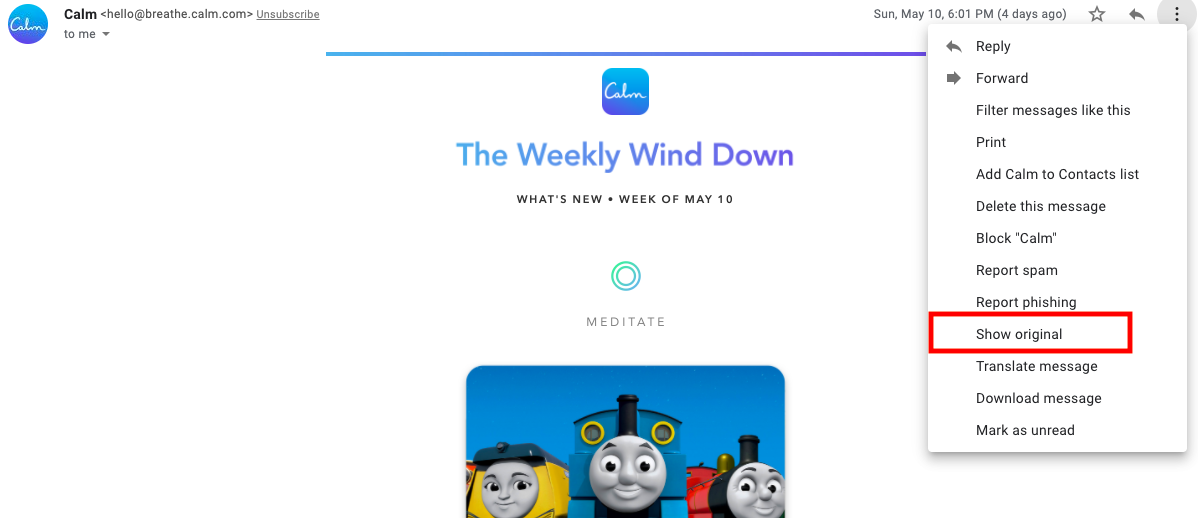
What I’m looking for is a DKIM authentication, which proves that an email hasn’t been altered on its journey from the sender to an inbox.
When I learned about DKIM authentication, my life — and my inbox — changed forever. So in this post, we’re going to talk about the glory of DKIM and why you need to apply it to your own marketing emails.
What is DKIM authentication?
When we talk about DKIM, we’re talking about a method for email authentication. It’s a tool for making sure your email marketing efforts are presented as safe and legal to subscribers.
DKIM enables subscribers to review an email sender to make sure it’s legitimate. A simple way to do this from the sender’s standpoint is to provide a verified email signature in the header of an email, like so:
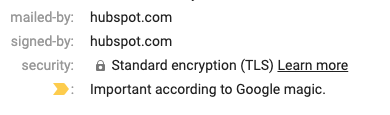
This signature, notated with “signed-by,” tells the email receiver who sent the email. The hyperlink included from the sender takes the recipient to the official website of the sender — in this case, HubSpot.
Let’s talk about how DKIM authentication works in a little more detail.
How does DKIM work?
DKIM signatures verify the email sender is legitimate. They’re secured using data encryption (basically, a “lock-and-key” for private email details, such as a subscriber’s email address).
This signature essentially proves that the sender is real because the sender’s Domain Name System (DNS) records have approved the email.
Every email message being sent by an outbound server (the sender) will have its own DKIM signature and consists of information about how the signature was created in the DNS. This information should tell the inbound server (the recipient) that the DNS and DKIM signature are from the same source.
When this happens, the inbound server can verify that the email wasn’t changed while it was being sent.
In Gmail, you can find DKIM authentication by clicking on the dropdown arrow next to the phrase “Sent to: me,” shown below:

Clicking on that dropdown arrow will open up a box of a few details, including the sender, email date, mailing list, subject, and the encryption, which is where DKIM authentication fits:

This box tells the user the details of the outbound server that sent the email, in this case, bounce.hulumail.com. Underneath, it tells the user the DKIM signature from that server, which is hulumail.com. Then, it shows that Google has verified the security of the email, and that the email used standard encryption in its DKIM signature.
Ultimately, when you use DKIM signatures, you make your emails more deliverable. It tells email servers and recipients that you aren’t using email marketing for malicious purposes.
DKIM signatures aren’t a physical “signature,” rather, they tell email servers that the email from the sender hasn’t been faked or modified. This happens from a server, and can be set up using automated email software tools, like HubSpot’s.
Now that you know how DKIM works and why it’s essential for your email marketing messages, let’s talk about how to set it up properly.
How To Set Up DKIM
Let’s get started with setting up DKIM authentication for your marketing emails. For this process, you’ll be creating the unique DKIM signature for your domain(s),connecting it to your domain host, (i.e. GoDaddy or a similar service), and authorizing the authentication process to take place when emails are being sent.
1. Generate or connect a domain key.
Identify the domain or domains you’ll be using to send email marketing messages. If you use multiple domains, you’ll want to make sure you’re authorizing all of them for DKIM. Each domain will need its own unique domain key.
If you need to create a domain key, you can do so in Google — you just need to make sure that your Gmail account has super administrator access. Then, access Gmail from the G Suite apps page and click “authenticate email,” and Google will automatically select your primary domain (don’t worry, you can change this if you’d like to select another domain).
After that, click “Generate new record” and you can select whether you want to generate a key by DKIM bit length or by prefix selector. To put it another way, you can select whether you want your DKIM key to have more strength based on the host you use, (2048 is one of them), or if you want to change when you’ve made the domain key. The latter is generally used if you already use another domain key through Google.
Then, click “Generate,” and you’ll receive your domain key, which tells servers that your messages are safe. If you use software, like HubSpot, you may be able to skip this step, as the software usually generates domain keys for you.
2. Make sure you have DKIM capabilities.
If you use email marketing software, make sure it has DKIM capabilities. Outgoing marketing emails need to have a DKIM signature. You can download separate DKIM software (here is a list of developers), or verify that your software provides those services.
3. Connect your email sending domain.
For this step, you’re going to make sure that domain key is correctly connected to your email. If you used Google to generate your key, you can complete this step by updating your DNS TXT record with your generated key. Make sure you’re switched out of the Admin console and on the domain host when you do so.
For HubSpot customers, go to Settings > Domain & URLs > Connect a domain > Email sending > Connect. This’ll prompt you to enter the email addresses you use and verify the correct sending domain.
4. Add your domain to DNS records.
By now, you’ve created your domain key, also known as your DKIM signature. You’ve also either connected your domain to emails in your email marketing software or begun the setup process in Google. Now, we’re going to begin to connect the two.
For this step, you’ll also need your domain key so you can connect it to your DNS records. Remember, DNS records verify that marketing emails with your DKIM key come straight from your domain emails.
Note: If you’re using Google and have multiple domains, you’ll have to complete this step for each domain, since each domain has its own unique DKIM key.
Sign into the management console you use for your domain host and locate your DNS records. Remember, this is being done from your Google management console.
Then, add a TXT record. To do this, enter the TXT record name into this first field. You’ll find this displayed in the Admin console, and it’ll be under the DNS Host name. For the field below, you’ll enter the string text displayed in the Admin console, which will be located under “TXT” record value.
For HubSpot and GoDaddy customers, you can either click “Authorize with GoDaddy” to allow HubSpot to set up hosting for you, or click “No, I’ll set it up manually.” Then, you’ll be able to access your DNS provider, DNS settings, and copy-and-paste values for Host Name.
5. In Google, turn on DKIM signing.
If you’re setting up DKIM through Google, this is the last step you’ll need to do before completion. At this point, you’ve generated your domain key and added it to your domain record. So now, you’re ready to turn on DKIM signing.
This step greenlights your authentication, but note that this may take up to 48 hours to be placed into effect.
First, you’ll want to access your Admin console homepage and access Gmail. Then, click “Authenticate email,” and select the proper domain. You’ll see the status of email signing, and you’ll also be able to click “Start authentication” to begin the process.
After that, you’ll be ready to test your email signature.
6. Test your DKIM authentication.
This step is very important because every DKIM key is unique, and you’ll want to make sure they’re each sending correctly. To test your email in your email marketing software, send the email from that software to an account you have access to, such as your personal email address, and open the details of that message so you can see the original message details.
To test your email in Google, you can access the same page in Admin host from the last step, and send an email to a Gmail or G Suite account holder — I usually email myself for tests.
You can open the message in the recipient’s inbox, and click More > Show original to open the entire message header, like below:
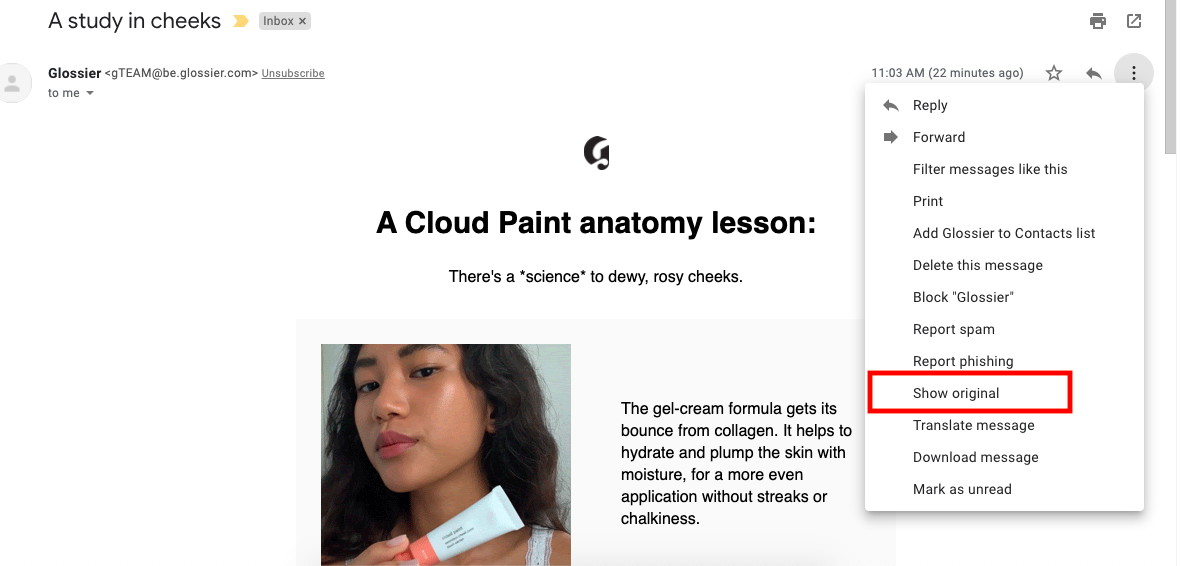
From here, you’ll be able to access the original message and see the DKIM signature. The header will tell if the DKIM signature is authentic, and you can scroll down to the code to locate the signature details.
For this email, the DKIM signing was turned on. I can identify this from the specific portion of code highlighted in red. What this tells me is that the DKIM signature was sent from Glossier’s domain and signed by their DKIM software:

If your DKIM signing is turned on, you should see code that’s similar to this example:
DKIM-Signature: v=1; a=rsa-sha256; c=relaxed/relaxed;
The “s=” you’ll see in the line below the above code confirms that the email was signed by a DKIM key.
If you can locate the DKIM signature, you can be sure that your DKIM authentication is complete!
Now that you’re an expert on DKIM authentication, go ahead and create your own key and ensure the safety of the delivery of your emails.
Now, you can ensure that your subscribers receive their messages as intended.

19 Social Media Marketing Myths to Leave Behind in. 2020
Like any major marketing strategy of the past decade social media has had plenty of time to accumulate some big, inaccurate, myths.
And despite the fact that data has disproven a number of marketing myths today, some marketers will still hold on to few, simply because it’s hard to keep up to date on what’s really going on with social media.
Yes, social media landscapes change dramatically every day. However, as a marketer, it’s important to identify myth from reality in order to create an effective social media strategy.
To help you separate fact from fiction, I put my Mythbusters hat on and drudged up some of the most common social media myths out there.
Let’s dive into some social media myths we’ve all probably heard around the water cooler. Then, I’ll explain why you need to leave these old ways of thinking behind.
19 Social Media Myths to Leave Behind
1. My customers aren’t on social media.
In 2019, over 2.39 billion people worldwide were active on social media. Today, it seems like there’s a social platform for everything and everyone. While family and friends connect on sites like Facebook, Instagram, or Twitter; professionals are networking all over LinkedIn.
Odds are, at least one one social media platform has an audience that will align with your brand. Not sure which one is the best for you? Check out this blog post which highlights need-to-know social media trends.
2. You should join every single social media network immediately.
Just because I can name a lot of social networks, it doesn’t mean I should set up a profile on all of them.
By all means, research other social networks. Set up a company profile or page and give ’em the old college try. But you may find that some aren’t really worth your time. If that’s the case, consider removing your profile and move on. You should only devote time and resources to the platforms that align most with your audience and marketing tactics.
The best marketers use data to identify which marketing activities yield the best results — if a social network isn’t helping you out, cut it loose. For a little help evaluating the usefulness of new social networks, reference this blog post, “8 Questions to Evaluate Whether That New Social Network Is Worth Your Company’s Time.”
3. Pinterest is only for B2C organizations.
It is totally awesome for B2C marketers, to be sure. But usually when someone says a channel is only for B2C, the B2B marketer in me takes that as a challenge to prove it’s not so. Turns out some of my colleagues feel the same way, because one of them wrote an epic blog post detailing exactly how B2B organizations can get value out of Pinterest. You can also check out the accounts of brands like GE, Microsoft, Econsultancy, and yours truly for some B2B Pinterest inspiration!
4. You should only try to get fans and followers that will become customers.
Quality is important, yes, but don’t underestimate the power of a large social reach. Remember some of these points next time you bemoan acquiring a fan or follower that lives outside of your sales territory or target demographic:
- More fans and followers means you’re gaining access to their fans and followers.
- If they’re an influencer, their clout transfers to you by association.
- When they share your content, your SEO improves.
- They may still refer business your way.
Learn more about why you need social media fans and followers who won’t even become customers in this blog post.
5. You should only schedule posts during the work week.
While you shouldn’t force your social media manager to work on the weekends, you certainly can schedule posts or launch social media ads on the weekends ahead of time, but that doesn’t mean it correlates to when people are using social media. Our social media scientist, Dan Zarrella, found out that you might actually have more success if you embrace contra-competitive timing.
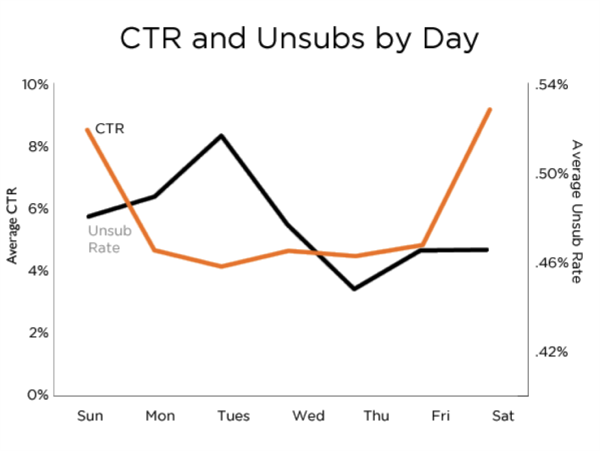
While pique social media engagement times occur around the middle of the week, most platforms also have high engagement times during the weekends and evenings as well. For further details on the best times to post on various networks, check out this detailed guide.
6. If your friends and family “Like” every update, your social presence will rock.
You can’t just have your mom and uncle Like every post you put up on Facebook. Although it might feel like you see a lot of posts that your friends or family members like, Facebook and other social media algorithms are a bit more sophisticated than that when it comes to determining which posts get seen.
To get social media feeds to favor your content, you’ll need a variety of people interacting with your content — both to grow your reach, and to show up in users’ news feeds.
So, rather than encouraging just your friends or family members to Like or heart your posts, encourage your followers to Like, comment, or share to encourage further discussion and spread your brand awareness.
7. You have to respond to social activity immediately.
There’s no doubt a speedy response is appreciated, but it isn’t always required. People understand that you’re running a business. There are other things going on. If you get back in a timely manner, but not in mere seconds, it’s alright.
There are exceptions, of course. For instance, Verizon runs a few Twitter accounts. One is @VerizonSupport. While Verizon will share blog posts and educational marketing materials on this Twitter, it also uses it to respond to questions or concerns from prospects or customers.
Because Verizon’s support account is for customer service rather than marketing, reps who manage this channel should be responding immediately to inquiries.
Another example could be if you’re running a social media account that receives a complaint which is public to all users and could hurt your credibility. In that scenario, you should consult your service team as soon as possible and write a thoughtful reply that shows you’re taking the feedback seriously seriously.
8. Social media is only about engaging conversation, and not a place to share engaging content.
It’s not that conversations aren’t important. You can’t just ignore your fans. While it’s beneficial to stimulate conversations and discussions with your audience, it’s not the only point to social media marketing. Take a look at this data from Dan Zarrella, for example:
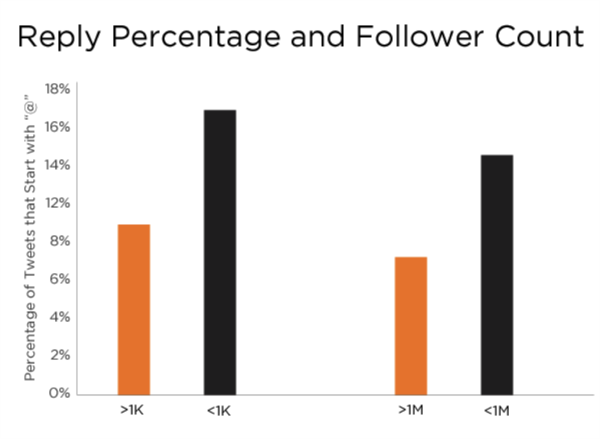
The data above shows there isn’t necessarily a positive correlation between the percentage of tweets that start with @ replies and the number of followers these Twitter users have.
Aside from allowing you to virtually connect with people, social media is a lead generator, a non-organic traffic tool, and a great place to share your best content. If you publish valuable posts, they might not always stimulate conversation, but they could lead people to your website and products.
9. Social media marketing tactics don’t drive bottom line results.
Piggybacking off of the last myth, you can actually generate value beyond just “engagement” and “brand equity” from social media. Social media drives leads and customers, period.
Don’t believe me? Here are a few stats you should know:
- Companies that use Twitter average 2X more leads than those that don’t.
- Companies with 1000+ more Twitter followers get 6X more traffic.
- 45% of marketers note social media has a below average cost-per-lead compared to other channels.
- 62% of companies using LinkedIn for marketing have acquired a customer from it.
- 52% of companies using Facebook for marketing have acquired a customer from it.
- 44% of companies using Twitter for marketing have acquired a customer from it.
10. It looks tacky to seem relatable as a brand on social media.
The content you publish in social media should always keep your target audience in mind — but that doesn’t mean you can’t also publish content that shows your brand’s personality. Or, frankly, even your community manager’s personality.
There are people behind your company; don’t be afraid to show that with your own special brand of humor, pictures of people that work at your company, and links to news content that you find particularly entertaining … even if it’s not directly related to your industry.
11. Hashtags are essential for every post.
You know those tweets that look like this?
Love this article on #socialmedia #marketing that talks about #pinterest and has an image of a #puppy #lol
The point of hashtags is that they join together common conversation threads. So while it’s nice to have a hashtag for an event, like a webinar or a trade show, don’t lose your mind if it doesn’t become a trending topic. It’s not necessarily going to blow your leads goal out of the water if it does … think of hashtags as a way to be more user-friendly for those following the hashtag, not a way to make all your marketing dreams come true.
12. Social media monitoring takes forever.
One social media monitoring scenario: Glue your eyes to your computer screen, open five tabs for each of your social networks, chug three espressos, click between tabs and hit refresh like a maniac.
Alternate social media monitoring scenario: Use social media monitoring software that alerts you when important terms are mentioned; check back to your accounts briefly every hour or two to see if you need to respond to anyone, follow someone back, etc.
That second one takes you, in aggregate, maybe 30 minutes a day. No big deal. Everybody breathe. Everything’s gonna be alright.
13. Social media managers should be new graduates or have years of experience.
This isn’t just a myth. It’s actually an agist theory that should be completely abandoned — if it hasn’t been already.
Being good at social media marketing, or any job for that matter, has absolutely nothing to do with how young or old you are. You can learn the tools and strategies at any age, and make mistakes at any age, too.
Instead, of considering a social media manager’s age range, look for the candidate who’s both creative and analytically minded enough to manage your presence. To learn more about how to hire the best social media manager for your brand, check out this post.
14. Only young people use social media.
Think that the only people on social media are Gen Z and millennials? Think again.
Yes, 90% of 18 to 25 year olds were using social media in 2019, but, according to Statista, over 80% of 30 to 49 year olds, and nearly 70% of 50 to 64 year olds are on social media.

15. Newer platforms, like Snapchat and TikTok aren’t worth taking seriously.
Snapchat and TikTok are both mobile social media apps that have pulled in millennials and Gen Z due to their unique platforms. While Snapchat thrives on ephemeral content, AR filters, and Bitmoji features, TikTok highlights goofy, fun, or musical 10 to 60-second videos similar to Vines.
Despite the fact that these platforms pull in odd content created by users, it doesn’t necessarily mean that brands can’t use the apps to gain credibility and awareness.
At this point, a plethora of brands — from publishers to B2C companies — have created profiles or ads for TikTok. One of the most surprising and oldest brands to build a TikTok strategy is The Washington Post. Although the publication has a very formal social media presence on other platforms, they use TikTok to highlight the funny, yet human, side of working in a newsroom.
Similarly, a number of larger businesses have also launched paid promotions or long-form Stories on Snapchat Discover. To learn more about these companies and the content they’ve launched, check out this blog post.
At this point, you certainly take any popular social media platform seriously. But, as we noted when debunking previous myths in this post, you should identify which platforms best match your audience and your goals before spending time and money to build a strategy for them.
16. You don’t have enough content to have a social media channel.
The thing with social media is that it moves really fast. What’s posted today might very well be forgotten about tomorrow. It’s easy to think of this as a problem by saying, “I don’t have enough content to post.” But, alternatively, you could just repurpose content or reshare great content regularly.
If the topic your post discusses is evergreen, it will almost always be useful, even if you repurpose or repost it later. This doesn’t mean you should share the exact same link and update commentary day after day, but if a few weeks go by and you want to re-promote an something, go for it. Just do your loyal fans a favor and find a new interesting nugget of information to call out in your update.
17. Social media gives people a venue to publicly bash your company.
The truth is, angry customers already have plenty of venues: word of mouth, Google reviews, Yelp reviews, and many other places on the internet will allow them to give feedback when they aren’t happy. Not creating a Facebook page simply for fear of negative feedback isn’t protecting you from an angry wrath.
Instead, get ahead of the conversation by being aware when negative reviews are taking place, reading them, responding to the customer, and coming up with solutions. Then, when customers are pleased, encourage them to share their positive stories,
If you do need some help dealing with those negative nancies, we’ve got a blog post that will walk you through the steps to calm angry customers down.
18. Social media is too fluffy to have solid metrics around.
Again, social media isn’t about fluffy things we talked about earlier, like “brand equity” and “engaging conversation.”
Yeah, those things happen, but it doesn’t mean you can’t measure the effectiveness of your social media activities.
With HubSpot marketing tools, you can identify exactly how much traffic social media drives to your website, how many leads social media generates, and how many of those leads become customers.
From there, you can even calculate things like the average cost-per-lead and customer — across individual social media networks, and in aggregate — just like you do with every other marketing channel (right?).
19. Social media is completely free marketing.
It’s free to join, but it’s still a resource investment. Even if you are posting for free, you’ll likely need to pay an employee to manage your channels and build strategies. And, as your social media strategy grows more successful, you might decide to up time and money investments.
Luckily, social media is still one of the most affordable ways to boost audiences, brand awareness, and ultimately leads. This makes the investment worth your while.
Navigating Social Media Marketing
Now that you’ve learned about the falsehoods and myths behind social media, it’s time to start looking at the actual research-back tactics that could make your brand successful on a given network.
For more data that backs why you need a social media marketing strategy in 2020, check out this list of stats. For tactical advice on various social media tactics and platforms, read our Ultimate Guide to Social Media Marketing.
Editor’s Note: This post was originally published in October 2012 but was updated in May 2020 for comprehensiveness and freshness.

The 18 Best Advertisements & Ad Campaigns of All Time
I’ve always been a little leery of proclaiming anything “the best.” I never declared anyone my best friend as a kid because I was afraid my other friends might assume I thought less of them.
So it was a little difficult for me to come up with just one “best” advertisement of all time — which is why there are 18 in this post instead.
What makes these some of the best ads of all time?
Because of the impact they had on the growth of the brand, and because they manage to hit on some universal truth that allows us to remember these campaigns years after they first began. In fact, some of us might not have even been alive when these campaigns first aired.
But to know what makes an advertisement great, you first need to know how an advertisement is defined.
Advertisements
Advertisements are written or visual messages dedicated to promoting a specific product, service, or campaign. Businesses can pay the owner of a channel or platform that reaches a similar audience to broadcast this message. Two of the biggest challenges in advertising are measuring the value of the advertisement and ensuring it resonates with the right people.
As you can imagine, there are numerous types of advertisements — all of which run in different mediums, on different channels, and have different goals in mind for their business. People can advertise anywhere, and today’s best type of ad might not be the best type tomorrow.
Types of Advertisements
Here are four basic examples of advertising from the past few centuries (yikes), from earliest to latest.
1. Print Advertising
The first print ad ran in England in 1472, according to Infolinks. Since then, this type of advertising has become available in newspapers, magazines, brochures, billboards, flyers, and similarly portable methods of carrying a brand’s message to its ideal end user. In this ad method, the advertiser pays the publisher to place their ad in the publication.
2. Radio Advertising
Radio advertising dates back to 1920, when the first commercial radio stations were launched in the United States. Today, radio is still a relevant marketing and advertising platform for expanding the reach of a sponsored event or new product. In this ad method, the advertiser pays the radio station to play their ad during designated breaks between music or a radio show.
3. Television Advertising
Television ads originated in the 1940s with the promotion of practical items and political campaigns. Advertisers can now use television to promote food, toys, stores, business services, and more — both to local TV channels and to national broadcast networks. In this ad method, the advertiser pays the regional or national TV network to show their ad during designated breaks in the network’s regular programming.
4. Internet Advertising
Internet advertising took root in the mid 1990s with the launch of “banner” advertisements for various telecommunications companies. These ads are placed in interstitial spots on a webpage. In this ad method, the advertiser pays the website owner to place their ad in exposed spaces that are peripheral to the website’s own content. Internet advertising has gone on to include video, search engine marketing, sponsored social media posts, and more.
But, as you know, the advertising types above have evolved dramatically since their respective origins. What were once quite one-dimensional messages now carry clever, funny, or profound undertones that make the ads memorable years after they first ran.
So how do you create an advertising strategy that resonates?
This blog post is dedicated to the ads and campaigns we can learn from.
But, first, an important distinction:
Advertising Campaign
An advertising campaign is a group of similar ads with a unified tone or message. The advantage of a campaign over a standalone ad is the ability to push the same idea in different ways, across multiple mediums, and for a longer period of time without getting too repetitive or stale for the audience.
The Best Advertising Campaigns of All Time (And What Made Them Successful)
Without further do, here they are in no particular order: 18 of the best advertisements of all time and the lessons we can learn from them.
1. Nike: Just Do It.
Ad Campaign: Print, Television, Internet

Source: brandchannel
Did you know that, once upon a time, Nike’s product catered almost exclusively to marathon runners? Then, a fitness craze emerged — and the folks in Nike’s marketing department knew they needed to take advantage of it to surpass their main competitor, Reebok. (At the time, Reebok was selling more shoes than Nike). And so, in the late 1980s, Nike created the “Just Do It.” campaign.
It was a hit.
In 1988, Nike sales were at $800 million; by 1998, sales exceeded $9.2 billion. “Just Do It.” was short and sweet yet encapsulated everything people felt when they were exercising — and people still feel that feeling today. Don’t want to run five miles? Just Do It. Don’t want walk up four flights of stairs? Just Do It. It’s a slogan we can all relate to: the drive to push ourselves beyond our limits.
The Lesson
When you’re trying to decide the best way to present your brand, ask yourself: What problem are you solving for your customers? What solution does your product or service provide? By hitting on that core issue in all of your messaging, you’ll connect with consumers on an emotional level that is hard to ignore.
2. Coke: Share a Coke
Ad Campaign: Print
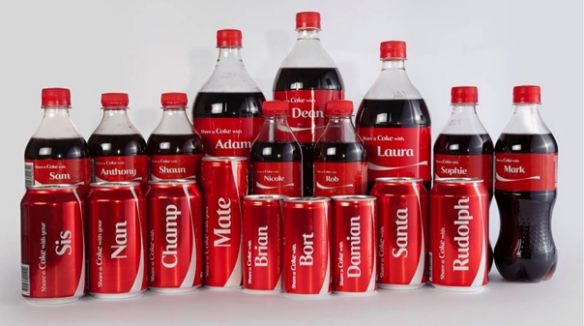
Big brands are often hard-pressed to do something ground-breaking when they’re already so big. So, what did Coca-Cola do to appeal to the masses? They appealed to individuals — by putting their names on each bottle.
The Share a Coke campaign began in Australia in 2011, when Coca-Cola personalized each bottle with the 150 most popular names in the country. Since then, the U.S. has followed suit, printing first names across the front of its bottles and cans in Coke’s branded font. You can even order custom bottles on Coke’s website to request things like nicknames and college logos.
It was a breaking story across the marketing and advertising industry. Many consumers were enchanted by it, while others were confused by it — why make a temporary item so personal? Pepsi even released counter-ads shortly after the campaign launched.
Nonetheless, Coke received immediate attention for it.
The Lesson
Coke fans are regular buyers, and the company leaned into that sense of individual ownership with full force. Wondering what name you’ll get out of the vending machine was a fun thrill in and of itself — even if it isn’t yours, it encourages you to “share a Coke” with whomever’s name is on the front.
3. Absolut Vodka: The Absolut Bottle
Ad Campaign: Print


Source: Burning Through Journey Blog
Despite having no distinct shape, Absolut made its bottle the most recognizable bottle in the world. Its campaign, which featured print ads showing bottles “in the wild,” was so successful that they didn’t stop running it for 25 years. It’s the longest uninterrupted ad campaign ever and comprises over 1,500 separate ads. I guess if it ain’t broke, don’t fix it.
When the campaign started, Absolut had a measly 2.5% of the vodka market. When it ended in the late 2000s, Absolut was importing 4.5 million cases per year, or half of all imported vodka in the U.S.
The Lesson
No matter how boring your product looks, it doesn’t mean you can’t tell your story in an interesting way. Let me repeat: Absolut created 1500 ads of one bottle. Be determined and differentiate your product in the same way.
4. Anheuser-Busch: Whassup (1999)
Ad Campaign: Television
When’s the last time an advertisement literally changed the way we talk to one another? Allow me to answer that question with another question: “Whassup?!”
This series of commercials, which first appeared in late 1999, features a group of friends connecting on a group phone call (we don’t do those much anymore, do we?) while drinking beer and “watching the game” on TV.
It starts gently: “What are you doin’?” Someone asks. “Watching the game, havin’ a Bud” (a Budweiser), someone replies. As more friends pick up the phone, the hilarity ensues: “WHASSUP!?” is yelled back and forth, becoming a classic catchphrase and an icon of beer-drinking culture that ran constantly on sports networks over the next few years.
The Lesson
The ad took pop culture by storm during the Super Bowl in 2000, and you can still hear its echoes today. Why? Anheuser-Busch showed us just how silly and informal an ad can be without ruffling feathers or going off-brand. Dare to celebrate your audience’s absurdities. The more genuine your ad is, the more valuable your product is.
5. Miller Lite: Great Taste, Less Filling (1974)
Ad Campaign: Print, Television
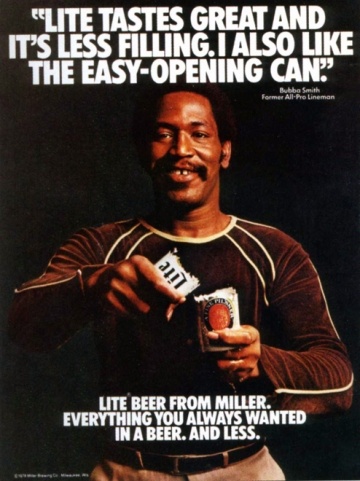
Source: BuildingPharmaBrands blog
Think it’s easy to create a whole new market for your product? The Miller Brewing Company (now MillerCoors) did just that with the light beer market — and dominated it. The goal of the “Great Taste, Less Filling” campaign was getting “real men” to drink light beer, but they were battling the common misconception that light beer can never actually taste good.
Taking the debate head-on, Miller featured masculine models drinking their light beer and declaring it great tasting.
The Lesson
For decades after this campaign aired, Miller Lite dominated the light beer market it had essentially created. What’s the lesson marketers can learn? Strive to be different. If people tell you there isn’t room for a product, create your own category so you can quickly become the leader.
6. Always: #LikeaGirl (2015)
Ad Campaign: Television, Internet
My eyes are still wet while writing this blurb.
The Always brand hit a home run with this advertisement, not because it went viral after the commercial ran in the 2015 Super Bowl, but because it was a groundbreaking message that hundreds of millions of people repeated long after the campaign was over.
The campaign began as a commercial explaining the stigma behind playing sports “like a girl” — implying that the boy’s way is better or correct. By the end of the ad, the message is both clear and inspiring: Girls are just as fit and capable as boys are, particularly during puberty — a stage of life that is extremely important to Always and its women’s products.
The message is now a holistic initiative by Always you can learn about here, and a hashtag that’s still used on social media today.
The Lesson
Acknowledge not just your audience, but the challenges they face — especially the ones that reflect your time or culture. Not every societal issue is off limits to marketers and advertisers. Take a stand on the ones you know your audience supports, and you’ll access a customer base that identifies with your passion.
7. Volkswagen: Think Small (1960)
Standalone Ad: Print
Source: design shack
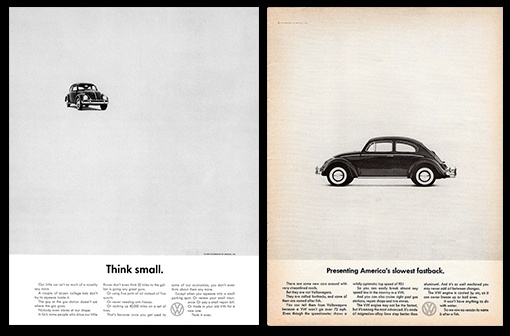
Many marketing and advertising professionals like to call Volkswagen’s “Think Small” campaign the gold standard. Created in 1960 by a legendary advertising group at Doyle Dane & Bernbach (DDB), the campaign set out to answer one question: How do you change peoples’ perceptions not only about a product, but also about an entire group of people?
See, Americans always had a propensity to buy big American cars — and even 15 years after WWII ended, most Americans were still not buying small German cars. So what did this Volkswagen advertisement do? It played right into the audience’s expectations. You think I’m small? Yeah, I am. They never tried to be something they were not.
The Lesson
That’s the most important takeaway from this campaign: Don’t try to sell your company, product, or service as something it’s not. Consumers recognize and appreciate honesty.
8. Google: Year in Search (2017)
Ad Campaign: Internet
This isn’t the oldest or most well-known advertisement on our list, but it’s become the most powerful over its nine-year (and still going) existence. So powerful and so true, you forget it’s an advertisement.
Year in Search began in 2009 as “Zeitgeist,” a written report of the public’s most common Google searches over the previous 12 months. The following year, Google adapted it for a three-minute video. Since then, it’s been a bold, yearly reminder of how much we depend on Google for information on the news and events that give the entire world pause. Check out the company’s latest video from 2017 above.
The Lesson
Remind your customers how much you care that they care. These stories elicit a variety of emotions, but ultimately unite everyone — no matter what Google products they might like — through an uplifting message of how our usage of the company reflects the best in all of us.
9. Dos Equis: The Most Interesting Man in the World (2006)
Ad Campaign: Television, Pre-roll

Source: The Open Field
You know who he is. He smokes Cuban cigars, is always surrounded by beautiful women, and — most importantly — he drinks Dos Equis beer.
A key component of a strong campaign for an indulgent vice — like beer, desserts, or luxury items — is to make it cool. And when it comes to The Most Interesting Man in the World, he’s one of the coolest commercial guys there is.
And at the end of every commercial, he says: “I don’t always drink beer, but when I do, I prefer Dos Equis. Stay thirsty my friends.”
The Lesson
The hilarious hyperbole employed in this campaign makes it memorable the next time viewers head out to buy some beer. And even though Dos Equis recently replaced The Most Interesting Man with a new actor, he is forever immortalized in meme culture and in liquor stores due to this short, sweet, and memorable tagline — and the cool dude vibe it makes viewers harken back to.
10. California Milk Processor Board: Got Milk? (1993)
Ad Campaign: Print

Source: Broward Palm Beach New Times
Thanks to the California Milk Processor Board’s “Got Milk?” campaign, milk sales in California rose 7% in just one year. But the impact ran across state borders, and to this day, you still can’t escape the millions of “Got [Fill-in-the-Blank]?” parodies.
Note, though, that the ad didn’t target people who weren’t drinking milk; it instead focused on the consumers who already were.
The Lesson
It’s not always about getting a brand new audience to use your products or services — sometimes, it’s about getting your current audience to appreciate and use your product more often. Turn your audience into advocates, and use marketing and ad content to tell them why they should continue to enjoy the product or service you are already providing for them.
11. Metro Trains: Dumb Ways to Die (2012)
Ad Campaign: Internet, Radio
Yes, you read that right: Dumb Ways to Die.
In Melbourne, Australia, Metro Trains wanted to get across a simple message: No horsing around near train tracks. Disorderly conduct could lead to injuries, or even death, but instead of typical warning signs or announcements inside train stations, Metro Trains came up with Dumb Ways to Die, a song that has garnered 157 million YouTube views since it debuted in 2012.
The song is about dumb ways to die — for example, by poking a grizzly bear with a stick, or taking your helmet off in outer space — and it features a catchy little chorus you won’t be able to stop humming to yourself (because singing it is a little morbid): “Dumb ways to die, so many dumb ways to die.”
At the end of the video, after you’ve watched adorable cartoon characters dying in the dumbest of ways, you get to the moral of the story: There are many dumb ways to die, but the dumbest possible way would be if you died while standing on the edge of a train platform, drove through a railroad sign, or tried to cross over a train track.
The video ad went viral on YouTube, the song was made available on iTunes, and it even played over the radio with an accompanying ad.
The Lesson
This beloved, now-famous campaign communicates a simple idea in a creative and memorable way — and you don’t feel like you’re being nagged, the way some public service announcements do. If your subject matter is grim or boring, consider using creativity to get your message across.
12. Apple: Get a Mac (2006)
Ad Campaign: Television
While there have been many great Apple campaigns, this one takes the cake. The video above is just one of a series of iterations of this campaign, and the Mac vs. PC debate ended up being one of the most successful campaigns ever for Apple. The company experienced 42% market share growth in its first year with its help. These commercials tell Mac’s audience everything they need to know about the product without being overt — and in a clever way.
The Lesson
Just because your product does some pretty amazing things doesn’t mean you need to hit your audience over the head with it. Instead, explain your product’s benefits in a relatable way so consumers are able to see themselves using it.
13. Clairol: Does She or Doesn’t She? (1957)
Standalone Ad: Print

Source: Current360
The first time Clairol asked this question in 1957, the answer was 1 to 15 — as in, only 1 in 15 people were using artificial hair color. Just 11 years later, the answer was 1 of 2, according to TIME Magazine. The ad was apparently so successful that some states stopped requiring women to denote hair color on their driver’s license. When your ad campaign starts changing things at the DMV, you know you’ve hit a nerve.
Clairol did the opposite of what most marketers would do: They didn’t want every woman on the street running around saying they were using their product. They wanted women to understand that their product was so good that people wouldn’t be able to tell if they were using it or not.
The Lesson
Sometimes, simply conveying how and why your product works is enough for consumers. Showing becomes more effective than telling.
14. De Beers: A Diamond is Forever (1999)
Ad Campaign: Print, Television

Source: BBC News
In 1999, AdAge declared De Beers’ “A Diamond is Forever” the most memorable slogan of the twentieth century. But the campaign, which proposed (pun very much intended) the idea that no marriage would be complete without a diamond ring, wasn’t just riding on the coattails of an existing industry. De Beers actually built the industry; it presented the idea that a diamond ring was a necessary luxury.
According to the New York Times, N.W. Ayer’s game plan was to “create a situation where almost every person pledging marriage feels compelled to acquire a diamond engagement ring.”
The Lesson
Advertising can make a relatively inexpensive product seem luxurious and essential.
15. Old Spice: The Man Your Man Could Smell Like (2010)
Ad Campaign: Television, Internet

Source: Coloribus
The very first part of Old Spice’s “The Man Your Man Could Smell Like” campaign, created by Wieden + Kennedy and launched in February 2010, was the following commercial. It became a viral success practically overnight:
That video has over 51 million views as of this writing. Several months later, in June 2010, Old Spice followed up with a second commercial featuring the same actor, Isaiah Mustafa. Mustafa quickly became “Old Spice Guy,” a nickname Wieden + Kennedy capitalized on with an interactive video campaign in which Mustafa responded to fans’ comments on Facebook, Twitter, and other social media websites with short, personalized videos.
In about two days, the company had churned out 186 personalized, scripted, and quite funny video responses featuring Mustafa responding to fans online. According to Inc, these videos saw almost 11 million views, and Old Spice gained about 29,000 Facebook fans and 58,000 new Twitter followers.
“We were creating and sending miniature TV commercials back to individual consumers that were personalized, and we were doing it on a rapid-fire basis,” Jason Bagley, creative director at Wieden + Kennedy and a writer for the campaign, told Inc. “No one expects to ask a question and then be responded to. I think that’s where we broke through.”
The Lesson
If you find your campaign’s gained momentum with your fans and followers, do everything you can to keep them engaged while keeping your messaging true to your brand’s voice and image.
16. Wendy’s: Where’s the Beef? (1984)
Ad Campaign: Print, Television

Source: AdSoft Direct
Is it enough to say this campaign was successful because it featured a giant hamburger bun and a cute set of old ladies? No? I didn’t think so.
Wendy’s took a more gutsy approach in this advertising campaign: It targeted its competitors. The simple phrase “Where’s the beef?” was used to point out the lack of beef in competitors’ burgers — and it quickly became a catchphrase that encapsulated all that was missing in their audience’s lives.
While you can’t predict when a catchphrase will catch on and when it won’t, Wendy’s (wisely) didn’t over-promote their hit phrase. The campaign only ran for a year, and allowed it to gently run its course.
The Lesson
Be careful with your campaigns’ success and failures. Just because you find something that works doesn’t mean you should keep doing it over and over to the point it’s played out. Allow your company to change and grow, and you may find that you can have even greater success in the future by trying something new.
17. Procter & Gamble: Thank You, Mom (2012)
Ad Campaign: Television
I’ll give you a minute to dry your eyes after that one.
Seriously — you wouldn’t expect a household and cleaning products company commercial to pull at the heartstrings like that, would you? Lately, though, Procter & Gamble (P&G) has launched some of the best ads we’ve ever seen from the consumer goods industry.
That’s because P&G identified the story behind the story of Olympic athletes — the stories of the supportive moms who pushed these world-class athletes throughout their entire lives leading up to that crowning moment. And yes, they probably had to do a lot of laundry and cleanup along the way — presumably using P&G products.
The Lesson
Make your audience cry (just kidding). The season or time period of your ad is important. But even if you run an ad during the Olympic Games, like P&G did, make sure it has longevity and a message that can influence people no matter when or where they see it.
Emotional and nostalgia marketing are powerful tactics to get people to make buying choices, so if there’s a bigger, more universal story behind your product or story, tap into it — and showcase it front-and-center.
18. KFC: “FCK” (2018)
Standalone Ad: Print

The ad above isn’t just an empty bucket of KFC with the company’s letters jumbled around. It’s also not a normal, unprompted promotion of fried chicken.
This ad is an apology, and perhaps the most creative one of all time.
In February 2018, KFC’s business in the U.K. ran out of chicken. You read that right: A poultry company ran out of poultry. It’s not every day that a business stumbles upon the most ironic PR crisis in company history, so when it happens, all eyes are on the business’s response. Well, we’re happy to report that KFC stuck the landing.
With the help of the creative agency Mother London, KFC took out a full-page ad in Metro, the U.K.’s newspaper, rearranging its three famous initials to create a hilarious albeit explicit response to its product shortage. The ad depicts a KFC bucket that reads, “FCK” — as if to say, “FCK, this is embarrassing.” (You can fill in the missing letter…)
Beneath this design, the company goes on to apologize for what it realizes is an inexcusable, if not slightly, funny failure.
The Lesson
No business is above a good old-fashioned sorry. And if you can laugh at yourself in the process, you’ll only make it better. KFC’s ad demonstrates how to combine humility, class, humor, and ultimately company pride in a message that can help you bounce back from bad press — and even come out the other side with a net-positive result for your brand.
With these ads in mind, start thinking about your brand identity, your brand story, and the things that matter most to your ideal customer. This is the foundation of a great advertising strategy.

How to Become a (Better) Editor: 13 Editorial Tips
When I first started editing articles for HubSpot’s Marketing Blog, I honestly figured it would be the easiest part of my job.
I imagined it would go something like this: I’d open a clean, nearly ready-for-publication Google Doc, skim it for the occasional missing comma or broken link, and be done with the whole editorial process before I had time to finish my coffee.
As any editor is well-aware, this couldn’t have been further from the truth.
In reality, I’d argue editing takes up about 30% of my work week — and, while it requires different skills than content creation, it’s anything but easy.
If you’re new to the editing process, don’t worry. There are plenty of strategies you can employ to ensure you’re editing efficiently — which could mean anything from giving thoughtful feedback to a new writer upfront so your job is easier down the road, to keeping key websites handy to check a writer’s math or embed an infographic into a post.
What are some ways to edit more efficiently while maintaining integrity? Here, I spoke with both past and present HubSpot editors to cultivate 13 ways to become a better editor, whether you’re editing your own piece or someone else’s.
How to Be a Better Editor
1. Find a quiet space to do your editing.
Don’t try to get your editing done in a meeting, or when you’re around chatty coworkers. Multitasking like that can make us far less effective at our work and increase mistakes and stress. And when you’re editing, you’re trying to catch those mistakes — so you want to be extra diligent.
Instead, find a place where you can plug in and concentrate fully on the piece in front of you. When you get there, turn off those pesky email and social media notifications, and put your phone on airplane mode (or, better yet, leave it in your bag).
If you’re working through a piece of writing that’ll require more than a few hours of careful editing, consider blocking out chunks of concentrated time separated by breaks. Otherwise, you may lose focus and begin missing things.
In fact, a study by the Draugiem Group found that the employees with the highest productivity spent 52 minutes working, followed by 17 minutes of rest. Taking breaks is key to ensuring you’re always at your best when editing someone else’s work.
2. Be sure the topic aligns with your content strategy.
You might be tempted to dig into the meat of the piece and begin meticulously editing it straight away. But, as an editor, it’s important that you put the content into context before you dive into the details.
First, take a quick skim of the working title, the layout, and the main ideas covered in the piece. Think to yourself: Does this topic align with our content strategy? Will our readers and buyer personas care about it?
If you’re concerned the piece isn’t about a topic your readers will be interested in, think about how to tweak the angle. You might need to collaborate with the author and send it back, asking for a major restructuring before you spend time editing it to ensure it resonates with your readers.
You’ll also want to reflect on how the piece fits in with what you’ve written in the past — especially if the piece is a blog post. Search engines like Google might see the second post as duplicate content and penalize you in search.
Even if Google doesn’t consider it duplicate content, competing for keyword ranking against another post from your own blog will hurt your SEO strategy. The questions to ask yourself here are: Have we covered this topic comprehensively in the past? Will it add anything new and interesting?
If both answers are yes, you might consider updating and republishing the original draft. We do that a lot here at HubSpot — for instance, if a reader pitches a full draft on “Instagram Hashtags” but I know we have plenty on Instagram Marketing already, I’ll take a look at older Instagram pieces and consider whether they deserve a complete rewrite, or whether I can add some of the author’s sections to the end of a piece and link back to the author’s website.
3. Read for content and ideas first, grammar second.
Never start diving into detailed edits before you read the whole piece through. It’s important to reflect on it holistically so you can pinpoint places where the content and ideas can be made stronger. This may seem like we’re adding time here, but trust me, this’ll save you a lot of time and pain in the long run.
If you’ve ever started editing a piece line-by-line only to realize it needs to be completely restructured, you know what I mean.
The key takeaway here is to recognize when the piece needs more work from the author.
“Sometimes, an author sends a piece in before it’s ready to be edited,” says Corey Wainwright, HubSpot’s Director of Content. “Learning to recognize those instances can save you a ton of time, because otherwise you start just rewriting the piece, which isn’t helpful to either of you.”
If you notice the piece doesn’t flow well, or the introduction needs to be tightened up, or there aren’t enough points in the article for it to meet your standards for quality, then it’s better to send that feedback to the author via email than to try and fix it yourself.
If the piece needs an overwhelming amount of editing help, then the author’s writing may not be a fit for your publication — and you’ll save a lot of time by telling the contributor outright.
Additionally, Carly Stec, who was previously Editor of HubSpot’s Marketing Blog, told me, “Develop multiple editing phases. Rather than trying to solve everything at once when you’re editing, look for something specific each time you read through it. For example, you might read through it once looking for spelling errors and then read through it again to catch any brand style guide violations.”
4. Check for places where the author can fill in the blanks.
Aside from providing larger, more broad feedback, you should also read through the piece to identify smaller improvements that you might want (or need) the author’s help on. Here are some questions to ask yourself:
- Are there any structural inconsistencies in the piece? For example, if they included an image in every section of the piece except for one or two, you might ask them to find an image for those sections for consistency.
- Are there any points that need more, better, or any evidence? Statistics and data can elevate the quality of your content and make it more interesting for readers.
- Are any sources missing citations? (This is a big one.)
As you read, take notes on these points in an email draft to the author. Once you’re done, make sure you clean up the notes so they’re comprehensible, and send them along before you edit any further.
5. Include positive feedback in your edits, as well.
Aja Frost, former editor of HubSpot’s Sales Blog, urges editors to remember the importance of positive feedback, as well.
She says, “Try to call out the strong aspects of the post — not just what needs to improve. Comments like ‘This is great,’ ‘Love how you explained this,’ ‘Excellent transition,’ etc. take just a second to write, but have a big impact.”
“Positive feedback balances out your constructive comments, makes the writer feel excited about starting their second draft, and ensures they’ll keep doing the things you appreciated.”
Positive feedback can ensure your writers don’t feel burnt out by all the constructive feedback they receive, particularly in the beginning of their writing career. Additionally, it helps you point out what you like about their writing and what you hope to see more of in the future.
Ultimately, positive feedback can be just as helpful as constructive to ensure you eventually progress your writers to “zero edits”, which means they don’t require an editor to check their work before publishing on your site.
6. Bookmark helpful websites for quick referencing.
If the content, ideas, and structure of the piece are all ready to go, you can get down to the nitty-gritty of editing the piece. This is where I like to keep a few websites bookmarked for reference. Here are the ones I prefer.
- Your company’s style guide: For when you want to double-check how something is spelled or referred to.
- Percent change calculator: For checking math.
- Your favorite keyword tools: For identifying top keywords for the content so you can use them in the title, headers, and relevant anchor text.
- Embed code generator: For creating embed codes for any original graphics or infographics. (Learn how to use it here.)
- Click-to-tweet: For adding click-to-tweet links to tweetable quotes in a blog post. (Learn how here.)
For more ideas, read this blog post for the ultimate list of websites every blogger should bookmark.
7. Keep useful code snippets close at hand.
Along with bookmarking helpful websites, it’s also a good idea to have all those useful snippets of HTML or other code that you tend to use easily accessible.
For example, you might notice that we add borders around many of our images on the blog. To add these borders, I need to add a specific snippet of code into the source code of the blog posts I write and edit.
To make this process easy, I created a Google Doc with all relevant code snippets and then bookmarked it. When it comes time to add them to the source code of my blog post, I simply pull up the Doc and plug in the snippets as need.
(Download our free guide to HTML here to learn some simple and useful HTML coding hacks.)
8. Read the piece out loud.
Reading out loud isn’t just good for memory retention — it’s also a great way to find errors in a piece of writing. You’re more likely to find clumsy sentences and other things spell check won’t necessarily catch if you hear those errors out loud.
Best-selling author David Sedaris uses this verbal approach to fine-tune his writing. According to Fast Company, Sedaris tests his works-in-progress by reading it aloud to live audiences because it helps him notice imperfections in the text.
As he reads, he’ll circle everything from confusing or misleading phrasing to closely repeated words or words that sound alike in the same paragraph.
“I used to hate it when a book came out or a story was published and I would be like ‘damn, how did I not catch that?'” Sedaris said. “But you pretty much always catch it when you’re reading out loud.”
Reading out loud will help you catch these errors in the first go-round, which will save you time later.
9. Use “Find and Replace” to quickly fix common errors.
If you’re editing for a new writer, you’ll likely begin to see similar errors arise in all her first drafts. Alternatively, if you’re editing your own work, you probably know the mistakes you’re most likely to make (like mixing up “you’re” and “your”, or writing “Additionally” too often).
Knowing that, you can do a “Find and Replace” before publishing a piece to correct these little slipups. It’s a far quicker way to polish a piece than looking for these instances manually.
To do a “Find and Replace,” hit Control + F on a PC (or Command + F on a Mac), type in your problem word or phrase and click “Find,” and let your browser take you to the word or phrase. Then, look through each instance of that word or phrase and swap it out with the right thing when needed.
If you’re editing for a new writer, make note of consistent mistakes you note in her writing in an overarching Google Doc, so she can refer back to it as she’s writing and learn how to fix those errors for herself.
I used my own “Caroline’s Editing Doc” as a new writer to scan my writing for consistent issues before sending along to my editor, to ensure she wasn’t always editing for the same mistakes.
10. “Find and Replace” HTML snippets to quickly clean up a post’s formatting.
You can use the same principle when you’re cleaning up the formatting of a piece of writing for a blog post or other piece of online content. Skip the time-consuming manual work and find specific pieces of code using “Find and Replace.”
For example, if you’re finding rogue <span> tags or other troublesome code in the source code, you can use “Find and Replace” to replace them with something else or strip them out completely.
Simply hit Control + F on a PC (or Command + F on a Mac), type or paste in the code, and click “Find.” Under “Replace,” either fill in the code you want to replace it with, or leave it blank to strip out the code completely. When you hit “All,” it’ll be gone.
11. Do two rounds of edits, and send a follow-up email with the most important edits.
Lindsay Kolowich, who was previously HubSpot’s Marketing Blog Manager, told me: “Do at least two rounds of edits: one to zoom in and the other to zoom out. If you’re detail-oriented like me, you’ll be tempted to line-edit the piece the second you start reading it.”
She continues, “I’m not telling you not to do that, but I am encouraging you to read the piece again once you’ve gotten this out of your system so you can give the (frankly more important) feedback about higher-level details like overall narrative and structure. If you can resist the urge to line-edit on the first read, even better.”
“Reading through at a high level first before diving into the details can actually save you a lot of time, especially if big chunks of the piece end up needing to be rewritten.”
Additionally, Kolowich says, “Pull out the most important feedback to send in an email. If you use a collaborative text editor like Google Docs to give feedback, then your suggested edits and comments end up crowded on top of each other with no clear distinction between the most and least important feedback.”
She adds, “It can be incredibly helpful for both you and the writer if you pull out the most important feedback (usually on structure, narrative, flow, and/or any major red flags) and send it along in an email once you’re done editing. Yes, it takes extra time, but it helps both you as an editor reflect on the piece as a whole after line-editing it, and it primes the writer for some of the bigger feedback that will likely take longer to address.”
“If you work with the same writers time and time again, these emails serve as a great record of feedback they’ve gotten in the past and can help you identify patterns and specific areas for improvement.”
12. Copy and paste the piece of writing into Microsoft Word to find spelling and grammatical errors.
It doesn’t matter how meticulously you eyeballed a piece of writing: More often than not, you will find additional errors using spell check that you would otherwise miss.
If your writing software has spell check, use it. We also recommend pasting the content into Microsoft Word (length-permitting) for a final check.
Just remember to give the document a few extra seconds to process your piece once you’ve pasted it in there, as Word takes a little longer to “read” your piece and uncover any mistakes. Then, you can go through it and assess any red or green squiggly lines you see.
Alternatively, take a look at The Hemingway App or Grammarly for two other useful spell-check resources.
13. Know when the content is good enough.
I know as well as any other editor that letting go of perfectionism is hard. But it turns out that perfectionism, while helpful in certain contexts, can become a major roadblock for productivity.
There will always be something you can do to improve a piece of writing — and it can drive you crazy if you let it. You might think of “done” as spending every possible minute improving, polishing, and refining a piece until it’s whittled to perfection.
But what are you sacrificing by making more, minor improvements? And are those sacrifices realistic? Are they worth your time? At some point, you need to ask yourself: When is “good enough” good enough?
Of course, knowing what the threshold for “good enough” is easier said than done. Here’s a helpful formula to give you some direction:
- The piece successfully solves the problem, addresses the need, or conveys the message intended.
- It is clearly and distinctly on brand.
- The quality of work is consistent with or above the level of previous work.
- It has been thoroughly yet objectively scrutinized by other qualified individuals.
- The final decision of preference had been left in the hands of the creator.
Make sure that you complete the most important editing and proofreading tasks. Then, once you’ve refined a piece enough to move on … just move on.
13. Read backwards.
Carly Stec suggests reading backwards if you’re feeling uninspired or you’ve noticed you often miss typos when editing: “It’s easy to gloss over errors when the sentence or phrase feels familiar. To avoid this, read the content backwards to put more focus on each word individually. This approach should help you spot typos you may have missed otherwise.”
14. Edit for the way people consume web content.
Karla Cook, who was previously the Editor of HubSpot’s Marketing Blog, urges editors to remember the platform on which you’re publishing when you’re publishing blog posts: namely, web pages.
She says, “Edit for the way people read web content: Web copy is not consumed the same as print copy — as an editor, you should be solving for the visual flow of a piece as much as the copy itself. Are there enough paragraph breaks? Is the structure easy to navigate for the questions a reader might have?”
Additionally, Cook urges, “In a similar vein, you also need to ensure the copy is skim-friendly. If someone was to dive into a random paragraph, could they figure out what was going on based on context?”
“As an editor, you need to clarify areas of potential uncertainty that could arise from jumping into the middle of a piece: e.g., if a paragraph starts with: ‘This is the best thing … ‘ does the reader know what ‘this’ is referring to?”
15. Keep this pre-publish checklist handy.
Before you hit “publish,” it’s time to do a final once-over to make sure you’ve checked all the boxes. While this seems like another extra step, remember that this is an investment of time that’ll save you from having to return to the piece later to make edits and adjustments.
But there are a lot of little things to remember before you publish a piece of writing — which is why my colleague Pam Vaughan created this online editing and proofreading checklist. Use it to ensure all the important boxes are checked before you hit publish so that when a piece of writing is shipped, it’s shipped for good.

150 of The Most Expensive Keywords on Google (By Industry)
You may have heard that Google Ads is a quick way to get ROI from search engine traffic. This is an appealing prospect, especially because Google runs on a PPC (pay per click) model where you only pay for traffic that actually makes it to your site. However, handing Google your money is a concerning prospect, especially if you’ve heard rumors that it can be cost-prohibitive if you’re bidding in a competitive space on some of the most expensive keywords.
The best thing you can do for your strategy is understand exactly how Google Ads determines cost per click (CPC) on specific keywords, what makes certain keywords more expensive, and how you can build your ad budget in a way that actually gives you ROI.
How Does Google Ads Determine Keyword Costs?
Google has many different sources of revenue, but one of their most noticeable is the ads that appear next to search results for specific keywords. How much that keyword costs depends, in part, on how often people search for it — the more people search for a certain keyword, the more expensive it is.
Ad placement is determined by an action system. The combined impact of these two factors will determine if and where your ad is placed on the page when a user searches for your query:
- The maximum bid you specify for the keyword
- The Quality Score that Google has given your ad
These two factors will help Google determine your ad rank. In short, higher bids and higher quality ads win the best placements.
If a user ends up clicking on your ad, Google determines the cost of that click using the following formula:
The ad rank of the person below you divided by your quality score plus $0.01.
With this in mind, as long as you have a solid keyword strategy and high-quality ads, you can win ad placements even over organizations that are spending more on Google Ads than you are. The only thing to keep in mind is how strict your competition is.
Most Expensive Keywords by Industry
While it’s difficult to quantify the most expensive keywords on Google because of the sheer amount of data that changes daily, we’ve broken down the most expensive keywords for some of the most common industries:
Legal
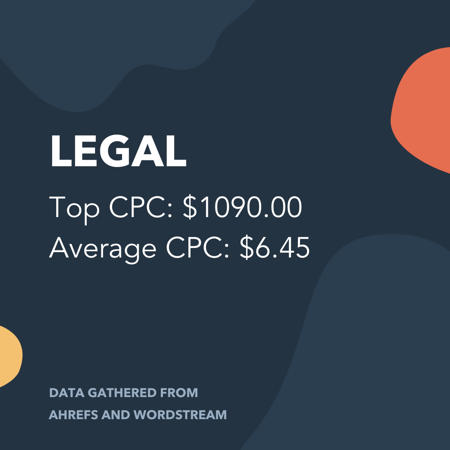
Top CPC: $1090.00
Average CPC: $6.75
The legal industry has some of the highest CPCs in this article, primarily due to the high amount of competition they’re up against and the higher ticket service cost. For this industry, we looked at keywords relating to “lawyer,” “attorney,” “legal services,” and a few other related keywords. Here are the ones that topped the list:
| Keyword | CPC |
|---|---|
| houston maritime attorney | $1,090.00 |
| offshore accident lawyer | $815.00 |
| best motorcycle accident lawyer | $770.00 |
| 18 wheeler accident lawyer san antonio | $670.00 |
| scranton personal injury lawyer | $560.00 |
| truck accident attorney dallas | $515.00 |
| houston trucking accident attorney | $500.00 |
| mesothelioma attorney assistance | $490.00 |
| new york construction accident lawyer | $485.00 |
| maritime lawyer new orleans | $485.00 |
| california auto accident laywer | $475.00 |
| auto accident attorney california | $465.00 |
| auto accident attorney colorado springs | $460.00 |
| car accident lawyer jacksonville | $430.00 |
| truck accident lawyer dallas | $425.00 |
Medical
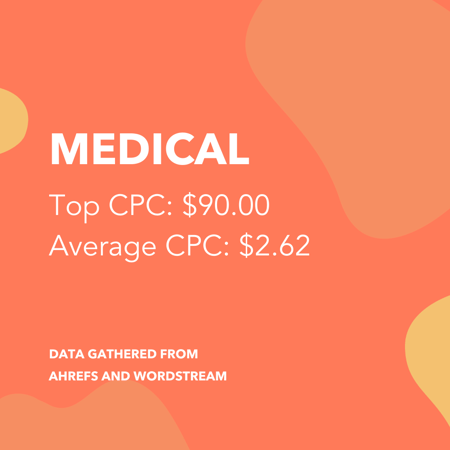
Top CPC: $90.00
Average CPC: $2.62
What’s curious about this is that we targeted keywords around the top most common types of doctors, yet it was still urgent care and detox programs that dominated the highest costs per click.
| Keyword | CPC |
|---|---|
| urgent care emr | $90.00 |
| hospital alcohol detox | $65.00 |
| dermatological problem | $65.00 |
| fort lauderdale hospital detox | $65.00 |
| transporter hospital | $60.00 |
| children’s hospital emergency room near me | $60.00 |
| kensington hospital detox | $60.00 |
| urgent care jasper tx | $55.00 |
| childrens oakland hospital | $55.00 |
| weight loss surgery dallas tx | $55.00 |
| urgent care snider plaza | $50.00 |
| dallas bariatric | $45.00 |
| endocrine weight loss | $45.00 |
| urgent care 77041 | $45.00 |
| urgent care electronic medical records | $40.00 |
Marketing & Advertising
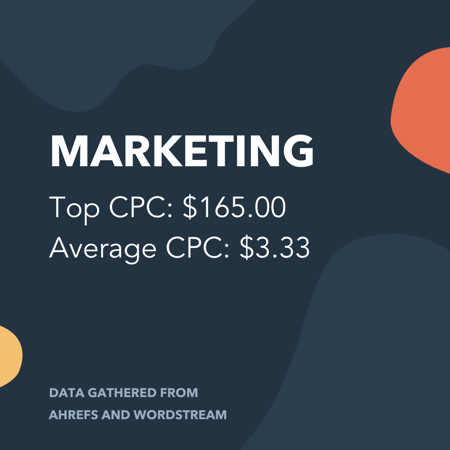
Top CPC: $165.00
Average CPC: $3.33
Marketing professionals in this space presumably know advertising tricks to help keep costs down, but this industry is also more likely to put value in Google Ads. That’s why the average CPC is relatively reasonable compared to these top CPC keywords:
| Keyword | CPC |
|---|---|
| what is marketing channels | $165.00 |
| call tracking marketing | $125.00 |
| marketing your law firm | $120.00 |
| seo and social media marketing services | $115.00 |
| affiliate marketing software free | $110.00 |
| law firm marketing los angeles | $100.00 |
| marketing automation for agencies | $100.00 |
| what does cpm stand for in advertising | $95.00 |
| 3 p of marketing | $95.00 |
| marketing cloud software | $90.00 |
| ppc advertising management | $80.00 |
| marketing integration | $80.00 |
| email marketing automation software | $80.00 |
| what does ppc stand for in marketing | $75.00 |
| best marketing quotes | $75.00 |
Business Software
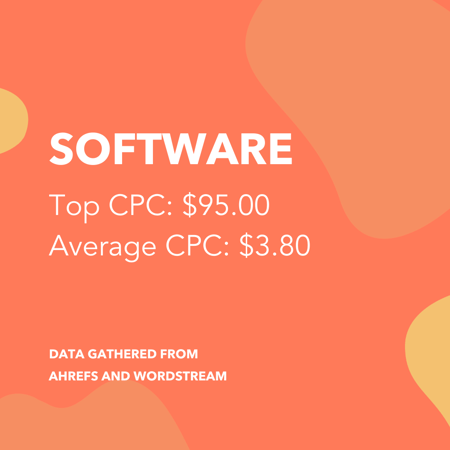
Top CPC: $95.00
Average CPC: $3.80
For this category, we didn’t want to include “SAAS” since that would not be a keyword a consumer would use to find the software of their choice. Instead, we used aggregate keywords around “business software” to see what the most expensive CPCs would be:
| Keyword | CPC |
|---|---|
| complete business solution | $95.00 |
| top 10 help desk software | $95.00 |
| help desk software for small business | $90.00 |
| small business call center software | $85.00 |
| accounting online program | $70.00 |
| best online accounting program | $60.00 |
| business performance management software | $60.00 |
| employee management software for small business | $60.00 |
| email marketing software for small business | $55.00 |
| best medical billing software for home based business | $55.00 |
| marketing automation software for small business | $55.00 |
| best crm software for small business | $55.00 |
| crm software for small business | $55.00 |
| best hr software for small business | $50.00 |
| small business marketing software | $50.00 |
Real Estate
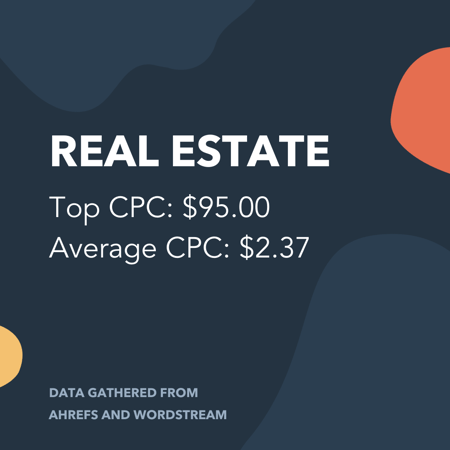
Top CPC: $95.00
Average CPC: $2.37
Curiously, despite pooling all keywords related to “real estate agent” and “REALTOR” along with the other service-based keywords, it was the descriptive keywords using “fast” or “with cash” that seemed to outpace all others when it came to cost per click.
| Keyword | CPC |
|---|---|
| sell house fast austin | $95.00 |
| sell my house fast phoenix | $70.00 |
| sell my house fast austin | $65.00 |
| sell my house fast san diego | $65.00 |
| selling a house as is by owner | $60.00 |
| teacher home buying programs texas | $60.00 |
| sell my house fast orlando | $60.00 |
| quickly sell house | $55.00 |
| we buy houses fast for cash | $55.00 |
| will my house sell | $55.00 |
| sell house cash | $55.00 |
| buy house cash or mortgage | $50.00 |
| sell house fast for cash | $50.00 |
| buy my home for cash | $50.00 |
| worst month to sell a house | $60.00 |
Home Improvement Services
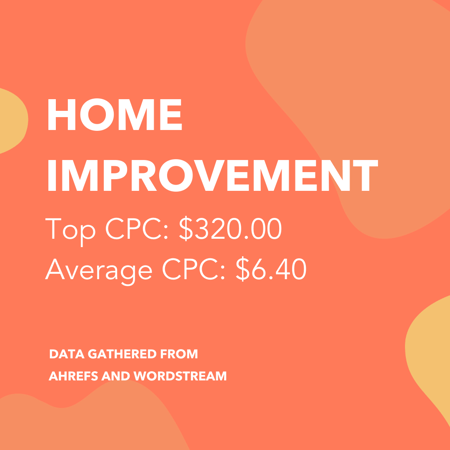
Top CPC: $320.00
Average CPC: $6.40
The home improvement industry is a large one, but we focused primarily on services such as HVAC, plumbing, and restoration and renovation. It seemed as though air conditioning and water damage seemed to be the ones with the dominant CPC in this group:
| Keyword | CPC |
|---|---|
| ac repair coral springs fl | $320.00 |
| emergency flood repair | $265.00 |
| flood restoration san diego | $210.00 |
| air conditioning repair weatherford tx | $210.00 |
| best ac repair phoenix | $185.00 |
| air conditioning repair boca raton | $150.00 |
| water damage restoration portland oregon | $145.00 |
| water damage restoration los angeles | $145.00 |
| air conditioning repair phoenix | $140.00 |
| air conditioning repair mesa az | $135.00 |
| air conditioning repair simi valley | $125.00 |
| air conditioning repair plano tx | $120.00 |
| water damage restoration mesa az | $120.00 |
| water damage restoration dallas | $120.00 |
| water damage restoration vancouver wa | $115.00 |
Automotive
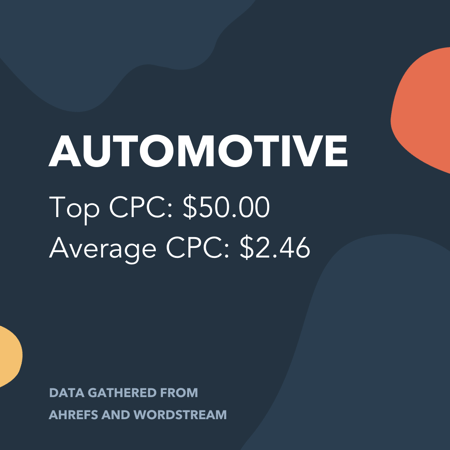
Top CPC: $50.00
Average CPC: $2.46
For this industry, we decided to pull keywords relating to “auto repair,” “auto body,” and “dent removal,” taking care to remove any insurance or car accident litigation keywords. You’ll notice that lower ticket items such as oil changes and tire services are not present on this list. We can reasonably assume that advertisers in this category want to put their advertising dollars toward higher ticket items:
| Keyword | CPC |
|---|---|
| auto repair shop modesto ca | $50.00 |
| paintless dent repair denver colorado | $45.00 |
| abs unlimited auto repair | $45.00 |
| paintless dent repair mn | $40.00 |
| denver auto hail repair | $35.00 |
| change oil light | $35.00 |
| automotive repair lubbock tx | $30.00 |
| auto repair shops stockton ca | $30.00 |
| paintless dent repair colorado springs | $25.00 |
| auto ac repair las vegas | $25.00 |
| auto repair shops omaha ne | $25.00 |
| auto repair shop mesa az | $25.00 |
| aftermarket automotive warranty | $25.00 |
| dent repair colorado springs | $25.00 |
| paintless dent repair denver | $25.00 |
Insurance
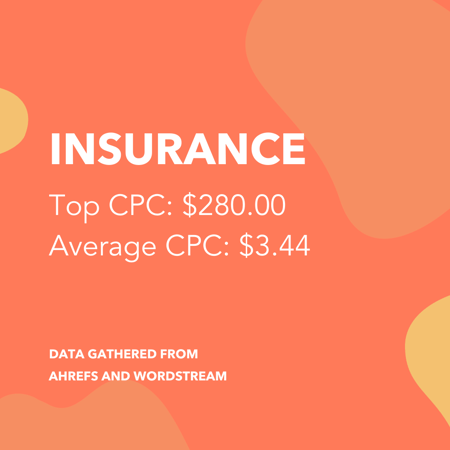
Top CPC: $280.00
Average CPC: $3.44
Car insurance completely dominated the insurance industry:
| Keyword | CPC |
|---|---|
| compare vehicle insurance | $280.00 |
| oklahoma auto insurance quotes | $210.00 |
| insurance companies okc | $185.00 |
| cheapest auto insurance reddit | $170.00 |
| insurance strategy | $160.00 |
| texas auto insurance quotes online | $155.00 |
| preferred auto insurance companies | $150.00 |
| what is insurance deductible | $140.00 |
| what is premiums in insurance | $135.00 |
| fort myers auto insurance | $130.00 |
| auto insurance connecticut | $125.00 |
| definition collision insurance | $125.00 |
| hail damage car insurance claim | $120.00 |
| car accident other driver has no insurance | $120.00 |
| define insurance brokers | $120.00 |
Loans & Finance
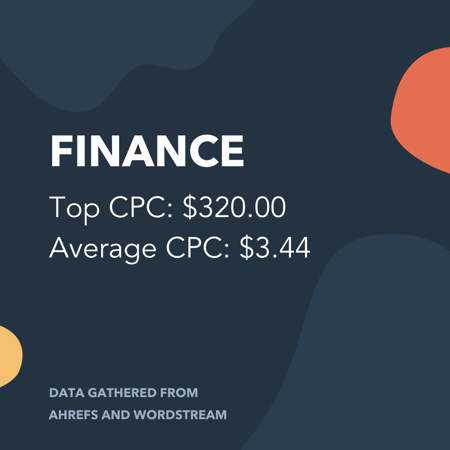
Top CPC: $320.00
Average CPC: $3.44
In the finance space, we compiled keywords relating to banking, credit, debt, loans, mortgages, and more. The common theme among the high-CPC keywords was debt relief or loan acquisition (VA loans being especially popular):
| Keyword | CPC |
|---|---|
| irs tax debt relief program | $320.00 |
| va loan multi family | $190.00 |
| tax credit for college students | $135.00 |
| va loan after chapter 7 | $130.00 |
| how to get preapproved for a va home loan | $125.00 |
| structured settlement loan | $105.00 |
| national guard va home loan | $95.00 |
| cost to refinance home loan | $95.00 |
| how long does a credit card balance transfer take | $90.00 |
| va home loan specialist | $85.00 |
| will refinancing hurt my credit | $85.00 |
| maximum fha loan amount | $85.00 |
| does opening a checking account affect credit | $80.00 |
| fha loan foreclosure waiting period | $80.00 |
| tax debt relief program | $75.00 |
Education

Top CPC: $140.00
Average CPC: $2.40
It’s clear that online learning overtook the list of high-CPC keywords. This is likely due to smaller ticket educational items such as certifications, courses, and training not providing high enough ROI to justify such high costs per click.
| Keyword | CPC |
|---|---|
| online business degree programs accredited | $140.00 |
| online accredited psychology degree | $135.00 |
| online degree in educational psychology | $135.00 |
| online business degree florida | $135.00 |
| online university college | $125.00 |
| online psychology bachelor’s degree | $125.00 |
| online college business degree | $125.00 |
| fastest criminal justice degree online | $125.00 |
| online masters degree in business administration | $125.00 |
| parapsychology degree online | $125.00 |
| online degree criminal justice | $120.00 |
| online school for business degree | $120.00 |
| online masters degree programs in healthcare administration | $120.00 |
| masters degree in human resources online | $120.00 |
| public administration masters degree online | $115.00 |
Some Notes About Our Methods:
The list of highest CPC keywords was determined from approximately 10,000 related keywords per industry. This information was accessed from Ahrefs and compiled on April 3, 2020 and should be used only for editorial purposes as there are many more keywords out there, CPC is subject to change with current industry and economic conditions, and keyword tools will provide differing data. Be sure to perform your own keyword research before making advertising decisions.
The average CPC per industry is unable to be determined from small datasets, so we pulled this information from WordStream’s keyword benchmarking report.
Didn’t see your industry represented? Follow the steps below to find the keyword costs for your most relevant keywords.
How Do I Find Out How Much a Keyword Costs?
Thankfully, not everything on the Google Ads platform is so expensive. In fact, WordStream estimates that the average CPC on Google is between $1 and $2.
With CPCs like that, you might be ready to:
- Decide if Google Ads is right for your business
- Find out the true cost of your most desired keywords
- Estimate the budget that it will take to power your lead generation engine
The unfortunate part, though, is that Google’s Keyword Planner is no longer available for use if you don’t have an account. That means you’d have to go through the entire process of signing up and providing your payment information upfront, before you’re ready to create your first campaign.
That means you need a way to find keyword cost estimates before committing to a campaign. Here’s how:
Use a Third-Party Keyword Research Tool
The good news is that Google is not the only place where you can get data about keyword cost and volume. There are a number of keyword research tools that you can use to estimate CPC for the keywords you want to target in your campaign.
Brand Overflow
Brand Overflow allows you to look up 10 keywords completely free, so if you’re doing preliminary research, this is a great option. After your 10 free keywords, their plans start at $9 per month.
Here’s how to estimate CPC in Brand Overflow:
- Navigate to the Keyword Tool.
- Type your desired keyword in the first field.
- Ensure that the second field accurately describes the geographic location you’re targeting.
- Click the Search button.
- Scroll down and look for the AVG CPC box on the left.
SEMrush
SEMrush is also a full-scale SEM and SEO platform that includes keyword research and discovery as just a subset of its functionality. Unfortunately, it does not offer any free keyword searches without signing up for an account.
Plans start at $99.95 per month, but have the option to take advantage of a 7-day free trial. This is a great option for those who are doing more in the digital space than just setting up a Google campaign.
Here’s how to estimate CPC in SEMrush:
- Create an account or log in.
- Type your keyword into the search bar at the top.
- Click the Search button.
- You will be directed to the Keyword Overview tool, and CPC is at the bottom of the first box on the left.
Ahrefs
Ahrefs is also a full-scale SEM and SEO platform. Its plans start at $99, but there is no free trial. In order to determine if this software is worth the investment, you can start a 7-day trial where you get access to all features for $7.
This is also a great option for individuals investing in search as part of their ongoing website and digital marketing strategies.
Here’s how to estimate CPC in Ahrefs:
- Create an account or log in.
- Click the Keywords explorer option in the top menu.
- Ensure Google is selected at the top of the field.
- Type your keyword(s) into the field. If you are wanting to do multiple keywords at once, separate them with commas or line breaks.
- Click the button with the magnifying glass.
- CPC is represented in the third box in the top row.
Set up a Fake Campaign in Google Ads
If the cost of a third-party keyword research tool turns you off, you can still use Google’s Keyword Planner. You just have to go through the campaign process and then turn the campaign off.
Note: By doing this, you’ll see a temporary $50 authorization which Google uses to verify your payment information. This is typically removed within a week. If you don’t turn off your campaign, your card will be charged every 30 days or when you reach your billing threshold. Be sure to review Google’s billing policies yourself before taking this advice.
Here are the steps:
- Sign up for a Google Ads account.
- Go through the prompts to set up your first campaign.
- Once complete, click Explore Your Campaign.
- In the first card that shows the campaign you just created, click the arrow next to Pending.
- Select Pause campaign.
Once you verify that you really want to pause the campaign, you now have a Google Ads account and can use the Keyword Planner for free (once the verification money is returned to you, of course). The plus side to this approach is that if you decide to move forward after your keyword research, you already have an account set up and a jump start on building a campaign.
Here’s how to estimate CPC in Google’s Keyword Planner:
- Navigate to the Keyword Planner.
- Click Get search volume and forecasts.
- Type your keyword(s) into the field. If you are wanting to do multiple keywords at once, separate them with commas or line breaks.
- Select Historical Metrics from the top menu.
- Instead of providing an average CPC, Google provides a low range estimate and a high range estimate. These are represented in columns on the left side of the table.
Getting CPC costs for your target keywords is the first step toward setting up your Google Ads campaign. The next thing you’ll want to do is determine the budget you’ll need to achieve your goals with the campaign. Start by reading our Ultimate Guide on Google Ads or downloading our free Ads kit.

The Ultimate Guide to Account-Based Marketing (ABM)
Imagine a world where you could start the sales process by selling directly to your best-fit, highest-value accounts. No wasted time working to market and sell to unqualified leads who aren’t the right fit for your business. Meaning, you could move straight into the phases of engaging and delighting your target accounts.
Talk about efficiency, right?
With account-based marketing, all of this is made possible. The process allows you to align your marketing and sales teams from the get-go to promote long-term business growth, delight customers, and boost revenue.
This guide is here to help you make it happen. Let’s dive in.
Account-based marketing allows you to weed out less-valuable companies early on and ensure Marketing and Sales are in complete alignment — in return, your team can leap into the critical processes of engaging and delighting those accounts much faster.
ABM helps your business work and communicate with high-value accounts as if they’re individual markets. By doing this — along with personalizing the buyer’s journey and tailoring all communications, content, and campaigns to those specific accounts — you’ll see greater ROI and a boost in customer loyalty.
Before we take a look at additional benefits of account-based marketing and specific tactics you can implement at your company, let’s review its relationship with another important strategy: inbound marketing.
Often, these strategies are thought of as entirely different entities. However, they can be quite complementary.
Account-Based Marketing And Inbound Marketing
Batman and Robin. LeBron and D-Wade. Peanut butter and jelly. Arguably some of the strongest partnerships ever to exist 💪. These dynamic duos are forces to be reckoned with when they work together.
Similarly, when paired, account-based marketing and inbound marketing have the power to make waves (the good ones) for your business.
You might be wondering, “How exactly does this partnership work?”
Well, we just reviewed the definition of account-based marketing — as you learned, ABM is a highly-targeted strategy.
Meanwhile, inbound marketing is more foundational — the methodology and growth strategy allows you to attract customers through the creation of valuable content, SEO, and a delightful customer experience.
Rather than interrupting your target audience and customers (as you would with outbound marketing), inbound marketing allows you to more organically provide your audience with the information they want when they want it. Inbound lays the foundation for a strong ABM strategy by allowing for highly-targeted and efficient resource allocation of high-value accounts.
Here are a few more reasons to implement both ABM and inbound marketing:
- Inbound marketing helps you attract target accounts and ABM then accelerates the flywheel so you can win and delight those target accounts with a remarkable customer experience (and as a result, you’ll grow better).
- Inbound marketing lays the foundation for a strong ABM strategy — ABM builds off of inbound by allowing for targeted and efficient resource allocation of high-value accounts.
- With this combined approach, you attract a broader group of prospects than you would while using just one method and catch any opportunities the other strategy may have missed.
- Your content has a two-for-one value — you can create and use content that serves both an ABM and inbound strategy (e.g. create a personalized case study for a target account that you also share on your website).
- Software options, like HubSpot’s account-based marketing software, are available and make it easy to implement ABM and inbound strategies in a complementary way.
🧡TLDR: Combine ABM and inbound marketing to grow better.
Next, we’ll take a look at some of the definable benefits of account-based marketing.
There are a number of benefits associated with account-based marketing. We’ve compiled the following list of commonly-noted results that positively impact (all types of) businesses.
1. Keep Marketing and Sales aligned.
Cross-team collaboration and improved communication across any organization are beneficial to growth. In terms of account-based marketing, this transparency and alignment will ensure your marketing and sales teams are focused on the same goals, stick to the mutually-agreed-upon budget, and understand the specific roles of each internal stakeholder.
This alignment helps ensure all communications, interactions, and content (and more) are consistent for the accounts you work with. Meaning, no matter how long an account works with your company, your team members can pick up where others left off at any point in time without question — this creates a seamless and delightful customer experience.
🧡The easiest way to maintain internal account-based marketing alignment is with the help of software, like HubSpot, which makes connecting your marketing and sales teams exceptionally easy.
2. Maximize your business’s relevance among high-value accounts.
Account-based marketing requires you to personalize everything (e.g. content, product information, communications, and campaigns) for each account you invest your resources in. Through this personalization and customization, your relevance among these accounts is maximized.
That’s because your content and interactions are tailored in a way that shows them how your specific products, services, offerings, and team are what they need to solve their challenges and to grow better. Meaning, ABM allows you to angle your business in a way that makes it the most-relevant and ideal option for your target accounts.
3. Deliver consistent customer experiences.
As mentioned, account-based marketing requires you to deliver consistent experiences for your accounts — this plays a major role in your success. A large part of the reason for this is because ABM is a long process that often lasts several months or years.
So, for your ABM efforts to be remarkable, you must maintain a long-term sense of delight among your accounts. This is how you’ll make each account feel as though they’re your business’s market of one — and why would they ever want to stop doing business with you if that’s their experience?
Delivering these long-term, consistent experiences may seem a bit daunting. Although this is understandable, the good news is that ABM is a process that naturally encourages you to do so.
Think about it this way: We already discussed the way ABM requires Marketing and Sales to be aligned on all things related to each account (e.g. their goals, budget, unique needs, members of their team and buying committee).
When there’s a universal understanding of these factors within your organization, Marketing and Sales (and anyone else involved) will be able to effectively and naturally deliver that feeling of consistency through everything they communicate and share with each account (e.g. personalized content, targeted campaigns, pricing and product information, and more).
4. Measure your return on investment.
With account-based marketing, you can easily measure return on investment (ROI) for each account you invest your resources and time into. This is beneficial because you can confirm whether certain accounts you invested in were ideal for your business.
Then, you can nurture and delight those accounts long term as well as identify and target similar accounts in the future. If your ROI proves your ABM tactics worked, use those results as a motivator to drive your strategy forward as well as one you can count on to continually improve your bottom line.
5. Streamline the sales cycle.
Depending on your business, industry, and resources, the sales cycle typically looks something like this:
1) Prospect → 2) Connect → 3) Research → 4) Present → 5) Close → 6) Delight
With account-based marketing, this cycle is streamlined — by focusing your efforts on specific high-value target accounts, you save time and resources, and spend more time on the stages of the cycle that positively impact your bottom line:
1) Identify Target Accounts → 2) Present to Target Accounts → 3) Close Target Accounts → 4) Delight Accounts
ABM streamlines your sales cycle by helping you stay efficient. Rather than experimenting with different tactics to prospect and qualify a large pool of leads, ABM ensures your target accounts are ideal for your business so you can quickly dive into building relationships.
The sales cycle stage of closing is also streamlined through ABM. That’s because your chances of converting accounts and retaining them long term increase thanks to marketing and sales alignment, consistent customer experiences, and personalization.
6. Expand business through account relationships.
The saying “quality over quantity” applies to account-based marketing. The process requires you to invest significant time and resources in engaging and delighting a group of carefully-chosen, high-value accounts, versus trying to quickly close deals with less-qualified leads who may not be the best fit for your company in the long run.
By taking the time to build these trusting relationships with accounts, you’ll expand business by retaining those valuable customers longer. And considering it costs more to obtain customers than retain them, this will positively impact your bottom line.
Additionally, as a result of personalized, thoughtful, and consistent customer experiences, accounts will become loyal to your business over time — and loyal customers become your best marketers, promoters, and brand advocates.
In other words, your accounts will help you expand your business among their networks (e.g. partners, customers) through referrals, word-of-mouth marketing, testimonials, and more.
Now let’s cover some account-based marketing tactics you can apply to your strategy to improve the likelihood of success.
ABM tactics are the building blocks of your strategy — so, work through the following list to ensure your ABM efforts and investment are successful.
1. Secure organizational ABM alignment.
One of the most important account-based marketing tactics is arguably one of the most straightforward: Secure organizational ABM alignment.
This means getting all internal stakeholders on board with the various factors related to your account-based marketing strategy. In doing so, it’ll be easier for your business to create consistent experiences for accounts and make sure your strategy is as efficient and streamlined as possible.
For example, your VP of Marketing and VP of Sales should secure organizational alignment and spread awareness regarding:
- Marketing and sales team members who are directly involved in the strategy
- Account buying committee members and any other account stakeholders
- Your business’s point-of-difference for each target account
- ABM budget and resources
- ABM goals and KPIs
2. Build your ABM team.
Similar to the first tactic we reviewed above, VPs of Marketing and Sales will also likely be leaders in the discussion regarding how you’ll build your ABM team.
They, along with managers on their respective teams, will need to identify a minimum of one marketer and one sales rep who will be completely dedicated to the accounts you work with.
These people will create and publish content for accounts as well as work to manage and close business deals with each account’s buying committee. (As a rule of thumb, try to limit your team size to no more than ten sales reps and one marketer.)
In addition to the marketer(s) and sales rep(s), don’t forget to identify any other internal key players — such as customer success reps — who should be aware of and aligned on your ABM strategy.
3. Identify and pick your ideal set of target accounts.
Identify and pick your ideal set of high-value target accounts to invest your time and resources in.
Here are some recommendations on how you can do this:
- Set search alerts for your ideal customer profile on LinkedIn.
- Create a workflow that filters incoming qualified leads based on specific criteria (e.g. company size, industry, etc.) and tags them as an ideal customer type in your CRM.
- Ask, “If we could replicate one deal from last year, what would it be?” Then, use the characteristics of that deal (e.g. industry, company size, value) to help you identify other good-fit customers.
- Pick target accounts based on a particular industry or geographical location.
- Review major companies and leads who are using and engaging with your inbound content but don’t have a deal attached (yet!).
- Identify the lighthouse accounts you could use for reference.
- Stick to no more than 10 accounts per sales rep.
4. Encourage Marketing and Sales to create account plans together.
Throughout this guide, you’ve probably picked up on the fact account-based marketing is a team effort. That’s why ensuring appropriate marketing and sales team members are involved in account planning is so important.
Make sure Marketing and Sales ask the following questions while they work on account plans:
- Who will we need to know at each account (e.g. buying committee members and account stakeholders)?
- What content will we need to attract and engage account buying committee members (and any other stakeholders)?
- Which channels will we use to share content with the right people at each account?
- How will we (marketers and sales reps) provide the right type of support throughout each stage of the strategy and sales process — in other words, how will sales help at the outset and how will marketing support in the later stages?
🧡Store your account plans as pinned notes in your HubSpot CRM, Google Docs, Asana Boards, pinned messages in Slack, and more to allow for easy access and collaboration.
Here are a few other tips Marketing and Sales can use to make your account plans successful:
- Ensure Marketing and Sales align on your product or service’s value proposition and point-of-difference for every account.
- Create personalized content — or update existing content — so it’s tailored to each unique account.
- Customize your allocated resources and budget for each account.
5. Attract contacts from high-quality accounts.
Next, you’ll want to attract the buying committee members and stakeholders of your target accounts. Depending on how long you’ve been in business and any previous ABM work you’ve done, you may or may not already have contacts for specific accounts.
The key to successfully attracting high-quality accounts is to personalize content to those accounts — this will help you elevate brand awareness and maximize relevance among audience members.
Here are some GDPR-compliant recommendations for attracting high-quality accounts:
- Engage accounts on social media (e.g. determine which platforms they’re on, join the groups they’re in, contribute to conversations they’re a part of, and share helpful and relevant content you’ve created).
- Produce a podcast or video series and invite a leader from the account to be a special guest.
- Sponsor a booth at a target account’s conference or event.
- Send direct messages via social media and direct mail via email or post.
- Communicate through LinkedIn InMail outreach (do this simply and without ever leaving HubSpot with the LinkedIn integration).
- Build custom landing pages tailored to the needs, questions, and concerns of accounts.
- Offer gifts for engagement and interaction (e.g. prizes, swag, and discount codes).
- Distribute content such as blog articles across channels that are relevant to each account (e.g. website, social media, and magazines).
- Create ad campaigns and social ads to target different factors such as location, skill, and job title.
- Ask current contacts, accounts, and customers for referrals.
- Invite contacts to (physical or digital) events and ask attendees to invite their colleagues.
6. Forge strong relationships with the account’s buying committee.
Once you’ve attracted high-value accounts, it’s time to forge strong relationships with their buying committees. This is something your team will likely work on over an extended period of time — in fact, it often takes months and even years to develop these bonds. Think of this tactic as one tied to delighting your accounts — you never stop the process of delight.
Here are some thoughts on how you can forge strong, long-lasting relationships with an account’s buying committee.
- Provide education around the value your business — and your product/ service — brings accounts through tailored interactions and engagement.
- Create and share personalized content, such as case studies, to prove the ways you’ll exceed expectations and resolve the challenges of each account.
- Communicate one-on-one when possible to make buying committee members feel like they’re your only priority.
- Host events with and for account members (e.g. dinner) so they get to know your brand and team on a personal level.
- Stick to organized, well-timed meetings.
- Use email sequencing to enhance all communication, be professional, and maintain consistency.
7. Measure and analyze your ABM results (and make necessary iterations).
While working through and upon completion of the tactics above, it’s crucial you monitor your success. By reviewing and analyzing your ABM results, you’ll identify any gaps or parts of your strategy that need to be changed. This will allow you to make your strategy more effective for your business, marketing and sales teams, and accounts.
Here are some examples of common account-based marketing KPIs that provide insight into how you’re doing:
- Deal creation
- Account penetration (net new contacts added to an account)
- Account engagement
- Deal-to-close time
- Net-new revenue
- Percent of deals closed
🧡For support with your analysis, enlist the help of HubSpot’s library of 12+ ABM reports and pre-built ABM reporting dashboard to gain valuable insight into how to modify your ABM strategy for greater success.
Grow Better With Account-Based Marketing
Account-based marketing doesn’t have to be overwhelming. By working through the tactics we’ve listed above and implementing software — such as HubSpot’s ABM software — for your marketing and sales team to use together, you’ll identify valuable accounts more efficiently, reduce any friction impacting your flywheel, and grow better.

Wasn’t ABM Supposed to Fix B2B Buying?
Before my kids woke up this morning, I had ordered groceries for the week, subscribed to a digital news channel I’ve been meaning to read more, and signed up for an online workout class (that I’m likely to skip). All from my phone, and all with just a few clicks.
The purchase process for each was personal, quick, and easy — something I’ve come to expect from all my service providers.
It’s 2020 after all, and delivering an exceptional customer experience is the key to success. In recent years we’ve seen consumers flock to the companies that offer the best customer experience.
These ‘experience disruptors‘ have driven customer expectations to new heights, and in doing so, have raised the customer experience bar for business across all industries.
But if the importance of customer experience seems obvious to us as consumers, it begs the question: why is the buying experience for B2B companies still so bad?
According to a CEB poll, the words B2B decision-makers associate with their buying experience include “hard, awful, painful, and minefield.”
It’s a process that’s years behind the seamless B2C experiences we now expect. And when we look at high-value B2B deals — with longer sales cycles, more decision-makers, and stiffer competition — the experience seems decades behind the times.
How do we explain this? Aren’t B2B marketers aware of the importance of customer experience? Don’t salespeople have unbridled access to a supply of software tools that are supposed to help with this? And weren’t they all promised that ABM would solve this problem?
They were, but it wouldn’t be the first time enterprise software has left marketers and salespeople wanting.
Understanding ABM
ABM has long been heralded as a silver bullet for delivering personalized, contextual buying experiences for businesses, but many marketers and salespeople are still waiting to see the benefits.
Misconceptions about those three simple letters have taken hold in the market, giving rise to three myths that to this day hold companies back from putting a successful strategy in place.
At HubSpot, we’re on a mission to debunk those myths.
Myth #1: ABM is Exclusively for Marketers
Perhaps the most commonly held misconception about ABM is that it is a strategy for marketers alone.
Many businesses are sold ABM solutions with the assurance it’ll enable them to deliver B2C buying experiences to B2B companies, but in practice, the products often amount to little more than a set of advertising tools that allow marketers to slightly improve their targeting.
And while that can drive brand awareness among high-value accounts, it isn’t much help to the salespeople that are responsible for delivering an exceptional buying experience at later stages of the sales cycle.
To truly deliver a seamless B2B experience across the entire buyer’s journey, marketers and salespeople have to be equally invested in an ABM strategy from the get-go, and have a centralized system of record.
As General Manager of HubSpot’s Sales Hub, I’ve seen the importance of this first-hand. If marketers launch an ABM strategy in isolation, their colleagues in sales will quickly find themselves on the backfoot, scrambling to react to the new types of leads landing in their laps.
Similarly, if salespeople are the first to reach out to new contacts at a target account, marketers will be jolted into reactive mode and rushed into creating content and messaging to support the nurturing process.
Successful ABM strategies are rooted in transparency and trust across marketing and sales. There shouldn’t be hidden tools where marketing campaigns are born, nor secret spreadsheets where salespeople do their bidding — both teams should be looking at the same data, all of the time.
Achieving alignment is challenging at the best times, but when companies have to wrangle two separate systems across their sales and marketing organizations to simply access the most recent communication with an account, the task is virtually impossible.
A system of record is the foundation of sales and marketing alignment — it enables marketers and salespeople to build a common understanding of high-value targets, what success looks like, and how to hold each other accountable as they work together to make their ABM strategy a success.
Myth #2: ABM is for Big Companies Only
The second myth about account-based marketing builds on the first. With the explosion of technology solutions in recent years, there are now more players than ever in the space. But for many, ABM still implies heavy spending on advertising, which can sometimes make it feel like an approach reserved for large companies with big teams and bigger budgets.
The truth, however, is that companies of any size can get started with ABM.
There are now new tools arriving on the market that are affordable, easy to set up, and easy to use — with HubSpot, for example, businesses can get started with ABM for free. There is also mounting pressure on enterprise software providers to improve the accessibility and usability of their products.
For too long, the tools needed to run sophisticated campaigns have been so prohibitively painful to use that growing companies have been prevented from experiencing their benefits. This is finally changing, and marketers and salespeople can now approach ABM with confidence, regardless of the size of their team or depth of their budget.
Myth #3: ABM Can’t Coexist with Inbound Marketing
Another myth that has held countless companies back from getting started with ABM is the belief that it is incompatible with inbound marketing. Fundamentally, both inbound marketing and account-based marketing are remarkably similar.
In essence, they’re both about matching sales and marketing strategies to how prospective customers want to buy, and in many iterations, the same channels — and even the same content — can be used in both approaches.
Where inbound marketing attracts a wide range of interested consumers by providing helpful content, ABM helps businesses to offer a more targeted, personalized approach when delivering value. And when used together in the same organization, the two approaches become greater than the sum of their parts.
A well-executed inbound marketing strategy not only helps to deliver value to a broad audience, it organically surfaces high-value accounts that are naturally suited to an ABM strategy. And from there, marketers and salespeople can use their inbound assets to drive more targeted, personal interactions with those accounts.
The myths that ABM is exclusively for marketers, only accessible to companies with big budgets, and incompatible with inbound marketing tactics have deprived companies of its benefits for too long.
And at a time when working on high-value B2B deals is only growing more complex, it’s increasingly important that businesses are given the opportunity to make use of ABM’s full potential.
On average, there are 6.8 decision-makers involved in the B2B purchase process — an increase of 25% in just the last few years. Each of these people brings their own preferences, passions, and pet rocks to the table across the entire buying process, making it harder than ever to deliver a buying experience that’s consistent, contextual, and compelling.
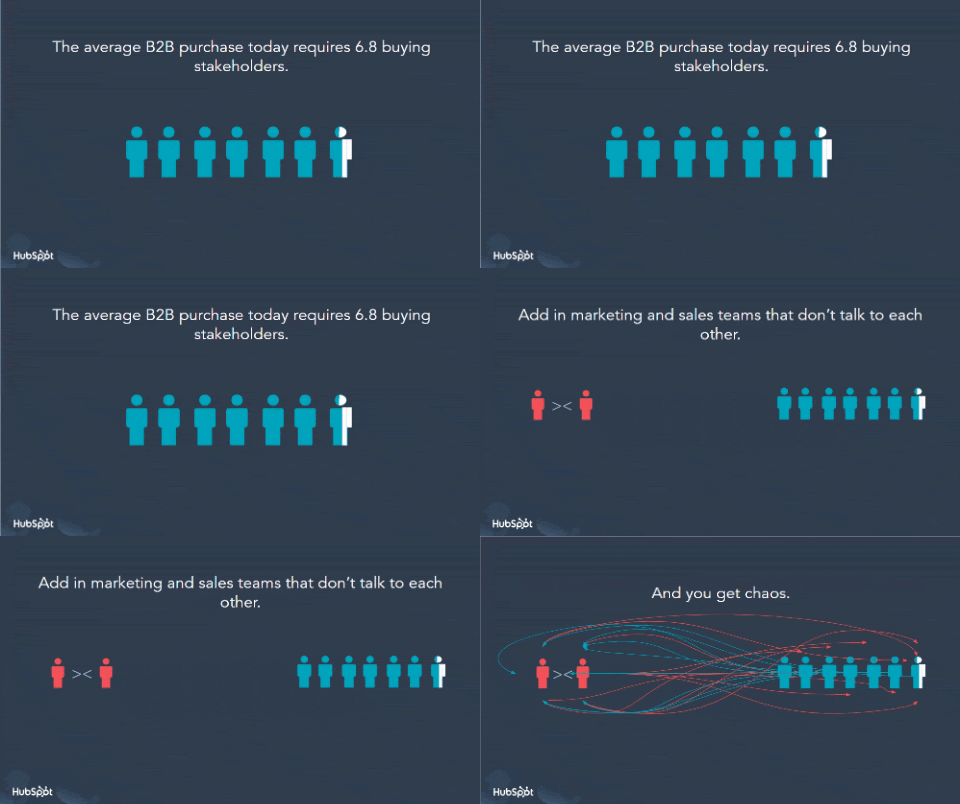
But with ABM tools that are powerful and easy-to-use, shared across a centralized system of record, and used alongside an inbound marketing strategy, marketers and salespeople can work together to overcome this complexity and deliver B2B buying experiences that can turn losses into wins.
Introducing HubSpot ABM
At HubSpot, we believe that ABM has become unnecessarily confusing and high-minded, prohibiting companies from even taking the first step. As one analyst put it, “the rapid and continued adoption of ABM programs will require significant investment in technology, media, data, and employees.”
It doesn’t have to be this way.
ABM should feel natural for every business, not like a special one-off campaign or like getting a PhD in Economics. It should be powerful, but also easy.
And it should be accessible to any company seeking to deliver positive B2B buying experiences.
That’s why we’ve launched a brand new set of ABM tools built natively into HubSpot, complete with shared sales and marketing features that are designed to empower companies to set up and execute an account-based strategy with ease.
Uniting Teams, Unlocking Potential
HubSpot’s new ABM offering includes tools that allow companies to get started quickly, including AI-powered target account recommendations, advanced company scoring, and user-friendly campaign templates.
And once up and running, sales and marketing teams can gain a unified view of target accounts, real-time reports, and the most recent communication with each contact at a company, giving them an all-important centralized system of record. This is what makes HubSpot’s ABM offering unique in today’s market, and is what can fuel the sales and marketing alignment necessary to deliver positive buying experiences for businesses.
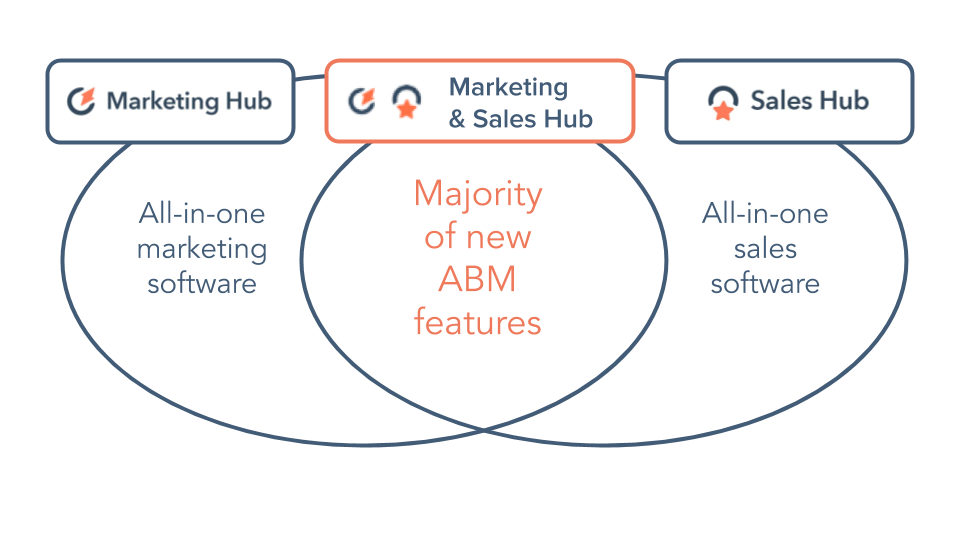
HubSpot ABM Packaging (May 2020)
As important as the ABM features we’ve built are the features we’ve chosen not to build. That’s where our rich ecosystem of app and strategic partners comes into play.
In HubSpot’s App Marketplace, companies can leverage tools like LinkedIn for advanced ad targeting, Bombora for company-intent insights, Engagio for multi-channel ABM automation, and Supermetrics or Demand Sage for deep ABM reporting. And with a newly enhanced Slack integration, teams can collaborate more closely as they work on high-value target accounts.
The updated integration now allows users to create Slack channels named after specific deals and accounts, easily share important KPIs, and add notes to deal and company records from Slack and vice-versa — all in the name of making it as easy as it should be for marketers and salespeople to move quickly in tandem as they unlock the potential of ABM.
Bringing B2C Buying Experiences to the B2B World
As consumers continue to benefit from the seamless buying experiences that are now standard across the B2C world, more and more B2B buyers are demanding the same.
At HubSpot, we’ve always believed that businesses that match the way they sell to the way customers want to buy will grow better. This principle applies whether it’s selling on-demand grocery delivery to an individual like me, or selling high-value services to large global enterprises.
With Sales Hub, Marketing Hub, and the array of new ABM tools that are shared across both, companies can launch account-based marketing strategies with ease, overcome the challenge of sales and marketing misalignment with a centralized system of record, and be empowered to deliver a seamless B2B buying experience to their most high-value target accounts.
ABM was supposed to fix the broken B2B buying experience. Now it can.

🧡HubSpot’s ABM Software Target Accounts Home and Account Overview features will help you forge these strong relationships.