
How To Master Writing Advertorials
I’m a huge fan of food magazine Bon Appetit. I love the brand’s voice, messaging, and content, so when I found the corresponding YouTube channel for the publication last year, I was immediately sold.
When you dive into Bon Appetit’s YouTube channel, you’ll find a cast of chefs. They either host their own show, make a recipe video, or both. For instance, my favorite Bon Appetit chef, Carla Lalli Music, hosts “Back to Back Chef” on the channel, but also has a few recipe videos.
Recently, I went to browse the official website to purchase merchandise. (Hey, I have to represent my favorites!) What I found, in addition to the merchandise, was one of Music’s recipe videos for ragu, using a specific brand of sauce from Barilla:
“So, cool,” I thought to myself. “Even though this is an advertorial, I love the content, so I’ll keep watching.”
An advertorial is, like the name suggests, an advertisement. But they are unique in their own way. Let’s define what an advertorial is, and how it can be an excellent marketing choice for you and your team.
A good advertorial doesn’t clearly state that an advertiser made the post in the copy, but it also doesn’t hide that fact. An advertorial should provide the same high-quality content as a blog post or video, but give a spotlight to the product being advertised.
For example, let’s say I’m on the marketing team for a company that offers social media services, and I’m in charge of writing an advertorial. I might write a listicle that talks about the top social media tools in the marketing industry, and include my company’s software somewhere in the list.
This approach accomplishes promoting my company’s services, but also provides valuable information to readers about other tools, like an editorial piece. Advertorials can be used as a valuable marketing technique for visibility and conversion, so let’s explore that, next.
Benefits of Advertorial Marketing
When you use an advertorial, you’re using a marketing technique that’s often used for brand exposure, conversion, and lead generation. In this section, we’re going to talk about how.
1. You can convert leads.
First, if you have blog post ideas that relate to your industry, you might consider sourcing out a publication that is interested in advertorials for your industry. For instance, if you run an ecommerce technology business, a publication like The New Yorker might not be a viable option — instead, you might want to consider a publication like TechCrunch, which specializes in all things technology and commerce.
Your advertorial would be shown to audiences that are the most interested in your industry, so you can increase exposure to the right audiences. You might be able to convert quite a few leads from this method.
2. Advertorials build brand awareness.
Next, let’s say you want to build brand awareness with paid ads, but are looking to advance your efforts past social media or TV ads. An advertorial might be a good alternative. The post, unlike ads, is paid for less often, but has the potential to be found by readers long after the publish date.
For instance, let’s say you pay for an advertorial tomorrow. Generally, you won’t have to keep paying to boost the visibility of your ad, like you would have to with other ads. You can earn organic traffic continuously with an advertorial.
3. Retarget your existing customers.
Lastly, if you’re thinking about advertorial marketing, think about how you can retarget your advertorial on your end. When the advertorial is posted, how can you fit it into your content plan to provide value to your existing customers?
Maybe your advertorial is a filmed interview with an industry thought leader, and your customers respond really well to video. You can post the advertorial on your social media accounts, and boost the fact that you partnered with a publication to bring a new video to your audience.
Similarly, you can embed the advertorial into your email list. Your email subscribers are likely devoted customers, so sharing the post with that audience is most likely going to earn you some traffic.
Encouraging your customers to share the post on social media and tag your company is a great way to increase brand awareness online, promote your advertorial, and gain user-generated content from your audience. User-generated content is a fantastic content idea that gives a voice to satisfied customers to market your product from their point of view.
Does all of this sound like an opportunity that can’t be missed? If your answer is, “Of course!”, you’re probably wondering what goes into an advertorial to make them stunning. So, let’s talk about writing an advertorial, next.
Advertorial vs. Editorial
Including company software among a listicle is just one of the ways to write a successful advertorial. Just like there are multiple ways to market products, there’s multiple ways to create an advertorial.
Ultimately, how you structure your advertorial is dependent on the brand voices of your company and the publication for which you’re writing.
If your brand voice is more formal, but you’re writing for a publication like BuzzFeed, which is known for its less-formal tone, blend the two harmoniously so your advertorial can speak to both audiences. (Alternatively, perhaps your target audience for this campaign supports a change of tone, which is 100% okay).
To make sure you write an effective advertorial that doesn’t sound too much like a blog post or too much like an ad, we’re going to analyze what makes editorial content, like a blog post or product page, vs. what makes an advertorial. These tips will help guide your writing process.
1. Write for value, not to promote.
Your advertorial should include valuable copy. You don’t need to write a blatant ad for your product or company. Instead, advertorials should take the tone of a blog post.
Blog posts are meant to provide information that audiences can find value from. So, when you sit down to create the concept of your advertorial, think about how you can serve your target audience with educational content, first.
Maybe your campaign goal is to increase visibility of your new product. If that’s the case, think of writing a listicle that mentions competitive products and include yours at the top. This provides valuable information to audiences you’re interested in, as well as the other way around.
2. Stick to what your title says.
When your advertorial pitch gets accepted by a publication, or after you’ve written a draft, read it for continuity: Does your advertorial accomplish what you said it would in the title?
For instance, if your post title is, “Marketing Tips for a Team of One,” but you spend the advertorial talking about how wonderful your marketing agency is at building brand awareness, your post is going to sound more like a product page.
It’s important you align the information in your article with your title, so readers know what they’re getting into when they read the title of your advertorial. Additionally, you won’t lose credibility for false advertising, and you can be sure you’re serving your audience.
3. Solve for the customer.
Serving audiences should be one of your top priorities with an advertorial. Yes, advertorials help your company out, but ultimately, solving for the customer generates new ones.
Advertorials aren’t a chance for you to shout out how your company solves all of the challenges presented in your advertorial. Instead, this is a chance for you to reach a new audience with high-quality content.
If you want to place an ad for your company in tandem with an advertorial, discuss the possibility with the publisher. You may be able to purchase ad space that will separate the purposes of your content.
4. Inspire action.
Remember, your advertorial should still be some sort of an advertisement, even if it’s not as visible as others. And, with all ads, you should inspire action by the end of the post.
Instead of including a huge, shiny CTA button that looks amazing on your product pages, weave action into the narrative of your advertorial. For example, if you are going to write one about your latest data report, include a link to read it, or a screenshot of a compelling part of the report that links to the content offer for it.
Similarly, you can make an interactive advertorial, like a quiz, that tests your readers’ knowledge about the subject, then provide a resource where they can learn more about the subject by accessing one of your offers.
5. Avoid only talking about your company.
This is a huge rule of thumb. To ensure your advertorial doesn’t take the form of a long-form ad, avoid only talking about your company in the advertorial.
It’s common to think that this point only applies to listicles, but it’s something to think about regardless of the type of advertorial you’re writing. Even if your content includes a quiz, you can have a couple of the questions mention competitors, and how they fit into the lives of your customers.
Similarly, if you’re writing a “How-to” guide, when you include your company as a resource, be sure to mention another option or two. To diversify your content, add value to the reader, and show your knowledge of the industry, mentioning other brands in the post is key.
6. Delight your readers with exceptional content.
If you’re writing an advertorial, it’s a good chance to try something new to delight your customers — for instance, maybe include animations instead of photos, emojis instead of text, or even a different style of writing that’s different from your typical brand voice.
The chance to participate in something new will engage with those leads. If you’re writing for the needs of your audience, you want them to feel like their experience reading your advertorial was a delightful one.
You can also try out some new optimization techniques. Maybe you create a content offer that’s specific to a campaign. You can experiment here, and cater to new leads with your piece.
Now that you have some tips about how to create an advertorial, let’s go over some examples you can refer to if you get stuck writing, formatting, or finalizing your post.
Advertorial Examples
If you’re wondering about the effectiveness of your advertorial, we’re going check out these examples to get an idea of how to make one that’s incredible.
1. Cole Haan x Forbes
Forbes runs a series on their website called BrandVoice, which is a series dedicated to expert advice from marketers. This BrandVoice in particular is an advertorial from footwear company, Cole Haan, about exploring creativity: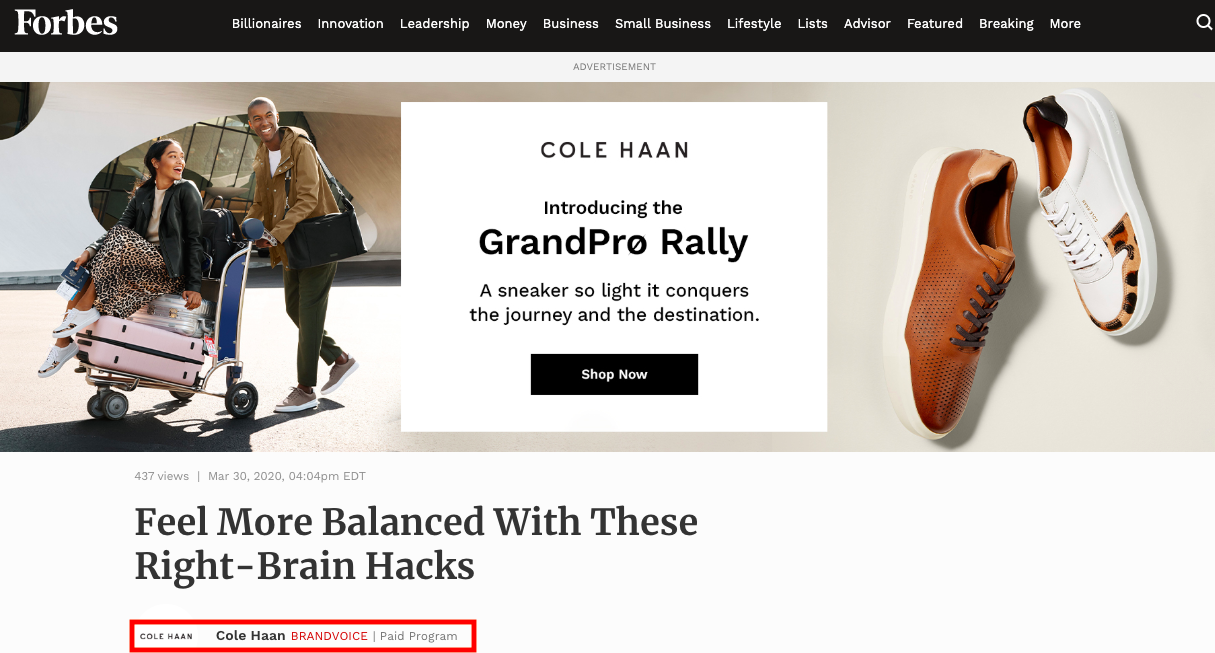
At the top of this post is a banner ad for Cole Haan. Putting this ad at the top of the post, rather than the body, reinforces that the post is an advertisement, but doesn’t make the copy suffer for it.This advertorial supports balancing your mind, and moving productively inside your home. While the post itself doesn’t mention the words “Cole Haan,” or promote the company’s products, the content still relates to the concept of moving your feet, which aligns with what the company sells.
If you want your advertorial copy to be a little more low-key, but still include an advertisement for your post somewhere on the webpage, think about adding in a paid ad, similar to Cole Haan’s.
2. Sapphire x Thrillist
Sapphire is a credit card rewards card offered by Chase Bank. Cardholders can earn points and rewards based on how much they spend at restaurants using the card. This advertorial gives a spotlight to must-try restaurants, in efforts to get readers thinking about how to use the Sapphire card:
This advertorial shows how a listicle doesn’t need to include your product to be successful. Instead, you can write about keywords that reflect your company or industry. As long as the advertorial supports your company in some way, it’s still effective.What’s great about this advertorial is that it takes an intriguing angle. Diving into restaurants that offer unique and futuristic food is an exciting topic. And, in keeping in line with Thrillist’s laid-back, friendly brand voice, the post’s language isn’t as formal.
3. Captain Morgan x BuzzFeed
Similar to the last example, this advertorial for Captain Morgan, an alcohol company, is a listicle from BuzzFeed Germany (Non-native speakers have the option to translate the page). What’s not similar to the last example is that this advertorial mentions the company and its products by name. Even so, this advertorial provides valuable information to the reader, so the advertorial is still effective.
The advertorial’s structure and copy make it an engaging, helpful read, even though it mentions the product more than once. It contains drink recipes that you can make at home, along with pictures to use as a guide: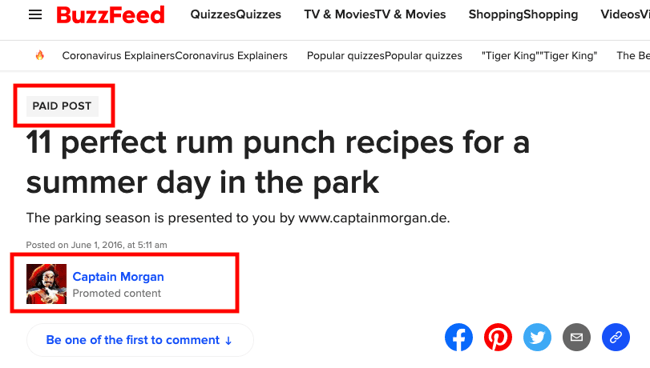
Recipes, along with guided pictures and ingredients, accomplishes two things. First, it gives plenty of ideas for fans of Captain Morgan, who may already have the products mentioned, but need inspiration for what to do with it. A simple Google query like “recipes with Captain Morgan” would bring the fan to this BuzzFeed advertorial.
This post can also catch the eyes of readers who want simple rum recipes to try out and need inspiration. It gives enough recipe variations to spark inspiration, and capitalizes on the seasonality, since this post went up during a summer month.
4. Love Beauty Planet x The New York Times
Sustainability is a big focus for beauty company, Love Beauty Planet. One of the company’s values is to produce their products ethically and with recycled materials to reduce their carbon footprint. This emphasis on going green is the focus for the company’s advertorial that was featured in The New York Times: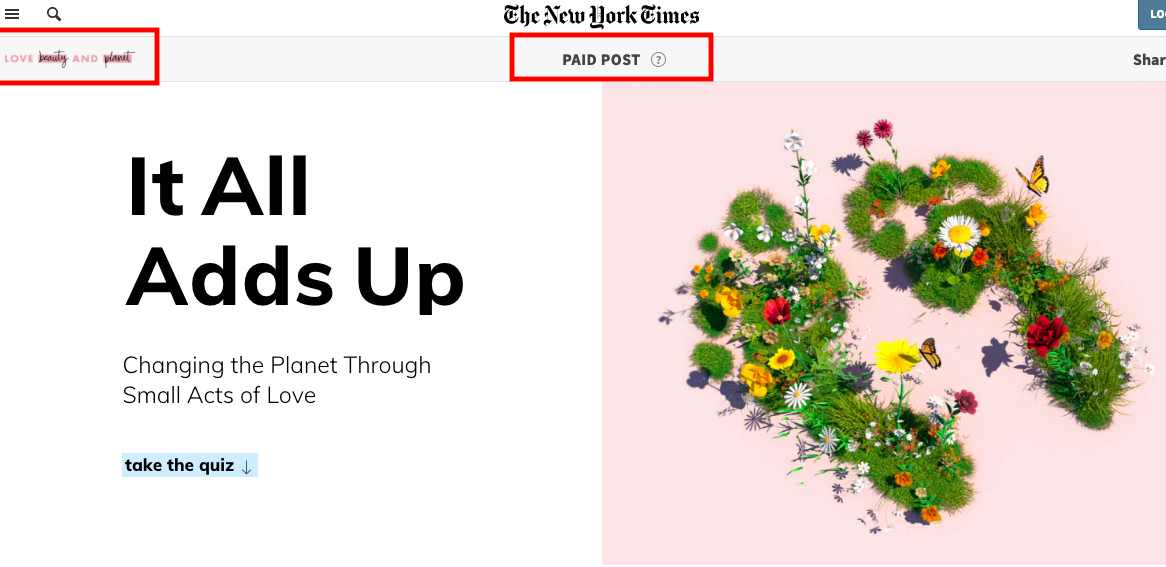
Creating an advertorial that’s a little more interactive than a text-only blog post is a strategy you could use to make your advertorial more engaging. If your quiz is shorter, like Love Beauty Planet’s, you can provide valuable, actionable takeaways at the end, to keep your brand in the reader’s mind as they implement the tips.This editorial is an interactive one, which first quizzes the reader’s knowledge of recycling and reducing waste. After answering the five questions, the post shares small things readers can do to reduce their carbon footprint.
5. PwC and RYOT Studio x The Huffington Post
For this advertorial, two companies collaborated to make a paid post that mixed copy with video. PwC and RYOT Studio worked together to produce an entry in PwC’s new series for diversity and inclusion for CEOs. The company offers business solutions for customers, so the angle keeps consistent with PwC’s industry:
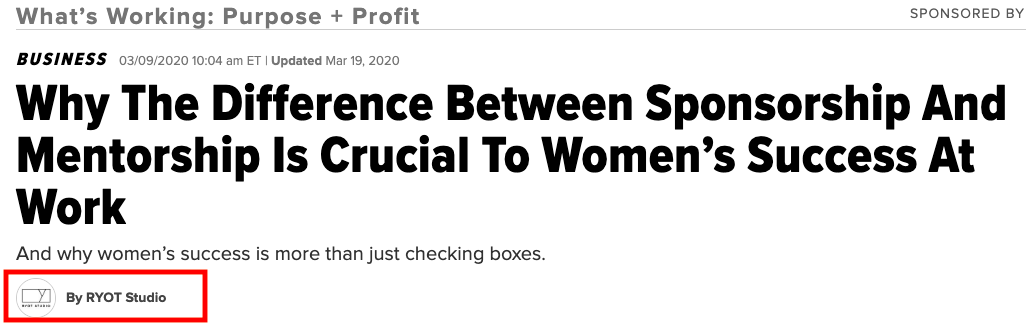
What this advertorial does really well is provide readers with a video to go along with the blog post. The video presents the content really well, so those who don’t usually enjoy interacting with long-form content don’t have to read as much.
If you have a video that tells the story of your company really well, and want to build some brand awareness, consider submitting it along with a couple of paragraphs of supporting copy for an advertorial. It can expose your company to a new audience, and be awesome for generating leads.
Now, you know how to spot an advertorial and even write one of your own. Advertorials can spice up your content marketing strategy and bring a community of new audience members to your brand, so make sure to put your best foot forward, and good luck!

7 Brands With Brilliant Facebook Marketing Strategies, and Why They Work
Despite what you might hear, Facebook marketing is not dead.
Even with the recent rise of other social media platforms like Instagram, LinkedIn, Youtube, TikTok, and the likes, with over 2.4 billion users, Facebook is still the world’s largest social media platform.
And, of those 2.4 billion users, the vast majority spend an average of 60 minutes on Facebook every day.
Let that sink in for a second — considering the average person sleeps eight hours a day, that means about 7% of their waking hours are spent with their eyes glued to Facebook. With those stats alone, it’s safe to say that Facebook is alive and well.
But why do so many users spend so much time on Facebook? Well, Facebook appeals to its users because it provides real-time information but with a deeper feel. It may not necessarily break news as fast as Twitter, but when it does, it provides greater detail and a platform for discussion.
The key differentiator that has kept Facebook as the most widely-used social platform however, is this: it takes engagement to a deeper level than any other social media network can.
But, with 94% of businesses still actively using Facebook, how can you make your brand stand out?
Here are seven brands that take their Facebook marketing to the next level, to help inspire your own brand’s future Facebook marketing strategy. Keep in mind that the strategies used by these companies can be used by any company out there. Ultimately, you don’t have to be National Geographic or Nike to be successful.
1. Charity: Water
Number of Likes: 488,000
Marketing any charitable organization can be tough because there are thousands of organizations out there that need our help. People love to support brands that give back. How can you pick and choose one great cause over another?
Charity: Water — an organization with a mission to deliver clean and safe drinking water to developing nations — takes a unique approach to non-profit marketing with exceptional storytelling.
Everyone loves a great story. People want to feel connected to a group, to belong. And stories give you a reason to communicate and relate. Stories are stimulating and give you something to believe in. And stories make you feel better, smarter, safer, or even loved.
Business storytelling is similar — it’s about creating alignment between your business and your prospects and customers. This is where Charity: Water excels. They’ve mastered the art of storytelling to raise awareness around the global water crisis all while inspiring people to give.
Take CEO, Scott Harrison’s own story, for example. Before starting Charity: Water, Scott spent a decade as a nightclub promoter and at 28-years-old, found himself spiritually, morally, and emotionally bankrupt. After volunteering aboard a hospital ship for two years, Scott saw the effects of drinking unsafe, dirty water first-hand. He later returned to New York and started what is now Charity: Water.
This strategy of telling compelling stories is not limited to Scott’s background — instead, it’s present in all the content the non-profit produces and shares on its feed. Throughout their content, the non-profit consistently shows, in a very personal way, how bringing clean water to those in need impacts the lives of countless people around the globe, including donors.
How can you incorporate this?
Your goal is to make a human connection. It’s all about resonating with people, people that need your help or guidance. A story is not just your history. A story is why you’re doing what you’re doing, and it’s critical you tell it in a way that appeals to your audience. Think about how you can capture your story and share it with your prospects and customers. And don’t limit yourself to lengthy ebooks, or emails — use video, images, interviews — get creative.
2. GoPro
Number of Likes: 10 million
When you visit GoPro’s Facebook Page, you’re met with videos and images that scream adventure, action, and adrenaline. This can be said about their pages and feeds on other platforms, like Instagram and Twitter, too. It’s not rare to see someone scaling a mountain, jumping out of an airplane, surfing, or doing a backward 360-degree flip on their mountain bike, all with a camera strapped to their head.
The brand’s feed is saturated with this type of content — and it works. They’re able to generate unprecedented engagement with almost every piece of content they produce because they know who their buyer persona is — and as a result, what content will resonate with them.
You’ll rarely see GoPro’s Page post any images or videos showcasing their highly popular action camera. They’re not connecting with their users through their products — instead, they’re connecting with their users through the lifestyle their products enable.
GoPro’s unique marketing strategy enables the company to capture the attention of their target market and showcase what it means to be a part of the GoPro community. Additionally, much of their content is user-generated. By using particular hashtags, like #GoProMillionDollarChallenge, users can tag their videos with the hashtag and have it featured on the company’s Page.
For the #GoProMillionDollarChallenge in particular, users uploaded over 42,000 videos over four months. Talk about driving engagement!
How can you incorporate this?
When it comes to creating great content on Facebook, it helps to know who you’re talking to. Understanding the people who are currently interacting with your Page will help you not only create great content — but create the right content, too.
There are many tools out there that can help you understand who your audience on Facebook is, like Facebook’s Audience Insights tool. Through accumulated information about geography, demographics, purchase behavior, and more, the tool helps you learn more about your target audience and their behavior on Facebook. While it’s easy to jump right into creating content on Facebook, take the time to understand who your audience is. It will pay-off in the long run.
3. Nike
Number of Likes: 33.7 million
Nike is arguably one of the biggest athletic brand names out there. They have a marketing budget that a lot of companies can barely begin to fathom. And yet, when it comes to their Facebook presence, they don’t over-emphasize the need to buy their products.
Even though Nike is such a household name, they still have competitors. Adidas and Under Armour aren’t just going to sit back and let them maintain the majority of the market share. You would think the competitive nature of the industry would encourage them to step up their promotions.
But they don’t have to. They have established and continue to maintain a strong brand image, which resonates throughout their Facebook page. They have quite possibly the most famous slogan out there, so they grab onto that popularity and incorporate it in their cover photo, photos shared, and through a branded hashtag.
Nike’s Facebook Page is a balance of new products, science, charitable initiatives, and encouragement. One way they differentiate themselves from their major competitors is by emphasizing the research and development that goes into every design. Their products are seen as the result of extensive engineering or science experiments, which evoke the idea that these items are both cutting-edge and high-quality.
How can you incorporate this?
Think about how you’ve positioned your business and presence on Facebook as it relates to your brand as a whole. How does your brand message support or complement the products you’re delivering? Does your larger brand message run through the products you’re delivering?
Instead of saturating your Facebook Page with content about your products, can you use it as a place to establish and reinforce your brand message? Ask yourself some of these questions, look at competitors in your industry, and consider what you can learn from them to take your Facebook marketing to the next level.
4. Tasty
Number of Likes: 97 million
If you’ve been on Facebook for any amount of time, you’ve likely come across Tasty. The brand, which is owned by BuzzFeed, produces engaging videos about making delicious food items in a short amount of time.
Tasty does such a good job when it comes to captivating users with their videos, but it’s not for the reasons you might think. Sure, the videos are visually appealing, they’re short, and they’re about food — who doesn’t love videos about food, right?
But there’s something else the brand does better than most: the marketers behind Tasty’s brand understands the context and experience of users on Facebook.
For instance, Tasty’s primary medium for delivering content on Facebook is video. What makes those videos unique is that the videos don’t require audio for a user to engage. This might seem like a minor detail, but it isn’t — for instance, consider scrolling through your News Feed and stumbling across a video that auto-plays, and understanding it without audio. That would make you pause for a bit longer, wouldn’t it?
Ze Frank, president of BuzzFeed Motion Pictures said: “We were really thinking of audio independence. What kind of videos would work seamlessly within a product like that and allow you to share it with your friends?”
They figured out a way to make their content readily available for users no matter the context, whether on their Page or in users’ feeds. So while they benefit from visually appealing video content that’s short and engaging, more importantly, they’ve understood the context of where users would consume that content and crafted an amazing user experience as a result.
How can you incorporate this?
When you’re posting content to your Page, try to think about all the areas where users might interact or engage with that content and make sure it’s optimized for those areas.
It’s unlikely that you’ll be able to create content that fits all areas, but that’s why you need to diversify your specific areas on Facebook. For instance, a video posted to your Page might not work well if you shared it in Facebook Stories, too. It’s critical you consider the context and overall user experience when you’re creating content on Facebook.
5. National Geographic
Number of Likes: 46 million
You’d be hard-pressed to find anyone who hasn’t heard of National Geographic. In recent years, the brand has consistently ranked number one among brands on social media in the United States, with well over 2.6 billion social engagements across several platforms.
National Geographic describes itself as being the world’s leading multimedia destination for the best stories in science, exploration, and adventure. And I think it would be tough to disagree with that statement.
One particular area National Geographic excels on Facebook is real-time audience engagement. This was on full display in their “Safari Live” series. Throughout the series, National Geographic scientists, photographers, and other teams broadcast their assignments in real-time using Facebook Live.
In one broadcast, viewers were invited to join the team live on a Safari in South Africa, and watch a female leopard consume its prey. Throughout the broadcast, users were able to post comments and ask questions that the National Geographic team would answer right then and there.
Ultimately, the brand understands that communication and engagement are at its best and most effective when it’s a two-way street. Their broadcasts opened the door to an unbelievable experience, and initiated conversation and engagement among its Facebook audience.
How can you incorporate this?
Think about how you can use tools like Facebook Live for events, trade-shows, or even company outings to engage with your audience in real-time. Encourage your customers and prospects to engage with your business by asking questions, or creating polls. Instead of creating content that focuses on one-way communication, engage with your audience by creating content that invites them into the conversation and encourages feedback.
6. Fitbit
Number of Likes: 2.8 million
Fitbit is a relative newcomer to the market in comparison to the brands previously mentioned, but they’ve made a name for themselves quickly, especially on Facebook.
If you aren’t familiar with Fitbit yet, you probably will be very soon. The company offers trackers and smartwatches that track a variety of health measurements, from how many steps you take in a day to how many hours of sleep you get. If you’re on a weight-loss plan, Fitbit products can also help you track your daily calories burned and overall progress.
For being a brand in a relatively new industry, you might expect their marketing to push a hard sell, like “our wearable tech is projected to be one of the hottest products in the coming years”. However, with Fitbit, you’d be wrong.
They actually do very little product promotion on their Facebook page. Instead, their approach focuses on physical and mental health with exercise tips and encouragement. Their strategy is rooted in empowering fans to set fitness-related goals.
When you like the Fitbit page, it’s almost like you’re joining a fitness support group. Many of their posts consist of inspirational quotes and resources to stick to your health and wellness regimen.
Another way they create a supportive community is by encouraging Fitbit users to share their stats with their Facebook friends. Everything that your Fitbit tracks can be posted directly, so this is a great way to share your successes and stay on track.
They also have a refer-a-friend program through Facebook, where you can get $10 for every person you refer who purchases a Fitbit. Offering incentive programs like this is financially beneficial for existing customers, and it also sets up a support system of friends who’ve joined a fitness journey together.
Even if you aren’t interested in buying a Fitbit, the company’s Facebook Page provides a ton of tips and inspiration that can help you stay on track throughout your fitness journey. Collaborative environments like this can’t help but motivate you to strive towards your health and wellness goals.
How can you incorporate this?
Ultimately, Fitbit manages to create a sense of community and support through the content they post. Best of all, you don’t need to own a Fitbit watch to benefit from the content they share. Think about how you can provide value for your audience even before they become customers. Yes, the goal is to eventually have prospects purchase, but providing significant value first can lead to long term buy-in and loyalty. Ensure your Facebook marketing strategy creates value for your target audience.
7. Netflix
Number of Likes: 63 million
Netflix is easily one of the most well-known video streaming services around the globe. At the end of 2019, the streaming powerhouse had over 167 million subscribers with nearly a third of those being from the U.S. But gaining subscribers by providing well-crafted content is not the only thing Netflix does well.
The brand does a stellar job with its social media strategy too, especially on Facebook. Among others, one thing Netflix does really well on Facebook is creating value by pulling back the curtain and delivering exclusive content that can only be found on Facebook.
Take their “13 Stories” series, for example — a brief series of videos with actors from popular shows on Netflix climbing 13 stories of stairs at Netflix’s headquarters while answering 13 different questions. Each of these videos on average receives anywhere from 300,000 – 800,000 views. The content is not available on Netflix.
Think about the value this brings to Netflix’s fans on Facebook. There is an added incentive for users to engage with the brand on Facebook because they’ll be able to consume exclusive content.
Exclusive content is nothing new in the world of Facebook, either. In fact, 58% of Facebook users expect exclusive content from business pages.
How can you incorporate this?
Think about how you can create value on Facebook that your prospects and customers can’t find elsewhere. If you work for a B2B brand, you might offer downloadable content on a targeted landing page on your website, accessed from a link shared exclusively on your Facebook page. If you’re a B2C brand, you can offer exclusive coupons or promo codes for Facebook fans only.
Ultimately, you want to give your audience a compelling reason to interact with your brand on Facebook.
Looking at these seven brands, you can find several similarities between their Facebook strategies that help them stand out among their competitors. For instance, these companies all use branded hashtags to connect social media platforms together, as well as share user-generated content. These are areas where Facebook can really thrive because they emphasize collaboration and engagement.
Brands like Charity: Water and National Geographic place an emphasis on giving back and helping those going through tough times. Facebook has always been an effective platform for raising money for important causes, and this will probably continue for years to come.
And, most importantly, all of these brands stay true to their company’s core values and mission. Netflix doesn’t try to mimic Amazon in its marketing strategy, just like Nike doesn’t try to mimic Adidas.
Even though these are all highly successful companies, any brand can take some cues from their Facebook strategies. Here are three of the most important takeaways you can use in your own strategy:
- Find what makes you unique from the competition and play off of that. For example, Nike differentiates itself by emphasizing the science and research that goes into developing their products.
- Don’t force a hard sell in every post. Share content that fans have shared with you, post pictures, and offer valuable tips and advice for free.
- Finally, and most importantly, be yourself. People want to engage with authentic brands on Facebook — brands that seem genuine and “get them.”
If you can master these takeaways, your Facebook Page will likely achieve incredibly positive results.
If you’d like to learn more about how you can take your Facebook Marketing Strategy to the next level, check out HubSpot Academy’s new Facebook Marketing Course.

Online Advertising: Everything You Need to Know in 2020
Have you ever double-tapped on an image on Instagram, reacted to a video on Facebook, or clicked a search result in Google, only to realize afterwards that it was actually an ad?
Maybe you never realized it was an ad at all — you just thought it was a cute picture of a dog (guilty!).
More than ever, ads can be contextual, relevant, targeted, and helpful in ways they never could before. In short, ads today are content.
But the online advertising landscape is changing.
New platforms, ad types, and targeting capabilities are popping up all the time.
Let’s dig into everything you need to know about online advertising across ad platforms for social media, paid search, display, and native advertising.
If you’re only interested in learning about a certain type of online advertising, you can use the Table of Contents below to navigate to each section.
Table of Contents
How to Advertise Online
It can be easy to think of your organic marketing efforts, like blog and content offers, and your paid advertising efforts, including search and social, as separate from one another.
And it makes sense why. They’re often managed by different internal teams with different goals.
Social media marketers are focused on building communities, sharing content, and engaging their audience. Bloggers and content marketers optimize their efforts for organic search and are focused on metrics like traffic and conversion.
Meanwhile, advertisers are focused on performance metrics like cost-per-acquisition and return on ad spend. With such different goals, it’s no wonder that many marketers view organic and paid as separate from one another.
What if I told you that not only can organic and paid marketing work together, but that digital advertising can help you improve your organic efforts? It’s true.
There are three key ways that digital advertising can help you improve the performance of your organic marketing efforts.
With digital ads, organic performance can benefit from:
- An increase in brand awareness by displaying your content to individuals within and outside of your networks.
- A better understanding of your audiences by leveraging the targeting and analytics of the ads platforms.
- The creation of higher-performing content by understanding what ad content helps you achieve your business goals and what doesn’t.
The goal of any ads strategy should be to get a positive return on your investment, which comes down to whether you’re getting more revenue out of the ad campaign than the cost you’re putting in.
How can you determine what your ad spend should be to get the most return on your investment? To start answering that question, we’ll need to understand the bidding system used by the ad networks.
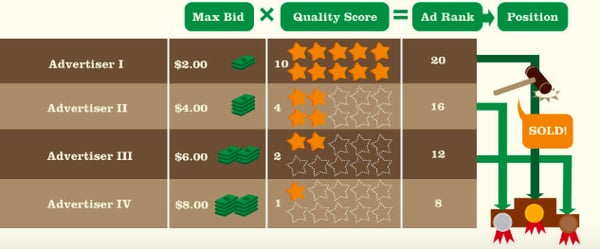
A bid is the maximum amount of money you’re willing to pay for a desired action on your ad. If it sounds like an auction, that’s because it is an auction. Ad networks have a limited amount of ad space, and to determine whether or not your ads are shown to your target audience, they run an auction to see how much each advertiser is willing to pay for ad space.
Just like in an auction, the highest bidder wins. Let’s say you bid $10 for a click on your ad, and the next highest bidder only pays $5 for a click.
Each ad network will only make you pay the lowest amount possible to win the bid. In this example, you might be willing to pay $10, but in reality, you’ll only have to pay $5.01 to win the bid. Winning this “auction,” in addition to the overall quality of your ads, will determine how your ads are displayed on the different ad networks.
Here’s another example of how the ad auction works from WordStream.
At this point, you might be thinking, “Okay, I get how the auction system works. But how do I figure out how much I should actually spend in order to see a return on my investment?”
My advice is to work backwards from your revenue to determine what your maximum bid should be.
Use this equation: Lifetime Value (LTV) x Average Lead-to-Customer Rate x Average Conversion Rate.
Your LTV is how much a customer is worth to you over the course of their relationship with your business. The average lead-to-customer rate is the rate at which your leads become paying customers. And your conversion rate is the rate at which new contacts convert on your content offers by filling out a form.
Combined, these metrics can show you how much you should spend on your paid ads in order to break even.
Let’s say that you want to use digital ads to promote your new content offer. You’re going to need to know what your maximum ad spend should be in order to see a positive return on your investment. Assume that you know the following about your business:
- Lifetime value: $500
- Average lead-to-customer rate: 10%
- Average conversion rate: 20%
Plug these numbers into the equation above to determine what your maximum ad spend should be: $500 x 0.10 x 0.20 = $10. This means that you can spend a maximum of $10 per click on your ad to break even. Your goal should be to spend less than $10 to see a positive return on your investment.
Now that we know more about how to advertise online, let’s dive into the various types of online advertising.
Types of Online Advertising
Social Media Advertising
Every month, there are nearly 2.5 billion active users on Facebook, 1 billion on Instagram, and 330 million on Twitter worldwide.
Whether it’s to chat with friends, stay connected to people across the globe, or for business and networking purposes, consumers are on social media for a multitude of reasons — and marketers know it. Because of the sheer number of active users on these platforms, advertising spend invested in social media channels is at an all-time high. Social media advertising across the world is projected to exceed $8.5 billion this year.
Advertising on social media comes with many advantages. You can:
- Reach very specific target audiences with the help of targeting features and different audiences across all of the social media platforms.
- Leverage a variety of ad formats to advertise in a way that aligns with your business goals.
- Invest in the specific advertising efforts that drive leads and sales for your business.
Let’s take a look at eight popular social media networks, including Facebook, Instagram, LinkedIn, Twitter, Pinterest, YouTube, Snapchat, and TikTok. We’ll cover the audiences and ad types available on each one.
1. Facebook
Facebook is the most widely used social media network. Almost 2.5 billion people around the world use Facebook. That’s more than 30% of the world’s population.
With so many people using Facebook, you’re almost guaranteed to be able to reach an audience that’s relevant to any type of business. That’s where one of the most powerful features of advertising on Facebook comes in: audience targeting. The targeting capabilities on Facebook are unmatched by any other social media network.
There are 3 types of audiences that you can target on Facebook:
- Core audiences: An audience based on criteria like age, interests, and geography.
- Custom audiences: Get back in touch with people who have previously engaged with your business.
- Lookalike audiences: Reach new people whose interests are similar to those of your best customers.
Facebook’s advanced targeting can be used to target your ads to the most relevant audience — and even tap into new audiences you’d otherwise never reach with organic content alone.
Advertising on Facebook includes a range of ad types, including:
- Photo ads
- Video ads
- Story ads
- Lead ads
Photo ads are great for sharing collections of image content. Video ads are great for product explainer videos and branding. Story ads allow you to use a combination of photo and short-form video content. If you want to learn more about the different ad types, here’s a great course from HubSpot Academy all about Facebook Advertising.
Personally, my favorite way to advertise on Facebook is with lead ads because they give you the best of both worlds: sharing visual content and generating leads all at the same time. Facebook Lead Ads allow you to capture lead information without directing people out of the Facebook platform.
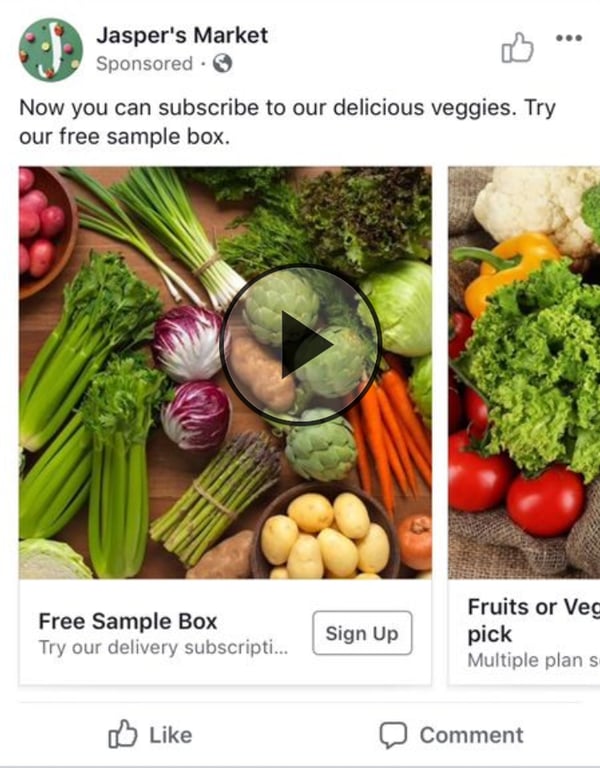
No matter your business’ size or industry, you can use lead ads to find potential customers who are likely interested in your products or services. With lead ads, you provide a helpful piece of content that encourages viewers to sign up for a newsletter, receive a price estimate, or request additional business information. In return, when the viewer fills out the form, the business receives a new lead.
Another way to advertise on Facebook is through Facebook Messenger.
Facebook Messenger is a separate messaging app that comes with its own advertising opportunities. Facebook Messenger is the go-to messaging app in countries including the U.S., Canada, and Australia. Other messaging apps like WhatsApp and WeChat are the more popular choice in countries throughout South America, Europe, Africa, and Asia.
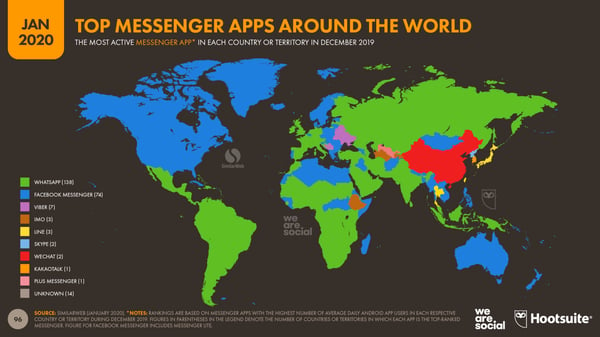
Across the world, 20 billion messages are exchanged between people and businesses every month on Facebook Messenger. Ads play a big part in initiating conversations on Facebook Messenger.
There are a few different ways you can use Facebook Messenger as part of your advertising strategy.
- Facebook Messenger call-to-action in ads: Start conversations with ads on Facebook that include a call-to-action to send a message.
- Facebook Messenger Story Ads: Run story ads on Messenger Stories.
- Facebook Messenger Ads: Use messenger ads to deliver content directly into users’ Facebook Messenger chats.
All of these ad types can come together to encourage your audience to kick-off conversations with your business. They can be used to get in contact with a sales team, request more information on a product, or even share other content like blog posts or ebooks.
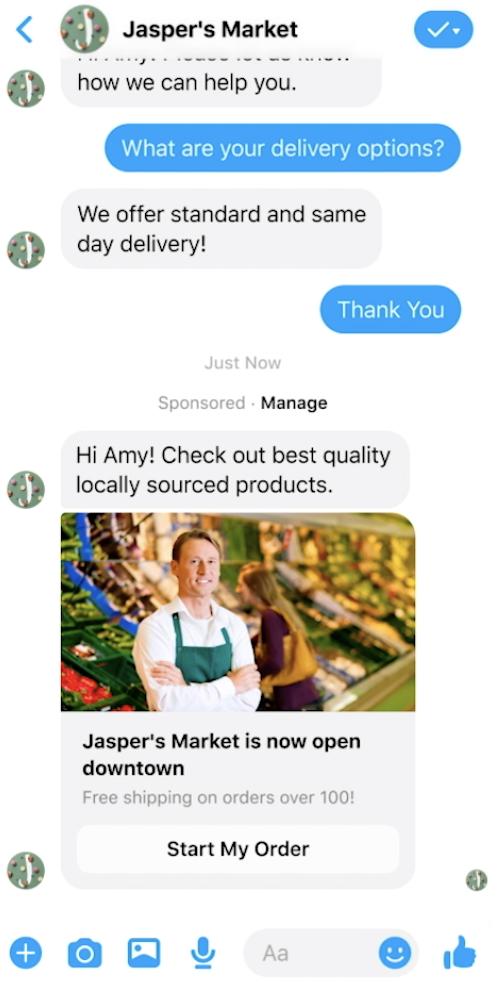
My favorite way to advertise on Facebook Messenger is retargeting. Retargeting ads in Facebook Messenger are a great way to start targeted conversations and send personalized offers and content.
Sponsored messages allow you to advertise to people who have already interacted with your business in Messenger. This is a great way to re-engage your audience in a personalized way.
2. Instagram
You can also advertise on Instagram through the Facebook Ads Manager. Instagram has over 1 billion monthly users globally. That’s a little less than half of the number of users on Facebook. The majority of users are between the ages of 18 and 34.
There are 3 ways that you can advertise on Instagram:
- Promote posts and stories directly from your Instagram professional account.
- Create ads from your Facebook Page and promote them on both Facebook and Instagram.
- Create ad campaigns in the Facebook Ads Manager to access full targeting capabilities.
I recommend taking the third option and creating custom campaigns for your audience on Instagram.
Instagram has similar ad types to Facebook, including:
- Photo ads
- Video ads
- Story ads
- Ads in Explore
- Shopping Post ads
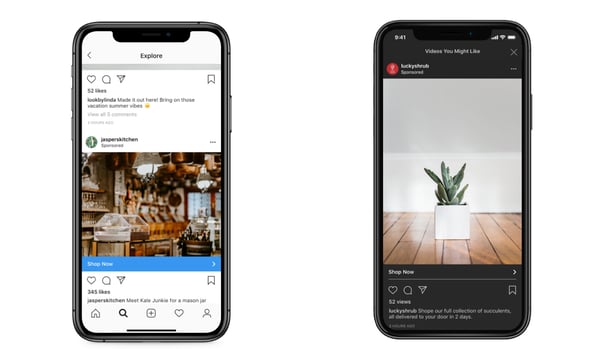
By far, the most interesting ad types right now are ads in the Explore Tab and Shopping Post ads. People using Instagram Explore are exploring their interests and discovering new content creators. Ads in Instagram Explore are a great opportunity to put your brand in front of a new audience.
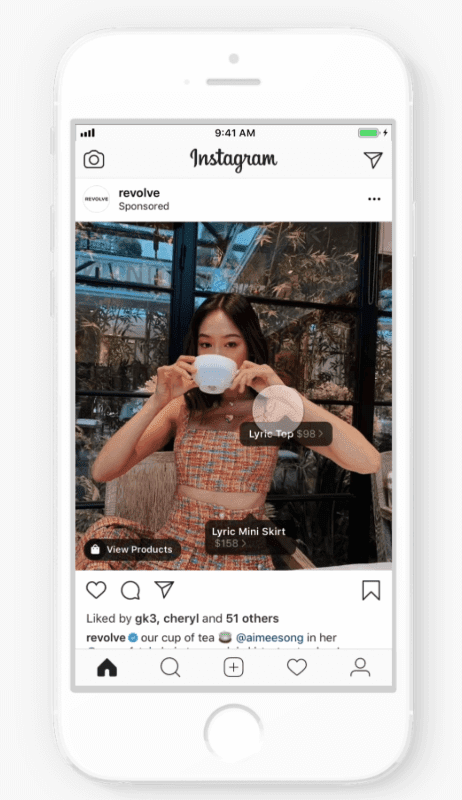
Shopping Post ads allow you to include a tag that shows the product’s name and price within your image. Clicking on the tag takes your prospects directly to a product page where they can purchase the item — all without leaving the Instagram app.
3. LinkedIn
The LinkedIn platform has over 660 million monthly-active members worldwide. Users on the platform are largely made up of working professionals which makes LinkedIn a great place for B2B (business-to-business) advertising. LinkedIn is the go-to platform for working professionals, which provides B2B advertisers a large audience pool to reach.
Plus, the advantage of advertising on LinkedIn is definitely its unique targeting capabilities. On LinkedIn, you’ll have access to unique targeting criteria that isn’t available on other platforms.
You can target users on LinkedIn by unique demographics, including job title, job function, and industry. Maybe you only want to advertise to potential customers at the director level who work in customer service within the recruiting industry. LinkedIn’s targeting capabilities make that possible.
Plus, with the option to include lead gen forms in your LinkedIn ads, LinkedIn can be a lead generation machine. This will allow you to not only reach a very specific audience but drive leads without directing them outside of the LinkedIn platform.
The most interesting ad type of LinkedIn is Message Ads. Message Ads allow you to send direct messages to your prospects to spark an immediate action.
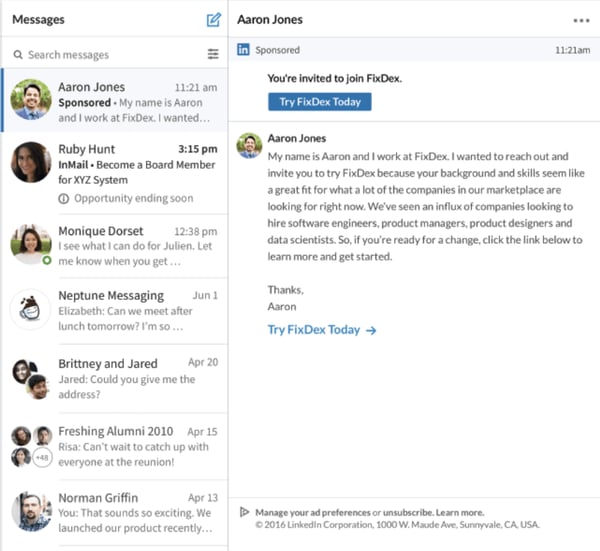
How to use LinkedIn Message Ads:
- Deliver a targeted message with a single CTA.
- Drive stronger engagement and response than traditional emails.
- Measure the impact of your messages.
But a word of warning: Don’t send too many Message Ads to the same people or it will come off like spam. And make sure the messages sound authentic, too – if you were writing a LinkedIn message to a friend, what would you write in it?
If your Message Ads are too stiff, they’ll come off as spammy, too. Remember: This channel is a one-to-one conversation. Direct messages are sacred spaces – if you’re going to advertise there, you need to be extra careful about taking the time to make your Message Ads feel personal and relevant to your end users. Make sure you’re delivering value to them in a way that feels authentic.
4. Twitter
Digital advertising is less common on Twitter because organic reach is still a significant driver of a brand’s performance on Twitter. This is very unique to Twitter – but even so, ads can still deliver strong results depending on what your goals are. Twitter has over 330 million monthly users globally. The majority of users are between 35–65 years old.
Advertisers have discovered a few niches that have high engagement on Twitter: B2B and ecommerce. Many B2B companies are using Twitter as a digital marketing tool, and Twitter users are known to spend a lot of money online. This makes advertising specifically to these audiences a great strategy.

Twitter breaks down their ads into five goals:
- Awareness: Promote your tweets and maximize your reach.
- Tweet engagement: Promote your tweets and get more retweets, likes, and replies.
- Follows: Promote your account and grow your Twitter following.
- Website clicks: Promote your website and get more traffic.
- App downloads: Promote your app and get more downloads.
All of these can work together to help you grow your audience on the platform and convert users into customers.
5. Pinterest
Pinterest is a unique social media platform with 300 million users who are highly engaged and predominantly female. Some people say that Pinterest is the only platform where users actually want to see ads from brands they love because Pinterest is all about visuals.
How to advertise on Pinterest in four steps:
- Pick a pin: Promote your best pins so they appear in the most relevant places.
- Decide who sees it: Set up targeting so the right people see your ads.
- Pay for results: Choose to pay for engagement or visits to your site.
- Track what’s working: Once your campaign starts, see how it’s doing and make changes.
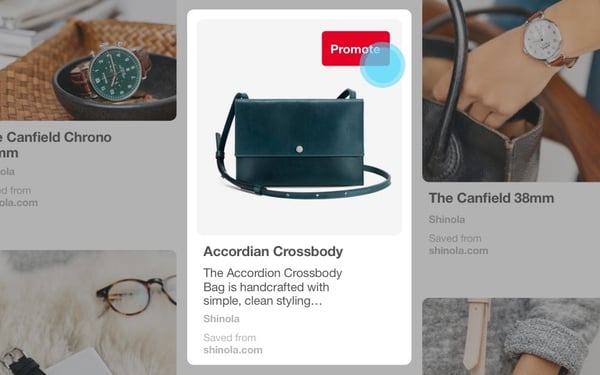
Pinterest is great for businesses relying on photography to sell their products and who have a female target buyer persona.
6. YouTube
YouTube is the second largest search engine, second only to Google, with over 2 billion monthly active users. Ads on YouTube appear before and during other YouTube videos or as a stand-alone promoted video that’s displayed after performing a search.
Since you can target demographic information and interests, you can serve your videos to specific relevant audiences already watching videos from similar brands or on related topics.

7. Snapchat
Snapchat’s 218 million users are predominantly made up of people between the ages of 18–24.
Snapchat offers a few ad types, including story ads, sponsored tiles in Snapchat Discover, and augmented reality (AR) lenses.
Snapchat’s ad types feel pretty similar to the advertising options on Instagram. What really makes Snapchat unique is the augmented reality lenses. AR lenses are sponsored by a business to create interactive moments that users can use and share with their friends. It might be hard to believe, but in this example from Dominos that pizza isn’t really there — that’s the AR lens at work.

8. Tiktok
A new player to the social media advertising world is TikTok. TikTok is all about creating short, creative, and oftentimes funny videos. TikTok has exploded in the past few years and has reached 500 million monthly users.
Advertising options are still limited; they are mainly geared towards driving awareness. TikTok doesn’t hyperlink posts to websites and only recently started allowing advertising, so businesses advertising on TikTok focus on boosting brand awareness rather than leads or traffic.

Promoting TikTok videos allow brands to build awareness with a young target audience. Most of the posts you’ll see on TikTok are aimed at getting laughs. From a brand perspective, you’ll want to create videos that are funny and align with other content on the platform. Think things like dance challenges and memes. This type of content is the most effective.
Paid Search Advertising
People conducting a search online are looking for something specific and will click on the first result they believe is going to be the most helpful to them. You might be thinking: “I already appear in organic results on search engines. Why should I pay to advertise too?”
Well, there are three key reasons:
- On average, advertisers make $8 for every $1 they spend on Google Ads.
- Advertising on search engines protects you from the competition who may be advertising on your branded terms.
- Search ads appear first in the search engine results pages (SERPs) above the organic results.
Paid search advertising gives advertisers the opportunity to capture the attention of their audience in a more targeted way than with organic search alone.
Search ads allow you to anticipate the wants, needs, and desires of your potential customers and serve ads to them that are highly contextual. Over time, the analytics of your search ads can help you analyze and improve those ads to reach even more people.
But how does Google know how to deliver the right ad to the right person? That’s where keywords come into play. A keyword is one word or phrase that someone uses to describe what they need in search. Basically, advertising on search platforms takes the targeting capabilities available on social media platforms, like demographics and location, and layers it with the addition of keywords.
When a Google user types a query into the search field, Google returns a range of results that match the searcher’s intent. Keywords align with what a searcher wants and will satisfy their query. You select keywords based on which queries you want to display your ad alongside.
Keyword research is just as important for paid ads as it is for organic search. That’s because Google matches your ad with search queries based on the keywords you selected. Each ad group you create within your campaign will target a small set of keywords and Google will display your ad based on those selections.
Let’s say Mary is moving to a different house and is looking for a home mover. So she goes into Google and types “who are the best movers.” By searching “best home movers,” she’s going to see results for advertisers that targeted keywords like “moving companies” and “top rated movers.”
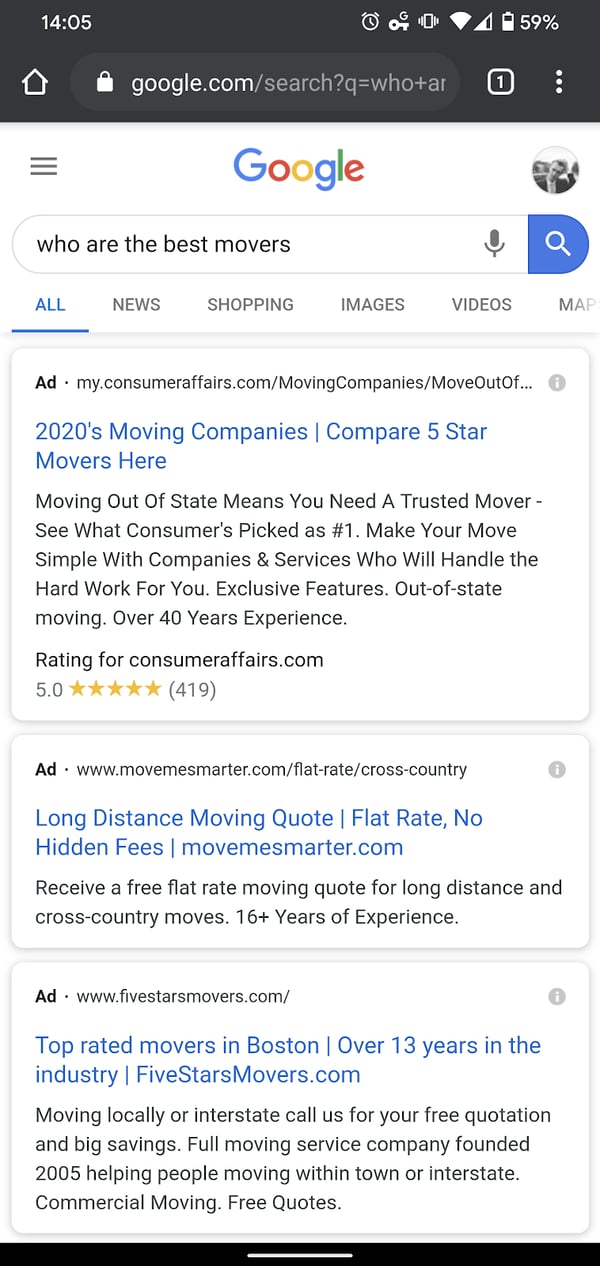
Search engines also take your intent into consideration when choosing the types of ads to display.
In the example above, search ads were the most helpful resource. But what if you’re looking for a location-based business, like a coffee shop? In Google maps, you might see Promoted Pins like these, shown in purple on the map and in the search results on the left. Promoted Pins are a great way for businesses to attract customers to their business based on location.

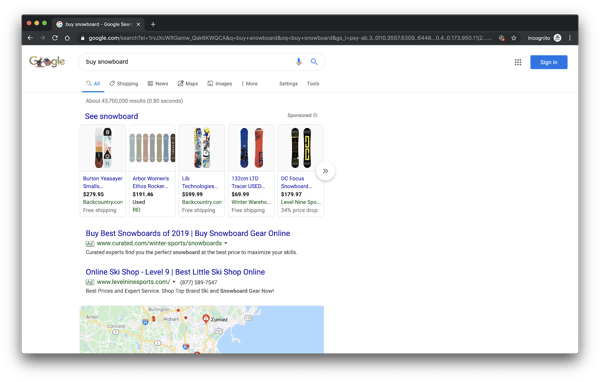
What if you’re looking to make a purchase? Well, Google might show you a different kind of post to match your intent, such as Shopping Post Ads.
In this example below, Google shows you shopping post ads for the keyword “buy snowboard.” Since my query includes the word “buy,” Google knows that I’m interested in making a purchase, so I am shown ads for products I might be interested in.
So how do you select your keywords?
Keywords typically fall under two categories: brand and non-brand.
A brand keyword is a word or phrase that includes a brand’s name or variations of a brand’s name. For example, some of HubSpot’s brand keywords include HubSpot, HubSpot Free CRM, and HubSpot Marketing Hub. These are all variations of the HubSpot brand and the tools that we offer.
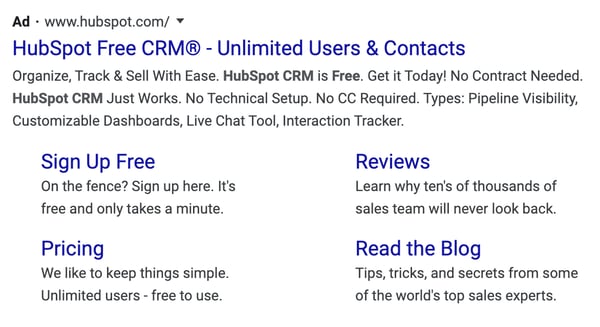
Non-brand keywords are all other relevant keywords that don’t include a brand’s name or variations of a brand’s name. Some of HubSpot’s non-brand keywords include inbound marketing, sales software, and customer relationship management.
While these keywords are not part of HubSpot’s brand name, they are relevant terms that allow HubSpot to reach audiences that might be interested in eventually making a purchase.
Brand and non-brand keywords play a role in your digital advertising strategy. Brand keywords help you protect your brand from your competitor’s ads.
If you don’t run ad campaigns for brand keywords, you’ll leave your business vulnerable to losing website traffic to the competition who is bidding on your brand keywords. Non-brand keywords still have a role to play, too. Non-brand keywords allow you to reach new audiences unfamiliar with your brand.
When it comes to when your ad is displayed, you don’t just want to pick a certain group of keywords and have the ad shown only when those keywords are entered into the search engine.
This is where match type comes in. Since there are an infinite number of ways that people can actually search for one term, Google gives you four match types to choose from: exact match, phrase match, and broad match. Plus, you can also use a broad match modifier and negative keywords to optimize where your ads are delivered.
Let’s take a look at each match type:
- Exact match: A keyword set to exact match will only display your ad if the search term includes that exact keyword, or a very close variation. Exact match keywords are surrounded in [brackets].
- Phrase match: A keyword set to phrase match will display your ad if the search term contains the same order of the words, but it can also contain additional words. Phrase match keywords are surrounded in “quotes”.
- Broad match: A keyword set to broad match displays your ad when the search term contains any or some combination or variations of the words in your keyword, in any order. Broad match keywords don’t include any symbols.
- Broad match modifier: The broad match modifier allows you to select keywords that must be included in the search query for your ad to be displayed. Keywords with a broad match modifier use a +plus sign.
- Negative keywords: Excludes your ads from being shown on searches with that term. Negative keywords include a -minus sign.
Google vs. Bing vs. Yahoo
There are a few advertising platforms out there for search, including Google, Bing, and Yahoo. But Google is by far the most used search engine out there. With 3.5 billion search queries a day, over 70% of the total searches made daily around the world are done on Google. Google brings in six times more searches every day than Bing and Yahoo, combined.

But this doesn’t mean you should entirely rule out advertising on these other platforms. In some cases, you can achieve impressive results with a smaller ad spend on Bing and Yahoo than you could on Google since there is less competition from advertisers.
My recommendation is to dig into your organic traffic to identify if Bing or Yahoo make up a significant amount of traffic for any given keywords or topics. This might indicate that advertising for those keywords on Bing or Yahoo could be profitable.
Regardless of where you advertise, the good news is that advertising on all of these platforms more or less work and look the same. So knowing how to advertise on one will make advertising on the others easier.
Native Advertising
Publishers like BuzzFeed and The Dodo produce content that snowballs in popularity on social media almost every day. And they make money by helping other brands do it too. Brands will pay these publishers to craft posts and videos that follow the publishers’ formula for virality. They also pay publishers to distribute this sponsored content to their massive audience through social media and their website.
This is native advertising.
Check out this example from Geico. They’ve partnered with BuzzFeed to create this video advertisement on morning workouts. It’s a topic that is loosely related to insurance, which Geico sells, and they’ve tapped into BuzzFeed’s expertise to create this video that feels right at home with the rest of the content on the site.

When you pay for a publisher’s native advertising services, you’ll be able to leverage their editorial expertise and audience reach to help your brand tell captivating stories to a bigger and better viewership. And each publisher is going to support different ad formats and creative types.
During the creative process, you’ll collaborate with publishers to craft sponsored content that covers one of their main topics and looks like a regular piece of content on the publisher’s website.
This way, even though your post is technically promotional, it won’t disrupt their audience’s browsing experience. They’ll enjoy reading your post and won’t feel like you or the publisher are advertising to them. This exposes your work to a huge, engaged viewership and attracts new followers to your brand.
Native advertising creates a symbiotic relationship between publishers and brands. Publishers who do sponsored content right reap the benefits of another revenue stream and gain more audience trust if they promote a native ad from a trustworthy brand — 41% of readers say they trust publishers even more if they publish with a trustworthy brand.
For brands, collaborating with prominent publishers can unleash unprecedented amounts of creativity to help them win over the publishers’ audience and boost engagement — 31% of readers say they’re more likely to buy from a brand after viewing their native ad. For example, T Brand Studio, the New York Times native ad business, crafted sponsored posts that captured as much engagement as some of nytimes.com’s highest-performing articles.
To find the optimal native advertising opportunities for your brand, try using StackAdapt or Nativo.
Display Advertising
Display ads are a controversial topic in the digital marketing community. For almost 25 years, advertisers have abused them by tricking internet users into clicking misleading ads — some malicious display ads have even infected people’s computers with viruses. It’s easy to see why people have developed banner blindness and can’t stop downloading ad blockers: display ads have the reputation of being intrusive, distracting, and irrelevant.
On the other side of the spectrum, though, display advertising technology has advanced to the point where ad networks can leverage data and machine learning to offer advertisers more effective targeting strategies and consumers more relevant ads.
Ad networks like Google Display Network and Facebook’s Audience Network are the leaders in the banner ad renaissance. They can display your ads to the right target audience at the right place and time. And if you want more control of your advertising, they’ll let you decide where to place your ads. Below, we’ll cover each ad networks’ features and targeting capabilities:
1. Google Display Network
When you use Google’s Display Network, you can design visually appealing ads and place them on over two million websites and apps, YouTube, and Gmail.
You can also build new audiences by targeting people who are most likely to be interested in your product or service and remarket website visitors just by importing a list of their contact information.
If you don’t want to build out your ideal audience or deal with bidding, you can let Google Ads do it for you. Its automated targeting and bidding features can identify your highest-converting audience for the best return on investment.
Display ads can be most effective when retargeting an audience that’s already familiar with your brand.
2. Facebook’s Audience Network
With Facebook’s Audience Network, brands can expand their Facebook ad campaigns and use the same targeting data they use on the platform to advertise on a huge collection of websites and apps. Publishers in Facebook’s audience network account for 50% more time spent in mobile apps than Snapchat and Twitter combined.
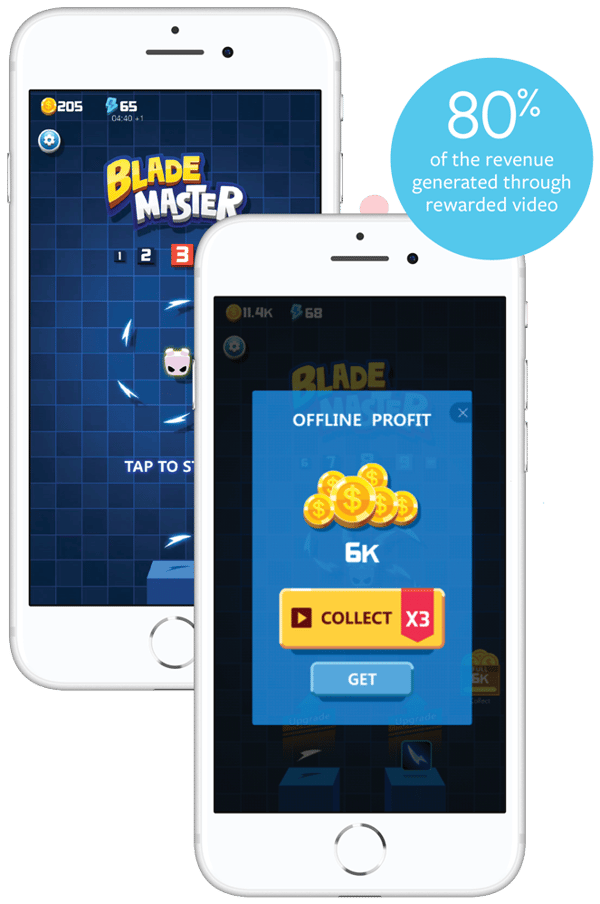
Brands can place native ads, banner ads, full-screen ads, in-stream video ads, and rewarded video ads (for example, “Watch this video ad to get more tokens!”) on the network’s websites and apps that their Facebook audience frequently visits.
This type of advertising can be particularly effective for mobile games, like in the example below from 5agame who was able to attribute 80% of their revenue through their rewarded video.
Now that you know about all of the digital ad types that are available, the next step is to learn how to leverage the right ads for your business to achieve your goals. If you want to continue leveling-up your ads training, check out HubSpot Academy’s free course on the Fundamentals of Digital Advertising.

Marketing Guest Blogging Guidelines [2020 Edition]
Hi there! Thanks for your interest in writing a guest blog for HubSpot. We’re glad you’re here.
The award-winning HubSpot Blogs have over 7 million monthly visits, and we’re always looking for more brilliant contributors to join our ranks.
If you have exceptional writing and/or design skills and would like to share your expertise with a large audience of marketers, growth hackers, and business owners, we’d love to hear from you.
Please take some time to review this entire page — it should answer any questions you have about what kind of content we’re looking for and how the submission process works.
Also, we value your pitch, but due to the volume of requests we receive, we cannot respond to all submissions.
The Bare Essentials for Every Post We Publish
Successful guest contributions are comprehensive, data-driven, and interesting posts that teach our readers something new about the world of business. While we tend to skew toward content about specific marketing tactics, that’s not all we talk about.
We’re also interested in publishing any topic that marketers care about, which includes things like hiring, team development, job hunting, writing, design, math, and larger internet trends, among other things.
We also look for a few things in everything we publish:
- Original concepts, compelling arguments, and high-quality writing. We will not republish anything that’s been published elsewhere.
- Article reflects the writing style/tone of the Marketing Blog. We aim to be casual, yet helpful, and typically we stay away from buzzwords and jargon.
- Proper attribution of data, quotations, and outside content referenced in the article. Note: All data should have originated within the last two years.
- No more than one link to your company’s website (Note: This includes your website homepage, blog, pricing page, etc …) in the body of the post.
- Link to at least 3-5 other HubSpot blog posts in your piece. For example, if you’re writing a piece on a recent welcome email experiment you’ve run, link to HubSpot’s ultimate guide to email marketing, our roundup of top email marketing services, and our email marketing tips to improve opens.
The Different Post Types We Accept
We’ve conducted extensive studies to uncover which types of blog posts work — and which don’t. Here are some of our most successful blog post types:
- Experiment / Analysis: Did you recently run a marketing experiment the likes of which have never been done before? Or maybe you completed an analysis of your own or your customers’ data that yielded fascinating insights the world show know about? Write it up and send it over. These posts should include hard data, actionable takeaways, and thorough explanations of each step in the experiment or analysis process. Readers should have enough information to replicate your experiment or study if they’d like to.
- Examples of Experiment Posts:
- Canonical: These posts give readers in-depth tactical takeaways that are supported by relevant, recent examples, original quotes, original graphics, and current data. While we don’t like to put a word count on our posts, these tend to run at 1,500 words and above. When readers finish this type of post, they should be able to immediately execute on the given topic and have very few questions left on how to do it.
- Examples of Canonical Posts:
- Graphics: These posts rely heavily on an infographic, data graph, or other visual aid created by the author. Usually, they feature a few paragraphs of introduction, the embedded media itself, and not much else. The graphic should be comprehensive and easy to read, have a compelling narrative, contain plenty of white space, and feature up-to-date data that’s properly sourced.
While we certainly publish posts from time to time that don’t fall into any of those categories, your post has the best chance of being accepted if it matches one of these formats.
What We Won’t Accept
There are some things we simply can’t accept:
- Anything that’s been covered on our blog before. Please do a search of our site before submitting your articles.
- Anything that may be construed as a link-building scheme.
- Anything that’s too promotional for your company or organization.
- Anything that’s offensive or inaccurate.
- Anything that’s overly critical of individuals or companies — this is not a site to air grievances.
The Not-So-Fine Print
- Submissions must meet the HubSpot blogging team’s quality standards in order to get published. Editors reserve the right to reject contributions at their discretion.
- We cannot allow you to republish your guest post to your own blog, LinkedIn, Medium, or Inbound.org afterward. Here’s more on what you can do besides sharing it like crazy.
- The HubSpot blogging team reserves the right to edit and adapt your guest blog content as we see fit, and update it in the future for accuracy and comprehensiveness.
- HubSpot reserves the right to include calls-to-action to HubSpot content, including but not limited to email newsletters, ebooks, and other downloadable content.
- In rare cases, contributed posts may be removed from the blog and recycle the URL.
How to Submit A HubSpot Guest Blogging Post
Step 1: Conduct a Google site search. If there is only one step you complete to turn in a pitch, this should be the one. Note: This is not a normal website search. Check out how to do a Google site search here and add another skill to your set.
Didn’t click on the link we just provided? You wouldn’t be the first. Simply copy and paste this URL in your search bar: “site:blog.hubspot.com/marketing” and add a space followed by the keyword you’re targeting with your pitch.
For example: “site:blog.hubspot.com/marketing branding trends”. In this example, you’ll see HubSpot has published quite a bit on branding. If you still want to pitch a branding topic, make sure you’re telling us what differentiates it from the dozens of other branding pieces on HubSpot.
Step 2: Format your post appropriately.
- Don’t sacrifice depth for the sake of brevity. We don’t enforce a strict word count on the blog, but most articles should fall in the 1,000 – 1,800 word range. Instead of trying to hit a specific word count, focus on clear, in-depth explanations that readers of different levels can understand and learn from. It’s better to over-explain a concept than under-explain and leave some readers in the dark.
- The best blog copy is simple, accessible, and clear. Don’t get stuck trying to make a complex sentence structure work when a simple one works better. Take the most direct route to your points, use your natural voice, and avoid unnecessary filler words. Looking for more resources on drafting your blog post? Here are a few posts to check out:
- The Anatomy of a Perfect Blog Post
- How to Write an Introduction: A Simplified Guide
- What’s the Best Way to Write a Blog Post? Marketers Weigh In
- 8 Writing Tips I Wish I Knew Before I Started Blogging
- Your Blog Posts Are Boring: 9 Tips for Making Your Writing More Interesting
- Paragraphs should be no more than three to five sentences long and formatted using H2s, H3s, and H4s, when appropriate.
- Add bulleted lists to help break up dense copy chunks. Numbered lists should be formatted as number + period.
- Always include a conclusion.
- When including images, gifs, or screenshots, cite the image source as: “Image source” and hyperlink that text with the page you found the image on.
- Tip: Copy and paste your post into Grammarly, or Microsoft Word and run a spell check. We prefer these editing tools for catching sneaky misspellings, and extra spaces. Feeling extra word-nerdy? Use Hemingway Editor to check for run-on sentences, difficult sentence structure, etc …
Step 3: Submit your pitch of finished blog post to guestpost [at] hubspot [dot] com with the following:
- Formatted subject line: “Guest Pitch: [Tentative Title of Post]”
- Your completed post or pitch in a Google Document with editing permissions turned on for “anyone with the link.”
- If you’re including images, make sure they’re compressed and add them into the Google Document, and provide proper attribution below each image (e.g., Image source).
- Short author bio, headshot, and any links to your LinkedIn or Twitter accounts you’d like linked.
If your article meets editorial standards and aligns with our content strategy, we will respond to let you know your article will be published. That process may take up to 2 weeks and the publish date could exceed this timeline based on the needs of our editorial calendar.
Due to the volume of requests we receive, we cannot respond to all submissions.

5 Proven Social Media Engagement Strategies for 2020
In the world of social media marketing, the word “engagement” gets thrown around a lot, but few brands actually know how to achieve it.
Brands might pursue the low-effort game of tweeting, “gramming”, feeding Facebook, and Linkedin-ing updates about products, services, and educational content, but see little engagement.
Engagement isn’t always to produce. You have to be, well, engaging. In your business niche, the “Like my page!” approach probably isn’t going to be effective as you’d like.
Let’s look at ideas that could make you a force to be reckoned with. I’ve organized them into an AEIOU list. (I want to call it an acronym, but how would you pronounce the five vowels?) Let’s dive in.
A Is For Ask
The best way to engage someone is to ask a question. “How are you?” and “How’s it going?” are popular options in conversion but too dull for social media warfare.
“What’s your name?” probably won’t work and “What’s your email?” might come off as a bit too forceful. How about …
“What do you think?” Yes! That’s a winner.
People like to think things through. They like to hear from other thinkers. Certainly, they want other people to know what they think.
Try prompting your audience with one of the following “What do you think?” strategies:
- Probe their personality. Post a question that invites people to share their opinion or weigh in on something.
- Play the “test your knowledge” game. It’s irresistible.
- Post a poll. It’s easy to create polls on Twitter and Facebook. In addition to engaging your followers, you stand to learn meaningful things about them too.
- Respond to my email. Email from brands are bound to ask you to click-through to read, watch, and try or buy something, but how often do they simply ask you to write back? I find this to be an enormously engaging strategy and have seen it work for my brand and many others. Notice I wrote, “Respond to my email,” not “our email” or “this email.” A human-to-human first-person approach will be the engaging way to call this play.
- Just ask. Interactivity 101: simply post a question. Whether done so in a social stream, blog post, online group or community, or on a Q&A site such as Quora, asking followers relevant, provocative, and timely questions creates some of the most engaging and thought-provoking social media activity of all.
Let’s take a look at a few examples:
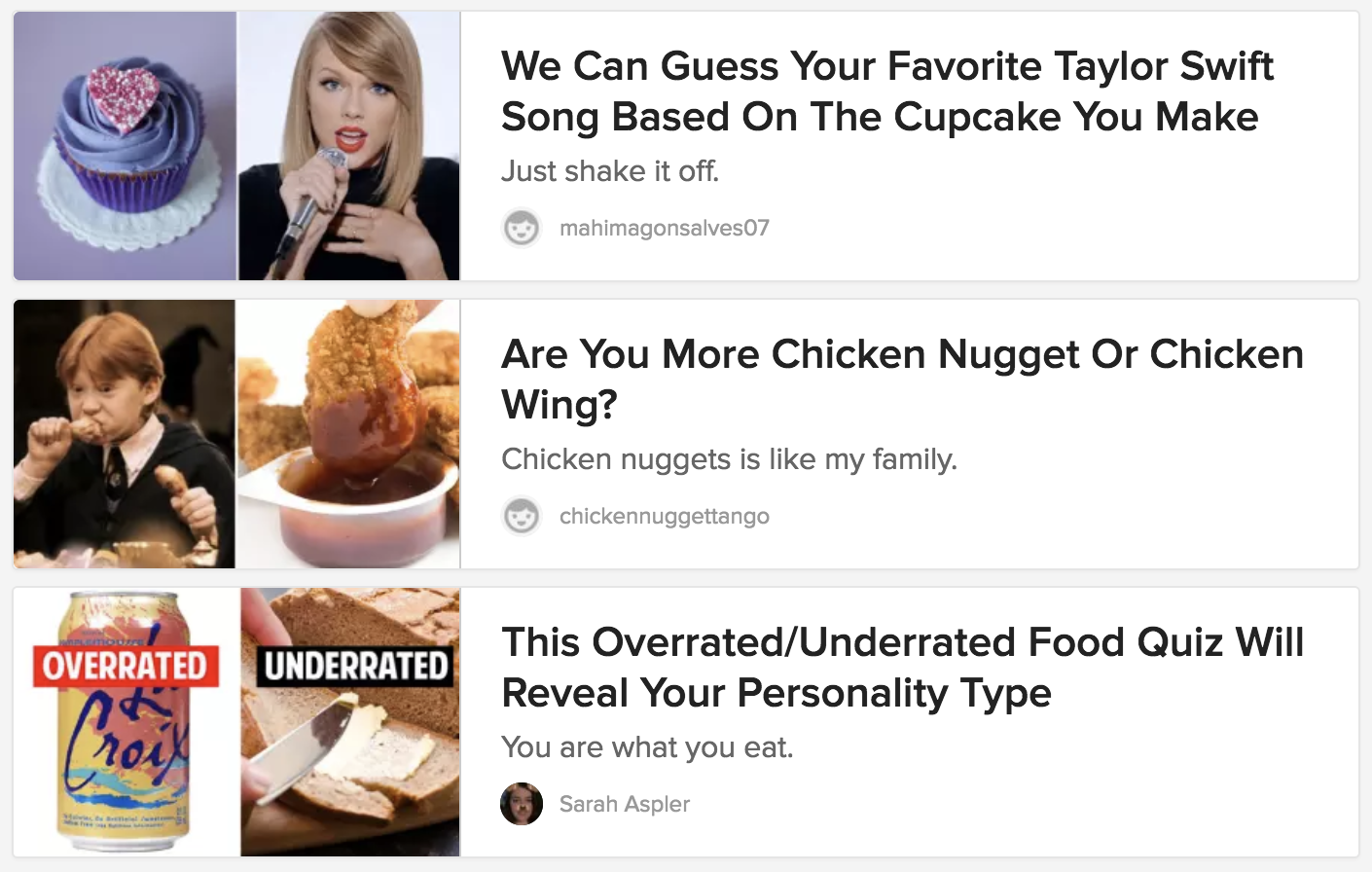
Personality quizzes have been red-hot engagement magnets for years on Buzzfeed, and it’s easy to create them to promote your brand with a template-based tool such as ShortStack.
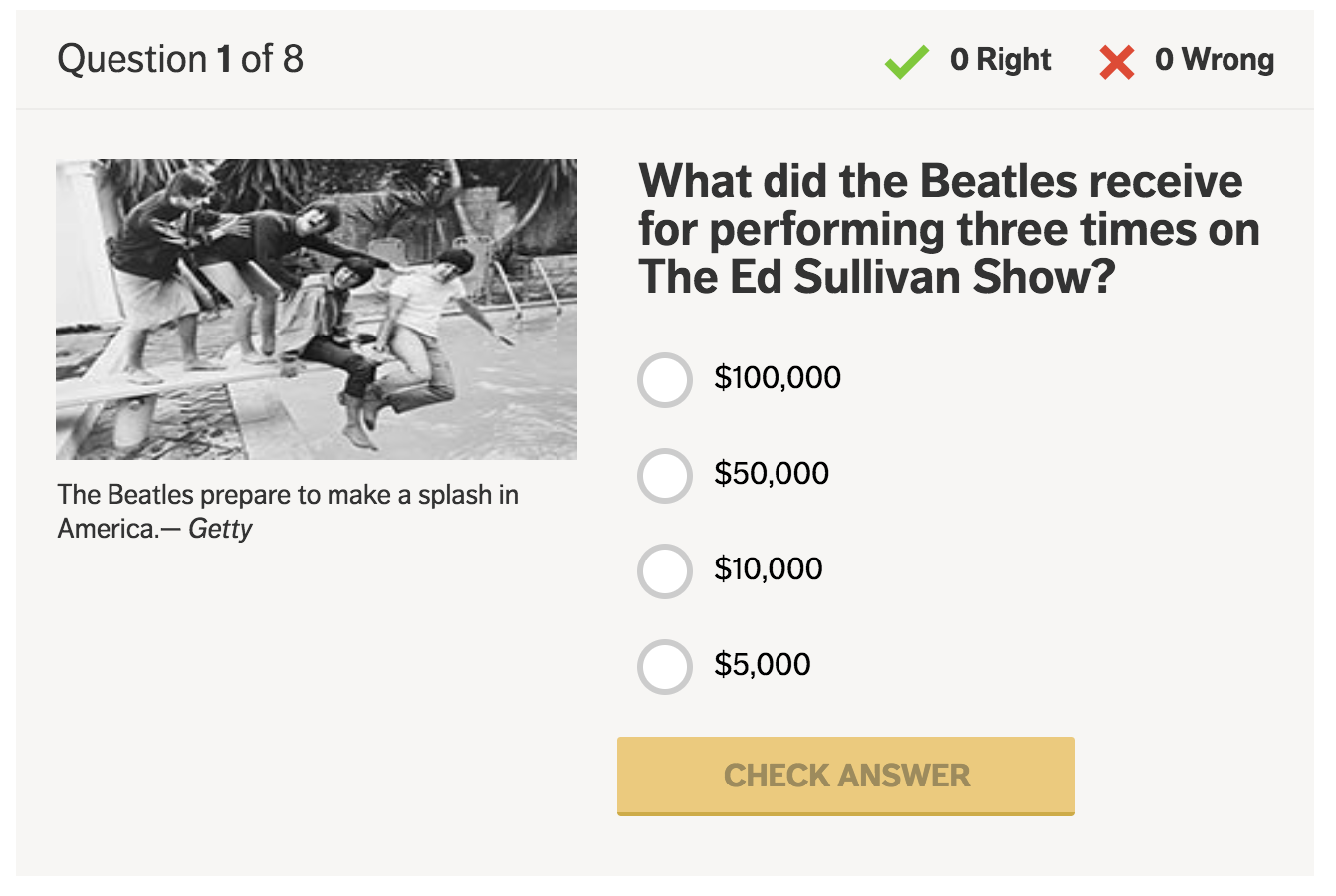
Nice going, AARP. “Test Your Beatles Trivia Knowledge” engaged me, but you could have asked a few easier questions. I went 0–for-8 (and I’m a huge Fab Four fan).
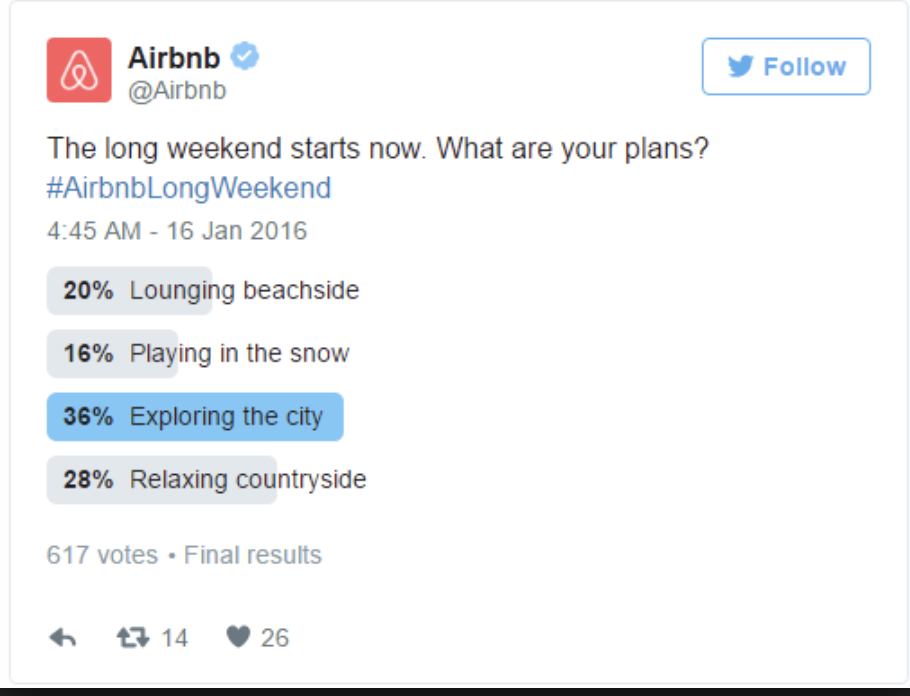
This simple Twitter poll from Airbnb does a great job of engaging followers without any fancy tools.
E Is For Expression
“E” is for “expression” because of the way social and mobile have collided, making the ubiquitous smartphone a personal expression machine.
It doesn’t matter how you create content. The camera might be front or rear-facing. Audio might be on or off. Filters, emojis, stickers and so forth may be applied or not. Posts may be permanent or self-destructing. I could go on, but I think you get the idea. Smartphone apps enable people to express themselves every which way, and so they do.
Here are a few ways you can encourage your audience to create content featuring your brand:
- Hash it out. The hashtag has become the click-to-connect ticket for bonding with like-minded people. When you put something of interest out there, do a little hashtag research first, or hash out a unique phrase that reflects your brand. Hit that # key, and invite your followers to jump in and hashtag content related
- Conduct media upload contests. Many social media fans adore Instagram and Facebook contests, and are especially engaged in the types that involve shooting and sharing original photos and videos. Contests may call for other forms of self-expression as well, such as recipes, recordings, illustrations, poems, essays, and more.
- Rally reviewers. Thanks to pioneers like Amazon and Yelp, reviews, ratings, and testimonials have been baked into the fabric of ecommerce selling spaces and beyond.
- Showcase customers, partners, and employees. Provided you’re doing something people like, consider creating advocacy programs featuring customers, partners, and employees to catalyze your community, amplify your voice, and engage newcomers by giving them a platform to express themselves.
Let’s take a look at an example:
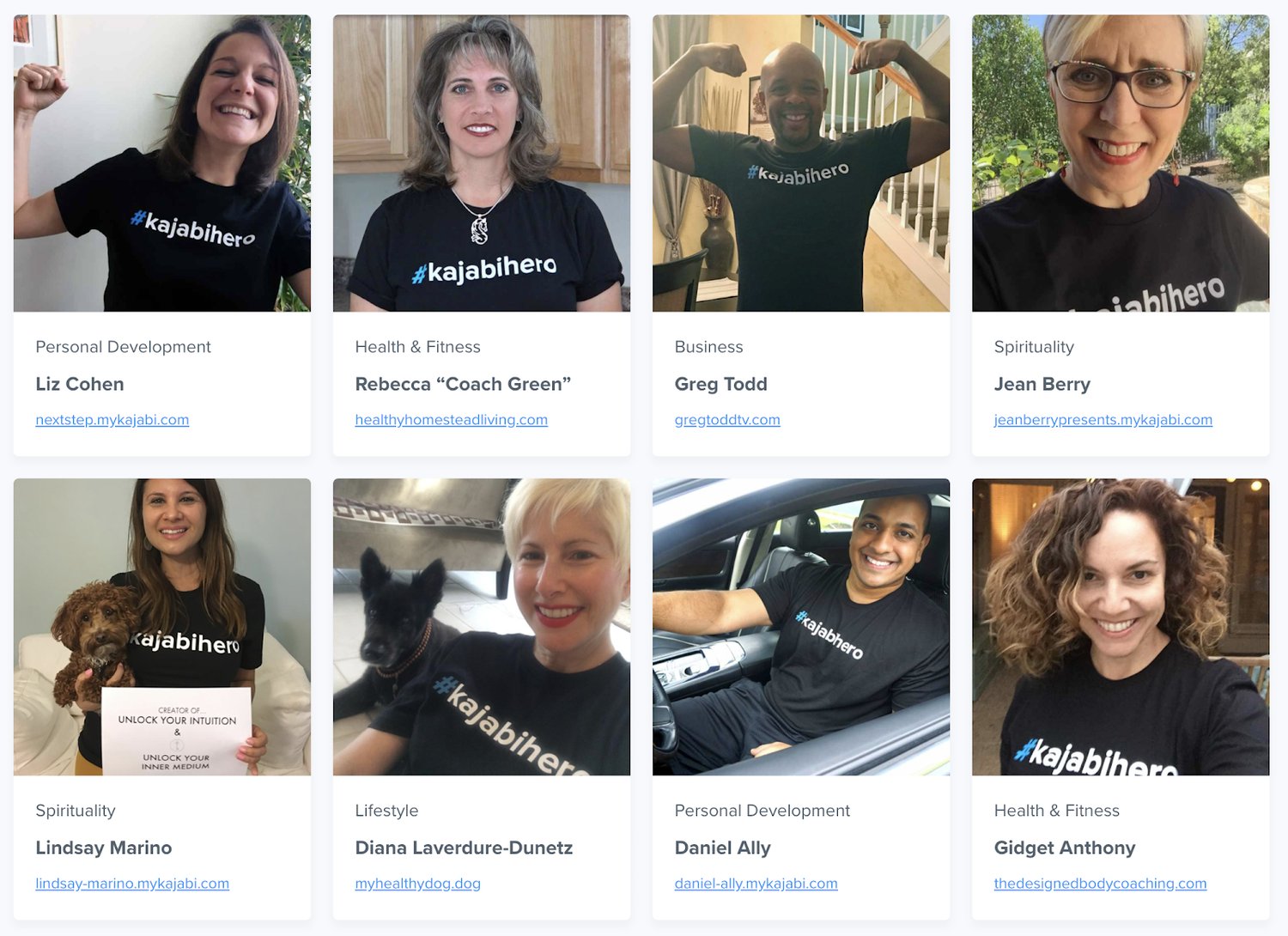
#KajabiHero is an impressive example of customer advocacy at work. Satisfied customers happily endorse the “knowledge commerce platform,” and wear their t-shirts proudly. They’re rewarded with special features, links to their websites, and social media support.
I Is For Incentive
I’ve mentioned numerous forms of interactive content (such as competitions), but have yet to introduce the term “gamification.” People like to play games, compete, keep score, and most of all, win. They especially like to do so on social media.
Satisfy your audience’s competitive spirit by featuring compelling incentives in your social media contests. As incentives go, valuable prizes loom largest, but you may be surprised how even small rewards prove to deliver a sizable lure.
Let’s look at an example by Converse from a post that features37 Facebook contest ideas to inspire fans to bond with your brand.
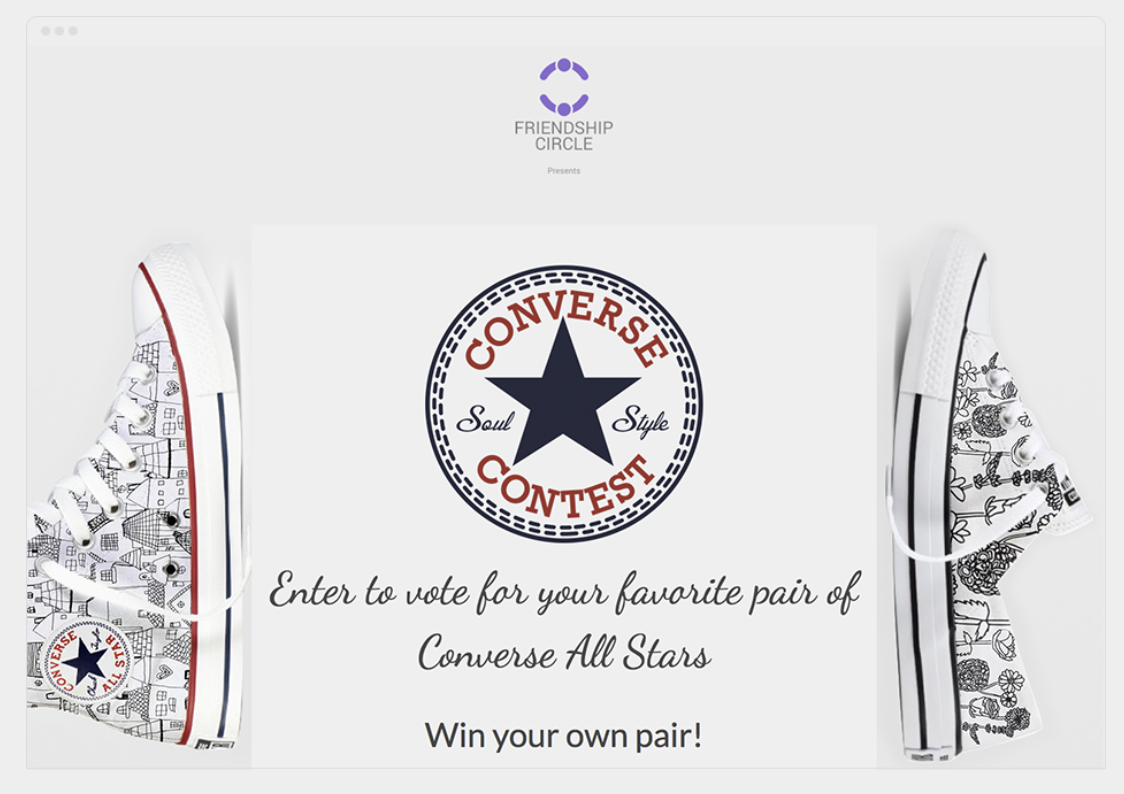
The entry form on this promotion by Michigan’s Friendship Circle explains each person who casts a vote for their favorite pair of hand-drawn Converse All Stars will be entered into a drawing for a chance to win a free pair of the winner. The winning shoe was subsequently reproduced and sold as a fundraiser.
O Is For Offer
Your engagement strategy doesn’t need to be interactive or gamified 100% of the time. Your brand can engage customers and prospects the old fashioned way, with attractive offers such as:
- Instant coupons and discounts
- Membership clubs (example below)
- Pick your discount promotions
- Free shipping
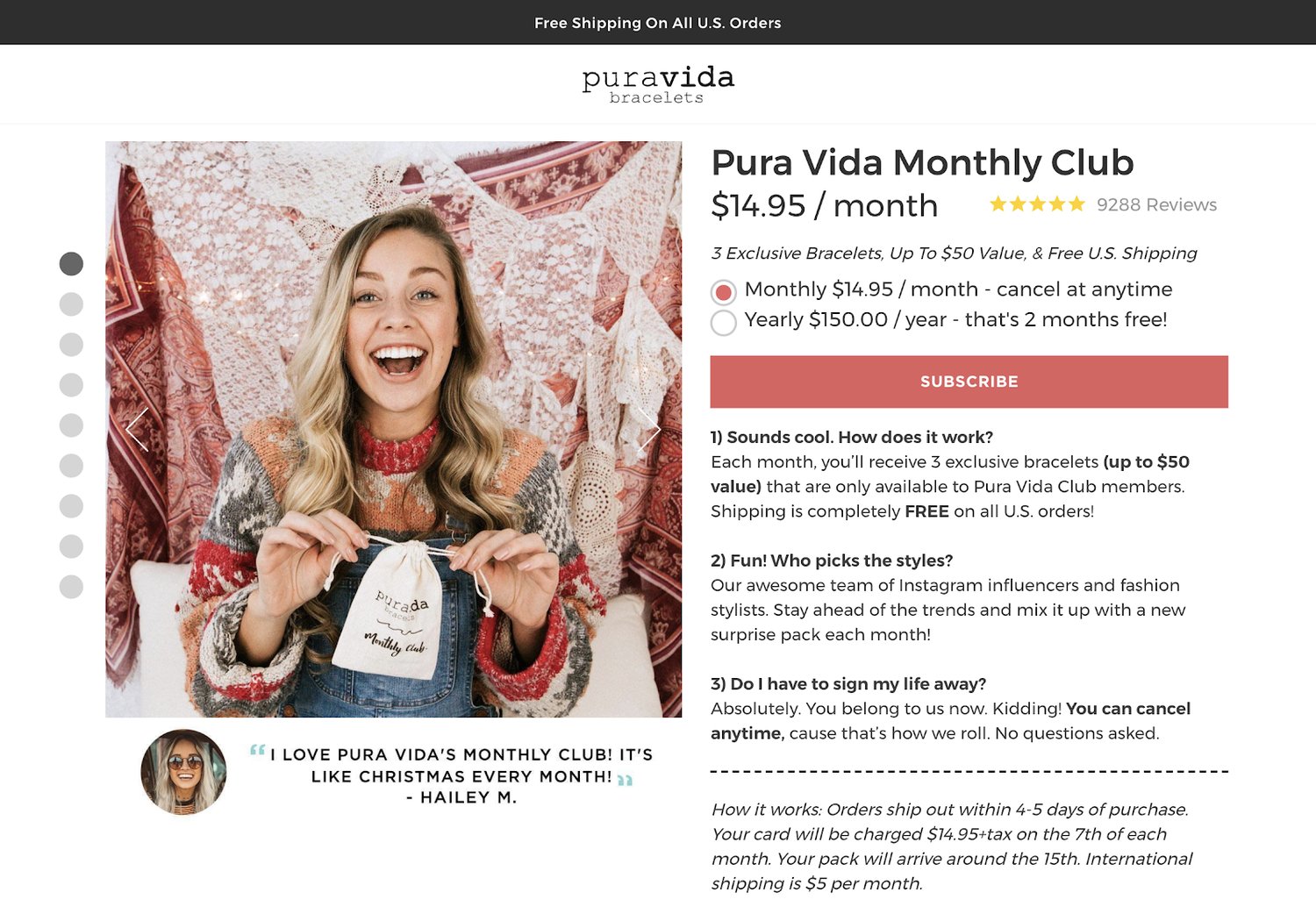
The link in Pura Vida Bracelet’s Instagram bio invites you to “join the Pura Vida Club.” BTW, the brand’s Instagram feed (1 million followers) bubbles over with joyous photos, mostly from customers, engaging questions, challenges, posts about charitable causes, and conversations.
Experiment with different types of offers to discover what your customers best respond to.
Facebook makes it easy to promote offers. A flavor of the Facebook ad portfolio is the “offer ad.” Offer ads can be redeemed online and/or be saved by Facebook fans to be redeemed in-store.
This help page from Facebook offers the following best practices:
- Make discounts substantial. Offers with free items or with discounts of at least 20% off will reach more people.
- Use an engaging image. Photos of people using a product often perform better than photos of a product by itself, and both generally perform better than logos.
- Set an expiration date. Give people a few days to discover and claim an offer and allow time for your offer to be shared among friends. The ideal length of an offer is 7 days.
- Promote your offer: After creating an ad for your offer, pin it to the top of your Page to help it get noticed.
U Is For Utility
Engagement and utility are close friends on the web today.
Data from a research report about interactive contact from Content Marketing Institute and ion interactive reveals the top two reasons for using interactive content are (1) educating the audience and (2) engagement.
A major majority of savvy B2B marketers put utility at the forefront of their content marketing programs. Useful content created to engage prospective customers could include tools, blog posts, video, infographics, downloadable guides, mini-courses, helpful email sequences, webinars, and much more.
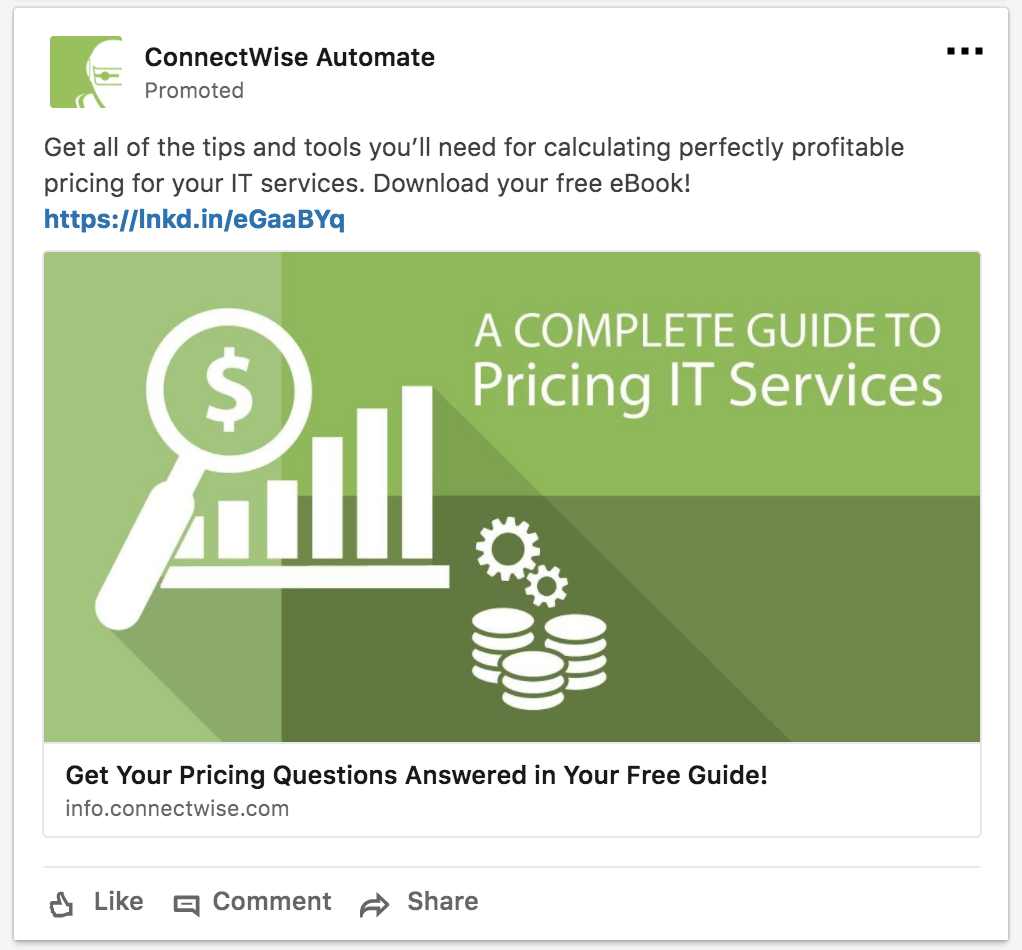
Above is a LinkedIn ad from ConnectWise Automate that offers what appears to be a highly useful guide to help vendors price IT services.
The ad is the pitcher… and here’s the catcher: a highly engaging and smartly designed landing page.
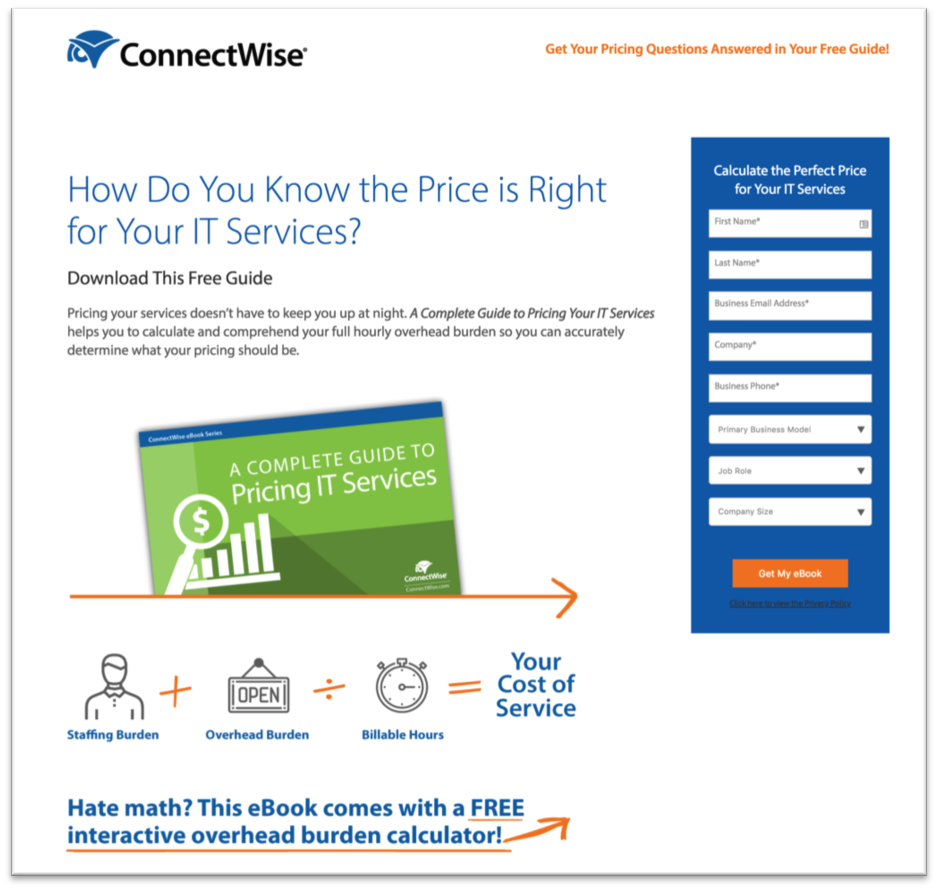
I love the question style headline, the directional cues, the 1/2/3 infographic vignette, the very cool bonus offer (a calculator), and the nicely designed form.
Utilitarian marketing ideas work offline too—and for any size company or individual.

I love the story from Jay Baer’s book Youtility about Taxi Mike. Jay calls an enterprising taxi driver he encounters a “one man Trip Advisor.” The driver created the Taxi Mike Dining Guide (above) and updates it regularly to handout to his passengers.
Engage Your Followers Today
How will you AEIOU engagement with your brand? Here’s a quick review:
- (A)sk questions.
- Invoke (E)xpression.
- Provide (I)ncentives.
- Make (O)ffers.
- Deliver (U)tility.
I hope you found these ideas and examples useful — and engaging!

How to Create a Remote Work Schedule that Works for You
Whether you’re a new or experienced remote employee, you’ve probably realized how hard it can be to stay on a proper schedule.
In the morning, you might wake up drowsy with no commute or morning team chats to put you in the work mindset. Then, when you finally feel like you’re on a roll and about to get everything on your to-do list done, you might look out the window, realize how dark it is, and discover that you’ve worked straight through dinner.
At HubSpot, where we have a fleet of over 300 full-time remote employees, we hear about the above scenario a lot. And, we’ve also seen that remote workers across companies share the same struggles.
Although the schedule mishap I noted above is fairly common, you definitely don’t want it to become a regular part of your lifestyle. While working late at night occasionally can help you get ahead in your career, doing so regularly can harm your mental health, happiness at work, and your work-life balance.
When it comes to remote work, the stakes of poor scheduling impacting you might be even higher. Research shows that remote employees tend to work longer hours than in-office employees. Remote work can also result in feelings of disconnection, isolation, and loneliness.
If you’ve fallen for numerous scheduling traps as a remote marketer, it doesn’t mean you’re a bad employee or going downhill in your career. A scheduling mishap simply means that you might need some daily structure, like many other people with ambiguous working styles.
Luckily, with all of the scheduling technology we have today, creating an outline of your workweek actually isn’t that hard to do.
In this blog post, I’ll walk you through how to create an effective weekly schedule that allows you to stay on task, manage multiple projects, and take time to maintain your work-life balance.
If you’re interested in building your own Google Calendar and want to steal some of these tips, click here to add this calendar template to your own GSuite account.
<iframe src=”https://ift.tt/34OfEW8″ style=”border: 0″ width=”800″ height=”600″ frameborder=”0″ scrolling=”no”></iframe>
What to Schedule on Your Weekly Remote Work Calendar
1. Block your non-working hours.
One of the biggest challenges that remote employees face is the inability to tune out and unplug after a long day of work. Without social cues to leave the office at the end of the day, many remote employees report working longer hours and having less time for social interaction outside of their home because they get too focused on work.
As a hardworking remote marketer, you might feel like you have to be “always online.” However, many of HubSpot’s own remote marketers actually advise others who work from home to set boundaries for their schedule early on.
“It’s easy to fall into the trap of getting things done during the day, but still feeling like you’ve wasted your time and now need to work later in the evening,” says Rebecca White, a junior staff writer for the HubSpot Blog. “Setting boundaries for yourself and having a routine schedule will help avoid those pitfalls.”
After you discuss your working hours and work-life balance boundaries with your manager, you should note them on your calendar so your team is able to know when you’re available and when you’re logged off.
One handy way to note working and non-working times is by using Google Calendar’s Working Hours setting to visibly mark the times you won’t be on the clock. This allows teammates to see when your preferred work hours are and blocks them from scheduling meetings during off-work times.
To do this on Google Calendar, simply go to your calendar, click Settings, and scroll down to Working Hours on the Settings dashboard.
Once you update your working hours, other calendar viewers will see gray lines during the times and days which you’re unavailable for meetings. If you don’t use Google Calendar, a few other scheduling programs, such as the Microsoft Outlook calendar similarly allow you to mark these times.
2. Schedule time to do regular weekly duties.
Every job has a few weekly duties that you’ll take on regularly. To isolate these regular duties so that they don’t impact bigger projects, consider scheduling a time to do them each day.
For example, in this screenshot, I’ve scheduled the time I’ve devoted to producing and scheduling marketing emails for the HubSpot Blog. This helps me get the emails done early on so I can focus more of my day on creative projects, strategizing, or other heads-down tasks. It also allows me to add some structure to my day, especially when working remotely.
3. Create blocks that say, “Please Request Time Before Booking” for times when you’ll be doing larger projects.
Sometimes, you’ll need to have an hour or more of uninterrupted time to ensure that you get a project done thoroughly. When meetings interrupt these times, they can throw you off your train of thought or hinder your creativity.
As a blogger who’s also managing audience growth strategies, I have a mix of regular small tasks and larger, more intense tasks to accomplish each week. When I’m working in the office, next to my teammates, it’s easy to talk through my schedule and prioritize. But, when I’m working from home, the temptation to check emails and respond to Slack messages can distract me from my heads-down work.
Because of this, I schedule time to do my core, unchanging tasks, as well as time I’ll need to zone in on creative projects, such as content strategies or blog posts. This helps me keep a centered routine and get work done, while also allowing me to pivot to unexpected tasks as needed.
In the example below, I created a time block for blog-writing, which many marketers multitask with a wide range of other duties.
4. Schedule regular check-ins with colleagues you don’t see often.
Two other common challenges remote employees deal with are disconnected from teammates and lack of company visibility. To help avoid these barriers, many remote members of our marketing team schedule regular one-on-one check-ins or virtual coffee chats with other colleagues.
“I schedule monthly one-on-ones with colleagues I work closely with but don’t always cross paths with in meetings,” says Meg Prater, the remote Managing Editor of the HubSpot Blog. “I also grab virtual coffees and lunches with colleagues — and book my calendar with lots of face-to-face catch-ups when I’m in the office.”
As a remote employee, regular meetings help you get to know your team, stay up to date with what’s going on in the office, and gain valuable visibility that you might not get in larger virtual teammeetings.
5. Include your morning routine.
One thing I and my remote colleagues have found is that we feel more productive in our remote work when we have a morning routine. And, this makes sense.
Think about it. When you work in the office, you might wake up in the morning, get dressed, wake yourself up with coffee, and then amp yourself up for your day by listening to music or a podcast on your morning commute. When you work remotely, in your own home, there are less outside factors that can help pep you up for the day ahead.
While you might be tempted to sleep in until your team is online, we’d actually suggest that you give yourself time for a morning routine. Morning routines not only allow you to start your day off on the right foot, but they also offer you time to use self-care, bond with your family, or take care of any errands or chores that could be a distraction later in the day.
Regardless of which morning routine you follow, it can be helpful to time block this in your calendar to remind you to make a bit of time for yourself and your personal life before you get started with your workday.
6. Make time for breaks each day.
Aside from making time for self-care in the mornings, you should also remember to take breaks once you dive into your workday.
Why mark breaks on your calendar if you already work from home? While you might hear people say, “Remote workers have plenty of time for self-care,” this statement is actually one of the biggest and most inaccurate myths we’ve heard.
This is a myth that Prater noted for a recent blog post:
“I always thought I’d turn into a super-athletic woman when I became remote. I thought I’d go to yoga every day during lunch, take up running as a mid-morning break. It turns out, I sometimes forget to take a break long enough to refill my coffee cup — let alone run to a yoga class mid-day,” Prater revealed.
Taking breaks can be challenging when you feel like you’re churning out great content or are wirjubg on a deadline. But, many of our marketers say they can help prevent burnout and boost creativity.
If you think you need to take more breaks, but find it hard to remember to, create a 15 to 30 minute time slot for an afternoon break on your calendar each day. You don’t always have to use that time for a break, but getting the calendar reminder will remind you to take some time for yourself at some point.

7. Block time for other work-life-balance needs.
As a career-minded professional, you might be worried that taking time for your family or yourself can leave the impression that you’re not taking work seriously. In fact, this is the opposite.
The workplace is actually becoming more and more accepting of flexible work. According to LinkedIn, 72% of recruiters say flexible schedules will shape future workplaces and hiring success.
If your manager allows you to work flexibly or pause work during the day for a personal life commitment or errand, such as picking up a child from school, you should note these occurrences on your calendar. This will allow your team to know when you’re busy and cannot be booked for a meeting while also giving you uninterrupted time to maintain work-life balance.
8. Consider booking as many meetings as possible within one to two days each week.
One of the best pieces of advice that I’ve gotten from my remote colleagues is to book all of my meetings in a cluster early in the week, which leaves more time open for heads down projects or activities at the end of the week.
This is a strategy often used by one of the blog’s remote content strategists, Allie Decker.
“If you can, group all your meetings so they happen over the course of two or three days. Leave a couple of days wide open to get that heads-down, max-effort work done,” said Decker in a recent blog post.
Decker added that you can also use this time “to get out of the house, change up your workspace, and not have to worry about taking video or phone calls in loud public spots.”
To help you visualize how to schedule your meetings in blocks, here’s an example. Below, I’ve scheduled my check-ins on the same day as my weekly team meeting. Then, by Wednesday, you can see that my schedule is opening up and becoming more flexible for more intensive tasks.
9. Leave some openings in time each day.
If you’re a very organized person, it can be hard to avoid scheduling every second of your day, but for the sake of teamwork, you’ll want to leave some unscheduled space on your calendar.
Why? When you’re working remotely, you might want to have a virtual call with a teammate at the last minute because it’s simply easier to discuss something in-person or through text-based communication.
This strategy can be especially helpful if you’re a team manager who wants to remain accessible to all employees.
“Be ready to jump on a video-call without having to schedule time for it,” says Susanne Ronnqvist Ahmadi, HubSpot’s Vice President of International Marketing. “Let your teams know you’re available over your instant messaging tool and build in “air-time” in your agenda for check ins and quick chats.
Communicating Your Schedule
Remember, a great schedule means nothing if you don’t communicate about your boundaries and work hours with your team. To make sure you maintain your weekly routine, be sure to discuss the schedule you settle on with your manager and notify your colleagues of times that you have set as unavailable. This solid communication will help to ensure that your working hours are both respected and effective.
For more tips about how to be a successful remote employee, check out this blog post with tips from members of our own remote workforce. You might also like these posts related to remote work stats, common myths, and tips for gaining visibility from home.

HubSpot Content Marketers Note Their Favorite Content Marketing Campaigns
As marketers, we probably all have that one campaign that we can note as a favorite. Stunning campaigns are striking and evoke emotion: Joy, inspiration, liberation, excitement … the list goes on and on.
For me, when I think of incredible content marketing campaigns, I turn to fast food. Fast food marketers have a history of successfully building massive interest for new menu items or poking fun at competitors via social media. If enough people participate in the exchanges, a campaign can go viral.
Thus, the summer of the chicken sandwich, led by fast food chain Popeye’s, takes the cake for my favorite campaign. When Popeyes’ chicken sandwich appeared on menus, what ensued was a slew of positive tweets, which escalated into a phenomenon.
I love this campaign because the response came as a surprise — such a surprise, in fact, that less than two weeks later, the Popeye’s team had to officially declare they’d run out of chicken:
Y’all. We love that you love The Sandwich. Unfortunately we’re sold out (for now). pic.twitter.com/Askp7aH5Rr
— Popeyes Chicken (@PopeyesChicken)
August 27, 2019
… And then, the sandwich returned a mere month later in a 30-second announcement. An announcement that, in true fast-food wars fashion, took a moment to jab at competitor, Chick-fil-A:
Y’all…the sandwich is back Sunday, November 3rd. Then every day. 🤯🔥 pic.twitter.com/JDxyCIv0zz
— Popeyes Chicken (@PopeyesChicken)
October 28, 2019
Viral marketing campaigns show us how much power there is in marketing. But that’s just my favorite example. Let’s take a look at the favorites of HubSpot content marketers.
1. Pepsi Max’s Uncle Drew
“One of my favorite recent content marketing campaigns is Pepsi Max’s Uncle Drew series. This absolutely ridiculous series of webisodes that ultimately led to a full-length feature film was hilarious, entertaining, memorable, and still highlighted Pepsi products despite having its own plot line. Although the movie’s reviews were subpar, this series and film were awarded with a 2019 Clio Award.”
“I think this is a fascinating example of how a brand marketed its product and ultimately created a character that could get audiences to buy movie tickets for what was essentially a two-hour Pepsi commercial.” – Pam Bump, Audience Growth Writer
For more information about Uncle Drew, check out this Clio winning campaigns post.
2. Nerdwallet’s “You Deserve the Best” campaigns
“I’m in love with how Nerdwallet does content. Nerdwallet’s goal is to become the destination resource for anything money related. Their entire site is a content engine, providing helpful and useful information upfront, like their ‘You Deserve the Best’ campaigns, that provide a roundup of helpful financial resources at the beginning of each year:
They don’t push their offerings, but they are visible and helpful should someone need to take their money game to the next level.” — Amanda Sellers, Historical Optimization Writer
3. Activia “Don’t Tell Me I Can’t”
“You know it’s a really good content marketing campaign when you send it to your mom with the message: I know it’s technically an ad, but you have to watch this. That’s how I felt about Activia’s ‘Don’t Tell Me I Can’t’ video campaign:
“Activia is a probiotic yogurt company, but the company’s ad has little to do with yogurt and everything to do with authenticity, vulnerability, and what it means to be your own harshest inner critic. I teared up out of a sheer sense of, ‘Oh my God, I think like that, too’ — what more could you want out of a marketing campaign?” — Caroline Forsey, Editor of HubSpot’s Marketing Blog
4. Nike “Show Them What Crazy Can Do”
“This campaign, narrated by Serena Williams, struck the right chord for me. As someone who has been a life-long athlete, the campaign makes me feel a variety of emotions. But no matter what you feel while watching their video, Nike’s motivational and encouraging message to female athletes is clear.” — Kristen Baker, Content Marketing Manager
5. Lover album release campaign
“Every time Taylor Swift is about to drop an album, her fans know about it before the media even catches on. That’s because Taylor Swift’s marketing, while predictable, is extremely effective. For her recent album Lover, she began her marketing campaign by commissioning a mural in Tennessee. People began speculating, and she then transitioned her marketing to Instagram:
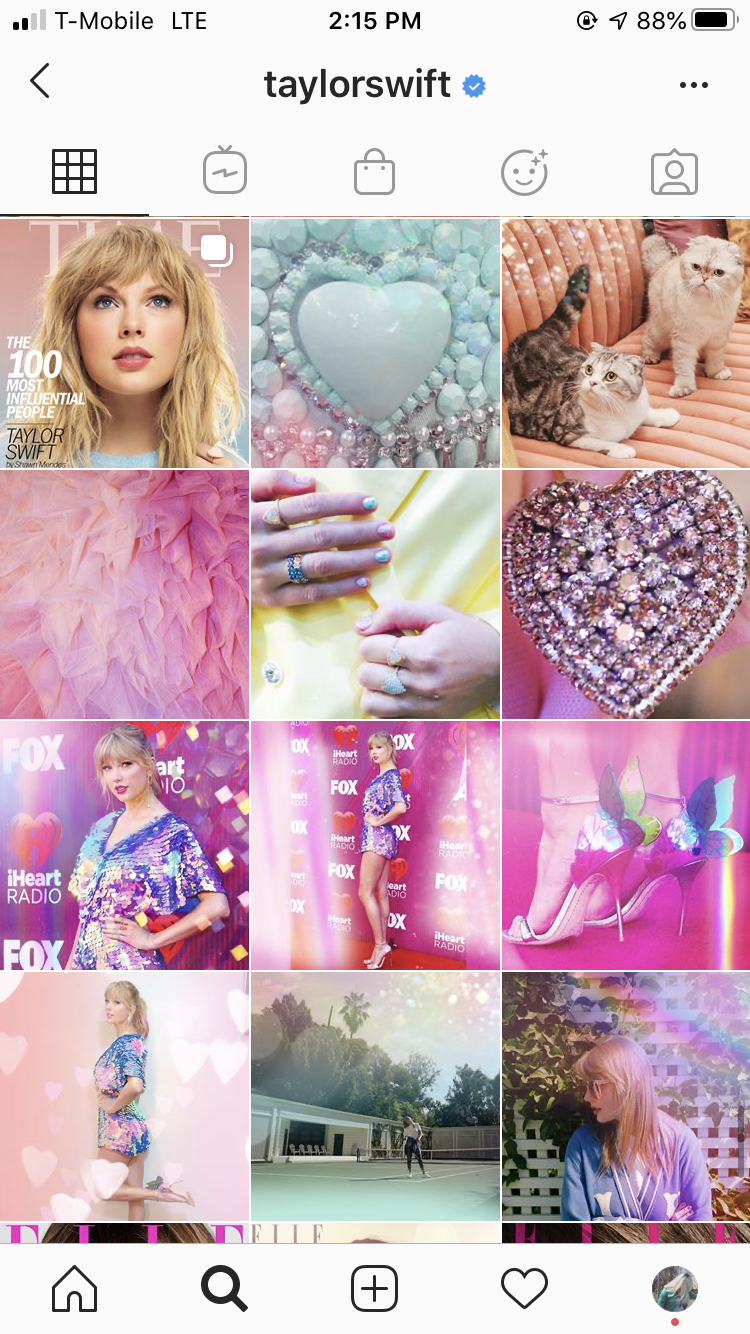
“Without announcing an album, Taylor Swift will begin changing the entire look of her Instagram. Her campaigns are effective because there’s a lot of hints and suspense that come with an announcement.” — Rebecca White, Jr. Staff Writer
6. Squatty Potty’s humorous commercial
“I enjoy anything that makes me laugh (which is admittedly easy). Squatty Potty created a humorous campaign that somehow schooled me on my physiology at the same time — and taught me about the product that I never knew I needed.”
“Their clever and lighthearted approach to an unmentionable topic resulted in a campaign that I’ll never be able to get out of my head. Not to mention, the campaign boosted sales by 600%.” — Christina Perricone, Content Marketing Manager
7. Jeff Hoffman’s email marketing campaigns
“I love Jeff Hoffman’s email marketing campaign supporting his company’s weekly webinars for sales professionals. The cadence of his emails is not overpowering (once/week), but what really grabs me are the subject lines/topics he and his team choose. They are SO relevant to his audience, straight to the point, and really clearly communicated.
“I love a good flashy, multifaceted content marketing campaign as much as the next marketer, but there’s something so refreshing about clear communication, expertly chosen content, and a simple CTA. His emails are also written in a tone that is incredibly conversational — the reader can’t help but be drawn in. One of his recent emails was signed “Happy Selling (Hell, happy anything these days!)” and I loved how it was so in tune with how most sales professionals are feeling right now.” — Meg Prater, Managing Editor, HubSpot Blogs
8. NPR’s Tiny Desk Contest campaign
News radio provider NPR has a lot of programs, but my favorite by far is their Tiny Desk Concert series, which has 3 million subscribers on YouTube alone. Tiny Desk hosts musicians, with audiences small or large, at NPR’s office or in their homes, and they put on an intimate concert:
The team behind NPR’s Tiny Desk series realizes that not every guest has the same level of celebrity as artists like Lizzo or Harry Styles. So, every year, they host a contest, where unsigned, independent musicians can submit a DIY Tiny Desk concert for the opportunity to win one of their own:
This commercial is an excellent promotional tool because it emphasizes the lives that independent musicians may lead. I love this campaign because it gives a spotlight to smaller artists that wouldn’t necessarily have the same kind of exposure to new audiences that NPR has.
The promo is great at being relatable and evoking a feeling that anyone has the possibility to create something memorable. Plus, the contest home page is an excellent resource — submitters can find past winners, their concerts, and can even check out competition under the “Watch Entries” tab.
“Tiny Desk Contest” campaigns make NPR more accessible to its audience of music lovers. It allows audiences to contribute to their favorite publication and build their own careers, and I love how relatable the marketing messages are.
These campaigns each have something marketers can learn from. Whether it’s to connect with the emotions of audiences — like laughter or excitement — or to develop a unique brand voice and apply it to every piece of content.
When you think of your favorite campaign, what stood out to you? For me, I always look for the response of the public. Like seen with the Popeye’s campaign, a successful campaign is always measured, in part, by audience reaction.
Popeye’s got to enjoy an explosion of word-of-mouth-marketing and good timing. What are some of the tactics your favorite campaign used?

The 12 Best Blogging Platforms for 2020 (& How to Pick One)
Whether you’re interested in blogging for your business or as a hobby, publishing blog content has many benefits. Not only does blogging help you establish authority in an industry — it also drives traffic to your website and enables you to better convert that traffic into leads.
To reap the rewards of blogging, we’ll walk through the process of choosing the right platform for your needs and goals. Then we’ll explore some of the best blogging platforms that can help if you’re looking to add a blog to your business site or create a stand-alone blog.
How to Choose a Blogging Platform
To select a blogging platform that’s right for your business, evaluate how its capabilities align with your goals and needs. If you need to boost your visibility in SERPs, for example, look for a platform with built-in SEO tools. If your main priority is to starting publishing visual content fast, then you might focus on finding a platform that supports multi-media posts.
Let’s take a look at some essential features that you might need for your blog. You can use this list when evaluating different blogging platforms.
Content Editor
The content editor is the core of every blogging platform. As a blogger, you might be working in this editor every day, so make sure you pick a platform with an editor you like.
You could make a list of must-have and nice-to-have features. For example, maybe your editor must have drag-and-drop functionality and an auto-save feature and it’d be nice to have an option to preview how your post looks on different devices.
Themes and Templates
Themes and templates allow you to customize a blog quickly and easily. When looking at different blogging platforms, check out their selection of themes and templates.
Do they have a lot of options for blogging specifically? Do they have a variety of free and premium ones? What’s the average price of their premium themes? Can you edit the themes and templates to create a truly customized look for your site?
You might also want the option to start from scratch rather than use a predesigned theme.
These are just a few questions that can help you select a platform with the design and customization options you need.
SEO Features and Tools
Optimizing your content for search is essential to driving traffic to your blog. According to Search Engine Journal, sites listed on the first SERP in Google get 91.5% of the traffic share for a keyword or phrase.
To get on that first page, you ideally want a platform with built-in tools to help you optimize your content. CMS Hub, for example, offers SEO recommendations as you write.
If a platform doesn’t have this type of advanced functionality, then check if you can install an SEO plugin or third-party tool. Otherwise, you’ll have to get up to speed on SEO best practices and make sure to implement them on your blog.
Now that you know some features to consider in your selection process, let’s take a look at some of the best blogging platforms on the market.
We’ll divide this list into paid and free blogging platforms, so you can find one that meets your needs and budget. Let’s get started below.
Paid Blogging Platforms
Most premium blogging platforms will offer more features and control over your blog than free platforms. If you have the budget, investing in your blogging efforts now can help you grow over time.
1. CMS Hub
G2 Rating: 4.3/5.0 (6,044 Reviews)
What sets CMS Hub apart from other blogging platforms is that it’s fully integrated with HubSpot’s marketing, sales, and service tools and comes with a built-in CRM. That means you can create a fully functional and customized blog.
You can start by selecting a pre-designed theme or build your own custom theme. Then, using HubSpot’s blog editor and built-in SEO tools, you can quickly create search engine optimized blog posts with CTAs, forms, and other interactive elements. You can even create language variants of your blog posts and run A/B tests on them to reach a global audience. Before you publish, make sure to preview how your posts and pages look on every type of device.
Once you’re ready to start promoting, connect your blog to your social media accounts. That way, you can automatically share new blog posts on your social networks in the same place that you wrote them.
As you publish more content, you can analyze your blog performance with HubSpot’s built-in analytics to understand what topics and types of content are resonating with your readers.
As your blog grows, so will your team. With HubSpot’s CMS, you can make edits and add comments in composer mode to collaborate on the same pieces with other writers. You can also keep track of changes on your site — and who made them — with activity logs at the Enterprise level.
Take a look at this retailer’s feature-rich blog built on the CMS Hub below.
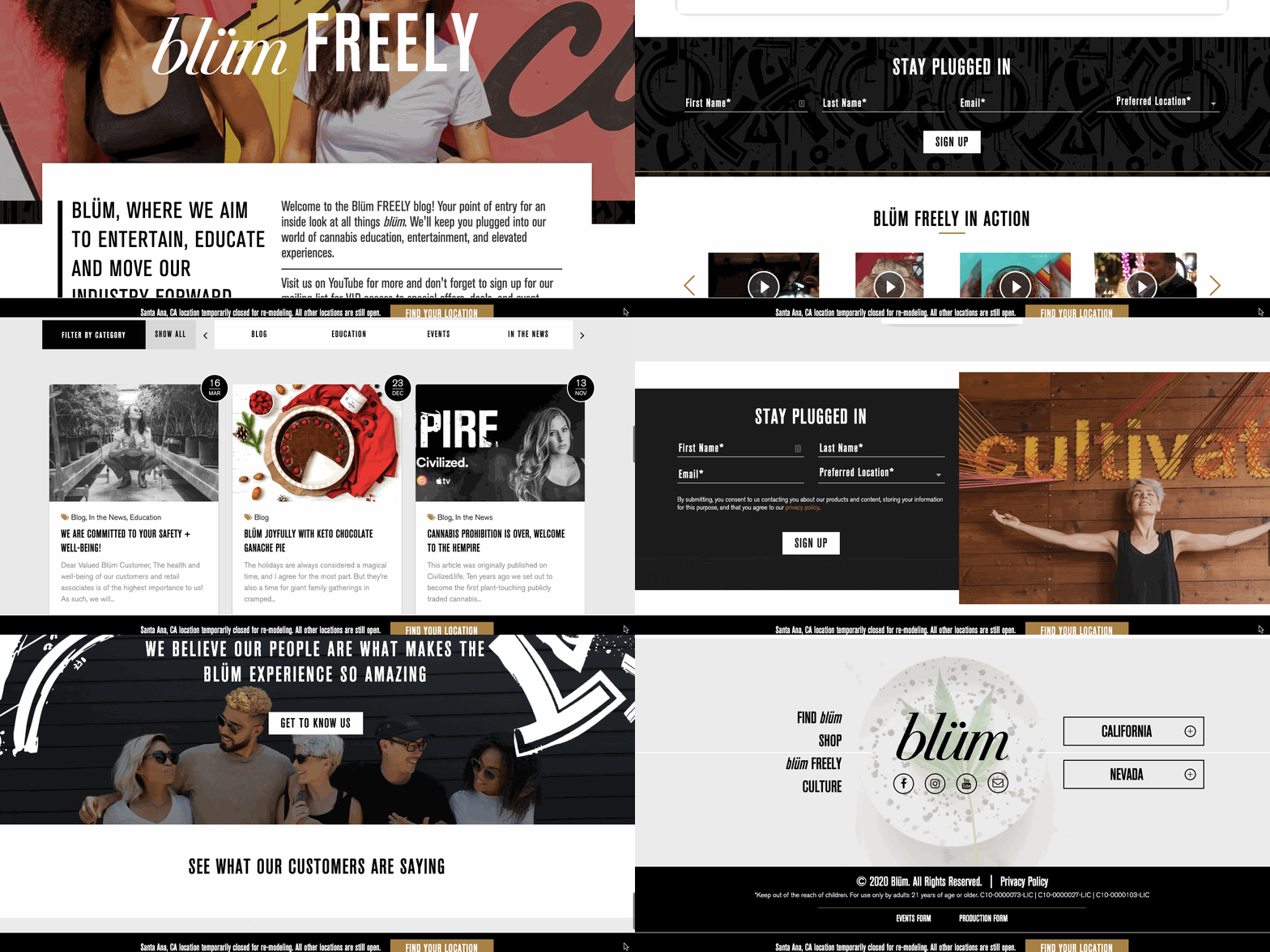 Key Takeaways:
- Integrates with HubSpot’s marketing, sales, service, and CRM tools
- Built-in SEO recommendations
- Multi-lingual support and other advanced functionality built-in
2. WordPress
G2 Rating: 4.3/5.0 (7,613 Reviews)
WordPress was originally created as a blogging platform. Though it has evolved into a multi-purpose content management system, it still has many features and themes for blogging.
WordPress enables you to not only purchase a custom domain and download one of 3,000+ themes specifically designed for blogs — it also lets you add social media buttons, forms, affiliate links, and other features via plugins.
The customization options are virtually limitless with the 55,000+ plugins available, but you will have to make sure these plugins are compatible and updated. Otherwise, they can disrupt the visitor experience or break your site.
Creating and managing a blog on WordPress might require more maintenance than other platforms, but it will provide the flexibility, customizability, and content management features you need to create a complex blog.
Tech Crunch, one of the largest and most popular technology news blogs, is powered by WordPress. Take a look at this WordPress website example below.
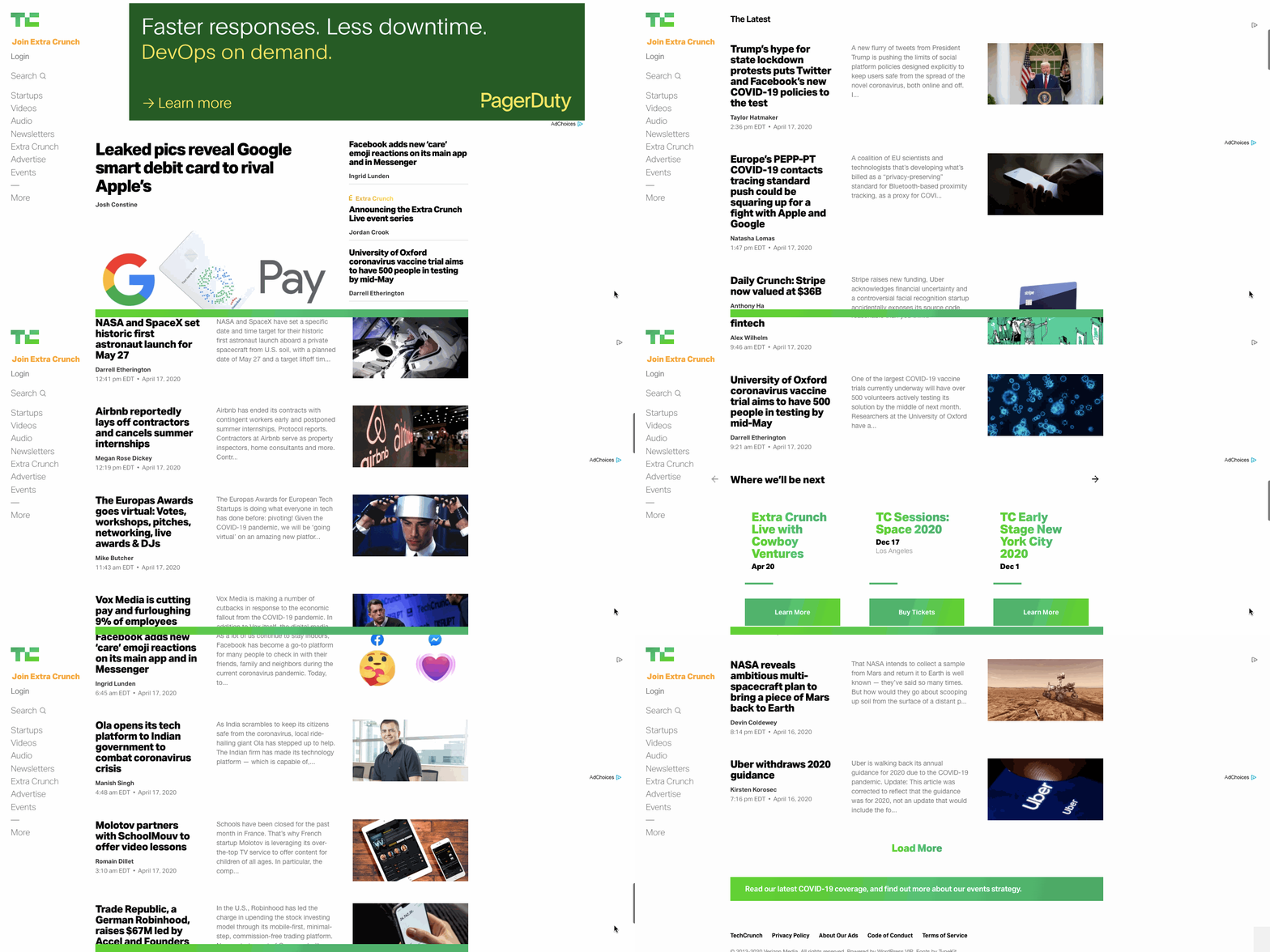 Key Takeaways:
- Over 3,000 free blogging themes
- Virtually unlimited customization options via plugins
- Plugin and site maintenance can be time-consuming
3. Squarespace
G2 Rating: 4.4/5.0 (847 Reviews)
Squarespace is an ideal blogging platform for creating image-rich content. With their award-winning designer templates and integrations with Getty Images, Unsplash, and Google AMP, you can create visual content that’s engaging and shareable.
While SquareSpace only offers 60 templates, they are all mobile-optimized and fully customizable so you can create a blog that looks the way you want it to. Once you’ve designed your pages, you can use Squarespace’s blogging and SEO tools to create and optimize your content.
Finally, after publishing your blog posts, you can connect your social media accounts to easily promote them. Then use the built-in analytics tool to learn where your traffic is coming from, what your visitors are looking for, and how they’re interacting with your content.
Squarespace offers even more features, from audio files support to newsletter signup forms, but ultimately it’s limited in functionality. That’s because you can’t install plugins or additional modules, so you’re limited to the features Squarespace provides out-of-the-box.
Since they can’t possibly have every feature that every blogger needs — they don’t have an auto-save feature, for example — Squarespace is not the ideal platform for everyone. But it does allow some bloggers to create beautiful sites, like this lifestyle blog below.

Key Takeaways:
- Limited selection of templates but high-quality
- Robust functionality for blogging, SEO, and more
- Limited to features Squarespace offers
4. Wix
G2 Rating: 4.2/5.0 (1,177 Reviews)
Wix is a popular blogging platform for beginners looking for hosting and blogging tools in one place.
You can start by selecting from over 500 pre-designed templates that any blogger can use, whether you own a retail business or run a food review website. Or you can start from scratch if you know HTML and CSS.
After you’ve picked or created your template, you can begin writing and editing posts on desktop or mobile, embed Wix’s stock photos and videos or your own media, and organize them into topics.
To add more advanced elements to the page, like music or maps, you’ll have to add HTML code. This process can be intimidating for beginners, particularly when compared to the ease of installing plugins on WordPress. It’s post editor also isn’t drag-and-drop, which might frustrate some bloggers.
Once you’re done writing, you can configure your SEO settings to boost your organic reach, push your content to your subscribers with Wix’s email tool, and share them through your social media accounts. You can further foster a sense of community among your readers by letting them become members.
While Wix is more versatile than other hosted website builders, it lacks customization options and content management features, particularly when comparing Wix vs WordPress or another CMS. This makes Wix ideal for bloggers looking to create blogs that prioritize visual content over functionality. Take a look at this Wix blogger’s site below.
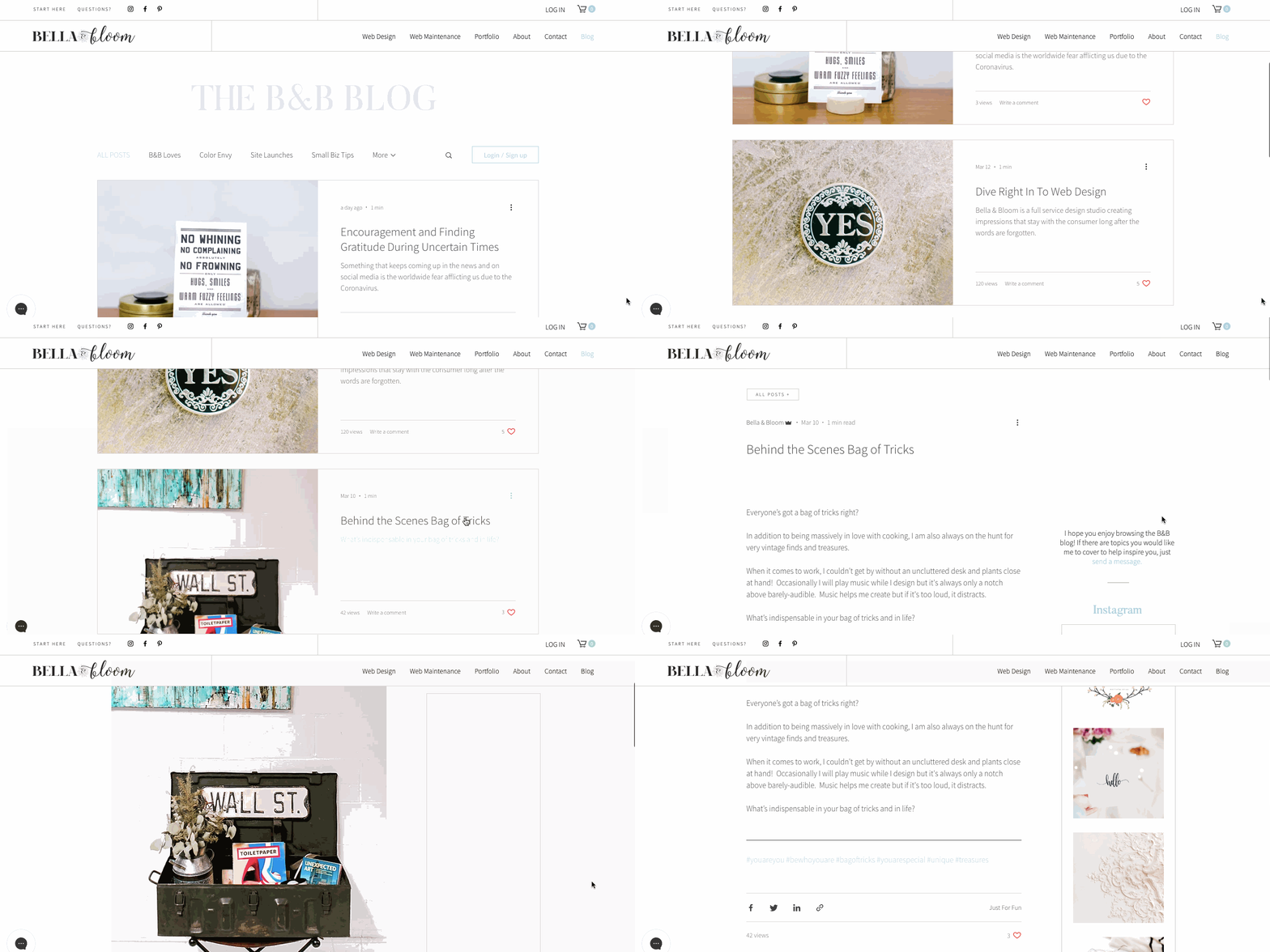
Key Takeaways:
- Option to use pre-designed templates or start from scratch
- Built-in archive of free photos and videos
- Editor lacks drag-and-drop functionality
5. Weebly
G2 Rating: 4.2/5.0 (402 Reviews)
Like Wix, Weebly is a popular blogging platform that provides everything you need to launch a blog, including website building tools, templates, and hosting.
Weebly differentiates itself from Wix in multiple ways. The editor supports drag-and-drop functionality for both posts and pages, for example. You can create more complex layouts by adding elements like forms and image galleries as well. You can also add more sub-levels to your navigation menus, which allows you to organize larger amounts of content. All Weebly templates are also mobile-optimized, which means you won’t have to do any additional editing or rearranging for mobile.
While Weebly offers more functionality than most website builders, it does lack flexibility when compared to WordPress or another CMS. For example, you can’t drag and drop elements anywhere on your posts and pages or edit parts of the underlying source code.
That makes Weebly ideal for blogs with lots of content but more basic functionality. Take a look at this Weebly blog below.
Key Takeaways:
- Editor supports forms, image galleries, and other advanced elements
- Mobile-optimized templates
- No access to source code
6. Craft CMS
G2 Rating: 4.1/5.0 (30 Reviews)
Craft CMS is a blogging platform designed for developers, designers, and web professionals. With Craft’s personalized content modeling, access to your blog’s code, and powerful templating, you can completely control the appearance and functionality of your site — if you have the necessary experience.
Craft CMS also offers an image editor, collaboration tools, and a localization feature that can translate your content to specific languages. To analyze your content’s performance, you can integrate Craft CMS’ dashboard with Google Analytics.
There’s a free version for a single admin account with powerful website building tools and templates. For unlimited user accounts and more advanced features, you’ll have to upgrade to the pro or enterprise version.
You’ll need some web development experience to fully leverage the power of Craft CMS. If you can, you’ll be able to create a complex blog with custom post types. Take a look at this travel blog built on the Craft CMS below.
Key Takeaways:
- Advanced functionality including personalized content modeling and localization feature
- Free version for single admin accounts
- Requires some web development experience
7. Contently
G2 Rating: 4.0/5.0 (21 Reviews)
Contently is a robust blogging platform that’s ideal for enterprise companies with large budgets but few internal editorial resources.
Contently allows you to manage your entire content creation process in one place. You can create and visualize your editorial strategy with their customizable production calendar tool, organize your blog posts with their tagging tool, and effectively collaborate with your team on projects by leveraging their advanced workflow tools. You can even pay for Contently’s well-vetted freelancers to write some of this content for you.
Before publishing your content, Contently’s smart content review tools will ensure your content is aligned with your brand, optimized for search, and legally compliant. Finally, to refine your content strategy, Contently enables you to compare your content’s performance against industry benchmarks and measure its performance by topic, format, and sources directly in your dashboard.
With prices ranging from $3,000 to $25,000 per month, Contently is one of the most expensive blogging platforms for enterprise companies.
The Royal Bank of Canada, one of North America’s largest banks, uses Contently to streamline content creation across 14 marketing departments. Check out its blog below.
Key Takeaways:
- Can manage entire content creation process
- Deep-dive analytics
- Pricing only feasible for enterprise companies
8. Joomla
G2 Rating: 3.9/5.0 (290 Reviews)
Joomla is an open-source CMS with advanced content management features that are built directly into the platform. For example, it allows you to create custom post types, manage hundreds of users, and publish content in multiple languages right out of the box. This makes it an excellent WordPress alternative
Because of its robust built-in functionality, Joomla does have a steeper learning curve than WordPress so it’ll require more time to set up. It also offers a smaller selection of themes and extensions than WordPress, which can limit your customization options.
Among this selection are some great extensions for blogging, however. EasyBlog by StackIdeas, for example, provides a much cleaner drag-and-drop editor than Joomla’s built-in editor. You can also enable star ratings on your blog and automatically publish posts to your social media platforms with this extension.
Below is an example of a Joomla blog built with EasyBlog.

Key Takeaways:
- Advanced content management features
- Steep learning curve due to robust built-in functionality
- May require blogging extension like EasyBlog
9. Drupal
G2 Rating: 3.8/5.0 (326 Reviews)
Drupal is a highly flexible open-source CMS that’s best suited for large, complex blogs.
Drupal has hundreds of out-of-the-box features and modules. If you don’t know how to use them and don’t have the time to learn, they can be confusing and hinder your blogging efforts. But if you do know how or have the time to learn, then Drupal will provide you more power than other open-source platforms.
Specifically, Drupal supports a wide selection of taxonomies, content types, page templates, blocks, views, and more for creating and managing lots of different types of content. It also has advanced user permissions so you can provide site admins, content editors, and other stakeholders personalized access to specific content.
This makes Drupal ideal for advanced users as well as enterprise companies with complex blogging needs who are looking for a self-hosted solution.
Below is a Drupal blog that features all of the add-ons and modules developed by the site owner.
Key Takeaways:
- Powerful content management features
- Advanced user permissions
- Best suited for technical users with complex blogging needs
Free Blogging Platforms
While free blogging platforms might offer less functionality and flexibility than their premium counterparts, many can still provide the blogging tools and customizations you need to start blogging. Let’s take a look at some of the most popular options below.
10. Write.as
G2 Rating: 4.2/5.0 (19 Reviews)
Write.as is a lightweight blogging platform that’s ideal for individuals looking to create simple blogs with a minimalist design. Offering a stripped-down editor with nothing but an auto-save feature, Write.as offers the experience of writing in a virtual journal.
Write.as does require you to use Markdown, a syntax that uses special characters to format text. For example, you’d type in asterisks to create bullet points, hashtags to create headers, and [Link] to add a link. The syntax is not difficult to learn, but it might require some practice. If you’d prefer to simply click a button to create bullet lists or add hyperlinks, then you’ll be better off with one of the free platforms below.
Write.as is free to use and doesn’t support ads. However, to connect a custom domain name, install a custom theme, and more, you’ll have to upgrade to its pro plan for $6 per month. Check out an example of a Pro blog below.
Key Takeaways:
- Minimalist interface and design
- Requires you to learn and use Markdown syntax
- Free version is add-free
11. Blogger
G2 Rating: 4.1/5.0 (56 Reviews)
Blogger is a free platform designed for newbie bloggers.
To get started, you just need to create an account with Google, select a template, and get publishing. You can purchase a custom domain, optimize your SEO settings, connect your blog to Google Analytics, optimize your posts with Adsense, and even edit the HTML and CSS of your site — but you won’t be able to do much beyond that.
To get a better sense of the platform’s limitations, you can compare Blogger vs WordPress or another CMS. With Blogger, you can’t install plugins to extend the functionality of your site. You can’t create different content types, like portfolio pages. And you can’t change the default display of your content from reverse-chronological order to, say, your most popular posts. In short, if you need the content management features and customization options of a CMS, then look into alternatives to Blogger.
But if you need the simplicity of a free blogging platform, than Blogger is more feature-rich than most. For that reason, Blogger is perfect for individuals looking to create lifestyle blogs as a hobby or to make some extra cash. Take a look at this personal travel blog below for an example.
Key Takeaways:
- More feature-rich than other free platforms
- Can’t create custom post types or change display of posts
- Best suited for lifestyle bloggers
12. Tumblr
G2 Rating: 3.8/5.0 (24 Reviews)
Tumblr combines the power of blogging and social networking in one highly-visual publishing platform.
Tumblr offers everything you need to create a professional-looking site. You can select from hundreds of free and premium themes and add multiple pages, sidebars, social sharing buttons, comment sections, and more. You can also buy a custom domain name from a domain name registrar rather than use the free subdomain: yourusername.tumblr.com. If you have HTML coding skills, you can further customize your site.
When you’re satisfied with your site’s design, you can start creating and publishing multimedia post types. Featuring photos, GIFs, links, chat dialogue, audio files, and video in your content makes it 40 times more likely to be shared on social networks.
Since other users can easily like, reply, and reblog your posts on their Tumblr as well as their other social accounts, right from their dashboard, this is an excellent platform for engaging and fostering an online community.
There are restrictions on the site that can frustrate users. For example, you can only schedule (or “queue”) 50 posts in a day, which might limit your ability to plan and execute a long-term content strategy. You can also only upload videos under 100MB and in MP4 format and only track 20 tags at a time. Furthermore, your site can be suspended at any time if you’re found in violation of Tumblr’s community guidelines.
Despite the limited degree of ownership Tumblr offers, it appeals to personal bloggers and brands alike. While bloggers might be able to use this as their only platform, brandstend to use it as one platform among many to show their personality. Vogue, for example, has a highly visual and multimedia-rich site on Tumblr. Check it out below.
Key Takeaways:
- Ideal for publishing multi-media posts
- Restrictions on what you post, when, and how often
- Ideal for individuals and brands to engage with followers
Get Started Blogging
Once you identify your blogging goals and needs, you can select a blogging platform with the functionality and flexibility you’re looking for. Ideally, your platform combines ease of use and power so you can start blogging and reap the benefits in SEO and traffic.
Editor’s note: This post was originally published in April 2019 and has been updated for comprehensiveness.

The Ultimate Guide to Account-Based Marketing (ABM)
Imagine a world where you could start the sales process by selling directly to your best-fit, highest-value accounts. No wasted time working to market and sell to unqualified leads who aren’t the right fit for your business. Meaning, you could move straight into the phases of engaging and delighting your target accounts.
Talk about efficiency, right?
With account-based marketing, all of this is made possible. The process allows you to align your marketing and sales teams from the get-go to promote long-term business growth, delighted customers, and a boost in revenue.
This guide is here to help you make it happen. Let’s dive in.
Account-based marketing allows you to weed out less-valuable companies early on and ensure Marketing and Sales are in complete alignment — in return, your team can leap into the critical processes of engaging and delighting those accounts much faster.
ABM helps your business work and communicate with high-value accounts as if they’re individual markets. By doing this along with personalizing the buyer’s journey and tailoring all communications, content, and campaigns to those specific accounts, you see greater ROI and a boost in customer loyalty.
Before we take a look at additional benefits of account-based marketing and specific ABM tactics you can implement at your company, let’s review its relationship with another important strategy: inbound marketing. Often, these strategies are thought of as entirely different entities. However, they can be quite complementary.
Account-Based Marketing And Inbound Marketing
Batman and Robin. LeBron and D-Wade. Peanut butter and jelly. Arguably some of the strongest partnerships ever to exist 💪. These dynamic duos are forces to be reckoned with when they work together.
Similarly, when paired, account-based marketing and inbound marketing have the power to make waves (the good ones) for your business.
You might be wondering, “How exactly does this partnership work?”
Well, we just reviewed the definition of account-based marketing — as you learned, ABM is a highly-targeted strategy.
Meanwhile, inbound marketing is more foundational — the methodology and growth strategy allows you to attract customers through the creation of valuable content, SEO, and a delightful customer experience.
Rather than interrupting your target audience and customers (as you would with outbound marketing), inbound marketing allows you to more organically provide your audience with the information they want when they want it. Inbound lays the foundation for a strong ABM strategy by allowing for highly-targeted and efficient resource allocation of high-value accounts.
Here are a few more reasons to implement both ABM and inbound marketing that explain the way in which they work well together:
- Inbound marketing helps you attract target accounts and ABM then accelerates the flywheel so you can win and delight those target account through a remarkable customer experience (and as a result, you’ll grow better).
- Inbound marketing lays the foundation for a strong ABM strategy — ABM builds off of inbound by allowing for targeted and efficient resource allocation of high-value accounts.
- With this combined approach, you attract a broader group of prospects than you would while using just one method and catch any opportunities the other strategy may have missed.
- Your content as a two-for-one value — you can create and use content that serves both an ABM and inbound strategy (e.g. create a personalized case study for a target account that you also share on your website).
- Software options, like HubSpot’s account-based marketing software, are available and make it easy to implement ABM and inbound strategies in a complementary way.
🧡TLDR: Combine ABM and inbound marketing to grow better.
Next, we’ll take a look at some of the definable benefits of account-based marketing.
There are a number of benefits associated with account-based marketing. We’ve compiled the following list of commonly-noted results that positively impact (all types of) businesses.
1. Keep Marketing and Sales aligned.
Cross-team collaboration and improved communication across any organization are beneficial to growth. In terms of account-based marketing, this transparency and alignment will ensure your marketing and sales teams are focused on the same goals, stick to the mutually-agreed-upon budget, and understand the specific roles of each internal stakeholder.
This alignment helps ensure all communications, interactions, and content (and more) are consistent for the accounts you work with. Meaning, no matter how long an account works with your company, your team members can pick up where others left off at any point in time without question — this creates a seamless and delightful customer experience.
🧡The easiest way to maintain internal account-based marketing alignment is with the help of software, like HubSpot, which makes connecting your marketing and sales teams exceptionally easy.
2. Maximize your business’s relevance among high-value accounts.
Account-based marketing requires you to personalize everything (e.g. content, product information, communications, and campaigns) for each account you invest your resources in. Through this personalization and customization, your relevance among these accounts is maximized.
That’s because your content and interactions are tailored in a way that shows them how your specific products, services, offerings, and team are what they need to solve their challenges and to grow better. Meaning, ABM allows you to angle your business in a way that makes it the most-relevant and ideal option for your target accounts.
3. Deliver consistent customer experiences.
As mentioned, account-based marketing requires you to deliver consistent experiences for your accounts — this plays a major role in your success. A large part of the reason for this is because ABM is a long process that often lasts several months or years.
So, for your ABM efforts to be remarkable, you must maintain a long-term sense of delight among your accounts. This is how you’ll make each account feel as though they’re your business’s market of one — and why would they ever want to stop doing business with you if that’s their experience?
Delivering these long-term, consistent experiences may seem a bit daunting. Although this is understandable, the good news is that ABM is a process that naturally encourages you to do so.
Think about it this way: We already discussed the way ABM requires Marketing and Sales to be aligned on all things related to each account (e.g. their goals, budget, unique needs, members of their team and buying committee).
When there’s a universal understanding of these factors within your organization, Marketing and Sales (and anyone else involved) will be able to effectively and naturally deliver that feeling of consistency through everything they communicate and share with each account (e.g. personalized content, targeted campaigns, pricing and product information, and more).
4. Measure your return on investment.
With account-based marketing, you can easily measure return on investment (ROI) for each account you invest your resources and time into. This is beneficial because you can confirm whether certain accounts you invested in were ideal for your business.
Then, you can nurture and delight those accounts long term as well as identify and target similar accounts in the future. If your ROI proves your ABM tactics worked, use those results as a motivator to drive your strategy forward as well as one you can count on to continually improve your bottom line.
5. Streamline the sales cycle.
Depending on your business, industry, and resources, the sales cycle typically looks something like this:
1) Prospect → 2) Connect → 3) Research → 4) Present → 5) Close → 6) Delight
With account-based marketing, this cycle is streamlined — by focusing your efforts on specific high-value target accounts, you save time and resources, and focus more on the stages of the cycle that positively impact your bottom line:
1) Identify Target Accounts → 2) Present to Target Accounts → 3) Close Target Accounts → 4) Delight Accounts
ABM streamlines your sales cycle by helping you stay highly-efficient. Rather than experimenting with different tactics to prospect and qualify a large pool of leads, ABM ensures you target accounts that are ideal for your business so you can quickly dive into building relationships.
The sales cycle stage of closing is also streamlined through ABM. That’s because your chances of converting accounts and retaining them long term increase thanks to your marketing and sales alignment, consistent customer experiences, and personalization.
6. Expand business through account relationships.
The saying “quality over quantity” applies to account-based marketing. The process requires you to invest significant time and resources in engaging and delighting a group of carefully-chosen, high-value accounts versus trying to quickly close deals with less-qualified leads who may not be the best fit for your company in the long run.
By taking the time to build these trusting relationships with accounts, you’ll expand your business by retaining those valuable customers longer. And considering it costs more to obtain customers than retain them, this will positively impact your bottom line.
Additionally, as a result of personalized, thoughtful, and consistent customer experiences, accounts will become loyal to your business over time — and loyal customers become your best marketers, promoters, and brand advocates.
In other words, your accounts will help you expand your business among their networks (e.g. partners, customers) through referrals, word-of-mouth marketing, testimonials, and more.
Now let’s cover some account-based marketing tactics you can apply to your strategy to improve the likelihood of success.
ABM tactics are the building blocks of your strategy — so, work through the following tactics to ensure your ABM efforts and investment are successful.
1. Secure organizational ABM alignment.
One of the most important account-based marketing tactics is arguably one of the most straightforward: secure organizational ABM alignment.
This means getting all internal stakeholders on board with the various factors related to your account-based marketing strategy. In doing so, it’ll be easier for your business to create consistent experiences for accounts and make sure your strategy is as efficient and streamlined as possible.
For example, your VP of Marketing and VP of Sales should secure organizational alignment and spread awareness regarding:
- Marketing and sales team members who are directly involved in the strategy
- Account buying committee members and any other account stakeholders
- Your business’s point-of-difference for each target accounts
- ABM budget and resources
- ABM goals and KPIs
2. Build your ABM team.
Similar to the first tactic we reviewed above, VPs of Marketing and Sales will also likely be leaders in the discussion regarding how you’ll build your ABM team.
They, along with managers on their respective teams, will need to identify a minimum of one marketer and one sales rep who will be completely dedicated to the accounts you work with.
These people will create and publish content for accounts as well as work to manage and close business deals with each account’s buying committee. As a rule of thumb, try to limit your team size to no more than ten sales reps and one marketer.
In addition to the marketer(s) and sales rep(s), don’t forget to identify any other internal key players — such as customer success reps — who should be aware of and aligned on your ABM strategy.
3. Identify and pick your ideal set of target accounts.
Identify and pick your ideal set of high-value target accounts to invest your time and resources in. Here are some recommendations on how you can do this:
- Set search alerts for your ideal customer profile on LinkedIn.
- Create a workflow that filters incoming qualified leads based on specific criteria (e.g. company size, industry, etc.) and tags them as an ideal customer type in your CRM.
- Ask, “If we could replicate one deal from last year, what would it be?” Then, use the characteristics of that deal (e.g. industry, company size, value) to help you identify other good-fit customers.
- Pick target accounts based on a particular industry or geographical location.
- Review major companies and leads who are using and engaging with your inbound content but don’t have a deal attached (yet!).
- Identify the lighthouse accounts you could use for reference.
- Stick to no more than 10 accounts per sales rep.
4. Encourage Marketing and Sales to create account plans together.
Throughout this guide, you’ve probably picked up on the fact account-based marketing is a team effort. That’s why ensuring appropriate marketing and sales team members are involved in account planning is so important.
Make sure Marketing and Sales ask the following questions while they work on account plans:
- Who will we need to know at each account (e.g. buying committee members and account stakeholders)?
- What content will we need to attract and engage account buying committee members (and any other stakeholders)?
- Which channels will we use to share content with the right people at each account?
- How will we (marketers and sales reps) provide the right type of support at each stage of the strategy and sales process — in other words, how will sales help at the outset and how will marketing support in the later stages?
🧡Store your account plans as pinned notes in your HubSpot CRM, Google Docs, Asana Boards, pinned messages in Slack, and more to allow for easy access and collaboration.
Here are a few other tips Marketing and Sales can use to make your account plans successful:
- Ensure Marketing and Sales align on your product or service’s value proposition and point of difference for every account.
- Create personalized content — or update existing content — so it’s tailored to each unique account.
- Customize your allocated resources and budget for each account.
5. Attract contacts from high-quality accounts.
Next, you’ll want to attract the buying committee members and stakeholders of your target accounts. Depending on how long you’ve been in business and any previous ABM work you’ve done, you may or may not already have contacts for specific accounts.
The key to successfully attracting high-quality accounts is to personalize content to those accounts — this will help you elevate brand awareness and maximize relevance among audience members.
Here are some GDPR-compliant recommendations for attracting high-quality accounts:
- Engage accounts on social media (e.g. determine which platforms they’re on, join the groups they’re in, contribute to conversations they’re a part of, and share helpful and relevant content you’ve created).
- Produce a podcast or video series and invite a leader from the account to be a special guest.
- Sponsor a booth at a target account’s conference or event.
- Send direct messages via social media and direct mail via email or post.
- Communicate through LinkedIn InMail outreach (do this simply and without ever leaving HubSpot with the LinkedIn integration).
- Build custom landing pages tailored to the needs, questions, and concerns of accounts.
- Offer gifts for engagement and interaction (e.g. prizes, swag, and discount codes).
- Distribute content such as blog articles across channels that are relevant to each account (e.g. website, social media, and magazines).
- Create ad campaigns and social ads to target different factors such as location, skill, and job title.
- Ask current contacts, accounts, and customers for referrals.
- Invite contacts to (physical or digital) events and ask attendees to invite their colleagues.
6. Forge strong relationships with the account’s buying committee.
Once you’ve attracted high-value accounts, it’s time to forge strong relationships with their buying committees. This is something your team will likely work on over an extended period of time — in fact, it often takes months to years to develop these bonds. Think of this tactic as one tied to delighting your accounts — you never stop the process of delight.
Here are some thoughts on how you can forge strong, long-lasting relationships with an account’s buying committee.
- Provide education around the value your business — and your product/ service — brings accounts through tailored interactions and engagement.
- Create and share personalized content, such as case studies, to prove the ways you’ll exceed expectations and resolve the challenges of each account.
- Communicate one-on-one when possible to make buying committee members feel like they’re your only priority.
- Host events with and for account members (e.g. dinner) so they get to know your brand and team on a personal level.
- Stick to organized, well-timed meetings.
- Use email sequencing to enhance all communication, be professional, and maintain consistency.
7. Measure and analyze your ABM results (and make necessary iterations).
While working through and upon completion of the tactics above, it’s crucial you monitor your success. By reviewing and analyzing your ABM results, you’ll identify any gaps or parts of your strategy that need to be changed. This will allow you to make your strategy more effective for your business, marketing and sales teams, and accounts.
Here are some examples of common account-based marketing KPIs that provide insight into how you’re doing:
- Deal creation
- Account penetration (net new contacts added to an account)
- Account engagement
- Deal-to-close time
- Net new revenue
- Percent of deals closed
🧡If you’d like some support with your analysis, enlist the help of HubSpot’s library of 12+ ABM reports to gain valuable insight into how to modify your ABM strategy for greater success.
Grow Better With Account-Based Marketing
Account-based marketing doesn’t have to be overwhelming. By working through the tactics we’ve listed above and implementing software — such as HubSpot’s ABM software — for your marketing and sales team to use together, you’ll identify valuable accounts more efficiently, reduce any friction on your flywheel, and grow better.

Attraction Marketing: What It is & How to Master It
Have you ever come across a post on LinkedIn or Instagram from your favorite celebrity or influencer, explaining how they use their own brand’s services or products?
You know what I’m talking about. Maybe your favorite Instagram influencer just posted a photo, with the caption explaining how the photo editing packs she curates have helped her become a better photographer.
Or, perhaps it’s famous chef Gordon Ramsay, with a new YouTube tutorial on how to make Holiday-themed classics — complete with expert tips — which persuades you to Google his corresponding cookbooks for more insight on how to cook like a pro.
Regardless of the situation, you can probably recall a recent time in which your attention was drawn to a product because someone you respect has exhibited high praise about it. That person has explained how the product makes their life better or easier.
And now, they can’t live without it, so why should you?
This form of marketing is called attraction marketing. Let’s explore what attraction marketing is, and how to do it for your own brand, next.
Ultimately, instead of marketing messages taking the angle of “This is why you need this,” attraction marketing tends to take the angle of “This is why I need this.” It’s a technique that gives companies a knowledgeable reputation that precedes their products.
Attraction marketing helps you set your brand apart from competitors by focusing marketing efforts on what makes your product or service the more attractive option.
Inbound marketing is a good example of attraction marketing — for instance, if I’ve received a ton of high-value content from a brand, including blog posts, ebooks, and webinars, then I’m more attracted to that brand when it comes time for me to purchase a product or service that aligns with theirs.
Home Depot is a good example of attraction marketing. The home supply company offers weekly classes and DIY workshops on how to use their equipment, offering free value to prospects without forcing them to purchase anything. These weekly classes builds loyalty and trust, which makes their products or services more attractive to their audience, and more likely to purchase from them.
Ultimately, offering content that’s accessible and valuable to the customer piques their interest in your product or service, and builds your reputation.
It’s also a great method for lead generation — by sharing accessible, educational content, you are converting possible leads early on in their buyer’s journey. By the time they make a purchase decision, your brand and its content will already be in that person’s mind.
Are you ready to frame memorable marketing messages with attraction marketing? Let’s go over a formula, or framework, you can refer to when building those messages.
How to Implement Attraction Marketing
The biggest thing you want to do with attraction marketing is share your story. This is a technique you can use to emotionally connect with a lead or customer, and provide them answers to their questions before they even ask.
For instance, if a customer wants to know, “How will an ecommerce tool like yours help me be successful with my online business?”, a YouTube video you made about the best ecommerce tools for small business owners would answer their question, and make the customer feel like you catered to their needs directly.
The other big parts of implementing attraction marketing are the helpful features and defining the reusability of your product. Let’s dive into that a little deeper.
The biggest thing to take note of when you’re starting an attraction marketing campaign is to share your story. You want to be able to connect with customers on a level that only comes through when they know the story of a brand. When you tell your story, you’re ensuring your marketing campaign doesn’t just feel like a blatant advertisement.
1. Build an emotional connection.
So, how does one tell their story with attraction marketing? By using key words and phrases that will build an emotional connection with potential customers. Instead of communicating that your product “really works,” share how using the product empowers you as a marketer, or as a consumer.
2. Name the product and helpful features.
When you’re building this message, mention the product by name. Hyperlink a product page, if possible. Connect a product feature to the task it helps you solve.
For example, if one of the features of your service is automation, mention how the automated services use machine learning to make your life easier. That way, customers can visualize how their lives would be improved from the experience of using your service.
3. Emphasize the future value.
Finally, it’s a good idea to mention how using the product or service is such a delightful experience that you’ve fit it into your lifestyle. Is the chatbot you’ve created part of your daily routine? Has the developing tool you’re launching helped you with data entry?
If the customers know how you use your own product, they’ll be more inclined to seek more information. After all, who isn’t on the hunt to make their lives easier?
Using this formula will help you build attraction marketing messages that will matter to your customers. It’ll show how your brand is customer-obsessed, but also shows that there are humans behind the product who enjoy it as much as audiences will.
To make sure your campaign is the most effective it can be, we’ve put together a list of tips to bring your attraction marketing ideas from good to great. Let’s take a look at a few, next.
Attraction Marketing Tips
Now, let’s dive into some best practices for using attraction marketing as a marketing method.
1. Pick the right channel.
When you use attraction marketing, you have to pick the right channel for your messaging. For instance, Twitter won’t work so well if you’re trying to tell a story. You only have a certain amount of characters to get your point across, which isn’t much to engage a customer.
For this reason, choosing a platform that supports long-form content is most likely the winning strategy. However, if you only have accounts for visual platforms, like Twitter and Instagram, use graphics and video to deliver your message.
On Instagram, you can leverage stories to explain your message through a carousel, and entice audiences to engage with you. Alternatively, you can make a post on your main feed, similar to entrepreneur, Lauren Tickner:
To promote her online business course and consulting firm, Impact School, Tickner uses attraction marketing. Notice how Tickner uses the caption to tell a quick, impactful story. It improves readability by breaking up the text, and leaves the takeaways, or challenges, in the middle of the story.
2. Show some personality with your messages.
When you talk to the customer, make sure you’re coming to them as a person, rather than a marketer. In order to connect with your audience, you have to know what they respond to and cater to their interests.
For example, do you know how your brand fits into a customer’s life? You can use that as an angle and frame your story from there. If your product makes the day-to-day functions of a developer easier, your story can include a narrative about how data collection was a pain … until your product came along, that is.
3. Mention the facts about your product.
It’s important to note that, even though you’re telling a story in your narrative, you need to keep the information factual. If you’re using statistical data, make sure the data is current. If you’re explaining features of your product, maintain accuracy.
You want to build the trust of leads and keep the trust of existing customers, so transparency is key. For instance, if your tool does “X” and “Y,” but you need an outside source to accomplish “Z,” that’s something customers should know.
It’s important to put your best customer service foot forward, especially when using attraction marketing. This is a hugely customer-facing method, and should be treated as such.
Customers might have questions and comments, so while you’re coming off as personable in the campaign content, you have to keep that up beyond the content and its copy.
Attraction marketing gives your business a relatable scope. It offers customers a way to envision a business’s offerings in their lives without connecting to an influencer. (And saves you money). So, if you want to appear more approachable to your customers with your next launch, think of giving attraction marketing a whirl.

🧡HubSpot’s account-based marketing software can help you forge strong relationships with target accounts.