
9 Ways to Deal With Imposter Syndrome Before It Hinders Your Success
“I got lucky.”
“I don’t belong here.”
“I’m a fraud, and it’s just a matter of time before everyone finds out.”
Sound familiar?
Most of us have experienced feelings of doubt and unworthiness at some point in our lives. But when your accomplishments are a result of your own knowledge, hard work, and preparation and you still feel inadequate … you’re probably suffering from impostor syndrome.
People who suffer from this syndrome often feel like frauds — despite being smart, skilled, capable professionals who actually deserve whatever commendations and praise they’re given. Rather than celebrating their accomplishments, they worry that they’ve somehow tricked people into thinking they’re good enough. As a result, they live in fear of being “found out” or “exposed.”
Impostor syndrome is actually fairly common: Researchers believe that up to 70% of people have suffered from it at one point or another. But that doesn’t make it any less damaging to a person’s confidence and career growth.
So if you feel like you’re suffering from impostor syndrome or something like it, know that there are ways to curb these feelings in a healthy, proactive way. Here are 11 tips to help you get started.
9 Tips for Coping With Impostor Syndrome
1. Know the signs.
We often overlook the signs of impostor syndrome that come up in our day-to-day lives. However, recognizing these signs is the first step toward overcoming them.
You might suffer from impostor syndrome if:
- You feel like you “got lucky” when you actually prepared well and worked hard.
- You find it hard to accept praise.
- You apologize for yourself when you didn’t actually do something wrong.
- You hold yourself to incredibly — sometimes impossibly — high standards.
- You find the fear of failure paralyzing.
- You avoid expressing confidence because you think people will see it as overcompensating or obnoxious.
- You’re convinced you’re not enough.
Pay attention to your language choices, both when you’re talking to other people and when you’re talking to yourself — especially when it comes to talking about work. If you find your own success or the praise others give you uncomfortable, do some reflective thinking on where those types of thoughts came from and what it means in your professional life.
2. Know you’re not alone.
When you have impostor syndrome, some of the most important encouragement comes from realizing how many hugely successful people, both male and female, have built amazing careers even while regularly coping with it.
Which highly accomplished people have spoken about their impostor syndrome? Here are some quotes from The New York Times and Forbes:
“I have written eleven books, but each time I think, ‘uh oh, they’re going to find out now. I’ve run a game on everybody, and they’re going to find me out.'” – Author, Poet & Civil Rights Activist Maya Angelou:
All I can see is everything I’m doing wrong that is a sham and a fraud.”
“All I can see is everything I’m doing wrong that is a sham and a fraud.” Actor Don Cheadle
“The beauty of the impostor syndrome is you vacillate between extreme egomania and a complete feeling of: ‘I’m a fraud! Oh God, they’re on to me! I’m a fraud!’ So you just try to ride the egomania when it comes and enjoy it, and then slide through the idea of fraud.” – Actress, Writer & Producer Tina Fey, from her book Bossypants
3. Distinguish humility and fear.
There’s taking humility in your hard work and accomplishments, and then there’s feeling overcome with fear because of them. Sometimes, simply being good at something can cause is to discount its value. But as Carl Richards wrote in a New York Times article, “After spending a lot of time fine-tuning our ability, isn’t it sort of the point for our skill to look and feel natural?”
It all boils down to feeling unworthy. I like how Seth Godin put it in a blog post: “When you feel unworthy, any kind response, positive feedback or reward feels like a trick, a scam, the luck of the draw.”
But it is possible to feel worthy without feeling entitled, and overcoming impostor syndrome is all about finding a healthy balance between the two. Godin goes on to write, “Humility and worthiness have nothing at all to do with defending our territory. We don’t have to feel like a fraud to also be gracious, open or humble.”
4. Let go of your inner perfectionist.
I recently wrote about how perfectionism, while helpful in certain contexts, can be a major roadblock for productivity. Turns out it can be a major roadblock for overcoming impostor syndrome, too.
Many people who suffer from impostor syndrome are high achievers; people who set extremely high standards for themselves and are committed to doing their best and being the best.
But perfectionism only feeds into your impostor syndrome. When you feel like a fraud, it’s usually because you’re comparing yourself to some *perfect* outcome that’s either impossible or unrealistic.
Not only can no one do everything perfectly, but holding yourself to that standard can actually be super counterproductive. At some point, you need to take a step back and ask yourself: When is good enough good enough?
Read this blog post to see what a formula for “good enough” might look like. And if you need further encouragement, read this article from The Guardian.
Bottom line? While striving for perfection is certainly noble, it’s usually not realistic — and often, it’s counterproductive and will only make you feel more like a fraud.
5. Be kind to yourself.
“Take the pressure off yourself and stop trying to be the expert on day one.” advises HubSpot marketing manager Jennifer Stafancik.
Impostor syndrome often manifests itself as a voice in our heads, berating us with negative messages like “you’re not smart enough” or “you’re a fraud.”
Negative self-talk is a bad habit, and it can heavily influence our stress and anxiety levels.
“Being kind to yourself” simply means changing the way you talk to yourself in your head by practicing positive self-talk. Not only can it help you become less stress and anxious, but it can also help you build the courage to do things that’ll bring you greater rewards.
Maria Klawe, the president of Harvey Mudd College, suffered from what she called “impostoritis” for most of her career. While she found it hard to silence the negative thoughts completely, she practiced hard to add positive thoughts to her inner voice. “Now I wake up most days with a voice on the left side of my head telling me what an incredible failure I am,” she wrote. “But the voice on the right side tells me that I can change the world — and I try to pay more attention to it.”
First, try to catch yourself whenever you have a negative thought. Then, turn around and challenge your own claim. For example, if you find yourself thinking, “I just got lucky,” challenge that by thinking, “What steps did I take and what work did I put in to get to this point?”
Then, you can answer your own question using affirmations, which are short, focused, positive statements about a goal you have. In this case, one might be as simple as, “I worked hard – and I always work hard.”
“For me, I put a lot of pressure on myself when joining HubSpot since it was a lateral move, which ended up sparking imposter syndrome — something I honestly thought I was immune to.” Stefancik explains. “Once I realized there was no reason to rush and to give myself more realistic milestones the imposter syndrome symptoms started to melt away.
Psychologists have found that repeating affirmations like this can improve stress and anxiety levels, perhaps because these positive statements build a bridge into your subconscious mind.
6. Track and measure your successes.
When you feel like an impostor, one of the hardest things to grasp is how much of a role you have in your own successes. You might default them to luck or others’ hard work, when in fact, your own work, knowledge, and preparation had a lot to do with it.
To help show yourself that you’re actually doing well, keep track of your wins in a private document.
There are a lot of different ways to track these successes, and the metrics you use will depend entirely on your job. If you’re a blogger, you might keep track of your posts’ monthly average page views and watch them go up, or compare them to the team average. You might also keep a separate tab to paste kind words people have written to you via email, Twitter, blog comments, and so on.
In the same vein as keeping track of your success metrics, keep a file on your computer of wins and positive reinforcement both at work and in your personal life. One of the best things I’ve done is created a folder on my personal Gmail account called “Happy,” where I’ve stored everything from my college acceptance email to praise from my colleagues and bosses. Whenever I need a lift, I open that Gmail folder and scroll through them.
You can create an email folder for these emails like I did, or create something like a “swipe file” (i.e. a digital file) on your computer or phone to store screenshots of emails, tweets, dashboard metrics … whatever makes you feel good about your hard work and preparation.
7. Talk about it with a mentor and your manager.
No one should suffer in silence. Sharing your thoughts and experiences with someone else will make you better equipped to deal with your impostor syndrome. We recommend sharing them with both a mentor and your direct manager.
Your mentor will be able to help you talk candidly about your struggles with impostor syndrome, while giving you a more objective point of view — especially if they work on a different team or at a different company. When you share your experience with them, you might ask if they’ve ever felt that way, or if they know someone who has.
The best mentors are forthcoming about the struggles they’ve gone through and the mistakes they’ve made in their careers, and you may find that they have some helpful stories or advice for how to deal with what you’re feeling.
We’d also suggest that you talk with your direct manager about your experiences, too. Why? Because they’re more likely to have the knowledge and tools to help you overcome your impostor syndrome in the context of your current job.
For example, you might ask them to help you find a system for tracking your successes, or figure out which metrics you should measure. Knowing what they know about both you and your role, they may also help you seek out more opportunities to shine and gain visibility on your team or at your company in general.
Finding a mentor or manager to talk to is a strategy that Krystal Wu, HubSpot’s Social Media Community Manager highly recommends.
“I’ve learned the best way to deal with imposter syndrome was to find a mentor to help guide me through my career choices,” Wu says.
As an example, Wu reflects, “I was new to my social community role and to marketing and I wanted to do my best work but I didn’t know what that meant all the time.”
“When I put myself out there to find people in roles similar to mine, attended events to learn more about my industry and learned from my mentor it helped me gain confidence in my career,” Wu explains. “The more confidence and education I had the more the imposter syndrome started to fade.”
“I won’t say it’s completely gone — because let’s be real, I’m always learning,” Wu admits. “But it’s not something hanging over my head all the time. It comes and goes and I know that surrounding myself with people that are more knowledgeable in my field has helped me grown.”
Speaking of opportunities …
8. Say “yes” to new opportunities.
It’s impossible to say “yes” to everything, especially when you’re feeling stressed or spread thin. But it’s all too common for people who have impostor syndrome to turn down career-making opportunities because they don’t feel like they’d do a good job.
When you’re presented with a new opportunity, it’s important to distinguish between the voice in your head saying you can’t do it because you’re not worthy and the one saying you can’t do it because you have too much on your plate. The former is your impostor syndrome speaking.
But remember: Taking on challenging new work and doing well at it can open a lot of doors for you. Don’t let your inner impostor turn down these game-changing opportunities. They can do wonders to help you learn, grow, and advance your career.
Keep Richard Branson’s famous quote in mind: “If someone offers you an amazing opportunity and you are not sure you can do it, say yes. Then learn how to do it later.”
While it might be intimidating to take on a role you’re not sure you can succeed in, know that you were asked to do it for a reason, and there’s nothing wrong with learning new things and asking questions along the way.
9. Embrace the feeling, and use it.
It’s really hard to get rid of impostor syndrome completely — especially if you’ve had it for years and years. The fact that hugely successful people like Maya Angelou and Don Cheadle feel that way after all they’ve accomplished is evidence that it can sometimes be a lifelong condition.
That’s why the best angle from which to tackle your impostor syndrome isn’t getting rid of it completely; it’s stopping it from hindering your success.
Taking on Imposter Syndrome
I like the way Richards put it: “We know what the feeling is called. We know others suffer from it. We know a little bit about why we feel this way. And we now know how to handle it: Invite it in and remind ourselves why it’s here and what it means.”
Richards says he’s been invited to speak about his work and career all over the world, and yet he still hasn’t been able to get rid of his impostor syndrome. What he has learned to do is think of it “as a friend.”
Whenever he hears that negative voice in his head, he pauses for a minute, takes a deep breath, and says to himself, “Welcome back, old friend. I’m glad you’re here. Now, let’s get to work.”
Editor’s Note: This blog post was originally published in January 2016, but was updated in March 2020 for comprehensiveness and freshness.

How 5 Brands Use WhatsApp For Marketing
In 2019, WhatsApp reached 2 billion global users and solidified itself as the most popular mobile messaging app worldwide.
When the app launched in 2009, it was just a basic SMS platform that allowed you to log on, text message friends, send photos or videos, and make voice calls globally using Wi-Fi. The app became popular as an alternative to paying costly phone bills to communicate with loved ones around the world.
As one of WhatsApp’s earlier adopters, I discovered the app when studying abroad in Ireland.
After blowing up my U.S. cell phone bill with roaming fees and spending countless euros just to text my roommate on pay-as-you-go Irish phone, my classmates told me to download WhatsApp. Almost instantly, I was able to call my parents and connect with friends in the U.S. and Ireland. I never needed to use my junky temporary phone again.
After using WhatsApp for a few months, it was pretty apparent that this simple Wi-Fi fueled tool was going to be a big innovation in the telecommunication industry.
A few years after my trip abroad, WhatsApp became even more well known when it was acquired by Facebook in 2014. Since then, WhatsApp’s evolved from an SMS tool to a full platform of features. It’s also gained major attention from brands.
Most recently, in 2018, the app innovated even further by adding a group chat option and group video calls. With these features, companies like British Vogue could build group chats filled with prospects and send content or offers to them. Meanwhile, other brands have leveraged WhatsAp as a channel where customers or prospects can contact them with questions about a product.
Aside from WhatsApp’s large user base and brand-friendly features, the app’s also become intriguing to companies because of how it’s pulled in users from all around the world. While the app was created in the United States and is popular throughout North America, the two countries with the most users are actually India and Brazil.
Because of its global audience, brands that are looking to market internationally are able to leverage WhatsApp, as well as global social networks, and paid advertising campaigns.
But, despite WhatsApp’s global opportunities, the platform still presents a few challenges for brands.Early Challenges of WhatsApp
Prior to 2019, WhatsApp’s format was designed to keep people’s contact information private so that random accounts can’t easily find and message them. It was not initially designed for business usage. Because of this, neither you or your brand could create public accounts that users can easily search for.
Because WhatsApp required you to know someone’s contact information, brands similarly couldn’t use the network to find, add, and contact prospects that might have been interested in their product. Alternatively, the companies would need to get WhatsApp information directly from the prospect or a contact list they already had or add them.
Another issue with WhatsApp was that you couldn’t publish content publically. While Facebook or other platforms allowed you to post content to audiences on feeds or a profile, you had to create a group of WhatsApp contacts and post links there.
But, things are changing for brands on WhatsApp.
WhatsApp’s Growing Business Opportunities
Recently, WhatsApp and Facebook announced the launch of WhatsApp for Business, an app that allows companies to create an account with company information, allow contacts to text or call them, and monitor app-related insights.
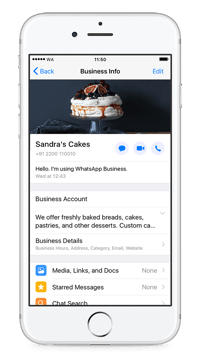
WhatsApp for Business, which has gained over 5 million users since its 2019 launch, also enables companies to build and share product catalogs, which highlight current offerings and can link to ecommerce sites. Once a business creates a catalog, its marketing team can share its link on the brand’s profile or in chats with prospects. Here’s a quick demo of how the catalog tool works:
Additionally, even though connecting with broad international targets was challenging at first on WhatsApp, some companies say the smaller groups they’ve interacted with on were more engaged than larger social audiences. This could be because a person who gives a company their contact information or is willing to add a company’s contact to might be incredibly interested in learning about that brand from the start.
Aside from WhatsApp’s engagement and branding opportunities, Facebook’s ownership of the platform also benefits advertisers. Recent findings reveal that branded ad targeting has resulted in more ROI due to data sharing between WhatsApp and Facebook.
Although Facebook plans to integrate WhatsApp and Instagram into its own flagship platform, CEO Mark Zuckerberg says WhatsApp will remain a standalone app that benefits from Facebook’s app ecosystem.
Because WhatsApp is a growing app that probably won’t get discontinued any time soon, businesses of all sizes are continuing to experiment with it. Top Industries on WhatsApp\
Most recently, two specific industries that are flocking to WhatsApp are publishing and fashion. Meanwhile, food and beverage companies like Absolut Vodka also leverage the platform for marketing.
If you’re similarly aiming to target global audiences, a WhatsApp strategy could be worth considering now or in the future. But, if you’re new to the platform, you might need some inspiration to learn more about what makes a mobile messaging app’s strategy successful.
To help you plan your first experiment, here are a few of the best WhatsApp tactics that marketers can learn from.
How 5 Brands Are Using WhatsApp
Adidas: “100% Unfair Pred”
Adidas has been using WhatsApp since 2015 to answer questions about their products and promote new items to prospects. But recently, they launched a campaign that combined live chats and influencer marketing.
In 2019, after realizing that athletic teams used WhatsApp to send team-wide communications or announcements, Adidas offered to help recreational sports players “rent” a professional athlete — or “predator” — for one of their upcoming games.
In a WhatsApp Group temporarily opened by Adidas, the company shared that they wanted to help one uncoordinated recreational sports team win a single game by “renting” them a professional athlete. From there, recreational athletes and coaches were asked to send WhatsApp messages noting the sport they play, when their next game was, and why they needed to borrow a professional athlete to win.
Days later, Adidas sent a direct message to the winning recreational athlete. The “pred” then showed up to the recreational game dressed in Adidas sportswear.
“We know our audience use it to share fixture info, team selection — and team-mates messaging to find last-minute replacements,” Adidas’ Managing Editor Laura Coveney told Digiday.
“WhatsApp was perfect for the more functional elements of the ‘Rent-a-Pred’ hotline as it allowed consumers to share private information one-to-one with us for review, before being allocated a Predator player near them,” Coveney explained.
The Financial Times Shares Free Content
Think an age-old publication known for long-form content can’t succeed on an instant-messaging app? Think again.
In late 2019, the Financial Times, a subscriber-only publication, posted two free daily articles in its WhatsApp Group. According to Digiday, the tactic of sharing content has given them more conversions than other social platforms, more brand awareness, and insight into what topics are important to their potential subscribers.
Interestingly, the publication discovered that although its audience was much smaller, it was more engaged with the content and more likely to subscribe than audiences on other online platforms.
For example, people who clicked a Financial Times link on WhatsApp were 40% more likely to return to the site within three days than those who clicked their links on other channels. The publication also found that traffic gained from WhatsApp was similar to what it received from its average Twitter post.
“People liked the convenience of having [news] come through to their phone, pushed to them where they are, without having to go to our site, on a service they are already signed up to,” said the Times’ Audience Engagement Editor, Alana Coates, in an interview.
Absolut Vodka Launch Party Campaign
One of WhatsApp’s earliest success stories came from the Swedish liquor company Absolut Vodka. When marketing the launch of its Absolut Unique vodka product in 2013, Absolut struggled with driving global audiences and was tightly competing with other liquor companies that had many more years of history supporting them.
Unlike many other alcoholic beverage companies, Absolut didn’t have a story of long-running success behind its brand just yet. While some liquor companies could easily market how they’d been using the same recipes for hundreds of years, Absolut was only established in 1979.
Nostalgic content, such as this ad from Jim Beam, allows older brands to tell a story about their successful history, while emotionally connecting with their audiences. This was something that a young company, like Absolut, couldn’t play up as a marketing tactic.
Instead of inventing a story that spoke to audiences of all ages, Absolut decided to leverage WhatsApp’s messaging system to earn credibility and awareness from younger audiences globally.
To mark the Argentinian launch of Absolut Unique, the beverage company promoted a contest where you could win two tickets to a celebration of the new product in Argentina. To enter the tickets, you had to go on WhatsApp and message the account of a doorman named Sven to convince him why you deserved to attend the party.
According to a case study, 600 Argentinian users contacted Sven over the course of three days. The campaign was also widely discussed locally which helped Absolut gain brand awareness even from people who didn’t contact the account.
Although Absolut is now a giant, well-known company, this is a great example of how the brand recognized and leveraged WhatsApp as a platform that could be used to boost local brand awareness and sales in another part of the world.
Hellmann’s: “WhatsCook”
Back in 2014, Hellmann’s, a U.S.-based Mayonnaise company, wanted to reach audiences in Brazil, Argentina, Chile, Uruguay, and Paraguay. To do this, they hired a team of professional chefs to help them with a WhatsApp campaign.
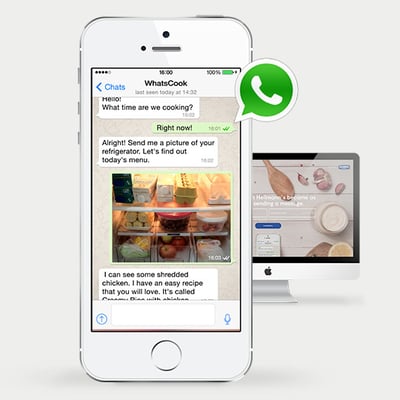
According to Cubo, an agency that assisted with this campaign, 13,000 people signed up for the service and the average participant interacted with a chef for 65 minutes.
With the “WhatsCook” campaign, Hellmann’s leveraged industry experts as a way to get in contact with fans. The company already knew that people who bought its mayo wanted to use it. But, they also knew that people might not know many mayonnaise-friendly recipes. With this strategy, the brand engaged with people who love to cook and solved for the customer by showing them how to use Hellmann’s main product in different ways.
Yoox Personal Shoppers
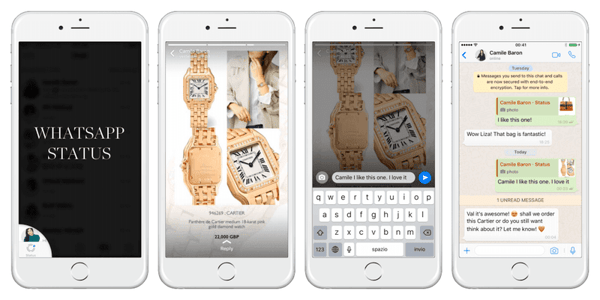
During Yoox’s WhatsApp experiment, they made $80,000 off of sales through the app.
This is a great example of how a company leveraged WhatsApp to reach interested prospects, ease them through the buyer’s journey with a highly interactive messaging experience, and successfully make sales without having customers enter a store.
Navigating Mobile Messaging
As seen above, WhatsApp can help brands to nurture interesting prospects into leads. At the moment, you can’t send a message to the entire social platform, but you can send links and engage with contacts that have already shown interest in your brand.
While all of the examples are fairly different, they all emphasize how interactive and highly personalized mobile messaging techniques can be beneficial to marketing.
If you’re planning to test out a WhatsApp experience, keep these tactics in mind:
Interested in learning more about messaging app strategies? Check out this blog post that compares WhatsApp, Snapchat, and Kik.

What Is Twitch? How Do Brands Use It?
I am an avid player of The Sims video games.
For over a decade, I’ve been a dedicated fan, buying each new release and playing them over and over again. Eventually, my interest in the simulation game led me to find a community of others who feel the same way.
So, I started watching YouTube videos of people playing the Sims. Most of the YouTubers promoted their Twitch accounts, where they would broadcast live play-throughs. I didn’t pay attention to Twitch at first, but eventually, curiosity got the best of me and I decided to check it out one day.
Warning: Twitch can get highly addicting.
The first time I tried Twitch, I was on the platform for three hours, exploring the content of my favorite YouTubers and chatting with others, like in the screenshot below:

The streaming platform gave me a larger community to connect with because of the chat section in each broadcast, where users can comment on the content they’re seeing. The streamer can also interact with them, making the experience feel more natural.
But, other than a streaming platform, what exactly is Twitch? In this post, we’ll explore what twitch is, and how you might use it to engage with prospects and increase brand awareness.
Let’s begin by defining Twitch. Then, we’ll talk about how Twitch is used and what it’s used for.
When you visit Twitch, you’ll see a screen very similar to this:
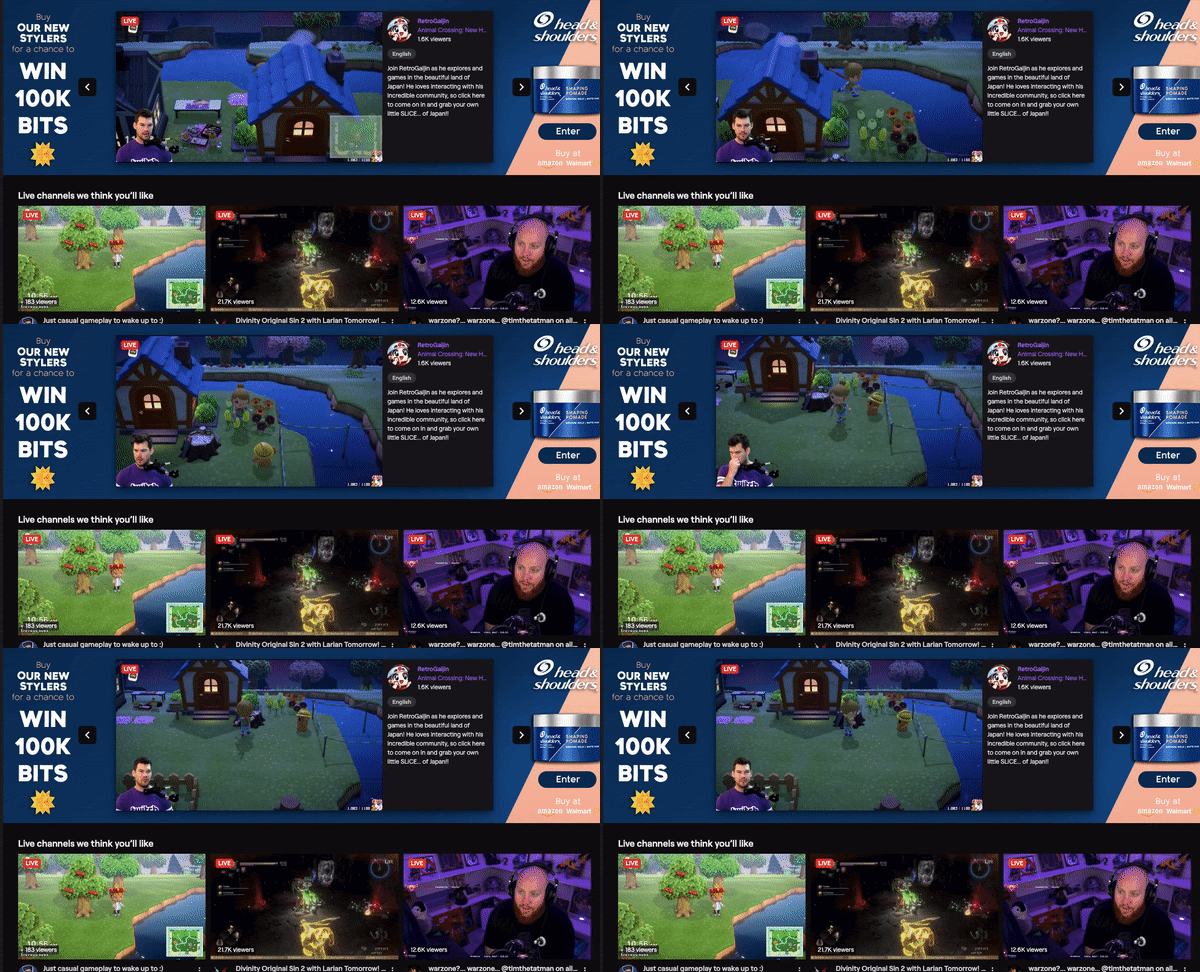
The homepage is curated based on previous activity, so though this screen is covered with gaming content, streamers don’t have a limit on what they produce. While Twitch is largely a platform for live gameplay and commentary, talk shows, cooking shows, sporting events, and gaming conventions also pop up on the site.
Twitch enables fans to connect with streamers. It allows users to watch content they’re interested in on a platform that supports long-form, live broadcasts. For instance, you might find that it’s not abnormal for streams to be over an hour, or sometimes even two hours.
It’s not all streaming, though. In fact, the platform has its own convention, TwitchCon. This bi-annual event celebrates the streaming industry and is a chance for the platform’s broadcasters to connect with their fans and peers in person.
Fans can attend sessions led by their favorite streamers and buy branded merchandise from a slew of vendors and event sponsors (For example, Doritos is a proud sponsor of TwitchCon).
Though the streamers produce the content, Twitch has a dedicated fanbase that expands across the globe. To get an idea of Twitch’s users, next, we’ll go more into depth about Twitch’s primary audience.
Who uses Twitch?
Twitch’s audience is mainly comprised of teen gamers. Let’s look at that a little further.
When SimilarWeb studied the web behavior of Twitch users, they found primary keywords this audience searched for were “games,” “computers,” and “technology”. From that information, we can infer that the majority of Twitch users are interested in games and the technology needed to play them.
In the same report, it was also noted that 22% of traffic comes from the U.S., making it the country with the most representation on the platform, with Germany, Korea, and France not too far behind.
It’s also important to note — according to Twitch, the platform has over 28 million unique users per month in the U.S., who watch, on average, 95 minutes per day. And, of those users, 80% are teen males.
Though the audience has a large teen male presence, know that this isn’t the entire platform’s user base. In fact, my favorite Twitch streamers are adult women of color. So, if you’re thinking your audience isn’t on Twitch, they actually might be, just in a smaller number.
Still, as marketers know, those numbers could be an essential part of your target audience.
If, by now, you are mulling over a few ideas about how you can fit in Twitch into your marketing efforts, let’s talk about how brands are using Twitch, next.
6 Ways Brands Use Twitch
Brands use Twitch to increase brand awareness, target specific audiences, produce branded streams, and leverage influencer marketing. Twitch reports that the platform is great for scaled engagement and reaching specific campaign goals. Because the site is powered by visual content, let’s explore some examples to back up these goals.
1. 1,000 Dreams Fund
Tactic: Brand Awareness
1,000 Dreams Fund is a non-profit devoted to providing 1,000 university women with grants to help them achieve their dreams and provides new grants every academic semester. The people behind 1DF partnered with Twitch to bring the program to streamers.
The Twitch spin on the fund gives financial assistance to streamers who are female and currently attending university, to help with school expenses. For example, Twitch might provide financial aid for conventions like TwitchCon, conferences, new hardware, or educational programs that are devoted to creative pursuits.
For Women’s History Month, Twitch’s Facebook account ran an ad that supported the fund, bringing awareness to 1DF and what it does for women streamers.
This gave an entirely new audience an introduction to the non-profit. It also showed Twitch’s diverse user base, and highlighted a cause the company supports.
2. WildEarth
Tactic: Target Specific Audiences
WildEarth (WE) is a broadcaster that shows the day-to-day lives of animals, led by expert zoologists in Johannesburg, Australia. Recently, the site’s leaders decided to expand their broadcast onto Twitch in order to broaden their audience.
The streams are short, which is unusual for Twitch, but makes sense for WildEarth. Content includes a sunrise safari led by expert Lauren, in which she focuses on animals she sees on her drive and provides information about them.

In the clip above, Lauren talked about how elephants are shy but friendly. Most clips on the channel are similar in that they show close-ups of animals making their homes or other animals roaming about.
WE is aimed towards younger viewers, so it’s no surprise that broadcasts have expanded to Twitch and YouTube. Some clips even have kid-friendly titles with emojis and current slang to attract these younger viewers.
3. Nissin Noodles
Tactic: Lead Generation
Streamer Pokimane boasts over four million followers on her channel and plays mostly role-playing, fantasy games. Recently, she partnered with Nissin Foods to produce a branded League of Legends broadcast.
The broadcast featured her making the instant noodles during a stream. To keep the content fun and engaging, Pokimane added a ‘Slurp Meter’ graphic on-screen that measures the volume of her eating her meal.

If I were a younger viewer watching this stream, I would think about how it would be easy to prepare and eat Nissin Noodles while using Twitch, as Pokimane did. I would want to use the ‘Slurp Meter’ to measure the noise-level of myself eating and report back to the community in the comments.
Nissin’s branded stream has been seen by over 11,000 of Pokimane’s fans. This marketing technique cemented Nissin as a brand associated with her community, showing how their product fits into the gaming lifestyle.
4. PSD Underwear
Tactic: Influencer Marketing
Ninja is one of Twitch’s most-followed streamers. For perspective, 14.7 million is half of the platform’s U.S. user base. It’s also the number of followers Ninja has. To get those followers interested in their brand, and celebrate TwitchCon 2018, athletic underwear brand PSD gave the streamer a bus.
No, really. A bus:
Hitting the road and heading to TwitchCon with our newly wrapped @ninja bus! 🔥🔥 pic.twitter.com/AHKDI1ocVC
— PSD Underwear (@PSDunderwear)
October 25, 2018
PSD’s marketing campaign used TwitchCon to build brand awareness with its ‘Ninja Bus’ and corresponding Twitter post.
This partnership is a change for PSD, which usually partners with basketball, football, or wrestling athletes. A video game athlete partnership could be part of a strategy to attract audiences on a different platform. It also shows the flexibility of the product.
If I were a Ninja follower attending TwitchCon and saw the bus, plastered with Ninja’s branding, my very first instinct would be to Google PSD and browse the products. This advertisement speaks for itself, and no doubt earned some looks at TwitchCon.
5. Indeed
Tactic: Paid Advertising
In a similar practice to Facebook and YouTube, Twitch plays video ads before their streams, also known as pre-roll ads.
This Indeed ad shows a case study about how a Twitch streamer and digital artist used Indeed to connect. The streamer was looking for a designer to make her streams more engaging and found her talent on Indeed, a career search engine.
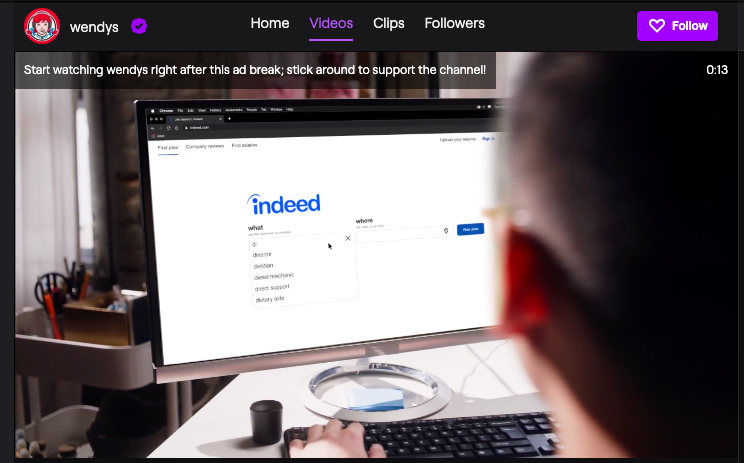
The ad paints a picture of how gamers, streamers, developers, and creatives can use Indeed to find support for their work on Twitch. It shows how a streamer can leverage Twitch to find talent — and how talent can find work.
6. Wendy’s
Tactic: Lead Generation
Popular gaming series Animal Crossing has a new addition, New Horizons, that came out in March 2020. Marketers at Wendy’s knew Twitch would be flooded with Animal Crossing streams upon the release, so they decided to capitalize on that.
The campaign is simple: a gameplay broadcast, following the Animal Crossing adventures of the store’s mascot Wendy. There are several clips and streams on the account, and most of the titles include “Free Delivery” to remind Twitch users that they don’t have to leave the site to eat Wendy’s.
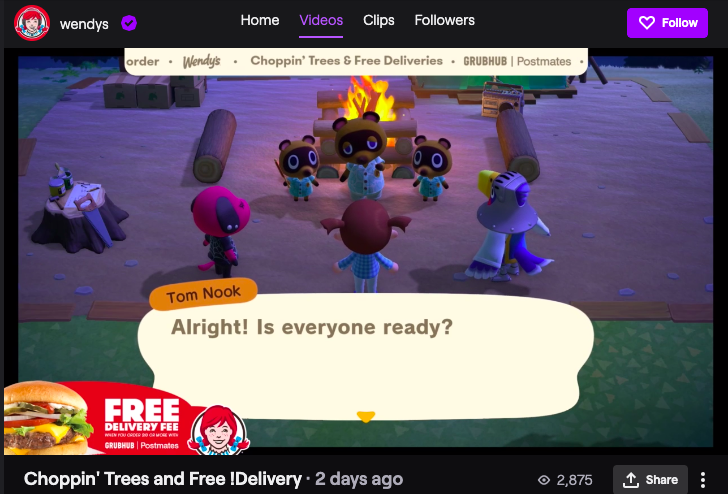
Notice the extra steps the campaign takes for the branded stream. In the bottom left, there’s an advertisement for free delivery from Postmates and GrubHub. At the top is the title of the campaign, “Choppin’ Trees & Free Deliveries,” as well as the logos of participating brands.
Should your brand leverage Twitch?
You might be unsure about using Twitch in your next campaign, and trust me, you’re not the only one. However, as we’ve seen, multiple brands use Twitch to promote their brand by catering to a young audience. If your company has a similar goal, then Twitch might be a great asset to you.
If you’re interested in influencer marketing, you might think about using Twitch, as well. Influencers expand your audience by endorsing your brand, as we saw with Pokimane’s noodle stream.
Another benefit of leveraging Twitch is boosting leads with ads. Take haircare brand Head & Shoulders, for example. To market their new men’s styling creams, the creative team partnered with the platform to run a contest, in which Twitch users could win 100,000 Bits, which is the site’s virtual currency.
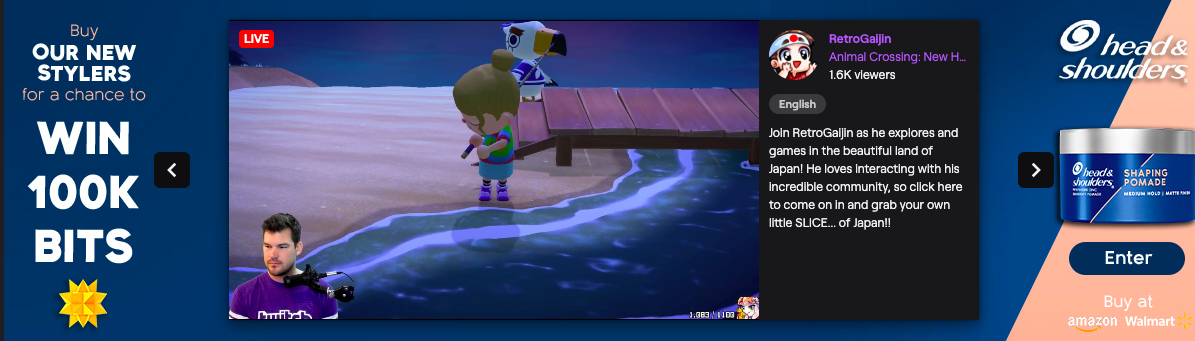
The target audience for this campaign is men, so the team behind the campaign knew they would have an audience on Twitch. This is also another great reason to use the platform: if your audience is mostly male. Recall that 80% of Twitch’s users are teen males, so if your product needs that kind of audience, look to Twitch.
Alternatively, if your audience is using Twitch as part of their web behavior, you might look into investing in Twitch content. While you don’t have to create a Twitch account and start uploading numerous streams, you can go the Indeed route and use an ad that relates to Twitch’s users.
For instance, maybe the company you work for sells computers. A great way to leverage Twitch in a product marketing campaign is by making an ad that shows a popular PC game on the platform right now, like League of Legends, and how it works with the computer you’re aiming to sell.
Twitch is an expansive platform where creatives can engage with subjects that interest them. Remember, Twitch isn’t all about games — there are other categories on the platform too, like cooking and live event broadcasting.
You can leverage Twitch in multiple ways and reach an expansive audience by doing so. As a casual Twitch user, I look forward to seeing what you come up with for your Twitch campaign.

Email Analytics: The 8 Email Marketing Metrics & KPIs You Should Be Tracking
There’s a lot to say when it comes to how to do email marketing well. We could talk for days about the most critical components of an optimized email, common email marketing mistakes you might be making, and examples of brilliant email marketing that will inspire you. But at the end of the day, it doesn’t matter how optimized your emails are if you can’t see the results of your efforts — not to mention measure whether email is helping you hit your goals.
So before sending your next email, pause for a few minutes and ask yourself: What is the goal of my email marketing? Is it to grow my subscriber database? Generate more leads? To convert more existing leads into customers?
Whatever you decide your goal is (and you can have more than one), the next thing you need to do is figure out which metrics you’ll need to track in order to determine how you’re progressing toward that goal.
Let’s take a look at the metrics you should be paying attention to in your email marketing efforts. We’ll start with the metrics every email marketer should be tracking, and then we’ll take a look at how to tie certain metrics to your specific goals.
1. Clickthrough Rate
- What It Is: The percentage of email recipients who clicked on one or more links contained in a given email.
- How to Calculate It: (Total clicks OR unique clicks ÷ Number of delivered emails) * 100
- Example: 500 total clicks ÷ 10,000 delivered emails * 100 = 5% clickthrough rate
(Using either total clicks or unique clicks in the calculation above works, as long as you use the same approach consistently.)
Clickthrough rate (CTR) is likely the first answer you’ll get when you ask an email marketer what metrics they track. It’s what I like to call the “day-to-day” email marketing metric, because it lets you easily calculate performance for every individual email you send. From there, you can track how your CTR changes over time.
CTR is also frequently used for determining the results of A/B tests, as these tests are often designed with the intention of finding new ways to get more clicks in your emails. Clickthrough rate is a very important metric for all email marketers to be tracking, as it gives you direct insight into how many people on your list are engaging with your content and interested in learning more about your brand or your offer. Read this blog post to learn what a “good” clickthrough rate is, according to industry benchmarks.
(HubSpot customers: Click here to learn how to easily set up click tracking in your emails using HubSpot.)
2. Conversion Rate
- What It Is: The percentage of email recipients who clicked on a link within an email and completed a desired action, such as filling out a lead generation form or purchasing a product.
- How to Calculate It: (Number of people who completed the desired action ÷ Number of total emails delivered) * 100
- Example: 400 people who completed the desired action ÷ 10,000 total email delivered * 100 = 4% conversion rate
After an email recipient has clicked through on your email, the next goal is typically to get them to convert on your offer — in other words, to take the action that your email has asked them to take. So if you’re sending an email to offer your audience the chance to download, say, a free ebook, you’d consider anyone who actually downloads that ebook to be a conversion.
Because your definition of a conversion is directly tied to the call-to-action in your email, and your call-to-action should be directly tied to the overall goal of your email marketing, conversion rate is one of the most important metrics for determining the extent to which you’re achieving your goals. (We’ll discuss more specific goal-related metrics later.)
In order to measure conversion rate on your emails, you’ll need to integrate your email platform and your web analytics. You can do this by creating unique tracking URLs for your email links that identify the source of the click as coming from a specific email campaign.
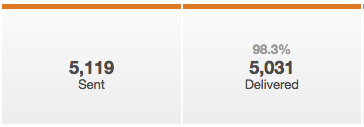
3. Bounce Rate
- What It Is: The percentage of your total emails sent that could not be successfully delivered to the recipient’s inbox.
- How to Calculate It: (Total number of bounced emails ÷ Number of emails sent) * 100
- Example: 75 bounced emails ÷ 10,000 total emails sent * 100 = 0.75% bounce rate
There are two kinds of bounces to track: “hard” bounces and “soft” bounces.
Soft bounces are the result of a temporary problem with a valid email address, such as a full inbox or a problem with the recipient’s server. The recipient’s server may hold these emails for delivery once the problem clears up, or you may try re-sending your email message to soft bounces.
Hard bounces are the result of an invalid, closed, or non-existent email address, and these emails will never be successfully delivered. You should immediately remove hard bounce addresses from your email list, because internet service providers (ISPs) use bounce rates as one of the key factors to determine an email sender’s reputation. Having too many hard bounces can make your company look like a spammer in the eyes of an ISP. (Read this blog post to learn more about the difference between hard and soft bounces.)
4. List Growth Rate
- What It Is: The rate at which your email list is growing.
- How to Calculate It: ([(Number of new subscribers) minus (Number of unsubscribes + email/spam complaints)] ÷ Total number of email addresses on your list]) * 100
- Example: (500 new subscribers – 100 unsubscribes and email/spam complaints) ÷ 10,000 email addresses on the list * 100 = 4% list growth rate
Aside from the call-to-action metrics (CTR, conversion rates), you’ll also want to be keeping tabs on your list growth and loss. Of course, you should be aiming to grow your list in order to extend your reach, expand your audience, and position yourself as an industry thought leader. But believe it or not, there’s a natural decay of your email marketing list, and it expires by about 22.5% every year — which means that it’s more important than ever to pay attention to growing your subscriber list and keeping it at a healthy size.
5. Email Sharing/Forwarding Rate
- What It Is: The percentage of email recipients who clicked on a “share this” button to post email content to a social network, and/or who clicked on a “forward to a friend” button.
- How to Calculate It: (Number of clicks on a share and/or forward button ÷ Number of total delivered emails) * 100
- Example: 100 clicks on a share/forward button ÷ 10,000 total delivered emails * 100 = 1% email sharing/forwarding rate
The rate at which your email recipients forward or share your email with others may not seem all that significant, but it’s arguably one of the most important metrics you should be tracking.
Why? Because this is how you generate new contacts. The folks on your email list are already in your database. So while conversion is still a primary focus, this doesn’t help you attract new leads. Encourage your readers to pass along your email to a friend or colleague if they found the content useful, and start tracking how many new people you can add to your database this way. (Read this blog post for tips on getting people to forward your emails.)
Keep a careful eye on your sharing rates to discover which types of articles and offers tend to get shared the most, and use that insight when you plan email campaigns in the future.
6. Overall ROI
- What It Is: The overall return on investment for your email campaigns. In other words, total revenue divided by total spend.
- How to Calculate It: [($ in additional sales made minus $ invested in the campaign) ÷ $ invested in the campaign] * 100
- Example: ($1,000 in additional sales – $100 invested in the campaign / $100 invested in the campaign) * 100 = a 900% return on investment for the campaign
This is the most basic formula to calculate ROI — but there are several ways to approach calculating the ROI of your email campaigns. Depending on your type of business, you might prefer a different one.)
As with every marketing channel, you should be able to determine the overall ROI of your email marketing. If you haven’t yet, set up an SLA system whereby you assign different values to various types of leads based on their likelihood to generate revenue for your company.
How many of each of these types of leads did you generate via email marketing? How does this translate to potential revenue? Actual revenue? These are the types of metrics that will help you show your boss and your sales team how valuable email marketing is as a channel that drives real, tangible results.
7. Open Rate
What It Is: The percentage of email recipients who open a given email.
Most email marketers are still bent over backwards trying to optimize their subject lines for higher open rates. While this can have a positive impact — and more opens are a great thing — they really should be focused on optimizing their clickthrough rates, instead.
The fact of the matter is that open rate is actually a very misleading metric for a few reasons. Most importantly, an email is only counted as “opened” if the recipient also receives the images embedded in that message. And a large percentage of your email users likely have image-blocking enabled on their email client. This means that even if they open the email, they won’t be included in your open rate, making it an inaccurate and unreliable metric for marketers, as it underreports on your true numbers.
You can get some value out of open rate as a metric if you use it as a comparative metric. For instance, if you compare the open rates of this week’s email send to last week’s email send (both to the same lists) it might give you some insight since the variables are somewhat controlled.
8. Unsubscribe Rate
What It Is: The percentage of email recipients unsubscribe from your send list after opening a given email.
As with open rate, the unsubscribe rate isn’t a reliable picture of the health of your email list. Many subscribers who are tired of receiving email messages from your brand won’t bother to go through the formal unsubscribe process. They’ll just stop opening, reading, and clicking on your email messages.
That’s why it’s much more effective to measure subscriber engagement by clickthrough rates and conversion rates. From there, you can keep an eye out on unengaged subscribers so you can consider removing them at some point, like we went over earlier. Checking your monthly unsubscribe rate is helpful for calculating your overall list growth rate, though, so do keep an eye on it every once in a while.
How to Know Which Email Metrics to Track, Based on Your Goals
The goal of your email marketing may be very different from the goals of another company like yours, and may even vary within your own company over time. But again, it’s crucial that you determine exactly what it is you’re looking to achieve with your email marketing before you begin (or continue) to send and measure your emails.
Here’s how you can align your specific goal with key metrics.
Subscriber List Growth Rate
If your focus is on growing the top of your funnel — attracting more visitors to your site, signing up more blog subscribers, getting more people to use your free tools, that kind of thing — your goal will probably be growing your subscriber list. Your emails will likely contain calls-to-action such as “Subscribe to Our Blog” or “Join Our Weekly Email List.” So of course, the most important metric you should be tracking for this goal is the growth rate of your subscriber list. (Read this blog post for more detailed tips on how to grow your subscriber list.)
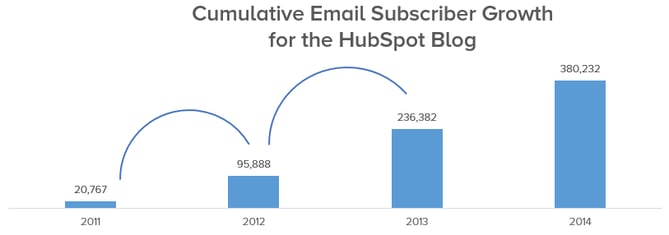
Unengaged Subscribers
Just as you want to track and grow your subscribers, it’s also important to keep an eye on your unengaged subscribers — and consider removing them from your list altogether. Why? Because sending emails to people who aren’t engaged with your emails (called “graymail”) can hurt the deliverability of your email overall. Email clients might get tipped off by low engagement rates and deliver email from known-graymail senders straight to recipients’ “junk” folders, meaning your emails will technically get sent and delivered, but won’t necessarily be seen.
Here at HubSpot, we deliberately unsubscribed 250,000 people from HubSpot’s Marketing Blog, which included people who had opted in to receive emails about new content we published on the blog. This subscriber purge brought our total subscriber count from 550,000 down to 300,000. Read this blog post to learn more about why and how we purged our subscriber list, and why you might consider doing the same.
Number of New (or Total) Leads Generated
Maybe instead of focusing on subscribers, you’d like to work on growing lead generation. If this is the case, you should be sending emails that offer lead generation content — in other words, content that requires the viewer to fill out a lead capture form in order to access it.
If the goal of your email marketing is lead gen, you should be tracking how many leads you’re capturing every day, and every month. You can decide to focus on all leads generated, or only new ones added to your database, depending on your priorities.
Lead-to-Customer Conversion Rate
Finally, let’s say you want to focus more toward the middle/bottom of your marketing funnel, and convert more of your existing leads into customers. If this is your goal, the emails you’re sending will likely provide content more closely related to your business and your product or service. Your calls-to-action may include “Get a demo,” “Watch a Video of Our Product in Action,” or “Start a Free Trial.” If this is your goal, you should be tracking changes in your lead-to-customer conversion rate.
As obvious as this all seems, you’d be surprised how many email marketers determine their goals and then don’t bother to track their progress against them. Make sure that you’re able to track how closely you’re trending toward your goal at any point during the month, and that you’re looking carefully at any changes in these metrics month over month.
Navigating Email Marketing Metrics
The bottom line? Be smart about which metrics you’re tracking, and make sure you’re able to effectively measure your individual email performance, the health of your email list, and your progress toward your overarching goals. As long as you’re able to determine each of those, you’re on the right track for more effective email marketing.
Editor’s Note: This post was originally published in March 2014 and has been updated for accuracy and comprehensiveness.

Are Amazon ‘Sponsored Products’ Ads Worth It?
Say you’re in the market for a new pair of headphones or a new guitar tuner. Where would you start your search? Google, right?
Not so fast. Amazon came away with nearly 40% of the US ecommerce market in 2018. Google still remains the top search tool for B2B purchases and services and informational queries that lead to purchases, but Amazon is the dominant front runner in ecommerce.
Need help getting started with inbound ads on Amazon, Google, LinkedIn, or Facebook? Book a free meeting with The Center for Inbound Advertising here.
So what does this mean for you?
When you’re thinking about your online advertising strategy, you want to meet your consumers where they are. And if you’re an ecommerce company, that place is — more likely than not — Amazon.
That’s where Amazon advertising comes in. Amazon has several advertising programs to choose from, but the best one to get started with is Amazon Sponsored Products.
Amazon Sponsored Products
Sponsored Products on Amazon are pay-per-click (PPC) ads that appear in strategic locations on Amazon, giving your products more visibility and purchase opportunity. You select the products you want to boost, set your bid and daily budget, and write an ad to entice shoppers to click.
The Sponsored Product ads are really just image ads — similar to display ads in Google Ads — but the cool thing is that they appear in search results on Amazon right next to the searched products. So, when I search for “acoustic guitars” in Amazon I get this:
 The only visible difference between the sponsored and the non-sponsored results is the gray “Sponsored” tag that appears above the product title. You’ll also see that sponsored products can appear above the rest of the results.
Does Amazon Advertising Work?
According to Ad Badger, the average cost per click (CPC) for Amazon PPC is $0.97. This is on par, if not less, than similar advertising on Google and other platforms, which means that there is opportunity for success using Amazon ads.
The real question is “Will Amazon advertising work for me?” Even more specifically, you should be asking “Will I make more revenue than what I spend on the ads?”
The success you have on the platform will depend on a number of factors, including:
Strategy
Imagine that you have the perfect product and the perfect ad. Then, imagine that you spend too much of your marketing budget on irrelevant keywords. On the other hand, you could also bid on keywords that are too broad and competitive when cheaper and better suited keywords are out there.
It’s your responsibility as you advertise on Amazon to continually optimize your ads for performance. Use “negative keywords” to exclude irrelevant traffic (and minimize wasted spend). Try out different keyword strategies, and be sure to create well-structured campaigns and ad groups within your ad account. Lastly, don’t be afraid to experiment and find out what works best for you.
Budget
PPC is a great model because you only pay for each person who clicks your ad. The higher your budget, the more potential clicks you’ll receive. When you’re evaluating your goals for Amazon ads, you’ll want to ensure that your budget matches your expectations. Here’s how you can do that:
- Log in to Amazon Seller Central
- Navigate to Detailed Page Sales and Traffic Reports by Child Item
- Find the Unit Session Percentage column (This is your conversion rate per item)
This number signifies the average percentage of visitors who actually converted. That means that, with some quick math, you can estimate how many purchases to expect from the amount of clicks you expect. This will help you reverse-engineer how many clicks it will take to turn into sales and, in turn, how much budget you should allocate to achieve that goal.
Ad and Product Page Copy
In-person sales have the benefit of a sales or customer service representative who can position the product/solution, remove roadblocks to buy, and answer questions. If you’re selling on Amazon, however, you don’t get to provide those personalized touch points. That job rests with your copy.
Your ad copy must do its best to convince shoppers that the product meets their needs and compel them to click on the ad. This improves the ad’s performance.
Also keep in mind the old marketing adage “A confused mind says ‘no.'” That means that the copy on your product page must also remove roadblocks and answer any anticipated questions a shopper might have. If prospects are confused or unsure, they will not click your ad, your conversion rate will suffer, and you will not achieve the ROI you want from your ads.
Visuals
Online shoppers aren’t able to hold your product in their hands before making a purchase. Even if you have the most awesome item to ever hit online shelves, you won’t move much of your inventory if your photos are unattractive or unclear — no matter how much you put into advertising. This is why product photography is so important when it comes to Amazon advertising and conversion.
In addition to following Amazon’s compliance requirements, images on ads and on product pages should showcase features, action shots, and different angles… all in a visually appealing way that grabs the prospect’s attention and entices them to buy.
Positioning
Just because someone clicks on your ad doesn’t mean that they’ll buy — shoppers aren’t necessarily loyal. Buyers shop around; if your positioning in the marketplace doesn’t match the quality of your product or provide competitive pricing, you might actually lose out on sales.
Imagine this scenario:
A shopper is searching for a product and discovers your ad. They click on the ad and view your product page. On the same page is a “Sponsored products related to this item” section where they see the exact same product… only 25% less expensive. With all other things being equal, they are likely to bounce off your page and purchase the less expensive item.
Imagine another scenario:
Your product averages 3.7 out of 5 stars based on customer ratings. Another seller offers a similar product, only theirs averages around 4.7 out of 5. With all other things being equal, the shopper will go with the safe bet and purchase the product with the higher rating.
There are a number of positioning factors that will affect your sales, including the sales you drive from your Amazon sponsored product ads. The best thing you can do is provide stellar customer service and keep an eye on the competition to ensure that your brand positioning is helping you rather than hurting you.
Will I See Better Results on Amazon vs. Google Ads?
A major difference between Google Ads and Amazon Sponsored Products is where people are in the purchasing process when they search on each platform.
People searching on Amazon are more likely to be at the end of the buyer’s journey (i.e. closer to a purchasing decision). On Amazon, they know what product they want, and they are just looking for the right deal and provider.
On the other hand, Google has more of a mixed bag of search queries, encompassing all stages of the buyer’s journey. This means your ad strategy can be much more flexible, targeting earlier stages of the buyer’s journey. That being said, not everyone searching in earlier stages of the buyer’s journey will be ready to make a purchase in the near future (if at all).
Many product-based companies have no need to target those individuals, making Amazon just fine (and perhaps ideal) for their advertising strategy where the goal is to put a product in front of interested shoppers.
Getting Started With Amazon Ads
Now that you know the variables that can make your ad successful, you can get started with your Sponsored Products campaign. Here are the steps:
- Sign up for Seller Central and follow the steps to create your account.
- Create your Sponsored Products campaign.
- Choose the products you want to promote with your ads.
- Decide which keywords you want to target.
- Determine your budget.
- Create your first ad.
Unlike other Amazon ad types, Sponsored Products are launched immediately upon completion. For more information about account and campaign setup, visit the Amazon Advertising page.
Here are a few additional tips for getting started with Amazon Ads:
1. Win the Amazon Buy Box
The Buy Box is the box on an Amazon product detail page where customers can begin the purchasing process by adding items to their shopping carts.

Since many sellers may end up selling the same item, not all sellers are eligible to win the Buy Box. Amazon only awards it to sellers who meet their minimum requirements, are selling at a competitive price, and have excellent seller metrics.
According to BigCommerce, 82% of Amazon sales go through the Buy Box, so it’s essential to earn it from Amazon. This can be done by performing in a few key areas, including shipping time and price.
2. Implement a Cohesive Structure in Your Ad Account
Within your Ad Account, you’ll be able to build campaigns. Understanding the basic organizational structure within your Ad Account will help you optimize for performance. Here are the definitions for each component of Amazon’s tiered structure:
- Account – Your account is the place you’ll go to access any of your campaigns and seller tools. Think of it as the biggest bucket.
- Campaign – It’s a great idea to build a campaign for each product category you’re targeting.
- Ad Group – Each ad group will contain the ad that you’ve built and the corresponding keywords you’re targeting with that ad. The best practice is to be as specific with each ad group as possible to improve the performance of the associated ads.

3. Learn the Strategy Behind Keywords and Bidding
Just like Google Ads, Amazon Sponsored Products uses keywords to trigger your ads. Automatic targeting — allowing Amazon to choose your keywords for you — is often the right choice for new advertisers. If this does not appeal to you, or once you’ve accumulated some data from a running campaign, you can choose manual targeting where you pick your own keywords.
There are three types of keyword matching:
- Broad Match – The prospect’s query matches your target keyword, including misspellings, synonyms, variations, and different word order. This is the most flexible and non-restrictive.
- Phrase Match – The prospect’s query must precisely match the target keyword, or the prospect’s query must contain the target keyword.
- Exact Match – This is the most restrictive type. The prospect’s query must match exactly to the target query. Your ad will not show with “similar” matches, only “exact” matches.
Understanding the pros and cons of each will help you determine what keywords and keyword matching to choose in order to boost your ad’s performance.
4. Utilize Reporting in Amazon Ads
Success doesn’t happen in a vacuum. In order to make the best choices for your campaign, you need to use a data-driven approach and monitor your results.
Amazon provides advertisers with data about searches for particular keywords. Similar to Google Ads, you have to be an advertiser to get access to this informative data. The data includes which search terms are performing the best, enabling you to add new keywords and refine the performance of your campaigns.
For each keyword, the search terms report will include data on:
- Campaign
- Ad group
- Impressions
- Clicks
- Click thru rate
- Cost per click
- Conversions/number of orders placed
- SKU for the sale
- And more
If you have a product to sell, now is the time to consider using Amazon Sponsored Products ads. You’ll enjoy a reasonable cost per click and have a chance to promote new products at the top of an Amazon search.

How to Create a Revenue-Generating Google Ads Campaign
The trouble with search engine optimization (SEO) is that it takes a long time to work and doesn’t come with any guarantees. Pay-per-click (PPC) advertising, on the other hand, can provide results a lot faster. For companies that have no organic presence and need ROI fast, a paid ad is sometimes your best bet for driving traffic to (and conversions from) your website.
The problem is that your competitors are using the same search terms and keywords you will. Not only do you need to know how to build a campaign through Google Ads, but you also need to know how to stand out from the crowd.
What Is a Google Ads Campaign?
Google Ads is a pay-per-click (PPC) system for advertising in the search engine results pages (SERPs) on Google. You can create Campaigns, which are used to organize groups of similar ads. Your Google Ads account can have one or many Campaigns running at a time.
Let’s start with a few real examples of Google Ads campaigns — a service formerly known as Google AdWords — and then throw in some pro tips for succeeding with your own search engine marketing (SEM) strategy. By the time we’re done, you’ll be an expert.
AdWords Examples
- New Breed Marketing: what is inbound marketing
- Nettitude: cybersecurity
- Rock Content: content marketing course
- Destination Canada: cheap holiday destinations
- FM Training: LEED certification online
- LeftLane Sports: hiking boots for women
1. New Breed Marketing
Search term: what is inbound marketing

Links to:
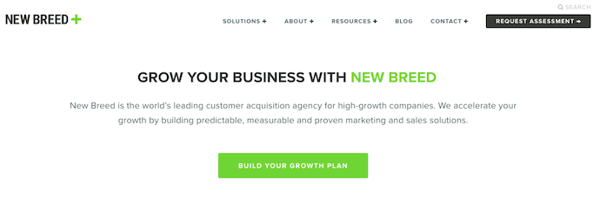
Some searchers are experiencing a pain that’s led them on a path to purchase, but they may not be clear on what it is that will solve that pain. That’s the thinking behind the first Google Ads campaign example above.
New Breed Marketing, an agency partner of HubSpot, is an inbound marketing service provider. Because New Breed’s customers might not know what they’re signing up for with “inbound marketing,” the company sought to define the term for them — helping buyers confirm that inbound marketing is indeed what they’re looking for.
New Breed Marketing’s Google Ads result above is as simple as search engine marketing gets. The meta description is just one sentence long but indicates to searchers that inbound marketing is a “process” to be invested in.
Meanwhile, the blue link, called a Site Extension, itself promises to explain inbound marketing in the form of a downloadable “guide.” This ensures those who click through to the website are prepared to submit their contact information and become a lead in exchange for that guide. Remember, Google Ads campaigns cost you money every time somebody clicks on one of your ads — you need to get something out of those clicks.
2. Nettitude
Search term: cybersecurity

Links to:
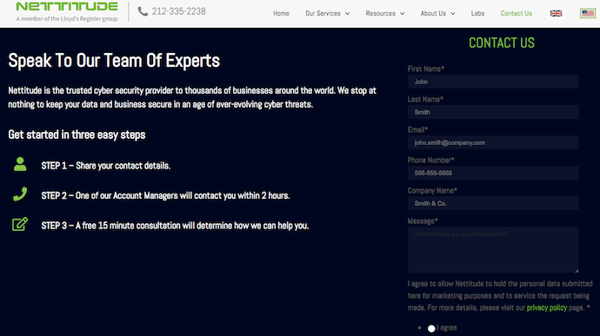
In general, the broader the search term, the less likely the searcher will want to buy something right away (a pay-per-click concept called “match types“). In the Ads campaign above, however, Nettitude bid on a broad, one-word search term — “cybersecurity.” While this broad search term doesn’t target a specific searcher, the details of their Google Ad ensures the link can satisfy many different types of searchers no matter what their interest was when they typed in the word.
Nettitude’s AdWords campaign, above, does two things well:
First, its meta-description has several value propositions that most cybersecurity customers would be receptive to. This includes a “2 hour response time” and a “free initial consultation” to make a prospect’s initial outreach convenient and low-commitment.
Second, the ad displays a phone number directly on the page. When you bid on a search term that yields such a broad, diverse group of people, getting them on the phone is often the easiest way to nurture their interest so they don’t wander off to another search result and forget about you.
3. Rock Content
Search term: content marketing course
 Links to:
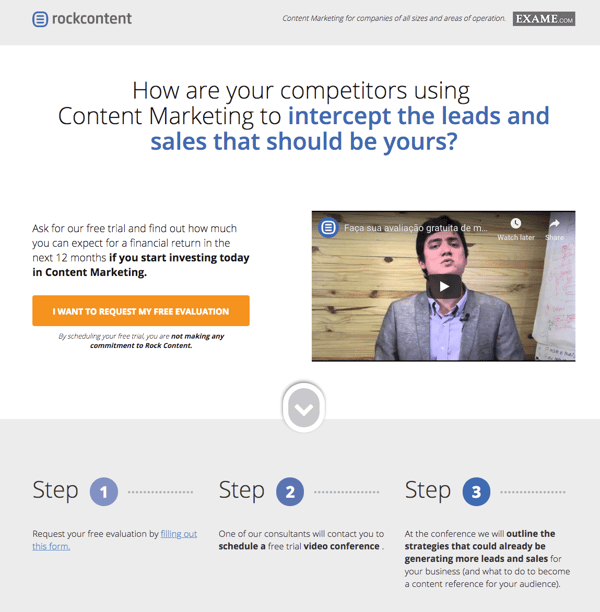
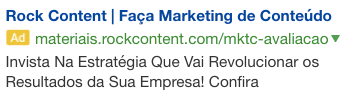
Rock Content, an agency partner of HubSpot, is a content marketing service based in Brazil.
Its Ads campaign bid on a search term that’s only somewhat related to the service Rock Content is offering on its landing page. Here’s why it works.
The search term “content marketing course” is intent on finding classes that help marketers increase their content marketing knowledge. Rock Content looks to pivot searchers from taking a class for improving their content knowledge to entering an “evaluation” for determining how much they already know.
This evaluation might not satisfy every searcher, but it is a smart way of pivoting their interest to a related service and introducing them to Rock Content’s offerings at the same time.
4. Destination Canada
Search term: cheap holiday destinations

Links to:
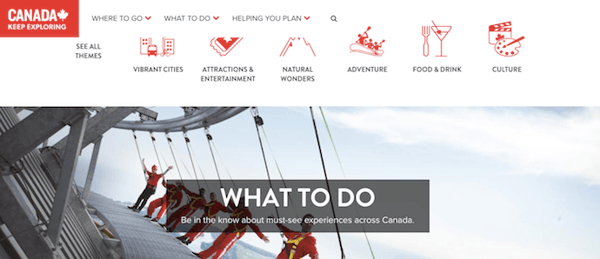
Canada Destination’s Google Ads campaign above uses a searcher’s general interest in taking a holiday trip to advertise all the fun parts of Canada. Similar to the third example on this list, the strategy is to pivot off of a broad search term to drive value into its own offering. It’s not a casual article, but it’s also not a flight itinerary — that middle-of-the-funnel space is what makes this campaign work so well.
The link above also uses two sub-links beneath the main Site Extension, highlighting the key subjects covered in the website to maximize the ad’s click-through rate.
When people search for “cheap holiday destinations,” it can be hard to gauge their level of interest just right. When launching a Google Ads campaign, you don’t want your ad to be too broad to convert customers, but you also don’t want to be so close to the cash register that your searchers aren’t ready for what you’re offering them. Canada Destination’s digital tour of the country captures that middle ground perfectly, holding users’ interest without chasing them away with overly specific content.
5. FM Training
Search term: leed certification online
 Links to:
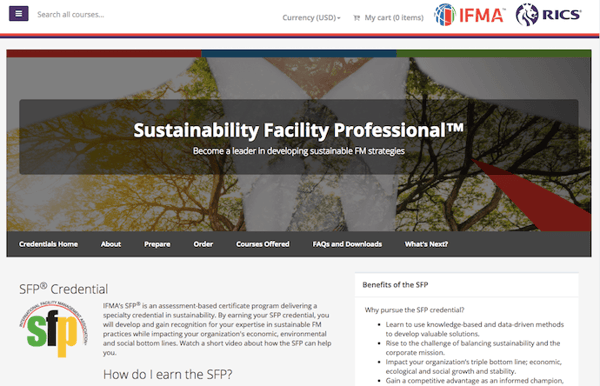
FM Training is a certification hub for facility managers (FMs), the same people who work to make their building facilities LEED-certified. Lots of coursework can go into earning this certification, but it can be a challenge to find curricula that caters to these professionals.
FM Training’s Ads campaign makes sure FMs know they’ve come to the right place.
While the five Site Extensions beneath the ad help users jump directly to the information they’re most interested in, the first sentence of the meta-description is what really reaches out to this audience: “FMs …” — the audience is clearly stated in terms they’d understand — “… see a salary increase of 6% or more within 1 yr.” The ad uses the limited space it has to send a message designed to encourage clicks and make the ad worth the investment.
6. LeftLane Sports
Search term: hiking boots for women
 Links to:
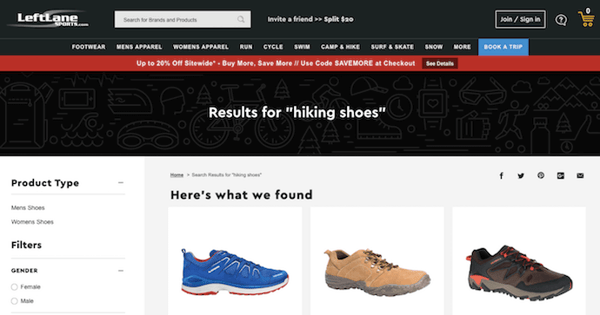
This campaign by LeftLane Sports is an example of local business advertising done right. The company doesn’t even need people to click on the link to make money from it.
If prospects in the Boston area search for “hiking boots for women,” they won’t just see a paid result by LeftLane Sports; they’ll see where the brand’s nearest storefront is and how long they’re open. It’s the perfect way to drive website traffic to the appropriate product pages and promote a local presence in the process.
How to Create a Google Ads Campaign
- Get a Google Ads account.
- Set your Campaign Goals.
- Complete the “Describe your business” section.
- Designate your geographic area.
- Set up keyword themes.
- Write your ad.
- Set your ad budget.
- Complete the “Budget and review” section.
- Double check your double check.
- Set up billing.
- Hit Submit.
1. Get a Google Ads account.
Before you can do anything, you’ll need to visit the Google Ads website and sign up for an account.
As part of signing up for a Google Ads account, Google will automatically take you through the process of creating your first campaign, so be prepared with your financial information. Google takes its fee with each click, so your banking credentials are required during the setup process.
Note: There’s no need to worry about getting charged for ad spend as you go through your first campaign setup. You can always turn it off once you get through the registration process.
2. Set your Campaign Goals.
The Google interface will prompt you to select a goal type from the following three options:
- Get more calls
- Get more website sales or signups
- Get more visits to your physical location
This goal will be tied to your advertising campaign, so you’ll want to choose the one that most closely represents the results you want to see.
3. Complete the “Describe your business” section.
The Google interface will prompt you to select a goal type from the following three options:
- Get more calls
- Get more website sales or signups
- Get more visits to your physical location
This goal will be tied to your advertising campaign, so you’ll want to choose the one that most closely represents the results you want to see.
4. Designate your geographic area.
In this section, you’ll designate where you want your ads to appear. This is particularly helpful for local businesses.
At the same time, if you are an online shop, you may be less concerned about geographic constraints. It’s still not a bad idea to consider where, exactly, the majority of your audience lives. If you don’t know, you may want to back up a step and consider your buyer personas first. Why spend money advertising to people in the Midwest if the bulk of your customers live in the Northeast?
You can also reach other countries if your company serves international buyers. Just be sure you’re prepared for any of the buyers who come your way as a result of your ads. You might pay a lot of money for visitors who can’t make a purchase if you’re not careful.
5. Set up keyword themes.
Google will determine different themes based on your website content. You can customize your keywords based on their suggestions as a jumping off point for your campaign.
Keep in mind you’ll be competing against many other companies for the same audience when choosing keywords for which you want your ad to show up. Take some time to think of the keywords that will reach people who are ready to buy. For instance, instead of using “luxury shoes” in your PPC ad, you can use keywords such as “red leather heels.” Maybe you’ll miss out on people who are looking for shoes of all types, but you’ll snag those who have a particular shoe in mind. They’ll be more likely to make a purchase if your ad leads to a landing page with red leather heels, and that will more than pay for their click.
You can also use negative keywords and save a lot of money on your clicks. These tell Google what you don’t want your ad to show up for. In other words, you can use keywords such as red leather heels, not stilettos.
6. Write your ad.
This is the most important aspect of your Google Ads education. The copy you use is what will convince potential buyers to click. You want to attract plenty of people, yes, but you also want those people to buy. If they don’t buy, you pay anyway.
In this section, you’re setting up the headlines and meta descriptions for your first ad(s). Note that you can choose to set up multiple ads in a single campaign, though Google starts you off with one.
For each add you create, you have three considerations:
- Headline
- Description
- Destination URL
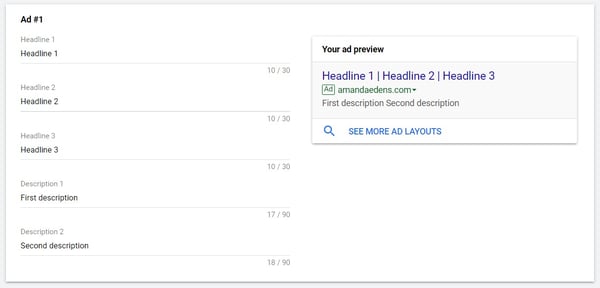
Headline
Start with a great headline that uses search terms that will reach your niche. Google splits the headline up into three sections of 30 characters each, so make each character count. You might even need to use abbreviations, or you can search for shorter synonyms.
Description
After the headline, you get another 90 characters for the first description. Use this space to highlight any benefits. How will the product solve your buyers’ pains? Then, in the second description, you can capitalize on a feature.
Be ready to change these if you notice your ad isn’t gaining a lot of traction, and don’t be afraid to experiment.
Destination URL
This is where you can choose where clicks on your ad go to. Just choose the page you want them to land on and paste the URL in the field.
7. Set your ad budget.
Here, you’ll be designating your daily budget.
You want to include enough money to make a difference, but you really don’t want to break the bank. You can manually set the bids for clicks, which gives you more control. This also means your ads will stop showing once your budget is spent. That means you won’t end up with a shocker of a bill later.
Once you start to review the results from your campaign, you can always adjust the budget.
8. Complete the “Budget and review” section.
In this section, you’ll be reviewing your campaign settings. It’s best to double check each of the following:
- Your daily budget
- Your monthly budget
- The impressions you’ll get for that budget
- The clicks you should expect based on the impressions
- The location you’re targeting
9. Double check your double check.
It’s always a good idea to check over everything one more time before you set your ad in motion. Is everything spelled correctly? You’ll miss out on keyword searches if there’s a typo one of them. When you’re sure you did everything correctly, then take a deep breath and move on to the next step.
10. Set up billing.
Because Google charges per click, it needs the payment information during the Google Ads account setup. By providing your payment information, you’re giving Google the ability to charge accrued advertising costs from your campaign.
11. Hit Submit.
By doing so, you’ve set up your first Google Ads campaign.
To create additional campaigns, perhaps with different or tighter keyword groups, you’ll want to select Campaigns from the page menu on the left. Then, click the blue plus button and choose New campaign. The Google interface will walk you through the additional steps.
Beyond setting everything up correctly, you’ll also want to A/B test your results often. Change headlines, introduce new features, focus on different benefits — and then take note of the number of conversions. There’s always a way to make your ad perform better.

Why CRM and Marketing Automation Need Each Other
When I was younger and I listened to Hannah Montana sing “The Best of Both Worlds,” I didn’t fully understand what she meant.
Now, as a marketer, I get it.
Having the best of both worlds is the feeling you have when your company’s marketing automation software and CRM work in tandem.
But it’s not just about how much easier it makes your job. When the two software work together, your company will convert more MQLs to SQLs and make more sales.
In fact, marketing automation software can increase sales productivity by 14.5%.
That’s why marketing and sales teams need to integrate their software and work together.
Below, we’ll review what marketing automation and CRM software do and why they need to be integrated.
CRM and Marketing Automation
Before we dive into why marketing automation and CRM need each other, let’s discuss what each software does.
To start, marketing automation software helps marketers automate some of their processes such as sending email campaigns or posting social media posts.
Marketing teams use automation software to produce and promote content.
Additionally, this software includes reports and analytics for when leads visit your website, open an email, fill out a form, or read a blog.
Ultimately, the goal is to streamline the process of taking a lead, nurturing them, and moving them to a sales qualified lead. Essentially, it’s all about lead generation and personalization.
If your team needs more marketing qualified leads, a way to distribute content, or has a large email list, it’s time to invest in marketing automation software.
Some of the best marketing automation software includes HubSpot, MailChimp, and Marketo.
On the other hand, a CRM is a software that helps sales teams manage their pipeline and lead qualification processes.
A CRM will track customer data, including dates and notes of phone conversations, past purchase records, and emails.
Essentially, with this software, your salesperson can see the full picture of who a prospect is and their history with your company.
Ultimately, a CRM helps sales reps take prospects from sales qualified leads to customers.
If your salespeople lose track of prospects, forget to follow up, or you’ve outgrown your lead tracking system, it’s time to look into CRM.
A few of the best CRM platforms are HubSpot, Zoho, and Salesforce.
HubSpot is one of the best choices because the HubSpot Marketing Hub includes the foundational CRM functionalities, so you have both software in one.
However, for the optimal experience, you should use both the HubSpot Marketing Hub and advanced Sales Hub so you have more sophisticated features in the marketing automation and CRM.
Now that we’ve discussed what each software does and how they can help your team, you might be wondering, “Why do these need to work together?”
Well, when marketing automation and CRM software work together, they provide a seamless journey for your customers as they go from visitor to MQL to SQL to customer.
Additionally, integrating the two software will give your sales reps the full picture of a prospect’s interaction with your company. Your sales rep will know the marketing history of their prospects.
Plus, when marketing automation and CRM are integrated or in one software, your marketing and sales team can provide consistent messaging.
Let’s go through a tangible example of how the two software can work together.
To start, let’s say a marketer attracts a lead through a blog post, much like this one.
Perhaps that lead decides to download a lead magnet and fill out a form. Once that happens, the marketing team starts nurturing the lead through an email marketing campaign.
After taking enough action, that lead becomes a marketing qualified lead. After a while, let’s say they request a demo and are officially a sales qualified lead.
Once this happens, the sales rep who’s responsible for the demo goes to the marketing automation and CRM software to gather information on their interactions with the company.
They find out what offers the prospect has downloaded, what blogs they’ve read, who they are, and what company they work for.
This information informs the reps strategy for the demo call, so they’re prepared to answer the right questions and personalize the sales call.
If the marketing automation and CRM weren’t connected, your sales rep wouldn’t be able to find that information easily. Perhaps they even ask the prospect during the demo call, which irritates the prospect because they’ve already given your company that information and they’re repeating themselves.
That’s why the two need each other.
While you might have a system or process in place for lead tracking, it’s probably a manual process that comes with human error and prospects slipping through the cracks. You can’t scale a system like that.
Your marketing automation and CRM should be connected so your sales team has the right tools to close a deal.
Additionally, by integrating marketing automation and CRM software, your marketing and sales teams can work together.
For example, your marketing team might leave notes for your sales reps in a contact record about a previous interaction.
Or maybe your sales reps help your marketing team determine which content leads find the most helpful.
Integrating these systems should help you understand the gaps and friction points in your marketing and sales process. It can help you discover why leads aren’t moving from MQL to SQL or why prospects aren’t closing.
Ultimately, by integrating your CRM and marketing automation software, your team can:
- Generate more qualified leads
- Offer better visibility to marketing and sales teams
- Shorten the sales process
- Provide consistent messaging
- Unify your data management
- Improve the customer relationship
- Enhance pipeline management
- Develop cross-department relationships
Overall, integrating your CRM and marketing automation will make your marketing team, sales team, and customers happier, by streamlining the marketing and sales process.

How to Write an Incredible Startup Marketing Budget for 2020
As a marketer, it’s undeniably critical you’re fully aware of your own budget and resources, and use that information when making decisions.
For instance, let’s say you’re a marketer at a startup, and have decided to propose investing in Twitter Ads to the decision-makers at your company.
Of course, one of the biggest questions you’ll be asked is, “How much is this going to cost?”
If you’ve prepared a marketing budget, you can refer back to it for the answer. A budget shows how much you have to spend on campaigns overall, and the ‘Paid Advertising’ section shows how much you intend to spend on social ads.
With numbers from the budget, you can demonstrate how Twitter Ads fit into the overall strategy, and prove your team can afford to make those purchases.
Additionally, when you know the revenue available for marketing efforts, you can then decide how to maximize your spending to align with your goals.
Marketing budgets are imperative to a company’s success. However, if you work for a smaller startup, resources and money can be tight, making it difficult to determine how much should be spent on marketing.
Here, let’s explore the typical budget for marketing teams at start-ups, so you have a ballpark to consider when determining your own team’s marketing budget.
Marketing Costs for a Startup
When your company is new it can be confusing to determine an initial marketing budget. In some cases, budget decisions are top-down, inspired by competitors, or made by setting a goal. If all of those routes don’t fit your startup’s operations, begin with just one thing: revenue.
Later, we’ll explore a few more expenses to take into consideration when planning your marketing budget, but first let’s talk about how you can use revenue to start fleshing out how much you can spend.
Figuring out your gross revenue and how much of that is going to go towards your marketing budget is going to be your biggest asset when figuring out how much you’re going to spend.
You’re going to use money from your gross revenue to fund your marketing budget. So, how much of your gross revenue will you need? Well, according to a recent survey, the average marketing budget for startups is 11.2% of overall revenue, in order to have enough to build brand awareness and start attracting leads.
To find your gross revenue, calculate your total number of sales. From there, you can figure out how much you’re going to spend on your budget. For startups that don’t have gross revenue yet, estimate how much you are expecting to make over a year and use those numbers as benchmarks.
For another resource to help calculate revenue, try an online calculator, like this one from Small Business Association. The process of building a budget based on revenue is helpful for startups because it’ll give you a bird’s-eye view of how much you’re making, and how much you’re willing to spend.
Now that we’ve gone over how to make a budget, let’s go over some considerations to take into account once you’ve solidified your budget.
Startup marketing budget considerations
So, what should you even put into your budget?
Once you’ve got the overall budget of your company’s total revenue, you can break down the costs. Think of factors that will come up naturally in a marketer’s day-to-day, and what resources you’ll need to make that happen.
You can put this information in a spreadsheet, or you can always use a template, like these free marketing offerings from HubSpot. There are no rules with budget design, as long as it’s comprehensible and detailed enough to be useful.
For instance, it’d be smart to include factors such as:
- Technology — When you are creating campaigns, factor in the technology you need to use, such as software to build and maintain a product page.
- Research — If you haven’t yet discovered your target audience, you may need to invest in market research. This doesn’t have to be an expenditure if you don’t have the resources, though. For instance, this post shows you how to conduct market research yourself.
- Automation — Services exist to automate most of the marketing process for you, like organizing leads and website management. This can be advantageous to businesses who don’t have the resources to spend money on extra hands to complete projects.
- Production — In this category, note any expenses for what you need to create marketing messages, such as graphic design, photography, or videos. Instead of paying for multiple different services, you could hire a freelancer to fit these roles. They wouldn’t be a permanent new addition, but could use their expertise in a pinch.
- Paid Advertising — Are you planning to run ads on TV, radio, or online? This is the category where you factor in those costs. Remember, you can find figures on how much you can expect to spend on paid ads — take a look at our Advertising guide to explore prices on anything from PPC ads to social media ads.
- Branding — These are assets you use to build the first impression of your company, like business cards, signs, billboard ads, or laptop stickers.
- Content Marketing — This section will detail how much you’re going to allocate to the content you will deliver. This is also an area where you don’t need to shell out a ton — between automation services, like HubSpot or Sprout Social, and content ideas you can produce for free, you can flex your budget to fit your financial needs.
- Traditional Advertising — If applicable to your business, make a section for traditional advertising methods. Paid advertising occurs mostly online, but traditional advertising refers to marketing efforts outside of that. Factors to include in this section are print, billboards, etc.
- Unexpected — Things break, don’t work, or sometimes take more time than projected. When you figure out your budget, be sure to plan for costs that may come up unexpectedly, such as extra fees from advertising.
Once you’ve chosen your sections, you can start deciding how much of your budget will be beneficial in each area. As a guide, think about your business and campaign goals. From those goals, choose the sections you want to invest the most in.
Working from your business goals helps you make guided budgeting decisions. For example, if your campaign goal is to increase brand awareness, you’ll probably want to devote the most to branding, content marketing, and paid advertising.
You may not need to factor all of these expenses into your budget — or, you might need to factor all of them. It depends on the needs of your business, but remember that you can play around with free methods for most of these costs, if even periodically.
For example, if you are certain that automated software will help your startup, see what software offers free trials or free services that you can use to see if it’s worth the cost for you later on..
Making a budget helps the growth of your business. Your marketing budget keeps track of your expenses and allocates funds towards essential resources. Additionally, it enables you to plan for the future based on campaign goals.
To make sure your spending is under control, having a marketing budget is critical, and gives you the reassurance that you won’t put the company in danger with every marketing decision you want to make.

7 Amazingly Effective Lead Nurturing Tactics
As companies adopt inbound marketing as a way to generate more leads, the importance of having an effective lead nurturing strategy becomes very clear. In most cases only a relatively small percentage of your inbound leads will be ready to make an immediate purchase, leaving upwards of 90% of your inbound leads on the table.
Implementing an effective lead nurturing strategy can have a huge impact on the results of your inbound marketing strategy.
In 2018, lead generation, sales, and lead nurturing were the top three organizational objectives for content marketers.
How to Nurture Leads
Lead nurturing is the purposeful process of engaging a defined target group by providing relevant information at each stage of the buyer’s journey.
You want to actively move the prospects you’ve created through your marketing and lead generation efforts, to the point where they become paying customers. Some tactics on how to nurture leads are through targeted content, multi-channel nurturing, multiple touches, timely follow-ups, and personalization.
Despite the clear benefits of lead nurturing, marketers can struggle to build the right strategy around it. According to the 2019 Lead Nurturing & Acceleration Survey, 60% of respondents gave their nurture programs a failing grade.
There’s a huge opportunity for savvy marketers like you to implement effective lead nurturing strategies and gain an advantage over your competition.
So you are probably wondering…
- Which lead nurturing tactics work best?
- What do super successful marketers do differently?
- Or how do I get started with lead nurturing?
Lead nurturing is of course just one component that goes into executing an inbound marketing strategy. If you’d like to learn what super successful inbound marketers are doing differently to attract traffic, convert leads and close customers you can check out this comprehensive resource – An Epic Guide to Creating an Inbound Marketing Strategy.
Now let’s get down to it – we’ve read through dozens of reports, dug into the most recent data about lead nurturing and compiled this list of the seven amazingly effective lead nurturing tactics.
7 Amazingly Effective Lead Nurturing Tactics
1. Leverage targeted content.
When it comes to lead nurturing, one size certainly does not fit all. As the research proves, strategically nurturing your leads using targeted content can significantly improve the results of your inbound marketing strategy.
Using targeted content for lead nurturing may seem obvious, but it’s something that marketers are struggling with. Last year Forrester Research reported that 33% of B2B marketers cite “targeted delivery of content” (i.e., delivering the right content, to the right people, at the right time) as their biggest lead nurturing challenge.
There are a few prerequisites for using targeted content for lead nurturing. First of all, you need to understand each of your unique buyer personas. Of course, you then need to create an assortment of targeted content designed to nurture each of your personas based on their interests, goals, objectives, and marketing triggers.
Lastly, you need to have a marketing automation platform in place to help you identify, segment and target your unique buyer personas as you scale your inbound marketing strategy.
2. Use multi-channel lead nurturing techniques.
In the past, most lead nurturing strategies involved setting up a simple email drip campaign that would send out generic emails to a list of prospects.
Today, marketers like you are looking for new lead nurturing tactics and technologies that go beyond the limits of email. With the help of powerful marketing automation platforms, savvy marketers are now executing multi-channel lead nurturing strategies.
Effective multi-channel lead nurturing most commonly involve a combination of marketing automation, email marketing, social media, paid retargeting, dynamic website content and direct sales outreach. Because there are so many tactics involved, to execute this properly, you really need to ensure that your sales and marketing teams are well aligned and working cohesively.
3. Focus on multiple touches.
While the buyers journey for every product and service can be quite different, research from the Marketing Lead Management Report indicates that on average, prospects receive ten marketing touches from the time they enter the top of funnel until they’re a closed won customers.
Interestingly, another research study from Demand Gen suggests that 49% of marketers include less than five touches in their lead nurturing programs. If you’re in this category, it might be time to revamp your lead nurturing efforts a bit.
As you can imagine, the most successful lead nurturing strategies deliver content that helps prospects progress through the buyer’s journey by addressing common questions and concerns. In addition to email tactics, consider how you can use a mix of content types like social media, blog posts, whitepapers, interactive calculators, or even direct mail, to nurture your prospects into customers.
4. Follow up with leads in a timely manner.
The benefits of immediate follow up calls seem quite evident, but most organizations still aren’t acting very quickly. A recent article in Harvard Business Review highlighted the surprisingly slow response times of most US based companies. Here are a few benchmarks from the study which included feedback from more than 2,240 US companies:
- The average first response time of B2B companies to their leads was 42 hours
- Only 37% of companies responded to their leads within an hour
- 24% of companies took more than 24 hours
- 23% of the companies never responded at all
Automated lead nurturing can help you reach large groups of prospects, but a timely followup email or a phone call is still quite often the best way to convert inbound leads into qualified sales opportunities. As several research studies have shown, the odds of converting a lead into a sales opportunity are exponentially higher when the lead is contacted immediately following a website conversion.
When you make a timely, well researched call to an inbound lead it’s far more effective than any volume of cold calling. You know exactly what the prospects is researching based their recent browsing behaviour and you also have enough information about the prospect to do some initial research about the organization they work for and their specific role within the company.
5. Send personalized emails.
Several research studies indicate that email marketing continues to be the most effective tactic for lead nurturing.
The research also consistently shows that personalization tends to produce significantly better results than generic marketing. A study by Accenture found that 41% of consumers switched businesses due to a lack of personalization.
As highlighted in this helpful blog post, there are all kinds of ways you can personalize your emails to improve your lead nurturing strategy. You can send triggered emails when someone downloads your gated content, clicks on links in your emails, visits certain pages on your website, or when they demonstrate a high level of engagement.
When you combine the power of marketing personalization with behavioral triggered emails you can deliver the right marketing messages to the right people, at exactly the right times.
6. Use lead-scoring tactics.
For those who are new to the concept of lead scoring, it is a methodology used to rank prospects against a scale that represents the perceived value each lead represents to the organization.
Lead scoring can be implemented in most marketing automation platforms by assigning numeric values to certain website browsing behaviors, conversion events, or even social media interactions.
The resulting score is used to determine which leads should be followed up with directly by a sales rep or which leads need to be nurtured further down the funnel.
Based on this research, it seems as though lead scoring is an effective lead nurturing tactic that most marketers simply aren’t taking advantage of yet.
7. Be sure your sales and marketing strategies are aligned.
According to a study by market research firm CSO Insights, when both sales and marketing share responsibility for lead nurturing, companies experience a significant financial boosts. In fact, organizations with tightly aligned sales and marketing teams experience 36% higher customer retention rates.
In order for both sales and marketing to contribute to lead nurturing you’ll need to identity when prospects should be transitioned between teams as they progress through the funnel. In creating your lead nurturing strategy, think about how you can use triggers like lead scoring, page views, workflow enrollment, conversion events or sales contact to transition leads from automation to direct one-on-one outreach.
The shared expectations, responsibilities and goals for this collaboration between sales and marketing should be outlined in a sales and marketing service level agreement (SLA). Creating a formal sales and marketing SLA will help the two teams hold each other accountable for converting leads and effectively nurturing them into paying customers.
Leveraging Lead Nurturing Tactics
In review, let’s quickly recap the seven most effective lead nurturing tactics:
1. Targeted content: Content intrigues, entertains, and delights audiences that could become qualified leads.
2. Multi-channel lead nurturing: Try to reach your audiences on multiple online channels, rather than just relying on email.
3. Multiple Touches – Prospects receive an average of 10 touches from the time they enter the top of the funnel until they’re a closed-won customer.
4. Timely Follow Ups: The odds of a lead entering the sales process, or becoming qualified, are much greater when contacted within five minutes versus 30 minutes after an inbound lead converts on your website.
5. Personalized Emails: Personalization benefits both your marketing and your customer retention.
6. Lead Scoring: This strategy helps you determine which leads you should really take time to follow up with.
7. Sales and Marketing Alignment: Organizations with tightly aligned sales and marketing teams experience 36% higher customer retention rates.
Editor’s Note: This blog post was originally published in March 2016, but was updated for comprehensiveness in March 2020.

Local Lead Generation: The Tips, Tricks, and Tools to Do It Right
Let’s imagine you manage a balloon animal artist collective in Omaha, Nebraska. You notice your company’s growth is plateauing. You mostly serve a strange crop of repeat customers who throw a lot of parties and really like balloon animals, but they can only do so much for you.
You realize you need new business and decide a base of interested contacts would be a great place to start. In other words, you need to generate new leads, but you’re not sure what you’re supposed to do.
Your company isn’t some multinational balloon animal conglomerate — it’s just a collective that features three of the top ten most celebrated balloon animal artists in the greater Omaha area. And you only book customers in Douglas County (that’s where Omaha is — I just looked it up.)
If you’re trying to generate leads for your business, it doesn’t make sense to employ the same lead generation strategies as companies that operate on a global scale. Instead, you would do something called local lead generation.
Let’s get a picture of what that concept is and how to do it right.
Local Lead Generation Software
What is Lead Generation?
Before understanding what local lead generation is, it might help to know what lead generation itself is. As per HubSpot’s own definition, “Lead generation is the process of attracting and converting a strangers and prospects into people who have indicated an interest in your company’s product or service. Some examples of lead generators are job applications, blog posts, coupons, live events, and online content.”
There’s a wide variety of lead generation strategies available, including tactics specific to social media platforms and lead generation through paid-per-click (PPC) ads.
A solid lead generation strategy is an invaluable asset for a business of any shape or size. So that brings us to the point of this article — how can doctors, dentists, smaller law firms, contractors, construction companies, and any other business that operates regionally turn prospects into leads?
More bluntly, how can a local business construct and leverage an effective lead generation infrastructure?
Local Lead Generation
On a fundamental level, local lead generation is just another category of lead generation. That might sound obvious, but it’s still helpful to keep in mind. You’ll be using the concept’s same core principles, but you’ll apply them within specific parameters. Here are some important factors and tactics to consider, and what they mean in the context of local lead generation.
Local SEO
SEO, or Search Engine Optimization, is essentially the process of expanding a company’s visibility in the organic search results on engines like Google. Its endgame is to drive more visitors to a company’s site, increasing chances for more conversions.
Ranking well on Search Engine Result Pages (SERPs) is one of the most important factors for local lead generation, but ranking locally is a different process than ranking nationally.
To gather information for local search, search engines rely on signals such as local content, social profile pages, links, and citations to provide the most relevant local results to the user.
There are several strides you can take to ensure that your local SEO strategy is optimal and effective. These steps include improving your website’s internal linking structure, ensuring your website is mobile-friendly, engaging with customers on social media, and ensuring your contact information is consistent online.
This is obviously a very high-level overview of local SEO. For a more thorough, technical explanation of the optimization process, check out this article.
Local SEM
HubsSpot defines SEM, or Search Engine Marketing, as “using paid advertising to ensure that your business’s products or services are visible in search engine results pages (SERPs). When a user types in a certain keyword, SEM enables your business to appear as a result for that search query.” In a nutshell, it’s the process of placing targeted advertisements on search engine pages.
The practice can be leveraged by businesses of any size and provides another excellent avenue for local companies to generate leads. Like SEO, targeted search engine ads are rooted in search interest — meaning high ranking SEM ads generally bring in already engaged prospects.
If your ad placements can rank well for regional search inquiries and keywords, you should be in a good position to generate local, interested leads. To learn more about SEM, check out this article.
Landing Pages, Forms, and Offers
Landing pages — website pages specifically dedicated to turning visitors into leads — are central to almost any virtual lead generation effort. A landing page contains lead forms that ask visitors for their contact information, but they won’t give that information up for nothing.
The process is transactional. Prospects can’t be expected to dole out their phone numbers or email addresses without receiving something in return. That “something” is known as an offer. It’s some sort of incentive that is designed to drive interest in a company while establishing its credibility.
Offers are often content-based. Whitepapers, ebooks, and webinars are all examples of potentially compelling offers. But offers don’t always have to be content-specific — particularly when it comes to local businesses.
Local companies might get more out of offering a discount or a free consultation in exchange for a prospect’s email. No matter how your business operates, well-constructed landing pages and compelling offers are crucial when it comes to converting an interested website visitor into a legitimate lead.
There are also various kinds of software available to aid your local lead generation efforts.
1.HubSpot Marketing Hub
The HubSpot Marketing Hub’s suite of features can assist with your audience targeting efforts. It contains resources that provide real-time SEO suggestions to help you tailor a content strategy to your local audience.
It also enables more sophisticated and effective promotion over social media and other online marketing avenues. Businesses can also leverage the platform to design compelling calls to action and personalize messaging based on location, traffic source, buyer persona, and more.
Ultimately, The HubSpot Marketing Hub is an affordable option for local businesses looking to attract and garner interest from prospects. It provides the necessary resources for any local business to get a picture of who its customers are, how they’re interacting with its marketing efforts, and what it can do to translate prospects’ interest into legitimate leads.
2. Google Search Console
Google Search Console can be an invaluable asset to any local SEO strategy. The software brings data about where your content appears in Google’s search results to light and shows how often search visitors are interacting with your site when it appears on search result pages.
The console’s reports provide legitimate, quantifiable visibility into the impact of your content marketing, considering factors like clicks, impressions, and page rank. It also offers insight into keywords or phrases people are searching for when your site appears on the results page — a powerful resource for coming up with new content ideas based on the keywords your prospects are actually searching.
3. OptinMonster
OptinMonster is a conversion optimization toolkit that features resources to generate leads, gain subscribers, and ultimately provide sales opportunities from your site’s traffic.
It contains templates to create offers and a powerful targeting and segmentation engine — taken together, these tools can identify when to show the right visitors offers relevant to their interests. It also has analytics resources to measure the efficacy of your campaigns.
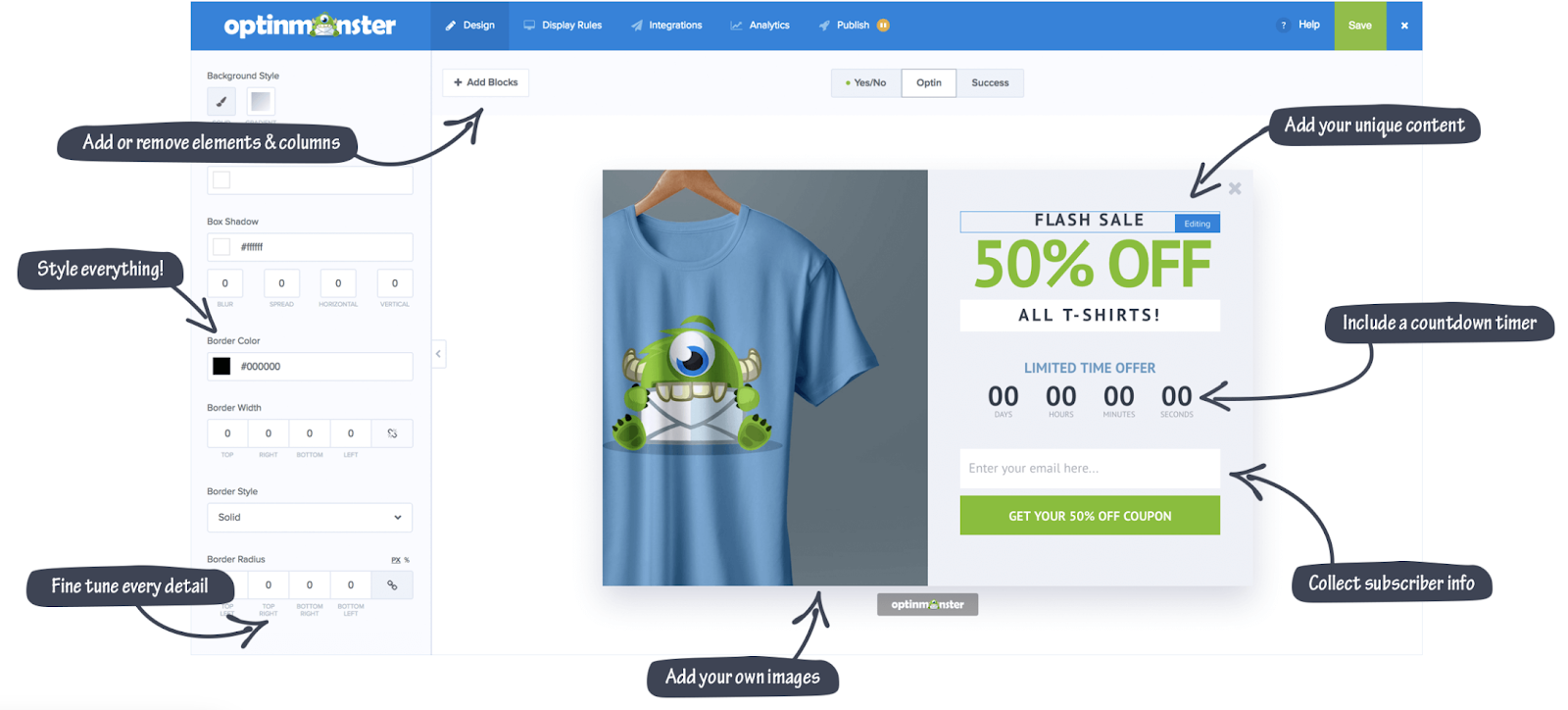
Source: OptinMonster
4. Google Ads
Google Ads can be one of the most mission-critical components of a local business’s SEM efforts. And the software’s HubSpot integration allows companies to identify and reach highly-targeted local audiences.
It can use any CRM data point to serve as a reference for targeted messages — an asset to local businesses looking to pinpoint who and where their potential customers’ interest is coming from.
It also lets small businesses set their own advertising budgets by offering insight into which ads are most effective — allowing local companies to keep careful tabs on the ROI of their paid ads.
5. Typeform
Typeform allows you to capture more leads with engaging interactive forms. The software features mobile-ready contact forms, surveys, quizzes, and more — all from premade or custom templates.
Its automatic tracking tools allow you to pinpoint where your most engaged audience is coming from — whether it be specific social media channels, your website’s home or contact page, or any other source that feeds leads to your business.
No matter the shape, size, or nature of your company, gaining exposure to interested prospects will always be in your best interest. Local businesses still need to grow, and new customers are central to that process. Companies with any sort of online presence should always be looking to generate new leads — no matter how far or wide their geographical reach extends.
So when you’re ready to take your balloon animal collective to the upper echelon of the Omaha, Nebraska novelty party entertainment scene, be sure to look into the different local lead generation strategies explored in this article.
