9 Valentine’s Day Marketing Campaigns to Inspire You
Love, flowers, chocolate, bla bla bla …
Where are the marketing results?!
Okay, probably not what your Valentine’s date cares about. But if you’re a marketer, you might be interested in merging the most lovey-dovey of days with your marketing. But how?
Well, these companies have figured out some creative ways to leverage the warm and fuzzies (or unadulterated rage and crushing loneliness … whatever) that Valentine’s Day instills in people. If you don’t have a marketing campaign planned for the 14th, maybe some of these will inspire you to get in on some last-minute Valentine’s Day action. Pun totally intended.
9 Effective Valentine’s Day Marketing Campaigns
1. Frankie & Benny’s “Lady & the Tramp” Instagram Post
Last year, the Italian restaurant chain Frankie & Benny’s referenced romantic scenes from notable films like “Lady and the Tramp.”
In a cute Instagram post, two real dogs are seen on a classy date at Frankie & Benny’s holding the same strand of pasta in their mouths. This mimics a class scene from Lady and the Tramp where two dogs kiss after accidentally eating the same strand of pasta.
The carousel post then highlights actual photos from iconic movies like, “When Harry Met Sally.” In the post’s caption, it encourages Instagram audiences to guess which movies are being referenced.
While the real dog’s mimicking Lady and the Tramp grabbed attention, especially from the animal lovers on Instagram, this post’s caption and other photos encourages audiences to interact with the brand by guessing which movies are being referenced.
This is both a fun way to boost brand awareness, and leverage the holiday to gain engagement on social media.
2. Panera’s Engagement Offer
In 2018, Panera tweeted that customers who got engaged in one of their restaurants on Valentine’s Day could win free wedding catering from the chain.
The tweet included a short and simple video which announced the promotion and showed two Panera employees cheering, as if they were witnessing a proposal.
Love is in the air. This Valentine’s Day, get engaged at a Panera and we might cater your wedding, for free. #PaneraProposalSweeps https://t.co/mpL5VbjSOd pic.twitter.com/VPRzu0QLNd
— Panera Bread (@panerabread)
February 9, 2018
This is a quick and sweet way to leverage the holiday and social media to gain foot traffic into a physical business. Although Panera is a giant corporation, this campaign strategy is so simple that smaller businesses could create something similar with a tweet, short video, and offer that drives foot traffic.
3. Facebook Messenger Heart Feature
Just before Valentine’s Day in 2018, Facebook Messenger’s Twitter announced that if you shared that you were “In a Relationship” with a friend you were messaging, celebratory hearts would rain down in your Messenger thread with that person.
It’s not official until it’s #FacebookOfficial. Update your relationship status on Facebook and shower bae with ❤️❤️❤️on Messenger. Also customize your chat emoji, color and more! pic.twitter.com/P6oy35fHmp
— Messenger (@messenger)
February 13, 2018
Although a small business probably can’t add a major feature to their product just because of a holiday, this is a good example of how you can theme something related to your product, such as your website, around a holiday temporarily.
Another thing that’s interesting about this campaign is that Facebook is using a competing social platform, Twitter, to announce this new feature. This slightly undermines Twitter, which also allows direct messaging but with less interactive features.
4. “Adults Meal” – Burger King
Burger King is no stranger to poking fun at its biggest competitor, McDonalds. This was no different before Valentine’s Day 2017 when they created an “Adult Meal” alternative with a similar box shape to McDonalds’ kids’ meal.
In the ad, Burger King explains that Kids’ Meals are for kids. But, on the night of Valentine’s Day, Burger King customers can buy an adult meal with an “adult toy.”
This campaign is pretty cheeky. However, it’s edgy mission and subtle comments about its competitor’s product make it memorable and funny.
5. “Romance On Demand” – Uber
On-demand car service company Uber launched a Romance on Demand campaign in most of the cities where they operate. Take a look at the short, cute video they shot to explain the campaign:
If you didn’t watch the video, the gist of the campaign is this: You can request roses be sent to a special someone by selecting the “rose” in their app. You set the delivery location, and a black car arrives at that location with a driver totally suited-up to deliver a bouquet of roses.
Uber is a startup that’s figured out a way to create a campaign that delights its audience and drives additional revenue for its business — all without a tremendous resource investment. I mean, their drivers are already on the road, ready to take customers; but if there are Uber customers who don’t need a ride but totally need to send some flowers, and send them with style … well, let’s just say transporting roses at a premium price isn’t much different than transporting people. Except the margins are way better for Uber. Pretty impressive stuff.
And even better, they’re using inbound tactics to get the word out there! They launched the Romance on Demand campaign on their blog, via social channels with the hashtag #romanceondemand, with that adorable video you might have watched up above, and even by establishing local partnerships in the cities where they’re running the campaign to enter participants into a drawing to win some extra goodies. This is a low cost, high return campaign for Uber that totally aligns with its customer persona — high convenience and high style.
6. “Whose Heart do You Love” – MegaRed
MegaRed is a type of krill oil supplement sold in nutrition stores. If you don’t know already, fish oil is an excellent dietary supplement for those concerned with heart health, so it makes sense that its Valentine’s Day campaign theme is “Whose heart do you love?” Here’s how it works.
MegaRed is relying heavily on Facebook to facilitate this campaign, in which visitors can request free samples of their supplements through their Facebook app. What’s totally endearing about this campaign is that you can request the supplement for “The heart of someone you love.” In other words, you can give someone you love — whose heart you want to keep in tip-top shape — a free sample of their product. Even better? If you choose to give the free sample to a loved on, MegaRed will give you a free sample, too. And the love doesn’t end there: If they can reach 100,000 free samples given away, they’ll donate $100,000 to the National Coalition for Women With Heart Disease.
Aside from the great feeling this campaign instills — I mean, promoting heart health is kind of hard to argue with — I love their use of social media to get the word out there. For instance, on Twitter, MegaRed is seeing celebrities like Joy Bauer and Toni Braxton posting about the campaign. Pretty impressive. And on YouTube, there’s this fun, short, touching video that will, forgive me, but totally touch your heart:
This campaign is being handled by an agency, but one thing that made my heart smile is a quote from MegaRed’s CMO, Jennifer Steeves-Kiss, to the New York Times. “We want to start making digital and social a significantly greater priority for us,” she said. “People are spending four to five hours a month online researching supplements if they’re supplement enthusiasts,” Steeves-Kiss shared, and additionally, they are in the middle of an acquisition by a company whose executive are “great proponents” of social and digital marketing.
We can’t help but smile at seeing the adoption of inbound methods by brands that have millions to spend on traditional advertising methods!
7. “Show Your Love for the Jersey Shore” – The State of New Jersey and the SBA
The State of New Jersey, along with the Small Business Association, are running a pro-business campaign called “Show Your Love for the Jersey Shore.” The call-to-action for the campaign? To spend your vacation dollars — particularly on Valentine’s Day — at the Jersey Shore. It’s being promoted on Facebook, Twitter, via email, and via live events in partnership with destination marketing organizations. Information about special promotions being offered by shore businesses will be shared socially, too, so if you’re looking for something to do tomorrow, check it out 😉 For instance, you might be interested in …
Doo Wop with the one you love this Valentine’s Day at @countbasiethtr. bit.ly/UEXOPf
— New Jersey Tourism (@Visit_NewJersey)
February 9, 2013
I know I sure would be!
The goal of the campaign is to show that the Jersey Shore is open for business after the devastation of Hurricane Sandy. The problem some shore businesses are facing is the perception that businesses aren’t recovered from the storm. While there’s still much more recovery to be done, there are some businesses that are, indeed, ready to accept tourists. They just need the word to get out there.
Director of Jenkinson’s Aquarium, Cindy Claus, told NorthJersey.com, “I think so many people see on the news that we got hit by the storm. They see all the destruction, and yes, there’s a lot of destruction and a lot of sadness, but there’s a lot of businesses that were able to get opened. And you need to come back because that’s the only way these businesses are going to survive.” The aquarium was able to open back up on February 1, and is hoping this campaign will help get the word out there that they’re welcoming visitors with open arms.
Whether the campaign works or not remains to be seen, but it’s fantastic to see federally funded institutions finding a way to, essentially, newsjack as a way to aid the shore community — particularly affected businesses — in attaining their previous levels of visitors.
8. Scribbler Valentine’s Day Campaign
Scribbler, a UK-based personalized greeting card service, has won my heart because of its celebration of content in its Valentine’s Day campaign. Using their blog, they’ve asked their audience to share what their definition of “love” is. All you do is visit their blog, and answer these three questions:
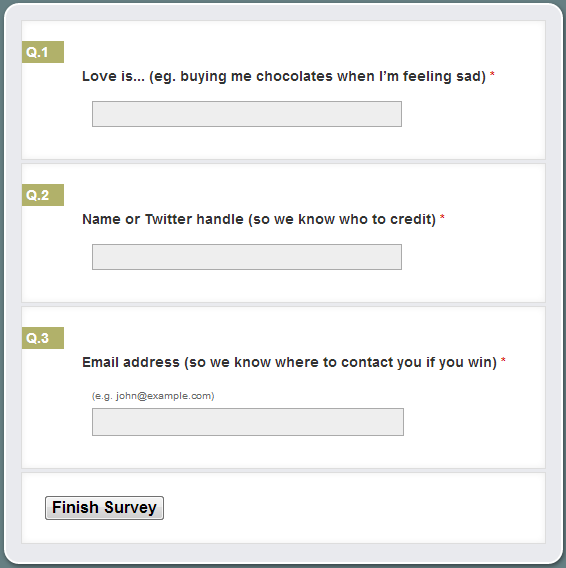
Or, you can tweet your response to the Scribbler Twitter account. The winner will get a free iPad mini, and the best answers will be compiled in their Valentine’s Day ebook. To inspire people, Scribbler is also using Facebook and Twitter to post some of the best answers that are coming their way. This campaign is fantastic for a few reasons:
- It’s a simple way to generate leads that can be nurtured later.
- It’s a simple way to get people aware of and engaged with their social channels to expand their reach.
- It’s a simple way to crowdsource content.
This campaign is an excellent idea for anyone trying to expand the top of their funnel — campaigns with a low time commitment but high level of delight are great ways to make new fans that you can later nurture into customers.
9. UncommonGoods Email Marketing Campaign
When I stumble across good email marketing, I get excited. When I stumble upon lovable email marketing, I swoon. Take a look at the lovely email ecommerce company UncommonGoods sent last week to remind/enable/capitalize on last-minute shoppers:
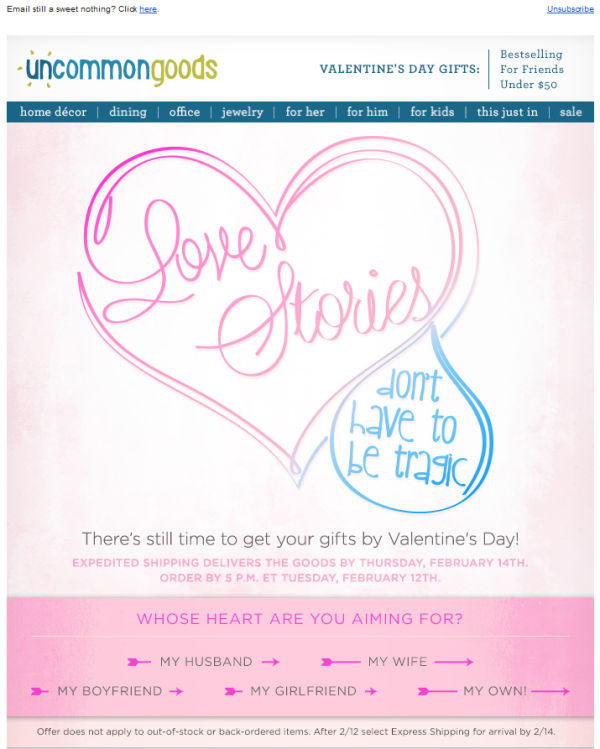
First of all, one of the great things about all of UncommonGoods’ emails is their attention to detail. For instance, they tied the Valentine’s Day theme into more than just the design and theme of the email campaign: Take a look at the little tiny text at the top left of the email to see what I mean. Instead of just saying, “For an HTML version of this email, bla bla bla,” they said, “Email still a sweet nothing? Click here.” Love is in the details, as they say.
But the layout of the email also makes taking action super easy for the recipient. Notice how they’ve divided up the gifts, essentially, by persona. “Whose heart are you aiming for?” they ask — at which point you can click on the person you need to shop for, and be brought to a landing page with content that aligns with your need.
But you know what takes all this to the next level? The fact that UncommonGoods finds a way to incorporate blogging into all of this! If you visit UncommonGoods from this email, you’ll see the following (pay particular attention to the orange call-out):
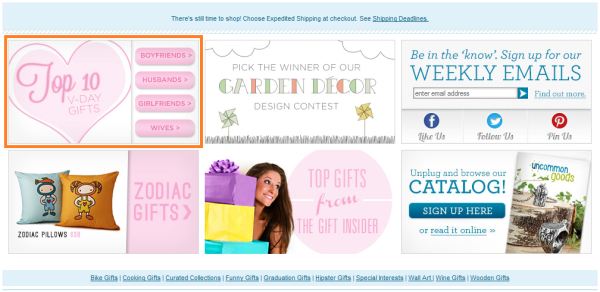
Not only does the design from the email align with design on the website, but when you click on the parts of that little box — let’s say you’re looking for gifts for your girlfriend — you get taken to a blog post of the top ten gifts for girlfriends, with a picture of that gift, a fun and well-written description of that gift, and a CTA to make the purchase next to each gift.

Nothing like integrating your marketing channels to sweep a marketer off her (or his) feet!
Valentine’s Day Campaign Takeaways
Editor’s Note: This blog post was originally published in Feb. 2013, but was updated for comprehensiveness on January 30, 2020.

7 Email Cadence Best Practices for Better Email Marketing Campaigns
By 2022, an estimated 330 billion emails will be sent and received each day — making it one of the largest digital communication channels.
Emails can include everything from details about pressing, work-related crises to e-cards from your aunt on random holidays like Arbor Day.
But email’s practical use extends beyond the personal — it can also be one of the most effective ways for businesses to convert leads into buyers. An email campaign is an effective strategy for turning a prospect’s interest into hard sales.
These campaigns can be massive assets, but they shouldn’t be structured arbitrarily. In all likelihood, you can’t send single, catch-all email blasts to your contacts whenever you feel like and expect your prospects and customers to be receptive to them. There’s much more to the email campaign process than drafting up an email and hitting send.
One of the most crucial components of the email campaign process is email cadence: the pulse, pace, and playbook of a successful email campaign. Let’s take a deeper dive into what an email cadence is and establish the fundamental principles of structuring a successful one.
The success of an email campaign can hinge upon the effectiveness of its cadence. If you can get the right emails to the right customers at the right time, you can get a lot of mileage out of your email marketing efforts.
That being said, if your cadence is too intrusive, obnoxious, or directionless, you can lose out on opportunities to guide leads through their buyers’ journeys. If potential customers feel pestered or confused by constant, irrelevant newsletters and promotions, they probably won’t stick around to hear what you have to say.
Here are some best practices to employ to ensure your next campaign’s email cadence is the best it can be.
1. Understand your goals.
What do you want out of your email cadence? You need to understand where you’re trying to lead your prospects and customers. Are you looking to improve traffic to your blog? Drive ecommerce sales? Schedule meetings? Close deals?
An email cadence is designed to guide buyers from point A to point B. You can’t do that if you have no idea what “point B” is. Your ultimate goal will dictate the strategy behind your cadence. If you’re trying to do something like increase traffic to your blog, you can stand to lose more subscribers than you would if you were trying to court a group of sales leads into scheduling demos.
If you’re sending emails purely for the sake of sending emails, your cadence is going to be aimless and haphazard. And you’ll waste a lot of time and resources on email campaigns that go nowhere.
2. Try to understand each customer’s mindset.
The whole point of having an email cadence is to hone in on messaging that’s going to resonate most with a specific customer at a given point in time. That means one-size-fits-all, “throw everything at everyone,” impersonal emails won’t cut it. You need to send your recipients something relevant to who they are as a customer. That often means understanding where they are in their buyer’s journey.
The buyer’s journey is the process buyers go through to become aware of, evaluate, and ultimately decide to purchase a new product or service. It’s divided into three stages: Awareness, Consideration, and Decision.
You can’t expect to target buyers in all three of those stages with the same message and have it immediately register with them, across the board. Different stages — and engagement levels within those stages — warrant different messages.
Additionally, through the wonders of automation, coordinating this kind of strategy is possible. Several kinds of email and marketing automation software allow you to set up the proper infrastructure to tailor email content and timing to suit different leads’ behavior and interests.
3. Personalize when you can.
Think back on all the targeted emails companies have sent you over the years. How inclined have you been to click through ones addressed to “valued customer,” or “to whom it may concern?” I don’t think it’s outrageous to assume the answer is “not often.”
Why would your customers be any different? A successful cadence relies on your leads clicking through your emails and progressing through their buyer’s journey. If you’re sending impersonal mass-email blasts, crossing your fingers, and hoping for the best, your prospects may wind up suspended in buyer’s limbo.
Fortunately, there’s a variety of email software that allows you to personalize your subject lines and email content to cater to specific leads.
4. Don’t be too shy.
When planning an email cadence, you shouldn’t err too much on the side of “I don’t want to bother you.” It’s easy to get anxiety about losing leads by coming off as obnoxious or intrusive, but you have to understand there’s a difference between being pushy and being professionally persistent.
If you’re not consistently sending out emails, you’re missing out on sales opportunities. A big part of email marketing is keeping your prospects and customers engaged. If a lead only gets an email from you once every two months, you might become an afterthought.
Email cadences are a matter of strategically striking while the iron’s hot. You can’t do that if you’re too reluctant to strike at all.
5. Don’t be too aggressive.
Even though you shouldn’t be too passive, you don’t want to be overly aggressive. There’s a movie from the 80’s called Say Anything. It has an iconic scene where the main character stands outside his love interest’s window and serenades her by blaring a song called “In Your Eyes” by Peter Gabriel from a boombox he’s holding over his head. She swoons over it, and they ride off into the sunset together on a lawnmower ( … for some reason).
It’s romantic and compelling. But, if he did that twice a day, every day — playing similar, anthemic 80’s rock songs on her front lawn — she’d be over it pretty quickly. He’d have to take his lawnmower and Peter Gabriel cassettes somewhere else.
That’s essentially what sending emails too frequently in your cadence is like. If your leads are receiving obtrusive, daily reminders and promotions from you, they’ll unsubscribe from your mailing list.
6. Hone in on the right frequency for your business.
There’s no magic figure when it comes to email frequency. It’s going to vary from business to business. It may take some time to get the right feel for how often you should be sending your emails.
Studying your industry averages for email frequency can provide a solid place to start. A prominent fashion brand routinely sending out new promotions and coupons probably isn’t going to have the same email frequency as a midsize B2B SaaS company looking to set meetings with decision-makers.
Email frequency isn’t an exact science. It’s probably going to take some trial-and-error before you find one that best fits both your business and customers’ interests.
7. Give your subscribers autonomy.
Always give your subscribers the option to control their own email frequency. Giving them this kind of autonomy can keep them from unsubscribing from your mailing list outright if your email frequency seems like a bit too much for them. Include a link to allow them to update their email preferences as they see fit at the end of your emails.
Customers don’t always approach email frequencies in absolutes. Even if they’re overwhelmed by how many emails you’re sending them, they still might want to keep hearing from you. Give them the freedom to pump the brakes. If they don’t have the flexibility to do that, they’ll probably just cut you off.
You should always be putting the customer first. Their personal interests take precedence over what you might believe to be your preferred email cadence.
Finding your ideal email cadence might not happen with your first series of automated emails. Still, there are certain actions you can take to take to put yourself in the best position to find the one that works best for your business.
Your main priority should always be your prospects and customers’ interests. Try to understand where they’re coming from, where they stand in terms of buying your product or service, and what they might want out of you and your business, and cater your email cadence around that.

How HubSpot Uses Long-Form Video to Build a Brand
Nowadays, video is an undoubtedly powerful marketing tool — in fact, 85% of businesses use video for their marketing efforts, and 88% of video marketers report that video gives them a positive ROI.
At HubSpot, our marketing team uses video for a variety of reasons: to engage with our audience on social platforms, to educate our audience on YouTube, and to inspire our audience with quarterly campaigns.
These videos vary in length. Some are as short as 30 seconds, while others span 10-20 minutes.
Which brings us to the question — is long-form or short-form video better for a brand?
Of course, your video length largely depends on your content, your platform, and your audience. An Instagram Story video should be much shorter than a YouTube video because of the audience’s expectations of the platform.
To investigate the nuances of video length and how long-form video can help you build a brand, I spoke with Kyle Denhoff, HubSpot’s Head of Global Acquisition Campaigns, and Diego Santos, Marketing Manager at HubSpot.
Here, we’ll explore the benefits of long-form video to help build a brand by investigating two HubSpot Marketing team case studies.
Case Study One: Use Long-form Video to Explain Complex Topics
Diego Santos, Marketing Manager at HubSpot, has used long-form video in his Facebook Live educational video series #MartesEnVivo, as well as in his re-branded YouTube series #UnMejorMarketing for HubSpot’s Spanish-speaking audience (you can read more about these campaigns here).
Santos told me — “Long-form videos can be a great way for your brand to explain complex topics and develop educational and thought leadership content. Most companies opt for shorter content forms, so longer videos can help you to stand out from competitors and position yourself and your brand as a real expert.”
Santos adds, “Not everyone is willing to watch a 10min+ detailed video, so you need to focus on finding the right audience and optimizing their engagement, rather than looking for a big reach of people that will watch for a few seconds but then drop off.”
Of course, this is easier said than done. To help you figure out how to find the right audience, Santos suggests you:
- Create serialized content, so an audience can learn to expect a certain topic from your brand at the same time, and on the same platform, consistently.
- Publish on platforms where videos can live longer, such as YouTube or your own blog.
- Add value throughout the video, and don’t extend the video unnecessarily.
- Do keyword research and add captions to help the video’s discoverability.
For instance, take a look at this five minute, 41 second YouTube video Santos and his team put together to explore the topic of buyer personas:
While the video is too long to attract a large audience, its content will match a searcher’s intent if they’re looking for in-depth information on buyer personas. Additionally, they’ve used keyword research to optimize the post for YouTube search.
Case Study Two: Use Long-form Video to Create a High-quality Brand Campaign
Last quarter, Kyle Denhoff and his team launched Advertising, A Look Behind the Screens. There are four videos, about three minutes each, that include interviews with experts from LinkedIn, Google, Facebook, and HubSpot.
To explore why they chose to use longer-form video for the campaign, I spoke with Denhoff. He told me: “There is a constant debate within marketing teams about where to invest. Should you invest in brand marketing or performance marketing? Historically, companies that invest heavily in brand marketing produce beautiful videos to tell their story. Then, they use advertising to promote videos to reach new audiences.”
He adds, “Alternatively, on the performance side, brands focus on creating direct response offers, such as templates, guides, reports, and infographics that provide an audience immediate value in the form of education.”
“When creating Advertising, a Look Behind the Screens we said, ‘Why can’t we provide a direct response content offer with the production value of a brand campaign?'”
Denhoff told me, “We decided to use video as a format to tell a unified story across multiple brands. Partnering with Google, Facebook, and LinkedIn, we felt that a minimal and approachable video style would allow us to unify multiple brands under a single creative concept. Overall, we felt high-quality video would help us portray a level of professionalism and trust.”
Undoubtedly, long-form video provides some unique benefits to a marketing campaign. First, it enables your brand to tell the full story, especially when interviewing experts in the industry.
Second, it allows your brand to prove its educational value more than short-form content. With three to four minutes minimum, you can teach your audience much more about a concept than you could in 30 seconds.
Of course, there’s a trade-off to long-form video. You likely need higher-quality video to keep your audience engaged if it’s a longer video, compared to a quick 20-to-30 second clip that can seem a little more improvised and casual. Additionally, you need to make every second count, or you’ll quickly lose your audience’s attention.
Denhoff adds, “Using video, we could focus on the people at each company instead of various graphics or illustrations. This allowed our experts to share their unique expertise and personality with our audience, and made these technology brands seem more approachable.”
“Additionally, we felt that video allowed us to share a ton of information in a shorter period of time compared to other content formats such as a long-form blog post. We were able to provide marketers with tactical advice about digital advertising, across all platforms, in just 15-minutes.”
Ultimately, with longer video, you’re asking more of your audience (in terms of time and attention span). That’s okay, as long as you deliver enough value to make the time-investment worthwhile, and as long as you feel you have a unique story to tell.

Is A Media Mix Right for Your Brand?
Undoubtedly, your marketing team uses a variety of mediums to execute your marketing messages on a daily basis. In fact, I’m willing to bet a typical campaign includes at least three.
Those mediums — including social media, email, and paid advertising — are part of what’s called a business’s media mix, a process that can be helpful for businesses that need a little organization. They’re also especially helpful when planning out future campaigns.
Additionally, making decisions such as timing and design are more informed when looking at previous campaign metrics.. A media mix looks at these numbers and how they contribute holistically to a campaign.
Think about the last campaign you saw from one of your favorite brands. What did they do differently that really clicked with you? By incorporating a media mix into your yearly planning, you can find that one thing that really clicks with your audience.
A media mix is another term for an overview of the channels businesses choose to execute their marketing strategies on. Ultimately, media mix optimization is the process of analyzing the performance of those channels.
That was a brief overview of how media mixes fit into marketing. Now, it’s time for a little bit of a deep dive into how to optimize a media mix, and what that model looks like.
Media Mix Optimization
Media mix optimization provides businesses with an understanding of how their messages are coming across to customers. It allows a brand to invest more time and money into marketing strategies that are best suited for their audiences.
Marketers might consider optimizing their media mix if they want to gain some helpful insight into what time and capital is needed to target their audience in a way that gives customers a personalized experience.
But, while media mix optimization is a powerful opportunity for methodizing data collection online, it’s not the best strategy for marketers who employ a lot of traditional marketing techniques, since you can’t really measure the success of a billboard or newspaper ad.
However, to make guided decisions such as what font to use in creative design, when to publish social media posts on various channels, or where to invest resources, this method can be helpful.
Optimizing a media mix means looking at the analytics and ROI of various marketing strategies. This can be anything from engagement data of social media platforms to views on the newest commercial.
That’s where media mix modeling comes in. If media mix optimization is the “What,” modeling is the “How”. Every model can and should look different, depending of the goals or the mix of that specific business.
Media mix models can be used to analyze the relationship between a dependent variable and an independent variable. For instance, let’s say a business has a question like, “How did paying for a sponsored tweet affect overall blog traffic?”
The business’s media mix model should then accurately depict how a dependent variable — like overall blog traffic — relates to an independent variable, such as investing in Twitter.
For businesses still deciding if a media mix optimization is a good idea for them, we’ve put together tips to refer to when creating a media mix model. Let’s explore those, next.
Tips for Optimizing Your Media Mix
These tips are meant to get the ball rolling when modeling your list. You don’t have to do everything on this list to be successful, but paying mind to these items will guide your experience creating a media mix.
1. Collect personal level data.
What it means to collect personal level data is to focus on analytics that will help provide an accurate picture of how customers engage with a media mix.
Analytics software is expansive and offers an array of tools for use. If you’re in the market for one, HubSpot has a post on some pretty great SEO tools for analyzing webpage performance. When creating the media mix model, don’t focus on all metrics if they aren’t helpful towards your main goal.
Having too many metrics can be confusing and lead to inaccurate data. The best plan is to have an idea of which metrics need to be tracked so they can be right at the beginning. A normal media mix optimization process takes six months to a year, so collecting the right information at the beginning contributes to getting the most accurate information overall.
2. Make sure data can be analyzed online.
This tip is why media mix optimization might not be the optimal strategy if you use traditional marketing methods. As stated above, it’s difficult to measure the results of a billboard or newspaper ad.
For that reason, consider adding more online marketing channels into your campaign strategy so results can be justifiably measured. It’s a huge risk spending copious amounts of money on a billboard that might not yield a great boost in sales.
By migrating some marketing campaigns online, you have a more accurate ROI to inform future decisions. Email marketing, AdSpend, conversions, social media engagement, and lead generation can all be broken down into data online. Having a gap in a media mix, like billboard return, will lead to inaccuracies.
3. Choose the right platform.
Marketing teams that use CMS or analytics software are already ahead of the game. Software like this is essential to optimizing a media mix because it can give you numbers that would otherwise take some time to figure out manually.
A brand can analyze its media mix with the use of platforms that collect engagement data in real-time and compile that data into tracking reports..
Look for a platform that can give a holistic view of results across the board, so results will maintain consistency. It’s also good to choose a software that specializes in the marketing channels being used at the time.
Because optimizing is measuring a lot of different data at once, stick to as little systems as possible. For businesses that are in the market for a CMS, HubSpot’s offers tools that are easy to use for brands of any size.
4. Be able to analyze the data.
We’ve been talking a lot about the kind of data and analyzing that needs to be done in a media mix optimization, but another important factor is being able to interpret and understand that data.
It’s no secret that in the marketing world, there are an abundance of processes and acronyms floating around. While first getting into the groove of understanding them and what they mean can be intimidating, it’s important to know the data being collected and how to use it to your advantage.
For instance, if a marketing team had especially high click-to-open-rates for weekly newsletters, that’s useful information to infer that the next campaign could benefit greatly from an email-marketing rollout. Alternatively, if a marketing team has no idea what a click-to-open-rate is, those numbers aren’t going to be helpful — just a little confusing.
Reading data to understand its usefulness is just as important as collecting it.
5. Think about public perception.
Knowing how the public perceives your brand can help fill in some interpretation gaps during the modeling process. In the media mix model, think about how to fit in customer opinion. That way, the numbers will have some customer opinions to define them.
There’s a couple of ways to do this. To gain a public opinion, the quickest way is to visit social media and search. Take note of the positive things, the negative things, and what people are saying. Using that knowledge, create a survey and ask customers to give a net promoter score (NPS).
An NPS asks customers how likely they are to recommend a business to a friend. Knowing this will aid in figuring out how a business fares among the competition in the market. It will also assist in future marketing endeavors.
For instance, if customers fill out your survey and ask for more personalized Instagram stories, your team could take that knowledge and include it in your next campaign.
This method ultimately gives the media mix optimization reigns to the customer.
Media mix optimization can help your marketing team figure out which distribution channels will best promote an upcoming campaign, and can ultimately help strengthen your marketing strategy as a whole.

What You Need to Know About Creating a ‘Do Not Reply’ Email
During my summer break in 2009, I was sitting on my couch, watching Disney Channel, and eating a snack — chips and salsa to be exact.
Well, chips and a one gallon Tupperware full of my aunt’s famous spicy salsa.
While I’m watching TV, all of a sudden, I accidentally drop the entire gallon of cold salsa on my lap.
That decision — the one to bring an entire gallon of salsa to the couch, instead of dishing out one serving, was a really bad idea.
For a marketer, having a ‘do not reply’ email is just as bad of an idea.
While you won’t spill an entire gallon of salsa on your lap, do not reply email addresses can damage your reputation, impact email deliverability, and put your emails in the dreaded spam folder.
Below, let’s review everything you need to know about do not reply emails — what they are, the best alternative, and email best practices.
While brands might want to use a do not reply email for things like receipts, confirmations, or reminders, these can have adverse effects on your email marketing.
Below are just a few reasons why you should avoid do not reply emails.
1. Negatively influences email deliverability: Email deliverability is the rate at which your email actually makes it into your recipient’s inboxes. To have successful email marketing campaigns, your emails need to be delivered. However, do not reply emails usually end up in spam folders since email providers use filters to prevent spam messages. Additionally, it’s frustrating for your audience to receive one-way communication.
2. Dissuades two-way communication: Two-way communication is the best way to learn about your audience and encourage engagement with your brand. Plus, communication with your customers impacts brand loyalty and overall customer experience. With do not reply emails, you’re effectively telling your customer to “talk to the hand.” How can you improve your customer experience or measure the success of your email marketing if your customers can’t respond to you? Spoiler alert: You can’t. Additionally, when your audience can’t add you to their address book, your emails are more likely to end up in the spam folder, which impacts email deliverability.
3. They aren’t compliant: According to GDPR and CAN-SPAM laws, customers need to be able to request information about the data collected about them and opt-out of your messages with a reply email. Do not reply emails can prevent both of those things from happening, which would make your emails non-compliant and punishable by a hefty fine.
So, now that we know why do not reply email addresses are a bad idea, what should you do instead? Below, let’s dive into alternatives to creating a do not reply email.
To create this email address, all you need to do is follow these simple steps:
- Log in to your email
- Add user
- Add email address
- Add account
- Type in the alias name
- Click save
Setting up an email alias should be easy with your email service provider. For example, at HubSpot, the free email marketing tool can help with this.
Creating an email alias instead of using a do not reply email is important because it can help:
1. Foster communication: When subscribers give you their email address, they’re trusting you with their data, so you should reciprocate and trust them with yours. When customers have questions or suggestions or comments, they should be able to reach out. This type of communication will help you get to know your audience and improve your customer experience. Additionally, you want to encourage engagement with your emails so your email marketing campaigns succeed.
2. Keep subscriber lists up-to-date: Receiving auto-responder emails such as “message delivery notification” or “message failed to send” can help you keep your subscriber list up to date. With this information, you can delete inactive emails, and improve your email deliverability in one fell swoop.
3. Improve email deliverability: We can’t stress this enough: email deliverability is important for the success of your email marketing campaigns. With an email alias, your emails are less likely to go to the spam folder. Plus, your audience can save these email addresses to their contacts, so you don’t go to the promotion folder.
Do Not Reply Email Best Practices
While you shouldn’t use do not reply email addresses, you can still successfully send transactional messages to your audience in an efficient way.
Below, let’s jump into the five best practices while sending these messages.
1. Switch to an alias.
Instead of using a do not reply email, set up an email alias instead. Email aliases are going to be easier to monitor because the replies won’t get sent one person’s inbox. With an email alias, several employees and teams can monitor the replies, so messages get responses in a timely manner.
2. Interact with your customers and increase engagement.
When customers respond with a request, make sure you reply. To do this, you might need to have several team members monitor your email aliases.
Listen to your audience and send them resources to make their lives easier. This could mean that you create resources such as blog posts or knowledge base articles around commonly asked questions.
Additionally, by engaging in a helpful conversation with your audience, you’ll get to know them better, and have a pulse on what their pain points are.
Two-way communication is the best way to increase engagement, improve your customer experience, and build brand loyalty.
3. Filter out unnecessary responses.
Typically, email service providers can filter out unnecessary emails. For example, you should be able to set up a filter that sorts emails containing words like “message delivery notification” or “automated response” to your trash, spam, or another folder of your choice.
If you want to keep your contact list up to date, you might filter these messages to an “Updated Lists” folder that team members go through to update your subscriber list.
4. Set up an autoresponder.
An autoresponder could let your customers know that you got their email and will get back to them within a certain amount of time.
In this email, you can include helpful information such as contact information for support, or an email address for urgent communication.
Additionally, you might want to include resources, such as FAQ or blogs, to answer common questions.
5. Adjust the reply-to email address.
If you decide to go with the personalized approach to email aliases, and you included an executive leader’s name in the email alias, you probably don’t want that person to have to monitor the replies.
That’s why you can set up a different reply-to email address in your email service provider. Replies can go to a certain team member or another email alias that’s monitored by your team.
Although it might be tempting to use a do not reply email address, it’s important to encourage conversation with your audience. This could help you improve the customer experience and get to know your audience, which should improve your overall email marketing campaigns.

How to Write a Case Study: Bookmarkable Guide & Template
Earning the trust of prospective customers can be a struggle. Before you can even begin to expect to earn their business, you need to demonstrate your ability to deliver on what your product or service promises.
Writing a case study is a great way to do that.
Sure, you could say that you’re great at X, or that you’re way ahead of the competition when it comes to Y. But at the end of the day, what you really need to win new business is cold, hard proof.
One of the best ways to prove your worth is through a compelling case study.
Below, I’ll walk you through what a case study is, how to prepare for writing one, what you need to include in it, and how it can be an effective tactic. To jump to different areas of this post, click on the links below to automatically scroll.
What Is a case study?
A case study examines a person’s or business’s specific challenge or goal, and how they solved for it. Case studies can vary greatly in length and focus on a number of details related to the initial challenge and applied solution.
In professional settings, it’s common for a case study to tell the story of a successful business partnership between a vendor and a client.
Whether it’s a brief snapshot of your client’s health since working with you, or a long success story of the client’s growth, your case study will measure this success using metrics that are agreed upon by the client you’re featuring. Perhaps the success you’re highlighting is in the number of leads your client generated, customers closed, or revenue gained. Any one of these key performance indicators (KPIs) are examples of your company’s services in action.
When done correctly, these examples of your work can chronicle the positive impact your business has on existing or previous customers.
To help you arm your prospects with information they can trust, we’ve put together a step-by-step guide on how to create effective case studies for your business — as well as free case study templates for creating your own. Get them using the form above, and then get creating using the steps below.
How to Write a Case Study
- Determine the case study’s objective.
- Establish a case study medium.
- Find the right case study candidate.
- Contact your candidate for permission to write about them.
- Draft and send your subject a case study release form.
- Ensure you’re asking the right questions.
- Lay out your case study format.
- Publish and promote your case study.
1. Determine the case study’s objective.
All business case studies are designed to demonstrate the value of your services, but they can focus on several different client objectives.
Your first step when writing a case study is to determine the objective or goal of the subject you’re featuring. In other words, what will the client have succeeded in doing by the end of the piece?
The client objective you focus on will depend on what you want to prove to your future customers as a result of publishing this case study.
Your case study can focus on one of the following client objectives:
- Complying with government regulation
- Lowering business costs
- Becoming profitable
- Generating more leads
- Closing on more customers
- Generating more revenue
- Expanding into a new market
- Becoming more sustainable or energy-efficient
2. Establish a case study medium.
Next, you’ll determine the medium in which you’ll create the case study. In other words, how will you tell this story?
Case studies don’t have to be simple, written one-pagers. Using different media in your case study can allow you to promote your final piece on different channels. For example, while a written case study might just live on your website and get featured in a Facebook post, you can post an infographic case study on Pinterest, and a video case study on your YouTube channel.
Here are some different case study mediums to consider:
Written Case Study
Consider writing this case study in the form of an ebook and converting it to a downloadable PDF. Then, gate the PDF behind a landing page and form for readers to fill out before downloading the piece, allowing this case study to generate leads for your business.
Video Case Study
Plan on meeting with the client and shooting an interview. Seeing the subject, in person, talk about the service you provided them can go a long way in the eyes of your potential customers.
Infographic Case Study
Use the long, vertical format of an infographic to tell your success story from top to bottom. As you progress down the infographic, emphasize major KPIs using bigger text and charts that show the successes your client has had since working with you.
Podcast Case Study
Podcasts are a platform for you to have a candid conversation with your client. This type of case study can sound more real and human to your audience — they’ll know the partnership between you and your client was a genuine success.
3. Find the right case study candidate.
Writing about your previous projects requires more than picking a client and telling a story. You need permission, quotes, and a plan. To start, here are a few things to look for in potential candidates.
Product Knowledge
It helps to select a customer who’s well-versed in the logistics of your product or service. That way, he or she can better speak to the value of what you offer in a way that makes sense for future customers.
Remarkable Results
Clients that have seen the best results are going to make the strongest case studies. If their own businesses have seen an exemplary ROI from your product or service, they’re more likely to convey the enthusiasm that you want prospects to feel, too.
One part of this step is to choose clients who have experienced unexpected success from your product or service. When you’ve provided non-traditional customers — in industries that you don’t usually work with, for example — with positive results, it can help to remove doubts from prospects.
Recognizable Names
While small companies can have powerful stories, bigger or more notable brands tend to lend credibility to your own — in some cases, having brand recognition can lead to 24.4X as much growth as companies without it.
Switchers
Customers that came to you after working with a competitor help highlight your competitive advantage, and might even sway decisions in your favor.
4. Contact your candidate for permission to write about them.
To get the case study candidate involved, you have to set the stage for clear and open communication. That means outlining expectations and a timeline right away — not having those is one of the biggest culprits in delayed case study creation.
Most importantly at this point, however, is getting your subject’s approval. When first reaching out to your case study candidate, provide them with the case study’s objective and format — both of which you will have come up with in the first two steps above.
To get this initial permission from your subject, put yourself in their shoes — what would they want out of this case study? Although you’re writing this for your own company’s benefit, your subject is far more interested in the benefit it has for them.
Benefits to Offer Your Case Study Candidate
Here are four potential benefits you can promise your case study candidate to gain their approval.
Brand Exposure
Explain to your subject whom this case study will be exposed to, and how this exposure can help increase their brand awareness both in and beyond their own industry. In the B2B sector, brand awareness can be hard to collect outside one’s own market, making case studies particularly useful to a client looking to expand their name’s reach.
Employee Exposure
Allow your subject to provide quotes with credits back to specific employees. When this is an option to them, their brand isn’t the only thing expanding its reach — their employees can get their name out there, too. This presents your subject with networking and career-development opportunities they might not have otherwise.
Product Discount
This is a more tangible incentive you can offer your case study candidate, especially if they’re a current customer of yours. If they agree to be your subject, offer them a product discount — or free trial of another product — as a thank-you for their help creating your case study.
Backlinks and Website Traffic
Here’s a benefit that is sure to resonate with your subject’s marketing team: If you publish your case study to your website, and your study links back to your subject’s website — known as a “backlink” — this small gesture can give them website traffic from visitors who click through to your subject’s website.
Additionally, a backlink from you increases your subject’s page authority in the eyes of Google. This helps them rank more highly in search engine results and collect traffic from readers who are already looking for information about their industry.
5. Draft and send your subject a case study release form.
Once your case study candidate approves of your case study, it’s time to send them a release form.
A case study release form tells you what you’ll need from your chosen subject, like permission to use any brand names and share the project information publicly. Kick off this process with an email that runs through exactly what they can expect from you, as well as what you need from them. To give you an idea of what that might look like, check out this sample email:
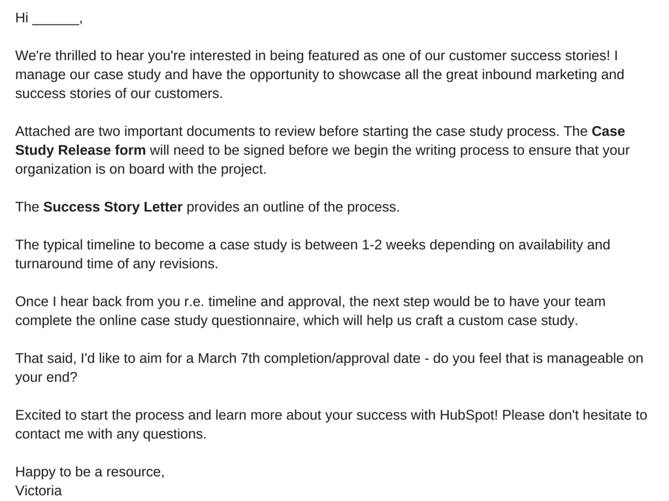
You might be wondering, “What’s a Case Study Release Form?” or, “What’s a Success Story Letter?” Let’s break those down.
Case Study Release Form
This document can vary, depending on factors like the size of your business, the nature of your work, and what you intend to do with the case studies once they are completed. That said, you should typically aim to include the following in the Case Study Release Form:
- A clear explanation of why you are creating this case study and how it will be used.
- A statement defining the information and potentially trademarked information you expect to include about the company — things like names, logos, job titles, and pictures.
- An explanation of what you expect from the participant, beyond the completion of the case study. For example, is this customer willing to act as a reference or share feedback, and do you have permission to pass contact information along for these purposes?
- A note about compensation.
Success Story Letter
As noted in the sample email, this document serves as an outline for the entire case study process. Other than a brief explanation of how the customer will benefit from case study participation, you’ll want to be sure to define the following steps in the Success Story Letter.
The Acceptance
First, you’ll need to receive internal approval from the company’s marketing team. Once approved, the Release Form should be signed and returned to you. It’s also a good time to determine a timeline that meets the needs and capabilities of both teams.
The Questionnaire
To ensure that you have a productive interview — which is one of the best ways to collect information for the case study — you’ll want to ask the participant to complete a questionnaire prior to this conversation. That will provide your team with the necessary foundation to organize the interview, and get the most out of it.
The Interview
Once the questionnaire is completed, someone on your team should reach out to the participant to schedule a 30- to 60-minute interview, which should include a series of custom questions related to the customer’s experience with your product or service.
The Draft Review
After the case study is composed, you’ll want to send a draft to the customer, allowing an opportunity to give you feedback and edits.
The Final Approval
Once any necessary edits are completed, send a revised copy of the case study to the customer for final approval.
Once the case study goes live — on your website or elsewhere — it’s best to contact the customer with a link to the page where the case study lives. Don’t be afraid to ask your participants to share these links with their own networks, as it not only demonstrates your ability to deliver positive results, but their impressive growth, as well.
6. Ensure you’re asking the right questions.
Before you execute the questionnaire and actual interview, make sure you’re setting yourself up for success. A strong case study results from being prepared to ask the right questions. What do those look like? Here are a few examples to get you started:
- What are your goals?
- What challenges were you experiencing prior to purchasing our product or service?
- What made our product or service stand out against our competitors?
- What did your decision-making process look like?
- How have you benefited from using our product or service? (Where applicable, always ask for data.)
Keep in mind that the questionnaire is designed to help you gain insights into what sort of strong, success-focused questions to ask during the actual interview. And once you get to that stage, we recommend that you follow the “Golden Rule of Interviewing.” Sounds fancy, right? It’s actually quite simple — ask open-ended questions.
If you’re looking to craft a compelling story, “yes” or “no” answers won’t provide the details you need. Focus on questions that invite elaboration, such as, “Can you describe …?” or, “Tell me about …”
In terms of the interview structure, we recommend categorizing the questions and flow into six specific sections that will mirror a successful case study format. Combined, they’ll allow you to gather enough information to put together a rich, comprehensive study.
Open with the customer’s business.
The goal of this section is to generate a better understanding of the company’s current challenges and goals, and how they fit into the landscape of their industry. Sample questions might include:
- How long have you been in business?
- How many employees do you have?
- What are some of the objectives of your department at this time?
Cite a problem or pain point.
In order to tell a compelling story, you need context. That helps match the customer’s need with your solution. Sample questions might include:
- What challenges and objectives led you to look for a solution?
- What might have happened if you did not identify a solution?
- Did you explore other solutions prior to this that did not work out? If so, what happened?
Discuss the decision process.
Exploring how the customer arrived at the decision to work with you helps to guide potential customers through their own decision-making processes. Sample questions might include:
- How did you hear about our product or service?
- Who was involved in the selection process?
- What was most important to you when evaluating your options?
Explain how a solution was implemented.
The focus here should be placed on the customer’s experience during the onboarding process. Sample questions might include:
- How long did it take to get up and running?
- Did that meet your expectations?
- Who was involved in the process?
Explain how the solution works.
The goal of this section is to better understand how the customer is using your product or service. Sample questions might include:
- Is there a particular aspect of the product or service that you rely on most?
- Who is using the product or service?
End with the results.
In this section, you want to uncover impressive measurable outcomes — the more numbers, the better. Sample questions might include:
- How is the product or service helping you save time and increase productivity?
- In what ways does that enhance your competitive advantage?
- How much have you increased metrics X, Y, and Z?
7. Lay out your case study format.
When it comes time to take all of the information you’ve collected and actually turn it into something, it’s easy to feel overwhelmed. Where should you start? What should you include? What’s the best way to structure it?
To help you get a handle on this step, it’s important to first understand that there is no one-size-fits-all when it comes to the ways you can present a case study. They can be very visual, which you’ll see in some of the examples we’ve included below, and can sometimes be communicated mostly through video or photos, with a bit of accompanying text.
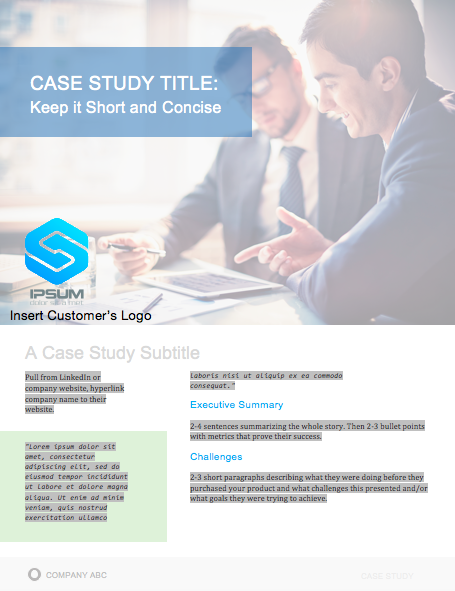
Whether your case study is primarily written or visual, we recommend focusing on the seven-part outline, below. Note: Even if you do elect to use a visual case study, it should still include all of this information, but presented in its intended format.
- Title: Keep it short. Develop a succinct but interesting project name you can give the work you did with your subject.
- Subtitle: Use this copy to briefly elaborate on the accomplishment. What was done? The case study itself will explain how you got there.
- Executive Summary: A 2-4 sentence summary of the entire story. You’ll want to follow it with 2-3 bullet points that display metrics showcasing success.
- About the Subject: An introduction to the person or company you served, which can be pulled from a LinkedIn Business profile or client website.
- Challenges and Objectives: A 2-3 paragraph description of the customer’s challenges, prior to using your product or service. This section should also include the goals or objectives the customer set out to achieve.
- How Product/Service Helped: A 2-3 paragraph section that describes how your product or service provided a solution to their problem.
- Results: A 2-3 paragraph testimonial that proves how your product or service specifically benefited the person or company, and helped achieve its goals. Include numbers to quantify your contributions.
- Supporting Visuals or Quotes: Pick one or two powerful quotes that you would feature at the bottom of the sections above, as well as a visual that supports the story you are telling.
- Future Plans: Everyone likes an epilogue. Comment on what’s ahead for your case study subject, whether or not those plans involve you.
- Call to Action (CTA): Not every case study needs a CTA, but putting a passive one at the end of your case study can encourage your readers to take an action on your website after learning about the work you’ve done.
To help you visualize this case study outline, check out the case study template below, which can also be downloaded here.
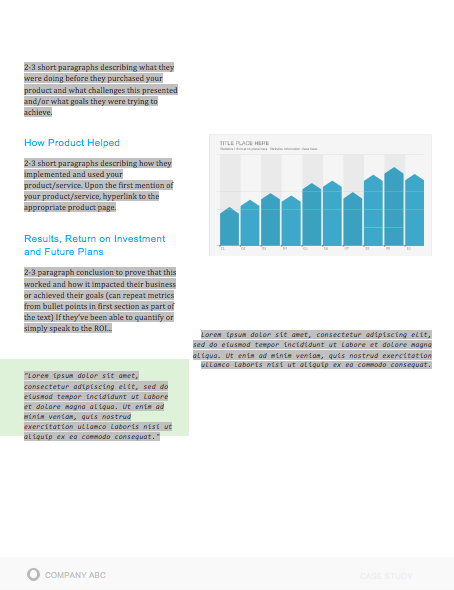
When laying out your case study, focus on conveying the information you’ve gathered in the most clear and concise way possible. Make it easy to scan and comprehend, and be sure to provide an attractive call-to-action at the bottom — that should provide readers an opportunity to learn more about your product or service.
8. Publish and promote your case study.
Once you’ve completed your case study, it’s time to publish and promote it. Some case study formats have pretty obvious promotional outlets — a video case study can go on YouTube, just as an infographic case study can go on Pinterest.
But there are still other ways to publish and promote your case study. Here are a couple of ideas:
Gated Behind a Blog Post
As stated earlier in this article, written case studies make terrific lead-generators if you convert them into a downloadable format, like a PDF. To generate leads from your case study, consider writing a blog post that tells an abbreviated story of your client’s success and asking readers to fill out a form with their name and email address if they’d like to read the rest in your PDF.
Then, promote this blog post on social media, through a Facebook post or a tweet.
Published as a Page on Your Website
As a growing business, you might need to display your case study out in the open to gain the trust of your target audience.
Rather than gating it behind a landing page, publish your case study to its own page on your website, and direct people here from your homepage with a “Case Studies” or “Testimonials” button along your homepage’s top navigation bar.
Business Case Study Examples
You drove the results, made the connect, set the expectations, used the questionnaire to conduct a successful interview, and boiled down your findings into a compelling story. And after all of that, you’re left with a little piece of sales enabling gold — a case study.
To show you what a well-executed final product looks like, have a look at some of these marketing case study examples.
1. “New England Journal of Medicine,” by Corey McPherson Nash
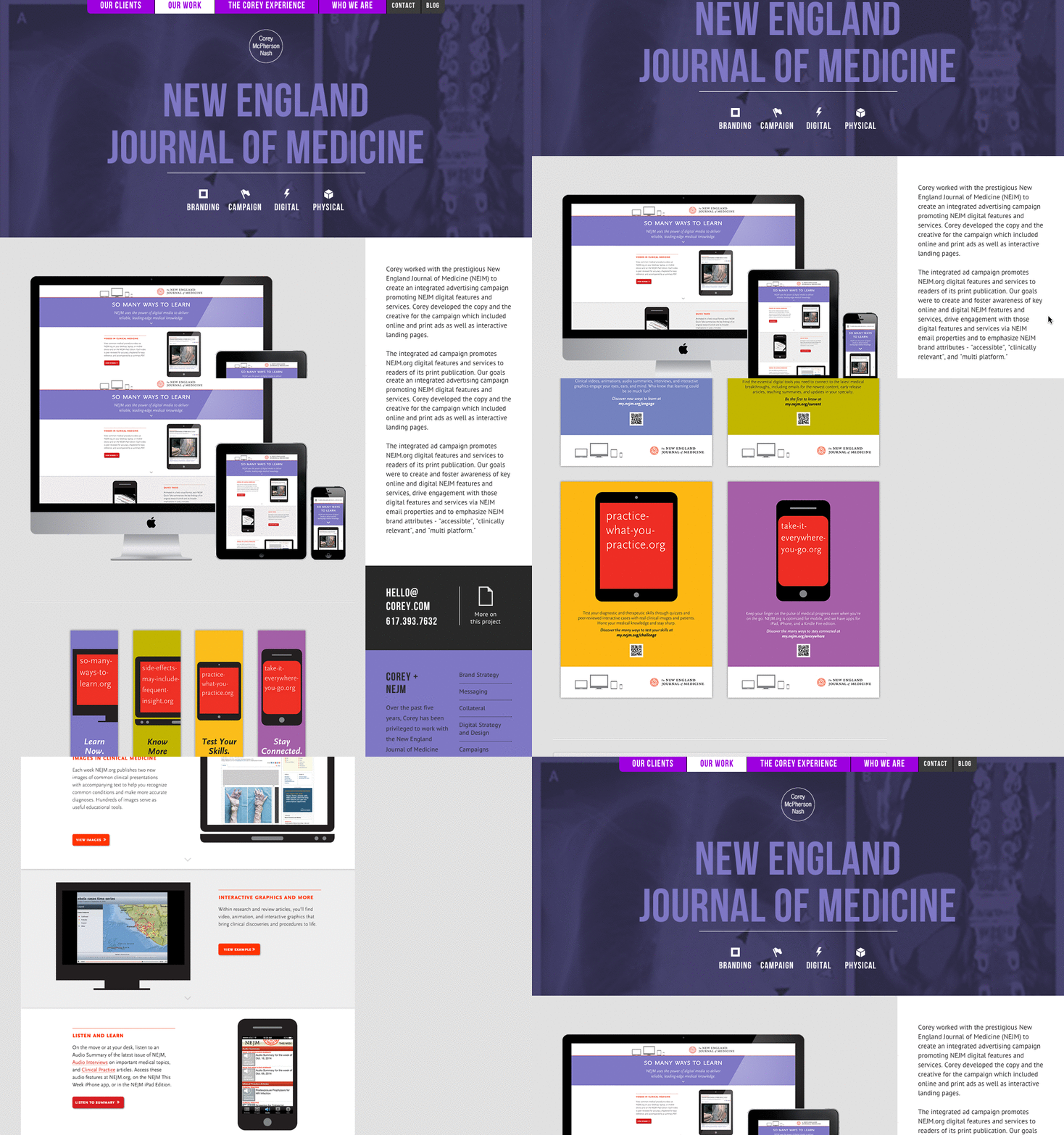
When branding and design studio Corey McPherson Nash showcases its work, it makes sense for it to be visual — after all, that’s what they do. So in building the case study for the studio’s work on the New England Journal of Medicine’s integrated advertising campaign — a project that included the goal of promoting the client’s digital presence — Corey McPherson Nash showed its audience what it did, rather than purely telling it.
Notice that the case study does include some light written copy — which includes the major points we’ve suggested — but really lets the visuals do the talking, allowing users to really absorb the studio’s services.
2. “Shopify Uses HubSpot CRM to Transform High Volume Sales Organization,” by HubSpot
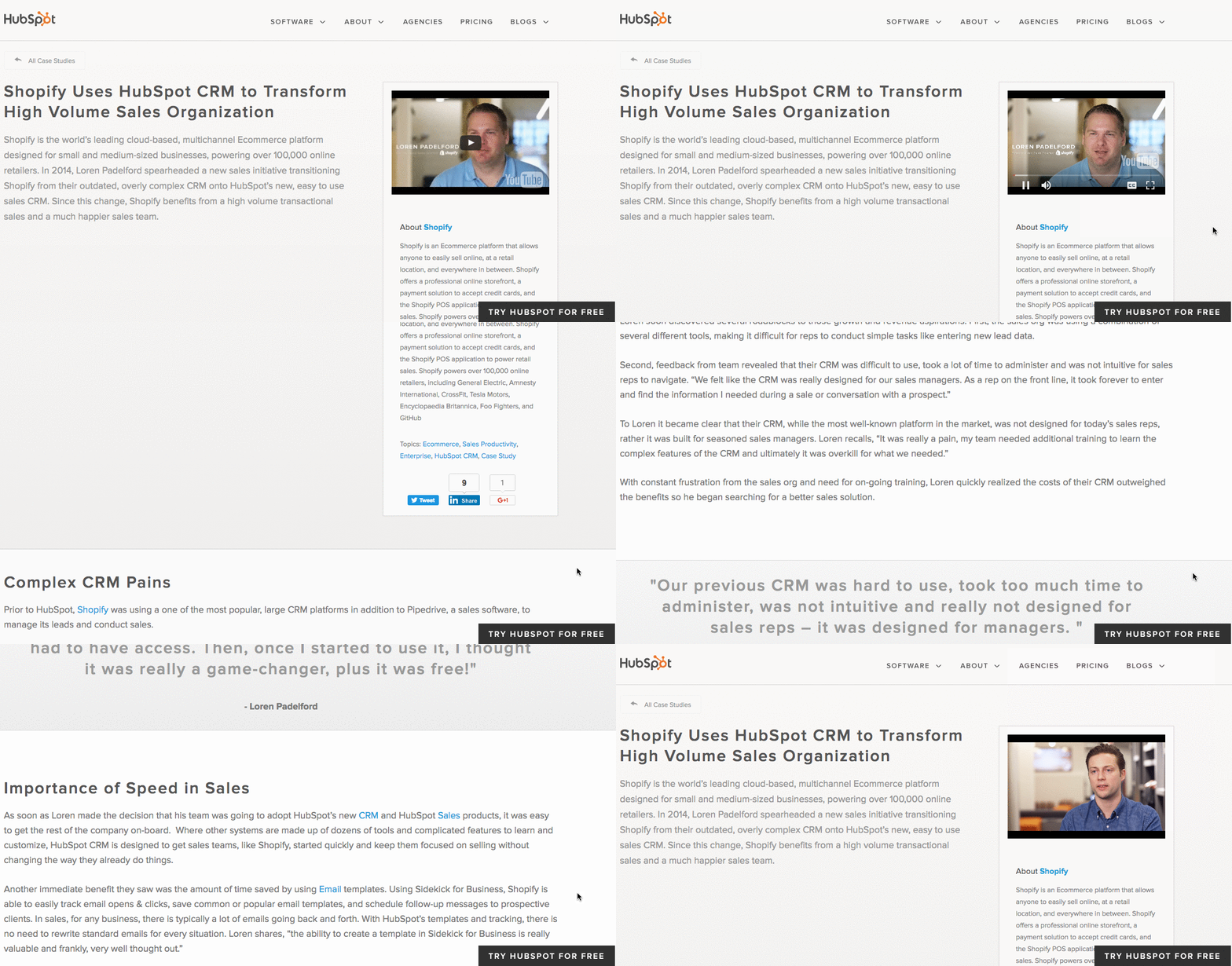
What’s interesting about this case study is the way it leads with the customer. This reflects a major HubSpot credo, which is to always solve for the customer first. The copy leads with a brief description of why Shopify uses HubSpot, and is accompanied by a short video and some basic statistics on the company.
Notice that this case study uses mixed-media. Yes, there is a short video, but it’s elaborated upon in the additional text on the page. So, while case studies can use one or the other, don’t be afraid to combine written copy with visuals to emphasize the project’s success.
3. “Designing the Future of Urban Farming,” by IDEO

Here’s a design company that knows how to lead with simplicity in its case studies. As soon as the visitor arrives at the page, he or she is greeted with a big, bold photo, and two very simple columns of text — “The Challenge” and “The Outcome.”
Immediately, IDEO has communicated two of the case study’s major pillars. And while that’s great — the company created a solution for vertical farming startup INFARM’s challenge — it doesn’t stop there. As the user scrolls down, those pillars are elaborated upon with comprehensive (but not overwhelming) copy that outlines what that process looked like, replete with quotes and additional visuals.
4. “Secure Wi-Fi Wins Big for Tournament,” by WatchGuard
Then, there are the cases when visuals can tell almost the entire story — when executed correctly. Network security provider WatchGuard is able to do that through this video, which tells the story of how its services enhanced the attendee and vendor experience at the Windmill Ultimate Frisbee tournament.
5. Rock and Roll Hall of Fame Boosts Social Media Engagement and Brand Awareness with HubSpot
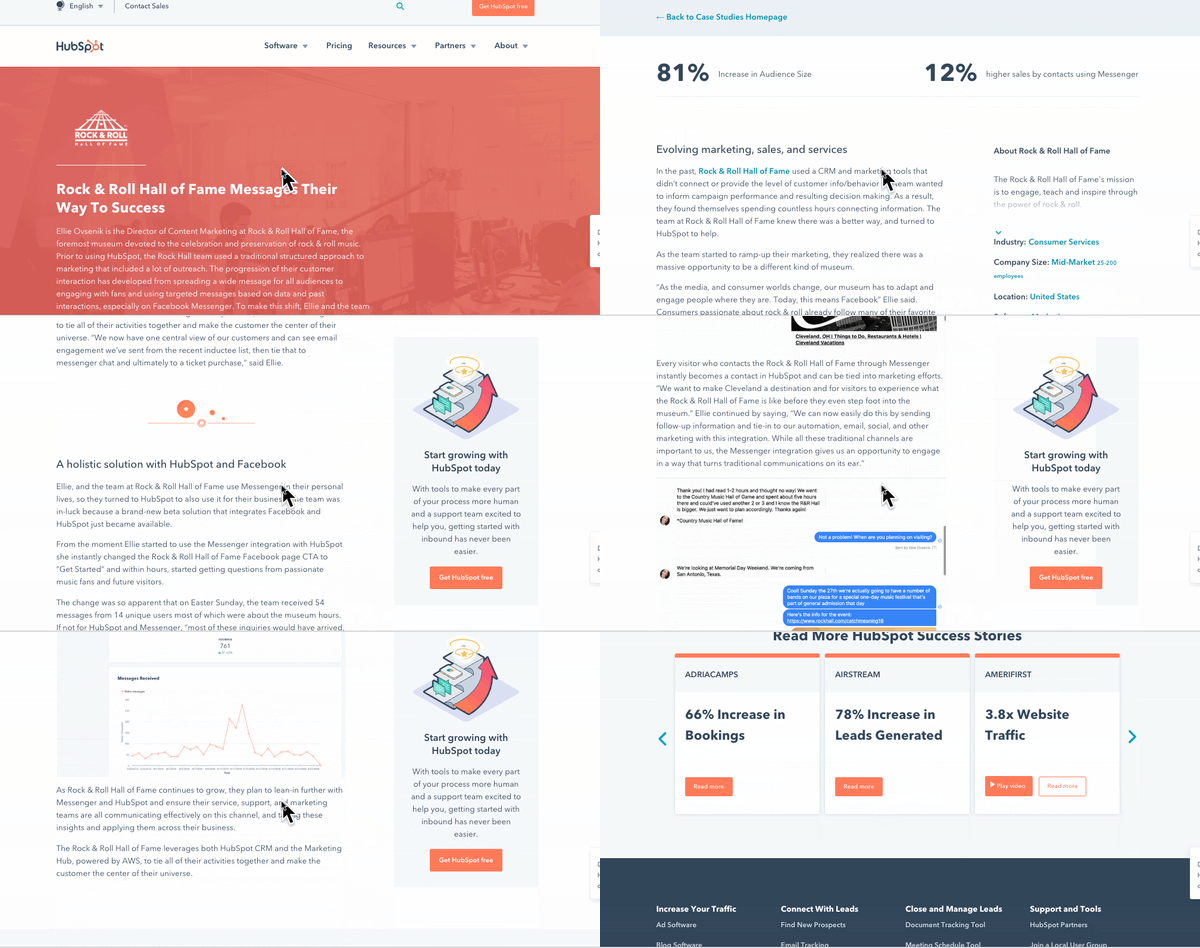 In the case study above, HubSpot uses photos, videos, screenshots, and helpful stats to tell the story of how the Rock and Roll Hall of Fame used the bot, CRM, and social media tools to gain brand awareness.
6. Small Desk Plant Business Ups Sales by 30% With Trello
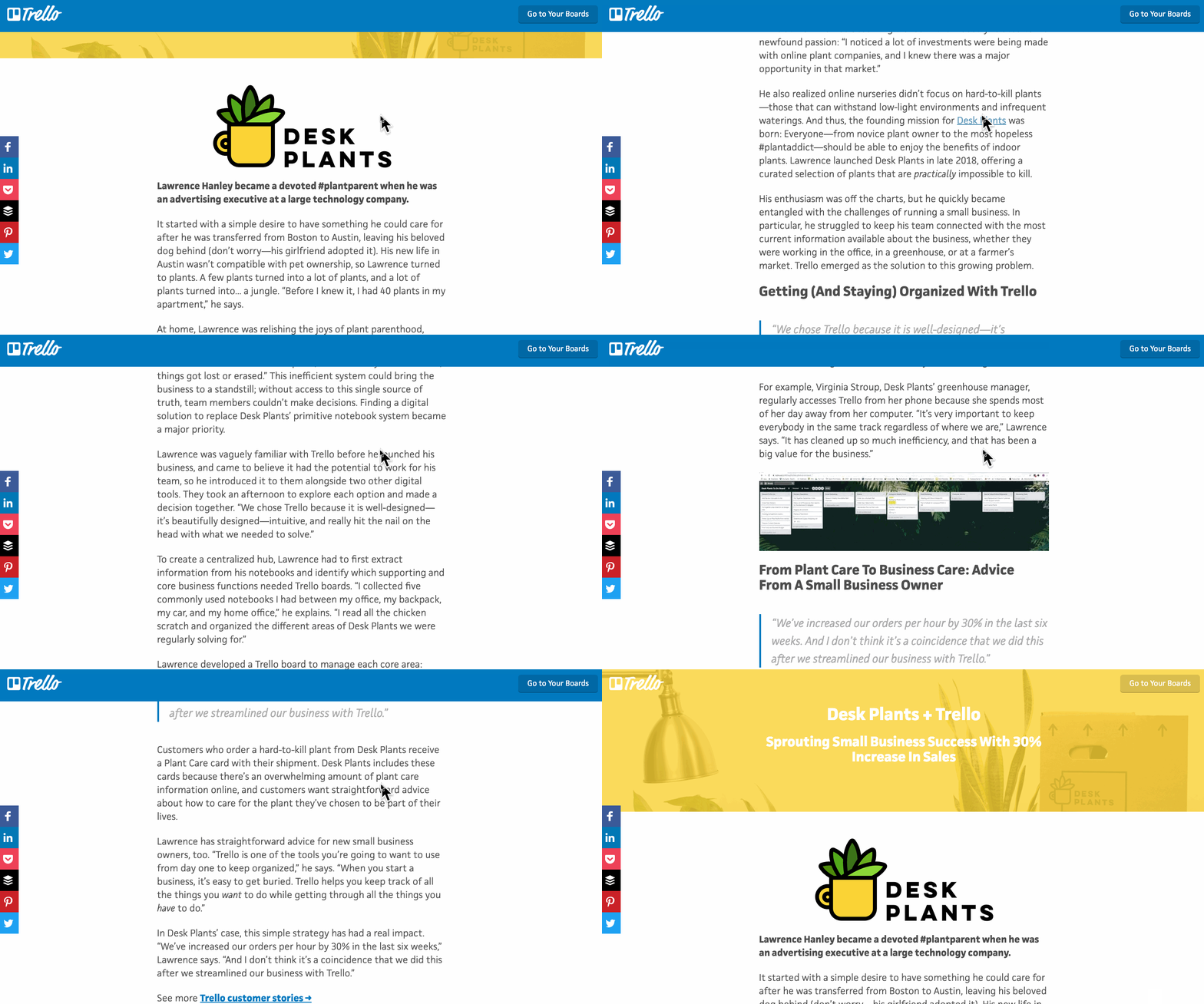
This case study from Trello is straight forward and easy to understand. It begins by explaining the background of the company that decided to use it, what their goals were, and how they planned to use Trello to help them.
It then goes on to discuss how the software was implemented and what tasks and teams benefited from it. Towards the end, it explains the sales results that came from implementing the software and includes quotes from decision-makers at the company that implemented it.
7. Facebook’s Mercedes Benz Success Story
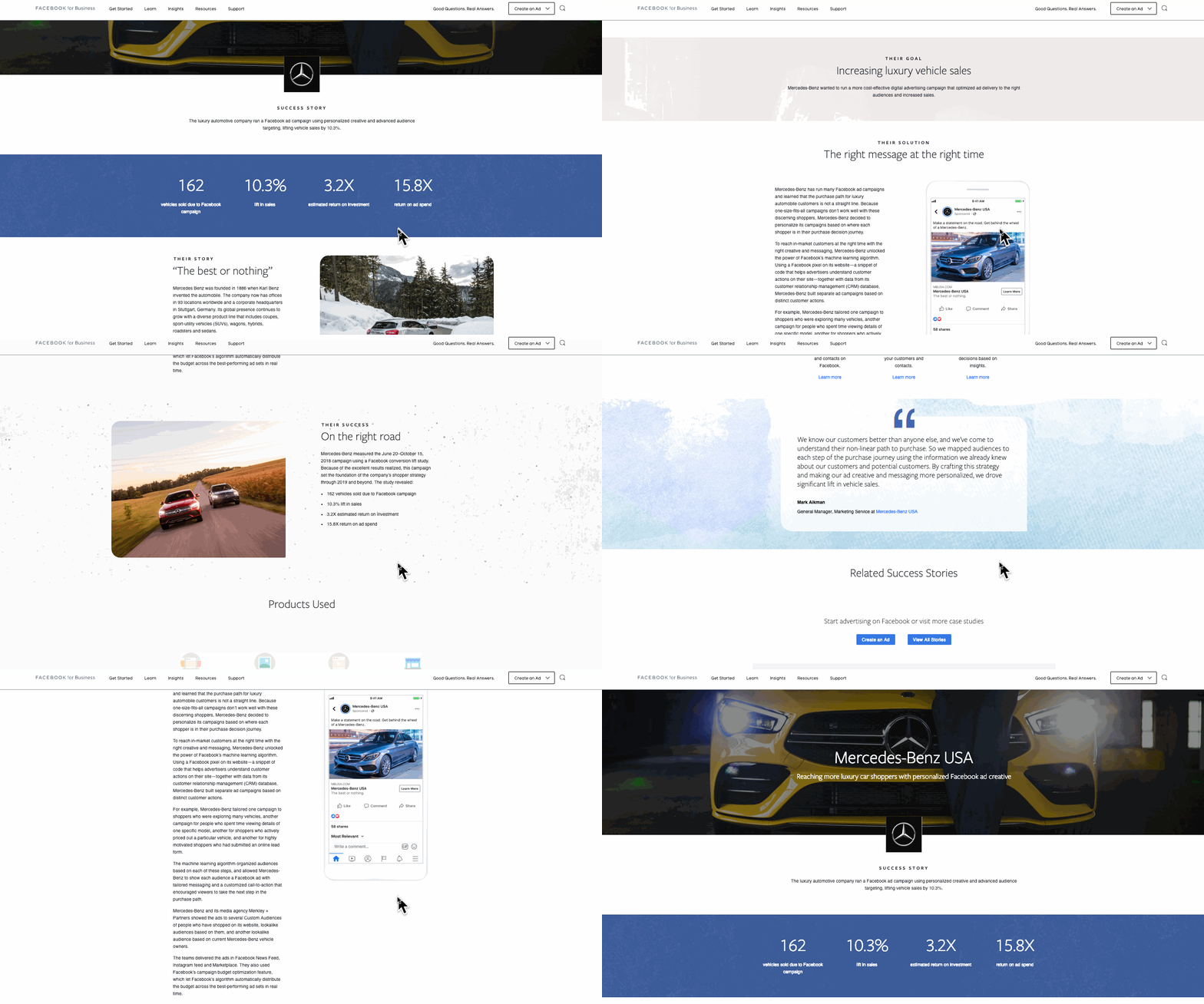
Facebook’s Success Stories page hosts a number of well-designed and easy-to-understand case studies that visually and editorially get to the bottom line quickly.
Each study begins with key stats that draw the reader in. Then it’s organized by highlighting a problem or goal in the introduction, the process the company took to reach their goals, and the results. Then, at the end, Facebook notes the tools used in the case study.
Showcasing Your Work
You work hard at what you do. Now, it’s time to show it to the world — and, perhaps more important, to potential customers.
But before you show off the projects that make you the proudest, make sure you follow the important steps that will help ensure that work is effectively communicated, and leaves all parties feeling good about it.
Want to learn as you write your case study? Listen to an audio summary of this post below.
For an easy way to get started, grab your free case study template below, and go create a case study that makes your subject proud of their success.
Editor’s Note: This blog post was originally published in February 2017 but was updated for comprehensiveness and freshness in February 2020.

How to Repost on Instagram: 4 Ways to Reshare Content From Other Users
Most social media feeds are almost distractingly busy — full of photos, videos, and text updates from friends and brands you follow. Instagram is different — you can only look at one post at a time.
And while Instagram’s simple, clean interface makes to easy to focus on users’ beautiful photography and interesting videos, it also leaves something to be desired: the ability to easily repost other users’ content.
But fear not: for every problem, the internet has afforded a solution. We tested out four different ways to repost content on Instagram in a few simple steps. All of these methods are free, but some require you to download an app from the iOS App Store or Google Play first.
Disclaimer: Pursuant to Instagram’s Terms of Use, you must first reach out to the Instagram user whose content you want to reproduce and obtain written permission to do so. You can do this by commenting on the image and asking, or by sending them an Instagram Direct Message, which can be accessed by tapping the paper airplane icon in the upper right-hand corner of the app.
How to Repost on Instagram
To repost someone else’s Instagram post, you first have to obtain that person’s permission to re-use their content. Then, you can use an external app such as Repost for Instagram, Instarepost, or DownloadGram. You can also take a screenshot of the photo with your mobile device.
Using Repost for Instagram
1. Download Repost for Instagram.
Download Repost for Instagram for either iOS or Android. Both devices are compatible with this app, which integrates directly with Instagram so you can share content from other Instagram users from your mobile device.
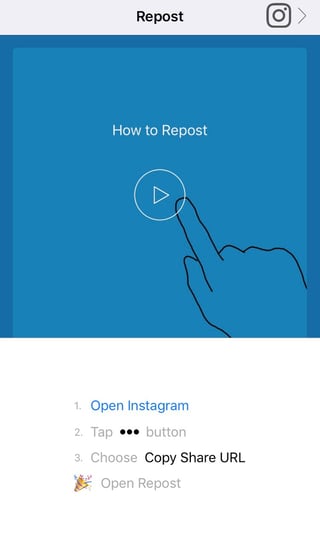
2. Identify a photo or video to repost.
Open your Instagram app and find a photo or video you’d like to repost from your own Instagram account. Tap your chosen photo from the original poster’s photo gallery to see its full view, as shown below.

(Psst — do you follow HubSpot on Instagram?)
3. Copy the post’s share URL to your clipboard.
Once you’re on the photo’s or video’s landing page, tap the “…” icon in the upper-righthand corner of the post. Then, tap “Copy Share URL” (the button will look the same on Android devices).
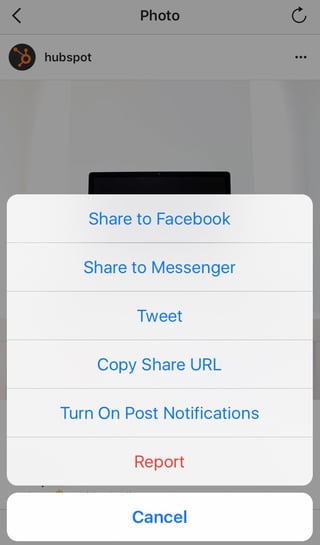
4. Open Repost for Instagram.
Once the photo is copied to your phone’s clipboard, open Repost for Instagram. The post you copied will automatically be on the app’s homepage, as shown below.

Tap the arrow on the righthand side of the post. There, you can edit how you want the repost icon to appear on Instagram.

Tap “Repost.” Then, tap “Copy to Instagram,” where you can add a filter and edit the post.


5. Edit the post’s caption and share your repost.
Tap “Next.” If you want to include the original post’s caption, tap the caption field and press “Paste,” where the original caption will appear with a citation that credits the original poster with your reposted photo.

When you’re ready to share the post, tap “Share” as you would a regular Instagram post. Here’s how the post appears on your Instagram profile:

Using InstaRepost
1. Download InstaRepost.
Download InstaRepost for iOS or Android devices to share content from other Instagram users from your own Instagram account via your mobile device.
2. Give InstaRepost access to your Instagram account.
Open InstaRepost, log in using your Instagram credentials, and authorize it to access photos, friends, and similar content associated with your Instagram account.
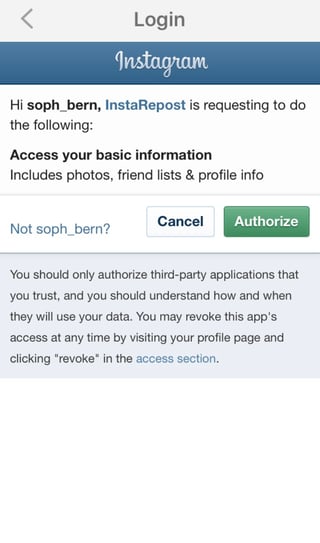
3. Use InstaRepost to look up the original poster’s username.
InstaRepost will only show you a small selection from your Instagram feed. If you know what post you’re looking for, tap the magnifying glass icon on the bottom toolbar of the InstaRepost app to access the Explore tab. Enter the username of the person whose photo you want to repost.
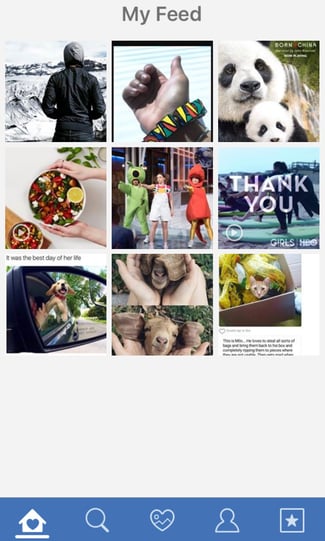
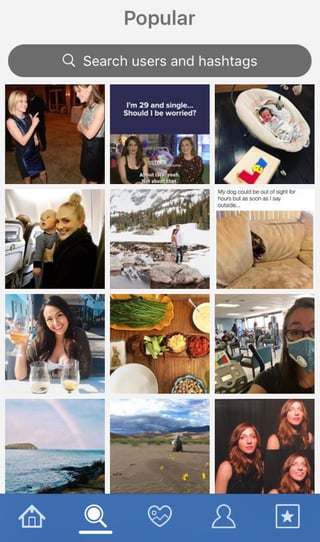
4. Save the photo to your phone’s camera roll.
Once you’ve found a post you want to reshare, tap the arrow in the lower righthand corner. Then, tap “Repost,” then “Repost” again. This will first save the photo your mobile device’s native camera roll, where you can retrieve it in the Instagram app.



Navigate to your Instagram app and tap “Library.” You’ll see the post saved to your phone’s camera roll. Tap the photo to pull it into Instagram.

5. Add a filter and a citation, and share your repost.
Add a filter and edit the post as you would any other. Then, select “Next” and tap the caption field to paste the original caption. The repost won’t automatically include a citation, so we suggest adding one by typing “@ + [username]” to credit the content’s original poster. Then, press “Share.”

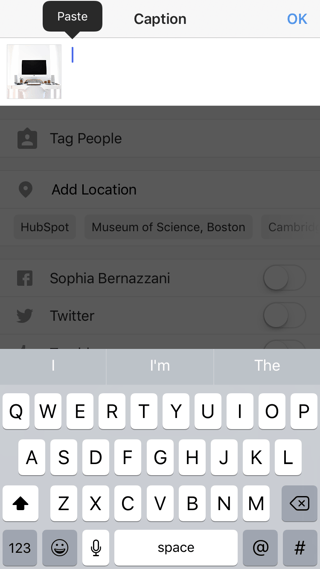
Here’s how the post appears on your Instagram profile:

Using DownloadGram
DownloadGram lets Instagram users download high-resolution copies of Instagram photos and videos to repost from their own accounts. Luckily, there isn’t an app you need to download to repost using this process. Here’s how to do it:
1. Open Instagram and find a photo or video to repost.
Open your Instagram app and find the post you want to repost. Tap the “…” icon in the upper righthand corner of the post and click “Copy Share URL” (this button will be the same for both iOS and Android mobile devices).

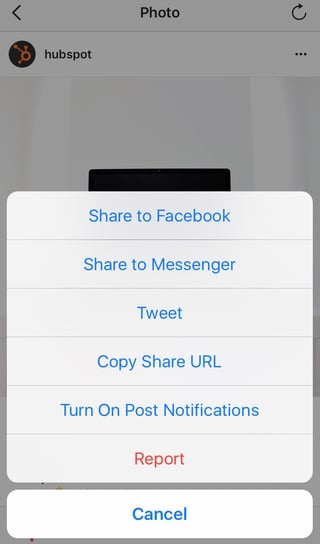
2. Paste the post’s share URL into DownloadGram.
Open your mobile internet browser and navigate to DownloadGram — or simply, downloadgram.com. Paste the URL into the text box that appears on the website’s homepage. Then, tap “Download.”
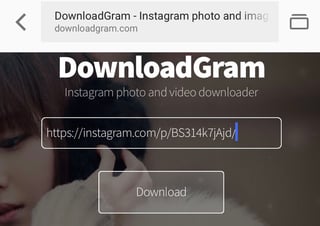
Tap the green “Download Image” button that appears further down DownloadGram’s homepage.

3. Download the post.
You’ll be directed to a new webpage with the content ready to download. Tap the download icon — the box with an upward-facing arrow, as shown below — then tap “Save image.”

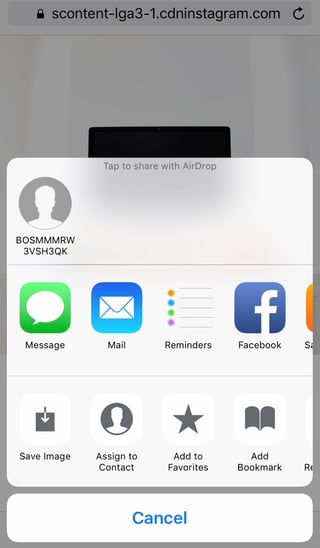
4. Open Instagram and find the photo or video in your camera roll.
Return to your Instagram app. The image will be saved to your phone’s native camera roll, so edit it as you would any other Instagram post.

5. Add a caption and share your repost.
The repost won’t include a citation, so we suggest adding one by typing “@ + [username]” to credit the original poster with the photo or video. Then, press “Share.” Here’s how the post appears on your Instagram profile:

Taking a Screenshot
This method doesn’t require any or other websites to repost on Instagram. It’s worth nothing that this method only works for reposting photos, not videos. Here’s how to do it:
Find a photo on Instagram you’d like to repost, and take a screenshot with your phone.
- For iOS: Press down on the home and lock buttons simultaneously until your screen flashes.
- For Android: Press down on the sleep/wake and volume down buttons simultaneously until your screen flashes.
Tap the new post button in the bottom-center of your Instagram screen. Resize the photo so it’s properly cropped in the Instagram photo editor.

Edit and filter the post like you would any other Instagram post. Keep in mind that your phone will take a screenshot of everything on your screen, not just the photo you want to repost. So, be prepared to crop the sides of the screenshot to capture just the image you want to share with your followers.

The repost won’t include a citation, so we suggest adding one by typing “@ + [username]” to credit the original poster with the photo you’re reposting. Then, press “Share.” Here’s how the post appears on your Instagram profile:

Now that you’ve learned how to repost on Instagram, you can diversify your profile with content sourced from friends, family, and brands. Use the methods above — being sure to cite the source of the original post — to quickly and easily reshare your favorite content.
Looking for more ideas for sourcing and creating Instagram content for your brand? Download our free guide to using Instagram for business here.

The 8 Most Common Leadership Styles & How to Find Your Own
“A good leader should always … “
How you finish that sentence could reveal a lot about your leadership style.
Leadership is a fluid practice. We’re always changing and improving the way in which we help our direct reports and the company grow. And the longer we lead, the more likely we’ll change the way we choose to complete the sentence above.
But in order to become better leaders tomorrow, we need to know where we stand today. To help you understand the impact each type of leader has on a company, I’ll explain eight of the most common types of leadership styles in play today and how effective they are.
Then, I’ll show you a leadership style assessment based on this post’s opening sentence to help you figure out which leader you are.
1. Democratic Leadership
Commonly Effective
Democratic leadership is exactly what it sounds like — the leader makes decisions based on the input of each team member. Although he or she makes the final call, each employee has an equal say on a project’s direction.
Democratic leadership is one of the most effective leadership styles because it allows lower-level employees to exercise authority they’ll need to use wisely in future positions they might hold. It also resembles how decisions can be made in company board meetings.
For example, in a company board meeting, a democratic leader might give the team a few decision-related options. They could then open a discussion about each option. After a discussion, this leader might take the board’s thoughts and feedback into consideration, or they might open this decision up to a vote.
2. Autocratic Leadership
Rarely Effective
Autocratic leadership is the inverse of democratic leadership. In this leadership style, the leader makes decisions without taking input from anyone who reports to them. Employees are neither considered nor consulted prior to a direction, and are expected to adhere to the decision at a time and pace stipulated by the leader.
An example of this could be when a manager changes the hours of work shifts for multiple employees without consulting anyone — especially the effected employees.
Frankly, this leadership style stinks. Most organizations today can’t sustain such a hegemonic culture without losing employees. It’s best to keep leadership more open to the intellect and perspective of the rest of the team.
3. Laissez-Faire Leadership
Sometimes Effective
If you remember your high-school French, you’ll accurately assume that laissez-faire leadership is the least intrusive form of leadership. The French term “laissez faire” literally translates to “let them do,” and leaders who embrace it afford nearly all authority to their employees.
In a young startup, for example, you might see a laissez-faire company founder who makes no major office policies around work hours or deadlines. They might put full trust into their employees while they focus on the overall workings of running the company.
Although laissez-faire leadership can empower employees by trusting them to work however they’d like, it can limit their development and overlook critical company growth opportunities. Therefore, it’s important that this leadership style is kept in check.
4. Strategic Leadership
Commonly Effective
Strategic leaders sit at the intersection between a company’s main operations and its growth opportunities. He or she accepts the burden of executive interests while ensuring that current working conditions remain stable for everyone else.
This is a desirable leadership style in many companies because strategic thinking supports multiple types of employees at once. However, leaders who operate this way can set a dangerous precedent with respect to how many people they can support at once, and what the best direction for the company really is if everyone is getting their way at all times.
5. Transformational Leadership
Sometimes Effective
Transformational leadership is always “transforming” and improving upon the company’s conventions. Employees might have a basic set of tasks and goals that they complete every week or month, but the leader is constantly pushing them outside of their comfort zone.
When starting a job with this type of leader, all employees might get a list of goals to reach, as well as deadlines for reaching them. While the goals might seem simple at first, this manager might pick up the pace of deadlines or give you more and more challenging goals as you grow with the company.
This is a highly encouraged form of leadership among growth-minded companies because it motivates employees to see what they’re capable of. But transformational leaders can risk losing sight of everyone’s individual learning curves if direct reports don’t receive the right coaching to guide them through new responsibilities.
6. Transactional Leadership
Sometimes Effective
Transactional leaders are fairly common today. These managers reward their employees for precisely the work they do. A marketing team that receives a scheduled bonus for helping generate a certain number of leads by the end of the quarter is a common example of transactional leadership.
When starting a job with a transactional boss, you might receive an incentive plan that motivates you to quickly master your regular job duties. For example, if you work in marketing, you might receive a bonus for sending 10 marketing emails. On the other hand, a transformational leader might only offer you a bonus if your work results in a large amount of newsletter subscriptions.
Transactional leadership helps establish roles and responsibilities for each employee, but it can also encourage bare-minimum work if employees know how much their effort is worth all the time. This leadership style can use incentive programs to motivate employees, but they should be consistent with the company’s goals and used in addition to unscheduled gestures of appreciation.
7. Coach-Style Leadership
Commonly Effective
Similarly to a sports team’s coach, this leader focuses on identifying and nurturing the individual strengths of each member on his or her team. They also focus on strategies that will enable their team work better together. This style offers strong similarities to strategic and democratic leadership, but puts more emphasis on the growth and success of individual employees.
Rather than forcing all employees to focus on similar skills and goals, this leader might build a team where each employee has an expertise or skillset in something different. In the longrun, this leader focuses on creating strong teams that can communicate well and embrace each other’s unique skillsets in order to get work done.
A manager with this leadership style might help employees improve on their strengths by giving them new tasks to try, offering them guidance, or meeting to discuss constructive feedback. They might also encourage one or more team members to expand on their strengths by learning new skills from other teammates.
8. Bureaucratic Leadership
Rarely Effective
Bureaucratic leaders go by the books. This style of leadership might listen and consider the input of employees — unlike autocratic leadership — but the leader tends to reject an employee’s input if it conflicts with company policy or past practices.
You may run into a bureaucratic leader at a larger, older, or traditional company. At these companies, when a colleague or employee proposes a strong strategy that seems new or non-traditional, bureaucratic leaders may reject it. Their resistance might be because the company has already been successful with current processes and trying something new could waste time or resources if it doesn’t work.
Employees under this leadership style might not feel as controlled as they would under autocratic leadership, but there is still a lack of freedom in how much people are able to do in their roles. This can quickly shut down innovation, and is definitely not encouraged for companies who are chasing ambitious goals and quick growth.
Leadership Style Assessment
Leaders can carry a mix of the above leadership styles depending on their industry and the obstacles they face. At the root of these styles, according to leadership experts Bill Torbert and David Rooke, are what are called “action logics.”
These action logics assess “how [leaders] interpret their surroundings and react when their power or safety is challenged.”
That’s the idea behind a popular management survey tool called the Leadership Development Profile. Created by professor Torbert and psychologist Susanne Cook-Greuter — and featured in the book, Personal and Organizational Transformations — the survey relies on a set of 36 open-ended sentence completion tasks to help researchers better understand how leaders develop and grow.
Below, we’ve outlined six action logics using open-ended sentences that help describe each one. See how much you agree with each sentence and, at the bottom, find out which leadership style you uphold based on the action logics you most agreed with.
1. Individualist
The individualist, according to Rooke and Tolbert, is self-aware, creative, and primarily focused on their own actions and development as opposed to overall organizational performance. This action logic is exceptionally driven by the desire to exceed personal goals and constantly improve their skills.
Here are some things an individualist might say:
I1. “A good leader should always trust their own intuition over established organizational processes.”
I2. “It’s important to be able to relate to others so I can easily communicate complex ideas to them.”
I3. “I’m more comfortable with progress than sustained success.”
2. Strategist
Strategists are acutely aware of the environments in which they operate. They have a deep understanding of the structures and processes that make their businesses tick, but they’re also able to consider these frameworks critically and evaluate what could be improved.
Here are some things a strategist might say:
S1. “A good leader should always be able to build a consensus in divided groups.”
S2. “It’s important to help develop the organization as a whole, as well as the growth and individual achievements of my direct reports.”
S3. “Conflict is inevitable, but I’m knowledgeable enough about my team’s personal and professional relationships to handle the friction.”
3. Alchemist
Rooke and Tolbert describe this charismatic action logic as the most highly evolved and effective at managing organizational change. What distinguishes alchemists from other action logics is their unique ability to see the big picture in everything, but also fully understand the need to take details seriously. Under an alchemist leader, no department or employee is overlooked.
Here are some things an alchemist might say:
A1. “A good leader helps their employees reach their highest potential, and possesses the necessary empathy and moral awareness to get there.”
A2. “It’s important to make a profound and positive impact on whatever I’m working on.”
A3. “I have a unique ability to balance short-term needs and long-term goals.”
4. Opportunist
Opportunist are guided by a certain level of mistrust of others, relying on a facade of control to keep their employees in line. “Opportunists tend to regard their bad behavior as legitimate in the cut and thrust of an eye-for-an-eye world,” Rooke and Tolbert write.
Here are some things an opportunist might say:
O1. “A good leader should always view others as potential competition to be bested, even if it’s at the expense of their professional development.”
O2. “I reserve the right to reject the input of those who question or criticize my ideas.”
5. Diplomat
Unlike the opportunist, the diplomat isn’t concerned with competition or assuming control over situations. Instead, this action logic seeks to cause minimal impact on their organization by conforming to existing norms and completing their daily tasks with as little friction as possible.
Here are some things a diplomat might say:
D1. “A good leader should always resist change since it risks causing instability among their direct reports.”
D2. “It’s important to provide the ‘social glue’ in team situations, safely away from conflict.”
D3. “I tend to thrive in more team-oriented or supporting leadership roles.”
6. Expert
The expert is a pro in their given field, constantly striving to perfect their knowledge of a subject and perform to meet their own high expectations. Rooke and Tolbert describe the expert as a talented individual contributor and a source of knowledge for the team. But this action logic does lack something central to many good leaders: emotional intelligence.
Here are some things a diplomat might say:
E1. “A good leader should prioritize their own pursuit of knowledge over the needs of the organization and their direct reports.”
E2. “When problem solving with others in the company, my opinion tends to be the correct one.”
Which Leader Are You?
So, which action logics above felt like you? Think about each sentence for a moment … now, check out which of the seven leadership styles you embrace on the right based on the sentences you resonated with on the left.
| Action Logic Sentence | Leadership Style |
| S3 | Democratic |
| O1, O2, E1, E2 | Autocratic |
| D2, D3, E1 | Laissez-Faire |
| S1, S2, A3 | Strategic |
| I1, I2, I3, A1, A2 | Transformational |
| D3 | Transactional |
| D1 | Bureaucratic |
The more action logics you agreed with, the more likely you practice a mix of leadership styles.
For example, if you agreed with everything the strategist said — denoted S1, S2, and S3 — this would make you a 66% strategic leader and 33% democratic leader. If you agreed with just S3, but also everything the alchemist said, this would make you a 50% transformational, 25% strategic, and 25% democratic leader.
Keep in mind that these action logics are considered developmental stages, not fixed attributes — most leaders will progress through multiple types of leadership throughout their careers.

4 Marketing AI Predictions for 2020, According to Experts
According to Gartner, 80% of technology will be built on an AI foundation by 2021.
As AI becomes more prominent across industries, it’s also impacting marketers in subtle ways that might not be obvious to them yet.
While this technology was once described as “over-hyped,” marketers now use a handful of AI-powered tools in their day-to-day tasks.
For example, AI tools help content strategists define SEO and keyword strategies, perform SEO-related tasks like fixing duplicate content, and self-optimize mobile pages.
Aside from SEO, AI can assist marketers in tasks like drafting email subject lines and creating basic social media content. Meanwhile, this technology also helps with important, but time-consuming tasks, like deduplicating contacts and recording market intelligence data on both customers and competitors.
And although the technology is still rather new, the list of tasks it can complete is steadily growing.
At that Marketing AI Institute, we track more than 1,500 AI companies with combined funding of more than $6 billion.
As the institute’s director, I’ve spent years studying the AI market while working with some of the brightest AI minds in marketing. Aside from researching and consulting on AI strategies, I’ve also used AI tools throughout my marketing career. Through these experiences, I’ve gained insights into the opportunities that AI could realistically provide for marketers now and in the near future.
While AI has already subtly crept into the day-to-day lives of many marketers, it’s likely to have even more of an impact on them in the future. According to McKinsey, AI is expected to have up to $2.6 trillion worth of business impact in sales and marketing alone.

Source: McKinsey
Despite all of the positivity around AI, many marketers are still might be skeptical about which technologies are actually useful, and which could turn out to be overpriced hype. After all, in the past, there have been a number of outlandish and inaccurate AI predictions or claims. These false statements — which many AI experts call “snake oil” — have made it hard to distinguish which AI facts are actually real and which are lies told to gain media attention.
To determine where the true opportunities lie with AI in this stage of its development, it’s important to do research to learn more about the tools and current strategies that other marketers are using. You’ll also want to look at research-backed trends to keep certain tactics on your radar in case they might be beneficial to you in the future.
To help you better understand where AI is going and how you could leverage it to build a competitive strategy in the future, I’ve used my research and professional experiences in the AI space to compile a list of four key trends to watch in the next year.
4 AI Predictions for 2020
1. Content marketers will have to adopt artificial intelligence.
No. Artificial intelligence can’t write compelling long-form content just yet. But, although bots aren’t able to create long narratives, books, scripts, or detailed online articles, AI can still streamline a number of content marketing tasks. According to Jeff Coyle, Co-Founder and Chief Product Officer of MarketMuse, this trend will only continue in 2020.
“This will be the year that brands begin to seriously use artificial intelligence to build a competitive advantage,” says Coyle. “Right now, many companies are still exploring AI and its potential. But the technology is already having a huge impact on content marketing.”
“The brands using AI tools are already seeing outsized benefits, like huge traffic gains and better search rankings,” Coyle adds.
While AI tools help marketers in drafting light content such as social media updates, online ad content, and email subject lines, Coyle says that many companies are using AI to analyze thousands of ranking opportunities in seconds, identify gaps in their strategies, and create content that skyrockets search traffic.
As a marketing professional who’s done much research on the topic of AI, I believe him. In our own report on the top 25 AI use cases marketers value, analyzing existing content for gaps and opportunities tops the list.
We aren’t alone in thinking that AI tools will be vital to content marketing strategies. The Content Marketing Institute similarly says that text mining AI tools can help marketers by analyzing online content to identify keywords, phrases, and other variables that link to higher traffic. After an AI tool makes connections between topics and traffic, marketers can create a strategy that leverages those topics.
“In 2020, the market is going to wake up to the fact that if you’re not using AI to optimize your content marketing, you’re going to fall behind,” Coyle concludes.
2. Consumers are going to demand more personalization.
With 64% of consumers expecting personalized shopping experiences based on the interactions they’ve had with a brand, many marketers are taking notice.
In fact, when we talk to senior-level marketers at the Marketing AI Institute, they’re highly cognizant of the need to hyper-personalize content and experiences for consumers.
While it was once extremely hard to create these experiences with older marketing techniques and technology, AI has opened the door for more pin-pointed personalization opportunities.
Right now, AI is primarily used “to help us get tasks done,” says Nick Edouard, Chief Product Officer at PathFactory, an AI-powered B2B marketing platform.
While AI helps marketers “scale faster, write better, and find or mirror target audiences more easily,” Edouard says that he expects leaders in 2020 to say, “That’s great, but how can we use AI to enable our buyers? How can we use it to help them find what they need at every stage of the customer lifecycle? How do we make this about our customers and not just us as marketers?”
“These are increasingly important questions to ask, especially for B2B companies, as people already expect relevant, personalized, always-on experiences in every aspect of their lives,” says Edouard.
We’re already seeing heavy AI personalization in the marketing industry. For example, many tools allow brands to send marketing emails with names and personalized information in them based on contact list information. In retail, consumers regularly get emails or ecommerce site recommendations for certain products based on what they’ve already purchased.
But, personalization isn’t just a popular trend. It’s a revenue generator, A recent study from Monetate notes that 79% of retailers and 75% of general businesses report ROI from personalized marketing.
With evolving technology and our ability to capture data on prospects and customers, it’s not shocking to think that AI-based personalization trend will grow stronger in the near future. In 2020 specifically, expect AI to start being used more and more to create solid one-to-one personalization,
3. AI is going to continue to enable and help SEO strategists.
“AI is not only transforming how marketers take business impact to a whole new level. It’s also helping them elevate and advance their careers,” says Krish Kumar, COO and CRO at BrightEdge, maker of BrightEdge Autopilot, which uses AI to automate SEO tasks.
Kumar predicts that marketers are going to reap huge benefits from AI in the coming year, thanks to its ability to automate time-consuming SEO tasks.
“For example, this type of self-driving technology can automatically self-connect website pages, self-optimize mobile pages, and auto-fix duplicate content,” says Kumar.
One example of a company that’s majorly leveraging AI for SEO is Campbell’s. Kumar notes that the soup company uses AI-powered SEO automation to compress 75,000 images in a single day. This allows the brand to rank on page one of SERPs for 4,000 keywords within just a few weeks.
The best part?
AI is helping human SEO marketers, rather than making their jobs obsolete. At companies like Campbell’s, AI technology allows SEO experts to get results that aren’t possible without machines. Not having to worry about this mountain of SEO-related tasks frees them up to work on more intensive projects.
Because it is so beneficial to web traffic and results, expect the investment into AI-powered SEO tools to grow.
4. AI will fit more naturally into the daily lives of marketers.
While AI and automation have already yielded results, cut time out of marketers days, and streamlined a number of outdated processes, small to medium-sized businesses are still hesitant to use these technologies because they worry that working with them and getting up to speed on how each technology or tool works will be added work in itself.
However, as AI technology and tools evolve, they’re getting easier to access, providing smoother user experiences, and becoming a more natural fit into the every-day marketer’s life.
In 2020 and beyond, “The best AI-powered tools are going to interact with marketers in a way that feels more human,” says Bart Frischknecht, VP of product strategy a Vennli, an AI-powered content intelligence tool.
While many AI tools currently collect data and offer insights that the marketer then has to dive into, Frischknecht says that AI will eventually shift to just offering a marketer a list of improvement suggestions or solutions.
One area where we’re already seeing a shift in AI’s capabilities is PPC advertising. Some AI tools will just collect data about how a PPC ad is doing and provide predictive analytics to the marketer, who can then adjust the budget. However, other more advanced AI tools can now analyze how the ad is doing, offer marketers suggestions on how to prevent wasted spend, and then allow them to choose one of those solutions directly from a dashboard.
“It’s going to feel more human when AI automatically takes care of tasks so that marketers can focus on marketing, rather than on wrangling the tool,” says Frischknecht.
In 2020, expect AI-powered marketing tools to start becoming so natural to your work that you don’t even know they’re AI. As John McCarthy, one of the fathers of AI, once said, “As soon as it works, no one calls it AI anymore.”
Navigating AI in 2020 and Beyond
Want to make these predictions actionable? We recommend you take the following steps in 2020 to navigate AI in the new year.
- Understand the basics of AI. You don’t need to be a rocket scientist to understand AI and its impact, but you should develop foundational knowledge about AI in order to help you vet new opportunities. To get started, check out this glossary to find simple definitions of common AI terms.
- Start looking for use cases. When it’s time to start thinking about AI-based projects, you can use use-cases to see what’s already been done with the technology. To find the right use cases, you’ll need to evaluate all the tasks you do in a day, then assess which ones are valuable to automate with AI.
- Experiment. There are plenty of AI technologies you can start getting your hands dirty with, starting today, and experimentation is one of the best ways to develop your knowledge. Google’s free AI tools are a good place to start.
Want to take on all three tips at once? Artificial Intelligence and Machine Learning in Marketing: Live from MAICON, will teach you how to apply AI in marketing using a holistic framework and begin conversations around piloting AI in your business.

5 Facebook Video Stats You Need to Know in 2020 [Infographic]
Video marketing is now one of the core pillars of content strategy. It’s an incredibly powerful means of communicating your brands identity and values, while building rapport and more meaningful relationships with your customers and prospects.
Nowadays, marketers are seeking increasingly creative ways to leverage video to deliver memorable ad campaigns across multichannel platforms.
The latest data shows that the use of Facebook video is expanding at an unprecedented pace and scale — and, with it, the opportunities for video marketers.
The following is just a handful of Facebook video marketing statistics that are worth bearing in mind:
- There are 8 billion daily video views on the platform
- Users spend three times longer watching live videos than standard uploaded content
- 84% of marketers promote videos on Facebook
- Facebook Live is now used by 35% of video marketers
To learn more about Facebook video and how you might leverage it for your own marketing strategy in 2020, take a look at the infographic Ever Increasing Circles created, below: