
How Market Intelligence Will Make Your Marketing Team More Agile
When I was younger, my dream was to open a cheese store with my family. My mom, brother, sister, and I — we’re all obsessed with cheese.
So anytime I see a cheese store, I’ll go in and sample everything … for research, obviously.
Although I’d never thought about it this way before, I was already thinking in terms of market intelligence and market research (two different concepts … more on that below).
I was thinking about the product and the competitors.
As a marketer, market intelligence is important because it can help you understand your position in the market, evaluate your product, know your target audience, and conduct a competitor analysis.
With this information, your marketing team will be better equipped to position your company in the marketplace.
Below, let’s review what market intelligence is, how it’s different from market research, and marketing intelligence systems that can facilitate the process.
So, what’s the purpose of gathering market intelligence? To learn more about the customer and the competition so you can better market your own product or service.
For instance, companies can gather general demographics and spending habits of their consumers to write better, more targeted social media ads. Additionally, market intelligence can help a company make decisions on product development and establish a stronger brand.
So, what type of information should you collect? Generally, market intelligence can be divided into four main categories of information:
Competitor intelligence.
This is the process of learning more about your competitors. To do this, you might consider conducting a SWOT analysis, so you can look at the competition’s strengths and weaknesses. The goal is to uncover why customers choose competitors over your product or service.
Product intelligence.
Once you’ve analyzed how you compare to your competitors, you should look inward, at your own product or service. The goal is to learn about the quality and performance of your product or service. If you have a physical product, you should also analyze your manufacturing process. Are you building your product in the most efficient way? This information should help you improve the user experience and make your product better.
Market understanding.
To truly understand how your product is performing, you’ll have to look at the various markets where it’s available. Could you expand your product to other markets? Are there other markets that could benefit from your product or service? Ultimately, this information should help you understand where your audience is, so you can show up in those areas.
Customer understanding.
Understanding your customer is the key aspect of increasing the product life cycle of any product or service. That’s because it’s five times more expensive to acquire a new customer than to retain an existing one. For this reason (and many others), you have to know your audience. Why do your customers buy from you? What challenges does your team help them with? The goal here is to gather the information that can help your marketing team come up with targeted campaigns.
Overall, gathering market intelligence should answer questions like:
- Where should we devote more resources?
- What markets can we enter next?
- What are our customers purchasing patterns?
- What audiences should we market to?
Now, you might be wondering, “How do I gather this information?”
To conduct market intelligence, you’ll use internal and external sources of data such as:
- Surveys
- Polls
- Forms
- Focus groups
- Interviews
- Observation
- A/B tests
- Competitor tracking analytics
Depending on the analytics you have available, a lot of this information can be found on your CMS or CRM.
However, before we jump into the systems you can use to find this information, I know you’re probably thinking, “How is this different than market research?” Let’s dive into that below.
Alternatively to market intelligence, market research focuses on learning more about the buyer’s research process and what influences their decisions to buy.
Now, back to market intelligence. You’re probably wondering, “What tools can I use to gather this information?” Below, let’s review what marketing intelligence systems you can use.
Marketing Intelligence System
For market intelligence to be useful, companies need to gather accurate data. However, that can be a lot to take on for a marketing team.
That’s why there are online tools you can use to gather this data. Below are a few we recommend, divided into sections depending on your goals. Additionally, if you’re a HubSpot user, many of these tools integrate with HubSpot.
Competitor Intelligence
Product Intelligence
Customer Understanding
I’m not being hyperbolic when I say market intelligence is vital for your company to succeed. Collecting market intelligence can help your team track competitors more efficiently in your marketing stack. Additionally, market intelligence can be used to give you a holistic view of the market, improve customer retention, boost your efficiency, and give you a competitive advantage.

What’s The Best Time to Send Email Campaigns? (Research-Backed)
Consider this: you spend months creating a campaign to promote a new product launch, but once you’ve executed the campaign, you’re noticing numbers are lower than you expected. People are looking at the blog posts and videos you posted on social, but unfortunately, there’s almost no traffic from email.
Timing isn’t everything in email campaigns, but it’s a huge thing. There’s no use in spending hours on a perfect campaign your subscribers won’t open. So, it’s imperative to get timing as right as possible.
Undeniably, having a high ROI is critical for proving the success of your email marketing campaign. But, while the quality of content and a myriad of other factors contribute to a good email campaign, there’s one factor that makes or breaks it, and that’s the time you send your email.

To illustrate this, think about when you typically check your emails and open campaigns. For me, I check my emails twice before 10 a.m. Once when I wake up, and once when I get to work.
By looking through the timestamps of my email subscriptions, I saw that out of 25 marketing-related emails, 23 of them were sent between 8-9:30 a.m., when I typically open them. As a marketer, this information keeps pretty consistent with prior research.
For instance, Wordstream found that sending email campaigns before 10:30 on Thursdays yields 25% CTR, as opposed to Tuesdays at the same time, which earns a 5% CTR.
Similarly, Optinmonster found that the best day to send a promotional email, such as a newsletter, is on Thursday, while Wednesdays are great for engagement. What this suggests is that campaign emails will be opened more frequently on Thursdays, while emails with videos or blog posts see interaction the most on Wednesdays.
If your campaign involves daily emails, here’s a suggestion for a weekly schedule:
- Monday — Use this day to promote content outside of your campaign, like boosting a product stack that’s related to your upcoming campaign.
- Tuesday — For Tuesday’s email, tease your campaign, give readers a quick video or an announcement, and prepare them for more details for the following day.
- Wednesday — This is the big day for launching the campaign, so put your best email forward on this day, where you’ll find the most opens.
- Thursday — Choose this day to push interactive email content, like a case study video, product demo, or specs involving your campaign.
- Friday — For a Friday email, choose something that readers will find fun, such as social media hype over the new campaign or a “Here’s what you missed” round-up of the week.
Ultimately, the two things to keep in mind when sending email campaigns is to align them to your target audience’s routines and track analytics to collect research for next time. Ideally, you can’t have one without the other.
Without tracking email marketing analytics, you won’t know the routine of your target audience as it pertains to when they check and engage with your emails. Once you have a better understanding of their morning email routines, you can modify your campaigns to suit their needs.
To track email analytics, the easiest way is to look into software that does that for you. HubSpot offers email marketing software that provides you with analytics you can use to make informed future decisions.
Remember that every campaign is a learning opportunity, and the right tools enable you with the software you need to improve every campaign.

How to Market A Product to Wow Customers
Product launches are an exciting time for marketers.
Unveiling to the world the new campaign you’ve created just for that specific launch can be a relief.
Let’s say you’ve developed a great product, know your target audience, and could tell anyone you know about it because you know it so well. The only thing left to do is to figure out how to market it.
This can be challenging for a few reasons. Maybe this is your first launch ever, and you’re completely lost about how to bring marketing messages to email inboxes or social media profiles.
Alternatively, maybe you’re no stranger to product launches, but this product, in particular, is becoming more difficult to promote.
You most likely know the basics of marketing a product: know your audience, execute a social media campaign. Here are a few more ideas to get the ball rolling.
1. Experiment with messaging
If you plan to release a series of products under your brand, don’t be afraid to play around with names. Let’s reference all of the streaming services that are coming out. A lot are extensions of the brand name, but they still have relevance within and among the brand.
Disney+, HBO GO, even YouTube TV. All of these services stuck to their brand and it worked for them. However, NBC’s service, Peacock, is a little bit different.
The name sticks out. It’s not just an extension of the network, but a call to the rainbow peacock in the brand’s logo. This idea, while interesting, is highly experimental and still has brand relevance.
While playing with names can be a risk, it makes you stick out among the competition among a saturated market. Think about how you can differentiate your social media usage so it’s specific to your launch, or if you can create content offers that directly support your campaign.
2. Stick within your industry
Naturally, businesses that get bigger expand their range of products and services. For instance, a beauty company that starts off selling lipstick on Instagram, after growth, can start selling products for the entire face.
Similarly, a marketing company that starts out selling one product, like an automated email service, could eventually expand into then releasing automated marketing software across multiple fronts.
When releasing a product, think about future product stacks. What will that look like? Sticking within your industry is most likely ideal, so you don’t end up with a launch similar to Life Savers Soda, an idea that was too far from Life Savers’ original candy brand to work.
3. Tell a story
One of the sure-fire ways to market a product successfully is to tell a story. Stories get the emotional side of consumers, and, when done successfully, can be something they relate to.
When you think of the last time you felt something while seeing an ad, you can probably instantly recall what you felt and what ad it was. Stories, like the famous Coke commercial, make consumers remember your brand, as well.
For SMBs, adding a story to your product could help possible leads understand what your product is, especially if it’s a new take on an existing stack of products.
4. Deliver a realistic promise
Your release is centered around accomplishing a list of goals, right? Customers want to be delighted if you display how your product solves their problem in an accurate.
Simply put, if you promise something in marketing that isn’t true to size, it’s best to not go in a different direction.
Think of the concept of DLCs (downloadable content) in video games. If a video game’s marketing highlighted all of the features that are only available through an extra purchase of downloadable content, that’s not being realistic or accurate with a marketing message.
Similarly, don’t market things that aren’t yet created or approved. A brand’s reputation is dependent on the product and conveying this in a way that speaks to customers accurately is essential to a positive campaign.
5. Take the leap of faith
Even though something like Life Savers Soda didn’t work out for the brand, they did what other candy manufacturers wouldn’t. Taking that leap of faith can be a good thing. Your brand exists because there was something missing in the market, tell that story.
Additionally, for inspiration, take this blog post from Ahrefs, “13 Things That Only Ahrefs Can Do.“
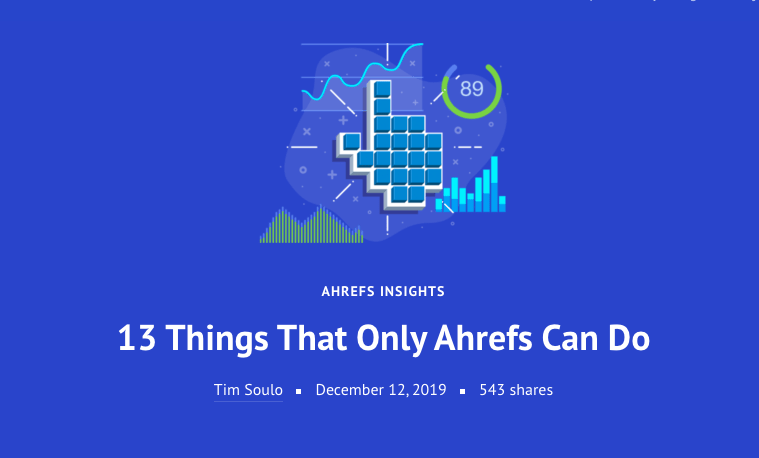
The title of the blog post is not only eye-catching but a great move by Ahrefs to use a blog post as a promotional piece for their service. In marketing messaging, highlight how you’re different. Launch campaigns for a new product are a huge moment to come out of the gate as something new and exciting.
Now that you have an idea of how to market products, maybe those are a bit niche or the first rollout for your brand. But let’s talk about how to market new products that are either an extension or a different approach to a current stack.
HubSpot recently released a version of the Marketing Hub service for Enterprise customers, or customers that are a bit bigger than an SMB and find those services to be a little limiting.
Because HubSpot has other versions of the Marketing Hub like Pro, the product marketing team had to figure out a launch that kept HubSpot’s brand in mission intact but also appealed to Enterprise customers. Ari Plaut, Product Manager for HubSpot’s Enterprise launch, explained how that was accomplished.
1. Think of the customer
When you’re marketing a new product in a line of others, think of the customer. How the positive reception has fueled the launch and how you plan to improve the customer experience.
“Put your customer and partners first,” Plaut said. “In today’s over-crowded marketplace, your customers trust each other more than they trust your brand.”
Take a look at the language of the description of the MHE homepage, and how it keeps customers in mind.
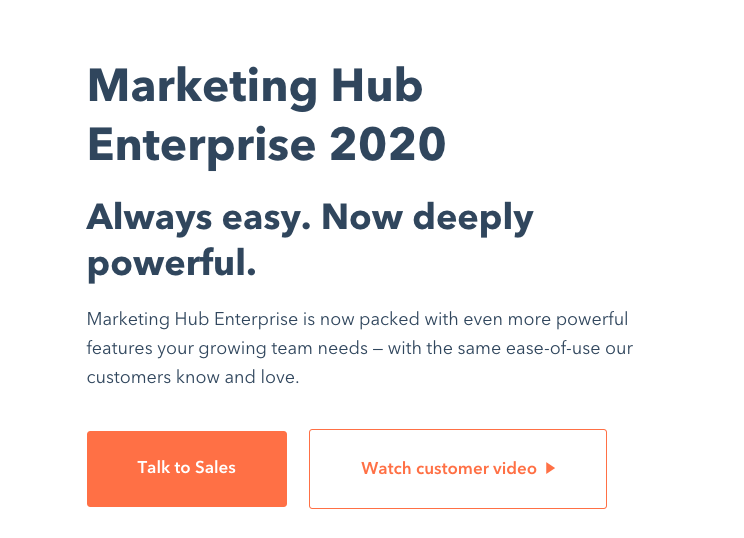
Keeping the consumers in mind, using customer-centric language will strengthen the integrity of the launch and remind prospective leads why they should pay attention. It also helps when marketing to a different target audience, like HubSpot.
2. Create a case study
Another way to market a new product is to leverage your resources. Create a case study and use that to tell the story of a satisfied customer.
Customer stories or product demos do the talking for you. If I’m looking to buy a new laptop for work, I’m going to ask colleagues for their opinion. I’d rather hear how a product works from a partner to envision how it works for me in reality.
Plaut said, “We worked with our partner to create an amazing case study. It focused on the impact Marketing Hub Enterprise had on the customer.”
To do this, think about the praises you’ve gotten from customers and invite them to participate to a case study for your new product. Repeat, loyal customers are more willing to help out and also provide enough knowledge of the product to give helpful feedback that’ll fuel a lead’s decision.
3. Highlight your good side
You want to look good, right?
When promoting a new product, show yourself off. If you’ve won any awards or have come across praise of your service that sticks out (or could connect with your audience on a personal level), show why others should pay attention.
When talking about highlighting accolades to fuel a launch, Plaut told me, “We highlighted G2 awards in our content, which is based solely on user reviews.”
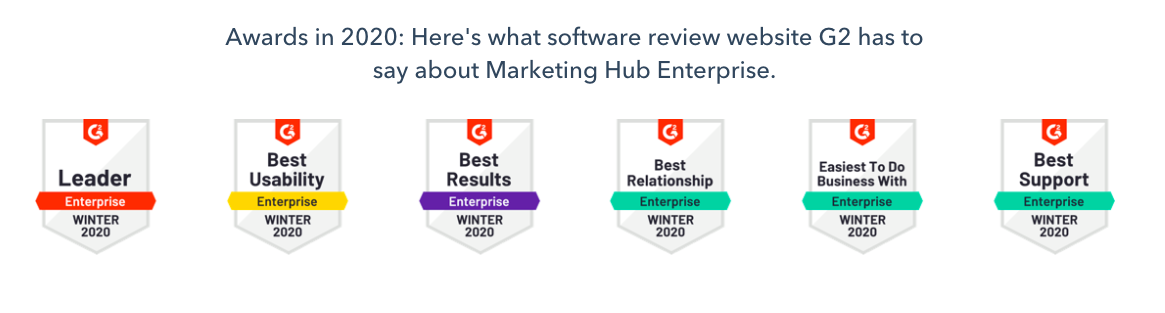
Because Enterprise is a product focused on Enterprise customers, highlighting awards won on that level puts HubSpot’s reputation before its service. Plaut said, “We’re highlighting our high NPS in all our content — our customers are happy, and we’re proud of it.”
4. Include successful customers
In the same wheelhouse as putting customers and partners first, here is another way to market while being customer-obsessed: by spotlighting high-profile customers you may have.
Maybe they’re influencers with a large social media following or a podcast that gave you a shout-out. Customers that would support what you’re launching are ideal to spotlight here.
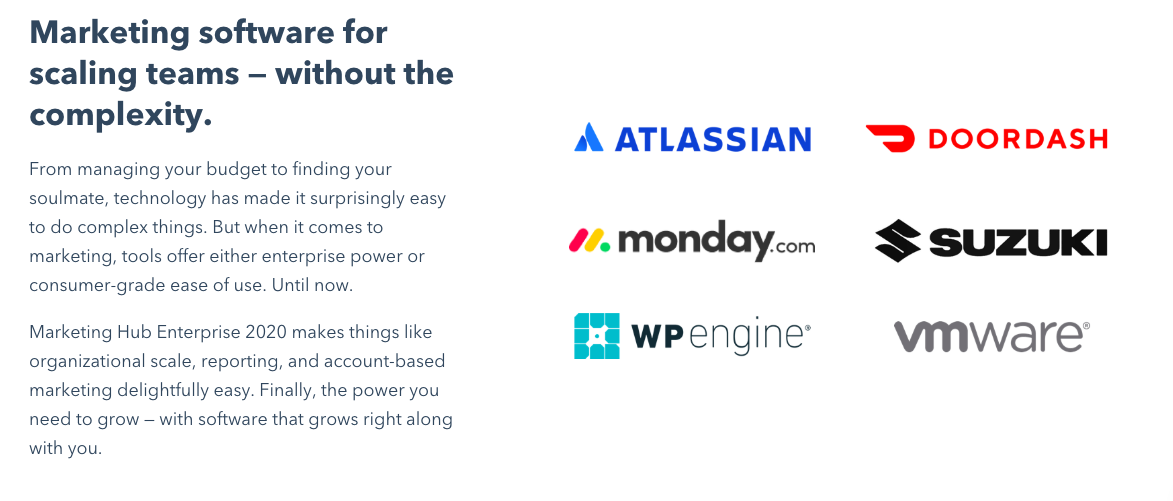
If you’re adding a product fit for customers that have a specific need for it, pointing to them and explaining why those customers trust you put out a more trusted reputation.
Said Plaut, “We’re including logos of our most successful customers in all our assets,” because they help tell the story of your product as much as visual charts and demos do.
Thinking about product launches requires all hands on deck, no matter how large your marketing team is. Thinking about diverse perspectives and what customers want to see can help you frame your campaign so it’s helpful.
What educational content can you provide, how can you delight customers with what you’re doing? Also think about your existing resources and how they can work for your new product because sometimes, great campaigns come from a product review.

How Neuromarketing Can Revolutionize the Marketing Industry [+Examples]
If digital and traditional marketers faced off in a debate about whose promotional philosophy is superior (which would probably get more heated than an NSYNC versus Backstreet Boys dispute), one of the points digital marketers could hang over traditional marketers’ heads is their ability to measure a campaign’s performance — and their opponent’s inability to do the same.
Whether its views, social shares, scroll depth, subscriptions, leads, and sometimes even ROI, digital marketers can measure it all. But even though we have access to a laundry list of metrics, we still can’t measure what is arguably the most crucial indicator of a campaign’s performance — emotional resonance.
Don’t get me wrong, I love seeing a spike in traffic as much as the next blogger. But in an industry where skimming a page for 10 seconds counts as a view, leaving your desk to grab some string cheese will result in a time-on-page of five minutes, and 50% of web traffic and engagement are generated by bots and Chinese click farms, claiming digital metrics are a surefire way to gauge your content’s emotional impact is a stretch.
But what if we could actually measure emotional resonance? What if we could place a resonance score next to a piece of content, just like we do with views? Interestingly enough, there are companies spearheading this movement and developing technology that can gauge people’s emotional response to your content without needing to draw blood or scan any brains.
In 2017, Immersion Neuroscience developed the INBand, an armband that can measure your brain’s oxytocin levels by tracking the cadence of your Vagus — a nerve that controls your heartbeat.

Oxytocin is known as the empathy chemical. When it’s coursing through your brain, you relate to others more, care about them, and feel an urge to help them. And when your brain synthesizes the chemical while consuming marketing materials, it’s one of the best indicators of emotional engagement and, in turn, quality content.
In 2018, Immersion Neuroscience wanted to compare people’s oxytocin levels while they watched Superbowl ads to their self-reported preference of the same ads. So they hooked eight people up to the INBand and measured their neurochemical responses to 17 ads from the 2018 Superbowl. Then, they compared each ad’s immersion scores to their ranking on USA Today’s Ad Meter, which is ranked by the public.
What they found was quite shocking — their results were almost the complete opposite of USA Today’s Ad Meter rankings. In fact, the ad that generated the most emotional engagement in the study was ranked the least popular ad in USA Today’s Ad Meter.
Immersion Neuroscience’s findings suggest that knowing what the brain actually resonates with is much more important than knowing what people say they like, especially when you test ideas in focus groups — participants are prone to shielding their true opinions due to groupthink and the urge to please authority figures.
So to accurately gauge our content’s emotional resonance, and in turn, its ability to grab people’s attention, make them feel something, and compel them to act, we need to focus more on neuroscience and less on web metrics and in-person interviews.
However, even though leveraging neuroscience to inform your marketing strategy is an ideal and exciting opportunity, the tactic still seems more suited for a time where Black Mirror storylines are a reality.
In fact, one of the main questions people have is, “Is neuromarketing ethical?”
Below, let’s dive into that question.
Neuromarketing Ethics
While the purpose of neuromarketing is to determine how consumers respond to brands or campaigns, a rather innocuous study, not everyone is convinced that it’s ethical.
The study, “Is Neuromarketing Ethical? Consumers Say Yes. Consumers Say No,” addresses ethical questions such as, “Will brands be able to influence buyer decisions too much?” and “Is neuromarketing manipulative?”
In and of itself, neuromarketing isn’t unethical. However, it’s important that companies hold themselves to a high standard of ethics when studying their consumers.
For instance, brands shouldn’t intentionally promote anything that’s harmful, deceptive, or illegal. Additionally, you shouldn’t study minors to figure out how to hook them on a product.
Neuromarketing should be used to create effective ads and eliminate ads that just don’t work, and that’s all.
The main ethical questioning has more to do with your product or service, and less to do with how you market it. If you’re ever in doubt, ask yourself if the product or service is good for the customer.
In actuality, neuromarketing has already permeated into the content space. Netflix, Hulu, and some television networks use neurotrackers to predict how successful their shows will be — at an 84% rate of accuracy — and this methodology could soon seep into the marketing industry.
To help you envision a world where neuromarketing is widespread, here are five practical ways brands can nail their marketing with the help of neuroscience.
1. Brands can tell more compelling stories.
When Shane Snow, an author, journalist, and co-founder of Contently, first tried out the INBand to see what the neuromarketing fuss was all about, the CEO of Immersion Neuroscience, Dr. Paul Zak, played this advertisement for him:
After Shane finished watching the ad, he started tearing up. But as he wiped away his tears before Dr. Zak could see them, he realized it was a lost cause — the INBand had already revealed that the ad made him cry.

At each point of the ad where the father gets rejected, the corresponding points on the graph show that Shane experienced bursts of emotion because he developed empathy for him. And at the end of the ad, you’ll notice a corresponding spike in emotion on the graph that shows exactly where he cried. The ad’s emotional effects even bled over to Shane’s reality, making him feel empathetic toward the father after the ad ended, which is evidenced by the last spike’s gradual fade.
Shane’s emotional response to this ad suggests that telling great stories, chock-full of conflict, surprise, and emotion, is one of the best ways to trigger the release of oxytocin, helping you emotionally engage your audience and, ultimately, make them care about your brand.
In a nutshell, great stories are about the journey of overcoming adversity and how that journey changes people. “Little Moments,” tells the story of a father who so desperately wants to connect with his teenage daughter but ultimately can’t make it happen. And at the end of the ad, her constant rejection clearly weighs on him, prompting him to lay down on her bed. But that’s when he sees all the photos they’ve taken together over the years taped above her bed, making him realize that she’s always had a connection with him — he just didn’t know it.
2. Brands can save millions of dollars on ads.
In the same study of 2018 Superbowl ads mentioned above, Immersion Neuroscience discovered that M&Ms’ “Human” was the second most immersive ad on their list.
As you can probably predict, “Human” generated the most emotional engagement when the truck plows Danny DeVito into the basket of produce. But a few seconds after this shocking and hilarious climax, Immersion Neuroscience discovered that emotional engagement plummeted, suggesting M&Ms could’ve shaved off the last 10 seconds of this ad — and saved over $1.5 million.
3. Brands can host more engaging conferences.
At a major global conference in Houston last year, Immersion Neuroscience put INBands on attendees and measured their immersion during certain presentations. They discovered that concise, energetic talks generated the most emotional engagement.
On the other hand, longer talks need to revolve around a strong narrative or else they can’t hold an audience’s attention. Additionally, they realized the brain responds well to multimedia-heavy presentations due to the high variety of stimulus.
Based on these findings, Immersion Neuroscience believes tracking attendees’ emotional engagement during presentations can help companies refine their conferences by cutting out boring talks and even providing attendees with relevant presentation recommendations.
4. Brands can design more effective ads.
The main goal of neuromarketing is to gain insight into what would make an ad more effective. That’s exactly what Roger Dooley did in a study using an ad for baby products.
To figure out if an ad was effective, Dooley used a heat map to see where viewers were looking. Are they reading the text? Just looking at pictures?
In the ad below, the baby is looking straight out of the page. Unsurprisingly, viewers love the image of the baby. Most people give the image of the baby more attention than the headline and copy.

However, when you have the baby “look” at the headline and copy, viewers started to give the copy more attention. That’s because people will look at the same thing the models are looking at. So, with the image above, where the baby was looking right at us, you weren’t directed to look at anything else, so you probably stopped looking around.

Ultimately, this neuromarketing study helped create a more effective ad. In your future ads, try to make sure your models are looking at what you want the viewer to see.
5. Brands can sell more by using FOMO.
The fear of missing out, otherwise known as loss aversion, is a widely used tactic in marketing and sales.
In fact, in a study, 62% of consumers were more likely to gamble their money than to lose their money.
Here’s the scenario consumers were given:
If you were given $50, would you rather:
- Keep $30.
- Gamble, with a 50/50 chance of keeping or losing the whole $50.
When an experimenter posed that question to subjects, 43% of the subjects chose to gamble. Then the options were changed to:
- Lose $20.
- Gamble, with a 50/50 chance of keeping or losing the whole $50.
With that slight change, there was a 44% jump in the number of people who gambled.
In fact, when more studies were done like this, 100% of subjects gambled more when the other choice was framed as a loss.
The neuromarketing takeaway is that framing will have a large impact on peoples behavior. And people are loss averse.
You can implement this method by changing the language on your ads. If you can pose the outcome of not buying your product or service as a loss, then you can sell more.
Even though we live in an age of data overload, where you can measure almost anything, Google Analytics will never be able to accurately gauge the most important element of your marketing campaign — its ability to make your audience feel something.
Fortunately, the neuromarketing space is rapidly evolving, and its technology is becoming more affordable and practical for marketers today, hopefully leading to its mainstream use tomorrow.
Editor’s note: This post was originally published in January 2019 and has been updated for comprehensiveness.

How to Build A Business Plan That Stands Out [Free Template]
Nowadays, it seems like a new company is starting every hour.
But, while starting a company may seem easier now than ever before, entrepreneurs have an uphill battle from the moment they start a business. On average, a new business will need to compete with 25 competitors in order to stand out and thrive in its industry.
Aspiring business owners that go in blind without a clear, actionable plan for marketing, hiring, finances, and operations are destined to face significantly more difficulties on their journey to building a successful company — which is why crafting a business plan is an essential step in the entrepreneurial process.
In this post, we’ll walk you through the process of filling out your business plan template so you can present it to investors, employees, and all other stakeholders in your business. That way, you’ll be able to show them how organized and well-thought-out your business idea is, and provide them with answers to whatever questions they may have.
Featured Resource: Free Business Plan Template
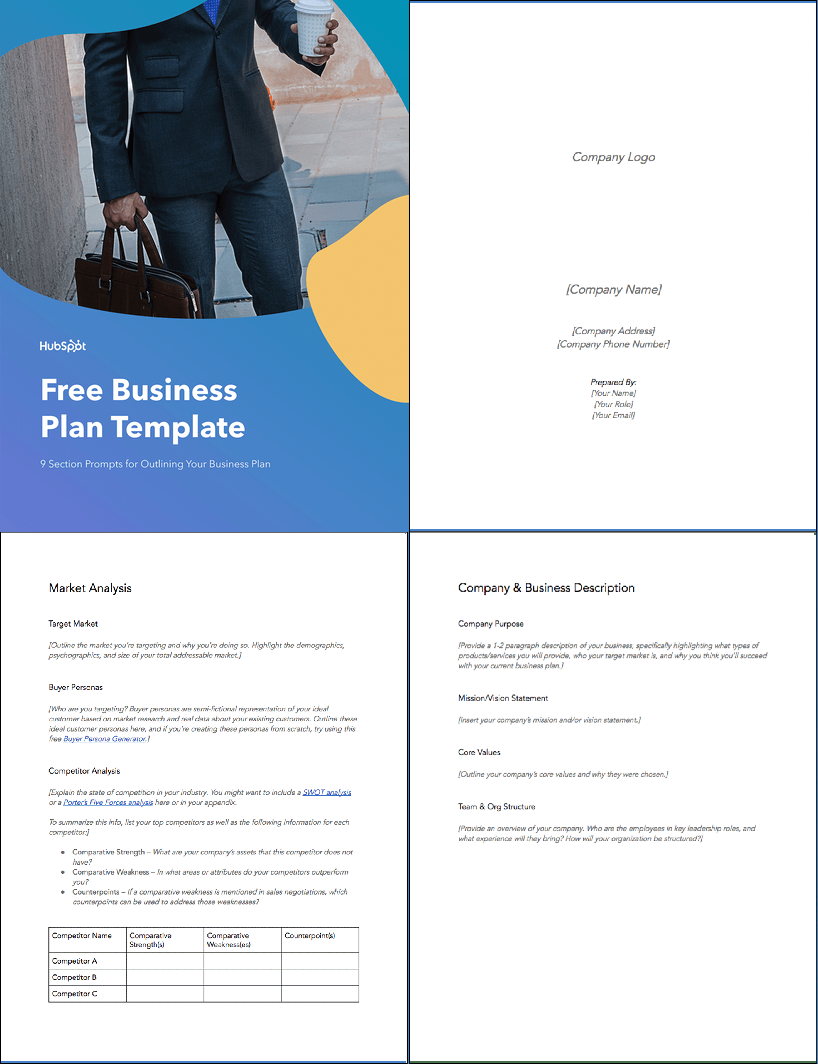
When looking at a blank page on a laptop screen, the idea of writing your business plan can seem impossible. However, it’s a mandatory step to take if you want to turn your business dreams into a reality.
That’s why we’ve crafted a business plan template for you to download and use to build your new company. You can download it here for free. It contains prompts for all of the essential parts of a business plan, all of which are elaborated on, below.
1. Cover Page
Your business plan should be prefaced with an eye-catching cover page. This means including a high-resolution image of your company logo, followed by your company’s name, address, and phone number.
Since this business plan will likely change hands and be seen by multiple investors, you should also provide your own name, role in the business, and email address on the cover page, as well.
2. Executive Summary
The executive summary of your business plan should provide a one or two page overview of the business and highlight the most crucial pieces of information for readers. Intended to grab the reader’s attention, this section should summarize critical information regarding your company overview and upcoming short-term and long-term goals.
The executive summary is essentially a boiled-down version of your entire business plan, so remember to keep this section to-the-point and filled only with essential information.
Typically, this brief section includes:
- A mission statement.
- The company’s history and leadership model.
- An overview of competitive advantage(s).
- Financial projections.
- Company goals.
- An ask from potential investors.
3. Company & Business Description
In this section, you’ll provide a more thorough description of what your company is and why it exists.
The bulk of the writing in this section should be about your company’s purpose – covering what the business will be selling, identifying the target market, and laying out a path to success.
In the Company & Business Description portion of your business plan, you can also elaborate on your company’s:
- Mission and/or vision statement.
- Core values.
- Team & organizational structure.
3. Product & Services Line
Here’s where you’ll provide a more in-depth overview of the makeup of your business’s product and/or services line. You should provide each product or service’s name, its purpose, and a description of how it works (if appropriate).
Next, add some color to the sales strategy by outlining your pricing model and mark-up amounts.
If you’re selling tangible products, you should also provide an explanation of production and costs, and how you expect these factors to change as you scale.
4. Market Analysis
The market analysis section is where you’ll provide details about the audience to which you’re marketing your business. This should encompass the size of your total addressable market, your market’s demographics and psychographics, and a location analysis for your business’s operating space.
It helps to reference your market research documentation here, like a Porter’s Five Forces Analysis or a SWOT Analysis (templates for those are available here). You can also include them in your appendix.
If your company already has buyer personas, you should include them here as well. If not, you can make them right now using the Make My Persona Tool.
5. Marketing Plan
Unlike the market analysis section, your marketing plan section should be an explanation of the tactical approach to reaching your aforementioned target audience. List the channels you’ll be advertising on, what organic marketing methods you’ll employ, etc.
If your company has a fully fleshed out marketing plan, you can attach it in the appendix of your business plan. If not, download this free marketing plan template to outline your strategy.
6. Sales Plan
It doesn’t matter if your sales department is an office full of BDRs or a dozen stores with your products on their shelves. The point is – like all companies – all sales strategies are different, so you should clearly outline yours here. Common talking points include:
- Sales team structure, and why this structure was chosen.
- Sales channels.
- Sales tools, software, and resources.
- Prospecting strategy.
- Sales goals and budget.
Like with your marketing plan, it might make sense to attach your completed sales plan to the appendix of your business plan. You can download a template for building your sales plan here.
7. Legal Notes
Your investors may want to know the legal structure of your business, since that could directly impact the risk of their investments. For example, if you’re looking for business partners to engage in a non-corporation or LLC partnership, this means they could be on the line for more than their actual investment. Because this clarification is often needed, explain if you are and/or plan to become a sole proprietor, partnership, corporation, LLC, etc.
You should also outline the steps you have taken or will need to take in order to operate legally. This includes necessary licenses, permits, registrations, insurance requirements, etc. that are needed to follow the law. The last thing your investor wants to hear after they’ve sent you a big chunk of change is that you’re operating without proper approval from local, state, or federal government.
8. Financial Considerations
Ultimately, investors want to know two things:
- When they will earn their money back.
- When they will start seeing returns on their initial investment.
That said, you’ll need to be clear, calculated, and convincing in this section. It should cover:
- Startup costs.
- Sales forecasts for the next several months/quarters.
- Break-even analysis for time and dollars.
- Projected P&L statement.
Most importantly, you’ll want to explain the why behind each of these sections. Facts and figures are key here, so be as specific as possible with each line item and projection, in addition to why you’ve included it.
If you have pages upon pages of charts and spreadsheets for this section (which – arguably – you should), you may want to distill them into a page or two and include the rest of the sheets in the appendix.
9. Appendix
The best business plans are filled with imperative information, spanning dozens or even hundreds of pages long. To avoid disrupting the flow of the business plan with visuals, charts, and spreadsheets, consider including all of these resources in the appendix. Aside from what we’ve already mentioned – marketing plan, sales plan, department budgets, financial documents, etc. – you may also want to attach the following in the appendix:
- Floor plans for your location.
- Images of social media pages.
- Your logo and any graphic design assets.
- Mock-ups of your product.
- Renderings of your office space or location design.
Adding these pieces to the appendix enriches the reader’s understanding of your business and proves you’ve put the work into your business plan without distracting from the points throughout the plan.
Use a Business Plan Template to Get Started
Writing a business plan shouldn’t be an insurmountable roadblock to starting a business. Unfortunately, for all too many, it is.
That’s why we recommend using our free business plan template. Pre-filled with detailed section prompts for all of the topics in this blog post, we’re confident this template will get your business plan started in the right direction.

An Inside Look At HubSpot’s Enterprise Marketing Playbook
We debate a lot at HubSpot about how much of our marketing playbook to share with the world. That’s the tricky thing about marketing to marketers (and sales and service teams for that matter) — your instinct is to share everything, but if you do, you run the risk of losing your competitive edge.
So, you keep your biggest wins, worst failures, and deepest insights under lock and key, safe from the prying eyes of your competitors. But in doing so, you also keep them hidden from your customers and the wider community.
Start-ups tend to lead the way when it comes to sharing. They shine a light on their strategies, successes, and shortcomings, and in doing so, they encourage others to do the same. And the whole industry grows better. The same cannot be said of large enterprises. As they grow, they have more to lose, they become increasingly risk-averse, and they forget that sense of openness.
Not only does this make the enterprise marketing world feel like an isolating place, it leaves enterprise marketers starved of inspiration, and it zaps innovation across the industry.
In the early years of HubSpot, we were an open book. We shared everything. And it helped us go from a no-name startup in the mid-2000s to a global, publicly-traded enterprise just 15 years later. We haven’t done everything right, but we’ve scaled substantially over the years, generating more than 68 thousand customers globally and $513 million in revenue in 2018 with the highest customer satisfaction of any CRM.
Like any rapidly scaling company, our strategy has evolved over the years to better match our stage of growth and buyers’ expectations, but we never want to lose the sense of openness that helped get us here.
So, we’ve decided to share our enterprise marketing playbook. Everything from how we drive awareness and convert leads to how we think about our talent and our tech stack is outlined below. We hope that by opting for openness over secrecy, more large enterprises will do likewise and we’ll regain some of the sense of community and collaboration we loved so much when we were startups. Ok, here goes.
Our Enterprise Playbook for Driving Brand Awareness
Let’s start with where most good marketing playbooks begin — brand awareness.
Our awareness playbook consists of two strategies: a content strategy and an ad strategy.
And, within our content strategy, we have two sub-strategies — one that is all about getting found through search (our “SEO strategy”), and another that aims to change minds through opinionated content that spreads through word-of-mouth and social engagement (our “POV strategy”).
To execute our two content strategies, we’ve split our team into two separate purposes. One team is focused on optimizing informational content to spread through search, and the other is tasked with creating influential content to spread through word of mouth. Both teams are playing to algorithms and what we know about our audiences, but each has a vastly different marketing approach.
Let’s take a closer look.
Content Strategy Part 1: SEO
With our SEO strategy, we’re not just playing for top placement in SERPs, we’re targeting the entire first page — ads, featured snippets, top organic results, directory listings, you name it.
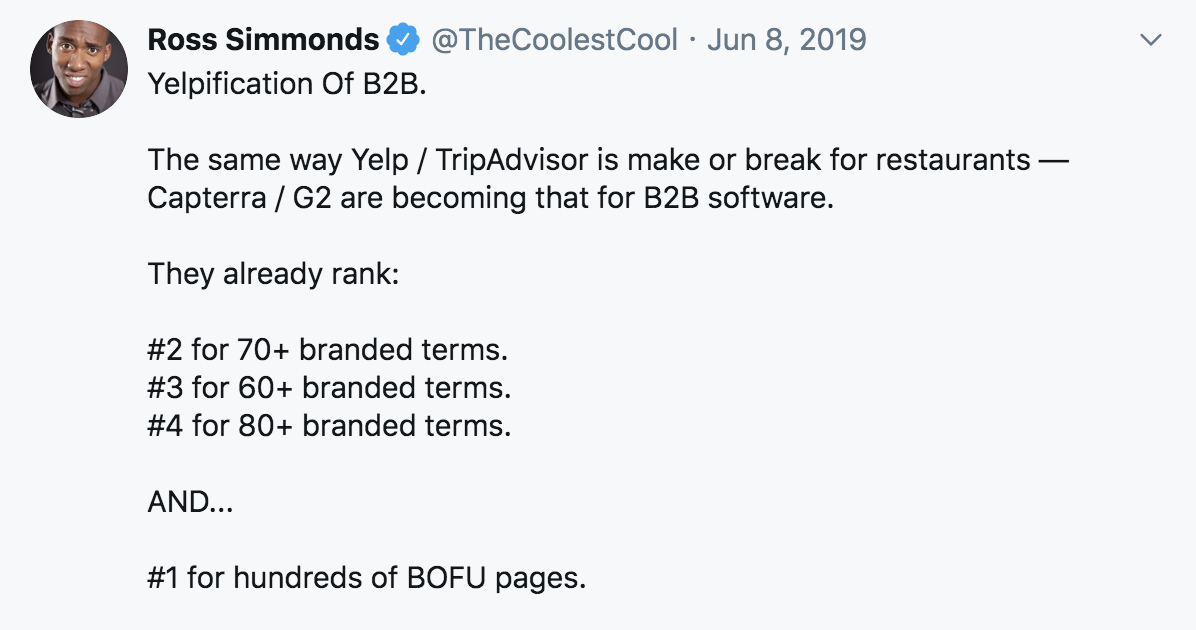
I also have to mention review sites, which have become increasingly important for SEO in recent years. To paraphrase Digital Marketing Strategist, Ross Simmonds; review sites like G2 are becoming an undeniable influence for B2B software — they already rank #2 for 70+ branded terms and #1 for hundreds of bottom of the funnel pages.
To perform well across all of these areas, we have adopted a diversified search-geared content strategy that comprises long-form educational content, shorter content optimized for snippets, pillar pages, YouTube optimization, and audio courses.
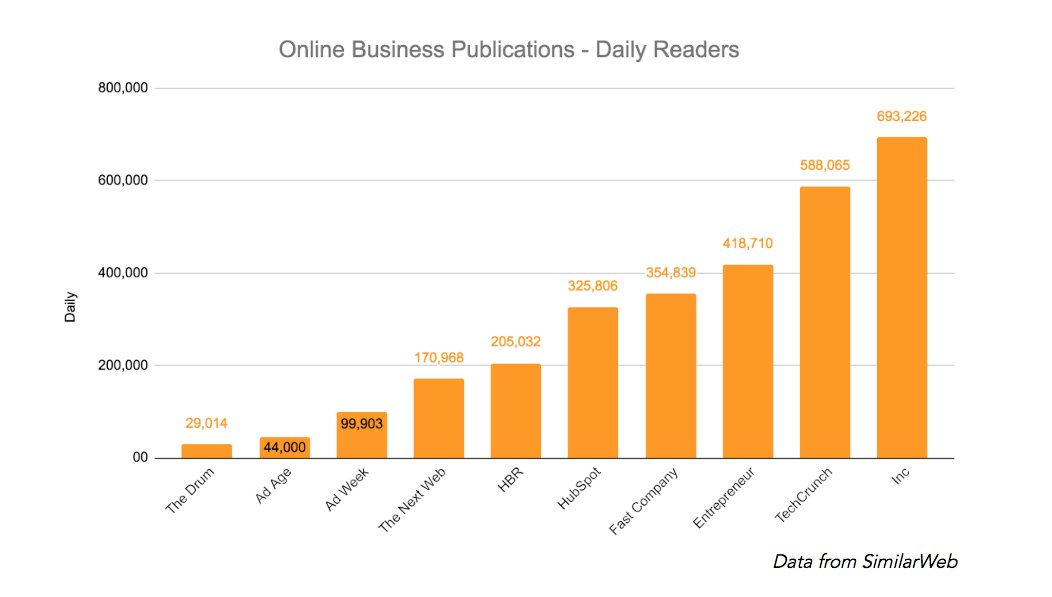
The culmination of these approaches has led to robust growth in our organic traffic, and a blog readership that is in the realm of major publications like HBR, Adweek and Fast Company.
Content Strategy Part 2: POV
In a world where options are seemingly endless and products are increasingly becoming copied or commoditized, what you stand for is just as important as what you sell. Having a strong point of view isn’t about taking a contrarian stance and throwing up a bunch of hype content.
We’ve all had more than our fill of articles sounding the death knell for certain marketing tactics, heralding the birth of others, and passing off truism as new insights. Breaking through with a strong point of view starts with having a clear brand identity, sharpening that identity through thoughtful product positioning, and then bringing it to life with strong messaging and complementary creative execution.
Our POV mix includes thought leadership articles, brand videos, social content, speeches, and editorial podcasts. The opinions we advance outside of HubSpot are infused internally through our open culture and foundational documents like our customer code, which has garnered 1.3 million views and helps guide our own customer-affecting decisions daily.
Ad Strategy
When a message strikes a chord with an audience organically and earns above-average social engagement, we catch it early and amplify it through ad spend.
But, as with any marketing expense, we have specific goals and purposes behind each ad, each of which falls into one of the following three buckets:
- Transactional ads — these ads generate HubSpot software users
- Informational ads — these ads grow our content leads
- Awareness ads — these ads drive content views and website visits
For established products that already have some search demand, we spend most of our digital ad budget on transactional ads, but we have thresholds for both direct and assisted returns on ad spend. Once we’ve maxed out our return on our transactional ads budget, we move the budget into the informational ads bucket, and then into the brand awareness bucket.
For new launches and lesser-known products, we flip that playbook. New products have lower brand recognition in the market, so the cost of transactional ads is far higher. So, we first invest in brand awareness, and as our direct and assisted returns on these ads begin to reach our thresholds, we put that budget behind transactional ads.
Awareness Strategy Summary:
- Grow organic traffic globally through on-site content, including pillar pages and our blogs
- Manage SERP presence through partnerships and snippet strategy
- Empower customer advocates to talk about our business on review sites and through word-of-mouth
- Executed a linked ad strategy across transactional, informational and brand categories
- Build influence by publishing strong points of view designed to spread organically, through social media sharing for example
Our Enterprise Playbook for Converting Traffic
Many enterprise companies assume that the buyer is willing to follow a rigid, extended sales process, and they build their engagement strategies accordingly. They seek to collect enough information to qualify a lead, communicate through long email chains, book multiple meetings, and perhaps most painfully, hide pricing so a buyer has to talk to a rep.
We followed a similar playbook for a number of years — everything except hiding pricing. As we started to see customer expectations shift, however, we realized how essential it is to create options for different purchase preferences.
Today our conversion playbook is built to reduce friction. We’ve made a number of changes over the years, including reducing our form fields with progressive profiling and data enrichment (which increased our form conversion rate by 5%), but the real difference has come by diversifying our conversion options.
Today on our pricing page visitors are given multiple ways to connect — they can book meetings, email, call, or chat. Old-school advice about conversions tells you that choice breeds hesitation and that you should reduce the number of CTAs on a page, but we experienced something quite different. By providing interested visitors with the freedom to choose their preferred way of connecting with us, we actually increased our conversion rate by 170%.
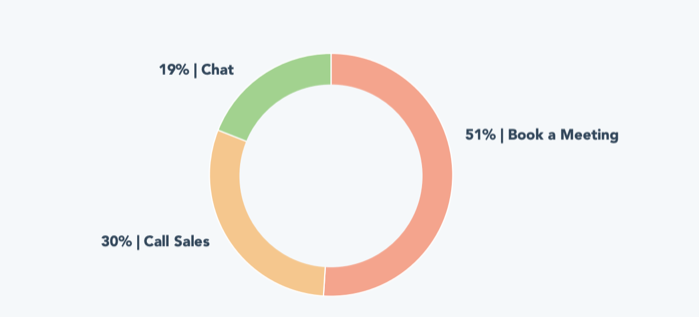
Conversions on HubSpot.com
In addition to offering multiple ways for people to connect, we allow buyers to choose between getting a demo or getting started with our free software and upgrading through the product at a time that suits them. By doing so, we have increased the number of self-purchases by 10X while still growing our inside sales model.
The product qualified lead (PQL) has proven to be a stronger indicator of the buyer’s intent than the marketing qualified lead. As Kieran Flanagan, HubSpot’s VP of Acquisition has argued, the PQL is what an MQL promised to be but never lived up to. The PQL fulfills that promise as it’s based on someone getting real value from a product, and showing intent to use it much more deeply than the traditional MQL. PQLs also open the door to new marketing levers including in-app targeted chat and automation based on user behavior.
Conversion Strategy Summary:
- Optimize conversion paths by providing a range of options to site visitors
- Drive engagement with conversational marketing and targeted chat
- Grow touchless sales through our freemium model
Our Enterprise Playbook for Building a Flywheel of Momentum
Ten years ago, companies could win on the strength of their product alone. Today, in a world fueled by word-of-mouth, the most disruptive companies are winning, not just on the strength of their products, but on the overall quality of their customer experience.
It sounds straightforward, and no one is going to argue against solving for the customer, but maintaining a cohesive customer experience gets much harder as you get bigger.
As you grow, you add more technology, more divisions, and more processes to your mix and, despite best intentions, your customer experience can suffer. This is especially damaging for sales teams at enterprise companies, where existing customer bases have the greatest revenue potential.
So, over the last few years, we’ve gone all-in on customer experience. We’ve united marketing, sales, and service under a single chief customer officer, run UX sessions to find friction in our product and sign-up process, and released the customer code.
Our marketing strategy has evolved, too. We’ve invested in customer marketing at an outsized pace to other teams, and we’ve developed robust strategies to eliminate friction for customers, recognizing the critical role they play in our growth. A big piece of this is simply applying the same strategic lens to our customers as we do to our prospects:
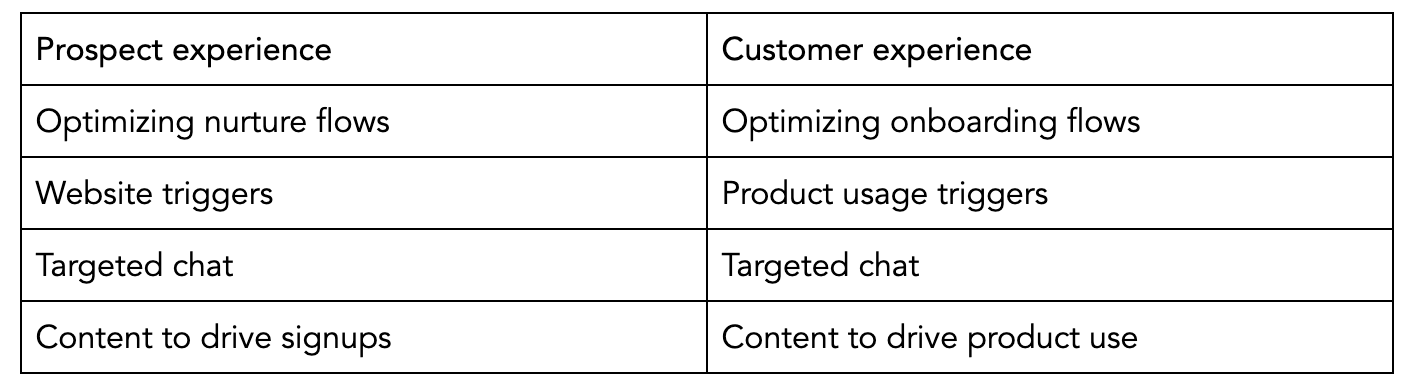
Companies tend to reach automation maturity in three phases. They start with automating and optimizing marketing communications, then follow with sales communications, then finally get to customer communications. And it is in phase three that a lot of unique growth at enterprise companies can be unlocked.
In addition to growing our focus on enabling customers to succeed so they retain, upgrade and cross-buy, we are intentional about finding and empowering our most successful customers to advocate on our behalf through reference programs, review sites, and event participation.
We dedicate teams to finding interesting customer stories, setting up customer referral programs, holding events where customers can learn from one another, incorporating customers into our product launches, and driving people to review sites and our own forums to give feedback. These advocates are just as much a part of our success as any team member, and recognizing their value to our company and empowering them to support our growth has played a key role in accelerating our momentum as a business.
Customer Marketing Strategy Summary:
- Optimize customer experience with automation
- Drive engagement through a customer-focused content strategy
- Grow referrals through our customer advocacy program
Our Enterprise Talent Playbook
Much of our ability to keep innovating relies on the recruitment, retention, and development of a diverse and talented team. As we’ve scaled, we’ve heightened our focus in this area and have ramped up accountability.
In the last few years, we have started measuring and reporting on our progress towards broadening the diversity of our team and deepening the sense of belonging people feel at HubSpot. We’ve developed employee resource groups for underrepresented groups, hired a Director of Diversity, Inclusion and Belonging, modernized our prospecting and recruiting practices, and made every hiring manager accountable for building diverse slates of candidates.
One of the most impactful things we’ve done to broaden our reach and pull in top talent from around the world is to commit to being a remote-friendly company. We now have over 300 remote employees across the globe, from individual contributors to managers to directors, and our remote workforce has grown exponentially in the past few years — in 2019 alone, our global remote population grew by 86%.
In some cases, being remote-friendly has helped us hire top talent who wouldn’t have otherwise taken the role, and in other cases, it has helped us retain exceptional HubSpotters who wished to move to new places for personal reasons. As we’ve become increasingly remote, we’ve built support systems around remote workers and their direct reports including training for managing remotely, peer groups, and technological support.
Talent Strategy Summary:
- Prioritize and invest in building a diverse and inclusive workplace
- Build a remote-friendly organization
Our Enterprise Tech Stack
Behind every good enterprise marketing playbook should be a powerful, easy-to-use tech stack. Here are some of the tools and services that help us at HubSpot to execute our strategy.
- HubSpot: No surprises here, we have built our entire system on the HubSpot platform. That includes everything from CRM and marketing automation to data enrichment and helpdesk. All HubSpot. We also take advantage of many of the powerful integrations available with HubSpot to customize our strategy.
- Advocately: for enabling customer advocacy
- Ahrefs: for advanced SEO tools
- Airtable: for content tracking and tagging
- Bizzabo: for event management
- Canva: for scaling design globally
- GitHub: for developer project management
- Invoca: for inbound call tracking
- Memoq: for translation and localization
- MoveableInk: for dynamic email content
- OneTrust: for privacy and compliance
- PieSync (acquired by HubSpot): for two-way data syncing across our platform
- Usability Hub: for UX
- Vidyard: for video marketing
Thanks to the wide range of powerful integrations available on the HubSpot platform, we have the freedom needed by rapidly scaling companies to choose their preferred tools for growth. To learn more about our expanding app ecosystem, read Scott Brinker’s piece, ‘It’s An Open Platform World. HubSpot’s Growing App Ecosystem Helps You Thrive In It.’
Opting For Openness
All of these strategies have detail and nuance too great to comprise in a single article, but I hope this piece gives a sense of where we’re placing our priorities. We bet on the compounding value of search, develop distinct points of view, prioritize the reduction in friction everywhere, and make meaningful investments in our customers and in our team. And we tie it all together with a central and expansible platform on which every customer-facing team is aligned.
When HubSpot was a start-up, we opted for openness. As an enterprise, we’re continuing to do the same. We believe it’s better for individuals trying to crack the enterprise marketing code and for the industry as a whole. We’d love to see more enterprise companies do likewise so that we can challenge one another, spot opportunities for collaboration, and perhaps most importantly, build a stronger sense of community across the enterprise marketing space in 2020.

Marketers: Is Your Ecosystem Ready for 2020?
At your company, you have multiple teams, dozens of tools, thousands of customer touchpoints, and new challenges every day. And through it all, your customers have much higher expectations than they did 10 years ago.
Customer experience is now the main factor driving referrals, sales and lifetime value. Because of that, your customer needs to be at the center of your entire business. Regardless of where your customer interacts with you, they need to have a delightful experience.
One tool can’t do it all for you.
Keeping your marketing strategy customer-focused requires using more than software to build your business. You can integrate your software with apps and use service providers (typically an external business who is an expert in the help you need) to tackle business needs alongside with you. Trying to manage the experience across the entire customer journey can involve juggling a lot of different channels and tools.
Christopher Martin, Digital Marketing Manager at FlexMR, says that he amassed a large number of tools during his first few weeks on the job — including Constant Contact for emails and Hootsuite for social media. But simply launching more tools didn’t get them the results they needed. “They weren’t integrated, so we couldn’t track leads or calculate ROI,” Christopher says. “We spent much time manually entering data to ensure the information was accurate.”
To create the customer experience you want, these tools need to be supported by a backbone. Bringing all these tools together (along with experienced partners) creates an ecosystem that supports your business. Without this ecosystem, it’s impossible to manage every touchpoint effectively.
This is why it’s so important to use more than software to build your business — integrate your software with apps and use service providers to tackle business needs alongside with you.
Using a Software Ecosystem to Help You Grow
It’s hard for one company with one software subscription to deliver the experience that customers are looking for today.
Instead, businesses need to surround themselves with connected tools that keep the customer front and center. There are three tools that can help you keep your customer at the center of your flywheel and drive growth:
- Service providers
- Access to an app marketplace
- Creating a single system of record
Service Providers
Marketing technology spend is now higher than the advertising spend for companies.
Hiring an external service provider to work with you and your team can be a great resource. They can help with tool expertise, training, management, implementation, ongoing support, and more. Service providers can help marketers optimize their investment by providing hands-on assistance, training, and knowledge.
According to HubSpot research, 86% of businesses who work with service providers say it has benefitted their business. People have cited the following and more as benefits of working with service providers:
- Extra help to achieve your business goals faster
- Achieve highly specialized projects and tasks
- Ability to achieve a broader scope of projects
- Ability to do more with the technology that you’re using
- External perspective and expertise
- The reliability and accountability of working with an outside organization
- Not feeling limited by your internal resources
- Faster growth for your company
When you hire folks who are extremely familiar with the software than runs your business, you get more value out of your technology. Service providers are an extension of your business, and they allow you to get more work done with fewer full-time staff. Who doesn’t love a pair of helping hands – especially when those hands are attached to a ton of specialized knowledge?
App Marketplace
As we mentioned earlier, marketers need a lot of tools to make the magic happen. But these tools shouldn’t exist separately. Integrating them together can make it easier to work across different channels and automate your customer experience.
An app marketplace makes it easy to bring all the tools you use into one place (and it can help you discover new tools, too!). Software with a strong ecosystem includes access to a wide range of apps that make your platform even more powerful.
Skirmante Bikaite, Marketing Executive at Hatch, says that before taking advantage of the HubSpot ecosystem she was using one tool for sending emails, another for checking how the website was performing, and so on. This large number of tools that Hatch used delayed its ability to set up campaigns and results in a more complicated marketing process.
When they were able to pull all of their social media apps together, they could coordinate campaigns and reporting across channels. “We’re now able to see the source where leads come from, when they convert to an opportunity and when they change towards a sale down the road,” says Skirmante. This kind of coordination is only possible when you’re supported by an ecosystem.
Melissa Miller, Marketing Fellow on the Marketing Operations team at HubSpot, agrees with the importance of integrations: “At HubSpot, we’ve been able to leverage integrations to build on top of HubSpot’s existing tools. These integrations serve a range of functions and enable our operations teams to build solutions that support internal stakeholders across the business. Ultimately these integrated solutions empower our marketing, sales, and services teams to provide a better experience for our customers.”
Single System of Record
Most marketers are familiar with using a CRM to store customer data. But not every team is taking advantage of all the customer data their entire company has available. From customer satisfaction data, to survey responses about preferences, to past purchases – combining all this information into one single system of record opens new doors for your marketing team.
Books Tell You Why, a rare bookseller, uses their CRM to personalize their marketing campaigns for each reader. “As an eCommerce operation, email nurturing and targeted messaging are key ways for us to win repeat business,” says Andrea Koczela, VP of Marketing, “Knowing that ‘Joe’ collects James Bond literature will allow us to send messages tailored to his interests instead of horror book newsletters, for example. Not only does this approach increase our open rate and click-through rate, but it also builds goodwill with our contacts. They can trust us to send relevant emails and not clutter their inbox.”
Using all of the data at your disposal to curate a personalized and targeted customer experience turns your marketing pipeline into a growth engine.
Not only that, but bringing all your data together into one system means that your teams collaborate better. Sales and marketing are working from the same context, which helps generate more conversations that can go deeper into the customer’s needs.
No Marketing Team is an Island
Why should your software be one?
Instead of thinking of software as individual tools, it’s critical to consider the overall ecosystem your tools exist in. A service provider can help you grow in ways that you’ve never thought of before, from discovering a new integration to developing a new automated leads pipeline. When you lean on a strong ecosystem, you’re more equipped to meet your goals.
Using all these pieces together empowers you to provide an excellent customer experience across all touchpoints.
HubSpot is more than software, it’s a growth platform designed for you to customize with an entire ecosystem of education, apps, and service providers all available to you at the click of a button. Whether it’s strategies, services, or software, the HubSpot ecosystem has everything you need — so you don’t have to grow it alone.
More than just software, HubSpot is an ecosystem of professionals ready to create custom strategies, solutions, and software for your business. You already know how to grow better — and with the HubSpot ecosystem, you don’t have to grow it alone. Check out our App Marketplace and Solutions Directory to learn more about the HubSpot ecosystem.

Paid Social Media: Worth The Investment?
Rick and Morty is a popular adult cartoon that airs on Adult Swim, reaching 2.3 million viewers on average. Recently, chip brand Pringles worked with the TV show to produce a commercial that runs on social media channels. In 24 hours, I’ve seen their ad on Twitter four times already:
The infinite adventures of @RickandMorty meet the infinite adventures of Pringles Flavor Stacking. pic.twitter.com/8SQB6vE0ZP
— Pringles (@Pringles)
January 28, 2020
If you’ve seen Rick and Morty, you might be thinking — Why Pringles?
Well, of those Rick and Morty viewers, about 1.9 million are adults, ages 18-34. And, of Twitter’s users, 44% of them are adults, ages 18-24.
If Pringles wants to reach a demographic within this range to promote their product, a Rick and Morty-themed advertisement via Twitter seems like a good place to start.
Ultimately, paid social media helps with targeting audiences, and driving sales.
Every social media channel is different. Twitter offers short-form content, Instagram focuses heavily on visual-based content, Facebook has its own marketplace, and LinkedIn is the home of networking professionals.
As such, paid social media on each platform differs, and should, depending on the campaign and audience.
Here, we’re going to explore some quick strategies that will help you decide how to use paid social to the benefit of your brand.
Pringles and Rick and Morty might seem like an unlikely partnership, but it was a decision that came from months of planning and execution, with help in no small part from the social media channels chosen to run the commercial.
Having a paid social media strategy can save a budget that might not be as expansive as a global potato chip brand, so we’ve gathered the important things to know about using various social platforms for paid ads.
When advertising on Facebook, it’s a good idea to use Facebook Targeted Ads. This feature is run on a bidding system — advertisers bid on a number of ads based on their target audience. Then, that bid will be put into a lottery for a chance to be picked to run.
Other than the lottery, Facebook Ads lets you show ads to your customers based on their behavior. This is helpful because you can keep advertising to your existing Facebook customers based on what Facebook tells you about their use of the app.
Using Facebook Ads helps you build new leads and generate brand awareness. The analytics Facebook gives you opens the door for experimentation — try using different ad formats and see what your audience engages with most. It might be different than other social strategies.
For more information about Facebook Ads, check out our checklist that gives you everything you need to know before setting them up.
As a consumer, Twitter paid ads sneak up on me. I barely know I’m looking at a sponsored tweet because they look so similar to regular tweets. As a marketer, this is fantastic news; it means more eyes on your ads because they’re not as blatant as ads on other social channels.
Watch out for that crispy, caramelized crust on our Crispy Pan Pizza!
— DiGiorno (@DiGiorno)
January 30, 2020
Why Twitter Ads? Well, Twitter reports that 41% of users purchase a product after seeing an ad within a month, and when using their Ad software, you can target your ad to a specific demographic..
Twitter provides ad settings based on your budget —like how frequent your ad will be seen (Pringles paid attention to this), and the ad type to run. Twitter has a few different types of ads for you to choose based on your goals. Take a look at this post to learn more about the different Twitter ad types, as well as how to start using them today.
60% of people discover new products on Instagram, and it probably isn’t a bad idea to look into advertising to the 200 million accounts that visit at least one Instagram Business profile each day. Business profiles on Instagram mean you can set up ecommerce and run ads from your Instagram account.
Since Facebook owns Instagram, if you run ads on both platforms, they’re managed in one place (on Facebook), so campaigns can be run and analyzed concurrently.
It’s a good idea to look into Instagram Ads because, while the platform is ripe with exposure possibilities, Instagram Ads are against the changes of the app’s algorithm. So when the algorithm changes and some posts might not show up on user’s feeds, ads always will.
Using Instagram Ads, you can choose your budget, which is tied to the length of the ad run. It’s like filling up a gas tank — You get the amount of gas you pay for, and on Instagram, your ad runs for as long as you pay for.
With so many different visual styles running on Instagram, there are different ways to leverage paid social media, such as Image or Video. Take a look at this post a rundown on those ad types and their exact ratios, we can help you out there.
On LinkedIn, millions of professionals have found a wealth of professional connections, their dream job, or both. The platform lets you reach thousands of people in your industry. Fortunately, as a marketer, ads let you do the same..
There are 630 million professionals on LinkedIn, with 63 million in decision-making positions, like business purchase decisions. This is a B2B advertiser’s dream come true. With the potential to reach 60 million decision-makers on the most popular social platform for lead generation, it’s good to consider LinkedIn as an optimal platform for advertising. .
LinkedIn’s targeted ads let you type in keywords and select audiences by category. So, if you’re posting a job for a certain role, LinkedIn can help you find that audience.
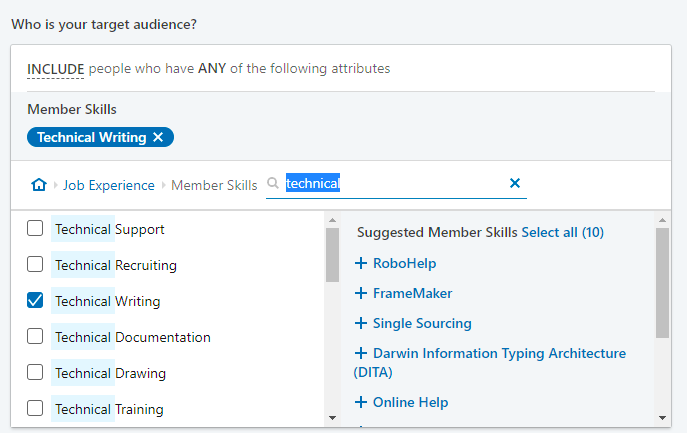
You can also play around with ad formats on LinkedIn to find which one is most effective. To find out more about the ad types on LinkedIn —such as sponsored, message, text, and dynamic — check out our post about creating an awesome LinkedIn Ad campaign.
Pringles is just one company using market research and target audiences to make paid social media decisions that work extremely well. It’s easy to think ad spend is just for the big brands, but making informed purchase decisions benefits every business.
The truth is, social media channels are making advertising functional for businesses of small size, as well. It’s just about learning how to use them (and which ones are best for your audience) to benefit your brand and get the highest ROI.

Do You Really Need Sound in Your Instagram Stories? [New Research]
Since the dawn of Stories features across social media platforms, many brands have asked, “Should we make Stories with or without sound?”
While some people love to get the full experience of sight and sound while they watch Stories on various platforms, others watch this type of content when they’re on-the-go.
Because many mobile users are often in public, standing near people, or even in at school or work when they watch Story content, they might choose to watch with the sound off.
Story platforms have even debated whether this element is or isn’t a necessity. Recently, news coverage from MarketingLand noted that Snapchat encourages creators to include sound in their Stories, while Facebook says otherwise.
But, what about Instagram? Are people turning off their sound to watch Stories on this platform? Or is it still worth creating Stories that rely on audio elements?
This question is such a highly debated topic that I decided to ask consumers to weigh in.
To do this, I used Lucid software to ask over 350 people the question, “How often do you watch Instagram Stories with the sound on?”
When I received the results, I was actually pretty surprised by what the consumer group said.
After that Facebook, Instagram’s owner, announced that 85% of its own platform’s users watch videos without sound, you might think that many Instagram users also watch content — like Stories — without audio. But, then again, if you’re a Snapchat user who’s more accustomed to watching videos with the sound on, you might assume that everyone else has a similar preference.
But, when it came to the poll, the results were a fairly mixed bag.
Of the respondents who watch Instagram Stories, 56% say they watch with the sound on “Sometimes,” while 29% say, “Always.” Only a small chunk of consumers say they never watch Stories with the sound on.
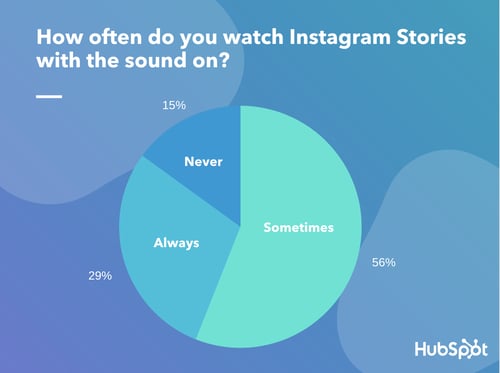
Data Source: Lucid Software
So, what does a “Sometimes to Always” response mean for marketers?
Depending on what the Story content is, you don’t have to worry too much about whether you need sound or not. If you need it to tell a better Story, you can still place have non-silent content. And, if your content is more photo, interactive sticker, or text-heavy, you don’t need to purchase music or create sounds to make it engaging.
One thing to keep in mind is that if you have a Story that requires sound to understand, you might want to make it accessible to people who view it on silent.
For example, if you interview someone, you could include a “Sound On” disclaimer, or subtitles that appear at the bottom of the video, This way, viewers will either be able to read from the subtitles, or they can return to the Story when they’re able to turn on their sound.
To give you a visual example, here’s what an Instagram Story with subtitles might look like:

Source: Mashable
3 Instagram Stories that Work Without Sound
Ultimately, if you want to save money, time, and effort, you can drop sound altogether. However, when you do this, you’ll want to make sure that your visual content is both enticing and informative so a user can understand and engage with a Story. Here are a few great examples of brands that do this well.
Starbucks
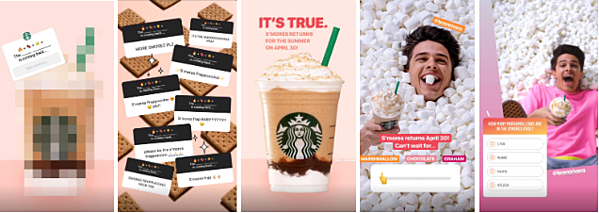
Starbucks uses Stories to share customer testimonies, new product launches, and other interactive content. These aspects of promotional content are not only interesting for viewers and prospective customers — but additionally — they don’t require sound.
In one example, Starbucks asks viewers to guess which drink is coming back. In the Story’s next page, the brand shares the best text-based answers and reveals the S’mores Frap and image. To add some extra interactivity, viewers can vote on what type of S’mores Frap they prefer and guess how many S’mores are shown in a video.
Harvard Business Publishing
The Harvard Business Review often centers Stories around management, professionalism, and career-life tips. While HBR has published videos and content with sound on its Instagram Story, they often adapt long-form article content into abridged Stories.
In these adapted Stories, you’ll often see a blurb of text, poll, or quiz on each page, rather than having to listen to a soundbite or video to understand the content.
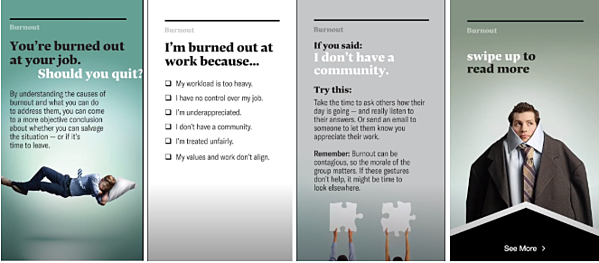
To make their text-based Stories more interesting and engaging, HBR embraces Instagram’s poll, quiz, and other interactive Story features. However, the publication also gets creative by adding its own spin on interactivity to a story.
In the example below, the publication shows users a burn-out checklist which they can screenshot and check off. The story then gives you advice on what to do if you checked any of the boxes.
HubSpot
At HubSpot, our social media team will occasionally post Stories with sound, but usually, they leverage quizzes, polls, and short blurbs of text to tell a compelling story without sound. Here’s a recent example where our Instagram Story highlights a new DM feature on the platform:
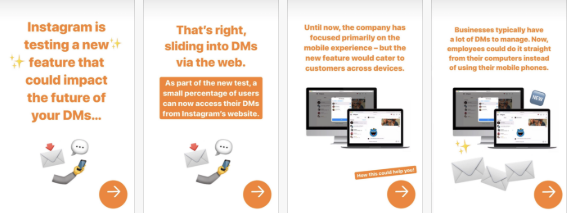
In the example above, our social team includes small blurbs of text to fully inform viewers about the topic we’re discussing. To keep viewers entertained, our social team includes images and relevant GIFs in the Stories.
How to Create Engaging Silent Content
Ready to create your first fully-silent Instagram Story, or at least embrace silent content in your content strategy?
To get started, it can be helpful to familiarize yourself with all the silent, but still engaging, features you can use on Instagram Stories. Then, if you’re interested in branching out with silent content on other platforms, check out this great guide to creating silent video.
Need more examples of soundless content? Click here for a rundown of silent video examples.

Why Accessible Marketing is the Future, According to an Inclusive Design Expert
One in four people live with a disability in the United States.
That means, if your marketing content excludes people living with a disability, you could be losing out on the potential of converting 61 million people into customers.
I had the opportunity to sit down with Christina Mallon, the Global Head of Inclusive Design and Accessibility at Wunderman Thompson (the largest ad agency in the world), to learn how brands are creating more inclusive products and campaigns to reach an underserved audience.
Christina has worked with major brands, including Microsoft and Tommy Hilfiger, to help them develop accessible products and content for their marketing campaigns. She’s worked on digital marketing campaigns for Tommy Adaptive, and helped build the first-ever Alexa skill for people with disabilities. Her work has received national attention and has been featured on PBS, Fast Company, Forbes, Yahoo!, and more.
Needless to say, I was very lucky to sit down with Christina to learn how marketers should think about accessibility when it comes to building web experiences and content.
Here, we’ll explore Christina’s definition for accessibility, examples of non-accessible marketing, and how you can create more inclusive and accessible marketing content for 2020 and beyond.
How do you define accessibility?
Christina shared that the World Health Organization defines a disability as a function of the mismatch between a person’s abilities and the demands of the environment. “The best example I have of this can be found at airports,” she shared.
As you’re de-boarding a plane and heading to baggage claim, many times the baggage claim is in a different wing of the airport. These airports offer both stairs and escalators to help people get to their luggage.
“But why are the only options for getting to the baggage claim stairs and escalators? ” she asked.
In describing her example, Christina said “stairs and escalators are two identical solutions to the same problem.” People in wheelchairs are required to take a different route to baggage claim because they are unable to take the stairs or escalator solution that was designed.
“This everyday occurrence is a design problem,” Christina said.
And as marketers and designers who build digital products and content, we have an opportunity to design something that is accessible for all.
Ultimately, accessibility is an attribute, and inclusive design is a method.
Marketers can make their content accessible by using inclusive design practices. We’ll dive into those, but first — let’s take a look at pieces of content that currently aren’t accessible.
Examples of Content That Aren’t Accessible
To better understand what inclusive design looks like, Christina shared some examples of accessibility fails, or brands that weren’t meeting the expectation of someone with a disability.
1. Amazon: A desktop site that does not support people who need to purchase through voice.
Christina first mentioned Amazon, telling me: “When I was in the UK for business I went on my computer and tried to make a purchase on Amazon. The issue I ran into was that I was unable to use my accessibility voice device on their desktop site.” Noticeably frustrated, she said, “they asked me to leave the desktop site and open amazon on my phone because the phone had built-in accessibility features.”
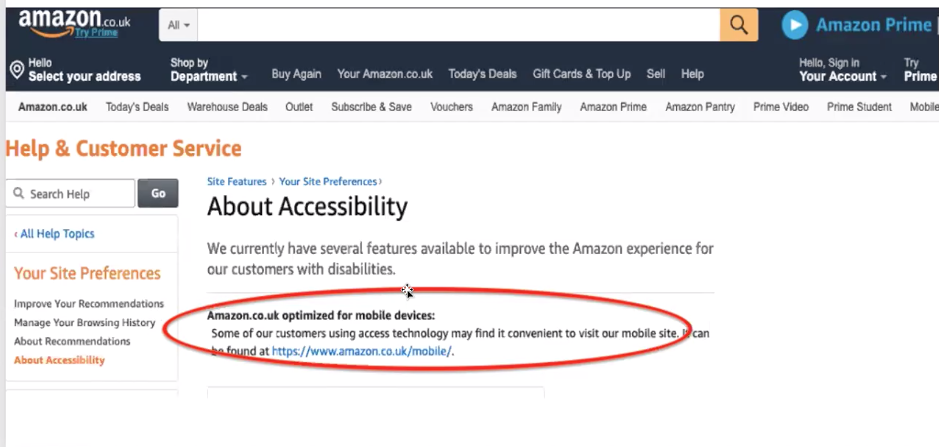
“They don’t care about me. They just want me to use the mobile device instead of making their web experience accessible.” Because of this, Christina makes a majority of her purchases on Jet.com. She told me that physical stores are difficult for someone with mobility challenges and Amazon does not meet her expectations. So, her brand loyalty and purchases go elsewhere.
This is a reminder for product and marketing teams to ensure their desktop and mobile experiences are accessible for all.
2. LEGO: A promotional video for the blind that includes no audio.
Another example of content that is not accessible came from LEGO. The beloved bricks launched a new line of Braille Bricks to help blind students learn how to spell.
This new product is incredible and even got picked up by CBS Morning News and other publications. However, one publication covered the product launch with this video:
“Now” Christina said, “This is a product for blind people and a marketer created a beautiful promotional video. The video has great shots of the product being used by students. It has nice copy animations that explain the use of the product. And an upbeat song to help tell the product story.”
“However, there is one issue.”
I could tell it was a big issue.
“There is no verbal audio,” Christina shared.
Someone who is blind would not be able to consume this promotional video and understand the product that was built for them.
While the video may meet the creative standards of the brand and the requirements for social media videos, it isn’t created with the target audience in-mind.
This is an oversight by the creator, and a reminder for brands to always be mindful of the consumer.
After discussing the video, Christina told me to “make sure that your customer experience is inclusive from end-to-end, including the product and the promotion.”
Tips and Tools for Creating More Accessible Content
Once I had a better understanding of accessibility and examples of what to avoid, I asked Christina how marketers can create accessible content going forward — I asked her, “Is there a checklist, or a list of standards for marketers to reference?”
Immediately, Christina replied, “Inclusive design is more than a checklist.”
Instead of going through a checklist of how to make content accessible, Christina shared three principles of inclusive design that can be used by marketers when creating web experiences and content.
“When creating a piece of content or designing a web experience, be mindful of these primary principles.”
1. Recognize Exclusion
Be aware that there are consumers who are vision, hearing, and mobility impaired. Build a piece of content and share your work with them prior to launch. Receive feedback upfront from those audience segments before releasing your campaign to the public.
“I try to have someone who is vision, hearing, and cognitive impaired look at every piece of content before presenting my work to a client,” she shared. “I have been able to find people with disabilities, online, who are interested in working with us.”
If marketers don’t have an opportunity to work alongside people with a disability, they can always test their work against four main questions:
- Dexterity Experience: what kind of movement must a user perform to interact with my site or content?
- Vision Experience: What shapes, colors, text, and graphics must a user understand to consume my content?
- Hearing Experience: What sound does my content produce that are required for a user to consume my content?
- Thinking Experience: How much time must a user spend with my content to truly interpret and understand it?
Once a marketer runs their content through these questions, they will have a better understanding of what improvements can be made to simplify the work and make it more accessible.
2. Solve for One, Extend to Many
As marketers, we have the ability to solve customer problems through design and content. By creating content for people with disabilities in mind, our content will be accessible to everyone.
Christina told me, “design for disability, and your work will work for everyone.” It’s critical that accessibility is a part of your design and creation process upfront — and not an afterthought.

To best articulate her point, Christina shared some consumer products that were designed for people with disabilities but have become a part of mainstream culture:
- Touchscreens: Originally designed for people with mobility issues and sold to Apple to be used across all mobile devices globally.
- Electric Toothbrush: Originally designed for people with limited motor skills to improve dental health. Now used by millions for superior cleaning.
- Closed Captioning: Originally created for people with a hearing impairment. Now used for people learning a new language or consuming content without audio.
These product designs for people with disabilities have made their way into daily life for all, demonstrating that by creating for people with disabilities, marketing content has the ability to be adopted by a larger audience.
Tools to Get Started
Creating accessible content and web experiences is an ongoing process. Marketing teams may not have the resources to go back and update all pieces of content that have been created.
However, moving forward, by being mindful of accessibility, marketers can ensure that their content is being built for the largest addressable audience.
I asked Christina for recommended tools that could help marketers get started with creating accessible content. She suggested the following six:
- WebAIM Color Contrast Checker: A contrast color checker that gives you results in real time for regular and large text.
- Inclusive Components: A pattern library with a focus on inclusive design. Each post explores a common interface component and comes up with a better, more robust and accessible version of it.
- Color Oracle: A free color blindness simulator for Windows, Mac, and Linux. It shows you in real time what people with common color vision impairments see.
- Vox Product Accessibility Guidelines: A comprehensive checklist for designers, engineers, and project managers.
- AXE Google Chrome Extension: Test any site for accessibility violations using the Chrome inspector.
- Contrast: A macOS app for quick access to WCAG color contrast ratios.
Whether you’re building a new website, producing a product video, or creating a new report marketers need to keep accessibility in mind. Creating content and products that can be accessed by everyone will help you reach new audiences and reach your goals.
Ultimately, using inclusive design can help you reach more potential customers and grow your business — plus, it demonstrates your brands commitment to serving the needs of as many people as possible.
