Leadership Styles: The 11 Most Common & How to Find Your Style [Quiz]
Imagine the leaders that inspire you. Each leader is unique, with different leadership styles that they use to meet goals, motivate, and inspire.
To help you understand the impact each type of leader has on a company, this post will explain what a leadership style is. We’ll cover the most common types of leadership and how they can impact the business and the team.

Then you’ll get some tools to help you figure out what styles are best for you. Start reading, or jump to the section you’re looking for:
- Types of Leadership Styles
- Deciding Between Different Leadership Styles
- How to Choose the Right Leadership Style for You
- Leadership Style Assessment
Why It’s Important to Know Your Leadership Style
Knowing your leadership style is critical because it can help you determine how you affect those who are under your direct influence. How do your direct reports see you? Do they feel you’re an effective leader?
It’s always important to ask for feedback to understand how you’re doing, but knowing your leadership style prior to asking for feedback can be a helpful starting point. That way, when you receive junior employees’ thoughts, you can automatically decide which leadership style would be best and adopt the style’s characteristics in your day-to-day management duties.
Knowing your leadership styles may help you improve with limited feedback. Each leadership style has its pitfalls, allowing you to proactively address areas of improvement. This is critical because some employees might hesitate to speak up, even in an anonymous survey.
Ready to find out your leadership styles? Check out the most common styles below.
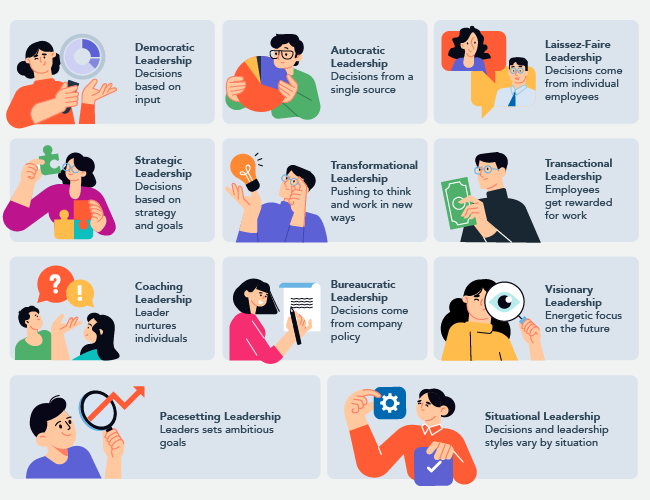
1. Democratic Leadership
Also called: Participative or Facilitative Leadership
Democratic leadership is exactly what it sounds like — the leader makes decisions based on the input of each team member. Although the leader makes the final call, each employee has an equal say in a project’s direction.
Why this leadership style works for businesses:
It resembles how leaders often make decisions in company board meetings.
For example, a democratic leader might give the team a few decision-related options in a company board meeting. They could then open a discussion about each option. After a discussion, this leader might take the board’s thoughts and feedback into consideration, or they might open this decision up to a vote.
Why this leadership style is good for the team:
Democratic leadership is one of the most effective leadership styles. This is because it allows lower-level employees to exercise the authority they’ll need to use wisely in future positions.
Potential challenges for leaders with a Democratic style:
The process of reaching a consensus takes considerable time, resources, and communication. It can also impact decision-making because some team members may not have the right expertise to make critical decisions.
Featured resources:
2. Autocratic Leadership
Also called: Authoritarian, Coercive, or Commanding Leadership
Autocratic leadership is the inverse of democratic leadership. In this leadership style, the leader makes decisions without taking input from anyone who reports to them.
This style is most useful when a business needs to control specific situations, not as a standalone leadership style.
Why this leadership style works for businesses:
Autocratic leaders carry out strategies and directives with absolute focus. This drive and clarity can lead to better performance.
It’s efficient because employees aren’t consulted before a change in direction. Instead, they’re expected to adhere to the decision at a time and pace stipulated by the leader.
Why this leadership style is good for the team:
This type of leadership is most effective when a company is making difficult decisions. This leadership style gives employees a clear sense of direction. It can also make up for a lack of experience on a team.
Potential challenges for leaders with an Autocratic style:
Most organizations today can’t sustain such a hegemonic culture without losing employees. It can lower morale and creative problem-solving.
An example of this could be when a manager changes the hours of work shifts for employees without consulting anyone.
Other challenges with autocratic leaders include:
- Intimidation
- Micromanagement
- Over-reliance on a single leader
3. Laissez-Faire Leadership
Also called: Delegative or Hands-off Leadership
If you remember your high-school French, you’ll accurately assume that laissez-faire leadership is the least intrusive form of leadership. The French term “laissez-faire” literally translates to “let them do.” Leaders who embrace it give nearly all authority to their employees.
Why this leadership style works for businesses:
Laissez-faire leaders make employees accountable for their work. This gives many employees an incentive to do their best work.
This type of leader often creates a more relaxed company culture. This makes it a good model for creative businesses like ad agencies or product design. It’s also a good fit for a business with a highly-skilled team.
Why this leadership style is good for the team:
In a young startup, for example, you might see a laissez-faire company founder who makes no major office policies around work hours or deadlines. They might put full trust into their employees while they focus on the overall workings of running the company.
Because of this high level of trust, employees working for laissez-faire leaders feel valued. They get the information they need and use their resources and experience to meet business goals.
Potential challenges for leaders with a Laissez-Faire style:
Although laissez-faire leadership can empower employees by trusting them to work however they’d like, there are downsides. This style of leadership can limit team development. It can also be an issue if employees are new or inexperienced.
This can lead to overlooking critical company growth opportunities. So, it’s important to keep this leadership style in check.
Featured resources:
4. Strategic Leadership
Strategic leaders sit between a company’s main operations and its growth opportunities. This form of leadership requires vision, competitive awareness, and adaptability.
They accept the burden of executive interests. At the same time, they make sure that current working conditions are stable for everyone else.
Why this leadership style works for businesses:
Strategic leaders tie plans for growth and strategy to the way they manage a team. They ask questions, develop and execute strategies, and consider future growth. This approach supports popular business goals like:
- Accountability
- Productivity
- Collaboration
- Transparency
Why this leadership style is good for the team:
This is a desirable leadership style in many companies because strategic thinking supports many types of employees at once.
It encourages visualization, planning, and making the most of existing resources. This approach can be motivating for employees.
Potential challenges for leaders with a strategic leadership style:
Leaders who work strategically can sometimes take on too much. They also risk thinking too far into the future while missing critical present-day issues.
Learning how to delegate is essential, as well as sharing the weight of decision-making. Compromise, communication skills, and consistent outreach are also important.
Featured resources:
5. Transformational Leadership
Transformational leadership is always “transforming” and improving upon the company’s conventions. Employees might have a basic set of tasks and goals that they complete every week or month, but the leader is constantly pushing them outside of their comfort zone.
Why this leadership style works for businesses:
Transformational leaders can inspire their teams to think in new ways. This can help companies update business processes to improve productivity and profitability. It can also help with employee satisfaction, morale, and motivation.
Why this leadership style is good for the team:
When starting a job with this type of leader, all employees might get a list of goals to reach, as well as deadlines for reaching them.
The goals might seem simple at first. But this manager might pick up the pace of deadlines or give you more challenging goals as you grow with the company.
This is a highly encouraged form of leadership among growth-minded companies. It motivates employees to see what they’re capable of.
Potential challenges for leaders with a Transformational style:
Transformational leaders can risk losing sight of everyone’s individual learning curves. It’s important to make sure that direct reports get the right coaching to guide them through new responsibilities. Employee burnout can also be an issue, so it’s important to work with your team to update benchmarks.
Featured resources:
6. Transactional Leadership
Transactional leaders are fairly common today. These managers reward their employees for the work they do.
For example, a marketing team receives a scheduled bonus for helping generate a certain number of leads per quarter.
This leadership style also assumes that teams need structure and monitoring to meet business goals.
Why this leadership style works for businesses:
This style is popular in enterprise companies. It focuses on results, existing structures, and set systems of rewards or penalties. This leadership style also recognizes and rewards commitment.
Why this leadership style is good for the team:
Transactional leaders offer clarity and structure. Employees feel safe because they clearly understand their expectations. They also understand what they will get in return for meeting business goals.
Potential challenges for leaders with a transactional style:
This leadership style is less about relationships and more about using rewards to motivate. This makes it hard to keep a diverse team engaged. Using only this leadership style can lead to low creativity and fear of punishment.
7. Coaching Leadership
Also called: Conscious Leadership
Like a sports team’s coach, this leader focuses on identifying and nurturing the individual strengths of each member of the team. They also focus on strategies that will enable their team to work better together. This style offers strong similarities to strategic and democratic leadership. But it puts more emphasis on the growth and success of individual employees.
A manager with this leadership style might help employees improve on their strengths by:
- Giving them new tasks to try
- Offering guidance
- Meeting to discuss constructive feedback
They might also encourage one or more team members to expand on their strengths by learning new skills from other teammates.
Why this leadership style works for businesses:
Coaching leaders actively support skill development and independent problem-solving. They meet ambitious business goals by creating a strong company culture. They add to the long-term vision of a business as valuable mentors, often even after leaving a company.
Why this leadership style is good for the team:
This style recognizes that each employee is unique. They build diverse and exciting teams where each employee offers something different.
This leader focuses on high performance, with employees that can communicate well and embrace unique skill sets to get work done.
Potential challenges for leaders with a coaching style:
It can take a lot of time to develop employees with a coaching style, and mentoring isn’t effective for every kind of employee. This leadership style takes time and patience, and it doesn’t work with every company culture.
Featured resources:
8. Bureaucratic Leadership
Bureaucratic leaders follow the rules. This style of leadership might listen and consider the input of employees — unlike autocratic leadership. But the leader tends to reject an employee’s input if it conflicts with company policy or past practices.
Why this leadership style works for businesses:
You may run into a bureaucratic leader at a larger, older, or traditional company. They might reject ideas that seem new or non-traditional to maintain existing business models and processes.
Their resistance might be because the company is successful with current processes. It could also be because trying something new could waste time or resources if it doesn’t work.
Why this leadership style is good for the team:
This style of leadership can be challenging for some, but it also has many benefits. It lowers the risk of favoritism and replaces it with central duties, job security, and predictability.
This leadership style is clear and efficient, and can also lead to high levels of creativity for some employees.
Potential challenges for leaders with a bureaucratic leadership style:
Employees under this leadership style might not feel as controlled as they would under autocratic leadership. There is sometimes a lack of freedom in how much people are able to do in their roles.
This approach to leadership can quickly shut down innovation. It may not be a right fit for companies that are chasing ambitious goals and quick growth.
Featured resources:
9. Visionary Leadership
Also called: Affiliative Leadership
Visionary leadership focuses on the future. This type of leader encourages collaboration, emotional intelligence, and teamwork.
Why this leadership style works for businesses:
Visionary leaders create a clear plan for inspired employees to follow and execute. They are also powerful and persuasive communicators. This gives them the ability to energize teams toward impactful business growth.
Why this leadership style is good for the team:
Teams can do more and enjoy their work more if they have a vision to work toward. This type of leader offers vision statements and other tools to inspire and motivate teams to engage at work.
Potential challenges for leaders with a visionary style:
Inspiration can be difficult to structure, so this type of leader might miss crucial details. They can also skip over day-to-day issues to focus on long-term ideas. Another common challenge is hyper-focus on a single goal, when other goals may be just as valuable to the business.
Featured resources:
10. Pacesetting Leadership
Pacesetting leaders set ambitious standards. They are often perfectionists, and this leader may also expect employees to exceed goals with limited guidance.
Why this leadership style works for businesses:
This type of leader motivates by working alongside their team and pushing performance. They expect to exceed expectations and often achieve ambitious goals with clear and focused effort.
For example, pacesetting sales leaders set and exceed ambitious quarterly sales cadences.
Why this leadership style is good for the team:
Skilled and experienced teams often thrive under this kind of leader. They use the abilities of motivated and competent team members and make meeting goals feel urgent and exciting.
It can also be gratifying for team members to see their leader working hard alongside them.
Potential challenges for leaders with a pacesetting style:
Pacesetting leaders can sometimes create a high-stress workplace environment. If goals are not realistic it can overwhelm and demotivate the team. This combination can impact engagement and lead to burnout.
Featured resources:
11. Situational Leadership
Situational leaders change their management style to meet the needs of the situation or team. This leadership style is proactive and recognizes that change is the only constant.
Why this leadership style works for businesses:
This approach to leadership can motivate employees. It helps them to be more proactive — anticipating business issues before they happen.
It’s also useful in startups or other businesses that make frequent changes and need flexible talent and support.
Why this leadership style is good for the team:
This type of leader is a great communicator and uses constant team feedback to make decisions. They quickly evaluate and update processes to enable success. It also creates strong relationships and helps employees see and feel their value to the business.
Potential challenges for leaders with a situational style:
Leaders need a high level of expertise in all business processes and functions to make decisions. It can also be confusing and stressful for teams if a leader’s approach changes too often. It’s important to remember long-term goals as well as meet immediate needs, and not every leader can do this effectively.
Featured resources:
Deciding Between Different Leadership Styles
There’s no single “best” style of leadership. So, if you plan to lead, you’ll need to figure out what leadership styles are best for you and your environment.
How to Understand Your Instinctive Leadership Style
Leaders need good instincts, and many leaders focus on their own experiences and habits as they develop a leadership style. As you start your path toward leadership, you may want to start keeping notes. Write down how you would handle specific situations or problems.
This approach can help you be a confident and capable leader. But if you notice some interactions aren’t going the way you expect, you may want to reconsider your approach.
Your instincts and habits will always impact the way you lead. But if you find yourself in situations that you’re not sure how to respond to, you may want to look at other leadership styles.
For example, if you’re an extrovert with a shy member on your team, you may want to work on active listening. If you’re an introvert leading a team of outgoing people, you may need to learn new ways to nurture, support, and inspire your team.
Can you change your leadership style?
You can change or expand your leadership style. It may take some time and effort, but anyone can make changes that can improve their leadership.
The first step is seeing the need for change. Next, you need to prepare yourself for that change.
For example, your leadership style may be effective with your team, but you might have a harder time connecting with stakeholders.
In this situation, you wouldn’t want to throw out your current leadership style. Instead, you’ll want to give yourself time to identify what is and isn’t working. Think about how this change might affect your ability to grow in your organization and other parts of your life. Then, get curious, and begin the work of adjusting the way you lead.
How to Choose the Right Leadership Style for You
There are many different ways that you can find the right leadership style for you. Because of this, it can be tough to know where to begin. If you’re not sure what leadership styles will work for you, these steps can help.
1. Get to know yourself.
Different personalities need unique paths to self-discovery. For some, it’s a process of taking risks and trying new things. For others, quiet time, writing exercises, and listing strengths and weaknesses.
Another path to learning about yourself is through physical activity and spending time with other people. However you go about it, getting to know yourself is an important first step toward being a leader.
2. Outline your values and challenges.
As you get to know yourself, the process may help you better understand what’s important to you and where you struggle. Being a leader often means working at a fast pace and making decisions quickly. In these situations, it’s helpful to have your values mapped out.
As you write out your values, look at pivotal moments in your life to date. Then, look for trends, people you’re drawn to, and common themes.
You might have a long list, so you’ll want to group similar ideas. This outline can help you see how you react, your strengths and weaknesses, and a base for your core values.
3. Watch leaders you respect.
Observing leaders you respect can also help you with leadership styles. As you watch these leaders in meetings, client conversations, and presentations, you may want to take notes.
Another approach is to view their actions with a specific leadership style in mind. This makes it easier to figure out their leadership style and whether it would work for you.
4. Try different leadership styles.
Another way to decide if a leadership style is right for you is to try it out. You might want to create an outline of each leadership style that interests you. Then, review your notes before your next meeting and see how you might incorporate this style into your interactions.
5. Find a business coach or mentor.
You can also hone your leadership style by working with a business coach. There are a few places to start your business coach search.
First, look around your workplace and see if there is someone at your company who’d like to mentor you. If there’s not a right fit, your colleagues can be great resources for respected business mentors.
If that doesn’t bring you the coaching you need, check out this list of places to find a business coach.
6. Ask colleagues and leaders for feedback.
Another way that your team can help you find the best leadership styles is by asking them for feedback.
It’s smart to take some time with this strategy. Before you reach out, plan what you want to ask and why. Think about how your team member might respond and set clear guidelines and expectations.
When your colleagues are ready to share their insights with you, make a point to listen carefully. These sessions can be emotionally-charged, so you might want to take notes so that you can sit with the feedback before responding.
If you decide to share your action plan with your colleagues, be sure to commit and follow up. This process can build trust and engage your team, but it can also create issues if you don’t make good on your intentions.
7. Complete a leadership style assessment.
Leadership assessments are useful tools for leaders, both as individuals and to assess their teams.
A leadership quiz can make it easier to understand your strengths and skills. It can surface habits and qualities you might not be aware of and can give you a clear direction for growth.
If this is something you want to try, the leadership assessment below is a great place to start.
Leadership Style Assessment
Leaders can carry a mix of the above leadership styles depending on their industry and the obstacles they face. At the root of these styles, according to leadership experts Bill Torbert and David Rooke, are what are called “action logics.”
These action logics assess “how [leaders] interpret their surroundings and react when their power or safety is challenged.”
That’s the idea behind a popular management survey tool called the Leadership Development Profile. Created by professor Torbert and psychologist Susanne Cook-Greuter — and featured in the book, Personal and Organizational Transformations — the survey relies on a set of 36 open-ended sentence completion tasks to help researchers better understand how leaders develop and grow.
Below, we’ve outlined six action logics using open-ended sentences that help describe each one. See how much you agree with each sentence and, at the bottom, find out which leadership style you uphold based on the action logics you most align with.
1. Individualist
The individualist, according to Rooke and Tolbert, is self-aware, creative, and primarily focused on their own actions and development as opposed to overall organizational performance. This action logic is exceptionally driven by the desire to exceed personal goals and constantly improve their skills.
Here are some things an individualist might say:
Individualist 1: “A good leader should always trust their own intuition over established organizational processes.”
Individualist 2: “It’s important to be able to relate to others so I can easily communicate complex ideas to them.”
Individualist 3: “I’m more comfortable with progress than sustained success.”
2. Strategist
Strategists are acutely aware of the environments in which they operate. They have a deep understanding of the structures and processes that make their businesses tick, but they’re also able to consider these frameworks critically and evaluate what could be improved.
Here are some things a strategist might say:
Strategist 1: “A good leader should always be able to build a consensus in divided groups.”
Strategist 2: “It’s important to help develop the organization as a whole, as well as the growth and individual achievements of my direct reports.”
Strategist 3: “Conflict is inevitable, but I’m knowledgeable enough about my team’s personal and professional relationships to handle the friction.”
3. Alchemist
Rooke and Tolbert describe this charismatic action logic as the most highly evolved and effective at managing organizational change. What distinguishes alchemists from other action logics is their unique ability to see the big picture in everything, but also fully understand the need to take details seriously. Under an alchemist leader, no department or employee is overlooked.
Here are some things an alchemist might say:
Alchemist 1: “A good leader helps their employees reach their highest potential, and possesses the necessary empathy and moral awareness to get there.”
Alchemist 2: “It’s important to make a profound and positive impact on whatever I’m working on.”
Alchemist 3: “I have a unique ability to balance short-term needs and long-term goals.”
4. Opportunist
Opportunists are guided by a certain level of mistrust of others, relying on a facade of control to keep their employees in line. “Opportunists tend to regard their bad behavior as legitimate in the cut and thrust of an eye-for-an-eye world,” Rooke and Tolbert write.
Here are some things an opportunist might say:
Opportunist 1: “A good leader should always view others as potential competition to be bested, even if it’s at the expense of their professional development.”
Opportunist 2: “I reserve the right to reject the input of those who question or criticize my ideas.”
5. Diplomat
Unlike the opportunist, the diplomat isn’t concerned with competition or assuming control over situations. Instead, this action logic seeks to cause minimal impact on their organization by conforming to existing norms and completing their daily tasks with as little friction as possible.
Here are some things a diplomat might say:
Diplomat 1: “A good leader should always resist change since it risks causing instability among their direct reports.”
Diplomat 2: “It’s important to provide the ‘social glue’ in team situations, safely away from conflict.”
Diplomat 3: “I tend to thrive in more team-oriented or supporting leadership roles.”
6. Expert
The expert is a pro in their given field, constantly striving to perfect their knowledge of a subject and perform to meet their own high expectations. Rooke and Tolbert describe the expert as a talented individual contributor and a source of knowledge for the team. But this action logic does lack something central to many good leaders: emotional intelligence.
Here are some things a diplomat might say:
Expert 1: “A good leader should prioritize their own pursuit of knowledge over the needs of the organization and their direct reports.”
Expert 2: “When problem-solving with others in the company, my opinion tends to be the correct one.”
Which Leader Are You?
So, which action logics above felt like you? Think about each sentence for a moment.
Now, check out which of the seven leadership styles you embrace on the right based on the sentences you resonated with on the left.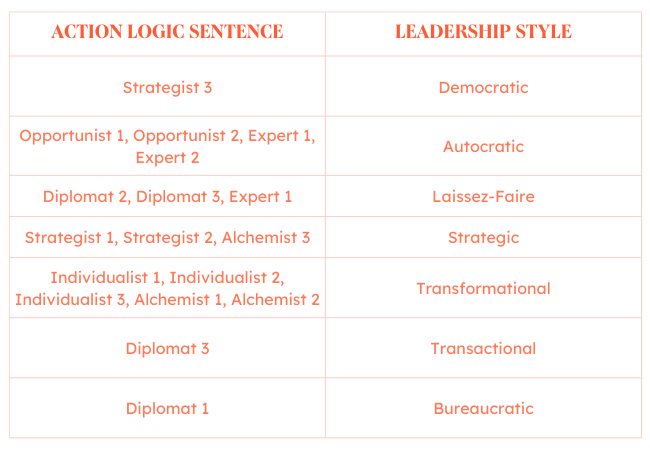
The more action logics you agree with, the more likely you are to practice a mix of leadership styles.
For example, if you agreed with everything the strategist said, this would make you a 66% strategic leader and 33% democratic leader. If you agreed with just the third statement, but also everything the alchemist said, this would make you a 50% transformational, 25% strategic, and 25% democratic leader.
Keep in mind that these action logics are considered developmental stages, not fixed attributes — most leaders will progress through multiple types of leadership throughout their careers.
Learn Your Leadership Style to Become a Better Leader
Choosing leadership styles that work for you can make you a more effective leader. Whether you manage a big or small team, your style heavily impacts how your direct reports see you. It decides how effectively your team works together to achieve your company’s goals.
If you want to be a leader that makes a difference, you’ll need to keep growing and embrace change. Are you ready to get started?
Editor’s note: This post was originally published in August 2016 and has been updated for comprehensiveness.

43 TikTok Stats to Know in 2022
Since launching in early 2018, TikTok’s been covered by seemingly every major news publication and racked up millions of downloads globally.
Despite its popularity, the app can still feel like a bit of a mystery to marketers, especially since TikTok doesn’t always disclose key app metrics.

As someone who’s gotten sucked into the app, blogged multiple times about it, hearted hundreds of posts, and even made a few videos of my own, I’m fairly certain that this platform will stick around for quite some time.
But, luckily, with mounting data and statistics about TikTok, you don’t just have to take my word for it. To help you make informed decisions about your strategy, we’ll cover key TikTok statistics and facts to know, whether you’re just starting out on the app or you’re looking to update your strategy.
Already know what stats you’re looking for? Jump there with this table of contents:
- Userbase, Downloads, and Growth
- Demographics
- User Behavior
- Viral Trends and Influencers on TikTok
- Business, Revenue, and Competition
- Where to Find TikTok Stats
43 TikTok Stats to Know in 2022
Userbase, Downloads, and Growth
Within TikTok’s first year, it reportedly reached 500 million monthly active users. Wondering if this was just a fluke or a viral trend that will simmer down? Think again. According to TikTok and its company heads, the audience might be larger and more promising than we think.
- In September 2021, TikTok celebrated reaching 1 billion monthly active users. (TikTok)
- Musical.ly, a lip-syncing app which ByteDance purchased and merged with TikTok, reportedly had 100 million monthly active users when it was purchased by TikTok in 2018. (The Verge)
- Douyin, TikTok’s original standalone app in China, had 300 million users at the time Musical.ly merged with TikTok. (The Verge)
- In 2020, TikTok was the most downloaded app globally (850 million downloads), followed by WhatsApp, Facebook, and Instagram. (Apptopia)
- TikTok is the Top Free App in the Entertainment section of the Apple App Store. (Apple App Store)
Demographics
While TikTok’s user base is dominated by Gen-Z in the United States, many millennials have adopted it around the world. And, although it might feel like TikTok is huge in the U.S., the app’s biggest audience actually comes from China, where the platform is called Douyin.
Here’s a breakdown of TikTok’s major demographic.
- 52.38% of TikTok users globally are between the ages of 18 and 24. (Statista)
- The United States, Indonesia, and Brazil have the largest audiences on TikTok as of April 2022. (Statista)
- As of April 2021, 48% of U.S. adults between 18-29 use TikTok, compared to 20% of adults between 30-49 and 14% among 50-64 year olds. (Pew Research Center)
- One-quarter of Americans between 12 and 34 have used TikTok compared to 3% of adults aged 35+. (MarketingCharts)
- TikTok is now available in more than 200 countries. (Oberlo)
- Over 22.2 million of TikTok’s monthly active users are in Indonesia. (Statista)
- The social media apps Gen Z uses most are TikTok, Instagram, and YouTube. (HubSpot Blog)
User Behavior
TikTok is a fast-paced app. The second you log in, you see a video at the top of a feed that’s algorithmically curated around your interests.
From my own experience, I’ve found that TikTok can easily cause you to spend more time than expected watching an endless stream of often comedic videos. Since these videos are usually between 15 seconds and one minute, it makes the app ideal for people who need quick entertainment on their morning commute or when they’re bored at home.
Because of TikTok’s quick pace and entertainment factor, the stats below aren’t that surprising:
- The average user spends 89 minutes per day on the app, according to a leaked deck from TikTok. (Music Business Worldwide)
- As of September 2021, there are 14.43 million daily active users using the TikTok Android App and the average user spends 12.3 hours per month using it. (Statista, HootSuite)
- TikTok is one of the most downloaded apps in the Google Play Store. (Statista)
- According to a leaked TikTok deck, the average user opens the app 19 times per day. (Music Business Worldwide)
- There are 29.7 million global DAU on the TikTok iOS app as of January 2021. (Statista)
- 88% of people on TikTok report that the sound on the platform is central to the overall app experience. (TikTok)
- 68% of TikTok users say videos using popular songs help them remember brands better. (TikTok)
- 36% of consumers want to learn about products through short-form videos like TikToks or Reels. (HubSpot)
- 55% of users say TikTok helps them discover new things. (Material)
- 55% of TikTok users use the platform to research brands or products. (TikTok)
The Impact of TikTok
- The TikTok community is more frequently and consistently engaging with content on the platform than they are on other social media platforms. (Neuro-Insight).
- When users see brands organic TikTok content before their paid ads, there is a 27% increase in brand recall. (Neurons Inc.)
- 71% of TikTok users say the app has a bigger impact on their lives than other apps they use, and 79% say it inspires them to do new things in real life. (TikTok)
- TikTok users are 1.3x more likely to agree that the platform helps them hear different perspectives than they normally hear vs. other entertainment and social brands. (TikTok & Material)
- TikTok users are 1.3x more likely to know about products and trends before their peers. (Material & TikTok)
Shopping on TikTok
- 2 out of 3 users are likely to buy something while on the platform. (TikTok)
- 50% of TikTok users have bought something after watching a TikTok LIVE. (TikTok)
- TikTok users are twice as likely as users of traditional social platforms to recommend a product or service they’ve discovered on the app and 1.5x more successful at convincing others to try the product or service. (Material & TikTok)
Viral Trends and Influencers on TikTok
TikTok has opened doors for influencers, comedians, meme creators, and even some brands. Here are a few interesting tidbits about viral trends and influencers on the app:
- The most followed creator on TikTok is Khaby Lame with 147.7 million followers. Following close behind is Charlie D’Amelio with 144.6 million. (Wikipedia)
- One of the earliest branded hashtag challenges was Guess’ #InMyDenim challenge. According to TikTok, videos marked with this hashtag have received a grand total of 38.8 million views. (TikTok)
- 77% of TikTok users like when brands come up with new challenges, trends, or memes for others to join in on. (TikTok)
- TikTok users say that you don’t need to have thousands of followers to go viral on TikTok. (TikTok)
- 80% of top TikTok videos had music and upbeat songs. (Invideo)
- Remixing a TikTok trend leads to a 14% increase in watch time. (TikTok)
- Rapper Lil Nas X credits the success of his song “Old Town Road” to TikTok. The song was propelled to #1 on the Billboard Top 100 in 2019 after the artist uploaded it to TikTok. (BuzzFeed News)
Here’s a compilation of TikTok’s #CowboyChallenge where people wearing normal clothing cut to themselves in cowboy costumes to the song “Old Town Road.”
Business, Revenue, and Competition
The launch of TikTok not only put its parent company, ByteDance, on the map, but it also resulted in competition from apps like Facebook, which launched a very similar app called Lasso shortly after TikTok went viral. While TikTok and ByteDance are less transparent about revenue and other major details, here’s what we know:
- TikTokoffers five advertising tiers aimed at big brands. One of which, a branded hashtag challenge, reportedly costs $150,000 per day. (TikTok Pitch Deck Notes First Reported by Digiday)
- TikTok generated an estimated 4 billion in revenue in 2021. (Bloomberg
- Consumer spending on TikTok has surpassed $2.5 billion globally. (Sensor Tower)
- TikTok has a 4.8-star rating in the Apple App Store and 4.5 in the Google Play Store. (Apple App Store, Google Play Store)
- Bytedance, TikTok’s parent company is valued at $140 billion, making it the world’s most valuable startup. (CBInsights)
- TikTok has an ad reach of roughly 885 million people. (DataReportal)
The Mysteries of TikTok
Although TikTok is a top social platform and is ramping up its options for advertisers, it’s still rather new. When a company or startup is new, it’s not uncommon for leadership to hide early numbers, even when a brand is successful. In fact, we’ve seen this with other major companies like Snapchat and Netflix.
Despite the launch of TikTok For Business in mid 2020, there’s still a lot more to learn as TikTok’s global teams and ByteDance continue to remain hush-hush about major metrics. In the coming years, as TikTok continues to draw in more advertisers, it wouldn’t be surprising if we started to see more transparent information about the app and its user base.
Where to Find TikTok Stats
In the meantime, If you want to learn more about TikTok, you can read up on its short history and early success in this post, or click here to find a how-to guide for using the app. In addition, you can discover important TikTok facts app on various websites:
Want to see what other businesses are doing on TikTok? Check out this roundup of brands on TikTok.

Instagram Launches DM-Based Shopping Tools For Businesses: Why We Saw It Coming [New Data]
Remember when social media was all about keeping up with your friends and family?
For better or worse, those days are gone as more social platforms are now focused on keeping you connected with an endless stream of products you can buy without even leaving the app.
In other words, social media is the next frontier of e-commerce, and DMs are the future of customer service.
That’s the bold claim we made after running our survey of 500+ Instagram marketers earlier this year — but Instagram recently announced a big change confirming our theory.
In July, Instagram revealed that the app will let shoppers place and track orders directly in their DMs.

What Instagram’s DM Shopping Feature Looks Like
Instagram’s new DM features are similar to the messaging features of WhatsApp payments. Rather than going to a brand’s online retail store or Facebook/Instagram Shop, prospective customers can now shop and search for products with help from brand representatives on messenger.
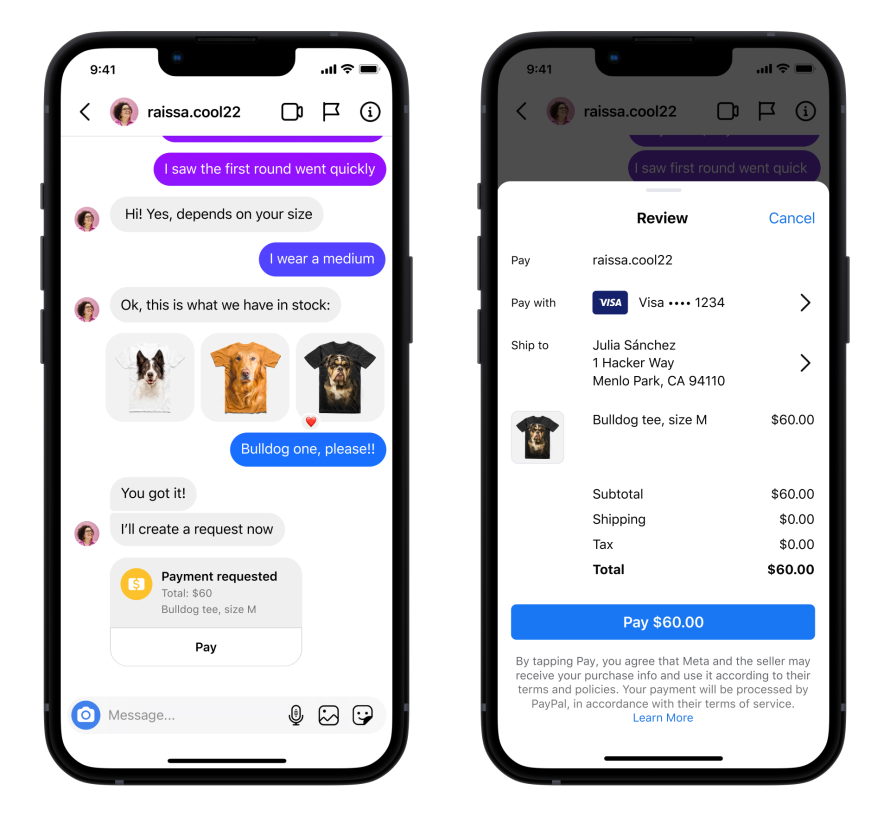
Meta’s announcement notes that businesses that enable the feature can:
- Chat with customers in real-time to answer questions and confirm purchase details.
- Create a payment request with item description and price.
- Request and collect payment.
Below is a preview of what this messaging feature looks like:
Why This Could be Big for Businesses
Why is this a big deal? For starters, our Instagram Marketing Trends Report shows that using the app’s shopping tools and leveraging DMs for customer service are the highest ROI strategies on the platform.
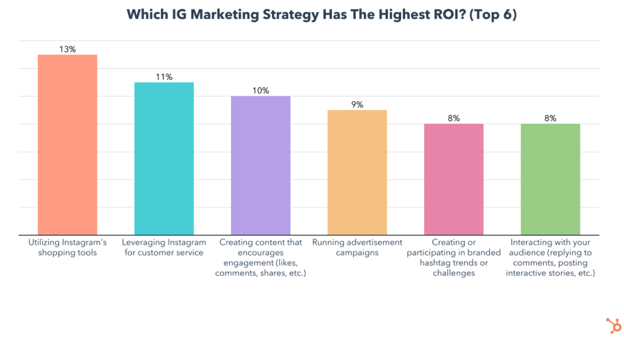
But while these tools may be working for marketers, are people actually buying products on Instagram and turning to DMs for customer service?
The results of another recent consumer trends survey we ran might surprise you:
- 28% of social media users age 18-34 have bought a product directly in a social media app in the past three months
- 1 in 4 people age 18-24 have used social media DMs for customer service in the past three months
- 33% of social media users age 18-24 have bought a product based on an influencer’s recommendation in the past three months
- Social media is Gen Z’s preferred channel for discovering new products. 57% of Gen Z have discovered a new product on social media in the past three months
- Social media is also Millennials preferred channel for discovering new products. 1 in 2 Millennials have discovered a new product on social media in the past three months
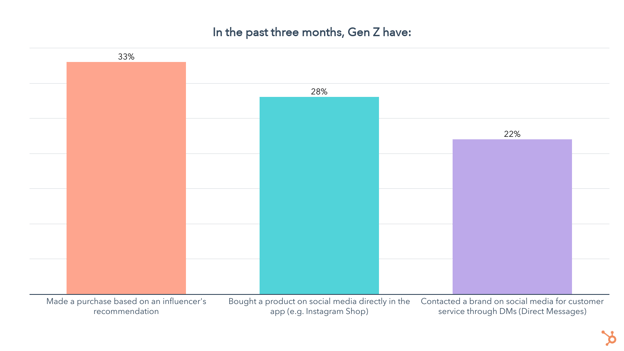
While this data isn’t specific to Instagram, the app is currently at the forefront of the shift into e-commerce happening across social media platforms. YouTube just announced integrations with Shopify and Twitter is testing new shopping features, but Instagram seems to be slightly ahead of the curve.
That’s why Instagram is currently the best social media platform for selling products online. We even published a guide to Instagram’s various social media shopping tools and which perform best, based on our survey of 580+ Instagram marketers.
What’s Next for Social Shopping?
Social shopping isn’t necessarily new, but it’s being implemented and adopted in real-time by both consumers and marketers. Looking forward, we can confidently say that you’ll see Instagram continue embracing the shopping experience, and other social channels will likely follow suit.
When it comes to how marketers and consumers will interact with these shopping tools, it’s too early to tell. While social shopping shows huge potential based on our data, users might flee social media platforms as they become less about connecting us with the people we know and more about selling products.
Regardless, Gen Z and Millennials spend around four hours a day on social media, and social media is their preferred way of discovering new products, so there’s no better way to reach them.
As social selling evolves, we’ll be running our consumer trends survey bi-annually to keep track of how quickly social media users embrace these changes and keep surveying social media marketers to see if using these social shopping tools remains a top strategy.

How Video Consumption is Changing in 2022 [New Research]
In 2022, video is more important to consumers than ever before.
Each day, we stream our favorite shows, watch YouTube videos to learn something new, or follow events, Q&As, and interviews via live video.
While video isn’t going anywhere, it’s always expanding, changing, and evolving to fit consumer preferences and new platforms — and marketers must keep up.

Here, we’ll highlight five research-backed ways video consumption habits are changing and how marketers can respond strategically.
How Video Consumption is Changing in 2022
1. Increasingly, consumers are relying on marketing videos from brands.
In the past, consumers would visit websites, look at online reviews, watch commercials, and maybe watch a few YouTube videos to learn about a product. Now, with video being accessible on every major social media network, they are learning to rely more heavily on this type of content in their research phase.
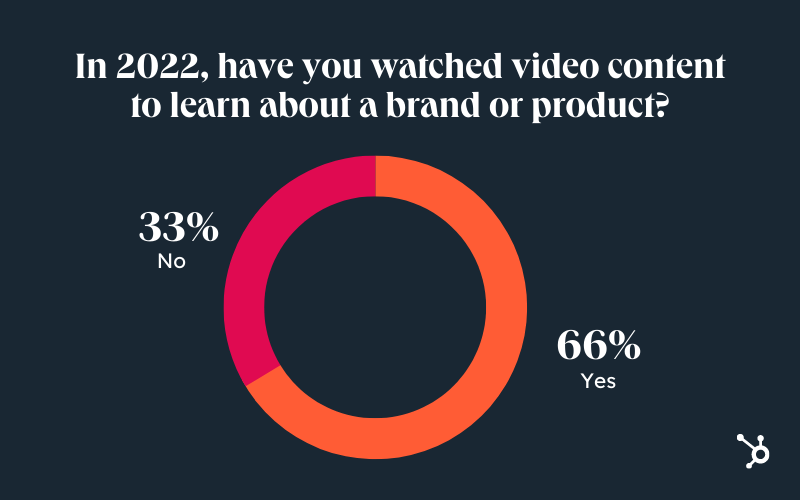
According to HubSpot Blogs research, 66% of consumers have watched video content (i.e., product demos, reviews, FAQs, unboxings, etc.) to learn about a brand or product.
The trend is clear: in 2022, consumers increasingly expect to see video content from brands. Why? Videos give consumers the opportunity to see how a product or service works in real life, discover any flaws before purchasing the item, and identify perks that they might not learn about in the text-based description.
Further, this content might also appear to be more authentic than a heavily edited product shot, which can boost a consumer’s trust in a brand or offering.
2. Escapism is the name of the game.
In the past, older generations might have turned on their favorite TV sitcom or gone to the movies to escape from the stresses of daily life. While the platforms have changed, the need for relaxing or entertaining content hasn’t.
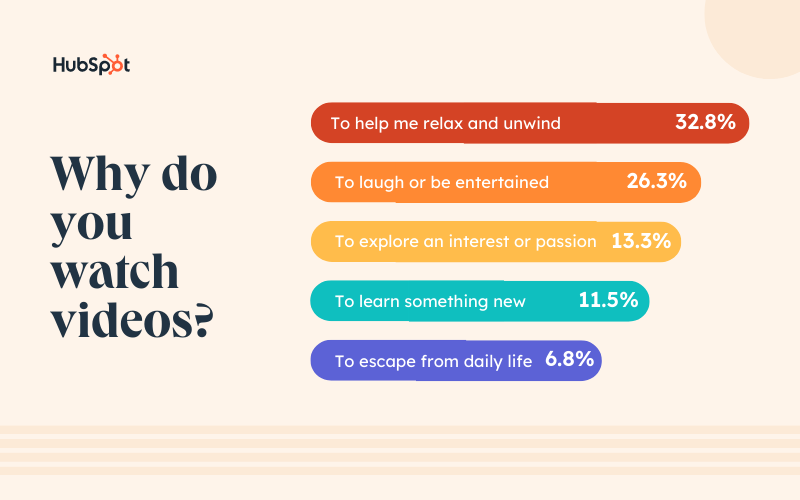
According to HubSpot Blogs research, consumers say they primarily watch videos to “help me relax and unwind.” Additionally, people cited, “To laugh or be entertained,” as the second most common reason.
Even if you’re creating informative marketing videos, you should consider experimenting with funny anecdotes or adding other entertaining qualities. Interested in adding fun elements to your next marketing video? Get inspired by major brands that effectively used humor in their marketing.
3. Consumers lean into their passions.
Aside from looking for escapism, YouTube viewers are motivated to watch content that teaches them new things, especially when related to their passions, interests, hobbies, or social causes. In fact, according to HubSpot Blogs research, 13% of consumers watch videos to “explore an interest or passion,” while 11% want to “learn something new.”
Odds are your product relates to someone’s interests, hobbies, passions, or career. This is the type of person you’ll want to watch and enjoy your videos.
Creating a buyer persona and target audience around this type of person will help you identify video topics that they’ll value, benefit from, and remember..
4. Production quality is becoming more important.
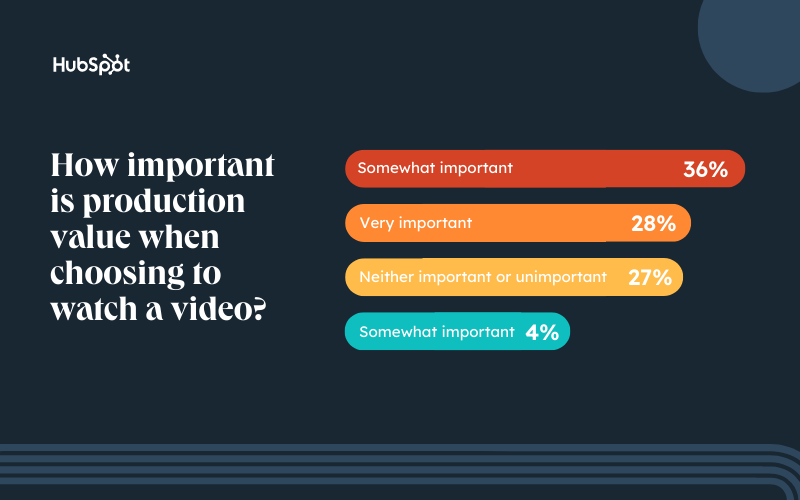
36% of consumers feel production value is “somewhat important,” while 28% feel it’s “very important.” But fear not — this doesn’t mean you need to rent a high-priced studio or enlist A-list celebs.
Instead, there are plenty of ways to produce an affordable video with solid quality from any home or workspace. And remember, oftentimes the success of a video relies on the value it provides. In other words, fancy lighting alone won’t cut it.
Additionally, video software like Vidyard, Bonjoro, and TwentyThree make it easy to record and send short video messages – like pitches, welcome videos, and more — to customers without needing a Hollywood budget.
5. Consumers prefer shorter videos.
Thanks to the rise of TikTok — and the wave of short-form content that followed — consumers are seeking quick, snappy videos. Specifically, videos under three minutes fall into a sweet spot.
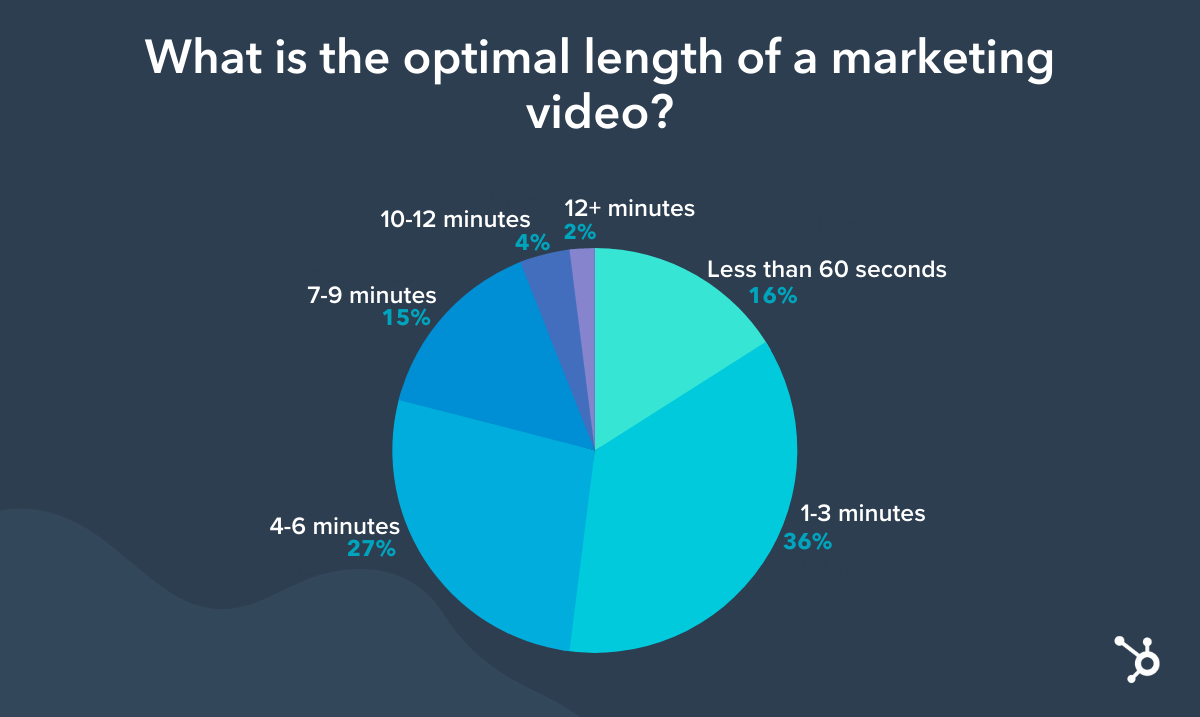
If you’re new to video, starting with short-form videos can help you get your feet wet — and tell you what resonates with your audience.
You also need to set the right pace for your video content. Before you put a marketing video online, re-watch it from the point-of-view of a somewhat busy consumer. Then, ask yourself, “Does this video pull viewers into the action quickly and keep their attention?”
If you’re worried that parts of your video seem dull, you might want to shorten it. But, if your team thinks it’s entertaining or informative the entire time, you can experiment with publishing your longer-form video and learning from its results.
Navigating Video in 2022
With each new generation, the video world will continue to evolve.
However, at this point, the video landscape is changing in favor of marketers. Not only do consumers prefer to learn about brands via video content, but they use it as a necessary tool in the information-gathering phase of their buyer’s journey.
Additionally, the vast majority of video consumers now strive to learn something new about an interest or hobby, rather than just using video to entertain themselves. This means marketers can harness educational videos in their strategy and offer consumers content that relates to their niche, while also marketing a brand or product.
Back to You
Video isn’t going anywhere, but it is always expanding, changing, and evolving to fit new consumer needs and new platforms.
As this content continues to evolve with each new generation, marketers should continue researching video consumers’ interests, hobbies, and behaviors.

How to Prepare for A Job in Digital Marketing and E-commerce [Google Certification]
The line between marketing and digital marketing has blurred. Offline marketing was once considered “traditional” compared to online or digital marketing. However, with many tactics living in the digital sphere, marketing changes as fast as technology does.
Traditional marketing, which ranges from radio ads to billboards and magazine spreads, simply adjusted to the new era. Radio ads became podcast sponsorships, billboards turned into web banners, and magazine spreads changed from ink on paper to pixels on a screen.
The benefits of this digital transformation are countless. The ability to target the right audience and engage them into action – subscribe, consume, or buy, are just a few examples.
Digital Marketing Specialties Are Endless
Inevitably, as with any constantly evolving field, specializations change. Today, being a digital marketer is only the beginning. Once you are familiar with the basics, you can find your specialty and niche.
Based on your interests and strengths, you can develop niche specialties like SEO, content strategy, or performance marketing. Within those specialties, you can become an expert in SEO for real estate platforms, a pharmaceutical content strategist, or an e-commerce performance marketer. Each specialty requires knowledge of different platforms and tools and familiarity with various technologies.
If you’re looking for flexibility, a career in digital marketing is a great choice. LinkedIn’s 2022 Marketing Jobs report shows a 121% YOY increase in a remote marketing job share with the most in-demand occupations in digital marketing and social media.
Where do I start?
With so much information and learning opportunities available online, candidates can gain in-demand skills and gain experience even without a formal education.
Deciding where to start can be difficult. While any updated knowledge that comes from a reliable source is valuable, a helpful rule of thumb is to look for an accredited source. Having a brand name behind the course or certificate not only promises a nice detail to add to your resume but also that the knowledge and skills you learn will be valuable and, hopefully, profitable.
Get A Certificate
A good place to start is the Google Digital Marketing & E-commerce Certificate. This certification does not require any previous experience, and with less than 10 hours of learning a week, you can become job-ready for a role in one of the most in-demand industries. In fact, this certificate is endorsed by the American Association of Advertising Agencies (4A’s) and the American Advertising Federation (AAF).
This certificate’s curriculum is extensive and includes everything from digital marketing and e-commerce foundations to marketing analytics and measurement. One of the things that makes this certificate so valuable is that you’re not only learning the theory but also getting the opportunity to practice while following the course. For example, as part of the certificate program, you will set up automated email campaigns on HubSpot, and design a mock e-commerce store using Shopify.
This is also one of the few courses out there that don’t just teach you digital marketing, it also provides you with the tools to specialize in e-commerce marketing management.
Why should you specialize in e-commerce marketing?
According to Fit Small Business, as of 2022 over 263 million American consumers shop online. That’s 80% of the population. It would be safe to assume that some of those shoppers are finding their way to online stores simply because they know what they are looking for, but in most cases, the funnel starts way before.
In 2021 alone, retail e-commerce sales were worth about 4.9 trillion U.S. dollars worldwide and this figure is expected to reach 7.4 trillion dollars by 2025.
E-commerce marketing can be considered a combination of marketing and sales. You’re not only advertising and engaging with potential customers, but you’re also encouraging them to make a purchase. As a digital marketer specializing in e-commerce, you will conduct marketing research, analyze traffic, and set up email marketing campaigns. In addition, you’ll design online stores, write product descriptions, and track store performance, to optimize conversion.
Working in e-commerce means you’ll be doing everything from driving traffic to online stores to converting that traffic into paying customers and retaining them using inbound marketing methodologies – attracting, engaging, and delighting people to grow a business that provides value and builds trust.
One of the distinguishing factors of the Google certificate in digital marketing and e-commerce is that it sets you up for your job search. Once you complete the Google Digital Marketing & E-commerce Certificate, you will have the opportunity to connect with over 150 employers that are currently hiring. More details can be found here.

YouTube Challenges To Boost Subscribers in 2022
With roughly 15 million active content creators on YouTube, it feels like almost everyone has a YouTube channel these days — so how can you make your channel stand out from the rest Fortunately, there are always new viral challenges that can help you find your audience, boost your engagement, and showcase your unique personality as a content creator.
Some challenges can be done on your own and a few will need involvement from friends, family, or partners, but many challenges are interesting and fun to complete. Here are some of my favorites:
YouTube Challenges You Can Do Alone
Things Only 1% of People Can Do
Surviving on a Penny Challenge
Buying the First Five Things You See Recommended in Ads
YouTube Challenges You Can Do With Friends or Family
Who Knows Me Better? Partner or Best Friend?
YouTube Challenges to Do as a Couple
Extreme Couple vs Couple Challenge
Spend 24 Hours Handcuffed Together

Best YouTube Challenges
The best YouTube challenges are entertaining and simple enough that almost anyone can participate. Whether it’s trying a new look, completing DIY projects in record timing, or asking your loved ones silly questions, the challenges I’ve listed are straightforward for most people to do. So at the end of each challenge, don’t be afraid to ask your audience to try it themselves and tag your account. This can boost engagement and raise awareness for your channel.
Of course, safety should always be a priority, so don’t do anything that can put you, your loved ones, or any participants in danger. Viral numbers should never be put ahead of well-being. With that in mind, here are the best challenges you can complete to bring views to your channel.
YouTube Challenges You Can Do Alone
If you don’t have time to gather some of your favorite people to participate, these challenges are easy to do by yourself:
-
Things Only 1% of People Can Do
Can you lick your elbow or touch your nose with your tongue? According to this challenge, only 1% of people can. Why not test yourself and try to do the nearly impossible on your own? Just remember — safety first! Once again, do not do anything that can put you in harm’s way.
What We Like: The challenge is a simple but effective way to share your hidden talents with your audience — or discover talents you never knew you had!
2. Good Things Challenge
To complete this challenge, film yourself doing at least one act of kindness. It could be working at a charity, volunteering at a shelter, helping a person in need, or anything charitable that benefits your community. Afterward, you can nominate another content creator or your audience to do the same and tag your channel.
What We Like: Content creators sometimes get a bad reputation for being self-involved, but this challenge proves it’s possible to use your platform to promote positivity and giving back to the community.
3. Surviving on a Penny Challenge
In this challenge, you start with just one penny. You then have to increase your money by as much as possible in a given amount of time. In Trahan’s case, he started with one penny before trading that penny for a pen and trading the pen for a dollar. He then used the dollar to buy a bottle of water and then sold the water for $2. This constant trade up went on for 30 days.
What We Like: This can push you as a content creator to be clever and creative in how you live off just one penny. It will also be entertaining for the audience to see your journey from having nothing to gaining more items and wealth over time.
4. Buy the First 5 Things You See Recommended in Ads
We’re constantly bombarded with ads everywhere we go online, so why not use it to our advantage? YouTuber Safiya Nygaard did this by buying and testing the first five products she saw in TikTok ads.
What We Like: We’ve always wondered if the products we see in ads actually work. You may find yourself with interesting items that make your life easier and you’ll help your audience discover products they may enjoy. At very least, you’ll help them steer away from products that aren’t worth the investment.
YouTube Challenges You Can Do With Friends and Family
Do you have a best friend with an eccentric personality? Or maybe an aunt who has the most hilarious reaction to everything? These challenges are a great way to get your loved ones involved and to let their personalities shine.
5. Who Wore It Better
In this challenge, you and one other person would wear the same outfit or clothing items and see who wore it best. This challenge is popular among sibling content creators — particularly twins — but can be done with anyone.
What We Like: This challenge can be customized to make it more unique to your channel. For example, instead of seeing who wore an outfit better, you and a friend can see who can rock a certain style better — like goth, punk, or bohemian.
6. Whisper Challenge
The whisper challenge consists of one person listening to loud music via headphones and another person reading a random phrase. They could whisper the phrase or say it out loud so long as the headphones are too loud for the other person to hear them. The person with the headphones has to guess what’s being said.
What We Like: The challenge is very simple and doesn’t require you or anyone else to buy anything. As long as you have something to read off of and working headphones, you’re good to go.
7. Best Friend Challenge
How well do you really know your best friend? This challenge puts your friendship to the test by having you and your friend ask each other questions and guessing each other’s answers. It’s a popular challenge used in celebrity interviews and its popularity doesn’t look like it’ll wane anytime soon.
What We Like: This challenge allows your audience to get to know you a little better. Questions about your favorite hobby, music, or food are very common in challenges like this.
8. Who Knows Me Better? Partner or Best Friend?
In this challenge you ask your significant other and your best friend a series of questions about yourself to see who knows you best. This challenge is very simple and can be modified to make it stand out from other videos. For example, YouTuber Daniel Gizmo modified the challenge to include a shopping trip to Target where Gizmo and his girlfriend’s best friend were tasked with finding the perfect gift.
What We Like: As I said earlier, it’s a very simple challenge to modify to make it more your own. You can challenge your partner and best friend to create an outfit you’ll like, buy you the perfect gift, or just stick to the simple question-and-answer format. The possibilities are endless.
YouTube Challenges To Do As a Couple
Speaking of partners, there are plenty of YouTube challenges you and your significant other can complete together. Here are a few of my favorites:
9. Couple vs Couple Challenge
Think of this challenge as a double date mixed with a bit of competition. Couple vs couple challenges simply mean you and your partner compete against another couple. The competition can involve trivia, battles of strength, or whatever you want. As long as everyone is having fun, it’s sure to be entertaining.
What We Like: You, your partner, and another couple can get creative with the kinds of challenges you include. From extreme yoga to pop culture trivia to DIY projects — any task can be used to modify this challenge to your liking.
10. Spend 24 Hours Handcuffed Together
The challenge is simple — you and your partner will spend 24 hours handcuffed to each other and will have to find a way to go about your day as normally as possible.
What We Like: Handcuff challenges have been popular among content creators for years and for good reason. It’s hilarious to watch couples try to have a normal day and complete simple tasks while stuck together.
11. Wheel of Dares
In this challenge, couples take turns spinning a wheel that dictates the dares they have to complete. You can either make the wheel yourself with dares of your choice or you can find one online. Just remember to be safe and not complete any dares that can put you or others in danger.
What We Like: This challenge is very spontaneous since the dares are assigned at random, making the game entertaining for the participants as well as the audience. You can modify the game to only be between you and your partner, or you can bring on more couples for added fun.
No matter what challenge you choose, just make sure you’re having fun. Your audience will enjoy seeing you and your loved ones laughing and being creative with the challenges. YouTube challenges are an excellent way to let your personality shine, expand your audience, and spread joy through your content.

Sustainable Marketing: Key Principles & How to Leverage It [+Examples]
In 2020, IBM ran a study on consumer behavior and found that most consumers are willing to change their shopping habits to be more environmentally conscious. This is likely why consumers have noticed a big push for sustainable marketing from brands.
Fast forward to 2022 and not much has changed.
So, how does a brand leverage sustainable marketing to appeal to a growing, socially conscious audience? We’ll cover that and more below.
Green Marketing vs. Sustainable Marketing
While both terms are often used interchangeably, there is a difference between green marketing and sustainability marketing.
Green marketing focuses on strategies that promote environmental awareness and protection. Sustainable marketing, on the other hand, is a little broader.
It encompasses green marketing but it also includes practices that go beyond the environment, like social and economic issues.
Are Potential Customers Paying Attention to Sustainability? [Data]
Sustainability is a topic that has gained a lot of traction as of late. Many believe it only matters to Gen-Z but recent research suggests this is a cross-generational concern.
In 2022, we surveyed 1,034 consumers to learn about their shopping habits. Half of the respondents believe climate change is one of the most important social issues companies should take a stance on – with the highest response from Boomers (ages 55+) and Gen-X (ages 35 to 54).
This value is reflected in consumers’ purchasing decisions.
Nearly half (46%) of respondents say they’re more likely to buy from a company actively trying to reduce its environmental impact.
In addition, roughly 28 percent of respondents say a brand’s environmental impact and the ethical production of its products are two of the most important factors influencing their purchasing decisions.
According to the data, Millennials (38%) care most the ethical products while Gen-X cares the most about the environmental impact. However, all groups show consideration for sustainable practices.
So, to answer the question posed at the beginning of this question: Yes, consumers do care about sustainability and it’s not just the youngsters.
So, even if your brand isn’t rooted in this mission, you will still find value in investing time and resources in sustainable practices and marketing to attract more customers.
Learn more about consumers in our 2022 State of Consumer Report.
1. Have a larger purpose.
Brands typically judge their success by the numbers. How much revenue they have or will generate in any given period is usually the biggest indicator of success.
Sustainability shifts this perspective by having brands evaluate themselves by something bigger than profit.
As a brand, you have to promote something that’s bigger than your products and services and transcends any particular industry.
Do you have a clear social mission? If not, spend time discovering what that is and how your brand plays a role in furthering that mission.

For instance, fashion brand Autumn Adeigbo sells clothing, accessories, and home decor items. However, its mission, as stated on its website, is to impact the lives of women on a global scale.
They do so by using female-owned production facilities and employing female artisans, among other practices.
2. Think ahead.
Sustainability marketing is all about building long-term value.
Too often, brands focus on gaining immediate returns. For instance, many marketing tactics like running Google Ads and blogging are great lead generators.
However, what happens once your lead has made a purchase and turned into a customer? How will you build loyalty and create brand evangelists?
Sustainable marketing looks at ways to nurture consumers during the entire buyer’s journey.
Education is one way to build loyalty with your audience early on. From when they first discover you on social media to after they’ve made a purpose.
For instance, a food brand could educate its audience on the importance of ethical farming on social media and continue this process post-purchase with package recycling tips.
3. Be customer-oriented.
You might be thinking, “Isn’t being consumer-oriented what all marketing is?”
Ideally, yes but that’s not always the case.
In traditional marketing, a brand will often try to push a product or service to a customer. With consumer-oriented marketing, it’s more about understanding your customers’ needs and tailoring your marketing to that.
For instance, say your audience is craving more transparency in your sourcing practices or wants you to be more vocal on social issues. You could use that information for your next campaign.
With so much competition out there, one way to stay customer-oriented is by innovating.
We’ve all heard the Blockbuster and Netflix cautionary tale. But that speaks to a huge societal shift that Blockbuster was unwilling to make.
But the truth is, innovation doesn’t always have to be so big. It can happen in small iterations – the key here is staying in touch with your audience’s needs.
4. Reflect sustainability in every aspect of your brand
Sustainability marketing doesn’t work if it’s not authentic.
Imagine finding out a business that claims to be sustainable has failed to implement any practices to promote its mission. Consumers would distrust that brand and it would be difficult to earn it back.
Make sure your brand is looking at sustainability from a holistic lens.
Are you preaching about sustainability but using unsustainable resources to build your product? Are you collaborating with brands that conflict with your mission? Is your team representative of the future you want to promote?
These are the questions you should ask to determine if your brand reflects the mission you’ve set out to achieve. Identify the areas that need work and go to the drawing board to figure out strategies that align with your mission.
Audiences don’t expect perfection, they do, however, value transparency. It’s OK – and recommended – to share where you currently fall short and how you plan to remedy these issues.
Sustainable Marketing Examples
1. Thinx
Thinx is an underwear brand whose mission is to provide sustainable solutions to menstruation and incontinence.
Everything the brand puts out marketing-wise is centered around this core value.
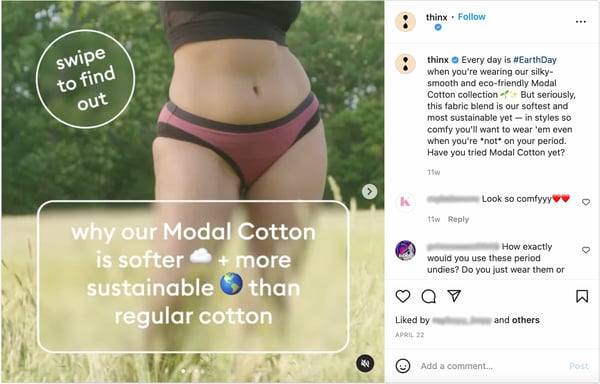
The brand’s social media pages feature a mix of product promotion, educational content, and mission-focused announcements.
The key to sustainable marketing is doing it in an authentic way that feels embedded in the brand, as opposed to an add-on that’s leveraged when convenient. Thinx is a great example of how to do it right.
2. Kind Socks
This clothing company was started based on the founder’s desire to find a socks company with a sustainable and ethical vision.
While most brands focus on inviting its consumers to purchase, Kind Socks takes the exact opposite approach: Asking them to spend less and more thoughtfully.
Excessive consumption is hurting us! Thats why ask yourself before every purchase: Do I really need this?
#ethicalfashion #mondayquote #sustainablefashion #sockswag #ethicallymade #socksoftheday #sockstyle #slowfashion #ecofriendly
— Kind Socks (@KindSofficial)
January 25, 2021
This strategy may seem counterintuitive to many companies but emphasizing the brand’s mission can help build trust with its audience and increase their brand loyalty.
3. Pangiai
Materials science company, Pangiai, wants to save the environment.
Every piece of marketing the brand puts out is centered around this core mission, including this video campaign.
In it, the brand explains its mission to “reverse the cycle from the unnatural to natural, from plastic to plants […], from the new to the recycled.”
What’s effective about this ad is that Pangiai describes the future they want to see and outlines the strategies it will implement to get there.
Throughout the ad, you see Pangiai products but they’re not the focus. This tells viewers the mission drives the products, not the other way around — and that’s sustainable marketing done right.
4. Nada Duele
In the previous section, we discussed the importance of having a holistic approach to sustainability marketing.
With Nada Duele, their mission is reflected in everything: from their name, which represents the idea that products should not cause harm, to the initiatives they take part in.
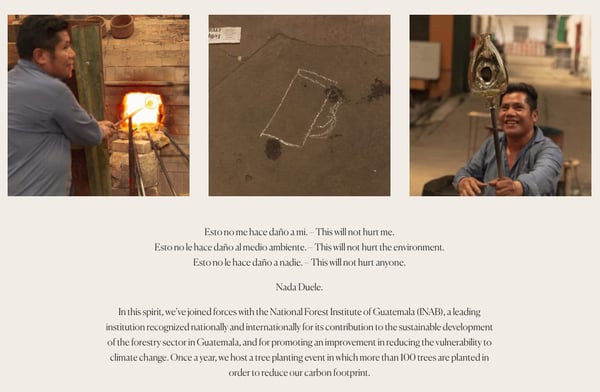
When you visit their “How We Work” section, you learn about their collaboration with a Guatemalan institute dedicated to protecting the forestry sector.
It’s important that the partnerships your brand takes on align with your values. Otherwise, you risk losing credibility and trust.
5. Satya + Sage
Social media is one of the best and easiest ways to implement a sustainable marketing strategy.
You can share a range of content, from educating your followers on sustainable practices to sharing ways your brand is being sustainable.
In this example from candle company Satya + Sage, they share tips on how to use the seed paper that comes with every candle.
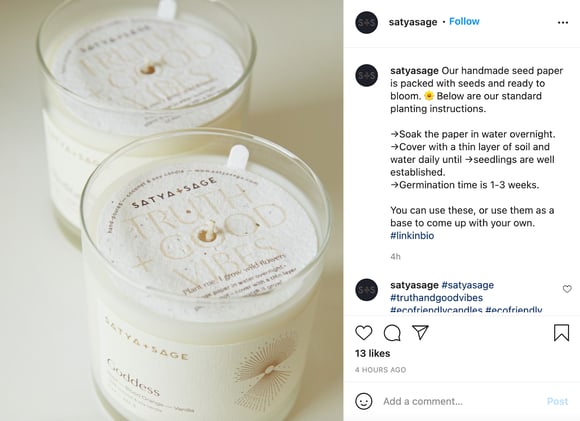
On social media, in particular, pay attention to the questions your followers ask and the comments they make, as that can inform which marketing strategies you test in the future.
Sustainable marketing is becoming increasingly important for brands.
Editor’s Note: This post was originally published in Oct. 2021 and has been updated for comprehensiveness.

How to Create a Product Launch Email [Outlines + Templates]
There are few times more exciting in a company than during a product launch. Anticipation brews and a sense of optimism emerges around the prospect of a growth in market share.
Still, a question always arises when a new product launches: do enough people know about this launch for it to be successful?
There are multiple avenues to communicate through during a product launch — ads, social media, PR, and blog promotion, to name a few. Yet, one of the most underrated and effective communication methods to alert internal and external stakeholders is a product launch email.

Not only do product launch emails make your customers aware of the product launch, but they also communicate vital information about the launch to those inside of your company.
In this post, we’ll walk you through the steps for writing three different types of product launch emails, including offering suggestions for your product launch email subject lines and outlining the ideal product launch email sequence.
Featured Resource: Product Marketing Email Templates [Download Now]
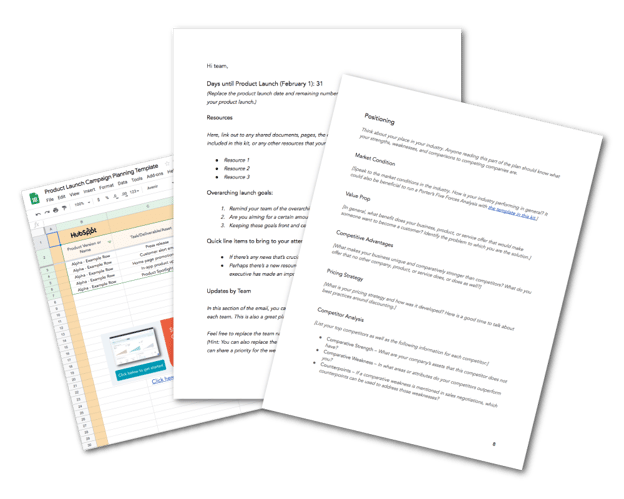
HubSpot’s Free Product Marketing Kit is full of the organizational templates you’ll need to spread the word about your product, including email templates. Why waste time starting from scratch? Click here to download the templates.
How to Write a Product Launch Email
You’ll want to share an internal product launch email with your entire company on either the day of or prior to your product launch. With this email, you’ll want to turn all of the employees at your company into an enthusiastic, well-informed, word-of-mouth marketing team by providing them with:
- An overview of the product
- Why employees should be excited about it
- “Lazy copy” for email and social media that employees can copy and paste
Here’s an outline of an internal product launch email. You can also download it as a template with more details.
1. Write a short but explanatory subject line.
The first step is getting folks to open your email. Do this by providing a clear and short subject line describing the news. Keep the subject line at or under 12 words.
Try one of these:
- It’s Time! [Product] is now live. Click to learn more!
- We just launched [Product] – And we need your help
- [NOW LIVE]: [Product] is available to the public
- [Product] launches today. Here’s what you need to know.
- The moment you’ve all been waiting for: [Product] is here.
- [PLEASE READ]: Everything you need to know about [Product].
Providing a subject line that gets straight to the point will make your email less likely to get lost among the other messages in their inbox.
2. Give a brief overview.
Just like you, the employees at your company are busy, so capture their attention with a quick hello and a 1-2 sentence overview of the product launch.
3. Explain what the product is.
Give your readers the very basic info on your product, like what it’s called, what it does, when it’s available to the public, and how much it costs. You should also include an image so readers have a visual reference.
4. Share why the launch matters.
Why should your employees be excited about this launch? You can go a little more in-depth here, so explain what void this product fills in the market and what opportunity you’re seizing on to expand your market share, delight more users, and expand your customer base.
Some questions you can answer in this section are:
- Does this update address a common customer complaint?
- Are you bringing your product up to par for the market you’re in?
- Do you have statistics or revenue projections to prove the importance?
5. Explain how the product works.
In this section, give a brief overview of the steps required to get or use this product/feature. How do your customers sign up? Are there any usage limitations? Anticipate frequently asked questions — particularly from salespeople, marketers, account managers, and support reps — and try to reduce confusion upfront.
6. Describe who the product is for.
If you haven’t already covered it, say who the intended audience for this product is, or if any users will automatically see this new feature. This section is particularly important for regional or language-specific products.
7. Provide a contact for questions.
Provide the contact info and name of the person or people who are best equipped to answer any questions about the product, its launch, or its promotion.
8. Include lazy or sample copy for sharing.
You’ll want to make it as simple as possible for employees to share the product launch over email or social media. Provide sample text and URLs that can be copied and pasted — or better yet, pre-made social links from a site like Share Link Generator.
Here’s an example of lazy copy for every situation.
- Twitter: We’ve just launched [Product Name] here @[Company Name]! This new feature will let you [List Main Benefit]. Click here to learn more about it [Insert URL].
- LinkedIn: It’s an exciting day here at [Company Name]! Today, we’re announcing our launch of [Product Name] – a new product that [List One or Two Major Benefits or Features].
- Email: We’re thrilled to finally share this with our customers. Learn more at our website, and reach out to me if you have any questions about the new product! [Insert Product Page URL]
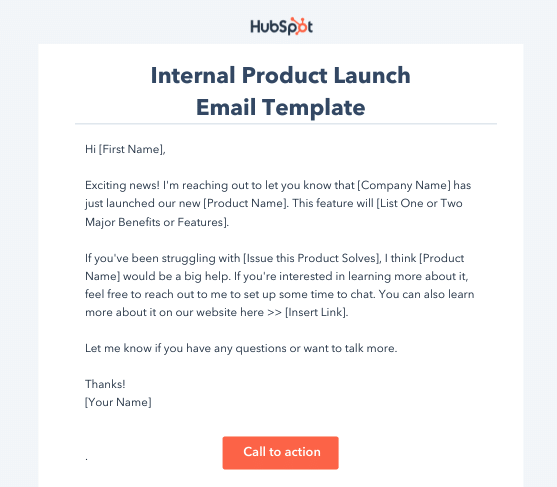
Product Launch Email Templates
Remember, you can save time by using product launch planning and email templates. You can download free product marketing email templates here in our Product Marketing Go-To-Market Kit. You and your team can work together to make an exciting product launch campaign if you take advantage of these tools.
Let’s look at some templates to help you get started.
Template 1: Pre-Launch
[Insert Days Until Launch] Days Until [Product Name] Product Launch
Hey Team,
Days Until Product Launch [Insert Date of Launch]: [Insert Days Until Launch]
Resources:
Here, link out to any shared documents, pages, the campaign planning spreadsheet also included in this kit, or any other resources that your team may need to reference this week.
- Resource 1
- Resource 2
- Resource 3
Overarching Launch Goals:
- Remind your team of the overarching campaign goals in this section.
- Are you aiming for a certain amount of product sold, social buzz, or upgrades?
Quick line items to bring to your attention:
- If there’s any news that’s crucial for your team to know, place it here.
- Perhaps there’s a new resource you want to call extra attention to, or maybe an executive has made an important call in the past couple of days.
Updates by Team:
In this section of the email, run through brief status updates and developments from each team. This is also a great place to share each team’s focus for the upcoming week.
Feel free to replace the team names with the most relevant teams for your product launch. You can also replace the team names with individual employee names, and each person can share a priority for the week that has to do with the product launch.
Web Team: Status –
Place the web team’s status update here
Social: Status –
Place the social team’s status update here
Public Relations: Status –
Place the social team’s status update here
Internal Enablement: Status –
Place the internal enablement team’s status here
Questions, comments, or concerns? Please do not hesitate to reply to this email or reach out to me directly.
Thanks,
[Your Name]

Template 2: General Product Update
[Product] launches today. Here’s what you need to know.
Hey Team,
Exciting news! I am writing to inform you that we have launched our new [product name]. This new product will [list 1-2 benefits].
If you’ve been having issues with [issue this product solves], [product name] will be a great help. If you’re interested in learning more about it, feel free to reach out to [designated contact] to set up time to discuss. Additionally, you can learn more about this product here [link to website/resource page].
Thanks,
[Your name]
Template 3: New Feature Update
The moment you’ve all been waiting for: [Product] is here.
Hey Team,
We have just released a brand new feature for [product name], and we think you’re going to love it.
The new feature [describe feature].
With this feature, you will be able to [issue it resolves], and it will help you to [list benefits].
We’re thrilled to finally share this with our customers. Learn more at our website, and reach out to me if you have any questions about the new feature! [Insert Product Page URL]
Regards,
[Your name]
When you create or find the template that’s right for you, add in your product’s information and get your network buzzing about it.
Product Update Email Template
The internal product launch update email is best shared with direct stakeholders in the product launch. For example, product marketers, product managers, designers, social, and PR.
These emails should be sent routinely leading up to the official product launch (every week, every other week, etc.) and provide readers with actionable steps on what has happened since your last email, what needs to be done, and whether or not you’re on track for launch.
Here’s an outline of what your internal product launch update email should look like. You can also download it as a template with more details.
1. Subject Line and Preview Text
Keep the subject line at or under 12 words. Choose a subject line for your internal product launch update emails and make it the standard for whenever you send out your updates. Stuck? Try one of these:
- [Date] Bi-weekly [Product Name] Update
- [#] Days Until [Product]: This Week’s Update
- [Product] Launch Status: Today’s Action Items
- New from [Company]: A Solution for [Main Problem]
- [Product]: A Solution to Your [Problem]
- Available Now: [Product], the Solution to [Problem]
- [Product] is Now Available. Here’s How You Can Get it.
- Problems With [Problem]? Try [Product] – New from [Company]
- At Last – A Solution to Your [Problem]
- Meet [Product]: A New Product to Help You [Benefit]
2. Days Until Product Launch
Reiterate the scheduled date of the product launch in addition to how many days remain.
3. Major Updates
List out any major updates that have occurred between the previous email and this one. For example: a bug was fixed, final designs were approved, or you secured placement in a leading circuit on announcement day.
4. Resources
Link out to shared documents, the campaign planning spreadsheets, or any other resources that your team may need to reference this week.
5. Progress Against Goals
Remind your team of the overarching campaign goals in this section and provide a status update (complete, meeting, exceeding, or lagging).
6. Updates By The Team
Run through brief status updates and developments from each team. This is also a great place to share each team’s focus for the upcoming week.
7. Questions or Comments
Encourage recipients to reach out to you directly with any questions.
Check out our template below for a better idea of what to include in your email.
[Date] Bi-weekly [Product Name] Update
Hey Team,
We are [number of days/weeks] away from the [product name] launch. Here’s what we’ve been working on and what you an expect in the coming weeks.
Key Updates
- Bug fixes
- Issue or discrepancy resolved
- Secured feature in [publication] Yay!
All brand items related to this product launch can be found here [link to folder/resource]
Launch Goals
- Any campaign goals?
- Aiming for more social media buzz?
- Aiming or a certain amount of product sold?
Updates By Team
QA: Status –
Place the team’s status update here
Public Relations: Status –
Place the team’s status update here
Sales: Status –
Place the team’s status here
Feel free to reach out to me if you have any questions or concerns regarding any aspect of this launch.
Thank you,
[Your name]
External Product Launch Email
The time has come to share your exciting new product with the world.
If you have an established list of loyal contacts in your CRM, create a list of recipients you think would benefit from the product launch email.
While you can send out a mass email to all of your contacts, it makes sense to group your contacts together by their lifecycle stage or their interests so that you’re prioritizing customers who would be most interested or ready for your new product.
The same general rules mentioned previously apply for sending external emails, except you’ll need to adjust them to suit what is most pertinent to your customers.
Here’s how you might want to format an email to your contacts to encourage them to buy or learn more about your new product.
1. Include subject line and preview text.
As mentioned before, keep the subject line at or under 12 words. Here are some of our top picks.
- New from [Company]: A Solution for [Main Problem]
- [Product]: A Solution to Your [Problem]
- Available Now: [Product], the Solution to [Problem]
- [Product] is Now Available. Here’s How You Can Get it.
- Problems With [Problem]? Try [Product] – New from [Company]
- At Last – A Solution to Your [Problem]
- Meet [Product]: A New Product to Help You [Benefit]
2. Add a short greeting.
Like your fellow employees, your customers are also very busy. Don’t bury the lede — start the email off with the big news! Buzzwords like “new,” “big news,” or “now available” would be good to implement here, alongside a quick overview of what the product is called, what it does, and an image of the product.
3. Give an overview of the product.
Provide a high-level summary of what the product is, why it was made, and what it does.
4. Highlight key features.
List the key features or benefits of this offer. If you have a product demo video, you may want to link to it here. Additionally you can add info graphics or another visual aid to help get your message across.
5. Include a call-to-action.
Leave your contacts with an actionable next step. Do you want them to reply to you with questions? Sign up for a demo? Check out the new product page on your website? Whatever your desired next step is, make it abundantly clear with a link or by bolding the action.
Product Launch Email Sequence
To spread the word about your product launch more efficiently, consider enrolling your contacts into an email sequence in your email marketing software. Here are the steps you might want to follow:
Internal Product Launch Email Sequence
1. Introductory Email
Alert the employees that the product development is in progress and why.
2. Pre-Launch Email
Let employees know when the product is set to be launched and what is expected of them on launch day.
3. Launch Day Email
On the day of the product launch, alert all employees that the product is available to the public and provide share links.
4. Follow-Up Email
After some time has passed, send employees an update of your performance against goals, and a reminder of how employees can help the product launch be more successful.
External Product Launch Email Sequence
When you want to build anticipation among your contacts, consider an external product launch email sequence. This can be used to gradually increase your prospects’ interests before and after the product comes out.
Remember: you may only want to enroll people in this sequence that meet certain qualification criteria.
1. Pre-Announcement Email
This email comes once you feel the product is in a good place and you’re comfortable announcing its release date to the public. It should include a basic description of the product in addition to an expected time frame. We suggest not identifying an official launch date unless you are absolutely confident the date you have chosen is accurate — you never know what could go wrong between now and then, so it’s best to play it safe.
2. Announcement Email
This email should be the official email announcement of your product. We’ve outlined what should be included in this email in the section above, but remember to keep the content in this email short, informative, and actionable.
3. Follow-Up Email
This email should be sent to the contacts you feel would be a good fit for your new product but didn’t follow up with your original email. Kindly remind them that you think they would benefit from this new product and you’re excited to hear if they’re interested.
When building excitement for your new product, having this sequence can keep your customers waiting in anticipation of your next best thing. Take a look below at an example of a real, recent product launch.
Product Launch Email Examples
Ready to get started writing your own product launch emails? We’ve compiled a list of real life examples to inspire your next launch correspondence.
1. Samsung
Samsung has been exceptionally successful in advertising its Galaxy Fold cell phones, and its emails have been building suspense for them for over a year.
This email example serves as one of its pre-announcements, allowing excited customers to pre-order the device. Previous emails they’ve sent have included the specifications and features of the Fold, and this email gives a time frame of when customers should expect its arrival.
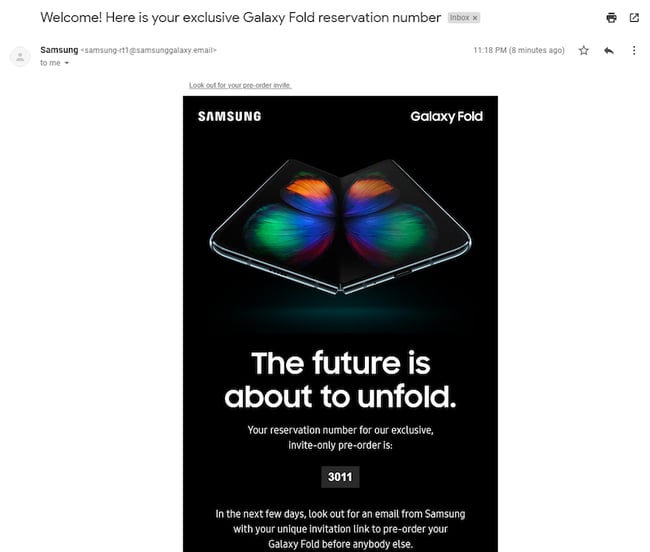
Why This Works:
This note from Samsung keeps it brief while including all the pertinent information customers need. It gives them their pre-order number and tells them what to expect next, but most importantly it keeps the anticipation going.
You can keep it simple as shown above, or get creative in your new product emails — just make sure it’s conveying the information your customers want to know.
2. Descript
Audio and video editing platform Descript rolled out a new version of their product and sent the email below to inform their current customers. The email details what the new features are and how they will improve the customer experience using the product.
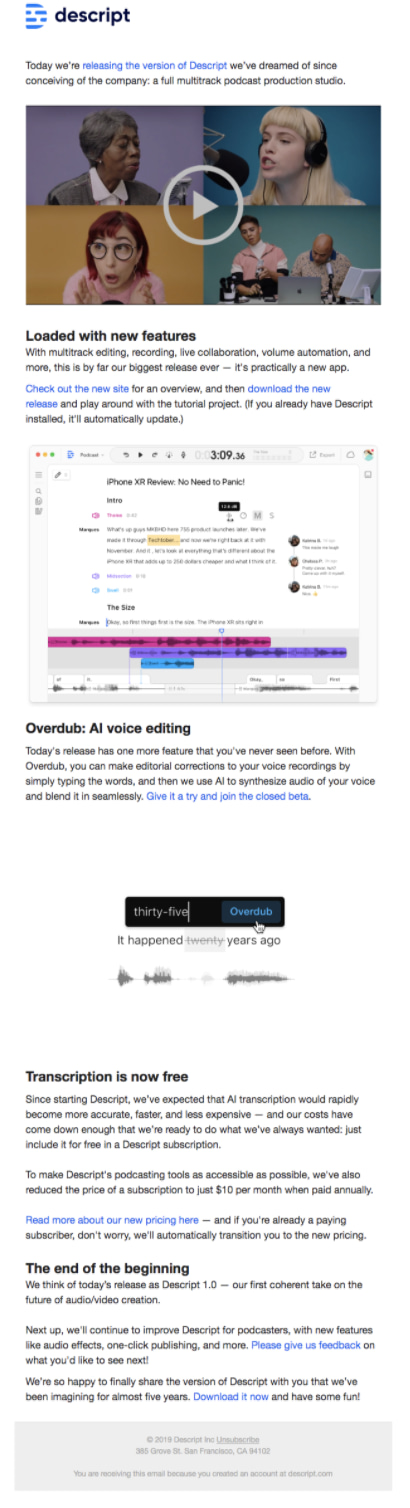
Why This Works
This email is incredibly thorough. It walks the reader through each of the improvements, how they work, and the benefits — complete with video and other helpful visuals.
It’a great example of how to design a launch email that has lots of new features and information to explain.
3. Asana
When Asana launched their dashboards feature, they sent the below email to customers to help them get familiar with the change in reporting. It was sent the following week after the new feature was rolled out, providing users with tutorials and other resources showing how to get the most out of dashboards.
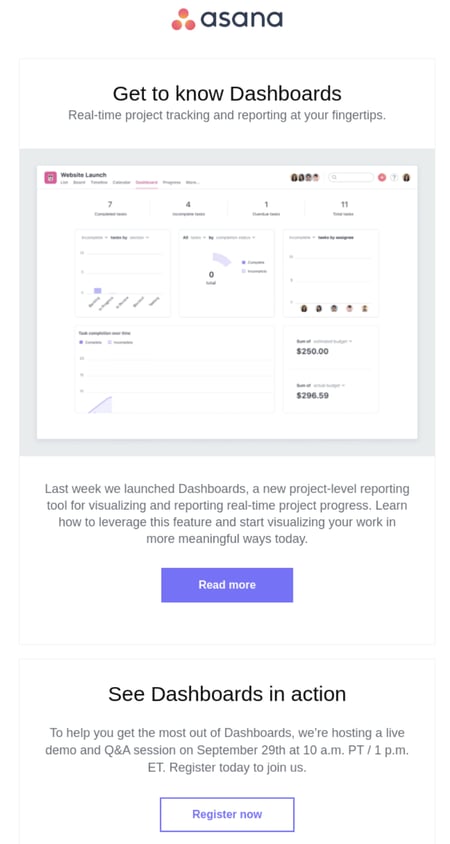
Why This Works
This email keeps it short, but informative and clearly explains where users can go if they need more support in addition to a brief demo of how the dashboards feature works. The design is also clean thanks to plenty of white space and small, well-placed pops of color.
4. Solstice
With remote work more popular than ever, video conferencing software has become a must. In response, Solstice improved their platform to accommodate users and provide both onsite and remote workers a better user experience. The email below outlines the new product and features they added.
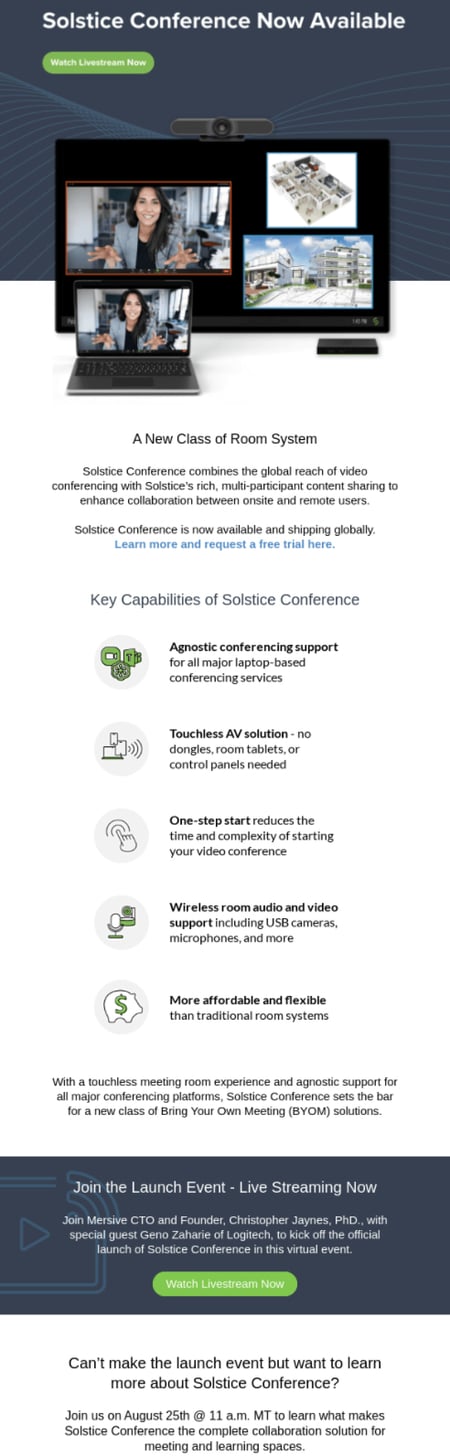
Why This Works
This email clearly outlines what the new product does and the benefits it provides. Plus, Solstice offers multiple ways for customers to learn more — either by attending the launch event or webinar. The offer of a free trial also allows customers to test the product risk-free before making a commitment.
Ready, Set, Launch! (Your Next Product)
Build your email marketing campaigns in a way that appeals to your own internal team, and your customers in search of the next best thing. We hope you can implement some tips from this guide into your marketing, and wish you the best of luck in your next product launch.
This article was originally published in December 2021 and has been updated for comprehensiveness.

How to Create Content for Every Stage of the Buyer’s Journey
No one wakes up in the morning and decides, “I’m going to buy something today.” Instead, they go through a path to purchase that includes research and evaluation before committing to a sales call.
That journey is called the buyer’s journey. Because consumers are more informed and empowered than ever, it’s important to deeply understand your buyer persona and their journey so you can create content that helps them along that path while positioning you as an authority in your space.

In this post, we’ll cover:
- The Buyer’s Journey and What It Means in Marketing
- Why It’s Important to Create Content for Each Stage of the Buyer’s Journey
- Content Ideas for Each Stage of the Buyer’s Journey
Understanding the Buyer’s Journey in Marketing
In most cases, with the exception of impulse buys, an individual begins their journey in an “unaware stage.” This individual likely fits the demographics of your ideal client, also known as your buyer persona, but they are unaware of your product or in need of it.
However, they may experience a triggering event that changes their situation or pain that needs to be solved. This kicks off their buyer’s journey.
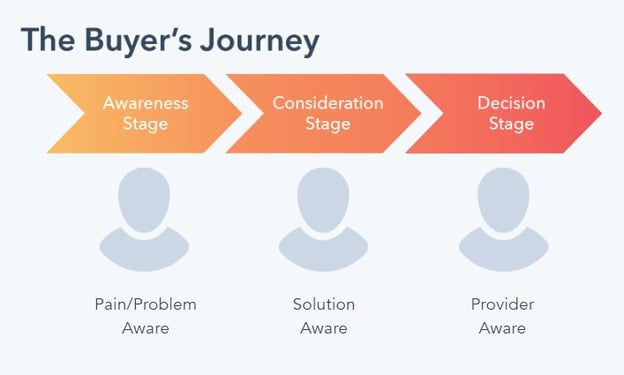
Let’s say that an individual wants to kick off a personal fitness journey. They may not immediately decide to purchase a gym membership. This individual may take to the internet to learn more and make decisions as they progress through the following stages in their buyer’s journey, and it’s our job to assist them in that decision-making process.
Awareness Stage
In the awareness stage, the buyer is experiencing a problem or symptoms of a pain, and their goal is to alleviate it. They may be looking for informational resources to more clearly understand, frame, and give a name to their problem.
An example of a search query a prospect might begin with is: “How do I get stronger?” In the awareness stage, they are not yet thinking about solutions or providers; it’s much too early for that. Instead, they’re looking to contextualize their problem first. As a content marketer, you’ll want to show up in search engine results, even in these early stages, to establish your authority and gain the trust of buyers who are starting the journey.
Consideration Stage
In the consideration stage, the buyer will have clearly defined and given a name to their problem, and they are committed to researching and understanding all of the available approaches and/or methods to solving the defined problem or opportunity. In other words, they are considering potential solutions.
An example of a search inquiry a prospect would make at the consideration stage is: “What’s better: going to a gym or hiring a personal trainer?” In the consideration stage, the prospect is not yet ready to buy, but they are deciding on the potential solution for them. Your goal will be to consider your indirect competitors and educate them on the pros and cons.
Decision Stage
Once they’ve progressed to the decision stage, the buyer has decided on their solution strategy, method, or approach. Their goal now is to compile a list of available vendors, make a short list, and ultimately make a final purchase decision.
An example of a search inquiry a prospect would make at the decision stage is: “Planet Fitness vs. Gold’s Gym.” Now they’re ready to spend money, and they’ll likely go with a provider that they like, know, and trust so long as that provider can meet their needs.
Why Creating Content for the Buyer’s Journey Is Important
As in all marketing disciplines, it’s essential to understand your audience: how they think, the answers they seek, and the path they tend to take to find a solution. From that research, you can begin crafting a documented content strategy that maps your content to the various stages of the buyer’s journey.
When you don’t completely understand your audience, a disconnect is created between your business and your potential customers. For content marketers, this usually means you’re putting out content that your readers don’t really relate to, which can cause you to lose them.
To avoid this, you’ll have to consider the stage they’re at in their journey, how to meet them there, and the best channels to put the content in front of them. The internet has made it easier for marketers (and salespeople) to engage customers at the various stages of their journey using content marketing. That’s one of the main reasons that 60% of marketers consider content as ‘very important’ or ‘extremely important’ to their overall strategy.
However, it can be challenging to create the right content, for the right people, at the right time.
Building a content strategy starts with identifying the types of content you’ll need to reach your audience according to their progression through the buyer’s journey, and we’ll guide you through it in terms of both the marketing flywheel.
Creating Content for Each Stage of the Buyer’s Journey
Once you have an idea of your buyer persona and how prospects move closer to purchase, you can begin creating content for your buyer at different stages and tailor that content per channel.
Doing so can help you map your content to the relevant stages of the buyer’s journey to make a marketing funnel.
- Awareness Stage: The stage where people look for answers, resources, education, research data, opinions, and insight.
- Consideration Stage: The stage where people are doing heavy research on whether or not your product or service is a good fit for them.
- Decision Stage: The stage where people figure out exactly what it would take to become a customer.
Your journey may look very different depending on your industry, business model, product, pricing, and audience. Some B2C customers, for example, spend very little time in the middle of the buyer’s journey compared to B2B customers that require far more nurturing, engagement, and relationship development before a purchase is made. A $50 pair of sneakers, for instance, requires a lot less hand-holding when it comes to making purchase decisions than a $10,000 business software investment.
Content Ideas for Each Stage of the Buyer’s Journey
Because audiences can vary widely based on industry and intent, persona research is of the utmost importance. By understanding their unique process for awareness and evaluation, you can create a truly effective content marketing strategy packed with custom content that best supports their journey toward making a purchase.
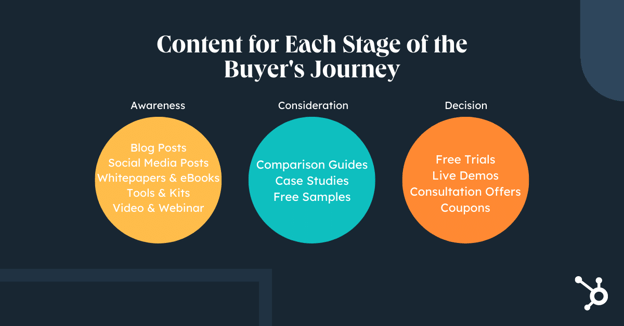
So let’s take it from the top and start from the beginning of the buyer’s journey.
At the awareness stage, a buyer is trying to solve problems, get an answer, or meet a need. They’re looking for top-level educational content to help direct them to a solution, like blog posts, social content, and ebooks. Their value as a lead is low because there’s no guarantee that they’ll buy from you. But those who find your content helpful and interesting may journey on to the middle of the funnel.
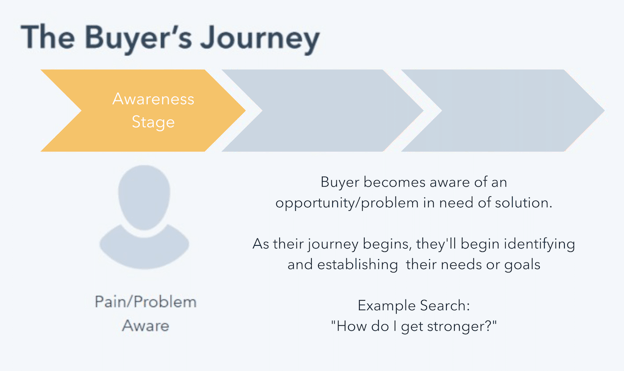
The ideal channels for the awareness stage may include:
- Blogging
- Search Engine Marketing
- Social Media Marketing
Let’s run through the different content formats best suited for these channels.
1. Blog Post
A blog post is an ideal piece of content targeting the awareness stage. By targeting a pain, problem, or topic your target audience wants to discover and then posting it to your website, you’re creating a brand asset that’s crawlable by Google and discoverable by search engine users. You can also promote your blog content across other channels.
Arel=”noopener” target=”_blank” hrefs is an excellent example of a brand that does blog content right. They include original data and informational advice to create long-form articles that serve their audience.
Featured Resource: 6 Free Blog Post Templates
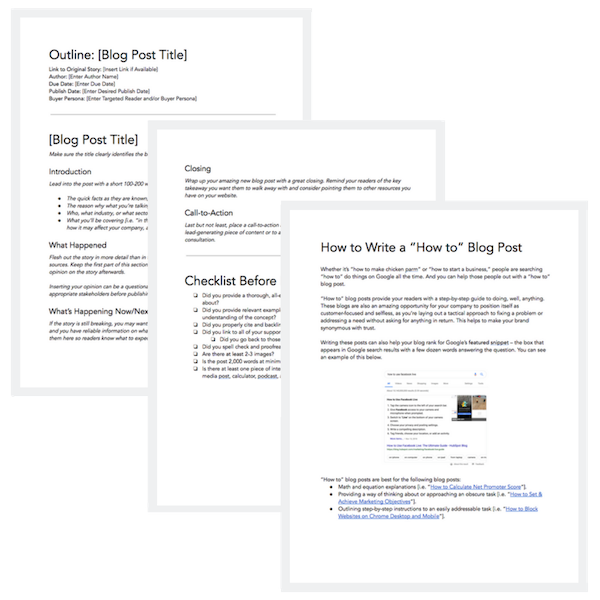
2. Social Media Post
Social media is a channel that can be used to promote your other content, and you can also create content specifically for the channel. According to Pew Research, 72% of the public uses some form of social media, so your audience is likely native to this channel. Unlike blog posts, social media posts are likely in shorter form, and video consumption is also on the rise.
In the above example, HubSpot Agency Partner Yokel Local shares attractive customer marketing tips on the LinkedIn platform. SlideShare formats are popular on LinkedIn, so the content is created to be snackable with short-form take-aways.
3. Whitepaper
A whitepaper is an organization’s report or guide on a particular topic. Whitepapers are especially useful as downloadable offers when readers want to go more in-depth on a specific subject they’re reading about. For whitepapers, it’s essential to provide information that can’t be found elsewhere so that your audience understands the report’s value and is compelled to get it.
Every year, HubSpot publishes a survey on the state of marketing to provide helpful guidance based on thought leadership to marketers, sales professionals, and business owners. Inside, readers find statistics from a broad survey and industry experts’ opinions on what the data means and where the industry is going.
4. Checklist
For complicated tasks with many moving parts, individuals may simply want a blueprint that spells out what they’re supposed to do to achieve their end goal.

Buying a home is a perfect example of this, and Opendoor meets its audience’s needs by providing a handy checklist (in infographic form!) for the reader that spells out all the steps that need to be taken. The graphic is aesthetically pleasing and even allows room for a few tips along the way.
5. How-To Video
Sometimes, the best way to solve a pain or problem is to learn a new skill. Sure, a purchase of some kind may be required along the way, but the audience may need to become more informed about the problem and how to solve it. That’s where instructional video content comes in.
HubSpot Marketing has a series of videos dedicated to teaching viewers about where SEO principles are broken down to the audience in easy-to-understand language and visuals. Knowing that SEO is a complex subject, the Marketing team aims to make it accessible to viewers.
6. Kit or Tool
Informational content provided to a broader audience may not always be enough for your buyer persona to make a decision or take action. In some cases, they may require a little more utility or personalization. That’s why kits and tools are a great piece of content to create to help the reader along their path to purchase.
Nerdwallet creates content around several financial topics, budgeting being one of them. It can be challenging to create a budget, though, so they developed a calculator that allows users to provide their own numbers to receive a customized recommendation.
7. Ebook or Tip Sheet
Like whitepapers, ebooks and tip sheets are great options for downloadable content. In contrast, they tend to be shorter form and more actionable.

CoSchedule combines a few tactics by promoting their headline analyzer tool with a blog post about writing great headlines that drive traffic. On that blog post, they include a great tip sheet of powerful words to include in headlines if you want to catch a reader’s attention.
Featured Resource: 36 Free Ebook Templates

8. Educational Webinar
A webinar is a web seminar where information is typically provided through video. A webinar can be prerecorded or streamed live, which opens up many possibilities to disseminate information to an audience who wants more visual and auditory content.
SEMrush makes webinars a key part of its content marketing strategy, often running a valuable topic multiple times to get more mileage out of the content.
Moving on from awareness stage content, let’s delve into the next stage of the buyer’s journey.
When someone moves into the consideration stage, it means you’ve captured their attention. They know they have a problem that has to be solved, and now they’re trying to discover the best solution. The need for a future purchase commitment creeps up as they’re evaluating their options.
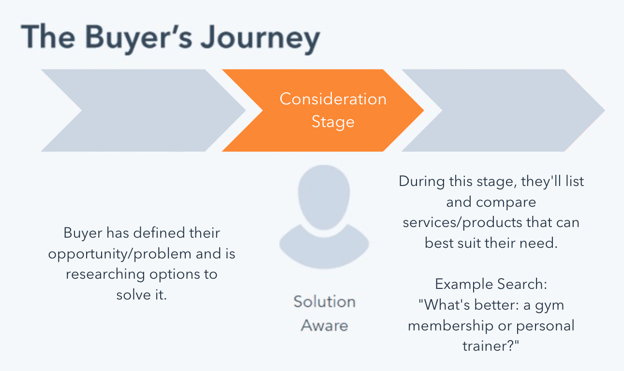
This stage is typically a point of extended engagement where you’re nurturing a lead, building a relationship, and establishing trust between the audience and your brand.
The ideal channels for your consideration stage may include:
- Website or Blogging
- Search Engine Marketing
- Email Marketing
- Social Media
Let’s go through the best content formats for this part of the buyer’s journey.
1. Product Comparison Guides
In the consideration stage, the buyer persona still considers solutions to their pain or problem. For this reason, product comparisons are a great way to help them decide.
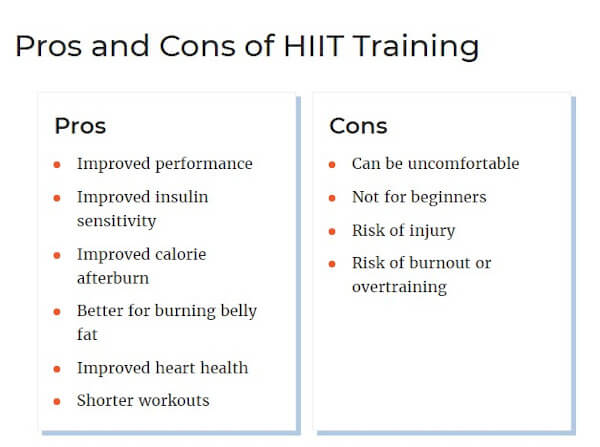
Verywell Fit provides such a comparison to help their readers choose between high-intensity workouts vs. steady-state cardio, providing the pros and cons and use cases for each.
2. Case Study
A case study can be used in both the consideration and decision stages simultaneously by convincing the reader that the solution works by establishing that the provider achieves results for their clients by administering the solution. A good case study will appeal to the emotions and logic of the persona by providing detailed information and quantitative data on the final solution.
HubSpot Partner Agency Blueleadz tells a story about their client and their problems while providing a detailed account of how they solved them.
Featured Resource: 3 Free Case Study Templates
3. Free Sample
A free sample is another example of content or an offer that overlaps between the buyer’s journey stages. Consider this: An individual wants to paint the inside of their home but doesn’t know what color.
As they consider which color (the solution), they pick up paint chip cards from their hardware store. A provider creates these cards based on their individual solution. When the individual falls in love with a color, they already know who the provider is that makes it.
SILKCARDS taps into this buying behavior by offering samples of their unique printing methods on the content that they create. They know their business is tactile, and digital content alone is not enough to close a deal. Once their prospective customer holds the sample in their hands, other business cards are put to shame.
So now that you’ve provided content to help customers list out or sample their options, it’s time to move them into the decision stage.
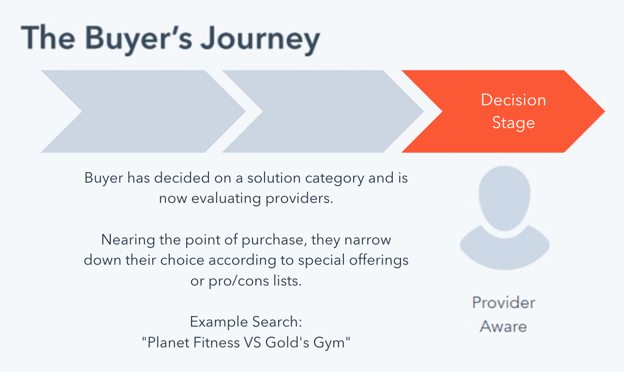
As prospects near the end of the buyer’s journey, they’re evaluating providers down to specific or specialized offerings.
Marketers, in turn, want to go above and beyond their expectations and provide an easy and frictionless customer experience that can win them over their competitors.
Handling objections, remove hesitation, position ahead of comp
The ideal channels for your decision stage content may include:
- Website
- Email Marketing
- Live Chat and Chatbots for Service
With your prospects getting increasingly interested, let’s go through the content formats that can help them get closer to purchase.
1. Free Trial or Live Demo
What better way to know if you want to purchase a product than take it for a spin? Car dealerships have used the “test drive” tactic for years because it works. If the product itself checks all the boxes the buyer has, all the sales team has to do is handle their objections and make the close.
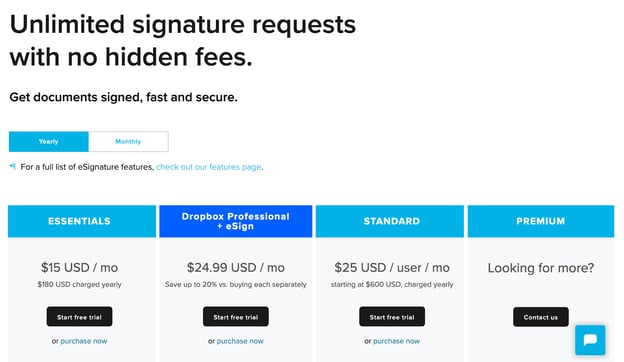
Hellosign does this well. Though they have a free option with limitations, they know that offering a free trial upfront is the key to getting clients into their larger tiers. Their pricing page sets the prospect’s expectations and points them to the free trial.
2. Consultation Offer
A consultation is another example of providing just a little bit of service in exchange for the opportunity to close the sale. The best consultation reduces the anxiety of entering into a sales conversation by promising something concrete they can walk away with (a strategy or actionable advice) in exchange for their time.
Blk Bld & Co.’s consultation offer is a great example because it reduces the friction of scheduling a consultation. By removing friction, this organization increases the chances of conversion.
3. Coupon
A coupon appeals to a fear of missing out (FOMO) mindset. By reducing the price by a certain amount, a coupon is handing a price objection while convincing the prospect that they’re leaving money on the table if they don’t use the coupon. This inertia is enough to win the prospect’s business.
Fragrant Jewels does this well by gamifying its coupons. By spinning the wheel, the website visitors have the chance to get a coupon before checking out the products. They’ll likely evaluate the products that are a good deal with the coupon they won.
In addition to decision stage content, you should create content to delight your existing customers. This may include FAQ and knowledge base content to make the customer experience more accessible, coupons for the opportunity to upsell, and additional educational content that deepens their understanding of a topic.
Mapping Content Across All Stages of the Buying Cycle
Every business offers a unique buyer’s journey that can’t necessarily be replicated from one business to another. When creating your buyer’s journey, you must understand your audience and develop a strategy that maps custom content specific to each phase of their journey through the process.
If you do it well, it can have a significant impact on your customer relationships and lift your overall conversions.
Editor’s note: This post was originally published in August 2016 and has been updated for comprehensiveness.

How to Create an Ebook From Start to Finish [Free Ebook Templates]
Learning how to create an ebook can be overwhelming. Not only do you have to write the content, but you also need to design and format it into a professional-looking document that people will want to download and read.
You might already be familiar with fiction or non-fiction ebooks, but what exactly is an ebook in the marketing industry, and why do they deliver such great results for marketers?
 In this post, you’ll learn:
- What is an ebook?
- Ebook Benefits
- What ebook file format should you use?
- How to Write an Ebook
- Ebook Ideas
- Ebook FAQs
Let’s get started.
36 Free Ebook Templates – Download Now

Download HubSpot’s 36 free ebook templates to create an ebook on PowerPoint, Google Slides, or Adobe InDesign.
Ebook Benefits
In 2021, ebook sales increased 38% for publisher HarperCollins, following a trend of increased revenue earnings for the company. Although this is a snapshot of one publisher’s success, it speaks to a more significant movement toward digital content consumption among marketers.
Lead magnets come in many forms, but the ebook still reigns supreme. They give the reader:
- In-depth digital content in an environment largely overrun with quick headlines and soundbites
- Visual data that compliments the editorial content
- On-demand access to the ebook content
Your business benefits from publishing an ebook, too. Turning a profit, acquiring new customers, generating buzz, and becoming an industry thought leader are just a few advantages of this type of content.
Let’s say, however, that you have a fantastic blog full of long-form content. Why in the world would you want to offer your readers an ebook? Is it even worth your time?
Here are some advantages ebooks offer content creators:
- Unlike long-form printed publications purchased in-store or shipped, an ebook is immediately accessible whenever you’re ready to read.
- You can put it behind an opt-in or “gate,” incentivizing your website visitor to become a lead if they want the information.
- In some ways, ebooks have design capabilities like in-depth charts, graphs, and full-page images, which you may not be able to achieve on your blog.
- After the initial creation of the ebook, you can distribute the file a multitude of times with no additional production cost. They also have no associated shipping fees.
- You can embed links to other media in the ebook file, encouraging the reader to engage with your content further.
Perhaps more importantly, ebooks offer several advantages for your audience:
- Ebooks are incredibly portable and can be stored on many devices without any associated physical storage space.
- The reader gets the choice to print the ebook out if they want to consume the information in a traditional physical format. Otherwise, the digital format is environmentally friendly.
- Ebooks are more accessible, giving readers the ability to increase font sizes and/or read aloud with text-to-speech.
- They’re also easily searchable if the reader is looking for something specific.
Moreover, with lead generation being the top goal for content marketing, ebooks are an essential part of a successful inbound marketing program.
In this post, we’ll walk you through the ins and outs of creating an ebook by, well, creating an ebook. And if you’re worried about your lacking design skills, we’ve got you covered.
Got your free ebook templates? Ready to make an ebook? Great — let’s get to it.
What ebook file format should you use?
Ebooks can be saved in one of several formats. Depending on your end-user, though, you might find a use for any of the following file types:
PDFs are likely the most well-known file type. The “PDF” extension stands for “Portable Document Format,” and is best for ebooks that are meant to be read on a computer (digital marketers, you’ll want to remember this one). We’ll talk more about how to save your ebook as a PDF later in this article.
EPUB
This file type stands for “Electronic Publication,” and is a more flexible ebook format. By that, I mean EPUB ebooks can “reflow” their text to adapt to various mobile devices and tablets, allowing the ebook’s text to move on and off different pages based on the device’s size on which a user is reading the ebook. They’re particularly helpful for viewing on smaller screens, such as smartphones and the Nook from Barnes and Noble.
MOBI
The MOBI format originated from the Mobipocket Reader software, which was purchased by Amazon in 2005 but was later shut down in 2016. However, the MOBI file extension remains a popular ebook format compatible across the major e-readers (except the Nook).
While the format has some limitations, such as not supporting audio or video, it supports DRM, which protects copyrighted material from being copied for distribution or viewed illegally.
Newer Kindle formats are based on the original MOBI file types.
AZW
This is an ebook file type designed for the Kindle, an e-reader device by Amazon. However, users can also open this file format on smartphones, tablets, and computers.
ODF
ODF stands for OpenDocument Format, a file type meant primarily for OpenOffice, a series of open-source content creation programs similar to Microsoft Office.
IBA
IBA is the proprietary ebook format for the Apple iBooks Author app. This format does support video, sound, images, and interactive elements, but it is only used for books written in iBooks. It is not compatible with other e-readers.
Data Visualization 101: How to Design Charts and Graphs [Free Download]
Ebooks can increase the visibility and credibility of your business while positioning your brand as a thought leader in your industry. However, these ebooks can sometimes be hard to write, even though they offer many benefits.
Here are some proven tips to help you write excellent ebooks.
1. Choose a topic that matches your audience’s needs.
Remember: The goal of your ebook is to generate leads for your sales team, so pick a topic that will make it easy for a prospect to go from downloading your ebook to having a conversation with your sales team.
This means your ebook shouldn’t deviate much from the topics you cover in your other content distribution channels.
Rather, it’s your opportunity to do a deep dive into a subject you’ve only lightly covered until now, but something your audience wants to learn more about.
For example, in listening to sales and customer calls here at HubSpot, I’ve learned that creating ebooks is a massive obstacle for our audience, who are marketers themselves. So if I can provide not only this blog post but resources to make ebook creation easier, I’m focusing on the right topic that will naturally lead to a sales conversation.
Here are some sample ebook titles to consider to get your creative juices flowing.
- X Best Practices for [Insert Industry/Topic]
- An Introduction to [Insert Industry/Topic]
- X Common Questions About [Insert Industry/Topic] Answered
- X [Insert Industry/Topic] Statistics For Better Decision-Making
- Learn From The Best: X [Insert Industry/Topic] Experts Share Insights
(Note: Replace “x” with an appropriate number.) You can also use our free Blog Topic Generator tool to develop more ideas. Most blog topics can be comprehensive enough to serve as longer-form ebook topics.
For this blog post, I will use the PowerPoint version of template two from our collection of five free ebook templates. Through each section of this post, I’ll provide a side-by-side of the template slide and how I customized it.
Below, you’ll see my customized cover with my sales-relevant ebook topic. For help with writing compelling titles for your ebooks, check out the tips in this blog post.
2. Outline each chapter of your ebook.
The introduction to your ebook should set the stage for the book’s content and draw the reader in.
What will you cover in your ebook? How will the reader benefit from reading it? For tips on how to write an effective introduction, check out this post.
Some ebook creators say that an ebook is simply a series of blog posts stitched together. While I agree you should treat each chapter as an individual blog post, the chapters of your ebook should also flow fluidly from one to the other.
The best way to outline your ebook is by thinking of it as a crash course on the sales-relevant topic you selected. In my example of creating an ebook, I know I need to cover how to:
- Write effective copy
- Design an ebook
- Optimize ebooks for lead generation and promotion
While my example has a few chapters, keep in mind that your ebook does not need to be lengthy.
Here’s a golden rule to follow regarding ebook length: Write what is needed to educate your audience about your selected topic effectively.
If your ebook requires five pages, great! If it requires 30 pages, so be it. Just don’t waste words thinking you need to write a lengthy ebook.
Let’s now move on to the actual copy you’re writing.
3. Break down each chapter as you write.
Get writing! Here, you can approach each chapter the way you might write a long blog post — by compartmentalizing each chapter into smaller sections or bullet points, as shown in the picture below.
This helps you write simply and clearly, rather than using sophisticated language to convey each point. It’s the most effective way to educate readers and help them understand the new material you’re providing.
Be sure to maintain a consistent structure across each chapter, as well. This helps you establish natural transitions between each chapter so there’s a clear progression from one chapter to the next (simply stitching blog posts together can rob you of this quality).
These practices should hold true for all your other marketing efforts, such as email marketing, call-to-action creation, and landing page development. “Clarity trumps persuasion,” as Dr. Flint McGlaughlin of MECLABS often says.
Want to make sure you’re keeping your ebook exciting for readers? Here are some key tips to keep in mind:
- Use keywords in the title that emphasize the value of your offer. Examples include adjectives like “amazing,” “awesome,” or “ultimate.”
- Keep your format consistent, so you create a mental model for readers and enhance their understanding of the material.
- When appropriate, use formatting — like bulleted lists, bold text, italics, and font size changes — to draw people’s eyes to your most important content or emphasize specific points you want readers to remember.
4. Design your ebook.
Our downloadable ebook templates are offered in both PowerPoint and InDesign. For this example, we’ll show you how to do it in PowerPoint, since more people have access to that software. (If you need a refresher, here’s a beginner-friendly guide on how to use PowerPoint.)
We only have one “chapter page” in the template (slide three). To create additional chapter pages, or any pages really, simply right-click the slide and choose Duplicate Slide. This will make a copy of your slide and allow you to drag it to its proper place in your ebook via the sidebar or Slide Sorter section of PowerPoint. You can then customize it for any subsequent chapters.
5. Use the right colors.
Ideally, our free ebook templates would magically match your brand colors. But they probably don’t; this is where you get to truly personalize your work. However, because ebooks offer more real estate for color than your logo or website, it’s good to consider secondary colors within your brand’s color palette. Ebooks are where this color scheme can truly shine.
To learn how to add your brand’s colors to PowerPoint, check out this blog post. That way, you can customize the color scheme in our ebook templates to match your brand!
6. Incorporate visuals.
Images and graphics in ebooks are hard to get right. The key to making them fit well is to think of them as complementary to your writing. Whether you add them during or after you’ve finished writing your ebook’s copy, your visuals should serve to highlight an important point you’re making or deconstruct the meaning of a concept in an easy-to-understand, visual way.
Images shouldn’t just be there to make the ebook easy on the eyes. Rather, they should be used to enhance the reader’s understanding of the material you’re covering. If you need help gathering visuals, we have three sets of free stock photos that might help you along the way:
And if you’re compiling a data-heavy ebook, you might want to download our free data visualization ebook for tips about designing compelling charts and graphs for your content.
7. Highlight quotes or stats.
Another way to enhance your ebook is by highlighting quotes or stats within your design. Just be sure the quote or stat you’re using genuinely adds value to the content.
Whether you’re emphasizing a quote or adding a visual, keep all your content within the same margins. If your copy is consistently one-inch indented on your page from both the left and right sides, keep your designed elements aligned using that same spacing.
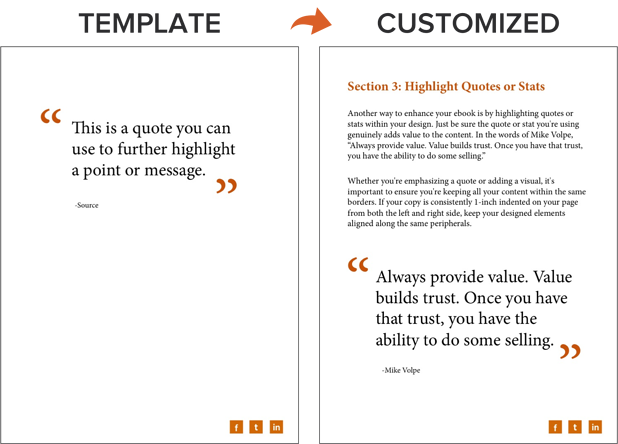
8. Place appropriate calls to action within your ebook.
Now that your content is written and designed, it’s time to optimize it for lead generation, reconversion, and promotion.
Think about how you got here — you clicked on a call-to-action (CTA) in an email, on a social media post, or somewhere else. A CTA is a link or visual object that entices the visitor to click and arrive at a landing page that will get them further engaged with your company.
Since your ebook readers have probably converted into leads to get their hands on your ebook, use the CTAs within your ebook to reconvert your readers and propel them further down your marketing funnel.
For instance, a CTA can lead to another offer, your annual conference’s registration page, or even a product page. Depending on what this next action is, CTAs can be an in-line rectangle or a full-page teasing the next offer (see both images below).
To hyperlink the CTA in your ebook (or any image or text in your ebook) to your destination URL, simply go to Insert >> Hyperlink in PowerPoint.
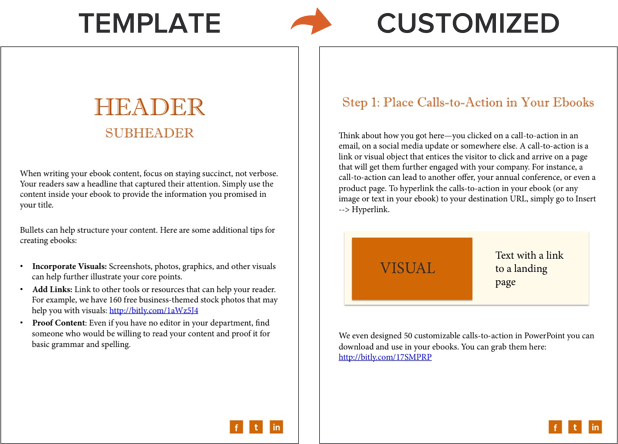
We’ve even designed 50 customizable calls-to-action in PowerPoint you can download and use in your ebooks. You can grab them here.
Now, we don’t have a dedicated CTA template slide in the PowerPoint ebook templates … but it’s still simple! You just have to duplicate the Header/Subheader slide and customize the copy or add images as needed. You can also go to Insert >> New Slide and work from there.
9. Convert it into a PDF.
Once you’ve finished writing your ebook — CTAs and all — it’s time to convert it to the right file type, so it’s transferable from you to your recipient.
To convert your ebook to a PDF, click File >> Save As in the ebook template you have open. Then, under File Format, select PDF and select a destination on your computer for this new file.
Why can’t you just attach what you have to a landing page and be done with it? Word documents, PowerPoints, and similar templates are perfect for creating your ebook but not for delivering it. Because these templates are editable, the contents of your ebook are too easily corrupted, distorted, or even lost when moving from your computer to the hands of your future leads. That’s where PDFs come in.
You’ve seen these letters at the end of files before. Short for Portable Document Format, the .PDF file type essentially freezes your ebook so it can be displayed clearly on any device. A popular alternative to PDFs is the .EPUB file type. See a comparison of EPUB to PDF here.
10. Create a dedicated landing page for your ebook.
Your ebook should be available for download through a landing page on your site. A landing page is a web page that promotes/describes your offer and provides a form that visitors need to fill out with their contact information to access your ebook. This is how you can convert your visitors into business leads that your sales team can ultimately follow up with.
For instance, you went through this landing page to access this ebook template.
If you’re still not sure how to get started, download this free ebook to learn more about optimizing your landing pages for conversion.
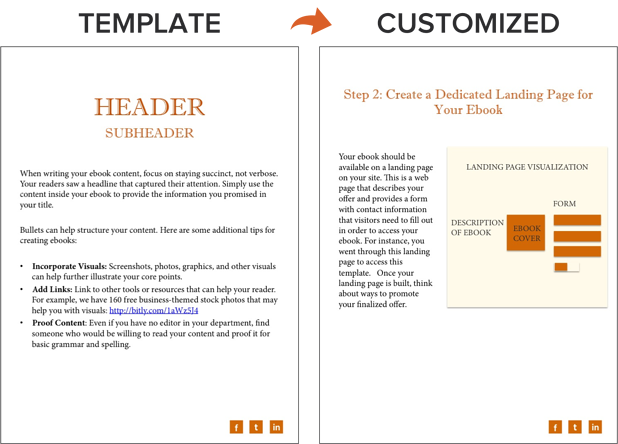
11. Promote your ebook and track its success.
Once your landing page is all set, you can use that destination URL to promote your ebook across your marketing channels. Here are five ways you can do this:
- Advertise your new ebook on your website. For example, feature a CTA or link to your offer’s landing page on your resources page or even your homepage.
- Promote your ebook through your blog. For instance, consider publishing an excerpt of your ebook as a blog post. Or write a separate blog article on the same topic as your ebook, and link to it at the end of your post using a call-to-action to encourage readers to keep learning. (Note: This very blog post is the perfect example of how to promote an offer you created with a blog post.)
- Send a segmented email to contacts who have indicated an interest in receiving offers from your company.
- Leverage paid advertising and co-marketing partnerships that will help you promote your ebook to a new audience.
- Publish posts to social media with a link to your ebook. You can also increase social shares by creating social media share buttons within your ebook, such as the ones at the bottom right of this ebook.
After your content is launched and promoted across your marketing channels, you’ll also want marketing analytics to measure your live product’s success.
For instance, you should have landing page analytics that gives you insight into how many people downloaded your ebook and converted into leads and closed-loop analytics that show how many of those people ultimately converted into opportunities and customers for your business.
And with that, we’ve built an ebook, folks! You can check out the packaged version of the example I built here:
After your content is launched and promoted across your marketing channels, you’ll need to have marketing analytics to measure your ebooks’ success. For instance, have landing page analytics that gives you insight into how many people downloaded your ebook or show how many of those downloaders converted into opportunities and customers for your business.
Ebook Ideas
So, what should you write about in your ebook? I’ll answer that question with another question: What do you want your readers to get out of this ebook? To identify an ebook idea that suits your audience, consider the type of ebook you’re trying to create. Here are a few ideas.
New Research
Conducting an experiment or business survey? This is a great way to develop proprietary knowledge and become a thought leader in your industry. But how will you share your findings with the people who care about it? Create an ebook that describes the experiment, what you intended to find out, the results of the experiment, and what these findings mean for your readers and the market at large.
Case Study
People love success stories, especially if these people are on the fence about purchasing something from you. If you have a client whose business you’re particularly proud to have, why not tell their story in an ebook?
Ebook case studies show your buyers that other people trust you and have benefited from your product or service. In your ebook, describe what your client’s challenge was, how you connected with them, and how you were able to help your client solve their challenge and become successful.
Product Demo
The more complex your product is, the more information your customers will need to use it correctly. If your product or service has many use cases or it’s hard to set up alone, dedicate a brief ebook to showing people how to make the most out of it.
For instance, in the first section of your ebook, you can explain how to launch your product or service. The second section can break down the individual features and purposes your product is best used for.
Interview
Are you interested in interviewing a well-known person in your market? Perhaps you’ve already sat down with an influencer to pick their brain about the industry’s future. Package this interview into an ebook, making it easy for your customers to read and share your inside scoop.
Playbook
A “playbook” is a document people can use when taking on a new project or concept that is foreign to them. Think of it like a cheat sheet, full of tips and tricks that help your customers get better at what they do.
When done right, a playbook equips your customers with the information they would need to excel when using your product. For example, a software vendor for IT professionals might create a “virus protection playbook” that makes support teams better at preventing viruses for their respective companies.
Blog Post Series
Sometimes, the best ebook for your business is already strewn across a series of blog posts. If you’ve spent the last month writing articles all on the same subject for your business, imagine how these posts would look stitched together?
Each article can begin a new chapter. Then, once this ebook is created, you can promote it on a landing page, link to this landing page from each blog post, and generate leads from readers who want to download the entire blog series in one convenient ebook.
Ebook FAQs
Are ebooks profitable?
Yes, they can be.
Ebooks are high-volume, low-sales-price offers. This means you’ll need to sell many of them at a relatively low price point to compete in the market and turn a significant profit. Depending on your industry, ebooks can range from free to more than $100.
Before setting a price for your ebook, do some research. Determine who your audience is, what they’re willing to pay, and how many people within your target market might be ready to buy it. Then, determine the platforms you’ll sell your ebook through. Amazon? Apple Books? Your website? You can research how much ebooks usually go for on these sites and incorporate this insight into your pricing strategy.
How is an ebook structured?
There’s no set rule for organizing your content into an ebook. It generally mimics the structure of a novel or textbook (depending on what it is you’re writing about). But, you should be sure to adhere to some aspects of an ebook.
Ebooks typically have a system of chapters and supporting images. Like a blog post, they also do well when further segmenting their text with subheaders that break down the discussion into specific sections. If you’re writing about professional sports, for example, and one of your chapters is about Major League Baseball (MLB) in the U.S., you might want to establish subchapters about the various teams belonging to the MLB.
What can an ebook be about?
Anything. Well, within reason.
Ebooks are simply a marketer’s way of delivering lots of critical information in a form their potential customers are most willing to read.
For example, an environmental company might write an ebook about water conservation. They might also focus an ebook entirely on using their water-saving product or how it helped a customer solve a problem.
Research is a significant part of ebook creation, no matter your ebook’s topic. Contrary to short-form content like articles and videos, the content of an ebook is predicated on trust and evidence. A user who obtains (or requests access to) your ebook wants the full story, not just the bullet points. That includes all the content and testing you went through to produce the ebook.
Can you edit an ebook?
Nope.
An ebook can’t be edited once it’s been saved in one of the major file formats, so it’s best to ensure you have an editable version saved in a program like Microsoft Word.
But why would you want your ebook to be uneditable? Making ebooks uneditable ensures the content remains unchanged — both the format and the information — as it’s shared between multiple users.
You can edit ebooks if they’re saved using an editable PDF, a feature that is specific to Adobe Acrobat — the founding program of the PDF file type. Learn how to edit PDFs in this blog post.
How do you read an ebook?
You can read an ebook on many different devices: iPhone, Android smartphones, a Macbook, PC, and e-readers such as the Nook and Kindle. The latter two devices are typically used to read novels in digital form. Nook and Kindle owners can store thousands of books (literally) on a single Nook or Kindle.
Share Your Expertise in an Ebook
Ebooks are one of the top converting lead magnets a business can offer to its audience. Creating an ebook is all about delivering high value at a low price point to generate a high sales volume.
Ebooks work well for new businesses looking for brand awareness and established companies securing a spot as an industry thought leader.
So long as you and your team have outlined what success looks like for your ebook launch, you’ll reap the rewards of this stand-alone asset for months — or even years — to come. So get started on your ebook using the free template available in the offer below.
Editor’s note: This post was originally published in November 2018 and has been updated for comprehensiveness.