
How to Write a Press Release [Free Press Release Template + Examples]
When it comes to content, sometimes old school can be a good thing (namely, when it comes to old-school rap or Throwback Thursday on Instagram). But when it comes to your company’s public relations strategy, being old school isn’t advantageous for your business or your brand.
Ten years ago, people still relied on morning papers for news. Today, the vast majority of your company’s customers and prospects scan headlines on Twitter or see what’s trending in their Facebook feed.
People now have control over where, when, and how they consume information. As a result, public relations is no longer about feeding into a traditional news cycle; it’s about providing relevant content when, where, and how your prospects, influencers, and customers will consume it.
Sounds pretty hopeless, right? Wrong. While relationship-building still helps you get into popular publications, we now have the opportunity to quit playing the waiting game and generate our own buzz. By turning your PR strategy into an inbound one, you create opportunities that weren’t there before and carve out a place for your company, building meaningful mindshare with your target audiences in the process.
One of the most crucial updates to make to your PR strategy is to think of press releases as an opportunity to connect to the audiences you care about — including, but not limited to, reporters.
What Is a Press Release / News Release?
A regular cadence of meaningful news can help a company stand out and build mindshare with journalists over time. That’s where the press release (or news announcement) comes in.
A press release is an official announcement (written or recorded) that an organization issues to the news media and beyond. Whether we call it a “press release,” a “press statement,” a “news release,” or a “media release,” we’re always talking about the same basic thing.
While the heading should contain action verbs, the first paragraph should answer the “who,” “what,” “why,” and “where.” The press release should also contain understandable language and a quote.
Most press releases are succinct at just a page long — two pages, tops. Ultimately, companies want to provide enough information so that news outlets have sufficient material for publishing their own stories about whatever the company is announcing in the release.
And while it may be tempting to craft a press release that embellishes your company’s accomplishments or twists the facts to make a story sound more intriguing to the media, remember: Press releases live in the public domain, which means your customers and prospective customers can see them. So instead of thinking of a press release solely as a ticket to earning news coverage, you should also think of it as a valuable piece of marketing content.
Sample Press Release Format
When formatting a press-release, you want to write it in a newsy, straightforward way so a journalist who might write about it can imagine it as an article on their news site.
As noted above, you’ll want your format to include traditional press-release items like your contact information, the words “For immediate release,” a note about your location, and a quick bio about your company. Having specific spots for those elements will prevent you from needing to mention it in your body copy so you can focus on discussing the news at hand.
You also might want to include “###” or another signifier to show the journalist that the release has ended. In the past, this prevented busy journalists from waiting or flipping the page for more information when there was no more news. However, this tradition is still adopted and highly-respected today.
When it comes to formatting the body copy and headline, click here or scroll down for writing tips.
In this example, Catbrella Inc., a fictitious ad agency which just gained its 10th Twitter follower after two years of paid social media efforts, announces its achievement in a press release.
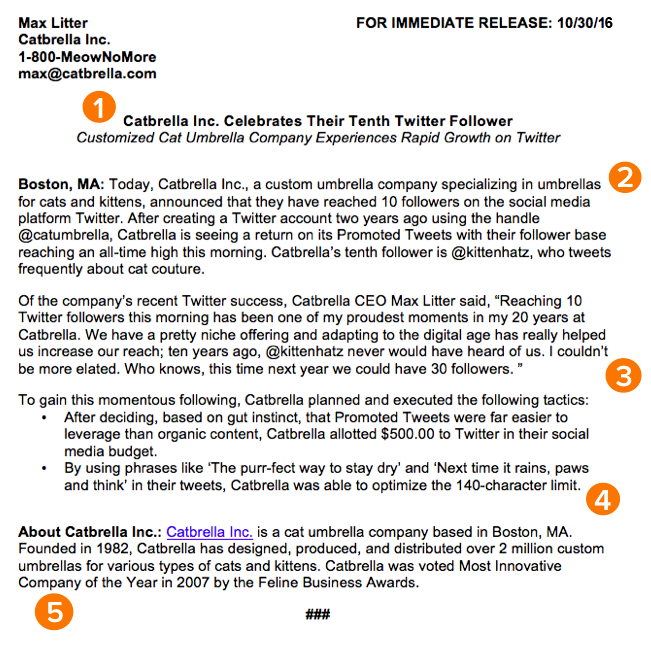
*Disclaimer: HubSpot is entirely responsible for the silliness of this faux announcement.
How to Write a Press Release
Rule 1: Make your headline irresistible.
You’ve got your announcement in mind, and now it’s time to get it down in words to share with your community, industry, and followers. Just like writing the perfect blog post title, setting up your press release for success starts with your headline. You only have one line to work with, which can seem scary, but consider diction carefully to make your headline captivating.
Use action verbs, clear, understandable language, and keep your headline simple and short — fortune (and search engines) reward the brief, so keep your title to one line to clearly focus people’s attention on your topline message.
Most importantly, make it interesting: Keep in mind that reporters get dozens, if not hundreds, of releases each day, so invest the time to write a compelling headline. It’s worth the time and effort on your part.
Rule 2: Convey the news value to the press.
For reporters, analysts, influencers, or followers to be inclined to share your announcement, you have to tell them upfront why they should care.
The first paragraph of your release should cover the who, what, why, where, and how of your new launch, update, or development. Reporters don’t have a ton of time to sift through details and fluffy background information — they just need the facts that’ll help them tell your story to someone else from a position of authority.
There shouldn’t be any new, crucial information covered after this section that the reader could potentially miss.
Rule 3: Offer a tempting quote.
Once you’ve set the scene, it’s time to bring your details to life with a quote that reporters can use for context around your announcement and help paint a picture of how your news affects the given industry, customer base, and landscape.
Ideally, quotes will be from key stakeholders in your company including your executive team, project leads, or those directly impacted by your announcement. Quoting key figures and authorities underlines the importance of your development. The chosen quote should shape your narrative and emphasize the core of the announcement. Don’t ask everyone in your office for a comment or feel compelled to quote all 25 people included in the acquisition — pick one or two critical spokespeople and focus the quotes around their unique perspective.
Rule 4: Provide valuable background information on the subject.
In this last paragraph, keep in mind that the reader already has all of the vital details and information they need to file a story or spread the word.
It can be tempting to provide superfluous facts and tidbits about your company or the development of your announcement — we sometimes think a piece of writing is lacking if it isn’t drawn-out and just shy of being a novella. However, a press release needs to be helpful and concise.
Offer details here that strengthen your narrative, like creative or noteworthy ways your company developed the project or announcement at hand. Or, when applicable, comment on future implications of your announcement.
Rule 5: Summarize the “who” and the “what” in a boilerplate.
Twitter is chock-full of reporters lamenting press releases or pitches that don’t clearly explain what the company does or what the announcement is actually about, so instead of being the butt of a joke, make your release incredibly easy to reference.
Describe what your company does in clear, plain English, include a link to your company’s homepage early on, and make your boilerplate succinct and straightforward. If you cite data, include a reference link for the data source, and make sure every name in the release has an associated title and company as well.
To keep yourself honest on this front, ask a friend or colleague to read the release without context and ask if they can easily and readily explain why the announcement matters, what your company does, and why the executives included are quoted. If the answer to any of those questions is no, get back to the drawing board.
The key to keeping your PR strategy new school is forgetting preconceived notions of what public relations is and instead focusing on creating highly remarkable content. Traditional press releases can still be really valuable when executed well, so instead of ditching releases as a tactic, give them a modern makeover to make them more useful for your marketing.
Think about how you’ve used inbound methods to transform your marketing strategies to be more personalized, approachable, and build relationships. Those same principles apply to your PR strategy: Create content to craft your own story and use tactful outreach to get reporters and analysts familiar with your brand.
Press Release Examples
Many people think press releases have to be chock full of buzzwords and branded terms. “Big data,” anyone? Five-syllable words you have to look up on Thesaurus.com? Quotes from every executive on the planet that go on for pages? We’ve seen it all. Unfortunately, so have reporters — and they are not fans.
Instead of stuffing your next release with industry jargon, take a page out of our book (okay fine, ebook), The Newsworthy Guide to Inbound Public Relations, and brainstorm some creative approaches for your next announcement. Can you include new data? A remarkable graphic or video? A shareable SlideShare? If so, a creative angle can help carry your content and increase the likelihood of social sharing.
Types of Press Releases
While there’s no cut-and-dried formula for what a press release should include, here are a few types of occasions to help you carve out a focus for your press release and determine what content would help you broadcast your news in the best way:
- New product launches
- Mergers and acquisitions
- Updates to existing products
- Hosting or attending an event
- Opening a new office
- Introducing a new partnership
- Rebranding
- Promoting/hiring a new executive
- Receiving an award
Now, to get you thinking on the right track, take a look at some creative press release examples below, the type of news each one is reporting on, and what makes the release unique:
ŠKODA at the World Rally Championship
Type of press release: Event
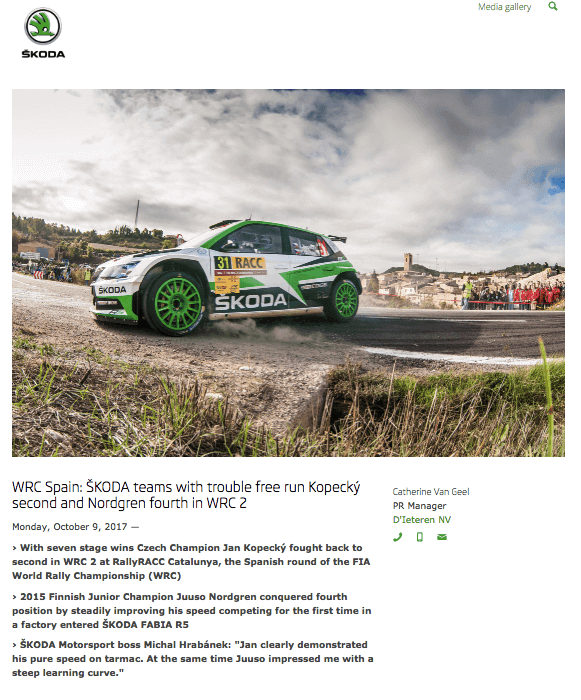
Škoda, a car manufacturer based in the Czech Republic, recently showed off its sponsored racing team in two big places: at the 2017 World Rally Championship, and in a sleek, image-based press release reporting on the event.
The news release, shown above, doesn’t have any trouble aligning the look and feel of the Škoda brand with the press release itself — which is a crucial aspect of any company’s press content. The release opens with a large feature image of one of its vehicles in the same vibrant green that covers the business’s website. The press release also begins with three helpful bullet points summarizing the news for readers, and ends the release with a couple of captioned actions shots to give reporters more context around the event.
ScribbleLive Acquires New Company
Type of press release: Acquisition
Yes, a video press release! This news item from ScribbleLive gave reporters nearly everything they’d need to republish this story, all in a thorough two-minute video about the company’s latest acquisition.
ScribbleLive opens the video press release above with the company’s logo and a clear header stating the news. This allowed the company’s CEO to jump right into his commentary on the acquisition, giving reporters plenty of quotable material on the state of the industry and why this merger was so important to them.
The press release also segments the video the same way a written press release would, breaking up the CEO’s commentary by the question he’s answering. This makes it easy for viewers to jump through the video and find the information they’re most interested in hearing about.
And, being on YouTube, a press release in this format allows reporters to embed the news content directly on their site, making ScribbleLive’s news that much easier to share.
Peapod’s New Headquarters
Type of press release: Opening a new office
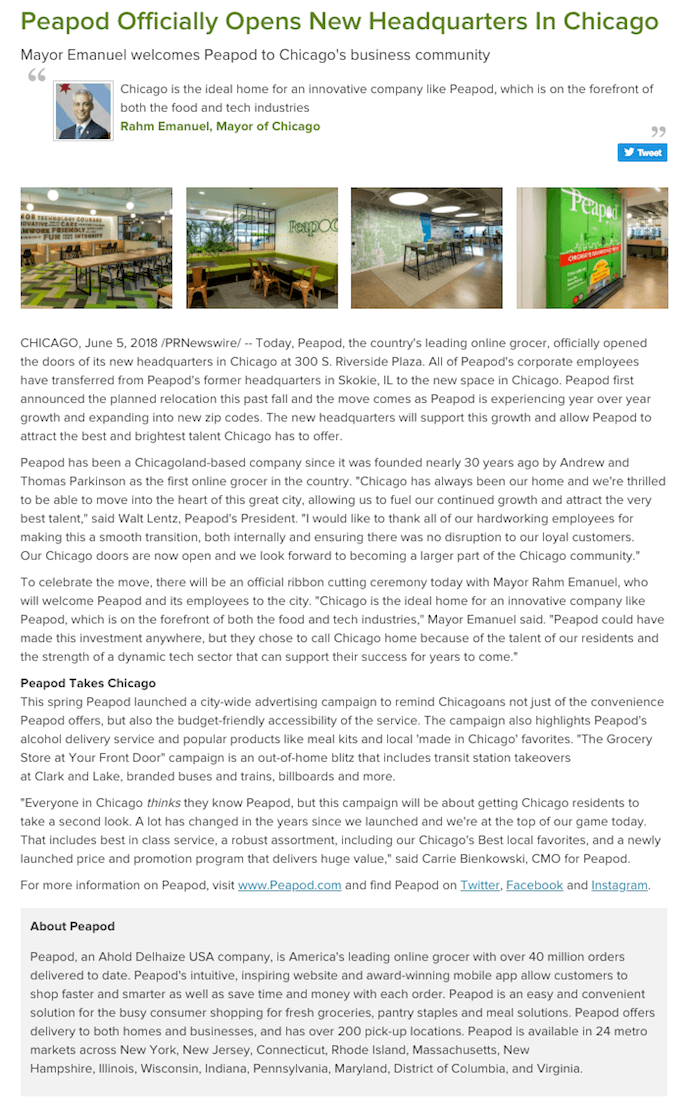
When you open a new headquarters, it can be hard to figure out what to say. People just want to get a look at the new digs! In the above press release by Peapod, an online grocery service, the company puts photos of its new office right at the top, immediately showing readers what makes this news so significant for Peapod.
The release even singles out a quote by the Mayor of Chicago just below the headline, hinting to reporters who are writing about Peapod’s new HQ that this is the remark Peapod is most interested in sharing with readers.
Check out the boilerplate text at the bottom of the above press release. “About [company]” text can too easily blend in with the actual news text, making the piece seem longer than it really is. By isolating this copy in a dark gray box, Peapod provides a smoother reading experience and ensures the story itself doesn’t get lost in an intimidatingly long wall of text.
HubSpot’s New Product Announcements
Type of press release: New product launches
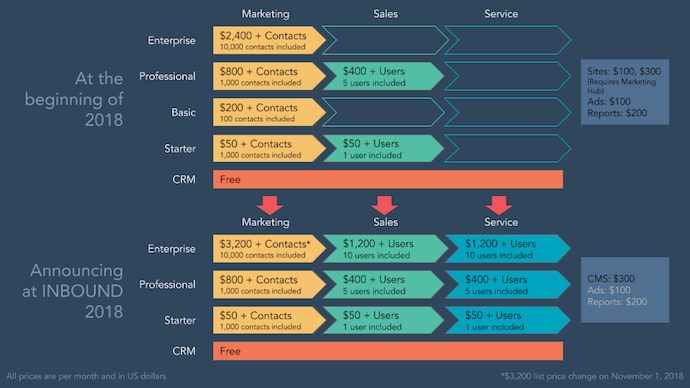
When you’re launching products or services, the information is often best expressed in written form. But when all you’re doing is writing about your new offering’s price and features, it can be difficult for others to refer to and report on it later. We at HubSpot know the challenge well.
The graphic above helped us to supplement our own product announcement — written by our fantastic Communications Manager, Ellie Botelho — with details that needed a visual aid. Using a combination of colors and shapes, this graphic allowed us to reveal important relationships between products, as well as their respective prices and when they’ll be available. (Interested one of our products? Take note! ^)
We’ve also crafted this comprehensive, easy-to-follow press release template complete with a promotional plan and considerations for your next announcement. We use these same guidelines when writing and formatting our releases here at HubSpot, and created a faux, sample release to illustrate what content goes where and why.
Tips for Publishing Press Releases
Writing a press release is really only half the battle. Once you’re finished with production, it’ll be time to focus on distribution.
Of course, we’re all familiar with the traditional distribution levers we can pull, which include publishing the press release on our website/blog, as well as sharing the press release with our followers/subscribers via social media and email. But for ensuring a press release gets the maximum amount of distribution possible, here are some tips you can follow.
1. Reach out to specific journalists.
Instead of blasting a press release out to every journalist you can find an email address for, focus on a few journalists who have experience covering your industry (and company, hopefully) and send them personalized messages. Connect the dots. Show why what you wrote connects to what they write.
2. Don’t be afraid to go offline.
Most journalists have mountains of emails (and press releases) to sort through. Try sending your release through snail mail or another offline channel to differentiate yourself.
3. Send the release to top journalists the day before.
Give journalists some time to craft a story around your press release by sending it to them — under embargo — the day before it officially goes live. (FYI “under embargo” just means they aren’t allowed to share the information in the press release until the time you specify.)
4. To avoid competition, don’t publish your release on the hour.
If you’re publishing your press release on a distribution service like PR Newswire or Business Wire, avoid publishing it on the hour (e.g., 1 p.m., or 3 p.m., or 5 p.m.). The reason? Most companies schedule their releases to go out on the hour, which means if your release goes out on the hour too, it’s more likely to get lost in the shuffle. Instead, try going with a more distinct time (e.g., 1:12 p.m., or 3:18 p.m., or 5:22 p.m.).
5. Share your media coverage.
If all goes according to plan, and your press release gets picked up by the media, your job still isn’t finished. To keep the buzz going, you can release a “second wave” of distribution by sharing the specific stories that news outlets write based on your press release.

How to Post on Instagram: a Step-by-Step Guide
With over 800 million active users, Instagram is undoubtedly one of the most far-reaching social media networks you can use for marketing purposes.
Instagram has proven a viable advertising option for businesses today, and shows no signs of slowing down — in fact, eMarketer estimates worldwide Instagram ad revenues will exceed $10 billion by 2019, an exponential increase from 1.86 billion in 2016.
If you’re not already using Instagram for your business, you’re missing out on a ton of opportunity to grow brand awareness and reach a wide audience. Fortunately, adopting an Instagram strategy can be relatively easy with enough time and effort.
However, if you’ve never used the app, you might be daunted by the first question likely to cross your mind — How can I post my first image?
If you’re ready to post an image to Instagram, we’ve got you covered. Here, we’ve cultivated a quick-and-easy guide to posting on Instagram, to ensure you can begin attracting some of those 800 million users today.
How to Post to Instagram
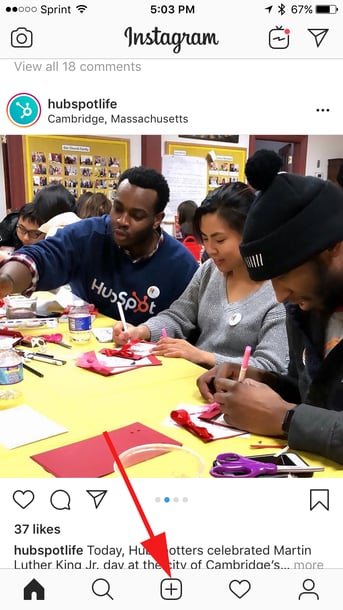
1. Tap the + icon at the bottom of your screen.
See that plus sign (“+”) in the center of the image above? That’s your starting point. See that post from our culture account? That’s your end point. Click that plus sign and you’ll be ready for the next step, below.
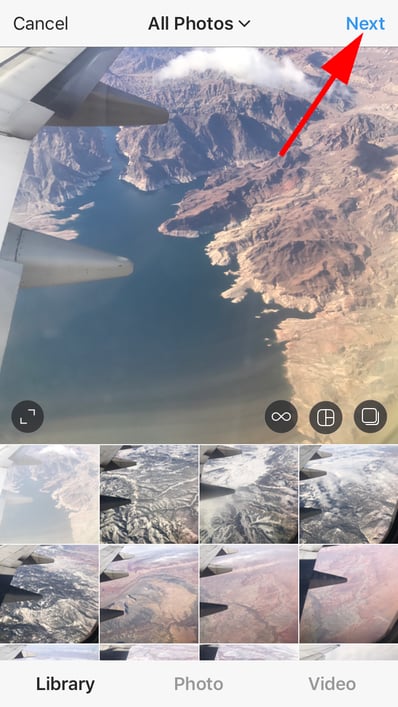
2. Choose a photo or video from your library — or shoot one in the app.
Instagram will show you the photos already saved to your phone. Choose one of those to post. Alternatively, you can click “Photo” or “Video” in the bottom to take a photo or video within the Instagram app itself, if you don’t already have an image you want to use.
Once you choose an image, click “Next” in the top right.
3. Crop the image.
You aren’t limited to just a square image on Instagram. You can actually share horizontal or vertical images as well. To get more of your image seen, pinch the screen of the photo you’ve selected on the Library screen.
However, while Instagram does allow vertical and horizontal options, the images still need to fit into some specific dimensions. So, you might still need to crop a tiny bit of your photo to get it to fit.
4. Try a carousel post.
Do you have multiple photos and want to highlight them all? Instagram allows you to do this with its carousel feature.

As you go to tap a photo or video, first tap the icon just above your photos to the right that looks like stacked squares. Once you tap this, you’ll see a number on the corner of every image or video you tap. This number notes where the content will show up in the carousel.
5. Pick a filter
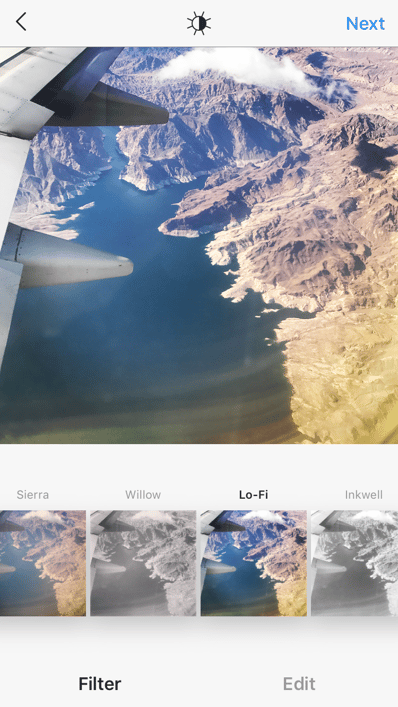
Instagram offers 25 filters — scroll to the right to peruse your options, and click on one to preview how it will look on your photo. (Take a look at our Ultimate Guide to Instagram Filters to learn more). You can click “Edit” at the bottom right to adjust contrast, brightness, etc.
When you’re ready, click “Next” in the top right.
6. Type your caption.
Get creative and write a nice, interesting caption to go with your photo. Since text can help optimize your post in Instagram’s search, writing something can only benefit you.
7. Use hashtags for post optimization.
With Instagram’s search feature, users can search by hashtags. So, you should make sure to write relevant hashtags in your caption. If someone does a search of a hashtag you placed in your caption, they might find your post as well as others that included the same one.
8. Tag friends.
Want your friend or their followers to see a photo that you posted of the two of you? Tag them!
On the post page, you can click “Tag People” to tag other Instagram accounts in your post. Alternatively, you can include their handle (or their username beginning with an @ symbol) in your caption.
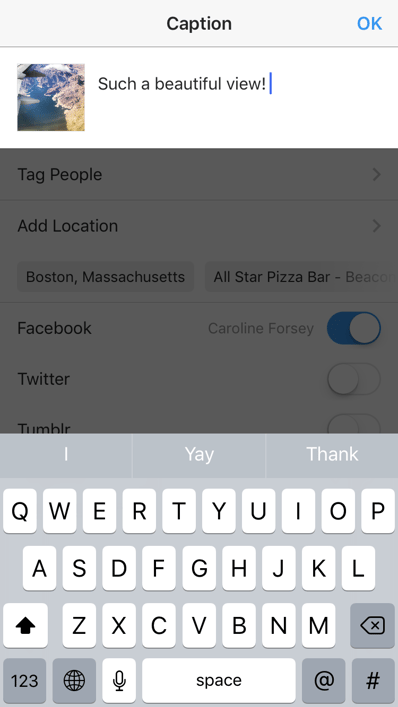
9. Add your location.
If you’re on a fun vacation or at a neat event and you don’t feel like including that information in your caption, you can mark where you are in another way. On the post page, tap “Add Location” to put a location on your image (which makes it easier for people to find your post).
When you post an image or video with a location, it will show up between your name and the block of content on the feed.
10. Play with emojis.
Emojis are fun and can make your caption more eye catching. If you know of a few relevant emojis that could fit with your post, stick them in the caption area.
For example, if you’re posting a vacation photo, you could include a beach umbrella or a plane to show you flew somewhere.
Be sure not to go overboard and post emojis just for the sake of posting them. If you post a bowling emoji along with a photo of a beach, that obviously won’t make sense to people. Similarly, if you post 20 emojis that loosely relate to a post, you might just annoy your followers or come off as desperate.
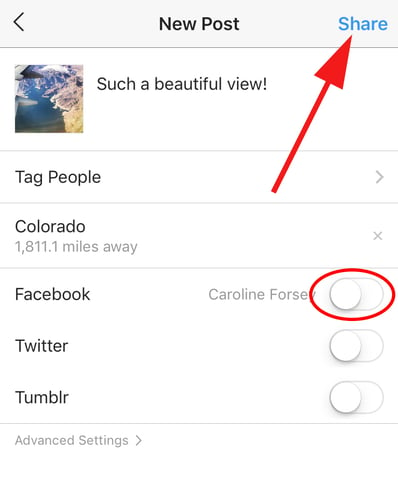
11. Share the post on other social media platforms
Finally, if you want to share your content on your other, connected social media sites (like Facebook or Twitter), simply slide the bar from the left to the right.
When you’re ready to post, click “Share” in the top right.
12. Edit the post.
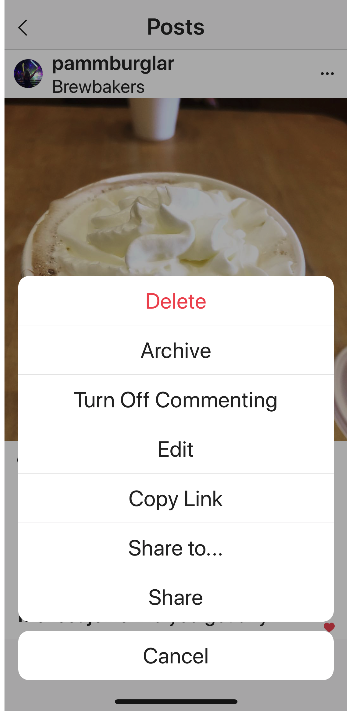
Typos happen to everyone! If you just posted something and notice a glaring spelling error, don’t panic. Simply tap the three dots that appear on the right across from your name, then tap “Edit.”
To learn more about how to use Instagram, including how to create a new account, how to manage notifications, how to connect other social media accounts, and how to upload to your Instagram Stories, take a look at our How to Use Instagram: A Beginner’s Guide.

How to Create a Link to Jump to a Specific Part of a Page [Quick Tip]
When most people think of links, they think of connecting two different webpages together. You use hyperlinks to connect two of your blog posts, or a blog post and a landing page, or a blog post and a product page, or a tweet to your website.
But that’s not all hyperlinks can do. With a little tweaking, you also can set up hyperlinks to link to content on the same page. So remember that really exhaustive glossary you put together on industry terms your audience should know? Now, when you refer to something you said elsewhere in that article, you can actually link to it — making it much easier for your audience to figure out what the heck you’re talking about.
Want to see what I mean? Just click here.
Pretty cool, huh? The best part about it all is that it’s super easy to do yourself, even if you don’t have extensive HTML knowledge. If the HTML-speak feels confusing, just follow along with the real-world examples below.
Note: If you are a HubSpot customer, follow these instructions.
How to Link to a Specific Part of a Page

1. Give the object or text you’d like to link to a name.
In a normal linking scenario, the thing you need to link to has a URL of its own. But in this scenario, the page you want to link to and the page the link is on is one and the same — so you’ve got to make up a name for the link’s destination.
I’d recommend using word or phrase that describes the link’s destination. If you use a phrase, there should be no spaces — use underscores instead.
Example
Let’s say we wanted to link to an example of a company using Facebook ads in a post. Here’s what I’d use as my object’s name:
facebook_ads_example
Now, onto the next step.
2. Take the name you’ve chosen and insert it into an opening HTML anchor link tag.
Translation: Replace the red section of the tag below with the name you chose in the previous step:
<a id=”INSERT_YOUR_OBJECT_NAME_HERE“>
Example
<a id=”facebook_ads_example“>
will go.
3. Place that complete opening <a> tag from above before the text or object you want to link to, and add a closing </a> tag after.
Doing this sets the location of link. This is what your code should look like now:
<a id=”INSERT_YOUR_OBJECT_NAME_HERE“>The object you want to link to.</a>
Example
<a id=”facebook_ads_example”>This is the Facebook ad example I want to link to.</a>
4. Create the hyperlink that’ll take you to that text or object.
Now, go to the part of the post you’d like to have the hyperlink in. You’ll need to add a typical hyperlink HTML markup, but in the part where you’d typically include a URL, you’ll include the pound symbol (#) then the name of the object you’re linking to. Here’s what it looks like:
<a href=”#INSERT_YOUR_OBJECT_NAME_HERE“>Click here to see the content below.</a>
Example
<a href=”#facebook_ads_example“>Click here to see an example of how a company uses Facebook ads.</a>
5. Voila! You’ve got a functioning hyperlink between two pieces of content on the same page.
Simple as that.
(Hey there, curious folks from the introduction! Click here go back to where you left off.)

How to Become an Influencer in Your Industry
Influencer marketing has skyrocketed since it first made its mark.
That’s very much due to the way purchasing decisions have changed over the years. In 2018, a study found that only 4% of people trusted celebrity endorsements. This is probably because they prefer to seek product and service recommendations from those who are, above all, knowledgeable and credible.
And today, those qualities often come in the form of social media influencers.
When it comes to getting advice or recommendations on what to do — which product to buy, which movie to see, and where to travel on vacation — there are still areas where we trust our peers more than we do “experts.”
But that’s part of what makes an influencer so powerful: Despite perhaps being an expert in his or her field, by sharing content and insight in a certain way, consumers view that person more as a peer. We have things like constant access to video and other visual content to thank for that — the tools that help us “get to know” people online in ways that weren’t quite as accessible only a few years ago.
So, how can you tap into this area, and become an influencer in your own field?
Influencers are ordinary people who have earned a substantial loyal following because of their expertise and transparency. Unlike celebrities actively endorse products on their social media accounts, influencers achieved their fame because of the valuable information they share with their followers.
It’s for this reason why one of the influencer marketing trends experts anticipate in 2019 is the increase in demand for social media influencers, specifically micro-influencers (influencers with less than 100K followers). Not surprising, more and more people want to become social media influencers.
The question is: where do you start?
In this blog post, I’ll be laying out ten ways how to become a social media influencer. On their own, they will help you slowly make your mark and establish you as an influencer in your industry. But do all these together, and you have a powerful strategy that will help speed things up exponentially.
How to Become an Influencer

1. Find your niche.
If you want to become a social media influencer, the very first thing you need to do is to choose a specific niche where you want to be known.
Although most social media influencers start out posting content, they’re passionate about, what sets them apart is the fact that they tend to focus on a particular niche within the industry they’re passionate about.
To find your little corner of influence, you’ll need first to determine who is your target audience by developing a unique persona—a semi-fictional representation of your ideal reader. Tools like HubSpot’s Buyer Persona Generation Tool can help you identify the individual wants, needs, challenges, and goals of your ideal reader that you can help solve and address, pointing you to the right niche to establish yourself and grow as an influencer.
2. Use the First Principles Thinking approach.
In an interview with Kevin Rose, Elon Musk explained that there are two reasoning approaches people use. The first and most common is the analogy approach. People that use this reasoning method decide to do things based on what has happened in the past.
That’s why we often see many people in a particular industry doing nearly the same thing, talking about the same topics, and even using similar formats when it comes to publishing and promoting their content.
The second reasoning approach is what Musk refers to as the First Principles Thinking approach. Instead of basing decisions on past successes or failures, Musk and others that use this reasoning approach study objective fundamentals and make their decisions based solely on that.
What’s good about following Musk’s way of thinking and reasoning is that it opens you up to other possibilities and approaches by “forcing” you to disregard the status quo, and think differently. Doing that can help set yourself apart from other influencers in your niche, and allow you to bring something new and fresh to the table for your target audience.
3. Choose your social media channel.
It’s important to pick the right social platforms where audiences with interests that align with your brand could engage with you. Two of the most prominent social networks where influencers are thriving in 2019 are Instagram and LinkedIn.
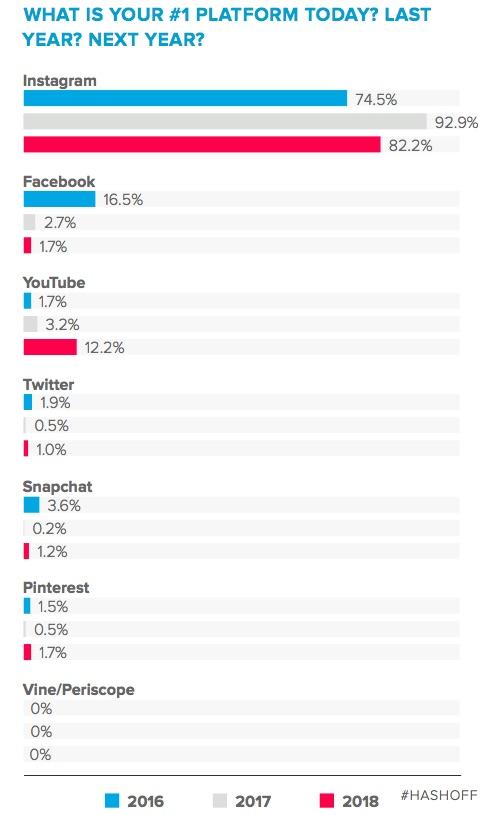
Instagram is the channel where 93% of social media influencers focus their content — because it gives them the best results.
Source: Marketing Profs
However, just because those are the current statistics doesn’t mean that Instagram is a perfect choice all the time.
The reason is simple: Your ideal audience may not be spending most of their time here.
On Instagram, you might see influencers that focus on lifestyle-oriented industries. For example, you might see a travel blogger posting about hotel stays or videos of food bloggers making a recipe. Because Instagram is quickly becoming video friendly with its Stories feature, you might also see sponsored content and marketing videos such as influencer hosted makeup tutorials.
Although LinkedIn is gaining more traction with lifestyle content, influencers can succeed on this platform when they focus on career or academic tips, or job-related content. While LinkedIn does offer video posting options, influencers can also embrace text more heavily on this platform by publishing blog-styled posts or regular text-posts.
If you want to quickly grow your following and establish yourself as a social media influencer, you need to make sure that you choose the right social media channel based on your niche and ideal audience.
Here are three questions to ask to help guide you in choosing the right social media channel:
Who is your target audience?
Again, this is where creating a holistic persona of your ideal audience is crucial. Instagram and Pinterest are excellent choices if you’re aspiring to reach out to millennials. On the other hand, if your target audience consists mostly of business executives, LinkedIn may be your best bet.
Where are the other influencers in your niche?
Aside from sharing the same target audience, being active in social media channels where the big influencers in your niche open the door for you to reach out to them, and even collaborate with them in the future.
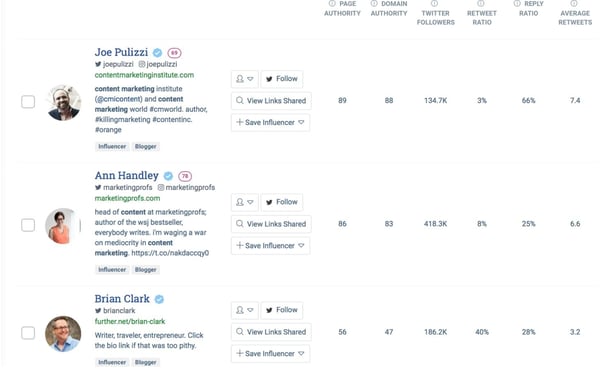
One tool I found extremely useful for this is BuzzSumo. When you do a search here using your targeted keyword, you’ll not only see what topics other influencers have tackled, but where they also share these pieces of content.
What type of content will you create?
Some social media channels like Facebook and LinkedIn allow you to post a diverse range of content formats while others like YouTube and Instagram only focus on providing users a specific content format.
That said, it’s vital that you select the social media channel that best suit the content strategy you’ll develop, which we will look into in the next section.
Regardless of which social media channel(s) you choose, remember not to go overboard with your selection. Stick to using two to three networks. Otherwise, you’ll be spreading yourself too thin, and will find it difficult to build your credibility and following.
4. Develop your content strategy.
Just like in inbound marketing, the format and quality of the content you publish will make or break your chances of successfully building yourself as a social media influencer.
Decide on the format you’ll use when creating your content. It should be one through which you’re able not only to deliver valuable information, but also, express your personality and voice — which help add uniqueness to the content you produce for your target audience.
Part of developing an effective content strategy is giving your audience the right balance of informative content and personal content. Remember, one reason why people trust influencers is due to their relatability.
One efficient way to do this is through the 5-3-2 principle: Out of every 10 posts you publish in your social media account, five of these should be valuable content written by someone else, three are educational and informative content you created yourself, and two should be posts about yourself.
Now, you may be thinking, “How will this help me become an influencer if half of the content I’ll be publishing is curated content?”
For starters, influencers are known for being able to provide valuable content to their audience. That includes sharing content written by others that they believe their followers will find useful.
More important, sharing content published by other influencers in your niche will help you slowly get their attention. As a result, it will be much easier to reach out to them and ask them to do the same for you later on.
If you need help discovering topic ideas for your content, try these resources.
Google Related Search Keywords
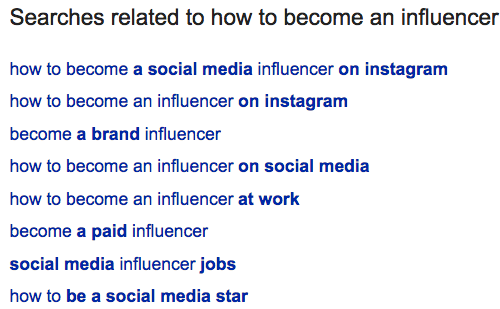
This is found at the bottom of the page after you search on Google. It lists down the most frequently used long-tail keywords used by your target audience when searching for content on the internet.
Answer the Public
Answer the Public is a website that gives you a comprehensive list of the different questions that are commonly asked around your chosen keywords, which you can then answer through your content.
Quora
Similar to Answer the Public, Quora gives you a list of different questions asked surrounding your selected keyword. The main difference between the two is that unlike Answer the Public, which offers you a list of questions based on search algorithms, the questions you find in Quora are those that were left explicitly by individuals currently facing a problem or challenge.
At the same time, Quora allows its members to leave answers to these posted questions. This gives aspiring social media influencers the chance to flex their muscles, and showcase knowledge on this topic — and, eventually, your niche.
5. Distribute your content.
No matter how great your content is, if you’re not getting people to see it and engage with it, it’s not exactly useful.
That said, it’s important that you carefully plan out when you’ll be publishing and distributing your content on social media.
The best time to post content on social media hugely depends on which social media channel you chose to use. This infographic provides a detailed breakdown of the best days and times when to distribute content for each of the most popular social media networks.
It’s just as critical to know how to post your content on social media. While each social media channel has its own rules and guidelines, here are some general best practices that are applicable regardless on which social media channel you use.
Stick to one theme per social media channel.
Focusing on one specific theme for each of your social media channels allows you to give your followers a more holistic picture of who you are, what you do, and what you stand for. That way, you’re able to publish more diverse content while still keeping your profiles very sleek and cohesive.
More important, it helps you categorize the different types of content you publish. That way, your followers know which social media channel they’ll find the content they need from you.
Customize your message.
Even if you’re posting the same piece of content on different social media channels, always take the time to make sure that you customize the message you include in it. Not only does it make each of your posts more personalized, but as Aaron Haynes, founder of Fenix Pro points out, it prevents your followers from feeling like their being spammed on their social media feeds.
“You need to make sure that you tailor every single content you post caters to the wants and needs of your followers, whether it’s a regular post or a paid post,” he explains. “The worst thing is that they can report your account as spammy, which could mean the end of your social media influencer dream.”
Optimize posts for mobile.
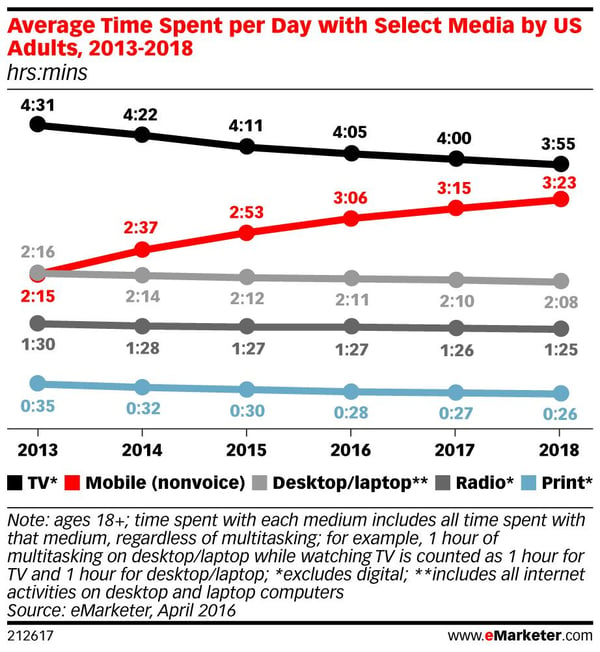
The average person spends over three hours on his or her mobile device.
Source: eMarketer
And within that time, 80% of it is spent on social media. That said, make sure that the posts you publish are just as appealing in mobile as they would be when viewed on desktops or laptops.
6. Post tutorials on Instagram, YouTube, or Facebook.
People who are looking to learn more about brands or products love to use video to do so. If your strategy or industry is highly visual, consider showing audiences how to use a product you’re trying to promote with a quick how-to.
Once audiences see a product in use, they might want to replicate the how-to project you’re doing or feel like the product is easy to use. These thoughts might lead them to an actual purchase and make your clients or sponsors very happy.
To help you brainstorm ideas, here’s a quick guide to how-to videos that really work.
7. Or, write LinkedIn or Medium thought leadership.
Thought leadership is content from an industry expert that offers advice or information on a certain topic. If you want to be an influencer in a business-related industry, or have people look to you as a leader or management-guru, a great place to start posting thought leadership is on LinkedIn.
As we mentioned above, you can use LinkedIn’s blog post feature to write a more long-form post, comment on other posts or discussions, or just publish standard posts. If you prefer video, the platform also has options for that as well.
If you want to write a lot of blog posts, another great place to publish your work could be Medium. Users on Medium see posts on their feed based on their interests and who they follow. So, if users share the same interests as you, they might be directed to your post.
8. Grow your network.
While you’re still in the process of establishing your credibility and expertise as a social media influencer, you’ll need to actively grow your follower base.
One of the most effective ways of doing this is through blogging. Even though more Internet users are turning to social media networks for information, the fact remains that you don’t entirely own your space here. One misstep can easily cause these social media networks to take down your account, causing you to lose all of your content and followers.
Blogging can help you kickstart your follower base by helping you get discovered. By including social media sharing buttons on each of your blog posts, your visitors can share your content with their respective social media networks.
If you have the budget, and you have a premium content offer on your blog, Justin Morgan — a.k.a., the Dental Marketing Guy — recommends promoting it as a sponsored post. That way, your content can find its way onto the feeds of those that match your ideal persona, introducing yourself and what you have to offer to them.
Blogging is also an efficient way to reach out and connect with is influencers in your niche as well as those related to yours. Blogging was how I connected with key influencers in my niche and exponentially grew my follower base.
Creating guest posts is another way of growing your followers. Getting featured on a reputable site within your niche helps you further establish your credibility and authority. At the same time, it will help you capture the attention of the more prominent influencers in your niche, and even open the door for collaboration with them.
9. Engage with your followers.
When your followers leave a question or comment on your posts, take the time to acknowledge and respond to them. That can make them feel like they’re valued and that you sincerely want to help them. It will also help you develop a relationship with them.
Of course, not all of the comments and questions will be positive. As an influencer, expect that you’ll have your fair share of negative comments and criticisms. Make it a point to keep your cool and address them professionally.
10. Evaluate your progress.
This step is crucial, especially if you’re looking to collaborate with brands for their influencer marketing campaigns, since this is one of the things that brands look for in an influencer to partner with.
Most social media channels give you insights and analytics to monitor your progress — things like demographics, reach, and engagement rate, that will show how quickly (or slowly) you’re building your audience. It will also shed light on which content formats get the highest engagement rates, so that you can create more of these.
11. Stay updated.
If you’ve been active on any social media channel, you know how often networks update their algorithms, as well as their posting terms and conditions. As an aspiring influencer, you need to keep yourself updated with these changes to avoid penalizations.
You’ll also need to familiarize yourself with FTC guidelines and policies, especially if you’re going to be collaborating with brands to promote their products and services on your social media accounts.
With influencer marketing proving itself as a highly effective marketing strategy, the FTC has become even more vigilant in monitoring brands and partner influencers that might be violating marketing guidelines.
12. Be consistent.
According to Adam Steele, founder of Loganix, if there’s one thing that surpasses quality content, it’s consistency.
That’s because your followers need to be able to count on you to deliver quality content on a consistent basis. If you don’t, they’ll eventually stop following you, or at least paying attention to you.
Scheduling your posts using a social automation tool like eClincher or HubSpot’s social publishing tools can help ensure that you stay consistent with your posts. Instead of manually publishing on each of your social media profiles, these tool allow you to create, upload, and schedule posts in batches.
Positioning yourself as a social media influencer will take some time, so you’ll need to be patient with the process, and stay consistent with it.
Most important, understand that becoming a social media influencer in your industry is not the end destination. Instead, it’s a stepping stone to more significant opportunities and responsibilities.
[Originally published January 25, 2018]

How to Become Instagram Famous (From 14 People Who Did)
Instagram is no longer just about connecting with friends — in 2018, it has become an incredibly powerful platform for finding your voice and creating a business. In fact, Instagram’s estimated mobile advertising revenue is expected to reach 6.8 billion U.S. dollars in 2018, compared to 1.8 billion two years ago.
Nowadays, Instagram is capable of turning stay-at-home moms into successful hat designers, or a woman working in corporate wealth management into a world traveler. So it’s no surprise you want to become an Instagram influencer, and reach a large audience with your own personal brand.
Since I myself am not an Instagram influencer (I think an average 60 likes per post falls a little short of most brands’ minimum for sponsorship opportunities), I set out to interview some real Instagram influencers in the industry, so you can get the full scoop.
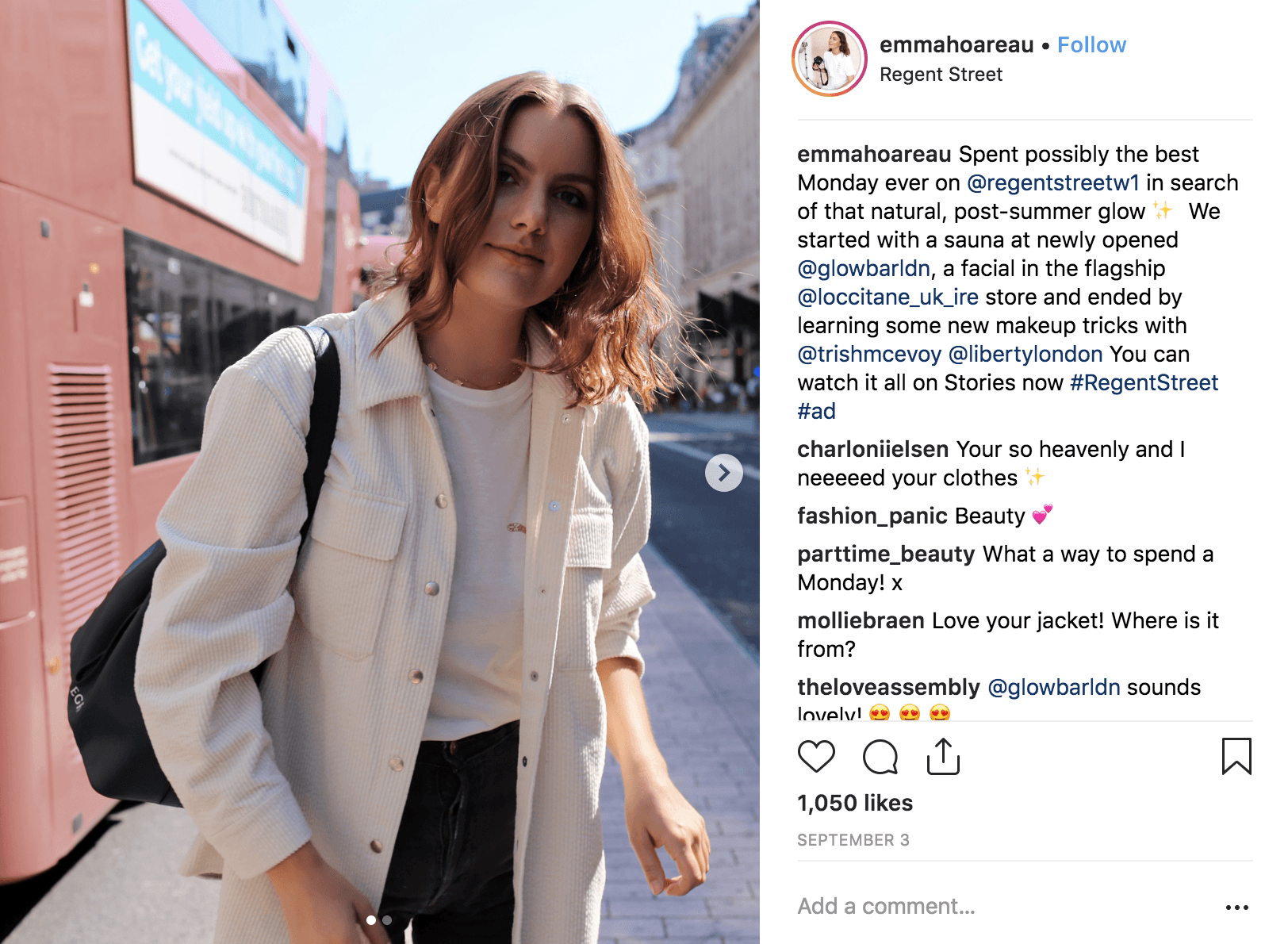
Throughout my conversations with these influencers, one thing became abundantly clear — the term “famous” makes most of them uncomfortable. Apparently, “famous” denotes something less substantial than what most of these people are chasing. As Emma Hoareau (@emmahoareau), a beauty and travel influencer who boasts nearly 40k followers, tells me, “Don’t set out to be Instagram famous! Create beautiful work and use the app as a source of inspiration … not a numbers competition.”
If you think about it, “fame” and “influence” are two drastically different measures of success. While fame is measured by a certain number, influence is measured by something a little less quantitative — a deep, authentic connection with your audience.
Here, we’ve compiled some critical tips from fourteen Instagram influencers, so you can get one step closer to sharing your brand with the world and influencing your own audience.
How to Become Instagram Famous
- Make sure your content is genuine and authentic.
- Remain flexible and authentic as your brand shifts.
- Focus on your audience.
- Find micro-brands.
- Refine your photography skills.
- Be persistent.
How to Become Instagram Famous
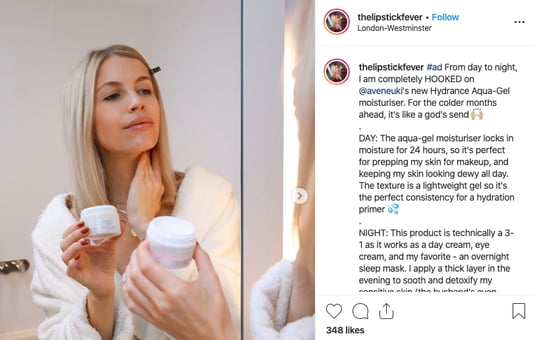
1. Make sure your content is genuine and authentic.
Across the board, all the influencers in this list insisted on one tried-and-true practice — authentic content.
Emily Roberts (@thelipstickfever), pictured above, is a fashion and beauty influencer with over 57k followers. She told me, “Focus on quality over quantity when it comes to your content. It’s better to post top notch images less frequently, than to post something subpar very frequently.”
To me, this makes sense — the same is true for any type of content creation. An audience would rather read one high-quality Facebook status than a hundred less interesting ones. At HubSpot, we’d prefer to publish a few exceptional pieces of content per day, rather than laboring away to produce hundreds of barely average pieces.
Emma Hoareau (@emmahoareau) concurred: “Make sure the content you’re sharing is true to yourself, and try not to compare yourself to others.”
Of course, authenticity is easier said than done, particularly when you’re following other accounts and feeling envious of their posts or their brand image. You might, at times, doubt your ability to remain honest about your life when it’s tempting to portray something a little shinier.
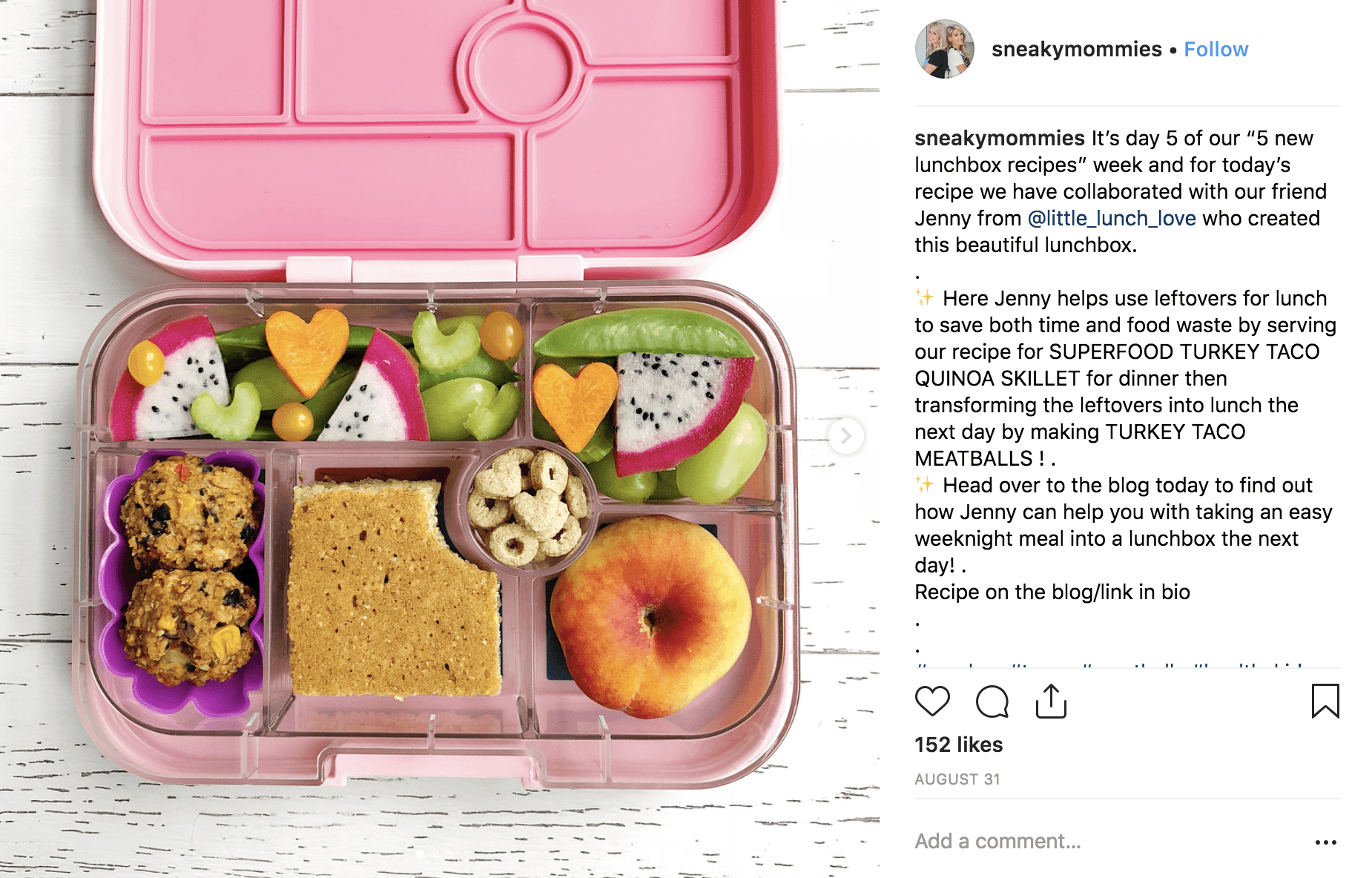
Nic and Nat (@sneakymommies), two women who create kid-friendly, healthy recipes on their Instagram account and have over 6,000 followers, say you should “stay authentic and always be you. This means being truthful and honest about who you are both online and offline and staying true to your personal brand.”
Morgan Raphael (@bun_undone) a health, wellness, and inspiration influencer with nearly 15k followers, offers some advice when it comes to whether or not you need to find a niche. “I heard a lot of advice to find your niche and what makes you stand out, but truthfully, if you share your real self, people will relate and therefore respond by continuing to follow you and engage with your content.”
Finally, Chelsea Martin (@passporttofriday), a travel blogger and influencer with over 17k followers, says commitment to your brand is critical — “don’t take just any collaboration offer that comes through the door. Stay loyal to your personal brand and your followers will stay loyal to you.”
While it can be tempting to take the first sponsorship offer you receive, long-term growth is about remaining committed to partnering with brands that can offer meaningful value to your audience, as well.
2. Remain flexible and authentic as your brand shifts.
When you follow Instagram influencers, you might feel like they joined the app with an inherent and instant understanding of their brand — at least, that’s how I’ve always felt. To verify this, I asked Nicole Loher (@nicoleloher), a health and fitness influencer with over 14k followers, whether she knew what she wanted her brand to be when she first created her Instagram account.
Nicole told me, “I’ve always had a really pure goal to share a super authentic glimpse into my life — no matter if it’s good or bad — because I ultimately moved to New York not knowing anyone … And ‘making it’ here was never and still is not easy. I think as my following began to amass, I realized I had a real platform to be an advocate for projects, communities and brands, I’m passionate about — the most notable one being the Leukemia and Lymphoma Society. That said, about three years ago, my brand started to shift. I went from being a girl who worked in fashion and beauty, to a competitive triathlete. It wasn’t something I set out to do — it just shifted as my life shifted!”
It seems a key factor in remaining authentic and true to your audience is, ironically, allowing yourself to change direction. If your audience believes they’re getting a glimpse into the real you, and if they feel connected to you, they’ll ideally want to grow and change with you as you move throughout stages of your Instagram, and real life, journey.
3. Focus on your audience.
We’ve discussed remaining authentic and flexible as you create a brand identity on Instagram. Now, let’s consider why this is important — audience loyalty.
An influencer doesn’t become an influencer without creating a strong community, and developing a connection, to her audience. Emily Roberts (@thelipstickfever) says, “Always make sure you’re focused on driving value to your audience, and hone in on what makes you truly unique.”
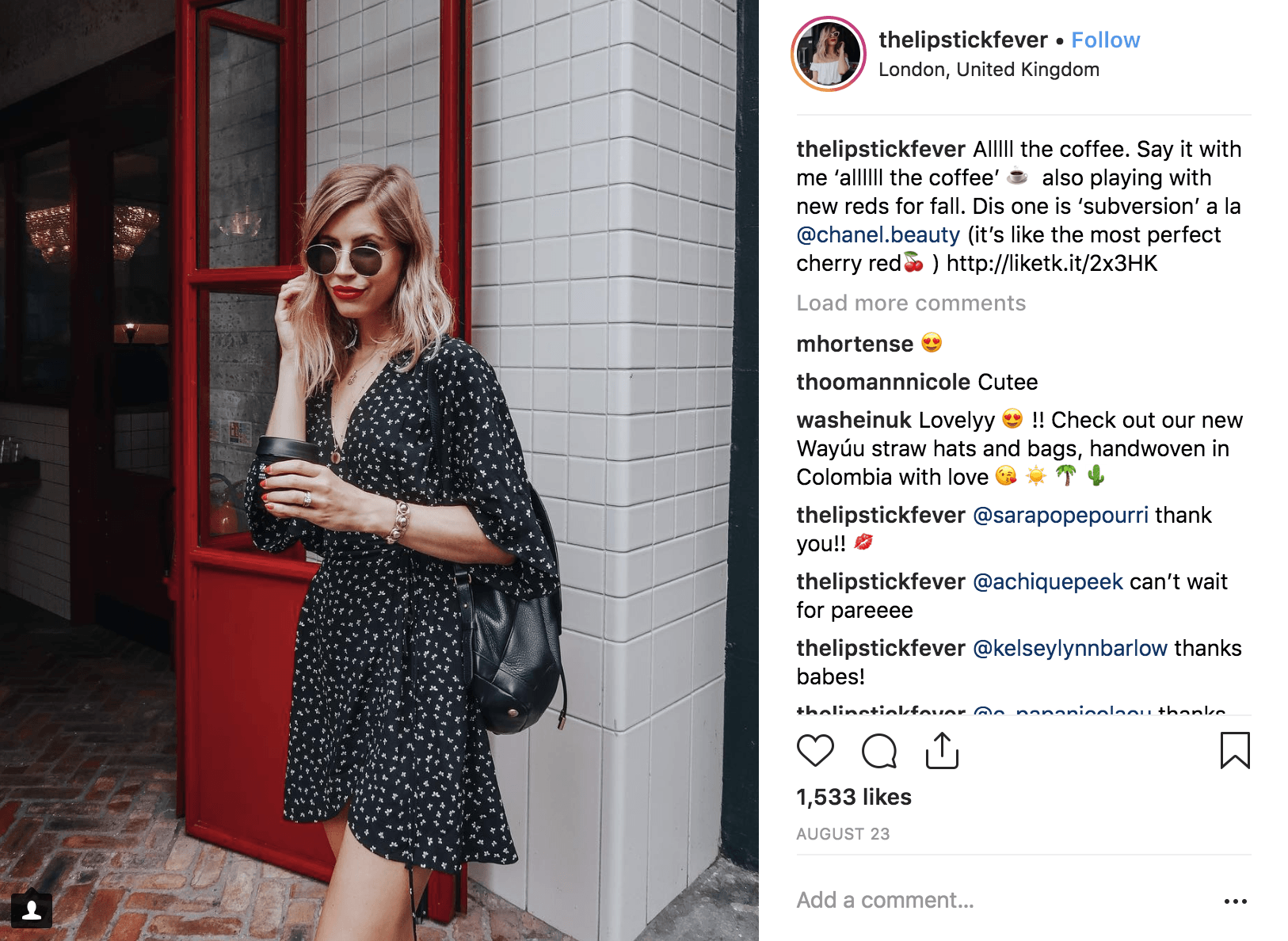
Ultimately, becoming an Instagram influencer is a professional role like anything else, so it’s important you consider what you can offer your audience. Lauren Caruso (@laurencaruso_), a fashion influencer who boasts nearly 35k followers, advises, “Step one is definitely finding your niche, then figure out how to offer some sort of a service to the audience. It can be anything from outfit ideas, creative direction ideas, or helping them discover new brands — just make sure you stay true to your aesthetic, rather than trying to be everything to everyone.”
Finally, Nic & Nat (@sneakymommies) told me, “People will want to connect with you if they view you as being relatable (human!), so being honest and sharing the good and the bad is what they want to see.”
There’s a reason the hashtag #nofilter has been used over 235 million times, compared to #sponsorship, which barely passes the 400,000 mark. Ultimately, Instagram is a platform meant to connect real people with true experiences. Make your audience feel like they’re getting a glimpse into your challenges, and they’re more likely to cheer on your successes.
4. Find micro-brands to work with.
Once you’ve created a brand and grown a loyal following, you might feel ready to reach out and get endorsed by certain brands. But direct messaging Nike or L’Oréal might not be your best initial strategy.
Instead, Puno (@punodostres), a micro-influencer and business founder with over 14k followers, emphasizes the importance of micro-brands: “Micro-brands on Instagram are awesome, mostly because they are small businesses that are open to trade. Similar to you, they’re looking to build their following. If you’re an influencer with under 10k followers, product for trade is a great place to start creating content you want to get paid for, especially if you can find brands you love and are in the same boat (socially). Plus, they are more likely to mention and regram you.”
To find micro-brands, Puno suggests you use PeopleMap.co, a micro-influencer tool she created (the tool is used by clients like Refinery29 and Etsy). You can also find micro-brands by searching for hashtags related to your expertise. For instance, #healthyeating might connect you with brands, or other influencers, in a similar industry. Once you find brands you’re interested in working with, you can either direct message or email them.
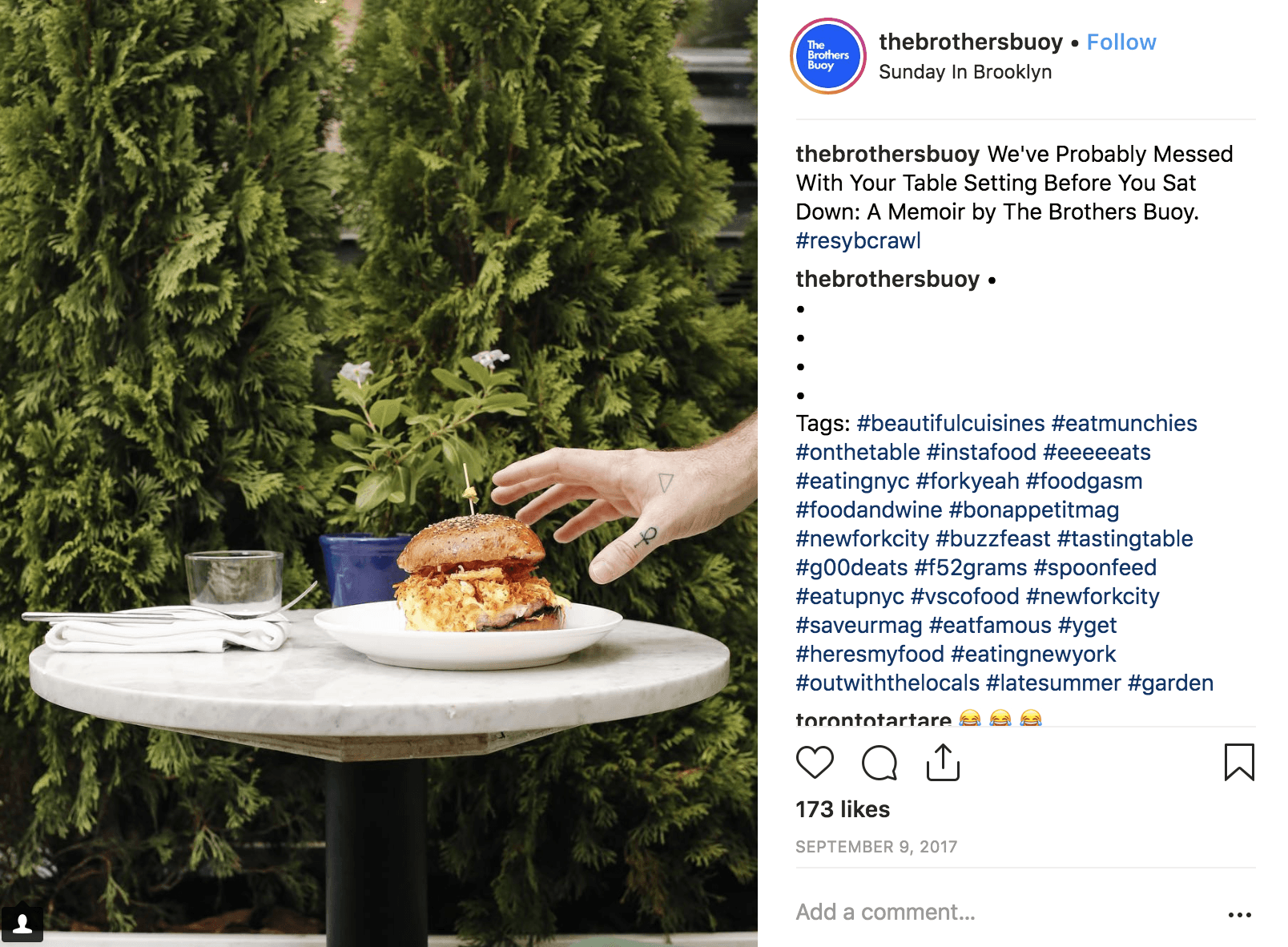 Additionally, Jackson and Graham Buoy (@thebrothersbuoy), two food influencers with over 11k followers, told me, “One of our absolute favorite things to do is work with smaller brands or new restaurants who are still finding their voice and help them tell their story visually. We only promote things on our feed that we genuinely care about or use … We just don’t see the point behind content that is so obviously paid for and doesn’t align with someone’s personal brand, as it really defeats the whole idea of ‘influencing.'”
For more information on sponsorships, check out, “How to Get Sponsored on Instagram (Even if You Currently Have 0 Followers)“.
5. Refine your photography skills.
Oftentimes, it’s easy to feel like your iPhone and Instagram filters are enough — and, sometimes, they are. But to set yourself apart as an influencer, versus just an Instagram user, it might be worthwhile to invest in better photography and editing equipment.
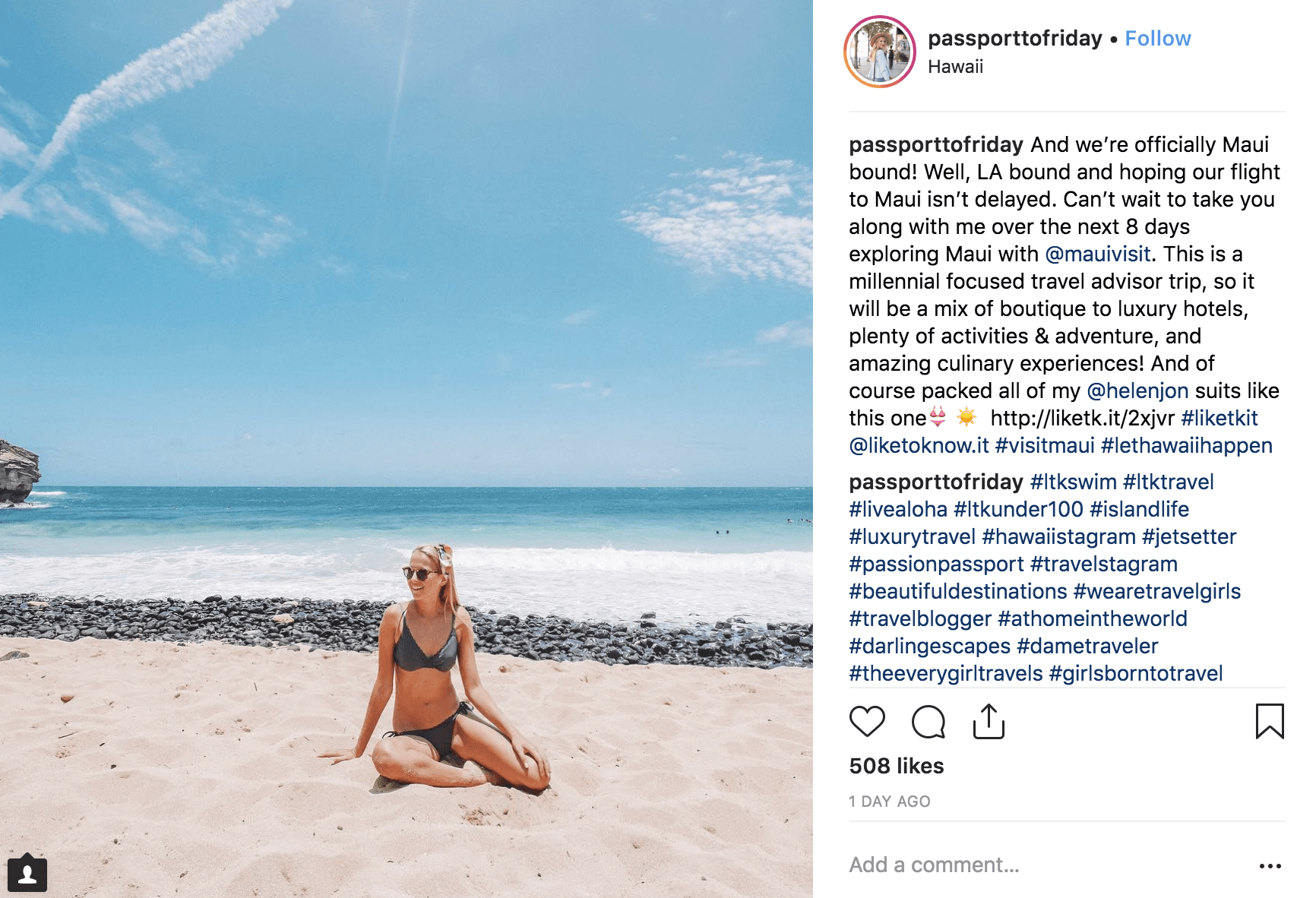
Chelsea Martin (@passporttofriday) says, “A professional camera and a great lens could make the difference between a good photo and an amazing photo — which has more potential of being reposted by other accounts, therefore growing your audience.”
To set yourself apart, consider going the extra mile. Invest in equipment or a photography course to improve your skills.
Jackson and Graham Buoy (@thebrothersbuoy), advise, “Investing in equipment is a great idea, but if you don’t know how to use it, it won’t get you anywhere. We would recommend spending money on sites like Skillshare, or even investing time in YouTube tutorials about photography and editing basics. Once you feel comfortable with that stuff and know you can take a good photo, then graduate to some higher quality equipment.”
Ultimately, you want to provide your audience with something valuable. Like any service, using the proper tools and taking online courses could lead to a bigger pay-off in the long run.
6. Be persistent.
As with any profession, one of the most critical components to becoming successful on Instagram is persistence.
Morgan Raphael (@bun_undone) says, “I preach patience and self-love. Don’t give up, continue to write or post consistently and in time it will flourish. The comparison game can easily get in your head if you’re focused on numbers, so instead, focus on the meaningful content you’re sharing, remain proud of your work and keep going.”
Becoming an influencer isn’t easy, and while it can be incredibly rewarding, it’s only possible if you’re willing to put in the time. Being passionate about your content will help you push through the challenging times.
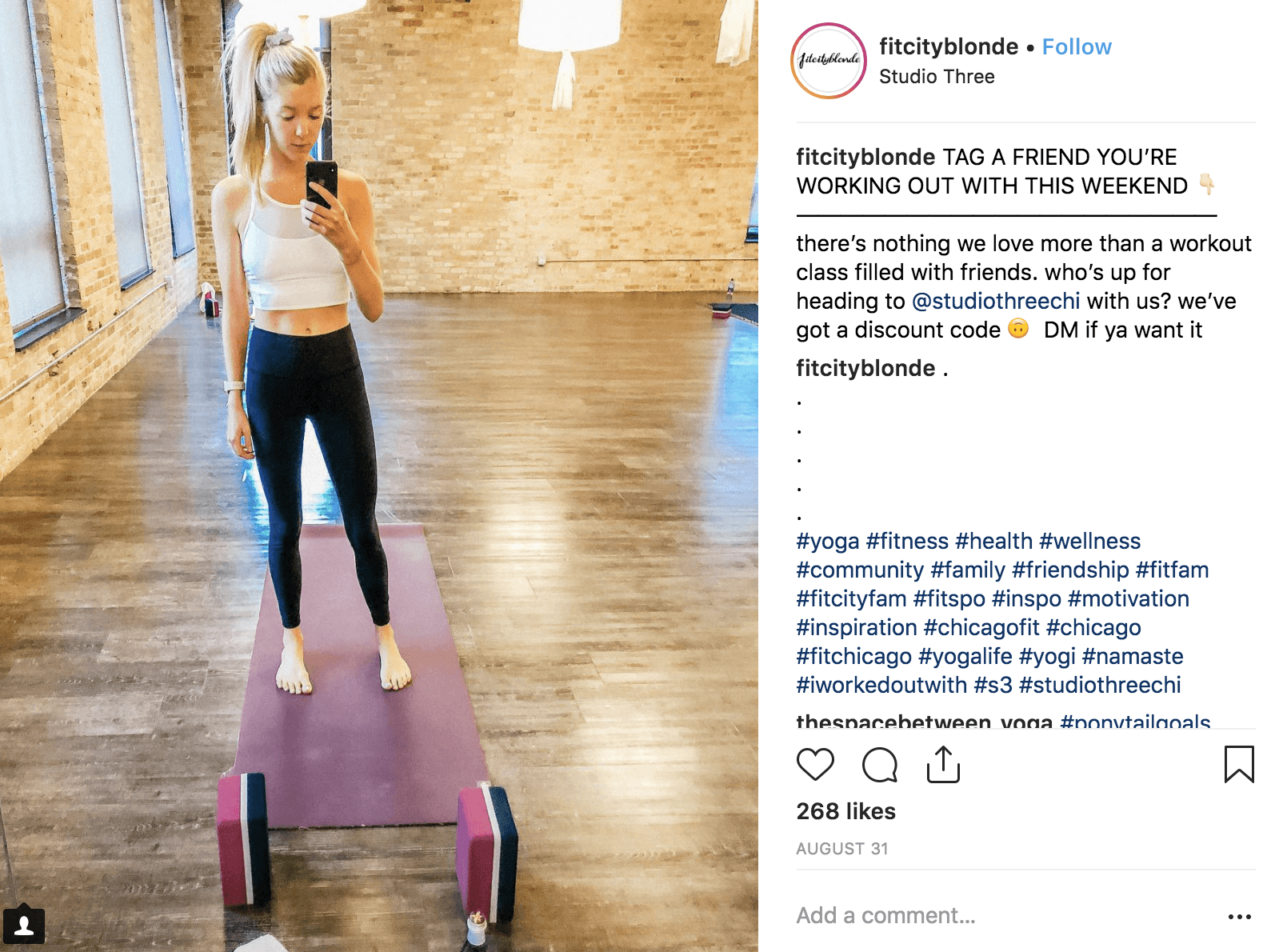
Christina, Jeannie & Eli (@fitcityblonde), three fitness influencers with over 8,000 followers, advise, “Post content that you’re passionate about, build genuine and authentic connections, and GRIND. Don’t be afraid to reach out to people to build your network, especially in person. Instagrammers often hide behind their pages, so it’s unique when you’re willing to establish actual human connections. All in all, keep it real, and work your tail off.”
I think we can all agree, whether it’s influence or fame you’re after, worthwhile endeavors are never easy — but, hopefully, these influencer tips make your experience a little easier.

How to Write an Introduction: A Simplified Guide
How to Write an Introduction
- Grab the reader’s attention.
- Present the reason for the post’s existence.
- Explain how the post will help address the problem that brought your reader to it.
Blink. Blink. Blink. It’s the dreaded cursor-on-a-blank-screen experience that all writers — amateur or professional, aspiring or experienced — know and dread. And of all times for it to occur, it seems to plague us the most when trying to write an introduction.
I mean, you already have a blog post you want to write. Can’t you just dive in and write it? Why all the pomp and circumstance with this dag-blasted introduction?
Here’s the thing — intros don’t have to be long. In fact, we prefer them to be quite quick. They also don’t have to be so difficult, but they do have to exist. They prepare the reader and provide context for the content he or she is about to read.
Let’s break down exactly how to write an introduction that’s short, effective, and relatively painless. And if you’re ever having trouble churning out those intros, come back here and re-read this formula to lift yourself out of that writing rut.
How to Write an Introduction

To write an introduction, be mindful of what it’s supposed to achieve. The main goals here are to draw in your reader — a relative stranger, most of the time — and concisely let her know what the article is about. Generally, that consists of three key components:
Step 1) Grab the reader’s attention. That looks different for every piece of writing, but we’ve provided some suggestions below.
Step 2) Present the reason for the post’s existence.
Step 3) Explain how the post will help address the problem that brought your reader to it.
As a lover of all things meta, I will, of course, use this post’s introduction as an example of how to write an intro. It contains different components that create the above introduction “formula,” which you can refer to that when you get stuck with your own.
Below, we’ve gone into more detail on each component.
The Introduction Paragraph
1. Grab the reader’s attention.
There are a few ways to hook your reader from the start. You can be empathetic (“Don’t you hate it when…?”), or tell a story, so the reader immediately feels some emotional resonance with the piece. You could tell a joke (“Ha! This is fun. Let’s read more of this.”). You could shock the reader with a crazy fact or stat (“Whoa. That’s crazy. I must know more!”).
For this intro, I went the “empathetic” route.

Writer’s block stinks. Blank screens and taunting cursors — the worst. Who’s with me?
2. Present the reason for the post’s existence.
Your post needs to have a purpose. The purpose of this post is to address a specific problem — the pain in the butt that is writing intros. But, we have to do it, and therein lies the approach to something important: making writing introductions easier.
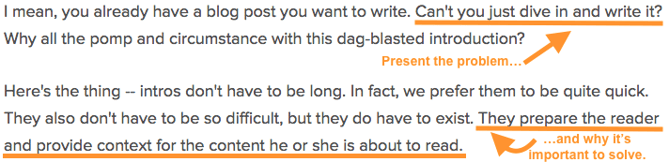
Just because you know the purpose of your post, doesn’t mean the reader does — not yet, anyway. It’s your job to validate your post’s importance and give your audience a reason to keep reading.
3. Explain how the post will help address the problem.
Now that the reader is presented with a problem that he or she can relate to — and obviously wants a solution — it’s time to let the audience know what the post will provide, and quickly.
In other words, the introduction should set expectations. Take this post, for example. I don’t want the reader to dive in and expect to see a list of reasons why introductions are important. I want you to expect to read about what makes a good introduction. But if I hadn’t clarified that in the introduction, you might have expected the former. After all, be honest — did you skim over or forget the title of this post already? That’s okay. That’s why we tell the reader exactly what the post will provide, and why it’s valuable.

The underlined sentenced is a way of saying, “Keep reading.” We already established that there’s a problem — here’s how I’m going to make it easy for you to solve.
Of course, there are other valid ways to write introductions for your marketing content — don’t feel the need to follow this formula for every single piece of content, as some are more casual than others. But, this guide should help provide a solid framework to follow if you’re just getting started, or if it’s just one of those days when the words aren’t flowing.
What are some examples of great introductions in the wild? We thought you might ask — which is why we picked out some of our favorites.
5 Introduction Examples
1) “Confessions of a Google Spammer,” by Jeff Deutsch

There are a few reasons why we love this introduction. Immediately, it grabs our attention — how the heck did this guy make fifty grand every month? And just from 10 hours a week?
But unlike some spammy comments that might contain a similar sentiment, he almost immediately serves us something unexpected — he tells us not to do that.
Then, he states the true purpose of the blog — to explain why we should “never, never ever follow in [his] footsteps.” In just three sentences, this introduction has captivated us and validated the story’s existence with a looming life lesson. The takeaway? Keep it short, but powerful.
2) “Announcing the public preview of Azure Advisor,” by Shankar Sivadasan
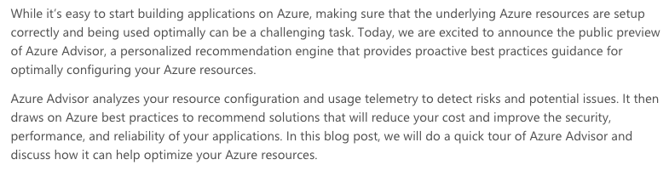
Here’s a great example of an introduction that presents a problem and a solution to it. Sure, it’s easy to build apps on Azure, Microsoft’s cloud platform — but maybe you had some issues with its setup. Well, wouldn’t you know? Azure Advisor is here to address those challenges, and you can preview it for free.
But wait — there’s more. The introduction not only immediately presents a problem and a solution, but it concisely summarizes just how this product provides a fix. And, it explains why the text will be helpful, with the sentence, “In this blog post, we will do a quick tour of Azure Advisor and discuss how it can help optimize your Azure resources.”
That’s a best practice for brands that have made a mistake — even a small one. Technology is great, but it can come with bugs. That’s where an intro like this one can be so helpful. It acknowledges the problem, states what the brand has done to address it, and alerts the reader to continue to learn how that solution will work.
3) “Taste the Season at Sushi Sora,” by Chris Dwyer

Strong introductions aren’t just important for blogs — they’re essential to quality editorial pieces, too. That’s why we love this introduction to an article from Destination MO, the Mandarin Oriental’s official online magazine.
Remember that thing we said about a captivating start? In addition to being empathetic or funny, visuals can be huge — not just an actual picture or video, but words that actually help the reader envision what you’re describing. This introduction does just that, with expressive phrases like, “the magical silhouette of Mount Fuji on the horizon.” Well, yeah. That does sound magical. But where can I go for such a view? None other than the “Mandarin Oriental, Tokyo,” the author tells me, especially “from the sushi counter at Sushi Sora.”
Here’s the thing about this intro — it gives the reader something to aspire to. We’ve briefly discussed aspirational marketing before, but this instance is one where it can be used in a brief introduction. After reading this first paragraph, I want to go to Tokyo. And when I’m there, I want to stay at the Mandarin Oriental. Then, I want to take in the views from its high-end sushi restaurant.
With just two sentences, I’ve gone from reading an article with my morning coffee, to fantasizing about a thousand-dollar vacation. So whenever possible, use your introduction to paint a picture, and to help your reader dream.
4) “The Secret Club of Admitting You Suck,” by Janessa Lantz
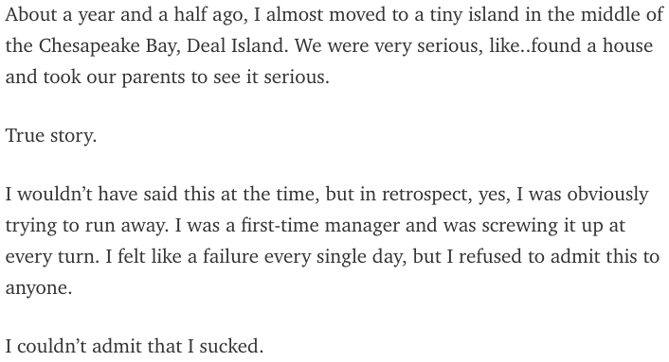
Let’s read through this introduction from ThinkGrowth.org together.
I should know: I once moved very far away to escape my own failure, too. But I couldn’t admit at the time that I sucked, either. Wow, Janessa Lantz really gets me.
See that? That, right there, is a resounding example of how empathy makes a profound introduction. But how did the story end? Did they buy the house? Did she admit that she sucked? Does she still suck? (Spoiler alert: I work with Janessa and can say, with great confidence, that she is far from sucking.)
The point is, I wanted to keep reading for two reasons — first, I related to the author. Second, it was just plain interesting, and it left me with a cliffhanger. It’s okay to tease your readers. Just make sure you ultimately give them what they’re seeking.
5) “Be a responsible tourist: a PSA from the U.S. Fish and Wildlife Service,” by Out of the Blue
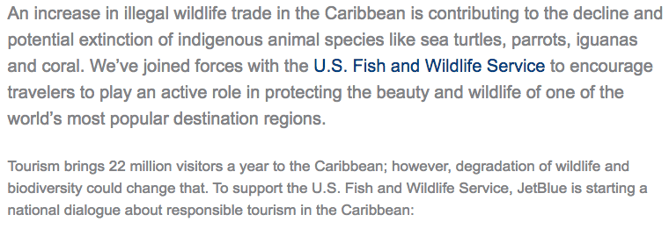
I’ll admit it — I’m a sucker for a good travel blog, which is why JetBlue’s official blog appeals to me. But at the same time, I also geek out for almost anything that promotes sustainability. In this piece, those worlds collide.
What makes this introduction work? Honestly, it’s scary. “Decline” and “extinction” are strong words, and absolutely present a problem. But research shows that we’re actually more inclined to keep reading bad news — in fact, a few years ago, our media consumption habits suggested that we prefer it.
But it’s not all bad — and JetBlue quickly turns around a potentially devastating situation with the language of this introduction. And, it includes the reader, by inviting travelers to be part of the solution, but joining the brand in its promotion of responsible tourism.
That’s another formula for presenting bad news to your audience, especially if you’re not the one causing it and you have a solution. Scary information + how you’re helping + how the reader can do his or her part = compelling intro.
Let’s Start
Feeling inspired? Good. Next time you find yourself face-to-face with the dreaded blinking cursor, use these resources and compelling examples to find motivation.
How do you write a good intro, and what are some of your favorite examples? Let us know in the comments.
Editor’s Note: This post was originally published in September 2013 and has been updated and for freshness, accuracy, and comprehensiveness.

9 of the Best Professional Bio Examples We’ve Ever Seen [+ Bio Templates]
Is your professional bio as good as it can be?
In this article, we have nine real bio examples you should definitely compare yours to — and a series of free bio templates you can use to perfect it.
Most people don’t think about their professional bio until they’re suddenly asked to “shoot one over via email,” and have approximately one afternoon to come up with it. That’s when we scramble, and our bio ends up reading like this:
Rodney Erickson is a content marketing professional at HubSpot, an inbound marketing and sales platform that helps companies attract visitors, convert leads, and close customers. Previously, Rodney worked as a marketing manager for a tech software startup. He graduated with honors from Columbia University with a dual degree in Business Administration and Creative Writing.”
Woof, that was dull. Are you still with me? I swear, not even adding a tidbit about his cats would liven that bio up.
To be fair, in certain contexts, your professional bio does need to be more formal, like Mr. Erickson’s up there. But in many cases, writing a bio that’s readable — even conversational — is actually a really good thing. That means dropping that traditional format of listing your accomplishments like a robot and cramming as much professional-sounding jargon in there as you can.
How to Write a Bio
1. Create an ‘About’ page for your website or profile.
Before you can publish your professional bio, you need a living space for it. Here are a few to consider (some of these you might already have in place):
- Facebook Business page
- LinkedIn profile
- Instagram account
- Personal website
- Personal blog
- Industry website
- Industry blog byline
As you’ll see in the professional bio examples below, the length and tone of your bio will differ depending on which of the above platforms you choose to be on. Instagram, for example, allows only 150 characters of bio space, whereas you can write virtually as much as you want on your personal website — or even your Facebook Business page. But once created, this bio should represent who you are in the eyes of your audience.
2. Begin writing your bio with your first and last name.
If your readers don’t remember anything else about your bio, make sure they remember your name. For that reason, it’s a good idea for your first and last name to be the first two words of your professional bio. Even if your name is printed above this bio (hint: it should), this is a rare moment where it’s okay to be redundant.
For example, if I were writing my own bio, I might start it like this:
Lindsay Kolowich
Lindsay Kolowich is a Senior Marketing Manager at HubSpot.
3. Mention any associated brand name you might use.
Will your professional bio represent yourself, or a business you work for? Make sure the brand you want to be associated with is mentioned in your bio. If you’re a freelancer, perhaps you have a personal business name or pseudonym you advertise to your clients. Here are a few examples:
- Lindsay Kolowich Marketing
- SEO Lindsay
- Kolowich Consulting
- Content by Kolowich (what do you think … too cheesy?)
Maybe you founded your own company, and you want its name to be separate from your real name. Don’t be afraid to keep it simple: “Lindsay Kolowich is the founder and CEO of Kolowich Consulting.”
4. State your current position and what you do.
Whether you’re the founder of your company or a mid-level specialist, use the next few lines of your bio to describe what you do in that position. Don’t assume your audience will naturally know what your job title entails. Make your primary responsibilities known for the reader, helping them paint a picture of who you are during the day and what you have to offer the industry.
5. Include at least one professional accomplishment.
Just as a business touts its client successes in the form of case studies, your professional bio should let your own audience know what you’ve already achieved. What have you done for yourself — as well as for others — that makes you a valuable player in your industry?
6. Describe your values and how they inform your career.
Why do you do what you do? What might make your contribution to the market different than your colleagues? Better yet, what values do you and your colleagues share that would make your business a worthwhile investment to others? Start to wrap up your professional bio by simply explaining what gets you up in the morning.
7. Briefly tell your readers who you are outside of work.
Transition from describing your values in work to describing who you are outside of work. This may include:
- Your family
- Your hometown
- Sports you play
- Hobbies and interests
- Favorite music and travel destinations
- Side hustles you’re working on
People like connecting with other people. The more transparent you are about who you are personally, the more likable you’ll be to the people reading about who you are professionally.
8. Consider adding humor or a personal story to add flavor to your professional bio.
End your professional bio on a good note — or, more specifically, a funny note. Leaving your audience with something quirky or uniquely you can ensure they’ll leave your website with a pleasant impression of you.
It’s important to follow the steps above when writing your bio, but don’t obsess over any one section. Remember, the people reading your bio are suffering from information fatigue. If you don’t hook ’em in the first line, you’ll lose them quickly.
(P.S. Want to give your professional brand a boost? Take one of HubSpot Academy’s free certification courses. In just one weekend, you can add a line to your resume and bio that’s coveted by over 60,000 marketers.)
Why Good Bios Are Important for a Professional
Alright, I know what you may be thinking … So what? It’s just a bio. I mean, how many people actually read professional bios, anyway?
The answer: A lot of people. More importantly, though, there’s no way to tell exactly who is reading it — and you always want it to be ready for when the right people to come across it. And when they do, you want it to catch their eye. In a good way.
You see, while your resume is only useful for when you’re actively applying for specific positions, your professional bio is much more visible. It can live on your LinkedIn profile, your company’s website, your guest blog posts, your speaker profiles, your Twitter bio, and many other places.
And, most importantly, it’s the tool that you can leverage most when you’re networking.
Bottom line? People will read your professional bio. Whether they remember it, and whether it makes them actually care about you, is a matter of how well you present yourself to your intended audience.
So, what does a top-notch professional bio look like?
Below, we’ve curated some of the best real professional bio examples we’ve ever seen on Twitter, Instagram, Facebook, LinkedIn, and the various websites where you might describe yourself.
Check ’em out, and use them as inspiration when crafting your own.
9 of the Best Professional Bio Examples We’ve Ever Seen
1. Ann Handley
Bio Platform: Personal Website
If you’re a marketer, you’ve likely heard of Ann Handley. Her list of credentials is lengthy, and if she really wanted to, she could go on and on and on about her accomplishments.
But when people list out all their accomplishments in their bios, they risk sounding a little egotistical. Sure, you might impress a handful of people with all those laurels, but many people who read your bio will end up feeling either intimidated or annoyed. Think about it: Is that how you want the majority of your readers to feel when they read your bio?
To minimize the egoism that comes with talking about yourself, think about how you can list out your accomplishments without sounding like you’re bragging. Ann does this really well, choosing a tone in her bio that’s more approachable.
It starts with the excerpt in the footer of her personal website. Give it a quick read, paying close attention to the opening and closing lines:
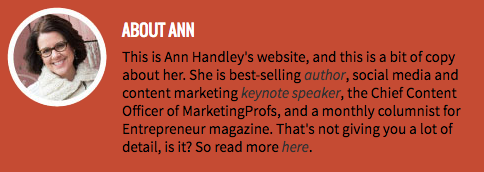
“This is Ann Handley’s website, and this is a bit of copy about her … That’s not giving you a lot of detail, is it? So read more here.” This is the kind of simple, friendly language that invites the reader in rather than shutting them out.
Follow the link and you’ll be led to a page dedicated to a fuller bio, which she’s divided into two parts: a “short version” (literally a bulleted list of key facts) and a “long version,” which includes traditional paragraphs. There’s something in there for everyone.
2. Rebecca Bollwitt
Bio platform: Instagram
Instagram is a notoriously difficult platform on which to write a good bio. Similar to Twitter, you simply don’t have room for a professional bio that includes everything about you. And because Instagram is primarily a mobile app, many viewers are reading about you passively on their mobile device.
Instagram’s limited bio space requires you to highlight just your most important qualities, and blogging icon Rebecca Bollwitt does so in her own Instagram bio in an excellent way.
Rebecca’s brand name is Miss604, and cleverly uses emojis in her Instagram bio to tell visitors exactly what makes her a valuable content creator. Take a look in the screenshot below.
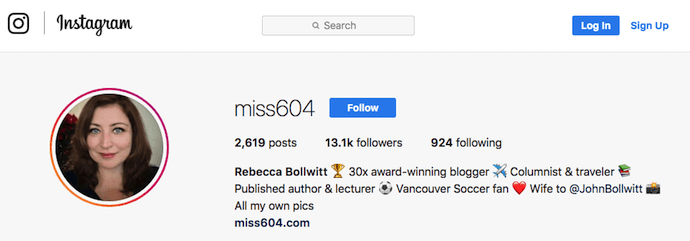
Starting with a trophy emoji, Miss604 says she’s won more than 30 awards for her blogging services. I haven’t even looked at her pictures yet and the introduction of her bio has already sucked me in.
The rest of her bio follows suit, breaking up the text with an appropriate emoji and a perfect collection of nouns to tell me who she is as a person. She even links out to her husband’s Instagram account after the heart emoji (an adorable addition), and assures her followers that all of her pictures are authentically hers.
Take a lesson from Miss604, and show your personal side. Just because you’re branding yourself as a professional doesn’t mean you have to take your human being hat off. Often your most personal attributes make for the best professional bio content.
3. Mark Gallion
Bio Platform: Twitter
As a venture capitalist and an executive at several start-ups, Mark Gallion has different versions of his bio all over the internet. You can imagine some are more formal than others. But when it comes to his Twitter bio, he carefully phrased his information in a way that helps him connect with his audience — specifically, through the use of humor.
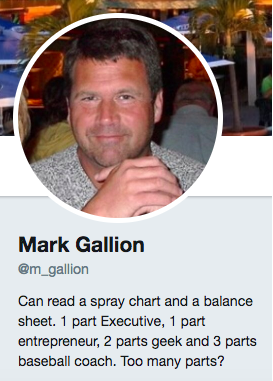
Why would he choose humor when he runs four start-ups and constantly seeks funding for them? Well, Mark’s tactic is totally intentional: it’s a lever he pulls to refresh his brand while maintaining his already impressive and established identity as an entrepreneur.
Mark leverages his Twitter bio because it’s place where he can be human. And it helps him relate to his followers and potential investors.
When crafting your own Twitter bio, consider your audience and the personal brand you’re trying to create for yourself. Use it as an opportunity to be relatable. (And check out this list of amusing Twitter bios for inspiration.)
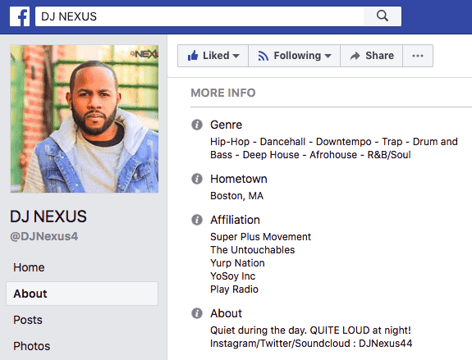
4. DJ Nexus
Bio Platform: Facebook
This New England-based DJ has single-handedly captured the Likes of more than 2,000 people in and beyond Boston, MA. And even if you don’t listen to the type of music he produces, it’s hard not to listen to his compelling Facebook bio.
Stage-named DJ Nexus, Jamerson’s professional bio makes use of nearly every Page field inside the About tab. Right away, his audience knows which genres he plays in, where he’s from, and who else he’s worked with. The latter — under “Affiliation,” as shown in the screenshot below — is unique and seldom mentioned in professional bios today.
Our favorite part about DJ Nexus’s bio? His tagline, under “About” — “Quiet during the day. QUITE LOUD at night!” DJ Nexus tells you when he works in an awesome way. I got goosebumps just imagining a dance club he might play his music in.
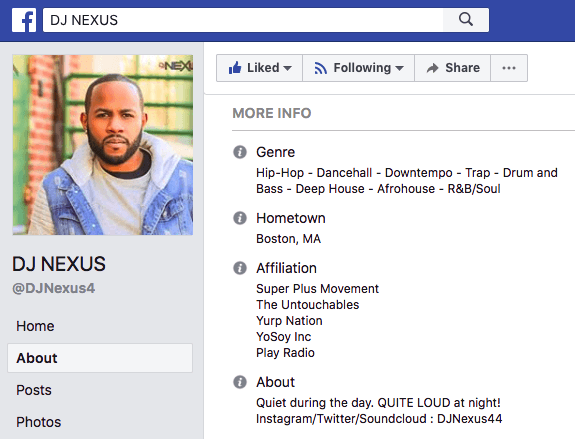
DJ Nexus’s bio brilliance doesn’t stop there.
The great thing about Facebook Business Pages is that you can write as much as you want without overwhelming your Page visitors. For those who just want Jamerson’s basic info, they have the four categories shown above. For those who want to learn more about him, he tells an excellent story of his career. Here’s just a preview of his story, below:
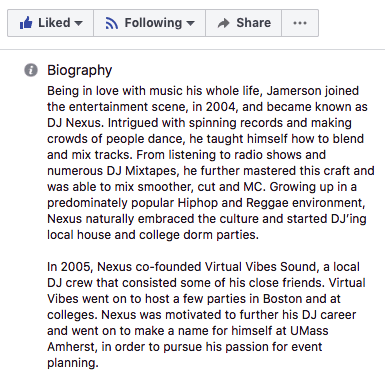
In this story, DJ Nexus describes both when he “became known as DJ Nexus” and a company he founded shortly afterward — all before going to college. This is a terrific lesson for Facebook Businesses today: customers want to learn about you, and as Facebook increasingly becomes a place for meaningful interactions, there’s no better place to tell your story than on your Facebook Business Page.
5. Lena Axelsson
Bio Platform: Industry Website
When it all comes down to it, your professional bio is no different than any other piece of persuasive copy — no matter where it lives. One of the most common mistakes people make is thinking of it as its own beast, separate from other pieces of writing. If you think about it that way, you’re far more likely to write something painfully uninteresting.
When you sit down to write your professional bio and you’re watching that cursor blinking on the screen, think about how you would introduce a blog post. You don’t just dive right into the meat of the thing, now, do you? No. You start with an introduction.
The best bios are often concise (around 200–300 words), so you don’t have a lot of room to play around. But a single sentence that tees your reader up and provides context for the accomplishments that follow could make the rest of your bio that much more persuasive.
Take Lena Axelsson’s bio, for instance. She’s a marriage and family therapist — a job where empathy and compassion are a big part of the job description. That’s why she chooses to open her bio with a great introductory sentence: “When human beings experience trauma or severe life stressors, it is not uncommon for their lives to unravel.”
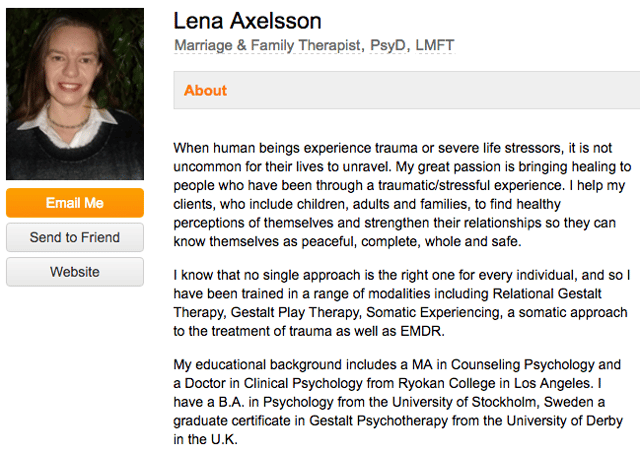
Then, she goes into why she’s passionate about her job, how she helps her clients, and how she caters her approach to each individual patient. The necessary educational information is left for the end, after the reader has been hooked.
Your bio doesn’t have to be super serious, nor does it have to start with a joke. This bio shows how you can capture your reader’s attention by being empathetic and showing how that empathy shapes a valuable professional.
6. Mark Levy
Bio Platform: Personal Website
Mark Levy is a small business owner who’s taken a more traditional approach to the professional bio on his website — but in a way that takes care to speak to his intended audience.
What we love about his bio is the way he’s set it up: On his business’ “About” page, he’s listed two biographies, which he’s labeled “Mark Levy’s Biography #1” and “Mark Levy’s Biography #2.”
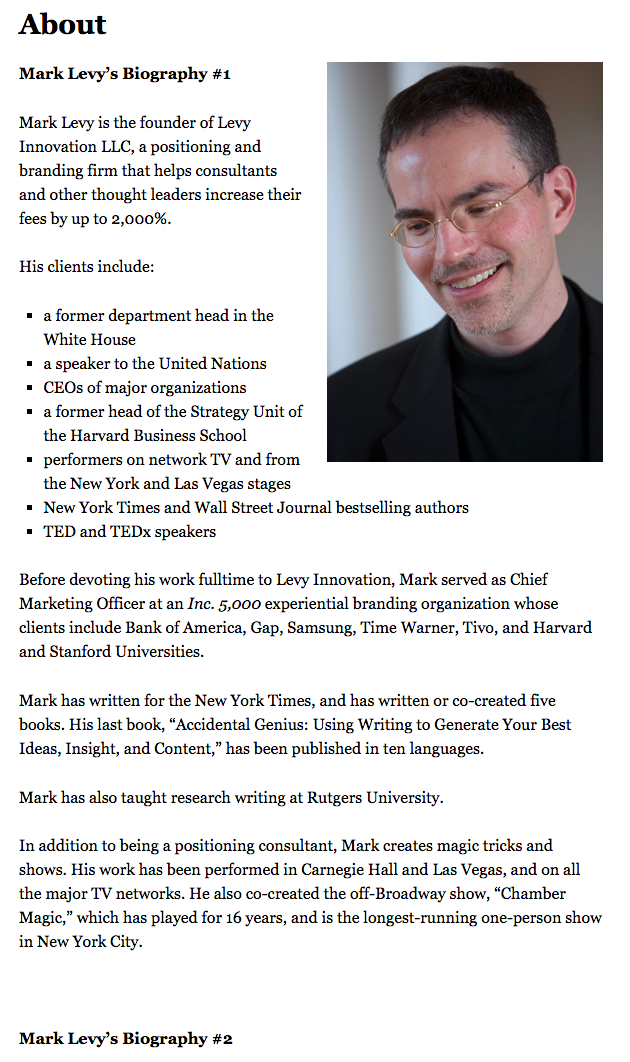
Click here to see the full version.
Like Ann, Mark’s given his readers two different options. The first biography is a “short version,” which includes a combination of bullet points listing his credentials and a few short paragraphs.
The second is the “long version,” which is actually even more interesting than the first one. Why? Because it reads like a story — a compelling one, at that. In fact, it gets really funny at parts.
The second sentence of the bio reads: “He was frightened of public school, loved playing baseball and football, ran home to watch ape films on the 4:30 Movie, listened to The Jam and The Buzzcocks, and read magic trick books.”
Here’s another excerpt from the middle:
Of course, the fantastic copywriting isn’t a surprise, given that this guy wrote several books. But the conversational tone and entertaining copy let his quirky personality (and great writing skills) shine.
7. Corey Wainwright
Bio Platform: Blog Byline
Finally, we have Corey Wainwright, who’s the director of content here at HubSpot. She’s written content for HubSpot’s Marketing Blog for years, and her blog author bio has caught my eye since before I ever started working for HubSpot. (Back then, it started with, “Corey just took a cool vacation.”)
What I love most about Corey’s bio is that it’s a great example of how to deliver information about yourself without taking things too seriously. And in this context, that’s totally appropriate.
Despite having a number of impressive accomplishments under her belt, she simply doesn’t like displaying them publicly. So, she prefers making her author bio a little more “light.”
Her bio (pictured below) reads, “Corey is a Bruce Springsteen fan who does content marketing, in that order.”
It works in this particular context because, at HubSpot, our blog authors often prefer to make themselves as friendly and approachable as possible — while letting the content speak for itself.
It helps that authors’ social media accounts are located right below our names and above our pictures. For folks who really do want a list of Corey’s credentials, they can click the LinkedIn button to go to her LinkedIn page. (You can read this blog post to learn how to create social media buttons and add them to your website.)
8. Marie Mikhail
Bio Platform: LinkedIn
Marie Mikhail checks off nearly every box for what makes an excellent bio. A professional recruiter, she expresses her “passion for recruiting” upfront, in the first sentence, while using that sentence to hook her profile visitors into a brief story of her background.
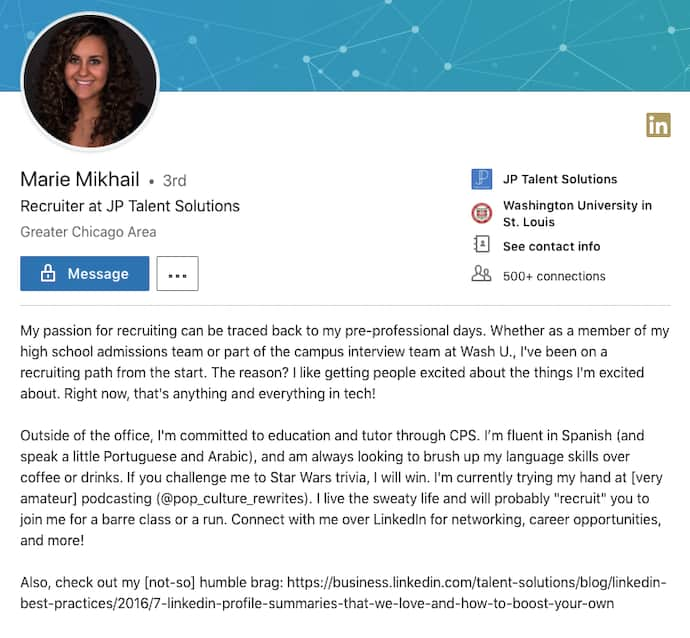
But there are a lot of recruiters out there, and Marie knows that. So, to differentiate herself, she closes the first paragraph of her bio explaining that she likes “getting people excited about the things [she’s] excited about.” It’s a well-put value proposition that sets her apart from the rest of the HR industry.
Marie Mikhail finishes off her bio by including a smooth mixture of professional skills, such as her Spanish fluency; and personal interests, such as podcasting and Star Wars (she mentions the latter with just the right amount of humor).
9. Wonbo Woo
Bio Platform: Personal Website
Wonbo Woo is the executive producer of WIRED’s video content, and he has a number of impressive credits to his name. What does this mean for his professional bio? He has to prioritize. With this in mind, Wonbo opens his bio with the most eye-catching details first (if the image below is hard to read, click it to see the full copy).
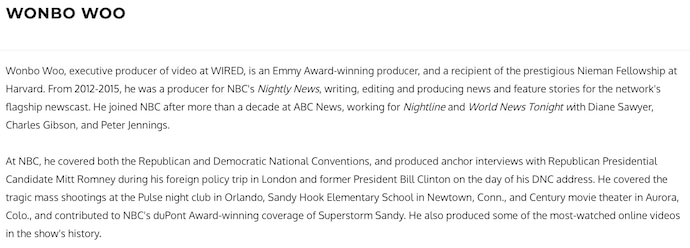
Not only does Wonbo’s bio start strong, but he also takes readers on a suspenseful journey through some of his most harrowing assignments — where he was when news broke and how he responded. You can see this quality below.
 The accomplished journalist concludes his gripping bio as strong as it began, measuring his experience by the number of states, countries, and continents to which he’s traveled in his career. See how this looks above. All in all, it’s a fantastically concise bio for as much detail as it holds.
Want more? Read How to Write a Cover Letter That Gets You the Job [Bookmarkable Template + Examples].

How to Create a YouTube Channel
If you’re reading this article, I probably don’t need to tell you that video content accounts for over 74% of all online traffic, or that over five billion YouTube videos are watched every single day.
You already know YouTube is an important content tool, and you’re ready to start leveraging video for your own business. I’m here to show you how to do it.
This article will cover everything you need to know about creating a YouTube channel, so you can start uploading your own videos and growing your audience today.
How to Make a YouTube Channel
- Register a Google account (if you don’t already have one).
- Create a new YouTube channel using your Google account.
- Optimize your channel for discoverability.
- Add links and descriptive details to your channel.
- Upload a profile photo and cover art to your channel.
- Add a banner image.
- Add videos and optimize them for search.
How to Create a YouTube Channel

1. Register a Google account (if you don’t already have one).
To watch, share, create, and comment on YouTube content, you’ll need a Google account.
If You Don’t Already Have a Google Account
Go to youtube.com and click “sign in” in the upper right-hand corner. From there, you’ll be taken to a Google sign-in page. Click “more options”:
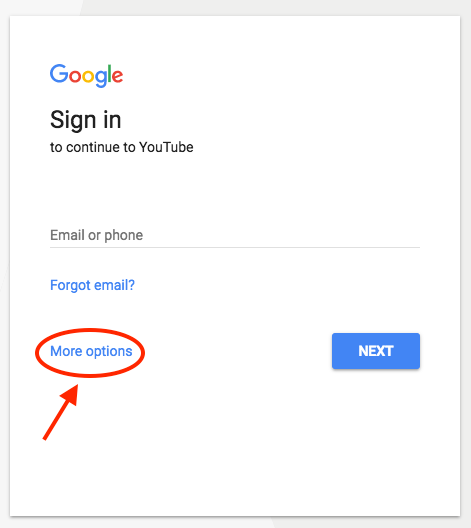 Then, click “create account”:
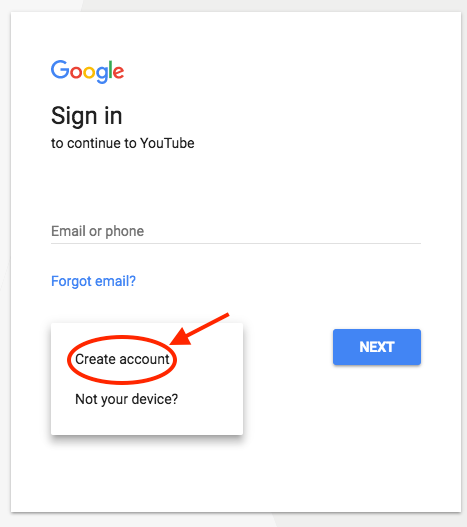
From there, you’ll be asked to follow a few steps to create a Google account. Once you’ve completed them, proceed with the steps below.
If You Do Already Have a Google Account
Go to youtube.com and click “sign in” in the upper right-hand corner. From there, you’ll be taken to the same Google sign-in page above. If you have multiple Google accounts, be sure to select the one you want to be associated with the YouTube channel.
2. Create a new YouTube channel using your Google account.
Once you’re set up with and signed into your Google account, it’s time to create a channel. Back at youtube.com, click your user icon in the upper right-hand corner. This represents both your Google account and you YouTube account (as YouTube is owned by Google). You’ll see a drop-down menu, where you’ll want to click “settings.”
From there, you’ll be taken to your account overview. Under “additional features,” click “create a new channel.”
The first step is to create a Brand Account. It can be whatever name you want, and doesn’t have to be the same name that you used to create your Google account — but we do recommend that it reflects the brand the YouTube Channel will represent.
After you enter the Brand Account name, you might be asked to verify the account via text message or voice call. If that happens, enter the code you receive from the option you choose.
Once you’ve verified your Brand Account, you’ll be taken to the dashboard for your channel. Now, it’s time to start customizing it.
3. Optimize your channel for discoverability.
We’ll start with the fundamental details about your channel. From your channel dashboard, click “customize channel.”
After you click “customize channel,” you’ll be taken to your basic channel page, where you’ll see a cogwheel on the right, as shown below.
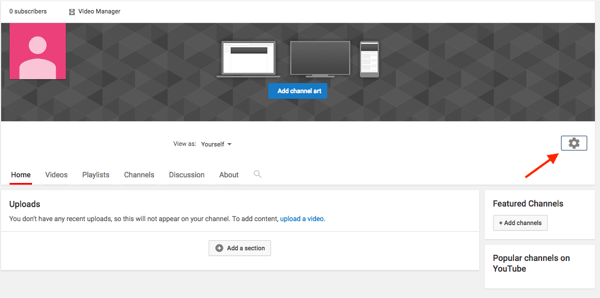
Click this cogwheel icon, then click on the section that says “advanced settings.”
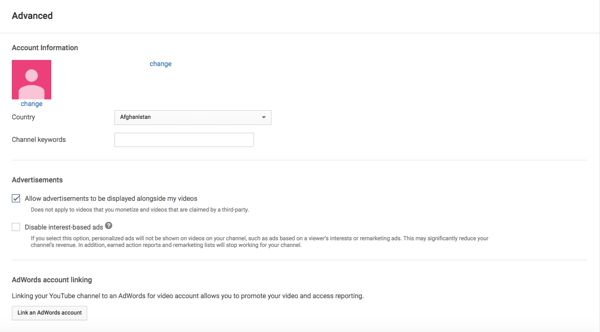
Here’s where you’ll enter some basic information about your channel, like the country where it’s based, as well keywords that help it people discover your channel when they enter search terms that describe what videos they’re looking for. These keywords can include what your channel is about, the problems it helps solve, the people and products featured, your industry, and more.
From the page shown above, you can then select whether or not you want to appear as a recommended channel on other account pages. It’s also within these settings that you can link a Google Ads account, add a Google Analytics property tracking ID, and make various advertising selections for your channel when you’re ready to promote certain videos across the YouTube platform.
4. Add links and descriptive details to your channel.
There are two elements of customization for a new YouTube channel: descriptive details, and visuals. Descriptive details tell your channel visitors (and, eventually, subscribers) what purpose your channel serves and the type of video content they should expect to see published by you. Let’s add those details now.
To describe your YouTube channel for your viewers, you’ll want to add a channel description and links to other webpages associated with your brand. Back on your channel customization dashboard, click on the “About” tab.
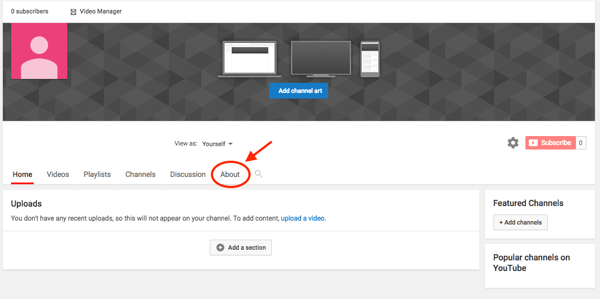
There, you’ll be asked to fill in such details as a channel description — which you can optimize with keywords for more discoverability — as well as contact information and links to your website and social media channels.
Up to five links can overlay your channel art, meaning that the banner on your profile page will contain icons for the links you choose to overlay on this list. To add these links, navigate to the About section of your YouTube channel and click “+ Links.” This button will reveal a space where you can add branded links directing users to various websites and social networks where they can learn about and consume more content from you. See what this space looks like below, and how a business might add links to its Facebook, Twitter, and personal website.
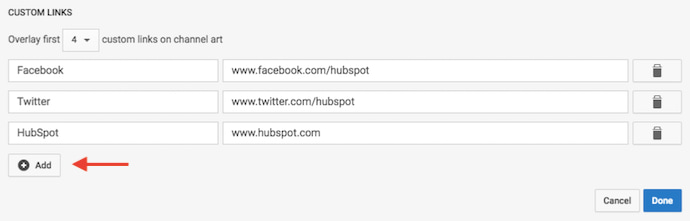
For example, if you wanted to overlay your banner with a link to your Facebook Page, it might look like this as a result:

Your channel art is part of your channel’s customization, which we’ll move onto next.
5. Upload a profile photo to your channel.
When it comes to creating and adding channel art, Google has a plethora of resources for content owners, from a gallery of images to image editing tools.
Among this channel art is your profile photo — this is how YouTube users will identify the creator of a video when browsing video content. You’ll see this image appear beneath YouTube videos on the play page, as shown below.
If your YouTube channel is linked to a Brand Account, as is the example we used in the previous step, you’ll need to update this image in the “About” section of your Google account. Note that this rule also applies to your channel name when using a Brand Account.
When you click “change” under your profile icon, you might see this message:
Click “edit,” and you’ll be taken to the page shown below, where you can edit your Brand Account information, including your profile photo (which will be displayed on your YouTube channel).
We recommend choosing an image with dimensions of 800 x 800 pixels for this profile photo.
6. Add a banner image.
Next, it’s time to add your banner image. Back on your channel customization dashboard, along the top, you’ll see your newly added profile photo on the top-lefthand corner. As far as that gray background surrounding it is concerned, you can (and should) change it to something more, well, you. Here’s how.
Hover your cursor over this gray background to reveal a small pencil icon on the top-righthand corner. Click this icon and select “Edit channel art” when this option appears, as shown below.
One of the trickiest parts of channel art is creating a responsive banner that matches dimensions for various user experiences, like desktop, mobile, or TV. Luckily, Google has this handy image that represents the best dimension for each viewing platform …
Source: Google
… as well as this concise video explainer:
Need a little inspiration? Check out this post with some of the best YouTube banners we’ve found.
As you can see from the resources above, the minimum dimensions for your YouTube banner image are 1546 x 423 — this size prevents relevant text and images contained in your banner image from leaking off of someone’s screen — whether that screen is a desktop, laptop, or mobile device. The maximum width for your banner image is 2560 x 423, and your image’s file size shouldn’t exceed 6MB.
7. Add videos and optimize them for search.

Optimizing your channel for discoverability is just the beginning. Once you start adding videos, you’ll want to optimize them for search, which in turn helps users discover your video.
But this goes beyond giving your videos accurate, clear, and concise titles — though that is important. Below, we describe some of the most important things to optimize on YouTube. (For a fully comprehensive post on YouTube SEO, visit this post.)
Title
When we search for videos, one of the first things that our eyes are drawn to is the title. That’s often what determines whether or not the viewer will click to watch your video, so the title should not only be compelling, but also, clear and concise.
Description
This should be limited to 1,000 characters — and remember that your viewer came here to watch a video, not to read a lot of text. Plus, YouTube only displays the first two or three lines of text, which comes to about 100 characters, so front-load the description with the most important information.
Tags
Using tags doesn’t just let viewers know what your video is about — they inform YouTube, too, which uses tags “to understand the content and context of your video,” according to Backlinko. That way, YouTube can associate your video with similar videos, which can broaden your content’s reach. But approach with caution — just as with your title, don’t use misleading tags because they might get you more views — in fact, Google might penalize you for that.
Category
Choosing a category is another way to group your video with similar content on YouTube — but that might not be as simple as it sounds. YouTube’s Creator Academy suggests that marketers “think about what is working well for each category” you’re considering by answering questions like:
- Who are the top creators within the category? What are they known for, and what do they do well?
- Are there any patterns between the audiences of similar channels within a given category?
- Do the videos within a similar category have share qualities like production value, length, or format?
That’s it — you’ve officially not only created a YouTube channel, but now also know how to optimize its content for discoverability. For more information on how to best leverage YouTube for marketing, check our entire collection of resources.

The Human Element of Advertising, Why Targeting is Critical, and Other Advertising Insights from LinkedIn’s Marketing Manager
LinkedIn is a powerful tool for marketing — in fact, a HubSpot study found LinkedIn generates the highest visitor-to-lead conversion rate at 2.74%
Businesses in industries ranging from higher education to financial services have all seen success advertising on the platform. Even well-established consumer brands like Subway, the U.S. privately-held sub and sandwich franchise, managed to convert new corporate customers with the help of LinkedIn’s Website Demographics ad function.
However, advertising on any new tool can feel overwhelming, and if you don’t already use LinkedIn to generate leads through advertising, you might be unsure where to start.
Fortunately, we’ve got you covered. Gaurav Nihalani, a Digital Marketing Manager at LinkedIn, was interviewed as part of HubSpot’s new campaign, “Advertising, a Look Behind the Screens”.
Take a look at the full interview series here, or keep reading to learn Nihalani’s suggestions on how to successfully advertise on LinkedIn.
Gaurav Nihalani’s 5 Tips to Successfully Advertise on LinkedIn
1. When creating your ads, tap into the human element.
If you’re a marketer without much prior experience in the advertising industry, you might be dealing with a little bit of imposter syndrome, wondering if you have the skills necessary to create high-converting ads.
Fortunately, Nihalani believes you can still create a powerful ad as long as you understand the human element.
As Nihalani says, “I think marketing is more about the human element, right? If you’re able to speak to someone as you are speaking to me now, you should be able to market to that same person.”
As an example, Nihalani calls out old-school advertising — “You know, if you look at, historically, ads throughout the generations — whether it was on print, radio, or television — you know, the ones that were really successful were the ones that related to people the most … so if you think about brands such as Coca-Cola, you know, there was always a person drinking a Coke.”
He goes on to say, “They were talking about things like happiness, family, and gatherings. They weren’t really talking about, ‘Hey, our product is the best-tasting Cola’. So, I think when it comes to things like that, you can be very successful if you’re able to create a connection at a human level.”
Of course, you’ll want to A/B test to ensure you’re creating content that best resonates with your audience, and you can use analytics to refine your strategy.
But ultimately, your advertisement will likely perform best if you understand your persona as a three-dimensional person — What are his or her interests outside of business? What excites them most? These questions can help you formulate a more powerful, far-reaching ad.
2. If your business is booming, you still need to advertise.
If sales are steadily rising and your business is experiencing the benefits of a well-established brand in the marketplace such as name recognition, you might be thinking — Do I really need to advertise right now?
Nihalani, however, advises against this way of thinking — “I think there’s a misconception in the world of marketing that if you’re a successful business, you don’t need to market — and I think that’s a poor decision on the part of a business, because when you are successful, it might be the best time to market.”
Nihalani adds, “That’s why when you talk about tissues, you say Kleenex, right? When you talk about sports shoes, you talk about Nikes, and it’s not that those businesses have stopped advertising when they were successful.”
“[Instead] they started advertising even more, because the more you get in front of someone, the more you talk about your values and your brand, the more you establish a human connection with that customer or that buyer.”
He has a point. Plenty of well-established successful brands, like Nike, spend billions on advertising each year. Ultimately, long-term success is only guaranteed with long-term marketing efforts — even if your sales are in a good place, it’s still critical you use that success as leverage to reach more audiences and become a more widely recognizable and beloved brand.
3. Tailor content specific to personas in various stages of the buyer’s journey.
To explore the importance of customized content that aligns with various stages in your buyer’s journey, let’s start with Nihalani’s example for LinkedIn.
Nihalani points out — “For LinkedIn, for our marketing business, we want to advertise to marketers, so that’s a fairly broad function, but maybe there’s some marketers who really value our messaging and are ready to make that purchase right away.”
Alternatively, he says, “At the same time, there are other marketers who are maybe just brand-new. They just started their careers. Everything that we’re saying may be a little over their head, so we can tailor different messages to them. Now, simultaneously, what we want to do is make sure that they all understand our brand, but we want to make sure we do that without spending too much money.”
Nihalani adds, “We can create different personas within the marketing function itself, and tailor content specific to those personas so that we are maximizing our budget.”
Of course, this is easier said than done, but Nihalani offers a few tactical steps you can do to begin defining your target persona on the platform.
First, it’s critical you determine your goal or objective, as well as how you’ll measure your success (is it in leads, click-throughs, or sales?).
Once you’ve determined your objective, you’ll want to develop your target audience by considering a few critical questions, including — Where does he/she work? In which industry is he/she in? What is his/her job title or job junction? Where did he/she go to school?
As Nihalani points out, all these questions can be answered on LinkedIn. For instance, he says, “If you want to find a decision-maker in a specific industry, you can do that today using LinkedIn advertising. If you want to target an individual who just graduated from school, from an undergraduate program, you can do that today.”
Nihalani adds, “As soon as I graduated, I was seeing advertising from Master’s programs, highly relevant to me. I was in the process of considering maybe making that decision, and so because of their ability to use LinkedIn targeting, [marketers]were able to get that message to me and not waste that advertising spend on anyone else who may not find that relevant.”
Ultimately, LinkedIn is a phenomenal place to advertise because of the in-depth information it can provide on your target persona’s personal brand, workplace, and both current and past roles. Use this information wisely to target particular segments within a larger demographic.
For instance, if you’re selling email marketing software, rather than targeting all marketers (which is both expensive and time-consuming), you might consider targeting marketers with a current role in email marketing, and/or marketing executives specifically in the tech industry.
4. Brand awareness and thought leadership are just as important as acquisition.
When thinking about the goals of your advertising strategy, I’m willing to bet one thing initially comes to mind — sales.
Of course, it’s critical your ads drive revenue and results for your business.
However, that doesn’t mean it should be the only goal you have when creating an ad.
Nihalani suggests, instead, you think of your marketing objectives in a few different boxes — “One being pure acquisition, right? This is what you would consider direct sale … they click on your ad, and they’re going directly to a page where they’re buying a product or they’re giving you their personal information to have you contact them directly.”
“But you also have things like brand awareness and thought leadership,” he adds, “Which I think are [perhaps] more important than acquisition — because why would someone give you money and buy your product if they don’t believe in your brand, [or] they don’t align with what you believe in as a business?”
He mentions that a successful marketer knows that selling a business’s story is just as important as selling the business’s products or services.
Nihalani says, “I think everyone does have a story, you know, and behind every business is a story, how they got started, how they became successful, maybe a failure that they had, what they learned from that and where they’re at today.”
“Businesses grow and shrink and succeed and fail every single day, and you’ve seen some major businesses in the past no longer exist today and some new up-and-comer completely take over markets. You know, LinkedIn is a great example of that.”
5. Use LinkedIn resources to identify the tools that work best for your business.
When you first start using a new product, it can be intimidating to figure out how the product will fit into your overall strategy.
To help you identify the marketing solutions that are best-aligned with your needs, Nihalani suggests you start with the LinkedIn Marketing Solutions Success Hub, which offers case studies, tips and tricks on how to use their products more effectively, and LinkedIn’s new product offerings — including when to use those products, and when not to use them.
There’s also a Get Started Guide which helps you create a free LinkedIn Page for your business, learn how to share high-quality content like blog posts and Powerpoints, and monitor your success with LinkedIn analytics.
Ultimately, however, Nihalani points out that you likely already have all the content and marketing information necessary to succeed on LinkedIn — “You already know how to tell your story. Start there. Start using all of that kind of content and put it out on a platform like LinkedIn and advertise it, and from there, you can learn and develop and refine, just like you do today.”
Learn more from Gaurav Nihalani and other advertising leaders by accessing an exclusive interview series with LinkedIn, Google, and Facebook.

7 Brands That Got Inclusive Marketing Right
Have you ever had trouble relating to ads, TV, or other media because it told stories of people with lives that were vastly different from your own? If so, you’re not alone.
Growing up in a small town with partial blindness, the only people I could relate to were characters on TV or in ads. These characters, which included Mr. Magoo, often fit into a specific mold that many people would consider offensive today. They were usually elderly, clumsy, and regularly put themselves into danger by walking into certain situations.
It wasn’t until recently, when I was watching an NBC show called This Is Us, that I found a character that I could relate to. The current season follows a blind character over the course of his life — from birth to adulthood. Although he faces challenges as a blind man, he grows up to be an independent musician living in a city.
While I enjoy having a TV character that I can relate to, what I admire most about the show is that it actually cast a blind actor for the role. This has been fairly unseen in the blind community. In fact, This Is Us is one of the first in history to cast a legally blind actor in a leading network series role.
The results? Notable advocates and organizations, such as the Carroll Center for the Blind, began discussing and celebrating the casting on social media channels.

If I wasn’t already hooked on This Is Us, I would’ve probably started watching when the character was introduced.
As a marketing blogger, the reception of this show made me wonder, “if simply identifying with a unique character on a TV show gets people to tune in each week, what could inclusivity could do for a brand?”
Inclusivity can help brands connect on a deeper, more meaningful level with their audiences — which can be a major asset to marketing campaigns in 2019 and beyond.
Diversity by the Numbers
In the United States alone, racial and ethnic minorities make up nearly 40% of the population. And this number is likely to grow as 51% of children under 15 were considered part of a minority in 2019.
But the country’s diverse population doesn’t just include people of different races or ethnicities. Roughly 4.5% of U.S. adults identify as LGBTQ, and more than 40 million Americans have a disability.
Odds are, some or many people within your audience have something unique about them that makes them different, whether it be related to race, ethnicity, gender, sexuality, or physical abilities.
In 2019, inclusive marketing is a no brainer because it reflects the actual world we live in, rather than a fictional place filled with unrealistically perfect models.
Research has even backed up the idea that inclusivity is beneficial in the advertising world. Recently, a Kantar study found that ads that are considered progressive are 25% more effective. The study judged effectiveness by how pleased viewers were, the memorability of the advertisement, and actual metrics related to progressive campaigns.
With successful inclusive marketing campaigns, marketers aim to break advertising norms by highlighting people or groups that might be under- or misrepresented, such as people of color, those who identify as LGBTQ+, those who affiliate with various religions, those who are disabled, or even people of certain ages and genders.
But, inclusive marketing isn’t always easy to do right. An inclusive or thought-provoking campaign takes time, effort, and careful thought to be successful. And, it’s not just about picking the right stock image and giving yourself a gold star. It’s about making a solid effort to include or properly represent diverse people in your campaigns.
As Google noted in a recent post, “Diverse marketing isn’t just a box you can tick. There are so many layers to diversity beyond gender or skin color. It’s also about age. Geography. Socio-economic diversity. Relatable jobs. Abilities. Sexuality.”
But, what exactly does inclusivity look like in the marketing world? Keep reading to learn about how seven brands, including Google, absolutely nailed inclusive marketing in their campaigns.
Examples of Successful Inclusive Marketing
1. Procter & Gamble
While P&G is known for its ownership of a variety of cleaning and toiletry companies, including Tide, Dove, and Gillette, the major corporation also creates initiatives to ensure inclusivity in its marketing and products.
Not only do some P&G ads include people from diverse backgrounds, but they also use their platform to tell stories that spread powerful messages about equality, tackle controversial issues, and discuss topics related to diversity and identity.
One example of P&G’s inclusive commercials is a 2018 Emmy-winning ad called “The Talk.”
The hard-hitting commercial — which corresponded with P&G’s “Black is Beautiful” and “Proud Sponsor of Moms” initiatives — depicts African American mothers in multiple decades as they have difficult conversations with their children about racism.
At the beginning of the ad, a mother brushing her daughter’s hair ominously tells says, “It’s not a compliment.”
As you might wonder what she’s referring to, you start to see scenes of other black mothers talking to their children about racism and judgement that they’ll face in life. For example, one mother tells her son, “There are some people who think you don’t deserve the same privileges just because of what you look like. It’s not fair. It’s not.”
The ad begins to get darker as you see mothers instructing their children of what to do when they are pulled over to avoid police brutality.
At the climax of the ad, it’s revealed that the daughter featured at the beginning was called, “Beautiful for a black girl.” Her mother tells her not to accept this compliment and concludes, “You are beautiful, period!”
The ad ends with text in all caps stating, “LET’S ALL TALK ABOUT ‘THE TALK’ — SO WE CAN END THE NEED TO HAVE IT.”
This commercial doesn’t beat around the bush. Instead, its goal is to expose the unthinkable closed-door conversations that African American mothers need to have with their children to keep them safe and strong in the face of racism. By informing people of these conversations, P&G aims to create a discussion that might create change or end the need for mothers to feel they have to prepare their children for racism or judgment.
When it came to the commercial’s goal of creating a discussion, “The Talk” was a success in that it was chattered about by social media users, advocacy groups, and major news outlets.
During an interview about the ad, P&G’s Global Communications Director, Damon Jones told AdAge, “We know that bias is not just an African American issue. It’s an issue that takes on many shapes and forms, across gender, race, age, weight, sexual orientation, and more.”
“Our goal with ‘The Talk’ is to help raise awareness about the impact of bias,” he added. “We are also hopeful that we can make progress toward a less biased future by recognizing the power of people of all backgrounds and races showing up for one another.”
To learn more about “The Talk” and other Emmy-award nominated campaigns, check out this rundown.
2. Google
In a 2018 ThinkWithGoogle post, Lorraine Twohill revealed that the tech giant did a deep dive to determine the level and quality of diversity in its campaigns. The project, which was done with help from machine learning and experts at the Geena Davis Institute, allowed a task force to analyze diversity related to race, gender, and socioeconomics.
“Our images had lots of racial diversity. But everyone looked like they worked in tech and lived in a hip, urban neighborhoods,” Twohill wrote in the post.
Along with socioeconomic disparity, Twohill also revealed that Google needed to up its game when representing gender as well.
“My team brought me a new campaign to review. Dad was cooking in the kitchen. Great! I was proud that they had flipped a stereotype,” she explains. “But the next image showed he was there because mom was in the hospital having a baby. Sorry, dad, but we had to reshoot. Mom was away because she was on a business trip.”
To address issues related to misrepresenting or under-representing different backgrounds, Google launched a training course to tackle diversity in its campaigns. Twohill notes that 90% of her team and 200 agency partners have taken this course.
As a result, Google began to launch even more thought-provoking campaigns, including a Pixel 2 commercial called “The Picture-Perfect Life,” which shows real photos of Google Pixel users from different backgrounds, while also tackling the tough topic of mental illness.
In the commercial, Google aims to show that although someone might seem happy in photos or videos, they might still be struggling with mental distress on the inside:
The ad, narrated by Logic, a Grammy-nominated rapper who spread awareness of a suicide hotline in his thought-provoking song, “1-800-273-8255,” opens with images of seemingly happy people shot with the Pixel 2.
All of the photos you see look like the downright pleasant photos you’d see in any smartphone ad focused on highlighting a great camera. For example, you see crisp and clear shots of a man with his daughter, a girl making donuts, a man playing basketball, a mother singing in the car with her family, and a few people at parties with friends. But, as the commercial progresses, you learn that there’s a hidden side to each person’s story.
As the slideshow shows photos of each person, Logic introduces them and explains what the visuals are showing. For example, when the ad shows photos of a girl in an empty apartment, Logic explains, “This is Lauren, and this is her new place, which will soon be crammed with all of her friends.”
But, towards the end of the commercial, you see a girl looking down at a smartphone screen that repeatedly says “1-800-273-8255.” Logic says, “And this? This is the lifeline that all these people bravely called to find hope.”
“Not every picture tells the whole story,” Logic concludes. “Question your lens.”
“The Picture-Perfect Life” aims to represent and identify with people dealing with mental illness while informing viewers that friends, family, or loved ones might seem happy or put together on the outside while still struggling behind closed doors. While this content might educate viewers about mental health, it also informs those with these struggles that Google identifies with them and that there are resources that can help.
Overall, the commercial is Google’s attempt to present it’s real customers while spreading a message that the tech company is trustworthy and supports its followers.
Like P&G’s, “The Talk,” this campaign and Logic’s song, which played in the background of the ad, got heavy discussion and shares online. Since it originally aired during the Grammy Awards in 2018, it’s gotten major online discussion and was also covered in publications like AdWeek and The Washington Post.
3. Microsoft
Recently, it came to Microsoft’s attention that children with certain physical disabilities or missing limbs were having difficulty playing video games with traditional controllers. The company began working on an alternative controller which included touchpads instead of buttons and bright colors for the visually impaired. They also opened a channel of communication where disabled people who still couldn’t use the controller could write to them requesting customizations.
This product launch culminated in a Super Bowl commercial where Microsoft interviewed the gamers about how the controller helped them and featured quotes from the engineers that led the project. The commercial, titled “We All Win,” shows just how far the major tech company will go to help customers and prospects with all different abilities.
In the ad, a handful of children with physical disabilities introduce themselves and begin talking about how much they love video games and how it helps them bond with their friends.
“I love video games, my friends, family, and again video games,” says one boy. Meanwhile, a young girl points out that she enjoys “the fun let you have when you’re connecting with your friends.”
At one point, a child’s father adds, “It’s his way of interacting with his friends when he can’t physically otherwise do it.”
While video games make these children happy, the commercial reveals that there’s one underlying issue preventing accessibility: controller designs.
“When I’m playing with a regular controller, there are some things that don’t work for me,” says a boy with one hand.
Another boy who also has one hand says, “I never thought it was unfair. I just thought, ‘Hey. This is the way it is and it’s never going to change.”
After establishing the issue of accessibility, the commercial shows children excitedly opening new adaptive controllers from Microsoft.
“What I like about the adaptive controller is that now, everyone can play,” narrates one child, while another says “I can hit the buttons just as fast as [other gamers] can.”
Another boy giggles and says, “I think I can crush my friends.”
The commercial ends with inspirational text that says, “When everybody plays, we all win.”
While the adaptive controller ad successfully shows off happy customers and Microsoft’s newest technology, the overall campaign and product more importantly aim to empower young people with disabilities who might think that getting excluded from day-to-day activities is just going to be part of life.
Even if a viewer with disabilities isn’t interested in gaming, they might watch this commercial and trust Microsoft’s brand more because the company learned about the unique challenges of its customers and created a product just to solve those problems. Similarly, someone without disabilities might trust Microsoft brand more because they’ve seen the lengths that the company will go to to help unique groups of customers.
While the adaptive controller and Microsoft’s agency, McCann New York, won a Clios for Design, Innovation, and Branded Entertainment, the video advertisement itself received 29.5 million views and 250 thousand likes on YouTube.
4. Coca-Cola
Coca-Cola is no stranger to embracing diversity in its ads. If you grew up in the 1970s or 80s, you might remember the company’s famous “I’d Like to Buy the World a Coke” commercial. When filming the ad, Coca-Cola young adults from all around the world to sing the jingle, “I’d Like to Buy the World a Coke.”
The ad was considered groundbreaking as it united people from all different races and ethnicities around the common interests of Coca-Cola and world peace. In short, it aimed to show that even though people can come from different backgrounds, everyone has something in common.
Since then, Coca-Cola has continued to create campaigns that link diverse people together with a simple bottle of Coke.
Since 2013, Coca-Cola has run the “Share a Coke” campaign where labels on plastic bottles of Coke say “Share a Coke with …” and include names from around the world.
Source: Coca-Cola
This campaign celebrates names around the world and is highly shareable. For example, people regularly post images of bottles on social media when they see their own name or the name of someone they know.
Later in 2014, Coca-Cola launched an ad, titled “Together It’s Beautiful,” that gives you a small peek into the daily lives of U.S. residents who all share a similar sense of pride for the United States despite their vastly different ethnic or geographical backgrounds.
As the ad begins, you see a man on a horse with a cowboy hat in a rural area as you hear the opening line of, “America, The Beautiful” sung in English. Then, it shows children in a movie theater as the next line of the song is sung in Spanish. From this point, each lyric is sung in a different language as you see different scenes of people around the United States.
As you see each scene and hear the song, which embraces American pride, the commercial reminds you of how diverse the United States truly is.
At the pique of the commercial, you begin to see subtle Coca-Cola branding intertwined within each scene. At one point, children swim down to the bottom of a pool to pick up Coke caps. At another, you see the Coca-Cola logo painted on the wall of a building.
Similarly to the “I’d Like to Buy the World A Coke” ad noted above, Coca-Cola aims to unite people of different cultures around a few common things. While the 1971 ad connected people with a love of Coca-Cola and hopes for world peace, the 2014 commercial shows that even vastly different U.S. residents share the same love of Coke and a sense of American pride.
In 2017, Coca-Cola published a statement explaining the meaning of the ad:
“The premise of ‘It’s Beautiful’ can be simply stated: America is beautiful and Coca-Cola is for everyone. It celebrates Coca-Cola moments among all Americans and features snapshots of American families,” Coca-Cola writes. “We believe it’s a powerful ad that promotes optimism, inclusion and celebrates humanity – values that are core to Coca-Cola. ‘It’s Beautiful’ shows just a few of the ways Americans enjoy our brand and how Coca-Cola brings families and friends together every day.”
One of the things that makes Coca-Cola’s inclusive campaigns so successful is that they are able to identify and highlight the simple things that all sorts of people have in common. This commercial reminds us that Coke is a beloved and recognized brand, but it most importantly shows us that we all can find common ground regardless of how different we might seem from one another.
5. ThirdLove
ThirdLove is a lingerie company that aims to make items for all different body types. To enforce this brand message, they show real women of all ages, shapes, and races — rather than touched up, high-fashioned models — in their marketing assets.
Here’s an example where ThirdLove’s Facebook cover photo shows an older woman and a younger woman wearing items from its lingerie line.
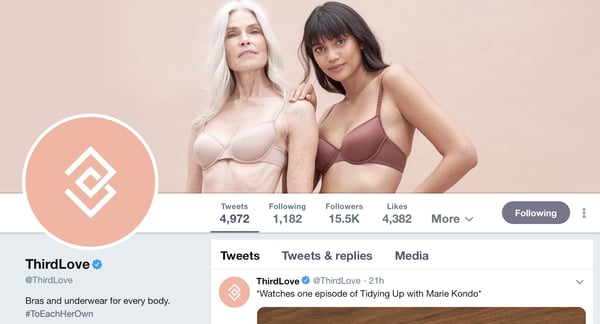
ThirdLove also shows imagery on its site and social media platforms that show multiple women wearing bras from the company to show off the variations in body types that its clothing can be made for:
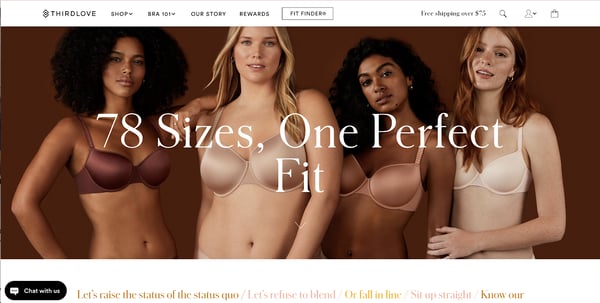
In an open letter published in the New York Times, ThirdLove’s CEO and Co-Founder Heidi Zak discussed the company’s strategy of depicting all women, how brands like Victoria’s Secret should be empowered by diversity, and why inclusivity should be seen as a movement rather than a trend.
“We believe the future is building a brand for every woman, regardless of her shape, size, age, ethnicity, gender identity or sexual orientation. This shouldn’t be seen as groundbreaking, it should be the norm,” she wrote.
While ThirdLove’s ads and visuals might be relatable to many different types of women, its inclusive brand has also seen 347% year-over-year sales growth, according to Shopify.
6. Bumble
You don’t have to do a campaign just about diversity or equality to nail inclusive marketing. Sometimes, inclusive marketing simply entails showing off your wide range of real-life customers. Bumble’s “Find Me On Bumble” campaign is a great example of how a brand can be inclusive just by highlighting its awesome customers.
With the campaign, Bumble launched a webpage, video campaign, Instagram account, and geographically targeted ads which highlighted a number of “inspiring” Bumble users from New York City.
In a video for the campaign, Bumble explains that the app sees a variety of great users in the New York City area and the company wanted to celebrate them. To do this, the company sought out some of Bumble’s most interesting New Yorkers and brought them together to tell their stories.
“Every connection you make on Bumble is an opportunity to meet someone who can impact your life. Inspiring people are everywhere. We wanted to celebrate them,” notes text at the beginning of the content.
As the video continues, you get a glimpse of different Bumble users posing for a photoshoot as you see short clips of interviews with them.
A few examples of the people shown in the Bumble video are a political operative, an entrepreneur, an opera singer, and a model and activist.
In each person’s interview clip, they note a life lesson they’ve learned or given details on their backstory. For example, the political operative explains, “Lots of times, I felt like I had to be forced into a box. Now, I’m the type of person where I don’t really care what type of box you put on me or what type of label you put on me, but I’m going to still do what I want.”
At another point, an author and activist notes that she’s gotten far in her political career by working for people she believed in. “Fifteen years ago, no one even knew who Barack Obama was. So think of all the people who we don’t even know exist yet who could have such an impact,” she explains.
While the video highlights all the people you can find on Bumble Date, Bumble BFF, and Bumble Bizz, it also recognizes the diversity in New York City. At one point, an orthodontist being filmed says, “I love that there’s such a variety of different people here. Living in New York, you still get to meet people from all over the world.”
The video ends with images of more people posing for photos with overlaid text that says. “Really New Yorkers, Really Inspiring, Really on Bumble.” Then the content closes with a call to action of “Find them on Bumble.”
The people invited to Bumble’s photoshoot are also highlighted on the @FindThemOnBumble Instagram account.
Rather than marketing images of models or unrealistic people that you could match with on Bumble, the video, Instagram account, and overall campaign focus on real people that have made great accomplishments or embrace their inner confidence. Here’s one example where a Bumble user says that the most important lesson they’ve learned is to be themselves:
The “Find Them on Bumble” campaign is a good example of how a brand can market its customer diversity as one of its biggest assets. When you see multiple people with different backgrounds and motivations using the same product, you might feel that the product is of good quality or you might just connect more deeply with the marketing.
If you’re marketing any type of business that connects people to other people, highlighting your current customers or users could make prospects even more interested in working with your brand, especially if they’re interested in meeting and learning from interesting people.
7. Axe
In 2016, Axe launched a commercial that embraced all men who used its body spray. While many commercials targeted at men in the past presented unrealistic-looking athletes and related masculinity to physical strength, Axe’s ad argues that masculinity is about being confident with your own identity rather than being a stereotypical buff athlete.
The short commercial begins with a car pulling up on a street covered with billboards of buff male models. As a car pulls up with a man in it, a narrator exclaims, “Come on. A six-pack? Who needs a six-pack, when you got the nose?” At the end of the phrase, the man looks and smiles at the camera.
Then the commercial continues with, “Or a nose when you’ve got the suit?” as the man walks into a bar with a nice outfit. Then the narrator continues to state that a man doesn’t need one thing, such as a nice suit, if they have another thing, like “great moves.” As the narrator makes each statement, videos depict men doing an action, such as dancing, which goes along with what the narrator is saying.
For example, when the narrator says, “Who needs looks when you got the books?” the video shows a man holding a book titled, “The Power of the Banana” while his friend is shopping for records.
The commercial goes on to show images of all sorts of men finding their passions including a dancer wearing high heels and a man dancing with a woman in a wheelchair. The narration expresses that masculinity is about expressing yourself, embracing your passions, and being confident in who you are.
At the climax of the commercial, the narrator simply says, “And who needs all that when you get the door,” as he shows a man opening the door for someone. It ends with the narrator saying, “Who needs some other thing, when you’ve got your thing. Now work on it.”
Rather than encouraging men to work out or marketing to manly men, Axe embraces the idea that all men have different passions and encourages them to embrace the unique aspects of themselves. While some people might think another body spray which markets to strong muscular men is just for athletes and not meant for them, those who view this commercial from Axe might think that a number of people from all sorts of backgrounds use the body spray.
Tips for Building an Inclusive Marketing Strategy
As we’ve seen with some of today’s most successful brands, inclusive marketing is about understanding what makes your audience or customers unique and embracing it. By highlighting what’s interesting, inspiring, unique, or different about your audience and how your brand supports them, you might find new audiences that see your campaigns, start identifying more with you, and realize that your brand aligns with their lifestyle.
Here are three key strategies that you can take away from these examples when trying to create more inclusivity in your marketing campaigns:
- Solving for your customers: Like Microsoft or ThirdLove, learn about the unique audiences in your following or customer base. Then, think of ways that you can solve a problem for them or better represent them in your campaigns.
- Highlight real stories: If your brand has customers or even employees that have unique backstories or are driven by unique motivations, embrace these factors in your marketing campaigns. For example, you could take a note from Bumble and interview a few happy customers about what drives them to your product or service.
- Unite people with things they have in common: In ads for Coca-Cola, the beverage company is notable for connecting multiple different stories together by highlighting the major things people have in common, such as a love of Coke, hopes for world peace, or national pride. If you have a diverse audience that uses your service or product, use marketing to highlight how your brand can help all sorts of people rather than a set of unrealistic models.
Now that you’ve read about inclusivity in marketing, you might be wondering how to get started on your own campaigns. If so, check out this post on how to devise a multicultural marketing strategy. Want to embrace diversity in your overall business? Learn about five benefits in this blog post.
