
The 20 Quantifiable Benefits of Social Media Marketing for Business
If you’ve been a marketer for a while, you most likely know the basic facts about social media marketing: It’s cost-effective and it’s a way to engage with your customers and potential customers. All that sounds great, but you might be wondering what the data actually says about social media use.
After all, when operating on a limited budget, you have to make sure every effort you’re putting into marketing has a return that proves their worth.
Social media marketing is great for most businesses, and here are the statistics to prove it.
Customer engagement
1. If you’re using YouTube to market to millennials, you’re in luck: you may be reaching 91% of them. (Pew Research, 2019)
2. 90% of consumers are more likely to engage with posts that embrace the company’s personality. (Sprout Social, 2018)
3. 71% of consumers with a positive interaction with a brand on social media are likely to recommend the brand to family and friends. (
LyfeMarketing, 2018)
Marketing perspective
4. 89% of marketers believe social media is important to their overall social media strategy. (Buffer, 2019)
5. 65% of marketers have increased their social media marketing budget this year. (Buffer, 2019)
6. The top three ways marketers measure ROI of social media marketing are engagement, traffic, and leads. (Buffer, 2019)
7. 77% of marketers use social media analytics to measure campaign performance. (Sprout Social, 2018)
8. 73% of marketers have reported social media marketing as being effective for their business. (Buffer, 2019)
9. It is estimated that consumers will have spent over $500 billion in eCommerce by the end of 2019; which has implementations on
Facebook,
Instagram, and
Snapchat. (
eMarketer, 2019)
Product discovery
10. 60% of people say they discover new products on Instagram. (Instagram, 2019)
11. 66% of companies use social media to release new products to consumers. (Duke University, 2019)
12. Over half (54%) of browsers use social media to search for new products. (
GlobalWebIndex, 2018)
Brand building
13. Over 200 million people visit at least one Instagram Business page every day. (Instagram, 2019
14. 74% of consumers share brand-related product videos on social media. (Sprout Social, 2018)
15. Engagement with consumers and providing customer service is a huge benefit. The top three reasons people engage with brands on social media are to ask a question, express an issue with a product, or praise a product. (Sprout Social, 2018)
16. Consumers say messaging businesses online through social media pages makes them feel more confident about a brand. (Facebook, 2019)
17. Social media is a great place to obtain new customers, as non-customers are three times more likely to increase traffic for brands. (
Adobe State of Digital, 2018)
Purchase driving
18. A report by Curalate found that 76% of consumers have purchased a product they’ve seen in a social media post. (Curalate, 2017)
19. A Statista report concluded that 52% of respondents in a survey were interested in purchasing a product found on Facebook. (Statista, 2017)
20. 44% of consumers purchase items seen on a brand’s social media post. (
Curalate, 2017)
Investing in social media doesn’t require a big budget, but cracking into the benefits of social marketing, especially moving towards the future, is imperative.
The online market is only growing, and the numbers show that if you’re not online, you’re missing out on benefits in eCommerce, customer service, and a universal brand.
These are only a few stats about the benefits of social media, but if you need just a little more convincing, we’ve got you covered. For example, you can check out 45 more here.
Editor’s note: This post was originally published in June 2014 and has been updated for comprehensiveness.

Inbound Marketing vs. Outbound Marketing
When I talk with most marketers about how they generate leads and fill the top of their sales funnel, most say outbound marketing.
However, in 2019, a lot of innovative and successful businesses are actually embracing the art of inbound marketing. But, what’s the difference between inbound and outbound? This post will walk you through it.
First, we’ll talk about the more traditional outbound marketing strategies.
What is Outbound Marketing?
Outbound marketing is a traditional method of marketing seeking to obstruct potential customers. Outbound marketing includes activities such as trade shows, seminar series and cold calling. It is costly and the ROI is much lower than inbound marketing.
Outbound marketing included trade shows, seminar series, email blasts to purchased lists, internal cold calling, outsourced telemarketing, and advertising. I call these methods “outbound marketing” because marketers push his or her message out far and wide hoping that it resonates with that needle in the haystack.
Download our free guide here to learn more about inbound marketing.
I think outbound marketing techniques are getting less and less effective over time for two reasons. First, your average human today is inundated with over 2000 outbound marketing interruptions per day and is figuring out more and more creative ways to block them out, including caller ID, spam filtering, Tivo, and Sirius satellite radio. Second, the cost of coordination around learning about something new or shopping for something new using the internet (search engines, blogs, and social media) is now much lower than going to a seminar at the Marriott or flying to a trade show in Las Vegas.
Transforming Your Marketing from Outbound to Inbound
Rather than doing outbound marketing to the masses of people who are trying to block you out, I advocate doing inbound marketing where you help yourself “get found” by people already learning about and shopping in your industry. In order to do this, you need to set your website up like a “hub” for your industry that attracts visitors naturally through search engines, blogging, and social media. I believe most marketers today spend 90% of their efforts on outbound marketing and 10% on inbound marketing, and I advocate that those ratios flip.
Outbound vs. Inbound Marketing
Outbound marketing is when a marketer reaches out to people to see if they’re interested in a product. For example, this could include door-to-door sales or cold calling where a sales rep or marketer approaches someone without knowing if he or she is even a qualified lead. Inbound marketing is a strategy where you create content or social media tactics that spread brand awareness so people learn about you, might go to your website for information, and then purchase or show interest in your product.
While some outbound strategies take lots of time and effort and may yield no leads, inbound strategies allow you to engage an audience of people that you can more easily qualify as a prospect of lead.
The best analogy I can come up with is that traditional marketers looking to garner interest from new potential customers are like lions hunting in the jungle for elephants. The elephants used to be in the jungle in the ’80s and ’90s when they learned their trade, but they don’t seem to be there anymore. They have all migrated to the watering holes on the savannah (the internet). So, rather than continuing to hunt in the jungle, I recommend setting up shop at the watering hole or turning your website into its own watering hole.
Editor’s Note: A more detailed version of this article has been published here: “Inbound Marketing and the Next Phase of Marketing on the Web.” This post specifically was originally published in 2010 but was updated in October 2019 for comprehensiveness.


15 Essential Social Media Marketing Tips From Beginner to Advanced
One of the most humbling experiences as a marketer is putting out that tweet you just *knew* would be a home run for your audience.
We’d like to think of ourselves as being able to come up with A+ social media content every day, but the reality is that we’re all human. Sometimes, we hit a wall with planning content while aligning with the company.
If you’re just starting out in social media marketing or are just looking for a few tips to get inspiration, we’ve compiled some helpful knowledge to beef up your accounts, no matter your skill level.
1. Sync posts across all social media accounts
If you’re just starting out, it’s a good idea to invest in a social media management service, such as Later or TweetDeck , to help you schedule posts. That way, you can slot your social media calendar and keep an eye on metrics across all accounts.
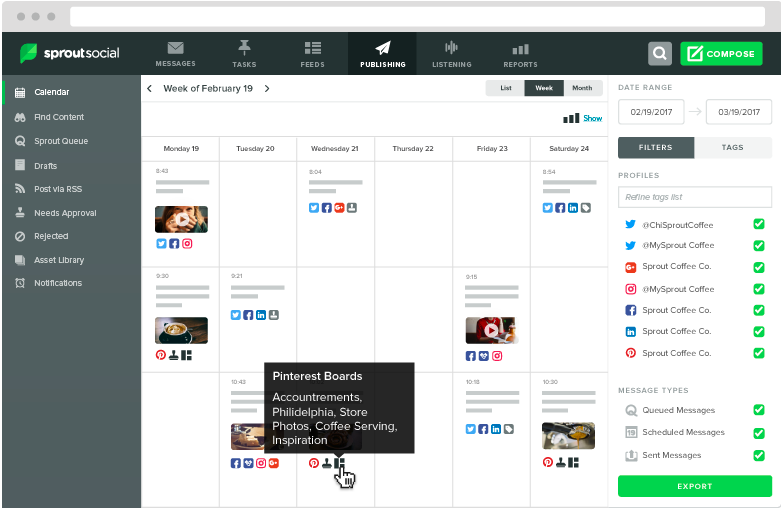
These apps will also let you sync posts across various accounts, like the dashboard example of Sprout Social above. Keeping content synced will ensure you post across all of your platforms and introduce followers with multiple accounts to your brand.
2. Republish and update older posts
If you have a backlog of content that’s outdated, update it with fresh ideas for SEO. This tactic has the potential to draw in new readers and take less time than continuously pumping out new ideas.
This can be blog posts, landing pages, and offers that you have on your website. Your social media strategy exists to put your best foot forward by building engagement, and you don’t have to start from ground zero.
In fact, this exact post is an update from 2017, originally posted in 2013. We regularly update posts to ensure our readers are getting fresh content to reflect the ever-changing social media climate.
3. Schedule posts for evenings
Don’t be afraid of weekends either. Scheduling content launches for evenings opens up a door for engagement that isn’t cut off by time zone. That way, even if it’s 3 AM in your geographic location, your tweet about your new app update reaches audiences around the world.
HubSpot Life is a behind-the-scenes look at HubSpot’s culture, posting content from global offices on social media. During what’s considered “off” hours in the US, HubSpot Life features posts during work hours in other countries, like Paris or Dublin.
This ensures that global audiences are able to get fresh content during their work days, as well.
When scheduling posts for evenings, avoid content that requires engagement from your team. For instance, an Instagram photo that invites followers to “Comment below!” about something might not be the best idea to post at midnight, when you’re not able to engage.
4. Include hashtags to increase engagement
Hashtags are like a golden ticket to increasing your online reach. Common tags like #SocialMedia and #MarketingGoals are great, but try searching for less-used ones like those of bigger brands (such as Adobe’s #CreateYourStory), or community-based (#BrightonMA). Those are going to be the ones an active audience is checking out.
As well as using existing hashtags, try your hand at creating your own branded hashtags, like Buffer did in the example above. This allows you to track what your followers and customers are saying about your media presence and product.
5. Use visuals, whenever possible
If you’re getting your feet wet with the social media game, it’s okay not to invest a fortune into visual content. However, it’s always a good idea to include pictures, videos, or graphics in posts whenever you can.
There are a number of free services, like Canva , to help you edit and create content. GIFs are a great way to engage with a younger audience. And never forget the smartphone most likely in your pocket they produce beautiful pictures you can definitely use on socials.
If you’ve tried your hand at social media before and feel comfortable branching out, these intermediate tips are for you. They’re aimed at easing the process of creating uniform content across your channels while increasing clicks.
1. Post multiple times a day
You don’t need to post every hour, but one to three times a day keeps your brand fresh in your audience’s mind. Reposting user-generated content also counts, so don’t stress about coming up with dozens of new content ideas.
— Lenovo (@Lenovo)
October 18, 2019
This tweet from Lenovo shows the brand as one that cares about their customers by engaging with them directly. More than that, it shows a practical use about Lenovo’s product, and how powerful their product can be — enough to be used at the International Space Station.
If you’re looking for ways to brush up your content marketing, how about incorporating an infographic or eBook into that Facebook post? For more tips like those, check out our list here.
2. Incorporate your brand into your social strategy
Your brand should speak for you. Once you’ve established your brand, think of ways to blend it into your social media marketing. This can mean adding your logo to posts, including a company hashtag, or highlighting your employees.

Check out this branding from social media management company, Metter Media. From a quick scroll through their Instagram homepage, you can quickly spot company colors, get a look into their team, and gain an idea of who they represent.
4. Engage audiences with interactive content
From Twitter polls to Instagram Q&As, there are many ways to engage your audience and make your company’s content diverse. You can use interactive content to educate your audience about your products or to connect with your audience.
Think of ways your audience engages with competitors and how you can add your company into the mix. You can even ask your audience what type of content they prefer to see on an Instagram story, like this example below:

The story of this food blogger begins to recap previous recipes with links to corresponding blog posts. To put this in a B2B perspective, say you wanted to boost clicks on previous blog content. You could poll followers, “Which type of post goes best with your coffee?” and link to two options in the next parts of your story.
5. Invest in more visual content
As you get into the swing of posting on social media, invest more time into visual content. In fact, retweets with pictures gain
Visual content isn’t just restricted to Instagram. Post infographics about your industry on LinkedIn, tweet a funny meme relating to your office culture, or post a video on Facebook taking viewers on a high-speed tour of your office.
Next up are some advanced tips. These ideas are for social media pros in need of a new direction or options to brighten their feeds.
1. Use new app updates to your advantage
Have you tried TikTok or IGTV yet? If not, we suggest expanding your strategy to include these channels. After all, you don’t want to miss out on your content having the potential to meet 1 billion phones.
New apps and app updates add to the ability to diversify your brand and keep things fresh. If you’re looking to show your company’s humorous side, try uploading a little dance video on TikTok. If you want to bring that podcast of yours to visual audiences, upload it to IGTV.
2. Invest in influencers to promote your product or service
It’s official: young audiences listen to their idols. Four in 10 millennials trust the products their favorite influencers promote on their social channels, so investing in influencers might be an avenue to look into when trying to generate sales. Take this example from former “The Bachelorette” star Hannah Brown for Secret Deodorant:
If you have an audience that’s younger, research influencers in your industry and pitch potential partnerships. Or, for a more budget-friendly option, look at how influencers are branding their content — you may be able to incorporate some ideas into your strategy.
3. Diversify content on every social media platform
You can update and sync content on your accounts like a pro. Now it’s time to make that content unique. Save your high-definition videos for Facebook and meme posts for Twitter.
When diversifying content, make sure they all relate back to your company’s goals and mission. There’s no need to post a recipe for falafel on your marketing company’s Instagram, but an infographic displaying the ‘recipe’ for a perfect caption would be a compelling, spot on example.
If you’re a writer, a filmmaker, or really anyone who’s looking for good career advice, check out this thread from @chrismcquarrie. 🙌 https://t.co/RRCbxoO8kg
— LinkedIn (@LinkedIn)
October 24, 2019
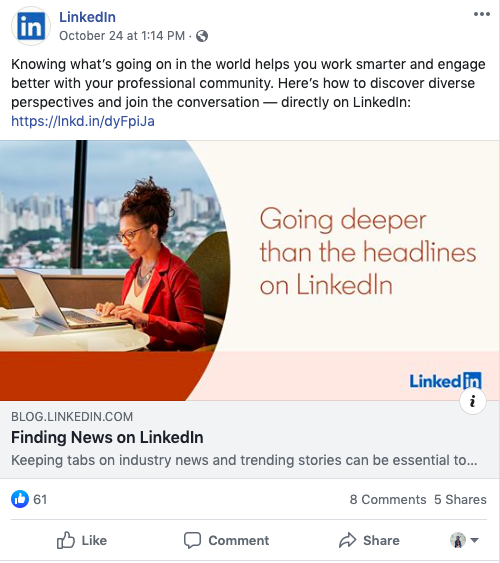
On October 24th, LinkedIn highlighted a blog post on Facebook. On the same day, LinkedIn promoted a Twitter thread aimed at aspiring filmmakers. Threads are a Twitter-specific tool aimed at sectioning off long thoughts, while the Facebook post gives LinkedIn more clicks from their Facebook followers.
4. Start promotions to build audience growth
Have you run a contest on your Twitter account yet? Totino’s does them well.
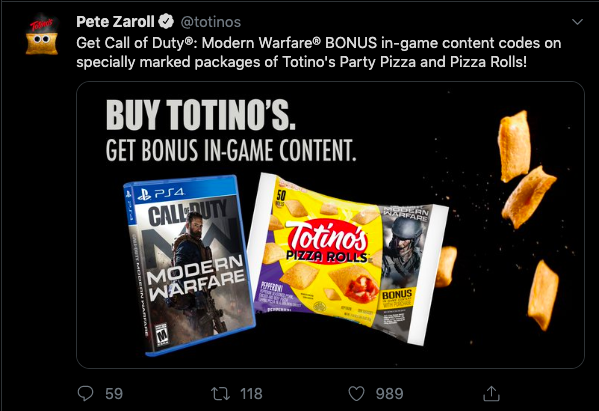
Don’t worry, promotions don’t have to be this fancy. Running a promotion can be simple as giving 10% off of your product or service to a lucky winner who retweets. This expands your reach and sparks lead generation among your customers’ followers.
5. Create timely content that resonates with audiences.
As a huge believer in taking advantage in the meme of the moment, creating timely content adds some fun to your channels and can explain the uses of your product in a new way. Memes aren’t the only way to accomplish this, seasons are, as well.
Is it wintertime in your part of the world? Celebrate by snapping a pic of your company’s favorite snowy activity and share it to Facebook. Alternatively, #NationalSandwichDay is Nov. 3rd. Popeye’s used this holiday to announce the comeback of a recent fan favorite.
Y’all…the sandwich is back Sunday, November 3rd. Then every day. 🤯🔥 pic.twitter.com/JDxyCIv0zz
— Popeyes Chicken (@PopeyesChicken)
October 28, 2019
Is it too early to call this genius type of marketing “legendary?”
Keeping content fresh can be difficult, even if you’re a social media pro. The pressure is on nowadays when it seems like the trends are changing every second, and diving in can seem like jumping down a rabbit hole.
These tips will keep you current on ways to organize your page, upgrade your content, and grow your target audience, but don’t stop here. Check out our ultimate guide on social media marketing for more inspiration.

The Ultimate Guide to Freelancing
Freelancing is an attractive way of life. The independence, autonomy, flexibility, and unlimited financial potential are all incredibly inviting, especially for employees who are tired of their mundane work environment. But, there’s still some mystery surrounding the enigmatic career choice.
As a freelancer, how do you make money? Where do you find work or jobs? How do you figure out what to do? What about insurance and benefits?
These questions are what typically stop people from pursuing a full-time freelance career. And these questions are the ones we’ll answer in this guide.
I was a freelancer before joining HubSpot — AKA the best career decision I’ve ever made. Starting my freelance business was a very intentional choice made in the midst of working a very unfavorable job. Freelancing was the most difficult 18 months of my life, but it completely rerouted my profession and led me to where I am today. It was more than worth it to take the leap into the unknown and pave my own career path.
Whether freelancing is your lifelong dream or a means to an end, we’re going to walk through each element of starting your own business, making your own schedule, and managing your own clients. By the end of this guide, you’ll know exactly what’s expected of you as a freelancer.
Over 57 million Americans freelance, including almost 50% of millennials — more than any other generation. Also, based on economic trends, the majority of the workforce is projected to be freelancing by 2027.
Types of Freelancing
The freelance gig economy has expanded to offer millions of talented people the ability to build their own businesses and have a bit more freedom in their day-to-day careers. Let’s review the different types of freelancing and the roles that exist in today’s marketplace.
Administrative
Small businesses — and even other freelancers — always need help with administrative tasks. These organizations often hire any or all of these freelance administrative services.
- Virtual assistant
- Administrative assistant
- Bookkeeper
App Development
In today’s day and age, mobile apps are almost as important as websites. Because of that, multiple freelance app development opportunities have arisen and thrived.
- Native app developer
- Web app developer
- Mobile game developer
- Chatbot developer/designer
Consulting
Some businesses require help with strategy and planning (instead of creating deliverables). That’s where these freelance consulting roles come into play.
- Business strategy consultant (a.k.a. management consultant)
- Business planning consultant
- Operations consultant
- Pricing consultant
- HR consultant
- IT consultant
E-Learning
E-learning has rapidly grown in both popularity and business impact (as we can see with HubSpot Academy). Companies that want to offer an e-learning aspect but can’t afford or aren’t interested in building a dedicated elearning team may benefit from e-learning freelancers.
- E-learning consultant
- Instructional designer
Graphic Design
Graphic design is a critical piece of every organization’s branding. Many companies choose to hire some of these freelance graphic design services to help develop their brand or marketing assets.
- Brand identity designer
- Digital illustrator
- Logo designer
- Print designer
- Packaging designer
Miscellaneous
New freelance opportunities pop up almost daily. These types of freelancing don’t quite fall into any of the other categories on this list.
- Interpreter
- Life coach
- Career coach
Photography
Whether for a business, newspaper, or wedding, photography is always needed. Photography freelancers typically specialize in one of the following photography niches.
- Product photography
- Advertising photography
- Photojournalist
- Real estate photographer
- Wedding/portrait photographer
- Fashion photographer
Videography
Alongside photography, videography is just as important when capturing and delivering a highly visual experience for an audience. Because videography is such a specialized field, many companies and organizations opt to outsource the following freelance videography services.
- Commercial videographer
- Director
- Producer
- Video editor
- Set designer
- Production assistant
Web Design
Web designers specialize in the parts of your website design that your audience sees and interacts with. Here are some of the common freelance web design roles.
- User experience (UX) designer
- User interface (UI) designer
- Information architecture (IA) designer
Web Development
On the other hand, web developers work with the behind-the-scenes coding and structure that supports the web design. Here are some freelance web development roles.
- Front-end developer
- Back-end developer
- Full stack developer
- Mobile web developer
Writing
The (arguably) original freelance gig has grown exponentially in the last few years. Today, some organizations outsource their entire content roles, including some of these freelance writing roles.
- Copywriter
- Content writer
- White paper/ebook writer
- Technical writer
- Managing editor
- Proofreader
- Translator
Lastly, let’s take a look at freelance marketing.
With so many components and specializations under the marketing “umbrella”, it’s no surprise that freelance marketing is a popular gig. Here are some common freelance marketing roles.
- SEO specialist
- Publicist
- Email marketer
- Social media marketer
- Ecommerce manager
- Product marketer/manager
- Content marketer/strategist/director
Self-Evaluation: Is Freelancing for You?
Before moving forward, let’s take a breather and do a little self-analysis. Is freelancing right for you? Here are a few questions to ask yourself to evaluate whether or not you’re ready for a freelance career.
Why do you want to freelance?
Are you looking for a more flexible schedule, or are you merely trying to escape your dreaded commute? Do you want to expand your professional horizon, or are you simply bored at work? You might’ve heard it before, but the grass isn’t always greener on the other side. Pursuing freelancing for the wrong reasons will make it hard to keep going when the going gets tough.
I want to emphasize here that there are no right or wrong answers, simply what’s best for you, your family, and your career goals. To give you some perspective, here are a few answers from fellow freelancers on why they decided to take the leap:
- “I started off with a few side projects on top of some full-time work, mostly to pay for a couple of pricey holidays! In the end, the side projects grew to a point where I decided to take the leap into full-time freelancing. It was a ‘try it or always wonder’ kind of moment.” — Jade E., Jade Emmons Media, London
- “After three years of teaching high school and realizing that it just wasn’t going to be for me long-term, I decided to walk away. Prior to teaching, I had a soul-crushing office job, and I promised myself I wouldn’t return to that situation either. I tried my hand at some freelance gigs during my last couple of months teaching and was able to pay my bills. I realized that it was a viable career path, and I had the chops to make it happen full-time.” — Brent B., Brent Writes, Orlando
- “For us freelancing means freedom. A few years ago, we were at a point where the thought of doing the same thing in the same place for decades of our lives felt stifling. One day, we finally decided to actually do something about it. We researched our options, found work online as freelancers (one of us is an English teacher and the other is a virtual assistant), sold everything we owned, and started our adventure as digital nomads. So far, we’ve been to over 40 cities in 17 countries and can’t wait to see what the future holds.” —Erin B. & Tannia S., Eff The Office, Remote
Can you afford to freelance?
A freelance career holds the promise of a higher salary and unlimited income potential. After all, as a freelancer, you’re the one deciding what you make and when you make it. But you’ll likely not see that income right away. The first few months (or years) of freelancing typically involves sacrificing income while setting up your business, establishing yourself, and finding clients.
Are you comfortable with being uncomfortable?
Freelancing can be majorly uncomfortable. You won’t always know where your next paycheck is coming from, you’ll probably be rejected more times than you can count, and you’ll definitely experience a few days where you think, “Why the heck did I do this? That commute doesn’t sound too bad right about now!” All of these thoughts and feelings are normal; I’ve always referred to them as growing pains. After all, if it’s not challenging you, it’s not changing you.
Next, let’s talk about what kind of work you’d do as a freelancer. This step is another common roadblock for folks who want to freelance … they’re simply not sure what to do. The answer is simple, though. It might just take a couple questions to draw it out.
What are your talents?
This four-word question can determine a lot for you. What are you skilled at? What do others ask you to do for them? Notice that I didn’t ask, “What are you an expert at?” Experts are few and far between — all you need to decide right now is at what you’re willing to become an expert. The above list of freelancing types may help you get started.
What brings you joy?
This question isn’t always applicable. There will be days and times that you simply don’t want to work or might be sick of your chosen field. That’s life. But, above all, there’s usually one skill set or profession that brings you joy. What makes you feel good to accomplish? What are you proud to share with friends and family? This is probably what you’ll excel at as a freelancer.
The Pros and Cons of Freelancing
Now, let’s pull the spotlight back and look at freelancing as a whole. Regardless of fit or type of work, there are definite benefits and drawbacks to a career as a freelancer. Let’s look at a few.
Advantages of Freelancing
- You’re the boss. You choose your schedule, rates, and which clients or jobs you want to take. If you feel like working in your pajamas, you can. If you want to take a three-week vacation, you can — it’s completely up to you.
- You could pay less in taxes. Freelancers can take advantage of more tax deductions on meals, travel, and more. Federal and state taxes aren’t withheld from each paycheck. Freelancers pay the IRS directly, instead.
- You (can) make more money. Freelancing is high risk, high reward. Your salary is whatever you want it to be. It all comes down to how much you charge and how often you want to work.
- You have a better work-life balance. Instead of commuting every day, you can simply stroll to your neighborhood coffee shop. Instead of rushing to the gym over your lunch break, you can take an hour to workout whenever you want. When freelancing, you can work whenever you want and live wherever you want … it doesn’t have to resemble a typical 9-to-5.
Disadvantages of Freelancing
- You’re the boss. Yes, I said this twice. When freelancing, you have to make all the decisions and do all the work, from bookkeeping to managing cash flow to selling your services. You’re not simply an employee of a business; you are the business.
- You have to organize your own benefits, taxes, and accounting. Freelancers don’t have employers to manage and provide benefits, taxes, and the like. They have to do it themselves with the help of tools or guides, like this one. Also, purchasing your own insurance is typically more expensive than through a traditional employer.
- If you don’t work, you don’t make money. Sure, you can take a three-week vacation, but you won’t make any money while you’re gone. As a freelancer, your time is quite literally money. Spend it un-wisely, and you could be giving up valuable income.
- Instability can interrupt your work-life balance. There are a lot of unknowns with freelancing, the biggest being where your next paycheck might come from. This instability can cancel out any work-life balance achieved through freelancing. For some, having stability and predictability in your career is worth a long commute or unfavorable schedule.
According to an UpWork study, the biggest drivers to freelance are flexibility, freedom, and earning potential, and the biggest barriers are income predictability, finding work, and benefits. If these things are motivating or demotivating you, you’re not alone.
Everything You Need to Know About Freelancing
In the following sections, we’ll touch on everything you need to know to start a freelance career, from branding to clients to making and managing your money. We want to minimize the unknowns and equip you with plenty of knowledge as you pursue freelancing.
The information and recommendations in this article were collected from real freelancers across the world (including some from HubSpot employees who previously freelanced). I’ve also included real anecdotes and examples that will shed some light on what it’s actually like to be self-employed.
Any pressing questions you might have about becoming a freelancer? Consider them answered.
Getting Started as a Freelancer
Before you dive into completing jobs and making money, you need to set up your business. You need to know exactly what you’re doing and how you’re branding yourself. This will not only attract clients, but it’ll also provide direction when you feel stumped or at a loss for why you’re freelancing. Here are a few things you should know to make sure your freelance business survives in the long-run.
Building a Brand
A personal brand is valuable when establishing authority as a freelancer and creating a long-lasting impression with clients. Whether you use a design tool like Canva or outsource your branding to an agency, personal branding should be one of the first things on your to-do list.
Along with a memorable logo, your personal brand should also include a business name. You can brand your business after your own name or a third-party name.
“I chose a business name for a few reasons: 1) It’s easier to brand. Business Casual Copywriting could be easily turned into its own aesthetic, with its own voice and tone, and its own identity. My own name would’ve left me with less leverage. 2) The company can grow bigger than just me. If my business name was just ‘Joel Klettke Copywriting’ — well, I’m the be-all-end-all of that business. With a moniker like Business Casual Copywriting, I can bring on subcontractors and turn the company into something larger if I decide to. 3) It’s easier to remember. Nobody can spell ‘Klettke’ correctly on their first time or pronounce it confidently without help. Business Casual is a more memorable name that rolls off the tongue.” — Joel K., Business Casual Copywriting, Alberta
Another element of your personal brand is your online identity. This typically includes a dedicated website and social media accounts where you can display your logo and business name, portfolio, testimonials, and services. Nowadays, every freelancer should have a website, especially if they work with clients remotely.
It’s good practice to match your website domain and social media handles to the name of your business. For example, if you were a freelance photographer, and your business was named Phoebe Photography, your website could be phoebephotography.com and social media handles could be @phoebephotography. Congruity makes it easier for potential clients to search and find you online.
As for a website, platforms like Squarespace, WordPress, and Wix make it easier than ever to create and design a professional-looking site. These platforms also offer templates that you can use to display your work, like writing or design samples. If you opt out of a dedicated portfolio site (which we’ll discuss below), these themes make it easy to integrate your sampled works into your website.
“[I chose] Squarespace. It’s been so easy to update and customize as my business has changed and grown. I also suggest and use Squarespace for my small business clients when they’re looking for a hosting platform.” — Cadence T., By: Cadence, San Francisco
Your social media accounts should also reflect your personal branding. Every platform has its own benefits and purpose, so don’t fret that you’ll need to be active on all of them. Twitter is good for sharing your portfolio and connecting with peers and potential clients. LinkedIn is great for publishing a live resume and making valuable professional connections. Facebook is handy for joining groups of like-minded people, and Instagram is valuable for publishing pieces of your portfolio — if you dabble in visual work, like photography or design.
There are other places that should reflect your personal brand, too. If you do local work or attend network events, business cards are a great tool to carry with you. Sites like Vistaprint or Moo help you easily create gorgeous print material. Your brand should also be on your proposals, invoices, contracts, and any other materials that go to clients.
Why is personal branding so important? A clean, consistent brand communicates authority and professionalism to anyone looking at your business and will help you establish yourself as a trustworthy freelancer.
Creating a Portfolio
Whether you’re a freelance writer, designer, or web developer, a portfolio of your work speaks volumes to potential clients. Strong copy and testimonials can help sell your services, but portfolios feature your work in action, helping your clients envision your skills working for them. Portfolios also save you precious time by weeding out bad-fit clients before they book an initial call.
Should you include all your work in your portfolio? No. The work in your portfolio should be your very best and show diversity in your skills and clientele.
Common ways of showcasing your portfolio are Dropbox, Google Drive, or links on your website. Here are some third-party portfolio sites you can also leverage to feature your work:
- Contently — for writers, journalists, and content creators
- PortfolioBox — for designers, photographers, artists, and more
- CarbonMade — for illustrators, animators, architects, and more
- Behance — for graphic designers, illustrators, UI/UX, and more
- Journo Portfolio — for journalists and writers
Establishing Your Freelance Business
So, you’ve got a brand and a book of work to show potential clients. What else do you need to legitimize your business? Keep reading to learn more about establishing your business and setting yourself up for success.
Registering Your Business
Freelancers have some flexibility around the legal and financial structure of their business. Some freelancers remain sole proprietors and opt to receive 1099s and work from a personal bank account. Others register their business as an LLC to open a bank account and further protect their assets.
“[I registered my business as an LLC] immediately. I wanted to signal that I was serious about it. And it carried a sense of responsibility with ‘being official.’ I also hired an accountant right away. I didn’t want to mess anything up.” — Chris C., Real Good Writing, Denver
The decision is completely up to you. The only difference is that registering your business will likely cost you a fee. This article by UpWork dives into the specifics of how and why to register your freelance business as a Limited Liability Company (LLC).
Setting Up Your Workspace
You’re set up online, now where are you going to set up to work? Your physical workspace can massively impact your productivity, focus, and motivation, so you should keep this top-of-mind when considering your jump to freelancing.
Many freelancers choose to work out of their homes, whether for convenience, cost, or to be closer to family. A home office is ideal for work-life balance, but the dinner table, bed, and couch are also options. This article from Contently dives into how to create a home office that works.
If it’s not realistic for you to work at home, don’t fret. Today’s working environments are fortunately much more conducive to remote and freelance workers. Between coworking spaces, coffee shops, and public libraries, freelancers of all kinds can find makeshift workplaces outside the house, even if just for the day.
“For non-chunky tasks (like emails, editing, and outlining), I work from my home office. However, I find the same four walls can get boring, and I get demotivated. That’s why I head to my local coffee shop for meaty tasks (like writing).” — Elise D., United Kingdom
If you’re interested in co-working space, WeWork is a very popular choice for remote workers and freelance workers alike. Many cities have local co-working spaces that allow you to leverage shared desks, studios, and kitchens as well as network with other creatives and potential clients. If you don’t have the budget for co-working space, Google your nearest coffee shop, cafe, or university library. Whatever space you choose, ensure it’s free of distractions and provides favorable work conditions.
Getting Freelance Work
You’ve established the foundation of your business in the form of a website, portfolio, and workspace. Now this section will equip you to build the bones of your business — setting rates and getting work. This is perhaps the most important section in this guide and will provide insight into ensuring you become a successful and impactful freelancer in your chosen field.
Setting Rates
The process of setting rates and determining fees is perhaps the hardest part of freelancing. Not only can it be awkward to talk about money, but setting rates for your services is essentially putting a dollar sign on your forehead. What are you worth? What if your clients don’t agree?
Setting and negotiating rates can feel very personal, but the key to discussing money comfortably is to take feelings and opinions out of it. Instead, use an economic approach to determine your rates, similar to how a business owner might price their products. Do you think they feel bad when they quote their prices? No, and you shouldn’t either.
“[It’s all about] knowing your worth. It’s so hard to see yourself as a commodity, but that’s what freelancing is. You’re selling your skills as a service. How do you put a price on that? In the beginning, this is truly a hard thing to grasp. But with experience and speaking to peers, you slowly start to figure that out.” — Karine B., The Letter K, Canada
Here are a few popular strategies freelancers use to set their rates. You can also use a combination of the three.
Cost-Plus Pricing
Cost-plus pricing is determining how much it’ll cost you to complete a project and tacking on 10-30% as profit. This pricing model is best for artists and freelancers who use physical material and know the cost of completing a project or service. For writers, designers, and developers, this model might be tough to calculate, unless you’re counting your time as the primary cost.
Market Rate Pricing
Market rate pricing involves taking a look at market averages and deciding your rates based on those around you. To calculate your prices based on market rates, take a look at your industry, location, and competitors with similar experience. (As a novice freelance designer, you can’t quite compare your rates to a designer with 10+ years’ experience, even if they live in the same area.)
Here’s a list of average rates per industry:
Value-Based Pricing
Another pricing approach is to base your rates on what you believe your work is worth. This means that your pricing will differ slightly depending on what client you’re working with and what kind of work you’re creating. For example, creating a commercial for a Fortune 500 company will hold a little more value than that for a local coffee shop, right? Right, so you’d likely charge more for the former. Now, that’s not to say one company has more value than the other; you’re just taking into consideration what they can afford and the overall impact of your project.
- At what frequency should I charge? Some freelancers charge by the hour, where some charge per project (or per word for writers). This decision should be based on the type of work you’re doing and what you’re most comfortable with. Hourly fees ensure you’re paid for all of your time, where a fixed price guarantees you’ll make a specific amount. Also, being paid by the hour puts emphasis on the value of your time, whereas fixed pricing puts more emphasis on the value you’re delivering your client. If you don’t feel like tracking your hours (since clients will likely want to see a timesheet), you could set a fixed price based on how long you think a project might take you.
- Should I publish my prices on my website? Again, this comes down to what you’re most comfortable with. Some freelancers opt to publish their prices to create a perception around their overall value. It also helps weed out bad-fit clients who can’t afford your services to begin with. Other freelancers withhold that information in order to get clients on the phone. Keeping your prices private also allows you to change prices when need-be.
“I publish [my rates]. It means that people can get an idea of what I charge before they contact me, which makes everyone a lot more comfortable with the pricing conversation at the end. My rates are based on surveys of my peers and what people at my level of experience charge.” — Angela R., Australia
Finding Jobs & Marketing Your Freelance Business
When you start your freelance career, the majority of your day-to-day will involve looking for jobs and marketing yourself. Until you establish your skills and services and become well-known by clients, you’ll need to put a ton of work into applying to gigs, reaching out to potential clients, and simply getting your name out there.
When seeking freelance work, the first thing you should do is establish profiles on common freelance job sites. Not only does this give you access to open jobs and projects posted by clients, but it also bolsters your name and business name’s SEO by giving you another link to your website.
Here are some common job sites on which you can establish a presence and check out some open gigs:
Join some industry or location-specific freelance communities. This will help you create a network of “colleagues” and freelancer friends as well as expose you to open gigs and potential clients. It might seem counterintuitive to make nice with your competition, but it can actually help your business. In fact, three out of my first five jobs were passed on from another freelancer who couldn’t complete them all herself.
“I actually love using Facebook groups like Freelancing Females, The Copywriter Club, and The Denver Boss Babe Collective. Those are groups that get it. They understand freelancing and running your own business and are very collaborative. I also enjoy word of mouth. The best business is a referral, so I let some of that take its course. In six months I’ve already had three or four referral offers.” — Laura B., Denver
For a bolder, more direct approach, consider reaching out to managers, directors, and editors at the companies you’d want to work with. Simply communicating your availability and sharing your website keeps you top-of-mind when work does arise. Connecting directly also shows clients that you’re proactive and take initiative when needed.
“I often directly pitch clients after an initial introduction has been made through a mutual connection. This helps provide a warm introduction (rather than a cold one) and has proven to be much more effective for landing gigs than applying to jobs/job boards.” — Kaleigh M., Illinois
Lastly, the best way to consistently attract work is to market yourself and your services. Marketing yourself extends beyond applying for specific gigs or reaching out to clients. It’s more so promoting your business as a whole and establishing a presence on social media, publications, search engines, and more. Most of this work happens with little to no pay but more than pays off in the long-run.
Here are some strategies to market yourself and attract more work.
- Inform your friends, family, and professional network of your freelance business. Even if they don’t need a freelancer, your name might come to mind if they’re asked if they know someone. The more people who know about your business, the more people who can potentially refer you.
- Stay active on social media. Follow and connect with freelancers, influencers, and potential clients on Twitter and LinkedIn. Engage with their posts by asking questions or sharing content with your network. I personally know of multiple freelancers who landed work by engaging with a certain editor or project manager who simply liked what they had to say on social media.
- Work for free. If you’re a writer, pitch articles to publications like Entrepreneur, Fast Company, or Inc. to build your portfolio and get bylines. If you’re a designer, offer your work to a non-profit for free to create goodwill and associate your work with a real client. (Once you’ve established yourself, however, don’t be afraid to share your rates and only work for pay.)
“I always kept a running list of publications I wanted to write for. Once a publication was on my list, I’d subscribe to their email newsletter, follow them on social, and keep up with their new content. This strategy helped me learn about their audience, which topics they covered, and the tone and style they used. After a week or two, I’d sit down and brainstorm a list of 3-5 pitches. Then I’d send an email to their editor (or fill out their submission form, depending on the publication’s process) introducing myself, citing some relevant pieces I’d published elsewhere, and giving a brief overview of my pitches. The entire email was usually 2 paragraphs. I was pretty successful with this approach — I think I had around a 50% success rate.” — Aja F., HubSpot
- Establish authority in your niche. Attend industry events (like INBOUND!), teach a local course, or lead a seminar or webinar. One freelancer I know tutors writing students at her local library. Will any of her high-school-aged clients hire her? Probably not, but it still builds awareness of her business while helping others and challenging her to fine-tune her skills.
- Ask for referrals and testimonials. Reviews don’t have to come from paying clients. Anyone in your personal or professional network you’ve worked with can testify to your skills and work ethic. Consider professors, past employers or colleagues, or mentors. Ask for reviews on LinkedIn and copy them to your website.
- Say yes! As you establish yourself as a freelancer, keep your mind open to new opportunities. You never know what could lead to a client or job!
“[The best decision I made as a freelancer was when] I went through a period of saying yes to everyone that asked for help. It wasn’t until I started to respect my expertise that others seemed to, too (minus the example from above…). It’s easy to fall into that trap, but if you don’t appreciate your time and talent, neither will anyone else.” — Lauren G., PR and Prose, Amsterdam
Managing Freelance Jobs and Clients
Freelancing means that you’re in charge. You create your schedule, you set your deadlines, and you pick up the slack when things go wrong. The best way to prevent problems (and impress your clients while you’re at it) is to have a solid project management process in place. Not only will this help you approach each project with assurance and organization, but it’ll also communicate professionalism to your clients.
“I’m a huge fan of over-organization so I use tools to get myself organized and get stuff done so I can get paid faster. I use Notion to organize everything from to-dos to the actual writing product in one place, so my clients get a workspace they can refer back to with all of our assets. Spending a couple of hours on this stuff each week really makes me much more relaxed and eases the freelance anxiety when I don’t have any work coming in. Using [tools] also gives clients a great impression that you’ve got it together and takes the pain out of choosing to work with you!” — Owen W., Amsterdam
The first step to managing your projects with ease is establishing a place to record deadlines, meetings, events, and important dates. This could be on your Google Calendar, iCal, or even a paper planner. There’s no right or wrong answer here — you should choose what works best for you.
“The key to successfully managing a project is organization (and remembering the things that everyone else forgets). Since I don’t have the best short-term memory, my project management tools are critical. Trust me, to-do lists are not enough. I prefer Trello and Asana, but there are some other great resources out there. The more involved a project, the more likely the tiny details are to slip through the cracks. Project management tools keep everything in one place, and make it easy to delegate tasks, keep track of deadlines, and move tasks through the pipeline.” — Christina P., HubSpot
Beyond your calendar, it helps to use a project management or to-do list tool (or a combination of some) to help you stay on track and hit deadlines. From a HubSpot poll of over 80 freelancers, here’s a list of the top five platforms they use to manage their freelance work:
- Trello (used by 28%)
- Asana (used by 17%)
- Google Docs
- Basecamp
- Toggl
Lastly, figure out how you’d like to communicate project information and updates to your clients. (As for how often you’ll communicate with them, that’s also up to you and will likely take some time and practice to figure out.) Remember, as a freelancer you not only need to create amazing work but also please your clients, as clients lead to referrals … which lead to more work! I’ve compiled a list of tips for working with clients below.
- Set expectations early. From the moment you begin working with a new client, ensure no question goes unanswered. Be proactive in setting expectations for projects, your personal availability, deadlines, and payment. If you feel like you’re providing too much information, you’re likely providing just enough.
- Put it on paper. Whether you’re connecting with clients over email, phone, or Slack, ensure all decisions and expectations are reflected in official documents. This includes proposals, contracts, and invoices. Doing so creates legitimacy for your freelance business and creates official documentation if things go awry.
- Watch out for client “red flags.” If a client starts asking questions about availability and payment that make you uncomfortable, listen to your instincts and consider whether or not you want to work with them. It’s OK to say no. Questions like “Will you be available any time I call?” or “If I don’t like it, do I still have to pay?” are examples of red flags and might mean that client isn’t a good fit for your business.
“I’m surprised by how consistent it is for bad clients to show the same red flags as one another during the early stages of working or talking with them. Clients that will be outright disrespectful, ghost us mid-project, or be slow to pay tend to have a few things in common that can be noticed right away: They balk at our rates or try to negotiate down the price without adjusting the scope or value of the project. These clients also tend to require everything immediately but take weeks or months to pay for the work after completion. I’m glad my business has matured enough that I can avoid these clients when they approach me now, but it was much more challenging in the beginning stages.” — Alexander L., Lewis Commercial Writing, Fort Worth
Getting Paid for Freelance Work
Money, money, money. We all need it, but not everyone has to manage it as meticulously as freelancers do. When you run your own business, you must have a hand in everything, from how you invoice to what tools are managing your money.
And when it comes to money, setting your rates is merely half the battle. The other half involves billing, getting paid, and managing your freelancing financials.
The process of billing and receiving money can be uncomfortable, but getting paid is quite literally what keeps your business alive and allows you to maintain your freelance lifestyle. Thankfully, technology has made it easier than ever for today’s independent workers to manage their financials within a single platform.
Here’s a list of the top five financial management tools per recommendations from over 80 freelancers:
- Wave (13%)
- Quickbooks (10%)
- Freshbooks (10%)
- Xero
- AND.CO
These tools can help you upgrade from the old school word-processor-plus-spreadsheet system and build gorgeous invoices, process payment in multiple ways (by bank card, direct deposit, etc.), include any necessary taxes and fees, and even handle reminders for clients who are delayed in payment.
Let’s take a moment and dive into invoicing and billing. One important thing to acknowledge about freelancing is that sometimes clients don’t want to pay (or they don’t pay at all). There are some measures that can help if this happens, but there are also some invoicing best practices that you can follow to minimize this risk overall.
When invoicing…
- Bill at least half up front. It’s not uncommon to ask for at least 50% down before starting work. This is a show of good faith from your client and also provides some funding up front so you can get to work.
- Be crystal clear on your invoice. Spell out all your pricing, due dates, and payment terms on your invoice. Leave nothing to chance. You never know when a client will try to wiggle out of what they owe you.
- Bill promptly, based on your terms. If you say you’re going to bill weekly, bill weekly. If you say you’re going to bill five days post-project, then do so. Be true to your word. It shows professionalism and trustworthiness, and it keeps your clients from silently backing out of what they owe.
- Offer multiple payment options. The tools mentioned above can process multiple forms of digital payment, but it’s also good practice to offer to accept payment the old school way, too. Be sure your business address or P.O. Box is reflected on your invoice so that clients can send you a check if need be. Accepting all forms of payment leaves no room for your client to say, “Sorry, I just can’t pay.”
The Not-So-Fun Freelance Stuff
As attractive and enticing as the freelance lifestyle seems, it can be equally as complicated. Working for an employer might mean long, boring hours and commutes, but they also take care of a lot of stuff behind the scenes — including taxes, benefits, and retirement funds. And these are things you cannot take for granted.
Thankfully, freelancers can set up and manage their own benefits and taxes, but it does take a little extra research and work. We’ve spelled out the need-to-know details below.
Paying Taxes
Everyone loves tax season, right? Well, if you’ve been used to a big return each April, it’s time you change your expectations of tax season. Since freelancers don’t pay taxes with each invoice or paycheck, they’re expected to pay in full each tax season. This can mean thousands and thousands out-of-pocket, which can really mess up your cash flow if you’re not careful.
“Simply, keep regular accurate records. I previously used a spreadsheet for my accounts that required everything to be manually input but calculated outgoings, income, and tax. Every time I input a new project I got a new bottom line. Tedious but essential. I started using Quickbooks last year which generates a similar outcome with each invoice. Plus, I know this might sound a bit patronising, but don’t spend the money calculated for tax. It’s easy to see the number in the bank account, but always know what is tax — the taxman cometh and he does not suffer fools, gladly or otherwise.” — Christopher S., Lestaret, United Kingdom
This is one of the necessary evils of the freelance lifestyle. Thankfully, there are a few steps you can take throughout the year to lessen the impact of tax season on your freelance business.
- Stash away 30% of each paycheck. Whether you set up a business savings account or literally withdraw cash, it’s good practice to “pretend” like taxes are being removed from each invoice you receive, similar to how an employer would do so. 30% might seem steep, but it’ll help you be prepared for taxes and have some extra savings for large business expenses.
- Pay quarterly taxes. Instead of paying one large sum each April, pay an estimated tax amount each quarter. This relieves your bank account of a massive withdrawal and helps you avoid any late fees or potential interest payments.
- Save every receipt and research applicable expenses. Expenses can quite literally save you at tax time. Self-employed folks can write off anything and everything to do with your business, like Wi-Fi, rent for the square footage of your home office, mileage to client meetings, and 50% of business-related meals. Be sure to save all records of expenses in case you get audited.
- Hire an accountant. Freelancing is an incredibly independent undertaking, but you don’t have to do everything alone. If you’re not a tax expert (which most of us aren’t), don’t be afraid to hire a tax accountant to help you better understand your responsibilities. There are plenty of accountants that specialize in self-employed taxes, and these folks can help you find new expense opportunities, manage your funds, and prepare for any audits.
Setting Up Insurance
Another sacrifice of freelancing is forgoing company-sponsored benefits. And let me be the first to say that those are super important, especially for folks with families and chronic health issues. If benefits and insurance pose a major question of whether the freelance lifestyle is right for you, you’re not alone.
If you have a spouse or domestic partner, take a look at their insurance options. This is the most ideal avenue as company-sponsored benefits are usually less expensive than direct options through insurance providers. Even if your partner has to pay a little more to upgrade to an employee plus partner or employee plus family plan, it’s worth it.
If you don’t have a partner or he or she doesn’t have the option to include you in their benefits package, don’t fret. There are some insurance plans and providers that cater to freelancers and self-employed people, such as the Affordable Care Act’s SHOP coverage. Organizations like Freelancers’ Union also organize health insurance resources to make any research and decisions less intimidating.
If you’re leaving a full-time job, you might be able to tap into the Consolidated Omnibus Budget Reconciliation Act (COBRA), which allows you to keep your health insurance for up to 18 months after employment ends. You’d have to pay 100% of the premiums (including your former employer’s share), but this option might buy you some time until you make a permanent decision regarding benefits.
Investing in Retirement
Retirement planning isn’t reserved for the “officially” employed, and you definitely don’t need an employer to set up a 401(k) or IRA. Freelancers and self-employed folks have many of the same options as those who work for a company, such as the Roth IRA, SEP IRA, or self-employed 401(k). This article by Fidelity breaks down which account might be best for you and how to get started.
As a freelancer, I started a Roth IRA and set up direct deposits into the account. I did this directly through my personal wealth manager, but there are plenty of tools and platforms that can help you.
Regardless of how you plan to invest in retirement, always start as early as possible and stay consistent with your deposits. Your future self will thank you.
Staying Connected as a Freelancer
Freelancing is a lonely career choice. In fact, when I talked in-depth with over 20 freelancers, most of them said the most difficult part of being a freelancer is how lonely and isolating it can be. But this shouldn’t stop you from pursuing a freelance career — it should simply prepare you to put in a little more work socially.
As a freelancer, since you’re not going into an office anymore, you’ll likely find yourself spending more and more time alone. You might also find that you talk to yourself more often … or that may just be me. Regardless, freelancing requires stepping outside your comfort zone and working hard to build relationships and joining communities — just like you’d do at work.
Meeting others can help you not only stay connected and up-to-date on new jobs and freelancing trends but also refine your skills and learn new ones. Here are a few ways you can stay connected and keep learning as a freelancer.
Take an Online Course
Taking an online course is a fantastic way to inexpensively master a new skill while being exposed to a new network of people. Better yet, some courses are free, and some allow you to become certified so you can increase your credibility. Online courses are a great asset to a budding freelance business and are much, much more manageable than going back to college.
Here’s a list of courses recommended by the 80+ real freelancers I surveyed and spoke with:
- On writing … Copywriting for Creatives, 10x Emails, ConversionXL, Copyhackers’ Copy School, HubSpot’s Content Marketing Certification
- On design … Shareworthy Design for Freelancers, Digital Strategy School
- On marketing … HubSpot’s Inbound Certification
- On business operations … Bookkeeping for Solopreneurs, Organize & Automate
- On freelancing … The Creative Class, AWAI
- On coding and analytics … FreeCodeCamp, CodeAcademy, Google Analytics University
Along with these courses, you can also check out dedicated course websites. Platforms like Udemy, Lynda.com, and Treehouse provide hundreds of free and paid courses that cover a multitude of topics and specialties.
“[The best decision I ever made was] joining the first iteration of The Copywriter Mastermind. It leveled up my business in so many ways. We’re still together as a group today, and our Slack is my #1 go-to for business advice, client management, and copy review.” — Lianna P., Punchline Conversion Copy, New Orleans
Hire a Mentor
When I started freelancing in October of 2016, hiring a mentor was the very best thing I did for my business. I didn’t need help writing — I needed help figuring out how to write for other people … and make money doing it.
My mentor showed me exactly how to be a freelancer, including how to find business, pitch myself, set my rates, and more. Without her, I wouldn’t have started out so strongly with my freelance business. Not only did she equip me with all the tools and confidence I needed to dive in, but she also passed along a few jobs that she couldn’t take herself.
The process of hiring a mentor, coach, or consultant isn’t the same for everyone. Depending on your budget, industry, expertise, and location, you might fare better with a coaching course or a local consultant. Some of the above-mentioned courses teach how to freelance, too.
Join a Freelance Community
Whether you’re working from the heart of New York City or middle-of-nowhere New Mexico, today’s technology makes it incredibly easy to stay connected to other freelancers. From social media to dedicated forums, there are plenty of ways to join communities, build a network, and make friends.
Sites like Freelancers Union and American Writers and Artists Inc. offer memberships that provide resources and access to elite communities of freelancers and creatives around the world. As for social media, there are plenty of freelancer Facebook groups you can join and engage with. Some groups provide work, while others simply provide a place to chat and ask questions. If you’re on Slack, you can also hop into a Freelancer Slack community.
Lastly, don’t shy away from your local freelance network. Nothing quite beats a face-to-face meeting or conversation over a cup of coffee. Organizations like Creative Mornings or local co-working spaces put on networking events and get-togethers that allow you to meet other freelancers in your area. These opportunities provide human interaction in an otherwise majorly digital lifestyle.
Over To You
This ultimate guide to freelancing is long for a reason — there’s a lot that goes into this massive career move. But that’s not to say you shouldn’t or can’t do it.
In fact, freelancing is a pretty straightforward process. After addressing any questions and concerns regarding how to establish your personal brand, where to work, where to find jobs, and how to stay connected, the only unknown that remains should be: Are you willing to take the leap?
Editor’s note: This post was originally published in July 2018 and has been updated for comprehensiveness.

16 Effective Ways to Build Your Online Presence
The other day I was trying to find the perfect dress pant yoga pants because I wanted comfortable, professional clothing options.
When I searched for “dress pant yoga pants” on Google, I found the brand Betabrand.
Amazingly, the company dominated the top four search results. The first two results were their website, the third was their Amazon page, and the fourth was a review of their product.
Deciding I wanted to look into it further, I searched for Betabrand on Google and found their social media pages, a Wikipedia page, their website, their Amazon store, and reviews.
They were impossible to ignore online. Ultimately, I ended up making a purchase.
My buyer’s journey is not unique.
In fact, according to Adaptive Marketing, 97% of consumers use the internet to find a business.
That’s why having an online presence is important.
It helps consumers find your brand before they are aware you exist and it helps them learn about your reputation before making a purchase. Eventually, all of this information will play a role in your customer’s purchasing decision.
Below we’ll review what an online presence is, and explore 16 effective ways to build your online presence.
1. Build an email list.
One of the top ways to build your online presence is to create and grow an email list. An email list will enable you to engage with current and potential customers on a daily, weekly, or monthly basis.
To grow your email list, you can create gated content that users have to sign-up to receive. Additionally, you can use a call-to-action (CTA) on your website and social media pages to promote your email newsletter. With a newsletter, you’re able to collect leads’ emails — additionally, it shows your leads and customers are interested in your content.
You can use tools in your content management system (CMS) to create forms, slide-in CTAs, or popups that are designed to gather email addresses. For example, HubSpot offers an email marketing tool, free pop-up forms, and a free online form builder to help build an email list. Alternatively, you might consider checking out MailChimp or GetResponse. To find a tool that works for your business, check out The 12 Best Email Newsletter Tools in 2019.
2. Master SEO.
With algorithms changing every day, search engine optimization (SEO) is one of the best tactics to build your online presence.
The first step to showing up online when people are searching is to master SEO.
SEO can be divided into two categories — on-site SEO, and off-site SEO.
On-site SEO is all about the content. You’ll want to use keyword research, include internal and external links, and create educational content that likely matches your target audiences’ search queries.
With off-site SEO, you’ll pay attention to the more technical side of things. For example, you’ll want to make sure your site is set up correctly, has simple URL structuring, and loads quickly. Additionally, off-site SEO also includes building credibility with backlinks.
Lastly, if you want to show up on Google, create a Google My Business account, and use Google’s keyword planner.
3. Create value.
Overall, your brand or company’s goal is to make money. But before you can make money, you have to create value and be customer-centric.
One way to create value is to provide educational, free content online. Not only is this helpful for your customers, but it’ll also improve your online presence.
To get started, write out a list of your customer’s pain points and motivations. In other words, take a look at your buyer persona.
Then, brainstorm content that would answer their questions. What information would help your customers? This will be the basis for your content strategy.
Another way to create value online is to give advice. You could do this through guest posting, responding to comments, or appearing on a podcast. Wherever your customers have questions, you should be answering them.
4. Be active online.
In order to show up online, you have to be active online. This includes regularly posting to your owned properties, including your website and social media accounts.
Additionally, you should be active in other areas, as well. For example, you should engage with followers and subscribers on social media. If there’s something that everyone is talking about in your industry, you can engage in the conversation.
5. Analyze your results.
Once you get started with a few tactics to build your online presence, it’s critical you analyze your results. I would suggest testing your strategies so you learn what works and what doesn’t.
In order to test your results, start out by deciding what metrics you’re using. If you’re working on your SEO, you might track your search engine results on Google. On the other hand, if you’re building an email list, you might track the number of subscribers, plus your open and click-through rates.
Keep in mind that these are long-term strategies. Some may take time to produce results. Additionally,, some may be harder to track, like brand awareness. But that’s okay — just because results may be hard to track doesn’t mean it’s not worth doing.
6. Adopt new forums.
When new social media or popular websites emerge, be an early adopter. There are many benefits to being an early adopter.
First, if you’re an early adopter, there’s less competition. Second, most of these websites start out free and have high engagement rates.
To be an early adopter, make sure you’re always in “the know.” Read industry news and research new, up-and-coming sites.
7. Have a social media presence.
Being on social media is a necessity in this day and age. In fact, in 2019 there are now 3.2 billion people on social media globally, so social media is a key tool for reaching your intended audience on whichever platforms they prefer.
Having a presence on social media instills trust in your current customers and prospects. Personally, if I see that a company doesn’t have a presence on social media, I lose trust and feel unsure if they even exist.
Plus, social media is a great way to build your credibility and reputation and showcase your brand. When potential customers are researching your brand, the first place they’ll look is social media to see what you’re putting out there and what people are saying about you.
8. Make a website.
Not to be repetitive, but again, to show up online, you have to have a website online. Besides social media, one of the first places people will go to find out more about your company is your website.
Your website is where you can show off your brand through colors, fonts, text, video, and images. You’ll appeal to your buyer persona’s pain points and present a solution to their problem.
To make a website, there are many CMS sites you can use, including HubSpot, Wix, WordPress, and Squarespace.
9. Produce content.
The more content you produce, the more opportunities you have to show up online. Having an online presence is all about showing up in search engines, on social media, and sites like YouTube.
To start producing content, strategize what places you want to show up online. Do you want to be on Facebook, Instagram, YouTube, Twitter, Pinterest, Etsy, Poshmark, Goodreads, or Amazon?
Prioritize the sites your customers are active on (based on customer research) and start brainstorming content that is best-suited for those mediums.
For example, with YouTube, you’ll come up with video ideas — whereas on Instagram, you’ll come up with photo and caption ideas.
10. Personify your brand.
Building an online presence is a lot like building a brand. One tactic many companies use to build a brand is to personify their brand.
For example, The Skimm, a daily newsletter, personified their brand when they were founded in 2012. The founders created a persona called The Skimm Girl. This was the personification of their brand. They knew her likes, dislikes, age, job, financial situation, and sense of humor.
By personifying their brand, the company was able to appeal to their target demographic while staying true to their mission and values.
Having a clear brand helps users relate to your company and makes them want to engage with you, whether through a social media comment or by signing up for your email newsletter.
11. Experiment with online advertising.
A faster solution to building an online presence is through online advertising. If your ad shows up in the top search results, you’ll build brand awareness and increase your visibility online.
You can advertise on search engines like Google, Yahoo, and Bing. Additionally, you can look into social media advertising. Facebook, Instagram, and YouTube are well-known for their advertising options.
Before you begin advertising online, brainstorm what you want to promote. Do you want to promote a certain content offer? Alternatively, perhaps you want to advertise your email newsletter?
Once you choose what it is you want to advertise, you’ll also need to decide on the platform that is best-suited (i.e. has the right audience) to promote that content on.
12. Research influencer marketing.
In order to stay active in your community, it’s important to engage with the most popular figures in your niche.
For instance, if you sell beauty products, you might consider researching beauty influencers on YouTube and Instagram. Many consumers look to influencers for their honest reviews and promotion before purchasing a product.
Additionally, influencer marketing will get the word out about your brand online. The more people are talking about you, the more often you’ll show up online.
13. Be competitive.
When you’re building an online presence, remember to be competitive. Look at what your competitors are doing and discuss whether or not that’s a good strategy for your business, as well.
You can also use your competitors to see what they’re missing. Is there a gap they aren’t filling? What information do customers want that your competitors aren’t providing?
Researching your competitors should give you ideas for content and strategies. You won’t be able to compete with or one-up your competitors if you aren’t sure what they’re doing.
14. Develop relationships.
Developing relationships with those in your industry is an important way to build your online presence.
For instance, if you have a relationship with blog writers or podcasters in your industry, they might feature you in their content. Perhaps they’ll ask you to guest post or appear on their podcast.
Forging relationships with others in your industry will ultimately help you show up online.
15. Show up where your audience is.
To show up online, you have to figure out where your audience is.
If your audience is on Instagram, but they aren’t on Twitter, you shouldn’t be putting all your efforts into Twitter. On the contrary, you should be focusing your content and promotion strategy on Instagram.
If you show up where your audience is, you’ll build a strong online presence that customers can’t ignore.
16. Automate your process.
Lastly, building an online presence includes a lot of tedious tactics.
In order to ensure the system runs smoothly, automate some of your processes. For instance, you can schedule your content to go live on your CMS and social media.
Additionally, you can curate other people’s content, which enables you to provide valuable resources for your audience without constantly creating fresh content.
You can also plan your email marketing newsletters in advance, and set up email sign-up forms on your site that show up automatically.
These marketing strategies can help you build your online presence, create brand awareness, and develop a strong reputation. Building an online presence requires effort, but over time it will pay off with increased sales and better brand awareness in your industry.

Facebook and Instagram Might Remove Like Counts: What This Means for Marketers
For the past few months, Instagram has been testing a new app design that removes total Like and view counts from posts in its News Feed and on profile pages.
Although Instagram’s parent company Facebook hasn’t yet revealed any details about the experiment’s results, the test has expanded to seven countries and reps recently confirmed that they’re weighing change that would remove Like, view, and reaction counts on Facebook’s platform as well.
Throughout the experiment, Instagram has been replacing total Like and view counts with a list of two to three handles of people who liked the post. Users are still able to privately see the total number of Likes and view counts on their own posts, but they can’t see the Likes and views on others’ posts.
Both Facebook and Instagram say that the goal of this change would be to make users feel less insecure about their own content or profile. The social companies have suggested that this removal could prevent users from comparing their posts to others or deleting posts that get fewer reactions.
At Facebook’s annual F8 summit, Instagram Head Adam Mosseri explained, “We want people to worry a little bit less about how many Likes they’re getting on Instagram and spend a bit more time connecting with the people that they care about.”
While Facebook and Instagram haven’t said they plan to hide Page Likes or follower counts on all profiles, the current experiment comes one year after Instagram tested a profile design that de-emphasized follower counts on profile pages. Instead of having these totals appear in large, bold font alongside a user’s profile photo, Instagram made them smaller and moved them under profile bios.
While various app design changes might make the platform feel less competitive to users, when it comes to the current hidden-Like experiment, many influencers and marketers might be wondering how it could affect their pages and strategies.
When I asked HubSpot Senior Content Strategist Amanda Zantal-Wiener what she thought about this change, she explained that “influencers might have to rethink their strategies and pitches because a lot of what they sell is based on engagement like Likes.”
For the past few years, influencers have been paid to create engaging sponsored content that endorses or discusses brands. As marketers have sought out or vetted these influencers, they’ve often started this process by judging the amount of engagement on an influencer’s social profiles. If influencers aren’t getting Likes, reactions, or other visual signs of engagement, a marketer might think that they are less engaging or not worth the cost of sponsoring.
According to Business Insider, influencers in Canada (one of the countries where the new Instagram platform is being tested) say they are already seeing engagement on their profiles di from this change. Some of these influencers are also saying that less Likes has them feeling less motivated when making content.
Canadian Influencer Kate Weiland told the publication, “Likes are a motivation factor. Now there’s no audience applause at the end of a performance. It’s kind of like crickets in the background.”
Business Insider’s coverage came after a survey of Canadian influencers found that half of the study’s participants said they were beginning to see fewer Likes and comments on their posts since Instagram’s Canadian app began testing the new hidden-Like design. Roughly half of the Canadian influencers surveyed also reported a stagnating growth of their total follower count since the design change.
If this hidden-Like design test were to come to fruition, marketers and social content creators alike might wonder how this will change the game of influencer marketing. While influencers might need to come up with other ways to seem influential that don’t rely on visible engagement, marketers might need to pivot how they will continue to vet influencers without seeing visible signs of social media engagement.
Here are two strategies that could change if Facebook and Instagram move forward with hiding reaction counts globally. For each, we’ll give tips on how brands can continue to navigate in a Like-free space.
Strategies That Could Change With Hidden Like Counts
1. Vetting Influencers and Sponsored Content Opportunities
When marketers research or receive sponsored content-related pitches from prospective influencers or other brands, they want to know that this person or company will be worth co-marketing with. To determine this, they look for noticeable signs that the influencer or company is popular, trusted, and engaging on social media. This means marketers might investigate visible engagements on influencer or business social profiles, such as Likes, reactions, or views. Marketers might also request various engagement metrics from an entity they’re interested in working with.
If an influencer or brand gets a lot of Likes, reactions, or video views on their posts, this shows that they’re engaging a large group of people. Seeing consistently low counts might make marketers think that posts aren’t engaging.
Without seeing these metrics upfront, a marketer will need to rely on comments, shares, and other metrics given to them by the influencer or company to determine if followers are actually engaging with their content.
Furthermore, if hiding Likes affects the engagements on posts — like it has in Canada, an influencer or brand might need to re-focus their strategy so it improves upon other key success metrics a marketer might want to see.
Solution: Look for Meaningful Social Content.
As a marketer vetting smaller brands or influencers to work with on social campaigns, you might regularly look at Likes, reactions, views, and follows. Without these counts, it might be difficult to tell how engaging your prospective influencer or content partner is. Additionally, if this does cause influencers and brands to lose overall engagement, they might not be able to offer solid metrics that show they’re continuously growing or improving on engagement metrics.
But, if you’re worried about how ambiguous influencer marketing could get with hidden reactions, don’t panic. According to Carolyn Kim, who manages partnerships and influencer marketing campaigns at HubSpot, this change might actually be helpful because it will force you to look at the meaningfulness of an influencer’s content, rather than just engagement counts.
“Two things matter when measuring a person’s power to influence, inform, and lead an audience. The first thing you’ll want to measure is the quality of their posts, ideas, and storytelling. The second is how well these stories or ideas encourage or create conversations,” she explains. “Removing the general Like count, while highlighting the content that’s engaging your personal social circle, could be pivotal in guiding people towards more meaningful conversations.”
Even if Like and reaction counts are hidden, you should try to work with influencers and brands that create meaningful posts that are both valuable to audiences and have other solid visible engagement metrics, like shares and comments. For example, a good influencer might have a long comment thread on a Facebook Live Q&A where viewers discuss the ideas they’ve shared on the stream
An influencer that can successfully create this type of content on either Facebook or Instagram could create content for your brand that will engage your audiences and potentially gain you more followers.
More Tips for Researching Influencers and Other Brands
On top of vetting Facebook or Instagram, you’ll also have to do a little bit of extra digging and communicate more heavily with brands and influencers to determine if either person or company is worth considering for a campaign. Here are a few alternative ways to see how engaging they are on Facebook or Instagram:
- Look at post comments: Are people engaging in discussion, tagging their friends, or asking the brand or influencer questions? Or, are their posts gaining radio silence from their audience? If the first case is true, they might be great at engaging discussions about topics related to your own company.
- Note their Page Likes follow counts: This will give you an idea of how big the influencer or brand’s audience is.
- Examine content quality: Does their content look crisp and clean? And do they discuss topics in a way that provides value to readers or viewers? If so, they might create this same level of content for your brand’s campaign.
- Check out other social channels: You should also check out brand or influencer profiles on other social networks that will give more post-related metrics, like Youtube, Twitter, LinkedIn, or TikTok. If their posts are highly engaging, or they have a high follower count, throughout different social platforms, they might be a good influencer to partner to work with.
- Research past clients: Have they launched social media campaigns with other brands in your industry? Or have you heard that the influencer or brand has a track record for solid ROI? If so, this is a major reason why you might want to work with this person or company.
2. Competitive Analysis and Co-Branding
Hidden Likes, views, or reactions might not impact the social media strategy of brands because — unlike an influencer — a company’s monetary success doesn’t always depend on how engaging social posts are. A customer will not go through a brand’s posts and make a purchasing decision based on the total number of Likes or reactions. They will buy a product if the content itself engages and persuades them to make a purchase.
In fact, hidden reaction counts might help brands. If a post is receives a lot of reactions or results in high traffic, a brand will still be able to monitor and report those metrics. But, if a post flops engagement-wise, audiences might never know because reactions and views are hidden.
Two things that might change for some companies are how they analyze competitors on social media and how they pitch themselves for co-branded campaigns.
When it comes to looking at your competition’s social performance, hidden reactions and views might have you feeling unsure about how well your posts are doing compared to other brands. For example, if you’re a business magazine’s marketer, you might want to look at the posts of similar magazines to see what topics engaged users and which received radio silence.
In the realm of co-branding, brands who want to co-market with companies like yours might look at your business’s posts to see if they received reactions or views — similarly to how brands might vet influencers. If your posts have solid visible engagement metrics, this could signify that your company is highly engaging and worth partnering with. But, low reactions or views might make prospective sponsors or partners worry that the company’s content is falling flat.
If you’re part of a small company that wants to team up with a bigger brand for a co-marketed social media campaign, you’ll have to sell your brand in ways that don’t rely on reaction counts.
Tips for Competitive Analysis on Facebook or Instagram:
Even if you lose reactions and views, you can still look at a brand’s profile to learn about their follower count and overall content strategy. If they’re doing certain types of content — like tutorials or expert interviews — a lot, this could be because they’re gaining good metrics from this strategy. Similarly, if any of their posts are getting high shares or positive comments, you can also infer that this content intrigued or engaged users.
For Facebook page users, you can also see how similar pages are doing compared to yours. To do this, navigate to the Insights tab. Then, on the Overview page, scroll down to Pages to Watch. From there, you can add pages that you’d like to monitor, such as competitors.
Tips for Marketers Interested in Co-Branding
Like influencers, focus on creating content that’s valuable to your audience, generates comments, and gets shared. This will make your content look more engaging to bigger brands that vet how interesting you are on social media.
On Facebook, you can also ask audiences to Like you in your content or ask happy customers to review you on your company page. This way, co-marketing prospects will see high customer ratings and Page Like counts. Because reviews contain testimonies from actual humans, you can also gain trust from audiences and prospective customers at the same time.
If you’re worried about how you’ll vet potential marketing partners or influencers, keep reading.
Why You Should Focus on Content More Than Reactions
As social media platforms continue to shift towards human connection, rather than highlighting brands, one thing will remain key to any social strategy: Posting engaging content.
Content that is high-quality and encourages discussion will be most interesting to audiences in your industry. Not to mention, posts that fascinate people and achieve high engagement will be moved up algorithmically on many social media platform feeds.
When it comes to posts, influencers and brands alike should focus on creating value for their audiences. This is content that will both achieve great metrics and be remembered.
If all this talk about influencer marketing or co-marketing has you interested in starting a social or digital marketing campaign, check out these guides on influencer marketing, co-branding, and sponsored content.

The Future of Work Is in These 3 Things
People are changing the way they work. The root of this change is the growing acceptance of flexibility in the workplace. So, when we talk about the future of work, we have to focus on what’s influencing change.
Sitting in a cubicle from nine to five decked out in business casual is no longer considered the office norm. Did you know that 50% of the workforce has adopted a “casual dress” rule?
What has been found is symmetrical value between how customers want to connect with the businesses they support and employees who want to work for the businesses they support. This aligns with flexibility.
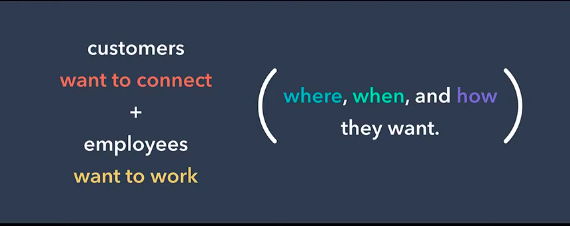
The future of work is finding that happy medium of meeting both employees and customers where, when, and how they want. Let’s look at how flexibility is going to assist in this concept impacting the workplace.
Why Workplaces Are Changing
Workplaces are updating some rules, such as dress codes, because employers recognize that being comfortable optimizes performance. A 2019 survey by Randstad found that 33% of workers would quit their jobs if they were forced to follow a strict dress code, in favor of prioritizing comfort at their jobs (even over a $5k increase in salary).
In his 2019 INBOUND keynote, HubSpot’s co-founder and Chief Technology Officer, Dharmesh Shah, touched on how workplaces are evolving and how to adapt as a company.
“If you want to attract that star talent, you have to make changes that are in high demand,” he said.
In the video above, Shah mentions that 200 of the world’s biggest CEOs have changed their mindsets from deciding that a company’s only purpose is to serve shareholders to a company having three purposes: delivering value to customers, generating value to shareholders, and investing in employees.
According to Shah, companies have two products: one for customers, and one for employees.
He explains “So, what’s one of the most valuable features people look for in this product? Flexibility.”
These changes are happening rapidly and showing up in worker demand for geographic, schedule and method flexibility, as shown in the slide below:
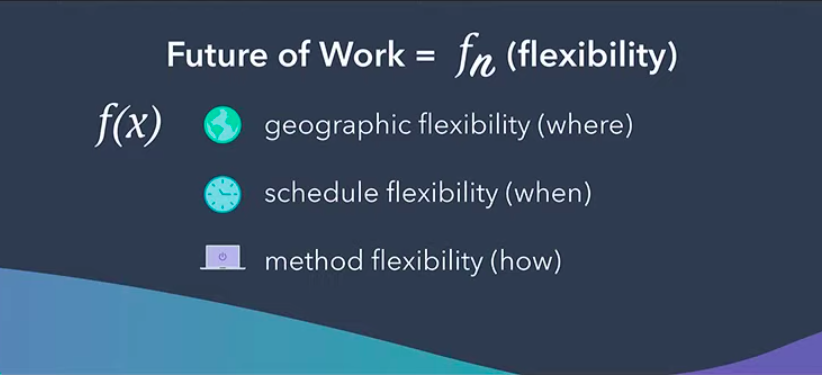
As long as employees are creating customer value, companies can adapt their culture to fit the needs of both. Shah explains that even though the changes are scary and unnatural, they’re essential to creating a company culture employees are excited to be in.
Areas Impacted by Flexibility
When looking at where work and workplace culture is shifting, we’re seeing more specialized job opportunities, thus, more specialized skill sets.
Instead of a marketing company hiring a marketer who will run email marketing campaigns, write website copy, and also contribute to a blog, they’re hiring a writer whose main function is to blog, run email marketing campaigns, or write website copy.
Startups or SMBs that don’t have the budget to hire a team of specialized workers are increasingly looking into freelancers, contractors, or virtual assistants who have that specialized skillet at a more attractive price. The number of people turning to freelance opportunities is growing as well; 57 million people are now freelancing, as opposed to 53 million in 2014. The increase could be due to the ease and normalization of virtual work.
Let’s look at a few of the factors that are increasing the popularity and adoption of remote work:
1. Location
Remote work is growing in popularity. 23% of the workforce is remote — a 4% increase from 2016 during which time people have reported spending at least some time working remotely. MarketWatch estimates that due to video, 50% of the workforce will be remote by 2020.
Services like Skype and Zoom allow remote employees to take part in their office culture by calling into meetings or holding virtual ones of their own. To illustrate, my team is comprised of remote and in-office employees, so about half of my weekly meetings happen through video. I haven’t found communication to be difficult or unreliable, which can be two common fears when incorporating the possibility of remote workers.
2. Schedule
The normal workday is typically 9 AM to 5 PM. But by including the possibility of remote workers — and employees whose best productivity are outside of those hours — fluid schedules are increasingly attractive to companies and workers alike.
To illustrate, I work best in the morning. I usually begin my workday at 8 AM and end around 4 PM. Some of my colleagues start earlier and leave earlier or start later and leave later. Either way, the work we’re assigned gets done.
Giving employees the option to choose their own hours relieves the pressure of having to shift personal preferences in order to fit into strict guidelines. It also relieves the pressure of coming in a little later if something goes wrong during the commute on any given day.
3. Method
This is the “how” aspect of the future of work. How is work getting done in the future of the workplace, with all this flexibility?
Well, the answer to that question is: virtually. Though the spirit of collaboration is still embraced by companies — and should be — it lives online. Online calendars provide ways for employees to schedule meetings that cater to the preferences of teammates.
Below, you can see that when I try to schedule a meeting with fellow HubSpotter Meg, I’m notified that this meeting falls outside Meg’s normal working hours.
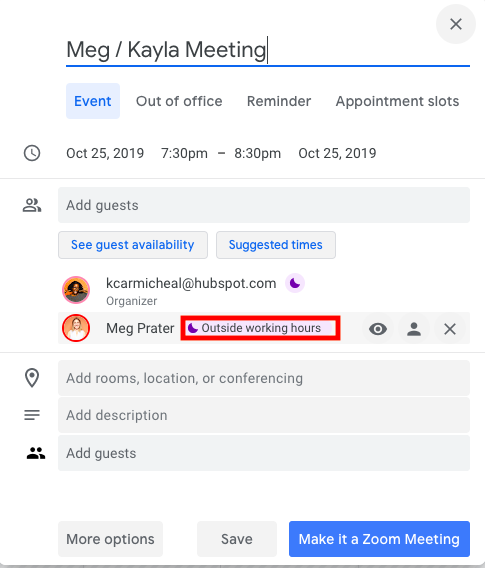
The ability to visualize when coworkers are available to meet, collaborate, and work is made possible with calendar apps, like Google Calendar, that integrate with video services.
With online meetings, software, and apps, work is more accessible than ever before, providing a flexible work environment.
Factoring in a relaxed work code into your organization means the future of work isn’t being run by technology but aided by technology. It’s run by what employees want for their ideal office culture to contribute the best work they can to customers who feel the same way.

Professional Invoice Design: 16 Samples & Templates to Inspire You
Invoices and infographics may seem like two entirely different business materials, but they actually have one key thing in common: they both exist to convey information.
However, while infographics are known for employing colorful designs and data visualizations, invoices are typically pretty straightforward.
Of course, conveying important payment information in a clear and concise way is the name of the game — but that doesn’t mean you can’t add a little brand personality to them.
To help you get a sense of the possibilities, we put together a collection of impressive invoice samples that may inspire you to rethink your current design. Many of them are free to download and customize.
16 of the Best Professional Invoice Samples and Templates
1. Pascale Dufour
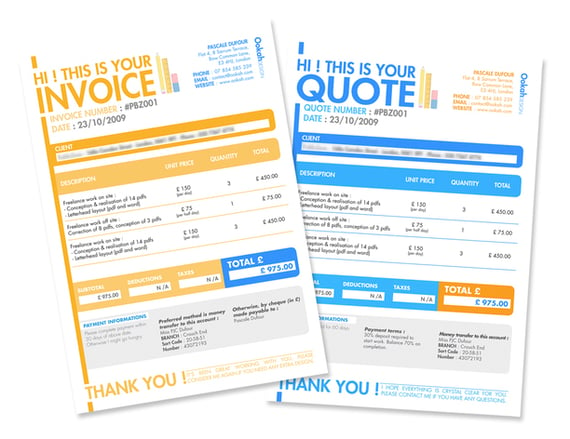
This bold invoice sample is perfect for brands that boast a playful personality. The friendly copy —“Hi! This is your invoice” — catches your eye and helps to lead you through the statement.
Not to mention, the color choices on the taxes, deductions, and totals line creates just enough contrast to ensure you can’t miss the end amount.
2. Basic Invoice
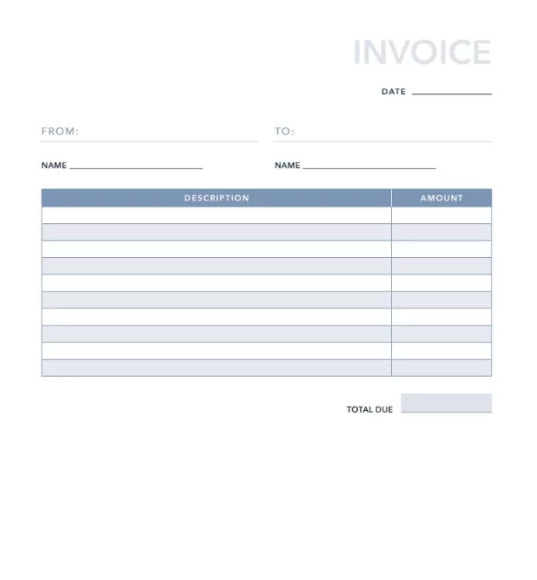 No frills, just business. This basic invoice template, developed here at HubSpot, gives you all the necessities of paper billing without the written fields that more complex business services might want distinguished.
The template above offers space for your name, your client’s name, invoice date, and a base of 10 itemized services. You can add more as needed.
3. Blue Service Invoice
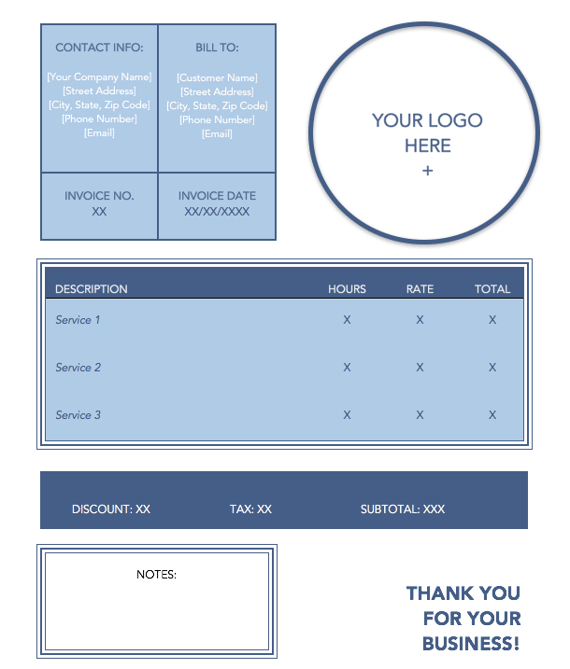
This soft-colored, service-based invoice template allows you to include multiple jobs and how much each one cost your client.
Download this template together with a pack of 10 free templates using the link in the header above the image — each design conveniently opens in Microsoft Word.
4. Fabio Basile
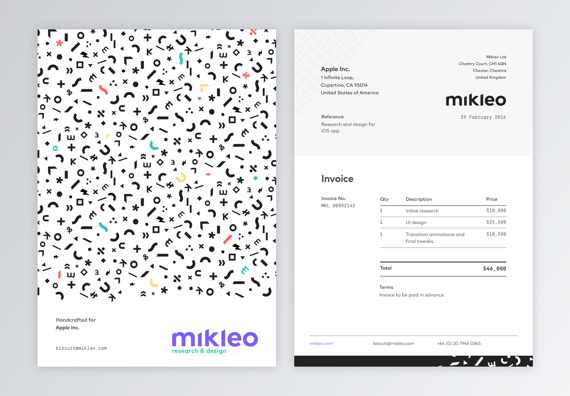
Business in the front. Party in the back.
This double-sided invoice sample offers an interesting twist on an otherwise standard design.
We especially love the “handcrafted for” language on the design side, which side helps to make the customer feel valued by the business they’ve worked with.
5. Commercial Invoice
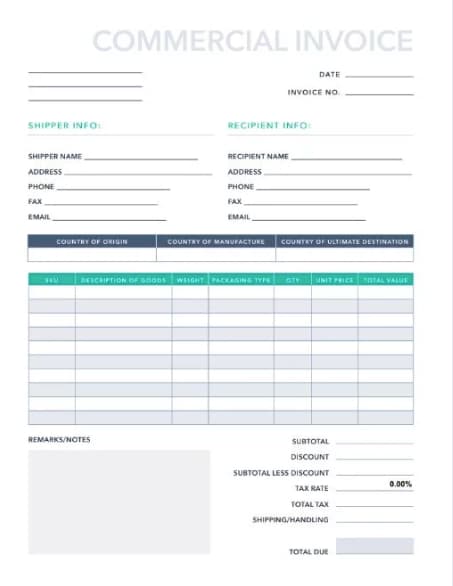
Selling a variety of products and services? The commercial invoice above might be just what you need. Developed here at HubSpot, this template allots space for product origin, manufacturing origin, discounts offered to your client, and more. Download it for free by clicking the header above.
6. Front and Center

Put your final price to the client “front and center” using this design by Ari Krzyzek. Contact this designer using the link in the header — her project comes with matching letters and business cards. Or, simply use her concept as inspiration to create an invoice of your own.
The document makes great use of contrast in font color, allowing the red price to really pop against the thin black text surrounding it.
7. Green Shipping Invoice
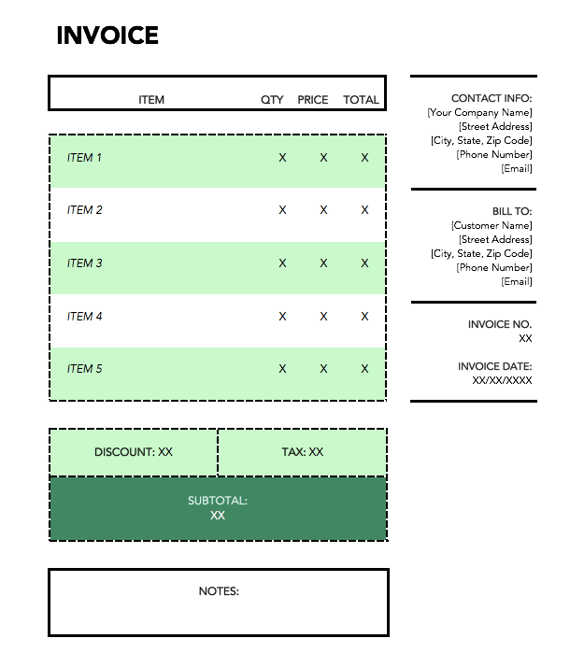
This green template can be downloaded using the link in the header above the image. Dedicated to shipping-based services, the vibrant document is perfect for transactions that involved the transportation of goods.
8. JPWTemplates
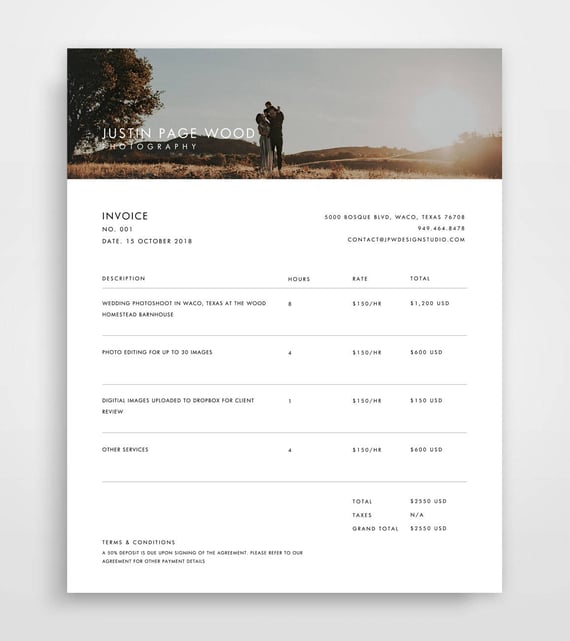
This is a more specific invoice sample, focused on billing for services — in this case: photography.
This invoice uses an actual photograph in the header to highlight the quality of their services. This is a clever idea that can be leveraged for multiple services such as graphic design, illustration, interior design, and so on.
If you want to further personalize your invoice, you can use a photo or design from the customer’s specific project to give it a custom look and feel.
9. Classic Designs
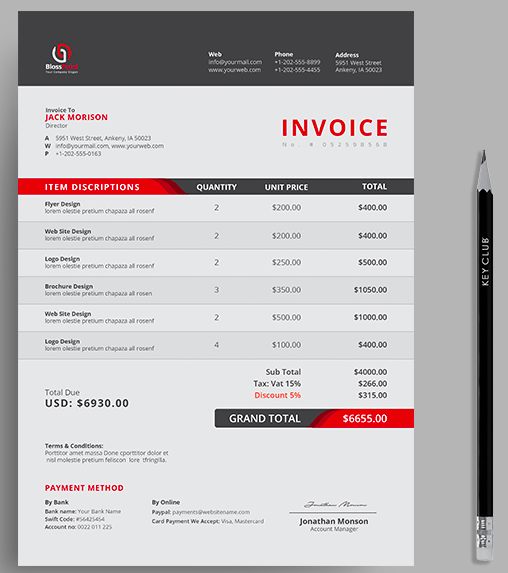
Here’s an example of a straightforward invoice design that clearly details all of the important invoice criteria — contact information, itemized purchases, payment information, and so on.
The design leverages pops of red to call out key pieces of information to make the statement feel less overwhelming.
10. Orange Standard
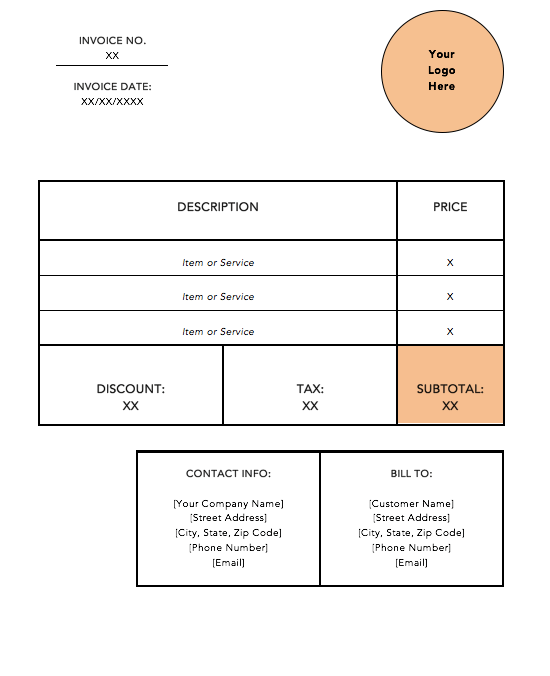
It doesn’t get much more basic than the orange standard invoice template, shown above. Download this template for free using the link in the header above the image. It opens in Microsoft word, allowing you to insert your logo in the top-righthand corner and add additional service rows to match how many services you provided your customer.
11. Bold Stationary
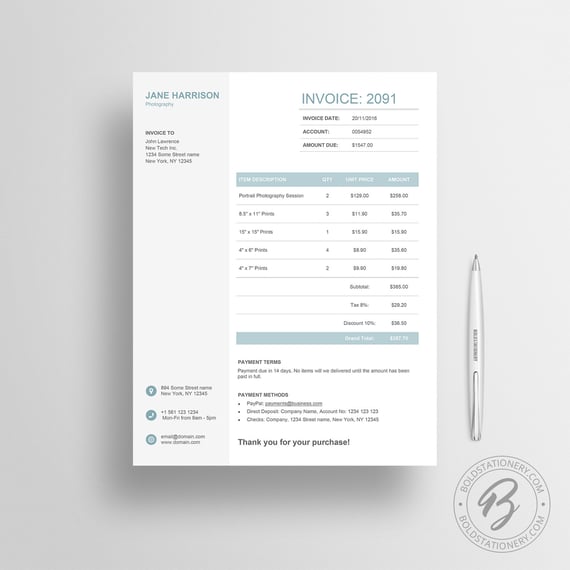
This invoice sample uses a split design to divide contact information and payment information. This approach is free of any distractions or fancy elements, yet it still feels intentionally designed.
If your business is a bit more traditional, this sample serves as a great guide.
12. Novomatic
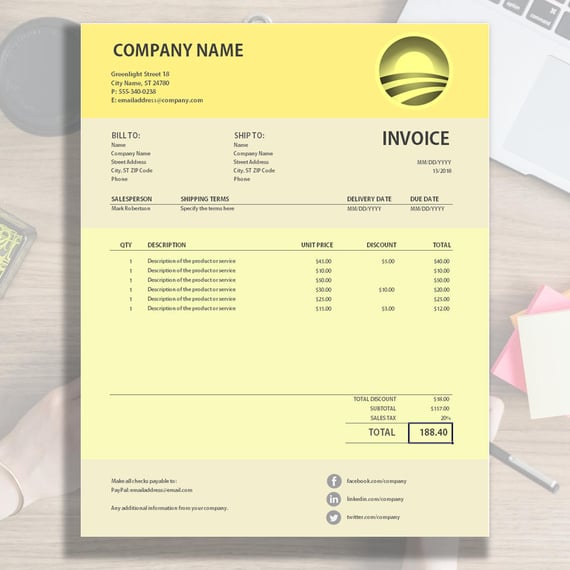
This invoice sample uses various shades of yellow to chunk out different parts of the invoices into digestible sections.
This invoice also leverages the footer of the statement to point customers towards the company’s social media channels as a way to offer a lasting connection.
13. Blue Minimal Standard
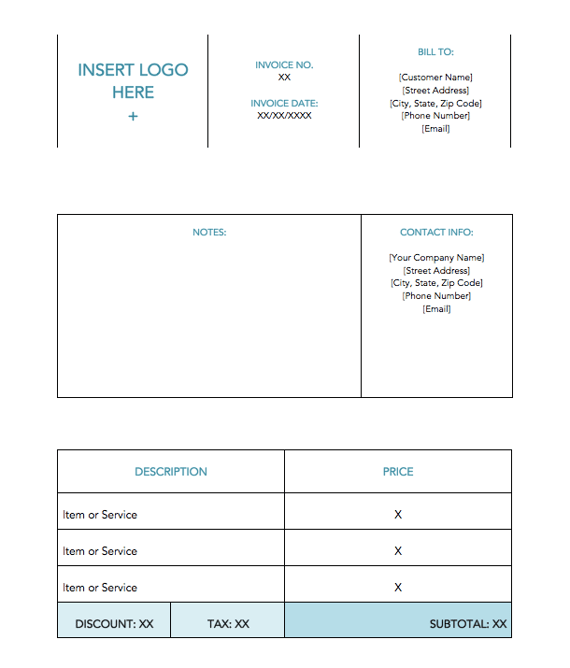
The minimalist invoice template shown above caters to services that are hard to describe in individual lines of services. Using the large “Notes” tile in the center of the document, you can put the focus on the nuances of your business, so it’s clear why you’ve charged your client the price you’ve charged. Download it for free using the link in the header above the image.
14. Yellow Minimalist
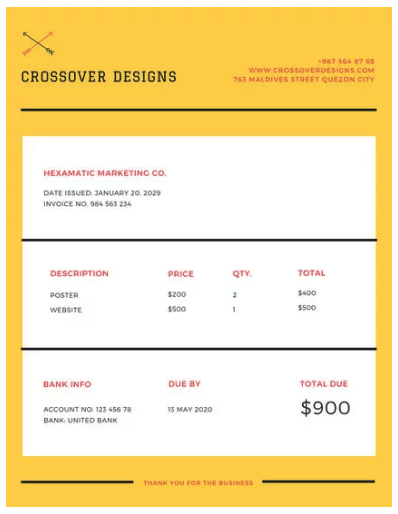
There’s something about yellow that makes a document friendlier. Vibrant but unaggressive, this template emphasizes your price in large font on the bottom-righthand corner, with a yellow border to make sure it doesn’t get forgotten in a pile of other white sheets of paper on your client’s desk.
15. Victory
This invoice template offers space for a logo on the bottom-lefthand corner, rather than the top, for professionals who want to make it clear right away that this document is a bill to be paid (hence “INVOICE” listed on the top-righthand corner).
The invoice’s midsection allows the sender to include a thorough description of each individual service provided — a helpful billing format if your business spanned multiple projects over a long period of time.
16. Soft Banner
Professional designers, here’s an invoice concept just for you. Showing your clients a colorful, brand-aligned invoice is a surefire way to get clients remembering you and rehiring you for more work. The centered price banner in this design uses a soft green background to make steep costs look a bit less frightening to the customer.
How to Write an Invoice
Want to make your own invoice? We’ve got you covered. Check out HubSpot’s Invoice Template Generator to create a professional invoice PDF in just a few clicks. Here’s how to use it:
- Click this page to visit the Invoice Template Generator.
- Click the dotted square on the top-righthand corner of the template to upload an image file of your logo. Or, drag and drop this image file into the square.
- Use the circular wrench/paintbrush icon to the left of the template to change the invoice’s color scheme.
- Hover your cursor over the “Item Description” section to “Add More” rows if you’re billing your client for more than one product or service.
- Hover your cursor over each individual field to customize details such as invoice number, company name, item quantity, and relevant notes to the recipient.
- When you’ve finished customizing your invoice, click “Download Now” just below the template. Your invoice will download as a
The generator offers a ton of customizable elements, so you can be sure the design meets your exact business needs.


How to Do Market Research: A 6-Step Guide
Today’s buyers hold all of the power when making a purchasing decision. You’re also likely aware that they’re doing some of their research online.
But have you really adapted your marketing plan to match the way today’s customers shop and buy?
Consider three recent statistics about consumer behavior:
- 80% of Instagram users currently follow a business account..
- 87% of mobile consumers turn to search engines first to address their needs.
- Emails that display incorrectly on mobile may be deleted within three seconds.
What’s a marketer to do to make sure your buyers find you early and often? Go where they’re going.
That might sound obvious, but how deeply do you really understand exactly where your buyers are conducting their research and what’s influencing their decisions? This is where market research comes into play.
Whether you’re a newbie or experienced with market research, this guide will give you a blueprint for conducting a thorough study of your product, target audience, and how you fare in your industry.
What is market research?
Market research is the process of gathering information about your business’s buyers personas, target audience, and customers to determine how viable and successful your product or service would be among these people.
Market research tells you where these members of your audience and base of customers are conducting their own buyer research about products and services similar to those you sell. It also tells you what’s trending in your industry, what your target audience and customers want and need out of products and services like yours, and what’s influencing their decisions to convert and buy.
Next, let’s take a look at the five main types of market research there are.
For the sake of this guide, we’ll organize these five types of market research into two main categories: primary market research and secondary market research.
Primary vs. Secondary Research
There are two main types of market research that your business can conduct to collect actionable information on your products including primary research and secondary research.
Primary Research
Primary research is the pursuit of firsthand information on your market and its customers. You can use focus groups, online surveys, phone interviews, and more to gather fresh details on the challenges your buyers face and the brand awareness behind your company.
Primary research is useful when segmenting your market and establishing your buyer personas, and this research tends to fall into one of two buckets:
- Exploratory Research: This kind of primary market research is less concerned with measurable customer trends and more about potential problems that would be worth tackling as a team. It normally takes place as a first step before any specific research has been performed, and can involve open-ended interviews or surveys with small numbers of people.
- Specific Research: This kind of primary market research often follows exploratory research, and is used to dive into issues or opportunities the business has already identified as important. In specific research, the business can take a smaller or more precise segment of their audience and ask questions aimed at solving a suspected problem.
Secondary Research
Secondary research is all the data and public records you have at your disposal to draw conclusions from. This includes trend reports, market statistics, industry content, and sales data you already have on your business.
Secondary research is particularly useful for analyzing your competitors. Here are three types of secondary research sources that make this process so beneficial:
- Public Sources: These sources are your first and most accessible layer of material when conducting secondary market research. Being free to find and read — usually — they offer the most bang for your buck. Government statistics are arguably your most common public sources, according to Entrepreneur. Two U.S. examples of public market data are the U.S. Census Bureau and the Bureau of Labor & Statistics, both of which offer helpful information on the state of various industries nationwide.
- Commercial Sources: These sources often come in the form of market reports, consisting of industry insight compiled by a research agency like Pew, Gartner, or Forrester. Because this info is so portable and distributable, it typically costs money to download and obtain.
- Internal Sources: Internal sources deserve more credit for supporting market research than they generally get. Why? This is the market data your organization already has in-house. Average revenue per sale, customer retention rates, and other historical data on the health of old and new accounts can all help you draw conclusions on what your buyers might want right now.
Now, let’s take a look at how you can conduct your market research.
1. Define your buyer persona.
Before you dive into how customers in your industry make buying decisions, you must first understand who they are. This is the beginning of your primary market research — where buyer personas come in handy.
Buyer personas — sometimes referred to as marketing personas — are fictional, generalized representations of your ideal customers. They help you visualize your audience, streamline your communications, and inform your strategy. Some key characteristics you should be keen on including in your buyer persona are:
- Age
- Gender
- Location
- Job title(s)
- Job titles
- Family size
- Income
- Major challenges
The idea is ultimately to use this persona as a guideline for when you reach and learn about actual customers in your industry (you’ll do this in the steps below).
To get started with creating your personas, check out these free templates, as well as this helpful tool. These resources are designed to help you organize your audience segments, collect the right information, select the right format, and so on.
You may find that your business lends itself to more than one persona — that’s fine! You just need to be sure that you’re being thoughtful about the specific persona you are optimizing for when planning content and campaigns.
2. Identify a portion of that persona to engage.
Now that you know who your buyer personas are, you’ll need to find a representative sample of your target customers to understand their actual characteristics, challenges, and buying habits.
These should be folks who recently made a purchase (or purposefully decided not to make one), and you can meet with them in a number of ways:
- In-person via a focus group
- Administering an online survey
- Individual phone interviews
We’ve developed a few guidelines and tips that’ll help you get the right participants for your research. Let’s walk through them.
Choosing Which Buyers to Survey
When choosing whom you want to engage to conduct market research, start with the characteristics that apply to your buyer persona. This will vary for every organization, but here are some additional guidelines that will apply to just about any scenario:
- Shoot for 10 participants per buyer persona. We recommend focusing on one persona, but if you feel it’s necessary to research multiple personas, be sure to recruit a separate sample group for each one.
- Select people who have recently interacted with you. You may want to focus on folks that have completed an evaluation within the past six months — or up to a year if you have a longer sales cycle or niche market. You’ll be asking very detailed questions so it’s important that their experience is fresh.
- Aim for a mix of participants. You want to recruit people who have purchased your product, folks who purchased a competitor’s product, and a few who decided not to purchase anything at all. While your own customers will be the easiest to find and recruit, sourcing information from others will help you develop a balanced view.
3. Engage your market research participants.
Market research firms have panels of people they can pull from when they want to conduct a study. The trouble is, most individual marketers don’t have that luxury — and that’s not necessarily a bad thing. In fact, the time you’ll spend recruiting exclusively for your study will often lead to better participants.
Here’s a simple recruiting process to guide your efforts:
- Pull a list of customers who made a recent purchase. As we mentioned before, this is usually the easiest set of buyers to recruit. If you’re using a CRM system, you can run a report of deals that closed within the past six months and filter it for the characteristics you’re looking for. Otherwise, you can work with your sales team to get a list of appropriate accounts from them.
- Pull a list of customers who were in an active evaluation, but didn’t make a purchase. You should get a mix of buyers who either purchased from a competitor or decided not to make a purchase. Again, you can get this list from your CRM or from whatever system your Sales team uses to track deals.
- Call for participants on social media. Try reaching out to the folks that follow you on social media, but decided not to buy from you. There’s a chance that some of them will be willing to talk to you and tell you why they ultimately decided not to buy your product.
- Leverage your own network. Get the word out to your coworkers, former colleagues, and LinkedIn connections that you’re conducting a study. Even if your direct connections don’t qualify, some of them will likely have a coworker, friend, or family member who does.
- Choose an incentive. Time is precious, so you’ll need to think about how you will motivate someone to spend 30-45 minutes on you and your study. On a tight budget? You can reward participants for free by giving them exclusive access to content. Another option? Send a simple handwritten ‘thank you’ note once the study is complete.
4. Prepare your research questions.
The best way to make sure you get the most out of your conversations is to be prepared. You should always create a discussion guide — whether it’s for a focus group, online survey, or a phone interview — to make sure you cover all of the top-of-mind questions and use your time wisely.
(Note: This is not intended to be a script. The discussions should be natural and conversational, so we encourage you to go out of order or probe into certain areas as you see fit.)
Your discussion guide should be in an outline format, with a time allotment and open-ended questions allotted for each section.
Wait, all open-ended questions?
Yes — this is a golden rule of market research. You never want to “lead the witness” by asking yes/no questions, as that puts you at risk of unintentionally swaying their thoughts by leading with your own hypothesis. Asking open-ended questions also helps you avoid those painful one-word answers.
Here’s a general outline for a 30-minute survey of one B2B buyer. You can use these as talking points for an in-person interview, or as questions posed on a digital form to administer as a survey to your target customers.
Background Information (5 Minutes)
Ask the buyer to give you a little background information (their title, how long they’ve been with the company, and so on). Then, ask a fun/easy question to warm things up (first concert attended, favorite restaurant in town, last vacation, etc.).
Remember, you want to get to know your buyers in pretty specific ways. You might be able to capture basic information such as age, location, and job title from your contact list, there are some personal and professional challenges you can really only learn by asking. Here are some other key background questions to ask your target audience:
- Describe to me how your work team is structured.
- Tell me about your personal job responsibilities.
- What are the team’s goals and how do you measure them?
- What has been your biggest challenge in the past year?
Now, make a transition to acknowledge the specific purchase or interaction they made that led to you including them in the study. The next three stages of the buyer’s journey will focus specifically on that purchase.
Awareness (5 Minutes)
Here, you want to understand how they first realized they had a problem that needed to be solved without getting into whether or not they knew about your brand yet.
- Think back to when you first realized you needed a [name the product/service category, but not yours specifically]. What challenges were you facing at the time?
- How did you know that something in this category could help you?
- How familiar were you with different options on the market?
Consideration (10 Minutes)
Now you want to get very specific about how and where the buyer researched potential solutions. Plan to interject to ask for more details.
- What was the first thing you did to research potential solutions? How helpful was this source?
- Where did you go to find more information?
If they don’t come up organically, ask about search engines, websites visited, people consulted, and so on. Probe, as appropriate, with some of the following questions:
- How did you find that source?
- How did you use vendor websites?
- What words specifically did you search on Google?
- How helpful was it? How could it be better?
- Who provided the most (and least) helpful information? What did that look like?
- Tell me about your experiences with the sales people from each vendor.
Decision (10 Minutes)
- Which of the sources you described above was the most influential in driving your decision?
- What, if any, criteria did you establish to compare the alternatives?
- What vendors made it to the short list and what were the pros/cons of each?
- Who else was involved in the final decision? What role did each of these people play?
- What factors ultimately influenced your final purchasing decision?
Closing
Here, you want to wrap up and understand what could have been better for the buyer.
- Ask them what their ideal buying process would look like. How would it differ from what they experienced?
- Allow time for further questions on their end.
- Don’t forget to thank them for their time and confirm their address to send a thank-you note or incentive.
5. List your primary competitors.
Understanding your competitors begins your secondary market research. But keep in mind competition isn’t always as simple as Company X versus Company Y.
Sometimes, a division of a company might compete with your main product or service, even though that company’s brand might put more effort in another area. Apple is known for its laptops and mobile devices, for example, but Apple Music competes with Spotify — which doesn’t sell hardware (yet) — over its music streaming service.
From a content standpoint, you might compete with a blog, YouTube channel, or similar publication for inbound website visitors — even though their products don’t overlap with yours at all. A toothpaste developer, for example, might compete with magazines like Health.com or Prevention on certain blog topics related to nutrition, even though these magazines don’t actually sell oral care products.
Identifying Industry Competitors
To identify competitors whose products or services overlap with yours, determine which industry or industries you’re pursuing. Start high-level, using terms like education, construction, media & entertainment, food service, healthcare, retail, financial services, telecommunications, and agriculture.
The list goes on, but find an industry term that you identify with, and use it to create a list of companies that also belong to this industry. You can build your list the following ways:
- Review your industry quadrant on G2 Crowd. In certain industries, this is your best first step in secondary market research. G2 Crowd aggregates user ratings and social data to create “quadrants,” where you can see companies plotted as contenders, leaders, niche, and high performers in their respective industries. G2 Crowd specializes in digital content, IT services, HR, ecommerce, and related business services.
- Download a market report. Companies like Forrester and Gartner offer both free and gated market forecasts every year on the vendors who are leading their industry. On Forrester’s website, for example, you can select “Latest Research” from the navigation bar and browse Forrester’s latest material using a variety of criteria to narrow your search. These reports are good assets to save on your computer.
- Search using social media. Believe it or not, social networks make great company directories if you use the search bar correctly. On LinkedIn, for example, select the search bar and enter the name of the industry you’re pursuing. Then, under “More,” select “Companies” to narrow your results to just the businesses that include this or a similar industry term on their LinkedIn profile.
Identifying Content Competitors
Search engines are your best friends in this area of secondary market research. To find the online publications with which you compete, take the overarching industry term you identified in the section above, and come up with a handful of more specific industry terms your company identifies with.
A catering business, for example, might generally be a “food service” company, but also consider itself a vendor in “event catering,” “cake catering,” “baked goods,” and more.
Once you have this list, do the following:
- Google it. Don’t underestimate the value in seeing which websites come up when you run a search on Google for the industry terms that describe your company. You might find a mix of product developers, blogs, magazines, and more.
- Compare your search results against your buyer persona. Remember the buyer persona you created during the primary research stage, earlier in this article? Use it to examine how likely a publication you found through Google could steal website traffic from you. If the content the website publishes seems like the stuff your buyer persona would want to see, it’s a potential competitor, and should be added to your list of competitors.
After a series of similar Google searches for the industry terms you identify with, look for repetition in the website domains that have come up. Examine the first two or three results pages for each search you conducted. These websites are clearly respected for the content they create in your industry, and should be watched carefully as you build your own library of videos, reports, web pages, and blog posts.
6. Summarize your findings.
Feeling overwhelmed by the notes you took? We suggest looking for common themes that will help you tell a story and create a list of action items.
To make the process easier, try using your favorite presentation software to make a report, as it will make it easy to add in quotes, diagrams, or call clips. Feel free to add your own flair, but the following outline should help you craft a clear summary:
- Background. Your goals and why you conducted this study.
- Participants. Who you talked to. A table works well so you can break groups down by persona and customer/prospect.
- Executive Summary. What were the most interesting things you learned? What do you plan to do about it?
- Awareness. Describe the common triggers that lead someone to enter into an evaluation. Note: Quotes can be very powerful.
- Consideration. Provide the main themes you uncovered, as well as the detailed sources buyers use when conducting their evaluation.
- Decision. Paint the picture of how a decision is really made by including the people at the center of influence and any product features or information that can make or break a deal.
- Action Plan. Your analysis probably uncovered a few campaigns you can run to get your brand in front of buyers earlier and/or more effectively. Provide your list of priorities, a timeline, and the impact it will have on your business.
Begin Conducting Market Research
Conducting market research can be a very eye-opening experience. Even if you think you know your buyers pretty well, completing the study will likely uncover new channels and messaging tips to help improve your interactions. Not to mention, you’ll be able to add “market research” as a skill to your resume.
Editor’s note: This post was originally published in January, 2019 and has been updated for comprehensiveness.

Social Media Marketing: The Ultimate Guide
As I scroll through my Instagram feed every day (cough, cough…multiple times a day), I consistently notice new posts and stories by The Frye Company. I’ve always been a fan of their boots, clothing, and accessories, but I also love the content they share on their Instagram profile.
Their posts are on-brand, creative, and aesthetically pleasing. All of their photos have the same filter on them to ensure they match — this makes their Instagram profile look professional, artistic, and organized when visitors, like myself, browse their page.
Frye’s Instagram account also encourages interaction between the company and their followers by providing them with a specific hashtag to use so they can be featured on the account when they post a photo with a Frye product.
Frye’s Instagram account is a great example of successful social media marketing — it’s attractive, distinctly Frye, engages their 197K followers, and promotes their products.
But why is social media marketing so important? Why should you spend time creating social media accounts for your business? And how do you actually build a social media marketing strategy that’ll work for your specific type of business?
In this guide, we’ll cover the answers to all of these questions — but first, let’s define social media marketing.
Social media marketing is all about meeting your target audience and customers where they are and as they socially interact with each other and your brand.
While social media marketing as a whole is incredibly valuable and beneficial to your business growth (as you’ll see in the following section), your strategy will differ based on which social networks your audience spends their time on.
Before we dig deeper into social media marketing, let’s segment the strategy by platform.
- Users: 2.2 billion
- Audience: Generation X and millennials
- Industry impact: B2C
- Best for: Brand awareness; advertising
- Users: 335 billion
- Audience: Primarily millennials
- Industry impact: B2B and B2C
- Best for: Public relations; customer service
- Users: One billion
- Audience: Primarily millennials
- Industry impact: B2C
- Best for: Natural-looking media, behind-the-scenes, and user-generated content; advertising
- Users: 645 million
- Audience: Baby boomers, Generation X, and millennials
- Industry impact: B2B
- Best for: B2B relationships, business development, and employment marketing
YouTube
- Users: 1.9 billion
- Audience: Millennials, closely followed by Generation Z
- Industry impact: B2C
- Best for: Brand awareness; entertainment, and how-to videos
Snapchat
- Users: 300 million
- Audience: Primarily Generation Z
- Industry impact: B2C
- Best for: Brand awareness; advertising
- Users: 250 million
- Audience: Primarily older millennials and younger baby boomers
- Industry impact: B2C
- Best for: Visual advertising; inspiration
Now that we’ve detailed the fundamentals of each social media network, let’s discuss why social media marketing is beneficial for your business.
Benefits of Social Media Marketing
There are a variety of reasons why your company should use social media marketing. We’ve created a list of the four most beneficial reasons to consider.
Let’s dive in.
1. Increase Brand Awareness
In 2018, there were over 3.2 billion people on social media globally. Due to the sheer amount of people on social media, you can see why ensuring your business is sharing content related to your products as well as details about your company via a platform or two has the potential to help you improve brand awareness.
In fact, social media has been proven to boost brand awareness by driving up engagement. Social engagement includes things like comments, likes, shares, and re-posts. Social media also helps you increase brand awareness by directing traffic straight to your site. You can do this by including direct links to your website in your profile, bio, and posts.
Featured Resource
2. Generate Leads and Boost Conversions
Promoting and sharing your products on social media is a simple way to improve lead generation, boost conversions, and increase sales because you’re advertising to people who have opted to engage with you by following your account.
Here are some examples of ways you can use social media to generate more leads.
- Create contests for your visitors and followers to participate in on your social media profiles.
- Include links to your website and offers in the bio sections of your profiles.
- Host live videos to make announcements about products and provide updates or details about exciting news at your company.
- Implement a social media marketing campaign on one of your channels.
- Sell your products through your social profiles. For example, you can enable Facebook’s Shop Section or Instagram’s Shopping feature on your profiles. These features allow your visitors and followers to click on products you’ve shared in posts to view information such as price, material, and size. Then, visitors can easily proceed to checkout through the platform and buy the product directly from you.
3. Foster Relationships With Customers
By connecting and engaging with your social media followers, you’ll be able to build lasting relationships between them and your business. You can do this by interacting with them on your posts, responding to their questions and comments, and providing them with any help they may need.
You can also ask your followers questions about your products, their pain points, or create giveaways to help you build trust and show them how much you value their input and support.
4. Learn From Competitors
Social media is a great way to keep tabs on your competitors — whether that’s in reference to their social media tactics, the products they’re promoting, the campaigns they’re implementing, or their level of interaction with followers.
Social media allows you to get a look at what is and isn’t working for your competition, and therefore helps you decide what should or shouldn’t change in terms of your company’s approach. Lastly, reviewing the social accounts of your competitors can help you make sure your marketing stands out and is unique to your brand.
Learn how to conduct a competitive analysis to discover how you can beat the competition.
Now, let’s talk strategy — there are five steps to ensure your social media marketing plan is sustainable and positively impacts your business.
Let’s cover these steps in more detail so you can begin applying them to your business.
1. Research your buyer personas and audience.
The first step to creating a social media marketing strategy is to determine who your buyer personas and audience are so you can target their needs and interests appropriately. To do this, think about the people you’re trying to reach and why, and how you would classify them as a group. For example, if your company sells trendy leggings and joggers, you might classify your target audience as millennials who like to wear stylish athletic apparel regularly — a style known as athleisure.
By considering your buyer personas and audience, you’ll then be able to determine what content will attract the type followers and customers you hope to gain and how you can create engaging content to keep your followers interested.
Featured Resource
2. Determine which social platforms you’ll market on.
As a social media marketer, it’s crucial you determine which platforms you’re going to share your content on. There’s not necessarily a right or wrong answer when it comes to which social channels your business should use — it’s more about the needs of your target audience and where they tend to spend their time.
“It’s important to be where your audience of potential customers is today, and where they might be tomorrow. It’s better to be ahead of the curve than behind.” — Andrew Delaney, Social Media Marketing Manager at HubSpot
For example, if you are going for that target audience of athleisure-loving millennials, you may want to focus the majority of your social media efforts on Instagram — this is because millennials cover the largest portion of users on the platform.
Featured Resources
- A Marketer’s Guide to Snapchat for Business
- 50 Facebook Ad Examples We Actually Clicked
- YouTube for Business: A 30-Day Roadmap for Growth
- How to Use Twitter for Business (+ Follower Tracking Template)
- 12 Pinterest Templates for Business
3. Create unique and engaging content.
With the billions of social media users around the globe, there’s no question that at least some of your followers — or the people browsing your profile — have also seen your competitor’s content or that of other businesses in your industry. That’s why you must have engaging social media content that stands out and provides viewers with a reason to click that “Follow” button and interact with your brand.
To help you get creative, consider the content your competitors are sharing and how you can uniquely promote your products. Also, take advantage of the features offered by the platform you’re using. For example, you can create live videos on Facebook to share the latest details about a product launch or conduct a giveaway.
Lastly, use your current customers and promoters to help you generate content. You can do this by re-posting their content or encouraging them to use a hashtag to share their own experiences and pictures with your products (similar to Frye’s Instagram hashtag that I mentioned earlier).
4. Organize a schedule for your posts.
One of the easiest ways to ensure your content is shared as planned is to use a social media management solution. These tools allow you to write captions, prepare pictures and videos, and schedule posts in advance. They also automatically share your content on schedule and monitor all post interactions and engagement for you. Social media management solutions save you time and allow you to focus on your other tasks.
There are a number of solution options available — here are a few examples.
1) HubSpot
HubSpot offers a social media tool — as part of the marketing software — to help you publish and monitor your content and create real connections with your followers. You can schedule and publish your content in advance and compare in-depth reports on your posts’ engagement to understand the performance of various platforms, types of content, and posting times.
2) Sprout Social
Sprout Social is a social media marketing and management solution designed to help your team organize and plan content creation, manage campaigns, understand engagement, and review content reports and analysis.
3) Hootsuite
Hootsuite is a social media management platform for finding, scheduling, managing, and reporting on your content. You can schedule posts in advance on all of your channels at once and measure your ROI with comprehensive content analysis.
How often should you post on social media?
Now, you might be wondering how often you should post content on your social media channels.
As a rule of thumb, you should only post on social when you have quality content to share. Meaning, there’s a reason you’re posting the content. This is how you’ll strike the right balance when it comes to your posting frequency. If you post too infrequently, you’re bound to be forgotten by your followers. If you post too frequently, you’ll likely become annoying to your followers. Both situations could potentially lead to a loss in followers and a decrease in engagement.
To avoid this, there are plenty of studies and resources available explaining social media post frequency standards by industry and platform for you to follow. Every business is different, so find what works for your audience. Then, you can begin experimenting with more or fewer posts, as well as other factors such as the time of day you’re posting on social, to determine what provides the highest level of engagement.
5. Analyze your impact and results.
One of the most important aspects of social media marketing is ensuring your efforts are successful in helping you meet your goals. To determine this, you’ll need to keep track of all of your posts, on every channel. You can do this by reviewing and managing your social media metrics.
Social Media Metrics
Social media metrics are data related to the success of your posts and your impact on your audience and customers on various platforms. These metrics may include data about your level of engagement, likes, follows, shares, and all other interactions on each platform.
Here are 10 of the most important metrics for you to track:
- Engagement: This includes clicks, comments, likes, and replies on your social media posts. There are also platform-specific types of engagement such as “Saved” posts on Instagram and “Pinned” posts on Pinterest.
- Reach: The number of people who have seen any content associated with your page or profile is your reach.
- Followers: This is the number of people you have on your profile who have clicked your “Follow” button and see your content in their feeds regularly.
- Impressions: This is the number of times a post from your profile or page is seen, whether or not your audience members click on it. This is often what happens when someone is scrolling through their newsfeed, but not clicking on anything.
- Video views: On Facebook, Snapchat, Instagram, or any other social channel with video capabilities, this is the number of views each gets.
- Profile visits: The number of people who have opened your social media page is your number of profile visits.
- Mentions: This is the number of times your profile has been mentioned by audience members in their posts.
- Tags: This is when your audience adds the name of your company’s profile or your hashtag to another post.
- Reposts: This is when a member of your audience posts a piece of your content on their profile.
- Shares: These are the posts your followers and audience take from your profile and share with their network.
You can influence all of these metrics, increase your social following, and improve overall engagement on your profile by using the same tactics you would to generate leads and boost conversions. You can also interact with your followers more frequently by talking to them, tagging them in content, responding to their questions, liking their posts, encouraging them to use your hashtags, and share your content (and you can also repost user-generated content).
How to Measure Social Media Metrics
You can review social media metrics in a variety of ways, For example, you can use the analytics tools built into the various platforms you use. Here are a few examples:
You might also choose to use an analytics and tracking tool such as Google Analytics. This is a great option if you want to track your social media and website metrics. Lastly, many social media scheduling solutions — as we reviewed earlier — have monitoring and tracking features automatically built in. All of these metrics tracking tools will give you a better understanding of what your followers and audience respond well to and what you should consider modifying to improve engagement.
Now that we’ve reviewed the benefits of social media marketing and how to build your strategy, let’s talk about the various resources available to help you along the way.
Social Media Marketing Resources
There are a plethora of social media marketing resources you can use to build a social strategy for your company. You’re bound to feel more confident about working on your company’s social media marketing initiative with the help of the following courses, training, and books.
Social Media Marketing Courses and Training
Here are three ways to earn an education in the field of social media marketing if you feel it’s necessary for your specific business situation.
1. Earn a degree.
Although there isn’t necessarily a “social media marketing degree” for undergraduates, there are online courses offered at a number of different schools and institutions you can take to earn a certificate, MicroMaster’s or master’s degree in the field.
2. Use an online learning website.
Lynda is another great educational resource. This online learning website offers training, tutorials, and courses on a wide variety of topics within the field of social media marketing.
3. Earn a certificate administered by a company.
You might choose to earn a certificate from a company — such as HubSpot’s social media certification. This free certification teaches you how to engage with your customers and improve conversions. You’ll also get a better understanding of how to develop your strategy, extend your reach, and measure your social media ROI.
Social Media Marketing Books
Reading relevant content about social media marketing is another great way to learn more about the field. Here are a few examples of some highly-regarded books on the topic.
1. Likable Social Media: How to Delight Your Customers, Create an Irresistible Brand, and Be Generally Amazing on Facebook by Dave Kerpen
This New York Times Bestseller covers the reasons why being likable and engaging with followers on social media is one of the most powerful ways to grow your base of customers and promoters. The book teaches you how to make impactful content for your followers to interact with and share with their networks. Author Dave Kerpen also describes why you need to ensure you’re consistently delighting your followers to avoid losing them at any point in time.
2. Jab, Jab, Jab, Right Hook: How to Tell Your Story in a Noisy Social World by Gary Vaynerchuk
According to author Gary Vaynerchuk, the key to social media marketing success isn’t about pushing out a lot of content — it’s about pushing out specific content tailored towards your target audience and using the right platform to do so.
In his book, Vaynerchuk covers how to do this as well as connect with your followers and customers on a deeper level through social media. You’ll learn how to create memorable and unique content that stands out in comparison to competition’s content.
3. The B2B Social Media Book: Become a Marketing Superstar by Generating Leads with Blogging, LinkedIn, Twitter, Facebook, Email, and More by Kipp Bodnar
HubSpot’s CMO, Kipp Bodnar, writes about the ways B2B businesses can generate more leads and conversions through social media marketing. There are actionable methods you can take to increase your base of followers and drive leads as well as understand the ROI of various B2B social media marketing strategies.
Start Marketing on Social Media
Considering there are billions of people on social media today, it’s easy to see why so many businesses and marketers use the channel to promote their products and engage with customers.
Although determining your company’s social media course of action may seem daunting, you can avoid feeling overwhelmed by understanding social media marketing trends and using some of the many resources available about the topic. So, start working on your business’ social media marketing strategy today to increase your number of followers, improve engagement, and boost conversions.
Editor’s note: This post was originally published in March 2019 and has been updated for comprehensiveness.
