
14 of the Best WordPress Survey Plugins
Are your users happy with your website, or are you simply assuming they are?
Whether you’re looking to improve the user experience on your website, increase your customer satisfaction, or simply learn more about your visitors, embedding a survey on your website is the fastest way to get the feedback you need.
Ultimately, knowledge is power.
In this blog post, we’ll take a look at some of the best WordPress plugins to collect user feedback on your website — without the need for a developer.

1. Survey Anyplace
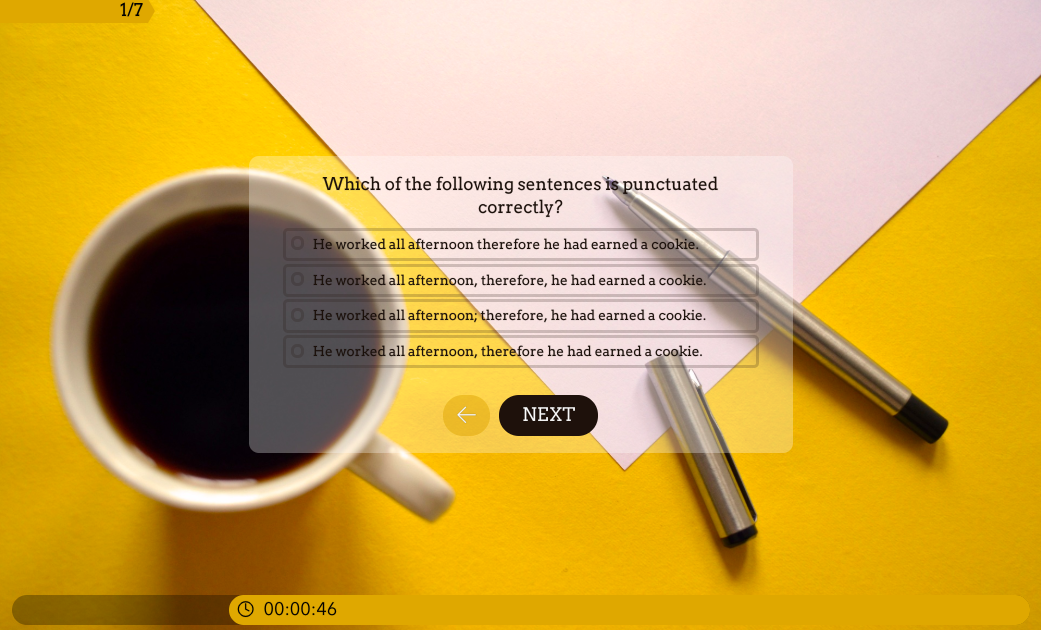
Survey Anyplace allows you to create fun surveys, quizzes, and assessment tests for your WordPress website.
The free version is very generous. You can choose from a wide variety of question types to get the feedback you need — such as ratings, slide bars, or image choices, as well as traditional open-ended and multiple choice questions. Additionally, you can use basic question logic-skip to ensure you’re not asking redundant questions, based off a respondent’s previous answers.
If you don’t know what to ask your visitors, consider trying out one of the “tried and approved” survey questions templates, which can be personalized to your specific needs.
If a quiz is more what you’re looking for, Survey Anyplace won’t disappoint. Gauge your audience’s knowledge with timers and leaderboards.
You can playfully incentivize your respondents with digital scratch cards, and if you upgrade to a paid plan, you can even add slot machines to make your quizzes even more fun.
Pricing: There’s a free plan that offers a ton of flexibility in terms of what you can build, although you’re limited to 20 responses per month. For more answers and even more features, paid plans start at $25 per month.
2. Hotjar
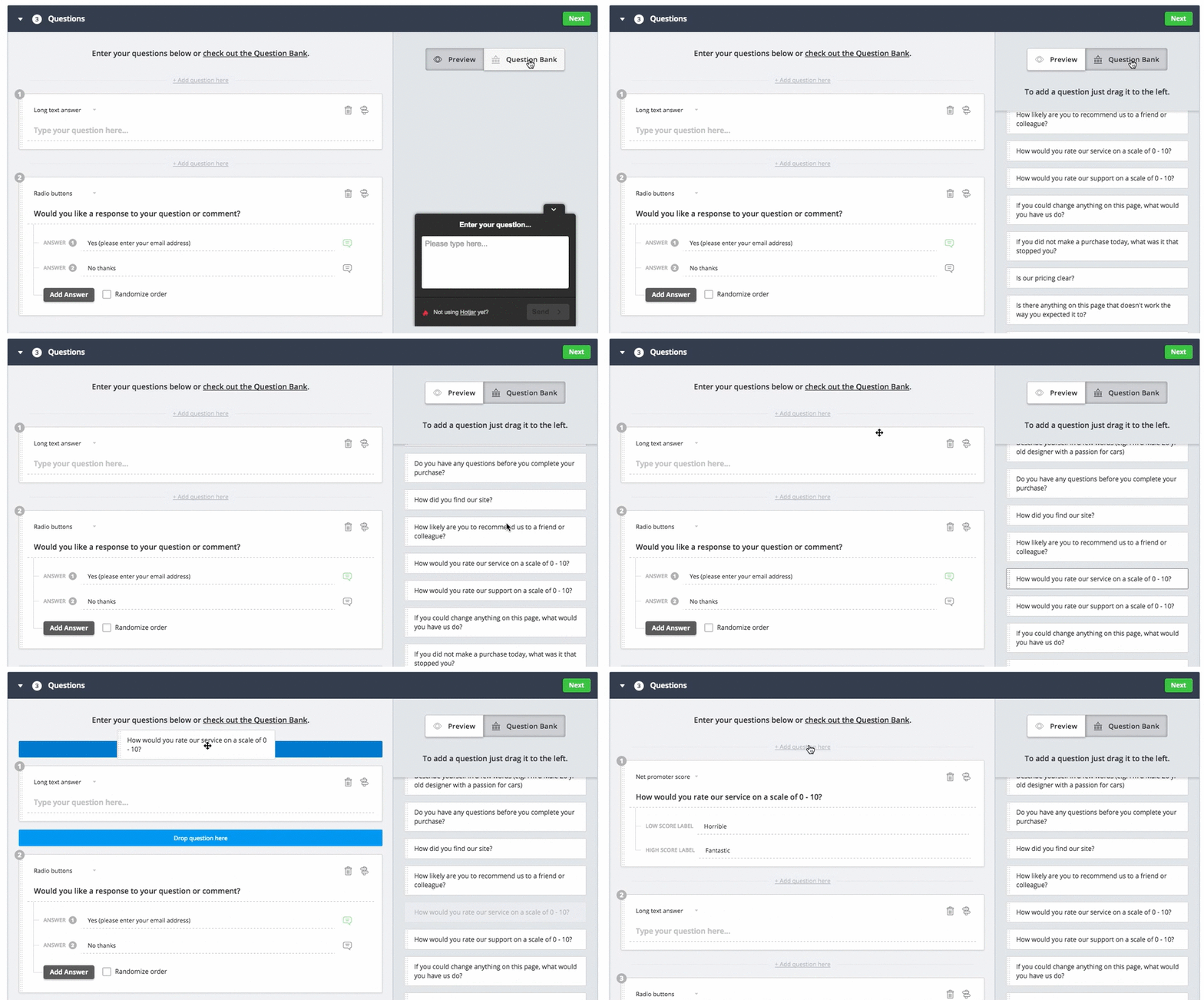
Hotjar is “the fast and visual way to understand your users.” They offer tools to help you uncover important insights for your site performance, including survey and feedback tools.
Their Form Analysis tool helps you improve your form completion rates by identifying which fields take too long to fill, which are left blank, and why your visitors abandon certain forms and pages.
Additionally, you can use Feedback Polls to create small, customizable widgets and improve the performance and experience of your website. Target questions to specific visitors anywhere on your web and mobile site, and choose from multiple trigger options such as time delays, scrolling, and exit-intent. You can ask multiple different types of questions, including Net Promoter Score. And if you need some inspiration, they even have a question bank for you to use.
Best of all, the Incoming Feedback tool gives your visitors an easy way to leave instant visual feedback on your site or app with the use of little emoji faces to express their satisfaction (or dissatisfaction) with your site. You can also create more complex surveys with the same targeting and trigger options.
The interface is drag-and-drop and incredibly user-friendly. Hotjar integrates with many popular business tools, including Hubspot’s CRM and Marketing software.
Pricing: You can start for free with the Basic plan and upgrade for more functionalities starting at $29 per month.
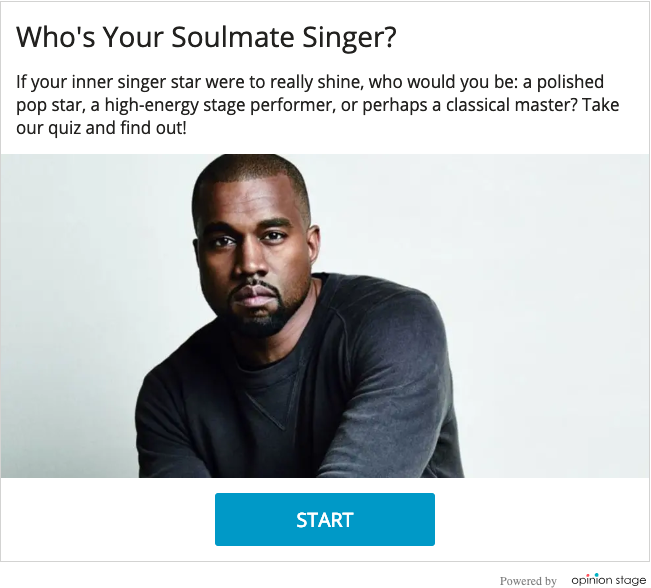
3. Poll, Survey, Form & Quiz Maker by OpinionStage
Opinion Stage lets you create interactive surveys to boost your engagement rates and get more qualified leads. This tool is used by large corporations including BBC, Uber, and TripAdvisor.
Its intuitive interface makes it easy to use. You can manage all of your polls and quizzes in a single dashboard and track your results thanks to detailed analytic reports, which track impressions, the number of votes, click-through rates, social sharing, and more.
Their built-in templates help you customize your surveys and polls to fit your brand. You can even add images and videos to your surveys to make them more engaging.
Additionally, when you upgrade to a paid plan, you can integrate forms into your surveys to capture leads’ contact information — plus, you have the option to incorporate ads, opening up an additional revenue stream for your business.
If you’re looking for more ways to engage with your audience, this tool lets you create tons of other types of interactive content, including forms, slideshows, and articles.
Pricing: The basic tool is free. To remove the Opinion Stage branding and unlock additional features, premium plans start at $19 per month.
4. GetSiteControl
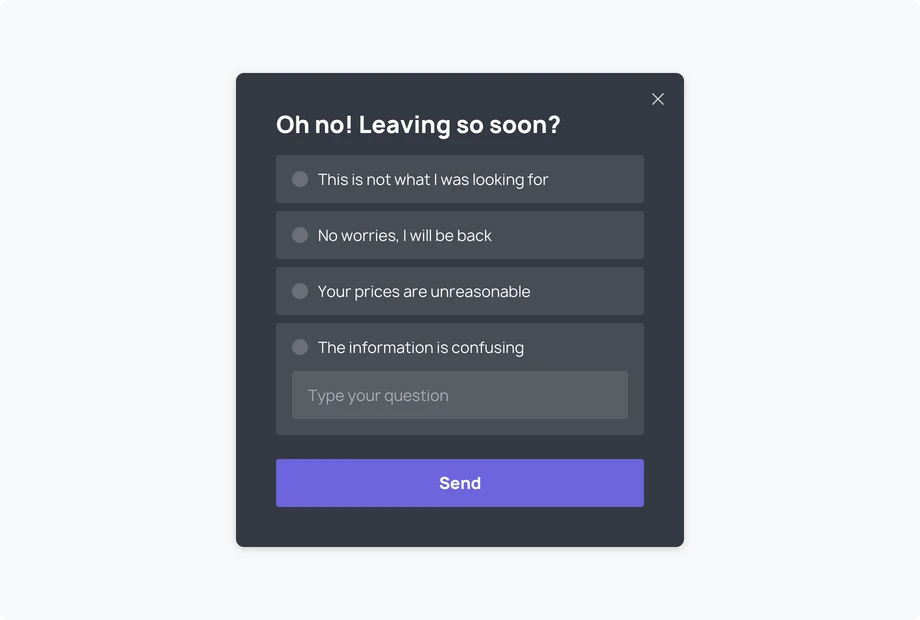
Get to know your audience better with GetSiteControl. Add quick polls, multi-page questionnaires, star ratings, and skip-logic surveys to better understand your customers’ needs. Target new or returning visitors, those who are leaving your website, or a specific audience segment you’d like to learn more about based on their geographical location, browser or device type, language, traffic source, and more.
The tool helps you apply user behavior triggers to define when to start and stop showing a website survey, depending on time spent on page, scrolling depth, or exit-intent. You can even schedule the survey widget to be displayed only during specific days and hours.
Additionally, you can collect email addresses and subscribe users to your newsletter by connecting your survey forms to an email marketing platform, and have new contacts automatically added to your list. Plus, built-in A/B testing and instant analytic reports make it easy for you to measure your performance.
The tool is incredibly user-friendly and easy to set up. Your survey is live as soon as you activate the plugin. GetSiteControl is a great option for short surveys because of its many display options. However, because surveys are created in a widget format, they aren’t a good option if you want more complex surveys embedded on a page or blog post.
Pricing: You can try out the product for seven days for free. Paid plans start at $19 per month.
5. Typeform
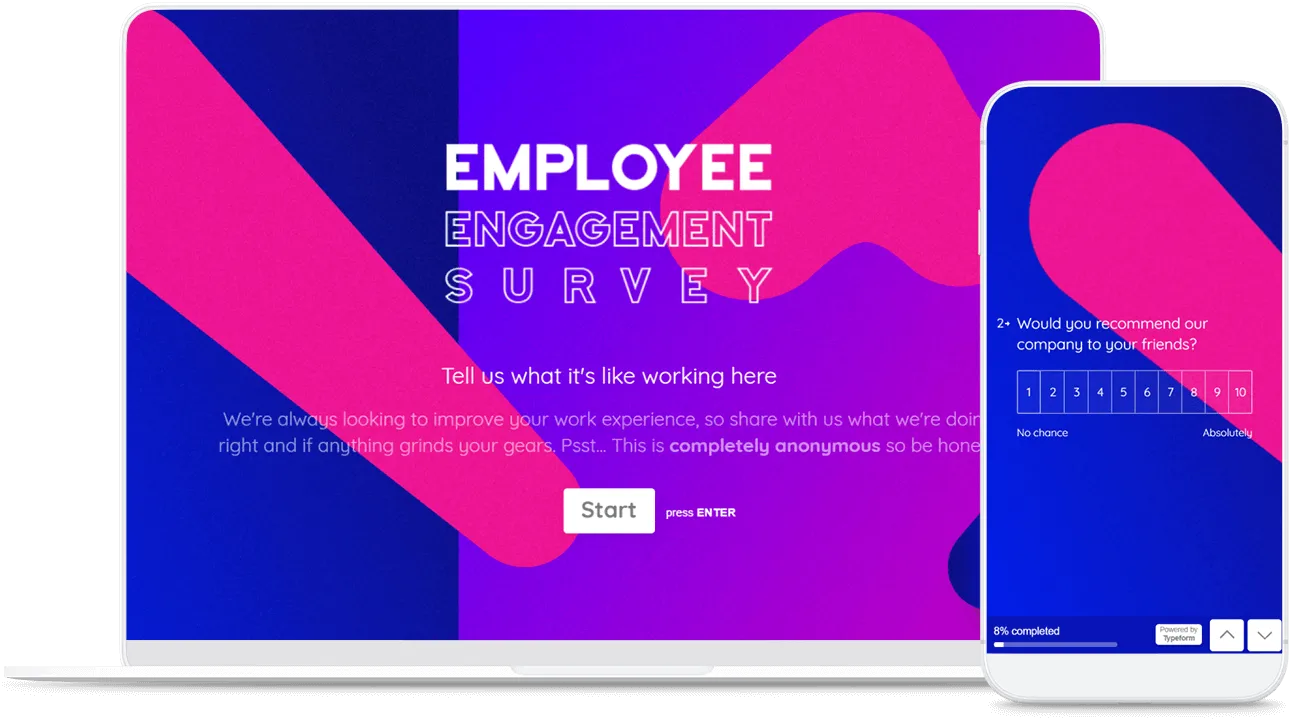
Typeform is a contact form builder that also lets you create surveys and quizzes.
Choose from an epic selection of survey, questionnaire, and quiz templates that you can customize to your needs. Your surveys can include a number of different question types, including ratings, multiple choice, or closed and open-ended questions.
Your “typeforms” present your questions one at a time to keep users engaged, and can include images, GIFs, or videos. This tool includes Calculator, a PRO feature, for you to add calculations, scores, or prices to your questions. Each answer to a question can be assigned different values, and calculations can be made based off those values.
Your surveys and questionnaires can be embedded directly onto your page, open in a pop-up, or be accessed via a unique link.
Pricing: Start for free with basic question types and reporting. Paid plans start at $30 per month.
6. TotalPoll
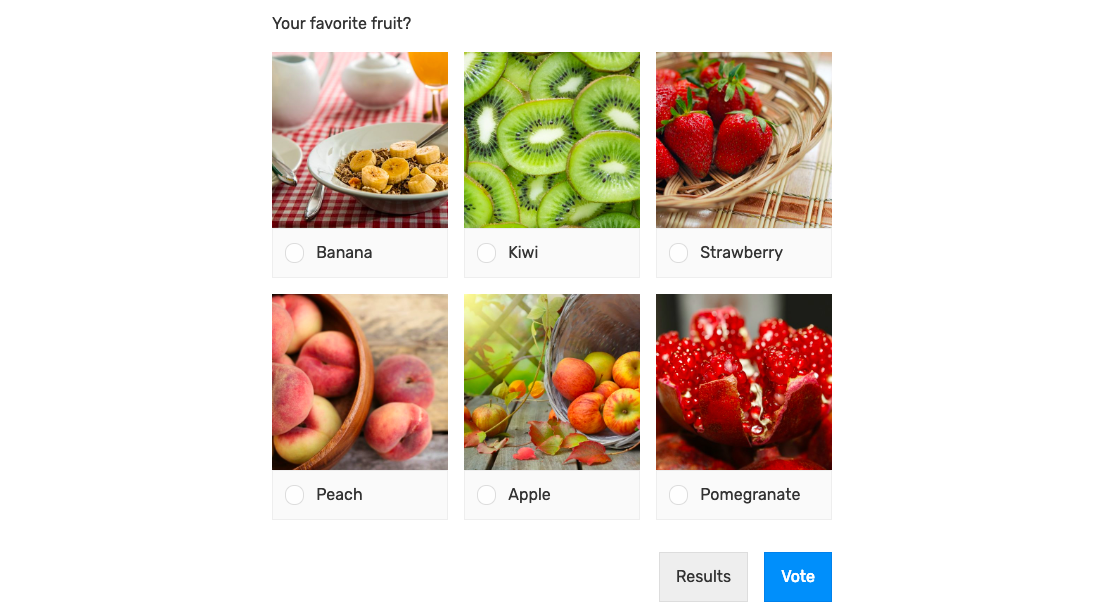
TotalPoll is incredibly user-friendly. Control how your polls look with the Customizer. Your polls can be inserted onto any page via widgets or shortcodes.
In addition to creating regular surveys with the option to add images and videos, you can also run opinion and debate polls, or contests with scorecards at the end.
Best of all, the tool is optimized for search engines to help you rank on search results pages. You can make sure your poll is visible to Google’s crawlers by having it included in your sitemap. It supports Schema markup and is compatible with popular SEO plugins like Yoast All-in-One SEO.
Pricing: You can download TotalPoll Lite for free. But for more functionality, it might be worth purchasing the $29 license on CodeCanyon.
7. Modal Survey
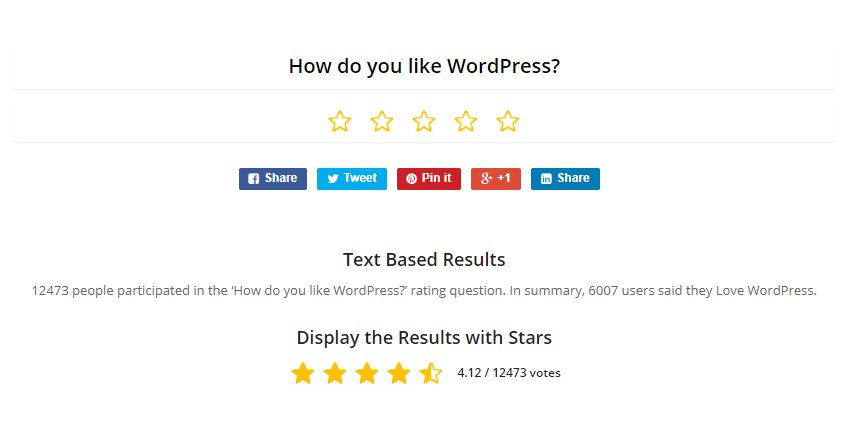
Modal Survey is another popular option for building surveys, polls, and quizzes on WordPress. Its front-end builder makes it easy-to-use, and offers the option to customize the look and feel of your quizzes.
With Modal Survey, you get detailed visualization options to display your quiz results, including five different types of pie charts. For example, you can categorize questions to display the results of each category. This feature comes in handy, particularly when building personality tests.
This survey tool is great for building product recommendation quizzes. You can ask users to answer questions and then recommend products based on their results — which is particularly helpful if you own an e-commerce website.
Additionally, you can equip your quizzes with countdown timers, one for your overall quiz or one for each question, and subscribe respondents to your email list, thanks to the many email marketing service integrations available.
Pricing: You can purchase a regular license on CodeCanyon for $35.
8. Quiz and Survey Master
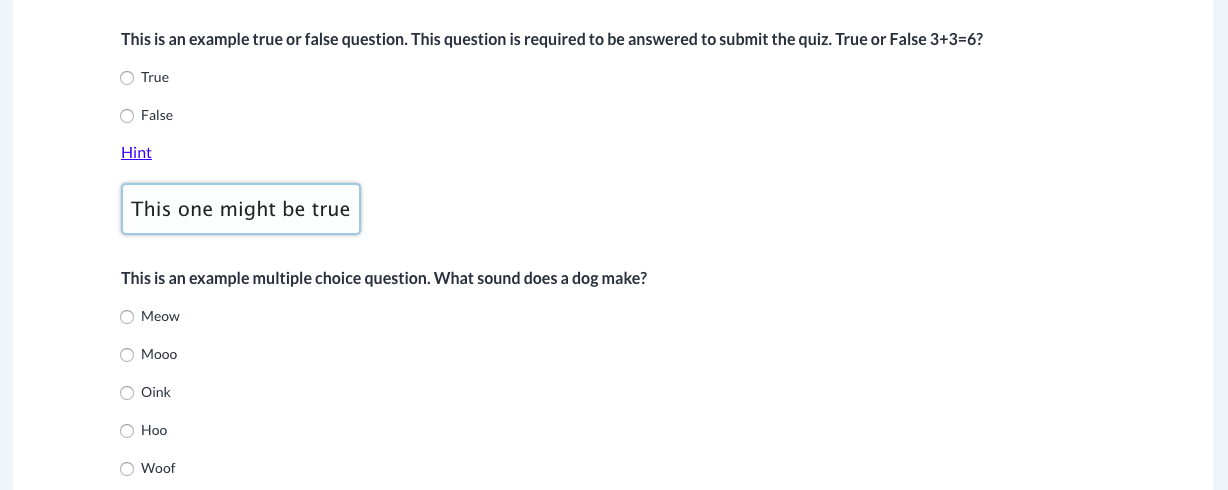
While its UI isn’t the most user-friendly, this plugin offers a ton of survey-specific functionality. You can give your users hints to help them answer certain questions and direct users to a specific landing page at the end of a quiz based on their results.
Just like with Modal Survey, you can group questions together to show users results based on those categories. You can also email your participants their results.
Additionally, you can purchase paid add-ons to unlock even more features, like email integrations, conditional logic, and analytics reports. The data you get from your survey and quiz results isn’t especially detailed or helpful, however, unless you purchase the add-ons.
Pricing: This plugin is free to use, but you can purchase different add-ons for more features, such as question logic, summary emails, and to remove ads.
9. Gravity Forms
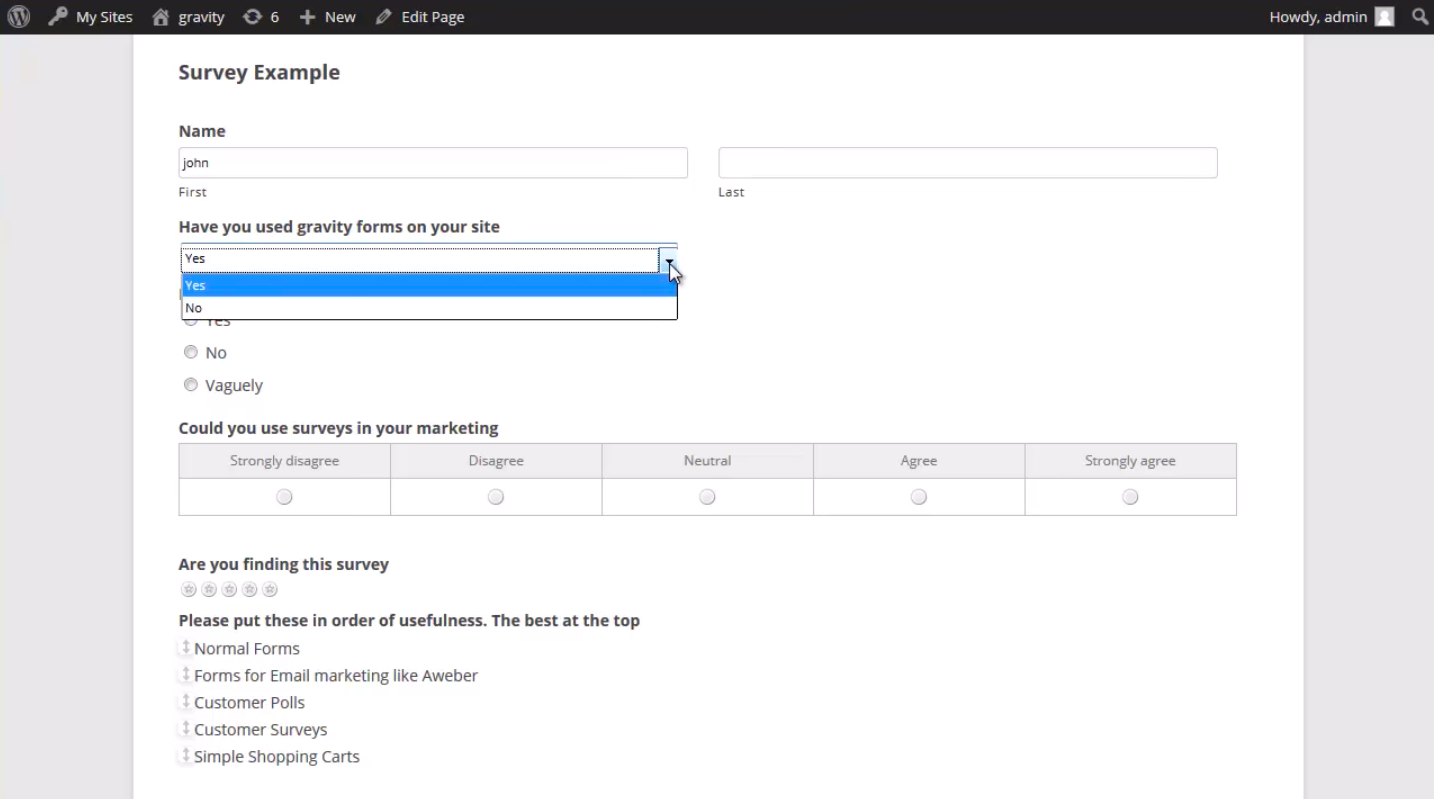
Gravity Forms is a well-known premium form builder. While you can still create a poll with just the forms, their Survey, Polls, and Quiz add-ons make it easier to manage the data collected.
You can build powerful surveys with their drag-and-drop form builder. Plus, you can use conditional logic to create branching surveys that change based on previous responses, or set limits on the number of responses. You can choose to display the survey results publicly, and close the survey after a certain date or number of responses.
Gravity Forms is very developer-friendly, so it might not be the best fit for casual users and beginners.
Pricing: The add-ons are part of the $259 Elite License, i.e. the highest priced package that Gravity Forms has to offer. You get access to all of Gravity Forms’ really great tools, but if all you’re looking for is a survey tool, this likely won’t be worth the investment.
10. WPForms
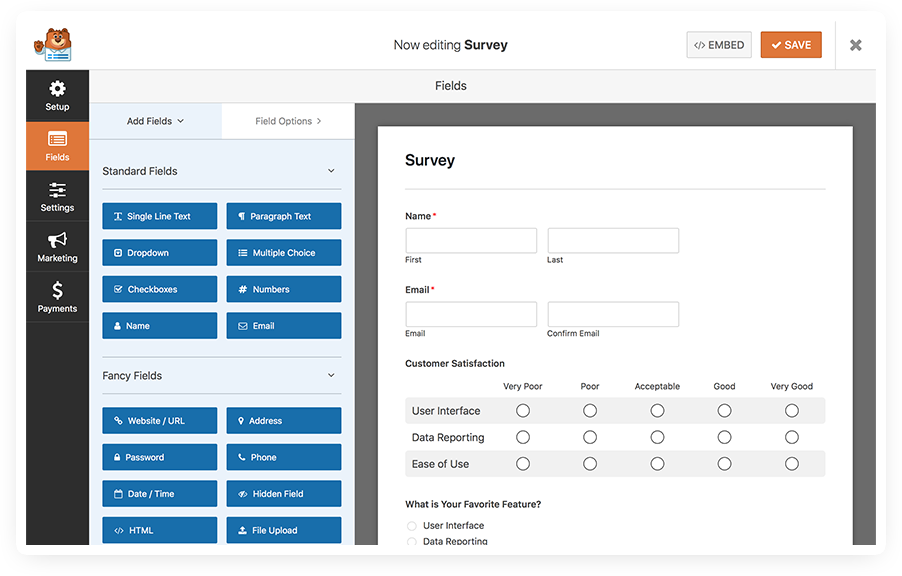
Another popular contact form builder, WPForms has a Surveys and Polls add-on that shares the same powerful features as the form builder. Additional features specific to surveys include smart conditional logic to filter and personalize your questions, real-time polls, and smart survey fields from Likert scale and star ratings to multiple choice. Plus, you can get interactive survey reports with beautiful graphs and charts.
You have the option to show survey results on your WordPress website page with a shortcode, or to redirect users to a results page at the end of the survey.
Pricing: You can start using WPForms for free, but to access the Surveys and Polls add-on, you will need to upgrade to a paid plan starting at $39.50 per year.
11. Google Forms
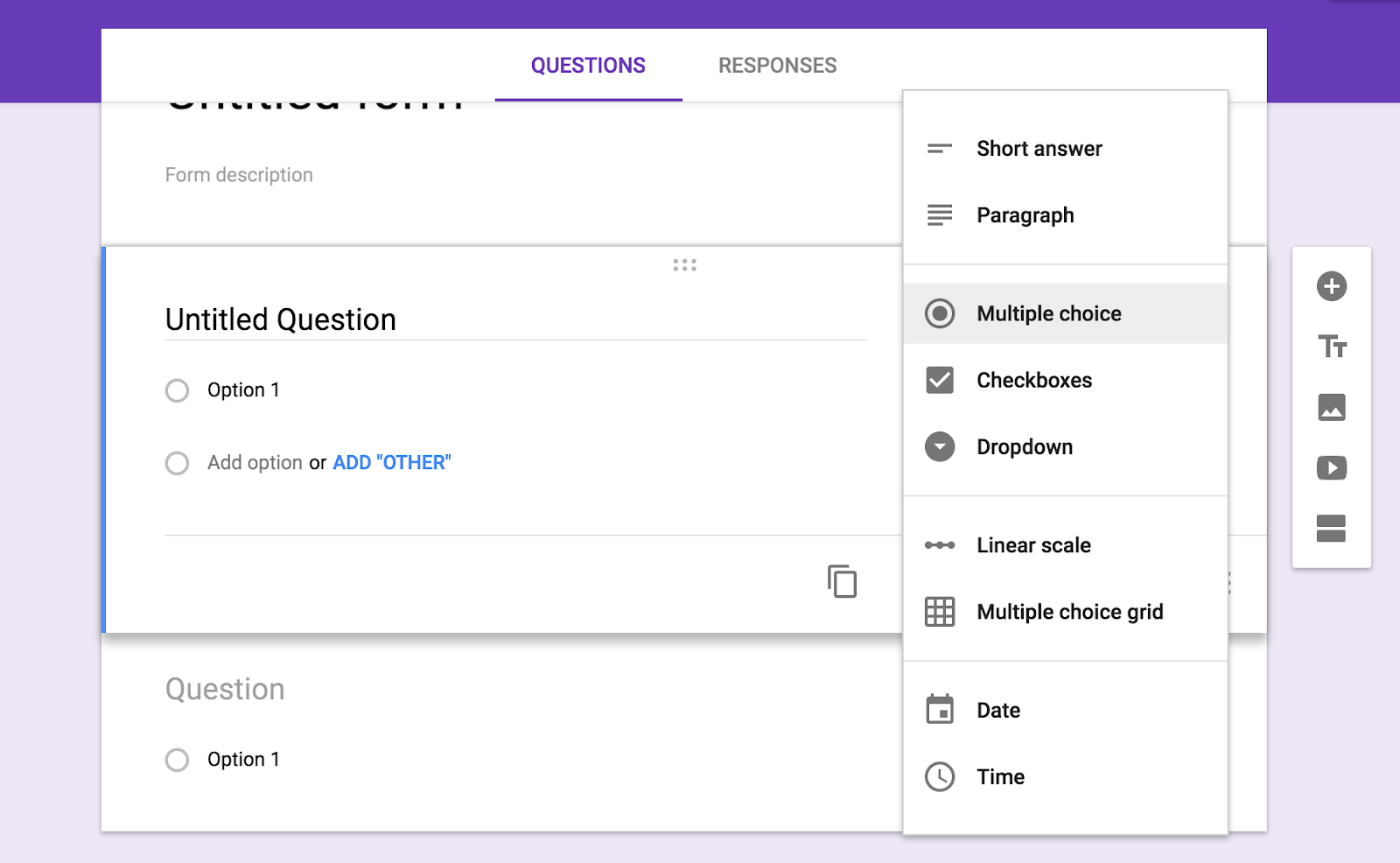
While not an actual survey plugin by itself, Google Forms is a very popular free survey tool that is still worth mentioning. You can embed Google Forms on your WordPress website, either via a third-party plugin or via the HTML embed code provided by Google.
Google Forms is very straightforward and easy to use. You can ask multiple types of questions, including open-ended and multiple choice. And because the tool is provided by Google, it can be much more reliable than most free plugins out there.
You can set up restrictions for who to accept responses from, when to close the survey, and whether or not you would like to collect email addresses.
Get access to helpful graphs to help you visualize the data collected. You can also quickly swap between aggregate and individual responses.
Pricing: Google Forms is free. Its convenience makes it a good option if you’re looking for a quick way to collect user data. However, it may not look as professional as you’d like, and you won’t be able to remove the Google branding on the thank-you page at the end of the survey.
12. Responsive Poll
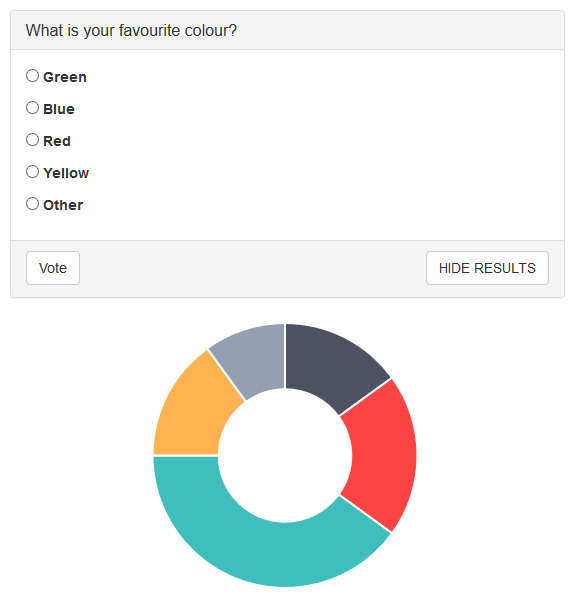
With Responsive Poll, you can take advantage of 18 templates and tons of customization options. Responsive Poll lets you choose from seven animated chart types for displaying your results — pie, bar, donut, line, radar, polar, and progress.
This plugin is a good choice if you’re looking for good quick-hit surveys or polls. However, you can only create surveys with a single question in them. You can still add multiple polls on one page, but for more complex surveys, it might not be the most optimal choice.
Pricing: You can purchase a regular license on CodeCanyon for $16.
13. WP-Polls
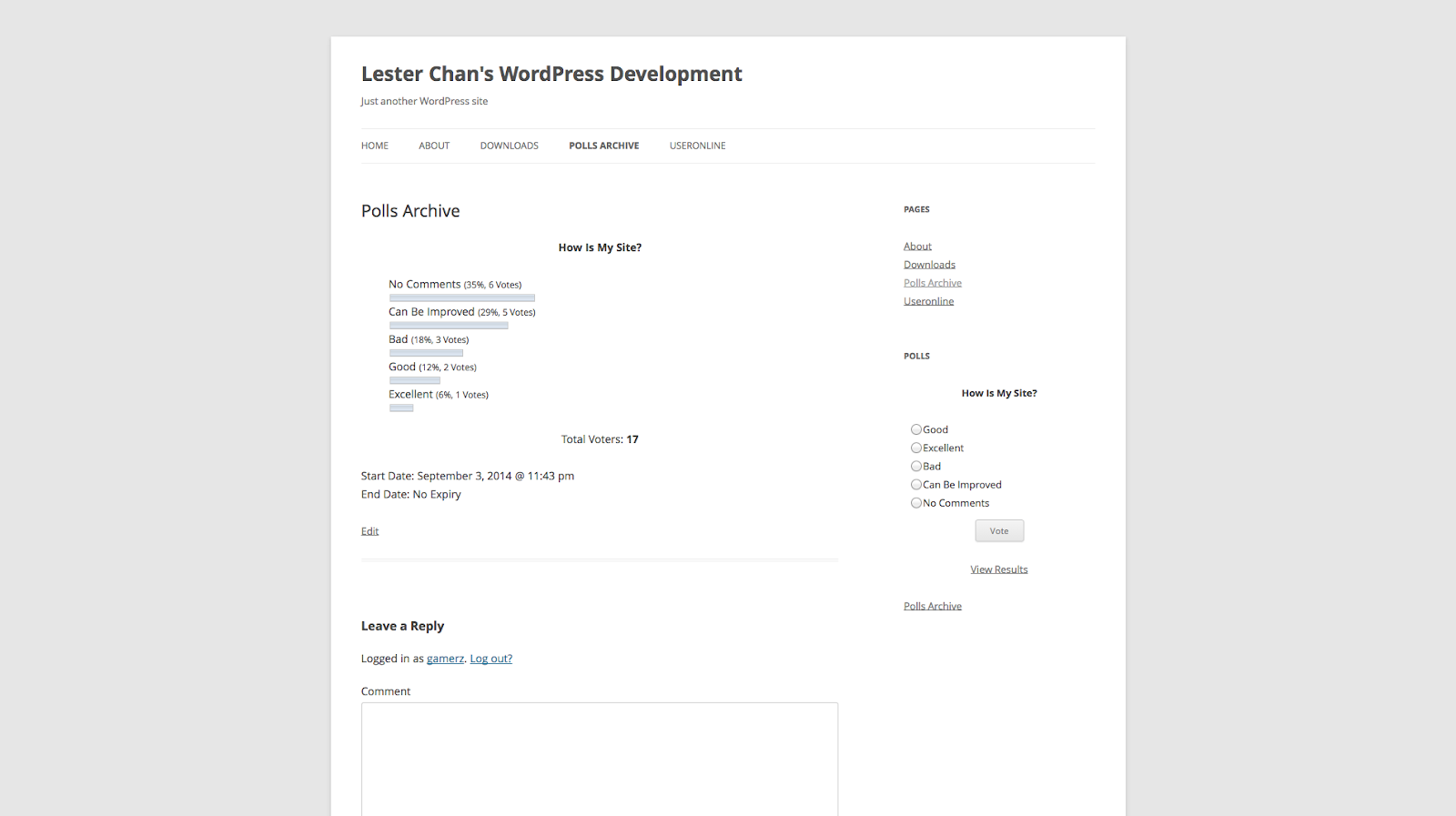
WP-Polls is a popular option for free basic polling functionalities. Your polls are easily customizable via templates and custom CSS.
You can schedule your polls and even set expiration dates on them. Your users are automatically shown the results after voting.
You can keep a log of who voted on your polls, allowing you to manually keep track of duplicates.
With WP-Polls, you can only use radio buttons and checkboxes to collect answers. This is a good option if you just want to create simple polls, but it might not be enough to create more complex surveys.
Pricing: This tool is open-source, meaning it is 100% free to use.
14. YOP Poll
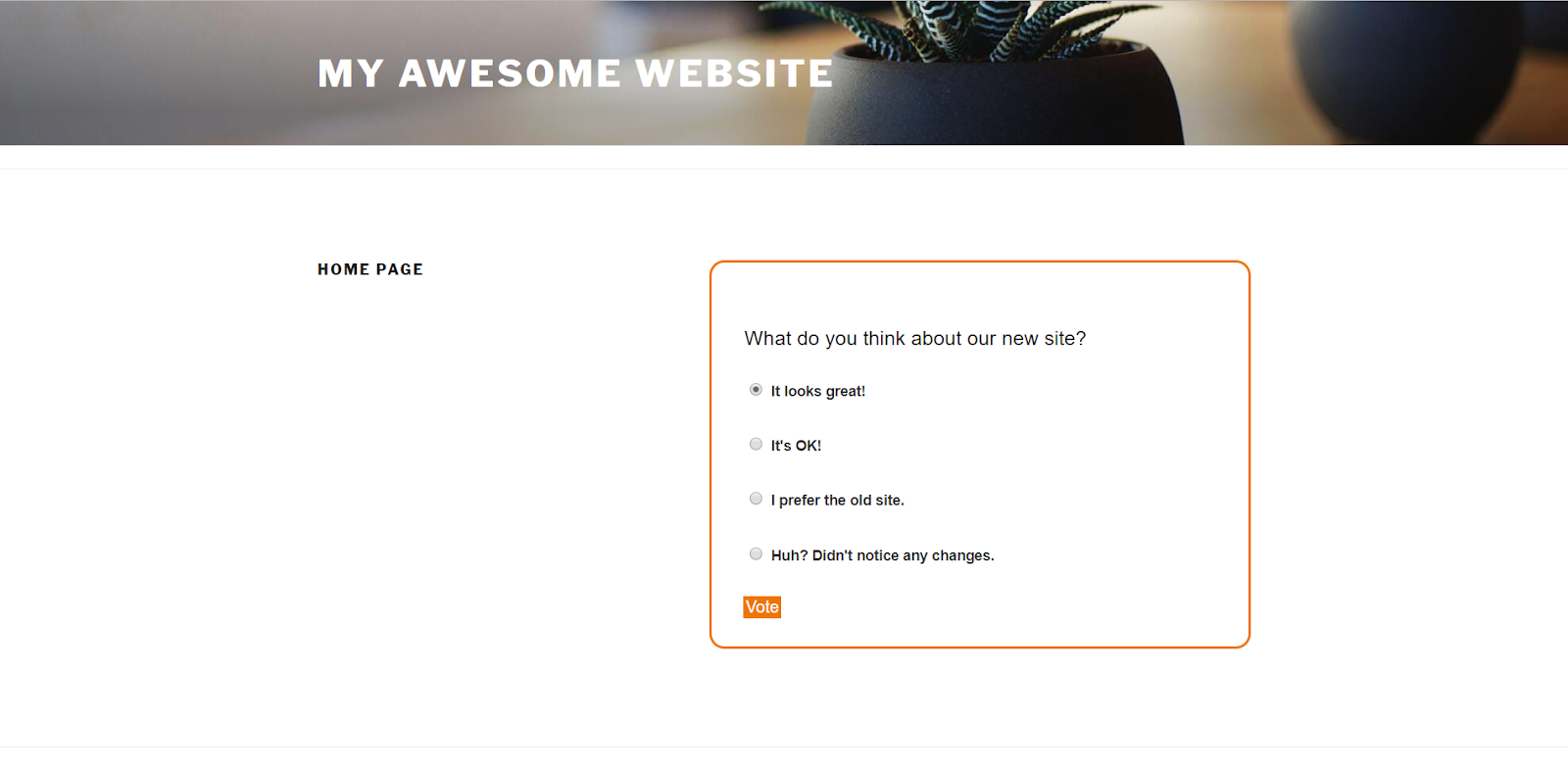
YOP Poll lets you create polls that you can manage right from your WordPress dashboard. You’ll get access to customizable templates, and can schedule polls, set limits on votes, and restrict access to certain users based on their username or IP addresses.
The main drawback of this plugin is that it doesn’t allow for open-ended questions, except for an “other” fillable field. This tool is therefore ideal for predefined options. You also don’t get visual charts or graphs to visualize your data.
Pricing: You can use YOP Poll for free.

The 67 Best Instagram Captions for Every Type of Post
If you’re anything like me, you take about four minutes choosing a filter for your Instagram photo, and about four hours deciding on a caption.
Worst of all, after much creative effort and advice from friends, I’m usually barely able to write a caption that goes beyond, “Had a fun day with friends!”
And I’m a writer — go figure.

Next time you’re contemplating a caption to go with your Instagram photo, take a look at our complete list of captions for any mood you need to evoke or audience you want to connect with.
You can incorporate many of them into an Instagram business strategy (just make sure your audience would indeed find your caption funny, clever, or the right amount of savage.)
Click one of the following links to jump to a section:
- Funny Instagram Captions
- Clever Instagram Captions
- Savage Instagram Captions
- Song Lyrics for Instagram Captions
- Business Instagram Captions
Funny Instagram Captions
- [Employee]’s favorite exercise is a cross between a lunge and a crunch … S/he calls it lunch.
- I need a six-month holiday, twice a year.
- We tried to be normal once. Worst two minutes of our lives!
- There are 16-year-olds competing at the Olympics and some of us still push on “pull” doors.
- Namast’ay in bed.
- That awkward moment when you’re wearing Nike’s and you can’t do it.
- I’m just a girl, standing in front of a salad, asking it to be a cupcake.
- What if we told you … you can eat without posting it on Instagram?
- We know the voices in our heads aren’t real, but sometimes their ideas are just too good to ignore.
- We don’t know what’s tighter: Our jeans or our company culture.
- Friday … Our second-favorite F word.
- We don’t care what people think of us. Unless they’re our customers. We definitely care what customers think of us.
- All you need is love … and investors. All you need is love and investors.
- Hi, we’re [company name]. We build amazing apps and eat amazing apps.
Clever Instagram Captions
- Patience — what you have when there are too many witnesses.
- Maybe she’s born with it, maybe it’s the Clarendon filter.
- “Life is short.” False — it’s the longest thing you do.
- Happy Sunday! There may be no excuse for laziness, but [I’m/we’re] still looking.
- Rejection is just redirection.
- Better an “oops” than a “what if.”
- You have stolen a pizza our hearts.
- The world is changed by your example, not your opinion.
- Seven billions smiles, and these are our favorite.
- Stop working hard and start working smart.
- When life gives you lemons, you make lemonade. When [company name] gives you [type of product], you make money.
- Imposter complex is just a byproduct of success.
- Life is simple. It’s just not easy.
- The best times begin at the end of your comfort zone.
- When nothing goes right, go left.
Savage Instagram Captions
- What’s a queen without her king? Historically speaking, more powerful.
- Be a little more you, and a lot less them.
- We’re an acquired taste. If you don’t like us, acquire some taste.
- Well-behaved people don’t make it into history books.
- Be sunshine mixed with a little hurricane.
- We got 99 problems, but an awesome marketing team ain’t one.
- Sometimes you just need to do a thing called “what you want.”
- You can’t do epic stuff with lame people. And we got the best in the biz.
- It’s not called being bossy, it’s called having leadership skills.
Song Lyrics for Instagram Captions
- “I’m gonna live like tomorrow doesn’t exist.” — Sia, “Chandelier”
- “I live for the nights that I can’t remember, with the people that I won’t forget.” — Drake, “Show Me a Good Time”
- “I hope you never lose your sense of wonder.” — Lee Ann Womack, “I Hope You Dance”
- “You may say I’m a dreamer, but I’m not the only one.” — John Lennon, “Imagine”
- “If you give, you begin to live.” -Dave Matthews Band
- “Outlining my findings, using life as a stencil.” — Kero One, “In All the Wrong Places”
- “Feeling good living better.” — Drake, “Over My Dead Body”
- “Say oh, got this feeling that you can’t fight, like this city is on fire tonight” — OneRepublic, “Good Life”
- “Time makes you bolder” — Fleetwood Mac, “Landslide”
- “If I fail, if I succeed, at least I’ll live as I believe” — Whitney Houston, “The Greatest Love of All”
- “The rest of the world was in black and white, but we were in screaming color.” — Taylor Swift, “Out of the Woods”
- “Lightning strikes every time she moves” — Calvin Harris, “This Is What You Came For”
- “We aren’t ever getting older” — Chainsmokers, “Closer”
- “Sing with me, sing for the years, sing for the laughter, sing for the tears” — Aerosmith, “Dream On”
Business Instagram Captions
- Good evening, [city]! We’re in town for [event] at Booth [#]. Stop by and say hi!
- “If you’re offered a seat on a rocket ship, don’t ask what seat. Just get on.” -Sheryl Sandberg, COO of Facebook
- Our [#]-person squad completed the [road race name]! And we did it all for the post-run sneaker selfie. 👟
- We got product in the pipeline … check back for an exciting announcement on [date]!
- Diversity isn’t a recruitment metric — it’s an ingredient for success. At [company], we thrive on the unique backgrounds, experiences, and perspectives of our people.
- Spot the CEO. 😉
- At [company name], our best asset is our people.
- We had a great time with our customers at [meeting/event]! @[client/partner], you guys rock.
- Thrilled to have [customer] at our office today! Come back any time. 😊
- [Company name] is off for [holiday]! We hope you all have a safe long weekend.
- Big things have small beginnings. [Company]’s HQ began right here.
- “It is better to fail in originality than to succeed in imitation.” -Herman Melville
- How many [company name] employees does it take to spell “TEAM”?
- Want to work with these awesome people, working on a lot of awesome things? We’re hiring! Click the link in our bio to see our current openings.
- Check, check, one, two … is this thing on? [Company name] is now on Instagram! Follow us to learn about our culture, product, and (awesome) people.


The Ultimate Guide to Press Release Distribution
To thrive as a small business, you need press coverage. But, unfortunately, coverage doesn’t just come naturally — you need to work for it.
Enter: The press release.
Press releases are important for increasing your brand awareness and helping your public relations (PR). But if nobody sees your release, you won’t get very far. You need to distribute it effectively to get your story picked up by national newspapers, magazines, or blogs.
In this guide to press release distribution, we’ll cover the following to help you put together a plan of action that results in coverage:
- What is press release distribution?
- Why is press release distribution important?
- How to distribute your press release
- Distribution mistakes to avoid
- Should you use distribution services?
Keep reading to learn how you can properly create, pitch, and distribute a press release for optimal brand awareness.

What is Press Release Distribution?
Before we dive any deeper, let’s iron-out exactly what press release distribution is.
Here’s a fancy definition: “Press release distribution is the process of circulating or seeding out your press release to journalists and members of the press.”
The purpose of distributing a press release is to land coverage in media publications such as newspapers, radio, TV news bulletins, podcasts, or blogs. That way, you’re positioning your brand in front of a wider audience.
Why Bother Distributing a Press Release?
People aren’t going to see your press release if you don’t distribute it.
And if it’s not seen, people won’t know about your business — which defeats the entire purpose behind creating your press release.
Gaining press coverage helps to get your business or brand name into the public forum. That’s helpful for building awareness of your brand — especially when 44% of journalists consider press releases to be the most trustworthy source of brand-related information.
Distributing a press release also has these benefits:
1. Press releases can boost your SEO.
Over three billion Google searches are made every day.
By implementing SEO tactics into your overall marketing strategy, you’re more likely to reach the top spots of users’ search queries, which will help potential customers and clients find you when they’re searching online for information related to your company, industry, product, or service.
Gaining links to your site from others is a huge ranking factor for SEO, as explained in a study by Backlinko:
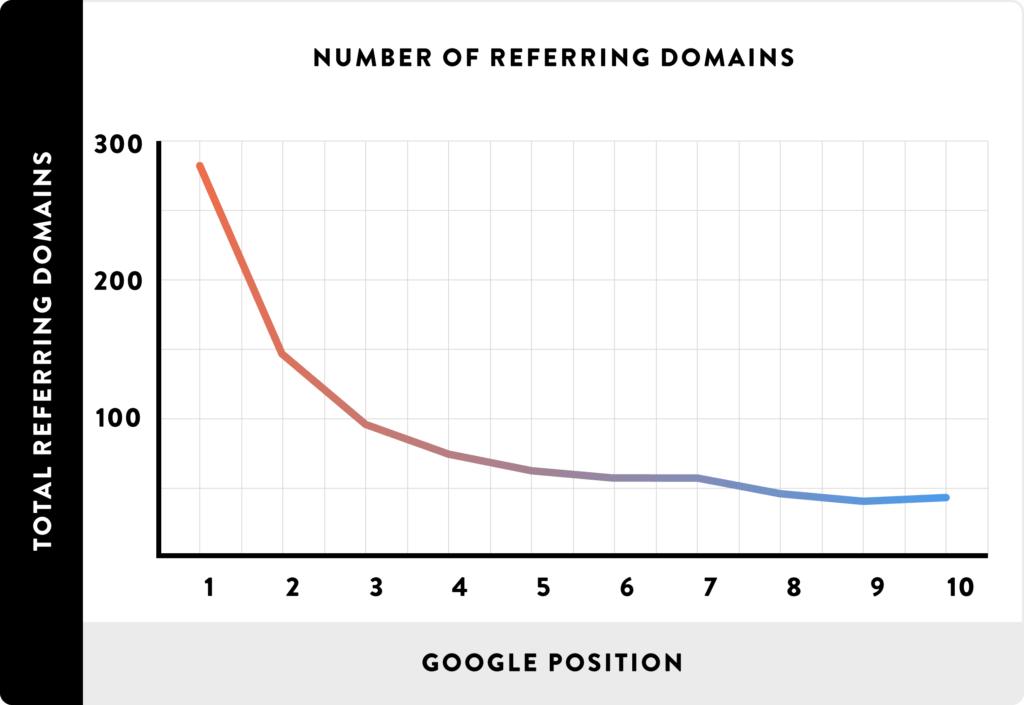
Distributing press releases can help you land coverage on huge publications. Additionally, there’s a chance those websites will link to yours, which can help to boost your own search engine visibility.
But what happens if you land awesome coverage without a backlink?
Don’t panic. Both Google and Bing have suggested that positive brand mentions may play a role in how they rank your site, meaning positive PR coverage can aid your SEO efforts even without a link.
2. A press release can drive local foot traffic to your store.
If your business is a brick-and-mortar shop, press release distributions can help to get people through the door.
Whether you’re running an event or simply launching an eye-catching sale, measuring foot traffic into your store after distributing a press release is a simple way to gauge how successful your release has been.
3. A press release can generate more sales.
If you’re launching a new product or an exclusive line, a targeted press release can have a significant impact on your bottom line. Why? Because it help drum up interest and make revenue from your stock, especially if the offer sets you apart from competitors.
Busy shopping days can be a great way to get your products in front of potential customers.
For instance, if you’re offering discounts on Black Friday or Cyber Monday, why not reach out to retail journalists to highlight your offers?
PR Agency One landed 52 pieces of coverage for their client with Black Friday press releases — all of which helped put them in front of consumers who were ready to buy.
A Step-by-Step Guide to Distributing a Press Release
You know how important PR is, and you’ve crafted a succinct, yet powerful, story. All that’s left to do is share it with the world.
But journalists have to write up to seven stories per day — so how do you ensure your press release is one of those stories? And just as importantly, how can you make your distribution email stand out in a crowded inbox?
Follow this five-step guide to learn how.
1. Find journalists who might be interested in your press release.
When you want to share some news, I’ll bet you’re tempted to tell as many people as possible. You want everyone to hear about it, right?
However, that’s not always the right thing to do — because not everyone is interested in your story.
(Brutal, but honest.)
Along with crafting a press release that journalists are interested in, you’ll need to be super-specific with the people to whom you send your pitches.
You can do that by searching for journalists who’ve already written about your topic or industry.
For instance, let’s say you run a car parts business. You’ve conducted some research around potholes, gathered some interesting data, and turned it into a killer press release. But mailing every journalist under the sun is probably going to be a waste of time.
Instead, it’s worth seeking out journalists who’ve covered similar topics before.
To do this, fire up Google, type in your topic (potholes), and navigate to the News tab:
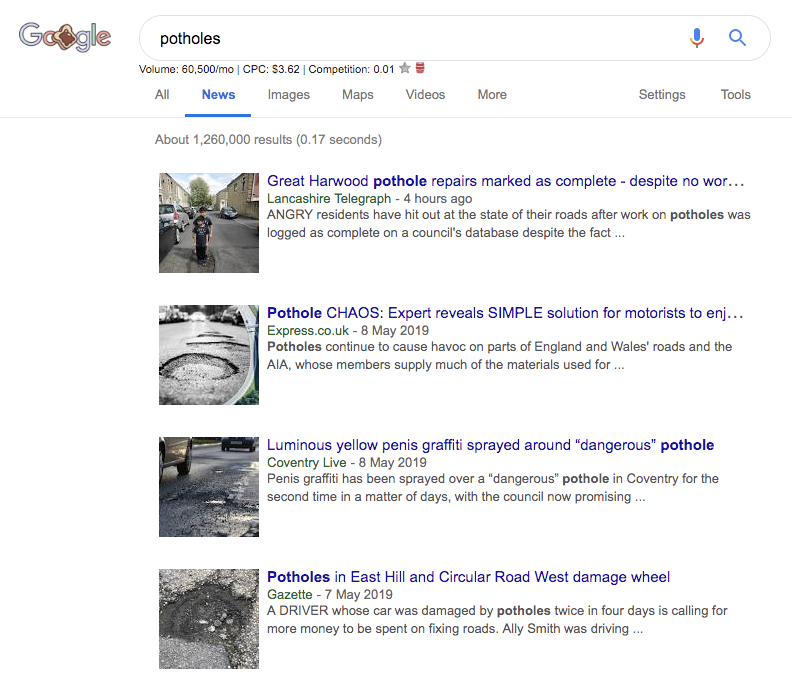
As you can see, there are plenty of recent articles on this topic, meaning journalists are more than likely interested enough to cover it.
Next, read some of the articles on Google News and make a note of the journalists’ names.
A simple spreadsheet with the journalist’s name and the publication they write for is a good way to keep a log of your distribution plan:

If you have the budget, you can also use a media database such as Cision or Muckrack to find relevant journalists and reporters.
This method is much more likely to get you responses because you’re only pitching the release to journalists who’ve demonstrated an interest in your topic already.
2. Get the journalists’ contact details.
Next, it’s time to find some contact information for the targets on your press release distribution list.
This could be as simple as clicking on an author’s bio on their publication’s site.

… and making a note of their email address:

But, just like anything else in the world of PR, it’s not always that easy.
You’ll often have to do a little digging to find the contact details — starting with a simple Google search such as “[journalist’s name + email]”.
If that doesn’t do the trick, you could also use a media database like Muckrack:

Don’t have the budget for paid databases? Harness the power of social media.
LinkedIn is an excellent place to discover contact information for professional contacts (AKA, your journalists). Simply search for “journalist” and filter the results by selecting your target publication as “company”, then plug their name into Hunter to find their email address:
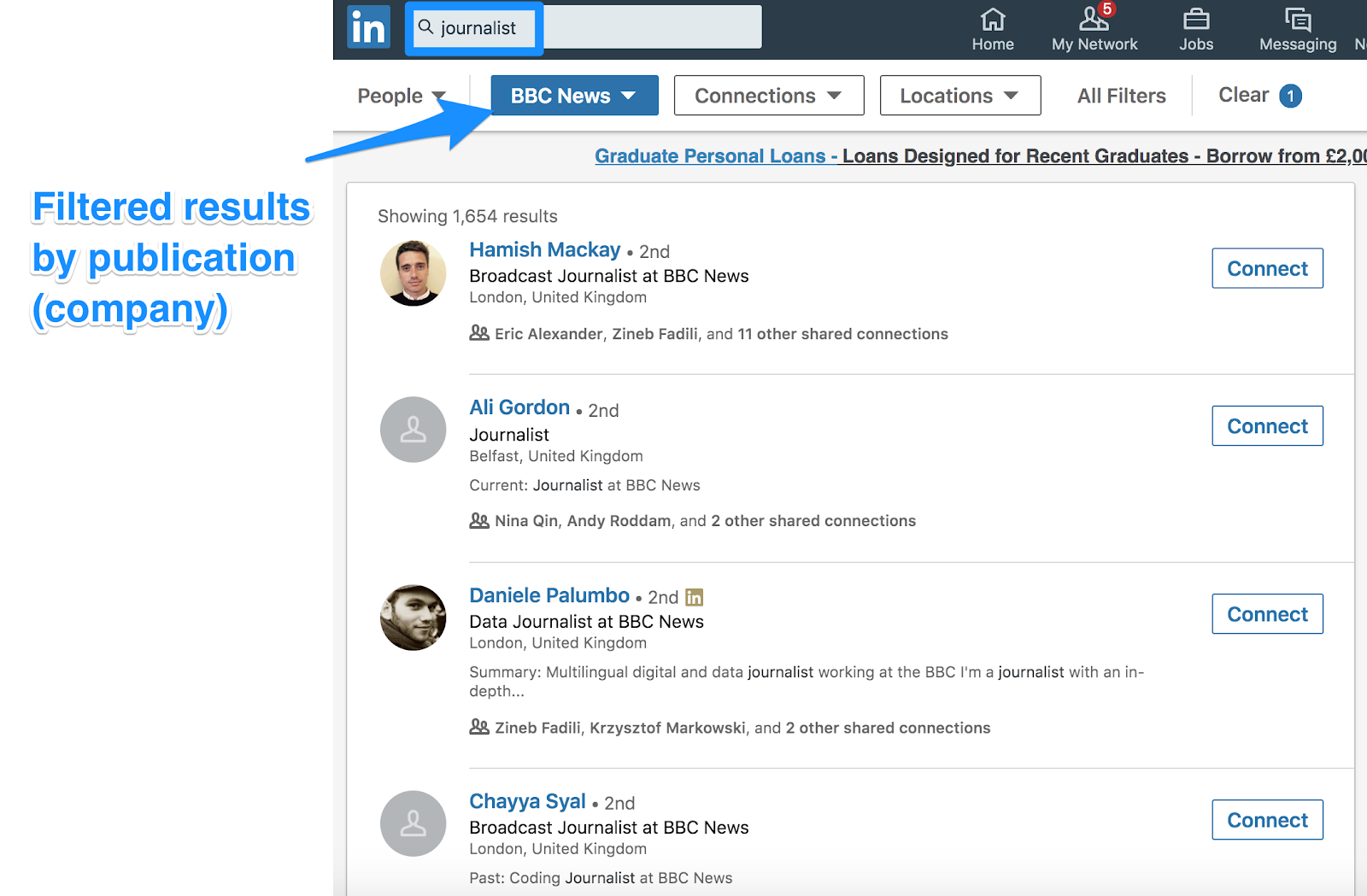
Twitter can also be a quick and easy way to get in touch with your target journalists, too — especially considering 46% of journalists are open to receiving pitches via Twitter.
3. Craft a killer pitch.
Email is the most effective way to send your press release quickly.
Don’t believe me? Cision’s 2017 State of the Media report found an overwhelming majority of journalists prefer to receive press releases via email:
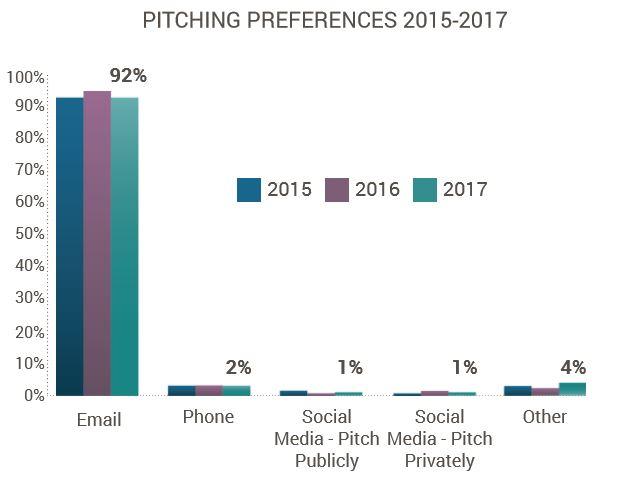
However, there’s another obstacle you’ll need to overcome here — many journalists receive up to 200 pitches a day.
There are two factors you’ll want to consider when crafting a pitch. First — keep it brief.
Don’t waste the journalist’s time with a long-winded, self-absorbed introduction to yourself or your business. They probably don’t care.
Instead, get straight into the purpose of your email: The story, and why they should cover it in their publication.
Journalists are time-poor, so they’ll appreciate a nice, succinct message that sells your story in a few words—like this:
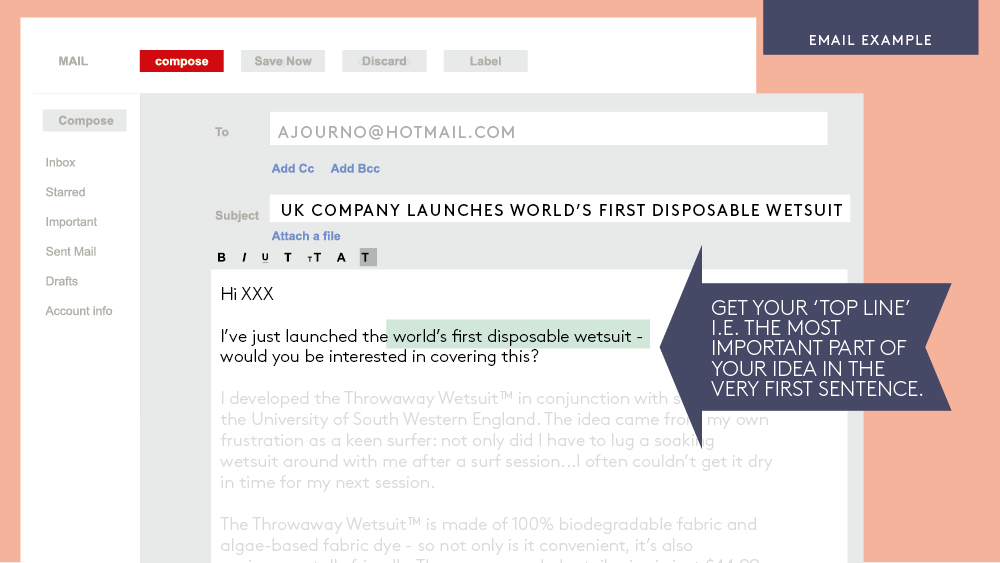
Image courtesy of Janet Murray.
As you can see in the example above, the entire story is sold in the first sentence, with a direct question asking if the journalist is interested — rather than just assuming so.
Follow this up with a couple more sentences to give the journalist some additional information about your story, before adding a line spacer and pasting your full press release.
Note: Avoid adding your press releases as attachments. Journalists don’t like opening attachments in fear of viruses or malware, so eliminate that problem by pasting the body of your press release below your pitch.
Second, it’s critical you personalize your pitch.
Did you know that personalized emails are 26% more likely to be opened?
Bear that in mind when you’re pitching news stories, and show some interest in the journalist’s previous work by indicating that you know they’re a good fit based on the topics they cover.
Try to build a relationship with the journalists first, rather than hitting them with a release and expecting instant coverage. Almost 15% of journalists consider this very important:
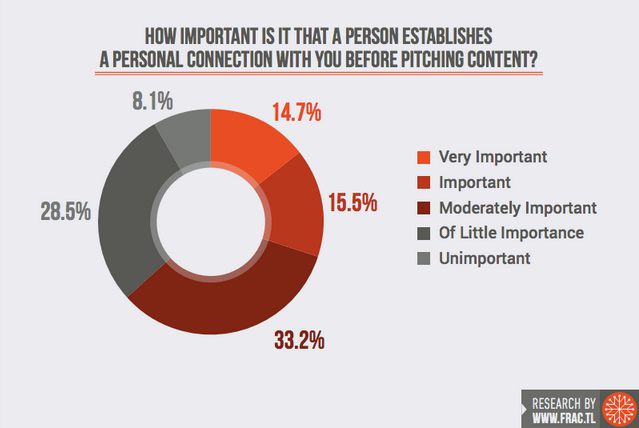
Image courtesy of Marketing Land.
Sometimes, it’s worth playing the long game by getting to know your target ahead of your pitch. Engage with them on LinkedIn, respond to their tweets, and generally work yourself into their notifications — and their radar.
3. Make your subject line irresistible.
According to research by Fractl, 85% of publishers decide whether to open a pitch email based on the subject line alone.
So, how can you make sure yours gets opened? Try these tips:
- Keep it short and sweet: 75% of publishers prefer subject lines with 10 or fewer words.
- Ensure it’s unique: A powerful subject line should be disruptive, innovative, or offer a human interest angle.
- Make it super-specific: Over half of journalists want descriptive subject lines that are tailored to their previously-covered topics.
- Provide exclusivity: If you’ve got some unique data or research, shout about it! Exclusivity can help to get a journalist’s eyes on your press release.
… And one thing to avoid? Clickbait. It’s really that simple.
4. Send your press release pitch (at the right time).
Press release? Check. Pitch email? Check. Contact details? Check.
… But that doesn’t mean you’re ready to distribute your press release.
You’ll need to think about the day (and time) you hit the “send” button because certain days and times have better success rates than others.
For instance, 61% of journalists prefer to receive press releases in the morning. That’s almost two thirds, so it’s probably worth getting your pitch out early to have the best chance of success.
However, remember that journalists have an average of 300 emails waiting for them in the morning. It might be best to wait an hour or so, and send your release mid-morning for a better chance of your pitch standing out in their inbox.
Additionally, it’s important to consider the day of the week. While modern-day businesses are often active seven days a week, there’s still a traditional lull in pick-up rates when it comes to press release distribution.
So, consider the day you send your release — it might land more coverage if you pitch it midweek, as opposed to sending first thing Monday morning.
According to an analysis of over 100,000 press releases by Ragan, Tuesdays and Wednesdays are the best days to distribute your story. And a further study by Prowly recommends sending on a Thursday, with data suggesting over 26% of press release emails are opened by journalists on this day:
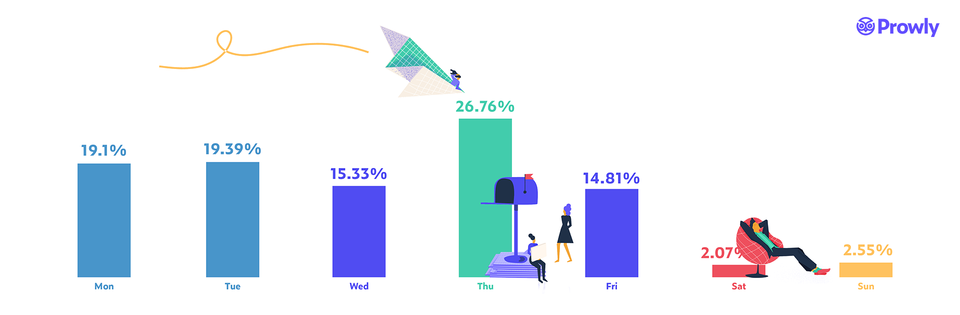
Image courtesy of Prowly.
Both studies indicate that Mondays and Fridays are not as effective, and you should definitely avoid sending your story over the weekend.
However, there’s no one-size-fits-all rule — which is why you should test a few different days and times and see what works best for your industry.
Are you pitching a time-sensitive press release?
You can still send it ahead of time. Just make sure you embargo the information in your release until it’s ready to become public knowledge. You can do this by adding “Embargoed; not to be released before DATE” to the top of your distribution email.
5. Follow-up on your release.
An age-old question: Should you follow up on your press release?
It depends on who you’re asking, but generally, the consensus seems evenly split. Some people believe following up to be a big no-no, while others indicate that it can be fruitful.
If you have a release you’re particularly proud of, it won’t hurt to follow up if you’re struggling to land coverage — provided you’re tactful.
Don’t just spam the journalist’s inbox with the same press release and the same pitch, however. That can get annoying, and ruin your chances of getting your story picked up.
Instead, try slightly tweaking the angle of your pitch. PR expert Carrie Morgan recommends treating a follow-up email as “a fresh pitch transitioning MY news into THEIR NEWS.”
You could also try giving the journalist — however, only 23% of journalists welcome being contacted by phone, so if your target is one of the other three quarters, you may find yourself hearing hundreds of answering machines.
Either way, it could be worth following up, particularly if you’re confident your press release is a newsworthy piece that deserves coverage.
Common Press Release Distribution Mistakes
All set to send your next press release? Hang on a second.
Before you let fly and distribute your story, are you about to make any fatal errors? The last thing you want is to annoy the journalists on your target list. It might leave you with no coverage at all.
Here are some common mistakes people make, and how you can avoid them when you distribute your press release.
1. Your press release is too long.
Your story needs to be short and succinct — especially when journalists spend less than a minute reading a press release.
The easiest way to get your pitch read is to cut the fluff. Ditch anything that a journalist doesn’t need to read, or any sentences that won’t add value to a reader if your release is published in its current form.
Your story should be brief and to the point, but with enough detail to give the journalist the full story.
Consider taking it a step further and breakdown the “meat” of your press release into a handful of easy-to-digest bullet points. The same AdWeek survey says that 53% of journalists prefer to receive the facts in this format.
Remember — every sentence counts.
2. You’re targeting the wrong people or publications.
If you work for a small business looking to get some coverage, you’re more than likely going to get the most success from contacting local publications.
Don’t bother sending your press release to a national or international news outlet — it’s incredibly rare that a local story is important enough to make national news.
You should also double-check that your target journalists are a good fit. Many tend to specialize in one or two interests — emailing a sports reporter about a press release related to health isn’t likely to result in coverage.
Whatever your story, make sure the journalists and publications on your press release distribution list are relevant to your industry and audience.
3. Your story isn’t newsworthy enough.
Before hitting send and distributing your release, take a moment and ask yourself: “Is this story actually newsworthy?”
If your release is too self-promotional, you’ll probably find that journalists won’t want to turn it into a story. Their job isn’t to give you free publicity — they want to share stories that will entertain their audiences.
To avoid your release being sent straight to the trash, ensure it’s got a relevant angle, and includes solid information, statistics, and data.
Any accompanying quotes should bring the story to life, rather than over-selling your own company.
4. You didn’t include your contact info.
Imagine crafting that story, pitching it, and finding a reporter who’s interested and wants to contact you for a quote. But the journalist hits a dead end and is unable to contact you.
Unfortunately, if you don’t include your contact information on the press release, you risk losing out on the chance for increased exposure. The journalist shouldn’t have to go digging to find out how to contact you.
You need to make it easy for journalists to contact you by leaving a phone number and email address in your press release distribution email — ideally ones that are checked and answered frequently.
Should You Use Press Release Distribution Services?
Distributing a press release sounds time-consuming, doesn’t it? If only there was a way to get yours seeded out quickly, at scale.
Fortunately, there is.
If time is tight (and if you’re a small business owner, it usually is), a press release distribution service is your friend. These services allow you to send out your release to relevant journalists, without having to do any of the manual work yourself.
Although the cost of press release distribution might seem off-putting, just remember that time is money. And by letting the experts distribute your news story, you can spend more of your own time doing the things that make a difference to your bottom line.
So, if you fancy taking distribution off your plate, check out these five services that will gladly take the job off your hands.
1. PR Fire
Starting at just £50 (approx. $65 USD), PR Fire syndicates your release to journalists and media personnel in your chosen categories — all within four hours after uploading your content.
Additionally, you’ll get a report a couple of weeks after your campaign to show you how successful it was.
PR Fire also offers the option to have your press release re-written by a professional journalist for an extra £50:
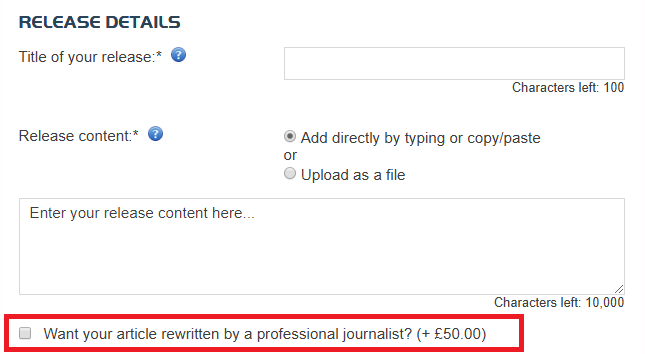
Image courtesy of PR Fire.
Plus, you can have your story promoted on the popular forum Reddit — a great way to get your brand (and your press release) in front of an engaged online community.
PR Fire has landed its customers press coverage in a range of top tier publications, including BuzzFeed, Metro, The Huffington Post, and The Times, so it’s definitely worth checking out.
2. PR Web
PR Web is a tool owned by Cision. Their press release distribution service allows you to upload your press release (along with rich media like images and videos), then distribute the story to journalists and publications in your selected categories.
PR Web also provides you with a comprehensive analytics dashboard, so you can monitor the impact of your campaign and calculate important metrics such as ROI.
The basic option, at a cost of $99, allows you to publish your release on PRWeb.com.
Additionally, there are advanced options that may be worth a try if you have the budget. These range in price from $189 to $389, and include further distribution to media outlets, targeted journalists, and industry influencers:
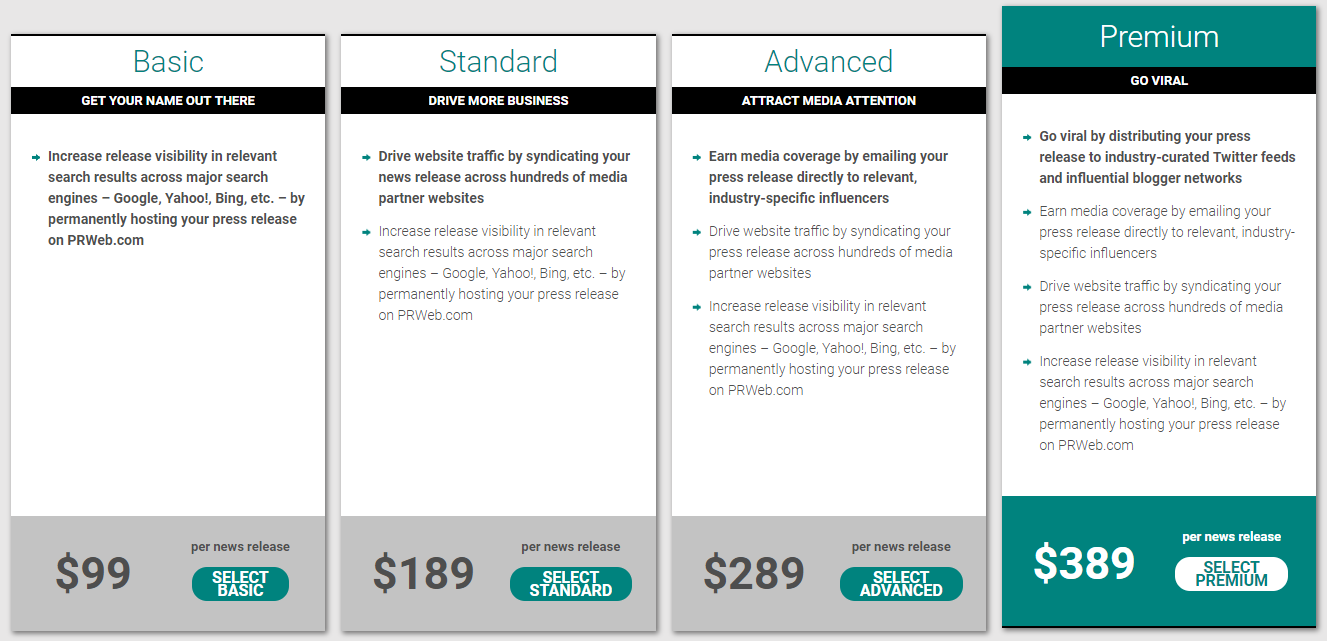
Image courtesy of PR Web.
3. Response Source Press Release Wire
A popular service for PR professionals, Response Source offers a range of public relations tools, including media databases. And you can also release your news via the Response Source Press Release Wire.
There are several pricing options. If you’re an ad hoc user, you can pay £85 (approx. $110 USD) each time. Or, if you distribute press releases often, consider one of their package options.
With over 20 years of experience, Response Source has built up a thriving network of journalists and publications, so you can benefit from having your news distributed by email to useful contacts.
You’ll also get your own “newsroom”, along with access to analytics such as the number of views your press release received, and to how many recipients it was emailed.
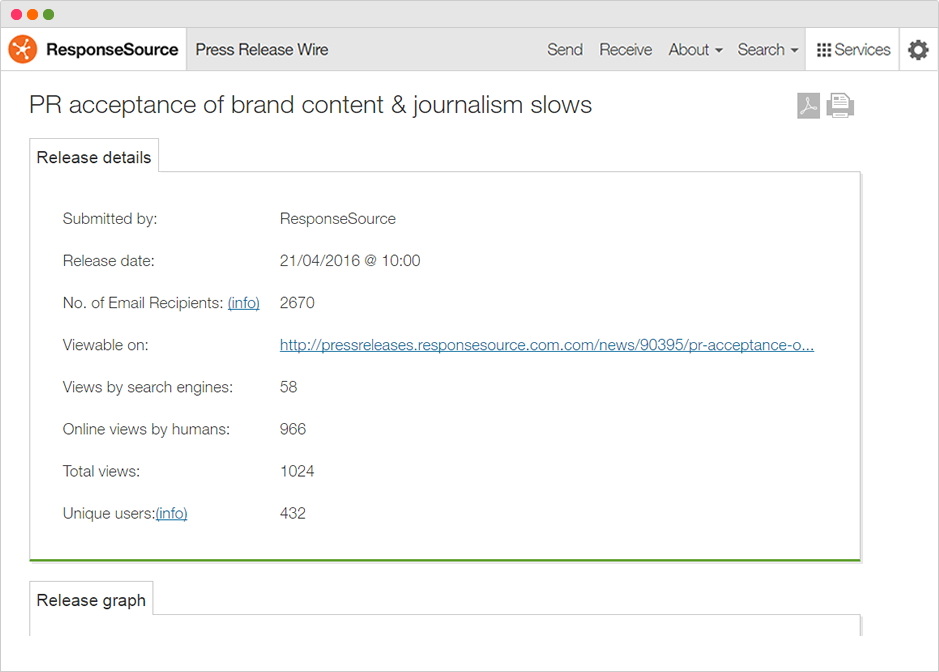
Image courtesy of Response Source.
4. Presswire
Presswire has a live global database, allowing you to send your press release directly to the journalists who are most likely to pick up your story.
Worldwide distribution starts at $400 (or $250 if you only want the story distributed to journalists in the USA), but there are several add-ons you can include to boost your reach.
Key to Presswire’s offering is its advanced analytics platform — a system which tracks each recipient of your release, providing insight on:
- Who opened your press release
- Whether your release was forwarded
- How many times it was read
- How long people spent reading it
These insights can be helpful in allowing you to refine your approach for future press releases.
5. 24-7 Press Release
Using a cloud-based platform, 24-7 Press Release distributes your news to traditional and digital outlets with a user-friendly interface.
The basic “Visibility Boost” package is an ideal starting point for small business owners. Costing just $49, your release will be sent to over 50 premium news sites and published on the service’s RSS feed.
You’ll also receive a report that tells you if your story was picked up.
One thing to note is that the basic option has a two-day turnaround, so if your news is time-sensitive, you’ll need to be prepared in advance. The more advanced packages come with next-day turnaround, which is helpful if you’re in a rush.
Remember to Keep the Relationship Alive
When you need to create a press release, follow the distribution steps in this guide to boost your chances of landing coverage.
But remember — not every press release will get picked up and turned into a news story, so don’t get too disheartened if it takes a while to gain some traction.
Keep tweaking and refining your approach until you see success. Your first piece of coverage could well be the domino that starts the run. A story picked up by one news outlet can soon snowball from publication to publication.
Plus, if your story does get picked up, don’t forget to thank the journalist. It can facilitate a relationship with the journalist which you can then nurture, and might lead to easier coverage down the line.
Ultimately, you can never have too much good press!

The 24 Best Motivational Speeches Our Employees Have Ever Heard
It was halftime during one of my 7th-grade football games. And we were losing 14 – 0. With our knees planted in the grass, my team was quietly huddled, drenched in sweat and defeat. We all knew the game was over.
That’s when our assistant coach bursted through our circle and shattered our pity party, delivering one of the best motivational speeches I’ve heard to this day.
I can’t directly quote him because he said some things that are inappropriate for a blog post (and, in hindsight, probably for a bunch of 13-year-olds too). The point is, he harnessed the power of words to rejuvenate a physically and emotionally drained team. And we came back clawing to win the game.

Just like in sports, being motivated at work is crucial for your performance. This rings especially true when you have a looming deadline, an important meeting, or colleagues or customers depending on your performance.
Think about the last time felt generally unmotivated. What brought you out of that feeling? Sometimes all it takes is a good night’s sleep or seeing the fruits of your labor to fire you up. Still other times, you might listen to someone say something that resonates with you — that alters the way you’ve been looking at a particular task or problem.
Motivational speeches and speakers can come in all different forms, but this is the one thing they have in common — resonance. They hit the right listener at just the right time and in just the right way. Who knows, maybe this article is doing a bit of that for you right now … (I can dream, can’t I?)
To help you stay motivated, no matter what your job throws at you, we decided to compile 24 of the best motivational speeches from business, sports, entertainment, and more. If you want to get fired up for a project, watch these videos.
Trust me, I was wiping my eyes after I saw them. And while the messages vary from speech to speech, they will put you in the optimal frame of mind for tackling and crushing your next big challenge.
(Disclaimer: Some speeches — *cough* Al Pacino *cough* — may contain NSFW language.)
The Best Motivational Speeches of All Time
1. J.K. Rowling: “The Fringe Benefits of Failure, and the Importance of Imagination” (2008)
Theme of Speech: Failure
In J.K. Rowling’s 2008 Harvard commencement speech, the Harry Potter author explored how two phenomena — failure and imagination — can be crucial to success. While failure can help you understand where your true passion lies, and where you should focus your energy moving forward, imagination is what will allow you to empathize with other people so you can use your influence to do good.
We do not need magic to change the world, we carry all the power we need inside ourselves already: we have the power to imagine better.”
2. David Foster Wallace: “This Is Water” (2005)
Theme of Speech: Life and Career
From the opening minutes of David Foster Wallace’s 2005 Kenyon College commencement speech, in which he questions commencement speech conventions, it’s clear that Wallace has some serious wisdom to share. The crux of his speech: Many of us are oblivious to our own close-mindedness. We picture ourselves as the centers of our own, individual universes, instead of seeing the bigger, more interconnected picture.
If you’re automatically sure that you know what reality is and who and what is really important, if you want to operate on your default setting, then you, like me, probably won’t consider possibilities that aren’t annoying and miserable. But if you’ve really learned how to think, how to pay attention, then you’ll know you have other options. It will actually be within your power to experience a crowded, hot, slow, consumer hell-type situation as not only meaningful, but sacred — on fire with the same force that lit the stars: love, fellowship, the mystical oneness of all things deep down.”
3. Simon Sinek: Live2Lead 2016
Theme of Speech: Leadership
Simon Sinek is an author and public speaker, renowned for his talks about leadership in the context of business. In the talk above, he makes a humbling but ultimately inspiring claim: Today’s organizational leaders don’t know what game they’re in. They tend to take credit, whereas they should be taking responsibility. They tend to obsess over the competing product, whereas they should obsess over their own. But, once you accept this onus as a leader, the possibilities Simon lays out for business growth and employee success are sure to fire you up.
The infinite player isn’t playing to be number one … they’re playing to outlast the competition.
4. Fearless Motivation: “It’s Not Easy, But It’s Worth It” (2018)
Theme of Speech: Perseverance
Fearless Motivation is primarily a musical artist, but its library of inspirational messages is hard to ignore lately. The group’s most popular speech is the video above, and it preaches a powerful lesson about staying positive when things all seem to be negative. The final line is as powerful as the quote from the speech below — “Keep going. Your future self is begging you.”
It’s easy to be positive when everything is working out. It’s much harder, much much harder when nothing is working out. But that’s when we need it the most … Everything is worth the prize.”
5. Jim Carrey: Commencement Speech at Maharishi University of Management (2014)
Theme of Speech: Taking Risks
Jim Carrey might make a living as the goofiest comedian around, but in 2014, he combined classic Carrey humor with unforgettable insight at Maharishi University of Management’s graduation ceremony. Jim Carrey opened his speech dishing punchlines, but he eventually opened up about his upbringing and the role fear plays in our lives. You can actually hear the amazement in the students’ reactions in the video above.
“I learned many great lessons from my father — not the least of which is that you can fail at what you don’t want, so you might as well take a chance on doing what you love.”
6. Brené Brown: “The Power of Vulnerability” (2013)
Theme of Speech: Failure
The video above is an animated excerpt from researcher Brené Brown’s speech, “The Power of Vulnerability.” In the speech, Brown explores how our fear of not being good enough (among other fears) drives us to shield ourselves from our own vulnerabilities. The alternative to wearing this emotional suit of armor: Embrace vulnerability through empathizing with others.
Empathy is a choice, and it’s a vulnerable choice. Because in order to connect with you, I have to connect with something in myself that knows that feeling. “
7. Steve Jobs: “How to Live Before You Die” (2005)
Theme of Speech: Life and Career
Considering the YouTube video of Steve Jobs’ 2005 Stanford commencement speech has 24 million views (not counting the 10 million+ additional views from duplicate uploads), it’s likely that you’ve seen this one already. In the speech, Jobs plays on two themes: connecting the dots (anecdote: how taking a calligraphy class helped inspire the design of the Mac) and love & loss (anecdote: how getting fired from Apple helped inspire his greatest innovations). Perhaps the most memorable part his speech comes at the end, when he quotes the (now-famous) lines from the final issue of his favorite publication, The Whole Earth Catalog:
Stay hungry. Stay foolish.”
8. Ellen DeGeneres: Tulane University Commencement Speech (2009)
Theme of Speech: Life and Career
Ellen’s speech, as you might expect, has its humorous moments. But it also explores some of the very personal and tragic episodes in her life that helped push her into comedy in the first place. Two key themes of DeGeneres’speech: overcoming adversity and being true to yourself. ForDeGeneres, that meant pushing onward with her career after her sitcom was canceled in response to her publicly coming out as gay.
Really, when I look back on it, I wouldn’t change a thing. I mean, it was so important for me to lose everything because I found out what the most important thing is … to be true to yourself. Ultimately, that’s what’s gotten me to this place. I don’t live in fear. I’m free. I have no secrets and I know I’ll always be OK, because no matter what, I know who I am.”
9. Sheryl Sandberg: Harvard Business School Class Day Speech (2012)
Theme of Speech: Life and Career
In her speech to the HBS class of 2012, Lean In author and tech executive Sheryl Sandberg deconstructed the idea of the “career as a ladder.” For Sandberg, a career is about finding opportunities where you can make an impact, not about chasing titles and planning out a meticulous path. “If I had mapped out my career when I was sitting where you are, I would have missed my career,” she commented. What’s more, Sandberg eschews the traditional wisdom of keeping emotions out of the workplace. For Sandberg, you need to care not only about what you’re working on, but also who you’re working with.
“If you want to win hearts and minds, you have to lead with your heart as well as your mind. I don’t believe we have a professional self from Mondays through Fridays and a real self for the rest of the time … It is all professional and it is all personal, all at the very same time.”
10. Dan Pink: “The Puzzle of Motivation” (2009)
Theme of Speech: Life and Career
Commissions, bonuses, other incentives … in the business world, these are the things that motivate people, right? According to Dan Pink in his 2009 TED Talk, such extrinsic motivators (a.k.a. “carrots and sticks”) could actually be doing more harm than good. The most recent sociological research suggests that the real key to producing better work is to find intrinsic motivation inside of yourself.
There is a mismatch between what science knows and what business does. And what worries me, as we stand here in the rubble of the economic collapse, is that too many organizations are making their decisions, their policies about talent and people, based on assumptions that are outdated, unexamined, and rooted more in folklore than in science.”
11. Denzel Washington: “Fall Forward” (2011)
Theme of Speech: Failure
In his 2011 UPenn commencement speech, Denzel Washington highlighted three reasons why we need to embrace failure in order to be successful. First, everybody will fail at something at some point, so you better get used to it. Second, if you never fail, take that as a sign that you’re not really trying. And third, at the end of the day, failure will help you figure out what path you want to be on.
Fall forward. Here’s what I mean: Reggie Jackson struck out twenty-six-hundred times in his career — the most in the history of baseball. But you don’t hear about the strikeouts. People remember the home runs. Fall forward. Thomas Edison conducted 1,000 failed experiments. Did you know that? I didn’t know that—because #1,001 was the light bulb. Fall forward. Every failed experiment is one step closer to success.”
12. Elizabeth Gilbert: “Your Elusive Creative Genius” (2009)
Theme of Speech: Life and Career
Following the extraordinary success of her book, Eat, Pray, Love, people began asking author Elizabeth Gilbert the same question over and over and over: How are you going to top that? In her 2009 TED Talk, Gilbert explores that question while also examining how our ideas of genius and creativity have shifted over the generations. While once seen as separate entities or states of being that anyone could tap into, genius and creativity have increasingly become associated with individuals. And according to Gilbert, that shift has been putting more and more pressure on artists, writers, and other creatives to produce great work.
I think that allowing somebody, one mere person to believe that he or she is like, the vessel, you know, like the font and the essence and the source of all divine, creative, unknowable, eternal mystery is just a smidge too much responsibility to put on one fragile, human psyche. It’s like asking somebody to swallow the sun. It just completely warps and distorts egos, and it creates all these unmanageable expectations about performance. And I think the pressure of that has been killing off our artists for the last 500 years.”
13. Charlie Day: Merrimack College Commencement Speech (2014)
Theme of Speech: Taking Risks
Best known for his role in the sitcom It’s Always Sunny in Philadelphia, actor Charlie Day had lots of wisdom to share during the 2014 commencement speech at his alma mater, Merrimack College. Day explained to the audience how college degrees are inherently valueless, since you can’t trade them in for cash. Instead, it’s you, your hard work, and the risks you take that provide real value in life.
You cannot let a fear of failure or a fear of comparison or a fear of judgment stop you from doing the things that will make you great. You cannot succeed without the risk of failure. You cannot have a voice without the risk of criticism. You cannot love without the risk of loss. You must take these risks.”
14. Orlando Scampington: “The Pillars of C.L.A.M.” (2015)
Theme of Speech: Life and Career
Sometimes humor is the best motivator. So here’s an INBOUND Bold Talk from self-proclaimed author, thought leader, dreamer, cat owner, visionary, and “believer in unlimited human potential,” Orlando Scampington. As you’ll soon realize upon reading the quote below, it’s hard to explain what his speech is actually about — so I think it’s better that you just dive in and enjoy.
“Culture is the bitter drunken coachmen lashing motivation into the ungrateful workhorses, so they drag the wagon of growth down the road of success. I think that’s a very apt analogy.”
15. Vera Jones: “But the Blind Can Lead the Blind…” (2016)
Theme of Speech: Perseverance
Last year at INBOUND, Vera Jones told a moving story about the life lessons she’s learned from raising her blind son. She explains how having faith in your future and letting it lead you toward your true purpose will help you overcome blinding obstacles. She also discusses how following your passion and trusting your vision develops empathy, which is a critical leadership skill.
“Passionately play your position no matter how bad things get. You are significant. Why we are here is not for our own glory. Ultimately, we’re here to lead and serve everybody else. By doing that, we encourage others to do the same.”
16. Jim Valvano: ESPY Speech (1993)
Theme of Speech: Life and Career
Less than two months before he lost his battle to cancer, Jim Valvano delivered one of the most impactful and timeless speeches about living life to the fullest. My words can’t do it justice, so be prepared for some laughter, tears, and thought.
“I just got one last thing; I urge all of you, all of you, to enjoy your life, the precious moments you have. To spend each day with some laughter and some thought, to get your emotions going. To be enthusiastic every day, and Ralph Waldo Emerson said, “Nothing great could be accomplished without enthusiasm,” to keep your dreams alive in spite of problems whatever you have. The ability to be able to work hard for your dreams to come true, to become a reality.”
17. Kal Penn: DePauw University Commencement Speech (2014)
Theme of Speech: Life and Career
In 2014, Kal Penn delivered an uplifting speech that DePauw University will never forget. He advised graduates to strive for success but to not let it loosen their grip on the things that actually matter, like staying connected with loved ones, being adventurous, and acting selflessly. He also comforted millennials everywhere, convincing them that their futures are full of potential and promise because their generation’s identity is rooted in innovation.
“Opportunity is all around us. You’re graduating at a time where youth unemployment is high. And yet your peers are refusing to sit idly by. You’re the most active, service-driven generation, the most imaginative, the most tech-savvy. You’re creating opportunities, inventing gadgets, placing an emphasis on social responsibility over greed. So stop worrying so much. Why are you worried?”
Famous Short Speeches With Inspirational Takeaways
18. Charles Dutton: Speech from Rudy (1993)
In the film Rudy, Sean Astin’s character, Rudy Ruettiger, quits the Notre Dame football team because he has to watch one of his last games from the stands. After two years of grueling practices and never once being apart of the team on the sidelines, he’s done dealing with the humiliation. But his friend Fortune — played by Charles Dutton — flips the script on him. He shows Rudy that he shouldn’t be humiliated. He should be proud because he’s proven to everyone that his perseverance and heart can carry him through any challenge. He just needs to realize that himself. And the only way he can do that is if he stays on the team for the rest of the season.
“You’re 5 feet nothin’, a 100 and nothin’, and you got hardly a speck of athletic ability. And you hung in with the best college football team in the land for two years. And you’re also gonna walk outta here with a degree from the University of Notre Dame. In this lifetime, you don’t have to prove nothin’ to nobody – except yourself. And after what you’ve gone through, if you haven’t done that by now, it ain’t gonna never happen. Now go on back.”
19. William Wallace: Speech From the Battle of Stirling Bridge (1297)
OK, I’ll admit it: I couldn’t find a recording of the actual speech Scottish freedom fighter William Wallace gave at the Battle of Stirling Bridge in 1297 (the historian I spoke with said something about “nonexistent technology” and me “being an idiot,” but I digress). Historical accuracy aside, there’s no denying that Mel Gibson’s version of the speech from the 1995 film Braveheart can help get you pumped up.
“Aye, fight and you may die. Run and you’ll live — at least a while. And dying in your beds many years from now, would you be willing to trade all the days from this day to that for one chance, just one chance to come back here and tell our enemies that they may take our lives, but they’ll never take our freedom!!!”
20. Al Pacino: “Inch by Inch” (1999)
Yes, this speech is from a football movie (Any Given Sunday), but trust me: This isn’t your stereotypical rah-rah-go-get-’em sports speech. It’s deeper than that. It’s about life, and loss, and … gosh darn it just listen to Al Pacino, he’s pouring his soul out!
Either we heal as a team or we’re gonna crumble, inch by inch, play by play, till we’re finished. We’re in hell right now, gentlemen, believe me. And we can stay here and get the $&#@ kicked out of us, or we can fight our way back into the light. We can climb out of hell, one inch at a time.”
21. Sylvester Stallone: Speech from Rocky Balboa (2006)
I had to put this one next since it plays along the same themes as Denzel Washington’s UPenn speech. In the scene above, from the 2006 film Rocky Balboa, the title character (played by Sylvester Stallone) is having a heart-to-heart with his son. The advice he gives him: Don’t let your failures or the adversity you face slow you down. Keep. Moving. Forward.
Let me tell you something you already know. The world ain’t all sunshine and rainbows. It’s a very mean and nasty place, and I don’t care how tough you are, it will beat you to your knees and keep you there permanently if you let it. You, me, or nobody is gonna hit as hard as life. But it ain’t about how hard you hit. It’s about how hard you can get hit and keep moving forward. How much you can take and keep moving forward. That’s how winning is done!”
22. Frank Oz/Yoda: Speech from The Empire Strikes Back (1980)
This speech fromThe Empire Strikes Back felt like a natural follow-up to Charlie Day’s speech. In the scene above, Yoda — voiced by Frank Oz — is teaching Luke the ways of the force. One of his key teachings: Whether or not something can or can’t be done (e.g., lifting an X-Wing out of a swamp) is all in your head. So instead of doubting yourself, believe in yourself.
“Do, or do not. There is no try.”
23. Will Smith: Speech from The Pursuit of Happyness (2006)
Here’s another speech from the big screen, this time from the 2006 film The Pursuit of Happyness. In the scene above, Will Smith’s character explains to his son why he shouldn’t pursue basketball (because he’ll end up being “below average”) before having a major change of heart.
Don’t ever let somebody tell you … you can’t do something. Not even me. All right? You got a dream. You gotta protect it. People can’t do something themselves, they want to tell you can’t do it. If you want something, go get it. Period.”
24. Kurt Russell: “This is Your Time” (2004)
The Miracle on Ice is still considered the biggest upset in Olympic hockey history. And for good reason. The Soviet Union won six of the last seven Olympic gold medals, and the U.S. team consisted only of amateur players. It was obvious the Soviets were better. But, in the movie Miracle, which told the incredible story of the 1980 U.S. Olympic Hockey Team, Kurt Russell’s character — Coach Herb Brooks — knew that this game was different. The U.S. was better than the Soviets that day. And his speech conveyed such a strong belief in his team that they pulled off one of the greatest sports moments of the 20th century.
“If we played ’em ten times, they might win nine. But not this game… Not tonight. Tonight, we skate with them. Tonight, we stay with them. And we shut them down because we can! Tonight, WE are the greatest hockey team in the world. You were born to be hockey players, every one of you. And you were meant to be here tonight. This is your time.”
Want more? Read How to Motivate Yourself When You’re Absolutely Exhausted.

The Ultimate Guide to Nonprofit Marketing in 2019
Every marketing team is challenged to do more with less — especially nonprofit organizations. Often times, resources are tight, and teams are small. Sound like your organization?
We want to help. That’s why we created this nonprofit marketing guide. Your organization might not operate for profit, but it can still value from the traffic, funds, and awareness marketing brings in.
Bookmark this guide for later and use the chapter links below to jump around to sections of interest.
Inbound Marketing for Nonprofits
Your nonprofit organization likely takes up all of your time, and building a marketing plan might seem like an added responsibility that’s just not worth it.
We’re here to convince you otherwise. Inbound marketing is all about creating valuable experiences that have a positive impact on people and your business.
Inbound marketing for nonprofits can help you attract new supporters for your cause, connect to valuable donors, engage your constituents, and inspire your community.
Here’s how else nonprofit marketing can help.
Nonprofit marketing raises awareness.
Your nonprofit organization is a brand, therefore you need to raise awareness just like any other business or company. Marketing raises awareness of your brand, and brand awareness spreads the word about your organization and your overall cause.
Nonprofit marketing raises funds.
Nonprofit marketing and nonprofit fundraising go hand-in-hand. The more people that know about your organization, the more potential funding you can bring in.
Nonprofit marketing drives donor memberships and recurring donations.
Many nonprofit organizations offer donation memberships and monthly giving programs, like this one from Charity: Water. These programs are valuable because your organization doesn’t have to fundraise so actively and so often, and they can actually help you raise more money — the average monthly online donation is $52 ($624 per year) compared to the average one-time gift of $128.
Marketing your nonprofit gets your cause in front of fresh eyes and informs your donors about how they can consistently contribute.
Nonprofit marketing recruits volunteers.
Nonprofit marketing isn’t just for funding — it also drives manpower (and woman-power!) to your organization. Regardless of industry or size, all nonprofits benefit from volunteers, and marketing your organization can help bring in new hands.
Moreover, volunteers are twice as likely to donate as non-volunteers.
Nonprofit marketing promotes your services.
Awareness, funding, and volunteers are integral to your nonprofit, but what about the purpose of your organization? What about the people, animals, or cause you’re helping? Marketing can help with that, too.
The more people who know about your nonprofit organization, the more people you can help.
These are just a handful of reasons you should invest in marketing (particularly inbound marketing!) for your nonprofit. Now, let’s discuss how to build a nonprofit marketing plan so you can start bringing in new funds, volunteers, and constituents.
Crafting a nonprofit marketing plan might not be too different than a for-profit marketing plan, but it’s debatably more important. Increasing awareness and constituent engagement without exhausting your hardworking team requires approaching your marketing systematically.
That’s where a nonprofit marketing plan comes into play. Putting systems in place to produce and distribute your marketing content allows you to focus on operating and scaling your nonprofit.
Here’s how to create a successful nonprofit marketing plan.
1. Define Your Marketing Goals
Your nonprofit marketing plan exists to transform your organization’s mission and big-picture objectives into strategic, actionable goals.
For example, let’s say one of your objectives was to protect the welfare of animals in your community (like one of my favorite local rescues, ALIVE Chicago). I’d ask you to brainstorm three to five marketing ideas to advance that objective.
Some ways you could use marketing to advance that objective include:
- Create and publish content that educates your community on the state of animal welfare.
- Post on social media about your organization and the animals you have for adoption.
- Send a weekly email newsletter sharing your content, adoptable animals, and volunteer needs.
- Host a quarterly event with educational resources, foster training, and adoption opportunities.
Next, I’d ask you to turn these ideas into SMART goals. Let’s use idea number one as an example:
| Specific |
Educate the community on the state of animal welfare by producing one blog post per week. |
| Measurable |
Increase traffic by 15%. |
| Attainable |
Our blog traffic increased by 10% last year when we upped our publishing frequency to twice a month. A 15% boost in traffic with a 100% increase in production seems attainable. |
| Relevant |
An increase in blog traffic will boost awareness of our organization, educate the community, and alert more people of our adoption opportunities — thus, saving more animals and bringing in more funding. |
| Timely |
We will start producing one post per week and the start of next month. |
SMART Goal: By the start of next month, our blog will see a 15% boost in traffic by increasing our content production from two posts per month to one post per week. This increase will boost awareness of our organization, educate the community, and alert more people of our adoption opportunities — thus, saving more animals and bringing in more funding.
See how I turned the organizational mission into a marketing objective, and then into a SMART goal? SMART goals are especially important when it comes time to analyze and measure your marketing performance (which we talk about later), so be sure to finish this step before moving forward in your nonprofit marketing plan.
2. Understand Your Audience(s)
Nonprofit marketing is different from other types of marketing because your organization is likely targeting multiple groups: constituents, customers, volunteers, and donors.
It’s imperative to define and understand each of these audiences (a.k.a. buyer personas) because your marketing will differ based on who you’re talking to. (We’ll get into key messaging next.)
For example, following our animal shelter example from above, an email targeting donors will have different messaging than an email calling for volunteers.
One easy way to organize your different audiences is using a CRM to segment the different groups. By separating contacts with tags and lists, you can easily send marketing messages to the appropriate groups.
3. Craft Your Key Messages
Key messages encompass the information you want your audiences to hear, remember, and share about your nonprofit organization. Crafting these before you employ your marketing is important for a few reasons:
- Key messages keep your organization aligned. No matter who’s doing the marketing, you can be confident the same thing is being said and promoted.
- Key messages simplify your marketing. With these created ahead of time, you already know what you’re going to say in your marketing messaging.
- Key messages help organize your different audiences (as we talked about above). As a nonprofit organization, you’re likely talking to donors, volunteers, constituents, and your community … more personas than a typical for-profit business. Developing key messages for each of your audiences informs your team and your marketing to make sure you’re targeting the right groups.
Continuing with our animal shelter example, here’s a look at how you can craft a key message for different audiences.
Key message: We protect the welfare of animals in our community through education, adoption and fostering, and animal advocacy.
- For adoption customers/constituents: By adopting or fostering, or by alerting us of animals in need, you can help us protect the welfare of animals in our community.
- For volunteers: We protect the welfare of animals through round-the-clock animal care and advocacy.
- For donors: You can help us protect the welfare of animals by donating to support animal care, advocacy, and adoption promotion.
All of these key messages have the same purpose and undertone, but they vary slightly depending on your audience. Together with your nonprofit organization’s mission, vision, and goals, these messages will help effectively communicate and market your organization’s needs and purpose.
4. Choose, Plan, and Create Your Marketing Strategies
Many marketers jump right to this step — creating and publishing various marketing tactics. Marketing encompasses much more than an advertisement, blog post, or event. In order to execute successfully, you must complete all the steps prior to this.
Now that you’ve established your goals (what you want), your key messages (what you’re going to say), and your audience (who you’re going to say it to), you can determine your marketing tactics (how you’re going to say it).
Marketing tactics refer to channels like email marketing, social media, events, and more. We’ve dedicated an entire section to these marketing strategies — read about them in detail below.
Regardless of which tactic you choose, be sure to conduct thorough planning before and as you execute on it. Here are some questions to ask yourself as you prepare:
- What will you do with this marketing tactic?
- When will these marketing activities take place?
- Why is this tactic important?
- Who will be responsible for these activities?
- How much do we plan to spend?
- How does this tie to our organization’s marketing goals?
Tactical planning is an integral part of your overall nonprofit marketing plan. How you approach your marketing strategies and how they impact your organization is just as important as how you execute on them.
Before you hit the ground running on any of these strategies, be sure your team has a solid game plan and a full understanding of it.
5. Analyze Your Marketing Performance
Your marketing probably won’t perform perfectly from the get-go. That’s OK. Routine reporting and analysis help you figure out what’s working and what you need to change.
As you choose and establish your marketing channels, pay attention to the measurable performance indicators for each. Here’s a list of examples from our list of marketing strategies below:
| Marketing Strategy | Performance Indicator |
| Email marketing | Email opens |
| Event marketing | Ticket sales |
| Video marketing | Video views |
| Social media | Shares and comments |
| Website | Page views |
| Public speaking | Referrals |
| Content marketing | Subscriptions |
Remember the goals you defined in step one? The point of measuring your marketing performance is to stay aligned with those goals.
You can track these performance indicators using tools like Google Analytics, HubSpot, and the analytics tools built into Facebook, Twitter, and other social media sites.
If you know what you want to measure before you start marketing your nonprofit, you’ll know exactly what to look for — and how to determine success and impact — when your marketing is in play.
You’ve created your nonprofit marketing plan. Now, let’s talk about how to execute that plan with actionable marketing strategies.
Many of these nonprofit marketing strategies will overlap, like sharing your blog content on social media or releasing an event invite over email. These methods can and should be used in tandem, but we recommend introducing each strategy slowly so your team doesn’t overwhelm itself.
In fact, we recognize that your nonprofit is likely operating with a small (but agile!) marketing team. For this reason, throughout these sections, we’ll recommend tips for doing more with less. Ultimately, though, don’t hesitate to outsource your nonprofit marketing where needed.
Nonprofit Email Marketing
You might be using email sporadically to call for volunteers or confirm an online donation, but that’s not enough. Email marketing is a highly effective marketing resource, especially for nonprofit organizations. Why? It’s personal and powerful.
Here are a few ways to leverage email marketing to reach all of your audiences:
- Send a weekly newsletter with your newest content, updates about your organization, industry data, and volunteer needs.
- Send monthly emails with donation needs and opportunities.
- Set up an email sequence for new subscribers thanking them for joining and educating them on your organization.
- Set up an email sequence for new donors thanking them for their contribution and sharing how else they can support your organization.
Also, don’t forget to put information on your website about how to subscribe to your email list. Nonprofit organization Acumen does a great job of this by putting subscription opportunities on their homepage and in their main menu.
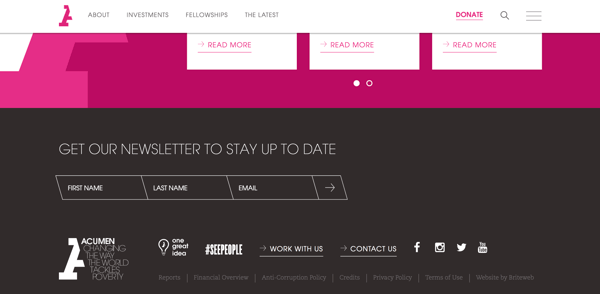
👉🏼Nonprofit marketing tip: Automate as much as possible. Email marketing automation (like HubSpot) saves precious time and energy for your team and can be the key to growing your email list, donations, and memberships. You can also automate an email sequence triggered by website visitor behavior indicating a high level of interest, such as downloading educational content.
Nonprofit Event Marketing
Event marketing is one of the most effective (and enjoyable!) ways to grow awareness of your organization, connect with your community, raise funds, and garner support for your cause.
PAWS, which stands for Pets are Worth Saving, is another local animal rescue that I’m a fan of. They hold a PAWS 5K race every summer to raise awareness and funding for the organization.
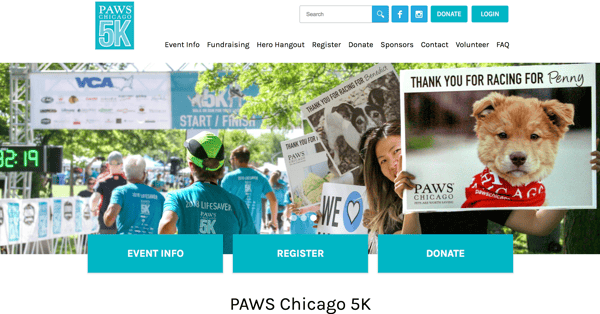
This type of event impactful for multiple reasons:
- It inspires competition and physical activity. Runners raise money for the organization and participate in the run.
- It brings people in the community together to celebrate the organization and bring awareness to the PAWS cause.
- It provides PAWS a channel to promote their services and adoptable pets.
- It’s fun to attend and be a part of! Many people go to the event to support runners, play with dogs, and simply be a part of the fun — all while supporting and sharing PAWS.
From fundraisers to auctions to competitions, there are many different kinds of events you can organize to market your nonprofit organization.
Nonprofit Video Marketing
Whether they’re consuming content for work, school, or fun, people prefer video content. As a nonprofit organization, video marketing is a surefire way to garner interest and support from all of your audiences.
Here are a few reasons that video can help you market your nonprofit:
- Video is visual. We process visual content 60,000 times faster than written content. We also remember more content, longer.
- Video is personal. It inspires empathy and emotions, which can’t be said about other types of marketing.
- Video is educational. Many organizations need to educate their communities on their causes in order to garner attention and funding. Video can help you do that.
- Video is shareable. Over 700 YouTube videos are shared on Twitter every minute. Consumers love sharing videos, especially those that inspire and resonate with them.
- Video is interesting. Viewers spend 100% more time on pages with videos on them. Keep your visitors, followers, and supporters engaged and interested with video.
The Girl Effect, a nonprofit that works to empower girls worldwide, is a great example of video marketing. The organization’s homepage is a video, which captures visitors’ attention right away. Moreover, when you click “See more,” the site opens an informative video telling you all about The Girl Effect.
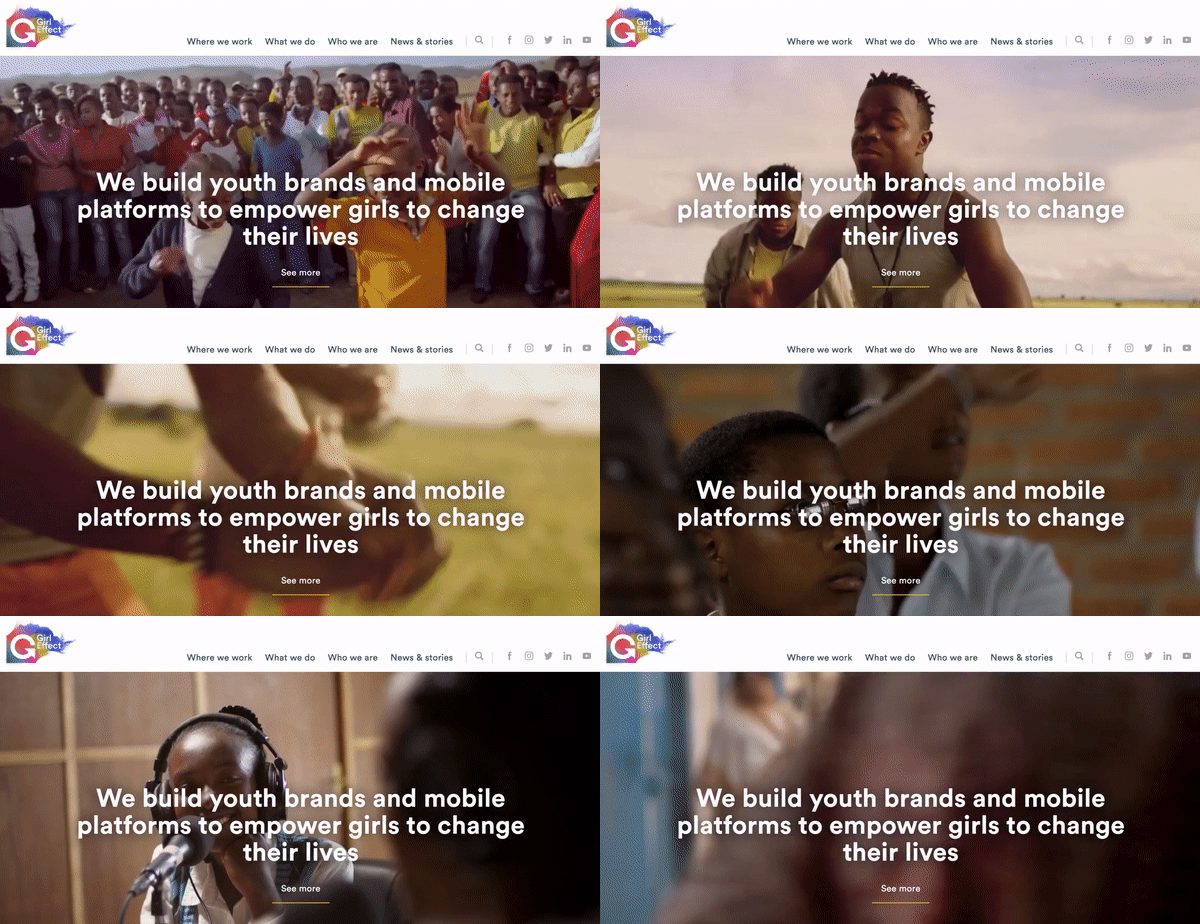
Nonprofit Social Media Marketing
Social media is a highly popular marketing strategy among nonprofits. Not only is it free, but it provides an avenue for organizations to show their brand personalities and engage with their followers and supporters.
Here are some ways to use social media for your nonprofit marketing, as inspired by a HubSpot study of 9,000 nonprofits:
- Share news about your organization and cause
- Boost brand awareness and recognition
- Fundraise
- Recruit volunteers and employees
- Recognize donors, employees, and volunteers
Don’t forget to use the key messaging you crafted in your nonprofit marketing plan to keep your social media posts consistent and targeted. Also, make the most of each platform to promote your organization, such as the Donate button on Facebook.
HubSpot customer FIRST, which stands for For Inspiration and Recognition of Science and Technology, is a nonprofit organization that works to advance STEM (science, technology, engineering, and math) education among children.
FIRST makes use of social media in many different ways, such as using Facebook to post videos, news, fundraisers, and reviews — as well as making use of the Donate button. The organization has amassed almost 100,000 followers.
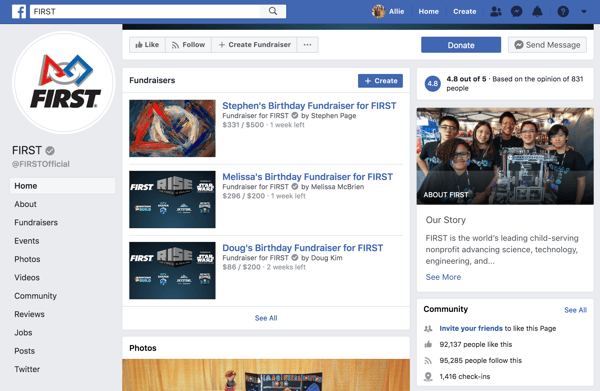
👉🏼Nonprofit marketing tip: Curate content from volunteers, customers, supporters, event attendees, and donors. Implementing a user-generated content (UGC) campaign not only lessens your workload, but it also acts as strong social proof. To enact your UGC campaign, put out a call for constituent stories, images, and videos. Create a hashtag that people can use to alert you of new UGC.
Also, let curation tools work for you. Use Google Alerts and social monitoring tools to alert you when your organization, hashtags, or relevant topics or keywords are mentioned. This provides opportunities to source UGC, get inspiration for new topic ideas, and participate in relevant conversations.
Nonprofit Website
Every nonprofit organization should have a website. A website serves as a digital home base for your organization and includes critical information — what you stand for and how visitors can participate and help.
Your website also houses important assets like your blog, social media streams, event information, videos, and more … basically the rest of your marketing strategies. Lastly, your website serves as a way to intrigue, inspire, and engage your audiences.
Nonprofit organization (and HubSpot customer) American Nursing Association (ANA) is an example of an organization with an outstanding nonprofit website. The site clarifies the ANA mission, shares news and educational content, and informs visitors how to get involved through memberships, events, certifications, or donations.
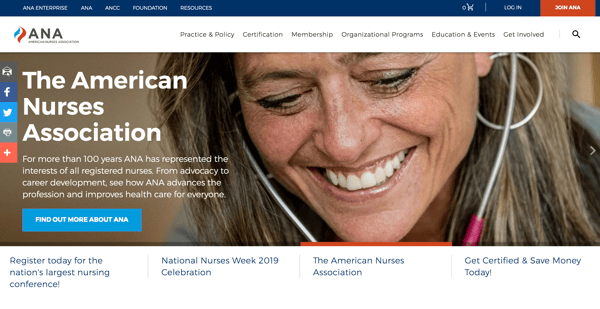
Nonprofit Public Speaking
It’s said that people buy into other people, not products. The same can be said about nonprofit organizations. If consumers believe in the people behind your organization, they’re likely to buy in your cause and donate money or time.
One of the best ways for consumers to get to know your leadership team, not to mention spread the word about your cause and organization, is public speaking. Whether you speak at a local event of 100 people or a multi-day conference with thousands, the impact is the same: telling a powerful story to real people who may not yet know about your cause.
charity:water founder Scott Harrison spoke at INBOUND18. While he shared some about the conception and organization of the nonprofit, he mostly talked about the people that his organization helps — and how the audience can support the mission. Harrison not only moved the audience of thousands but also effectively marketed the charity:water purpose and brand.
Nonprofit Content Marketing
Content marketing and blogging are valuable marketing assets for any nonprofit organization. Here’s why:
- Content educates your audiences about your mission, cause, and industry news and trends.
- Content (and SEO) bring in new visitors, subscribers, donors, and leads.
- Content is shareable and serves as free PR among your audiences.
- Content can be repurposed and made into different types of media, saving your marketing team precious time and energy.
Creating a nonprofit marketing blog isn’t always easy. Teams are short-staffed, budgets are low, and time is precious. Thankfully, there are lots of ways around those blogging challenges, such as sourcing story ideas from volunteers, donors, and customers as well as implementing an editorial calendar so you can plan ahead.
One of my very favorite nonprofit organizations is called Blurt Foundation, a UK-based organization that exists to increase awareness and understanding of depression and support those who struggle with it. There’s a lot of misconception and misunderstanding around depression, so Blurt Foundation uses their blog content and other content resources to educate constituents and supporters. They also incorporate these content assets into their emails, social media posts, and online store.
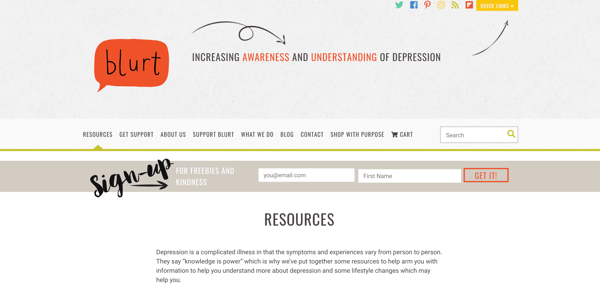
👉🏼Nonprofit marketing tip: Save time and resources by repurposing your content. Content is an appreciating asset that you can reuse and re-promote over and over. Repurposing content to create new marketing assets costs far less than creating entirely new content.
Outline all the ways you could repurpose the content you produce. For example, you could create the following list for your blog content:
- Short version for use in emails or newsletters with link back to full post
- Group with related posts for report
- Two to three visuals images to share on social
- Infographic with post information
- Reaction piece to original post
Since you’re not going to promote and distribute each piece of repurposed content immediately, your content pipeline is never empty.
Check out HubSpot’s free nonprofit content today.
Strengthen Your Marketing, Promote Your Cause
Raise your hand if your organization has to constantly do more with less. 👋🏼
If that sounds like your organization, we recommend you use this guide to build a nonprofit marketing plan ASAP. Your organization might not operate for profit, but it can still value from the traffic, funds, and awareness that systematic marketing brings in.
And not only will these activities and strategies help promote your organization, but they’ll take a valuable load off the backs of your team and volunteers — freeing them up to dedicate more time to your cause and constituents.

19 Impressive Product Demo Videos You’ll Want to Copy
In marketing these days, you can’t swing an enthusiastic micro-influencer without hitting someone who’s talking about video content. And it’s not without merit. A recent HubSpot study revealed 54% of consumers want to see more video content from brands and businesses they support.
With video marketers earning 66% more qualified leads per year and a 54% increase in brand awareness, it’s clear video marketing is the future and product demo videos are a lucrative path forward.

In fact, 72% of people would rather use video to learn about a product or service. There are many different types of product demo videos, so I’m sharing a few of my favorites below, along with tips on how to get started on your own product demo video.
Want to skip straight to the videos? Click here.
1. Identify the goal
Purchases? Subscriptions? Education? Brand awareness? Decide what your video is trying to achieve and what you want the viewer to walk away with. What action do you hope the viewer takes after watching your video, and what business need does it fulfill? For example, “After watching our product demo video, we hope the viewer submits a demo request form.”
2. Determine your audience
Has the audience for this video purchased with you before? Are you introducing a new product or feature to them? Or is this video reaching people who have never heard of you? What will this audience be concerned with? How long will they want to watch? What buyer persona will you be gearing this video for?
All of these are important questions to answer. For example, let’s say you’re introducing software that regulates the temperature of various areas in your office. The audience for your video might be harried office managers who are constantly fielding requests to turn the temperature up or down. They’re concerned with keeping their colleagues comfortable without breaking the bank on electricity costs.
3. Set a budget (and a timeline)
Do you have $7000 or $80,000 to make this product demo video? Identify your budget so you know how to proceed. This is also the time to set expectations. If you have a $500 budget, you’re not going to come out with a video on par with Apple’s latest release — and that’s alright.
Oh, and don’t forget to outline when you need this video to be completed. Even the biggest budgets can run up against roadblocks, if the timeline is too limited.
4. Decide between in-house or agency
This decision will likely be dependent on your budget. If you have a lot to work with, interview agencies who can give you quotes and creative pitches for your project.
If you have a small budget, don’t let that dissuade you from creating a video using your iPhone. You can also record a video of your computer screen while moving through your platform. Work with what you have and be proud of whatever you create.
5. Structure your video
Will you tell a story? Highlight pain points? Use text or visuals only? Decide how you want to communicate your goal and how you’ll bring it to life.
If you’re working with a creative agency or freelance videographer, they may help you define the structure. If you’re going it alone, use videos like the ones we’ve listed below to inspire you and define which format will work best for your product and goals.
6. Choose between animation and live-action
Animation can sometimes be a little cheaper than live-action video. Work within your budget and skill level, and be honest about which option best highlights what your product can do and the scope your project requires.
7. Write a script
The script is a crucial part of your video. It defines the tone, pace, and message. Start with a project brief, move on to an outline, and navigate your script, section by section, making sure it speaks to the goals you’ve previously outlined.
Call out opportunities for B-roll throughout, and always conduct a verbal run-through before getting behind the camera.
For more tips and a video script template, check out this blog post and accompanying video on how to write a video script.
8. Create a marketing plan
Once you’ve shot, edited, and finalized your video, it’s time to decide how you’ll share it with your audience. YouTube, your website or campaign landing pages, and special email campaigns are all great channels for distribution.
But don’t overlook less obvious opportunities, like including your video in your email signature, sharing it in partner blog posts, and incorporating it into your sales team’s pitches.
Product Demo Video Examples
1. Airtable
This classic product demo video uses animation and the Airtable product to show users exactly who can use their product and how they can benefit from it. The video demonstrates several different use cases, taking a broad, top-of-the-funnel approach that will attract the masses.
They also do something else incredibly smart. As seconds tick by and viewers hypothetically click out of the video, the information shared gets more into the weeds sharing specific tactics and features. Airtable knows if someone has stuck around over one minute into their demo video, this is likely a qualified lead who wants to learn more.
2. Zendesk Sunshine
Zendesk leads with pain points in their product demo video. “Customer relationships are complicated … made up of fragmented pieces of what you know about your customers … it’s kind of all over the place,” a narrator explains. But Zendesk gets it. “What seems like chaos is actually everything you want.”
The viewer immediately feels like Zendesk understands them. It’s a full 50 seconds into the video before Zendesk even introduces a solution. We never actually see the platform at work, but that’s not really the goal of this video.
3. SurveyMonkey
At nearly two-minutes long, this is a lengthy product demo video. But it packs a powerful punch with text-based benefits and features, and a walk-through of the product interface.
Viewers see just how easy it is to send a survey using SurveyMonkey. They even see how it integrates with other platforms like Slack. This is a workhorse of a demo video, but the viewer witnesses how SurveyMonkey can integrate into their daily workflow — and how easy the product is to use, from sign-in to send.
4. Headspace
Is there anything harder to sell on the internet than meditation? Headspace makes it seem easy with their modern, relatable animated product demo video.
They offer a “healthier, happier life” and show you how the app works for a variety of users with differing goals and time. It’s an inclusive video that communicates a lot without overwhelming the viewer.
5. Mailchimp
Testimonials work. And they work really well. So, why not use them to bring your product demo video to life? Mailchimp does just that in a video demoing their iOS and Android mobile apps.
The video is benefits-heavy, with a real user sharing how sending emails from wherever she is — even a workout class — helps her manage her business. The viewer gets brief glimpses of the app in action, but the goal of this video is to demonstrate a concept more than a product.
6. Apple’s iPhone XR
This glossy product video introduces the new iPhone XR by showing what it can do. Simple text alerts the viewer to the features this new phone possesses (e.g., “liquid retina,” “face ID,” and “water resistant”), and the benefits are communicated through the vivid visuals.
The goal of this product demo is to wow rather than educate, and that’s exactly what it does.
7. Slack
Slack uses this brightly hued video to break down a common misconception about their platform: that it’s only for sending private messages. They walk viewers through how teams can communicate using their interface.
“It’s way more than just a place to talk,” explains the actor, “We keep all of our files here too.” The video is feature-heavy, but the actor chimes in with how those features translate into benefits as he walks viewers through a demonstration of Slack. A simple “Get started with Slack, today” closes out this informative video.
8. The Origins of Nike Free
This product demo tells the origin story of the Nike Free running shoes. The shoe creators share a bit about how the shoe was designed and call out benefits like, “More natural movement” and “Nice, modern evolution.” A simple tagline at the end reads, “Engineered for modern motion.”
9. Duolingo
Duolingo kicks things off with social proof. “Far and away the best free language-learning app,” says The Wall Street Journal. What follows is a description of how the platform works, backed with more data on how effective it really is.
If you want to prove that your product works, sometimes facts are more alluring than a demo of the product itself.
10. IKEA Place
There’s nothing wrong with stating your purpose up front. “Hey, IKEA would like everyone to know about Place, our new augmented reality app,” explains this demo video. What follows is a demonstration of the app, and a video montage of people struggling to design and furnish new spaces. “We want to make it easier for people everywhere to imagine a better place,” the narrator explains. That’s exactly what this video demo does.
11. NoseFrida
Your baby is cute, until she’s not. The narrator explains what happens to a baby’s nose when they’re sick — and why your baby gets fussy. Immediately, he’s identified the viewer’s pain points and explained the problem with NoseFrida’s competitors.
The narrator begins to explain how to use the NoseFrida — a device that allows parents to physically suck snot out of their baby’s nose and effectively ruins your days of carefree milkshake sipping forever (take it from me).
It’s here that the company does something brilliant. They know their customer’s biggest purchasing block is the gross-out factor this product elicits, so they confront it head on. “Breathe easy, we know what you’re thinking.”
The narrator then explains how NoseFrida is designed to be hygienic and safe. Know your product has a big red flag for customers? Try addressing it bravely, like NoseFrida does, instead of tip-toeing around the elephant in the room.
12. Bluprint
How do you get people to part with their most valuable asset: their free time? Online learning platform Bluprint does just that. They overcome viewer objections early on. Think you don’t have time? “There’s always a way to get your creative fix,” the narrator explains.
The video takes an aspirational lens, showing people cooking, painting, and dancing. It ends with a call to action, “What will you do today?” Bluprint knows what they’re up against, and their demo video is a strong rebuttal against inactivity.
13. Sphero
Are you known for one product but want to introduce another? Sphero knows a little about that. A few years ago, they created a robot called BB-8 for a little-known movie called Star Wars: The Force Awakens. Lucky for them, I hear that panned out.
In a Kickstarter video for their newest robot, they begin by featuring the iconic BB-8 robot that skyrocketed their success. Once the viewer knows who they are, they present their new robot: The Sphero RVR.
The rest of the video features the robot’s engineers speaking about what their new creation does and why it’s special. We believe them, because they’ve tethered this new creation to their past authority.
14. Ring Door View Cam
This is another great example of showing instead of telling viewers what your product can do. The video shows everyday people using Ring’s Door View Cam in a variety of ways. We see them use the mobile interface, benefit from the speaker, and avoid danger using the camera.
15. Dyson
Dyson takes a more classic approach by featuring three new products. They have presenters share the features each product boasts, and influencers explain what they love about the new products to lend social proof. It’s straightforward, informative, and concise. Sometimes, that’s all your product demo video needs.
What I love most about this video is that they include subtitles allowing viewers understand what’s being communicated even without sound.
16. Lime
Text that reads, “How to Lime” kicks this video off and tells viewers exactly what to expect. We see a step-by-step demonstration of how to use Lime, their safety recommendations, and some basics on their mobile app.
17. Peloton
This product video begins with an origin story of the Peloton bicycle and quickly moves to the benefits (i.e., you can ride it in your bedroom without waking your partner). Before you know it, the video is speaking to viewer pain points, “One of the challenges with boutique fitness is that it can be inconvenient.” They solution? Peloton.
Thousands of classes, experienced instructors, community, and ease of use. Close-ups of the machine in use highlights certain features, but what this video demonstrates most is the experience you’ll have using Peloton. “This is what I’ve been missing,” says one video participant. I can’t help but think that’s the primary goal the makers of this video had for their viewers.
18. Zoom
This is a classic example of a product demo video. A solid, feature-heavy script immediately jumps into how professionals can use and benefit from Zoom. The viewer sees the product being used as they listen to how it works, and they’re left with a clear picture of what Zoom can offer them.
19. Gusto
I’ve saved the most comprehensive product demo video for last. This example, from HR software provider Gusto, clocks in at an impressive five minutes and fifty-six seconds.
What follows is a careful walk-through of the product, it’s benefits, and how to pick the perfect plan.
Viewers who make it to the end likely signal to Gusto that they’re ready to speak with a salesperson. This video probably works best for buyers further along in the buyer’s journey. If your goal is to introduce your product/service to new audiences, stick with a shorter option that’s quick and easy to consume.
Product demo videos can be an effective marketing tool. Want to create your own video? Check out our ultimate guide to video marketing.

The 20 Instagram Accounts With the Most Followers (& What Marketers Can Learn From Them)
When Instagram was first released, it was thought of only as a fun, visual social media network. Nowadays, it’s also used as a major content promotion tool for brands and influencers.
In fact, according to Sprout Social, 80% of Instagram users follow a brand, and one of the three most-viewed Stories of all time was posted by a business account.
Along with business accounts, influencer marketing is also on the rise. For instance, 93% of influencer marketing campaigns took place on Instagram in 2018.
By introducing key product updates like video, stories, and IGTV, Instagram now boasts over 1 billion monthly active users who spend close to an hour scrolling through the app each day they log in.
Instagram’s popularity lets most brands forge an emotional connection with a massive audience. Some brands are so good at visually engaging and resonating with Instagram users that they’ve attracted tens of millions of followers.
To help you learn from the platform’s best of the best, we’ve compiled a list of 20 accounts with the highest number of users — as well as a few key takeaways from each.
Because the accounts with the most followers belong to influencers and celebrities, we’ve split this rundown into two sublists that are brand and influencer specific.
1. Instagram
Followers: 303 Million
Instagram sets a great example for brands who truly want to engage an audience on their app. By curating and reposting their users’ most captivating content on their own profile, Instagram shows their followers that everyday people can meet their creative and artistic potential on the platform.
This inspires brands and normal Instagram users to spend the time and effort required to craft visually gripping content that will instantly hold an audience’s attention.
Instagram also does a good job of promoting their stories and IGTV show about celebrities, wildlife, and other culturally relevant topics. They post original content that highlights upcoming episodes, but the posts read more like a feature story than an advertisement, which sparks more interest in the show.
2. National Geographic
Followers: 111 Million
National Geographic hires the most talented photographers in the world, so their Instagram posts of landscapes, cityscapes, and the surrounding life always seem to be awe-inspiring. But their stunning visuals aren’t the only reason why they’ve attracted over 100 million followers.
National Geographic is a historic magazine that’s famous for their credible journalism and compelling storytelling. In each post’s caption, they are able to craft fascinating narratives about the photo or video, usually in a way that spreads awareness for a relevant environmental issue.
National Geographic also uses Instagram Stories, Stories Archive, and IGTV to drive traffic to featured articles and videos on their website. But they also know their followers prefer not to leave the app.
Instead of using gimmicky visuals and clickbait copy to coax people into visiting their website, they actually summarize the feature article or video in their stories and IGTV shows.
For marketers, National Geographic’s Instagram strategy clarifies that it’s crucial to meet your audience where they are, and not force them to go somewhere just because you want them to go there.
If people end up clicking through to your website, that’s great. But you should be more than willing to educate your audience where they want to be educated, even if it results in a lower amount of traffic.
3. Nike
Followers: 88.5 Million
In the advertising industry, Nike is known for their motivational ads that inspire athletes to believe in themselves when aiming to reach their full potential.
On Instagram, the iconic brand’s content follows this theme, with posts in the form of short films, documentaries, and inspirational videos and photos. Nike also uses Instagram to update their followers with quick news about the sports world, proving that they deeply understand their audience’s interests and desires.
4. Real Madrid
Followers: 72.6 Million
Real Madrid is arguably the most popular soccer team in the world, so most of the team’s Instagram posts update their massive fan base on scores, highlights, and transactions.
But the way they attract and engage twice as many Instagram followers as teams with similar fan bases isn’t through standard updates. They’ve built their enormous following by giving their fans an inside look of the team’s everyday activities through player takeovers and practice highlights on IGTV.
Breaking down these barriers between fan and player makes Real Madrid’s fan base feel like they actually know their favorite players on a personal level, which develops a more intimate and loyal relationship between the two.
5. FC Barcelona
Followers: 71.1 Million
Like Real Madrid, FC Barcelona updates Barcelona fans with sports photography, season-related stats, information about Barcelona players, and other fun tidbits related to the team and season.
They use a mix of content styles with videos, action shots, and posed photos, but they always use many tags, hashtags, and eye-popping emojis in their captions.
During games and other events, you can find FC Barcelona launching one or multiple Stories with their own video content as well as curated content sourced from fans.
With curated Stories by fans, they’re able to post more fresh, interesting content. FC Barcelona’s curated Stories also enable fans to contribute to the Instagram channel. While we aren’t able to post stories directly, you can find some on the account’s page.
6. 9GAG
Followers: 50.2 Million
With plenty of dog, cat, and baby videos, meme references, and jokes that are almost too relatable, 9GAG has one of the funniest accounts on Instagram.
The account’s Instagram stories and Stories Archives engage their audience well too — they post a ton of polls about topics that everyone has an answer for like, “Is soup a food or a beverage?” and “Would you travel to the past or future?”
They also use Instagram stories to drive traffic to their website by asking their followers to swipe up and see if they correctly guessed the name of a TV show or movie with only emojis as clues. On IGTV, they generate even more brand engagement by letting their followers ask questions during live Q&As with celebrities.
As the only online content platform on this list, 9GAG proves to marketers that interacting with your audience is one of the best ways to engage them, develop a relationship, and attract more followers like them.
7. NASA
Followers: 43.7 Million
Scrolling through NASA’s Instagram feed makes you feel a little like an astronaut floating through the depths of space. You’ll experience intimate views of different planets, constellations, and supernovas in the Milky Way galaxy, all of which are taken by NASA’s spacecrafts and Hubble Space Telescope.
NASA’s Instagram Stories and IGTV channel also educate their followers about interesting space insights, like the views of the sun and Earth, the search for life in space, and NASA’s new technology launches
NASA’s popularity on Instagram proves that you can actually create educational content that doesn’t sacrifice any entertainment value.
8. UEFA Champions League
Followers: 41.3 Million
In the last year, the Champions League surpassed the NBA’s account in Instagram followers. Like the other soccer brand accounts we’ve noted, the Champions League regularly posts action and team shots, as well as updates related to upcoming and past games.
Along with regular updates and action shots, some of the account’s regular posts include stats like “Top Scorers,” behind-the-scenes videos, and team roster images.
9. Marvel
Followers: 37.5 Million
Marvel posts regularly about its movies, TV shows, and Marvel.com content. It also mixes things up with the use of photo and video posts. Additionally, the account occasionally uses fun videos to cross-promote with other Marvel-affiliated accounts and influencers.
While many other accounts, like HBO, promote their content by posting trailers as Instagram Stories, Marvel uses Stories to cover red carpet premiere events. These stories include photos and clips of the stars, as well as other interesting things that happen at the events. Most recently, Marvel featured the premieres of Dark Phoenix and Avengers: Endgame.
10. Chanel
Followers: 34.9 Million
Throwback Thursday will always be a huge deal on social media — who doesn’t love a heavy dose of nostalgia every week? Recently, though, Chanel decided to take #tbt to the next level. They’ve been evoking nostalgia in fashionistas all over the world by posting old ads that spotlight previous fashion trends for their Chanel Holidays campaign every day.
The legendary fashion brand also posts a lot of content about Coco Chanel’s early fashion influences to promote Inside Chanel, a web series that recounts Coco’s life and how she built her fashion empire.
Harnessing the power of the past is one of the most effective ways to evoke an emotional response from your audience and forge a connection with them. With that in mind, nostalgia should always be in your marketing arsenal.
1. Cristiano Rinaldo
Followers: 170 Million
So, who has the most followers on Instagram? That would be Cristiano Ronaldo, who’s been called the world’s best soccer player (or fútbol player).
Along with the expected soccer action shots, his Instagram strategy largely involves paid partnerships and cross promotions. Here’s just one example:
The account’s content is a mix of sports-related updates, photos capturing his life outside of the arena, and occasional motivational posts about topics like fitness and clearing your mind.
One thing this account puts great effort into is the imagery. All of its images and videos are crisp, clear, colorful, and high-production quality. We’ve found that editing images before uploading to Instagram can really make a difference in how professional a brand or individual account looks. Ronaldo’s account is one great example of this.
2. Ariana Grande
Followers: 156 Million
Ariana Grande has recently gained an incredibly large following on the platform. Her brand is especially relevant to the younger demographic of Instagram.
Throughout the last four years, it seems that Ariana has not needed to use partnerships or promotions to strengthen her following. Here’s an example of one of the few promotional posts she has had on her account, which dates back to 2015:
Currently, it seems her strategy involves a high posting frequency, with around six or more updates per week. She mainly uses the platform to update users on her daily life and her music career. These posts often include photos of her dog, behind-the-scenes videos, and concert highlights.
Ariana has also experimented with IGTV. Recently, she used it to announce the drop of her new song “Sweetener” by including the song in the post itself, as well as a link to it in the caption.
This type of strategy might make her followers and fans feel like they’re being rewarded for their loyalty on the platform. At the same time, the possibility of hearing Ariana’s new music might entice new audiences to follow her.
Many of her posts usually include short captions which may only include one or two emojis. This does not seem to be uncommon for major celebrities on the platform, as they may not have a large need to optimize captions.
While Ariana and other listed influencers may not have, or need, a caption strategy, those starting out on Instagram or aiming to grow their following should follow optimization best practices. These include crafting interesting captions that may use hashtags, and account tagging.
3. Selena Gomez
Followers: 151 Million
Selena Gomez’s content is a fun mix of paid partnerships, selfies, and quotes. As the former most-followed person on Instagram, she has mastered optimized photo captions, Stories, paid partnerships and cross-promotions with other influencers.
While her posts strategically embrace paid promotions and influencer cross promotions, she also uses Instagram to share inspirational quotes or her thoughts on certain political topics, which adds more of a human side to her page.
4. Dwayne (The Rock) Johnson
Followers: 145 Million
On any given day, Dwayne Johnson might use the platform to update fans on his family life, what he’s eating on his “cheat days”, his fitness products, or the movies he’s working on. He’s also started using IGTV to promote his projects and personal brand. He often films himself giving fitness tips, discussing his new products, or updating fans on other interesting events in his life.
5. Kim Kardashian West
Followers: 141 Million
The Keeping Up With The Kardashians star has recently posted a lot more about her family and her KKW Beauty Line. She also is no stranger to cross promotions and partnerships. While most of her posts are artsy or strategic, she is not afraid to post something jaw-dropping or humorous from time to time.
Here’s one funny post where she promotes The Secret Life of Pets.
She uses IGTV to promote her projects, like trailers for Keeping Up with the Kardashians. She will also occasionally team up with other influencers for tutorial-styled posts.
In this video, her hair stylist Mario Dedivanovic walks fans through how they can recreate Kim’s recent Met Gala look:
6. Kylie Jenner
Followers: 137 Million
While Kylie Jenner’s individual account follows her day-to-day life, she has also used it as a tool to promote her companies: Kylie Cosmetics and Kylie Skin. Although Kylie regularly tags and engages in cross promotion with her companies’ accounts, her personal Instagram still has over 100 million more followers than the other two, combined.
Most recently, Kylie has used IGTV to give fans Kylie Cosmetics tutorials. This strategy allows her audiences to see how the products look and learn how to use them before they make a purchase.
This type of content may engage prospective buyers that are both experienced and less experienced in shopping for makeup.
7. Beyoncé
Followers: 128 Million
Like Ariana Grande, Beyoncé focuses more on her artistic side than in cross promotion or paid promotion. She also breaks from the usual mold by rarely posting captions and letting her high-quality imagery or video speak for itself.
On her Instagram, you can usually find slideshows of high-quality photos of her, high-fashion shots where she’s seen in different styles and outfits, and occasional promotions of her own personal projects — such as her Netflix concert documentary, Homecoming.
9. Leo Messi
Followers: 121 Million
The soccer player regularly posts photos of himself on the field, as well as his daily life. His posts are a mix of photos and well-edited videos. When videos are included, they are often part of paid promotions. Messi has also dabbled in the Stories feature, where he shows off photos of himself, images from game events, and some images of his family.
While he doesn’t post large captions on his personal posts, he usually optimizes paid promotional posts with tags and hashtags. He also posts thoughtful captions in both English and Spanish. This might open up his following opportunities internationally.
10. Taylor Swift
Followers: 118 Million
The musician’s Instagram is filled with photos from concerts as well as a few photos from her everyday life. Unlike Beyonce and Ariana Grande, Taylor Swift embraces captions with emojis and hashtags. She also does an excellent job of tagging other accounts. This account is a good example of how strong captions and account tagging strategies can really optimize your Instagram.
Her posts are often colorful and in slideshow format, which allows users to swipe through multiple images.
Taylor has also used her Instagram as a tool to promote shows and albums. Like Ariana Grande, she recently posted stories to promote and give users a taste of her single, “ME!”
As they viewed the short story, users could swipe up to a link which listed sites where you could listen to, download, or save the song. This strategy gives users a taste of content and then a quick payoff when they swipe up.
Key Takeaways From the Most Followed Accounts
By looking at the most-followed brands and influencers, we can see some key strategies that many of them have in common.
Here are a few that you can start using, even without a giant following or a large social-media budget.
- Optimize captions witty or thoughtful captions with hashtags, account tags, and eye-popping emojis.
- Use cross promotion or paid strategies to join forces with other accounts or influencers.
- Experiment with new features including Stories or IGTV to give users new ways to engage and consume your branded content.

The Ultimate Guide to Using Twitter for Business in 2019
Twitter is an undeniably powerful platform to increase your business’s online reach. The average Twitter user follows five businesses, and 80% of all Twitter users have mentioned a brand in a Tweet.
If you have your Inbound Marketing hat on, you should know that Twitter is not just a place to grow customers through word-of-mouth marketing — it’s also a place to meet your customers where they are.
However, succeed as a business on Twitter in 2019, it’s critical you’re able to stand out. But that can mean many different things for the millions of businesses across every industry on Twitter.
So what steps can you take to add to your audience’s experience online, instead of simply being a disruption? How can you promote your product or service in a way that encourages people to purchase? How can you make your brand more human on a platform made for connection?
To help you create a successful strategy and leverage Twitter’s power for your business, we’ve created this helpful guide. Keep reading to learn how you can use Twitter for your business in 2019.
How to Market Effectively on Twitter
First, you need to build your Twitter marketing strategy. Your strategy is your foundation for success and is worth all the time you spend researching and creating it.
A Twitter marketing strategy is just like any other social media strategy — it is centered around the content you create, publish, and distribute to engage your followers. The content you publish should attract new followers, encourage new leads, boost conversions, and grow brand recognition.
Your business likely already has high-level business objectives, and Twitter is a channel that can help you reach those goals. If your business is looking to generate leads and sales long-term, you’ll need brand awareness on your side to get your flywheel moving.
The following four tactics will help you develop a strong Twitter marketing strategy to build your presence upon.
1. Research your competition.
Twitter is a tool you can use to search for competitors and see what types of marketing content and tactics they’re using. Gathering information on what your competitors are doing will help inform your own strategy. Is there anything they’re doing that you should be? What does their customer service look like on the platform? By asking questions about your competitors, you can launch your own highly-developed strategy.
2. Audit your account.
The importance of auditing is not lost when dealing with strategy. In order for Twitter to be a great marketing tool, you have to be organized. Need to audit your account quickly? Here’s how to do it in under 20 minutes.
3. Research best practices.
Like auditing, this is a step that needs to be done continuously. Keeping up on best practices as Twitter is updated and goes through changes is key to keeping your impressions and engagements high.
4. Identify your audience.
Your business personas should be considered in every aspect of marketing, including social media. When crafting your strategy, and even when creating individual pieces of content, you should have a description of your personas in mind. Who are you trying to reach? What are they interested in? Will this get their attention?
How to Use Twitter for Business
Now that we’ve discussed tactics for building a Twitter marketing strategy, let’s explore some critical steps you need to take to further leverage Twitter’s power for your own company.
1. Build a profile that stands out.
First and foremost, you need to set yourself up for success by customizing your profile. The last thing you want is someone turning away from your Twitter account — and potentially turning away from your business — because you have a Twitter egg as your profile image.
Be sure to upload compelling images for both your banner and profile picture. While lots of brands have their logo as their profile image, the Banner is where you can get a little creative with your colors and imagery.
 If you’re just starting out with Twitter or have a new business, you want to make your Twitter handle is extremely relevant to your company. Using your brand name as your Twitter handle may seem obvious, but there are a lot of Twitter accounts. What happens when your name is taken?
If your brand name is already being used as someone else’s handle, you can add a CTA at the beginning of your company name. For instance, let’s say your company’s name is “HubSpot”, but that handle is taken. Perhaps “@GetHubSpot”, or “@ChooseHubSpot” would be other good options. You could also take inspiration from Slack’s Twitter account, and add “HQ” to the end of your handle.
Another thing that may seem like a small detail is to update your pinned tweet regularly. Your Pinned tweet could be about a sale event coming up, or a new marketing campaign you just launched. Either way, it’s the first thing your audience will engage with because it stays at the top of your feed.
It’s also important you refine your description, website link, and location. All of these things belong on your Twitter profile so your followers know more about your business, and they should be updated and checked regularly.
2. Add value with your content.
Adding value to your Twitter content is very similar to adding value to other marketing content. You should always keep your buyer personas in mind, because the key to creating successful inbound content is to make your readers feel like you’re speaking directly to them.
When thinking about adding value on social, try asking yourself if your tweets advance an idea, entertain, or educate the audience. Without any of those three things, your content is likely to fall flat. Additionally, remind yourself that the purpose of Twitter is to connect and spark conversations.
If your content doesn’t inspire conversation, it’s not worth publishing.
For Twitter specifically, you should try to get the most out of your 280 character limit.
Multimedia tweets help differentiate your business from others, and tweets with images get 150% more retweets, so start mixing up your content with images and videos. However, it’s vital you ensure you’re mixing it up, too. Nobody wants to see the same “text, CTA, link” tweet with an image preview on their feed 24/7. Try mixing in emojis and GIPHs with your pictures and videos.
There are also ways to add value to your Twitter account that are specific to Twitter. Many brands have their own monthly Twitter chats. Twitter chats are a great way to interact with your audience and ask them questions about your brand or industry. You can start your own Twitter chat by establishing a date, time, and original hashtag for everyone to use.
3. Optimize your content.
Now that you’ve added value to your content, you want to make sure people see it. You can optimize your content on Twitter using a few different strategies.
Hashtags are an easy and common way to spread your content, but you want to be careful about how many you use. Too many hashtags and your business may come across as spammy — or like you’re trying to steal attention. To put it simply: don’t overuse hashtags. Stick with one or two relevant hashtags per tweet.
You should also be doing hashtag research if you want to get more eyes on your content. See which hashtags your audience is already using when talking about your brand, and then adopt them yourself.
Lastly, you’ll want to consider how often you tweet. 92% of companies Tweet more than once a day, 42% Tweet one-to-five times a day, and 19% Tweet six-to-10 times a day. However, it’s important to note — your audience likely isn’t on Twitter just to listen to your brand, so try to avoid clogging their feeds with unnecessary content.
Experimenting with the time you send Tweets out is also great for reaching more people. A lot of businesses Tweet in the morning, at lunch break, and early evening, because that’s when their target audience is most likely to be online.
4. Engage with your audience.
It’s critical you regularly engage with your audience on Twitter by tagging them in posts, responding to their comments, or even hosting fun giveaways to get your audience involved.
To learn more about how to build a community or how to implement community management tactics across the board, read The Ultimate Guide to Community Management.
5. Monitor your brand.
Social listening can allow you to create the type of content your followers actually want, come up with new ideas based on industry trends, improve your customer experience by interacting directly with customers, and shift your strategy to fit your audience’s needs.
6. Measure results.
When you have objectives and goals in place, you can easily measure the results of your performance on any social media site. Having goals also helps determine when your strategy isn’t working, and can help you get to the right place.
To measure your results on Twitter, you can head to Twitter analytics, located in the drop-down menu when you click on your profile at the top right corner of your Twitter dashboard. If you’re unsure what analytics can help you accomplish, check out this guide to Twitter analytics.
A general tip for measuring your performance on Twitter is to focus less on vanity metrics. Vanity metrics, like impressions or follower count, are often high numbers that look good on paper but don’t help you meet your business goals.
It’s more important you know how many people clicked on the link you Tweeted, or how many people are interacting and engaging with you out of your total audience number, so you have a firmer understanding for which content is most popular with your audience, and what translates to the highest amount of leads.
7. Use a Twitter tool.
When using Twitter for business, logging into the platform every time you post can get annoying, and is frankly a waste of time. There are plenty of tools that allow you to schedule your posts ahead of time, so you don’t have to click “Tweet” 30 times per week.
HubSpot’s Social Media tool allows you to publish to social networks in the same place you build campaigns, and schedule content for later. Alternatively, you might consider Sprout Social or Buffer.
8. Venture into paid.
There are two ways to venture into paid media on Twitter:
- Promoted tweets
- Twitter ads
Promoted tweets will appear in a user’s feed or search results. Your business pays for the tweet to display to a user who is not already following your account. A promoted tweet looks exactly like a regular tweet and functions in the same way — meaning it can be retweeted, liked, and quoted. Twitter will put your promoted tweets in a daily campaign targeting the type of audience you want to reach, as previously indicated in your settings.
Twitter ads are a good option if you’re looking to promote many types of tweets to achieve one goal or advance a campaign.
Here’s what you need to know about Twitter ads and campaigns.
Why You Should Stay on Twitter
Maybe your business has been on Twitter for a while and you’re feeling frustrated or uninspired. After all, it takes time to build a loyal and interactive Twitter audience, and it’s hard to see content go out with little or no response. But giving up on the platform eliminates a huge source of brand awareness for your business, and makes it harder for customers to find you.
Here are a few reasons you’ll want to stay on Twitter, even if you’re currently feeling unimpressed.
1. Your competition is on there.
Odds are, your competition is working toward similar, if not the same, goals on Twitter. So even if you feel like you’re shouting into the void sometimes, it’s important to have quality content for potential customers to find.
You can also get information on your competitors’ social strategy by monitoring their Twitter presence. A great way to revamp your own Twitter strategy is to take a look at what’s working — and what isn’t — for your competitors.
2. It’s a great source for free marketing.
Who can say no to free marketing? Twitter is a great place to interact with your customers and start a cycle of word-of-mouth. If your customers are tweeting about you, it goes a long way to respond — especially if they’re having a negative experience.
3. You can use Twitter to increase sales.
If you’re the type to say no to free marketing, maybe the offer of increased sales will keep you around. Twitter isn’t just a platform that allows you to get your brand out into the world — it’s also a place where customers come to you. 60% of a brand’s followers are more likely to purchase or recommend products after following the brand on Twitter.
To learn more about why Twitter matters for your business, take a look at 23 Remarkable Twitter Statistics to Be Aware of in 2019.

How to Develop a Go-to-Market Plan That Works [+Free Template]
Even when you put great amounts of effort, time, money, and resources into developing a new product or service, a poorly-planned go-to-market strategy could cause your project to flop.
Some of the biggest brands have even experienced go-to-market failures. Take Apple, for example. In the 1980s, decades before Steve Jobs launched the game-changing iPhone, he led one of Apple’s biggest flops: the Apple Lisa computer.
Although Lisa had some of the best graphic technology of its time, only 10,000 units sold. Critics attribute the failure to Lisa’s misleading ads and high price, despite its low processing power.
Overall, many say the computer itself and the messaging around it was not valuable to Apple’s prospective customers. The release was such a disaster that it reportedly resulted in Jobs’s temporary exit from Apple.
While Apple and Steve Jobs recovered, smaller companies could have a lot more to lose when bringing a product to market with a poor plan. As you develop something new, it’s vital to also start drawing out a go-to-market strategy that’s customized to fit your budget and your buyer persona.
We’ve seen two major methods for developing a go-to-market strategy: the funnel and the flywheel. While the traditional, one-off funnel method focuses on attracting leads and nurturing them into sales, the flywheel approach uses inbound marketing and other strategies to build long-lasting customer relationships.
While the funnel is centered around the awareness, consideration, and decision stages of the customer’s journey, the circular flywheel focuses on attracting, engaging, and delighting prospects, leads, and customers.
When a lead becomes a customer, the flywheel continues as the company is tasked with attracting them, engaging them, and delighting them all over again with solid customer experiences, new content, and potentially new offerings.
Regardless of whether you’ve adopted the flywheel, or prefer to stick with the funnel, your planning process should include these steps.
- Distinguish your buyer persona(s).
- Fill out your persona’s value matrix.
- Define your content and lead-gen strategy.
- Adjust and iterate as you go.
- Retain and delight your customers.
To get more detail on the first three steps, you can find an in-depth explanation of them here.
We’ve created a basic fill-in-the-blank template to help you get started on a killer go-to-market strategy. It specifically touches on building a persona, mapping out a customer matrix, and brainstorming a go-to-market content strategy.
Feel free to copy the below template into a document and customize it to fit your product or service.
Go-To-Market Plan Template
Go-To-Market Strategy for ______________
Step 1: Distinguish your buyer persona(s).
Before you start planning your strategy, its key to do a bit of research and identify your buyer persona. You can have more than one, but make sure each is concise, clear, and different from the others.
Here is a free tool to help you develop your persona(s) and a list of questions to ask yourself while you’re creating them.
Step 2: Fill out your persona’s value matrix.
The table below includes each piece of the value matrix, as well as an example persona. Use the first example as your guide as you fill out the lower rows.
|
Persona Name (Come up with something fun, like Marketing Mary.) |
Pain Points (Challenges and annoyances that your persona faces.) |
Product Value |
Message (What will you say to convey this to the customer?) |
| Example Eddy | A process he uses costs too much time and money | The service costs less time and money. | This service does ____, which saves companies time and money. |
Step 3: Define your content and lead-gen strategy.
Create a content and lead-generation plan based on your customer’s journey. Since some prefer flywheel and others prefer funnel, the template is split into Phase One, Two, and Three with notes on where you should be in the flywheel and funnel’s cycles.
Phase One:
Funnel Stage: Awareness
Flywheel Goal: Attract Prospects
What type of content will you create to catch the eye of potential customers in similar industries? Make a table like this one below.
| Type of Content | Topic | Promo Strategy | Lead Generation |
| Blog post | What is sales AI? | Content will be shared on Facebook, Twitter, LinkedIn, and in weekly newsletter. |
A CTA in the post will ask readers to sign up for our next webinar. |
Phase Two:
Funnel Stage: Consideration
Flywheel Goals: Attract and Engage Leads
In this phase, your audience might know of your service, or they might be researching products related to yours. What types of content do you create to move your service to the front of their minds?
| Type of Content | Topic | Promo Strategy | Lead Generation |
| Webinar | How Sales AI Can Increase Productivity | Social and email promotion will link to the signup page. | A thank you email will include a link to request a demo. |
Phase Three:
Funnel Stage: Decision
Flywheel Goals: Engage and Nurture Leads / Gain and Delight Customers
Your audience is really interested in your service. How will you use content to sell them?
| Type of Content | Topic | Promo Strategy | Lead Generation |
| Demo or tutorial | Use Our Sales AI Tool to Extract Dark Data | Demo signup links will be shared in webinar follow-up emails, newsletters, and on the website. |
Those entering demos will make contact with a direct sales/support person. |
Step 4: Adjust and iterate as you go.
Return to areas of your plan that aren’t working and tweak them. Make note of the things that are working, and brainstorm ways to expand upon them.
Step 5: Retain and delight your customers.
In this phase, you will focus on maintaining your customer relationships and spreading good word-of-mouth. This is where a flywheel strategy can be much more helpful than the funnel, which ends at sales. For a detailed rundown of the delight phase and beyond, check out this ultimate guide.
Although different products might require different launch strategies, the above template and steps should help you create a solid starter plan which can be customized along the way.

The Personality Traits of Top Marketing Leaders
We all know a great leader when we see one, but it can be tricky to identify the particular traits that enable certain people to lead teams to success, influence their community, and create positive change.
Digital marketing is an industry with an abundance of inspiring and innovative leaders across all facets of the industry. From SEO, Paid Ads, Email, Content, Social, and everything in between, successful individuals are innovating the processes that we already know and inspiring their teams, as well as their online followers.
In this new original research, my team at Fractl sought out to determine what makes these inspiring figures tick.
Which characteristics, traits, and personality types are common among the most successful marketing leaders? How do your most trusted marketing professionals compare to other influencers in the industry?
Using IBM’s Watson Personality Insights, we were able to determine the top (and bottom) traits among 2019 top digital marketing leaders across the spectrum. From Neil Patel to Seth Godin, and from Amy Vernon to Mari Smith, we break down the personalities of these individuals and identify which personality traits for which leaders scored highest.
Whether you want to become a powerful marketing leader or simply want to emulate some of their most impressive traits in the workplace, keep reading.
The Most Important Personality Traits to Succeed in Digital Marketing
1. Adventurousness
You probably think ambition, creativity, or collaboration are obvious personality traits you need to be successful in marketing. However, our report showed that leaders actually commonly scored high for the trait Adventurousness.
Taking risks, testing new methods, and coming up with new ideas are all key components to a good marketer’s skill set, and many of the top leaders in the industry scored remarkably well in this trait.

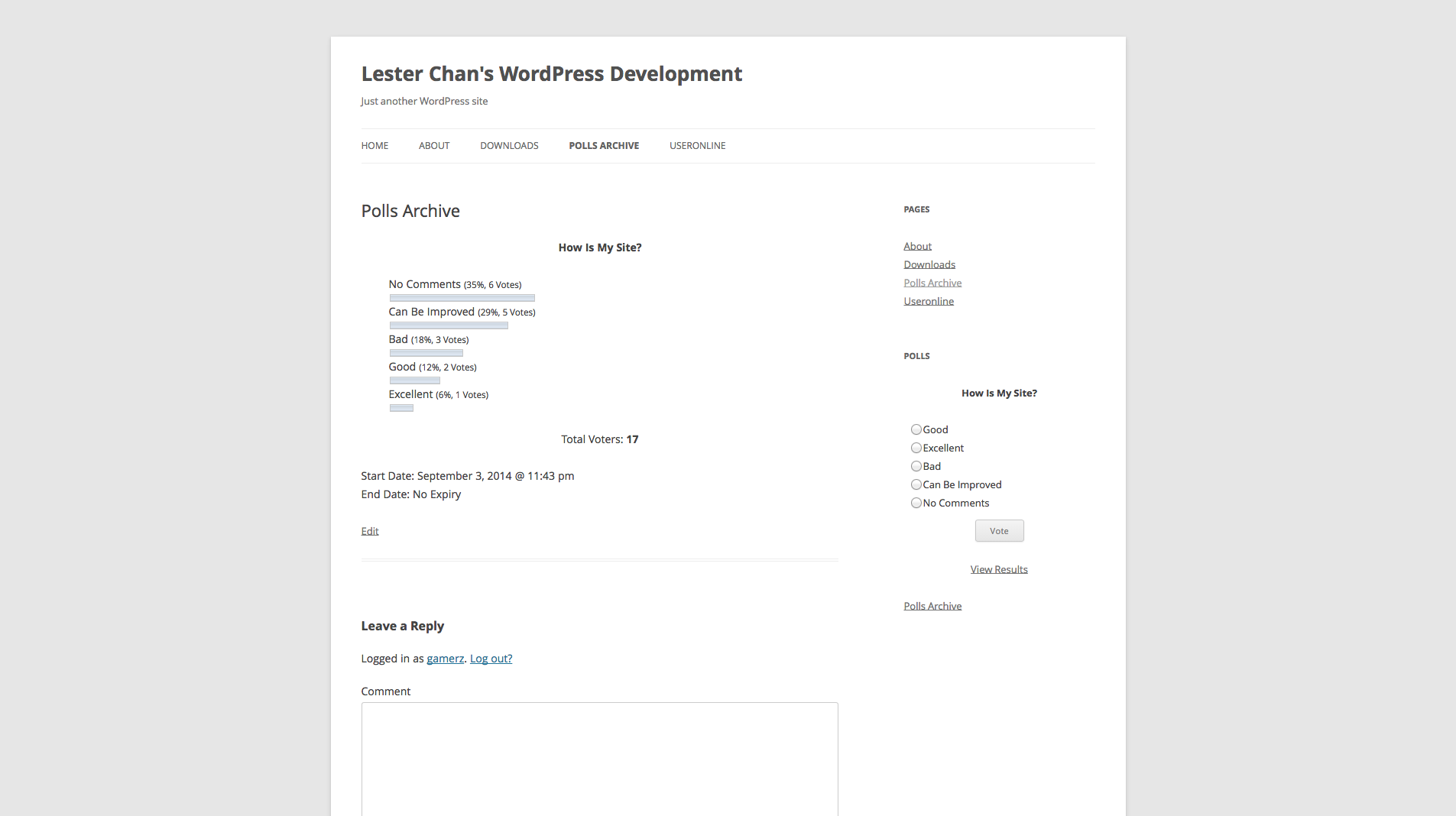
However, I can hear the naysayers already — “Adventurous? What does adventure have anything to do with digital marketing?” If visions of hiking Mount Everest and bungee-jumping come to mind, I don’t blame you. But in this context, adventurous leaders, according to IBM Watson Personality Insights, “are eager to try new activities and experience different things. They find familiarity and routine boring.”
These are the movers and shakers of the marketing industry.
Marketing leaders who score high on the adventurous scale are willing to take risks, try out new strategies, and fearlessly mix up their tactics to see which might earn the most ROI for their businesses. Adventurous marketers test new strategies and are eager to report their findings, create meaningful conversations within the community, and lead the entire industry forward.
It’s important to note, of all the leaders we looked at, Ann Handley was the only person whose top quality is Adventurous. Considering Handley was named by IBM as one of the seven people shaping modern marketing and is the world’s first Chief Content Officer, it makes sense she scored highly in adventure.
This trait also appeared in several other marketers’ top five characteristics, including names like Jay Baer, founder of Convince & Convert, and Amisha Gandhi, a well-known speaker and currently the Senior Director of Influencer Marketing for SAP.
2. Energetic
As is true with any leader, having high energy is an important quality to both inspire and motivate teams to make positive change. IBM Watson Personality Insights describe energetic leaders as those that “lead fast-paced and busy lives. They do things and move about quickly, energetically, and vigorously, and they are involved in many activities.”
There’s a reason Neil Patel, Gary Vaynerchuk, and Amy Porterfield’s top quality on the IBM Watson scale is Energetic. They’re all incredibly successful, active, and outgoing marketers — with plenty responsibilities to keep them moving.
For instance, Neil Patel is a name on the forefront of marketing today. His many accomplishments include speaking at over 310 conferences, hosting the Marketing School podcast, and co-founding Neil Patel Digital and Crazy Egg.
Vaynerchuk juggles ownership of a media company (VaynerMedia) and an ad agency (VaynerX). Gary Vee definitely has his hands full — not to mention the time he dedicates to his enormous fanbase on social media.
Lastly, Amy Porterfield spends her time hosting the top-ranked business podcast, Online Marketing Made Easy, creating online courses, and educating hundreds of thousands of business owners worldwide.
With all of that going on, there’s no doubt these marketers have to be energetic!
3. Assertiveness
Being direct and decisive when asserting your opinions is necessary for making tough calls or getting projects back on-schedule. Someone who is assertive, according to the Watson API, “likes to take charge and direct the activities of others” — sounds like a necessary quality to have if you’re expected to empower your team to succeed.
Tyrona Heath‘s top trait is Assertiveness. This comes as no surprise. You need to be able to “take charge” when you’re the global lead of Market Development at LinkedIn. Tyrona’s assertiveness comes through in her other activities as well — particularly as an educator, author, and public speaker.
Assertiveness appears as a top five characteristic for other female marketers, as well, including Mari Smith, an international social media thought leader, and Kim Garst, self-proclaimed “Online Marketing Guru.”
4. Intellect
Finally, Watson defines marketing leaders who score highly for Intellect as people who are “intellectually curious and tend to think in symbols and abstractions.”
We’ve often heard that many of the world’s most successful leaders are high school or college dropouts. From this alone, it’s clear that true leadership is a skill that can be learned both in or outside the classroom.
While it’s fantastic to have a leader with great intellect on your team, those leaders must also be able to build a team full of highly intelligent people and motivate them to drive success.
With 15 published books under his belt and countless speaking engagements from all over the world, Guy Kawasaki‘s top trait — intellect — could be considered a prerequisite to that level of success.
Intellect was also the #1 trait in the personality profiles of Rand Fiskin, Sparktoro founder, Amy Vernon, a self-proclaimed digital Swiss Army Knife, and Aleyda Solis, International SEO consultant, author, and speaker.
How Do These Leaders Score Across Various Qualities?
The study also looked into other qualities using IBM Watson’s API to see how leaders compare. You can explore the flipbook (below) to learn how leading marketers stack up against one another when it comes to less common leadership qualities like altruism, imagination, and modesty.
To recap, the personality traits that are most prevalent among leading digital marketers today, according to our study, are:
- Adventurousness
- Energetic
- Assertive
- Intellect
Some people are natural-born leaders and others have to work on their leadership skills, one day at a time. If you follow these marketing leaders’ social channels or blogs, you’ll quickly notice that although there are many qualities they share, these influential figures have very different personalities, and as a result, each has unique communities and followers.
Ultimately, each marketing leader we surveyed bring unique personality and experiences to the table, enriching the industry and allowing it to benefit from consistent streams of innovation.
Even if you choose to focus on cultivating these top qualities in your career, you’ll want to continue to be your authentic self and let your individuality show.
Showing a taste for adventure, an energetic demeanor, assertiveness, and intellect — as well as maintaining a sense for what makes you, well, you — will earn you respect from your colleagues and community alike. Additionally, it can equip you with the skills to become a future leader in your niche.
