The Best Forum Software for Creating an Online Community in 2019
In the Internet’s 40-year history, forums haven’t lost their importance. Today, forums are still significant opportunities to build an online community, and allows your audience to connect in a place where they know their interests are shared.
The importance of creating and growing an online community is becoming more and more apparent for businesses — in fact, increasing engagement through communities can result in up to a 25% increase in revenue.
This is where forum software comes into play. Forum software can be particularly useful because it allows your customers to interact with each other in a smaller circle than they could via social media.
For instance, let’s say one of your customers has a very unique problem with your product or service, and posts about it on your forum. That post is much easier to find on your business’ forum than in the Twittersphere, where millions of users are talking about a million different things.
Even better, maybe another forum user has faced that same problem and can answer their question before your service reps even see it.
There is an incredible amount of value in reaching and building your community using a forum. Here, we’re going to explore the best forum software to get you started.
1. HubSpot
Price: Free to start
HubSpot is a CRM platform that offers a full stack of software for marketing, sales, and customer service to help you grow your business. Along with hosting your website on HubSpot’s platform, you can also install forums to cultivate a stronger online community.
You can easily install a forum on your HubSpot-hosted website or blog. Here is a step-by-step guide on how to apply one of the third-party forum applications, Tal.ki.
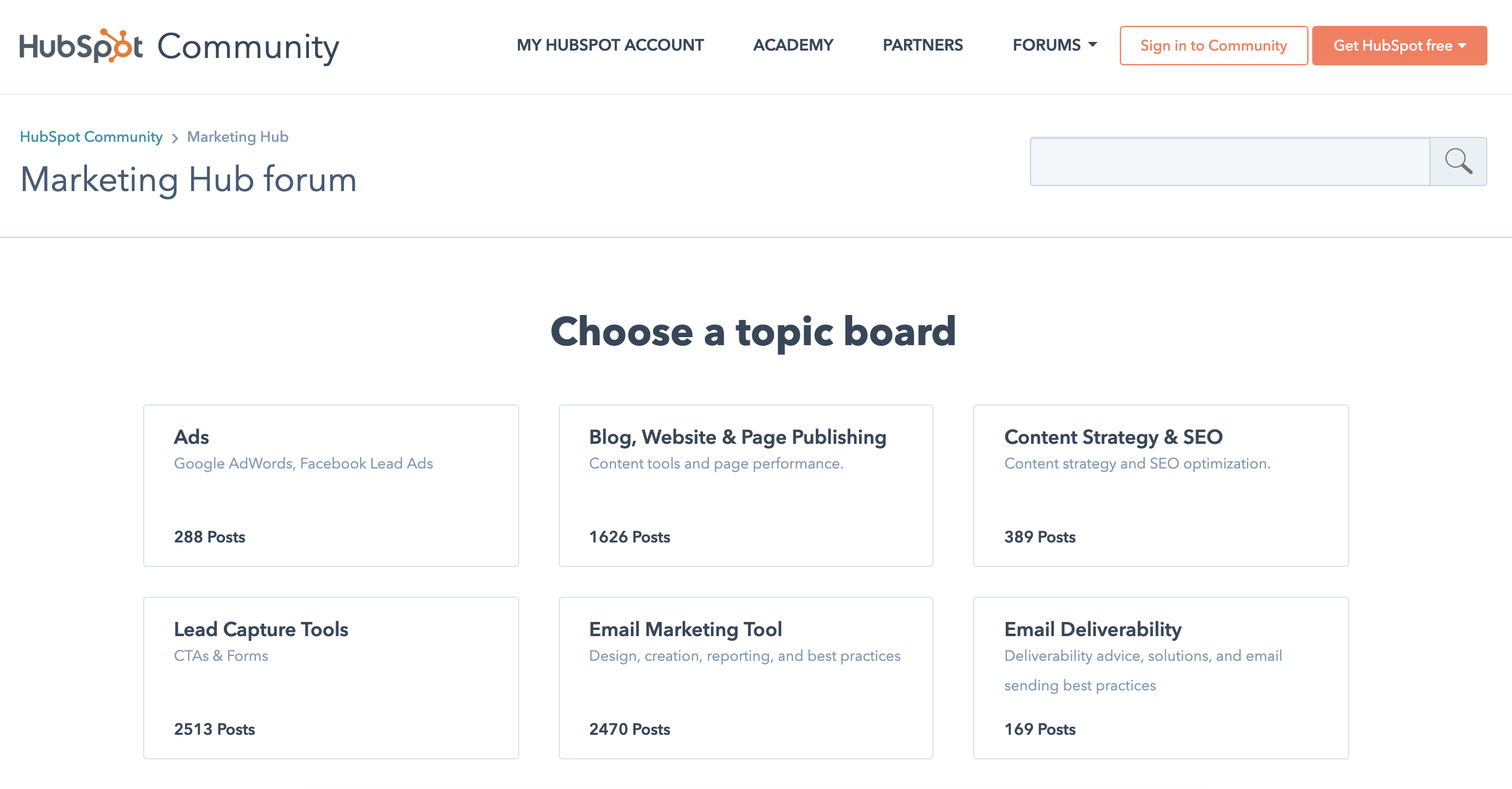
Additionally, to see the power behind forums, take a look at HubSpot’s Marketing Hub forum, which displays topic boards full of useful tips and tricks from some of HubSpot’s 60,000+ customers.
2. WordPress
Price: Free to start, or $25/month for businesses
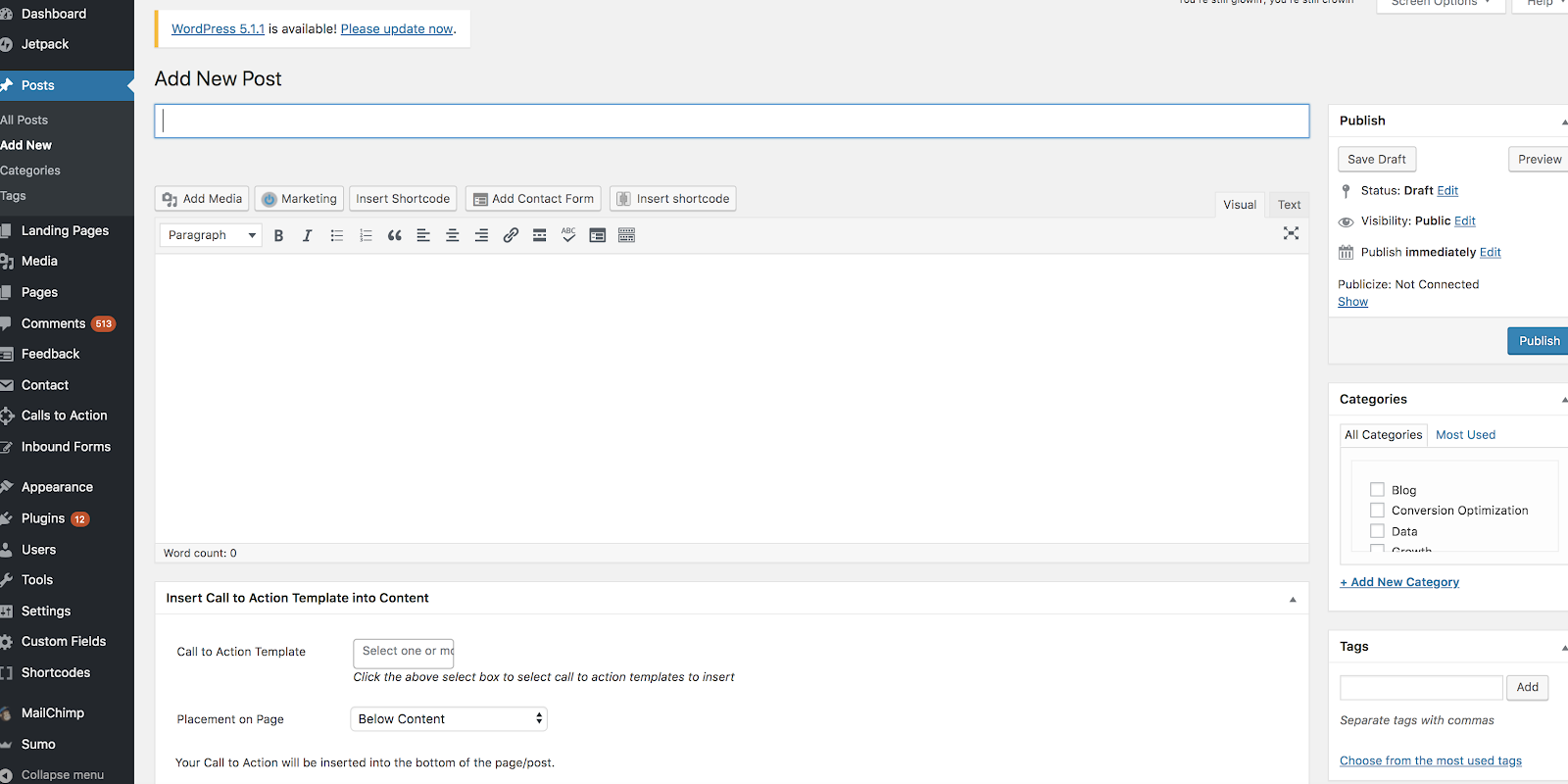
Using a multi-purpose platform like a CMS to power your online community allows you access to many different software options in the form of plugins and applications. For instance, you might use the bbPress plugin to create multisite forums, and maintain them from one dashboard within your WordPress site. This is a great option if you want to set up a regular website and forum together.
There are many options to choose from using WordPress, all of which will provide you with the basic forum features you need, plus plenty of useful extras.
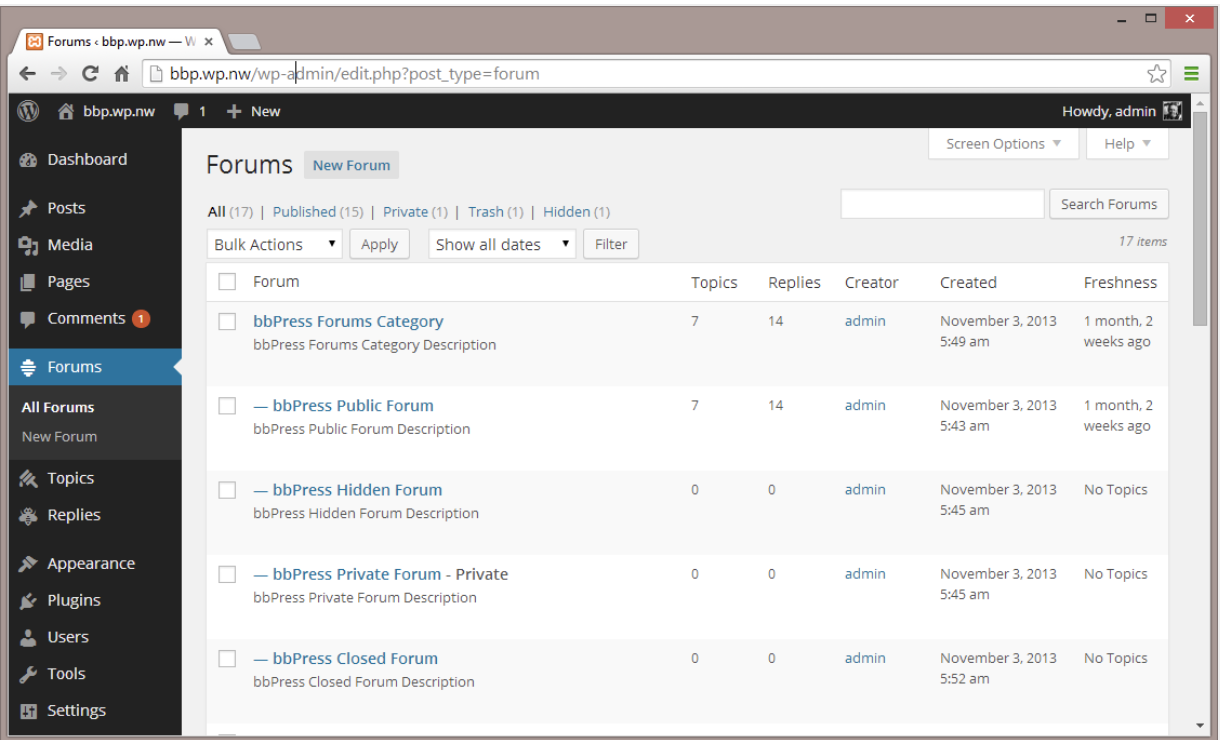 Image courtesy of WordPress.org
3. phpBB
Price: Free
PhpBB is a forum platform that has a typical and intuitive board set-up where users can post public or private messages. With phpBB, you can create as many internal messaging boards as you want without any additional costs.
Additionally, you can use extensions to add new options to your forum community. This makes the software very customizable, and allows you to adapt the software to the growing needs of your audience.
Among other things, phpBB lets you create password-protected forums for added security, sub-forums, the option to display active topics at the top of your forum, and the ability to add forum rules at the top of a forum to ensure your community abides by set guidelines.
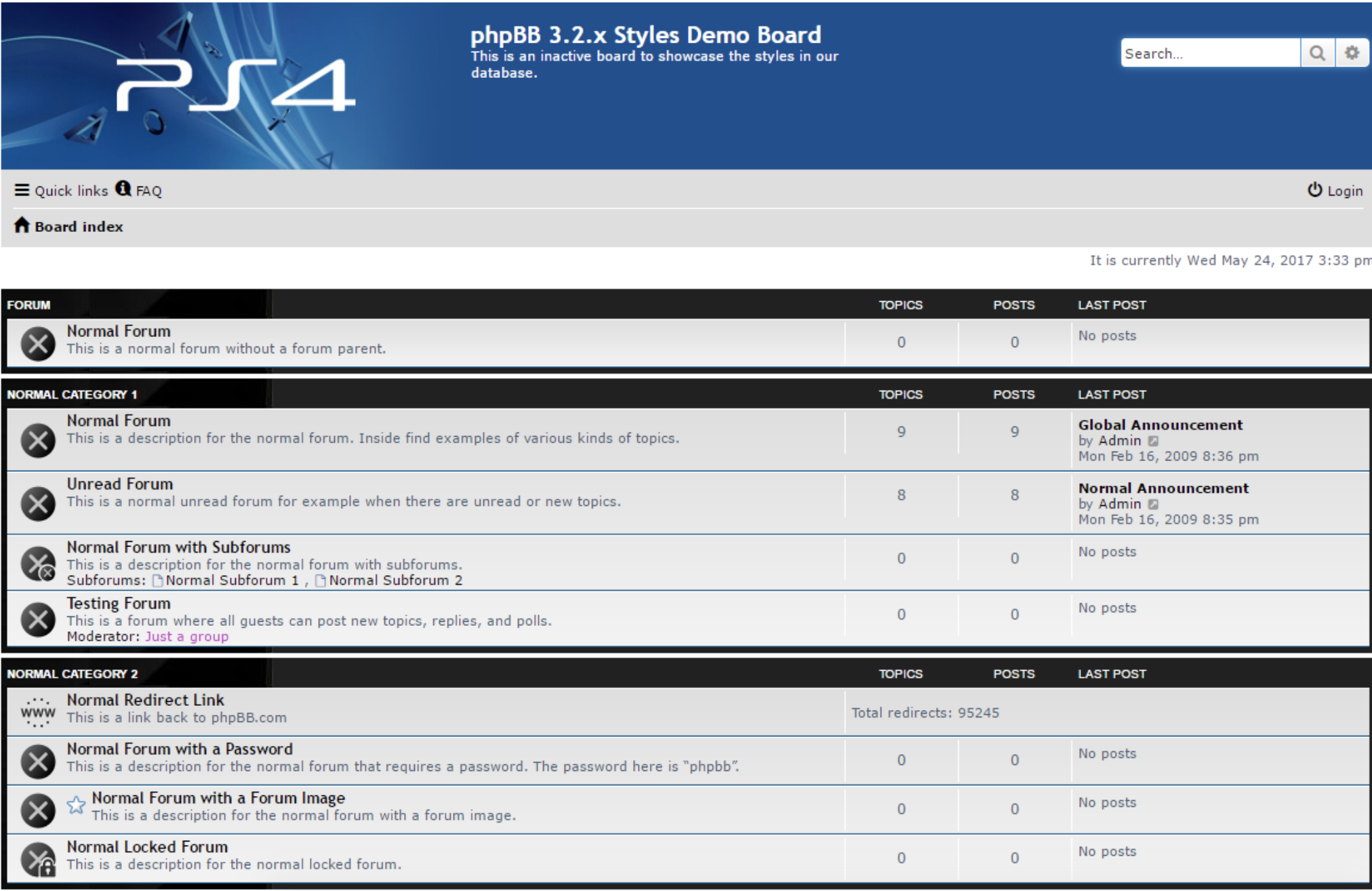 Image courtesy of phpBB
4. Joomla!
Price: Ranges from $700-$6,500
Joomla! Is a CMS software like WordPress, but requires more attention to detail and management. This is a robust CMS that will power your forum plugins like Kunena or EasyDiscuss, which are specifically created for Joomla!’s system. The price point comes from the open-source content management system, which will allow you to build powerful online applications alongside your forum software.
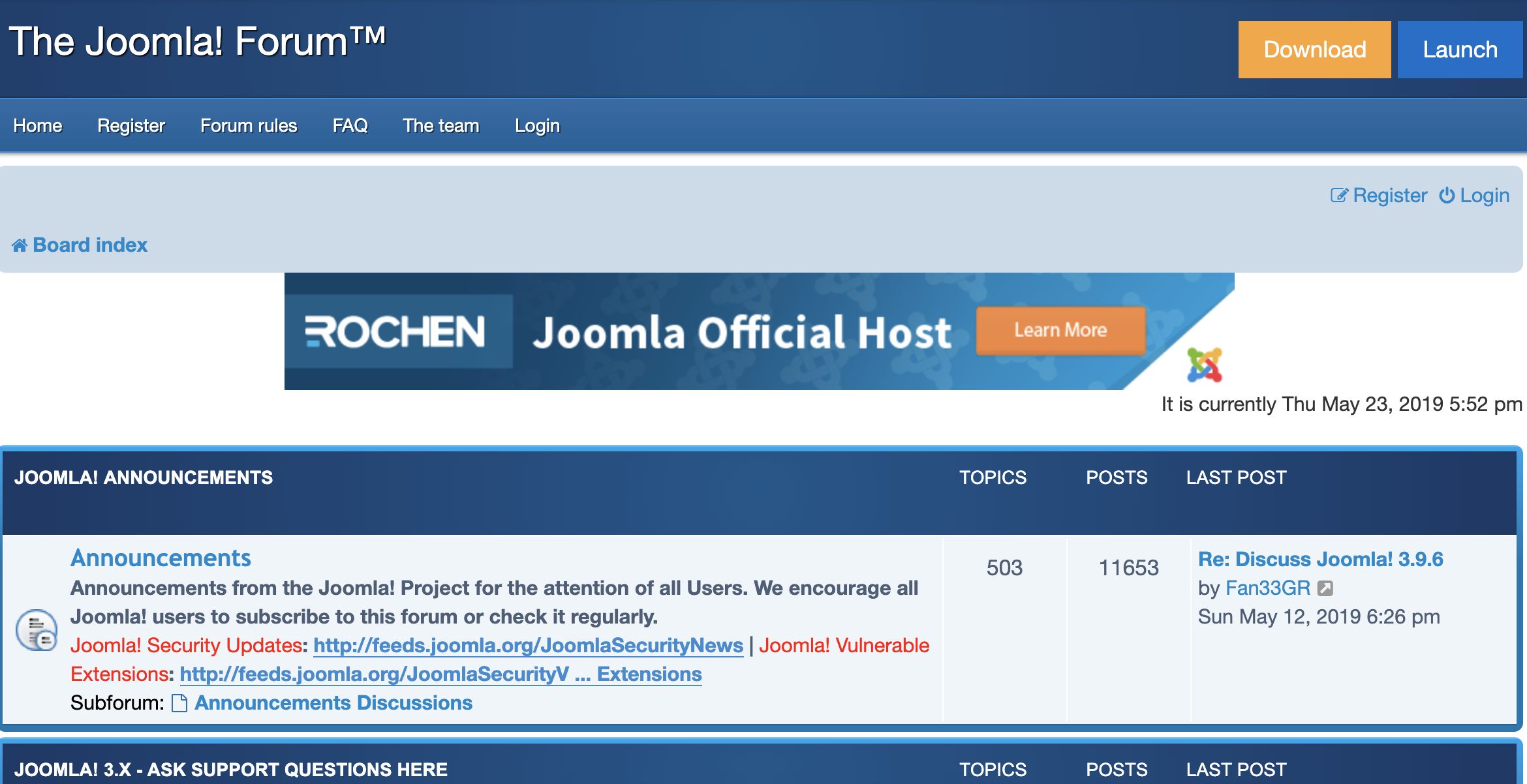 Image courtesy of Joomla!
5. Vanilla Forums
Price: $689 – $10,000+/month for enterprise
Vanilla has an abundance of features — one of the most notable being the intuitive dashboard that lets you manage every aspect of your community forum. You can view stats, manage users, and use an advanced editor that recognizes HTML, BBCode, and Markdown using this software.
Additionally, Vanilla gives you the ability to adjust permissions of forums or members if you’re looking to control access. The software enables customers to submit, view and vote on ideas to drive innovation for your business, or use the Q&A option to connect with and help each other get more out of your products or services. Best of all, Vanilla offers an on-boarding process with useful checklists, training materials, and help from one of their support reps.
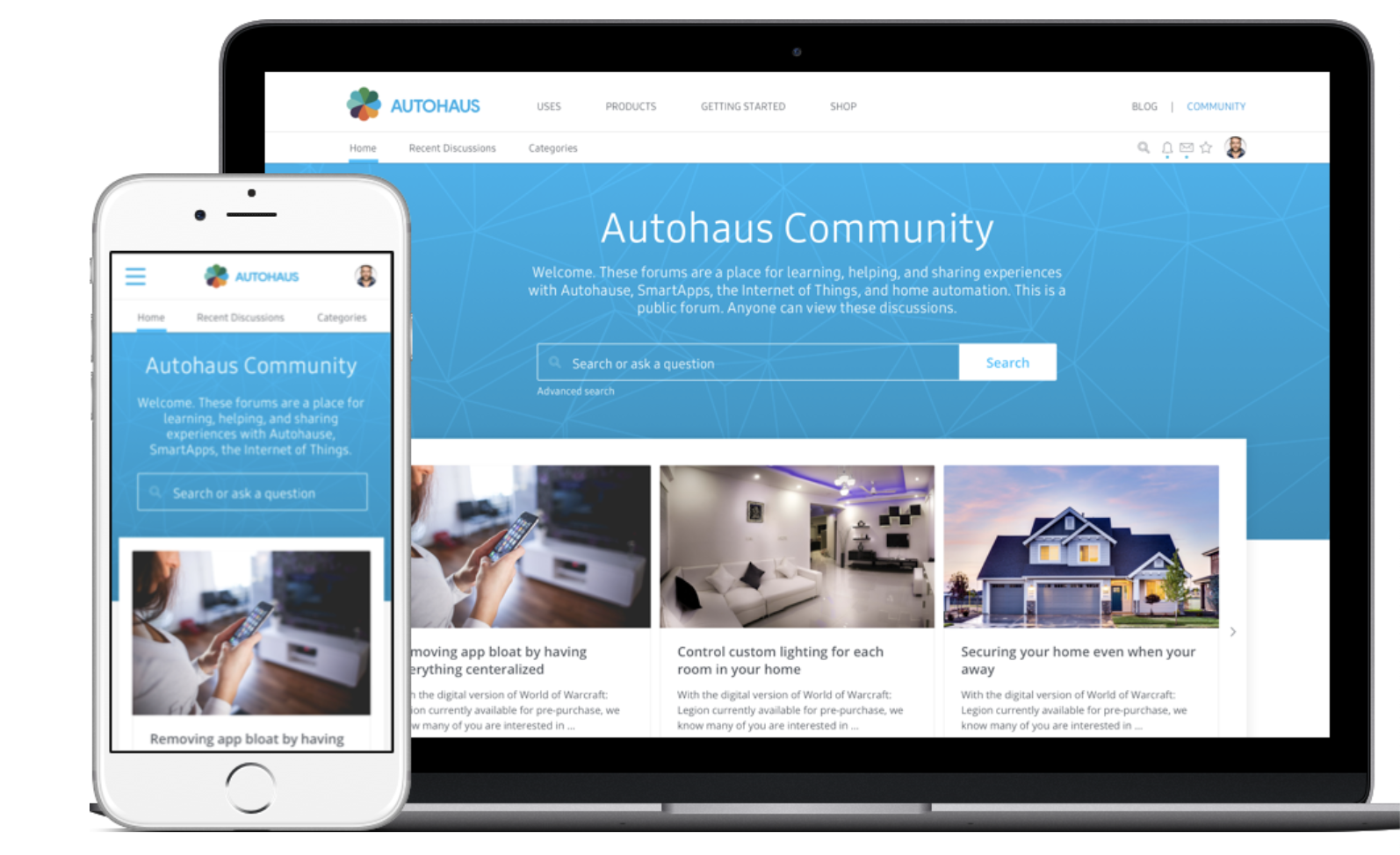 Image courtesy of Vanilla Forums
6. Codoforum
Price: Free
Codoforum is new software that has a fresh UI with modern design. It’s simple, clean, and easy to use. Codoforum is built with PHP using the latest coding patterns and is fully compliant with new PSR standards. This software provides a responsive layout structure for mobile and desktop, SSO and integration, as well as mention notifications for users.
Since it’s free to use, Codoforum is a good option if you’re still testing out forums or aren’t sure whether they’ll be useful for your own website and community.
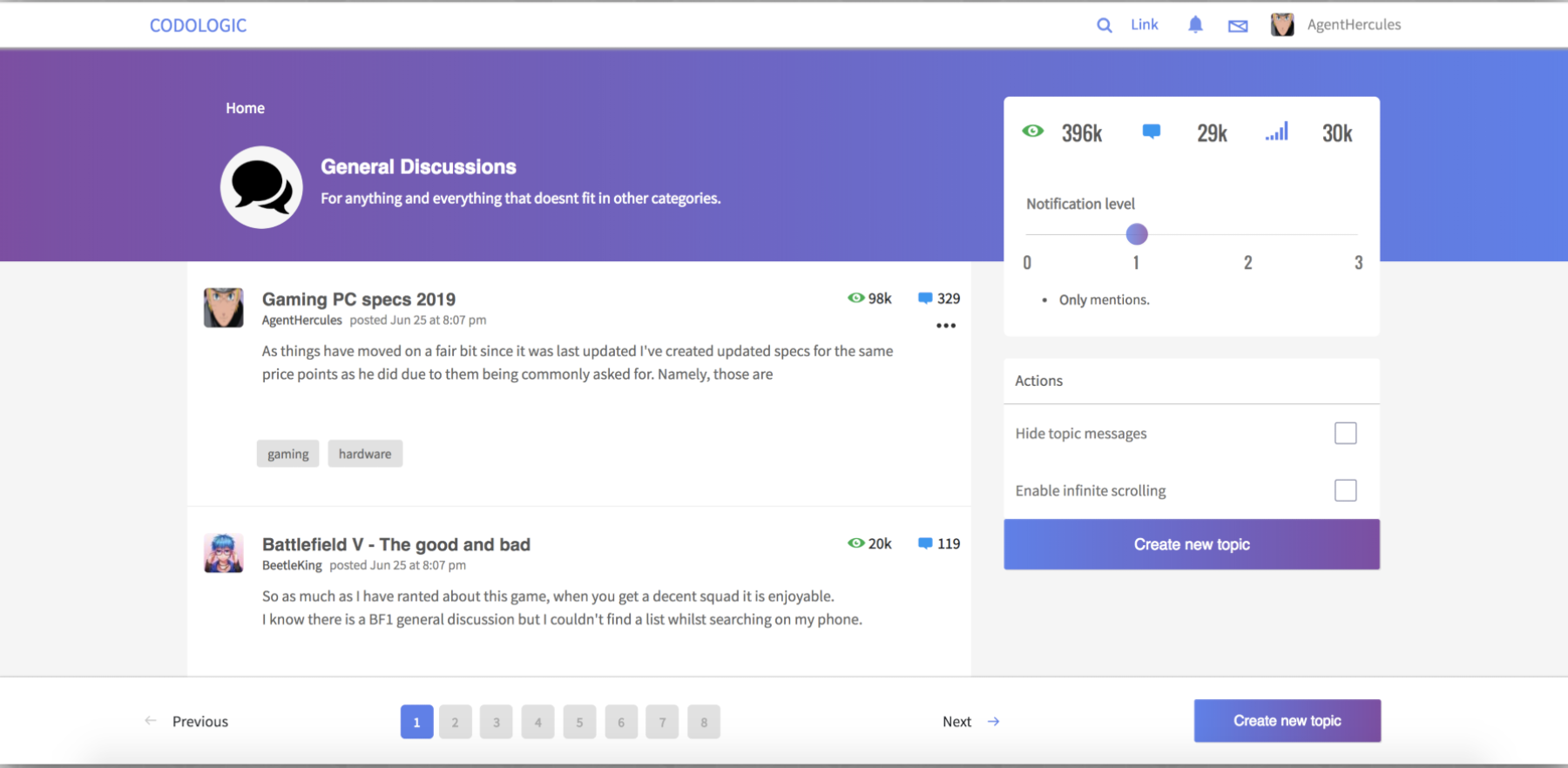 Image courtesy of Codoforum
7. VBulletin
Price: vBulletin 5 Connect $249, $15/month
Over 100,000 websites are built on vBulletin — including NASA, EA, and Sony Pictures — so it’s a popular option for hosting your forum. The software includes tons of great features, including built-in SEO, security, and responsive web design. With VBulletin you can have an unlimited hierarchy of forums as well as private forums.
Best of all, VBulletin provides fun and unique features for your community members, including private messaging, a friends list, members birthdays (shown on the Forum homepage), and the ability to see who’s online.
VBulletin is not known for being the fastest forum, but its design is clean and it offers quality support for its users.
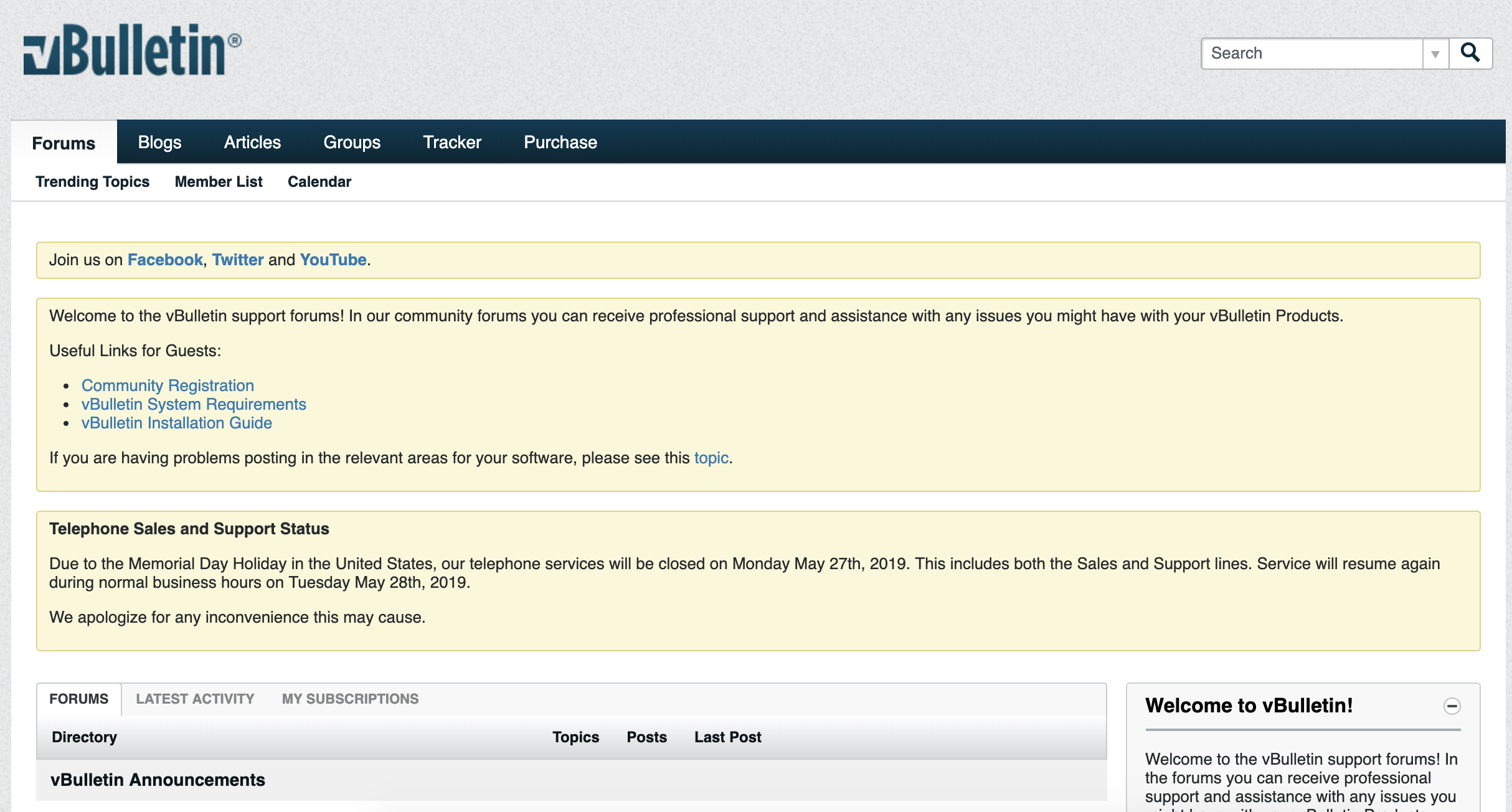
Image courtesy of VBulletin
8. Invision Community
Price: Varies for forum size/data needs, but starts at $45/month for 65 online visitors
IP Board was a very popular forum software that has since expanded to Invision Community, which includes a forum application in addition to its other offerings. According to the Invision Community website, the forums module powers hundreds of millions of discussions around the web, and Invision Community has many other community management apps to help you interact with your audience.
Best of all, the software allows your users to take control over their own online communities, which you can monitor at your discretion. For instance, Invision Community lets users create and manage their own communities, called “Clubs”, which are fully integrated with your website — these clubs get designated Club Leaders, who can add new forums, calendars, or galleries to the community.
It’s important to note, Invision Community is best-suited for small businesses.
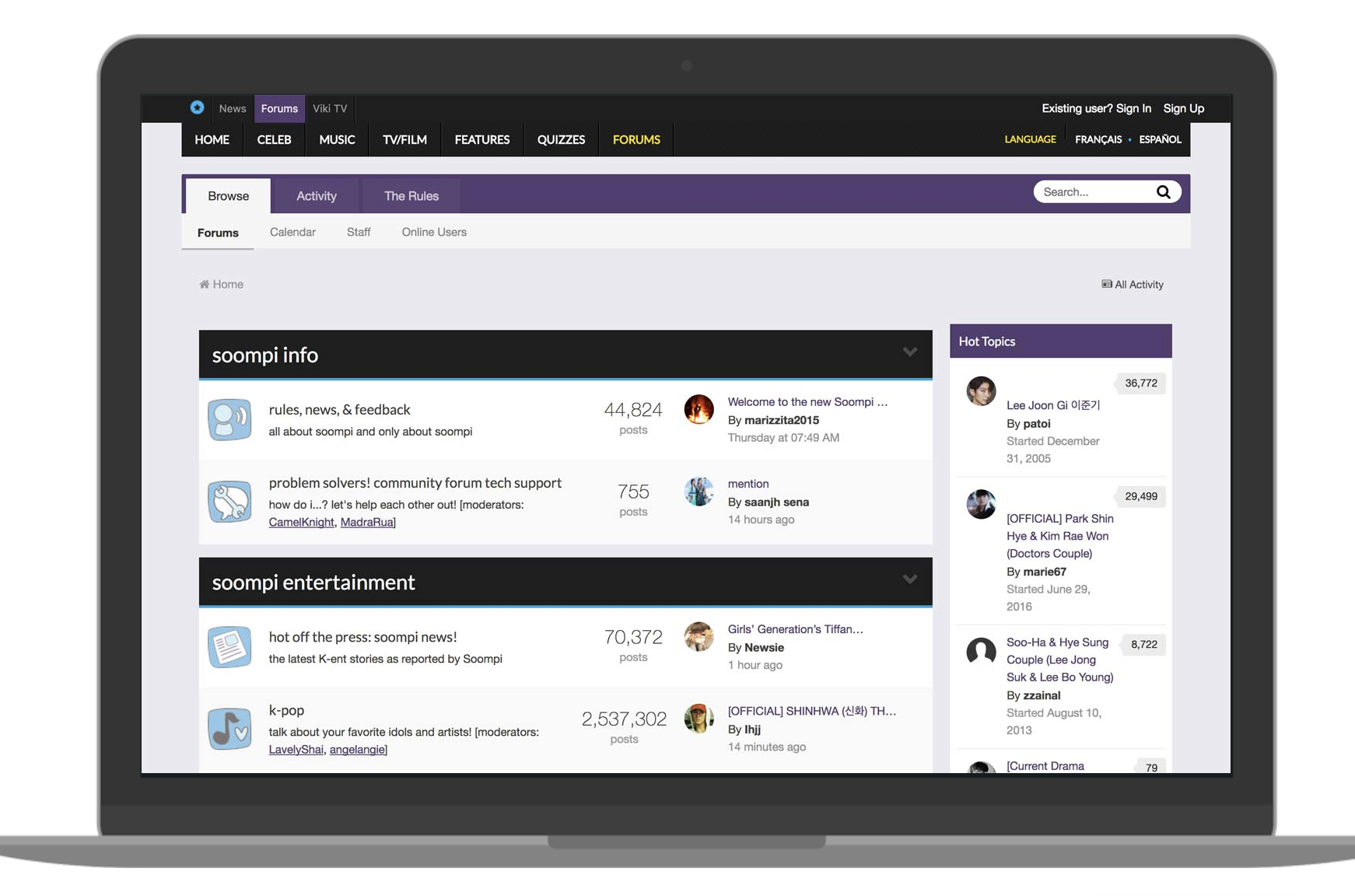
Image courtesy of Invision Community
9. Flarum
Price: Free
Flaurm is currently in Beta and has a streamlined design that is extremely easy to navigate. Flarum is fully responsive, and offers smooth animations and available swipe features for mobile optimization. The software was built by the developers of esoTalk and FluxBB, two of the fastest forum platforms, and has great performance reviews.
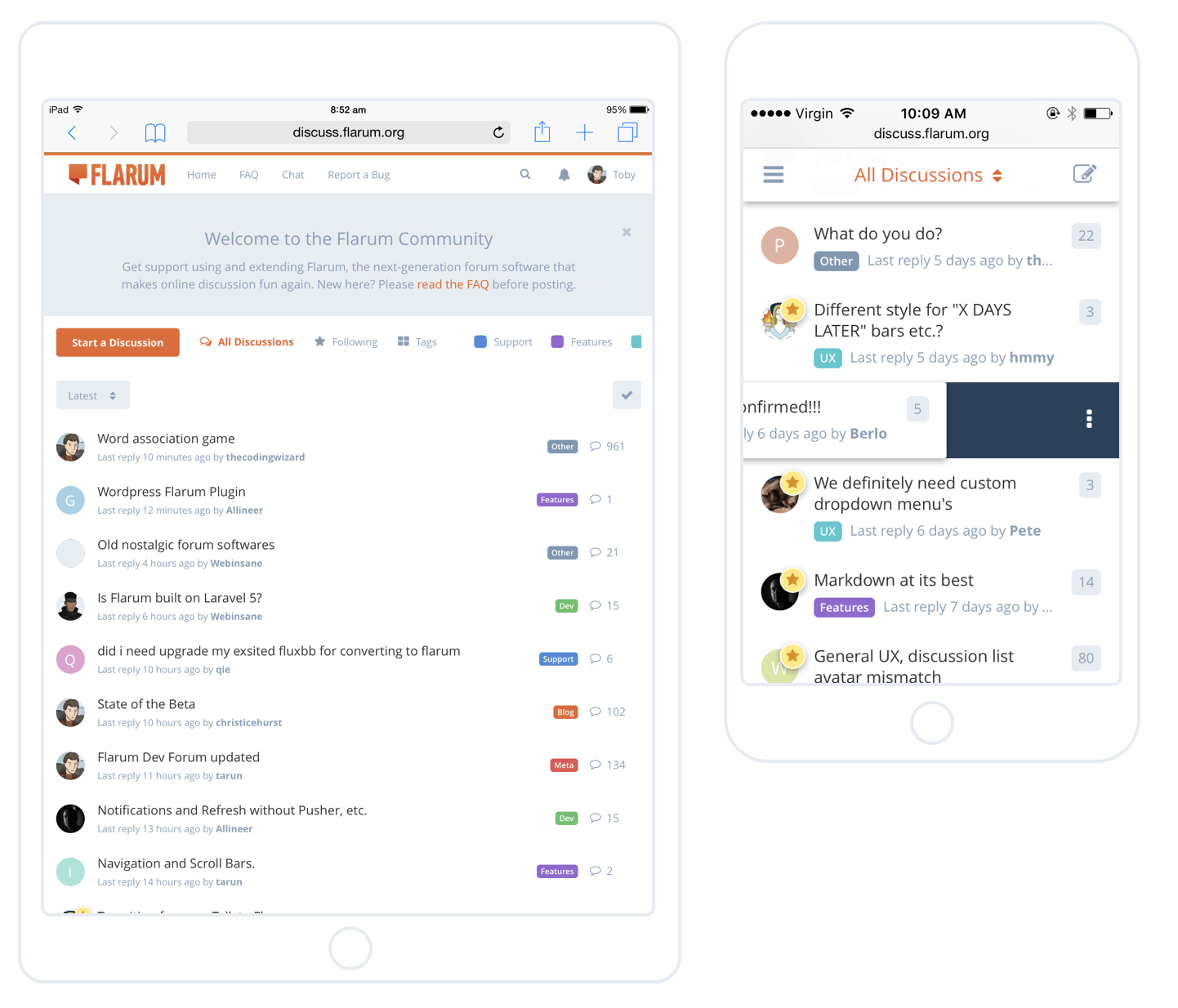 Image courtesy of Flarum
10. MyBB
Price: Free
MyBB is a free and open-source forum software that powers thousands of communities. It features hundreds of plugins and themes for you to customize, and the users that exist on the forum will help you establish your own community. Users have also contributed to the translations available for the content on the software. Now, forums are available in over 30 languages to help you grow a more global community.
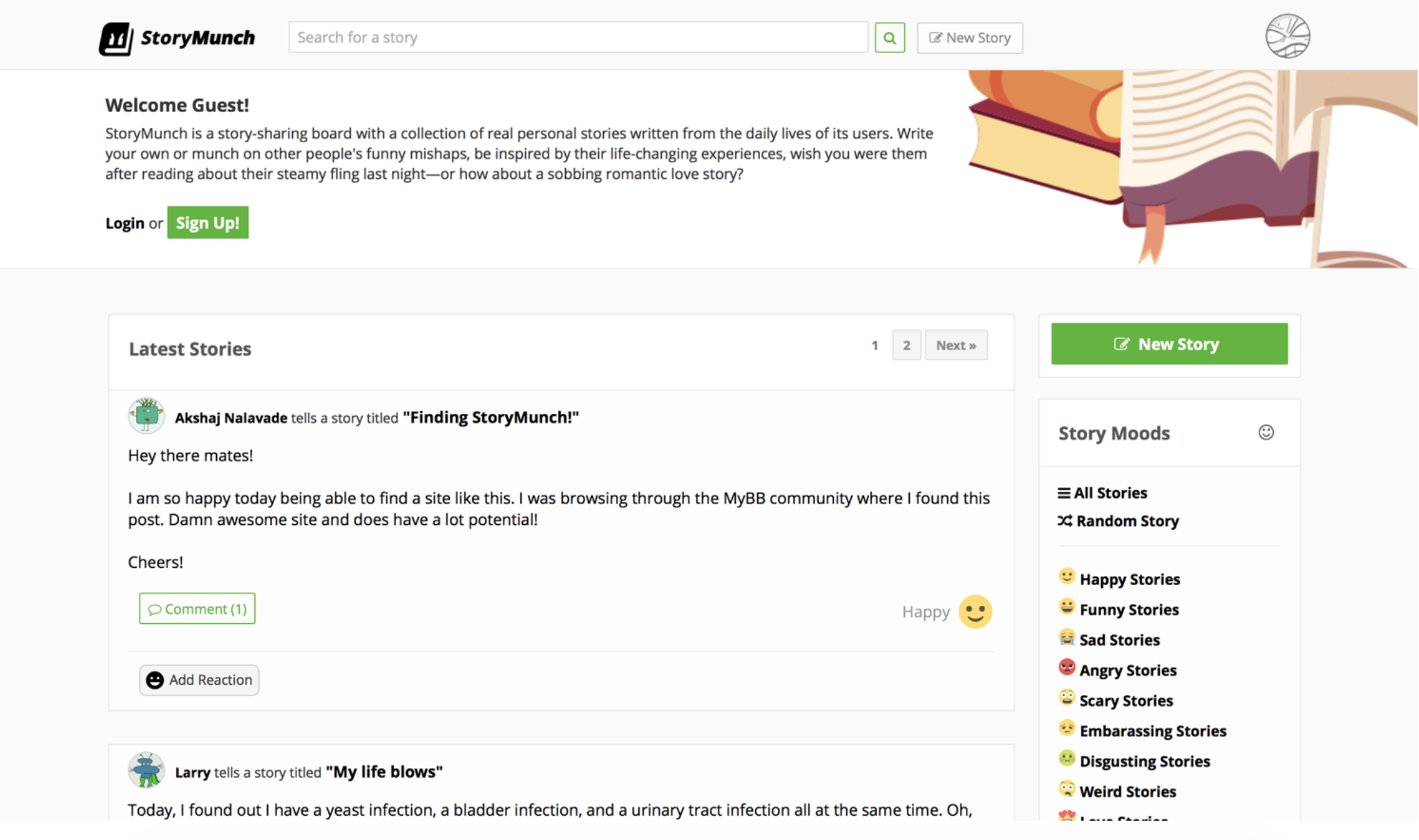 Image courtesy of MyBB
Ways to build your community using a forum software
People notice when brands listen to and converse with their customers, and they especially notice when brands foster their own communities. How? Through the power of word-of-mouth marketing. Customers who view themselves as valued members of your community are much more likely to talk about your brand to their friends.
Here’s how you can build a strong community using your forum software.
1. Spread the word.
Nobody will join your online community if they don’t know it exists. Spread the word about your new forum by including CTAs to join your forum in email newsletters or social posts. Ask your brand ambassadors or loyal fans to start posting about the forum, and post content on the forum so when other users join, you already have an established presence on the channel.
2. Listen to and check on your community regularly.
Reviewing your forum and responding to what your audience has to say is a crucial part of community building. Your customers are far less likely to continue to interact and engage on your forum if they feel as though they are being ignored. Responding to their feedback shows your users that you value their opinions and care about their experiences with your product.
Additionally, it’s your job to make sure everything is running smoothly on your forum. Checking on your community regularly will help you dissolve any service escalations, and give people the support they are seeking.
3. Foster a helpful discourse.
A forum should be a safe place for your customers, prospects, employees, fans, and audience to interact, ask, and answer questions. By establishing a helpful ethos early on, or creating community guidelines that prioritize patience and kindness within responses, your community will grow without the need to constantly monitor it 24/7.

19 of the Best Email Marketing Campaign Examples We’ve Ever Seen [Template]
On any given day, most of our email inboxes are flooded with a barrage of automated email newsletters that do little else besides giving us another task to do on our commutes to work — namely, marking them all as unread without reading, or unsubscribing altogether.
But every now and then, we get a newsletter that’s so good, not only do we read it, but we click it, share it, and recommend it to our friends.

What Makes an Effective Email Marketing Campaign?
Effective email marketing campaigns need to be cleverly written to attract attention in busy inboxes. Here are three things your next email campaign should have.
Personalization and Imagery
Marketing emails need to be personalized to the reader and filled with interesting graphics. Few people want to read emails that are addressed “Dear Sir/Madam” — as opposed to their first or last name — and even fewer people want to read an email that simply gives them a wall of text. Visuals help your recipients quickly understand what the point of the email is.
Responsive Design
Effective email marketing campaigns are designed for all devices on which users can read their emails — desktop, tablet, and smartphone. Email campaigns that are designed for mobile devices are especially important — a quality known as “responsive design.” In fact, 73% of companies today prioritize mobile device optimization when creating email marketing campaigns.
An Appropriate Call-to-Action
Above all, exceptional marketing emails must contain a meaningful call-to-action (CTA). After all, if brands are taking up subscribers’ time — and inbox space — with another email, every message must have a point to it. Internet users get multiple emails per day — why should they care about yours?
You probably receive enough emails as it is, and it’s tough to know which newsletters are worth subscribing to, so we’ve curated a list of some of our favorite examples. Read on to discover some great email campaign examples and what makes them great — or just skip ahead to the brands you already know and love.
But first, download the planning template you’ll need to craft your own lovable email marketing campaign, and check out our new Out-of-Office Email Generator to make your email address even more delightful to your contacts.
Email Marketing Examples
- charity: water: Donation Progress Update
- Brooks Sports: Desiree Linden’s Boston Marathon Victory
- BuzzFeed: ‘BuzzFeed Today’ Newsletter
- Uber: Calendar Integration
- TheSkimm: Subscription Anniversary
- Mom and Dad Money: Get to Know Your Subscribers
- Poncho: Custom Weather Forecast
- Birchbox: Co-marketing Promotion
- Postmates: New Product
- Dropbox: User Reengagement
- InVision App: Weekly Blog Newsletter
- Warby Parker: Product Renewal
- Cook Smarts: Weekly Product Newsletter
- HireVue: Customer Retention
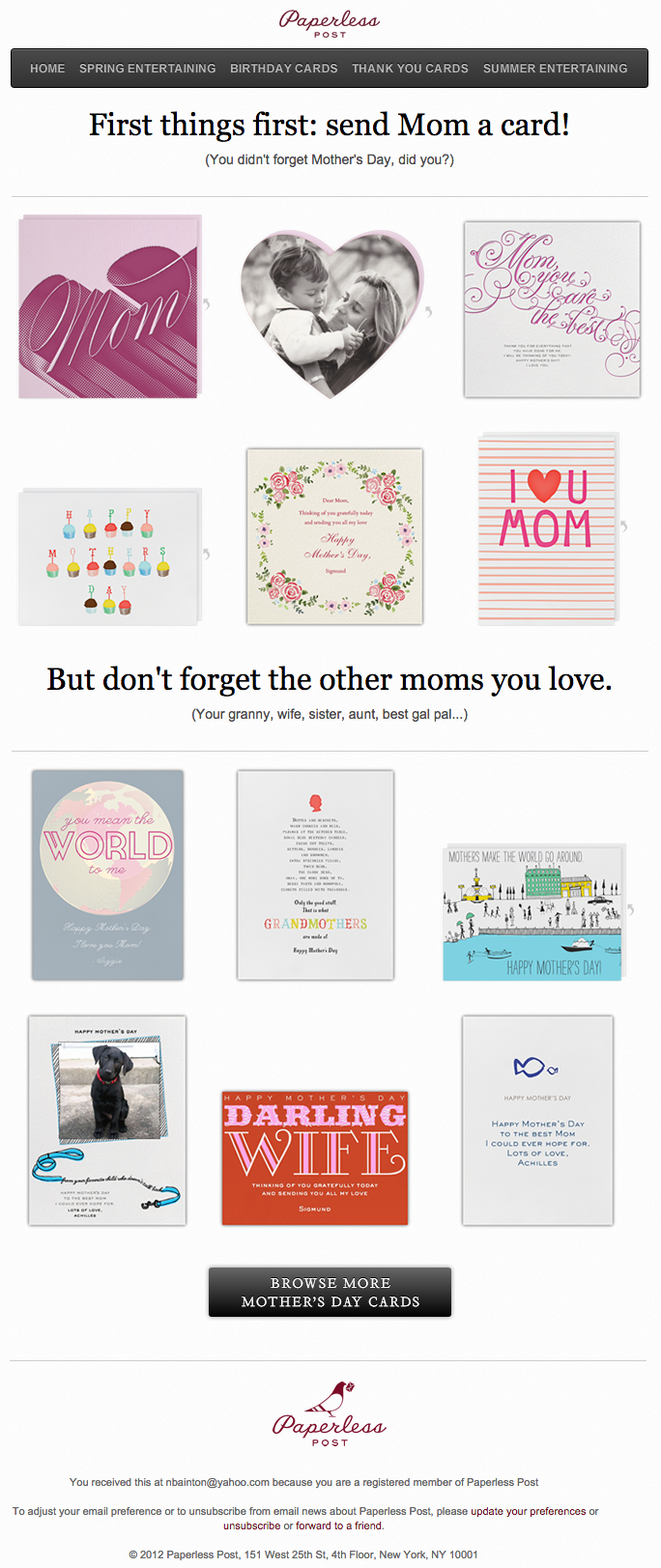
- Paperless Post: Mother’s Day Promotion
- Stitcher: Recommended for You
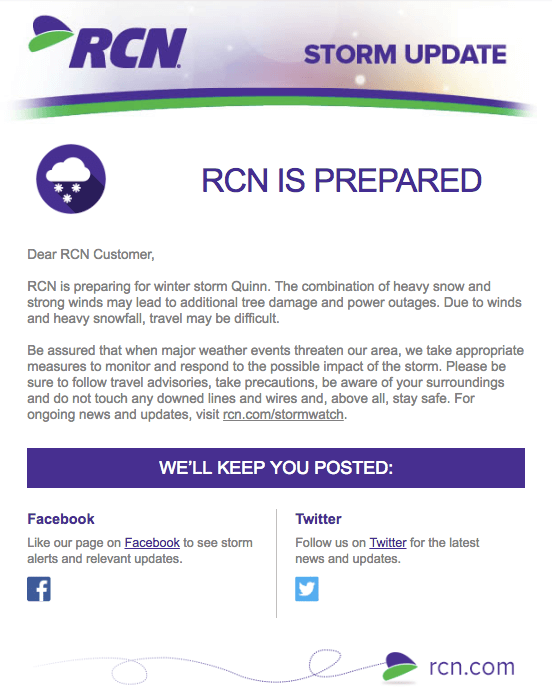
- RCN: Storm Update
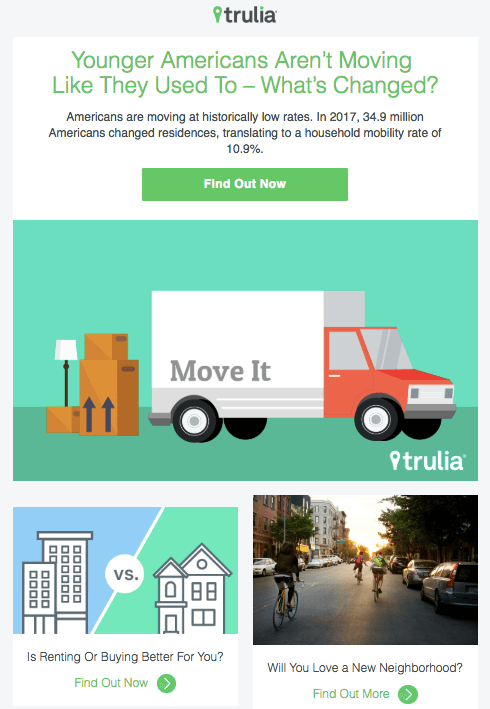
- Trulia: Moving Trends
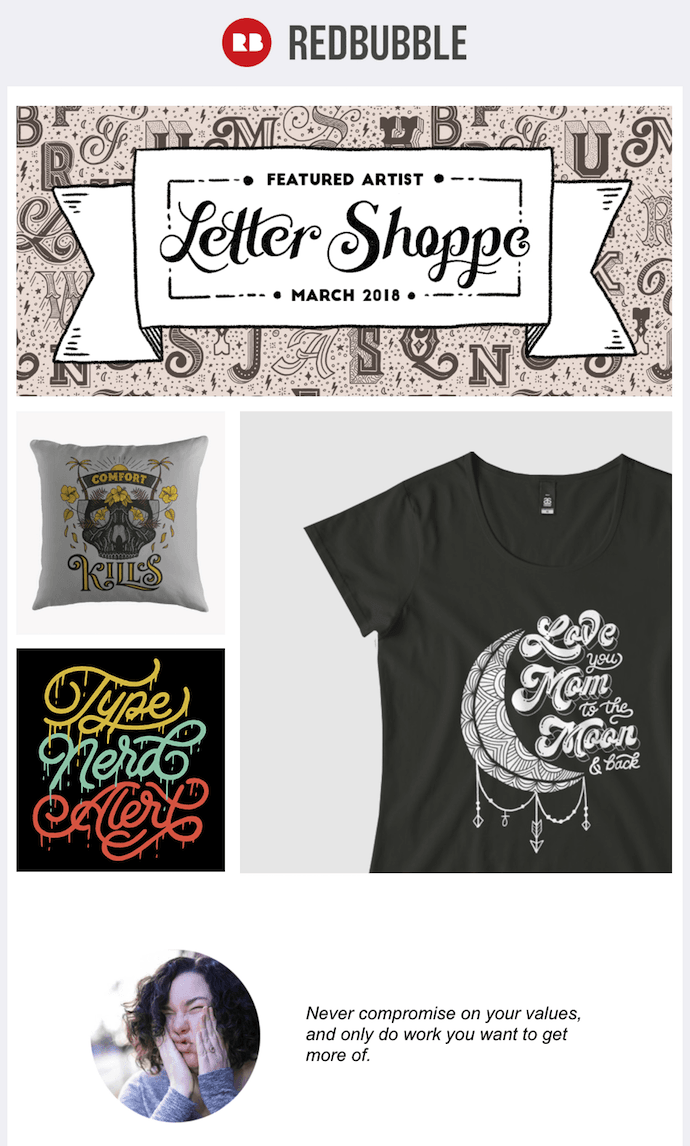
- Redbubble: Featured Artist
1. charity: water
Marketing Campaign: Donation Progress Update
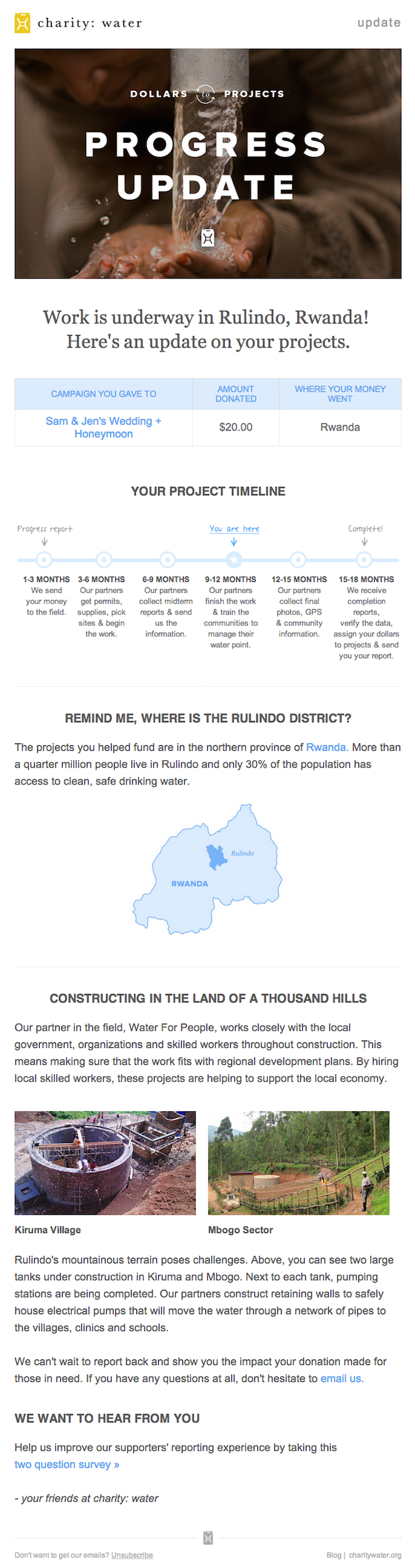
When people talk about email marketing, lots of them forget to mention transactional emails. These are the automated emails you get in your inbox after taking a certain action on a website. This could be anything from filling out a form, to purchasing a product, to updating you on the progress of your order. Often, these are plain text emails that marketers set and forget.
Well, charity: water took an alternate route. Once someone donates to a charity: water project, her money takes a long journey. Most charities don’t tell you about that journey at all — charity: water uses automated emails to show donors how their money is making an impact over time. With the project timeline and accompanying table, you don’t even really need to read the email — you know immediately where you are in the whole process so you can move onto other things in your inbox.
2. Brooks Sports
Marketing Campaign: Desiree Linden’s Boston Marathon Victory
When Desiree Linden won the 2018 Boston Marathon, she became the first American woman to win the race in more than 30 years. To her shoe and apparel sponsor, Brooks Sports, it was an opportunity to celebrate their long partnership together. The resulting email campaign focuses almost entirely on the Olympic marathoner’s amazing accomplishment.
Email campaigns like this one allow companies to demonstrate their loyalties and add value to the products their best users have chosen. The blue CTA button at the bottom of the email reads, “See Desiree’s go-to gear.” What better products to call attention to than the stuff worn by America’s latest legend?
After Desiree’s victory, everyone knew her name. Brooks Sports struck while the iron was hot with a proud email that was sure to be opened and forwarded.

3. BuzzFeed
Marketing Campaign: ‘BuzzFeed Today’ Newsletter
I already have a soft spot for BuzzFeed content (“21 Puppies so Cute You Will Literally Gasp and Then Probably Cry,” anyone?), but that isn’t the only reason I fell in love with its emails.
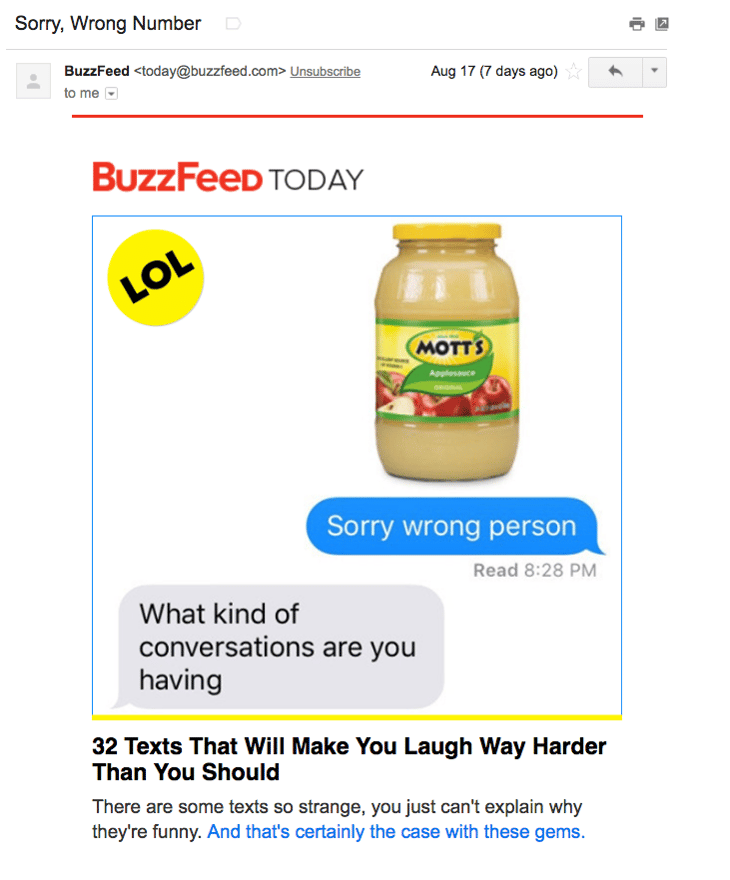
First of all, BuzzFeed has awesome subject lines and preview text. They are always short and punchy — which fits in perfectly with the rest of BuzzFeed’s content. I especially love how the preview text will accompany the subject line. For example, if the subject line is a question, the preview text is the answer. Or if the subject line is a command (like the one below), the preview text seems like the next logical thought right after it:

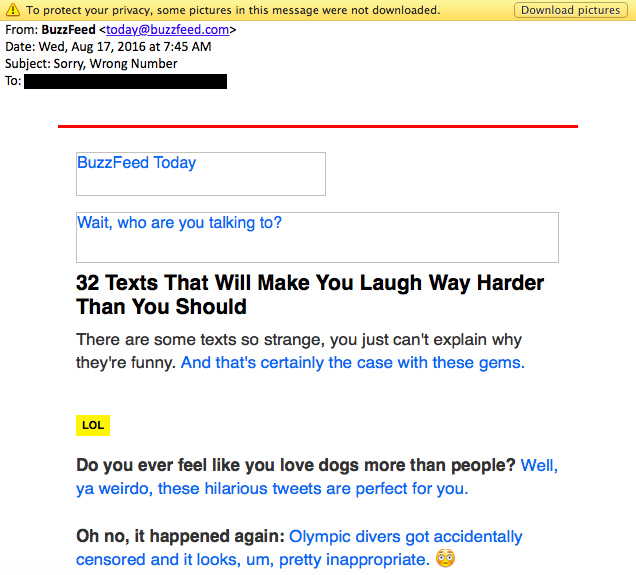
Once you open up an email from BuzzFeed, the copy is equally awesome. Just take a look at that glorious alt text action happening where the images should be. The email still conveys what it is supposed to convey — and looks great — whether you use an image or not. That’s definitely something to admire.
Without images:
With images:
4. Uber
Marketing Campaign: Calendar Integration
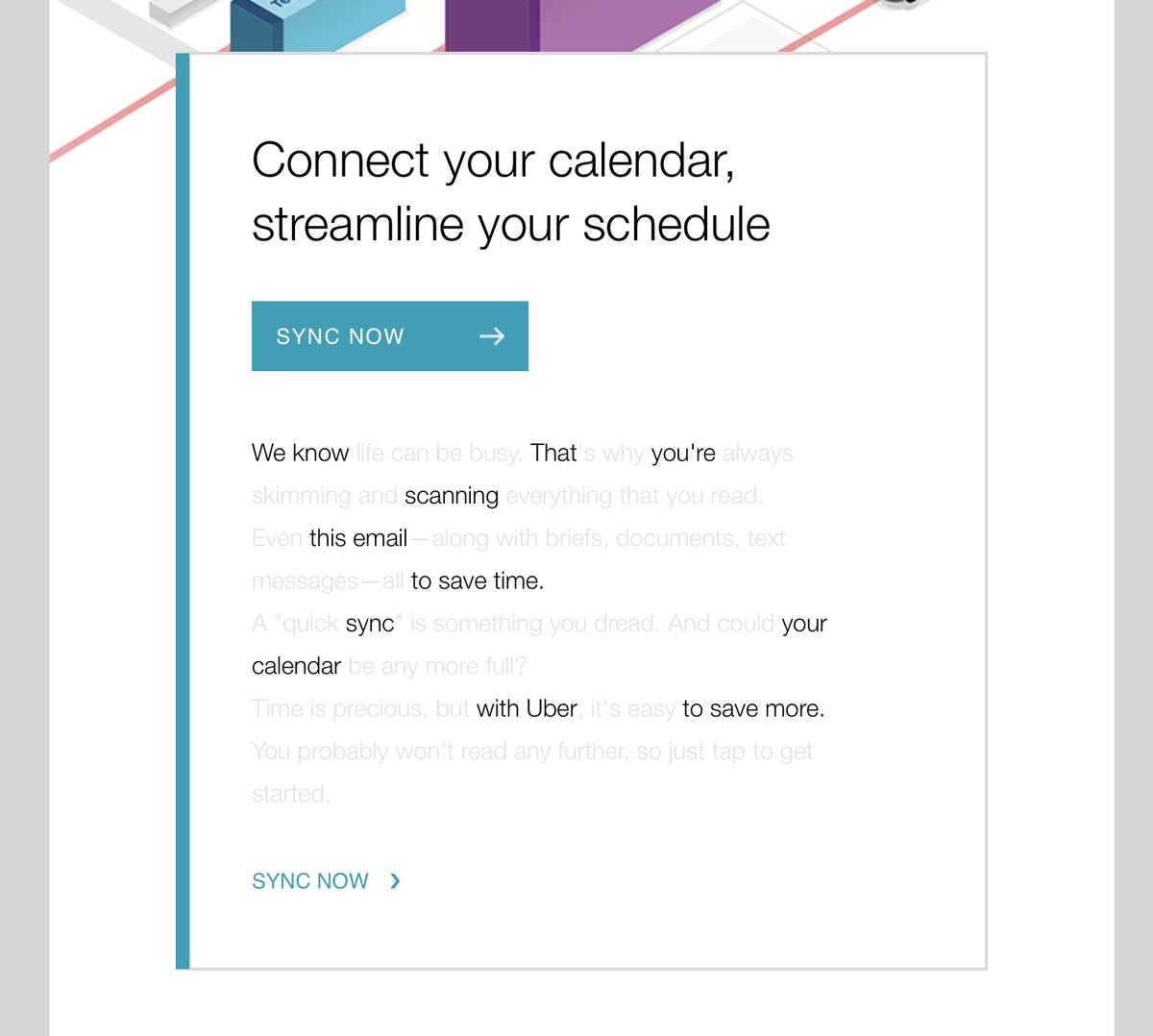
The beauty of Uber‘s emails is in their simplicity. Email subscribers are alerted to deals and promotions with emails like the one you see below. We love how brief the initial description is, paired with a very clear CTA — perfect for subscribers who are quickly skimming the email.
For the people who want to learn more, these are followed by a more detailed (but still pleasingly simple), step-by-step explanation of how the deal works.
We also love how consistent the design of Uber’s emails is with its brand. Like its app, website, social media photos, and other parts of the visual branding, the emails are represented by bright colors and geometric patterns. All of its communications and marketing assets tell the brand’s story — and brand consistency is one tactic Uber’s nailed in order to gain brand loyalty.
Check out the clever copywriting and email design at work in this example:
5. TheSkimm
Marketing Campaign: Subscription Anniversary
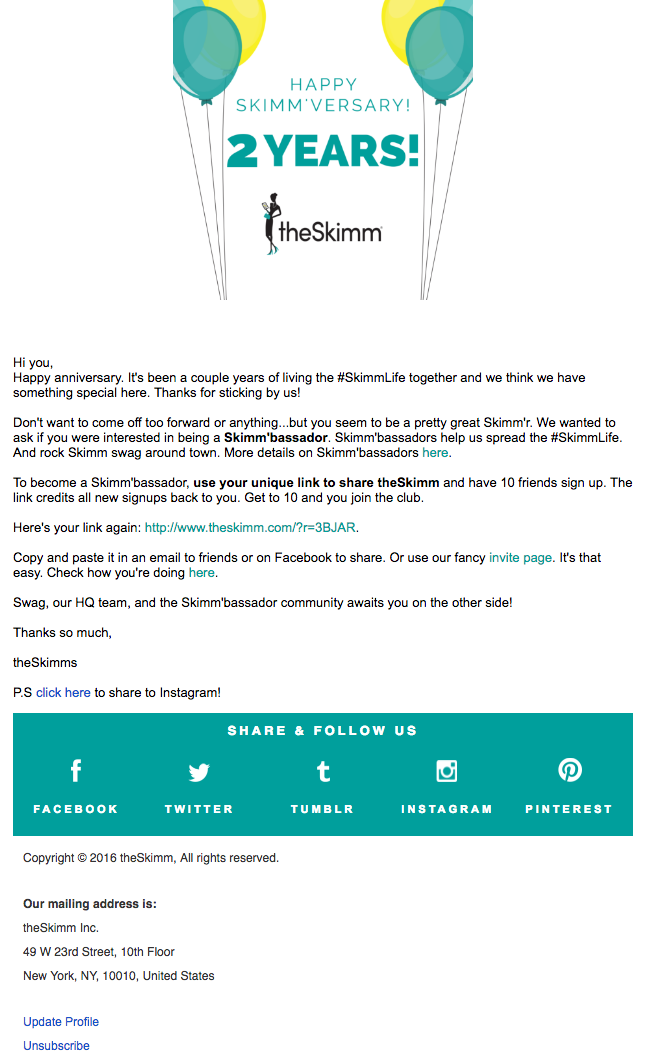
We love TheSkimm’s daily newsletter — especially its clean design and its short, punchy paragraphs. But newsletters aren’t TheSkimm’s only strength when it comes to email. Check out its subscriber engagement email below, which rewarded fellow marketer Ginny Mineo for being subscribed for two years.
Emails triggered by milestones, like anniversaries and birthdays, are fun to get — who doesn’t like to celebrate a special occasion? The beauty of anniversary emails, in particular, is that they don’t require subscribers to input any extra data, and they can work for a variety of senders. Plus, the timeframe can be modified based on the business model.
Here, the folks at TheSkimm took it a step further by asking Mineo if she’d like to earn the title of brand ambassador as a loyal subscriber — which would require her to share the link with ten friends, of course.
6. Mom and Dad Money
Marketing Campaign: Get to Know Your Subscribers
Think you know all about the people who are reading your marketing emails? How much of what you “know” about them is based on assumptions? The strongest buyer personas are based on insights you gather from your actual readership, through surveys, interviews, and so on — in addition to the market research.
That’s exactly what Matt Becker of Mom and Dad Money does — and he does it very, very well.
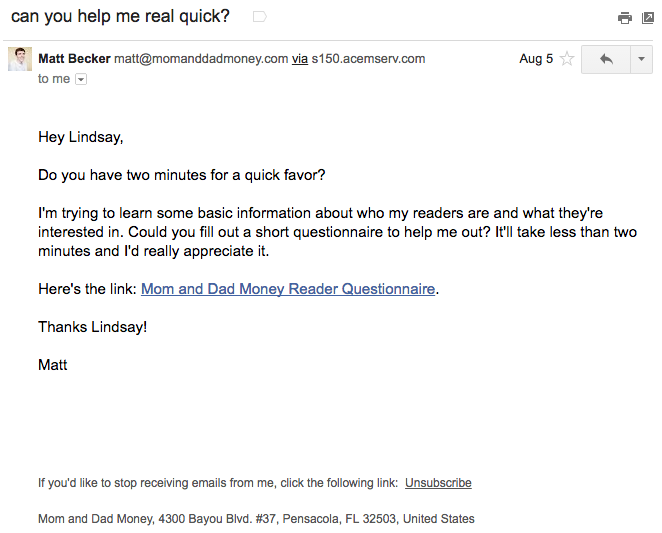
Here’s an example of an email I once received from this brand. Design-wise, it’s nothing special — but that’s the point. It reads just like an email from a friend or colleague asking for a quick favor.
Not only was this initial email great, but his response to my answers was even better: Within a few days of responding to the questionnaire, I received a long and detailed personal email from Matt thanking me for filling out the questionnaire and offering a ton of helpful advice and links to resources specifically catered to my answers. I was very impressed by his business acumen, communication skills, and obvious dedication to his readers.
7. Poncho
Marketing Campaign: Custom Weather Forecast
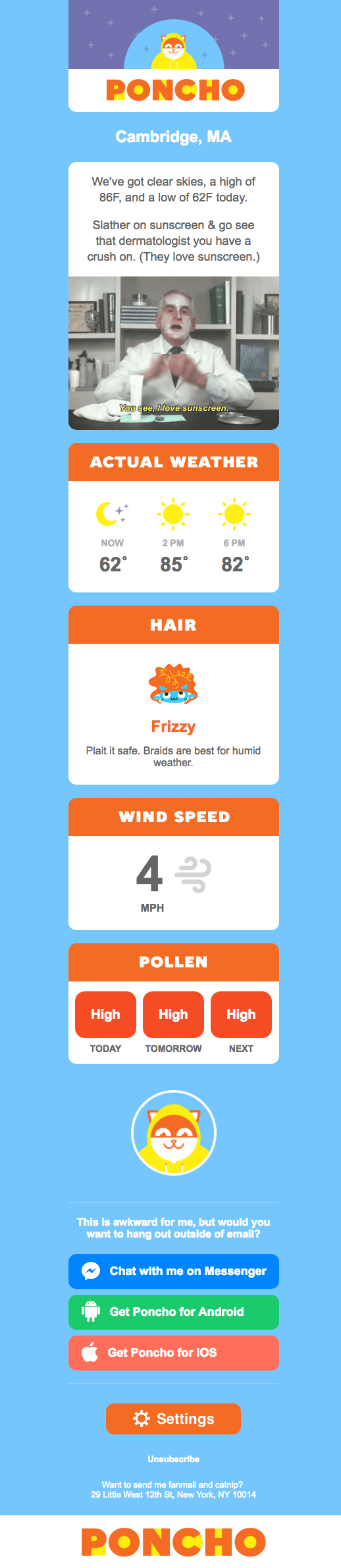
Some of the best emails out there pair super simple design with brief, clever copy. When it comes down to it, daily emails I get from Poncho — which sends me customizable weather forecasts each morning — takes the cake.
Poncho’s emails are colorful, use delightful images and GIFs, and are very easy to scan. The copy is brief but clever with some great puns, and it aligns perfectly with the brand. Check out the copy near the bottom asking to “hang out outside of email.” Hats off to Poncho for using design to better communicate its message.
8. Birchbox
Marketing Campaign: Co-marketing Promotion
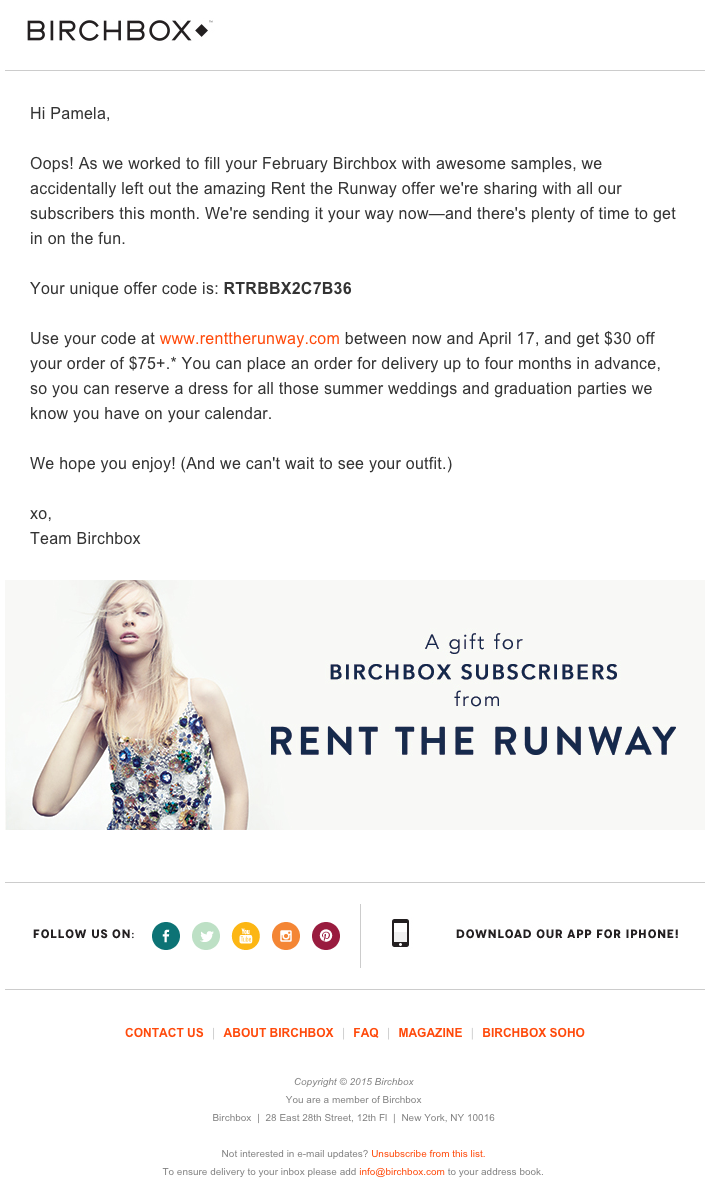
The subject line of this email from beauty product subscription service Birchbox got my colleague Pam Vaughan clicking. It read: “We Forgot Something in Your February Box!” Of course, if you read the email copy below, Birchbox didn’t actually forget to put that discount code in her box — but it was certainly a clever way to get her attention.
As it turned out, the discount code was actually a bonus promo for Rent the Runway, a dress rental company that likely fits the interest profile of most Birchbox customers — which certainly didn’t disappoint. That’s a great co-marketing partnership right there.
9. Postmates
Marketing Campaign: New Product
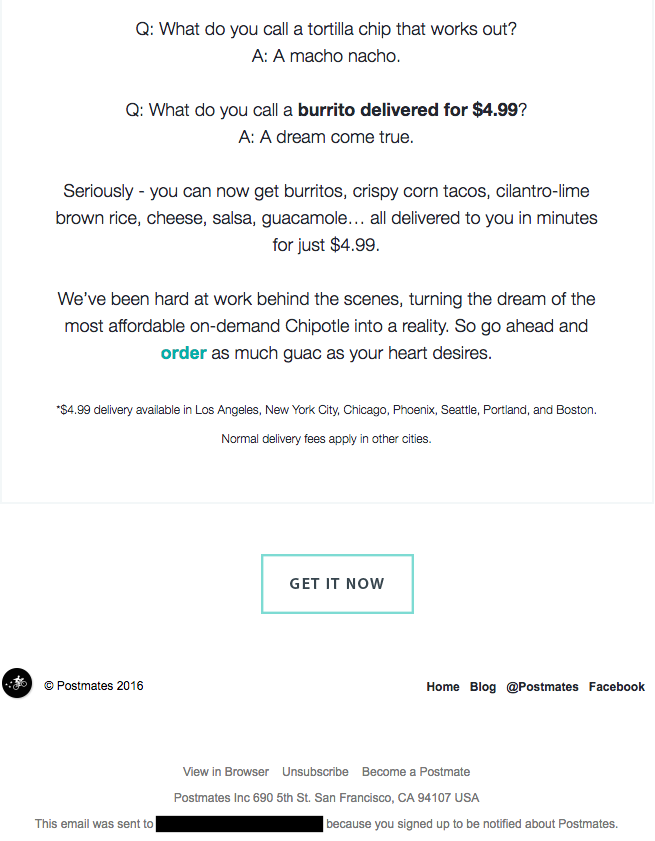
I have to say, I’m a sucker for GIFs. They’re easy to consume, they catch your eye, and they have an emotional impact — like the fun GIF in one of Postmates‘ emails that’s not only delightful to watch, but also makes you crave some delicious Chipotle.
You, too, can use animated GIFs in your marketing to show a fun header, draw people’s eyes to a certain part of the email, or display your products and services in action.

10. Dropbox
Marketing Campaign: User Reengagement
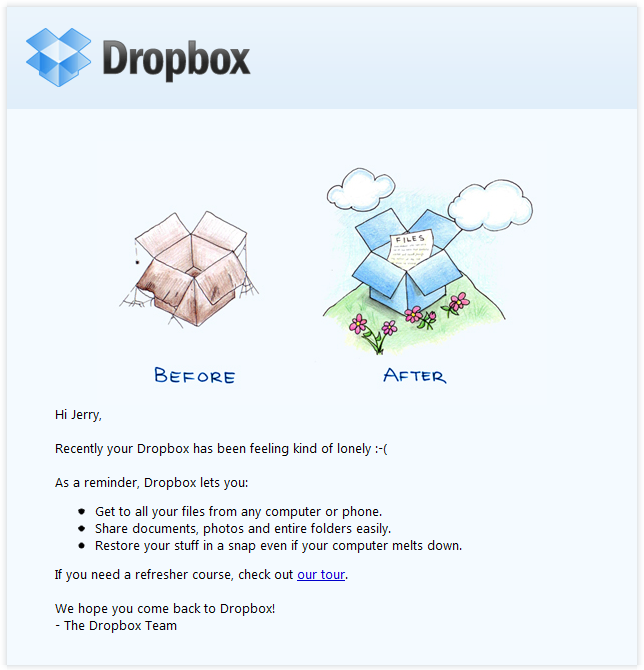
You might think it’d be hard to love an email from a company whose product you haven’t been using. But Dropbox found a way to make its “come back to us!” email cute and funny, thanks to a pair of whimsical cartoons and an emoticon.
Plus, the email was kept short and sweet, to emphasize the message that Dropox didn’t want to intrude — it just wants to remind the recipient that the brand exists, and why it could be helpful. When sending these types of email, you might include an incentive for recipients to come back to using your service, like a limited-time coupon.
11. InVision App
Marketing Campaign: Weekly Blog Newsletter
Every week, the folks at InVision send a roundup of their best blog content, their favorite design links from the week, and a new opportunity to win a free t-shirt. (Seriously. They give away a new design every week.) They also sometimes have fun survey questions where they crowdsource for their blog. This week’s, for example, asked subscribers what they would do if the internet didn’t exist.
Not only is InVision’s newsletter a great mix of content, but I also love the nice balance between images and text, making it really easy to read and mobile-friendly — which is especially important, because its newsletters are so long. (Below is just an excerpt, but you can read through the full email here.) We like the clever copy on the call-to-action (CTA) buttons, too.

12. Warby Parker
Marketing Campaign: Product Renewal
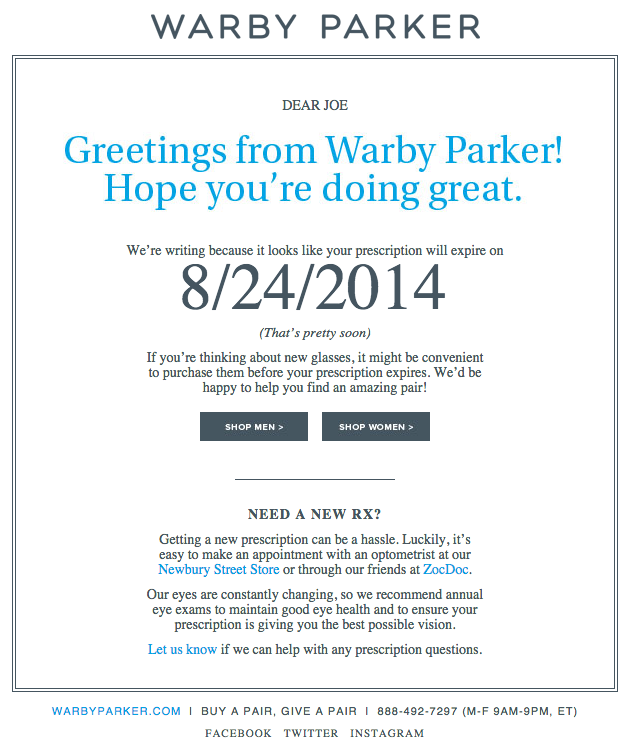
What goes better with a new prescription than a new pair of glasses? The folks at Warby Parker made that connection very clear in their email to a friend of mine back in 2014. It’s an older email, but it’s such a good example of personalized email marketing that I had to include it in here.
The subject line was: “Uh-oh, your prescription is expiring.” What a clever email trigger. And you’ve gotta love the reminder that your prescription needs updating.
Speaking of which, check out the clever co-marketing at the bottom of the email: If you don’t know where to go to renew your subscription, the information for an optometrist is right in the email. Now there’s no excuse not to shop for new glasses!
13. Cook Smarts
Marketing Campaign: Weekly Product Newsletter
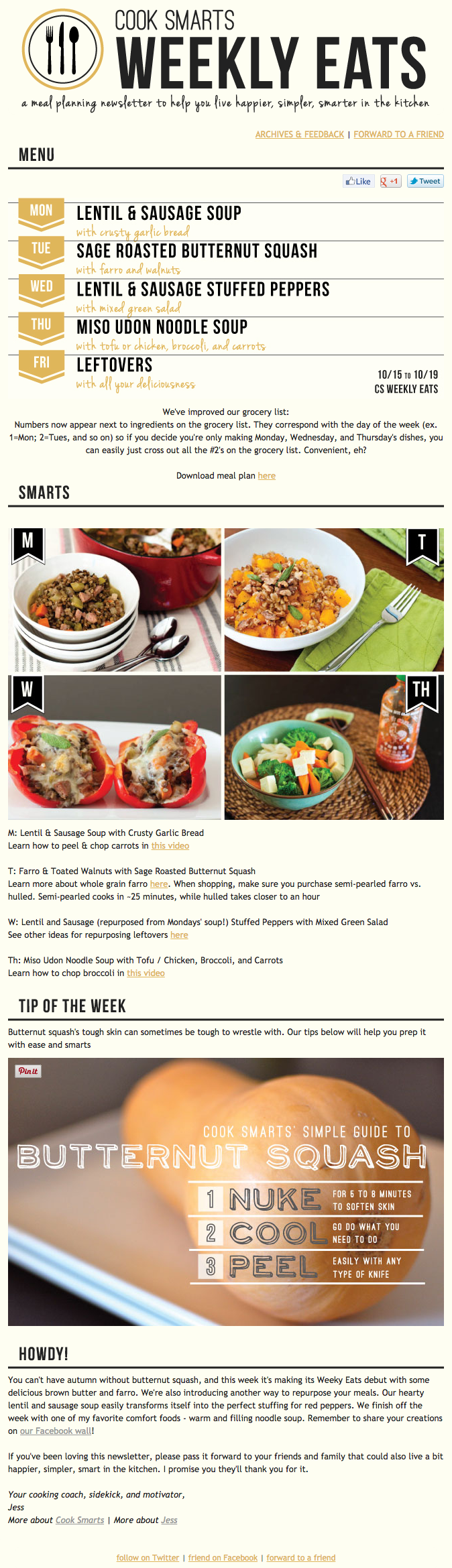
I’ve been a huge fan of Cook Smarts‘ “Weekly Eats” newsletter for a while. The company sends yummy recipes in the form of a meal plan to my inbox every week. But I didn’t just include it because of its delicious recipes — I’m truly a fan of its emails.
I especially love the layout of Cook Smarts’ emails: Each message features three distinct sections: one for the menu, one for kitchen how-to’s, and one for the tips. That means you don’t have to go hunting to find the most interesting part of its blog posts — you know exactly where to look after an email or two.
I also love Cook Smarts’ “Forward to a Friend” CTA in the top-right of the email. Emails are super shareable over — you guessed it — email, so you should also think about reminding your subscribers to forward your emails to friends, family, or coworkers.
14. HireVue
Marketing Campaign: Customer Retention
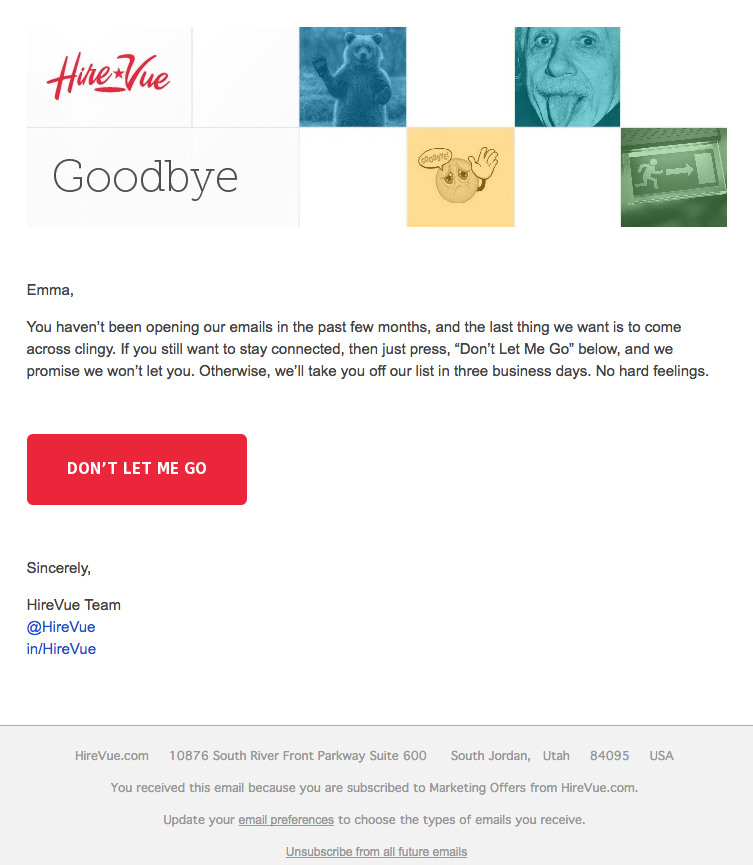
“Saying goodbye is never easy to do… So, we thought we’d give you a chance to rethink things.” That was the subject of this automated unsubscribe email from HireVue. We love the simple, guilt-free messaging here, from the funny header images to the great CTA button copy.
Not only are the design and copy here top-notch, but we applaud the folks at HireVue for sending automated unsubscribe emails in the first place. It’s smart to purge your subscriber lists of folks who aren’t opening your email lists, because low open rates can seriously hurt email deliverability.
15. Paperless Post
Marketing Campaign: Mother’s Day Promotion
When you think of “holiday email marketing,” your mind might jump straight to Christmas, but there are other holidays sprinkled throughout the rest of the year that you can create campaigns around. (Download these email marketing planning templates to keep yourself organized throughout the year.)
Take the email below from Paperless Post, for example. I love the header of this email: It provides a clear CTA that includes a sense of urgency. Then, the subheader asks a question that forces recipients to think to themselves, “Wait, when is Mother’s Day again? Did I buy Mom a card?” Below this copy, the simple grid design is both easy to scan and quite visually appealing. Each card picture is a CTA in and of itself — click on any one of them, and you’ll be taken to a purchase page.
16. Stitcher
Marketing Campaign: Recommended for You
As humans, we tend to crave personalized experiences. So when emails appear to be created especially for you, you feel special — you’re not just getting what everyone else is getting. You might even feel like the company sending you the email knows you in some way, and that it cares about your preferences and making you happy.
That’s why I love on-demand podcast/radio show app Stitcher‘s “Recommended For You” emails. I tend to listen to episodes from the same podcast instead of branching out to new ones. But Stitcher wants me to discover (and subscribe to) all the other awesome content it has — and I probably wouldn’t without this encouragement.
I think this email also makes quite a brilliant use of responsive design. The colors are bright, and it’s not too hard to scroll and click — notice the CTAs are large enough for me to hit with my thumbs. Also, the mobile email actually has features that make sense for recipients who are on their mobile device. Check out the CTA at the bottom of the email, for example: The “Open Stitcher Radio” button prompts the app to open on your phone.

17. RCN
Marketing Campaign: Storm Update
Internet providers and bad weather are natural enemies. You’d think telecommunications companies wouldn’t want to call attention to storm-induced power outages — the one thing that sets off customers’ impatience. Then, there’s RCN.
RCN, a cable and wireless internet service, turned this email marketing campaign into a weather forecast just for its customers. This “storm update” got the company out ahead of an event that threatened its service, while allowing its users to get the weather updates they need right from the company they count on for Wi-Fi.
As you can see below, the email even advises personal safety — a nice touch of care to go with the promise of responsive service. At the bottom of the email, RCN also took the opportunity to highlight its social media channels, which the company appropriately uses to keep users informed of network outages.
18. Trulia
Marketing Campaign: Moving Trends
I’m a huge advocate of thought leadership. To me, some of the best companies gain customer loyalty by becoming the go-to source for expertise on a given topic. Trulia — a property search engine for buyers, sellers, and renters — is that expert in the real estate biz. How do I know? Just read their emails, much like the one below.
“Why aren’t millennials moving?” The subject line of this email campaign reads before citing interesting data about relocation trends in the U.S. Trulia doesn’t benefit from people who choose not to move, but the company does benefit from having its fingers on the pulse of the industry — and showing it cares which way the real estate winds are blowing.
19. RedBubble
Marketing Campaign: Featured Artist
This email marketing campaign crushes it, and for so many reasons.
Not only is the design below super eye-catching — without looking cluttered — but the artwork is user-made. RedBubble sells merchandise featuring designs from artists all over the world. This presents a golden opportunity to feature popular submissions across the RedBubble community.
The example below showcases artwork from “Letter Shoppe,” and when that artist sees RedBubble featuring her content, she’s more likely to forward it to friends and colleagues.
In addition to linking to Letter Shoppe’s designs (available on merchandise that is ultimately sold by RedBubble), the email campaign includes an endearing quote by the Featured Artist: “Never compromise on your values, and only do work you want to get more of.” RedBubble’s customers are likely to agree — and open other emails in this campaign for more inspiring quotes.
These are just some of our favorite emails. Don’t just follow best practice when it comes to your marketing emails. Every email you send from your work email address also can be optimized to convert. Try out our free email signature generator now, and check out some more of our favorite HubSpot marketing email examples.

How Benefit Segmentation Will Take Your Marketing Campaigns to the Next Level
If you’re a fan of HubSpot’s Inbound Marketing Methodology, you probably understand the importance of customer success. If you don’t, just know that 70% of businesses with growing revenue prioritize customer success as “very important.” We can compare that to companies with decreasing revenue where only 49% believe it’s important. So, if you want your business to succeed you must make sure your customers do, too.
But, how can you stack the odds in your favor? How can you ensure the leads that your passing to your sales team are a good fit for your business?
With benefit segmentation, you can organize your customers and leads based on the value you provide them. That way, you can make sure you’re attracting customers who will develop a strong relationship with your business over time.
In this post, we’ll go over what benefit segmentation is, why you should use it, and where it can be seen in the real world.

Why should you do benefit segmentation?
Benefit segmentation makes it easier for sales reps to convert leads into customers. That’s because your marketing campaigns will attract customers who are better suited for your product or service. Since these people need your business the most, your sales team should have an easier time closing deals.
Marketers and salespeople can use benefit segmentation to engage customers as well. By identifying the key value that your business provides, your team will create more compelling marketing campaigns and sales pitches. They’ll know exactly how to differentiate your product or service to make it attractive to your target audience.
Benefit segmentation also improves customer retention. Converting leads that are a good fit for your organization will decrease your churn rate over time. Customers will be happy your product or service is fulfilling their needs and will be less likely to shop with your competitors.
Now that we understand what benefit segmentation is and why you should use it, let’s take a look at some real examples where this marketing technique helped businesses attract and close leads.
Benefit Segmentation Examples
1. Samsung
The cell phone has become one of the most fundamental products of modern technology. Almost everyone has a cell phone to get them through their day-to-day tasks. But, depending on who you are, how old you are, and where you’re from, your cell phone needs may differ dramatically from the next customer. Most of us need a cell phone, but often for a different reason. So, how do phone companies manage to fulfill these customer needs?
Samsung uses benefit segmentation to personalize ads for different target audiences. In the cell phone industry, age is a major determining factor of customer needs. As customers get older, what they need from their cell phone changes. It goes from fun features like cameras and apps to more practical benefits like battery life and security.
We can see this play out in the two advertisements below. The first one is aimed at a youthful audience and inspires them to “Do bigger things.” The phone comes with two cameras and lets the user draw on images using the included stylist.

Source: Tv Advert Songs
Compare this to the next ad where Samsung focuses on the practicality of the phone. Its tagline, “Designed for humans,” lets the reader know the phone is user-friendly and easy to set up. The phone is designed for optimal performance so that it never slows down no matter how many apps are running at once. This is particularly useful for an audience that may have a busy professional schedule and is working on multiple tasks at once.

Source: Android Guys
2. Ford
Car companies often use benefit segmentation to position different types of vehicles. For example, we can look at Ford to see the difference in advertisement between its Ford Fusion and F-150 models.
The Ford Fusion is a practical, four-door sedan that’s described as “sophisticated” and “cool.” Ford recognizes that people who are interested in this car will value its style in addition to its performance and price. The company highlights this by using vibrant colors in its advertisement to compliment the car’s eye-popping design.

Source: Retail News
Now, compare that image to the image of the Ford F-150 below. The F-150 is a work truck designed for people who need a powerful, durable vehicle. Customers who are interested in the F-150 would value the truck’s impressive towing capacity and ability to navigate difficult terrain. That’s why the image below shows the truck towing a large piece of equipment with a tagline of “Built Ford Tough.”

Source: YouTube
3. Airbnb
Airbnb’s market segmentation is interesting because it has to account for two main target audiences: hosts and guests. Not only does the company have to find customers to book the rooms, but they must also attract welcoming hosts with desirable living spaces. This forces Airbnb to perform benefit segmentation to create ads that appeal to both guests and hosts.
In the example below, we can see how Airbnb uses benefit segmentation to attract hosts in New York City. New Yorkers have a lot of pride for their city and value companies sharing that passion. So, Airbnb created these subway ads to educate New Yorkers on why Airbnb is good for local business owners as well as community development.

Source: The New York Times
We can compare that educational message to the inspirational one below. This ad is aimed at potential guests who are planning a future trip but haven’t made concrete travel plans. Airbnb capitalizes on this opportunity by creating a message that embraces uncertainty. Rather than pointing to a specific location, Airbnb makes the destination irrelevant and instead focuses on how the company will help, no matter where you go. This makes Airbnb look more trustworthy to customers who may be nervous about making a major financial decision.

Source: Pinterest
4. Nike
Nike offers a wide range of products to a variety of target audiences. It needs to use benefit segmentation to develop different marketing campaigns that appeal to each group of customers. The most notable example we can pull from Nike is its ads featuring tennis superstar, Serena Williams.
These ads are aimed at Nike’s female target audience, particularly at its youthful demographic. Nike understands that these customers value the athletic confidence they experience when wearing Nike products. That’s because Nike’s apparel is not only stylish but designed for elite performance. The company uses the tennis phenom, Serena Williams, as an icon to demonstrate how this added confidence can improve your athletic ability.

Source: Etsy
5. Hulu
Amidst the “cord-cutting” phenomenon, Hulu has been able to position itself as a viable alternative to cable TV. Hulu’s users value convenience and efficiency and don’t want to spend money paying for television channels they never watch. So, the company has created an ad campaign that explains how Hulu users can save money while maintaining access to their favorite content.
In the ad below, we see how benefit segmentation influenced Hulu’s marketing campaign. For example, the copy highlights how users can view “current episodes” and “hit movies.” Since many cord-cutters worry about losing access to new content, this lets users know that Hulu’s content is updated so they’ll never miss a recent episode. That’s incredibly important for people who follow series like Game of Thrones, where it’s vital to watch the episode as soon as it airs.

Source: Hulu
For tips on marketing your products and services, read our simple explanation to product marketing.

8 Tips to Avoid Decision Fatigue (Infographic)
Even with a good night’s sleep and a big cup of coffee, many of us begin to lose steam only halfway through our morning. Running from meeting to meeting or pouring over tedious documents can take a lot out of you.
If you struggle to stay focused or even awake throughout the day, you may be combatting decision fatigue.
Simply put, decision fatigue is a loss of energy and focus after making too many decisions.
It may not seem all that serious, but we make anywhere from 10,000 to 40,000 decisions each day. From deciding which shoes to wear to planning our grocery list, we are constantly making choices.
The decision-making process requires us to evaluate new information, compare it to our past experiences, and weigh the pros and cons of multiple outcomes. This can cause a mental drain, impacting both our willpower and self-control.
Decision fatigue can cause you to make careless mistakes or even poor decisions at work, as well as in your personal life. But, while it isn’t possible to avoid making decisions completely, there are ways to avoid letting decision fatigue bring you down.
Mint created this guide with tips on how to take some of the work out of making decisions. Simplify your day-to-day life and take on big decisions with ease.

Image courtesy of Mint.

The 8 Most Common Leadership Styles & How to Find Your Own
“A good leader should always … “
How you finish that sentence could reveal a lot about your leadership style.
Leadership is a fluid practice. We’re always changing and improving the way in which we help our direct reports and the company grow. And the longer we lead, the more likely we’ll change the way we choose to complete the sentence above.

But in order to become better leaders tomorrow, we need to know where we stand today. To help you understand the impact each type of leader has on a company, I’ll explain eight of the most common types of leadership styles in play today and how effective they are.
Then, I’ll show you a leadership style assessment based on this post’s opening sentence to help you figure out which leader you are.
1. Democratic Leadership
Commonly Effective
Democratic leadership is exactly what it sounds like — the leader makes decisions based on the input of each team member. Although he or she makes the final call, each employee has an equal say on a project’s direction.
Democratic leadership is one of the most effective leadership styles because it allows lower-level employees to exercise authority they’ll need to use wisely in future positions they might hold. It also resembles how decisions can be made in company board meetings.
For example, in a company board meeting, a democratic leader might give the team a few decision-related options. They could then open a discussion about each option. After a discussion, this leader might take the board’s thoughts and feedback into consideration, or they might open this decision up to a vote.
2. Autocratic Leadership
Rarely Effective
Autocratic leadership is the inverse of democratic leadership. In this leadership style, the leader makes decisions without taking input from anyone who reports to them. Employees are neither considered nor consulted prior to a direction, and are expected to adhere to the decision at a time and pace stipulated by the leader.
An example of this could be when a manager changes the hours of work shifts for multiple employees without consulting anyone — especially the effected employees.
Frankly, this leadership style stinks. Most organizations today can’t sustain such a hegemonic culture without losing employees. It’s best to keep leadership more open to the intellect and perspective of the rest of the team.
3. Laissez-Faire Leadership
Sometimes Effective
If you remember your high-school French, you’ll accurately assume that laissez-faire leadership is the least intrusive form of leadership. The French term “laissez faire” literally translates to “let them do,” and leaders who embrace it afford nearly all authority to their employees.
In a young startup, for example, you might see a laissez-faire company founder who makes no major office policies around work hours or deadlines. They might put full trust into their employees while they focus on the overall workings of running the company.
Although laissez-faire leadership can empower employees by trusting them to work however they’d like, it can limit their development and overlook critical company growth opportunities. Therefore, it’s important that this leadership style is kept in check.
4. Strategic Leadership
Commonly Effective
Strategic leaders sit at the intersection between a company’s main operations and its growth opportunities. He or she accepts the burden of executive interests while ensuring that current working conditions remain stable for everyone else.
This is a desirable leadership style in many companies because strategic thinking supports multiple types of employees at once. However, leaders who operate this way can set a dangerous precedent with respect to how many people they can support at once, and what the best direction for the company really is if everyone is getting their way at all times.
5. Transformational Leadership
Sometimes Effective
Transformational leadership is always “transforming” and improving upon the company’s conventions. Employees might have a basic set of tasks and goals that they complete every week or month, but the leader is constantly pushing them outside of their comfort zone.
When starting a job with this type of leader, all employees might get a list of goals to reach, as well as deadlines for reaching them. While the goals might seem simple at first, this manager might pick up the pace of deadlines or give you more and more challenging goals as you grow with the company.
This is a highly encouraged form of leadership among growth-minded companies because it motivates employees to see what they’re capable of. But transformational leaders can risk losing sight of everyone’s individual learning curves if direct reports don’t receive the right coaching to guide them through new responsibilities.
6. Transactional Leadership
Sometimes Effective
Transactional leaders are fairly common today. These managers reward their employees for precisely the work they do. A marketing team that receives a scheduled bonus for helping generate a certain number of leads by the end of the quarter is a common example of transactional leadership.
When starting a job with a transactional boss, you might receive an incentive plan that motivates you to quickly master your regular job duties. For example, if you work in marketing, you might receive a bonus for sending 10 marketing emails. On the other hand, a transformational leader might only offer you a bonus if your work results in a large amount of newsletter subscriptions.
Transactional leadership helps establish roles and responsibilities for each employee, but it can also encourage bare-minimum work if employees know how much their effort is worth all the time. This leadership style can use incentive programs to motivate employees, but they should be consistent with the company’s goals and used in addition to unscheduled gestures of appreciation.
7. Coach-Style Leadership
Commonly Effective
Similarly to a sports team’s coach, this leader focuses on identifying and nurturing the individual strengths of each member on his or her team. They also focus on strategies that will enable their team work better together. This style offers strong similarities to strategic and democratic leadership, but puts more emphasis on the growth and success of individual employees.
Rather than forcing all employees to focus on similar skills and goals, this leader might build a team where each employee has an expertise or skillset in something different. In the longrun,, this leader focuses on creating strong teams that can communicate well and embrace each other’s unique skillsets in order to get work done.
A manager with this leadership style might help employees improve on their strengths by giving them new tasks to try, offering them guidance, or meeting to discuss constructive feedback. They might also encourage one or more team members to expand on their strengths by learning new skills from other teammates.
8. Bureaucratic Leadership
Rarely Effective
Bureaucratic leaders go by the books. This style of leadership might listen and consider the input of employees — unlike autocratic leadership — but the leader tends to reject an employee’s input if it conflicts with company policy or past practices.
You may run into a bureaucratic leader at a larger, older, or traditional company. At these companies, when a colleague or employee proposes a strong strategy that seems new or non-traditional, bureaucratic leaders may reject it. Their resistance might be because the company has already been successful with current processes and trying something new could waste time or resources if it doesn’t work.
Employees under this leadership style might not feel as controlled as they would under autocratic leadership, but there is still a lack of freedom in how much people are able to do in their roles. This can quickly shut down innovation, and is definitely not encouraged for companies who are chasing ambitious goals and quick growth.
Leadership Style Assessment
Leaders can carry a mix of the above leadership styles depending on their industry and the obstacles they face. At the root of these styles, according to leadership experts Bill Torbert and David Rooke, are what are called “action logics.”
These action logics assess “how [leaders] interpret their surroundings and react when their power or safety is challenged.”
That’s the idea behind a popular management survey tool called the Leadership Development Profile. Created by professor Torbert and psychologist Susanne Cook-Greuter — and featured in the book, Personal and Organizational Transformations — the survey relies on a set of 36 open-ended sentence completion tasks to help researchers better understand how leaders develop and grow.
Below, we’ve outlined six action logics using open-ended sentences that help describe each one. See how much you agree with each sentence and, at the bottom, find out which leadership style you uphold based on the action logics you most agreed with.
1. Individualist
The individualist, according to Rooke and Tolbert, is self-aware, creative, and primarily focused on their own actions and development as opposed to overall organizational performance. This action logic is exceptionally driven by the desire to exceed personal goals and constantly improve their skills.
Here are some things an individualist might say:
I1. “A good leader should always trust their own intuition over established organizational processes.”
I2. “It’s important to be able to relate to others so I can easily communicate complex ideas to them.”
I3. “I’m more comfortable with progress than sustained success.”
2. Strategist
Strategists are acutely aware of the environments in which they operate. They have a deep understanding of the structures and processes that make their businesses tick, but they’re also able to consider these frameworks critically and evaluate what could be improved.
Here are some things a strategist might say:
S1. “A good leader should always be able to build a consensus in divided groups.”
S2. “It’s important to help develop the organization as a whole, as well as the growth and individual achievements of my direct reports.”
S3. “Conflict is inevitable, but I’m knowledgeable enough about my team’s personal and professional relationships to handle the friction.”
3. Alchemist
Rooke and Tolbert describe this charismatic action logic as the most highly evolved and effective at managing organizational change. What distinguishes alchemists from other action logics is their unique ability to see the big picture in everything, but also fully understand the need to take details seriously. Under an alchemist leader, no department or employee is overlooked.
Here are some things an alchemist might say:
A1. “A good leader helps their employees reach their highest potential, and possesses the necessary empathy and moral awareness to get there.”
A2. “It’s important to make a profound and positive impact on whatever I’m working on.”
A3. “I have a unique ability to balance short-term needs and long-term goals.”
4. Opportunist
Opportunist are guided by a certain level of mistrust of others, relying on a facade of control to keep their employees in line. “Opportunists tend to regard their bad behavior as legitimate in the cut and thrust of an eye-for-an-eye world,” Rooke and Tolbert write.
Here are some things an opportunist might say:
O1. “A good leader should always view others as potential competition to be bested, even if it’s at the expense of their professional development.”
O2. “I reserve the right to reject the input of those who question or criticize my ideas.”
5. Diplomat
Unlike the opportunist, the diplomat isn’t concerned with competition or assuming control over situations. Instead, this action logic seeks to cause minimal impact on their organization by conforming to existing norms and completing their daily tasks with as little friction as possible.
Here are some things a diplomat might say:
D1. “A good leader should always resist change since it risks causing instability among their direct reports.”
D2. “It’s important to provide the ‘social glue’ in team situations, safely away from conflict.”
D3. “I tend to thrive in more team-oriented or supporting leadership roles.”
6. Expert
The expert is a pro in their given field, constantly striving to perfect their knowledge of a subject and perform to meet their own high expectations. Rooke and Tolbert describe the expert as a talented individual contributor and a source of knowledge for the team. But this action logic does lack something central to many good leaders: emotional intelligence.
Here are some things a diplomat might say:
E1. “A good leader should prioritize their own pursuit of knowledge over the needs of the organization and their direct reports.”
E2. “When problem solving with others in the company, my opinion tends to be the correct one.”
Which Leader Are You?
So, which action logics above felt like you? Think about each sentence for a moment … now, check out which of the seven leadership styles you embrace on the right based on the sentences you resonated with on the left.
| Action Logic Sentence | Leadership Style |
| S3 | Democratic |
| O1, O2, E1, E2 | Autocratic |
| D2, D3, E1 | Laissez-Faire |
| S1, S2, A3 | Strategic |
| I1, I2, I3, A1, A2 | Transformational |
| D3 | Transactional |
| D1 | Bureaucratic |
The more action logics you agreed with, the more likely you practice a mix of leadership styles.
For example, if you agreed with everything the strategist said — denoted S1, S2, and S3 — this would make you a 66% strategic leader and 33% democratic leader. If you agreed with just S3, but also everything the alchemist said, this would make you a 50% transformational, 25% strategic, and 25% democratic leader.
Keep in mind that these action logics are considered developmental stages, not fixed attributes — most leaders will progress through multiple types of leadership throughout their careers.

The 4 Best Content Management Software Tools in 2019
These days, websites are so much more than words and pictures on a page — while design and content are still important, it’s becoming increasingly critical to put thought into the platform your site is built on, as well.
Oftentimes, we let our developers make this choice for us. And, while it’s true that they need to have input, marketers should have a seat at the table, as well.
After all, if development resources because a bottleneck to website content changes, that can prevent speed and agility in your marketing campaigns.
Your developers and engineers want a certain set of criteria — including control, security, access to underlying code, and customizability, all of which are important. Marketers, on the other hand, need easy access to make quick updates, the ability to integrate the software with other tools, and access to support.
Without a good integration between your content management software and your other systems, something as simple as trying to successfully send a follow-up email after a form submission can turn into a massive time suck.
Ultimately, the content management software that a website lives on can greatly affect a marketer’s ability to succeed.
Here, we’re going to explore the characteristics you need for any content management software tool, as well as our four favorite options for marketers.
Characteristics of the Best Content Management Software Tools
Here are some of the features marketers should feel good about in a content management software tool.
1. A powerful, flexible editor.
As marketers, we need to be able to do things like quickly produce a landing page for a Facebook campaign, make simple layout changes to a page (like adding a column, or testimonials module), and easily edit content on existing pages (like changing some of the text of your homepage to promote your upcoming annual conference).
A powerful WYSIWYG (“what you see is what you get”) editor is critical, so if you can, make sure you’re comfortable with making changes within the content management software tool.
2. The ability to test.
It’s important you’re able to understand what’s working, so you can do more of the good stuff. You need to be able to easily run tests on outcomes for different headlines, layouts, and more. It’s especially critical when doing something like a paid campaign, where maximizing results is tied directly to spend.
3. The opportunity for increased collaboration.
Chances are, you have a team of people working on one website.
You may have a developer who works on complex design pieces and integrations, a marketer who runs the day-to-day and manages campaigns, and content creators who write blog posts.
The ability to collaborate within the content management software tool and set permissions makes life a lot easier — and ensures issues don’t arise, like your social manager accidentally overwriting the developers’ code.
4. Accessibility to support.
Oftentimes, your developer can fill this need — but that can get expensive if you’re paying by the hour. It’s maybe not mission critical, but it sure is nice to have a support team you can call for help when you really need it, especially when it’s halting your ability to launch a campaign.
5. Ability to integrate with the rest of your tools.
Last, but probably most importantly, you need your content management software to offer the ability to integrate with the rest of your tech stack. Generally, the best choices here are going to be open platforms or all-in-one solutions.
Ideally, it should at least have the ability to integrate forms with a mailing tool (for lead/ mailing list collection), as well as your CRM or some kind of database so you can personalize content. Additionally, you’ll want to integrate with your CRM so you can customize pages, and add pages quickly and easily.
Now that we’ve explored five critical components of any content management software tool, let’s explore our four favorites.
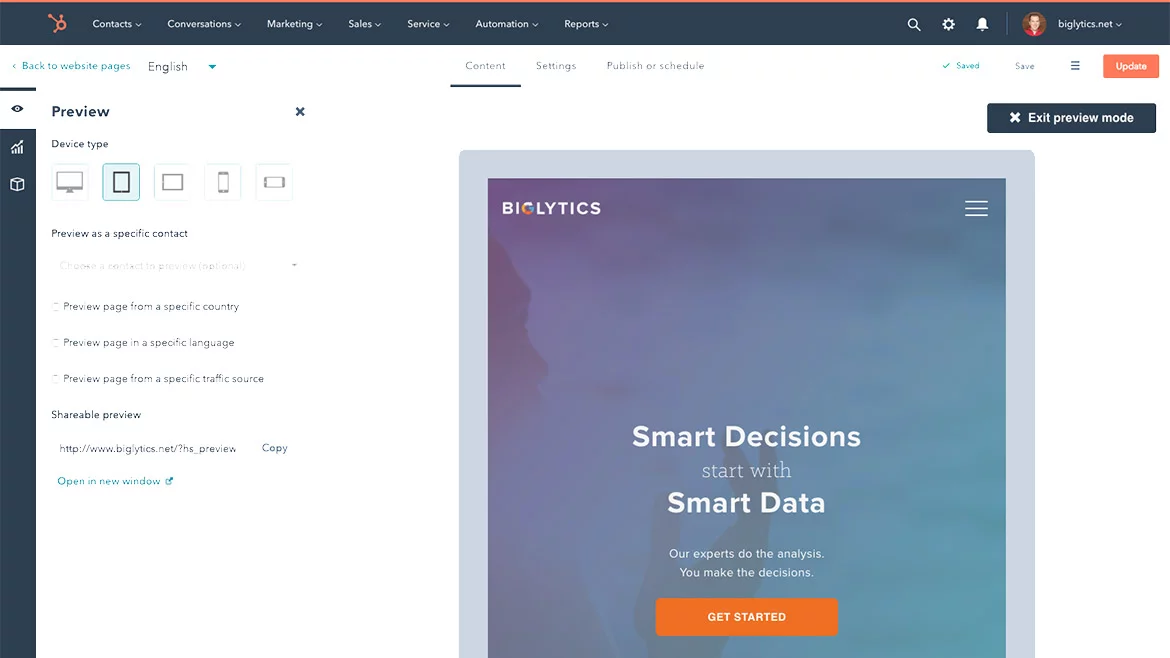
1. HubSpot
HubSpot is way more than just a content management software tool, since it lives on top of your CRM.
HubSpot’s content management software tool has nice features like A/B testing, but it’s particularly powerful when it comes to features like personalized content and smart content. If you’re using HubSpot’s marketing platform, it also works seamlessly with forms, your email list, and database management.
For instance, let’s say you want a list of everyone in your database who visited your pricing page in the last 30 days. With HubSpot’s content management software and CRM, this is incredibly easy to do.
It scores well on the design side, too — like any content management software tool, it offers predesigned templates, a developer platform, and a network of partners certified on the content management software.
There are also some great out-of-the-box features designed to help with content creation — like the ability to natively host video and add forms and calls-to-action in the video using the native editor, along with video analytics and a YouTube analytics integration.
Some of the features marketers will love on a platform level are the ability to partition content so it’s easier for teams to work together. Additionally, you can publish content behind passwords and easily personalize content. Best of all, there’s high-quality security and hosting, which takes the worry out of the technical side. And, of course, you get top-notch analytics since everything is working together.
2. Squarespace
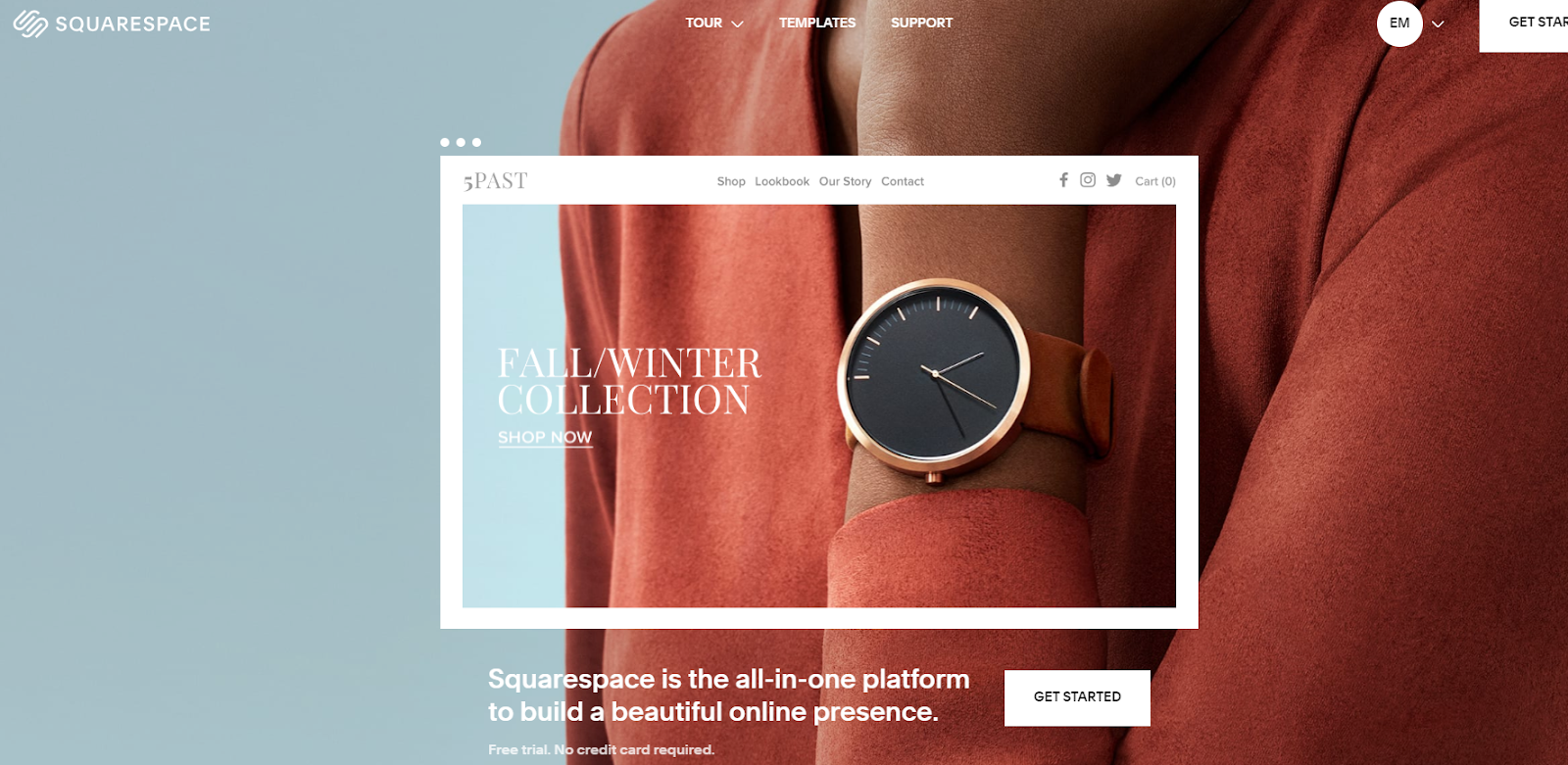
Squarespace offers beautiful out-of-the-box designs with tons of customization options. You can download any theme and change colors, fonts, and other design elements with ease. It seems to be geared more towards the end user than the developer, so most edits are made in a WYSIWYG design editor.
Behind the scenes, they boast high-quality, secure hosting — something that isn’t always top of mind when selecting a content management software tool, but probably should be. It also allows for unlimited bandwidth and storage, which isn’t always the case if you’re buying hosting on its own.
It’s also nice to have a support team, and Squarespace has a team that answers support tickets, so you’re not totally on your own or stuck calling a developer for every single question. Additionally, they offer incredibly useful help documentation.
Squarespace offers tons of modules and integrations, although you might want to check their built-in integrations to make sure the rest of your tech stack will play well with Squarespace.
3. Wix
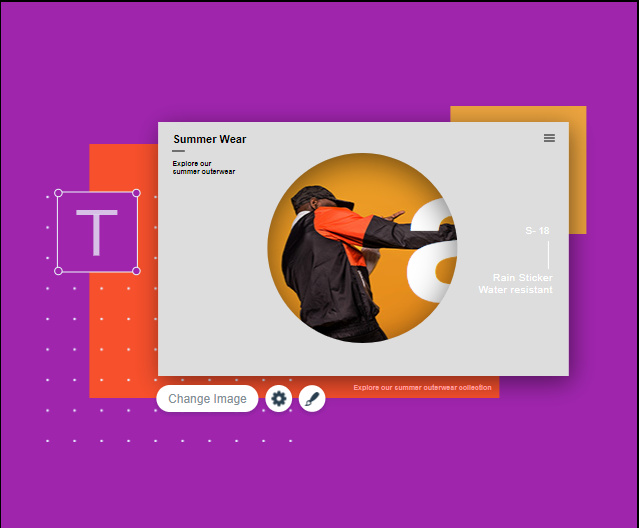
Wix features tons of templates and has a free plan that gives you unlimited pages. If you need to get an online presence up and running right away, it’s a great choice.
They also have paid plans that give you some additional features, including increased storage, the ability to add forms, a calendar, and access to VIP Support.
It’s important to note, Wix is a bit tougher to customize — they don’t give access to CSS, although they do say you can “take full control of your website’s functionality with JavaScript and Wix Code API’s.”
Additionally, it can be challenging to insert third-party code (like tracking code), so eventually, as your business grows, you or your developer may want something with a bit more customization capability.
4. WordPress
And finally, last but certainly not least, we come to WordPress. WordPress is everywhere — it’s a popular platform and has a large eco-system of developers, designers, and plenty of others who are familiar with it.
The content management software tool itself is free, although you’ll need to pay for hosting and probably a template at the very least, and more likely a developer or designer to help you get it up and running.
Your ease-of-use here will likely depend on how it’s set up and which theme you use — some have simple WYSIWYG editors, while others are more complex. This is a decision you’ll definitely want to chat through with your developer, since once it’s built, there isn’t much you can change.
It’s also incredibly customizable. There are a ton of plugins and add-ons you can use to help with anything from SEO, speed, automatic image resizing, and more.
WordPress doesn’t offer support, but you can mitigate this problem if you have a good developer and a good host. There’s also a massive network of web professionals that you can hire.
On the hosting side, I’d recommend a hosting platform that specializes in WordPress, like WP Engine, as I’ve found that their support teams are well-versed in WordPress — which means they can help with questions and offer additional resources. Using a popular theme with plenty of existing help documentation, or even a support team, can also make a huge difference.
It’s important to note, the openness of the platform results in a vulnerability to hacking (this is another reason to get a good host). Be aware that addressing security should be part of the initial plan and not come as an afterthought to design, since security breaches are hard to fix and require technical expertise.
While these are four popular choices for marketers, there are many more out there. The options are endless for content management software tools. Ultimately, it’s critical you consider your workflow, your team, and the workflows you have in place to help you make the best decision.

How to Perfectly Manage a PPC Campaign [Template]
In the world of search engine marketing (SEM), more and more marketers are buying into PPC campaigns. Google Ads specifically has increased its revenue from year to year. In 2018, it was reported that the service was generating 84% of Alphabet’s revenue.
Marketers know that properly investing in PPC can result in nearly guaranteed ad placement in search engine result pages. They also know that this placement can help generate leads.
As you prepare to create a PPC campaign, it’s important to get a rundown of what a successful campaign entails, and identify management misssteps that you’ll want to avoid.
The key to building a successful PPC campaign is to follow these steps:
- Determine your PPC campaign structure.
- Identify, build, or refine your campaign’s landing pages.
- Build a keyword strategy based on your research.
- Create ads based on what you’ve determined in the above steps.
- Share your campaign plan with decision makers.
The problem is, many marketers suffer from poor PPC campaign management, which ends up costing them way more money than they need to spend and delivering underwhelming lead generation results.
Here are a few ways marketers could go wrong with PPC management:
- Coming up with keywords on the fly without doing prior research.
- Only building one basic campaign without utilizing Google Ads’ AdGroups tool.
- Attaching un-engaging landing pages — or a homepage that generates no leads — to the campaign.
- Not adding “negative keywords” or monitoring campaigns to avoid wasted spend.
- Creating campaigns, setting budget caps, and going live without telling key decision makers at your company or a client’s company.
So, how do you do PPC properly so you actually get leads at a reasonable cost? It comes down to intelligent campaign structure.
How do you master intelligent campaign structure? You use a template!

PPC Plan Template
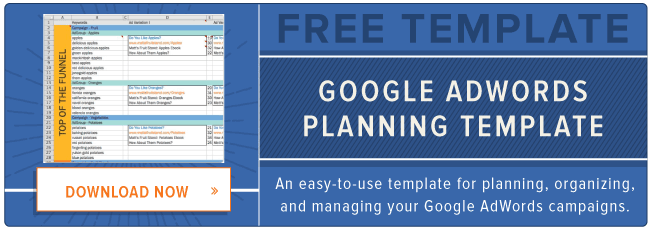
We’ve created a free PPC campaign management template that will help you and your clients set up a full-funnel campaign structure that follows PPC best practices. Once you do that, you’ll be better positioned to maximize the return on your PPC investment.
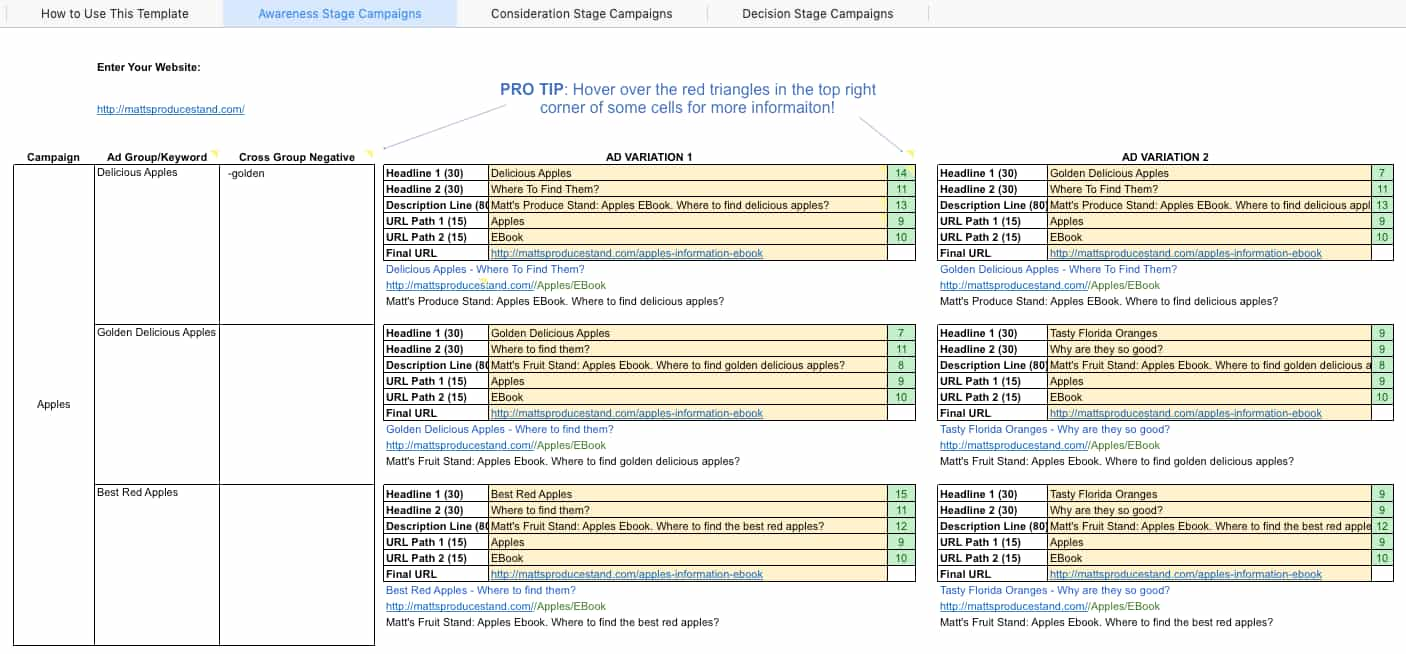
We’re going to show you how to use that PPC template in this blog post — so download it now and follow along.
If you’re running PPC campaigns for someone who doesn’t understand the importance of good campaign structure, this template will also act as a deliverable that will enlighten your boss or clients.
Tips for Using This Template
Before we get started, let’s go over a few tips that’ll make using this template even easier:
- You will want to clear out the example data I have in the template such as keywords, campaign and AdGroup names, ads, and destination URLs. Unless, of course, you’re running a fruit stand named after me.
- Be careful not to erase columns E, G, and I. They contain formulas that will help you in subsequent steps.
- Click on the red markers in the top corners of the cells. They contain helpful tips and FAQs. If you ever forget what a cell is used for, those are good reminders.
Step 1: Understand PPC Campaign Structure
Before we actually do anything with this template, it’s important we’re all on the same page about PPC campaign structure. Far too many marketers will just set up an account, create an ad, direct the ad to their home page, pick some keywords and hit go. This is not the way to do things.
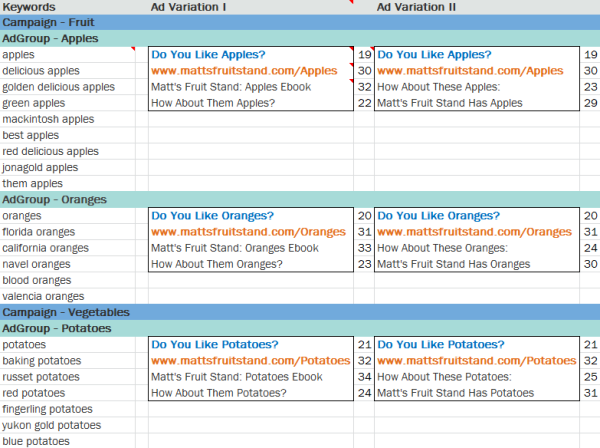
With Google Ads, you have the opportunity to create multiple campaigns. Each campaign may contain several AdGroups, and each AdGroup may contain a few ads and multiple, similar keywords.
It’s wise to create multiple campaigns because you can set daily budget caps, day-parting, and select geo-targeted regions at the campaign level. If you’re bidding on generic keywords and branded keywords, you’ll want to put these in separate campaigns because the economics around these two types of keywords will likely be very different.
As you can see, your template reflects these best practices, providing space for several different campaigns, AdGroups, and ad variations within those AdGroups.
Step 2: Identify Your Landing Pages
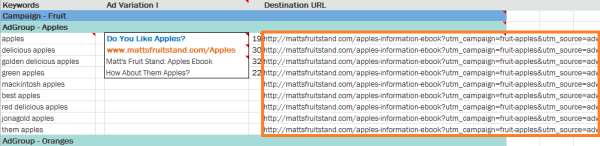
The “Destination URL” is the place on your website where you want the PPC traffic to end up. Because there is a marginal cost associated with each PPC visitor you attract, I recommend you choose a landing page URL as your destination URL.
Do not drive them to your home page or a blog in hopes that they will stumble upon a lead generation form. That’s the job of organic search. Drive them to a landing page with a form on it. Don’t forget to put in a tracking token so you know where these leads are coming from.
Major, well-known companies don’t always follow this rule, but they also have millions of dollars in budget that needs to be used by the end of the month. Make it easy on yourself and let your landing pages define your AdGroups.
You will notice that the Destination URL within the AdGroup is the same regardless of the keyword or ad. If you really want to drive a keyword to a different landing page, then create another AdGroup. If you want to get even more specific, create another campaign for that keyword.
You should also keep your sales funnel in mind when you identify these landing pages. Think about which part of the sales funnel each landing page and offer speaks to.
For example, an educational PDF about an industry concept would be appropriate for a top-of-the-funnel offer, while a coupon or a demo would be at the bottom of the funnel.
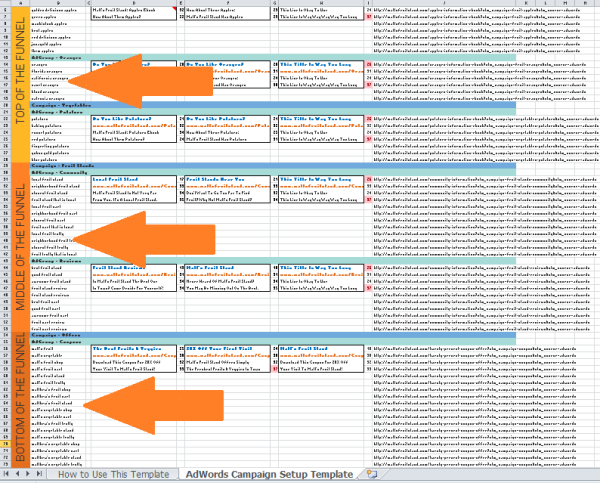
Manage and create separate campaigns for each part of the funnel. If you scroll down in your template, you’ll see that there’s dedicated space allotted for campaigns in all of these funnel stages.
Step 3: Build Your Keyword Strategy
Next, select the keywords that are relevant to the landing page and offer. Make sure to keep them as relevant as possible to increase the chance that each visitor you pay for completes the form on the landing page.
Yes, it would be nice to rank for certain keywords, but if the landing page doesn’t answer the keyword queried, think twice. Or better yet, create another offer and landing page that speaks more directly to the keyword.
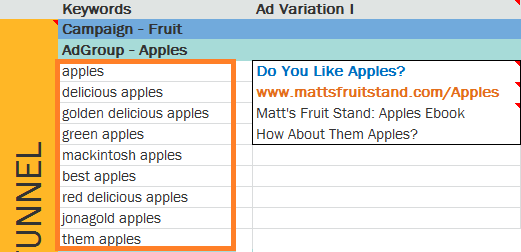
To understand search volumes and costs around each keyword you want to select, you can use free tools like the Google Ads Keyword Tool or — if you’re a HubSpot customer — our Keywords tool.
If you’re running short on inspiration, these tools can help you think of other keywords to include in your campaign. You should always consider the costs of those suggested keywords and keep your economic interests in mind.
If this is your first time managing a PPC campaign, it would be wise to read up on how to design a killer keyword strategy. In the case of Google Ads, you might also want to learn more about keyword quality score.
Step 4: Create Your Ads
This is the fun part! Both Google and Bing allow you to create more than one ad for each AdGroup (hence the “group” terminology). The service will rotate them until it notices that one appears to drive a higher clickthrough rate (CTR). This is how A/B (and C and D) testing works. While it’s optional, you should take advantage of the ability to create more than one ad.
Writing an ad is a bit like writing a haiku. There are character limits for each part, and it can be a little aggravating figuring out how to best complete the ad.
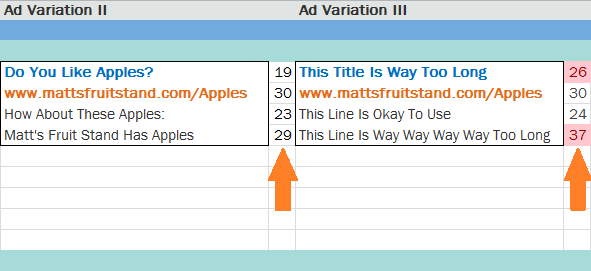
You are allotted 25 characters for the title, 35 characters for the display URL — the URL that’s displayed in the ad, not to be confused with the destination URL — and 35 characters for each line of copy. But if you’re using this template, don’t worry about keeping track.
The cell to the right of each ad component will count characters and turn red when you have gone over the limit. Handy, right?
In my observation, the title has the greatest influence on an ad’s CTR. It’s wise to include a keyword in the headline to draw a user’s attention to your ad. An even better practice would be to use dynamic keyword insertion.
I find the copy to be less important, but you certainly can’t just put gibberish in there. Search engines have editorial policies for what you can and cannot put in an ad. These policies also change frequently, so it’s your job to stay up to date on them.
A good rule of thumb is to simply try to provide a congruous experience for searchers — from seeing your ad in the search engine results to completing the form on your landing page.
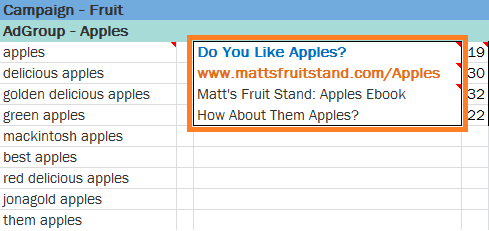
Finally, there’s the tricky matter of the display URL. You’re only allowed 35 characters here, but it’s unlikely that your destination URL, the actual URL for your landing page, will be that short. So the search engines allow you to create a display URL, which may not even be an actual URL on your website. It’s critical that the domain in your display URL be the same as the domain in your destination URL.
Step 5: Share the Completed Template With a Decision Maker
Whether you’re doing PPC for your business or a client, your completed template will ensure you’re aligning the decision-maker’s expectations with the realities of a productive PPC campaign. If you’re the decision maker, this template will help you think about what you’re doing with the money you’re spending on PPC.
The end result is that you’ll have created the sort of congruous user experience that search engines like to see. That can benefit you in terms of your positioning in the SERPs and, ultimately, your costs. It will also grant you the agility you need to swiftly reallocate and modify budget as you respond to changes in the marketplace, and the drive to maximize the return on your PPC spend.


Here’s a Guide to Starting Tasks You’ve Been Avoiding [Infographic]
Did you know only 11% of professionals report accomplishing the tasks they set out to do in a given day? Of course you did, because you’ve totally been there.
Whether you’re procrastinating on a difficult project, avoiding sending that email you know you need to send, or are just too stubborn to delegate — getting enough done each day is a problem most of us face.
NetCredit‘s tips below to start the tasks you’ve been avoiding.



How to Do Keyword Research for SEO: A Beginner’s Guide
While Google keeps us on our toes with all the algorithm updates they keep rollin’ out, one thing has stayed pretty consistent for inbound marketers looking to optimize their websites for search: keyword research.
Well, the need to do keyword research has stayed the same. How you actually do it hasn’t.
What is keyword research?
Keyword research is the process of finding and analyzing actual search terms that people enter into search engines. The insight you can get into these actual search terms can help inform content strategy, as well as your larger marketing strategy.
Why is keyword research important?
More and more, we hear how much SEO has evolved over just the last 10 years, and how unimportant keywords themselves have become to our ability to rank well for the searches people make every day.

And to some extent, this is true; using keywords that exactly match a person’s search is no longer the most important ranking factor in the eyes of an SEO professional. Rather, it’s the intent behind that keyword, and whether or not a piece of content solves for that intent (we’ll talk more about intent in just a minute).
But that doesn’t mean keyword research is an outdated process. Let me explain:
Keyword research tells you what topics people care about and, assuming you use the right SEO tool, how popular those topics actually are among your audience. The operative term here is topics — by researching keywords that are getting a high volume of searches per month, you can identify and sort your content into topics that you want to create content on. Then, you can use these topics to dictate which keywords you look for and target.
By researching keywords for their popularity, search volume, and general intent, you can tackle the questions that the most people in your audience want answers to.
How does intent affect keyword research?
Like I said in the previous section, user intent is now one of the most pivotal factors in your ability to rank well on search engines like Google. Today, it’s more important that your webpage addresses the problem a searcher intended to solve than simply carries the keyword the searcher used. So, how does this affect the keyword research you do?
It’s easy to take keywords for face value, and unfortunately, keywords can have many different meanings beneath the surface. Because the intent behind a search is so important to your ranking potential, you need to be extra-careful how you interpret the keywords you target.
Let’s say, for example, you’re researching the keyword “how to start a blog” for an article you want to create. “Blog” can mean a blog post or the blog website itself, and what a searcher’s intent is behind that keyword will influence the direction of your article. Does the searcher want to learn how to start an individual blog post? Or do they want to know how to actually launch a website domain for the purposes of blogging? If your content strategy is only targeting people interested in the latter, you’ll need to make sure of the keyword’s intent before committing to it.
To verify what a user’s intent is in a keyword, it’s a good idea to simply enter this keyword into a search engine yourself, and see what types of results come up.
I’m going to lay out a keyword research process you can follow to help you come up with and narrow down a list of terms you should be targeting. That way, you’ll be able to establish and execute a strong keyword strategy that helps you get found for the search terms you actually care about.
How to Research Keywords for Your SEO Strategy
Step 1: Make a list of important, relevant topics based on what you know about your business.
To kick off this process, think about the topics you want to rank for in terms of generic buckets. You’ll come up with about 5-10 topic buckets you think are important to your business, and then you’ll use those topic buckets to help come up with some specific keywords later in the process.
If you’re a regular blogger, these are probably the topics you blog about most frequently. Or perhaps they’re the topics that come up the most in sales conversations. Put yourself in the shoes of your buyer personas — what types of topics would your target audience search that you’d want your business to get found for? If you were a company like HubSpot, for example — selling marketing software (which happens to have some awesome SEO tools … but I digress … you might have general topic buckets like:
- “inbound marketing” (21K)
- “blogging” (19K)
- “email marketing” (30K)
- “lead generation” (17K)
- “SEO” (214K)
- “social media marketing” (71K)
- “marketing analytics” (6.2K)
- “marketing automation” (8.5K)
See those numbers in parentheses to the right of each keyword? That’s their monthly search volume. This data allows you to gauge how important these topics are to your audience, and how many different sub-topics you might need to create content on to be successful with that keyword. To learn more about these sub-topics, we move onto step 2 …
Step 2: Fill in those topic buckets with keywords.
Now that you have a few topic buckets you want to focus on, it’s time to identify some keywords that fall into those buckets. These are keyword phrases you think are important to rank for in the SERPs (search engine results pages) because your target customer is probably conducting searches for those specific terms.
For instance, if I took that last topic bucket for an inbound marketing software company — “marketing automation” — I’d brainstorm some keyword phrases that I think people would type in related to that topic. Those might include:
- marketing automation tools
- how to use marketing automation software
- what is marketing automation?
- how to tell if I need marketing automation software
- lead nurturing
- email marketing automation
- top automation tools
And so on and so on. The point of this step isn’t to come up with your final list of keyword phrases. You just want to end up with a brain dump of phrases you think potential customers might use to search for content related to that particular topic bucket. We’ll narrow the lists down later in the process so you don’t have something too unwieldy. Once you have your final list, there are several data-driven tools available to you for finding out which keywords you’re most likely to rank well for.
(Note: If you’re a HubSpot customer, you’ll actually be able to spend a little less time cutting down your topics and keywords list with HubSpot Content Strategy. Content Strategy helps you identify and research topics to approach based on existing content.)
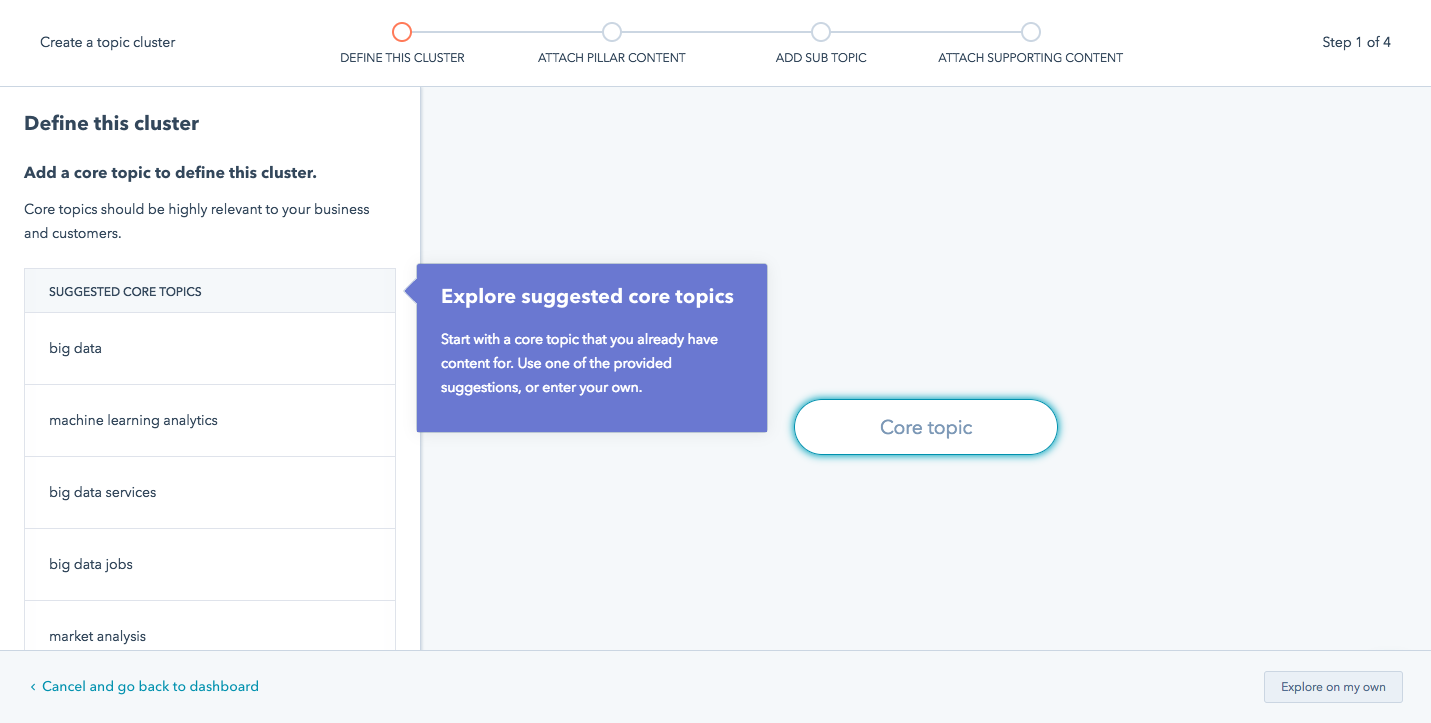
Although more and more keywords are getting encrypted by Google every day, another smart way to come up with keyword ideas is to figure out which keywords your website is already getting found for. To do this, you’ll need website analytics software like Google Analytics or HubSpot’s Sources report, available in the Traffic Analytics tool. Drill down into your website’s traffic sources, and sift through your organic search traffic bucket to identify the keywords people are using to arrive at your site.
Repeat this exercise for as many topic buckets as you have. And remember, if you’re having trouble coming up with relevant search terms, you can always head on over to your customer-facing colleagues — those who are in Sales or Service — and ask them what types of terms their prospects and customers use, or common questions they have. Those are often great starting points for keyword research.
Step 3: Research related search terms.
This is a creative step you may have already thought of when doing keyword research. If not, it’s a great way to fill out those lists.
If you’re struggling to think of more keywords people might be searching about a specific topic, go to Google.com and take a look at the related search terms that appear when you plug in a keyword. When you type in your phrase and scroll to the bottom of Google’s results, you’ll notice some suggestions for searches related to your original input. These keywords can spark ideas for other keywords you may want to take into consideration.
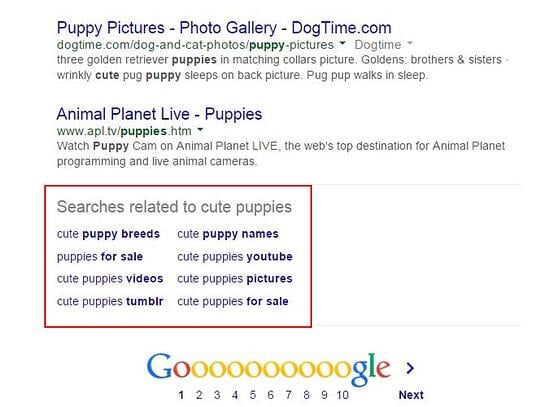
Want a bonus? Type in some of those related search terms and look at their related search terms.
Want another bonus? HubSpot customers can get suggestions for keywords and topics to consider within the Content Strategy tool.
Step 4: Check for a mix of head terms and long-tail keywords in each bucket.
If you don’t know the difference between head terms and long-tail keywords, let me explain. Head terms are keywords phrases that are generally shorter and more generic — they’re typically just one to three words in length, depending on who you talk to. Long-tail keywords, on the other hand, are longer keyword phrases usually containing three or more words.
It’s important to check that you have a mix of head terms and long-tail terms because it’ll give you a keyword strategy that’s well balanced with long-term goals and short-term wins. That’s because head terms are generally searched more frequently, making them often (not always, but often) much more competitive and harder to rank for than long-tail terms. Think about it: Without even looking up search volume or difficulty, which of the following terms do you think would be harder to rank for?
- how to write a great blog post
- blogging
If you answered #2, you’re absolutely right. But don’t get discouraged. While head terms generally boast the most search volume (meaning greater potential to send you traffic), frankly, the traffic you’ll get from the term “how to write a great blog post” is usually more desirable.
Why?
Because someone who is looking for something that specific is probably a much more qualified searcher for your product or service (presuming you’re in the blogging space) than someone looking for something really generic. And because long-tail keywords tend to be more specific, it’s usually easier to tell what people who search for those keywords are really looking for. Someone searching for the head term “blogging,” on the other hand, could be searching it for a whole host of reasons unrelated to your business.
So check your keyword lists to make sure you have a healthy mix of head terms and long-tail keywords. You definitely want some quick wins that long-tail keywords will afford you, but you should also try to chip away at more difficult head terms over the long haul.
Step 5: See how competitors are ranking for these keywords.
Just because your competitor is doing something doesn’t mean you need to. The same goes for keywords. Just because a keyword is important to your competitor, doesn’t mean it’s important to you. However, understanding what keywords your competitors are trying to rank for is a great way to help you give your list of keywords another evaluation.
If your competitor is ranking for certain keywords that are on your list, too, it definitely makes sense to work on improving your ranking for those. However, don’t ignore the ones your competitors don’t seem to care about. This could be a great opportunity for you to own market share on important terms, too.
Understanding the balance of terms that might be a little more difficult due to competition, versus those terms that are a little more realistic, will help you maintain a similar balance that the mix of long-tail and head terms allows. Remember, the goal is to end up with a list of keywords that provide some quick wins but also helps you make progress toward bigger, more challenging SEO goals.
How do you figure out what keywords your competitors are ranking for, you ask? Aside from manually searching for keywords in an incognito browser and seeing what positions your competitors are in, SEMrush allows you to run a number of free reports that show you the top keywords for the domain you enter. This is a quick way to get a sense of the types of terms your competitors are ranking for.
Step 6: Use the Google AdWords Keyword Planner to cut down your keyword list.
Now that you’ve got the right mix of keywords, it’s time to narrow down your lists with some more quantitative data. You have a lot of tools at your disposal to do this, but let me share my favorite methodology.
I like to use a mix of the Google AdWords Keyword Planner (you’ll need to set up an AdWords account for this, but that doesn’t mean you have to create an ad), and Google Trends.
In Keyword Planner, formerly known as the Keyword Tool, you can get search volume and traffic estimates for keywords you’re considering. Unfortunately, when Google transitioned from Keyword Tool to Keyword Planner, they stripped out a lot of the more interesting functionality. But you can make up for it a bit if you take the information you learn from Keyword Planner and use Google Trends to fill in some blanks.
Use the Keyword Planner to flag any terms on your list that have way too little (or way too much) search volume, and don’t help you maintain a healthy mix like we talked about above. But before you delete anything, check out their trend history and projections in Google Trends. You can see whether, say, some low-volume terms might actually be something you should invest in now — and reap the benefits for later.
Or perhaps you’re just looking at a list of terms that is way too unwieldy, and you have to narrow it down somehow … Google Trends can help you determine which terms are trending upward, and are thus worth more of your focus.
And … You’re done!
Congratulations! You’ve now got a list of keywords that’ll help you focus on the right topics for your business, and get you some short-term and long-term gains. You can even download our free SEO template to help you organize your keywords and track which terms you’re focusing on for different pages of your website.
Be sure to re-evaluate these keywords every few months — once a quarter is a good benchmark, but some businesses like to do it even more often than that. As you gain even more authority in the SERPs, you’ll find that you can add more and more keywords to your lists to tackle as you work on maintaining your current presence, and then growing in new areas on top of that.
People Also Ask
What is a search engine optimization?
Search engine optimization (SEO) is the process of designing your website and its content to drive organic website traffic from search engines. By conducting keyword research, and creating content that matches a user’s intent when using that keyword, you can optimize your website for the searches your audience makes most often.
How do I find the best keywords?
- Purchase SEO or inbound marketing software
- Examine the keywords your website ranks for
- Create a buyer persona
- Check the search volume for keywords
- Find similar keywords using SEO software
- Monitor your change in rankings and traffic
What is a meta description in SEO?
An SEO meta description is a brief description of content found on a web page. The meta description is shown to users in search engine results pages to help them decide which search result to click on. Meta descriptions are not a ranking factor in the eyes of a search engine, but they can influence how many people click on a result — which directly affects the result’s organic ranking.


The Ultimate Guide to Influencer Marketing in 2019
Have you ever purchased something because a well-known person you admire used the product or service?
I’m definitely guilty of this — in fact, I recently bought myself a new waterski because a professional water skier and micro-influencer, Whitney McClintock, shared a video on Instagram of herself using the ski.
I was in the market for a new ski and followed Whitney for quite some time. I figured since she used this particular ski, I should too — if Whitney promotes it, why wouldn’t I love it?
You might be thinking, “Slightly questionable logic, Kristen”. Maybe.
But, did Whitney’s post get me to buy the ski? Oh, yeah. (And I do love my new ski for those of you wondering.)
This is just one example of a tactic used by businesses across virtually every industry called influencer marketing.

Examples of these channels include social media, blogs, columns, digital and print ads, and television. Influencer marketing is increasingly more popular among businesses these days because traditional advertising has become less effective in attracting leads and customers.
Influencer marketing works because it uses tactics like word-of-mouth marketing and social proof, which are now critical aspects of any successful marketing strategy. Customers trust their peers, friends, and people they admire more than the companies selling the products and services they buy and use.
Before we dive into the different types of influencers, let’s review the difference between a brand influencer and a brand ambassador, as they’re often confused terms.
Brand Influencer vs. Brand Ambassador
A brand influencer refers to someone who has a following within a specific niche that they engage with regularly. Because of this, they have the power to impact their purchase decisions. The major types of brand influencers include micro-influencer, celebrity influencer, blog influencer, social media influencer, and key opinion leader (each of which we’ll define momentarily).
For example, social media influencer @leximars has worked with Lulus in the past to share different outfits and styles on her Instagram account featuring their clothing and accessories. Lexi tags Lulus in her posts so her followers can learn more about the brand, follow them on Instagram, or click their website link to shop for specific products they see on Lexi’s page.

A brand ambassador is hired by a business to work under contract to help them achieve specific goals: increase brand awareness and boost conversions and sales. A brand ambassador’s contract is typically long-term (several months or even years). During that time, they represent the brand and the lifestyle associated with it and have deep knowledge about the business’s products or services. They don’t necessarily need to be an influencer prior to becoming an ambassador.
For example, Quest Nutrition’s brand ambassador program requires all interested individuals to apply to their program. Quest looks for individuals who embody their brand, are positive spokespeople for their products, create social media posts to promote their products, and live the Quest lifestyle.
Anyone who fits their criteria is able to apply and has the potential of being accepted. Applicants aren’t required to have a highly successful YouTube account, thousands of followers on Instagram, or a popular blog to become a brand ambassador.
In this article, we’re going to focus on brand influencers. However, before we dive into the various types of brand influencers, let’s take a look at some important statistics that prove working with an influencer is effective in helping you reach your marketing goals.
Influencer Marketing Statistics
Influencer marketing is an investment — to get it right, you have to devote time to ensure you find the right influencer to promote content that appeals to your target audience. You also have to spend money and/ or resources to reward the influencer, run various campaigns with the influencer, and more depending on your specific marketing goals.
Luckily, there are a number of statistics that prove influencer marketing is a worthwhile time and monetary investment. There are also statistics that show you which metrics are impacted by influencer marketing.
General Influencer Marketing Statistics
- 89% of businesses say their ROI from influencer marketing is comparable to or better than other marketing channels.
- 80% of marketers say influencer marketing is effective for their businesses, and 35% say it’s very effective.
- In a survey, 82% of consumers said they were highly likely to follow a micro-influencer recommendation on a product or service.
- 71% of marketers say the quality of customers and traffic from influencer marketing is better than other sources.
- 49% of consumers today depend on influencer recommendations for their purchase decisions.
- The influencer marketing industry is set to reach $10 billion by 2020.
- 99.3% of businesses implementing influencer marketing campaigns use Instagram.
- Google searches for influencer marketing grew 1500% in the last three years.
- In a survey, 77% of marketers said they ran their business’s influencer campaigns in-house.
- 48% of marketers working with influencers say audience relationship is the most valuable factor when considering which influencer to collaborate with.
- Micro-influencers have 22.2x more weekly conversations about what to buy than the average consumer.
Metrics Statistics
- Engagement is the biggest measure of influencer marketing campaign performance.
- Influencer marketing strategies focused on branding or engagements generate 8x ROI.
- 84% of marketers think that the measurement of ROI will be critical to the future success of all influencer marketing campaigns.
- 34% of businesses focus on reach (or impression) with their influencer marketing strategies.
- 35% of marketers want their influencers’ followers to take action, so they measure their results and ROI by engagement or clicks.
- The top three goals of influencer marketing for businesses include increasing brand awareness (85%), reaching new audiences (71%), and generating sales and conversions (64%).
Now that you have a better idea of the reasons why you’d want to invest in influencer marketing, let’s review the five major types of influencers to consider doing business with and examples of each.
1. Micro-Influencer
Micro-influencers — like Whitney — have a relatively modest following of thousands or tens of thousands of people within their niche. They create relevant content for their audience and communicate with them via social media platforms, blogs, other written publications, websites, and forums.
Due to the size of their following and the type of content they create, they typically have high engagement rates. Having a smaller audience allows micro-influencers to bond with the people who follow them more regularly (as compared to a celebrity with millions of fans) via their channel. This makes them appealing to work with for businesses looking to develop personal relationships among their target audience.
How to Work With a Micro-Influencer
Micro-influencers can be established on a variety of channels. So, once you’ve chosen the micro-influencer you’re going to work with, you can have them write a post about your service, share an online review, or post a picture on Instagram with one of your products. Due to the manageable size of their base of followers, they’ll be able to engage with your target audience on the content they share about your products and brand.
This way, they can answer any questions the audience members may have about your products, communicate their experience with your products, and direct audience members to your website or customer support team if necessary.
Micro-Influencer Example
@sydneyloveleigh is an Instagram micro-influencer who shares content about health, fitness, and travel. She works with an athletic clothing brand, Nuxactive, to promote their products and brand awareness among her 21.4K followers. Sydney fits Nuxactive’s brand image and lifestyle, and her Instagram page has thousands of followers who fit the profile of their target audience — this is what makes her a great micro-influencer for Nuxactive.

In her bio, Sydney shares a code for her followers to use at check out (so Nuxactive can track Sydney’s success promoting their brand), she links to their Instagram page in all of her promotional posts, and interacts with her followers on these posts by responding to their comments and questions and liking their messages.
2. Celebrity Influencer
Celebrity influencers are famous people with large followings — typically in the millions — who are known across many industries. They’re widely recognized and, therefore, have the potential to be very successful in influencing your target audience.
Even if your target audience doesn’t overlap with all of your celebrity influencer’s fans, having them promote and/ or use your product or service is a powerful form of social proof. Since celebrities are so well known, they’re effective at reaching multiple audiences across various channels.
How to Work With a Celebrity Influencer
Since celebrities are so well-known, there are many ways to work with them. You may focus on social media, print or online ads, TV commercials, blogs, or other written publications.
You can ask the celebrity to pose for pictures promoting your products, explain why their audience members would love your products or services, provide coupons and discount codes, or write reviews telling audience members why they stand by your brand. You may even sponsor an event the celebrity is hosting or attending.
Example of a Celebrity Influencer
Amazon sponsored Khloe Kardashian’s baby shower — with 93.7 million followers on Instagram, a reality TV show, several entrepreneurial endeavors, and a famous family, it’s safe to say many of Amazon’s customers recognize Khloe. By sponsoring her baby shower, they were able to feature their wide range of baby registry and maternity products.

In addition to Amazon publicizing the fact they sponsored event, Khloe also shared a post on Instagram thanking Amazon for making the party planning and baby registry creation processes so simple. She tagged Amazon in the post and shared a link to her baby registry for her fans (and Amazon’s target audience) to review and shop on their site.
3. Blog Influencer
A blog influencer is someone who writes for their established blog and has thousands, or millions, of subscribers and readers. Their reach and influence set them apart from other bloggers (meaning, they aren’t just writing for themselves or a very small group of people).
How to Work With a Blog Influencer
To collaborate with a blog influencer, you may write a guest post for their blog, ask to be mentioned in one of their posts, or sponsor a post about one of your products or services. If you sponsor a post on the influencer’s blog, you can also provide images of your products for them to share as well.
Example of a Blog Influencer
A popular lifestyle blog influencer is Hannah Bronfman of HBFIT. Hannah writes about health, beauty, fitness, and creating a life that makes you happy and feel good. Between her blog subscribers, social media following, ads, the book she wrote, and the app she created, Hannah has millions of audience members and fans who keep up with her life.
Her blog features a variety of product, gym, and spa reviews. She collaborated with Face Gym, a local facial studio, on a sponsored blog post about their services and facial treatments.
Hannah included information about the unique studio, facial experience, why her audience members would love the services Face Gym offers, as well as a coupon code for their first visit.
There are also pictures of Face Gym and the services they offer in Hannah’s blog post to give audience members a better idea of what to expect from the studio in terms of services and atmosphere.
4. Social Media Influencer
Social media influencers are well-recognized on social platforms, such as Instagram, YouTube, Facebook, or Twitter, and are followed by thousands or even millions of people. Social media influencers share content about a wide range of topics such as health, workouts, cars, diet, outdoor activities, travel, fashion, art, beauty, and interior design.
How to Work With a Social Media Influencer
Once you find a social media influencer with an established image that works for your brand, posts content you feel complements your products or services, and has followers who are also members of your target audience, you can determine what type of content you’re going to have them promote.
If the influencer is on Instagram, you may have them post a picture with your product and tag your social account. If they’re on Facebook, you can ask them to share a live video of them opening your product and if they’re on Twitter, you can have them write a brief statement about your product and pair it with a picture of them holding it. On YouTube, you may have the influencer share a video of them using your product while explaining the reasons why they love it.
On any social media platform, you can also have an influencer host a contest or giveaway with your products or share coupon codes.
Example of a Social Media Influencer
Joy Bauer is a nutritionist, health expert for The Today Show, and Twitter Influencer. Her 157K followers and fans on Twitter consist of health-conscious, nutrition-focused individuals who enjoy learning about Joy’s healthy recipes, lifestyle, and diet tips.
Joy worked with La Croix on a sponsored Twitter post featuring a twist on one of their sparkling water drinks. The post directs audience members to a family-friendly recipe on Joy’s website promoting the sparkling water and recipe with images, nutrition information, preparation time, and an anecdote about why Joy loves it.
La Croix identified Joy as an expert in her field with a following of people who fit their target audience. The company worked with Joy to develop this sponsored post featuring professional photos of the product and a recipe that exemplifies the ways customers can put a fun spin on a simple beverage.
5. Key Opinion Leader
Key opinion leaders (KOLs) are high-level experts on a specialized topic within a particular field. For example, a KOL might specialize in makeup application, the Paleo lifestyle, or Bikram yoga. If your business is looking to attract audience members in a very specialized field, a KOL is a great option — due to their expert knowledge on a certain topic, KOLs are trusted contributors in their industries and have followings of people who are also invested in those subjects.
How to Work With a KOL
KOLS, like micro and celebrity influencers, are present on many channels, such as social media, blogs, other written publications (like academic journals), and ads. Therefore, your business has many options for how you decide to work with a KOL.
You might have them review one of your products on YouTube, mention you in their column, write a blog post about your brand, share a post about your product on Instagram, or pose with your product for a print or digital advertisement.
Example of a KOL
Kandee Johnson is a makeup influencer with over 3.9 subscribers on YouTube and over 1.8 million followers on Instagram. She’s a makeup artist pro — her expert knowledge on makeup application makes her a key opinion leader in the makeup and cosmetic industry. Kandee shares thousands of makeup tutorials, makeup tips and tricks, and product reviews on YouTube and Instagram.
She has shared sponsored content for Boxy Charm — a subscription service that provides customers with a box of several new beauty products every month — promoting their service, as well as her favorite products in the box, among her millions of followers and fans.

Boxy Charm’s target audience includes lovers of beauty products, cosmetics, and makeup which clearly works with Kandee’s huge base of followers. They had Kandee share a post with one of their boxes, describe which products inside she was most excited about, and tag them in her post.
Now that we’ve covered the different types of influencers your business can work with, let’s review how to find these influencers so they can begin helping you reach your target audience.
How to Find Influencers
Identifying the right influencer to work with might seem like a daunting task — so, we’ve put together this list of ways you can use to find the right person to help you improve your brand awareness and reach.
Google Search
The most straightforward way to go about an influencer search is with the help of Google (or any search engine). Remember an influencer is already creating content in your field and reaching your target audience. So, a Google search for industry-related terms and keywords will surface experts in those areas.
Review articles related to various topics in your field, conduct individual searches for people you’ve heard of or know are already high impact contributors, and scan industry-specific sites and web pages for influencers.
Social Media
You can also search for influencers on various social media platforms. Whether or not you’re going for a social media influencer, most influencers will likely have some sort of social media presence — their profiles serve as a great way to learn more about them.
On social, you can search for keywords and phrases, specific users, hashtags, and tagged audience members on specific posts (brands and social users may have tagged influencers you could potentially work within posts). Don’t forget to look in the comments sections of high-traffic posts related to your industry or type of work as influencers may have posted comments and interacted with members of your target audience there. You can even get some ideas from influencer posts on your competitor’s accounts.
Referrals
Use your current network (professional and personal) to obtain referrals. Look for KOLs on LinkedIn and ask your team if they’ve recently followed any micro-influencers on social who regularly post content that’s compatible with your brand and image. If you’ve worked with any influencers in the past, ask them if they’re willing to connect your business with other influencers they know as well.
Blogs
Reading blogs is another great way to locate influencers — that is, both the blog authors and their sources. Scan for the people mentioned in the blogs. Perhaps the blogger is reviewing their work, mentioned a quote from them, or asked them to contribute to the piece.
Additionally, themed publications (business, art, beauty, or fashion) often do expert round-ups where they feature dozens of influencers. You can research the individual further to determine if they’re a good fit for your business.
Influencer Software
Due to the rising popularity of influencer marketing, various technology and software have emerged to help businesses identify influencers and measure their success.
Two of the most popular options include BuzzStream and BuzzSumo.
BuzzStream allows users to research influencers. As a user, you also can build profiles, review the influencer interactions, measure their success through engagement metrics, and review their contact history.
BuzzSumo allows you to identify key influencers that are popular among your target audience. It also allows you to analyze which types of content perform best for influencers and review the content of your competitors.
Talent Agencies and Agents
If you’re looking to hire a specific celebrity influencer, it’s unlikely you’re going to be able to send them a direct email or give them a call (although that’d be pretty cool). Instead, you’ll probably have to go through a talent agency or work with an agent to determine whether or not that celebrity is willing to work with your brand and for what price.
We’ve reviewed the different types of influencers and how you can find them — now, let’s dive into how you can create your business’s influencer marketing strategy. A strategy will allow you to manage all aspects of your relationship with an influencer. It’ll also ensure they’re successful in helping you achieve your goals.
How to Create an Influencer Marketing Strategy
1. Determine Your Goals
The first step is to create goals for your influencer marketing strategy. This way, you’ll be able to measure your success later on. Think about your objectives in terms of SMART goals — meaning, they’re specific, measurable, attainable, realistic, and time-bound.
When working to develop influencer marketing SMART goals, there are three factors to keep in mind: reach, relevance, and resonance. These will help you focus your goals on the different aspects of influencer marketing your business wants to prioritize.
Use a free template to determine your SMART goals,
- Reach is the ability to deliver content to your target audience through an influencer. It helps you improve brand and product awareness. For example, how many people on Instagram are actually seeing the content an influencer is posting about your product?
- Relevance is the level of connection your audience feels to your brand, product, or service due to the work of an influencer — it’ll help you enhance brand loyalty. For example, if your audience sees a celebrity they love and admire with your product, they might begin to feel a strong connection to it as well.
- Resonance is the ability to drive audience members to a specific action because of an influencer’s content — it’s all about impact and memorability. Resonance helps you increase your follower count, drive traffic to your site, and boost conversions. For example, if your audience reads a blog post written by an influencer about your product, they may click on the link in the blog post that directs them to your website so they can buy it.
2. Determine if Your Audience Aligns with the Influencer’s Audience
No matter which type of influencer you decide to work with, your business’s target audience will remain the same. That’s because, although different influencers may have multiple ways of connecting with your audience, your business’s overall marketing goals and buyer personas don’t change.
If you’re in need of some guidance while defining your audience for your influencer marketing strategy, you can work with your marketing team to develop and learn about your buyer personas. This will help you identify the exact type of customer you’re going after and, therefore, help you determine what type of influencer and content will appeal most to them to ensure your target audience is aligned with that of the influencer.
Learn how to build personas for your business.
3. Choose a Type of Influencer and Budget
Based on our review of the five major types of influencers, you should be able to determine which type will work best for your business’s goals as well as your target audience. You should also think about your budget at this point.
For example, if you’re a startup with a low budget, you might choose to work with a micro-influencer. If you’re a mid-sized company with more resources, you might choose to bring on a celebrity influencer or work with a KOL who’s highly-regarded in their industry.
Here are some more details on the average cost of influencers based on the type of work they do. However, it’s important to note these numbers aren’t set in stone — they’re just averages.
- Micro-influencer: $80-500 per piece of content
- Celebrity influencer: $3,000-$500,000+ per piece of content (Selena Gomez makes up to $550,000 per Instagram post)
- Blog influencer: $400-$5,500 per blog post
- Social media influencer: $100-$550,000+ per social post
- KOL: $500-$5,000+ per piece of content
4. Make Sure the Influencer is a Good Fit
Once you’ve determined the type of influencer you want to work with, it’s time to identify the right influencer for your company. We already discussed how to find an influencer, so, let’s cover some other important things to think about when trying to determine whether or not a specific influencer is a good fit for your business.
Ask yourself the following questions to ensure you identify the right person:
- Does this influencer and his or her lifestyle fit my brand image?
- Have they worked with any competitors?
- Who is this influencer’s current audience?
- Is my target audience active on the platform/ channel the influencer works on?
- Does working with this influencer make sense for my budget?
- Has this influencer actually used any of my products and/ or services before?
- Does this person have a personality I want to work with?
- What will this influencer expect from me?
5. Review Expectations With Influencer
Once you’ve chosen an influencer, review all of the expectations you have for them in addition to any expectations they have for you. Remember, your chosen influencer may have worked with other brands before yours — meaning, they may already have their own processes in place for the way they do business.
Additionally, their expectations are going to differ depending on the type of influencer they are. For example, a micro-influencer is going to have different expectations for the way you communicate with them versus a celebrity. A micro-influencer may speak directly with you whereas a celebrity may have an agent communicate on their behalf.
Most importantly, you’ll want to ensure these expectations are written, agreed upon, and signed by both you and the influencer — you can organize all of this information in an influencer contract. This will help you avoid any issues and discrepancies down the road.
To help get the ball rolling, here are some examples of the expectations to review:
- How the influencer will be paid and/ or rewarded (money, swag, discounts, coupon codes, etc.)
- Length of time you’ll be working together
- The type of content they should (and should not) share
- How you and the influencer will be communicating with each other
- How they’re going to help you boost traffic with their content (will they be adding links to your site, social channels, blog posts, etc.?)
- Whether they’ll be creating content for your brand on their own or if you’ll provide the content for them to post
- Target metrics that you can expect per post or piece of content
- Any other terms of contract necessary for your specific business to review
6. Reward Influencer
It’s probably safe to assume the influencer you chose isn’t working for free. You’ll need to reward them for their work — you should discuss the form of payment when you review expectations together as mentioned in the above step. There are several ways you can reward an influencer. Here are some examples.
- Money (payment prior to or after the content is created and shared, depending on your agreement)
- Swag (such as clothing, accessories, or product samples)
- Free product
- Access to discount codes and coupons
- Promotion on your website, blog, and/or social media platforms
7. Measure Your Results
Lastly, you must measure your influencer marketing strategy results. This is how you’ll determine the level of success you’ve had in reaching your audience with the help of the influencer. You should refer back to the SMART goals you set (as well as influencer marketing metrics) to help you determine whether or not you’ve achieved your objectives.
Here’s more detail on which metrics you’ll want to keep an eye on when measuring your influencer marketing strategy success:
- Engagement: Keep an eye on all engagement involving content shared by the influencer about your brand and products. Engagement includes various interactions such as Likes, shares, comments, Retweets, mentions, direct messages, and reposts on channels like social media, blogs, and forums.
- Reach: Determine your reach, or how many people are actually seeing the content your influencer is sharing about your brand, by looking at your overall number of views.
- Resonance: Learn about the level of resonance — or the actions that were completed — by your audience members after they consume and/ or interact with the influencer’s content involving your brand.
- Brand Awareness: Measure your brand awareness among the audience members of your influencer as they begin sharing content related to your brand. There are quantitative — such as direct traffic and social engagement — and qualitative — such as social listening and awareness surveys — ways to measure your brand awareness.
- Clicks: Review the number of clicks on the content the influencer shares about your brand, whether it’s a direct link to your website, a CTA, a social media giveaway, or a signup form.
- Conversions: Calculate your conversions (the number of leads who become customers) as a result of your influencer marketing strategy. You can calculate conversions on your website or through URLs (like discount/ checkout codes found on the influencer’s social media account or blog) by dividing your conversions by your overall number of visitors.
- Return on Investment (ROI): Calculate the return on your influencer marketing investment by dividing the return (or benefit) by the cost of the influencer marketing investment.
- Follower Count: Track the increase and decrease of your number of social media followers or blog subscribers over time to see whether or not the influencer is helping you boost your follower and/ or subscriber count.
In terms of measuring the success of the influencer’s work, BuzzStream and BuzzSumo both have analytics tools built into the software to help you measure the success of the influencer’s work. These types of software are especially helpful in allowing you to determine ROI from your influencer marketing strategy, which is known to be the most difficult metric to measure when working with an influencer for businesses.
Google Analytics is great if you want to track overall traffic directed to your website and the number of leads converted. The software provides you with a deep look at acquisition, behavior, and conversions related to an influencer and your visitors.
For example, if you ask the influencer to conduct a giveaway or contest, look at the number of people who participated. If you give the influencer a discount code for audience members to use at checkout, look at how many people used it and, therefore, made a purchase thanks to their content. If you provide the influencer with specific URLs with tags to specific posts or landing pages, track their performance by looking at the number of leads directed to those pages via the given URLs.
Now, onto measuring influencer marketing success on social media. HubSpot’s Social Tool can help you pull specific engagement-related data, like reach and interactions, from various platforms. Additionally, the respective social platforms you’re using may have analytics tools built in as well, such as Twitter Analytics and Instagram Insights.
Do you still need some inspiration for your influencer marketing strategy? Let’s look at three successful strategies implemented by major companies.
Influencer Marketing Examples
There are a number of successful influencer marketing campaigns your business can look to for guidance when trying to think of ways to reach your target audience. Here are a few examples:
1. Hydro Flask and Andrea Hannemann, Social Media Influencer
Andrea Hannemann, more commonly known as @earthyandy, is a social media influencer based in Hawaii.
Her account, which has over one million followers, depicts her life — she’s a vegan, earth-conscious, and outdoorsy mom and wife. She has an affinity for clean eating and cooking as well as plant-based foods and products. Andrea regularly posts beautiful pictures and videos of her lifestyle and diet (which her kids and husband participate in) and receives hundreds of thousands of interactions on her posts.
Andrea was featured in a video sponsored by Hydro Flask, which she posted on her Instagram page, showing the ways in which the reusable, insulated, and functional water bottle fits into her life. The post was also a giveaway and received close to 400,000 likes and over 40,000 comments.

Hydro Flask was able to identify a social media influencer who’s lifestyle and content fit their branding and image and conduct a highly successful giveaway. The post increased their brand awareness among Andrea’s one million followers.
It also helped move traffic from Andrea’s page to the Hydro Flask Instagram page, as her post included several links taking audience members directly there to learn more about the company.
2. Nespresso and George Clooney, Celebrity Influencer
Nespresso teamed up with George Clooney, a globally-recognized celebrity, and brought him on as a celebrity influencer for their Cup Above campaign. Nespresso was able to identify the actor as someone who’s known by the general public and fits their sophisticated, elegant, and high-end image.

Nespresso now has print ads, digital ads, social media posts, and television commercials starring George.
3. Capital One and Kiersten Rich, Blogger
Kiersten Rich, better known as Kiki, is a popular travel blogger. Her blog, The Blonde Abroad, has over one million subscribers. She also has a large presence on Instagram thanks to the success of her blog’s unique content.
Capital One sponsored several of Kiki’s blog posts detailing the benefits of using their travel rewards credit card, the Venture Card. Kiki travels hundreds of thousands of miles every year, has over one million blog subscribers, and half a million followers on Instagram. Capital One knew they could improve both their brand and product awareness among their target audience with her help.

Capital One had Kiki collaborate on the different blog posts about the Venture Card which include several pictures of her travels. They also had her create a personal video explaining why her travel enthusiast fans and followers would also love the Venture Card.
Kickstart Your Influencer Marketing Strategy
Influencer marketing has become increasingly popular for brands to invest in. With the rise of word-of-mouth marketing and social proof, it’s a great way to connect with audience members, enhance brand awareness, and boost conversions. By identifying the type of influencer best suited for your business and developing an influencer marketing strategy, you’ll improve your reach among potential customers.
So, begin developing your business’s plans for incorporating influencers in your marketing tactics today so they can help you build new and lasting relationships among your target audience.