The Ultimate Guide to Relationship Marketing
There are plenty of studies that highlight the importance of customer retention — oftentimes, customer retention has been found to be even more critical to your company’s success than customer acquisition.
For instance, research conducted by Frederick Reichheld of Bain & Company found as little as a five percent increase in customer retention can result in an increase in company revenue by 25-95%.
Alternatively, American Express discovered retained customers buy more often and spend more than newer customers — they’ve seen your worth and they’re invested loyally in your brand, so it makes sense they’re willing to turn to your business for their needs, again and again.
Need further convincing? Consider this — in 2016, I began using JetBlue for my flights to and from college in North Carolina. Why? Because I could earn points for every dollar spent on a flight (points which never expired), and I appreciated the airline’s customer-first mentality. Plus, I liked the free snacks.
Once I graduated college, I took it a step further, paying $99 for a JetBlue Plus credit card, which allowed me to earn more points on every dollar I spent using the credit card. I could use these points for future flights, but alternatively, I could also use them on car rentals, hotel stays, or purchases with JetBlue retail partners, like Amazon.
Then, a few months ago, I convinced my friend to get a JetBlue credit card, so she could reap the same benefits.
I’m not trying to convince you to fly JetBlue, but I am trying to show you the power of relationship marketing. By offering unparalleled rewards for long-term customers, and demonstrating a true desire to cultivate a deeper relationship with their audience, JetBlue doesn’t need to spend much time or effort on acquiring new customers — its existing customers are doing the heavy-lifting for them.

What is relationship marketing?
Relationship marketing is a type of marketing that focuses on cultivating deeper, more meaningful relationships with customers to ensure long-term satisfaction and brand loyalty. Relationship marketing is not focused on short-term wins or sales transactions — rather, it is focused on delighting an audience and your customers for the long-haul.
Here, let’s take a look at some relationship marketing examples, and then explore how you can implement a strong relationship marketing strategy, today.
Relationship Marketing Examples
- Domino’s
- Marriott
- GE
- ArmorSuit
- Panera
1. Domino’s
In the past couple years, Domino’s has taken its fair share of risks for the sake of innovation and improvement — including a series of ads called Pizza turnaround, in which they showcased a series of negative customer reviews, read by real Domino’s employees, before promising a new and improved recipe.
These self-deprecating ads appeal genuinely to viewers, but clearly go against any traditional sales playbook … which is why they work. By admitting their mistake, Domino’s re-invented its brand as transparent and honest — and who wouldn’t want to buy from a company like that?
Additionally, Domino’s has conducted other genius marketing campaigns like the Domino’s wedding registry, in which soon-to-be-married couples can create their own pizza registry. Domino’s has also done a fantastic job tapping into their digital audience — at one point, the company even allowed people to order pizza using a simple pizza emoji. Now, half of Domino’s sales are through digital channels.
Ultimately, there are plenty of risky steps Domino’s has taken to cultivate a loyal, long-term customer base. They accepted short-term losses for long-term gains by slowly and strategically re-inventing their product and their brand, and then engaging with their audience on their customer’s favorite digital platforms.
2. Marriott
Undoubtedly, a 35-minute film is not the most traditional avenue a hotel can take when it wants to increase sales — and yet, that’s exactly what Marriott chose to do with their film, “Two Bellmen Three“.
This film, along with other influencer content like “Snapisodes“, which mimic TV travel documentaries, enables Marriott to appeal to a younger demographic and build brand awareness on youth-dominant platforms like Snapchat. Best of all, their content rarely resembles an advertisement, and is typically focused on providing an audience with fun or helpful information on various travel destinations.
3. GE
Relationship marketing is ultimately about offering both new and existing customers valuable content — regardless of where they are in your buyer’s journey. Good relationship marketing should appeal to the random viewer as powerfully as it appeals to your long-term customers, to ensure your customers can grow with you for the long-haul.
GE does a great job of diversifying its content, and the platforms on which it promotes, to ensure it satisfies as many people as possible. For instance, GE created two sponsored podcasts, which have collectively resulted in nearly 8 million downloads. Additionally, the company has a popular YouTube channel, and a blog that ranges in topics from Arnold Spielberg to 3D printing.
By consistently offering a diverse range of quality content, GE shows its desire to satisfy its long-term customers even at the expense of short-term wins.
4. ArmorSuit
ArmorSuit’s warranty policy begins like this — “Most warranties are limited to 30 days or one year, but with our Lifetime Replacement Warranty, our customers can request for a replacement screen protector for a lifetime. This way, you never need to purchase a whole new kit when a replacement is needed.”
This way, you never need to purchase a whole new kit — a phrase you’ll likely never hear in traditional sales transactions. ArmorSuit’s lifetime warranty represents the company’s steadfast commitment to keeping its customers satisfied. While it might seem ridiculous to offer a lifetime warranty, it makes sense for building strong relationships with ArmorSuit’s customers — when the company’s customers then need other products related to tech, they’ll most likely check out ArmorSuit’s website first.
5. Panera
In 2014, Panera issued a statement promising its customers it would remove all artificial flavors, sweeteners, and preservatives from all Panera products by the end of 2016. The company remained transparent throughout the process, publishing progress reports to demonstrate a level of accountability and transparency to its customers.
Undoubtedly, it was a risky decision to admit they’d previously used unhealthy ingredients in their food — but it paid off big-time in 2016, when the brand could officially say “100% of our food is 100% clean”.
Now, they continue to focus on cultivating strong relationships with their customers through personalization. For instance, they alert loyalty members about new food offerings they feel will meet the member’s “flavor profile”.
They also meet their customers where they are — 26% of Panera’s orders are generated digitally, and they offer home and business delivery, rapid pickup, and catering. Their commitment to health and convenience has resulted in 28 million Panera loyalty members, and 13 million email newsletter subscribers.
Next, lets explore how you can create a strong relationship marketing strategy for your own business.
Relationship Marketing Strategy
- Provide personalized, customer-focused service.
- Engage with the customer where they are.
- Offer incentive and rewards for customer loyalty.
- Create valuable content that tells a compelling story.
- Collect feedback regularly.
1. Provide personalized, customer-focused service.
When you’re creating a relationship marketing strategy, and when you’re engaging with your customers, your primary concern should never be focused on your product or service. Instead, your concerns should always revolve around the customer — Would the customer want to see this ad? Would the customer be excited about this Instagram post? Does our new product delight the customer?
Additionally, it’s critical you create channels for direct support when your customers need help. Perhaps you implement a Facebook Messaging Bot for service-related concerns. Alternatively, maybe you answer your customer’s questions via Instagram DM. By meeting your customers where they want to be met, you’re proving your willingness to help them despite the hassles it might entail for your overall business process.
2. Engage with the customer where they are.
The reason Marriott’s strategy works isn’t just because of the content they create — it’s also because of where they post that content. Creating videos specifically for Snapchat enables Marriott to appeal to a younger demographic on a platform already popular with that audience.
Similarly, it’s critical you do your research to learn which platforms are most popular for your ideal demographic. By reaching out to them through those channels, you’re demonstrating a level of helpfulness and understanding that will encourage those users to interact with your brand.
3. Offer incentive and rewards for customer loyalty.
To cultivate a long-term relationship with your customers, and to create lasting brand loyalty, it’s critical you continue to engage with customers even after they’ve purchased a product. Consider what you can offer them once they’ve become customers — perhaps they can get a discount on additional products, or receive personalized recommendations based on their preferences.
Consider Panera — by creating a loyalty rewards program, Panera continues to incentivize its customers to purchase additional products, and slowly forms a more meaningful relationship by gathering information about each customer and then using that information to offer unique suggestions depending on their individual food preferences.
4. Create valuable content that tells a compelling story.
If a customer has already purchased your product, they don’t need to see additional product advertisements to become brand loyalists — instead, they need to feel your business offers valuable content regardless of their purchase intent.
Marriott’s film isn’t meant to immediately convert a viewer into a paying customer. Instead, its purpose is to increase brand awareness, so that down the road, when that viewer is ready to book a hotel for an upcoming trip, they’ll remember the compelling film they saw once and think of Marriott.
5. Collect feedback regularly.
A relationship works two-ways — to truly develop a meaningful connection with your customers, then, it’s vital you ask them for feedback. What do they want to see from your brand? What do they like about your product? What do they wish you wrote about on your blog? This information is critical to ensure you’re consistently improving your relationship marketing strategy to best-fit the needs of your specific audience.


The Ultimate Collection of Free Content Marketing Templates
Does any aspect of your job intimidate you?
For content creators, sometimes the most stressful part of the role can be opening a completely blank document to start a new project.
Whether it’s writing a blog post, designing an infographic, or creating an ebook, it’s challenging to start creating a new piece of content from scratch, especially if you’ve never done it before.
Here in the HubSpot content shop, we want to take the work out of it for you. Instead of trying to master how to create every type of content in existence, cut down on the stress and inefficiency and read about our collection of nearly 400 free, customizable content creation templates.
We’ve broken this list down by each type of content marketing template represented. Jump ahead if you specifically want:
- Content Planning & Calendar Templates
- Written & Editorial Content Templates
- Design Content Templates
- Social Media Content Templates
- Email Content Templates
Content Planning & Calendar Templates
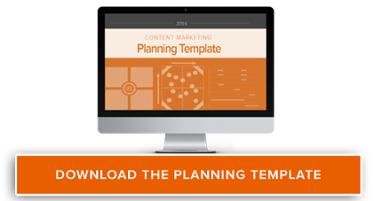
A Content Planning/Goal-Setting Template
(Download the content planning template here.)
HubSpot teamed up with Smart Insights to create a content planning template that will help you put together an effective content marketing plan for either your business or those of your clients. These templates will help you complete a SWOT analysis on your content marketing efforts (and develop a plan to improve them), define the right objectives and KPIs for that plan, brainstorm content ideas and map these across your funnel, and create a timeline for your content plans.
A Content Mapping Template
(Download the content mapping template here)
You know you need a content marketing strategy in place to support the success of your inbound marketing and sales organizations. But how do you get started? We’ve created a content mapping template so you can walk through your target audience’s buyer’s journey. The template helps you identify buyer personas, their challenges and needs, and to brainstorm content that provides solutions. You’ll come away from the template with tons of targeted blog post ideas to attract your audience to your site and convert them into leads.

A Buyer Persona Template
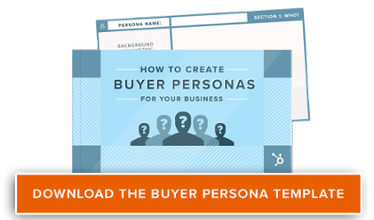
(Download the buyer persona content template here.)
Marketing with buyer personas means marketing smarter. This buyer persona template will help you easily organize your research to create your very own buyer personas. Use it to create beautiful, well-formatted buyer personas that you can share with your entire company, while learning best practices for persona research along the way.
3 Blog Editorial Calendar Templates
(Download the blog editorial calendar templates here.)
Having an editorial calendar for your marketing content will save you a whole lot of time — not to mention sanity — as you plan your content release timeline. We realize there isn’t a one-size-fits all solution, so we’ve created three editorial calendar templates to use at your leisure: one for Google Calendar, one for Excel, and one for Google Sheets. (Read this blog post for a step-by-step guide for using the Google Calendar template.)

2 Social Media Content Calendar Templates (for 6 Social Networks)
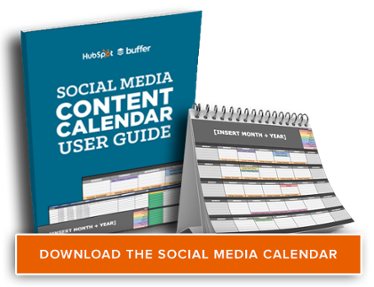
(Download the social media content calendar templates here.)
With so many different social networks to manage, a social media manager’s life becomes a lot easier when they can plan which content to share on each account — and when. This easy-to-use social media content calendar for Microsoft Excel lets you organize your social media activities far in advance. Use it to plan your updates and learn how to properly format your content for the six most popular social networks: Facebook, LinkedIn, Twitter, Instagram, Google+, and Pinterest.
10 Social Media Tracking & Reporting Templates
(Download the social media tracking & reporting templates here.)
Equipped with a social media calendar, you still need a way to track, report on, and even budget for the social media campaigns you run during the year. These 10 planning templates help you do just that: Track your social media followers, report on each post’s performance, manage your paid budget for promoted posts, and more. Download them using the above link or the below graphic.

On-Page SEO Template
(Download the on-page SEO template here.)
The more content you publish to your website, the more traffic sources you’ll want to prioritize. One of those sources is organic traffic. To make on-page SEO easier, we’ve rolled out a handy planning template to help you create a website structure that organizes each webpage, what its purpose is, how long it should be, and how to optimize the metadata associated with each new page you publish.

Written & Editorial Content Templates
5 Blog Post Templates
(Download the blog post templates here.)
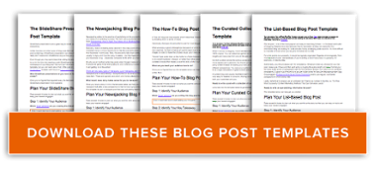
Here’s the thing with blogging: There isn’t one, easy template you can fill in to produce a quality content offering. You need to spend some time brainstorming a title, outlining core content, and so on. While our templates are by no means a fill-in-the-blank type of deal, they’ll walk you through the critical steps for creating the following five blog post types:
- How-To Post
- List-Based Post
- Curated Collection Post
- SlideShare Presentation Post
- Newsjacking Post
We’ve seen these formats crush it on our blogs, and we would love for you to use them to hit your own goals.
5 Ebook Templates
(Download the ebook templates here.)
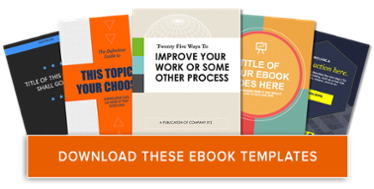
Year after year, marketers cite lead generation as one of their top content marketing goals for the year. If you want to succeed at lead gen, then you need content offers — like ebooks — to help you get there. Our internal creative design team went to work building five, beautiful ebook templates — in both PowerPoint and InDesign — for you to download, customize, and use.
A Press Release Template
(Download the press release template here.)
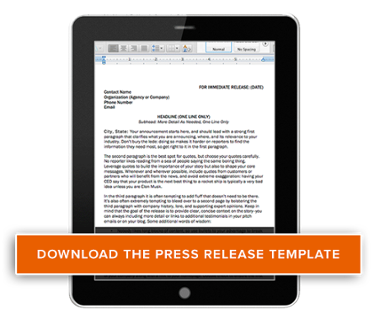
While public relations has adapted to be more lovable and less spammy, press releases can be effective when used correctly. Our press release template takes this into consideration and provides an inbound-optimized version. This means the template can help you script press releases and do so in a format optimized for sharing on your company blog. It’s built in Microsoft Word, so you can easily adapt and customize as needed for your PR needs.
50 Call-to-Action Templates
(Download the call-to-action templates here.)
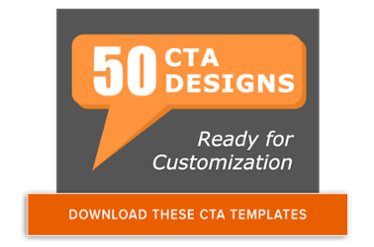
Redesigning your call-to-action buttons can improve clickthrough rates by 1,300% or more. That means visitors will spend more time on your website, and it’ll encourage them to become leads. To help you design clickable calls-to-action, we’ve built 50 pre-designed CTAs for you. These CTAs are super easy to customize, so you don’t need to know any fancy design programs — just PowerPoint.
Bonus: There’s also a handy free tool in there that lets you track your CTA clicks in real time so you can see the exact number of clicks that your designs are reeling in.
Design Content Templates
195+ Visual Marketing Templates
(Download the visual marketing templates here.)
Not a designer? Not a problem. We partnered with graphic design software company Canva to create over 195 visual marketing templates that are easy-to-use, work for any industry (finance, dentistry, agriculture, law — we’ve got ’em all), and are completely free. Best of all, they’re ready to edit in Canva’s online design tool, which is included for free with this set of templates. The templates include…
- Infographics templates
- Facebook ad templates
- Facebook post templates
- Twitter post templates
- Email header templates
- Blog title templates
- Facebook cover photo templates
- Twitter header templates
- LinkedIn cover photos templates
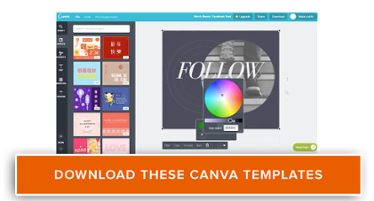
15 Infographic Templates
(Download the infographic templates here.)
We’ve created fifteen, pre-designed infographic templates right in PowerPoint (+ five bonus illustrator templates). That way, marketers can skip the frustrations and start creating the graphics right away. Within each template, we even provide guides to teach you how to use the templates effectively.
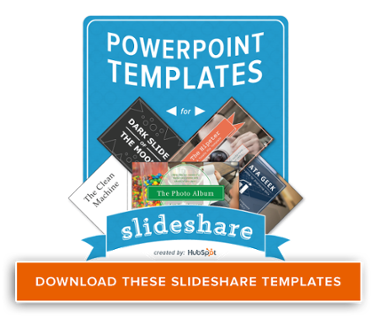
5 SlideShare Templates
(Download the SlideShare templates here.)
Creating a SlideShare presentation in PowerPoint doesn’t have to be daunting. With the right and tools at your disposal, you can easily create an engaging, visual presentation — all without fancy design programs, huge budgets, or hiring contractors.
To help you make a SlideShare of your own, we’ve created some free PowerPoint presentation templates for making awesome SlideShares — so your presentations will look great and be a breeze to put together. (Read this blog post for tips on how you can update and edit the templates to suit your specific needs.)
37 Pre-Designed CTA Templates for Ecommerce Marketers
(Download the ecommerce CTA templates here.)
Every marketer uses calls-to-action (CTAs) to generate leads from their website content. If you’re in the business of ecommerce, however, purchases are just as important as downloads when it comes to your website visitors. The CTA templates above are starter designs specifically for marketers who want to direct attention to their product pages and, ultimately, drive transactions within their online store. Get these templates by clicking the link above.
Social Media Content Templates
100 Social Media Graphics Templates
(Download the social media graphics templates here.)
Visual content is 40 times more likely to be shared on social media than any other type of content. But we know well that creating visual content takes more time and resources — which why we’ve created these 100 customizable templates for you. These templates are in PowerPoint, so they’re very easy to edit — no Photoshop skills required. Simply customize the text on an image, save it, and post it to social media.
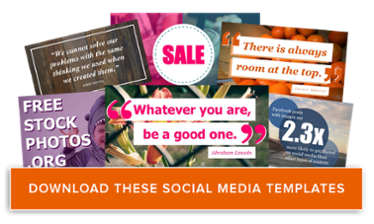
5 Social Media Cover Photo Templates
(Download the social media cover photo templates here.)
I don’t know about you, but I sometimes have trouble keeping straight the different size dimension requirements on different social media networks. To take the guesswork out of it and to avoid frustrating re-designs, we’ve created five templates in PowerPoint that are pre-sized for Facebook, LinkedIn, Twitter, YouTube, and Google+. You can customize them for your social networks without researching design specifications — don’t worry, we’ve got it covered.

11 Facebook Cover Photo Templates for Businesses
(Download the Facebook cover photo templates here.)
With how frequently businesses change and improve on their Facebook pages today, it’s crucial that you have new material in the pipeline. Double-down on your Facebook designs with these 11 templates dedicated to your Facebook cover photo. Get these designs by clicking the link above or the graphic below.

Email Content Templates
15 Email Templates for Marketing and Sales
(Download the email templates for marketing and sales here.)
Did you know that workers spend almost one third of their time at work reading and replying to emails? There are many ways you can streamline your inbox to save time, but you ultimately will still have to create and send emails. That’s where these content templates come in. We’ve written the copy for 15 emails marketers and sales reps are likely to send over and over again to save you time and get you results.

There you have it, content marketers: nearly 400 templates to help you start creating content easily and quickly and further your inbound success.

The Opportunity Cost Formula That’ll Help You Make Optimal Marketing Decisions
As humans, we hate loss. In fact, losing something emotionally impacts us more than gaining something of the same value. We can get so loss-averse that we’ll take risks just to avoid a loss, like how we sometimes cling onto a stock that continues to plummet in value because we desperately want the price to magically shoot back up.

Needless to say, loss stings. And this rings especially true if you work in marketing. Allocating precious budget to the wrong campaigns or tools not only loses website visitors and leads, but it also wastes your spend — money that you’ll never get back again.
Fortunately, calculating the opportunity cost of each decision you make can help you separate the campaigns and tools that actually produce results from the ones that only burn cash.
To help you avoid wasting your budget and losing website visitors and leads, read on to learn what exactly an opportunity cost is and a formula for calculating it.
What Is an Opportunity Cost?
An opportunity cost is the benefit you sacrifice by choosing one alternative over another. For example, if you choose to allocate the last portion of your budget to Facebook advertising, and the next-best alternative is LinkedIn advertising, the opportunity cost of allocating budget to Facebook advertising is the loss of benefits you would’ve reaped if you allocated budget to LinkedIn advertising.
Opportunity Cost Formula
To calculate the opportunity cost of your chosen alternative, you need to predict the expected return on investment of each alternative and subtract the expected return on investment of your chosen alternative from the expected return on investment of the next-best alternative.

For example, if you expect an ROI of 50% from investing in Facebook ads and an ROI of 40% from investing in LinkedIn ads, the opportunity cost of investing in Facebook ads is -10 percentage points (40% – 50%). However, since the opportunity cost of investing in LinkedIn ads is 10 percentage points (50% – 40%), this choice would incur a higher opportunity cost than investing in Facebook ads. We can then conclude that allocating budget to Facebook ads would be the better option.
If you need help calculating return on investment, the formula is ((Gain on investment – cost of investment)/cost of investment)

There’s an opportunity cost for not calculating your opportunity cost.
No marketer wants to squander their budget and lose business because they made an avoidable decision. But if you really want to bypass this type of loss and make the smart choice, consider getting analytical and calculating every one of your decisions’ opportunity cost. Otherwise, you might actually squander your budget and lose business — and there’s nothing you can do about it.

What’s Authentic Leadership, & How Do You Practice It
Whether you’ve recently been promoted to a leadership position, or you’ve been leading your team for years, it can often seem tricky to discern what being a “good” leader actually means.
When you’re trying to determine the components of a successful leader, it’s easy to fall-back on certain terms we commonly associate with leadership — words like “assertive”, “inspirational”, and “confident”.
But what about being “authentic”? While the idea of authentic leadership is not a new concept — it has its roots in Ancient Greek philosophy, which posited that authenticity is an important state of being and enables you to control your own destiny — it can certainly feel like a novel component of leadership today. I mean, what does “being true to yourself” have to do with anything?
In fact, research has shown authentic leadership serves as the single strongest predictor of an employee’s job satisfaction, organizational commitment, and workplace happiness.
To ensure long-term happiness and productivity out of your team, then, it’s critical you demonstrate a level of authenticity as a leader.

Authentic leadership
Authentic leadership is a management style in which leaders are genuine, self-aware, and transparent. An authentic leader is able to inspire loyalty and trust in her employees by consistently displaying who she really is as a person, and how she feels about her employees’ performance. Authentic leadership is the single strongest predictor of an employee’s job satisfaction.
Here, we’re going to explore how the Authentic Leadership Theory can help you become a better, more inspiring leader, today.
Authentic Leadership Theory
There are four distinct components to the Authentic Leadership Theory. Let’s dive into those, now.
1. Self-Awareness
As a leader, it’s critical you have a strong sense of self, including your strengths, weaknesses, and values. It’s impossible to demonstrate authenticity as a leader if you’re unsure of who you are or what you stand for in the first place.
Additionally, by displaying both your strengths and weaknesses to your team, you’re able to demonstrate that you have nothing to hide, and don’t play games. In this way, you’re better equipped to build trust among your team, and when your employee makes a mistake, she’ll feel more comfortable admitting her error to you.
Self-awareness is also critical for you to grow as a leader, and strengthen other components of authentic leadership. For instance, perhaps you’ve noticed you don’t do a great job at displaying transparency with your team. By acknowledging this weakness, you can take steps to rectify it.
In Bruce J. Avolio and Tara S. Wernsing’s essay Practicing Authentic Leadership, they outline three ways authentic leaders should practice self-awareness:
- Seek feedback from the environment
- Use self-reflection to better understand your behavior
- Practice regular self-observation to stay aware of your feelings at all times
Self-awareness is vital for acting appropriately as a leader, and feeling empathy for how your employees might perceive your feedback. For instance, perhaps you feel a conversation you had with your team was demoralizing — you’d just received some disappointing news about your team’s performance, and you’d spoken out of frustration. It’s critical you seek feedback from your environment by asking your team what you can do to help them improve moving forward.
Additionally, perhaps you can mitigate these issues in the future by regularly practicing self-observation, so you’re able to notice, in the moment, “I am very frustrated right now, so I will wait until I am calm to have this conversation with my team.”
2. Relational Transparency
Passive aggression, subtle messaging, and convoluted feedback have no place in leadership. To truly foster authenticity, it’s critical you remain genuine, straightforward, and honest with your team. Let them know where they stand — if they mess up, tell them.
While it might seem counterintuitive — “How will I become close to my team if I am often providing constructive rather than positive feedback?” — it works in your favor in the long-run, as your employees trust that you are not “hiding” your true feelings regarding their performance.
Transparency and honesty must be encouraged from the leadership level if you want your business to be successful. For instance, when Former President and CEO of Ford, Alan Mulally, began working at Ford, he implemented a system in which business leaders would produce color-coded charts at each of their meetings — green to signify success, red to signify failure.
At the time, Ford was forecast to lose 17 billion that year. At the meeting, however, Mulally noticed every chart was green. He recognized that Ford’s culture was one in which leaders hid problems, and avoided transparency out of a fear for job safety.
When one leader, Mark Fields, handed over a chart with red on it — due to a production issue — Mulally began clapping. His reaction signified the concept that failure can be seen as an exciting opportunity for growth, and honesty should be always rewarded. The following week, he saw charts varying from green to yellow to red.
The point is, authentic leadership must start with you displaying behavior you hope to see in your employees, as well. If you aren’t transparent and honest, how can you expect your employees to come forward with problems when they arise?
3. Balanced Processing
A leader needs to make decisions and stay true to her decision in the face of opposition — but she must also be capable of receiving and considering alternative viewpoints before choosing a plan of action.
When making major decisions, it’s important you ask for alternative opinions and remain open to discussion. While it’s important you stick to your values, it’s equally critical you seek out opposing viewpoints, which can help you see flaws in your initial course of action, or enable you to strengthen your argument by understanding all points of view.
Additionally, if you want to be an authentic leader, it’s critical you create an environment in which employees feel both safe and encouraged to share their opinions. This ties back to self-awareness — you must be self-aware enough to accept that your opinion, by itself, is likely biased or partial. By collecting outside feedback, you’re able to see more potential weaknesses in your decision.
4. Internalized Moral Perspective (“Do the Right Thing”)
An authentic leader needs to know when to put the needs of the company and its customers ahead of herself and her team. Ultimately, a leader should be focused on doing the right thing for the long-term success of the business — not herself.
Additionally, it’s critical a leader have strong ethical values and integrity, and exercise these traits even in the face of tempting shortcuts.
For instance, let’s say your employee comes to you with a “make money quick” scheme — his idea is to make it difficult for customers to know how to cancel their subscription, so they are forced to keep paying unless they call up customer support.
As a leader, it’s important you recognize the downfall of this type of decision. While it could temporarily help boost your team’s numbers, it’s not a decision made out of integrity or fairness for your customer, and won’t result in lasting loyalty.
Emmy Jonassen, Director of Acquisition at HubSpot, seconds this point, noting the importance of being a leader whose behavior matches up with the values you want to instill in your team:
“Being an authentic leader means leading by example. It’s demonstrating through your actions that you practice the same values and behaviors you expect from your team.”
She goes on to say, “For example, if you ask your team to come to meetings on time and prepared, you should as well. If you impress upon your team that no task is beneath anyone if it works toward team goals, you should help out with team ‘grunt work’ every now and again by being the notetaker, cleaning up after a team birthday celebration, and so forth.”
By being a leader who emphasizes the importance of doing the right thing, you’re better equipped to set up your team for long-term success.
Why Authenticity in Leadership is Difficult to Achieve
Ultimately, the four components of authentic leadership are good jumping-off points, but it’s important you remember the true meaning of authenticity — the ability to express yourself as you truly are.
The meaning of authenticity makes it inherently difficult to prescribe in any one way.
Meghan Keaney Anderson, HubSpot’s VP of Marketing, describes it like this — “It’s funny that something so basic as being yourself starts to become harder as you gain responsibility and scope. But the truth is, being authentic as a leader has to be consciously worked at.”
“There are too many examples of how other people lead. There are no examples of what’s authentic to you until you get there. So, you have to search for it.”
She goes on to say, “You have to create touch-points in the course of meetings, presentations, management that remind you of yourself — who you are and where you’re strongest. When I give speeches, I tend to start with a personal story to set the tone for the rest of the talk, because there’s no way to tell a personal story without being myself. When I’m out of my depths on something, or need time to think before a decision, I make sure to say so, so that my team knows I don’t always have the answers. Authenticity requires touchstones to remind yourself and the people around you that you’re human.”
Ultimately, authenticity is a leadership skill like any other — and skills can always be developed (or weakened) over time, depending on your conscious efforts. To ensure you’re able to lead your team as well as they deserve, it’s critical you remain focused on demonstrating authenticity whenever possible.

The Ultimate List of Instagram Stats [2019]
With more than 500 million daily active users, brands are quickly recognizing the need to have a presence on Instagram.
But, as with any social network, the brands that are getting the most out of Instagram are the ones who are smart about what they post, when they post, how often they post, and whom they’re targeting.
But how do they know what’s a “smart” post for their business?
Download our guide to learn how to use Instagram for business here.
That’s where the Instagram data comes in. There’s a whole lot of research out there about Instagram — everything from the demographics of its users and how often brands are posting, to how caption length affects engagement and what the most popular emoji is on Instagram. (See #32.)
Read on to uncover more social media stats that’ll help you get ideas and improve your own Instagram posting strategy.
48 Instagram Stats
Click on a category below to jump to the stats for that category:
- Instagram’s Growth
- Audience & Demographics
- Brand Adoption
- Instagram Post Content
- Instagram Posting Strategy
Instagram’s Growth
1. The Instagram community has grown from 90 million monthly active users in January 2013 to 1 billion monthly active users as of June 2018. Tweet this stat! (Source)
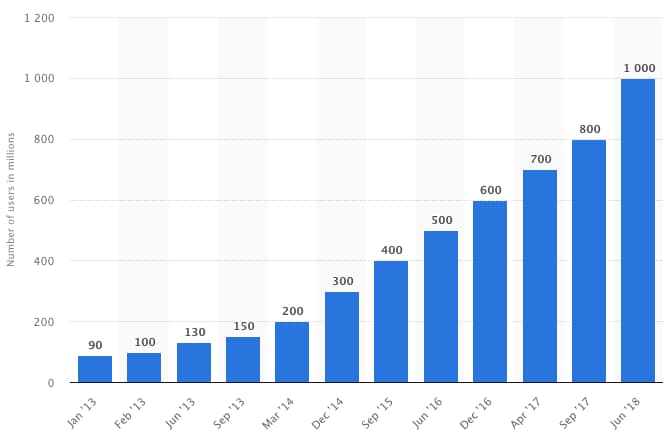
Image Credit: Statista
2. Instagram’s more than 500 million active users place it well ahead of Twitter (326 million active users) Snapchat (150 million active users), and Pinterest (250 million active users). Tweet this stat! (Source)
3. The proportion of online adults who use Instagram has grown by nearly 400% since Pew Research Center first started tracking social media platform adoption in 2012. Tweet this stat! (Source)
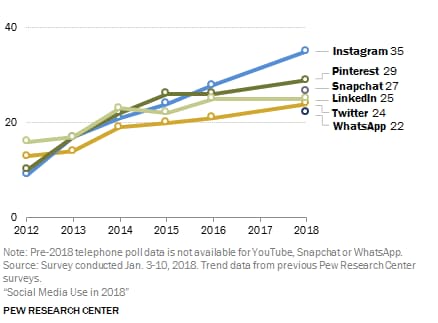
Image Credit: Pew Research Center
4. Instagram’s user base is growing far faster than social network usage in general in the U.S. However, Instagram is projected to grow more slowly in the next few years, from 13.1% growth in 2018 to 4% in 2022. Tweet this stat! (Source)
5. Between 2016 and 2020, eMarketer predicts Instagram will add 26.9 million users — almost double the incremental users expected for Twitter, and far more than any other social platform tracked. Tweet this stat! (Source)
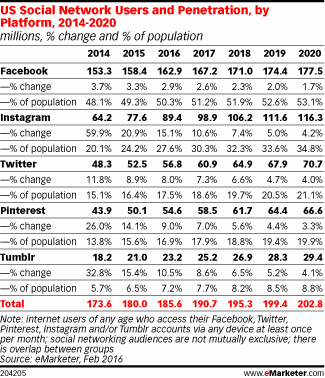
Image Credit: eMarketer
6. In 2019, nearly 25% of Facebook’s total ad revenue is expected to come from Instagram. By 2020, Instagram’s share of that revenue will grow to 30% globally. Tweet this stat! (Source)
7. Instagram and Snapchat are tied for the second-highest used messaging app (behind Facebook Messenger) for millennials at 47%. Tweet this stat! (Source)
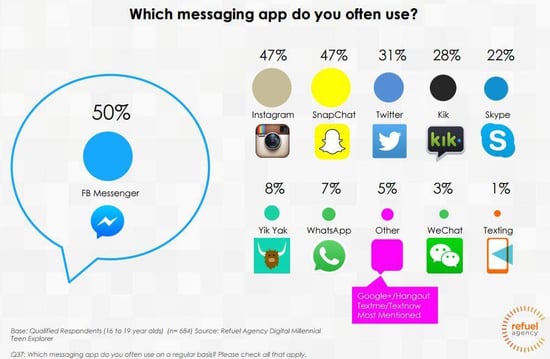
Image Credit: Refuel Agency
8. Other than Instagram’s own account, the most-followed Instagram account as of January 2019 is run by professional soccer player Cristiano Ronaldo, followed by celebrities Selena Gomez, Ariana Grande, and Dwayne (The Rock) Johnson. Tweet this stat! (Source)
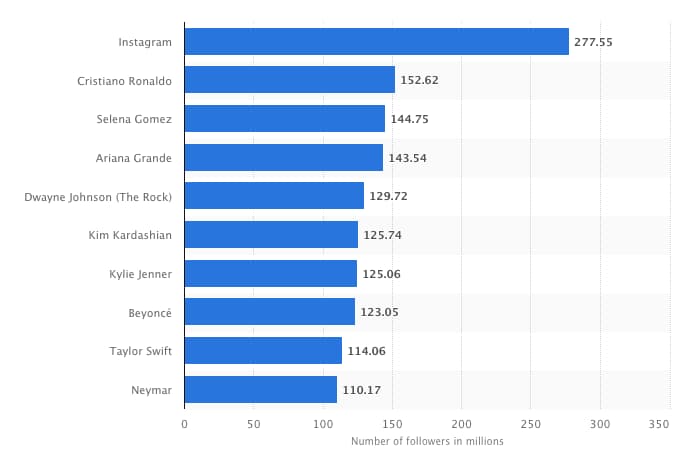
Image Credit: Statista
Audience & Demographics
9. 72% of teenagers use Instagram and nearly as many (69%) use Snapchat. Both have increased by more than 20% since 2015. Tweet this stat! (Source)
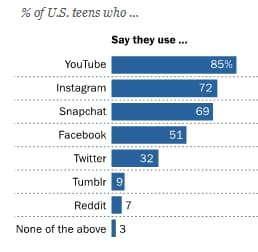
Image Credit:
10. 35% of adult internet users used Instagram in 2018, up from 26% in September 2014. Tweet this stat! (Source)
11. 71% of young adults (ages 18–24) used Instagram in 2018, compared with 37% who did so in 2013. Tweet this stat! (Source)
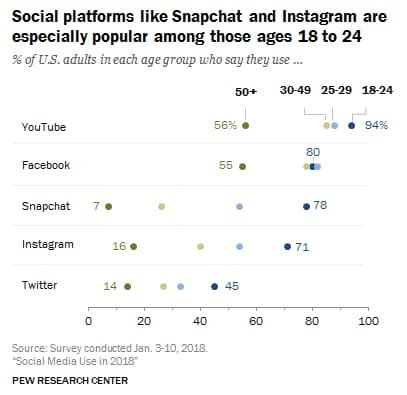
Image Credit: Pew Research Center
12. In 2018, 60% of Instagram users used the platform daily, including 55% of young adults who visited several times a day. This 60% figure reflects a 9-point increase from 2016, when 51% of Instagram users reported visiting the site on a daily basis. Tweet this stat! (Source)
13. More than one-third of Instagram users have used their mobile devices to buy something online — 70% more likely than people who are not on Instagram. Tweet this stat! (Source)
14. On average, women make up 56% of Instagram’s user base in Latin America. Tweet this stat! (Source)
15. More than 80% of Instagram’s user base consists of people living outside of the U.S. Tweet this stat! (Source)
16. As of January 2019, the countries with the most Instagram users are the U.S. (121 million), India (71 million), and Brazil (64 million). Tweet this stat! (Source)
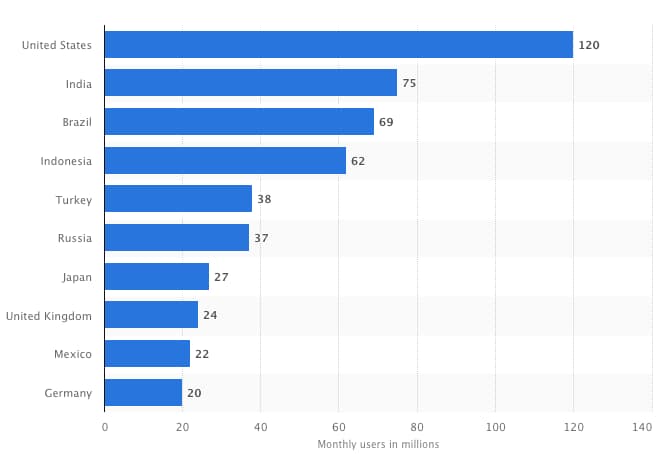
Image Credit: Statista
Brand Adoption
17. Businesses that are on Instagram get up to 37% of their total impressions from Instagram Stories, the ethereal content that users can publish separate from their feed and disappears after 24 hours. Tweet this stat! (Source)
18. Eight of the top 15 most followed brands on Instagram are in the business of retail. Tweet this stat! (Source)
19. Approximately 80% of all Instagram users follow a business on Instagram. Tweet this stat! (Source)
20. In a 2018 study, the higher education industry had the highest engagement rate of any other industry per post on Instagram, at 3.39%. Second was sports teams at 2.28%, and third was nonprofits at 2.14%. Tweet this stat! (Source)
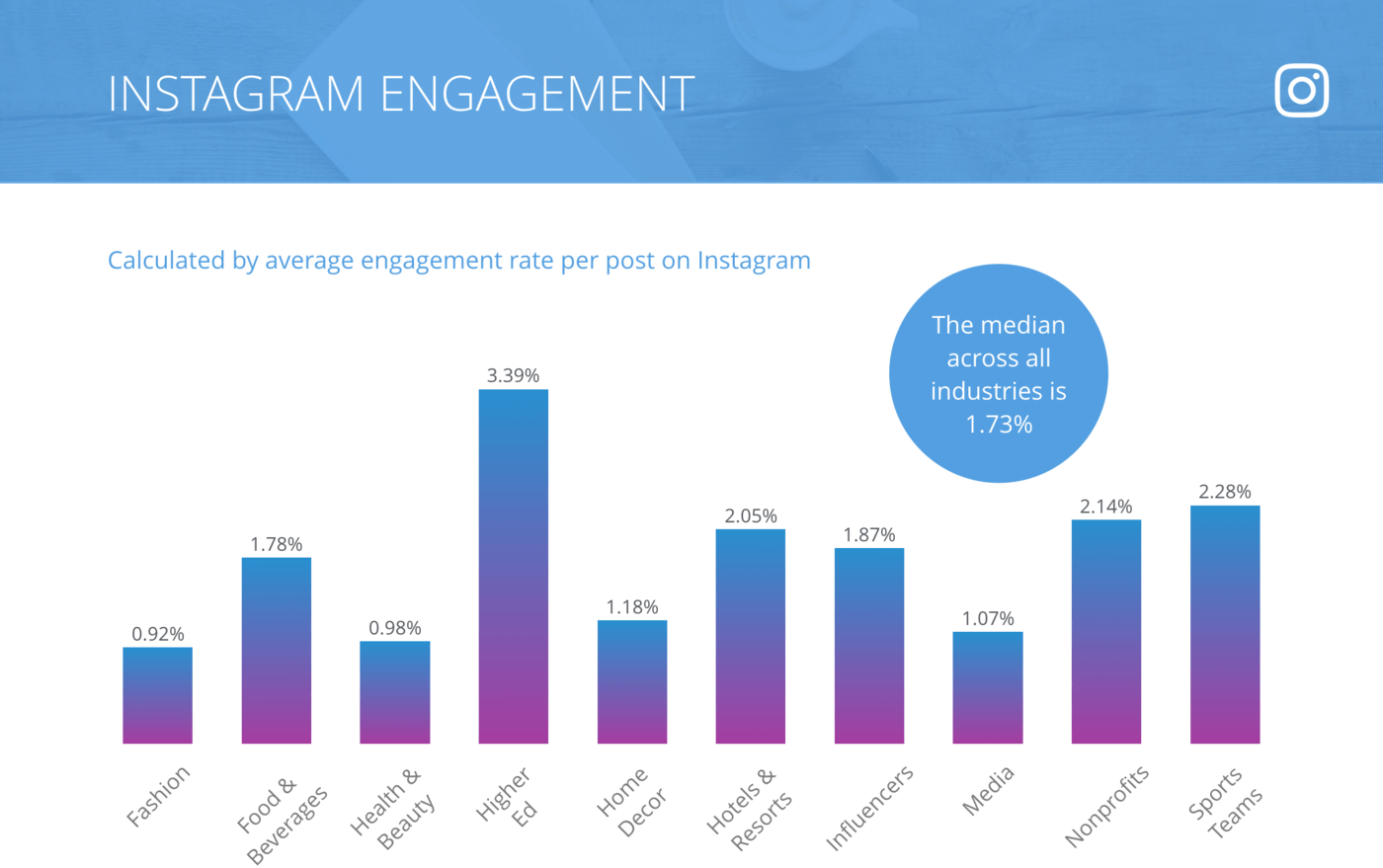
Image Credit: RivalHQ
Instagram Post Content
21. More than 100 million photos and videos are shared on Instagram each day. Tweet this stat! (Source)
22. On Instagram, photos showing faces get 38% more Likes than photos not showing faces. Tweet this stat! (Source)
23. In a study of 8 million Instagram images, images with a single dominant color generate 17% more Likes than images with multiple dominant colors. Tweet this stat! (Source)
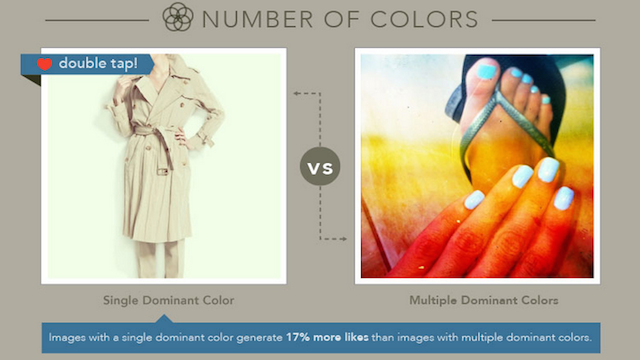
Image Credit: Curalate
24. On Instagram, images with a high amount of negative space generate 29% more Likes than those with minimal negative space. Tweet this stat! (Source)
25. On Instagram, images featuring blue as the dominant color generate 24% more Likes than images that are predominantly red. Tweet this stat! (Source)
26. There’s little correlation between caption text length and engagement rate on Instagram. Tweet this stat! (Source)
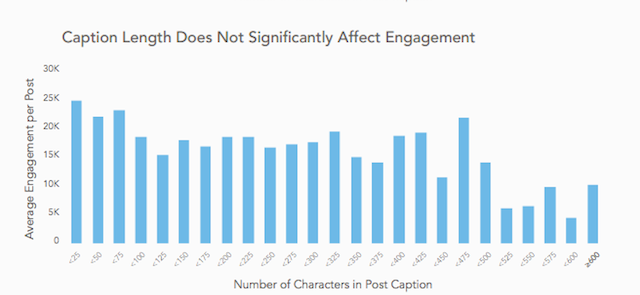
Image Credit: Simply Measured
27. When Instagram first introduced video in June 2013, more than 5 million were shared in the first 24 hours. Tweet this stat! (Source)
28. One in four ads on Instagram is a video. Tweet this stat! (Source)
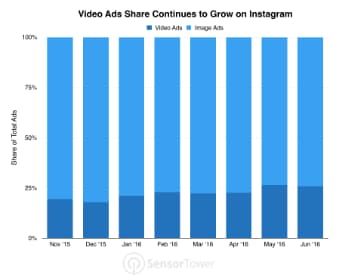
Image Credit: SensorTower
29. In a study of 100 top brands, the brands’ Instagram captions averaged 2.5 hashtags per post. Tweet this stat! (Source)
30. In one study, posts with nine to 12 hashtags received more engagement than posts with any other number of hashtags. Tweet this stat! (Source)
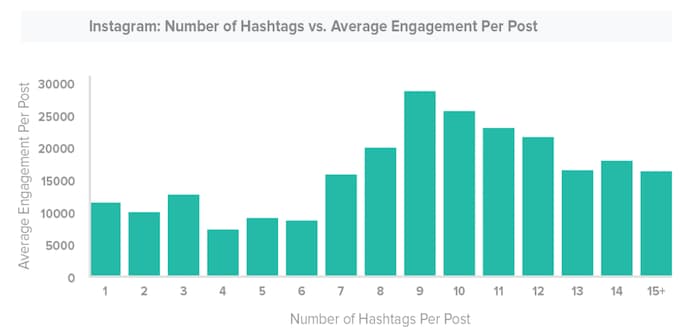
Image Credit: Track Maven
31. Instagram posts that include hashtags between 21 and 24 characters in length perform better than average. Tweet this stat! (Source)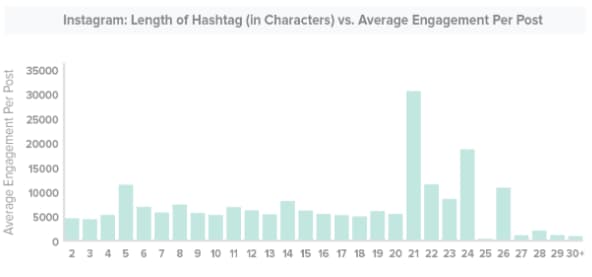
Image Credit: Track Maven
32. Posts tagged with a location see 79% higher engagement than posts not tagged with a location. Tweet this stat! (Source)
33. The red heart is the most frequently shared emoji on Instagram, which is shared 79% more than the next most popular symbol, a smiling face with heart eyes. Tweet this stat! (Source)
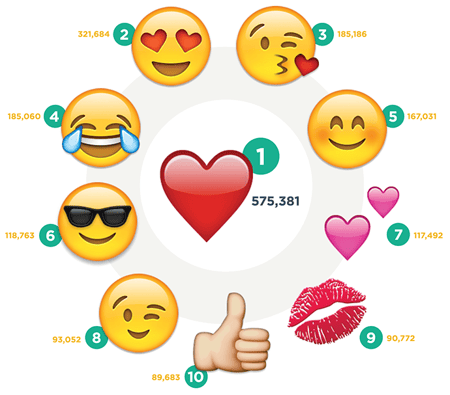
Image Credit: Curalate
34. Four of the top five most popular emojis are positive smiley faces (including the laughing-so-hard-I’m-crying icon). If you look at the top 20 emojis, smileys comprise half. Tweet this stat! (Source)
35. The American flag is the only flag emoji to break the top 100, ranking #59. The next most popular flag comes from Italy, ranked #125, followed by the French flag at #160 and the Japanese flag at #166. Tweet this stat! (Source)
36. Pizza is the most popular Instagrammed food, behind sushi and steak. Tweet this stat! (Source)
Instagram Posting Strategy
37. In a study of 55 brands, all brands posted an average of 1.5 times per day. Tweet this stat! (Source)
38. The best time to post on Instagram is Thursday between 5 a.m. and 11 a.m. in your respective time zone. Tweet this stat! (Source)
39. The most common posting frequency for brands on Instagram is 11–20 times per month, with almost one-third of companies measured falling into that bucket. Tweet this stat! (Source)
40. 90% of the Interbrand 100 companies now have Instagram accounts. Of all 100 companies, 80% post at least one Instagram photo or video per week. Tweet this stat! (Source)
41. Many posts by top brands take more than 19 hours to hit 50% of their total comments, and another 10% of comments coming after 19 days. Tweet this stat! (Source)
42. Many posts continue to receive low-level engagement for days and weeks after posting. Most brand posts continue to receive Likes and comments 18–24 hours after posting, just at a slower clip than the initial fast pace. Tweet this stat! (Source)
43. While Instagram is still by far the best social network for organic engagement, its per-follower interaction rate of 2.2% is barely half what it was in 2014. Tweet this stat! (Source)
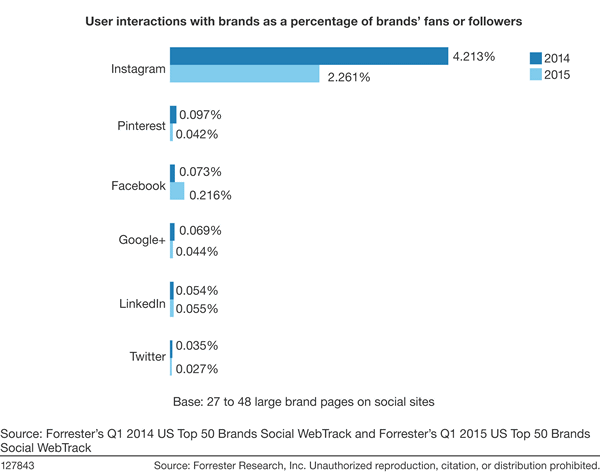
Image Credit: Forrester Research
44. In a study of 100 top brands, engagement per post has grown at a rate of 53% year-over-year. Tweet this stat! (Source)
45. In a study of several thousand brand posts, the average engagement rate is 4.3% and the median is 3.5%. That means that the average post in this sample saw 4.3 activities (a Like or a comment) per 100 followers. Phrased another way, to get 100 Likes and comments on a post, a brand would need approximately 2,325 followers. Tweet this stat! (Source)
46. One brand added 36X its typical number of new followers each day during the 4 days it ran a set of sponsored posts on Instagram, increasing its follower count by 18.15%. Tweet this stat! (Source)

Be Mine: A Brief History of Valentine’s Day Marketing
When I was in grade school, Valentine’s Day was one of my favorite holidays. There were cards. There was the possibility that your crush actually liked you back. And, there was the chocolate — so much chocolate.
Little did I know that the roots of this holiday bore little-to-no resemblance to my childhood experience of it. We were never taught that Valentine’s Day actually originated with an arguably gruesome ancient festival, where there was no chocolate or exchange of cute, red-and-pink cards. But love it or hate it, those are the types of things we associate with the holiday today. After all, there’s a reason roughly 114 million Valentine’s Day cards are exchanged each year — it’s what’s become expected of us.
So how the heck did we get from an ancient Roman festival to a holiday that compels many of us to spend no less than $147 on celebrating it? That story, it turns out, is thousands of years old — but we’ll try to condense it.
How Valentine’s Day Began and Evolved
Ancient Rome
Source: Christie’s
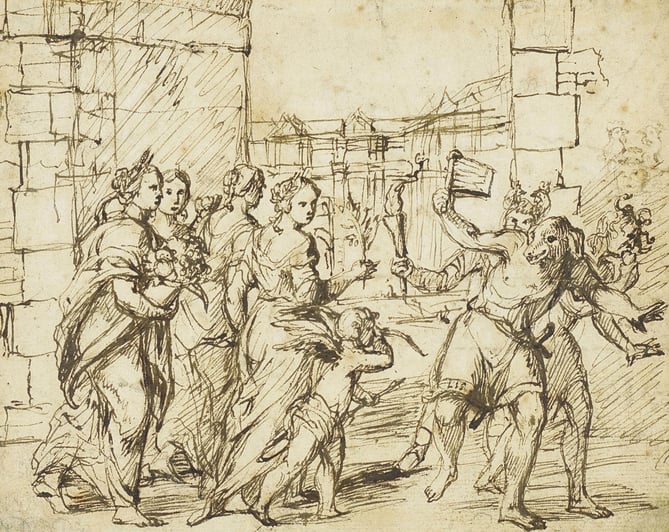
The roots of Valentine’s Day are cited by some sources to lie in the ancient Roman festival Lupercalia, largely because it took place annually on February 15 — the day after what is today the observed date of Valentine’s Day — and involved some very primitive forms of courtship and matchmaking. But it was also ancient Rome that saw the famous execution of a St. Valentine on February 14, around 278 A.D. According to legend, he wrote a letter on the night before his execution to his jailer’s daughter, whom he had befriended, and signed it, “From Your Valentine.”
Over two centuries later, Pope Gelasius ordered that Lupercalia be replaced with the February 14 observation of St. Valentine’s Day. That set the tone, some believe, for the day’s forthcoming tradition of exchanging “love messages,” perhaps in remembrance of St. Valentine’s farewell letter.
The Romans are also credited with constructing the idea of Cupid — a god of love often depicted with arrows that, as the legend goes, inflict love upon those who are hit by them. The Roman version of Cupid was adapted from Eros, a god of passion and fertility in Greek mythology. It seems that no one is quite sure when cupid became associated with Valentine’s Day, but the fact that both have origins in ancient Roman culture suggests that there may have been some very early overlap between the two.
Shakespeare (and Chaucer) in Love
Source: Internet Archive
When NPR’s Arnie Seipel set out to explore the history of Valentine’s Day, he found that it first became romanticized by classic authors like William Shakespeare in the late 16th century, and Geoffrey Chaucer in the 1300s.
Chaucer
Dartmouth English professor Peter Travis cites Chaucer’s epic poem The Parliament of Fowls, which was one of the first literary references to St. Valentine’s Day, or “Seynt Valentynes day,” as Chaucer spelled it. One such mention is made, Travis explains, alongside the line, “Now welcom somer, with thy sonne sonne, That hast this wintres weders over-shake.” In other words, when we celebrate love in the coldest depths of winter — in February, for instance — it’s so heartwarming that it makes summer feel less far away.
Shakespeare
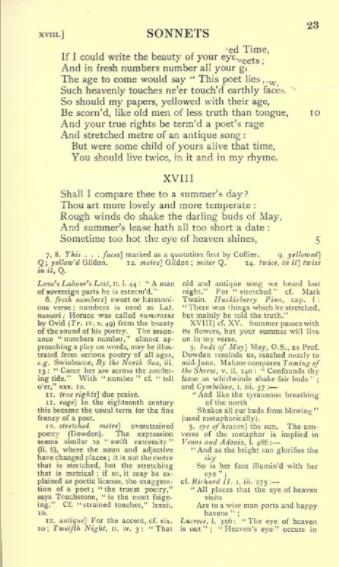
Some literary historians credit Shakespeare for the permeation of love into popular culture with his composition of “Sonnet 18” — said to be written between 1593-1601 — a.k.a., “Shall I compare thee to a summer’s day?” It’s unclear when or how this particular work became associated with Valentine’s Day, but like Chaucer, Shakespeare compares love to the seasons.
“While summer days may fade and fall into” colder months, writes Shakespeare analyst Lee Jamieson, “his love is eternal.”
Of course, Saint Valentine’s day is alluded to outright in Hamlet — written between 1599-1601 — when the character Ophelia recites a song about a young lady’s experience with the holiday, which includes lyrics like, “Tomorrow is Saint Valentine’s day,” and, “To be your Valentine.”
The 17th Century and Beyond
Source: American Antiquarian Society
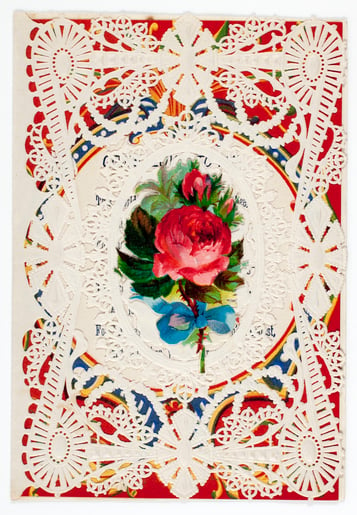
By the 1700s, it’s said that Valentine’s Day made its way from Europe to the United States, which aligns with the establishment of the North American colonies between 1607-1770. It became traditional, according to HISTORY.com, “for friends and lovers of all social classes to exchange small tokens of affection or handwritten notes.” That was more common in England, however, where the Industrial Revolution began earlier and eventually included the production of “fancy valentines [that] were extremely expensive to import.“
It’s said that one American woman, Esther Howland, was so intrigued when she received her first English valentine greeting in 1847, that she became infatuated with the idea of manufacturing them in the U.S. She was an early entrepreneur, and instinctively believed that there could be an American market for these formal, English-style greetings. After procuring materials like high-quality paper and lace from her father, a stationer, she created what many credit as the earliest American Valentine’s Day greeting cards.
Today, Howland is still honored with the nickname “Mother of the American Valentine,” with many citing her work as the start of a multi-million-dollar industry. But it didn’t happen overnight — let’s take a look at how her work paved the way.
A Brief Timeline of Valentine’s Day Marketing
1714
Charles II of Sweden begins communicating with flowers, by assigning a different message to each type. This tradition allegedly assigned love and romance to the red rose, setting the stage for this flower to be exchanged during the later, commercialized era of Valentine’s Day. However, it remains unclear if a specific brand is responsible for first marketing flowers as part of Valentine’s Day gift-giving.
1822

Source: The Chocolate Journalist
In England, where Valentine’s Day had by now already been celebrated with the exchange of gifts and cards for many years, the Cadbury chocolate company sells the first heart-shaped box of chocolates.
1849
In Massachusetts, Howland produces a dozen sample Valentine’s Day cards and sends them off with her brother to distribute during a sales trip for their father’s company — S.A. Howland & Sons — hoping to earn $200. Instead, he returns with 25X that amount, indicating a much higher-than-expected demand.
1850
The first print advertisement for Howland’s cards appears in the Worcester Spy.
1866
Source: Evan Amos
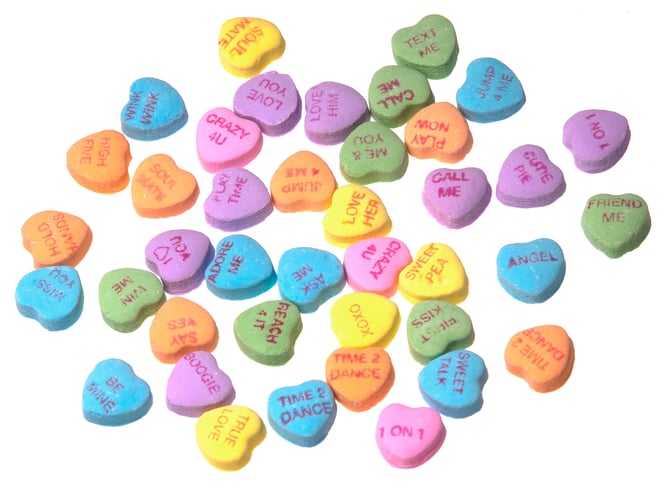
Conversation candies are developed, when Daniel Chase — brother of New England Confectionery Company (NECCO) founder Oliver Chase — uses vegetable dye to print words onto confections.
1870
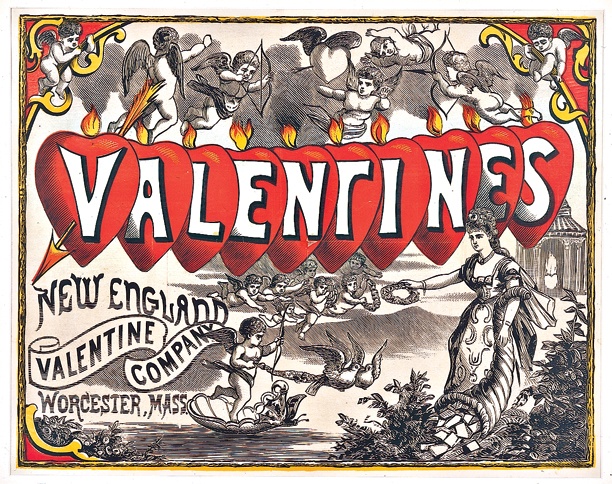
Howland incorporates her booming card business as the New England Valentine Company, operating out of her home via an assembly line that was largely comprised of her friends.
1879
Source: Viintage
The New England Valentine Company moves operations from Howland’s home to a Main Street factory in Worcester, Massachusetts. That same year, the company publishes the Valentine Verse Book, which contained 131 “verses” that people could cut out and paste inside of cards that came without a greeting — or those with a greeting that the buyer didn’t like.
1880 – 1881
Howland sells the New England Valentine Company to the George C. Whitney Company.
1888

Source: Worcester Historical Museum
Whitney has acquired at least 10 competitors, including Berlin and Jones, which had become New York City’s “largest manufacturer of Valentines.” Ten years later, the company moves to large-scale headquarters on Worcester’s Union Street.
1894
The Hershey Chocolate Company is founded, bringing what was previously “a European luxury product” to the U.S.
1902
Conversation candies become heart-shaped.
1906
Source: Vintage Recycling
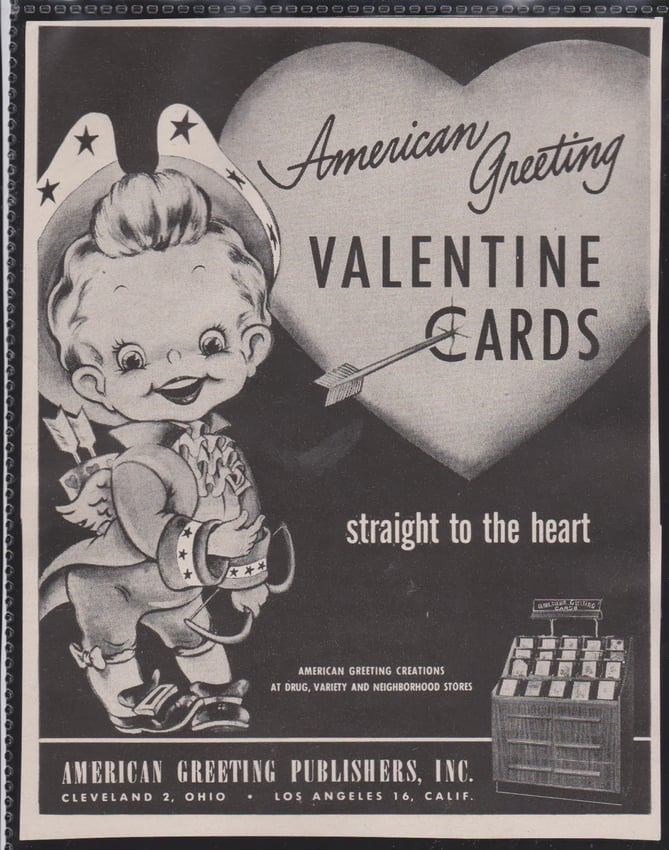
American Greetings is founded, eventually becoming one of Whitney’s chief competitors.
1907
The Hershey Chocolate Company introduces Kisses candy.
1910
Source: Period Paper
That January, a massive fire destroys much of Whitney’s headquarters. However, most of the Valentine’s Day products had already been shipped for the season, having little impact on that particular holiday.
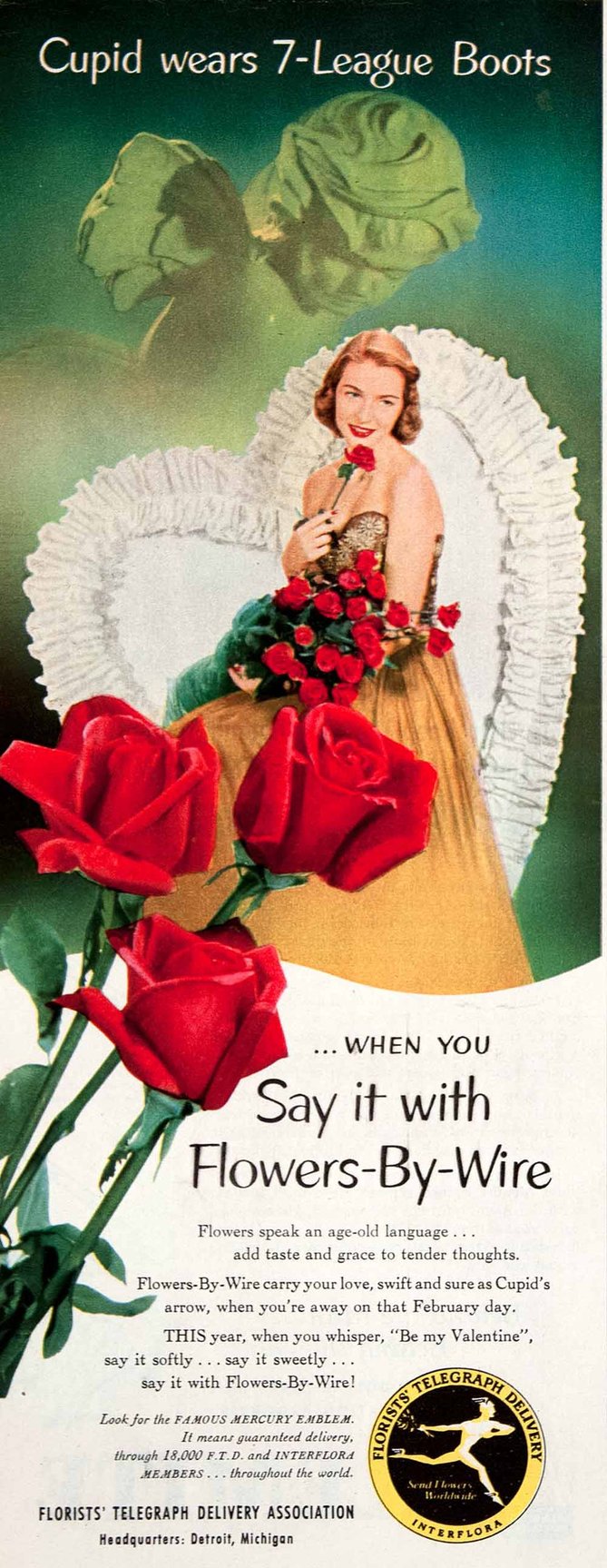
That same year, Hallmark is founded. Meanwhile, 1910 also saw the creation of Florists’ Telegraph Delivery — today known as FTD — which pioneered the remote ordering and delivery of flowers, providing a way to send them to far-away loved ones.
1913
Hallmark produces its first Valentine’s Day card.
1948
Source: Vintage Ads
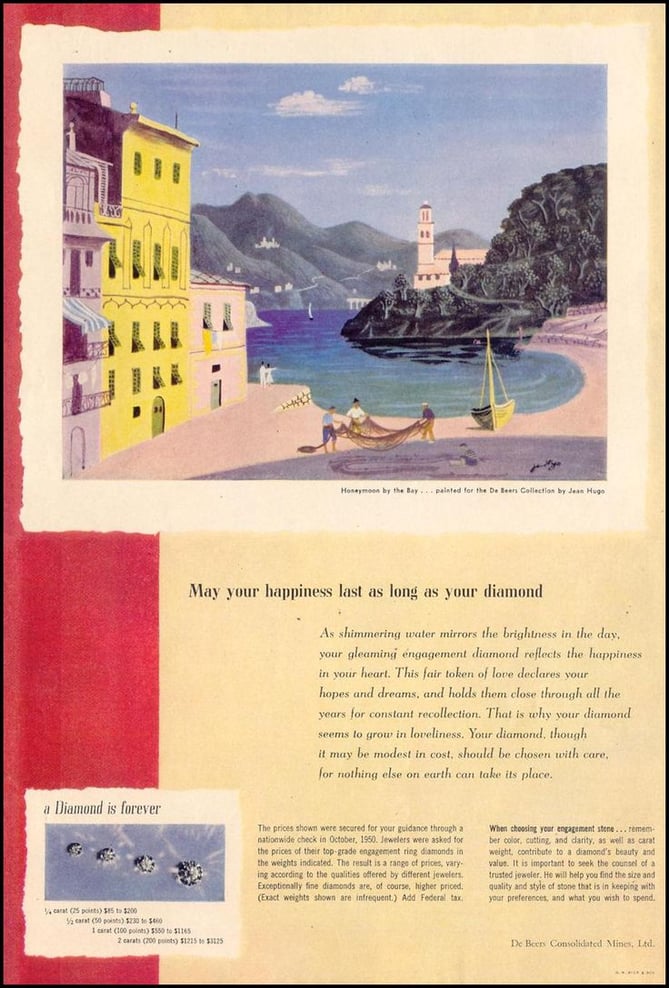
The De Beers diamond company launches its “A Diamond is Forever“ campaign, sending the message that gifting high-end jewelry can be used as an expression of love.
1986
Hershey’s begins packaging Kisses candies in pink and red foil specifically for Valentine’s Day.
2005
Source: Wayback Machine
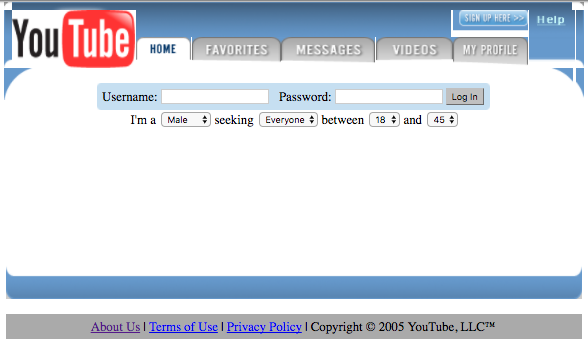
Valentine’s Day begins to go digital. On February 14, 2005, YouTube — which originated as an online dating site — makes its debut. Co-founder Steve Chen still credits its invention as the brainchild of “three guys on Valentine’s Day that had nothing to do.”
2013
Source: Uber
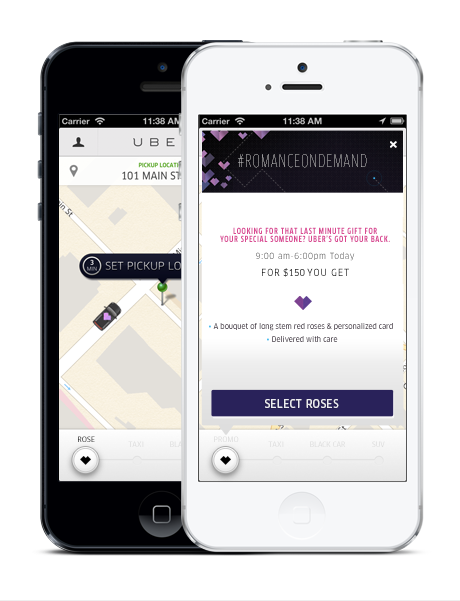
Ride sharing company Uber rolls out “Romance On Demand,” allowing users to send flowers on Valentine’s Day via the app. This initiative would continue to progress, with on-demand skywriting becoming available the following year.
2016
Well aren’t you accurate today, @netflix #HappyValentinesDay pic.twitter.com/pUK05gQ8Rs
— Tiffany Bukowski (@TheTiffy)
February 14, 2016
NetBase, a social media analytics platform, releases a Valentine’s Day Sentiment Analysis, measuring how people engage with and discuss the holiday on social media. In total, it measured nine million mentions of Valentine’s Day, with the vast majority of them mentioning a specific brand — Netflix. The top hashtag was #happyvalentinesday.
Be Ours
Like so many other holidays, Valentine’s Day has experienced a transition into pop culture that has shaped the way it’s perceived, discussed, and celebrated. Sure, it’s often accused of being nothing more than a money-making marketing holiday — just look at these numbers compiled by HISTORY.com. But next time you hear someone label Valentine’s Day as “Hallmark holiday,” you’ll have a wealth of historical information to respond with.
From our hearts to yours, Happy Valentine’s Day. We’ll be keeping an eye on its continued evolution.

51 YouTube Stats Every Video Marketer Should Know in 2019
In 2005, when I was 10 years old, a kid from my neighborhood was bear hugging a fallen tree trunk that bridged across our creek and yelled, “I better not see this on YouTube!”
That was the first time I’d ever heard of YouTube. And it definitely wasn’t the last time I’d hear about it. YouTube has experienced explosive growth since it was founded in an office garage in 2005. Just one year after its inception, it was attracting more than 65,000 new video uploads and 100 million video views per day. A couple of months later, the high-growth startup was acquired for over $1 billion by a titan in the tech industry — Google.
Since then, YouTube has opened up avenues for brands to advertise on their videos and, in turn, let content creators earn a living just by making videos. This potential for monetization has incentivized content creators to craft the most engaging videos possible and host them on the platform, which has enabled YouTube to become the second most trafficked website and the second largest search engine in the world.
As a video marketer, you already know how crucial building a YouTube presence is for boosting your videos’ and brand’s visibility. But if you just started your brand’s YouTube channel or need some help convincing your boss to double down on your YouTube efforts, we’ve got you covered.
Check out these 51 stats about the platform’s mobile usage, its demographics, subscriber growth, general usage, and history that can help you build your YouTube following or persuade your boss to focus more of your efforts on the video platform.
51 YouTube Stats Every Video Marketer Should Know in 2019
How many videos are on YouTube?
1. Since 400 hours of video are uploaded to YouTube every minute (and a lot of those videos violate YouTube’s guidelines and subsequently get taken down) it’s impossible to determine the exact number of videos hosted on the platform. However, over one billion hours of videos are watched on YouTube every day.
What is the most-watched video on YouTube?
2. “Despacito” by Luis Fonsi featuring Daddy Yankee is the most-watched video on YouTube. It has received over 5.96 billion views in a little over two years.
How many people use YouTube?
3. YouTube has over 1.9 billion monthly active logged-in users.
YouTube Mobile Stats
4. On mobile devices alone, YouTube reaches more adults aged 18-49 during prime time than any cable network does in an average week.
5. 75% of adults report watching YouTube on their mobile devices.
6. More than 70% of YouTube watch time is generated from mobile devices.
7. YouTube mobile ads are 84% more likely to hold attention than TV ads.
8. Over 50,000 years of product review videos have been watched on mobile devices over the past two years.
9. In 2018, YouTube was the most popular IOS app.
YouTube Demographics Stats
10. Over 90% of 18-44 year old American internet users watch videos on YouTube.
11. Over half of American internet users who are aged 75 and over watch videos on YouTube.
12. Over 50% of YouTube’s audience is female.
13. 59% of Generation Z (16-24-year-olds) have increased their YouTube usage since last year.
14. 46% of millennials (25-34-year-olds) have increased their YouTube usage since last year.
15. 70% of millennial YouTube users watched a YouTube video to learn how to do something new or learn about something they’re interested in.
16. 15.8% of YouTube users are from the United States.
17. YouTube attracts the most visitors from the United States, India, Japan, Russia, and China.
18. YouTube is available in more than 91 countries.
19. YouTube is available in 80 different languages.
YouTube Subscriber Growth Stats
20. The number of channels with more than 1 million subscribers increased by more than 75% since 2017.
21. The number of YouTubers who earn six figures per year has increased by more than 40% since 2017.
22. The number of YouTubers who earn five figures per year has increased by more than 50% since 2017.
23. The top ten YouTubers earned 42% more revenue in 2018 compared to 2017.
24. PewDiePie is the most popular YouTube channel, with 85 million subscribers.
25. The most popular branded YouTube channel is LEGO, which has over 7.1 million subscribers and has received over 8.7 billion views.
YouTube Usage Stats
26. YouTube is the world’s second largest search engine.
27. YouTube is the second most trafficked website behind Google.
28. YouTube users collectively watch over 46,000 years of content each year.
29. 68% of YouTube users watched a video to help them make a purchase decision.
30. 80% of YouTube users who watched a video to help them make a purchase decision said they watched the video at the beginning of the shopping process.
31. 95% of the most popular YouTube videos are music videos.
32. 47% of on-demand music streaming was listened to on YouTube.
33. There are twice as many small- and medium-sized businesses advertising on YouTube since 2016.
34. Four times as many people prefer watching video on YouTube rather than on social media platforms.
35. YouTube users watch more than 180 million hours of content on TV screens every day.
36. YouTube users are three times more likely to prefer watching a YouTube tutorial video compared to reading the product’s instructions.
37. “Relaxing” and “feeling entertained” are the top two reasons viewers watch YouTube.
38. Relaxation videos like soap cutting and slime playing experienced a 70% increase in watch time in 2018.
39. Comedy, music, entertainment/pop culture, and “how to” are the four most popular content categories on YouTube.
YouTube History Stats
40. “YouTube.com” was activated on February 14, 2005.
41. “Me at the zoo” was the first video uploaded to YouTube on April 25, 2005.
42. Google purchased YouTube for $1.65 billion on October 9, 2006.
43. YouTube launched InVideo ads in December 2007.
44. YouTube streamed the United States presidential debates for the first time in 2012.
45. The youngest YouTuber is Ryan ToysReview, who is a 7-year old boy who makes $11 million a year and has 18.2 million subscribers.
46. “Gangnam Style”’s surge in popularity broke the video’s view counter.
47. YouTube provides a free space in Los Angeles where YouTubers with over 10,000 subscribers can learn, connect, and create videos with each other.
48. The first YouTube video that reached one million views was a 2005 Nike ad that featured football star, Ronaldinho.
49. The YouTube video that received the most views in 24 hours is Ariana Grande’s “Thank U, Next” music video, which attracted 55.4 million views in a single day.
50. The most liked video on YouTube is the music video for the song “Despacito” by Luis Fonsi featuring Daddy Yankee. It has received over 31.96 million likes and boasts an 89.25% like percentage.
51. YouTube’s own YouTube Rewind 2018 video is the most disliked video on the platform. It has received over 16 million dislikes and owns an 86.53% dislike percentage.

How to Run a Structured Interview (Questions Included)
Imagine this — a hiring manager is choosing between two candidates of similar expertise, so she invites them both into the office for an in-person interview. However, she’s given power to choose which questions she asks each one.
She notices the first candidate went to school at her alma mater, so she decides to gear her initial questions towards that commonality to build rapport. On the other hand, she will begin the other interview with a basic, “Tell me about yourself” question.
Seem fair? Probably not.
If an interview is unstructured, it doesn’t mean the hiring manager didn’t prepare questions ahead of time. However, an unstructured interview allows employees to ask different questions to each candidate — which could become an opportunity for employees to judge candidates based on who they get along well with, as opposed to whether the candidate is qualified for the role.
Structured interviews help you minimize biases or personality preferences that could otherwise affect a hiring manager’s decision to move forward with a candidate.
A structured interview is a process established by HR in which all candidates are asked the same predetermined questions in the same order. Your team will then rate each candidate using a standardized scoring system.
Structured interviews have demonstrated a high degree of reliability, validity, and legal defensibility compared to unstructured interviews. Additionally, a structured interview makes it easier to provide interview feedback to a candidate.
To implement a structured or semi-structured interview at your company, keep reading.

Structured Interview Questions
To create structured interview questions, you must first craft a detailed job description with all the necessary components of the role, as well as any “nice-to-haves”. Once you have a job description, use it as a guide to write a list of hard and soft skills you’re looking for in a candidate.
Next, you’ll want to create a list of role-specific questions. For instance, you might consider asking:
- Give me an example of a time you had to [important job skill].
- What do you think will be your biggest challenge with this role?
- What most excites you about this role?
- Tell me how you would handle [specific job challenge].
These questions will vary depending upon the role. You’ll also want to gauge the candidate’s interest in your company in general, as well as her work ethic.
Here are a few general structured interview questions:
- Can you tell me a little about yourself?
- What do you know about the company?
- What are your greatest professional strengths? Alternatively, what are your weaknesses?
- What is your greatest professional achievement?
- Where do you see yourself in five years?
Lastly, there are structured interview questions you might want to ask to get a better sense for someone’s leadership skills, willingness to learn, or ability to handle herself under pressure.
Take a look at the following structured interview questions, divided by category, for further inspiration.
To rate leadership ability
- You indicated on your resume that leadership is one of your strengths. Describe an experience in which you used your leadership abilities.
- Tell me about a time when you delegated a project to others effectively.
- 3. Tell me about a time you took the lead in a team project. What was the project outcome?
- 4. Can you recall a time where you had to give negative feedback to a colleague. How did you express this feedback?
To rate dependability
- If your manager asked you to complete a task you thought impossible at first, what would you do?
- Tell me about a time when you had multiple important projects to finish and how you prioritize them.
To rate willingness to learn
- Tell me about a time you failed at a project. How did you try to avoid failure? What did that experience teach you?
- Tell me about a time you had to learn something you weren’t familiar with very quickly.
- Which other companies in [your industry] do you admire? Why?
Semi-structured Interview
A structured interview has plenty of benefits — but, of course, it also has its drawbacks.
A structured interview leaves little room for building rapport. When a candidate answers a question, you’re simply instructed to move to the next question, even if the following question has little relevance to the candidate’s unique response.
If you feel a structured interview is too rigid for your workplace, but still want to use general guidelines to ensure fairness in your recruitment process, you might consider a semi-structured interview as an alternative.
A semi-structured interview still requires your HR team to create a list of open-ended questions, and subsequently train interviewers to ensure they ask role-specific questions and use a standardized rating system to determine a candidate’s fit.
However, a semi-structured interview also provides more opportunity for the interviewer to tailor the conversation naturally, either by excluding questions they feel are redundant, or asking follow-up questions when they feel it’s necessary.
Ultimately, a semi-structured interview requires your team to follow a predetermined set of questions, but allows the interview itself to feel more conversational by nature. The interviewer has the power to change the wording of the question, or the order of the questions, which could enable the interviewer to dive deeper or ask follow-up questions depending on the candidate’s responses.


Everything You Need to Know About the Principles and Types of Design
Furniture. Clothing. Software. Posters. Maps. Experience. Buildings. Websites.
These are all things that can be designed. Heck, design has so many different meanings and application you wonder if the term can be defined at all.
Answer: It can. Design has a variety of definitions, but in its simplest form, it can be defined as both a verb and a noun: It can refer to the act of creating a composition or or to the composition itself.
Design is about creating feasible, functional solutions to a variety of problems, and always happens with a particular goal in mind. — Amanda Chong, HubSpot designer
As ambiguous as it seems, design can be defined … particularly when it comes to how it applies to marketing. That’s why we compiled this guide — to help you better understand design and it’s principles and types. Bookmark this guide for future reference, and use the chapter links to jump ahead to any section that interests you.
Design has many different connotations depending on its application. It’s is an incredibly fluid industry. In short, design can be whatever you want it to be — as long as you don’t forget some of its predefined tenets. These are known as the principles of design.
There are many additional terms related to these principles: movement rhythm, symmetry, and white space. These design concepts fall under and/or are based on the above tenets and therefore aren’t considered standalone principles.
Let’s break down each principle of design and their associated design concepts.
Balance
Balance is how objects in a composition are arranged and what visual weight they carry. Balance can be achieved using the following methods.
- Symmetry (Formal balance): When objects are arranged evenly around a vertical or horizontal axis. Objects are arranged around a central point (or a radius) is known as radial symmetry.
- Asymmetry (Informal balance): When objects are arranged unevenly around a vertical or horizontal axis. Typically, there’s one dominant side or element in an asymmetrical composition.
Contrast
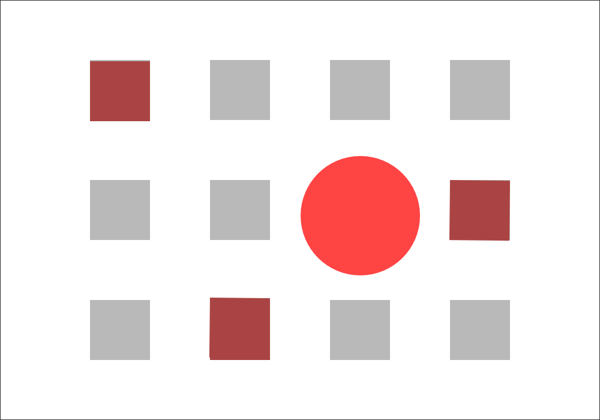
Contrast refers to how elements in a composition differ. This principle is often paired with the principle of similarity, which is how composition elements resemble each other. Contrast can be established using design elements like space, form, size, color, and texture.
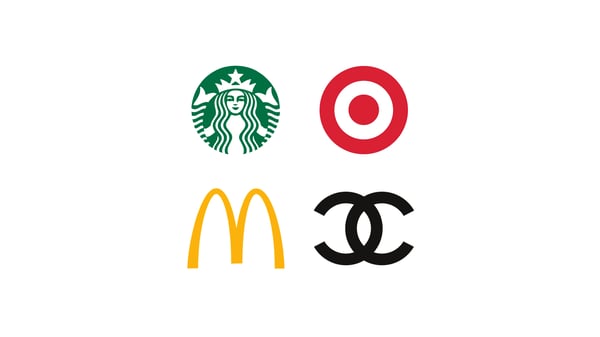
White space is also an important element of contrast. Often called negative space, which space refers to the empty parts of a composition. White space can help organize the elements in a composition and emphasize the most important ones. It also creates an aura of luxury and minimalism.
Dominance
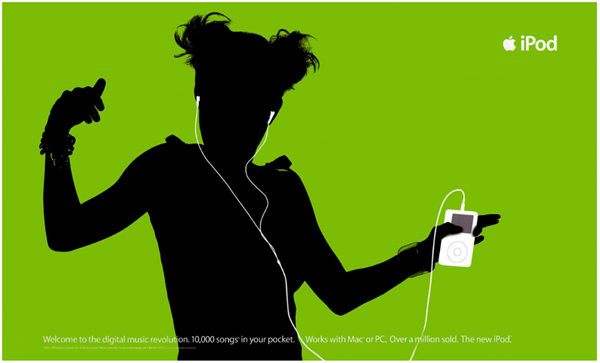
Dominance refers to the varying degrees of emphasis within a composition. Emphasis is typically achieved using elements like size, font choice, and certain color combinations (that may create contrast). There are three main stages of dominance in design.
- Dominant — The object of primary emphasis. It’s given the most visual weight and is typically found in the foreground of a composition.
- Sub-dominant — The object(s) of secondary emphasis typically found in the middle ground.
- Subordinate — The object(s) of tertiary emphasis typically found in the background.
Fun fact: The visual center is where we naturally focus on a piece of visual design. It’s slightly above and to the right of the actual center of a composition and is often referred to as “museum height”.
Movement
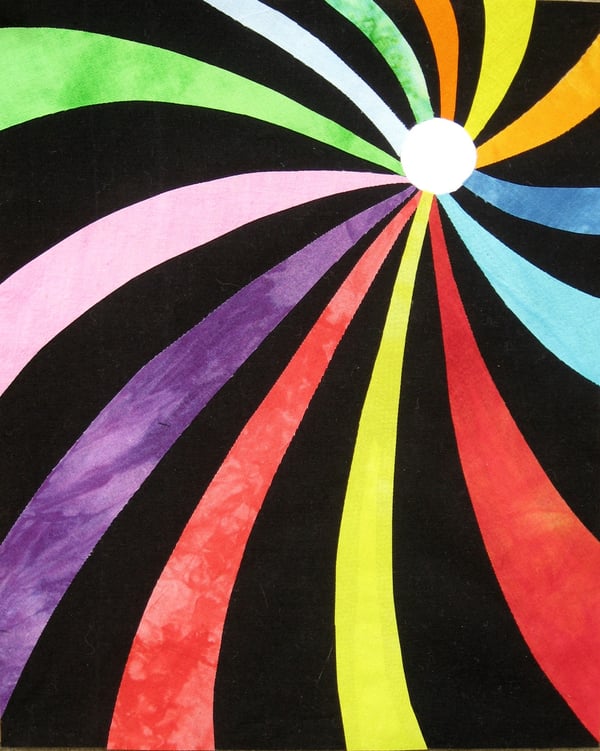
Movement is the visual path a viewer follows when viewing a composition. With proper movement, a composition can create a narrative and provide a high-quality user experience (UX). Movement can be established using design elements like lines, shapes, and colors.
Proportion or Scale
Proportion refers to the visual weight and size of a composition’s elements and how they relate to each other. This principle is also known as scale.
The relative size of one object to another can help create a focal point or movement along the composition. Also, varying sizes of objects can help communicate the importance and dominance of one element over another.
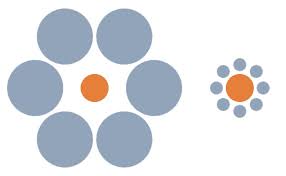
Unity
Visual unity has been said to be the main goal of design, although that opinion differs among designers and certain design communities. Unity, or harmony, refers to the relationship between the individual parts and the whole of a composition. When a composition’s elements are in agreement, there exists unity; when the elements aren’t in agreement, a composition is said to have variety.
The following design principles are associated with unity.
- Alignment — When objects are lined up on a certain axis or cadence
- Continuation — When a line or pattern extends
- Perspective — When there’s a distance between elements
- Proximity — When objects are placed close together
- Repetition — When objects are copied multiple times
- Rhythm — When objects recur with a slight change or interruption

While the principles of design are considered universal, they look a little different as applied to different design communities and practices. Below, we’ve reviewed the top seven types of design in marketing.
Types of Design in Marketing
- Graphic Design
- Branding and Logo Design
- UI and UX Design
- Web (Front-End) Design
- Multimedia Design
- Environmental Design
Let’s break down each type of design and how they apply to the marketing industry.
Graphic Design
Graphic design is probably what you picture when you think of design in the marketing field: social media images, email marketing headers, infographics, postcards, and much more.
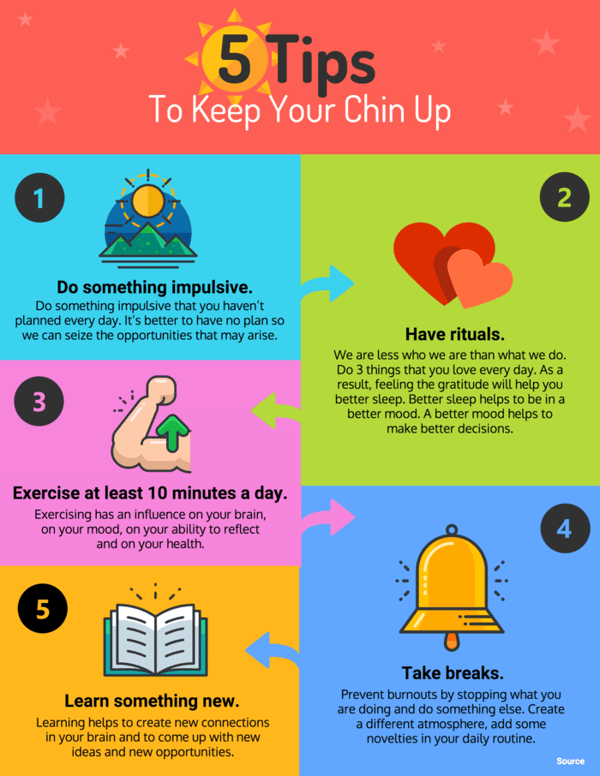
Since visual content is a highly valuable and engaging marketing medium, companies rely on graphic designers to create assets that represent their brand and communicate with their audience.
Need templates to help you create content for any online channel? Download our free library of over 195 visual marketing design templates.
Branding and Logo Design
Branding and logo design is a subset of graphic design. It includes the visual elements of a brand and brand identity, such as logos, typography, color palettes, style guides, and more.
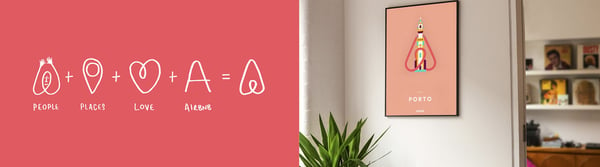
Branding and logo designers create assets that represent a brand, illustrate the brand’s mission, vision, and values, and promote brand awareness for the company.
Learn the fundamental concepts of graphic design and how to use them to create high-quality graphics by taking the HubSpot Academy Graphic Design Essentials course.
UI and UX Design
User interface (UI) and user experience (UX) design focus on improving how website, app, and software users interact with and experience a product.
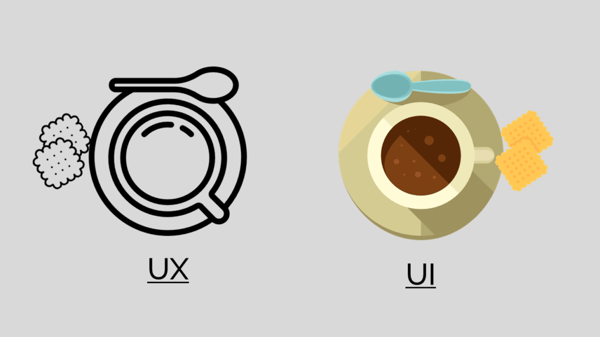
While some roles combine UI and UX design, the two practices are quite different. UI designers are responsible for creating a visually-pleasing, on-brand experience for users through web page design, app design, and theme design on sites like WordPress and Shopify.
UX designers, on the other hand, are responsible for making sure a product actually solves a problem through usability testing, user flows, and digital prototypes.
Web (Front-End) Design
Web design applies to the front-end (public-facing) side of a website. Front-end designers are like UI designers equipped with coding knowledge — they design static UI mockups for a website and then translate them into HTML, CSS, and JavaScript code. (But don’t confuse this practice with front-end web development.)
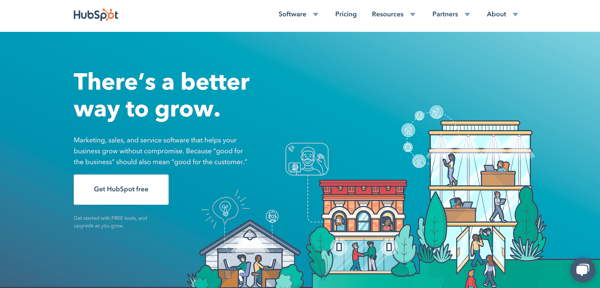
Web designers create assets that produce an attractive and fully-functional website, such as splash pages, navigational elements, sitemaps and pages, scrolling and clicking features, and content management systems.
Multimedia Design
Multimedia (or motion graphic) design is designing graphics for a variety of media, particularly video and animation. Because of its time and cost requirements, this type of design has historically been reserved for those in TV and film. But with advancements in technology and a recent rise in video content marketing, motion graphic design has become more accessible than ever.
Multimedia designers are responsible for creating moveable assets that communicate and delight with an audience, like moveable logos, GIFs, animated videos, tutorial videos, and animated websites.
Environmental Design
Environmental design, also known as environmental graphic design, is intended to improve a person’s experience by furthering the purpose of an environment, whether that’s to be memorable, exciting, informative, motivational, or easily navigable. The practice merges interior design, architecture, graphic design, landscape design, and industrial design.

Environmental designers create assets that connect people to their environment, such as, murals, office design and branding, store interiors, event space design, and signage and interactive advertising.
Marketing Design Tips
We’ve covered the basics of the most common types of design in marketing: graphic, branding, UI and UX, and web, multimedia, and environmental. Now, we’re going to dive into some tips for the top four.
Note: Keep an eye out for the principles of design we discussed above … they’ll make an appearance in this section, too.
Graphic Design Tips
1. Start with the purpose
What type of content are you designing … a social media ad, email template header, or ebook? These are three different pieces of content with three wildly different purposes and goals. Before you create your piece of graphic design, jot down the purpose of the content. This can help keep your design goals aligned with your content goals as you create your piece of art.
2. Apply your style guide
When deciding on what design elements to include, consider your company’s branding style guide. (We’ll get into how and why to create a style guide next.) This guide will immediately show you what colors, fonts, and other design elements to use when designing your content. From there, you can make small tweaks depending on what type of content you’re creating.
3. Create order with lines and alignment
Lines and alignment in your graphic design can create movement and order. Align the text in your graphic to guide your viewer as they read, or incorporate horizontal lines to section off your text and imagery. Similar to how you format long blog posts in small paragraphs, lines and alignment make pieces of graphic design easier to digest.
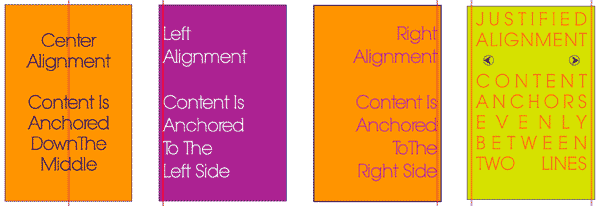
4. Pepper in some icons and illustrations
Colors, text, and images make for gorgeous graphics, but don’t limit your elements to those three. Icons and illustrations can also spice up an otherwise text or image-heavy piece of content. Icons might also be able to illustrate concepts that photos can’t, and they serve as creative bullet points for long lists.
Spruce up your graphic design today with our 135 free icons to use in your marketing graphics.
Branding and Logo Design Tips
1. Design the aesthetic of your personality
How do you visually present the personality of your brand and company? If your brand was a person, what would he or she be like? Your branding design should reflect the answers to these questions.
Before starting your design, make a list of adjectives that describe your brand, company, and culture. This will help you choose color combinations, images, fonts, and other design elements and bring out the key points of your personality. Also, using your brand adjectives as guidance, build a collection of images, graphics, color samples, and similar logos that represent the “mood” of your brand — a.k.a. a mood board.
2. Get a little funky
Your logo and brand assets don’t have to be a straightforward representation of what your company does. Heck, HubSpot’s logo has really nothing to do with marketing, sales, or service software. Yet, it represents our company perfectly while being memorable and distinctive.
 As you design your brand’s visual identity, don’t be afraid to get a little funky and incorporate some unique design aspects. Doing so may help your brand stand out from the rest.
3. Keep it simple
Your branding should communicate your aesthetic in a less than a second. Impressions are made in the blink of an eye, and your logo and brand identity is no exception. Consumers will decide if they like, dislike, are impressed by, or want nothing to do with your brand in a split second, so keep your design simple and to the point.
4. Prioritize consistency
This is perhaps the most important tip when it comes to branding and logo design: Be consistent. You can spend hundreds of hours and thousands of dollars developing a gorgeous visual identity for your brand — but if it’s not reflected on every piece of print and digital content, all your resources have gone to waste.
Consistency applies on a couple different axes — horizontally along your content elements, i.e. in your fonts, spacing, and color combinations, and vertically across your content outlets, i.e. between your social media, email, website, and print materials. Create a style guide to encourage everyone to adhere to your new branding. Here’s HubSpot’s Style Guide as an example.
Learn the key elements you need to create a strong brand by downloading The Essential Guide to Branding Your Company here.
UI and UX Design Tips
Note: UI and UX design are considered two different types of design, but because they’re so similar, we’ve collected a few tips that can apply to both practices.
1. Adapt a user’s perspective
Whether you’re designing the interface or the experience of an app, website, or online tool, always adapt the perspective of a user. Why would someone use your site? What would they hope to achieve? What might their challenges be? It’s important to research your user base and better understand how they’d approach or your site or application. Consider doing first-hand user research through a focus group or by talking to current customers.

2. Anticipate mistakes
Regardless of much you talk to users, there will always be a handful (or more) of people who’ll stumble through your website or application. Anticipate these mistakes by incorporating fool-proof mechanisms, such as not letting someone submit a web form if they’ve skipped a box or having a user confirm they’d like to exit in case they accidentally clicked off the screen. These mechanisms can help prevent mistakes before they happen and let your users know you’ve got their backs.
3. Don’t neglect standards and trends
Designers love paving a new path and “reinventing the wheel” with their designs. While this can create something unique and memorable for the user, it may also confuse them if you’ve gone too far. Consider sticking with known design patterns, standards, and trends, such as a navigation bar the top right corner or contact information along the bottom of the page. This can help your users already subconsciously know how to navigate your site without explanation.
4. Be mobile-friendly friendly
Responsive design is a non-negotiable for websites and applications, but is your design mobile-friendly friendly? Consider the spacing of your buttons, the size of the text, and any other navigational or organizational elements that might be inconvenient in a responsive design. Also, look at how your site may change when viewed on a desktop, tablet, and various types of smartphones.
Web (Front-End) Design Tips
1. Consider the fold
On a website, the fold is considered the bottom of the screen — where your page would “fold” if it were a physical item, like a newspaper. The most important information on a websites should always be placed “above the fold” (like in newspapers) so a visitor doesn’t have to scroll down to see it.
2. Leverage white space to draw focus
In the case of web design, less is often more. With lots of information to share with visitors, it can be tempting to clutter it all above the fold so folks see it right away. But less cluttered websites are easier to read, navigate, and digest. Keep your visitors on your website by putting plenty of white space around your content; it’ll be easier for them to focus on reading and understanding your content.
3. Use color to guide action
Color psychology plays a big role in marketing. Without us even knowing it, certain colors can encourage us to do certain things, such as click a button or continue on to the next page of a web form. Use colors to guide the same types of action on your website. Make all of your CTAs a bold color to help them stand out.
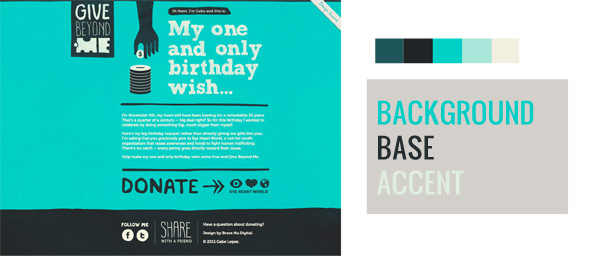
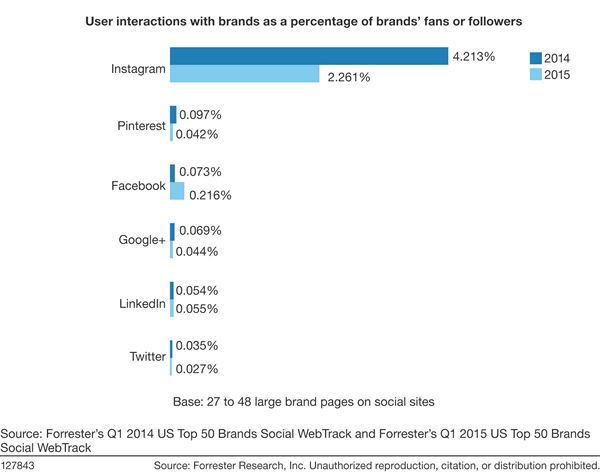


4. Avoid generic stock images
There are lots of ways to use images in your marketing, but the one method to avoid is using generic stock images. Generic, cheesy stock images make a brand seem lazy and disengaged with their buyer persona. The images on your website should be a representation of your audience, and if you can’t capture your actual audience, you should work hard to find stock images that do. Tip: One great way to collect audience images is by running a user-generated content (UGC) campaign.
Download our free guide to growth-driven web design for even more web design tips.
Time to Design
Design comes in all shapes and sizes … literally. From websites to print graphics to office space design, it plays a major role in marketing our businesses and brands. Even if you don’t consider yourself a designer, we encourage you to become more familiar with the elements and types of design. You never know when you may have to consult on a project or whip up a design of your own.

What Is Marketing? [FAQ]
Dictionary.com defines marketing as, “the action or business of promoting and selling products or services, including market research and advertising.”
If you work in a marketing role like I do, it’s probably difficult for you to define marketing even though you see and use it every day — the term marketing is a bit all-encompassing and variable for a straightforward definition.
This definition feels unhelpful.
The selling part, for instance, overlaps a little too snuggly with a “what is sales” definition, and the word advertising makes me think of Mad Men brainstorming sessions.
But upon digging deeper, I began seeing that actually, marketing does overlap heavily with advertising and sales. Marketing is present in all stages of the business, beginning to end.
At first, I wondered why marketing was a necessary component during product development, or a sales pitch, or retail distribution. But it makes sense when you think about it — marketers have the firmest finger on the pulse of your consumer persona. They research and analyze your consumers all the time, conducting focus groups, sending out surveys, studying online shopping habits, and asking one underlying question: “Where, when, and how does our consumer want to communicate with our business?”
Marketing
Marketing is the process of getting people interested in your company’s product or service. This happens through market research, analysis, and understanding your ideal customer’s interests. Marketing pertains to all aspects of a business, including product development, distribution methods, sales, and advertising.
Modern marketing began in the 1950s with the emergence of mediums beyond simply print and radio, allowing marketers to conduct entire campaigns across multiple platforms. And as you might expect, over the last 70 years, marketers have become increasingly important to fine-tuning how a business sells a product to consumers to optimize success.
Today, there are literally dozens of places one can carry out a marketing campaign — what constitutes actual marketing in the 21st century?
Types of Marketing
Where your marketing campaigns live depends entirely on where your customers spend their time. It’s up to you to conduct market research that determines which types of marketing — and which mix of tools within each type — is best for building your brand. Here are several types of marketing that are relevant today, some of which have stood the test of time:
- Internet marketing: Having started with an Excedrin product campaign, the very idea of having a presence online for business reasons was a type of marketing in an of itself.
- Search engine optimization: Abbreviated “SEO,” this is the process of optimizing content on a website so that it appears in search engine results. It’s used by marketers to attract people who perform searches that imply they’re interested in learning about a particular industry.
- Blog marketing: Blogs are no longer exclusive to the individual writer. Brands now publish blogs to write about their industry and nurture the interest of potential customers who browse the internet for information.
- Social media marketing: Businesses can use Facebook, Instagram, Twitter, LinkedIn, and similar social networks to create impressions on their audience over time.
- Print marketing: As newspapers and magazines get better at understanding who subscribes to their print material, businesses continue to sponsor articles, photography, and similar content in the publications their customers are reading.
- Search engine marketing: This type of marketing is a bit different than SEO, which is described above. Businesses can now pay a search engine to place links on pages of its index that get high exposure to their ideal audience. (It’s a concept called “pay-per-click” — I’ll show you an example of this in the next section).
- Video marketing: While there were once just commercials, marketers now put money into creating and publishing all kinds of videos that entertain and educate their core customers.
Marketing and Advertising
If marketing is a wheel, advertising is one spoke of that wheel.
Marketing entails product development, market research, product distribution, sales strategy, public relations, and customer support. Marketing is necessary in all stages of a business’s selling journey, and it can use numerous platforms, social media channels, and teams within their organization to identify their audience, communicate to it, amplify its voice, and build brand loyalty over time.
On the other hand, advertising is just one component of marketing. It’s a strategic effort, usually paid for, to spread awareness of a product or service as a part of the more holistic goals outlined above. Put simply, it’s not the only method used by marketers to sell a product.
Here’s an example (keep reading, there’s a quiz at the end of it) …
Let’s say a business is rolling out a brand new product and wants to create a campaign promoting that product to its customer base. This company’s channels of choice are Facebook, Instagram, Google, and its company website. It uses all of these spaces to support its various campaigns every quarter and generate leads through those campaigns.
To broadcast its new product launch, it publishes a downloadable product guide to its website, posts a video to Instagram demonstrating its new product, and invests in a series of sponsored search results on Google directing traffic to a new product page on its website.
Now, which of the above decisions were marketing, and which were advertising?
…
The advertising took place on Instagram and, specifically, Google. Instagram generally isn’t an advertising channel, but when used for branding, you can develop a base of followers that’s primed for a gentle product announcement every now and again. Google was definitely used for advertising in this example; the company paid for space on Google — a program known as pay-per-click (PPC) — on which to drive traffic to a specific page focused on its product. A classic online ad.
Where did the marketing take place? This was a bit of a trick question, as the marketing was the entire process. Aligning Instagram, Google, and its own website around a shared campaign — one designed to generate traffic, leads, and ultimately customers — was a three-part marketing campaign that identified its audience, created a message for that audience, and delivered it across the industry to maximize its impact.
The 4 Ps of Marketing
In the 1960’s, E Jerome McCarthy came up with the 4 Ps of marketing: product, price, place, promotion.
Essentially, these 4 Ps explain how marketing interacts with each stage of the business.
Product
Let’s say you come up with an idea for a product you want your business to sell. What’s next? You probably won’t be successful if you just start selling it.
Instead, you need your marketing team to do market research and answer some critical questions: Who’s your target audience? Is there market fit for this product? What messaging will increase product sales, and on which platforms? How should your product developers modify the product to increase likelihood of success? What do focus groups think of the product, and what questions or hesitations do they have?
Marketers use the answers to these questions to help businesses understand the demand for the product and increase product quality by mentioning concerns stemming from focus group or survey participants.
Price
Your marketing team will check out competitors’ product prices, or use focus groups and surveys, to estimate how much your ideal customer is willing to pay. Price it too high, and you’ll lose out on a solid customer base. Price it too low, and you might lose more money than you gain. Fortunately, marketers can use industry research and consumer analysis to gauge a good price range.
Place
It’s critical that your marketing department uses their understanding and analysis of your business’s consumers to offer suggestions for how and where to sell your product. Perhaps they believe an ecommerce site works better than a retail location, or vice versa. Or, maybe they can offer insights into which locations would be most viable to sell your product, either nationally and internationally.
Promotion
This P is likely the one you expected from the get-go: promotion entails any online or print advertisement, event, or discount your marketing team creates to increase awareness and interest in your product, and, ultimately, lead to more sales. During this stage, you’ll likely see methods like public relations campaigns, advertisements, or social media promotions.
Hopefully, our definition and the four Ps help you understand marketing’s purpose and how to define it. Marketing intersects with all areas of a business, so it’s important you understand how to use marketing to increase your business’s efficiency and success.