How to Use Porter’s Five Forces to Outmaneuver Your Competition
In March of 1979, Harvard Business Review published an article about a business analysis model that countless MBA students still study to this day.
Coined by Michael Porter, a professor at Harvard Business SchooI, Porter’s Five Forces is a model that draws from industrial organization economics to identify and describe the fundamental economic forces that shape every industry. More specifically, it explains how these forces dictate every industry’s competitive intensity, potential for profitability, and attractiveness to other entrants.
Porter’s Five Forces has become a fundamental model that most businesses use to grasp the dynamics of their industry and, in turn, drive their business strategy. And it can help you do the same, too.
But the way you apply this model to your own business is totally dependent on the nature of your industry. Once you understand these economic fundamentals, though, you’ll be able to extract insights from the model that are specific to your unique situation and apply them to your business.
To help illustrate this, we’ve fleshed out the five fundamental economic forces at play in every market and provided an example analysis in each section, so you can see how each of these forces might play out in your specific industry.
Porter’s Five Forces Model
Porter’s Five Forces is a business analysis model that identifies and describes the economic forces that shape an industry’s competitive intensity, potential for profitability, and attractiveness. The five forces are competition in the industry, potential of new entrants into the industry, power of suppliers, power of customers, and threat of substitute products.
Porter’s Five Forces Examples
Competition in the Industry
Competition plays a huge role in your industry’s profitability — the potential to produce a high return on investment — and, in turn, its ability to attract new entrants. If there’s a lot of competition in your industry, it’s harder to turn a profit. Customers have a rich pool of options to choose from, so if your prices are too high, they can just strike a deal with a supplier who will sell to them at their preferred price.
In other words, customers typically wield more power than suppliers in competitive industries. This usually leads suppliers to undercut each other’s prices until their revenue barely exceeds their costs, plummeting their profits and discouraging new players from entering the market.
If there’s less competition in your industry, it’s easier to turn a profit. Customers can only choose from so many suppliers, so if they want to buy your market’s product or service, they must accept the higher prices or else they won’t be able to buy it. This potential for high probability encourages new players to enter your market.
To help you examine the competition in your own industry, here’s an analysis of the competition in the aluminum baseball bat industry.
From little league to college, baseball players all around the country primarily use aluminum baseball bats to train and compete. Louisville Slugger, Rawlings, Marucci, DeMarini, and AxeBat are the leaders in the high-end of this market. Their target customers are travel or college baseball players who are willing to pay a premium price for the best bats that can perform at a high level and stay durable for multiple seasons.
Easton, Mizuno, and Adidas serve the middle of the market, and Anderson, Combat, and Dirty South serve the low-end of the market. Their target customers are less competitive players who probably just play baseball for fun and friendships.
Potential of New Entrants into the Industry
If new players can enter your market quickly and cheaply, they can sell their minimum viable product, which is a product with just enough features to satisfy early customers, at a much lower price than you and your competitors can while still covering their product development, marketing, and sales costs. As a result, they can snatch established player’s market share and threaten incumbents’ position in the industry more easily.
The frequency of new players entering your market hinges on your industry’s barriers to entry. If it costs a lot of money and time to build a minimum viable product and cover essential overhead expenses, startups can only afford to build an unsophisticated product that’s sole differentiating factor is a slightly cheaper price. With these high barriers to entry, they wouldn’t be able to compete, discouraging them from entering your market.
However, if building a minimum viable product and covering essential overhead expenses don’t cost that much money or time, your market’s low barriers to entry will encourage most start-ups to enter.
To help you examine the potential of new entrants in your own industry, here’s an analysis of the potential of new entrants in the aluminum baseball bat industry.
The barriers to entry of the aluminum baseball bat industry are very high. You would have to spend a lot of money on research and development to figure out how to differentiate your product in a saturated market, purchase a bunch of raw materials to manufacture the bats, and build expensive facilities and machines to actually produce them.
You would also, at the least, have to hire a product, marketing, and sales team to run this startup’s daily business operations. This startup would have to charge close to an industry-average price to cover the initial overhead of creating a minimum viable product, crafting an enjoyable brand experience, and generating revenue. And since each incumbent in this industry would have a better, more trusted product than this start-up’s simple product, there’s no way they could compete with a slightly cheaper price as their only selling point.
Power of Suppliers
The number of suppliers or competitors in your market directly affects your company’s ability to control prices. When there are only a few suppliers in your industry, each supplier holds a ton of pricing power because if a consumer doesn’t accept your prices, you and your fellow suppliers can easily find someone else who will.
When there are a lot of suppliers in your industry, each supplier holds less pricing power. Your market’s customers have a rich pool of options to choose from, so if your prices are too high, they can just strike a deal with a supplier who will sell to them at their preferred price.
To help you examine the power of suppliers in your own industry, here’s an analysis of the power of suppliers in the aluminum baseball bat industry.
With 11 major suppliers in a massively popular industry — and five or less brands competing in each segment of the market — the suppliers hold a lot of pricing power. Almost every baseball player, from little league to college, needs an aluminum baseball bat to train and compete, so they’re very dependent on these suppliers, which gives them even more pricing power.
Power of Customers
The number of customers in your industry directly affects their ability to control prices. If there are only a few customers in your industry, they hold most of the power. Since suppliers depend on customers to generate revenue, suppliers must adhere to their customers’ pricing demands or their customers will just do business with one of the many other suppliers who are willing sell their product or service at a generous price.
On the flip side, if there are a ton of customers in your industry, the customers hold significantly less power. Since customers depend on suppliers to purchase necessary products or services, they must accept the prices suppliers set or else they won’t be able to buy any of the market’s products or services — the suppliers can sell to plenty of customers who are willing to pay a prettier penny.
To help you examine the power of customers in your own industry, here’s an analysis of the power of customers in the aluminum baseball bat industry.
Every single baseball player, from little league to college, needs an aluminum baseball to train and compete, so each supplier in the aluminum baseball bat industry has a huge potential customer base to market and sell to. Since there are such few suppliers and so many customers in this market, the customers don’t hold enough power to drive the prices down.
Threat of Substitute Products
Substitutes are products from different industries that consumers can use interchangeably, like coffee and tea, and they can significantly shape your industry. If your product has cheaper or superior substitutes, you not only have to compete with other players in your industry, but you also have to compete with businesses in other industries. This high multi-market competition can plummet your prices and profit.
If your product doesn’t have cheaper or superior substitutes, though, the businesses who produce these substitutes don’t pose as much of a threat to you or your direct competitors. This low multi-market competition might only drop your prices and profits slightly.
To help you examine the threat of substitute products in your own industry, here’s an analysis of the threat of substitute products in the aluminum baseball bat industry.
Instead of buying aluminum baseball bats, players could buy wood bats from suppliers who only manufacture wood bats, like Baum Bats, Old Hickory, and Sam Bat. But the odds of this happening are extremely low. Even though individual wood bats cost less than individual aluminum bats, wood bats break much more frequently.
For instance, one $250 aluminum bat can last longer than five $100 wood bats, so replacing aluminum bats with wood bats would actually cost more money. Players can also hit the ball farther with aluminum bats, which makes it the superior product. Additionally, wood bat manufacturers make the most money by focusing on a specific market of baseball players who only use wood bats, like professional baseball players, summer college league players, and top-flight travel baseball players. In sum, there’s a low threat of substitutes in this industry.

Emoji Meanings: How to Interpret and Use 17 Common (& Confusing) Emojis
An emoji is one of the most useful shorthand communication tools of the 21st century.
An emoji can be used to express personality in your email campaigns, or on social media. In fact, nearly half of all comments and captions on Instagram contain an emoji, and using an emoji on Twitter can result in 25.4% more engagement.
Ultimately, a properly-used emoji can make your audience smile and feel better connected to your brand.
For instance, take a look at this email I found in my inbox on Cyber Monday, from Influenster, a product review site:

Or this one, from CB Insights, a machine intelligence platform:

As you can see, emojis can take your messaging to the next level and allow you to stand out in a crowded inbox. Additionally, you can use them as a substitute for generic and overused words like “money”, making your content both fresh and enticing.
But emojis can be confusing, and it’s often difficult to discern the difference in meaning — like between a “🙄” and a “😳” face (trust me, there is one).
To ensure you use emojis to properly engage and delight your audience, we’ve compiled a list of the most common (and confusing) emojis, with examples of how to use them for any of your marketing purposes. At the end, we’ll also explain which emojis your business should likely avoid.
Sound good 👍?

Emoji Faces
To start, let’s take a look at some of the faces you might use to convey certain emotions, along with examples of how you might use each in your own marketing content.
1. Heart Eyes Emoji 😍
You might consider using a heart eye emoji to show your love for something, whether it be a new product or a blog article you want to promote on social.
For instance, SoulCycle uses a heart eye emoji in their email subject line, to convey their approval and love for the brands they’re now selling online:

2. Side Eye Emoji 😏
This side eye emoji is most commonly used to express a smirk after someone makes a sarcastic or ambiguous joke that could seem serious, out of context. Ultimately, it’s a good emoji to use if you want to demonstrate a playful side to your brand, or if you’re making a joke and aren’t sure whether your audience will know you’re kidding.
For instance, you might playfully insinuate you understand most of your readers will be offline over the weekend, by saying in an email, “While we understand you’re probably dying to do more work over the weekend 😏, we’ve put together a guide with suggestions for creating better work-life balance. Check it out here.”
3. Eyes Emoji 👀
The eyes emoji is a simple and fun way to draw attention to a link or image you want to share with an audience. Instead of saying “Look at this”, you might consider using the eyes as a silly substitute.
For instance, take a look at how GREATS, a footwear brand, uses the eye emoji to elicit excitement and suspense over an upcoming release:

In this case, the eye emoji playfully suggests to the audience, “Keep an eye out — something new is coming soon”.
4. Embarrassed/Flushed Face Emoji 😊
The flushed face emoji is a fantastic opportunity for your brand to demonstrate humility or gratitude for an achievement or award.
For instance, you might show the flushed face if you’re sharing an article that lists you as a top company in your industry. Perhaps you’ll tweet, “So grateful to have made it on Company A’s list of Best Workplace Culture of 2018 😊 Thank you!”
Alternatively, the flushed face emoji is often simply used to express happiness or joy.
5. Thinking Emoji 🤔
The thinking emoji is often used to demonstrate someone deep in thought, or pondering the validity of something. It can be used to express a level of doubt, like “Hmm … not sure about that“, in regards to a controversial issue.
For instance, take a look at how Monday.com responded with integrity to a Facebook user who questioned whether Monday.com bought fake social media likes:
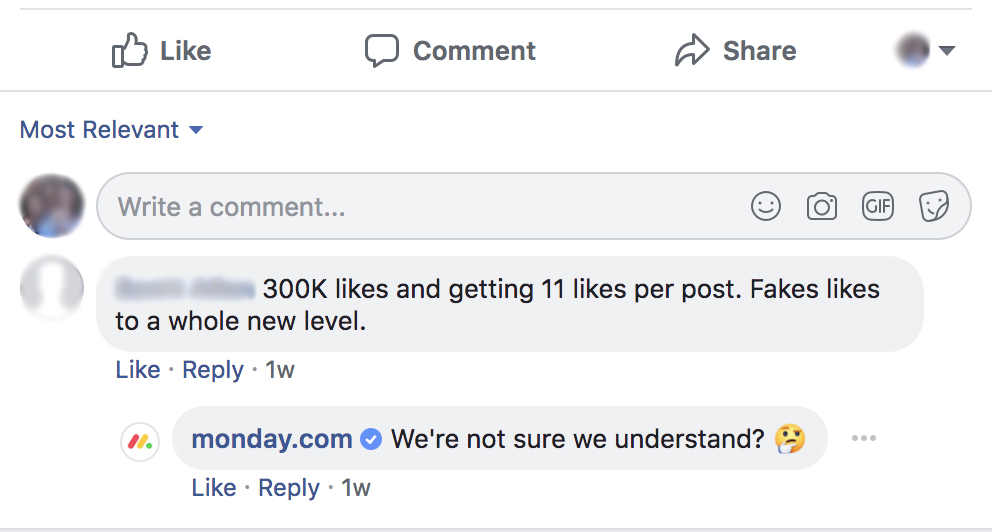
Rather than fighting with the user, Monday.com took the high road and used the thinking emoji to express a level of doubt over the accuracy of the user’s statement.
Alternatively, you might use the thinking emoji after a question or poll on social media, simply to create a visual that indicates you want your audience to think about something.
6. Sweat Emoji 😅
The smiling emoji with a sweat droplet is typically used to express a close call — while the sweat depicts a level of discomfort, the smile alludes to someone who’s thinking, “Phew! That could’ve been bad.”
For instance, if your coworker emails you moments before a meeting with an urgent, “Wait, where’s the most recent reporting deck with all our statistics?” You might send the deck back with a “Don’t worry — got it, right here 😅” response, alluding to the satisfaction you both feel over averting an issue.
7. Hand Up Emoji 🙋
Typically, businesses use the hand up emoji to suggest a level of enthusiasm or participation, like “Sign me up!” For internal purposes, you might use the hands up emoji to get a headcount of people willing to help out.
For instance, if you see your team leader is asking for volunteers to pass out microphones during the next company meeting, you might send back a simple “🙋” as your response.
Alternatively, you might use the hand up emoji to ask whether your social media audience agrees with you. For instance, you could post on Twitter, “Who thinks skittles are better than m&m’s? Give me a 🙋if you agree!”
8. The Laughing Emoji 😂
Allegedly 2017’s most popular emoji in the U.S., the laughing emoji is one of the easiest ways to express humor or amusement. Oftentimes, when a coworker makes a joke in a slack channel, I’ll use the ” 😂” emoji as an alternative to “haha” or “lol”.
Additionally, the laughing emoji is an effective opportunity to demonstrate your brand’s sense of humor. For instance, Honest, Jessica Alba’s company that creates safe and natural products for the household, uses the laughing emoji in this Instagram post:

In this instance, Honest demonstrates an ability to laugh at themselves and their own cheesiness (with their attempt to re-define BYOB’s acronym meaning) — and makes them seem more human, as a result.
Emoji Symbols or Objects
Along with faces, emojis offer your business the opportunity to use objects or symbols to express meaning, such as the heart symbol (❤️), a check mark (✔️), or a taco (🌮).
Here are some symbols or objects you might consider using in your marketing content:
9. Monkey Emoji 🙈
The hiding monkey face emoji is a cute opportunity to express a level of shyness or embarrassment. For instance, your brand might use the monkey emoji after making a mistake, like this — “Hope you enjoyed our tool, even though it didn’t work the first time 🙈.”
Alternatively, you might use the hiding monkey face emoji to suggest you wish you hadn’t seen something. This can be humorous, particularly if you share a funny prank video with a “Yikes, that was rough 🙈” caption.
10. Nail Polish Emoji 💅
As you might’ve guessed, the nail polish emoji can be used to demonstrate a level of casualness or indifference. Some people believe it means “I’m prettier than you”, or an expression of arrogance or confidence, but typically, it isn’t used for any other reason than to articulate nonchalance or relaxation.
For instance, I might use the nail polish emoji to engage an audience, by writing — “This weekend is all about rest and relaxation 💅😊 What are your weekend plans? Leave them in the comment section, below.”
11. Hand Emojis 👌👏👈🏿
HubSpot often uses various hand emojis to express emotion simply and effectively. For instance, the 👌 expresses the same message as it does in real life — “that’s a-okay,” or “fine by me”.
The clapping hands (👏) can be used to express congratulations or excitement, such as “Congrats to @CForsey on winning our giveaway contest👏!”.
Finally, the “👈🏿” pointing finger emoji is effective for pointing at a link. Particularly when there’s a word limit, it’s a good idea to use the pointing finger instead of writing, “Check out this link”.
12. Waving Emoji 👋
The waving emoji is a playful yet simple way to say “Hello” or “Goodbye”. Consider incorporating it into your welcome email to display a level of warmth to your new subscriber.
Alternatively, you might use the 👋 emoji to playfully introduce your audience to a new product or service. For instance, Drop uses the 👋 in their email subject line to introduce its email subscriber’s to Drop’s new app:

13. Thumbs up emoji 👍🏾
The thumbs up is relatively universal, making it a classic emoji to use to either express your business’s approval, or to ask for quick audience engagement.
For instance, you might write on Instagram, “What do you think of our new company logo? Give us a 👍🏾or 👎🏾”. This allows your audience to engage with your brand with very minimal effort on their part.
Emojis to Avoid for Business Use
I spoke with Krystal Wu, HubSpot’s Social Media Community Manager, about her stance on emojis for marketing purposes, specifically on social media. She suggested businesses use emojis to express a level of authenticity, and choose emojis they feel align well with the tone of their brand.
However, Krystal advises businesses be wary of using strong emotional emojis, like the kissy face. She told me those types of emojis might express emotions too intense for a business’s audience.
Here are a few emojis to be wary of using for business purposes, and the meaning behind them:
14. Kissy Face Emoji 😘
A kissy face emoji is slightly different than a heart eye emoji. While a heart eye emoji shows your love for something, a kissy face emoji demonstrates your love for someone.
Typically, a kissy face should be reserved for one-on-one conversations, such as a texting conversation between you and your friend in which you say, “Great job at open-mic last night! You killed it 😘”.
A kissy face, despite its innocent nature, is likely too emotionally-charged for your business to use with your audience, unless you truly believe it aligns well with the tone of your brand.
15. Angry Face Emoji 😠
While the angry face is undoubtedly a popular emoji to use with friends and family, it’s likely one you should avoid for business purposes. It is typically used to express strong disapproval or dislike for something, which is probably a negative emotion you want to avoid directing at your audience.
You should probably only use the angry face when communicating with a friend, one-on-one. For instance, you might text your friend, “Oh no! The movie is sold out 😠so mad!”
16. Bunny Emoji 👯
Dictionary.com defines the people with bunny ears as emojis used to express “a fun, party-loving spirit … [and used to] communicate festive and friendly sentiments”.
Ultimately, due to the ambiguous and party-loving nature of the bunny emoji, it’s likely one you should avoid for your marketing campaigns.
17. Hair Flip Emoji 💁
Until recently, I thought this was an image of a woman flipping her hair. But Emojipedia.org describes her differently, as an “Information Desk Woman” who is holding out her hand, asking how she might help.
Despite the innocent intent, the hair flipping girl is often used to demonstrate sassiness, sarcasm, or even to express disrespect for someone or something (at least, in the U.S.). To avoid any risk of offending or confusing your audience, you want to avoid it in your marketing emails and on social media.

The 15 Best Restaurant WordPress Themes in 2019
If you’re a restaurant owner, or if you own any type of food-related business, it’s safe to assume you’re busy every day creating a mouth-watering menu, hiring staff, developing relationships with your customers, locating and ordering ingredients, and maintaining your online store (if you have one).
With all of these activities keeping you engaged, building your restaurant’s WordPress website may feel like an overwhelming and daunting task — especially if you don’t have any experience with web development. But without a great website, you’re bound to miss out on valuable customers.
WordPress restaurant themes make the process of creating your site quick and easy. Restaurant themes have menu templates, reservation-making integrations, photo galleries for images of your dishes, contact pages, online stores, and more to help you efficiently build a professional site that your customers will enjoy spending time on.
15 of the Best Restaurant Themes for WordPress in 2019
Whether you run a fine-dining restaurant, cafe, bistro, bakery, or bar, or if you own an online food business, there is a WordPress theme tailored to your needs. We’ve compiled this list of favorite 15 restaurant themes to help you find one that best suits your needs … so you can get back to connecting and entertaining your customers.
1. Seasons
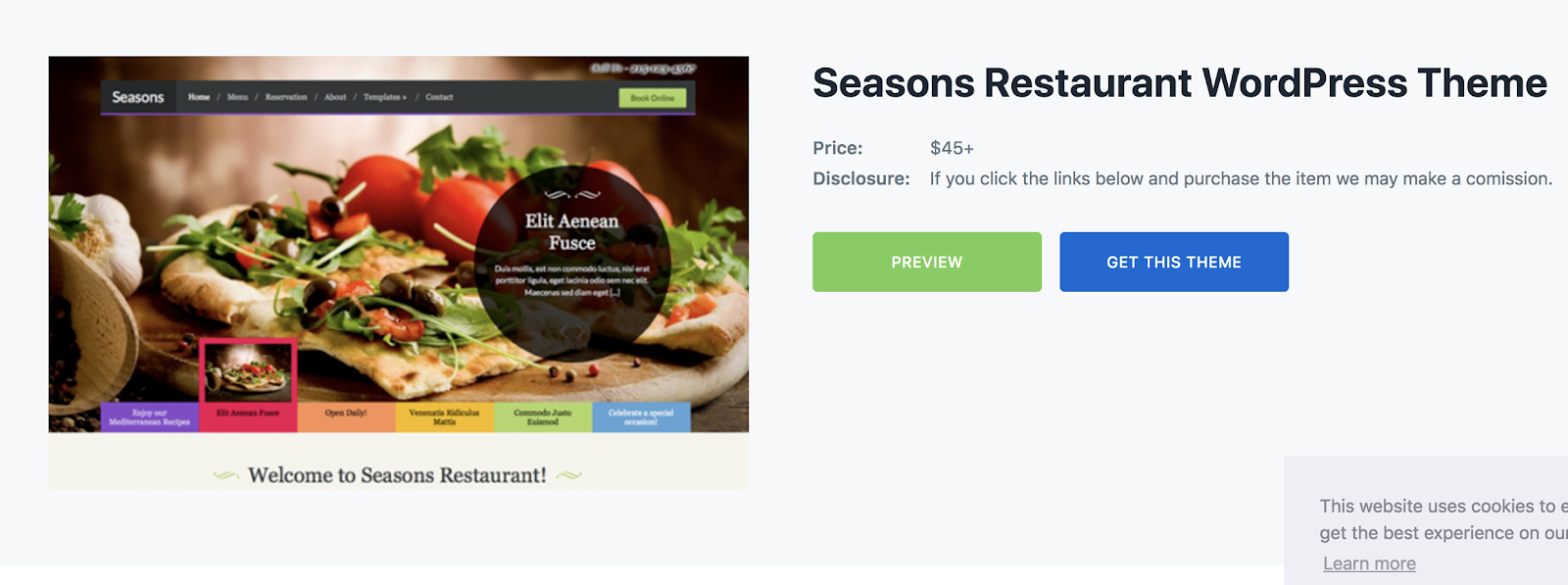
Seasons is a responsive WordPress theme, meaning it adapts to the type of device and screen it’s being viewed on, whether that’s desktop, mobile, or tablet. It’s a versatile theme that can be used for almost any restaurant type including cafes, food trucks, and catering companies. The theme’s homepage has a featured image slideshow where you can add your newest and most important content, such as menu items and featured dishes for your visitors to drool over. There’s also a pre-built menu page that allows you to quickly add, update, and edit available items for your potential customers.
Key Takeaways:
- Responsive theme
- Featured image slideshow on homepage
- Pre-built menu page
2. Resto
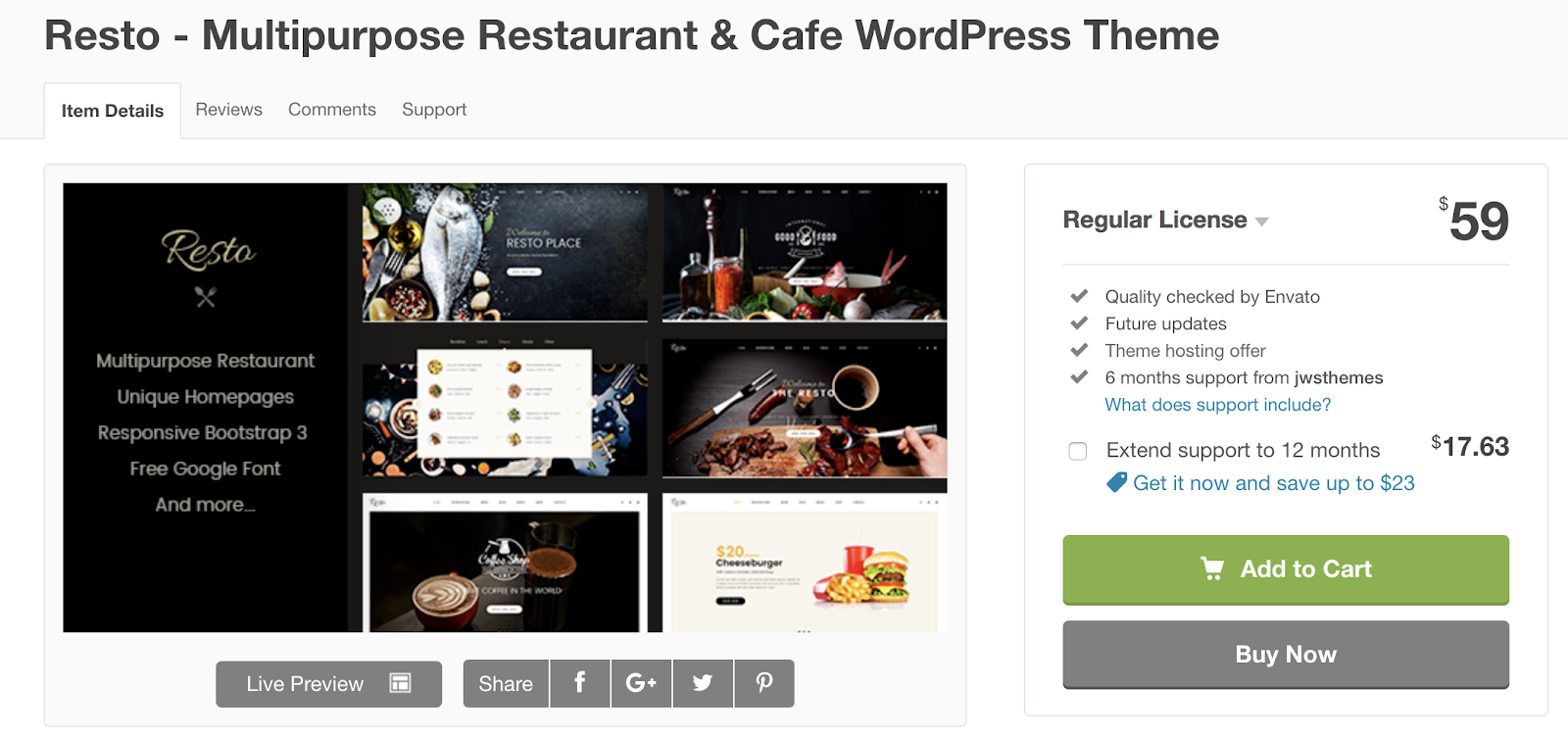
Resto is a theme flexible enough to be used for both restaurants and online food businesses. The theme allows you to customize different shopping pages so you can easily sell items and manage your store. Since Resto is SEO-friendly, it’s set up to help you rank on search engines like Google, get more visitors to your site and customers to your restaurant.
Key Takeaways:
- Online store
- Customizable shopping pages
- SEO-friendly
3. Butter
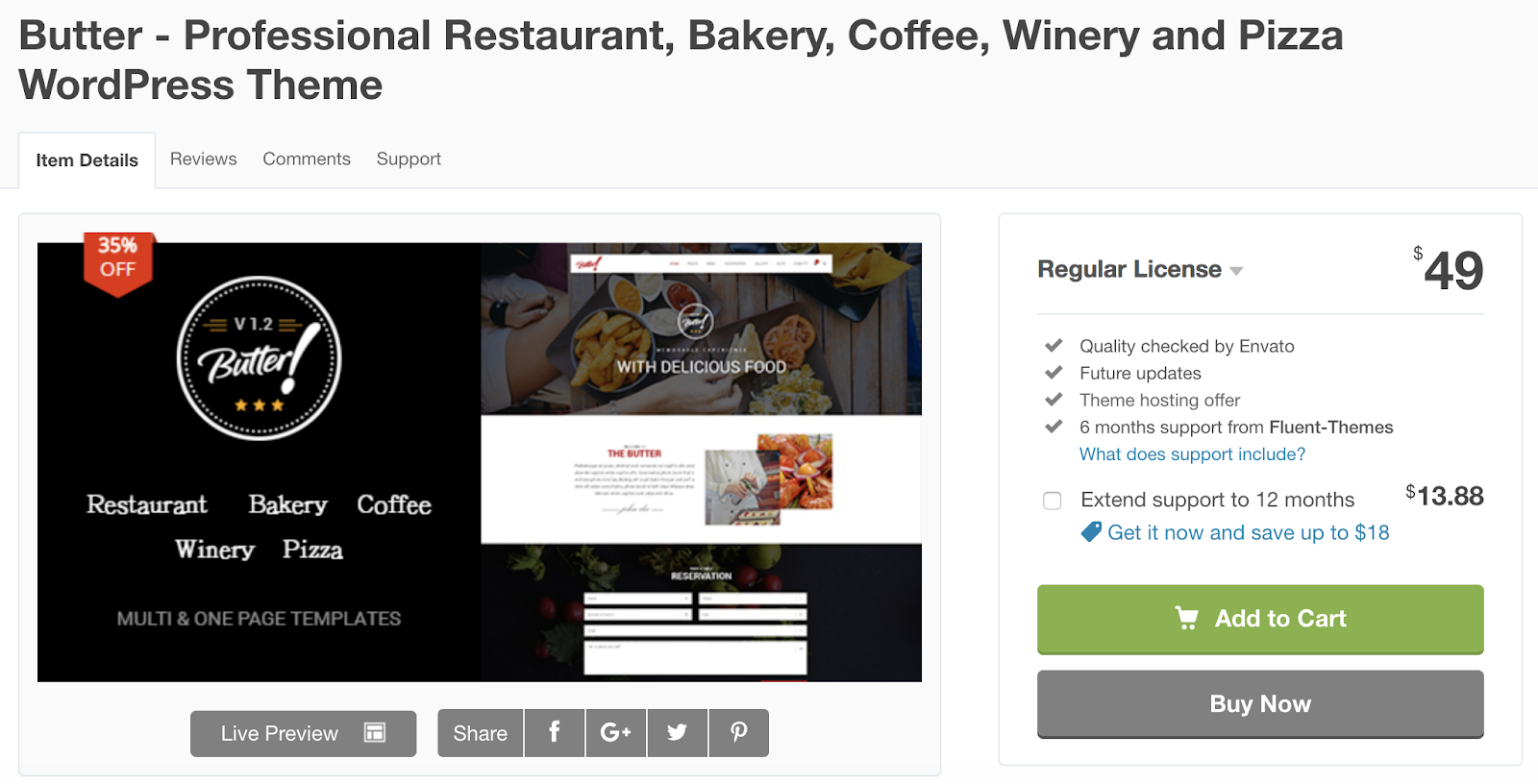
Butter is a restaurant theme ideal for any business that sells food online — it includes a WooCommerce integration which makes managing your e-commerce store simple. Butter also has a parallax scrolling effect feature that you can implement to create a 3D, interactive, video-like experience on your pages. There’s also a drag-and-drop page builder that you can use to quickly customize your layout, sections, and more to achieve any look or experience you’re going for.
Key Takeaways:
- WooCommerce integration
- 3D, interactive scrolling effect
- Drag-and-drop page builder
4. Igloo
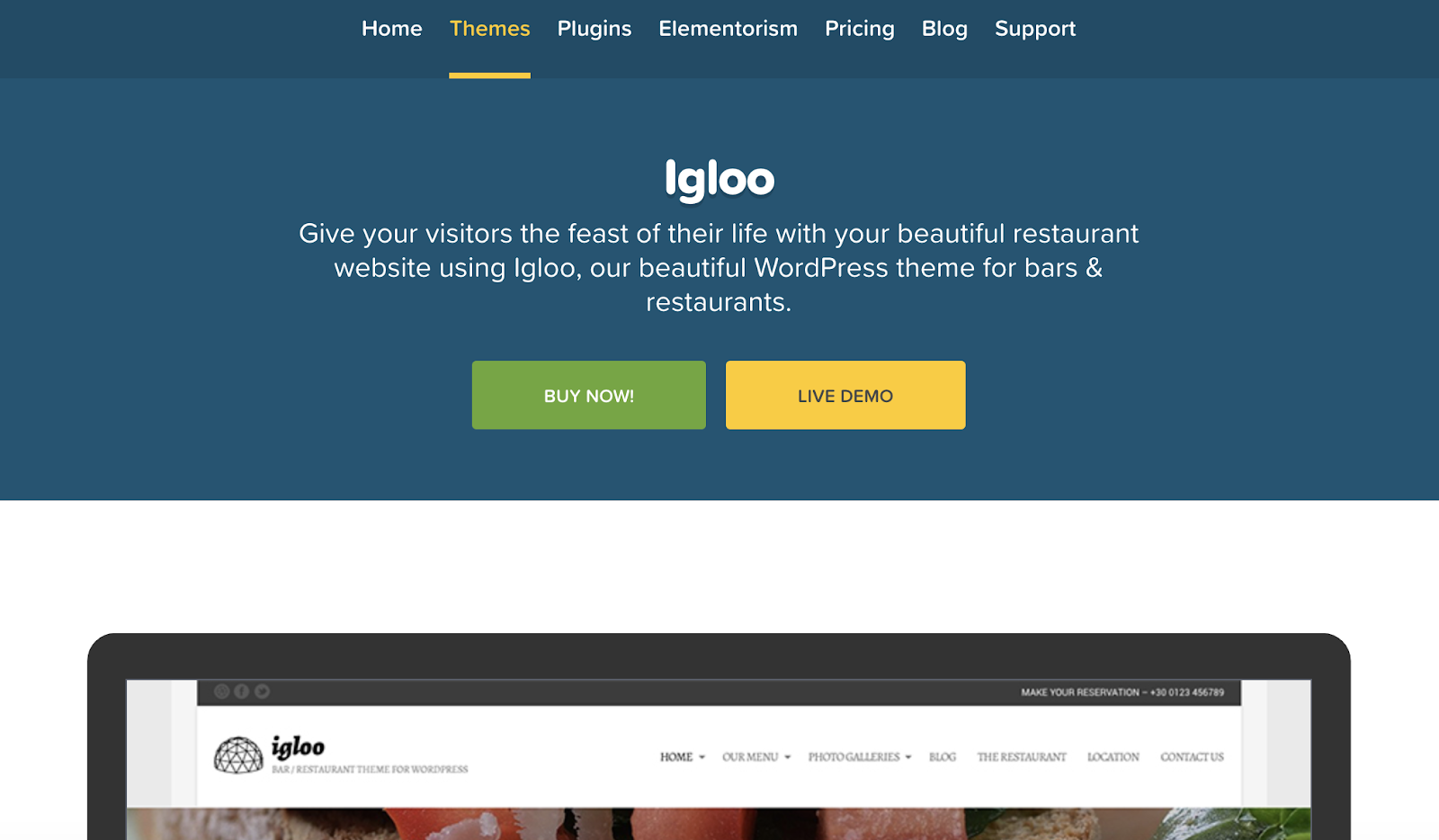
Igloo is a great theme option for restaurants and bars. There are customizable layouts for your menus so you can easily highlight your newest, specialty items. Igloo also offers other content layouts and features to add to your site, such as a testimonial page where your leads can learn more about the positive experiences customers have had on your site and with your products. The theme has several pre-made color schemes available to choose from.
Key Takeaways:
- Customizable menu layouts
- Testimonial page feature
- Pre-made color schemes
5. Italica
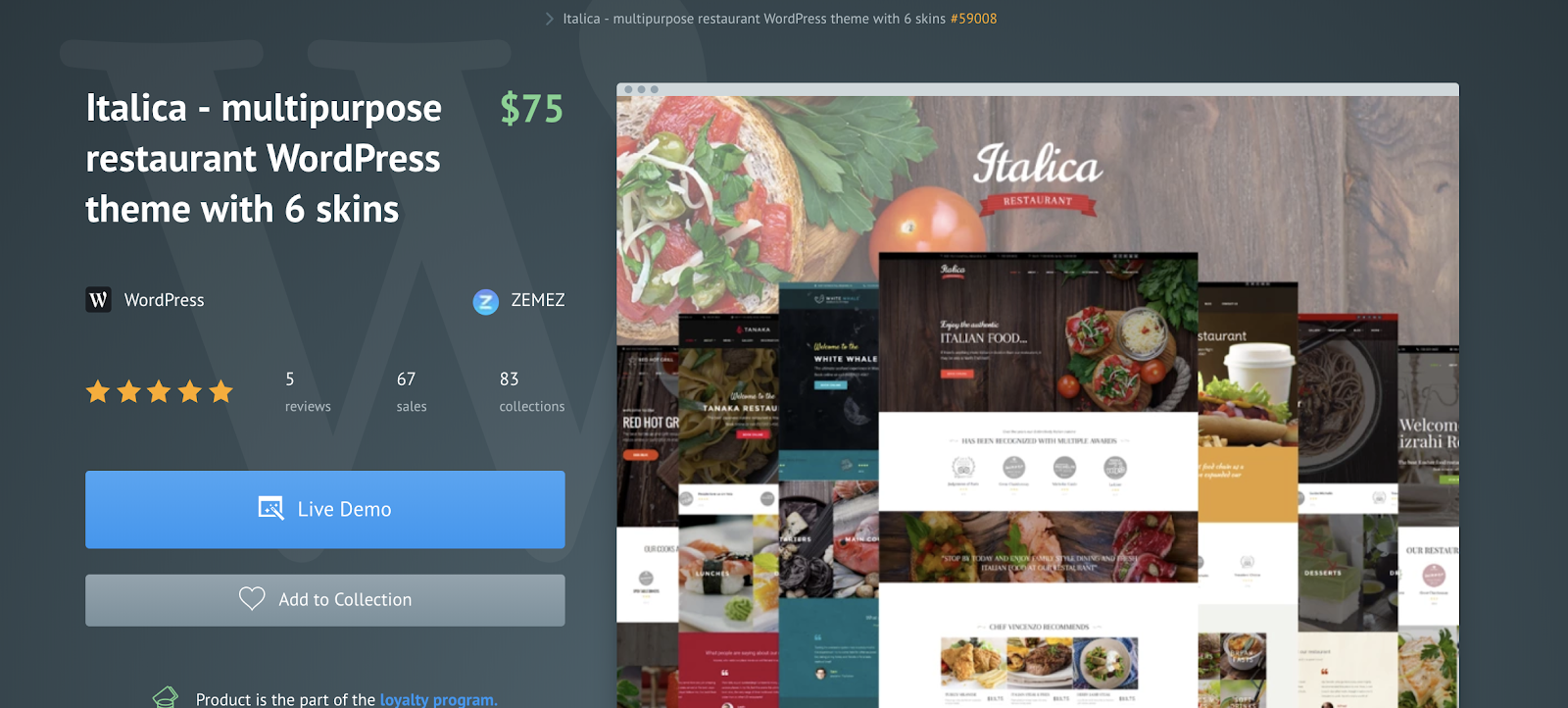
Italica is a flexible theme with six different customizable “skins” that work in a similar way to your WordPress templates to make your theme suitable for your specific restaurant type. You can apply the different skins to get a completely different look and feel. The theme offers a variety of demo content that you can review pre-install to make customization quick and easy. Italica also has an “Appointment Manager” feature that you can add to a site page so your customers can make reservations directly from your site.
Key Takeaways:
- Six different “skins” to customize your site
- Demo content available
- Appointment Manager feature to handle reservations
6. Benedicta

Benedicta is a multi-purpose theme that includes a variety of menu templates tailored towards several different types of restaurants. The theme gives you the option to include a photo gallery to share pictures of your favorite dishes. Benedicta also has site pages for your restaurant’s blog and news so you can share all of your latest updates with customers.
Key Takeaways:
- Creative menu templates
- Customizable photo gallery
- Blog and news site pages
7. Nigiri
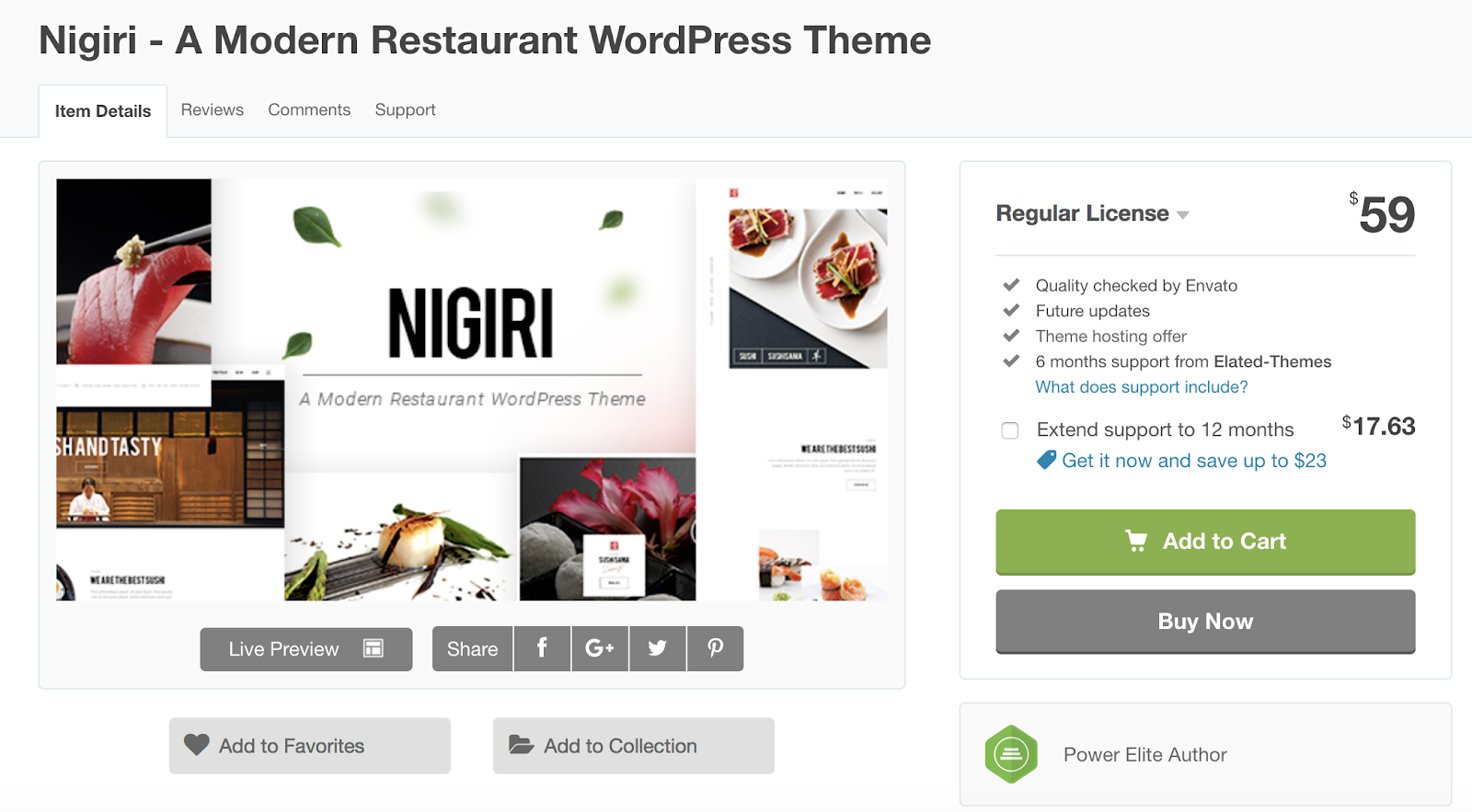
Nigiri is a theme specifically tailored towards seafood and sushi restaurants. The theme includes a modern, sleek, and minimalist design. There are a number of templates available that are sushi-focused and allow you to include menu item descriptions and images. The theme has an OpenTable integration so it’s easy for your customers to book reservations without having to call your restaurant.
Key Takeaways:
- Modern and sleek design
- Seafood and sushi-focused theme
- OpenTable integration
8. Sage

Sage is an ideal theme for bars, bistros, and cafes, as well as businesses that sell food products online. It has a number of pre-built elements related to these types of restaurants, and an easy-to-use drag-and-drop page builder, so you’re able to design your website with minimal effort. The theme also includes a WooCommerce integration so you can easily manage your online store and product sales.
Key Takeaways:
- Pre-built elements
- Drag-and-drop page builder
- WooCommerce integration
9. Bakes and Cakes
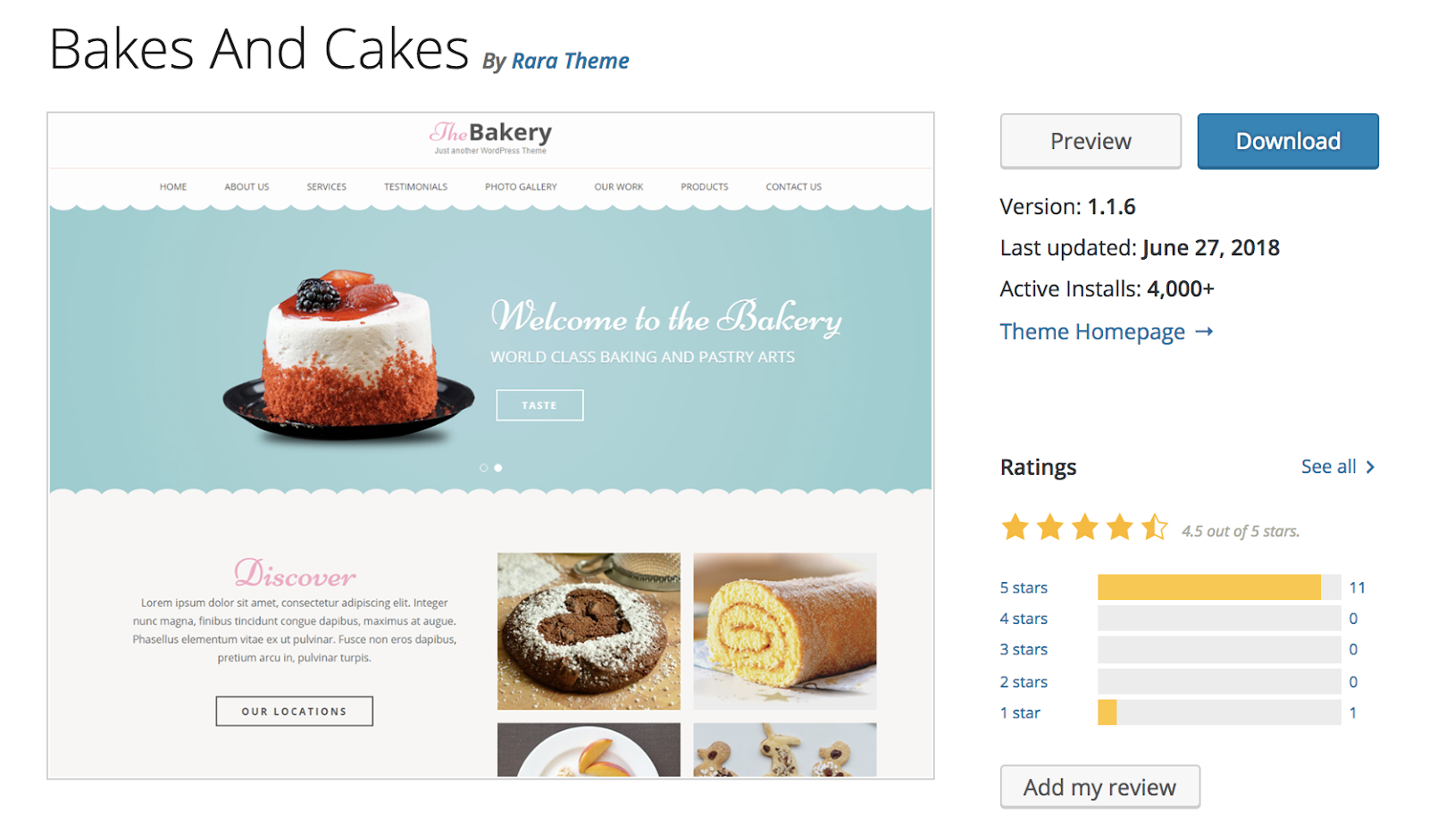
Bakes and Cakes is a theme created for — you guessed it — bakeries. It’s SEO-focused to help your site rank on search engines and drive more traffic. The theme has multiple gallery options and product pages so you can display your baked goods. Bakes and Cakes also has a template that allows you to include testimonials and rave reviews on your web pages.
Key Takeaways:
- Ideal for bakeries
- SEO-focused
- Testimonial page template
10. Resca
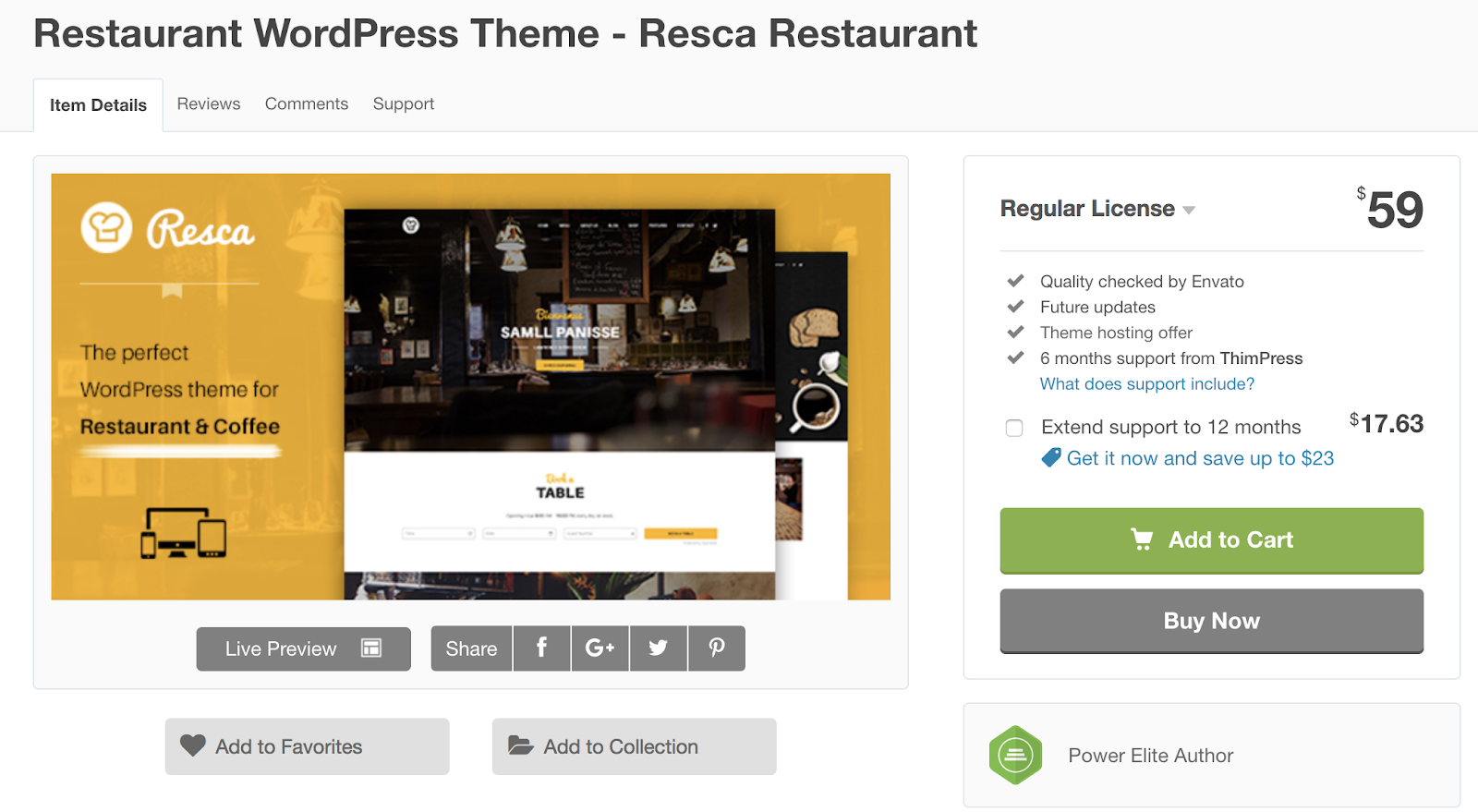
Resca is a multi-purpose restaurant theme. It offers a “one-page” feature that allows you to build your entire site on a single page for a minimalist design that features only your most important content. The theme is integrated with OpenTable to ensure reservations are easy to make for your customers. Resca also includes a contact form plugin so creating a custom form for your customers is simple.
If your theme does not come with a contact form plugin and you’re looking for a simple way to add a form to your site, check out HubSpot’s WordPress Contact Form builder.
Key Takeaways:
- Option to create a one-page website
- OpenTable integration
- Contact form plugin
11. Picante
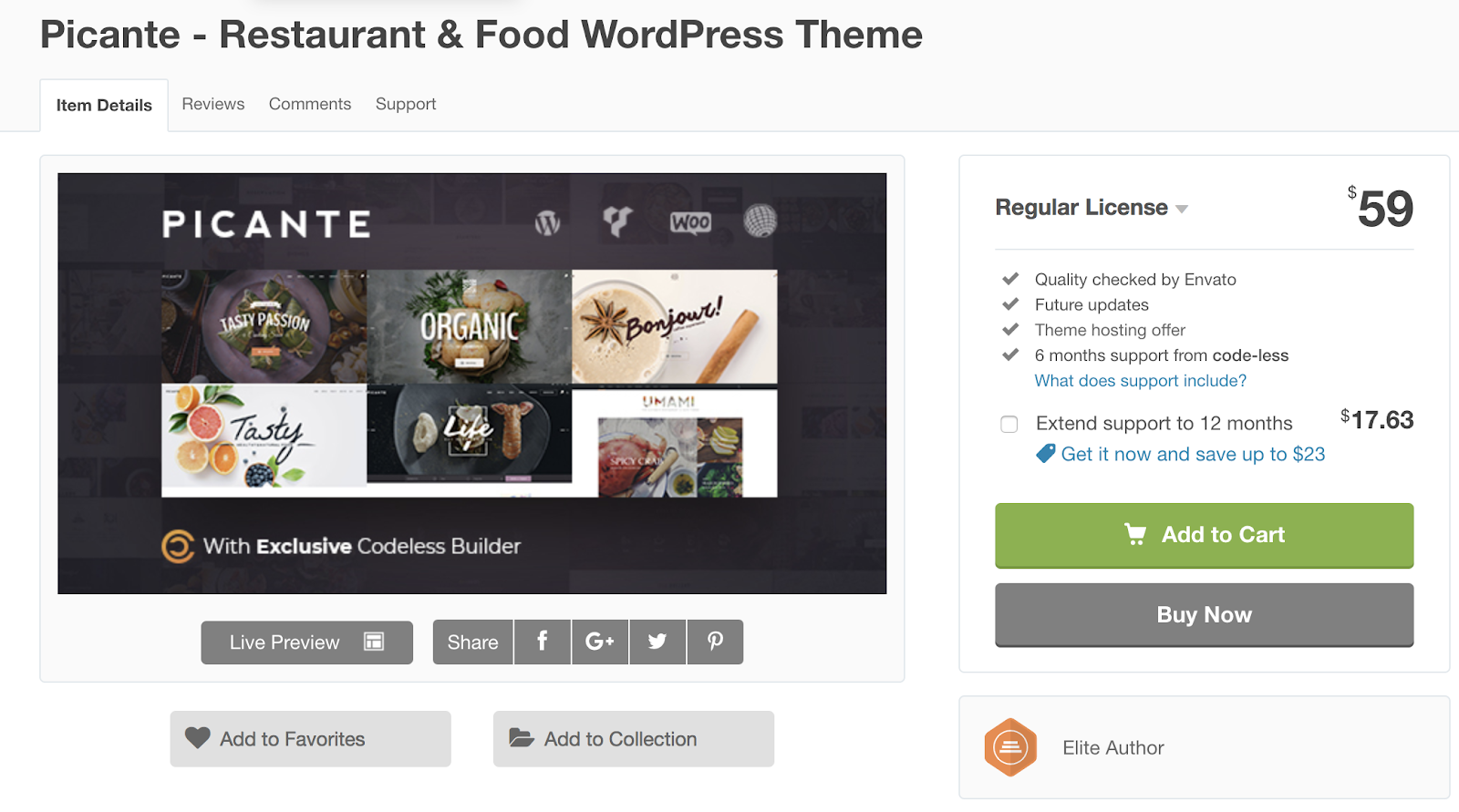
Picante is a multi-purpose WordPress theme with a “Live Visual Page Builder” feature that allows you to make changes or updates to your theme and view them in real-time. There are eight unique templates available so you can quickly begin designing (or re-designing) your site. The theme provides you with expert support so you can get the assistance you may need while working on your site.
Key Takeaways:
- Live page builder feature to make changes and view them in real-time
- Eight unique templates ready for installation
- Expert support available
12. Dine
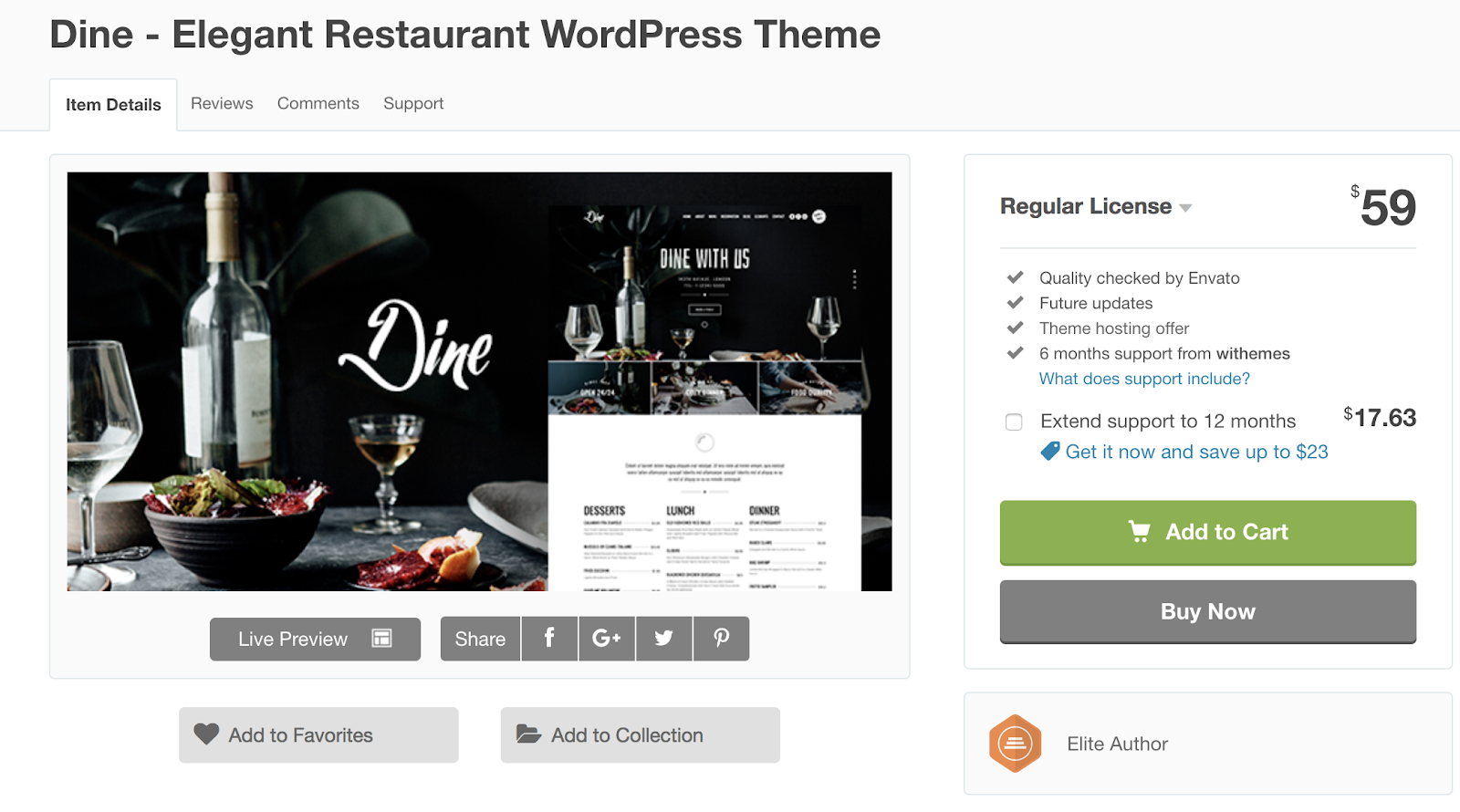
Dine is created for high-end restaurants and cafes. Each of the theme’s customizable templates come with an elegant, clean design. Dine also offers an “Off Canvas Menu” feature that provides your mobile website visitors with an easy-to-read, mobile-friendly menu. You also get access to the Google Fonts library when you become a Dine user, so you can implement any typography of your choice on your site.
Key Takeaways:
- Elegant, clean design
- Mobile-friendly menu feature
- Google Fonts library access
13. Tamarind
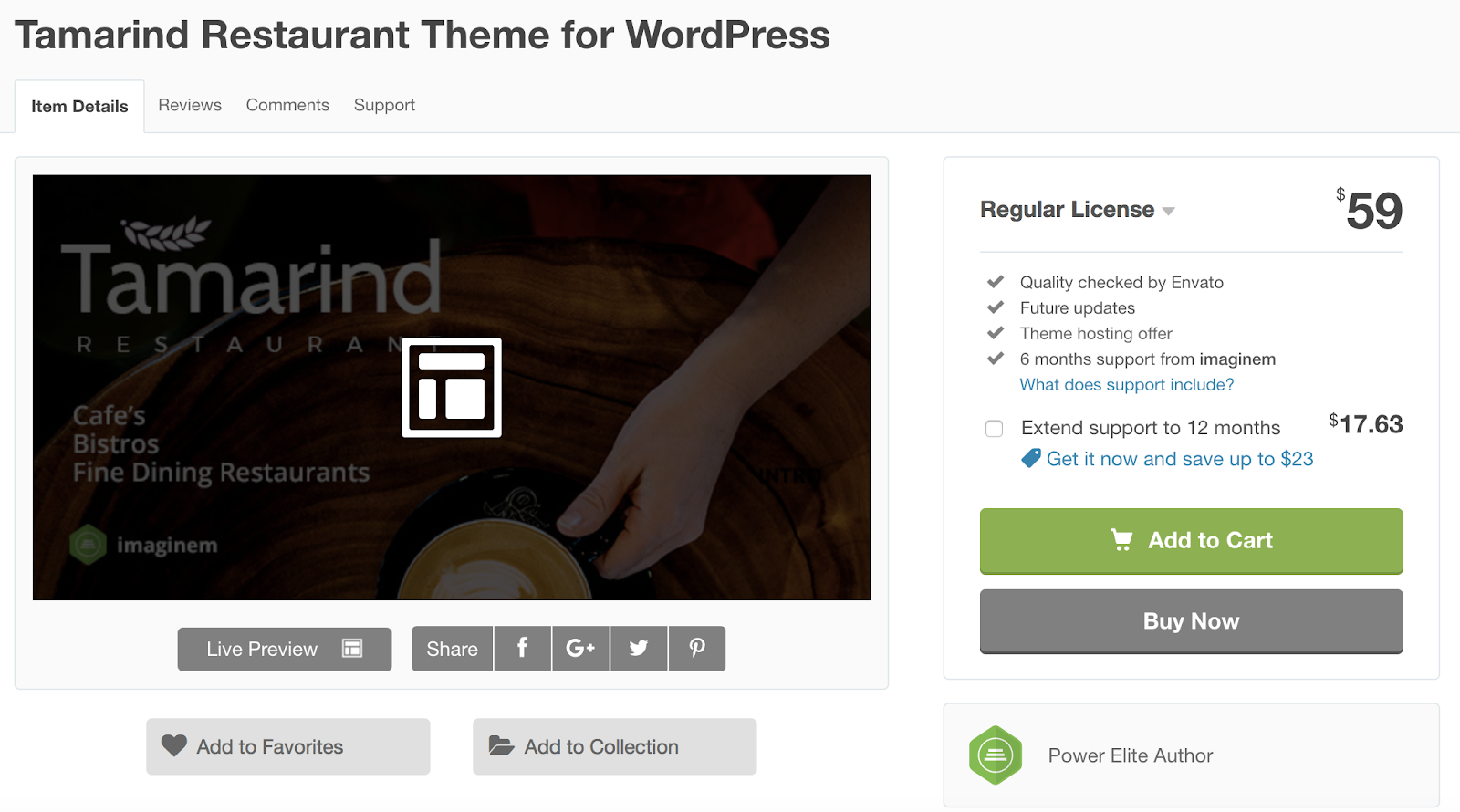
Tamarind is a multi-purpose restaurant theme with a variety of pre-made templates that you can choose from. The theme includes an OpenTable integration as well as the Contact 7 Reservation Forms plugin for you to manage your reservations. There are also a variety of presentation styles that you can add to your site to uniquely display your breakfast, lunch, and dinner menus.
Key Takeaways:
- Pre-made theme templates
- OpenTable integration and Contact 7 Reservation Forms
- Variety of menu presentation styles available
14. Tavern
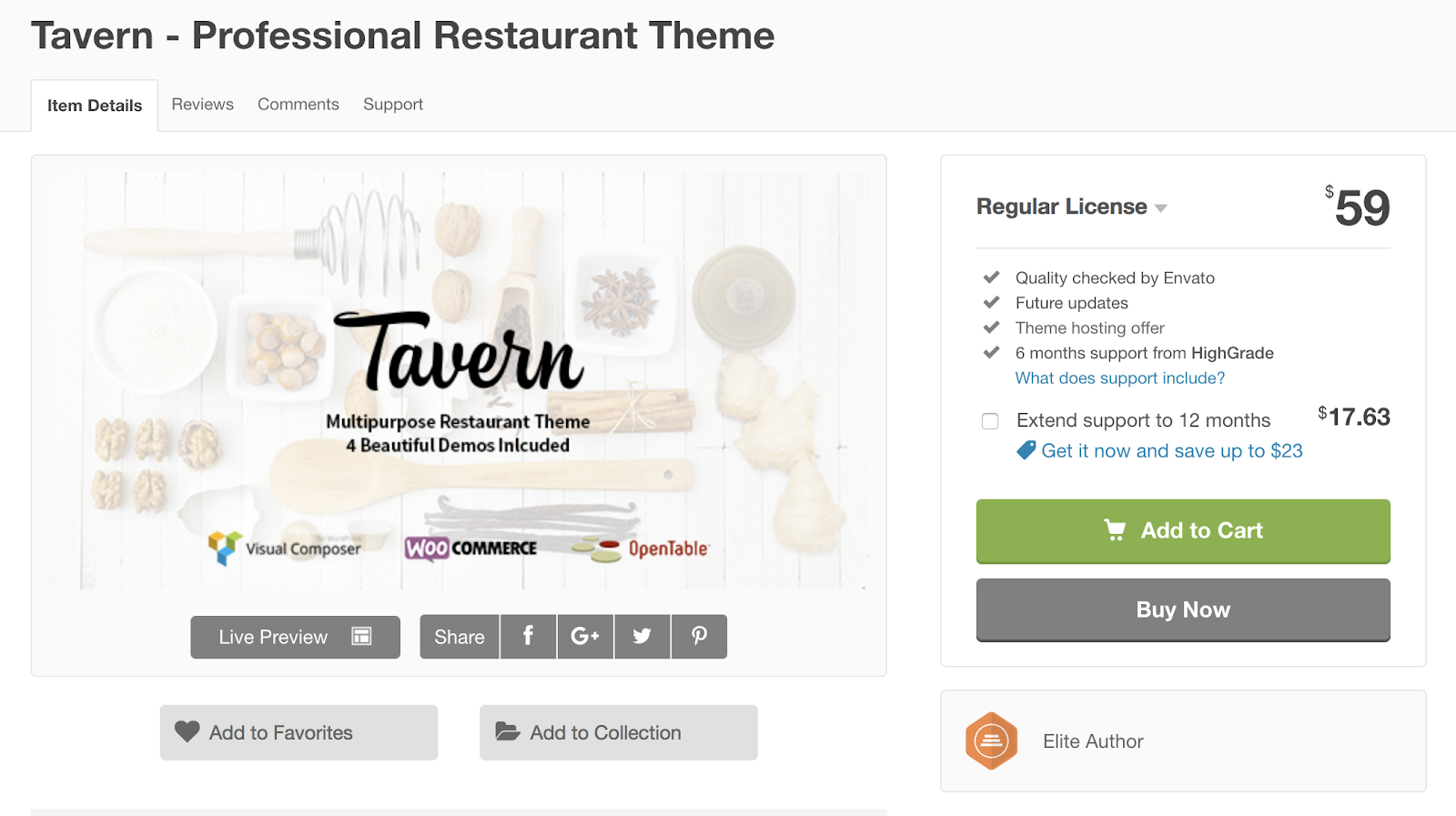
Tavern is a WordPress theme ideal for bistros, cafes, and bars. The drag-and-drop page builder requires no coding knowledge and includes over 60 pre-made elements that you can use to customize your site. The theme is approved by the Google Mobile-Friendly Test meaning your site will be responsive and functional for visitors browsing on-the-go.
Key Takeaways:
- Drag-and-drop page builder
- 60+ pre-made page elements available
- Google Mobile-Friendly Test approved
15. The Flavour
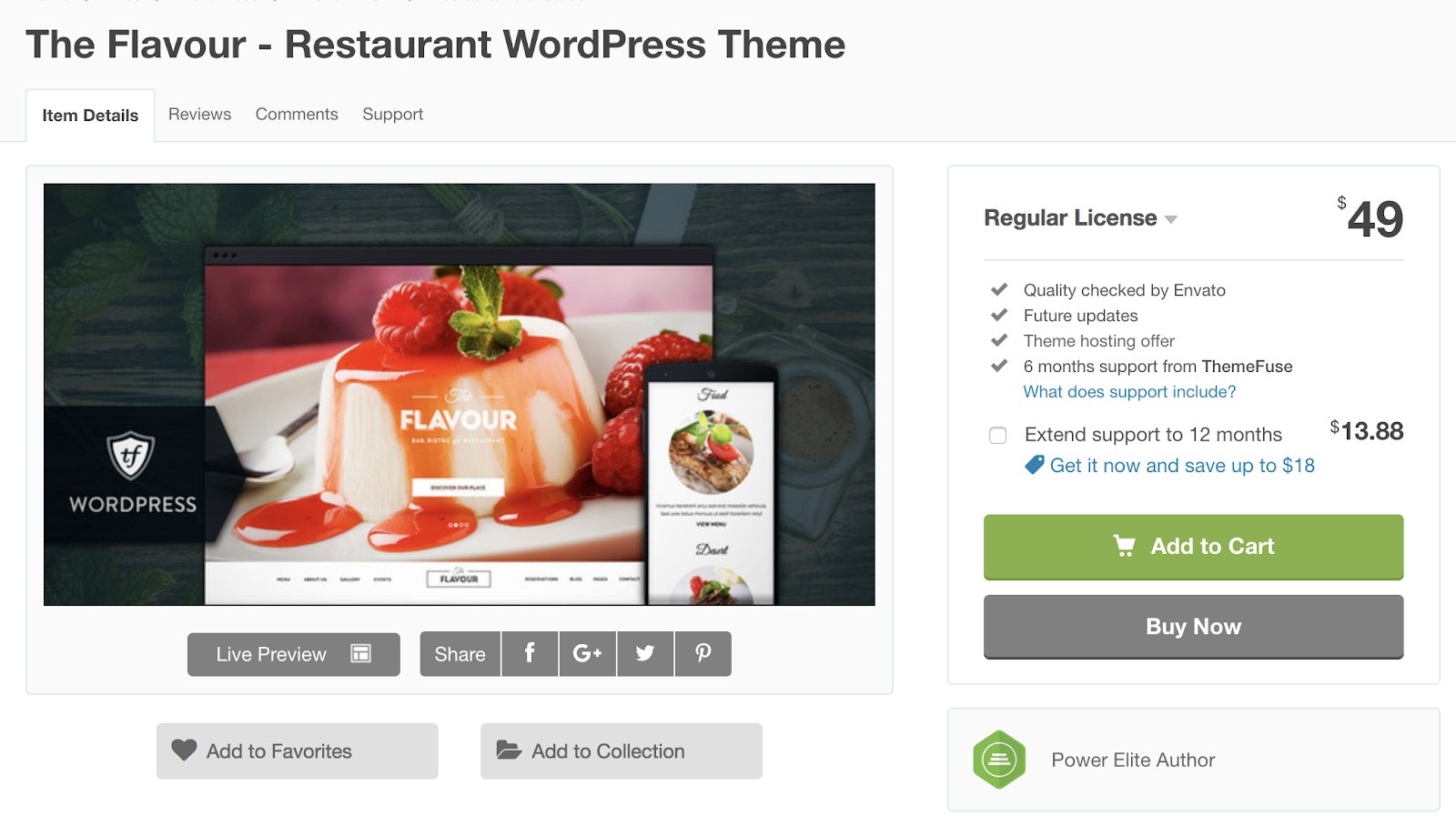
The Flavour’s responsive design automatically changes your site’s format to fit the screen it’s being viewed on, whether that’s desktop, mobile, or tablet. There are different image slider options that you can add to your site pages so visitors are able to scroll through full-width photographs of your menu items. There are also restaurant-specific icons (typically of different food items) that visitors can click on to be redirected to a different section or page, creating an interactive and unique experience.
Key Takeaways:
- Responsive theme
- Sliders to display multiple, full-width images
- Restaurant-specific icons for visitors to click
Back To You
No matter the type of food business you run, or the type of restaurant you own, you’ll need a WordPress theme to get your website looking and functioning the way it should to ensure a positive user experience. If, after reviewing our 15 theme recommendations, you’re still interested in considering other restaurant themes for your WordPress site, there are hundreds of options for you to browse in the WordPress theme library. Get started increasing traffic on your site, sharing your menu items, improving user experience, and easily managing your reservations by installing a restaurant theme and customizing it to your liking.

Looking Back on 2018 Predicted Tech Trends: Which Flourished, and Which Flopped?
Every January, the Consumer Electronics Association hosts the annual (and potentially largest) Consumer Electronics Show (CES) in Las Vegas, Nevada — where events often begin with a projection of the top tech trends to come that year.
At the start of 2018, it was predicted that a handful of trends would dominate the year. And as we look ahead to 2019 and prepare to return to CES next month, we’re taking a closer look at those that stood out to us the most over the past year.
Here’s what flourished — and which predicted trends didn’t make quite the splash that was anticipated.
1. 5G
5G is a type of wireless technology that you may have heard about over the course of 2018 — such as when Verizon selected Samsung as the provider for its 5G commercial launch.
The “G” stands for generation, in that this is the fifth generation of this type of connectivity. Currently, 4G powers cellular connectivity like LTE. The goal of 5G is to support the rising number of mobile internet users, by providing better speed, handling more data, greater responsiveness, and connectivity to smart devices.
That’s part of what makes 5G such a big deal — that it has the potential to provide significantly higher wireless speeds, capacities, and lower latency — which generally means that there will be far fewer delays or “technical hesitancies” in some of the things it powers, like wireless virtual reality (VR), or autonomous vehicles.
And as those latter two technologies have also continued to progress over the course of 2018, having the right wireless infrastructure to support them becomes increasingly important.
While 5G may not have made quite the mainstream splash this year that some predicted, looking ahead to 2019, it could remain integral to the development of digital communication and connectivity
Further reading:
- “At Mobile World Congress, 5G Is All the Rage. So What’s the Big Deal?”
- “4 Things We Want to Know After Reading Mary Meeker’s 2018 Internet Trends Report,” where we explore forecasts on the way people get and connect online.
2. Artificial Intelligence (AI)
If we had to identify one core reason why AI is such an important technology, it would be how many other technologies it informs and impacts.
AI continues to be an area where there’s still a bit of confusion among consumers and businesses alike — which could explain why a search for what differentiates AI from things like machine learning, deep learning, and bots yields a plethora of content.
In a nutshell, AI is what powers many of these other technologies, including some of those appearing on this list. It’s a way of replicating the intelligence or thought process of humans that’s required of certain processes, like answering questions, navigating transportation, recognizing someone’s face, or even determining what’s in your refrigerator.
“I’ve been impressed to see how artificial intelligence has spread into SMB software. In some areas like messaging and chat it has enabled companies to work more efficiently, reducing steps so marketing, sales and service professionals can there for customers in a more reliable way,” says HubSpot VP of Marketing Meghan Keaney Anderson. “In other areas it has made what wouldn’t have been previously possible possible, rapidly assessing huge volumes of data points to glean insights that would have taken significant human investment otherwise.”
So, as all of these areas of technology continue to expand and evolve, and power the new products and capabilities that have launched this year, it could be argued that AI was not only one of the most pivotal tech trends of 2018, but will continue to be in the next year (and, potentially, many years to follow).
Further reading:
- “Meet the People Building the TV Controlled by Your Brain”
- “And on the Second Day of F8, Facebook Said, ‘Let There Be AI Ethics’”
- “Why Should I Care About Amazon AI?”
- “Google Wants to Take Over Your Home (And the Rest of Your Life)”
3. Robotics
In the earlier part of 2018, it appeared that “bots were the future.” Notable brands across the broad spectrum of industries were launching their own chatbots, for example, in a way that allowed them to interact with audiences to provide support, surface content, or make appointments.
As we mentioned above — these capabilities are powered by AI.
But in some respects, bots may have peaked in the first few months of 2018, only to to lose some momentum, or at least some of the hype around them that started the year. Chatbots on platforms like Messenger, for instance, may have taken a bit of a hit when news of data misuse on its broader platform, Facebook, began to make repeated headlines this year.
But where chatbots may have had the most impact and carved a crucial path was the dialogue — no pun intended — they began around the importance of conversational capabilities in technology. While a text-based bot on Messenger or Slack might differ from a voice assistant (e.g., Alexa, Google Assistant, or Siri), at their respective cores, they’re all still bots, and they’re all powered by AI.
To that end, bots take on far more forms than just voice assistants and chatbots — with many categorizing things like autonomous vehicles and drones as robots. And let’s not forget: Throughout 2018, we began to note the growing presence of actual robots that such complete “human” tasks as preparing lattes and serving food.
Further reading:
- “Why Is Everyone So Obsessed With Bots?”
- “In a Land of Automated Milk and Honey, Marketers Are Presented With an Opportunity”
- “I Tried a Weirdly ‘Psychic’ Google Home App at SXSW So You Don’t Have To”
4. Voice
Voice technology continues to progress and appear on a number of different platforms, potentially making it one of the most prevalent tech trends of 2018.
Voice is yet another instance of crucial technology that’s powered by AI, especially when it comes to voice assistants: the digital personas that power smartphones, smart speakers, and more. (On Apple devices, for example, it’s Siri. On Google hardware, it’s simply named Assistant. On the Amazon Echo, it’s Alexa.)
Where AI also plays a pivotal role in this technology is the capacity of these machines for voice recognition — being able to differentiate the voices of multiple users within a single household, understand what that person says, and produce the information that person wanted.
Seeing as a number of voice-assistant-powered products launched in 2018, like video smart speakers — and considering that a growing number of search queries are conducted by voice — we wouldn’t be surprised to see this trend continue to evolve.
“I think voice is incredibly intuitive, and that lots of people don’t even think about using it,” says HubSpot VP of Marketing Jon Dick. “Long term, I think voice will dominate a ton of our transactional queries.”
Further reading:
- “The State of Voice: Looking Ahead to 2019”
- “25% of People Think All Searches Will Be Done by Voice in the Next 5 Years”
- “We Tested out the Google Home Hub so You Don’t Have To”
- “Marketers, Take Note: Samsung Is Going All-In on Voice and Now Is the Time to Prepare”
- “Why Voice Shopping Is Just Getting Started [New Data]”
5. Virtual Reality
Finally, we’ve arrived at virtual reality (VR): one type of technology that many developers, content creators, and certain businesses want to succeed — but when it comes to going mainstream, has faced numerous obstacles.
Nevertheless, it was a technology to which we paid close attention in 2018, attending industry events around it and observing the ways it can be used in a consumer and business setting alike. We tested out new headsets, collected data on user sentiment, and spoke with experts on the forecast for how it will grow in the years to come.
So, what VR one of the “biggest” tech trends of 2018? In terms of user growth, maybe not. But with so much attention paid to it this year, it shows some promise for 2019.
Further reading:
- “The State of Virtual Reality: Where We Are, and What’s to Come in 2019”
- “Here’s What’s Stopping Virtual Reality From Going Mainstream [New Data]”
- “What’s the Business Case for Virtual Reality? Here’s What the Experts Say.”
- “Here’s What Playing With a VR Headset Is Actually Like”
- “Why This New VR Headset Could Be a Game-Changer”

The 15 Best Free WordPress Themes for Bloggers in 2019
If you’re a blogger, it’s probably safe to assume you want a website that’s equally as stylish, unique, and high quality as the content you share. You also want visitors to have a positive experience navigating your site — reading posts with ease, searching for topics of interest, and discovering other content that makes them excited to return. A WordPress blogging theme can help you achieve the exact look, feel, design, and layout you envision … without the need for coding.
The 15 Best Free WordPress Themes for Bloggers in 2019
We’ve curated this list of our favorite 15 free WordPress themes for bloggers like yourself — not in any specific order — to consider using for your website. Each theme includes a description of the features that make them unique as well as a list of key takeaways in case you’re in a hurry.
1. Juno
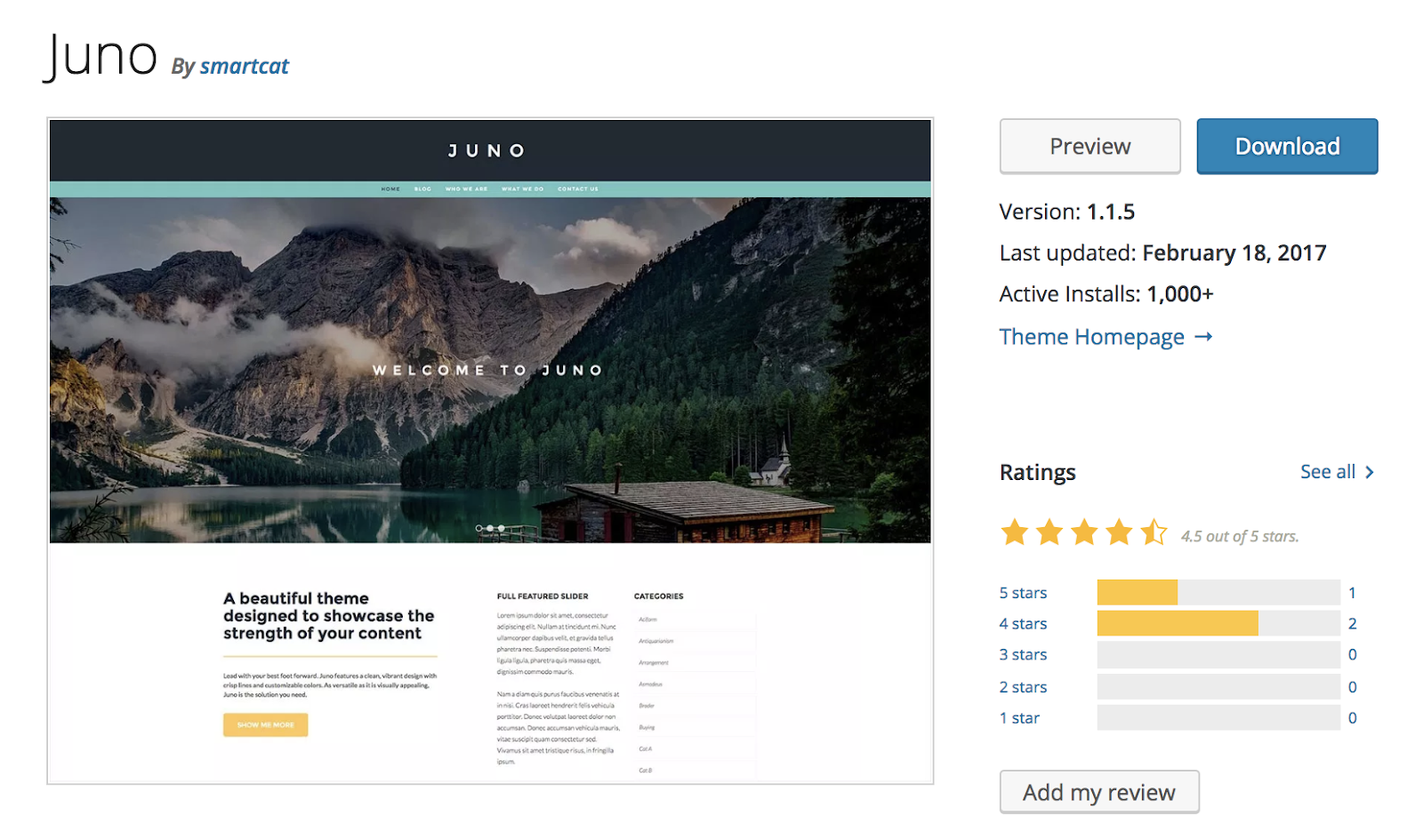
Juno provides you with unique blog-style layout options that makes it easy to pair your written content with images and/ or videos. Juno is a simple WordPress theme that offers a minimalist and clean design without any clutter. The theme also has a masonry-style blog layout, which displays your content in a grid format to make it organized and easy to browse.
Key Takeaways:
- Gallery options to pair written content with photos and video
- Minimalist theme
- Grid-style layout
2. Kale
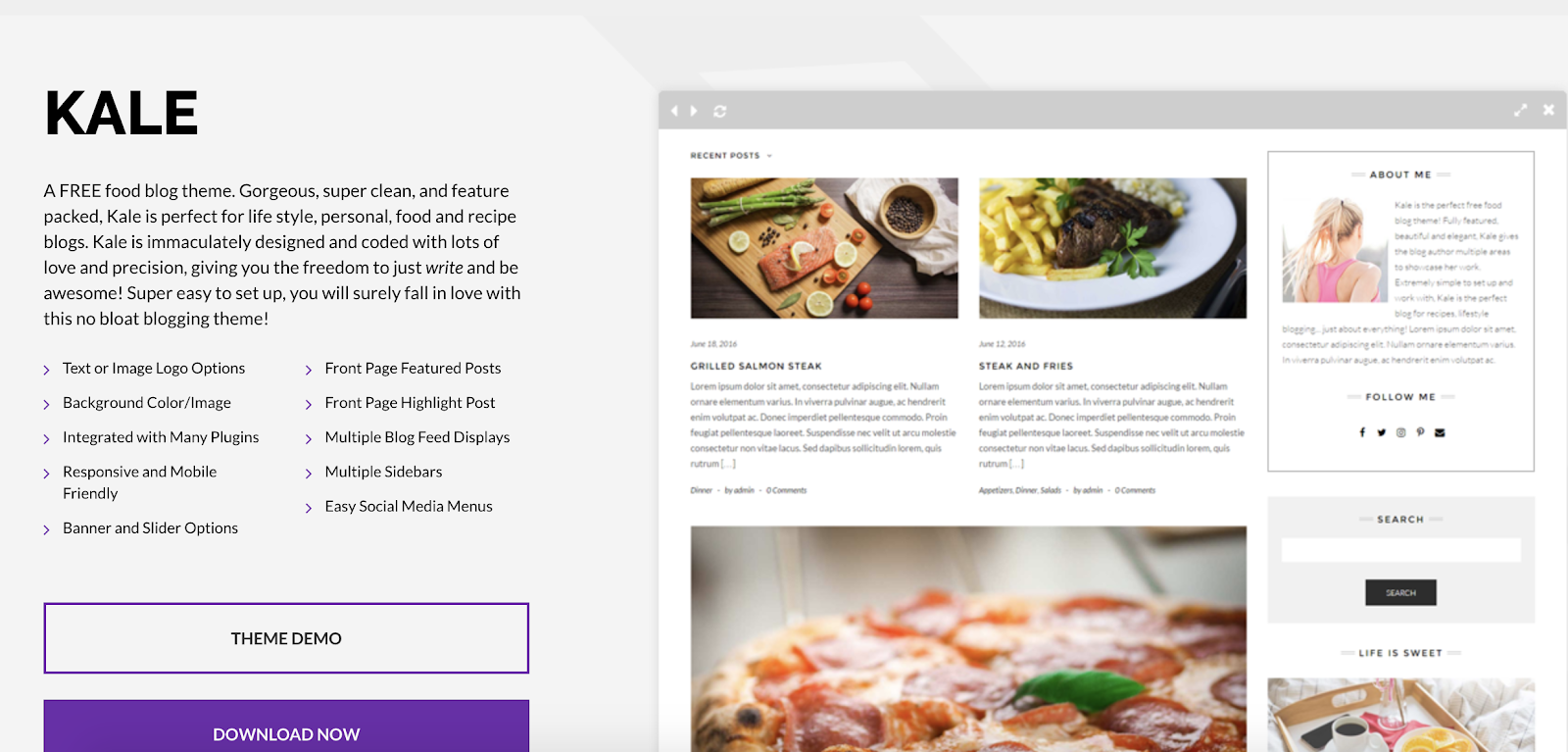
Kale is built for food bloggers. There are a number of feed displays to choose from so you can determine how you want to organize your written content and images of the dishes and menu items that you’re featuring. The built-in social media sidebar widget makes it easy for your visitors to locate, view, and follow your accounts.
Key Takeaways:
- Ideal for food bloggers
- Variety of blog feed displays
- Built-in social media menu buttons
3. Writee
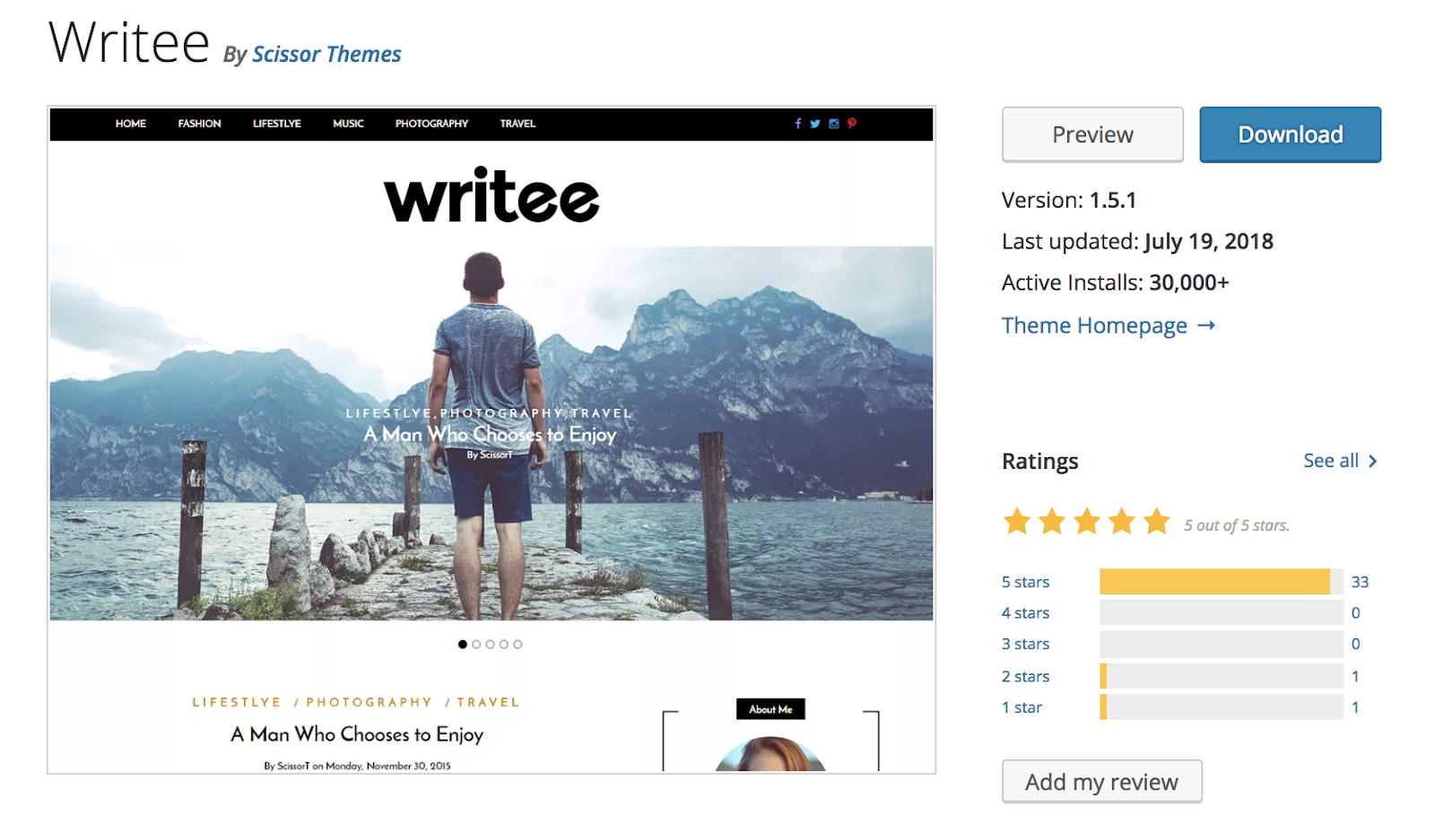
Writee is ideal for photography or image-heavy blogs — the theme has a slider hero image feature which allows you to include several full-width images. Writee’s responsive design automatically changes your site’s format to fit any screen, whether that’s desktop, mobile, or tablet. You might also be a blogger who sells branded merchandise or other related items. If that’s the case, Writee makes managing your online store simple with their WooCommerce integration.
Key Takeaways:
- Responsive design
- Full-width image slider
- WooCommerce integration
4. Hemingway
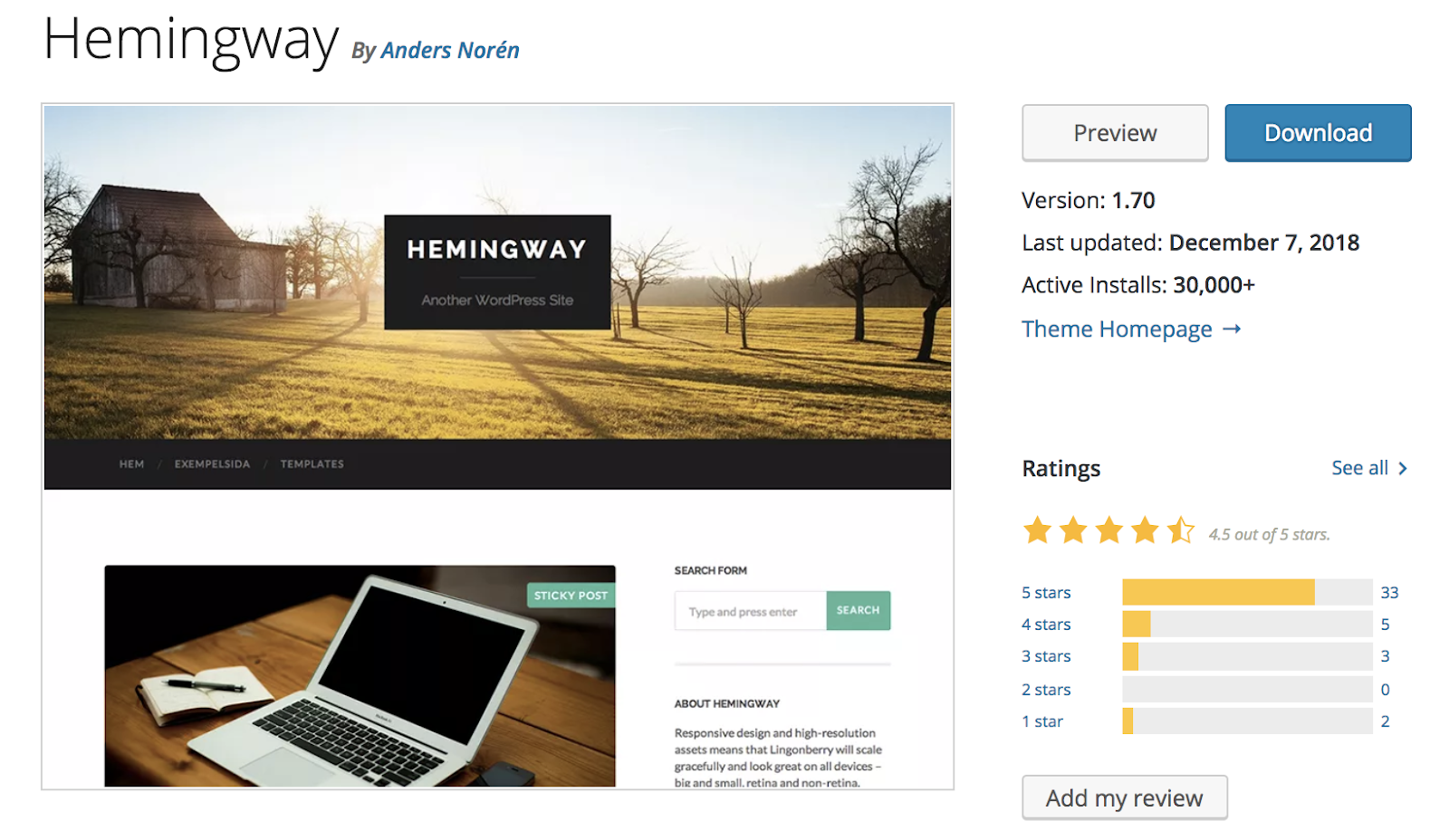
Hemingway is a simple two-column blogging theme that keeps your content organized and easy to read. It includes a parallax scrolling feature which adds an interactive, 3D, and video-like experience to your blog pages. Hemingway’s translation-ready feature comes with pre-made language files so your website can be automatically translated into a number of other languages with the click of a button.
Key Takeaways:
- Simple two-column theme
- 3D, video-like scrolling feature
- Auto-translates into several other languages
5. Radiate
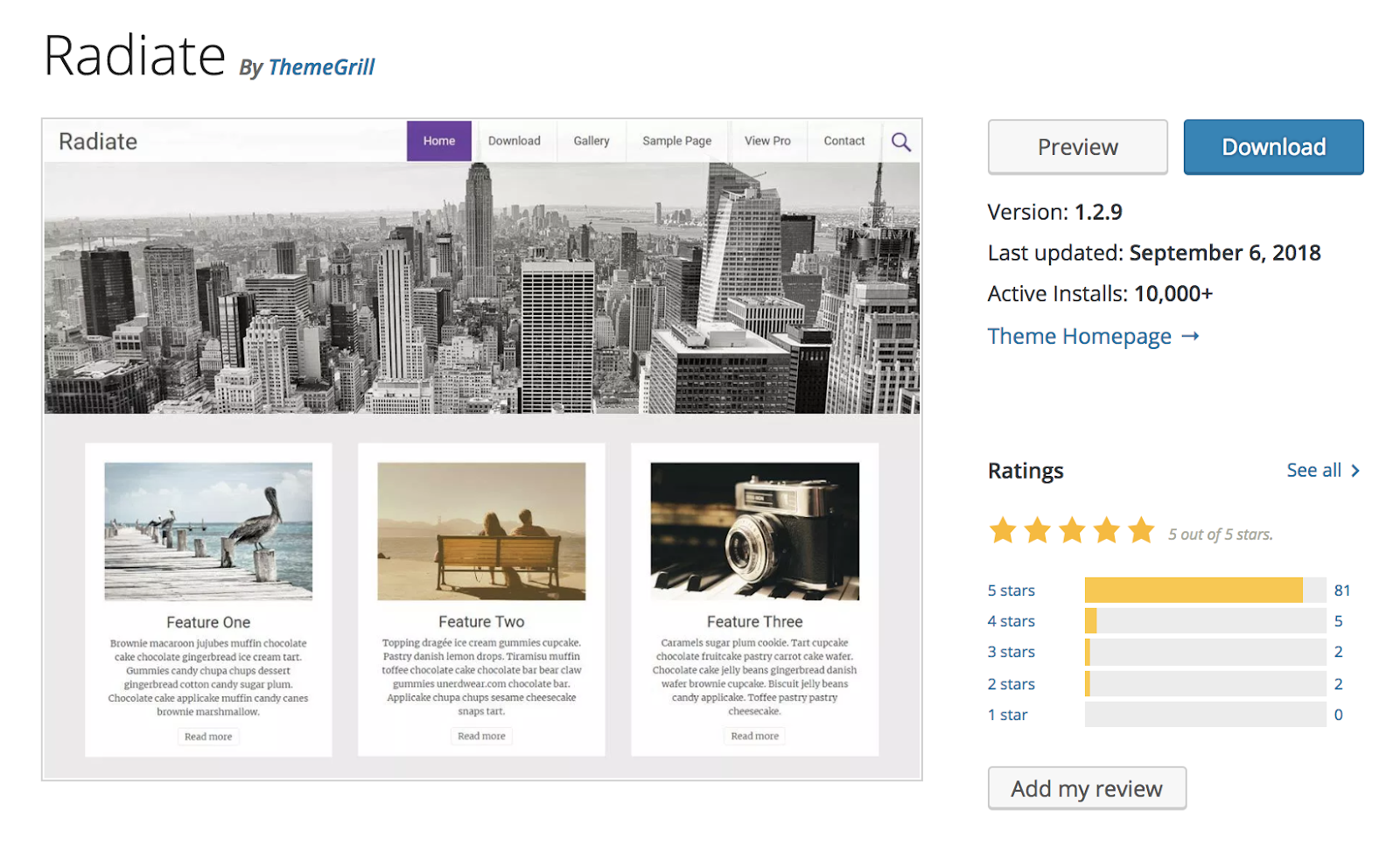
Radiate is a blogging theme that offers unique visuals, including a customizable, full-width hero image and primary color options so you can match your branding. If you have a WordPress.com Premium or Business account (that is, if you pay for WordPress), you can take advantage of custom Cascading Style Sheets, or CSS. CSS is a markup language that determines the look of your HTML so you can modify and customize the design of your web pages.
Key Takeaways:
- Full-width image background
- Multiple color options
- Custom CSS that allows you to modify and customize web page design
6. Flat
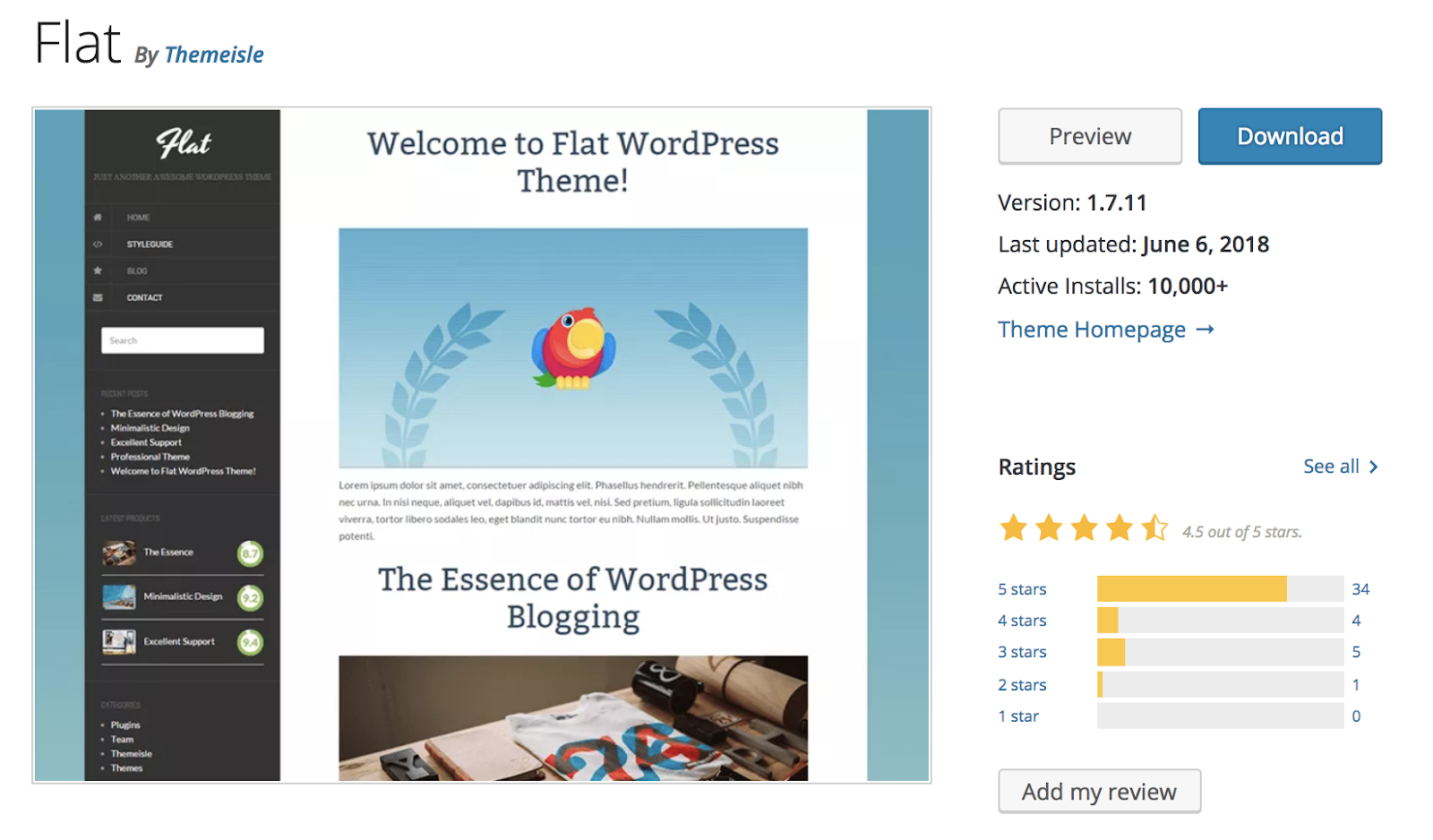
This blogging theme employs “flat”, or 2D, design principles, to give your site a minimalist feel all while using bright colors and unique typography to maintain a level of appeal. The theme has customizable sidebar navigation that allows you to build a clean and functional menu for your blog content. There’s also an easy-to-use “Theme Options Panel” in which you can update your site’s settings, add images and logos, include social links, and more from one, central location.
Key Takeaways:
- Flat, 2D design
- Customizable sidebar navigation
- Easy-to-use Theme Options Panel to customize site pages
7. Bulan
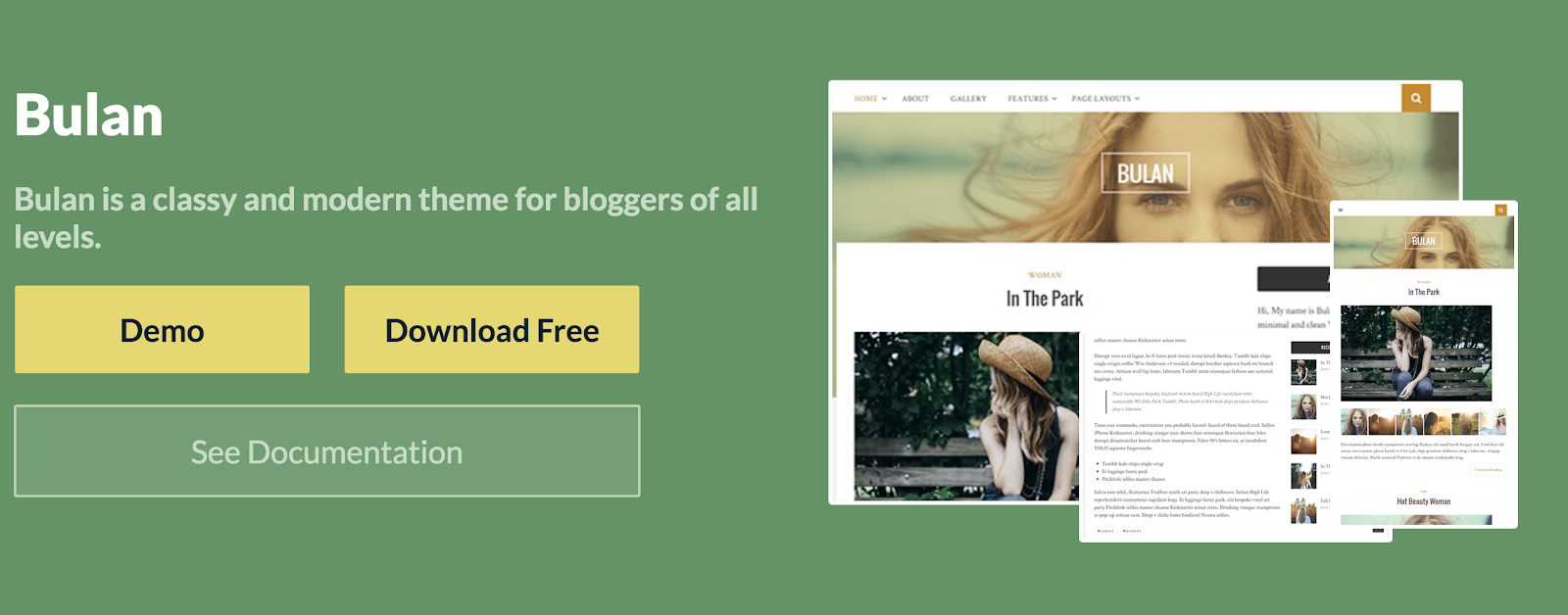
Bulan offers multiple homepage layouts for your blog including full-width, boxed, narrow, and multi-column options to provide your visitors with a unique experience when they enter your site. There are also a number of customizable sidebar and navigation configurations to enhance your user experience. Not to mention, you can install custom widgets to increase your site’s functionality.
Key Takeaways:
- Multiple homepage layouts
- Customizable sidebar and navigation options
- Custom widget options
8. Total
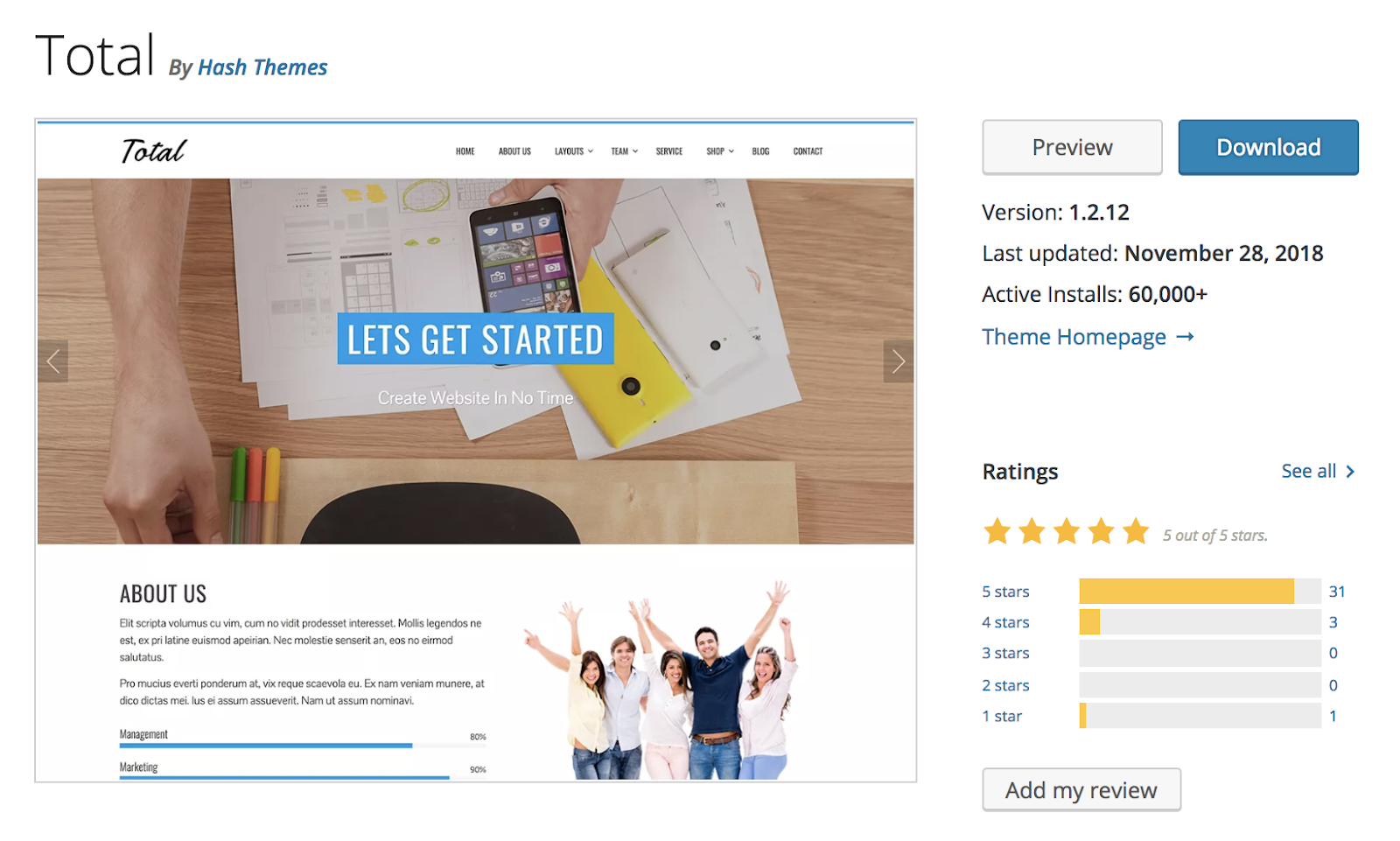
Total is a blogging theme with a masonry-style layout which places your latest three, six, or nine blog posts in a grid format to keep your content organized. There’s also a portfolio section if you want to share some of your artistic work. Total is SEO-friendly, which means it’s set up to help you rank in Google searches and get more traffic to your site.
Key Takeaways:
- Grid-style layout
- Portfolio section available
- SEO-friendly
9. Spacious
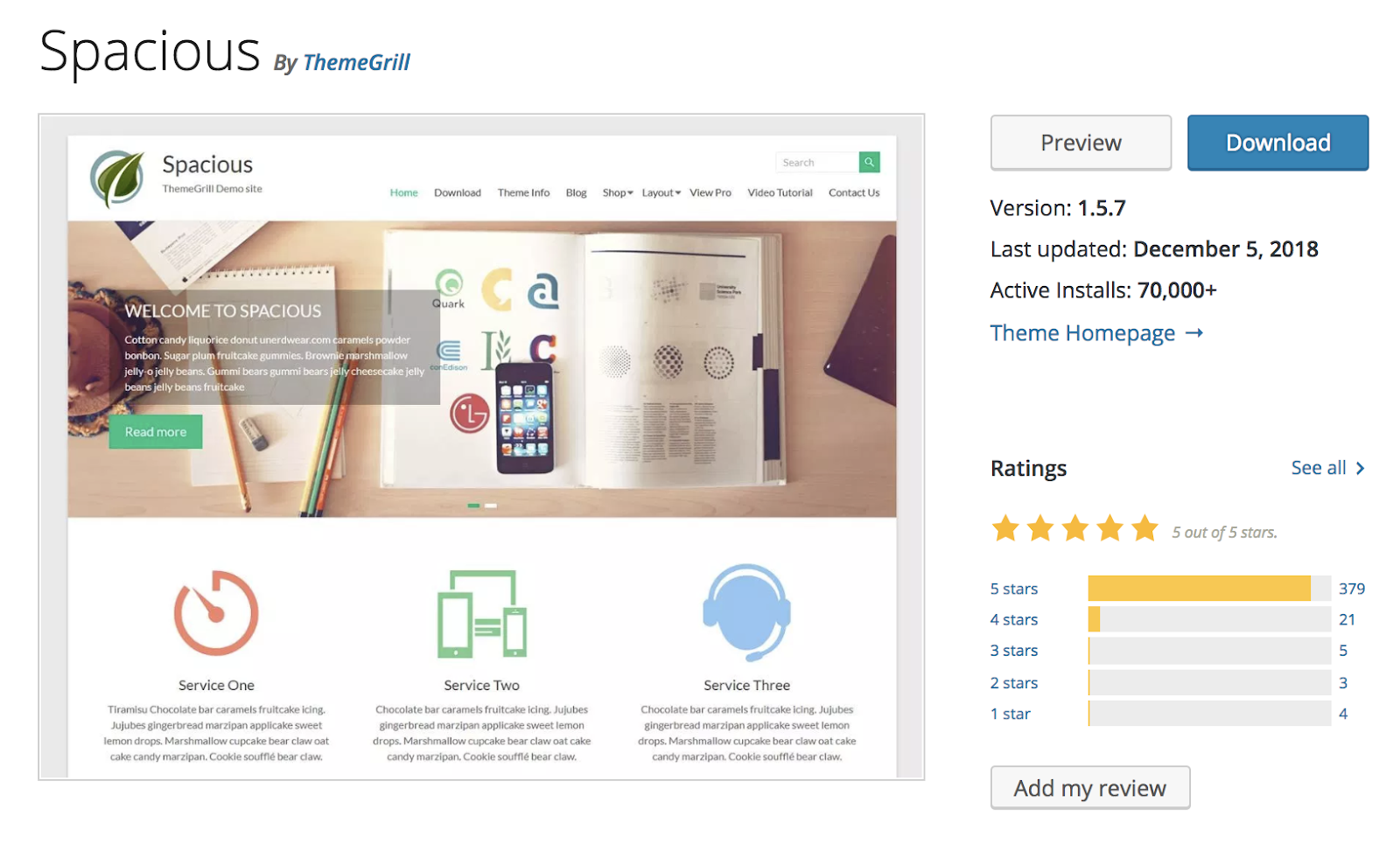
Spacious is a blog theme with four different page layout options and four blog display options to choose from. You can customize your theme’s primary color to match your site to your branding. Building your site with Spacious is a simple and painless process due to their downloadable demo sites that you can use for inspiration and support.
Key Takeaways:
- Four blog display options to choose from
- Customizable primary color for your theme
- Demo sites available
10. Revive
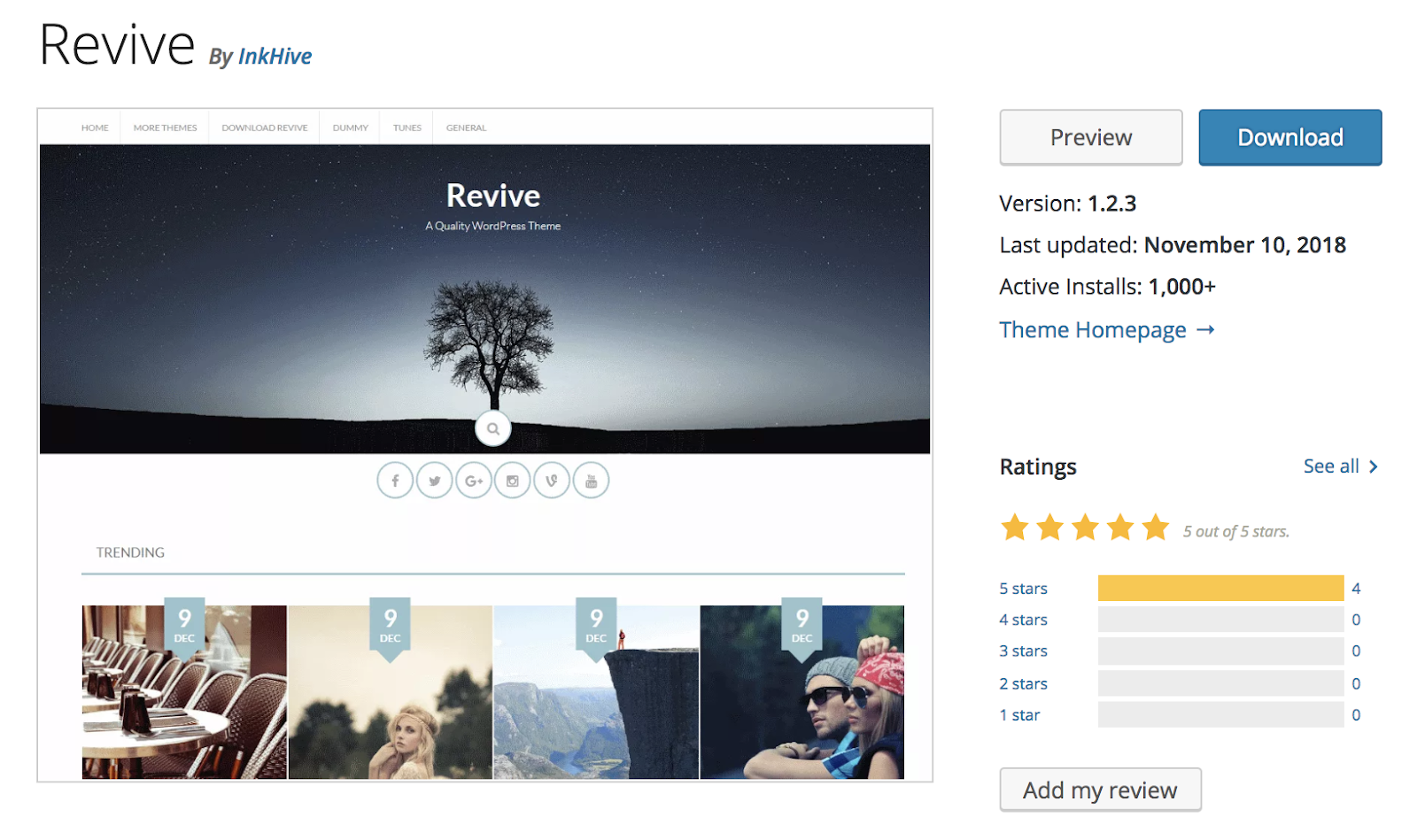
Revive is a blogging and magazine theme that’s ideal if you have a variety of photo content that you want to share on your website. The theme has a responsive design so your visitors can easily view your website from their desktop computer, mobile, or tablet. Revive also offers access to Font Awesome Icons that you can add to your theme to create a more interactive experience.
Key Takeaways:
- Blogging and magazine theme
- Responsive design
- Access to Font Awesome Icons to create an interactive experience
11. Wisteria
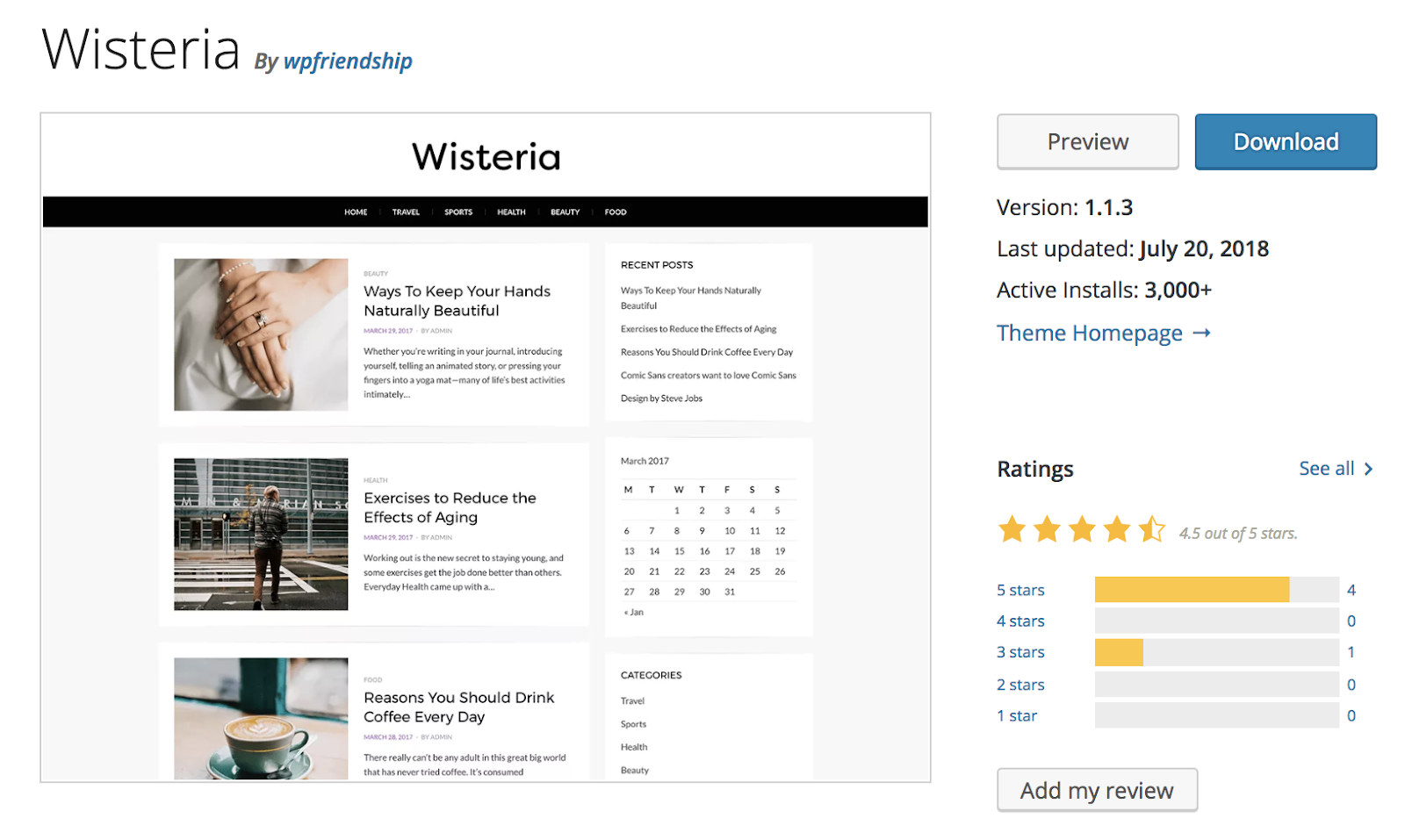
Wisteria is a blogging theme with a clean, minimalist, and straightforward design. The theme has layouts tailored to a variety of blogs including lifestyle, food, fashion, marketing, and more. Wisteria is retina-ready meaning all of your images and content will be high-definition to ensure your site has a professional look and feel.
Key Takeaways:
- Clean and minimalist design
- Created for a wide variety of blog types
- High-definition
12. Editorial
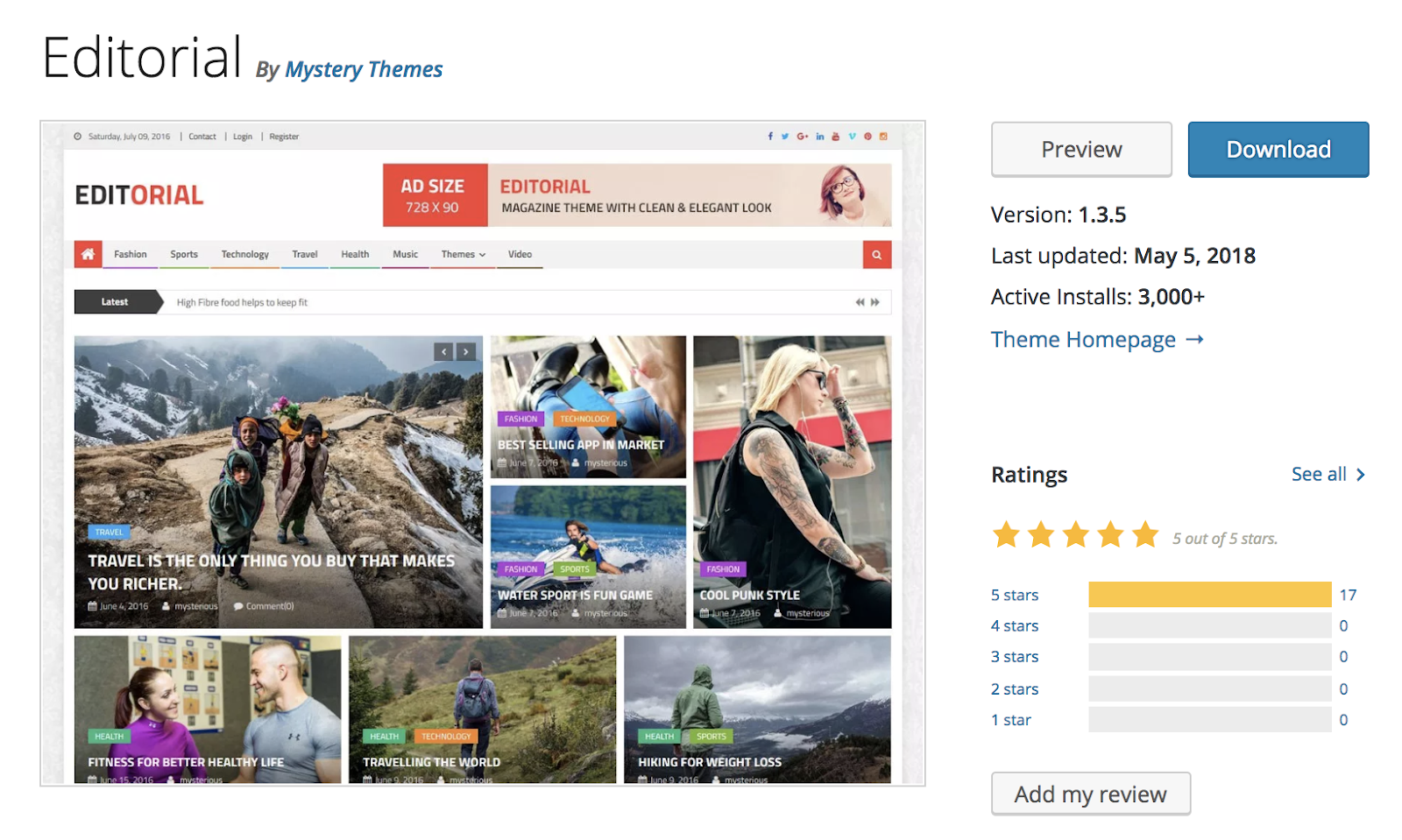
Editorial is a blog theme with a live customizer feature that lets you edit your site, move sections, add content to your theme, and view changes in real time. The theme is flexible enough to organize large amounts of editorial content in a way that doesn’t seem overwhelming to your readers. Editorial has a variety of easy-to-use widgets that allow you to customize several of your site page sections with the click of a button.
Key Takeaways:
- Live customizer feature to make and view edits in real time
- Easy to organize large amounts of written content
- Variety of easy-to-use widgets
13. Brilliant
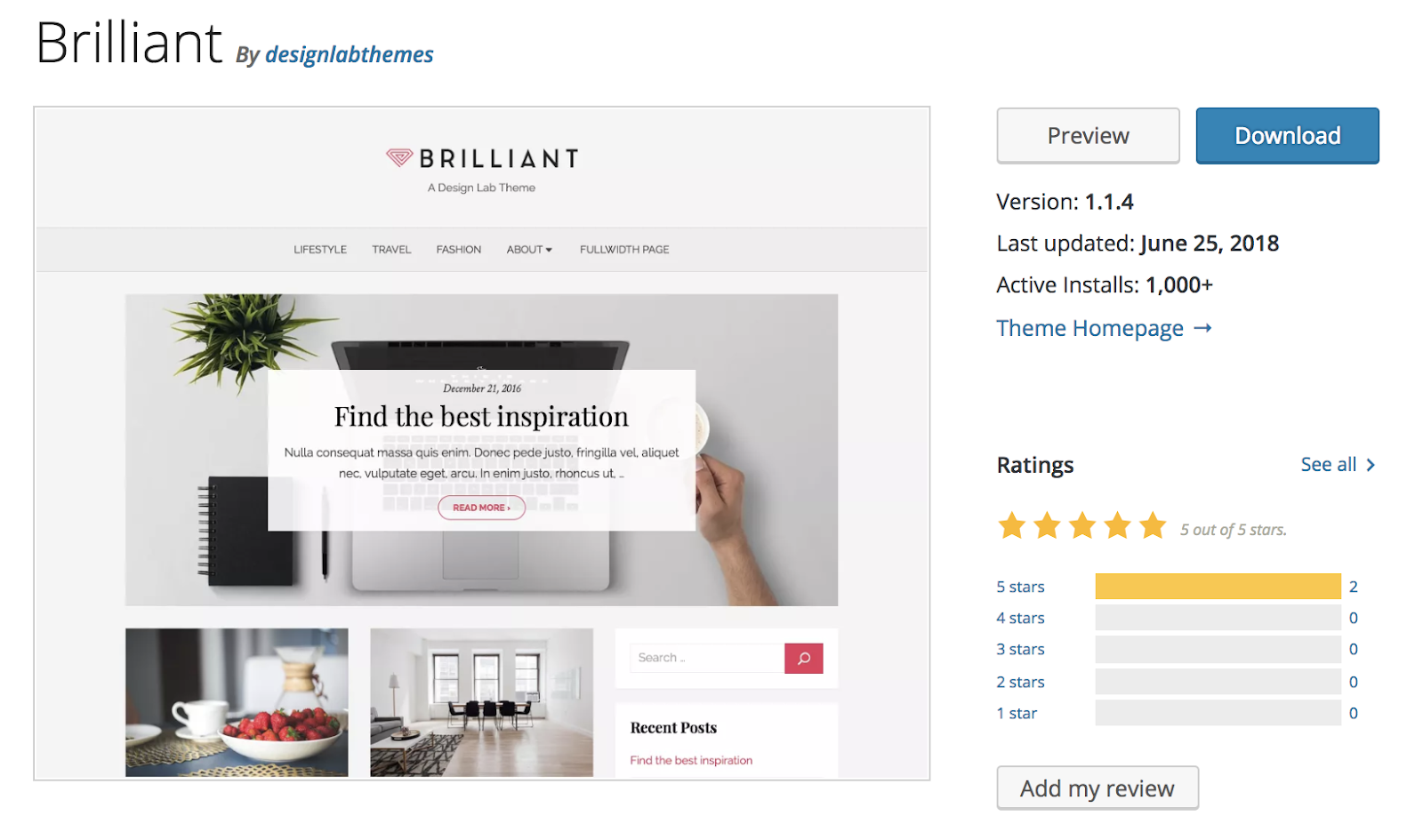
Brilliant is a blog and online magazine theme that allows you to artistically pair your blog posts with photo and/ or video content. You can add or edit your own custom logo on your homepage as well as easily customize your theme’s accent colors to match your blog’s branding. Brilliant is also translation-ready so your visitors can read your content in a variety of different languages with the click of a button.
Key Takeaways:
- Easily pair blog posts with photo and video content
- Quickly add a logo and customize the theme’s accent colors
- Can be auto-translated into multiple different languages
14. Poseidon
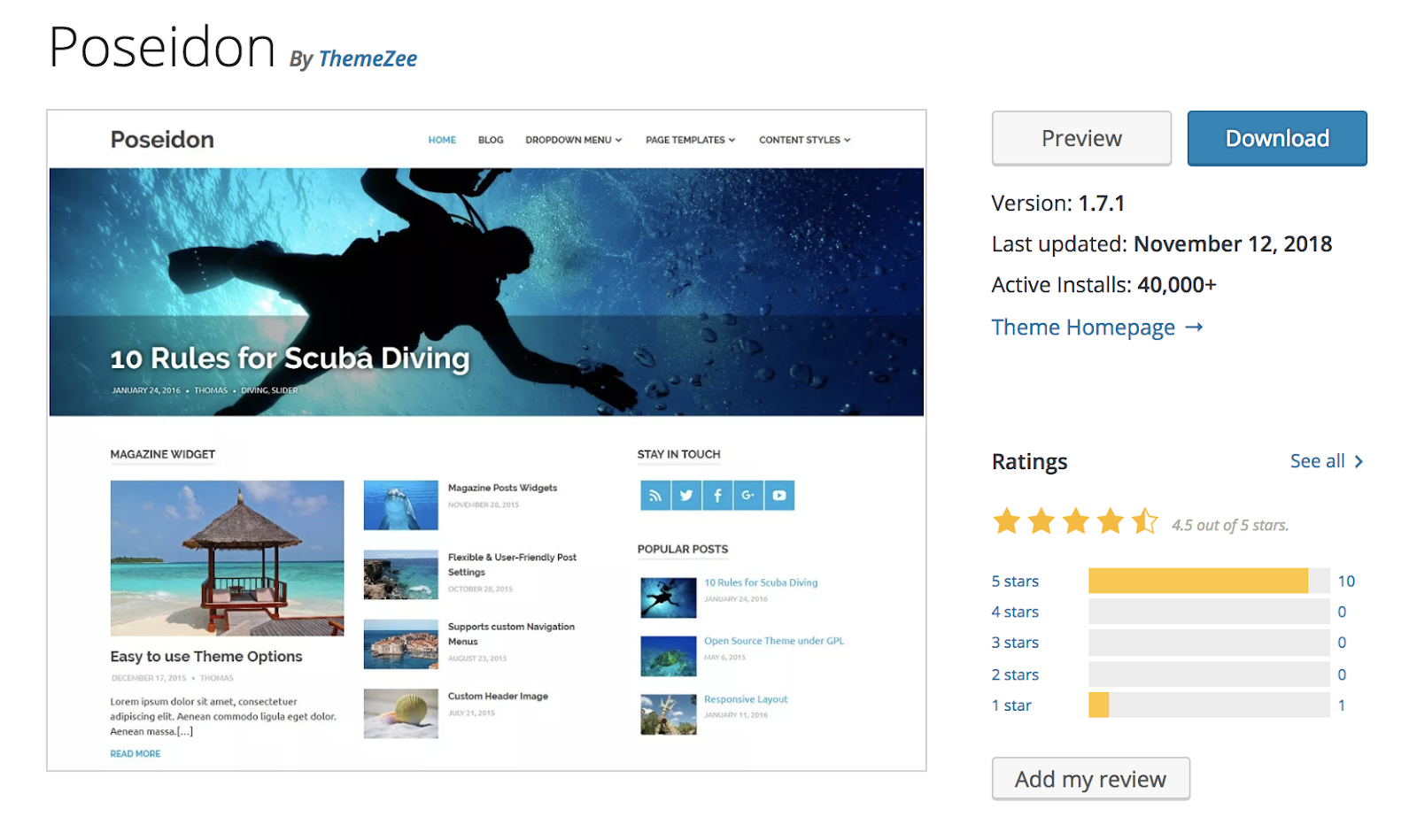
If you want to include large, professional-looking photographs on your blog’s website, Poseidon is the option for you. This theme offers a full-width image slideshow on the homepage that allows you to display multiple photos. The layout is mainly white to create a clean, organized look that appears spacious and organized. Poseidon also has completely customizable navigation bars that you can implement on your site to enhance user experience and improve your site’s configuration.
Key Takeaways:
- Full-width image slideshow
- White background to create a spacious and clean design
- Customizable navigation bars
15. Author
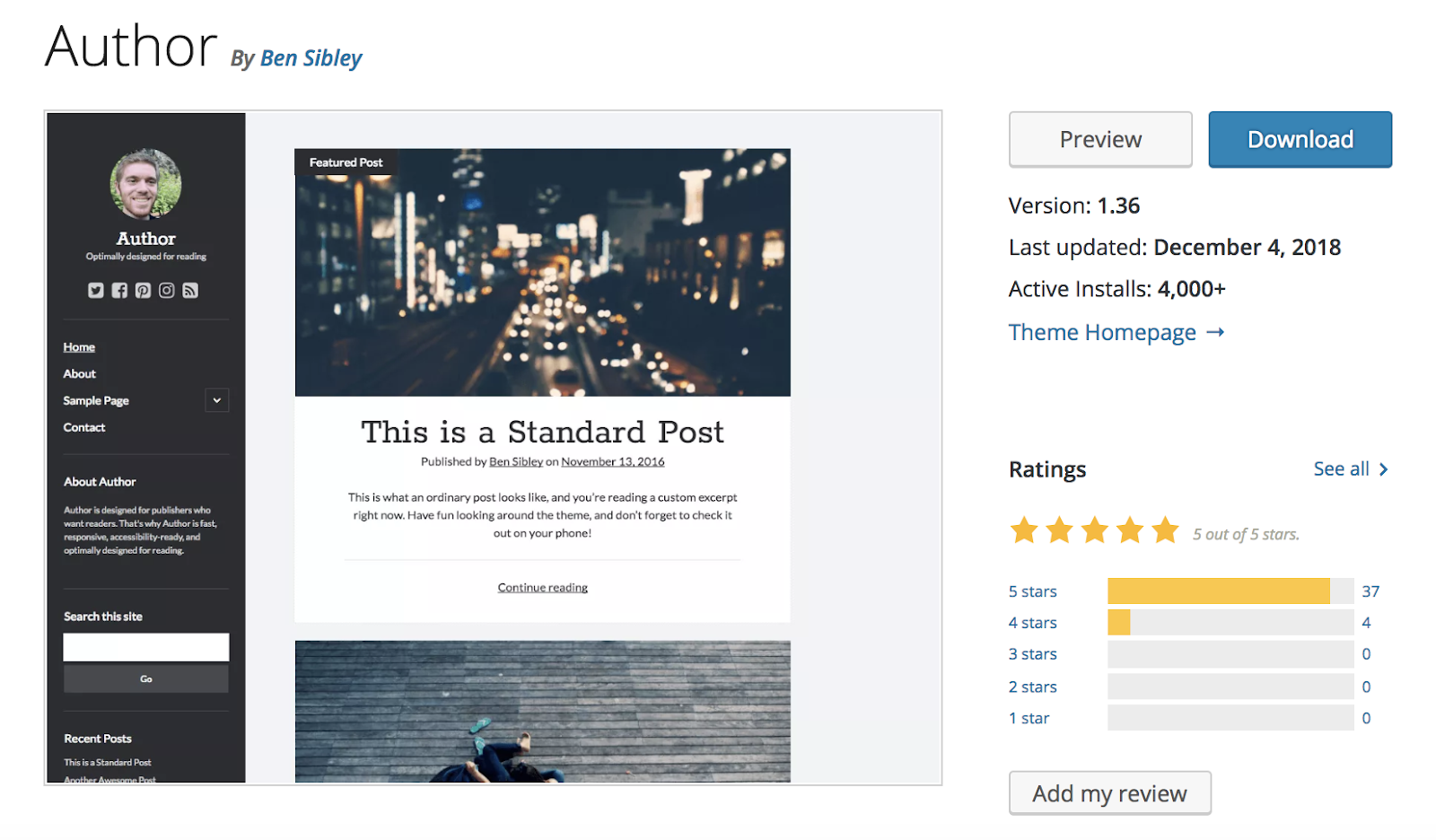
Author is suitable for all types of blogs and includes a responsive design so your visitors can read your content from any device and still enjoy their experience. The theme’s minimalist look allows your visitors to easily focus on your content without any distractions. There is expert support available in case you run into any issues while designing your website as well as several tutorial videos to walk you through different customization tasks step-by-step.
Key Takeaways:
- Responsive design
- Minimalist appearance
- Expert support and tutorial videos
Back To You
A free blogging WordPress theme will allow you to create a unique, functional, stylish, and eye-catching website where you can share your content. Each theme has features, layouts, and styling that set them apart from the others — so, consider the overall design you’re going for on your blog to help you determine which option is ideal for you. Then, install your theme and begin adding your blog content and customizing it to your liking to create a great user experience for your visitors that will keep them coming back.

How to Take a Screenshot on Your Android Phone [Easy Guide]
Maybe you just made the transition to an Android, or maybe the process of taking a screenshot just slipped your mind. Either way, whether you want to include a screenshot in one of your blog posts or send a funny meme to a colleague, here’s a quick, easy guide for taking a screenshot on your Android phone.

How to Take a Screenshot on Your Android Phone
- Navigate to the screen you want to take a picture of.
- Hold the Power button down for a few seconds.
- Press “Screenshot” on your phone screen.
- If that doesn’t work, hold the Power and Volume buttons at the same time for a few seconds.
- If you see an animation of your screen shrinking, your phone has taken a picture of your screen and saved it in your photos app.

Image Credit: Gadget Hacks
To take a screenshot on your Android phone, hold down the power button for a few seconds and press “Screenshot” on your phone screen. If that doesn’t work, hold the Power and Volume buttons at the same time for a few seconds. If you see an animation of your screen shrinking, like the image below, your phone has taken a picture of your screen and saved it in your photos app.

Image Credit: Gadget Hacks

13 of the Best Email Newsletter Templates and Resources to Download for 2019
If you had to guess, how many email newsletters do you think you’re subscribed to? Ten? Twenty? Fifty?
To be honest, I’ve lost count — and I know I’m not alone. Email marketers have a lot to compete with in their subscribers’ inboxes. That’s why a solid newsletter template is crucial to designing an email that people are encouraged to click through.
Best Email Newsletter Templates
- Pook by Litmus
- Sonata by Web Canopy Studio
- ZURB Ink
- Wire by HubSpot
- 99designs
- Webinar Invite by WorkCast
- ThemeForest
- Resonant by HubSpot
- Antwort
- Useful Notifications by TemplateMonster
- Themezy
- Email on Acid
- HubSpot Template Marketplace
If done well, though, email newsletters can do wonders to help you build an engaged subscriber base, keep your business top-of-mind, and nurture leads that are already making their way down the funnel.
However, “done well” means more than just serving up great content. In fact, an often overlooked component of the newsletter creation process is the design.
Don’t have time to build out a custom template from scratch? We’ve scoured the internet for the best resources for email newsletter templates and compiled them below. Once you find one you like, download the template and customize it to fit your needs.

1. Pook by Litmus
Price: Free
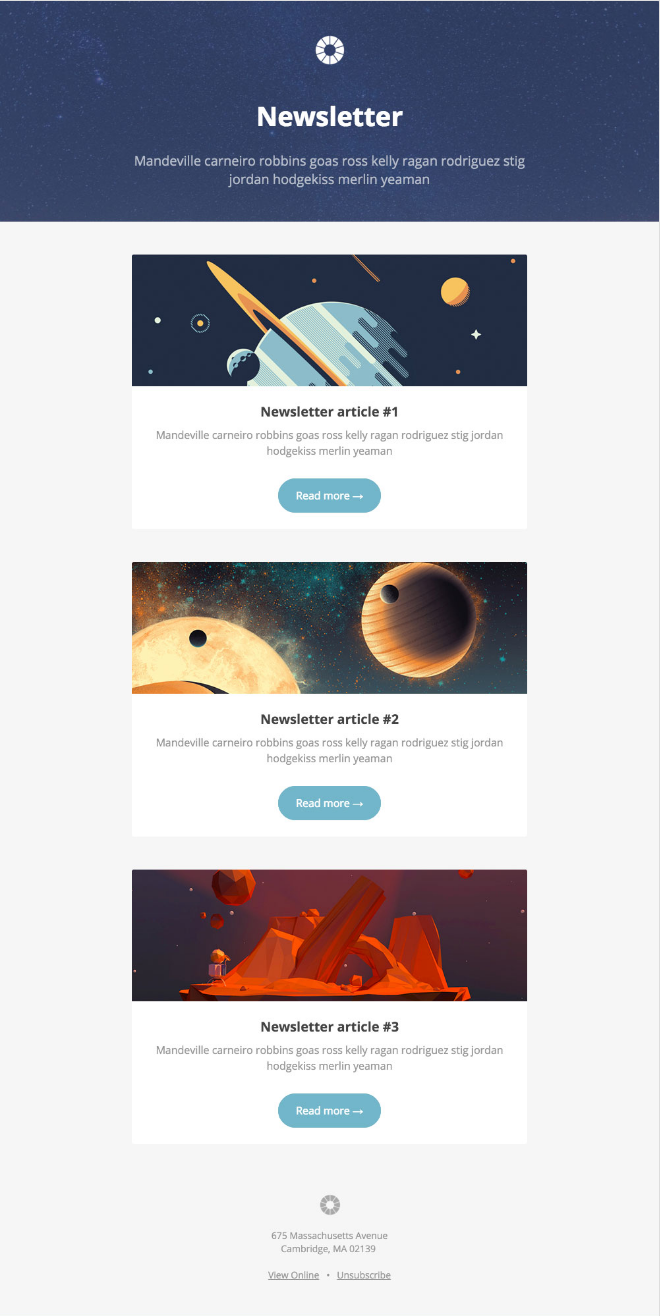
Litmus offers a free email template collection — from newsletter templates to account management templates. The marketing-specific theme, below — referred to as “Pook” — is modern and sleek, while still being kind of fun. All of the templates have been tested with Litmus, and you can easily check out how the email will appear in different email clients here.
While you are required to create a Litmus account with your email address to access the templates, the templates themselves are free of charge.
2. Sonata by Web Canopy Studio
Price: Free
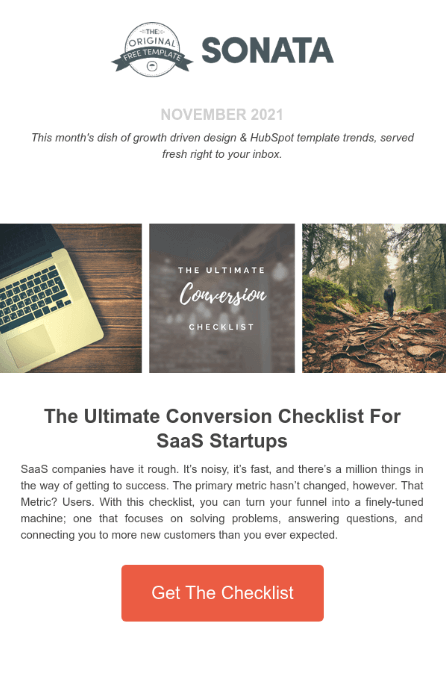
Sonata is an email template by Web Canopy Studio, available on the HubSpot platform to any HubSpot user, free or paid, looking to promote a special offer or resource to their loyal subscribers. As you can see, the newsletter template below embraces a clean aesthetic with image slots to capture the essence of your brand in three separate tiles.
You can customize almost any component of the template below, from the company logo at the top of the email to the “Get The Checklist” CTA at the bottom. Get this template from the HubSpot Template Marketplace, which includes a full gallery of similar templates linked at the end of this article.
3. ZURB Ink
Price: Free
ZURB Studios has five responsive email templates available for free, including the newsletter one below. It has a great, fluid layout you can customize with your own colors, images, and wording. If you want to see how each template looks on different email clients, you can check out screenshots from each template’s email client tests, which are on available the site. These layouts are optimized for most email clients — except for Outlook 2007, 2010, and 2013.
The template comes with a separate CSS stylesheet and HTML file to ease the editing process, and most clients put the CSS inline with the HTML itself after both are uploaded separately. If you’re going to add images to your newsletter, keep in mind you’ll have to create a separate folder and compress with the CSS stylesheet when uploaded.
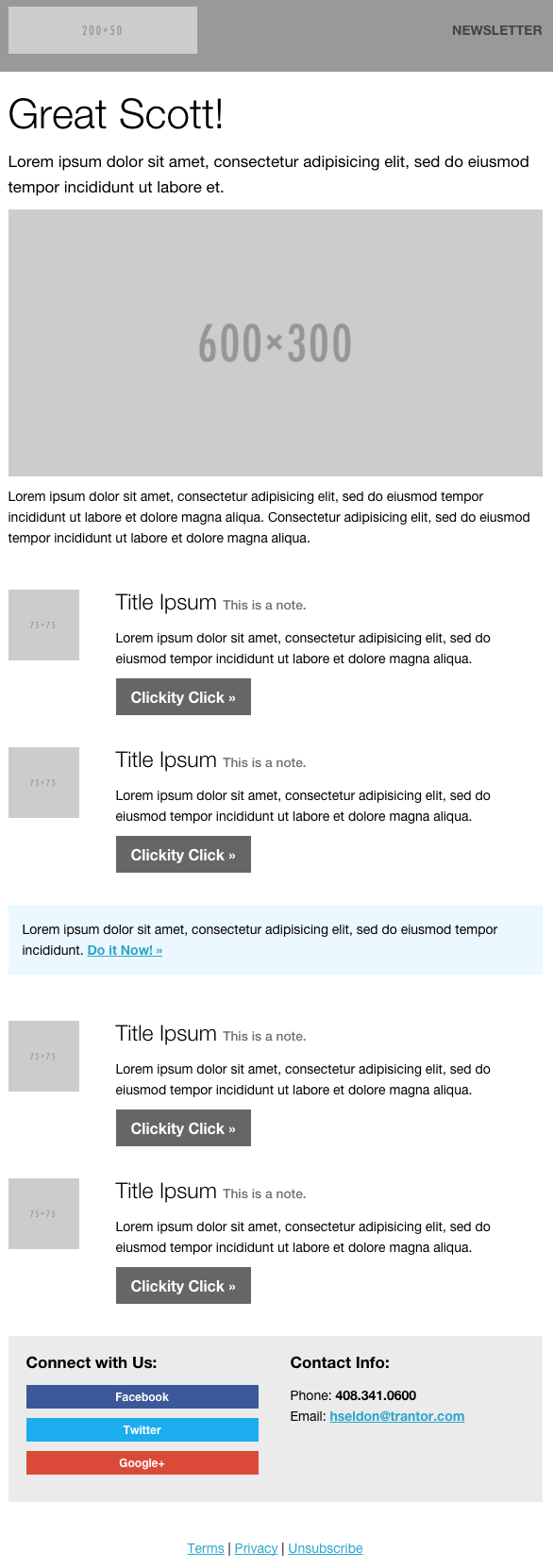
Image Credit: ZURB Studios
4. Wire by HubSpot
Price: Free
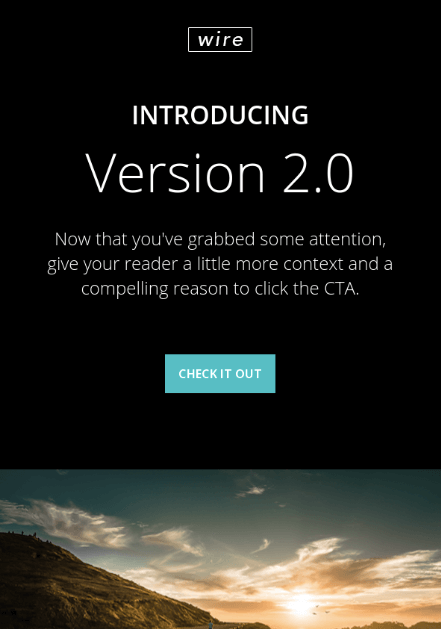
Wire is a HubSpot-designed newsletter template, catering to marketers who are rolling out a new product or service they want their prospects and customers to know about. The thin typeface and contrast between the dark background and vibrant product copy can add a sense of intensity to any new campaign.
5. 99designs
Price: Free
99designs is a growing online community and collaboration platform for designers and small businesses, and they have a great designer blog and business blog. As a free offering to their blog readers, they recently released a set of 45 free email templates — perfect for newsletters, promotional messages, and personalized responses. All of the templates are fully responsive and compatible with all major email clients.
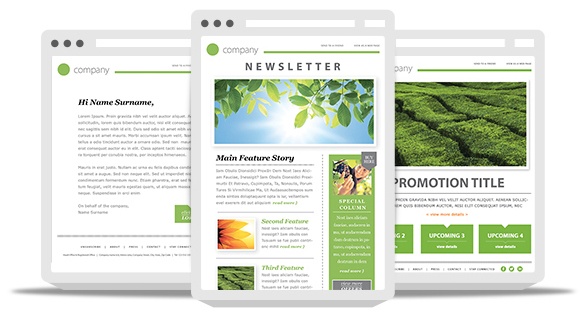
Image Credit: 99designs
6. Webinar Invite by WorkCast
Price: Free
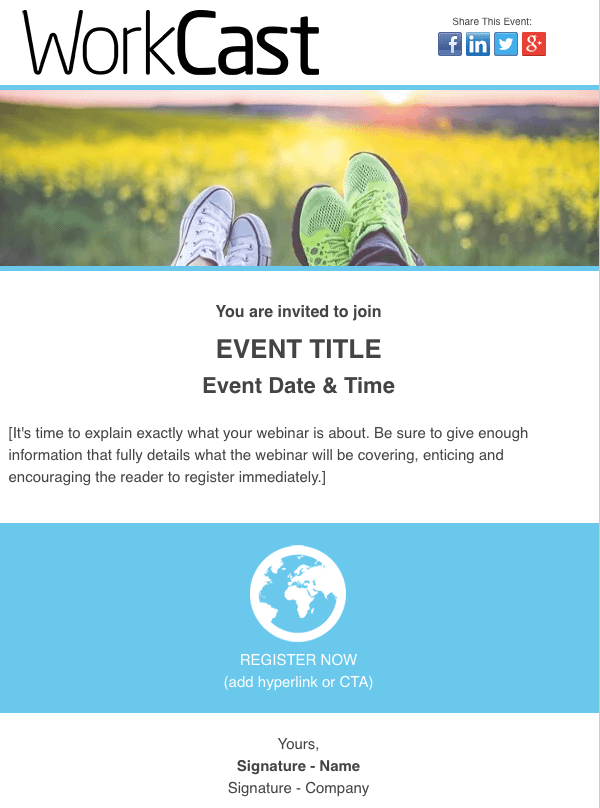
The email newsletter template below can promote anything from articles to new products, but it’s particularly useful for promoting a webinar you want people to register for.
Developed by WorkCast for the HubSpot platform, the template below offers a healthy balance of text and graphics so you can grab your recipients’ attention and give them the where and when of the webinar you think they’d be interested in attending.
7. ThemeForest
Price: $6-23/template
ThemeForest is an awesome resource for email templates if you have some budget to spend. Their library has over 460 newsletter templates in all different colors, styles, and themes. They’re rated using a four-star system, and you can filter by rating, price, recency, and popularity.
There are a lot to choose from, but here are four of our favorites:
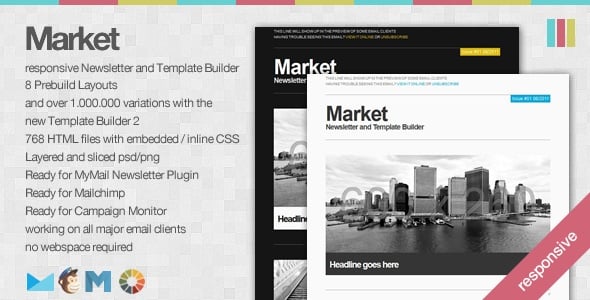
Market – Responsive Newsletter with Template Builder ($19)
This template has eight prebuilt layouts, 24 color variations, 24 full-layered PSD files, and more. Plus, it’s supported by all major email clients.
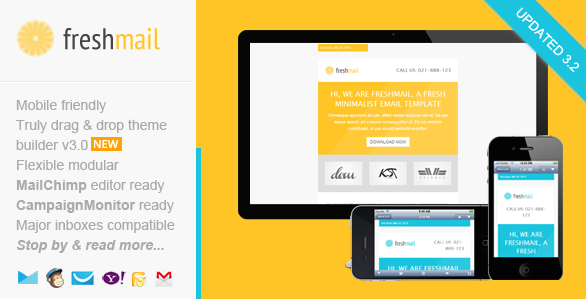
FreshMail, Responsive Email with Template Editor ($18)
Want a more minimalist look? This is a great template with minimalist design that’s also flexible and repeatable, so you can easily arrange the layout and use it to build your own unique template. Even better, it comes with helpful documentation and video tutorials to help you make the most of the design. It works for all major email clients and is responsive to mobile.
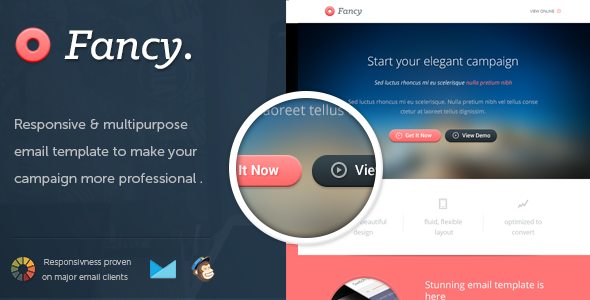
FancyMail – Responsive Email Template ($19)
If you’re looking for something more elegant and sophisticated, this might be the template for you. It comes in seven layout options and eight colors, along with six, fully-layered PSD files so you can customize as you wish. It works with all major email clients, is responsive to mobile devices, and includes helpful documentation so you can make the most of the template.
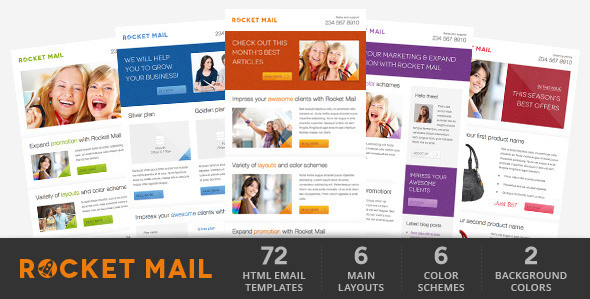
Rocket Mail – Clean & Modern Email Template ($16)
This template is great for marketers who are going for something that looks like your classic, basic newsletter design. It comes with 72 variations comprised of six color themes with six layouts each, and two backgrounds (light and dark) for each color. It has well commented HTML code to make it easier to follow along and customize. It works for all major email clients.
8. Resonant by HubSpot
Price: Free
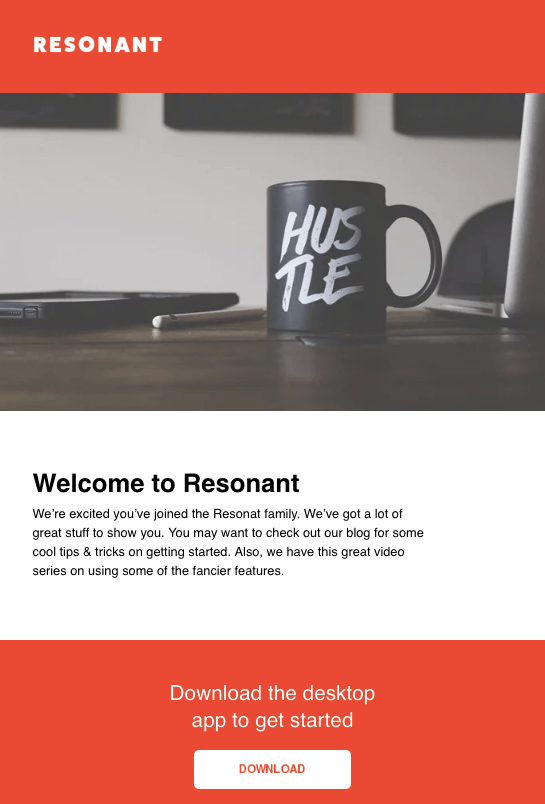
Resonant is another free email newsletter template by HubSpot. The template’s base design is perfect for welcoming new users to your service. At this stage in the customer journey, you don’t want to overwhelm your newest users with too much content right away — but you do want to give them a taste of who you are. The wide image space at the top and text blurb beneath it help you do just that.
Maybe you want to send this email to help new users complete their registration, or offer them the next tier of your product. The “Download” CTA at the bottom of the email template gives you a modest up-sell opportunity, which you can personalize with any links and copy you’d like.
9. Antwort
Price: Free
Antwort offers three newsletter templates: one single-column, one two-column, and one three-column. They’re all responsive to mobile devices, so columns on desktop automatically condense on mobile devices. You’ll notice they’re pretty minimalist in design, which helps if you want to do a lot of customization work. They were also designed with dynamic content in mind.
On desktop, they work for major email clients like Gmail, Yahoo!, Outlook, and AOL. On mobile, they work for Mail on iOS and Email on Android.
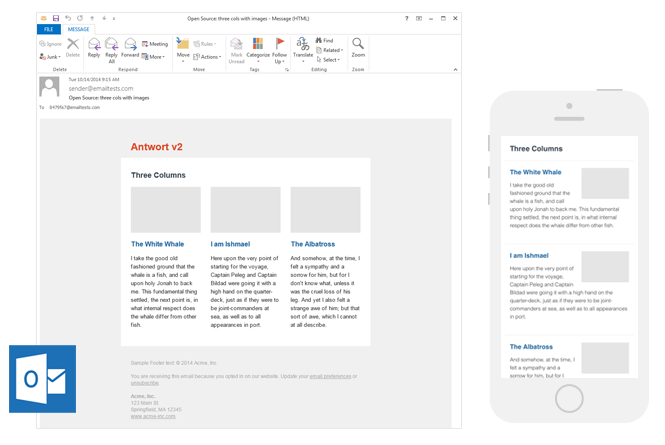
Image Credit: Julie Ng
10. Useful Notifications by TemplateMonster
Price: $14
TemplateMonster offers a variety of email newsletter templates, such as the Useful Notifications newsletter template pictured below, all of which are available for relatively low prices. Their templates are clean, customizable, and easy-to-use, and they’re compatible with most major email clients, such as Gmail and Yahoo Mail. Additionally, the templates come with built-in responsive layouts for screen adaptability, such as on the mobile phone pictured below, and PSD sources for a litany of customization options.
Image Credit: TemplateMonster
11. Themezy
Price: Free
Download sixteen free HTML, CSS, and PSD sources of customizable email templates on Themezy. You don’t have to submit an email address to get started, and there are various color schemes and layouts to meet your email list’s needs. Plus, they’re designed to be responsive across devices to ensure that your subscribers can read your newsletter.
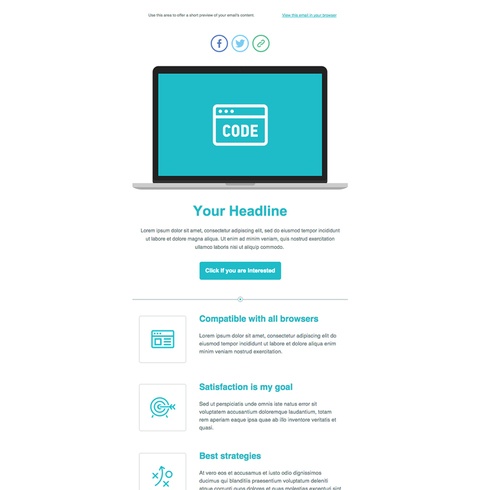
Image Credit: Themezy
12. Email on Acid
Price: Free
Email on Acid offers a free template with a basic, fluid design that’s also responsive to mobile devices. In other words, the three different “layouts” you see below trigger based on the width of the recipient’s screen.
Although there’s only one template here, you can actually mix and match each section of the layout to fit your specific design needs. The layout supports one, two, or three columns, and recipients on mobile devices will see the version that converts to a one-column layout for easy reading.
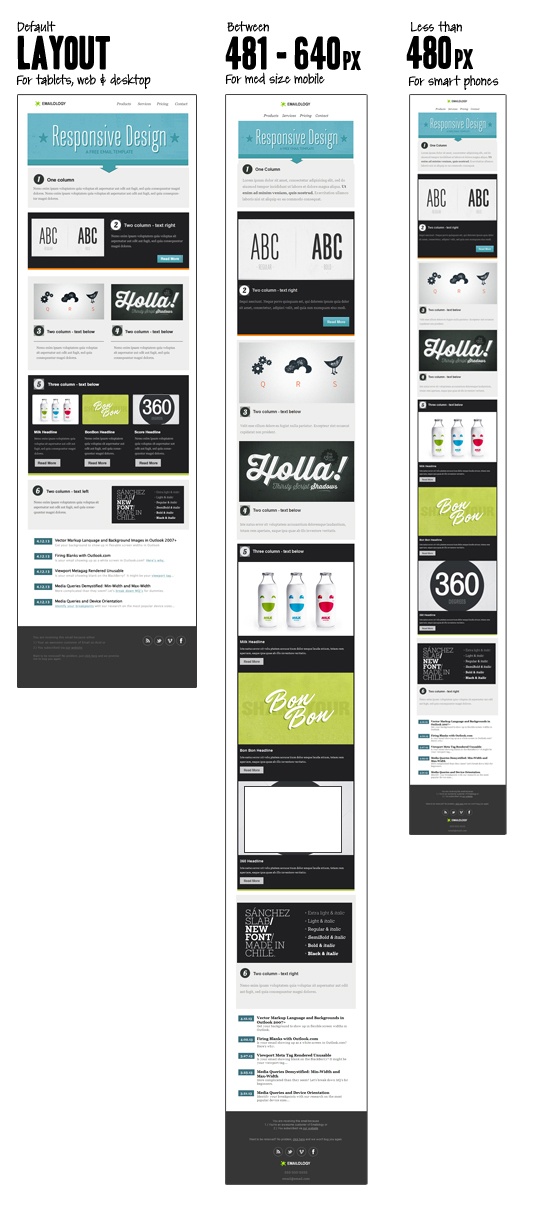 Image Credit: Email on Acid
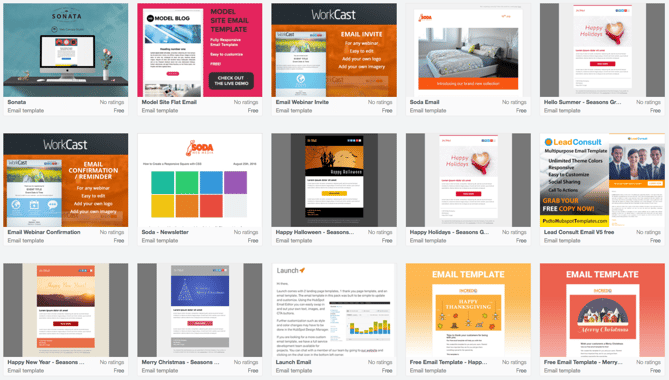
13. HubSpot Template Marketplace
Price: Free & paid options available
If you’re a HubSpot customer, HubSpot offers a great collection of email templates you can download or purchase from our template marketplace. Paid templates are available for as low as $1, and once you buy a template, you can start using it immediately right in HubSpot — no HTML or CSS required.
The second, fourth, sixth, and eighth templates on this list all came from our Marketplace.
Ready to draft your next 2019 email newsletter campaign? Download one of the excellent newsletter templates from the template galleries and landing pages above. Then, grab your free guide below for creating an email newsletter your audience will want to engage with.

The State of Voice: Looking Ahead to 2019
The word “voice” has taken on many meanings over the years.
At its core, “voice” is the audible sound made by humans to utter the spoken word. But it can also describe how something feels. How you imagine a written word to sound, in your own mind. It can describe unification.
Whatever definition the word “voice” conjures for you, know this: It’s likely to becoming increasingly used and important over the next year.
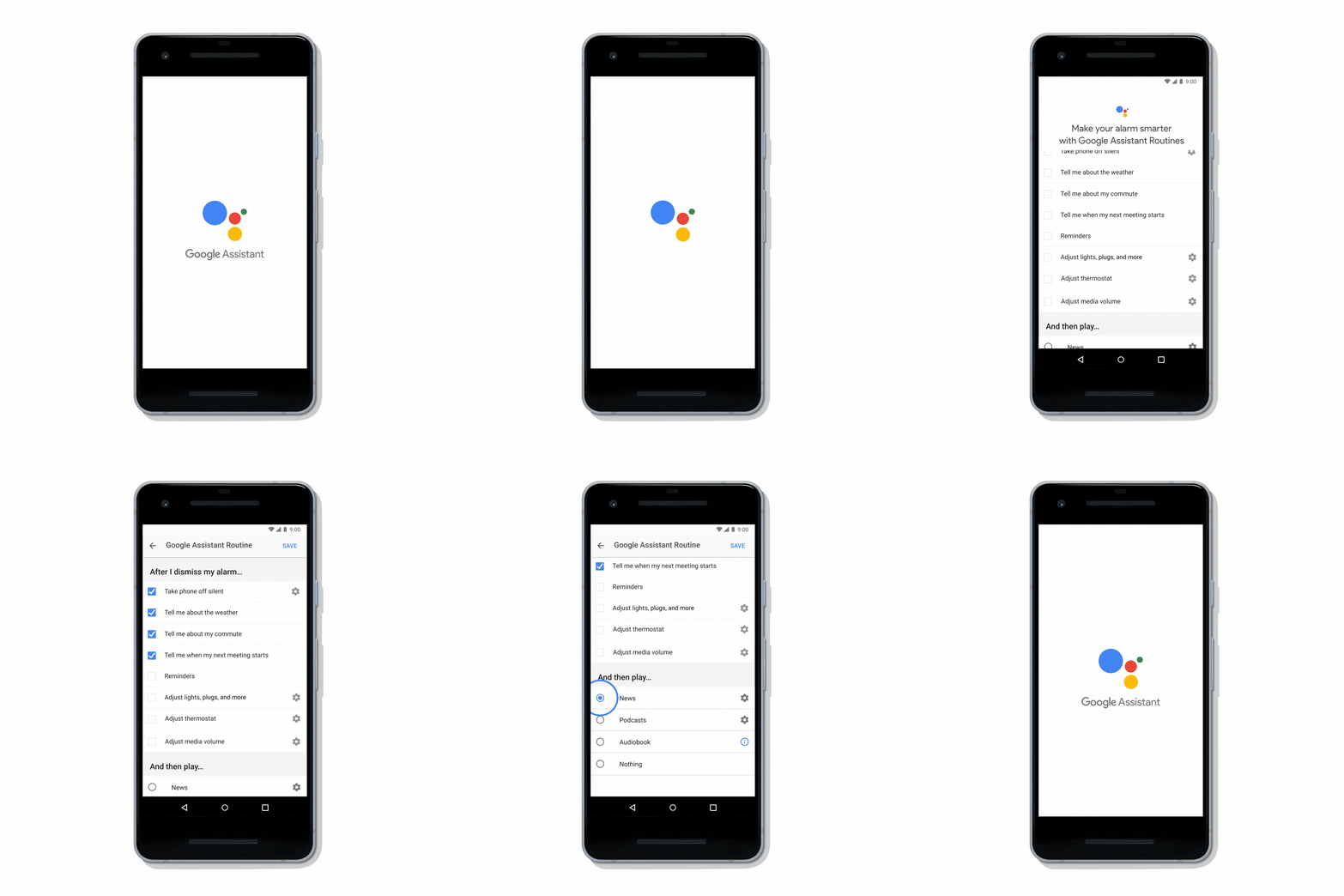
Around here, we most frequently use the word “voice” to describe the way people search for information or execute tasks that, thanks to artificial intelligence (AI) and other technology, can now be completed digitally. Rather than going to an online browser bar and entering a search query, we can now press a button on our mobile devices or speak a command to a voice assistant to get the information we want.
 Source: Google
You might even be on a first name basis with some of these voice assistants — “Hey Siri,” “Alexa!” and “Okay, Google” have become part of the daily vernacular for many of us (present company/author included).
But looking ahead to 2019, how many of us are really taking advantage of this technology — of using voice assistants, buying the hardware (like such smart speakers as the Amazon Echo or Google Home) that they equip, and even gifting others with them? And where we do use our voices in this capacity, what are we using them to do?
We asked over 3,400 people across the U.S., UK, and Canada to weigh in. Here’s what we learned.
The State of Voice: Looking Ahead to 2019
The Prevalence of Voice Assistant Use
Most People Say They Don’t Use a Voice Assistant
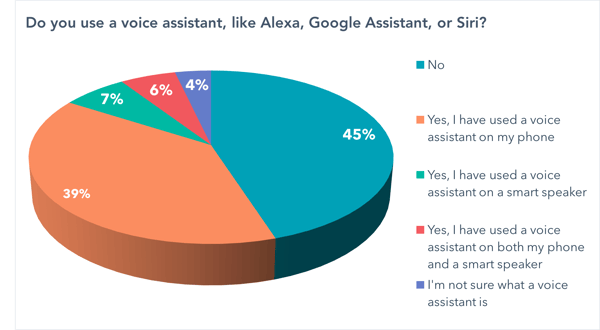
In response to the question, “Do you use a voice assistant, like Alexa, Google Assistant, or Siri?”, there was a close split between those who indicated that they do use a voice assistant (52%) and those who do not (45%).
 Data collected with Lucid
Out of those who do use voice assistants, most do so on their phones, suggested that the smart speaker market has a but of a road ahead in terms scale or becoming mainstream.
There also still remains some confusion about what defines a voice assistant, with about 4% of people answering that they aren’t sure what it is.
That awareness somewhat informs use cases for voice assistants, which is what we examined next.
The Privacy Issue
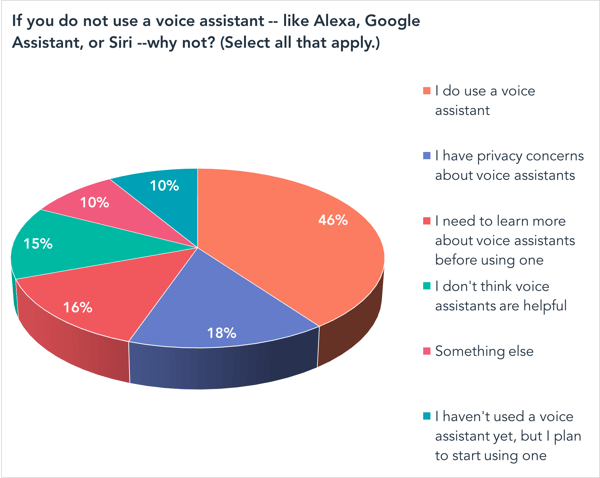
One barrier to scaling voice assistant use could be privacy. When we asked survey respondents what their reasons are for not using a voice assistant, most answered that they have privacy concerns about the technology.
 Data collected with Lucid
The issues of privacy and personal data protection have been front-and-center in 2018, with headline after headline appearing about how personal details from users’ online accounts have have been either improperly harvested or otherwise misused.
Where that particularly manifests in the realm of smart speakers became particularly relevant when Facebook — who faced one privacy-related crisis after another this year — launched a video smart speaker, Portal, which came equipped with a camera.
How People Use Voice Assistants
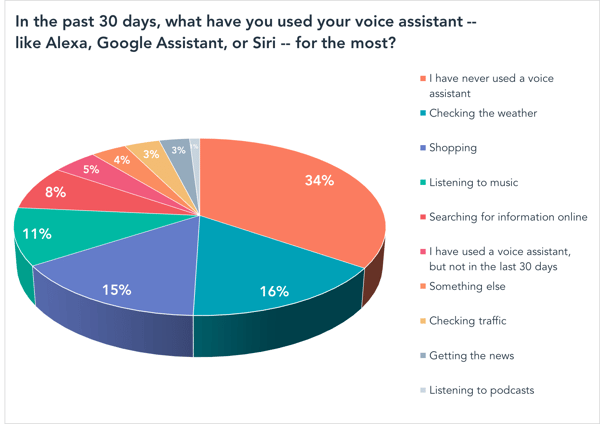
Then, we asked survey participants: “In the past 30 days, what have you used your voice assistant — like Alexa, Google Assistant, or Siri — for the most?”
Here, fewer respondents indicated that they don’t use a voice assistant (about 40%).
 Data collected with Lucid
As for the use cases among those who do enlist the help of voice assistants, they were somewhat fragmented, with a fairly small percentage of users falling into each category. The highest number, however, said they use the technology to check the weather, with shopping following close behind.
The State of Voice Shopping
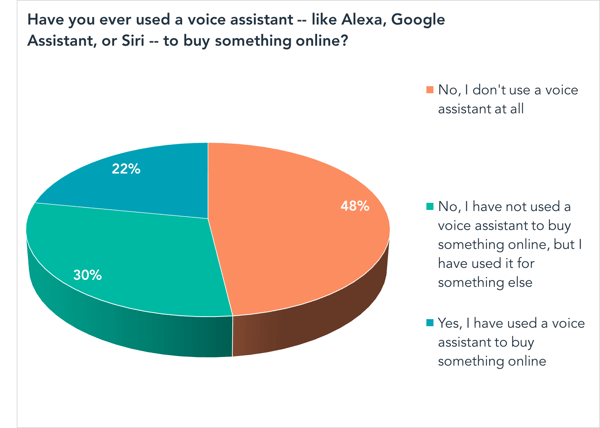
Given that shopping was one of the highest-indicated use cases for voice assistants, we want to drill down into that behavior and find out just how prevalent it was among users.
We asked: “Have you ever used a voice assistant — like Alexa, Google Assistant, or Siri — to buy something online?”
 Data collected with Lucid
While nearly half of respondents said that they don’t use a voice assistant at all, nearly a quarter of those who do said they have used the technology to make a purchase online.
When Amazon’s virtual assistant, Alexa, and the hardware it supports, Echo, first launched, that was one of the key selling points in the company’s narrative: Got your hands full? Now you can reorder dog food on Amazon, just by asking this speaker to do it for you.
The Future of Smart Speakers
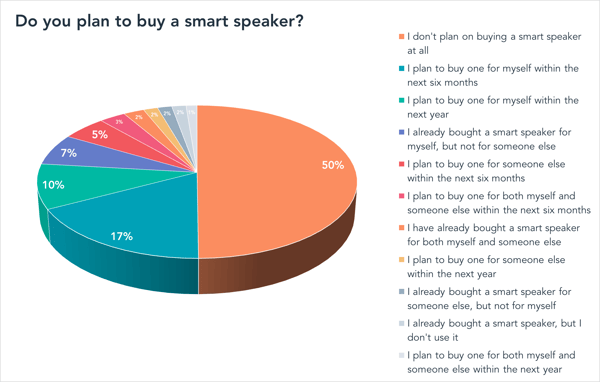
Finally, we wanted to know what people’s plans are for purchasing a smart speaker: the hardware that’s supported with various voice assistants to execute commands much like the ones we asked about in our use case question.
 Data collected with Lucid
Exactly half of respondents indicated that they have no foreseeable plans to buy a smart speaker. Out of those who do, most said they plan to buy one for themselves — not someone else — within the next six months.
The Year Ahead
Looking ahead to 2019, voice search shows some promise for growth. Over two years ago, Search Engine Land reported that 20% of all Google search queries are made by voice. With the amount of Google-Assistant-equipped devices — like the Google Home and Home Hub — having launched since then, that number is likely to have increased in the time following that statistic’s publication.
The same could be true of a mainstream presence of smart speakers. After all, our above research shows that 37% of people plan to buy a smart speaker either for themselves or someone else within the next 6-12 months — and about 14% of people said they have already made such a purchase.
What’s key to remember about the growth of both voice assistant use, as well as the hardware it will support, is how it will inevitably be used for marketing purposes as the technology permeates more households.
The New York Times recently published an article titled, “Marketing Through Smart Speakers? Brands Don’t Need to Be Asked Twice,” which explores ways that businesses are creating user experiences on these speakers — not to be confused with creating paid ads on them, since neither Google Home nor Amazon Echo will run them (yet).
To think about the best experience to create, have another look at the data on use cases. First, where does your audience fit in — and second, how can you help users who are new to or unfamiliar with voice assistants navigate this technology? As many predict, voice commands could feasibly go toe-to-toe with actions executed on desktop computers and mobile devices.
“These are still early days for marketing on voice devices,” writes Sapna Maheshwari, author of the aforementioned New York Times story. “But over time … voice interactions will begin to replace many of the activities that people are conducting on screens.”

The Meeting Agenda Sample That’ll Help You Run Productive and Efficient Meetings
A week without at least one pointless meeting is like getting accepted into Hogwarts. It’d be a dream come true, but sadly, it’ll probably never happen (don’t ever stop waiting for that owl to drop you your letter, folks!)
Pointless meetings infest the workplace. In fact, Atlassian estimates that you’ll waste 31 hours in unproductive meetings each month. And these lost hours will cost U.S. businesses more than $37 billion this year.
Needless to say, unnecessary or unorganized meetings are maddening. They waste the time you need to get your work done — work that you might have to finish during your own time.
Fortunately, there’s a solution for unproductive meetings — agendas. Agendas force attendees to prepare for the meeting beforehand, set clear expectations, keep people focused during the meeting, and budget the allotted time effectively.
To help you create a meeting agenda that’ll help you run a productive and efficient meeting, we’ve designed a sample meeting agenda that’s based off the meeting agenda that Roger Schwarz, an organizational psychologist, a leadership team consultant, and CEO of Roger Schwarz & Associates, uses to run his team meetings.
Meeting Agenda Sample
| Topic | Preparation | Structure |
|
1. What are the current issues with our blog’s email subscription strategy? Time: 15 Minutes Purpose: Analysis Leader: Cliff |
Read the attached memo that includes images of recent emails we’ve sent out and our email subscription and engagement data. |
1. Review data and highlight the key issues and insights extracted from it Time: 5 Minutes 2. Go over why you think email engagement has suffered Time: 5 Minutes 3. Ask team why they think email engagement has suffered Time: 5 Minutes |
|
2. How should we enhance our blog’s email subscription strategy? Time: 15 Minutes Purpose: Brainstorm Leader: Tova |
Come up with three ideas to boost the blog’s email engagement. |
1. Propose possible solutions for boosting email engagement Time: 5 Minutes 2. Ask team what they think of your proposed solutions Time: 5 Minutes 3. Ask each team member to propose one of their own solutions Time: 5 Minutes |
|
3. What are the next steps that we should take? Time: 15 Minutes Purpose: Decision Leader: Karla |
Think about how you could practically implement each of your ideas into our blog’s email subscription strategy. |
1. Decide on a proposed solution or multiple solutions Time: 5 Minutes 2. Explain why we’re going to pursue that specific path Time: 5 Minutes 3. Divvy up responsibilities to each team member Time: 5 Minutes |
As you can see, we segmented our agenda into three sections — topic, preparation, and structure. Here’s an analysis of why modeling your meeting agendas like the one above will help you run productive and efficient meetings.
Topic
When you design your meeting agenda, segmenting it by topic will set clear expectations and keep you on track during the meeting. Before you decide on the topics, though, consider asking your attendees what they’d like to discuss and why.
If someone suggests a topic that isn’t relevant to all the people attending the meeting, don’t include it on the agenda — discussing an issue that’s only of interest to a small part of the group will disengage the rest of the attendees and make them feel like they’re wasting their time. But, before the meeting occurs, remember to tell the person who suggested that topic the exact reason why you aren’t including it on the agenda.
Framing your topics as questions will also lead to productive and efficient meetings. Doing this prepares people for the meeting’s particular talking points and forces them to stay focused on them. For instance, which topic do you think you could better prepare and provide a solution for — “Email Subscription Strategy” or “Which types of posts should we send through our email subscription?”
Additionally, setting an allotted time frame for each topic will help each attendee cover all their speaking points, answer questions, come up with solutions, and approve next steps without wasting too much time.
Finally, stating the topic’s intent will clarify what needs to get accomplished during the allotted time frame. This keeps attendees laser-focused on achieving a goal and minimizes the amount of time wasted trying to figure out the point of discussing a specific topic.
Preparation
If you send your agenda to attendees before the meeting and identify how they can best prepare for it, you’ll get everyone up to speed and ready to discuss their thoughts when the meeting starts. You’ll also have deeper, more insightful conversations because no one will need to waste time sorting through their initial questions about a subject they’ve already prepared for.
Structure
Structure adds a concrete set of steps to each of your agenda’s topics, streamlining your meeting. By assigning particular talking points and allocating specific time frame to each topic, your attendees will know exactly what to expect and discuss during each segment of your meeting.
Meetings Shouldn’t Be a Waste of Time
Unproductive or unorganized meetings are as beneficial to you as procrastinating on the web — they’re timesucks. Fortunately, the sample agenda above can help you design and structure a productive and efficient meeting that will make people feel excited, focused, and ready to get to work.

The Essential Introduction to Google Merchant Center
Imagine this — you’re having friends over for a dinner party, and your recipe (which you found on Google) calls for spiralized zucchini noodles.
On your smartphone, you Google “spiralizer” and find this:

Among the first results you see are Williams-Sonoma’s spiralizer products. You click one, and are immediately taken to the product page on Williams-Sonoma’s website, where you can order your spiralizer within minutes.
Admittedly, this type of instant shopping is hardly new. We’ve seen an incredible rise in ecommerce over the years — today, ecommerce influences 56% of in-store purchases, and 10% of all U.S. retail sales. That number is expected to grow by 15% each year.
Ultimately, if your product doesn’t appear in search engines, you’re missing out on a large majority of your potential consumers.
However, you might not realize that Williams-Sonoma is a loyal customer of Google Merchant Center, a platform with tools that allow your business to create smart ads for Google, Google Images, and YouTube, reach your ideal customers globally, and use analytics to get better at reaching people already searching for your products.
If you’ve never used Google Merchant Center, you might be feeling overwhelmed. Don’t worry — here, we’re going to cover all the fundamentals of getting started with Google Merchant Center, to ensure your products are online and easy-to-find for those who need them.

Set Up a Google Merchant Account
It’s easy enough to set up a Google Merchant Account — in fact, there are only four steps before you’ll have a Google Merchant Account of your own. Here’s how:
1. Go to the sign-up form for Google Merchant Center. Fill in the required information about your business, including which country your business is based, the name of your business, and your website URL. When you’re finished, click “Continue”.

2. On the next page, read the Terms & Conditions. Check the box marked “Yes, I agree …” when (and if) you agree, then click “Continue”.
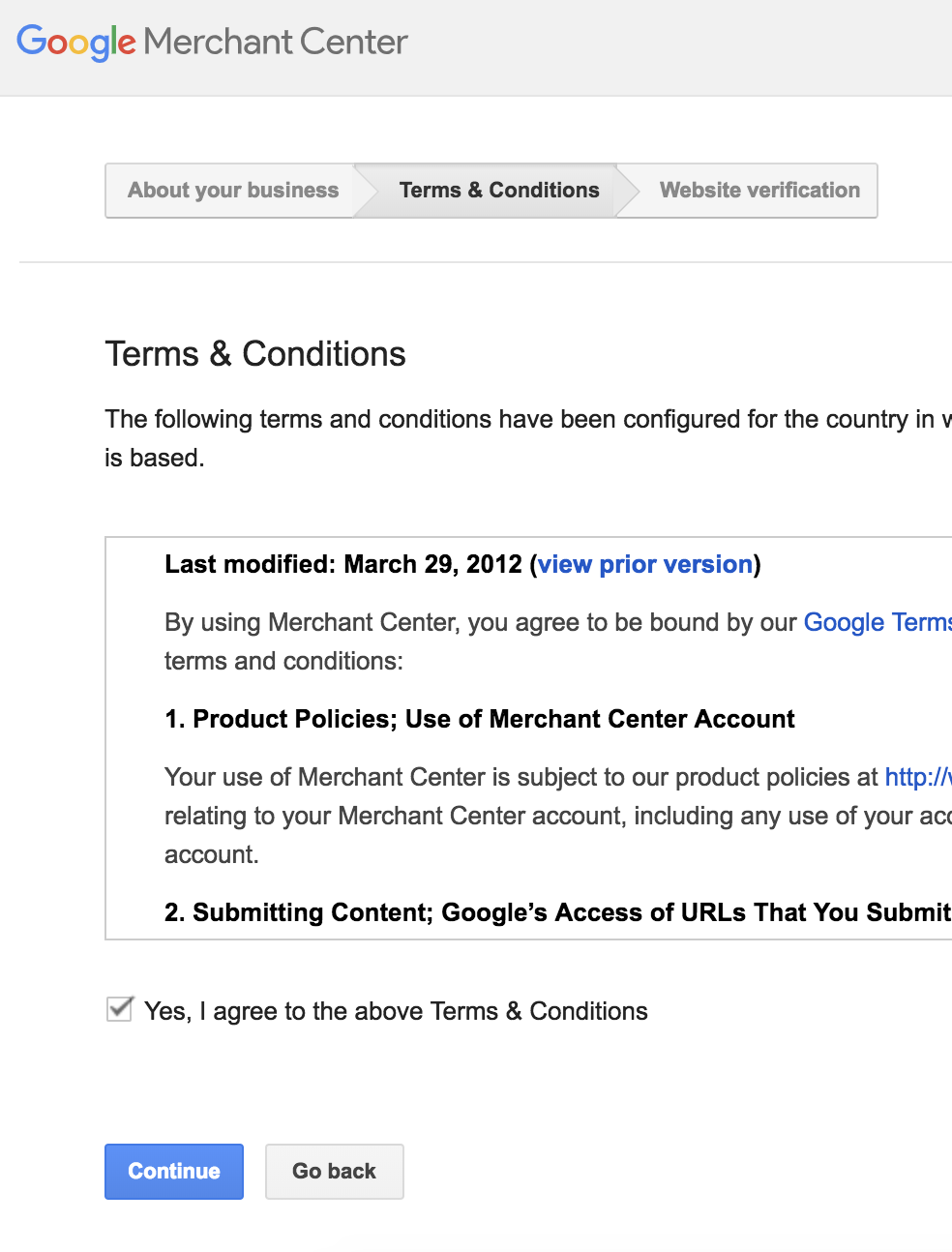
3. Enter your website URL into the box, then click “Save” and “Finish”.

4. This step is optional, but if you don’t complete it now, you’ll have to complete it later within the Merchant Center dashboard — if you want to wait, click “Skip”. Otherwise, use one of the four offered methods to verify your website URL, then click “Finish”.
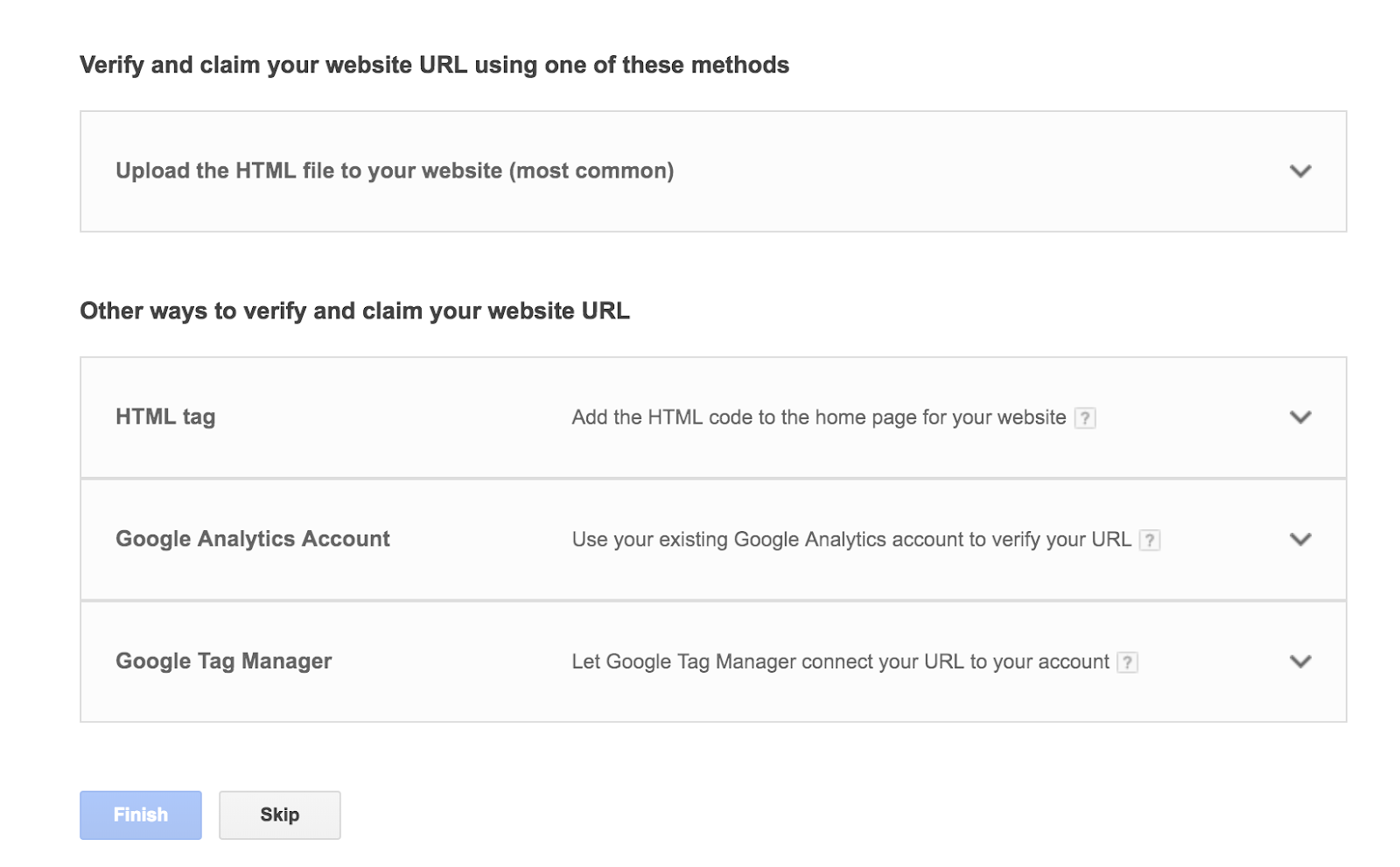
5. Voila! You’ve officially set up your Google Merchant Center.

How to Use Google Merchant Center
To manage your shopping ad bidding strategy, create advertising campaigns, and track ad performance, you’ll use Google Ads and Analytics — not Google Merchant Center.
Why, then, should you use Google Merchant Center?
Essentially, Google Merchant Center can help you do three things:
- Notify Google you have products to sell
- Give Google information to create a targeted ad for your products
- Provide Google with information necessary to ensure Google will showcase your products to users who are the best fit for your products
Let’s dive into how you can set up your Google Merchant Center to ensure you accomplish all three.
To ensure Google has all the correct information to find your products, create targeted ads, and showcase your products to the right people, it’s critical you upload a complete product inventory to Google Merchant Center.
Fortunately, Google Merchant Center allows you to upload straight from their own, pre-designed Google spreadsheet template, making it incredibly easy.
To upload your product inventory, follow these steps:
1. Go to “Products” within your Google Merchant Center, then select “Feeds”. Click on the big blue “+” icon to add new products.
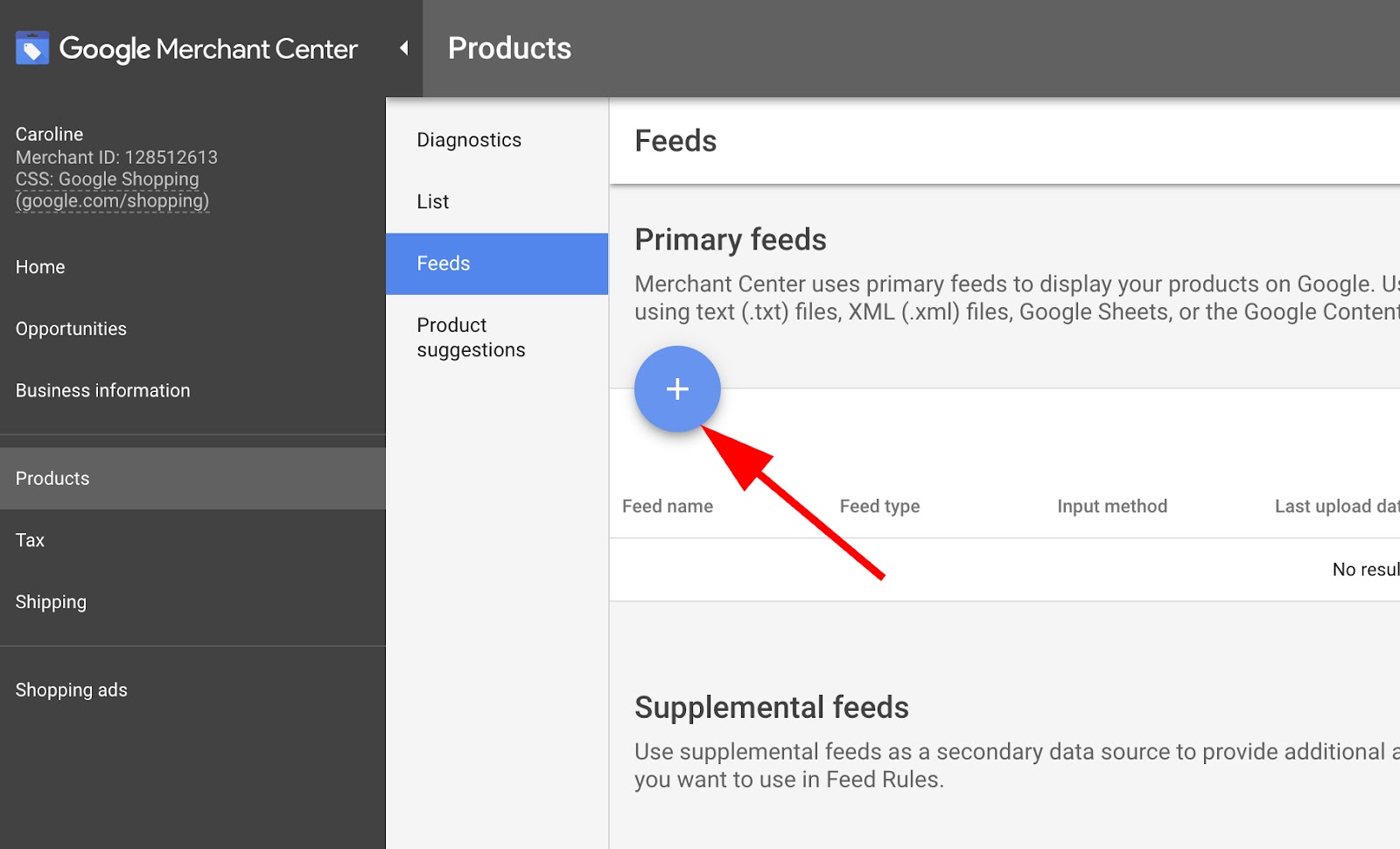
2. Fill in Basic information, including the country you want to sell products to, and the language. This will help Google ensure your products appear to your ideal demographic, in both the language and currency most appropriate. Then, click “Continue”.
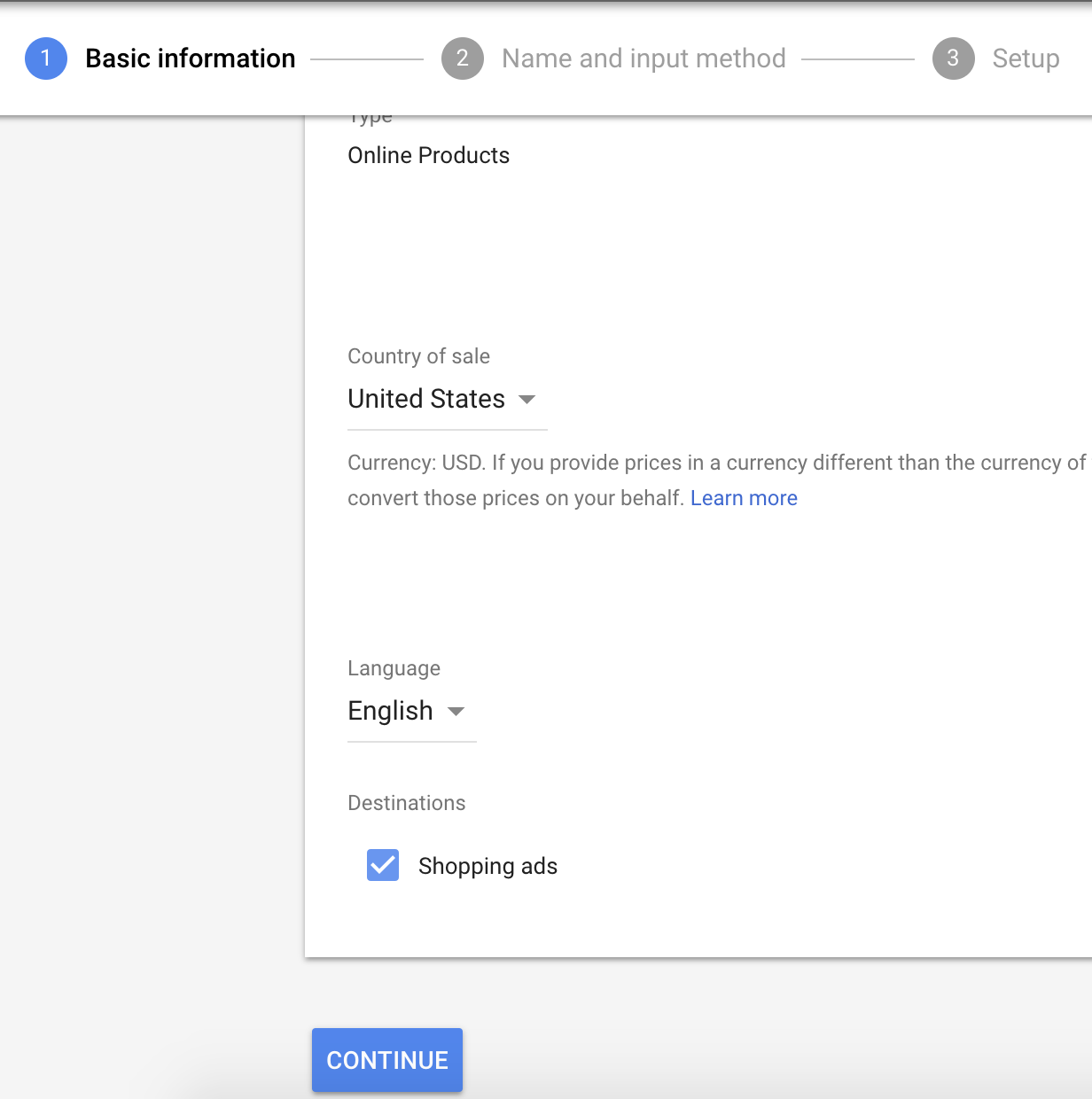
3. Name your feed and choose your input method. For our purposes, I chose “Google Sheets”. Then, click “Continue”.
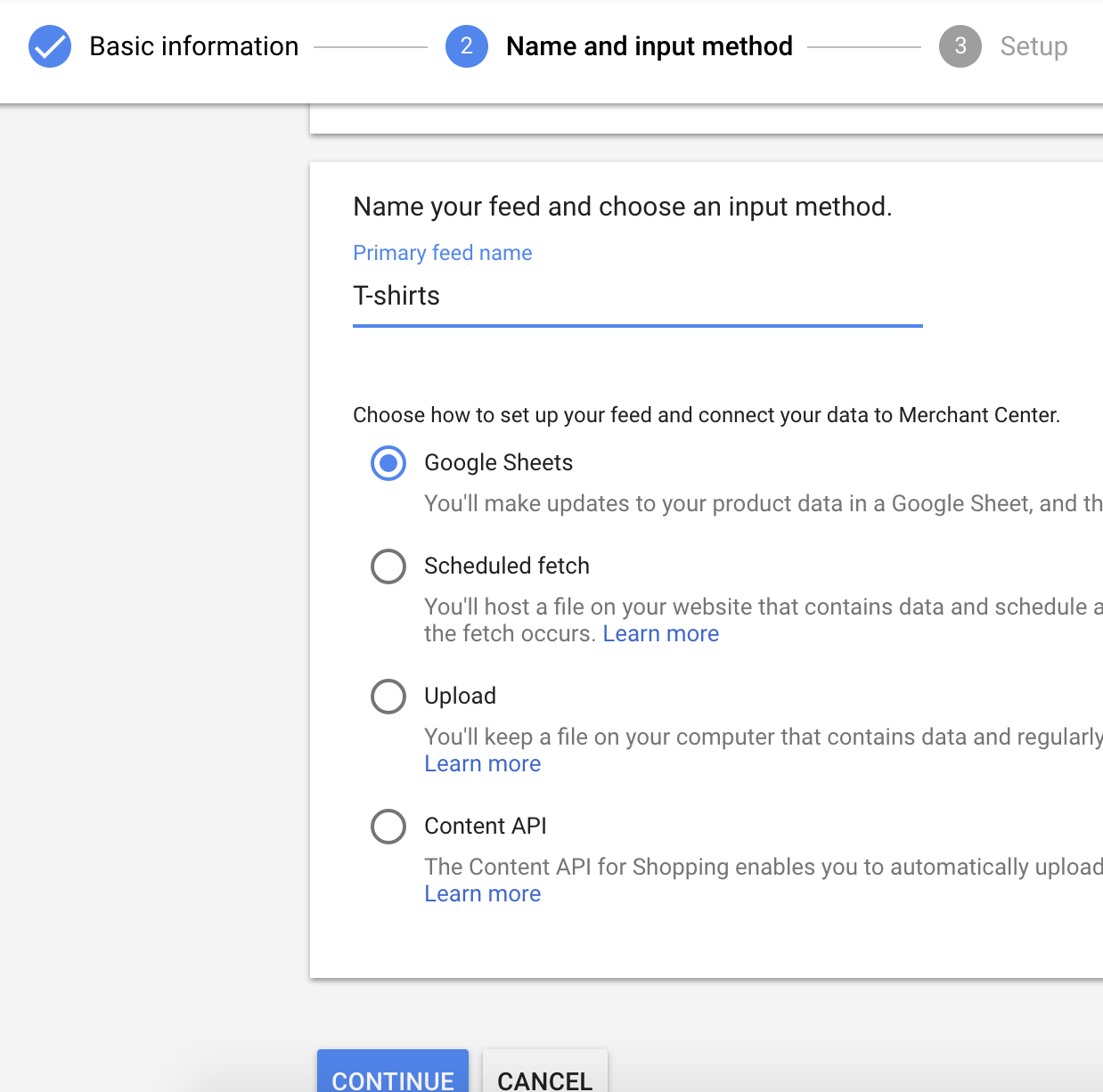
4. If you choose to upload with a Google spreadsheet, you can either choose an existing spreadsheet or use Google Merchant’s spreadsheet template.
To use Google Merchant’s pre-made template, I chose “Generate a new Google spreadsheet”. You also have the option to select an upload schedule, i.e. daily or weekly, depending on how often you update your inventory. Then, click “Continue”.
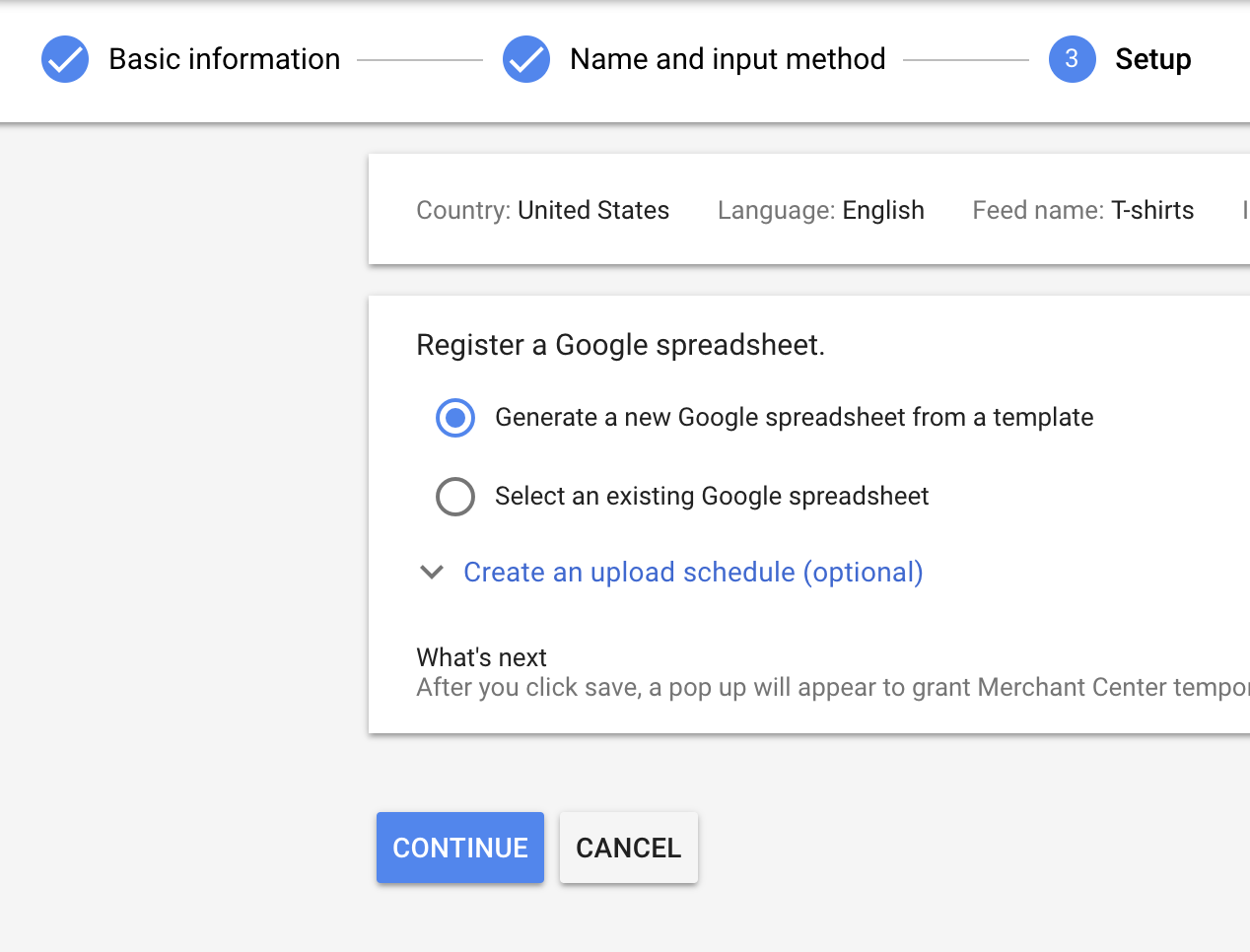
5. Within the spreadsheet, fill out the necessary columns, including “id”, “title”, “description”, “link”, “condition”, “price”, “availability,” etc. Be as specific as possible, especially in the “description” column, to ensure your products are correctly advertised.
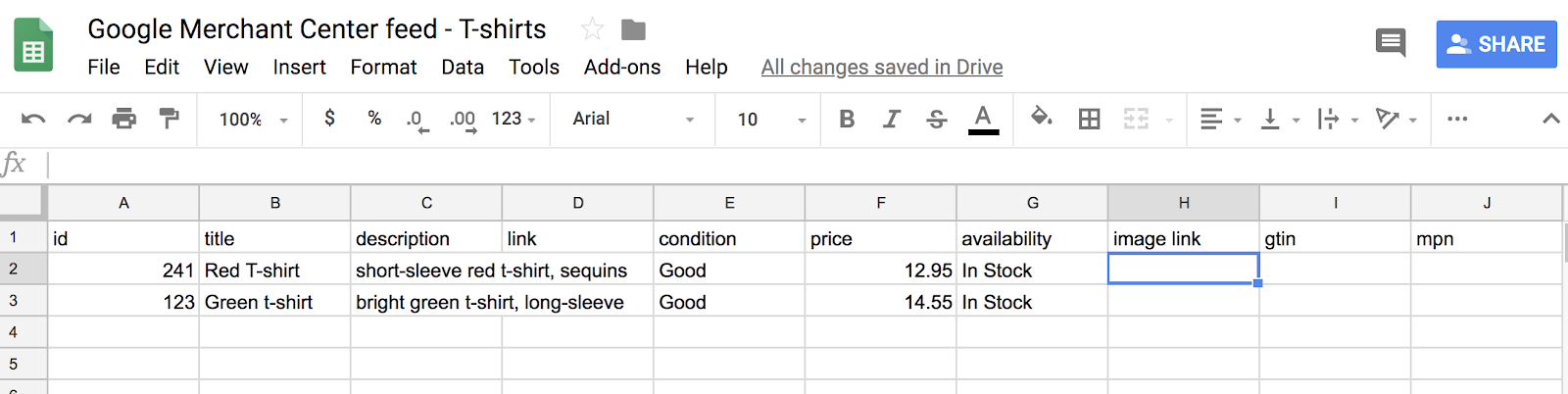
6. When you’re finished and ready to import, go to “Add-ons”, “Google Merchant Center”, and then “Upload sheet”.

If you’re unsure of what any of these columns mean, such as “id” or “gtin”, take a look at Google’s Product Data Specification page for details.
It’s important to note, what you type into your inventory is exactly what will appear when a user clicks on your product in Google Shopping, so it’s critical the information is both specific and accurate. You’ll want to make sure information such as “price” matches exactly what is on your website.
For instance, here’s how a spiralizer appears in Google Shopping, with a full description, price, and title that matches the information on the product’s website.

How to Make Changes to Your Merchant Center Product Feed
If you need to make changes or update your feed (i.e. inventory), you don’t have to register or upload a new spreadsheet. Instead, you can use “supplemental feeds”, which allow you to provide additional data that can be integrated with your existing data in the primary feed.
A supplemental feed can’t be used as a standalone feed — instead, its purpose is to update existing product data in your primary feed, so you don’t have to create a new primary feed every time your inventory information changes.
To create a supplemental feed, go to the “Feeds” section and click “Add a supplemental feed”. Follow the prompts and provide information including your supplemental feed name, input method (i.e. Google Sheets, Scheduled fetch, etc.), which primary feed you want to link to, and a scheduled fetch for your product data so you don’t need to manually upload it.
Alternatively, you might use Feed rules to resolve errors or help Google Merchant Center correctly interpret your primary feed’s data, if it seems it isn’t working or needs to be adjusted.
To do this, go to the “Feeds” section, click the feed you want to fix, and select the “Rules” tab. Choose the country to which you want to apply the rule (if you have more than one country of sale), then click “Create Rule”.
Finally, select the attribute you’d like to impact, configure your data sources, and click “Save as draft”. Then, select “Test changes” to ensure you’ve made the correct changes to your product feed. If you’re happy with the changes, click “Apply”. If you don’t want to apply the changes after all, click “Discard”.
Next, take a look at How to Optimize Your Google Shopping Data Feed.