What Will It Take Us to Finally Leave Facebook?
Oh, Facebook. What are we going to do with you?
In the past two years alone, we’ve learned that the network was weaponized by foreign actors to spread misinformation in an effort to influence the 2016 U.S. presidential election. We’ve learned that personal user information was improperly harvested by an voter profiling firm. And, last month, we learned that hackers used a site vulnerability to scrape the personal details of 30 million users.
That doesn’t even cover everything.
It’s true: These events, on the surface, most directly impact consumers, marketers and small-to-midsize businesses (SMBs) are also feeling their overall impact.
And yet, many Facebook users, marketers, and SMBs have found it so very, very hard to leave the site.
This phenomenon has been measured before in some of our research, which month-over-month has reflected a general sentiment among users to stick with Facebook, despite its many issues. But we wanted to take a closer look — at the impact on marketers and SMBs, at a zoomed-in perspective of user sentiment, at the “why” behind the overall reluctance to quit Facebook altogether, and what it might take for people to finally leave.
To get to the bottom of these different pieces of one big, social puzzle, we ran some more surveys, and discussed the results with Likeable Media CEO Carrie Kerpen.
Here’s what we found.
The Impact on Marketers and SMBs
Facebook has made a number changes in response to the aforementioned issues its experienced over the past two years.
To help curtail the spread of misinformation, for example, it began this spring requiring labels for all political ads and content — like candidates running for an elected office, or issues that frequently arise during elections.
It began applying similar labels to news items, too, indicating where and how many times that story (from that publisher) has been shared on Facebook, as well as a “More From This Publisher” feature.

Source: Facebook
While the company’s intended goal might be to regain or improve user trust, the outcome has arguably been felt the most by marketers and SMBs. That’s compounded by a major January News Feed algorithm change that prioritized content from users’ friends and family — leading to a drop of up to 50% in business Page engagement for certain categories.
But consider another extension of Facebook’s content-labeling requirement that applies to media companies. In addition to labeling political or issue-based ads as such, the company also began requiring the same labels be placed on promoted news stories about political topics. In other words, a newspaper’s story about an election, if promoted or boosted, would be labeled as a political ad.
According to the Columbia Journalism Review (CJR), these requirements have caused a number of smaller publishers to curb their use of Facebook’s publisher tools, or in some cases, stop promoting their content on the site completely. It shares the story of Pennsylvania newspaper the Observer-Reporter, which has had the promotion of many of its stories denied altogether from Facebook — due to their alleged “political” nature — much of the time without any explanation.
It begs the question: What’s the value tradeoff for marketers and SMBs? And furthermore, with all the costs involved with these changes — will they even work?
That’s where the public perception comes in.
The Facebook Trust Barometer: Where Do Users Stand?
Overall User Trust in and Allegiance to Facebook
First, we wanted to measure overall, recent trust levels in Facebook. So, earlier this week, we asked 828 internet users across the U.S., UK, and Canada: Over the past week, how would you measure your overall trust in Facebook?

Nearly 40% of respondents indicated that their trust in the site hadn’t changed at all — even after Facebook had recently revealed the extent of the data obtained by hackers in the site’s recent data breach (which, it turns out, included recent search queries and check-in locations).
But we wanted to see what would happen if we added more context to the question — and see what actions people said they would take in response to that information. So, we asked another 848 internet users across the same region: Facebook disclosed that in a recent data breach, personal details of 14 million users — like their 15 most recent searches and the last 10 places they checked into or were tagged in — were scraped by hackers. Does this affect how you’ll use the site going forward?

Looking at these results, the unwillingness to leave Facebook, even after all is said and done, could be chalked up to awareness. With the additional context, we saw slightly more respondents indicating a possible deterioration in trust in Facebook — with over a quarter saying that the data attack was enough to make them at least use the site less.
Still, most users — over a third — said that it wasn’t enough to make them leave the site.
Confidence in Efforts to Curb Election Meddling
Facebook has made a number of efforts to stop the weaponization of its site to influence elections — ranging from the aforementioned content labels, to new rules prohibiting posts that aim to suppress voters.
The company has also publicized its efforts to squash election interference, perhaps with the intention of convincing users and lawmakers alike how seriously it’s taking the issue — and even recently invited journalists into its “election warm room” to see what that day-to-day work looks like.
Facebook showed off its “election war room” yesterday – the office where it’ll monitor and respond to possible election interference efforts leading up to the midterms.
Here’s what it looks like. pic.twitter.com/sGiiJgA4xg
— Kurt Wagner (@KurtWagner8)
October 18, 2018
But we wanted to know how confident the public is in Facebook’s efforts to stop election interference in its tracks, including some of the loopholes that have been found in them. A recent New York Times story found, for example, that political ads can still be somewhat anonymous, thanks to a technicality that allows ad buyers to write anything in the “paid for by” field.
That is one hell of a loophole you left there, Facebook. By @kevinroose https://t.co/fMwtcqforP pic.twitter.com/pu6khp7f0I
— Heather Kelly (@heatherkelly)
October 17, 2018
We asked another 837 people across the U.S., UK, and Canada: Do you think the actions Facebook is taking to prevent efforts to influence the 2018 U.S. midterm elections will work?

The results didn’t indicate resounding user confidence in Facebook’s efforts to curb election meddling — while about 44% say that they might work to some extent, over a third don’t believe they’ll be effective at all.
The Perception of Spam and Misinformation on Facebook
Earlier this year,
What Will It Take Us to Finally Leave Facebook?
To answer the above question, I needed to call in an expert: Likeable Media CEO Carrie Kerpen.
When it comes to the tendency of users to stick with Facebook in the face of ongoing controversy, it seems to be a combination of awareness and trade-offs. We’ve discussed the latter before, when HubSpot VP of Marketing Meghan Keaney Anderson pointed to the lack of a widespread replacement for Facebook’s ability to keep users connected to family, friends, and news.
Kerpen agrees that this phenomenon of connectedness does underscore the unwillingness among users to delete their Facebook accounts for good.
“Your Grandma is likely not on Twitter, but she’s on Facebook now,” Kerpen says, pointed to Facebook’s diversified user base among different populations. “It’s easy to use Facebook, every one is on it, and it’s widely adopted.”
Then, there’s the awareness aspect. Even when people do know about Facebook’s various issues, and think they understand them, it’s difficult for most users to tangibly experience the consequences of them.
“Issues are talked about, but rarely felt. You hear about ‘the Russians,’ but have you ever [directly] felt the impact of that?” asks Kerpen. “Chances are, if you’ve been impacted, you don’t realize it. Until people feel tangible effects of privacy breaches, they won’t be bothered by them.”
What, then, will it take for people to leave the site? According to Kerpen, one of two things need to happen.
In one scenario, “Facebook becomes less relevant and necessary to [users’] lives,” she says. “That’s unlikely, unless another network is able to have the widespread reach that Facebook has achieved.”
If that happens, the impacts and awareness among users will have to become more tangible. “The privacy breaches actually impact lives at an individual level. They may have impacted elections, for instance, but until a user has to call their credit card company and dispute charges, it really doesn’t feel like it impacts them on an individual level,” Kerpen explains. “These breaches may have given companies data — but until a user’s private data is exposed in a way that impacts them directly, they won’t care.”
That signals some of the impact of these issues on marketers and SMBs. Take the earlier CJR piece, for example, which shares the stories of publishers whose brand engagement — like visits to their sites — have dropped over the past year as a result of Facebook’s changes.
That’s the type of case where the impact of what’s taken place on Facebook over the past two years is tangibly experienced by — and at the expense of — those from whom Facebook earns the most revenue (read: advertisers).
And while the company has implied that it’s willing to sacrifice income from content promotions and ads from the marketers and businesses using these tools, one might wonder at what point more of these professional users — like some cited in the CJR story — might begin to reconsider or reshape their use of Facebook.
“I think you’ll see a temporary scale back from Facebook if these practices continue, but ultimately, brands follow what works,” Kerpen explains. “Television was the top medium for advertisers for years, and there was no actual way to prove a direct correlation to sales. Facebook has both the broad reach that television did for content consumption, and the ability to directly correlate to action the way search does.”
In any case, says Kerpen, the answer to the question of “what will it take?” comes down to palpable, sustainable effects felt by all users of Facebook.
“When and if people feel individual pain,” she says, “they’ll care.”

The Ultimate Guide to Publishing
It’s an incredibly exciting time to be an author.
People are open to new ideas, readers are consuming content through a variety of media, and traditional publishers no longer stand in the way of releasing a new title.
Raise your hand if you’ve ever considered publishing a book. (Mine is raised right now, too.) Now, keep your hand up if you know how to publish a book. * … slowly lowers hand*
Publishing a book has always been one of those mysterious, cryptic processes reserved for the uber-famous or uber-rich. Books just seem to appear on the bookstore shelves … but they’ve got to come from somewhere, right?
Right. Nowadays, they come from multiple sources, which is good news for those of us who aren’t uber-famous or uber-rich. Regardless of your status, income, hometown, or connections, you (yes, you!) can publish a book.
All you need is a great idea, an even better sense of perseverance and patience, and this guide. Keep reading to learn more about publishing or use the chapter links below to skip ahead.
The publishing industry hasn’t always been so diverse and accessible, though. From the very early days of cave walls, clay tablets and papyrus to the modern era of eBooks, the publishing industry has undergone many major changes.
Here are some highlights.
- 1456: The Gutenberg Press publishes the first book ever: the Bible.
- 1776: Common Sense is written and self-published by Thomas Paine. He sold over 100,000 copies within three months.
- 1800s: The Penny Press arrives in the U.S., making newspapers and news accessible for a penny. Since more people can consume news for less (versus just the rich), letters to the editor increase.
- 1940-1970: The first eBook is published, although historians disagree on which one was truly first.
- 2000s: Social media sites like Facebook and Twitter emerge, as does blogging. Instead of sending letters to the editor, the masses take to blogging to share their voice and opinions.
- 2007: Print on-demand gains traction. Amazon releases Kindle.
- 2009: Self-published titles surge to double the amount of traditionally published titles.
- 2011: eBook sales surpass printed books for the first time in history.
As for 2018, this year has seen an increase in traditional and indie bookstore sales. Audiobooks have also become the fastest growth area in self-publishing. Lastly, most authors are opting to become hybrid authors — meaning they make their books available in both traditional and electronic formats. How do they do this? Keep reading to find out.
What’s the Difference Between Traditional and Self-Publishing?
So, we’ve referenced traditional and self-publishing (or indie publishing) multiple times so far. What do these processes mean? How are they similar and different?
Traditional publishing refers to the process of working with an agent and/or publishing house to edit, release, and market a book. Despite the lack of creative control given to authors in the traditional publishing process, once a publisher purchases a manuscript, they assume all financial risk with selling your book. New authors with little to no audience or follower base might choose to publish traditionally.
On the other hand, self-publishing is when authors assume all creative and financial control of the publishing process. They choose which independent agents, editors, designers, and distributors to work with, and they assume all or most financial risk associated with putting their book out. Experienced authors or people with a large audience (from a blog or social media) might choose to self-publish.
In the next section, we’ll discuss how to publish books via these different processes. Before we dive in, though, let’s define a few other popular terms in the publishing world.
What Does a Literary Agent Do?
A literary agent is similar to a celebrity or sports agent. They act as a liaison between the talent (the author) and anyone who could profit from or work with the talent. Literary agents typically work with authors to pitch and secure contracts with publishers. They also represent authors if their book is sold to film producers or studios.
Traditionally, literary agents are paid a percentage of any book sales negotiated on behalf of their client. How do agents benefit authors? Outside of making sales, literary authors connect their client’s work to publishers, negotiate contracts, ensure royalty payments, mitigate problems, and provide invaluable guidance and mentorship throughout the publishing process. Agents can also help new authors gain recognition and traction in the publishing world.
Authors secure an agent through a process called querying. (We cover this below.)
What Does a Publisher Do?
Book publishers assume all responsibility of getting a book published. With a team of editors, designers, and marketers, publishers do everything (short of writing the book) in order to bring it to market.
Some publishers specialize in a certain type of writing, whether fiction, non-fiction, or a specific genre. Also, depending on its size, a publisher might employ editors to manage the manuscript within each of those categories, thus diversifying the books and authors they represent.
Authors typically secure a publisher through their agent, as most big publishing houses don’t accept unrepresented works. Some smaller publishers accept work directly from authors, though. (We discuss this next.)
Top Publishing Companies
The following publishing houses publish the most books (and control over 60% of U.S. book revenue) and require agent representation to be considered for publication.
Now that we’ve covered the basics of the publishing industry, let’s talk about how to get a book from the pages of your word processor to the shelf of your favorite bookstore.
How to Publish a Book
Because there are so many ways to publish a book nowadays, the “path to published” isn’t a straight line. There are many factors that can change the direction of that path — or put you on a new one entirely — such as book genre, literary agency (or lack thereof), traditional vs. self-publication, print vs. electronic publication … and the list goes on.
Preparing Your Book
The first step in publishing a book can be both the easiest and hardest step in the entire process — writing it. But before you dive in, you must ask yourself: What kind of book are you writing?
- If you’re writing a novel or memoir, you should finish your manuscript before approaching agents or starting the self-publishing process. Regardless of which publishing route you’re taking, make your manuscript the best content you’ve ever written. Hire a proofreader. Attend writing critique groups. Complete a few extra drafts. This will make it 1) more likely to get picked up by an agent or 2) sell well if self-published.
- If you’re writing a non-fiction book, a book proposal should suffice. Consider this a business plan for your book — a document that includes what you’d write about, why it would sell well, any competing manuscripts, and more. (If you’re self-publishing, follow the guidelines for a fiction book. In that case, you’d go straight to the press, so the manuscript would need to be complete.)
Publishing Your Book
This step is where the publishing process could take you in a few different directions. Below, we break it up into two main “paths”, per se.
Traditional Publishing
If you choose the traditional publishing route, you’ll need to either work with an agent or directly with a publisher. In today’s market, the vast majority of books acquired by the top publishing houses (mentioned above) are represented by agents. Imagine walking into a Hollywood audition without representation … that’s kind of like pitching a brand new book to a major publishing house. Literary agents help bridge that gap.
If you aren’t interested in agency, you can work directly with a publisher — albeit a smaller, lesser known one. Thankfully, in today’s publishing world, there’s a good fit for every author and his or her work. It just takes some research.
Here’s a (non-exhaustive) list of where to find agents and publishers.
If you don’t feel like doing your own research, you can also hire help through services like Copy Write Consultants. For a fee, they’ll research agents and publishers and curate a customized, genre-specific list. They also review your queries and proposals.
Pitching an Agent or Publisher
Once you’ve found the agents and/or publishers you’re interested in, it’s time to compile a query letter and pitch your work. Querying is sending an unsolicited proposal for representation, typically including an outline, synopsis, or first few chapters of a new manuscript. From that point, the agent or publisher can either reject or accept the query.
Accepting the query involves requesting a full manuscript … which is why it’s handy to have your whole book completed before reaching out to agents or publishers.
Note: Beware of con-artists posing as agents. Reputable agents never ask for a fee to read your manuscript; they only make money if they sell your book. Visit Preditors & Editors to check agent ratings and reviews.
Signing and Working with an Agent or Publisher
Next, if an agent or publishing house extends a contract, it’s time to sign. Take a moment to research the agent or publishing house by reviewing their past clients and books. Overall, trust your gut. You’ll work closely with this person and/or publisher and share your most intimate ideas and thoughts with them (in the form of your book). Be comfortable with your choice.
Let’s say you sign with an agent. Here’s what that process would look like.
- You’ll work with him or her to review your manuscript, but at this point, you’ll likely only be making minor changes in preparation to pitch a publisher. These changes might include word count, book organization, or any big-picture plot holes. Remember, the book is still yours — you don’t have to change anything you don’t want to.
- Once you’re both happy with your manuscript, your agent will take it to various publishers. At this point, the fate of your book is out of your hands … which is why it’s important to sign with an agent you trust. If a publisher is interested, they’ll offer to purchase and publish your manuscript, and you’ll sign it over.
- Upon purchase, the publishing house will assign its own editor to your book. You’ll work alongside them to continue to tweak and revise the copy, as well as establish the book design, cover art, publishing date, and marketing strategy (which we’ll delve into next). The publisher will have its own team for these tasks, but you’ll likely still be involved.
Now, let’s rewind and say you sign directly with a publisher. This process looks pretty similar, except you’d simply skip to Step 3.
Self-Publishing
Okay. Let’s change directions and explore the self-publishing path. In the previous section, we discussed self-publishing and ePublishing, and we’ll expand more on these below.
First, here are the most common self-publishing methods:
- Independently self-publishing, which means hiring freelance or consulting help as-needed and working directly with retailers and distributors
- Hiring a self-publishing service company, which is akin to working with a publisher
For the sake of equipping you with everything you need to know about publishing, we’re going to dedicate this section to the first method. But before we move on, let’s explore the second … just in case you’re interested.
Hiring a company to self-publish your book is very similar to working with a publisher, except they typically charge an upfront fee, retain no rights to your work, and pass along 100% of your sales. While this method sounds like a great deal, it’s important to note that the best and most notable companies charge upwards of $20,000 … per manuscript. So, if you have a ton of money and no interest in being involved, this might be the move for you.
Here are a few reputable self-publishing service companies:
Now, let’s talk about the first method: self-publishing completely on your own.
This method gives you complete control over your book’s design, editorial process, and quality. Today that’s made easy by the myriad of freelance and independent editors, illustrators, book designers, and marketing professionals that work in this specific market.
The first thing to determine when self-publishing is whether you’d like to publish your manuscript as a print or digital book. This will determine how you prepare your manuscript and who you hire to help you.
Print Publishing
Print production can be done in one of two ways: print on-demand or traditional printing. Print on-demand is printing your book one at a time, as it’s ordered. Traditional printing is typically how major publishing houses produce their books, and to follow this method, you typically have to commit to (at least) 1,000 copies.
Which option is best for you? Ask yourself these questions:
- How do I plan to sell my book?
- Where will my audience discover and buy my book?
- What is my budget like?
Print on-demand is a great option for authors who plan to sell primarily online, such as through a website or Amazon. Traditional printing might be a good fit for an author who has speaking engagements or plans to make in-person sales. If you’re looking to stock your book in bookstores, it’s best to wait for a purchase order or sales contract before investing in a traditional print run.
As for your budget, print on-demand can increase your per-unit cost (and retail price), but if you’re working with a small budget, print on-demand decreases the financial risk associated with publishing. On the other hand, if you’re confident you’ll be able to sell your printed books, traditional printing might be worth the bulk cost … with printing and shipping, it’ll likely be at least $2,000.
Preparing Your Print Manuscript
Traditional publishers have a slew of professionals who take your Microsoft Word manuscript and turn it into a gorgeous book. As a self-publisher, that process is on you.
Before taking your book to print, it must look like a traditional book. Tools like Book Design Templates can help you organize and design the inside of your manuscript. For the cover design, you can use tools like Canva (if you’re looking for a DIY approach) or hire a professional designer. At this stage, you should also consider your author biography and any positive reviews you’d like to put on the cover.
ePublishing
ePublishing isn’t a synonym for self-publishing, but rather one way self-published authors might distributetheir work. ePublishers aren’t publishers; they don’t assume responsibility for the quality or organization of your work, and they don’t assume any rights.
They’re merely distributors or retailers — such as an electronic bookstore or library — that take a portion of the proceeds from book sales. The below image is an example of the retailer fees by price point.

Kindle Direct Publishing (KDP) is a popular ePublishing option offered through Amazon. KDP is considered an ePub retailer, on which authors can sell their books. KDP doesn’t work with authors beforehand; they simply provide a portal through which readers can find and purchase books.
Preparing Your eBook Manuscript
If you opt to self-publish digitally, you’ll need to tweak your manuscript. This process is similar to preparing your manuscript for print, except you’ll need to add another step: converting your file to an ePub format.
Here are the most common formats:
- EPUB, a standard format for eBooks. You can’t export an EPUB file from a Word document, but you can save your Word document as a text (.txt) file and convert and format it using a special software.
- MOBI, the ideal format for Amazon Kindle (although EPUB files work, too).
PDFs work, too, although they’re not recommended as they are difficult to convert.
If this process intimidates you, companies like Draft2Digital or eBookPartnership can help. But if your manuscript is mostly text, you should be able to handle conversion and formatting on your own.
In terms of cover art, eBook covers will likely be seen in black and white, grayscale, color, high-resolution, low-resolution, thumbnail size, or full size … just to name a few. Digital books sales can take place on desktops, mobile devices, and in all resolutions. Because of this, it may be best to hire a designer who specializes in these formats.
Distributing and Marketing Your Book
So, we’ve talked about how to prepare and publish your book, both traditionally and as a self-published author. At this stage, you’d likely have one of the following:
- A printed book as produced by a traditional publisher (with or without an agent)
- A printed book as produced by print on-demand or a traditional printer
- A digital book manuscript
With the hard part behind you and one of these in-hand (or on your computer), you’re now ready to distribute, market, and sell your book.
Note: If you’re working with a traditional publishing house, they’ll handle most of the marketing and distribution. That’s what your contract entails, after all. But that doesn’t mean you can’t help promote your book, too. Apply some of the self-publishing tips below to maximize your book sales.
For self-published print books, the main success factors are your book quality and your cover. (That’s why the majority of this article is dedicated to preparing and publishing your book.) The main factors for eBooks include pricing (which should be similar to or a little less than your competition) and its positioning on Amazon or other digital bookstores. While you can’t quite control this, you can optimize your marketing description, author bio, cover design, and other components to ensure your book is seen by more people.
There’s one factor that drives success for both print and digital books: audience involvement and visibility. This includes giveaways, reviews, contests, and drumming up interest before the publish date. Authors — especially self-published authors — should have a website, a blog, and social media (for starters) through which they can attract followers and promote their book. Loyalty is an incredibly strong motivator for books sales.
Writer Jane Friedman shares this advice on her blog: “You’ll be far more attractive to a publisher if they believe you’ll be an active marketer and promoter of your book. If you come to the table with media savvy or an established platform (audience or readership), you’ll have an easier time getting that first deal. [Also,] don’t go looking for a publishing deal because you need the authority or platform that a book can give you. Rather, you must already have the platform and authority, and thus be qualified to write a book. YOU bring the audience to the publisher, not the reverse.”
The same goes for self-publishers. Your audience is critical for marketing and selling a book … which brings us to our next section: publishing tips in 2018.
Publishing a Book in 2018
The publishing world has changed drastically, especially in the last 20 years. Outside of self-publishing, ePublishing, and audiobooks, what else is new? What are some tips for modern-day publishing? Keep reading to find out.
Crowdsource Your Book
Crowdsourcing isn’t reserved for fancy backpacks or new technology. Self-published authors can thrive there, too. Not only does crowdsourcing provide you with an advance of cash that can help with upfront editorial or printing costs, but it can also create a unique audience of people who are both fiscally and emotionally invested in the creation of your book.
It also builds a sense of exclusivity as your supporters are the only ones who’d receive your book … at least in the beginning. Services like Kickstarter and Indiegogo can help host a “pre-book tour” that raises funds and a following.
Start With an eBook, Then Print
Is this your very first book? Well, maybe you should take this guide one step at a time. Given the lower financial and physical commitment of publishing an eBook, many first-time authors use that process as a springboard into the world of authorship.
Publishing an eBook allows you to get your work out there while building up a readership and garnering name recognition. Then, when you’re (hopefully) ready to publish your second book, your readers can anticipate a digital and hard copy.
Better Yet, Start With a Blog
Let’s take a step back. If this is your very first book, and you have yet to write a word much less attract an audience, it may be more realistic to start with a blog. Blogging is completely risk- and cost-free yet attracts a readership and following via email and social media. Once you drum up enough attention, then you can dive into writing a book … with the confidence that your audience will want to read that, too.
Look Local
Just like coffeeshops love supporting local farmers and art galleries love supporting local artists, indie and independent bookstores love supporting local authors. Selling books written by local authors attracts, well, local customers and celebrates the community that the shop is a part of.
Local bookstores (like coffeeshops) are community hotspots — they support the community, sponsor local programs, sell unique content (not found at national chains), and host events. When pitching to a local bookstore, consider how your book supports their mission as said hotspot and how selling your book might bring other locals there, too.
Over to You
From querying an agent to working with an indie book cover designer, there are a myriad of players in the wild world of publishing. No longer are book jacket biographies reserved for the rich, famous, or uber-successful. Anyone and everyone can publish their thoughts and ideas — including you — and this guide can help you do so.

What is Website Architecture? A 3-Minute Rundown
Getting lost sucks. It doesn’t matter if you’re in a city or a corn maze, the ambiguity of not knowing where you are and what could happen next can make you break out in a cold sweat. This stress intensifies even more when you’re lost and you actually have to be somewhere, which is similar to how website visitors feel when they land on a jumbled website.
In a society that’s addicted to instant gratification, people don’t like searching for things for a long time. We’re irrationally impatient, making us feel like we’re in a perpetual rush. That’s why over 55% of visitors only spend 15 seconds engaging with websites.
As a marketer, structuring your website in an intuitive and easy-to-navigate way is crucial for retaining your audience’s attention. If you don’t, they’ll bounce in seconds. And if people leave your website because your user experience is messy, search engines won’t think highly of you, either.
If you need help structuring a website that will engage an audience and rank on Google, we’ve got you covered. We’ll teach you what website architecture is, why it’s important for UX and SEO, and how you can develop a sound architecture for your own website.
What is website architecture?
Website architecture is the way your website is structured or, more specifically, how your website’s structure can help users easily and quickly find information and drive conversions.
Why is website architecture important?
A sound website architecture strengthens your website’s user experience — when you structure your website in an intuitive way, users can seamlessly find the information they’re looking for.
Plus, when your user experience is strong, your search engine rankings will be, too. Users will spend more time on your website and link to your web pages, which are both heavy indicators that your brand creates quality content. Furthermore, a solid website architecture helps search engines effectively crawl your website.
How to Develop a Sound Website Architecture
1. Don’t make your users think too hard.
A hard-to-navigate website will have a lofty bounce rate — users don’t want to waste time trying to find information on your site. If they do, they’ll just leave. So practice empathy and provide an intuitive web experience.
For instance, if your users click on the “Email Marketing” tab on your blog’s homepage, they expect to be directed to a list of email marketing posts. From this page, you also need to design a simple navigation path back to your blog’s homepage and your website’s homepage.
2. Model your website architecture after the top players in your industry.
Your customers are used to the website architecture of major brands in your industry, so if you run an eCommerce store, analyze how Amazon structures their website and emulate them. Your website will seem more familiar and, in turn, easier to navigate.
3. Keep your website consistent.
Your website’s navigation format, design principles, and link displays should all follow a consistent pattern. Keeping these elements the same will keep your users on your site longer because it’ll be easier for them to quickly navigate to new pages and click on links.
4. Your internal links must make sense.
Your internal links should direct users to other pieces of relevant and useful content. Also, when users come across an internal link on your website, they should immediately understand which piece of content the link will direct them to and why that content is linked to the web page they’re currently on.
Check out this video about the pillar cluster model to learn how to do effective internal linking.
One internal linking caution you should exercise, though, is not stuffing keywords into your link’s anchor text. Google has witnessed people stuff keywords into their internal links’ anchor text to try to beat their algorithm for years. But the search engine actually creates specific algorithms to punish this kind of behavior.
It’s also effective for your footer or top-level navigation to have a robust sitemap page. This helps search engines and users find pages on your website much faster and easier.
5. User should be able to access any of your website’s pages in 3-4 clicks.
Even if your website has a million pages, the architecture should allow users to start from the homepage and end up on any page within three to four clicks.
To do this, design a top-level navigation that can direct users to all your website’s main categories. Then, from each of your website’s main category pages, make sure they can click-through to all the sub-category pages.

5 Proven Strategies for Decreasing Employee Absenteeism
Employee absenteeism can have a major impact on your company’s bottom line — in fact, The Centers for Disease Control and Prevention (CDC) reports absenteeism costs U.S. employers $225.8 billion annually, or $1,685 per employee.
Along with revenue, employee absenteeism can negatively affect morale and productivity. Your team won’t perform its best without all its members present, and if the numbers dwindle too low, your employees might feel burdened by the extra work they need to take on.
While it’s not an easy problem to solve, it’s critical you determine the root causes and attempt to mitigate your employees’ absences — if you don’t, it could be detrimental to your workplace culture, and your company’s long-term success.
Here, we’ll explore five strategies you can implement to decrease employee absenteeism, while improving workplace satisfaction and engagement.
Employee absenteeism
Employee absenteeism is a term that describes when your employees are absent, for either planned or unplanned reasons. Planned absenteeism includes annual leave, paid time off, vacations, staff development absences, or planned medical treatments. Unplanned absenteeism includes emergencies and short-term absences related to stress, illness, injury, or personal issues.
1. Implement a Wellness Program
A Towers Watson survey of about 900 employers in North America, Latin America, Europe, and Asia found that organizations with wellness initiatives experienced less unplanned absences — just 3.3 days, as opposed to four.
A wellness program can help you mitigate health-related absences, while simultaneously lowering health care costs and reducing employee stress. Additionally, a wellness program can help improve morale and workplace culture, and even increase productivity.
In 2018, 80% of workers report feeling stressed on the job, and nearly half say they need help in learning how to manage that stress. Prolonged stress can lead to health issues including heart disease, obesity, and depression.
By taking steps to create a workplace culture that prioritizes health and wellness, you’re able to decrease unhealthy habits that lead to employee absenteeism. For instance, if an employee is able to mitigate stress during your office’s lunchtime yoga, she might be less likely to let that stress build up and lead to bigger problems down the road.
2. Offer Vacation Days and Paid-Time Off
At HubSpot, we have unlimited vacation days.
Oftentimes, friends will say, “So, why are you even working? Why not take vacation all the time?”
I tell them, “Because I love my job. And, also, because I’m dedicated to contributing to my team’s growth, and that can’t happen if I take months off.”
Times have changed. The traditional nine-to-five is no longer necessary — with modern technology, your employees can work where and whenever they want. If you hire exceptional talent who are dedicated to getting results, then you should trust them to manage their own time.
Employee absenteeism is often a result of burnout, or employees feeling they need to take days off for personal obligations. By offering a fair amount of paid-time off and vacation days (maybe even unlimited?), you can help employees feel happier about their work-life balance, and mentally recharge — a win-win for them, and for your team’s productivity.
3. Consider Flexible Hours
Numerous studies suggest working less hours correlates with higher levels of productivity. By offering employees the option to take breaks, leave early in the afternoon, or arrive later in the morning, you’re giving them the flexibility to work when they’re at their peak productivity levels — and take breaks when they’re not.
Additionally, offering a remote option could significantly decrease employee absenteeism, as ironic as it might sound. Working from home enables your employees to take care of sick kids, run errands, or let the electrician in without taking a full day off from work.
If you’re worried about a decrease in productivity as a result of remote workers, you shouldn’t be — two-thirds of managers who offer telecommuting flexibility report employees who work from home are more productive, not less.
Ultimately, it’s up to you whether flexible schedules work for you and your team, but it’s a viable option for decreasing employee absenteeism by giving employees the option to take care of themselves and still get their work done, on their own terms.
Take a look at “Flexible Schedules: The Good, Bad, & the Surprising” to learn more.
4. Improve Workplace Morale
If your employees aren’t excited to come to work and engage with coworkers, it could be contributing to employee absenteeism. Ultimately, humans are social creatures — a sense of belonging is critical for workplace satisfaction.
You can build morale through team-building exercises, friendly competition between departments, and community service trips. Facilitating opportunities for employees to engage with one another, while feeling proud and inspired by their team, is imperative for combating employee absenteeism. If an employee feels appreciated and recognized by coworkers, she’ll have a stronger sense of motivation to come to the office.
Additionally, your office ambiance can go a long way towards improving morale. For instance, studies suggest plants can help your employees concentrate. Scents like lavender can ease stress and promote relaxation, and small office snacks can keep your employees’ energy levels up.
Ultimately, a warm, friendly, and productive environment can help reduce employee absenteeism by creating a space in which your employees want to spend their time.
5. Encourage Employee Engagement
It’s a simple truth — disengaged employees are going to look for excuses to avoid the office.
Empowering your employees and increasing their workplace satisfaction isn’t just a matter of reducing absenteeism — it’s also critical for your company’s long-term success. The more engaged your employees are, the better they’ll perform.
So how can you increase employee engagement? The answer might be in your leadership skills.
Ultimately, managers hold a lot of power over employees’ workplace happiness. In fact, a Gallup poll found 75% of workers who voluntarily left their jobs did so because of their bosses, not the position itself.
To improve employee engagement, consider offering more autonomy and freedom for your employees to manage their own schedules and tasks.
Autonomy can be a major factor in workplace satisfaction — one meta-analysis involving over 400,000 people in 63 countries found autonomy and control over one’s life matters more to people than money.
By investing in genuine relationships with your employees, you’ll quickly find there are plenty of areas you can reduce stress and improve employee engagement. Perhaps your employee is frustrated that she hasn’t been given enough growth opportunities. By discussing her future goals, you can help her get on the right track and encourage engagement by giving her more tasks related to her interests.
Alternatively, maybe your employee is stressed from his morning commute. Simply granting him a flexible schedule to avoid rush hour could decrease his stress drastically.
Additionally, it’s imperative you continuously inspire your employees and acknowledge your employees’ through positive feedback when they perform well.
Put another way, what would get you out of bed faster in the morning — some early morning praise from your manager, or a long to-do list with no acknowledgement for yesterday’s job well done?
Excessive absenteeism
If one employee has been absent more than the other employees and hasn’t notified you of a valid reason, such as a medical condition or family emergency, then their absenteeism is likely excessive. Typically, absenteeism is excessive if it surpasses the amount of time your company allows, or goes beyond what most other employees take.

5 Awesome Benefits of Diversity at Work
We know diversity matters.
Diversity in the workplace can increase ROI, lead to more innovative ideas, and foster a more productive work environment. In fact, companies that place emphasis on diversity are 35% more likely to have financial returns above the industry median.
And, as Stephen Covey once said, “Strength lies in differences, not similarities.”
Embracing diversity is a critical step for your business to grow and make an impact on a global level, but oftentimes, it’s difficult to discern the true benefits of diversity — and, if you don’t know the benefits of diversity, how will you ever push for change?
Sure, we can say, “strength lies in differences,” but what particular strengths are we talking about?
Here, we’ve cultivated a list of five awesome benefits of diversity at work, so you can understand and teach others why your company needs to enact diversity initiatives immediately.
Benefits of diversity in the workplace
- Diverse perspectives can foster innovation.
- Diverse teams will perform better, and come up with better ideas.
- Diversity can help your company become a global leader.
- Diversity will improve your work culture and help you attract better talent.
- Diversity improves your company’s customer service.
1. Diverse perspectives can foster innovation.
There have been plenty of studies to support the notion that diversity breeds creativity and innovation. It makes sense — if you have a team of people with diverse backgrounds, experiences, and perspectives, you’ll have a broader range of solutions offered.
As Janina Kugel, Human Resources Board Member and Chief Diversity Officer at Siemens, notes, “Diversity strengthens our innovative capacity, unleashes the potential of Siemens’ employees and thereby directly contributes to our business success.”
Ultimately, it’s critical you have diverse perspectives to enable your team to brainstorm out-of-the-box solutions to complex problems, or challenge each other’s way of thinking.
Diverse perspectives can also help you develop better products to meet your customers needs. For instance, Mattel Inc., a global toy manufacturer, has said, “We understand that a culture rich in diversity is key to business success. It allows us to better understand the business opportunities in various markets around the world, and develop products that resonate with consumers in diverse cultures.”
By promoting diversity, Mattel Inc. is able to create more innovative toys and remain a global leader in their industry.
2. Diverse teams will perform better, and come up with better ideas.
If you have a team of people with different skills, backgrounds, and prior experiences, you’re more likely to have people who offer unique ideas and brainstorm better solutions. In fact, Harvard Business Review found diverse teams are able to solve problems faster than cognitively similar people.
Additionally, diversity enables you to create a culture in which everyone feels comfortable sharing their ideas. If you have a team of nine men and one woman, that one woman might have some fantastic ideas but remain silent out of a sense of being outnumbered. That’s a shame — her ideas could be the solution to a major company problem.
Melissa Obleada, HubSpot’s D&I Program Manager, told me, “There’s research that shows you’ll prepare better arguments for your case if you are working with a group with diverse points of view. If you expect that you’ll get pushback, you’ll think more about why your ideas are worth fighting for or listening to.”
Ultimately, creating a company with diverse teams will inspire more creative ideas, but just as importantly, it will enable you to create a culture in which your employees feel safe sharing those ideas.
3. Diversity can help you become a global leader.
It’s likely you already work with clients or vendors from other countries. As your competitors scale up globally, it’s critical you’re able to do the same.
By having employees who speak other languages or understand other cultures, you’re more likely to succeed in the global market.
Wattpad co-founder and CEO Allen Lau believes their success as a start-up came from Wattpad’s ability to enter the global market through diverse employees — “In the early days of our business, my co-founder Ivan and I searched for a way to kick start our audience growth. It was painfully slow until we made the decision to support additional languages on our app. Luckily, we had worked with people who lived in these countries who could provide the insight we needed to strengthen our product.”
You’ll need a diverse team of employees, with unique cultural backgrounds, to combat foreign challenges and satisfy clients from other countries.
4. Diversity will improve your company’s culture and help you attract better talent.
A survey by Glassdoor found 67% of people consider diversity an important factor when deciding where to work. To attract top talent, it’s imperative you incorporate diversity into the workplace.
Along with attracting top talent, diversity will help you improve your company’s culture and retain current employees long-term. Remember, the term “diversity” isn’t a label for one person — it’s a label for a group of people. We are all diverse by nature. Everyone has different perspectives, backgrounds, and skills.
By encouraging diversity, you’re allowing every employee to feel comfortable being authentic.
As HubSpot’s D&I Program Manager Melissa Obleada notes, “Most people aren’t happy and don’t want to stay at a place where they aren’t comfortable. People change jobs for their commute, for their family, but most importantly, for themselves to feel comfortable.”
Ultimately, your employees will never be truly happy until they feel authentic at work and in their roles.
5. Diversity improves your company’s customer service.
Customers like to speak to people who understand their issues and can offer solutions unique to them. By having a diverse team, you’re more likely to have employees who can empathize with your customers and offer better, more tailored solutions.
According to a Walker study, by the year 2020 customer experience will overtake price and product as the key brand differentiator. As the importance of customer experience continues to grow, personalization in customer service will become even more crucial.
Good customer service is about creating strong personal connections between employees and customers. A diverse team will help you form stronger, more authentic relationships with a broader range of customers, allowing you to outperform competitors long-term.
Diversity in the Workplace Statistics
In case we haven’t convinced you already, here are some impressive statistics that demonstrate the powerful benefits of diversity in the workplace:
- 57% of people think their company should be doing more to increase diversity among its workforce.
- 83% of millennials are actively engaged when they believe their organization fosters an inclusive culture, compared to only 60% of millennials who are actively engaged when their organization does not foster an inclusive culture.
- For every 10% increase in racial and ethnic diversity on the senior executive team, earnings before interest and taxes (EBIT) rise 0.8%. In the U.K., EBIT rises to 3.5%.
- Companies in the top quartile for gender diversity are 15% more likely to have financial returns above their respective national industry medians.
- Companies reporting the highest levels of racial diversity brought in nearly 15 times more sales revenue on average than those with the lowest levels of racial diversity.
- Inclusive companies are 1.7 times more likely to be innovation leaders in their market.
- Diverse companies are 70% more likely to capture a new market.
- One study found academic papers written by diverse groups receive more citations than papers written by people from the same ethnic group, getting more credit in the field.
Diversity in the Workplace Articles
To learn more about specific benefits of diversity in the workplace, check out some of these additional resources:
- “Why Diverse Teams Are Smarter” by Harvard Business Review
- “‘Diversity’ Is Rightly Criticized As An Empty Buzzword. So How Can We Make It Work?” by NPR
- “Has ‘Diversity’ Lost Its Meaning?” by The New York Times
- “How to Increase Workplace Diversity” by Wall Street Journal
- “Why ‘Thought Diversity’ Is The Future Of The Workplace” by Business Insider

What Is Quora? A Marketer’s Guide to the Most Underrated Platform of 2018
Part of a social media manager’s job is to filter through which platforms are or aren’t relevant to their industry — or, more importantly, their audience. But there’s more to choose from than Facebook, Twitter, LinkedIn, Snapchat, and Instagram.
Believe it or not, Quora is one such platform you might want to add to your marketing portfolio.
What Is Quora?
Quora entered the social marketplace about eight years ago, and it has since become a website worthy of a marketer’s attention. This question-and-answer platform allows users to ask, answer, and even edit the responses to questions related to virtually any topic or industry.

A handful of unique features for this website make it compelling to marketers:
- Follow users — and be followed
- Answer questions relevant to your industry
- Display personal and professional titles above your answers
- Reap SEO benefits for your business over the long term
- Access new audiences via Quora emails
- Use links in your answers to bring traffic to your website
How to Use Quora for Marketing
Follow Users on Quora
Quora emulates a feature of Twitter and LinkedIn in that it has a follow feature. This follow feature allows users to connect with readers, colleagues, and other businesses so that they can associate with people who contribute to similar conversations. Users on Quora can ask or answer questions while following questions and people to create a stream of information aligned with their audience’s interests.
When first signing up for Quora, you can start by following your connections from Facebook and Twitter. This allows you to connect and nurture your relationship with those you already know you’ll want to answer questions for. It also helps you understand what your core customers and readers are most interested in learning about.
Answer Questions Around Your Industry
Quora shares features with other popular social applications, so what makes Quora unique? Two main elements: design and community. Quora’s forum-like design makes for a positive user experience in that it focuses its users entirely on specific questions and answers, rather than broad trending topics that brands can’t easily participate in.
In other words, whereas social networks like Twitter and Facebook focus primarily on the user, Quora is designed to focus on the question. In doing so, all Quora users “play by the same rules,” so to speak. This ultimately helps business users carry over their subject-matter expertise and extend that expertise to more audiences.
Display Professional Titles to Establish Authority
In addition to design, Quora’s community provides rich and relevant answers to the things people are searching for and talking about. This ensures that the focus of the website will always depend on and cater to the interests of each user and their followers.
Opposite what you might think, this open-dialogue community doesn’t produce as much subjective or inaccurate information as you’d think. Each user’s answer competes with the answers other users post under the same question. The answer’s relevance therefore depends on how many views and upvotes it receives by the Quora community.
This competition among answers encourages only the most knowledgeable users to participate. For this reason, many of them display their professional titles and business affiliations as an added sign of trust in their response. Quora also allows you to publish photo headshots, reinforcing its commitment to real, human answers — with a hint of networking potential for the employee answering the question. See how this looks in the Quora question below.

The expertise of the people who are answering questions on Quora is truly impressive and only adds to the value of using the platform.
Use Quora as a Boost of SEO for Your Business
You’d think because Quora answers can be posted for free by anyone, Google wouldn’t rank these answers all that highly. On the contrary, Quora answers do quite well in search engine rankings because Quora is designed to rank its best answers by how much its users trust them.
In other words, Quora has done all the work for Google already — all you have to do is write an answer that users view and trust the most, and you can give your business some great exposure on Google’s search engine results pages (SERPs).
Keep in mind that Quora answers are automatically given “nofollow” tags, which prevent search engines like Google from ranking website links inside your Quora answer any differently just because the Quora post itself might appear high up in a search result. For this reason, you should still invest plenty of time into your website’s on-page SEO — the search engine optimization given to your own webpages, as opposed to the tactics used elsewhere, like Quora.
Access New Audiences via Quora Emails
Just because you have a limited amount of email subscribers to your emails doesn’t mean you can’t get some brand recognition in Quora Digest …
What is Quora Digest?
Quora Digest is an email newsletter sent by Quora to users who have viewed answers to specific questions on Quora’s website. Each email looks different to the recipient based on the topics Quora has found he or she to be most interested in.
Quora Digest emails typically consist of 10 answers to questions the recipient would likely want to see. Recipients can receive these emails as often as multiple times per week or as infrequently as once a month. It all depends on how much time the user spends on Quora.
Although the content of Quora Digest emails is generated automatically by Quora, marketers can still win a spot in these emails by answering questions that rank highly on Quora. The more questions you answer, the more authority you’ll build. This increases your answers’ rankings and, ultimately, puts you in a Quora Digest.
The best part? These Quora emails go right to users who are interested in the topics you’re answering questions on. You get direct exposure to the people who fit your buyer persona without any of the heavy lifting involved in adding them to an email list.
Use Links in Your Answers to Bring Traffic to Your Website
Many businesses use Quora not just to connect with potential customers and build authority on a subject, but to gain website traffic, too.
When looking for questions to answer on Quora, consider if you already have webpages or blog posts that answer the question a user is asking. If so, take an excerpt from your blog post and use it to build your answer in Quora. When you’re done, link out to your blog or website content as an invitation for users to learn more about the subject. See what this looks like in the Quora question below.

It’s unclear how effective this tactic is when done at length, so be careful how much you rely on Quora for blog or website traffic. Ultimately, you want most of your information to live in one place, that place should be your website.
As you can see, there are several clear benefits to Quora. For one, it caters to specific subject matters. You can pick your own expertise areas and then stay there as your chief engagement. If your business or expertise is in foreign currency exchange, for example, you can write for a dedicated category of questions where you can relay your leadership and help answer questions for your followers.
And yes, that very field has its own category of questions on Quora where people want to learn more about currency exchange. Check it out below.

Then, as a marketer, you can consider the people who are asking questions or engaging in discussion with you as your potential leads.
If you see someone is asking for help picking a good foreign exchange broker, or how to know if someone is a good adviser, don’t be afraid to mention your services and include the URL to your website when answering their question.
You can also use Quora to do research on what you should blog about. Any good answer is going to be more than a paragraph, and could be used as the basis for your newest blog post. This is a great way to do keyword research and get a sense of what the keyword phrases and description that your potential leads really use, and see what they don’t understand or should know about your business.
If someone is asking a fundamental question about your industry, think about writing a blog post to reply and then linking them in your answer to the blog post. You can bring them to your website, show them your calls-to-action, and present them with an offer all while answering their question.
Have you started using Quora yet for your business?


What Happened When I Tried (And Failed) to Quit Instagram
My name is Amanda, and I’m addicted to Instagram.
Hi, Amanda.
The thing is, I have an issue with Likes. As is the case with many other Instagram users, I get a small sense of glee when people Like my posts. But jealousy eventually started creeping in. “Why does this friend of mine like our mutual friend’s photo, but not mine?”
Juvenile: Yes. Uncommon: No.
I thought it could be solved by turning off notifications, but alas — that only led to checking the app more often. So, one Saturday night, I decided that it was time to quit cold turkey: to deactivate my account, delete the app from my phone, and call it quits with Instagram for good.
Spoiler alert: I failed, miserably.
But it turns out that there’s some science behind my failed attempt to quit Instagram — and that I’m not alone in breaking up with the app, only to come back to it. Here’s what happened when I tried to quit, and why those efforts may have been doomed from the start.
What Happened When I Tried to Quit Instagram
It seems as though there’s an app for everything, especially when it comes to social media. Of course, there are the networks themselves, but there also exists myriad apps to manage your presence on them: to schedule posts, Like posts in bulk, and even see when someone has unfollowed you.
It was an app for that last part that got me into trouble. On top of my existing Like mania, it turns out that seeing who had unfollowed me on Instagram didn’t exactly instill positive feelings.
When I shared one particular freak-out-inducing unfollow with my friend, she asked me two pointed questions: “Has this app ever made you feel good? Or does it just make you feel sad and anxious?”
Yikes. That question didn’t just apply to the unfollower-count app — it also applied to Instagram itself.
And so, I quit. For about 72 hours.
At first, it felt quite liberating and validating. My iPhone’s Screen Time report quickly noticed the decrease in time spent on the site, even during a condensed period, which made me feel like I had made the right decision. In fact, Instagram wasn’t even ranked within my top five most-used apps anymore. Yippee!
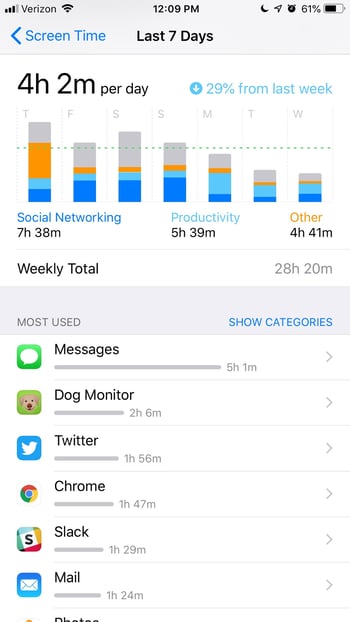
But it wasn’t long before my fear of missing out (FOMO), as the phrase goes, started to kick in. I missed seeing what my friends were up to, despite the absence of Instagram spurring me to actually check in with messages like, “How’s your weekend going?” My parents missed seeing the flood of pictures of my dog that I would usually post. And most of all, I missed sharing these visual moments from my life.
So, this morning, I reinstalled the app.
It wasn’t long for Instagram to top the list of my most-used apps on my Screen Time report. What a difference three days makes — check out today’s report, compared to the one above:
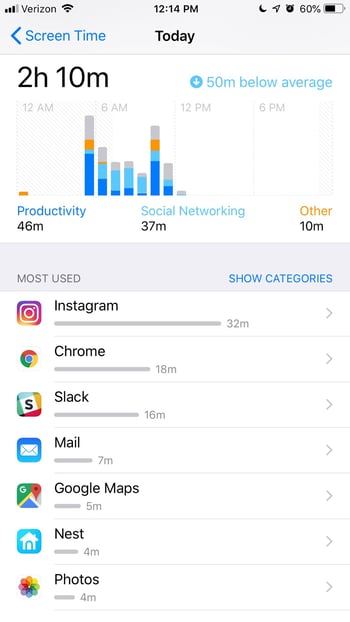
So, why is it so hard to quit Instagram? Just how addicting are social media apps — and are they designed to be that way? And how many people have also made similar efforts, only to fail just as spectacularly as I did?
The Psychology of Instagram
I’m not the only one asking these questions. Academic researchers have turned them into full-blown studies, showing a variety of conclusions.
But among the most interesting research outcomes, many experts have found that there is an addictive quality to social media apps — Instagram, in particular.
Take this article from Harvard University about the connection between dopamine production and social media notifications. Dopamine, the story explains, “is a chemical produced by our brains that … gets released when we take a bite of delicious food [when] when we have successful social interactions.” In other words, it’s a chemical that makes us experience a sense of reward.
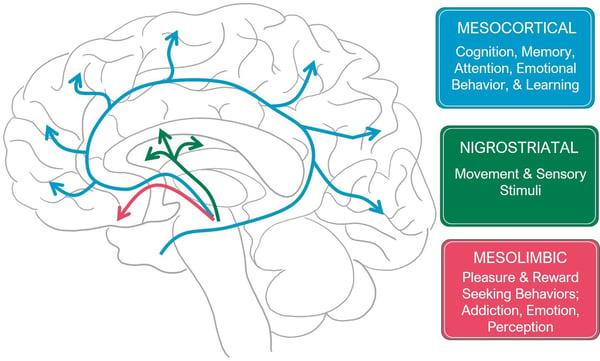
Source: Harvard University
But should we engage in these reward-inducing behaviors enough, explains the articles author, Harvard Medical School’s Department of Neurobiology research technician Trevor Haynes, we begin to become addicted to them, and expect a sense of reward when we perform them. And one of those behaviors, it turns out, is checking social media.
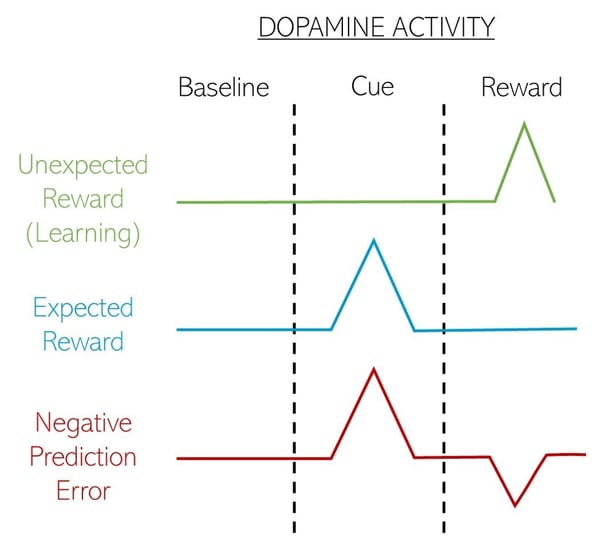
Source: Harvard University
The way that psychobiology plays out with something like Instagram, is that when you open the app, you expect to see notifications that your content has been liked or otherwise engaged with. We become accustomed to being rewarded for the behavior of opening the app, and therefore, addicted to doing so.
But when we open the app only to find no notifications, the sensation might be similar to biting into a piece of food that’s unexpectedly repulsive, or telling a joke for a crowd that completely falls flat.

Are Social Media Apps Designed to Be Addictive?
Okay, so maybe apps like Instagram play a big role in these dopamine triggers — but are social apps actually designed to be addictive? We asked 833 internet users across the U.S., UK, and Canada if they think so.
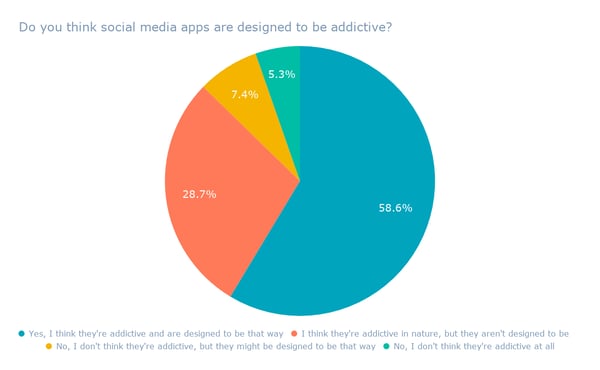
Over half of the respondents indicated that social media apps are not only addictive — but that they are, in fact, designed to be that way.
There may be some truth behind that public perception. According to a “60 Minutes” interview with technologist and neuroscientist Ramsay Brown, Instagram will sometimes withhold notifications of Likes and comments for a prolonged period of time, only to release them in a bulk at once.
That pattern of notification withholding-and-bursting encourages users to check the app more frequently, suggests Haynes.
“Your dopamine centers have been primed by those initial negative outcomes to respond robustly to the sudden influx of social appraisal,” he writes, which “takes advantage of our dopamine-driven desire for social validation, and it optimizes the balance of negative and positive feedback signals until we’ve become habitual users.”
So maybe that’s why it’s so hard to quit. To find out if I was alone in my challenge to stay away from Instagram for good, I ran another survey of 832 internet users across the U.S., UK, and Canada, asking: Have you ever tried to quit using Instagram?

Interestingly, about 40% of respondents indicated that they had never used Instagram in the first place.

When adjusting for that, just under half of the remaining 500 participants said that they had never bothered trying to quit using Instagram — or considered it — in the first place. And while these results alone can’t say for certain, it’s possible that this reluctance to quit the app altogether could be due to its aforementioned addictive nature.
Can the Phone-Checking Crisis Really Be Resolved?
It’s an interesting dichotomy — that such a considerable portion of people can both believe that social media apps are designed to be addictive, but at the same time, not want to quit using them.
We’ve discussed a similar phenomenon when examining the reluctance of many Facebook users, for example, declining to leave the site or delete their accounts despite the company’s many privacy-related crises. Why is it, I asked, that people continue to stick with social media networks, despite the various risks involved?
“My personal opinion is that people are making mental tradeoffs. It’s a primary connection point to family members, to news, to society at large,” HubSpot VP of Marketing Meghan Keaney Anderson said at the time. “And for now, there is no viable replacement to that. The trade off I’d argue people are making is the very real value of that connection point, versus the not-yet-personally-actualized threat to privacy or security of data.”
So on Instagram, it could be that the tradeoff comes in the form of sharing visual snippets of our lives with friends, family, colleagues and strangers — and being able to observe those moments of theirs, along with brands we follow, in return — versus the “threat” of addiction-like repercussions.
Of course, social networks and tech companies allege that they are responding in kind. There’s Apple’s aforementioned Screen Time reports, and both Facebook and Instagram have said that they’ll “soon” rollout tools to help users manage their time spent on both apps — though it seems that no one has seen or been able to use those features just yet.
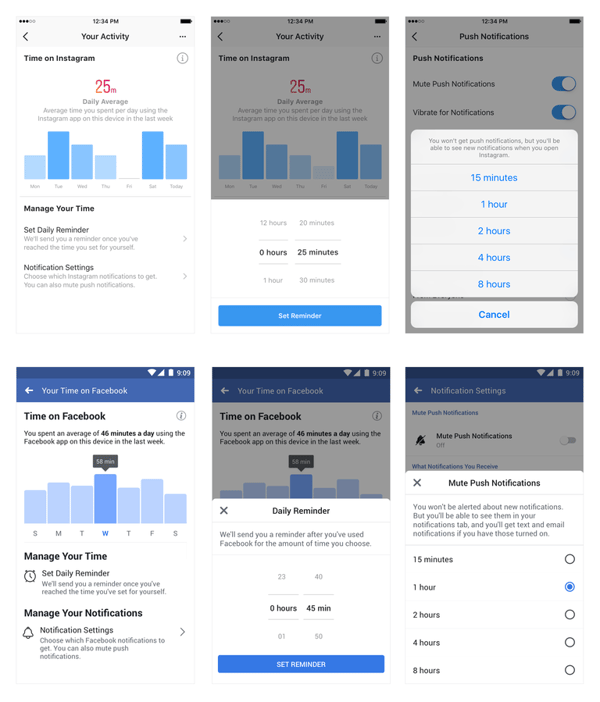
Source: Facebook
As for how effective these tools will be — we’ll have to wait to find out. But in the meantime, this entire phenomenon may serve as an opportunity for marketers and content creators.
There are ways, for example, to encourage audiences to both engage with your brand on social media, while also enjoying life offline; for example, asking users to post a photo or video of themselves using your product or service in an offline setting, or sharing content that shows how your brand helps them spend more time doing what they love.
But if you’ll excuse me — I have some analog time of my own to attend to.

6 Tips for Writing Compelling Bullet Points
Bullet points are arguably the most versatile tool in a writer’s arsenal. They break up your writing, making it easier to digest. And by drawing more attention to your ideas, they can also inspire action.
Whether you’re writing landing page copy that aims to convert visitors into contacts, or a work report that aims to persuade your team lead to pursue your proposed strategy, crafting compelling bullet points is crucial for making your ideas easier to understand and encouraging your desired action. Here are six ways you can do that.
6 Tips for Writing Compelling Bullet Points
1. Keep them brief.
The more unnecessary words your trim from your bullet points, the easier they are to understand. Concise writing is lean. And readers can zip through it with little effort. To sharpen your bullet points, follow the three writing tips below:
- Avoid linking verb phrases like, “Justin was writing about his cross-country trip.” “Justin wrote about his cross-country trip,” sounds more forceful. Linking verbs have a passive effect, which is why they can’t pack much of a punch.
- Change prepositional phrases like, “The decision of the executive team was final,” to “The executive team’s decision was final.” Prepositional phrases make sentences longer and harder to follow.
- Reduce verb phrases like “The results are suggestive to the fact that on-page SEO still works.” to simple verb phrases like “The results suggest that on-page SEO still works.” The latter sounds much smoother.
2. Start your bullet points with a verb.
To hook your audience and persuade them to keep reading, your bullet points’ first word needs to immediately capture their attention. Starting a bullet point with a verb, which reveals the most information about your bullet point, can instantly pull an audience into your writing.
For example, which of the following bullet points immediately grabs your attention?
If we distribute blog content through Facebook Messenger, we can:
- Leverage a distribution channel with high-engagement rates and rely less on email.
Or
If we distribute blog content through Facebook Messenger:
- We can leverage a distribution channel with high engagement rates and rely less on email.
Even though there’s only a slight difference between the two bullet points, the one that starts with a verb can engage an audience quicker and prompt them to read the rest of the bullet points.
3. Keep them consistent.
Keeping your bullet points consistent makes it easy for your readers to fall down the page and easily digest its information. To do this, stick to the same number of lines per bullet point, start each bullet point with the same type of speech, like a verb, and maintain the same grammatical form.
For instance, consider the two examples below. One keeps its bullet points consistent and the other one doesn’t.
Pivoting to an organic-only blogging strategy will:
- Boost our blog’s short-term traffic.
- Sustain our blog’s long-term traffic.
- Build our website’s domain authority.
Pivoting to an organic-only blogging strategy will:
- Boost our blog’s short-term traffic.
- Sustain our blog’s long-term traffic.
- Finally, we’ll be able to build our website’s domain authority.
The second example has incongruent bullet points. It throws the reader off and confuses them, increasing the likelihood that they’ll disengage with the writing.
4. Use bullet points in the right place.
Bullet points give your audience a refreshing break from blocks of text, but if you make your copy or report look like a shopping list, they’ll want a break from your bullet points.
To effectively engage and persuade your audience with bullet points, use them in moderation — highlight essential information and list items that would look jumbled if you wrote them in paragraph form.
5. Lead with the benefits.
There’s a copywriting adage that goes “features tell and benefits sell”. And it’s a timeless truism that can be applied to any form of writing. Why? Because a list of features doesn’t specify how your audience will directly benefit from your product or ideas. Highlighting the benefits can help your audience visualize a better future, one that includes your product or fleshed out ideas in their lives.
For instance, a job ad that describes how you can “Arrive and leave work comfortably, thanks to a heated garage,” will resonate with candidates more than a job ad that states the company has a “Heated parking garage.”
6. Sell a feeling.
Psychology tells us that emotions drive our behavior, while logic justifies our actions after the fact. Marketing confirms this theory — humans associate the same personality traits with brands as they do with people. Choosing between two alternatives is like choosing your best friend or significant other. We go with the option that makes us feel something.
This is also the reason why pitching a product’s features is a lousy attempt at persuasion. Features only appeal to the logical part of your brain, which we know doesn’t drive action nearly as well as appealing to the emotional part of your brain does.
So if you’re writing social media copy for the grand opening of your new sporting goods store, don’t write a bullet point about the number of gloves you have in stock. Write a bullet point about the lasting family memories your customers will make playing catch with their kids — they’ll never forget those moments.

We Launched 3 Podcasts in 3 Years: Here’s What We Learned
Several years ago we launched The Growth Show because we fell in love with audio as a way to inform, inspire, and engage an audience. There was something special about the medium, something immersive but also adaptable to the busy lives that people lead. Podcasts fit into our commutes, our workouts, our in-between times in a way that other formats just can’t.
We were not alone in this love for the medium. A few mile-marker facts: Nearly 1 in four americans, roughly 68 million people are listening to podcasts on a monthly basis. Outside of the United States podcasts are being consumed at similarly a rapid rate. The average podcast listener skews younger with 44% of podcast listeners being millennials (18-34) and 33% being Gen Xers (35-54).
That means there are over 52 million people in the US in the early-to-prime portions of their careers listening to podcasts. The podcast audience tends to have a higher education level with over 57% having a bachelor’s degree or above.
We launched 3 different podcasts, with 3 totally different approaches.
So if you want to start a podcast, good news is the water’s warm. There’s a strong and growing appetite for audio content. But what sort of podcast should you start? That question is a little harder.
The answer is highly dependent on what you want the podcast to achieve for your audience and company — and most people aren’t exactly sure. Plus podcast analytics are a little behind the times still so you get less insight into what’s actually resonating in a show. Over the last three years we used three very different approaches to better understand the role that podcasting would play in our company. Here’s what we found.
The Editorial Podcast
Our vehicle: The Growth Show (New season comes out today!)
Goal: Brand
Purpose: Use storytelling and guest selection to advance HubSpot’s point of view.
In 2015 we launched our first podcast, The Growth Show. It started as a straight interview show with business leaders we respected and morphed into what it is today: a blended editorial podcast on unique approaches to growth.
Over the years, The Growth Show has garnered over 1.5 million downloads, been featured on iTunes New & Noteworthy, and consistently named a top business podcast. We have had unforgettable guests such as Alec Baldwin, Julie Zhuo Vice President of Product Design at Facebook, Jonah Peretti founder of Buzzfeed, and Kristen Kish a winner of Top Chef. And there have been no shortage of pivots and lessons along the way.
What’s special to me about The Growth Show — beyond the fact that I host it — is that it has become a platform for us to use storytelling to highlight a different kind of business growth.
HubSpot has long espoused the idea that to make a legacy impact, it’s not enough for your company to just grow bigger, you have to find a way — and make the sacrifices — to grow better. You have to pursue the sort of growth that hitches your success directly to the success of your customers.
The Growth Show is a platform for us to tell that uncommon growth story. Season three, which goes live TODAY, is all about companies that relied heavily on the advocacy and loyalty of their customers to fuel their growth.
The Mass-Appeal Podcast
Our vehicle: Weird Work
Goal: Reach
Purpose: Develop a mass-appeal podcast to bring entire new new audiences into the fold
In 2017, we added to our podcast docket with the launch of the very quirky Weird Work. (You can read more about Weird Work in my post Why We’re Starting a New Podcast That Has (Almost) Nothing To Do With Our Company).
The question we were pursuing was whether developing a mass-appeal show that had little to do with our core brand would help us tap into new audiences and create an opportunity for us to reach those audiences through sponsorship spots or related content.
With Weird Work, we tried our first attempt at monetizing a podcast by running HubSpot sponsor ads amid the content. We kept the ad relevant. Because the concept of the show often involved people making major career shifts to follow a (weird) passion, we ran ads for HubSpot Academy in the hopes that listeners interested in career pivots would also get value out of professional development classes.
We gave listeners a special URL, and set our expectations conservatively. We were hoping to get 100 visits to HubSpot Academy off the podcast. We ended up with 245 for the season. Nothing to hang the business on, but a sign that podcast listeners will take action on an ad.
The Tactical Podcast
Our Vehicle: Skill Up
Goal: Search Traffic
Purpose: Prepare for an uptick of Google search as a driver of podcast discovery.
Google has been leaning into audio content lately in its quest to organize the world’s information. It has a new partnership with PRX International to remove barriers for people wanting to start podcasts, it introduced a new podcast app on android phones, and is on a mission to automatically transcribe podcasts and surface them in search results.
Seeing this sea change of opportunity in what has historically been the toughest nut to crack in podcasting — discoverability — we launched a new podcast this summer geared toward a common search query in our industry: SEO. Millions of people search Google every day looking for how-to advice, and for a number of them, audio may be the better format for that advice. The very tactical, Skill Up podcast is an attempt to be the answer those people seek.
So, where are we now?
Well, today we release our the third season of The Growth Show. Each week beginning October 17th we will be releasing an episode that explores the inspiring stories behind how people grow a business, an idea, or a movement. Scattered in between our normal weekly releases we are going to create short episodes that focus on hyper specific topics and trending news stories. I’ll leave you with a teaser and then I’ll hopefully find my way to your eardrums as a result.
A few of the upcoming episodes:
- How Glossier is creating the future of brands with its customers
- I turned down $30 Million from Mark Cuban on Shark Tank
- How Spartan’s Joe De Sena Fueled a Movement
- Finding confidence in Founding ClassPass
- What MoonPie can teach you about social media marketing
This is where I encourage you to subscribe to The Growth Show on Apple Podcasts, Spotify, Google Podcasts, Stitcher or wherever you get your podcasts. And you think: “Meghan, I know how podcasts work.” You’re right. You’re right, but I had to say it.
Here’s something you might not know. If you have a smart speaker like an Amazon Alexa or Google Home, you can also listen just by saying, “Play the podcast: The Growth Show”
Thank you all for those who do tune in to any of our podcast and to those of you who have shared our shows with a friend or left a review. We’re all figuring out this evolving podcast world together and I truly truly appreciate the support.

How We Topped Product Hunt (Overnight)
Nothing summons the old imposter syndrome monster quite like the moments before a big project launch. All at once, you begin to question every decision you’ve made along the way — from the name of the project down to the comma placements.
For me, these nervous feelings are still fresh. Back in August, my team and I released a totally revamped version of our buyer persona tool, Make My Persona.
We’d been hard at work on the project for months and were all in agreement that it’d shaped up to be something uniquely valuable — something different than we’d worked on before. Nonetheless, I proceeded with caution as I began green lighting the promotion plans we’d put together.
Email? Check. Social media? Check. Blog post? Check.
The feedback started to roll in almost instantly … and it was positive.
Users loved the tool. And that’s when I knew it was time to spread the word a little further. So I pulled up Product Hunt, spun up the tool details, and set it free for the community to have at it. I gave the listing a courtesy upvote from myself and closed my laptop. It has been a long few months — and even a longer few days.
What happened next? Something special.
Make My Persona: The #1 Product of the Day
The great thing about having team members in Dublin is that they are up and at it hours before we’ve had our coffee here at HubSpot headquarters in Cambridge, MA. This means I often wake up to surprises from the designers and developers I work with — from updated wireframes to development progress to reimagined solutions for project blockers.
Though, I can confidently say that the Friday morning after our launch brought about my favorite surprise yet: A Slack message from my colleague claiming that Make My Persona had been featured as the #1 “Product of the Day” on Product Hunt.
I rushed to the site to confirm and was delighted to see that my single upvote had grown into nearly 200 upvotes overnight. We were topping the charts and new upvotes were being tacked on by the minute.
In an attempt to understand exactly how we landed ourselves in this situation, I started reading articles from other teams that had seen success on Product Hunt. From what I could gather, this wasn’t something that was supposed to happen by accident. People had calculated plans. They’d researched the best time and date for launching. They’d done their homework.
I’ll be the first to admit that I wasn’t as strategic about the launch as I could have been. I’d launched a couple of lead generation tools on Product Hunt in the past, but our strategy still needed refining. I was learning. Though, the listing did check a lot of the launch “best practices” suggested by Product Hunt:
- We had a great explainer video heading up the gallery
- An animated thumbnail
- Quality screenshots of the tool’s experience
- A clear and concise description
- Links from features around the web
But I also missed a lot of opportunities:
- I hunted the tool myself
- I didn’t have all of our Makers in order before launching
- I failed to have one of the Makers post a comment to invite feedback
- I didn’t arrange any reviews
- I asked no one to upvote it — in fact, I didn’t even tell anyone I’d posted it yet
Suddenly, I could feel the imposter syndrome monster bubbling up again. Did we deserve this recognition? Was this a mistake?
I silenced that internal dialogue quickly. Of course we deserved this. This tool was unique, helpful, and visually stunning. I was proud of it for a lot of different reasons, so I decided to focus on that instead. And after tracing back the steps we’d taken to get here, it became clear why we’d been so successful. Allow me to explain …
The Hidden Success Ingredient: Over-Investing in the User Experience
We had a kickoff for the project back in May where we drew up this list of improvements we wanted to make to the existing tool:
- Offer a solution for everyone
- Reduce friction in the conversion process
- Make the experience more engaging
- Encourage collaboration and customization
- Make the avatars more diverse to better represent all people
We referred to this bulleted list as our “rebuild objectives” and they all had one thing in common: they solved for the user. That was the hidden success ingredient. It suddenly felt so obvious. People were upvoting this tool because it was simple and engaging and entirely free. We over-invested in making it the best it could be for the end user and it was starting to show.
Here’s how each of those rebuild objectives shook out within the tool itself:
Offering a solution for everyone.
Make My Persona was a tool that we launched several years ago and made the decision to update this year. When we took a look at the tool’s organic performance, we found it was ranking for a variety of buyer persona-related terms — from “what is a persona” to “buyer persona templates.” To ensure we met the needs of everyone that discovered the tool, regardless of their intent, we split the tool into two parts:
- Path #1: This conversion path was designed to help those who were just getting started with personas. Here we provided a brief intro to what a persona is, followed by a beginner’s guide to walk them through how to conduct persona research.
- Path #2: This was the main conversion path that walked visitors through the creation of an actual persona. Visitors that chose this path would have already completed their persona research and be ready to document it.
Reducing friction in the conversion process.
Persona creation requires a lot of information. And in most cases, the more detail you can provide – the better. With that in mind, we set out to balance the need for context with the even greater need for a simplified user flow.
To do that, we combined similar questions to form seven steps. In each step, we incorporated sliders and dropdown menus to help users input information faster, with less typing.
We also introduced a CTA that allows a user to skip the step-by-step process entirely and head straight to the editable template for an all-in-one view.
As a result, the new version of the gives users the freedom and flexibility to input information and work through the creation process on their terms, without restrictions or roadblocks.
Making the experience more engaging.
There are a ton of lovable “micro-moments” throughout the tool that are intended to make the experience more engaging – and more human.
For example, your avatar reacts to your inputs in the walkthrough mode (giving a thumbs up, winking, etc.) and confetti falls from the screen to help you celebrate when you complete your persona.
All of these gamified elements create an experience that is fun for the user, encouraging them to continue through to the next step.
Encouraging collaboration and customization.
Buyer persona creation isn’t always a one person job. And persona documents are not one size fits all. With these two things in mind, we introduced shareable links that users can send along to their colleagues to make edits to the persona and collaborate on the positioning.
This shareable link creates a copy of the master persona to ensure nothing gets deleted, while still providing the flexibility for others to rework the persona data.
To provide greater control over the actual look and feel of the document, we made the persona editor full customizable: users can drag, drop, resize, and reorder the modules to ensure the information that’s most important to them is front and center. They can also adjust the color scheme to align with their branding.
Making the avatars more diverse to better represent all people.
The stock photo selection within the old tool was not a good look. There was only one-person of color represented – and an uneven amount of men and women.
In the 2018 version, we made the conscious decision to remove gender from the equation by introducing avatars that represent people – plain and simple. We also aimed to include a variety of skin tones, hair types, and age identifiers. While these were small acts of inclusion, they went a long way in terms of ensuring that everyone felt represented.
The Results: What Happens When You Top Product Hunt
At this point, you’re probably ready for me to skip ahead to the numbers. What impact does getting featured in the #1 slot have on the performance of your project?
Well, the Product Hunt win helped to shape our numbers in a few different ways:
Our upvotes skyrocketed. Being featured on the Product Hunt homepage = visibility. As a result, we ended the day we got featured with 600+ upvotes, though that number continued to grow over the next few days as we remained on the homepage. We also saw a second wave of upvotes from an inclusion in the daily digest email that followed. As it stands, the tool has 1.3K+ upvotes, making it the most successful HubSpot Product Hunt launch in history.
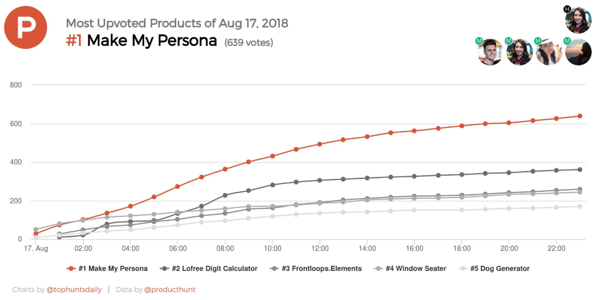
We saw a big increase in traffic. All said and done, we generated roughly 10K views from Product Hunt. Again, these numbers climbed steadily days after being featured thanks to continued homepage visibility and subsequent emails. We also saw an uptick in traffic from social media, as the listing spawned a lot of love on Twitter, LinkedIn, and Facebook.
We generated some leads. While the conversion rate from the traffic was nothing to write home about, we did pull in some leads from Product Hunt. Note: Because these people likely stumbled upon the tool on the homepage without searching for any terms, there’s no guarantee they actually have a need for it. We’re keeping this in mind as we evaluate the quality of those leads and expect that those who find us through a deliberate search in the future will have more intent.
We got a lot of shout outs. As I mentioned before, the uptick in traffic from the feature earned us recognition via the Product Hunt email and on social media. But there were a few other unexpected surprises. For example, the tool was also picked up by InVision’s design inspiration extension, Muz.li. This extension curates content from hundreds of sources, including Product Hunt, which is where I suspect we got on its radar. This brought in another 7K+ views.
Setting the Flywheel in Motion
If you think about these wins in relation to the flywheel, it all adds up.
By investing in the delight stage — the overall user experience of the tool — we were able to build enough momentum to set the rest of the flywheel in motion.

Delighted users shared and upvoted the tool
↓
Those shares and upvotes helped us attract a larger audience
↓
Drawing in a larger audience gave us more people to engage and convert
So while we enjoyed basking in the our fifteen minutes of Product Hunt fame, we’re excited to watch this tool continue to build momentum. If you haven’t already checked out it out, you can give it a spin here.