How the Baader-Meinhof Phenomenon Secretly Influences Your Decisions
Let’s say your friend recently told you about a new Netflix show.
After you heard about the show from her, you began seeing and hearing about it everywhere — on Facebook, at dinner with your parents, on your favorite radio station.
Kind of creepy, right? It might feel a bit like a conspiracy theory, like the whole world’s suddenly playing a prank on you — but it’s not. It’s known as the Bader-Meinhof Phenomenon.
Baader-Meinhof Phenomenon (a.k.a. the Recency Bias or Frequency Illusion)
The Baader-Meinhof Phenomenon, otherwise known as the frequency illusion or recency bias, is a situation where something you recently learned about suddenly seems to appear everywhere. There are two reasons for this phenomenon — first, selective attention, which means your brain is subconsciously seeking out more information on the subject. Second, confirmation bias, which means every time you see something related to the subject, your brain tells you that it’s proof the subject has gained popularity overnight.
There are a few ways the Baader-Meinhof phenomenon might influence your customer’s decision-making process, and understanding the psychology behind it is key to taking your marketing strategies to the next level. Let’s take a look at three ways in particular now.
Three Ways the Baader-Meinhof Phenomenon Secretly Influences Your Customer’s Decisions
1. The Baader-Meinhof Phenomenon and Repetitive Marketing
To incorporate the effects of the Baader-Meinhof Phenomenon into your marketing strategy, you need to put your brand messaging out there as much as possible.
Remember, the Baader-Meinhof Phenomenon can only happen if someone initially notices or learns about your product. You’ll want to start with strong ad copy, an attention-grabbing headline, and memorable images to attract your audience and introduce them to your company.
Now that their brains are selectively paying attention, you’ll want to spread your messaging to various platforms, including social media, radio stations, TV, billboards. You’ll want to choose platforms that align with your brand and customer base — the point is, you want to repeatedly appear on these platforms so your customers can notice you.
Paid online advertisements and retargeting are two effective strategies for ensuring your frequency-illusioned customers start seeing you everywhere.
Ideally, this will become a self sustaining long-term strategy. Even if your customer isn’t in the market for your product now, they’ve seen your company everywhere. Next time their friend is looking for a product like yours, your potential customer will mention you first.
2. The Baader-Meinhof Phenomenon and Social Proof Theory
The Social Proof Theory, first coined by psychologist Robert Cialdini, states that someone who doesn’t know how to act or think will imitate other people, or turn to peers for guidance.
In marketing, social proof is an extremely effective method for persuading customers to buy a product. Customer reviews, testimonials, and statements like “four out of five parents recommend” are critical for convincing hestitant buyers to choose one product over another.
What does this have to do with the Baader-Meinhof phenomenon? Well, think about it: the Baader-Meinhof phenomenon maintains that you’ll see or hear something more if you’ve recently learned about it.
For example, let’s say you’ve recently learned about the new FitBit Charge 2.
Suddenly, you hear your coworkers talking about it. Then, you see a post on Instagram, with one of your favorite celebrities endorsing the product.
It’s likely people were talking about the FitBit Charge 2 before you heard about it, but once you did, your brain paid more attention to it. You took note of all those people raving about the product, and meanwhile, your brain chose not to pick up on that other conversation about the new Samsung Galaxy Gear Fit.
In other words, you selectively listened to people discussing the FitBit product because you’d recently learned about it, and then social proof led you to believe it was the best, and perhaps only, fitness tracker option.
As you can see, these two psychological phenomenons work together to convince someone to buy one product in particular.
To get the most out of the Baader-Meinhof Phenomenon, you’ll want to use it hand-in-hand with The Social Proof Theory. Include reviews and testimonials on your website, as well as third-party sites like Yelp, so once your customer learns about your product, she will be subsequently convinced through social proof to buy it.
3. The Baader-Meinhof Phenomenon and Confirmation Bias
The Baader-Meinhof Phenomenon works for two reasons — selective attention, and confirmation bias.
Let’s consider the second reason for a minute. Confirmation bias is actually a phenomenal tactic to convince customers to buy from your company over your competitors. Essentially, confirmation bias means someone looks for evidence to confirm what they already believe, even when that evidence is largely neutral.
For instance, let’s say you read that right-handed people are better at math. You believe it, and whenever you meet someone who’s right-handed and good at math, you file that information away as evidence you’re correct. You’re insistent on maintaining your prior beliefs. You look for evidences that supports it, and you ignore evidence that contradicts it — like your left-handed friend who is incredible at math.
What does this have to do with marketing? A lot.
Once your customers believe something to be true about your product, they’ll look for evidence to support it and ignore evidence to the contrary. If you can convince them your product offers something unique nothing else on the market can offer, they’ll believe it, and then they’ll seek out evidence to support it.
Easier said than done though, right?
To learn how to use confirmation bias to your marketing advantage, let’s take a look at an example from the 1990’s, when Schlitz, a failing beer company, hired Claude Hopkins, a legendary man in advertising at the time.
Hopkins asked Schlitz to give him a tour of their brewery. On the tour, he saw plate-glass rooms with beer dripping over pipes, expensive wood filters that took out impurities in the beer, and rooms filled with filtered air. The pumps and pipes were cleaned twice a day to avoid contamination.
Seeing the impressive process in action, Hopkins asked Schlitz why they didn’t advertise it to people to prove their beer was better.
The Schlitz people told him, “All companies brew beer the same way.”
“Yes,” Hopkins replied, “But the first one to tell the public about this process will gain a big advantage.”
Within six months of Hopkins’ advertising campaign for Schlitz, Schlitz beer became the number one selling beer in America. Why? Because people were given evidence to believe Schlitz was purer. Once they were embedded with a confirmation bias for Schlitz, they probably tasted the beer and thought, “Yes, this is more pure.” They also avoided other beer companies’ advertisements to the contrary.
By figuring out what makes your product unique and telling potential customers, you’re creating a confirmation bias that your product is exceptional. As people seek out evidence to support their belief, the Baader-Meinhof Phenomenon asserts they’ll begin seeing your product everywhere.
It’s not easy, but if you can create a compelling campaign to capture an audience’s attention and show them why your product is better than others, the Baader-Meinhof Phenomenon and confirmation bias can do the rest.

10 Real Estate Social Media Marketing Strategies That’ll Bring in New Business
The following is a guest post by Leslie Mann, a real estate agent with Gibson Sotheby’s International Realty of Weston, MA.
Most real estate agents have a social media presence, but are they really giving home buyers and sellers want they crave?
Buying or selling a home is an important financial (and emotional) decision. Most people are full of questions when they undertake this endeavor.
They want more than someone who’s just experienced in the industry. They want someone who will protect their interests and help them navigate the complexities of real estate. It is important that the agent they choose is someone they’ll feel confident having by their side throughout the process.

That’s where social media comes in. If applied correctly, it can be a great way to open a dialog, share advice, and begin to forge a relationship. Here is a handy list of social media dos and don’ts for real estate agents.
Real Estate Social Media Marketing
- Promote the town, not just the house.
- Be yourself.
- Educate your buyers.
- Chat with your followers.
- Respond to comments, good and bad.
- Avoid simply shouting about your home listings.
- Don’t forget video.
- Never assume you’re only connecting with first-time buyers.
- Talking to yourself on social media doesn’t do your page any good.
- Don’t ignore your existing clients.
Tips That Agents Should Embrace
1. Promote the town, not just the house.
Home buyers want to know the good, bad, and ugly of each town to which they’re considering a move. Yet most real estate blogs simply give buyers basic demographic statistics and perhaps some flowery language about the area. Use your social media channels to give potential clients a far richer understanding of the markets you serve, letting them know the pros and cons of each neighborhood.
Many cities have a “@CityOf …” Twitter handle, which you can mention directly in your own tweets. Use these handles to promote properties you have listed in that city. City accounts on Twitter tend to be receptive to these shout-outs, and might retweet you — increasing your post’s reach to their followers.
Instagram Business accounts are also prime real estate (no pun intended) for you to post beautiful photos of the town in which your properties are listed.
2. Be yourself.
I’ve heard of many realtors who pay a ghost writer to write their marketing copy, yet this approach has its shortcomings. The copy simply doesn’t ring true; it fails to give clients a sense of who you really are. Studies show that consumers want to make a personal connection with those whom they do business with, and there’s no shortcut to writing your own authentic social media content that resembles who you are as a real estate agency.
Let your personality shine through across each social network you’re on. It’s a great way to open a dialogue with a client before they ever pick up the phone.
3. Educate your buyers.
Some of the most trying days as a real estate agent prove to be great lessons we can share with our clients. Talking about common real estate pitfalls makes your buyers smarter, giving them a smoother browsing experience and qualifying them to work with you.
Social media is the perfect outlet for this. If you have a blog, consider writing articles about home-buying tips, and use social media to promote them. Perhaps you can tweet a “Real Estate Fact of the Day,” hashtagging #realestate while you’re at it.
4. Chat with your followers.
Home buyers today expect instant responses to their questions, but where they ask those questions has changed.
Home buyers are calling real estate agents much less than they used to with questions about a property or neighborhood. They’re going online, using Facebook’s Recommendations feature, and tweeting at real estate offices on Twitter. Be ready for this outreach, answer them, and use these questions as an opportunity to start dialogue with followers who might be in the early stages of the buying process.
5. Respond to comments, good and bad.
Respond promptly and courteously to engage readers who post comments on your social media sites. One caveat: Don’t feel compelled to respond to those who post abusive comments. Social media does lure its share of online bullies, and not every remark aimed at your is worth your breath.
Resist the temptation to get into battle with your harshest critics, and acknowledge those who praise your service. A lot of people who reach out to you are simply looking for more information about a listing — or a listing they might’ve thought was still available, but has been sold or rented. Absorb their frustration and use their comment as an opportunity to pivot their interest to other properties.
Practices That Agents Should Avoid
6. Shouting about your home listings
It’s fine to let people know about the homes you’re marketing, but don’t make the house itself the primary topic of your conversation. Think about common questions home buyers and sellers ask you, and turn these into posts. Provide valuable content and you’ll keep people coming back.
7. Forgetting video
Today, 45% of people watch more than an hour’s worth of Facebook or YouTube videos a week.
It’s tempting to skip the expense of shooting and editing a video, but online video is an important element of home marketing. Think about it: Home buyers are visual buyers, and if done well, a video creates an emotional connection with them that they might not have from just a photo-based listing.
YouTube videos also improve your website’s ranking in search engines like Google — a common place where home buyers and renters start their search for a new home.
8. Assuming you’re only connecting with first-time buyers
According to a recent PDF by the National Association of Realtors (NAR), 36% of home buyers in America are 37 years old or younger. About 66% of them are first-time buyers. Now here’s an even more intriguing statistic: More than 80 million Facebook users today are 45 or older.
If you think you think you’re just talking to first-time home buyers on social media, think again.
Social networks like Facebook are great places to engage “fans” and learn what they’re looking for from their agent, but keep in mind they’re not all new to the buying process. Have content suited for all levels of home-buying experience ready to serve up to your fans and followers — you never know whom you’ll be connecting with.
9. Talking to yourself
A post, link, photo, or tweet on your profile might look nice to you, but it means very little if it doesn’t resonate with the people who are following your page.
Social media is more about listening than about talking. Pay attention to what people are saying about you and your brand. Solicit and gather feedback through informal polls or via free survey services like Survey Monkey or Google Forms. This will ensure each and every piece of content you share on social media reflects the interests of your customers.
10. Ignoring your existing clients
Invite your previous buyers and sellers to join you on social media. That way, your sites becomes richer communities of shared experiences and objective advice from those who recently completed the home buying/selling journey.
At the end of the day, your followers might prove themselves to be your strongest property advocates.


How to Quickly & Easily Create a Buyer Persona [Free Tool]
As marketers, we’re tasked with making a living out of making a connection — but not just any connection. To scale growth and keep acquisition costs down, your time and resources need to be spent positioning your business in front of the right people, at the right time.
That’s where buyer personas come in. Well-researched buyer personas align departments — marketing, sales, and services — around actionable audience insights, creating a clear picture of exactly who you are trying to attract and serve.
But before you can begin refining your strategy to match your ideal customers’ preferences, you need to document your persona in a way that’s both visible and actionable.
Introducing Make My Persona, an interactive web tool that generates buyer personas for you after answering a series of questions about your ideal customers.
The free tool guides you through strategic questions designed to help you organize and better understand your buyer persona research. Upon completion, you’re presented with a fully customizable, shareable persona document highlighting important details about your target audience.
No more unmanageable documents filled with disconnected persona research notes. No more stressing about the format and design.
How to Use the Make My Persona Generator
1. Go to hubspot.com/make-my-persona and select your path.
We understand that buyer persona creation has several phases. That’s why we designed two unique paths for you to choose from based on what information you need.
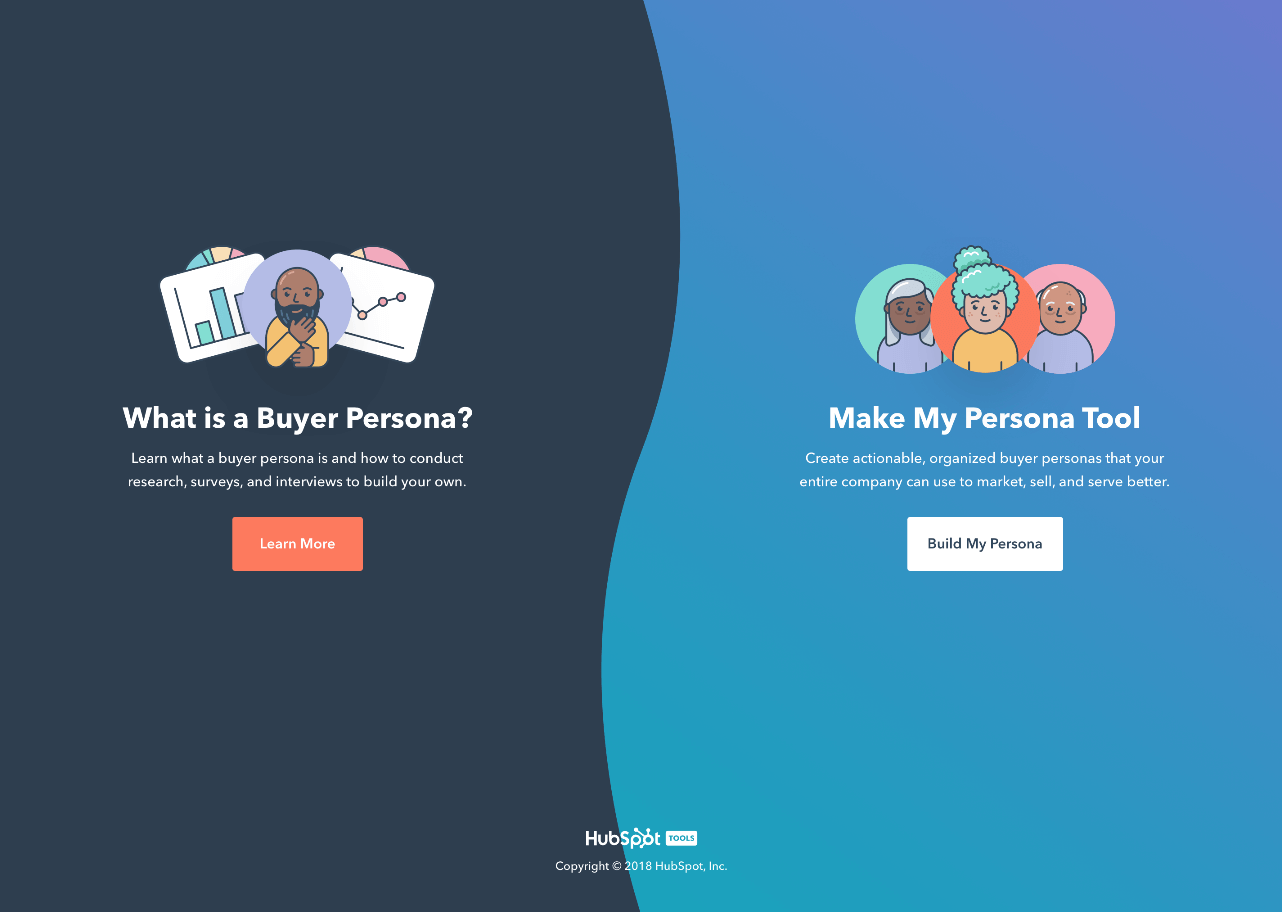
If you’ve already done your persona research:
You can head straight to the tool to start organizing your persona data into a meaningful, customizable buyer profile.
If you haven’t done your persona research yet:
We’ve got you covered with an educational guide designed to help you learn what a buyer persona is, how to conduct research, surveys, and interviews, and how to ultimately use this data to build your own persona. Once you complete your research, you can revisit the tool to continue generating your persona.
2. Fill in details about your persona via the guided walkthrough.
Make My Persona will walk you through a seven-step persona creation flow. Each stage of the flow focuses on a different aspect of your buyer persona — from their age and education to their goals and challenges.
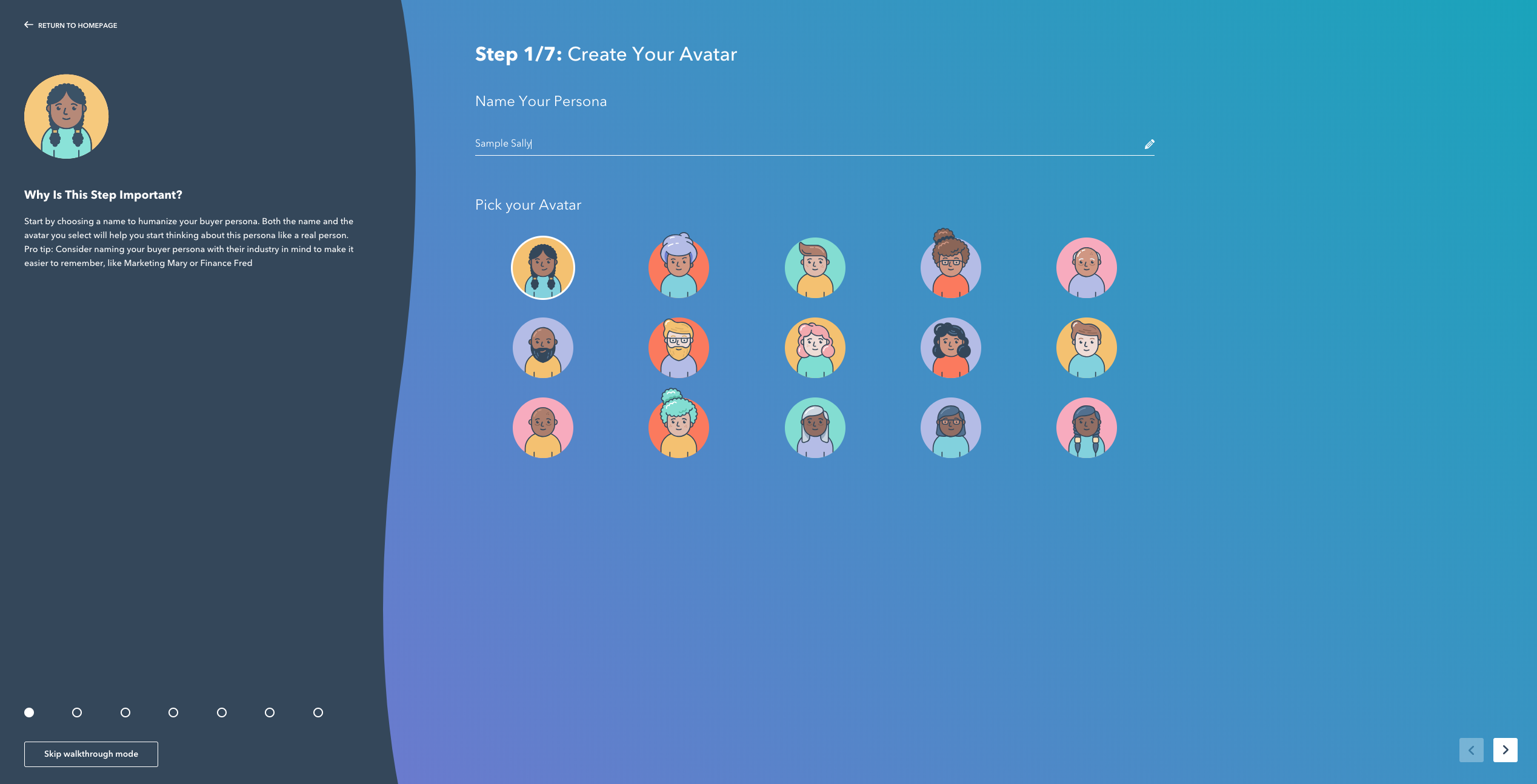
Note: If you’re not prepared to answer one of the questions in the walkthrough, don’t panic. You can skip ahead at any time and revisit and edit your responses later.
3. Customize your document.
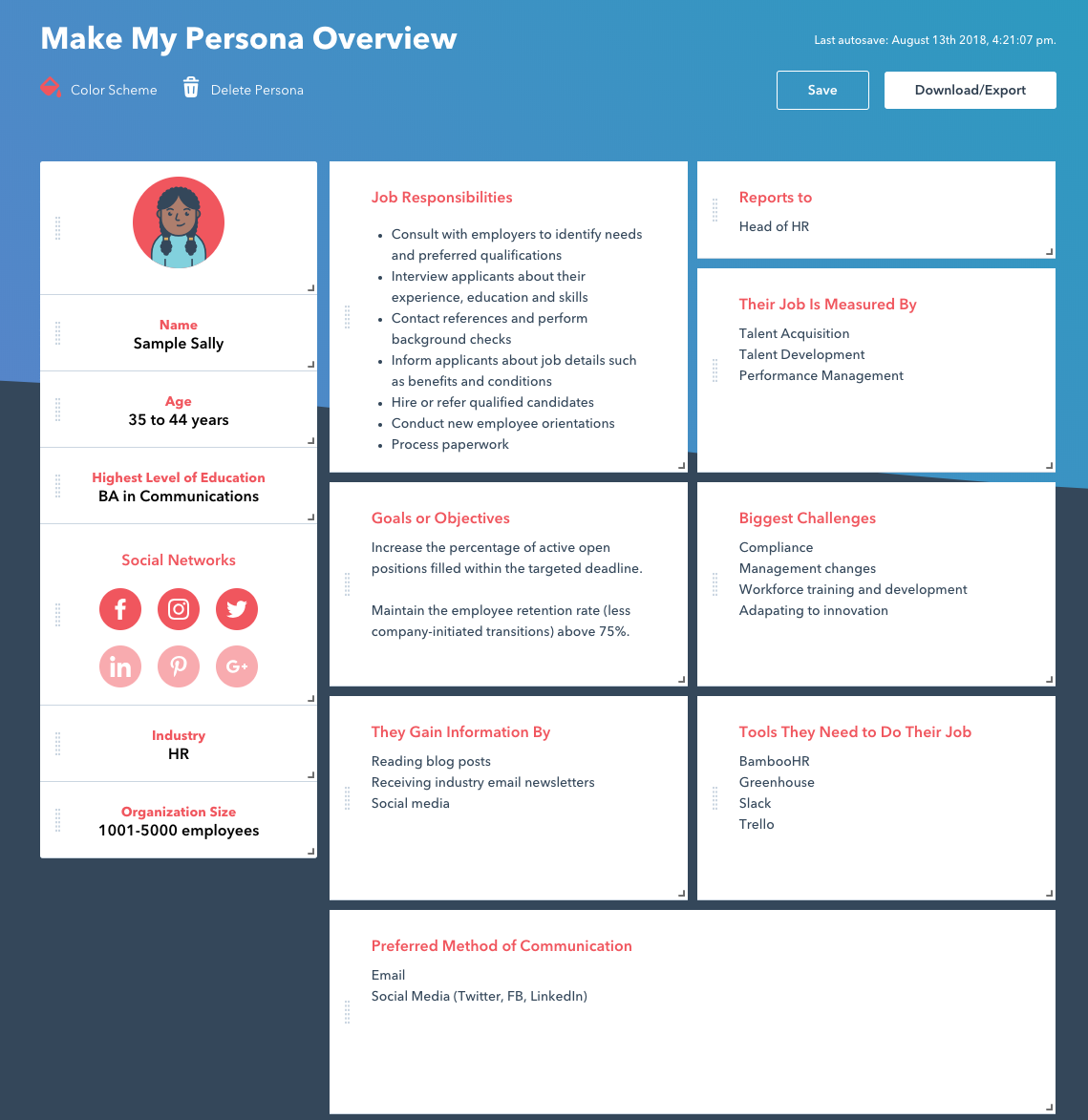
Once you complete the walkthrough, you’ll enter the persona document editor. At this stage, you can customize the look, feel, and format of your persona document to align with your unique business needs and branding.
As you can see below, Make My Persona maps your buyer persona across a number of tiles — each one carrying a set of characteristics your business would need to properly engage with this person in real life. These characteristics include:
- Age
- Level of education
- Social networks used
- Industry
- Job responsibilities
- Goals or objectives
- Biggest challenges
- Whom they report to
- How/where they get information
- Tools they need to be successful
Have these questions in mind once you start creating your persona in our Make My Persona generator.
4. Download your buyer persona as a PDF or use your unique share link to collaborate with your colleagues.
Happy with your persona document? Download it as a PDF and share it far and wide across your organization.
Remember: Buyer personas aren’t just useful for marketers — everyone can benefit from having a better understanding of your ideal customer.
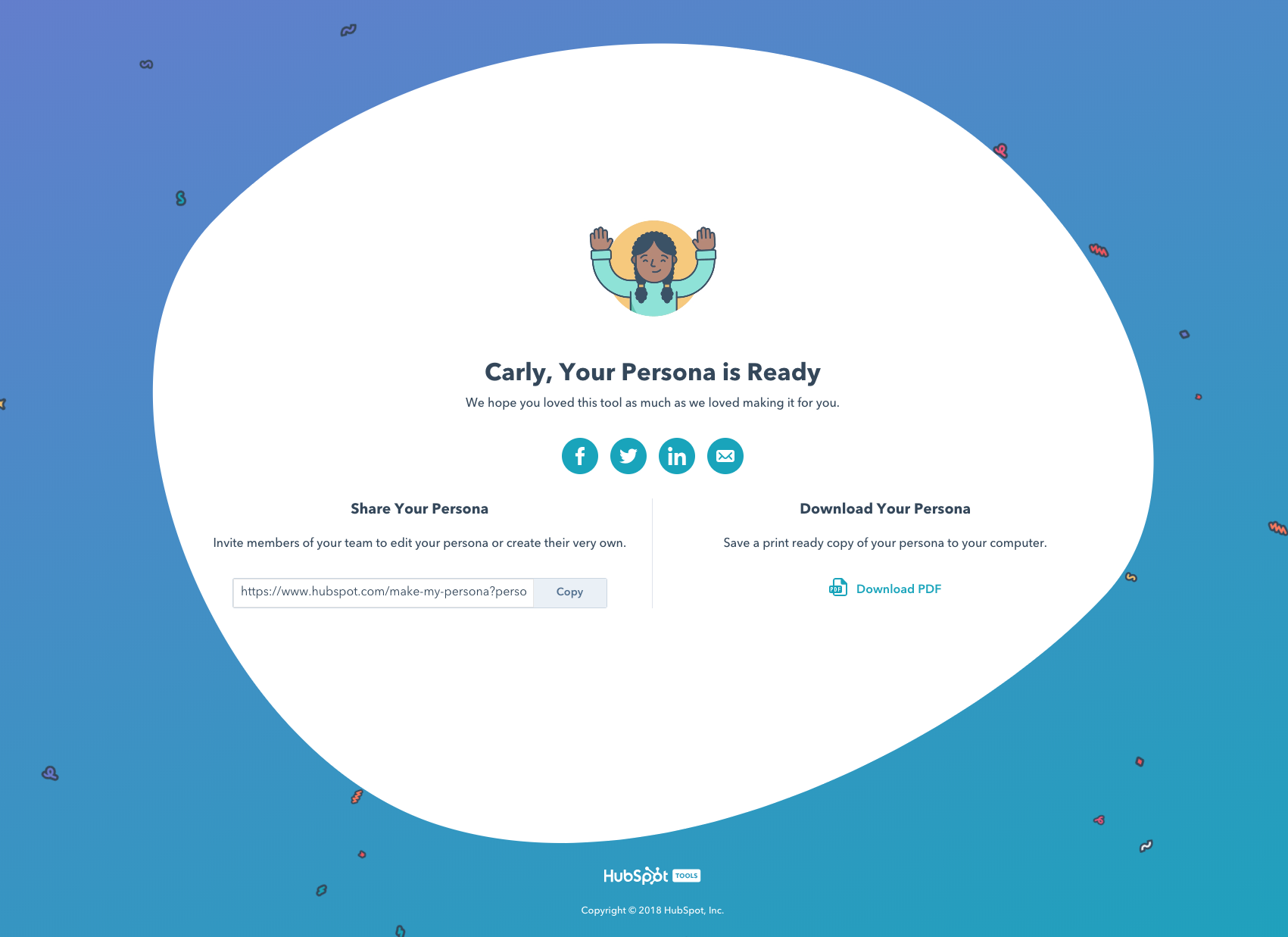
Here are some ideas for how to spread the word about your new persona internally:
- Email your fancy new PDF to the entire company, including your superior. In the email, explain what buyer personas are and why they’re important. Then, introduce your buyer persona using the characteristics produced in Make My Persona.
- Present your new persona(s) in your next company meeting, explain why they are important, and how this persona will help your business succeed and grow.
- Think about this persona every time you create a piece of content and ask yourself: Is it helping them achieve their goals or solve their challenges?
- Print out a few copies and put them on the walls around your office. They’ll be friendly reminders of whom you’re doing all this for.
Note: We’ll store your persona info in case you want to go back and make updates. In fact, we encourage you to think of this as a living, breathing document that you should regularly revisit as you learn more about what makes your audience tick.
Not quite ready to ship it? That’s fine, too. We’ll provide you with a collaborative link you can share with your team. This link will generate a copy of your persona which your colleagues can edit as they see fit. When you land on a variation you all agree on, you can save it as a PDF.
5. Share the tool with someone in your network.
Did you find the tool helpful? Pass on the gift of simple and quick buyer persona creation by retweeting the post below:
HubSpot just released a new and improved “Make My Persona” tool to help your team develop your buyer personas. Give it a try here 👉 https://t.co/GD9EgtFvGX pic.twitter.com/7aq4l6gcsH
— HubSpot Academy (@HubSpotAcademy)
August 14, 2018

7 Free Project Management Software Options to Keep Your Team On-Track
59% of U.S. workers say communication is their team’s biggest obstacle to success, followed by accountability.
Managing multiple projects at once, delegating tasks, and collaborating across teams is difficult on a good day — but can become downright impossible when unforeseen obstacles get in the way.
Miscommunication and inefficiencies in your project management process can lead to confusing and stressful experiences for your employees, and hinder your company’s ability to satisfy your clients’ needs or hit end-of-year goals. This can lead to major losses over time.
Fortunately, there are plenty of free project management software options to keep your team on-track without breaking the bank. To streamline your process and ensure everyone on your team is on the same page, take a look at these seven exceptional free project management tools.
1. Teamweek
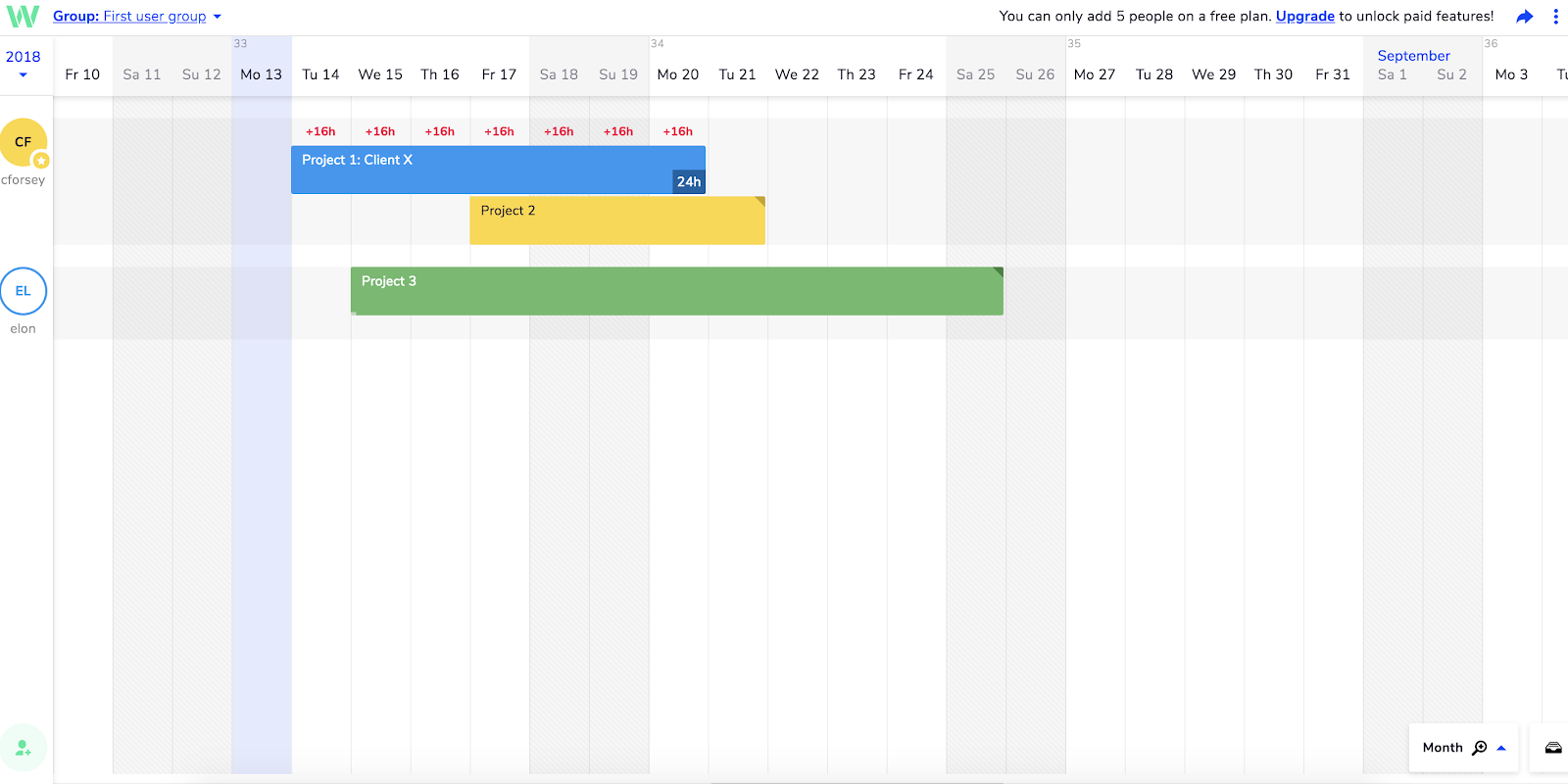
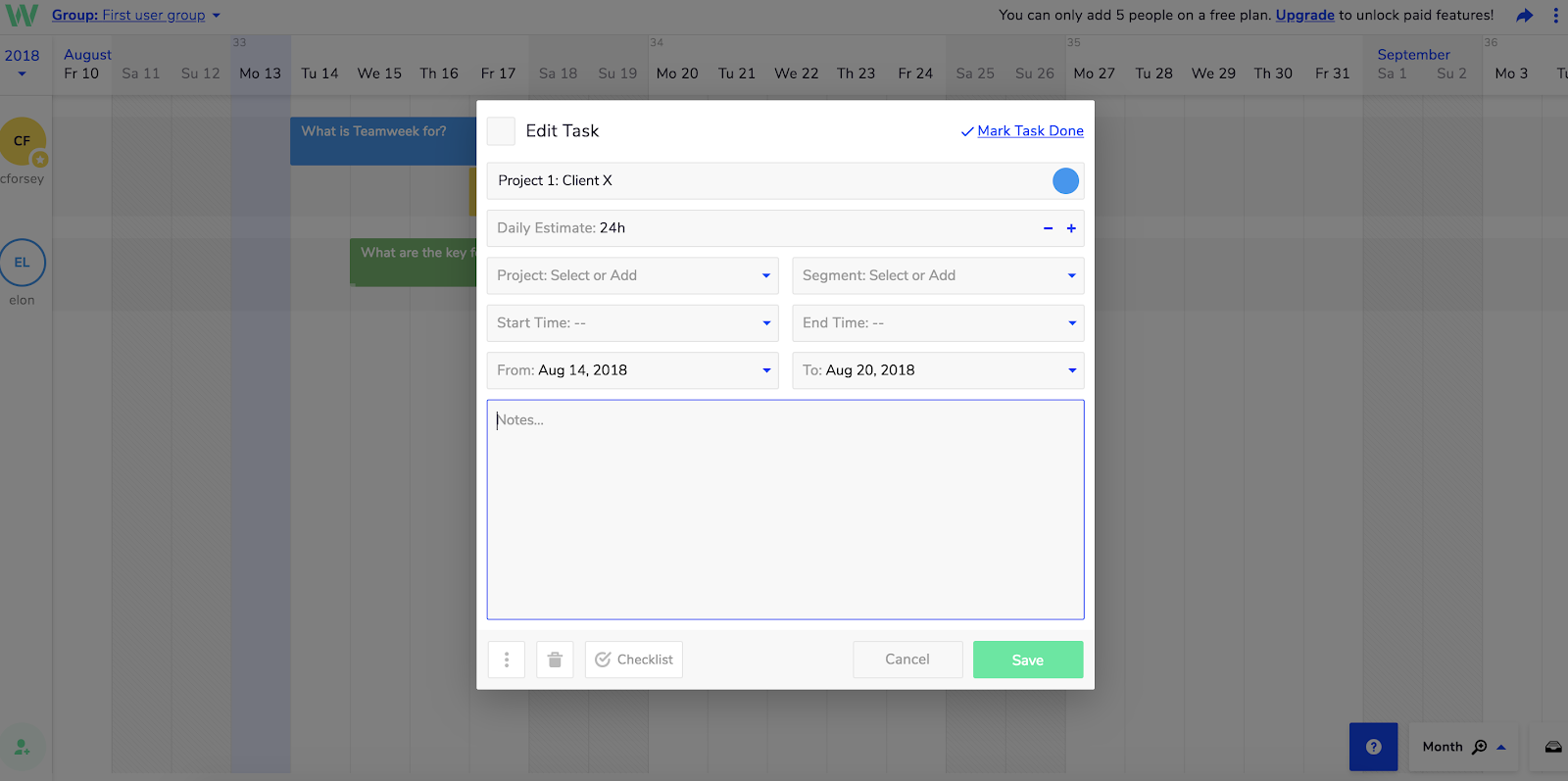
Teamweek is an effective project management tool to automate your task delegation process, and visualize which project tasks have been completed and which haven’t. If your team often collaborates with other departments on projects, this could be a useful tool for you.
Features include:
- Gantt-chart visualization to track important deadlines and projects
- Integrations with Slack, Github, Evernote, and others
- Team collaboration option through shared calendars and task notes
Cost: Free for an unlimited number of projects for up to five team members
2. Zoho Reports
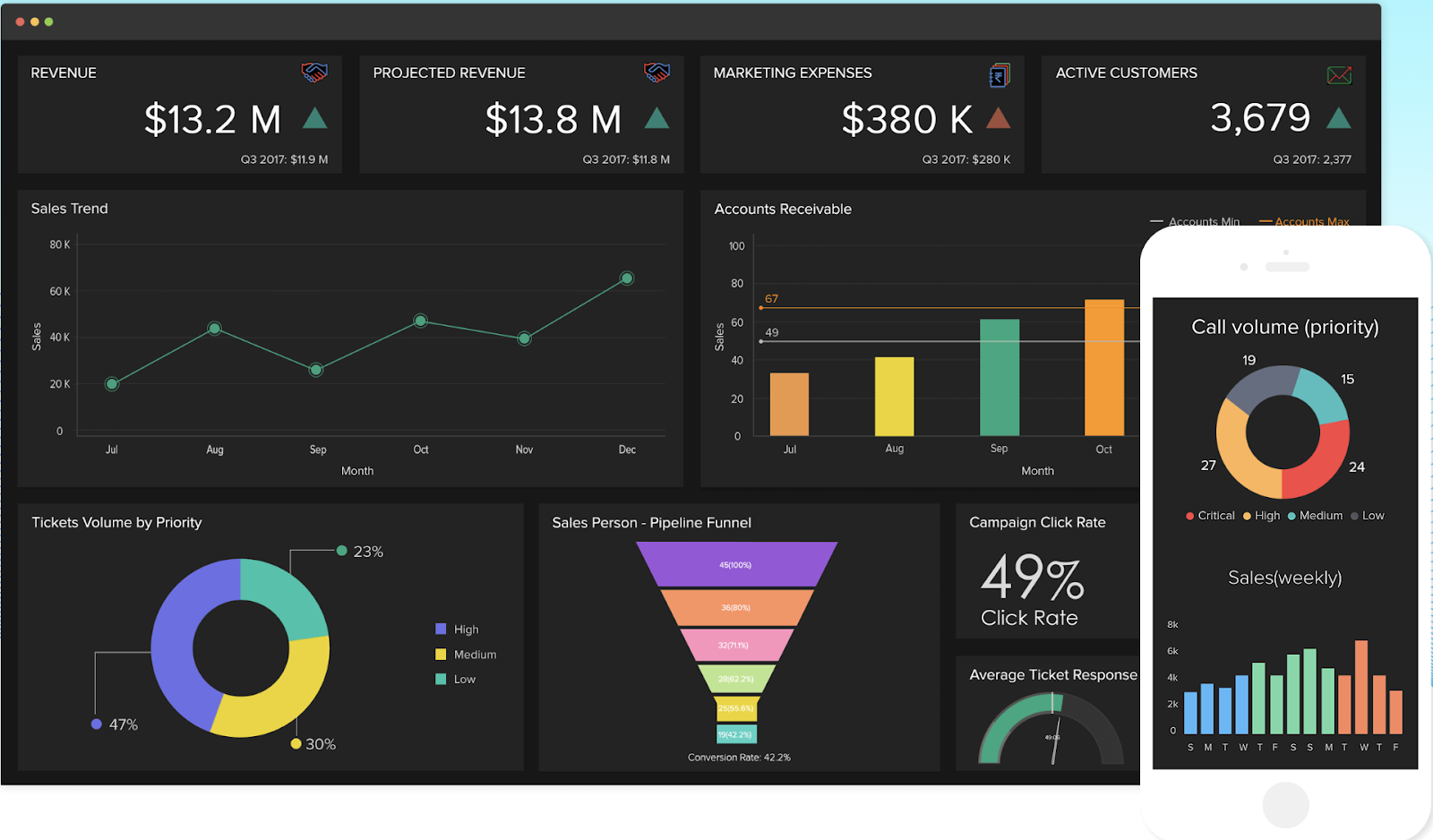
Zoho Reports is easy to use and lets you create comprehensive dashboards and data visualizations to ensure your projects are on-track. You can import data from outside files, cloud drives, applications, and in-house apps, enabling you to create more accurate cross functional reports. (Zoho Reports is a HubSpot integration partner).
Features include:
- Easy drag-and-drop interface with BI visualization tools
- Ability to share and collaborate on reports and dashboards with colleagues privately.
- Cloud BI reporting tool embedded within your own website or product
- Integrations with Slack, Google Apps, and Dropbox, as well as mobile apps, making team collaboration easier.
Cost: Free for one project with multiple users, storage up to 10 GB
3. Asana
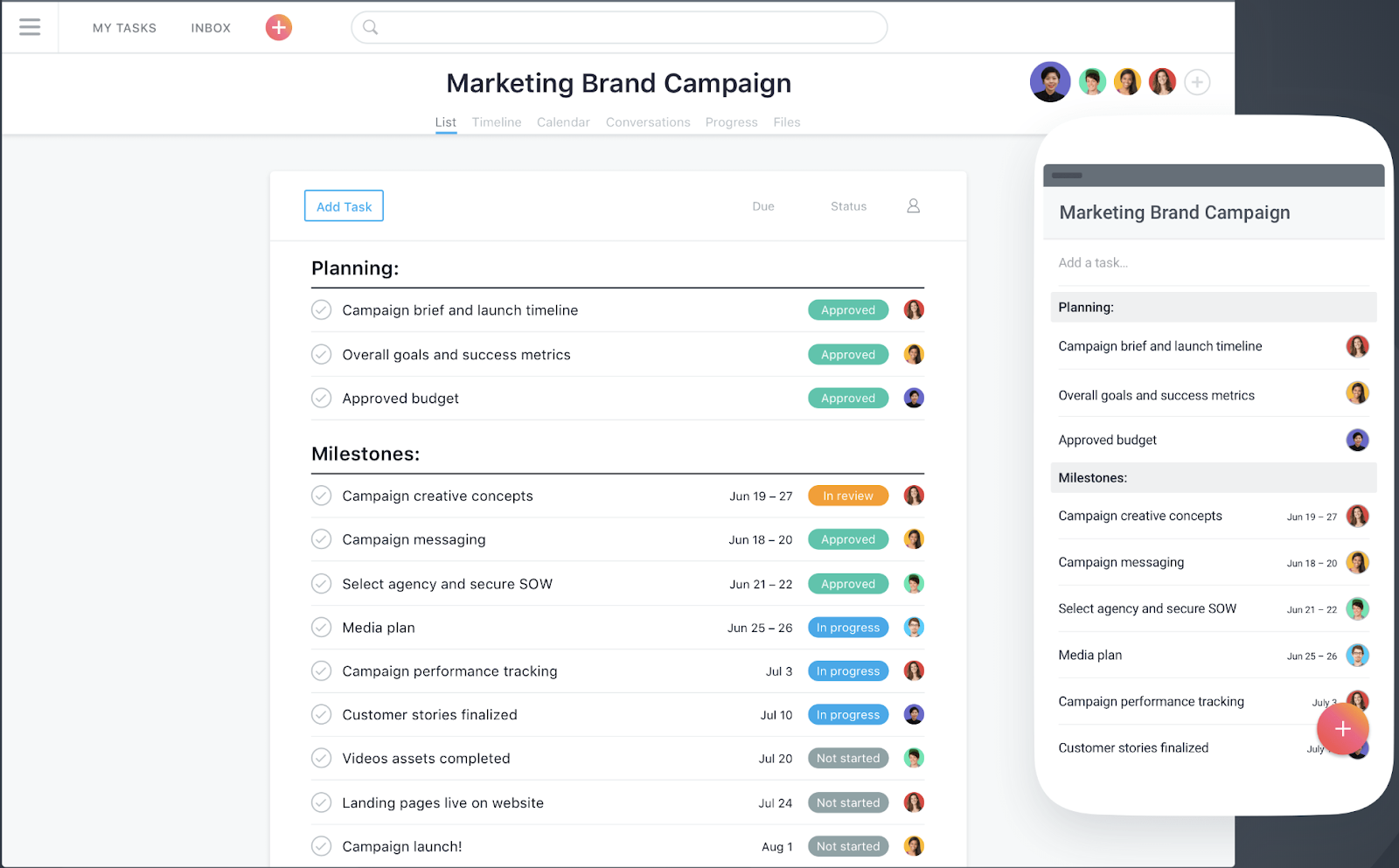
Asana, one of the most popular project management solutions used by millions of people across 192 countries, has a clean and user-friendly interface. The all-in-one tool lets you create boards to visualize which stage your project is in, and use reporting to keep track of finished tasks and tasks that need your attention.
Features include:
- The ability to create templates to automate mundane tasks
- The ability to collaborate and share information across the team, privately and securely
- The option to set security controls and designate admins
- Over 100 integrations for a more efficient start-to-finish process
- Custom project fields, share documents, and filter tasks
Cost: Free for unlimited projects for teams up to 15 people.
4. Teamwork
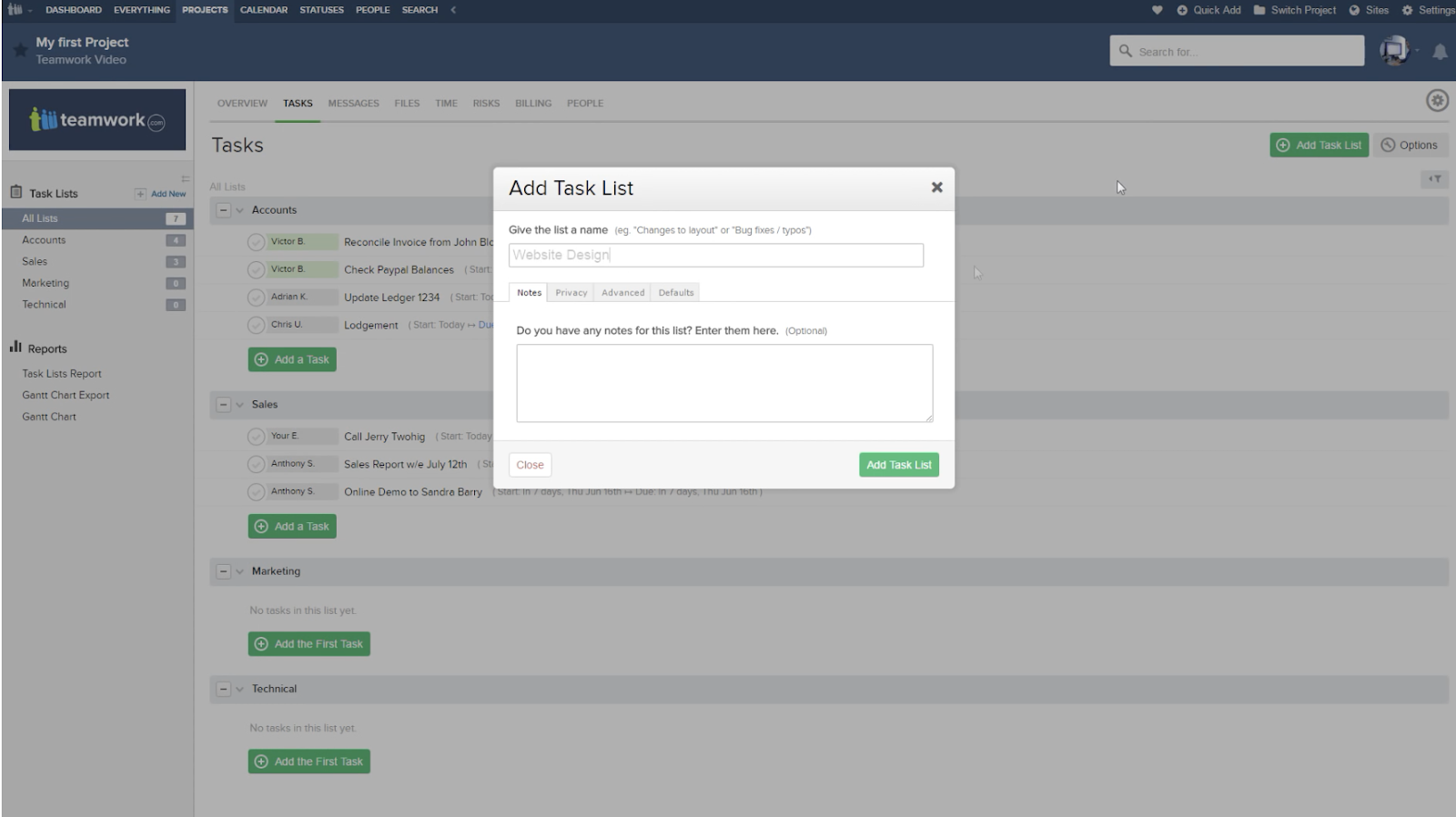
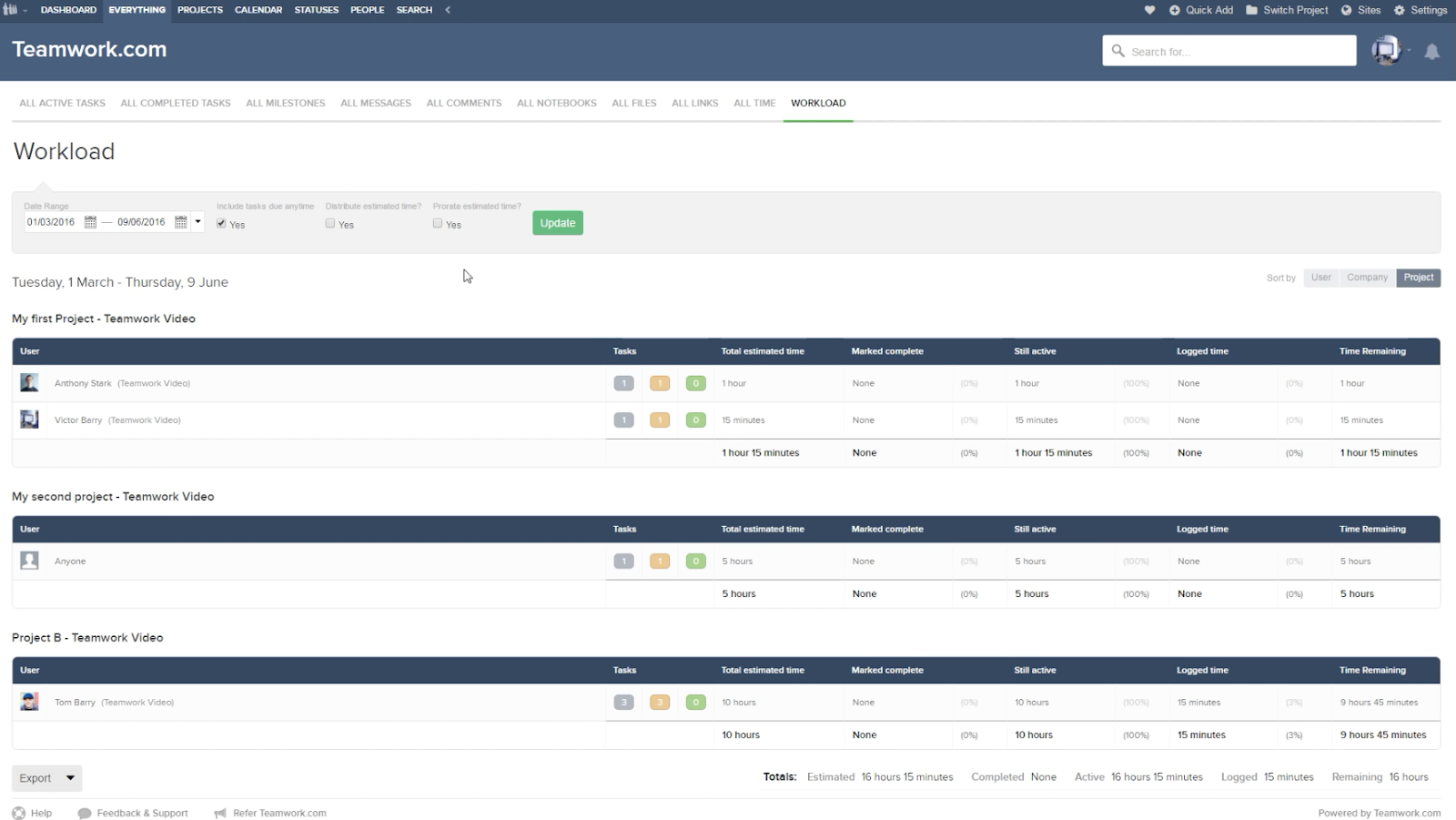
Teamwork, a project management tool that specializes in bringing together remote workers, allows you to create team member status updates so your remote and flexible teams know their coworkers’ schedules. It also provides customer service functions, including the option to assign tickets or view customer emails in one place. (Teamwork is a HubSpot integration partner).
Features include:
- Customizable navigation to prioritize your team’s needs
- Gantt chart for visualizing due dates and project timelines
- Private messaging, and option to make project details private
- Team member status updates for remote or flexible team members
Cost: Free for two to five users
5. Wrike
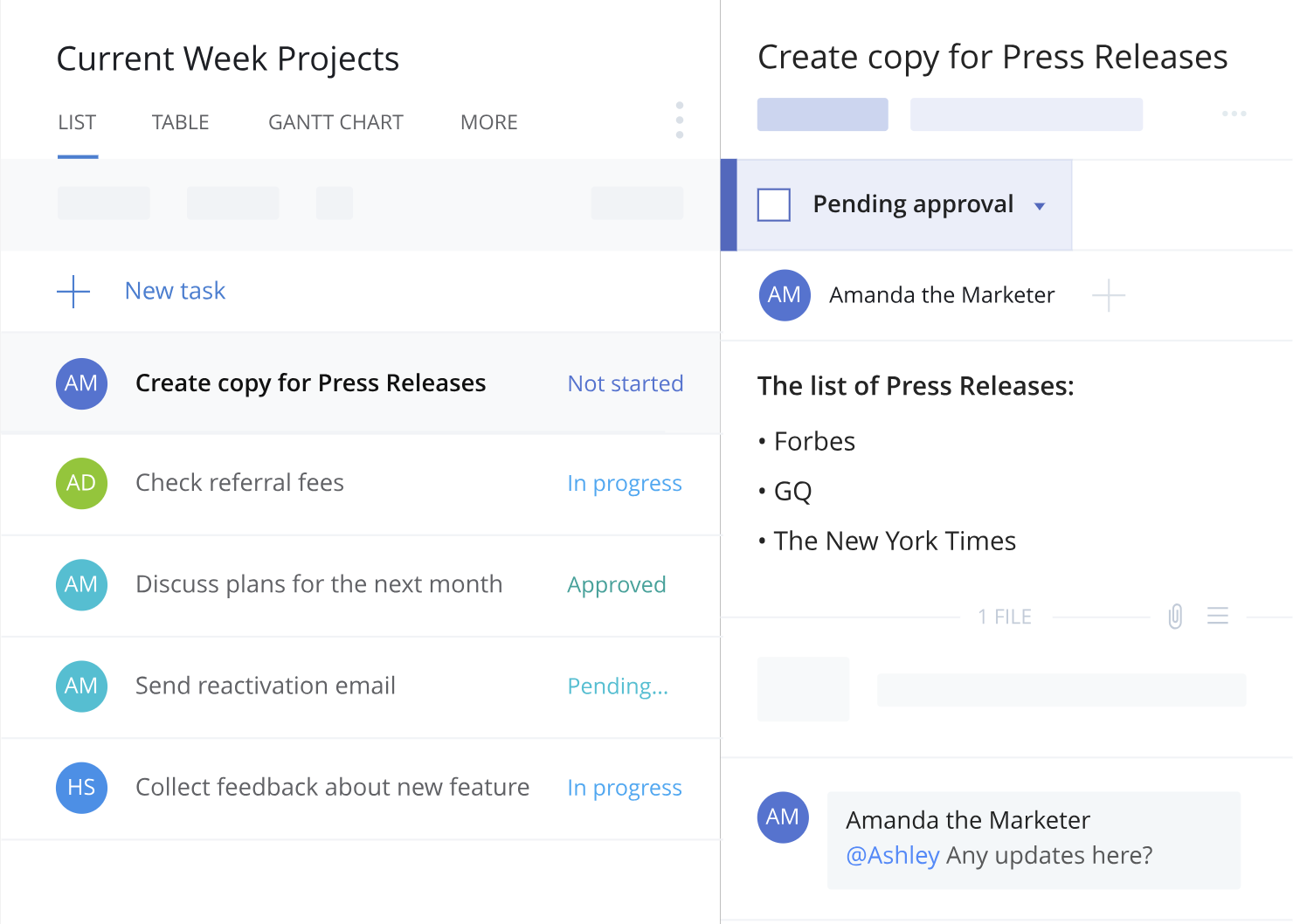

Wrike stands out as an exceptional project management tool for teams who want the option to customize workflows and edit and revise projects from within the platform itself. The tool offers the ability to color code and layer calendars, and its mobile form allows colleagues to update project information on-the-go. You can add comments to sections, videos, or documents, and create custom fields to export data most relevant to your company.
Features include:
- Security measures to ensure only authorized personnel can access information
- Activity Stream to allow project managers to micromanage small tasks, see activities in chronological order, and tag team members
- The option to unfollow activities to declutter your own personal Stream
- Email and calendar synchronization
- Built-in editing and approval features
Cost: Free for five team members
6. Paymo
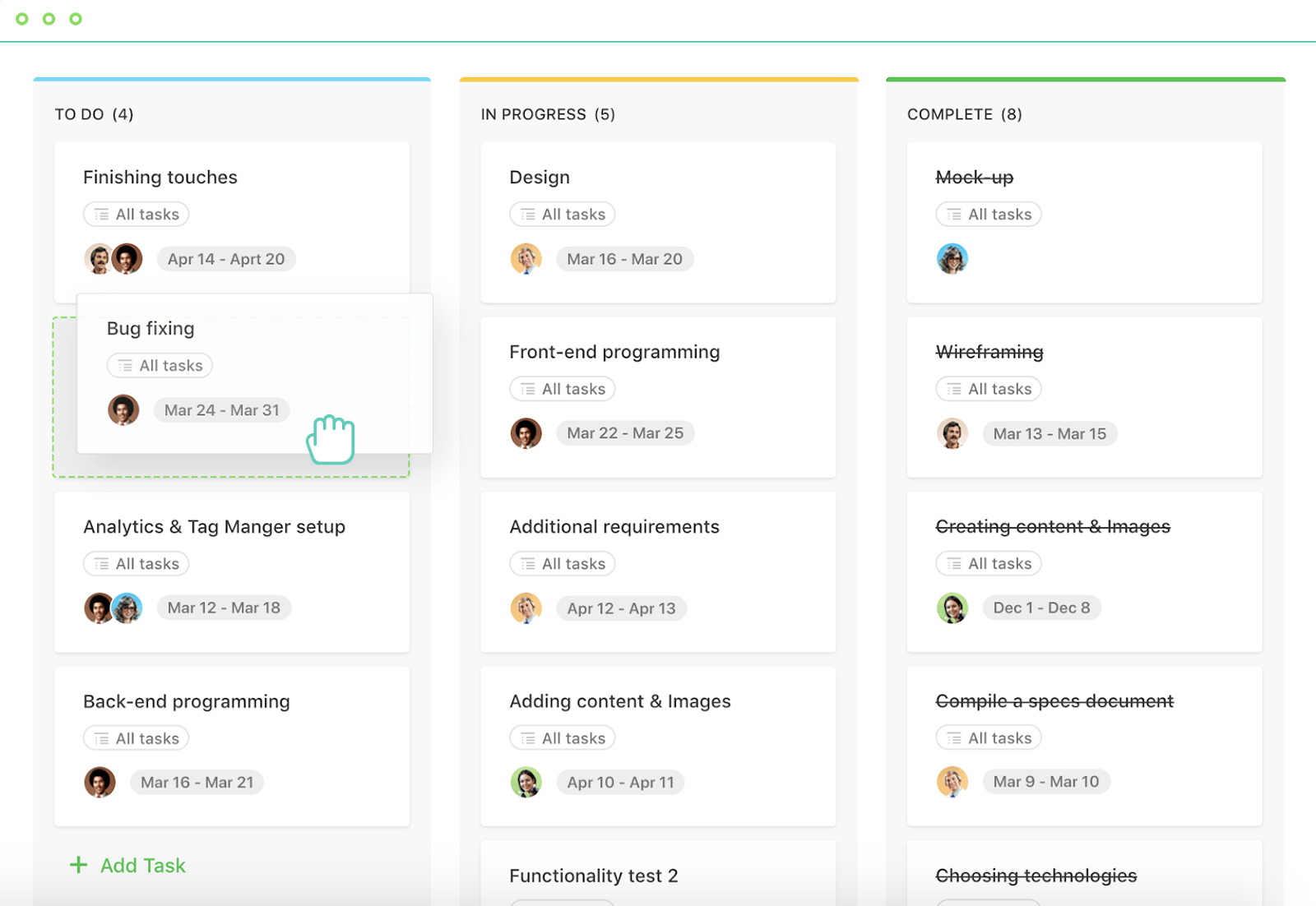
Paymo’s free version only allows access for one user, but if you’ve got a small team or you’re a freelancer, this could be an efficient option for tracking billable hours and invoicing clients. Along with tracking finances, Paymo also allows you to organize project timelines, create to-do lists, and stay on top of your budgets for multiple projects at once.
Features include:
- Kanban Boards
- Time Tracking
- File Sharing and Adobe CC Extension
- Reporting
- Three Invoices
Cost: Free for one user, one GB storage
7. ClickUp
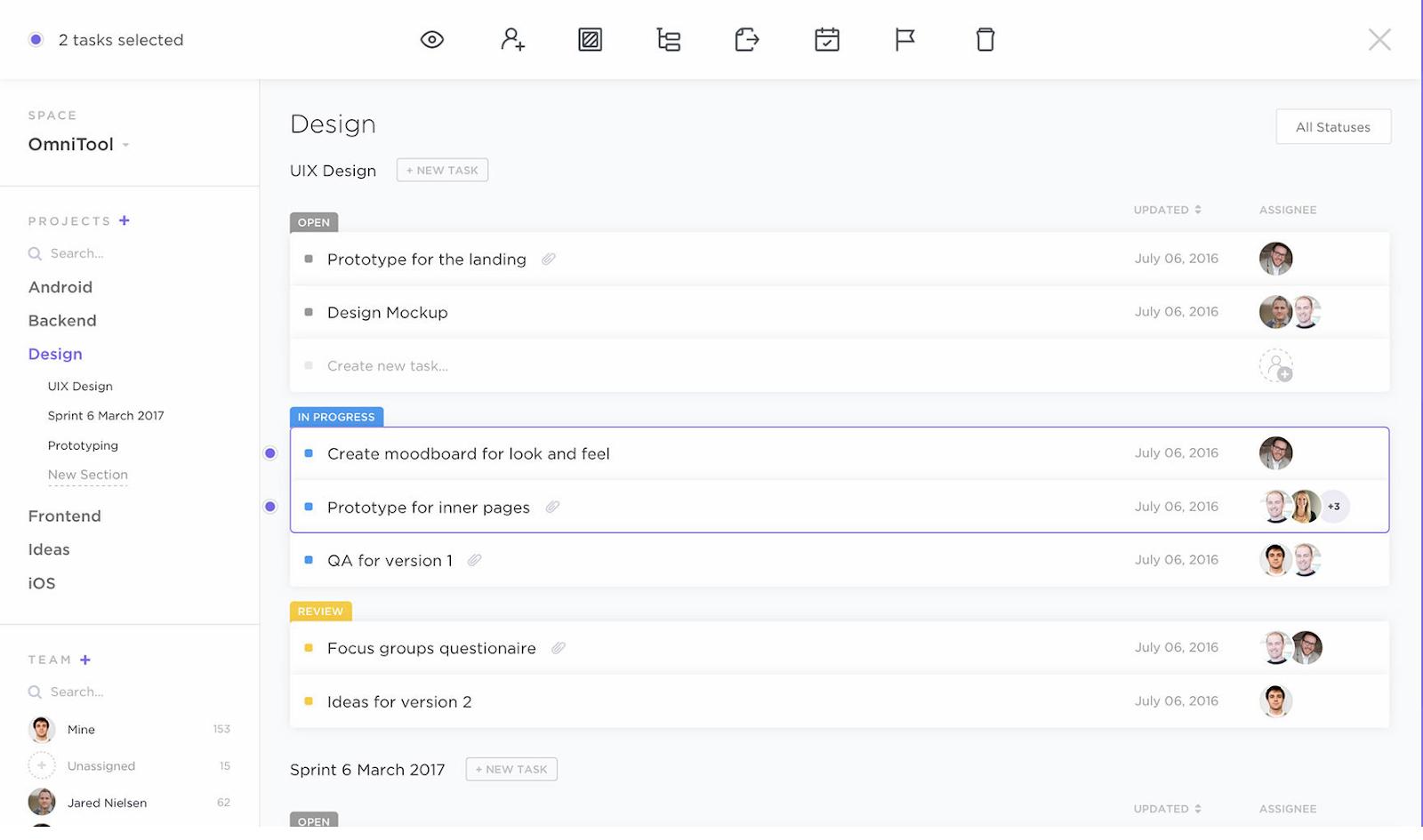
ClickUp provides a few impressive features to customize the all-in-one project management tool to suit your team members, including the option for each user to choose one of three different ways to view their projects and tasks depending on individual preference. If your marketing team overlaps with sales, design, or development, this is an effective solution, as it provides features for all of those four teams.
Features include:
- The ability to organize your projects based on priority, and assign tasks to groups
- The option to set goals to remind teams what they’re aiming to accomplish
- Google Calendar two-way sync
- An easy way to filter, search, sorting, and customize options for managing specific tasks
- Activity stream with mentions capability
- Image mockups
- 57 integrated apps
Cost: Free forever, with unlimited users and unlimited projects, and 100 MB of storage

11 Blockchain Companies You Should Be Paying Attention To
Even though blockchain is arguably one of the most revolutionary emerging technologies right now, do you think you could name a blockchain company off the top of your head?
It’s hard to name more than a handful of blockchain companies today — the cryptocurrency and blockchain space are still relatively new, so most blockchain companies don’t get a lot of exposure.
But let’s say blockchain explodes in popularity soon. Knowing which companies already make headlines and which ones are due for some press would be useful — if you know which blockchain companies are poised for success and which ones aren’t, you’ll be more likely to pick the right blockchain company for your business and the right crypto assets for your investment portfolio.
With that in mind, read on to learn about the 11 blockchain companies you should be paying attention to today.
11 Blockchain Companies You Should Be Paying Attention To
1. Steem
Steem is like YouTube on blockchain, but instead of paying content creators in fiat currency, publishers use Steem to pay content creators in STEEM, the platform’s cryptocurrency, which is easily convertible to Bitcoin and Ether. Similar to how YouTube pays top content producers to create the platform’s best videos, publishers who use Steem can reward their top content creators and curators for publishing popular content.
To prove that Steem can be the future of content monetization, they built a social media network called Steemit on their platform. Steemit is still in Beta, but it has attracted over 920,000 users who publish more than 1.5 million posts each month. Steem has also paid content creators over $40 million in its digital asset, which are called smart media tokens, proving the platform’s viability to publishers everywhere.
2. Ripple
According to the Institute of International Finance, global payments cost $1.6 trillion each year and usually take an average of three to five days just to settle. Brad Garlinghouse, a former executive at AOL and Yahoo!, knew he could solve this frustratingly prevalent problem with blockchain technology, so, in 2012, he founded Ripple.
The company has its own payment infrastructure, RippleNet, and through it, banks, payment providers, and digital asset exchanges can connect with each other to seamlessly transfer money, no matter where they’re located.
Ripple’s technology allows banks to settle cross-border payments in real-time, lets payment providers use Ripple’s own cryptocurrency, XRP, to lower liquidity costs, and enables corporations to instantly send global payments to their beneficiaries. Over 75 banks across the globe have implemented and tested Ripple’s technology with their own internal payment systems.
3. Chain
Chain is a blockchain development company that builds cryptographic ledger systems for the financial services industry. Their blockchain-based tools help banks, stock exchanges, and credit-card companies quickly and securely store, trade, and manage financial assets.
By setting up strategic partnerships with financial titans like Capital One, Citigroup, Visa, and Nasdaq, Chain has accelerated Wall Street’s adoption of blockchain technology.
4. Intellectsoft
Founded in 2007 as a mobile app development company, IntellectSoft has evolved into a software solution development company that provides custom software development and consultancy services in emerging technologies, like blockchain, Internet of things, artificial intelligence, augmented reality, cloud computing and more.
For almost 11 years, they’ve helped organizations design, develop, implement and maintain the latest software solutions in their businesses. Their blockchain experts also boost enterprise and Fortune 500 companies’ security by integrating distributed ledger technologies, identity solutions, and smart contracts into their processes.
5. Altoros
Using Cloud Foundry, an open source cloud application platform, Altoros can build, test, deploy, and scale their customers’ blockchain frameworks easier and faster than other software development companies.
Throughout their blockchain consultancy process, Altoros helps enterprises evaluate the viability of their blockchain-based solution, design and develop the solution’s architecture, and maintain and enhance the solution for their client’s customers.
6. Celsius Network
Celsius Network is like a blockchain bank — users can deposit, borrow, and earn interest on their crypto. For instance, you can hold your cryptocurrency in the network and earn up to 5% interest, use your cryptocurrency as collateral for dollar loans at a 9% interest rate, and short Bitcoin or Ethereum if you feel bearish about the crypto market. It’s like banking on blockchain.
7. LeewayHertz
In 2008, Leeway Hertz launched one of the first apps on Apple’s AppStore. Now, they’ve jumped into another new industry, blockchain, to help enterprise companies develop Blockchain applications, like distributed ledgers, smart contracts, and decentralized apps.
As a custom software development company with a proven track record in IT consultancy, they plan to be the leading blockchain developer for the biggest brands in the world.
8. OmiseGO
OmiseGo is a Ethereum-based financial network for payment services, merchants, and financial institutions. Their public OMG network and decentralized exchange enable transparent, peer-to-peer transactions of any asset in real-time.
Digital wallet providers can also connect to the OMG network through their open source SDK to enable wallet-to-wallet transactions of crypto and fiat currencies and asset trades from different blockchain protocols. In August 2017, OmiseGO became the first Ethereum token with a market capitalization over $1 billion.
9. Blockchangers
Blockchangers isn’t like most blockchain companies. Even though they help their clients understand and leverage blockchain technology through lectures, workshops, consulting, and development services, like other blockchain companies, they consult their clients based off the assumption that governments will regulate cryptocurrency one day, which the creators of blockchain aimed to fight against. This is the most realistic way to consult clients who want to use crypto and blockchain — the only way governments can fight cryptocurrency fraud is by regulating it.
Blockchangers also hosts Northern Europe’s largest blockchain conference, Oslo Blockchain Day, and their clients include PwC, DNB Bank, and more.
10. ChromaWay
ChromaWay is a blockchain platform that provides smart contract solutions for real estate and finance companies. In 2017, they made headlines for building the Green Assets Wallet — a platform that connects green investors with potential investment opportunities — to help meet the goals of the Paris Climate Agreement.
11. Techracers
After a group of Indian engineers founded Techracers in 2012, the blockchain solutions provider experienced so much explosive growth that they had to move its headquarters to the U.S. in 2017. They’re now one of the most robust blockchain solutions provider on the market.
For their clients, Techracers build customized solutions in every facet of blockchain technology, like ICO launches, smart contract audits, smart contracts development, cryptocurrency development, cryptocurrency wallet development, cryptocurrency exchange development, and private blockchain development.

25 Case Study Examples Every Marketer Should See
The saying “lead by example” is important in politics and leadership roles — and it’s also critical in marketing.
Sure, you can tell potential customers your marketing team is the best at running YouTube campaigns or effectively increasing a website’s cost-per-acquisition (CPA), but until you offer examples, they’re going to have a hard time believing you.
Putting together a compelling case study is one of the most powerful strategies for showcasing your marketing skills and attracting future customers. But it’s easier said than done — you’ve executed the campaign, you’ve collected the results, now what?
To help you create an attractive and high-converting case study, we’ve put together a list of some of our favorites. Take a look, and let these examples inspire your next brilliant case study design.
1. “Shopify Uses HubSpot CRM to Transform High Volume Sales Organization,” by HubSpot
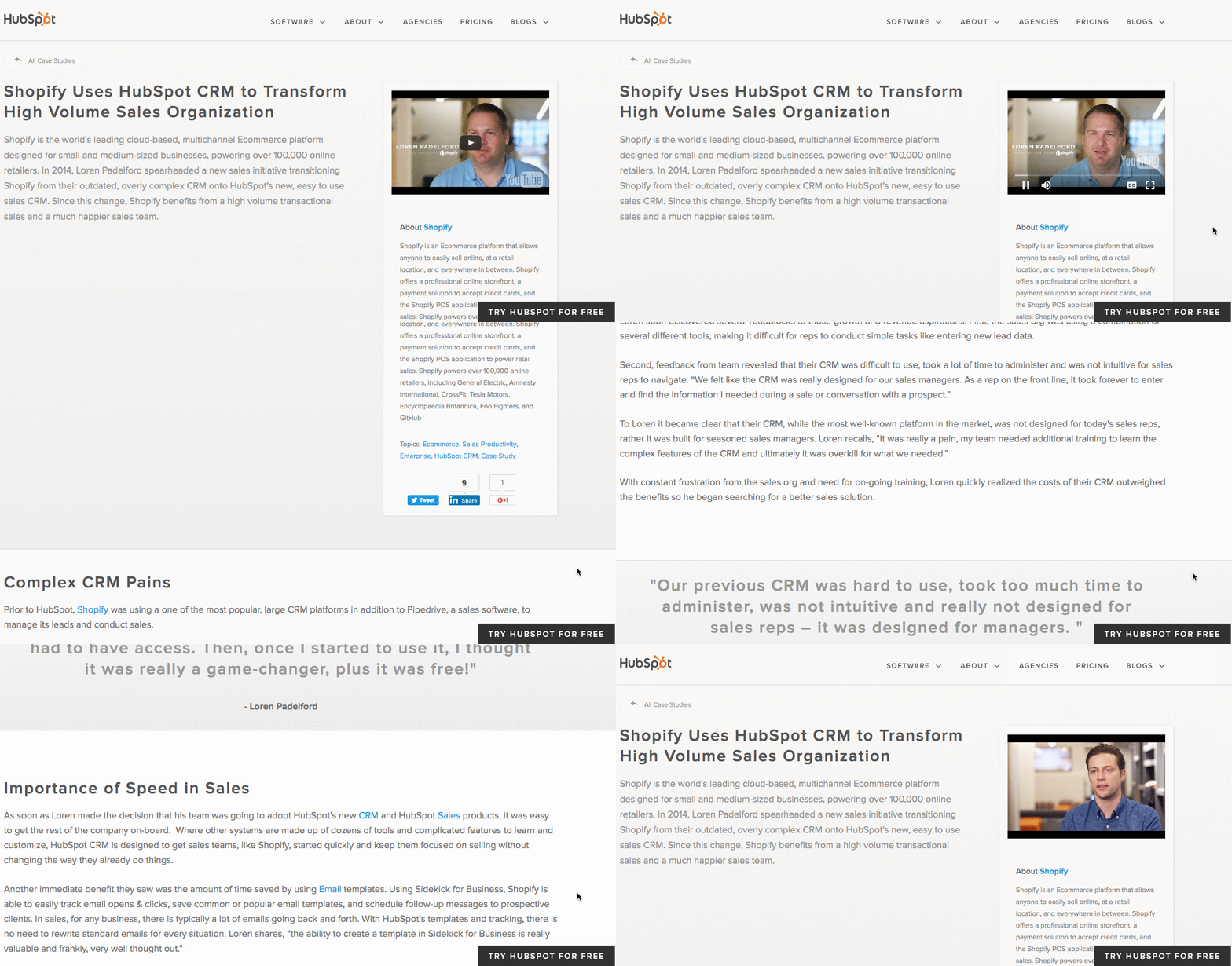
What’s interesting about this case study is the way it leads with the customer. That reflects a major HubSpot credo, which is to always solve for the customer first. The copy leads with a brief description of why Shopify uses HubSpot, and is accompanied by a short video and some basic statistics on the company.
Notice that this case study uses mixed-media. Yes, there is a short video, but it’s elaborated upon in the additional text on the page. So while your case studies can use one or the other, don’t be afraid to combine written copy with visuals to emphasize the project’s success.
2. “Designing the Future of Urban Farming,” by IDEO

Here’s a design company that knows how to lead with simplicity in its case studies. As soon as the visitor arrives at the page, he or she is greeted with a big, bold photo, and two very simple columns of text — “The Challenge” and “The Outcome.”
Immediately, IDEO has communicated two of the case study’s major pillars. And while that’s great — the company created a solution for vertical farming startup INFARM’s challenge — it doesn’t stop there. As the user scrolls down, those pillars are elaborated upon with comprehensive (but not overwhelming) copy that outlines what that process looked like, replete with quotes and additional visuals.
3. “Secure Wi-Fi Wins Big for Tournament,” by WatchGuard
Then, there are the cases when visuals can tell almost the entire story — when executed correctly. Network security provider WatchGuard is able to do that through this video, which tells the story of how its services enhanced the attendee and vendor experience at the Windmill Ultimate Frisbee tournament.
4. “Customer Case Study: ElliotLee Estate Agents” by Pioneer Business Systems
In 2018, 45% of people watch more than an hour of Facebook or YouTube videos a week. A video case study could be a compelling way to attract potential customers who prefer watching a video over reading text. Additionally, a video allows you to convey customer emotion. This case study by Pioneer Business Systems, for instance, allows viewers to see firsthand the effects Pioneer’s telephone system had on their clients, ElliotLee Estate Agents. It includes text, as well, to thoughtfully organize and break-up the video into sections.
5. “Sapio User Acquisition Case Study” by Fractl
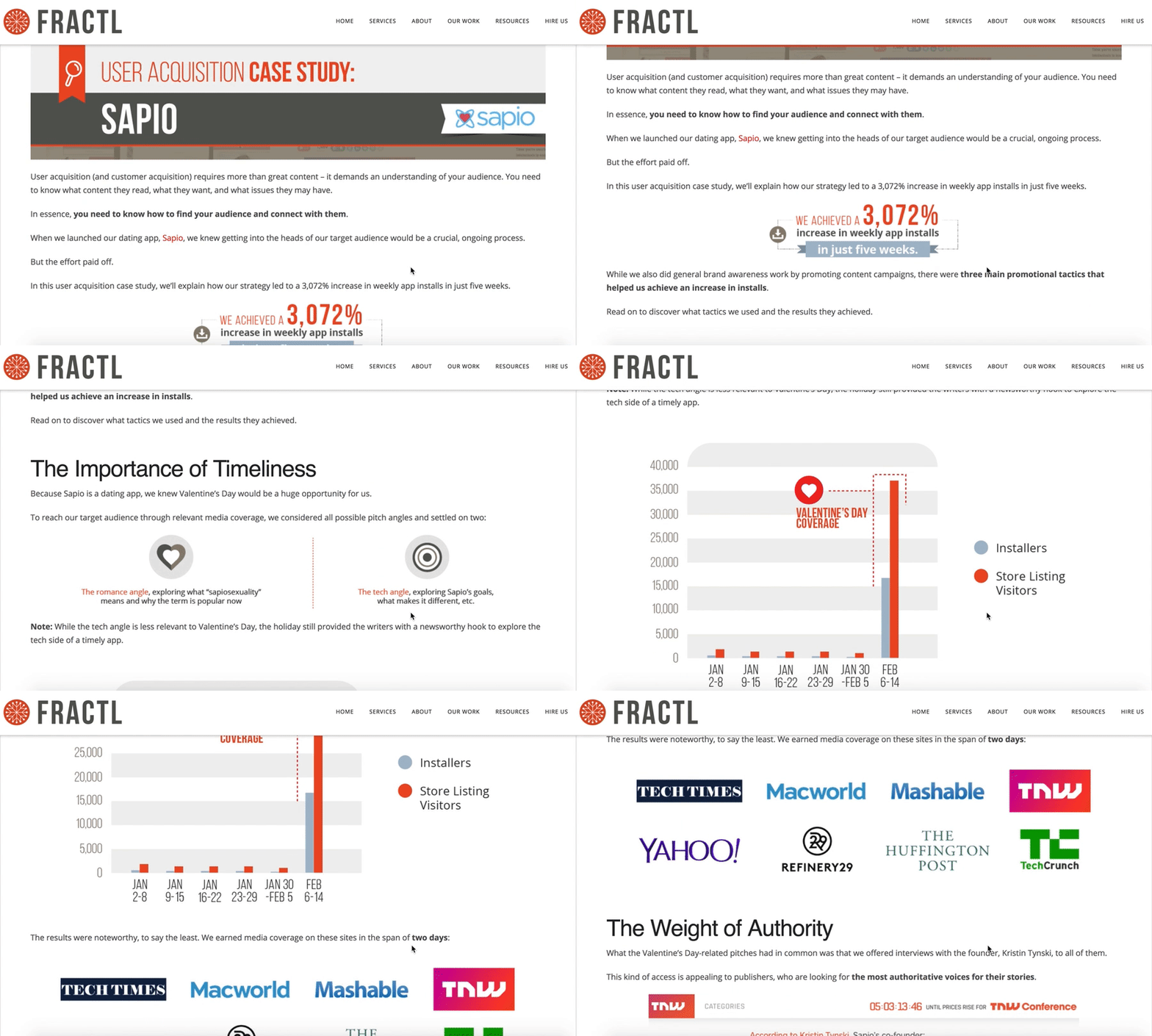
Fractl uses both text and graphic design on their Sapio case study web page to immerse the viewer in a more interesting user experience. For instance, as you scroll, you’ll see the results are illustrated in an infographic-design form as well as the text itself. Further down the page, they use icons like a heart and a circle to illustrate their pitch angles, and graphs to showcase their results. Rather than writing which publications covered their news story, they incorporated the media outlet’s icons for further visual diversity.
6. “USA Today” by Fantasy
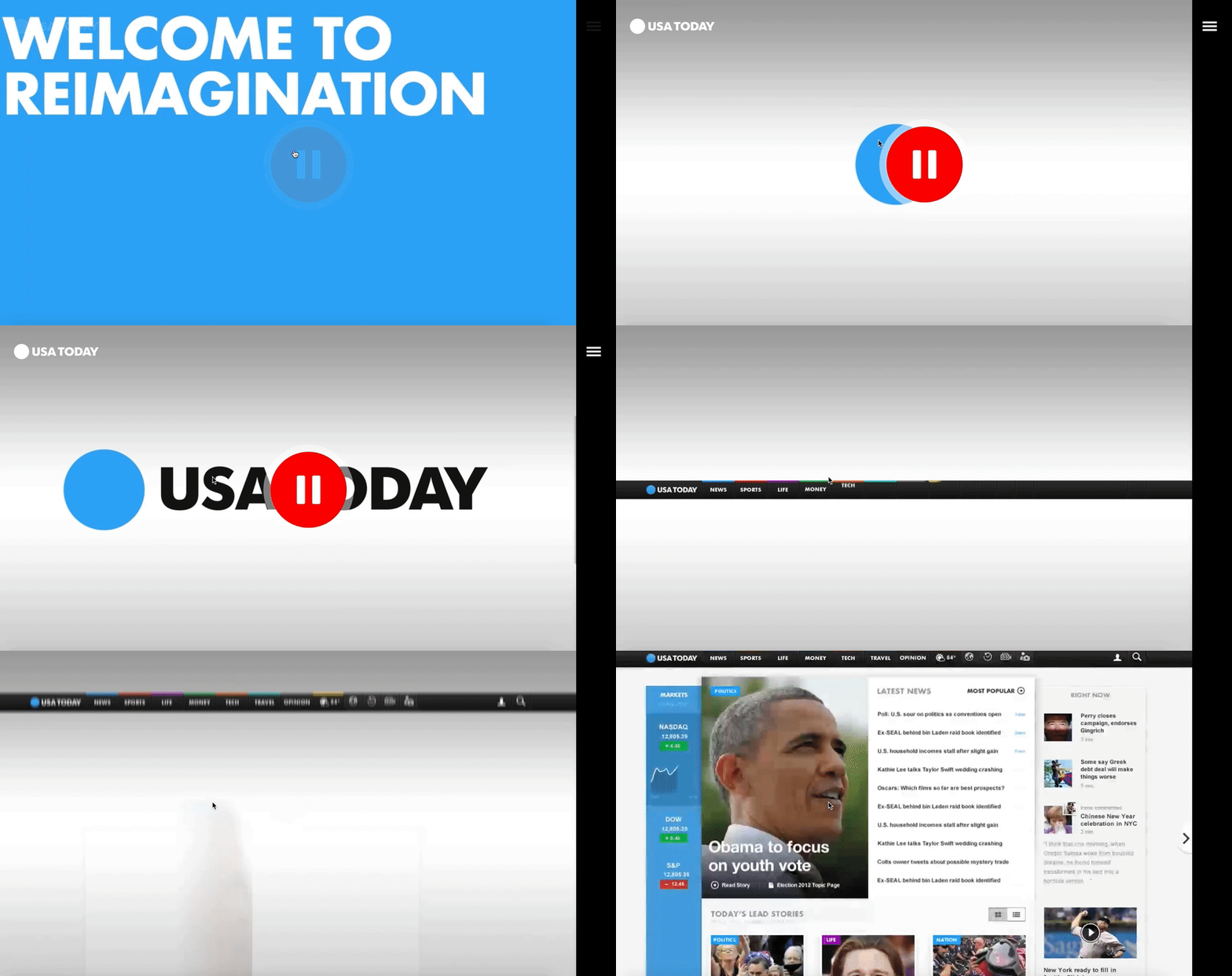
What’s the best way to showcase the responsiveness and user interface of a website? Probably by diving right into it, via video — which is exactly what Fantasy does on their case study page for USA Today. They keep the page simple and clean, with a large red play button embedded at the top, inviting you to review their redesign of USA Today’s website via video. The video itself is simple, showing the website’s interface and clicking on various links with simple instrumental music in the background.
If you’re more interested in text, you can scroll to find their goal, “make USA Today’s website responsive”, in one short paragraph, followed by a simple “1” icon, with the text “Became the most visited US News site.” Fantasy understands that, as a potential customer, this is all you need to know. Scrolling further, you’re greeted with a simple “Contact Us” CTA.
7. “Coca-Cola Uses App Annie to Amaze & Delight Customers” by App Annie.
(embed link: https://www.youtube.com/watch?v=sHo0SnZFTMw)
A video is a phenomenal way to grab a viewer’s attention, but in our video-heavy world today, it can be hard to keep potential customers’ eyes on the screen. To combat this, App Annie’s case study of Coca-Cola includes drawings and text to highlight what Greg Chambers, Coca-Cola’s Director of Innovation, is talking about on-screen. They also occasionally cut away from his face to include full-screen text. By incorporating graphic designs and text in their video, App Annie encourages viewers to stay engaged.
8. “How One Ecommerce Business Solved the Omnichannel Challenge with Bitly Campaigns” by Bitly
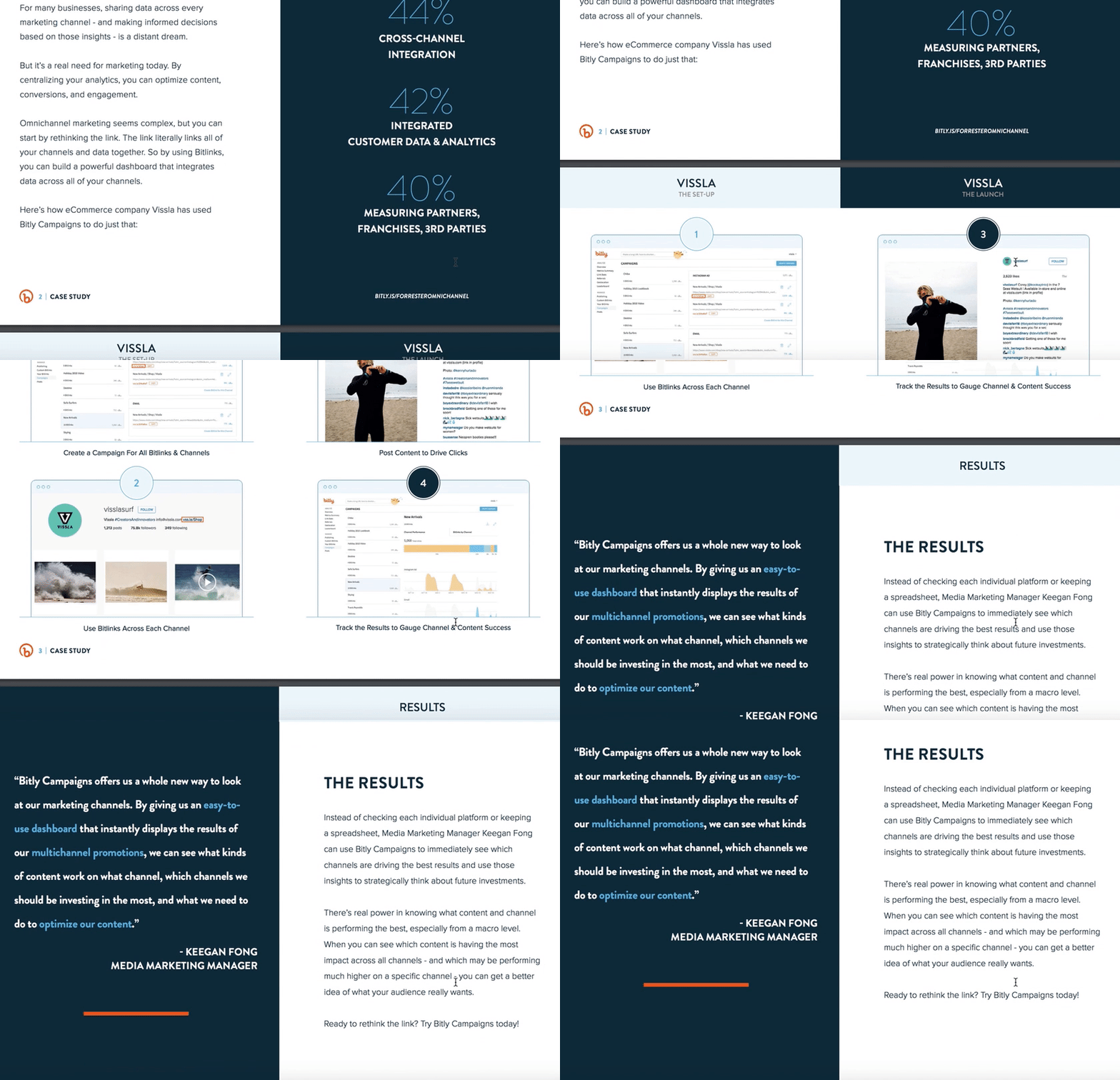
Bitly takes a different approach to text-heavy case studies, by providing their case study of ecommerce company Vissla in PDF form. The case study is clean and easily scannable, with sections divided into “The Goal”, “Top Omnichannel Obstacles”, and images of “The Set-Up” and “The Launch.” The downloadable PDF format makes the case study feel like an exclusive behind-the-scenes look, and uses colors and text that align with Bitly’s brand. Since the PDF opens in a separate browser, it’s easier for the viewer to avoid distractions as they scroll the pages.
9. “How Social Media Insights Turned Around Lexus’ Holiday Campaigns” by Infegy
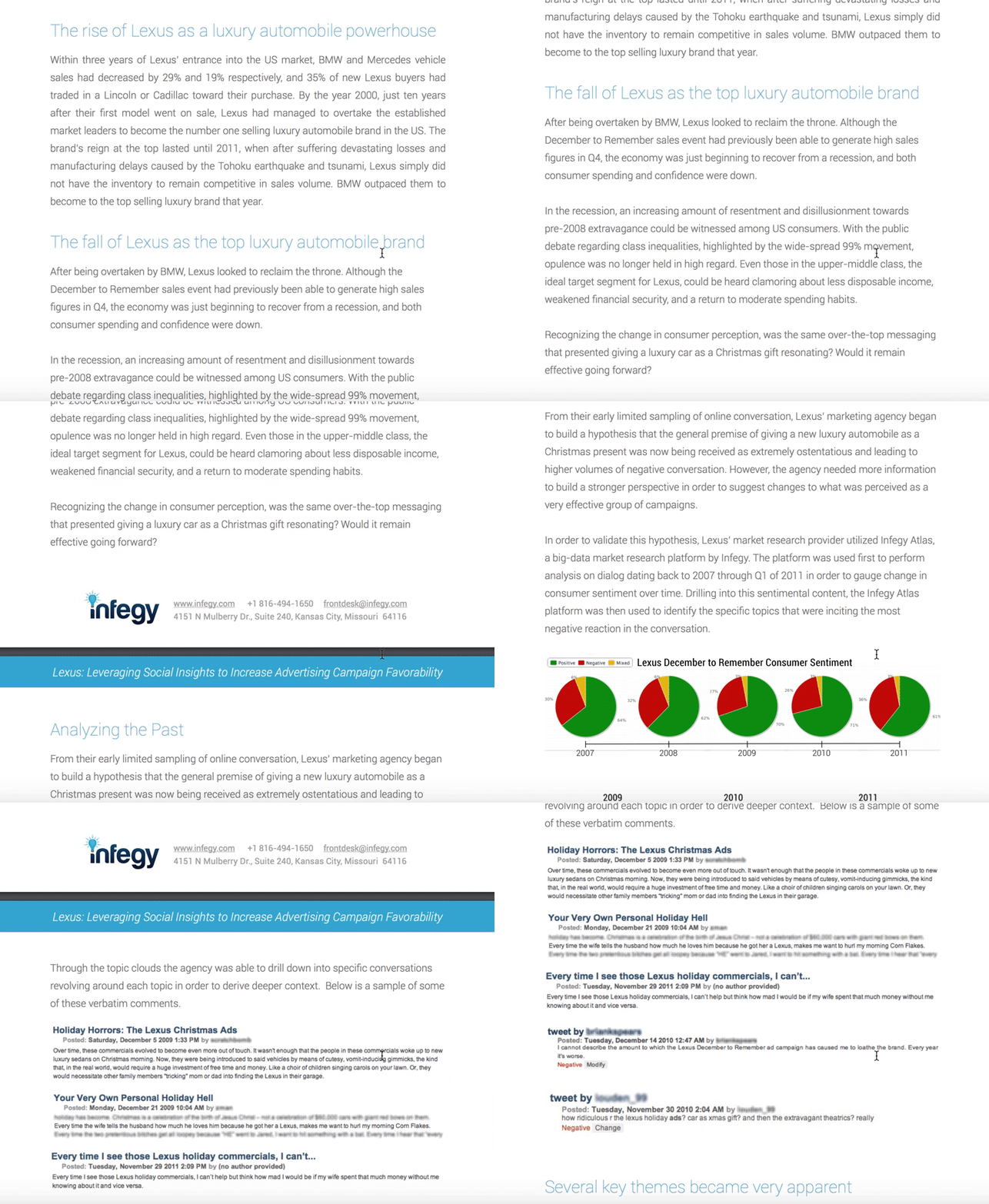
It can be risky to include hurdles to your case studies, but with great risk comes great reward, right? In Infegy’s case, their gated content is worth the fill-out form information, particularly since their client is such a big name in the automobile industry: Lexus. The PDF case study reads like a compelling news article, including titles like “The Rise of Lexus” and “The Fall of Lexus”, colorful pie charts, and real online comments from customers who were unhappy with Lexus’ old holiday ads. The PDF is six pages but features big font and plenty of white space, so viewers can easily skim it in only a few minutes.
10. “Fiesta Bowl” by OH Partners
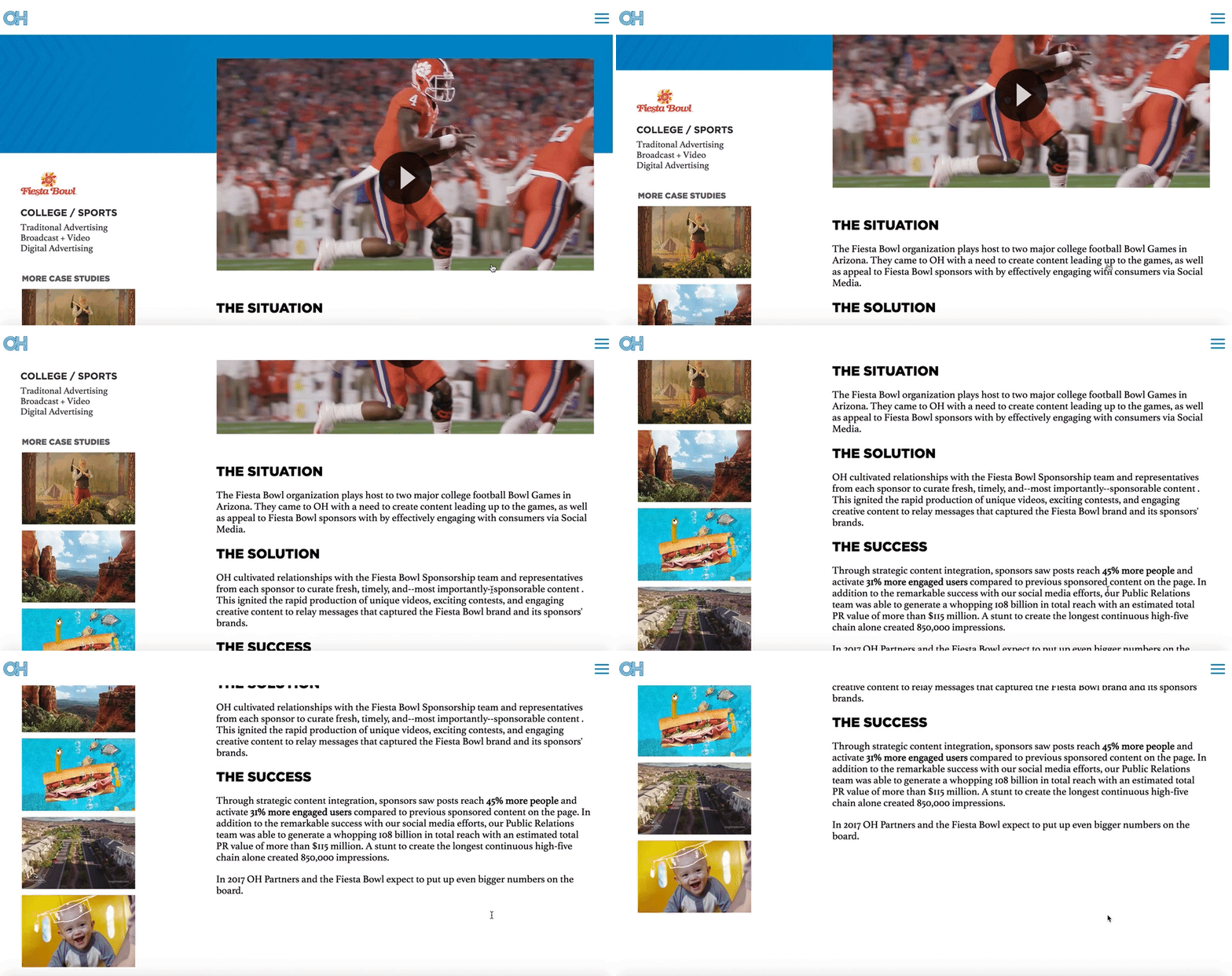
OH Partners doesn’t let superfluous details distract from the most important themes of their case study — “The Situation”, “The Solution”, and “The Success”. Each one of their case studies, including this Fiesta Bowl one, is organized into those three categories, with a video at the beginning followed by a few large font, easily skimmable paragraphs.
Best of all, OH Partners puts other case studies on the left side of the page, with highly enticing visuals to ensure a potential consumer can continue perusing the case studies until they’re confident in OH Partner’s track record.
11. “The Gifted Day” by Digitas

Digitas’ case study page for LVNG With, a cancer support community created by AstraZeneca, is one of the more emotionally moving campaigns in our list and might even evoke a few tears. The page begins with a heart-wrenching video of all the moments — a grandmother holding her grandchild, someone riding a roller coaster — that “weren’t supposed to happen”, exemplifying the enormous gift a single day could be to a terminal patient. Scrolling down, it’s obvious that Digitas kept AstraZeneca at the forefront of their strategy, but more than that, they used real people as their focal point.
12. “Wine.com” by RichRelevance
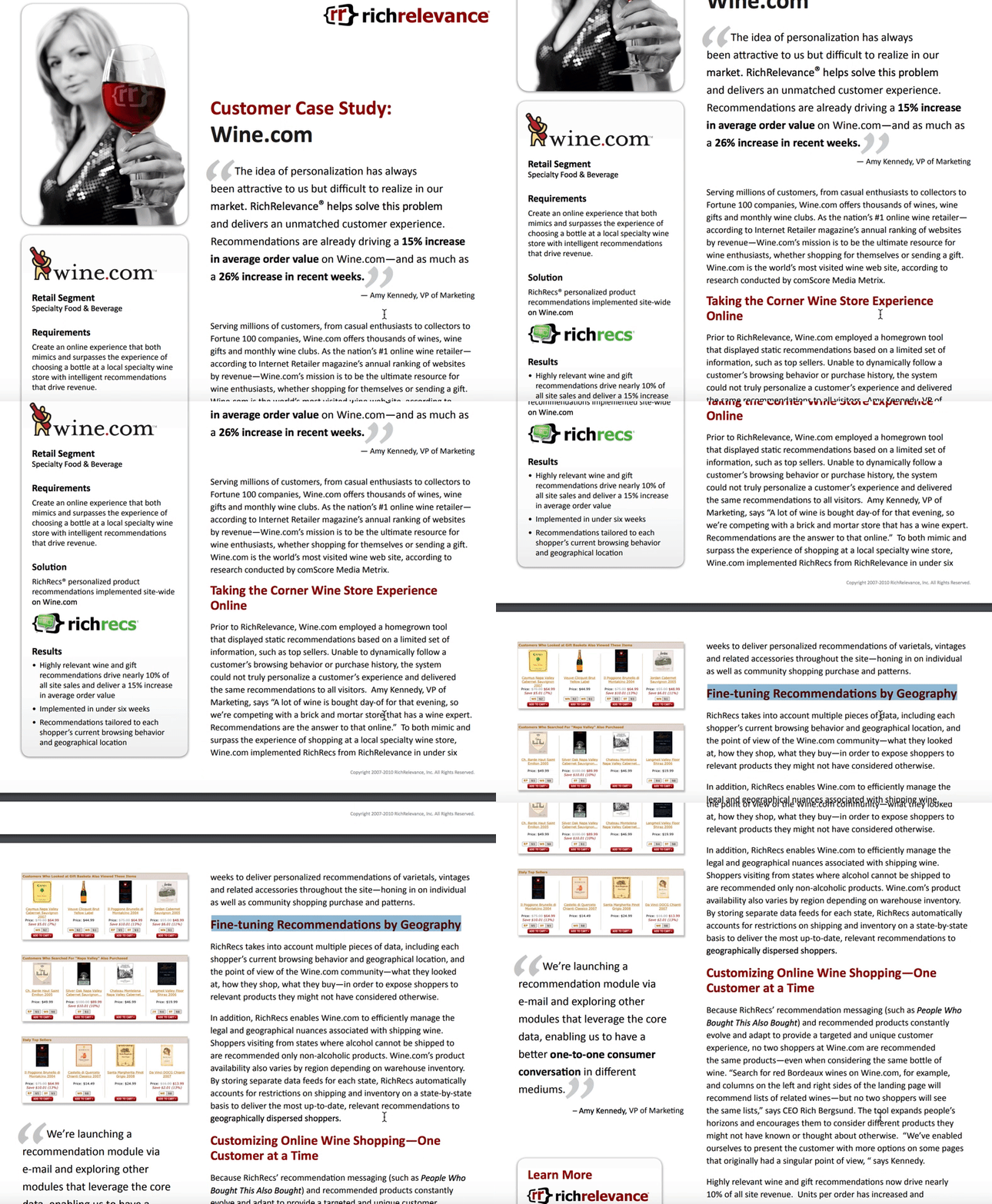
What first attracted me to RichRelevance’s Wine.com case study was the box on the left-side that quickly summed up the case study, including requirements, solution, and results. Adding an abridged version to a case study enables you to attract a larger audience, by offering a quick-read for those short on time, and a longer version for those interested in the details. RichRelevance’s case study also offers an impressive amount of information for those wanting to understand the nuances of their strategy, including a section titled “Fine-tuning Recommendations by Geography”.
13. “Synapse Innovation” by Uniface
SlideShare is a platform that allows you to encourage engagement from your viewers — which is likely why Netherlands-headquartered Uniface chose to use a SlideShare for their customer case study. As you click to the right you’re able to easily read their process from challenge to solution, and they provide a link to the full case study, and their social media accounts, on the last slide. Since each slide only needs a few lines of text, the SlideShare feels especially digestible.
14. “StyleHaul” by Asana
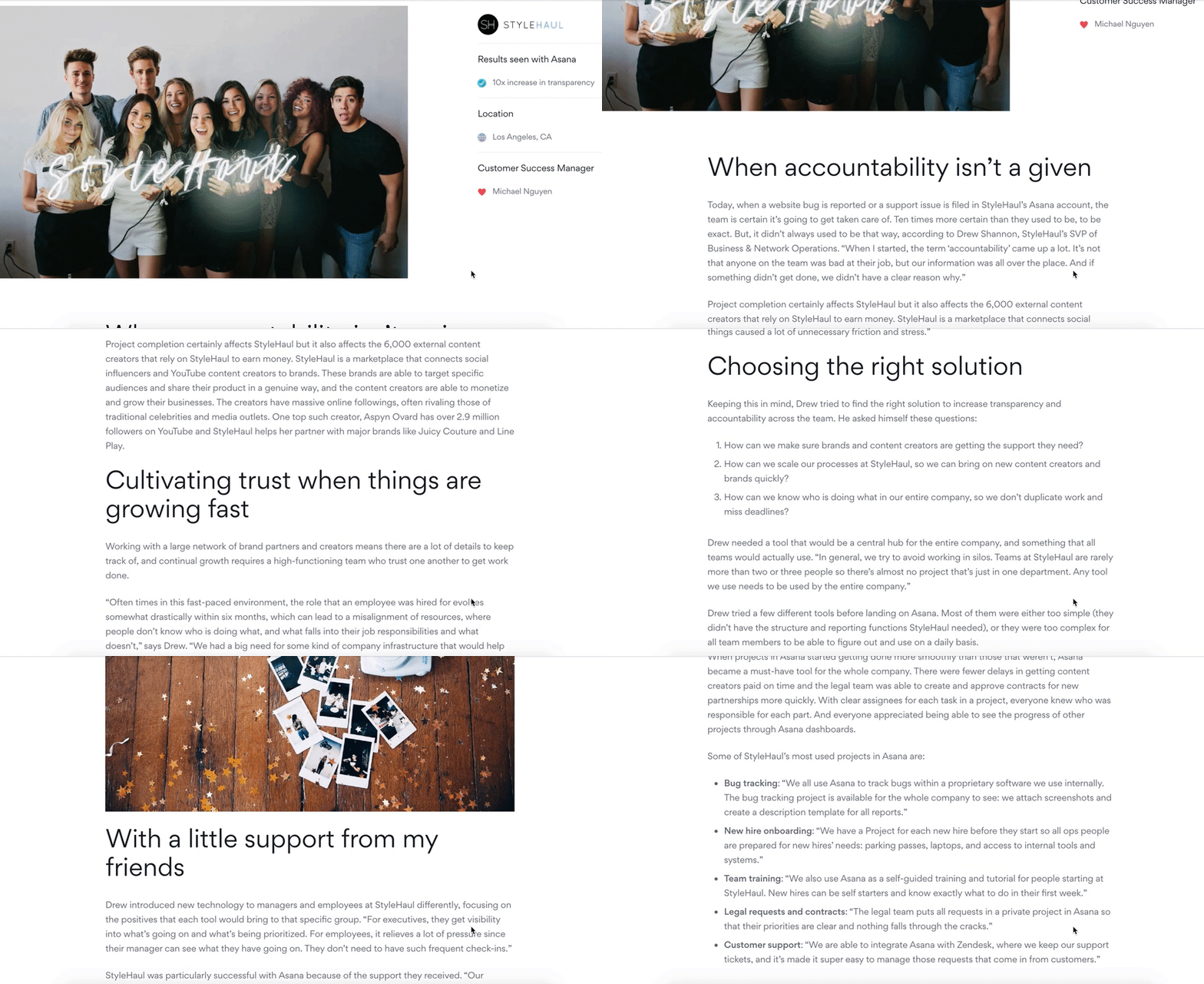
While Asana’s case study design looks initially text-heavy, there’s good reason — it reads like a creative story, and is told entirely from the customer’s perspective. For instance, Asana knows you won’t trust their word alone on their impressive customer service, so they let StyleHaul’s SVP of Business & Network Operations, Drew, tell you instead: “Our Customer Success Manager, Michael, was amazing. If I had a question, I wasn’t put into a queue—I could get it answered right away.” The entire case study reads like an in-depth interview, and captivates the reader through creative storytelling.
15. “Patagonia” by Amp Agency

Amp Agency’s Patagonia marketing strategy aimed to appeal to a new audience through guerilla marketing efforts and a coast-to-coast roadtrip. Their case study page effectively conveys a voyager theme, complete with real photos of Patagonia customers from across the U.S., and a map of the expedition. Personally, I liked Amp Agency’s storytelling approach best, which captures viewers’ attention start-to-finish simply because it’s an intriguing and unique approach to marketing.
16. “Budweiser Influencer Marketing Case Study” by Anomaly
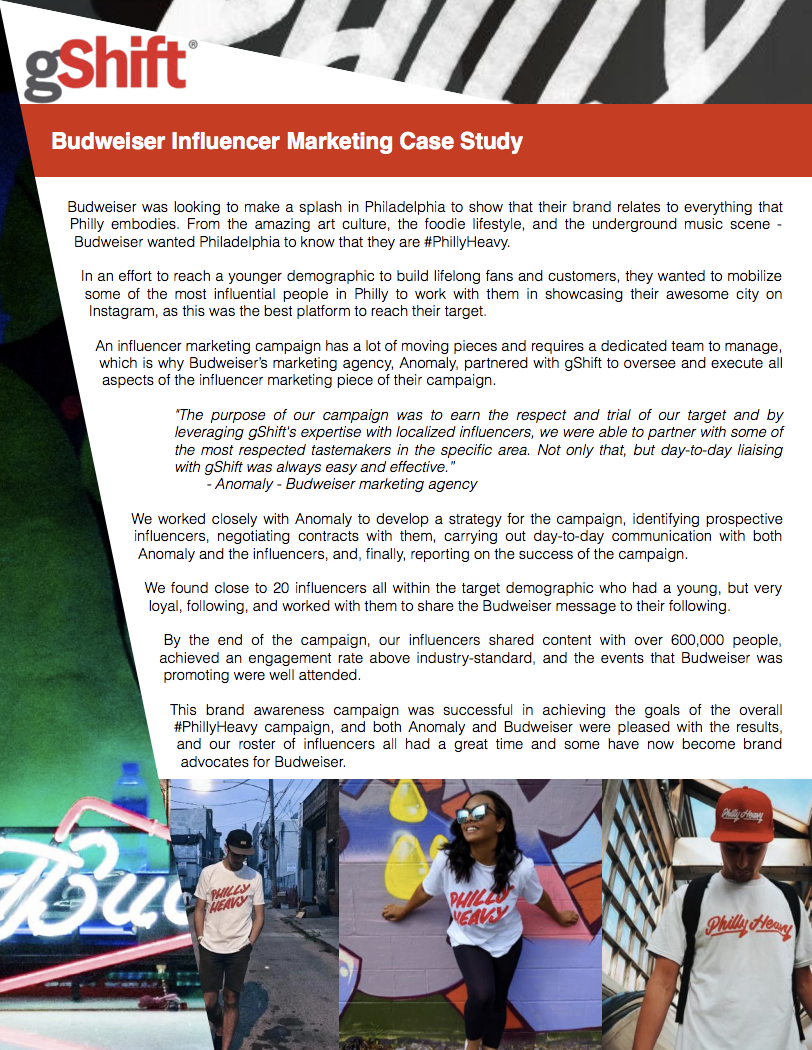
Budweiser’s one page, poster-esque case study is a good reflection of a brand knowing its audience. Anomaly’s case study for Budweiser appears edgy and modern, with a design that playfully pushes the text to the right as it showcases pictures of social media influencers wearing a campaign-related t-shirt. Both the top and the bottom of the page are eye-catching, and the text itself is simple and straightforward.
17. “Clinique” by AdRoll
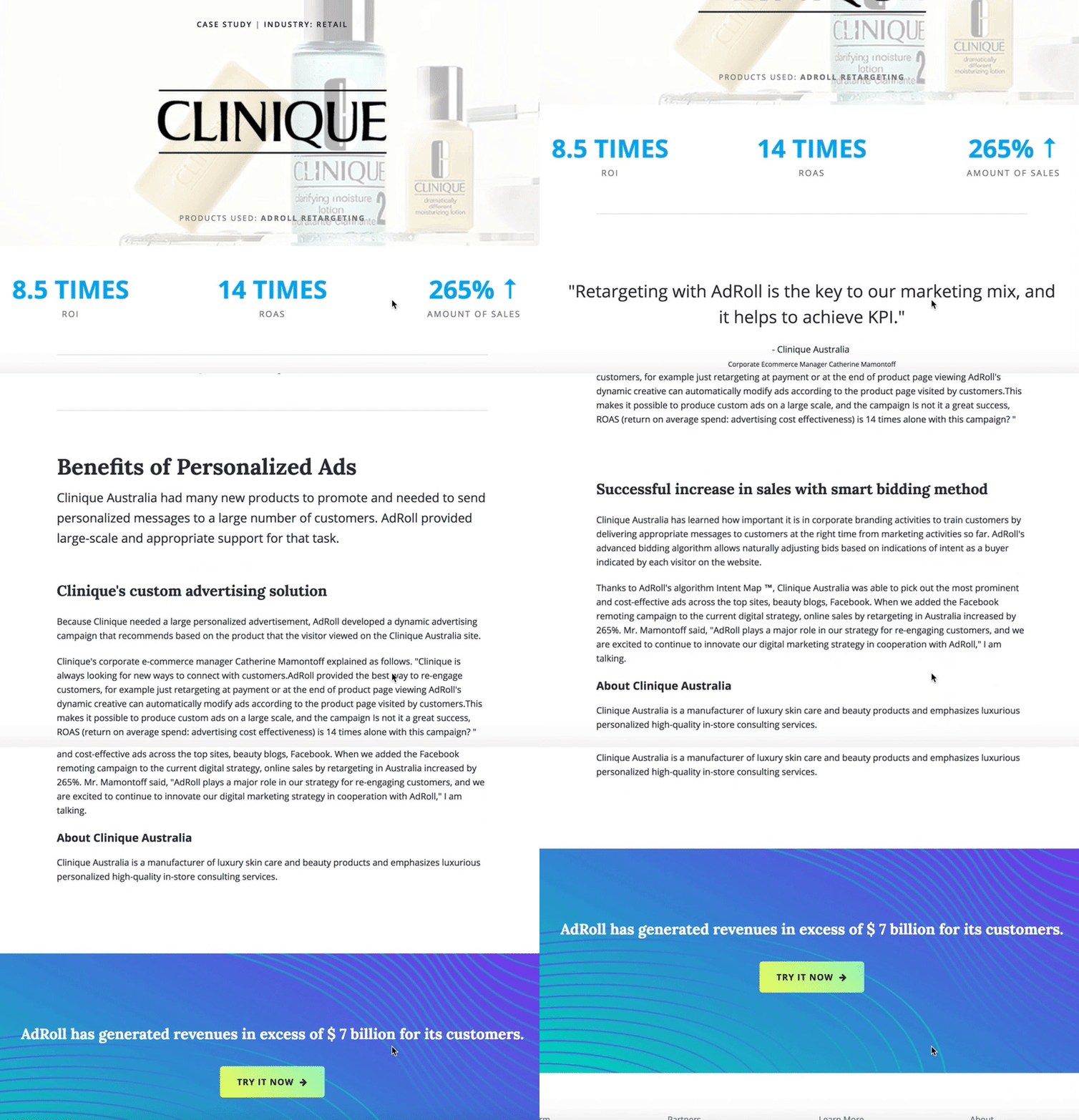
Sometimes, starting with the results is the best way to capture your readers’ attention. In Clinique’s case study, AdRoll does just that, beginning with some impressive numbers: “8.5 Times ROI, 14 Times ROAS, 265% Amount of Sales”. Once it has boldly outlined their results, AdRoll smartly pulls back to discuss the “Benefits of Personalized Ads”, letting the viewer consider how these same benefits might help their own company.
The page is short and sweet and ends with a compelling call-to-action — “AdRoll has generated revenues in excess of seven billion for its customers. Try it now.” The clean, whitespace-heavy page is an effective example of using a case study to capture future leads.
18. “TEXTCARE” by The George Institute
The George Institute chose to display the case study for their program, TEXTCARE, in a documentary-style video with real people discussing how TEXTCARE helped them become healthier and more active. If your case study results benefited people, there’s likely no better way to showcase that than through on-screen interviews.
19. “Reclaiming The Identity of a Brand: A Levi’s Case Study” by Levi
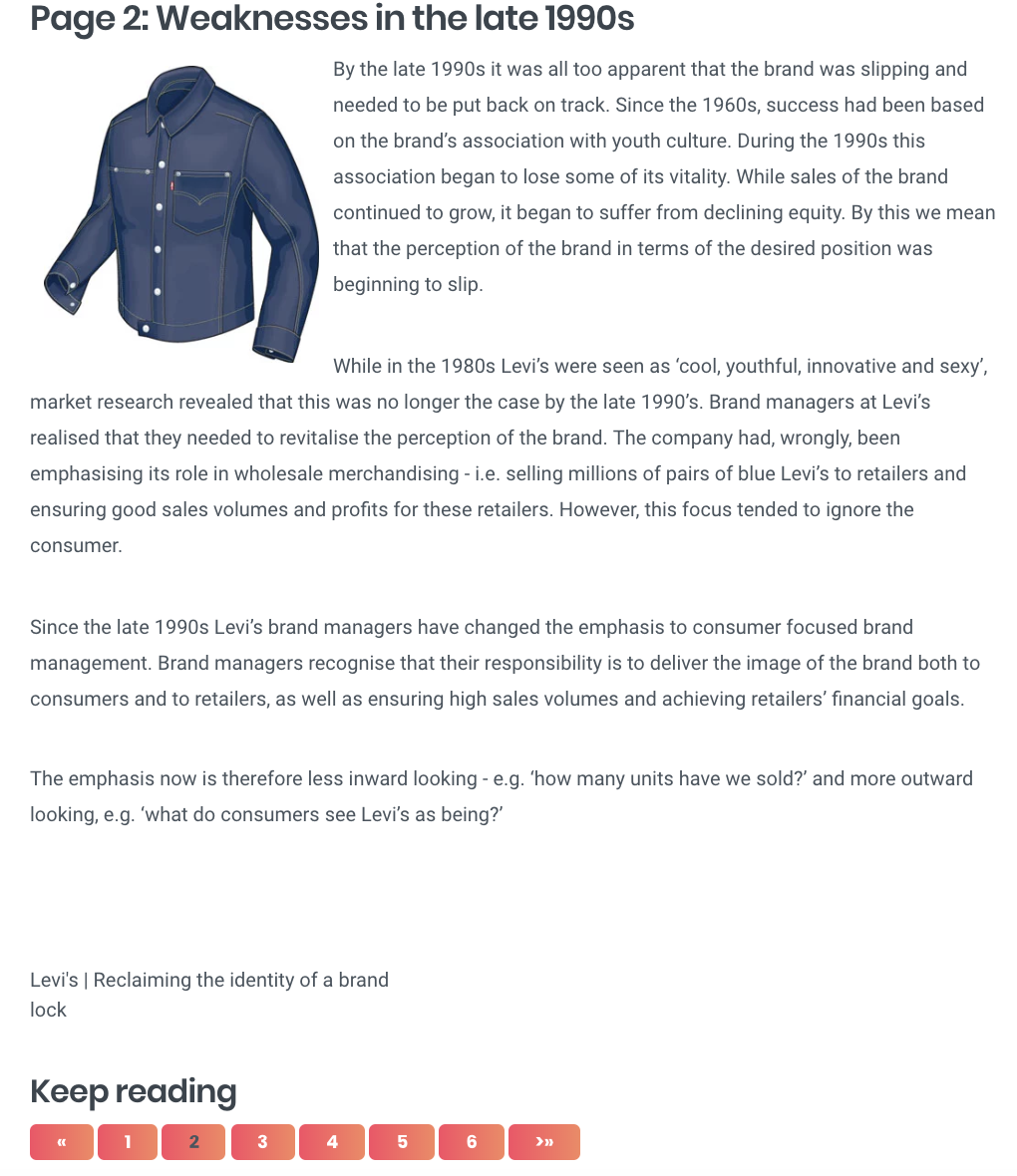
If you’ve got a case study with dense text, one of the more creative solutions to breaking it up could be to organize it by pages. Levi’s case study uses this method — their page one, for instance, is labeled “Introduction”, while page two is labeled “Weaknesses in the late 1990s”. Each page tackles a different topic, and the design makes it feel more like reading a book than a business article.
20. “Red Sox Season Campaign” by CTP
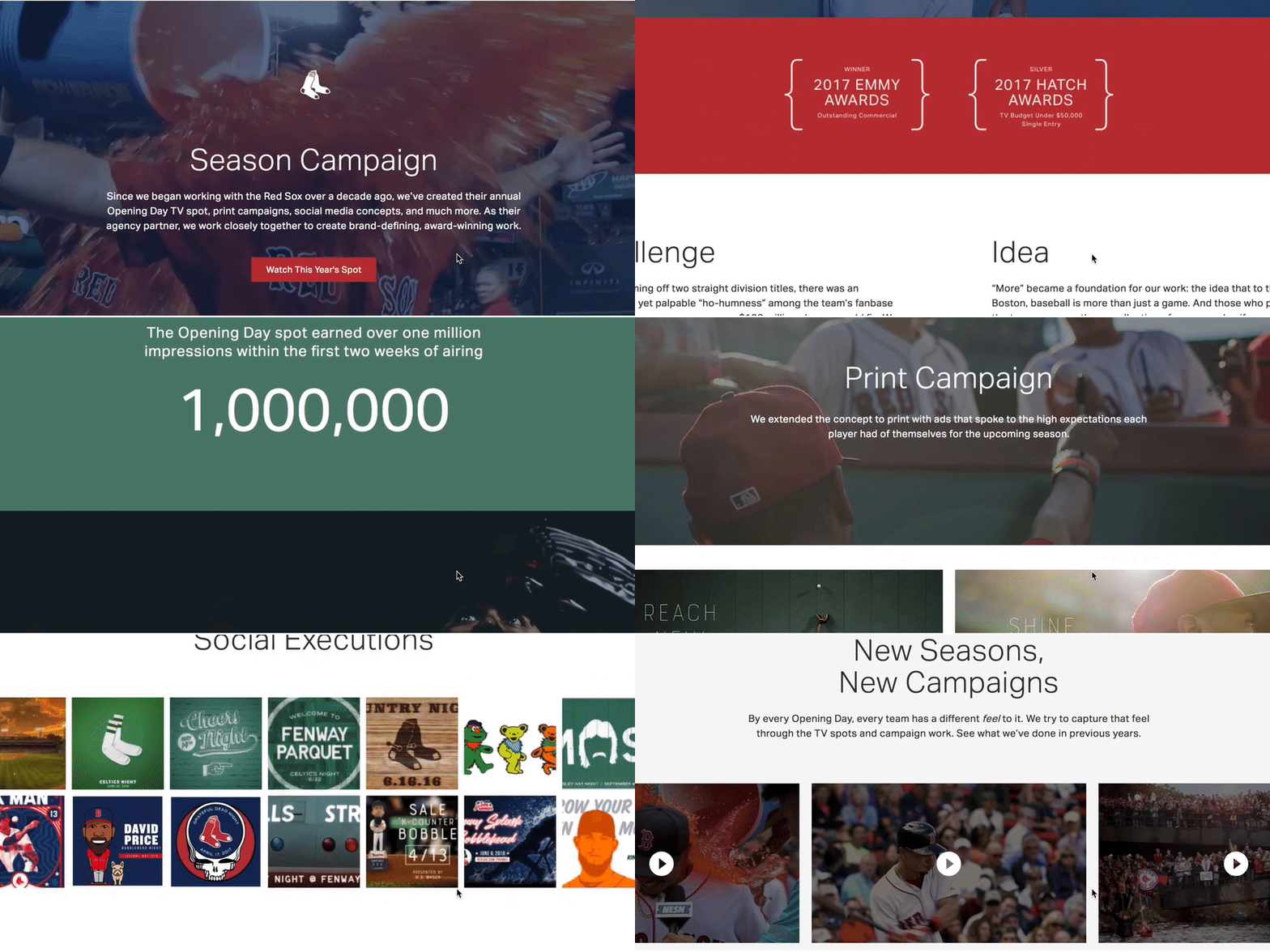
What’s great about CTP’s case study page for their Red Sox Season Campaign is their combination of video, images, and text — a video automatically begins playing when you visit the page, and as you scroll, you’ll see additional embedded videos of Red Sox players, a compilation of print ads, and social media images you can click to enlarge. At the bottom, it says “Find out how we can do something similar for your brand.” The page is clean, cohesive, and aesthetically-pleasing, inviting viewers to appreciate the well-roundedness of CTP’s campaign for Boston’s beloved baseball team.
21. “BIC: Bringing One Stop Shopping to BIC Razors” by Genuine

Sometimes, simple is key. Genuine’s case study for BIC razor’s is straightforward and minimal, with only two short paragraphs, “The Insight” and “The Solution”, accompanied by two images. The simplicity of the page allows the reader to focus on the sense of humor in the text, like “Helping a consumer find their perfect match and making them smile along the way means gaining a brand loyalist for life. Or until they grow a beard.” The page displays Genuine’s brand personality well, while offering the viewer all the necessary information they’d need.
22. “Cisco Systems: Velocity to Value” by Apptio

An attention-grabbing title is one of the easiest, yet most effective, ways to help your case study stand out — like Apptio’s Cisco Systems case study, titled “Velocity to Value: A Mature IT Services Transformation Enables IT to Continually Simplify and Innovate.” The piece is well-organized and uses compelling headers to keep the reader engaged, and offers a side panel for viewers who just need the bullet points. Despite its length, Apptio’s case study is appealing enough to keep viewer’s attention.
23. “Airbnb’s Custom 360-view of the Customer” by Zendesk
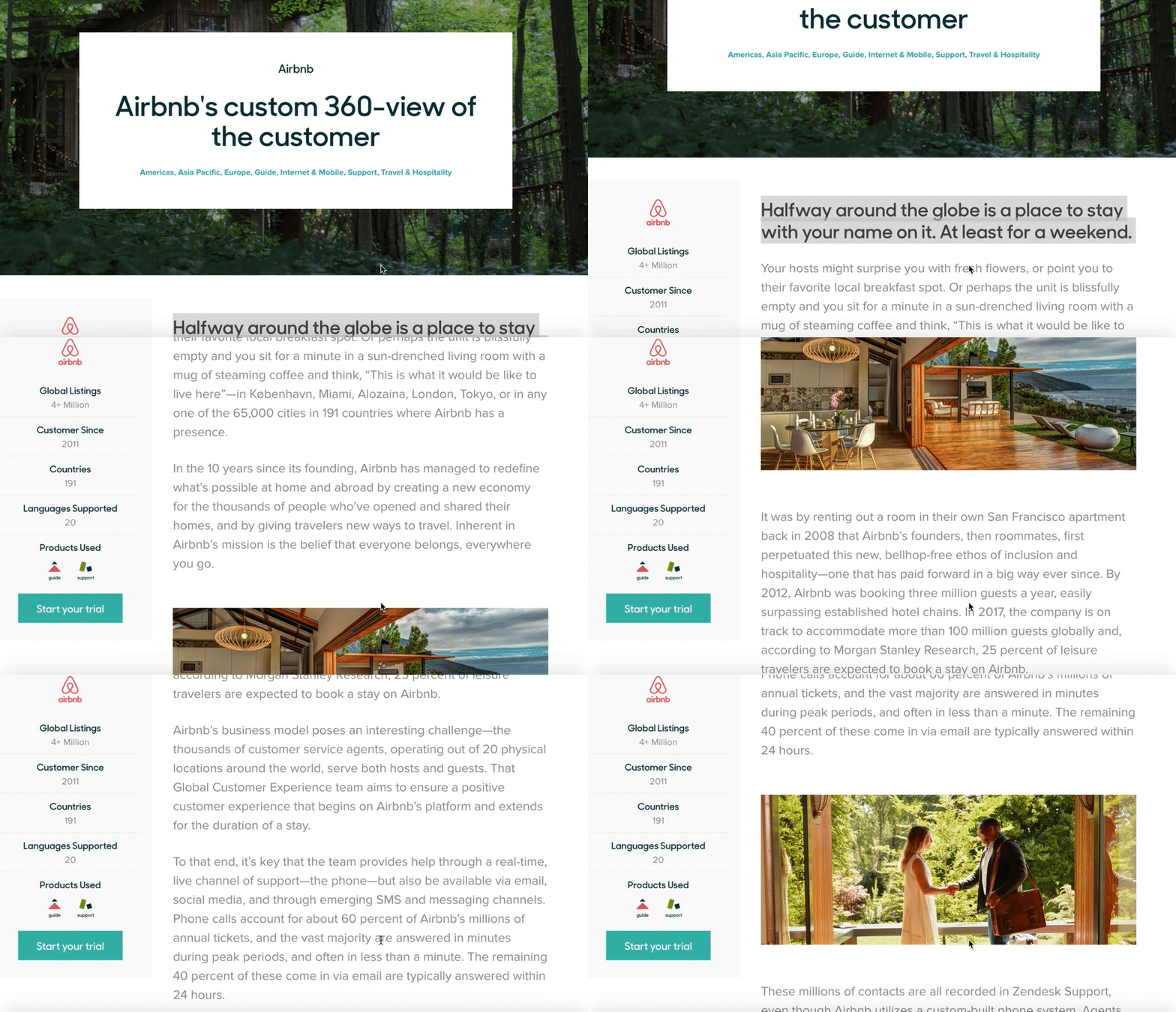
Zendesk’s Airbnb case study reads like a blog, and focuses equally on Zendesk and Airbnb, highlighting a true partnership between the companies. To captivate readers, it begins like this: “Halfway around the globe is a place to stay with your name on it. At least for a weekend.” The piece focuses on telling a good story, and provides photographs of beautiful Airbnb locations. In a case study meant to highlight Zendesk’s helpfulness, nothing could be more authentic than their decision to focus on Airbnb’s service in such great detail.
24. “Herschel Delights with Hootsuite” by Hootsuite
If you didn’t know this video was a case study for Hootsuite, you’d assume it was simply an artsy video capturing Herschel’s startup success. The Herschel marketing team mentions Hootsuite, but they do it authentically and remain primarily focused on the appreciation they have for their social media community. This video doesn’t have the feel of a traditional advertisement — instead, it feels unique and true to Herschel, highlighting Hootsuite as both a helpful and unobtrusive partner.
25. “4 Content Marketing Success Stories [Infographic]” by Kapost
You don’t always need a ton of text or a video to convey your message — sometimes, you just need images. Kapost’s infographic does a fantastic job of quickly providing the fundamental statistics a potential customer would need to know, without boggling down their readers with dense paragraphs. The infographic includes percentages, customer quotes, and colorful charts to provide the viewer with both numerical and emotional reasons they might choose Kapost.

Your Bookmarkable Guide to Social Media Image Sizes
When you’re selecting cover photos, shared images, and other social media assets, knowing the basic image dimensions might not cut it.
What if you want to make sure a certain part of your cover photo isn’t obstructed by your profile photo? And what’s the difference between shared link thumbnails, or in-stream photos — are the dimensions different for those?
As it turns out, sizing images correctly for social media is no simple task. Even just for Facebook marketing, photo dimensions vary according to where and how it’s shared — from cover photos, to timeline images, to profile pictures.

But if you’re looking for a detailed guide on social media image sizes, you’re in luck. See a written list of essential social media image dimensions below, sorted by social network and the type of image you’re posting.

Social Media Image Sizes
All image dimensions below are in pixels, width x height.

Image Dimensions | File Sizes
- Cover image: 820 x 312 (minimum 400 x 150)
- Profile image: ≥180 x 180
- Shared post image: 1200 x 630
- Shared link preview image: 1200 x 628
- Event image: 1920 x 1080
With 1.5 billion daily active users, Facebook continues to outpace other social media channels. The images you use here are crucial — choosing a lower-quality one can make or break your engagement. Pro tip: The way images display on your own timeline might look different.
Your profile image will appear 170 x 170 on desktop, and 32 x 32 as a thumbnail associated with your Facebook posts.
Image Dimensions | File Sizes
- Header image: 1500 x 500 | maximum 5 MB
- Profile image: 400 x 400 | maximum 2 MB
- In-stream image: 440 x 220
Twitter, meanwhile, is often the social network of choice for users to talk about you. It’s where customers ask questions, leave praise, and request help. But, the format and display have changed several times in the course of its history, so here are the image dimensions you need to know.
Although your profile image will display 200 x 200 on most devices, you should still upload a photo that is 400 x 400.
Google+
Image Dimensions | File Sizes
- Profile image: 250 x 250 | maximum 100 MB
- Cover image: 1080 x 608 (minimum 480 x 270)
- Shared image: 497 x 373
- Shared video: ≥496 pixels wide
- Shared link image thumbnail: 150 x 150
Don’t be fooled: Google+ is still an important place for brands to maintain a consistent presence — especially for small businesses who want to show up on local searches. This is true even if you think it might not get as much attention as other social media channels. The last thing you want is to have users stumble upon your profile there, only to find months (or more) of radio silence and distorted visual content.
Plus, where there’s Google+, there is Google, indicating a connection to the search giant itself.
Image Dimensions | File Sizes
- Profile image: 110 x 110
- Image thumbnail: 161 x 161
- Shared photos: 1080 x 1080
- Shared videos: 1080 pixels wide
- Instagram Stories: 1080 x 1920 (minimum 600 x 1067) | maximum 4 GB
Given that Instagram’s bread-and-butter is visual content, you’ll want your presence on this channel to match that foundation, especially in terms of quality. And with more than 700 million daily active users, you’ll want to look your best.
Instagram scales shared photos down to 612 x 612. Nonetheless, you should still set these image posts to 1080 x 1080.

Image Dimensions | File Sizes
- Profile image: 165 x 165 | maximum 10 MB
- Board cover image: 222 x 150 (minimum 55 x 55)
- Pinned image preview: 236 pixels wide
Here’s a fun fact: 90% of content posted on Pinterest consists of external links. For that reason, it’s worthwhile to leverage Pinterest for referral traffic — but it still has to catch your audience’s eyes. Here are the dimensions to make sure your Pinterest presence maintains visual quality.
Image Dimensions | File Sizes
- Banner image: 1584 x 396 | maximum 4 MB
- Profile image: 400 x 400 (minumum 200 x 200) | maximum 10 MB
- Cover image: 1536 x 768
- Shared image: 350 pixels wide
- Shared link preview: 180 x 110
- Company logo image: 300 x 300 | maximum 4 MB
- Company cover image: 1536 x 768 (minimum 1192 x 220) | maximum 4 MB
- Company page banner image: 646 x 220 | maximum 2 MB
- Square logo (appears in company searches): 60 x 60 | maximum 2 MB
Love it or hate it, LinkedIn is the social channel for digital professional networking. And depending on your industry, it can still be a good vehicle for traffic and discovery, especially within the B2B sector. Plus, if you’re using it for recruiting purposes, it’s important to present well on a job that several people use for research on job listings, as well as employer culture, location, and more.
YouTube
Image Dimensions | File Sizes
- Channel cover images: 2560 x 1440 | maximum 4 MB
- Channel icon: 800 x 800
- Video thumbnail: 1280 x 720
Here’s another network where visual content reigns supreme — not to mention, one with more than one billion users. Make sure your own visual assets match that underlying purpose and philosophy — not just with the videos you share on there, but with the profile presence you maintain.
Keep in mind that people use YouTube on many different types of devices, and your channel cover image will vary in appearance across each one. Images at 2560 x 1440 will be optimized for TV screens, while desktop computers will display them at 2560 x 423. Mobile devices will display YouTube cover art at 1546 x 423, while tablets will display them at 1855 x 423.
Tumblr
Image Dimensions | File Sizes
- Profile image: 128 x 128
- Image post: 500 x 750 (maximum 1280 x 1920) | maximum 10 MB
Tumblr has been called many things: a blogging platform, a social network, and a content-sharing center where marketers and consumers alike can, well, share whatever they want. And with 430 million blogs currently registered on the site, you’ve got company — so shape up and make sure your visuals fit the right dimensions.
Keep in mind that if you’re uploading animated GIFs, your image sizes and restrictions are a bit different than static photos. Specifically, animated GIFs must be less than 3 MB and no more than 540 pixels.
Snapchat
At long last, we arrive at Snapchat: yet another social media channel known primarily for its visual assets. When it comes to using this network for marketing purposes, dimensions are fairly uniform, whether you’re simply looking to use a geofilter, or you’re hoping to share an ad or sponsored lens.
- Geofilters, ads, and lenses: 1080 x 1920

I Looked at Everything Google Is Tracking on Me. Here’s What I Found.
When data privacy began making headlines this year, many people had a closer look at their app settings.
Questions like, “Is Facebook listening to my phone calls?” and “How much ownership do I have over my data?” began to arise, with users scrambling to switch off location tracking, download their social data files, and considering deleting certain apps altogether.
When I downloaded my own Facebook data, for example, and saw the extent of information it has about me — I also turned off certain settings, and not just on that social network.
On Google, too, I paused what it calls Location History: its ability to save your mobile device location history to better personalize your maps (if you use Google Maps, it’s safe to assume) and “recommendations based on places you’ve visited.”
But here’s the thing: According to a new report from the Associated Press (AP), some mobile Google services — like maps and browsers — could be automatically storing your location data, even if you’ve paused Location History.
So how (and why) is Google still storing this information — even with these settings turned off? And what, exactly, does Google know about me?
I decided to take a closer look.
I Looked at Everything Google Is Tracking on Me. Here’s What I Found.
A Bit of Background
When users first opt to pause Google’s Location History, they’ll receive a message that reads, “some location data may be saved as part of your activity on other Google services, like Search and Maps.”
That’s where this information is being stored — in a setting, it turns out, under Web & App Activity.
While the name doesn’t suggest that it may be tracking your location history, Web & App Activity is a separate setting that Google uses to track and save your search query and other behavior on Google apps — like Home, Assistant, or Maps.
The purpose, Google says, is not entirely unlike its tracking of your location history, or for that matter, Facebook’s tracking of your potential topic interests: more personalized results.
In Google’s case, the company says the tracking and saving of this activity — which can also be paused, but has to be done so separately — lends itself to quicker search results and improved recommendations.
But it also lends itself to more personalized ads, which is the same case that Facebook makes for its use of data to inform advertisements that appear in users’ feeds.
By allowing advertisers to target users based on interests and demographics — data that Facebook says is not personally identifiable or it sells, ever — the content users see is more relevant, making for a better experience.
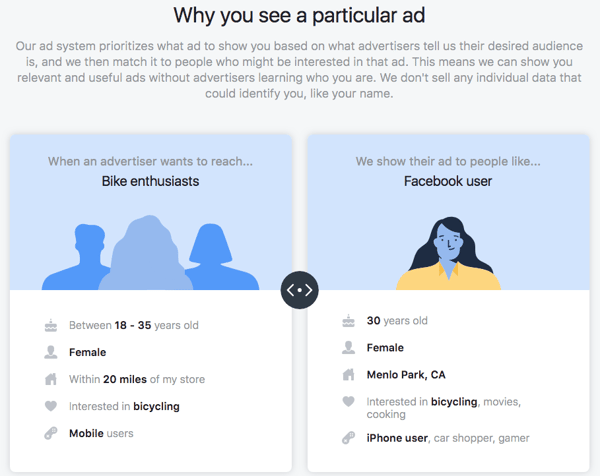
Source: Facebook
Google makes a similar statement about how its ads work: that it doesn’t sell your data to anyone, and that any data it collects or activity it tracks is to create a more personalized, relevant experience.
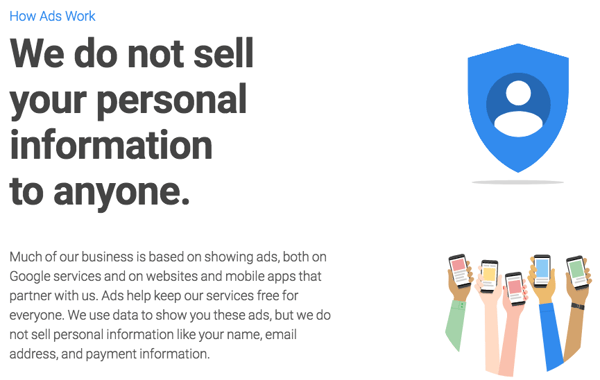
Source: Google
And while I have Google’s ad personalization turned off — it’s still collecting every single bit of activity I conduct across its apps and products.
What Google Is Tracking on Me
To start, here’s a look at the various products and services where Google is tracking my activity:
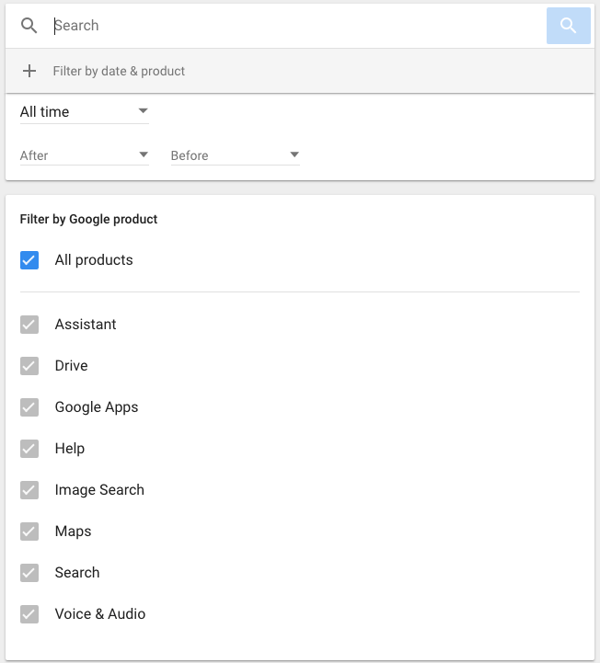
Source: Google
To be clear, Google has this information about me, specifically, because I’ve conducted this activity while signed into my Google account.
What isn’t quite as clear, however, is how much Google is able to track on users who are not signed in — or if it has a way to later attach this behavior to a particular user once he or she signs in or creates an account.
Search Queries
To start, Google is tracking every single query I’ve made on its search engine, on every device I’m signed in on — from my phone (an iPhone, not a Google or Android operating system, where I do largely use Google’s Chrome browser), personal laptop, or work laptop.
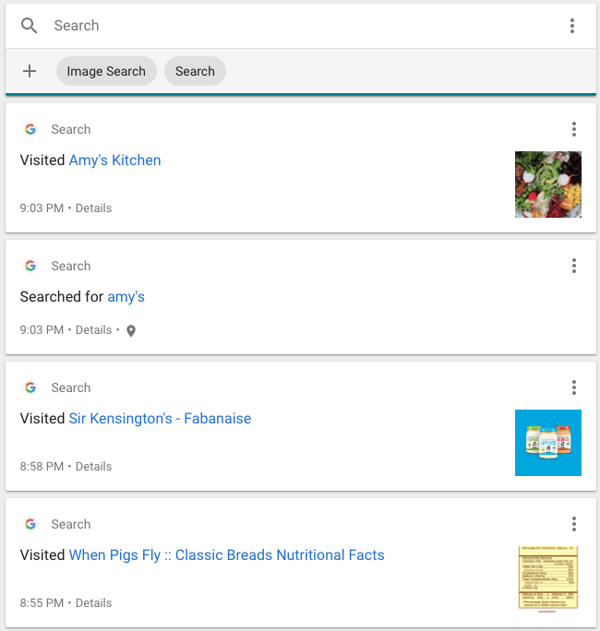
I chose some of the less embarrassing results to share here — and left out, for instance, proof of my curiosity of certain reality TV personalities’ net worth. And while Google says that you can delete this activity, it remains unclear if and how long it remains stored.
Assistant Commands
I have, admittedly, grown a bit dependent on my smart speakers. After all, at one point, I tried using three of them.
But I’ve come to use my Google Home speaker more than the others, often asking it what time it is, to play white noise, or to ask for the current temperature in my neighborhood.
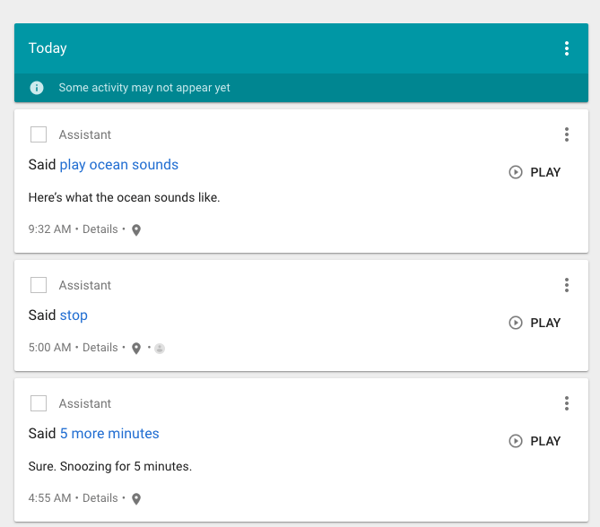
Did you catch that last part? “In my neighborhood.” I don’t just ask Google what the weather is like in Boston — because of microclimates, I ask what the temperature is in my particular location.
That’s one way Google might be able to track where I am.
Combine that with some of my search history — e.g., “best facial in Boston” — and Google has even more information about where I might be, or be going.
That’s where things start to get tricky.
Maps
The AP’s investigation found that data pertaining to Princeton privacy researcher’s Gunes Acar travel was saved to his Google account — even though he had “Location History” paused.
In fact, researchers were able to build an interactive map of locations Acar — who uses an Android phone — visited over the course of three days. 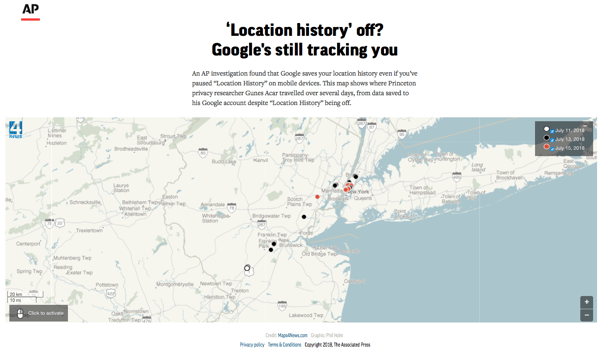
Source: Associated Press
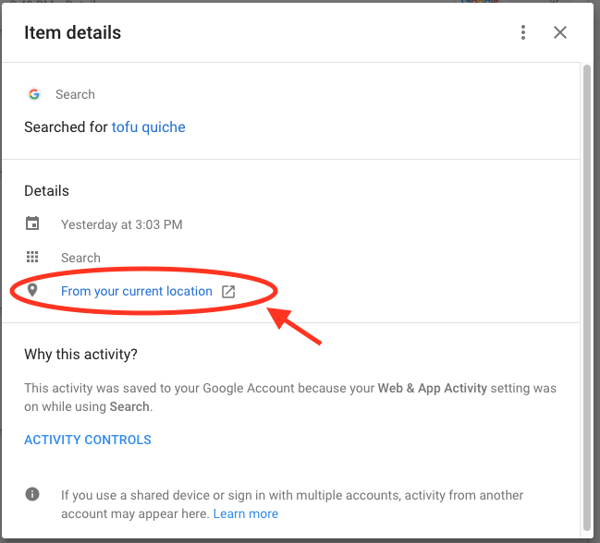
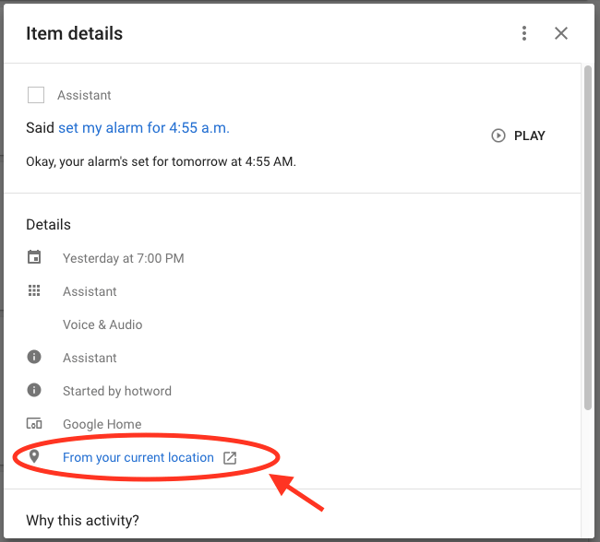
Upon closer inspection, I also saw that my “current location” was attached to specific tracked activities … even though I have Location History turned off.
When I searched for a recipe, for example, Google tracked that I did so from my “current location” — which is also stored.
It did the same thing when I used my Google Home to set my alarm.
That’s probably how the AP was able to compile a map of Acar’s known locations over several days — because of tracking points like these.
But why is it that Google attached a location to only some of my activity — like Assistant commands or search queries — and not all of them?
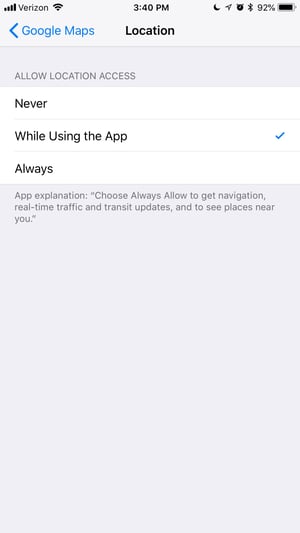
One possible theory is that I also had Google Maps running in the background at the same time. Depending on your mobile device’s location settings, certain apps can determine your location at all times, even if you’re not using it at a given moment. Those are the settings I had for Google Maps on my phone — which I quickly changed upon this discovery.
But I also had a similar reaction to many of those quoted for AP’s investigation — in short, that it was “not cool” that my location was being tracked, despite having (thought that I) turned off Location History.
Even if Google hadn’t attached a location to these specific activities, some of the searches I conduct — especially those to find nearby business on Maps — can provide enough information to deduce my general whereabouts.
And while Google states its reasons for tracking that information — and explains how it’s kept safe — what’s more troubling is the number of users who are potentially unaware that this information is being collected.
Google, for its part, tells AP that it’s been nothing less than transparent about these settings — and that turning them off should be intuitive.
“There are a number of different ways that Google may use location to improve people’s experience,” a Google spokesperson told the AP. “We provide clear descriptions of these tools, and robust controls so people can turn them on or off, and delete their histories at any time.”
Have you noticed unusual location or activity tracking? Feel free to reach out on Twitter.

The Ultimate Guide to Confidence
“To establish true self-confidence, we must concentrate on our successes and forget about the failures and the negatives in our lives.” — Denis Waitley
I know what you’re thinking … easier said than done, right?
Nobody is born with high or low self-confidence. Confidence is a feeling that people develop and work on over time. For most people, confidence is something that comes and goes.
Think about it in terms of a cycle: When someone is at the top of the cycle, they are focused on their successes and accomplishments, meaning they might feel confident and strong. But when they are at the bottom of their cycle, they are focused on their failures and may feel low self-confidence or even defeat.
If you can identify with the feeling I’m referring to at the bottom of the confidence cycle, know you’re not alone. Everyone struggles with self-confidence every now and then. The key is realizing that confidence is like a muscle — the more you work on it, the easier it will become for you to use and maintain.
This article will teach you why everyone should work on their self-confidence, and it’ll provide you with ways to build your self-confidence.
But first — what is self-confidence?
What is Self-Confidence?
Self-confidence is the feeling you have when you strut into a job interview knowing you’re going to impress the hiring manager. A person feels confident when they believe they can successfully do something by applying their judgement, knowledge, and prior experiences.
How Does Self Confidence Impact Your Life?
Think about a time when you felt extremely confident in your ability to do something.
Did you feel an adrenaline rush? Did you feel strong and powerful? Did you feel as though you could conquer the world?
Self-confidence does a lot of things for us. It boosts our self-esteem, diminishes stress, and often pushes us to act. But most importantly, it makes us feel good about ourselves.
Let’s dive into a few more ways self-confidence impacts our lives:
Your happiness and self-esteem will increase
Self-esteem is closely related to confidence but has a slightly different definition — it is a person’s evaluation of their self-worth and value.
There is a direct correlation between confidence and self-esteem. When you believe in yourself — your talents, capabilities, worth, and potential — both your self-esteem and confidence increase.
When your self-esteem increases, you believe you are worthy of the life you dream of and the success you desire. Not only will you become more confident, but you will more easily accept your failures, give yourself the credit you deserve, accept new challenges, and become happier.
In fact, self-esteem always exists with happiness — and there are studies to prove it. In almost every instance, people who feel good about themselves are significantly happier than those who lack self-worth. When self-confidence increases, your self-esteem and happiness do the same.
Think about it in terms of the following chart. Most people would feel high self-esteem, sure about their abilities, and good about standing up for their beliefs when behaving confidently — as listed in the left column. They are doing what makes them happy. The opposite is true about the right column.

Source: MindTools
Your stress and anxiety will decrease
Did your math teacher ever randomly call on the students who weren’t the strongest mathematicians to complete a problem in front of the entire class? Mine did.
Could you sense the stress and anxiety fuming from those students (yes … I was one of them) as they reluctantly walked to the front of the classroom?
My palms were sweaty and my right hand would shake while writing on the chalkboard — the pressure was on!
When a person in a situation like this doubts their abilities, they are down at the bottom of that confidence cycle I mentioned earlier. Due to increased stress and anxiety, they start to believe they don’t have the knowledge or experience to complete a task (or in this situation, complete a math problem correctly), even if that isn’t truly the case.
The feeling of low confidence and not being good or smart enough often manifests as stress or anxiety. And in extreme cases, it can even turn your body’s fight or flight mode on, which isn’t ideal unless you’re being chased by a hungry lion (or are experiencing another life or death situation).

Stress and anxiety on a regular basis can be detrimental to your self-confidence. These feelings cause excess release of cortisol and norepinephrine in the brain — making our bodies feel out of control and overwhelmed.
Unless you are actually trying to avoid becoming the lion’s lunch, there’s no reason to feel these feelings. And you certainly don’t want them just because your math teacher called you up to the board to complete a problem. Stress and anxiety can cloud your judgment and prevent you from thinking logically.
When stress and anxiety fade away, the excess release of cortisol and norepinephrine in the brain come to a halt. You are able to believe and trust in your abilities again, think logically, and feel as though you are ready to tackle new challenges that come your way — you’ll jump back to the top of that confidence cycle.
You’ll feel more motivated to act
If someone is confident in their ability to successfully do something, they’re more likely to volunteer to complete a task than someone who is less confident.
For example, imagine your manager coming to your team and saying, “Is anyone able to help me design a logo?” Chances are, the person with the background in design, or the most knowledge in the field, would volunteer their expertise … versus another person without any experience whatsoever.
This is called the power of certainty. When you’re more certain of — and confident in — your knowledge and abilities, you’re more likely to act.
If you’re confident in your abilities, not only will you feel more motivated to act, but the people around you will also want to trust you more … which takes us to our next section:
People will trust you
If you’re the one with the design background, do speak up about that logo and successfully follow through with a fantastic result. You’re not only going to feel a boost in your self-confidence (“Yay! I did this, and I did this well”), but your manager and team will also trust you more. They’ll think of you next time they have a design project.
When you are confident in your abilities, people are more likely to trust you, listen to you, and follow you.
For example, imagine you’re working on a group project, and you need to elect a leader. One person in the group says, “I know I can lead us to success, and I already have a few ideas I’d like to share with you on how to accomplish this.” Another person in the group says, “I don’t really like leadership roles, but I guess I could try if you all really want me to.”
The first person seems a lot more convincing, right? They also sound significantly more confident in their abilities to complete the job … and succeed.
When you are confident, more people are likely to follow your lead.
You have a greater potential for success
There are several studies that show a strong positive correlation between high levels of self-confidence and success. That’s not to say that people who struggle with confidence won’t be successful. However, research shows that people with higher levels of self-confidence achieve greater success in multiple areas of life.
There are a couple reasons for this:
- People who are confident have self-efficacy — a belief that they have the innate ability to achieve their goals, overcome challenges, and succeed
- When someone believes in their abilities, they are more likely to try until they succeed. They then have the experience that creates self-efficacy — it becomes a self-fulfilling prophecy.
Now that you understand the benefits of having self-confidence, you may be asking yourself how you can work on your own self-confidence.
How to Build Self-Confidence
As I said earlier, self-confidence is like a muscle — you need to work it in order to improve. This means anyone can become more confident. Try these exercises to work on your self-confidence:
Get to Know Yourself
Knowing yourself means you understand your strengths and weaknesses. That also means you know exactly which areas of your life you are confident in and which areas you need to work on.
It’s clear why you would feel confident about your strengths. If you are good at something, you are much more likely to share your knowledge or act on that strength rather than a weakness or vulnerability of yours.
Take advantage of these strengths and use them to exercise your confidence. If you know how to do something, be the first person to raise your hand and demonstrate your skill or teach others. If you are confident in research you did, share your expertise. This will make you feel good and boost your confidence.
Then, work on some of your weaknesses. A confident person is not only aware of their weaknesses and vulnerabilities, but they embrace and use them as motivation.
Whether it’s studying a little harder, practicing more, asking for help, or spending a few extra minutes re-reading something, you can always push yourself out of your comfort zone to improve — and become more confident — in areas in which you typically lack confidence.
For example, if you’re someone who freezes up and gets anxiety while speaking publicly, sign up for a class or two. Practice in front of your family and friends. Then, when you have to give that speech, not only will you impress the audience, but you will impress yourself. This will help you develop the self-confidence you’re striving for an area in which you typically struggle.
Be Prepared
When you are prepared to do something, you’re more confident in your ability to accomplish a task successfully.
“One important key to success is self-confidence. An important key to self-confidence is preparation.” — Arthur Ashe
Preparation is a simple way to boost confidence. Think about it in terms your co-worker presenting at a big conference. This presentation is a reflection of your fellow employee’s work and knowledge, and it also requires them to speak alone in front of 50+ people — managers, directors, and other people of great influence included — for 30+ minutes. Sweating yet?
Your co-worker can prepare to the point that they are able to walk into that conference on presentation day excited to get started. By avoiding procrastination, knowing the information like the back of their hand, preparing for questions — or even technical difficulties — and working on their public speaking skills prior to the due date, they will feel confident and ready to give their presentation.
Think About Your Appearance
People can tell a lot about you and your level of confidence by the way you physically present yourself. That includes your overall dress and body language.
Imagine you’re conducting a job interview, and you have two equally qualified candidates. The first candidate is slouched over the entire interview, not making eye contact, and looks slightly disheveled. The second candidate gives you a firm handshake, is sitting up straight, looks you directly in the eyes, and is wearing a nice suit. Who would you choose for the job?
The second candidate seems significantly more confident, prepared, and impressive — and you can probably gather all of that about a person without even talking to them.
It’s proven that people feel greater self-confidence and esteem when they feel good about their appearance. So use appearance to your advantage — not only will you radiate confidence for the people around you to notice, but you will also use your appearance and body language to make yourself feel more confident in any type of situation.
Stay Positive
Positivity is a key component to building self-confidence. It’s what keeps you from beating yourself up after a setback or mistake.
By not accepting failure and staying positive, you’ll actually help yourself become a more confident person.

Here’s an example: If you’re trying to learn a new software at work, and you’re continually making mistakes, sure, you might be frustrated, but I’d bet you’re also learning a lot throughout the process.
Once you’re finally able to iron out these issues and understand how to use the new software, you have proven to yourself that you can get through a challenging time. This should not only get you excited and make you feel confident about this specific situation, but it should also make you feel confident in your abilities to tackle another difficult project.
It’s not always the stuff that comes naturally to you that makes you super confident. Instead, it’s usually the stuff you have to work really hard to get through.
Resources to Help You Build Confidence
Whether it’s a book, podcast, or TED Talk, there are a number of resources to help you build self-confidence.
Pick Up a Book
There are hundreds of books on building self-confidence and how to use it to your advantage. Here are few options::
You Are a Badass
This humorous bestseller is a self-help book that contains a guide on how to create a life you love. It’s filled with inspiring stories, advice, and applicable ways to incorporate aspects of the guide in your life.
This book will help you build confidence in everything you do, love yourself, and achieve your biggest goals.
The Confidence Code
Research, gender, behavior, and cognition are all discussed in The Confidence Code. The book — which is targeted at women — talks about the reasons why men are typically more confident in the workplace and gives female readers advice on how to close this gap.
This is a great option for any woman who wants to learn how to develop more confidence at work and achieve their dream careers, whether or not they’re in a male-driven field.
Daring Greatly
This New York Times #1 bestseller dives into the ways that vulnerability can help measure courage.
This book — written by Brené Brown — teaches individuals how to use their vulnerabilities and challenges to their advantage. According to society and culture, vulnerabilities are weaknesses. But according to Brown, they are a way to build courage and confidence.
Listen to a Podcast
Maybe you need some audio inspiration before your next confidence challenge? Here are a few podcasts that will help you build your self-confidence:
Earn Your Happy
This podcast gives you insight and advice on ways to work through your fears, boost self-esteem, and build your confidence in both your personal and professional lives. It’s great for those who need the occasional reminder to stay positive and take life a little less seriously.
Daily Meditation Podcast
Meditation pushes individuals to look inward, reflect, and determine what changes they can make to improve their lives.
With daily meditations on confidence, self-esteem, anxiety, confidence, and stress reduction, this podcast will help you work towards the healthy and happy lifestyle you’re looking to achieve.
Your Motivational High 5
All you need is five minutes to enjoy this podcast.
This podcast will take you through five minutes of meditation and help you develop good mental health practices. This podcast is quick, effective, and forces listeners to take a short break during the day to focus on their happiness, well-being, confidence, and strength.
Conclusion
Self-confidence is not always easy to achieve or maintain, but it’s something that everyone deserves to experience. There are many reasons why confidence is essential in our personal and professional lives, but most importantly, it plays an integral role in our happiness.
Try boosting your own confidence and self-esteem in some areas of your life that need a bit of attention or work. Give a few of the steps mentioned above a try and learn what works for you.

45 Quotes That Celebrate Teamwork, Hard Work, and Collaboration
We’ve all been a part of that group project. You know, the project where one person takes the lead, leading some members to conclude their ideas are unwelcome, while a select few ride the others’ coattails.
Thanks to experiences like this, it’s no surprise why so many people have been scarred by the nightmares of past group projects.
And yet, something incredible happens when teamwork happens the way it’s supposed to happen. Things change when everyone on the team is equally invested in the overall purpose and goal. You find yourself working faster, finding mistakes more easily, and innovating better.
Ultimately, you reach a point where you’re certain each person on your team has your back — and both your job satisfaction and performance skyrocket. (Getting inbound certified doesn’t hurt, either.)
Quotes About Collaboration
- “Alone we can do so little; together we can do so much.” – Helen Keller
- “Talent wins games, but teamwork and intelligence win championships.” – Michael Jordan
- “Teamwork begins by building trust. And the only way to do that is to overcome our need for invulnerability.” – Patrick Lencioni
- “It is literally true that you can succeed best and quickest by helping others to succeed.” – Napolean Hill
- “If you want to lift yourself up, lift up someone else.” – Booker T. Washington
- “None of us, including me, ever do great things. But we can all do small things, with great love, and together we can do something wonderful.” – Mother Teresa
To inspire your team to band together and celebrate collaboration, we’ve gathered some of our favorite quotes on the power of teamwork. Flip through the following SlideShare, then check out the full list of inspirational quotes below — including some remarks about hard work to keep your collaborative juices flowing.
Teamwork Quotes to Inspire Collaboration
1. “Alone we can do so little; together we can do so much.” – Helen Keller (Click to Tweet!)
2. “If everyone is moving forward together, then success takes care of itself.” – Henry Ford (Click to Tweet!)
3. “Many ideas grow better when transplanted into another mind than the one where they sprang up.” – Oliver Wendell Holmes (Click to Tweet!)
4. “If I have seen further, it is by standing on the shoulders of giants.” – Isaac Newton (Click to Tweet!)

5. “No one can whistle a symphony. It takes a whole orchestra to play it.” – H.E. Luccock (Click to Tweet!)
6. “Teamwork is the ability to work together toward a common vision. The ability to direct individual accomplishments toward organizational objectives. It is the fuel that allows common people to attain uncommon results.” – Andrew Carnegie (Click to Tweet!)
7. “It is the long history of humankind (and animal kind, too) that those who learned to collaborate and improvise most effectively have prevailed.” – Charles Darwin (Click to Tweet!)
8. “Coming together is a beginning, staying together is progress, and working together is success.” – Henry Ford (Click to Tweet!)
9. “Talent wins games, but teamwork and intelligence win championships.” – Michael Jordan (Click to Tweet!)

10. “The strength of the team is each individual member. The strength of each member is the team.” – Phil Jackson (Click to Tweet!)
11. “The best teamwork comes from men who are working independently toward one goal in unison.” – James Cash Penney (Click to Tweet!)
12. “Politeness is the poison of collaboration.” – Edwin Land (Click to Tweet!)
13. “Find a group of people who challenge and inspire you, spend a lot of time with them, and it will change your life.” – Amy Poehler (Click to Tweet!)
14. “Effectively, change is almost impossible without industry-wide collaboration, cooperation, and consensus.” – Simon Mainwaring (Click to Tweet!)

15. “Teamwork begins by building trust. And the only way to do that is to overcome our need for invulnerability.” – Patrick Lencioni (Click to Tweet!)
16. “You need to be aware of what others are doing, applaud their efforts, acknowledge their successes, and encourage them in their pursuits. When we all help one another, everybody wins.” – Jim Stovall (Click to Tweet!)
17. “The way a team plays as a whole determines its success. You may have the greatest bunch of individual stars in the world, but if they don’t play together, the club won’t be worth a dime.” – Babe Ruth (Click to Tweet!)
18. “There is no such thing as a self-made man. You will reach your goals only with the help of others.” – George Shinn (Click to Tweet!)
19. “It is literally true that you can succeed best and quickest by helping others to succeed.” –Napolean Hill (Click to Tweet!)

20. “The whole is other than the sum of the parts.” – Kurt Koffka (Click to Tweet!)
21. “A group becomes a team when each member is sure enough of himself and his contribution to praise the skills of others.” – Norman Shidle (Click to Tweet!)
22. “The ratio of We’s to I’s is the best indicator of the development of a team.” – Lewis B. Ergen (Click to Tweet!)
23. “Individual commitment to a group effort — that is what makes a team work, a company work, a society work, a civilization work.” – Vince Lombardi (Click to Tweet!)
24. “One piece of log creates a small fire, adequate to warm you up, add just a few more pieces to blast an immense bonfire, large enough to warm up your entire circle of friends; needless to say that individuality counts but teamwork dynamites.” – Jin Kwon (Click to Tweet!)

25. “No matter how brilliant your mind or strategy, if you’re playing a solo game, you’ll always lose out to a team.” – Reid Hoffman (Click to Tweet!)
26. “Keep away from people who try to belittle your ambitions. Small people always do that, but the really great make you feel that you, too, can become great.” – Mark Twain (Click to Tweet!)
27. “If you want to lift yourself up, lift up someone else.” – Booker T. Washington (Click to Tweet!)
28. “Great things in business are never done by one person; they’re done by a team of people.” – Steve Jobs (Click to Tweet!)
29. “Individually, we are one drop. Together, we are an ocean.” – Ryunosuke Satoro (Click to Tweet!)

30. “Cooperation is the thorough conviction that nobody can get there unless everybody gets there.” – Virginia Burden (Click to Tweet!)
31. “None of us, including me, ever do great things. But we can all do small things, with great love, and together we can do something wonderful.” – Mother Teresa (Click to Tweet!)
32. “It is amazing what you can accomplish if you do not care who gets the credit.” – Harry Truman (Click to Tweet!)
33. “It takes two flints to make a fire.” – Louisa May Alcott (Click to Tweet!)
34. “The way to achieve your own success is to be willing to help somebody else get it first.” – Iyanla Vanzant (Click to Tweet!)
35. “If you want to go fast, go alone. If you want to go far, go together.” – African Proverb (Click to Tweet!)
36. “Success is best when it’s shared.” – Howard Schultz (Click to Tweet!)
Hard Work Quotes to Inspire Determination
37. “Hard work beats talent if talent doesn’t work hard.” – Tim Notke (Click to Tweet!)
38. “We think, mistakenly, that success is the result of the amount of time we put in at work, instead of the quality of time we put in.” – Ariana Huffington (Click to Tweet!)
39. “When the ideas are coming, I don’t stop until the ideas stop because that train doesn’t come along all the time.” – Dr. Dre (Click to Tweet!)
40. “Someone once told me growth and comfort do not coexist. And I think it’s a really good thing to remember.” – Ginni Rometty (Click to Tweet!)
41. “Hard work keeps the wrinkles out of the mind and spirit.” – Helena Rubinstein (Click to Tweet!)
42. “Satisfaction lies in the effort, not in the attainment.” – Mahatma Gandhi (Click to Tweet!)
43. “I’m a greater believer in luck, and I find the harder I work, the more I have of it.” – Thomas Jefferson (Click to Tweet!)
44. “Diamonds are nothing more than chunks of coal that stuck to their jobs.” – Malcolm Forbes (Click to Tweet!)
45. “The dictionary is the only place that success comes before work.” – Vince Lombardi Jr. (Click to Tweet!)
Want more? Read about Fun Corporate Team-Building Activities & Outing Ideas Everyone Will Enjoy.