
Regression Analysis 101: How to Find Out How Fast Your Blog Is Growing
Raise your hand if you are maniacal about monitoring your blog traffic.
Is your hand raised? Mine is, too. I check out traffic every day, sometimes multiple times a day. Most of the time, it’s great to be so in-the-weeds — if I notice a sudden dip in pageviews, I can quickly react.
Other times, it’s much more helpful to zoom out. With a bird’s-eye view, you can see patterns that are really important, like how fast your blog has been growing. Depending on that answer, you can better staff your team, fight for budget, and allocate resources.
One way to figure out how fast you’re growing is to run a regression analysis on your monthly traffic. (Even if you haven’t had a math class in years, I promise it’ll be fairly painless.)
In this post, we’ll explain what a regression analysis is, when you might use a multiple regression analysis, and how to figure out what your regression analysis is telling you. (Though the example we use is for blog growth specifically, you can run a regression analysis on many of the metrics you have in your business, too.)
What Is Regression Analysis?
A regression analysis is used in statistics to figure out if there is a relationship, or “correlation,” between two variables. You can use it for lots of things — from figuring out whether more rainfall correlates with more crop growth, to how your blog has grown over time.
As long as you have only one independent variable (ex: time), one dependent variable (ex: blog traffic), and a fairly large sample size, regression analyses can tell you a lot about your blog traffic growth.
To determine the relationship between two variables, we’ll find the best-fitting line for a set of data. This best-fitting line represents the general direction in which the data is going. To understand how fast your traffic is growing, you need to know the components of a regression analysis.
The Anatomy of a Regression Analysis
There are three different things you need to know about a regression to analyze it properly. Here’s what one looks like for reference:

1. Scatter plot
To run a regression analysis, first we need to plot our data points — and the best way to display the data is through a scatter plot. The X-axis is the independent variable, and the Y-axis is the dependent variable.
2. Best-fit line
We’ve already covered what a best-fit line actually means, but you should also know which types of lines you should look for. There are three major types of lines you should investigate:
Linear
This is a straight line — it means you’re growing steadily. You’re progressing at the same rate over time. Here’s what that line looks like:
Exponential
This is a line that curves upward very quickly and doesn’t flatten out — you’re progressing at a faster and faster rate over time. Here’s what that line looks like:

Logarithmic
This is a curved line that flattens over time — basically, you’re progressing at a slower and slower rate over time, and potentially reaching a “ceiling” where you wouldn’t expect to grow much more. Here’s what that line looks like:

There are more types of lines than these, but these are the most important for you to know.
3. R²
R², or R squared, is a number between 0 and 1 that tells you how well the line fits the data set. The closer to 1, the better the line fits the data set — and to draw correlation conclusions from these graphs, you want to be fairly close to 1. So with an R² of 0.98, you can say that 98% of the variance in Y is explained by the variance in X.
Multiple Regression Analysis
Regression analyses don’t all just compare two variables to each other, though. If you have more than one independent variable (or “predictor”) affecting your data, you might want to see if each of them are individually influencing the trend you’re seeing. To do this, you’d need to run a multiple regression analysis.
A multiple regression analysis helps determine if a set of dependent variables have an influence on something’s performance. Think of it like multiple linear regression analyses, where you want to test the individual regression of two or more independent variables on the same dependent variable. For example …
- In a linear regression analysis, your Y axis = blog traffic and your X axis = time.
- In a multiple regression analysis, Y = blog traffic, X¹ = time, X² = paid advertising, and X³ = news articles.
How to Interpret Multiple Regression Analysis
In the first example above, you’d simply want to see if time has anything to do with the growth of your blog’s traffic. In the second example, you’d want to see if time, paid article promotions, and news articles each helped grow your blog traffic.
So, when analyzing blog growth, you’d start with one linear regression test in Excel between Y and X¹. Your Y value might be all traffic excluding traffic from X² (paid promotions) and X³ (news articles). Then, run a regression test to find your R², then another with traffic that includes X², and another with traffic that includes X³.

Consider our original regression analysis graph at the beginning of this article. Now see it right above this paragraph, with additional plots. The red circle on the left could be traffic from paid article promotions, whereas the circle on the right could be traffic from news articles.
Either of these independent variables can change the R² value of your trendline, and suddenly there’s an exponential regression between your news articles and your total blog traffic.
How to Run Regression Analysis in Excel
- Export your data into Excel.
- Graph the data using the scatter plot function.
- Open your trendline options.
- Choose which type of trendline you’d like to test.
- Find your R² value.
- Record R² back in your spreadsheet.
- Remove your trendline.
- Run steps 4-7 again using new types of trendlines.
- Compare R² values. Whichever is nearest to 1 is the best fit.
To figure out how your traffic is trending, you basically need to run a regression analysis using each of the three lines mentioned above, and then compare their R² values. The one with the highest R² is the best fit for your data.
Warning: You may find that none of them have a high R² or that the highest R² isn’t actually that close to 1 — that means your data doesn’t fit any of these lines exceptionally well. In those cases, you should gather more data and then re-run the regression analysis.
Here’s how you can run a regression analysis in Excel.
1. Export your data into Excel.
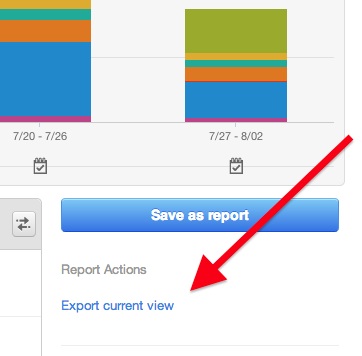
In our example, we’ll be loading blog traffic numbers into Excel. (HubSpot customers, you can find this information in your Sources report — and make sure to select your blog subdomain from the top dropdown before exporting.)
Once you get the export open in Excel, make sure to remove all other information besides the row for each month and the row for traffic. HubSpot customers, you can find all the information you need under the “Visits” tab.
2. Graph the data using the scatter plot function.
Having located your exported file, your data will open in a new Excel spreadsheet. Organize your data the way you want them in each cell. When analyzing blog traffic over time, for example, it makes sense for “Time” to take the X axis and “Traffic” to take the Y axis. So we’ll dedicate two separate rows in Excel for these metrics.

3. Open your trendline options.
In the top navigation, choose ‘Chart Layout‘ > ‘Trendline.’ This will open a dropdown menu of options for trendline types. These include:
- Linear.
- Exponential.
- Linear Forecast.
- Two Period Moving Average.
You can also select ‘Trendline Options,’ where you can set additional preferences for the trendline you want to use.

4. Choose which type of trendline you’d like to test.
Under ‘Type,’ select which line style you want to use in your regression analysis. For our blog traffic test, we’ll use linear, as shown in the screenshot below.

5. Find your R² value.
Remember what R² is? This number between 0 and 1 indicates how much your trend line actually fits the shape of your scatter plot. Select ‘Options,’ then ‘Display R-squared value on Chart.’ R² will appear next to your line. After you’re done, click ‘OK.’

6. Record R² back in your spreadsheet.
In the cells to the left of your graph, record the R² value that was displayed at the end of your scatter plot’s trendline.
Plan on running more than one regression analysis, each with different trendlines, then recording each of their R² values in their own cells in your original spreadsheet — as shown below. This will allow you to determine which type of trendline best explains the shape of your scatter plot. The type of line with the R² closest to the number 1 is your best-fitting trendline.

7. Remove your trendline.
Click on the line, then hit “delete” on your keyboard. Time to see if a different trendline more closely supports your data trend.
8. Run steps 4-7 again using new types of trendlines.
Repeat steps 4 through 7 for exponential and logarithmic lines. The more trendlines for which you find R² values, the more accurate your regression analysis will be. You want to be absolutely sure of the type of trend your data is showing, and stopping after one linear regression analysis is often not enough testing to draw a conclusion from.

9. Compare R² values. Whichever is nearest to 1 is the best fit.
If you’re linear, you’re growing at a steady rate. If you’re exponential, you’re growing at an increasing rate. If you’re logarithmic, your growth is slowing.
It’s possible that none of them are a great fit — see the warning above for more information on this.
In our example, exponential regression is the best fit because it has the highest R², at 0.896, and all are relatively close to 1. (Click the image below to enlarge it.) This means the exponential line is the best fit for your blog growth, and since it’s increasing exponentially, you have been growing quickly.

That’s it, folks! By now, you should have an idea of how fast your blog is growing. Remember, this is only an indication of your past growth. Anything can happen in the future to throw off your traffic.
Image credits: Math is Fun, SOS Math

65% of People Think Social Media Sites Should Remove This Content
Content moderation on social media sites remains a hotly-contested topic.
This year, congressional committees have held not one, but two hearings on the “filtering practices” of social media networks. And while some of these lawmakers begged the question, “Are networks suppressing content from one stream of thought or another?” — these days, there’s another big question in the ether.
Are social media companies responsible for the content published on their networks — especially when that content is factually incorrect?
65% of People Think Social Media Sites Should Remove This Content
The Current Climate
The above question arose at a recent hearing on foreign influence on social media platforms, where Senator Ron Wyden broached the topic of Section 230: a Provision of the 1996 Communication Decency Act that, as the Electronic Frontier Foundation describes it, shields web hosts from “legal claims arising from hosting information written by third parties.”
But those protections are speculated — including by Wyden himself — to be out-of-date, considering the evolution of content distribution channels online, and both the volume and nature of the content being shared on them.
Ron Wyden: “I just want to be clear, as the author of section 230, the days when these [platforms] are considered neutral are over.” cc: all of Silicon Valley
— David McCabe (@dmccabe)
August 1, 2018
That includes content pertaining to conspiracy theories, or that is otherwise factually incorrect.
The former has been top-of-mind for many in recent weeks, with the removal of accounts belonging to Alex Jones — a media host and conspiracy theorist who attempts to frame mass shootings and other tragedies as hoaxes — from Facebook, Apple, and YouTube.
But what is the public opinion on the matter — and to what extent do online audiences believe social media platforms are responsible for the presence of this content on their sites?
The Data
The Content Itself
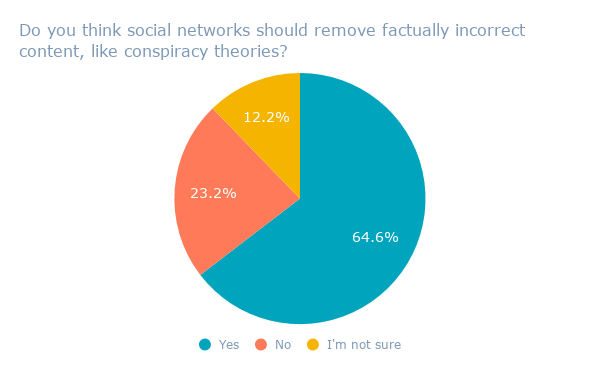
We asked 646 internet users across the U.S., UK, and Canada: Do you think social networks should remove factually incorrect content, like conspiracy theories?
On average, 65% of respondents said yes, with the highest segment (67%) based in the UK.

Data collected with Lucid
The Accounts and Users Sharing It
Then, we wanted to know how people felt about the moderation of the publishers of that content: the accounts and users distributing it or sharing it on social media.
We asked 647 internet users across the U.S., UK, and Canada: Do you think social networks should remove users or accounts that post factually incorrect content, like conspiracy theories?
On average, 65% of respondents said yes, with the highest segment (68%) based in the U.S.


Data collected with Lucid
The Responses in Context
Conflicting Standards
Many point to a lack of transparency around the practice of content moderation as a major cause of certain networks’ inability to more quickly remove information and accounts of this nature.
As @sheeraf writes on Facebook, the problem is transparency. They don’t and won’t say how many strikes someone like Alex Jones gets before a post or account is taken down. How is anyone left to believe there isn’t editorial judgment here?
— CeciliaKang (@ceciliakang)
August 8, 2018
In an interview with Recode‘s Kara Swisher, Facebook CEO Mark Zuckerberg offered very little in terms of a tangible explanation of how the network decides what — and whom — is allowed to publish or be published on its site.
“As abhorrent as some of those examples are,” he said at the time, “I just don’t think that it is the right thing to say, ‘We’re going to take someone off the platform if they get things wrong, even multiple times.'”
After Facebook later removed several Pages belonging to Jones, the company published a vague explanation of its criteria for removing these Pages.
As company executives have explained in the past, Pages and their admins receive a “strike” on every occasion that they publish content in violation of the network’s Community Standards. And once a certain number of strikes are received, the Page is unpublished entirely.
What Facebook will not say, however, is the strike threshold that must be reached before a page is unpublished. It remains mum, the statement says, because “we don’t want people to game the system, so we do not share the specific number of strikes that leads to a temporary block or permanent suspension.”
But that statement could suggest that, since the system is even able to be gamed, it’s possible that different Pages are given different thresholds, or that some more easily receive strikes than others.
The objectivity of content moderation remains a challenge. And despite Facebook’s publication of its Community Standards for public consumption, certain reports — like an undercover investigation from Channel 4 — indicate that content moderators are often given instructions that conflict with those very standards.
Dispatches reveals the racist meme that Facebook moderators used as an example of acceptable content to leave on their platform.
Facebook have removed the content since Channel 4’s revelations.
Warning: distressing content. pic.twitter.com/riVka6LcPS— Channel 4 Dispatches (@C4Dispatches)
July 17, 2018
The Moderation Onus
There appears to be widespread phenomenon of social media networks downplaying their respective levels of responsibility, in terms of moderating this type of content.
While Facebook, Apple, and YouTube actively removed content from Jones and Infowars — which is said by some to be far from a sustainable solution — Twitter has allowed this content to remain on the platform, claiming that it’s not in violation of the network’s rules.
Accounts like Jones’ can often sensationalize issues and spread unsubstantiated rumors, so it’s critical journalists document, validate, and refute such information directly so people can form their own opinions. This is what serves the public conversation best.
— jack (@jack)
August 8, 2018
Twitter CEO Dorsey went so far as to place that responsibility not on the network, but on journalists, who he said should “document, validate, and refute” claims made by parties like Jones — which has actually been done repeatedly.
The timing of Dorsey’s statement is particularly curious, given the company’s recent selection of proposals to study its conversational and network health.
The inconsistent response by various platforms to content from and accounts belonging to Jones and Infowars point to flaws in the development and enforcement of community standards and rules. Where one network won’t reveal how many strikes until “you’re out,” another says targeted harassment isn’t tolerated on its site — and yet, dismisses many reports of it as non-violating.
Hey @jack did I do this right pic.twitter.com/OafLJsO12F
— Caroline Moss (@socarolinesays)
August 8, 2018
“The differing approaches to Mr. Jones exposed how unevenly tech companies enforce their rules on hate speech and offensive content,” writes The New York Times. “When left to make their own decisions, the tech companies often struggle with their roles as the arbiters of speech and leave false information, upset users and confusing decisions in their wake.”

How to Handle Manipulative Coworkers, Managers, and Clients Like a Pro
At one point or another in your career, you’ll encounter a manipulator.
Unfortunately, people who use manipulative tactics to get what they want aren’t just in movies like The Devil Wears Prada — they exist in real life, too.
It’s often difficult to spot a manipulator. Manipulative behavior is inherently sneaky and dishonest. Perhaps your manager undermines you in meetings, but then tells you it’s necessary for your career growth. Or, maybe you’ve noticed manipulative behavior playing out on your team recently, with a higher-level coworker blaming junior-level employees for mistakes that weren’t their fault.
You might even recognize manipulative behavior in the client you’re working for, who often lies to you about his colleague’s wishes in order to get what he wants.
Definition of manipulation
A manipulative person is someone who uses dishonest, devious, or calculated measures to control other people or situations to their advantage. Someone who is manipulative will attempt to achieve their desired goals through lying or influencing other people’s emotions.
While manipulative behavior might seem like just “petty office drama,” it isn’t, and it can have negative and far-reaching consequences on your team’s culture and productivity.
Over time, manipulators can inhibit coworkers from doing their best work, and create a toxic and self-serving culture. It can demoralize your team, and lead to higher levels of employee turnover.
Fortunately, there are a few initial tactics you can try before reaching out to HR or considering more drastic action. Ultimately, it’s imperative you learn how to spot manipulative behavior among your employees or coworkers, and determine the best course of action to help your team operate with openness, honesty, and mutual respect.
Manipulative Behavior
It can be difficult to spot manipulative behavior, particularly if you’re the one being manipulated. The manipulator might compliment you often, or try to get close to you, so you don’t recognize when this “friendly” behavior becomes threatening to your work life.
Here are a few classic signs of manipulation:
- They try to maintain control by having conversations on their terms — in their office, or on their time. They might also give you little time to make a decision, with the hope that the time pressure will force you to say yes to the manipulator’s ideas.
- They ask you probing questions and take initial interest in getting to know you. This “special” attention could be so they can use personal information against you later.
- They lie often or make excuses and either exaggerate or understate facts, and present information in a biased or one-sided way.
- They show aggression by yelling or showing negative emotions to get you to do what they want. They hope your fear will make you follow their orders.
- They tend to make critical remarks or jokes meant to undermine you or point out your flaws. They focus on the negative when providing feedback to you, and make comments to make you feel inadequate.
- They make you feel guilty with the hope that you’ll bend to their demands if you feel bad for them.
- They “play dumb” to get you to do what they want, by insisting they don’t understand or know how to do something. Or, on the flip side, they pretend to be an expert in something to seem superior to you.
It’s important to note manipulative behavior doesn’t necessarily mean someone has a manipulative personality. It’s likely we’ve all, at one time or another, put our own needs before someone else’s, and used manipulative tactics to make sure we got what we wanted.
Think about your childhood. Let’s say when you were younger, you really wanted the last cookie. You knew your sister loved Santa Claus, so you told her, “If you let me eat this last cookie, Santa Claus will still come. But if you eat it, he won’t come and he won’t bring you any gifts.”
By knowing your sister’s weakness, you were able to lie to her to get what you wanted. This is a manipulative behavior, but it doesn’t make you a manipulative person.
In the workplace, people make mistakes. Certain situations might encourage less-than-ideal responses, and your coworker might use manipulative behavior in a moment of crisis or desperation. While this is never okay, it’s often reversible if handled appropriately.
Manipulative Personality
It’s important you learn how to identify if your coworker, manager, or client has a manipulative personality — which is different from occasionally exhibiting manipulative behaviors.
Ultimately, someone with a manipulative personality is someone who often, and repeatedly, uses strategy and calculation over truth and ethics. They put their own needs first, and use your weaknesses against you to ensure they get what they want.
Essentially, someone with a manipulative personality is someone who exhibits the aforementioned manipulative behaviors, but displays them in various situations or with different people, often.
You’ll likely identify someone with a manipulative personality when you feel a disparity between your actions and your morals when you’re around them.
For instance, maybe you swore to yourself you’d never willingly steal a project from a coworker, but then the manipulator guilts you into it or tells you she can’t possibly do it herself. Perhaps the manipulator points out your flaws and insists you overcome them by doing her this favor. You’re uncomfortable and don’t believe it’s the right thing to do, but she convinces you anyway.
If your comfort takes a backseat to the other person’s wishes, or if you feel that person is encouraging you to do something unethical, you are probably dealing with someone with a manipulative personality.
How to Deal With Manipulative People
1. Call it out privately and attempt to get to the bottom of it.
If you see the behavior occur during a team meeting or in the hallway, but it’s the first time you’ve noticed it, you might consider initially calling out the manipulator in private.
For instance, let’s say your employee James has become close with another employee, Rebecca. He often undermines her and “jokingly” points out her flaws during meetings, which you see as both inappropriate and detrimental to Rebecca’s confidence and ability to openly offer her ideas.
You might start by calling James into your office and saying, “James, what is going on here? Do you have an issue with Rebecca or is something about her work behavior bothering you?”
It’s important to directly call attention to James behavior and acknowledge that it’s unacceptable, while initially giving James the benefit of the doubt. You want to try to get to the bottom of his behavior. Perhaps you’ll find that James is angry or frustrated with Rebecca, and while his reaction to his frustration isn’t appropriate, it creates a fuller picture for you.
Of course, James might lie or play dumb, but as a third-party viewer to the manipulation, it’s critical you take initial steps on behalf of Rebecca.
However, this course of action only works if you’re a superior to the manipulator, or if you’re someone the manipulator isn’t manipulating. If you personally feel undermined by the manipulator, you don’t want to handle the situation privately. Instead, you want to point out the situation publicly, which we’ll discuss next.
2. Call it out publicly to show it won’t be tolerated.
Calling a manipulator’s behavior out in public will do two things — one, it will diminish opportunities for the manipulator to lie or play dumb about the situation, and two, it could earn you some allies. Additionally, it shows everyone what’s really going on.
For instance, maybe your coworker purposefully left you out of a project meeting and then gossiped to coworkers that you weren’t pulling your share. If this is the case, you could email the manipulator, cc’ing your boss and teammates, and include information you would have shared in the meeting. End the email by asking to please be included in the next meeting.
Ingrid Goldbloom Bloch, principal at Mosaic Career Services in Boston, advises being “really transparent in your communications.” You want your manipulator’s actions on file as much as possible, so if the time comes, you can show various paperwork to protect your own career. You don’t want your boss hearing you have begun skipping meetings when really, you were never invited.
If the behavior happens in public, such as during a meeting, you might turn to the manipulator and say, “Your comment makes me think you don’t like the solutions we’ve offered during this meeting. Is this true?” By pointing out the behavior you’ve shown it won’t be tolerated and will continuously be questioned if continued.
3. Take your concerns to someone higher up.
Manipulative behavior puts your team’s work culture and productivity at risk, so it’s important, if the behavior continues, that you let someone higher-up know.
Bring objective facts and situations to your boss or director’s attention. Point out how the manipulator’s behavior has hindered your team’s ability to complete a project or cultivate a strong relationship with a client.
For instance, maybe your manager continues to take the credit for your team’s work during meetings, even though she privately applauds you. If the problem is persistent, you might mention to a higher-up that by taking undeserved credit, your manager is deteriorating your team’s morale.
If you keep the conversation business-related, your boss or director will likely see the critical nature and intervene.
4. Invite a mental health professional to your workplace.
If you feel that manipulative tactics have begun infiltrating your team or workplace culture, it might be time to hire a professional to identify these behaviors for you.
A mental health professional who specializes in dealing with manipulation can help you identify manipulative behavior, and can observe relationships between colleagues and make unbiased assessments. The professional can also consult and train your team and provide long-term preventative and management solutions to the problem.
Ultimately, if the manipulator is under your leadership, you’ll need to provide consistent behavioral feedback until they stop their behavior, or make it clear to them that they won’t be tolerated at your company.

Unriddled: Managing Your Time on Social Media, Google’s Controversial New Search Engine, and More Tech News You Need
Welcome, one and all, to another Wednesday: the day that marks the halfway point — almost — to the weekend.
Here in our Cambridge HQ, the days are slowly starting to get shorter. So, as we hold onto to these summer days and nights — and know that, perhaps, you are, too — we’ll try to unriddle this week’s tech news in double-time.
It’s our Wednesday tech news roundup, and we’re breaking it down.
Unriddled: The Tech News You Need
1. New Time Management Tools on Facebook and Instagram
One grievance that’s often aired about social media is the amount of time people spend on it. Now, Facebook will be rolling out “tools to manage your time” on both its core app, as well as Instagram, which is owned by Facebook.
In the context of many other changes made by Facebook this year — like its January News Feed algorithm update to prioritize content from friends and family — and the recent scrutiny it’s received over data privacy, this move makes sense. The (desired) message is clear: Facebook wants people to have a safe and positive experience on its various apps.
At the same time, however, Facebook has also unveiled certain new elements that seem to emphasize and encourage more time spent on the app, especially when it comes to video like Watch and IGTV.
Once the tools are released, Facebook says, they’ll let users know the average amount of time they spend on the given app and the device they’re currently using, as well as the total time they spend on it per day. Additionally, users can set timers for how long they want to spend on the app and receive a reminder of the limits they’ve set, as well as new settings to suppress notifications. Read full statement >>
2. Speaking of News Feed Changes: Redesigned Facebook Business Pages Are Coming
With organic Page reach declining — a possible result of algorithm changes, combined with what Josh Constine of TechCrunch calls a “natural side effect of increased supply paired with plateauing demand” — Facebook says it will redesign the look-and-feel of Pages for local businesses to help people discover and engage with them.
Among the changes, Facebook says, will be new tools to do things like make reservations and see each business’s Stories, similar to the way brands can reach audiences on Facebook with ephemeral visual content. The redesign will also feature listings of “related” businesses to boost discoverability, Constine reports. Read full statement >>
3. Leaked Documents Point to Google Building a Censored Search Engine in China
Last week, The Intercept reported leaked documents indicate Google is building a censored version of its search engine for Chinese markets which will restrict pages and search queries pertaining to topics like democracy, human rights, and protest.
At present, Google’s search engine can’t be used in China, as it’s banned by the country’s “Great Firewall,” which has also blocked such sites as Facebook, YouTube, and certain news outlets (including the New York Times) and coverage. It also blocks access to information pertaining to the categories that would be restricted by Google’s censored search engine, as well as topics like free speech.
According to The Intercept report, the new censored search engine will “automatically identify and filter websites blocked by the Great Firewall,” with a note within the search results indicating that “some results may have been removed due to statutory requirements.”
Along with Google, Facebook has also struggled to gain a foothold in the Chinese market, after recently withdrawing its registration to open a subsidiary in Zhejiang. Read full story >>
4. New York City Will Put a Cap on Uber
After years of controversy around the impact of ride-sharing apps on the taxi industry (and its drivers), New York’s city council will vote today on a one-year cap for new license applications for ride-sharing vehicles operating for Uber and others. It’s one of the city’s attempts to regulate car traffic and the effect that such ride-sharing apps have had on it — as well as the dwindling income of drivers, according to Bloomberg. Should the council vote to approve the app, New York will be the first U.S. city to establish such regulations. Read full story >>
5. More News From Google You May Have Missed
Beyond the controversy, Google was in the news for a few other notable items last month. Check out “What You Missed Last Month in Google”: our monthly roundup of the top stories from the search giant you may have missed. Read full story >>
That’s all for today. Until next week, feel free to weigh in on Twitter to ask us your tech news questions, or to let us know what kind of events and topics you’d like us to cover.
Featured image credit: Facebook

Will Bitcoin Crash and Burn?
It seems like bitcoin’s value is on a constant rollercoaster ride. After its share price skyrocketed to an all-time high of $19,346 on December 17, 2017, it lost 33% of its value just five days later. By February 6, 2018, bitcoin’s share price plummeted to a low of $5,967, losing over 69% of its peak value.
But a month later in March, bitcoin seemed to be recovering: its share price shot up 92% to $11,432. Since then, bitcoin’s value has fluctuated in the same pattern: the month after its price soars, it plunges. And the month after its price plunges, it soars.
Bitcoin’s value is mired in uncertainty, which begs the question: will bitcoin ever completely crash? Before we answer this question, though, we need to understand why bitcoin is so volatile, why it’s so popular, and what could bring it down.
Why Is Bitcoin So Volatile?
Even though bitcoin is technically a currency, it trades more like a commodity. There’s a limited supply of bitcoin in circulation and a ton of consumer and investor demand for it. So just like gold, market forces set bitcoin’s share price.
But the main difference between bitcoin and a commodity like gold is that the cryptocurrency’s market capitalization of $120 billion is tiny compared to the total value of gold mined, which is a staggering $8.3 trillion.
With such a small market size and significantly less volume of buy and sell orders, relatively small changes in the demand for bitcoin can significantly influence its share price.
What Drives Demand for Bitcoin?
Scarcity and Utility
Items that are both rare and useful have value. Gold is expensive because it’s rare, hard to find, and has utility — you can make things with it.
Bitcoin is in a similar boat. It’s relatively rare because there will always be a limited supply of bitcoins in circulation: about 17.2 million bitcoins today, and 21 million set as the maximum amount of bitcoins that will ever be available. Most of the public knows about this cap too, which increases the cryptocurrency’s perceived scarcity even more.
Bitcoin is relatively useful because it’s a currency and an asset. With an estimated 2.9 – 5.8 million bitcoin users and thousands of merchants accepting it as a form of payment, bitcoin is the most widely accepted cryptocurrency in the world.
Everyone also knows about bitcoin’s meteoric share rise, and with five percent of Americans currently investing in bitcoin and an additional 21 percent considering adding the cryptocurrency into their portfolios, bitcoin is one of the hottest assets on the market.
Network Effects
Since bitcoin’s value doesn’t depend on a corporation’s financial health and performance, their value and potential to thrive depends on the growth of its network, like users, miners, and developers. According to Metcalfe’s law, the more connections users make with each other in bitcoin’s network, the more valuable it becomes to its users and the general public.
A good example of the power of Metcalfe’s law is the adoption of the internet. At first, no one used it, so it didn’t provide a lot of value to people. But when the internet grew in popularity, people started using it more, connected with each other on it, and even did business on it, making it more valuable for its users and increasingly necessary for the people who weren’t using it.
If the majority of the world’s consumers and merchants start using and accepting bitcoin, the cryptocurrency would do what the internet did to society: become commonplace and necessary to buy everyday things.
Blockchain
Another thing that gives bitcoin value is the public’s faith in its underpinning technology: blockchain. Blockchain is digital, public ledger that no one can edit or delete, making economic transactions faster, safer, and more transparent.
Even though the majority of businesses haven’t adopted blockchain, the world’s biggest corporations believe it will happen soon — all ten of the largest U.S. banks have collectively invested $267 million in six blockchain companies and one consortium.
Speculation
In most market bubbles, like the dot-com bubble or the financial crisis, the public thinks a company’s stock or an asset will guarantee lofty returns in the future — investors are willing to buy these assets at a much higher price than its real value. This increases the asset’s perceived value, demand, and, ultimately, price. But if these companies or assets don’t perform up to their expectations, their share price will plummet as fast as they soared.
For instance, in 2000, Amazon had sales and earnings that really couldn’t justify its peak stock price of $113 per share. Like most internet companies, the meteoric rises in their stock was unsustainable. And once these companies started to fail and bursted the dot-com bubble in late 2001, Amazon’s extremely overvalued shares decimated its stock, which dropped 95% to $5.51.
Bitcoin has strikingly similar characteristics to Amazon during the dot-com bubble. Its share’s meteoric rise seems unwarranted and driven by optimism — in fact, 96% of economists believe bitcoin’s soaring price is due to speculation.
Bitcoin isn’t a legal tender backed by any government, a tiny fraction of the world’s customers and merchants transact with it, and blockchain isn’t widely used. So why does it have so much value?
Its because the public has great confidence in bitcoin’s potential. They think countries will start accepting bitcoin as currency and every business will adopt blockchain one day. And this optimism makes them more willing to buy bitcoin at a higher price now to reap the sky-high rewards later, which also raises the cryptocurrency’s demand and share price.
But if bitcoin and blockchain don’t live up to their potential, bitcoin’s demand will drop and its price will plunge into a free fall, bursting its bubble.
Things That Can Thwart Bitcoin From Reaching its Potential
Along with speculation, there are three main factors that could stunt bitcoin’s growth:
Bad Press
Headlines of bitcoin crashes and leaders of the largest financial institutions in the world questioning its validity hamper the cryptocurrency’s public perception. In fact, after the CEO of JP Morgan, Jamie Dimon, said he would fire anyone who traded bitcoin at his investment bank in 2017, bitcoin’s value immediately fell by 6%.
Increased Government Regulation
Bitcoin is a decentralized currency with no central authority overseeing it, letting you avoid banks and traditional payment processes to purchase goods and services. This attracts a wide spectrum of supporters — from people who love the idea of a currency with no inflation or central bank, to criminals who love the idea of dealing illegal items without having to leave a digital footprint.
Banks and financial institutions are concerned with bitcoin’s ability to help criminals launder money and commit crime, so no government has adopted it. And recent news on cryptocurrency regulation makes any government adoption of bitcoin even more unlikely:
- In February, India’s finance minister said that the country won’t recognize cryptocurrencies as legal tender and would be proactive against its widespread use in illegal activity.
- Facebook now requires bitcoin and cryptocurrency advertisers to go through an approval process. The social network has also banned initial coin offering ads.
- UK prime minister Theresa May said that they will heavily scrutinize criminals who leverage cryptocurrencies, like bitcoin.
- US treasury secretary, Steven Mnuchin, said that the US economy will impose more regulations on cryptocurrencies, like bitcoin.
Lack of Security
If bitcoin wants to be the currency for the world, consumers and merchants need a safe place to store their funds.But cryptocurrency’s security issues could destroy the trust and use of bitcoin.
Last year, two exchanges went bankrupt after hackers stole the majority of their funds. And in the last few months,cyber thieves have stolen hundreds of millions of dollars from cryptocurrency exchanges.
Yo Kwon, the CEO of Hosho Group, a company that specializes in securing applications that leverage blockchain, estimated that cyber thieves have hacked about one third of all cryptocurrency exchanges at one point and will prey on more.
Will Bitcoin Crash and Burn?
A lot of people believe in blockchain technology and bitcoin’s potential as a global currency and asset. But unless the business world adopts blockchain and merchants accept bitcoin as a form of payment, only time will tell us when bitcoin will completely crash and be forever known as the biggest bubble in economic history.

The Ultimate Guide to Content Creation
Where is the first place you go for expert advice or an answer to a burning question? My guess is Google (or your preferred search engine). You’re not alone — Google alone answers over four billion search queries everyday.
When you enter a question into the search bar, those links that appear in your search results are content. Whether you know it or not, you consume content on a daily basis.
That marketing strategy guide … content.
Those articles that diagnose your symptoms … content.
The video tutorial on how to create Victoria Secret-level hair volume content.
News stories, Instagram feeds, blog posts, cat videos, GIFs, memes … all content.
Content is a large part of your everyday life. It’s hard to avoid, but why would you want to? Content keeps us informed, answers our questions, entertains us, makes us smile, guides our decisions, and more.
From your perspective as a marketer or business owner, content helps you attract, engage, and delight prospects and customers, bring new visitors to your site, and ultimately, generate revenue for your company.
In other words, if you’re not creating content, then you’re behind the curve.
Why Is Content Important?
Content creation is the ultimate inbound marketing practice. When you create content, you’re providing free and useful information to your audience, attracting potential customers to your website, and retaining existing customers through quality engagement.
You’re also generating some major ROI for your company, as these content marketing stats demonstrate:
- Content marketing brings in 3X as many leads as traditional marketing and costs 62% less.
- SMBs that use content marketing get 126% more leads than those that don’t.
- 61% of online purchases are the direct result of a customer reading a blog.
- Companies that publish 16+ blog posts per month get 3.5X more traffic than those that post four or fewer posts per month.
Content equals business growth. So, let’s get started with your content strategy.
Content Planning and Strategy
You wouldn’t start building a house without a blueprint, a sculpture without a sketch, or a company without a mission statement. So, there should be no content creation without a plan. Otherwise you risk getting derailed from your objective.
A content strategy includes everything from brand and tone to how you will promote your content and eventually repurpose it. Let’s go over how to create your content plan, step-by-step.
Set Your Content Goals
Similar to a traditional marketing campaign, your content strategy should be centered on your marketing goals (which should, in turn, be derived from your company goals).
Your goals could range from attracting more visitors to your site to generating more leads to anything in between — as long as they’re SMART goals. An example of this kind of goal would be to increase organic traffic to the blog by 25% in the next quarter.
Once you determine that, each piece of content you create should be aligned with your goal and contribute to your desired outcome.
In sum, start with your goals, then create your content.
Create a Buyer Persona
Building a content strategy is more than considering what type of content you want to create. You first need to know who you’re speaking to, how you want to speak to them, and where to find them.
The key to creating successful inbound content is to make each reader feel like you’re speaking directly to them.
The only way to do this is to get intimate with your visitors, leads, and customers — you need to know them like you know an old friend. You should be aware of their obstacles, their pain points, their challenges, and fears. Similarly, you should understand their best possible outcome, their dream solution, and their biggest fantasies.
Always remember that you are marketing to humans that want to feel connected.
Ideally you’d know and be able to speak directly to every individual that visits your website, but you can’t. The solution? Create a buyer persona.
Your buyer persona is the person that you want to reach with your content. This semi-fictional character serves as a representation of your target audience, i.e., the people who are most likely to benefit from your message and become customers.
Creating a buyer persona takes a bit of research, some guesswork, and tweaking. But the end result is a clear picture of the person you want to market to and someone who will happily consume your content.
Not sure where to start? Use MakeMyPersona to build out your buyer persona.
Rely on the Buyer’s Journey
If you’ve ever had a headache, the first thing you likely did was try to figure out the cause. Perhaps you were dehydrated, or caffeine-depleted, or maybe you were sick. After you diagnosed the problem, you moved on to solutions — drink some water, grab an espresso, or take some medicine. Finally, you decide between solutions: Evian or tap water? Starbucks or Peet’s Coffee? Aleve or Tylenol? Hopefully, your headache then subsided and you were able to go about your day.
This is a representation of the buyer’s journey. Each of your prospects follows a path to a solution — that path involves awareness, consideration, and decision stages. But each of your prospects is in a different part of that journey, so it’s important to use your content to appeal to each stage.

By creating content for each stage of the buyer’s journey, you’re ensuring that no visitors fall through the cracks and that every individual that comes to your site feels like they are receiving relevant, useful information.
You also want to select a format for your content so that it’s tailored to each stage of the buyer’s journey. A new visitor in the awareness stage won’t want a live demo of your product, but they would read a quick checklist or blog post that helps them better understand their problem. A prospect in the decision stage doesn’t need to know about all the possible solutions, they need a consultation or demo that shows them that your product is the right solution. Always meet your audience where they are.
Here’s a guide to the best content formats for each stage of the buyer’s journey:
Awareness: Whitepaper, Blog Post, Checklist, Tip Sheet, Infographic, Ebook, Game, Quiz
Consideration: Podcast, Webinar, Worksheet, Comparison Matrix, Template
Decision: Demo, Free Trial, Product Guide, Consultation, Coupon
Perform a Content Audit
Whether you’ve been creating content for a while without any clear direction or you’ve been following a strategy all along, every marketing department can benefit from a content audit. Just because you didn’t start out with a clearly defined strategy doesn’t mean that the content you already have won’t fit into one.
A content audit is simply taking inventory of the work you’ve already done, then organizing it to fit under a your new content plan.
The process might involve some re-writing, or it could reveal gaps that need to be filled with content that appeals to your persona and their journey stage.
Here’s how you’d perform your content audit:
- Gather all of your content in a spreadsheet.
- Create columns for target keywords, buyer persona, buyer’s journey stage, format, and main topic, then fill these in for each content piece.
- Add columns for your key metrics, like page views, shares, engagement, etc.
- Finally, categorize each post (using highlights or another column) by those that are doing well, need improvement, should be rewritten, or can be merged with another post.
While a content audit may seem tedious, all the manual labor will be worth the increased traffic and leads. Plus, you’ll have a verified plan moving forward.
If this process seems a bit overwhelming, check out this post for some more guidance.
Choose the Right Format
Remember that buyer person you created? You’re creating content for them. That means you should be crafting content in a format that is most easily and enjoyably consumed by your prospects.
The format you choose might be a blog post, video, slideshare, graphic, ebook, whitepaper, podcast, or whatever your creative mind can conceive. As long as it serves your persona, you’ll be in good shape.
Also, you don’t need to stick to one format for every piece of content that you create. But you should be able to create content — in whatever format — on a consistent cadence. What I mean is, a podcast series might be a great marketing tactic, but if you lack the resources (and patience) to stick to it, then a blog might be a better route.
Use these questions as a guide when choosing your content format:
- What stage of buyer’s journey is this for?
- How easy is it for your audience to consume this content?
- Where does your persona spend their time online?
- What format can you create on a consistent basis?
- Are you able to produce this content at aquality level that’s competitive?
Content Promotion
What good is it to create all this great content if no one sees it? In a perfect world, herds of people would flock to your site every time you published a new post. In reality — especially when you’re just starting out — you’ll need to entice people to consume your content and even shepherd them into your online space.
Hence why content promotion is just as important to your strategy as whatever content you create.
Your promotion plan should be guided by your persona. Where do they spend their time online? What time of day do they use a particular platform? How often do they want to see content from you? How do they like to consume content? What email subject lines get them to click?
Content promotion varies by medium, and there are specific rules to follow for each.
Social Media
While social media is a relationship building tool, it can be used to promote content. It’s all about finding the right balance between self-promotion, sharing useful information, and entertainment. Facebook, Twitter, Instagram, YouTube, and Snapchat are all great mediums to both create and share relevant content. The key is modifying that content to fit the platform.
Email Marketing
Email is one of the best ways to reach your audience for any reason, especially to promote content. The reason is anyone on your email list has opted in to hear from you and you can guarantee that they’ll get your messages. Better yet, you can improve your open rates by sending relevant content to segmented lists, meaning they’ll be eager to read everything you send their way.
Paid Promotion
Pay-per-click (PPC) helps you get your content in front of new audiences through targeted, paid advertisements. These ads can run on social media, search engines, or other websites. Once you define your buyer persona, you’ll want to go the paid route so not to waste money targeting uninterested parties. Once you have your audience down, paid promotion can yield a great ROI.
Syndication
Getting your content promoted through authoritative, third-party channels is a great way to build your audience. Syndication gets your brand in front of fresh eyes (and wallets) that you wouldn’t otherwise reach with your own efforts.
Repurposing Content
When you repurpose content, you’re reusing something you spent a lot of time to create and transforming it in various formats so that it can be more widely consumed.
Think of it as recycling. You want to spend less time creating and more time getting your content in front of your audience. For example, that blog post that you wrote on marketing stats can also serve as a great infographic or even a video.
If you created something in one format, try to think of all the other ways that you could reuse that information that might be just as effective.
The Content Creation Process
We marketers are busy. We don’t have time to waste on inefficient systems. That’s why we create processes for everything we do. We devise a system, roll it out, tweak it until it works, then repeat that system over and over to generate the results we want. Think about every marketing campaign you’ve ever done — webinars, autoresponders, surveys. Each of them had a process. Content creation is no different.
Follow these steps to create content, remove the guesswork, and allow for more creative mental space.
1. SEO Research
Creating your buyer persona likely gave you some ideas about what topics to write about and what questions your audience might have, which is a great start. Now, you need to confirm if those ideas can apply on a bigger scale to a larger audience. Sure, it would be great to write a blog post directed toward a single person, but, boy, would it be a waste of energy.
SEO research — a.k.a. keyword research — will show you the search volume of a specific keyword phrase and whether it’s worth the investment of creating a piece of content around it.
A good way to go about keyword research is to write down some questions that your persona might have based on their obstacles and goals. Then, perform some keyword research around those queries to see if enough people are searching for them. A rule of thumb is to target keywords that are attainable, meaning that have a monthly search volume (MSV) and keyword difficulty that corresponds to your domain authority. Trying to target high volume (read: highly competitive) keywords when you’ve just started blogging won’t pan out too well for you.
Before we go any further, let’s detour into a quick-and-dirty SEO explanation:
One important factor that helps you to rank in search engines is domain authority. You gain domain authority by how many external sites link back to your content. In order for this to happen, you need to have a pretty large library of content that is valuable enough to cite. That means, the longer you write high quality content, the higher your domain authority and the easier it is to rank for highly competitive keywords that will put you on the first page of Google.
If you’re not quite there yet, the best thing to do is to target long-tail, low-volume keywords with minimal keyword difficulty (<50) — we’re talking 200-1000 MSV. This will give you the best chance at ranking for keywords and getting your content in front of more people.
SEO lesson concluded. Back to our scheduled programming.
There are a few ways you could perform your keyword research:
- Use keyword research tools, like SEMRush or Moz Keyword Explorer.
- Type your keyword into a search engine and take note of the auto-filled queries.
- Check out the related searches section on search engine results pages (SERPs).
2. Ideation
Now that you’ve determined which keywords to target, it’s time to brainstorm some content ideas. HubSpot research shows that the best way to organize content is through topic clusters, meaning you create a long-form, comprehensive pillar page based on a keyword that then links to content you’ve created on related subtopics (think blog posts).
To illustrate the point, it looks something like this.
The topic cluster model makes brainstorming so much easier because now you have structure to follow (… told you we like processes). You can use your main keyword to create a pillar piece that covers that topic in depth, like … say a guide to content creation. Then, you can create shorter pieces of content — infographics, blog posts, templates — that help your audience dive deeper into the topic and target long-tail keywords.
If you’re stumped for ideas, you might want to consider looking for inspiration from books you’ve read, industry studies, your competitor’s sites, or related searches on SERPs.
Once you have all of your ideas down, you can develop your editorial calendar and start creating.
3. Writing
I’m going to talk about the writing process because … well, that’s what I do. Your specific content creation strength might be videos or graphics or podcasts. Whatever it is, the creation process follows some pretty similar guidelines:
- Write to your persona. Use their voice, their euphemisms, even their humor to construct a piece that resonates.
- Use titles, meta descriptions, and other teasers to compel your audience to read your content. Put the benefit of your content right in the title to let them know why they should read it.
- Create something unique. Don’t simply regurgitate the information that’s already out there. Infuse a unique style or cite new research to emphasize your points.
- Stick to one idea and use your content to reinforce it. Don’t confuse your reader by going on tangents or trying to explain multiple semi-related topics in a single piece.
- Stay true to your voice. Don’t try to impress your audience with eloquent prose or an expansive vocabulary if they don’t speak that way.
- Be concise and clear. You want your audience to relate to you and derive value from your content … and not have to sift through jargon or confusing metaphors.
4. Editing
The way you edit your (or others’) work is a very subjective process. You may want to edit as you go, or you might wait a few days and review the work with fresh eyes. You might care a great deal about grammar, or you might aim for a more colloquial piece.
Either way, there are a few things that should definitely look out for as you refine your content, like active voice, clear language, short sentences, and plenty of whitespace. Consider having a colleague or manager review your work, too.
Some tools that will help you cut down on your editing time are Grammarly and Hemingway Editor.
5. Uploading
Now that your content is ready, you’ll need to put it somewhere that people can access it. A content management system (CMS) is software that hosts digital content and allows you to display it on your website (or anywhere else on the web).
The benefit to a CMS is that it connects all of your content and stores it in one place. So, you can easily link to a landing page in your blog article or insert a content offer in an email. Not only that, but you can analyze the results of all the content you created for a specific campaign (which can help with content audits). A CMS saves you from having a disjointed content marketing system.
For example, HubSpot’s CMS is home to our blog, where you get access to all of our great content and useful free offers.
6. Publishing
Publishing content is as simple as clicking a button. So, why include a section on it? Well, because it’s not always that simple. Yes, you can publish your content immediately after uploading, or you can maximize its impact by waiting for an optimal time.
If you’re just starting out, then clicking publish right away probably won’t impact your audience too much. But if you have committed to a regular publishing schedule, like delivering a new post every Wednesday, your audience will expect to see posts published on Wednesdays.
Something else to keep in mind is to publish according to trends or time-sensitive events. For example, if you create content about national holidays or current events, then you’ll want to publish those at specific times.
A CMS will allow you schedule posts for a future date and specific time, so you can click, schedule, and forget.
Content Creation Tools
While a CMS will help you manage your content, it won’t help you create it. That’s where content creation tools come in handy. These are especially useful if you’re artistically impaired, like me, or if you don’t have the capacity to hire help. From GIFs to infographics, these content creation tools will help you look like a professional, regardless of what kind of content you’re making.
Canva will help you create beautiful designs for any platform, from social ads to Facebook cover photos to infographics. The software features aesthetically pleasing templates that you can customize with colors, images, and text … for free.
Giphy The GIF has replaced emojis as a completely normal form of communication, and, therefore, an acceptable way to present content. Giphy allows you to search millions of pre-created GIFs in their database or even create your own.
Vidyard is a video hosting platform that was made for marketers. The software allows you to customize your video by adding overlays, text, or CTA buttons, split test, transcribe, and has SEO features.
SurveyMonkey is a leading survey creation platform. Why might you need such a thing? Because a good marketer knows that customer feedback is critical to an effective marketing campaign.
MakeMyPersona is HubSpot’s own nifty tool that will walk you through the process of creating your buyer persona. You can generate a document to reference throughout your content creation process.
Anchor is the podcasting tool for beginners. It’s free, allows you to record and store unlimited episodes, and you can easily upload to any third-party platform.
This is far from an exhaustive list of all the great content creation tools out there — this list is much better!
Creating a Content Plan
Content exists everywhere, but its success relies on your ability to adapt it to the medium on which it lives. One size does not fit all when it comes to posting on different mediums — or the platforms within those mediums, for that matter.
Social media content varies from blog content, which is different than website content. So, you need to know how to tailor your creation to reach your audience where they are.
Let’s dive into some guidelines for sharing content on various platforms.
Social Media Content
There is an art to creating content for social media. But it’s well worth your time since there are 2.6 billion users across social media platforms worldwide. Plus, someone who follows you on social media is like a warm lead — they already like you and are interested in what you have to say. So, you have an eager audience that’s ready to engage with your content.
Here are a few quick tips for creating content on some popular social channels.
Facebook can be used to build micro communities via Facebook Groups or to share to a mass audience on Facebook Pages. When it comes to sharing content, questions and videos reap the most engagement.
Instagram is best for sharing high-quality imagery and short videos with brief captions. Hashtags work well on this platform as long as they’re relevant to your account and business. Instagram Stories has introduced a new way to engage with your followers, from quick polls to questions to real-time videos.
YouTube has 1.3 billion users and counting. Users frequent this platform to watch content ranging from DIY videos to parodies. Some of the most successful content on this platform are how-to guides, vlogs, product reviews, and educational videos.
Twitter best practices include short messages, supporting images, relevant hashtags, and retweets. And, of course, replies go a long way to win over your audience.
Website Content
Website content should focus on three things: your persona, your target keywords, and your solution. Not unlike your blog content, the copy on your website needs to guide visitors to your solution in a cohesive and natural way. Think of web content like a map to your product.
Be careful not to turn visitors away through social media feeds and other distracting elements. Once you you’ve attracted a potential customer, you must do everything you can to keep them there, and that’s the key function of your website content.
Blog Content
The purpose of blog content is to support your business by attracting strangers and bringing in qualified leads. Blog content is a free resource that’s not often directly tied to sales, but don’t underestimate the power of a well-crafted blog to ultimately generate revenue for your business. Research shows that companies that blog more get more traffic and more leads than those that don’t.
Analyzing Your Content
The final, and arguably most important step in content creation is analyzing your content. Without data, you can’t know what’s working or how to improve it.
There are several data points you could track when analyzing your content, so use your goals as a guide to set some parameters. Whatever you want to accomplish with your content will help you choose your metrics. (Remember that initial goal we talked about?)
What you analyze is completely up to you, but here are some ideas for metrics to track:
- Page Views: the number of users that visit your content.
- Organic Traffic: the amount of traffic that comes from search engines.
- Bounce Rate: the percentage of visitors who leave your site after visiting only one page.
- Conversion Rates: the percent of visitors that engage with a CTA.
- Engagement Rates: the number of people that interact with your content through likes, shares, comments, or in other ways.
- Audience Growth: the new subscribers or leads that are generated from a piece of content.
If you need more tips on analyzing your content, check out this free HubSpot Academy course.
Conclusion
Content creation is an iterative process that pays off tremendously with your audience. Once you have the content creation process down, you’ll be able to generate creative work that not only delights your audience but also grows your business.

The Ultimate Guide to Internet Marketing
Internet use is increasing worldwide every day — in fact, over four billion people around the world use the internet, as of 2018.
Marketing is, and always has been, about reaching customers where they are. TV commercials, print advertisements, and billboards all attempt to do just that.
The internet offers unique benefits other marketing mediums can’t offer — scope of reach, the option to personalize content, and the opportunity to build far-reaching relationships with customers, being just a few.
But the internet can be an overwhelming and all-encompassing entity, filled with videos and recipes and news articles and e-commerce sites. In the crowded space of the internet, how are you supposed to differentiate your business to reach the right audience?
The answer is internet marketing.
Internet marketing leverages digital channels, including email, social media, websites, and search engines, to reach your ideal audience. Unlike more traditional advertising mediums, such as print, the internet encourages two-way conversations between your business and your customer, ideally creating better long-term customer retention.
There’s no avoiding it: internet marketing is critical for the success of your business in 2018. But with all the gimmicks and tricks, it can be difficult to distinguish short-term wins from effective long-term strategies, which is why we’ve created an ultimate guide. Here, we’ll cover everything from marketing strategies to real-world examples, to ensure your business reaches the right people out of that four billion.
What is Internet/Online Marketing?
Online marketing, also known as internet marketing or web advertising, is a form of marketing that uses the internet to deliver promotional messages to customers through digital channels such as search engines, email, websites, and social media.
Online marketing strategies include web design, SEO, email, social media, PPC, and other internet-related methods.
Let’s dive into two separate goals you’ll have with internet marketing, as well as the necessary methods you’ll want to take to achieve those goals.
Internet Marketing to Attract New Customers
You can use online marketing strategies to attract new customers. To do this, you’ll want to focus primarily on paid social media ads, search engines, and web design.
For instance, you might use Facebook’s Lookalike Audiences to get your message in front of an audience similar to your core demographic. Or, you could pay a social media influencer to share images of your products to her already well-established community. Paid social media can attract new customers to your brand or product, but you’ll want to conduct market research and A/B testing before investing too much in one social media channel.
To attract new customers, you also need to maintain a powerful SEO presence. With 89% of B2B buyers and 81% of shoppers using the internet for research before making purchasing decisions, it’s imperative your business is at the forefront of search for related keywords.
Having a strong SEO presence also translates to more in-store purchases, as well — in fact, 78% of local mobile searches result in an offline purchase, and local searches lead half of all mobile users to visit stores within one day.
Finally, it’s critical you spend time and resources on your business’s website design. When these aforementioned customers find your website, they’ll likely feel deterred from trusting your brand and purchasing your product if they find your site confusing or unhelpful. For this reason, it’s important you take the time to create a user-friendly (and mobile-friendly) website.
Internet Marketing to Cultivate Brand Loyalists
Internet marketing is for more than just attracting new customers — it’s also critical for maintaining a loyal, long-term customer base. And, since it costs five times more to attract a new customer than it does to keep an existing one, this is an equally important goal.
You’ll want to use email, blogging, and social media tactics to increase brand awareness, cultivate a strong online community, and retain customer loyalty. Consider sending personalized emails to past customers to impress or inspire them — for instance, you might send discounts based off what they’ve previously purchased, wish them a happy birthday, or remind them of upcoming events.
To properly employ email campaigns, you’ll need an email list. Here’s how to build an email list from scratch.
Additionally, you might use social media to showcase your brand’s personality and hear directly from your customers. Consider hosting a Twitter chat, posting surveys on Instagram, or creating fun contests on Facebook.
Internet Marketing Strategies
- Design a user-friendly website
- Optimize your site for search engines
- Use email marketing or opt-in email campaigns
- Write online press releases
- Create a blog
- Develop social media contests and campaigns
There are six strategies you’ll want to employ to ensure you’re successful at internet marketing.
First, you want to create a user-friendly, and mobile-friendly, website. The design of your site will showcase your brand’s personality and differentiate your business from every other online business. But it’s more than just looking good — a cleaner, more well-organized site structure can affect how you rank in the SERPS.
For help designing your website or ensuring it’s up-to-par, check out 8 Guidelines for Exceptional Web Design, Usability, and User Experience.
Next, you’ll need to keyword optimize your site for search engines. Essentially, this means you’ll choose keyword(s) that relate to your business, and incorporate those keywords into the URL, body text, image text, headers, and navigation bar.
For tips on keyword optimizing your entire site, check out On-Page SEO 101: Tips for Keyword Optimizing the Most Critical Parts of Your Website.
If you’re interested in focusing on keyword optimizing your blog posts, consider reading Blog SEO: How to Search Engine Optimize Your Blog Content.
Email marketing and opt-in marketing campaigns are one of the most effective long-term strategies to connect with potential customers and cultivate brand loyalty.
For everything from getting started with email marketing, to email marketing best practices and lead magnets, check out The Ultimate Guide to Email Marketing.
Writing online press releases is an additional way to increase online coverage of your business from other sources, which will also positively affect your ranking in the SERPs. Plus, if a local news outlet covers your business, you’ll receive their audience, which you otherwise might not have reached.
To get started writing a press release for your business, consider How to Write a Press Release [Free 2017 Press Release Template + Example].
I might be biased, but blogging is one of the best ways to attract a large audience to your site, establish your business as a thought leader in your industry, and prove your brand to be both useful and current.
Writing blog posts is especially effective for providing different opportunities to land on page one of search engines — for instance, maybe your eyeglass store’s website is on page three of Google for “eyeglasses,” but your “Best Sunglasses of 2018” blog post is on page one, pulling in an impressive amount of traffic (over time, that blog post could also boost your overall website to page one).
To learn everything from choosing a domain name to writing your first blog post, check out How to Start a Blog: A Step-by-Step Guide [+ Free Blog Post Templates].
Social media contests and campaigns are exceptional opportunities to engage with your online audience, form relationships with customers, and learn about your buyer’s persona.
For an overarching compilation on everything you need to know about social media campaigns — from how to craft perfect posts on Facebook to the most shared phrases on LinkedIn — take a look at Everything You Need to Know about Social Media Campaigns.
Finally, take a look at our Essential Step-by-Step Guide to Internet Marketing to dive deeper into the six essential steps of internet marketing.
How to Do Online Marketing
- Choose the right keywords and optimize your site for search
- Create a mobile-optimized and user-friendly site
- Publish blog posts regularly
- Conduct email marketing campaigns
- Encourage conversation on social media accounts
- Publish online press releases
- Cultivate paid social media campaigns
Online Marketing Examples
There are hundreds, if not thousands, of online marketing examples to inspire your next internet marketing campaign.
Here, I’ll dive into seven real world examples of social media, email, SEO, and website marketing methods. I’ll also include links to additional blog resources at the bottom, for even more exceptional ideas.
1. Social Media: Under Armour’s “I Will What I Want” Campaign
Under Armour came up with the hashtag “I Will What I Want” to encourage powerful athletic women to achieve their dreams despite any opposition they might face. The hashtag, first used by American Ballet Theatre ballerina soloist Misty Copeland, blew up on Facebook after supermodel Gisele Bündchen used it in one of her Facebook posts. Many other female athletes have also used the hashtag.
The campaign spreads a positive message of female empowerment, while also highlighting Under Armour’s women apparel. The campaign reached five billion media impressions, increased Under Armour’s women’s sales by 28 percent, and pulled in an additional 42 percent of traffic to their website.

Image courtesy of Giselle Bündchen’s Facebook account.
2. Email: JetBlue
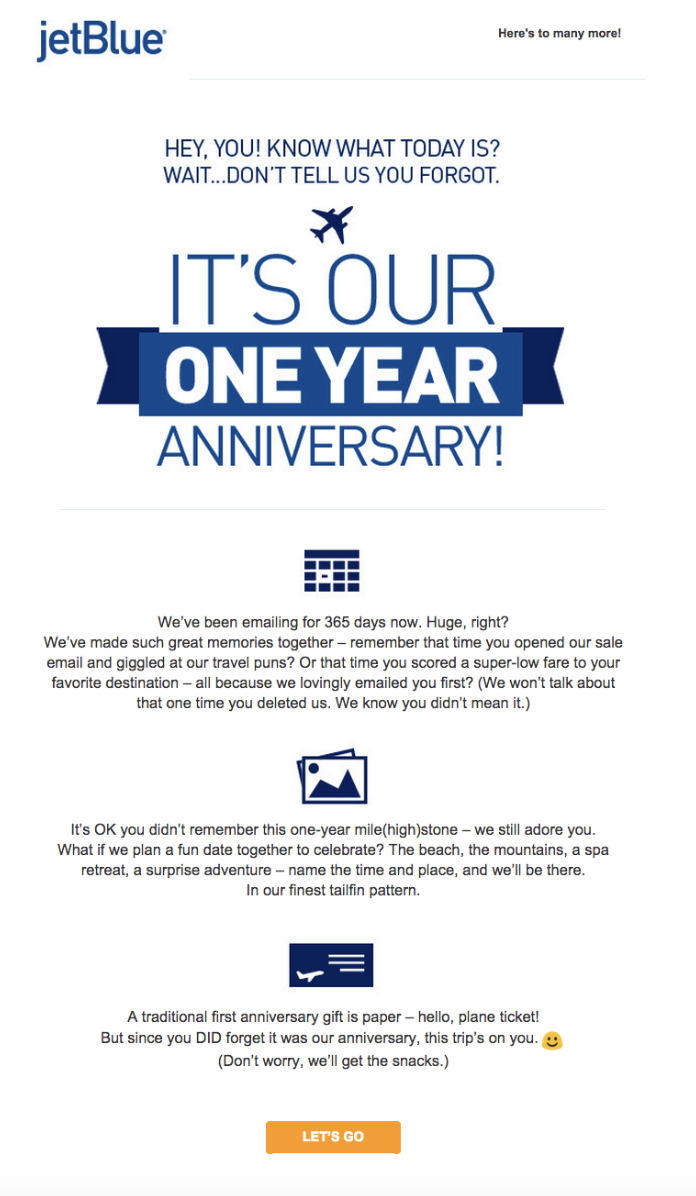
Companies often use email marketing to re-engage past customers, but a “Where’d You Go? Want To Buy This?” message can come across as aggressive, and you want to be careful with your wording to cultivate a long-term email subscriber. This is why JetBlue’s one year re-engagement email works so well — it uses humor to convey a sense of friendliness and fun, while simultaneously reminding an old email subscriber they might want to check out some of JetBlue’s new flight deals.
3. Social Media: Disney and Make-A-Wish’s “Share Your Ears” Campaign
Disney and Make-A-Wish, long standing partners, created a #ShareYourEars campaign to raise money for the Make-A-Wish foundation — every time someone posted a picture on Facebook, Twitter, or Instagram with the hashtag, Disney would donate five dollars.
Disney initially stated they wouldn’t exceed one million in donations, but ended up donating two million after the campaign blew up. #ShareYourEars campaign garnered 420 million social media impressions, and increased Make-A-Wish’s social media reach by 330%. The campaign is a powerful example of using an internet marketing strategy for a good cause. #ShareYourEars raised brand awareness, cultivated a connected online community, and positively affected Disney’s brand image.

Image courtesy of ABC7 News.
4. SEO: Moz’s case study for Pipedrive, a sales CRM
Using a content marketing strategy that included content creation, outreach, and guest posting, Pipedrive, a sales CRM, was able to rank #1 for a high-volume keyword — “sales management” (9,900 search volume). They were able to outrank SalesManagement.org, InsightSquared, and even US News and Wikipedia. They published their strategy on Moz.
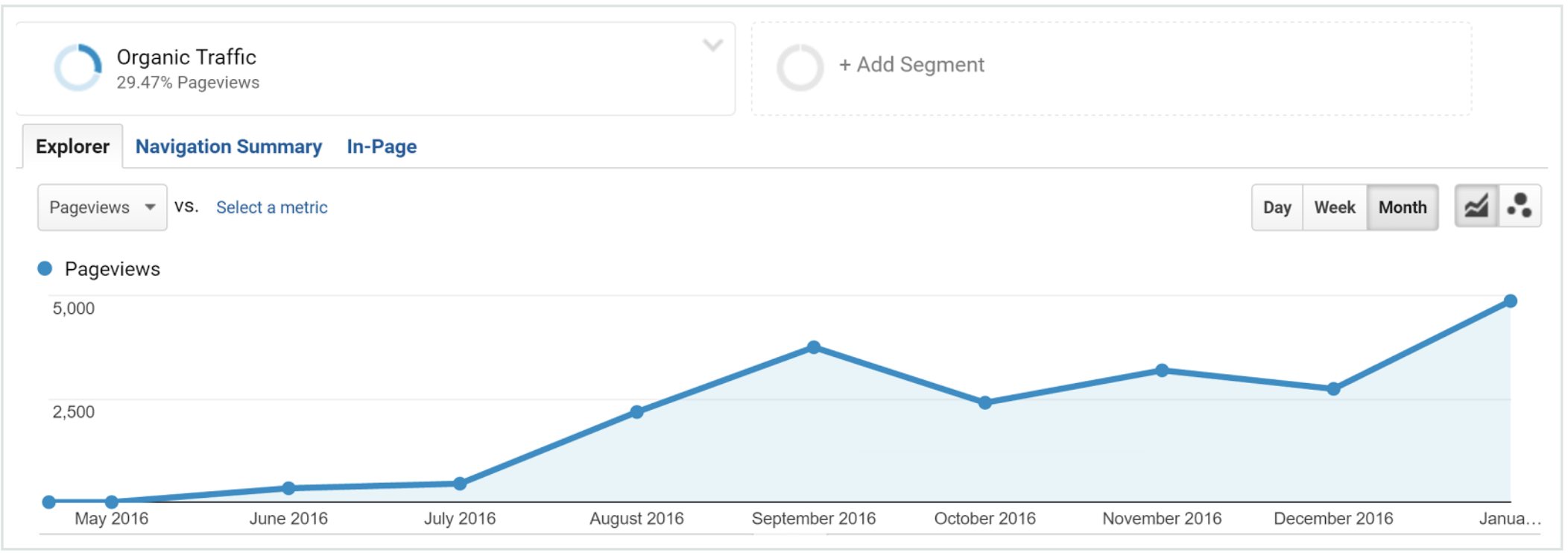
Image courtesy of Moz.
5. SEO: Brian Dean’s YouTube strategy
Brian Dean, an SEO expert and the creator of BackLinko, uses SEO tactics to rank #1 on YouTube for keywords like “on page SEO” and “video SEO”. Initially, Dean admits his YouTube account struggled to get any views. Employing SEO methods like keyword optimization has enabled Dean to rise to #1 on YouTube for search results related to his business. He published his full strategy on Backlinko.
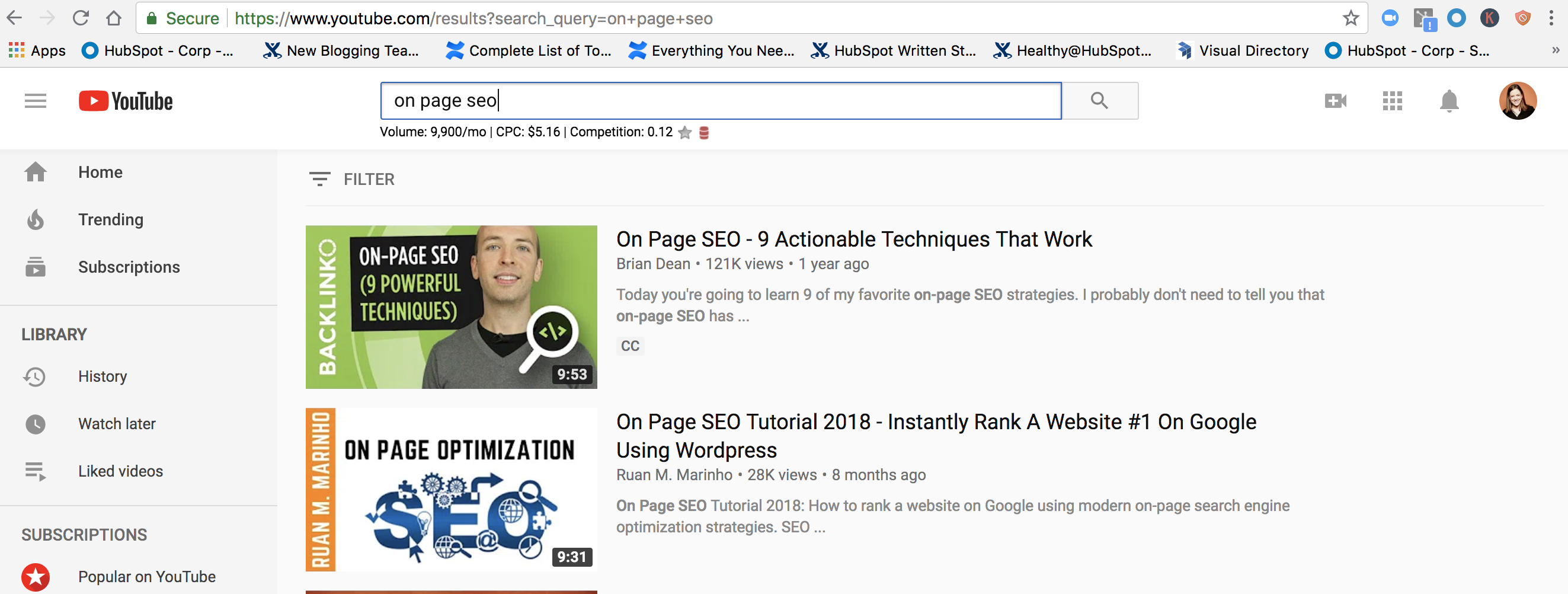
6. Web Design: DisabledGO
DisabledGO, an information provider for people with disabilities in the UK and Ireland, hired Agency51 to implement an SEO migration strategy to move DisabledGO from an old platform to a new one. By applying 301 redirects to old URLS, transferring metadata, setting up Google webmaster tools, and creating a new sitemap, Agency 51 was able to successfully transfer DisabledGO to a new platform while keeping their previous SEO power alive. Additionally, they were able to boost visitor numbers by 21% year over year, and the site restructuring allowed DisabledGO to rank higher than competitors. Their case study is available on SingleGrain.com.
More Internet Marketing Examples:
- 19 of the Best Email Marketing Campaign Examples We’ve Ever Seen [+ Template]
- 5 Real Examples of Engaging Social Media Campaign Ideas
- The Best of B2B Marketing Content: 10 Examples
Top Online Marketing Tools
- HubSpot
- Buzzsumo
- Canva
- GTmetrix
- Ahrefs
- Buffer
- Facebook Insights
- SocialRank
- TweetReach
- Trello
- Crazy Egg
- Google Keywords Planner
Ultimately, your internet marketing strategies will work best if you incorporate inbound marketing methodology. First and foremost, you want all your online content to add value to your customers’’s lives. This is the only way you’ll attract quality leads and build deep relationships with your online community for the long-term.

13 Examples of Successful Co-Branding Partnerships (And Why They’re So Great)
There’s a good chance your favorite consumer products are the result of two separate brands working together.
One of my own beloved childhood memories was a product of co-branding: Betty Crocker partnered with Hershey’s to include chocolate syrup in its signature brownie recipe.
There’s something brilliant about that co-branded product: It’s a fun way to marry two classic brands into one delicious experience for fans of baking and chocolate alike. In fact, these brands still create new co-branded products to this day.
Co-branding is a strategic marketing and advertising partnership between two brands wherein the success of one brand brings success to its partner brand, too. Co-branding can be an effective way to build business, boost awareness, and break into new markets, and for a partnership to truly work, it has to be a win-win for all players in the game. Both audiences need to find value — like chocolate-loving fans of Betty Crocker and Hershey’s.

There are a ton of great examples of co-branding partnerships out there. To show you what makes them so successful, we’ve curated a list of 10 examples of great co-branding partnerships to inspire you.
Partnership Business Examples
- GoPro & Red Bull
- Pottery Barn & Sherwin-Williams
- Casper & West Elm
- Bonne Belle & Dr. Pepper
- BMW & Louis Vuitton
- Uber & Spotify
- Apple & MasterCard
- Airbnb & Flipboard
- BuzzFeed & Best Friends Animal Society
- Alexander Wang & H&M
- CoverGirl & Lucasfilm
- UNICEF & Target
- Nike & Apple
1. GoPro & Red Bull
Co-branding Campaign: Stratos
GoPro doesn’t just sell portable cameras, and Red Bull doesn’t just sell energy drinks. Instead, both have established themselves as lifestyle brands — in particular, a lifestyle that’s action-packed, adventurous, fearless, and usually pretty extreme. These shared values make them a perfect pairing for co-branding campaigns, especially those surrounding action sports.
To make the partnership work, GoPro equips athletes and adventurers from around the world with the tools and funding to capture things like races, stunts, and action sport events on video — from the athlete’s perspective. At the same time, Red Bull uses its experience and reputation to run and sponsor these events.
“GoPro camera technology is allowing us to complement the programming by delivering new athlete perspectives that have never been seen before,” said Sean Eggert, Red Bull’s director of sports marketing. The collaboration allows exclusive GoPro content to enhance both companies’ growth.
While GoPro and Red Bull have collaborated on many events and projects together, perhaps the biggest collaboration stunt they’ve done was “Stratos,” in which Felix Baumgartner jumped from a space pod more than 24 miles above Earth’s surface with a GoPro strapped to his person. Not only did Baumgartner set three world records that day, but he also embodied the value of reimagining human potential that define both GoPro and Red Bull.
2. Pottery Barn & Sherwin-Williams
Co-branding Campaign: Color Your Room
One of the biggest benefits of co-branding campaigns is the opportunity to expose your product or service to a brand new audience. That’s exactly what home furnishing store Pottery Barn and paint company Sherwin-Williams did when they partnered together back in 2013.
Together, the two brands created an exclusive product line of paints, and then added a new section of Pottery Barn’s website that helped customers easily select paint colors to complement their furniture choices.
Source: Pottery Barn
Customers could coordinate paint colors with picture-perfect Pottery Barn furniture for a mutually beneficial partnership — and style assistance for both brands’ customers to boot. “Paint Landing,” Pottery Barn’s landing page for the partnership, contains helpful blog posts and how-to ideas for do-it-yourself painting and decorating.
3. Casper & West Elm
Co-branding Campaign: Test a Casper Mattress
You may have already heard of Casper — it’s an online mattress and bedding brand that sells mattresses in a box.
Casper mattress unboxing videos like this one have become a hit on YouTube, but despite the brand’s 100-day return policy, some shoppers might still be hesitant to buy a mattress without getting the chance to roll around in it first.
Enter West Elm, a high-end furniture company. Casper and West Elm partnered so shoppers could try out the comfy mattress before purchasing — and so West Elm could advertise its chic bedroom furniture.

Source: Casper
This is another example of a mutually beneficial co-branding partnership. It helps both brands appeal to a broader group of shoppers — after all, Casper doesn’t sell furniture, and West Elm doesn’t sell mattresses. It also provides shoppers with options — to try a mattress before buying, or to feel what it would be like sleeping in a bed frame.
4. Bonne Belle & Dr. Pepper
Co-branding Campaign: Flavored Lip Balm
Dr. Pepper-flavored lip balm. I mean, it’s genius.
Bonne Belle first debuted Lip Smacker, the world’s first flavored lip balm, in 1973, starting with flavors like strawberry, lemon, and green apple. Just two years later in 1975, they’d forged their first flavor partnership with the timeless Dr. Pepper brand. The result? A lip balm flavor that’s been famous for decades among teenage girls.
If you’re thinking the connection between lip balm and Dr. Pepper is a little thin, consider the copy on one of their vintage ads: “It’s the super shiny lip gloss with lip-smacking flavor… just like the world’s most original soft drink.” And later, “From Bonne Belle of course: the cosmetics company that understands your taste.”

Source: Click Americana
5. BMW & Louis Vuitton
Co-branding Campaign: The Art of Travel
Car manufacturer BMW and designer Louis Vuitton may not be the most obvious of pairings. But if you think about it, they have a few important things in common. If you focus on Louis Vuitton’s signature luggage lines, they’re both in the business of travel. They both value luxury. And finally, they’re both well-known, traditional brands that are known for high-quality craftsmanship.
These shared values are exactly why this co-branding campaign makes so much sense. In their partnership, BMW created a sports car model called the BMW i8, while Louis Vuitton designed an exclusive, four-piece set of suitcases and bags that fit perfectly into the car’s rear parcel shelf.

Source: Louis Vuitton
Although the four-piece luggage set goes for a whopping $20,000, the price is right for the target customer, as the BMW i8 starts at $135,700. A price like that kind of makes that luggage set seem like a drop in the bucket.
Not only does the luggage fit perfectly size-wise, but its design and appearance fit perfectly with BMW’s image: sleek, masculine, and high-quality. Turns out both the luggage and some parts of the car’s interior use carbon fiber, strong-yet-light composite material.
“This collaboration with BMW i epitomises our shared values of creativity, technological innovation and style,” said Patrick-Louis Vuitton, head of special orders at Louis Vuitton. “Our craftsmen have enjoyed the challenge of this very special project, using their ingenuity and attention to detail to create a truly made to measure set of luxury luggage. This is a pure expression of the art of travel.”
6. Uber & Spotify
Co-branding Campaign: Soundtrack for Your Ride
Music-streaming app Spotify partnered with ride-hailing app Uber to create “a soundtrack for your ride.” This is a great example of a co-branding partnership between two very different products with very similar goals — to earn more users.
Here’s how it works: When riders are waiting for an Uber ride, they’re prompted to connect with Spotify and become the DJ of their trip. Users can choose from their own playlists to determine what they’ll listen to.
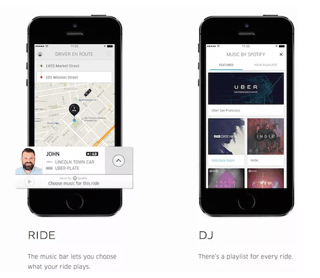 Source: The Verge
This smart co-branding partnership helps fans of Uber and Spotify alike enjoy better experiences thanks to the app. And they might be more interested in picking Uber and Spotify over competitors knowing they can enjoy their next ride listening to their favorite tunes.
7. Apple & MasterCard
Co-branding Campaign: Apple Pay
Sometimes, co-branding partnerships aren’t just cool projects between two companies — they actually have practical value when the companies work together.
When Apple released the Apple Pay app, the brand effectively changed how people perform transactions. This app allows people to store their credit or debit card data on their phone, so they can use them without physically having the card with them. But in order for this app to this app to succeed, it needs credit card companies to integrate with this technology. By the same token, credit card companies also face more competition themselves if they aren’t compatible with the latest consumer purchasing tool.
To get out ahead of its competition, MasterCard became the first credit card company to allow its users to store their credit and debit cards on Apple Pay. MasterCard not only showed support of a major consumer tech developer in this partnership — it evolved along with its own customers in how they choose to make purchases at the counter.
 Source: MasterCard
8. Airbnb & Flipboard
Co-branding Campaign: Experiences
You’ve probably heard of Airbnb, the room-sharing application that allows you to find convenient lodging hosted by real people. But its newest partner, Flipboard, might not have been on your radar until now.
Flipboard is a news aggregator that collects news and topical content that users are sharing on social media, and allows you to “flip” through the material much like a social media feed. Well, Airbnb recently teamed up with Flipboard to create Experiences, which serve Airbnb users with lifestyle content tailored to their interests and shared by people with similar interests as the reader.
The ongoing campaign recently led to another co-created product called Trips, which allows Airbnb users to connect with hosts on common interests and actually book these experiences when traveling. This partnership is an impressive example of how businesses can connect their customers with information that caters to their individual interests and drive usage of the product as a result.
 Source: Flipboard
9. BuzzFeed & Best Friends Animal Society
Co-branding Campaign: Emma Watson + Kittens
Some co-branding campaigns are more complicated than others. This example from BuzzFeed and Best Friends Animal Society is one of the simplest ones out there — and it goes to show a great co-branding effort doesn’t have to take months of planning or millions of dollars.
For this campaign, the folks at Best Friends Animal Society wanted to leverage BuzzFeed’s readership of over 200 million people. To do this, they partnered with the folks at BuzzFeed to set up and publish an article called, “We Interviewed Emma Watson While She Played With Kittens And It Was Absolutely Adorable,” which you can read here. The article is exactly what it sounds like: Harry Potter and Beauty and the Beast star Emma Watson answered fans’ questions while she played with cute kittens.
Source: BuzzFeed
The article ends with a CTA advertising that the kittens featured in the video are, in fact, adoptable — a win-win for both partners.
10. Alexander Wang & H&M
Co-branding Campaign: High-End Fashion
Anyone who’s designer-conscious knows Alexander Wang and H&M aren’t exactly the same caliber when it comes to quality. Shoes by Alexander Wang tend to go for around $350 a pair, whereas shoes sold by H&M tend to go for more like $35 a pair. See what I mean?
But that discrepancy in pricing is exactly why the two brands decided to partner with one another. To support their brand positioning as trendy and fashionable, H&M has traditionally paired with high-end fashion brands to offer exclusive branded items for a limited time.
In exchange, those high-end brands — like Alexander Wang — can expose their brand name to “a new generation of potential consumers, who will increasingly aspire to owning more pieces from his high end collection,” writes Michelle Greenwald for Forbes.

Source: Snobette
11. CoverGirl & Lucasfilm
Co-branding Campaign: Light Side and Dark Side Makeup
Whenever a new installment of the beloved “Star Wars” series is released in theaters, it causes global pandemonium, and the release of “Star Wars: Episode VII The Force Awakens” in 2015 was no exception. The series’ parent company, Lucasfilm, partnered with CoverGirl to capture a broader audience to get fans new and old excited about the movie’s release.
You might be wondering, “What do “Star Wars” and makeup have in common?” And the cleverness of this partnership is evident in the answer.
In the past, the space-age action movies were almost exclusively advertised and targeted toward men and boys. But in this day and age, that’s nonsense — because people of all genders can be interested in space exploration and makeup contouring alike.
The line was designed by famed makeup artist Pat McGrath, and it features two styles: the Light Side and the Dark Side, which loyal “Star Wars” fans will recognize as the sides of good and evil in the movies.
This co-branding partnership was a win for both brand. Lucasfilm captured more attention and got CoverGirl shoppers (many of whom are young women) excited about the film’s release. And CoverGirl hopped on the “Star Wars” advertising bandwagon that took over the internet, stores, and TV leading up to the film’s release.
12. UNICEF & Target
Co-branding Campaign: Kid Power
If you have the chance to partner for a not-for-profit cause, it can pay off in multiple ways.
In 2015, Target partnered with UNICEF on a campaign called Kid Power, which committed Target to one of UNICEF’s sustainable development goals (SDGs). The retailer sold kid-friendly fitness trackers encouraging the wearer to complete various fitness activities, which ultimately helped deliver food packets to underprivileged children around the world.
By selling this fun, inexpensive fitness product, Target encourages children to embrace a healthy lifestyle and uses their successes to supply underserved communities with the resources they need. It’s an ongoing partnership that generates awareness of global malnutrition, helps UNICEF meet its demanding SDGs, and opens up Target to a demographic of giving families they might otherwise have had access to.
By the way, you can get your child a Kid Power band here.

13. Nike & Apple
Co-branding Campaign: Nike+
Athletic brand Nike and technology giant Apple have been working together since the early 2000s, when the first line of iPods was released.
The co-branding partnership started as a way to bring music from Apple to Nike customers’ workouts using the power of technology: Nike+iPod created fitness trackers and sneakers and clothing that tracked activity while connecting people to their tunes.
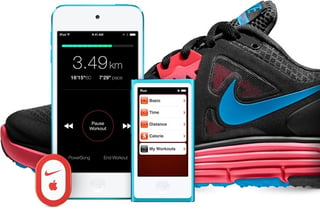
Source: Apple
The partnership has since evolved to become Nike+ — which uses activity tracking technology built into athletic clothing and gear to sync with Apple iPhone apps to track and record workout data. Tracking transmitters can be built into shoes, armbands, and even basketballs to measure time, distance, heart rate, and calories burned.
It’s a genius co-branding move that helps both parties provide a better experience to customers — and with the popularity of fitness tracking technology, Nike+ is ahead of the curve by making it easy for athletes to track while they play.


The Beginner’s Guide to Usability Testing
My favorite part of the writing process is when my editor reviews my work. By the time I’ve submitted the first draft of most of my blog posts, I’ve invested so much time and effort into my piece that I’m too emotionally attached to it. I need to distance myself from it.
My editor also has fresh editing eyes, so she can discover any overlooked errors and new creative opportunities to sharpen my piece. After I address her edits, my piece always looks more polished.
Asking other people to evaluate your work applies to almost every discipline, especially user experience and design. It’s not smart to rely on yourself when evaluating your own product or website design. You’re partial towards it, and that can skew your perception of reality. Learning directly from the people that your work is actually for — your users — is what enables you to craft the best user experience possible.
UX and design professionals leverage usability testing to get user feedback on their product or website’s user experience all the time. So we interviewed some of HubSpot’s Senior UX Researchers and Designers to teach you what exactly usability testing is, its benefits, and how to effectively conduct your own study.
What is Usability Testing?
Usability testing is a method of evaluating a product or website’s user experience. By testing the usability of their product or website with a representative group of their users or customers, UX researchers can determine if their actual users can easily and intuitively use their product or website.
UX researchers will usually conduct usability studies on each iteration of their product from its early development to its release. This allows UX researchers to uncover any problems with their product’s user experience, decide how to fix these problems, and ultimately determine if the product is usable enough.
Identifying and fixing these early issues saves the company both time and money: developers don’t have to overhaul the code of a poorly designed product that’s already built, and the product team is more likely to release it on schedule.
During a usability study, the moderator asks participants in their individual user session to complete a series of tasks while the rest of the team observes and takes notes. By watching their actual users navigate their product or website and listening to their praises and concerns about it, they can see when the participants can quickly and successfully complete tasks and where they’re enjoying the user experience, encountering problems, and experiencing confusion.
After conducting their study, they’ll analyze the results and report any interesting insights to the project lead.
Benefits of Usability Testing
Usability testing has five major advantages over the other methods of examining a product’s user experience, like a questionnaire:
- Usability testing provides an unbiased, accurate, and direct examination of your product or website’s user experience. By testing its usability on a sample of actual users who are detached from the amount of emotional investment your team has put into creating and designing the product or website, their feedback can resolve most of your team’s internal debates.
- Usability testing is convenient. To conduct your study, all you have to do is find a quiet room and bring in portable recording equipment. If you don’t have recording equipment, someone on your team can just take notes.
- Usability testing can tell you what your users do on your site or product and why they take these actions.
- Usability testing lets you address your product’s or website’s issues before you spend a ton of money creating something that ends up having a poor design.
- For your business, intuitive design boosts customer usage and their results, driving demand for your product.
The 9 Phases of a Usability Study
1. Decide which part of your product or website you want to test.
Do you have any pressing questions about how your users will interact with certain parts of your design, like a particular interaction or workflow? Or are you wondering what users will do first when they land on your product page? Gather your thoughts about your product or website’s pros, cons, and areas of improvement, so you can create a solid hypothesis for your study.
2. Pick your study’s tasks.
Your participants’ tasks should be your user’s most common goals when they interact with your product or website, like making a purchase.
3. Set a standard for success.
Once you know what to test and how to test it, make sure to set clear criteria to determine success for each task. For instance, when I was in a usability study for HubSpot’s Content Strategy tool, I had to add a blog post to a cluster and report exactly what I did. Setting a threshold of success and failure for each task lets you determine if your product’s user experience is intuitive enough or not.
4. Write a study plan and script.
At the beginning of your script, you should include the purpose of the study, if you’ll be recording, some background on the product or website, questions to learn about the participants’ current knowledge of the product or website, and, finally, their tasks. To make your study consistent, unbiased, and scientific, moderators should follow the same script in each user session.
5. Delegate roles.
During your usability study, the moderator has to remain neutral, carefully guiding the participants through the tasks while strictly following the script. Whoever on your team is best at staying neutral, not giving into social pressure, and making participants feel comfortable while pushing them to complete the tasks should be your moderator
Note-taking during the study is also just as important. If there’s no recorded data, you can’t extract any insights that’ll prove or disprove your hypothesis. Your team’s most attentive listener should be your note-taker during the study.
6. Find your participants
Screening and recruiting the right participants is the hardest part of usability testing. Most usability experts suggest you should only test five participants during each study, but your participants should also closely resemble your actual user base. With such a small sample size, it’s hard to replicate your actual user base in your study.
To recruit the ideal participants for your study, create the most detailed and specific persona as you possibly can and incentivize them to participate with a gift card or another monetary reward.
Recruiting colleagues from other departments who would potentially use your product is also another option. But you don’t want any of your team members to know the participants because their personal relationship can create bias — since they want to be nice to each other, the researcher might help a user complete a task or the user might not want to constructively criticize the researcher’s product design.
7. Conduct the study.
During the actual study, you should ask your participants to complete one task at a time, without your help or guidance. If the participant asks you how to do something, don’t say anything. You want to see how long it takes users to figure out your interface.
Asking participants to “think out loud” is also an effective tactic — you’ll know what’s going through a user’s head when they interact with your product or website.
After they complete each task, ask for their feedback, like if they expected to see what they just saw, if they would’ve completed the task if it wasn’t a test, if they would recommend your product to a friend, and what they would change about it. This qualitative data can pinpoint more pros and cons of your design.
8. Analyze your data.
You’ll collect a ton of qualitative data after your study. Analyzing it will help you discover patterns of problems, gauge the severity of each usability issue, and provide design recommendations to the engineering team.
When you analyze your data, make sure to pay attention to both the users’ performance and their feelings about the product. It’s not unusual for a participant to quickly and successfully achieve your goal but still feel negatively about the product experience.
9. Report your findings.
After extracting insights from your data, report the main takeaways and lay out the next steps for improving your product or website’s design and the enhancements you expect to see during the next round of testing.
The 3 Most Common Types of Usability Tests
1. Hallway/Guerilla Usability Testing
This is where you set up your study somewhere with a lot of foot traffic. It allows you to ask randomly-selected people who have most likely never even heard of your product or website, — like passers-by — to evaluate its user-experience.
2. Remote/Unmoderated Usability Testing
Remote/unmoderated usability testing has two main advantages: it uses third-party software to recruit target participants for your study, so you can spend less time recruiting and more time researching. It also allows your participants to interact with your interface by themselves and in their natural environment — the software can record video and audio of your user completing tasks.
Letting participants interact with your design in their natural environment with no one breathing down their neck can give you more realistic, objective feedback. When you’re in the same room as your participants, it can prompt them to put more effort into completing your tasks since they don’t want to seem incompetent around an expert. Your perceived expertise can also lead to them to please you instead of being honest when you ask for their opinion, skewing your user experience’s reactions and feedback.
3. Moderated Usability Testing
Moderated usability testing also has two main advantages: interacting with participants in person or through a video a call lets you ask them to elaborate on their comments if you don’t understand them, which is impossible to do in an unmoderated usability study. You’ll also be able to help your users understand the task and keep them on track if your instructions don’t initially register with them.
How to Ask Usability Testing Questions
Following one script or even a template of questions for every one of your usability studies wouldn’t make any sense — each study’s subject matter is different. You’ll need to tailor your questions to the things you want to learn, but most importantly, you’ll need to know how to ask good questions.
The tips below from one of HubSpot’s Senior UX researchers, Julie Fischer, will teach you how to ask the right questions during a usability study:
– Don’t ask leading questions that insert your own bias or opinion into the participants’ mind. They’ll end up doing what you want them to do instead of what they would do by themselves.
– Ask participants how they would complete a goal or task in the product or on the website instead of telling them what to do next.
– When participants ask “What will this do?,” it’s best to reply with the question “What do you expect it to do?” rather than telling them the answer.
Your Work Could Always Use a Fresh Perspective
Letting another person review and possibly criticize your work takes courage — no one wants a bruised ego. But most of the time, when you allow people to constructively criticize or even rip apart your article or product design, especially when your work is intended to help these people, your final result will be better than you could’ve ever imagined.

The Ultimate Guide to Brand Awareness
Have you ever heard people refer to themselves as “Apple people,” “Nike people,” or “Trader Joe’s” people?
This is what brand awareness can do for a brand: embed itself into people’s lifestyles and purchase habits so that consumers don’t have to think twice before becoming a customer, time and time again.
This guide will help you better understand brand awareness, establish it among your audience, and build campaigns that allow it to continually grow and morph with your business. Let’s dive in.
Brand awareness might seem like a vague concept, and in truth, it is. For those marketers and business owners out there who like to gauge success with neat and tidy numbers, brand awareness will likely ruffle your feathers.
But just because it isn’t a metric that can be perfectly determined doesn’t mean it doesn’t carry value. Brand awareness is incredibly important for business success and overall marketing goals. Here’s why.
Brand Awareness Fosters Trust
In a world where consumers rely on extensive research and others’ opinions before making a simple purchase, brand trust is everything. Once a consumer bonds to your brand, they’re more likely to make repeat purchases with little to no forethought –– which then bridges the gap between trust and loyalty.
Brand awareness establishes that brand trust. When you put a proverbial face to your brand name, consumers can trust easier. Brand awareness efforts give your brand a personality and outlet to be sincere, receive feedback, and tell a story. These are all ways that we, as humans, build trust with one another. The human/brand relationship isn’t any different.
Brand Awareness Creates Association
When you’ve had a paper cut, I bet you’ve put on a Band-Aid. When you had a pressing question, I’m sure you’ve Googled it. When you needed to make a few copies, I’m guessing that you Xeroxed them. And when you’ve packed for a nice picnic, I’m willing to bet you grabbed a Coke to drink.
Am I correct? Most likely. But … notice how the some of the words above are capitalized. These are brands, not nouns or verbs.
Speaking in brand-less terms, Band-Aid should be referred to as bandage, Google, as a search engine, and Xerox as a copier. But it’s more fun to refer to the brand itself, even if we aren’t using their specific product.
That’s what brand awareness does. It associates actions and products with particular brands, subconsciously encouraging us to replace common words with branded terms. And before you know it, simple paper cuts or picnics are doing the marketing for us.
Brand Awareness Builds Brand Equity
Brand equity describes a brand’s value, which is determined by consumer experiences with and overall perception of the brand. Positive experiences and perception equal positive brand equity, and the same goes for negative notions.
Here are a few valuable things that come from positive brand equity:
- Higher prices due to higher perceived value
- A higher stock price
- The ability to expand business through product or service line extensions
- Greater social impact due to brand name value
How does a brand establish (and increase) brand equity? By building brand awareness and consistently promoting positive experiences with the brand. Brand awareness is the foundation of brand equity.
Once a consumer is aware of a brand, they start to recognize it without assistance, seek it out to make a purchase, begin to prefer it over other similar brands, and establish a loyalty that not only spurs on other purchases but also inspires recommendations to family and friends.
That, my friends, is why brand awareness is so important. It establishes trust with your customers, creates positive associations, and builds invaluable brand equity that allows your brand to become a household name and consumer staple.
How to Establish Brand Awareness
Brand awareness among your audience and the general public doesn’t happen overnight. It also doesn’t happen from a simple advertisement or marketing campaign.
Strong brand awareness is a result of multiple simultaneous efforts that extend beyond trying to get paying customers.
If you expect to raise awareness of your brand by running a few product advertisements on Facebook, you won’t get very far. Not only will the consumer be focused on the product (not the brand), but the ad will also lack impact beyond a simple sale.
Here are some ways to establish a solid brand awareness foundation and make a lasting impact with your audience:
Be a Person, Not a Company
When you get to know a new friend, what do you like to discover about them? I like to learn about hobbies, passions, likes and dislikes, and more. I also pay attention to how they speak, what they like to talk about, and what stuff gets them excited.
These are the traits your brand should determine and promote about itself. To leave an impact with your audience, you’ve got to define yourself as more than a company that sells stuff. How else would you define yourself? What words would you use if you had to introduce your brand to a new friend?
Socialize
Introvert or extrovert, outgoing or quiet, all humans benefit from social contact and spending time with one another. It’s how we stay connected, learn new things, and become known by others.
The same goes for your brand. If you only attempt to connect with others when trying to make a sale or get support, you won’t be known as anything beyond a business with a singular intention (and the same goes for a person).
To raise awareness of your brand, you’ve got to be social. Post on social media about things unrelated to your product or services. Interact with your audience by asking questions, commenting on posts, or retweeting or sharing content you like. Treat your social accounts as if you were a person trying to make friends, not a business trying to make money.
Over 50% of brand reputation comes from online sociability. Being social leads to greater awareness and simply being known.
Tell a Narrative
Storytelling is an incredibly powerful marketing tactic, whether you’re marketing products or promoting your brand. Why? Because it gives something real for your audience to latch onto.
Crafting a narrative around your brand humanizes it and gives it depth. And weaving this said narrative into your marketing inherently markets your brand alongside your products or services.
What should your narrative be about? Anything, as long as it’s true. It can be the narrative of your founder, the tale of how your business had its first product idea, or the little-engine-that-could story of how your small business made it in this big world.
People like hearing stories about each other. Authenticity is impactful, and it can lead to a big boost in brand awareness.
Make Sharing Easy
Whatever your industry, product offering, or marketing strategies, make it easy for your audience to share your content. This could be blog posts, sponsored content, videos, social media posts, or product pages. It doesn’t matter what it is, as long as it’s shareable.
Word-of-mouth marketing is the most effective way to establish trust and familiarity among customers. If someone sees that a friend or family member is recommending a product or service, they’ll take notice of that product … and brand. Is this a brand worth exploring? Do they have other great products I can rely on? What are their social accounts like, and what do they talk about?
If you make it easy to post about your stuff, consumers will raise brand awareness for you by simply clicking “Share”.
Brand awareness is about impact.
It’s about interacting with your audience in ways that don’t only ask for money, participation, or loyalty.
Imagine if you met a new person who wanted to be your friend. If they asked for any of the above, you’d probably laugh and walk away, right? Not only is that a shallow approach to friendship, but it also leaves no lasting impact on you.
The same goes for establishing brand awareness among your audience.
How to Increase Brand Awareness
What about expanding your established brand awareness and building on that strong foundation? What can you do as a brand to campaign for awareness and constantly increase it?
Here are a few campaign ideas to boost your brand awareness:
Offer freemium
Freemium is a business model that offers a basic product or product line for free, only charging for any products deemed premium or enterprise-level. It’s a popular pricing strategy for software companies, like HubSpot and Trello.
Offering a freemium option allows customers to get a taste of your brand and product before making a purchase. It’s a try-before-you-buy opportunity that can, technically, last forever (as opposed to a free trial period that some companies choose).
It’s common to offer a freemium option with the condition that the brand’s watermark will be shown on any public-facing parts of the product or service. This makes freemium a win-win situation: The consumer gets the product for free, and the brand gets free advertising when consumers use it.
TypeForm is another great example of this. TypeForm offers a freemium option of its survey software, but customers must include a thank-you page that features the TypeForm logo and message.

Depending on your type of business and product offer, Freemium may be the best way to raise awareness of your brand among your audience.
Create free content
Nowadays, creating content is easier than ever … which is a good thing because today’s consumers turn to the internet for any and all questions, concerns, and DIY projects.
Content is a fun way to raise awareness of your brand because it’s the easiest way to show personality and share opinions and positioning on issues — two major components that personify and humanize your brand.
Content doesn’t have to be in written form, either. You can also create videos, infographics, podcasts (which we’ll cover below), and more. Sure, written content like blogs and downloadable guides are arguably the easiest, but they’re definitely not the only option.
Content doesn’t have to live on just your website, either. Guest posting and sponsored content provide opportunities to get in front of new audiences and diversify the type of content you create.
If your brand isn’t creating content, you might be missing out on some major brand awareness opportunities. Content provides an amazing way to authentically connect with your audience while getting your brand name in front of people.
To learn more about content creation, check out our guide here.
Sponsor events
How many festivals, concerts, fairs, and exhibitions have you attended? These types of events are typically not possible without the help of brand sponsorships. (Take a look at a t-shirt, koozie, or string backpack you likely grabbed from the event. See any brand names?)
Sponsoring events is a surefire way to get your brand in front of hundreds, thousands, or millions of people that likely fall into your target audience. From banners to flyers to water bottles, your brand name will be everywhere if you sponsor an event.
Sponsoring an event also allows you to pin your brand name on an event that matches your personality, interests, and passions, meaning consumers will then associate your brand with that event and its aesthetic and character.
Consider Red Bull. Red Bull is an energy drink, and without any brand awareness efforts, we’d simply consider it an energy drink. But, thankfully, Red Bull took their marketing to the extreme — literally — by sponsoring extreme sporting events like cliff diving and motocross. They also sponsor athletes. Now, we inherently associate Red Bull with daring and adventurous … and believe that, if we drink it, we can be the same.

Give your brand a personality
Treating your brand as a person and defining your narrative are the first steps to giving your brand a personality. The next step would be infusing this personality into your marketing efforts.
When you market your products and services with personality, you can’t help but boost your brand awareness because your brand will shine right through. Sure, your consumers will take note of the pants or pasta you’re marketing, but they’ll also experience your personality through your advertising.
This is a great strategy when mixing your traditional marketing campaigns with brand awareness campaigns. They don’t always have to be one in the same, but they definitely can be.
Consider Old Spice. (Did you just picture the man on the horse? I did.) Their advertisements for their hygiene products are overflowing with personality and humor, and they still mention their products throughout. The advertisement not only makes an impact on its viewers, but a mere mention of the “Old Spice man” also sends consumers back to YouTube to watch the commercial … and to the store to buy some deodorant.
Produce a podcast
In the last year, six million more people have started listening to podcasts. There’s no doubt podcasts play an important role in our lives … and marketing efforts.
Podcasts used to be a complicated process, only created by those with a studio and fancy microphone. Now, it’s easier than ever to create and release a podcast, and doing so can do wonders for your brand awareness efforts.
Why? Because podcasts, like written or visual content, provide a way to connect with your audience authentically. Instead of blatantly promoting your product or service (which we’ve agreed isn’t the best way to go about boosting brand awareness), podcasts give you the opportunity to educate, inform, entertain, or advise your audience and build trust by doing so.
Here are some examples of great podcasts produced by brands you know and love:
See how these brands have chosen podcast topics that relate to their 1) overall brand message and 2) products or services? Doing this helps them relate the podcast back to their brand and continue to raise awareness, too.
For more information on podcasts, check out our guide here.
Building and growing brand awareness is a never-ending process, just as maintaining a friendship or relationship never really ends.
Boosting your brand awareness through campaigns gives you a chance to dabble in marketing and advertising opportunities you’d otherwise not invest in — meaning new, powerful ways to connect with your audience.
How to Measure Brand Awareness
How do you know if your brand awareness efforts are working? How do you know if you need to change direction, top the competition, or fix a crisis? Just like any other marketing metric, you measure it.
Wait … I thought you said brand awareness couldn’t be measured!
Aha! You’ve been listening. I appreciate that.
You’re right — brand awareness can’t be measured in the traditional sense. But, you can still review activities and metrics that’ll help you gauge where your brand stands in terms of popularity and consumer awareness.
Here are a few ways to gauge your brand awareness and learn where you can tweak your efforts:
Quantitative Brand Awareness Measures
These numbers can help you paint the overall picture of your brand awareness. To measure quantitatively, check out these metrics:
- Direct traffic. Firstly, direct traffic is the result of people intentionally typing in your URL and visiting your website. Your direct traffic number will tell you how much your marketing is prompting people to visit your website. This is an important metric, as many consumers today discover brands through social media, advertisements, or by typing in keywords related to your brand or product. When consumers go directly to your site, it means they were aware of your brand beforehand.
- Site traffic numbers. This number just reflects overall site traffic, which will tell you how much of the general internet population is checking out your content and spending time with your brand. It won’t quite tell you where people came from, but that doesn’t matter, because they’re aware of your brand enough to check it out.
- Social engagement. Engagement can refer to followers, likes, retweets, comments, and more. It’s a reflection of how many people are aware of your brand and socialize with it, as well as how impactful your content is. For instance, sites like Sparktoro can give you a specific score for your Twitter impact.
Qualitative Brand Awareness Measures
This step is where your brand awareness “score” gets a little murky. But these tactics can still help you gauge who and how many people are aware of your brand. To measure qualitatively, try:
- Searching Google and setting up Google Alerts. Doing this gets you up to speed with how your brand is being talked about online. It will alert you to any news or mentions by third-party press. As your brand grows, its internet real estate will expand beyond your website, so keep an eye on that.
- Social listening. Social listening is monitoring social media management tools for organic mentions and engagement. Who’s tagging your brand, mentioning it in comments, or using your hashtag in their posts? These tools can help you discover that. And the more your audience is discussing your brand on social media, the more they’re aware of it.
- Running brand awareness surveys. This process involves getting direct feedback from your customers and audience and can be incredibly helpful with not only understanding who knows of your brand but also what they think of it. You can release surveys through SurveyMonkey or TypeForm and share them on social media or directly with your customers. This guide will help you create and promote them.
These quantitative and qualitative metrics will help you understand your brand awareness among your audience and the general public. It’ll never be a perfect number, but keeping your pulse on this measure will help influence campaigns and stay connected to your audience. Regardless of how you gauge brand awareness for your company, avoid these common mistakes when measuring brand awareness.
Over to You
Brand awareness is a powerful (albeit vague) concept that can have a major impact on your marketing efforts, consumer perception, and revenue.
Follow these techniques for establishing and building awareness for your brand, and you’ll find yourself with a loyal audience that recognizes your brand among competitors, chooses your products time and time again, and recommends their friends and family do the same.
