
Everything You Need to Know About Ecommerce Marketing
With nearly every marketing operation now taking place online, it can be tough to distinguish between the various types of digital marketing people use today. What about ecommerce marketing? What is it, and how does it compare to practices like social media, content, search engine, and email marketing?
Ecommerce marketing and digital marketing are not mutually exclusive. Ecommerce websites can use all of the above digital channels to promote a product and grow their business.
Let’s explore how ecommerce marketing uses all the digital media available today.
What is ecommerce marketing?
Ecommerce marketing is the act of driving awareness and action toward a business that sells its product or service electronically. Ecommerce marketers can use social media, digital content, search engines, and email campaigns to attract visitors and facilitate purchases online.
Ecommerce marketing is just one community of marketers who can use the principles of digital and inbound marketing to convert visitors into customers. However, ecommerce marketers don’t necessarily use these marketing channels the same way a traditional brand or content marketer would.

To give you a sense of what an ecommerce marketing strategy looks like, here are some common marketing channels and how you’d use them to build an online store.
Social Media Marketing
Brands, publishers, contractors, and growing businesses all launch pages on today’s most popular social networks to connect with their audience and post content that audience is interested in. As an ecommerce marketer, you can do the same thing, but the campaigns you run might look a bit different, and not every social network is a fit for your needs.
Ecommerce websites are highly visual — you have to show off the product, after all — so your success on social media depends on your use of imagery to drive attention and traffic to your product pages. Instagram is an appropriate platform for ecommerce businesses because it enables you to post sharp product photography and expand your product’s reach beyond its purchase page.
An ecommerce business is no stranger to product reviews, either. Using a Facebook Business Page to share product praise is a perfect fit for businesses that already solicit customer reviews across their online store.
Content Marketing
When you hear “content marketing,” you might think of blogging and video marketing — things that are meant to improve your website’s ranking in search engines and answer questions related to your industry. But if you’re selling a product online, do you really need articles and videos to generate transactions? You sure do.
A product’s purchase page should be optimized for search terms that include the name of the product. If you sell wedding dresses, for example, a Google search for “brown bridesmaid dress” is more likely to produce product pages like yours. However, optimizing an ecommerce store for short, product-driven keywords isn’t the only way to convert visitors into buyers.
If you manage an online wedding dress store, writing blog posts about “how to plan a wedding” can attract everyone involved in wedding preparations no matter where they are in the planning process. Meanwhile, shooting videos can show people how best to use your product, increasing customer satisfaction and building long-term relationships with website visitors.
Search Engine Marketing
Search engine marketing (SEM) is a little different than search engine optimization (SEO). While SEO relies on your knowledge of Google’s ranking algorithm to optimize content, SEM can involve pay-per-click (PPC) campaigns, which allow you to pay for top spots on search engine results pages.
On Google, PPC campaigns guarantee that potential buyers will see a link to your page when they enter search terms that match the terms of your campaign. But because you’re paying Google each time a person clicks on your result, the payoff to you should be high.
This is why ecommerce marketers often register with Google AdWords and promote their product pages through PPC campaigns. The campaign puts searchers right in front of the business’s product when they click on a paid result, increasing the likelihood that the searcher will make a purchase before leaving the business’s website.
Email Marketing
Email marketing is one of the oldest forms of digital marketing, and believe it or not, it holds specific value in the world of ecommerce marketing.
In a time when data privacy runs high on an internet user’s priority list, not every commercial email is welcome in that user’s inbox. Ecommerce marketers need to be careful when and how they add website visitors to their mailing list. Here are two ways an ecommerce marketer might use email marketing:
The Post-Purchase Follow Up
If a user has already purchased a product from your website — and agreed to receive emails from you during the checkout process — sending a follow-up email a few days after the product is delivered to them keeps the conversation going and gauges their future interest in your product line.
You might ask them to write a review of your product, or read original content on how to use what they just bought.
The Abandoned Shopping Cart
If, after submitting his/her email address, a website visitor stopped buying a product and bounced from the website, the ecommerce business can send a polite email to the visitor asking if they’d like to complete the checkout process.
This visitor is often called the “abandoned shopping cart,” and emails to retain their business can make the difference between a purchase and a lost customer.
Ecommerce businesses have several marketing tools at their disposal. Using digital and inbound marketing just the right way, you can create campaigns that are designed to help your online store attract customers and grow better.

The 8 Elements of Modern Web Design (And Web Design Trends to Watch)
Every year, we see new elements and styles in website design begin to emerge.
Some elements — when incorporated thoughtfully — help tell stories and explain your company. Other elements work to improve how content looks on a specific device. While it’s not necessary to include every trend that comes about on your website, many of them have the potential to improve your visitor’s experience.
But with so many options to choose from, it can be challenging to determine which ones are really worth considering. To help you narrow your focus, we’ve detailed eight important elements of modern website design that you can include to improve your site’s performance.
8 Modern Website Design Elements and Trends
Element #1: Unique and Large Typography
Most companies have a particular font or typography that they use to help their customers immediately identify them versus their competitors. In recent years, designers have received a larger selection of fonts to choose from, making it easier for brands to more accurately express themselves through typography.
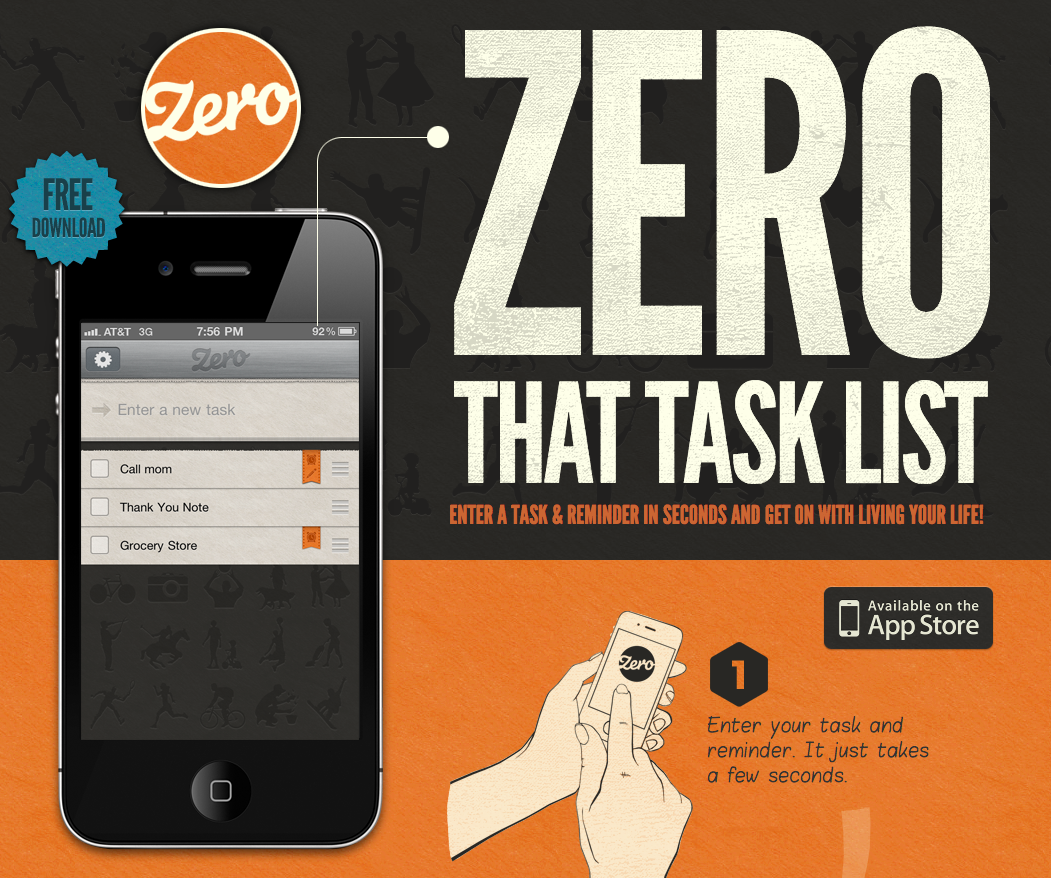
For example, The New Yorker is recognized instantly through their use of unique font, Adobe Caslon Pro. While more unique fonts, such as Blokletters-Balpen, have begun to be used by startups and technology companies like Zero.
Why is it useful?
Typography uses one design trend across the website to lead readers to different parts of the page. For instance, The New Yorker website leads visitors from one section to another based on the typography and font sizes.
When creating your company’s brand, your choice in typography can indicate subtle hints about who you are. Are you fun or serious? Functional or informational? Regardless of what font you choose, be sure that your designer considers its applicability across browsers and computers. Choosing a font that is not supported by common browsers and computers could mean that your website displays awkwardly on different devices.
Element #2: Large & Responsive Hero Images
You don’t have to go far beyond the popular publishing website Medium.com to see an example of a large hero image:

Large images such as this one do away with the concept of above and below the fold. By focusing on just the image with text rather than a CTA or social buttons, Medium creates a strong visual experience that encourages you to scroll down to read more.
Large hero images are also often placed in the background with text and other content overlaid on top, like on Uber’s website. Regardless of the approach you utilize, large images can help visually tell your story without having to rely on just text.
Why is it useful?
Your customers are coming from all over the place and have high expectations. You may not be sure if they are finding your website from their phone, tablet, or desktop computer. The image that Medium uses above is extremely powerful, but if it was only visible from desktop computers, many people may miss it.
That said, ensuring your images are responsive makes for a good user experience. Website visitors can look at different images — whether they are the background or product images — and be able to get the same experience no matter what device they are coming from.
Element #3: Background Videos
Videos that automatically play in the background can add a lot to a page. They can be used to tell a story and significantly reduce the amount of other content that is needed to explain your business.
Let’s take Wistia‘s website, for example. When you land on their homepage a large video automatically starts playing in the background, and by clicking on the play button, you get a deeper look at Wistia:
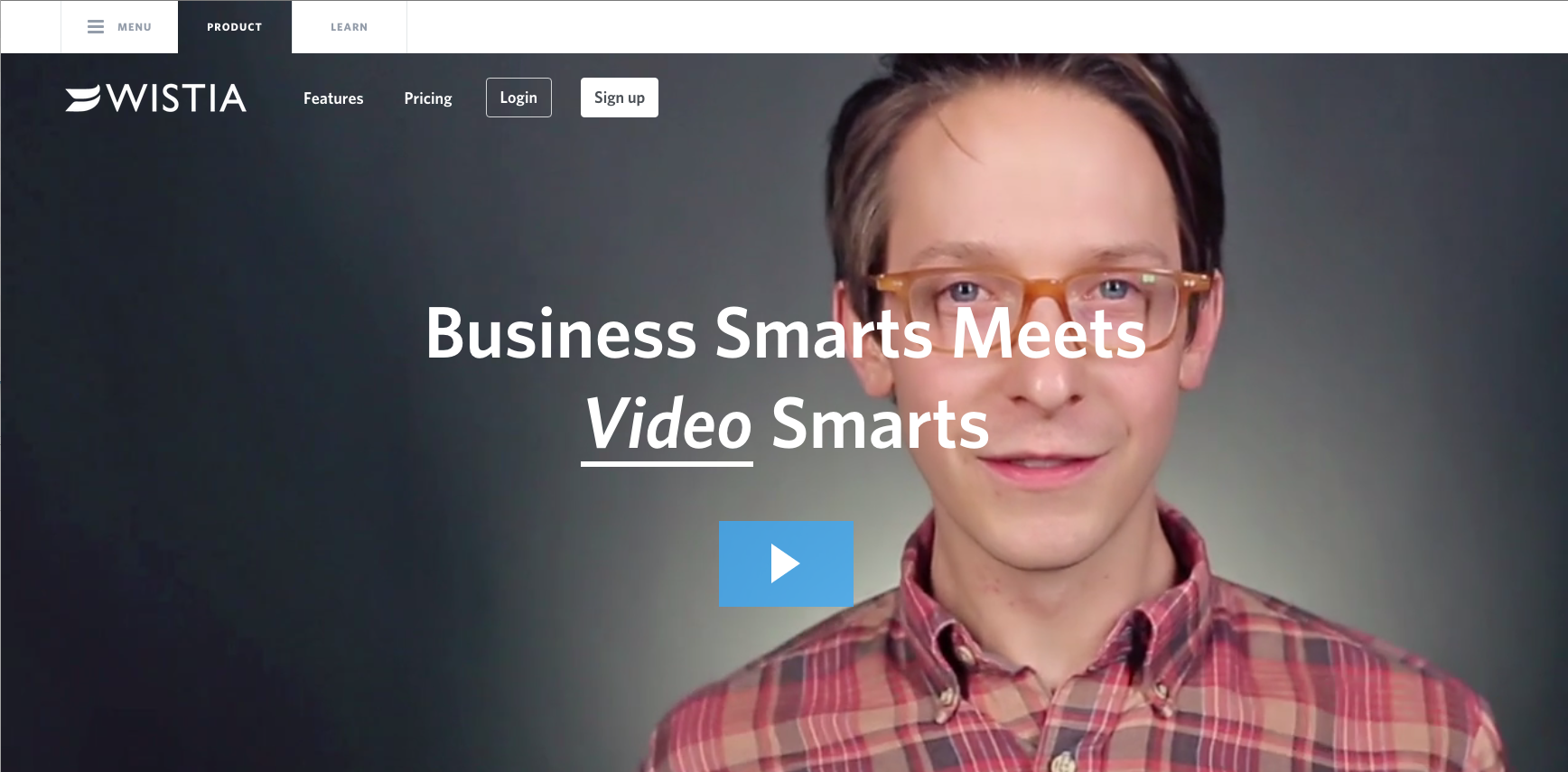
This background video serves as a brilliant way to get the visitor engaged to click-through to the main video.
Why is it useful?
Background videos focus on enticing the visitor from the moment they land on your page. The video allows your visitor to understand the key points about your company without ever having to read a single line of text.
In addition, video is processed 60,000 times faster by our brains compared to text. While people are often hesitant to read heavy blocks of text, videos appear effortless and can be consumed very quickly. It also helps that connection speeds are increasing and mobile device sizes are growing, making for better video experiences.
Element #4: Semi-Flat Design
In 2013 Apple fundamentally shifted to flat design. Simply put, flat design is any element that does not include or give the perception of three dimensions, such as shadows. Not only is flat design is easier for users to comprehend, but it can also load more quickly on websites without complicated or overly-technical elements.
Following in Apple’s footsteps, many other organizations — both large and small — have shifted to flat design. However, company’s like Uber have put their own spin on the style by adding subtle shadows and dimensions. As you can see in the image below, the boxes have an element of depth with shadows around them, without overdoing it:
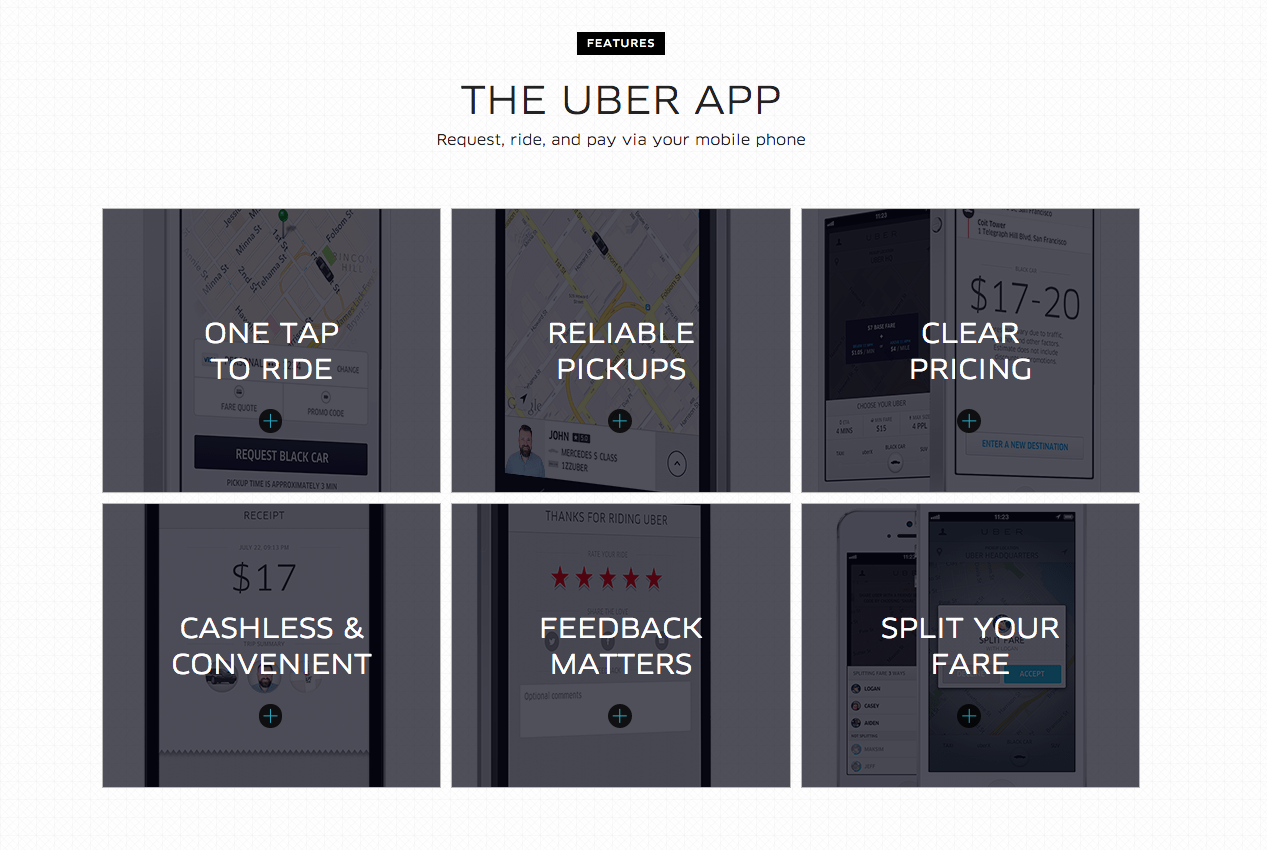
When you scroll over any of the boxes on the Uber homepage the shadow disappears and relieves the image behind it.
Why is it useful?
Flat design helps the visitor understand your content more quickly, and adding some elements of depth can bring it to life. Regardless of whether you fully design your website using flat design or utilize shadows and other elements, it’s important to be consistent throughout your website. Ensure that your homepage, product pages, and any other key sections of your website all utilize the same design cues so that visitors can instantly understand what they’re viewing.
Element #5: Hamburger Menus
It’s likely that most websites you come in contact with have a long menu of options to choose from. The advantage of this is that the menu can take the visitor directly to where they want to go. However, the disadvantage is that they generally take up a ton of valuable screen space.
The hidden, or hamburger, menu changes this. This menu was common in web applications before making it’s way to web design — even in Google Chrome you can find a hamburger menu on the right-hand side.
 Source: UX movement
Wondering why it’s called a hamburger menu?
If you use your imagination, the three lines that are stacked on top of one another look like hamburger patties. Get it?
Why is it useful?
The pages of your website should have a clear path for the user to take. Removing a busy navigation makes the experience cleaner and distraction free. This improved experiences help to improve the likelihood that the user will find the information they need to complete a desired action.
Element #6: Giant Product Images
You may have noticed that many B2B websites are starting to display large product images on their sites to highlight different features or parts of their product. This is no coincidence.
To give you a better idea of what we’re talking about, let’s take a look at the product page for the HubSpot Website Platform:
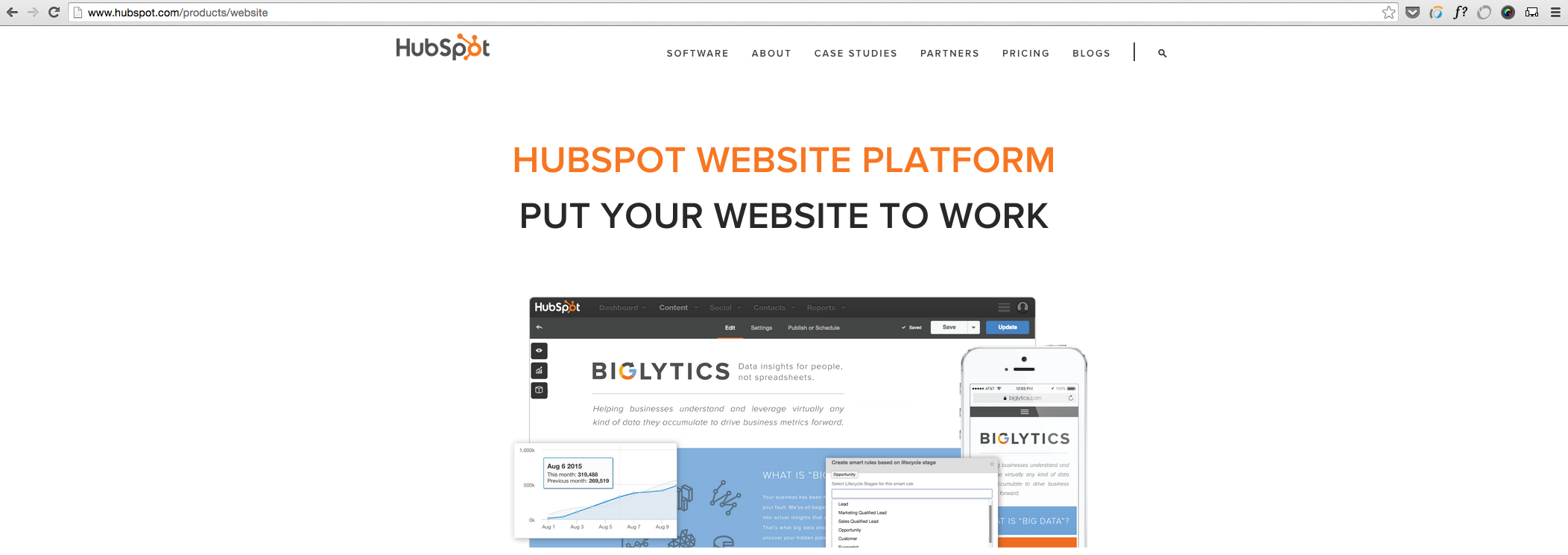
There is a large featured image at the top of this page, and as you scroll down the page there are additional in-depth product images. The images are also responsive which aims to ensure an optimized experience for viewers coming from different devices, as we mentioned earlier.
Why is it useful?
Larger product images help designers highlight different features of a product in a more efficient and effective way.
This approach reinforces the benefits of a feature by providing the opportunity to highlight the most valuable pieces. For instance, in the second image, you will notice that there are numbers on the image corresponding with benefits of certain features.
These large images are also scan-friendly. They help visitors generate a solid understanding of what the different product features do by convey them through images instead of words.
Element #7: Card Design
With the rise of Pinterest, designers and marketers alike have become fascinated with cards. Individual cards help distribute information in a visual way so the visitors can easily consume bite-sized pieces of content without being overwhelmed.
Brit + Co’s homepage serves as a great example of card design in action:

By breaking up different pieces of content into cards, users can pick and choose which articles they want to expand. This helps to keep the homepage feeling clean and organized, without relying on a ton of text.
Why is it useful?
Card design is becoming more and more popular across B2B and B2C websites because it helps to deliver easily digestible chunks of information for users. Using this design on your site can help highlight multiple products or solutions side-by-side.
Keep in mind that your cards should be responsive. This means that as the screen size gets smaller or larger, the number and size of cards shown should adapt accordingly.
Element #8: Short Product or Feature Videos
In addition to background videos, companies are also beginning to use short product or feature videos to highlight a specific use case. These short videos are great at bringing your solution to life, while not overwhelming the visitor with a long experience that they must sit through.
A strong example of this comes from the folks at InVision. They display this short illustrator of how easy it is to use their product by dragging-and-dropping a design directly on their homepage:
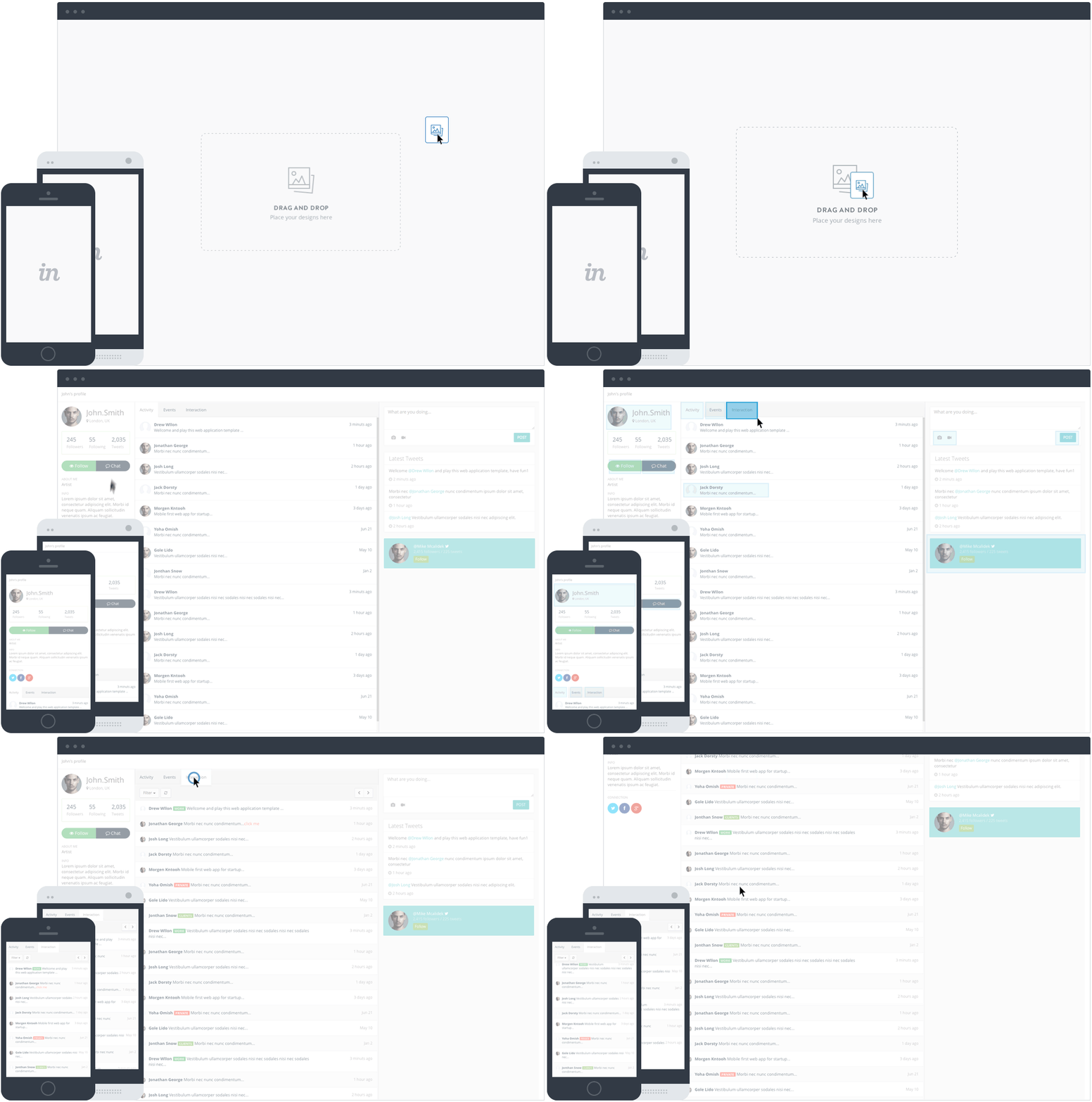
Why is it useful?
According to Inc. Magazine, 92% of B2B customers watch online video, and 43% of B2B customers watch online video when researching products and services for their business. Therefore, B2B companies need to create videos that explain their products because it is influential in the buyer’s decision-making process.
These short videos allow for your prospect to quickly understand value without watching a really long, in-depth experience. Sure, both have value, but the shorter videos allows for quick understanding that is best for top of the funnel.


What You Missed Last Month in Google
How in the world did we get here?
It’s hard to believe it’s already August — but alas, here we are, watching summer (in Boston, anyway) progress.
We’ve been keeping busy, and so has Google, it seems. July was a busy month for the search giant, and we’ve put together a rundown of the major highlights you may have missed last month.
What You Missed Last Month in Google
1. Someone From Google Will Testify on Election Interference
At Wednesday’s Senate Select Committee Intelligence hearing on foreign influence in social media, Senator Mark Warner confirmed that a representative from Google will testify before the same committee next month on election interference.
In July, BuzzFeed News scooped this upcoming testimony, where it was reported that Facebook COO Sheryl Sandberg and Twitter CEO Jack Dorsey are confirmed to appear.
While there’s no definitive answer on who, exactly, will represent Google, CEO Sundar Pichai has been invited.
However, Google recently promoted General Counsel Kent Walker to senior vice president of global affairs, where he’ll manage both the company’s legal team, and one dedicated to trust and safety. The move could point to Walker’s presence alongside Sandberg and Dorsey next month.
The testimony is scheduled to take place on September 5.
2. More Search Results
For quite some time now, Google has been evolving its search results page (SERP). Whether it’s an algorithm change, a featured snippet, or a knowledge graph — if there’s a way to get information to users in a quicker, more concise way, chances are, Google will try to incorporate it.
Now, that’s coming in the form of certain content displays from web pages — specifically, lists of FAQs, Q&As, and how-to steps.
#GoogleDanceSingapore New Search Features coming in @methode @rustybrick @sejournal pic.twitter.com/6dZbIQ4HiS
— Akhil Agarwal (@akhil1594)
July 26, 2018
And while, as we’ve covered, having page content displayed right there on the SERP could lead to fewer clicks — The SEM Post explains that there is an upside to content creators whose pages are featured in these results. For starters: one result appears to take up the entire screen, at least on mobile, giving the page owner a significant amount of “screen real estate.” Read full story >>
3. Chrome’s “Not Secure” Warning Is Here
In February, Google announced on its security blog that, in a matter of months, any sites without HTTP encryption (the “s” is for “Secure Sockets Layer,” or SSL, which is covered here) would display a “not secure” warning.
Last month, that took effect.

Source: Google
With the July release of Chrome 68 — the latest edition of Google’s web browser — these new warnings display to let users know that, while the browsing experience for an HTTP page isn’t necessarily unsafe, it removes an additional layer of security from “eavesdroppers” when you enter secure information like passwords or credit card numbers. Read full statement >>
4. EU Fines
The European Union will fine Google €4.3B — roughly $5 billion — in an antitrust case that the European Commission has based on alleged abuses by the company for “Android market dominance.”
These include the Google’s forced inclusion (e.g., for phone manufacturers) of its own search engine and apps like the Chrome browser into the Android operating system — which Google has 90 days from the decision date to stop doing.
Google CEO Sundar Pichai later released a statement defending the company’s practices around its operating system, saying that they have “expanded the choice of phones available around the world.” Read full story >>
5. In the Clouds
Google Cloud Next, the company’s annual cloud conference, has come and gone. A host of new products and solutions were unveiled — many of them within the realm of language processing capabilities. From new machine learning capabilities, to text-to-speech (and speech-to-text) tools, the company dedicated an entire blog post to the top announcements — all 100+ of them — from this year’s event. Read full post >>
Until Next Month
As always, we’re watching all things Google. We’ll continue to pick out top news items, algorithm updates, and trends.
And until September arrives — have a great August.
Featured image credit: Google

Why the Peter Principle Will Doom Your Business (& How to Fight It)
Let’s say you’ve been managing an extraordinarily competent employee for over a year now. As a marketing associate, she always follows the correct procedures, takes ownership over , and works incredibly well with clients.
So, what do you do? You promote her to marketing manager. It seems like the natural next step for her career progression, and she deserves it for all that hard work.
But, in her new role, she rarely interacts with clients, she must create rules rather than follow them, and she’s often unable to take creative risks. You quickly realize she’s unqualified for this role, which surprises you — She was so great in the other one, what went wrong?
This scenario is an example of The Peter Principle, a term first coined by Lawrence J. Peter. Peter studied organizational hierarchies and condensed his research into a 1969 satirical novel, written with Raymond Hull, called The Peter Principle: Why Things Always Go Wrong. Essentially, Peter states, “in a hierarchy, every employee tends to rise to his level of incompetence … [and] work is accomplished by those employees who have not yet reached their level of incompetence.”
What is the Peter Principle?
The Peter Principle is the theory that competent employees get promoted for their skills, but are eventually promoted into a role for which they’re unsuited. Once they’ve reached this role, they won’t get promoted again — they’re too incompetent — but won’t be demoted, either. Instead, an organization becomes filled with employees who’ve reached roles for which they’re unqualified, and the organization only continues to succeed based on the employees who have not yet reached their own incompetence level. The Peter Principle points out the problem with progress for progress’s sake.
What does this mean? Simply put, it means promotions don’t always equate to progress. Just because someone is a great teacher, doesn’t mean he’ll be equally competent as the school principal. And just because someone is a fantastic tennis player, doesn’t mean she’ll make a great coach.
Unfortunately, in the corporate world, this is a harder pill to swallow — if we’re unsuited for a role directly above us, where should we direct our ambitions instead?
The Peter Principle doesn’t just impact individual employees. It can also hurt the organization as a whole. Think about it: not only have you placed an employee in a role for which she’s unqualified, but you’ve also taken her away from a role in which she was performing exceedingly well.
This isn’t just a satirical observation, either — at least, not anymore. Researchers Alan Benson from the Carlson School of Management, Danielle Li of MIT Sloan, and Kelly Shue from the Yale School of Management studied the career paths of more than 53,000 salespeople at 214 United States companies between 2005 and 2011. Their findings, published for the U.S. National Bureau of Economic Research, support The Peter Principle.
Ultimately, their research found a negative correlation between the best salespeople and the worst managers — the better someone was at sales, the worse they were as managers. And yet, the best salespeople were 14% more likely to earn that promotion.
The teams with the best salespeople as their managers saw an average 7.5% decline in sales. Meanwhile, average and below-average sales performers were undeniably the best managers.
So, now what? Is your organization doomed to promote all your best players into badly-suited positions, until you’ve eventually pushed all your employees to their own levels of incompetencies? Should you just stop promoting all together?
Not quite. Here, we’ll explore four different tactics you can use to ensure The Peter Principle won’t destroy your business.
Incompetence
Incompetence means lacking the skills or traits necessary to thrive in a role — or, lacking the training or feedback necessary to harness and cultivate those traits. Incompetence comes down to an inability to succeed in a role.
The Peter Principle & How to Fight It
1. Create opportunities for employees to grow within their current roles.
As humans, we are always striving for more — more prestige, more money, more responsibility. As Peter writes, “As individuals we tend to climb to our levels of incompetence. We behave as though up is better and more is better, and yet all around us we see the tragic victims of this mindless escalation.”
Knowing this, we can combat the Peter Principle by creating different opportunities for our employees, besides a typical promotion. If your marketing associate is doing really well, ask her where she’d like to expand. Perhaps she simply wants more writing tasks. You can mold a position on your team to fit her strengths, without necessarily following a typical promotional path.
You can also offer your employees annual raises, without needing to shift them to a new position. Or you might offer other incentives, like additional vacation time if your employee meets X goals.
It’s equally imperative to recognize and applaud individual contributors. Perhaps you want to create an award for the employee with the most team spirit. Maybe, in an email, you simply need to congratulate your employee for her impressive strategy with a client. Whatever the case, a promotion shouldn’t be the only way employees can earn prestige and additional responsibility.
2. Assess internal hires against the new role’s qualifications, not their performance in their current role.
In the U.S. National Bureau of Economic Research, there was a reason the worst salespeople became the best managers — often, the worst salespeople would rather work as a team player than competitively strive for their own personal best. While these traits aren’t necessarily helpful in a sales role, they’re undeniably critical in a manager’s position.
When you’re interviewing for a new leadership position, you’ll want to identify the traits necessary to exceed in that role, and then find the employee who possesses them. You might be surprised when your top candidate isn’t the employee with the most impressive numbers, but that’s the point.
You shouldn’t promote an individual based on how well they’re performing in their current role. You should only promote them if you believe they showcase critical skills necessary to perform well in the next one.
3. When an employee begins a new role, encourage open feedback.
The Peter Principle isn’t to say someone can’t grow and become competent in a role for which they’re largely unprepared. If you’ve promoted your best marketing associate but she’s fumbling as a manager, it doesn’t mean you need to denote her.
In her prior role, perhaps she was given constant praise for her quick-decisions, independence, and ability to offer harsh criticism. These traits made her exceptional previously, but now she struggles to figure out why her team seems disheartened.
As her director, you might want to encourage her to openly ask her team, “What kind of manager do you want? How can I help you do your job?” Perhaps she finds out her quick decision-making skills are perceived as close-minded to her team. Or, maybe her independence makes her seem inaccessible.
By opening herself up to honest feedback, she can focus on improving traits within herself that will most help her team. It isn’t that she’s an incompetent manager, it’s that she needs to recalibrate her strengths and weaknesses in light of this new role.
4. As an employee, reflect often on where you really want to be.
Perhaps, for as long as you can remember, you’ve had your eye on becoming a team manager.
You love your current role — you enjoy working collaboratively with smart people, you feel lucky you get to brainstorm marketing strategies on a daily basis, and you deeply enjoy the independence you receive.
But you can’t stay where you are forever, and you know it’ll look impressive to receive a managerial promotion. Right?
It’s important you consider the skills required of being a manager, and ask yourself if you’re truly excited about the qualifications of the role. If necessary, meet with other managers’ and ask about their day-to-day experiences, or take a leadership course.
If you find a manager’s role seems to take away parts of the job you love most, consider an alternative direction. Maybe, to you, progress is simply getting to speak more often with clients. Perhaps you’d be most excited to receive full ownership over the Instagram Influencer campaign.
Ultimately, the problem with The Peter Principle is we assume a promotion is a smart next step in our personal career path, without fully examining all the other directions we could take.

Unriddled: The Price of Cleaning up Social Media, a Gaggle of Collaboration Tools, and More Tech News You Need
Welcome, one and all, to another Wednesday: the day that marks the halfway point — almost — to the weekend.
Here in our Cambridge HQ, the days are slowly starting to get shorter. So as we hold onto to these summer days and nights — and know that, perhaps, you are, too — we’ll try to unriddle this week’s tech news in double-time.
It’s our Wednesday tech news roundup, and we’re breaking it down.
Unriddled: The Tech News You Need
1. Slack Acquires HipChat and Stride
Slack, the workplace collaboration platform that’s best known among some for its internal chat capabilities, has acquired HipChat and Stride assets from Atlasssian.
The move signals what could be a battle within the tech world for the best workplace collaboration tool. The same day the acquisition was announced, news broke that Facebook will also acquire Redkix in hopes of building out its Workplace platform, which many consider a Slack competitor. Dina Bass and Ellen Huet of Bloomberg have more. Read full story >>
2. Uber Closes Its Self-Driving Trucks Division
Uber, the ride-sharing company that’s also had a high-profile foray into the autonomous vehicle sector, will shutter its self-driving truck operation and shift focus to self-driving passenger cars. As Kirsten Korosec of TechCrunch explains, Uber’s self-driving truck efforts have been plagued with issues, including a high-profile trial with rival Waymo, Alphabet Inc.’s autonomous vehicle division. Read full story >>
3. Facebook Discovers Election Interference (Again)
Facebook has made no secret of its efforts to clean up its platform — especially when it comes to data privacy, and the weaponization of its site for things like election interference.
That made headlines once again yesterday when it was announced that the company discovered another coordinated election influence campaign on its platform — though it would not say for certain who was behind it.
About 290,000 users were exposed to content from Pages and accounts that were suspected as a result of this discovery. Facebook says that the investigation is ongoing. Read full story >>
4. Twitter and Facebook Hold Q2 Earnings Calls
The week prior to Facebook’s above revelations, the company held its Q2 2018 earnings call, which was followed by arguably disastrous results — including, at one point, a nearly 20% drop in its stock price. It’s believed that was primarily a reaction to two key metrics revealed during the call: first, a plateau in active user growth in the U.S. and Canada, as well as remarks from executives that they expect revenue to decelerate over the next two quarters.
But despite these earnings, most expect Facebook to recover. According to our research, 72% of internet users expect the company to rebound — and less than 40% were surprised by its slowing growth. Read full story >>
Twitter also held its Q2 earnings call, where it announced a decrease in one million monthly active users, but an increase in revenue. The results were less-than-stellar for this social media player, as well — at one point, the earnings call was followed by a 27% drop in its stock price. Read full story >>
5. Twitter Selects Two Proposals to Study Its Network Health
The Monday after its earnings call, Twitter announced the selection of two proposals to study the network’s conversational help: one, to examine the presence of “echo chambers” on the site, and the other to research the impact of user exposure to different perspectives. The selection comes after a public request for proposals in March to study the network’s “health metrics,” which Twitter CEO Jack Dorsey said was part of the company’s commitment to “increas[ing] the collective health, openness, and civility of public conversation.” Read full story >>
That’s all for today. Until next week, feel free to weigh in on Twitter to ask us your tech news questions, or to let us know what kind of events and topics you’d like us to cover.

Conversational Marketing: How a Messaging Strategy Will Grow Your Business
How did your grandparents, parents, and younger siblings grow up gossiping about the latest party? I bet they’d all have different answers.
Don’t believe me? Let’s take a trip back in time.
First, we sent letters. If you think handwriting a card took a long time, think about the time it took to receive a response by plane, train … or pony.
The 1800s brought many new technologies, including the telegraph. It may sound cool, but think about how long it took to translate details into morse code. I’ll give you a hint: .. – / – — — -.- / .- / .-.. — -. –. / – .. — ..-.-.-
Years later, the fax machine allowed us to send messages and images over telephone lines. Unfortunately, the earliest machines cost tens of thousands of dollars, and you still had to create a hard copy of your message.
Then came “leave a message after the beep” … voicemail. We’ve all put off listening to that 3-minute long message. It’s easy to ignore or it can be the start of an endless game of phone “tag”.
After voicemail came “you’ve got mail.” While revolutionary, inboxes quickly became overwhelmed. Your thoughtful email lay forgotten under a pile of spam and promotional messages.
Then the people who brought us email rolled out AIM or instant messenger. As the name implies, this was the first instant messaging service. Except your friends weren’t always online. Sometimes their away message was set to Outkast lyrics. Shake it like a Polaroid picture, anyone?
Around the same time, SMS texts hit mobile phones everywhere. You can now text your friend all of the essential party details and 🎉🎉🎉emojis.
Finally, we arrived at live chat. Live chat allows for instantaneous responses. You write a quick message and see those three little dots signaling a reply. The days of waiting for weeks to hear from someone are over – conversations are always happening.
With each new iteration of technology, our accepted response time has changed — friends make plans faster, families stay closer, and businesses provide answers instantly. In the age of live chat, customers expect conversations to happen how, when, and where they want.
Sounds intimidating, right? Don’t worry; it’s not as complicated as you think. While the technology we use to communicate has changed, the core elements of communication have stayed the same. People always have and always will expect conversations to be helpful, personal, and empathetic. The only difference now is we have the technology to have those conversations at scale. That’s the power of conversational marketing.
Let’s talk about conversational marketing and its benefits, how it will help your business grow, and what you need to build a successful conversational marketing strategy.
For example, many startups have created user groups on Slack. These groups allow customers and prospects to ask questions and get advice on a channel they’re already using to communicate throughout the workday … but wait, weren’t we talking about conversational marketing? How did we get started talking about customer support?
See, here’s the thing with live chat, it’s an incredibly powerful communication channel that has a strange way of breaking down the walls between support, sales, and marketing.
Sure, conversational marketing is the topic of the day, but we believe it is just one small piece of the puzzle. Conversations should take place across your entire business. In the future, businesses will need to develop a comprehensive conversational growth strategy to deliver a better customer experience throughout the entire customer journey. Conversational sales will play a huge role in helping reps connect with prospects in a more helpful, organic way. And customer success teams have already seen significant benefits using chat as one of their many support tools. While you’re developing your conversational marketing strategy, consider how it can impact every part of your business.
The Key Elements of Conversational Marketing
OK, you may be thinking, “conversational marketing sounds a lot like my current marketing strategy. I’m on multiple channels. I’m having conversations with my audience.” If you’re a customer-focused marketer, chances are you’re almost there. Here are the four key components of conversational marketing and how to best refine your strategy.
Conversations Happen in Customer-Time
Conversational marketing is an asynchronous relationship. Meaning conversations should occur whenever the customer prefers — whether that’s in real-time, after finishing their meeting, or later that night when they have a spare moment. While it’s important for businesses to be able to chat in real-time, it’s just as important for them to be able to finish a conversation at whatever pace the customer wants. Sometimes that means starting a conversation at 7 a.m. over their first cup of coffee and finishing at 9 p.m. after they’ve put their kids to bed.
HubSpot Co-Founder Dharmesh Shah says, “Customers should be able to pick up things right where they left off whenever it is convenient for them to continue. The key is to remember that conversational marketing should be designed around the needs of the customer — not the needs of the business.”
Conversations are Scalable
Because conversations happen on customer-time, all conversations need to be scalable. A customer doesn’t care if you’re talking with 50, 500, or 5,000 other people — they only care about the issue they need to be solved. Businesses, especially SMBs, shouldn’t get left behind due to a lack of resources or manpower. This is where chatbots come in. Bots make 24/7 support possible by providing answers to common questions based on data that already exists. Business shouldn’t sacrifice human interaction for scale. Rather, bots offer quick access to information or a human.
Conversations Have Context
Conversations can’t exist in a vacuum; they need context and should get smarter as you collect more information. This is important for two reasons. First, it’s what customers expect. Think about it: If you called a company yesterday to report a defect in something you ordered, and then you chat them the next day about needing return instructions, you’d expect the person you’re talking with to have access to previous interactions and know which product you’re sending back.
Second, context is what makes messaging convenient. Without it, bots or a support rep would need to ask people the same qualifying questions every time they interacted with them — wasting their time and testing their patience. If you’ve ever called customer support, you know how frustrating it is to repeat your account number time after time as you’re passed around to different departments.
People want to get the answer to their question as quickly as possible and with the smallest amount of effort. This is why it’s so important to make a CRM part of your conversational marketing strategy. Context means gathering, storing, and making accessible customer data — from recent orders to visits to pricing pages to their job title. The more you know about the customer and the more you can demonstrate that in the conversation, the more helpful you’ll be.
Conversations Meet Customers Where They Are
Inbound Marketing is about providing value to your audience and meeting them where they are. Conversational marketing is just a part of that now — thanks to the mass adoption of messaging and new tools and technology.
And that means conversations should happen on the channel that best suits your customer — that might be over the phone or on Facebook Messenger, with a human or a bot. People don’t want to be forced to call a 1-800 number if they could easily send a quick chat message and grab a link to a knowledge base article. HubSpot’s bot expert Brian Bagdasarian smartly states,
“Businesses should strive to deliver the right message, at the right time, to the right person, with the right information, on the right channel, every single time.”
Conversational Marketing Is More Than Just Live Chat
Some people equate conversational marketing with live chat — something that’s been around for a while. But it’s much more than that. Conversational marketing isn’t about a single tool. While Facebook Messenger, Slack, SMS, email, and others allow conversations to happen, this is about the changing communication preferences of consumers that in turn, should change how you view one-to-one conversations.
For example, social media giant Facebook is drastically changing the way its users engage with businesses. There are over 65 million business pages on Facebook, and over 2 billion messages are exchanged with these businesses each month on Facebook Messenger. That’s a lot of conversations happening. Consumers are using Facebook Messenger and other popular messaging platforms to get content delivered, shop and buy, and access support.
With access to new technology, businesses can use these emerging platforms to easily meet consumers where they are already spending their time. Still not convinced? 85% of consumers spend their time in five popular apps, including WhatsApp and Facebook Messenger. And according to Facebook’s February earnings, WhatsApp and Facebook Messenger had 1.5 billion and 1.3 billion monthly active users, respectively.
But remember, businesses should not only be communicating on a variety of channels, but they should also be prepared to continue those conversations across all channels without missing a beat.
The Benefits of Conversational Marketing
Conversational marketing isn’t new — we have conversations every day, and as you saw from the timeline above, it’s been that way for a while. So why wouldn’t we use tools that optimize conversations for business? Let’s talk about a few of the key benefits.
First, conversational marketing is a more delightful way for customers to get answers.
People are increasingly turning to mobile to shop and make purchases. As a result, more people are interacting with content that is more mobile friendly. Consumers that use their phone as their primary internet device have grown to prefer video content, social content, and messaging-based interactions.
Think about how many times you pick up your phone during the day. According to TechCrunch, consumers spend 5 hours per day on their phones. It makes sense. I’m guessing it’s your first line of defense when looking up an answer to a quick question. Conversational marketing channels like messaging apps and email are innately mobile friendly. It’s a lot easier to chat with a rep or even a bot to get an answer than spend time scrolling and clicking through a company’s website. Messaging apps allow customers to provide information specific to their problem so business can give quick, personalized support.
HubSpot recently experimented with delivering content offers via Facebook Messenger and saw some incredible results – the test saw a 2.5X increase in open rates and 6X the number of clicks when compared to email. This improved performance is due in part to the channel’s push notifications, but it also aligns with how people want to shop, buy, and engage with companies today.
And conversational marketing doesn’t just present an opportunity in the U.S. In fact, in many regions, messaging apps like WeChat and WhatsApp are the primary channel for both personal and professional communication.
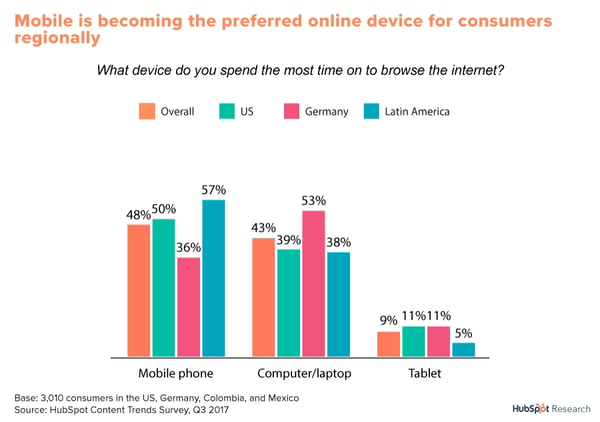
Source: HubSpot Research
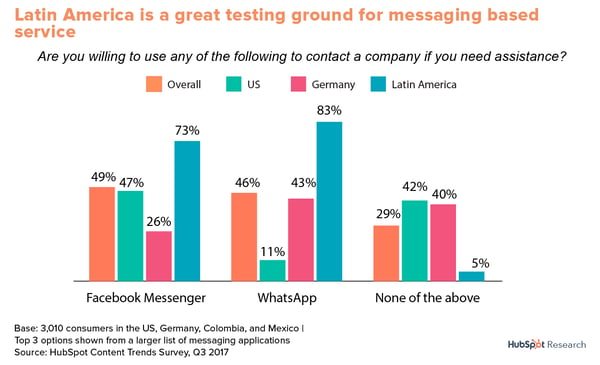
Source: HubSpot Research
Second, conversational marketing is a great way to gain new, valuable insights about your customers.
Think about it, when else do your customers tell you in their own words what they want to do, learn, or change? You don’t get that candor with a website or an advertisement.
HubSpot’s Conversational Marketing Manager Connor Cirillo states,
“Your conversational marketing audience is much more insightful than your other channels. They’ll tell you in their own words how they want to interact with your business. There’s no inferring or guessing, like with web traffic.”
And with conversational marketing, you can gather that data at scale. This especially holds true for messaging channels. Chat interfaces can record data that can then be used to optimize for better customer interactions, product improvements, more helpful content, and more.
For example, Sephora used Kik messenger to learn more about their target market by asking them if they wanted to participate in a quick, social-like quiz about their beauty habits. Once users accepted, they answered questions about their age, makeup preferences, and favorite products. From there, the app was able to deliver relevant content such as how-to videos and product reviews based on the individual’s answers. A chatbot makes it easier for customers to find and purchase products they like and frees up human employees for other tasks.
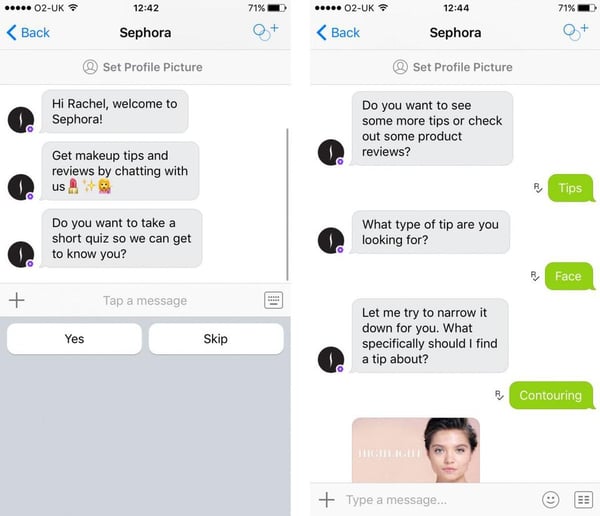
Source: Forbes
CNN also uses a bot to provide their audience with tailored content based on keywords. Users simply send the bot a message with a topic they’re interested in, and it will send back related news stories. Not only is it a quick, easy way for readers to get the news they care about most, CNN is collecting valuable consumer data with every chat.
Once businesses collect consumer data, they can use it to define trends and make more informed decisions. For example, imagine that your company redesigned its website or provided a discount on merchandise. If a prospect or customer has a difficult time navigating the new website or applying the coupon, they can live chat with a representative to receive instructions on how to best navigate the issue. Not only does live chat help solve the immediate customer’s concerns and keep them on the site, the information from that chat can help you determine if you need to fix a part of your website’s UX or send out more detailed instructions on how to apply the discount. Being able to determine common customer pain points as they occur can save a business thousands of dollars.
And not only is conversational marketing data helpful for recognizing tech issues and common customer pain points, it also can identify opportunities for cross-sell and up-sell. If a customer is chatting with a rep about a product they are considering buying, the rep could take that opportunity to point out other items customers frequently bought based on previous interactions.
Third, conversational marketing is a great way to build relationships.
With messaging apps and social media, we’ve found a way to talk with more friends, more frequently. Conversational marketing can drive lead generation by reaching new audiences on different channels or by giving people a more convenient way to get in touch with support.
According to Harvard Business Review, messaging apps “provide a continuous thread between customers and brands.” This thread allows for continuous communication which makes conversations more natural and “opportunities to cross-sell, encourage sharing, solicit input, and flow seamlessly between commerce and support” more frequent.
According to TopBots’ Adelyn Zhou,
“Questions that are awkward or annoying coming from a brand are socially acceptable and even welcome in chatbot interactions.”
Bots allow companies to collect a lot of information in a natural way. Instead of coming face-to-face with a long form, customers can share a little information over the course of multiple conversations. HubSpot was able to attract 20% more qualified leads by merely adding live chat as a communication channel. What would a 20% increase in qualified leads look like for your business?
And not only is conversational marketing more convenient for customers, it’s also a great way to show off your brand’s personality. Through copywriting, images, emojis, and videos, you can give your messaging conversations a personality — one that reinforces your brand. Customers and prospects are likely to keep engaging with your brand if you make it enjoyable and easy to do so!
For example, HubSpot allowed people to register for its Four Days of Facebook Campaign through multiple channels, including Facebook Messenger. Users loved the conversational UI and were quick to encourage their friends and coworkers to sign up as well.
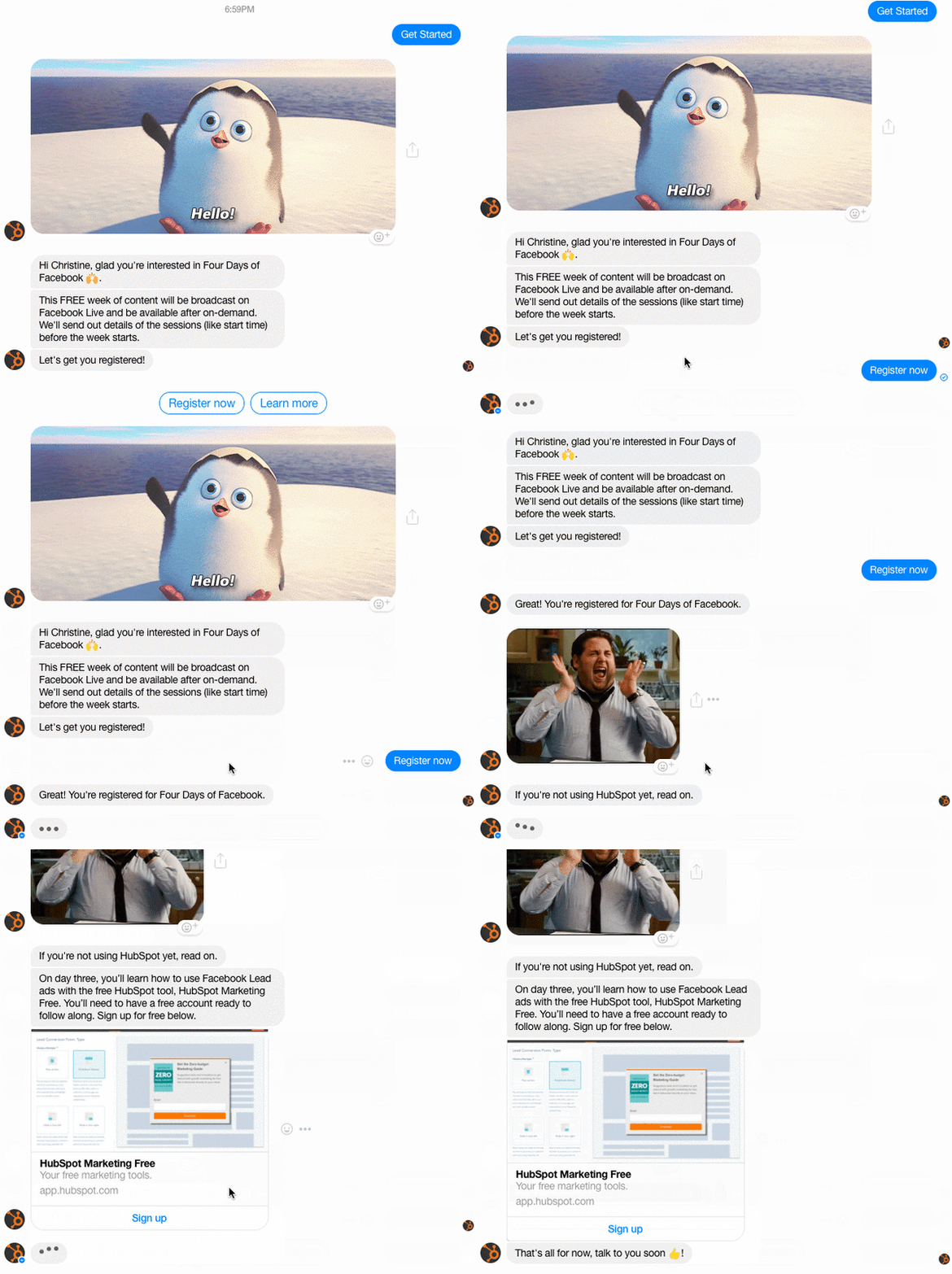
And success wasn’t just about getting people to register for the live event. Facebook Messenger was the highest converting source of new product users to HubSpot Marketing Free via the campaign.
Conversational Marketing and Inbound Marketing
At this point, you’ve probably noticed the similarities between the core ideas behind conversational marketing and inbound marketing. That’s because conversational marketing is a piece of inbound marketing, just like email marketing or blogging. Inbound Marketing is all about creating value where your target customer is spending their time — that could mean writing a blog, interacting on social media, or sharing a video on YouTube. Now that technology has made conversational marketing a possibility, it’s a key part of inbound marketing.
HubSpot Co-Founder Dharmesh Shah states,
“Conversation marketing is not new. Not only have we long been having conversations with customers — even the term itself has been around for at least a decade. The reason for the renewed interest in conversational marketing is that because of advances in technology and shifts in consumer behavior, conversational marketing can now happen at scale. We can have direct, one-to-one conversations with individual customers on their timeline — not ours.”
Although conversations are nothing new, our ability to have 1:1 conversations at this scale and across multiple channels is. With inbound marketing, you can first attract potential customers to your brand. You can then use conversational marketing to allow people to initiate conversations when they want, where they want, and how they want – giving your audience the control.
How do conversations fit into the inbound methodology? Well, we see conversations taking place throughout the entire customer lifecycle, though there’s not a strong case to be made for it in the attract stage as the discovery of brands on messaging platforms is still immature. Facebook Messenger’s Discover tab, which launched mid-2017, is one attempt at solving this. But conversations can be used in place of forms to attract and capture leads, by sales teams to convert those leads into customers, and by customer success teams to delight customers with quick and convenient support. For example, using live chat during the sales process could help convert more leads because it allows prospects to interact in a way they already prefer to buy.
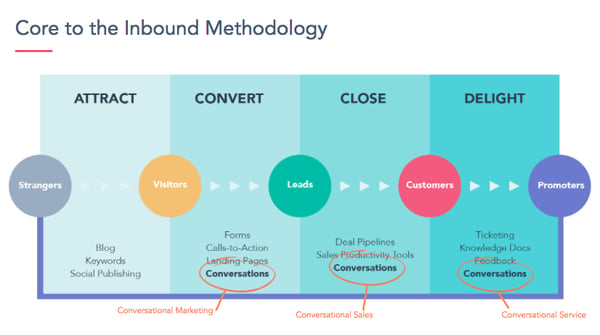
How Conversational Marketing Will Grow Your Business
Okay, we know conversational marketing is all about improving 1:1 relationships, but how can businesses actually start to build out a strategy for success? Cirillo recommends starting with one goal and then working backward.
“Know what you want to get out of the conversation and what data you need to make that happen. Every conversation should add value to your business,” he said.
Analyze your answers and work to create the best possible experience for your customers. While there are many things you can do to help optimize your conversations, here are a few essentials:
Your CRM and Conversational Marketing
When you have a conversation with a friend, you don’t expect to have to remind them of things like your name or where you live — the same holds true when customers have conversations with a business. That’s why using a CRM is so important. A CRM is like a digital memory that allows you to have conversations with customers like you know them.
A successful conversational marketing strategy is dependent on fast and reliable access to a shared knowledge base that includes data such as communication history and necessary customer information. Companies who want to do conversational marketing will need a way to store and organize that data in order to have more seamless interactions with customers. With the help of a CRM, you can organically promote events and products, distribute content, and provide support all through chat.
So what data should marketers collect? You don’t need to know everything about them, but you should know the basics and details of past conversations. Cirillo encourages marketers to think first about why they’re using chat.
“Success with conversational marketing will look different depending on the use case. There’s not an overarching metric for this world. Track the ‘time to solution’ or conversion rate if you’re solving for utility. If your experience is less about a particular action, then retention might make more sense,” he said.
Start with what you want your customers to be able to accomplish via chat and then build out processes for acquiring the necessary information.
In addition, you can’t implement a conversational marketing strategy without a process for tracking performance, moments of confusion or drop-off, and new questions. You should always be gathering data and optimizing the experience.
Adding Automation with Chatbots
Once your CRM is set up, it’s time to think to think about how you can scale your conversations. This is where chatbots can help.
Business isn’t just happening in one city, in one state, or in one timezone — it’s happening all around the world, every minute of every day. As I mentioned earlier, adding automation with chatbots is crucial in keeping up with a volume of conversations and to have a fighting chance at 24/7 support. Bots allow SMBs to compete with enterprise-sized businesses. Customers expect to be able to connect with businesses whenever they need to. According to research from Aspect Software, 65% of consumers feel good about themselves and the company when they can handle an issue without talking to a live person, and 61% think that chatbots allow for faster answers.
Here are few ways chatbots can help:
- Answer FAQs or customer specific questions where data is already available
- Qualify Leads
- Promote events, products, and content
- Schedule meetings
- Get feedback from customers and prospects
Keep in mind that while chatbots can do many things, they should never be used as a barrier between customers and a human. 86% of consumers want the option to transfer to a representative if their request is too complicated for a bot to handle. Bots can’t replace human talent, but they can help augment teams during off-hours or when conversation volume is too much for a small group to handle.
An Inbound Approach to Conversations
Developing a conversational marketing strategy can take time – it’s not easy to think about
process
when you’re trying to keep up with the day-to-day demands of running a business. That’s why HubSpot’s Brian Bagdasarian created some tips for building a conversational marketing strategy. Conversational marketing isn’t something you can set and forget, you have to continuously optimize your strategy to see the best results, but there are five things you should keep in mind: Personalize,
Contextualize, standardize, empathize, and optimize
Personalize
When speaking with a customer or prospect, conversations should be personalized with relevant shared knowledge. Shared knowledge is the foundation of good conversations. Think about it: If you’ve already given a business you’re phone number, do you really want to waste time reciting it every time you have a simple question? Personalized details make the conversation feel more natural and help you to get to the root of the issue as quickly as possible.
Contextualize
Conversations that have context not only improve the end-user experience, they also help minimize misunderstandings and get straight to the heart of the issue. Because you don’t have to waste time collecting information you already have access to, you’re able to provide immediate value. Context is necessary to help answer the right question, at the right time, in the best way possible. Conversations that aim to answer the most important question first will provide the best user experience. Even though it’s a conversation, this isn’t like a conversation with friends. When customers interact with your business, chances are they don’t want to spend time talking about cat videos or their weekend plans. They want to solve their most immediate need in the fastest and easiest way possible. Spend time analyzing your interactions to determine what data will help improve your customer relationships.
Standardize
However, it’s important not to get too caught up in personalizing your messages. While personalization and contextualization are important, standardizing elements of conversations helps bring a level of professionalism and consistency to your business. Conversations should be repeatable and predictable. Figure out your customer’s most frequently asked questions and draft approved answers for bots and marketers to use. Repeating conversations will help automate, optimize, and improve future interactions. Predictable conversations help to users have a natural dialog with a clear beginning, middle, and end. Standardization is crucial to delivering clear, consistent answers, across conversations and users.
Empathize
When involved in a conversation, we often have to deliver the right answer before correcting the problem. For example: Let’s say you receive an email with a coupon code from one of your favorite stores. You spend a half hour scrolling through their products trying to decide what to buy, but when you finally enter the code to make your purchase, it doesn’t work. You’re understandably annoyed that you wasted all that time when you weren’t even planning on buying something without that code. The business should emphasize with your issue and assure you that they understand the problem before the can move forward with providing a solution. Emphasizing helps customers feel valued and heard.
Optimize
Finally, it’s crucial to optimize. Learn from your past conversations so you can improve them in the future. Optimize for the strengths of the channel and for the answer – aim to provide answers that people would receive in a real, one-to-one conversation. For example, live chat or phone might be better for providing support, while Facebook Messenger could be a better choice for content delivery. Listen to your customers and observe their behavior as you build out your strategy and make changes where needed. Conversational marketing is an iterative process — what you thought might work may not always provide the best experience. Take time to ask your customers for feedback. Their advice will help you delight your next customer. Remember, every conversation should be impactful and help add value to your business.
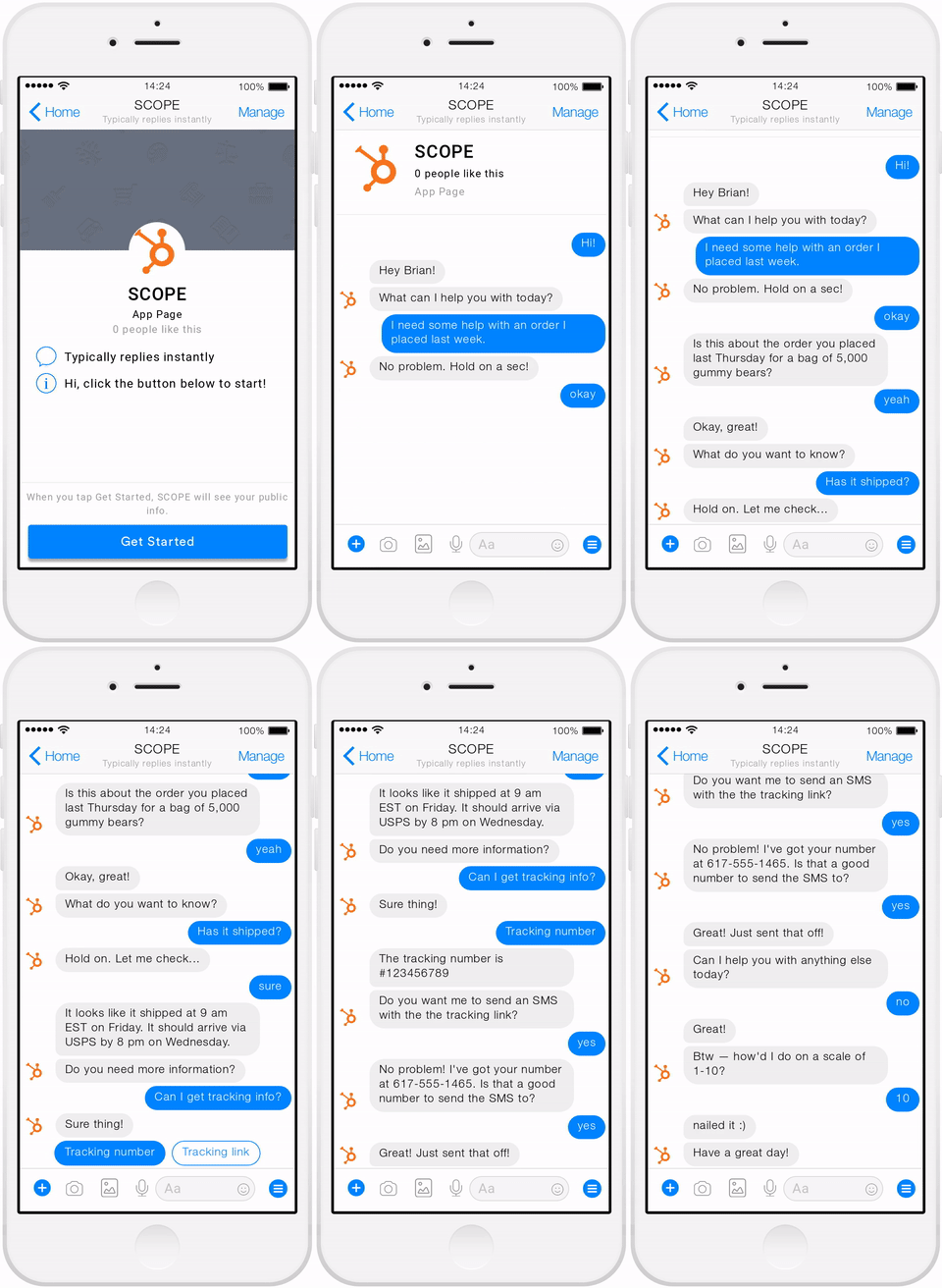
Moving Forward: Why Conversations Are the Future
Phew, you made it to the end. Good convo guys.
We’ve come a long way from letters and telegrams. For the first time, people are having meaningful conversations with businesses on a massive scale thanks to automation with bots, a CRM, and new channels. Conversational marketing is changing the way companies talk with their customers by making interactions seamless and faster than ever before. Your customers are having conversations. Why not join in? The most important things to focus on are the channel, the conversation, and how the strategy fits in with your overall inbound marketing strategy. Channels should be simple for businesses and consumers to use, conversations should follow a clear process and serve a purpose, and your inbound marketing strategy should inform your conversational marketing strategy.
Remember, humans have been having conversations since the beginning of time. Technology is only making it easier and more productive for businesses and their customers to connect. While the days of communicating by the Pony Express may be over, thoughtful, friendly conversations (and gossip) will continue to stand the test of time and technology.

What Is Guerrilla Marketing? 7 Examples to Inspire Your Brand
The word “guerrilla,” in its written form, seems very intense. It conjures images of rebellion and conflict. Put it next to the word “marketing,” and it makes a lot of people ask, “Huh?”
But guerrilla marketing isn’t some sort of combative form of communication. After all, that would be highly disruptive, which violates the inbound methodology. In fact, it’s actually a very unconventional form of inbound marketing, in that it raises brand awareness among large audiences, without interrupting them.
Because it’s so unconventional, however, it’s not the easiest concept to explain. Guerrilla marketing is often best understood when it’s observed, so that’s how we’re going to approach its best practices and takeaways here.
We’ll start with some basics around where it came from and how it works, followed by an examination of how it’s been carried out successfully.
What Is Guerrilla Marketing?
Roots of Warfare
When we hear the term “guerrilla marketing,” it’s hard not to think of guerrilla warfare — which makes sense, since that’s where this style of marketing got its name. In the warfare context, guerrilla tactics depend largely on the element of surprise. Think: “Ambushes, sabotage, raids,” according to Creative Guerrilla Marketing.
But how does that translate into the work we do every day? In marketing, guerrilla techniques mostly play on the element of surprise. It sets out to create highly unconventional campaigns that catch people unexpectedly in the course of their day-to-day routines. You’ll see what that looks like in some the examples below.
The term itself was created in the early 1980s by the late business writer Jay Conrad Levinson, who wrote several books about guerrilla tactics in a number of professional areas. Of course, at that time, marketing in general looked very different, and while guerrilla marketing is still used today, the ever-growing digital landscape is changing what it looks like. Again — you’ll see what that looks like in some of the examples below.
Budget-Friendly
What marketers really enjoy about guerrilla marketing is its fairly low-cost nature. The real investment here is a creative, intellectual one — its implementation, however, doesn’t have to be expensive. Michael Brenner summarizes it nicely in his article on “guerrilla content,” where he frames this style of marketing in the same context as repurposing your existing content, like taking certain segments of a report, and expanding each one into a blog post. It’s an investment of time, but not money, per se.
In a way, guerrilla marketing works by repurposing your audience’s current environment. Evaluate it, and figure out which segments of it can be repurposed to include your brand.
Types of Guerrilla Marketing
As niche as it might seem, there are actually a few sub-categories of guerrilla marketing, as outlined by the firm ALT TERRAIN:
-
Outdoor Guerrilla Marketing. Adds something to preexisting urban environments, like putting something removable onto a statue, or putting temporary artwork on sidewalks and streets.
-
Indoor Guerilla Marketing. Similar to outdoor guerrilla marketing, only it takes place in indoor locations like train stations, shops, and university campus buildings.
-
Event Ambush Guerilla Marketing. Leveraging the audience of an in-progress event — like a concert or a sporting game — to promote a product or service in a noticeable way, usually without permission from the event sponsors.
-
Experiential Guerilla Marketing. All of the above, but executed in a way that requires the public to interact with the brand.
We know — without context, the whole idea of guerrilla marketing can be a little confusing, so let’s see how it’s been executed by a few other brands.
7 Guerrilla Marketing Examples to Inspire Your Brand
1) Bounty

Source: TOXEL.COM
Here’s a fun fact about your neighborhood marketing blogger: I. Spill. Everything. Coffee? Check. Olive oil? You got it. Generally, I am simply a mess, and like to have paper towels nearby at all times.
Naturally, I couldn’t help but be impressed by this guerilla marketing installment from paper towel company Bounty. By installing life-sized “messes” throughout the streets of New York — a giant, knocked over coffee cup and a gigantic melting popsicle — the brand found a unique way to advertise its product and the solution it provides, with minimal words.
You might ask, “Wouldn’t a concise billboard ad accomplish the same thing?” Well, not really. Culturally, we’re starting to opt for every possible way to eradicate ads from our lives. That’s why we love things like DVR and ad-free options on streaming services like Hulu and YouTube. This campaign, unlike an ad, isn’t as easy to ignore. After all, if you stumbled upon a melting popsicle the size of your mattress on your way to work, would you stop and look? We would.
The big takeaway: Identify the biggest problem that your product or service solves. Then, find an unconventional way to broadcast that to the public — preferably without words.
2) The GRAMMYS
Okay, this one might not be entirely fair, since it wasn’t pulled off “in real life.” But how cool would it be if it was? To promote the nominees for its Album Of The Year category, the GRAMMYS music awards show created a video to show what would happen if posters for the nominated artists just began singing.
It might sound impossible to actually carry out something like that. But imagine — what if you could create musical posters for your brand? Again, it’s different than a billboard ad, because when we walk by a wall of paper advertisements in, say, New York City, we don’t expect them to start moving. Now, we’ll admit that this idea isn’t exactly a budget friendly one, as it might require some technical work to bring to fruition. But even if you could include a single moving or digital image among a sea of still ones — in a place where it would come as a surprise, like a brick wall — it would catch people off guard and, therefore, get their attention.
The big takeaway: Think about the things that your audience might just pass by every day — and make those things do something that’s both unexpected and interactive.
3) Frontline

Source: Marketing Ideas 101
When I first saw this photo, I’ll admit that I fell for it. “Someone, get that dog away from those flies!” I frantically thought. Then, I realized that the dog wasn’t real, and neither were the flies. The former was a photo, and the latter were actually humans.
That’s because Frontline, the makers of flea and tick prevention products for dogs, were able to fill the entire floor of this large, public space with this image. The brand knew that many people walk across that space every day, and that a good number of people would also see it from the building’s upper levels, creating the dog-and-insect illusion. It’s hard to miss — and to not look twice.
Again, this campaign is different than traditional marketing, because it’s not just plastering a single message somewhere that’s likely to be ignored. It creates a form of accidental human interaction that reminds the viewer what the product does.
The big takeaway: Figure out how humans might involuntarily interact with your marketing messages. While your product or service may not address the issue of, say, insect removal, there are ways to make people part of the campaign.
4) Burger King

Source: seventeen
Breaking up is hard to do in person, let alone when it’s publicly played out online. That’s what happened — allegedly — when one Instagram user left a comment on this post sharing a tale of his “girl” procuring food from Burger King. There was just one problem. This guy does have a girlfriend, but she was nowhere near a Burger King. So, who was he referring to? The drama ensued, via Instagram comments:
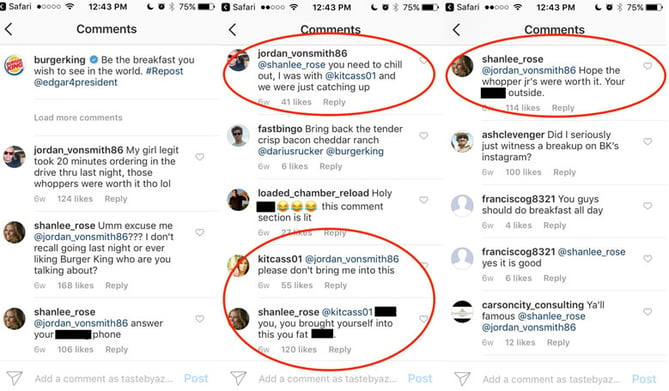
After the comments began to make headlines, many speculated that the entire exchange may have been staged by Burger King. And if it was, we can’t help but salute them — what a way to get your brand into the zeitgeist. Burger King has roughly one million followers on Instagram. Compare that to the 2.1 million followers of its chief competitor, McDonald’s. And while we’re not sure how many followers the former had before this famous breakup, it makes sense to assume that this at least drew more attention to its social media presence, at least on this particular platform. People may have already been observing the brand on Instagram, but before now, were they actively discussing it?
The big takeaway: Guerrilla marketing has gone digital. Think about where your audience already exists digitally — then, give ’em a show. While we can’t condone lying, we can applaud creativity, so don’t be afraid to use the comments to get people talking.
5) UNICEF
I’m as guilty as anyone of wasting money on bottled water. I have no excuse. I have a reusable one. My workplace offers filtered water from a machine, not a traditional cooler, and yet, it remains a bad habit.
That’s why this guerrilla marketing campaign from relief organization UNICEF resonated with me. It posed the question, “What if those bottles of water you waste money on were filled with dirty water?” It was a way of reminding the privileged masses that in too many parts of the world, entire populations have no access to clean drinking water.
So instead of frivolously spending that money on bottled water, UNICEF suggested putting it toward efforts to bring clean drinking water to these areas. It did so by creating makeshift vending machines that sold bottled dirty water, with each button labeled as a disease caused by a lack of clean drinking water.
The big takeaway: Guerrilla marketing works in the not-for-profit sector, too. And while scary, saddening images are often an impactful way of communicating your mission, there’s a way to convey it by creating something less in-your-face and interactive for the public.
6) GoldToe

Source: ALT TERRAIN
Are you an underwear company looking for an unconventional way to market your product? Why, just try placing an enormous pair of briefs on an iconic charging bull statue.
Really, we can’t make this stuff up.
It’s so simple, in theory, that it sounds like fiction. But when the GoldToe brand needed a way to tease and promote the launch of its new undergarments, that’s exactly what it did — casually placed these new items of clothing on statues throughout New York. And while we can’t be sure that it’s the route GoldToe took, we sincerely hope that those bull-sized briefs were made with leftover manufacturing fabric, helping to make this campaign even budget-friendlier.
The big takeaway: Don’t overthink it. Sometimes what looks like your silliest idea might be the best one.
7) Greene King
When you make plans to catch up with friends and family, what are the two things around which you inevitably gather? We’ll take a stab at guessing:
- Food
- Drink
When pub and brewing company Greene King feared that small, neighborhood establishments — notably, the pub — would start to be overtaken by large corporate retail, it launched a campaign to communicate just how important these local businesses really are. Even better, the content was almost entirely created by those who understand this predicament best: Pub owners, bartenders, and patrons.
These individuals were given cameras to capture video of the most meaningful moments and gatherings they’ve experienced inside these local pubs — from weddings, to funeral receptions, to birthdays. These videos were shared on Greene King’s YouTube profile and posed the question, “Without these neighborhood meeting places, where would we share these moments?”
The big takeaway: It’s okay to get a little sentimental with guerilla marketing. Think about the emotions invoked by what you offer. Then, invite your audience to create content around what your brand means to them.
Guerrillas in the Wild
Starting to make a little more sense?
When we set out to write this post, we were disappointed with just one element of it — we found virtually no B2B examples. That doesn’t mean it’s impossible within that sector. It just requires extra creativity.
Hopefully, you’ll be inspired by these examples, especially if you’re promoting a smaller brand. Don’t be afraid to crowdsource the content for these campaigns, for example — after all, it’s creative approaches to your work that help maintain guerrilla marketing’s budget-friendly, inbound nature. Remember: Catch people where they are, and insert your brand there. Don’t interrupt, but invite them to participate.



15 Fashion Brands You Should Follow on Instagram for Marketing Inspiration
No other B2C industry has thrived on Instagram quite like the fashion industry.
Between their carefully curated photos, expertly targeted ads, and decisive adoption of Instagram Stories, fashion and beauty brands have become masters of consumer engagement on the visual content platform. And brands from any industry could learn a thing or two from these inspirational feeds.

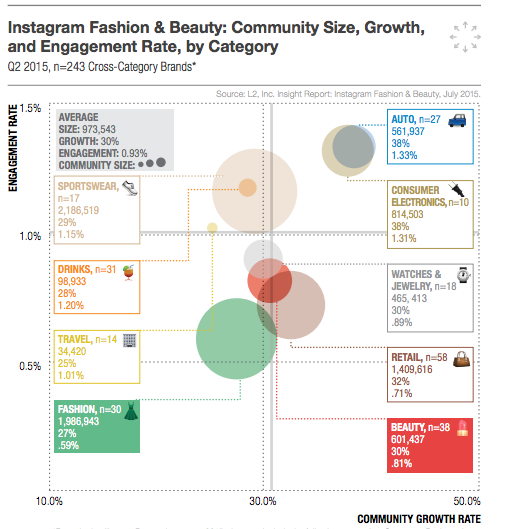
Back in 2015, business intelligence firm L2 found that fashion and beauty brands were growing their community size and engagement rates on Instagram at a rapid rate.
Source:
Digiday
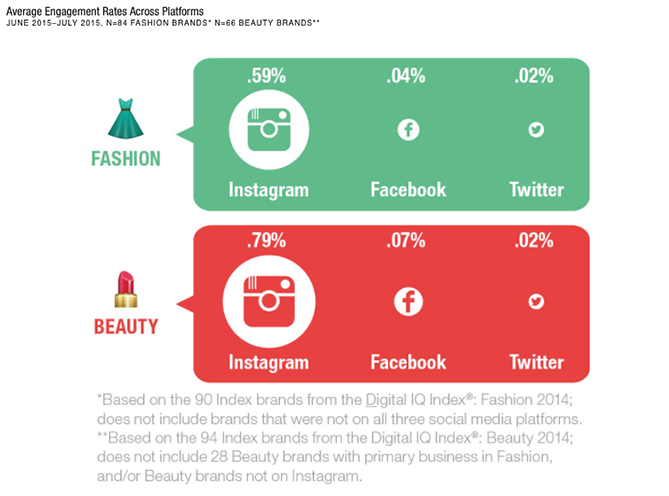
The L2 report also found that among fashion and beauty brands, Instagram had firmly become the social media platform of choice — far outranking Facebook and Twitter.
Source:
L2
Today, the industry’s love affair with Instagram isn’t showing any signs of slowing down. Digiday recently checked in with a number of fashion and beauty social media insiders at SXSW’s Decoded Fashion and Create & Cultivate events, confirming that Instagram remains a top priority in their digital marketing strategies.
“Instagram is always a priority for us,” Rosi Sanchez, a social media strategist at Fossil, told Digiday. “We have more reach and a larger new follower group there, so it leads to more conversions. Until we get to 1.5 million or 2 million followers, it’s going to be our number one priority.”
Fossil isn’t alone. Social media strategists from more established brands like L’Oréal USA, Shopbop, and Murad also indicated that Instagram was their top social media priority for the foreseeable future.
Brands from any industry looking to level up their visual storytelling chops should keep a close eye on fashion brands for inspiration. To help get you started, we’ve compiled a list of 15 fashion accounts — both big and small — who are crushing the Instagram game. Take a look below, and start planning your next big Instagram push. For a deeper dive on how to build a presence on Instagram, check out our complete guide to Instagram marketing.
15 Fashion Brands to Follow on Instagram
1) Everlane @everlane
While Everlane’s account has no shortage of beautiful product imagery, they also feature photos of their customers wearing Everlane clothes, inspiring travel photography, and tips on food and art destinations in different cities around the world.




2) Nike @nike
The behemoth athletic brand has enthusiastically embraced video content, and can be regularly found sharing clips with their impressive 7.1 million follows on Instagram. Their feed features a motivational mix of professional athletes and regular, everyday fitness enthusiasts.




3) Teva @teva
Teva’s Instagram feed is perfect proof that it’s possible to give your brand a modern update without losing the spirit of what made you successful in the first place. Their feed includes customer-generated photos of their sandals out in the wild, as well as sleek product shots highlighting their new styles.




4) Zara @zara
Zara has made a name for itself by emulating the marketing of more expensive, luxury brands, and their Instagram feed is no exception. Their account looks like a high-fashion magazine, with professional editorial shots of their men’s and women’s styles.




5) Fossil @fossil
If you like photos of neatly organized items, then Fossil’s Instagram is definitely for you. The accessories brand curates an impressive feed of food, fashion, and celebrity influencers like Kristen Bell.




6) Kate Spade @katespadeny
Despite being a well-established label, Kate Spade’s Instagram has a distinct personal touch that sets it apart from similar brands. Their social media manager shares daily outfit pictures, snaps from around New York, and behind-the-scenes shots of the design process at the Kate Spade studio.




7) Fjällräven @fjallravenofficial
The Instagram feed for Swedish outdoor apparel brand Fjällräven is less about their products, and more about the adventurous spirit that has defined the company for almost 60 years.




8) Madewell @madewell
Apparel brand Madewell is known for their relaxed, classic styles, and their Instagram clearly reflects this aesthetic. With bright, sunny images of their latest products and collaborations with brands like Vans, their feed is a fashion lover’s delight.




9) The Row @therow
Another account that focuses less on their products and more on visual inspiration, The Row features vintage photos of art, architecture, and fashion — only occasionally sharing images of their actual products.




10) Asos @asos
British online fashion and beauty retailer Asos keeps their feed updated regularly with colorful and bold product images and editorial snaps from their latest campaigns.




11) Aerie @aerie
Scrolling through Aerie’s Instagram feed is like taking a tropical beach getaway. The lingerie and bathing suit brand has been applauded for their commitment to unretouched photos in their print ads, and they continue the effort on their Instagram account by celebrating a diverse range of women and body-positive messages.




12) Eileen Fisher @eileenfisherny
Eileen Fisher keeps the emphasis on their quality materials and environmentally friendly production processes Instagram presence. By featuring images of women from all walks of life, they prove that style is truly ageless.




13) Anthropologie @anthropologie
With colorful close-ups of their brightly patterned styles, Anthropologie’s feed is a visual smorgasbord of inspiration. We especially love the travel shots featuring their clothes around the world.




14) Girlfriend Collective @girlfriendcollective
This leggings startup has yet to even officially launch a full collection of clothing, but they already boast an impressive 60.2k followers on Instagram. Thanks to a free leggings promotion they advertised earlier this year on Instagram and Facebook, the brand has enjoyed explosive social media growth. Their feed keeps customers engaged with stunning product photography of their minimal styles, and screencaps from inspirational movies.




15) J.Crew @jcrew
J.Crew has mastered the art of follower engagement on Instagram. With daily-updated Stories and regular contests to select new styles for clothes and accessories, their vibrant feed keeps customers inspired and interested.






How to Submit Your Website to Google (And Why It Matters)
So, you’ve developed an amazing site. You’ve put together some seriously valuable content, iterated on the design, and gathered a ton of feedback. Now, you’re finally feeling ready to share it with the world.
And as soon as you publish your new site for the world to see, all of your content will immediately start showing up in Google, right?
Well, maybe. It takes a little more than just hitting the publish button. To get your site listed on search results, Google needs to “crawl” and “index” your content. This happens automatically over periods of days or weeks, but if you’re a site owner, you can manually submit your site to Google and accelerate this process.
There are two ways to do this. But first, let’s briefly explore how Google crawls and indexes your website content.
Googlebot, essentially begins with a list of web page URLs generated from previous crawls and then augments those pages with sitemap data provided within Google Search Console. During the crawling process, the Googlebot — also known as a “spider” — looks for new sites, updates to existing pages, and any broken links.
If new pages are within your sitemap, Google will discover them and crawl the content and then potentially list the page within search results based on its evaluation of 200+ criteria.
Once the crawling process is complete, all of the results are fed into Google’s index, and any new sites or updated content will be listed accordingly. During the processing of results, Google looks at information on your page such as title tags, meta description, alt tags, and more. If you have dynamic content on a page, the Googlebot may not be able to read it and will crawl the default version — it’s recommended that your default version is optimized for search.
As a result of Google’s crawling, you may never need to submit your website as it will be discovered automatically. The downside to this approach has always been that it’s reliant on Google’s timeframe to crawl and index your site content, which may not happen as quickly as you would like.
Want to check if a particular site is listed in Google? Just begin your search with “Site:Sitename.com.” For example, here’s what is displayed in Google for HubSpot.com:
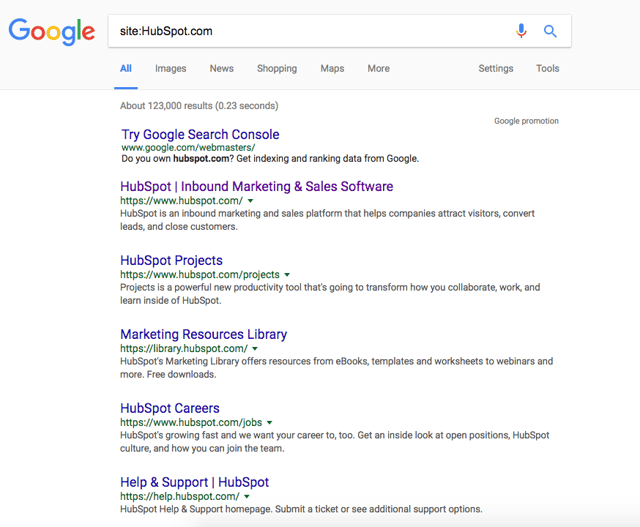
If no content is indexed yet for a site, Google will let you know that your search did not match any results.
If no content is found, your next step should be to create a sitemap that can be submitted to Google.
If you want more information about how to create a sitemap, take a look at this post.
(HubSpot customers: Your sitemap is automatically generated and maintained. Simply go to yourdomain.com/sitemap.xml to see it.)
How Long Does It Take for Google to Index Content?
My former colleague Casey Henry wondered this very question and ran a test to see how long it took Yahoo! and Google to crawl and index content. The results? Well, they were staggering.
When publishing content without manually submitting an updated sitemap, Henry found that it took Google 1,375 minutes to crawl, while Yahoo took 1,773 minutes. To put those numbers into perspective, that’s roughly a full-day just to crawl your content.
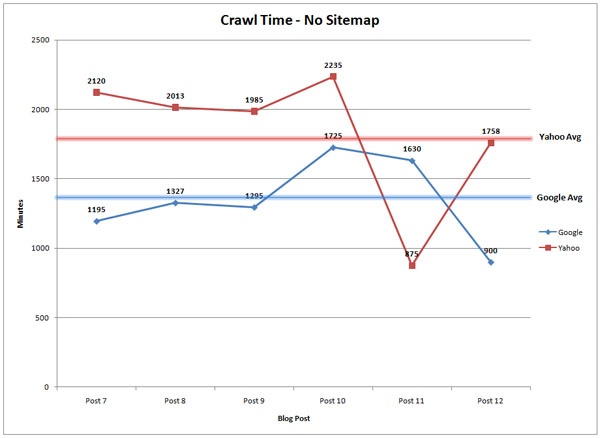
Source: Moz
On the other hand, if you’re launching a new website, or adding a number of new pages to an existing domain, it may be worth submitting an updated sitemap. According to the same study, Henry found that after submitting an updated sitemap, the average time it took for a bot to visit the page was 14 minutes, compared to Yahoo!’s 245 minutes. In other words, your new page can start generating organic traffic and conversions on the same day.
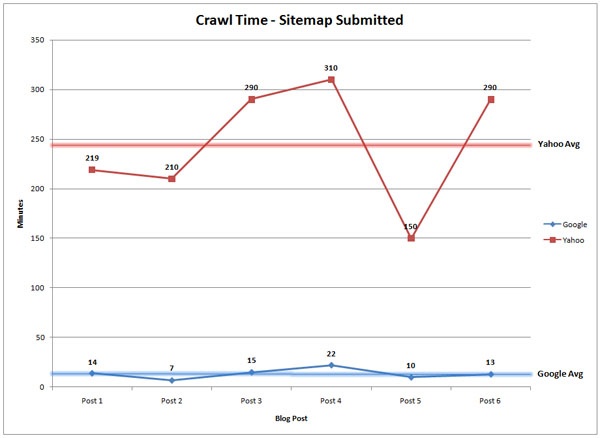
Source: Moz
How Do I Submit My Site to Google?
To submit your website to Google, you can either add an updated sitemap to your Google account, or submit an indexing request for the desired URL through Fetch as Google. Both processes require site owners to register with Google Search Console.
Here are the specifics of each option:
If you have a brand new site …
If you’re launching a website for the first time, you should first verify you own the site within Google Search Console. Then, submit it here — select the “submit a sitemap” option once you land on this page.
If you have an existing site and are launching new pages …
With a web domain already launched, you can still submit new pages for Google to index and rank them accordingly. Anyone used to be able to do this with a page they wanted crawled, whether they owned the page or not. Now, just as you would when launching a brand new website, you must be the URL’s owner to ask Google to re-crawl it.
If you own a webpage you’d like Google to re-crawl, you can do a few different things:
Submit an Updated Sitemap
First, you can submit an updated sitemap to ensure it gets listed as quickly as possible. To submit an updated sitemap, log in to Google Search Console and select “Add a Property.”
Once you’re there, you can submit your updated sitemap for Google so it can begin crawling it as soon as possible.
Fetch as Google
Fetch as Google allows you to view webpages on your site as Google sees them. As a site owner, you can also use this tool to reindex individual URLs once you’ve fetched them. To do this, log into Google Search Console and select the property you have currently listed with Google.
Along the lefthand sidebar, select Crawl > Fetch as Google, as shown below:
This will pull up a table where you can enter a URL path following your domain name, and “Fetch” this particular webpage on your website. See what this looks like below:
As you can see above, two sample Fetch requests have been listed below the Fetch bar. The status of these fetches is “Partial,” but once these fetches are complete, Google will assess their eligibility for reindexing. If the URL you’ve fetched qualifies, you’ll see a “Request Indexing” option appear where the red box is in screenshot above. Select this option, and Google will begin the process of re-crawling and reindexing this webpage.
As stated earlier in this article, indexing requests can take anywhere from a day to a couple of weeks to complete. So, check your Fetch as Google table periodically to see the status of your active indexing requests.
Based on the above instructions, you may be wondering if you need to submit an updated sitemap or indexing request every time you publish a new page. If you’re updating critically important content that you’d like Google to recognize quickly, you certainly could do so. But keep in mind Google also re-crawls pages on its own, and it’s ok to let this process work in the background as you regularly create and update your content.



Facebook Uncovered Another Election Interference Campaign
Facebook announced today that it has found evidence of another coordinated election interference campaign on its site — a likely effort to influence the 2018 U.S. Midterms.
This is the second instance of a high-profile effort to weaponize Facebook with the goal of influencing a U.S. election. Last year, it was discovered that foreign actors — largely based in Russia — coordinated a similar campaign with the creation of numerous fake accounts and the spread of divisive information, much of it false.
This time, things are a bit different. Facebook caught a smaller number of accounts, but did so much earlier on — and the company is less confidence about saying, for sure, who could be behind it.
Here’s what we know.
Facebook Uncovered Another Election Interference Campaign
What Facebook Found
In its official statement, the company said it removed 32 Pages and accounts — eight Facebook Pages, 17 Facebook profiles, and seven Instagram accounts — for what it describes as “inauthentic behavior” that intends to mislead network users.
Altogether, Facebook said, more than 290,000 accounts followed one or more of the Pages removed.
Of the Pages, those with the highest following included “Aztlan Warriors,” “Black Elevation,” “Mindful Being,” and “Resisters.” The last one — Resisters — worked with five other authentic Pages to organize an event called “No Unite the Right 2 – DC,” which it created to protest a “Unite the Right” scheduled for this August in Washington, D.C.
The authentic Pages “unwittingly” played a vital role in organizing this event, Facebook says, going to far as providing attendees with help finding transportation and locations. More than 2,500 users said they were interested in attending, and over 600 RSVP’d “yes.”
Facebook says it plans to inform these users of what it has discovered this afternoon.
Source: Facebook
The events created by these Pages wasn’t limited to “No Unite The Right 2- DC.” Together, they created roughly 30 events since May 2017, with the largest having 1,400 users RSVPing “yes.”
Combined, these accounts created 9,500 organic posts, running roughly 150 ads across Facebook and Instagram that cost a total of $11,000. The most recent ad was created in June 2018 (and the first, the company says, in April 2017 — the same month Facebook published a white paper on the potential misuse of its platform.
As for the content of these ads, Facebook has released a small sample. There are some similarities between what was shared today and the Russian-bought content that was released by the U.S. House Permanent Select Committee on Intelligence (HPSCI) in May.
Similar to the latter, the ads released today pertain to some of the most divisive issues in the U.S., many of which are center stage in the months leading up to a major election — things like race, gender rights, and religion. The U.S. 2018 Midterm Elections are taking place this November.

Source: Facebook
Who Was Behind It
Here’s where things start to get tricky.
When Facebook discovered and described the weaponization of its platform to influence the 2016 U.S. presidential election, the evidence of Russian interference — specifically, the IRA — was clear, with the company able to track that activity to these parties.
This time, however, Facebook says that it cannot say with certainty who coordinated this campaign — and that while there are some similarities with what was discovered this time around and the previous Russian interference, “we still don’t have firm evidence to say with certainty who’s behind this effort.”
However, certain lawmakers disagree. Senator Mark Warren — whose office yesterday published a paper outlining what regulation of Big Tech might look like — showed no hesitation in identifying Facebook’s findings as “evidence” of Russian interference.
More evidence that the Kremlin continues to exploit platforms like Facebook to sow division and spread disinformation. https://t.co/OMidt7zfiv
— Mark Warner (@MarkWarner)
July 31, 2018
But Facebook’s investigation is ongoing, it says, and involves working with law enforcement and Congress. “The lack of firm attribution in this case or others,” wrote Chief Security Officer Alex Stamos, “does not suggest a lack of action.”
Facebook has made no secret of its efforts to curb the spread of misinformation and prevent election interference on its site since the 2016 election meddling was first discovered — which was followed by the discovery that personal user data was improperly obtained and abused by voter profiling firm Cambridge Analytica.
Since then, Facebook has made a suite of changes to the way it publishes and displays ads, from a major shift in its News Feed algorithm to show more content from friends and family, to special labels and options to learn more about issue-based ads.
The Timing
The announcement follows a string of bad days for Facebook. Last week, its Q2 earnings call proved to be somewhat disastrous, as a miss on estimates and reported decrease in active users sent the company’s stock price into a tailspin.
An analyst asked for clarification on this, and what’s causing the deceleration. CFO David Wehner says that “a combination of factors” is driving it, like giving users more choices around privacy, as well as investments in new products and initiatives that can slow revenue growth https://t.co/JS4FC00P35
— Amanda Zantal-Wiener (@Amanda_ZW)
July 25, 2018
Facebook began to financially rebound — and as of publishing this story, its stock price does not appear to have been significantly impacted by today’s revelations.
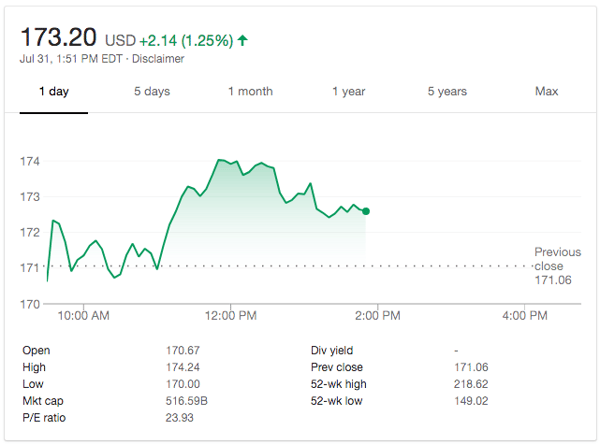
Source: Google
The same day as the earnings call, it was revealed that Facebook COO Sheryl Sandberg — along with Twitter CEO Jack Dorsey and a yet-to-be-disclosed representative from Google — will testify before the Senate Select Committee on Intelligence.
Tomorrow, that will be preceded by an open hearing held by the same committee, where lawmakers will hear testimony from third-party experts on foreign influence in social media.
As Facebook has indicated, the investigation is ongoing and more information is expected to be revealed as it proceeds.
