
72% of People Think Facebook Will Recover From Its Earnings Miss [New Data]
The past 24 hours — and two years, really — have not been kind to Facebook.
In case you missed it, the social media giant released its Q2 2018 earnings report yesterday, where it was indicated that user growth has all but ceased completely in the U.S. and Canada — and fallen in Europe.

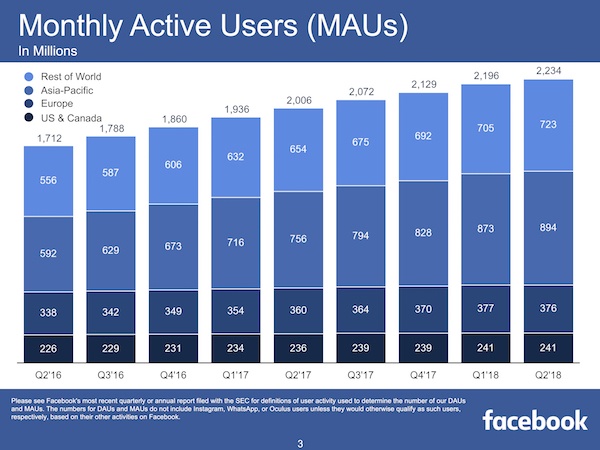
Source: Facebook
Overall, the company missed on estimates for its quarterly earnings — for the first time since 2015 — and as soon as the report was released, its stock price began to drop.
But things only became worse during the earnings call, when executives warned that growth (in both user counts and revenue) would continue decelerate in the third and fourth quarters, and perplexed analysts repeatedly asked for answers.
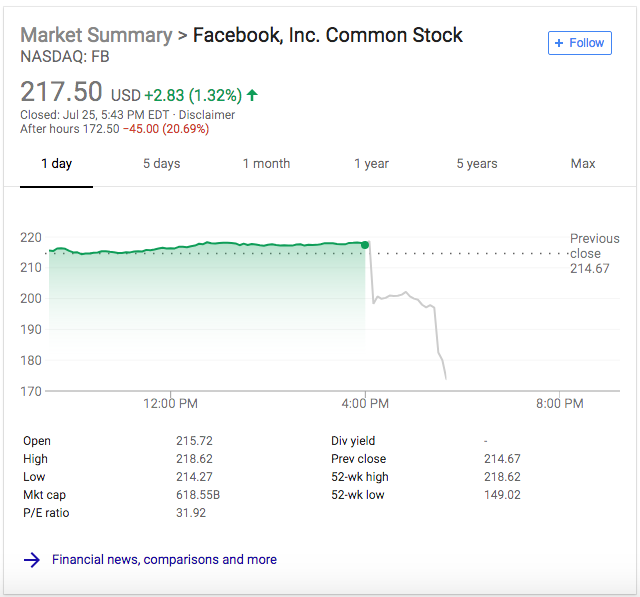
By the time the call ended, Facebook’s stock price dropping over 23% by the time the call ended. And overnight, the company lost $123.4 billion — or nearly 20% — of its value.
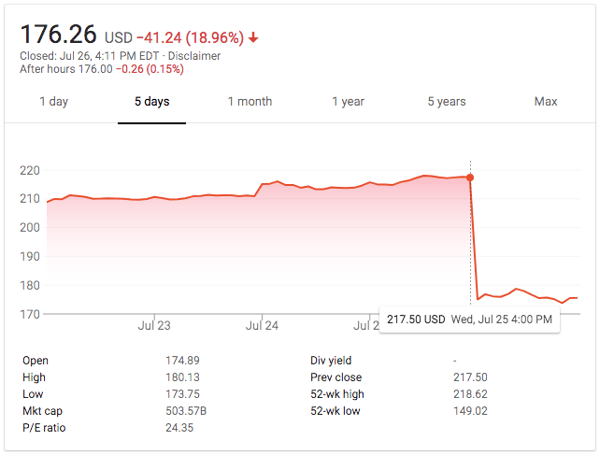
Source: Google
But according to our research, people aren’t really surprised — and they expect Facebook to recover from this latest (significant) stumbling block.
Most People Aren’t Surprised by Facebook’s Slowed Growth — and Think the Company Will Recover
No Surprise Here
We posed a question to 695 internet users across the U.S., UK, and Canada:
After Facebook announced that its growth and earnings slowed last quarter, the company’s stock lost over 20% in value overnight.
Are you surprised that Facebook’s growth is slowing down?
Globally, 60% of respondents said they were not surprised by Facebook’s slowed growth.
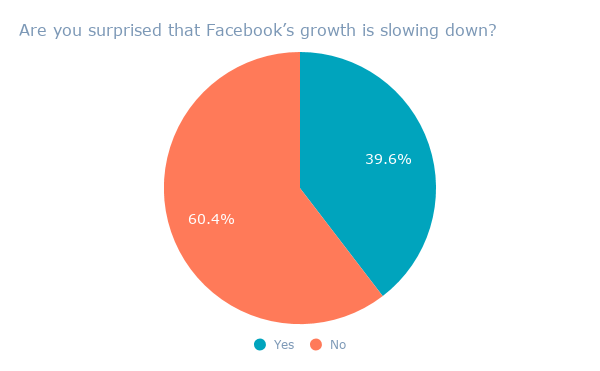
Data collected with Lucid. Sample size: 695.
When broken down by region, respondents from the UK were the most surprised, and the least so in Canada.
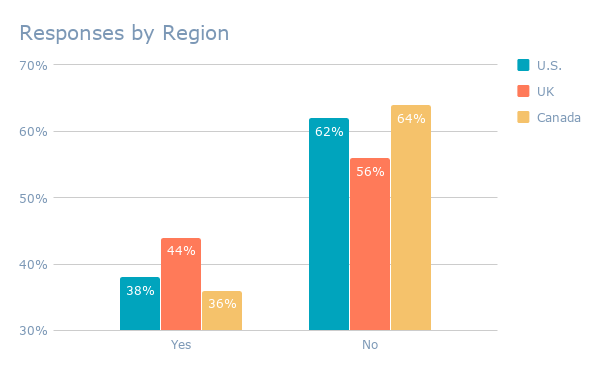
Data collected with Lucid. Sample size: 695.
The Expected Rebound
Then, we wanted to measure how much people expect Facebook to rebound from this week’s loss. We asked 633 internet users across the U.S., UK, and Canada:
After Facebook announced that its growth and earnings slowed last quarter, the company’s stock lost over 20% in value overnight.
Do you think Facebook will recover?
Globally, nearly three-quarters of respondents — 72% – said they do believe that Facebook will recover from the missed earnings and subsequent loss in value.
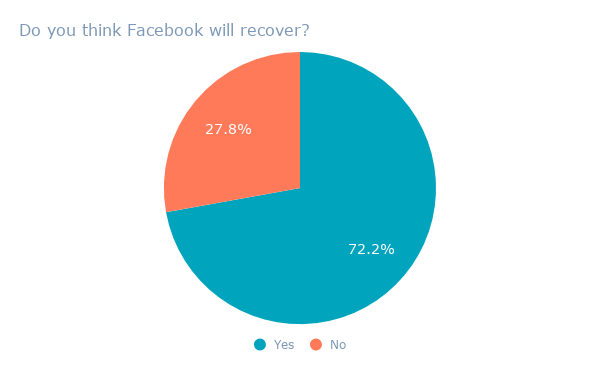
Data collected with Lucid. Sample size: 633.
When broken down by region, respondents from the UK were both the most optimistic about Facebook’s recovery, with Canada showing the most pessimism.

Data collected with Lucid. Sample size: 633.
What Could Be Behind These Numbers
The hours following the earnings call have struck quite a debate among analysts and journalists alike. Was the miss on estimates — as well as the overall fallout from the earnings report — the result of “years of privacy controversies finally [catching] up with Facebook“?
Or is Facebook simply running out of people to reach in its largest market — the U.S. and Canada — leading to a plateau in user growth?
Many believe that the two aren’t mutually exclusive. Could the slowed user growth could be the result, for instance, of people fleeing from the platform after months of scandal upon scandal?
Are these mutually exclusive, though? https://t.co/JrfeFL7yGQ
— Amanda Zantal-Wiener (@Amanda_ZW)
July 26, 2018
“So far” being the operative term here, methinks. Being rife with scandal may not have *directly* caused $FB to drop so drastically, but I’d venture to say it played a key role in slowing user growth, especially in the U.S., which … is a major factor in the deceleration, no? https://t.co/sB0yo5vfuP
— Amanda Zantal-Wiener (@Amanda_ZW)
July 26, 2018
Facebook has been making critical changes to its platform — even prior to March Cambridge Analytica revelations about the misuse of personal data — that the company warned would either reduce time spent on the site, or ad revenue (or both).
That began with a January News Feed algorithm change that would prioritize content from users’ friends and family over that from brands. The change was largely in response to scrutiny over the weaponization of Facebook by foreign actors to spread misinformation and ultimately influence the 2016 U.S. presidential elections — by emphasizing content from one’s personal network, the visibility of possible misinformation or divisive content would (ideally) be suppressed.
When Facebook CEO Mark Zuckerberg published the statement above, he explicitly noted:
“By making these changes, I expect the time people spend on Facebook and some measures of engagement will go down.”
Since then — especially after the Cambridge Analytica revelations — Facebook has only continued to make changes that reduce the visibility of certain types of content and, perhaps as a result, reduce the amount of time spent (as well as users) on the network.
Mike Isaac of The New York Times summarized it nicely:
if you give users more control over privacy, which they have long asked for, advertising takes a hit
if you increase the amount of employees it takes to make your platform safer, margin takes a hit
facebook is giving people what they want and getting killed in the market for it pic.twitter.com/yOLxkzMSzu
— ಠ_ಠ (@MikeIsaac)
July 25, 2018
Saying for certain whether or not Facebook will recover from this significant loss in value is tricky. Experts are falling on both sides of the issue, and for good reason. The company is still facing a high degree of scrutiny over things like data protection and election integrity, which both have an impact on user trust (and, therefore, potential user growth).
But as HubSpot CMO Kipp Bodnar noted after yesterday’s earnings call, the company also still has room to grow.
“The core network can reach saturation in markets like the U.S.,” he said at the time, “but it can still grow in emerging markets,” as well as through its portfolio of apps like Instagram and WhatsApp — both of which serve as sources of ad revenue.
Eventually, Facebook could run out of new users to reach, especially in areas where slowed user growth could also correlate with a declining population.
But throughout the call, Zuckerberg emphasized the company’s refusal to compromise on investments in new products and innovations — despite its investments in better security.
“Overall, this is a critical year for Facebook,” he said in his opening remarks. “We’ve … forged ahead with new innovations, and are adapting our services to the new trends of messaging, stories, videos, and groups.”
We’ll be keeping an eye on these innovations and trends alike.

How to Write a Cold Email Pitch for a Media Relations Purpose
Since launching The Growth Show podcast in February 2015, we’ve been fortunate to land interviews with some really busy people, including executives of billion-dollar businesses and founders on the cusp of building the next big thing.
For some of them, we had an “in.” Somebody knew somebody else and happily made the introduction.
But we weren’t so lucky with some of the other guests. We wanted to get in touch, but didn’t have mutual connections. So I’d send them an email — targeted, relevant to their interests, and completely custom, but still the first email I had ever sent them. In most situations, this is called a cold email. And somehow, among all of the other pitches they get for podcast interviews, speaking engagements, and business consulting, these guests noticed my emails in their inbox and actually responded.

What Is a Cold Email?
There isn’t a set formula for the perfect pitch-based email. In fact, cold emails — messages that are sent to many recipients without any previous relationship or conversation with them — are widely discouraged in the marketing industry. And if you send commercial emails to recipients living in Europe, the General Data Protection Regulation (GDPR) requires that your contacts opt in to the message before receiving it.
So how did I manage to get a response from the guests I wanted to host on our podcast?
Although the emails I sent did serve to help develop our brand, media relations follows a slightly different etiquette than your average email marketing campaign when communicating to the brands you want to work with. See the bullet points below to get a general sense of that etiquette:
- Pitch an idea, not a subscription.
- Address one person, not dozens.
- If there’s something in it for both parties, you’re more likely to get a response.
It’s true. Some of our show’s desired guests employ PR reps whose job is to manage the type of outreach I was sending.
My experience contacting potential podcast guests doesn’t mean you have to be a member of the press to send an email to someone you’ve never met. However, it does mean you need to be careful with whom at a company you reach out to, what your message is offering them, and how you landed their email address in the first place.
Below are a few things you can do to give yourself the best chance at getting a response. This advice will help you whether you are trying to find a guest for your podcast, network with a member of your industry, or even pitch a local reporter to get some solid earned media attention.
How to Write a Cold Email That Isn’t Actually Cold
HubSpot customers: It is against HubSpot’s Acceptable Use Policy to email multiple sales or marketing leads, with whom you’ve had no prior conversation (also known as “cold emails”), when creating email sequences through a HubSpot product. The following information is meant to educate readers on improving their pitches, introductions, and similar one-on-one email conversations — especially in the media relations space — such that these emails do not conflict with the GDPR and anti-spam regulations around the world.
Avoid the Classic Cold Email Subject Line
You could spend an entire day writing the best email body copy known to man, but if no one opens the email, your efforts will go to waste.
To make sure that doesn’t happen, you need a compelling subject line. This advice might sound obvious, yet there are still so many poorly written subject lines. Just open up your inbox and see how many emails are in there that you’ll never read. You can only get so many subject lines like, “The leading cloud-based software in hyper-local social media marketing.”
So, how do you write a good subject line? Figure out what you are ultimately trying to say and then boil down that request to five to seven words. Once you get to those five to seven words, make sure those words speak to the interests of your recipient and clearly communicate what you’d like from that email exchange. Here are a few more guidelines to ensure your subject lines entice someone to open.
One of my favorite ways to get someone’s attention is to put their name in the subject line. For example: “Brandee — having you on HubSpot’s podcast” or “Chris — source for your article on marketing trends.” I use this every time I conduct media outreach.
Make It Clear Why You’re Reaching Out to Them Specifically
Here’s how most cold email outreach is done: Write a pitch, copy, paste, send, repeat (and maybe change the greeting to really spice things up).
You might’ve gotten these types of emails before from sales reps — isn’t it annoying?
Your recipient has gotten them, too. To avoid the typical irritations of cold email, you need to make it clear why you’re reaching out to them specifically. Adam Grant, a professor at Wharton and author of Give and Take, talks about how when people feel they have nothing unique to contribute, they will feel very little responsibility to help.
So, when writing a message for media relations or a similar effort, warm it up so it doesn’t sound like an annoying cold email. Don’t just make it clear why you’re reaching out — make it clear why you’re reaching out to them. The best pitches highlight what specifically drew you to that particular person. Using the example of reaching out for a podcast: Add a sentence or two about how specifically that person’s work would be a great fit with your audience and why.
Showing that you did your homework isn’t just important because you need to be relevant, but it also shows that you put some time and effort into reaching out. This is one of the easiest ways to show that your email isn’t just another canned message from a sales rep or a PR pro.
Use Social Proof and Point to Results
Adding in a little social proof and some high-level stats to your pitch will take your homework from a B- to the top of the class.
If you’ve interviewed a colleague of your desired contact or spoken to someone they know, include that in your pitch (in sales, this could be a case study or a local customer reference). This also works if you’ve interviewed someone that they would consider a peer or competitor. The chances of you landing the CEO of Nike, for example, would dramatically increase if you could tell their PR team that you just finished an interview with the CEO of Adidas.
If you have the numbers to back up what you’re pitching, include those as well. Would you rather be on a podcast that 100 people were going to listen to, or 100,000?
Keep It Short, Simple, and Written Like a Human
Everyone is busy and their inbox is already full. Don’t make things worse. Try and keep your email short, sweet, and to the point. In media relations, this is all the more important — you need to ensure your message sticks out among the rest of the press pitches they get. Would you read a five-paragraph essay from someone that you’ve never talked to before? Probably not.
One of the best ways to keep things short and sweet is to write like a human. If you saw this person out in public and had to walk up and say hi, how would you start your conversation? You wouldn’t jump right into your pitch. Most likely you’d start with something like “Hey Emily, I’m Dave. I read your column every week and love how you’re focused on startups in Boston. I wanted to talk to you about my company because ___.” Writing your email like you were talking to someone in real life makes it feel much more approachable and relevant.
There isn’t a formula for writing an email to someone you’ve never spoken to before, but using the tips above can help you make a better impression and hopefully earn a response from your recipient.
Nailing your pitch to potential guests is just one part of getting your podcast off the ground. Want help with the rest of the process? Here’s everything you need to know about starting a podcast.



What is a Bitcoin Address? A 3-Minute Rundown
If you want to buy or sell items with Bitcoin, you need to be able to send and receive your funds from a certain location, kind of like sending and receiving mail through a mailbox.
But since we’re talking about sending and receiving Bitcoins — and not postcards — the location where you send and receive Bitcoins is actually on the internet and represented by a long series of letters and numbers. It’s called a Bitcoin address.
What is a Bitcoin Address?
A Bitcoin address indicates the source or destination of a Bitcoin payment. Similar to sending an email, if you want to send bitcoins to your friend, you would send your bitcoins from your Bitcoin address to your friend’s Bitcoin address.
Most blockchain experts recommend generating a new Bitcoin address each time you send or receive a payment, though. This personal security measure makes it harder for people to trace where your Bitcoin funds come from and where they go.
How to Get a Bitcoin Address
To get a Bitcoin address, you first need to download a Bitcoin wallet, which is software that allows you to securely send, receive, and store Bitcoin funds in the Bitcoin network.
Bitcoin wallets also store your private key, which is essentially your Bitcoin password. The software will generate a brand new Bitcoin address for you every time you create an invoice or receive a payment request for Bitcoins too.
There are four types of Bitcoin wallets that you can use: mobile, web, desktop, and hardware.
Mobile Wallets
Mobile wallets are the most convenient wallets to access, but your wallet provider will store your key on its app or your phone, so if someone knows your phone’s passcode and accesses it, they can easily send all your funds to one of their Bitcoin addresses.
To combat this security issue, consider only letting fingerprint authentication open your mobile wallet app.
You can download mobile wallets in the app store on IOS, Android, and Windows Phone.
Here’s a list of some:
- Airbitz Bitcoin (IOS & Android)
- ArcBit (IOS & Android)
- Bitcoin Wallet (Android)
- Bither (Android)
- Bitpie (IOS & Android)
- Blockchain (IOS & Android)
- BRD (IOS & Android)
- BTC (IOS & Android)
- Circle (IOS & Android)
- Coin.Space (IOS, Android, & Windows Phone)
- Coinomi (IOS & Android)
- CoinText (IOS, Android, & Windows Phone)
- Copay (IOS & Android)
- Edge (IOS & Android)
- Electrum (Android)
- GreenAddress (IOS & Android)
- GreenBits (Android)
- HandCash (Android)
- Jaxx (IOS & Android)
- Mobi (IOS & Android)
- Mycelium (Android)
- Simple Bitcoin (Android)
Web Wallets
Web wallets are equally as convenient as mobile wallets, but they’re also just as risky.
If someone knows a few of your personal details, like your phone number, email address, and birthday, they can impersonate you, telling your wireless service provider that you need to switch your number to a new phone — their phone.
Then, they can go to your email account, click “forgot my password”, and your email service provider will text a “change my password” code straight to their phone. This allows them to break into your email account, prompt your Bitcoin wallet provider to send a “change my password” email, and hack into your Bitcoin wallet account, stealing all your funds.
Consider telling your cell phone carrier to ask for a passcode before any of your account details can change — it’ll be nearly impossible for hackers to uncover it.
You can sign up for a web wallet on a wallet provider’s website.
Here’s a list of some:
Desktop Wallets
Desktop wallets are software programs that you can install on your computer. They’re more secure than mobile and web wallets, but hackers can still exploit vulnerabilities in a desktop wallet’s security, like extracting unencrypted account recovery phrases, to steal your bitcoins.
Consider only using a wallet that encrypts your private key and account recovery phrases.
Here are some desktop wallets you can install on your computer:
- ArcBit
- Bitcore
- Bither
- Bitcoin ABC
- Bitcoin Core
- Bitcoin Unlimited
- Bitcoin XT
- Bitpie
- Copay
- Electron Cash
- Electrum
- Exodus
- GreenAddress
- Jaxx
- mSIGNA
Hardware Wallets
Hardware wallets are like external hard drives for your Bitcoins. They’re physical, offline pieces of hardware that you can plug into your computer to buy and sell items with Bitcoin and store in a safe place when you’ve finished conducting business.
Hardware wallets are the most secure way of storing your bitcoins because they limit your funds’ exposure to the internet and potential hackers.
Here are some hardware wallets you can buy online:
Bitcoin Address Example
Bitcoin addresses are 26-35 characters long, consist of alphabetic and numeric characters, and either begin with “1”, “3”, or “bc1”.
Currently, there are three Bitcoin address formats in use:
1. P2PKH (address starts with the number “1”)
Example:
1BvBMSEYstWetqTFn5Au4m4GFg7xJaNVN2
2. P2SH (address starts with the number “3”)
Example:
3J98t1WpEZ73CNmQviecrnyiWrnqRhWNLy
3. Bech32 (address starts with “bc1”)
Example:
bc1qar0srrr7xfkvy5l643lydnw9re59gtzzwf5mdq
Bitcoin is new and exciting, but it’s also relatively ambiguous, so it polarizes the general public. Its potential as a global currency exhilarates some people but terrifies others.
Bitcoin skeptics doubt the cryptocurrency is secure enough to become a global currency, but Bitcoin wallets, especially hardware wallets, are getting tougher to crack, and the one-time use of Bitcoin addresses make your transactions nearly untraceable.

Augmented Reality (AR) Books to Add to Your Reading List
The first time I truly took an interest in augmented reality was when I almost died from it.
Okay, no — that might be dramatic. But during the summer when Pokemon Go was taking over the world, my brother and I were driving on the highway when my brother suddenly jerked the wheel to the right. We were flying straight towards the guardrail, just so he could catch a Pikachu resting on our dashboard. Let’s just say it felt like a near-death experience.
Augmented reality (AR) is different from virtual reality (VR). With virtual reality, you’re fully immersed in an alternate universe. You put the googles on, you press “play”, and you explore the inner jungles of Africa while firmly planted in your office chair.
Augmented reality, on the other hand, is the result of superimposing technology on our physical world — and, as these books will show you, Pokemon Go is just the beginning of it.
While my augmented reality knowledge doesn’t stretch far beyond my own limited experience, there are plenty of exceptional books that explore the full magnitude of AR, including what it has to offer us, and where it’s headed. Whether you’re a student, hobbyist, or engineer, these books will offer new, extensive, and well-researched information to ensure you’re soon an expert in augmented reality.
Books About AR
1. Augmented Reality: Principles and Practice (Usability)
By Dieter Schmalstieg, Tobias Hollerer
Dieter Schmalstieg and Tobias Hollerer have been researching augmented reality since the 1990s, and they also teach classes related to their knowledge on the subject — teaching, in fact, is what led them to write this book. The book extensively covers augmented reality as it relates to researchers and engineers, so it’s useful both as a textbook and as a general resource. Whether you’re a developer or a student, Principles and Practice offers enough insight over subjects ranging from computer graphics to human-computer interaction to satisfy anyone’s lingering questions.
 Image courtesy of Amazon.
2. Practical Augmented Reality: A Guide to the Technologies, Applications and Human Factors for AR and VR (Usability)
By Steve Aukstakalnis
AR technology is often discussed in conjunction with computers and gaming — leaving a gap in the industry for professionals who are interested in AR but don’t focus on those disciplines.Steve Aukstakalnis’s preface for his book begins by addressing this disparity: “[…] a new generation of tech-savvy youth, college and individuals, and professionals has emerged with the same interest and fascination as two decades prior, but with relatively few up-to-date resources clearly explaining the enabling technologies […], or which show the variety of existing, problem-solving applications outside of gaming. This book attempts to fill that void.”
Practical Augmented Reality covers the technology, applications, and human factors involving augmented reality and focuses on both existing tools and theoretical visions for the future — making it ideal for students or engineers attempting to join the field. The book includes case studies from a variety of industries including medicine, law enforcement, and engineering. If you doubt AR’s potential effects on our world outside of computers and gaming, Aukstakalnis’s book might start to convice you otherwise.
 Image courtesy of Amazon.
3. Augmented Human: How Technology Is Shaping the New Reality
By Helen Papagiannis
Whether you’re an artist curious how augmented reality will change storytelling, or a computer engineer devoted to exploring how haptic technology syncs what you see with how something feels, this book covers it. Dr. Helen Papagiannis explores how augmented reality can, and will, one day impact our everyday lives. As a leader in the field, she also offers opportunities she sees for the future of AR, so if you’re interested in pursuing a career in the industry or designing an AR product, this is a good place to start.
 Image courtesy of Amazon.
4. Augmented Reality: A Practical Guide
By Stephen Cawood and Mark Fiala
If you learn best by doing, you’ll like Stephen Cawood and Mark Fiala’s book, which teaches you about game development and then offers both demos and practical advice for you to try it yourself at your own computer. While some of the other books in this list focus on augmented reality in general, A Practical Guide dives into the specifics of AR for tablet PC’s, camera phones, and computers — and offers downloadable code samples to create something yourself, using your own webcam and computer.

Image courtesy of Amazon.
5. Augmented Reality: Innovative Perspectives across Art, Industry, and Academia
By Sean Morey, John Tinnell
Sean Morey and John Tinnell’s Innovative Perspectives explores an usual aspect of augmented reality — how it relates to art and culture. The book impressively attempts to merge various disciplines to create a fuller picture of AR in relation to design. Morey and Tinnell incorporate essays from humanities scholars, interviews with software developers, and artwork by AR-inspired artists. If you’re interested in exploring AR as it relates to humanities and the media, both today and in the future, this is a good book to consider.
 Image courtesy of Amazon.

Learn From a Google Rater: The Impact of Intents and Results Diversity in Content Strategy
For about 10 years now, Google has relied on an army of human evaluators to provide feedback and critical insights on countless experiments run by the search engine. The core of the job is to rate the relevance of search results based on a user’s search query and, to assign a rating, Google raters must strictly follow the instructions provided in a document known as General Guidelines.
Since 2015, Google has released to the public the full version of its search quality rater’s guidelines whenever an update is available. As expected, many marketers and SEO strategists have tried to use that document as a reference for their optimization strategies. However, those guidelines were not created for that purpose — they’re too broad and not actionable for marketers.
I’ve been doing search quality rating for Google for over three years. Being ranked in the top 5% of raters for most of this time has given me some confidence that I know what Google is looking for in terms of relevance. So I decided to transform this expertise into actionable pieces of advice to the SEO and content marketing community.
My objective with this series, “Learn From a Google Rater”, is to teach you how to approach search through the lens of a seasoned evaluator, so that you can use this knowledge to the benefit of your own content marketing strategy. The concepts and techniques you will learn here are the same that I put together in the SEA Model, a search evaluator course that I created to be used as a supplementary resource to Google’s guidelines.
Let’s begin.
Understanding User Intent
Every search occurs because of a need from the user that must be fulfilled. We will call this either user intent or query intent. These terms can be used interchangeably.
Sometimes, it’s very easy to infer what the user intent is, based on the query they used. For example, “I want to order pizza”. What’s the user intent? To order pizza, most likely from nearby restaurants.
“Pizza delivery”. What’s the user intent? To order pizza to be delivered, most likely from nearby restaurants.
In these examples, the user intent is very clear. Whenever the user intent is very clear, we call this intent the correct intent.
What about this query: “pizza”. What is the user intent?
This query is not as clear as the previous examples. It is possible that the user is looking for pizzerias nearby, pizza recipes, images of pizza, etc.
In these cases, we say that the query intent is somewhat clear. Although it’s hard to tell what exactly the user is looking for, we are still able to think of several different results that could be relevant or useful to them.
Classifying Intents by Likelihood
When the user intent is just somewhat clear, it means that there are several possible things they could be looking for – several possible intents. Some of them are more likely, some are less likely, and some very unlikely.
Approaching possible intents through these three basic levels of likelihood helps you get an idea as to whether your content stands a chance of ranking well in the SERP for certain queries.
Let’s illustrate with an example.
Assume that you own a travel blog. You like to produce content that is original and of high quality — after all, your blog is known for providing interesting and in-depth information on travel topics.
Recently, you decided to launch a section about dishes that are popular for representing specific regions of the world. Your objective is to provide detailed information about the history of the dish along with the real, ‘original’ recipe.
Although you include a recipe in these articles, you are not looking to just rank for recipes. You are targeting curious individuals who like to increase their cultural knowledge by reading your posts, and you want to provide the most interesting information available on the web regarding that specific dish you are writing about (its origins, history, variations, etc.).
You are currently looking for a representative of the Italian cuisine and you realize there are two dishes you’d have a lot of interesting things to write about: pizza and tiramisu (an Italian dessert).
As a matter of habit, you go to Keyword Planner to check the expected search volume in English for the keywords “pizza” and “tiramisu”. 7.5M for pizza and 1.5M for tiramisu.
One common mistake many people make in these cases is assuming the topic pizza would attract more viewers simply because the keyword pizza is more popular. You don’t want to be that person!
First and foremost, instead of just looking for the search volume of the keyword pizza, you should try to find information about more specific, intent-driven keywords, like “pizza recipe” (165K monthly searches), “pizza dough recipe” (246K monthly searches) “history of pizza” (10K monthly searches), etc. These are the keywords that represent the exact type of content you are looking to create.
Then, for the broader keyword pizza, a helpful technique is to convert keyword into query and assume those 7.5M people are issuing the query “pizza” to Google. Based on that information, you need to try to figure out possible types of content they would be looking for with this query, and this is when classifying intents by likelihood comes in handy.
More likely intents for the query pizza:
- Find pizzerias nearby,
- Order pizza,
- Etc.
Less likely intents for the query pizza:
- Look for info about pizza (history, types, etc.)*,
- Look for pizza recipes*,
- Look for images of pizza,
- Etc.
(*) intents addressed by the content we are looking to create
Very unlikely intents for the query pizza:
- Look for info about, or watch any of the films titled “pizza”
- Etc.
I like to include ‘etc.’ because there could be countless possible intents associated with a query, and we shouldn’t bother trying to figure out all those possible intents. What is most important here is to list those intents that come up to us naturally and try to classify the intent(s) that are going to be addressed by the content we are looking to create.
Now, let’s do the same thing for the keyword “tiramisu”. We will approach it as if it were a query and classify possible intents.
‘More likely’ intents for the query tiramisu:
- Look for tiramisu recipes*
- Look for info about tiramisu (origin, history, etc.)*
- Look for images of tiramisu
- Find restaurants that serve tiramisu**
- Order tiramisu**
- Etc.
(*) intents addressed by the content we are looking to create
(**) intents that would occur on larger cities with a good variety of Italian restaurants
Please note that I classified all the intents as ‘more likely’ intents. The reason is that none of these intents seem to really stand out from the others. They are all similarly likely.
Why Understanding Intent is Crucial
Google exists to provide results that are relevant to the user. In other words, the search engine’s purpose is to satisfy the user intent. When the query is just somewhat clear — meaning, it has many possible intents — it’s reasonable to expect that Google will try to prioritize results that address intents which are ‘more likely’.
In light of this, a smart strategy is to aim to rank for queries for which your content addresses the correct intent, if there is one, or any of the more likely intents, if there is more than one more likely intent.
Introducing Diversity
If result relevance is intrinsically connected to the likelihood of the intent they are addressing, the relevance of the SERP (Search Engine Results Page) is also affected by the diversity of intents addressed by the results displayed. In other words, a helpful SERP not only prioritizes results that address most likely intents, but it also includes results that would satisfy other intents, as well. However, this depends on the amount of different results for the most likely intents.
For instance, if there are many different results to satisfy ‘more likely’ intents, a helpful, diversified SERP would probably only prioritize results addressing ‘more likely’ intents. In such cases, results addressing intents that are ‘less likely’ would possibly be relegated to much lower positions, maybe on the second page or beyond.
On the other hand, if there are few different results to address more likely intents, a helpful, diversified SERP would also display results that address less likely intents in prominent positions.
So … Write About Pizza or Tiramisu?
From the perspective of a content strategist, I think writing about tiramisu would be a better idea. Even though the keyword pizza is much more popular, most people searching for pizza have other intents in mind and the results that are prioritized by Google will most certainly try to reflect the likelihood of those intents. There are pizzerias everywhere, and people are much more interested in eating pizza than looking for historical or more general information about it.
With tiramisu, it’s a bit different. Since this dish is not as popular as pizza, many people looking for results about the Italian dessert would likely be interested in more detailed information about it, which is exactly the kind of content you are looking to provide. As I mentioned previously, “a smart strategy is to aim to rank for queries, and keywords, for which your content addresses the correct intent, if there is one, or any of the more likely intents, if there is more than one most likely intent”.
Tiramisu would allow you to rank well for more specific, intent-driven keywords like “what is tiramisu” and also for the generic term “tiramisu”, something that wouldn’t be nearly as easy with pizza. Furthermore, since your article would also include a recipe, it would be addressing a ‘more likely’ “look for recipe” intent with tiramisu, but only a ‘less likely’ “look for recipe” intent with pizza.

The 5 Habits of Highly Successful Content Creators
Peanut butter and jelly. Batman and Robin. Eggs and ham. You’ve probably heard of these famous pairs (or, in some cases, noshed on them), but for inbound marketers, there’s one pair in particular that goes hand-in-hand: content and marketing.
Ninety percent of marketing companies use content marketing as part of their strategy. Still, that doesn’t mean all the content they create is top-notch, compelling, valuable content.
But what does it take to become a good content creator? How do I become one that peers in my industry would look to for advice and opinions? Let me tell you a secret: It all starts with what you do before you put your fingers to a keyboard.
Whether you work on a content team at your company or you’re riding solo, there are some tried-and-true habits you can adopt that will put you on the path to being a truly successful content creator.

Fair warning, though, marketers: Like all good things, it’s not going to happen overnight. And it shouldn’t, because you’re trying to get good at it, not just simply do it. But the sooner you start working these five habits into your routine, the sooner you’ll be well on your way to becoming a high quality content creator.
Habits of Successful Content Creators
1) Read Industry-Related News Daily
Creating great content that really resonates with your target audience requires you to know what’s going on in your industry. And the best content creators scour — not just read, but scour — the internet for industry news and trends. This sets them up nicely to understand the context behind what’s happened historically in their industry and how that shapes their target audience’s mindset in the present.
Get in the habit of reading by putting everything you read in one place. You can set up an RSS feed with an app like Feedly for blogs you know that contain relevant industry news. Also, ask a few colleagues what they’re reading these days and follow suit. Discover where your buyer persona spends time online and snag those blogs, too. Ahead of the game and have a few favorites already? Add ‘em to the list.
2) Write on the Regular
If you don’t use it, you lose it. Successful content creators understand the importance of constantly flexing their writing muscles. Doing so helps them work through ideas that might be jumbled in their head and identify nuggets that could turn into fully realized ideas later. Successful content creators may not always be inspired to write, but they know something inspiring can come from their writing.
Get in the habit of writing by doing it daily or every other day. I’m not saying you need to write a polished, 1500-word essay on an industry-relevant topic daily. Rather, I’m talking about setting aside 10 or 15 minutes to jot down some thoughts and ideas. Figure out when your mind is the clearest — for most people, that’s after or during a cup of coffee — and just free-form write. What did you read yesterday that stuck with you? What didn’t you understand? Asking yourself those questions should start the flow.
3) Curate Content (When It Makes Sense)
There’s no shortage of people curating content these days. In fact, anyone on the internet can take someone else’s content and retweet it, share it on Facebook, pin it — the list goes on. But successful content creators know it’s not enough to take relevant industry news and spit it back out to your fans and followers.
“You must also position yourself as an expert and genuinely interact with your communities,” says Guy Kawasaki, the New York Times best-selling author. Sharing content isn’t enough. Engaging with the content you’re sharing now makes it unique to you.
Get in the habit of curating content when you have something valuable to add. Now that you’ve started scouring the internet on a regular basis for industry news, you probably have a wider depth of knowledge than you think. So be confident, and give your readers additional, useful information or even a thought or opinion when sharing others’ content. Your networks will appreciate it, and the author probably will too (or it could at least spark a debate — bonus!).
4) Network at Every Opportunity
Successful content creators know their success is due not only to their passion, but also to those who taught them, inspired them, and pushed them to think in different ways.
This is one way content creators grow into successful content creators. They’ve accepted the fact there’s more to learn than what they already know, and they’re open to new ways of thinking. Networking forces you to do just that. It’s a time to listen to others’ ideas and take them into consideration alongside your own.
Get in the habit of networking by seizing the countless opportunities you have to do it. They aren’t called social networks for nothing! Spend some time on Twitter, Facebook, and LinkedIn to check out who the thought leaders are in your industry and follow them.
Once you do that, you can ease into in-person networking. If you’re not a natural extrovert, the thought of networking can make you cringe. Make it easy on yourself and start small with colleagues. You already have something in common, so striking up a conversation in the kitchen or at your desks shouldn’t be too scary.
5) Question Everything
Polished content creators are curious by nature. They’ve learned to be curious about the internal knowledge they already have and the external information that’s being promoted out in the world. It’s the insights that come from this inherent curiosity that makes great content.
“You need to be curious to identify problems worth solving,” says Lorraine Twohill, head of marketing at Google, “and then come up with new solutions.” It’s these proposed solutions to age-old problems that gets content creators on the radar.
Get in the habit of questioning the status quo by constantly playing devil’s advocate. Taking the contrarian view of a piece of content can be difficult at first, but if you start to question why the author thinks this way and what happened in the industry that triggered this viewpoint, you’ll begin to think more critically about the content you’re consuming. And if you didn’t know, critical thinkers make great content creators.
There’s a lot of pressure on inbound marketers today to churn out great content as part of their marketing strategy — so much so that 18% of marketers confirmed that developing quality content was their top priority this year. If you’re part of that 18%, know that being a successful content creator starts with the habits you form, as they’ll set you up to produce some seriously valuable content for your target audience.
Image credit: Sebastien Wiertz



15 Creative Examples of Branded Pop-Up Shops
Marketers spend a lot of time trying to nail down abstract concepts. They’re tasked with turning brainstorming sessions and comments sourced during focus groups into campaigns that sum up everything about a brand’s identity in a neat, tidy, and most importantly, interesting way.
But what if a consumer could walk into a room and fully experience your brand with all their senses? Pop-up events offer just that — the chance for consumers to get up close and personal with their favorite companies in a truly immersive setting.
In their simplest form, pop-up events are temporary retail spaces that give companies the opportunity to sell their products in an environment completely designed and controlled by them. Since they’re temporary, they offer a relatively low-cost and low-commitment way for companies to take creative risks, generate buzz, and introduce their brands to new audiences.
Consumers love the lure of exclusivity, and brands love the unmatched opportunity for experimentation. To inspire your next branded experience, we’ve curated a list of 15 innovative and visually stunning pop-up events.
15 Examples of Next-Level Pop-Up Events
1) COS Los Angeles
Experimental architecture firm Snarkitecture was inspired by mirrored surfaces and simple silhouettes when designing this temporary retail space for LA-based fashion label COS. The folks at Snarkitecture transformed an empty industrial space into two identical, monochromatic rooms — one white and one pale pink — leaving the focus on two racks of minimal clothing. The reflected space “creates an unexpected and altered world for visitors to experience and share.“


Image Credit: Snarkitecture
2) BarkShop Live
Shouldn’t your dog be able to shop for his own toys? Bark & Co, the ecommerce company behind BarkBox, certainly thinks so. For one week in June 2016, the dog-centric retailer set up shop in Manhattan, inviting dogs and their owners to try out their squeaky, bouncy, and chewy offerings in-person. The lucky pups in attendance were fitted with RFID-enabled vests, which tracked the toys they played with the most. Owners were then able to view and purchase their dogs’ favorite playthings directly from the event’s custom mobile app.
Video from Digiday
3) Glossier Summer Fridays Showroom
In Summer 2015, online makeup and skincare brand Glossier styled a floor of its Manhattan headquarters as a temporary retail showroom — the closest thing to stepping into its beautifully curated Instagram feed. The space offered Glossier products for sale, but as founder Emily Weiss explained, selling tubes of moisturizer and lip balm wasn’t necessarily the pop-up’s top priority. “It’s not really just a store,” Weiss said in an interview with Racked. “It’s almost like this is a giant mood board for the company we’re hoping to build.”
Created under the direction of set designer Marguerite Wade, the penthouse featured custom floral arrangements by Meta Flora and an installation by multi-media artist Grace Villamil.




Image Credit: Glossier
4) Fast Food Aid
Creative directors Ikkyu and Junya Sato of Kaibutsu design studio noticed that young adults in Harajuku had a serious fast food problem — and they decided to do something about it. To promote organic food chain Dohtonbori, they launched Fast Food Aid, a pharmacy-inspired vitamin pop-up that offers a selection of health supplements aimed at junk food lovers. And all it will cost you is a receipt from a fast food place.
After a guilty indulgence, exchange your receipt for a customized bottle of supplements that will replenish the nutrients missed at your last meal. Each canister is aimed at a particular junk food — ramen, pizza, hamburger, etc., — to make sure your system gets what it needs.
Although Dohtonbori isn’t actually selling anything for profit at the shop, its been able to educate visitors about health and wellness, hopefully driving them to opt for healthier food options in the future — like Dohtonbori’s own restaurant.

Image Credit: Fast Food Aid
5) Pantone Café
What does color taste like? If anyone knows the answer to that question, it’s Pantone. The world’s most well-known color company has been running a pop-up café in Monaco for the past two summers, selling a minimal menu of pastries, lunch options, coffees, and fresh juices — all branded with Pantone’s signature color swatches.
So does this mean Pantone is permanently branching out into cuisine? Not quite. The seasonal eatery is perfect Instagram-bait, and it has successfully generated a ton of buzz in the press. It’s a perfect example of a pop-up event enabling a company to take creative risks with its brand by stepping outside of its typical business model.


Image Credit: Pantone Café
6) Real Life At Work
To offer passersby a glimpse into its world, London-based ad agency Wieden+Kennedy invited graphic artist Emily Forgot to transform the front window of its office into an imaginative, cartoon-inspired pop-up workspace. Using exaggerated monochrome imagery, Forgot crafted a whimsical office scene from paper, complete with a typewriter and a clock that ran backward.
For a few weeks, real agency employees took turns “working” in the window. The whole thing was then broadcast live via webcam on the agency’s website for anyone who was curious enough to watch. The pop-up was a unique way for W+K to shrug off the stereotype of the ad agency that takes itself too seriously — plus it was a creative chance for the team to engage with the community.

Image Credit: Wieden + Kennedy London
7) Früt
How do you make inexpensive, packaged underwear appeal to high-end consumers? Just create a “luxury” lingerie pop-up with a fake, fancy-sounding name. CP+B Boulder helped client Fruit of the Loom open up an intentionally pretentious and ludicrously over-priced boutique for its underwear, complete with colorful intimates hanging from over-the-top tree displays. Früt sold only Fruit of the Loom undergarments, but shoppers who usually wouldn’t deign to buy the brand were lured in by the high-end guise.

Image Credit: Wieden+Kennedy London
8) Organic Valley Coffee Shop
In a clever shot aimed at the artisanal coffee movement, creative branding agency Humanaut opened up a pop-up cafe to promote its client Organic Valley’s new coffee creamer. The temporary Manhattan storefront adhered to all of the typical hipster tropes — a minimal logo featuring arrows and X’s, modern glass mugs, and trendy sizes — Lil Bit, Double, and Lotta. And they cast a real Organic Valley farmer as the shop’s folksy proprietor.
There was one catch: The shop only sold measured portions of half-and-half. You ordered your creamer at the counter from a barista and added your coffee separately. The spoof was a major success. Unperturbed by the irony, New Yorkers lined up to order shots of plain cream for $2 a pop. “No one had a problem paying $2 for a pour of organic half-and-half,” said Humanaut’s creative chief David Littlejohn. “In the end, the idea wasn’t as crazy as we thought it was.”
Video Credit: Organic Valley
9) 5-Minute Internship
Solve, a Minneapolis-based creative agency, wanted to re-vamp its summer intern hiring process to attract recruits who can really think on their feet. So naturally, they created a portable, small-scale replica of their office — complete with a receptionist-staffed micro lobby — and set off on an epic college-campus road trip.
Students at participating campuses were given a 5-minute challenge based on their area of interest — and those who performed the best were invited to interview on the spot. The pop-up event tripled the amount of applications the agency received to its internship position.

Image Credit: Adweek
10) The Picture House
Capitalizing on the Instagram food photography craze, Birdseye opened up a temporary restaurant in London where diners could settle their bill with an Instagram post — all they had to do was take a snap of their meal and add the hashtag #BirdsEyeInspirations. The event was a creative social media experiment that helped generate free publicity for the frozen food company’s Inspirations line of products. Branding agency Slice was behind the world’s first pay-by-picture pop up.

Image Credit: Slice
11) The Period Shop
For one weekend, Kotex launched a pop-up in New York aimed at alleviating negativity and spreading love for women during their periods. The store, which was developed by ad agency Organic, featured ice cream, manicures, chocolate, comfy clothing, and Kotex U products for sale. Women were invited to browse the brightly colored offerings and share their experiences. And it was all for a good cause, too. Proceeds were donated to a women’s homeless shelter.

Image Credit: Adweek
12) Birchbox’s Tour
Pop-ups give online retailers the chance to show off their goods in person, interact directly with their fans, and take their brand to the next level. Birchbox — which sells subscription boxes of curated beauty products — went on a national tour in 2015, opening up temporary brick-and-mortar stores in multiple cities. In addition to selling beauty products, they offered manicures and astrology readings to entice beauty-lovers inside.

Image Credit: Racked LA
13) Fendi Spring/Summer 2016 Flower Shop
The mobile flower shop that botanical designer Azuma Makoto created for Fendi is proof that not all pop-ups need to be large scale productions. The artist adorned a three-wheeled Italian vehicle with an intricate floral display and outfitted the side of the truck as an open storefront. The vendor/driver sold limited edition Fendi bags and vases of Makoto’s floral arrangements to promote the fashion label’s 2016 Spring/Summer collection.

Image Credit: My Modern Met
14) Arnsdorf
What’s a designer to do when they’re facing a tight budget? Experiment with creative materials. This pop-up retail space for Australian clothier Arnsdorf was created by using 154 pairs of neutral-colored pantyhose, and the effect is otherworldly.


Image Credit: Fast Company
15) The Poundshop
This design collective is a recurring pop-up platform for artists to offer their goods for affordable prices. “The aim of The Poundshop is to spread design to a wider audience by making it accessible through price and engagement,” the website explains.
The pop-up shops are just as visually interesting as the art they sell.


Image Credit: The Poundshop


Facebook Misses Q2 Earning Estimates, Showing No Growth in the U.S.
Facebook has had quite the tumultuous year.
From election interference on its site, to the improper harvesting of personal user data, to CEO Mark Zuckerberg’s multiple appearances before lawmakers — one might expect the company to take a hit.
And while that wasn’t exactly the case in Q1 2018, Facebook’s Q2 earnings missed estimates by about $130 million — its first miss since 2015.
But the various figures from Facebook’s Q2 earnings report — from revenue to daily and monthly active users (DAUs and MAUs) — don’t come as a surprise to many.
Here’s a look at some of the numbers — and what they mean.
Facebook Misses Q2 Earning Estimates, Showing No Growth in the U.S.
A Quarter-By-Quarter Comparison
Let’s have a look at some key figures.
Global ad revenue in Q2 totaled $13.038 billion, up 10.5% from Q1. Mobile ads accounted for 91% — the same portion as it did in Q1.
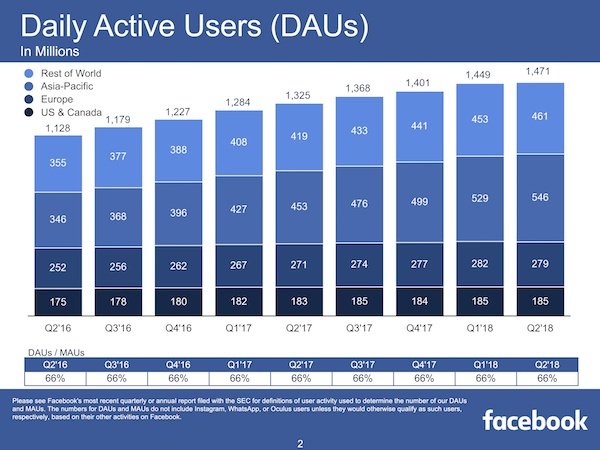
Global DAUs totaled roughly 1.5 billion in Q2, up 1.5% from Q1.
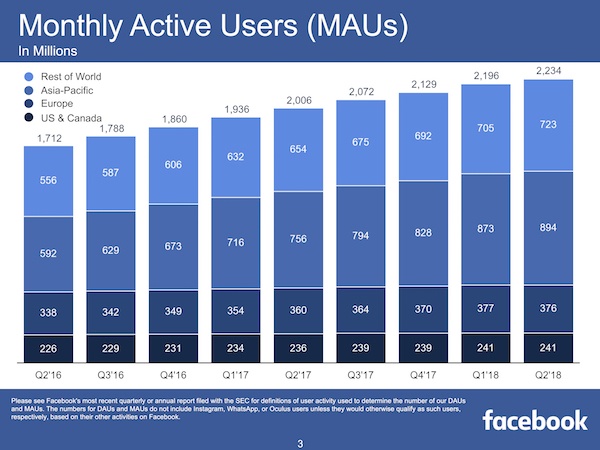
Global MAUs totaled roughly 2.2 billion in Q2, up 1.7% from Q1.
According to the earnings call itself, 2.5 billion people use at least one of Facebook’s apps (e.g., Instagram and WhatsApp).
A Closer Look at Active Users
While Facebook points to the year-over-year increase in both DAUs and MAUs — 11% for both — and the worldwide totals did see small increases between Q1 and Q2, it’s important to understand where that growth is coming from.
Source: Facebook
Growth in the U.S. and Canada has all but stopped, with no change between Q1 and Q2, which already showed signs of slowing in Q4 2017.
Active users also fell in Europe, which is likely due to the General Data Protection Regulation (GDPR), a new EU Regulation — which went into effect onMay 25 — which significantly enhances the protection of the personal data of EU citizens and increases the obligations on organizations who collect or process personal data.
DAUs declined in Europe, likely due to the implementation of GDPR. Facebook had warned about this. pic.twitter.com/8MX3aBqz8x
— Sarah Frier (@sarahfrier)
July 25, 2018
And while Facebook’s non-existent growth in the U.S. and Canada, to many, it comes as no surprise.
Facebook has warned of potential decreases time spent on the site, as well as a potential decrease in ad revenue — starting with a major change to its News Feed algorithm in January to emphasize content from friends and family, not brands.
re: facebook slowdown
if the company has warned for nine months that it is actively taking measures that reduce growth and curtail the spread of viral news, you cant be shocked that it will take a quarterly hit to user growth or revenue
— ಠ_ಠ (@MikeIsaac)
July 25, 2018
Changes to the News Feed algorithm were only one piece of the many changes Facebook has said it has made (and will make) to its platform. Many efforts have also been made to curb the spread of misinformation and preserve election security on its site, as well as those to provide greater transparency around ads and promoted content.
During the earnings call, Zuckerberg remarked that since Facebook is “investing so much in security, that it will ultimately impact profitability,” noting that “we’re starting to see [that] this quarter.”
However, he also implied that effect on the company’s profitability doesn’t necessarily see an impact on product innovation, adding that Facebook doesn’t just “plan for the next quarter.”
The Revenue
While Facebook did show an overall growth in revenue in Q2 — an increase of 10.5% from Q1 — it did still miss its estimates.
Company executives showed hints of preventing that from happening again with some comments made during the earnings call, such as Chief Financial Officer David Wehner’s prediction that the company’s overall revenue growth will slow within the next two quarters.
An analyst asked for clarification on this, and what’s causing the deceleration. CFO David Wehner says that “a combination of factors” is driving it, like giving users more choices around privacy, as well as investments in new products and initiatives that can slow revenue growth https://t.co/JS4FC00P35
— Amanda Zantal-Wiener (@Amanda_ZW)
July 25, 2018
Amid these warnings, Facebook’s after-hours stock price continued to drop throughout the call, dropping over 20% about 45 minutes into it.
Facebook, meanwhile, has been steadily diversifying its sources of ad revenue, including ads in Stories, as well as Messenger. The company also announced earlier this year that it would bring a commercial break option to creators on its Watch platform — the revenue for which Facebook is expected to take its own cut.
What Else Happened Before the Call
In the months preceding the Q2 earnings call, Facebook was hardly spared of turbulence. While the Cambridge Analytica revelations did take place in Q1, the majority of the fallout occurred in Q2 — including Zuckerberg’s testimony to lawmakers in both the U.S. and the European Union.
The company’s leadership has also seen significant changes, including the looming (and much-discussed) departure of its Chief Security Officer, Alex Stamos — an internal memo from whom was published by BuzzFeed News the day prior to the earnings call. That same day, General Counsel Colin Stretch announced that he would be leaving Facebook.
Prior to these events, in May, Facebook’s executive org chart saw a major shuffle.
The week before the earnings call, Zuckerberg also gave a controversial interview with Kara Swisher, where he was accused of defending groups like Holocaust deniers, who he called “a set of people who … get things wrong, even multiple times.”
Zuckerberg later defended and “clarified” his comments, but it may not have been enough. The morning of the earnings call, an open letter to the CEO was published in The Guardian by two people whose live have been upended by the company’s seeming protection of these “set[s] of people” — namely, those who call events like mass shootings as hoaxes.
These factors — combined with wariness around Facebook’s decelarating growth — caused “all of Facebook’s gains this year” to essentially become erased in after hours trading,” according to Max A. Cherney of MarketWatch.
And as Frier pointed out toward the end of the call, Facebook had never before experienced such a fall in its stock price as a result of an earnings report — adding that if the drop lasted through the market opening the following day, it would “be the biggest post-earnings decline ever.”
What the lasting impact of this loss and this particular report will be remains to be seen — though Facebook’s executives continued to emphasize its successes and its investment in further innovations, paying particular attention to such video initiatives as Watch and IGTV.
There’s also Facebook’s growth in other geographical areas (beyond Europe, the U.S., and Canada) to consider, which was emphasized by executives, as well. Prior to the call, Hannah Kuchler of Financial Times pointed to this potential dichotomy, again bringing attention to the company’s growing number of advertising channels.
But if ad prices are rising and it can put ads in more places (stories, messenger, as well as instagram): does north american user growth really matter? https://t.co/VJv0k4Oatn
— Hannah Kuchler (@hannahkuchler)
July 25, 2018
In other words — Facebook can rebound, especially considering its aforementioned, relatively strong performance following some of the biggest crises its experienced in the company’s history.
As Recode‘s Kurt Wagner pointed out the morning of the earnings call, “there are two simple, measurable ways that Facebook could have been punished for all of its stumbles these past 18 months,” which essentially amounted to either advertisers or users taking their business (and time spent) elsewhere.
And while a 23% drop in the stock price after hours could be considered a punishment by some — and time spent did show signs of a drop, such as the slowed user growth in thee U.S. in Canada — there are still markets where Facebook hasn’t quite reached market saturation.
“The core network can reach saturation in markets like the U.S. but it can still grow in emerging markets, which is why the company has invested in internet access in developing countries,” says HubSpot CMO Kipp Bodnar, alluding to such initiatives as Facebook’s work on its own internet satellites.
“Between the growth of developing countries and the expansion and growth of other properties like Instagram, What’s App and Messenger,” Bodnar continues, “Facebook can continue to grow revenue.”
But where there is still room for growth, some, like HubSpot VP of Marketing Jon Dick, say there there is an equal risk for audience fatigue, as well as considerations of Facebook’s long-term sustainability as an advertising platform.
“Showing more ads to the same people,” he says, “is a recipe for quickly having fewer people to show those ads to.”

Unriddled: More Controversy for Facebook, Fines for Google, and More Tech News You Need
Welcome, one and all, to another Wednesday: the day that marks the halfway point — almost — to the weekend.
Here in our Cambridge HQ, the days are slowly starting to get shorter. So as we hold onto to these summer days and nights — and know that, perhaps, you are, too — we’ll try to unriddle this week’s tech news in double-time.
It’s our Wednesday tech news roundup, and we’re breaking it down.
Unriddled: The Tech News You Need
1. A Busy Week for Facebook
Facebook’s name has been in the news quite a bit over the past few days, from controversial interviews from its CEO, to new controversies around its content moderation practices.
Facebook in China
Facebook — particularly its CEO, Mark Zuckerberg — has made no secret of its wishes to have a presence in China. And while the site and most of its related apps are still prohibited there, the company created a Chinese subsidiary, Facebook Technology (Hang Zhou) Ltd., earlier in July.
A spokesperson for Facebook said the company’s presence in China will be an “innovation hub” in Zhejiang, where “efforts would be focused on training and workshops that help these developers and entrepreneurs to innovate and grow.” Gerrit De Vynck of Bloomberg has more. Read full story >>
Zuckerberg Speaks — Then Backpedals
Last week, Zuckerberg sat down with Kara Swisher for an interview on Recode Decode. And while 90 minutes wasn’t enough to cover everything, Swisher did ask about topics ranging from the spread of disinformation on the platform to content moderation policies (e.g., why some Pages still haven’t been removed).
After the interview was made public, Zuckerberg went on to say that some of his comments about those who “get things wrong, even multiple times” — such as the “set of people who deny that the Holocaust happened” — were misinterpreted as being made in defense of that very set of people. Read full interview >>
Speaking of Content Moderation
During last week’s Congressional testimony on the “filtering practices” of social media networks, Facebook VP of Global Policy Management Monika Bickert seemed to struggle to define what the platform constitutes as “fake news” — and address questions on how content is moderated on the site.
While Bickert did allude to the company’s fact-checking practices and the “threshold” used to determine how Pages and Groups are penalized, answers to certain questions on why certain “repeat offender” publishers were still allowed to post on the network led mostly to more confusion.
That was followed by a Channel 4 undercover report that content moderators are sometimes instructed to take a “hands-off” approach to “flagged and reported content like graphic violence, hate speech, and racist and other bigoted rhetoric from far-right groups.”
Since then, however, Motherboard obtained leaked internal documents on when to ban Pages or Groups for content in violation of Facebook’s community standards, like hate speech. The problem: There is no unified view of what constitutes hate speech. Read full story >>
What Facebook Says It’s Working On
Meanwhile, Facebook says it will continue its efforts to stop the spread of misinformation on its site and its many portfolio apps — including WhatsApp, where the company says it will limit the ability to forward messages in hopes of spreading such false news as that which prompted serious violence in India and Myanmar. Read full story >>
Similar policies and practices are coming to the core Facebook platform itself, where The New York Times reports the company will start removing what product manager Tessa Lyons says is a specific “type of misinformation that is shared in certain countries that can incite underlying tensions and lead to physical harm offline.” Read full story >>
2. Fines for Google
The European Union will fine Google €4.3B — roughly $5 billion — in an antitrust case that the European Commission has based on alleged abuses by the company for “Android market dominance.” These include the Google’s forced inclusion (e.g., for phone manufacturers) of its own search engine and apps like the Chrome browser into the Android operating system — which Google has 90 days to stop doing.
Google CEO Sundar Pichai later released a statement defending the company’s practices around its operating system, saying that it “has expanded the choice of phones available around the world.” Read full story >>
3. Scooters Are Absent From the Streets of San Francisco
Following the passage of San Francisco city laws (effective June 4) that bars scooter companies from operating without a permit, applications from 12 companies seeking to provide these services (including Uber, Lime, and Bird) are still under review by the San Francisco Municipal Transportation Agency (SFMTA).
While the goal was originally to approve five companies by July, Megan Rose Dickey of TechCrunch says that this prolonged review process indicates that scooter operations may not resume before August. Read full story >>
4. Lyft Steps Up Its Background Checks
Last week, we reported that Uber is reinforcing its efforts around safety, and Axios stated that it will conduct ongoing background checks on drivers, rather than performing them on a one-time occasion.
Now, it appears that one the company’s chief rivals, Lyft, is following in its footsteps, and exploring how to strengthen its background checks after revelations that a driver with a serial violent criminal record managed to bypass the system. The news comes among revelations of a St. Louis Uber driver publishing videos of passengers online — who had no idea they were being filmed. Carolyn Said of the San Francisco Chronicle has more. Read full story >>
5. Presenting: the Data Transfer Project
Late last week, Google, Facebook, Microsoft, and Twitter announced a joint effort on the Data Transfer Project: a new “standards initiative” that’s meant to make it easier for users to move their personal data between platforms.
The ability for users to seamlessly take their personal data from, for instance, Facebook — which calls the project a “commit[ment] to building a common way for people to transfer data into and out of online services”– has been scrutinized by many, including those who point out that the company owns most of the companies its own CEO identifies as competitors. Russell Brandom of The Verge has more. Read full story >>
6. 47% of Social Media Users Report Seeing More Spam in Their Feeds
Even as networks fight the spread of spam and misinformation, our research shows that nearly half of social media users report seeing more of it. The findings raise the question: While social networks have made no secret of their efforts to fight the spread of spam on their sites, how have these efforts been paying off — and are users noticing them? Read full story >>
That’s all for today. Until next week, feel free to weigh in on Twitter to ask us your tech news questions, or to let us know what kind of events and topics you’d like us to cover.

7 Ways IoT Is Changing Retail in 2018
You walk into a store in search of new sunglasses.
As you enter, your smartphone pings, and you open it to find a map, showing you where the sunglasses you looked at online are on display in-store. You walk over to them, try them on, and put them in your bag. A robot rolls up to you and intercepts, asking if you need help finding anything else. The robot takes you to a jeans display, as you’ve requested, and finds your size.
When you’re done shopping, you leave the store immediately. Your items are scanned by sensors as you leave and added up — the final price is then deduced from your mobile payment app. Since you’ve shopped there recently, you receive an automatic discount.
The shelf where you picked up the jeans, meanwhile, takes note of the purchase and sends that information to a back-end inventory system, so the retail store’s manager knows to re-stock.
Sound a little too much like Smart House? Maybe, but this experience is closer than you think, thanks to the rise of IoT, or Internet of Things, which creates a network between internet-connected physical devices. In the next few years, physical devices capable of being connected to the internet will continue to rise — in fact, by 2020, it’s estimated there will be over 30 billion IoT devices.
The scenario above is explained from a customer’s perspective, but it’s important to take note of just how deeply IoT can affect retail store owners and employees. McKinsey estimates that the potential economic impact of IoT in retail environments will range from $410 billion to $1.2 trillion per year by 2025.
IoT can reduce inventory error, optimize your supply chain management, and decrease labor costs. Ultimately, IoT can help your traditional brick-and-mortar shop compete with today’s online-first shopping world, by exponentially improving customer experience and decreasing unnecessary expenses.
There are numerous IoT-related benefits to the retail industry, but here, we’ll hone in on the seven most important ways we think IoT will change retail in 2018.
IoT Applications in Retail
1. Automated Checkout
You’ve probably seen how long lines deter your customers from purchasing products. And, as a manager, it can feel unprofitable to pay multiple employees to work during busier shopping times. With IoT, you can set up a system to read tags on each item when a customer leaves the store. A checkout system would then tally the items up and automatically deduce that cost from the customers’ mobile payment app.
Creating an automated checkout system using IoT devices would make your customers happier and more willing to enter your store, especially if they are on a time crunch. It can also save you a ton of money — McKinsey estimates automated checkout can reduce cashier staff requirements by up to 75%, resulting in savings of $150 billion to $380 billion a year in 2025.
 Image courtesy of The Guardian
2. Personalized Discounts
If you have frequently returning customers, I bet you’d like to reward them for their loyalty. With IoT, you can set up sensors around the store that send loyalty discounts to certain customers when they stand near products with their smartphones, if those customers sign up for a loyalty program in advance.
Additionally, you can use IoT to track items a customer has been looking at online, and send that customer a personalized discount when she’s in-store. Imagine if your customer perused your purses online, and then, in-store, received a discount on her favorite purse? Rather than offering general discounts on a wide variety of products, you can tailor each discount using IoT to maximize your conversion rates.
Ultimately, finding ways to incorporate IoT devices into your day-to-day business requires creativity and foresight, but the benefits of IoT in retail — as outlined above — can help your business discover innovative solutions to attract more valuable and loyal long-term customers.
3. Beacons
Beacons, first introduced by Apple in 2013, are small Bluetooth devices that send alerts to smartphones based on location proximity. In the retail industry, this means customers can receive discounts, special events, or other reminders when they’re near a shop and have previously downloaded the store’s app.
Macy’s has been using beacons nationwide since 2014. After opening the Macy’s app in-store, shoppers are alerted to promotions and discounts. The app also recognizes which area of the store you’re in — so if you’ve entered the makeup section, the app will remind you of the makeup brands you liked online.
Along with helping customers in-store, beacons also send alerts to passersby. This can be used to effectively advertise promotions or in-store events. Swirl Networks Inc. found over 70% of shoppers say beacon-triggered content and offers increased their likelihood to purchase in-store.
Besides Macy’s, stores including Urban Outfitters, CVS, Lord & Taylor, and Timberland already use beacon technology.
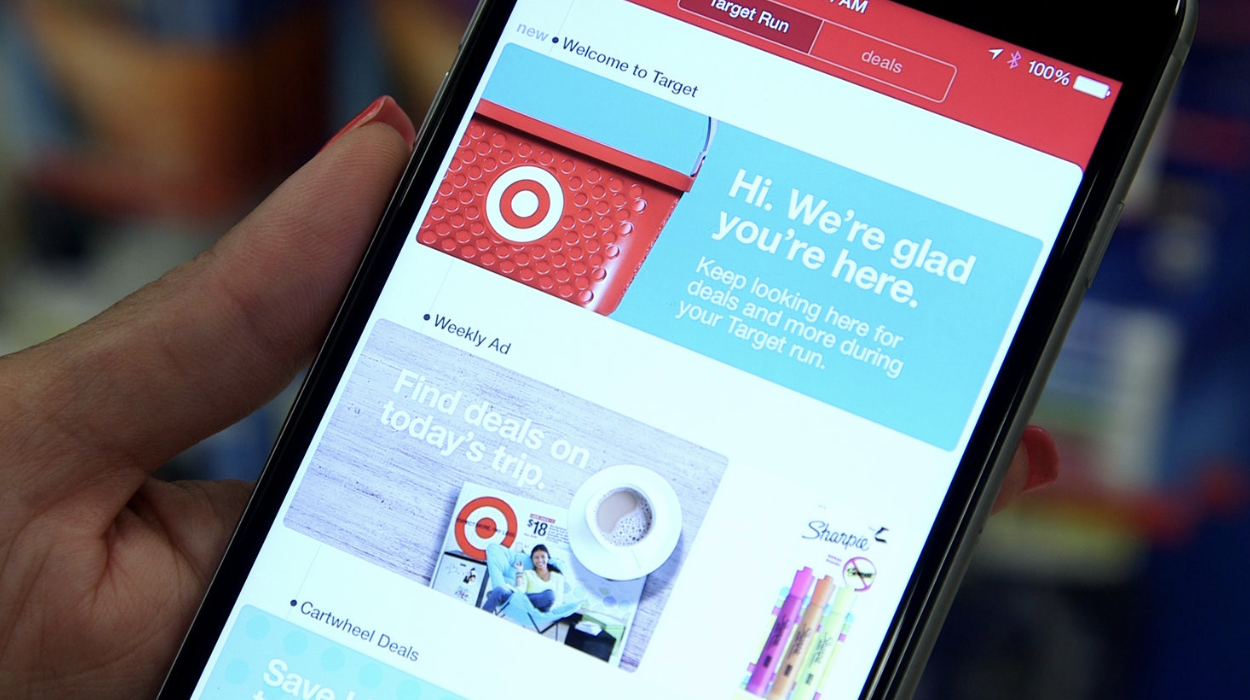 Image courtesy of Beaconstac
4. Smart Shelves
A lot of your employees’ time and energy is focused on keeping track of items to ensure they’re never out-of-stock, and checking that items aren’t misplaced on various shelves. You can use Smart Shelves to automate both of those tasks, while simultaneously detecting potential theft.
Smart shelves are fitted with weight sensors and use RFID tags and readers to scan the products on both display and stock shelves. Smart Shelves inform you when items are running low or when items are incorrectly placed on a shelf, which makes your inventory process cost-effective and more precise. Additionally, each RFID tag is connected to a reader, so Smart Shelves are able to detect in-store theft — saving you money on security personnel and cameras.

5. In-store Layout Optimization
You might be surprised to find your retail space isn’t optimized for your customers’ behavior — maybe your least popular products are in the front, or your customers’ would prefer more space around the couches in the back. By employing aisle-analytics software with infrared sensors, you can use IoT technology to improve your retail layout.
Perhaps you find most of your customers spend the majority of their time checking out your TV’s — but those TV’s are placed in the back of the store, behind rarely-touched DVD players. This information arms you with important customer behavior knowledge, so you can place items they care about most, like TV’s, in the front of your store.
6. Robot Employees
While it’s a little frightening to trust a robot to be your customer service representative, it’s also a fantastic opportunity to cut down on menial tasks burdening your workforce.
OSHbot, Lowe’s newest robot employee, helps customers find specific products and provides information on promotions and inventory — plus, he’s (she’s?) bilingual and can answer both English and Spanish questions.
Other retail stores, such as Target, use robots to roam the store and take note of misplaced items, or products running out of stock. By taking over simple inventory tasks, Target’s robot frees up Target’s human employees to focus on providing top-notch customer assistance.

7. Optimizing Supply Chain Management
While retail stores can already track products without the help of IoT, that tracking information is pretty limited. With RFID and GPS sensors, you can use IoT to obtain more precise data, like the temperature at which an item is being stored, or how long it spent in transit. You can use that data to improve the quality of transportation moving forward — and, better yet, you can also act in real-time if a product is being kept at temperatures too low or too high, avoiding a substantial loss.
According to a TATA Consultancy Survey and Business Insider, manufacturers utilizing IoT solutions in 2014 saw an average 28.5% increase in revenues between 2013 and 2014. If you’ve got a long line of suppliers, truck drivers, and vendors handling your products, it’s imperative for you to accurately keep track of how your product is handled and where it’s located in the supply chain. This information helps you ensure your process is running as efficiently as possible, and can helpyou get your product into your customers’ hands faster.
