Should You Let a Bot Write Your Content?
Everyone thinks they can write. Even, it would seem, robots.
But do these automated writers really have the ability to produce content to rival the work produced by those of us who write for a living? Should we see them as a threat?
Likewise, whether you are a brand manager within retail, travel, finance or any other industry, will this affect you and what, if anything, do you need to be thinking about now? Could you actually consider using robots instead of humans to get your content written?
Well, it’s time to see what they’ve got to offer as, in what is believed to be a world-first for journalism, robot-generated stories have been produced by The Press Association.
The automated press service set up by PA — RADAR — is currently trialling computer-generated-data-driven content, funded by a grant from Google’s Digital News Initiative.
The plan: to create 30,000 localised stories a month from data using Natural Language Generation software.
At the end of November 2017 a pilot, involving 35 regional titles from 14 publishing groups including Archant, Independent News and Media and Johnston Press, resulted in multiple versions of four stories being distributed. These have since appeared in weekly and daily titles both online and in print.
What This Means for The Press Association
In its own words: “Press Association was conceived as a London-based news gathering service for the provincial papers … we are trusted because we are fast, fair and accurate. Today, much of the content people read, see or hear continues to originate from PA.”
Ultimately, it gathers data and facts that are then sent out to journalists who should source quotes and localize this information, turning the bare bones into a story suitable for their individual publication. So, in the case of computer-generated stories, this could offer an effective way of the Press Association sending out a lot of information very quickly.
It is important to note here that reporters are still at the core — merely using the information they receive as the starting point for stories.
So, the real question is, could a robot ever be trained to write the full piece? And, will they be replacing humans at news desks up and down the country?
The short answer is no.
More often than not, we want much more from an article than just the who, what, where, when and how — it must also take us to the emotion that lies beyond the fact. You don’t, for example, just want to know that a school excelled in its A-level results this year, you want to hear from the child who beat the odds to get top marks and is now set to attend Cambridge University.
This human element is key and it is why we can’t underestimate the importance of having a human write the content. There is a certain skill to writing – particularly copy that needs to be entertaining, engaging or persuasive – that goes well beyond typing words on to a page. To put it bluntly, solely data driven content is dull. It lacks the emotion and context that us writers could – and should – inject into a story.
We Still Need Human Writers
Recently, a new chapter was written for the Harry Potter series titled: Harry Potter and the Portrait of what Looked Like a Large Pile of Ash. But this was not fan fiction, nor was it written by J.K Rowling herself — it was actually typed up by a predictive keyboard.
After feeding seven books through the computer, lines such as, “He saw Harry and immediately began to eat Hermione’s family”, and “‘Not so handsome now’, thought Harry as he dipped Hermione in hot sauce,” were produced.
The fact that your content needs to make sense goes without saying … but not when it comes to robots it seems.
This isn’t the only thing to consider, however.
Injecting Humor
If you get it right, you will reap the rewards from humorous content. People like to be entertained — and will share and interact with your content if they feel they have been entertained. But can a robot be funny?
During his time as New Yorker’s cartoonist, Bob Mankoff developed an interest in the creative potential of artificial intelligence. After launching the cartoon caption contest and receiving up to 10,000 entries a week he attempted – along with Microsoft and Google’s DeepMind — to develop an algorithm that could distinguish between those that were funny and those that weren’t. However, he eventually declared it a ‘dead end’.
Yet he did form Botnik studios and created the tool used to create the Harry Potter chapter. This tool takes the essence of a publication or topic – such as David Attenborough’s Blue Planet – to create something ‘completely absurd’.
A tool which, although fun to play around with, won’t create content worthy of placing on your website in a hurry.
Being Aware of the Details
No matter how clever they seem and how much they can already do that you probably would never have expected, you can’t train a robot to have news sense. Take the example of this news story created by a robot for PA: ‘Most babies are born to married parents in Bournemouth, figures reveal’.
In this data-heavy article, the robot wouldn’t know if the maternity ward was due to be closed, for example. It’s often extra information such as this which adds an important angle to the story, making it more newsworthy.
Data can organize information, but journalists turn it into a story.
Recognizing Context and Emotion
The words shouldn’t only tell us the facts, they should bring a story to life and tap into our emotions.
Take the different approaches to this sports story, for example.
The robot version begins: Marcus Paige scored with nine seconds remaining in the game to give North Carolina a 72-71 lead over Louisville.
While the human version, written for ESPN, opens: Marcus Paige ignored the pain in his twice-injured right foot, put his head down and drove toward the rim.
This storytelling element is something the computer can’t imitate.
Capturing Thoughts and Feelings
The above sports story also included the quote from Paige: “I said jokingly to my teammates that I was back.” An understanding of natural language is and will continue to be a very big challenge for artificial intelligence.
We want to know people’s thought and feelings on the facts and stats. A robot can’t yet conduct a natural interview and filter out the answers to be used as a key quote. It’s often in these quotes where the emotion of an article comes across.
Don’t Rely on Robot Writers Just Yet
Emotion, context, news sense and humor should all feed into a compelling content calendar for brands too. You need to appreciate what your readers like, what matters to them, how best to talk to them and how to entertain them.
There is a lot that happens at Zazzle before we write any words on a page. This includes:
- Discovering the target audience of a brand and then creating personas
- Keyword research to make sure we are targeting the relevant terms
- Ensuring content we plan to create is relevant and there is a variety of it.
- Understanding (and sometimes creating) the tone of voice
Once all this is done we will start to write. But, unlike a robot, we will be able to keep all of the above in mind while making sure that we write content that other humans want to read. Writing involves analyzing and interpreting this information to deliver a message effectively.
As Mankoff said: “Machines in the end are idiots, or maybe idiot savants, that need humans to create content that’s going to be interesting to human beings.”

How to Figure Out the Next Step in Your Career [Quiz]
“Where do you see yourself in five years?”
Of all the job interview questions out there, this has always been one of the most difficult.
These days, however, the next steps in your career aren’t always linear. The age-old corporate ladder model of putting in a few years as an associate contributor, becoming a manager of a small team, and climbing your way to the senior management or director level is not right for everyone.
To help you plan confidently for your next five years, HubSpot has launched a brand new career assessment called The Next Five. Tell us your interests, strengths, and working style, and we’ll help you identify a next step that’s right for your long-term professional goals.
Here are a few steps to this career quiz and some initial questions to ask yourself when deciding where to go in your career:

5 Basic Steps of This Career Quiz
1. Your Work Environment
What do you do for a living? How much experience do you have, and how many coworkers do you work with? This is important context around the challenges you might be expriencing.
2. Your Work Challenges
In short, how’s it been going there? You won’t know where to go in your career unless it’s clear what your current challenges are and how you go about solving them.
3. Your Happiness Level
Are you happy where you are? With what you’re doing? It’s important to occasionally check how you feel — you might be getting in your own way when trying to regain your comfort with the job.
4. Your Skills
Do you want to be a manager, but struggle to hone your mentorship skills? How are you at public speaking? Perhaps too much supervision is a challenge you face. These are just some of the critical metrics for what you’d excel in when making a professional move.
5. Your Goals
What are you currently working toward, and what will indicate that you’ve reached them?
The Next Five is not your average test. With your result, we’ll include a detailed plan that encourages you to rethink the idea of a career path. Each tip is paired with customized articles, ebooks, videos, and more that will help you score visibility for your work and bring value to your company.
Career development is complicated, and a lack of open dialogue around the personalization of career planning can make it worse. If you’re unsure how to bridge the leadership gap between your current role and becoming a manager, the quiz below is the perfect exercise.
No five-year plan? No problem. With The Next Five career growth assessment, discovering your next step has never been easier.

The Surprising Relationship Between Stress and Creativity
Thomas Edison grossed 1,093 patents over the course of his career. He was also reportedly fired from his first two jobs for not being productive. Huh?
Popular opinion might say that’s because creativity needs both stimulation and room to breathe. These workplaces were likely either uninteresting or too stressful, preventing Edison from flapping his inventive wings toward the problems he wanted to solve.
But this might not be the case. As it turns out, stress and creativity aren’t always mutually exclusive. The stressed, many-hats-wearing employee could actually be the most innovative one in the office.
What is the relationship between stress and creativity?
The relationship between stress and creativity is not a toxic one. In fact, small doses of stress — like juggling multiple projects or working under a tight deadline — are likely to produce the best ideas because they motivate your brain to work toward specific goals.
Here are three different kinds of stress, their connection to creativity, and how your career could be on the verge of the most inventive work you’ve ever done with just the right type and amount of stress.
1. The ‘Task-Switching’ Stress
In a recent behavioral study conducted by Columbia Business School, researchers had participants engage in creative brainstorming for multiple projects while using one of three work styles. Some could change projects whenever they wished, others split their focus in half, and a third group continuously shifted to a different project at a set interval.
And the most original team was …
Group three! So-called “task-switching,” although much faster-paced, shakes up the thought process before it hits a wall — and it often does. Mine did in this very blog post.
“When attempting problems that require creativity, we often reach a dead end without realizing it,” the study’s authors explain in Harvard Business Review. “Regularly switching back and forth between two tasks at a set interval can reset your thinking, enabling you to approach each task from fresh angles.”
Frequently changing gears forces you to change your view of each task as you revisit it. This style of working fosters more creativity and avoids the “rigid thinking” that occurs when you focus for too long on the same project. You know what this feels like: the mental block from writing, designing, analyzing, or thinking about one thing so hard, you exhaust the subject.
Changing the subject refreshes your view of each undertaking, curing this classic problem. In other words, Thomas Edison’s creativity likely has a direct correlation to the size of his patent list …
Where You’d Find It
Graphic design and video production — especially in agency settings — are volume-dependent work. An awesome YouTube channel needs a consistent stream of content. But you’re only as awesome as your bandwidth allows, right?
Wrong. Task-switching says a diverse workload can make you more efficient and effective. Think about it: The more creative assignments you have on your plate, the broader your mental canvas, and the more opportunities you’ll have for inspiration as you shift back and forth between each design or video you’re working on.
2. The ‘Meaningful’ Stress
Recently, two Chinese psychologists published a study about job stressors and their effect on the creativity of more than 280 employees in various businesses. What they found is that not all stress hampered good ideas. The stressors that were seen as constructive and challenging to an employee’s goals and development had a direct link to idea generation.
On the other hand, the stress that was seen as as a hindrance to those goals did the opposite.
What made the difference? The first stressor holds meaning to an employee, and it’s another way stress can make us more creative.
Teresa Amabile, professor at Harvard Business School, explains this idea in her book “The Progress Principle.” She suggests there are four stress conditions where you’d feel the heat:
- “On a treadmill”: Your work is high-pressure but low in meaning.
- “On autopilot”: Your work is low-pressure and low in meaning.
- “On an expedition”: Your work is low-pressure but high in meaning.
- “On a mission”: Your work is high-pressure and high in meaning.
Here’s a matrix of this concept by marketing consultant Kim Tasso:

Image via Red Star Kim
Both “on a treadmill” and “on autopilot” are highly repetitive work environments and therefore less engaging — requiring little creativity. However, “on an expedition” and “on a mission” are more goal-oriented and more meaningful to you as a result. That meaning is precisely what kindles creativity, according to Amabile.
When people reach goals they consider meaningful, Amabile writes in her book, they “feel good, grow their positive self-efficacy,” and “get even more revved up to tackle the next job.”
The relationship between stress and creativity here depends on how you perceive the stress you’re under at any given time. Is it connected to a goal you find meaningful? Does it push you to accomplish this goal? If so, that little dose of stress may be helping you think outside the box and grow your career.
Where You’d Find It
Marketers are no strangers to work that has a specific endgame. SEO strategy, social media management, and conversion optimization are some of the most rewarding projects to take on because they’re usually attached to a meaningful, quantitative goal.
Having goal metrics chained to your ankle may not be the most comfortable, but they’re a positive form of stress that can actually inspire some of the most creative problem-solving approaches over the course of your career.
3. The ‘Deadline’ Stress
Perhaps the most common work stressor of all, time constraints are the plague of everyone who’s paid to do anything. But as the above two scenarios prove, certain amounts of pressure are important to keeping a creative task moving forward.
For this third stressor, let’s look at a case study by Amabile detailed in “The Progress Principle,” wherein she surveyed creative teams from seven companies across three industries. She found that although tight deadlines did hinder creativity, so did mild deadlines. Spoiler alert: The third situation — moderate deadlines — produced the best ideas.
The first situation carried a tight deadline where people were performing high-pressure, low-meaning “treadmill” work. These employees’ efforts simply weren’t making an impact, and therefore they didn’t see enough meaning in the work to think creatively. They faced crises, ad-hoc tasks, and the proverbial fire drills that kept them busy but no closer to finishing their core project.
Mild deadlines were the detriment of creative thinking as well, particularly if they allowed people to fade into large project teams, trail off to assist others, or stew for too long over the same assignment (remember “task-switching”?).
This brings us to Amabile’s main finding: Workers who were under a low to moderate deadline — the middle option between “tight” and “mild” — showed the most creativity across each organization, followed by those under tight deadlines. The stress of a due date may not be exciting, but a time-sensitive environment can give your work the focus it deserves and help you fend off the distractions that can derail an inspired train of thought.
“If people and companies feel that they have a real deadline, they understand it, they buy into it,” Amabile wrote in a Forbes article. “They understand the importance of what they’re doing, and the importance of doing it fast — and if they’re protected … so they can focus, they’re much more likely to be creative.”
Where You’d Find It
Few marketers know the plight of a deadline quite like content creators, but you already know what I’m going to say here: Bloggers need deadlines. One crazy tight deadline may result in lower quality, but the weekly or monthly quotas you have to meet are what keep you honest and your content focused on the needs of its audience.
Don’t let an article that welcomes stress, well, stress you out. The relationship between stress and creativity is a complex one, and any one of these stressors in excess can ruin creativity. Too much pressure, too many tasks at once, and assignments with too short of a turnaround can all cripple the final product. Keep in mind that breaks as you need them are just as healthy as the constraints of the project itself.

Which Technologies Do Your Customers Actually Want to Use in 2018? [Infographic]
When it comes to emerging technology, there’s a lot to keep up with.
There’s virtual reality. Then, there’s augmented reality. But wait! There’s more — like mixed reality.
And to think, we haven’t even gotten to artificial intelligence and cryptocurrency yet.
As marketers, it’s our job to examine these technologies in a way that determines how much we need to use them strategically — and how they can benefit, or get the attention of our audiences.
The question, then, is this: Which emerging technologies should we prioritize?
Luckily, Code Computerlove partnered with OnePoll to answer that very question, and conducted some research to find out how consumers really feel how emerging technology trends in 2018.
Even better: Their findings, so very conveniently, have been compiled into the intriguing infographic below.


YouTube Will Start Labeling State-Funded News Content, but There’s a Big Problem
Last Friday, YouTube announced it would be work to further curb the spread of propaganda on its channel — this time, by adding a designated label to state-funded content.
As part of YouTube’s overall work toward greater transparency into the content shared on its site, videos uploaded by news creators that receive any degree of public or government funding will be labeled as such.
The label will appear below the video itself, and above its title broadcasters, as per the example below:

Source: YouTube
The news came via a blog post penned by YouTube News Senior Product Manager Geoff Samek, who explained the efforts are part of those to “get [news] right” on its platform, “helping to grow news and support news publishers on YouTube in a responsible way.”
It’s a move — much like other YouTube changes we’ve reported on in recent months — likely in response to scrutiny received for its role in the 2016 U.S. presidential election.
YouTube was largely blamed for allowing the spread of political propaganda on its site — not only allowing polarizing content from RT (a Russian-government-backed news outlet) to go unflagged, but also allegedly spending significant time growing its presence through the platform.


Source: Office of the Director of National Intelligence
But there’s a problem. Not all “state-funded” media is created equal.
With this new labeling system, publicly-funded news outlets like the U.S.-based PBS (Public Broadcasting Service) — which has aired famed shows including “Sesame Street” and “Frontline,” as well as exclusively syndicating British programs like “Downton Abbey” — will receive the same classification as the likes of the RT.
In other words: The same rules apply to two very different content creators receiving different levels of public funding. PBS will be labeled as a “publicly-funded American broadcaster,” and RT as “funded in whole or in part by the Russian government.”
And while those labels do provide some distinction, it still muddies YouTube’s news broadcasting waters. As opposed to serving as a government-sponsored media outlet like the RT, for instance, PBS runs according to funding rules designed to “ensure the complete editorial independence of producers from influence by underwriters.”
And while PBS does receive a small amount of government funding — which has faced recent threats of elimination — it is not federally-run.
That leads to fears of confusion among viewers who might not be familiar with such news broadcasters as PBS, and the unintentional alignment of it with propaganda content.
“PBS is an independent, private, not-for-profit corporation, not a state broadcaster,” said PBS in a statement. “YouTube’s proposed labeling could wrongly imply that the government has influence over PBS content, which is prohibited by statute.”
While YouTube itself has acknowledged it doesn’t “expect it to be perfect,” the presence of a glaring flaw before the feature is rolled out is one that many find less than encouraging.
On one hand, says HubSpot Brand Marketing Associate Henry Franco, “It seems like another step in the right direction in terms of verifying content, as platforms like YouTube seek to redeem their credibility.”
But at the same time, Franco explains, the lack of verification might not even be the issue. “The real problem isn’t that brands are good at deceiving. It’s that viewers don’t do the work in identifying what is or is not factual.”
“It all boils down to psychology,” he continues. “People tend to believe what aligns with their existing values.”
I’ll be keeping an eye on this feature as it rolls out. As always, feel free to weigh in with thoughts or questions on Twitter.

Here’s How Featured Snippets Work, According to Google
Friends, I have a confession to make.
There are moments when I obsess over Google’s algorithm in the same way that certain movie characters might obsess about their exes.
I mean, we all do, right? After all, just look at how much my colleagues and I discussed it right here on the Marketing Blog. Here’s what Google did this month. Here’s what Google’s doing next. Here’s how search is changing. Here’s how it works.
And now, Google itself has decided to carry its own torch on that last part — how it works.
Most recently, Danny Sullivan, Google’s public liaison for search, published a comprehensive blog post on the search engine’s featured snippets: the concise responses to search queries that appear above general results.
The post dives into what a featured snippet might look like depending on how a search was conducted (like voice or mobile), or what information is being requested.
Sullivan also acknowledged where Google has gone wrong with featured snippets, and how it plans to approach them moving forward.
Naturally, my team had our own take.
What Is Google’s Featured Snippet?
A featured snippet is a concise response to a Google search query. It’s displayed on top of the general results, and also includes the page’s publication date, title, and URL.
Featured snippets drive traffic — but not always.
When featured snippets first began appearing in Google search results in January 2014, it immediately caused chatter among marketers and SEOs alike. And as Sullivan acknowledged in his blog post, many were concerned that traffic would drop — as a result, for example, of users finding the information they needed right away from the featured snippets, therefore not clicking to visit any sites.
Then, there was the issue of how this would change the concept of “position one” on the search results page (SERP) — would anything below the featured snippet even matter anymore?
And as Sullivan noted, Google found that the featured snippets did, in fact, drive traffic — to the sources of information within them. Position one, it turned out, might become obsolete after all.
Simply put, “you don’t get as much organic traffic from being in position one when there’s a snipped above your search result,” says HubSpot’s SEO Associate Marketing Manager Padraig O’Connor. “They take clicks away from the search results beneath them, which is why businesses can’t afford to not optimize their content for featured snippets.”
Back in December, we wrote about our own research on just how much featured snippets eat into blog traffic. Consider that on SERPs with no featured snippet, we found that the first result can expect to bring in about 33% of the total clicks. The second result accounts for 18%, and the rest, 11% or under.
But when the SERP does feature a snippet, we found that it does receive a high ratio of clicks — about 50%, versus the 33% received by the position one result on SERPs without one. That means that when there’s a featured snippet, it decreases clicks on the remaining results below it to the point that some of the top 10 become nearly obsolete.
But the featured snippet doesn’t always drive clicks. Remember that Google itself noted predictions that once users saw the information they were seeking in the featured snippet, they might exit and move on. According to O’Connor, those predictions were accurate.
“Sometimes people find the answer they wanted from the snippet and don’t click any result. We know this from experiments our SEO team ran here at HubSpot,” he explains, noting a test in which we found that our post on Facebook cover photo tips appeared as the featured snippet in results for the query, “Facebook cover photo dimensions” — but didn’t drive clicks.
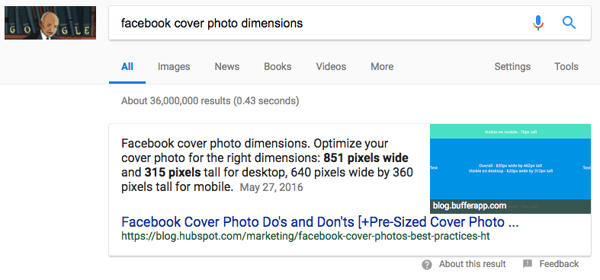
“As a result,” O’Connor says, “it’s important for marketers to add a ‘hook’ in their featured snippets that makes people want to click through.”
Google doesn’t always get the featured snippet right — which makes it even more important.
The introduction of featured snippets, like many of the other ways Google has changed its algorithm, was meant to solve for the user.
“We believe this format will help people more easily discover what they’re seeking,” Sullivan wrote in his blog post, “both from the description and when they click on the link to read the page itself.”
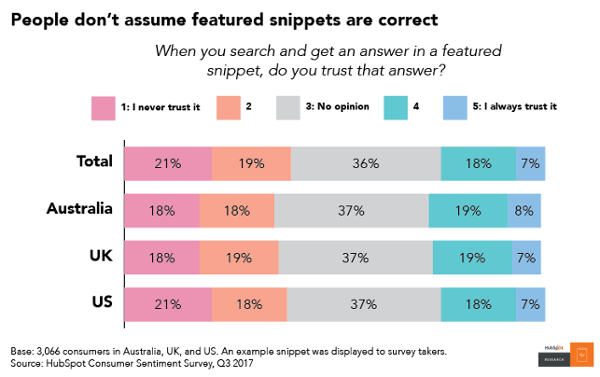
And while that path was seemingly paved with good intentions — Google didn’t always get it right. In fact, our research found that only 7% of people actually trust featured snippets — and that 21% never trust them.
My own, lighthearted research supported these findings, like when I searched for, “Why are dogs the best?”
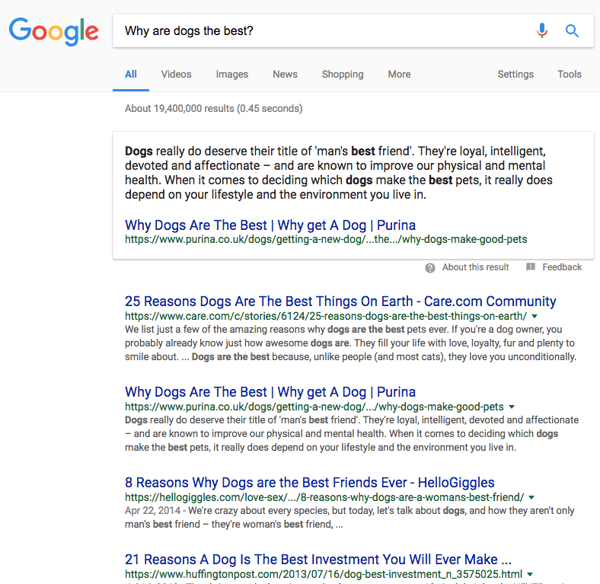
While the featured snippet gives me some nice information about the history of dogs becoming domestication, it doesn’t really tell me anything about what, specifically, makes them such great little creatures.
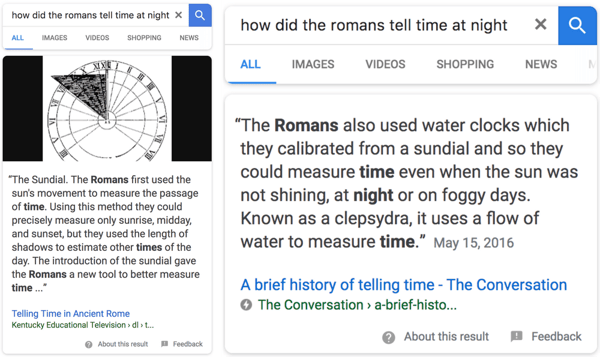
Four-legged friends aside, Sullivan admitted that Google itself has realized some of its less-than-accurate featured snippet results, using the query “how did the Romans tell time at night” as an example.
Source: Google
Notice that the query specifically asks how this works at night — when a sundial, which is the method indicated in the featured snippet on the left above, “would be useless,” as Sullivan put it.
But Google is investing efforts into optimizing featured snippets results to reflect accurate information that better aligns with the user’s full query, which is illustrated by the newer (correct) featured snippet on the right in the image above.
That Google is making such an investment, says O’Connor, should give marketers pause — and the realization that Google is only placing a growing amount of importance on the featured snippet on SERPs.
“This highlights that Google is doubling down on featured snippets,” he explains, “and marketers need to optimize their content if they want to be featured.”
Voice search is going to shape the way this works.
When Sullivan explained the reasoning behind Google’s introduction of featured snippets, he made a short, but extremely important point:
“It’s especially helpful for those on mobile or searching by voice.“
In May 2016, Google CEO Sundar Pichai noted in his I/O keynote that 20% of its mobile app and Android device searches were executed by voice — a figure that has likely only increased in the roughly 20 months since it was first unveiled, especially when you consider the near-saturation of the voice assistant device market.
In other words, the way people are searching is evolving — quickly. A growing number of people are becoming personal assistant device owners, and therefore executing a larger number of voice search queries. Just have a look at this more recent data from Google:
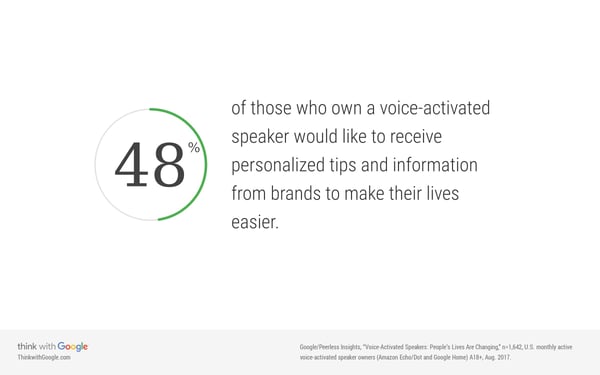
So, what does this mean? With more people seeking information by voice — and with Google Home, for example, delivering that information by way of a spoken featured snippet — marketers will have to consider these multiple levels and methods of search when it comes to optimizing their content.
Of course, optimizing for voice search won’t result in more clicks. Google Home does typically cite the result of the featured snippet in a spoken result, and there are options to learn more through its app, but most users will not get to the point of clicking when seeking information by voice.
Nonetheless, this continued evolution of search — and Google’s growing emphasis on the featured snippet — does have crucial implications for search marketers and the way content is optimized.
“With the increase in new features in the search results page, most notably Featured Snippets, and the increased importance of voice search, the way that marketers think about optimizing content for search has shifted a lot,” says Matt Barby, HubSpot’s Director of Acquisition. “It’s tough to predict how Google will ultimately enable searchers to consume that content, so creators have to optimize for multiple outcomes at the same time.”
Sullivan’s blog post, however, was just one in what Google says will be a series on how its search engine works, so it’s possible that it will continue to shed light on its plans for the delivery of search results — by mobile, desktop, or voice.
But in the meantime, here’s a primer on how to get started with featured snippet optimization, which contains even more information on just why it’s so important — and why we all have to adapt.
“It’s the wild west here,” says HubSpot SEO Manager Victor Pan. “Businesses with experimentation and agility in their DNA will be the ones that win.”
Featured image source: Google

The 10 Funniest Parody Twitter Accounts to Follow Right Now
The marketing spoof is one of the best and worst institutions in our industry.
Done well, it can result in one hilarious comedy skit after another, like SNL’s recent parody of an ad for the smart home assistant, Amazon Echo. Even Apple’s advertising has been parodied far and wide over the last decade, there may be more fake “Mac vs. PC” ads than real ones.
Done poorly, though, pop-culture parodies can result in awkward laughter, uncomfortable silence, or even lawsuits. For instance, a temptation to hijack the success of Old Spice yielded this painful shower scene, while this doctor’s attempt landed him in hot water with the legal team at Procter & Gamble.
Indeed, the internet has significantly reduced the barrier to entry for anyone with the ambition to mock real brands. Nowhere is this barrier lower than on Twitter, and today, brands like Netflix are making the funnies themselves.
Of course, we’ve got our favorites. Here are our top 10 funniest parody Twitter accounts we think you should start following today, along with some shining examples of their tongue-in-cheek Twitter brilliance.
The 10 Funniest Parody Twitter Accounts to Follow Right Now
1. @SunnyinHawkins — It’s Always Sunny in Hawkins
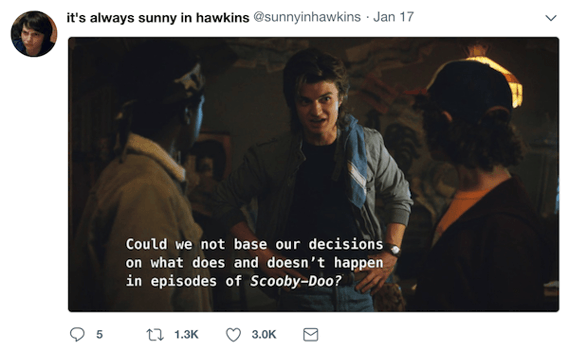
You don’t have to watch “It’s Always Sunny in Philadelphia” to enjoy this Twitter handle, but “Stranger Things” fans in particular will get a kick out of this hysterical take on one of their favorite Netflix shows.
The setting of “Stranger Things,” Hawkins is a fictional town in Indiana that’s played host to a series of demonic events — all centered on one group of curious kids. It turns out the chemistry between the cast is so adorable, you can’t help but imagine them in a comedy much like “It’s Always Sunny in Philadelphia,” the longer-running show on FX. Well, imagine no more:
2. @Queen_UK — Elizabeth Windsor
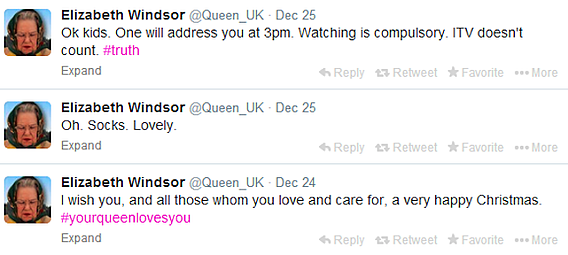
Those in the Royal Family are among the most beloved Brits in the world, but the Queen of England is far better known for her leadership and smarts than for her sense of humor.
While the power trio of Prince William, Prince Harry, and Princess Kate have lightened up public appearances with dancing or informal banter (karaoke with Taylor Swift, anyone?), the Queen has remained steadfast in a traditional approach to interacting with her constituents.
This focus on the traditional provides the perfect springboard for Twitter mockery, some highlights of which are outlined below:
3. @NetflixIsAJoke— Netflix Is A Joke
Who would say such a thing?! Actually, Netflix would.
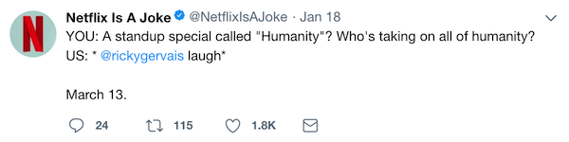
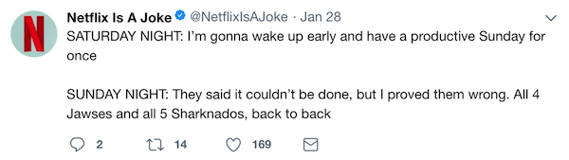
This is a verified sibling account to Netflix, dedicated to the stand-up specials and comedy series it streams for subscribers (get the account name?). And it pokes fun at Netflix as much as it pokes fun at us for the hilarious things we might binge at midnight.
In between the valuable new-show announcements, it engages with the comedians we all love while ensuring no one subscriber holds their chin too high for their weekend plans:
4. @CentralSqPigeon — Earnest Pigeonway
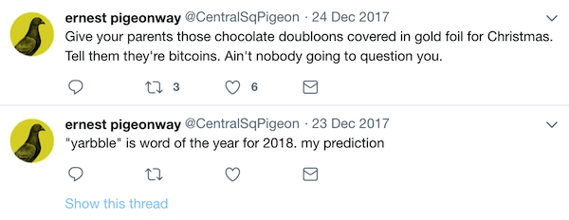
Is Central Sq. Pigeon the most popular parody Twitter account on the web? Certainly not … but it’s one of the funniest Twitter accounts in Greater Boston.
Many have heard of common squirrel, a parody account that documents the daily life of a mid-sized rodent. However, I’d personally take Central Sq. Pigeon, formally known as Earnest Pigeonway, over common squirrel any day. It helps that Central Sq. Pigeon is run by HubSpot designer Tyler Littwin, but what wins the day from our perspective is the stunning insight into the inner workings of a city pigeon navigating the big bad world of Cambridge, Mass.
Here’s a bird’s-eye view (sorry) of what you can expect by following him:
5. @SarcasticRover — Sarcastic Rover
This isn’t just a must-follow for any space lover. It’s amusing internet fodder for everyone who advocates for a more science-literate culture — even if it starts with a cute, fake Twitter handle inspired by the real Mars rover, Curiosity.
The feisty space robot may or may not give you all the facts about the red planet, but it obviously has the approval of numerous space authorities: Bill Nye, SpaceX, and Space.com are all known Twitter followers!
Enjoy its extraterrestrial innocence, at your leisure:

6. @OnionSports — Onion Sports Network
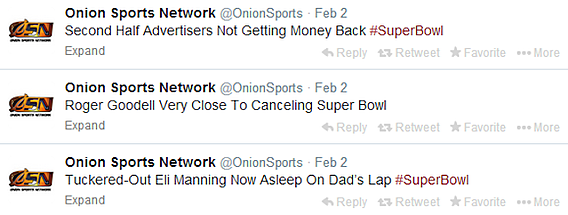
The Onion is the unmatched master of sarcasm and spoofs, so it’s little surprise that its sports-related Twitter account offers the funniest reflections on sporting events and celebrities of the day.
Most sports-oriented Twitter accounts ebb and flow on frequency and quality or require significant knowledge of the team or athlete involved. @OnionSports, though, runs the gamut, mocking avid fans and large sports culture events alike, making it the ideal sports parody account of choice to follow — especially when the Super Bowl nears:
7. @Lord_Voldemort7 — The Dark Lord
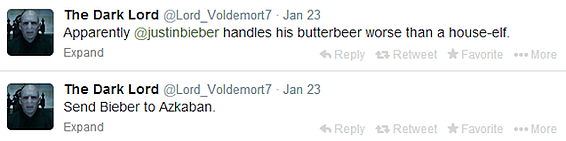
He Who Shall Not Be Named (of Harry Potter fame) is a force to be reckoned with at Hogwarts and in the Twitterverse. The Dark Lord account has amassed over 2.2 million followers thanks to its witty banter. Some highlights include Quidditch jokes during the Super Bowl and the Bieber commentary below.
Sure, there are some jokes that you have to be a Harry Potter fan to understand (Snape references are pervasive), but many of the tweets are funny with even a cursory knowledge of J.K. Rowling’s books and the films they spawned (especially after a few swigs of butterbeer):
8. @Chuck_Facts — Chuck Norris
One of the world’s most beloved action stars is not only a staple on the infomercial circuit, but he’s also a Twitter gem for “Chuck facts” sure to delight any cocktail party or water cooler.
One of my favorite standouts includes “Love does not hurt. Chuck Norris does.” It’s hard to choose one favorite tweet, however, when this parody account offers wisdom ranging from coding jokes to “Only Chuck Norris can prevent forest fires.”

9. @DarthVader — Darth Vader
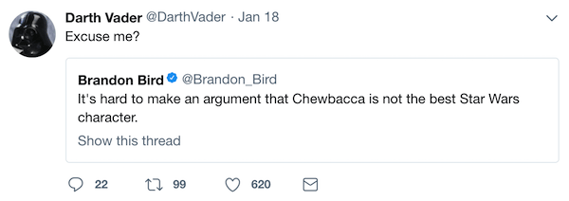
Self-described “Evil Orphan Ani” (Anakin conveniently being Vader’s real name), this guys sounds more like a passive-aggressive actor than the Lord of the Sith. And it’s pretty darn funny.
Since the Star Wars franchise was rebooted in 2015, this parody Twitter account has had plenty to talk (or rather, rant) about. From grilling Star Wars fans about their favorite character to reminiscing over some of his most terrible accomplishments on behalf of the Galactic Empire, there’s no shortage on content to keep the Twitterverse focused on a galaxy far, far away:

 10. @BoredElonMusk — Bored Elon Musk
Elon Musk’s escapades as an entrepreneur and marketer are well documented. The PayPal veteran and Tesla executive is known for his visionary ideas, outlandish press conferences, and dynamic relationship with realism. From announcing a high-speed Hyperloop between San Francisco and Los Angeles, to a series of high-profile battles with journalists, Musk is long on vision and short on patience — which makes him an ideal candidate for a parody Twitter account.
This absurd account is certainly worth a follow for its sketches, witty asides, and running commentary on all of the Valley’s most overused buzzwords:

Parody Twitter accounts offer a welcome break (and laugh) in the middle of a long day, but they also remind all of us who use social media regularly to have a sense of humor and think about what our customers, prospects, and leads actually want to see from us on a daily basis. Sometimes, it’s to not take ourselves too seriously.

How to Be Efficient: 7 Science-Backed Ways to Build Speed as a Habit
My college roommate was the fastest writer I’ve ever met. If he had a 10 page paper due at 9 AM on a Thursday, he would start writing it at 6 AM … that day. And the craziest part of all was that he always got A’s. I couldn’t never grasp how he could do something in a few hours that took me a full school week to do.
When I asked him how (and why) he did everything last minute, he told me that he needed the pressure of an impending deadline to spark his motivation. He also told me that if you leave things last minute, they only takes a minute to do. Wise words.
Leaving things to do last minute can be an effective, yet nerve-racking, way to work faster, so I decided to research some more science-backed alternatives for improving efficiency. Read on to learn how you can build speed as a habit and boost your productivity.
How to Be More Efficient
- Set deadlines for each of your tasks.
- Break projects down into smaller tasks.
- Work around other people.
- Work within ultradian rhythms.
- Listen to white noise.
- Find an accountability partner.
- Silence your inner perfectionist.
1. Set deadlines for each of your tasks.
According to Parkinson’s law, the amount of time you spend on a certain task depends on how much time you make available to complete that task. If you don’t give yourself a deadline to finish a task, then you’ll take as long as you like on it. But if you enforce a time limit on a task, the pressure you feel trying to beat the clock will compel you to finish the task before your deadline ends, forcing you to work faster.
Timing your tasks can also put you in a mental state of flow. Flow is when you’re so immersed in an activity that you can only focus on that said activity, unaware of everything else going on like your thoughts, emotions, and time. In other words, you’re in the zone.
Flow occurs when you set clear goals that are challenging, yet attainable. Accomplishing them requires full focus and complete control of your skills.
Setting a time limit on a task is an effective way to trigger flow. Finishing a task before time runs out is a manageable goal. And it produces just enough pressure and stress to thrust you into full focus, which enables you to use your skills to their highest potential.
2. Break projects down into smaller tasks.
Starting a new project is always daunting. There’s a ton of work to do, and the finish line is barely visible. Since the reward of this big accomplishment is so far away, it almost seems like it’s not even worth starting. It’s easy to slug through work when you don’t feel a sense of accomplishment everyday.
But what if you could feel accomplished multiple times a day? Would you feel energized and motivated to work harder and faster?
Harvard Business Review analyzed over 12,000 diary entries of knowledge workers and discovered that a sense of progress, no matter how big or small, was the most important factor in boosting emotions, motivation, and perceptions during the work day. And the more frequently workers experienced progress, the more productive they were.
If you break down projects into small tasks, you can achieve a minor goal or even multiple goals in one day instead of one major goal in a few days, weeks, or even months. Constantly feeling a sense of progress is what boosts your morale and productivity in the long term. Small wins help you work faster.
3. Work around other people.
Have you ever played a sport or an instrument in front of an audience and realized you performed better compared to when no one’s around? When I play guitar and sing by myself, I think I sound good, not great. But when I play and sing in front of my friends, I think I sound like Justin Bieber.
This can be attributed to a psychological phenomena called social facilitation. If you perform something in the presence of others, their evaluation of you inflates your level of psychological engagement. This added stress helps you perform well-rehearsed or easy tasks better in front of people compared to when you’re alone. Psychologists have witnessed social facilitation occur with cyclists, students, and even cockroaches (yes, they made cockroaches perform a task in front of a cockroach audience).
If you feel like you’ve mastered your job, but want to build more speed, try working around other people. When people can see what you’re doing and potentially evaluate you, your stress levels will reach an optimal level, prompting you to work harder and faster.
4. Work within ultradian rhythms.
The human body operates on 120-minute biological intervals throughout the day called ultradian rhythms. During the first 90 minutes of the interval, your mental energy peaks, and after that, your mental energy drops down into a trough for about 30 minutes.
To maximize speed and productivity, it’s best to work in 90 minute sprints when your body is naturally energized, followed by 30 minute rest periods when your body is naturally exhausted. This allows you to take full advantage of your body’s fluctuating energy levels.
Sustaining your focus for 90 minutes straight can be a challenge, though. According to Psychology Today, people can only stay focused for 20-25 minutes before their mind starts to wander.
To work with your attention span, use the pomodoro technique during your 90-minute sprints (Work for 25 minutes, then rest for 5 minutes).
Working while you’re naturally energized, resting while you’re naturally exhausted, and taking short breaks to restore focus will ultimately help you reach peak productivity and speed.
5. Listen to white noise.
Music has always been a mood-lifter, but it’s hardly a speed-builder. According to Psychology Today, listening to music with words makes your brain’s language centers pay more attention to the song’s lyrics than your current task, if it requires reading, writing, or talking.
Listening to new music is also not conducive for productivity. New music is novel, and since your brain likes novelty, it releases dopamine when you listen to it. This draws your attention toward the music and away from work. So contrary to popular belief, even though classical music and movie soundtracks usually don’t have words, if you never listen to those genres, they can actually disrupt your concentration,
But what should you do if your workplace is too loud or you’re tired of listening to those annoying spurts of clacking keyboards or colleague chatter?
White noise is your solution.
According to the Journal of Consumer Research, ambient noise at a moderate volume is ideal for enhancing creative performance. Throwing a pair of noise cancelling headphones on and playing white noise can replicate this effect.
White noise sustains concentration because it’s constant. It sounds the same, so your brain gets used to it. Auditory distractions can’t affect you anymore. This boosts your focus on the current task at hand, allowing you to work faster.
6. Find an accountability partner.
Gretchen Rubin, a renowned researcher of human nature and happiness, recently released The Four Tendencies, a book that dives into how humans respond to expectations. She discovered that humanity falls into one of four categories: Upholder, Questioner, Obliger, and Rebel.
Most people belong to the Obliger category. Obligers eagerly meet outer expectations but struggle to meet inner expectations. For example, Obligers never miss deadlines, but they also can’t seem to find time to exercise.
To help them meet their inner expectations, it’s crucial for Obligers to attach outer accountability to these internal goals. And one of the most powerful accountability tools is having an accountability partner.
No one wants to let other people down or be perceived as lazy and unproductive. That’s just human nature. So, for instance, promising your manager or colleague that you’ll write 1,000 words every day — and having them regularly check up on you — will motivate you to actually get it done and help you work more efficiently.
7. Silence your inner perfectionist.
Perfection and speed don’t mesh well. Repeatedly reviewing your work, triple-checking for errors, and doing extra work rather than entrusting it with others delays progress, drains your energy, and can ravage your emotional health. Perfection is the enemy of productivity.
The problem with perfectionists is that they have an all or nothing mentality. If their work isn’t perfect, they consider it a failure. The thing is, you can keep polishing and refining your work, but your efforts will only produce marginal improvements — and it’ll be late. It’s important to remember that most companies consider producing good work and hitting deadlines a huge success.

Build a Better B2B Website in 3 Steps
Today’s B2B buyers rely on digital channels through every stage of their journeys — even long after in-person sales interactions with reps.
As a result, commercial organizations’ efforts to identify, nurture, and pursue opportunities “serially” — first through digital engagement via marketing, followed by a hand-off to sales for in-person interaction — is failing to support the way customers actually buy.
Instead, the best companies must evolve a “parallel” commercial engine, where digital and in-person strategies complement each other at every stage of the buyer’s multi-channel journey.
In other words: We have all worked hard to create for our organization a “seamless view of the customer.” Now, it’s time to build a seamless view of our organizations for customers.
To get there, most suppliers will have to re-think — and ultimately, re-design — their websites, as customers aren’t just buying digitally. They’re relying heavily on suppliers’ websites to do so.
In fact, we found suppliers’ websites to be the most frequently-consulted digital channel for customers at every stage of the purchase process.
And yet, the vast majority of B2B websites aren’t designed to support that kind of buying behavior. Instead, they’re primarily designed to “broadcast.”
Specifically, we’re all seeking to tell the world three things: (1) who we are, (2) what we do, and (3) how we help.
To help buyers buy, however, B2B websites will have to meet three critical — and very different — design principles moving forward.
Build a Better B2B Website in 3 Steps
- Give customers an entry point on their terms.
- Signal your solutions in customers’ language.
- Help customers do what they are on your site to do.
1. Give customers an entry point on their terms.
After reviewing hundreds of B2B websites across every major industry, we found only a handful that purposefully invite customers into a conversation. To do that, suppliers need to stop talking so much about themselves.
Rather, they should provide customers with an opportunity to share something about who they are, and what they’re looking to do — on their terms.
Really, it’s no different than common courtesy at a cocktail party. No one wants to be stuck talking to the person droning on about who they are and what they do. Yet that’s precisely what the vast majority of B2B websites do.
Not only is that kind of self-centered approach disengaging, but it also leaves the buyer wondering, “Do they even know who I am? Or what I actually do?” Or worse, “Do they even care?” It’s impersonal at best, and off-putting at worst — fostering questions rather than connections, and distance rather than assistance.
That said, we found a handful of websites that do, in fact, actively invite customers to engage on their terms. Square, for example, asks customers to identify their business sizes and types as a first step to entering the site. It’s the first — and nearly only — thing a visitor encounters upon landing on the home page. That information allows Square to offer customers what feels like a much more customized web experience.
Another example is vAuto.com. A division of Cox Automotive, vAuto sells enterprise software to auto dealers around world. Among those dealers are both used and new car sellers, along with wholesalers — some franchise-based, and some independent.
Those distinctions matter — not only for finding the appropriate vAuto solution, but they help to identify how that customer thinks about themselves.
vAuto has designed the front page of its website to allow buyers to self-identify along the dimensions most important to them, prior to going any deeper. The customer’s first choice upon landing at vauto.com is declaring, “I’m New Car,” “I’m Used Car,” or “I’m Wholesale.”
Notice that even the pronouns are specifically chosen to position the website as a learning and buying tool for customers, rather than a broadcasting tool for the supplier.
Questions to ask yourself:
- How do our customers define themselves?
- In their minds, which aspects of their identity most affect the way they look at suppliers like us?
2. Signal your solutions in customers’ language.
Just as the best websites invite customers into a conversation, they also guide buyers to supplier solutions using the language of customer outcomes — rather than supplier capabilities.
The best companies take the time to understand the specific business objectives customers are seeking to achieve, then organize their sites using language immediately recognizable to customers along those particular outcomes. That way, customers don’t have to translate.
Here’s another place where vAuto excels. The company employs actual customer-articulated business problems as the organizing framework for diving deeper into their broad solution set. It organizaes this information around headings like, “No one’s buying my inventory,” and, “The internet is killing my profits.”
At every step, the goal is to make online learning and buying as easy and as resonant as possible — all through an easy-to-follow path of breadcrumbs leading directly to vAuto’s unique solutions.
Questions to ask yourself:
- What help are customers seeking from a supplier in your category?
- What specific language would best resonate with your customers to describe that help?
3. Help customers do what they are on your site to do.
Finally, the best websites identify and then facilitate the specific tasks that customers come to your website to complete.
Take something like a cost calculator embedded directly into a website. A tool like that enables customers to independently calculate the costs of (in)action, rather than relying on sales reps to make the case for change. It’s a simple, practical idea, but it’s deployed with single-minded purpose: to allow the buyer to easily progress along the journey, while remaining in her preferred channel of choice.
Questions to ask yourself:
- What specific buying tasks are your customers coming to your website to complete?
- How easy is it to find support for those tasks on your site right now?
There’s a great deal to be learned from the handful of world-class websites we found as part of our work. For a more detailed discussion, check out this video, where you’ll also find examples and a practical worksheet to plan next steps.

20 SEO Myths to Leave Behind in 2018 [Free Ebook]
Search engine optimization (SEO) is an evolving science. While some of the core principles may stick around forever, the more nuanced parts of it are subject to continuous change. As a result, many of the “proven” tactics people have used in the past — keyword stuffing, link schemes, and so on — are now the stuff of legend.
In our new guide, 20 SEO Myths to Leave Behind in 2018, we revisit some of the SEO trends that should continue to guide your strategy through 2018, while also highlighting how the practice has changed over the course of 2017.
Here are two myths to give you an idea of what to expect in the world of organic growth this year:
Myth: ‘Keyword optimization is THE key to SEO.’
Not anymore. Today, a new artificial intelligence (AI) system called RankBrain is helping Google understand the relationships between topics and search terms. What does this mean to you? It’s time to dial back the exact keyword matches — your content may be hitting the wrong audience.
Myth: ‘Local SEO doesn’t matter anymore.’
I’ll just leave this here:
“If you are a local business, having a website isn’t enough to rank well in Google’s local search listings,” says Kristopher Jones of the SEO agency LSEO.com. “If you want to rank well you need to unlock, verify, and optimize a Google+ Businsess Page.”
He’s right. Local SEO couldn’t be more important today, and growing companies are consistently crushing it under local search queries. In fact, national or global companies are advised to stay away from local search terms because they don’t stand a chance against local Google+ business pages.
Unless your organization benefits from a dedicated SEO marketing specialist who can work on this stuff day-in and day-out, keeping up with the latest changes in the world of SEO can be a struggle. But in the end, adjusting your strategy based on search ranking algorithm updates or changes in the way search results are displayed visually can be incredibly impactful on business results.
Check out the SEO Myths PDF to learn more about what changes you’ll need to make with your SEO strategy moving forward.