
Targeted Advertising: A Simple Guide to Reaching Your Customers
Let’s face it: There’s quite a bit of negative sentiment around targeted advertising. It’s not unwarranted — consumers often complain that collecting information from their individual browsing behaviors, such as page visits and searches, to optimally select which advertisements they see, is invasive and, some might even say, “creepy.”

Done right, however, ad targeting has the potential to attract new customers, help retain existing ones and boost your brand profile. Here’s how.
Where Can You Publish Targeted Ads?
Brands have a host of options when it comes to publishing targeted ads. For customers that have opted-in to newsletters and offers, email is a great way to serve up advertisements to consumers that are already interested in your brand.
To reach a broader audience, meanwhile, marketers can pay for targeted advertisements to be shown on social platforms such as Facebook, Instagram, or TikTok.
Other options include publishing targeted ads in users’ Google search results or via the Google display network, which reaches 90% of Internet users worldwide. Both fall under the larger banner of Google Ads, and costs are based on an auction system. Marketers input the maximum amount per click they’re willing to pay for an ad, and Google then determines ad pricing and position based on overall ad quality and maximum bid. Worth noting? Brands are only charged when someone clicks through on your link.
So how do you put ad targeting to work for your business? Here are 10 best practices to boost your ad impact.
1. Give Consumers Content They Care About
Instead of telling customers what they already know, use targeted ads as an opportunity to provide consumers with new information and other offers that might interest them based on their previous buying and browsing behaviors. Make it clear to your customers that you care about them by giving them content that is carefully targeted toward what they would want to see in an ad.
The takeaway: Consumers want new, fresh content .
2. Keep it Interesting
The reason they call marketing “creative” is because it should be exciting, attention-grabbing, and anything but boring. We all know that ads are easy to ignore, so for a targeted ad to perform well, it has to really stand out from the rest.
The takeaway: Make your ads eye-catching.
3. Set a Cap on Frequency
You need to remember that while proper ad targeting should provide a benefit to your customers, too much of it will most likely have the opposite effect. Consider the perspective of a consumer and think about how annoyed you would be if you were constantly served the same ad on dozens of different websites.
The takeaway: Don’t bombard your customers with ads.
4. Find the Right Place
Not every platform is the ideal place for your ads. While simple and streamlined ads make sense on Google search results, it’s worth taking the time to craft more intricate advertisements for Instagram or Facebook marketing campaigns that are more likely to see users stop on scrolling when they reach your ad and click through, either to a new page or to watch a video.
The takeaway: Just like real estate, effective ad targeting is all about location, location, location.
5. Pinpoint Your Audience
The key to any targeted advertisement is finding your target audience. If you’re serving up ads to customers that don’t match their preferences, you won’t see the click-through rates you’re looking for. As a result, it’s critical to do your research: Find tools that let you create custom ads based on personalized customer data and also help you see the bigger picture by identifying common traits among your audience.
The takeaway: Even the best ad won’t work on the wrong audience.
6. Don’t get too Specific
On the other side of the coin, it’s important to make your ads broad enough that they capture a decent segment of your target market. For example, while you could create an ad that specifically targets redheaded men between 20 and 22 living in Kansas who own golden retrievers and drive electric cars, the specificity of this ad is so high that it likely won’t show up on many social or search feeds and won’t capture a large enough audience share.
The takeaway: Effective marketing walks the line between targeted efforts and too-specific ads.
7. Think Outside the Box
Building targeted ad campaigns means thinking about what your audience wants. Let’s say you own a real estate company and you’re looking to help customers sell their current homes or buy new ones. Your obvious target market is people searching for realtors in their area or checking out the home prices in their neighborhood.
But it’s also worth considering parallel markets that are tied to your primary target. When it comes to real estate this might include searches for moving boxes, truck and van rentals, or storage lockers that could indicate customers are preparing to move. By thinking outside the box to include parallel markets, you can expand your reach without losing your focus.
The takeaway: Targeted marketing relies on both depth of personalization and breadth of interest.
8. Test, Test, Test
Even the best-laid advertising efforts don’t always go to plan. As a result, it’s worth conducting regular A/B testing to see which ads perform the best in specific scenarios and which can’t keep pace. Once you’ve identified frontrunners, you can tweak them even more through ongoing A/B testing to get the best return on investment.
The takeaway: Nothing works perfectly the first time. Test your ads to improve their performance.
9. Cast a Wide Net
Chances are that one advertising platform will work best for a new ad campaign. The caveat? You won’t know which one until you try them all. While it’s not worth spending your entire ad budget to blanket the Internet with new marketing efforts, it’s worth dipping your toe into multiple ad platforms to see what sticks.
The takeaway: Wide nets let you find where customers are swimming and adjust tactics to match.
10. Measure your Impact
If ads are getting seen and clicks are coming in, then everything’s going to plan, right? Maybe, maybe not. To ensure targeted ad efforts are paying dividends, it’s critical to define key performance metrics and regularly measure these metrics to ensure ads are living up to expectations. For example, you could measure the total value of conversions against the cost of a targeted marketing campaign to see if the numbers add up.
The takeaway: Track the numbers to make sure ad spend makes sense.
It’s one thing to read about best practices — it’s another to see them in action. To help you visualize what effective ad targeting looks like, we’ve collected seven great examples.
1. The New York Times
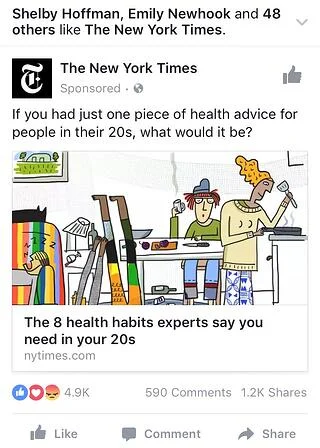
This ad works because it targets a specific audience segment — those in their 20s — and offers actionable advice for their health. Sure, there’s part of that segment that won’t respond because they’re not worried about health habits, but those that do click through are primed to engage with the targeted content being served.
And while the Facebook reactions show a number of “mad” faces, this isn’t necessarily a downside, since it indicates the ad is prompting user interest.
2. Nom Nom
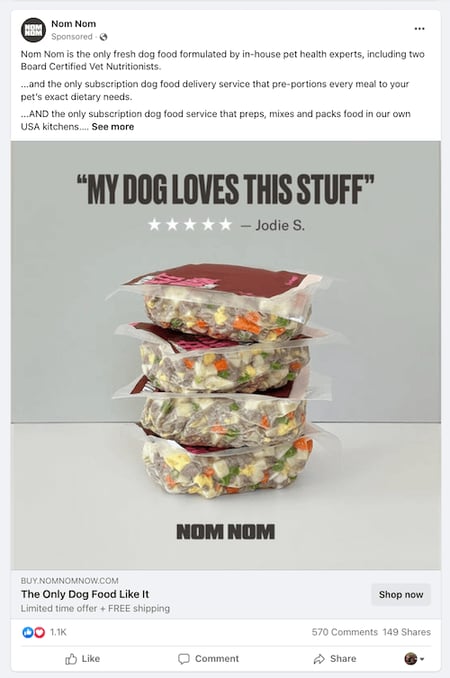
This ad targets a high-spending group: Pet owners. It also incorporates a customer testimonial to help convince viewers that it’s worth clicking through to find out what’s being offered.
It’s also worth noting the tagline in the bottom-left of the ad — “the only dog food like it”. This is a big claim to make but has a good chance of capturing targeted audience interest. And if the claim is backed up when they click through, there’s a solid chance of conversion.
3. Slack

Pandemic pressures have made it clear that companies need to find better ways of doing work. One of the biggest productivity killers? Meetings. That’s why this targeted Slack ad works — the campaign offers the potential of 25% fewer meetings by making communication better across the company. While this kind of ad requires business decision-makers to get on board, if enough staff see and mention the ad it can generate significant corporate traction.
4. Tentsile

Who knew that tree tents and tree hammocks were a thing? Probably not most people. That’s the genius of this ad — while it targets a smaller segment of the market looking for the “best” tree hammocks, it also casts a wider net by introducing a larger group of users to the concept of above-ground tent products.
Even better, it promises a look into “real vs. fake” products, giving visitors a chance to see what the difference is by clicking through.
5. 360Learning
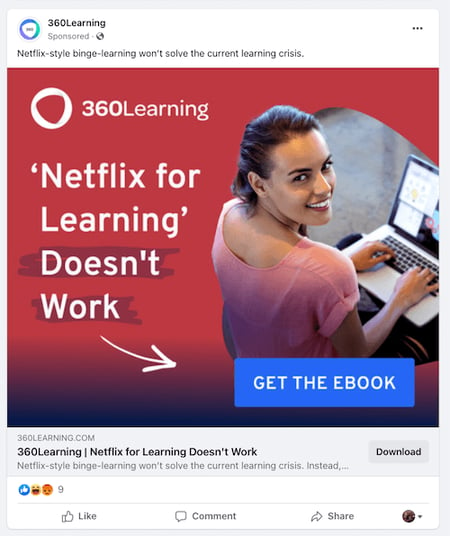
Saying that something doesn’t work in an ad is a risky bet — unless you can back it up. That’s the idea behind this 360Learning ad, which claims that Netflix-style “binge” learning can’t address the current issues with remote and online learning.
The promise of an eBook is a good way to get users to click through, and so long as there’s actionable information available it’s a solid start on customer engagement that could lead to more sales.
6. Kay Jewelers

The image above is enough to give an idea of what’s going on — the dog is bringing a piece of jewelry to its owner, courtesy of their partner. The actual Facebook ad itself is a video that shows the owner happily receiving the gift and does a good job of conveying a sense of love, family, and connection.
Perhaps even more importantly, however, is that no other context is needed to understand the video. There’s no text aside from the Kay logo and tagline, and no sound is required to parse what’s happening. Here, emotions are the target and the ad hits home.
7. Peloton

Peloton had a banner year in 2020, but as pandemic pressures begin to ease the interactive bike manufacturer is experiencing a slowdown in growth. This targeted ad speaks to those interested in the bike but daunted by its high price tag.
By offering a 100-day home trial with the option to return the bike for a full refund at the end of the trial, Peloton is looking to capture and convert a historically hesitant section of its audience by giving them the chance to experience the product risk-free.
Hitting the Bullseye
Not every ad will land exactly as expected with your audience. But with targeted ad efforts that follow best practices and keep in mind the key rule of ad targeting — give the customer what they want — it’s possible to avoid criticisms of “creepy”, capture customer attention, and drive increased conversions.
Editor’s note: This post was originally published in July 2011 and has been updated for comprehensiveness.


11 Apps for Marketers & Why You Should Download Them
Marketers need the advantage of real-time customer data to effectively do their jobs.
The right iPad and iPhone apps can help — in this piece, we’re diving into 11 Apple device applications that can help take your marketing to the next level.

1. HubSpot
Price: Free
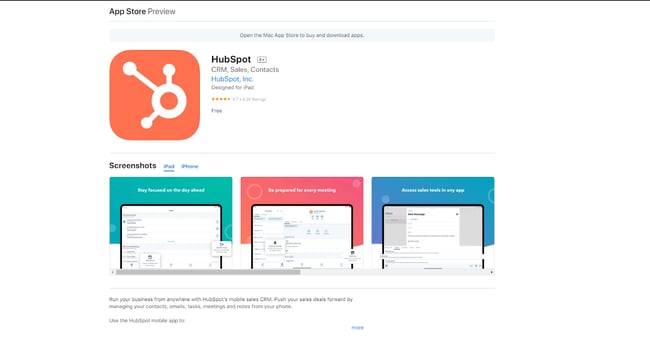
Need a better marketing framework? The HubSpot mobile CRM suite has you covered. Get one-tap access to key documents, stay organized with follow-up actions and quickly review customer calls to help inform both current marketing plans and develop new initiatives. Best of all, and can do everything anywhere, anytime from your iPad or iPhone.
What we like:
Not to toot our own horn, but HubSpot offers end-to-end support for managing contacts, handling emails, tracking tasks, and monitoring marketing efforts.
2. Meta Business Suite
Price: Free
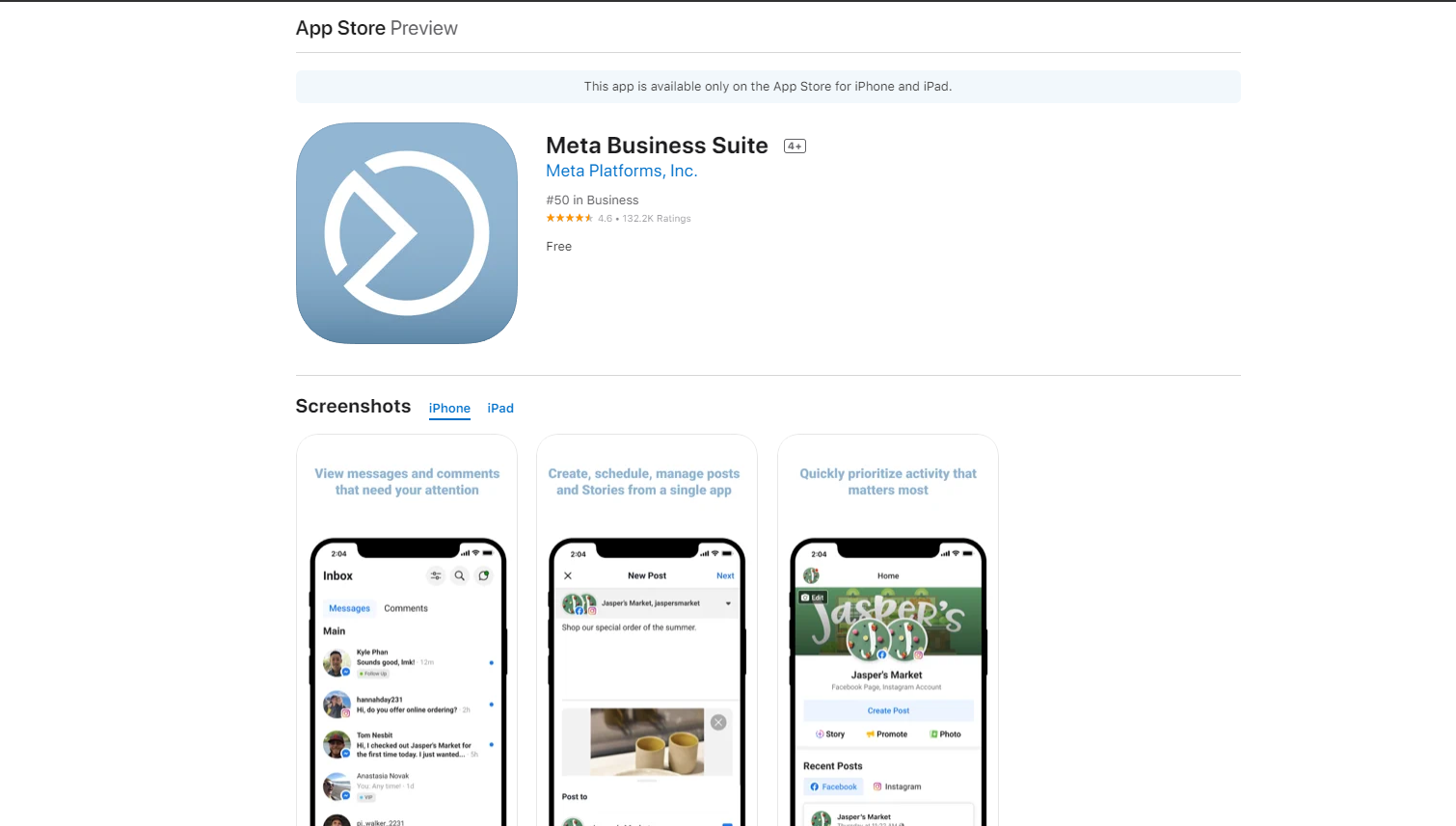
Meta (formerly Facebook) is one of the most popular social marketing platforms, so it goes without saying that you should have the Facebook app installed on your mobile device. The Meta Business Suite takes things a step farther with the ability to view messages that require attention, schedule and manage posts and prioritize key marketing activities.
What we like:
To succeed with personalized, digital marketing efforts Facebook is essential — the Meta suite makes it possible to unlock the business side of this social app.
3. Bitly
Price: Free
Bitly is known for its link-shortening service but the Bitly app is also a great choice for marketers. Teams can easily connect multiple social networks and track the performance of links across the networks to see where campaigns are working and where they come up short.
What we like:
The “Daily Widget” feature lets you see your top-performing links each day with a simple swipe to the right.
4. Google Analytics
Price: Free
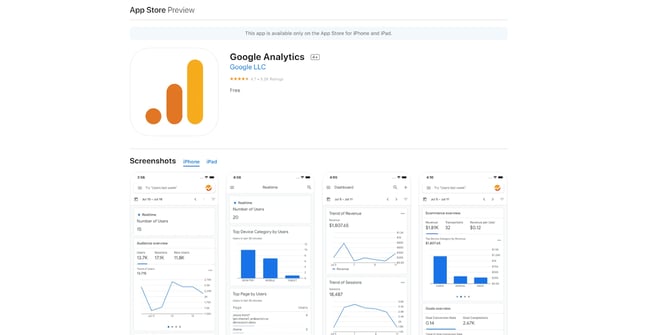
True to the original desktop version, the Google Analytics app for iPhone offers detailed information on your website’s visitors, referral sources, top content, and more. The app even supports multiple Google Analytics accounts. All these rich features are nicely packed into a mobile interface.
Any good marketer doesn’t just ‘do’ marketing, but also measures the results of their marketing efforts. Analytics Pro will help get this job done, anytime and anywhere.
What we like:
The sheer amount of data available to Google makes it the clear leader in customer analytics, so it only makes sense to tap the Google Analytics app as part of your marketing efforts.
5. GoDaddy.com Mobile
Price: Free
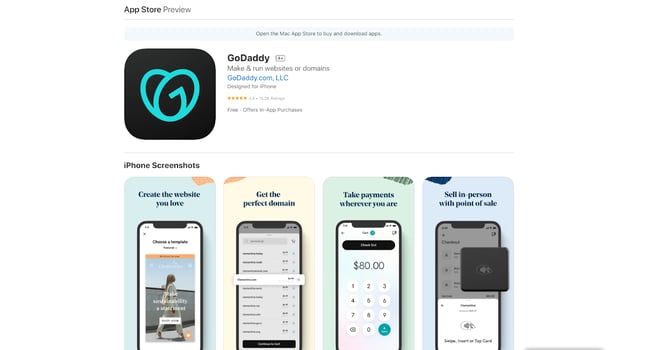
GoDaddy.com is a popular domain registrar. It helps you buy and manage your online domains. The GoDaddy.com iPhone app provides a neat interface for you to do these things whenever the inspiration or need strikes. You can track activity across websites, product orders, and social media all from the app.
What we like:
See new reviews for your site with just a few taps and gain insight into the effectiveness of your current campaigns.
6. Buffer
Price: Free
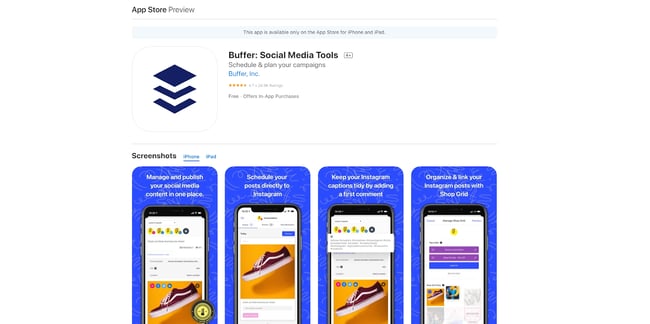
Buffer lets you schedule social media posts to the platform of your choice. This is a great way to keep your content current and engaging — without overwhelming customers. The app makes it easy to centralize cross-platform social marketing to cut down on the amount of time teams spend switching apps and scheduling posts.
What we like:
Keep your social content neat and tidy with the option to add the first comment on platforms like Instagram, ensuring the first comment users see is in line with your branding.
7. Hootsuite
Price: Free
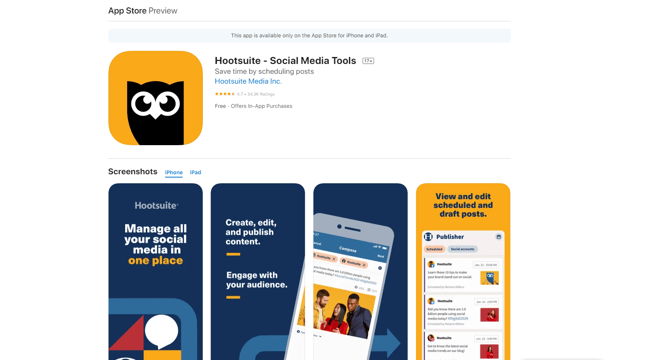
Hootsuite lets marketers create, edit and publish social content all from a single iPhone app. Teams can schedule posts to publish on the channel of their choice at the frequency they prefer, and can see what’s coming up with Hootsuite’s easy-to-use calendar function.
What we like:
Hootsuite lets you monitor likes, mentions, and conversations across topics that matter to your brand.
8. Later
Price: Free
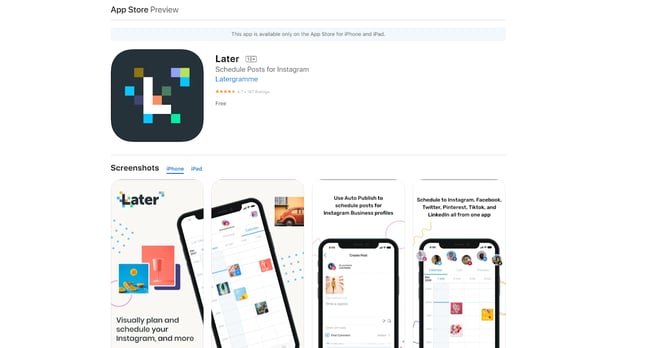
Later also lets you schedule posts across multiple platforms, but where it differs from apps like Hootsuite or Buffer is the ability to visually map out your feed on platforms like Instagram. With simple, drag-and-drop functionality, teams can create a content schedule that’s both content-rich and visually appealing.
What we like:
Images and videos can be uploaded directly from your phone, and there’s no storage limit.
9. Canva
Price: Free
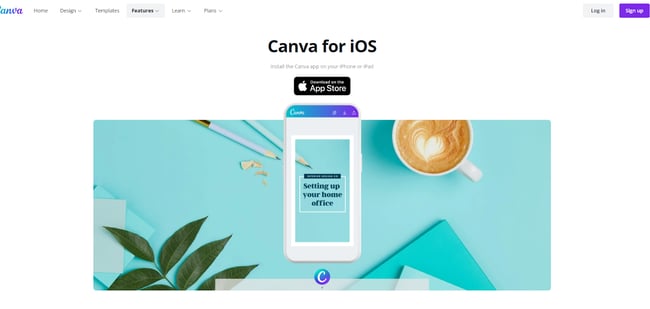
A picture is still worth a thousand words, and Canva helps you say it just right. Using pre-built templates, the Canva app lets you drag and drop image elements to create images you want to share — and that reflect the voice of your brand. Plus, integrated social sharing lets you easily push images to social media platforms.
What we like:
Canva’s free tool is a great choice if you need a simple image editor. If you need more features, just $10 per month gets you the Pro edition.
10. Rep
Price: Free
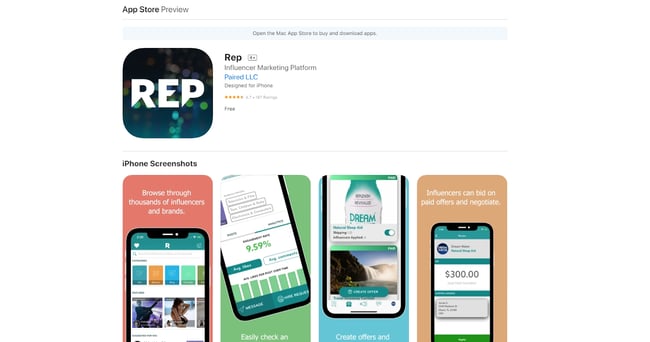
Love it or loathe it, influencer marketing is here to stay. Rep lets influencers and brands connect on a single app to kickstart mutually beneficial marketing relationships. Influencers can search for like-minded brands (and vice versa) and can bid on paid jobs offered by companies.
What we like:
Brands can quickly check an influencer’s engagement metrics via the app to see if they’re a good fit.
11. Grammarly
Price: Free
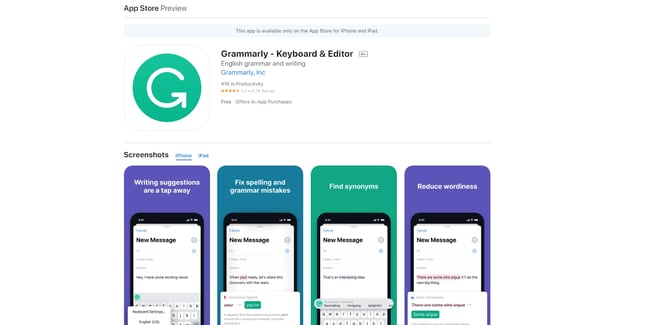
When it comes to marketing, good grammar matters. It might seem like a small thing, but a poorly-written and worded ad can convince customers to take their business elsewhere. Grammarly can help save the day. This iOS app offers writing suggestions, grammar fixes, and synonym options to help reduce wordiness and improve the impact of your ads.
What we like:
Grammarly automatically provides feedback as you type to provide real-time suggestions.
Making the Most of iPhone Apps for Marketers
All of the apps listed above can help improve your marketing efforts. From social media management to sentiment tracking to influencer partnerships, the right iPhone app can help build marketing programs that align with company goals and deliver on expectations.
Here, your best bet is to try out a few apps and see what sticks. While most offer in-app purchases, all of the applications listed above offer free versions that let your team explore the benefits they can bring to your brand. Once you’ve found the mix that works for you — pro tip, start with HubSpot’s comprehensive offering and build out from there — you can create an Apple marketing ecosystem that captures customer interest and drives increased sales.
Editor’s note: This post was originally published in June 2010 and has been updated for comprehensiveness.

445 Best Instagram Captions for 2022: Good, Cool, Funny, & Cute
Finding a good Instagram caption is a challenge, especially if you run the Instagram profile of a business. Why? Because if you want to build a consistent brand on Instagram, it’s important to maintain a distinctive voice on every post, video, or reel. That’s harder than it sounds.

If you’re tired of writing captions from scratch, there’s no need to keep searching. We’ve compiled the best Instagram captions for every type of brand and for every type of post. Whether you want to sound cool, make a funny quip, or come across as cute, you can incorporate many of these captions into an Instagram business strategy. Just make sure your audience would find your caption funny, clever, or the right amount of sassy.
Click one of the following links to jump to a section:
- Short Instagram Captions
- Business Instagram Captions
- Quote Instagram Captions
- Funny Instagram Captions
- Clever Instagram Captions
- Cute Instagram Captions
- Sassy Instagram Captions
- Song Lyrics for Instagram Captions
- Holiday Instagram Captions
- Seasonal Instagram Captions
- Selfie Instagram Captions
- Vacation Instagram Captions
Next time you’re contemplating a witty line of text to go with your Instagram photo, take a look at our complete list of captions that suit any mood or occasion you’ll be sharing with the world. You can also customize these captions to make them perfect for your feed. First, though, we recommend saving some time by downloading our kit of additional IG caption examples, which you can use to inspire your caption creation process.
Short Instagram Captions
A picture is already worth a thousand words — there’s no need to go on and on in your captions. Let the photo or video speak for itself and keep it brief. Take the captions below and change them to suit your exact post. It may be enough to tag someone who’s in the photo, give credit if you’re reposting, or prompt people to check out your bio.
- @[account]
- Credit: @[account]
- This week’s photo dump.
- Photo dump sacrifice for the algorithm god.
- Scroll →
- More info in bio.
- Link in bio.
- Sneak peek →
- [Product] in production at our factories.
- @[account] x @[account]. Coming soon.
- Loading…
- [The most dominant color in your post, ie “Red,” “Blue,” etc]
- [Hashtag relevant to your post]
- [Emoji relevant to your post]
- [Relevant word 1] + [Relevant word 2]
- Happy [weekday]! [hashtag]
- Happy [holiday of the day]! [hashtag]
- You can find me at [place you most often frequent].
- In [place where the photo was taken].
- An ode to [item in the image or video].
- Thinking about [relevant word].
- Weekend.
- [Month].
- 2:38 pm. [Or time when the photo was taken]
- Time passing.
- From the archives.
- Mentally here.
- Couldn’t pick one.
- That’s all for now.
- I can’t. I simply cannot. [Emoji]
- Sunset.
- Spring.
- Summer.
- Winter.
- Fall.
- Immediately yes.
- Immediately no.
- Say more.
- Say less.
- Mood.
- My go-to.
- My favorite hour.
- Taking it slow.
- Grateful.
- Once upon a time…
- We/I/You/@[account] know(s) what’s up.
- The only thing stopping you is you.
- Good food, good mood.
- And the boredom award goes to…
- My life, my rules. At least 62% of the time.
- We’re all still healing.
- Be the type of person you want to meet.
- It starts with you.
- Call it what you want.
- I’ve never been a fan of change, but I’d follow you anywhere.
Business Instagram Captions
If you’re running a business account, you should use your captioning to humanize your business more than your average paid ad.
Your business Instagram captions are an opportunity to give your brand some personality while getting the word out about your product or service offering. Here are some of our go-to captions that prospects and customers will love.
- Good evening, [city]! We’re in town for [event] at Booth [#]. Stop by and say hi!
- “If you’re offered a seat on a rocket ship, don’t ask what seat. Just get on.” -Sheryl Sandberg, COO of Facebook
- Our [#]-person squad completed the [road race name]! And we did it all for the post-run sneaker selfie. 👟
- We got product in the pipeline … check back for an exciting announcement on [date]!
- Diversity isn’t a recruitment metric — it’s an ingredient for success. At [company], we thrive on the unique backgrounds, experiences, and perspectives of our people.
- Spot the CEO. 😉
- At [company name], our best asset is our people.
- We had a great time with our customers at [meeting/event]! @[client/partner], you guys rock.
- Thrilled to have [customer] at our office today! Come back any time. 😊
- [Company name] is off for [holiday]! We hope you all have a safe long weekend.
- Big things have small beginnings. [Company]’s HQ began right here.
- “It is better to fail in originality than to succeed in imitation.” –Herman Melville
- How many [company name] employees does it take to spell “TEAM”?
- Want to work with these awesome people, working on a lot of awesome things? We’re hiring! Click the link in our bio to see our current openings.
- Check, check, one, two … is this thing on? [Company name] is now on Instagram! Follow us to learn about our culture, product, and (awesome) people.
- Tired of [customer pain point]? We’ve got good news. Click the link in our bio to learn about [product]’s latest feature.
- [Company] presents our latest product — made with love just for you. ❤️ Link in bio to learn more.
- Stop wasting time with [customer pain point]. Our [product] will help you achieve [X] more efficiently — just ask our current customers. Check out our latest case study here: [Link]
- Handmade in [location] and delivered to your door. That’s the [Company] promise.
- When life gives you lemons, you make lemonade. When [company name] gives you [type of product], you make money.
Quote Instagram Captions
If you can’t find the words yourself, there’s a quote out there to help you convey that idea.
Using quotes for your Instagram caption is a great way to evoke and share your emotions. Quotes can propel people to think more open-mindedly, and optimistically — or even motivate them to do something great. Below is a list of some of our favorites.
- “The greatest glory in living lies not in never falling, but in rising every time we fall.” –Nelson Mandela
- “Always remember that you are absolutely unique. Just like everyone else.” -Margaret Mead
- “You change the world by being yourself.” -Yoko Ono
- “In the end, it’s not the years in your life that count. It’s the life in your years.” -Abraham Lincoln
- “What I know for sure is that speaking your truth is the most powerful tool we all have.” – Oprah Winfrey
- “The purpose of our lives is to be happy.” -Dalai Lama
- “You only live once, but if you do it right, once is enough.” -Mae West
- “Live in the sunshine, swim the sea, drink the wild air.” -Ralph Waldo Emerson
- “I would rather die of passion than of boredom.” -Vincent van Gogh
- “Success isn’t about the end result, it’s about what you learn along the way.” -Vera Wang
- “It does not matter how slowly you go as long as you do not stop.” -Confucius
- “Everything you’ve ever wanted is on the other side of fear.” -George Addair
- “You become what you believe.” -Oprah Winfrey
- “Believe you can and you’re halfway there.” -Theodore Roosevelt
- “The way to get started is to quit talking and begin doing.” -Walt Disney
- “Love the life you live. Live the life you love.” -Bob Marley
- “My mission in life is not merely to survive, but to thrive; and to do so with some passion, some compassion, some humor, and some style.” -Maya Angelou
- “Embrace what makes you unique, even if it makes others uncomfortable.” – Janelle Monae
- “Success is a collection of problems solved.” – I.M. Pei
- “To be beautiful means to be yourself. You don’t need to be accepted by others. You need to accept yourself.” -Thich Nhat Hanh
- “In a gentle way, you can shake the world.” -Gandhi
- “I dream. Sometimes I think that’s the only right thing to do.” -Haruki Murakami
- “We become what we think about.” -Earl Nightingale
- “Success is not final, failure is not fatal: it is the courage to continue that counts.” –Winston Churchill
- “You are never too old to set another goal or to dream a new dream.” -C.S. Lewis
- “If you are depressed you are living in the past. If you are anxious you are living in the future. If you are at peace you are living in the present.” -Lao Tzu
- “Life is like riding a bicycle. To keep your balance, you must keep moving.” -Albert Einstein
- “If you are working on something that you really care about, you don’t have to be pushed. The vision pulls you.” -Steve Jobs
- “Security is mostly a superstition. Life is either a daring adventure or nothing.” – Helen Keller
- “Stay true to yourself and never let what somebody else says distract you from your goals.” -Michelle Obama
Funny Instagram Captions
We don’t always have to take social media so seriously, so explore some funny Instagram captions for your upcoming posts.
Instagram can be a tool to convey aesthetic picture taking or stoic model shoots, it can also be a fun place to share a laugh or lighthearted content, too. Sharing a funny caption can boost your page’s personality, and potentially brighten someone else’s day. We hope the following captions make you crack a smile.
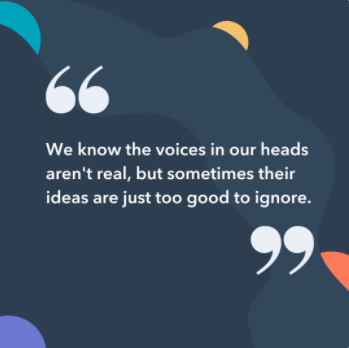
- My favorite exercise is a cross between a lunge and a crunch … I call it lunch.
- I need a six-month holiday, twice a year.
- We tried to be normal once. Worst two minutes of our lives!
- There are 16-year-olds competing at the Olympics and some of us (me) still push on “pull” doors.
- That awkward moment when you’re wearing Nike’s and you can’t do it.
- I’m just a girl, standing in front of a salad, asking it to be a cupcake.
- What if we told you … you can eat without posting it on Instagram?
- I know the voices in my head aren’t real, but sometimes their ideas are just too good to ignore.
- We don’t know what’s tighter: Our jeans or our company culture.
- Friday … Our second-favorite F word.
- We don’t care what people think of us. Unless they’re our customers. We definitely care what customers think of us.
- All you need is love … and investors. All you need is love and investors.
- Hi, we’re [company name]. We build amazing apps and eat amazing apps.
- They say “Do what you love and money will come to you.” Let’s see what happens, I just ordered tamales.
- My favorite subject in school was recess.
- No thoughts brain empty just tacos and cats.
- [Food item] so good it’s got me weak in the knees.
- The best part about waking up is going to sleep eighteen hours later.
- The older you get, the better you get, unless you’re a banana.
- Bring the alcohol! Because no great story started with someone eating a salad.
- Don’t worry if plan A fails. There are 25 more letters in the alphabet.
- If you’re not supposed to eat at night, why is there a light bulb in the refrigerator?
- First rule of Sundays: If you can’t reach it from your couch, you don’t need it.
- If you fall, I will be there. Signed, Floor.
- The first thing I do after coming to work is logging off.
- I used to think I was indecisive, but now I am not so sure.
- Friends buy you lunch. Best friends eat your lunch.
- Darn it, just accidentally had another thought again.
- My goal this weekend is to move… just enough so people don’t think I’m dead.
- You think nothing is impossible? Try getting me out of bed before 12 PM.
- Looking at these pictures won’t fix all your problems, but it’s a good start.
- My sauce is too hot that’s why you’ll never ketchup.
- Google Maps said it’s MY TURN.
- I got my haters seasick, they see me and get sick.
- If there would be an award for being lazy, I would send someone to pick it up for me.
Clever Instagram Captions
Trying to come up with some clever Instagram captions on your own can be a lot of work, so we’ve done it for you. Below we’ve compiled a list of our favorite clever Instagram captions for all your witty caption needs.

- Patience — what you have when there are too many witnesses.
- Maybe she’s born with it, maybe it’s the Clarendon filter.
- “Life is short.” False — it’s the longest thing you do.
- Happy Sunday! There may be no excuse for laziness, but I’m still looking.
- Rejection is just redirection.
- Better an “oops” than a “what if.”
- Anyone looking for a heart? Selling mine for $2. (Used, good condition)
- The world is changed by your example, not your opinion.
- Seven billion smiles and these are my favorite.
- Stop working hard and start working smart.
- I found your nose. It was in my business.
- Imposter complex is just a byproduct of success.
- Life is simple. It’s just not easy.
- The best times begin at the end of your comfort zone. So you can catch me on the opposite end of the end of my comfort zone.
- When nothing goes right, go left.
- “Success is making those who believed in you look brilliant.” -Dharmesh Shah
- “If you can’t convince them, confuse them.” -Harry Truman
- The world changes by your example, not your opinion. So get acting right.
- It’s always a good idea to be on the right side of history.
- When you learn, teach. When you get, give.
- Don’t quit your daydream.
- Legend has it that if you look hard enough you’ll see the weekend approaching!
- It’s time to make new memories. But first, five tequila shots.
- I’m on a seafood diet. I see food, I eat it.
- Sorry I didn’t get back to your text. I was too busy converting oxygen into CO2.
- Living on Earth is expensive, but it does include a free trip around the sun.
- “Arguing with a fool proves there are two.” -Doris M. Smith
- Well, enough about me. Let’s talk about you. What do you think about me?
- We’re all one more minute closer to dying. What’s one more shot going to do?
- There’s a pot of gold at the end of the rainbow. If you find it, let me know so I can get some.
Cute Instagram Captions
If there’s one thing people on the internet love to see — it’s anything and everything that falls into the category of cute. Whether you’re posting your adorable pet, your significant other, or a picnic by the park, we’ve got all the cute Instagram captions that you need to complement them.
- Don’t give up on your dreams. Keep sleeping.
- My fave sound is you snoring next to me.
- Here’s to a hundred more years with you.
- Happiness is watching you do what you love 💗 Hopefully that’s me.
- I like you more than [food]. And I looove [food].
- Wearing a onesie to bed just in case my SO steals the covers again.
- Cuddle time with the pup 💞
- Just showing off my [item] a little. Be jealous.
- Always wear cute pajamas to bed; you never know who you’ll meet in your dreams.
- You got me like 🥴️
- I’d move to [state] for you. And I hate [state].
- 🥺️👉👈
- I have no idea what I was doing before you came around. Sleeping, probably.
- No one can touch my books or my tacos 😤
- Not me standing there like🧍
- Don’t mind me while I drink my tea 🍵
- Did someone say [something you like]? 🏃💨
- They say elephants have a perfect memory. So do I when it comes to you.
- My pup is the salsa to my whole enchilada.
- I hate it when I’m singing a song and the artist gets the words wrong.
- Being an adult is like folding a fitted sheet. No one really knows how.
- Here’s a🥇for being the cutest human to walk this earth.
- Me before you:🌱 Me after you: 🌻
- 🤟
- Just got that Friday feeling.
- Are you a timekeeper? ‘Cause time slows down when I’m with you.
- I can’t see heaven being much better than this.
- I’m not lazy, I’m on energy-saving mode.
- My pillow is my best friend (sorry, [best friend’s name])
- A day doing [activity] is a day well-spent.
- I don’t know who’s cuter, me or my reflection?
- Being a full-time angel is so exhausting.
- With you, everything is twice the fun and half the trouble.
- Sweeter than a cupcake.
- Put me on your wishlist.
Sassy Instagram Captions
Your Instagram posts are your way to express yourself, so if you’re bold, sassy, and not afraid to show it — let your caption do the talking.
For those that want to give their Instagram posts some more pizzazz, try throwing in one of these sassy captions.

- What’s a queen without her king? Historically speaking, more powerful.
- Be a little more you, and a lot less them.
- We’re an acquired taste. If you don’t like us, acquire some taste.
- Well-behaved people don’t make it into history books.
- Be sunshine mixed with a little hurricane.
- We got 99 problems, but an awesome marketing team ain’t one.
- Sometimes you just need to do a thing called “what you want.”
- You can’t do epic stuff with bad people. And we got the best in the biz.
- It’s not called being bossy, it’s called having leadership skills.
- You did not wake up today to be mediocre.
- A bad attitude is like a flat tire. You can’t go anywhere until you change it.
- We’re entrepreneurs. They call us dreamers, but we’re the ones who never sleep.
- All of us have the capacity to light up a room. Some when they enter, others when they leave it.
- Brains are awesome. I wish everybody would have one.
- Common sense is like deodorant. The people who need it most never use it.
- You see that? That’s my patience leaving.
- I’ll have you know, I’ve completed plenty of marathons. [Show 1], [Show 2], and [Show 3], to name a few.
- Everyone has that one annoying friend. If you don’t have one, then it’s probably you.
- Above: A photo of me pretending to be listening.
- Oh, you sent me an email? Expect a response in approximately never.
- Everyone is entitled to be stupid, but some abuse the privilege.
- If you like me, raise your hand. If not, then raise your standard.
- If you don’t succeed the first time, then burn all the evidence you tried.
- Underestimate me. That’ll be fun.
- I like my coffee how I like myself: Dark, bitter and too hot for you.
- People say I act like I don’t care. It’s not an act.
- They say good things take time … that’s why I’m always late.
- Focused. Intelligent. Motivated. Oh, and cute.
- “The question isn’t who is going to let me: it’s who is going to stop me.” -Ayn Rand
- It’s okay if you don’t like me. Not everyone has good taste.
- I’m a work of art, showing you the art or working.
- I only show up wearing my best and you shouldn’t expect less.
- You couldn’t even outshine my shadow.
- Please don’t call me, I’m out of your range.
- If you’re sleeping on me I hope you’re tossing and turning.
Song Lyrics for Instagram Captions
People of all different backgrounds can relate to music. Beyond the different chords and melodies are lyrics that tell a story, echo a feeling, or inspire others.
To convey the message or emotion you want in your Instagram caption, use one of these iconic song lyrics.

- “I’m gonna live like tomorrow doesn’t exist.” — Sia, “Chandelier”
- “I live for the nights that I can’t remember, with the people that I won’t forget.” — Drake, “Show Me a Good Time”
- “I hope you never lose your sense of wonder.” — Lee Ann Womack, “I Hope You Dance”
- “You may say I’m a dreamer, but I’m not the only one.” — John Lennon, “Imagine”
- “If you give, you begin to live.” — Dave Matthews Band, “You Might Die Trying”
- “Outlining my findings, using life as a stencil.” — Kero One, “In All the Wrong Places”
- “Feeling good living better.” — Drake, “Over My Dead Body”
- “Say oh, got this feeling that you can’t fight, like this city is on fire tonight.” — OneRepublic, “Good Life”
- “Time makes you bolder.” — Fleetwood Mac, “Landslide”
- “If I fail, if I succeed, at least I’ll live as I believe.” — Whitney Houston, “The Greatest Love of All”
- “The rest of the world was in black and white, but we were in screaming color.” — Taylor Swift, “Out of the Woods”
- “Lightning strikes every time she moves.” — Calvin Harris, “This Is What You Came For”
- “We aren’t ever getting older.” — Chainsmokers, “Closer”
- “Sing with me, sing for the years, sing for the laughter, sing for the tears.” — Aerosmith, “Dream On”
- “Life is good.” — Future & Drake, “Life is Good”
- “Life without dreaming is a life without meaning.” – Wale, “Aston Martin Music”
- “But like the sun, know you know I find my way back ‘round.” — J. Cole, “Crooked Smile”
- “I will overcome any hurdle or obstacle that’s in my path.” — OutKast, “Knowing”
- “I’m way up, I feel blessed.” — Drake, “Blessings”
- “Eat, sleep, and breathe it. Rehearse and repeat it.” — Dua Lipa, “New Rules”
- “I’d rather be dry but at least I’m alive. Rain on me.” — Lady Gaga, “Rain On Me”
- “And I know that I gotta be above it now. And I know that I can’t let them bring me down.” — Tame Impala, “Be Above It”
- “I’m on the pursuit of happiness and I know everything that shine ain’t always gonna be gold, hey, I’ll be fine once I get it, yeah, I’ll be good.” — Kid Cudi, “Pursuit of Happiness (Nightmare)”
- “There’s much more to life than dyin’ over your past mistakes and people who threw dirt on your name.” — Lil Nas X, “Sun Goes Down”
- “They say the loudest in the room is weak, that’s what they assume, but I disagree.” — Tyler the Creator, “911/Mr. Lonely”
- “You don’t have to be like everybody else, you don’t have to fit into the norm, you are not here to conform.” — Marina, “Ancient Dreams in a Modern Land”
- “Throw me in the fire, baby, I’ll survive.” — BROCKHAMPTON, “RENTAL”
- “When you being real, you ain’t worried ’bout who fake.” —Megan Thee Stallion, “Money Good”
- “We’re so young, boy, we ain’t got nothin’ to lose.” -Doja Cat, “Kiss Me More”
- “If someone talked to you the way you do to you, I’d put their teeth through. Love Yourself!” -IDLES, “Television”
Holiday Instagram Captions
Around the holidays, you want to post and share the memories you’ve made throughout the years. For whichever one you’re celebrating, take some inspiration from our favorite Instagram captions and spread some holiday cheer.
New Year’s Instagram Captions
- “Always bear in mind that your own resolution to succeed is more important than any other.” — Abraham Lincoln
- Didn’t make it to midnight.
- Resolutions are made to be broken.
- Ringing in the new year — like a bell.
- “Tomorrow is the first blank page of a 365-page book. Write a good one.” — Brad Paisley
- New year, same me.
- Time to show off my bubbly personality.
- Any excuse to wear glitter.
- Starting off the year on the right foot.
- There are 12 months ahead of us to make a difference.
- Day 1 of 365
- Sip, sip, hooray!
- All you need is a fresh start.
- Save water, drink champagne.
- The best has yet to come.
Valentine’s Day Instagram Captions

- Roses are red. Violets are blue. Consider this post my Valentine to you.
- Don’t tell me you love me. Tell me you’re outside with pizza.
- All I need is you. (And maybe wine + chocolate too.)
- Cupid called, he wants his arrow back.
- 99% of my socks are single, and you don’t see them crying about it.
- I will do anything for love. Except that. And that. Or that. Or…
- I followed my heart and it led me to the fridge.
- Look at us. Hey. Look at us. Who woulda thought? Not me!
- In love with my best friend.
- I’m better when I’m with you.
Halloween Instagram Captions
- Creepin’ it real.
- I brake for Reese’s Peanut Butter Cups.
- Oh my gourd, Becky, look at her bat.
- You’re just my (blood) type.
- How to eat candy corn: don’t.
- #squadghouls
- Double, double toil and trouble; Fire burn and cauldron bubble.
- Driving me batty.
- “Scary hours.” — Drake
- Resting Witch Face
Thanksgiving
- I’m wearing my elastic pants.
- “For those of you who cannot be with family this Thanksgiving, please resist the urge to brag.” — Andy Borowitz
- On a veggie diet this Thanksgiving: Carrot cake and pumpkin pie.
- “Be thankful for what you have; you’ll end up having more. If you concentrate on what you don’t have, you will never, ever have enough.” — Oprah Winfrey
- I think, therefore I cran.
- Bad day to be a turkey.
- Need fuel for Black Friday.
- “Okay, guys. I have exactly 28 minutes before I have to baste again.” — Monica
- Grateful. Thankful. Blessed.
- Who made the potato salad?
- There’s always something to be thankful for.
- To-do list: eat, drink, nap.
- I only have pies for you.
- Gobble ’til you wobble.
- Love at first bite.
Christmas & Hannukah Instagram Captions
- You sleigh me.
- Fa la la la llama.
- “O Christmas tree, O Christmas tree, your ornaments are history.” — The Cat
- “It’s not what’s under the Christmas tree that matters. It’s who’s around it.” — Charles M. Schulz
- Dear Santa, let’s not talk about this.
- Rebel Without a Claus
- Doesn’t Santa have anything better to do than watch us while we’re sleeping?
- All I want for Christmas is you (and wine would be nice).
- Say it ain’t snow.
- Drop it like a top.
- Wishing you a latke love this Hanukkah.
- I want to eat 8 latkes for the calories of one.
- One little candle can light up an entire room.
- Keep calm and spin that dreidel.
- Deck the halls with matzo balls!
- It’s Christmas time and I’m the gift.
- The best gift is to be present with the ones you love.
- Baby, it’s cold outside.
- Merry everything and happy always.
- Treat yo elf.
Seasonal Instagram Captions
As the seasons come and go, why not share your joy for the next one on your Instagram? Whether you love the sunshine in the Summer, or snowfall in the winter, you can share that excitement with others.
Ring in the new season with some of these witty, seasonal captions.
Spring Instagram Captions
- Hello, spring!
- “And I think to myself, what a wonderful world.” — Louis Armstrong
- April showers bring May flowers.
- I think I just experienced all the seasons in a single day.
- I love allergy season, said no one ever.
- Currently soaking up the sun and smelling the roses. Please leave a message after the beep.
- I owe a lot to the inventor of flip-flops.
- “Here comes the sun, and I say… It’s all right.” — The Beatles
- “Warm winds in the springtime.” — SZA, “Warm Winds”
- Springing into the new season.
Summer Instagram Captions

- “Live in the sunshine. Swim in the sea. Drink in the wild air.” — Ralph Waldo Emerson
- Life’s a beach.
- School’s out, sun’s out, guns out.
- “A little bit of summer is what the whole year is all about.” — John Mayer
- 90% happy, 10% burnt.
- Girls just want to have sun.
- “Summer lovin’ had me a blast, summer lovin’ happened so fast.” — Grease
- Happiness is a cold popsicle.
- Life is better by the pool.
- “Summertime and the livin’ is easy.” — Ella Fitzgerald, “Summertime”
- “Here comes the sun, and I say… It’s all right.” — The Beatles, “Here Comes the Sun”
- Tans, tans, tans across the board.
Fall Instagram Captions
- My favorite color is October.
- “Wild is the music of autumnal winds amongst the faded woods.” — William Wordsworth
- My favorite kind of weather.
- It’s never too early for pumpkin spice.
- Meet me in the corn maze.
- Crisp air. Apple cider. Flaming foliage.
- Pumpkin spice and everything nice.
- “Anyone who thinks fallen leaves are dead has never watched them dancing on a windy day.” — Shira Tamir
- Leaves are falling, and autumn is calling.
- “Days in the sun and nights in the rain. Summer is over, simple and plain.” — Drake & Majid Jordan, “Summer’s Over”
- Falling never felt so good.
- Painted in the colors of fall.
- Sweater weather.
- Even the leaves fall for you.
- Channel the flannel.
Winter Instagram Captions
- “In the depths of winter, I finally learned that within me there lay an invincible summer.” — Albert Camus
- If it’s snowing, I’m not going.
- Cozy nights. Good books. Hot chocolate.
- Do you want to build a snowman?
- Running on caffeine and holiday cheer.
- “Winter is not a season; it’s a celebration.” — Anamika Mishra
- Merry and brrrrrrright.
- Having snow much fun.
- ‘Tis the season to be freezin’.
- “Timb’ laces get tighter and parka hoods flip up.” — Drake, “Come Winter”
Selfie Instagram Captions
Selfies are a celebration of something unique, beautiful, and full of life — you! So when you share your next selfie, complement it with one of our favorite selfie Instagram captions.

- Me, myself, and I.
- Be yourself, there’s no one better.
- It’s the happiness for me.
- Smile! The happiness is right under your nose.
- My favorite filter is reality.
- Self-care selfie!
Conquer the world one smile at a time. - It’s a great day to have a great day.
- The greatest gift you can give someone is a smile.
- Self-love is the best love.
- “But she looked powerful. She wore the sun like a shiny pin on the side of her hair.” –Lilian Li
- I don’t need a hairstylist. My pillow gives me a new hairstyle every morning.
- All-natural.
- No filter.
- Morning hair, don’t care.
- Quick #OOTD
- Anything but basic.
- Hard to be down to earth when you look out of this world.
- Looking like I don’t know how to lose.
- Beautiful from halo to toe.
- I’m ready for my close-up.
Vacation Instagram Captions
When you want to treat yourself, a vacation is always a great reward.
It’s a chance to experience different cultures, food, music and scenery. When you’re out exploring the world, share some of your favorite travel moments with these awesome Instagram captions.
- A chance to get away from the everyday.
- Work. Save. Travel. Repeat.
- Staycation loading…
- Collect the moments, not the materials.
- Another destination off the bucket list.
- An adventure to fill the soul.
- The scenic route is always better.
- I need a six-month vacation, twice a year.
- Be back never.
- Catch flights, not feelings.
- Always take the scenic route.
- I’ve never met a vacation I didn’t like.
- An adventure a day keeps the doctor away.
- Travel is an investment in yourself.
- Some call it vacation, I call it heaven.
- “I hate traveling.” said no traveler ever.
- If you need me, call me on my shell phone.
- I can sea clearly now.
- Happiness comes in waves.
- A change in latitude helps my attitude.
Features of Good Instagram Captions
Want to write a caption from scratch? I totally get it. If you’re anything like me, you take about four minutes choosing a filter for your Instagram photo, and about four hours deciding on a caption.
Worst of all, after much creative effort and advice from friends, I’m usually barely able to write a caption that goes beyond, “Had a fun day with friends!” And I’m a writer — go figure.
The point is, writing a good caption is hard. Whether you create one from scratch or choose a pre-written one, it should fulfill a few requirements.
1. Your caption is on-brand.
Whether your Instagram page is personal or for your business, your captions should be on-brand, or reflective of your brand identity.
This encapsulates the nature of your Instagram’s branding and tone of voice. For example, if your page is based on self-love, you should use captions that are friendly in tone, and use inclusive language to make people feel good when they scroll through your Instagram profile.
2. Your caption is simple.
Instagram captions can fit up to 2,200 characters, but you don’t have to use all of them for your caption to be considered a good one. You ideally want to keep your captions clear, short, and simple for easy readability. You also want to keep your audience’s attention enough to read it to finish.
The exception to this is if you’re making posts that champion storytelling or other lengthy formats. Ultimately, it comes down to what your audience is looking for.
3. Your caption is memorable.
While your Instagram caption doesn’t have to be a profound piece of literature, you can make it memorable in a number of ways. Depending on the type of post you’re sharing, you can make it hilarious, thought-provoking, inspiring, or anything you want it to be.
Want more inspiration? Check out our Instagram page to see how we incorporate fun, witty, and engaging captions into our social media content. The captions often complement the post itself and prompt engagement from users. Instagram Insights metrics such as comments, likes, and saves show you how well you’re engaging users and whether your captions are effective in prompting likes and comments.
Here’s one example from HubSpot with the caption “You can’t spell ‘CRM’ without ‘R’”:
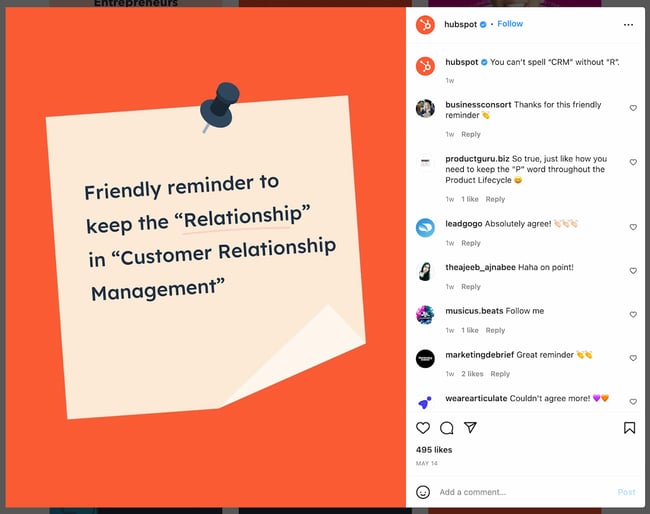
Don’t underestimate the power of a good caption. They can help you generate more engagement and turn your followers into customers.
Capture the Feeling with an Instagram Caption
Even though an image is worth 1,000 words, a well-written caption couldn’t hurt. These days, the caption can make just as much of a statement as the image! For all of the occasions that are worthy of a post to your feed, use one of the quotes from this list and customize it to make it your own.
Editor’s note: This post was originally published in June 2020 and has been updated for comprehensiveness.

The Ultimate Guide to Human Resources
Remarkable Human Resources (HR) employees are critical at every company. They handle all employee relations so you can focus on your side of the business.
Before we discuss more reasons why your company needs an impactful HR department and how you can go about building one, let’s talk more about what human resources actually means.
Based on this definition alone, you can see how it would be difficult to run your operation successfully without the assistance HR provides. That’s why even small and medium-sized businesses (SMBs) have HR departments with employees who oversee all management, engagement, and development between the company and its employees. HR departments exist to support you and your employees so you can continue doing your jobs successfully.
The work and responsibilities of a human resources employee will touch a large portion of your business every day. So what does that mean for you? Let’s review some of the most common responsibilities these employees have so you can better understand the impact HR will have on your company.

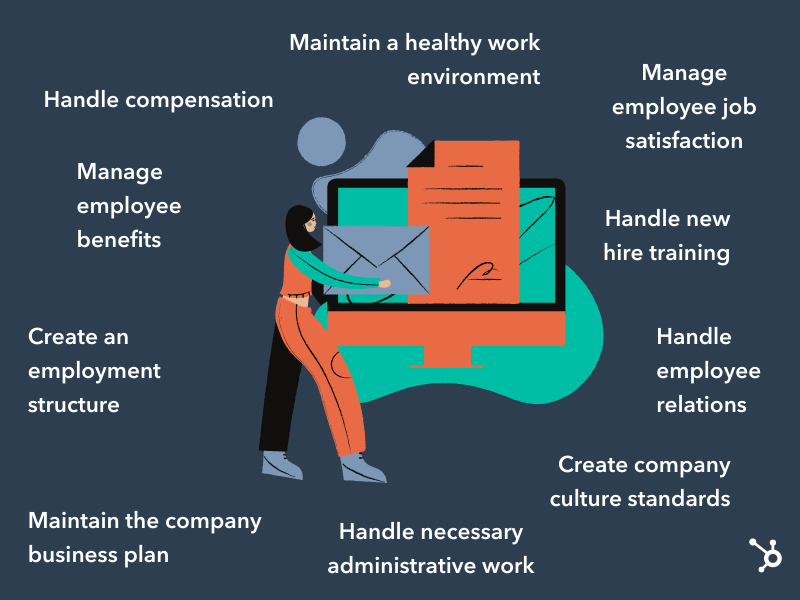
Handle employee relations
HR handles the employee-to-employee relationships as well as the employee-to-company relationship. This means they work to develop positive interactions and treatment among all employees within your company so they feel good about coming to work, are committed to their jobs, and are invested in the growth of the business.
Whether it’s a personal matter or a work-related issue, human resources will handle all issues with care and keep the best interest of both your company and employee in mind.
Create an employment structure
Your HR department will handle your entire staffing plan — meaning they’ll identify the gaps in your current employee structure and fill them by acquiring new talent. They’re also in charge of firing any existing talent that isn’t meeting company standards. Your company’s HR team will ensure you have the right people to help you grow your business.
Manage employee job satisfaction
Once your employees have begun work, you’ll want to make sure they’re excited to come to the office every day and add value to your company — their excitement is directly related to their level of job satisfaction. If your employees are happy in their roles, feel as though they can grow at your company, and can change departments down the road if they choose to, they’re more likely to be productive team members. Your HR team ensures your employees really do feel satisfied in their roles and will work with them if they feel unhappy or unsatisfied at any point in time.
Manage employee benefits
Your HR department will handle the amount and type of employee benefits your company offers. Providing good employee benefits is critical to the success of your business because they’re proven to attract and retain talent and increase employee productivity. Benefits keep employees satisfied by giving them a variety of perks and making them feel secure in their roles.
Handle compensation
HR manages all payroll and compensation work, including employee salaries, payment schedules, W2s, and all other tax-related paperwork. If an employee is offered a promotion — or awarded a bonus — HR will handle all changes in their regular payment schedules.
Maintain the company business plan
Your HR department will help you create, distribute, and maintain your company’s business plan — this serves as an overview of your company’s organizational structure. It covers your company’s philosophy and culture code, how you manage your employees, and how you’ll distribute your resources.
Handle new hire training
When an employee is hired, HR will often take them through the necessary training they need before diving into their everyday tasks. Whether one day or six weeks, new hire training is critical to making that person feel comfortable in their new role. It’s also a great way to set expectations early on and get them prepared so they can make an impact as quickly as possible.
Screen job candidates
In the beginning of the hiring process, you may be tasked with screening job candidates. In this initial screening, you have the opportunity to ask candidates about their previous roles, core qualifications, and salary expectations.
Keep in mind that as you evaluate each job candidate, they’re also evaluating you. Presenting yourself — and your company — in a good light is crucial, especially considering that 67% of job seekers have had at least one negative experience in the hiring process, and more than half have declined an offer because of a poor experience.
Create company culture standards
HR is in charge of helping you create and maintain your company culture — this includes your philosophy, mission statement, and work environment. It also includes your company’s ethical standards, values, goals, and expectations. HR may implement programming, activities, check-ins, or events at your office so your employees can learn and develop a better understanding of the culture.
Maintain a healthy work environment
Your HR team will assist you in creating a healthy and safe work environment for all employees. Their role includes setting health and safety standards in the office, communicating these standards to all employees, and upholding them as the business grows. These standards should be written so they can reference them at any point in someone’s time at your company.
Handle necessary administrative work
A lot of your company’s administrative work is handled by HR. This includes paperwork related to federal and state tax laws, job applications, time-keeping and payroll information, and employee contracts.
We’ve put together a list of 10 steps — not listed in any specific order — you should take to build a successful HR department. Whether you begin working through this list with or without your company’s first (or first few) human resources employee(s), all 10 items on this list should be thoughtfully considered.
1. Create a company-wide staffing plan
Create a company-wide staffing plan so you can identify all positions you’ll need to fill with your new hires. This may also include moving current employees into new roles or even removing employees and/ or their roles entirely from the company.
2. Set an HR budget
You’ll need a budget for your human resources department to cover the costs of building the department and hiring your HR team. The budget will also go to company-wide programming, and culture and team building activities HR may organize.
3. Make a payroll and compensation system
You’ll need to ensure you have payroll and compensation plans in place for all types and levels of employees. Your employees will want to know how, when, and the frequency in which they’re going to be paid the moment they receive their job offer. You’ll also need this information to determine salary ranges for all of your employees.
4. Write job descriptions
Job descriptions posted on your website and job sites such as LinkedIn and Glassdoor are how you’ll attract applicants. You’ll want to create job descriptions for all of the HR roles you need to hire for. Then, as you fill some of these HR openings, those new hires should be able to assist you in creating all other job descriptions for your growing company.
5. Lay out a clear benefits plans
A clear and thorough benefits plan is crucial for attracting and retaining talent. You’ll want to lay out all of the benefits you offer to your new hires so they can feel good about their decision to join your team as well as secure and supported in their roles.
6. Create an employee handbook
An employee handbook (whether print or digital) is a great way to set clear expectations from day one about workplace behavior, safety, health, and culture. Your handbook should include answers to all the questions your employees may have about these topics — and any others you see fit — as they go through training and begin work at your company.
7. Set safety procedures
Your employees are most likely in the office for approximately eight hours per day — meaning it needs to be a healthy and safe place for them to spend large amounts of time. If one of your employees ever felt unsafe or at risk of mental or physical harm at the office, it’d be very difficult to expect them to be productive.
To avoid this, you should set workplace health and safety standards, which you can include in your employee handbook. State your safety procedures for different types of personal altercations and procedures for emergencies and other potential unexpected or dangerous situations so everyone can handle them appropriately.
8. Collect administrative records
Although you may have an executive assistant who collects and organizes a lot of your company’s administrative records, plenty of documentation should be collected, organized, and managed separately by your HR department. These items may include job applications, benefit plans, tax documents, and compensation and payroll details.
9. Display necessary employment posters
State and federal laws require companies and their HR teams to hang specific employment posters around their offices so they’re visible to everyone who enters the space. Some of these required posters change over time, so be sure to keep up with the laws and requirements of your state and country.
10. Create performance and feedback processes
Employee success and satisfaction are major components of a prosperous company — without these two things, it’d be challenging to retain your best talent. In fact, companies that implement regular employee feedback have turnover rates that are 14.9% lower than companies who do not.
You’ll want to create company-wide performance and feedback processes to ensure everyone is held to a specific standard that you and your HR team set and maintain.
Employee performance evaluations ensure all employees are working up to their full potential. This time should also be spent making sure your employees are satisfied with their jobs, feel as though they can grow with your company, and enjoy being a member of your team.
What to Look For in an HR Candidate
Now that you have a better understanding of HR’s responsibilities and how you can start building your own department, let’s review some of the things you should identify in potential HR candidates, including education type and work experience.

Human Resources Candidate Education and Background
It’s no secret that many people often “fall” into the human resources field. By this I mean a lot of people who end up in the field don’t necessarily go into their undergraduate education thinking they want a career in HR. If this is the case for some of your HR applicants, there are a few indicators that you’ve found a great candidate despite their educational background.
- HR certifications, such as the Society for Human Resource Management (SHRM) certification or one of the various others offered by the HR Certification Institute.
- Great work ethic, personality, and ability to be strategic. It’s key to find a candidate that will represent your company well and has the adaptability to grow into their role. If you see promise, you might also provide this type of candidate with the opportunity to earn a certification and/or postgraduate education in the field as they begin work at your company.
If you’re considering slightly more experienced candidates for your HR department, here are some indicators to look for:
- Bachelor’s degree in Human Resources Management, Business Administration, or a closely related field.
- Master’s degree in Human Resources or Human Resources and Employee Relations (HRER), or a closely related field such as Business Administration.
- Prior HR experience, whether it’s an internship or job(s) at another company.
Roles in Your Human Resources Department
Now that we’ve covered general requirements and characteristics that you should consider looking for in your HR candidates, let’s dive into some of the actual roles you’ll need to fill within the department.
We’ll start with your HR department structure. Depending on the size of your company, you may or may not need all of these positions and levels in your own HR department. Another important thing to note is that the titles of these roles and the level in which they’re placed also vary based on the company, but this diagram will provide you with a general idea of an HR department structure.
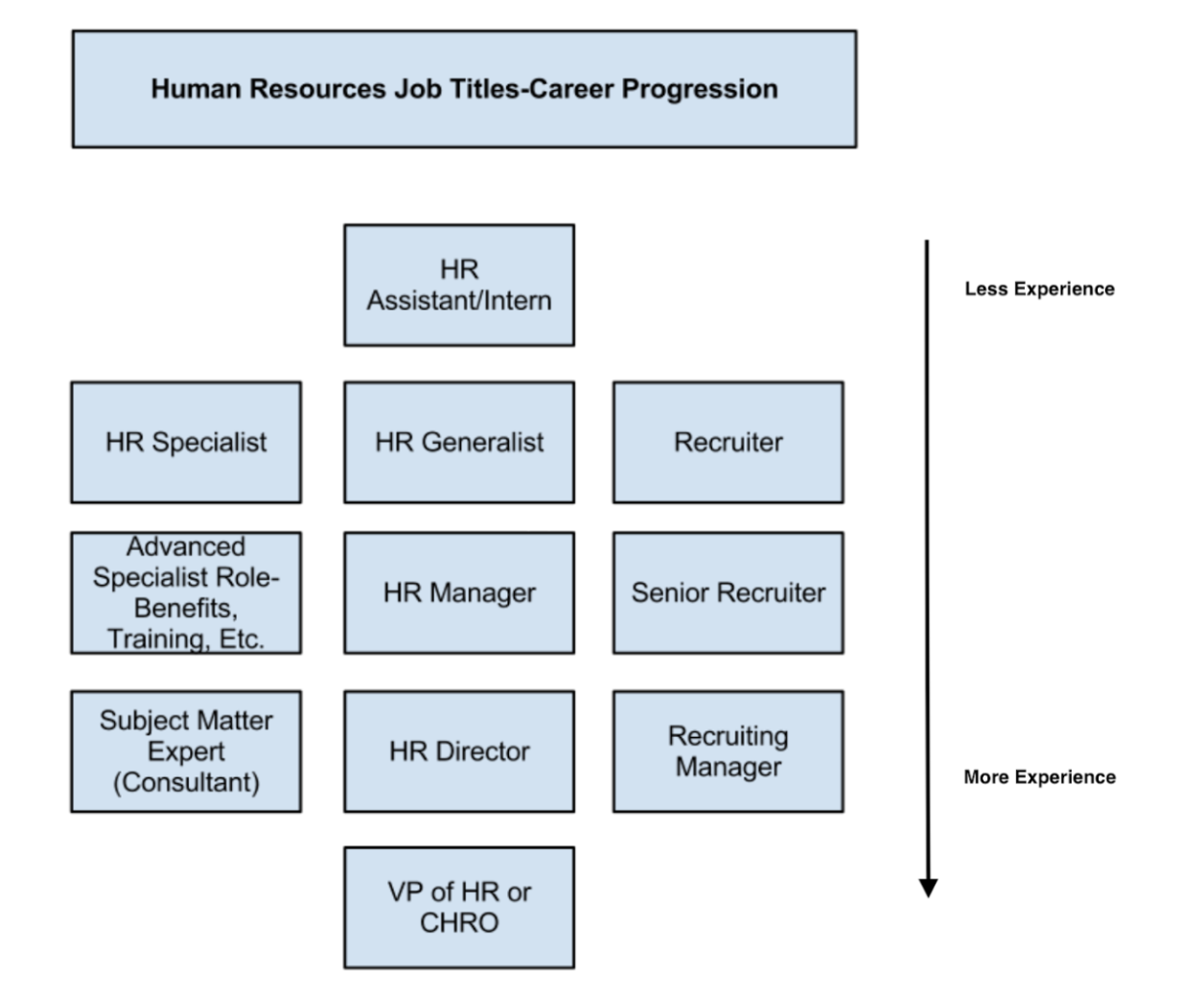
So what do HR employees in these roles actually do? And what are the differences between each position? We’ll cover the answers to these questions below.
Entry-Level Human Resources Roles
Entry-level HR jobs are fit for people in school, have recently graduated, or are entering the field for the first time. Their roles may include assistants and HR interns, specialists, generalists, or recruiters.
HR Assistant/ Intern
HR assistants and HR interns are typically in charge of the administrative work — such as organizing paperwork, completing the employer portions of new hire information, and other work their higher-ups ask of them — that needs to be done so everyone else in the department can remain productive and focus on more complex tasks.
HR Specialist
HR specialists focus on one specific department or discipline within human resources. These specialties include HR development, HR management, and organizational development. Their goal is to become an expert in their chosen specialty. For example, a benefits specialist would be required to know and understand the intimate details of a company’s benefits plan and be able to explain that information to new hires and current employees.
HR Generalist
HR generalists have knowledge that covers multiple different areas of the department and its needs. People in this type of role will work on the more typical tasks you may think of regarding HR, such as compensation, employee relations, and workplace environment.
Recruiter
The sole job of a recruiter is to bring in impressive talent for the company. They find new people to fill the gaps in the company’s staffing plan so the business can continue to grow and remain as productive as possible.
Mid-Level Human Resources Roles
As those in HR work their way up the ranks and acquire more experience, they’ll likely move into a mid-level HR role. Examples of these jobs include advanced specialists, HR managers, and senior recruiters.
Advanced Specialist
An advanced specialist is typically someone who was promoted from an HR specialist role. Their work might include developing job descriptions for specific, technical roles within their specialty and training entry-level specialists in their chosen discipline. Advanced specialists serve as a company’s high-level experts regarding their specific topic within HR.
HR Manager
An HR manager might oversee a group of entry or even mid-level HR employees. They’ll typically handle more of the complex HR tasks such as creating and managing company-wide policies, values, and culture.
Senior Recruiter
Senior recruiters function as your very own staffing service. They may oversee a team of entry-level recruiters who work to identify ideal candidates for open positions at your company. Senior recruiters may work for your company, or you might hire them as a third-party service depending on your budget and resources.
High-Level Human Resources Roles
If someone ends up staying in the HR field for most of their career, they may move into a high-level position at your company. These roles may include an HR consultant, HR director, recruiting manager, or vice president of HR chief of human resources officer (CHRO).
HR Consultant
An HR consultant typically oversees all HR administrative work and makes sure you’re meeting all company, state, and federal policies and laws. They can be subject matter experts on a particular HR-related policy. People in this role may be hired as third-party help depending on your budget and resources.
HR Director
If an HR manager is promoted, that person might move into an HR Director role. In most SMBs, the HR Director typically oversees all departmental activities and reports directly to the CEO.
Recruiting Manager
Recruiting managers oversee your company’s recruiting teams. They sign off on your staffing plan and ensure all of your role gaps are filled and talent needs are met.
Vice President of HR or Chief Human Resources Officer (CHRO)
In a larger company, you may have a vice president of human resources or a chief human resources officer. This person reports directly to the CEO, oversees the entire HR operation, and creates overarching department goals.
Back To You
Having a fantastic human resources team is essential to the success of your business. Your HR department will manage your employee relations, hiring, training, career development, benefits, and company culture. Without HR, your employees simply wouldn’t be able to do their jobs. Start by thinking about the number and type of HR employees you’ll need and start building your department so your company can continue growing.

How to Write a Request for Proposal with Template and Sample
Whether you’re working for a small agency or a major marketing firm, you’re probably eventually going to need to fill out a Request for Proposal, or RFP.
Your company can’t do everything internally, and when your business needs to purchase a product or service from elsewhere, you might need to shop around. An RFP allows you to collect offers from various vendors and select the vendor that best meets your criteria, both in regards to skill and budget.

Any time you outsource work to a supplier, there’s a potential for issues such as miscommunication around the scope of the work and the compensation. What a good RFP does is eliminate gray areas so that both parties understand what needs to be delivered, when, and for how much.
RFP Template
Here, we’ve provided an RFP template you can follow for initial structure, as well as a sample RFP for further inspiration. But it isn’t one-size-fits-all — you’ll need to tailor your RFP to best articulate your company’s needs.

Download a free, editable RFP template.
Not that you’ve seen the template, how do you actually write an RFP? We’ve got you covered.
1. Define your project, scope, and budget.
Before issuing your RFP, take the time to define the project you’re looking to complete, its scope, and how much you can afford to spend. This information provides the framework for your RFP and helps ensure that it strikes a balance between too general and overly detailed.
2. Provide background and introductory information.
With budget and scope in hand, you can start crafting your RFP. While it’s tempting to dive right into the details, it’s a good idea to provide some background and introductory data about your company. This helps set the stage for potential partners by giving them a sense of your current market, business goals, and current challenges.
3. Describe the services you’re looking for.
Now it’s time to get specific about the services you’re looking for to help achieve your goals. For example, if you’re building a website, you might look for a company with both front-end and back-end development experience. If you’re creating a mobile app, highlight the need for specific skills in that area, such as expertise in responsive design and building applications for multiple mobile platforms.
4. Detail your selection criteria and timelines.
Next up are the selection criteria and the timelines for your project. Here, you can highlight what skills, services, and market expertise are required for consideration. This is the time to get specific: Clear descriptions of selection criteria will help reduce the risk of sorting through multiple RFPs that don’t meet your needs.
It’s also important to be up-front about your timelines. Give potential partners an end date for RFP submission, a date for final selection, and a clear start-to-finish project timeline so companies making a proposal can fine-tune their bid.
5. Proofread your RFP and go live.
Last but never least? Proofread your RFP — then proofread it again. Why? Because even small mistakes could derail project timelines. Consider a zero missing in your budget details, or a miscommunication about the dates that proposals are due and selections are made; both could force a restart of the entire RFP process and waste precious time.
Once you’re satisfied that everything on your RFP is accurate and complete, it’s time to go live. Send out emails and post links on your site to start the process of finding your best-fit provider. To streamline this process, consider proposal software to publish and manage responses to your RFP.
Now that you understand the basics of writing an RFP, you can build your own template and then fill it out so that you can start accepting bids. We’ll use a fictitious company, Caroline’s Websites, Inc., to illustrate exactly how each section should be executed.
RFP Sample
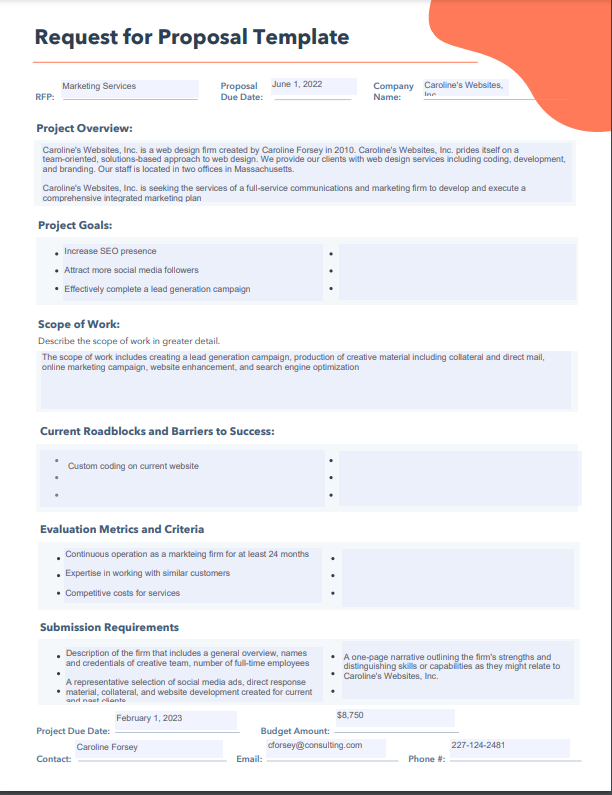 Project Name or Description: Marketing Services
Company Name: Caroline’s Websites, Inc.
Address: 302 Inbound Ave.
City, State, Zip Code: Boston, MA 29814
Procurement Contact Person: Caroline Forsey
Telephone Number of PCP: 227-124-2481
Email Address of PCP: cforsey@consulting.com
Fax Number: N/A
Next, we’ll go into each of the elements of the RFP with information using the same fictitious company.
1. Write your background and introduction.
In your introductory paragraph, you’ll want to include useful background information about your company — who founded it, what product or service your company offers, what sets you apart from competitors, and where you’re located. If any vendor is serious about working with you, they’ll want this information before moving forward.
Example
Caroline’s Websites, Inc. is a web design firm created by Caroline Forsey in 2010. Caroline’s Websites, Inc. prides itself on a team-oriented, solutions-based approach to web design. We provide our clients with web design services including coding, development, and branding. Our staff is located in two offices in Massachusetts.
2. Define your project goals and scope of services.
Next, you’ll want to outline the project you need completed, and the goals you expect to accomplish from the project. It’s important you get as specific as possible — even outlining individual tasks and criteria involved. You’ll want to include phrases such as “The award will be given to X firm,” with the “X” establishing how you’ll determine the best candidate.
Example
Caroline’s Websites, Inc. is seeking the services of a full-service communications and marketing firm to develop and execute a comprehensive integrated marketing plan that increases our SEO presence; attracts more social media followers; and effectively completes a lead generation campaign. The award will be made to a responsive and responsible firm based on the best value and professional capability.
The selected firm will be responsible for the development and implementation of a comprehensive and cost-effective marketing plan.
Tasks include but may not be limited to the following criteria:
- Lead generation campaign
- Paid media strategy
- Production of creative material including collateral and direct mail
- Online marketing campaign
- Website enhancement
- Search engine optimization
- General account management
- Other communications and/or marketing-related assistance as required
3. Detail your anticipated selection schedule.
It’s crucial you include a detailed schedule so vendors know if they can meet your deadlines. You’ll also need to give vendors a window for when they can ask questions regarding your project.
Example
The Request for Proposal timeline is as follows:
Request for RFP: June 1, 20XX
Deadline for Bidders to Submit Questions: July 5, 20XX
[Company Name] Responds to Bidder Questions: July 20, 20XX
Selection of Top Bidders / Notification to Unsuccessful Bidders: July 31, 20XX
Start of Negotiation: August 5, 20XX
Contract Award / Notification to Unsuccessful Bidders: August 31, 20XX
4. Describe the time and place for the submission of proposals.
Similar to paragraph #3, this is important information you’ll want to clearly present, so vendors know how and where to submit themselves for consideration.
Example
The RFP will be posted on our website, Carolinewebsites.com, and can be downloaded from there directly as of 10 a.m. on June 1, 20XX.
Respondents to this RFP must submit one original and five copies of their proposal. Responses must be received no later than July 25, 20XX. Responses should be clearly marked “RFP-MarketingServices” and mailed or delivered to the contact person listed above.
5. Clearly define your timeline.
By including a time frame in your RFP, you’re able to eliminate any vendor who can’t work within your time constraints. If you’re flexible on your time, you can write something like, “Our company hopes to finish the project within six months, but we’re open to negotiation for the right candidate.”
Example
Caroline’s Websites, Inc. needs the project completed within 8 months.
6. Specify the key elements of a proposal.
If you don’t outline clearly and specifically what you expect bidders to include in their proposal, you can’t necessarily fault them if they don’t include it. It’s critical you outline a checklist so vendors know which elements you’re expecting to receive. It’s also a good test for who’s capable of handling your demands — if a vendor can’t complete all elements of your proposal, you probably can’t trust them to finish your project, either.
Example
A submission must, at a minimum, include the following elements:
- Description of the firm that includes a general overview, names and credentials of creative team, number of full-time employees.
- A one-page narrative outlining the firm’s strengths and distinguishing skills or capabilities as they might relate to Caroline’s Websites, Inc.
- A representative selection of social media ads, direct response material, collateral, and website development created for current and past clients.
7. Make your evaluation criteria clear.
Outlining your expectations will help eliminate vendors who don’t meet them. For this section, you’ll want to do some brainstorming with your team to come up with a mandatory list of items you feel are the best indicators of impressive candidates. Your list could include samples of past work, a proven success record with companies in similar industries, the expertise and technical skills to meet your demands, and a cost of services within your price range.
Example
The successful respondent will have:
- Experience working as a marketing agency for a minimum of 24 months and possess full-service, in-house capabilities for marketing, creative services, production, media planning and placement, direct response, and research.
- The education, experience, knowledge, skills, and qualifications of the firm and the individuals who will be available to provide these services.
- The competitive cost of services.
- The expertise of the firm in working with similar customers.
8. Describe any possible roadblocks.
Here, you’ll want to outline any roadblocks, such as limited resources or a custom website, that might prevent certain vendors from successfully completing the project. This allows you to eliminate unsatisfactory bidders, and it will also help you determine which vendors have the skills and expertise to tackle those challenges.
Example
At this time, Caroline’s Websites, Inc. currently has custom coding on our website, of which bidders should be aware.
9. State your budget for the project.
Any vendor needs to know how much you’re able to pay them for their services before they’ll move forward with their bid.
Example
Caroline’s Websites, Inc.’s budget for the project is $8,750.00.
These elements were written in a way to clarify the scope of the project that Caroline’s Websites, Inc. wants completed so that suppliers know whether or not to make a bid. Defining the project allows the bidder to determine if they’re a good fit and how much they’d likely charge. Being as transparent as possible serves to benefit (and even protect) both parties in the long run.
As the name makes clear, RFIs are about collecting information. They’re used by companies to get a sense of what solutions are on the market and how the companies that offer these solutions could help solve a key problem or complete a key task. RFIs ask companies to submit data about what they do, what they offer, and how they can help achieve specific goals.
RFPs, meanwhile, follow RFIs. Using the information obtained from RFIs, companies build RFPs that detail exactly what they’re looking for, how much they’re planning to spend, and how vendors will be selected. In effect, RFIs help narrow the scope of RFPs to help streamline the selection process.
Worth noting? There’s also another option if you know exactly what product or service you’re looking for: Request for quote (RFQ). Unlike an RFP, which asks potential partners to submit a proposal based on their expertise and experience, an RFQ is about cost: You’re asking a specific vendor what it would cost to deliver “X” service or solution in “Y” timeframe under “Z” conditions.
Realizing Best Results for Your RPF
Your RPF sets the stage for companies to bid on projects that are outside the scope of your internal expertise — but are still critical for your business to succeed.
As a result, it’s worth making sure your RFP is clear, concise, and captures the key details about your needs to help find the best-fit partner for your project. Not sure where to start? Grab a copy of HubSpot’s free RFP template, follow the steps above, and get your projects underway.
Editor’s note: This post was originally published in June 2018 and has been updated for comprehensiveness.

10 Best Free Project Management Budget Templates for Marketers
Let’s face it: Executing a successful marketing project requires time, energy, and money.
And with so many different facets of marketing to consider — branding and creative, product marketing, event hosting, and so forth — your marketing project management budget can disappear fast.
Ever found yourself scratching your head with a depleted budget at the end of the month, quarter, or year? Ready to leave behind the days of ambiguous spending and vanishing budgets? We’ve got you covered with a look at the top essential project management budget templates for marketing plans — plus a free download.

What makes a good project management budget template for marketing?
Before we dig into the details, it’s worth taking a minute to talk about how we selected our top choices. With so many marketing budget templates now available, this wasn’t an easy task — and when it comes to what we’ve picked, you may have a favorite that’s not listed.
Given the number of options, this list could be 20, 30, or 50 templates long, but in the interests of getting you the information you need to find a best-fit template ASAP, we’re keeping our list to only the best options out there.
As for criteria, we went with characteristics such as usability, simplicity, and adaptability. It’s our goal to provide a list that gives you multiple options with similar value — all you have to do is pick the one that best suits your marketing needs.
With that out of the way, let’s get started.
1. HubSpot [Excel, Google Sheets]
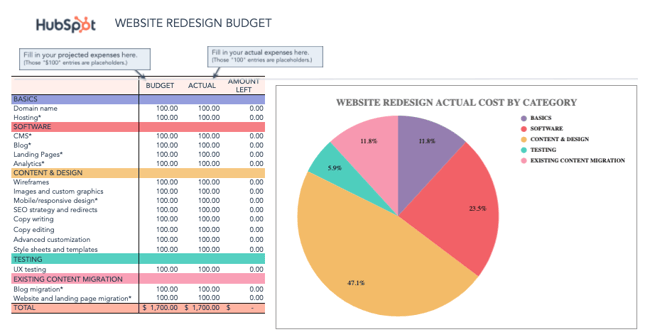
HubSpot’s set of eight free budget templates offers everything you need to get started, from a master marketing template to more specific spreadsheets for content, products, and paid advertising. Available as both Microsoft Excel files and Google Sheets, HubSpot has you covered no matter how you choose to handle your marketing budget.
What we like: The simple, streamlined, and colorful design makes these templates easy to use without sacrificing the detail you need.
2. Spendesk [Excel]
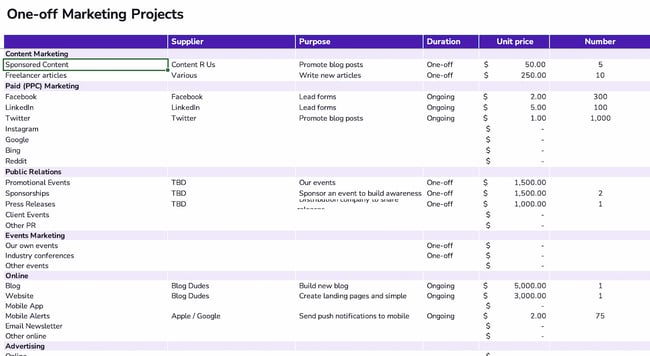
Spendesk offers marketing budget templates for growing businesses to help manage the complexity that comes with annual marketing, subscriptions, one-off events, and upcoming expenses. The templates are designed to scale with your team, making them a great choice for companies just getting off the ground and more experienced marketers looking to streamline their budgets.
What we like: Spendesk’s free templates do the math for you across both Excel and Google Sheets.
3. Smartsheet [Excel]
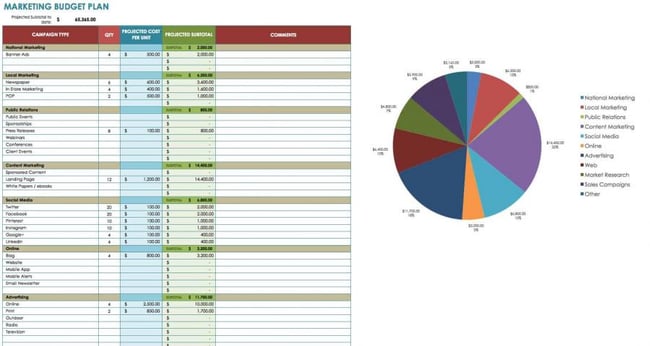 Smartsheet offers 12 free marketing budget templates for social media efforts, product marketing, quarterly marketing, and annual marketing. While they’re only available as Excel files, they’re a great starting point if you’re looking to consolidate spending sources and streamline marketing budgets.
What we like: Smartsheet’s templates include itemized categories along with estimated costs for each item, subtotals, and totals paired with an easy-to-read pie chart.
4. Capterra [PDF]
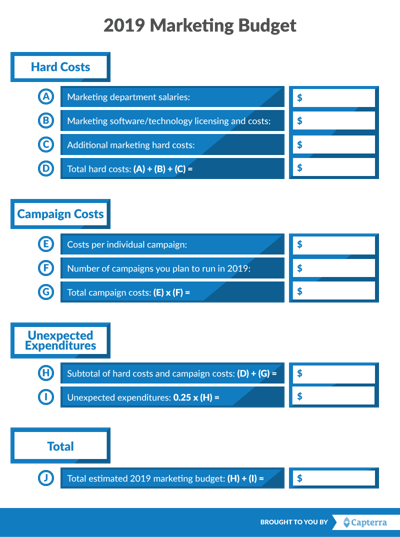
Capterra’s marketing budget template is all about simplicity. The free framework lets you easily map out hard costs, campaign costs, and unexpected expenditures to give you an approximate total that can help inform more specific budgeting efforts. Oh, and ignore the “2019” in the title — the template is still just as applicable in 2022.
What we like: Simple is the name of the game here, making Capterra a great choice for initial budgeting efforts.
5. Smart Insights [Google Sheets]
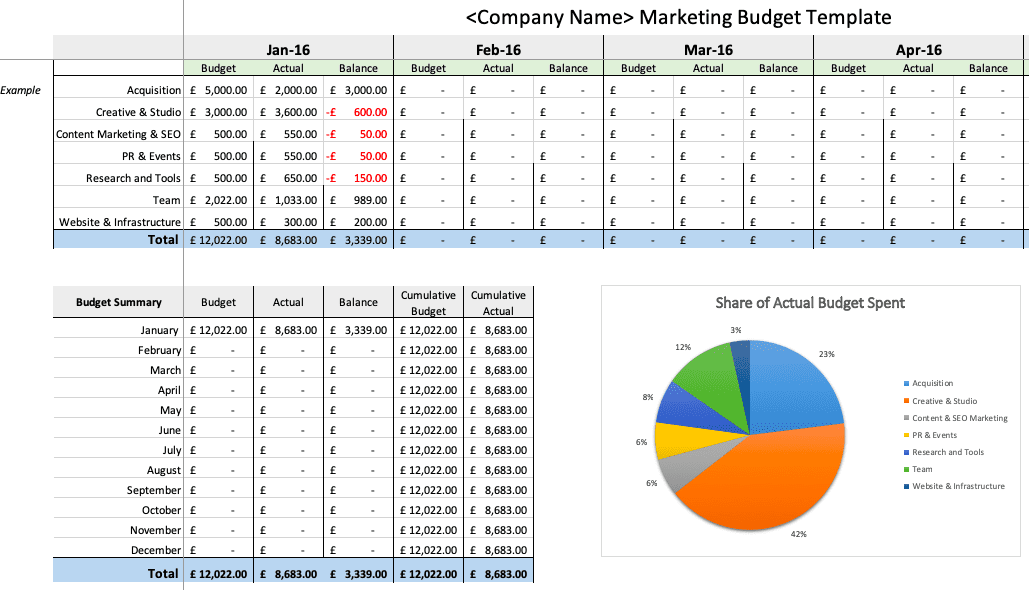 Smart Insights also offers a template octet with options for spend summaries, acquisition marketing costs, creative spend, and SEO activities that clearly lay out where you’re spending money, how often, and what it costs you over a specified period. While there’s no Excel option, these templates are still a good choice to help simplify budget management.
What we like: The Smart Insights templates make it easy to specify your level of spend thanks to a simple and streamlined design.
6. Monday [Built-In Template]
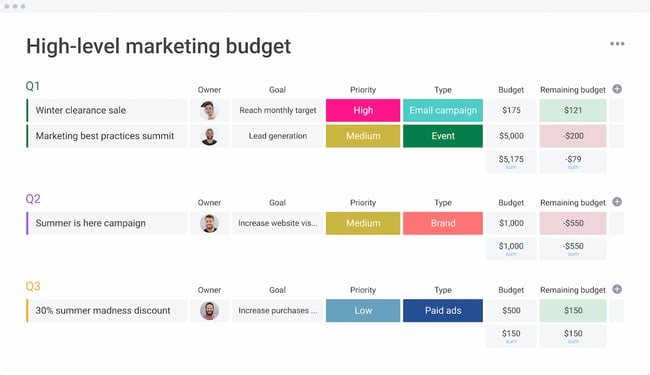
The Monday template offers a high-level overview of your current marketing budget within Monday’s user interface. Each quarter includes information about the owner of the projects, target goal, level of priority, type of action taken, total budget, and remaining budget. Just like the day of the week, Monday makes it possible to start your quarterly budgeting on solid ground.
What we like: Simple and high–level are the watchwords here. Marketers can get the information they need at-a-glance to drive budget decision-making. If you already use Monday for project management, this is an excellent fit.
7. SwagDrop [Google Sheets]
 SwagDrop offers a quartet of budget templates to help balance marketing costs and revenues. They include an investment report, salaries report, revenue report, and monthly balance report. Make no mistake — they’re not the prettiest templates on the market, but they’re free, functional, and offer a solid foundation for marketing budget frameworks.
What we like: The SwagDrop page also includes sample budgets on their template examples to help businesses get their budgets up and running ASAP.
8. ProjectManager [Excel]
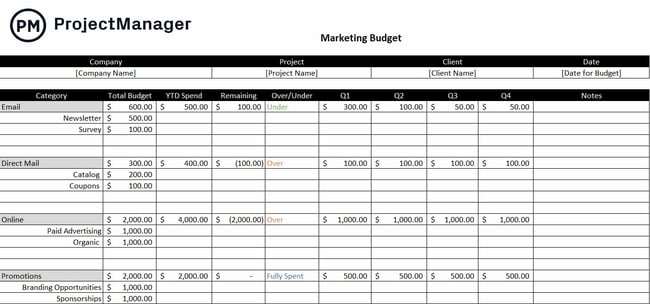
This free template is a simple Excel spreadsheet that provides a quick overview of relevant budget data to help marketers see what they’re spending, where they’re spending it, and if budgets are staying on track. While it’s best supported by other, more in-depth options, the straightforward layout is worth a download.
What we like: The template integrates with ProjectManager’s larger suite of paid project management software, which is designed to manage hybrid teams across multiple locations.
9. Demand Metric [Excel]
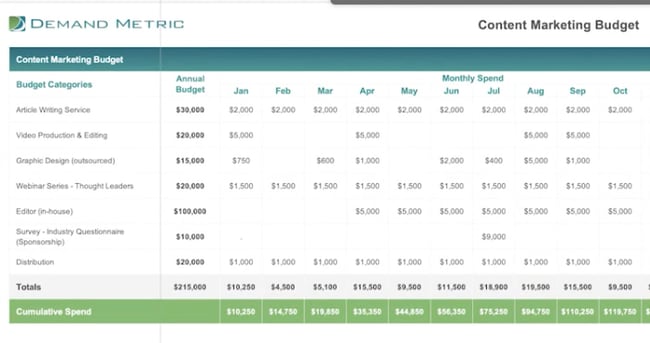
The Demand Metric marketing budget is all about content. It makes sense: To capture customer interest, companies are well-served by spending on blog posts, video production, and graphic design. This template helps track the cost of these content initiatives over time to see how they stack up against returns.
What we like: Content is king in getting your brand noticed. Demand Metric makes it simple to see what you spend on this critical function.
10. Score [Excel]
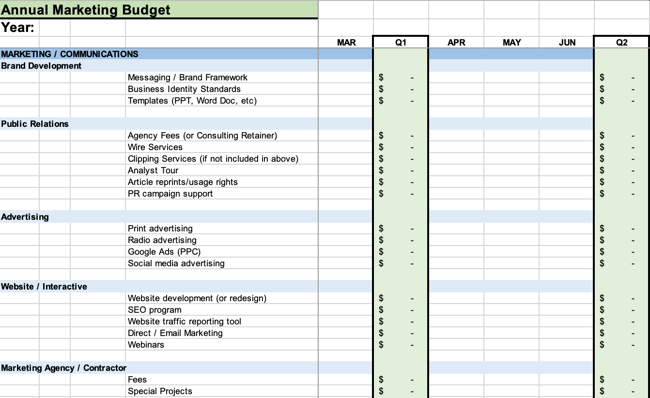
The Score annual marketing budget template is designed to help marketers estimate their annual expenses and align them with campaign goals. Easy to modify and simple to use, this template is a great starting point for marketers looking to pinpoint where they can save — and where they need to spend.
What we like: Simple budget estimation is worth the download for this marketing template.
Making the Most of Your Project Management Budget
The better your budget management, the better your marketing outcomes. But as marketing efforts become more complex and far-reaching, it’s easy for spending specifics to get lost in the shuffle.
Don’t get caught with cost overruns — tap one of our top templates to make the most of your marketing budget, and download additional ones below.
Editor’s note: This post was originally published in November 2014 and has been updated for comprehensiveness.


How to Accept Payments Online [7 Top Payment Processing Providers]
With only 16% of consumers carrying cash and the popularity of ecommerce, if you don’t have a payment processor for your business, you’re missing out.

In this post, we’ll talk about the software options available for accepting payments online — including some free options, and how payment processing can help streamline your business processes and increase sales.
But first, let’s cover the basics of how payment processing works.
What is payment processing?
A payment processor is a company that facilitates electronic payments (credit card, digital wallets, ACH) between a business and the bank. Essentially payment processors handle all of the backend logistics between merchants, banks, and credit card companies that enable businesses to accept payment.
How does payment processing work?
When you shop at a retailer and pay with a credit card, the payment processor works in the background to authenticate and complete the transaction, moving the money from your account to the business’ account.
Here’s what happens behind the scenes when a customer makes a card payment:
- A customer gives the merchant their credit or debit card to make a purchase. This is either done using a payment terminal in-person or through an online payment page.
- The card information goes through a payment gateway or portal which encrypts the customer’s personal data to ensure privacy and sends it to the payment processor.
- The payment processor then sends a request to the customer’s issuing bank to see if they have enough credit (or cash if using a debit card) to pay for the purchase.
- The card issuer either approves or denies the purchase.
- The payment processor sends this “approved” or “denied” info back to the retailer to complete the transaction with the customer.
- Once complete, the processor tells the customer’s bank to send funds to the retailer’s banking institution.
While this sounds like a lot of steps, it all happens in a matter of seconds and requires no work on your end or the customer’s.
Benefits of Payment Processing
Here’s a look at some of the advantages payment processing software will bring to your business.
1. Convenience
Convenience is one of the main factors that influence conversion rate. The more steps a customer has to take to make a payment, the more likely they are to abandon their purchase and go elsewhere.
2. Speed
Payment processors can transfer most payments between shoppers and sellers instantly. On the other hand, transfers to and from bank accounts can sometimes take 24 hours or more.
3. Trust
Many payment processors are brands that are globally recognized. If a customer already uses payment software, they’re more likely to trust your payment system.
4. Security
Payment processing companies add an extra layer of protection to online transactions. You can set limits, flags for activity on your account, and sometimes even a time frame to recall payments.
5. Record-Keeping
With payment processors, you’ll have access to your account online and can manage your contacts, recurring payments, and other account activity via desktop or mobile.
Costs to Consider When Using Payment Processors
While payment processors offer convenience and security among other perks, they also come at a cost. Each player in the payment chain — banks, credit card companies, and the payment processor takes their cut. Here are some of the transaction fees to look out for.
- Interchange Fee: These are fees paid to the card issuer (Chase, TD Bank, Bank of America, etc.) The card issuer gets paid by getting a percentage of each sale.
- Assessment Fee: These fees are paid to credit card associations (Visa, Mastercard, Amex).
- Acquirer or processor Fee: These are fees paid to the processor (PayPal, Square, Stripe).
- Merchant Fee: This is a fee paid to your merchant bank. The percentage charged will depend on the volume of transactions, the number of sales, and the industry.
The interchange, assessment, and merchant fees are bundled together and quoted as one percentage. The Processor fee is quoted separately. For example, your transaction fees could be 3% total with a $0.20 processor fee per transaction. This will be good to keep in mind when considering what pricing structure to go with, which we’ll explore in the next section.
Payment Processing Pricing Structure
Another factor to consider is pricing structure, which will vary from one processor to another. This structure typically falls within the categories below:
1. Interchange Plus
With Interchange Plus pricing, the retailer pays an additional fee plus the interchange amount. For example, you would be paying a 3% interchange rate plus a $0.25 per transaction.
- Pros: This can be a more cost-effective option than other structures.
- Cons: Because there are hundreds of interchange rates, the costs will vary significantly from one transaction to the next.
2. Flat-Rate
This is a fixed rate percent for all transactions paid in a certain manner regardless of the interchange rate. For example, you could pay 2% plus $0.20 for in-person purchases and 2.5% plus $0.25 for online purchases.
Pros: Your costs are predictable.
Cons: Your costs may be higher than the interchange plus model if you have a high volume of sales.
3. Tiered
Tiered pricing combines aspects of flat-rate and interchange plus. In this model, interchange rates are categorized into buckets or tiers. The processor then assigns a cost to each tier. For example, on a $75 purchase, you could have fees ranging from $2 to $3 depending on which tier it has been classified as.
Pros: Rates are easier to understand since the hundreds of possible interchange fees are bundled into predetermined tiers, making costs more predictable.
Cons: Since the processor sets the tiers, the overall costs can be higher than the other options.
Now that we’ve explained the costs, let’s look at some of the best online payment processors on the market.
Top Online Payment Processing Providers
Once you’ve developed a strategy for accepting payments online, you’ll need to decide which payment processing provider to use. Here are seven of the most popular options:
1. PayPal
Price: 3.49% plus $0.49 per transaction.
PayPal is one of the most trusted and widely recognized payment processing companies. It’s free to join and they provide all the tools you’ll need to integrate PayPal payments into your website and set up a secure payment gateway for visitors. Additionally, comprehensive coverage makes the platform a good choice for international companies.
2. Stripe
Price: 2.9% plus $0.30 per transaction.
Stripe offers a wide range of options for online businesses such as customizable checkouts as well as subscription management and recurring payment features. Stripe supports all major credit cards, mobile paying apps, wallets, and more.
3. Square
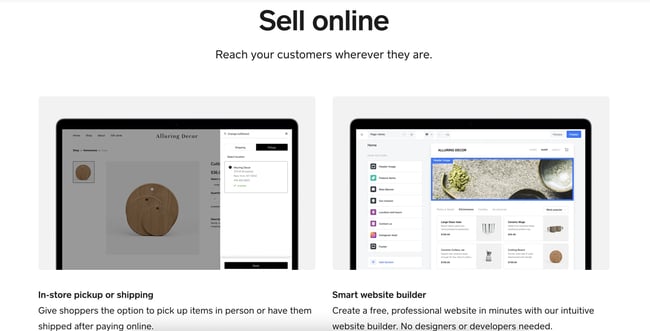
Price: 2.9% plus $0.30 per transaction.
Square entered the payment processing space by introducing a dongle that sellers could insert into a mobile phone to accept credit card transactions.
They’ve since expanded their software to cover all the major payment processing options and have included some useful tools for online businesses as well as high-street stores.
You can even create a basic website for free and integrate all of their point-of-sale (POS) solutions at the same time. They also have paid options for a custom website.
4. Google Pay
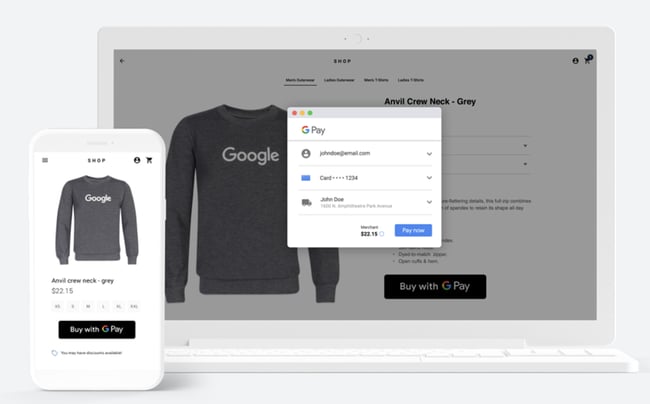
Price: Google Pay doesn’t charge any fees — merchants only pay transaction fees as usual with credit/ debit sales.
Google Pay has a payment tool for businesses, websites, and apps. Google Pay’s APIs work to create a delightful checkout and payment experience for your customers.
If you use Google Pay on your website, you’ll gain secure and easy access to hundreds of millions of cards saved to Google Accounts worldwide so customers can pay for your products safely and at the touch of a button.
5. Apple Pay
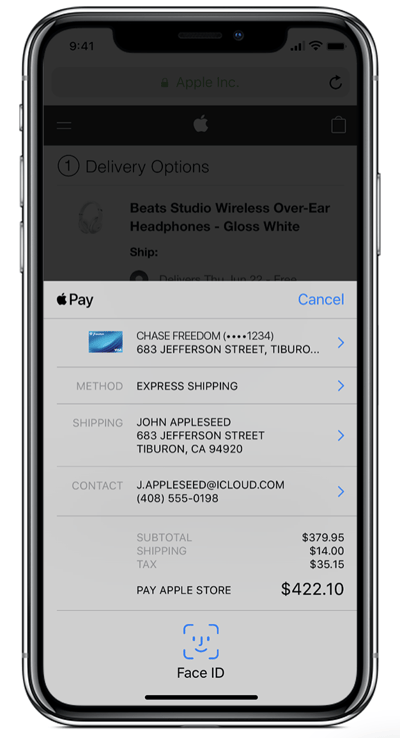
Price: Apple Pay doesn’t charge any fees — merchants only pay transaction fees as usual with credit/ debit sales.
Apple Pay can be used on websites, in stores, by app, and via Business Chat or iMessage. It allows Apple users to quickly and safely input contact, payment, and shipping information during checkout.
Rather than having your ecommerce customers look around for their credit cards, Apple Pay allows them to checkout at the click of a button within apps and websites. On a website, an Apple users will simply click “Apple Pay” as their payment option, confirm the payment with one tap (via their iPhone, Apple Watch, etc.), and they’re good to go.
6. Venmo For Business
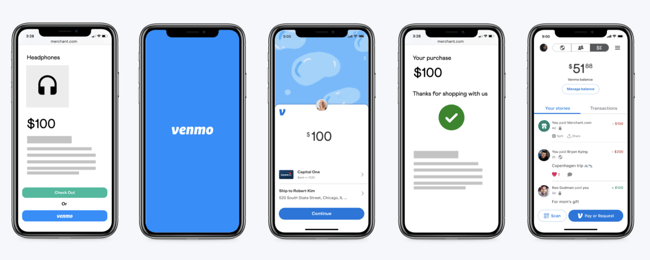
Price: 1.9% plus $0.10 of the payment.
Venmo For Business is a mobile payment software and app owned by PayPal. You can choose to allow users to pay via your mobile app or your website.
You can set up a business profile on Venmo so users can quickly find your profile on the app. And if you add Venmo to your website, it’ll appear as a payment option right next to where it’ll give customers the option to pay with PayPal.
Once a customer selects the Venmo option at checkout, they’ll be directed to their Venmo app to complete the transaction. The Venmo payment option can be added to any of the pages of your ecommerce site that would also show the option to pay with PayPal, including your product pages, shopping cart page, and checkout page.
7. Helcim
Price: 2.38% plus $0.25.
Helcim is an online payment solution for ecommerce businesses — you can choose to start an online store from scratch or add a payment solution to your current website.
The easy-to-use and secure online payment system integrates into your website, shopping cart, billing system, and/or app, thanks to Helcim’s API. In addition to in-app and via website, Helcim works over the phone, in person, and by invoice, and it integrates with your accounting tools to save you time when it comes to bookkeeping.
Next, let’s cover the steps involved in receiving payments online.
1. Create a secure online payment gateway.
There are a couple of ways you can approach creating a secure online payment gateway. You can hire an outside developer or use your website development team to create a bespoke gateway. Or, you can use third-party software.
Setting up a secure gateway is essential. You’re also putting automated processes in place, which will save time on manual processing, especially as you scale your business and handle more transactions.
The more payment methods you make available within your payment portal, the wider the audience, and the easier it’ll be for your customers to send you money.
2. Facilitate credit and debit card payments.
Although it may change as mobile payments become more prevalent, using debit/ credit cards is still the most popular way people pay for products and services online.
You can easily facilitate accepting card payments through established payment providers such as PayPal or Stripe. These will accept the most-used credit cards worldwide — Visa, MasterCard, and American Express.
3. Set up recurring billing.
If you offer subscription plans or ongoing monthly services, the most efficient and reliable way to invoice and receive payments is via recurring billing.
Most of the major payment processing software also includes recurring billing features. For example, Growth Marketing Pro built an SEO tool that charges subscribers on a monthly basis and they used Stripe to set this up.
Sites like Paysimple also offer a suite of tools to set up custom, automated recurring billing if you already have a payment processing system in place.
Using automation is essential. It removes most human error and the stress of keeping track of invoicing and payments.
Your customers can commit to recurring payments with just a few clicks, and you won’t have to worry about manually managing your customer base.
4. Accept mobile payments.
These days, people are often more likely to have their phones on hand than debit cards — plus, mobile payment apps are more convenient than ever.
For instance, Apple Pay has quickly become one of the most popular mobile payment systems in the United States. With an estimated 43.9 million users, you’d miss out if you didn’t accept Apple Pay.
Google Pay, Venmo, and PayPal also have mobile apps with a decent market share.
5. Use email invoicing.
Email invoicing is a proactive way to request payments. You can share a payment form through email or add a link redirecting the recipient to a payment portal.
However, there are a couple of issues with this method: Email isn’t the most reliable form of communication, and customers can have trust issues making payments via email.
Expect a failure rate, but it’s a vital part of payment processing for a lot of businesses.
6. Accept electronic checks (eChecks).
To accept eChecks for payment, you need a form where the user can input their information, which you can see using payment processing software.
It’s basically a way to pay by check online. It’s a quicker and more reliable way than sending a paper check through the post, so offering this to your customers will make the process run smoother.
7. Accept cryptocurrency payments.
If you’re okay with handling cryptocurrencies, it’s a way you can extend your reach to a broader online audience.
Sites like Bitpay provide all the tools you need to accept crypto payments online, send invoices, request payments, and receive money on the go-through apps.
Because they’re a decentralized exchange, cryptocurrencies offer some unique benefits for businesses. You can accept payments from anywhere in the world without incurring currency exchange fees or bank handling fees. There’s also a reduced risk of fraud.
Start Accepting Payments Online for Free
No matter which payment processing software you choose, the most important part is making it easy for the customer to pay. And the more ways they can pay, the more likely your customers will follow through on a purchase.
Editor’s note: This post was originally published in April 2020 and has been updated for comprehensiveness.
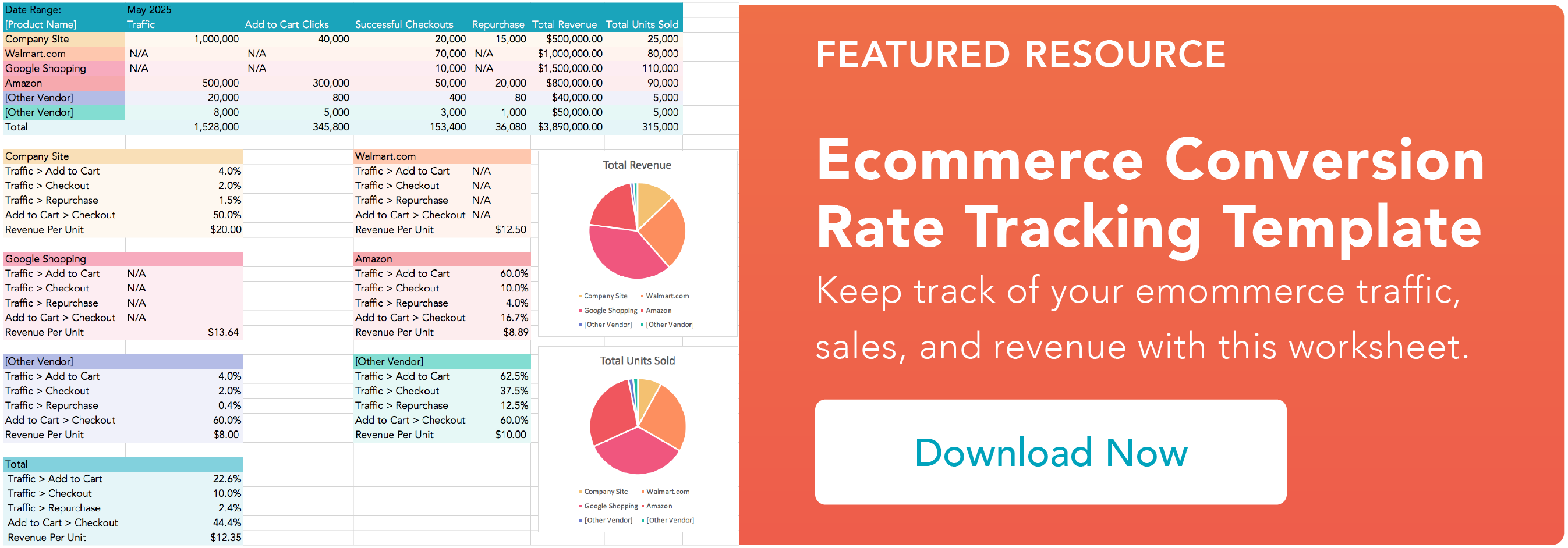

30 Popular Job Boards That Will Help You Hire The Most Qualified Candidates
As a recruiter, your job isn’t limited to simply finding the best candidates. You also have to promote these roles on job boards and convince applicants to join your company.
In other words, you’re not just a recruiter — you’re also a marketer and a salesperson. But, how do you know which job boards will help you find the most qualified applications for your specific position? Read on to find out.
Table of Contents:
- What is the best job search engine?
- Best Job Boards
- Best Job Boards for Hiring College Students
- Best Job Boards for Hiring Freelancers
- Best Job Boards for Hiring Remote and Hybrid Workers
1. Glassdoor
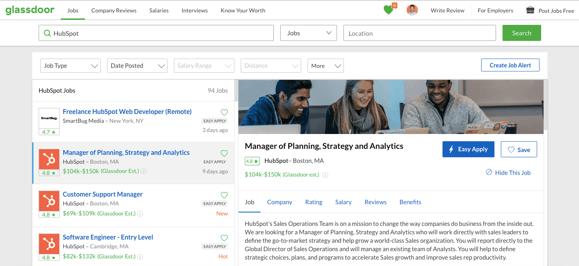
Key Features:
- A large pool of potential candidates (55M+ per month)
- List your jobs and include detailed descriptions of preferred skills and qualifications.
- Review resumes, send messages to candidates, and schedule interviews to begin recruitment.
- Create an employer brand profile to help candidates learn more about your business and culture.
- You can pay to feature jobs for more visibility.
2. LinkedIn Jobs
Price: Contact for pricing.
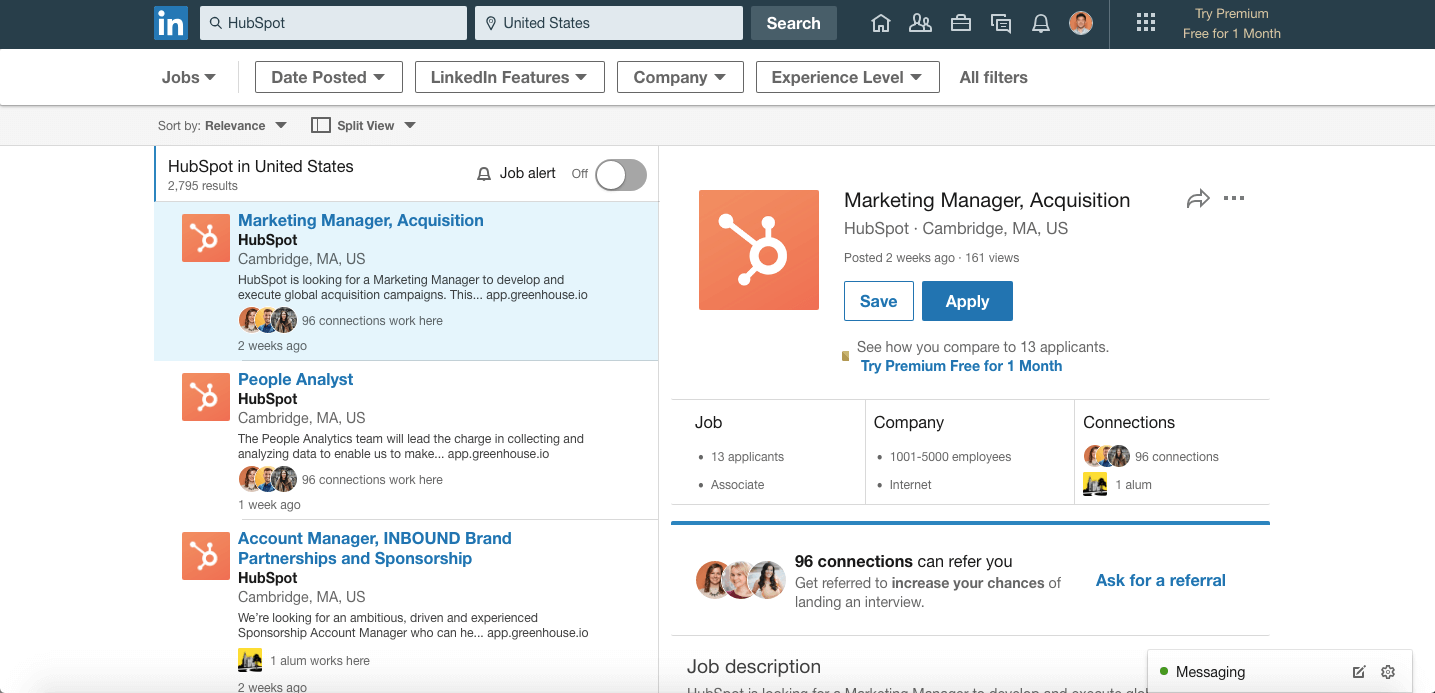
Key Features:
- A network of over 700 million professionals.
- Your job listings are matched with the most qualified professionals who have noted in their profiles to be open to work and looking for new roles.
- A rating system helps you prioritize who you want to interview.
- Advanced filtering options help you search for candidates with your preferred qualifications, and you can send them a message via InMail.
3. Indeed
Key Features:
- 75.4 million users — a large pool of candidates.
- Get matched with best-fit candidates that meet your job specifications.
- Sort candidates to move forward and schedule and conduct interviews within the platform.
- Manage all your job postings for different roles and locations in one dashboard.
- Create a custom company page to build brand identity and help candidates learn more about your company culture.
- Pay for applications that meet your criteria, but you can reject unwanted applications before being charged.
4. Google Job Search
Price: Free
Key Features:
- Aggregates job postings from company websites and career pages to share with millions of job seekers.
- Millions of job seekers search for open roles on Google every day.
- Using job post structured data on your career pages ensures your listings are ready to be picked up by Google.
5. ZipRecruiter
Price: Contact for pricing.
Key Features:
- Create and list your jobs that are then sent to 100+ job sites.
- Matching technology invites the most qualified candidates to apply to your positions.
- Manage and rate applications by their qualifications.
- Ten million candidates reached each week.
6. Monster
Price: 4-day trial, then $649/mo
Key Features:
- SearchMonster analyzes your job requirements, finds resumes, and ranks and scores qualified candidates based on your specifications.
- Instant notifications when a candidate matches your criteria.
- Jobs are distributed across the monster network, email, and partner sites and reach millions of global visitors per month.
7. SimplyHired
Price: $4.99 to move forward with a candidate
Key Features:
- Post unlimited jobs for free and only pay when you move forward with a candidate.
- Candidates answer screening questions to help you learn more about them outside of their resumes.
- Easily review applications, cover letters, and resumes, and obtain contact information from your preferred candidates when you’re ready to move forward.
- Additional tools for hiring and onboarding.
- Jobs are distributed across partner sites for visibility.
8. Nexxt
Price: $199-400/mo
Key Features:
- Standard job listing option.
- Unique job slot listing model can be continuously updated as your hiring needs change.
- Search for candidates with intelligent filters to focus your results on those with your preferred skills.
- Text2Hire helps instantly connect and communicate with candidates via text.
- Programmatic advertising increases your listings’ exposure in display ads on high-traffic channels like Spotify.
9. CareerBuilder
Price: $299 – $599/mo
Key Features:
- Keywords from your listings are used to browse resumes and match you with candidates with your target skillsets.
- AI tools send your jobs to targeted candidates, and you can receive up to 25 matches per day, per job.
- Can conduct resume and profile searches and create custom lists for candidate management.
10. Dice.com
Price: $495
Key Features:
- Built for sourcing technology professionals.
- Dice Match Score rates candidates based on their relevance and qualifications for the jobs you list.
- Preview resumes and prioritize preferred candidates based on their qualifications.
- Download and share applications with everyone involved in your hiring process for team-wide involvement.
- Jobs are cross-posted to partner sites for job amplification.
11. Snagajob
Price: Starts at $89/mo
Key Features:
- Find qualified candidates for hourly jobs and shift work.
- Listings include relevant filters for location and level of expertise.
- Track applications, monitor candidates, and schedule interviews within the platform.
12. Craigslist
Price: Varies by location.
Key Features:
- Find local talent and freelancers.
- Create a listing explaining what you’re searching for and include detailed information to help candidates determine if they’re qualified.
- Invite candidates to reach out to you on your preferred channel.
- Job seekers can upload resumes, so you can browse through them and find talent without posting a job.
13. Mashable
Price: $259-399
Key Features:
- Write a detailed job description with skills and qualifications candidates need to possess.
- Candidates that match your criteria receive email alerts for your jobs.
- Save candidates to view later, and track the process once someone applies.
- Jobs are distributed to partner job boards.
14. Talent.com
Price: Contact for pricing.
Key Features:
- Easily note the expertise and skills you’re looking for.
- Track applications and preview qualifications before paying.
- Opted-in candidates that match your qualifications receive email alerts for your jobs.
- Additional advertising options help you promote your listings.
- Network of job partners for maximum visibility.
15. Lensa
Price: Contact for pricing.
Key Features:
- InstaMatch uses your job description skills and qualifications to browse the resumes of job seekers to find matches.
- Candidates are invited to apply by qualifications, so you’re not searching through hundreds of applications for the right fight.
- It can automatically pull jobs from your career page.
16. Ladders
Price: Free – $499/mo, Enterprise pricing available
Key Features:
- Reach candidates in the U.S. and Canada
- Sort candidates based on specific criteria, like industry, location, experience, and desired salary.
- Algorithms share your listings with the most qualified professionals.
- Pre-answered interview questions help you learn more about candidates before conducting an interview.
17. TheJobNetwork
Price: $249-599, upgrades available.
Key Features:
- Your detailed job descriptions help screen, grade, and rank candidates based on your specifications and resumes.
- Listings last 30 days and include priority candidate search and management tools.
- Jobs are distributed to other national, industry, and relevant local sites to put your listings in front of the most candidates.
18. Find.Jobs
Price: Free trial, then $149-596/mo
Key Features:
- Searchable candidate database with resumes and CVs to browse and connect with qualified talent.
- JobBoard.com network for more visibility.
- Can pay for featured placement or banner ads to gain more exposure.
19. Behance
Price: Contact for pricing.
Key Features:
- Partnership with Adobe Talent helps you hire within the creative community.
- Custom candidate recommendations based on your desired qualifications.
- Save candidates to share with anyone involved in your hiring process.
- Average public posts receive 150 applications.
20. The Muse
Price: Contact for pricing.
Key Features:
- Build a unique company profile to help applications learn more about your business, culture, and what it’s like to work for you.
- Your company story is shared on career pages and relevant recruiting channels for exposure to top talent.
- National reach of 7M+ monthly users.
21. Cleverism
Price: Contact for pricing.
Key Features:
- Branded company profile to share information about your business’ culture for candidates to learn more before applying.
- 400k+ potential reach, and you can use advanced search filters for your preferred skills and requirements to find the best-fit talent.
22. CareerBliss
Price: Contact for pricing.
Key Features:
- Post and distribute your jobs to 100+ listing sites for exposure.
- You can invite top talent to apply to your positions.
- Company profile helps interested candidates learn more about what you offer.
- Application management tools for the entire recruitment process.
- Small business and enterprise solutions.
23. Getwork
Price: Contact for pricing.
Key Features:
- Custom search features help you filter by location, persona, and behavior.
- Targeted email campaigns for segmented audiences that meet your preferred criteria.
- Pay-per-click recruitment campaigns.
Best Job Boards for Hiring College Students
24. Handshake
Price: Contact for pricing.
Key Features:
- Post jobs and pinpoint your best-fit candidates with advanced filtering for factors like location, institution, and skillset.
- Intelligent messaging to communicate with candidates directly on the platform and schedule interviews.
- With 9M+ active users and 1,400 educational partners, you have the potential to connect with exactly who you’re looking for.
- Integrations with Glassdoor help you create a company profile page.
25. CollegeRecruiter
Price: Contact for pricing.
Key Features:
- Reach recent or soon-to-be college graduates.
- Advanced search filters to find candidates by school, area of study, preferred field, and graduation year.
- Promote job listings as ads on different channels for maximum visibility, like email, mobile banner ads, and display ads.
Best Job Boards for Hiring Freelancers
26. Fiverr
Price: You set the price for your gig.
Key Features:
- Create a gig and select from 200 different job categories (from voice-over artists to website designers) to share your job with the right freelancers.
- Ability to browse through listings of qualified freelancers.
- Fiverr seller badges provide quality assurance.
- Only pay once you approve the freelancer you want to work with.
27. Fiverr Business
Key Features:
- Browse a catalog of verified and pre-vetted talent that can help you meet your business needs.
- Fiverr Business Success managers match you with the best talent for your team’s needs.
28. Upwork
Price: Contact for pricing.
Key Features:
- Find freelancers across various industries and professions that are pre-qualified to meet your needs.
- Create detailed job descriptions that dictate the level of expertise you’re looking for.
- Select whether you want your listings shared with registered Upwork users or general members.
- Send invites to specific people if you find a standout freelance candidate you like.
Best Job Boards for Hiring Remote and Hybrid Workers
29. We Work Remotely
Price: $299 – $448/mo, with optional upgrades
Key Features:
- Job listings are live for 30 days and contain the job details, required skills, and location restrictions.
- Intelligent candidate filtering manually sorts through applications and prioritizes those that match your qualifications.
- Jobs are posted on popular partner job boards and relevant independent niche sites.
- Additional upgrades for advertising help increase visibility.
30. FlexJobs
Price: $399/mo
Key Features:
- The flat rate includes unlimited job posts and resume searches, helping you discover relevant candidates.
- Import a job from your preferred ATS.
- Create an employer profile to build your brand and help candidates learn about your culture.
- Membership upgrades for further job promotions for visibility.
What is the best job search engine?
The best job search engine depends entirely on your business needs and the role you’re hiring for. So, for example, if you’re looking to hire business professionals, you may want to focus on LinkedIn, but LinkedIn won’t make sense if you’re looking to fill a single shift.
Many of the larger search engines aggregate job listings from other sites, but you can still stand out by optimizing your job descriptions with key skills or paying for featured spots.
Your final decision is ultimately dependent on what you’re looking for. But, when making your decision make sure to weigh key factors like:
- Price
- The type of job you’re hiring for (i.e, creative position, hourly work, technology professional)
- The features you want your platform to have (like custom candidate sorting).
Choosing the right job board is crucial for faster and better hiring.
There are hundreds of job boards on the internet, but not all of them are created equal. Fortunately, most job seekers trust and have found rewarding roles on these five popular job boards, giving you a deep pool of talent to recruit and hire from.

How to Create an Email Newsletter People Actually Read
You’re sitting around a conference room, trying to figure out how to best engage your leads and customers, sell more products, or just “stay top-of-mind” for your target audience, and someone decides there’s a solution that can solve all of those problems at once: an email newsletter!
Suddenly you’re “volunteered” to do it. And you’ve got to make sure that open and clickthrough rates don’t dip. Oh, and the first one needs to go out tomorrow.

I’ve been in that situation before, and I was terrified. Even though e-newsletters are one of the most common types of emails to send, they are actually some of the hardest to do right. In this post, we’ll teach you how to create an email newsletter your customers will enjoy reading.
Want to ace your new email newsletter project, or rejuvenate an old one? Beloware 10 things you need to make sure to do. And if you’re looking for some inspiration, here are some awesome email newsletter examplesyou can check out.
1. Review successful newsletter examples.
Where do you start? Before you get started creating an email newsletter, look at some examples in (and outside of) your industry. We’ve compiled a list of dozens of our favorite email newsletters into an ultimate lookbook.
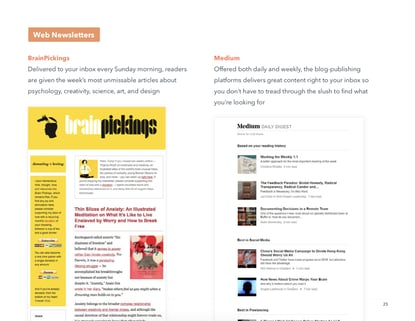
2. Evaluate whether or not you need an email newsletter.
I know it can be kind of scary pushing back on your boss about a project you’ve been handed, but if an email newsletter isn’t right for your marketing, you shouldn’t waste your time working on one.
To figure out what you need to do, first do some research. In your industry, are there successful email newsletters that people like to subscribe to? What’s in them? With the resources you have available to you — budget, time, and internal support — could you be successful?
Then, re-examine your business’ goals. Are they trying to increase the number of leads? Better qualify leads to speak with salespeople? Close more deals? Retain more customers?
If your industry isn’t really interested in email newsletters, or if your goals don’t line up with what a newsletter could accomplish, your time might be better spent creating something else like alead nurturing email workflowor content for your blog.
So gather some data, create a plan-of-action (either for a successful newsletter or another activity), and go chat with your superior. Even if you disagree with his or her vision in doing an email newsletter, your boss will be glad you came prepared with a plan for success.
Okay, let’s say you’ve found that you should do an email newsletter. What next?
3. Figure out what kind of newsletter you want to send.
One of the biggest problems with email newsletters is that they’re often cluttered and unfocused because they’re supporting every aspect of your business. Product news goes right next to PR stories, blog posts go next to a random event week … it’s kind of a mess. Email — whether it’s a newsletter or not — needs one common thread to hold it together.
Oneway to help reduce the randomness of an email newsletter is by keeping it to one very specific topic. So instead of it being about your company in general, maybe it’s dedicated to one vertical.
An example of a great, topic-based email newsletter is BuzzFeed’s “This Week in Cats” newsletter. (Don’t judge … I recently adopted a kitten and I’ve become full-on obsessed with cats.) Though BuzzFeed writes about pretty much everything under the sun, they offer up one specific newsletter for people who love reading about cats.Because the niche is aligned with a specific interest, the articles have an opportunity to get way more engagement than they would in a newsletter featuring content from all over the website.
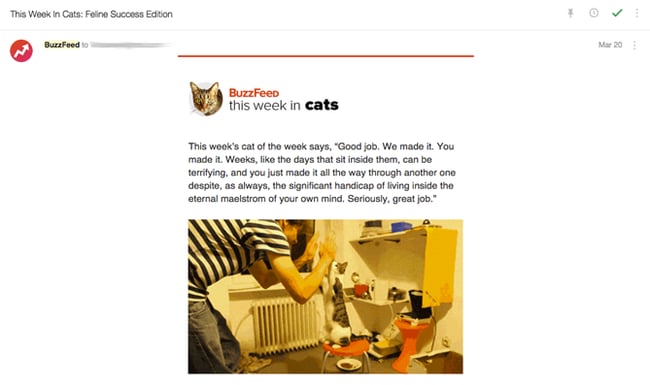
4. Balance your newsletter content to be 90% educational and 10% promotional.
Chances are, your email newsletter subscribers don’t wantto hear about your products and services 100% of the time. While they may love you and want to hear from you, there’s only so much shillingyou can do before they tune out.
Case in point: I have a thing for shoes, and I especially love this one shoe site. I willingly opted into the company’s email list, but it now sends me emails 2-3 times a day to buy, buy, buy … and when I see its sender name pop up in my inbox, I want to scream. If they sent me educational content — about the latest styles of shoes, or how to pair certain styles with certain outfits — I might be more inclined to buy from them, or at least start opening their emails again.
Don’t be that company. In your email newsletters, get rid of the self-promotion (most of the time) and focus on sending your subscribers educational, relevant, timely information. Unless youactuallyhave an exciting, big piece of news about your product, service, or company, leave out the promotional parts.
5. Set expectations on your “Subscribe” page.
Once you’ve figured out your newsletter’s focus and content balance, make sure you’re properly communicating about them on your subscribe landing page.
Get specific. Tell potential subscribers exactly what will be in the newsletter as well as how often they should expect to hear from you. Take a page out of SmartBrief’s book: On the subscribe landing page, it says what’ll be in the newsletterandgives potential subscribers a preview link. Check it out:
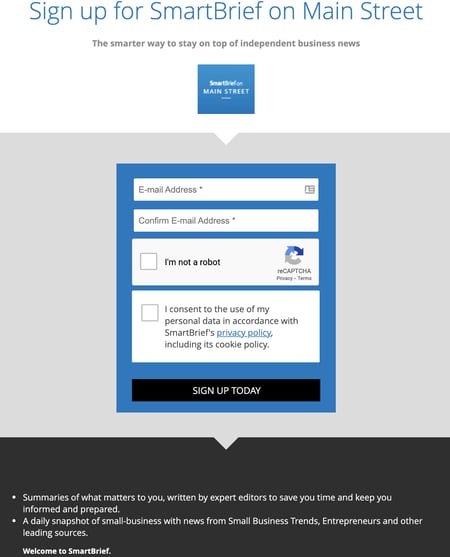
As a subscriber, wouldn’t that be awesome? You’d go in with open eyes knowing exactly who you’ll be receiving email from, what they’ll be sending you, and how often they’ll be sending it. As a marketer, having this information up front will help diminish your unsubscribe and spam rates as well.
6. Get creative with email subject lines.
Even if your subscribers sign up for your emails, there’s no guarantee that they will open your emails once they get them in their inbox. Many marketers try increasing familiarity with their subscribers by keeping the subject line the same each day, week, or month that they send it.
But let’s face it, those subject lines get old for subscribers — and fast. Why? Because there’s no incentive from the subject line to click on that specific email right this instant. A better approach would be to try to have a different, creative, engaging subject line for each newsletter you send.
One company that does this really well is Thrillist. Here’s a collection of email newsletters I’ve received recently:
I’ve opened every single one of these because of the company’s subject lines. Even though I know that these emails are coming into my inbox every morning, the subject lines are what entice me to click.
If you need help with your email newsletter subject lines, check out this recipe.

7. Pick one primary call-to-action.
Okay, part of what makes a newsletter a newsletter is that you’re featuring multiple pieces of content with multiple calls-to-action (CTAs). But, that doesn’t mean you should let those CTAs share equal prominence.
Instead, let there be one head honcho CTA — just one main thing that you would like your subscribers to do. The rest of the CTAs should be “in-case-you-have-time” options. Whether it’s simply to click through to see a blog post or just to forward the email to a friend, make it super simple for your subscribers to know what you want them to do.
Check out the Scott’s Cheap Flights email newsletter below, which was promoting their newest travel deals. It’s got a photo to draw you in and chock-full of information … but it’s also pretty obvious what they want you to do: purchase the premium plan for exclusive travel deals. By placing this CTA above all the other pieces of information, Scott’s Cheap Flights increases the chance that their email recipients will click on it.

8. Keep design and copy minimal.
Like we said before, a newsletter can easily feel cluttered because of its nature. The trick for email marketers to look uncluttered revolves around two things: concise copy and enough white space in the design.
Concise copy is key — because you don’t actually want to have your subscribers hang out and read your email all day. You want to send them elsewhere (your website or blog, for instance) to actually consume the whole piece of content. Concise copy gives your subscribers a taste of your content — just enough that they want to click and learn more.
White space is key in email newsletters because it helps visually alleviate the cluttered feel, and on mobile, makes it much easier for people to click the right link.
Look to Schwab’s investing insights newsletter to see how this should be done. The design is clean, with just one thumbnail next to a paragraph of text, a link to read the article, and plenty of white space. The design feels uncluttered and easy to read.
9. Make sure images have alt text.
Given that visual content is incredibly important to the rest of your marketing activities, it’d make sense that you’d want to include them in your emails … right?
Right. But email’s a little bit trickier. Most of the time, people won’t have images enabled, so you’ve got to make sure your images have one essential component: alt text. Alt text is the alternative text that appears when images aren’t loaded in an email. This is especially important if your CTAs are images — you want to make sure people are clicking even without the image enabled.
Each email marketing program is different, but here is one tutorial for adding alt text to email.
10. Make it easy for people to unsubscribe.
This seems kinda counter-intuitive, but it’s key if you want to maintain an active, engaged subscriber list. Don’t use weird language like “Alter your communication with us.” Don’t hide an unsubscribe button behind an image without alt text. Besides keeping your list healthy, having a clear unsubscribe process will help ensure your email isn’t marked SPAM before it hits the rest of your list’s inbox.
Take a look at charity: water’s newsletter below to see how to do this right. The link to unsubscribe is bolded and capitalized, making it really easy for you to take action on it (if you wanted). No footer hunting required to uncover where the heck you can change your email settings.
11. Test, test, test.
I know I just listed out nine things you should do to make sure you’re doing email newsletters right, but you’ve also got to find out what works for your company and your list. Just like different cultures of people prefer different things, different groups of email subscribers prefer different things.
So use these email newsletter best practices as a jumping off point … and then experiment to find your secret sauce. Here are a few things you can try:
Short, Funny Subject Lines
All of your subject lines should be on the short side. (They work better that way.) But have you ever tried infusing a little humor into your copy? It could put a smile on your recipients’ faces — and potentially improve your open and clickthrough rates. Below’s a really funny subject line example from MasterClass:
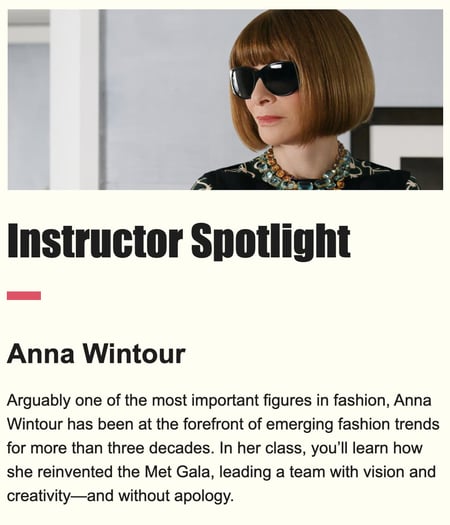
This clever F-word subject line was used to introduce their new line of fashion-centered classes with Anna Wintour.
CTA Copy & Design
Maybe your readers like loud, bright colors on your CTA — or maybe drab, bland ones are the way to go. Maybe they prefer really fun, excitable, action-oriented copy — or maybe a simple “click here” works. Definitely test out your CTA language and copy to see what resonates.
As a good example to follow, Etsy has multiple CTAs in its email newsletter, but the way that they use color and copy makes them seem very natural and easy-to-read.

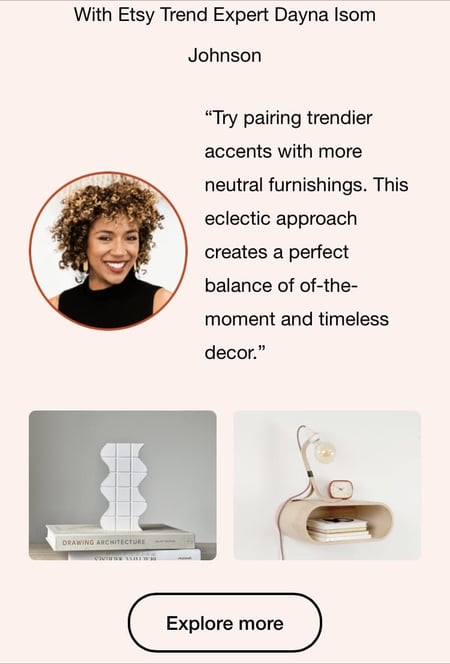
No Images
Most of the emails featured in this post have lots of gorgeous, compelling images … but that doesn’t mean you need them in your emails.Try stripping away images in favor of seriously well-written copy.
Mobile Version
More and more people are surfing the web and checking their emails on mobile devices, so you should make sure that whatever design you work with is both visually pleasing and functional. This will ensure that your mobile email is engaging to both desktop and mobile users.
Want to learn more about this? Here’s a detailed guide that walks you through how to optimize your email for mobile devices.
Sender Name
Another way to get a subscriber’s attention is to send an email with a name they recognize — whether it’s their own or a brand leader they’d recognize.
This email from Gartner used the subscriber’s first name in the subject line to grab their attention. If you have a company mascot that’s widely recognized, you could test sending a newsletter from them.

Want to start designing but aren’t sure how? Use a template! Check out our long list of effective email templates that are free or very affordable.
Now that you know how to put together your newsletter, it’s time to brainstorm what content your readers will enjoy. What you choose to offer will depend on your business, industry, and target audience.
If your website already has a blog, consider sending out a content roundup of your best articles and videos. Educational content is also valuable. Sending a how-to guide in your newsletter can help establish your brand as the authority on a given topic and provide readers with content that is most relevant to their interests.
Get your subscriber list engaged with contests or scour your social media channels for user-generated content featuring your brand. Customer promotion adds social proof to your brand, making it more trustworthy.
Email Newsletter Best Practices
Once you’re ready to put together your newsletter, be sure to follow the above steps. Here are some best practices to guide your efforts, regardless of your newsletter’s formatting:
1. Keep things short and sweet.
Don’t overwhelm people with too much text or imagery. Level things out. Even if you choose a photo-less newsletter, keep your message quick and to the point so the email cuts to the chase and grabs attention the whole time.
2. Make your content valuable.
No one wants to open an email with a bunch of advertisements in it. So, include gems of wisdom, tips, and helpful blog posts along the way so the reader feels like they’re actually learning something. This will make the subscription feel much more valuable to them.
3. Always test your emails.
It’s embarrassing when a link doesn’t work or a design aspect looks wonky. So be sure to send test emails to yourself and a colleague who can give you helpful feedback. Check them on both a computer and a smartphone inbox so you can confirm that both the mobile and desktop designs look good.
4. Don’t skip A/B testing.
Aside from testing emails to make sure the design looks as it should and all links work, you’ll want to experiment with A/B testing. Performing A/B tests will help you determine the types of emails your audience prefers. You can also use A/B testing to see what works or doesn’t when it comes to CTA placement and other details.
5. Make it mobile-friendly.
With more users checking their email on mobile devices, it’s imperative that your newsletter is mobile-friendly. Nearly 60% of emails are opened on mobile devices. One way to ensure your emails display properly is by using a responsive email template. HubSpot’s drag and drop email templates are responsive by default and a great option if looking for an easy solution.
6. Monitor email frequency.
Another aspect to pay attention to is how many emails you’re sending and how often. Sending too many emails can cause recipients to unsubscribe.
Send an Email Newsletter Your Subscribers Will Love
Email newsletters are something we’re all familiar with, yet it can be challenging to create a successful one for your own brand. Use the examples above for inspiration and create an email newsletter that delights your subscribers.
Editor’s Note: This article was originally published in September 2019 and has been updated for comprehensiveness.

A Privacy First-World Won’t Hurt Your Customer Relationships, It Will Transform Them: Insights from HubSpot’s CMO
As marketers, we thrive on data.
Data can help us identify when content is underperforming, and pivot to provide the highest value to our prospects and customers. It can also enable us to explore new, underutilized channels, and discover the best platforms to connect with our audiences.
All of this is to say: Any changes to the existing data collection ecosystem will create uncertainty around the future of marketing, and make some marketers fearful about how their current strategies will perform in a privacy-first world.
But a privacy-first world doesn’t inhibit a company’s ability to know and better serve their customers — it improves it. A privacy-first world is a world in which creating and maintaining relationships directly with your customers is the only way to truly understand them.
Here, we’ll explore how the future of privacy will impact your business. Plus, how you can prepare for it.
What is a privacy-first world?
A privacy-first world means that a company’s strategies, technologies, and solutions will need to adhere to a consumer’s right to data privacy and security, first and foremost.
This shift has been a long time coming. Consumers no longer trust corporations with their data — in fact, only about one-third of customers believe companies are currently using their data responsibly.
Additionally, in the past year alone, 76% of consumers feel they don’t know what companies are doing with their data.
To combat consumers’ concerns, regulations such as the EU ePrivacy Directive CCPA, and LGPD are increasingly requiring transparency around data collection, making a privacy-first marketing strategy necessary to reach global audiences.
Certain industries have always taken a first-party data approach when it comes to building relationships with their audiences . Nonprofit and advocacy organizations, for instance, have always leveraged data collected directly from their supporters and donors for marketing materials. So while a privacy-first world might be new for some businesses, it’s not new for all.
Why Privacy-First Matters
As consumers raise their standards in regards to data privacy and security, it’s vital that the advertising industry adapt to meet these needs.
A privacy-first approach ultimately encourages marketers worldwide to develop stronger and more transparent relationships with prospects and customers.
First-party data allows you to better understand your customer based on information they have consented to share with you, which in turn allows ads to be more relevant.
Plus, caring about your customers’ data is simply good business practice. A privacy-first strategy will become a competitive advantage in the years to come.
So the real question here should be: how can you prepare for a privacy-first world? Let’s dive into that, now.
How can you prepare for a privacy-first world?
We need to reimagine our marketing and advertising strategies to ensure company growth doesn’t come at the expense of consumers’ trust.
As Google’s Director of Product Management, Ads Privacy and Trust, David Temkin, puts it, “Developing strong relationships with customers has always been critical for brands to build a successful business, and this becomes even more vital in a privacy-first world.”
To invest in and prepare for privacy-safe growth, companies need to shift to a first-party data model. Marketers that effectively use their first-party data can generate 2X the incremental revenue from a single ad placement or outreach.
To adjust to a privacy-first world, marketers will need to ensure they have systems in place to collect and measure first-party data effectively. A CRM, for instance, allows you to collect, track, and analyze your first-party data while providing your visitors with the transparency and knowledge that their data is being used for more personalized messaging and a better user experience — not for following their every move across the web.
First-Party Data Use in Action
There are tremendous advantages to first-party data when it comes to marketing. Let’s say, for instance, that you recently eyed a Casper pillow, filled out a form with your email, but got distracted and abandoned the site. Later, you spot this email in your inbox:

Here, Casper marketers are using first-party data to analyze your behavior on their site. Once they’ve identified that you might be interested in a pillow, they can send a targeted, personalized abandoned cart email to encourage you to complete the transaction.
HubSpot and Google’s New Integration for Better First-Party Data Collection
For HubSpot customers, we have good news: HubSpot will be offering an integration with Google’s Enhanced conversions (EC) for web in the coming months. Among other benefits, Enhanced Conversions allows companies to increase the amount of observable conversions they can measure, and ultimately improve their return on ad spend. Visit this page to learn more and stay up to date on HubSpot’s Enhanced Conversions launch.
Zoe Financial, a wealth planning platform, has seen a 200% increase in revenue by leveraging the current integration between Google Ads and HubSpot. With the addition of Enhanced conversions in the coming months, Zoe plans to continue to take full advantage of the suite of products Google and HubSpot have, thereby optimizing their marketing and client acquisition strategies.
The Founder and CEO of Zoe Financial, Andres Garcia-Amaya, said, “Our north star is the client, and clients value their privacy. Partnering with Google and HubSpot helps ensure the two-way communication of our client’s data in a safe way.”
To excel in a privacy-first world, marketers need to leverage clean, first-party data to measure and optimize their advertising and audience strategies. And they need to realize the full value of investments in first-party data solutions.
Change is always difficult. For marketing teams that have relied for years on third-party data for their advertising strategies, it will take time to adjust to this ‘new normal’ when it comes to data privacy. However, this privacy-first shift should empower marketers to use their privileges to gain trust, rather than to lose it.

