
Why You Should Slash Your Sponsorship Budget (And What to Focus on Instead)

Professional services firms rely upon a variety of marketing channels to gather leads, attract new clients, and encourage other professionals to refer their firm. Many see event sponsorships and the networking functions associated with them as effective ways to build visibility for their firms, score face time with key individuals who influence prospects, and win referrals.
They couldn’t be more wrong.
The Hinge Research Institute recently conducted a survey of almost 1,200 managers and c-suite professionals in a wide range of industries — the individuals most likely to influence business referrals — and the results published in our Referral Marketing Study may surprise you. 
The survey revealed that sponsorships and the networking events associated with them were the least effective ways to influence referrals. In fact, less than one percent of respondents learned about the agencies they referred through sponsorships, and only 3.4% found networking events effective for finding and recommending potential service providers.
The Problem with Sponsorships
So why don’t sponsorships work? While they can contribute to your brand awareness, they are lousy at conveying your agency’s value proposition. Printing logos on cocktail napkins and tournament signage has zero value if the individuals who see them have no idea what you bring to the table.
Sponsorships only make sense if they present a valuable “pay-to-play” opportunity — for instance, allowing you to speak to a group of influencers. Sponsorships may also provide some benefit if they demonstrate your involvement in a group that’s crucial to your business. In either case, you’ll want to use your participation to improve your agency’s visibility. That could mean securing a speaking engagement or an article placement as part of the deal.
So if sponsorships are such a poor source of referrals, what does work?
How to Get Referrals Without Sponsorships
Take a look at the following graph. There are a number of referral techniques that can yield significant results, starting with reciprocity. Our studies revealed that the more firms referred others, the more referrals they received in return.
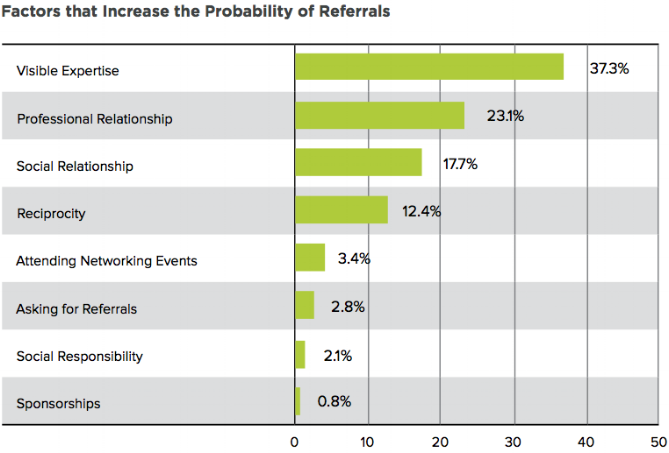
Social and professional relationships can also be valuable referral producers. The best relationships are those that combine both social and professional interactions. However, the study found social relationships had little effect on referrals if there was no associated direct knowledge of expertise. Like sponsorships, if your contacts don’t know what you do, they aren’t going to refer you.
By far, the greatest source of referrals is what we call Visible Expertise — the degree to which people in your firm are well-known industry experts. Individual experts develop this kind of visibility by speaking at industry events and publishing valuable thought-leadership pieces in trade publications, newsletters, and online.
Another Hinge study focusing on the best practices of high-growth professional services firms discovered that the five top marketing techniques that yielded the greatest return were, in order:
- Speaking engagements
- Blog posts and articles
- Social media
- Book or other signature content
- Online presence
An inbound marketing strategy is the clear winner for demonstrating expertise, building visibility and value for your firm, and influencing key professionals to refer your company to others.
So the next time your firm is offered a sponsorship opportunity, you might want to politely pass on it — unless it presents a solid opportunity to secure a lucrative speaking engagement in front of a group of business influencers.

Steps to Building an Amazing Student-Nurturing Workflow
You have traffic and lead generation campaigns that are filling up your database. Your cup runneth over. It’s time to make sure that your best prospects aren’t the ones falling by the wayside. You need a lead nurturing program that helps you identify the prospects who best fill your ideal student persona and focus your efforts on them.
The crux of the inbound methodology is getting the right message to the right people at the right time. But your team doesn’t have the time to pick out the right piece of content, at the precise magic moment, for each individual prospect in your database that will move them further along their enrollment journey. There’s no point in sending an invitation to meet with an admissions counselor to a rising junior prospect who just downloaded your free study tips guide. That’s worse than wasted effort! Your school will look unorganized to this prospect — not the impression you want to make.
Instead, use automated email workflows to nurture prospects into enrolled students by send the most relevant information at each stage of the enrollment journey. Automation amplifies the productivity of your team and your database. Too much gets overlooked when you rely on manual nurturing.
Here’s a step-by-step breakdown of how to design and execute an amazing student-nurturing workflow.
1) Have a Goal in Mind
Actually, you need two goals. First, define what your objective is for the workflow. Let’s say you need to boost enrollment in the next two dental assistant program enrollment cycles. You’re running live, on-campus information sessions targeting your January and June enrollment dates. You can put together a nurture workflow with the goal of getting quality prospects to attend one of these sessions.
Then, you need a Goal List. How many people do you need to attend these sessions to translate into the right number of applications and enrollments? That’s your Goal List — the list of prospects who entered this workflow and took the action you wanted. In our example, it’s the number of people who attended an information session.
2) Identify your Starting Criteria
Create a smart list that scoops up prospects who meet the specific criteria that make them good candidates for this workflow’s goal. Think about criteria about who they are right now, where they are in their school decision journey, and what sort of action they’ve taken. No broad strokes here.
So a list of people interested in your dental assistant program who mostly access your content via mobile device is too vague. Start with that criteria, but add: lives within 25 miles of one of your campuses offering your dental assistant program.
In short: Be specific!!
3) Map it Out
Truly — write this out by hand to get the flow right. Include three data points per spot on your workflow map:
- What content you’re sending them — make sure it aligns with where they are
- The goal for that specific piece of content
- Day delay count — this is the number of days between each email in the workflow (aka the “cadence”)
Using our current example, we know that these potential students are in the consideration phase, looking to short-list the schools they want to apply to. The goal of the workflow is to get them to attend your live, in-person information session on campus. So the workflow map could be:
- Trigger: Lead who meets the criteria “downloads the program’s admission requirements checklist.”
- Delay 5 days: send email with link to your Facebook post of a video message from current dental assistant students. The goal of this email is to personalize your program and help prospects see who their peers could be.
- Delay 3 days: send email with a link to download your report on the various types of dental positions this program prepares its graduates for. This email’s goal is to put in real terms exactly how your program prepares them for a career.
- Delay 5 days: send them a link to blog post of your dental program’s FAQs. This content is prep work so they can clarify the bigger questions they’ll want to ask in person.
- Delay 2 days: send email invitation to attend a live information session, mentioning this is where they’ll learn about program selection criteria, types of practicums available, and have opportunity to meet current students and admissions officers.
4) Write your Emails!
Keep all these data points in mind to write clear, focused, single call-to-action (CTA) emails. You can also use the email copy to tease or set up the next email. Your email with the link to the program FAQ can frame it as the source to get answers for the most common questions, while your invitation email promotes the session as the opportunity to get their personal questions addressed.
For more on email, check out our free ebook Email Marketing for Schools >>
5) Decide on an Exclusions Policy
Refine your workflow here. Exclusions can be not sending on emails on Fridays, because you know you get nearly zero engagement on those emails.
You can also create suppression lists of people who meet this workflow’s criteria, but you don’t want included in it. This could be people who’ve already submitted an application. You want them in a different workflow that invites them for an admissions interview.
In fact, another suppression list can be anyone who’s currently in another active workflow. You don’t want to inundate prospects with too many emails at once. Let their current workflow play out. You’ll have more info on them to divert them into the most applicable workflow once it’s done.
6) Turn the Workflow on!
That was an easy step…
7) Measure and Improve
Always be analyzing. Look at your results to see where you need to improve or tweak things. Your top-level metrics are the number of people who enter this workflow, the number who reach your Goal List, and the workflow’s conversion rate (prospects in workflow divided by those who took goal action = conversion percentage).
Take a closer look at low performing emails to find out why people aren’t opening or taking action.
Why Marketing Automation?
Email is easy and inexpensive. It’s one of the best tools in your arsenal made more effective with automated, smart workflows. Automating email lead nurture campaigns optimizes your database and your marketing efforts by making sure your best prospects don’t get ignored, which translates into more quality applications, and higher enrollment numbers.
16 Stats That Prove the Importance of Local SEO [Infographic]
When you’re looking for a local business that’ll fix your favorite pair of shoes, sell you the book your friend recommended, or bake a spaceship-themed cake for your kid’s birthday — how do you find it?
You pull up your favorite search engine for a little online research, of course.
Your customers are no different. When they’re looking for a product or service similar to what your local business sells, they’re going online to find it.
Did you know that 50% of consumers who do a local search on their smartphone visit a store within a day? Same with 34% of consumers who searched on a computer or tablet.
A strong local SEO strategy is key to driving more people to your store, whether you have one storefront or five hundred. Check out the infographic below from GO-Globe to learn more helpful local SEO statistics and trends. (And to learn which parts of your site to optimize for local searches, check out this post.)
The Scary State of Agency Morale, in 5 Charts
The advertising industry has a major morale problem, and it’s not going to go away on its own.
Campaign US recently conducted the Second Annual Morale Survey for 2016, and their findings reveal a staggering decline in overall morale among agency employees. Along with slipping morale, the study also uncovered a troubling host of symptomatic issues, such as talent retention and a decline in employee performance.
So what are the root causes of this morale problem? What impact will it have on talent retention? What areas of employee experience do agencies need to make an effort to improve?
To help agencies tackle these questions and visualize the challenges in front of them, we created the following five charts based on the Campaign US survey results. Check them out below to see the far-reaching effects morale has on the industry.
1) Overall morale among agency employees has steeply declined.
When Campaign US conducted their first Annual Morale Survey back in 2015, only 34% of employees said their morale was either low or dangerously low. Those numbers were alarming at the time, but they haven’t improved — in fact, morale among agency employees has experienced a distressing decline in 2016.
This year’s survey results found that 47% of agency employees report either “low” morale (31%) or “dangerously low” morale (16%). That’s a 36% drop in overall agency employee morale between 2015 and 2016.
Data Source: Campaign US Morale Survey
2) Agency employees with low morale also reported dissatisfaction with leadership and advancement.
So what factors are responsible for this drop in morale? Survey participants who reported having “low” or “dangerously low” morale were asked to explain the reasons behind their responses.
The top factor contributing to low morale was a dissatisfaction with company leadership, followed closely by a lack in advancement opportunities, and a general dissatisfaction with work. Less impactful were overall company performance and diversity.
Data Source: Campaign US Morale Survey
3) Work/life balance is the biggest factor for agency employees with good morale.
Of the 53% of employees who reported “satisfactory,” “good,” or “excellent” morale, “work/life balance” was the biggest influencing factor. The other two big contributors to positive morale were “satisfaction with work” and “creative freedom.”
Data Source: Campaign US Morale Survey
4) Agency employees affected by low morale are ready to walk away.
If any agencies still needed a wakeup call, this is it: 63% of employees who reported low morale were also actively seeking a new job. That means a whopping 29% of agency employees are looking to leave their current positions — which puts agencies in a precarious position.
Data Source: Campaign US Morale Survey
5) Low morale has a massive impact on agency employee performance.
Unsurprisingly, morale has a major impact on overall employee performance. Regardless of whether they reported high or low morale, 98% of respondents said that morale had an effect on their performance.
If employees don’t feel their needs are fully supported, their performance takes a hit. With nearly half of all agency employees reporting low morale, this could spell disaster for the ad industry’s bottom line.
Data Source: Campaign US Morale Survey
How is your agency planning to boost morale this year? Share your advice in the comments.
20 Types of Lead Generation Content to Put Behind Your Landing Pages
What does being in a “content rut” mean to you?
Perhaps the words remind you of writer’s block, when you couldn’t think of fresh topic ideas. (We’ve all been there.) Or maybe it makes you think of those days, weeks, or even — horror of horrors — months when your content seems to be falling kind of flat.
There’s one other thing it might make you imagine — the kind of content rut with the same types of content getting created over and over again, instead of mixing it up.
A big part of building a strong content strategy is experimenting with new types of content. Your audience may love your podcasts, but that doesn’t mean that’s the only thing you should create. Fresh content types can expand your reach and attract more, and possibly even better leads.
To help you shake up your content balance, here are 20 things you can put behind a landing page to help you collect new leads — and ways you can optimize your landing page for each type.
20 Types of Lead Generation Content to Put Behind Your Landing Pages
1) Ebooks
Ebooks are a popular type of offer used to generate leads, educate customers and prospects, and gain credibility in your industry. But they can take time to become a reality, so be sure to choose a topic that will help a prospect go from downloading your ebook to having a productive conversation with a member of your sales team.
Here’s a good example from LiveCareer. The company created a piece of content that aligns with its brand — a job search handbook — and built a landing page around it. Plus, it’s sharable. The social sharing icons below the form make it easy for users to tell their friends and colleagues about the content.
For more detailed tips, click here to learn how to create ebooks from start to finish.
2) Courses
Your audience may also be excited to fill out a form in exchange for a video course or tutorial. It’s up to you whether to produce, shoot, and edit the video in-house or hire a professional. You can hold the course live, or post a recording. Either way, ask participants to share their email address in exchange for the tutorial, so you can send them an email with the video recording that they can access forever.
Lynda, LinkedIn’s learning platform, does that well with its course previews. Users are able to watch the first minute of a lesson and when that preview is over, a prompt appears to start a free trial.
3) Trials
Trials aren’t just limited to things like courses. Sometimes, your prospects will want to try out your product or service before deciding whether they’re a good fit. That’s a good thing — you want to grow a base of customers that are convinced and loyal, and that can take a little more work than trying to sell your stuff to everyone who will listen.
That’s why it can be helpful to provide a free trial of your product or service with no risk, no obligation, and no credit card required — the only thing the prospect needs to do is fill out a form.
Here’s how Geneious used a form for a free trial of its research software for biologists. Notice how the form is followed by images of the program and FAQ, in case the user scrolls before committing to the form.
4) Demos
If visitors are ready to learn more about your product or service, make it easy for them to schedule a demo with your team. You can place demo calls-to-action on key pages of your website, including your home page.
These are particularly valuable on sections of your site that explain the different highlights and features of your product or service. Once the user is intrigued, make it seamless to schedule a demo. Here’s a look at HubSpot’s demo landing page:
5) Contests
People love contests. They can teach you a lot about your audience while engaging them, growing your reach, driving traffic to your website, and — drum roll, please — generating leads. You can run contests on your website, or on pretty much any social media platform, including Facebook, Twitter, Pinterest, and Instagram. They can be as simple as you’d like:
Share your awkward moment for a chance to win! Upload your story with a pic or video and #NokianTyresSYIT: https://t.co/qL5QWH5Eg0 http://pic.twitter.com/rFdah2oFjY
— Nokian Tyres (@NokianTyresNA)
October 24, 2016
…or as complicated as you’d like. Notice how Brytor Designs uses its lobster gauge giveaway — I mean, who doesn’t need one of those? — to pull off a double whammy of lead generation. To enter the contest, the user has to both follow the brand on Instagram and fill out a form. But Brytor made it easy. When I clicked the Instagram icon on the page, it took me directly to the brand’s profile in a new tab, so that I could easily go back to the landing page and fill out the form.
Want to learn more about running a successful social media contest? Check out our guide here.
6) Cheat Sheets
Cheat sheets are a type of short, concise offer that someone might bookmark for future reference. Think of them as comprehensive guides to terms, commands, symbols, or other things. They should be formatted for quick reference, which means clear headers and not too much detail. And the more visual, the better.
Here’s one way that Nusii pulled that off with the landing page for its proposal cheatsheet. It’s colorful and visual, with the imagery suggesting that the downloadable itself will be equally easy to follow. The only thing we’d change here? Consider removing navigation from your landing page — you can add it back in on your thank you page. Be sure to limit the text and visuals to the valuable content you’re providing.
7) Checklists
Checklists are another type of short offer that you could put behind a landing page, which readers can print out or download to their desktops. Include clear headers, a colorful design, and keep copy brief.
Notice how there’s no navigation on Bonafide’s landing page below, which gives the visitor less of an opportunity to navigate away from the form (and the content). The text explains why the user should download the checklist, and personalizes the benefits to make the brand relatable.
8) Email Series
An email series is a multi-part series of emails sent to an individual who specifically opted in to receive them. It’s different from an email subscription — it has a finite number of emails sent.
These programs are especially popular around the holidays, when many brands do “12 days of”-themed promotions. Microsoft, for example, executes one each year. And notice how even though I was a bit early for this year’s holiday email series, Microsoft still used the landing page to encourage me to shop its current sales, or look at last year’s prizes.
Another example is HGTV’s Urban Oasis, in which a lucky winner receives a completely refurbished home. Users are allowed to submit one entry per day, and can opt in to receive daily email reminders to enter until the contest is over.
9) Email Subscriptions
Business blogging not only drives more traffic to your website, it also can become a major source for lead generation down the road. But how do you convert blog readers into leads?
First, turn them into dedicated subscribers by simply asking for their email address in exchange for sending them new blog posts daily, weekly, or monthly. Make it easy for them to subscribe by including a one-step form on your blog, like the American Writers Museum does with its blog here:
Learn more about converting visitors to subscribers here.
10) Guides
Guides come in many shapes and sizes. There are “ultimate guides,” which are long, in-depth, and usually include detailed explanations, screenshots, and step-by-step instructions. Then, there are “simple guides,” which are shorter and much more concise. There are also tactical guides, pocket guides, introductory guides and advanced guides. The list goes on.
What’s the common denominator? They’re all tutorials of some sort, and many of them include step-by-step instructions. Below, the Canadian Internet Registration Authority uses a landing page for its “Ultimate Guide to Choosing a Domain Name.” It’s simple, well-branded, and concisely explains what the user is getting out of this download.
11) Kits
Kits are pieces of content grouped together into one offer. They’re great for repurposing existing content by aggregating multiple offers on similar topics into a cohesive collection. For example, HubSpot offers an Inbound Marketing Kit that includes an interactive presentation, a report that includes original data and research, and glossary.
But this content also works well with things like media kits. Not only are you providing a user with more information and media about your company, but you’re also offering it in exchange for contact information. See how Her Campus Media does that below. It helps the brand follow up with potential advertisers, which is especially valuable in digital publishing.
12) Original Data & Research
Data and metrics are have become especially valuable as many fields become more data-intensive. If your team has the bandwidth, original and data-heavy industry reports can build authority and trust with your audience. The trade-off is that curating them takes a lot of time, resources, and expertise.
One of the least expensive ways to curate original data and research is to conduct a survey among your subscribers, leads, customers, and industry professionals. Then, share the results in the form of a downloadable report, study, or infographic. For example, the data in our annual State of Inbound report is taken from a survey of over 4,500 marketing and sales professionals. We asked the questions, and the answers provided us with great insights that our audience is interested in learning about.
Annual reports are similar to original data and research, though they usually focus on information pertaining to a specific organization, rather an industry at-large. And while these reports are often written with the intended audience of shareholders, they can actually be helpful resources for a number of users, like potential non-profit donors or members of the press.
13) Podcasts
Podcasts can build an audience and establish your brand as a source of expertise, while also showing off your company’s personality. They put a voice to your brand, so to speak. And creating one can even be relatively low-budget — all you need is a decent microphone and a smart — but fun — host who can keep your audience listening in each time a new one is released.
When it comes to using a podcast for lead generation, one of the best ways to do that is to ask your listeners to subscribe to updates about it. Subscribing to a podcast alone is already easy to do through apps that don’t ask for contact information, like iTunes and Stitcher. But by offering a “latest news” subscription, you can keep your audience up to date on related information like industry trends and sneak previews of future episodes. Here’s how we do that with HubSpot’s The Growth Show podcast:
Learn how to build a successful podcast here.
14) SlideShare Presentations
Because SlideShares, like blog posts, are great for traffic, some marketers choose to share them without hiding them behind a form. But that doesn’t mean you can’t offer a download of your SlideShare in exchange for some information. If your SlideShare is good enough, it can be a low-effort way to convert readers into leads.
Here’s an example for a particularly nice design from Collision Latitude. Notice how there are bullet points to outline exactly what knowledge the user will gain from this download — as well as those handy social sharing icons.
15) Templates
Templates are great offers because they provide readers with a backbone for creating original things on their own. Templates often take different forms — calendars, worksheets, and other outlines can all benefit different audiences in the form of a template.
For example, one of our most popular offers is our “15 Free Infographic Templates in PowerPoint,” which we promoted with blog posts that teach our readers how to create great infographics in more detail. Check it out:
16) Events
Holding a happy hour at your office, a meet-and-greet at a local eatery, or a conference in a major city? Whatever your event, ask attendees for their information so you can send or email their tickets ahead of time and have an ID badge waiting for them upon arrival.
Here’s how LIVE Magazine SA did that with registration for one of its free events. Notice how the brand used a Google Forms — a free and easy way to collect registration data without navigation or other distractions. Just make sure to direct your visitor to a thank you page where he or she can start navigating your site again.
This way, you can follow up with attendees to let them know about similar occasions, ways to connect with people they may have met at the event, and where to download content they may have come across there. You can even add calls to action in follow-up communications that invite users to follow you on social media or subscribe to other types of content.
17) Tools
Interactive tools can be difficult and time-consuming to create, but if they’re truly helpful for your audience, the payoff is often worth it.
Take HubSpot’s Marketing Grader, for example. The landing page form below is simple and only requires a website URL and email address. The feedback that the marketer gets from this tool is worth a lot compared to the amount of information we ask for. That makes it a compelling exchange.
18) Free apps
Who says a free product doesn’t earn business? They’re actually a great opportunity for lead generation. Try giving out free versions of your product or service — it can be lighter or have fewer features than the full-blown version — with no risk, no obligation, and no credit card required. The only thing they need to do is fill out a form.
Check out how booking.com does this below. The brand could just post links directing individuals to the App Store or Google Play. Instead, it also provides the option to receive a link to download the free app via email or text. For the sake of convenience, some users are willing to provide that information, so think about how you can provide that ease of use in exchange for information from your audience.
19) Webinars
The webinar is a useful content format for introducing prospects to thought leadership around your industry, and it establishes you as an expert in the discussion. A successful webinar takes a lot of work — especially with regard to planning and promoting it — but with the right strategy, it can be a great way to generate high quality leads.
Here’s one that Sprout Social did about Instagram with a special guest. The registration page is fairly simple in design, but still has enough information about the webinar leaders to pique the interest of prospective attendees.
To learn more about planning your own webinar, check out this post.
20) Whitepapers
Ebooks are informal, fun, design-heavy pieces of in-depth content. Whitepapers are more academic and persuasive reports. They’re structured to present a problem, then provide a solution to it. People download them because they are authoritative, detailed, and informative. And since every audience could use a good hold on their respective industry details, whitepapers can be quite valuable to them.
The cool thing about whitepapers is that they can be created around almost any industry. Here’s one that HookLogic created for the buying behavior around beauty products. Notice that the landing page allows users auto-fill the form using information from LinkedIn. Letting visitors auto-populate this data makes it easier for them to get to your content quicker, encouraging them to complete the form.
Make a Smooth Landing
From ebooks, to apps, to templates, each type of content you put behind a landing page has a specific job. By experimenting with different types of offers, you can observe which ones resonate with your audience and convert the most leads. Of course, you can always do more of what works, but never get too comfortable — keep you audience alert and intrigued with new topics and formats that are groundbreaking, but relevant.
What other types of offers have you put behind a landing page form? Share with us in the comments below.
Editor’s Note: This post was originally published in October 2014 and has been updated for freshness, accuracy, and comprehensiveness.
19 Brands with a Cult Following (And What You Can Learn From Them)
Ever wonder how Dollar Shave Club turned razor subscriptions into a billion dollar exit? Or how LaCroix’s fans strong-armed their beloved bubbly’s way to the top of the sparkling water food chain? The answer is simple. They inspire impressive devotion from their large fan bases.
That’s especially true among Millennials — 62% of them tend to stick with one brand, compared to 54% of the population at-large. How does a brand garner that kind of advocacy? I found myself asking the same question, so I compiled a list of 19 brands with faithful followings, along with the marketing tactics that might contribute to their cult status.
Note: It’s easy to look at the behemoth brands below and feel a little overwhelmed. From one marketer to another, stop, breathe deeply, and give yourself a break. The strategies these brands employ don’t require billions of dollars or global teams. They’re simple enough that even a lone marketer can incorporate them into their next campaign — that’s why we love them.
19 Brands with a Cult Following (and What You Can Learn From Them)
1) Southwest Airlines
Source: Brand New
When I say Southwest, you probably think of cheap fares, funny flight attendants, and drink coupons. If you also think of great branding, there’s a reason for that. In September 2014, Southwest unveiled a branding refresh that earned positive media attention and made marketers swoon.
Southwest rolled out a PR campaign for its rebrand, explaining the reasoning and research behind the airline’s new look. It included videos that maintained the company’s playful brand voice while touting the new message, “Without a heart, it’s just a machine.” Southwest proved that sharing its new identity was as much a part of the rebrand as the redesigned packages of peanuts.
Branding Best Practice: Own Your Rebrand
Your rebrand may not be at the scale of a major airline, but it’s still a big undertaking, so don’t hide the results. And remember, it works in a number of sectors — at least half of nonprofits, for example, say that a rebrand has increased their revenue.
Use your rebrand as a way to create buzz within your industry. Make it clear why you felt a rebrand was necessary, how you considered your audience, and what the positive results will be. Think of it as another way to reinforce your new image and foster adoption of your refreshed identity.
2) LaCroix
Source: LaCroix
Do you know someone who’s obsessed with LaCroix? Hypothetically, you might be addicted to the fizzy water yourself (raises hand slowly). Sales for the bubbly drink have more than doubled over the past two years, but chances are, you won’t see a ton of LaCroix TV ads.
Instead, LaCroix has executed some impressive social media campaigns, specifically with Instagram. In 2015, the brand grew its Instagram followers from 4,000 to 30,000 in just eight months. Today, it has almost 60,000 followers.
But how? First, LaCroix engages with anyone who tags the brand, no matter their number of followers. If you’re lucky, you might even receive a free case of Pamplemousse for posting a photo. Second, LaCroix is quick to adopt relevant trending hashtags like #Whole30approved (to promote its partnership with Whole30 nutrition) and branded ones like #LiveLaCroix. Third, Instagram micro-influencers are smartly targeted with free products and other perks in exchange for featuring LaCroix in lifestyle images shared with their large following.
Branding Best Practice: Discover Where Your Audience Hangs Out
Find out who your target audience is and where they’re hanging out. LaCroix knew that 55% of online 18-29-year-olds are active on Instagram and doubled down on efforts there. By promoting user-generated photos and rewarding influencers, LaCroix went from sitting on dusty grocery store shelves to becoming a drink of choice for Millennials.
3) In-N-Out
Source: In-N-Out
Let’s not even get started on the In-N-Out vs. Five Guys and Shake Shack debate. That’s a blog for a different day (and, probably, a different website). But if you’ve been to California, you might have made at least one stop for a Double-Double Animal Style — one of In-N-Out’s more notable menu items. And, the chain maintains its fervent following by knowing that meals like that are part of its brand, even being a bit protective of it.
The brand is comprised of burgers, fries, and shakes, as it has been for 68 years, insulating it from fad-food missteps. And while it’s tough to find an In-N-Out beyond the west coast, the brand extends much further. In September 2016, a pop-up shop came to London, selling out of burgers in an hour. “These events also help to protect the In-N-Out Burger brand,” the company said in a statement, “in important regions like England and Southeast Asia.”
Branding Best Practice: Protect Your Brands
It’s been said that your brand is more important than the product or service you sell. Building a brand strategy, getting buy-in from your team, and sticking to the plan are important parts of ensuring that your marketing efforts reinforce your brand standards.
4) Trader Joe’s

Source: Trader Joe’s
Trader Joe’s products draw levels of adoration that would make something like pumpkin spice jealous. (I mean, hello, cookie butter.)
So what’s the secret sauce in the brand’s marketing efforts? Well, the funny thing is, it doesn’t really have any. Trader Joe’s doesn’t have an official Facebook, Twitter, or Instagram account, nor will you see television ads. What it does offer are great products that the brand is openly passionate about.
But they have discovered one thing that works. The Trader Joe’s Fearless Flyer newsletter is one of the brand’s dedicated marketing channels — and people seem to love it. With a selection of featured items and an astonishing amount of copy, the Flyer waxes eloquent on Trader Joe’s hotdogs, apple cider, and more.
Branding Best Practice: Be Strategic About the Channels You Engage In
What the success of Trader Joe’s doesn’t mean: you should shut down all marketing channels and “let your product speak for itself.” Unless you start selling products like cookie butter by the gallon, that strategy probably isn’t right for you. But it does mean that stepping back and taking an unbiased look at which unconventional channels could work for you. What’s your brand’s “Fearless Flyer”? Figure out what makes your brand different, and capitalize on it with something unexpected.
5) Saturday Night Live
Source: Giphy
Saturday Night Live (SNL) first aired in 1975. And while a 41-year run is prone to its share of tough seasons and dry spells, this sketch variety has remained strong and relevant.
While a talented cast might be the backbone of the show, it’s the weekly guest hosts and musical talent that keep each episode topical and trending. That impressive lineup allows SNL to leverage current events (e.g., when Ronda Rousey hosted after her impressive six-win UFC streak). It also allows the show to test out different hosts and bring back fan favorites, like Justin Timberlake.
Branding Best Practice: Incorporate Guest Contributions Into Your Content Strategy
While having a strong, core content team is important, guest contributions are a great way to keep your brand relevant and credible. But remember — these guests have to be aligned with your brand. Think of it as a co-marketing agreement. These partnerships have to be strategic and both parties have to benefit from it. Check out our tips on how co-marketing works in branding here.
6) IKEA
Source: Home Designing
IKEA has a simple vision: “to create a better everyday life for the many people.” And while some patrons might give credit to the in-store meatballs — the brand is rumored to sell three million each day — IKEA turns to research to learn what its consumers really want.
But there’s no reliance on customer surveys and downloaded data. Instead, design experts are actually sent into people’s homes to learn what’s important to them and what their pain points are. That information is funneled into content that’s relevant to customers, ranging from the brand’s over 50-year-old catalogue, to the award-winning web series “Easy to Assemble,” which ran for four seasons.
Branding Best Practice: Do More Than Audience Surveys
Understanding your audience goes deeper than sending out a survey. That’s said to be especially true of Millennials, who are more interested in conversing with a brand (see LaCroix’s Instagram example above) than spending time on a questionnaire. Finding out what motivates and challenges your consumers is arguably the most important part of a marketer’s job, which also means you have to allocate your marketing time and resources accordingly. Focus on the conversation — engagement through social media and other conversation-centric platforms can help bring your user personas to life.
7) Dollar Shave Club
Source: Brandfolder
Razors are not exactly an exciting topic. In fact, they’re probably a topic that most of us avoid discussing — because, gross. But when Dollar Shave Club (DSC) burst onto the startup scene in 2012 with a launch video that people are still talking about, it made shaving worth talking about.
The deep care for the brand is often evident, like in one interview with Brandfolder: “From our packaging to our digital presence, the DSC brand identity informs everything we do.” That devotion to the brand shines through every piece of marketing content produced. From witty emails, to carefully branded packaging that makes you stop and read your razor wrappers, DSC’s brand is carefully and craftily infused into everything they do.
Branding Best Practice: Organize Your Brand Assets
How do you incorporate your brand identity into each piece of marketing you own? With brand consistency. While your brand might have several moving parts, they have to be cohesive — in fact, 90% of consumers expect this kind of consistency across all channels, especially when shopping for a product or service. Not sure where your brand inconsistencies might be hiding? Check out this list.
And once you have achieved that consistency, consider using digital asset management: the technology that makes any of your digital branding collateral — logos, images, and standards, to name a few — easily accessible to your team (and ready to implement).
8) Apple
Source: Apple
Year after year, new Apple product announcements get people talking — whether it’s industry chatter or consumer debate. So how does the tech giant manage to generate buzz about yet another new iPhone, even now?
For one thing, the launch messages tend to be simple and consumer-focused. For example, the iPhone 7 landing page reads that this version “dramatically improves the most important aspects of the iPhone experience.” See that? Experience. Before I even read the list of features that follows, I’m already thinking about which aspects of my iPhone are most important to me, and how much better they’ll be on this new device.
Branding Best Practice: Keep it Simple
Choose the benefits that matter to your customer and build a marketing strategy around them. And don’t forget to keep that marketing message simple and unapologetic — focusing on too much at once can lead to brand confusion, which might be why 69% of consumers are more likely to recommend a brand based on its simplicity.
Focusing on benefits in a no-frills way can also imply confidence. For example, Apple was noticeably unapologetic about removing the headphone jack from the iPhone 7. Instead, the official announcement proclaimed, “Oh yeah … and the headphone jack from over 100 years ago has been removed (shocker) for the more versatile Lightning port.”
9) Starbucks
Source: TechGenie
Mobile has seen some interesting developments as of late. 51% percent of digital media is consumed via mobile (versus 42% on desktop), and voice search is on the rise. It makes sense for marketers to be focused on mobile, and Starbucks is no exception.
When Starbucks introduced the “Order & Pay” feature of its app in 2014, it saw adoption rates between 4-10% in stores. The brand capitalized and built on that, creating an in-app experience that remembers and recalls your favorite orders, suggests pairings, and guesses where you’d like to pick up your order.
Branding Best Practice: Invest in Mobile Marketing
If you’re not investing time and resources into your mobile marketing strategy, you might want to get started, especially when it comes to building an app for your brand — 56% of digital time is spent using them.
But if an app is out of reach or not relevant for to your brand (after all, just look at the Trader Joe’s example), how else can you elevate your mobile strategy? Start by making sure your site is mobile-friendly, and look into push notifications or other unique offerings that your organization can use to its advantage.
10) Zappos
Source: ReferralCandy
Zappos has built its brand around customer service — a brand that CEO Tony Hsieh has defended and protected over the years, even famously saying, “Zappos is a customer service company that just happens to sell shoes.” At any other company, it might be considered inefficient for a customer service rep to engage in an almost 11-hour phone call with a customer, but at Zappos, that kind of dedication is encouraged.
But it doesn’t stop there. From sending flowers to a bereaving customer, to overnighting free shoes to a best man whose footwear hadn’t made the flight to the wedding, Zappos leads with a customer service story and keeps their fans coming back from more.
Branding Best Practice: Delight Your Customers
In a marketplace where consumers have hundreds and even thousands of choices at their mobile-savvy fingertips, you need to set yourself apart. And sometimes, all your consumer needs to make a decision between you and three other competitors is exceptional service — especially since U.S. businesses collectively lose about $41 billion dollars each year because of bad customer service. (I suppose sending flowers can’t hurt, either.)
11) TED
As marketers, we have our favorite TED talks. Maybe yours is Simon Sinek explaining the golden circle, or my personal favorite, Susan Cain speaking on the power of introverts. Regardless, TED talks have become a go-to resource for quick, insightful information across almost any topic.
In a time when consumer attention spans are shorter than those of goldfish, TED does what might seem impossible to some marketers. The brand holds five million YouTube subscribers captive for talks that average 20 minutes in length. There’s no flashy light show or catchy theme song — just solid storytelling that’s largely spread by word of mouth.
Branding Best Practice: Focus on Quality Content
Put time, effort, and money into creating quality content. While you might be able to grab someone’s attention for eight seconds with a catchy headline, valuable content is what will transform that one-time view into a regular reader, and hopefully, a customer. Plus, quality content is imperative to SEO — without it, your rankings can take a serious hit.
12) Lululemon
Source: Lululemon
Lululemon is one of the hottest fitness brands in the market today. Ask someone why she spent just short of $100 for a pair of yoga pants, and you might get a lecture on the superior quality of Lululemon’s products. That’s the kind of brand loyalty sought after by every marketer on the planet, and it starts with Lululemon ambassadors.
While consumer word-of-mouth is one form of brand loyalty, Lululemon fosters a more formal type of ambassador in yoga teachers and fitness trainers who have been selected to represent the brand’s values and lifestyle. They lead classes at storefronts on weekends, share photos of themselves wearing the brand, and provide aspirational advertising.
Branding Best Practice: Experiment with Influencer Marketing
Brand ambassadors are a form of influencer marketing — which, according to Twitter, is responsible for 49% of user purchases. Look at who the movers and shakers are in your industry, and learn how you can partner with them through guest contributions, using, or writing about your product.
13) SoulCycle
Source: SoulCycle
Telling a colleague that you’re headed to the gym can elicit a number of responses. You might hear, “good for you,” or receive a grimace face that says, “I feel your pain.”
But SoulCycle, similarly to Lululemon, has found a way to rebrand your workout. One visit to its website or Instagram profile is all it takes to find mantras about pushing your body to its limits with your #SoulMates and #SoulSquad. By sending the message that exercise is a community-bound opportunity, SoulCycle makes it seem like less of a chore, and more like an exclusive club.
Branding Best Practice: Market to Your Consumer’s Emotional Side
How can you make your product or service sexier? Consider how you can tap into your client’s emotions, and touch on the things that are important to them. In fact, a study that measured consumers’ brain activity in response to ads found that higher activity indicated a 23% increase in sales volume. And considering that 60% of consumers who feel a “high brand connection” are more likely to make a purchase — even at a higher price point — it quite literally pays to understand their potential feelings toward your brand.
14) Life is Good
Source: Life is Good
Life is Good was founded in 1994. Within 11 years, the brand was boasting $50 million in sales — having never run a single ad — and $100 million by 2015.
What was the strategy behind that rapid growth and success? Say sibling co-founders John and Bert Jacobs, it was simple — “rely on the good vibes and social power of their community to spread the word,” according to Inc.
Instead of traditional marketing, Life is Good pours its advertising dollars into different events for its charity, Life is Good Playmakers. In addition to impressive sales, these efforts have resulted in an avid fan following and even partnerships with celebrity musicians.
Branding Best Practice: Think Outside the Advertising Box
Consider new, less traditional forms of advertising — especially since 84% of Millennials, for example, don’t even like advertising. By sponsoring local events or supporting a charity that aligns with your company’s mission, you could generate more than just good PR. You could also gain fans who respect and appreciate your work. Plus, 80% of consumers believe that corporations can (and should) work to benefit their communities — a win-win for both brands and the people they serve.
15) Moleskine
Source: The Next Web
Moleskine is not just a notebook. It’s “a free platform for creativity,” Maria Sebregondi, Moleskin’s head of brand equity once said. What’s more, it’s found a way to make paper cool and relevant in the digital age.
The notebook brand expertly balances its heritage past — touting Hemingway and Picasso among its early brand advocates — with the digital present, launching a smart notebook and companion app. This balance of yesterday and today helps maintain the brand’s relevance — and appear to consumers who love the latest tech, but still have nostalgia for paper.
Branding Best Practice: Allow Your Brand to Evolve
Every brand should evolve. Our shortened attention spans aren’t limited to the content we consume — they apply to the products we adopt, as well. It is possible to maintain your brand’s legacy while also letting your marketing evolve, but it requires being flexible and open to your product changing.
16) Chaco
Source: Chaco
Chaco is a lifestyle and outdoor footwear brand with an active following. Just look at its Instagram profile — it’s packed with user-generated photos of fans hiking, adventuring, and camping in these colorful sandals. And that’s key — such bold visuals increase people’s willingness to read a piece of content by 80%.
The branding also travels well, hitting up music festivals and gear shops around the country in what Chaco refers to as “Z the World Tour.” The tour allows the brand to interact with consumers in-person, advocate for the product, and raise awareness directly.
Branding Best Practice: Don’t be Afraid to Put a Face with Your Brand
Consider taking your marketing on the road. Sales teams often suggest closing deals through in-person meetings and, sometimes, marketing can follow the same strategy. Want to recruit brand advocates? Let them experience your brand in a tangible way.
17) CrossFit
Source: CrossFit
CrossFit, a workout regimen created by CEO Greg Glassman, is today a billion-dollar business with what some describe as a cult-like following. So what’s in the CrossFit Kool-Aid everyone’s drinking? Great marketing, of course.
Similar to SoulCycle, CrossFit taps into the desire for community. CrossFit’s website wastes no time nodding to that idea with photos of and journal entries from its “elite” pool of members. The brand could have called them “testimonials,” but CrossFit’s careful use of language ensures that its messaging reads more like a movement, and less like a product. Another example of this strategic word choice: describing itself as a phenomenon that’s “harnessing [a] natural camaraderie.”
Branding Best Practice: Inspire Ownership in Your Brand
How can you give your audience more ownership in your brand? Simple language tweaks like calling your audience a “community” instead of “members” can go a long way in building brand advocates. That goes back to the idea of shared values that we mentioned earlier — 64% of consumers cite that as the main reason for even having a relationship with a brand.
18) GoPro
GoPro makes handheld video cameras that are high quality and easy to use. The return has been huge — in 2011, less than a decade after being founded, the brand saw a 112% increase in net income after spending only $50,515 on marketing. In 2013, marketing costs went up by $41,000 and income by $28 million.
Maybe that has something to do with the company’s expertise in putting user-generated content to work for their brand. By simply encouraging its audience to use the #GoPro hashtag when posting images captured by its camera, GoPro succeeded in building strong brand loyalty and a powerful content machine. At least, that’s how I see a company with 6,000 user-branded videos uploaded to YouTube every day.
Branding Best Practice: User-Generated Content is King
How is your audience using your product or service? That information might already be out there and on social media — it just doesn’t have a branded hashtag yet. Once you get that information, ask users to tag your brand or submit content for you to post on your own networks. Some companies, like West Elm, are hopping on this trend by almost exclusively featuring user-generated content on their social media feeds — a smart strategy that can conserve your marketing budget.
19) Philz Coffee
Source: MINT
Philz is a California coffee chain with a rabid following and well-cared for social media channels. In 2014, when content marketer and Philz devotee Caitlin Roberson tweeted her displeasure at the brand’s then-generic Twitter responses, Philz tweeted back their apologies. Today, you’ll find genuine and customized responses to followers on each of the coffee house’s social media channels — especially on Twitter.
For a business that built its brand on delicious coffee and a small shop vibe, that’s an important part of the marketing strategy. Could the social media team get by just fine by continuing to post generic responses to their followers? Probably. But going the extra few steps leaves their fans with anything but a bitter taste — in fact, a personalized customer service experience on Twitter, for example, leaves people 83% more satisfied.
Branding Best Practice: Talk to Your Customers Like They’re Real People
Make sure you’re interacting with your consumers in a genuine and rewarding way. Yes, it takes time to thoughtfully respond to customers through on social media and customer support channels, which are sometimes one in the same. But the benefit to both your brand and your consumers, however, will be well worth the extra brainpower — since Roberson’s noted interaction with Philz, the brand’s Twitter following has nearly doubled.
If You Build It…
Take time to really understand what motivates and moves your audience, and create a content and brand marketing plan accordingly. Stay confident and genuine in your message. Then, share it with your audience in a relatable way. You might just find yourself with advocates who believe in your brand as much as you do.
How are you building your brand’s following? Let us know in the comments.
15 of the Coolest Agency Offices We’ve Ever Seen

If you’re spending over 40 hours a week in a single location, shouldn’t you at least be comfortable?
Our offices are often our homes away from home, and a good office environment can help employees stay engaged, productive, and happy throughout the day. In fact, a 2003 study from the California Energy Commission found that just giving employees access to a window in the office had a significant impact on their work performance.
If just providing a window can make a difference, imagine what intentionally designing an office space with employee comfort in mind can do.
To showcase how marketing and advertising agencies around the world are accommodating their teams, we’ve compiled a list of 15 amazing offices. Ranging from minimal and clean to downright kaleidoscopic, these agency work environments are sure to inspire some office feng shui (even if that just means getting a new desk plant).
15 Examples of Cool Agency Offices
1) Leo Burnett Moscow
In early 2016, global advertising agency Leo Burnett found an unexpected place to house their new Moscow digs: a former Bolshevik confectionery factory. They converted the historic factory — originally opened in 1885 — into a sleek, modern space for their Russian team.
“We envision our office space as а modern art gallery,” the folks at Leo Burnett wrote in a blog announcement. “We wanted to keep everything simple. Every design element is integrated naturally into the space.”
The new space is anchored by an enormous sculpture of Leo Burnett’s iconic glasses — an homage to their founder and namesake, the late Leo Burnett.
Image Credit: Leo Burnett
2) Mono Minneapolis
When Minneapolis-based advertising and marketing agency Mono grew too large for their old office, they converted a 20,320 square foot urban space into a stunning open-concept location for their entire team.
The new Mono office balances industrial elements with cozy, collaborative spaces, such as a design library and kitchen.
Image Credit: Office Snapshots
3) 22squared Tampa
22squared wanted their new office space to be reflective of Tampa, so they made a point of using as many Tampa-based services and supplies as possible during the design process.
“It was crucial that this was a Tampa-led, Tampa-inspired space,” 22squared’s chief administrative officer Mike Grindell said to Adweek. “All of 22squared’s design partners were local Tampa companies, other than national suppliers like Knoll.”
The end result is a beautiful space with lots of natural light and comforting, casual elements like hammocks, bean bags, and womb chairs.
Image Credit: Adweek
4) 360i London
Collaboration is key for creativity, and 360i’s London location was strategically designed to encourage cross-departmental interactions and the exchange of new ideas.
The agency’s 11,000 square foot space is set up without permanent desks for employees. Instead, team members are free to roam between the office’s modular work spaces, which include noise-cancelling felt booths and a community kitchen.
“It might sound obvious, but it makes our staff so much more mobile than before,” James Townsend, 360i London’s CEO, said to Digiday. “When you’re anchored to a desk, often you feel you can’t get up.”
Image Credit: Digiday
5) TBWA Los Angeles
This is about as far from a traditional office space as you can get. TBWA\Chiat\Day’s Los Angeles home is decked out in otherworldly details, such as a massive gargoyle sculpture, a 1,000 gallon fish tank on wheels, and a bar made entirely of surfboards.
The eclectic space isn’t just fun to look at — it also suits a wide variety of working styles. Employees can work everywhere from recycled shipping containers to an expansive atrium nicknamed “Central Park.”
The agency converted this former pharmaceutical manufacturing plant into an unconventional daydream with help from Clive Wilkinson Architects.
Image Credit: Where We Design
6) Bubble Prague
Bubble, a content agency, might be on the smaller side, but their Prague office makes a major statement. The open, 3,552 square foot space used to be a printing press before it was converted into Bubble’s offices in 2016.
They retained many of the original area’s industrial touches, such as exposed beams, recycled wood, and massive double-pane windows that allow for free-flowing natural light. Chalkboards suspended from the ceiling offer employees daily inspirational mantras.
Image Credit: Office Snapshots
7) M&C Saatchi Mobile New York
M&C Saatchi Mobile’s New York office may look spare compared to some of the other offices on this list, but it was designed with “brutal simplicity” in mind.
“It’s not about cluttering the space with more things but keeping it simple, and that’s reflected in our culture too,” Eric Mugnier, the senior vice president of M&C Saatchi Mobile North America told Digiday.
The 8,000 square foot open office space includes minimal furniture, neutral colors, and exposed brick walls.
Image Credit: The New York Egotist
8) TM Advertising Dallas
This Dallas-based agency needed a fresh, flexible work environment for their growing workforce, and the architects at Gensler and HKS Architects, Inc. certainly delivered.
The bright, sprawling, 46,000 square-foot space is lit mostly by natural light, and features open, collaborative spaces conducive to employees who are always on the go. Pops of unexpected color on staircases and furniture contribute to the office’s aura of “casual, creative professionalism”.
Image Credit: Work Design Magazine
9) BICOM Communications Montreal
When this Canadian PR agency needed a new look for their office, they turned to Montreal-based designer Jean de Lessard.
The unique space is populated with house-shaped work pods that provide employees with a wide variety of different work environments. The houses, according to de Lessard’s website, “were customized according to their specific function, and randomly positioned to break the monotony and encourage spontaneous interaction.”
Image Credit: Creative Bloq
10) Zion & Zion Arizona
Zion & Zion’s office creatively balances industrial elements like concrete floors and unfinished wood with playful touches, such as a chalkboard wall, florescent pink panels, and vivid, minimal decor.
“This was an amazing opportunity to collaborate with a diverse creative team to design an innovative and energetic space,” said Rachel Usher, the lead designer on the project.
Image Credit: Zion & Zion
11) RPA California
RPA’s Santa Monica, California office is chock full of quirky details intended to inspire their creative staff, including a hanging cloud sculpture that lights up whenever an RPA client is trending on social media.
“We’re a creative agency, so we looked at the redesign of our space as an opportunity to provide inspiration — even in often overlooked areas like hallways and meeting room walls,” RPA’s COO Pete Imwalle said to Adweek. “Our favorite parts are the small details that you sometimes don’t even notice right away.”
Image Credit: Adweek
12) CP+B London
This stunning office in the heart of London was designed to accommodate CP+B’s busy creative team, with plenty of space for communal work, a mezzanine cafe, and quiet lounges complete with cozy, whimsical furniture.
The cavernous King’s Cross location underwent a major redesign in 2014 by the talented workspace designers at Trifle Creative. They replaced the flooring, designed a new seating system, and refurnished the space to better suit the agency’s needs.
Image Credit: Office Snapshots
13) FoxP2 Johannesburg
A departure from the bright and minimal aesthetic becoming common among agencies, FoxP2’s Johannesburg office takes full advantage of the building’s spatial limitations and quirks. Narrow rooms were converted into areas for library-style desks and vintage lockers for employees to store their belongings. Ceilings were left with their original piping and outfitted with exposed-bulb fixtures.
The core design inspiration behind the space was Thomas Edison’s research and development laboratory.
Image Credit: Office Snapshots
14) Merkle / Periscopix London
Merkle / Periscopix wanted to create an environmentally friendly space that also impressed visitors, clients, and prospective employees. The new entryway features reclaimed timber paneling, poured concrete floors, and places for potted plants. The unfinished wood is incorporated throughout the office’s many communal spaces to continue the environmental motif.
Image Credit: Office Snapshots
15) Dentsu Aegis Network Shanghai
Walking into global communications group Dentsu Aegis Network’s Shanghai office is like stepping into a kaleidoscope. Every inch of the space is covered in bright, inviting color, from the boldly patterned floors to the vibrant hanging light fixtures.
To prevent the color from appearing gaudy, designers added plenty of neutral elements into the mix, including polished wood floors and walls covered in high oxygen-omitting plants.
Image Credit: Office Snapshots
What elements do you think are important in an agency office? Share with us in the comments.
The Most Shared Phrases and Topics on LinkedIn [New Q3 Data]
LinkedIn is best known as the world’s largest professional network — in other words, users aren’t there to look at cat memes or read celebrity gossip. Instead, they’re looking to connect with people in their industry, network, keep up with industry news, and look potential job opportunities.
For marketers, paying attention to this difference in user purpose is key when building your social strategy. The more looped in you are on what people are talking about, the easier it becomes to use that information to craft helpful, targeted content. And that’s where this data study comes in.
My company, ClearVoice, recently conducted a study that provides data and insight specifically on the most popular posts on LinkedIn. The data was generated by Content Studio — our comprehensive index of the most popular content and influencers on the web — and includes insights from the third quarter of 2016.
Want to build these trends into your LinkedIn strategy? I’ll walk you through them below.
Top 20 Most Common Phrases on LinkedIn
Here are the top 20 most common phrases in headlines used on LinkedIn, followed by the number of shares that phrase received in the third quarter of 2016:
- Successful People: 91,729
- Right Now: 88,182
- First Time: 76,578
- Job Interview: 72,357
- Best Employees: 70,964
- Best Reasons: 68,167
- Employees Quit: 66,773
- Finally Offering: 61,468
- Science Says: 53,756
- Study Finds: 43,810
- Next Big: 41,740
- People Want: 47,808
- Helps One: 31,433
- Work Helps: 31,433
- Crazy Hours: 31,319
- Stop Touting: 31,113
- Touting Crazy: 31,288
- Make Better: 31,113
- Now Available: 31,019
- Announce Shares: 30,309
How to Put the Data to Work:
To make the most of this insight, you’ll want to build a LinkedIn-specific strategy with these popular phrases in mind. To help you navigate that process, check out the following best practices and tips:
- Use the phrases (naturally) in your titles. According to HubSpot, “How Successful People Stay Calm” by Dr. Travis Bradberry was once one of the most-shared LinkedIn posts of all time, with nearly 2,000 shares. Notice it includes that popular phrase “successful people” in a natural way.
- Rework existing titles. Your content doesn’t have to be new for you to incorporate these findings. Let’s say you want to republish part of your whitepaper, titled “SEO Strategies for 2016,” on LinkedIn. Instead of publishing as is, rework that title to include a popular search phrase — for example: “New SEO Strategies to Try Right Now.”
- Put quality first. These phrases won’t increase shares if you don’t have many connections or produce poor content. In fact, there are plenty of articles that use these phrases and still don’t perform. To avoid falling into that trap, use these phrases to improve the reach of your high-quality content.
Top 20 Topics Shared on LinkedIn
ClearVoice also looked at the top 20 topics LinkedIn users share most often, which offers a snapshot of the current content-sharing landscape. As these keywords tend to fluctuate in real time based on what’s going on in the news and in pop culture, this is an area you will want to check regularly.
Here are the top 20 topics found in the titles of the most-shared content on LinkedIn:
- Social Media: 323,535
- Real Estate: 115,577
- Big Data: 113,750
- Internet of Things: 78,418
- Artificial Intelligence: 71,578
- Virtual Reality: 71,108
- Machine Learning: 68,334
- Content Marketing: 66,951
- Performance Evaluation: 60,841
- Data Center: 50,928
- Customer Experience: 50,267
- Pokémon Go: 48,670
- Emotional Intelligence: 46,887
- Digital Transformation: 46,186
- Open Source: 43,558
- Digital Marketing: 42,525
- 5-hour rule: 40,423
How to Put the Data to Work:
Start by looking at the topics on our list and note which ones are related to your industry. Don’t try to create content on topics that do not make sense for your brand.
For example, Pokémon Go was extremely popular with the general population in Q3, and not surprisingly, marketers found ways to use it to their advantage — this related article managed to garner over 1,000 shares.
Let’s look at three other examples that highlight how marketers can put this data to work:
- Consider pairing popular topics with news. This post combined a popular topic (“social media”) with a recent news story and earned 1,000 likes in just one day. This is particularly impressive when you consider most LinkedIn users don’t go to the platform looking for celebrity news updates.
- Focus on popular topics that are related to your field. This post (about “machine learning,” which is the #7 most popular topic on LinkedIn) earned 259 shares.
- Try combining popular topics in your title. Caveat: When it makes sense. This post combined “machine learning” and “big data,” related fields which both made the most popular topics list.
How to Pair Phrases From Each List
Pairing the two data sets together will provide you with powerful headlines. For example, “How Successful People Use Social Media” or “Content Marketing Strategies that Work Right Now.”
Here are two examples of posts that used the combined power of the most popular phrases and the most popular topics:
- “Want to Make Better Hires? Stop Over-Policing Employee Social Media.” In addition to using the popular phrase “make better,” the title of this post also includes the popular topic “social media.”
- “Why should every marketer be excited by Virtual Reality right now.” This post is almost a triple whammy, using “marketer,” “right now,” and “virtual reality.” If they had added “digital” in front of “marketer,” it would have included one popular phrase and two popular topics. Either way, the double whammy seems to have worked — this post has received 345 likes and 85 shares in four months.
Ready to Boost Your LinkedIn Content Strategy?
Use this data as a starting point to create fresh, useful content that your LinkedIn audience will want to read and share. And while including these phrases in your headline or writing about these topics doesn’t guarantee high shares counts, it will give you a clear advantage, so use the information wisely.
What success have you had with including any of these terms or topics in your content? Let us know in the comments below.
How to Conduct Research for an Infographic: A Simple Step-by-Step Guide
They say a picture is worth 1,000 words. In reality, a picture is worth closer to 84.1 words depending on a variety of other factors, but let’s face it, that’s not as catchy.
The original point of the saying still stands, though: Images communicate information more effectively than text alone, and they’re best when working together.
According to BuzzSumo, articles with an image once every 75-100 words got double the number of social shares as articles with fewer images. More specifically, infographics are shared three times more than other types of content.
But before you design an eye-catching infographic, you must first do the research to determine what story you’re going to tell, and how you’re going to tell it visually. And that research stage can be pretty tricky — especially if you don’t have a plan.
That why we put together a helpful guide that’ll walk you through how to conduct research for an infographic, without driving yourself crazy.
Why Infographics?
There’s a reason infographics are such a popular form of content: Viewers love them. According to a survey by BuzzStream and Fractl, images are the second most popular type of content among viewers of all ages. Furthermore, research shows that website visitors pay attention to information-carrying images more than images that are simply page decoration.
This is clearly a type of content your readers search for, so how do you make an infographic that’s informative, beautiful, and shareable? Siege Media conducted a study on what makes infographics inherently shareable (the results of which they turned into a great infographic of their own), and as it turns out, the most oft-shared infographics had an average of just 396 words. (For a point of reference, you’re almost 300 words into this article.)
That’s some seriously effective storytelling, and if you want to craft a killer story, no matter what the content format, you have to do great research. You might think that all research is created equal, but there are specific tasks to ensure that you tell the right story for a graphical interpretation. Check out our list below for tips on how to begin your infographic design journey with a strong foundation of research.
How to Conduct Research for an Infographic: A Simple Step-by-Step Guide
1) Identify your audience.
Before you start conducting research on your topic, it’s essential to think about the audience who will view it. Market research is important because it makes you think beyond just one piece of content and instead about the impact it will have.
Questions content creators should ask themselves before starting infographic research include:
- Who searches for information on this topic? What are their ages, job roles, and demographic traits?
- What emotions do you want to evoke with your infographic?
- What do you want viewers to do with your infographic once they view it?
Tools:
1) Google Images. Hop into this search tool and check out infographics on similar topics. Then, drop them into the search bar and conduct a reverse Google image search to see what sites link to these graphics. What do they have in common, and what trends can you apply to your research?
2) HubSpot’s Free Buyer Persona Templates. These templates make it easy to keep track of what your audience is motivated by and searching for. Even though you’re not selling the infographic, if you’re using this content to attract potential customers, you’ll want to keep their objectives and motivators in mind.
2) Do your keyword research.
Once you’ve determined who will be searching for your infographic, you’ll want to figure out exactly what they’re searching for. In her article, HubSpot Customer Demand Manager Rachel Sprung wrote about how to conduct keyword research for SEO. Key to this process is starting with broad topics and potential search terms, then working your way to more specific terms using quantitative data.
Tools:
1) Google. At the bottom of a Google search engine results page, a list of related popular search terms appears. Here’s an example of my search for “blogging:” (Remember — start with broad search terms.)
Use the related search results to dig into the information your audience searches for so you can better tailor your infographic research.
2) Google Trends. This tool shows you how searches for a specific word or term have evolved over time. If searches for a certain term are increasing, that may be an angle to pursue in a piece of content. Here’s the search history of “blogging” over the past five years:
From this result, it’s reasonable to assume that search volume for this term is on a slight decline, and that my research process could benefit from more specific search terms to really pinpoint my audience.
3) Google AdWords Keyword Planner. This tool shows you the search volume of terms compared to similar terms. This is helpful to determine which words or set of several keywords, or long-tail keywords, are the most popular in search. These long-tail keywords will help determine the angle your content should address. Here’s the search volume of “blogging” and related terms:
4) HubSpot Keywords App. If you’re a HubSpot customer, this handy app has several of the above capabilities already built-in. You can use the tool to conduct general keyword research and narrow your focus when selecting a topic:
In this case, I searched for “blogging” and found that “how to make money from blogging” has a high number of search terms, so I might consider that angle as the topic of my infographic.
3) Keep search terms broad to find lots of data.
Once you start to conduct research on the topic of your infographic, don’t limit your content by what angle you think the infographic should pursue. It’s smart to do general research on a topic so you gain a basic understanding, but be mindful that it can influence the information you’re searching for.
For example, if you decided to focus your infographic on how to make money from blogging and only researched advertising as a means to achieve that goal, the data you pull won’t provide all of the information necessary to create a comprehensive infographic. Research a topic, not a particular story or angle, until you have more concrete data.
Tools:
1) Google Scholar. This resource serves as a great place to start your research. It’s a free search engine of scholarly literature on a variety of different topics and disciplines that will give you an idea of the type of data aggregated on the topics you research.
2) JSTOR. This tool provides a database of primary resources, such as journals, original research, and books. You may need to purchase login access ($19.50/month) or log in through the credentials of an academic institution you’re associated with.
3) Harvard Business Review. HBR is a scholarly magazine that publishes research, case studies, and statistics on a variety of different topics, including business, leadership, strategy, and economics.
4) Pull data from reputable, original, and validated sources.
When you find data during your research process, we recommend the following standards to decide whether or not to use it in your content:
Is it original?
Find the original data source for any statistics you encounter during your research process. Due to the plethora of different blogs and news outlets, many different websites can cite the same statistic without citing its original source. If you find a compelling data point that you want to use in your infographic, trace it to the original research source.
If you can’t find the original source, the statistic is unsubstantiated and shouldn’t be used.
Is it reputable?
Another question to ask yourself when conducting research is where you’re conducting research. Any individual or organization can start a website and publish content, but that doesn’t mean all content on the internet can be taken as fact.
Vertical Measures recommends starting internet research on .gov, .edu, and .org sites, which are associated with governing bodies, educational institutions, and organizations with greater legitimacy than blogs or individuals.
Can it be validated?
Even if you find a statistic on a reputable source, you’re not done yet. Raven Tools recommends that researchers make sure to properly fact-check information they find by a) determining if it’s cited by any other organizations or b) checking the methodology of its original research. If the data point seems unreasonable, trust your instincts and dig deeper.
Tools:
1) Pew Research Center. “From economic conditions, to political attitudes, to social media usage, the Pew Research Center website has a ton of free research that you can use to better understand your target market,” noted HubSpot Content Strategy Manager Jami Oetting in her roundup of the best market research tools. Check out the full article for even more related tools.
2) HubSpot Research. Our very own research hub offers free market research data and presentation tools to visualize your data.
5) Use recent data.
You’ve put time and resources into researching and designing a great infographic. Make sure you cite recent data so other sources will be interested in referencing your graphic once it’s published. The folks at Killer Infographics recommend sticking with data that’s 1-2 years old so your graphic will be relevant for months to come.
As a caveat, some original research data that would make a compelling case for your infographic may have set the standard for its industry more than two years ago. For example, I’ve referenced research on the curiosity gap that’s from 1994 in previous posts, as this original study coined the term that’s still used today. The trick here is to find more recent research that re-tests and substantiates the original theory so it’s a legitimate data point, instead of simply dropping an older statistic into your infographic.
Tools:
1) Google Advanced Search. This feature allows you to limit search results to a certain timeframe to search for only the most recent info available. If you have trouble, widen the time range slightly. To set this up, enter a search term, select ‘Search Tools’ in the menu bar at the top of the page, and narrow your results by choosing how recently you want the data to have been published.
With this feature, you can filter your search engine results according to when articles were published and according to their domains (.gov, .edu, .org, .com), among other features.
6) Hunt for data that can be visualized.
Remember what Siege Media found? The most-shared infographics had an average of just under 400 words. This means that the graphics relied on data visualizations, charts, and illustrations to tell the data’s story. Research for a blog post is different than research for an infographic because visitors expect to read a blog, but they don’t necessarily anticipate close-reading a graphic.
Think about data that can be turned into visuals while you research. Numbers, such as percentages, survey results, and change over time can be easily visualized using graphs and charts. Are there categories within your data that you can visualize using icons or illustrations? Can you turn a multi-step process into a mini-graphic instead of writing it out?
Analyze all of your research findings wearing the hat of an illustrator and ask yourself if there’s a balance between data that can be visualized and data that must be written out.
Tools:
1) Canva. HubSpot Senior Staff Writer Amanda Zantal-Wiener wrote an article about tools to make your own infographics, and Canva made the top of the list. Even if you won’t design your infographic yourself, experiment with this design tool (and others on the list) to see how easily your data can, or cannot, be visualized.
7) Use the data you’ve compiled to craft a story.
When you think you’re done with your research, try to lay out the story that your graphic will tell. You may even want to storyboard your infographic: Write out your data points, and lay them out according to the order they’ll be visualized in the infographic. Does the story make sense? If the story isn’t clear or obvious, then you’re not done researching.
It’s easy to get stuck in the story you think your graphic should tell, but does your research data actually tell the story? Vertical Measures suggests that you let the research drive the topic and narrative of the infographic. If you’re stuck in what you think the data should be saying, you run the risk of citing your research in a way that manipulates the data.
If a data point isn’t self-evident as a visualization, it’s probably not the right data point, or it doesn’t have the right context. Go back and gather more research if you can’t craft a story that makes sense with just the data — If you have to fill in too much with text, it will make for a visually unappealing and potentially incorrect infographic.
Tools:
1) Trello. This interactive planning and organizing tool lets you create cards that you can move around your board to organize in any way you want. You can storyboard using Trello by creating cards with different statistics on them and rearranging them to create a skeleton for your infographic.
2) Index Cards. Okay, so this one requires you to get a little crafty, but it’s actually my personal favorite method. Write out the key facts of your story and start laying them out on your desk to get an idea of your infographic’s flow.
8) Choose a provocative fact to anchor your infographic.
Strong infographics are loaded with interesting data that’s beautifully illustrated. These infographics are shared when they prompt an emotional response.
Content that shocks, disgusts, saddens, delights, or scares people performs well: Researchers Jacopo Staiano and Marco Guerini found that content that prompts feelings of valence, arousal, and dominance tends to go viral. Additionally, in an analysis of photos shared on Reddit, Fractl found that positive emotions were most likely to generate virality, but that content that provoked negative emotions with the right combination of arousal and dominance could be hits as well.
Raven Tools and Killer Infographics suggest finding a data point that gets to the heart of the topic you’re tackling to hook your reader and incite an emotion that will make them share your graphic. Then, use that hook as the infographic’s visual focal point, and build the rest of your story around it.
Check out Siege Media’s meta infographic about what makes infographics popular. They visualize and highlight the most surprising findings first to keep viewers scrolling, and then break down each finding with more research results.
Image courtesy of Siege Media
Tools:
1) Google. To avoid being repetitive, “[topic] + infographic” to see what else is out there. Ask yourself: Has this angle already been covered, or would you provide a unique view on the topic?
9) Get feedback.
This may seem obvious, but feedback is a critical step in determining when the research phase is over and when writing and designing your infographic can begin. Before presenting a design proposal to your manager or client, tap your peers for their input. Ask questions like:
- Do you understand the story’s flow?
- Is the hook of the infographic interesting?
- Does this data need further explanation to make sense?
It’s often challenging to remove yourself from a project you’re immersed in to honestly edit it, so feedback during the research phase will identify any weaknesses that may need to be addressed with the help of further fact-finding.
Tools:
1) Google Drive. Teams can provide feedback on documents and images by sharing them on Google Drive and leaving feedback comments.
2) PDF Preview. This tool lets you edit image files and share them with your team for feedback. They can add comments or delete items from the infographic and share their feedback with you by sending PDF or JPEG files back and forth.
Ready to Research?
In most cases, great data is the foundation of a successful infographic, so it’s worth investing time and efforts in finding the most relevant, current, and credible information out there. Key to the process is remaining open to letting the research inform the editorial strategy, instead of the other way around. And once you’re ready to start designing, check out these infographic examples, as well as these free infographic templates, for inspiration.
What are your strategies for gathering data for infographics? Share with us in the comments below.
26 Clever Ideas for Marketing Over the Holidays [Free Guide]
No matter what sector you’re in, the holiday season is a time when marketers can drive new sales, attract new customers, and create valuable promotional deals.
With all of that opportunity comes the need for extra marketing efforts around the holidays. But it’s not enough just to execute deals like every other brand out there — holiday sales also bring holiday noise, so it’s essential that your marketing efforts to stand out from the crowd.
Small Business Saturday, Black Friday, Cyber Monday, and general online holiday shopping are predicted to increase up to 19% from last year — now is the time to think about amping up your marketing efforts to generate more revenue.
Luckily, HubSpot and Square put their heads together to come up with 26 solid ideas for holiday marketing. With these free tips, you’ll be on your way to doubling your holiday revenue year-over-year in no time. Tips from the ebook include:
- 26 unique tactics for holiday campaigns.
- Moving the needle for sales during the holidays and ensuring ROI on your campaigns.
- Analyzing, optimizing, and tweaking content you already have to make a bigger impact over the holiday season.
- Examples and resources for great holiday offers.
- Utilizing your audience and customers to generate more business near the end of the year.
- Much more about smart marketing over the holidays, and beyond.
Want to learn more? Download your copy of Holiday Marketing Campaign Ideas A-Z today.