
10 of the Best Brands on Twitter (And Why They’re So Successful)
When it was first created, Twitter was designed mostly for individuals. It was a place for people to share succinct versions of their thoughts and ideas with the world.
As it grew in popularity, brands jumped on board and began using the platform to communicate with consumers. Over the past decade, it’s become a go-to platform for engaging with fans and increasing brand exposure.
Brands that tweet out quality content tend to see a lot of success on Twitter. But what exactly does quality brand content on Twitter look like?
Below is a list of 10 brands — even those in seemingly “boring” industries — that are consistently tweeting out great content. (And to learn more about how to succeed on Twitter, download our introductory guide to Twitter for business.)
10 of the Best Brands on Twitter
1) JetBlue
When it comes to brands who “do it all” Twitter, JetBlue takes the cake. From their Twitter description (below) to their team of dedicated customer service professionals that answers every single question tweeted their way, the folks at JetBlue consistently go above and beyond to delight customers on Twitter.
I’ll never forget what their Manager of Customer Commitment Laurie Meacham told me in an interview back in 2014:
We’re all about people, and being on social media is just a natural extension of that. It’s no different than any other part of the airline.”
As a consumer, when you tweet at a company that has over 16,000 employees, you may not expect a response very quickly (if at all). But JetBlue is on another level — and they’ve done a fantastic job differentiating themselves on Twitter by finding clever ways to exceed our expectations.
Just take a look at their reply tweets to see what I mean — and read this blog post for a deeper dive into JetBlue’s unique Twitter strategy.
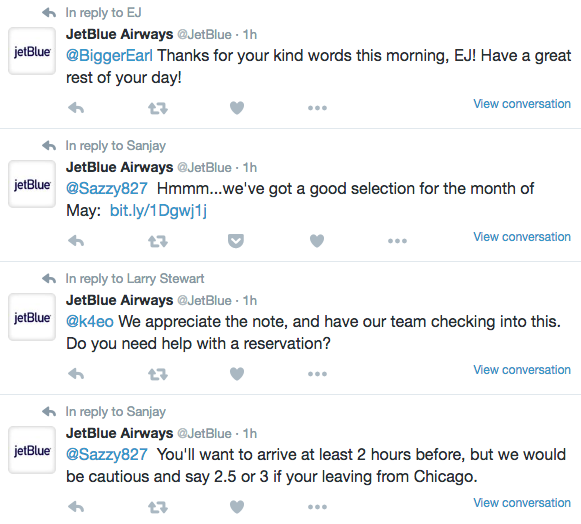
2) Innocent Drinks
We’ve long admired Innocent Drinks for their consistently lovable branding. While they may be a smoothie and juice brand, they stay far away from pushily promoting their products.
In fact, most of their social media posts aren’t about smoothies or drinks at all. Instead, they use social media to foster their silly, fun, clever, and creative brand personality.
“We want to tell people about us in the most engaging way we can,” said Community Manager Helena Langdon told Audiense in an interview. “It’s our goal to make our pages a place on social media where people want to visit and enjoy seeing in their timelines, then people won’t mind when we try to sell them drinks every now and again.”
Today’s forecast:
9am: blue skies, sunny, 7°C
2pm: black skies, hail then snow then light shower of frogs, -11°C
7pm: sunny again, 17°C— innocent drinks (@innocent)
April 27, 2016
Here’s another example:
We interrupt our relentless smoothie-based marketing messages to bring you this photo of a baby skunk. http://pic.twitter.com/n77B6PoDnk
— innocent drinks (@innocent)
February 19, 2015
It’s this approach to Twitter that makes them stand out from the crowd — and it certainly works for their audience. Their head of digital and communities Joe McEwan says that people really connect with their brand because they talk like human beings, without jargon or “technical mumbo jumbo.”
“It helped to set us apart,” he said, “and it got people talking about us. It’s completely ingrained in the company that we should look to talk to people wherever they might be.”
3) Major League Baseball (MLB)
The MLB (Major League Baseball) is a complex system of teams, players, statistics, trades, and more. Instead of housing all these activities under a single Twitter handle, they’ve done a great job segmenting different parts of the game into different Twitter handles. (And they list all their affiliated Twitter handles in their cover photos — a very nice touch.)
Their @MLBStatOfTheDay handle, for example, is for the statistics nerds out there, pairing interesting statistics with relevant video clips.
.@RedSox averaged 10.4 runs/game during homestand – 3rd-best mark by any team on a homestand of 7+ games since 1900. http://pic.twitter.com/jV71yv4xaF
— MLB Stat of the Day (@MLBStatoftheDay)
May 16, 2016
Meanwhile, @MLBReplays tweets each challenge a coach makes against an umpire’s call and its result. @MLBRosterMoves, sponsored by moving company Penske, sends a tweet every time a player is added or removed from a team’s roster.
My favorite MLB Twitter account, though, is @MLBGIFs. The concept is brilliant in its simplicity: Each tweet features a GIF paired with a funny one-liner. These GIFs capture some of the cool, funny, and weird moments that take place during a baseball game — everything from diving catches to dancing fans to high-fiving players.
Here are two examples:
Just keep running … http://pic.twitter.com/vQdL8IZ1a3
— MLB GIFS (@MLBGIFs)
May 10, 2016
And:
When you close out the road trip on a high note. http://pic.twitter.com/OgPepYDqlZ
— MLB GIFS (@MLBGIFs)
May 16, 2016
GIFs are shareable, relatable, and delightful — and MLB really nailed it by creating a separate Twitter handle to embrace them. (Want to learn how to create your own animated GIFs in Photoshop? Read this blog post for a tutorial.)
4) DiGiorno Pizza
DiGiorno Pizza is one of the funniest (and definitely one of the strangest) brands to follow on Twitter. Their tweets are usually about pizza, but not in the uber-promotional way you’d expect.
For example, do you remember that time in 2013 when DiGiorno Pizza live-tweeted NBC’s The Sound of Music and broke the internet? Here, let me jog your memory:
DOUGH a crust an unbaked crust
RAY, a guy that likes pizza
ME a pizza liked by a guy named ray
FAH no idea what fah is
SO so
LA a city
T tee— DiGiorno Pizza (@DiGiornoPizza)
December 6, 2013
The entire thing was weird and hilarious. It was also a great example of a brand hopping on a popular hashtag (in this case, #TheSoundofMusicLive) to chime in on the already-popular conversation. In the two hours of live-tweeting, the company tweeted 38 times, garnered over 44 million social impressions for that week, and picked up over 4,000 new followers.
Most of their tweets are funny odes to pizza — and some of them still have that same crazy, erratic voice they used in the live-tweeting, which’ll often leave you totally confused and laughing hysterically all at the same time.
🍕🍕🍕🍕🍕🍕🍕
🍕🍕🍕🍕🍕🍕
🍕🍕🍕🍕🍕
🍕🍕🍕🍕
🍕🍕🍕
🍕🍕
🍕Art
— DiGiorno Pizza (@DiGiornoPizza)
April 7, 2016
Thank you autocorrect
❤=🍕 http://pic.twitter.com/dqZoo1O0dG
— DiGiorno Pizza (@DiGiornoPizza)
May 17, 2016
5) General Electric
What General Electric sells (appliances, lighting, electronics, etc.) doesn’t have nearly as broad of an appeal as pizza, but that doesn’t mean their tweets have to be unappealing.
GE lives in the technology and innovation space — a space where far too many companies resort to using Twitter simply to promote themselves and their content.
That’s where GE differentiates itself in the tech space on Twitter. They’ve found a perfect balance of thought leadership and authenticity. They use Twitter to teach their followers what they’re doing; for example, they’re fantastic at breaking down the complex concepts and terminology they work with into simple language.
Below, they showcased one of their sports research studies by handpicking one of the coolest, most accessible parts of their research and showcasing it in an engaging way:
As the tallest QB in the draft, Paxton Lynch’s height gives him an incredible 👀 advantage on the field #DraftScience http://pic.twitter.com/mgianWA8vK
— General Electric (@generalelectric)
April 29, 2016
We also love that they don’t take themselves too seriously on Twitter. Instead of marketing themselves as a big, inaccessible tech company, they’re great at keeping their Twitter content human and relatable.
Yes, we are just looking for an excuse to build jet packs.https://t.co/cjmiX6xxwS
— General Electric (@generalelectric)
May 13, 2016
Reinforced carbon fiber joints make this umbrella stronger than your average GE engineer. http://pic.twitter.com/b4FUWNd3k2
— General Electric (@generalelectric)
May 13, 2016
6) Charmin
The social media marketers behind Charmin’s Twitter account are masters of social engagement. First of all, their tweets always feature their fun, lighthearted, and toilet humor-centric brand voice. In 2014, TIME named them “the sassiest brand on Twitter.”
In addition to tweeting out fun content, they’re constantly using Twitter to ask their followers to answer questions, respond to folks who tweet at them, and jump in on trending hashtags — like the #DontWorryBoutAThingCuz hashtag below.
#DontWorryBoutAThingCuz we got your back-side.https://t.co/B8N8PfYDXk
— Charmin (@Charmin)
May 13, 2016
They’ve also created a number of successful hashtags that encourage their followers to engage with them on Twitter. Their most famous is #TweetFromTheSeat, in which followers can send tweets while sitting on the toilet. The hashtag earned them a Shorty Award in 2014 — and we love the description they included in their entry:
40% of young adults admit to using social media in the bathroom (and those are just the people who admit to it). At our core, Charmin is all about giving people a better bathroom experience and it is important to us that this translates to how we engage with consumers on Twitter. And of course, we love potty humor.”
Another hashtag they use to engage with fans and followers is #CharminAsks. Here’s a fun example:
#CharminAsks: Should you answer the phone while answering nature’s call? http://pic.twitter.com/WgsYde3vx6
— Charmin (@Charmin)
April 21, 2016
7) Massachusetts Institute of Technology (MIT)
Like the MLB, the marketing team at MIT runs a number of different Twitter accounts. Their main @MIT feed is great — in fact, it was #1 on our list of the best universities on Twitter for delivering diverse content, from research studies to nerdy anecdotes, that is catered to their niche audience.
But their other accounts are great too. Specifically, they’ve created Twitter handles for each of their target personas: @FYEatMIT for first-year students, @MISTIatMIT for matching MIT undergraduates with internship, teaching, and research opportunities, @MITGradStudents for (you guessed it) graduate students, and more.
You’re almost done and you’re doing great #finalsweek #YouGotThis http://pic.twitter.com/yX2ABDUz5M
— First Year at MIT (@FYEatMIT)
May 19, 2016
Along with tweeting out helpful content, the Twitter descriptions they’ve written for each handle make it very clear what each Twitter account is all about. Here are three examples from the three handles I mentioned above (and here are 38 more examples of great Twitter bios for more inspiration).
8) LinkedIn
While JetBlue uses their main @JetBlue Twitter account to handle customer service, LinkedIn actually uses a separate account called @LinkedInHelp. The folks at LinkedIn don’t use this account in the traditional sense, and its goals certainly don’t revolve around gaining new followers. Instead, the purpose of the account is to give LinkedIn users an easy way get their questions answered quickly through Twitter.
If you scroll through that account’s main Twitter feed, you’ll see it’s basically all retweets of praise and thank-yous from delighted customers — which is great social proof for anyone who finds themself on the page and wondering whether they’re actually responsive.
The LinkedIn Help page is controlled by an extremely responsive support and communications team, who is always offering help to those who seek it. Since the questions are being answered on Twitter, this can be a valuable resource for those to see answers to similar questions they may have.
LinkedIn isn’t the only brand with dedicated customer service and support Twitter handles. Examples from other brands include @NikeSupport from Nike, @AskTarget from Target, and @HubSpotSupport from HubSpot.
9) Maersk Line
Think you can’t have a cool Twitter account just because your industry is “boring”? When you see Maersk Line’s Twitter page, you might change your mind. Let’s be honest: Container shipping isn’t the sexiest of industries. And yet, their social media team has found a way to find the beauty therein.
How? The tweets from Maersk Line are centered around their products at work. For the most part, this means gorgeous photos. It all starts with their beautiful cover photo, which plays with light and reflections at sunset. (Here are 20 more examples of great Twitter cover photos from brands for more inspiration.)
Most of their tweets include images as well — a great move for engagement, as Buffer reported that tweets with images received 150% more retweets than tweets without images for its user base.
Maersk Line is back in Liverpool after a 10-year hiatus! Read about the new SLX service: https://t.co/xMQXiJelSP http://pic.twitter.com/kHCVCxCzIh
— Maersk Line (@MaerskLine)
April 18, 2016
In addition to photos, they pair links to their own reports with graphics to make the less “sexy” tweets more engaging and more noticeable in the Twitter feed.
Global plans for your seafood business? Meet our reefer experts at Seafood Expo 2016: https://t.co/iz15mOqDYP http://pic.twitter.com/WtFCteulKu
— Maersk Line (@MaerskLine)
April 28, 2016
To easily make similar images for your own Twitter feed, download these 100 customizable social media image templates in PowerPoint.
10) Forrester
Forrester, a research company known for their innovative reports and analyses aimed at global business and technology leaders, is another company that makes an art out of cramming a lot of meaning into 140 characters.
How to let go of perfection:
1. Admit imperfection
2. Ruthlessly automate
3. Align teams
4. Measure, reflect & apply data #FORRDigital— Forrester (@forrester)
May 11, 2016
Most of their tweets include cool information or statistics from their studies that are interesting to their target followers. They do a great job of tweeting out an interesting statistic or tidbit, including a relevant image that makes that piece of information stick out in the feed, and then link to the larger study. Folks scrolling through their feed who find that information interesting might be enticed to learn more by clicking the link.
Think about emotional qualities and their implications. –@anjalilai #FORRDigital #ForresterData http://pic.twitter.com/RzfjrsQpkJ
— Forrester (@forrester)
May 10, 2016
What are your favorite brands on Twitter? Share with us in the comments.
Why Emotional Well-Being Matters at Work [Infographic]
There’s a common misconception about happiness in the workplace. It goes like this: Great work leads to big success, which leads to happiness.
Sounds like it should work out that way, right?
Turns out that model for happiness is totally backwards. Happiness isn’t a destination; it’s a starting point — one that enables positive outcomes at work. When employees are happy first, they tend to work harder and be more productive. At the same time, the companies happy employees work for tend to see less turnover, higher revenue, and smoother operations overall.
To help illustrate the research behind why emotional well-being matters at work, the folks at Happify created the infographic below. Check it out to learn why companies should care about employees’ emotional well-being, what they can do about it, what employees can do about it, and where money fits in to the equation.

Breaking Down Virality: An Analysis of 4 Posts That Went Viral
Trying to go viral? It seems like everyone is these days.
That’s because having a post take off can benefit your brand’s reputation tremendously — just look at how the blue and black dress (or was it white and gold?) affected BuzzFeed’s traffic.
While the success of a viral post often hinges on chance, my team at Alexa set out to uncover some of the common characteristics of viral content to help others inform their content strategies.
In doing so, we examined four “viral” posts using our competitive intelligence tool to analyze website traffic, and BuzzSumo and SharedCount to analyze total social media shares. It’s also worth mentioning that we chose to focus on smaller sites for the sake of this analysis to get a better idea of how one viral post can affect traffic, reach, and page rank.
Here’s some of what we learned …
Measuring the Effects of Virality: An Analysis of 4 Unique Viral Posts
1) “Dad Sings Anti-Bullying Song to Daughter”
Faithtap.com — a social website with interesting and inspiring videos — shared a video of a dad singing an anti-bullying song to his daughter. Within a couple of months, the site’s global ranking had jumped by 43%.
Takeaways:
- Including a strong emotional hook in your content can help increase the chance for viral success.
- Knowing which emotional themes resonate most with your audience and weaving those into your content is important.
- Utilizing videos will help grab the audience’s attention fast and create a strong emotional response.
2) “14 Quotes That Prove Amy Poehler Gives the World’s Best Advice”
Mic.com— a media site geared to millennials — shared a list of empowering quotes from Amy Poehler. The site’s reach nearly tripled two weeks after the article went live.
Takeaways:
- Writing catchy and compelling headlines can pique curiosity in social audiences.
- Placing pop culture references in your content can help boost virality.
- Sticking with universally popular topics is a great bet.
3) “A Mom’s Social Media Post Shatters Lives”
Creativity-online.com — a sibling of Advertising Age that showcases creative content — posted an AT&T advertisement about the dangers of texting and driving. Over the next couple of months, the site’s global ranking increased 29%.
Takeaways:
- Utilizing an element of surprise is extremely effective for grabbing the audience’s attention.
- Incorporating current cultural and social issues into your comment will add interest.
- Including a broadly understood and relatable topic will ensure extensive audience reach.
4) “No, It’s Not Your Opinion. You’re Just Wrong”
HoustonPress.com — a Houston-based entertainment source — shared an opinion piece about how, well, you just might be wrong. More than 36,000 people shared it on Facebook.
Takeaways:
- Surprising and shocking audiences can help to ensure success.
- Controversial and polarizing content often sparks discussion.
- Making sure your content topic appeals to a wide audience will increase viral potential.
3 Quick Tips for Creating More Sharable Content
1) Emotional content strikes a chord.
Emotions play a big role in our decision-making, but there’s a fine line between piquing interest and being misleading. Readers are wary of clickbait, and an over-the-top headline can feel like exploitation. However, when used properly, emotional content serves as a way to provide value. Your audience wants to feel a connection to content, and as long as it’s relevant, emotional content can help you establish just that.
The emotion you choose to tap into is entirely up to you. While the video from Faithtap demonstrates how to leverage feel-good emotions, content that makes people feel uneasy can also have an impact — as demonstrated by the terrifying advertisement from AT&T shared by Creativity-online.com.
2) Know your audience.
There’s no one-size-fits-all formula for creating highly sharable content. In fact, what you create will have a lot to do with who you’re creating it for.
For example, a list of celebrity quotes like the one published on Mic.com might not fare as well on a website with an older audience and a more serious focus. But for their audience, it was a perfect fit: Mic’s audience is primarily made up of women between the ages of 18 and 44, and Poehler, known for her roles on “Saturday Night Live” and “Parks and Recreation,” is something of a millennial icon.
3) Breaking the rules isn’t always a bad thing.
When it comes to viral content, don’t be afraid to think and work outside of the box.
The AT&T film mentioned earlier is nearly four minutes long — a risky move when 33% of video viewers lose interest after just 30 seconds. Yet, the video had a profound impact on its hosting website: Three days after it went live, the site’s reach skyrocketed sevenfold, and page views increased eightfold.
And what about the “No, It’s Not Your Opinion. You’re Just Wrong” article? Pretty edgy and controversial title, wouldn’t you say? Well, it worked: The 1,200-word opinion piece was shared more than 36,000 times on Facebook.
Moral of the story: Think boldly, but be sure to act accordingly. When you’re creating content, always keep your audience’s best interest in mind. Don’t deceive them. And don’t offend them. Instead, focus on creating something they can connect with — something they’ll want to share with a friend, or two, or three …
What tips do you have for creating “viral” content? Share them with us in the comments section below.
How to Make Remote Work Actually Work
One of my favorite things about working remotely — which I do a few times a month — is the freedom to get comfortable. When I work from home, I’m usually find myself in one of three positions: sitting up at the table, laying down with my laptop, or buried in a pillow avalanche on my couch. (Sound familiar to anyone?)
While most offices have a few full-time remote workers — and probably a few that operate like I do — the idea of more remote employees may be one companies need to get used to.
Why is remote work becoming such a big deal? Well, from where I’m sitting (currently “sitting up at the table”), it’s simple: Because good candidates are asking for it, and technology’s making it an easier thing to demand — no matter what the position entails.
For employees, this is great news. They can live where they want, spend less time and money commuting, and wear their bathrobe to meetings. But what do companies get out of it?
According to research by online freelance marketplace Upwork, sourcing and onboarding in-office employees takes an average of 43 days, compared with three days for remote employees. Not to mention, being open to remote team members widens the talent pool.
So to help you sort through the operations and expectations that employers need to consider to make remote work effective, let’s walk through some practices that make it easier for me to communicate and collaborate with my remote teammates.
How to Make Remote Work Work
On Setup & Technology
I have very little in the way of tech savvy, but I do know that a good operational and technical foundation helps remote workforces stay productive. This is where two key teams come into play: Finance & Accounting and IT.
It starts with a commitment — if you’re interested in making it — to investing in your remote team as actual employees that will grow with the company. Not contractors. Not freelancers. That investment means working with Finance & Accounting to understand the administrative costs of paying employees in different states or countries. Are there visa costs you’ll need to consider? Will employees need to travel to the office on a regular basis — and if so, is the company financing it? Do they have the technology they need at home to communicate with you effectively? Again, are you financing it if they don’t?
These questions extend to IT and the infrastructure they’ll need to set up, too. They’ll want to build in security measures for employee devices, and will need to equip your office with the technology your in-office team needs to communicate with remote team members. This includes chat software, remote meeting software, telepresence devices, and potentially some high-tech conference rooms to make coordinating all of that seamless. One of my teammates who works remotely half the week and works with our global offices quite a bit actually takes pains to dial into meetings on video, specifically. She found it difficult at first but says it made her far more productive being visually present in meetings, and is grateful to have the infrastructure to support that.
If you start with all of this built into your budget from the get-go, two things happen: 1) you’re not hit with surprise costs, and you can do a much better job with hiring planning; 2) you end up with streamlined operations for onboarding remote employees so their experience starting with your company is as good as it would be for anyone else.
On Communication
The best IT setup in the world doesn’t help unless we’re all using it toward the right ends. At the risk of being trite, the most successful relationships between in-office employees and their remote team members comes down to good communication from both parties. And figuring out what good communication means is kind of a beast. So bear with me while I try to break it down to its most pertinent parts for our purposes here.
Combat “face time” with over-communication.
One of the challenges remote work presents is the lack of “face time.” Think about all those random one-off conversations you have in the hallway, or at the water cooler, that wouldn’t be possible if you weren’t in-office.
To combat this, you really need to nail the whole “regular and effective communication” thing.
Sam Mallikarjunan, who works from his home down south most of the time, found that a lot of the “random collisions” he used to have in the hallway don’t happen anymore. (Obviously.) When I asked him how he makes up for it, he said “I just over-communicate. I have to proactively find opportunities to work with other people. I make a point of reaching out to people more often to tell them what I’m working on if I think it might be useful to them, and I actively talk to other people about their projects, too. There’s a lot less ‘the ball is in their court’ mentality when I’m remote.”
That proactive approach to communication is something that remote team members may start to pick up on just because they’re experiencing the need for it first-hand, so it’s equally important to have in-office employees reciprocate. Make it a practice in your company to systematize communication — to me, that means in-person decisions and conversations are always formally recapped over email, in your group chat client (provided it’s not in a room with only casual participation and monitoring), or for the big stuff, in a team meeting.
Use your words.
I have this theory that if street signs were properly punctuated we’d all be better writers. My favorite example is the “STOP CHILDREN” sign.
STOP THEM FROM WHAT?!
When communicating without the benefit of body language or tone, clarity with written and verbal communication is more important than ever. In an ideal world, everyone’s already really good at finding the right words to say what they mean. But that’s not reality, so we’re left with a few options here:
1) Try to be better at it. If you’re writing an email, take a beat to reread what you’ve written. See if you’ve really communicated what you’re trying to say clearly and succinctly. Consider whether you’ve included enough context for everyone to understand what’s going on. If you’re having a phone or video conversation, take a moment before responding or posing a question. And if what you said makes no sense, own it and say, “Sorry I don’t know what I’m trying to say, let me start over.”
2) Know that reading comprehension matters. If you’re on the receiving end of a communication that makes you go:
Image Credit: Giphy
… ask clarifying questions before responding with an equally confusing answer. I try to either copy and paste the exact copy from the email, quote it, and then ask my clarification question — or if it’s a verbal conversation, repeat back what they said before asking my clarifying questions. It’s important to avoid layering confusion on top of confusion.
3) Avoid reading into tone. People’s tones suck sometimes. Especially over email. If a typically bubbly person didn’t include a barrage of emojis or explanation points, they’re probably just running late, or feeling stressed … or something else that has nothing to do with you.
Put some alert metrics in place.
We’ve used the term “pothole” metrics before — the numbers you report on regularly that, if they get out of whack, signify a deeper problem with a part of the business. I like to use that principle here as a way to be sure we’re all catching everything that’s going on if communication ever fails. I also like to expand that principle out to encompass the good stuff as well as the bad stuff.
These could be numbers that indicate someone’s doing well or struggling — for example, setting up traffic waterfalls if a team member’s work is directly tied to hitting a traffic metric. But they can include non-numerical things, too — like hitting project milestones for people that work in roles that are more about discrete deliverables that have changing definitions of success.
Frankly, this is a good exercise to go through for every team member — yourself included — whether in-office or remote. Really, it just means everyone knows what “good” looks like, and you’re all able to break down “good” into its component parts so you know if you’re making reasonable progress.
On Management
If managers are interested in hiring remote team members, they’ll have some specific responsibilities to keep things chugging along nicely. Most of this is just about setting the right precedent for how to think about remote work for your team — I’ve broken it down into the stuff you need to do proactively, and what you need to squash.
Do this:
Over-communicate the work being done by remote team members, and the value of that work. Yes, they should do this on their own. We talked about that earlier. You have to be the champion of your own career, and self-promotion is part of life … and all that jazz. But sometimes people forget. Or they do say it, but it’d sure help if someone else reiterated it.
This becomes particularly important when someone’s work output isn’t very visible. For example, if your job is to write one article a day, it’s pretty easy for people to see that you’re doing your job. You either wrote the article or you didn’t, and everyone can see it. If your role is to build operational efficiencies into backend systems that four people in the company touch … it’s really easy for that work to disappear.
Squash this:
To that end, don’t let resentment or pettiness build toward remote employees — particularly those that are part-time remote. This starts to manifest itself in little comments like: “Oh is this one of the days so-and-so is in? I can’t even remember.” Letting that kind of stuff slide is what makes it seem like in-office employees inherently provide more value than those that are in less often. Worse, it perpetuates the notion that face time is more valuable than work output, which I think we’re all on board with as being total bunk.
Do this:
Encourage other people on your team that are in-office and have roles that allow them to work remotely … to work remotely sometimes. That pettiness I was just talking about? It’s a lot less likely to happen if working from home once in a while doesn’t feel like a special privilege levied on a few special snowflakes.
Squash this:
This is where things can get tricky, too. Remote work only works when it works. Notice how I said you should only encourage remote work when people have roles that allow them to work remotely? We all know not every role makes that possible. But beyond that, not every person is always a good fit for remote work at every point in their career, either. I’ll volunteer myself as an example of someone who, when starting a new role, would struggle to not be around people while I get my footing.
Or if someone is having performance issues, it may not be the right time to green light remote work. That’s another reason giving feedback early, often, and candidly is important. And that rationale extends to remote employees that start having performance issues while they’re already engaged in a remote work agreement with you.
Finally, always remember to do this:
We talked earlier about treating remote employees not like contractors or freelancers, but like actual full-time employees. That means they have career ambitions, and are probably interested in growth and promotion opportunities. Be sure to keep them in mind for new projects, promotions, and additional responsibility. If good people fall out of sight and out of mind, you might lose ’em.
After you’ve got the infrastructure set up, to me, most of this really comes down to good hiring. Get the right person, for the right role. If you’ve got capable people you can trust in a role, you should be able to trust that not only are they doing good work, but that they’ll let you know if and when they need something different from you.
The right person can make even roles that you don’t think will work in a remote scenario, work. (Unless that role is chef. Then you definitely need to be at work.)
How do you make remote work work? Share your thoughts and ideas in the comments section below.
The 7-Step Formula for Writing Copy That Sells
In Chicago, there’s a famous restaurant called Alinea. It’s one of only a handful of restaurants in America that have earned the coveted 3-star Michelin rating, making it one of the best restaurants in the world. But if you ask people who’ve dined there what makes it unique, most will tell you that, somehow, it’s not just the food.
Alinea is an experience. The food, artistic and delicious as it is, wouldn’t garner its full effect if each course (there are about 20 in all) didn’t arrive just in time, perfectly ordered, with each dish complementing the one before it and simultaneously enhancing the one scheduled to arrive next. There’s a natural flow to the meal — a rhythm. Each course serves a purpose, like the individual instruments of an orchestra.
The end result is something enticing, captivating, and memorable — and fun. Really fun. Most importantly, the end result sells people. It compels them to write glowing Yelp reviews. It makes Alinea the topic of conversation. The end result drives people back again and again.
As a marketer, if you want to sell people like a Michelin 3-star restaurant, you have to execute like one. In other words, you have to 1) produce something remarkable and 2) present it correctly, logically.
If you don’t know how to do that, here’s a proven copywriting formula that will guide you …
Bob Stone’s Gem: The 7-Step Formula for Writing Copy That Sells
Bob Stone was a giant figure in the advertising world. His colleagues called him “Mr. Direct Marketing” because he wrote countless successful direct mail pieces, selling everything from surgical dressings to business club memberships.
How did he do it? He had a trick: an adaptable formula made up of seven simple, logical steps he used to hook readers and keep their interest until the last line (at which point many readers did what he asked them to).
Stone’s formula — referred to by marketers as “Bob Stone’s Gem” — was originally used to write sales letters and other direct response advertisements. But in the decades since its invention, it’s been proven to work in virtually any type of promotion, from blog posts to landing pages to sales emails. Try it yourself and watch your response rates rise.
But first, let’s break down each step. You’ll notice that I’ve provided an example sentence (or two or three) under each to show how a copywriter might use Bob Stone’s Gem to create a blurb of copy (which, in this instance, is selling that beaut of a restaurant: Alinea).
1) Begin with your strongest benefit.
In the advertising world, features tell and benefits sell. That’s what makes Bob Stone’s Gem so compelling: it forces marketers to focus on and, therefore, highlight the benefits of their product, service, cause, program — what have you. Of course, features should also be present in the promotion you create but, ultimately, they’re not closers. Only benefits are.
That’s why you have to sculpt your copy around a target persona, highlighting the benefits you know to be most important to her.
In this example, I’ll be writing to Foodie Francis, a married, middle-aged lawyer with two adult children. She loves cooking and is particularly fascinated by molecular gastronomy.
Let’s get started:
Dine at Alinea, and join the I’ve-Eaten-the-Best-Food-in-the-World club.”
2) Expand on the most important benefit.
Make your main benefit difficult to ignore by describing the actual positive impact it can make on your target persona’s life. Change your reader’s perspective. Plant a seed.
For example:
A club that will open your culinary head, forever changing the way you look at food and, perhaps, even the way you understand ingredients.”
3) Explain exactly (and in detail) what the prospect will get.
You’ve planted the seed, now water it. This is where you can drop some features. You can do so by painting a picture, which will give your reader something to visualize and gestate. Just don’t over-do it. Leave room for your reader’s imagination. After all, it exists for a reason …
For example:
At Alinea, dine on tempura-fried pheasant breast, while experiencing the delights of a Midwestern fall — even if it’s January. At Alinea, eat an apple masquerading as a helium balloon.”
4) Back up your statement(s) with proof.
By this point, your reader has given you her attention, time, and effort. But she’s not a sucker, you know. She’s a leery, 21st century consumer. And if she’s to be sold, she is going to need some proof.
This is your chance to flash some facts, statistics, testimonials, awards — anything that’ll give credibility to your claims.
For example:
At Alinea, experience the weight of 3 Michelin stars: the bites, the service, the art of it all.”
5) Tell them what they’ll lose if they don’t act.
Bob Stone included this step because he knew that people are far more driven to avoid pain than they are to acquire pleasure. As a species, we’re constantly striving to prevent suffering and avoid discomfort. That’s why it’s important to incorporate some negativity into your copy.
For example:
But if you choose not to make a reservation, rest assured you’ll go on living, laughing, and loving like you always have. Nothing will change. And wouldn’t that be unfortunate?”
6) Sum up the most important benefits.
You just took your reader to the darkside, now bring them into the light again. Recap all those terrific benefits that captivated your reader in the first place, reminding her why she should pull the trigger.
This is your last opportunity to sum up the value your product or service will bring to the reader’s life. This is your chance to push the reader over the threshold, so make it personal and emotional for your target audience.
For example:
Because beautiful and delicious and exciting as the Alinea experience is, it’s nothing compared to what could be. It’s nothing when pitted against the future — your future — after your mind is awakened to the potential of ingredients and the possibilities of food.”
7) Present your call-to-action.
If you don’t ask your reader to take a specific action at the end of your copy — if you don’t tell her what to do next — you might as well have never written it in the first place. I don’t care how compelling your words have been, if there isn’t a clear next-step, your copy is almost certainly going to fail.
So keep your call-to-action simple and direct. Don’t force your reader to think.
For example:
Be our guest. Reserve your table on our website, http://ift.tt/P45LTY, today.”
The Finished Product
When stitched together, Alinea’s promotional blurb is short and sweet. Depending on the circumstances, it could be expanded or even shortened. But for the purposes of this article, I think it reads just right:
Dine at Alinea, and join the I’ve-Eaten-the-Best-Food-in-the-World club.
A club that will open your culinary head, forever changing the way you look at food and, perhaps, even the way you understand ingredients. At Alinea, dine on tempura-fried pheasant breast, while experiencing the delights of a Midwestern fall — even if it’s January. At Alinea, eat an apple masquerading as a helium balloon. At Alinea, experience the weight of 3 Michelin stars: the bites, the service, the art of it all.
But if you choose not to make a reservation, rest assured you’ll go on living, laughing, and loving like you always have. Nothing will change. And wouldn’t that be unfortunate?
Because beautiful and delicious and exciting as the Alinea experience is, it’s nothing compared to what could be. It’s nothing when pitted against the future — your future — after your mind is awakened to the potential of ingredients and the possibilities of food.
Be our guest. Reserve your table on our website, http://ift.tt/P45LTY, today.”
Is this copy going to sell everybody who reads it? Of course not. But then again, it wasn’t designed for everyone. It was designed for Foodie Francis, remember?
So, will it sell her? Perhaps. Nothing’s a sure thing. But thanks to Bob Stone’s Gem, I like my chances.
What do you think of this formula? Will you try it? Share you thoughts below.
How to Write a Press Release [Free Press Release Template + Example]
When it comes to content, sometimes old school can be a good thing (namely, when it comes to old school rap or Throwback Thursday on Instagram). But when it comes to your company’s public relations strategy, being old school isn’t advantageous for your business or your brand.
Ten years ago, people still relied on morning papers for news. Today, the vast majority of your company’s customers and prospects scan headlines on Twitter or see what’s trending in their Facebook feed.
People now have control over where, when, and how they consume information. As a result, public relations is no longer about feeding into a traditional news cycle; it’s about providing relevant content when, where, and how your prospects, influencers, and customers will consume it.
Sounds pretty hopeless, right? Wrong. While relationship-building still helps you get into popular publications, we now have the opportunity to quit playing the waiting game and generate our own buzz. By turning your PR strategy into an inbound one, you create opportunities that weren’t there before and carve out a place for your company, building meaningful mindshare with your target audiences in the process.
One of the most crucial updates to make to your PR strategy is to think of press releases as an opportunity to connect to the audiences you care about — including, but not limited to, reporters.
What Is a Press Release / News Release?
Whether we call it a “press release,” a “press statement,” a “news release,” or a “media release,” we’re always talking about the same basic thing: an official announcement (written or recorded) that an organization issues to the news media and beyond.
Most press releases are succinct at just a page long. Two pages tops. Ultimately, companies want to provide enough information so that news outlets have sufficient material for publishing their own stories about whatever the company is announcing in the release.
And while it may be tempting to craft a press release that embellishes your company’s accomplishments or twists the facts to make a story sound more intriguing to the media, remember: Press releases live in the public domain, which means your customers and prospective customers can see them. So instead of thinking of a press release solely as a ticket to earning news coverage, you should also think of it as a valuable piece of marketing content.
When Should I Distribute a Press Release?
While there’s no cut-and-dried formula for when a press release should be written (and distributed), here’s a few reasons when it’s a good idea:
- New product launches
- Updates to existing products
- Opening a new office
- Introducing a new partnership
- Rebranding
- Promoting/hiring a new executive
- Receiving an award
A regular cadence of (meaningful) news can help a company stand out and build mindshare with journalists over time, so that’s where the press release (or news announcement) comes in.
Press Releases Can Be a Viable Content Type
Many people think press releases have to be chock full of buzzwords and branded terms. Big data anyone? Five syllable words you have to look up on Thesaurus.com? Quotes from every executive on the planet that go on for pages? We’ve seen it all. Unfortunately, so have reporters — and they are not fans.
So instead of stuffing your next release with jargon, take a page out of our book (okay, fine, ebook), The Newsworthy Guide to Inbound Public Relations, and brainstorm some creative approaches for your next announcement. Can you include new data? A remarkable graphic or video? A shareable SlideShare? If so, a creative angle will often help carry your content and increase the likelihood of social sharing.
Even so, a press release can still be a really valuable medium for communicating news to your audiences. You just have to make it readable, relevant, and relatable.
We have crafted this comprehensive, easy-to-follow press release template complete with a promotional plan and considerations for your next announcement. We use these same guidelines when writing our releases here at HubSpot and created a faux, sample release to illustrate what content goes where and why.
How to Write a Press Release [With Example]
You’ve got your announcement in mind, and now it’s time to get it down in words to share with your community, industry, and followers. Take Catbrella Inc., a fictitious ad agency, which just gained its 10th Twitter follower after two years of paid social media efforts. To announce its achievement, Catbrella could issue a press release like the one we’ve dissected below.*
Sample Press Release:
*Disclaimer: HubSpot is entirely responsible for the silliness of this faux announcement.
Rule 1: Make Your Headline Irresistible
Just like writing the perfect blog post title, setting up your press release for success starts with your headline. You only have one line to work with, which can seem scary, but consider diction carefully to make your headline captivating.
Use action verbs, clear, understandable language, and keep your headline simple and short — fortune (and search engines) reward the brief, so keep your title to one line to clearly focus people’s attention on your topline message.
Most importantly, make it interesting: Keep in mind that reporters get dozens, if not hundreds, of releases each day, so invest the time to write a compelling headline. It’s worth the time and effort on your part.
Rule 2: Don’t Play Hard to Get
For reporters, analysts, influencers, or followers to be inclined to share your announcement, you have to tell them upfront why they should care.
The first paragraph of your release should cover the who, what, why, where, and how of your new launch, update, or development. Reporters don’t have a ton of time to sift through details and fluffy background information — they just need the facts that’ll help them tell your story to someone else from a position of authority.
There shouldn’t be any new, crucial information covered after this section that the reader could potentially miss.
Rule 3: Offer a Tempting Quotable
Once you’ve set the scene, it’s time to bring your details to life with a quote that reporters can use for context around your announcement and help paint a picture of how your news affects the given industry, customer base, and landscape.
Ideally, quotes will be from key stakeholders in your company including your executive team, project leads, or those directly impacted by your announcement. Quoting key figures and authorities underlines the importance of your development. The chosen quote should shape your narrative and emphasize the core of the announcement. Don’t ask everyone in your office for a comment or feel compelled to quote all 25 people included in the acquisition — pick one or two critical spokespeople and focus the quotes around their unique perspective.
Rule 4: Provide Valuable Background Information
In this last paragraph, keep in mind that the reader already has all of the vital details and information they need to file a story or spread the word.
It can be tempting to provide superfluous facts and tidbits about your company or the development of your announcement — we sometimes think a piece of writing is lacking if it isn’t drawn-out and just shy of being a novella. However, a press release needs to be helpful and concise.
Offer details here that strengthen your narrative, like creative or noteworthy ways your company developed the project or announcement at hand. Or, when applicable, comment on future implications of your announcement.
Rule 5: Make the “Who” and “What” Obvious
Twitter is chock-full of reporters lamenting press releases or pitches that don’t clearly explain what the company does or what the announcement is actually about, so instead of being the butt of a joke, make your release incredibly easy to reference.
Describe what your company does in clear, plain English, include a link to your company’s homepage early on, and make your boilerplate succinct and straightforward. If you cite data, include a reference link for the data source, and make sure every name in the release has an associated title and company as well.
To keep yourself honest on this front, ask a friend or colleague to read the release without context and ask if they can easily and readily explain why the announcement matters, what your company does, and why the executives included are quoted. If the answer to any of those questions is no, get back to the drawing board.
The key to keeping your PR strategy new school is forgetting preconceived notions of what public relations is and instead focusing on creating highly remarkable content. Traditional press releases can still be really valuable when executed well, so instead of ditching releases as a tactic, give them a modern makeover to make them more useful for your marketing.
Think about how you’ve used inbound methods to transform your marketing strategies to be more personalized, approachable, and build relationships. Those same principles apply to your PR strategy: Create content to craft your own story and use tactful outreach to get reporters and analysts familiar with your brand.
Tips for Publishing Press Releases
Writing a press release is really only half the battle. Once you’re finished with production, it’ll be time to focus on distribution.
Of course, we’re all familiar with the traditional distribution levers we can pull, which include publishing the press release on our website/blog, as well as sharing the press release with our followers/subscribers via social media and email. But for ensuring a press release gets the maximum amount of distribution possible, here are some tips you can follow.
1) Reach out to specific journalists.
Instead of blasting a press release out to every journalist you can find an email address for, focus on a few journalists who have experience covering your industry (and company, hopefully) and send them personalized messages. Connect the dots. Show why what you wrote connects to what they write.
2) Don’t be afraid to go offline.
Most journalists have mountains of emails (and press releases) to sort through. Try sending your release through snail mail or another offline channel to differentiate yourself.
3) Send the release to top journalists the day before.
Give journalists some time to craft a story around your press release by sending it to them — under embargo — the day before it officially goes live. (FYI “under embargo” just means they aren’t allowed to share the information in the press release until the time you specify.)
4) To avoid competition, don’t publish your release on the hour.
If you’re publishing your press release on a distribution service like PR Newswire or Business Wire, avoid publishing it on the hour (e.g., 1 p.m., or 3 p.m., or 5 p.m.). The reason? Most companies schedule their releases to go out on the hour, which means if your release goes out on the hour too, it’s more likely to get lost in the shuffle. Instead, try going with a more distinct time (e.g., 1:12 p.m., or 3:18 p.m., or 5:22 p.m.).
5) Share your media coverage.
If all goes according to plan, and your press release gets picked up by the media, your job still isn’t finished. To keep the buzz going, you can release a “second wave” of distribution by sharing the specific stories that news outlets write based on your press release.
What other best practices do you follow when writing press releases? Share your thoughts with us below, and don’t forget to download our free press release template here.
Editor’s Note: This post was originally published in October 2013 and has been updated for accuracy and comprehensiveness.
How to Avoid Email Marketing Mistakes: 6 Tips & Processes for Maintaining Quality
You know what hurts? Spending roughly three weeks (or more) shepherding an email from ideation to deployment … only to realize later that an error made it all the way through to your customers’ inboxes.
I know this feeling all too well — I’ve made a few dingers myself over the years. And while none of the mishaps resulted in an apology email, they all still haunt me. Want an example? How about this subject line on behalf of The Home Depot: “New Lower Prices on Lightning.”
The lesson: Waiting until after approvals are finished to manually type in a variant subject line exponentially increases your risk of failure. (Side note: How cool would it be if The Home Depot actually sold lightning bolts?)
But many times it’s not just a contextual spelling or grammatical mistake that makes it through. Sometimes it’s the UX of a landing page, a broken link, or even just a backend issue.
At Grammarly, we’re committed to learning from our mistakes — especially the grammatical ones. That’s why we’ve put a bunch of proactive safety nets in place to help us keep tabs on email quality.
Want to learn more about these processes? We’ll walk you through them below.
6 Tips & Processes for Maintaining Email Quality
1) Aggressively integrate proofreading into your workflow.
This is number one for a reason. It’s your first, middle, and last line of defense. At Grammarly, we use both our product and a human copy editor to be doubly sure nothing slips through.
To give you a better sense of just how careful we our, check out our high-level workflow:
- Ideation/Planning
- Copywriting
- Proofreading
- Design
- Proofreading
- QA (Quality Assurance)
- Proofreading
We rely on both software and a human editor for a few reasons. For one, we’re firm believers in “eating our own dog food.” Our team of world-class linguists are constantly iterating our product to ensure it’s something we can get behind. But we’re also firm believers in the power of context, which is why we have a full-time or freelance proofreader run through all of our email copy to ensure that no stone is left unturned.
The outcome? Quality content that feels really human.
2) Create efficient and actionable customer feedback loops.
After you send, keep your eyes and ears out for qualitative feedback. These days, it’s fairly easy to set up a loop via Slack (or Hipchat, etc.) that makes real-time user feedback actionable for your organization. Here’s how we do it:
- Scenario A: Deploy Emails > User Engages > User Provides Comments on Social Media (positive or negative)
- How we solve for it: Our social media team helps us monitor company mentions on Twitter for several hours after a large campaign goes live.
If a user is having a buggy experience with the product landing page, for example, then we work with our social media manager right away to develop a fast, helpful response. If the problem appears to be a corner-case or temporary issue, we alert the product team right away.
- Scenario B: Deploy Emails > User Engages > User Replies Directly to Our Email > Reply Automatically Creates a Zendesk Ticket > Customer Support Team Manages Tickets
- How we solve for it: The secret sauce for feasible automation here was ensuring that any replies to our marketing campaigns automatically create Zendesk tickets. Our support team autonomously handles the cases they can solve themselves or have a known resolution for. Anything qualitative is shared via a #Marketing-Replies Slack channel that the email team monitors along with the support team. This process facilitates not only quick resolutions but also assistance with copywriting for responses that may need extra nuance.
The biggest piece of advice here is to look for feedback and the heartbeat of every single large send. This feedback may not affect your team directly, but by tracking it and relaying it to appropriate teams, you’ll increase your value — and that should do wonders to strengthen the company perception of the email team. You’ll also learn about phrases that may not resonate with your audience so that you can refine your style over time.
3) Balance autonomy and redundancy.
The most important part of your final approval process is a system of checks and balances.
Try to keep it as lean but potent as possible. Have one main stakeholder checking all the variables, and specialists ensuring quality for their niches. Here’s what this process might look like across teams:
- Coder and/or Designer: Checks email rendering across clients (we use Litmus), implements all links, tracking, alt tags, etc., and loads the HTML into the email platform.
- QA Team: Tests all the above variables across possible use cases in production (i.e., they deploy from the email platform).
- Main Project Manager: Checks all of the above before deployment — at least at a high level — and ensures final versions are sent to any necessary stakeholders (your boss, legal team, proofreader, etc.). The project manager is likely to be your email marketing person.
- Proofreader: Gives final approval of creative. Ideally, the final test send should not be the first time your proofreader is seeing the copy.
One additional piece of advice: Don’t put the final QA check solely on the project manager. And if you are the project manager, don’t cut corners in the interest of efficiency. Nowadays, with the ever-shifting variables to optimize for in email marketing, there are just too many things that can go wrong.
4) Choose a cadence for revisiting and auditing automated emails.
This one’s short and sweet: Don’t set it and forget it. Revisit your life cycle creative like it’s your core product. Shoot to revisit your life cycle at a cadence that makes sense and use a good decision framework for business impact and UX.
At minimum, don’t go longer than a year without revisiting live creative.
5) Review samples thoroughly for dynamic emails.
Another short one: If you’re sending out personalized emails with a lot of dynamic content, then make sure you preview multiple variations ahead of a deployment.
Grammarly’s weekly statistics emails are 1:1 and have over 25 unique data slots. There is no way we can preview all variations during our QA. However, we do have a test list of employees that we use to eyeball all of these touch points before hitting send.
6) Don’t let a robot do all the writing.
There are a lot of cool third-party technologies in the email world today. And while we’ve seen our fair share of demos, we try not to rely too much on automation for copywriting.
This isn’t to say you shouldn’t perform meaningful experiments to identify new ways to optimize your email copy. But allowing machine learning to take the wheel entirely could jeopardize the quality and consistency of your email strategy. After all, these automated tools usually optimize individual email campaigns, but aren’t able to think about the entire customer journey.
In short: Evaluate these tools with extreme caution. While having a robot spit out 100 subject lines for you sounds great, you should always check to make sure that the outcome reflects your brand’s message and voice.
But don’t let this perspective scare you away completely, though. There is likely a hybrid process that still allows for steps one through five above to be baked in for quality control. You should vet these opportunities yourself and make an informed decision. But if you start selling lightning instead of lighting, don’t say I didn’t warn you.
What are you best tips and tricks for ensuring email quality? Share them with us in the comments section below.
14 Reasons Why Inbound Marketers Make Great Advertisers [SlideShare]
At last year’s INBOUND event, we announced the ability to build and optimize ads right inside of HubSpot. This was a tough decision, and we did some soul searching about it.
While we were busy fussing over where ads fit within inbound, our customers were busy building awesome ad campaigns. It’s been amazing to see — as it turns out, inbound marketers are really good advertisers.
So good, in fact, that we knew there must be a link between the two. To understand the situation better, we started looking at the campaigns our customers were creating to uncover what made them so effective.
The SlideShare below captures the common elements we see from customers who are using ads to amplify inbound in some really interesting ways.
7 Helpful Resources Every Email Marketer Should Bookmark
Email has seemingly been on the brink of extinction for about a decade now. Over the past few years alone, email has been called “dead,” “not dead, evolving,” and even “dead, again.” But as you can likely tell by the steady stream of messages still flowing into your inbox every day, not to mention the ones you write and send yourself, email continues to keep on keeping on.
With the state of email marketing constantly in flux these days, and with a nearly endless supply of tips and tricks floating around, separating the valuable resources from the noise can be a real challenge.
To help you make sense of all the email marketing information out there, we’ve put together this list of websites that you should bookmark. While some of the sites are geared toward providing email marketing stats and best practices, others offer helpful tools for making your job (and life) easier.
7 Websites Every Email Marketer Should Bookmark
1) HTML Email Gallery
Here’s another great resource for finding email inspiration. But in contrast to the Really Good Emails website, which showcases emails of all kinds, the HTML Email Gallery exclusively showcases examples of design-heavy, HTML emails. It’s a great site to bookmark if you’re looking to take the design of your emails up a notch.
2) Touchstone Subject Line Analyzer
Touchstone Subject Line Analyzer tool will show you projected open rates, click rates, and other helpful stats based on Touchstone’s database. It’s like taking your subject line for a test drive before making the decision to use it.
The tool also lets you upload your own email data, so you can see how your actual subscribers are responding to your subject lines. While using Touchstone’s full database for analyzing subject lines is great for identifying trends, using your own data can give you insight into what’s working (and what’s not working) with your specific audience.
3) IsValid
After running an email experiment (e.g., testing which subject line receives more opens) and collecting all the data, there’s one question that email marketers are often left with: “Are my findings statistically significant?”
With the free IsValid web tool, you don’t need to be a statistician in order to answer that question. Just enter the sample size and conversions/metrics from your original data set, then do the same for your experimental data set, and voilà: IsValid will automatically analyze the results and show you the degree of statistical significance. No math required.
4) The HubSpot Marketing Blog’s Email Marketing Topic Page
This post you’re reading right now … we’ve got a ton more like it. In fact, we have a whole subset of our blog dedicated to email marketing content.
- “12 of the Best Email Marketing Examples You’ve Ever Seen (And Why They’re Great)“
- “15 Email Newsletter Examples We Love Getting in Our Inboxes“
- “13 of the Best Examples of Beautiful Email Design“
- “A Marketer’s Guide to Email Deliverability: How to Avoid Email Spam Filters“
5) The Best of Email‘s Inspiration Gallery
As its name implies, The Best of Email is a website dedicated to highlighting top-notch emails that you can use as inspiration for your own email marketing campaigns. From examples of ‘welcome’ emails to killer email newsletter designs, The Best of Email has something for everyone.
6) SendForensics Email Deliverability Test
Want to make sure your emails will reach their intended destinations? SendForensics has got you covered with their free Email Deliverability Test.
After you sign up for an account, SendForensics will provide you with an email address that you can add to your contacts list and use for testing. When you send an email to that address, the Email Deliverability Test will provide you with a deliverability percentage (see screenshot below for example).
7) HubSpot Research
One more shameless plug: Our research site — HubSpot Research — offers a ton of data across all facets of marketing. But if you go to the site’s chart-building tool, and filter the data by the “Email” category, you’ll be able to get your hands on our latest email marketing insights.
From exploring email open rates by company size, to checking out clickthrough rates by annual revenue, there’s a lot of great email marketing data available. And best of all, we’re always updating HubSpot Research with fresh findings.
Know of any other great websites that email marketers should bookmark? Share them in the comments section below.
How to Get Hired as an Inbound Marketer: 17 Qualities Hiring Managers Look For
Let’s face it: Getting a job in marketing isn’t easy these days. As more and more companies realize the importance of implementing a successful inbound marketing strategy, they’re becoming even more selective about who they’ll hire to take charge of their marketing efforts.
So how do you get a job in marketing?
To help you get a head start in your job hunt or quest for a marketing promotion, we’ve compiled a list of 17 qualities that managers look for when hiring or promoting an inbound marketer.
We’ve broken these qualities into 3 categories: Core Behavioral Traits, Key Marketing Skills, and Specialized Skills. Use this list to evaluate in which areas you excel and which skills you need to focus on developing further to set yourself up for inbound marketing success.
(And, in the spirit of learning and growing in your marketing career, check out HubSpot Academy’s “World Certification Week” — a week of inspiring and educational talks broadcast on Google Hangouts.)
Core Behavioral Traits
1) You’re inquisitive.
The online world changes every day, so it’s important that you have a natural inclination to question ideas, processes, and tactics — both old and new. An inquisitive marketer will be helpful in revealing weaknesses, flaws, or even identifying additional opportunities in their work by asking the right questions about your marketing strategy and methodologies.
There are specific ways you can become a more inquisitive and more curious person, which my colleague Carly Stec wrote about in this post. A few of these include asking lots of questions, reading content that’s outside your comfort zone, listening without judgment, embracing change, and learning how to actively change your perspective.
2) You’re adaptable.
Being inquisitive and curious is one thing, but being able to actually adapt to that change (and even be psyched about it) is another. As we’ve discussed, the challenges that a marketing team faces will inevitably change. New challenges will come up all the time, and if you can’t change how you work and/or what you’re working on with a good attitude, then you won’t rise very far.
As Scott Stratten wrote in his book Unmarketing, the ever-changing marketing landscape isn’t the only reason adaptability is important; it’s also because of the ever-changing demands of your brand or your client. For these reasons, you’ve got to be comfortable adapting to changes and be able to “roll with the punches” when necessary.
3) You’re decisive.
Surprises are normal for most marketers. A campaign could unexpectedly underperform, or sales leads could suddenly plateau. A good inbound marketer can pivot quickly and make decisions on how to prioritize their time and capitalize on these surprises. You should recognize that making decisions involves taking risks, but it’s almost always better to do something than nothing. Most companies want to move forward knowing mistakes will be made.
That being said, don’t confuse decisiveness with rash decision-making. A decisive person still takes time to gather necessary information, encourages feedback from their team, and gains perspective from people whose viewpoints might be helpful or even critical, like HR or operations.
4) You get s*** done.
While this competency is … direct, it is also quite simple: inbound marketing takes work. While outbound marketing is less about nimbleness and more about your budget, inbound marketing requires you to take control of your business’ website and online presence. Inbound marketers today need to be a lot smarter and a lot more proactive when it comes to their marketing programs.
Sometimes, generating results means working harder, faster, or stronger — big campaign successes often require a major effort. Businesses want a candidate that can face that kind of challenge with confidence. They also want someone who doesn’t sacrifice quality for quantity; remarkable inbound marketers know how to strike a balance between the two.
5) You’re transparent.
Being close-lipped and closed off doesn’t just hurt the hiring managers — it hurts the candidates, too. Some candidates feel like they have to keep it to themselves that they’re interviewing at multiple places, for instance. Others feel as though they should act more aspirational and say they want to be a manager in the future. But it’s totally OK to not want that — or to not know — if the role you’re applying for doesn’t call for it. If you approach an interview with the attitude that you just want to get hired no matter what, you’re bound to be disappointed down the line.
Key Marketing Skills
6) You can write well.
The ability to write is one of the most important skills in the inbound marketing world. Every day marketers write ebooks, social updates, emails, website pages, and so on, that attract customers to your business and represent your company.
While most people can write, not many do it well — and effective copywriting in marketer requires you to write well, and write with a marketing slant. You need to know how to produce scannable copy, whether it’s by breaking down the features and benefits of their products for the web, or by breaking up blog posts with headers to encourage casual readers to keep going.
Here are a few resources to help you improve your marketing writing skills:
- The Marketer’s Pocket Guide to Writing Well (free ebook)
- “The 31 Best Tools for Improving Your Writing Skills” (blog post)
- “How to Write a Blog Post: A Simple Formula + 5 Free Blog Post Templates” (blog post)
7) You can teach well.
What good is a deep understanding of your industry if you can’t share that knowledge with your market? The ability to teach is integral to inbound marketing, especially if a business wants to create content that can establish your company as a thought leader and attract new customers to your business.
Hiring managers don’t want to see your blog posts and ebooks crammed full of product content, for instance. Instead, they want to see a focus on creating educational content that runs parallel to your product or service offering — and they want to see that you’re able to break down any complicated concepts or terminology in a way that’s easy for your readers to understand.
8) You’re a quick learner.
Just as important as being able to teach is your ability to learn and understand new things. A marketer might need to create content, analyze metrics, and implement tactics that he or she may have to learn on the fly. A team can be more nimble when led by people who can learn and comprehend new strategies quickly. Show your hiring manager you’re a quick learner by emphasizing your willingness and ability to experiment and adapt to new challenges.
9) You understand the industry.
You should have a firm understanding of your industry in order to teach its best practices and have context to draw from. The deeper the industry understanding you have, the more authority your content will hold.
If you’re switching industries, showing you’re a quick learner is even more important. Research and preparedness can, to a point, make up for your lack of experience. To get started, follow and read blogs on your target industry, follow key industry influencers on social media, research industry benchmarks, and so on.
10) You can dig into data and analyze results.
Inbound marketing is becoming increasingly data-driven — and there’s increasing pressure for marketers to prove the ROI of their campaigns and experiments. That’s why marketers need to balance creativity with an analytical brain to process all the information we see every day. Make sure you can review ROI, spot metrics-driven trends, understand important marketing metrics, and know how to create and segment relevant marketing reports.
When you’re writing your inbound marketing resume, include goals and metrics that hiring managers can use to compare you against other candidates, and make sure those metrics make sense and aren’t confusing. Examples include:
- Drove 37% improvement in newsletter clickthrough rates by rewriting sales copy.
- Grew ecommerce sales 23% in just 6 months by redesigning and A/B testing all landing pages.
(If you want more examples of actionable data points, download these free resume templates.)
11) You know the product.
Even if you don’t work on the product marketing team at your current company, your manager is looking for people who understand the business’s product or services in and out. Take time to truly understand the goals of the business as it pertains to the product or service it sells. If you know someone with access to the product or service and can talk to them about it or request a free trial, then go right ahead.
12) You’re “T-shaped.”
If you wear multiple hats at a business, you may be known as a “horizontal line.” While having the ability to tackle various projects competently is valuable, it can only take you so far if it’s not balanced with a specialized strength.
Managers are looking for marketers who are T-shaped, meaning those who have knowledge on many topics and are collaborative (the horizontal part of the T), while still having deep expertise on one topic (the vertical part of the T). Read this blog post to learn more about how to get “unstuck” in your career by finding depth or breadth.
Specialized Skills
13) You can use Excel.
Excel is a powerful tool that we sometimes take for granted. With the right training and experience, marketers with an advanced understanding of Excel can create powerful spreadsheets to break down important metrics, and allow a marketing team to better understand the numbers behind the strategies.
Here are some blog posts to help you out:
- “Where to Learn Excel: The 10 Best Resources on the Internet“
- “How to Use Excel: 14 Simple Excel Shortcuts, Tips & Tricks“
- “How to Create a Traffic Waterfall Chart in Excel“
14) You have public speaking experience.
Many marketers have the opportunity to give talks and present educational content to the public or for groups within their company. Whether that talk is a conference keynote or a presentation to a boss, public speaking is a valuable skill to add to your team dynamic — and it’ll also impress hiring managers.
There’s a lot you can do to improve your public speaking skills for free. Here are a few blog posts to get you started:
- “A Helpful Guide of Public Speaking Tips“
- “The Uneasy Speaker’s Guide to Confident Public Speaking“
- “10 Science-Backed Tips for Rocking Your Next Public Speaking Opp“
HubSpot CMO Kipp Bodnar suggests taking improv classes to help you get better at public speaking by improving your confidence, your timing, and more. You could also join your local Toastmasters, which is probably the best public speaking club available and has more than 15,400 different Toastmasters clubs in 135 countries worldwide.
15) You know a thing or two about video production.
In the past few years, the increase in online video consumption has been enormous. After all, video is a terrific platform for creating and sharing lovable content.
With video content on the rise as a preferred method of media consumption, having a marketer with a background in video production can give a team a real competitive advantage. A skilled video producer on a team makes creating video content in-house on a regular basis possible.
Not a skilled video producer? That’s OK, as long as you’re not applying for a job that requires it. But hiring managers will be impressed by candidates who are familiar with video marketing terminology and best practices, popular platforms, and examples of other brands using video in their marketing. You may want to play around with Facebook Live, creating animated GIFs, and other types of video content to get a feel for how it works.
16) You can dabble with design.
User experience has become more and more focused on design and conversion, making it essential for marketers to have at least a base level of design knowledge. If a business prioritizes the design of ebooks, infographics, social images, or other visual content, a marketer who has experience with Adobe Photoshop, InDesign, or Illustrator can be a major asset to a marketing team and the company as a whole.
It also helps to study up on some of the psychology of design, like typography and color theory.
(Here are over 195 free design templates that are perfectly optimized for email, infographics, social media, and more.)
17) Know have basic coding skills.
There’s been a lot of talk over the past few years about whether coding is the next must-have skill of the modern marketer. After all, code is what lies behind so many of marketers’ great marketing campaigns.
That’s why marketers should gain a basic understand of HTML at the very least to understand the structures that bring their websites, apps, and tools to life. Even if you don’t have to do a lot of hard coding yourself, knowing the basics will help empower you to make quick fixes, and help you communicate effectively with developers when you do need help with something.
To help you get started, here’s a blog post outlining the basics of HTML, CSS, and JavaScript in plain English. For a deeper understanding of these programming languages, I’d recommend looking at the many free resources available online, like Codecademy, which is a longtime favorite for beginners. Coursera also has a number of free introductory programming courses from universities like University of Washington, Stanford, the University of Toronto, and Vanderbilt.
There you have it.
Even if you don’t have every single skill on this list, it doesn’t mean you can’t be a great inbound marketer. That being said, be sure to spend some time developing your weaker skills so you can put yourself in the best position possible to become an inbound marketing rockstar.
What other skills do you think inbound marketers should have? Share with us in the comments.
Editor’s Note: This post was originally published in April 2014 and has been updated for freshness, accuracy, and comprehensiveness.