
Preview: SEO Do’s and Don’ts for Schools [EBOOK]
The search for higher education has changed in the past decade. While websites have long been an important part of the marketing and recruitment efforts of any school, they’re now the most important part.
Still, many schools either don’t have a search-engine optimization (SEO) strategy in place—or are playing guessing games when it comes to what will attract the most prospective parents and students to their site.
To help you correct your search strategy course, we’ve compiled 8 SEO missteps that schools often take, and provided some guidance on a better way to
Take a look at the preview below, and then snag your copy of the full ebook here.
DON’T: Assume Prospective Students Are Searching For Your School
Students who already know your school aren’t the ones you’re trying to reach with SEO. That means using your school’s name as a keyword isn’t a great move. Your goal is, instead, to attract new potential students who may be interested in the programs you offer and other attractive qualities.
Focus on the needs of your target audience. If you’re an online institution, you’re aiming to reach students who don’t have the time or ability to attend on-campus classes. Do you have one of the top business schools in the country? Your SEO should focus on that. When you address the problems or needs of your target audience, then they’re more likely to find you.
Once you’ve snagged their attention, you can continue your inbound marketing strategy. Without attracting those students through the keywords they’re searching, you’ll never get past the first step.
DO: Assume Prospective Students Are Still In Research Phase When Brainstorming Keywords
Research starts with a question. That’s how your prospects will begin their search into schools like yours. Those questions will be very specific and cover much more than one or two words—keywords—when seeking an answer.
That means your SEO must plan for long-tail keywords and search phrases that match your target audience’s needs. In other words, those searching for a “business degree” will need much more information than just about the degree itself. They may search for “business degree from accredited online” university, or “business bachelors degree in two years.” They need all the facts during this initial research period, and if your chosen search terms aren’t focused on providing those facts, then qualified students won’t find you.
How can you choose keywords that are relevant to potential students and beneficial to you? Here are some tips to get you started:
- Make a list of important topics that are relevant to your business and the students you want to attract
- Choose keywords and search phrases that match your topics
- Research those terms to uncover related search terms you may not have considered
- Investigate other schools to see how they rank with your chosen search terms
Remember, the search terms you choose to help students research your school should appear in copy on your website. That requires quality content that provides answers to the questions these prospective students may have.
Ready for more Do’s and Dont’s?
You can download the full ebook by clicking on the image below:
Are You Stressed Enough? [Infographic]
“I wish I were more stressed.”
I’d guess that you’ve never heard anyone utter that phrase. Almost everyone is on the hunt for ways to avoid or better manage the amount of pressure they experience.
But what if I told you that introducing a little stress into your routine might make you more productive?
According Yerkes-Dodson Law, increased mental arousal can actually help improve performance, but only to a certain degree. You see, this positive form of stress — known as eustress — marks the highest peak in the human performance curve. However, most people struggle to achieve such balance, leaving them feeling either under-stimulated or distressed.
Want to learn how to better measure and manage workplace stress? Check out the infograpic from Bryan College for more detailed research, as well advice on how to leverage positive stress in the workplace.

Where to Learn Excel: The 10 Best Resources on the Internet
I, like most people, have some experience with Microsoft Excel — but not as much as I wish I did. For the most part, I’ve used it to brainstorm ideas, budget vacations, and make simple traffic and leads calculations.
But thanks to my limited Excel skills, I’m subjecting myself to the tedium of updating my spreadsheets manually. I’m well aware that it’s causing me to miss out on a whole world of reporting automation that could save me hours and hours of time.
But when I asked a handful of my most Excel-savvy colleagues where they picked up their Excel knowledge, they replied with things like, “I mostly learned from colleagues and friends” or “When I have a specific question, I ask someone or search on Google.”
Well, alright … but what am I going to do, ask my colleagues or their friends every time I have an Excel question?
Download our complete guide to using Excel here for more step-by-step Excel tutorials.
I can’t be the only one out there who hopes to master the world’s most popular solution for analyzing and visualizing data. (Or at least learn how to create charts and graphs that’ll impress my manager.)
In the spirit of becoming a more productive, data-driven marketer, I scoured the internet for the best online resources for learning Excel. Most of these are free, and the ones that aren’t might be worth the investment to some folks out there. So take a look, bookmark your favorites, and get that much closer to working more efficiently in Excel.
Where to Learn Excel: The 10 Best Online Resources
1) Microsoft’s Excel Training Center
Price: Free
When it comes to learning a new application, why not start at the source? After all, no one knows the Mircosoft Excel better than the people at Microsoft.
In fact, they’ve done a great job putting together the Office Training Center: a resource center for all of their Office applications and services. Their training center for Excel has a whole bunch of free tutorials, videos, and guides on Windows, Mac OS, Android, iOS, and Windows Phone that cover both the latest version of Excel as well as the older ones.
Once you click into a platform, you’ll find resources divided by Excel ability: for beginners (like basic math and creating a chart), for intermediate users (like sorting and filtering data, conditional formatting, and VLOOKUPs), and for advanced users (like pivot tables, advanced IF functions, and how to password-protect worksheets and workbooks).
2) The Spreadsheet Page
Price: Free
Here’s an awesome, very well organized site that’s chock full of helpful Excel tips collected by an Excel expert named John Walkenbach.
Over the past thirty years, Walkenbach has written more than 60 Excel books for users of all levels and around 300 articles and reviews for magazines like InfoWorld, PC World, and PC/Computing. At one point, he wrote the monthly spreadsheet column for PC World. In other words, the man knows his stuff — and he knows how to present it to an audience, too.
The most helpful part of his website is probably the Excel Tips tab, which has a long list of useful (and mostly non-trivial) tips on formatting, formulas, charts and graphics, and printing. The tips in there include everything from working with fractions, to unlinking a pivot table from its source data, to a spreadsheet protection FAQ sheet.
Another super helpful part of his site is the Downloads tab, where he’s added free, ungated download links to files he created, including free Excel workbooks and add-ins. Some of the files demonstrate useful techniques that you can adapt to your own work, and others are simply “for fun.”
For example, there’s one Excel workbook in there that gives examples of custom number formats, which you can play with and tweak on your own time to get familiar with them without having to start from scratch.
Finally, there are links on his site to all the books he’s written about Excel over the years, which includes books for each version of Excel from 2016 all the way back to some of its earliest versions.
3) About.com’s Spreadsheets Page
Price: Free
Many of you are likely familiar with the content website About.com. But did you know it has its own spreadsheets subdomain, much of which is devoted to Excel? There are several thousand sets of instructions in there — mostly illustrated, how-to posts — and they add fresh content to it regularly.
Each of the pieces of content is categorized, and categories include everything from formulas and formatting to how-to videos and tools and templates. If you want to stay up-to-date on the latest spreadsheet news and tips, you can sign up for a free newsletter. There are a lot of advertisements on this site, but if you can stand them, the content is pretty darn great.
4) Chandoo.org
Price: Free
The founder of the blog at Chandoo.org (who’s nicknamed “Chandoo”) says he has one goal: “to make you awesome at Excel and charting.” The blog started back in 2007, and today, there are over 450 articles and tutorials in there on using Excel and making better charts.
He’s built the blog as a community, citing values like humility, passion, fun, awesomeness, and simplicity. He also works to make this a great place for the folks for whom English is not their first language.
Most of his tips start from the forums, where people ask a question about Excel — anything about formulas, formatting, shortcuts, pivot tables, and so on — and anyone can answer them. Chandoo then takes some of the more helpful forum questions and creates articles and tutorials out of them.
Image Credit: Chandoo.org
There’s some fun stuff in there, too. For example, Chandoo created an easter egg hunt for a recent blog post, which includes a downloadable Excel workbook that has seven pandas hidden within it. Readers can locate the pandas using clues, Excel techniques, or even good ol’ “I-Spy” skills.
Image Credit: Chandoo.org
While the articles, forums, and other parts of the site are free, you can pay a fee to join one of his training programs like Excel School or VBA Classes, or by getting a copy of one of his books: The VLOOKUP Book or Excel Formula Helper Ebook.
5) HubSpot’s Free Ebooks & Blog Posts
Price: Free
Excel is one of the most in-demand skills for data-driven marketers these days. And because we want marketers like you to succeed, we’ve created a whole bunch of educational content about Excel here at HubSpot — which include free ebooks, templates, blog posts, and video tutorials covering a wide range of topics.
Here are a few of our best:
- “How to Use Excel: The Essential Training Guide for Data-Driven Marketing” (free ebook)
- “9 Excel Templates to Make Marketing Easier” (free templates)
- “How to Use Excel: 14 Simple Excel Shortcuts, Tips & Tricks” (blog post)
- “40 Handy Excel Shortcuts You Can’t Live Without” (blog post)
- “10 Design Tips to Create Beautiful Excel Charts and Graphs” (blog post)
- “How to Create a Pivot Table in Excel: A Step-by-Step Tutorial” (video & blog post)
6) MrExcel.com
Price: Free
Here’s a resource that puts normal humans like you and me in touch with Excel experts. MrExcel.com’s claim to fame is its interactive message board, which is constantly monitored by its community of Excel “gurus.”
When a user posts a question, a member of the Mr. Excel expert community will reply with an answer. The questions range from simplifying an Excel task to solving an “emergency.”
Not a native English speaker? You can even ask questions in your native language.
Aside from posting questions on the message board, you can also browse Mr. Excel’s “Hot Topics,” which includes things like finding the cumulative sum of even or odd rows, or removing leading zero with a text field.
They also have a library of helpful Excel books and ebooks on there. If you need help with problems that are more complex, you can even hire an Excel consultant directly from the website for a fee.
7) Annielytics Video Tutorials
Price: Free
Web Analytics Data Expert Annie Cushing created a blog called Annielytics, which includes both a website and a YouTube channel. But don’t let the punny name fool you: Cushings’ YouTube channel is chock full of really good, specific, and in-depth web analytics tips.
While the content here isn’t all Excel-related — a lot of it is about Google Analytics, for example — she does have some really good video tutorials for Excel. One advantage to these videos? They were created with marketing and web analytics in mind, so they’re directly applicable to your marketing data reports.
To find her videos about Excel, click here or search her YouTube channel for “Excel”.
The Excel topics she covers vary widely: from how to create interactive pivot tables, to how to add a scrolling table to your dashboard using the INDEX function. The videos also range widely in length depending on topic complexity: There are two-and-a-half-minute videos, and there are videos that are over half an hour long.
To give you an idea of what her videos are like, here’s a good one, which covers a comprehensive overview of Excel charts:
8) Lynda.com’s Excel Training Tutorials
Price: Membership starts at $19.99/month (Free Trial Here)
If you’re willing to invest a little cash in your Excel training, Lynda.com is a worthwhile place to spend it. Paying members have access to thousands of Lynda.com courses on business, technology, creative skills, and software that’ll help you work toward your personal professional goals.
Included in these courses are over 100 Excel courses and over 4,000 video tutorials covering every version of Excel and any level of expertise. They cover broad topics like “Excel 2016 Essential Training” and “Communication Visually and Add Impact With Charts,” and more niche topics like “Excel 2016: Pivot Tables in Depth” and “Excel Workshop: Building a Dynamic Heat Map.”
9) Coursera
Price: Individual courses start at $79/each
While Lynda.com asks for a monthly membership fee that then gives you access to all its courses, Coursera charges on a course-to-course basis. The folks at Coursera have partnered with top universities and organizations worldwide to offer online courses for anyone to take.
There are only a few related to Excel, but if you’re looking for a full, college- or grad school-level course, one of them could be perfect for you. Many of the Excel-related courses come from Duke University, such as “Mastering Data Analysis in Excel” and “Excel to MySQL: Analytic Techniques for Business.”
That being said, it doesn’t come cheap. These are real courses taught at top universities around the world. Each course includes video lectures, interactive quizzes, peer-graded assessments, and the opportunity to connect with fellow students and instructors. Once you finish a course, you’ll receive formal recognition, along with an optional course certificate.
10) EdX Excel Courses
Price: Free
If you’re looking for more of a “course” instead of a one-off tutorial, but you’re not ready to shell out any cash, check out edX’s courses.
EdX is a nonprofit that relies on verified certificates to help fund free education for people around the globe. If you take a course that’s marked as “Verified,” then you have the option to pay an amount of money (around $50) to receive an instructor-signed certificate with the institution’s logo to verify your achievement and increase your job prospects. If not, you can take it for free.
To help you choose the courses that are right for you, each edX course includes a rating up to five stars, course reviews, and information on course length, amount of effort (measured in hours per week), level, and video transcripts.
What are your favorite online resources for learning Excel? Share with us in the comments.
17 Key Traits That Separate Managers From Leaders [Infographic]
This post originally appeared on HubSpot’s Sales Blog. To read more content like this, subscribe to Sales.
In the words of Grace Hopper: “You manage things. You lead people.”
The difference between managing and leading might seem fuzzy to managers, but it’s crystal clear to their direct reports. Think about it: Would you rather be told what to do, or sold on a vision?
Would you prefer to work for someone who rules with an iron fist and attempts to control your every move, or someone who empowers you to make decisions and encourages experimentation? It’s a no-brainer.
Even if your title is “manager,” it behooves you to learn and apply the principles of leadership to your day-to-day. If you could use some clarification on the line between manager and leader, check out the following infographic from ResourcefulManager. Strive to adopt the traits on the right side of the graphic, and leave those on the left behind.
Want to Work Better With Your Freelancers? Here are 9 Things They Wish You Knew
Once upon a time, I worked as a freelancer. It was enlightening, thrilling at times, but also extremely tough.
And it wasn’t until later on in my career that I realized just how much marketers depend on contractors. Freelance designers, web developers, copywriters, video editors, SEO specialists, PR consultants, or translators — all of these folks play a vital role on the extended team of many marketers.
Trouble is, coordinating effective communication between teams can be tough. I know this from experience. So to help you establish a more productive working relationship with your contractors, I put together a list of things I always wished my customers knew about freelancing. Check it out below.
9 Things Your Freelancers Want You to Know
1) “You’re paying for more than just the service in question.”
Freelancers are a one-person show, and as a result, they have to do much of the same work as a small business owner. When I was a freelancer, I was amazed at how much time I had to spend on invoicing and collections.
Many freelancers, especially those in creative fields, deplore such mind-numbing tasks as calculating invoice amounts and calling up customers to check on payment status. They might even find it demeaning.
Pro Tip: Process payments as quickly as you possibly can. Stay on top of accounts payable and make sure your company expedites payments to your freelancers right after the work has been delivered.
Paying freelancers on time is very different from paying larger vendors. Your on-time payment can mean your freelancer’s ability to pay his or her rent on time. This is often one of the simplest things you can do that makes the biggest difference for freelancers.
2) “I’d love a steady stream of work from you.”
Freelancers have the luxury of choosing their own hours and their own projects, but when it comes down to it, they would usually prefer to avoid the notorious “peaks and valleys” that come along with contract work.
Often, the best clients will work out longer-term, recurring arrangements with freelancers. This approach helps smooth out bumps in income, but also enables you to secure your contractors’ availability if you’re dependent on them. This can also help raise your status as a priority client.
Pro Tip: Consider offering your freelancers a fixed monthly retainer if you like their work and plan to keep sending projects their way. Include a set amount of work in the monthly retainer, and get their rates for any work that falls outside of it, so they can bill you the extra as needed. Many will allow you to carry hours or work over to another month if you don’t use it all in a given month.
3) “Err on the side of providing me with more information.”
As a freelancer, my favorite customers were always the ones who gave me plenty of background information and context about a given project. The more I understood about their goals, the better I could think creatively to deliver what they needed. In some cases, this actually helped them to accomplish their goals and stay on budget while enabling me to earn more and obtain repeat business.
For example, as a freelance translator, I once had a client with a unique need: They had customer emails that they needed translated and delivered back within an hour. As a translator, I was normally paid by the word, but I knew that in this case, they had given me the context of why they needed this service, and made it clear that what they valued was speed. So, I proposed that instead of paying me by the word along with a rush fee for fast turn-around, which is typical, that they pay me a consistent monthly retainer, for which I would agree to be “on call” to translate emails during certain business hours, so long as they didn’t exceed a certain volume.
Pro Tip: Don’t just rely on written text. Schedule a video or voice call to convey more details. While it might seem like it takes too much time, doing this up front can actually improve clarity, prevent misunderstandings, and save time later on. This also helps you establish a closer connection. In fact, don’t limit interactions with freelancers to just your own. Connect them to more team members to help them learn about your projects and business.
4) “I choose to work with you, too.”
The best freelancers are in very high demand. They can pick and choose their clients. In fact, freelancers might decide to stop working with you entirely if you don’t treat them well. I certainly stopped accepting projects from clients that didn’t communicate clearly about expectations up front, or worse yet, failed to pay on time.
Remember when you’re working with a freelancer that you’re not purchasing a one-off project: you’re building an important relationship that you will likely want to grow with time.
Pro Tip: Ask your freelancers what their best clients do differently. Tell them you want to be one of their best customers. The surprise? Most won’t ask for more money, but rather, will talk about other things their clients do well. Let them clue you in on how to get the most from the relationship with them. High-quality professionals take great pride in a job well done, and that includes customer service.
5) “Don’t reduce our relationship to price alone.”
Have you ever asked a freelancer to lower their rates because you got better rates from someone else? That’s somewhat like asking a restaurant to match the price of the same meal you ate in another restaurant, with a completely different chef, in a very different part of town. If you try to ask freelancers to match the rates of others, you might be equating the work of a Cordon Bleu-trained master chef to the work of a short order cook. While you’re probably just trying to be financially responsible for your company, be sensitive to the fact that many freelancers find a price-centered focus demeaning, as it devalues and unfairly commoditizes their work.
Pro Tip: Ask freelancers for a clear explanation of their rates. If your budget won’t stretch, explain that you’re not making a decision based on price alone, but ask them if they ever have any flexibility on price, and if so, for which circumstances. Sometimes, sending them more guaranteed work on a recurring basis, pre-paying for work, or expanding their services, may prove to be a win-win situation.
6) “Ask me for my advice more often.”
When it comes to the types of projects they do each day with other companies like yours, freelancers have likely seen it all. Yet, you might not think to ask them for their advice on how to best structure a project, or how to improve the output. Often, a quick conversation with your contractor can yield great suggestions that will help the entire project go more smoothly. Don’t forget, they are professionals who are specialized, and this expertise is what you are paying for, not just the service itself.
Pro Tip: Get on a call with your freelancer and ask:
- How can I set you up to do the best possible job on this project?
- What else do you need from me?
- What could we do differently?
- Where do projects like these typically go wrong?
7) “I’d love to dive even deeper into your company.”
Many freelancers are very excited to get to work with a new customer, and will often look up information about your brand, and even you as their main point of contact, to educate themselves on their new client. However, that time represents hours they would otherwise be billing to other clients, and they can’t spend countless unpaid hours immersing themselves in your business.
Pro Tip: Pay your freelancers for time to learn about your business. This might seem radical, but if quality improvement is your goal, this will go a long way. If you already have a training program, send your contractors through it. Or, at the very least, send them the materials and allow them to take any corresponding tests.
At HubSpot, we recently began paying our freelance translators a set incentive amount to take the Inbound Certification, so they could become more familiar with inbound marketing in general. This guarantees that they can allocate the time to learning your business instead of another’s.
8) “My performance depends directly on yours.”
Often, clients are quick to point the blame at a freelancer when a project goes awry. I’ve seen many marketers throw up their hands in frustration, saying, “Why is it so hard to find a good freelancer?”
In reality, the problems are often due to a lack of communication and willingness to put in enough prep time on your side. Freelancers are usually very motivated to complete a job on time, and to your satisfaction. Instead of just shifting the blame in one direction, ask yourself what you can do better next time around.
Pro Tip: Would you fire an employee if they didn’t perform well in their very first week, or would you ask yourself if you set them up for success? Give your freelancer a chance to ramp up and learn your preferences and needs. If you routinely switch freelancers after trying them out on just one project, you’re not giving them the opportunity to ramp up properly. After your first project, schedule a call to do a detailed review with your contractor. Discuss the expectations, where things might have fallen short, and where both of you can do better next time.
9) “I take vacations, too.”
Don’t expect your contractors to be at your beck and call. They have lives, just like anyone else, so quick turnaround projects should be the exception, not the rule. Plan ahead with them. When planning your projects, give freelancers at least as much advance notice as you would give when, say, making an appointment with your hairdresser. You owe them that professional courtesy. And, make sure that if you become highly dependent on a freelancer, that you work their vacation plans into your schedule, just like you would for any full-time member of your team.
Pro Tip: Ask your freelancer if they have any times of the year that they are typically unavailable. Block these dates in your calendar and set reminders for yourself two months before to book any projects around their availability and work with them to make any back-up plans if needed. Often, freelancers will even sub-contract to other people they trust. Feel free to ask them if they have that type of arrangement for when they are out or need to reduce their workload.
Start Contractor Relationships With Growth in Mind
Lastly, remember that your freelancers are not “just” contractors, but important parts of your extended marketing team. This is especially true if your marketing team is small, or your company is in growth mode. When recruiting contractors, set the expectation up front that if the work is of high quality, your hope is to expand the relationship and send more work over time.
You never know where these relationships will lead. Several years and jobs ago, I worked with a talented freelance writer and SEO specialist, and found myself sending her more and more work over time. Eventually, she ended up accepting a full-time remote position on my team, and today, even though we no longer work in the same company, we still remain close friends and colleagues.
As you work with freelancers, seek to truly get to know them as individuals in order to get the highest quality of service. Implement some of these tips and share them with others on your team in order to start building what may ultimately become mission-critical business relationships for you, your team, and your company.
What are your best tips for working with freelancers? Share them in the comments section below.
How to Prepare for a Job Interview: The 25-Minute Routine That Can Make a Big Difference [Infographic]
This post originally appeared on HubSpot’s Sales Blog. To read more content like this, subscribe to Sales.
So you landed the interview. Congratulations! You’re one step closer to your dream job. But before you drop the mic, let’s make sure you’re ready to nail that interview.
I know it’s tough to carve out a couple hours to do the ideal amount of job interview prep. You’re busy! Maybe you’re already juggling two jobs, you’ve got kids to pick up from daycare, you’ve got a dishwasher to unload … okay, maybe just a season of House of Cards to finish.
In any case, it’s time to prioritize.
Selling yourself to an employer is one of the biggest deals you will ever close; and believe me when I say preparing for this crucial moment will pay off. A small investment of time on the front end will set you apart from your competition and show the employer you mean business.
I’m rooting for you, so check out the infographic below from Ideal Candidate — and then get out there and get hired. You’re only 30 minutes away from becoming a confident, articulate, and educated candidate.
Why Your First Idea Might Be Your Worst Idea
This post originally appeared on HubSpot’s Agency Post. To read more content like this, subscribe to Agency Post.
There’s a common mistake both young professionals and expert contributors fall victim to when coming up with ideas. It’s known as the Einstellung effect — when a person defaults to a known solution rather than a novel or optimal way of solving a problem.
For young creatives, the problem may be that they don’t have the context to know what’s new and what’s a tried-and-true solution.
While in the case of more experienced professionals, the issue is that people tend to rely on historically proven solutions (ones they may have used in the past and know the steps for solving) and become blind to the fact there is a more efficient and effective way to solve a problem. Researchers have studied the Einstellung effect in chess players, finding that when a player recognized the problem, he ignored a more efficient solution in favor of achieving checkmate with a familiar sequence of moves.
The tendency of people to think their first idea is their best idea and to rely on a supply or previour solutions is also known as “design fixation,” and it’s an extremely easy problem for marketers and creatives to fall victim to, resulting in low quality work for clients, a lack of inventiveness, and the stagnation of growth.
To get past your first good idea to the truly great idea, you need to recognize the signs of fixation and put processes in place that encourage “outside the box” thinking and creative advancement.
What Is Design Fixation?
Design fixation, also known as the Einstellung effect, was first studied by Abraham Luchins in 1942 in what is known as the water jar experiment. In the first part of the experiment, participants were asked to transfer water between jars of varying capacity to get to a certain measurement with the restriction that although they could transfer water between the containers, when doing so, they had to fill the container being used to capacity. Jar A held 21 units, Jar B held 127, and Jar C held 3 units. To get to 100 units, you would fill Jar B to 127, and then empty this into Jar A, leaving you with 106 units in Jar B. Then you fill Jar C two times to reduce Jar B by 6 units.
The next test was given to participants from this previous experiment and a control group. The goal was get to 18 units. Jar A held 15 units, Jar B held 39 units, and Jar C held 3 units. The most simple and clearest solution is to fill both Jar A and Jar C. But for people who participated in the first test, they defaulted to emptying Jar B into Jar A and then filling up Jar C twice (similar to how they solved the problem in the first experiment), while most of the control group found the simpler solution.
The first group recognized a pattern for problem solving and relied on this, while the second group considered the best way to achieve the desired result.
Blindness to possible alternatives is literal in this case. A study by Merim Bilalić and Peter McLeod on chess players that used eye-tracking found that even though participants believed they were looking for faster solutions to achieve checkmate, they did not shift their gaze away from the part of the board where the familiar solution would occur. This blindness actually weakened the skills of experts to the level of novices.
The good news is that the more advanced an expert becomes, the less susceptible to the Einstellung effect she is. But this first requires that the expert become aware of design fixation and the negative impact this bias has on creative output.
How to Get Past Your First Idea
Being aware of your inherent bias toward your first idea or a previously known solution will prompt you to reconsider your approach. But you also need a strategy to counteract its effects.
Due to the time and budget constraints placed on agencies by clients and the inclination to rely on previously successful methods to reduce risk and the chance of losing a client relationship, it can be easy to default to what’s work in the past or the most promising of good, not great, ideas from a brainstorm.
In fact, Luchins found in another subsequent experiment that stress imposed by time limits and negative future consequences, such as being graded on the results, further reduced cognitive flexibility.
Agency teams are under near constant pressure to produce highly creative outputs under these conditions.
To prevent stagnant thinking and the effects of Einstellung, try these approaches:
1) Create Opportunities for Exposure to New Ideas
A great idea is not typically the result of some magic, rather it is the synthesis of multiple ideas into one idea, what’s known as combinatorial creativity. Maria Popova, the author behind Brain Pickings, described it as, “Alive and awake to the world, we amass a collection of cross-disciplinary building blocks — knowledge, memories, bits of information, sparks of inspiration, and other existing ideas — that we then combine and recombine, mostly unconsciously, into something ‘new.’”
By introducing your team to new ideas — outside of the world of marketing and advertising — you are creating more of these building blocks, which may one day collide in new ways and result in a truly great idea.
One way to implement this in your company is to offer a program such as tuition reimbusement. With this benefit, people could be encouraged to either advance a skill relevant to their profession or try out something completely new. The Via Agency has a sabbatical program where those who have been with the agency for 10 years are given six-weeks of paid vacation time.
Giving employees the time and resources to find inspiration and challenge their existing ideas is essential for creative output and growth.
2) Don’t Work Alone
In a study by Daniel Frings on if fatigue increased the Einstellung effect, he found those working in teams were less susceptible. While individuals suffering from sleep deprivation took more steps to solve problems, teams were unaffected. Both groups solved the same number of problems, but the quality of the solutions produced by teams was much higher.
Building diverse teams with people of different backgrounds and experiences, cultures, expertise levels, and knowledge can help your agency produce more insightful and new ideas. When people are in groups, they challenge one another to achieve high quality outputs.
3) Review Previous Projects and Decisions
Having a peer review of projects is another way to make sure your team members don’t rely on known solutions. This is also a good opportunity to check for confirmation bias, where people fail to objectively evaluate a solution because they believe they know the answer. Any evidence that doesn’t support the initial answer is avoided or ignored, and evidence to support their theory is supported.
At Phelps agency, individuals are required to submit their work for peer review. Each week at a lunch, a team will present to the entire agency the objective of a project, the intended audience, and drafts of the campaign. This acts as a large critique and brainstorming session. While it’s up to the group to accept or reject the feedback, it forces individuals to ask questions of the project they may not have before, to prepare and defend their choices (spurring self-reflection), and to become more expert in the process.
4) Break Down the Problem
According to Nathan Crilly’s Fixation and Creativity in Concept Development, designers concerned with fixation relied heavily on Morphological charts (also known as concept combination tables) to help them “detach themselves from their initial ideas.” This is a matrix where design parameters — the essential elements of a project or functions of a product — are listed in the left-hand column. To the right of this, the designer outlines various different ways of including that requirement or meeting that specification.
Here’s a simple example:
| Target Audience | Students | Individual Contributors | Manager/Director | VP/SVP | C-Level |
| Tactics | Blogging | Social Media | Paid Advertising | Email Marketing | Webinars |
| Goals | Website Visits | Subscribers | Leads | Customers | Brand Awareness |
| Metrics | PR Hits | Conversion Rate | Lead Quality | Share | Sales Goal % |
| Timeline | < One Month | 2-6 Months | 6-12 Months | 1-2 Years | |
| Budget | Low | Mid-Range | High |
More diverse initial ideas increase the likelihood that you will come up with an innovative solution to a problem. Use tools and methods, such as SCAMPER and the Lateral Thinking approach to inspire new ways of looking at a problem.
5) Test Your Ideas
Another solution Crilly found beneficial for designers in reducing design fixation was in creating a prototype or testing the idea.
One study participant said:
“Typically, in a brainstorm, people fire off the immediate ideas in their head. I can imagine they would be biased by things they have seen recently or whatever, but I think when you actually come to build things, then the physics of the world kicks in, and you can’t really cheat that stuff. You can try your best but it’s something that either will work or won’t.”
Investing in user testing, gathering feedback from focus groups, or A/B experiments will provide you with facts about which is the optimal solution — or the best idea, and it will reveal if your initial assumptions about the solution were correct or incorrect, resulting in more experience and more possible solutions to draw from for future projects.
16 of the Best Motivational Speeches of All Time
Let’s face reality: It’s hard, if not impossible, to feel motivated all the time.
Some days you just want to put your feet up, eat buffalo chicken nachos, and watch Netflix — and not even good Netflix, but some crappy movie that you’re only watching because you’ve given up on being productive and are complicit in filling your brain with dim-witted, mind-numbing entertainment. But hey, sometimes that’s what it takes to recharge your batteries. A nice little brain vacation.
Of course, when you’ve got a deadline looming, or a big presentation coming up, and your coworkers (and/or customers) are depending on you, taking a brain vacation isn’t really an option. In such cases, when you can’t afford to lollygag, you need to be able to silence your inner couch potato and get your head in the game. You need to be able to dig down deep, find your inner strength, give 110%, and … look, I’ll admit it: Motivational speeches aren’t really my thing.
So in lieu of writing you one, I’ve found 16 of the greatest motivational speeches from across the worlds of business, sports, entertainment, and more. And while the messages vary greatly from speech to speech, they can all help you get in the right frame of mind for tackling your next big challenge.
(Warning: Some speeches — *cough* Al Pacino *cough* — may contain NSFW language.)
16 of the Best Motivational Speeches
1) J.K. Rowling: “The Fringe Benefits of Failure, and the Importance of Imagination” (2008)
In J.K. Rowling’s 2008 Harvard commencement speech, the Harry Potter author explored how two phenomena — failure and imagination — can be crucial to success. While failure can help you understand where your true passion lies, and where you should focus your energy moving forward, imagination is what will allow you to empathize with other people so you can use your influence to do good.
We do not need magic to change the world, we carry all the power we need inside ourselves already: we have the power to imagine better.”
2) David Foster Wallace: “This Is Water” (2005)
From the opening minutes of David Foster Wallace’s 2005 Kenyon College commencement speech, in which he questions commencement speech conventions, it’s clear that Wallace has some serious wisdom to share. The crux of his speech: Many of us are oblivious to our own close-mindedness. We picture ourselves as the centers of our own, individual universes, instead of seeing the bigger, more interconnected picture.
If you’re automatically sure that you know what reality is and who and what is really important, if you want to operate on your default setting, then you, like me, probably won’t consider possibilities that aren’t annoying and miserable. But if you’ve really learned how to think, how to pay attention, then you’ll know you have other options. It will actually be within your power to experience a crowded, hot, slow, consumer hell-type situation as not only meaningful, but sacred — on fire with the same force that lit the stars: love, fellowship, the mystical oneness of all things deep down.”
3) Brené Brown: “The Power of Vulnerability” (2013)
The video above is an animated excerpt from researcher Brené Brown’s speech, “The Power of Vulnerability.” In the speech, Brown explores how our fear of not being good enough (among other fears) drives us to shield ourselves from our own vulnerabilities. The alternative to wearing this emotional suit of armor: Embrace vulnerability through empathizing with others.
Empathy is a choice, and it’s a vulnerable choice. Because in order to connect with you, I have to connect with something in myself that knows that feeling. “
4) Al Pacino: “Inch by Inch” (1999)
Yes, this speech is from a football movie (Any Given Sunday), but trust me: This isn’t your stereotypical rah-rah-go-get-’em sports speech. It’s deeper than that. It’s about life, and loss, and … gosh darn it just listen to Al Pacino, he’s pouring his soul out!
Either we heal as a team or we’re gonna crumble, inch by inch, play by play, till we’re finished. We’re in hell right now, gentlemen, believe me. And we can stay here and get the $&#@ kicked out of us, or we can fight our way back into the light. We can climb out of hell, one inch at a time.”
5) Steve Jobs: “How to Live Before You Die” (2005)
Considering the YouTube video of Steve Jobs’ 2005 Stanford commencement speech has 24 million views (not counting the 10 million+ additional views from duplicate uploads), it’s likely that you’ve seen this one already. In the speech, Jobs plays on two themes: connecting the dots (anecdote: how taking a calligraphy class helped inspire the design of the Mac) and love & loss (anecdote: how getting fired from Apple helped inspire his greatest innovations). Perhaps the most memorable part his speech comes at the end, when he quotes the (now-famous) lines from the final issue of his favorite publication, The Whole Earth Catalog:
Stay hungry. Stay foolish.”
6) Ellen DeGeneres: Tulane University Commencement Speech (2009)
Ellen’s speech, as you might expect, has its humorous moments. But it also explores some of the very personal and tragic episodes in her life that helped push her into comedy in the first place. Two key themes of DeGeneres’ speech: overcoming adversity and being true to yourself. For DeGeneres, that meant pushing onward with her career after her sitcom was canceled in response to her publicly coming out as gay.
Really, when I look back on it, I wouldn’t change a thing. I mean, it was so important for me to lose everything because I found out what the most important thing is … to be true to yourself. Ultimately, that’s what’s gotten me to this place. I don’t live in fear. I’m free. I have no secrets and I know I’ll always be OK, because no matter what, I know who I am.”
7) Will Smith: Speech from The Pursuit of Happyness (2006)
Here’s another speech from the big screen, this time from the 2006 film The Pursuit of Happyness. In the scene above, Will Smith’s character explains to his son why he shouldn’t pursue basketball (because he’ll end up being “below average”) before having a major change of heart.
Don’t ever let somebody tell you … you can’t do something. Not even me. All right? You got a dream. You gotta protect it. People can’t do something themselves, they want to tell you can’t do it. If you want something, go get it. Period.”
8) Sheryl Sandberg: Harvard Business School Class Day Speech (2012)
In her speech to the HBS class of 2012, Lean In author and tech executive Sheryl Sandberg deconstructed the idea of the “career as a ladder.” For Sandberg, a career is about finding opportunities where you can make an impact, not about chasing titles and planning out a meticulous path. “If I had mapped out my career when I was sitting where you are, I would have missed my career,” she commented. What’s more, Sandberg eschews the traditional wisdom of keeping emotions out of the workplace. For Sandberg, you need to care not only about what you’re working on, but also who you’re working with.
“If you want to win hearts and minds, you have to lead with your heart as well as your mind. I don’t believe we have a professional self from Mondays through Fridays and a real self for the rest of the time … It is all professional and it is all personal, all at the very same time.”
9) Dan Pink: “The Puzzle of Motivation” (2009)
Commissions, bonuses, other incentives … in the business world, these are the things that motivate people, right? According to Dan Pink in his 2009 TED Talk, such extrinsic motivators (a.k.a. “carrots and sticks”) could actually be doing more harm than good. The most recent sociological research suggests that the real key to producing better work is to find intrinsic motivation inside of yourself.
There is a mismatch between what science knows and what business does. And what worries me, as we stand here in the rubble of the economic collapse, is that too many organizations are making their decisions, their policies about talent and people, based on assumptions that are outdated, unexamined, and rooted more in folklore than in science.”
10) Denzel Washington: “Fall Forward” (2011)
In his 2011 UPenn commencement speech, Denzel Washington highlighted three reasons why we need to embrace failure in order to be successful. First, everybody will fail at something at some point, so you better get used to it. Second, if you never fail, take that as a sign that you’re not really trying. And third, at the end of the day, failure will help you figure out what path you want to be on.
Fall forward. Here’s what I mean: Reggie Jackson struck out twenty-six-hundred times in his career — the most in the history of baseball. But you don’t hear about the strikeouts. People remember the home runs. Fall forward. Thomas Edison conducted 1,000 failed experiments. Did you know that? I didn’t know that—because #1,001 was the light bulb. Fall forward. Every failed experiment is one step closer to success.”
11) Sylvester Stallone: Speech from Rocky Balboa (2006)
I had to put this one next since it plays along the same themes as Denzel Washington’s UPenn speech. In the scene above, from the 2006 film Rocky Balboa, the title character (played by Sylvester Stallone) is having a heart-to-heart with his son. The advice he gives him: Don’t let your failures or the adversity you face slow you down. Keep. Moving. Forward.
Let me tell you something you already know. The world ain’t all sunshine and rainbows. It’s a very mean and nasty place, and I don’t care how tough you are, it will beat you to your knees and keep you there permanently if you let it. You, me, or nobody is gonna hit as hard as life. But it ain’t about how hard you hit. It’s about how hard you can get hit and keep moving forward. How much you can take and keep moving forward. That’s how winning is done!”
12) Elizabeth Gilbert: “Your Elusive Creative Genius” (2009)
Following the extraordinary success of her book, Eat, Pray, Love, people began asking author Elizabeth Gilbert the same question over and over and over: How are you going to top that? In her 2009 TED Talk, Gilbert explores that question while also examining how our ideas of genius and creativity have shifted over the generations. While once seen as separate entities or states of being that anyone could tap into, genius and creativity have increasingly become associated with individuals. And according to Gilbert, that shift has been putting more and more pressure on artists, writers, and other creatives to produce great work.
I think that allowing somebody, one mere person to believe that he or she is like, the vessel, you know, like the font and the essence and the source of all divine, creative, unknowable, eternal mystery is just a smidge too much responsibility to put on one fragile, human psyche. It’s like asking somebody to swallow the sun. It just completely warps and distorts egos, and it creates all these unmanageable expectations about performance. And I think the pressure of that has been killing off our artists for the last 500 years.”
13) Charlie Day: Merrimack College Commencement Speech (2014)
Best known for his role in the sitcom It’s Always Sunny in Philadelphia, actor Charlie Day had lots of wisdom to share during the 2014 commencement speech at his alma mater, Merrimack College. Day explained to the audience how college degrees are inherently valueless, since you can’t trade them in for cash. Instead, it’s you, your hard work, and the risks you take that provide real value in life.
You cannot let a fear of failure or a fear of comparison or a fear of judgment stop you from doing the things that will make you great. You cannot succeed without the risk of failure. You cannot have a voice without the risk of criticism. You cannot love without the risk of loss. You must take these risks.”
14) Frank Oz/Yoda: Speech from The Empire Strikes Back (1980)
This speech from The Empire Strikes Back felt like a natural follow-up to Charlie Day’s speech. In the scene above, Yoda — voiced by Frank Oz — is teaching Luke the ways of the force. One of his key teachings: Whether or not something can or can’t be done (e.g., lifting an X-Wing out of a swamp) is all in your head. So instead of doubting yourself, believe in yourself.
Do, or do not. There is no try.”
15) William Wallace: Speech From the Battle of Stirling Bridge (1297)
OK, I’ll admit it: I couldn’t find a recording of the actual speech Scottish freedom fighter William Wallace gave at the Battle of Stirling Bridge in 1297 (the historian I spoke with said something about “nonexistent technology” and me “being an idiot,” but I digress). Historical accuracy aside, there’s no denying that Mel Gibson’s version of the speech from the 1995 film Braveheart can help get you pumped up.
Aye, fight and you may die. Run and you’ll live — at least a while. And dying in your beds many years from now, would you be willing to trade all the days from this day to that for one chance, just one chance to come back here and tell our enemies that they may take our lives, but they’ll never take our freedom!!!”
16) Orlando Scampington: “The Pillars of C.L.A.M.” (2015)
Sometimes humor is the best motivator. So to cap things off, here’s an INBOUND Bold Talk from self-proclaimed author, thought leader, dreamer, cat owner, visionary, and “believer in unlimited human potential,” Orlando Scampington. As you’ll soon realize upon reading the quote below, it’s hard to explain what his speech is actually about — so I think it’s better that you just dive in and enjoy.
Know of any other motivational speeches that should be on this list? Share them in the comments section below!
Want to Expand Your Reach? Effective Social Outreach Strategies for 11 Different Industries [New Data]
As a marketer, you probably spend a lot of time thinking about how to promote and distribute the content your team creates — which includes social media outreach. After all, you know that by tapping into the right social networks and key influencers at the right times, you can expose your content to a wider audience.
But what constitutes the “right” social networks, the “right” times to post, and the “right” key influencers? How do you know what’s best for the niche you operate in?
To help you hone in on where you should be focusing your social media outreach efforts for your particular industry, the folks at Fractl and BuzzStream analyzed six months of content from 220 websites in 11 verticals — everything from business and technology to education, food, travel, and more.
We’ve taken some key excerpts from their findings and arranged them by vertical. Scroll through to find out things like which social network sees the most shares, when the best times to publish are, which words were included in the most shared content, and more for each of the 11 industries.
Click on an industry vertical below to jump to that section:
Effective Social Outreach Strategies for 11 Different Industries
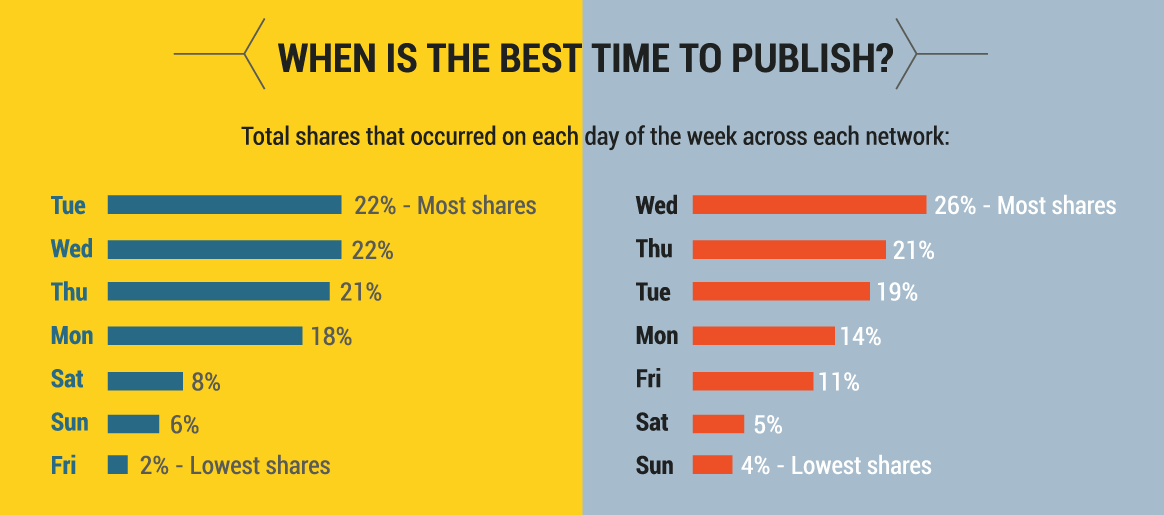
For each of the images below, the data on the left-hand side (offset by a grey/blue background) represents findings from high-engagement sites — i.e., sites with more than 20,000 average total shares per site. The data on the right-hand side (offset by a yellow background) represents findings from mid- to low-engagement sites — i.e., sites with less than 20,000 average total shares per site.
1) Business
For this analysis, content about business came from high-engagement sites like Business Insider, Businessweek, Inc.com, HBR.org, and Fast Company; and mid- to low-engagement sites like HubSpot, Moz, First Round, Marketing Profs, and Small Biz Trends.
The Best Social Networks to Share Business Content
Fractl and BuzzStream’s analysis found that Facebook led all the other social networks in social shares for both high-engagement sites (67% of the average social shares) and mid- to low-engagement sites (56% of the average shares).
The Best Days to Publish Business Content
They also found that Tuesday was the best day to share business content for all of the sites they analyzed. For high-engagement sites, Tuesday and Thursday were tied with 20% of social shares happening on those days. For mid- to low-engagement sites, Tuesday saw 24% of social shares, followed by Wednesday with 21% of social shares.
The weekends (especially Sunday) showed the least number of social shares for business content.
The Most Popular Words for Business Content
Of all the websites analyzed for business content, content with the words “study” and “infographic” were shared the most often.
Major Thought Leaders in the Business Space
Among the business sites analyzed for this study, the most-shared sites were Business Insider (among high-engagement sites) and The Business Journals (among mid- to low-engagement sites).

2) Technology
For this analysis, content about technology came from high-engagement sites like Tech Crunch, CNET, Wired, and Engadget; and mid- to low-engagement sites like PC World, Dropbox, and TechSpot.
The Best Social Networks to Share Technology Content
Fractl and BuzzStream’s analysis found that Facebook led all the other social networks in social shares for both high-engagement sites (83% of the average social shares) and mid- to low-engagement sites (56% of the average shares).
The Best Days to Publish Technology Content
They also found that, for high-engagement sites, Tuesday and Wednesday tied for best day to share technology content, with 20% of social shares happening on those days. For mid- to low-engagement sites, Tuesday barely eked out the lead with 20% of social shares happening on that day, followed closely by Monday with 19%, and then Thursday with 18%.
The weekends (especially Sunday) showed the least number of social shares for technology content.

3) News
For this analysis, content about news came from high-engagement sites like CNN.com, Fox News, New York Times, The Guardian, USA Today, and NPR; and mid- to low-engagement sites like Newsweek, AP, U.S. News, Consortium News, and MSN.com.
The Best Social Networks to Share News Content
Fractl and BuzzStream’s analysis found that Facebook led all the other social networks by far in social shares for both high-engagement sites (95% of the average social shares) and mid- to low-engagement sites (85% of the average shares).
The Best Days to Publish News Content
They also found that, for high-engagement sites, Wednesday, Thursday, and Friday all tied for best day to share news content, with 17% of social shares happening on those days. This was followed closely by Monday and Tuesday, with 16% of social shares happening on those days. For mid- to low-engagement sites, Wednesday was by far the best day to share news content, with 24% of social shares happening on that day.
The weekends (especially Sunday) showed the least number of social shares for news content.

The Most Popular Words for News Content
Of all the websites analyzed for news content, content with the words “game” and “first” were shared the most often. That could mean the most shareable news content had to do with sporting events or new discoveries.
4) Lifestyle
For this analysis, content about lifestyle came from high-engagement sites like New Yorker, Rolling Stone, Vanity Fair, Cosmopolitan, Country Living, and Travel & Leisure; and mid- to low-engagement sites like Glamour, Real Simple, Men’s Journal, and Outdoor Life.
The Best Social Networks to Share Lifestyle Content
Fractl and BuzzStream’s analysis found that Facebook led all the other social networks by far in social shares for both high-engagement sites (91% of the average social shares) and mid- to low-engagement sites (84% of the average shares).
The Best Days to Publish Lifestyle Content
They also found that Tuesday was the best day to share business content for all of the sites they analyzed. For high-engagement sites, Tuesday had 20% of social shares, followed closely by Wednesday, which saw 19% of total shares happening on that day. For mid- to low-engagement sites, Tuesday was by far the best day to share lifestyle content, with 22% of social shares happening on that day.
The weekends showed the least number of social shares for lifestyle content.

5) Education
For this analysis, content about education came from high-engagement sites like TED.com, Scientific American, Lifehacker, National Geographic, About.com, and WikiHow; and mid- to low-engagement sites like Scholastic, HowStuffWorks, eHow, DIY Network, and Ask.com.
The Best Social Networks to Share Education Content
Fractl and BuzzStream’s analysis found that Facebook led all the other social networks in social shares for both high-engagement sites (87% of the average social shares) and mid- to low-engagement sites (60% of the average shares).
The Best Days to Publish Education Content
They also found that, for high-engagement sites, Tuesday and Wednesday tied for best day to share education content, with 22% of social shares happening on those days. For mid- to low-engagement sites, Wednesday was by far the best day to share education content, with 26% of total shares happening on that day.
Friday saw the lowest number of social shares for education content on high-engagement sites (2%), but actually saw 11% of social shares for mid- to low-engagement sites. For mid- to low-engagement sites, weekends (especially Sunday) showed the least number of social shares for education content.
6) Entertainment
For this analysis, content about entertainment came from high-engagement sites like People, Yahoo! Celebrity, E! Online, MTV, and LA Times; and mid- to low-engagement sites like Hollywood.com, Redbox, GameSpot, Zynga, and CNN Show Biz.
The Best Social Networks to Share Education Content
Fractl and BuzzStream’s analysis found that Facebook led all the other social networks in social shares for both high-engagement sites (by far, with 94% of the average social shares) and mid- to low-engagement sites (64% of the average shares).
The Best Days to Publish Entertainment Content
They also found that Wednesday was the best day to share entertainment content for all of the sites they analyzed. For high-engagement sites, Wednesday saw 19% of total social shares, followed closely by Tuesday, which saw 18% of social shares happening on that day. For mid- to low-engagement sites, Wednesday had by far the most social shares, with 27% of social shares happening on that day.
The weekends (especially Sunday) showed the least number of social shares for entertainment content.

The Most Popular Words for Entertainment Content
Of all the websites analyzed for entertainment content, content with the words “VMAs” (which stands for Video Music Awards) and “summer” were shared the most often.
7) Food
For this analysis, content about food came from high-engagement sites like Food Network, The Kitchn, Food and Wine, and Eater; and mid- to low-engagement sites like Allrecipes, Food Gawker, Zagat, and Epicurious.
The Best Social Networks to Share Food-Related Content
Fractl and BuzzStream’s analysis found that Pinterest led all the other social networks in social shares for high-engagement sites, with 53% of the average social shares. This was the only industry that saw a social network other than Facebook lead the way in social shares in this study. For mid- to low-engagement sites, Facebook led all other social networks with 63% of the average shares.
The Best Days to Publish Food-Related Content
They also found that Tuesday was the best day to share food-related content for all of the sites they analyzed. For high-engagement sites, Monday had 23% of total social shares; for mid- to low-engagement sites, Monday had 24% of social shares — and, interestingly, Friday had the second-highest number of total social shares with 20%. Entertainment was the only industry other than health and finance that had Friday in the top two days for social sharing.
The weekends (especially Sunday) showed the least number of social shares for food-related content.

The Most Popular Words for Food-Related Content
Of all the websites analyzed for food-related content, content with the words “instructions” and “make” were shared the most often. So, if you’re in the food industry, the most shareable content might be around recipes and how-tos.
8) Health
For this analysis, content about business came from high-engagement sites like Yahoo! Health, Fitness Magazine, Men’s Health, and Health.com; and mid- to low-engagement sites like Web MD, NIH.gov, CDC.gov, Mayo Clinic, and Medical News Today.
The Best Social Networks to Share Health Content
Fractl and BuzzStream’s analysis found that Facebook led all the other social networks in social shares for both high-engagement sites (79% of the average social shares) and mid- to low-engagement sites (77% of the average shares).
The Best Days to Publish Health Content
They also found that, for high-engagement sites, Friday was the best day to share health content, with 22% of social shares happening on that day. Health was the only industry other than entertainment and finance that had Friday in the top two days for social sharing. For mid- to low-engagement sites, Tuesday was by far the best day to share health content, with 25% of total shares happening on that day.
The weekends showed the least number of social shares for health content.

9) Travel
For this analysis, content about travel came from high-engagement sites like National Geographic, Travel & Leisure, Lonely Planet, and The Smart Local; and mid- to low-engagement sites like Trip Advisor, Budget Travel, Londonist, and A Luxury Travel Blog.
The Best Social Networks to Share Travel Content
Fractl and BuzzStream’s analysis found that Facebook led all the other social networks in social shares for both high-engagement sites (by far, with 95% of the average social shares) and mid- to low-engagement sites (77% of the average shares).
The Best Days to Publish Travel Content
They also found that, for high-engagement sites, Tuesday and Wednesday tied for the best days to share travel content, with 19% of social shares happening on those days. For mid- to low-engagement sites, Wednesday was the best day to share travel content, with 20% of total shares happening on that day, followed closely by Thursday, which saw 19% of social shares happening on that day.
The weekends (especially Sunday) showed the least number of social shares for health content.

10) Finance
For this analysis, content about business came from high-engagement sites like Bloomberg, Forbes, The Economist, Wall Street Journal, and Reuters; and mid- to low-engagement sites like Daily Finance, 24/7 Wall St., National Post, and The Fiscal Times.
The Best Social Networks to Share Finance Content
Fractl and BuzzStream’s analysis found that Facebook led all the other social networks in social shares for both high-engagement sites (86% of the average social shares) and mid- to low-engagement sites (64% of the average shares).
The Best Days to Publish Finance Content
They also found that, for high-engagement sites, Tuesday was the best day to share finance content, with 20% of social shares happening on that day, followed closely by Wednesday and Thursday, which both had 19% of total social shares happening on that day. For mid- to low-engagement sites, Friday was the best day to share finance content, with 19% of total shares happening on that day. Finance was the only industry other than health and entertainment that had Friday in the top two days for social sharing.
The weekends (especially Sunday) showed the least number of social shares for finance content — although, for mid- to low-engagement sites, Saturday and Sunday still saw 11% and 10% of total social shares happening on those days, respectively.

11) Automotive
For this analysis, content about business came from high-engagement sites like Top Gear, NASCAR, Motor Authority, and The Car Connection; and mid- to low-engagement sites like Cars.com, Autotrader, Autoblog, and Green Car Reports.
The Best Social Networks to Share Automotive Content
Fractl and BuzzStream’s analysis found that Facebook led all the other social networks in social shares for both high-engagement sites (by far, with 97% of the average social shares) and mid- to low-engagement sites (85% of the average shares).
The Best Days to Publish Automotive Content
They also found that Wednesday was the best day to share automotive content for all of the sites they analyzed. For high-engagement sites, Wednesday had 21% of total social shares; for mid- to low-engagement sites, Wednesday had 23% of social shares.
The weekends (especially Saturday) showed the least number of social shares for automotive content.

Major Thought Leaders in the Automotive Space
Among the automotive sites analyzed for this study, the most-shared sites were Motor Authority (among high-engagement sites) and Autoblog (among mid- to low-engagement sites).
There you have it: data to help you understand where to focus your social media outreach efforts for your niche industry. To learn more about promoting your content and generating leads, download our Comprehensive Guide to Content Promotion here.
Mastering the Art of Omni-Channel Personalization [Free Guide]
More than ever before, consumers expect an individualized experience when shopping online. And, the data is there—personalization impacts your bottom line. In fact, personalized emails see a 14% higher clickthrough rate and personalized web experiences see an average 20% increase in sales.
Whether you’re just getting started with personalization or you’re trying to increase the scope and effectiveness of your current program, you can’t ignore the importance of the omni-channel experience. You need to deliver a seamless experience across channels and factor in different devices in these channels to ensure interactions with your brand are consistent. With this guide, you’ll learn why personalization matters and how to create an omni-channel experience by leveraging marketing automation.
This guide covers:
- How You Can Develop a True Omni-Channel Experience
- How to Collect the Information You Need to Increase Conversions
- How to Leverage Marketing Automation for One-to-Many Personalization
- How to Increase Revenue by Guiding the Buyer’s Journey
Download Mastering the Art of Omni-Channel Personalization to learn what makes your customers tick and translate that information into frictionless personalization campaigns across channels.