
50 Free Call-to-Action Templates to Design Clickable CTAs in PowerPoint [Free Download]
Want to earn money for your business? Want to generate leads for your sales team? Want to accelerate sales for your online store? Want to do anything for your business that actually matters?
Well then you need calls-to-action. Without them, we wouldn’t be converting our website visitors or social media fans into actual leads for our sales team. Without them, we wouldn’t be calling on our audience to take any action in their lifecycle that actually benefits them or the growth of your business.
Download your 50 free call-to-action templates in PowerPoint here.
But just because they’re important doesn’t mean we all have a professional designer at our disposal — whether due to budget limitations, resource restrictions, or just lack of design skill. That’s why we created 50 free call-to-action (CTA) templates in PowerPoint for you to customize and use. The template will teach you how to customize your new CTAs effectively, so don’t let fear of DIY design stop you.
This post will give you a sneak peek into a large set of designs available in the template. Download it now and follow along.
1) Basic Calls-to-Action
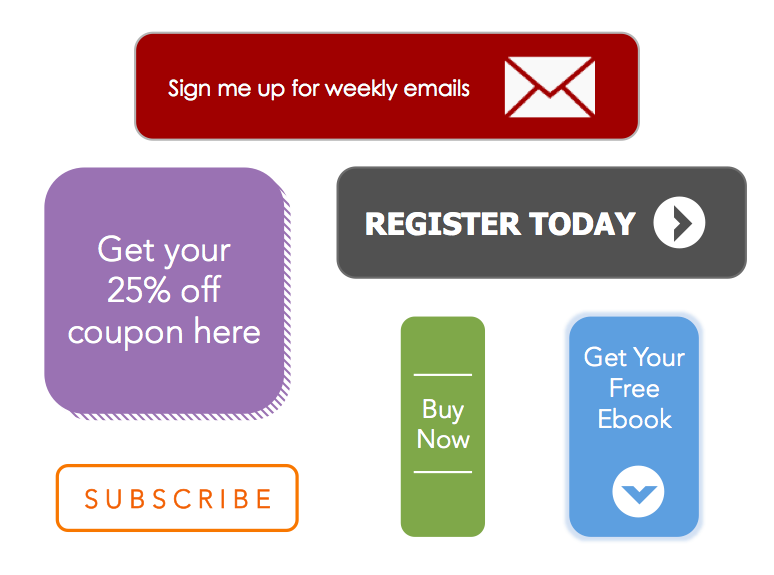
Sometimes you just need a quick and clean button that helps drive conversion. Building a landing page that needs a customized submit button? Working on a website page that needs to drive visitors to a coupon? Drafting a blog post that needs a “read more” button after the summary? We’ve got you covered. The first set of 22 CTA designs in our set of templates are basic buttons. Here’s a sampling of six:
2) Social Media Share and Sentiment Calls-to-Action
Data from Dan Zarrella shows that specific diction in your social calls-to-action help drive engagement, but another great way to drive social engagement is through social CTAs on other assets of your website, landing pages, blog posts, and so on. This set of ten templates provides you with two types of designs: social share buttons and social sentiment buttons. Let’s take a look at a sample of both.
Social Share CTAs
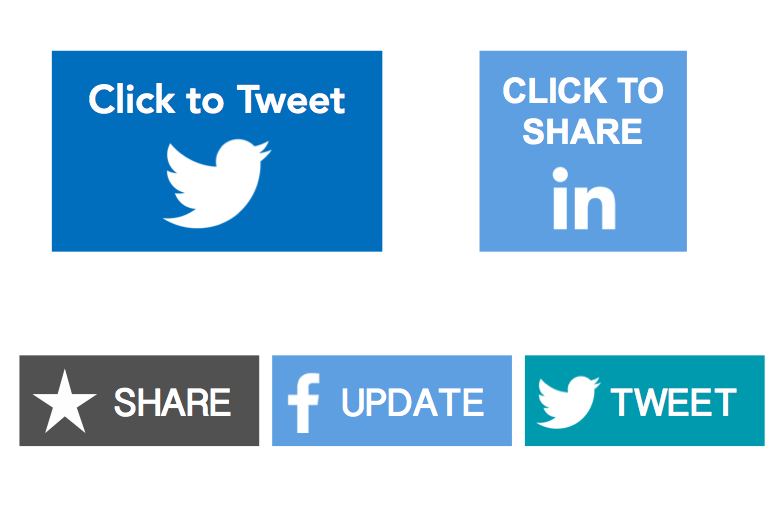
As you can see in the sample of share buttons below, these buttons are helping drive social actions from your content. Making these buttons clickable is as simple as generating the right code to hyperlink it to. This blog post walks you through how to do so step-by-step.
Social Sentiment CTAs
Social sentiment CTAs are those that include public testimonials — often from social media users. As you can see in the example below, we built a CTA in PowerPoint and attached a screenshot of a publicly posted Facebook comment. Be sure to test the use of such social sentiment on your content and explore how their inclusion benefits your conversion rates.
3) Contextualized Calls-to-Actions
You’ve seen some basic CTA options thus far. The next set of nine options call on you to include more context. These designs are created with the intention of further explaining the value of taking action. Just be sure to keep the overall layout of the button simple so that users can easily see the action you’re calling on them to take. Here are two sample designs available in the template:
4) Photo and Mobile Device Calls-to-Action
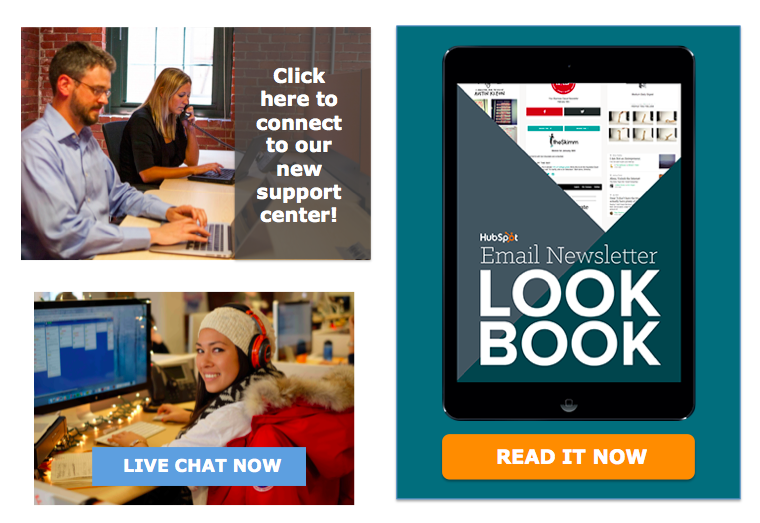
Photos can serve as a great asset when creating your calls-to-action. Not to mention it’s super easy because all you have to do is overlay some text! Photos make it easy to humanize and customize your messages for your brand and audience. Similarly, mobile and desktop devices can help make your action “pop.” Rather than including a screenshot of your product, try putting that screenshot on a kindle to show it in action! If you have trouble locating copyright-free photos to use, you can download our set of 160 free photos. No attribution required, just download and use! Here are three sample CTA designs from the bunch.
5) Qualifying Calls-to-Actions
When you’re trying to nurture a lead further down the funnel, you want to ensure you’re presenting CTAs to qualify them for your sales team. For these CTAs, it’s important that they are welcoming and not pushy. Having a great design can help can help you naturally move your leads further down your marketing funnel. Here are two examples from the templates you could customize to help convert a lead to marketing qualified lead:
Not sure how to exactly save and use these templates? Don’t worry, your download of these 50 templates will include step-by-instructions on how to save and use these templates on your website.
What templates are you most excited to try? Share you thoughts in the comments section below.
Editor’s Note: This post was originally published in September 2013 and has been updated and for freshness, accuracy, and comprehensiveness.
The Anatomy of a Perfect Instagram Profile
With 400 million users, over 80 million posts per day, and a 93% growth month-over-month for businesses using it, it’s crucial that marketers include Instagram as a part of their social media marketing strategy.
And it all starts with your Instagram profile.
Download the complete guide to using Instagram for business and marketing here.
The best Instagram profiles have a few things in common, including easily identifiable usernames, a recognizable photo, an informative yet delightful bio, a link to a relevant landing page or campaign, some beautiful photos, and more.
Keep on reading to learn how to customize your Instagram profile so it looks good, tells your potential followers who you are, and gives them a reason to follow and engage with you.
The Anatomy of a Perfect Instagram Profile
1) Public (Not Private) Profile
By default, your Instagram profile will be public — meaning anyone in the world can view your profile and posts on Instagram.
If you’re creating an Instagram profile for business, then that’s what you want: You want anyone to be able to view your posts and follow your brand if they want to. (Otherwise, if you keep your profile private, anyone who visits your profile won’t be able to view your photos, which could deter them from following you.)
To ensure your profile is public: Open “Options” (the gear button on iOS, or three dots on Android) and make sure “Private Account” is turned off.
2) Recognizable & Searchable @Username (i.e., Handle)
Start by making sure your username is recognizable and easily searchable, like your business name. If your business name is already taken as a username, try keeping your business name as the first part of your username so that people searching for your business are more likely to come across your account. For example, the Australian activewear line Lorna Jane uses the username @lornajaneactive.
To edit your @username: Go to your profile page and click the “Edit Profile” button to the right of your profile photo.
Next, click on the text or open space to the right of the person icon and enter your desired username.
3) Easily Searchable Business Name
Next, make sure to add your full business name to the “name” section of your profile. This will appear under your profile picture and under your username in search.
To edit your business name: Go to your profile page and click “Edit Profile.” Then, click on the text or open space beside the clipboard icon at the top and enter your desired business name.
4) On-Brand Profile Photo
Your profile photo is one of the first things people see when they visit your Instagram profile, as it’s displayed prominently in the top right-hand corner. It should be something easily recognizable; something that’s on-brand with your other social networks. For most companies, this will be your company logo.
Now, notice that HubSpot’s profile photo in the image above is a circle. That wasn’t our choice; Instagram actually crops your profile photo into a circle (110 pixels in diameter) when you upload it to the app.
You don’t have to create the circle image yourself. However, since you’ll have to crop your photo into a circle in the app, then ideally you’ll want to upload a square photo with your logo in the center, placed so that the corners of the photo can be cut off without a problem.
In the example below, you’ll see the corners are shaded, meaning Instagram will cut them off in the actual profile photo:
You can move that circle around or pinch-to-zoom until it’s cropped just the way you like it.
To add or change a profile photo: Go to your profile page and click “Edit Profile.” Then, tap “Edit” in the top right. (This will appear under your current profile photo if you have one.)
From there, you can import a photo from Facebook or Twitter, or choose one from your library. (We don’t recommend taking a new one on the spot.)
5) Delightful, Actionable, Informative Bio
Like your profile photo, your “bio” (i.e., the description at the top of your profile) is one of the first things visitors to your profile will see.
You have a max of 150 characters: Use them to let people know what you’re about and give them a reason to follow you. Include who you are and what you do, and be sure to add a hint of personality.
Here are a few examples for inspiration:
- WeWork: “WeWork provides you with the space, community, and services you need to make a life, not just a living.”
- Oreo: “See the world through our OREO Wonderfilled lens.”
- Califia Farms: “Crafting, concocting and cold-brewing up a delicious, plant-based future. Califia Farms Loves You Back”
- Staples: “We make it easy to #MakeMoreHappen”
You can also use this space to encourage some action, like using a certain hashtag or clicking a link in your bio. Here are two examples:
- Lorna Jane: “Welcome to the home of #ActiveLiving – be inspired to #MoveNourishBelieve EVERY DAY. Show us how you live active – tag #lornajane to be featured 💗”
- HubSpot: “All-in-one marketing & sales platform. We help businesses GROW. Follow for content, contests & more. Tag photos with #HubSpotting to get featured! ⬇️”
6) Trackable Link in Your Bio (That You Change Regularly)
One of the biggest frustrations people have with Instagram — especially businesses — is that it isn’t exactly a great platform for driving traffic away from the app to a website, a Twitter page, or somewhere else. That’s because clickable URLs aren’t allowed anywhere except the single “website” box in your bio.
That’s why you’ll want to add a link to the “website” box in your business’ Instagram bio. This makes it easy for people to go straight from Instagram to your website, blog, or a specific campaign.
One sneaky way to get people to click the link in your bio? By referring to that link in individual photo captions. Ever seen captions that say something like “Link in bio”? They’re trying to direct you to their profile page so you click the link in their bio.
Engage users by updating that URL frequently to point to your latest blog content, YouTube video, product, or offer. For example, are you running a contest, or want to increase subscribers to your blog? Just change the link, and then post a photo that mentions the new link in its caption.
To change the link in your bio: Go to your profile page and click “Edit Profile.” Then, simply insert the URL of your choosing into the URL box.
You can change the URL on your profile page as often as you’d like.
Note: I’ve read before that shortened links often get blocked by Instagram, but we haven’t had that problem at HubSpot. In fact, we recommend using shortened links that include UTM tracking codes so you can see how much of your traffic came from your Instagram page. (Learn how to create UTM codes to track your URLs here.)
Once you’ve changed the URL, simply publish a photo related to the URL with a caption that references the link in your bio. Here’s an example below, where we wrote in the caption, “FMI about Grow With HubSpot, visit the link in bio.”
7) Enabled Notifications.
Before you call it a day, check your “Options” settings to make sure notifications are enabled so you can see when people share or comment on your photos. This’ll let you engage with them more quickly and easily, just like a lot of companies do on Twitter.
To enable notifications: Go to “Options” and then “Push Notification Settings.”
Select “From Everyone” for every category. (Except perhaps “Friends on Instagram,” which automatically sends a friend request to your Facebook friends who also have Instagram, and “Instagram Direct Requests,” which accepts photos sent from individual accounts. That could get a little spam.)
8) High Quality Photos
High quality photos are a huge part of an optimized Instagram profile. When people visit your profile, chances are, the first thing they’ll do is scroll through the first ten or so photos in your feed. The quality of those photos will be a big factor in whether or not that person follows you or not. Your Twitter followers might forgive a few bad tweets, but you do not want bad photos on your Instagram account.
So, always be thinking of your Instagram photos this way: If you don’t have anything beautiful to post, don’t post anything at all.
The ingredients for a beautiful Instagram photo are threefold: an interesting and relevant subject, a well framed and well shot photo, and a solid editing job.
Ingredient #1: An Interesting & Relevant Subject
When you’re picking a subject, think about your buyer persona. What would they find interesting in a photo? Coca-Cola’s target market includes young people who value fun, friendship, and sports, for example. That’s why they post pictures of young people doing fun, adventurous things — like DJing at a concert, or snowboarding on a beautiful day. (With bottles of Coke in hand, of course.)
Image Credit: Coca-Cola Argentina
Another great way to garner Likes, comments, and followers? Make people laugh. Sometimes, funny photos are the most memorable and the most shareable.
Image Credit: Baddie Winkle; Jeremy Veach
Check out this list of 16 of the best brands on Instagram for more photo inspiration.
Ingredient #2: A Well Framed, Well Shot Photo
Don’t worry … you don’t have to have a background in photography to take really awesome Instagram photos. All you really have to do is take some time to learn the best practices, like lining up your shots, finding interesting perspectives, and taking advantage of symmetry, patterns, “leading lines,” and more.
What are these best practices? Start by reading this blog post on tips for taking great pictures on your smartphone.
Ingredient #3: A Solid Editing Job
Instagram has some basic editing capabilities, but oftentimes, they aren’t adequate to make a picture really, really great. Most of your photos should go through at least one or two other photo editing apps on your mobile phone before you open them in Instagram for the first time.
But don’t worry: Once you have the right apps downloaded, editing the photos isn’t that complicated. It just takes a little bit of practice. (Trust me, it’s well worth it.)
Start by reading this blog post for a step-by-step tutorial on editing your Instagram photos. That post will teach you how to take advantage of Instagram’s best editing tools, and it also lists the two or three essential photo editing apps you’ll need to take your photos from good to great.
For a list of more advanced editing tools, read this blog post for a list of the 11 best photo and video editing apps for mobile devices. These apps will let you do everything from sharpening specific parts of a photo to brightening certain hues to make your photo look fresher.
9) Consistent, Regular Posts
An optimized Instagram profile is an active one. Because photo quality is so important, you don’t need to worry about posting to your Instagram account multiple times a day like you do for most other social media networks. Instead, focus on creating high quality content — and then posting them at the right times for your specific audience.
To make sure you’re posting consistently, download this social media content calendar template and start planning out your Instagram posts. Over time, you’ll want to build up a backlog of photos for times of need, like the weekends or when you go on vacation.
So, what time of day is the best time to post to Instagram? Because Instagram is primarily an app for use on mobile devices, users tend to use the network all the time, any time — although research shows that many users engage with content more during off-work hours than during the workday.
The very best times to post on Instagram were Mondays and Thursdays at any time except between 3:00–4:00 p.m. for the time zone of your target persona. (For a United States audience, your best bet is to combine Eastern and Central time zones, as they represent almost 80% of the U.S. population. For audiences located outside the U.S., use whichever time zones your target audience uses.)
However, you’ll want to experiment with these to see if they work with your audience.
What else do you think is important for a perfect Instagram profile? Share with us in the comments below.
Want a Happier, More Productive Life? Start Making Fewer Decisions
Think about all the personal and professional choices you make in a day: Eggs or yogurt? Blue shirt or black shirt? Do I spend time on this task now or later? Do I ask for help or dive in? After making hundreds of decisions, it’s no wonder we are exhausted by the end of the day.
So what if I told you there was a way to reduce the amount of decisions you were making? What if I told you that doing so just might make you happier?
In his latest book, The Happiness Equation, best-selling author Neil Pasricha set out to explain why the secret to having everything is to want nothing and do anything. How did he come about this equation? After attempting to count every decision he made in a single day (spoiler alert: it wound up being 285), he started thinking about where he was truly wasting time. A quick breakdown revealed that of those 285 decisions, 75 were gym related, 32 were food related, and 62 were email related … and these three topics covered only half of his mind’s daily work.
After this analysis, Pasricha began to question what leaders were doing differently and how he could make these changes to his own life. To learn more about his pursuit of happiness, we sat down with him on this week’s episode of The Growth Show to talk about his findings. (See full episode below).
Why Successful People Eliminate Decisions
A friend once sent me an article on why the most successful people wear the same thing everyday. While I’m certain this was a stab at the fact that I wear a lot of black, the article indicated a valuable point: By reducing the amount of trivial decisions they make each day, they’re helping to ensure their successive decisions will be good ones.
In fact, research suggests that the more decisions an individual makes in a short period of time, the more each decision decreases in quality. Therefore, a finite amount of space for mental exertion exists before quality takes a hit. Psychologists refer to this phenomenon as decision fatigue.
President Obama touched on this concept in an interview with Vanity Fair:
You’ll see I wear only gray or blue suits. I’m trying to pare down decisions. I don’t want to make decisions about what I’m eating or wearing. Because I have too many other decisions to make. You need to focus your decision-making energy. You need to routinize yourself. You can’t be going through the day distracted by trivia.”
Am I suggesting you go out and buy 20 gray and blue suits? Not exactly. The key takeaway here is that leaders actually make very few decisions. That’s how they stay productive. And if you can reduce the number of choices you force yourself to make — e.g., what to wear — you’ll be more prepared to adequately address more significant decisions as they arise.
How do you know which decisions to make and which to discard? That’s up next …
A Simple Framework for Making Fewer Decisions
This framework — referred to by Pasricha as the “Just Do It Scribble” — focuses on changing the way you prioritize daily choices using four words: automate, effectuate, regulate, and debate. By using this approach to set priorities, we can both increase the amount of time we have to spend on important decisions and reduce the time spent on trivial tasks. So how does it work?
1) Automate
“If it’s low in time and low in importance, your goal is to automate,” explains Pasricha.
Don’t have time to pick up the essentials at the grocery store? Try Subscribe & Save — a delivery service powered by Amazon. Having trouble keeping up with your to-do list? Set up IFTTT recipe that saves your iOS reminders to an Evernote checklist. Keep forgetting to write that rent check? Set up an electronic bill pay from your bank account to send static payments.
By automating certain tasks you will be able to focus on the more important decisions at hand.
2) Effectuate
When it comes to tasks that are, “low in time but high in importance,” the decision is simple: Just do it. Whether it’s eating dinner with your kids, picking up your sister from physical therapy, or exchanging pleasantries with colleagues, these tasks are typically worth the time investment.
3) Regulate
Set aside the same time slots for mundane tasks by making a schedule. This might mean checking your calendar on your commute, responding to email for the first 30 minutes of your workday, cleaning your apartment on the same day each week, or putting your lunch together for the following day before bed. When it comes to tasks that are “high in time and low in importance,” the goal is to find a schedule that works for you, get it in one place, and stick to it.
4) Debate
When dealing with tasks that are “high in importance and high in time” — buying a car, moving to a new city, finding a partner, selecting a job — do your due diligence and research. You can do this by making lists of pros/cons, speaking with trusted friends or family members, or simply sleeping on it. These are the decisions that are worth the space in your brain, so take your time with them and have an internal debate.
The takeaway? If you want to reduce the amount of daily decisions you’re making, improve the quality of each one, and start feeling a little happier, take a few moments to re-work how you are prioritizing your time. Often times, happiness is a result of smart choices.
Want more advice on how to structure your daily life? Check out our conversation with Pasricha on The Growth Show on iTunes.
(P.S. Don’t hesitate to leave a review! We are always looking to hear from listeners like you.)
The Ultimate Collection of Free Content Marketing Templates

I joined HubSpot in September 2011 as a blogger. At the time, I needed to know how to write and educate through my writing.
Flash forward to today. My content role has evolved eons beyond what I could ever have imagined. To conquer lead gen, I mastered ebook production. To help spread data, I learned how to create infographics. When I write blog posts, that typically means designing a SlideShare or other visual element to accompany the posts.
It’s been fun, but it certainly hasn’t been easy. These days, content means so much more than just writing. And for those of you who understand that content marketing is a critical component of inbound success, content will need to mean more than just writing for you, too.
Download our full collection of free content marketing templates here.
But rather than panic about the endless content formats you need to go master, we’re here to make it easy for you. In this post, you’ll find what I wish I had once upon a content marketer’s dream: a full collection of 386+ free, customizable, content creation templates. Let’s take a look at what’s inside.
Content Planning Templates
A Content Planning/Goal-Setting Template
(Download the content planning template here.)
HubSpot teamed up with Smart Insights to create a content planning template that will help you put together an effective content marketing plan for either your business or those of your clients. These templates will help you complete a SWOT analysis on your content marketing efforts (and develop a plan to improve them), define the right objectives and KPIs for that plan, brainstorm content ideas and map these across your funnel, and create a timeline for your content plans.
A Buyer Persona Template
(Download the buyer persona template here.)
Marketing with buyer personas means marketing smarter. This buyer persona template will help you easily organize your research to create your very own buyer personas. Use it to create beautiful, well-formatted buyer personas that you can share with your entire company, while learning best practices for persona research along the way.
3 Blog Editorial Calendar Templates
(Download the blog editorial calendar templates here.)
Having an editorial calendar for your marketing content will save you a whole lot of time — not to mention sanity — as you plan your content release timeline. We realize there isn’t a one-size-fits all solution, so we’ve created three editorial calendar templates to use at your leisure: one for Google Calendar, one for Excel, and one for Google Sheets. (Read this blog post for a step-by-step guide for using the Google Calendar template.)
2 Social Media Content Calendar Templates (for 6 Social Networks)
(Download the social media content calendar templates here.)
With so many different social networks to manage, a social media manager’s life becomes a lot easier when they can plan which content to share on each account — and when. This easy-to-use social media content calendar for Microsoft Excel lets you organize your social media activities far in advance. Use it to plan your updates and learn how to properly format your content for the six most popular social networks: Facebook, LinkedIn, Twitter, Instagram, Google+, and Pinterest.
Written Content Templates
5 Blog Post Templates
(Download the blog post templates here.)
Here’s the thing with blogging: There isn’t one, easy template you can fill in to produce a quality content offering. You need to spend some time brainstorming a title, outlining core content, and so on. While our templates are by no means a fill-in-the-blank type template, they’ll walk you through the critical steps for creating the following five blog post types:
- How-To Post
- List-Based Post
- Curated Collection Post
- SlideShare Presentation Post
- Newsjacking Post
We’ve seen these formats crush it on our blogs, and we would love for you to use them to hit your own goals.
5 Ebook Templates
(Download the ebook templates here.)
Year after year, marketers cite lead generation as one of their top content marketing goals for the year. If you want to succeed at lead gen, then you need content offers — like ebooks — to help you get there. Our internal creative design team went to work building five, beautiful ebook templates — in both PowerPoint and InDesign — for you to download, customize, and use.
A Press Release Template
(Download the press release template here.)
While public relations has adapted to be more lovable and less spammy, press releases can be effective when used correctly. Our press release template takes this into consideration and provides an inbound-optimized version. This means the template can help you script press releases and do so in a format optimized for sharing on your company blog. It’s built in Microsoft Word, so you can easily adapt and customize as needed for your PR needs.
50 Call-to-Action Templates
(Download the call-to-action templates here.)
Redesigning your call-to-action buttons can improve clickthrough rates by 1,300% or more. That means visitors will spend more time on your website, and it’ll encourage them to become leads. To help you design clickable calls-to-action, we’ve built 50 pre-designed CTAs for you. These CTAs are super easy to customize, so you don’t need to know any fancy design programs — just PowerPoint!
Bonus: There’s also a handy free tool in there that lets you track your CTA clicks in real time so you can see the exact number of clicks that your designs are reeling in.
Visual Content Templates
195+ Visual Marketing Templates
(Download the visual marketing templates here.)
Not a designer? Not a problem. We partnered with graphic design software company Canva to create over 195 visual marketing templates that are easy-to-use, work for any industry (finance, dentistry, agriculture, law — we’ve got ’em all), and are completely free. Best of all, they’re ready to edit in Canva’s online design tool, which is included for free with this set of templates. The templates include…
- Infographics templates
- Facebook ad templates
- Facebook post templates
- Twitter post templates
- Email header templates
- Blog title templates
- Facebook cover photo templates
- Twitter header templates
- LinkedIn cover photos templates
15 Infographic Templates
(Download the infographic templates here.)
I remember my first infographic. It was made on a HubSpot hack night in order to help us hit our lead-gen goals. I spent the entire night learning how to design, trying to figure out how to hack it in PowerPoint, and an abundance of other frustrations.
That experience inspired us to create fifteen, pre-designed infographic templates right in PowerPoint. That way, marketers can skip the frustrations I ran into and start creating the graphics right away. Within each template, we even provide guides to teach you how to use the templates effectively.
100 Social Media Graphics Templates
(Download the social media graphics templates here.)
People are 44% more likely to engage with content on social media that contains pictures. But we know well that creating visual content takes more time and resources — which why we’ve created these 100 customizable templates for you. These templates are in PowerPoint, so they’re very easy to edit — no Photoshop skills required. Simply customize the text on an image, save it, and post it to social media.
3 PowerPoint Templates
(Download the PowerPoint templates here.)
PowerPoint can be a powerful tool for lead generation, brand building, and thought leadership. Don’t let boring slides stand in the way. You don’t have to be a designer to create beautiful slides. To help you get started, we’ve created three, eye-catching PowerPoint templates so you don’t have to start from scratch or rely on standard, old-school styles.
Bonus: We’ve also included four video tutorials on PowerPoint tricks in there so you can learn how to enhance images, clean up your text, install premium fonts, and so on — right in PowerPoint.
5 SlideShare Templates
(Download the SlideShare templates here.)
Creating a SlideShare presentation in PowerPoint doesn’t have to be daunting. With the right and tools at your disposal, you can easily create an engaging, visual presentation — all without fancy design programs, huge budgets, or hiring contractors.
To help you make a SlideShare of your own, we’ve created some free PowerPoint presentation templates for making awesome SlideShares — so your presentations will look great and be a breeze to put together. (Read this blog post for tip on how you can update and edit the templates to suit your specific needs.)
And there you have it, content marketers: over 386 templates to help you start creating content easily and quickly and further your inbound success. Enjoy!
Editor’s Note: This post was originally published in November 2013 and has been updated and for freshness, accuracy, and comprehensiveness.
How Successful People Spend Their Monday Mornings [Infographic]
Ugh, Mondays.
That’s how many of us approach our Monday mornings. With another weekend in the books, we tend to start off the workweek with a bit of a drag in our step.
For some of the world’s most successful people, however, Monday mornings represent an opportunity to start fresh and set the tone for the rest of the week.
Whether they’re practicing yoga or meditation, walking their dog, or tidying their living space, they have a routine that helps them get ready for a productive week from the very start.
What do the most successful businesspeople in the world do to start the week off on the right foot? The folks at DollarsDirect collected the Monday morning habits of some of the world’s business elite and used their findings to create the infographic below. Check it out, and think about how you can reframe your Monday mornings to supercharge your productivity for the rest of the week.

4 Reasons Trade Schools are Poised to Win with Inbound
More than ever, students are considering alternatives to academic colleges. Major debt burdens and poor job prospects for recent college grads has sparked a major re-think about the relative advantages of attending a trade school instead of a traditional four-year university.
That means the pool of potential students for your trade school is growing. And inbound marketing is the perfect diving board.
Here are four reasons why vocational schools are primed to succeed with inbound marketing.
Trade School Prospects Do Their Research
People who want to attend trade school are active researchers. They have a very practical outlook. They don’t want to carry a lot of debt. They want good job prospects at the end of their studies. They’ll do the hard work of investigating what school offers them the best potential.
That’s great news for you. Having a prospect pool of prospective students engaged in research means a lot of opportunity for you connect with them. The best way to get started? Draw them in with content.
Your school already has a store of content to start you off: program descriptions, alumni success stories, professor biographies, course syllabi. Talk to admissions to find out what questions prospective students are asking. Create content that answers these questions.
Have they settled on a field of study or do they want career-choice guidance from the school? Do they want to learn more about a specific career to determine if it’s right for them? What do they want to know about campus life, especially since students live off campus? Are they wondering whether there are other students like them, whether they’ll fit in?
Get a group together from admissions, various departments, and marketing to brainstorm a monster list of prospect questions.
>> Read more about SEO for schools here
High Opportunity to Connect at Every Stage of the Buyer’s Journey
Because trade school prospects research so heavily, you can attract them at any point during their buyer’s journey. At HubSpot, we break the buyer’s journey into three main phases: awareness, consideration, and decision.
Align each piece of content and call-to-action (CTA) to a specific buyer journey phase. We call this “content mapping.” As your brainstorm team works on your monster list of questions, think about what questions your different personas are asking at each phase.
For example, during the awareness phase prospects are looking to educate themselves about what options exist. They don’t have questions yet about your school. They’re still trying to figure out what types of certifications or training are needed for the career they’re thinking about. Or what the career path for that trade might look like. Their questions also vary by persona. An adult who’s already in the workforce and looking to improve their credentials will have different questions than a high school student who isn’t sure yet what career choice is right for them.
Keep your school-specific content and CTAs for the consideration and decision phases, when they want to know how your school will meet their needs.
Winning at SEO: Long Tail Keywords
One of the components of successful content mapping is knowing what keywords and terms are relevant to your prospects’ search behavior. Trade schools can rock SEO because you can take advantage of very specific keywords, called “long tail keywords” (LTK).
Unlike a traditional 4-year school, your school’s degrees are already tied to specific topics of extreme interest to your prospective students. Have your faculty show off their expertise online. Don’t let them save it for the classroom only.
Help them share their practical expertise online through creating great content — e.g. video snippets of class sessions, PDFs of class handouts, blog posts about a recent principle or lesson students tend to struggle with, or enjoy, etc. Your faculty’s content, by default, should already contain many of the LTKs your prospective students are using to find the degree program and the school they’re seeking.
There is less competition for LTKs, which not only helps you rank high for the right ones, but makes it less expensive for you to do so. You have a wide range of unique strings of phrases that are all applicable for your prospects searching about trade schools and careers.
However mere word count isn’t enough. You need specificity. Your school won’t rank for “online trade schools.” But it might for “accredited online accounting degree.” Add another data point to your monster content topic list. What’s the LTK to be used with each piece of content?
LTKs have a lower search volume than common terms, but the traffic they attract is highly motivated. This is why LTKs have conversion rates up to 2.5 times better than more popular search terms. In fact, 70% of all search traffic comes from LTKs.
You’re Agile
Unlike more traditional academic institutions, trade schools often have a relatively flexible and agile marketing department. Perhaps there are fewer stakeholders who insist on being part of the conversation. Maybe there’s less bureaucracy, or perhaps more urgency.
Whatever the reason, metric-rich inbound marketing works best with a “test, review, and refine” attitude. Marketing teams that have the agility to try new things, and cycle quickly through them, will find the most success with inbound.
Are you hearing your students have adopted a new social media or messaging app? Test out some content there. Are you seeing that a lot of your traffic is coming from mobile devices? Maybe the students in your game development department can put together a fun app.
Conclusion
The winds of post-high school education are shifting. But the field is crowded with trade schools. Use the power of inbound marketing to attract the right kind of student for your school and benefit from increasing trade school enrollments.
The Step-by-Step Guide for Getting Started With Co-Marketing [Free Ebook]
We’ve all heard the adage, “Two heads are better than one.” And within your marketing team, the power of collaboration is probably no surprise.
But what about when you’re collaborating with the marketing department of another company via a co-marketing campaign? Are the benefits still worth the stress of it all?
Our experiences say yes. Co-marketing is all about doubling your chances: double your leads, double your resources, all while spending half of the budget.
But what exactly is co-marketing? In short, co-marketing allows two or more companies to work together on a project with the purpose of sharing in the reward — whether that’s leads, buzz, awareness, or new customers. By leveraging the reach and resources of a partner, these campaigns are designed to deliver substantial results without having to wait for the content to rank in organic search.
Ready to take on the challenge? To pull off a fruitful campaign, you’ll need top-notch organization and project management skills. The good news is we’ve crafted this comprehensive guide to keep you on track. This guide will teach you how to:
- Choose your partner and make the connection
- Write your co-marketing agreement
- Evaluate your co-marketing goals
- Brainstorm and delegate the content creation
- Promote your content
- Evaluate the partnership value
See how co-marketing can help you surpass your goals. Download our 10-Step Guide to Getting Started With Co-Marketing.
From ‘Tiffany Blue’ to ‘Minion Yellow’: How Pantone Changed the Way We Think About Color
This post originally appeared on HubSpot’s Agency Post. To read more content like this, subscribe to Agency Post.
If you’ve been shopping recently, you might have noticed a few changes in color options.
Everything from sweaters to couches to kitchen accessories are awash in soft shades of pink and blue — specifically Pantone 13-1520 and Pantone 15-3919. These two palettes, Rose Quartz and Serenity, were named Pantone’s Colors of the Year in December.
This annual announcement, beginning in 2000 when its chosen hue was Cerulean, is the brand’s version of trendspotting and prediction as the authority on all things color, and it has been increasingly a highly marketed and media-covered event, spurring retailers and consumers to reconsider the selected shade.
As Kyle Stock wrote in Bloomberg, “Pantone has effectively become to pigments what Anna Wintour is to the wider fashion world: part trendsetter, part enforcer.”
What was once a solely utilitarian product for designers and printers, Pantone’s color chips have gained a cult following from design-minded individuals who are accustomed to bloggers distilling weddings and apartments and even movies into corresponding color palettes.
Apparently, the language of color is one we can all understand.
The History of Pantone
Founded in the 1950s, Pantone originally manufactured color cards for cosmetic companies. Lawrence Herbert, a young chemist, saw that the company’s process could solve a more widespread problem: the lack of color standardization. There was no language for communicating about and reproducing colors. There was no consistency, which caused a large amount of rework and reprinting in the graphics industry.
Consider this: Would National Geographic’s iconic yellow border have become so memorable if February’s edition looked more chartreuse while April’s border was tinted a shade of mustard?
Seeing the opportunity, Herbert bought the company in 1962 and forwent medical school to focus on creating a color system now known as the Pantone Matching System (PMS), which began as 10 standardized colors and today consists of more than 10,000.
These colors chips, printed in the recognizable fan book format, give designers and printers the tools to communicate about something color — something most people perceive differently. Pantone created a common language whereby designers, artists, printers, and clients could definitively choose Pantone 212 C, not 213 C or 205 C, and then printers would know how much of 14 different pigments they should add to create that exact color.
But the brand didn’t stop at creating new combinations of yellow, blue, purple, red, etc. Pantone recently created color standards for the fashion and interiors industry, has a consultancy practice whereby its works with brands, produces color trend forecasting guides, and has launched itself as a lifestyle brand — owning a Pantone-inspired product is just another way for a person to show her appreciation of good design.
How Pantone Branded Color
Pantone’s emergence as the most well-known color standards company — and yes, there are competitors — is partly due to its longevity in the industry. But it’s also because of the brand’s smart marketing plays that Pantone has come to be about more than the science of creating and matching colors. The brand employs color psychologists and color economists who explain the feelings the colors should evoke, not just their chemical makeup.
Leatrice Eiseman, the executive director of the Pantone Color Institute, gave a statement to the New York Times in 2007 on that year’s selection: “Blue Iris brings together the dependable aspects of blue, underscored by a strong, soul-searching purple cast. Emotionally, it is anchoring and meditative with a touch of magic.”
This year’s selection was released with this statement: “As consumers seek mindfulness and well-being as an antidote to modern day stresses, welcoming colors that psychologically fulfill our yearning for reassurance and security are becoming more prominent. Joined together, Rose Quartz and Serenity demonstrate an inherent balance between a warmer embracing rose tone and the cooler tranquil blue, reflecting connection and wellness as well as a soothing sense of order and peace.”
It continues: “In many parts of the world we are experiencing a gender blur as it relates to fashion, which has in turn impacted color trends throughout all other areas of design.”
Source: Pantone’s Instagram
This yearly marketing event is not just about the company showing off its ability to forecast trends in color selection, but also about its ability to understand how societal changes are influencing our visual preferences. While this may seem like a leap, it has played well with the media and partners such as photo-editing app Aviary, which release Rose Quartz- and Serenity-colored filters when the selection was announced.
But beyond this yearly event, Pantone has found unique and memorable ways to solidify its relationship with designers and garner the adoration of those outside of its target market with licensing deals and quirky products. Here are 10 other interesting examples of marketing from the master of color:
1) Pantone Swag
Pantone has capitalized on its own brand — that rectangle of color with a black text over a white band — by creating its own line of products. These include everything from folding chairs to ornaments to iPhone cases.
2) Tiffany Blue
While many think of Audrey Hepburn eating breakfast in pearls and black evening gloves in front of Tiffany’s Fifth Avenue store, the more prevalent image is not an image at all, but a color.
Who better to mix and standardize the color of all those little blue boxes than Pantone? Tiffany & Co.’s iconic robins-egg blue is actually PMS number 1837 (the brand’s founding year). Pantone created the custom color for the brand, which is trademarked and not available in any fan book. It remains one of the most well-recognized brand-color associations in the world.
Source: Tiffany & Co.
Starbuck’s green, the Hermes orange, the red on the sole of Christian Louboutin, and Coca-Cola’s red are all Pantone customized colors under trademark protection.
3) Sephora-Pantone Universe Color of the Year Collection
Going back to its roots in cosmetics, the brand partners with Sephora each year to create a custom makeup palette so anyone can enhance their look with the color(s) of the year.
4) The Pantone Hotel
Need a vacation to refresh and recharge your creative powers? You can do so surrounded saturated, bold, and pastel color swatches at the Pantone Hotel in Brussels.
A Pantone licensing venture allowed for this inspired hotel hideaway that has a gift shop full of Pantone-inspired products and consultants available for color education and color psychology sessions.
Source: Fast Company
5) Instagram
It only makes sense that the creator of a color language would be a perfect match for the largest network of visual-based communicators?
Pantone’s Instagram feed is candy for the color-obsessed. Bright Pantone swatches are paired up with foods, books, drawings, clothes, and more of equal color intensity. The brand showcases behind-the-scenes photos at what is largely a chemical company, designers using its color guides, and just plain — yet perfect — images of colors.
Source: Pantone’s Instagram
6) Minion Yellow
For the release of the Minions movie in 2015, Pantone partnered with Universal Pictures to create an animated character-inspired color — its first release in three years. The chosen hue is meant to exude “hope, joy and optimism.” While the color can be used (unlike Tiffany Blue), it was released as a Pantone “fashion, home, and interior” color, so you’ll have to buy your way to a Minion-colored living room.
7) The Pantone Cycle
In 2012, the brand partnered with bicycle manufacturer Abici Italia to create four color-inspired models: Green 627C, Ruby Red 186C, Turquoise 15-5519, and Mimosa 14-0848. These color code numbers and the Pantone name were prominently displayed on the bike’s chain guard. Who wouldn’t want to show off their design cred while weaving through traffic during a morning commute?
8) The Diamond Jubilee
Working with ad agency Leo Burnett, Pantone release a limited edition color guide inspired by Queen Elizabeth’s “fashion-forward colour statements” to celebrate the monarch’s 60-year reign. The palette highlights the Her Majesty’s love of monochromatic dressing.
Source: Pantone
9) Colorstrology
Are forecasts in love and work based on celestial movements not enough? Maybe the missing piece in planning your future is color.
Michele Bernhardt, a healer and metaphysician, wrote Colorstrology, which blends astrology, numerology, and color theory to define a person’s birthday color and align it with a specific Pantone color.
10) Celebrate Color Infographic
To celebrate its 50th anniversary, Pantone created this infographic highlighting the changing color preferences by decade. While nothing revolutionary, it shows how well the brand has adapted to digital marketing.
The Influence of Color
Pantone has become so recognizable both within and outside of the design community that its brand has inspired other artists and designers. There have been Pantone dessert tarts and beer cans. And artist Angelica Dass used Pantone colors to match a person’s skintone and challenge our perception of how we define skin color.
Pantone has created a language of color and in doing so, created an opportunity for itself to become both the authority on creating and marketing color as a brand. And to think that all this started with a young chemist who had to hand-mix shades for a retail display so women could choose the right shade of pantyhose.
The #1 Most Important Leadership Trait Worldwide [New Research]
This post originally appeared on HubSpot’s Sales Blog. To read more content like this, subscribe to Sales.
Work customs and culture vary from country to country. For instance, meeting attendees in the U.S. seat themselves in no particular order around the conference table. But if the most junior person on the team were to take the seat farthest from the door in Japan? That’s a no-no. This behavior flies in the face of Japanese custom, where the seating arrangement is determined by professional seniority (the most senior people sit farthest from the door, and the most junior people closest).
But while there are no doubt differences in work styles around the world, there are also similarities. After surveying nearly 200 leaders located in 15 different countries, Quantum Leadership Group recently discovered the most important leadership trait worldwide: High ethical and moral standards.
In a Harvard Business Review article covering the data, Sunnie Giles, president of Quantum Leadership Group, categorized this response along with the third most important trait (“clearly communicates expectations”) as qualities that “creat[e] a safe and trusted environment.”
“A leader with high ethical standards conveys a commitment to fairness, instilling confidence that both they and their employees will honor the rules of the game,” Giles writes. “Similarly, when leaders clearly communicate their expectations, they avoid blindsiding people and ensure that everyone is on the same page. In a safe environment employees can relax, invoking the brain’s higher capacity for social engagement, innovation, creativity, and ambition.”
Not sure if you’re upholding high moral standards? To test if you’re acting in accordance with your values, Giles recommended a simple thought experiment: Envisioning the eulogy at your funeral. What is the speaker saying about you?
“This exercise will give you a clearer sense of what’s important to you, which will then help guide daily decision making,” Giles explains.
While seating arrangements in meetings might not be universal, this research shows that leadership integrity transcends borders. When in doubt, remember that 誠実であること。それが最善の方針 (that’s the equivalent of “honesty is the best policy” in Japanese).
Converse, Old Spice & More: 6 Famous Brands That Made Inspiring Comebacks
Consumer sentiment for a brand is like a fire. During the good times, it’s a roaring campfire, emanating heat and light and making everybody around it happy. During the bad times, it’s the flickering flame of a candle, barely shining through the darkness. And during the really bad times, the fire is roaring once again … but only because everything is burning to the ground.
The strongest brands are run by marketers who know how to manage the fire. In some cases, that means dousing the flames, and in other cases, it means rekindling them.
Unfortunately for some brands, one major scandal or financial setback, and that’s the end — they’re just never able to recover. For others, like Chipotle, we don’t know how the story’s going to end. It seemed as though the fast food icon was on the upswing following that multi-state E. coli outbreak. They issued public apologies, updated their food safety protocols, and launched a new ad campaign focusing on how darn safe their food is (now). And thennn norovirus struck.
But hey, I’m not here to depress you. I’m here to highlight the good stories, the stories about brands that made successful comebacks after nearly burning out.
6 Examples of Flawless Comeback Campaigns
1) Converse
Source: Zoe Waritz
In 1917, Converse launched the first mass-produced basketball sneaker: the All Star. It was lightweight, had a protective toe cap on the front, and sported a pretty nifty ankle patch. In 1932, Converse signed basketball star Charles Hollis (“Chuck”) Taylor to help market the All Star, which is how the sneaker earned its iconic nickname, the Chuck Taylor.
Following the founding of the NBA in 1946, Chuck Taylors quickly became the most popular sneakers in the league. But by the 1980s, the competition — namely, Nike, Adidas, Reebok, and Puma — had gotten fiercer. Flash forward to 1998, and Converse was claiming just 2.3% of the market share.
Ultimately, one of Converse’s competitors (Nike) stepped in and bought the company in 2003. But that was by no means the end of the Converse brand. Under new leadership, Converse went in a new direction by embracing their “old-school” style, which had appealed to generations of rebellious rockers over the years. As part of their brand overhaul, Converse produced special Kurt Cobain and Ramones editions of their Chuck Taylors. They also had fashion designer John Varvatos create a high-end line of Chucks.
This new, fashion-focused direction for Converse culminated in 2007’s “Chuck It” campaign, which featured black and white photographs of model Daisy Lowe (daughter of rocker Gavin Rossdale). The campaign evoked the rich, cultural history of the Chuck Taylor, and helped reinvent Converse as a lifestyle band.
2) Lego
Source: 9GAG
In the late ’90s, LEGO became obsessed with expanding their brand via new, innovative product designs. And while that might have sounded good in theory, in practice it meant manufacturing thousands of new, unique pieces, and promoting action figure-esque toys that had little connection to the classic LEGO brick systems.
LEGO felt the repercussions of this strategy decision in 2003, when the company lost $300 million on the year and projected a loss of $400 million for the following year. Turns out all those crazy new designs LEGO created had never actually resonated with their target audience: kids. So when Jorgen Vig Knudstorp took over as CEO in 2004, he took a new approach to LEGO product design: Ask the kids what they want.
And as LEGO discovered, kids didn’t want to play with pre-built, LEGO-branded action figures. They wanted to build. So LEGO got rid of all those new, super-fancy pieces they had introduced in the late ’90s, and had their marketing team (who had done extensive research) work with the product designers to make sure they were creating LEGO lines that kids actually wanted.
In 2006, LEGO commissioned the agency Blattner Brunner to create a campaign that reflected this new direction. “Imagine” got back to LEGO basics by showing classic bricks casting shadows that resembled more complex objects, imitating how kids use their imaginations when building with LEGO. This Cannes Lions award-winning campaign signaled LEGO’s incredible comeback.
In 2015, which LEGO declared its best year ever, the company brought in $5.2 billion in revenue, making LEGO the second biggest toy company in the world.
3) Pabst Blue Ribbon
Source: USA Today
Sometimes the best advertising is no advertising at all. For PBR, a beer born in the 19th century, the key to making their comeback was to forgo traditional advertising altogether. No billboards. No radio spots. No TV commercials filled with sports jersey-clad bros cracking PBRs and high-fiving. Instead, when PBR sales hit rock bottom in 2001 — and they couldn’t have afforded traditional advertising even if they’d wanted to — the company turned to Fizz, an Atlanta-based word-of-mouth marketing agency.
The agency’s first move was to seek out those few folks who were still drinking PBR and figure out what made them tick. PBR’s core audience, as they discovered, were mostly young people who eschewed mainstream brands. Or “early hipsters,” as Fizz’s founder and managing partner, Ted Wright, called them. Here’s how Wright explained the situation:
“PBR having no money for traditional advertising was a blessing in disguise. The fact that these young people had never seen a PBR ad was a huge selling point for them … Traditional advertising, particularly of the kind produced by big beer companies in those days, would have killed whatever tiny momentum the brand had built.”
Wright’s strategy for giving new life to the PBR brand: hit the streets of Portland, Oregon, Pittsburgh, and other cities and sponsor events including art gallery openings, skating parties, and bike messenger races. (No, I’m not making this up.) In the end, this non-traditional advertising strategy helped rescue PBR from obscurity and turn it into the billion-dollar brand it is today.
4) Old Spice
Source: Vimeo
Heading into the latter half of the 2000s, things weren’t looking great for Old Spice. There was fresh competition in the men’s deodorant/grooming products space — Axe — and they were soaking up Old Spice’s market share like an ergonomically designed loofah.
Axe was a sleek, modern brand. Old Spice, in comparison, was stale and outdated. And sales were reflecting that more and more. One particular thorn in Old Spice’s side was their “Glacial Falls” deodorant scent, which was performing terribly. So they called on the Wieden + Kennedy agency to help them formulate a new name. “Swagger” was what they landed on.
Kicked off in 2008, the Old Spice Swagger advertising campaign included print ads, TV spots, and even an interactive website: SwaggerizeMe.com (which no longer exists, FYI). The results: Old Spice ended up quadrupling sales of their once floundering product. But the Old Spice brand makeover was finished yet. Wieden + Kennedy still had to help them rejuvenate their line of scented body washes.
In 2010, the “Smell Like a Man, Man” campaign, featuring former NFLer Isaiah Mustafa, solidified Old Spice’s reputation as a modern brand. One ad in particular, which contained the memorable lines, “Look at your man, now back at me,” and, “I’m on a horse,” pulled in millions of views online. Within six months of the campaign’s launch, sales of Old Spice body wash had grown by 27%, and Old Spice was the category leader.
5) Starbucks
Source: Starbucks
In the early 2000s, Starbucks was expanding like crazy, both in terms of locations and their product offerings. While the chain had built up a loyal following of coffee fans through recreating a neighborhood coffeehouse vibe, Starbucks’ quality of service couldn’t keep up with its rapid expansion. What’s more, by investing in non-coffee-related products — most notably, music — Starbucks was diluting its brand. In the eyes of the public, Starbucks was abandoning its local coffeehouse roots and turning into a cold, calculating corporation.
By 2008, driven in part by the financial collapse, Starbucks was in dire straits — its stock price shriveling. Some analysts predicted that the coffee juggernaut would fade away into obscurity. In an effort to stay afloat, the once seemingly unstoppable coffee chain ended up closing more than 900 of its stores, laying off a huge chunk of its workforce in the process.
At a time when cash-strapped Americans were viewing coffee more and more as a commodity, and increasingly turning to cheaper alternatives (e.g., McDonald’s), Starbucks needed a new game plan. They needed to convince folks that Starbucks was worth the extra cost.
So Starbucks teamed up with ad agency BBDO to launch the multi-million dollar “Coffee value and values” campaign — the largest marketing campaign in Starbucks’ history. The campaign made Starbucks coffee the star of the show once again. Ad copy included lines like ” If your coffee isn’t perfect, we’ll make it over. If it’s still not perfect, you must not be in a Starbucks,” as well as, “Beware of a cheaper cup of coffee. It comes with a price.”
Thanks in part to this massive campaign that focused on the quality of its core product, coffee, Starbucks was able to reinvigorate its brand as well as its business. In 2014, the company reported more than $16 billion in annual revenue.
6) AC/DC
Source: Morrison Hotel Gallery
Financial downturns are by no means the only phenomena that brands might have to recover from. And while the band AC/DC and their album (and world tour) “Back in Black” may seem like an odd choice for this list, trust me: there’s an inspirational story in here.
In February of 1980, AC/DC’s charismatic lead singer and chief lyricist, Bon Scott, passed away suddenly. The band had just started laying the groundwork for a follow-up to 1979’s super successful “Highway to Hell,” but with Scott gone, it seemed unlikely that they’d ever complete it. AC/DC had lost their front man — their leader — and the band’s remaining members weren’t sure they’d ever be able to replace him.
Eventually, however, they were introduced to (and successfully recruited) singer Brian Johnson, and AC/DC got back to work on their next album. From Johnson’s perspective, it was an intimidating task: Scott had been a renowned lyricist, and Johnson was worried he wouldn’t be able to live up to his predecessor. But Johnson pushed on, and the band came together to produce a little, 10-track album called “Back in Black.”
Today, “Back in Black” is the second highest-selling album of all time.
Know of any other brand comeback stories you’d like to share? Sound off in the comments section below!