What Is Marketing Attribution & How Do You Report on It?
Marketers engage with customers on more channels than ever before. Whether you’re working with influencers or posting short-form videos, it makes marketing attribution essential for continued results.
This is because the buyer’s journey is far from linear. Consumers engage with brands through multiple touchpoints before they make a purchase.

For a lot of marketers, getting visibility into the most effective touchpoints can be tough. They have to wade through cobbled data from different sources, spend hours crunching numbers in spreadsheets, or wait for a marketing ops resource to help them. Unless they’re using marketing attribution reporting.
But what is marketing attribution? And how can you use it to improve your marketing strategy? Keep reading, or jump to the section you’re looking for:
- What is marketing attribution?
- What is an attribution report?
- Types of Attribution Models
- How to Use Marketing Attribution Reports
- GDPR Considerations
- Marketing Attribution Best Practices
- Marketing Attribution Tools
For example, if marketers want to see how a blog post or social media strategy impacted sales, they might use marketing attribution techniques.
Here’s how our product team at HubSpot describes it:
“Attribution surfaces which interactions a person or group of people took along their journey toward a desired outcome or ‘conversion’ point.”
Lead Attribution
Lead attribution is a type of marketing attribution. It shows how marketers impact the number of leads that come from a given channel, touchpoint, or campaign.
Lead attribution data helps teams understand which marketing efforts are most effective for generating qualified leads.
Leads aren’t sales, but they are important because they show how marketing content or strategies are gaining prospects or new audiences. In turn, these prospects can lead to increased sales or revenue.
B2B Marketing Attribution
B2B Marketing attribution is a type of marketing attribution for the business-to-business field.
B2B companies sell products or services to other businesses or professionals in their industry. While B2C attribution could relate to smaller purchases, B2B attribution covers purchases from companies, memberships, or leads.
B2B marketing attribution data helps B2B companies connect marketing efforts to ROI and CLV. It’s also essential for data-driven decision-making.
Why is marketing attribution important?
This approach to analysis helps marketers understand the most valuable marketing channels. It helps you connect marketing tactics to ROI and CLV. Marketing attribution is also useful for making a business case for new initiatives and changes in strategy.
The purpose of attribution reporting is to help you understand how marketing efforts inspire users to convert and build relationships with your brand. Marketing attribution helps you see patterns and actions that your team can use to improve strategies in the future.
Types of Attribution Models
Now that you know what marketing attribution is and why it’s important, you may be wondering how it works. After all, not all marketing channels have the same impact on conversions.
Pulling together all the interactions of your buyer journey into a report is only half the magic. The other half is using various types of attribution models.
Attribution models let you apply a different amount of credit to each interaction according to the model’s rules.
For example, say you’re measuring the effectiveness of lead generation for a high-traffic blog post. That blog post draws a lot of first-time visitors, so a first interaction attribution model would probably give that post credit for generating leads.
But what if that post also has a landing page link that most users click before signing up? In this case, a last interaction attribution model might give credit to the landing page, not the blog post.
These are some of the most common attribution models:
First-Touch Attribution
This model gives all credit to the first click or interaction a visitor makes in the buyer journey.
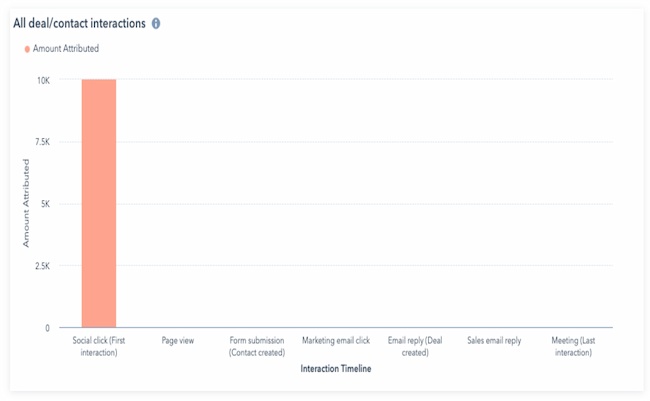
For example, say the first place a buyer lands before making a purchase is an ad on Facebook. That first click will get the credit for that sale in a first-touch marketing attribution report.
Last-Touch Attribution
This model gives all credit to the last click or interaction a visitor makes in the buyer journey.
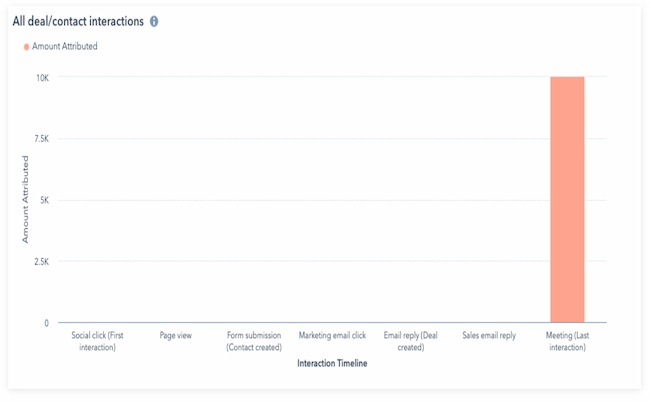
Using the example above, say the last place a buyer clicks before making a purchase is a product landing page on your website. That last click will get the credit for that sale.
If you are thinking about using last-page attribution, think carefully about the user experience in your funnel.
For example, say you are generating leads with a free content offer, and your leads download that offer from a thank you page. If you’re using last-click attribution reporting, your report could give 100% of the credit for generating that lead to the thank you page.
That information won’t be especially helpful if you’re trying to understand lead attribution for content offers.
Multi-Touch Attribution Explained
Multi-touch attribution can help you understand how all your marketing touchpoints work together. It measures and assigns value to all the interactions a contact had up to a key moment in their journey.
These reports are valuable because they allow you to pinpoint the exact marketing and sales effort that led to a conversion in your flywheel. This information can help you make better decisions about where to invest your time and resources.
For example, say you want to see how a blog post or social media strategy impacted sales. You can use this reporting strategy to assign real financial value to these efforts.
HubSpot customers: HubSpot supports three types of multi-touch attribution reports:
- Contact create attribution reports help you see which marketing activities produce the most new contacts
- Deal create attribution reports help you understand which marketing efforts bring in the most new deals
- Revenue attribution reports show which marketing efforts result in the most revenue
There are two common models for multi-touch attribution:
U-Shaped Multi-Touch Attribution
This model gives the first and last touchpoints in the buyer’s journey most of the credit for a conversion. But it also gives some credit to actions that happen between the first and last touchpoints.
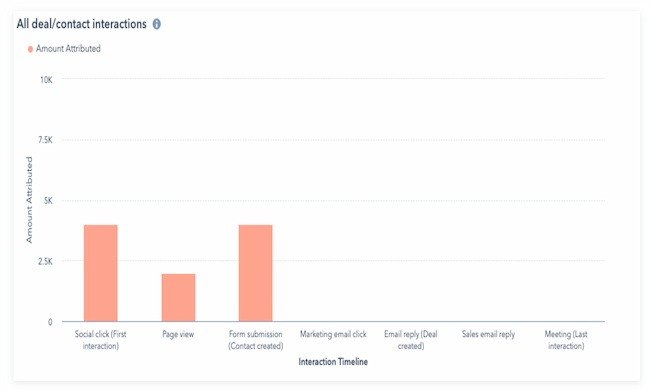
W-Shaped Multi-Touch Attribution
This model gives equal credit to the first interaction and last interaction, as well as a mid-funnel touchpoint. It splits the rest of the credit evenly to touchpoints that happen between these three interactions.
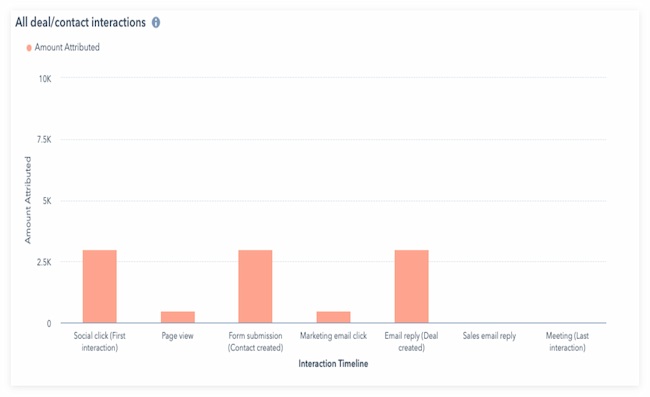
Other multi-touch attribution models include full path, J-shaped, inverse J-shape, and more.
Multi-Channel Attribution
Multi-channel attribution is similar to multi-touch attribution. But while multi-touch attribution can describe any type of engagement, multi-channel compares marketing channels.
For example, a multi-touch attribution report could track form submissions, clicks, or page views on a single channel. But a multi-channel report will compare the value of channels like social media, organic search, and email.
Linear Attribution
This model gives equal credit to each interaction in the buyer journey. It’s helpful for getting a comprehensive view of marketing performance.
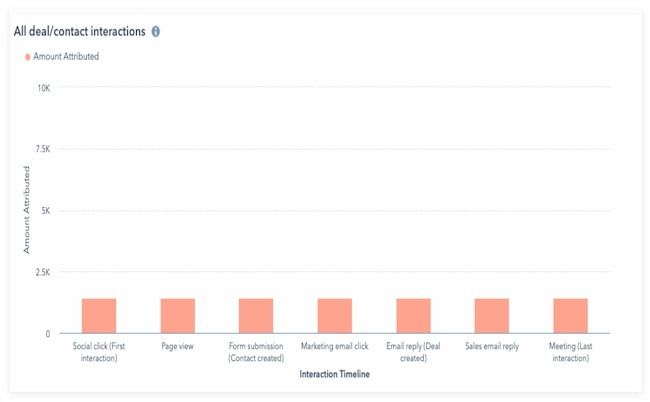
Time Decay Attribution
This model gives more credit to the most recent interactions. The credit for interactions decays the longer it takes for a prospect to convert.
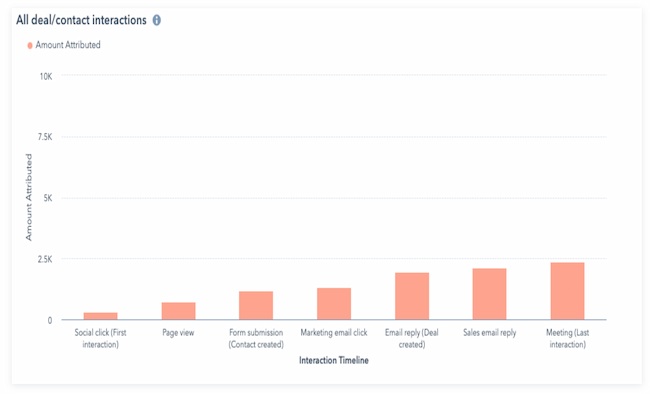
In the example above, a meeting was the last contact over seven different touchpoints. In this model, it gets the most credit for the conversion. A social click was the first interaction, and it gets the lowest amount of credit.
Which attribution report is right for my team?
The best way to begin marketing attribution reporting is to think about what goal you are trying to measure. Are you trying to:
- Understand how your marketing and sales effort generated leads?
- Understand how much revenue your marketing efforts brought in?
- Solve a problem in your marketing funnel?
- Rethink your marketing or conversion strategy?
Marketing attribution makes it easier to understand which marketing strategies help grow the business.
Keep in mind, attribution reporting also helps stakeholders in your organization see how marketing efforts impact business goals. Marketing analytics and tactics can be complex, and this strategy can simplify this information. You can use this report to show the importance of under-valued channels, focus investment on important strategies, or change strategy.
Keep reading to learn how to create and use attribution reports to track the success of your marketing efforts.
1. Decide what time period to analyze.
Some businesses do weekly or monthly attribution reporting. Others use marketing attribution as a strategic tool — analyzing this data before making updates.
As you choose the right time period for your business, think about seasonality and how the dates you choose can impact your data.
For example, if your business runs on an annual sales cycle, you may want to look at multiple years of data. But if your sales cycle happens over a few months, too much data could skew your results.
But what if you’re not sure what your average sales cycle timeline is? In that case, a visual analytics dashboard can help you notice patterns that can help focus your research.
2. Review customer habits and the buyer journey.
When you first start looking at marketing attribution, you’ll see it can help you figure out your top marketing channels.
Let’s go over a few questions that you might want to answer with attribution reports.
How many leads does my blog generate? And what other content generates the most leads?
Content lives at the heart of inbound marketing. Every marketer wants to know how their content contributes to the number of leads they are generating — especially on their blog.
Attribution reports pull that information together to show the number of views a blog post gets before conversion. For bloggers who have not been able to attribute lead generation directly to their blog content, this is a huge win.
The information gathered in these reports helps marketers dissect which types of content perform better. That could include popular topics, content formats, or even time of promotion. With a better understanding of which content generates more leads, marketers can make more informed decisions about their marketing.
What marketing channels generate the most leads? Where is the best place to invest my marketing resources?
After you find out which type of content generates the most leads, it’s important to understand which channels are the most successful in lead generation. This will give you deeper insight into why your content performs the way it does.
For example, your email marketing could be the best place to get content to your customers, but your social media could be tanking. Or vice versa.
Understanding the health of these marketing channels is key to deciding where your team should invest their marketing resources.
For example, say you’re doubling down on social media without getting many leads in return. At the same time, say you’re generating a ton of leads from email marketing with little effort. With this in mind, you may want to take a second look at your approach.
Which pages get the most views before a conversion?
There is a range of content that can contribute to conversions. Blog posts, landing pages, and content offers are often top lead generators. But your homepage, pricing page, About Us page, and other informational pages may be helping too.
Running an attribution report for viewed pages on your website can help you figure out which pages get the most visits. This will help you understand which pages to promote, which pages to optimize, and which pages help push prospects through the funnel quickly.
Advanced marketers also use these reports for problem-solving. You can use attribution reports to:
- Find points in the buyer journey where customers are churning
- Remove content that isn’t making an impact
- Identify blockers or gaps in the customer experience
- Save time and resources for your team and your prospects
- Notice trends and changes in audience behavior
If you don’t have a customer journey map to work from, this template can help streamline the process.
Featured Resource: Customer Journey Map Template
3. Find the right tools for data collection.
Before you can begin marketing attribution reporting, you need to collect the right data. It’s likely that your business uses many different tools to track customer behavior, both before and after they make a purchase.
Your business may track your buyer journey with surveys, interviews, and focus groups. But quantitative data is most useful for attribution reporting. This guide to data tracking tools can help you find the right data collection tools.
As you research tools, think about top business goals and the question you want your attribution reports to answer. For example, Google Analytics has over 100 reports for website analytics. But what if you want your attribution model to include user interactions after they sign up? GA is a great data tracking tool, but you may need something else to answer your most urgent attribution questions.
Some tools also include data-driven or algorithm-based attribution in their data collection. This can be useful for businesses with long or complex customer journeys.
If you’re not sure which tool is right for you, check out this list of top marketing attribution software.
4. Choose the best marketing attribution model.
One of the most common questions marketers ask when getting started on attribution reporting is which model they should use.
The answer depends on the goals of your team and the supporting analysis that’s expected of you. The important thing to remember is that there isn’t a one-size-fits-all for attribution reporting. Instead, it’s best to use multiple models.
Some tools include algorithmic models that track the full user journey. But many marketers prefer to track their data through multiple models and see which model best answers their questions.
For example, say your goal is to widen the funnel and increase brand awareness. In this case, first-touch attribution will quickly help you see which channels and touchpoints draw the most traffic.
But what if customer retention is an issue that you want to address in your marketing strategy? In this situation, a multi-touch attribution model may be more effective.
5. Analyze the attribution data.
Once you choose a model, analyze the data to see if the inputs and attribution model are helping you answer your top questions.
For example, take a look at the Dimensions dropdown in HubSpot’s revenue attribution report. This feature lets you choose what lens you want to view your attribution report through. This helps you understand which types of interactions, content, interaction sources, and other dimensions are having the most impact on your goal.
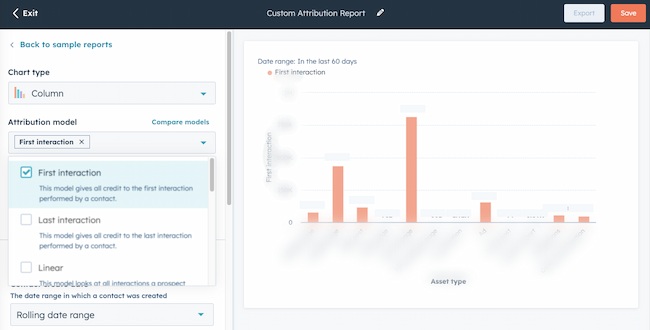
HubSpot’s reporting also makes it simple to toggle between different attribution models.
Adding and removing different models in real time makes it easier to analyze the buyer journey. This can help you understand the value of each of these interactions and create the right attribution reports for your goals.
Learn more:
6. Make your marketing attribution analysis easy to review.
Attribution can be daunting for even the most tenured marketers. Once you’ve created your report, you’ll want to make your data easy for stakeholders to quickly understand.
The best marketing attribution software includes graphics to visualize your attribution data. If you want to create something more specific, these resources can help you make your data presentation clear and useful:
- Types of charts and graphs for data visualization
- Data visualization tips and examples
- Data visualization resources
7. Act on new insights.
Once you have a clear picture of any disconnect between business goals and your attribution reporting results, take a look at your strategy.
You may want to do some market research or get training to fill any gaps in your knowledge. Then, make some clear recommendations, run marketing experiments, and put your new strategies into place.
GDPR Considerations With Marketing Attribution
The General Data Privacy Regulation (GDPR) means that you need explicit consent from your customers to use their personal data.
If you don’t have consent, then you won’t be able to use personal data as part of your digital marketing strategy. Personal, demographic, and financial details are just some of the information this can include.
These details help marketers create more personalized experiences. At the same time, more consumers want to know how companies are using their data.
According to 2022 Cisco research, 90% of those surveyed won’t buy from a company that doesn’t properly protect its data. At the same time, 62% of surveyed consumers say they won’t stay loyal to a brand that doesn’t deliver a personalized experience.
This GDPR checklist can help you understand your businesses’ readiness to address customer privacy concerns.
Guidelines like these can help your business continue to adapt to ever-changing data collection and storage guidelines. This can help you get the data you need to ensure accurate attribution AND keep meeting customer expectations.
1. Choose KPIs for attribution tracking early.
Collecting marketing interaction data is the first step to creating trustworthy attribution reports. So, before you begin attribution reporting, be sure to:
- Choose the right KPIs for marketing, sales, and email
- Build useful KPI dashboards
- Check the accuracy of your reporting data
This step may sound obvious, but if you’ve ever tried to pull together a report only to find that you’re missing essential data, you’re not alone. Tracking data is a complicated process, and it’s easy to skip a crucial data point during setup.
If you’re using HubSpot for reporting, this isn’t an issue, because HubSpot analytics updates every 20 minutes. So, if you find that you’re missing a touchpoint, you’ll still be able to quickly use that data in your attribution reporting.
But some touchpoints on other tools, like Google Analytics, don’t begin pulling data until you create an event. That can cause problems down the line for your reporting, so choose and set up your KPIs early.
2. Move to backend tracking.
Another way to collect accurate data is backend tracking. This alternative to client-side tracking is typically done with Javascript.
You can track almost the same amount of data, and it’s more reliable and less susceptible to ad blockers. Backend tracking is also a great long-term solution to dealing with the phasing out of cookies.
To track data from the backend, consider a third-party service. For example, Google Analytics supports backend tracking through what they call the Measurement Protocol. You can use this API to track page views, events, ecommerce data, and more.
This setup takes more work than simply slapping the Javascript snippet on your website. But it’s also a way to future-proof your site for privacy changes.
3. Connect marketing and sales channels.
Align sales and marketing channels for more useful attribution insights. First, this strategy connects marketing and sales outreach into a single customer journey. Next, it helps your team pinpoint disconnects in personas, KPIs, and customer data.
This can not only help your team understand which marketing initiatives drive the most traffic, but it can also improve lead quality and ROI. These smarketing tips can help you connect these channels.
HubSpot customers: These tools can help you connect your sales and marketing channels.
4. Use automation whenever possible.
Marketing automation uses software to complete repetitive marketing tasks like email workflows or scheduled social media posts. This automation can increase the volume of outreach without expanding your team. It can also help you create more targeted personalized campaigns.
This increased volume can increase the data your team has on hand to inform your attribution models and your strategy.
5. Link every marketing action to business goals.
Use business goals like revenue to inform your marketing strategy. This will make your marketing attribution results more useful to your business and help you get support for new initiatives.
When marketing tactics tie to business goals, it creates metrics that are more meaningful to other parts of the business. Then, with attribution, you can track which of your marketing efforts is most effective for reaching the desired results.
Marketing attribution often uncovers fascinating data. But it’s important that this reporting is more than interesting. Instead, it should offer evidence to support process changes or other strategies that support business goals.
6. Talk to stakeholders about marketing attribution.
Attribution is an effective resource for communicating with other departments. This is because these reports make it quick and easy to see how marketing directly impacts conversions.
To make the most of these conversations, here are a few ways to manage expectations.
First, identify the right stakeholders to share marketing attribution results. Then, figure out what kind of data is most useful to their needs and goals.
You may need to manage their expectations of data accuracy. For example, many analytics tools offer sampled numbers, so they’re not usually exact.
But this data can still help your team make the right decisions. Attribution reporting can improve your campaigns and respond to your customers’ needs.
For example, say you notice most of your blog traffic enjoys content about augmented reality. Even if you’re missing traffic from those viewers who’ve opted out of tracking, you can still assume that most of your audience is following this trend.
In this case, you may want to propose creating more AR content or updating your older AR content for increased conversions.
Once you have a clear process in place, be sure to support the relationships. Share updated reports and data that offer value to each stakeholder consistently. This can help you use marketing attribution to support your marketing goals.
Marketing Attribution Tools
HubSpot
HubSpot Dashboard and Reporting software is excellent for attribution reporting. This is because it makes it simple to pull marketing, sales, and service data into a single report.
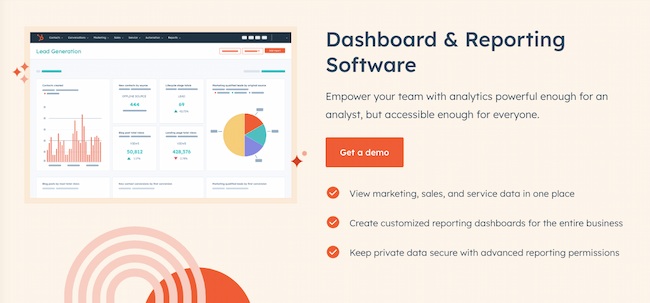
Instead of collecting unique data from a range of tools you can quickly and accurately create custom attribution reports. It sounds simple, but it helps your team save time and avoid critical errors.
Besides the extensive data available in the HubSpot platform, you can pull in data from 1000+ app integrations. This tool also keeps data secure and lets teams create reports with different levels of user access — a critical feature for privacy.
Each attribution report includes a ‘Learn about Attribution Models’ modal. These show you how to toggle the different models and see firsthand how they apply credit to each interaction.
You can add or remove different models in real time, apply different rules to the journey, and understand the value of each interaction. There are also convenient pre-built sample reports for reporting beginners.
Then, you can add attribution reports to custom dashboards. This makes it easy for you to track changes at a glance or quickly share updates with stakeholders.
Keep reading to learn more about attribution reporting and how to create attribution reports with HubSpot.
Google Analytics
Google Analytics also offers attribution models for reporting. This is a popular analytics tool, and it will be most helpful for marketing attribution at the top of your marketing funnel.

To get attribution reports in Google Analytics, you need to create an attribution project and you may need to create extra views. This step may also mean setting up goals and conversions for specific channels. You can see the full instructions on how to set up your site for attribution here.
If you plan to use data-driven attribution models, it could take a few weeks before you can begin reporting on attribution. If you’re new to data reporting, this comprehensive guide to Google Analytics can help you get started.
Keep in mind, as your website visitors and prospects convert to leads, it may be more difficult to track their buyer journey with this tool.
For example, GA’s attribution models exclude direct website visits from attribution. You can read more about the different types of Google Analytics models and how to use them here.
Another aspect of Google Analytics reports is that you cannot connect the report back to specific contacts unless you use a tool like HubSpot. This makes it challenging to apply attribution trends to:
- Personas
- Contact groups
- Lifecycle stages
- Other business-relevant categories
Windsor.ai Analytics
Windsor.ai is a machine-learning-powered tool that collects and organizes attribution data from a range of other tools. It offers multi-touch attribution reporting to help users understand the customer journey and optimize for performance.
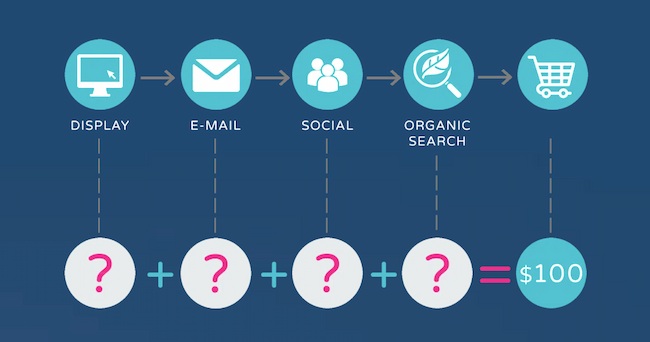
You can learn more about the data-driven attribution models they favor in this article.
This tool also collects and compares both offline and online marketing data. It has 50+ native integrations, including integration with Zapier, which enables additional connections. Then, this attribution software pulls together those different data streams for marketing analysis.
Its YouTube channel is full of useful videos to show users how to make the most of this platform.
HubSpot customers: Check out the Windsor.ai integration for extra insights.
Check out this list if you’re looking for more great attribution software choices.
Use Marketing Attribution to Improve Every Channel and Campaign
Marketing attribution can help your team figure out which channels and messages impact buyer decisions. It helps you focus your strategy and tactics on what drives ROI for your business. Attribution makes it easier to see the results of every decision you make so you can make the best decisions for your business.
So, what are you waiting for? Pick a marketing attribution tool. Start tracking your results with attribution in mind. Then, watch your marketing efforts increase exponentially in value.
Editor’s note: This post was originally published in August 2014 and has been updated for comprehensiveness.

29 of the Best SEO Tools for Auditing & Monitoring Your Website in 2023
There’s nothing quite like a sudden Google algorithm update to leave you feeling equally confused and concerned.
It seems as though search engines like Google wait for you to get all of your ducks in a row and then unleash an update that makes your efforts instantly obsolete.
Plus, there’s still some secrecy behind how Google evaluates websites and determines which sites appear — and how they appear — on the search engine results page (SERP) for different queries.

The good news is that there are several search engine optimization (SEO) tools out there — some free, some paid — that can help you view your website the way search engines like Google see it.
This way, you can improve your ranking and relevance for your target keywords.
Types of SEO Tools
SEO is a complex beast with a lot of moving parts. So, it’s not surprising that there is a huge range of tools available to help you research, implement, and manage your website’s SEO performance.
Some SEO tools help you perform very specific tasks. Others combine one or two areas of SEO together in multiple features. Finally, there are platforms designed to be a one-stop-shop solution for all your SEO activities.
Broadly speaking, SEO tools fall into one or more of the following categories.
Technical SEO
These tools help you identify where your website is falling short from a technical perspective. They analyze site elements such as structure, metadata, page speed, and more so you can meet best practice guidelines from Google.
Keyword Research
From monthly search volume to related keywords, these tools help you identify which keywords you should target on your site. Typically, you start by entering some keyword ideas before the tools return lists of keywords, their search volume, and competition level.
On-Page SEO
Most of these tools analyze the existing on-page performance of your content and provide recommendations on how to improve it for SEO. This will include the type and length of content required, comparisons to your competitors, topic ideas, and more.
Off-Page SEO
Backlinks are critical to sustainable SEO performance, and these tools give you clarity on your existing backlink profile. They also often provide ideas for websites you should seek backlinks from and how you measure up against competitors.
SEO Reporting
Whether you want to keep track of progress at a high level or show off your SEO results to others in the organization, SEO reporting tools help you compile website data into actionable insights.
They’ll usually enable you to build custom reports and track critical SEO metrics at both a high and granular level.
All-in-One Platforms
Many tools and platforms incorporate multiple SEO tool types and features to provide everything in one place. With all-in-one platforms, you can use one tool to plan and manage your entire SEO strategy.
For universal SEO tips you can use today to grow your business, check out our video guide below.
Free SEO Tools
These tools are free to use, but you might find a paid option that has more features. We’ve shared some of the best features in each tool as well as how you can get the most out of them for your SEO strategy.
1. HubSpot Website Grader
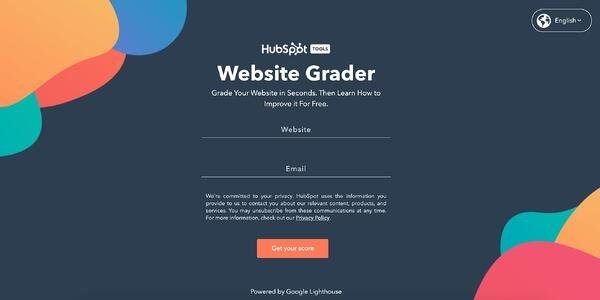
The goal of marketing is to generate traffic and qualified leads via the company’s website. That’s why, as marketers, we need to understand exactly what we can do to improve the SEO of that website.
Hubspot’s Website Grader is a technical SEO tool that highlights how you can improve the speed, structure, security, and mobile performance of your site.
With HubSpot’s Website Grader, simply enter the URL of your website to automatically receive a report card with actionable insights about your SEO efforts.
From there, you can sign up for the HubSpot Academy SEO course that teaches you how to improve your website’s SEO, user experience (UX), and more.
Core Features
- Learn about your website’s performance in seconds, and receive clear, actionable feedback on how you can fix them.
- Receive how-to education on how you can improve your website.
- Gain access to a five-lesson HubSpot Academy course on Website Optimization so you can understand how to improve upon your website’s specific problem areas.
- Discover how to optimize your website for mobile.
- Learn how you can implement website security best practices.
- Personalize your website’s UX to create a delightful experience for users.
2. Google Search Console
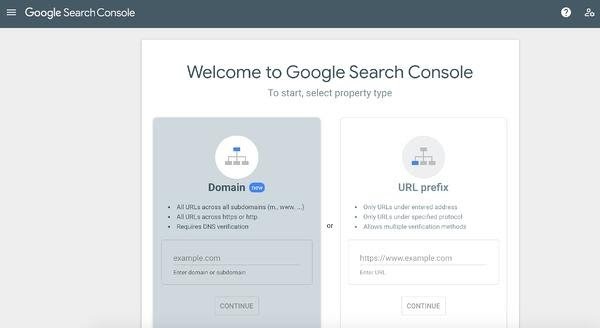
Google Search Console is primarily a technical SEO tool that helps you identify whether Google is finding and indexing your website pages. If it’s not, you’ll get guidance on why pages are not indexed and how to fix it.
Google Search Console also has many tools available to help you appear in the SERPs for the search terms and phrases your target audience is looking for.
If you’re the owner of a business or an SEO on your marketing team, Search Console can help you conduct an initial SEO analysis from scratch or update your existing SEO strategy with fresh keywords.
Google Search Console monitors, debugs, and optimizes your website. Plus, you don’t need to know how to code to benefit from this tool.
Core Features
- Learn about the keywords your web pages are currently ranking for.
- Identify any crawl errors that exist on your website.
- Understand how mobile-friendly your website is and discover opportunities to improve the mobile experience for your users.
- See how many of your web pages are in Google’s Index (if they aren’t in Google’s index, you can use the tool’s URL Inspection Tool to submit a page for indexing).
- See the website-related metrics that matter most to you, like clicks, impressions, average click-through rate (CTR), and average position.
3. Google Analytics
Google Analytics is a website reporting tool that you can use to gain insights into your SEO performance. It’s a great option for anyone looking for a free SEO reporting tool.
Although Google Analytics has a paid version, the free version of the product can be paired with Google Search Console to provide a full picture of your SEO.
In doing so, all of your website’s SEO data will be centrally located and compiled. You can use queries to identify areas for improvement with the keywords and phrases that you want your website and web pages to rank for.
Core Features
- Filter your referral traffic. Get rid of the traffic that has the potential of ruining SEO reports, such as fake traffic.
- Compare organic versus non-organic website traffic. Understand where your visitors are coming from and optimize those channels to increase traffic.
- Determine engagement metrics. Use Site Content Reports to determine engagement metrics on each web page, engagement for pages on your website, and conversion of landing pages.
- Review the Multi-Channel Report’s Assisted Conversions feature. Identify which of your channels led to the most conversions and the value they bring to your business.
4. UpCity Free SEO Report Card
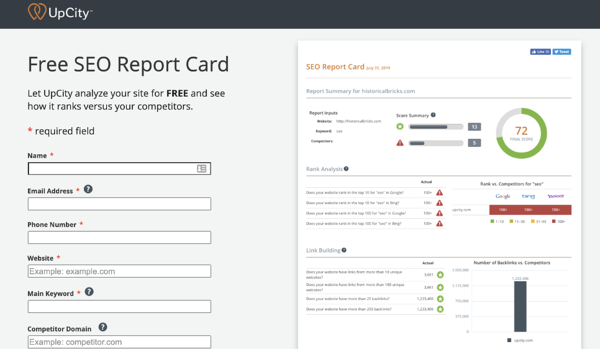
The free SEO Report Card by UpCity lets you analyze your website to determine how it stacks up against the competition.
It’s a tool that combines technical, on-page, and off-page analysis to give you a reporting snapshot of your existing performance. By comparing your site to a competitor, you can also clearly see where improvements to your SEO strategy are needed.
Core Features
- Rank analysis. See a snapshot of where your website ranks on the most popular search engines.
- Link building. Get a detailed account of the number of websites that link back to your site.
- On-site analysis. See how successful you were in incorporating your main keyword throughout your site.
- Gather information about your site’s load time and accessibility.
See how many of your site pages have been indexed.
5. Internet Marketing Ninjas
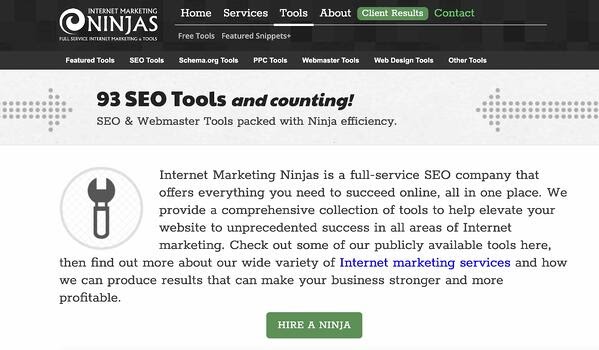
Internet Marketing Ninjas is an SEO-focused marketing agency. Their team has built out an extensive list of free tools you can use to compare your website against the competition, optimize web pages for certain keywords, and increase organic traffic to your website.
When combined, these tools provide keyword research, technical, and on-page capabilities to help you plug the gaps in your SEO performance.
Core Features
- Identify broken links and redirects, and use the site crawl feature to generate an XML sitemap of your website.
- See all of your page links (external, internal, etc.) on your web pages to review what’s working well and what’s broken or needs an update.
- Use an on-page optimization tool to evaluate your web page content, meta information, and internal links.
- Compare the SEO of your web pages versus a competitor’s web pages.
- Analyze page-load time and how long each component of a web page takes to fully display.
6. Bing Webmaster
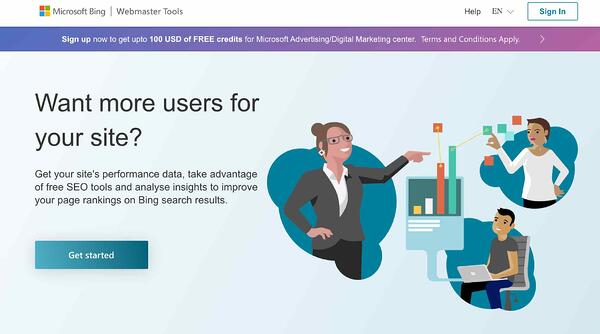
From an SEO perspective, Bing Webmaster is a keyword research, technical, and off-page SEO tool. Plus, it’s completely free.
Microsoft Bing Webmaster gives you access to many tools that offer insight into your website such as reporting, diagnostic, and SEO tools.
The SEO tools that you can use for free have the power to help you analyze your website, manage backlinks, and review keywords to ensure your site is well-optimized for organic search.
Core Features
- See backlink profiles. Learn about your backlink profile to understand referring pages, domains, and anchor links.
- Perform keyword research. Determine which keywords and phrases your audience is searching for as well as the search volumes of those keywords and phrases.
- Use the site scanning feature. Crawl your website and identify technical SEO errors.
Get SEO reports. Review any errors that are on your website and individual site pages.
7. Google Trends
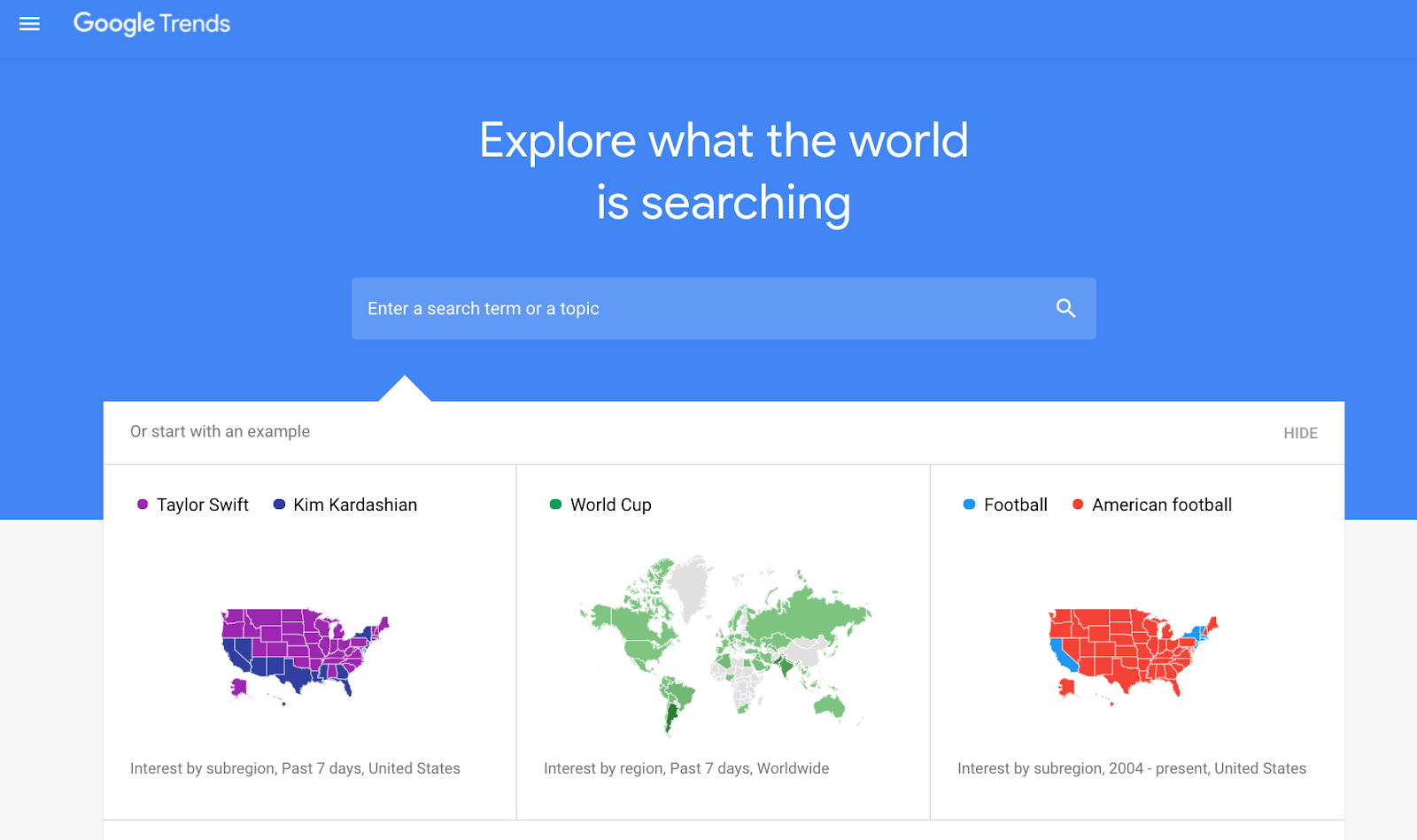
Google Trends is a keyword research tool that helps you identify keywords and topics around which you can shape your website content.
Traditional SEO tools are great for conducting research and audits when your business is already established.
But what if you’re starting a new business venture and want to know what popular industries, topics, and ideas people are exploring?
Google Trends is a great place to explore untapped potential that can yield a large keyword landscape for your website.
However, Google Trends isn’t where you’ll get granular data. This tool performs best when you use it as a compass to set a direction for your SEO strategy and then pair those insights with a more robust software like HubSpot’s SEO Marketing Tool.
Core Features
- Look for trends in specific countries or regions of the world.
- Find popular people and long-tail keywords related to them.
- Compare and contrast trends over time.
8. Seolyzer
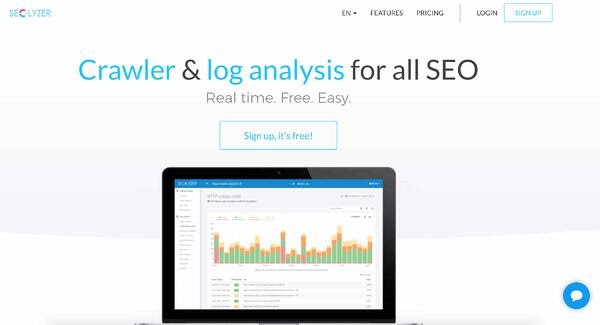
Seolyzer is a technical SEO tool that helps you determine how search engines like Google view your website.
It includes free site crawling, log analysis, and reports so you can get ahead of potential crawling and indexing issues.
Seolyzer pulls information that crawling bots leave in your server’s log files while browsing your site to identify and create your SEO KPIs. The tool also identifies error codes, redirects, and page speed performance.
Core Features
- Monitor SEO issues. Identify poor response time, error messages, and crawl volume so you can resolve them before serious damage is done.
- Manage your unique KPIs. Analyze page performance, crawl volume, HTTP status codes, active and new pages, and desktop versus mobile responsiveness.
- Segment web pages. Determine what your most crawled pages are.
- Compare web pages. See what Google deems as most important to the pages that are crucial to your business’s bottom line.
- Understand the impact of your SEO efforts on a page-by-page basis or by the category of the page.
9. SEOquake
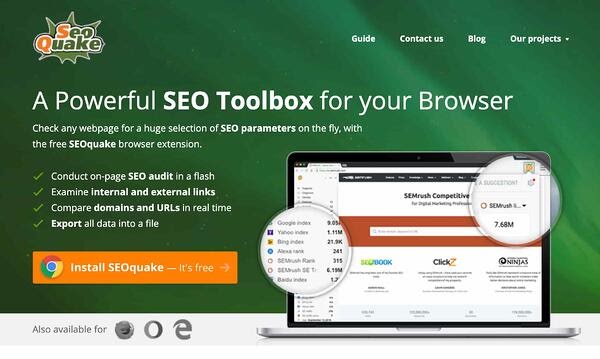
SEOquake is a Google Chrome extension that automatically checks a web page’s SEO parameters quickly and for free.
This includes on-page SEO audits, internal and external link reviews, real-time URL and domain comparison, and data file export.
The number of features makes it the closest thing to the only free, all-in-one SEO tool available.
Core Features
- Get a detailed description of how all of your links are doing — including URLs, anchor text, and other link types — with the tools Link Examiner feature.
- Adjust the SEOquake reports you receive to display only the parameters and metrics that you care about.
- Identify any SEO-related issues that would be findable by search engines.
- Export the results of your SEO analysis into an adjustable and shareable report.
10. Seobility
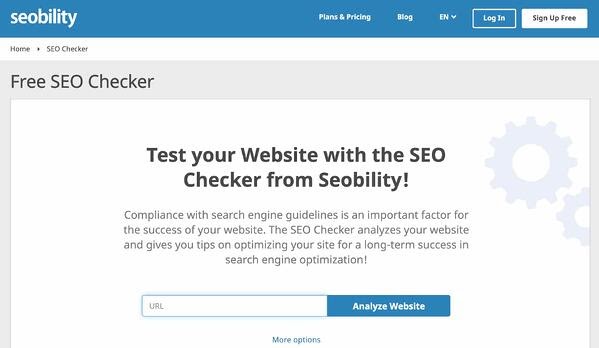
Seobility is a free SEO-checker tool. With it, you can test your website’s level of compliance with today’s SEO guidelines. By simply entering your URL, your site will be analyzed and you’ll receive tips on how you can better optimize your website.
Under the free plan, you can use Seobility as a keyword research, technical, on-page, and off-page SEO tool. However, your usage will be limited in terms of the number of keywords, competitors, and pages you can track.
In addition to a detailed SEO audit of your website, you’ll gain access to 1,000 subpage audits, email reporting and alerts, and keyword monitoring.
Core Features
- Find technical errors. Resolve on-page SEO issues quickly to recover lost traffic and prevent future traffic dips.
- Receive an SEO score that accounts for various website factors including meta-information, page quality, link structure, and more.
- Understand the specific SEO issues with your meta information such as metatitles/descriptions, meta tags, and invalid or incorrect domain names or page URLs.
- Identify areas for improvement regarding your page speed and quality (related to text, duplicate content, responsive design, and alt attributes for content).
- Understand how your page and link structure can be improved by getting data about your headers, internal links, and incorrect anchor text.
- Identify specific server errors related to any redirects, HTTP headers, or CSS and Javascript files.
11. Check My Links
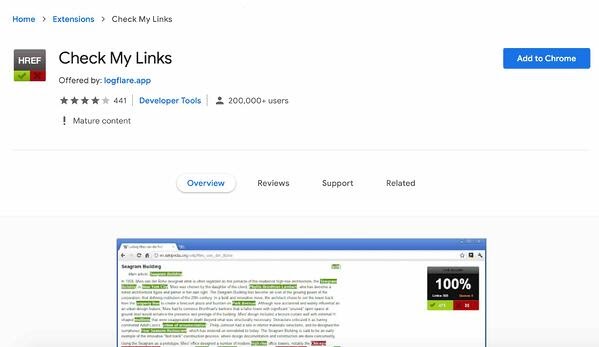
Check My Links is an off-page SEO tool that helps you monitor your backlink performance. The Google Chrome extension helps ensure your links on both external and internal web pages work.
For instance, if you were to search a term on Wikipedia, Check My Links would be able to tell you how many links that Wikipedia page has in total and how many of those links are broken.
This is helpful because you can make corrections to broken links immediately (or hopefully, before a page goes live). Check My Links is ideal for developers, content editors, web designers, and anyone else concerned with link performance.
Core Features
- Check each link on your web pages and identify all invalid links.
- Quickly see the good links in green and the broken links in red.
- Copy all of your bad links to your clipboard in one click.
12. BROWSEO
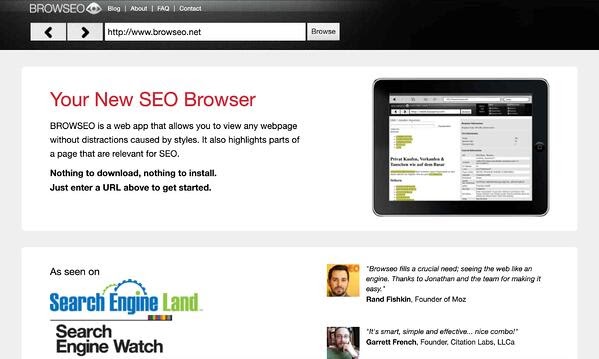
BROWSEO is essentially a technical SEO tool, although it also gives you quick insights into the number of backlinks on a page.
BROWSEO allows you to review your web page in a limited format so you can analyze its UX and content as well as gain insight into its SEO.
Once you input the URL, the output will hone in on your HTML so you’re able to understand the page’s structure, optimized search terms, and other SEO-related factors.
Core Features
- See the number of words on the page. Find the sweet spot for copy length on your web pages.
- Determine the number of internal and external links on your page. This allows you to see how your linking strategy is working on each page.
- See all of your meta information. Review title tags, alt text, and meta descriptions.
Paid SEO Tools
Next, let’s look at some paid SEO tools. (Note that some of these tools have free trial periods. Some also offer entirely free plans but with restrictions in terms of flexibility and customization.)
1. HubSpot SEO Marketing Software
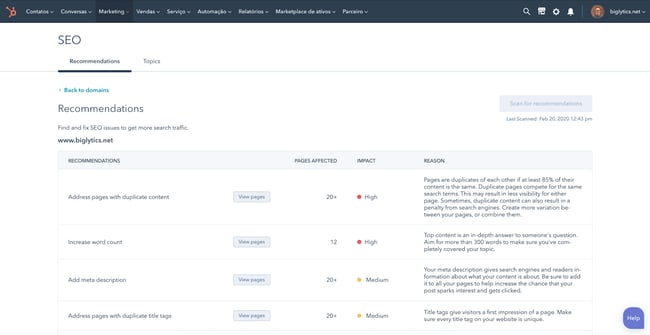
Price: $45 per month for the Starter plan; $800 monthly for professional, and $3,200 monthly for enterprise.
HubSpot’s Marketing Hub includes an SEO marketing software tool. With keyword research, on-page, and SEO reporting capabilities, it’s perfect for helping you build authority across your website.
Since this software is integrated with HubSpot landing pages, web pages, and blog posts, you’ll never miss an opportunity to optimize your content for traffic and conversions.
No matter if you’re creating your first content strategy or you’re an expert in all things SEO, HubSpot’s SEO Marketing Software gives you the tools and the confidence to rank in the SERP and report on your performance.
HubSpot’s marketing software doesn’t keep SEO in a silo. This tool works in conjunction with:
- Email. Send professional emails using your own branded designs.
- Marketing automation. Create dynamic campaigns for segmented audiences.
- Lead management. Track leads through each stage in your sales process.
Analytics. Review your campaign to identify success and opportunities for improvement.
2. Ahrefs
Price: Seven-day trial for $7; $99 per month for Lite; $179 per month for Standard; $399 per month for Advanced; $999 per month for Agency.
Ahrefs is an all-in-one SEO tool that provides features for keyword research, on-page and off-page analysis, technical SEO, and reporting.
This advanced SEO resource examines your website property and produces keyword, link, and ranking profiles to help you make better decisions on your content.
Core Features
- A site explorer shows you the performance of specific web pages on your website.
- A content explorer allows you to search high-performing web pages under specific keywords and topics.
- A keywords explorer generates the monthly search volume and click-through rates of specific keywords.
- Site audits crawl specified verticals within your domain and reveal technical issues at the page level.
3. SEMrush
Price: $119.95 per month for Pro; $229.95 per month for Guru; $449.95 per month for Business.
Another all-in-one SEO platform, SEMrush is an elaborate dashboard that reports on the performance of domains as a whole and their specific pages. SEMrush offers numerous resources, one of which is the SEO Toolkit.
Toolkit allows you to track a website’s visibility improvement over time as well as identify which keywords it’s ranking for, what the page’s rank is for a keyword, the keyword’s monthly search volume, and more.
Core Features
- Analyze backlinks from other websites to your site.
- Identify all keywords you need to successfully build an SEO strategy.
- See your competitors’ strategies. Identify the paid keywords or ad copy used in the PPC ads of your competition.
- See how you can increase your organic traffic by optimizing your content.
4. KWFinder

Price: 10-day free trial; $29 per month.
Sometimes you don’t need an SEO tool with all the bells and whistles if you only need to do keyword research. KWFinder is a great platform that fills the gap between SEO work and copywriting. You’ll find keywords that aren’t too difficult to rank for but still carry the potential to bring in traffic.
What makes KWFinder unique is how seamlessly it shifts between languages and regions so that you can serve your audience no matter where in the world they are.
Core Features
- Find long-tail keywords that give you more opportunities to acquire traffic.
- See how your competitors’ keyword strategies compare to your own, plus find more keyword opportunities.
- Analyze competition in the SERP to understand what elements readers are looking for on your pages.
- See what searchers are looking for locally and appeal to local markets for more niche traffic.
5. GrowthBar

Price: Free 5-day trial; $29 per month for Standard; $79 per month for Standard; $129 per month for Agency.
GrowthBar is an advanced keyword research tool. It also offers some on-page and off-page features and an AI blog writing tool.
The Chrome extension can help you perform keyword research, competitive analysis, and track SEO rankings.
With the GrowthBar, access data points about any website directly from the search engine results page. This allows you to assess your competitors’ performance and view the growth channels, keywords, backlinks, and ads that are working for them.
Core Features
- See which paid and organic keywords are driving the most traffic for your website and get a list of the most authoritative backlinks pointing to your site.
- Get your Keyword Difficulty Score. Assess how hard it would be to rank for a particular keyword based on the strength of the domain authorities ranking on page one.
- Run Facebook Ads. Get a visual of what they look like from a search engine’s perspective.
- Get a list of related keywords you might want to rank for along with their search volume and CPCs.
6. Woorank
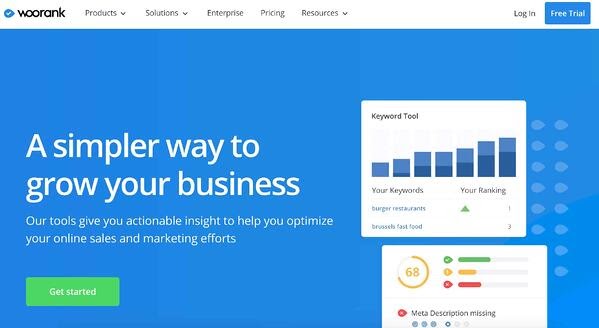
Price: Free 14-day trial; $79.99 per month for Pro; $199.99 per month for Premium.
Woorank is primarily a keyword research tool, although it also offers site crawls for technical SEO and information on your backlink performance against competitors.
Woorank’s in-depth site analysis helps marketers reveal opportunities for optimization and improvement. This analysis takes into account the performance of existing SEO initiatives, social media, usability, and more.
Each report is divided into sections to help you easily analyze your site and identify targets for optimization. Here are a few features of the report:
- A marketing checklist. Review common marketing tasks that you can complete as part of your SEO strategy execution.
- SEO analysis. Compare your SEO metrics to your goals.
- Mobile analysis. Decide which mobile optimization tactics to employ based on the mobile data.
- Social insight. See how social media is playing a part in your traffic and SEO goals.
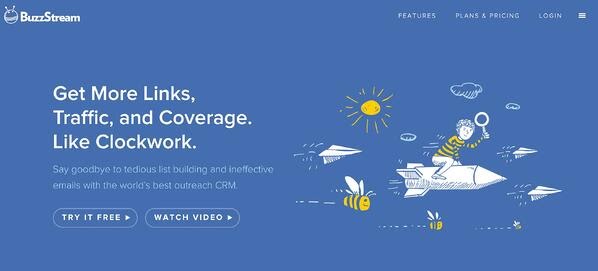
7. BuzzStream
Price: Free 30-day trial; $24 per month for Starter; $124 per month for Group; $299 per month for Professional; $999+ for Custom.
BuzzStream is an advanced off-page SEO tool. Not only does it provide a detailed analysis of your ongoing backlink performance, but you can also use it to plan and implement a backlink acquisition strategy.
Although backlinks to your website are critical to ranking well on Google, the outreach you do while link building can feel a lot like cold calling. BuzzStream makes it easy to research the appropriate people, come up with effective emails, and track who’s accepted each link request.
Core Features
- Identify candidates for outreach. Find them based on their industry and how engaged they are across various social networks.
- Identify candidates for backlinks. These are individuals who will likely be receptive to your backlink request for other reasons that are unique to your business’s niche.
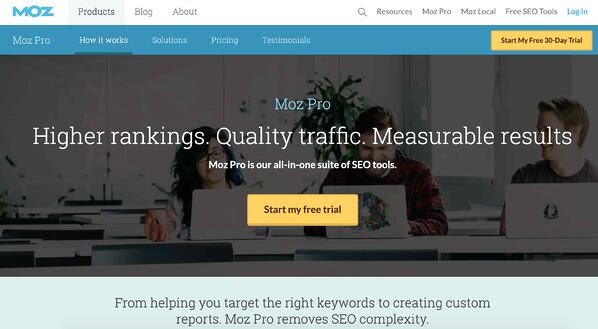
8. Moz Pro
Price: Free 30-day trial; $99 per month for Standard; $149 per month for Medium; $249 per month for Large; $599/month for Premium.
The Moz Pro subscription serves as an all-in-one SEO tool for increasing the search ranking of your business. Everything from keyword research and organic rank tracking to technical audits, on-page optimization, and link-building opportunities can be found in Moz.
You can use Moz to identify opportunities, track growth, build reports, and optimize your efforts across all aspects of your SEO strategy.
Core Features
- Use a website crawler that analyzes up to 3,000 links on a given URL.
- Get out-of-the-box SEO reports and enables you to build your own.
- See duplicate content and redirects that could be influencing your SEO performance.
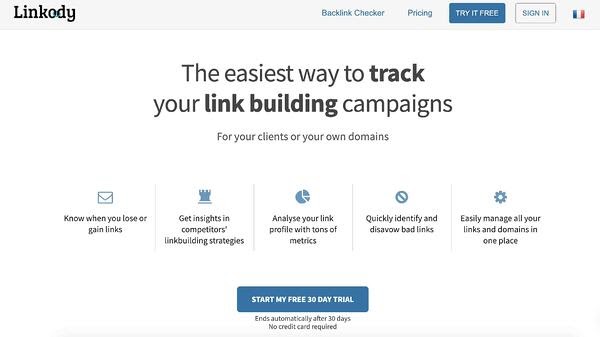
9. Linkody
Price: 30-day free trial; $14.90 per month for Webmaster; $24.90 per month for Advanced; $49.90 per month for Pro; $99.90 per month for Agency; and $153.90 per month for Agency XL.
The best way to understand the performance of your off-page SEO is by having a good overview of your backlinks. Linkody is an off-page SEO tool that allows you to discover, track, analyze, and disavow backlinks all from an easy-to-use interface.
Aside from that, the tool checks your links 24/7 and informs you of any changes so you can take immediate action in case a link is lost or broken.
Core Features
- “Spy” on your competitors’ backlinks. Simply enter the URL of your competitor and let the tool pull all the links and metrics. The information returned will help you discover niche-relevant, high-quality backlink opportunities for your brand.
- See your most important metrics when it comes to backlink tracking, such as the ‘rel’ attribute, Google indexation status, Domain Authority, Spam Score, Alexa rank, and more.
- Download reports that can be shared with your team and/or clients to get a better idea of your backlink distribution and link-building progress.
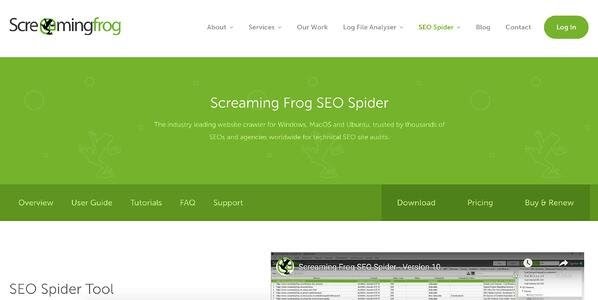
10. Screaming Frog SEO Spider
Price: Free or €149 per year.
Screaming Frog SEO Spider is an advanced technical SEO tool. It crawls your entire site and condenses all the relevant information into exportable reports.
Designed specifically for the SEO-minded, this program crawls the websites you specify, examining the URLs for common SEO issues.
This program expedites an otherwise time-consuming process — especially for larger websites. It could take hours or days to manually evaluate the same URLs.
You can use the tool to identify all kinds of technical SEO issues including those related to site structure, security, speed, and metadata. Plus, you can use it to generate important technical SEO files for your site such as XML sitemaps.
Core Features
- Screaming Frog includes an intuitive Java program with easy-to-navigate tabs.
- Easily export to Excel to further analyze your SEO data.
11. Remove’em
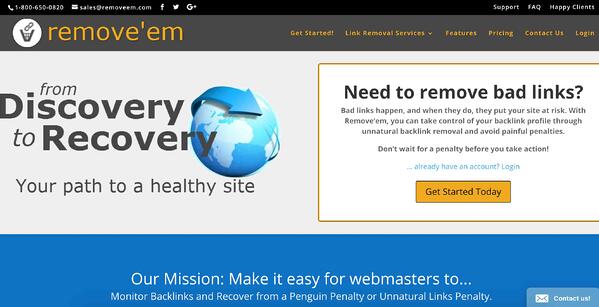
Price: $249 one-time payment for life-time plan; $99 per month for one website; or $899 per month for an Agency that can be used on 10+ websites.
Remove’em is an off-page SEO tool that helps you identify and remove backlinks to your site that may be harmful to your organic search rankings.
If you’re buying a website domain that has been used in the past, or you’re rebuilding a poor SEO strategy, you may discover some problematic backlinks while conducting your audit.
Artificial or unnatural links have the potential to seriously hurt your search ranking. Remove’em helps get rid of those links.
Core Features
- Scan your backlink profile. Discover a list of contact information for the links and domains you’ll need to reach out to for removal.
- Export a list of backlinks. If you wish, you can disavow backlinks by telling Google not to take these “bad” links into account when crawling your site.
12. AnswerThePublic
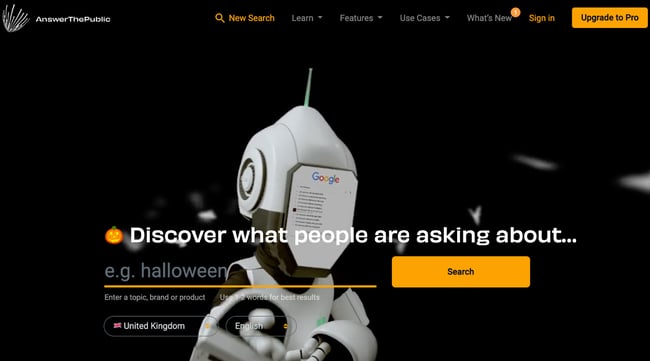
Price: $99 per month for a monthly plan; $79 per month for an annual plan; $199 per month for the Expert plan.
AnswerThePublic is an in-depth keyword research tool that helps you find keywords to use on your site and provides inspiration for your on-page content.
The search listening and keyword tool listens to autocomplete data from Google and other search engines. The program will then provide you with a list of phrases and questions that people are searching for around your keyword.
This allows you to tailor your website to your audience and increase traffic.
Core Features
- See when people are talking about your most relevant keywords.
- Understand keyword research behavior among your target audience and customers.
- View the keywords and phrases that your audience is researching in real-time.
- Discover new content ideas based on relevant keyword research.
13. Keyword Hero
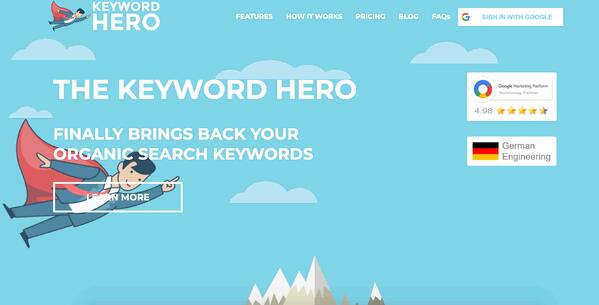
Price: 14-day trial for any plan; free for Little Hero; $9 per month for Big Hero; $49 per month for Giant Hero; and $149 per month for Ultimate Hero.
Keyword Hero is a keyword research and SEO reporting tool. If you’re wondering exactly which keywords are attracting visitors to your site, it’s worth a look.
Keyword Hero pairs your visitors’ sessions with the keywords they used to land on your page, all within your Google Analytics account. In other words, this tool gives you an understanding of the search intent of your organic traffic.
Core Features
- Analyze organic traffic and conversions. Uncover the success you receive from your intended keywords.
- Identify brand versus non-brand search traffic.
- Optimize your position in the SERPs. Optimize your website for specific target keywords.
- See query details. Understand whether your visitors used informational versus transactional queries to find your website.
14. SpyFu
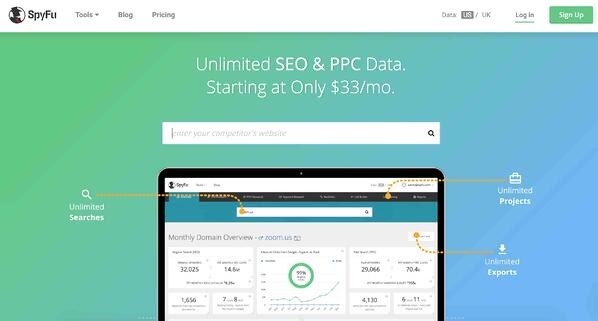
Price: $39 per month for Basic; $69 per month for Professional; $129 per month for Unlimited.
SpyFu is a competitor keyword research tool for both Google Ads and organic search. In addition to keyword research, SpyFu helps with PPC competitive research, SEO competitive research, and the creation of custom lists and domains.
The tool helps you drive traffic to your Google Ads campaigns and website, monitor both paid and organic rankings, and obtain accurate contact information for leads.
Core Features
- Download a competitor’s PPC keywords. Use this insight to develop more competitive PPC strategies that can compete in the ad space.
- Download a competitor’s SEO keywords. Use this insight to develop more competitive organic keyword strategies that can compete in the SERP.
- Review ranking trends. Analyze how a page or website ranks for a specific keyword over time.
- Discover keyword ideas. Get keyword advice for your Google Ads to increase the chances of conversion.
15. Seomater
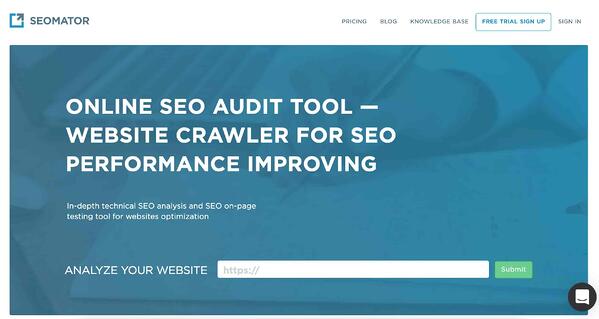
Price: Pay as you go (starting at $5); $19 per month for small business plans; $49 per month for a professional plan ; $179 per month for an unlimited plan.
Seomater is a technical SEO tool for crawling and auditing your website.
Once the tool crawls your site, you’ll receive an SEO report that explains your website’s various SEO-related elements. That includes internal and external links, backlinks, page quality and speed, social media, organic presence, and more.
Your analysis will also come with tips on how you can improve each of these SEO elements. In addition, you can:
- Use the SEO Monitoring Alerts feature. Your website will be automatically crawled and you’ll get an immediate notification if something is problematic in terms of SEO.
- Get detailed reports. Find insights about your on-page and off-page SEO elements.
- Use the Domain Comparison tool. Compare two competitors’ websites to identify the strengths and weaknesses of their SEO (such as broken links, content quality, HTML tags, and more).
16. ContentKing
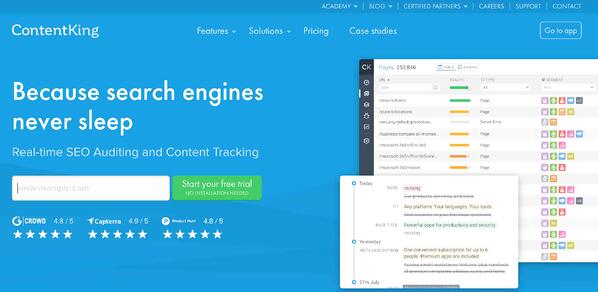
Price: $139 per month for Basic; $319 per month for Standard; $449 per month for Pro; or contact for Enterprise.
ContentKing is a technical SEO and SEO reporting combination tool. The real-time SEO auditing and content tracking tool monitors your website 24/7 so any issues related to SEO don’t go unnoticed.
The tool is cloud-based, meaning there’s no installation required and your data and reports are available whenever and wherever you need them.
Core Features
- Improve your SEO. Use ContentKing’s 24/7 website audits to gain insight into your SEO and receive tasks that will help you optimize your web pages.
- Get alerts. Get notified whenever something on your website is broken or is no longer well-optimized so you can efficiently fix the issue.
- Track changes. Follow the history of all your content changes on your site (such as changes on individual web pages and changes in robots.txt) and search the history of your changes.
- Visualize data. See real-time dashboards and reports.
17. SE Ranking
Price: $39.00 per month for Essential; $89.00 per month for Pro; or $189.00 per month for Business.
SE Ranking is an all-in-one SEO platform that analyzes website health and performance, keyword rankings, and traffic.
SE Ranking also provides insights into your competitors, allowing you to better understand the SEO landscape and adjust your marketing strategy. You can also build custom SEO reports with branding and personalization options.
Core Features
- Monitor your and your competitors’ keyword positions and provide accurate keyword rank analysis, evaluate SEO potential, and show historical data changes.
- Evaluate all your website pages to create an in-depth report of website tech and performance errors with actionable tips on how to resolve them.
- Scope your competitors’ website traffic dynamics, keyword rankings, and other data in organic and paid searches.
- Analyze any website and create a complete report of the backlink profile with dynamics of new and lost site links and referring domains, anchor text distribution, and pages linked out to the most.
Making the Most of SEO Tools
Now that you’ve learned about some of the best free and paid SEO tools, it’s time to see what works with your current tech stack. Determine which option will help you achieve your SEO goals and get started optimizing your content.
Editor’s note: This post was originally published in December 2018 and has been updated for comprehensiveness.

How Video Consumption is Changing in 2023 [New Research]
Video is more important to consumers now than ever before. Our annual State of Video Marketing survey with Wyzowl shows that 91% of businesses use video as a marketing tool, more than any of the previous years since the surveys started.
While video isn’t going anywhere, it’s constantly expanding, changing, and evolving to fit consumer preferences and new platforms — marketers must keep up.
Here, we’ll highlight five research-backed ways video consumption habits are changing and how marketers can respond strategically.

Online Video Consumption Statistics Marketers Should Know
How Video Consumption is Changing in 2023
1. Consumers increasingly rely on marketing videos from brands.
2. Escapism is the name of the game.
3. Consumers lean into their passions.
4. Production quality is becoming more important.
5. Consumers prefer shorter videos.
Navigating video in 2023
Online Video Consumption Statistics Marketers Should Know
As video continues to be integral to marketing strategies, marketers should keep the following statistics in mind:
- The number of digital video viewers worldwide is expected to reach 3.5 billion.
- In 2023, people are watching, on average, 17 hours of online videos per week.
- People are 52% more likely to share video content than any other type of content.
- 75% of viewers watch short-form video content on their mobile devices.
- 83% of marketers suggest videos should be under 60 seconds.
How Video Consumption is Changing in 2023
From video length to what attracts viewers — here’s what’s changing for video consumption in 2023.
1. Consumers increasingly rely on marketing videos from brands.
In the past, consumers would visit websites, look at online reviews, watch commercials, and maybe watch a few YouTube videos to learn about a product.
Now, with video accessible on every major social media network, they are learning to rely more heavily on this type of content in their research phase.
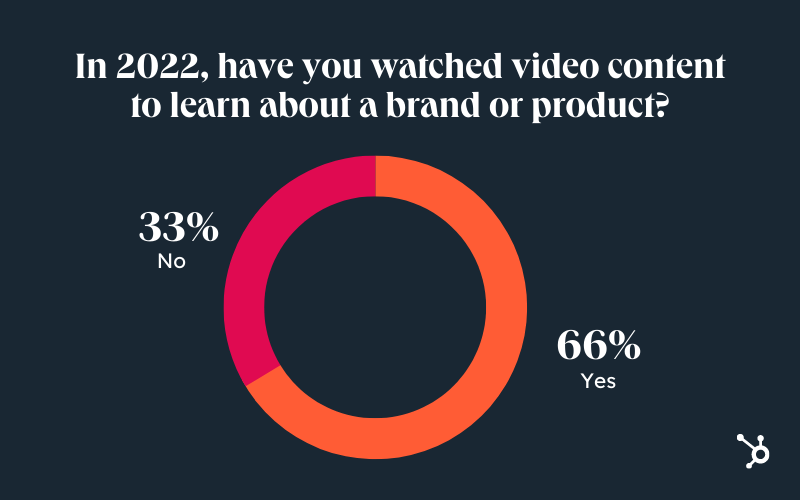
According to HubSpot Blogs research, 66% of consumers have watched video content (i.e., product demos, reviews, FAQs, unboxings, etc.) to learn about a brand or product.
The trend is clear: in 2023, consumers increasingly expect to see brand video content. Why?
Videos allow consumers to know how a product or service works in real life, discover any flaws before purchasing the item and identify perks they might not learn about in the text-based description.
Furthermore, this content might appear more authentic than a heavily edited product shot, which can boost a consumer’s trust in a brand or offer.
In fact, our most recent consumer trend tracker survey found 69% of U.S. consumers say it is more important that a marketing video be authentic and relatable than polished with high-quality video/audio.
2. Escapism is the name of the game.
In the past, older generations might have turned on their favorite TV sitcom or gone to the movies to escape daily life’s stresses. While the platforms have changed, the need for relaxing or entertaining content has yet to change.
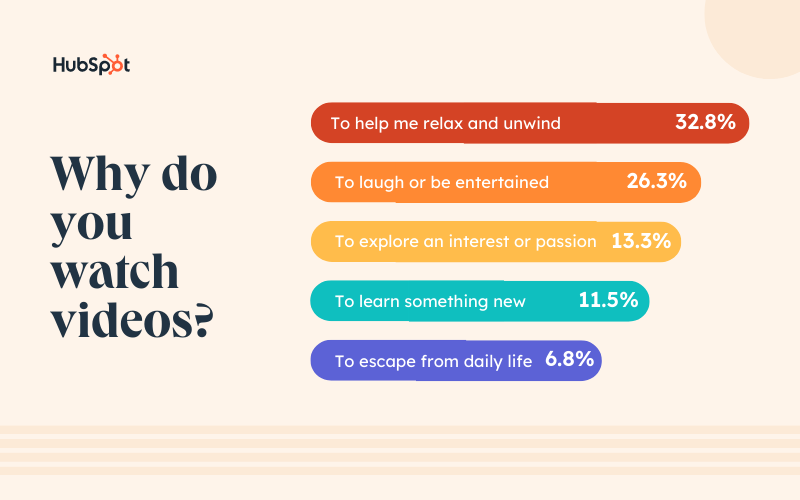
According to HubSpot Blogs research, consumers primarily watch videos to “help me relax and unwind.” Additionally, people cited “To laugh or be entertained” as the second most common reason.
Even if you’re creating informative marketing videos, consider experimenting with funny anecdotes or adding other entertaining qualities. Are you interested in adding fun elements to your next marketing video? Get inspired by notable brands that effectively use humor in their marketing.
Some of the most well-received ads aired during the 2023 Super Bowl featured humor as a key component. When we asked 150 viewers what their favorite Super Bowl ad was this year, most chose a funny Dunkin’ ad featuring Ben Affleck.
3. Consumers lean into their passions.
Aside from looking for escapism, YouTube viewers are motivated to watch content that teaches them new things, primarily related to their passions, interests, hobbies, or social causes. In fact, according to HubSpot Blogs research, 13% of consumers watch videos to “explore an interest or passion,” while 11% want to “learn something new.”
Odds are your product relates to someone’s interests, hobbies, passions, or career. This is the type of person you’ll want to watch and enjoy your videos.
Creating a buyer persona and target audience around this type of person will help you identify video topics they’ll value, benefit from, and remember.
4. Production quality is becoming more important.
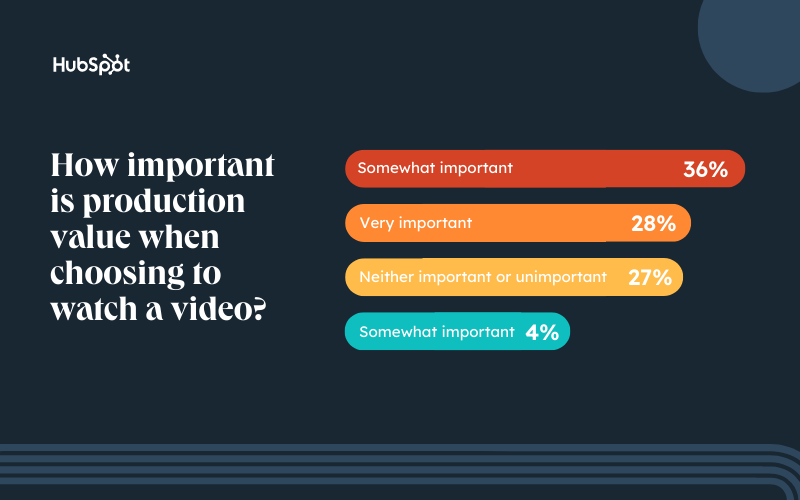
36% of consumers feel production value is “somewhat important,” while 28% feel it’s “essential.” But fear not — this doesn’t mean you need to rent a high-priced studio or enlist A-list celebs.
Instead, many ways exist to produce an affordable, solid-quality video from any home or workspace. And remember, often, a video’s success relies on its value. In other words, more than fancy lighting is needed.
Additionally, video software like Vidyard, Bonjoro, and TwentyThree makes it easy to record and send short video messages – like pitches, welcome videos, and more — to customers without needing a Hollywood budget.
5. Consumers prefer shorter videos.
Thanks to the rise of TikTok — and the wave of short-form content that followed — consumers are seeking quick, snappy videos. Specifically, videos under three minutes fall into a sweet spot.
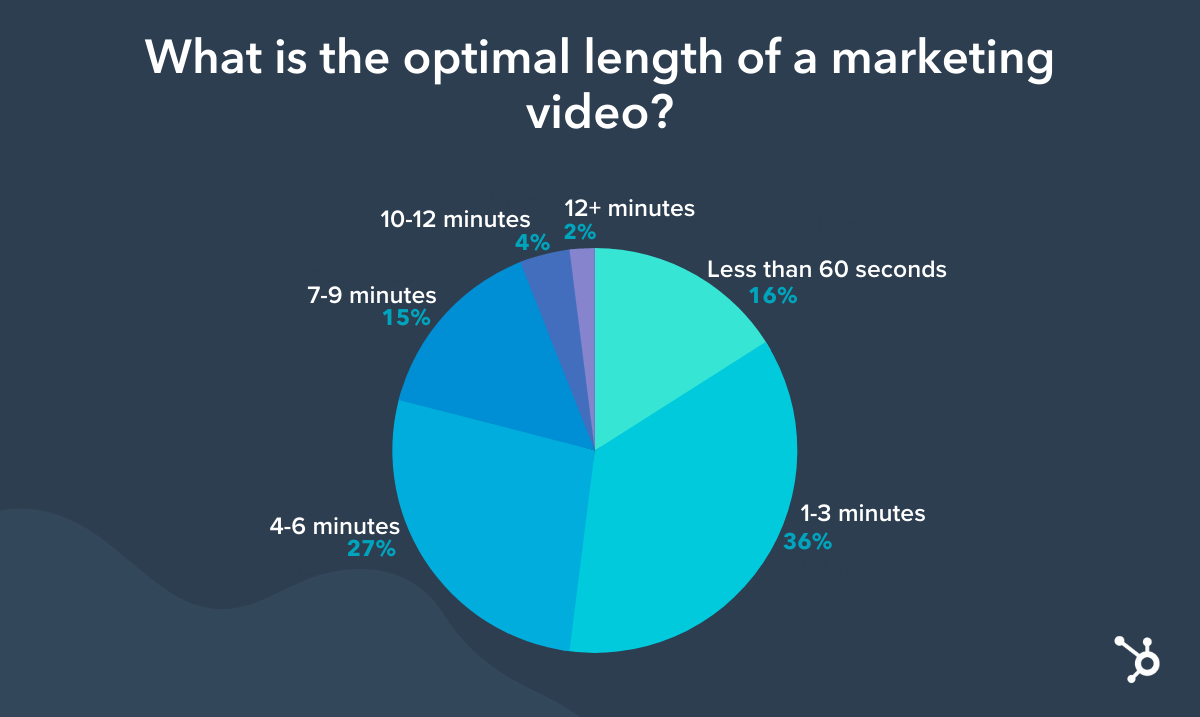
If you’re new to video, starting with short-form videos can help you get your feet wet — and tell you what resonates with your audience.
You also need to set the right pace for your video content. Before you put a marketing video online, re-watch it from the point-of-view of a somewhat busy consumer. Then, ask yourself, “Does this video quickly pull viewers into the action and keep their attention?”
If you’re worried that parts of your video seem dull, shorten it. But, if your team thinks it’s entertaining or informative the entire time, you can experiment with publishing your longer-form video and learning from its results.
Navigating Video in 2023
With each new generation, the video world will continue to evolve.
However, at this point, the video landscape is changing in favor of marketers. Consumers prefer to learn about brands via video content and use it as a necessary tool in the information-gathering phase of their buyer’s journey.
Additionally, most video consumers now strive to learn something new about an interest or hobby rather than just using video to entertain themselves. This means marketers can harness educational videos in their strategy and offer consumers content related to their niche while also marketing a brand or product.
Video isn’t going anywhere but constantly expanding, changing, and evolving to fit new consumer needs and platforms.
As this content evolves with each new generation, marketers should continue researching video consumers’ interests, hobbies, and behaviors.

How to Do Market Research: A Guide and Template
Today’s consumers have a lot of power. They can research your product or service and make purchase decisions entirely on their own.
Moreover, rather than talking to one of your sales reps, they’re more likely to ask for referrals from members of their networks or read online reviews.
With this in mind, have you adapted your marketing strategy to complement the way today’s consumers research, shop, and buy?
To do just that, you must have a deep understanding of who your buyers are, your specific market, and what influences the purchase decisions and behavior of your target audience members.
Enter: Market Research.

Whether you’re new to market research, this guide will provide you with a blueprint for conducting a thorough study of your market, target audience, competition, and more.
Market research can answer various questions about the state of an industry, but it’s hardly a crystal ball that marketers can rely on for insights on their customers. Market researchers investigate several areas of the market, and it can take weeks or even months to paint an accurate picture of the business landscape.
However, researching just one of those areas can make you more intuitive to who your buyers are and how to deliver value that no other business is offering them right now.
Certainly you can make sound judgment calls based on your experience in the industry and your existing customers. However, keep in mind that market research offers benefits beyond those strategies. There are two things to consider:
- Your competitors also have experienced individuals in the industry and a customer base. It’s very possible that your immediate resources are, in many ways, equal to those of your competition’s immediate resources. Seeking a larger sample size for answers can provide a better edge.
- Your customers don’t represent the attitudes of an entire market. They represent the attitudes of the part of the market that is already drawn to your brand.
The market research services market is growing rapidly, which signifies a strong interest in market research as we enter 2023. The market is expected to grow from roughly $75 billion in 2021 to $90.79 billion in 2025 at a compound annual growth rate of 5%.
Why do market research?
Market research allows you to meet your buyer where they are. As our world (both digital and analog) becomes louder and demands more and more of our attention, this proves invaluable. By understanding your buyer’s problems, pain points, and desired solutions, you can aptly craft your product or service to naturally appeal to them. Once you’re ready to expand your business, you can also use market research to help you create a market development strategy.
Market research also provides insight into a wide variety of things that impact your bottom line, including:
- Where your target audience and current customers conduct their product or service research
- Which of your competitors your target audience looks to for information, options, or purchases
- What’s trending in your industry and in the eyes of your buyer
- Who makes up your market and what their challenges are
- What influences purchases and conversions among your target audience
- Consumer attitudes about a particular topic, pain, product, or brand
- Whether there’s demand for the business initiatives you’re investing in
- Unaddressed or underserved customer needs that can be flipped into selling opportunity
- Attitudes about pricing for a particular product or service
Ultimately, market research allows you to get information from a larger sample size of your target audience, eliminating bias and assumptions so that you can get to the heart of consumer attitudes. As a result, you can make better business decisions from knowing the bigger picture.
As you begin honing in on your market research, you’ll likely hear about primary and secondary market research. The easiest way to think about primary and secondary research is to envision two umbrellas sitting beneath market research: one for primary market research and one for secondary market research.
Beneath these two umbrellas sits a number of different types of market research, which we’ll highlight below. Defining which of the two umbrellas your market research fits beneath isn’t necessarily crucial, although some marketers prefer to make the distinction.
So, in case you encounter a marketer who wants to define your types of market research as primary or secondary — or if you’re one of them — let’s cover the definitions of the two categories next. Then, we’ll look at the different types of market research in the following section.
Primary vs. Secondary Research
To give you an idea of how extensive market research can get, consider that it can either be qualitative or quantitative in nature — depending on the studies you conduct and what you’re trying to learn about your industry.
Qualitative research is concerned with public opinion, and explores how the market feels about the products currently available in that market. Quantitative research is concerned with data, and looks for relevant trends in the information that’s gathered from public records.
There are two main types of market research that your business can conduct to collect actionable information on your products, including primary research and secondary research. Let’s dive into those two types, now.
Primary Research
Primary research is the pursuit of first-hand information about your market and the customers within your market. It’s useful when segmenting your market and establishing your buyer personas. Primary market research tends to fall into one of two buckets: exploratory and specific research.
Exploratory Primary Research
This kind of primary market research is less concerned with measurable customer trends and more about potential problems that would be worth tackling as a team. It normally takes place as a first step — before any specific research has been performed — and may involve open-ended interviews or surveys with small numbers of people.
Specific Primary Research
Specific primary market research often follows exploratory research and is used to dive into issues or opportunities the business has already identified as important. In specific research, the business can take a smaller or more precise segment of their audience and ask questions aimed at solving a suspected problem.
Secondary Research
Secondary research is all the data and public records you have at your disposal to draw conclusions from (e.g. trend reports, market statistics, industry content, and sales data you already have on your business). Secondary research is particularly useful for analyzing your competitors. The main buckets your secondary market research will fall into include:
Public Sources
These sources are your first and most-accessible layer of material when conducting secondary market research. They’re often free to find and review — lots of bang for your buck here.
Government statistics are one of the most common types of public sources according to Entrepreneur. Two U.S. examples of public market data are the U.S. Census Bureau and the Bureau of Labor & Statistics, both of which offer helpful information on the state of various industries nationwide.
Commercial Sources
These sources often come in the form of market reports, consisting of industry insight compiled by a research agency like Pew, Gartner, or Forrester. Because this info is so portable and distributable, it typically costs money to download and obtain.
Internal Sources
Internal sources deserve more credit for supporting market research than they generally get. Why? This is the market data your organization already has!
Average revenue per sale, customer retention rates, and other historical data on the health of old and new accounts can all help you draw conclusions on what your buyers might want right now.
Now that we’ve covered these overarching market research categories, let’s get more specific and look at the various types of market research you might choose to conduct.
1. Interviews
Interviews allow for face-to-face discussions (in-person and virtual) so you can allow for a natural flow or conversation and watch your interviewee’s body language while doing so.
Your interviewees can answer questions about themselves to help you design your buyer personas. These buyer personas describe your ideal customer’s age, family size, budget, job title, the challenges they face at work, and similar aspects of their lifestyle. Having this buyer profile in hand can shape your entire marketing strategy, from the features you add to your product to the content you publish on your website.
2. Focus Groups
Focus groups provide you with a handful of carefully-selected people that can test out your product, watch a demo, provide feedback, and/or answer specific questions.
This type of market research can give you ideas for product differentiation, or the qualities of your product that make it unique in the marketplace. Consider asking your focus group questions about (and showing them examples of) your services, and ultimately use the group’s feedback to make these services better.
3. Product/Service Use Research
Product or service use research offers insight into how and why your audience uses your product or service, and specific features of that item. This type of market research also gives you an idea of the product or service’s usability for your target audience.
In a 2020 report, respondents rated usability testing most highly in terms of usefulness for discovering user insights (rating it 8.7 out of 10). By comparison, digital analytics was rated 7.7, and user surveys 6.4.
4. Observation-Based Research
Observation-based research allows you to sit back and watch the ways in which your target audience members go about using your product or service, what works well in terms of UX, what roadblocks they hit, and which aspects of it could be easier for them to use and apply.
5. Buyer Persona Research
Buyer persona research gives you a realistic look at who makes up your target audience, what their challenges are, why they want your product or service, what they need from your business and brand, and more.
6. Market Segmentation Research
Market segmentation research allows you to categorize your target audience into different groups (or segments) based on specific and defining characteristics — this way, you can determine effective ways to meet their needs, understand their pain points and expectations, learn about their goals, and more.
7. Pricing Research
Pricing research gives you an idea of what similar products or services in your market sell for, what your target audience expects to pay — and is willing to pay — for whatever it is you sell, and what’s a fair price for you to list your product or service at. All of this information will help you define your pricing strategy.
8. Competitive Analysis
Competitive analyses are valuable because they give you a deep understanding of the competition in your market and industry. You can learn about what’s doing well in your industry, what your target audience is already going for in terms of products like yours, which of your competitors should you work to keep up with and surpass, and how you can clearly separate yourself from the competition.
9. Customer Satisfaction and Loyalty Research
Customer satisfaction and loyalty research give you a look into how you can get current customers to return for more business and what will motivate them to do so (e.g. loyalty programs, rewards, remarkable customer service). This research will help you discover the most-effective ways to promote delight among your customers. If you’re using a CRM system, see if you’re able to send out automated customer feedback surveys to aid in this process.
10. Brand Awareness Research
Brand awareness research tells you about what your target audience knows about and recognizes from your brand. It tells you about the associations your audience members make when they think about your business and what they believe you’re all about.
11. Campaign Research
Campaign research entails looking into your past campaigns and analyzing their success among your target audience and current customers. It requires experimentation and then a deep dive into what reached and resonated with your audience so you can keep those elements in mind for your future campaigns and hone in on the aspects of what you do that matters most to those people.
Now that you know about the categories and types of market research, let’s review how you can conduct your market research.
Here’s how to do market research step-by-step.
1. Define your buyer persona.
Before you dive into how customers in your industry make buying decisions, you must first understand who they are.
This is where your buyer personas come in handy. Buyer personas — sometimes referred to as marketing personas — are fictional, generalized representations of your ideal customers.

They help you visualize your audience, streamline your communications, and inform your strategy. Some key characteristics you should be keen on including in your buyer persona are:
- Age
- Gender
- Location
- Job title(s)
- Job titles
- Family size
- Income
- Major challenges
The idea is to use your persona as a guideline for how to effectively reach and learn about the real audience members in your industry. Also, you may find that your business lends itself to more than one persona — that’s fine! You just need to be thoughtful about each specific persona when you’re optimizing and planning your content and campaigns.
To get started with creating your personas, check out these free templates, as well as this helpful tool.
2. Identify a persona group to engage.
Now that you know who your buyer personas are, use that information to help you identify a group to engage to conduct your market research with — this should be a representative sample of your target customers so you can better understand their actual characteristics, challenges, and buying habits.
The group you identify to engage should also be made of people who recently made a purchase or purposefully decided not to make one. Here are some more guidelines and tips to help you get the right participants for your research.
How to Identify the Right People to Engage for Market Research
When choosing who to engage for your market research, start by focusing on people who have the characteristics that apply to your buyer persona. You should also:
Aim for 10 participants per buyer persona.
We recommend focusing on one persona, but if you feel it’s necessary to research multiple personas, be sure to recruit a separate sample group for each one.
Select people who have recently interacted with you.
You may want to focus on people that have completed an evaluation within the past six months — or up to a year if you have a longer sales cycle or niche market. You’ll be asking very detailed questions so it’s important that their experience is fresh.
Gather a mix of participants.
You want to recruit people who have purchased your product, purchased a competitor’s product, and decided not to purchase anything at all. While your customers will be the easiest to find and recruit, sourcing information from those who aren’t customers (yet!) will help you develop a balanced view of your market.
Here are some more details on how to select this mix of participants:
- Pull a list of customers who made a recent purchase. As we mentioned before, this is usually the easiest set of buyers to recruit. If you’re using a CRM system with list segmentation capabilities, you can run a report of deals that closed within the past six months and filter it for the characteristics you’re looking for. Otherwise, you can work with your sales team to get a list of appropriate accounts from them.
- Pull a list of customers who were in an active evaluation, but didn’t make a purchase. You should get a mix of buyers who either purchased from a competitor or decided not to make a purchase. Again, you can get this list from your CRM or from whatever system your Sales team uses to track deals.
- Call for participants on social media. Try reaching out to the folks that follow you on social media, but decided not to buy from you. There’s a chance that some of them will be willing to talk to you and tell you why they ultimately decided not to buy your product.
- Leverage your own network. Get the word out to your coworkers, former colleagues, and LinkedIn connections that you’re conducting a study. Even if your direct connections don’t qualify, some of them will likely have a coworker, friend, or family member who does.
- Choose an incentive. Time is precious, so you’ll need to think about how you will motivate someone to spend 30-45 minutes on you and your study. On a tight budget? You can reward participants for free by giving them exclusive access to content. Another option? Send a simple handwritten ‘thank you’ note once the study is complete.
3. Prepare research questions for your market research participants.
The best way to make sure you get the most out of your conversations is to be prepared. You should always create a discussion guide — whether it’s for a focus group, online survey, or a phone interview — to make sure you cover all of the top-of-mind questions and use your time wisely.
(Note: This is not intended to be a script. The discussions should be natural and conversational, so we encourage you to go out of order or probe into certain areas as you see fit.)
Your discussion guide should be in an outline format, with a time allotment and open-ended questions for each section.
Wait, all open-ended questions?
Yes — this is a golden rule of market research. You never want to “lead the witness” by asking yes and no questions, as that puts you at risk of unintentionally swaying their thoughts by leading with your own hypothesis. Asking open-ended questions also helps you avoid one-word answers (which aren’t very helpful for you).
Example Outline of a 30-Minute Survey
Here’s a general outline for a 30-minute survey for one B2B buyer. You can use these as talking points for an in-person interview, or as questions posed on a digital survey that can be made with tools like HubSpot’s free online form builder, to administer as a survey to your target customers.
Background Information (5 Minutes)
Ask the buyer to give you a little background information (their title, how long they’ve been with the company, and so on). Then, ask a fun/easy question to warm things up (first concert attended, favorite restaurant in town, last vacation, etc.).
Remember, you want to get to know your buyers in pretty specific ways. You might be able to capture basic information such as age, location, and job title from your contact list, there are some personal and professional challenges you can really only learn by asking.
Here are some other key background questions to ask your target audience:
- Describe how your team is structured.
- Tell me about your personal job responsibilities.
- What are the team’s goals and how do you measure them?
- What has been your biggest challenge in the past year?
Now, make a transition to acknowledge the specific purchase or interaction they made that led to you including them in the study. The next three stages of the buyer’s journey will focus specifically on that purchase.
Awareness (5 Minutes)
Here, you want to understand how they first realized they had a problem that needed to be solved without getting into whether or not they knew about your brand yet.
- Think back to when you first realized you needed a [name the product/service category, but not yours specifically]. What challenges were you facing at the time?
- How did you know that something in this category could help you?
- How familiar were you with different options on the market?
Consideration (10 Minutes)
Now you want to get very specific about how and where the buyer researched potential solutions. Plan to interject to ask for more details.
- What was the first thing you did to research potential solutions? How helpful was this source?
- Where did you go to find more information?
If they don’t come up organically, ask about search engines, websites visited, people consulted, and so on. Probe, as appropriate, with some of the following questions:
- How did you find that source?
- How did you use vendor websites?
- What words specifically did you search on Google?
- How helpful was it? How could it be better?
- Who provided the most (and least) helpful information? What did that look like?
- Tell me about your experiences with the sales people from each vendor.
Decision (10 Minutes)
- Which of the sources you described above was the most influential in driving your decision?
- What, if any, criteria did you establish to compare the alternatives?
- What vendors made it to the short list and what were the pros/cons of each?
- Who else was involved in the final decision? What role did each of these people play?
- What factors ultimately influenced your final purchasing decision?
Closing
Here, you want to wrap up and understand what could have been better for the buyer.
- Ask them what their ideal buying process would look like. How would it differ from what they experienced?
- Allow time for further questions on their end.
- Don’t forget to thank them for their time and confirm their address to send a thank-you note or incentive.
4. List your primary competitors.
List your primary competitors — keep in mind listing the competition isn’t always as simple as Company X versus Company Y.
Sometimes, a division of a company might compete with your main product or service, even though that company’s brand might put more effort in another area.
For example, Apple is known for its laptops and mobile devices but Apple Music competes with Spotify over its music streaming service.
From a content standpoint, you might compete with a blog, YouTube channel, or similar publication for inbound website visitors — even though their products don’t overlap with yours at all.
And a toothpaste company might compete with magazines like Health.com or Prevention on certain blog topics related to health and hygiene even though the magazines don’t actually sell oral care products.
Identifying Industry Competitors
To identify competitors whose products or services overlap with yours, determine which industry or industries you’re pursuing. Start high-level, using terms like education, construction, media & entertainment, food service, healthcare, retail, financial services, telecommunications, and agriculture.
The list goes on, but find an industry term that you identify with, and use it to create a list of companies that also belong to this industry. You can build your list the following ways:
- Review your industry quadrant on G2 Crowd: In certain industries, this is your best first step in secondary market research. G2 Crowd aggregates user ratings and social data to create “quadrants,” where you can see companies plotted as contenders, leaders, niche, and high performers in their respective industries. G2 Crowd specializes in digital content, IT services, HR, ecommerce, and related business services.
- Download a market report: Companies like Forrester and Gartner offer both free and gated market forecasts every year on the vendors who are leading their industry. On Forrester’s website, for example, you can select “Latest Research” from the navigation bar and browse Forrester’s latest material using a variety of criteria to narrow your search. These reports are good assets to save on your computer.
- Search using social media: Believe it or not, social networks make great company directories if you use the search bar correctly. On LinkedIn, for example, select the search bar and enter the name of the industry you’re pursuing. Then, under “More,” select “Companies” to narrow your results to just the businesses that include this or a similar industry term on their LinkedIn profile.
Identifying Content Competitors
Search engines are your best friends in this area of secondary market research. To find the online publications with which you compete, take the overarching industry term you identified in the section above, and come up with a handful of more specific industry terms your company identifies with.
A catering business, for example, might generally be a “food service” company, but also consider itself a vendor in “event catering,” “cake catering,” “baked goods,” and more.
Once you have this list, do the following:
- Google it: Don’t underestimate the value in seeing which websites come up when you run a search on Google for the industry terms that describe your company. You might find a mix of product developers, blogs, magazines, and more.
- Compare your search results against your buyer persona: Remember the buyer persona you created during the primary research stage, earlier in this article? Use it to examine how likely a publication you found through Google could steal website traffic from you. If the content the website publishes seems like the stuff your buyer persona would want to see, it’s a potential competitor, and should be added to your list of competitors.
After a series of similar Google searches for the industry terms you identify with, look for repetition in the website domains that have come up.
Examine the first two or three results pages for each search you conducted. These websites are clearly respected for the content they create in your industry, and should be watched carefully as you build your own library of videos, reports, web pages, and blog posts.
5. Summarize your findings.
Feeling overwhelmed by the notes you took? We suggest looking for common themes that will help you tell a story and create a list of action items.
To make the process easier, try using your favorite presentation software to make a report, as it will make it easy to add in quotes, diagrams, or call clips.
Feel free to add your own flair, but the following outline should help you craft a clear summary:
- Background: Your goals and why you conducted this study.
- Participants: Who you talked to. A table works well so you can break groups down by persona and customer/prospect.
- Executive Summary: What were the most interesting things you learned? What do you plan to do about it?
- Awareness: Describe the common triggers that lead someone to enter into an evaluation. (Quotes can be very powerful.)
- Consideration: Provide the main themes you uncovered, as well as the detailed sources buyers use when conducting their evaluation.
- Decision: Paint the picture of how a decision is really made by including the people at the center of influence and any product features or information that can make or break a deal.
- Action Plan: Your analysis probably uncovered a few campaigns you can run to get your brand in front of buyers earlier and/or more effectively. Provide your list of priorities, a timeline, and the impact it will have on your business.
Lastly, let’s review a resource that can help you compile everything we just discussed in a simple yet effective way (plus, it’s free!).
Market Research Report Template
Within a market research kit, there are a number of critical pieces of information for your business’s success. Let’s take a look at what those different kit elements are next.
Pro Tip: Upon downloading HubSpot’s free Market Research Kit, you’ll receive editable templates for each of the given parts of the kit as well as instructions on how to use the templates and kit, and a mock presentation that you can edit and customize.

Download HubSpot’s free, editable market research report template here.
1. Five Forces Analysis Template

Use Porter’s Five Forces Model to understand an industry by analyzing five different criteria and how high the power, threat, or rivalry in each area is — here are the five criteria:
- Competitive rivalry
- Threat of new entrants
- Threat of substitution
- Buyer power
- Supplier power
Download a free, editable Five Forces Analysis template here.
2. SWOT Analysis Template

A SWOT (Strengths, Weaknesses, Opportunities, Threats) analysis looks at your internal strengths and weaknesses, and your external opportunities and threats within the market.
A SWOT analysis highlights direct areas of opportunity your company can continue, build, focus on, and work to overcome.
Download a free, editable SWOT Analysis template here.
3. Market Survey Template
Both market surveys and focus groups (which we’ll cover in the next section) help you uncover important information about your buyer personas, target audience, current customers, market, competition, and more (e.g. demand for your product or service, potential pricing, impressions of your branding, etc.).
Surveys should contain a variety of question types, like multiple choice, rankings, and open-ended responses. Ask quantitative and short-answer questions to save you time and to more easily draw conclusions. (Save longer questions that will warrant more detailed responses for your focus groups.)
Here are some categories of questions you should ask via survey:
- Demographic questions
- Business questions
- Competitor questions
- Industry questions
- Brand questions
- Product questions
Download a free, editable Market Survey template here.
4. Focus Group Template
Focus groups are an opportunity to collect in-depth, qualitative data from your real customers or members of your target audience. You should ask your focus group participants open-ended questions. While doing so, keep these tips top of mind:
- Set a limit for the number of questions you’re asking (after all, they’re open-ended).
- Provide participants with a prototype or demonstration.
- Ask participants how they feel about your price.
- Ask participants about your competition.
- Offer participants time at the end of the session for final comments, questions, or concerns.
Download a free, editable Focus Group template here.
Market Research Examples
1. Disney uses kid-centric focus groups to test new characters and ideas.
The Walt Disney Company can spend millions crafting what its Animation Studio team believes is a worthwhile story, but it wisely focuses on its intended audience — children — when testing how well a character or topic performs.
A few times each year, Disney executives meet with preschoolers and kindergartners in kid-centric focus groups to get their opinions and insights on TV episodes, Disney characters, and more.
Why is this an effective market research strategy? Because children are ultimately the audience Disney hopes to delight — so collecting their feedback is invaluable to iterating on their existing content and ensuring it continues to meet its audiences’ preferences.
2. KFC tested its meatless product in select markets before launching nationwide.
In 2019, KFC began developing and testing a new meatless version of its chicken. Rather than instantly rolling the product out nationwide, however, it started small: In select stores in the Atlanta, Georgia area.
This is an easy, effective example of conducting market research to determine how well a new product sells on a smaller scale before dedicating too many resources to it. If the meatless chicken flopped in Georgia, KFC would need to change the product before re-launching it to the market.
3. Yamaha conducted a survey to determine whether they should use knobs or sliding faders on the Montage keyboard.
When Yamaha, a Japanese-based corporation that produces a variety of products ranging from motorcycles to golf cars to musical instruments, began developing its new Montage keyboard, the team was unsure whether to use knobs or sliding faders on the product.
So Yamaha used Qualtrics to send a survey to their customers, and received 400 responses in a few hours.
Using survey feedback helped Yamaha ensure it was designing a product that exactly fit its audiences’ preferences.
4. The Body Shop used social listening to determine how they should reposition brand campaigns to respond to what their customers cared most about.
The Body Shop has long been known for offering ethically sourced and natural products, and proudly touts “sustainability” as a core value.
To dive deeper into the sustainability subtopics that meant the most to their audiences, the team at The Body Shop tracked conversations and ultimately found their audiences cared a lot about refills.
Using this information helped the Body Shop team feel confident when relaunching their Refill Program across 400 stores globally in 2021, and another 400 in 2022. Market research proved they were on the right track with their refill concept, and demonstrated increased efforts were needed to show Body Shop customers that the Body Shop cared about their customers’ values.
Conduct Market Research to Grow Better
Conducting market research can be a very eye-opening experience. Even if you think you know your buyers pretty well, completing the study will likely uncover new channels and messaging tips to help improve your interactions.
Editor’s note: This post was originally published in March 2016 and has been updated for comprehensiveness.

37 of the Best Website Designs to Inspire You in 2023
Looking for website design examples? Your inspiration journey starts here.
Deciding to create a website for yourself or your business is a big decision, but all websites are a culmination of many small decisions. And the best-designed websites are made by those who take the time to craft a visual experience that feels on-brand and aligned with users’ expectations, while simultaneously incorporating elements to help it stand out.

It’s a big task, but luckily you don’t need to start completely from scratch. There are website builders and content management systems like CMS Hub that allow you to build out pages by simply dragging elements into place. Plus, there are thousands of amazing websites to reference for inspiration.
In this article, we’ll be sharing a few dozen of the best website designs we’ve ever seen to inspire yours. You can click the links below to jump to explore website designs, and we’ve also included a bonus section of designs that are just plain cool — so check them out, too!
- Best Website Designs to Inspire You in 2022
- Best Website Designs from 2022
- Best Website Designs from 2021
- Best Website Designs from 2020
- Best Website Designs from 2019
- Best Website Designs from 2018
- Best Website Designs from 2017
- Best Website Designs from 2016
- Best Website Designs from 2015 – 2014
- Where to Get Your Design Inspiration
- Website Design Inspiration Sources
- Website Design Ideas
From familiar corporations to small businesses, to international organizations, the following sites push the status quo on the web. Whether it’s the design aesthetic, usability, interactivity, sound design, or value that the site provides, each one is a masterpiece in its respective industry and something to aspire to.
Not surprisingly, many organizations exist to highlight these sites and the contributions they make to the web. To help surface some of the most inspirational designs, I gathered several award-winners that have made their way through several key awards organizations — including Red Dot, Awwwards, UX Awards, The Webby Awards, SiteInspire, Best Website Gallery, and FWA.
As you browse through the list, know that each site excels in its own way and seeks to serve a unique purpose. While one site may be an excellent example of visual design, another may be an excellent example of interactivity.
This means that not all of these sites may be “conversion machines” or blueprint ideas that you can easily copy over to your site. Rather, they’re great ways to gain some website design inspiration and see the cutting-edge marketing that’s happening in the different corners of the web.
Keep in mind that web designs are fluid and change often. Some of the designs in this list have changed since they were awarded, but we do our best to keep them up-to-date. We’re confident you’ll find a design here that sparks your creativity.
Read More: 77 Examples of Incredible Website Design
Download this free guide to see even more examples of website blog, homepage, and landing page designs.
Beautiful Award-Winning Websites
Best Website Designs from 2022
Hyer
Award: Website of the Month (2022), CSS Design Awards
Want to make a strong impression on your website visitors? Take a page out of Hyer’s book.

This striking illustration of the airplane, as it slowly moves across the screen, is sure to grab website visitors’ attention.
This page has everything you need in an effective homepage: An image that tells a story but isn’t too distracting, use of white space, easy nav bar, a tagline or slogan, and a clear CTA.
It’s a clean design that’s free of any distractions and invites visitors to learn more about the brand.
Mubasic
Award: Website of the Day, August 10, 2022, Awwwards
Mubasic’s site isn’t just visually compelling, it’s dynamic. Mubasic is a catalog of high-quality music for children, and the website’s design decisions help it achieve a light-hearted, easygoing feel. The poppy color scheme and effective visual hierarchy contribute to this site’s design success, however, the real reason it shines is because of how the design feels authentic to the brand’s mission.
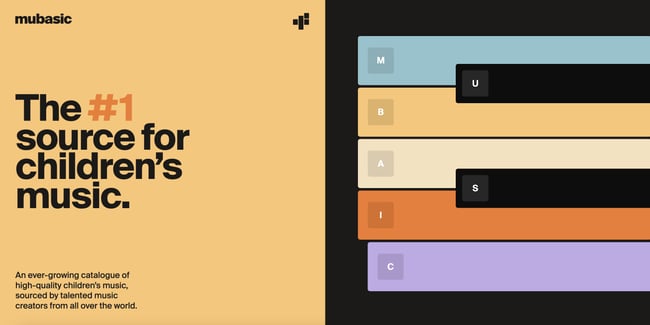
The homepage easily allows you to explore the company’s offerings, and even features a Q&A section set up in a unique format. Images pop up as you scroll down the page, and toward the bottom, there’s the opportunity to get in touch with contact information and a new customer form template.
When you reach the bottom of the home page, there’s a menu that features anchors to allow you to jump to wherever on the page the information you’re seeking lives.
Digital Cover
Award: Website of the Day, July 31, 2022, Awwwards
Everything from the loading screen to the homepage of this France-based digital agency’s website is a visual homerun. When you arrive on this homepage, you’re immediately swept into the world of Digital Cover. This is achieved by a graphic that appears nearly three-dimensional popping up and welcoming you into the company’s orbit.
Similar to the previous site, the animated nature of Digital Cover’s homepage adds intrigue and establishes this site as a candidate for best website design. With a simple swipe of a mouse pad you’re led to the company’s projects, or you can navigate to the clearly labeled menu in the top left corner. When you do, several options pop up.
From there, you are escorted to the page of your selection. The white lettering against the black background allows for the copy to pop. If you scroll to the bottom of any menu page, you’ll find contact information to get in touch with the agency, which is another strength of the design’s.
Best Website Designs from 2021
IBM’s The Harmonic State
Award: Site of the Month (July 2021), Awwwards
When you land on this IBM web page, it’s clear to see why the design won an award.
The best way to describe the website is as an immersive experience. In fact, IBM uses both visual and auditory elements to draw the visitor in and keep them engaged.
When you first land on the web page, you’re prompted to put on headphones to get the full experience. Even if you skip this step, you’re drawn in by the interactive background that reacts as your mouse navigates on the page.
In addition, the page is well balanced with a large title that grabs your attention across from a small description with a bold blue CTA.
With a topic as complex as AI, IBM then uses visual storytelling to explain how its Watson tool works in the real world. Visitors can explore three stories through video game-like functions and learn more about the tool.
It’s a fun and effective way to get users engaged in a topic that can be complicated and dry.
Looking for more corporate website examples? Check out 25 Stunning Corporate Websites to Inspire Yours.
Superlist
Award: Site of the Month (April 2021), Awwwards
Superlist is a productivity app that helps teams and individuals change the way they work.
Too often, you land on a website and have to figure out what the brand is about. With Superlist, you know exactly what to expect as soon as you get to the homepage.

The interactive homepage shows common work accessories, like headphones and keyboard with clear, to-the-point copy.
Superlist effectively uses white space to keep the focus on its copy. However, to facilitate navigation, they include a small button with an arrow icon to indicate that there’s more to see on the page once you scroll.
From there, the fun visuals continue – keeping you engaged as you learn more about the brand.
Best Website Designs from 2020
Swab the World
Award: Site of the Day (2020), Awwwards
Parallax, bold colors, and negative space shape the design and experience of Swab the World’s website. The organization brings awareness to stem cell donations. Their mission is to “Make sure every single patient finds their match. Period.” Photos of couples exhibiting love and emotions bring a human element to a historically complex and scientific process.
From a technical perspective, the design makes moving down the page feel natural, ensuring the readers reach each point of copy and every CTA on the homepage.
Newest Americans
Award: Honorable Mention (2020), Awwwards
An organization with a responsibility as large as honoring past, present, and future migrating identities needs a beautiful and functional website to help spread the word. Newest Americans champion immigrant experiences in cities across the state of New Jersey. The website uses beautiful imagery of people, places, and items that represent this experience in a way that flows cohesively down the homepage, telling the story of this group of America’s newest citizens.
The website is both visually appealing and functional with a simple navigation menu, stories organized by photos, and a clean press page that puts the most recent articles front and center.
Spotify Design
Award: Honorable Mention (2020), Awwwards
Spotify is known for its fair share of amazing feats, and its latest iteration of Spotify.Design is no different. Serving as the hub for all things visual and creative for Spotify, the music and podcast streaming giant gives listeners a look into the who, what, why, and how of what makes the app so sensational.
Bright colors, drop shadows, and smooth animations give this website character and depth. The flat geometric designs with abstract accents make albums and artists practically jump off of the screen.

Looking for more design inspiration from microsites like this one? Read our post of the Best Microsite Examples We’ve Ever Seen.
Andy Warhol
Award: Honorable Mention (2020), Awwwards
Artist, film director, and producer Andy Warhol’s life is encapsulated in this splendidly designed website that captures his art style in a digital format. As you peruse the page, your cursor becomes a spotlight that converts every image you hover over into a negative image or inverses the colors of the text you’re reading.
The big, bold text makes a statement and emphasizes just how important copy is to website design. Subtle animations help pace the site and set the tone for each section as you peruse the home page.
Human Interaction Company
Award: Corporate Website (2020), Red Dot
To see video done right, look no further than the Human Interaction Company. From the moment you click on the site, the experience is lightning fast. You’re dropped directly into the action — the why, what, and how of Human Interaction and exactly what the team does.
This Red Dot Design Award winner aims to bring the study of human interaction to the masses, and in the process, show us just how engaging it can be to learn about it. Don’t get discouraged by their award status though — none of the photos on this site are photoshopped, so it’s a practical example of building quality with the resources you have available.
Garoa Skincare
Award: Site of the Day (2020), Awwwards
How do you transform the feeling of luxury and practicality into a website? Garoa Skincare provides a blueprint. Whether your product costs half the price of your closest competitor or twice the price, your site can bring a sense of extravagance to just about any product you sell.
High-quality visuals, typefaces that complement each other, and a balance of negative space with useful copy can bring a simplistic elegance to your website.
Best Website Designs from 2019
1917: In the Trenches
Award: Awwwards’ Best Website of the Day (2019)
This website, made to promote the film 1917, lets you walk around the trenches and perform the same mission that the characters did in the film. You can also see their maps or access other tools.
This is a great example of a site that went above and beyond with interactivity as well as a site that leverages its content and prewritten storyline to market its film. This website won Site of the Day by Awwwards, which allows designers to vote and nominate great websites they see daily.

Image Source
The Octopus: A design blog by IDEO
Award: Business Blog/Website 2019 Webby award
IDEO, a global design company, won the Business Blog/Website 2019 Webby award for its Octopus blog, and for good reason. The blog features a sleek, black-and-white Octopus drawing as its homepage design, and uses yellow, black, and white to create a cohesive theme as you scroll.
If you hover over a blog post, the title is highlighted in yellow. If you hover over an image, the image is pulled towards you — two small features that make a big difference in terms of creating a unique and engaging user experience.
Nomadic Tribe
Award: Awwwards’ Site of the Year nomination (2019)
This site, which was nominated for Awwards’ Site of the Year, is one of the more engaging sites I’ve seen.
The homepage immediately begins playing a stunning video featuring a man walking across a desert, followed by gorgeous landscape scenes and text like, “Are you lucky enough to call yourself an adventurer?”
The text throughout the website is playful, with colorful pinks and oranges and yellows, and the homepage is logically designed, with CTAs placed throughout that range in commitment-level from “Read More” to “Watch Now” and, finally, “Download the App”.
Ultimately, the website is beautifully designed with strong attention to detail, and tells a compelling story throughout.

Image Source
Diana Danieli
Award: Webby 2019
This 2019 Webby-winning site shows off imagery of art and architecture with either high contrast or heavy exposure. As a website visitor, you can click and drag your mouse to change the photos and variations. Each image shows a piece of work that highlights the artist who owns the website.
A cool plus about this website is its incorporation of audio and music. Clicking on certain buttons on the screenplays a piano note and truly immerses you in the Diana Danieli experience.
Want to see more personal websites? Check out our post on the Best Personal Websites.
George Nakashima Woodworkers
Award: Webby 2019
This woodworking website emphasizes nature and care for the woodworking trade. It’s essentially a slideshow of beautiful forestry and farming images. As a new image comes on the screen, a new quote related to wood or trees also appears.
This is incredibly relaxing to the visitor and shows that the woodworkers recognize the beauty of trees and the environment. This website also won a Webbie in 2019.

Best Website Designs from 2018
crypton.trading
Award: Site of the Day (4/3/2018), Awwwards
Meet crypton.trading, your robot accountant.
Crypton.trading is a trading hub for cryptocurrencies such as Bitcoin, using artificial intelligence to predict changes in a currency’s value and identify key buying and selling opportunities. The website was rated high for its development and design, as it gradually explains more of the developer’s methods the further down visitors scroll.
This website makes tech-savvy visitors feel right at home the moment Crypton’s greeting appears across the homepage, one letter at a time.
 Image Source
Southwest: Heart of Travel
Award: Best Visual Design – Aesthetic, 2018 Webby Awards
When Southwest Airlines wanted to prove that its customers were “more than just a dollar sign,” the company created a website where the design was assembled using the shapes of their customers’ flight paths.
The website, called Heart of Travel, even allows visitors to create their own artwork out of a trip they might plan on taking. In this way, Southwest’s website is a product of their most loyal passengers.
 Image Source
Overflow
Award: Site of the Day (3/20/2018), Best Website Gallery
Overflow is a design tool that allows people and businesses to create story-like flow diagrams of their ideas so they’re easier for others to understand. Aside from this being just a good service, the Overflow website practices what it preaches: Along with vibrant red call-to-action buttons for downloading the tool, this website promotes its product the best way it knows how — using a flow diagram.
The website delivers this flow diagram in the form of a video. While embedded videos can look clunky sitting in the middle of a website’s other design elements, Overflow’s is perfectly placed and exactly what you’d want to see when landing on the site for the first time.
Check out our SaaS web design post for more inspiration.
Frans Hals Museum
Award: Site of the Year (2018), Awwwards
It can be tough for a museum to present all of its artwork together on a cohesive website. That’s what makes the website of the Frans Hals Museum so impressive.
Located in the Netherlands, this museum has created a website that uses a combination of digital design elements and its own exhibits. This mixture helps visitors understand what they’ll see, when they can see it, and where else they can get a taste of what this museum has to offer.
Best Website Designs from 2017
Simply Chocolate
Award: Site of the Year (2017), Awwwards
You’ll get a craving for chocolate just looking at this website — and in a way, that’s Simply Chocolate‘s website working as designed.
This appetizing website is that of a Denmark chocolate maker Simply Chocolate. Its website uses a variety of colors (and creative product names) to promote each chocolate bar. And as you scroll from one product to the next, they all seem to remain consistent in brand.
The three-dimensional appearance of each chocolate bar makes you feel like you can grab it off of your computer screen, while the “Add to Box” CTA to the top-left is ideally placed for users to select the products they want while browsing.
NOWNESS
Award: Best Cultural Blog/Website, 2017 Webby Awards
NOWNESS is perhaps the coolest crowdsourced video blog on the internet. That was a mouthful…what does it all mean?
NOWNESS‘ crowdsourcing is part of what makes it an award-winner. This means most of its content comes from independent creatives — an increasingly popular way for businesses to publish content.
NOWNESS is also a video channel, meaning all of its blog content is in video format. Together, these qualities help make Nowness a captivating hub for the stories that brands everywhere strive to tell.
 Image Source
Best Website Designs from 2016
Rainforest Guardians
Award: Best Activism Website, 2016 Webby Awards
Rainforest Guardians was one of the most immersive nonprofit websites of 2016. Seeking to build awareness around deforestation, the site allows users to “visit” the various villages, natives, and waterways that make up the Amazon Rainforest.
The site puts interactivity at the center of its user experience — a wise choice if your goal is to get people to connect with your cause and convert into volunteers.
Protest Sportswear
Award: Site of the Year (2016), Awwwards
The Awwwards calls Protest Sportswear a “shoppable lookbook,” and that’s exactly what this site is. As a clothing outfitter, this company has reinvented the way they market its product: Rather than promoting garments of clothing, Protest Sportswear promotes “looks.”
This makes the company’s product the most appealing part of the website itself, using a collage of styles to design a homepage that changes as often as its customer’s styles do.
The Teacher’s Guild
Award: Best Association Website, 2016 Webby Awards
The Teacher’s Guild is a professional community of educators that addresses some of the most critical challenges in education. What makes this website award-winning is how it balances diverse content types — programs, solutions, approaches, and collaborations — without overwhelming visitors.
Not only are the background visuals prominently placed, but they also use white space to emphasize the written calls to action at the center, as shown in the screenshot below.
Best Website Designs from 2015 – 2014
Virgin America
Award: Most Significant Industry Evolution, 2014 UX Awards
In a world where airline websites are known to be riddled with major usability issues, Virgin America has one of the best websites that pushes usability, accessibility, and responsive design forward.
 Image Source
Feed
Award: Site of the Day (6/6/2015), Awwwards
Not only is Feed an interesting concept, but it also has a stunning execution that challenges our understanding of what is possible on the web. Through a creative blend of animation and video, the site immerses users in an engaging experience.
As an atypical site, it contains several unique usability elements, including navigation that doubles as a scroll progress bar.
 Image Source
ETQ
Award: Site of the Day (5/19/2015), Awwwards
ETQ takes a minimalist approach to ecommerce. Big, compelling visuals of their product lay against simple, flat backgrounds accompanied by strong typography that keeps the focus on exactly what the user came there to see: shoes.
Looking for more ecommerce website inspiration? Read our post of the Best Ecommerce Website Design Examples to Get Inspired.
Mikiya Kobayashi
Award: Site of the Day (7/4/2015), Awwwards
Mikiya is a Product Designer with a minimalistic portfolio that showcases his work through strong photography and subtle animations. His full site was originally created in Japanese and then translated into English, helping demonstrate the international scalability of his design.

Woven Magazine
Award: Site of the Day (4/4/2015), Best Website Gallery
Woven is an online publication that celebrates artists, crafters, and creators alike. Its website confirms that publications can (and should) have beautiful, engaging visuals with easy-to-read content. Free of distractions like pop-ups and intrusive ads, this site is all about the experience of the content itself.
JOHO’s Bean
Award: FWA of the Day (8/7/2015), Favorite Website Awards
The website for JOHO’s Bean has incredible imagery, interactivity, storytelling, visual design, and most of all, sound engineering. These all come together to create a compelling, emotional, and engaging site that tells the story of a coffee bean’s journey.
 Image Source
World of SWISS
Award: Best User Interface, 2015 Webby Awards
Another airline? Yep. SWISS airlines built an incredibly immersive site that tells the story of what it’s like to fly with them — and they did too great of a job to be ignored. Strong visuals and animations introduce the user to different sections of the site that are packed with information beyond the usual sales and marketing pitch.
 Image Source
Other Cool Website Designs
Guillaume Tomasi
As a Photographer in Montreal, Guillaume Tomasi has built a portfolio that’s truly fit to house his unique and awe-inspiring photography. His surreal photo style is juxtaposed by his simple, flat, empty, and minimalistic portfolio design that places all of the focus on the work itself.
His unique series navigation coupled with art-gallery-inspired work introductions and perfect scrolling interactions yield an experience reminiscent of that of a real gallery.
Image Source
The District
This branding agency takes its imagery seriously, and it should — it handles all channels of media for its clients. The District’s website alone is a journey through some of the most beautiful artwork and photography you’ve ever seen.
These provocative tiles change rapidly as you explore the website, and the wackier they seem, the more interested you become in learning about their past work.
Image Source
Tej Chauhan
Tej Chauhan has turned impressionist artwork into a business model with this intriguing website. Each image on this product developer’s homepage slides out to cover the previous image, offering little context around the object you now see in front of you. But it’s that lack of context that makes you want to learn more.
Plus, the tagline, “Souvenirs of The Near Future,” suggests these objects are a part of their product line — and an opportunity for you to bring these innovative objects into your life.

Image Source
Want a similar look for your website? Check out the new CMS Hub theme collection on the Envato marketplace.
Amanda Martocchio Architecture
An architecture firm might not specialize in web development, but its website should still demonstrate its commitment to visually pleasing design. Amanda Martocchio took that to heart with this gorgeous website.
It’s no secret that Amanda Martocchio Architecture loves its work — each picture on the homepage of its website is an enchanting shot of the houses the company designs. The website labels every house you scroll through with the type of design that was intended, along with numerous angles to each building.

Where to Get Your Design Inspiration
If you want some design inspo, the good news is that you can find it just about everywhere.
One of the best ways to get inspiration for design is through travel. When you visit new places, you’re forced to get out of your comfort zone and experience something foreign.
What makes design so interesting is that everyone sees it differently and so, there’s always more to discover.
Another way to get design inspiration IRL is through the media. Every day, we are inundated with visual content. We make decisions about what we like, what we don’t like, and continue on our day.
But what if you were more intentional about how you viewed those interactions? You could come out of it with valuable insights.
You also can’t forget to leverage design communities. From design conferences to Reddit forums, there are hundreds of groups out there that can offer inspiration as well as advice.
Now that we’ve covered some IRL design inspiration sources, let’s cover the digital ones.
Website Design Inspiration Sources
1. HubSpot’s Website Themes & Templates Marketplace
HubSpot’s Website Themes & Templates Marketplace (previously HubSpot Asset Marketplace) houses hundreds of website templates that you can sift through to get inspired for your own website.
The best part of the marketplace is that you can narrow down by industry and feature, allowing you to see the templates that are most relevant.
Once you find a template you like, you can view a live preview of the site to get a full experience then download it if you decide to use it.
2. Dribble
Dribble is where designers go to get inspired and to share their work. The website has everything from animation and branding to illustration and mobile.
Once you navigate to the “Web Design” tab on the homepage, you can filter results by color scheme, editing software, timeframe, and tags.
Furthermore, if you find a designer whose work you like, you can save the design for future reference and follow their work to see other designs on their profile.
This is an incredible resource to use whether you’re starting from scratch or already have a solid plan in mind.
3. Bēhance
This is another digital platform full of creative inspiration to leverage ahead of your website design project.
One of the best features on this site is the ability to filter by location. This allows you to see how designers in different regions differ in technique and style.
This can be particularly helpful if you are designing a website for a foreign, unfamiliar market. You can gain interesting insights by evaluating the decisions made by Behance designers.
4. Pttrns
Want to focus on mobile web design? Pttrns is the place to go.
This subscription-based platform allows you to gain access to thousands of mobile design templates and get advice from top designers all over the world.
Additional features on this platform include:
- A favorites and collections folder to store your favorite designs.
- A studio to interact with other designers and get advice.
- A design guide to understand the strategy behind the designs.
Website Design Ideas
Now that you’ve seen a number of beautifully designed and award-winning platforms, keep these potential ideas in mind as you create your own. Here are a few suggestions we have to help you can create a site that could appear on our best website design inspiration list.
- Consider ways that you can make your website interactive, like the 1917 example.
- Make a website that emphasizes the mobile experience, even while it still has a good UX on desktops.
- Create a website that tells a story about your brand with photos, text, or video.
- If you can’t create a heavily interactive site, consider drawing in eyes with a site that presents a slideshow of your photos.
- Ensure your call-to-actions are easy to see and encourage visitors to continue exploring your site
- Keep navigation clean. Ensure your visitors always know how to get back to the homepage.
- Integrate your social media sites via social embed buttons, so site visitors can easily follow you on your various social channels.
- Keep each of your web pages consistent in design — including font, colors, images, and messaging.
- Test your website’s usability with a heat map, which will show you on which web pages your visitors are most likely to bounce.
- Include a live chat or chatbot to give visitors the option to engage with you directly on your website if they prefer live chat to phone calls. Live chat can automate functions for your sales and service reps and create a better communication experience for the customer.
- Get an SSL certificate to ensure your website is secure. SSL is part of Google’s search ranking algorithm, so an SSL certificate can help you rank higher in search.
Build a Beautiful Website for your Business
Now that you’ve perused our best website design inspiration, it’s time to get started creating your own site. You’d be surprised how easy designing a site is once you have a look and feel in mind.
Once you’re ready to start coding or dragging and dropping, you’ll have a beautiful website that your visitors will enjoy.
Editor’s note: This post was originally published in January 2021 and has been updated for comprehensiveness.

12 of the Best WordPress Popup Plugins in 2023
Despite their overwhelmingly bad reputation, popups are a useful tool, but high conversion potential is not worth sacrificing user experience. Luckily, with the right WordPress popup plugins, you can leverage the high-conversion potential of popups without driving users away.)
Before diving into the tools, let’s look at the features to determine if a plugin suits your needs.
What to look for in a WordPress Popup Plugin
Popup plugins offer many features — from customization to screen display locations and built-in analytics — but the most important features to watch out for are targeting and trigger options.
Targeting refers to where the popup will appear on your website and who it will be shown to. Popular ways to target users with popups include page-level targeting, geolocation, device, and traffic source.
Triggers are actions that a user needs to take for the popup to appear. Popular trigger options include page entrance, scroll depth, clicks, time on page, and exit intent.
Having a few popup forms on your WordPress website could boost your lead capturing game. A quick Google search shows that there are many tools to choose from. To help you sort through the clutter and find a tool that moves the needle for your team, we’ll take a look at 12 WordPress popup plugins you should consider below.
Best WordPress Popup Plugins
- HubSpot WordPress Plugin
- OptinMonster
- Elementor Popups
- Sumo List Builder
- PopUp Domination
- MailOptin
- Ninja Popups
- Icegram
- Popup Maker
- Bloom Email Opt-Ins
- Popup Builder
- Poptin
1. HubSpot WordPress Plugin
HubSpot’s plugin allows you to connect your WordPress website to your HubSpot account for seamless integration. Any changes made to your popups in your HubSpot portal will be automatically reflected on your WordPress website without any extra work on your part.

HubSpot’s popup tool is highly intuitive and easy to use. You are first prompted to select the type of popup you want (box, banner, or slide-in) and then taken to the customizer where you can edit the text, add an image and relevant form fields, and even design your own thank-you message at the end.
Every contact you capture is automatically added to your free HubSpot CRM account. You can also target users by simply typing in the URL of the page(s) you want your popup to show up on and choose whether you want it to be triggered by a 50% page scroll, exit intent, or time elapsed. And if users decide to dismiss your popup, you can choose when they will be exposed to it again.
All the features in this tool are free.
What We Like: Other than the obvious reason being that this is our plugin, we love it for all it offers for free. This is an all-in-one plugin that handles everything you need on WordPress. With popups, you can create or manage your pre-existing popups with little to no hassle.
2. OptinMonster
OptinMonster was one of the firsts to popularize the use of popup forms in the marketing space. Its drag-and-drop feature makes it highly easy to use. You can choose from a variety of pre-built templates or create your own popup from scratch. Their Canvas feature allows you to create any type of popup (not just forms!) with the use of custom HTML/CSS and WordPress shortcodes.
Small Success is another unique feature that lets you display different offers to people who have already converted on one of your popups so you won’t annoy your visitors by showing them forms they’ve already signed up for. You gain access to plenty of triggers, such as exit intent, time on page, user inactivity, clicks, as well as many advanced targeting options like new vs returning visitor, cookie, geolocation, device, adblock usage, and more.
The main drawback with this plugin is that there is no free version. Plans start at $9/month, but you will need to upgrade to a higher tier for the more advanced features like A/B testing and exit intent.
What We Like: This is the best option for easy customizability. You have drag-and-drop for design, different templates to work off of, or even the ability to design from scratch. You’ll easily be able to with any type of popup you want to make with this plugin.
3. Elementor Popups
Design stunning popups with the popular page builder plugin Elementor and their Popup Builder feature. Elementor Popups uses the same interface as the page builder, allowing you to apply the same widgets and styling options to your popups, like buttons, countdown timers, email opt-in forms, and more. Similarly to many of the other plugins, this one offers a variety of popup forms like fly-ins and full-screen overlays.
With more than 100 beautiful templates to choose from, this popup builder lets you create WordPress specific page targeting options (categories, tags, post formats, etc.) with several triggers to choose from, such as click, time, scroll, inactivity, and exit intent.

This plugin does not come with built-in analytics or A/B split testing. And while the Elementor page builder plugin is free to use, this popup builder is only available when you purchase the pro version, which costs $49 for one website, and up to $199 for unlimited sites.
What We Like: Elementor’s popup plugin is a great choice for premium designers. You won’t need any coding experience to create stunning popups for your users. This is another all-in-one plugin that helps you build
4. Sumo List Builder
Sumo is more than just a popup form builder. On top of growing your email list, this plugin also helps with your social media, link building, and site analytics. The app has a module called List Builder, which allows you to create popups. You can set you popups to show up according to traffic source or different triggers such as clicks, time on page, exit intent and scroll depth.
Though this plugin comes with a free version, only one template is available in the free tier and you’ll need to upgrade to remove the Sumo branding. Premium plans start at $29/month, which puts Sumo on the more expensive side compared to other popup plugins.
What We Like: This plugin is great for building your email list. You have an intuitive integration with email and e-commerce, making this the perfect plugin for anyone looking to grow their business through email marketing.
5. PopUp Domination
PopUp Domination is one of the oldest popup tools out there. However, this hasn’t stopped them from making the right updates to stay competitive on the market. Its visual interface still makes it fairly easy to customize one of the 100+ pre-built templates available.
This plugin lets you show your popup to different users based on time on page, user inactivity, exit intent, clicks, total time on website, and mouse hover. On top of page-level targeting, more advanced targeting options include geolocation, traffic source, and device.

PopUp Domination has a royalty rate pricing structure. Each tier grants you access to all the features: unlimited domains and popups, A/B testing, live chat support, and more. Instead of being charged to have access to more features, you’re charged based on the number of total views your popups get across all of your websites.
If you want to use your popups on many websites that have low traffic, PopUp Domination might be a good solution. However, this may not be the best option for you if you have very few sites with high traffic volumes.
What We Like: This plugin is great for beginners since you will have many resources to help you use the tool and a relatively low price for getting started. Once your website starts getting more subscribers, however, you might want to look toward pivoting toward a more price-friendly option for your popup ads.
6. MailOptin
MailOptin is a fast-growing popup plugin for WordPress. It converts your website visitors into email subscribers using different types of opt-in forms including popups, notification bars, inline or embedded forms, scroll boxes, slide-ins, sidebar forms etc.
It is intuitive and easy to you in part because it uses the WordPress Customizer that you already know and love. It ships with a ton of professionally designed and mobile responsive templates to choose from.

It includes a number of display triggers such as page-level targeting, exit intent, time on site, pageviews, scroll trigger, adblock and referral detection, device targeting, new versus returning visitors etc. And integrates with all major email marketing providers and CRMs including Hubspot.
MailOptin is freemium. You can try out the plugin for free by downloading the lite version on WordPress.org repository or purchase a premium license to unlock more powerful features and top-notch customer support.
What We Like: This popup plugin integrates well with WordPress since you work directly through WordPress customizer. This can be great for people familiar with WordPress and just want something that works.
7. Ninja Popups
Ninja Popups is one of CodeCanyon’s top selling plugins. For $24, you gain access to their drag-and-drop popup builder with over 70 templates and animation effects to choose from.
And if you want more than just forms, Ninja Popups lets you create all kinds of popups, such as video displays and social sharing boxes. Its anti-adblocker technology lets you show your popups even to visitors who use ad blockers. This plugin also offers page-level targeting, and trigger options include scroll depth, time on page, exit intent, and user inactivity.

Although there is no free version, at only $24, Ninja Popups offers some of the most creative freedom for the price.
What We Like: This plugin is effective and enables your creativity. Bypassing adblockers is especially helpful considering 2 in 5 people use adblock today.
8. Icegram
If you’re looking for a more native option, Icegram lets you create popups right from the WordPress dashboard, thought its text-based interface makes it slightly less user friendly than most. Icegram’s trigger options include time on page, exit intent, user inactivity, clicks, and time delay. Targeting options include page, user retargeting, device, and geolocation.
This plugin offers a fair amount of value for free, but to access more functionalities, you will want to upgrade. Premium plans start at $97/year.
What We Like: This plugin is another great choice for working directly through WordPress. If you can get past the text-based interface, this is a good option for those needing a simple popup ad solution.
9. Popup Maker
Popup Maker offers a lot of flexibility in terms of what you can build. In addition to opt-in forms, you can create cookie notices, video lightboxes, notification boxes, etc.
A big draw of this plugin is its WooCommerce integration, which lets you target users based on their shopping cart items, purchase data, and more. However, this plugin’s lack of a visual editor makes it less friendly to use.
You can use Popup Maker for free, but for more functionality, individual extensions can be purchased starting at $87 per year
What We Like: This plugin lets you tailor your website popup ads to your user. You also have a good set of basic options to work off of as mentioned. Popup Maker is another good choice for those who are familiar with WordPress and just want a simple way to add popups to their page. The extra benefit is being able to work off of consumer data.
10. Bloom Email Opt-Ins
Provided to you by the devs at Elegant Themes (authors of the popular Divi theme), Bloom comes with over 100 templates to customize and lets you create a variety of forms on top of popups, including widgets, inline boxes, and optin lockers which you can use for gated content. Along with basic page targeting, this plugin contains unique trigger options — for example, make a popup appear after a user has left a comment on your page or after a user has made a purchase.
Despite its high-quality templates and beautiful dashboard, Bloom lacks a lot of the advanced features other plugins offer like an exit intent trigger option, and it doesn’t have a visual customizer.
Because this plugin comes from Elegant Theme, you can only access it by purchasing an Elegant Theme subscription, which costs $89/year or $249 for lifetime support and updates. This subscription also gives you access to 87 premium themes and 2 other plugins. But if all you’re looking for is a popup plugin, this may not be worth the investment.
What We Like: Bloom Email Opt-ins is a great choice for people who need more than just a popup plugin. You can fully customize your website through this plugin, and that includes popup ads.
11. Popup Builder
Popup Builder lets you insert any type of content into your popups and create custom animation effects. It offers features like automatic closing, user retargeting, and time delay triggers, as well as integrations with email service providers MailChimp and AWeber.
 While this plugin can be used for free, just like Popup Maker, you will need to purchase extensions for additional functionality. Individual extension prices vary between $5 and $15, but you can get the full bundle starting at $49/month.
What We Like: Popup builder is a good option for those wanting to make mobile-friendly popup ads. Its intuitive user experience lets you build great looking popups in seconds.
12. Poptin
Poptin is a free popup and form builder specially designed for marketers, website owners, and digital agencies. Its powerful conversion optimization features are effective in boosting email signups, reducing cart abandonment, increasing engagement, and improving your overall sales conversion rate. It has a variety of fully responsive and customizable popup and forms templates that you can utilize without the need for coding.
In a matter of minutes, you can create your lightbox popups, full-screen overlays, gamified popups, countdown popups, slide-ins, bars, widgets, email forms, and more. You can add different elements such as images, videos, icons, countdown timer, coupons, and even custom CSS. The best part is that you can Integrate it with HubSpot CRM and emailing software to experience a seamless lead generation funnel. Poptin also offers a wide range of smart triggers and targeting rules to better convert the most qualified leads and customers.
Poptin’s free plan already includes major tools and features like analytics, A/B testing, exit-intent trigger, unlimited popups, and forms, among others. If you want to get access to more advanced features, you can always upgrade to its paid plans which start at only $25 per month.
What We Like: This plugin gives you a lot of bang for your buck. While other plugins on this list charge you for access to analytics, this tool gives you all of that for free. Poptin is best for marketers looking to add popups and dive into the data behind what makes them effective.
Choose whichever plugin fits your needs the best.
There are endless options when it comes to WordPress popup tools.
If you’re looking for a quick and easy way to collect user information and convert leads, check out HubSpot’s free form popup WordPress plugin. Installing the plugin will automatically connect your demand capture tools to the free HubSpot CRM so you can easily create follow-up emails for people who have filled out your form, track their activity on your site, and manage your leads all in one place.


How to Craft a Brand Manifesto [Guide + 10 Examples]
To inspire your audience to be loyal to your brand, you need to have a core message that focuses on your brand’s purpose and shows why your brand is worth following. To do this, you’ll need to craft a brand manifesto that expresses your brand’s values.
A compelling brand manifesto will appeal to your audience’s emotions and show the “why” behind your organization.
But how do you discover the “why” behind your organization? How do you connect with an audience and inspire them to follow you? Here’s what you as a marketer need to know about brand manifestos, how to craft one, and examples of successful brand manifestos.
Why a Brand Manifesto is Important to Your Business
10 of the Best Brand Manifesto Examples
How to Write a Brand Manifesto

What is a brand manifesto?
A brand manifesto describes why your organization exists, its purpose, and why people should care about your brand. It’s typically an emotional story that captivates your audience, emotionally connects with them, and persuades them to support your brand.
Not only can it build a loyal customer base, but it can also attract top talent to your organization.
Why a Brand Manifesto is Important to Your Business
It’s not always enough to have quality products; consumers also care about a brand’s values. According to a 2022 study commissioned by Google Cloud, 82% of shoppers want a brand’s values to align with their own.
Furthermore, 75% of shoppers said they’ve parted ways with a brand over conflicting values.
A manifesto is an opportunity to assure your target audience that your values align with theirs, thus building trust and customer loyalty.
10 of the Best Brand Manifesto Examples
To give you some inspiration for your own brand manifesto, here are some examples to consider.
1. Poseidon Dive Systems

Poseidon Dive System’s manifesto appeals to its audience thirst for curiosity, freedom, and adventure.
Essentially, the company’s manifesto gives the impression that its products are designed to help consumers on their journey to explore and deeper understand the ocean.
What We Like: The manifesto uses descriptive language like “beneath the sea” and “incredible creatures” to paint the picture of an underwater world worth exploring.
In doing so, the brand describes an enticing world and tells its audience that it’s products can take them there.
2. Under Armour

Sportswear company Under Armour’s manifesto speaks to the competitiveness of athletes or anyone on their fitness journey. However, instead of insinuating its audience competes against others, the manifesto explains the brand’s goal is to help consumers compete against themselves.
The idea is to help consumers push their own limits and become the best version of themselves.
What We Like: The manifesto adds context to Under Armour’s simple motto — overachieve.
3. Nespresso

Nespresso’s manifesto makes its clear the brand believes everyone, regardless of status, should be able to enjoy premium coffee. The manifesto includes all the right words to set the tone for the brand — “premium,” “fancy,” and “luxury.”
However, the brand quickly establishes you don’t need to break out your best suit and tie or be a coffee connoisseur to enjoy its product.
What We Like: The manifesto gives the impression that Nespresso products are luxurious yet affordable and makes Nespresso’s values clear — the company isn’t elitist. It believes everyone should have access to superb coffee.
4. Moleskine

Moleskine’s manifesto captures the beauty and art of writing with phrases like “the solemn, thoughtful, and meditative gesture of the pen gelding across a blank page.”
Whether journaling, note-taking, or outlining — writing is a personal and artistic expression.
Highlighting this in its manifesto shows Moleskine is in tune with its audience.What
What We Like: Moleskine’s manifesto shows brand consistency. The company manufactures paper and writing products, and its manifesto reflects both its products and its consumers values.
5. KIA

KIA’s manifesto doesn’t include much vivid imagery, but it lays out in plain language the company’s goal. KIA’s purpose is to deliver innovative products that are convenient and respects its consumers most valuable resource — their time.
What We Like: If you’re not one for flowery writing and overly descriptive language, this manifesto shows it’s possible to clarify your values with simple prose.
6. Nike

Even though Nike endorses some of the biggest names in sports, like LeBron James, Cristiano Ronaldo, and Serena Williams, it never boasts about how the best athletes in the world use its equipment.
Instead, Nike sticks to what has skyrocketed the brand to the top of the sports equipment industry — emotional resonance.
Nike wants people to understand that success doesn’t mean becoming the greatest of all time. It means you did everything possible to become the best possible version of yourself.
What We Like: Nike’s manifesto perfectly expresses the “why” behind its brand — to empower every athlete, regardless of their talent or ability, to reach their potential and achieve their greatness.
7. Fiat

Fiat isn’t just selling a sleek, Italian car. It’s selling a lifestyle. In its brand manifesto, you get a glimpse of the life it wants to offer customers — a life they can live with burning passion and thrilling excitement.
However, Fiat doesn’t want its customers to live recklessly. It wants them to treasure the little things in life just as much as the big things.
So the “why” behind Fiat’s brand isn’t really changing its customers’ lifestyle — it’s changing their attitude toward life. And that’s a compelling mission to have.
What We Like: The manifesto appeals to an emotion — love. The words “love” and “passion” are used multiple times throughout its manifesto.
8. The North Face

Most travel equipment brands focus on how its products can enable you to travel and explore your surroundings, which is engaging on the surface. But, in The North Face’s brand manifesto, it goes another layer deeper by diving into why we explore.
What We Like: By describing how exploring helps us understand ourselves better, The North Face’s purpose is crystal clear — it not only want to help us explore more and help us change for the better, lead more fulfilling lives, and cherish what we have.
9. Apple
Steve Jobs’ bitter disdain for the status quo compelled him to shatter conventional wisdom whenever he could, driving such a significant wedge between him and his colleagues that they forced him out of the company he founded.
Despite all his controversy, though, Steve Jobs’ ability to think differently fueled Apple’s innovation and transformed it into the most valuable brand in the world.
Steve Jobs’ story is the driving force behind Apple’s purpose. If Apple can inspire people to think differently and challenge the status quo, it can help propel society forward and change the world — just like he did.
What We Like: Apple’s manifesto tells a story of misfits and the hurdles they have to overcome due to their differences. Storytelling is an excellent way to appeal to emotion.
10. Levi’s

No one wants to coast through life. But, often, we drift away — and we don’t even notice it happening.
To help catch yourself settling in life before it’s too late, Levi’s crafted a brand manifesto overflowing with so much purpose that it could convince Eeoyre from Winnie-the-Pooh to make his mark on the world.
Levi’s manifesto encourages its audience to make the world a better better place and says all they need is their gut instinct and the clothes on their back to make that impact.
What We Like: Levi’s conveys a brand purpose almost anyone would passionately follow for the rest of their lives — don’t ever settle.
How to Write a Brand Manifesto
- Identify your organization’s “why.”
- Write in second or third-person to place your audience into your story.
- Describe how your brand’s purpose will improve people’s lives.
1. Identify your organization’s “why.”
Your brand’s purpose drives your entire brand manifesto. Without a clear and convincing purpose, your manifesto will seem like an inauthentic, emotionally manipulative sales pitch.
Your audience wants to know why they should care about you — and your product’s “best-in-class” features have never been a compelling enough reason to support a business.
To uncover your organization’s “why,” ask your founders why they started the company. What problem were they trying to solve? Why did it bug them so much? And why do they want to keep growing the company?
You’ll most likely find your organization’s purpose within those answers.
2. Write in second or third-person to place your audience into your story.
In each of the brand manifestos above, you’ll notice that the copy pulls you in by including the words “we” or “people.” That’s because Nike, Fiat, and The North Face all know audiences primarily cares about how the brands can help them.
Using pronouns like “you,” “we,” and “them” (when referring to a customer base) can engage people on a personal level and place them in the narrative the brands are crafting.
3. Describe how your brand’s purpose will improve people’s lives.
Most people aspire to transcend their current identities and lives. Self-actualization is a universal goal that almost everyone wants to achieve. And the smartest brand marketers understand this about the human condition.
For instance, did you notice how each of the brand manifestos above is a life mantra that can improve your life? Nike — define and meet your greatness. Fiat — enjoy life to the fullest. The North Face — never stop exploring. Apple — think differently and challenge the status quo. Levi’s — don’t ever settle in life.
By describing each brand’s purpose in a genuinely selfless fashion, each company’s brand manifesto can prompt audiences to imagine a future with the brand’s product or service bettering their lives.
Start with ‘Why.’
Your brand’s purpose is one of the most challenging things to pinpoint and communicate. But if you want to craft a compelling brand manifesto that will engage an audience and persuade them to support your brand, you must be able to convey the reason you exist and why anyone should care.
Only then will you be able to build the loyal following that every brand craves.

How Benefit Segmentation Will Take Your Marketing Campaigns to the Next Level
If you’re a fan of HubSpot’s Inbound Marketing Methodology, you probably understand the importance of customer success. In fact, 70% of businesses with growing revenue prioritize customer success as “very important.” So, if you want your business to succeed you must make sure your customers do, too.
By doing so, you can stack the odds in your favor, ensuring the leads you’re passing to your sales team are a good fit for your business through benefit segmentation. In this post, we’ll go over what benefit segmentation is, why you should use it, and where it can be seen in the real world.

How does benefit segmentation work?
Since different customers will seek different benefits from your product, marketers need to put them in designated categories. To start, marketers list all of the benefits a customer may receive from using the product. This could be something like specific features, product quality, price, or top-tier customer support. From there, they can categorize customers based on the values and benefits they seek, with customers able to be placed into multiple categories.
Segmentation can also be based on other criteria, like customer behavior or demographics.. For example, you may put those who are brand loyal in one category, and who are more price-conscious in another.
Why should you do benefit segmentation?
Benefit segmentation will help you gain a better understanding of the different needs of your customer base in addition to the following:
1. Benefit segmentation makes it easier for sales reps to convert leads into customers.
That’s because your marketing campaigns will attract customers who are better suited for your product or service. Since the campaigns are targeted to the people who need your business the most, your sales team should have an easier time closing deals.
2. Marketers and salespeople can use benefit segmentation to engage customers.
By identifying the key value that your business provides, your team will create more compelling marketing campaigns and sales pitches. They’ll know exactly how to differentiate your product or service to make it attractive to your target audience.
3. Benefit segmentation improves customer retention.
Converting leads that are a good fit for your organization will decrease your churn rate over time. Customers will be happy your product or service is fulfilling their needs and will be less likely to shop with your competitors.
Now that we understand what benefit segmentation is and why you should use it, let’s take a look at some real examples where this marketing technique helped businesses attract and close leads.
4. Benefit Segmentation aids brand positioning.
With the data benefit segmentation provides, marketers can use this information to their advantage when it comes to brand positioning. Once each customer segment is identified with corresponding benefits, marketers can create a brand position that aligns with the data findings. Benefit segmentation can also help you identify gaps in what your product offers vs. what customers want, which can serve as an impetus for creating new products.
Benefit Segmentation Examples
1. Samsung

The cell phone has become one of the most fundamental products of modern technology. Almost everyone has a cell phone to get them through their day-to-day tasks. But, depending on who you are, how old you are, and where you’re from, your cell phone needs may differ dramatically from the next customer. Most of us need a cell phone, but often for a different reason. So, how do phone companies manage to fulfill these customer needs?
Samsung uses benefit segmentation to personalize ads for different target audiences. In the cell phone industry, age is a major determining factor of customer needs. As customers get older, what they need from their cell phone changes. It goes from fun features like cameras and apps to more practical benefits like battery life and security.
We can see this play out in the two advertisements pictured. The first one is aimed at a youthful audience and inspires them to “Do bigger things.” The phone comes with two cameras and lets the user draw on images using the included stylist.

Compare this to the next ad where Samsung focuses on the practicality of the phone. Its tagline, “Designed for humans,” lets the reader know the phone is user-friendly and easy to set up. The phone is designed for optimal performance so that it never slows down no matter how many apps are running at once. This is particularly useful for an audience that may have a busy professional schedule and is working on multiple tasks at once.
Highlights:
- Samsung used its “Do bigger things” campaign to attract a younger audience by reeling them in with sleek new camera features.
- Conversely, the company was able to attract older users who may not be as tech or gear savvy with the tagline “Designed for humans,” implying the phone is user-friendly for all.
2. Ford

Car companies often use benefit segmentation to position different types of vehicles. For example, we can look at Ford to see the difference in advertisement between its Ford Fusion and F-150 models.
The Ford Fusion is a practical, four-door sedan that’s described as “sophisticated” and “cool.” Ford recognizes that people who are interested in this car will value its style in addition to its performance and price. The company highlights this by using vibrant colors in its advertisement to compliment the car’s eye-popping design.
Now, compare that image to the image of the Ford F-150 below. The F-150 is a work truck designed for people who need a powerful, durable vehicle. Customers who are interested in the F-150 would value the truck’s impressive towing capacity and ability to navigate difficult terrain. That’s why the image below shows the truck towing a large piece of equipment with a tagline of “Built Ford Tough.”

Highlights:
- Ford marketed the Fusion sedan to users who were more interested in having a practical, but stylish car to get around town.
- For the F-150, Ford used it’s “Built Ford Tough” campaign featuring the rugged outdoors to attract buyers looking for a durable, all-terrain truck that could handle the toughest jobs.
3. Airbnb

Airbnb’s market segmentation is interesting because it has to account for two main target audiences: hosts and guests. Not only does the company have to find customers to book the rooms, but they must also attract welcoming hosts with desirable living spaces. This forces Airbnb to perform benefit segmentation to create ads that appeal to both guests and hosts.
In the example above, we can see how Airbnb uses benefit segmentation to attract hosts in New York City. New Yorkers have a lot of pride for their city and value companies sharing that passion. So, Airbnb created these subway ads to educate New Yorkers on why Airbnb is good for local business owners as well as community development.
We can compare that educational message to the inspirational one below. This ad is aimed at potential guests who are planning a future trip but haven’t made concrete travel plans. Airbnb capitalizes on this opportunity by creating a message that embraces uncertainty. Rather than pointing to a specific location, Airbnb makes the destination irrelevant and instead focuses on how the company will help, no matter where you go. This makes Airbnb look more trustworthy to customers who may be nervous about making a major financial decision.

Highlights:
- To attract NYC hosts to use their service, Airbnb embarked on a campaign that tapped into the pride New Yorkers have for their city and local businesses.
- For guests, Airbnb established itself as a trustworthy accommodation option – no matter where they decided to crash – by using the uncertainty of the audience’s destination to its advantage.
4. Nike

Nike offers a wide range of products to a variety of target audiences. It needs to use benefit segmentation to develop different marketing campaigns that appeal to each group of customers. The most notable example we can pull from Nike is its ads featuring tennis superstar, Serena Williams.
These ads are aimed at Nike’s female target audience, particularly at its youthful demographic. Nike understands that these customers value the athletic confidence they experience when wearing Nike products. That’s because Nike’s apparel is not only stylish but designed for elite performance. The company uses the tennis phenom, Serena Williams, as an icon to demonstrate how this added confidence can improve your athletic ability.
Highlights:
- Nike expertly leveraged it’s reputation for creating high-performance gear by using tennis star Serena Williams.
- Additionally, the brand was able to tap into youthful nostalgia and appeal to female buyers by using images of Williams as a youth to inspire their audience to greatness.
5. Hulu
Amidst the “cord-cutting” phenomenon, Hulu has been able to position itself as a viable alternative to cable TV. Hulu’s users value convenience and efficiency and don’t want to spend money paying for television channels they never watch. So, the company has created an ad campaign that explains how Hulu users can save money while maintaining access to their favorite content.
In the ad above, we see how benefit segmentation influenced Hulu’s marketing campaign. For example, the copy highlights how users can view “current episodes” and “hit movies.” Since many cord-cutters worry about losing access to new content, this lets users know that Hulu’s content is updated so they’ll never miss a recent episode. That’s incredibly important for people who follow series like Game of Thrones, where it’s vital to watch the episode as soon as it airs.
Highlights:
- Hulu’s ad campaign assures potential cord-cutters they won’t miss current episodes of their favorite shows.
- Hulu found what was most important to their customers (missing their favorite shows) and then tailored their messaging to address their needs.
The Advantage of Using Benefit Segmentation
With benefit segmentation, you can organize your customers and leads based on the value you provide them. This ensures you’re attracting customers who will develop a strong relationship with your business over time. By pursuing these customers, your organization will improve lead acquisition and ensure customer success.
This article was originally published June 3, 2019 and has been updated for comprehensiveness.

How to Edit a PDF [Easy Guide]
If you regularly send PDF files over the internet, knowing how to edit PDF files quickly will make your life a lot easier.
PDF, short for portable document format, is a type of digital file that allows you to send content that is readable by other users regardless of what software they use to view the file. And in order for PDFs to adapt to various viewing platforms, the file’s text and images can’t easily be modified once packaged into a PDF.
But it’s not impossible.
Whether you use a Mac or Windows computer, there are tools available to you for editing the text and graphics within a document that has already been converted into a PDF. You can even do this online, as well as convert PDFs back into Microsoft Word documents to edit your content in its original, editable format.

Here are a few ways to edit a PDF using Adobe Acrobat, or one of several online editing tools available to you today, on a Mac or Windows computer.
Skip to:
- How to Edit a PDF
- How to Edit a PDF Online
- How to Edit a PDF for Free
- How to Edit a PDF on a Mac
- How to Edit a PDF With Windows
- How to Edit a PDF in Word
Note: These instructions apply to Acrobat X and Acrobat XI, Adobe’s 10th and 11th editions. Earlier Acrobat products require you to select “Edit Text & Images” under the “Tools” option on the far right of your top navigation. See Acrobat’s current editing pane below, with “Edit PDF” on the right:
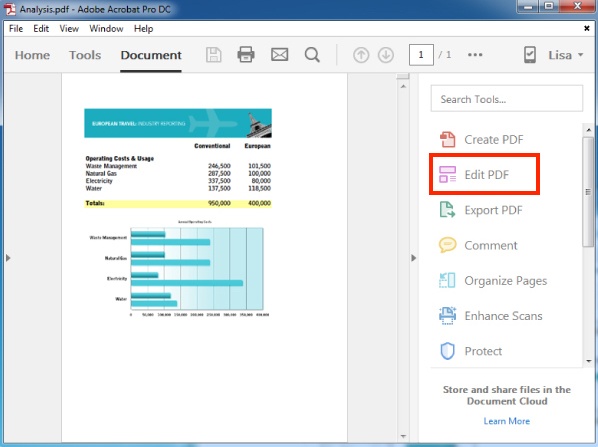
As you can see from the instructions above, you need to install the program, Adobe Acrobat. Don’t worry, it’s compatible with both Mac and Windows computers. However, not every version of Acrobat allows you to edit existing text once you open your document in this program.
Adobe categorizes its software under Acrobat Standard and Acrobat Pro. The company offers the following three editions in both product lines: Acrobat X, Acrobat XI, and Acrobat DC.
According to Adobe, the editions below allow for basic text and content editing, as well as the ability to export your document into Microsoft Word:
- Acrobat XI Standard
- Acrobat Standard DC
- Acrobat XI Pro
- Acrobat Pro DC
Acrobat Pro DC and Acrobat Standard DC offer a host of other editing capabilities that Acrobat XI does not offer — such as automatic spell-check, advanced photo editing, and editing from an iPad.
Although Acrobat is one of the most popular ways to edit PDF files, it’s not the only method. Read on to learn how to edit PDFs using other hardware and software beyond Adobe’s suite of products.
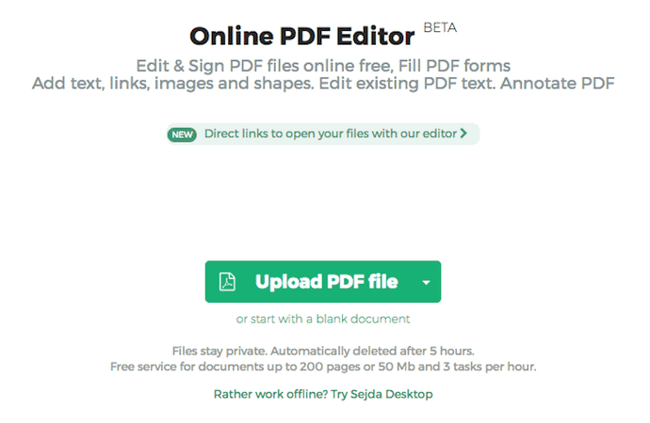
The hassle of needing an expensive program like Adobe to edit such a common file type hasn’t gone unnoticed, and there are numerous online tools you can now use for free to edit your PDF. But that also means there isn’t one universal set of directions to edit on each website available to you.
Step 6 in the above instructions is literally based on a tool called Sejda, one of the few free websites (more on that later) out there that lets you edit existing text — as well as add new content on top of the original.
Another paid tool option is Smallpdf. With this tool, you can add new content as well as save PDFs to platforms like Google Drive, Dropbox, and even Microsoft Word.
Most PDF editing websites equip you with a manual content eraser and new text/image boxes you can drag and drop anywhere on the page.
How to Edit a PDF for Free
Buying software simply for PDF editing may not be practical if you don’t need to use it regularly, so we’ve rounded up a few tools that will allow you to edit PDFs for free.
1. Sejeda
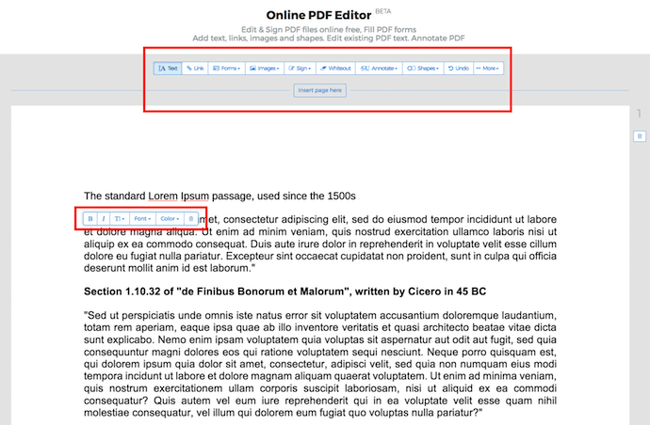
Most other PDF editing websites equip you with just a manual content eraser and new text/image boxes you can drag and drop anywhere on the page.
Sejeda’s online pdf editor lets users fill out PDF forms, edit, and sign PDFs for free. You can even edit existing PDF text. Simply drag and drop them from your desktop or upload them from your computer or Google Docs files.
Sejeda offers encryption for safety and your files are permanently deleted once completed. Should you not want to use their online version, they have a desktop option.
2. PDFescape
PDFescape lets you add new content and start a new PDF from scratch. Edit PDFs, add annotations, create and edit basic forms, and share documents in one simple tool. You can even set up password-protected documents to limit who has access.
Like Sejeda, PDF escape also has a desktop version if you’d rather not edit online.
3. FormSwift
In addition to PDF editing, FormSwift allows users to edit Word documents and images. If you choose, you can also convert your PDF to a word document. Have a paper document you’d like to convert? They’ve got that covered too. Take a photo of the document on your mobile device and upload it to FormSwift to be converted to a PDF in seconds.
4.DocFly
With DocFly, you can edit three PDF files per month for free. Like the other tools on this list, you can opt to drag and drop your files into the online editor or upload them from your computer. With it, you can add custom text, change background colors, add images, or edit forms. Although the free feature is limited, it’s perfect for those who only occasionally need to edit PDFs.
How to Edit PDF Forms
All of the tools listed above allow users to edit PDF forms or create them from scratch. Simply upload your document from your computer, and use the chosen tool’s editing features to replace information, or fill out the form as needed.
The tool that suits your PDF will depend on what specifically you’re looking to edit and the file size of your document. For example, because Sejda can’t accept PDFs larger than 50 megabytes (MB), check the size of your document and identify an editing tool that is compatible with your PDF.
How to Edit a PDF on a Mac
- Double-click on your PDF file to open it.
- Highlight all the existing text and copy it to your clipboard.
- To extract an image from this PDF, hold down Command + Shift + 4.
- Click and drag your cursor to fit the frame of the image you’d like to extract, then release.
- Ensure these images have been saved to your desktop.
- Open your Mac’s Pages app and paste the text from your clipboard into a blank document.
- Edit this text, leaving spaces open to reinsert any missing images.
- Drag any extracted images that are saved to your desktop into your Pages document.
- Move and format your images and text as needed.
- Save your edited file as a PDF.
If you want to edit a PDF using just the features that come natively on a Mac computer, follow the steps above. Just be sure to repeat Steps 3 and 4 for each image you want to extract from your original PDF — this is a unique function to Mac computers, and each extraction will take a screenshot of your image, saved to your desktop.
Do you plan on editing PDFs regularly? The above steps might be a bit time-consuming. Behold, PDF Expert:
PDF Expert is a free downloadable program built for Macs that allows you to open and edit PDF content right from the original PDF. You don’t have to migrate your text to a new document and take image screenshots the way you would in the 10 steps above.
As with editing PDFs online, the option that’s best for you depends on how much editing you plan on doing.
How to Edit a PDF With Windows
Windows computers can’t extract images as easily as Mac computers can, so you might be more dependent on third-party software to edit PDFs with Windows.
Keep in mind Acrobat — as well as the online tools mentioned earlier — all work for Windows, so by now, you’ve already learned how to edit PDFs on a Windows operating system.
Want a free tool tailored specifically to Windows? May your thirst for exclusivity be quenched: You can also download PDF Viewer Plus, a program offered only in the Microsoft store. The app is free to download and works just as easily as PDF Expert does on Macs.
How to Edit a PDF in Word
- Open Adobe Acrobat.
- In the top navigation, select File > Open …
- Select your PDF file from the document window.
- When your file opens, select “Export PDF” in the right-hand toolbar.
- Select “Microsoft Word” as your export destination.
- Click Export.
- Edit your content as needed, then select File > Save As …
- Select PDF in the File Format dropdown menu, then click Save.
Based on the various approaches to editing a PDF throughout this guide, you can predict by now that there’s probably more than one way to edit your PDF in Microsoft Word. And you’re right.
The first way brings you back into Adobe Acrobat, where instead of editing your PDF within Acrobat, you’ll export the file into Word (make sure you have Word installed on your computer). Remember, as stated earlier in this article, you can only do this in Acrobat XI and Acrobat DC — using either Adobe’s Standard or Pro edition.
Another way is to explore an online PDF editor. One editor that also allows you to edit in Word we already mentioned: Smallpdf. In this version of Smallpdf, you’ll upload your document and follow the prompts on the website to convert into and save your PDF as a Word document. See an image of this process below:
Then, you can open your file in Microsoft Word, make your desired edits, and save as a new PDF the same way you would in Steps 7 and 8 outlined above.
Editing PDF Documents Is Easy
Editing PDF documents shouldn’t slow down your workflow. With the variety of both paid and free versions of PDF editing tools, it’s now easier than ever to edit and share PDFs. Go now, and amend your PDF, no matter what your platform and editing needs might be.
Editor’s note: This article was originally published in April 2018 and has been updated for comprehensiveness.

41 Instagram Features, Hacks, & Tips Everyone Should Know About
Did you know you could schedule your Instagram posts in advance? Or optimize your bio to appear in the Explore tab?
There are countless lesser-known Instagram features, settings, hacks, and search options to help take your Instagram game to the next level. And we’ve compiled them all, here.
Whether you’re a recruiter looking to showcase company culture, a eCommerce marketer, or just an individual looking to use Instagram in the best ways possible, here are Instagram tips and features for you to use.

Note: Before getting started, make sure you’re operating on the latest version of Instagram. At the time of publishing this guide, the latest version is 273on iOS and on Android. Please also note that although this article might demonstrate each tip below using an iPhone or Android device, all items on this list are available for both operating systems and can be enjoyed using the same step-by-step instructions.
Table of Contents:
- Instagram Account Features
- Instagram Design Features
- Instagram Optimization Features
- Instagram Reels Features
- Instagram Stories Features
- Instagram User Preferences Features
- Instagram User Search Features
41 Hidden Instagram Hacks, Tips, and Features
Instagram Account Features
1. Add and manage multiple accounts from the same device.
Have a separate account for your dog? Don’t be embarrassed; stand by your puppy profile. In fact, whether it’s a pet account or a business account, you can add and manage this one right alongside your personal account.
Here’s how:
- From your profile, tap the gear icon. To find this icon on an Android device, you’ll first need to tap the three horizontal lines to the top right of your screen.
- Scroll to the very bottom and tap “Add Account.”
- Add your other account by username and password, and you’re all set.
To toggle between both profiles, hold down your profile picture in the navigation bar to view all connected accounts.
2. See all the posts you’ve liked.
Ever wanted to see the post you’ve liked all in one place? All you have to do is go to your profile, click the three lines on the top right (on Android and iOS), tap “Your Activity,” tap “Interactions,” and then click “Likes.”
With this, you can see 300 of the last posts you’ve liked.
To un-like any posts you’ve Liked, simply go to the post and deselect the “heart” icon below it. Don’t worry — the user won’t be notified that you’ve un-Liked the post.
3. Hide, delete, or disable comments and likes on your posts.
Twitter may carry a more “anything goes” culture of commentary, but your Instagram is your domain — and it’s much easier to control who says what on your content. This is especially important if you manage a business account.
To Filter Comments by Keyword:
Navigate to Settings and tap “Privacy,” then “Hidden Words.” You can toggle “Hide comments” to filter general offensive words or click “Manage custom words and phrases for messages, comments, and posts” to add custom filters.
To Delete Comments:
Tap the speech bubble icon below the comment you’d like to delete, and swipe lightly to the left over this text. Select the garbage can icon that appears to delete this post. You can also do this to your own comments.
To Disable Comments Entirely:
To clarify, you can’t turn off comments across your entire profile; you can only disable them for individual posts.
To do so, start posting an image on which you’d like nobody to comment. When you reach the page to add a caption, tags, and location, tap “Advanced Settings” at the very bottom. This will open a screen where you can easily switch on an option labeled “Turn Off Commenting.”
4. Clear your Instagram search history.
To clear your Instagram search history (on Android and iOS), go to your profile, tap Settings, then “Your activity.” Tap “Recent searches” and click “Clear all.”
5. Add another Instagram account to your bio.
Perhaps your company has more than one Instagram account for different aspects of your brand. For instance, HubSpot has a verified HubSpot account, a HubSpot Life account, a HubSpot Academy account, and a HubSpot Partners account.
To draw awareness back to its main company page, then, HubSpot links to the @HubSpot account in its other account bios, like in @HubSpotLife’s account:
Fortunately, you have the option to include another Instagram account in your Instagram bio. To do so, simply type the “@” sign into your Bio, and then select the account you’d like to tag. Then, click “Done.”
6. Communicate with your audience using Instagram Broadcast channels.
Broadcast Channels is Instagram’s newest feature, and it is a messaging tool for creators to engage directly with a large group of followers.
Creators can share updates and behind-the-scenes content as text, video, voice notes, and images. Followers can’t send messages but can enjoy the content, react to content, and vote in polls.
As of February 2023, the feature is currently in Beta mode for U.S. creators only.
Instagram Design Features
7. Add special fonts to your bio.
Here’s an Instagram bio hack that can truly make your profile stand out. You can already add emojis to the bio beneath your profile photo, but your keyboard limits your creativity right there.
Using a couple of basic third-party websites, you can copy over some more special fonts not often found in the Instagram community. Here’s how.
To Add a Special Font to Your Bio via Mobile:
Add a new font to your Instagram bio via your mobile device using a website like LingoJam. Open the site on your phone, type your desired bio text in the lefthand text box, and you’ll see the same bio text in different typefaces appear on the right.
Carry your chosen font over to your Instagram bio by tapping it and selecting “Copy.” Then, open your Instagram app, navigate to your profile, select “Edit Profile,” tap the “Bio” section and paste your chosen font into the empty field.
To Add a Special Font to Your Bio on Desktop:
If you’re editing your Instagram profile on your laptop or desktop, Font Space has a library of fonts you can download and copy into your bio in seconds. To do so, Find a font you like and select “Download” beneath the font’s sample image, as shown below.
Downloading this font will open a folder on your desktop where you can pull a “.ttf” file that carries the various versions of this font. The file will look something like the screenshot below.
Once you have this font copied to your computer’s clipboard, open your internet browser and log onto Instagram.com. Select “Edit Profile” and paste your downloaded font into your bio field. You can then edit the sample text that came with your font to write your new bio as you see fit.
8. Add special characters to your bio.
Not only can you customize your bio with a special font, but you can also add atypical characters that distinguish you or your brand — but that you wouldn’t find on your smartphone’s normal keyboard. These include§,†, or even™ if your Instagram name features a trademarked product name.
To Add Special Characters From Mobile
Using your mobile device, install a free mobile app likeCharacter Pad, which catalogs nearly every character and symbol you might need but won’t find in the 26-letter English alphabet.
Open the app and find the character you want to add to your Instagram bio. In Character Pad, you’ll simply double-tap the picture of your chosen symbol to paste it into a text box, as shown below. Then, copy this character to your phone’s clipboard. (For our purposes, I double-tapped the half moon icon.)
 Once you have your symbol copied to your clipboard, open Instagram, navigate to your bio, and tap “Edit Profile.”
 Hold down your finger on the field of your bio you want to insert your special character until “Paste” appears as an option, as shown below. Tap “Paste” and then “Done” you’ll be all set.
To Add Special Characters From a PC
You can also insert special characters and symbols through Instagram’s web client on a desktop or laptop computer. The easiest way is to use Microsoft Word’s “Symbol” insertion icon, as shown below.
Select your desired symbol or character and copy it to your computer’s clipboard. Then, navigate to Instagram.com and follow the steps above to paste your character into a particular part of your bio.
You might be tempted to simply Google search the special character you want, and at times it might work just as well as the steps above. But keep in mind not all special characters you copy from the internet are “clean” when you paste them into Instagram — some of them might become corrupted or not show up correctly.
9. Reorder filters to set your favorite filters at the front.
If you use Instagram a lot, chances are, you have a few favorite go-to filters, and others you never touch. To make editing photos easier, you can reorder the filters in your editing window.
To reorder filters, add a new post and begin editing it. When you get to the filters page, hold down on a filter you’d like to move, and then drag it to your preferred location.

10. Use Instagram as a photo editor (without having to post anything).
Perhaps you love Instagram’s filters and editing capabilities, but aren’t quite ready to post the photo to your account — right now, or ever. To use Instagram as a photo editor without posting anything, all you need to do is publish a picture while your phone is on airplane mode.
First, be sure you have “Save Original Photo” turned on in your Instagram settings.
Next, follow the normal steps to post a photo to Instagram: Upload the photo, edit it, and press “Share.” An error message will appear saying the upload failed, but you’ll be able to find the edited image in your phone’s photo gallery.
11. Insert line breaks into your bio and captions.
When you write a caption in Instagram, you’ll see the keyboard doesn’t give you an option to press “Enter” or “Return.” The same is true for your bio. So how do all those people put line breaks in there?
It turns out that all you have to do is press the “123” key in the bottom left corner of the keyboard, and the “Return” key will appear on the bottom right.
I know this tip sounds simple, but a lot of people miss it — myself included, until a colleague clued me in. We’ve seen some elaborate solutions out there for hacking through this problem, like writing the caption copy in another app, then copying and pasting it into Instagram. Thankfully, it’s much simpler than that.
Instagram Optimization Features
12. Pin important content to the top of your Instagram Grid.
f you have an Instagram post that you want to call attention to, you can pin it to the top of your profile grid.
To do this, pick the Reel or image post you want to pin.In the top right corner of the post, tap the three dots and click “Pin to your profile.”
The post will now show up at the top of your grid.
This is a valuable tool to share ongoing partnerships with your followers, draw attention to popular content, and make sure new followers or browsers can immediately see the most important content you want to share with them.
13. Optimize your Instagram bio to appear in the Explore tab.
Your friends, family, and coworkers might be your first group of Instagram followers, but growing your audience takes more than the people who already know you. One key way to do this is to get your profile to appear in Instagram’s Explore page.
 The Explore page, accessible using the magnifying glass icon shown above, is a browsing page that sorts the entire Instagram community by topic and keyword. These include “Fitness,” “Style,” “Science,” and more.
Hashtagging your posts with these words can expose your content to the people browsing these topics, but you can also use them in your Instagram name and bio to promote your profile.
If Jane Doe is a marketing consultant, for example, she might want to make her Instagram name “Jane Doe Marketing,” rather than simply “Jane Doe.” Then, in her bio, she can include all of her specialties, such as “SEO,” “blogging,” “email marketing,” etc.
14. Drive traffic to an external website.
One of the biggest frustrations people have with marketing on Instagram is that clickable URLs aren’t allowed anywhere except the single “website” box in your bio. If you put a URL in a photo caption it’ll appear as plain text, meaning users would have to painstakingly copy the URL, open a web browser, and paste or type it in there.
One sneaky way to get people to visit your Instagram profile, which is where that one clickable URL is allowed, is to use your photo captions to encourage people to visit your profile for a link. Then, update that URL frequently to point to your latest blog content, YouTube video, product, or offer.
Check out the example below from the food magazine Bon Appétit, where it includes a link in its bio that draws people to external Bon Appétit content.
If you have a verified Instagram account, you can also add links to your Story. Read more about this feature here.
15. Sell products from Instagram using Shoppable Posts.
You might already know you can tag people in your Instagram posts as (or after) you post new content. Now, you can tag products — and direct your viewers to a product page to buy what they saw.
To Add an Instagram Business Account
You’ll need an Instagram Business account to publish shoppable posts. You can get one by selecting “Edit Profile” on your Instagram profile and tapping “Try Instagram Business Tools,” as shown below.
To Tag a Post With Products
Once you’ve launched an Instagram Business account, you’ll need to enable product tags to use them on a post that depicts a product. Navigate to your settings using the gear icon from your profile page, and select “Products.” Tap “Continue” and follow the prompts to connect a “product catalog” to your business profile.
With product tags enabled on your Instagram Business account, you can now upload new posts and tag your photo with products you find from your product catalog. Here’s what a shoppable post can look like:

16. Create an auto-complete quick reply for standard responses.
Responding to user comments and questions is incredibly timely, but fortunately, there’s a hack to streamline the process and make it more efficient. (Note: This only works on Instagram Business accounts.)
You can simply create a one-to-two word phrase that can act as your shortcut to a longer standard response you might send often. To do this, click “Business” in your Settings, and then “Quick Replies” — or, click the three-dot chat bubble icon on bottom of screen, and then click “New Quick Reply”.
Add a shortcut you can enter for the response. For instance, you might type “returnpolicy” as the shortcut for a longer response, i.e.: “Hey there. We’re sorry you don’t love your purchase. Fortunately, we permit 30-day returns, no questions asked. Please send us your order confirmation number to get the process started.”
Once you’ve added a shortcut, you can either type the shortcut “returnpolicy” into the comment box when you want it to auto-generate, or you can tap the three-dot chat Quick Replies bubble icon at the bottom of your screen to choose from a response you’ve created. (Read more about Quick Replies here.)
17. Pin your Instagram post to Pinterest.
Instagram doesn’t have a natural integration with many social networks (except Facebook, its parent company) for publishing Instagram posts to other social accounts.
But with respect to Pinterest, image-loving platforms stick together. Here’s a backdoor way to Pin your latest Instagram Story to Pinterest:
On the Instagram mobile app, tap a post to view it in full, then tap the three dots to the top-right of the image. Select “Copy Share URL” to attach the picture’s link to your clipboard.
Open the Pinterest mobile app — or download it; you’ll need it for this step — and navigate to your profile page. If you have the latest version of Pinterest downloaded, it might ask you as soon as you open the app if you’d like to produce the image from your clipboard.
If not, select the “+” icon to the top right to add a new pin, and you’ll see a menu of options where you can add your “Copied Link” to a new Pin or board on your profile.
Instagram Reels Features
18. Upload and browse video content on Instagram Reels.
Instagram Reels is one of the biggest new features of Instagram to date.
You can find Instagram Reels by opening the app and tapping the TV icon in the bottom navigation bar. You’ll land on a gallery of Reels to watch, including those from people you follow, trending videos, and the most popular creators on the app.
As you view more videos, the algorithm will adapt to your interests and show you Reels relevant to your likes. And naturally, the same goes for your target audience.
The Reels you create are visible on your Profile under the Reels icon. When you want to upload a new Reel, follow the steps to upload an image but click Reels instead.
19. Easily create Reels using the template feature.
Instagram’s native Reels template helps anyone quickly and easily make a Reel. To create a Reel using a template, you can either:
Find a Reel you like that someone has created, tap on the three dots on the bottom right corner of the real, tap “Use as template,” and follow the steps. Note that the only Reels you can use as a template have the Use as a template button.
Or,
Click on the Reels tab, swipe left to access the “Templates” option, and select the template you want to use. Then, follow the steps on screen.
 20. Automatically add captions to your Reels and Stories.
The auto-caption feature automatically converts speech into captions for your Reels and Stories. This feature is incredibly important for increasing accessibility for your content and also for allowing people to consume your content without sound.
21. Remix Reels to engage with other users.
Remixing a Reel means creating one that includes content from someone else’s Reel. It’s a great way to engage with other users and create side-by-side interaction.
To Remix a real (on Android and iOS), tap the three dots on the Reel you want to remix. Tap “Remix” and choose whether to play your video side-by-side the original video or after it ends.
Next, record your Reel and share it to your profile.
If you remix a Reel using side-by-side video, you can mix the audio and add voiceovers, text, and stickers to your Reel and the original Reel.
If you remix a Reel and add your video after the original, you can’t change the audio from the original post, but you can adjust the volume level of the original Reel and add a voiceover.
22. Reply to a comment on your Reel with a Reel.
Instagram now allows people to create Reels to reply to comments on Reels. It’s an engaging way to interact with followers and build connections.
To do this (on Android and iOS), tap “Reply” underneath a comment and click the camera icon.
Record your Reel or upload a pre-recorded video from your camera roll.
Click on the comment sticker to update the background color or change its position in the frame.
Edit your Reel, then click “Share.”
Instagram Stories Features
23. Use Notes to share status updates.
Notes are 60-character max posts next to profile images in the messages inbox.
Notes will appear in your followers’ inboxes, and you can choose to share them with all of your followers or your selected Close Friends list. They last 24 hours, and Notes replies appear as DMs.
The new feature is a great way to share your timely thoughts, engage with people, and see what others are saying.
24. Create a collection of saved posts.
In addition to being able to view all of the posts you’ve liked, Instagram also has an option to save or bookmark certain posts in collections that you create.
Start by going to your profile, and tapping the “Settings” icon at the top-right of your screen, and then select “Saved”:
Next, press the “+” button and name your new Collection. 
Click “Next”, and select images from your “Saved” section.
To save photos for future collections, tap the bookmark icon below the post you want to add, as shown below:
 Then, go back to your saved photos by following the previous steps.
You’ll see the photos you’ve saved — to add them to your Collection, select the Collection you want to add to, and tap “Add to Collection.” From there, you can add any of your saved photos.
25. Create Stories Highlights to show Stories for longer than a day.
Like in Snapchat, posts to your story only stick around for your followers to see for 24 hours. But sometimes, you have a story that deserves more daylight to be told.
That’s where Stories Highlights comes in, a feature by Instagram that allows you to save stories together in the same space on your profile page. If you ever wondered what that “New” button with the “+” icon was below your profile image, this explains it.
To make a Stories Highlight, tap this New option and select any number of past stories in your album:

Then, give it a cover photo and a name to display as its own Instagram Story on your profile page. You can remove Stories Highlights at any time by tapping and holding down this story.
26. Reorder Instagram Stories highlights.
The Highlights on your Instagram feed act as your brand’s portfolio — you can use Highlights to demonstrate your company’s values, showcase new products or services, or categorize various topics you post about frequently.
For instance, The North Face uses its Highlights section to highlight various initiatives that are important to the brand, including a section labeled “Summit Series,” “Explore Fund,” “XPLR Pass,” “Pride,” and “Athletes.”
Since a user can only see the first five highlights when they come across your profile, you’ll want to ensure your first highlights are the ones you’re most proud of. To do this, simply follow this trick:
1. Hold down the highlight you’d like moved to the front of this list and click “Edit Highlight” when the slide-up appears.
2. Next, find an image or video you’d like to add to the highlight. (Don’t worry — you’ll be able to delete this within 30 seconds, so you don’t need to choose one that will stay on the highlight.)
 3. Click “Done” in the top right corner.
4. Now, your Highlight will be first in the list. To remove the image or video you just added, follow the above instructions and simply un-check the image you added. Your highlight will remain at the beginning of the Highlight reel.
27. Change your Instagram Highlights Icon without publishing it to your feed.
The image you choose for each Highlight should accurately depict what type of content users can expect to see if they tap the Highlight, so you’ll want to choose a compelling, engaging image.
However, if you have a design, logo, or image you’d like to use that isn’t in your Instagram feed, it’s still possible to make it the Highlight Icon.
To do this, click “Edit Highlight” (same as the step above):
 Next, click “Edit Cover,” and scroll through your camera roll to find an image you like.
 Once you choose an image from your camera roll, click “Done.” Your Highlight cover image is now an image you’ve never posted on your Instagram account:
28. Schedule posts in advance.
Instagram being a mobile app, you’re probably in a routine of taking photos and posting them to your Instagram Story on the fly. But, you can also pre-post them from your computer for a set day and time in the future.
This feature is available with a social media scheduling tool, as well as HubSpot if you have an Instagram business account. If you have this business profile, switch to it via the Instagram mobile app and follow the prompts to connect it to Facebook.
Depending on the social scheduling tool you use, you might not include this step. Once you’ve toggled to the right account, however, you’ll launch your scheduling tool, navigate to your current connected profiles, and see Instagram as an available integration.
29. Use ‘Type Mode’ to enhance your Instagram Stories.
Since its launch, Stories have become quite creative, and it takes more than a pretty filter to stand out to your audience. Enter “Type Mode,” an option similar to Snapchat that gives you the power to caption Stories that need extra context to resonate with someone. Here’s how to use it:
1. Open Instagram Stories by swiping right from your Instagram feed. This will launch your smartphone camera. Then, take a photo or video and press the “Aa” icon to the top-right of your screen, as shown below:
The “Aa” icon will open Type Mode, where you have eight fonts to choose from. Here’s what a sample Story looks like with Modern font:

30. Post content from other users to your Instagram Story.
Although Instagram Stories are a great way to give your content exposure on your followers’ homepages, you might not always have something Story-worthy. In those times, you can share an inspiring post from someone else through your Instagram Stories. Here’s how:
1. Find a post you want to share in your Instagram Stories and tap the paper airplane icon, as shown below.
Instagram Account: @Freddysusa
This icon will open a screen allowing you to send this post to specific followers, or add to your Story. Tap the latter option, as shown below.
Tapping this option will automatically turn the post into an Instagram Story, which you can edit and design to your liking the same way you would any other Instagram Story.
31. Share candid Stories with your followers.
Instagram Candid Stories lets you share in-the-moment updates with friends to let them know what you’re up to. A unique feature is that each Story is only visible to others who have posted their own Candid Stories.
To share a Candid Story, use the stories camera and select Candid Story, or wait for the daily Candid Story notification.

Note that the Candid Story feature is not yet available to all users.
Instagram User Preferences Features
32. Mute Instagram notifications using Quiet Mode.
Quiet Mode turns off all app notifications and adds a badge to your profile, so people know you’re taking a break. When you turn Quiet Mode off, you’ll get a roundup of notifications of things you’ve missed.
To use Quiet Mode on Instagram, Navigate to your profile page. Click “Settings,” then “Notifications,” and then “Quiet mode.”
Toggle the “Quiet mode” button to enable it and turn it off when you’re ready to receive notifications again.
You can also set a designated time to trigger Quiet Mode every day, so you don’t have to remember to turn it off and on.

Quiet Mode is currently available in the U.S., UK, Ireland, Canada, Australia, and New Zealand.
33. Create a Favorites list to see your favorite accounts first.
If you have favorite accounts on Instagram or friends whose content you want to see more often, you can select up to 50 accounts to add to your Favorites list.
You’ll see their posts higher up and more often in your Feed, and you can even swipe to a separate favorites-only feed to see what people are up to. Every Favorites feed is free of ads and suggested posts, and nobody else knows who you’ve added to the list.
To choose your favorites, tap the Instagram logo on the top left corner, and select your favorite accounts to add.
34. Get notifications when your favorite people post.
Never want to miss an Instagram post from your favorite influencers again? You can choose to get a notification every time a specific user posts a new photo. All you have to do is turn on notifications for each user individually.
To turn on these notifications, visit a user’s profile, click the bell icon in the upper right corner, and choose what type of post you want a notification for: Posts, Stories, Reels, Videos, or Live Videos.
Want to turn post notifications off? Just follow the same steps. It’s important to note that you must enable notifications from the Instagram app in your phone’s settings — here’s how.
- To allow notifications on iPhone/iPad: Go to “Settings,” then “Notifications.” Choose “Instagram” and then turn on the setting to “Allow Notifications.”
- To allow notifications on Android: Go to “Settings,” then choose “Apps,” then “Instagram.” Select the option to show notifications.
35. Hide Photos You’ve Been Tagged In
When someone tags you in a photo or video on Instagram, it’s automatically added to your profile under “Photos of You,” unless you opt to add tagged photos manually (see the next tip).
To see the posts you’ve been tagged in, go to your own profile and click the person icon below your bio.
Next, click on an individual post (in your tagged photos) and click the three dots in the top right. Tap “Post options,” then tap “Remove me from post” or “Hide from my profile.”
The first removes your tag, and the second removes it from your tagged photos.
36. Adjust your settings to approve tagged photos before they show up in your profile.
As we mentioned in the previous step, when someone tags a photo or video of you on Instagram, it’s automatically added to your profile. But you can change your Instagram settings to enable manually selecting which photos you’re tagged in that show up on your profile.
To manually approve tagged posts, navigate to “Settings,” tap “Privacy,” “Posts,” then “Manually approve tags,” and toggle the on button. Now you’ll be notified when you’ve been tagged in a post, and you can approve it to show up on your profile.
37. Hide ads you don’t find relevant.
Instagram tries to show you ads that are interesting and relevant to you. You might see ads based on people you follow and things you Like on Instagram, or the third-party websites and apps you visit.
If you see sponsored posts you don’t find relevant, though, you can let Instagram know and slowly teach its algorithm what you like and don’t like to see.
To hide ads on Instagram, tap on the three dots to the right of a post labeled “Sponsored,” and choose “Hide ad.”
From there, it’ll ask you to share why you don’t want to see the ad anymore.
You can also opt out of seeing ads based on sites and apps off of Instagram and Facebook from your device’s settings. Note that even if you choose to opt out of seeing these types of ads, you’ll still see ads based on your Instagram and Facebook activity.
- To limit ad tracking on an iPhone/iPad: Go to “Settings” and choose “Privacy & Security,” then “Apple Advertising.” From there, choose the option to turn off personalized ads.
- To turn off interest-based ads on Android: Go to “Google Settings,” then “Ads.” From there, choose the option to “Turn off interest-based ads.”
38. Send photos privately to your friends.
Posting photos with all of your followers or with the public isn’t the only way to share content on Instagram. You can also share them with individual or multiple users, kind of like a Facebook message or group text message.
You can either send a new photo to friends, or send a photo that you or someone else has already posted.
To send a new photo privately, upload a photo and begin editing it, as you would when editing a new post. When you get to the “Share” page, tap the top where it automatically says “New Post,” but when prompted, select “Direct Message.” From there, you can pick and choose whom you’d like to send the photo to.
You can access your direct messages at any time by clicking the mailbox icon at the top right of your homepage.
To send an existing photo privately, start by opening the post you want to share — it can be your own or someone else’s, as long as the latter has a public account. Next, click the paper-airplane-like icon below the post, then select who you want to receive it when the “Send to” box appears.
User Search Features
39. Search Instagram users without an account.
As much as Instagram would like to see you ultimately create an account for yourself or your business, you can peruse the beautiful brands, people, and dogs that are waiting for you without an account to see if it’s worth signing up.
There are two ways to search for people on Instagram without logging in:
Entering a Username at the End of the Instagram URL
The first way to search users without an account is by using an Instagram username you already know, and adding it to the end of “www.instagram.com/.”
For example, if you were to start with our Instagram username — which is simply “HubSpot” — you can enter the following into your browser’s address bar: www.instagram.com/hubspot. This will bring you to our Instagram profile as well as the elusive search bar at the top of the page:
Once you’ve reached this page, you can use the search bar to the left of the “Sign Up” button to browse users who are already active on the platform.
Googling Them in an Instagram Site Search
A slightly “hackier” way of looking up users without an Instagram account of your own is to simply search their name in a Google site search. This means telling Google to only look up search terms on a website of your choice (in this case, Instagram).
To site search a user, open a Google search and type the following: “site:instagram.com [name of user].”
By keeping all the text prior to the brackets in your search bar, you can shuffle through names of people and businesses and Google will produce results that live only on Instagram. Here’s what a site search looks like for HubSpot, below. As you can see, Google produces our main profile, our culture-focused HubSpot Life profile, Instagram posts that include the #hubspot hashtag, and our HubSpot Academy Page.
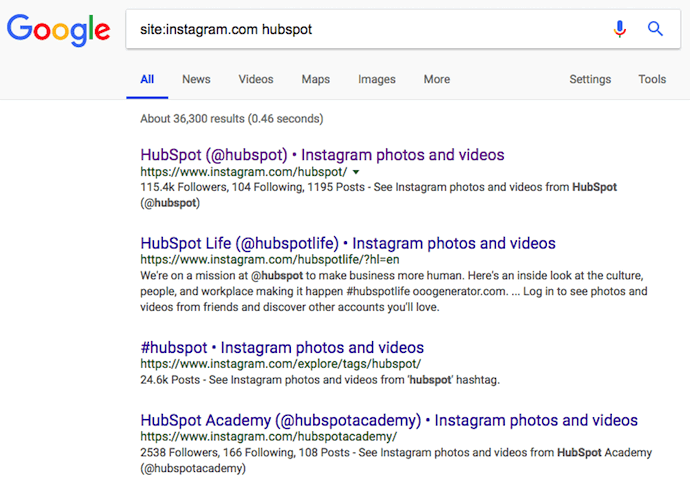
40. Look through pictures without accidentally liking them.
It’s pretty easy to learn how to like something on Instagram — so easy, in fact, that people do it accidentally: It’s just a quick double tap of the photo once you’ve entered its full view.
The thing is, it’s so easy to do quickly by mistake.
So, here’s a quick Instagram cheat for you: To look through someone’s photos without “double-tap paranoia,” scroll through Instagram feeds with your phone set to airplane mode. Without internet access, you won’t be able to Like a photo, even if you accidentally double-tap it.
The pictures won’t load in the first place if you start on airplane mode, though. You’ll have to go to the feed first to load the posts, then turn on airplane mode, then start scrolling.
When you reach the end of the first rows of posts and want to load more, simply turn airplane mode off, let more load, and then turn it on again. Cumbersome? Maybe a little, but it could be worth the paranoia mitigation.
- To turn on airplane mode on an iPhone/iPad: Swipe up from the bottom of the screen and click the airplane icon. Or, go to “Settings” and then “Wi-Fi,” and switch “Airplane Mode” on.
- To turn on airplane mode on an Android device: Swipe down from the top of the screen. Then, swipe from right to left until you see “Settings,” and then touch it. Touch “Airplane Mode” to turn it on.
41. Browse posts from certain locations.
One fun thing you can do on Instagram is browse photos and videos from a specific location, or taken near your current location. I like to do that when I’m planning a trip somewhere, or want to check out a new restaurant and scroll through the pictures taken there.
Here’s how to do both of these things.
To Browse Posts From at a Specific Location:
You can either search for a specific place, or you can click into a geotag on an existing photo.
To search for a specific place: Tap the magnifying glass icon at the bottom of your home screen, which will bring you to the general search page. Type in a place you’d like to search for, and you’ll see content most relevant to the place you searched, including the most popular Reels, accounts, audios, tagged photos, and locations.
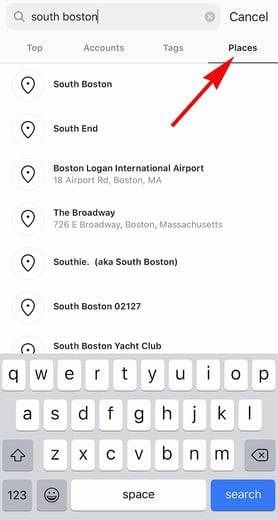
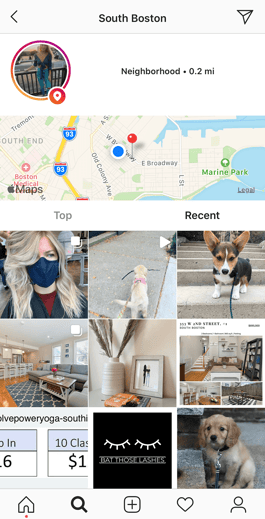
How to Get Verified on Instagram
A verified badge (the blue check beside a celebrity or brand account name) tells users that you’re, in Instagram’s words, “the authentic presence of a notable public figure, celebrity, global brand or entity it represents”.
For instance, there are plenty of “Reese Witherspoon” fan pages on Instagram, but there’s only one real Reese Witherspoon account, as verified by the blue badge:
To request a verified badge, you must be a public figure, celebrity, or brand and meet certain requirements. If you’ve determined you fit Instagram’s criteria for verification, follow these steps to request a badge:
- Go to your profile (the person icon in bottom left corner).
- Tap the three lines in the top right corner.
- Click “Settings,” “Account,” “Request Verification.”
- Fill out the form, including username, Full Name, Document type (like government issued photo ID), Category, Country/Region, and Audience.
- When you’ve filled out all form fields, click “Send.”
It’s important to note, you won’t necessarily receive a verified badge if you request one. Learn more about what happens after you request a verified badge.
Instagram Features & Hacks
I might be biased, but Instagram is one of the most fun (and visually appealing) social apps around. And now, with these tricks, you can use it to an even fuller extent.
Plus, many of these features can help to enhance your brand’s presence on Instagram. Now, you know how to use the app more efficiently, to make sure you’re only tagged in photos you want to appear on your profile, and have even more ways to engage with the people by whom you’d like to be discovered.