
11 Talent Acquisition Strategies to Find the Best Employees
It can be difficult to find the ideal candidate for a specific position — in fact, in 2021, 69% of companies have reported talent shortages and difficulty hiring – a 15-year high.
Regardless of the state of the economy and your talent pool, to succeed long-term, your business should be able to hire and retain the best, most talented employees.

But hiring can be a daunting task, which is why you need a talent acquisition strategy.
To succeed long-term, it’s critical you attract and retain talented employees regardless of vacant roles. Talent acquisition can help you do this, while solving for long-term organizational needs.
Now that you understand what talent acquisition is and how it differs from recruitment, let’s dive into the most effective talent acquisition strategies.
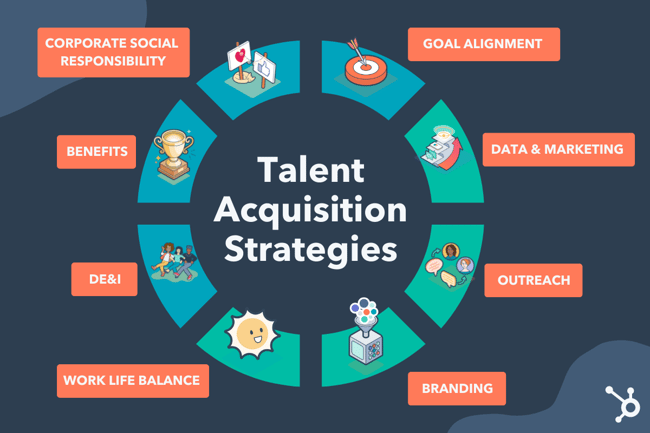
Here are eleven critical talent acquisition strategies to ensure you’re finding the best people.
1. Align with your business goals.
Consider your business goals for the next one to five years, and use those objectives to tailor your acquisition strategy to meet those needs. While recruitment tends to focus on filling vacancies within departments, talent acquisition is more about considering how your company is going to expand long term and then finding employees who can help take you there.
For instance, are you planning on expanding into Latin America? If so, perhaps your HR department should focus on attracting candidates with international or regional experience. Or, maybe you’re planning on creating a new product, in which case, your HR efforts should focus on attracting talented software developers and coders.
Certain roles might not even exist yet, but you’ll want to consider what type of talent you’ll need to hit your business’s long-term goals. Remember, investing in the right candidates will pay off for your company, long-term.
2. Use data and marketing to create better acquisition material.
You wouldn’t create a marketing campaign without data, so why should you recruit without it?
Talent acquisition should be treated with just as much importance as any of your marketing campaigns. Convincing people to join your company is just as necessary as incentivizing people to buy your products.
There are plenty of different opportunities to use data to strengthen your talent acquisition strategy. For instance, you might use data to figure out where your top talent came from, and use that information to focus your talent acquisition efforts on certain academic programs or professional networking sites.
Additionally, your HR team should partner with your marketing department to refine job descriptions, career pages, emails, and more.
Using data, you can figure out if certain questions are deterring candidates from filling out job applications, and eliminate those questions. Alternatively, perhaps you’ll find adding images or videos to highlight company culture incentivizes more candidates to fill out job forms. Or, maybe more candidates apply for a job with description A over description B.
By using analytics and data, you’re able to ensure your job descriptions and career pages aren’t deterring qualified people from applying.
Bullhorn is designed to tackle some of the biggest tasks of talent acquisition: recruiting candidates, and sorting through the job pool. Their software was created to streamline applicant tracking systems and improve profitability for any size business.
3. Expand outreach strategies.
To find better talent, you’ll need to expand your sourcing strategies. Different skill sets require different methods of outreach. You’ll find your best marketers in a different place than your best programmers, so you’ll want to diversify your sourcing approach.
Rather than spending all your time on LinkedIn, consider other specialized job boards, academic programs, or networking events where you might find a specific group of talented professionals. For instance, SmartRecruiter is a CRM that is developed for recruiting candidates and coordinating calendars for potential new hires.
It’s critical you identify where you can find the vast majority of your top talent, whether that be professional events, conferences, online forums, or social networks. Then, focus on strengthening relationships and networking with the right people — not only will you grow your pool of potential hires, but you’ll also grow brand awareness for your company, which will help you attract talent in the future, as well.
4. Build your company brand.
Millions of millennials and older Generation Z candidates make up the current job force. This group of potential employees came of age with the internet and social media. In researching your business, these individuals look at social media accounts, websites, and job boards to understand your work culture.
When looking into your company, candidates will have questions. What is the workplace atmosphere? Do their employees look happy? Is there potential for growth? Leverage your current employees and capitalize on the instant broadcast capabilities of your website and social media. Post images and videos of your employees at work. Encourage employees to interact with your company on its platforms. Congratulate employees on internal promotions.
Note the focus on employees. A company that focuses on the well-being of its staff is a place where people will strive to work. Building your company identity to reflect a positive, expanding environment can be an effective tool in your talent acquisition strategy.
5. Emphasize the company’s corporate social responsibilities.
Companies have taken a step back from policies that only benefit them. Your company needs to focus on pursuing its goals while benefiting others. Your company’s corporate social responsibilities (CSR) are a considerable tool for attracting top candidates aligned with your organization’s values and beliefs.
Corporate social responsibilities lead to the betterment of your brand image, workplace culture, and general society. For example, while Ben & Jerry’s is known for its collection of ice cream flavors, the brand also stands out for its long-standing commitment to social responsibilities. Since 1985, Ben & Jerry’s has donated 7.5% of its pretax earnings to social causes like Greenpeace and Vietnam Veterans of America. Since then, the company has supported voting rights, racial justice, LGBTQ+ rights, and more. With a menu item dedicated to its values on the landing page of its website, the ice cream company emphasizes the importance of its CSR.
On the career landing page for your company, your CSR should be immediately noticeable through images and videos throughout the page. If your company focuses on diversity and inclusivity, demonstrate that. If your company stands behind sustainability, illustrate that through your content. Employees rarely want to work for a company that contradicts their values and beliefs. Use your corporate social responsibilities to attract like-minded candidates who will be passionate about working for your business.
6. Increase budget for the DE&I department.
Diversity, equity, and inclusion is critical for creating a successful talent acquisition strategy — in fact, Dan Schawbel a best-selling author and managing partner of a New York City-based HR research and advisory firm says “This year, 70 percent of job seekers said they want to work for a company that demonstrates a commitment to diversity and inclusion.
The face of the workforce has changed drastically in the last fifty years. In 2022, there are more women and minorities applying for jobs, and as stated by Schawbel, the majority of job seekers want to see this reflected in a company.
DE&I training is imperative and demonstrates that your company is willing to stay current and relevant with changing times. To see an ROI on your investment in training, prioritize retention. During the job application process, continue to eliminate biases in resume reviewing. Ways to remove biases include removing names and photos when sourcing candidates, making applications and resumes anonymous before review, and creating a diverse hiring team.
7. Offer updated work options.
The COVID-19 pandemic reshaped the American work model. Talent acquisition specialists adapt their work models to conduct online onboarding versus meeting candidates face-to-face. As the workforce evolves with more technological advances, workers will strive for more work/life balance.
A professional at Goldman Sachs posted a question on the finance message board of Blind, an anonymous professional network. They asked, “Would you rather make $30k more switching to a new job that requires you to work in the office, or would you rather keep your current salary but WFH anywhere after covid?” The network found that 64% of professionals prefer to permanently work from home over a $30K compensation increase. Other professional groups who favored permanent work from home over a compensation increase include Airbnb (71%), Lyft (81%), Twitter (89%), and Zillow Group (100%).
Employees want to work from home. Remote work models lead to higher productivity. On average, workers are 13% more productive when working from home. As technology continues to advance, your company needs to adjust and consider incorporating remote or hybrid work models while also cutting costs in outdated recruitment techniques to funnel the money into talent acquisition software.
8. Design a competitive and comprehensive benefits plan.
When it comes to compensation packages, employees may be willing to accept a lower salary if balanced by comprehensive health benefits e.g. medical, vision, and dental. Employees want good health benefits, and that includes mental health.
Life inside the workplace is not all that matters in talent acquisition. Consider what happens in an employee’s life outside the business. Does your business model allow for a healthy work/life balance? Are your employees able to receive sufficient healthcare? What kind of retirement or investment opportunities do you offer? Potential candidates will ask these questions about your company. It is necessary to provide the answers with a comprehensive benefits plan.
9. Promote internal diversity.
Many industries are dominated by men leading to women feeling underrepresented within the company’s culture. While the number of women in the workforce has increased significantly over the last few decades, men still hold most positions of power. There is also a racial disparity in corporate America. When HR departments create internal coalitions to rally morale, it increases diversity and inclusion efforts from inside the workforce. To build a diverse and inclusive culture, your company needs to give a voice to people from a wide range of backgrounds.
Diversity should be a company-wide model; however, it begins at the top. Educate yourself on various cultural traditions and backgrounds. Create a workplace where different perspectives are valued and voiced. Employees tend to follow the example of their boss or manager, and setting this example can span internal diversity across your company.
10. Partner with local universities to build an applicant pool.
To build a pipeline of potential candidates, companies partner with educational institutions. It helps establish a relationship between students and future employers.
Take IBM, for example. The technology corporation has partnered with The University of Notre Dame, Virginia Tech, and Florida State University to provide access to its systems for teaching and research. IBM has also planned joint-research collaborations with Duke University and Harvard University.
Instead of waiting for interested candidates to come across the company, IBM has started cultivating relationships with potential applicants. This strategy attracts candidates after graduation and boosts company retention.
11. Add other incentives.
Large to mid-size corporations use eye-catching bonuses and employee benefits to compete in a global market to attract top talent within the industry, but financial incentives aren’t the only things that matter.
When talented candidates are comparing companies, they’re going to consider values, culture, and work-life balance, too. By cultivating an impressive employer brand, you’ll attract better talent and find more long-term success.
To succeed with talent acquisition, consider how you can reframe your branding to focus on the best aspects of your company’s values and culture. You might mention your flexible remote policy and other work-life balance perks, or your company’s emphasis on growth opportunities.
It’s important to broadcast these unique attributes through employee review sites like Glassdoor, as well as your “About Us” page on your company website. When highly qualified people are contemplating your company over your competitors, it just might be those reviews that end up convincing them.
A Talent Acquisition Strategy to Find Top Talent
Your pursuit of top talent shouldn’t solely rely on traditional, short-term recruitment strategies like sending LinkedIn messages or attending job fairs. To ensure top talent acquisition and retention, you’ll need to devise a strategic long-term talent acquisition plan.
Editor’s note: This post was originally published in November 2018 and has been updated for comprehensiveness.


What Video Marketers Should Know About Creating Diverse and Inclusive Content [New Research]
Inclusive content is no longer considered a bonus for video marketers; Diversity, Equity & Inclusion (DEI) is an integral component of an effective video content strategy.
According to Facebook Advertising, 64% of audiences in the US, UK, and Brazil said they would like to see more diversity. Deloitte’s Heat Test Report found 69% of brands with representation in ads saw an average stock gain of 44%.
But where does one start? Diversity isn’t something you can simply check off a list — implementing inclusive content is complex. It has many facets internally and externally in an organization and includes multiple areas that must be taken into consideration when brand and marketing teams plan and produce diverse content strategies.

Many marketers are working against legacy systems and ways of doing things that have been in practice for years, if not decades or more. What can brands and marketing teams do today to start implementing successful DEI content strategies?
At Storyblocks, a rapid video creation company, we’ve released the Diversity in Video Report to help businesses and marketers implement effective DEI content strategies. Through conducting quantitative and qualitative market analysis over a period of the last four years, we could see how the DEI landscape has evolved in video marketing and determine what the key takeaways are for brands today.
About the Diversity in Video Report
Thanks to our growing diverse video content library at Storyblocks, we’ve been given unique access to what is important to content creators and brands today. Our research analyzes over 250 million searches and over 45 million downloads from our user database of businesses, marketing teams, and individual content creators from 18 industries worldwide.
In addition to these quantitative data points, the research also includes a qualitative in-depth analysis of noteworthy brand DEI initiatives over the last few years. Through evaluating what the top global brands have done to implement DEI strategies, this qualitative study shines a light on best practices and lessons to be learned from the successes and failures of the big players in the market. We include specific examples from companies like Citi, Netflix, Sesame Street, and more.
Diversity in Video Report Findings
1. Diversity doesn’t stop at race.
Diversity is often thought of in terms of race, but our research suggests that diversity in video marketing extends beyond that. Diversity has many layers and includes diversity in faith, age, sexual orientation, ability, body type, and more in addition to racial diversity.
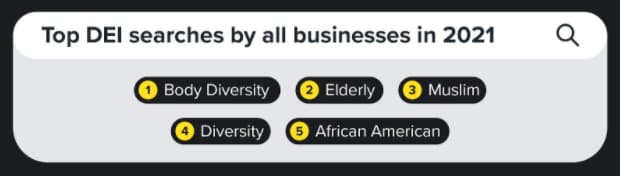
In 2021 the top five DEI keywords and searches by all businesses were: body diversity, elderly, Muslim, general diversity, and African American.
Body diversity, particularly the representation of plus-sized bodies, is something multiple industries prioritized in 2021. This is an area of diversity that has been historically underrepresented, with most ads showing thin body types. Today marketers are approaching this differently, highlighting the importance of body diversity in content planning.
2. There’s an increased demand for BIPOC representation in media and marketing.
Compared to 2019, there has been a 113% increase in BIPOC (Black, Indigineous, and People of Color) video searches from members and visitors, with 937,000 more searches in 2021. There has been a 195% increase in the number of BIPOC video downloads, with 2.3 million more downloads in 2021 compared to 2019.
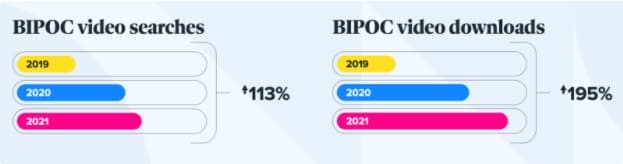
This increase in demand for BIPOC representation in media is likely linked to the murder of George Floyd and the vast racial inequities that led to increased coverage of the Black Lives Matter (BLM) movement that took place in the spring of 2020.
This movement resulted in a global cultural awakening that led to a ripple effect on different facets of media and business. Similar to the evolution of BLM, demand for BIPOC representation in media is not a ‘moment’ — the movement is still continuing and growing today.
3. Demand for diversity is clear with an increase of over 100% in just two years.
It’s clear that brands and video marketers are getting the message and listening to consumers’ undeniable demands for representation. Many businesses have been prioritizing inclusion when producing video content in the last few years.
In 2021, diversity searches including race, ethnicity, ability, age, body and LGBTQIA+ increased by 104% from 2019, with 1.1 million more diversity searches in 2021 from both Storyblocks members and visitors.
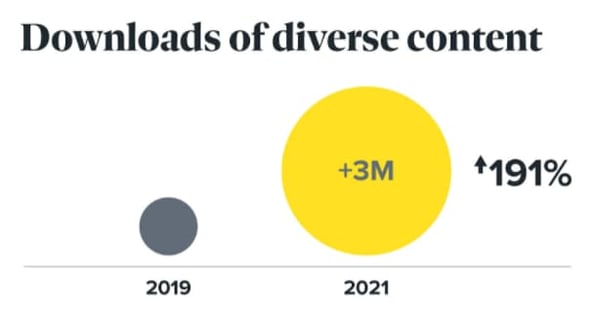
Similarly, downloads of diverse content increased by a massive 191% from 2019, with 3 million more downloads of content that include more authentic representation of communities in 2021.
What the future of diverse content looks like.
The data indicate DEI is not a trend — the increase in diverse video content creation and consumption in media is increasing. We see DEI in video and advertising becoming an intentional, thought-out practice that more businesses invest in and strategize around.
Diverse Video Content Best Practices
1. Don’t insert your brand into a community without research.
The most powerful tool to invest in when approaching DEI is research. If a community is “trending” and receiving increased attention in the media for any given reason, be careful before your marketing team dives headfirst into the conversation.
Do your due diligence and fully understand the community you are planning on representing in your content. So many failed DEI campaigns that have received public backlash could have been avoided if the research phase was done properly.
2. Have a DEI strategy in place.
Set clear and measurable DEI goals and targets that are cross-functional and involve different workstreams and teams in your organization. DEI initiatives shouldn’t just be put on a singular group — DEI should be incorporated into your company’s strategy as a whole.
When a company is serious about its DEI efforts and has a results-driven strategy, dedicating financial resources is essential, similar to how sales and marketing have quarterly and annual budgets. DEI should be no different.
3. Diverse representation needs to exist at the decision making level.
This past year, Storyblocks worked with Indigenous filmmakers to increase the representation of Indigenous communities in our libraries. We recognized our team did not have adequate Indigenous representation, so our marketing team hired a board of external advisors from the Indigenous community to act as guides on how to best communicate, understand the community’s pain points, encourage compassion and avoid harmful misrepresentation.
When aiming to create content that’s inclusive, make sure the decision makers represent who you are speaking to. Recognize when your team is not as inclusive as you’d like and reach out for third-party support to make up for the representation your team is lacking.
Final Thoughts
Armed with the information we’ve compiled in this report, you should be able to build or take a critical look at your DEI video strategy successfully. A crucial part of that success lies in you and/or your business’s ability to approach DEI thoughtfully. Learn from the successes and failures of other brands, bring in diverse voices and understand that this isn’t something you should rush to implement. Take time and care in crafting your approach.
We’re still learning lessons ourselves, and are on this journey with you. We can’t wait to see what you create.

The Ultimate Guide to Instagram for Business [+Data From 500 Marketers]
More companies than ever are using Instagram for business. Back in 2017, the social platform celebrated having over 25 million businesses. Today, we can bet that number has likely doubled.

Instagram has proven a worthwhile investment for marketing purposes. When we surveyed over 1,000 marketers in 2022, they revealed that Instagram is the most effective social media platform, above Facebook, YouTube, and TikTok.
But using Instagram for business purposes can seem daunting, particularly if you’ve only ever used it for personal use. Here, we’re going to explore how to promote your business on Instagram.
- How to Use Instagram for Business
- What is a business profile?
- How to Create a Business Profile on Instagram
- How to Switch to Your Business Profile
- Top Instagram Promotion Tactics of 2022 [Data]
How to Use Instagram for Business
Let’s delve into the six strategies you’ll need to employ to get the most out of Instagram.
1. Add value with your content.
First and foremost, Instagram is a visual platform. To attract an audience, it’s critical you spend time delivering high-quality, thoughtful content.
To succeed on Instagram, it’s essential you create valuable content that attracts an audience and encourages them to engage with your business. Consider how you can delight your customers while staying true to your brand.
You don’t need to just post images of your product to spread brand awareness and increase sales. In fact, in some cases, it’s better if you don’t.
For instance, Hot Pockets sells microwaveable pocket sandwiches. Admittedly, I wasn’t much of a fan of Hot Pockets — until I began following their business’s Instagram account.
There are only so many times you can post a picture of a sandwich. Hot Pockets goes in a different direction. Instead, they appeal to their audience through humor, often posting relevant memes or funny quotes.
For instance, in response to @ShallowDivers’ claim that Hot Pockets aren’t sandwiches, Hot Pockets responded with this:

Ultimately, it might take trial and error to find the content that works best for your business.
While Hot Pockets relies on humor, other brands like The North Face use impressive adventure images to appeal to their demographic.
The point is, brands need to add value to Instagram’s community rather than using the platform for advertisements alone. This is critical for your long-term success.
Looking for a few more tips on how to use Instagram to positively impact your business? Check out these Instagram hacks in the video below.
Put these tips to work, and update your marketing mantra from “content is king” to “valuable content is king.”
2. Maintain a consistent theme.
Imagine each Instagram post as an individual page of your website.
While each post should be good on its own, ideally you’ll need to create a cohesive theme to maintain an audience’s loyalty.
It’s important to note, I mean “theme” in the broad sense, as it relates to everything from hashtags and captions to pictures and videos. You’ll need to create a consistent tone of voice and a unified feed aesthetic.
Ultimately, the more specific and consistent you are with your posts, the more likely you are to attract your most authentic audience.
You might think it’s better to appeal to more people through various themes, but ultimately, staking your claim in a specific niche will help you create stronger, more genuine connections.
For instance, consider MVMT. Their feed is undoubtedly consistent, with similar filters and color palette, and an emphasis on darker, edgier images:

Their consistency is equally obvious in their captions, with phrases like “Create a life you can’t wait to wake up to,” and “Unexplored paths lead to undiscovered stories.” In every post, you’ll see the same hashtag: #jointhemvmt.
Undoubtedly, their followers both expect and prefer this type of content, or they wouldn’t have followed them in the first place. To continue delighting customers, it’s essential MVMT keeps true to their theme.
3. Engage with your audience.
Engaging with your audience helps your followers feel valued and, as a result, more connected to your business.
There are plenty of ways to engage with your audience. You might reply to comments on your posts, participate in comment threads, run contests or giveaways, use Instagram Stories polls feature, or give shout-outs to followers on your Stories, particularly if they post something relevant to your brand.
Halo Top Creamery does a fantastic job of engaging with their audience.
They frequently post cute ice cream pictures with the caption “Ice cream is better with friends. Tag a friend you’d like to eat this with.”
A simple “tag a friend” caption is an effective strategy for growing your audience since your followers will then tag friends who might not know about you yet.
Additionally, Halo Top often does contests and giveaways, like this one:

By tagging winners in their posts, Halo Top incentivizes other followers to engage with their brand in the future. Additionally, Halo Top’s giveaways demonstrate their genuine commitment to connecting with their audience.
4. Consider influencer marketing.
As a consumer, you’ve likely seen the recent influx of influencer marketers on Instagram — and for good reason.
Marketers we surveyed in 2021 said it was the marketing trend that offered the highest ROI, above experiential marketing, SEO, and short-form content.
By leveraging the power of an influencer, who is already authentically connected with her audience and seen as a trusted source of information, you’re able to spread brand awareness and drive sales.
Micro-influencing in particular is a strong opportunity for brand endorsement.
You could use your budget and resources to invest in traditional advertising, but it’s often easier to create a more targeted, effective marketing campaign through influencer marketing.
Ultimately, influencers have already cultivated an engaged, loyal following — by identifying the right influencers for your niche, you’re much more likely to find followers who will truly enjoy and support your products or services.
5. Build an ad campaign.
There are two reasons you might use Instagram ads: to spread brand awareness or to increase sales.
It’s critical you focus on one goal when creating an effective ad campaign. An Instagram ad aiming to sell a product will look vastly different from one intending to attract followers.
For instance, consider this Greenchef ad that showed up on my Instagram feed.
With various images of delicious food and an enticing “$40 OFF” discount, it’s likely a high-converting ad. It’s very clear what Greenchef’s goal is: to get people to buy their product.

YouTube, on the other hand, invested in Instagram ads for an entirely different reason.
Their advertisements, featuring well-known singers like Camila Cabello, entice followers to simply follow YouTube Music’s Instagram channel (and, ideally, YouTube’s music channel itself).

To implement an effective campaign, it’s essential you decide what you’re hoping to achieve before you begin creating it.
Once you’ve chosen a goal, you’ll want to create the ad creative. Similar to what we discussed in strategy one, you’ll need to create high-value visual content if you want your ad to be successful. Take a look at other ads on Instagram and consider how you might emulate them.
Additionally, A/B test multiple variations of the same ad (changing the copy, image, or targeted audience for each version), to figure out what works best for your business.
When you’re ready to create your ad, you’ll need to use Facebook Ads Manager. Among other things, Ads Manager lets you narrow in on your target audience (including location, age, and various interests of your ideal demographic), choose your ad objective, and analyze ad performance.
6. Utilize shoppable posts.
If you’re using Instagram for business, then, Shoppable Posts is one feature you’ll want to know well.
It allows you to create posts and tag your products and/services to create a seamless shopping experience directly on the platform. It creates less friction for your followers, increasing the odds of turning them into customers.

Before you begin executing these strategies, you’ll need one thing: an Instagram Business Profile.
A business profile legitimizes your Instagram account and enables you to add critical information like your company’s business hours, location, and phone number.
Pros and Cons of an Instagram Business Profile
“Whoa, whoa, whoa,” you might be thinking. “I don’t know how I feel about committing to all that.”
Here are some helpful pros and cons so you can determine if a business profile is right for you before jumping in:
Pros
- Access to metrics on how your posts and stories perform.
- Ability to track how your followers engage with your content.
- Access to features necessary to run ad campaigns.
- Gain feature for adding URLs to Stories so you can send warm traffic to your site.
Cons
- Being labeled as a business.
- May experience less organic reach and visibility.
- Must also have a Facebook account to access ad features.
For most brands, the benefits of a business profile outweigh the cons due to the additional features and analytics. However, it’s important to consider your goals before taking action.
How to Create a Business Instagram Profile
In order to create a business profile on Instagram, you must first create a personal Instagram account and then switch it to a business profile. If you already have an Instagram account, skip to the next section for instructions on making the switch.
If you don’t already have an Instagram account, there are two ways to get one:
- From the computer
- From a mobile device (IOS and Android)
For detailed steps, check out our comprehensive article on how to create a business account on Instagram.
How to Switch to Your Business Profile
When you have an Instagram set up, follow these easy steps when you’re ready to make the switch:
1. Go to your profile on the mobile app.

2. Click the hamburger menu (three stacked horizontal bars) in the top right corner.

3. Click the “Settings” gear at the bottom of the menu.
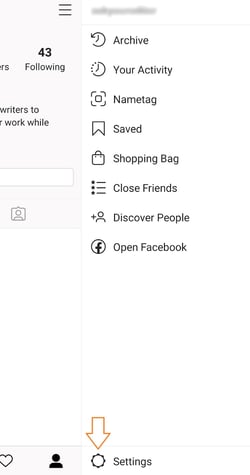
4. Select Account.
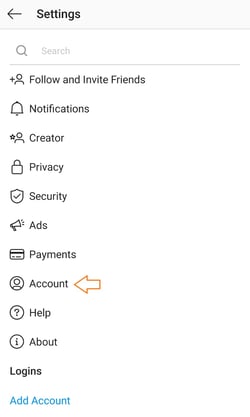
5. Choose Linked Accounts.
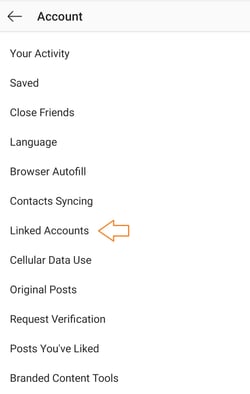
6. Choose Facebook and follow the prompts to connect your business’s Facebook page.
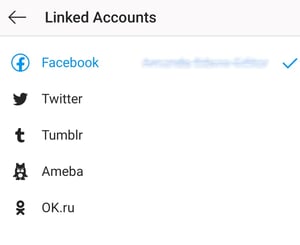
If you do not have a Facebook Business Page, you will need to create one before completing this step. If your Facebook page is already linked, move on to the next step.
7. Once complete, return to the Settings menu.
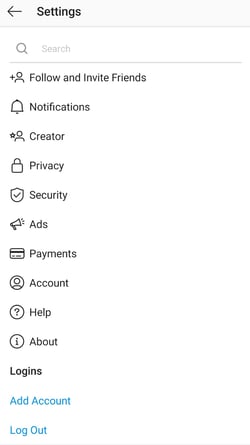
8. Select Account.
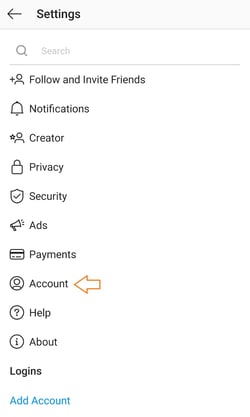
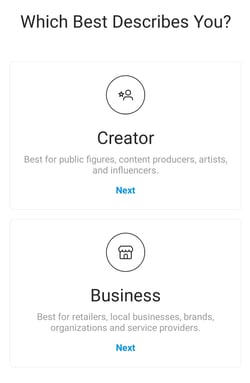
9. Choose the new option “Switch to Professional Account.”
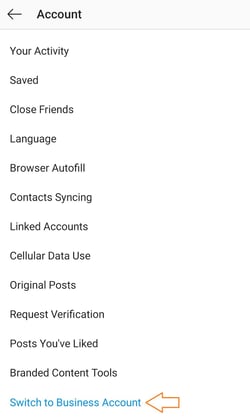
10. Follow the prompts to add any additional details.
11. Select Done.
You’re now ready to begin implementing your social media strategy on Instagram. From here, you’ll want to determine the audience you want to target, the aesthetic and tone you want to convey, and the content you want to create.
Top Instagram Promotion Tactics of 2022 [Data]
Audience Interaction
On Instagram, the number one strategy marketers plan to leverage for the first time in 2022 is audience interaction.
One of the most effective ways to do this is through IG Live. According to marketers surveyed, it offers the highest return on investment, out of all of Instagram’s features and tools.
That’s why 22% of respondents are investing more in IG Live than any other format on the platform.
Interacting with your audience offers so much more than just engagement. It helps build a sense of community with your followers and allows you to get to know them better.
Content Engagement
While audience interaction takes the #1 spot as the newest strategy, content engagement wins for the overall strategy marketers will invest the most in.
On social media, engagement signals that your content is resonating with your audience. Whether it’s on an in-feed post, a Story, or a live stream, engagement can be a great indicator of your page’s health.
In fact, 17% plan to invest more in it than any other strategy while 43% plan to use it for the first time this year.
Wondering how to make your content more engaging? Try the funny route. Our research shows that funny content is most effective for audience growth, reach, and engagement.
This adds up because funny content tends to be relatable, and that’s usually what gets someone to stop scrolling and pay attention.
The format can also play a role in engagement, with most marketers posting more video than anything else on the platform. Eighty-two percent of marketers surveyed post video content on the platform and the content formats they use most are video-based.
Stories is another tool that can be highly effective for marketers. In fact, those who leverage it are 23% more likely to say their 2021 IG strategy was effective.
Product advertising
With Instagram constantly expanding its shopping tools, it’s no surprise that a top goal for marketers is advertising their products and/or services.
Our research suggests that the use of content centered around products and services will increase in 2022. For 39% of marketers, it will be their first time leveraging this type of content on the platform.
Those who did prioritize this content in 2021 say that it offered the second-highest ROI of any content type on the platform.
When it comes to IG shopping tools, 79% of marketers surveyed say they’ve used them, and 22% plan to invest in this feature the most.
Whatever your goal is, whether it’s increasing brand awareness or generating more revenue, using Instagram for business gets you one step closer to achieving it. While not all of Instagram’s tools will offer a high ROI, they are all worth trying to see what works best for your audience.
Editor’s Note: This post was originally published in May 2020 and has been updated for comprehensiveness.

Top Tactics for Instagram Growth in 2022: HubSpot Blog Data
Instagram is a top-rated app, with more than 1 billion global monthly active users.
Given the size of its user base, businesses have valuable opportunities on the platform to generate an audience, build a community, and drive sales.
To help learn more about how to grow your business on the app and create an engaged community, the HubSpot Blog surveyed more than 1,000 marketing professionals that use the platform. Here are some of our key findings.

How Marketers Grew Their Following in 2021
In 2021, marketers reported that the key to growing an account to the first 1,000 followers on Instagram was by creating shareable content with high-quality captions. Growing their following past 1,000 followers involved posting engaging Stories, engaging with users, and partnering with influencers, all of which we’ll discuss in more detail below.
If you’re having trouble growing your following, or are losing followers, marketers report that this typically occurs for a few key reasons: not posting often enough, being too sales-y, and Instagram removing bot followers.
How Marketers Grew Engagement in 2021
In 2021, marketers increased engagement on Instagram through audience interaction, and creating content that encourages engagement. For example,
- Creating content that is shareable, inspiring audiences to share it on their own profiles via Stories or reposting on their feed,
- Monitoring your comments and mentions to find user-generated content that you can share on your profile,
- Responding to comments and DMs from audience members when it makes sense to do so.
How Marketers Grew Instagram ROI in 2021
49% of marketers reported that, out of all the platforms they leverage, Instagram has the highest ROI. Here are the strategies that they used to grow ROI:
- Leveraging Instagram shopping tools.
This was the most popular strategy, as 79% of Instagram marketers have used shopping tools in their roles, and 33% plan to use them for the first time in 2022.
- Creating content centered around a brand’s product and services.
This informs audiences of your offerings on a platform that they’re already familiar with, and has the second highest ROI of any content type.
- Creating interactive Instagram Stories.
The tool is leveraged by 45% of IG marketers, and 92% plan to increase or maintain their investment in 2022. Stories are also the number two format for gaining followers and getting your content shared on Instagram.
Instagram Growth Tips for 2022
Now that you know some of the key ways marketers found success on Instagram in 2021, let’s look forward to how you can create an organic Instagram growth strategy for your business in 2022.
1. Leverage different content formats.
Video and carousel posts are the most engaged with type of content on Instagram, especially when compared to single images. For reference, carousel posts contain multiple different media forms (image or video) in one, allowing you to create high-impact posts.
Both forms of content keep users engaged for longer, whether they’re scrolling through your 5 picture photo set, or watching a video. The longer a user stays interacting with your content, the longer they’re engaged.
While video and carousel posts are the most popular, you can also experiment with different content formats (like Reels and Stories) and see what resonates most with your audience.
2. Post at the right times.
When you post on Instagram, it’s important to post a time that allows you to meet your audiences when they’re online and more likely to engage with your posts.
The best way to decide what time to post on Instagram is to monitor your analytics, as mentioned above. However, the universal benchmark for ideal timing is posting between 6PM and 9PM, and the best days are Saturday, Friday, and Sunday, respectively.
3. Post consistently.
Growing your profile is tied to how much you post, so aim to post consistently. The more content you share, the more opportunities you have for engagement and growing your profile. As such, create a consistent posting schedule that helps you stay top of mind for your audiences.
Many marketers report that four to six posts per week is the sweet spot. Be mindful, though, that there is such a thing as posting too much on Instagram. Don’t oversaturate your audiences, but instead be strategic.
4. Partner with influencers that are relevant to your business.
While it seems like a best practice to partner with influencers with tons of followers, HubSpot’s Instagram Engagement Report says your efforts are more worthwhile if you partner with influencers that are more connected to their audience and community over follower count.
When you do this, you’re working with someone that has built trust with their audience, regardless of its size. And, when an influencer’s audience trusts them wholeheartedly, they’re more likely to trust their opinion on products or services and be curious and eager to learn more about what your brand offers.
Micro-influencers with 10k to 50k followers and nano-influencers with under 10k followers are considered to be the next wave of influencer marketing.
5. Monitor your engagement.
You may be saying “Yeah, I knew that” but monitoring your Instagram engagement is important, so it’s an important callout. In fact, it is the most impactful way to grow your engagement, as you’ll learn exactly what works and what doesn’t.
For example, your profile insights may say that users engage more with your videos. If you spend most of your time creating Stories, you’re actively ignoring what your audiences value most. Instead, you’d want to leverage the information from your insights and focus on sharing high-quality video content.
Consistently monitor your engagement analytics to make informed decisions that will help you grow better.
5. Write strong, compelling captions.
Always include captions on your posts — doing so can increase your engagement by almost 2%. Quick and short captions (1-20 characters) perform well, and so do longer ones (over 2000 characters).
Regardless of their length, you should always aim to create high-quality captions that are informative, engaging, and related to the content you share.
7. Use hashtags.
Using hashtags on Instagram helps you get your content seen by people who don’t follow you but surf the hashtags you use on their Explore page.
If you choose hashtags relevant to your business and use them in your captions, people can find your posts, discover your profile and follow you and help you grow your account. Case in point, 81% of marketers say that using hashtags has been somewhat or very effective for their Instagram strategy.
Over To You
Growing a following on any platform can be challenging, especially if you’re starting from scratch. Leverage the tips on this list from other marketers who have gone through it and reaped the benefits to begin creating your own Instagram growth strategy that helps you build an engaged community.

The Ultimate Guide to Branding in 2022
Products are never just products, right?
Coca-Cola is more than a soda. Starbucks is more than coffee. Ray-Ban is more than a pair of sunglasses.
Interacting with these products provides experiences, and we buy them with that experience in mind. Better yet, the companies that create and market them know exactly the experience they want you to have when you make (or consider) a purchase. That’s why they cultivate their brands.

From the language in their Instagram caption, to the color palette on their latest billboard, down to the material used in their packaging, companies who create strong brands know that their brand needs to live everywhere. They know their names extend far beyond the label and can entice consumers to choose their products out of a lineup of options.
Who doesn’t want that? I know I do. That’s why we built this guide — to equip you to create and manage a strong brand that’ll help your business be admired, remembered, and preferred.
If you’re in a pinch, use the links below to jump ahead to find what you need.
What’s a brand?
A brand is a feature or set of features that distinguish one organization from another. A brand is typically comprised of a name, tagline, logo or symbol, design, brand voice, and more. It also refers to the overall experience a customer undergoes when interacting with a business — as a shopper, customer, social media follower, or mere passerby.
What is branding?
Branding is the process of researching, developing, and applying a distinctive feature or set of features to your organization so that consumers can begin to associate your brand with your products or services.
For example, the Coca-Cola brand is one of the most recognizable logos and color stories around the world. The classic red and white lettering, vibrant artwork, and distinctive font have lasted for over a century.

Having stood the test of time, the Coca-Cola brand is a testament to the power of consistent, successful branding that consumers have come to love.
That being said, branding is an iterative process and requires getting in touch with the heart of your customers and your business. It’s important for a variety of reasons — and we’ll go through them below.
Branding can be the deciding factor for consumers when they make a purchase decision. In fact, a Capgemini study found that users who feel a connection to a brand spend twice as much money as those who don’t.
Branding gives your business an identity beyond its product or service. It gives consumers something to relate to and connect with.
Branding makes your business memorable. It’s the face of your company and helps consumers distinguish your business across every medium (which I discuss later).
Branding supports your marketing and advertising efforts. It helps your promotion pack that extra punch with added recognition and impact.
Branding brings your employees pride. When you brand your company, you’re not only giving your business identity, you’re also creating a reputable, highly-regarded workplace. Strong branding brings in strong employees.
Branding Terms to Know
Here are some other brand-related buzzwords you should know. They further demonstrate the importance and value of branding your business.
Brand Awareness
Brand awareness refers to how familiar the general public and your target audience is with your brand. High brand awareness leads to brands being referred to as “trending,” “buzzworthy, or “popular.” Brand awareness is important because consumers can’t consider purchasing from your brand if they’re not aware of it.
👉🏼 Strong branding makes your business known.
Brand Extension
Brand extensions are when companies “extend” their brand to develop new products in new industries and markets. Consider Honda lawn mowers or Martha Stewart bedding. Brand extensions allow companies (or individuals) to leverage brand awareness and equity to create more revenue streams and diversify product lines.
👉🏼 Strong branding brings in more money.
Brand Identity
Brand identity is the personality of your business and the promise you make to your customers. It’s what you want your customers to walk away with after they interact with your brand. Your brand identity is typically comprised of your values, how you communicate your product or service, and what you want people to feel when they interact with it.
👉🏼 Strong branding gives your business more than a name.
Brand Management
Brand management refers to the process of creating and maintaining your brand. It includes managing the tangible elements of your brand (style guide, packaging, color palette) and the intangible elements (how it’s perceived by your target audience and customer base). Your brand is a living, breathing asset, and it should be managed as such.
👉🏼 Strong branding requires consistent upkeep.
Brand Recognition
Brand recognition is how well a consumer (ideally in your target audience) can recognize and identify your brand without seeing your business name — through your logo, tagline, jingle, packaging, or advertising. This concept goes hand-in-hand with brand recall, which is the ability to think of a brand without any visual or auditory identifiers.
👉🏼 Strong branding keeps your business top-of-mind.
Real-life brand example: Want to test your brand knowledge? Take this Logo Quiz by Business Insider to see how well you know your corporate brands. This is brand recognition at work.

Brand Trust
Brand trust refers to how strongly customers and consumers believe in your brand. Do you deliver on your marketing promises? Do your salespeople and customer service go above and beyond? These things can create trust among your customers, which is important in a world where a mere 25% of people feel confident in large businesses.
👉🏼 Strong branding builds trust with your customers.
Brand Valuation
Brand valuation is the commercial valuation of your brand derived from consumer perception, recognition, and trust. This concept goes hand-in-hand with brand equity. A powerful brand can make your business invaluable to investors, shareholders, and potential buyers.
👉🏼 Strong branding increases your business’s value.
Here’s how you can create a brand — or begin the process of rebranding your current one.
There’s a lot that goes into a brand, and there’s a lot to consider when building a strong one. So, grab a notebook and jot down ideas as you move through this section. Recognize that branding is an iterative process, so you might be repeating some of these steps as you brainstorm and build your brand.
Want to build an effective, measurable brand? Download our free guide on How to Build a Brand.
1. Determine your target audience.
Branding leads to awareness, recognition, trust, and revenue. We’ve talked about that. But let’s take a step back and understand where those stem from: consumers. And not just any consumers — your target audience and customers.
If your brand doesn’t resonate with your audience, it won’t lead to that awareness, recognition, trust, and revenue. That’s where target market research comes in.
Before pressing pen to paper (or cursor to digital document), you must understand to whom your branding will be speaking. Who does your product serve? Who is your ideal customer? Why did you create your business in the first place?
What you learn about your target market and buyer personas will influence your branding decisions down the line, so make this step your first priority.

Download our free Persona Templates to easily organize your target audience research and strengthen your marketing.
2. Establish your mission statement.
Let’s return to a question I asked in the previous step: Why did you create your business? Answering this will help you build your mission statement, which defines your purpose and passion as an organization.
Before you can craft a brand that your audience recognizes, values, and trusts, you must be able to communicate the purpose that your business provides. Then, every part of your brand (logo, tagline, imagery, voice, and personality) can reflect that mission and vision.
Your mission statement is a building block of your brand manifesto, which encompasses why your organization exists and why people should care about your brand.
Download our free guide to Defining Inspiring Mission and Vision Statements and learn the ins-and-outs of two of the most valuable strategic planning elements for businesses.
3. Define your unique values, qualities, and benefits.
There are probably lots of businesses in your industry and niche. It’s easy to focus on your competition (and there’s a time and place for competitive analysis), but, for now, let’s focus on you.
What’s one thing that your business has that no one else can mimic (er, legally)? Your brand.
Because of that, you must ensure that your brand is comprised of and inspired by elements that are solely yours: the values, benefits, and qualities that make your company unique.
Take a moment to jot down a list of what sets your business apart from others. I’m not talking about product features (like appearance, components, or capabilities); I’m referring to how your products or services improve lives and contribute to success.
Real-Life Brand Example: Alani Nutrition
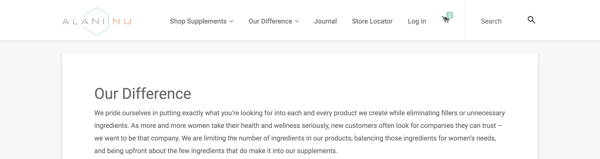
You’ve probably never heard of Alani Nu; they’re a nutrition company based in my hometown of Louisville, Kentucky. I order their vitamins because 1) they’re proven to work, and 2) I trust and respect the brand (and it’s gorgeous!). On their website, they’ve clearly and simply outlined their unique values and benefits as part of their overall brand. Highlighting these makes it easy for customers like me to trust their products and choose them over competitors.
4. Create your visual assets.
At this point, you should understand your target audience, your mission statement, and the unique qualities that make up your business.
If you can say with confidence that you’ve mastered these steps, it’s time to move on to one of the more exciting parts of branding — the visual design. We’re talking about your logo, color palette, typography (fonts), iconography, and other visual components.
As you create these elements, build a set of brand guidelines (or a brand style guide) to govern the composition and use of your visual assets. This will ensure that whoever uses your new branding does so accurately and consistently. Check out HubSpot’s brand guidelines for reference.
Note: Design can be just as intimidating as it is exciting. Consider hiring a professional with logo and identity design experience or starting with a few helpful design templates.
5. Find your brand voice.
Next, consider the auditory component of your brand. What would your brand sound like if you had a conversation with it, or if it texted you?
How you communicate with your target market is also considered part of your branding. You want to define a brand voice that connects and resonates with your audience — otherwise, they probably won’t pay attention. Because of that, don’t hesitate to return to step one to get familiar with to whom you’re speaking.
From your advertising campaigns and social media captions to your blog posts and brand story, ensure your tone is consistent throughout all of your written content. Give your audience a chance to get familiar with your brand and learn to recognize the sound of your voice. Better yet, master a fun, entertaining voice, and your customers will look forward to your social media and email updates.
Real-Life Brand Example: MailChimp
MailChimp is a great example of a brand that speaks with a clear, consistent tone. When I used their free plan for my small business, I always chuckled when receiving their emails and working in their interface. From its web copy to its email blasts and social media captions, MailChimp has established a brand voice and personality that is personable, fun, and accessible — it can be hard to explain the technical parts of a software product (like A/B testing), but MailChimp has mastered that, too.

6. Put your branding to work
Your brand only works if you do. Once you finish designing and creating your new brand (or rebrand) integrate it throughout every inch of your business. Pay extra attention to ensure it’s displayed anywhere your business touches customers. Here are a handful of tips for applying your brand across your organization.
Website
Splash your logo, color palette, and typography across your website. Don’t use anything but your predefined assets in your brand guidelines. Your website is a major part of your company identity — if it doesn’t reflect your brand, it will only provide a jarring customer experience. Also, be sure that all web copy, calls-to-action, and product descriptions reflect your brand voice.
Social Media
All profile photos, cover art, and branded imagery should reflect your brand. Consider putting your logo as your profile photo — this will make it easier for customers to recognize your business. As with your website, be sure all profile information, posts, and captions reflect your brand voice.
Packaging
If you have a physical products business, your product is probably the most tangible way that customers interact with your brand. For that reason, your packaging should reflect your new branding — in its design, colors, size, and feel.
Real-Life Brand Example: Chobani
I love Chobani yogurt (confession: I’m eating it right now). Their new branding immediately tells me that they produce authentic, healthy Greek yogurt. That’s one of the main reasons I buy Chobani. Recently, I realized that their yogurt packages are made with a very earthy, textured material — an intentional decision that supports the overall experience they’ve paired with purchasing and eating the Chobani brand.

Advertising
Because advertisements (digital and print) are often used to establish brand awareness and introduce consumers to your brand, it’s critical that they reflect your branding. In fact, your branding should make the ad creation process easier — with your brand style guide, you already know how your ads should appear and what type of copy to write.
Sales and Customer Service
A brand is only as powerful as the people behind it, and if your people aren’t putting your brand to work, it won’t work for you. Moreover, your brand applies to more than your marketing. Inform your sales and customer service folks of your brand guidelines and tell them to use it, especially when they engage directly with customers. Whether they are sharing a branded product demo or answering customer support inquiries, encourage them to use your logo, tagline, imagery, and brand voice.
1. Treat your brand as a person.
To best wrap your head around the branding process, think of your brand as a person. Your brand should have an identity (who it is), personality (how it behaves), and experience (how it’s remembered).
Ask yourself these questions about your brand:
- How would your brand introduce itself? If it had to describe its appearance, how would it do so?
- How would your brand talk about your products or services? Would it be serious and professional, or would it be humorous and edgy?
- What would someone say about your brand after “meeting” it for the first time? What are a few sentences they’d use to describe it?
The purpose of branding is to create relationships with your customers. The easiest way to do this is to treat your brand as a person and understand that you want your customers to do the same.
Real-Life Brand Example: Whiskey Riff
Whiskey Riff is another brand you’re probably not familiar with. It’s a two-man media company based here in Chicago that’s dubbed themselves “the most entertaining country music site ever”. I’m a fan because I love country music, enjoy their written and podcast content, and proudly wear some of its awesome apparel.
If Whiskey Riff was a person, here’s how I’d think it would answer the questions above:
- “Hey, I’m Whiskey Riff. I love country music and, you guessed it, Whiskey. My logo was inspired by the Y in the circle on the Chicago Theater marquee, and I’m adorned with horizontal red stripes and stars — which represent the American and Chicago flags.”
- “I publish in-your-face content about what’s going on in country music today. If you don’t like it, don’t read it. My podcast featured my founders interviewing country music artists and telling hilarious stories. Check out my apparel line; my t-shirts, tanks, hats, and accessories can be seen at country music festivals (and on stages) nationwide.”
- “Whiskey Riff is like that first shot of Jack Daniels — that much-needed, refreshing drink after a long day. It’s a break from that cookie-cutter way of life, and you immediately appreciate — and trust — its candidness. There’s absolutely nothing like it in the industry.”

2. Prioritize consistency.
Inconsistency is the number one branding mistake that companies make. Inconsistency undermines your brand and confuses your customers. Recognizable, valuable brands prioritize consistency — and they reap the benefits. When your brand is a unified presence across mediums and platforms, customers can easily get familiar with, recognize, and come to prefer your brand over time. Brand guidelines can help with this initiative.
3. Build and follow a brand strategy.
A brand strategy is more than your brand guidelines; it’s a plan with specific, long-term goals that can be achieved as your brand evolves. These goals typically revolve around your brand’s purpose, emotion, flexibility, competitive awareness, and employee involvement.
Remember how I said that branding is a continuous process? There’s a lot that goes into it. A brand strategy can help you turn that process into a well-oiled practice that keeps your brand moving toward success and recognition.
4. Don’t let inspiration turn into imitation.
Competitive analysis is important. Not only does it educate you on where your competition stands and how they are excelling, but it can also give you ideas on how you can improve or further set apart your brand.
However, be conscious to not fall into an imitation trap. Keep your competitive research limited and focus on what your organization brings to the table. Just because a competitor (or two) has branded their company in a certain way doesn’t mean that you have to follow suit. New, unique, provocative brands are memorable brands.
5. Use branding to hire.
Strong branding makes your employees proud. I know I’m proud to be associated with HubSpot, much less work there. Leverage your branding to attract talented people. If hiring is a strong initiative for your organization, dedicate some of your resources to employer branding. Employer branding is how you market your company to job seekers and current employees. If you’re publically proud of your organization, others will be, too.
Ready, Set, Brand
Branding is your organization’s name, logo, color palette, voice, and imagery. It’s also more. It’s that intangible feeling your customers have when they interact with your brand. You know, that experience we talked about in the beginning.
That’s how powerhouse brands deviate from all the others. The tangible components contribute to this — a gorgeous logo, a clever tagline, an authentic manifesto, and a clear brand voice — but truly strong brands thrive when they focus on the big picture of their brand. Get to the heart and soul of your target audience and your organization, and a successful brand will follow.
Editor’s Note: This article was originally published in March 2021 and has been updated for comprehensiveness.


Online Shopping Statistics Marketers Should Care About in 2022
Just because we’re marketers doesn’t mean we really know the science behind what drives consumers to purchase. But marketing without that information is like walking outside with a blindfold on – it’s going to be very hard to end up at your destination without a scratch.

Below, we’ll cover some data sets on buyer behavior, their key findings, and the lessons you should take away from each piece of research.
So let’s dive right in.
Statistics on the Growth of Online Shopping
According to Statista, online shoppers have increased from 209 million in 2016 to 230 million in 2021.
While technological advances were already shifting how consumers approached shopping, the onset of the pandemic in 2020 aided this shift event more.
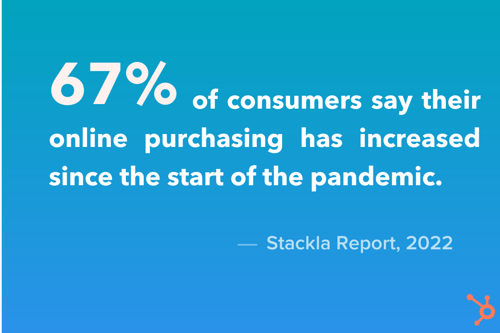
In fact, a Stackla report found that 67% of consumers say their online purchasing has increased since the start of the pandemic – 27% said it increased considerably.
With social media platforms offering advanced shopping features, it’s no wonder shoppers are buying more online. On Instagram, you can discover a brand, sift through its products, and complete a purchase without ever leaving the app.
This frictionless shopping experience helps contribute to a consumer base that shops exclusively online.
A Jungle Scout survey found that 46% of consumers only buy holiday gifts online.
So, what does this mean for brands? This forces brands that focused more on offline campaigns to shift gears and redirect their attention to online consumers.
This data isn’t suggesting that you should now change your business model to an online-first approach. However, to stay relevant and competitive, building a strong digital presence is key.
What Drives Online Shoppers
One of the biggest questions marketers have surrounding online shopping is what gets the consumer to finally click that “Buy” button. The answer is complicated because it varies based on the audience, the industry, the product, and many other factors.
However, there are some universal elements that definitely help steer consumers toward purchase.
The first is personalization. According to the Stackla report, 72% of people say they are more likely to purchase from a brand if it consistently provides them with a more personalized experience.
Personally, any brand email I receive that includes my name gets more attention than the ones that don’t. Why? It catches my attention and makes the email feel more intimate – even though I know it was likely automated.
Another big driver is user-generated content. We know that social proof can be incredibly effective in creating buzz surrounding a brand.
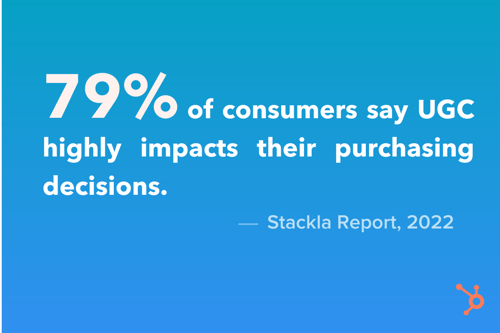
In the same report, 79% of people say UGC highly impacts their purchasing decisions, considerably more than branded content and influencer content.
Another form of social proof? Reviews.
58% of consumers have left an ecommerce store without purchasing because the site didn’t contain any customer reviews or photos.
Images can be incredibly impactful when someone is considering a purchase. In fact, most consumers surveyed in the Stackla report say they’re more influenced by social media images and videos than they were before the pandemic.
A long-term play that drives purchases is building community.
According to the report, 61% of consumers would be more loyal and more likely to buy from a brand if they were invited to be part of a customer advocate community or content creators.
When you build a community with your audience, they feel more connected to your brand and thus, more likely to purchase and spread the word.
Millennials Online Shopping Statistics
When it comes to Millennials specifically, here are some interesting stats about their online shopping behaviors.
- 60% of Millennials have left an eCommerce store without purchasing because the site didn’t have customer reviews or photos. (Stackla report, 2021)
- Millennials spending power is $2.5 trillion. (Ypulse, 2020)
- 30% of Millennials used buy-now-pay-later services (BNPL) in 2021 and 39.5% are forecasted to use them in 2023. (Statista, 2021)
- Roughly 40% of Millennials say that they have started a new relationship (or strengthened an existing one) with businesses that prioritize the environment. (Deloitte, 2020)

How Many Visitors Should Your Website Get? [Data from 400+ Web Traffic Analysts]
If you run a website, then you’ve likely spent time creating and optimizing a marketing strategy to drive traffic to your website. But how many visitors should you aim for your website to get?
To answer that question, you will need to complete the following steps:
- determine how many visitors are typical to websites in your industry
- determine how many visitors are “good” for websites in your industry
- establish a goal based on variables like industry, size, and user experience and create an action plan to achieve it
In this post, we’ll walk through how to complete each of these steps. Feel free to jump on one of the links above to skip to that step. Otherwise, let’s get started.

How many visitors does a website typically get?
It depends. With over 1.9 billion websites on the internet today, it is impossible to provide one number, or even a range, to accurately answer this question. Fortunately, there is data as well as tools and other resources to help you make an educated guess for websites in your industry.
To this end, the HubSpot Blog surveyed over 400 web traffic analysts in the U.S. to gather data on various metrics including their monthly traffic, bounce rate, click-through rate, and the strategies they use to rank on search engine results pages. The majority tracked analytics for B2C websites, while the rest tracked for B2B sites. Thanks to this survey, we can provide some answers for how many visitors a website typically gets and where these visitors come from.
When asked how many total visitors the website they tracked analytics for got per month, the majority answered between 1,001 and 15K. Here’s the breakdown:
- 1,001-15K (46%)
- 15,001-50K (19.3%)
- 50,001-250K (23.2%)
- 250,001-10M (11%)
- 10M+ (0.5%)
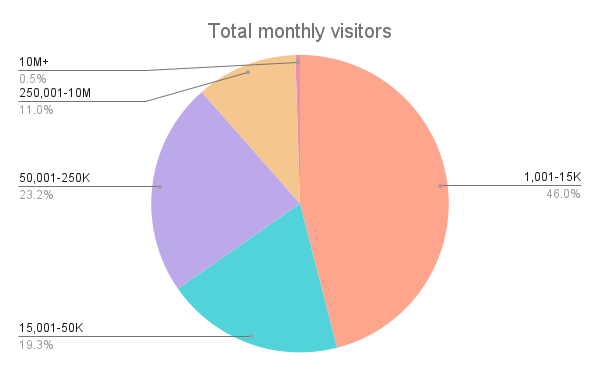
These percentages change when you consider other factors, like the size and age of the website. Let’s look at those breakdowns below.
Visitors by Website Size
Since website size might refer to the company size (ie. the number of employees) or to the amount of content on the website, we looked at both factors and how that affected total monthly visitors.
According to the HubSpot survey of over 400 web traffic analysts, the number of employees correlates to the number of monthly visitors — but more employees doesn’t always mean more visitors. Sites with over 1000 employees did make up the majority that get between 50,001-250K and 250,001-10M total monthly visitors. They were also the only sites that get over 10 million total monthly visitors.
However, approximately 8% of companies with fewer than 10 employees get between 250,001-10M total monthly visitors whereas 0% of companies with 11 to 200 employees do. Also, approximately 31% of companies with 201 to 500 employees get between 50,001-250K and 250,001-10M total monthly visitors, which is higher than the percentages of companies with 5001 to 1000 employees and companies with more than 1000.

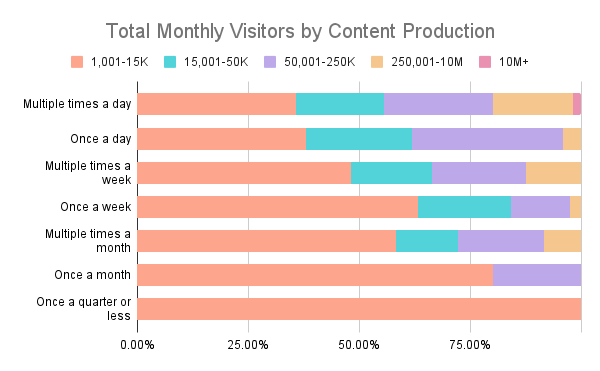
According to the data, the less frequently you publish, the less visitors you get per month and vice versa. For example, 36% of sites that publish multiple times a day get between 1,000 and 15K monthly visitors whereas 100% of websites that publish once a quarter or less do. Also, only sites that publish multiple times a day get over 10 million total monthly visitors.
Visitors by Website Age
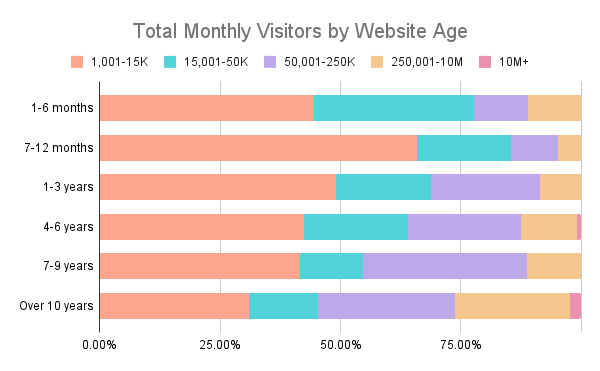
According to HubSpot data, the age of a website correlates to the number of monthly visitors. Sites that have existed for over 10 years did make up the majority that get between 250,001-10M and over 10 million total monthly visitors, and the minority that get between 1,001-15K.
However, older doesn’t always mean more visitors. For example, approximately 34% of sites that have existed for 7-9 years get between 50,001-250K total monthly visitors whereas only 29% of websites that have existed for over 10 years do.
Where do visitors come from?
Knowing how many total monthly visitors websites get on average is important — but it’s also important to know where these visitors are coming from. It can help you determine whether you should invest more in email or social media, for example, or in ensuring your site is mobile-friendly. Let’s take a look at the results of the HubSpot survey below.
Visitors from Traffic Sources
According to HubSpot data, the distribution of website traffic by source is:
- Direct (22%)
- Organic Search (17%)
- Social (16%)
- Email (14%)
- Display ads (12%)
- Referral (9%)
- Paid Search (9%)
- Other (1%)
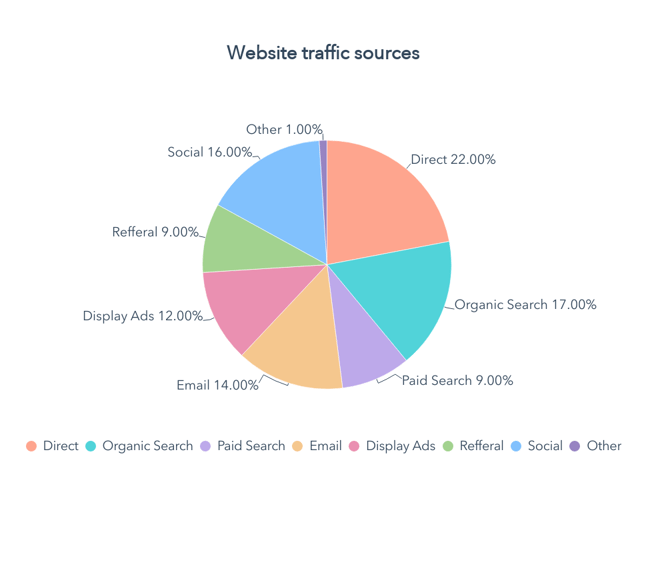
As you analyze other companies and industries, you can assume that direct traffic, organic search, and social are the top web traffic sources.
Visitors from Device Types
According to this HubSpot data, the distribution of website traffic by device type is:
- Mobile (41%)
- Desktop (38%)
- Tablet (19%)
- Other (2%)
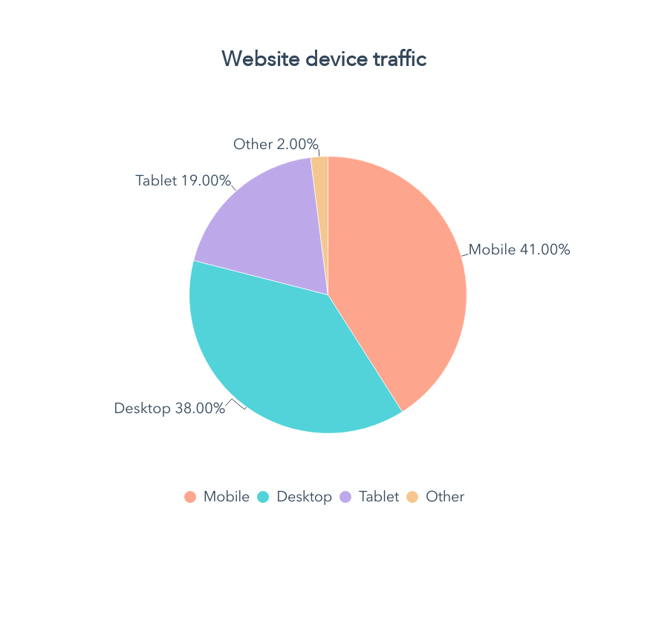 Other data suggests that mobile makes up an even greater percentage of website traffic worldwide. In fact, mobile has accounted for approximately half of web traffic worldwide since 2017 according to data from Statista.
How do you scale this information to your business? There are a series of factors to consider when determining how many visitors your site should get and setting a “good” number — or benchmark — as your goal. Let’s take a look.
How many unique visitors per month is good?
The answer to this question depends on a few factors. First, are you evaluating a B2B, B2C, or hybrid company? B2B companies have a target audience of other businesses and organizations. B2C companies target direct consumers.
One can infer that the potential for more unique monthly visitors for B2C companies is greater than that of B2B companies simply because their target audience is exponentially larger. B2B companies use niche marketing to sell particular products or services to a specific group of businesses while B2C companies focus their strategy on the needs, interests, and challenges of people in their everyday lives.
Data from the HubSpot survey of over 400 web traffic analysts provides mixed results however. While 22.5% of B2C sites get between 40,001-100K unique monthly visitors, only 16.7% of B2B websites get that amount. However, 16.7% of B2B sites get over 100K unique monthly visitors and only 14.7% of B2C sites do.
In the table below, you’ll see a breakdown of how many unique visitors that all websites included in the survey get, and a breakdown by B2B and B2C sites.
|
Unique Monthly Visitors |
Total |
B2B |
B2C |
|
1-10K |
39.6% |
41.2% |
39.1% |
|
10,001-40K |
24.2% |
25.5% |
23.8% |
|
40,001-100K |
21.0% |
16.7% |
22.5% |
|
100,001-2M |
13.9% |
14.7% |
13.7% |
|
2M+ |
1.2% |
2.0% |
1.0% |
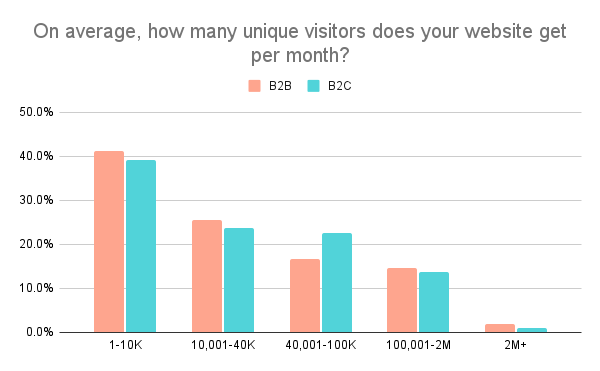
Taking note of the data above, determining how many monthly unique visitors is “good” for your company depends on your answers to the following questions.
What is the standard in your industry?
To make an accurate guess of where your company should be, determine the industry standard. To do this, evaluate your competition. Using tools like the previously mentioned SimilarWeb and SEMRush, you can create a general overview of your competitors, and use these statistics to establish an average for your industry.
How much content do you produce?
The more content you have available on your site, the more opportunities you create for visitors to find it. How much new content are you producing? One? Three? Five or more? The size of your team will affect the amount of content you’re able to create. If you find that you’re unable to produce new content, consider expanding the size of your team to meet your needs.
How well is your content strategy working?
To fix something, you need to know if it’s broken. Evaluate whether your content strategy is working. Are you ranking for your keywords? Have you seen an increase in views over the last few months? Where is the bulk of your traffic coming from? Once you can determine how your site is currently performing, you can take active steps to create an effective content strategy.
What is the search volume for your targeted topics?
Search volume for your targeted topics is directly related to the demand for that information, product, or service. High search volume can mean more visitors; however, this is directly affected by the competitiveness of your keywords.
How competitive are your target keywords?
A combination of these factors affects your website’s unique visitors per month, but it boils down to competition. The more competitive your target keywords, the harder it is to rank on the first page of a SERP. The more competitive the industry, the greater the chances of having potential website visitors split among the competition.
For example, in the HubSpot survey, 29.4% of B2C websites described the competitiveness of their target keywords as above average, or highly competitive, whereas only 25.4% of B2B sites did.
Is your website secure?
Establishing a safe and secure website with an SSL certificate can boost your reputation and relationship with future consumers. Not only does it mean less time worrying about potential security incidents, but it allows your visitors to insert their information into your systems with confidence.
Is your website accessible?
Fifteen percent of the world’s population are persons with disabilities. Many still use the web, and businesses must ensure that their content is accessible. Accessibility is not a feature, and making your website convenient to all visitors is not a bonus but a necessity.
Is your website mobile-friendly?
If your site isn’t mobile-friendly for cell phone users, you’re cutting off a large portion of potential visitors. According to data from Statista, the number of unique mobile internet users stood at 4.66 billion in 2021, indicating that over 92 percent of the global internet population use a mobile device to go online.
Optimizing your website for mobile is therefore essential. Over 50% of the web traffic analysts surveyed by HubSpot said that it was one of the SEO strategies they leverage.
Is your website optimized for the user experience?
Click-through rate and bounce rate are metrics that help determine the user experience on your website. You should evaluate them together.
Click-through rate is the percentage of people who visit your page after it comes up in a search. Bounce rate is the percentage of people who arrive and leave your web page quickly after landing on it. While a high click-through rate is positive, a high bounce rate is negative. A high bounce rate sends search engines a signal that your content isn’t relevant to the users and negatively affects your rank.
In the HubSpot survey of over 400 web traffic analysts, the average click-through rate and bounce rate ranged widely. However, most of the websites (67%) had a click-through rate between 10-39%, while the majority (43.8%) had a bounce rate between 21-40%. These are good benchmarks to use for your site.
Once you can evaluate your industry, website, and content strategy, the next step is to set goals and execute them.
Setting Reasonable Goals For Website Traffic
Focus on the word “reasonable.” A goal to reach 10,000 monthly visitors next month might not be a stretch if you garnered 9,000 visitors this month. However, if your website receives an average of 2,500 monthly visitors, this goal is less probable. Setting a realistic and attainable goal is the key to creating the proper marketing strategy for your business.
Step 1: Define your goal.
First, define your goal. To do so, analyze your current metrics and that of your competitors.
Platforms such as Google Analytics, HubSpot, SimilarWeb, SEMRush, and Ahrefs will enable you to analyze the traffic of websites in your industry. Using a combination of these tools is common. For example, in the HubSpot survey, about 82% of the web traffic analysts used Google Analytics and 25% used HubSpot’s web analytics. The next three most popular tools were Mint, Spring Metrics, and SimilarWeb.
Let’s use HelloFresh and other meal kit delivery services as an example. The company’s direct competitors include Every Plate, Home Chef, and Blue Apron. The ranking for their monthly total visitors, according to SimilarWeb and Sitechecker, is as follows for February 2022:
- HelloFresh: 12M
- Every Plate: 2.9M
- Home Chef: 2.7M
- Blue Apron: 1.9M
Note that the same website may differ in traffic estimates provided by different tools. While you can’t assume which platform is more accurate than the other, you can use a combination of information from different sources to find an average. This will provide a snapshot of how many visitors a website typically gets.
For example, if you’re a new meal kit delivery service looking at the total monthly visitors for these companies, you’d get an average of 4.9 million monthly views. Now, this can be a goal for future growth, with incremental benchmarks.
A monthly goal for a small business receiving 5,000 total monthly visitors could be 10% or 500 visitors, for example. Set goals with a content plan in mind. With this goal in place, you can use it to determine the success of your content strategy.
Step 2: Build a content plan around MSV.
Monthly search volume (MSV) is the number of times a specific keyword is entered into a search engine each month. MSV allows you to anticipate the amount of traffic available for a particular keyword term. Armed with this knowledge, you’ll be able to gauge which keywords are worth targeting for your content strategy. You’ll also be able to assess the needs of potential clients and customers and cater your content to them.
An effective content plan won’t only target keywords with the highest MSV. In the HubSpot survey, only 15% of the web traffic analysts described the MSV for their target keywords as “very high.” The majority (60%) described it as “somewhat high.”
Some free online keyword tools that help calculate MSV include Google Keyword Planner, Ahrefs Keyword Generator, and Answer the Public.
Step 3: Determine a publishing cadence.
In conjunction with creating your content strategy, lay out a schedule. How often you update your website is key to attracting more visitors because you increase the number of opportunities to land on your page. According to the data from the HubSpot survey shared above, you want to post new content to your website multiple times a month at least. Ideally, you should post new content once a day. Websites that post daily are more likely to get between 15,001 and 250K visitors per month, and less likely to get between 1,0001 and 15K visitors than websites that post monthly.
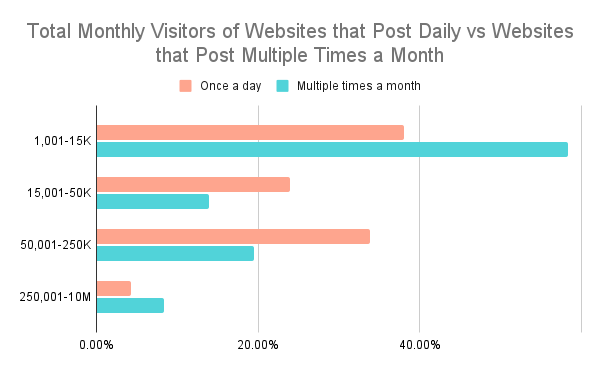 The amount of content is, of course, dependent on the size of your team and audience. The more resources you have, the more content you can create. The larger your audience, the more content you should create.
While determining a publishing cadence is necessary, it is equally important to stick to it and remain consistent.
Step 4: Assess your performance.
The first step to assessing your goals is having a data reporting software set up. Once you do, it’s time to look at a range of metrics. Of the web traffic analysts surveyed, total monthly visitors, unique monthly visitors, and bounce rate were the most common metrics used to assess website performance. Others included search traffic and industry-wide trends.
To start, check if your unique monthly visitors increased. Whether or not you met your goal, ask yourself the following questions to review your progress:
- Did your unique monthly visitors increase or decrease? By what percent?
- Are you ranking for targeted keywords?
- Was there a trend (increase or decrease) in visitors across your industry?
An increase or decrease in your unique monthly visitors isn’t enough to gauge the complete success of your goal or content strategy. Are you ranking for your targeted keywords? If yes, your content strategy is working, and your location in SERPs can lead to further increases in the future. If not, reassess and adopt new SEO methods for growth.
When assessing your performance, it might also be necessary to measure factors out of your control, for example, industry trends. Was there a mutual dip in unique monthly views among you and your competitors? It is possible that your keyword MSV wasn’t as high as in previous months. A decrease in MSV for your keywords is out of your control. However, it is your responsibility to pivot and discover what your target audience is searching for.
How many visitors should your site get?
In content strategy and marketing, consistency is key. How many visitors should your site get? Ultimately, it comes down to how consistent you are in the tips featured above. Do you keep up with industry best practices to guide your knowledge on MSV? Do you periodically evaluate your content to boost your SEO? Are you updating your information to guide your goals?
There is no magic number when it comes to monthly website visitors. Evaluate your website and use your current metrics to determine where you want to be in one, six, or 12 months from now. Changes rarely happen overnight. Set reasonable goals with realistic timelines, and you’ll eventually see growth.
Editor’s note: This post was originally published in September 2009 and has been updated for comprehensiveness.

Social Media Marketing: The Ultimate Guide
When it comes to social media, marketers’ top goals are advertising their products/services and increasing their brand awareness, according to 2021 HubSpot Blog Research.
However, many brands struggle with creating engaging content and reaching their target audience. With social media playing such an important role at the top of the funnel, let’s dive into all things social media marketing – what it is, its benefits, and how to actually build a social media marketing strategy that’ll work for your specific business.

Social media marketing is all about meeting your target audience and customers where they are and as they socially interact with each other and your brand.
While social media marketing as a whole is incredibly valuable and beneficial to your business growth (as you’ll see in the following section), your strategy will differ based on which social networks your audience spends their time on.
Before we dig deeper into social media marketing, let’s segment the strategy by platform.
Social Media Marketing Platforms
- Users: 1.9 billion daily active users worldwide
- Audience: An even spread of Generation X and Millennials
- Industry impact: B2C
- Best for: Brand awareness; advertising
Facebook is the largest social media platform and the most established. Since its launch in 2004, it has become an invaluable tool for B2C businesses, offering advanced advertising tools as well as organic opportunities.
TikTok
- Users: 1 billion active monthly global users
- Audience: Primarily Gen Z followed by Millennials
- Industry impact: B2B and B2C
- Best for: Short-form, creative video content; user-generated content; brand awareness
When you think of short-form video, you probably think of TikTok. The platform rose in popularity in 2020 and shows no signs of slowing down. It’s one of the best platforms for community building, with marketers ranking it in second place behind YouTube.
- Users: 1 billion monthly active users
- Audience: Primarily Millennials
- Industry impact: B2C
- Best for: High-quality images and videos; user-generated content; advertising
Although Instagram launched only 12 years ago, the platform has taken the world by storm. When it comes to sharing visually compelling content, Instagram is where brands go. Another thing that sets the platform apart is its advanced ecommerce tools.
Today, users can discover brands, browse their products and/or service, and complete a purchase without ever leaving the app – making Instagram a hard platform to beat.
- Users: 211 million daily active users worldwide
- Audience: Primarily Millennials
- Industry impact: B2B and B2C
- Best for: Public relations; customer service; community building
While Instagram focuses on visuals, Twitter focuses on words. Since the early days of 140-character Tweets, the platform has now expanded to include an audio tool called Twitter Spaces, a community-building tool called Twitter Communities, and Twitter Moments to share interesting content with your followers.
- Users: 774 million active users worldwide
- Audience: Baby boomers, Generation X, and Millennials
- Industry impact: B2B
- Best for: B2B relationships, business development, and social selling
LinkedIn is Facebook’s professional cousin. It’s perhaps the only platform where its audience is clearly defined: Working professionals looking to network and seek out new opportunities.
That makes it the ideal platform for B2B companies looking to identify key decision-makers and build an industry-specific community.
YouTube
- Users: Over 315 million daily active users worldwide
- Audience: Primarily Millennials but has a strong audience across gender and age demographics
- Industry impact: B2C and B2B
- Best for: Brand awareness; long-form entertainment, and how-to videos
According to HootSuite, YouTube is the second most visited website in the world. In addition, marketers name it the best platform to build community.
In addition to being an incredibly popular platform, its users also tend to stay longer on it because it features mostly long-form content – making it an ideal platform to share educational content.
Snapchat
- Users: 306 million daily active users worldwide
- Audience: Primarily Generation Z
- Industry impact: B2C
- Best for: Brand awareness; advertising
When Snapchat came out in 2011, leading the charge in ephemeral content. It introduced content that you could share with your friends and that would expire after 24 hours.
The platform peaked in 2015 and has held strong since then. Many thought the brand would disappear once Instagram introduced Stories, the same feature with a different name. However, Snapchat continues to be popular among young adults.
- Users: 444 million monthly active users worldwide
- Audience: Primarily Millennials with a solid audience in Gen Z, Gen X and Baby Boomers
- Industry impact: B2C
- Best for: Visual advertising; inspiration
Think of Pinterest like a visual storyboard that allows users to get inspiration for everything from fashion to home decor.
85% of Pinners say Pinterest is where they go to start a new project. In addition, 80% of weekly Pinners say they’ve discovered a new brand or product on the platform. So, not only is it a great discovery tool but it’s also a way for brands to build their narrative through visual stories.
Clubhouse
- Users: 10 million weekly active users worldwide
- Audience: Primarily Millennials
- Industry impact: B2B and B2C
- Best for: Visual advertising; inspiration
Clubhouse made a strong impression as soon as it entered the social media world in 2020. The audio-only platform allows people to start interesting conversations with followers as well as strangers and build community.
The platform also gained some buzz for its invitation-only set up when it was in beta testing. Today, the platform is open to everyone globally and on both IOS and Android devices. Another big selling point to this platform is that it works well for both B2B and B2C businesses and leverages audio, which has made a huge comeback in recent years.
Now that we’ve detailed the fundamentals of each social media network, let’s discuss why social media marketing is beneficial for your business.
Benefits of Social Media Marketing
To illustrate the benefits of social media marketing, let’s take a look at the experience from the user’s perspective. Well, my perspective.
As I scroll through my Instagram feed every day (cough, cough…multiple times a day), I consistently notice new posts and stories by The Frye Company. I’ve always been a fan of their boots, clothing, and accessories, but I also love the content they share on their Instagram profile.
All of their photos have the same filter on them to ensure they match — this makes their profile look professional, artistic, and organized when visitors, like myself, browse their page.
Frye’s account also encourages interaction between the company and its followers by providing them with a specific hashtag to use so they can be featured on the page when they post photos with Frye products.
Frye’s Instagram account is a great example of successful social media marketing — it’s attractive, distinctly Frye, engages their ~200K followers, and promotes their products.
But why is social media marketing so important? And how do you actually build a social media marketing strategy that’ll work for your specific type of business?
There are a variety of reasons why your company should use social media marketing. We’ve created a list of the most beneficial reasons to consider.
Let’s dive in.
1. Increase your brand awareness.
Due to the sheer amount of people on social media, you’re missing out on the potential to reach thousands, and even millions, if you don’t have a presence.
In fact, social media has been proven to boost brand awareness by driving up engagement. Social engagement includes things like comments, likes, shares, and reposts, and saves.
It also helps you increase brand awareness by directing traffic straight to your site. You can do this by including direct links to your website in your profile, bio, and posts.
Featured Resource
2. Generate leads and boost conversions.
Promoting and sharing your products on social media is a simple way to improve lead generation, boost conversions, and increase sales because you’re advertising to people who have opted to engage with you by following your account.
Here are some examples of ways you can use social media to generate more leads.
- Create contests for your visitors and followers to participate in on your social media profiles.
- Include links to your website and offers in the bio sections of your profiles.
- Host live videos to make announcements about products and provide updates or details about exciting news at your company.
- Implement a social media marketing campaign on one of your channels.
- Sell your products through your social profiles. For example, you can enable Facebook’s Shop Section or Instagram’s Shopping feature on your profiles. These features allow your visitors and followers to click on products you’ve shared in posts to view information such as price, material, and size. Then, visitors can easily proceed to checkout through the platform and buy the product directly from you.
3. Foster relationships with your customers.
By connecting and engaging with your social media followers, you’ll be able to build lasting relationships between them and your business. You can do this by interacting with them on your posts, responding to their questions and comments, and providing them with any help they may need.
You can also ask your followers questions about your products, their pain points, or create giveaways to help you build trust and show them how much you value their input and support.
4. Learn from your competitors.
Social media is a great way to keep tabs on your competitors — whether that’s in reference to their social media tactics, the products they’re promoting, the campaigns they’re implementing, or their level of interaction with followers.
Social media allows you to get a look at what is and isn’t working for your competition, and therefore helps you decide what should or shouldn’t change in terms of your company’s approach.
Lastly, reviewing the social accounts of your competitors can help you make sure your marketing stands out and is unique to your brand.
Learn how to conduct a competitive analysis to discover how you can beat the competition.
Now, let’s talk strategy — there are severa steps to ensure your social media marketing plan is sustainable and positively impacts your business.
Although social media is constantly evolving, most of the foundational steps you need to succeed stay the same. Essentially, you’re following the same steps you would take to create a marketing strategy and narrow it to a specific channel.
Let’s cover these steps in more detail so you can begin applying them to your business.
Step 1: Research your buyer personas and audience.
The first step to creating a social media marketing strategy is to determine who your buyer personas and audience are so you can target their needs and interests appropriately.
To do this, think about the people you’re trying to reach and why, and how you would classify them as a group. For example, if your company sells trendy leggings and joggers, you might classify your target audience as millennials who like to wear stylish athletic apparel regularly — a style known as athleisure.
By considering your buyer personas and audience, you’ll then be able to determine what content will attract the type of followers and customers you hope to gain. Plus, learn how to create engaging content to keep your followers interested.
Recommended Tools
Step 2: Determine which social platforms you’ll market on.
As a social media marketer, it’s crucial you determine which platforms you’re going to share your content on.
There’s not necessarily a right or wrong answer when it comes to which social channels your business should use — it’s more about the needs of your target audience and where they tend to spend their time.
“It’s important to be where your audience of potential customers is today, and where they might be tomorrow,” said Andrew Delaney, former social media marketing manager at HubSpot. “It’s better to be ahead of the curve than behind.”
For example, if you are going for that target audience of athleisure-loving millennials, you may want to focus the majority of your social media efforts on Instagram — this is because millennials cover the largest portion of users on the platform.
Stephanie Morgan, founder and CEO of social media agency Social Lock, echoes this sentiment.
“Think about their behaviors and where they hang out online. If that’s Pinterest, use that platform for your brand. If that’s TikTok, use that platform for your brand,” Morgan adds. “Don’t waste time on a platform that your ideal client avatar is not very active on.”
Recommended Tools and Resources
- A Marketer’s Guide to Snapchat for Business
- 50 Facebook Ad Examples We Actually Clicked
- YouTube for Business: A 30-Day Roadmap for Growth
- How to Use Twitter for Business (+ Follower Tracking Template)
- 12 Pinterest Templates for Business
Step 3: Establish your most important metrics and KPIs.
No matter your goals or industry, your social media strategy should be data-driven.
That means focusing on the social media metrics that matter. Rather than focus on vanity metrics, dig into data that aligns directly with your goals.
What metrics are we talking about? Check out the breakdown below:
- Reach. Post reach is the number of unique users who saw your post. How much of your content actually reaches users’ feeds?
- Clicks. This is the number of clicks on your content or account. Tracking clicks per campaign is essential to understand what drives curiosity or encourages people to buy.
- Engagement. The total number of social interactions divided by the number of impressions. This sheds light on how well your audience perceives you and their willingness to interact.
- Hashtag performance. What were your most-used hashtags? Which hashtags were most associated with your brand? Having these answers can help shape the focus of your content going forward.
- Organic and paid likes. Beyond a standard “Like” count, these interactions are attributed to paid or organic content. Given how much harder organic engagement is to gain, many brands turn to ads. Knowing these differences can help you budget both your ad spend and the time you invest in different formats.
- Sentiment. This is the measurement of how users react to your content, brand, or hashtag. Did customers find your recent campaign offensive? What type of sentiment do people associate with your campaign hashtag? It’s always better to dig deeper and find out how people talk or feel about your brand.
Recommended Resources
Step 4: Get to know your competition.
A competitive analysis allows you to understand who the competition is and what they’re doing well (and not so well). You’ll get a good sense of what’s expected in your industry, which will help you set social media targets of your own.
It will also help you spot opportunities.
Maybe one of your competitors is dominant on Facebook, for example, but has put little effort into Twitter or Instagram. You might want to focus on the networks where your audience is underserved, rather than trying to win fans away from a dominant player.
Recommended Tools and Resources
- What’s a Competitive Analysis & How Do You Conduct One?
- A Marketer’s Guide To Competitive Intelligence
- How to Monitor Your Competitors’ Every Move in Social Within HubSpot
Step 5: Create unique and engaging content.
With the billions of social media users around the globe, there’s no question that at least some of your followers — or the people browsing your profile — have also seen your competitor’s content or that of other businesses in your industry.
That’s why you must have engaging social media content that stands out and provides viewers with a reason to click that “Follow” button and interact with your brand.
Not sure what’s considered engaging? Morgan has a recommendation.
“My number one tip to brands for creating engaging content on social media is to do market research first because what will be engaging depends on the audience,” Morgan said. “When you know what your audience likes and needs to know, you can create content that engages those interests.”
To help you get creative, consider the content your competitors are sharing and how you can uniquely promote your products. Also, take advantage of the features offered by the platform you’re using.
For example, you can create live videos on Facebook to share the latest details about a product launch or conduct a giveaway.
You can also use your current customers and promoters to help you generate content. You can do this by re-posting their content or encouraging them to use a hashtag to share their own experiences and pictures with your products.
Lastly, leverage trends. Social media trends are always coming up, especially on short-form video platforms like TikTok. Don’t be afraid to join in but you still have to be intentional about how you do it.
“If the trend started happening three weeks ago, you’ve probably missed the boat,” Morgan said. “Catching the trends early is the best way to capitalize on it without coming across as inauthentic or like you’re trying too hard, or worse [as] ‘chuegy’ – see Gen Z for that one.”
Recommended Tools and Resources
Step 6: Organize a schedule for your posts.
One of the easiest ways to ensure your content is shared as planned is to use a social media management solution. These tools allow you to write captions, prepare pictures and videos, and schedule posts in advance. They also automatically share your content on schedule and monitor all post interactions and engagement for you. Social media management solutions save you time and allow you to focus on your other tasks.
There are a number of solution options available — here are a few examples.
HubSpot
HubSpot offers a social media tool — as part of the marketing software — to help you publish and monitor your content and create real connections with your followers. You can schedule and publish your content in advance and compare in-depth reports on your posts’ engagement to understand the performance of various platforms, types of content, and posting times.
Sprout Social
Sprout Social is a social media marketing and management solution designed to help your team organize and plan content creation, manage campaigns, understand engagement, and review content reports and analysis.
Hootsuite
Hootsuite is a social media management platform for finding, scheduling, managing, and reporting on your content. You can schedule posts in advance on all of your channels at once and measure your ROI with comprehensive content analysis.
How often should you post on social media?
Now, you might be wondering how often you should post content on your social media channels.
As a rule of thumb, you should only post on social when you have quality content to share. Meaning, there’s a reason you’re posting the content. This is how you’ll strike the right balance when it comes to your posting frequency.
Morgan says the top mistake she sees brands make in regards to social media marketing is focusing on quantity of content instead of the quality of content.
“They think they need to post every day, so they force themselves to create posts to fill up the calendar,” she said. “Odds are, every single one of those posts isn’t going to be very valuable to the ideal customer, I’ve coined this ‘clutter content.'”
Instead, she recommends downsizing in quantity and upping the quality.
“It’s better to post two or three times a week with super valuable content, versus posting seven times a week with only one or two valuable posts,” said Morgan.
There are plenty of studies and resources available explaining social media post frequency standards by industry and platform for you to follow. Every business is different, so find what works for your audience.
Then, you can begin experimenting with more or fewer posts – as well as other factors such as the time of day you’re posting on social – to determine what provides the highest level of engagement.
Recommended Tools and Resources
How to Analyze Your Social Media Marketing Impact and Results
One of the most important aspects of social media marketing is ensuring your efforts are successful in helping you meet your goals. To determine this, you’ll need to keep track of all of your posts, on every channel. You can do this by reviewing and managing your social media metrics.
Social Media Metrics
Social media metrics are data related to the success of your posts and your impact on your audience and customers on various platforms. These metrics may include data about your level of engagement, likes, follows, shares, and all other interactions on each platform.
Here are 10 of the most important metrics for you to track:
- Engagement: This includes clicks, comments, likes, and replies on your social media posts. There are also platform-specific types of engagement such as “Saved” posts on Instagram and “Pinned” posts on Pinterest.
- Reach: The number of people who have seen any content associated with your page or profile is your reach.
- Followers: This is the number of people you have on your profile who have clicked your “Follow” button and see your content in their feeds regularly.
- Impressions: This is the number of times a post from your profile or page is seen, whether or not your audience members click on it. This is often what happens when someone is scrolling through their newsfeed, but not clicking on anything.
- Video views: On Facebook, Snapchat, Instagram, or any other social channel with video capabilities, this is the number of views each gets.
- Profile visits: The number of people who have opened your social media page is your number of profile visits.
- Mentions: This is the number of times your profile has been mentioned by audience members in their posts.
- Tags: This is when your audience adds the name of your company’s profile or your hashtag to another post.
- Reposts: This is when a member of your audience posts a piece of your content on their profile.
- Shares: These are the posts your followers and audience take from your profile and share with their network.
You can influence all of these metrics, increase your social following, and improve overall engagement on your profile by using the same tactics you would to generate leads and boost conversions.
Morgan adds that the metrics you focus on will depend on which season you’re in. Here’s her formula:
- If you’re new, focus on building an audience and awareness. Key metrics: reach, impressions, audience growth.
- If you’re growing, focus on building trust. Key metrics: Likes, saves, comments, DMs.
- If you’re established, focus on retaining and nurturing. Key metrics: Likes, saves, comments, DMs.
- If you’re launching something, focus on selling. Key metrics: DMs and clickthrough rate
How to Measure Social Media Metrics
You can review social media metrics in a variety of ways, For example, you can use the analytics tools built into the various platforms you use. Here are a few examples:
You might also choose to use an analytics and tracking tool such as Google Analytics. This is a great option if you want to track your social media and website metrics. Lastly, many social media scheduling solutions — as we reviewed earlier — have monitoring and tracking features automatically built-in.
All of these metrics tracking tools will give you a better understanding of what your followers and audience respond well to and what you should consider modifying to improve engagement.
Now that we’ve reviewed the benefits of social media marketing and how to build your strategy, let’s talk about the various resources available to help you along the way.
Social Media Marketing Resources
There are a plethora of social media marketing resources you can use to build a social strategy for your company. You’re bound to feel more confident about working on your company’s social media marketing initiative with the help of the following courses, training, and books.
Social Media Marketing Courses and Training
Here are three ways to earn an education in the field of social media marketing if you feel it’s necessary for your specific business situation.
1. Earn a certificate administered by a company.
A certificate is a quick and simple way to gain a deep understanding of social media marketing courses.
HubSpot offers a free social media certification course, which teaches you how to engage with your customers and improve conversions. You’ll also get a better understanding of how to develop your strategy, extend your reach, and measure your social media ROI.
LinkedIn Learning is another platform where you can earn a certification and share it on your profile.
2. Leverage YouTube university.
YouTube is a goldmine when it comes to educational content.
With a quick search, you’ll find hundreds of long-form videos that offer in-depth courses on social media marketing. Granted, you can’t connect with a live educator. However, it’s free and can be a great starting point before you dive into a paid course.
Social Media Marketing Books
Reading relevant content about social media marketing is another great way to learn more about the field. Here are a few examples of some highly-regarded books on the topic.
1. Likable Social Media, Third Edition: How to Delight Your Customers, Create an Irresistible Brand, and Be Generally Amazing on All Social Networks That Matter by Dave Kerpen
This New York Times Bestseller covers the reasons why being likable and engaging with followers on social media is one of the most powerful ways to grow your base of customers and promoters.
The book teaches you how to make impactful content for your followers to interact with and share with their networks. Author Dave Kerpen also describes why you need to ensure you’re consistently delighting your followers to avoid losing them at any point in time.
2. Jab, Jab, Jab, Right Hook: How to Tell Your Story in a Noisy Social World by Gary Vaynerchuk
According to author Gary Vaynerchuk, the key to social media marketing success isn’t about pushing out a lot of content — it’s about pushing out specific content tailored towards your target audience and using the right platform to do so.
In his book, Vaynerchuk covers how to do this as well as connect with your followers and customers on a deeper level through social media. You’ll learn how to create memorable and unique content that stands out in comparison to the competition’s content.
3. The B2B Social Media Book: Become a Marketing Superstar by Generating Leads with Blogging, LinkedIn, Twitter, Facebook, Email, and More by Kipp Bodnar
HubSpot’s CMO, Kipp Bodnar, writes about the ways B2B businesses can generate more leads and conversions through social media marketing.
There are actionable methods you can take to increase your base of followers and drive leads as well as understand the ROI of various B2B social media marketing strategies.
Emerging Social Media Platforms
Recent HubSpot Blog Research found that marketers are constantly on the lookout for new or emerging platforms, as often as even week.
Though it takes a while for platforms to take off, once they do, you want to have a plan in place for how you’re going to tackle it.
For instance, brands like Chipotle were one of the first to try short-form video content on TikTok. As a result, they have a strong presence on the platform while many others are still struggling to find their place.
Emerging platforms can offer a new avenue to reach your target audience in a way that may be more effective than what you’re doing now. Clubhouse and Discord are among some of the most popular emerging platforms.
However, others like Flyy and SpaceHey are looking to make their mark.
Want to learn more about what’s out there? Check out this article on new social media platforms you should keep your eye on this year.
Start Marketing on Social Media
Considering there are billions of people on social media today, it’s easy to see why so many businesses and marketers use the channel to promote their products and engage with customers.
Although determining your company’s social media course of action may seem daunting, you can avoid feeling overwhelmed by understanding social media marketing trends and using some of the many resources available about the topic. So, start working on your business’ social media marketing strategy today to increase your number of followers, improve engagement, and boost conversions.
Editor’s note: This post was originally published in March 2019 and has been updated for comprehensiveness.

12 Expert-Vetted Sample Business Plans to Help You Write Your Own
Ask any successful sports coach how they win so many games, and they’ll tell you they have a unique plan for every single game they coach. The same logic applies to business. If you want to build a thriving company that can pull ahead of the competition, you need to prepare yourself for battle before you break into a market.
Business plans guide you along the rocky journey of growing a company. Referencing one throughout your voyage will keep you on the path toward success. And if your business plan is compelling enough, it can also convince investors to give you funding.

But how do you actually write a viable and convincing business plan? Below, let’s review the format of a business plan and sample business plans you can use to inspire your own.
Business Plan Format
Before you get started on your business plan, you might be wondering, “Where do I start? How should I format this?”
Typically, a business plan is a document that will detail how a company will achieve its goals.
Most business plans include the following sections:
Executive Summary
The executive summary is arguably the most important section in the entire business plan. Essentially, it’s the overview or introduction, written in a way to grab readers’ attention and guide them through the rest of the business plan (which may be dozens or hundreds of pages long).
Most executive summaries include:
- Mission statement
- Company history and leadership
- Competitive advantage overview
- Financial projections
- Company goals
However, many of these topics will be covered in more detail later on in the business plan, so keep the executive summary clear and brief, including only the most important take-aways.
Here’s an example:
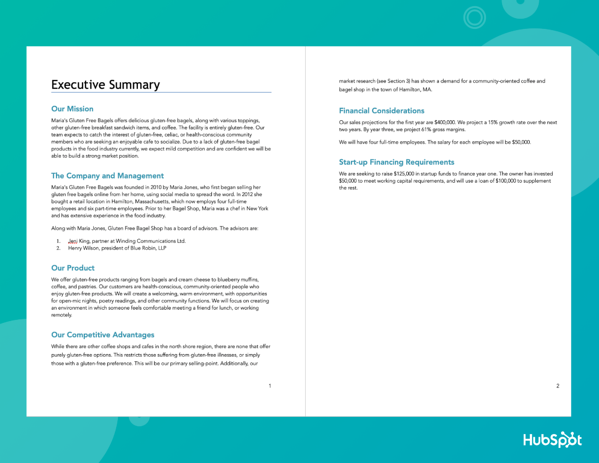
Download this template for free
Check out our tips for writing an effective executive summary for more guidance.
Market Opportunity
This is where you’ll detail the opportunity in the market. Where is the gap in the current industry and how will your product fill that gap?
In this section, you might include:
- The size of the market
- Current or potential market share
- Trends in the industry and consumer behavior
- Where the gap is, what has caused the gap, and how you intend to fill it
To get a thorough understanding of the market opportunity, you’ll want to conduct a TAM, SAM, and SOM analysis and perform market research on your industry. You may also benefit from creating a SWOT analysis to identify some of the insights for this section.
Competitive Landscape
Speaking of market share, you’ll need to create a section that shares details on who the top competitors are. After all, your customers likely have more than one provider to choose from, and you’ll want to understand exactly why they might choose one over another. Performing a competitive analysis can help you uncover:
- Industry trends that other providers may not be taking advantage of yet
- Strengths in your competition that may be obstacles to handle
- Weaknesses in your competition that may help you develop selling points
- What unique proposition you bring to the market that may resonate with customers
Target Audience
This section will describe who your customer segments are in detail. What is the demographic and psychographic information of your audience?
If your immediate answer is “everyone,” you’ll need to dig deeper. Ask yourself:
- What are the demographics of the people most likely to need/buy your product or service?
- What are the psychographics of this audience? (Desires, triggering events, etc.)
- Why are your offerings valuable to them?
It can be helpful to build a buyer persona to get in the mindset of your ideal customers and get crystal clear on why you’re targeting them.
Marketing Strategy
Here, you’ll discuss how you’ll acquire new customers with your marketing strategy. You might consider including information on:
- The brand positioning vision and how you’ll cultivate it
- The goal targets you aim to achieve
- The metrics you’ll use to measure success
- The channels and distribution tactics you’ll use
It can help to already have a marketing plan built out to help you inform this component of your business plan.
Key Features and Benefits
At some point in your business plan, you’ll review the key features and benefits of your products and/or services. Laying these out can give readers an idea of how you’re positioning yourself in the market and the messaging you’re likely to use. It can even help them gain better insight into your business model.
Pricing and Revenue
This is where you’ll discuss your cost structure and various revenue streams. Your pricing strategy must be solid enough to turn a profit while staying competitive in the industry. For this reason, you might outline:
- The specific pricing breakdowns per product or service
- Why your pricing is higher or lower than your competition’s
- (If higher) Why customers would be willing to pay more
- (If lower) How you’re able to offer your products or services at a lower cost
- When you expect to break even, what margins you expect, etc.
Financials
This section is particularly informative for investors and leadership teams to determine funding strategies, investment opportunities, etc. According to Forbes, you’ll want to include three main things:
- Profit/Loss Statement – This answers the question of whether your business is currently profitable.
- Cash Flow Statement – This details exactly how much cash is incoming and outgoing to provide insight into how much cash a business has on hand.
- Balance Sheet – This outlines assets, liabilities, and equity, which gives insight into how much a business is worth.
While some business plans might include more or less information, these are the key details you’ll want to include.
Keep in mind, that each of these sections will be formatted differently. Some may be in paragraph format, while others will be in charts.
Sample Business Plan Templates
Now that you know what’s included and how to format a business plan, let’s review some templates.
1. HubSpot’s One-Page Business Plan
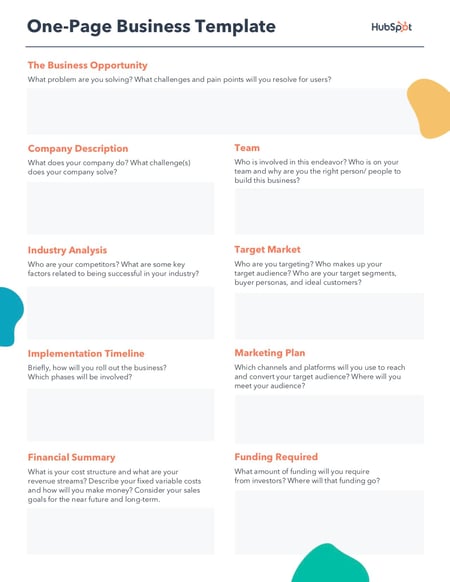 Download a free, editable one-page business plan template.
The business plan linked above was created here at HubSpot, and is perfect for businesses of any size — no matter how much strategy they still have to develop.
Including fields such as Company Description, Required Funding, and Implementation Timeline, this one-page business plangives businesses a framework for how to build their brand and what tasks to keep track of as they grow. Then, as the business matures, it can expand on its original business plan with a new iteration of the above document.
2. HubSpot’s Downloadable Business Plan Template
We created a business plan template for entrepreneurs.
Download a free, editable one-page business plan template.
The template is designed as a guide and checklist for starting your own business, so you’ll learn what to include in each section of your business plan and how to do it. There’s also a list for you to check off when you finish each section of your business plan.
Strong game plans help coaches win games and help businesses rocket to the top of their industries. So if you dedicate the time and effort required to write a viable and convincing business plan, you’ll boost your chances of success and even dominance in your market.
3. LiveFlow’s Financial Planning Template with built-in automation
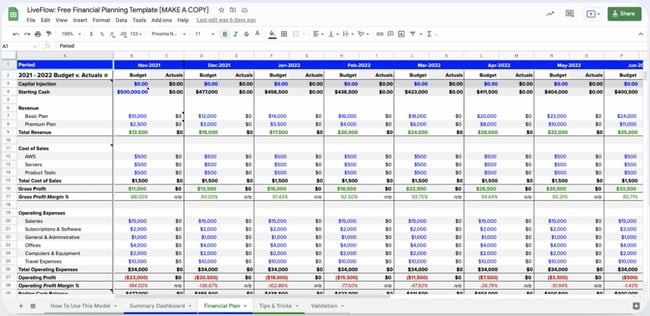
This free template from LiveFlow aims to make it easy for businesses to create a financial plan and track their progress on a monthly basis. The P&L Budget vs. Actual format allows users to track their revenue, cost of sales, operating expenses, operating profit margin, net profit, and more.
The summary dashboard aggregates all of the data put into the financial plan sheet and will automatically update when changes are made. Instead of wasting hours manually importing your data to your spreadsheet, LiveFlow can also help you to automatically connect your accounting and banking data directly to your spreadsheet, so your numbers are always up-to-date.
With the dashboard, you can view your runway, cash balance, burn rate, gross margins, and other metrics. Having a simple way to track everything in one place will make it easier to complete the financials section of your business plan.
4. ThoughtCo’s Sample Business Plan
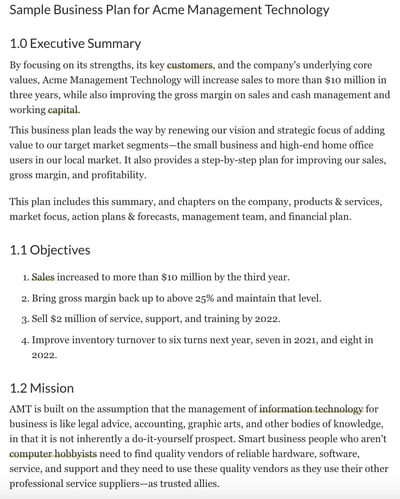
If you want to reference an actual business plan while writing your own, ThoughtCo’s got you covered. They created a fictional company called Acme Management Technology and wrote an entire business plan for them.
Using their sample business plan as a guide while filling out your own will help you catch and include small yet important details in your business plan that you otherwise might not have noticed.
5. BPlan’s Free Business Plan Template
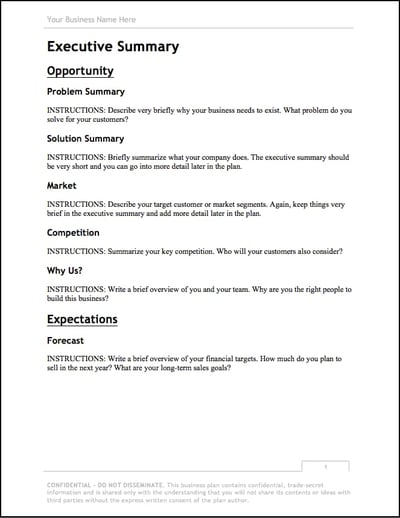
One of the more financially oriented sample business plans in this list, BPlan’s free business plan template dedicates many of its pages to your business’ financial plan and financial statements.
After filling this business plan out, your company will truly understand its financial health and the steps you need to take to maintain or improve it.
6. Harvard Business Review’s “How to Write a Winning Business Plan”
Most sample business plans teach you what to include in your business plan, but this Harvard Business Review article will take your business plan to the next level — it teaches you the why and how behind writing a business plan.
With the guidance of Stanley Rich and Richard Gumpert, co-authors of Business Plans That Win: Lessons From the MIT Enterprise Forum, you’ll learn how to write a convincing business plan that emphasizes the market demand for your product or service and the financial benefits investors can reap from putting money into your venture, rather than trying to sell them on how great your product or service is.
7. HubSpot’s Complete Guide to Starting a Business
If you’re an entrepreneur, you know writing a business plan is one of the most challenging first steps to starting a business. Fortunately, with HubSpot’s comprehensive guide to starting a business, you’ll learn how to map out all the details of your business by understanding what to include in your business plan and why it’s important to include them. The guide also fleshes out an entire sample business plan for you.
If you need further guidance on starting a business, HubSpot’s guide can teach you how to make your business legal, choose and register your business name, fund your business, gives information about small business tax, and provides marketing, sales, and service tips.
8. Panda Doc’s Free Business Plan Template
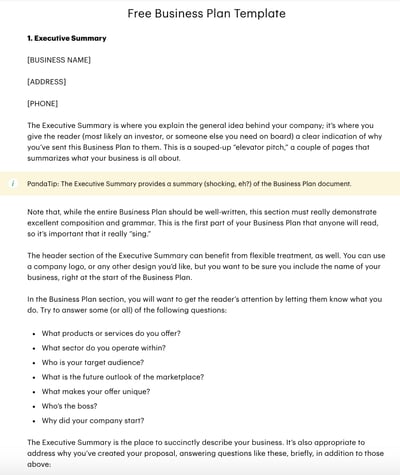
Panda Doc’s free business plan template is one of the more detailed and fleshed-out sample business plans on this list. It describes what you should include in each of its sections, so you don’t have to come up with everything from scratch.
Once you fill it out, you’ll fully understand your business’ nitty-gritty details and how all of its moving parts should work together to contribute to your business’ success.
9. Small Business Administration Free Business Plan Template
The Small Business Administration offers several free business plan templates that can be used to inspire your own plan. Before you get started, you can decide what type of business plan you need — a traditional or lean start-up plan.
Then, you can review the format for both of those plans and view examples of what they might look like.
10. Culina Sample Business Plan
Culina’s sample business plan is a great template to use if you just want to fill in your information. You can also use this template as a guide while you’re gathering important details. After looking at this sample, you’ll have a better understanding of the data and research you need to do for your own business plan.
11. Plum Sample Business Plan

This is one of my favorite sample business plans, because you can see how implementing visuals can help tell the story of your brand. The images in this template are cutting edge, which makes sense for an innovative company like Plum. When you create your own business plan, make sure that the pictures and design you use make sense for your branding.
Additionally, the financial charts included are incredibly helpful if you’re not sure what financial information to include.
12. LiveShopBuy Sample Business Plan
With this business plan, the focus is the investment opportunity. This is an excellent template to use if you’re going to use your business plan as a means to receive funding. The investment opportunity section is placed right up front and is several pages long. Then, the plan goes into more detail about the company synopsis industry analysis.
Top Business Plan Examples
1. LiveFlow
Fintech startup LiveFlow allows users to sync real-time data from their accounting services, payment platforms, and banks into custom reports. This eliminates the task of having to pull reports together manually, saving teams time and helping automate workflows.
When it came to including marketing strategy into their business plan, LiveFlow created a separate marketing profit and loss statement (P&L) to track how well the company was doing with its marketing initiatives. This is a great approach as it allows businesses to focus on where their marketing dollars are making the most impact.
“Using this framework over a traditional marketing plan will help you set a profitable marketing strategy taking things like CAC, LTV, Payback period, and P&L into consideration, “ explains LiveFlow Co-founder Lasse Kalkar
Having this information handy will enable you to build out your business plan’s marketing section with confidence. LiveFlow has shared the template here, so you can test it for yourself.
2. Lula Body
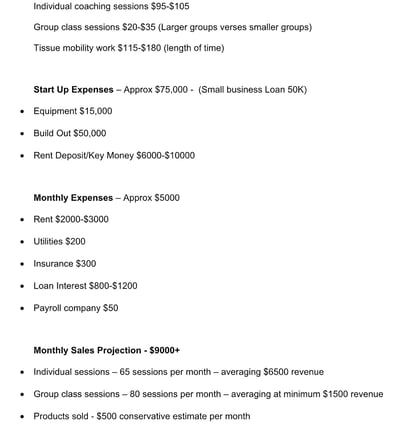 Brooklyn Business owner and Pilates instructor Tara Kashyap saw a need in her community for a pilates, tissue, and bodywork studio. In response, she opened Lula Body in Crown Heights.
Pictured above is a hypothetical pricing and revenue statement based on Lula Body’s business plan. As you can see, Kashyap breaks down the cost of classes, start-up expenses, monthly expenses, and her monthly sales projection. Everything from equipment costs to loan interest is included in the expenses to give the most accurate picture of operating costs and revenue.
If you’re seeking outside funding for your business, you’ll want to make sure this section of your business plan is as thorough as possible.
3. Patagonia
A good mission statement should not only resonate with consumers but should also serve as a core value compass for employees as well.
Outdoor clothing retailer Patagonia has one of the most compelling mission statements we’ve seen:
“We’re in business to save our home planet.”
It reels you in right from the start and the environmental-friendly theme continues throughout the rest of their statement.
The page-length open letter goes on to explain that they are out to “Build the best product, cause no unnecessary harm, and use business to protect nature.”
Their mission statement is compelling and detailed, with each section outlining how they will accomplish their goal.
4. Vesta Home Automation
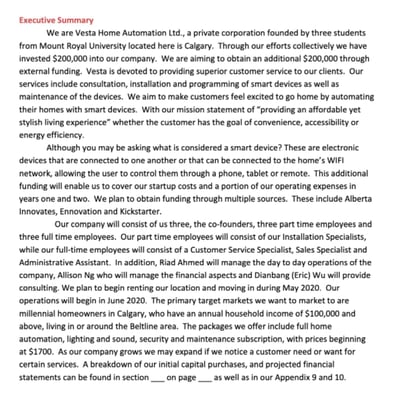
This executive summary for a home smart device startup is part of a business plan created by students at Mount Royal University. While it lacks some of the sleek visuals of the templates above, their executive summary does a great job of demonstrating how invested they are in the business.
Right away they mention that they have invested $200,000 into the company already, which shows investors that they have skin in the game and aren’t just looking for someone else to foot the bill.
Get Started Writing Your Business Plan
When you’re first getting started on your business plan, it can be daunting. The business world moves fast, and it’s full of ambitious companies scrambling to gain the majority of their industry’s market share.
That’s why it’s important to make sure you understand the value your business provides and are able to communicate that through a properly formatted business plan. Our business plan templates above will help you get there.
Editor’s note: This post was originally published in November 2018 and has been updated for comprehensiveness.


How to Build a Detailed Business Plan That Stands Out [Free Template]
While starting a company may seem easier now than ever before, entrepreneurs have an uphill battle from the moment they start a business. And without a clear, actionable business plan for selling, marketing, finances, and operations, you’re almost destined to face significant challenges.
This is why crafting a business plan is an essential step in the entrepreneurial process.
In this post, we’ll walk you through the process of filling out your business plan template, like this free, editable version:
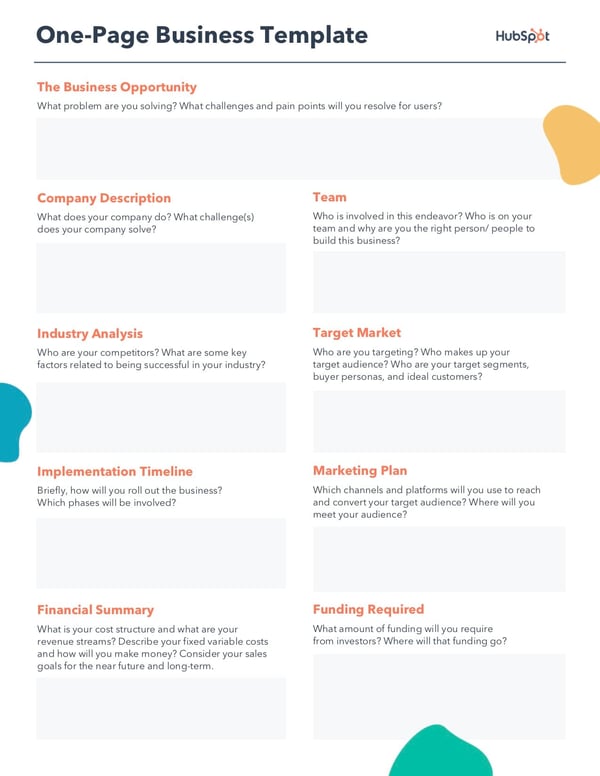
Download a free, editable one-page business plan template.
We know that when looking at a blank page on a laptop screen, the idea of writing your business plan can seem impossible. However, it’s a mandatory step to take if you want to turn your business dreams into a reality.
That’s why we’ve crafted a business plan template for you to download and use to build your new company. You can download it here for free. It contains prompts for all of the essential parts of a business plan, all of which are elaborated on, below.
This way, you’ll be able to show them how organized and well-thought-out your business idea is, and provide them with answers to whatever questions they may have.
Featured Resource: Free Business Plan Template
Building a Successful Business Plan
In the next section, we’ll cover the components of a business plan, such as an executive summary and company description. But before we get to that, let’s talk about key elements that should serve as building blocks for your plan.
For some entrepreneurs, the thought of writing a business plan sounds like a chore — a necessary means to an end. But that’s a bad take.
A solid business plan is a blueprint for success. It’s key to securing financing, presenting your business, outlining your financial projections, and turning that nugget of a business idea into a reality.
At the core, your business plan should answer two questions: why your business and why now?
Investors want to know why your business is entering the market, i.e. what problem it’s solving and how it’s different from what’s currently out there. They also want to know why now is the right time for your type of product or service.
At a minimum, your plan should:
- Be more realistic than idealistic: Too often, business plans focus too much on how things could be instead of how they are. While having a vision is important, your plan needs to be rooted in research and data.
- Legitimize your business idea: If an idea fails on paper, it’s a signal to go back to the drawing board. In doing so, you avoid losing precious time or money chasing an unrealistic idea.
- Position your business for funding: To get your business off the ground, chances are you’ll need financial backing. Even with a solid business idea, investors, lenders, and banks still need convincing. An effective business plan will outline how much money you need, where it’s going, what targets you will hit, and how you plan to repay any debts.
- Lay the foundation: Investors focus on risk – if anything looks shaky, it could be a dealbreaker. Ideally, your business plan will lay down the foundation for how you’ll operate your business — from operational needs to financial projections and goals.
- Communicate your needs: It’s nearly impossible to communicate your needs if you don’t know what they are first. Of course, a business’ needs are always changing — but your plan should give you a well-rounded view of how your business will work in the short and long term.
So back to the question of why and why now – consider three things:
- Your industry – How does your product or service fit within your industry? Are you targeting a specific niche? Where do you see the industry going in the next five to 10 years?
- Your target audience – Who are you targeting? What challenges are they facing? How will your product or service help them in their daily lives?
- Your unique selling proposition (USP) – What sets you apart from your competitors? Is it your product/service features? Your company values? Price?
Once you know the answers to these questions, you’ll be equipped to answer the question: why your business and why now.
Featured Resource: Free Business Plan Template
1. Cover Page
Your business plan should be prefaced with an eye-catching cover page. This means including a high-resolution image of your company logo, followed by your company’s name, address, and phone number.
Since this business plan will likely change hands and be seen by multiple investors, you should also provide your own name, role in the business, and email address on the cover page.
At the bottom of this page, you can also add a confidentiality statement to protect against the disclosure of your business details.
The statement can read as follows: “This document contains confidential and proprietary information created by [your company name]. When receiving this document, you agree to keep its content confidential and may only reproduce and/or share it with express written permission of [your company name].”
Remember to keep your cover page simple and concise — and save the important details for other sections.
Why it matters: First impressions are everything, and a clean cover page is the first step in the right direction.
Example of a Cover Page
2. Executive Summary
The executive summary of your business plan provides a one- to two-page overview of your business and highlights the most crucial pieces of your plan, such as your short-term and long-term goals.
The executive summary is essentially a boiled-down version of your entire business plan, so remember to keep this section to the point and filled only with essential information.
Typically, this brief section includes:
- A mission statement.
- The company’s history and leadership model.
- An overview of competitive advantage(s).
- Financial projections.
- Company goals.
- An ask from potential investors.
Why it matters: The executive summary is known as the make-or-break section of a business plan. It influences whether investors turn the page or not — so effectively summarizing your business and the problem it hopes to solve is a must.
Think of the Summary as a written elevator pitch (with more detail). While your business plan provides the nitty-gritty details, your Summary describes — in a compelling but matter-of-fact language — the highlights of your plan. If it’s too vague, complicated, or fuzzy, you may need to scrap it and start again.
Example of an Executive Summary Introduction
“The future looks bright for North Side Chicago, particularly the Rock Hill Neighborhood. A number of high-end commercial and residential developments are well on their way, along with two new condo developments in nearby neighborhoods.
While the completion of these developments will increase the population within the neighborhood and stimulate the economy, the area lacks an upscale restaurant where residents and visitors can enjoy fine food and drink. Jay Street Lounge and Restaurant will provide such a place.”
3. Company & Business Description
In this section, provide a more thorough description of what your company is and why it exists.
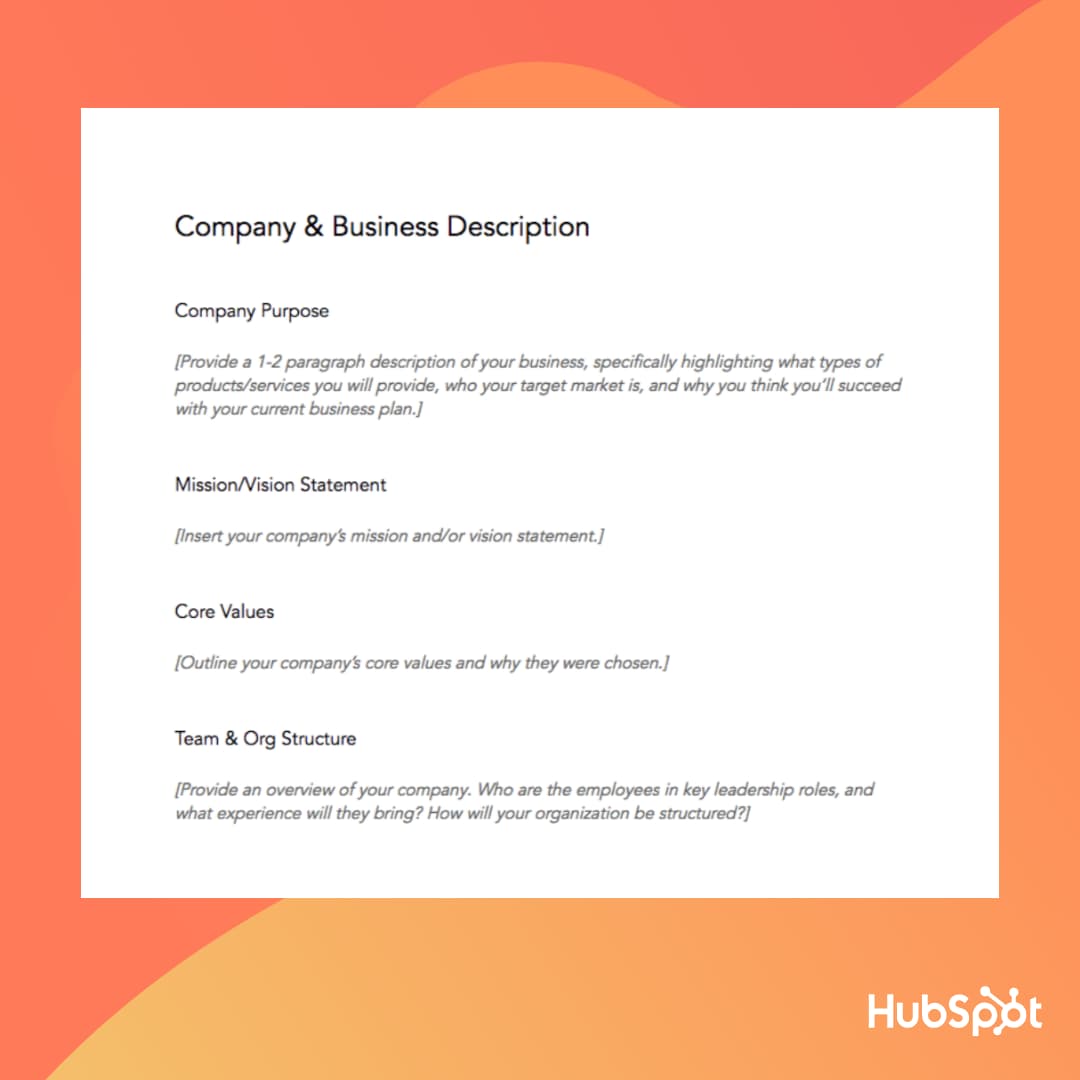
The bulk of the writing in this section should be about your company’s purpose – covering what the business will be selling, identifying the target market, and laying out a path to success.
In this portion of your business plan, you can also elaborate on your company’s:
- Mission statement
- Core values
- Team and organizational structure
Why it matters: Investors look for great structures and teams in addition to great ideas. This section gives an overview of your businesses’ ethos. It’s the perfect opportunity to set your business apart from the competition — such as your team’s expertise, your unique work culture, and your competitive advantage.
Example of a Values/Mission Statement
“Jay Street Lounge and Restaurant will be the go-to place for people to get a drink or bite in an elegant, upscale atmosphere. The mission is to be North Side’s leading restaurant, with the best tasting food and the highest quality service.”
3. Product & Services Line
Here’s where you’ll cover the makeup of your business’s product and/or services line. You should provide each product or service’s name, its purpose, and a description of how it works (if appropriate). If you own any patents, copyrights, or trademarks, it’s essential to include this info too.
Next, add some color to your sales strategy by outlining your pricing model and mark-up amounts.
If you’re selling tangible products, you should also explain production and costs, and how you expect these factors to change as you scale.
Why it matters: This section contains the real meat of your business plan. It sets the stage for the problem you hope to solve, your solution, and how your said solution fits in the market.
There’s no one-size-fits-all formula for this section. For instance, one plan may delve into its ability to market in a more cost-effective way than the competition, whereas another plan focuses on its key products and their unique features and benefits.
Regardless of your angle, it’s critical to convey how your offerings will differ from the competition.
Example of a Product/Service Offering
“The menu at Jay Street Lounge and Restaurant will focus on Moroccan cuisine. The stars of the menu (our specialties) are the Moroccan dishes, such as eggplant zaalouk, seafood bastilla, tagine, and chickpea stew. For those who enjoy American dishes, there will also be a variety of options, from burger sliders and flatbread pizza to grilled steak and salads.
The food at Jay Street will have premium pricing to match its upscale atmosphere. During the summer months, the restaurant will have extra seating on the patio where clients can enjoy a special summer menu. We will be open on all days of the week.”
4. Market Analysis
The market analysis section is where you’ll provide details about the audience to which you’re marketing your business. This should encompass the size of your total addressable market, your market’s demographics and psychographics, and location analysis for your business’ operating space.
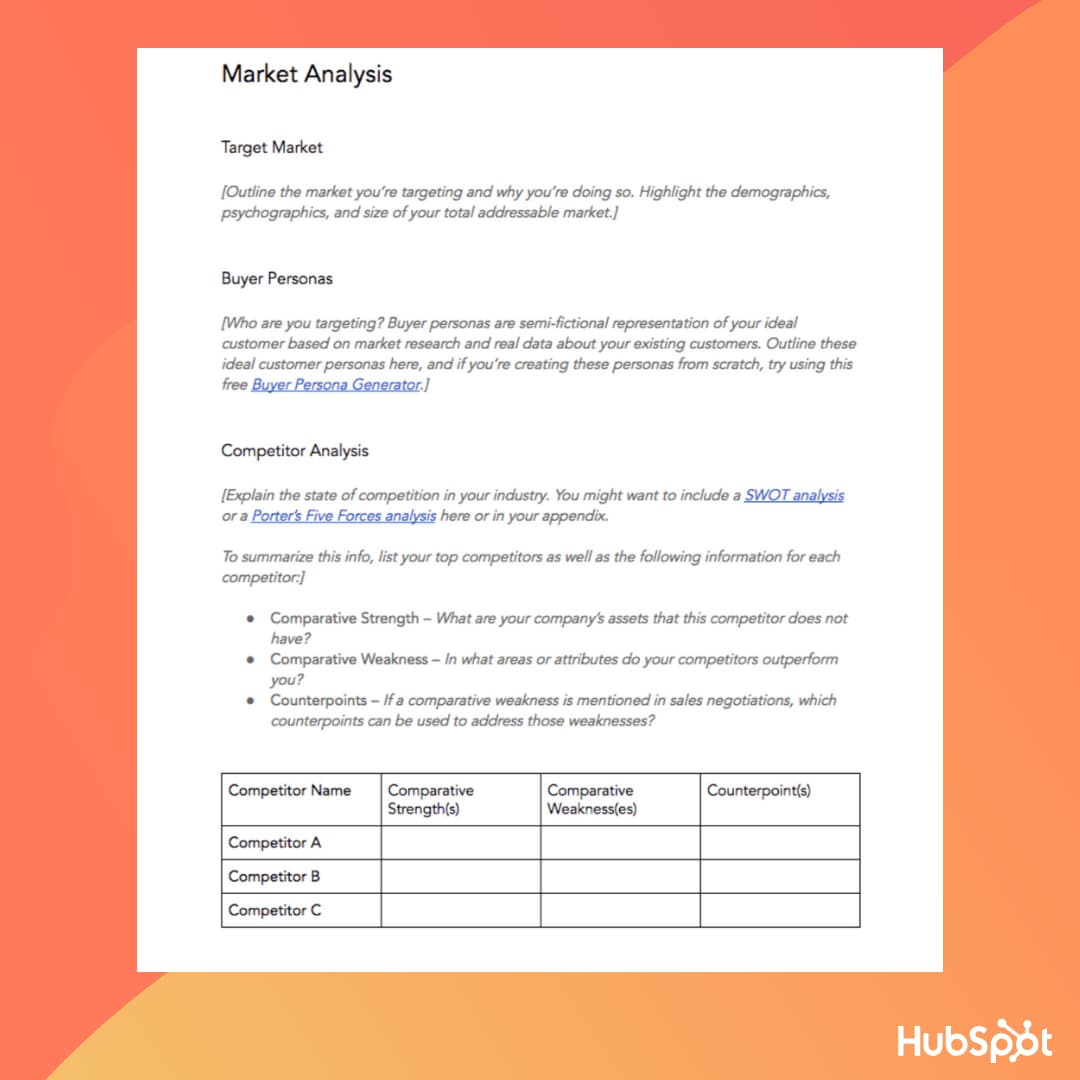
It helps to reference your market research documentation in this section, like a Porter’s Five Forces Analysis or a SWOT Analysis (templates for those are available here). You can also include them in your appendix.
If your company already has buyer personas, you should include them here as well. If not, you can create them right now using the Make My Persona Tool.
Why it matters: Having an awesome product is, well, awesome — but it isn’t enough. Just as important, there must be a market for it.
This section allows you to dig deeper into your market, which segments you want to target, and why. The “why” here is important, since targeting the right segment is critical for the success and growth of your business.
It’s easy to get lost (or overwhelmed) in a sea of endless data. For your business plan, narrow your focus by answering the following questions:
- What is my market? In other words, who are my customers?
- What segments of the market do I want to target?
- What’s the size of my target market?
- Is my market likely to grow?
- How can I increase my market share over time?
Example of a Market Analysis
“Jay Street Lounge and Restaurant will target locals who live and work within the Rock Hill Neighborhood and the greater North Side Chicago area. We will also target the tourists who flock to the many tourist attractions and colleges on the North Side.
We will specifically focus on young to middle-aged adults with an income of $40,000 to $80,000 who are looking for an upscale experience. The general demographics of our target market are women between 20 to 50 years old.
A unique and varied Moroccan-American menu, along with our unique upscale atmosphere, differentiates us from competitors in the area. Jay Street will also set itself apart through its commitment to high-quality food, service, design, and atmosphere.”
5. Marketing Plan
Unlike the market analysis section, your marketing plan section should be an explanation of the tactical approach to reaching your aforementioned target audience. List your advertising channels, organic marketing methods, messaging, budget, and any relevant promotional tactics.
If your company has a fully fleshed-out marketing plan, you can attach it in the appendix of your business plan. If not, download this free marketing plan template to outline your strategy.
Why it matters: Marketing is what puts your product in front of your customers. It’s not just advertising — it’s an investment in your business.
Throwing money into random marketing channels is a haphazard approach, which is why it’s essential to do the legwork to create a solid marketing plan.
Here’s some good news — by this point, you should have a solid understanding of your target market. Now, it’s time to determine how you’ll reach them.
Example of a Marketing Plan Overview
“Our marketing strategy will focus on three main initiatives:
- Social media marketing. We will grow and expand our Facebook and Instagram following through targeted social media ads.
- Website initiatives. Our website will attract potential visitors by offering updated menus and a calendar of events.
- Promotional events. Jay Street will have one special theme night per week to attract new clients.”
6. Sales Plan
It doesn’t matter if your sales department is an office full of business development representatives (BDR) or a dozen stores with your products on their shelves.
The point is: All sales plans are different, so you should clearly outline yours here. Common talking points include your:
- Sales team structure, and why this structure was chosen.
- Sales channels.
- Sales tools, software, and resources.
- Prospecting strategy.
- Sales goals and budget.
Like with your marketing plan, it might make sense to attach your completed sales plan to the appendix of your business plan. You can download a template for building your sales plan here.
Why it matters: Among other things, investors are interested in the scalability of your business — which is why growth strategies are a critical part of your business plan.
Your sales plan should describe your plan to attract customers, retain them (if applicable), and, ultimately, grow your business. Be sure to outline what you plan to do given your existing resources and what results you expect from your work.
Example of a Sales Plan Overview
“The most important goal is to ensure financial success for Jay Street Lounge and Restaurant. We believe we can achieve this by offering excellent food, entertainment, and service to our clients.
We are not a low-cost dining option in the area. Instead, the food will have premium pricing to match its upscale feel. The strategy is to give Jay Street a perception of elegance through its food, entertainment, and excellent service.”
7. Legal Notes
Your investors may want to know the legal structure of your business, as that could directly impact the risk of their investments. For example, if you’re looking for business partners to engage in a non-corporation or LLC partnership, this means they could be on the line for more than their actual investment.
Because this clarification is often needed, explain if you are and/or plan to become a sole proprietor, partnership, corporation, LLC, or other.
You should also outline the steps you have taken (or will need to take) to operate legally. This includes licenses, permits, registrations, and insurance.
The last thing your investor wants to hear after they’ve sent you a big chunk of change is that you’re operating without proper approval from the local, state, or federal government.
Why it matters: The last thing your investor wants to hear after they’ve sent you a big chunk of change is that you’re operating without proper approval from the local, state, or federal government.
Example of Legal Notes
“Jay Street Lounge and Restaurant is up-to-date on all restaurant licenses and health permits. Our business name and logo are registered trademarks, presenting the possibility of expanding locally.”
8. Financial Considerations
Ultimately, investors want to know two things:
- When they will earn their money back.
- When they will start seeing returns on their initial investment.
That said, be clear, calculated, and convincing in this section. It should cover:
- Startup costs.
- Sales forecasts for the next several months/quarters.
- Break-even analysis for time and dollars.
- Projected profit and loss (P&L) statement.
Facts and figures are key here, so be as specific as possible with each line item and projection. In addition, explain the “why” behind each of these sections.
However, keep in mind that information overload is a risk, especially when it comes to data. So, if you have pages upon pages of charts and spreadsheets for this section, distill them into a page or two and include the rest of the sheets in the appendix. This section should only focus on key data points.
Why it matters: One of the most important aspects of becoming “investor ready” is knowing your numbers. More importantly, you need to understand how those numbers will enhance your business.
While it’s easy to write a number down on paper, it’s more important to understand (and communicate) why you need capital, where it’s going, and that your evaluation makes sense.
Example of Financial Projections
“Based on our knowledge and experience in the restaurant industry, we have come up with projections for the business.
Starting with an expenditure of $400,000 in year 1, we forecast sales of $1,500,000 and $2,800,000 for years two and three. We expect to achieve a net profit of 15% by year three.”
9. Appendix
A detailed and well-developed business plan can range anywhere from 20 to 50 pages, with some even reaching upward of 80.
In many cases, the appendix is the longest section. Why? Because it includes the supportive materials mentioned in previous sections. To avoid disrupting the flow of the business plan with visuals, charts, and spreadsheets, business owners usually add them in the last section, i.e. the appendix.
Aside from what we’ve already mentioned – marketing plan, sales plan, department budgets, financial documents – you may also want to attach the following in the appendix:
- Marketing materials
- Market research data
- Licensing documentation
- Branding assets
- Floor plans for your location
- Mockups of your product
- Renderings of your office space or location design
Adding these pieces to the appendix enriches the reader’s understanding of your business and proves you’ve put the work into your business plan without distracting from the main points throughout the plan.
Why it matters: An appendix helps the reader do their due diligence. It contains everything they need to support your business plan.
Keep in mind, however, that an appendix is typically necessary only if you’re seeking financing or looking to attract business partners.
Use a Business Plan Template to Get Started
Writing a business plan shouldn’t be an insurmountable roadblock to starting a business. Unfortunately, for all too many, it is.
That’s why we recommend using our free business plan template. Pre-filled with detailed section prompts for all of the topics in this blog post, we’re confident this template will get your business plan started in the right direction.
Editor’s note: This post was originally published in June 2017 and has been updated for comprehensiveness.
