How to Manage Your Entire Marketing Budget [Free Budget Planner Templates]
Let’s say your company decided to invest in a website redesign to improve lead generation, and you’re responsible for managing the project.
Naturally, one of the first questions you ask is, “How much is this website redesign going to cost?”
The answer, of course, is “it depends.” Are you simply switching to a new template and adding some new CTAs, or are you migrating your entire website to a new platform?
If only there were a way to organize your answers to all of these questions — a place where you could enter in estimated costs for all of your line items, and then compare your projected marketing budget to what you actually end up spending. Good news: Marketing budget templates can help.

Included in our eight marketing budget templates bundle is a template to manage your website redesign … as well as templates for both Excel and Google Sheets to help you track your content budget, paid advertising budget, event budget, and more.
Additionally, in this guide, we discuss how to manage your entire marketing budget from start to finish.
Marketing Budget for Small Business
Marketing budgets are especially important for small businesses. Small business owners may lack the experience drawing up budgets; moreover, it’s critical that these companies keep costs as low and lean as possible as they scale.
Ironically, you need marketing to scale. Without it, it’s hard to sell your products and services. In addition to the budgeting templates provided below, check out some of our free offers and courses to mitigate your company’s marketing costs.
Yet marketing budgets can be difficult to establish for companies of all sizes.
How much should a company spend on marketing?
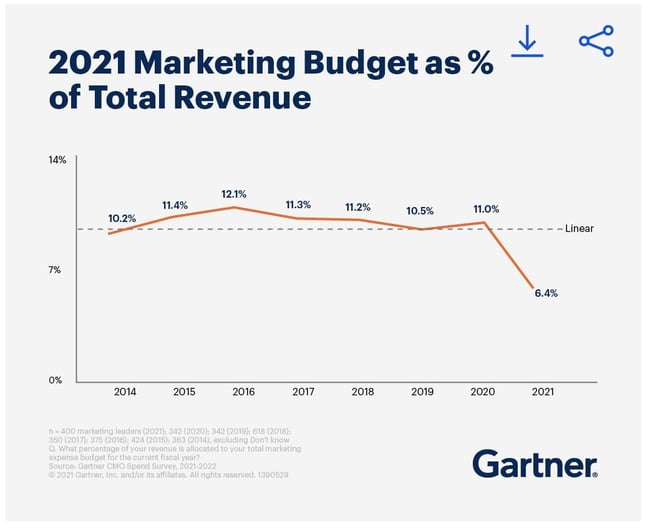
Well, digital media makes up more than half of both U.S. and global advertising spend. This includes initiatives that cater to audiences on desktop computers, search engines, video streaming platforms, social media, and mobile devices.
Given the success marketers have seen in it, you might consider planning to spend at least half of your marketing budget on some of these digital channels.
Let’s talk about other ways to allocate your marketing budget.
As you build a budget, there are a few items you’ll want to keep in mind when planning your marketing budget allocation.
Marketing Cost Examples
1. Software
When it comes to digital and even print media, you may need software to create your marketing campaigns or handle your daily processes. There’s a marketing tool for just about any task you can think of, but they are generally broken down into the following categories:
- Customer relationship management (CRM)
- Online advertising
- Social media
- Content creation and design
- Event marketing
- Lead capture and lead generation
- Marketing automation
- Data reporting and analytics
- Digital asset management
- Team collaboration
The costs of these tools can quickly add up, so it’s worth it to try out the free options until you’re ready to commit to a tool your team loves.
2. Freelancers
If you have a temporary campaign or want to test out a new marketing strategy, you might want to hire a short-term freelancer before bringing on a full-timer.
Reach out to your network for recommendations or consider using a site like UpWork. Freelancers typically charge an hourly rate, so be sure to examine your budget before hiring.
3. New Personnel
When you do hire full-time employees, you’ll want to budget costs including their computer, technology, benefits, and onboarding-related needs. According to research from Zippia, the average cost of hiring a new employee is $4,425.
4. Advertising
Budget how much money you’ll spend on paid opportunities such as physical ads, native ads, sponsored content, search engine ads, and social media promotions.
Most businesses will benefit from some form of online advertising whether via social media platforms, search engine, or native ads.
Statista estimates there were an estimated 4.9 billion internet users worldwide as of 2021. If you’re not advertising online, you’re missing out.
5. Content Creation
When you create content such as videos, photos, or even blog posts, you’ll need to put paid time into it.
Content marketing brings in 3X as many leads as traditional options, so it’s worth dedicating funds to this area. Budget how much money will go into creating this content so you can adjust accordingly based on its return on investment.
Now that you know more about what to include in your budget, let’s look at how to those funds are spent.
If you’re not sure where to start with budget allocation, a good guideline to follow is the 70-20-10 rule. Using this as a benchmark:
- 70% of your budget is allocated toward strategies you know work well
- 20% of your budget is allocated toward new strategies aimed at helping you grow
- 10% of your budget is allocated toward experimental strategies
Marketing Cost Example
Let’s say your business has a marketing budget of $10,000. The budget allocation may look like this:
- $7,000 towards a CRM or other software you love, successful paid search campaigns, social media marketing
- $2,000 towards marketing a new product, feature, or service you’re testing
- $1,000 towards testing sponsored content
Allocation by Channel
How you allocate your budget per channel depends on your company’s particular goals, so there is no hard and fast rule. However, the chart below from Statista can give you a ballpark idea as it illustrates the share of marketing budgets from large companies across North America, the UK, Germany, and France.
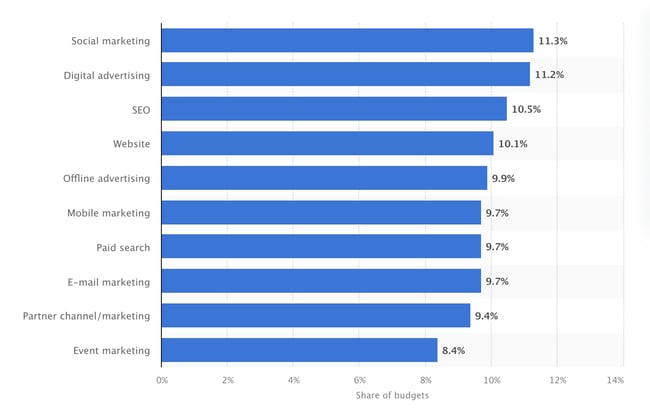
Organized by channel, you can see that the top spots belong to social marketing, digital advertising, and search engine optimization (SEO).
By 2023, it’s estimated that marketers will spend more than $52 billion on ads across websites or apps that are mainly eCommerce-focused. Let’s look at some examples of how these digital marketing costs apply to your budget.
Paid Search Advertising
You’re probably familiar with the ads at the top of a Google results page that show up above the list of search results. Those are a form of paid advertising called pay-per-click (PPC). You can create and run ads on Google, and each time someone clicks, you pay. The cost-per-click (CPC) can range anywhere from a few cents to a few dollars. You can use Google’s keyword planner to help estimate costs.
With this method, you only pay for clicks you receive. So even if you’ve set aside a budget of $2,000, your campaign may only generate $1,500 worth of clicks.
Social Media
Like Google Ads, social media platforms have advertising programs based on the PPC model, but also charge by impressions. The CPC of running a paid social campaign varies depending on the platform of choice, but ranges from a few cents to a several dollars.
Some companies may opt to hire an agency to run their campaigns and to create a social media strategy. Outsourcing this function is more expensive and can cost anywhere from $2,000 to $20,000 per month.
Content Marketing
Having a brand blog is a great way to get into content marketing, especially if you have in-house staff tasked with keeping it updated. Instead of a blog, you may be more interested in creating case studies, eBooks, videos or guides. They’re all designed to promote your brand and attract new customers.
Content marketing costs vary widely based on what your goals are and area of focus. Hiring outside consultants or agencies to handle content marketing for you can range from $2,000 to $10,000 per month for small to medium-sized businesses. While it isn’t cheap, paying an agency to handle this task will free up your team’s time to work on other projects and may yield better results than going solo.
Email Marketing
Email marketing is a must-have for businesses, especially online retailers. With a customer acquisition rate 40X more effective than Facebook and Twitter combined, it’s no surprise why this tried and true method is a staple in most marketing budgets. Email marketing also provides higher ROI as you’re connecting with people already interested in your brand.
Email marketing costs depend on the size of your business, your goals, and chosen software or platform. Hiring an outside firm to handle these efforts will cost significantly more than doing it yourself.
Search Engine Optimization
SEO aids marketing efforts by improving your webpages so that they show up in search engines like Google. The more often your website comes up in search, the more potential customers will see it and hopefully visit your website.
If you don’t have staff to handle your SEO needs in-house you may need to work with an agency. Depending on what your business needs are, this can cost thousands per month.
While the marketing channel choices can seem endless, don’t feel pressured to use all of them. Every business is different and you should prioritize putting funds toward the methods that best suit your needs.
Spreadsheet knowledge alone won’t help you understand how you’ll spend your marketing money this year. Creating a sound marketing budget starts with knowing what purpose this budget will serve and which marketing teams it will represent.
1. Know your buyer’s journey.
Your buyer’s journey is the steps your audience takes as they ‘journey’ from prospect to paying customer. Knowing your buyer’s journey allows you to understand how your audience interacts with your marketing — and where to set your goals and budget to better reach your customers.
Ask yourself these questions as you define your buyer’s journey:
- How do your leads and customers typically discover your products?
- What do they need to know before they make a purchase?
- How many site visits do you see per month?
- How many leads are you generating per month, and how many of these convert to paying customers?
- What is the cost of generating new leads and then converting them to customers?
- What’s the typical value/revenue of each lead?
This process should point out what marketing tactics are (and aren’t working), where you should alter your marketing goals, and where you can focus your marketing budget.
2. Align your budget with your marketing goals.
What you spend and where you spend it will depend on what you’re trying to accomplish.
So, when starting to create your marketing budget, make sure you’re only spending money on the things required by your current marketing goals — goals set based on your audience and their journey from prospect to customer. These could include:
- Display ads to promote a new product you’re launching this year.
- Sponsored social media posts to generate followers on your new Facebook page.
- Paid search engine ads to drive traffic (and purchases) to a specific product page.
- Contract bloggers to get more organic search traffic to your company’s website.
Former Demand Generation Marketer at HubSpot and current Head of Marketing at Tailscale, Jessica Webb Kennedy, says this about how your costs can change when focusing on lead generation vs. lead conversion: “The majority of the money you spend on paid efforts is usually calculated based on the volume of clicks or impressions. Because of this, you’ll often want to put more budget toward campaigns with higher-volume offers and audiences.”
“For example, a tweet or Facebook ad promoting a lead generation offer that leans more top of the funnel will likely receive more clicks than something that falls more toward the middle or bottom of the funnel,” she explains.
Your paid advertising costs will also change depending on how wide of an audience you are attempting to reach.
“You can look at Twitter advertising as an example,” Webb says. “You have to option to target your campaigns based on users’ interests or keywords searched for. Interests are a much broader category, whereas smaller pockets of users are searching for any given keyword, therefore your interests-based audience is going to be much larger and require a larger budget.”
3. Beware of hidden marketing costs.
One of the great advantages to having and maintaining a budget spreadsheet is that it helps you avoid those end-of-the-quarter or end-of-the-year freak-outs when you realize, “Whoa … what did I spend all that money on?”
In many cases, unanticipated costs can force marketers to fork over cash that they didn’t plan on spending. Product marketing offers a perfect example. According to former HubSpot VP of Marketing and current CMO at The Wanderlust Group, Meghan Keaney Anderson, it’s easy to forget that successfully marketing your products and services requires more than just promotion.
“When people allocate budget for product marketing, they tend to think in terms of product launches and promotional activities,” Anderson explains.
“That’s certainly an important part of it, but another area of focus to remember is setting aside resources to conduct research and message testing long before the product ever goes to market. Having conversations with customers about the pain points your product will ultimately address is critical to shaping the messaging and having a successful launch.”
4. Remember where your priorities lie.
Marketing is overflowing with add-ons and extras, upsells, and “premium” versions. One of the best ways to assess what’s nice to have versus what’s absolutely necessary is to (you guessed it) organize all of your expenses.
By keeping tabs on where your budget is being allocated, and cross-checking that spending with the results you’re getting, it will be much easier to figure out what should keep getting budget and what should get kicked to the curb.
For example, let’s look to the world of public relations. In PR, there are countless tools to which you can allocate budget, which could leave you overspending where it doesn’t matter — and underspending where it does.
“Tools abound to help PR practitioners not only create and distribute great content and find and target key stakeholders, but to ultimately measure reach and effectiveness,” says Nathaniel Eberle, HubSpot’s former Director of PR & Brand and GoTo’s current VP of Global Brand & Creative Management.
“The key is making sure you’re laser-focused on who you’re setting out to reach and influence, then ensuring that your budget supports how they’ll most likely want to receive (and share) your key messages.
“As the media and digital landscape evolves at breakneck speed, continually reassessing the tools, services, and programs you’re employing is a great way to determine real-time ROI of your overall spend. Today’s measurement tool may be worthless to you tomorrow.”
5. Spend your budget smartly.
When you open up these budget templates and check out all the various expenses detailed in them, don’t fret if you can’t tick every box. I’m not advocating for an “always spend more” approach to marketing.
I’m advocating for an “always spend smart” approach. The expenses listed out aren’t mandatory — they’re just meant to guide your thinking and to help ensure that you haven’t overlooked any hidden costs.
6. Prepare to measure ROI.
When you put a certain amount of money into a certain area, you’ll want to determine if your budgeting helped you or hurt you as you plan out future budgets. The best way to do this is by measuring ROI — or return on investment.
If the money you spend on one item results in your company making more in return, you may want to increase budget in the next year. If your money went nowhere, you should examine your budget.
8 Marketing Budget Templates You Need to Manage Your Marketing Spend
With the 8 Free Budget Planner Templates to Manage Your Marketing Spend, you’ll be able to manage all of the moving pieces of your budget at a monthly and quarterly level.
Use the Excel version of the templates to keep all of your budgets in one place. When you download the zip file, you’ll find a separate file for each marketing team, as well as a Master Budget Template to maintain a high-level view of your overall expenses.
Interested in sharing your marketing budget across a larger team? Try the Google Sheets version of our templates to share access with other Gmail users. For the Google Sheets templates, each team budget is found in a separate tab of the same Google Sheet.
No matter which version you choose, each budget is optimized with the same line items, tips, and graphs. Read on to learn how to use each budget template.
1. Master Marketing Budget Template
Download the Master Marketing Budget Template here.
While it’s helpful to have individual budget templates for specific marketing departments and activities, it’s also nice to be able to take a step back and see the bigger picture.
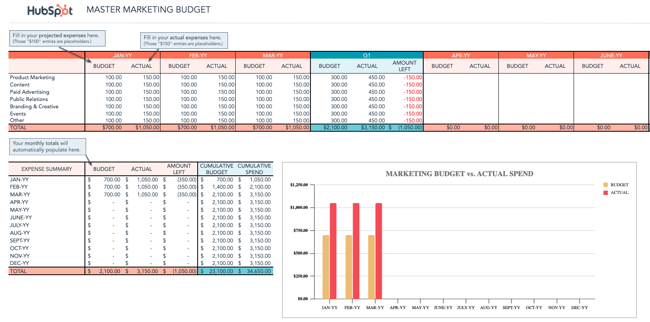
The Master Marketing Budget Template lets you do just that: It’s the place where you can collect the totals from the other seven templates in the bundle and see all of your expenses in one place.
2. Product Marketing Budget Template
Download the Product Marketing Budget Template here.
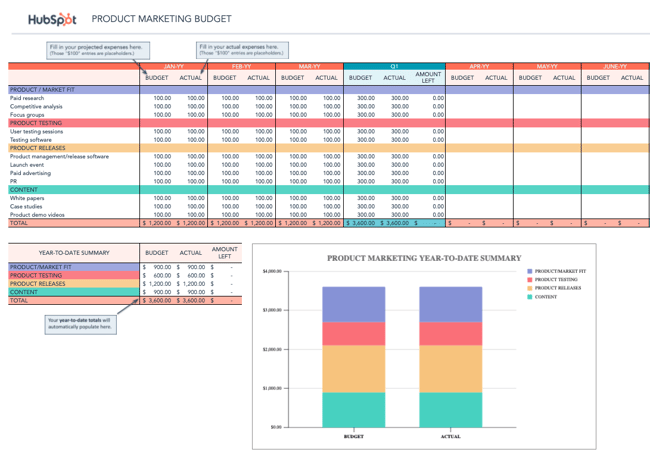
This template will guide you step-by-step through the process of budgeting for a product launch. From determining product/market fit, to running user testing sessions, to promoting your finished product, our Product Marketing Budget Template will help ensure you don’t overlook any important expenses.
3. Content Budget Template
Download the Content Budget Template here.
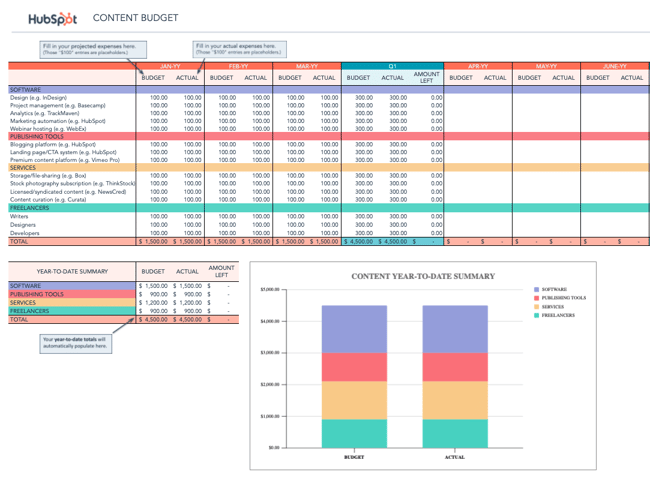
The budget required for creating and promoting content can vary greatly from organization to organization. For example, while some organizations keep most of their content operations in-house, others rely more heavily on freelancers and contractors. And while some use many different software products, publishing tools, and services, others take a much simpler approach.
Our Content Budget Template is designed to cover as many content-related bases as possible. So, if you see any expenses listed that don’t apply to your organization, go ahead and delete them. (That’s the beauty of Excel spreadsheets: You can customize them to your specific needs.)
 4. Paid Advertising Budget Template
Download the Paid Advertising Budget Template here.
Paid advertising: Does it really qualify as an inbound marketing tactic/channel? That is a loaded question, my friends, and one that I don’t have room to answer in-depth in this post.
What I can tell you for sure is that you can do paid advertising in an “inboundy” way — i.e. by targeting specific buyer personas and using paid advertising as a supplement to your organic efforts to help drive awareness and conversion opportunities.
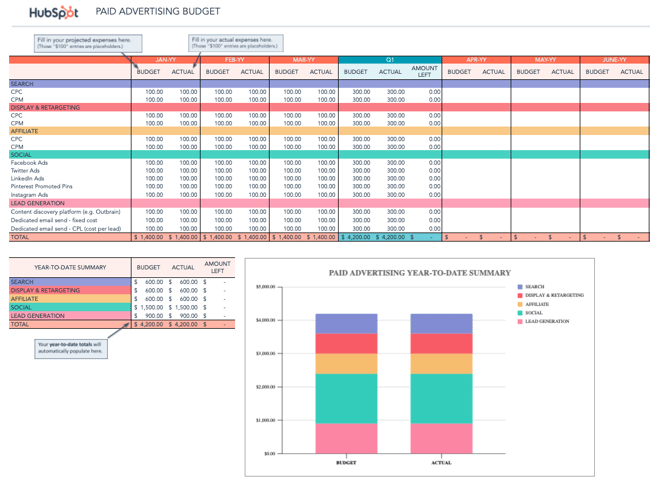
Measuring the effectiveness of your paid advertising campaigns is also paramount to doing things the inbound way. Using our Paid Advertising Budget Template, you can keep tabs on your monthly (and quarterly) ad spending, and then cross-reference the amounts with your lead-generation metrics to determine your cost-per-lead.
5. Public Relations Budget Template
Download the Public Relations Budget Template here.
Public relations expenses amount to more than just paying for press releases. From reputation monitoring software, to traveling (e.g., to events and trade shows), to applying for awards, there are many PR costs that can be all too easy to overlook.
To ensure you’re accounting for all of your organization’s PR-related expenses, check out our Public Relations Budget Template.
6. Branding & Creative Budget Template
Download the Creative Budget Template here.
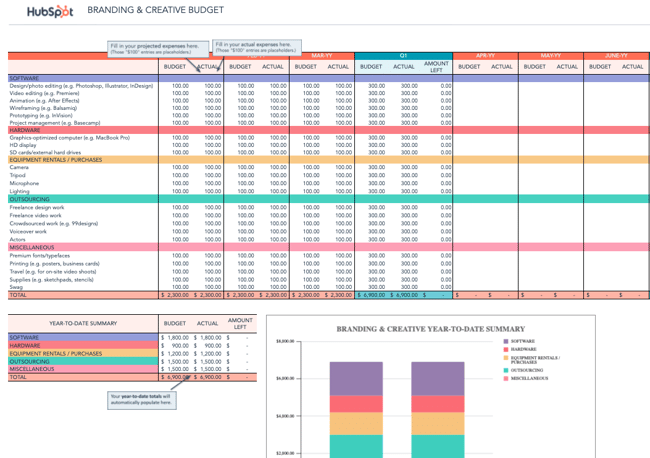
In order to produce high-quality, innovative graphics, videos, and other content, the branding and creative teams of today need more than just Photoshop … a lot more. One of the largest — and often most overlooked — expenses is storage.
If your organization is producing a lot of video, storage is especially important. Because as it turns out, when budgeting for video storage, you shouldn’t be thinking on a megabyte (MB) or even a gigabyte (GB) scale, but on a terabyte (TB) scale. FYI: 1 terabyte = 1 trillion bytes. You can keep track of all your storage costs (and other branding and creative costs) using our free template.
7. Website Redesign Budget Template
Download the Website Redesign Budget Template here.
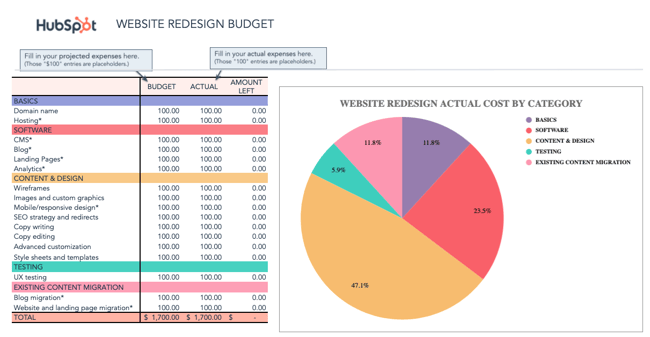
Budgeting for a website redesign can be seriously tricky. With so many moving pieces to consider, there is a lot of room for underestimating or miscalculating costs. We created our Website Redesign Budget Template so you can keep all of your redesign-related expenses in one convenient location.
Unsure if your current website is right for a redesign? Check out this HubSpot research report: Does Your Website Make the Grade? Chances Are, It’s Barely Passing.
8. Event Budget Template
Download the Event Budget Template here.
When planning an event, the associated costs can seem obvious at first. There’s the venue to consider, of course. And the P.A. system and microphones. And then the costs associated with booking and bringing in presenters/performers. That’s pretty much it, right?
Wrong.
For example, does the venue come with tables/chairs, or will you have to rent those separately? Do you want your attendees to wear name tags, and if so, will you be printing out the name tags ahead of time or will attendees be writing their own names on blank tags?
If the latter, have you factored in the pens or markers you’ll need to accommodate that? As you can see, planning for an event can lead you down many rabbit holes.
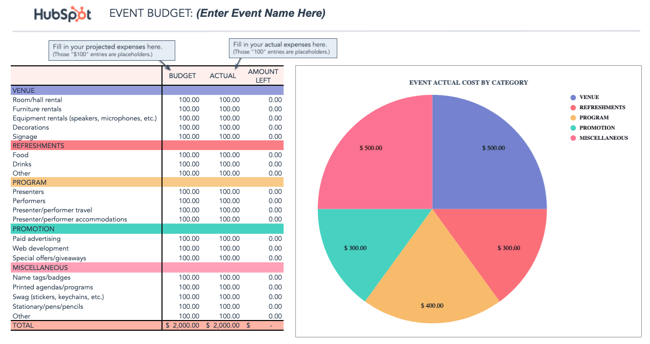
Use our Event Budget Template to stay organized.
Sample Marketing Budget
With your chosen template downloaded, it’s time to consider which digital channels to allot a budget for. Hint: There’s no right answer — it’ll depend on the market research you do to figure out where your specific audience spends most of its time.
If you find your buyer prefers learning and consuming content in the form of video, for example, you might invest more of your money in YouTube advertising.
Advertising Budget Example
Here’s a small sample budget for a quarter’s worth of expenses by a hypothetical company that has decided to invest heavily in video marketing. This template was created using the Master Budget Template, the first template listed in the section above.
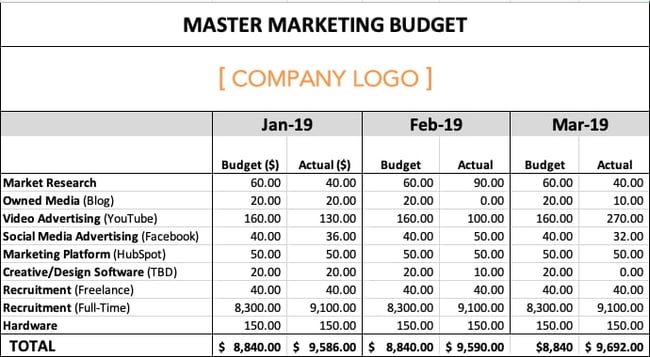
Based on the figures above, video advertising’s total expenses for the quarter exceeded budget by $20, while full-time recruitment’s total expenses exceeded budget by $2,400. This means the company is trending over budget for the first three months of the year.
Why might this happen? Perhaps a pay-per-click (PPC) campaign on YouTube received more clicks by viewers than expected, and a sharp video-savvy job candidate negotiated a higher salary.
Based on the difference between this company’s planned spend and actual spend, their budget template produced the following graph: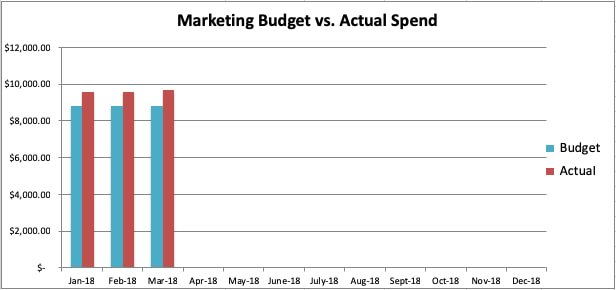
Create a Marketing Budget That Prioritizes Your Goals
A well-thought out marketing budget serves as roadmap to your team’s success. Revisit the buyer’s journey, flesh out your goals, and stay away from tempting add-ons that are not in line with your marketing priorities.
Go now, and plan wisely — your marketing staff is counting on you.
Editor’s Note: This blog post was originally published in December 2015 and has been updated for comprehensiveness.


How to Write a Great Value Proposition [5 Top Examples + Template]
Your company’s value proposition is the core of your competitive advantage. It clearly articulates why someone would want to buy from your company instead of a competitor.
So how do you actually write a value proposition statement that’s strong enough to lift conversion rates and sales? In this article, you’ll learn the definition of a value proposition, what a value prop isn’t, examples of some of the best value props we’ve seen, and tactics to create amazing value props.

We’ll cover:
- What is a value proposition?
- Value Proposition vs Mission Statement (vs Others)
- How to Create a Value Proposition Canvas
- Elements of a Value Proposition
- Value Proposition Templates
- Value Proposition Examples
- How to Write a Value Proposition
- Tactics to Develop an Effective Value Proposition
- Let’s summarize: What makes a good value prop?
Ready to dive in?
Value propositions are one of the most important conversion factors. A great value proposition could be the difference between losing a sale — and closing it.
For that reason, it’s important to create one that accurately represents your products and services and makes it clear why you’re the best choice. However, writing it from scratch is hard. Download our templates below so you can follow along with the rest of the post.
Your value proposition is a unique identifier for your business. Without it, buyers won’t have a reason to purchase what you sell. They may even choose a competitor simply because that business communicates its value proposition clearly in its marketing campaigns and sales process.
That said, you might think: Isn’t my value prop interchangeable with, say, my slogan?
Nope. It’s easy to confuse your value proposition with other similar brand assets, such as your mission statement, slogan, or tagline. We break down the differences below.
Value Proposition vs Mission Statement
Your value proposition details what you offer customers and why they should choose you, while a mission statement details your objective as an organization. While the two can have points in common, a value prop is more product- and service-oriented while a mission statement is more goal-oriented.
Here are two examples for HubSpot and our CRM platform:
Value Proposition: “An easy-to-use CRM.”
Mission Statement: “To help businesses grow better.”
Value Proposition vs Slogan
A slogan is a short, catchy statement that brands use in marketing campaigns to sell a specific product. While your value proposition wouldn’t necessarily go in an ad (at least, not usually), a slogan would. The most important thing to note is that a company can have different slogans for different campaigns or products.
Here are two examples from De Beers Group:
Value Proposition: “Exquisite diamonds, world-class designs, breathtaking jewelry.”
Slogan: “A diamond is forever.”
Value Proposition vs Tagline
A tagline is a short statement that embodies a certain aspect of your brand or business. While a value proposition is more concrete, a tagline can represent a concept or idea that your business stands for. Most businesses have only one tagline that is instantly recognizable and connected to their brand.
Here’s an example from Apple:
Value Proposition: “The best experiences. Only on Apple.”
Tagline: “Think Different.”
Value Proposition vs Mission Statement vs Slogan vs Tagline
Now, let’s look at an example of a business that has all four: Nike. Remember that slogans can differ depending on the campaign.
Value Proposition: “Customizable performance or lifestyle sneakers with unique colorways and materials.”
Mission Statement: “To bring inspiration and innovation to every athlete in the world.”
Slogan: “Twice the guts. Double the glory.”
Tagline: “Just do it.”
TLDR; While your value prop should help differentiate you from the rest of the industry, keep in mind it’s not a slogan, tagline, or mission statement. Those types of copy are important accessories to your brand, but your potential customers and employees don’t choose one business over the other solely based on these elements.
Your value proposition goes deep into the problems you want to solve for buyers, and what makes your product or service the perfect solution.
Now, before you write the statement itself, it’s important to create a value proposition canvas.
Taking these three elements into consideration, you’ll be able to make your own after you build a value proposition canvas.
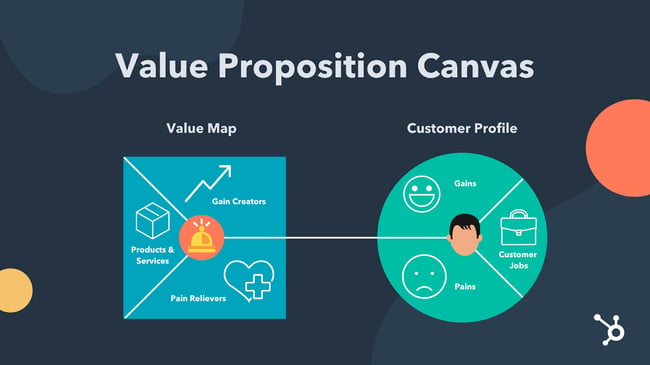
The value proposition canvas is made up of two major components: the customer profile and the value map.
Here’s how to make one:
Step 1: Create a customer profile to represent your target buyer.
The customer profile makes up the first half of the value proposition canvas. When performing this exercise, you’ll want to start with this section first so that their wants and needs can influence the overall value proposition canvas.
The customer profile consists of three areas:
Customer Jobs
What is the task your customer needs to complete or the problem they’re trying to solve with your product or service? The answer to this question sums up the “customer job” or the purpose of your product or service in the eyes of the customer.
Customer Expectations
“Expectations” are also referred to as “gains” — in other words, what your customer is hoping to gain from doing business with you. No matter what you sell, your ideal customer will have an expectation of what that product or service will do for them. In this section, you’ll use research to explain what your customers expect from you in order to purchase your product.
Customer Pain Points
As your customer completes their “customer job,” what pains do they experience? Do they take any risks while they do the customer’s job? Do they experience any negative emotions? These pain points should be considered so that you include the most helpful products and services on the value map side of the value proposition canvas.
Step 2: Create a value map for your products and services.
In this section of the value proposition canvas, three specific sectors help describe what the business offers to the customer.
Gain Creators
These are features your products or services have that make the customer happy. Think creatively about the elements of happiness your customers experience. Consider their financial and social goals as well as their psychographics.
Pain Relievers
In the section above, we discussed customer pains. This section will define exactly how your business will help them overcome those pain points.
Products & Services
While this section won’t list every single product or service your company offers, it should include the ones that will create the most gain and alleviate the most pains for your customers.
Step 3: Determine value proposition-customer fit.
Once you’ve completed the value proposition canvas exercise, the next step will be to determine how your value proposition fits within the customer profile. To do this, you’ll use a ranking process that prioritizes products and services based on how well they address the customer profile.
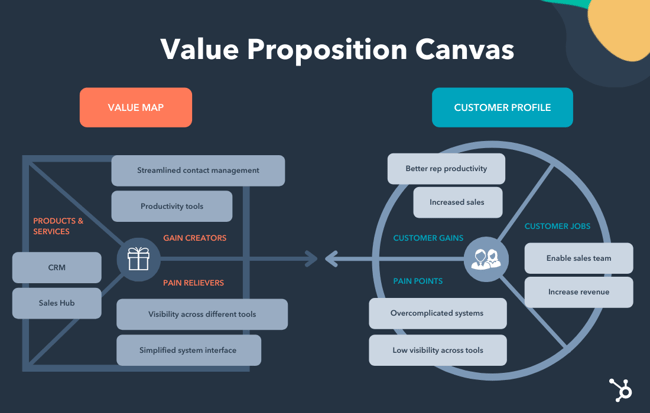
All together, your value proposition canvas should look like this:
Next up, let’s go over the elements you should include in your value proposition when you’re creating it and publishing it on your website.
Elements of a Value Proposition
Your value proposition will most often appear on your website. While you can include it on marketing campaigns and brochures, the most visible place is your home page and, if you’d like, your product pages.
There are three main elements of a value proposition: the headline, the subheadline, and a visual element.

Headline
The headline of your value proposition describes the benefit the customer will receive as a result of making a purchase from your business. The headline can be creative and catchy, but it should be clear and concise, first and foremost.
Subheadline or Paragraph
The subheadline or paragraph should explain in detail what your company offers, who it serves, and why. In this section, you can elaborate on the information in the headline.
Visual Element
In some cases, a video, infographic, or image may convey your value proposition better than words alone can. Enhance your message with these visual elements to capture your audience’s attention.
To better visualize these tools, here are a couple templates to follow when formatting a value proposition.
Value Proposition Templates
We’ve crafted 15 templates to help you create an amazing value proposition for your brand — and pairing each of them with an example of how they may look for a real business. Click here to download these free value proposition templates for your business.
Now that we’ve reviewed the elements, visual tools, and templates — let’s look at some brand examples that effectively identify and satisfy its customer needs.
Because value propositions are typically internal information and rarely stated publicly, finding a value proposition example to model yours after can be difficult. We’ve taken the liberty of using the value proposition canvas and applying it to some successful companies that have been recognized by the American Customer Satisfaction Index (ASCI).
In these examples, you’ll see real-world instances of customer gains and pains aligned with well-known products and services offered by these companies.
1. HubSpot: “An easy-to-use CRM.”
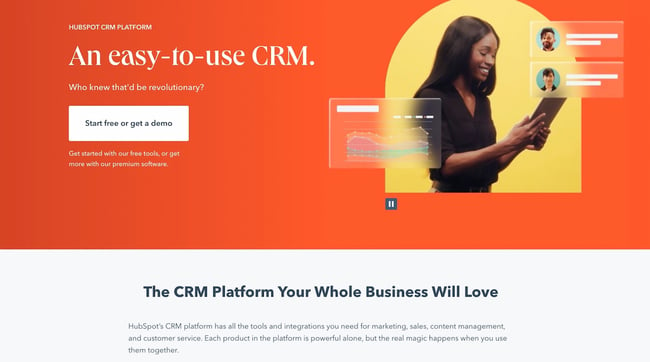
Headline: “An easy-to-use CRM.”
Subheadline/Paragraph: “HubSpot’s CRM platform has all the tools and integrations you need for marketing, sales, content management, and customer service.”
Visual Element:
Most companies can benefit from using a CRM — even freelance businesses and small family-owned firms. The problem is that most systems are over-complicated and cobbled together, not to mention expensive.
HubSpot’s value proposition aims to target active CRM users who are tired of handling over-complicated systems, and beginners who are intimidated by legacy options. To that end, the product’s value proposition emphasizes its ease-of-use and ability to synchronize different teams across the business. The brand includes an image of a smiling woman to show what it would be like to use the product in your team (hint: it’s so easy, it’ll make you smile).
HubSpot Value Proposition Canvas
Customer Profile
- Customer Jobs: HubSpot customers need to effectively enable their sales teams to do their best work while avoiding complicated workflows.
- Gains: Customers want to increase their sales rep productivity levels and boost sales.
- Pains: There are plenty of CRM options, but they’re often overcomplicated and create silos.
Value Map
- Gain Creators: The HubSpot CRM platform offers streamlined contact management software and productivity tools that will help sales teams do their best work.
- Pain Relievers: The user-friendly interface and unified platform offers ease-of-use and high visibility across systems.
- Products & Services: The HubSpot CRM platform includes Sales Hub, an enterprise-level sales software that’s simple yet powerful enough to cater to the needs of businesses small and large.
2. FedEx: “Manage your Home Deliveries”
Headline: “Manage Your Home Deliveries”
Subheadline/Paragraph: Sending and receiving packages is convenient and safe for individuals who want to ship ideas and innovations across the globe.
Visual Element:
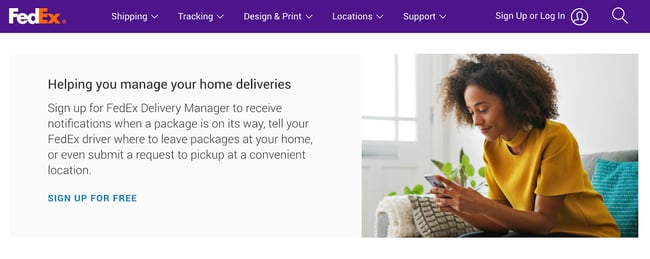
If you own a business, shipping and packaging prpoducts is likely a significant part of your operations, but it can be a time-consuming, labor-intensive, and plain inconvenient process. If you’re a consumer, you’ve likely experienced driving to a shipping office to get your package after a missed delivery. Both of these are significant pain points for FedEx’s target customers.
FedEx’s value proposition makes it clear that it will make managing your deliveries much, much easier — whether you’re a business or a consumer.
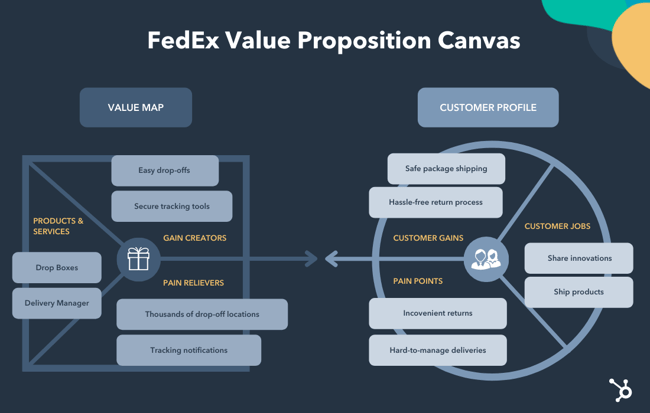
FedEx Value Proposition Canvas
Customer Profile
- Customer Jobs: FedEx customers want to share ideas and innovations with other individuals by shipping goods around the world.
- Gains: Customers want a hassle-free way to return online orders and are looking for a safe and secure way to receive their packages.
- Pains: Returning a package at a FedEx shipping center can be inconvenient, and managing home deliveries can be a hassle.
Value Map
- Gain Creators: Customers can drop off their FedEx packages at places they shop most like Walgreens or Dollar General, and have peace of mind knowing where their package is at all times.
- Pain Relievers: Thousands of FedEx drop-off locations across the country, receive notifications when a package is en route and inform the driver where to leave the package.
- Products & Services: FedEx Drop Box locations make returning packages convenient, and the FedEx Delivery Manager reroutes or reschedules deliveries to work with the customer’s schedule.
3. LG: “State-of-the-art Living Experience”
Headline: “State-of-the-art Living Experience”
Subheadline/Paragraph: LG SIGNATURE delivers an innovative product design that creates an exceptional living experience for people who want to achieve a state-of-the-art living experience.
Visual Element:

The right home appliances can make your at-home experience easy and hassle-free — or it can quickly create headaches with low power efficiency and outdated features. In its value proposition, LG targets customers who are willing to spend just a little more on the right appliance in exchange for a comfortable, hassle-free, and luxurious experience.
Even the imagery helps you imagine what your life would be like after purchasing an LG appliance.
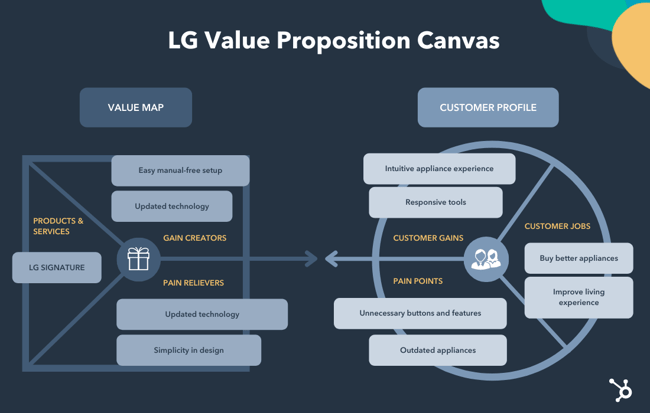
LG Value Proposition Canvas
Customer Profile
- Customer Jobs: LG customers want simple, yet innovative technology that helps them achieve a state-of-the-art living experience.
- Gains: Customers have an intuitive and responsive experience with each appliance they interact with inside their homes.
- Pains: There are too many unnecessary buttons and features on appliances that get in the way of a simple living experience
Value Map
- Gain Creators: Customers can use technology to enhance their home experience without needing to read a manual.
- Pain Relievers: LG offers a simple design that focuses on the user and their lifestyle.
- Products & Services: LG SIGNATURE delivers an innovative product design that creates an exceptional living experience.
4. Subaru: “The most adventurous, most reliable, safest, best Subaru Outback ever.”
Headline: “The most adventurous, most reliable, safest, best Subaru Outback ever.”
Subheadline/paragraph: The 2022 Subaru Outback takes drivers to the most adventurous places in style with the most advanced safety technology.
Visual element:

Subaru knows that its target audience uses its Outback SUVs for outdoor adventures. So in its value proposition, it makes it clear that the Outback will help its drivers go off the road safely and in style. Even more, it states as much right in the headline.
If I were a potential Subaru customer, I’d know exactly what I’m getting from that headline alone. That’s why it’s so important to think about your wording, because it’s likely the first thing potential buyers will see.
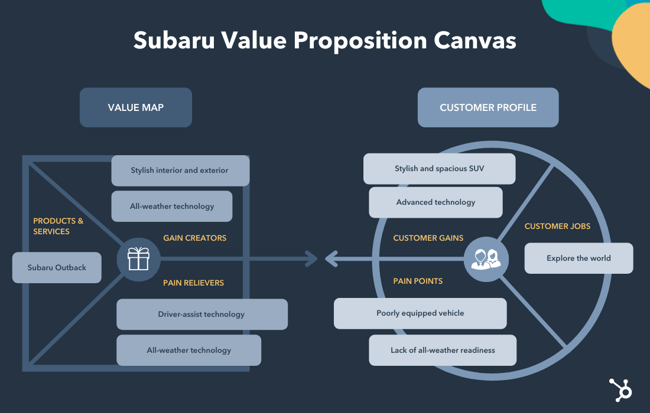
Subaru Value Proposition Canvas
Customer Profile
- Customer Jobs: Subaru customers want to explore the world’s most adventurous places in a reliable and safe vehicle
- Gains: Customers want to explore the land in a stylish and spacious SUV and look for advanced technological elements in their vehicles that enhance performance and safety
- Pains: The safest vehicles are not the most visually appealing, and some SUVs aren’t equipped for all-weather or all-terrain environments
Value Map
- Gain Creators: Subarus have a stylish exterior and interior with ample ground clearance that protects the vehicle against damage from the environment and advanced technology to reduce crashes and make long road trips safer.
- Pain Relievers: Subarus have a rugged blacked-out trim for style and protection, 9.5-inch ground clearance for better stability and performance, and driver-assist technology that helps drivers see better, prevent crashes, manage cruise control, and brake automatically in emergency situations.
- Products & Services: The 2022 Subaru Outback with standard eyesight assist technology, automatic pre-collision braking, adaptive cruise control, and lane-centering.
5. Samsung: “Get Ready to Unfold Your World”
Headline: “Get Ready to Unfold Your World”
Subheadline/paragraph: This is everything you’d want in a premium, durable, 5G smartphone. Then we made it unfold — revealing a massive screen so you can watch, work and play like never before.
Visual element:

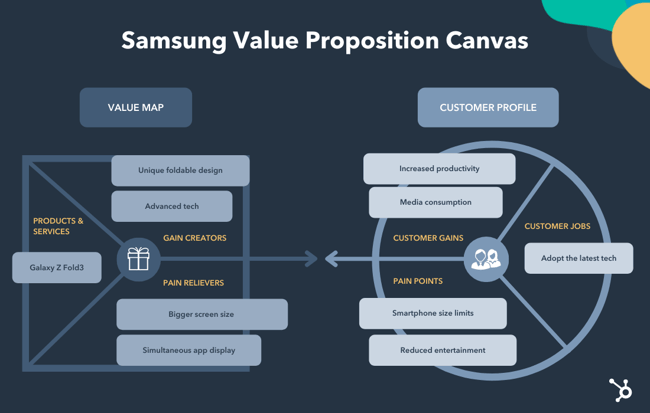
In its value proposition, Samsung effectively targets its most tech-savvy segment by front-lining its most innovative design to date: a foldable phone that can double as a mini-tablet. Even more, it solves a common pain point for some customers: owning both a tablet and a mobile device can feel unnecessary, so why not get the best of both worlds?
Samsung’s value proposition for its foldable mobile device is smart, well-targeted, and visually stunning.
Samsung Value Proposition Canvas
Customer Profile
- Customer Jobs: Samsung customers are tech-savvy and follow the latest trends, driven by efficiency and aspirational lifestyles.
- Gains: Customers want an all-in-one way to enjoy media, work productively, and have a fun experience all in the palm of their hands.
- Pains: Common smartphones have size limitations that strain entertainment viewing, gameplay, and work capabilities.
Value Map
- Gain Creators: Samsung offers a unique and expansive design with capabilities beyond that of an average smartphone, offering the most advanced technology to help customers perform tasks to fulfill work and play.
- Pain Relievers: Samsung provides a smartphone that displays content in tablet-like viewing and displays up to three apps simultaneously.
- Products & Services:The Galaxy Z Fold3 5G folding 6.2-inch smartphone with dynamic AMOLED 2X screens, ultra-thin glass with S Penfold edition, and super-strong lightweight armor aluminum frame.
You’ve seen some brilliant value proposition examples, now let’s break down how to make your own.
Step 1: Identify your customer’s main problem.
While this will require some upfront research, you can get a head start on this aspect of the value proposition by speaking with different members of your team. Customer service reps, marketing specialists, and salespeople can fill in the gaps about what problems your customers are looking to solve by using your product or service.
For example, let’s say your business sells tax software on a subscription basis and automated templates are included in the software package. Your ideal customer is looking for an affordable and user-friendly way to access complicated tax documents for their business. In this example, your business’s offerings could be the solution they need.
Step 2: Identify all the benefits your products offer.
This step can be as simple as listing out every product you sell and describing its primary benefit. The benefit should be concise and focused on a single customer need.
In our tax software example, you’d list each tax template, explain the benefit it provides, and why a customer would need it.
Step 3: Describe what makes these benefits valuable.
Next, add another sentence that explains why this benefit matters to the customer.
Using the same example above, the value would be that customers have affordable tax documentation at their fingertips — something that would normally cost them thousands of dollars.
Step 4: Connect this value to your buyer’s problem.
Next, pair the buyer’s problem to the elements that make your product or service valuable. Do they align? If so, you’re ready to refine your value proposition to differentiate your offerings from the competition. If they don’t align, repeat the steps above until you find a valid buyer need and a viable solution your business offers to meet that need.
There’re three templates we think do an excellent job of connecting value to buyer pain points:
Step 5: Differentiate yourself as the preferred provider of this value.
Finally, polish your value proposition to make it unique. Is there a specific customer service offering your business provides that others don’t? Do you offer any additional services that other companies charge for? These elements can help differentiate your value proposition from competitors while keeping the focus on the buyer’s needs.
Once you understand these steps, you can easily implement them into value proposition templates as follows.
Value Proposition Templates
-
Steve Blank Method
Instead of focusing on the features themselves, Blank saw the need to emphasize the benefits derived from the features in a simple sentence. By following this formula you’ll connect the target market and their pain points to the solution:
“We help (X) do (Y) by doing (Z)”
-
Geoff Moore Method
Moore provides a template that’s more specific in identifying the industry categories alongside the benefits customers value. This makes a more clear value proposition formula as follows:
“For [target customer] who [needs or wants X], our [product/service] is [category of industry] that [benefits]”
-
Harvard Business School Method
According to HBS a value proposition is executed best when it answers the following questions:
What is my brand offering?
What job does the customer hire my brand to do?
What companies and products compete with my brand to do this job for the customer?
What sets my brand apart from competitors?
Now that we’ve gone through steps and templates to follow, there’s some tactics we think you should keep in mind.
1. Conduct research to determine the value proposition of your competitors.
Because your value proposition is the differentiating factor between your business and the competition, it’s important to research the propositions of your closest competitors. You can use the value proposition canvas in this post to determine how each company meets the needs of your buyer persona.
Be honest here — it’s tempting to focus on the areas in which your competition doesn’t excel, but you’ll have a better idea of where your product or service fits within the market if you key in on your competitors’ strengths.
2. Explain the value of your products and services.
You’re probably familiar with outlining the features and benefits of your product and service offerings. This tactic takes that concept a step further. By matching the benefits of your offerings to specific values that your customers have, you’ll be able to align what your business provides with what your customers need.
3. Describe the benefits your ideal customer will experience when they choose your product or service over the competition.
When crafting this part of your value proposition, include details about how your product or service will benefit the customer and use examples where you can. Videos, photos, and live demonstrations are all effective ways to illustrate your value proposition because they show the customer exactly what they can expect from your business.
4. Develop a unique value proposition for each buyer persona you serve.
Ideally, you’ll be focusing your marketing efforts on a specific target audience. You’ll also find that this audience will have different needs based on their buying behaviors. Buyer personas can help you segment your larger audience into groups of customers with similar desires, goals, pain points, and buying behaviors. As a result, you’ll need a unique value proposition for each persona. Different products and services you offer may solve certain customer pain points better than others, so developing a value proposition for each persona will better serve each one.
5. Test your value proposition with your audience using various marketing channels.
Each of these tactics will likely be developed internally by your team which means you’ll want to validate your work with your target audience. Your value proposition will be communicated through various marketing channels like your website, social media accounts, video, audio, and in person. Test your proposition with members of your audience (both existing customers and non-customers) using each of these channels. Tools like UserTesting can help you streamline this feedback process so that you can implement changes quickly to finalize your value proposition.
We know the makings of a value proposition, so how can you make it a good one? Here’s the last three tips we have for you.
What makes a good value proposition?
Clear Language
Your value proposition should aim to address a primary customer need. This limited focus helps keep your value proposition clear and easy to understand. With just one main idea to comprehend, your audience will be able to quickly decide whether or not your product or service will be the best solution for them.
Specific Outcomes
Next, you’ll want to communicate the specific outcomes your customer can expect to receive from your product or service. Will they save time? Demonstrate how. Will their workflow become more manageable? Show a before and after workflow diagram. The specific outcomes will be critical components of your value proposition as they’ll exemplify exactly how your customers will use your solution to solve their problems.
Points of Differentiation
Not only are your potential customers evaluating your business’s offerings based on their own needs, but they’re also comparing what you offer against competitors. As a result, your value proposition will need to include detailed points of differentiation. These key points will help customers understand exactly what sets your company apart.
Compose a Remarkable Value Proposition
The factors that influence a potential customer to become a loyal customer are limited. Whether your industry has a lot of opportunities to differentiate (like retail) or virtually no unique identifiers (like dairy), you’ll find that a value proposition will help you understand your ideal customer and position your business as the best solution for their needs. Use the tactics, tips, framework, and examples in this post to craft your unique value proposition.
Editor’s note: This post was originally published in June 2018 and has been updated for comprehensiveness.

How-To: Conditional Formatting Based on Another Cell in Google Sheets
Conditional formatting is a feature in Google Sheets in which a cell is formatted in a particular way when certain conditions are met. The formatting can include highlighting, bolding, italicizing – just about any visual changes to the cell.
Just as it can be done for the cell you’re currently in, conditional formatting can also be set based on conditions met in another cell.

Let’s dive into how to create this condition based on multiple criteria.
How Conditional Formatting Works
To learn how to set conditional formatting, let’s use this workbook as an example.
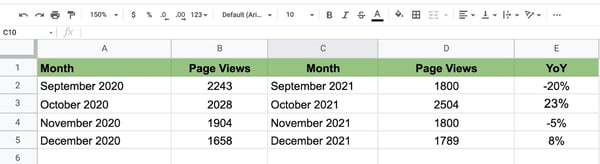
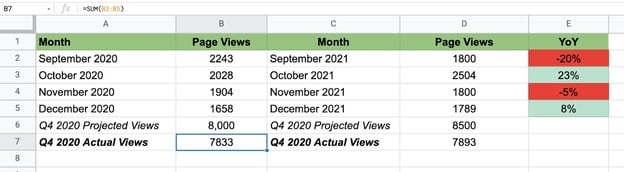
It’s a workbook showing website traffic year over year from Q4 2020 to Q4 2021, with the page views along with the year-over-year percentage change.
Here’s what we want to accomplish here: When the percentage change is positive YoY, the cell turns green. When it’s negative, the cell turns red. This makes it easy to get a quick performance overview before diving into the details.
Here are the steps to set the conditional formatting.
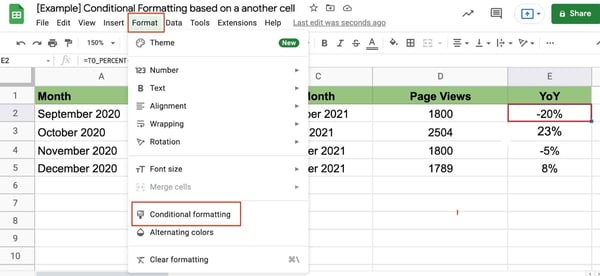
1. Select the cell you want to format, click on “Format” from the navigation bar, then click on “Conditional Formatting.”
2. While staying in the “Single color” tab, double-check that the cell under “Apply to range” is the cell you want to format. 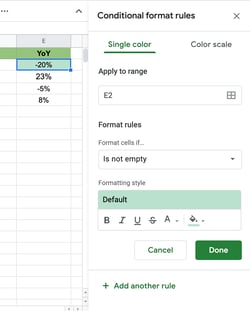
3. Set your format rules.
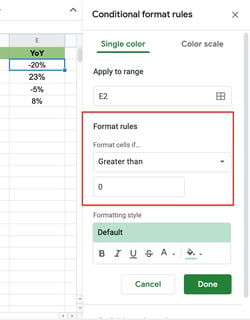
It may automatically default to a standard conditional formatting formula. In this case, open the dropdown menu under “Format cells if…” to select your rules. Options will look as follows:
4. Choose your formatting style, then click “Done.”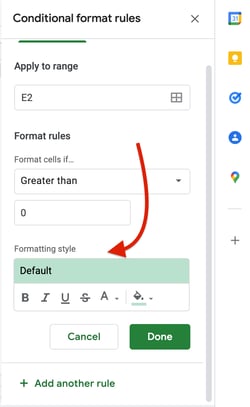
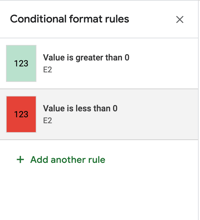
5. Confirm the rule was applied under “Conditional Formatting Rules.”
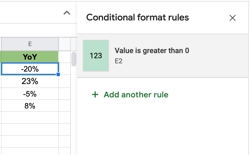
6. Add another rule if needed.
7. Return to cell to view formatting, then drag the cursor to apply to other cells, if needed.
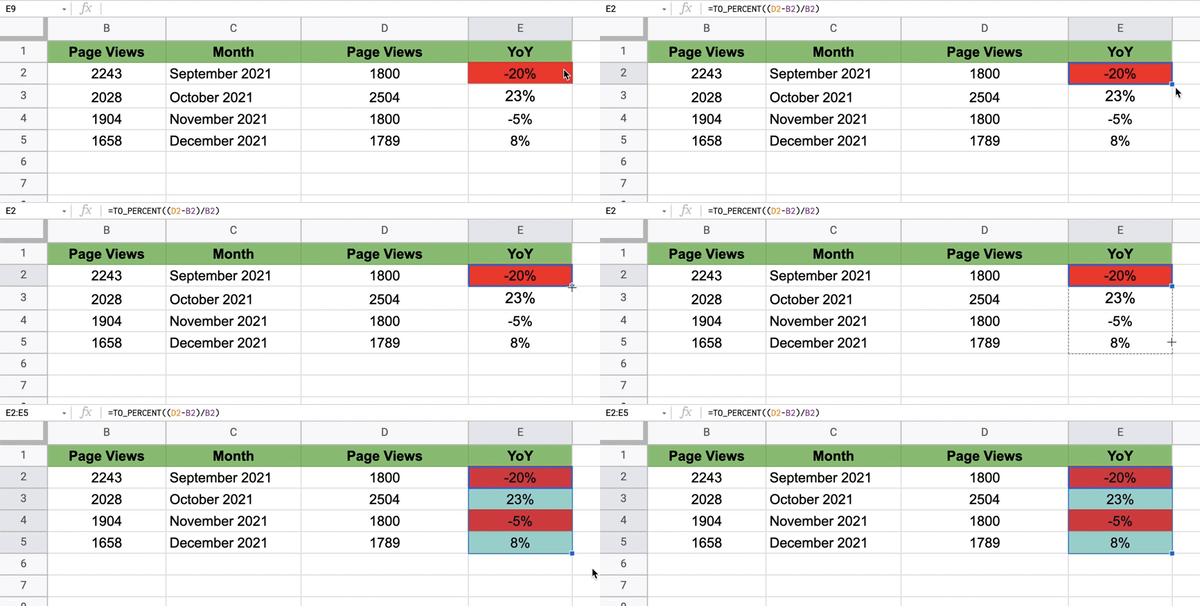
Now that you understand the basics, let’s cover how to use conditional formatting based on other cells.
Conditional Formatting Based on Another Cell Value
1. Select the cell you want to format.
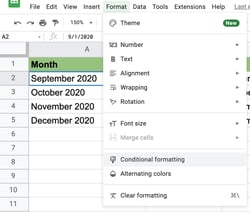
2. Click on “Format” in the navigation bar, then select “Conditional Formatting.”
3. Under “Format Rules,” select “Custom formula is.”
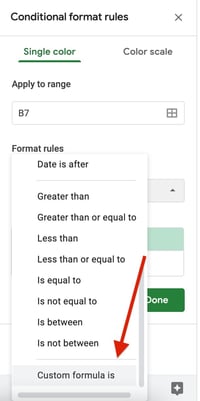
4. Write your formula, then click “Done.”
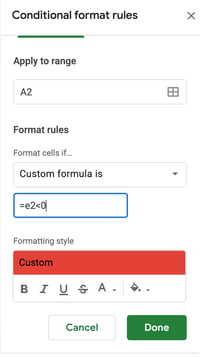
5. Confirm your rule has been applied and check the cell.
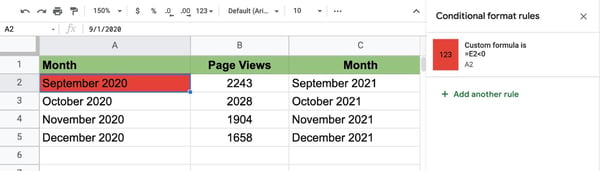
Conditional Formatting Based on Another Cell Range
To format based on another cell range, you follow many of the same steps you would for a cell value. What changes is the formula you write.
1. Select the cell you want to format.
2. Click on “Format” in the navigation bar, then select “Conditional Formatting.”
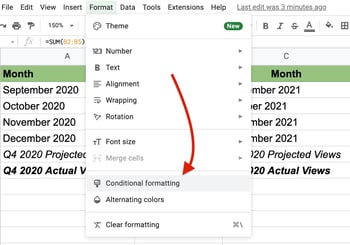
3. Under “Format Rules,” select “Custom formula is.”
4. Write your formula using the following format: =value range < [value], select your formatting style, then click “Done.”
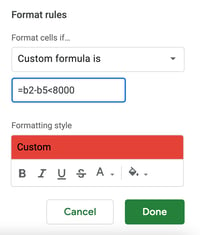
5. Confirm your rule has been applied and check the cell.
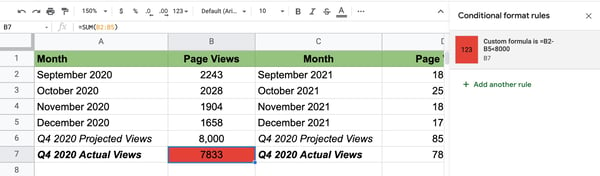
Google Sheets Conditional Formatting Based on Another Cell Color
Currently, Google Sheets does not offer a way to use conditional formatting based on the color of another cell. You can only use it based on:
- Values – higher than, greater than, equal to, in between
- Text – contains, starts with, ends with, matches
- Dates – is before, is after, is exactly
- Emptiness – is empty, is not empty
To achieve your goal, you’d have to use the condition of the cell to format the other.
Let’s use an example.
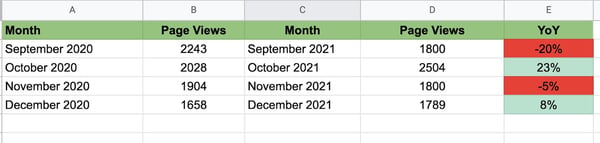
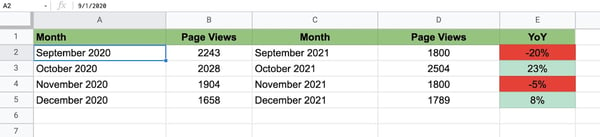
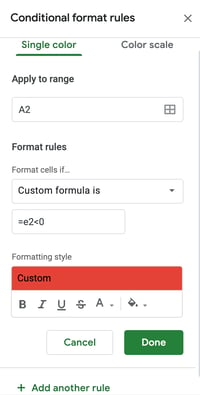
Say you want to format cell A2 (September 2020) to be red and match the color of cell E2 (-20%). There’s no formula that allows you to create a condition based on color. However, you can create a custom formula based on E2’s values.
You can say that if cell E2’s values are less than 0, cell A2 turns red. The formula is as follows: = [The other cell] < [value]. In this case, the formula would be =e2<0, as it signifies that cell A2 should turn red if E2’s value is less than 0.
With so many functions to play with, Google Sheets can seem daunting. By following these simple steps, you can easily format your cells for quick scanning.

The Ultimate Guide to Marketing Campaigns
From P&G’s “Thank You, Mom” to American Express’s “Small Business Saturday” to Dos Equis’s “Most Interesting Man in the World,” marketing campaigns have a way of sticking with us long after an impression or purchase. Why is that? Well, campaigns make companies memorable. They promote a focused effort that guides consumers towards the desired action. They also give brands an identity, personality, and emotion.

Marketing campaigns can do the same for your business. That’s why we’ve compiled this guide — to provide a clear, concise approach to your next marketing campaign.
Keep reading to get started or use the links below to jump ahead.
Marketing Campaigns vs. Advertising Campaigns
Marketing is how a company raises awareness of its brand and convinces customers to make a purchase, while advertising is the process of creating persuasive messages around these broad goals.
In terms of campaigns, an advertising campaign might be one facet of a larger marketing campaign strategy.
Say shoe brand Nike launched a campaign surrounding the release of a new product. Its advertising would only reflect one facet of its marketing strategy.
The brand might also leverage email newsletters, social media, and paid search to meet its goal.
Now that we understand the difference between advertising and marketing campaigns, here’s a list of a few more types of marketing campaigns you might run.
Marketing Campaign Components
Multiple components go into the planning, execution, and results of a stellar marketing campaign.
-
Goals and key progress indicators (KPIs): This component defines the end goal of your campaign, quantifies it in specific and measurable goals, and states which metrics will be used to track progress. For example, your content creation campaign might be measured by organic traffic, with each post aiming to drive 1,000 views per month and 10 new contacts, with metrics being measured in Google Analytics and Looker.
-
Channels: Where will your content and messaging be distributed? For example, if you’re running a social media marketing campaign, you might specifically prioritize growing the channels most relevant to your audience and omit those where you’re least likely to grow a loyal following.
-
Budget: Not all marketing campaigns require an incremental budget, but many still do. Factor in the agency, advertising, and freelance costs, if appropriate, and factor these numbers into any ROI analysis for your campaign.
-
Content Format(s): Determine what kind of content you will be creating to fuel the campaign. It’s common for marketers to include multiple content formats in a singular campaign. For example, a branding campaign could include video ads, press releases, and guest blogs.
-
Team: Who are the individuals you’re relying on to get the job done? Before kickstarting your campaign, make sure you designate people to work on every aspect of the campaign, from copywriting and design to media buying and reporting.
-
Creative Assets: A great marketing campaign should have great creative assets to match. Whether it’s a sleek website design, a video commercial, or an interactive infographic, make sure your design is professional and fitting for the purpose of the campaign.
How to Create a Successful Marketing Campaign
Creating an entire campaign is a big task, but the process is pretty straightforward.
Before you create what your audience will see, you must consider your end goal and the action you want them to take
I’ve organized this section as a marketing campaign template. All you need to do is answer the questions — as accurately and in-depth as possible — to ensure a thorough, successful approach to your next marketing campaign.
Planning Your Marketing Campaign
This step is crucial to the effectiveness of your marketing campaign. The planning stage will determine how you measure success and will guide your team when things go awry.
Featured Resource: Free Marketing Plan Generator
1. Set a purpose and goal for your campaign.
Let’s start simple. Why are you running this campaign? What would you like your campaign to accomplish for your business?
If you’re having trouble defining your campaign purpose, start broad. Take a look at the goals below. Which one is most aligned with your own?
- Promote a new product or service
- Increase brand awareness
- Gather customer feedback or content
- Drive leads
- Generate revenue
- Boost user engagement
- Advertise an upcoming event
This is hardly a definitive list, but it gives you an idea of general business goals that a campaign could help reach.
Let’s take this broad campaign purpose and turn it into a S.M.A.R.T. goal. We’ll use the third option as an example: Gather customer feedback or content.
“The goal of my marketing campaign is to gather user-generated content from 100 customers via a branded hashtag on Instagram featuring our new product line by December 31.“
The goal is specific (user-generated content), measurable (100 customers), attainable (via a branded Instagram hashtag), relevant (featuring the new product line), and timely (by December 31).
See how this broad campaign purpose instantly transforms into an actionable, attainable goal?
Pro Tip: Setting SMART Goals is simple when you have the right tools. Check out the free SMART Goal-Setting template below to get started on this critical piece of your marketing campaign.
Featured Resource: Free SMART Goal-Setting Template
2. Establish how you’ll measure your campaign.
This will look different for everyone depending on the channels you’re leveraging and your end goal. You might measure email open rates, new Facebook Page likes, product pre-orders, or a combination.
These answers will depend on your overarching campaign goal. Here are a few examples of metrics based on the campaign goals I mentioned above.
- For promoting a new product or service: Pre-orders, sales, upsells
- For increasing brand awareness: Sentiment, social mentions, press mentions
- For gathering customer feedback or content: Social mentions, engagement
- For generating revenue: Leads, sales, upsells
- For boosting user engagement: Blog shares, social shares, email interactions
- For advertising an upcoming event: Ticket sales, vendor or entertainment bookings, social mentions
If your campaign involves multiple marketing channels, it’s wise to define how you’ll measure your campaign on each medium.
For example, say I was running my user-generated content (UGC) campaign on social media, email, and on our blog. First, I’d define my key performance indicators (KPIs) for each medium, which may look like:
- Instagram engagements (likes and comments) and profile tags
- Email open rates and click-through rates
- Blog views, click-throughs, and social shares
Then, I’d define my primary campaign KPI: Instagram branded hashtag mentions.
While the above KPIs indicate how well my campaign is reaching and engaging my audience, my primary KPI tells me how close I am to reaching my SMART goal.
Lastly, let’s think about another question: What does “success” look like for your company? Sure, it’s exciting to reach a predetermined goal, but that’s not always possible. What (outside of your goal) would constitute success for you (or serve as a milestone)?
Pro Tip: When determining how you’ll measure your campaign, consider setting up some checkpoints along the way. If your campaign involves boosting brand awareness and your goal is to reach 50 PR mentions by the end of the year, set up some benchmark notifications at 10, 25, and 40 mentions.
Not only will it remind you to keep pushing toward your ultimate goal, but it’ll boost morale within your team and remind you that your hard work is paying off.
3. Define your target audience.
Imagine constructing a bulletproof marketing campaign only to be met with crickets.
In that case, you might think you chose the wrong marketing medium or that your creative wasn’t witty enough. However, the culprit may be your audience.
The first step to resolving this problem is figuring out what stage of the buyer’s journey your campaign is targeting. Are you trying to bring in new customers, or attempting to gather feedback from existing clients?
Marketing your brand to those who recognize it, or are you introducing a new brand identity altogether?
Your marketing message will vary depending on whether your campaign audience is in the awareness, consideration, or decision stage. Even though your campaign may reach those outside of your target audience, it’s vital that you design your campaign with a specific target in min you know who it’s meant for.
Next, identify your audience’s interests and pain points. Here are some questions to ask yourself and your team to better understand your audience.
- What are my audience’s general interests? What magazines do they read? What TV shows do they watch? How do they spend their free time?
- Where does my audience hang out online? For what purpose do they use Instagram, Facebook, and other networks? Do they engage or merely browse?
- What kind of content gets my audience’s attention? Do they respond to straightforward sales messages, or would they rather consume witty, humorous content? What cultural references would they understand?
- What kind of problems do they have that my product, service, or brand could solve?
Becoming well-acquainted with your campaign audience will help you confidently answer these questions and any others that may arise during the campaign.
Pro Tip: To uncover more about your target audience, survey your existing customers as well as potential customers in your market. Then, use this data to create your buyer personas — you can even enter that data into a free buyer persona generator like the one below.
Featured Resource: Buyer Persona Generator
4. Set a concept for your campaign and get in contact with the right team.
Marketing campaigns require a mission, vision, and visual identity. Great campaigns are an offshoot of their parent brand, both visually and creatively — they stay consistent with the business brand but maintain their own identity.
When creating their campaign assets, some businesses use an in-house team while others opt for an agency. Another alternative is hiring a freelancer or contractor to complete a specific portion of the project, such as the copy or design.
Pro Tip: Depending on your specific campaign goals, I’d recommend starting with your in-house team and moving forward from there. They are the experts of your business and can speak to what your campaign needs to succeed.
This step will likely take the longest since you’ll be creating your campaign concept from scratch. Next, we’ll dive into how you’ll distribute your campaign assets and connect with your audience.
Featured Resource: Market Research Kit
Distributing Your Marketing Campaign
This stage is all about the public-facing part of your campaign, including what your audience will see and when. If you’ve combed through the previous section, you should have all the answers you need to guide you through this step.
5. Choose the channels on which you’ll run your campaign.
This choice depends on your audience preference, budget, and brand engagement levels, among other factors.
Take a look at the current media channels you use to promote your company. Which ones perform the best? Which ones allow you to pay for advertisements? Which ones have the best engagement? Most importantly, where are your customers hanging out?
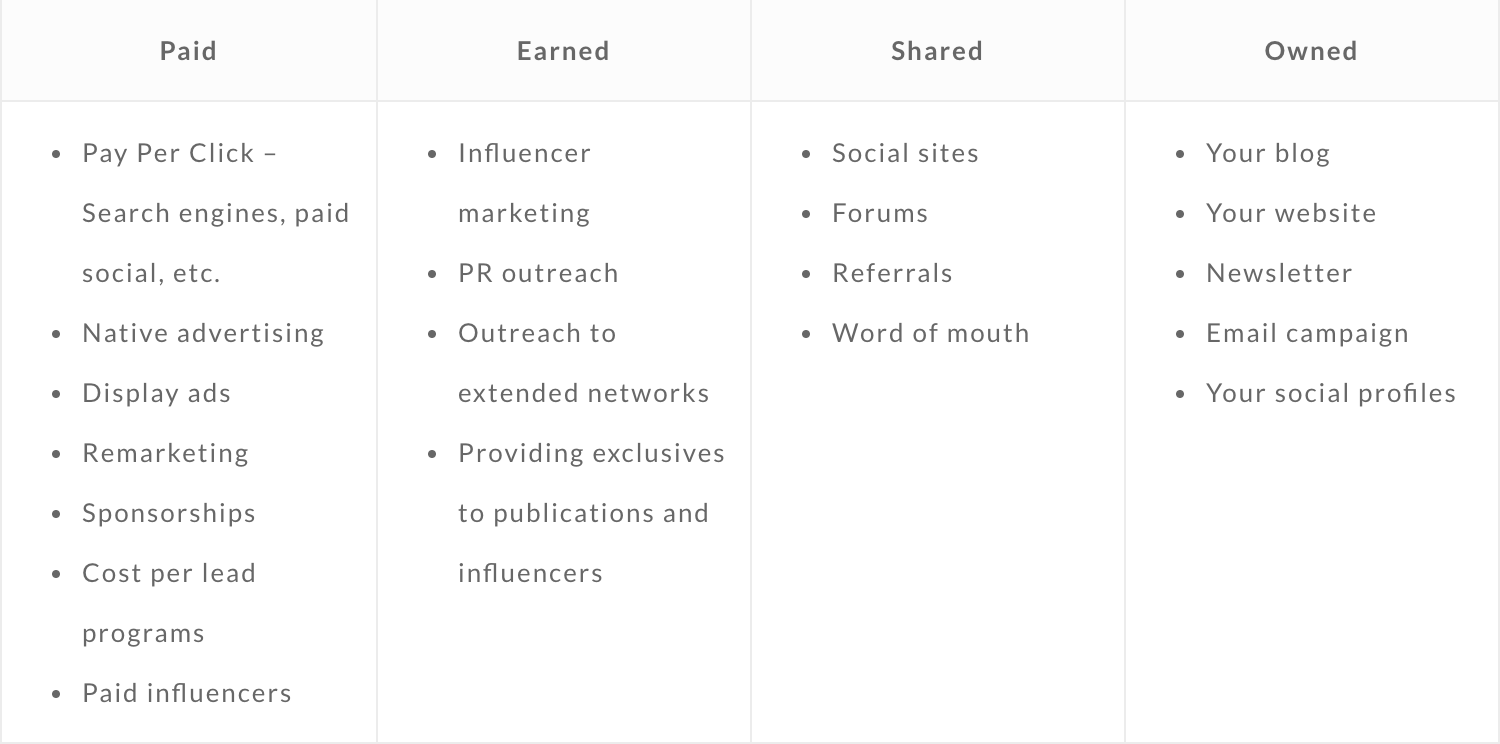
Need a few ideas? Take a look at the PESO model, which breaks up distribution channels into Paid, Earned, Shared, and Owned.
6. Set a timeline for your campaign.
Establishing a deadline for your campaign gives you a much better idea of when, how, and how often you’ll promote it. Here’s how to do this:
- Build a general campaign timeline, then mark your campaign start date and deadline on a calendar.
- Take a look at your marketing assets and chosen promotional marketing channels and work backward from the campaign launch date. Based on your resources, how often can you afford to post and promote your campaign content? With this information, create a promotional calendar for each marketing channel.
- Decide on a cadence for each channel and map out your scheduled posts, emails, etc. on your calendar.
Visually mapping your marketing campaign will help you evenly disperse your campaign promotions and publish equally on each medium. It’ll also give you an idea of where your time and energy are going so that you can look back when assessing the effectiveness of your campaign.
Pro Tip: If your promotional calendar seems full, don’t fret. Social media and email scheduling tools can alleviate the pressure of posting daily. Check out tools like HubSpot and Buffer to help you schedule and manage your campaign promotions.
Converting Customers Through Your Marketing Campaign
This stage — the conversion stage — is all about how your campaign can lead to a specific result.
7. Ensure your campaign is driving users toward a desired action.
Even if your campaign is effective and drives a ton of traffic, it still needs to complete its desired action. By “the desired action,” I’m talking about that SMART goal you initially defined. Let’s take a moment and reiterate that goal.
For my sample campaign, my SMART goal was “to gather user-generated content from 100 customers via a branded hashtag on Instagram featuring our new product line by December 31.”
This step is all about calibrating your marketing efforts and channels to lead your customers to complete your desired goal. This is done through conversion assets like calls-to-action, landing pages, and lead forms.
Pro Tip: Lead conversion assets can be used separately or in conjunction with one another, such as featuring a lead form on a landing page, or creating a call-to-action asking your audience to fill out a form.
8. Monitor the right metrics.
The campaign effectiveness metrics you’ll monitor will depend on what type of marketing campaign you’re running and what channels you’ve chosen. This section merely serves as a baseline list to give you an idea of what to watch.
Also, it’s tempting to focus on vanity metrics like generated traffic, click-through rate, and impressions. A bump in these areas is definitely a good thing, but since they don’t necessarily indicate a bump in revenue, they can’t be the only metrics used to measure the effectiveness of your campaign.
Pro Tip: Bookmark this link to all the marketing metrics to watch. It’s organized by marketing channel so you can quickly scan the list for new metrics to track for your campaigns.
Assessing Your Marketing Campaign
The post-campaign stage determines your success just as much as the planning stage. Measuring and analyzing your campaign data can provide unique insight into your audience, marketing channels, and budget. It will also inform future campaigns.
9. Establish success numbers and metrics.
The easy way to figure this out is to understand whether or not your campaign met the initial SMART goal outlined in step one. If it did, great! If it didn’t, you can dive into the data to assess why.
For example, if your goal was to increase organic blog views by 100K, any bump in views would be considered successful. But there’s a difference between a campaign that works and a campaign that’s worthwhile.
A worthwhile campaign gives you an ROI that’s proportionate to the time and energy you put into it.
Pro Tip: While it’s OK to celebrate any bump in pre-orders, leads, views, or engagements, don’t assume that’s enough. There’s a reason the very first thing to do is set a campaign goal. Sticking to that goal and calibrating your investment will ensure your campaign is worthwhile.
10. What will you do with the campaign data?
This step helps maximize your campaign’s business impact.
When you analyze and apply your data, its value increases tenfold — not only did it help you measure and assess your campaign results, but it’ll also give you direction and clarity on your audience, marketing methods, creative prowess, and more.
Let’s return to my UGC Instagram campaign.
In addition to meeting my goal of 100 posts with UGC, the data I collect in the process also offers insights into who my audience is, when and how often they post on Instagram, what language they use, and how they use my product.
Whether you collect lead information, pre-orders, social engagements, or offer downloads, your data can equip you to not only meet your campaign goal but also expand your marketing efforts as a whole.
Pro Tip: The campaign isn’t over once you’ve pulled that final report. Spend time with your team in a retrospective meeting. Ask yourselves questions like:
- What could’ve been done differently?
- How could we have saved money?
- For anything that went wrong, why do we think it went wrong?
- What did we learn about our audience or marketing channels?
- What kind of feedback could we gather from participants or customers?
Great Marketing Campaign Examples (and Why They’re So Great)
This wouldn’t be a HubSpot Ultimate Guide if we didn’t share some examples from the pros.
1. The Lip Bar‘s “Something BAWSE is coming”
In 2022, The Lip Bar celebrated its 10-year anniversary. It also release a new product called “The Bawse Bundle.”
In early February, the brand launched a multi-channel campaign, from website and social media to billboards.
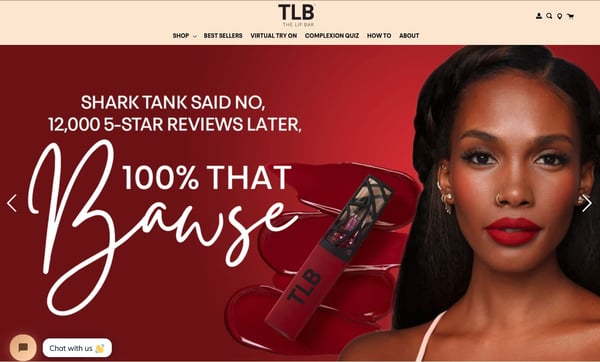
The campaign is built around a story of resilience and perseverance, focusing on the CEO’s negative experience on the show Shark Tank.
Why The Lip Bar’s “Something BAWSE is coming” campaign is so great:
It accomplishes multiple things through a single campaign: It gives the audience a peek into the brand’s journey. It builds on that journey and beautifully connects it to a product.
So, not only can current customers share in this excitement because of the 10-year anniversary, new customers will be drawn in by the personal story shared by the CEO.
2. Meta (Formerly Facebook): “The Metaverse”
In Q4 2021, Facebook announced the rebranding of its parent company. The new name, Meta, comes with its own marketing campaign that introduces the world to a new concept called the “metaverse.”
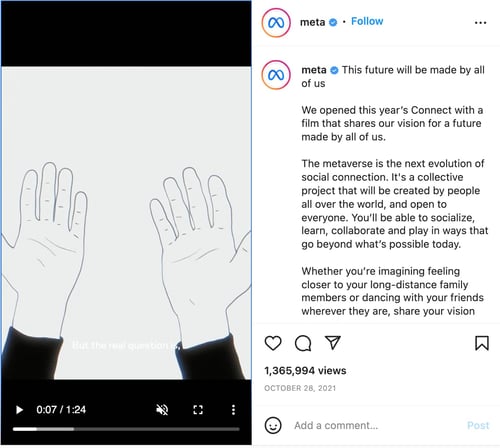
The campaign is still in its infancy stages, but it has taken over social media networks, including the Facebook app itself.
The video posted to the new @meta Instagram account showcases an alternate reality in which people can interact in 3D.
Why Meta’s “The Metaverse” campaign is so great:
Reception of the campaign is still developing, but so far, it’s successfully stopped the world in its tracks — and that’s a recipe for success with just about any marketing campaign.
The idea of a Facebook rebrand had been speculated prior to the launch of the campaign which piqued the public’s interest. That meant even if they didn’t like the change, they would still be interested in seeing what happens next.
3. Popeyes: “Megan Thee Stallion Hottie Sauce”
If Popeye’s wasn’t sure that it hit the ball out of the park with the chicken sandwich marketing campaign, then it nailed it for sure with the Megan Thee Stallion Hottie Sauce collaboration.

Arguably, Popeyes created one of the best chicken sandwiches on the fast-food market in 2019. At the same time, artist Megan Thee Stallion was becoming the hottest rapper in the industry.
So, it made sense that in 2021, the two would join forces to debut a remix of the successful chicken sandwich.
Why Popeyes’ “Megan Thee Stallion Hottie Sauce” campaign is so great:
This marketing campaign was intentional about targeting the younger crowd with not just chicken sandwiches, but merchandise, too.
Popeyes was able to tap into this segment of the market and increase sales while continuing to capitalize on its success without the campaign coming across as stale.
4. Cheerios: #GoodGoesRound
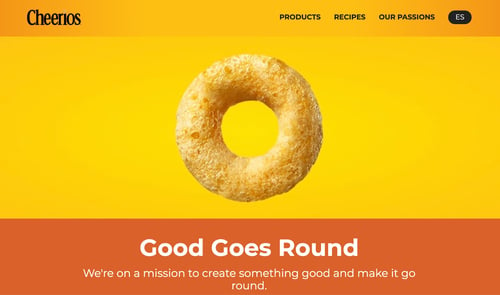
General Mills ran a non-profit campaign called Good Goes Round via its Cheerios brand, lobbying to raise enough money to fund one million meals.
Why Cheerios’ “Good Goes Round” campaign is so great:
The campaign featured its own landing page, video marketing assets, and hashtag (#GoodGoesRound), separating it from its parent brand and making it shareable among its audience.
It also paid to promote the “Good Goes Round” URL on Google, giving the campaign even more visibility.
5. Apple: “Shot on iPhone”

Apple’s “Shot on iPhone” series highlights the high-quality videography and photography that customers can capture on the iPhone X.
It’s a product launch campaign that focused on one specific feature of the new Apple smartphone.
Why Apple’s “Shot on iPhone” campaign is so great:
This campaign was unique, because it’s similar to a user-generated campaign but was also promoted heavily by the brand itself.
Apple launched its own Instagram account to share the #ShotoniPhone content, collaborated with professional photographers and videographers, and ran official TV advertisements.
6. The General: “Re-brand”
When it comes to cheesy commercials, The General’s old marketing strategy fits the bill.
The brand became synonymous with pixelated animations and low-quality production which inevitably had a negative effect on the way potential customers perceived the quality of service.
In 2020, the company changed its marketing campaign to target a more rational customer who appreciates a little humor.
Shaquille O’Neal became the face of the brand, appearing in commercials alongside other notable celebrities like Montell Jordan and Ernie Johnson.
Why The General’s “Re-brand” campaign is so great:
The General listened to its customers’ opinions of the brand before moving forward with the new campaign and saw great success as a result.
The tone of the marketing campaign remained light-hearted but took a more mature approach to the humor — toning it down and letting the key selling points of The General shine through.
7. Airbnb: “Made Possible by Hosts”
In the face of the COVID-19 pandemic, travel companies such as Airbnb saw unprecedented losses in profit.
How did the company respond? It created a series of videos called “Made Possible by Hosts” that shows appreciation for the hosts who have continued to accept guests on the platform.
What’s most curious about the campaign is that it doesn’t put Airbnb customers at the center.
Instead, it spotlights the hosts who accept customers in the first place. In doing so, Airbnb focuses on the human aspect of its platform: You’re not renting an Airbnb property, you’re renting someone’s home.
Over to You
Marketing campaigns aren’t easy, but they’re valuable and integral to growing a successful brand and business. Campaigns set apart certain deliverables from general promotional efforts and touch your audience in creative and exciting ways.
If you’re not sure where to start, consider what would be valuable to your audience, and go from there. Your audience is, after all, the lifeblood of your campaigns and company.
Editor’s note: This post was originally published in August 2017 and has been updated for comprehensiveness.

Ad Tracking: What It Is & How to Do It
Tracking ad engagement and impact has been historically hit-or-miss. There wasn’t a universal standard for measuring the success of an ad campaign. In fact, the term ROI (return on investment) wasn’t even widely used until the mid-1960s.
A lot has changed since then. Advertisers now have access to a wealth of granular ad tracking data for every single campaign they run. Ad tracking lets marketing teams leverage this data to more accurately measure, test, and revise ads based on how users interact with their online campaigns.

If you’re new to running online ads, it’s important to spend some time thinking about the specific metrics that will determine the success of your campaign. Ad tracking today exists across a number of different tools and platforms, and advertisers have the ability to collect data on everything from views and clicks, to impressions and behavior across multiple sessions and websites.
The sheer amount of data available can be overwhelming (not to mention distracting from your goals), so deciding on one or two key performance indicators (KPIs) will help focus your efforts and make reporting more straightforward and effective.
“Good key performance indicators are simple, timely, critical to the success of a project, and not financial in nature. But you also need to add in one thing if you want it to be a successful marketing metric — it must represent a key behavior you wanted to see. Look at your campaign and ask yourself: What’s the behavior I want to influence, not just something I can measure?”
— William Stentz, Director of Marketing Analytics at Carmichael Lynch
We wrote an article here that can help you determine the right metrics to track based on the goals of your ad campaign.
Once you’ve determined the metrics you want to track for your ad, it’s time to find the best ad tracking method for your purposes. The exact ad tracking methods available to you will vary based on where you run your ads and which tools you’re using, but here are a few basic types to keep in mind. It’s important to note that the following ad tracking methods aren’t mutually exclusive — in fact, when used together they can provide even more powerful insights.
Technical Tracking Tools
When it comes to ad tracking, technical tools are a good place to start. These include options for tracking URLs from your website, ads placed in emails or sidebar displays or webpages and cookie-based tracking to unpack user behavior and fine-tune your marketing plan. Let’s explore each in more detail.
Tracking URLs
A tracking URL is a normal page URL from your website with a tracking token added to the end of it. Here’s an example landing page URL by itself, and with a tracking token (in bold).
Regular old landing page URL:
http://www.yourwebsite.com/your-landing-page/
Landing page URL with a tracking token:
http://www.yourwebsite.com/your-landing-page/?utm_campaign=test-campaign&utm_source=email
As you can see, the page URL is the same in both cases, but in the second case, there’s some extra stuff added to the end. This extra stuff is your tracking token, also called a UTM parameter.
So how does this “extra stuff” help you track things, exactly?
When a user clicks on a URL with a UTM parameter added to the end, it essentially sends a signal back to your ad tracking tool that the URL was clicked. The “source=_____” bit of the tracking token can provide information about where the user clicked the link. Similarly, the “campaign=_____” bit can be used to signal to your tracking tool that the link should be bucketed as part of a campaign.
For example, if you were to run the same ad on multiple websites and wanted to know which one generated the most clicks, you could define the two different websites as sources in the UTM parameters of your links.
You can learn more about tracking parameters and how they work in this article.
When to use tracking URLs:
If you’re running a PPC campaign, sending an email, or putting an advertisement on another website, tracking URLs are ideal for calculating the number of visits, leads, and conversions you’ve generated from your hard work.
Tracking Pixels
A tracking pixel is a tiny, often transparent, 1px by 1px image that can be placed in an email, display ad, or simply on a webpage. When it loads, it sends a signal back to your tracking tool that a user has viewed the page.
Tracking pixels are also capable of collecting pretty comprehensive data about a user’s activity and browser configuration — but you should only ever track information that is directly useful to your buyer’s journey and will provide a better, more personalized experience for your target users.
When used correctly, tracking pixels can help optimize your ads and get them in front of a receptive audience. For example, using banner ad tracking with a pixel lets you gather information about how many people just view versus actually click on your ad, which will help you determine whether or not an ad was actually successful (and worth running again).
For context, here’s how big a tracking pixel appears (no, that’s not just a speck of dust on your screen):
When to use tracking pixels:
Tracking pixels are incredibly useful for tracking the success of your online campaigns through every step of your conversion path. They can give you insight into how users are interacting with your ads, and help you optimize each stage of your user journey from initial touch through final purchase.
Cookies
Cookies can help you gain insight into user behavior on your website across multiple sessions of activity. Marketers need to gain explicit consent from users before using cookies to track their activity. When explicit consent is given, cookies can be used to customize a user’s experience. Here’s a deeper dive on cookies if you want to learn more about the technical aspects of how they function.
From an ad tracking perspective, cookies are the driving force behind most ad retargeting campaigns. Cookies can be used to essentially build a user profile based on someone’s web activity and habits, and advertisers can leverage this profile to serve ads that align with a user’s observed interests. They can also capture information about a user’s browser configuration, location, and preferred language.
When to use cookies:
Cookies are ideal when you want to serve a user ads aligned with their web browsing activity, or retarget them with ads for products they’ve demonstrated an interest in. Cookies can also be used to create a personalized experience for users on your website based on their previous interactions with you — for example, you could create an abandoned cart email when users put items in their cart and then leave your website.
Now that we’ve gone over a few core solutions related to ad targeting, let’s take a deeper look at how ad targeting functions on a few of the biggest ad tracking platforms, and how you can use it to make your own ad campaigns stronger and more effective.
Search and Social Ad Tracking Solutions
Brands can also boost their ad tracking ability by using tools that integrate with search tools such as Google or social media sites such as Facebook and Instagram. This type of ad tracking provides more in-depth information about user behaviors and preferences to help companies fine-tune their marketing efforts.
DoubleClick Ad Tracking
If you’ve ever noticed an ad for a product you viewed weeks ago following you around on the internet, it’s likely the result of DoubleClick ad tracking. DoubleClick, which was acquired by Google in 2008, is an ad management and ad serving platform that enables marketers to run ad campaigns across multiple channels.
Online publishers use DoubleClick to essentially rent out ad space on their websites, and agencies and advertisers use the product to place ads on websites where their target audiences are spending time.
In 2012, Google rebranded their DoubleClick products as Google Marketing Platform (formerly DoubleClick), Google Ads (formerly Google AdWords), and Google Ad Manager (formerly DoubleClick for Publishers and DoubleClick Ad Exchange).
Google ad tracking offers advertisers a number of different options when they create campaigns on the platform — most of which rely on the use of cookies.
According to Google, “Cookies themselves contain no personally identifiable information. Depending on the publisher’s and user’s settings, information associated with cookies used in advertising may be added to the user’s Google Account.”
These generic cookies can collect information on the time and date you viewed particular ads, the specific web pages you were on when you viewed an ad, and your IP address — which can help the cookie infer where you’re located.
Although the cookies contain no personally identifiable information, Google can combine the information it obtains via cookies with the personally identifiable information associated with your Google Account (which includes your browsing and search activity when you’re logged into Google — which, for most of us, is pretty much always).
Google leverages two main types of cookies: first-party and third-party.
First-party cookies are dropped (i.e., assigned to a specific user) by the owner of the website you’re visiting. Information collected via first-party cookies can help publishers better understand your activity on their site and how ads are performing.
Third-party cookies are dropped by an advertiser on a website where their ads are being displayed. These cookies send information back to advertisers about how their ad campaigns are performing across all the websites where their DoubleClick ads are being displayed.
Over 11.1 million websites currently run ads as part of Google’s AdSense network. If you visit a website within the network, the information collected via a DoubleClick ad tracking cookie will be pooled and leveraged by other websites and advertisers using AdSense.
This consolidation of cookie information results in an extremely rich pool of data for Google advertisers, as they can keep track of what ads you’re served across millions of different websites.
To get started tracking ads with Google, you’ll need to get a Google Marketing Platform account. Depending on the size of your business and your particular needs, you’ll choose either an enterprise account — which can accommodate large ad campaigns across multiple websites and mediums — or a small business account — with ad tracking tools more focused and specialized for early company growth.
Facebook Pixel
Advertisers on Facebook can leverage a number of different ad tracking strategies to optimize ads for their audience. Facebook’s ad tracking pixel is one of the more common methods for both desktop and mobile ad tracking. It functions similarly to the basic tracking pixel we outlined above, and can be used to track the path someone takes from viewing an ad, to visiting your website, to purchasing a product.
When an action takes place on a page where a tracking pixel has been set up, the pixel will “fire” and send that information back to your Facebook Events Manager account. Information collected via the tracking pixel can also be used in the creation of custom audiences for future ad campaigns.
For example, you could use data collected via a tracking pixel to create a custom ad audience targeting users who viewed a particular page on your website that implies purchase intent — like a pricing page. We wrote an article that goes deeper into how the tracking pixel functions if you want to learn more about different uses and how to set it up.
Worth noting? Because Facebook owns Instagram, pixel works the same way on the photo-sharing site and will deliver the same type of insights. Collecting data from both Facebook and Instagram in tandem is a great way to pinpoint strategies that may work well on one platform but under-perform on the other. For example, longer text-driven ads may drive click-throughs on your Facebook page but fall flat on Instagram, where images drive interaction.
Additional Ad Tracking Options
While the Facebook pixel can offer advertisers valuable insights into how ads are influencing specific actions on their websites, it’s not the only way to track ads on the social network.
Another ad tracking option available to help improve ad management is adding UTM parameters to links that appear on your ads. As we discussed above, tracking parameters use extra code on a URL to “fire” when a user loads the link. On Facebook, they can be used in Ads Manager to better understand which ads you’re running are driving which types of traffic.
It All Adds Up: Improving Impact with Ad Tracking
Competitive Ad tracking can help your business see how your marketing efforts and campaigns are performing at scale. This starts with URL, pixel, and cookie tracking to explore how users are interacting with your brand. It’s bolstered by search-focused and social-focused tools that help your brand discover where ads are working, where they come up short, and where they need to improve to increase user engagement and drive sales conversions.
Editor’s note: This post was originally published in July 2019 and has been updated for comprehensiveness.

What is Content Governance? 4 Easy Steps to Create a Model in 2022
Without a content governance model in place, your content marketing efforts can seem scattered and chaotic, opening the opportunity for your audience to replace you with a competitor.
Content governance keeps your relationship with your customers thriving, and allows you and your team to more effectively focus on your content goals.

In this post, we’ll cover the topic of content governance — what it is, why it’s important, and how you can create a model for your business.
The goal of a content strategy is for your company to create meaningful and engaging content that aligns with your business objectives and drives consumers to a particular action. Content governance ensures that you have a definitive way for this content to reach them. Who creates the content? On what platform is it published? How will it be updated in the future? While these questions and their answers help shape content governance, its framework involves more.
Content governance is more than consumer-facing content. It requires preliminary and behind-the-scenes work seen in an asset like an editorial content calendar. Consumers don’t have access to your company’s content calendar; however, this is an irreplaceable tool to keep your company on track with its strategy. Style guides and content audits are other tools that assist with content governance but are unseen by consumers.
Content governance encompasses content sent to consumers and content that waits for them. It is not only reserved for social media posts that land on their feed or emails sent to their inbox. It includes banner ads or frequently asked questions on your website. It’s your Instagram bio or the answering message you have for phone calls. In a business, content is everywhere, and content governance allows your business to manage all of its avenues.
Why is content governance important?
To illustrate the importance of content governance, let’s look at an analogy.
Content marketing is like a first date. You wine and dine with visuals and information and hope it builds a budding relationship. If it does, how do you move forward and keep building?
After that initial interaction, you publish two emails, one blog post, and four social media posts during week one. You drop the ball in week two. The amount of content decreases to one email and two social media posts. Week three is worse, but during week four, you’re able to publish three emails, two blog posts, and five social media posts. While the increase in content seems remarkable, your potential long-term customer has unsubscribed from your content after a month. Why?
Content needs to be governed by procedures and systems. Procedures mean consistency, and consistency is key to the success of any business. It shows effort and demonstrates to customers that you care.
Content works as a cycle. Although the number of steps might differ for each organization, content life cycles typically follow this process:
- Develop a strategy.
- Create the content.
- Store the content.
- Edit.
- Publish.
- Analyze.
- Update or repurpose content.
The content cycle never ends. There is always work to do. Use the steps above. If you finish strategizing, focus on content creation. If you’re not creating, your company can work on storing, editing, publishing, and more.
Content governance is important because it ensures that your company maintains an efficient process in its continuous content cycle. It can prevent delays, inconsistent messaging, or even legal issues. Content governance helps:
- Provide structure
- Establish clear roles and responsibilities
- Create detailed processes and workflows
- Outline company standards and policies
A comprehensive content governance model creates a standard for effective, consistent content, resulting in continued success.
The online world is fast-paced, and to keep up, businesses need to make sure that they’re covering all avenues. It used to mean website and email content; however, the growth of social media has expanded the number of channels businesses need to account for. Companies have had to shift gears and adjust their content strategies to accommodate social platforms like Facebook, Instagram, and LinkedIn.
While content grows and changes, its governance models help companies scale, sustain, and recreate their content.
Creating a Content Governance Model
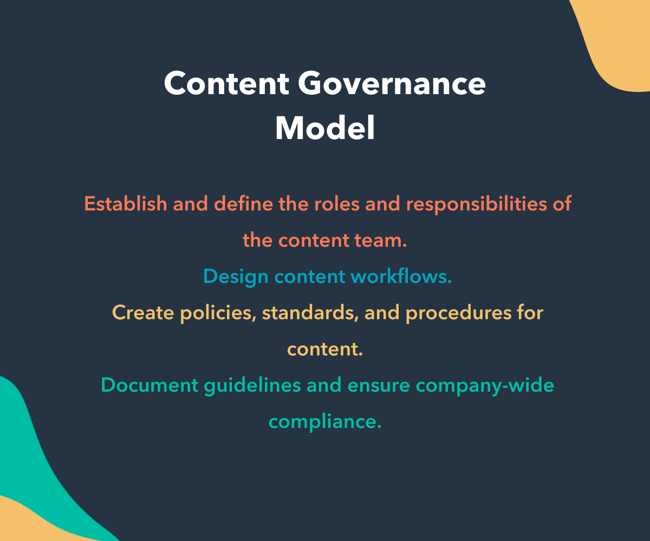
You’re ready to create your content governance model. While each step might require extensive work, the process isn’t complicated. Building your content governance model requires four steps.
- Establish and define the roles and responsibilities of the content team.
- Design content workflows.
- Create policies, standards, and procedures for content.
- Document guidelines and ensure company-wide compliance.
Let’s go over these one-by-one.
1. Establish and define the roles and responsibilities of the content team.
Good content doesn’t exist without people. While you could argue that the most vital person in the content experience is the consumer, you could also contend that content would not exist without the team.
To create a content governance model, decide on the roles and responsibilities of those within the company. Content roles include strategists, writers, editors, and analysts. When defining the obligations of the people in these roles, think about their function. Team members typically have a strategic, operational, or specialist function.
A strategic function, usually seen in roles like a content strategist, is for those who plan long-term strategy. Staff, who are operational, implement the content strategy daily. This work is carried out by writers, editors, photographers, and more. Lastly, members of the specialist function provide expert data to other team members. This could be an SEO specialist providing analytical information to strategists or writers that shape how they fulfill their role.
When establishing the roles and responsibilities for your team, you might find it necessary to create an overlap in function. For example, it could be beneficial to have your content writers specialize in SEO. As long as there is a clear distinction in role and responsibility, there should be no issue in team management.
2. Design content workflows.
How does your content go from Point A to Point B? Point A is an idea while Point B is publication. Consumers cannot see this process, but multiple steps are necessary to reach publication.
Content workflows follow these stages:
- Strategy: planning content
- Creation: writing, designing, filming, content
- Review: editing and fact-checking content
- Publication/Distribution: publishing and sharing content
While the list is short, the process isn’t. Content takes time. Once you’re aware of what it takes to create your content, use this to shape your policies, standards, and procedures.
3. Create policies, standards, and procedures for content.
Once you have the proper people in place, it is time to focus on your policies, standards, and procedures. Content policies are the values and goals of a company. Standards are targets used to make sure that a company upholds its policies. Procedures are a step-by-step breakdown of who is involved and what steps are needed to achieve the ultimate goal.
Consider this example. An online company has the policy to be a leading source of global news. The company enforces this policy by setting a standard for publishing at least 10 daily articles. Members of the content team, like the writers, editors, and publishers, have procedures to guide them through the content process and ensure that 10 articles are shared with the public every day.
Once your company creates policies, standards, and procedures for content, finish the process with documentation and compliance.
4. Document guidelines and ensure company-wide compliance.
There is no use in creating a content governance model if no one knows about it. The most significant element of content governance is ensuring that the entire company has access to it and complies with it.
Create documents for your company policies, standards, and procedures, and put them in a central location. Hold a meeting to walk through content processes and workflows. And lastly, regularly review and update your content governance models.
Content never ends.
Content lives on a lifecycle. You might think a blog post is complete after it is published and distributed, but its cycle continues with updates and redistribution. Managing one blog post without a system is most likely doable, but imagine an additional 20 content assets in one week. Scary, right?
Without any checks and balances, creating and managing your content can become chaotic. Content governance prevents this. With a content governance model in place, your company will have the framework and processes in place to successfully execute your content strategy.

Does Your Company Need An Employee Referral Program? [Examples + Best Practices]
Finding qualified candidates to fill your open positions can be challenging. Job posting sites claim to make the process easy by connecting you with hundreds if not thousands of potential employees. But having such a large pool of candidates can be overwhelming.
Just thinking about the sheer volume of work involved in reviewing applications, narrowing them down to good fits, and then vetting those potential candidates is enough to make anyone’s head explode.

You work with or run a solid organization with wonderful employees. How do you make sure that you don’t get a bevy of potential candidates, but rather the right candidate?
Look at this like finding the perfect place to take your significant other on a special occasion. Sure, you could do a Google search for random restaurants in your neighborhood. You could even check a review site for recommendations.
However, you don’t know any of those people, so how much weight does their opinion really carry? Instead of taking a risk on a very special evening, why not reach out to the people you trust? Asking friends and family for a recommendation is a much safer avenue to finding the perfect date night experience.
What if we applied this type of thinking to your search for the perfect employee? Rather than leave it up to a random internet search, ask the people you already know, like, and trust… your employees.
What is an employee referral program?
An employee referral program is a structured system by which you ask existing employees to recommend people they know for open positions within your organization. Employees often receive some sort of incentive for their assistance.
An employee referral program leverages the power of your employees’ networks and can save you time, money, and a huge headache when it comes to hiring the best talent for your business.
Benefits of an Employee Referral Program
There are many benefits to utilizing an employee referral program as part of your hiring strategy. These include:
1. High Quality Hires
Good employees know what skills are necessary to excel in a position and understand the workplace culture. When they recommend someone for the job, there’s a good chance they have the qualifications necessary to successfully perform in the role.
2. Decreased Turnover Rates
With employee turnover rates on the rise, you’ll want to keep it front of mind when you’re making hiring decisions. According to ERIN, 45% of referred employees stay with a company longer compared to 22% from job boards and 33% from career sites.
3. Less Time and Lower Cost Per Hire
According to LinkedIn, employees hired through referrals take an average of 29 days to hire and onboard, whereas job boards can take 39 days and a career site can take upwards of 55 days. The less time it takes to hire and onboard means less revenue lost, fewer employees stressed because they are handling multiple jobs, and more productivity from your new hire.
Using a headhunter? According to Jobvite, you can expect to pay between 15% and 25% of the gross annual salary of the candidate. If you’re hiring an employee at $100k per year, that’s $15k to $25k in headhunting fees. The cost to reward an employee for an amazing referral? Around $2,000.
4. Increase Employee Satisfaction and Loyalty
Doesn’t it feel nice when you have a hand in the decision-making process? Employees that refer candidates feel like they’ve contributed to the company, making them more engaged and more likely to stay.
Employee Referral Program Ideas
Now that you see the benefit to you as the employer or hiring manager, how do you create an employee referral program that encourages your existing employees to introduce you to their quality contacts? There are a number of ways to do this and best practices that you can adopt to get the most out of your program.
Make it Clear What You’re Looking For
In a mid-sized to a large company, one department may have no idea what another one is working on. In order for employees to make connections, they need to know what your expectations are for the new position. When you reach out to employees looking for suggestions, provide them with all the details you can. This should include:
- Job descriptions
- Desired experience
- Necessary skills
Make it Easy for Employees to Refer
Consider the referral experience from your employees’ point of view. Is there a simple form for them to submit when they recommend someone, or do they have to jump through a variety of complicated hoops to pass along their referrals? Some companies even host recruitment happy hours where existing employees can invite friends who might be a good fit.
The easier you make it for your employees to refer their contacts, the more quality candidates will be presented to you.
Keep Your Employees Updated on Referral Status
It’s frustrating to make a suggestion or an introduction and not know if it’s been acted upon. When your employee recommends a colleague, keep them updated as to the steps of the hiring process. Some times to check-in include:
- When you receive an application
- When you make contact
- When an interview is scheduled
- When a position has been offered to their contact
- When the position has been given to someone else (after the candidate has been contacted)
Provide a Juicy Incentive
Surprisingly, this may not always be a monetary reward. While money is always appreciated, you can offer a combination of “cash” and experiences, time off, gifts, etc. For some, these may be even more desired than a financial incentive. One great option is to give your employees the choice. That way, you know they’ll be motivated to help. A few employee referral incentive ideas to get your creative juices flowing:
- Cash bonuses
- Gift certificates to their favorite restaurants and local establishments
- Weekend getaways or week-long excursions for frequent referrers
- VIP parking
- Show tickets
- Physical gifts (it’s important to let them choose so they don’t end up with something they can’t use)
- Perks like a gym membership or massage
The sky’s the limit when it comes to thanking your employees for their referrals. You can also consider using a platform like XoxoDay to make distributing employee referral perks as easy and streamlined as possible.
Show Appreciation for “Frequent Referrers”
If you’ve got employees that consistently send you quality employee candidates, acknowledge them publicly. This shows your amazing team members that they are appreciated and motivates other employees to step up their referral game.
Employee Referral Program Examples
Looking for real-world examples of these programs in action? We’ve compiled a few employee referral program samples to introduce you to some of the possibilities.
- Inmobi, a mobile advertising company offers referring employees the choice of a bike or a trip to Bali. They park the vehicles in front of the company headquarters to motivate employees to participate.
- Accenture, a consulting and IT company encourages philanthropy and community involvement by letting their employees donate a part of their referral bonus to a charity of their choice.
- Distillery, an American software development company gifts their employees new tech gadgets for every referral they make.
- Atlassian software company encourages employees to “Refer-a-Mate” and offers them $2,000 in cash bonuses.
- Intel tech company takes financial incentives one step further by doubling their employee referral reward for women, minorities, and veterans that are referred to the company.
If you’d like to tap into a pool of qualified, trustworthy, easy-to-hire (and onboard) candidates, an employee referral program can help. Instituting this type of hiring process in your organization can save you money, time, headaches, and the pain of having to repeatedly hire for the same position when your first employee doesn’t work out well. In addition, you’ll improve your workplace culture and enhance your brand.
An employee referral program is the best thing you can do to improve the quality of your incoming employees. Choose your incentives wisely and then watch the quality candidates roll on in.

Everything You Need to Know About Marketing Operations in One Place
One of my favorite movies is “School of Rock,” which also happens to be one of 2003’s best films. In the movie, Jack Black poses as a substitute teacher at a private school, and, after noticing the students are musically talented, he turns the 10-year-olds into a fully-fledged rock band.
When assigning roles to the students, he approaches the class president and deems her band manager because she had the organizational skills needed to help the band run smoothly. “Summer,” he says, “You’re in charge of the whole thing.”
When I think about marketing operations, I think of this quote — without a team, businesses that depend on technology would have a less-than-seamless experience carrying out their duties. In this post, you’ll learn more about marketing operations and why these teams are essential to a business.

The people involved in marketing operations build a foundation that reinforces and supports marketing efforts. It makes it easier to achieve goals by implementing systems to ensure marketers are best equipped to succeed at their jobs.
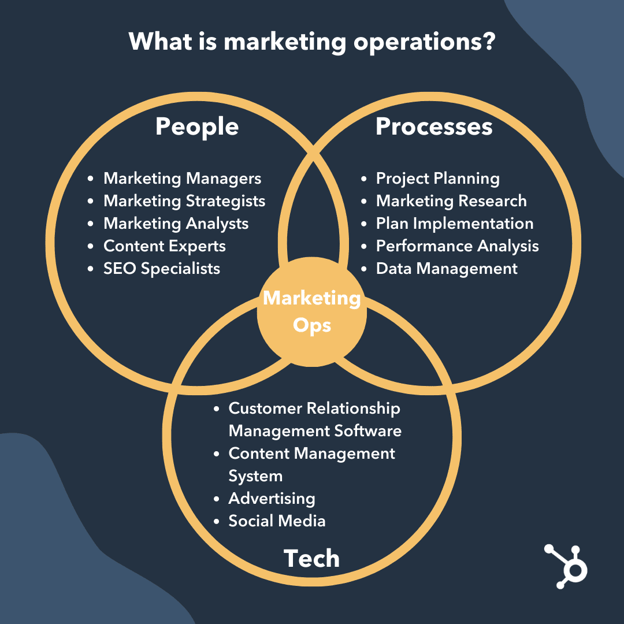
Why is marketing operations important?
93% of B2B marketers say the marketing operation’s function is important or critical to delivering digital transformation. After all, without marketing operations, it would be tough for marketing teams to complete essential activities effectively because they enable other marketing departments to bring cohesion to campaigns and processes.
For example, as technology is necessary to carry out most marketing tasks, a team to manage the complexity of that technology and ensure it works as it should is also necessary — which is exactly what MOps is.
Here are some examples of situations that can be rectified by having a marketing operations team:
| Problem | MOps Solution |
| Your investments in marketing technology don’t provide the solutions you thought they would. | MOps ensure that teams are enabled by technology solutions and eliminate tech debt. |
| You want to streamline data reporting and metrics tracking to understand ROI. | MOps focus on processes and systems for data reporting to enable teams. |
| Strategy execution is a timely process, and you want to lower the amount of time it takes from start to finish. | MOps helps team improve processes to become more efficient. |
At HubSpot, the marketing ops team is responsible for supporting the systems and processes that enable the marketing team to perform optimally in their roles. This includes everything from permissions, conversational marketing, user data, forms, and email operations.
An essential function of how well a marketing ops team works is proper management.
As a point of reference, marketing operations is the process of strategizing and optimizing, while marketing ops management defines how that strategizing and optimizing will happen.
Since marketing operations management aims to increase efficiency, ops teams often have a hand in content planning and campaign analysis.
Role of Marketing Operations
Marketing operations is a combination of different processes that contribute to marketing team success. The role of marketing ops encompasses:
- Project management
- Strategic planning
- Organization benchmarking
- Workflow process development and documentation
- Customer, market, and competitive intelligence research
- Performance measurement
- Campaign analysis and reporting
- Data management
- Process development and implementation
Much of the role of marketing operations comes down to strategic decision making for key marketing strategies, and seeing those projects through to completion based on analyzed data.
Marketing Operations Strategy
Marketing ops team members need to have an expansive skillset. Some of the typical activities this department deals with are email operations, systems analysis, customer data and marketing, user operations, and lead rotation.
All of these roles come together to align the process and platforms needed to carry out marketing tasks for the greater marketing team.
When thinking about a marketing ops strategy, consider the problems the marketing ops team needs to solve, taking into account the needs of customers, stakeholders, and the employees of your company.
1. Identify what you want your operations strategy to accomplish for stakeholders.
Firstly, you need to effectively communicate and involve your stakeholder(s) when trying to create your marketing operations strategy. By doing so, you can better align the team and work toward solving high-level needs and priorities that may not be explicitly clear beforehand.
This is where the importance of internal service level agreements (SLAs) come in. These contracts establish a set of deliverables to another party that sets clear expectations and mitigates issues that may arise.
For instance, key stakeholders might want to make email marketing a more valuable process. The marketing ops team would then be responsible for the processes and systems that support this endeavor, ensuring that:
- The organization has effective email marketing technology
- The marketing team is enabled to send emails and create improved content offers
- The sales team is enabled and empowered to source quality leads
- All parties have what they need and are communicating effectively during each step of the process
2. Figure out a measurable metric to determine the success of your strategy.
The next step in strategizing is to identify how the team would measure the success of the project. When you figure out a measurable metric, you’ll be able to keep track of the strategy’s success as your team works through the plan. The metric will remind your team of the goal you want to accomplish and what stakeholders want to see as a result of your plan.
In this example, the team might conclude, “Click-through rate and total number of clicks are how we want to measure the value that email marketing brings to the business. We will calculate the click-through rate by dividing the number of clicks in a month by the number of unique email recipient impressions in a month and multiply it by 100 for the percentage.”
3. Define your goal(s) using the SMART format.
With your metrics identified, the next step in defining a marketing ops strategy is outlining significant SMART goals. This format is important because it gives your team a better sense of direction and organization in strategy execution.
An example of an effective SMART goal is, “We will increase total clicks from email by 25% in one year.” because it’s:
- Specific: It’s not a broad goal; it’s focused on email marketing.
- Measurable: It can be measured by a concrete metric (total clicks).
- Attainable: It’s possible to see this level of change in the business.
- Realistic: The team is capable of working toward 25% of improvement.
- Time-bound: This goal has a set duration of one year.
4. If needed, communicate how colleagues can take part in refining your strategy.
With the goal and metrics identified, your next step is to outline what this change would mean for affected colleagues, such as the team members who create and distribute email marketing messages.
The team might conclude that “Marketers can expect an easier email guideline process, a more effective format, and to receive a form to offer input about how to make that happen.”
5. Determine actionable steps in your plan that will help you reach your goals.
Determining actionable steps will help your marketing ops team figure out what needs to be done, identify the resources required to see success, and stay organized as they work through their tasks.
A marketing ops professional will need to run these steps by the stakeholders who actually influence the plan. For instance, they would be communicating steps to reach the previously stated SMART goal like:
- Switching to a more efficient email technology provider.
- Ensuring that the data being used to measure these goals is clean and accurate.
- Enabling the marketing team to source more quality leads.
- Enabling the sales team with better templates or sales enablement resources.
With these steps communicated, stakeholders can provide assistance or suggestions where it’s needed, and the marketing ops team can get closer to execution.
6. Assign team members to specific tasks that will contribute to the completion of your goals.
Having that set in place, what’s next for the marketing ops team is to assign team members specific tasks to help them achieve their goals. For instance, one team member might be in charge of redefining email marketing contact lists. Another might be in charge of auditing the current workflows in place for email marketing.
As team members complete these tasks, they would check them off in a centralized space so the entire team can stay updated on the project’s status.
Marketing operations teams are equally effective with their strategies and management capabilities as Summer’s character in “School of Rock.” With her processes, the group was able to obtain their own rehearsal space and offer music classes.
Align and Optimize Your Marketing Operations
Marketing ops can come up with ways to increase customer satisfaction and ease the job of marketers. Their strategies make marketing activities and duties accessible to all, and because of that, are an essential part of a business.

370 Best Instagram Captions: Good, Cool, Funny, & Cute IG Quotes
If you’re anything like me, you take about four minutes choosing a filter for your Instagram photo, and about four hours deciding on a caption.
Worst of all, after much creative effort and advice from friends, I’m usually barely able to write a caption that goes beyond, “Had a fun day with friends!”
And I’m a writer — go figure.
Next time you’re contemplating a witty line of text to go with your Instagram photo, take a look at our complete list of captions that suit any mood or occasion you’ll be sharing with the world. You can also customize these captions to make them perfect for your feed.
Want more inspiration? Check out our Instagram page to see how we incorporate fun, witty, and engaging captions into our social media content.

You can incorporate many of these captions into an Instagram business strategy (just make sure your audience would find your caption funny, clever, or the right amount of sassy).
Click one of the following links to jump to a section:
- Business Instagram Captions
- Quote Instagram Captions
- Funny Instagram Captions
- Clever Instagram Captions
- Cute Instagram Captions
- Sassy Instagram Captions
- Song Lyrics for Instagram Captions
- Holiday Instagram Captions
- Seasonal Instagram Captions
- Selfie Instagram Captions
- Vacation Instagram Captions
Features of Good Instagram Captions
1. Your caption is on-brand.
Whether your Instagram page is personal or for your business, your captions should be on-brand, or reflective of your brand identity.
This encapsulates the nature of your Instagram’s branding and tone of voice. For example, if your page is based on self-love, you should use captions that are friendly in tone, and use inclusive language to make people feel good when they scroll through your Instagram profile.
2. Your caption is simple.
Instagram captions can fit up to 2,200 characters, but you don’t have to use all of them for your caption to be considered a good one. You ideally want to keep your captions clear, short, and simple for easy readability. You also want to keep your audience’s attention enough to read it to finish.
The exception to this is if you’re making posts that champion storytelling or other lengthy formats. Ultimately, it comes down to what your audience is looking for.
3. Your caption is memorable.
While your Instagram caption doesn’t have to be a profound piece of literature, you can make it memorable in a number of ways. Depending on the type of post you’re sharing, you can make it hilarious, thought-provoking, inspiring, or anything you want it to be.
Business Instagram Captions
If you’re running a business account, you should use your captioning to humanize your business more than your average paid ad.
Your business Instagram captions are an opportunity to give your brand some personality while getting the word out about your product or service offering. Here are some of our go-to captions that prospects and customers will love.
- Good evening, [city]! We’re in town for [event] at Booth [#]. Stop by and say hi!
- “If you’re offered a seat on a rocket ship, don’t ask what seat. Just get on.” -Sheryl Sandberg, COO of Facebook
- Our [#]-person squad completed the [road race name]! And we did it all for the post-run sneaker selfie. 👟
- We got product in the pipeline … check back for an exciting announcement on [date]!
- Diversity isn’t a recruitment metric — it’s an ingredient for success. At [company], we thrive on the unique backgrounds, experiences, and perspectives of our people.
- Spot the CEO. 😉
- At [company name], our best asset is our people.
- We had a great time with our customers at [meeting/event]! @[client/partner], you guys rock.
- Thrilled to have [customer] at our office today! Come back any time. 😊
- [Company name] is off for [holiday]! We hope you all have a safe long weekend.
- Big things have small beginnings. [Company]’s HQ began right here.
- “It is better to fail in originality than to succeed in imitation.” –Herman Melville
- How many [company name] employees does it take to spell “TEAM”?
- Want to work with these awesome people, working on a lot of awesome things? We’re hiring! Click the link in our bio to see our current openings.
- Check, check, one, two … is this thing on? [Company name] is now on Instagram! Follow us to learn about our culture, product, and (awesome) people.
- Tired of [customer pain point]? We’ve got good news. Click the link in our bio to learn about [product]’s latest feature.
- [Company] presents our latest product — made with love just for you. ❤️ Link in bio to learn more.
- Stop wasting time with [customer pain point]. Our [product] will help you achieve [X] more efficiently — just ask our current customers. Check out our latest case study here: [Link]
- Handmade in [location] and delivered to your door. That’s the [Company] promise.
- When life gives you lemons, you make lemonade. When [company name] gives you [type of product], you make money.
Quote Instagram Captions
If you can’t find the words yourself, there’s a quote out there to help you convey that idea.
Using quotes for your Instagram caption is a great way to evoke and share your emotions. Quotes can propel people to think more open-mindedly, and optimistically — or even motivate them to do something great. Below is a list of some of our favorites.
- “The greatest glory in living lies not in never falling, but in rising every time we fall.” –Nelson Mandela
- “Always remember that you are absolutely unique. Just like everyone else.” -Margaret Mead
- “You change the world by being yourself.” -Yoko Ono
- “In the end, it’s not the years in your life that count. It’s the life in your years.” -Abraham Lincoln
- “What I know for sure is that speaking your truth is the most powerful tool we all have.” – Oprah Winfrey
- “The purpose of our lives is to be happy.” -Dalai Lama
- “You only live once, but if you do it right, once is enough.” -Mae West
- “Live in the sunshine, swim the sea, drink the wild air.” -Ralph Waldo Emerson
- “I would rather die of passion than of boredom.” -Vincent van Gogh
- “Success isn’t about the end result, it’s about what you learn along the way.” -Vera Wang
- “It does not matter how slowly you go as long as you do not stop.” -Confucius
- “Everything you’ve ever wanted is on the other side of fear.” -George Addair
- “You become what you believe.” -Oprah Winfrey
- “Believe you can and you’re halfway there.” -Theodore Roosevelt
- “The way to get started is to quit talking and begin doing.” -Walt Disney
- “Love the life you live. Live the life you love.” -Bob Marley
- “My mission in life is not merely to survive, but to thrive; and to do so with some passion, some compassion, some humor, and some style.” -Maya Angelou
- “Embrace what makes you unique, even if it makes others uncomfortable.” – Janelle Monae
- “Success is a collection of problems solved.” – I.M. Pei
- “To be beautiful means to be yourself. You don’t need to be accepted by others. You need to accept yourself.” -Thich Nhat Hanh
- “In a gentle way, you can shake the world.” -Gandhi
- “I dream. Sometimes I think that’s the only right thing to do.” -Haruki Murakami
- “We become what we think about.” -Earl Nightingale
- “Success is not final, failure is not fatal: it is the courage to continue that counts.” –Winston Churchill
- “You are never too old to set another goal or to dream a new dream.” -C.S. Lewis
- “If you are depressed you are living in the past. If you are anxious you are living in the future. If you are at peace you are living in the present.” -Lao Tzu
- “Life is like riding a bicycle. To keep your balance, you must keep moving.” -Albert Einstein
- “If you are working on something that you really care about, you don’t have to be pushed. The vision pulls you.” -Steve Jobs
- “Security is mostly a superstition. Life is either a daring adventure or nothing.” – Helen Keller
- “Stay true to yourself and never let what somebody else says distract you from your goals.” -Michelle Obama
Funny Instagram Captions
We don’t always have to take social media so seriously, so explore some funny Instagram captions for your upcoming posts.
Instagram can be a tool to convey aesthetic picture taking or stoic model shoots, it can also be a fun place to share a laugh or lighthearted content, too. Sharing a funny caption can boost your page’s personality, and potentially brighten someone else’s day. We hope the following captions make you crack a smile.
- My favorite exercise is a cross between a lunge and a crunch … I call it lunch.
- I need a six-month holiday, twice a year.
- We tried to be normal once. Worst two minutes of our lives!
- There are 16-year-olds competing at the Olympics and some of us (me) still push on “pull” doors.
- That awkward moment when you’re wearing Nike’s and you can’t do it.
- I’m just a girl, standing in front of a salad, asking it to be a cupcake.
- What if we told you … you can eat without posting it on Instagram?
- I know the voices in my head aren’t real, but sometimes their ideas are just too good to ignore.
- We don’t know what’s tighter: Our jeans or our company culture.
- Friday … Our second-favorite F word.
- We don’t care what people think of us. Unless they’re our customers. We definitely care what customers think of us.
- All you need is love … and investors. All you need is love and investors.
- Hi, we’re [company name]. We build amazing apps and eat amazing apps.
- They say “Do what you love and money will come to you.” Let’s see what happens, I just ordered tamales.
- My favorite subject in school was recess.
- No thoughts brain empty just tacos and cats.
- [Food item] so good it’s got me weak in the knees.
- The best part about waking up is going to sleep eighteen hours later.
- The older you get, the better you get, unless you’re a banana.
- Bring the alcohol! Because no great story started with someone eating a salad.
- Don’t worry if plan A fails. There are 25 more letters in the alphabet.
- If you’re not supposed to eat at night, why is there a light bulb in the refrigerator?
- First rule of Sundays: If you can’t reach it from your couch, you don’t need it.
- If you fall, I will be there. Signed, Floor.
- The first thing I do after coming to work is logging off.
- I used to think I was indecisive, but now I am not so sure.
- Friends buy you lunch. Best friends eat your lunch.
- Darn it, just accidentally had another thought again.
- My goal this weekend is to move… just enough so people don’t think I’m dead.
- You think nothing is impossible? Try getting me out of bed before 12 PM.
- Looking at these pictures won’t fix all your problems, but it’s a good start.
- My sauce is too hot that’s why you’ll never ketchup.
- Google Maps said it’s MY TURN.
- I got my haters seasick, they see me and get sick.
- If there would be an award for being lazy, I would send someone to pick it up for me.
Clever Instagram Captions
Trying to come up with some clever Instagram captions on your own can be a lot of work, so we’ve done it for you. Below we’ve compiled a list of our favorite clever Instagram captions for all your witty caption needs.

- Patience — what you have when there are too many witnesses.
- Maybe she’s born with it, maybe it’s the Clarendon filter.
- “Life is short.” False — it’s the longest thing you do.
- Happy Sunday! There may be no excuse for laziness, but I’m still looking.
- Rejection is just redirection.
- Better an “oops” than a “what if.”
- Anyone looking for a heart? Selling mine for $2. (Used, good condition)
- The world is changed by your example, not your opinion.
- Seven billion smiles and these are my favorite.
- Stop working hard and start working smart.
- I found your nose. It was in my business.
- Imposter complex is just a byproduct of success.
- Life is simple. It’s just not easy.
- The best times begin at the end of your comfort zone. So you can catch me on the opposite end of the end of my comfort zone.
- When nothing goes right, go left.
- “Success is making those who believed in you look brilliant.” -Dharmesh Shah
- “If you can’t convince them, confuse them.” -Harry Truman
- The world changes by your example, not your opinion. So get acting right.
- It’s always a good idea to be on the right side of history.
- When you learn, teach. When you get, give.
- Don’t quit your daydream.
- Legend has it that if you look hard enough you’ll see the weekend approaching!
- It’s time to make new memories. But first, five tequila shots.
- I’m on a seafood diet. I see food, I eat it.
- Sorry I didn’t get back to your text. I was too busy converting oxygen into CO2.
- Living on Earth is expensive, but it does include a free trip around the sun.
- “Arguing with a fool proves there are two.” -Doris M. Smith
- Well, enough about me. Let’s talk about you. What do you think about me?
- We’re all one more minute closer to dying. What’s one more shot going to do?
- There’s a pot of gold at the end of the rainbow. If you find it, let me know so I can get some.
Cute Instagram Captions
If there’s one thing people on the internet love to see — it’s anything and everything that falls into the category of cute. Whether you’re posting your adorable pet, your significant other, or a picnic by the park, we’ve got all the cute Instagram captions that you need to complement them.
- Don’t give up on your dreams. Keep sleeping.
- My fave sound is you snoring next to me.
- Here’s to a hundred more years with you.
- Happiness is watching you do what you love 💗 Hopefully that’s me.
- I like you more than [food]. And I looove [food].
- Wearing a onesie to bed just in case my SO steals the covers again.
- Cuddle time with the pup 💞
- Just showing off my [item] a little. Be jealous.
- Always wear cute pajamas to bed; you never know who you’ll meet in your dreams.
- You got me like 🥴️
- I’d move to [state] for you. And I hate [state].
- 🥺️ 👉👈
- I have no idea what I was doing before you came around. Sleeping, probably.
- No one can touch my books or my tacos 😤
- Not me standing there like🧍♂️
- Don’t mind me while I drink my tea 🍵
- Did someone say [something you like]? 🏃💨
- They say elephants have a perfect memory. So do I when it comes to you.
- My pup is the salsa to my whole enchilada.
- I hate it when I’m singing a song and the artist gets the words wrong.
- Being an adult is like folding a fitted sheet. No one really knows how.
- Here’s a 🥇 for being the cutest human to walk this earth.
- Me before you: 🌱 Me after you: 🌻
- 🤟
- Just got that Friday feeling.
- Are you a timekeeper? ‘Cause time slows down when I’m with you.
- I can’t see heaven being much better than this.
- I’m not lazy, I’m on energy-saving mode.
- My pillow is my best friend (sorry, [best friend’s name])
- A day doing [activity] is a day well-spent.
- I don’t know who’s cuter, me or my reflection?
- Being a full-time angel is so exhausting.
- With you, everything is twice the fun and half the trouble.
- Sweeter than a cupcake.
Sassy Instagram Captions
Your Instagram posts are your way to express yourself, so if you’re bold, sassy, and not afraid to show it — let your caption do the talking.
For those that want to give their Instagram posts some more pizzazz, try throwing in one of these sassy captions.

- What’s a queen without her king? Historically speaking, more powerful.
- Be a little more you, and a lot less them.
- We’re an acquired taste. If you don’t like us, acquire some taste.
- Well-behaved people don’t make it into history books.
- Be sunshine mixed with a little hurricane.
- We got 99 problems, but an awesome marketing team ain’t one.
- Sometimes you just need to do a thing called “what you want.”
- You can’t do epic stuff with bad people. And we got the best in the biz.
- It’s not called being bossy, it’s called having leadership skills.
- You did not wake up today to be mediocre.
- A bad attitude is like a flat tire. You can’t go anywhere until you change it.
- We’re entrepreneurs. They call us dreamers, but we’re the ones who never sleep.
- All of us have the capacity to light up a room. Some when they enter, others when they leave it.
- Brains are awesome. I wish everybody would have one.
- Common sense is like deodorant. The people who need it most never use it.
- You see that? That’s my patience leaving.
- I’ll have you know, I’ve completed plenty of marathons. [Show 1], [Show 2], and [Show 3], to name a few.
- Everyone has that one annoying friend. If you don’t have one, then it’s probably you.
- Above: A photo of me pretending to be listening.
- Oh, you sent me an email? Expect a response in approximately never.
- Everyone is entitled to be stupid, but some abuse the privilege.
- If you like me, raise your hand. If not, then raise your standard.
- If you don’t succeed the first time, then burn all the evidence you tried.
- Underestimate me. That’ll be fun.
- I like my coffee how I like myself: Dark, bitter and too hot for you.
- People say I act like I don’t care. It’s not an act.
- They say good things take time … that’s why I’m always late.
- Focused. Intelligent. Motivated. Oh, and cute.
- “The question isn’t who is going to let me: it’s who is going to stop me.” -Ayn Rand
- It’s okay if you don’t like me. Not everyone has good taste.
- I’m a work of art, showing you the art or working.
- I only show up wearing my best and you shouldn’t expect less.
- You couldn’t even outshine my shadow.
- Please don’t call me, I’m out of your range.
Song Lyrics for Instagram Captions
People of all different backgrounds can relate to music. Beyond the different chords and melodies are lyrics that tell a story, echo a feeling, or inspire others.
To convey the message or emotion you want in your Instagram caption, use one of these iconic song lyrics.

- “I’m gonna live like tomorrow doesn’t exist.” — Sia, “Chandelier”
- “I live for the nights that I can’t remember, with the people that I won’t forget.” — Drake, “Show Me a Good Time”
- “I hope you never lose your sense of wonder.” — Lee Ann Womack, “I Hope You Dance”
- “You may say I’m a dreamer, but I’m not the only one.” — John Lennon, “Imagine”
- “If you give, you begin to live.” — Dave Matthews Band, “You Might Die Trying”
- “Outlining my findings, using life as a stencil.” — Kero One, “In All the Wrong Places”
- “Feeling good living better.” — Drake, “Over My Dead Body”
- “Say oh, got this feeling that you can’t fight, like this city is on fire tonight.” — OneRepublic, “Good Life”
- “Time makes you bolder.” — Fleetwood Mac, “Landslide”
- “If I fail, if I succeed, at least I’ll live as I believe.” — Whitney Houston, “The Greatest Love of All”
- “The rest of the world was in black and white, but we were in screaming color.” — Taylor Swift, “Out of the Woods”
- “Lightning strikes every time she moves.” — Calvin Harris, “This Is What You Came For”
- “We aren’t ever getting older.” — Chainsmokers, “Closer”
- “Sing with me, sing for the years, sing for the laughter, sing for the tears.” — Aerosmith, “Dream On”
- “Life is good.” — Future & Drake, “Life is Good”
- “Life without dreaming is a life without meaning.” – Wale, “Aston Martin Music”
- “But like the sun, know you know I find my way back ‘round.” — J. Cole, “Crooked Smile”
- “I will overcome any hurdle or obstacle that’s in my path.” — OutKast, “Knowing”
- “I’m way up, I feel blessed.” — Drake, “Blessings”
- “Eat, sleep, and breathe it. Rehearse and repeat it.” — Dua Lipa, “New Rules”
- “I’d rather be dry but at least I’m alive. Rain on me.” — Lady Gaga, “Rain On Me”
- “And I know that I gotta be above it now. And I know that I can‘t let them bring me down.” — Tame Impala, “Be Above It”
- “I’m on the pursuit of happiness and I know everything that shine ain’t always gonna be gold, hey, I’ll be fine once I get it, yeah, I’ll be good.” — Kid Cudi, “Pursuit of Happiness (Nightmare)”
- “There’s much more to life than dyin’ over your past mistakes and people who threw dirt on your name.” — Lil Nas X, “Sun Goes Down”
- “They say the loudest in the room is weak, that’s what they assume, but I disagree.” — Tyler the Creator, “911/Mr. Lonely”
- “You don’t have to be like everybody else, you don’t have to fit into the norm, you are not here to conform.” — Marina, “Ancient Dreams in a Modern Land”
- “Throw me in the fire, baby, I’ll survive.” — BROCKHAMPTON, “RENTAL”
Holiday Instagram Captions
Around the holidays, you want to post and share the memories you’ve made throughout the years. For whichever one you’re celebrating, take some inspiration from our favorite Instagram captions and spread some holiday cheer.
New Year’s Instagram Captions
- “Always bear in mind that your own resolution to succeed is more important than any other.” — Abraham Lincoln
- Didn’t make it to midnight.
- Resolutions are made to be broken.
- Ringing in the new year — like a bell.
- “Tomorrow is the first blank page of a 365-page book. Write a good one.” — Brad Paisley
- New year, same me.
- Time to show off my bubbly personality.
- Any excuse to wear glitter.
- Starting off the year on the right foot.
- There are 12 months ahead of us to make a difference.
- Day 1 of 365
- Sip, sip, hooray!
Valentine’s Day Instagram Captions

- Roses are red. Violets are blue. Consider this post my Valentine to you.
- Don’t tell me you love me. Tell me you’re outside with pizza.
- All I need is you. (And maybe wine + chocolate too.)
- “You can’t blame gravity for falling in love.” — Albert Einstein
- 99% of my socks are single, and you don’t see them crying about it.
- I will do anything for love. Except that. And that. Or that. Or…
- Sorry, I’m in a relationship with tacos.
- “All the single ladies…” — Beyonce, “Single Ladies”
- In love with my best friend.
- I’m better when I’m with you.
Halloween Instagram Captions
- Creepin’ it real.
- I brake for Reese’s Peanut Butter Cups.
- “When the spooks have a midnight jamboree, they break it up with fiendish glee…” — The Legend of Sleepy Hollow (1949)
- You’re just my (blood) type.
- How to eat candy corn: don’t.
- #squadghouls
- Double, double toil and trouble; Fire burn and cauldron bubble.
- Driving me batty.
- “Scary hours.” — Drake
- Resting Witch Face
Thanksgiving
- I’m wearing my elastic pants.
- “For those of you who cannot be with family this Thanksgiving, please resist the urge to brag.” — Andy Borowitz
- On a veggie diet this Thanksgiving: Carrot cake and pumpkin pie.
- “Be thankful for what you have; you’ll end up having more. If you concentrate on what you don’t have, you will never, ever have enough.” — Oprah Winfrey
- I think, therefore I cran.
- Bad day to be a turkey.
- Need fuel for Black Friday.
- “Okay, guys. I have exactly 28 minutes before I have to baste again.” — Monica
- Grateful. Thankful. Blessed.
- Who made the potato salad?
- There’s always something to be thankful for.
Christmas & Hannukah Instagram Captions
- You sleigh me.
- Fa la la la llama.
- “O Christmas tree, O Christmas tree, your ornaments are history.” — The Cat
- “It’s not what’s under the Christmas tree that matters. It’s who’s around it.” — Charles M. Schulz
- Dear Santa, let’s not talk about this.
- Rebel Without a Claus
- Doesn’t Santa have anything better to do than watch us while we’re sleeping?
- All I want for Christmas is you (and wine would be nice).
- To all you cotton-headed ninny-mugginses out there.
- Drop it like a top.
- Wishing you a latke love this Hanukkah.
- I want to eat 8 latkes for the calories of one.
- One little candle can light up an entire room.
- Keep calm and spin that dreidel.
- Deck the halls with matzo balls!
- It’s Christmas time and I’m the gift.
- The best gift is to be present with the ones you love.
Seasonal Instagram Captions
As the seasons come and go, why not share your joy for the next one on your Instagram? Whether you love the sunshine in the Summer, or snowfall in the winter, you can share that excitement with others.
Ring in the new season with some of these witty, seasonal captions.
Spring Instagram Captions
- Hello, spring!
- “And I think to myself, what a wonderful world.” — Louis Armstrong
- April showers bring May flowers.
- I think I just experienced all the seasons in a single day.
- I love allergy season, said no one ever.
- Currently soaking up the sun and smelling the roses. Please leave a message after the beep.
- I owe a lot to the inventor of flip-flops.
- “Here comes the sun, and I say… It’s all right.” — The Beatles
- “Warm winds in the springtime.” — SZA, “Warm Winds”
- Springing into the new season.
Summer Instagram Captions

- “Live in the sunshine. Swim in the sea. Drink in the wild air.” — Ralph Waldo Emerson
- Life’s a beach.
- School’s out, sun’s out, guns out.
- “A little bit of summer is what the whole year is all about.” — John Mayer
- 90% happy, 10% burnt.
- Girls just want to have sun.
- “Summer lovin’ had me a blast, summer lovin’ happened so fast.” — Grease
- Happiness is a cold popsicle.
- Life is better by the pool.
- “Summertime and the livin’ is easy.” — Ella Fitzgerald, “Summertime”
- “Here comes the sun, and I say… It’s all right.” — The Beatles, “Here Comes the Sun”
- Tans, tans, tans across the board.
Fall Instagram Captions
- My favorite color is October.
- “Wild is the music of autumnal winds amongst the faded woods.” — William Wordsworth
- My favorite kind of weather.
- It’s never too early for pumpkin spice.
- Meet me in the corn maze.
- Crisp air. Apple cider. Flaming foliage.
- Pumpkin spice and everything nice.
- “Anyone who thinks fallen leaves are dead has never watched them dancing on a windy day.” — Shira Tamir
- Leaves are falling, and autumn is calling.
- “Days in the sun and nights in the rain. Summer is over, simple and plain.” — Drake & Majid Jordan, “Summer’s Over”
- Falling never felt so good.
Winter Instagram Captions
- “In the depths of winter, I finally learned that within me there lay an invincible summer.” — Albert Camus
- If it’s snowing, I’m not going.
- Cozy nights. Good books. Hot chocolate.
- Do you want to build a snowman?
- Running on caffeine and holiday cheer.
- “Winter is not a season; it’s a celebration.” — Anamika Mishra
- Merry and brrrrrrright.
- Having snow much fun.
- ‘Tis the season to be freezin’.
- “Timb’ laces get tighter and parka hoods flip up.” — Drake, “Come Winter”
Selfie Instagram Captions
Selfies are a celebration of something unique, beautiful, and full of life — you! So when you share your next selfie, complement it with one of our favorite selfie Instagram captions.

- Me, myself, and I.
- Be yourself, there’s no one better.
- It’s the happiness for me.
- Smile! The happiness is right under your nose.
- My favorite filter is reality.
- Self-care selfie!
Conquer the world one smile at a time. - It’s a great day to have a great day.
- The greatest gift you can give someone is a smile.
- Self-love is the best love.
- “But she looked powerful. She wore the sun like a shiny pin on the side of her hair.” –Lilian Li
- I don’t need a hairstylist. My pillow gives me a new hairstyle every morning.
- All-natural.
- No filter.
- Morning hair, don’t care.
- Quick #OOTD
- Anything but basic.
- Hard to be down to earth when you look out of this world.
- Looking like I don’t know how to lose.
- Beautiful from halo to toe.
Vacation Instagram Captions
When you want to treat yourself, a vacation is always a great reward.
It’s a chance to experience different cultures, food, music and scenery. When you’re out exploring the world, share some of your favorite travel moments with these awesome Instagram captions.
- A chance to get away from the everyday.
- Work. Save. Travel. Repeat.
- Staycation loading…
- Collect the moments, not the materials.
- Another destination off the bucket list.
- An adventure to fill the soul.
- The scenic route is always better.
- I need a six-month vacation, twice a year.
- Be back never.
- Catch flights, not feelings.
- Always take the scenic route.
- I’ve never met a vacation I didn’t like.
- An adventure a day keeps the doctor away.
- Travel is an investment in yourself.
- Some call it vacation, I call it heaven.
- “I hate traveling.” said no traveler ever.
- If you need me, call me on my shell phone.
- I can sea clearly now.
- Happiness comes in waves.
- A change in latitude helps my attitude.
Capture the Feeling with an Instagram Caption
Even though an image is worth 1,000 words, a well-written caption couldn’t hurt. These days, the caption can make just as much of a statement as the image! For all of the occasions that are worthy of a post to your feed, use one of the quotes from this list and customize it to make it your own.
Editor’s note: This post was originally published in June 2020 and has been updated for comprehensiveness.


The 7 Best Leadpages Alternatives in 2022
It doesn’t matter how awesome your e-book is if no one can download it.
And you might have the perfect agenda for your webinar, but if your customers can’t sign up, it’ll all be for nothing.
 That’s why you need an effective landing page. They’re simple pages — often with just a few lines of text and a form — to drive conversions and turn visitors into leads.
When done correctly, a landing page can help you generate leads and pass off those qualified leads to your sales team.
Here, we’ll break down seven landing page builders and outline their costs, benefits, and drawbacks.
What is Leadpages?
One of the most popular tools for creating landing pages is Leadpages.
Leadpages offers a variety of tools that can help you create compelling landing pages — including pop-ups, a drag-and-drop page editor with a seemingly endless list of pre-made templates, and more.
But Leadpages doesn’t have a free version to help you get started, and doesn’t offer many marketing tools beyond landing pages.
If you’re looking for an alternative to Leadpages, there are a number of different tools that you can explore.
Let’s take a look at the seven best Leadpages alternatives.
1. HubSpot’s Landing Page Builder
HubSpot’s landing page builder helps you build beautiful landing pages that fit seamlessly into your marketing campaigns.
The drag-and-drop page editor is easy to use, and comes with a variety of templates for a number of different content offer types.
It includes all of the modules you’d expect, like a rich text module and a forms module, but it also has a video module and a meetings module, so your prospects can book meetings with your sales team directly on your landing pages.
Price: Free
Pros: HubSpot’s landing page builder is available for free and comes with the HubSpot CRM.
With the CRM, you can track every interaction your prospects have with your brand, allowing you to create marketing campaigns that focus on the end-to-end customer experience. And with HubSpot Academy, you’ll be able to learn how to effectively run a marketing campaign and easily apply those learnings to the next campaign you run.
As you grow your business, HubSpot’s landing page builder grows with you. You’ll be able to run machine-learning powered tests on your landing pages to ensure you’re constantly optimizing your pages for conversions, and revenue attribution reporting shows you exactly which offers are impacting your bottom line.
Cons: If you’re looking for more advanced features to help scale your marketing operations, you may need to upgrade to HubSpot’s Starter, Professional, and Enterprise plans of Marketing Hub.
2. Unbounce
Unbounce is one of the most popular landing page builders on the market today.
They provide landing pages and pop-ups geared at turning traffic into revenue for your business. Unbounce comes with over 100 templates that you can easily customize in their drag-and-drop editor. All their templates also work with WordPress.
Price: $90/month
Pros: With Unbounce, you never start from a blank page. Powered by AI, its Smart Builder pulls data from over 1.5 billion conversions — helping you to predict which layouts and headlines will work best for your target audience.
Cons: Although powerful, Unbounce charges you based on the number of conversions you receive on your pages. For growing companies, this can add up quickly as you generate more leads from your content offers.
3. Instapage
Like the other landing page builders on this list, Instapage offers an easy-to-use content editor, and a number of templates to create your pages.
Instapage also includes a feature called AdMap. With AdMap, you’ll be able to visualize how your ads match your landing pages, and report on the effectiveness of your ad campaigns personalization.
Their landing page solution also lets you leave comments on different elements of a landing page and @mention team members of yours, making it easy to collaborate on your marketing campaigns.
Price: $199/month
Pros: Instapages is one of the few landing page builders with built-in collaboration. We also like its 500+ layouts and near-instant page loads — with or without AMP.
Cons: Instapages limits the number of pages you can create, how many users you have, and the number of unique visitors to your pages.
4. Mailchimp
Mailchimp now does so much more than email.
They’ve built out a full suite of marketing tools that helps small businesses get up and running with their digital marketing efforts. Their landing page builder works alongside their ads, email, and social media tools.
Price: Free — to a point. Paid plans start at $11/month
Pros: Their drag-and-drop editor is easy to use and lets you create beautiful on-brand landing pages in minutes.
Cons: You may need to upgrade to their paid tier to start collaborating with your teammates, get access to more templates, or start optimizing your campaigns.
5. Clickfunnels
Clickfunnels is a landing page builder and marketing automation tool focused on the sales audience.
Clickfunnels believes that your content should produce results just like your best sales reps would, and it’s a solution aimed at moving prospects through a sales funnel into becoming customers.
Clickfunnels has a number of templates to choose from based on intent — such as up-sell or webinar event pages. To edit these templates, you can use their drag-and-drop page editor to create a page that works for you and your business.
Price: $97/month
Pros: They have pre-built “funnels” that you can use to visualize your customer’s journey with your brand — including follow-up funnels that will help you cultivate relationships with users who’ve converted on your content.
Cons: An important limitation to Clickfunnels is its lack of email marketing capabilities. Of course, you can integrate Clickfunnels with an email marketing tool, but this requires an additional fee on top of the $97/month starter plan.
6. Sendinblue
Sendinblue is a simple marketing automation tool that features a number of different tools that SMBs need.
From email marketing, SMS, Facebook Messenger, and a CRM, you get a suite of tools that can help you communicate effectively with your customers.
Price: $65/month
Pros: Their suite of tools includes an intuitive and straightforward landing page builder with pre-built templates you can choose from.
Cons: Although intuitive, their landing page builder is not included in their free product offering. However, other free offerings like their email marketing and SMS features are a great way to see if Sendinblue is right for you.
7. GetResponse
Like other landing page builders on this list, GetResponse comes with a variety of tools that can help you build amazing marketing campaigns.
With email marketing and pre-built sales funnels, you can quickly begin marketing to the leads that you generate on your landing pages. You can create your own design or choose from over 200 templates.
They also include a mobile-first editor in case you want to enhance your mobile-visitors experience.
Price: Create one landing page for free, then $12/month
Pros: What sets GetResponse apart are its features they provide to help you design your pages. For instance, they have built-in integrations with Shutterstock and Giphy to help you add compelling visuals to your landing pages.
Additionally, its drag-and-drop builder is incredibly flexible, allowing you to place content blocks wherever you want on the landing page (rather than designated placeholders).
Cons: GetResponse is primarily an email marketing tool, not a landing page builder. So if you’re looking to get advanced with your landing pages, it’s a good idea to test it out first.
Choosing the Best LeadPages Alternative
Ultimately, deciding what landing page builder you go with will depend on your business’ needs.
For instance, if you’re looking for a point solution, tools like Unbounce or Instapage will be great for you — alternatively, if you’re looking for a platform that you can use across all your marketing efforts, other tools like Mailchimp or GetResponse will be better suited for your needs.
And, for growing teams looking to align their marketing efforts around the customer experience, HubSpot’s landing page builder is a powerful choice for you. You can get started for free, and track your customers’ journey with your brand through the HubSpot CRM.
Plus, as you grow, you not only avoid having to rip out other tools, but you gain access to more advanced solutions that will help you unlock even more insights into your customers’ experience.