3 Types of Competitors to Watch (+ How to Find Them)
According to a 2020 survey, most businesses have an average of 29 competitors. Do you know who yours are?

All businesses have competition — and knowing yours is key for innovating your products, services, and marketing strategies. But identifying the competition isn’t always obvious. Some are direct, while others may take more time to uncover.
Here, we’ll cover the three types of competitors to watch, and five ways to identify them.
3 Types of Competitors in Business
1. Direct competitors.
A direct competitor probably comes to mind when you think of your competition. These are businesses offering similar (or identical) products or services in the same market. They also vye for the same customer base.
Some famous examples of direct competitors include Apple versus Android, Pepsi versus Coca-Cola, and Netflix versus Hulu. But direct competition isn’t exclusive to well-known national or international brands. Two shoe stores in a rural town are direct competitors. So are a handful of realtors servicing one area.
Digital companies also see direct competition. For example, after the success of Twitter’s Periscope app, Facebook pivoted its focus to live video to keep up.
Since direct competitors sell similar products in a similar manner, this type of competition is often a zero-sum game — meaning, a customer that buys a competitor’s product won’t buy yours. For example, if you buy a hamburger at McDonald’s, it’s not likely you’ll swing by Burger King to buy another one.
2. Indirect competitors.
Indirect competitors are businesses in the same category that sell different products or services to solve the same problem.
For example, Taco Bell and Subway fall under the same category — fast-food — but they offer entirely different menu options. While they both seek to solve the same problem (feed hungry people), they provide different products to solve it.
Here’s another example — residential painters experience indirect competition with home improvement chains like Home Depot or Lowes. Again, the category is the same but the product offerings differ.
Indirect competition isn’t necessarily a zero-sum game. Consider someone buying supplies from Lowe’s to re-paint their home —only to do a sloppy job. They may call a local painter to fix the mistakes.
3. Replacement competitors.
A replacement competitor offers an alternative to the product or service that you offer. You both seek to solve the same pain points, but the means are different.
For example, a restaurant and coffee shop in the same neighborhood could be replacement competitors. Walking down the street, some customers may choose to grab a to-go lunch from the coffee shop, while others prefer the restaurant.
The idea here is that customers are using the same resources to purchase the replacement that they could’ve used to buy your offerings.
These competitors are potentially dangerous if there’s more than one way to solve the same problem you seek to resolve. Additionally, these are the most challenging competitors to identify. After all, we can’t read people’s minds and understand all the choices that led them to us.
But we can find other ways to uncover this information — such as requesting feedback from customers or keeping an eye on their social media mentions. With this insight, you can better understand your audience and identify your replacement competitors.
As you work to identify your competitors, you may discover more than you anticipated. Don’t get overwhelmed. Remember that not all competitors are built the same — some are less of a threat than others.
Now let’s discuss ways to identify the players above, below, and next to you.
5 Ways to Identify the Competition
1. Check the first page of Google.
An easy starting point is doing a quick Google search. Think of a few keywords someone might search to find you, such as [service or product] + [location]. For example, general contractor Sacramento.
Then, note the top companies on the first page of your search results. You may notice your keywords return thousands of results, but you shouldn’t stress. The most relevant section is the first page and the competition directly above and below you on it. Those tend to be your direct competitors.
2. Research targeted keywords.
Check the keywords you are currently targeting to identify other businesses targeting the same ones.
This is a solid strategy for finding your indirect competition since they likely target the same keywords. For example, the keyword “fast-food” may reveal Subway and Taco Bell — both indirect competitors —as the top two results.
3. Monitor social media conversations.
Opinions are aplenty on social media — so it’s relatively easy to find what your customers are saying. To find relevant conversations, enter your businesses’ name in the search bar and check the results.
For instance, someone may post a question to Twitter asking what hair salon they should visit in your city. A follower may respond with the name of your business, along with a handful of others.
You can expand your search beyond social media to include community forums, such as Reddit or Quora — along with review sites like Yelp. Both of these resources can reveal helpful insight into your customers and why they chose your business over the competition.
4. Perform market research.
Check the market for your product or service and note any companies with a competing offer. Market research can be done a number of ways — whether that be with a Google search, by browsing through trade journals, or by talking with your sales team to see what other companies are commonly brought up by customers (to name a few).
5. Ask your customers.
Customers are crucial to identifying your competition — after all, they likely sifted through most of them before landing on you. There are many ways to solicit feedback from customers — both online and in-person. That could mean striking up conversations while cashing them out or sending an email survey after each sale. One way or another, try to find the best approach and regularly check the feedback for any trends.
Every business has competition, and it pays to know the top players. But remember, as your business grows and evolves, so too will the competition. A direct competitor may go out of business, or an indirect competitor may become a direct one. All this to say, make a habit of routinely checking those above, below, and next to you.

“Tell Me About a Time You Made a Mistake”: Best Answers and Examples
Behavioral-based interview questions can make anyone nervous, but proper preparation and understanding go a long way into acing the interview and securing the job.
By prepping for some of the most common behavioral interview questions, such as, “Tell me about a time you made a mistake,” you can answer transparently and confidently. The key? Use logic and problem-solving skills to navigate these tricky behavioral-based questions to impress your potential employer.
In this post, learn the best strategies for responding to behavioral questions that will help you nail the interview and leave a lasting impression.

Why Interviewers Ask Behavioral Questions
A resume will tell an employer a lot about what you have achieved, but it’s not going to show how you think, how you act day to day, or how you respond to issues that arise at work. Behavioral questions help an interviewer see more into your thought processes.
Sure, it can feel vulnerable to share your biggest weaknesses or confess about a time you made a mistake. But the employer is human, too. We all slip up from time to time, and it isn’t the end of the world. What really matters is how you respond. Are you pointing fingers or taking the blame? Do you jump into problem-solving or sulk and complain?
There are many variations of “Tell me about a time you made a mistake” examples, with that exact phrasing being one of the most common interview questions.
It’s crucial to understand that the interviewer isn’t trying to trick you or confess all your wrongdoings. Instead, they just want to see how to respond to different situations. Here are some of the top behavioral-based interview questions and answers, plus tips on understanding the meaning behind the question and advice on what not to say.
1. The Question: Tell Me About a Time You Made a Mistake
What It Means:
Everyone makes mistakes. The employer wants to get an insight into why the mistake happened, but more importantly, how you followed up. Did you own up and take responsibility for the mistake? Are you blaming it on other coworkers? What logic did you follow to clean up the mistake and prevent it from happening again?
How to Respond:
Be honest, and generally, stick to smaller mistakes rather than something large and detrimental to the business.
Start by describing the situation. Explain how the mistake happened, how you identified the issue, and how you fixed the problem. Also, follow up with how you made sure the mistake wouldn’t be repeated by you or anyone else on the team. Did you make documentation explaining how to properly use new software? Did you start asking for help or delegating work when you noticed items slipping through the cracks?
What Not to Say:
It’s best not to outline huge mistakes that would keep you from doing a good job in the new position you are interviewing for.
For example, if you lost a major client, you wouldn’t want to focus on that mistake in a behavioral interview question. Still, be honest — don’t make up a story because it’s easy to get caught in a lie. Don’t say that nothing comes to mind because we all make mistakes from time to time. Also, take responsibility for the error rather than blaming it on your former manager or teammates.
2. The Question: Talk About a Time You Had To Prioritize Some Projects Over Others
What It Means:
Businesses are often working on multiple tasks, short-term goals, and long-term projects all at once. As a result, the employer wants to learn how you manage your time and if you do so wisely. This question can help you discuss your time management skills and how you meet deadlines.
How to Respond:
Outline a time when you were juggling multiple tasks, and share how you decided to work on them to ensure they were all completed by the deadline. Perhaps you delegated or automated some of the easier day-to-day tasks. Share how you chose which projects to focus on completing first.
What Not to Say:
Because this is not a question about weaknesses or mistakes, it’s best not to focus on a time when you had several responsibilities falling through the cracks.
Again, don’t blame others for pushing too much work on you or not upholding their own responsibilities. Instead, stay positive and share how you tackled an overwhelming to-do list. Another thing to remember is not to share times that you came in extra early, worked through lunch, or stayed late. While an employer might like to hear how dedicated you are, it could set you up against lofty expectations that lead to burnout if you get the job.
3. The Question: Tell Me About a Time You Disagreed With a Coworker or Boss
What It Means:
A workplace melds together a variety of minds, but that means disagreements and conflicts are bound to arise.
This question is meant to delve more into how you communicate. The employer hopes to know if you are strong and confident in communicating and working through different ideas or if you tend to either keep quiet or steamroll others with your own opinions.
How to Respond:
Share a time that you had a minor disagreement with someone at work. Perhaps your boss wanted to implement new software that you felt was inefficient, or a coworker created a slogan for a marketing campaign that you felt didn’t work for the audience. Did you speak up, and if so, how? Did you email your thoughts, call a meeting, or a combination?
Explain the situation and how the team compromised. Plus, share the outcome. For example, did you find different software with similar features that boosted team productivity? Did you tweak the slogan and end up with a collaborative and successful marketing campaign?
What Not to Say:
As with any interview question, there’s no need to put others down in your response. Instead, you want to show that you understood other points of view and wanted to communicate and collaborate to find the best solution as a team.
Avoid answering with a scenario where you decided to stay quiet, as this may show that you aren’t confident in your work or aren’t willing to communicate with your colleagues for the good of the business.
4. The Question: Discuss a Time You Received Criticism
What It Means:
Perhaps your boss gave you a negative yearly review, or a customer called and complained about you. You might have had an off day or made some mistakes on a project. It happens to everyone, but what matters to a potential employer is how you reacted and rectified your behaviors moving forward.
How to Respond:
Focus on more minor critiques, such as missing a deadline, not delegating work, or receiving a complaint from a customer. Share how you responded—did you apologize or show appreciation for the feedback? Then, outline how you decided to improve yourself.
For example, perhaps you received a critique for not being up to speed on SEO, so you decided to take a certification class and boosted that skill.
What Not to Say:
The answer should focus on a time you received criticism at work rather than outside of work. Don’t bash the person who gave you a negative critique; instead, show that you understand where the criticism was coming from and how you initially responded. Then, delve into what you did to improve your actions and turn the criticism into praise in the future.
5. The Question: Share a Time You Motivated Your Team
What It Means:
This is a question about your leadership style. The interviewer wants to know how you inspire your team to be productive and successful, even if you aren’t necessarily interviewing for a management position.
How to Respond:
Focus on a time that you motivated your team to hit a big goal, meet a tight deadline, or boost sales or productivity.
Did you offer rewards or words of encouragement? Did you jump in to lend a hand even when it wasn’t technically your job or responsibility? Discuss how you got your team to meet an important target, and share the specifics of how you met or exceeded that target without sacrificing quality work.
What Not to Say:
You don’t want to show that you are some malevolent leader that was unnecessarily strict to push coworkers to work harder. Of course, you also want to focus on motivators that were successful. You should have solid evidence that your leadership actions produced real results.
Answer behavioral questions thoughtfully, honestly, and confidently to impress interviewers.
Behavioral-based interview questions aren’t meant to leave you stumped or make you look bad. Instead, they’re a way for an interviewer to get to know how you communicate, respond to problems, and how you think.
It’s a great way to give depth to who you are outside of the resume, and you can really shine if you remain open, honest, and upbeat in your responses.

Employee Experience: What It Is and How to Improve It
From the moment someone applies for a job, to the moment they send their resignation letter to leave the company, they’ll experience plenty of connections and moments that determine their employee experience.
Employee experience (EX) is not far from customer experience (CX). Just as a stellar CX drives loyalty and revenue, an excellent EX attracts top employees and increases employee engagement, commitment, and productivity.

Many employers know how important it is to improve the EX to adapt to a post-covid reality and to reduce employee turnover and address employee engagement challenges. But there’s still work to do in employee experience to ensure it becomes a critical part of every business’ strategy.
What is employee experience?
In short, employee experience includes all of the touchpoints people come across when they work for an organization. This includes hiring, onboarding, performance management, and day-to-day interactions.
Improving the EX is a top priority for employers. However, few have developed an EX strategy that tackles all of the challenges of working in a post-pandemic world. An article by the Harvard Business Review points out that 4 million Americans quit their jobs in July 2021 alone, and resignations have been abnormally high for the last several months.
As a result, 92% of companies say they will prioritize EX enhancements over the next three years in an effort to prevent further resignations. This figure is up from 52% before the pandemic.
Why Employee Experience Matters
The employee experience is the bread and butter of business performance. When you focus on creating an environment where employees can thrive before, during, and after their tenure, you’re essentially building a solid brand and improving your product.
EX is made of all the experiences, positive and negative, that people go through while working. These touchpoints influence how people cooperate, how much effort they put out, and whether they want to challenge themselves to succeed at work.
From an organization’s point of view, creating a better EX is a business imperative. One of Deloitte’s studies concluded that organizations with highly engaged workforces reported a three-year revenue growth rate that was 2.3 times greater than the average.
If you can offer an excellent experience for your teams, you’ll have a higher chance of retaining them in the long run. Research from Jacob Morgan suggests that companies that invest in employee experience are 4x more profitable than those that do not.
Milestones Of The Employee Experience
When thinking about the employee experience, picture a continuous circle: attraction, onboarding, engaging and developing, and exiting.
Here’s an overview of employee experience areas based on what a person learns, does, sees, and feels at each stage.
Attraction and Recruitment
The attraction phase of employee experience is crucial because it determines the first impression potential employees have. Things like the job description style (super formal, or more casual?), how long it takes to respond to candidates (or if you do at all!), and how smooth the interview process is all impact the quality of hires.
The candidate recruitment phase is also an opportunity to ensure people become advocates for your organization, even if they do not join your organization. A bad experience in this phase can damage your brand’s reputation.
Onboarding
The onboarding phase is your chance to impress and set your employee up for success long-term. This stage is about getting an employee up-to-speed as soon as possible and about sharing your company’s culture and vision. Of course, onboarding remote employees comes with its own set of challenges, so make sure you’ve prepared.
Engage and Develop
Now that hires know your company’s processes, tools, and systems, great EX creates a space for them to thrive. By fostering an environment where constructive feedback, commitment, and motivation are a part of the day-to-day, you’ll have a higher chance of retaining top talent.
The cost of replacing an individual employee can range from one-half to two times the employee’s annual salary, so you want to avoid people leaving as much as possible. During their tenure at a company, it’s crucial to offer employees the chance to grow with the role. In practice, that means, for example, offering training opportunities so that employees keep on being challenged.
Exit
Even with a great employee experience in place, you have to accept that most employees eventually change companies. They can retire, make a career change, or simply switch employers.
Don’t miss your chance to learn from exiting employees. The fact that they are on the way out typically means they’ll be sincere. It’s a precious opportunity to gather feedback you can then use to improve the retention stage.
How To Improve Your Employee Experience
By mapping the employee experience from start to finish, you can spot the areas that need more attention. You don’t need to focus on them all at once. Instead, prioritize the low-hanging fruit first.
Follow these tips to create a great employee experience:
1. Start with the priorities.
While you might be tempted to start with various projects simultaneously, it’s more efficient to think about which stage you want to focus on. By determining what’s essential for you as a company, you’ll be more efficient at improving the areas that will have the most impact first. For example, a company might focus on improving the onboarding process during hyper-growth. Use employee surveys to uncover possible areas of improvement.
Foster a healthy culture.
Company culture is a significant component for acquiring and retaining top employees. Needless to say, when you foster good company culture, you’ll have happier employees – and this, in turn, leads to more successful businesses.
A culture that attracts high talent can lead to 33% higher revenue. Ensuring a routine of giving and receiving constructive feedback is part of healthy company culture.
Design a great onboarding experience.
A stellar onboarding is crucial to get that new hire up to speed as soon as possible and increase the chance of them staying at the company. Studies have found that up to 20% of all new hires resign within the first 45 days of their role.
Make sure you create an onboarding process that focuses on giving employees the tools they need to work, including access to software, and clarifies the expectations on their first weeks and months. A great way to get people excited about your brand during this phase is to send them employee swag they can use, like hoodies or water bottles.
Invest in employee wellness.
A wellness strategy contributes to making employees happier, which improves your company’s performance. Having happy and healthy employees enhances productivity, lowers healthcare costs, and less turnover. While it can sound expensive, it doesn’t need to be. For example, you can offer wellness benefits such as flexible hours or organize lunchtime yoga sessions.
Offer career development schemes.
Career development is a win-win. A career development plan pays attention to the employee’s specific needs for growth and learning and offers the assistance they need to get there. Offering a training budget can be part of a career development plan.
On the one hand, you’re giving employees the tools they need to get even better at their job. On the other hand, they can learn new skills that make them more competitive in the job market. By offering employees the chance to improve, you demonstrate that you want them to grow personally and professionally.
Improving Employee Engagement With EX
The employee experience encapsulates all of the moments people go through during their work at an organization. Businesses that develop an EX strategy are more successful as it fosters engaged employees. This, in turn, means more revenue.
For your organization to master employee experience management, you need to listen to what employees say during each of those touchpoints of the employee lifecycle, paying particular attention to the areas they consider most important.
Fostering a great culture, developing an onboarding strategy, and listening to what employees on their way out have to say, are all part of a well-rounded EX strategy.
Sure, congratulating people on their birthday alone won’t improve the employee experience. However, this little gesture as part of a broader culture of recognizing the small things can mean a lot for employees.
For example, consider spending time during all-hands meetings to announce work anniversaries and promotions. Then, every person involved has the chance to speak to the entire company. This accessible approach sends a powerful message: everyone in the company matters. What better experience is there?

Which Social Networks Should You Advertise on in 2022?
Whether you use it to supplement your existing inbound marketing efforts or to reinvigorate your entire strategy, social media is an effective tool to meet your marketing objectives.
There are various social media platforms to choose from, and each comes with an audience that brings different advertising potential. Even though there are so many platforms, HubSpot’s Senior Manager of Social Media, Kelly Hendrickson, doesn’t think that you should be using all of them.
Featured Resource: Digital Advertising Training Course
Hendrickson says, “When it comes to choosing which social platforms to invest in, there’s often not a one-size-fits-all answer.” This is because, based on your business’s buyer personas and marketing goals, certain channels will help your advertisements gain more traction, while others may not be as impactful.
Here, we’ll cover three different social media platforms to help you decide when you should and shouldn’t elect to use them in your social media advertising strategy.

Which social networks should you advertise on?
When deciding which social networks to use, it can be difficult to recommend one platform over another. Instead, it’s best to take a holistic view of your needs, research what each platform has to offer, and go from there.
That said, some social networks are better equipped for meeting overall marketing needs than others, and we’ll discuss those below.
1. Facebook
Facebook has almost 2 billion daily active users, making it one of the most popular social media platforms today. It’s no surprise that 62% of companies will leverage it for advertising and marketing in 2022.
“For better or for worse, every business needs a Facebook advertising presence,” says Hendrickson — and there are several reasons why.
The platform has the most powerful tools for optimizing and targeting, enabling marketers to create a true buyer’s journey within the platform. Hendrickson adds, “It’s also a lot of bang for your buck,” referencing the high conversion rates the platform (9.2% to be exact).

Whether you’re a software company or a clothing business, you’ll likely find success on Facebook, especially if you use their ad management tool and create a Facebook marketing strategy that carefully considers your target audiences.
You can think of it like this: 15% of Facebook users use the platform to find and shop for products. Suppose you’re an eCommerce business that has targeted the right audiences for your advertisements. In that case, the networks’ high conversion rates say that your target market, who are already using the platform to shop, are likely to make purchases based on your ads.
Should you choose to use Facebook, you can use automation software, like Perfect Audience, to ensure that you’re continuously nurturing leads and targeting the most qualified customers. Perfect Audience helps you generate lists of users on Facebook that are most likely to become customers and re-targets them for continuous influence.
If you’re a HubSpot user, the tool integrates with Marketing Hub, and you can analyze campaign success and track conversions. Once you understand who your most qualified customers are, Perfect Audience helps you continuously re-target those customers to maximize your influence.
When shouldn’t you advertise on Facebook?
Despite being useful for most businesses, there are still times where advertising on the platform is not as beneficial.
For example, if you don’t have a deep understanding of who your target audience is, it might be best to place Facebook on the back burner until you can gain a thorough understanding of who they are. While ad targeting on Facebook is specific, and the algorithm learns from your leads over time, the process begins with a pre-existing list of groups to target.
2. Instagram
Instagram has around 500 million daily active users, and 62.7% of its global users are between 18-34 years old. In terms of user activity, 70% of shopping enthusiasts report using the app for product discovery.
All this to say, Instagram can be very profitable for businesses. It’s more shopping focused than ever before, from adding new shopping features to dipping its toes into shopping live streams. These efforts aren’t for nothing — according to our survey of 1,000+ marketing professionals, Instagram came in second as the platform with the highest ROI in 2021.

Instagram is also the platform of choice for influencer marketing —which was ranked as the most popular and most effective trend with the biggest ROI in 2021. Thanks to the rise of micro-influencers, and the visual nature of the platform, Instagram is an effective hub for influencer marketing.
So, in sum, if you’re an eCommerce business that can produce high-quality visual content — or uses influencers in your marketing strategy — Instagram is worth considering.
When shouldn’t you advertise on Instagram?
Unlike Facebook, Instagram really only caters to B2C businesses. If you’re a more corporate business not focused on individual consumer purchases, you’ll likely have some trouble marketing on Instagram and cultivating engagement.
However, users on the app expect high-quality content, so producing these visuals is crucial, regardless of your business type. If you don’t have the time or the means, turning to a different platform will likely bring more success as you dedicate time to learn about Instagram and create high-quality visual content for future use.
3. YouTube
YouTube boasts an audience of over two billion monthly users. Not only is the platform gigantic, but it’s especially popular amongst younger audiences. Consider this staggering stat — YouTube reaches more adults aged 18 to 24 than any TV network.
Next year, video content is predicted to command more than half of all web traffic. If you haven’t started thinking about how video fits into your long-term marketing strategy, now’s the time to start. In fact, 30% of marketers plan to invest in video more than any other format in 2022.
While YouTube is the obvious platform for long-form video content, it’s also gearing up to compete with TikTok and Instagram in the short-form video game. In July 2021, it released YouTube Shorts, enabling users to create bite-sized, 60 seconds-or-less videos.
While we aren’t sure how Shorts will evolve, it’s a relatively low-stakes strategy to explore. In fact, 83% of marketers plan to increase their investment in Shorts next year.

When shouldn’t you advertise on YouTube?
Like Facebook, the possibilities for exposure on YouTube are incredibly high because of its massive user base. However, with millions of videos being uploaded per day, it’s valid to wonder if your ads will even make a mark.
For YouTube ads to “work,” you need a solid understanding of your audience — who they are, where they live, and their interests or pain points. Once you’ve done this homework, you’re in a better position to leverage YouTube’s sophisticated targeting options.
Which Social Platforms Provide the Highest ROI?
According to our survey of 1,000+ marketers, Facebook took the top spot as the highest ROI-generating platform of 2021. It should come as no surprise, then, that 25% of social media marketers are planning to invest in Facebook more than any other platform in 2022.
Instagram, YouTube, Twitter, and TikTok also made the list. Although these platforms serve different content to different audiences, they’re all shifting towards short-form videos. It’s clear that short-form video is here to stay — and many social media platforms are looking to prioritize it in the new year.

So, does this mean marketers should only invest in these five platforms? Not quite — says Hendrickson.
“Ask five social media marketers how they define ROI on social, and you’ll likely get five different answers. Is the return you’re looking for a more engaged audience? Leads? Brand awareness and affinity?”
Ultimately, your goals are the best indicators of which platforms you should leverage. For instance, are you trying to engage with a Gen-Z audience? You may have better results with TikTok (most of its users are between the ages of 10 and 19) than Facebook. Are you looking to build your reputation as a thought leader? Due to Twitter’s reach, it could become your best friend.
“The first step in establishing where you want to advertise from an ROI perspective, is to nail down what you are trying to achieve in your paid advertising,” advises Hendrickson.
But that doesn’t mean you can’t experiment with new platforms, so long as you have the resources.

“When it comes to newer or more experimental channels like TikTok, they’re worth trying if you have the resources. Beating the competition to a platform and succeeding is great, but if your other tried and true channels suffer because of it, it probably isn’t the right move for your brand in the long run.”
Making Your Final Decision
Choosing the “right” platforms to leverage for your marketing strategy depends on your overall business goals and business type. Some platforms will help your ads gain more traction, while others may not be as impactful.
If you analyze your campaign metrics and pay attention to the campaigns you run, you’ll get the information you need to make educated decisions about your marketing efforts. You can determine which platform offers the best results for your business and use that to inform future media placements.


How to Use Instagram: A Beginner’s Guide
Over the past few years, Instagram has seen exponential growth — from one million users at its inception to over one billion in 2022.
If you’re interested in getting an Instagram account, or just created one but aren’t sure how to use it, you’re in luck. Here, we’re going to cover all the basics, so you can learn why Instagram is the top social media platform for engagement today.

It’s hard to remember a time before Instagram. At one time, “Do it for the ‘gram” was a common saying, which meant, essentially, “Do something so we can take a picture and post it to Instagram.”
Since then, Instagram has placed a larger and heavier emphasis on video. So you no longer hear the phrase “Do it for the ‘gram.” I bet, though, that a second version of the phrase will soon follow. (Maybe “Do it for reel?”)
If you’re not part of the one billion users on Instagram, you might want to reconsider. The app is a great chance to engage with top brands and stay a part of friends’ lives. When I want to see how my college friends are doing, I don’t check Facebook, I check Instagram. Plus, you can follow your favorite celebrities or political figures to see candid photos of their everyday lives.
Additionally, it’s a phenomenal platform for investigating what other brands are doing — for instance, Nike uses the Instagram Stories’ feature to promote inspirational athlete stories you won’t find anywhere else.
If you’re ready to sign up for Instagram, follow these steps below:
- Go to the Instagram site on your desktop, or download the Instagram app from the App Store (iPhone) or Google Play Store (Android).
- If you’re on desktop, click “Log in with Facebook”, or fill in the form with your mobile number or email, name, username, and password. Then click “Sign up”.
- On Android, click “Sign Up With Email or Phone Number”.
- On iPhone, select “Sign Up”.
- Enter your email address or phone number, then click “Next”. Alternatively, you can sign up with your Facebook account.
- Once you’ve filled out your username and password, you will be instructed to fill out your profile info. Then, tap “Done”.
- If you register with Facebook, you’ll need to log into your Facebook account if you’re currently logged out.
How Do Instagram Notifications Work?
When your account is created, you’ll want to adjust your notifications so you only receive the information you want. For instance, you can choose to receive notifications when you get likes from everyone — but, alternatively, you might decide to only receive notifications when you get a like from someone you follow. Or, you might turn off notifications for likes altogether.
You can adjust notifications to “Off”, “From People I Follow”, or “From Everyone”, for the following categories — Comments, Comment Likes, Likes and Comments on Photos of You, Follower Requests, Accepted Follow Requests, Friends on Instagram, Instagram Direct, Photos of You, Reminders, First Posts and Stories, Product Announcements, View Counts, Support Requests, Live Videos, Mentions in Bio, IGTV Video Updates, and Video Chats.
If you’re overwhelmed by that list, I get it — I am, too. If you’re unsure what notifications you want to receive, you might start with your notifications on “From Everyone”, and if certain notifications begin to annoy you, you can turn them off later.
To customize which notifications you receive, follow these steps:
1. Open up the Instagram app on your phone.
First up, open up the Instagram app on your mobile device. You can also access Instagram on desktop if you prefer. Then, head to your profile by clicking the image of your profile picture on the bottom right.

2. Access “Settings.”
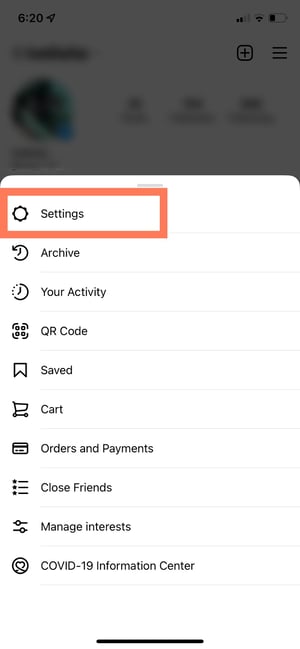
After you arrive at your profile, click the hamburger menu on the top right-hand corner.

A popup menu will appear. Tap “Settings.”
3. Tap “Notifications.”
On the next screen, click “Notifications.”
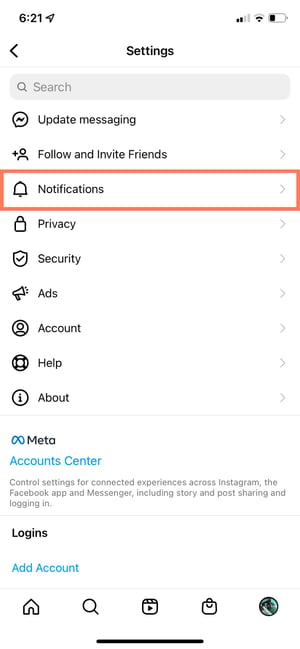
There, you’ll be able to change the notification settings depending on category. These categories include:
- Posts, Stories, and Comments
- Following and Followers
- Direct Messages and Calls
- Live and Video
- Fundraisers
- From Instagram
- Email and SMS
- Shopping
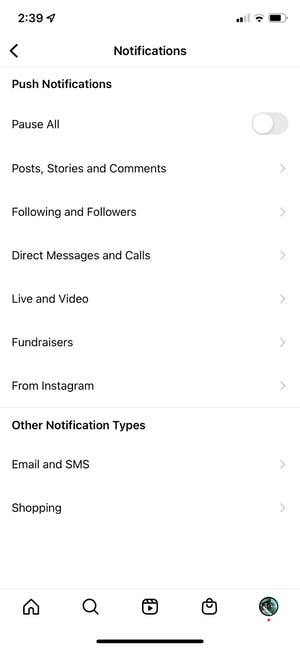
You also have the ability to pause all notifications by toggling the Pause All option up top.
4. Check off the notifications you want to receive.
Access each category individually and choose the notifications you want to receive. Here are the options, for example, for “Posts, Stories, and Comments”:
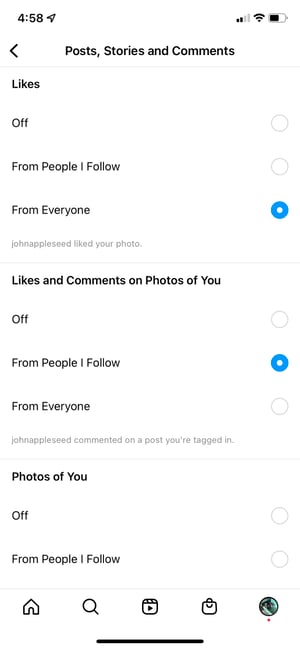
The options will vary depending on category.
And that’s it! Next, let’s explore how to connect your other social media accounts to your Instagram, so when you post an image to Instagram, you can share it with your other online audiences, as well.
Can you connect to Instagram to other social accounts?
Yes, you can connect Instagram to Twitter, Tumblr, and Facebook, but it’s no longer done through Settings, as it used to be.
Now, you do it on a per-post basis.
If you want to share a post to other platforms, you navigate to the actual post you want to cross-publish on Facebook, Tumblr, and Twitter, and then manually share it that way.
Here’s how:
1. Open up the Instagram app.
2. Navigate to your profile.
3. Tap on the post you’d like to cross-post.
4. Click the three dots on the top right-hand corner of the post.

5. On the pop-up menu, click “Share.”
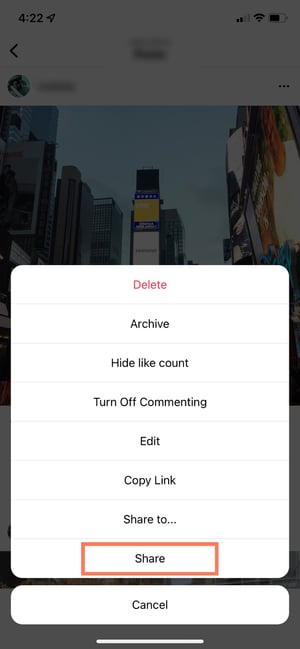 Note: Don’t click “Share to,” which will give you an option to AirDrop or share the post to your contacts.
6. Toggle the accounts you’d like to share the post to. If you’re not already signed in, you’ll need to do so right within the Instagram app.

Once you’ve connected your accounts for one post, you can then toggle the sharing options for any new posts without needing to sign in again.
If you connect Instagram to Facebook, you can share your Stories across both accounts. We talk more about how to do that below.
How to Connect Instagram to Facebook
Since Instagram and Facebook are owned by the same company, Meta, you can connect the two accounts for a more seamless experience. Connecting your Instagram and Facebook accounts allows you to:
- Share Stories across both Instagram and Facebook
- Login with Facebook into Instagram
- Sync your profile name and picture across both profiles
- Use Facebook Pay on both platforms
- Access your shopping activity on both accounts
If you’re a frequent Facebook user, then connecting your account to your new Instagram profile is highly recommended. Here’s how:
1. Open up your Instagram app.
2. Click on your profile picture on the bottom right-hand corner.
3. Click the hamburger menu on the top right-hand corner.
4. Tap “Settings.”
5. Under the Meta logo, tap “Accounts Center.”
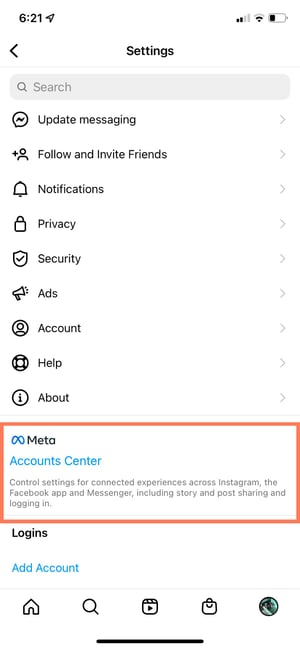
6. Tap “Set up Accounts Center.”

7. Follow the prompts to log in into Facebook.
Done! Your two accounts are now connected. Here’s how it’ll look like once you’re finished:
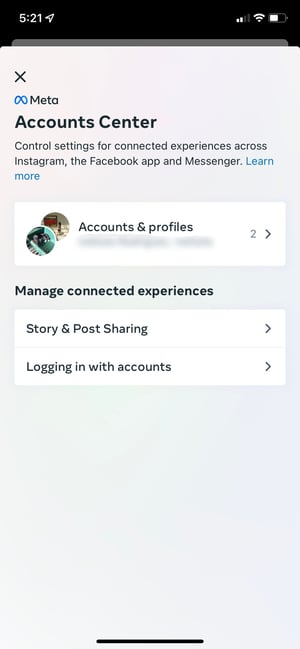
In the next section, I’ll show you when a linked account comes in handy.
Upload, Edit, and Post an Image
Now, for the most important part of Instagram — how to upload and post an image.
Instagram is an entirely visual platform. Unlike Facebook, which relies on both text and pictures, or Twitter, which relies on text alone, Instagram’s sole purpose is to enable users to share images or videos with their audience.
On Facebook, you might choose to post 100 photos on an album. On Instagram, you need to be choosier about which photos you post. There are a few reasons for this — first, you don’t want to post more than once a day (typically). And you don’t want to post too many similar photos.
For instance, it would be odd for you to post fifty photos from the same beach vacation on your Instagram profile. Instead, you might choose five or six, and place them all within the same post.
(These are called carousel posts, and they allow you to share multiple photos in one post only. Carousel posts are awesome for posting similar pictures in one package while keeping your overall profile aesthetic diverse.)
Curious about creating an aesthetic? To learn more about Instagram account themes and get inspiration, take a look at these Instagram themes. Additionally, if you want to embark on a deep-dive, you can take HubSpot’s Instagram Marketing Course.
Now that we’ve covered that, let’s explore how to upload, edit, and post an image.
1. Click the “+” icon at the top-right hand corner.
When you tap the “+” icon, you’ll be prompted to choose the type of post you want to share. Since we want to publish a post directly on our profile feed, tap “Post.”

2. Choose your media file.
Here, you have three options. You can look through your Photos library on your phone, you can take a new picture from right within Instagram, or you can take a new video. For our purposes, I looked through my Photos library and found a picture of Boston I wanted to use. Then, I clicked “Next” in the top right.

3. Add filters if desired.
There are two categories you can use to edit your image — “Filter” and “Edit”. Instagram automatically shows you filters first. You can scroll through the carousel and click any of the filters to apply it to your image.
Additionally, if you want to use a filter but you want to tone it down, double tap the filter and move the cursor to the left to lessen the intensity of the filter.

4. Edit your image if desired.
Next, click “Edit”. Here, you can adjust contrast, brightness, structure, warmth, and more. When you’re happy with your edited image, or if you don’t want to edit it at all, click “Next” in the top right.

5. Write a caption and toggle sharing settings.
Now, you can add a caption, tag people (you can only tag someone if they also have an Instagram account), and add a location. Additionally, click the button beside Facebook or another linked social media account to share your image on that platform, as well. When you’re ready to publish, click “Share” in the top right.
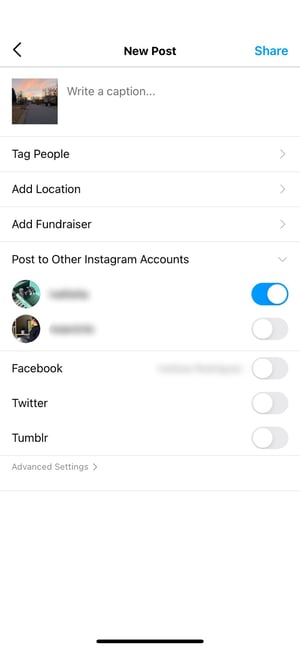
If you don’t want to use your app to post on Instagram, you can also do so from your computer. Learn how to post to Instagram from a Mac or PC here.
Upload an Image or Video to Your Stories
Instagram Stories is a feature that allows you to post videos or images that disappear after 24-hours. Instagram’s Stories feature is similar to Snapchat in terms of content — users often post more casual and candid videos and images, offering glimpses into their every day lives.
For instance, on your normal feed, you might post a heavily-edited picture of yourself and friends at a baseball game. But you might post a more candid video to your Story of the stadium singing “Sweet Caroline”.
To learn how to upload an image or video to your Stories, follow these steps:
1. Tap your profile picture in the upper left-hand corner.
Alternatively, swipe right on your feed or tap the “+” button in the top navigation bar.

2. Capture or add your media.
Once you’re within the Stories feature, you can take a picture or video right from within the app. Alternatively, if you have an image saved to your phone that you’d like to use, you can choose it from your media library.
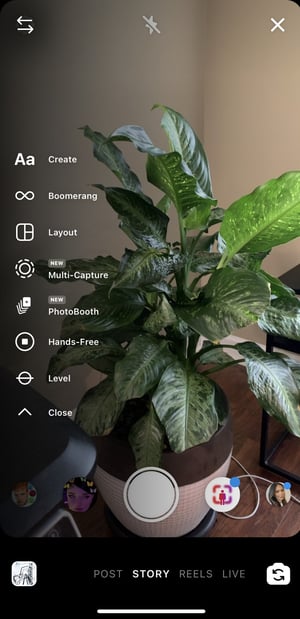
3. Add stickers or filters.
On the left-hand side, you have a few different editing features.
The “Create” button lets you add a location, hashtag, time, date, and other fun images or emojis to your picture.

The “Boomerang” option allows you to create a looping video. And the “Aa” icon is your text button. Once you click “Aa”, you have the option to change your font.
If you click the smiley face icon, you’ll see the following screen. Simply click on one of the icons to add them to your image. If you don’t like it, drag it to the bottom, and a trash can will appear so you can delete it.
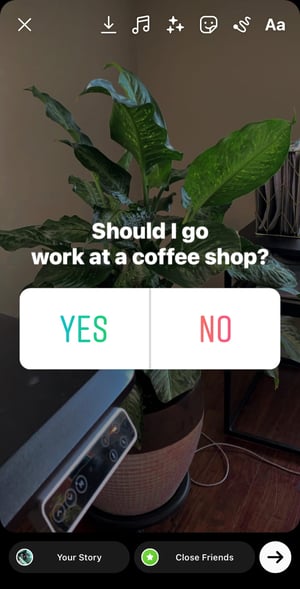
For instance, I clicked the smiley face icon to add a poll to my image. You can also swipe to the left or right to add filters to your photo or video.
4. Publish your Story.
Once you’re happy with your content, you can either click the white arrow icon in the bottom right, which allows you to share your Story with everyone who follows you, or select “Close Friends” first, so that only your close friends see it.
Then you’re done! Your Story is immediately live.
How to Follow on Instagram
It’s incredibly easy to find and follow users. Using Instagram’s search feature, you can find celebrities, brands, and friends. Additionally, you can search “Tags” or “Places”. “Tags” is particularly useful if you know what type of content you want to find, but you’re not sure who posts about it.
For instance, you might search “#familyrecipes” under tags — your results will include any images with that hashtag. As you peruse, you might find someone who posts content you really like, and you can choose to follow them so their content appears on your feed.
To follow someone, follow these three easy steps.
1. Click on the search icon at the bottom of your screen.
It looks like a magnifying glass and will be right next to the “Home” button.

2. Next, type in a person, topic, or brand.
For this example, I searched “architecture.”
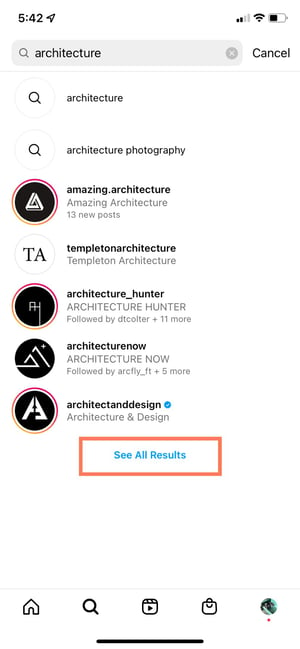
Instagram allows you to either search all posts that contain the word “architecture,” or “See all results” and see tags and places.

3. Tap the account you’re interested in following.
Once you’re on someone else’s account, you’ll see a blue “Follow” button at the top. For public profiles, you can click and immediately begin following that account. However, if the profile is private, you may need to wait for them to accept you first.
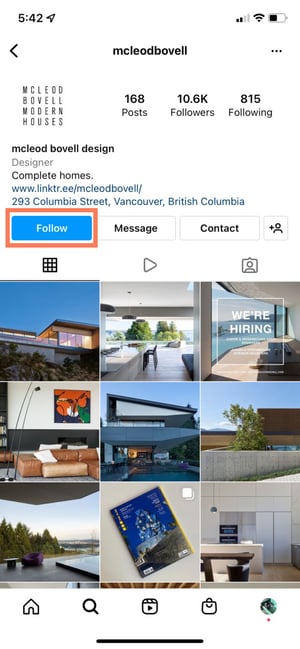
And that’s it! You’re on your way to becoming a pro. To take your account to the next level, plan out your next posts using an array of content ideas and templates.
Using Instagram is Key for Growing Your Personal Brand
If you want to grow both professionally and personally, then using Instagram is more important than ever. You can start by observing first, then begin posting as you learn your way around the user interface. With over one billion users, Instagram is an extremely worthwhile social media platform to join — and it’s only set to keep growing as time goes on.
Editor’s note: This post was originally published in November 2018 and has been updated for comprehensiveness.

Everything You Need To Know About Performance Appraisals
As a manager, your ability to inform your teams about the successful high-impact behaviors they exhibit or skills that need further development is a critical practice in determining your business’ overall ability to reach its goals and find success.
In this post, learn how a performance appraisal will help you give employees direction, the different types of performance appraisals, and example comments to include when you schedule those 1:1 sessions.

Businesses use performance appraisals to understand employee progress, give raises or promotions, create paths for further development, or, sometimes, discuss terminations.
These appraisals typically happen multiple times per year at different intervals, like quarterly, annually, or specific periods that make sense to your business. The goal, however, is for managers to conduct them regularly enough that employees always understand how they are doing.
Performance Appraisal Methods
There are different ways to conduct performance appraisals that can depend on your business’s individual needs, or on a manager-to-manager basis, depending on what you think is a best practice. Below we’ll go over the most popular types of performance appraisal methods.
1. Management by Objectives
Management by Objectives (MBO) is a popular sales management style that is also used for performance appraisals.
With this strategy, the manager and employee work together to set goals the employee will strive to meet during a specific period. During the performance appraisal session, they will review how the employee has or has not met the goals, and set new goals that will be evaluated during the next appraisal period.
2. 360-Degree Feedback
The 360-Degree Feedback method uses feedback from an employee’s self-evaluation, manager evaluation, peers, and if applicable, direct reports and customers.
This method is valuable as it provides employees with a big picture view of their performance across multiple perspectives and areas of business, rather than just a manager’s perspective. It also gives employees an understanding of how their actions affect various people at their place of work, not just how their job progress does or does not help the company meet its goals.
3. Self-Evaluation
The self-evaluation performance appraisal is when employees rate their performance based on a set list of criteria provided by management. When employees assess their own performance, they take a critical look at their progress to truly understand their efforts.
It’s important to note that, when using this method, employees may struggle to analyze their performance from an outside perspective and rate themselves too high or too low. Therefore, managers may find that this process is best supplemented by manager feedback, where you respond to employee evaluations with your insights into their performance.
4. Behavior Checklist
Using a behavior checklist for performance appraisals is when a manager has a list of traits required for the position (i.e., works well with others) and checks off those that an employee embodies and leaves blank the ones that need improvement.
This method is relatively straightforward as the checklist explicitly states desired behaviors, so those that aren’t checked off can be used to spark valuable conversation about further skill development.
5. Rating Scale
The Rating Scale performance appraisal uses a set of skills expected for a specific job that a manager uses to evaluate an employee, usually on a scale of 1-4 from meeting expectations to exceeding expectations.
At the end of the scale, the employee receives a total score calculated from each of the ratings.
Performance Appraisal Comments
Regardless of the appraisal method used, it’s essential to give feedback that is helpful to the employee and teaches them about their performance. Below we’ll go over some examples of comments that can be made during a performance appraisal session, whether written or spoken.
Organization Performance Appraisal Comment
Positive Comments
- “You’re incredibly organized, which allows you to be efficient and timely in completing your tasks.”
Needs Improvement Comments
- “You might benefit from spending more time organizing and planning for your tasks before you begin working on them.”
Time Management Performance Appraisal Comment
Positive Comments
- “You always meet deadlines and prioritize your work in an organized manager.”
Needs Improvement Comments
- “I’d like to see you pay careful attention to deadlines and develop a time management system that helps you meet due dates.”
Leadership Performance Appraisal Comments
| positive comments | needs improvement comments | |
| For someone with direct reports | “You effectively manage your teams and are a fair and encouraging leader. Members of your team consistently refer to you as a role model.” | “I’d like to see you spend more time working with employees that face roadblocks rather than encouraging them to find every solution on their own.” |
| For someone without direct reports | “You’re always able to step up to the plate and take charge when the opportunity arises, and you work to be supportive of your teammates.” | “I’d like to see you take the lead on projects that arise that are related to your expertise and skillset.” |
Critical Thinking and Problem Solving Performance Appraisal Comments
Positive Comments
- “You’re always able to think critically and review all of the facts of a situation before making decisions.”
Needs Improvement Comments
- “Sometimes you act too quickly when problems arise, so I think you can benefit from spending more time analyzing a problem before jumping into a solution.”
Productivity Performance Appraisal Comments
Positive Comments
- “You’re detail-oriented, which allows you to be productive at work and effectively organize and complete tasks on time.”
Needs Improvement Comments
- “I’d like to see you be more productive at work, so improving your organization and time management skills may be helpful.”
Teamwork Performance Appraisal Comments
Positive Comments
- “You work well with others and are supportive of your team members’ needs. You’re always ready to help when asked and respectful of others and their positions.”
Needs Improvement Comments
- “I’d like to see you devote more time to collaborating with your teammates and being more open to working with them and learning from their experiences.”
Communication Performance Appraisal Comments
Positive Comments
- “You’re able to effectively communicate all the time, regardless of the situation. I consistently hear from others that they always understand what you’re saying.”
Needs Improvement Comments
- “I would like to see you practice active listening with your peers and communicating when you feel as though you need help.”
Creativity Performance Appraisal Comments
Positive Comments
- “You always find unique and creative approaches to your work duties and find solutions to issues that arise.”
Needs Improvement Comments
- “You tend to focus on traditional processes for solving problems, and I would like to see you branch out and find creative solutions to issues that may come up.”
Performance Appraisal Example
The image below is an example of a performance appraisal using a rating scale. In the template, there is a list of behaviors that the employee is expected to have and use at work, like attention to detail and communication skills.
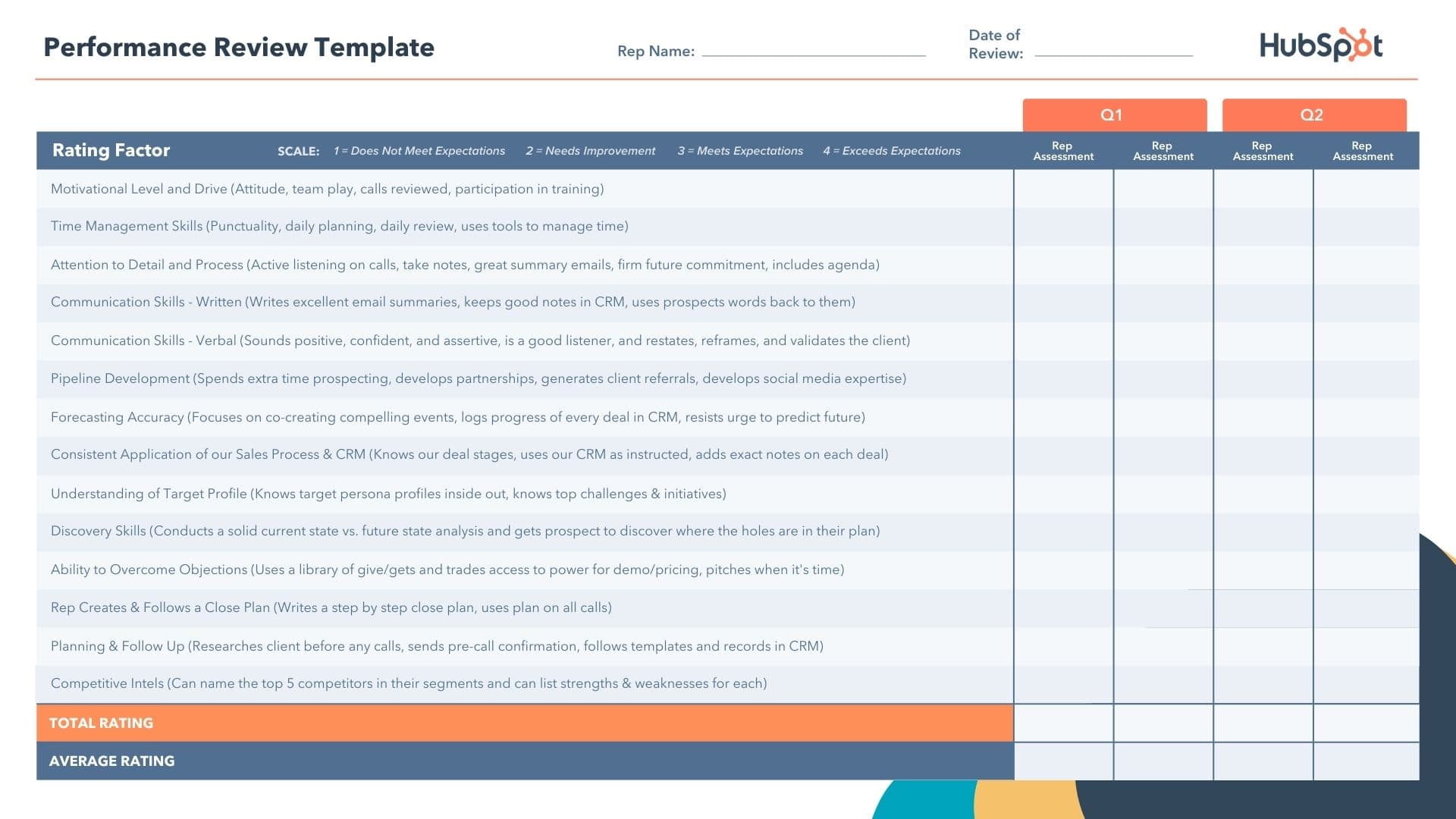
The manager or person providing feedback rates the employee on a scale of 1 to 4 based on how they express the skill, from Does Not Meet Expectations to Exceeds Expectations. The employee then receives a total numerical rating that you can use to drive discussions about further development.
When it comes down to your business’s bottom line, employees are direct contributors. Use performance appraisals to help your employees understand their job performance, so they know exactly which behaviors to continue practicing and which areas of opportunity to seek out additional development.


5 Instagram Highlight Covers to Inspire You [+ Steps To Make Your Own]
Today, your Instagram profile is like a mini-version of your website.
Think of your profile page as your homepage and each tab as a different section of your website. Instagram Story Highlights serve as your navigation bar, each one points to a collection of Stories relating to a specific theme.

You’ll find everything from “Meet the Team” and event recaps to FAQs and customer reviews on Highlight covers. While brands often set up their Highlights early on, many forget one important step: Designing Highlight covers.
In this article, we’ll cover the steps to make your own Highlight covers, some tips to keep in mind, and examples to inspire you.
How to Make Instagram Highlight Covers
Before you can add your Highlight covers to your Instagram profile, you first have to create them.
The easiest way to do this is through Canva, the graphic design app that offers hundreds of templates for just about everything. And did I mention it’s free?
Let’s get started.
-
Go to Canva.com and create an account.
-
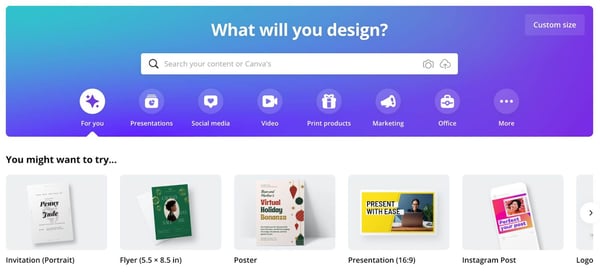
Once you’re logged in, go to the search bar. Type in “Instagram Story Highlight Cover” and click “Enter” on your keyboard.
-
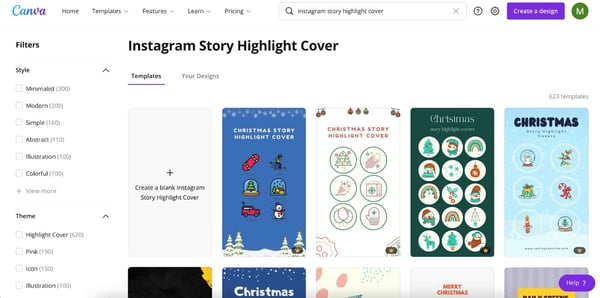
From there, you can choose one of the pre-built templates or start from scratch.
-
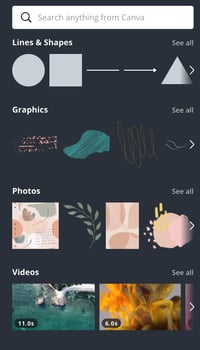
On the editing page, choose from hundreds of icons, graphics, and elements to customize your cover. You can also upload your own images and graphics.
-
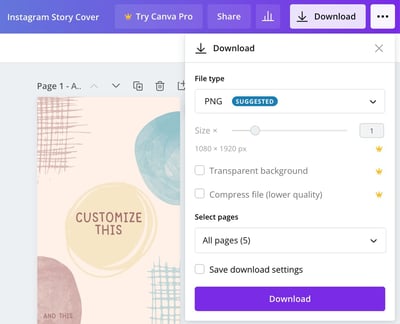
Once you’re done editing, click on the “Download” button on the top right corner of the page.
Now that you know how to make your Highlight covers, let’s cover how to add them to your Instagram profile.
-
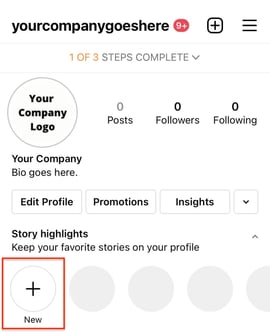
Log into your account and head to your profile tab. Once there, click on the “New” icon located just under your bio section.
-
Select which Stories you want to add to your Highlights then click “Next.”

-
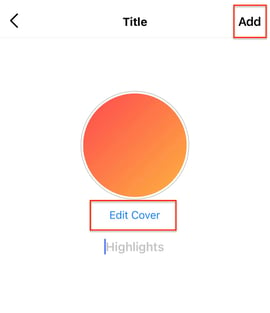
Click on “Edit Cover” to upload your Highlight cover.
-
Then write a name for this Highlight then click on “Add.”
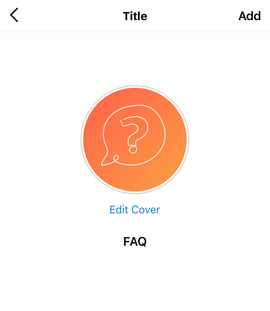
-
That’s it! Your new Highlight cover will now show up on your profile.
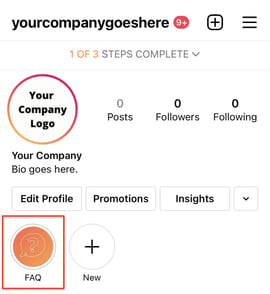 Pro-tip: Pick a name that will let your followers know exactly what to expect when clicking on it. Think of it as a navigation bar.
Best Instagram Highlight Covers
1. The Jungalow
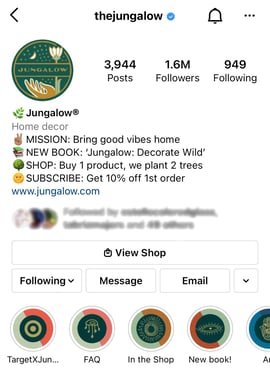 Image Source
What I love about The Jungalow’s Highlight covers is that they’re cohesive while still being different. Each cover features different icons and colors but they all blend well together.
They even customized Target’s logo to fit within their aesthetic.
Instagram is all about aesthetics. So whenever you can, you want to find opportunities to make that happen. This is a great example of how to do so.
2. Good Lines
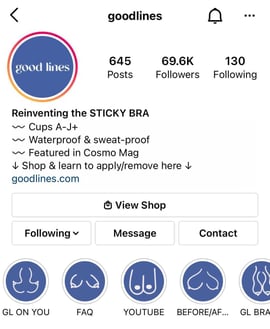
Good Lines’ Highlight covers are fun, creative, and memorable.
Instead of using the standard icons, the brand decided to take a unique approach and use illustrations that align with its product.
Highlight covers are an opportunity to have fun and show some of that brand personality. It will help you stand out from the rest and leave a lasting impression.
3. MKT Heights
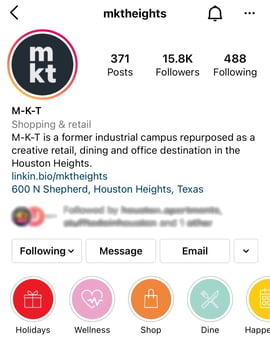
For its Highlight covers, this brand went for simple icons against vibrant colors.
One thing to note here is that the brand picked icons that would complement the Highlight texts. You never want to leave your audience wondering or confused about what to expect. As such, you want icons that will be easily recognized and align with the topic.
For example, the “Dine” Highlight has the utensils icon, the “Holidays” one has a boxed gift icon. It’s a simple, foolproof strategy.
4. Ettitude
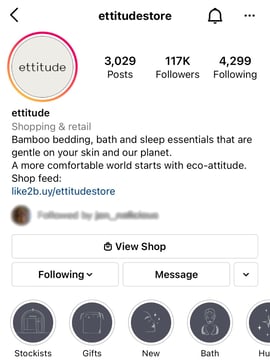
This brand went for a minimalist and cohesive look with its Highlight covers. Another interesting thing to note about this brand is that its Highlight cover background matches the colors on its website.
Keeping your brand colors consistent everywhere online is a great way to improve brand recognition. It also gives your profile a clean look that users can easily navigate.
Tips When Creating Instagram Highlight Covers
Highlight covers can greatly elevate your Instagram profile when done right. Here are some tips to help guide you:
- Opt for icons or images instead of text – One mistake I often see brands make is writing the same words in their highlight cover as the description right below it. The text is supposed to complement the image and add more dimension to your profile.
- Pick icons and images that align closely with the content – Don’t make your audience guess what each highlight is about. For instance, if one of your Highlights is about food, great icons include utensils, bowls, ingredients menus.
- Keep it cohesive – With Highlight covers, there’s a lot to play with: text, icons, images, colors. Make sure you pick icons with similar shapes and styles, choose colors that are complementary, and follow the same text format for all Highlights.
There you have it – everything you need to know about your Highlight covers. The great thing about them is that you can always update them. So don’t be afraid to play around with some ideas on Canva and design Highlight covers that will complement your Instagram profile.

How to Make the Most of AI Writing Tools, According to Bloggers
AI writing tools have come a long way since spellcheck.
Today, bloggers and marketers use AI writing tools to generate short and long-form copy and speed up content production.
But while AI writing software can assist in researching, outlining, and creating content, it’s not foolproof enough to cut out human writers completely.
According to bloggers, AI writing can help supplement your writing process, but you still need to remain in the driver’s seat.
Here’s what five bloggers and entrepreneurs had to say about how to use AI writing effectively, including what these tools are best for and where they fall short.

1. Break through writer’s block.
Most — if not all — writers have experienced writer’s block at some point. Getting into a creative rut can be especially challenging for bloggers who need to keep up with a demanding content calendar.
Fortunately, AI writing tools can help you overcome this “blank page syndrome.”
“Using AI writing tools helped us with eliminating writer’s block,” said Ruggero Loda, the owner of RunningShoesGuru.com, a blog that attracts more than 200,000 visitors each month.
“As a blog owner, creating blog posts is the utmost priority to me. But time and time again, [my] writers come across writer’s block, where they are unable to produce any new content.”
According to Loda, his team members often turn to AI tools to spark their creativity.
Loda told me, “AI writing tools have come to the rescue,” he said. “Even though the tools won’t write everything for you, they create content according to your instructions, and from there you can start getting new ideas.”
Daniel Martin, digital marketer and co-founder of LinkDoctor LLC, shared a similar experience.
“As we are an organization dealing with SEO-based digital marketing, we work with a content team,” said Martin. “Earlier, the team was struggling to keep pace with the blog writing. Once we made use of the AI tools, we were mind-blown, and the tools have helped the writers deal with writer’s block.”
While an AI tool can’t typically produce an entire blog post for you, it can get the ball rolling on your draft. Instead of staring at a blank page, you’ll have a sample to use as your starting point.
2. Whip up an outline fast.
AI writing tools can also help you write an outline quickly, which you can then use to produce a draft or outsource to another writer to finish the article.
“Leverage the outline feature of AI writing tools,” suggested Loda. “An AI writing tool can certainly help you with generating an outline based upon its collective data. Most often these outlines are good enough to start producing content.”
This outlining capability can be especially useful if you’re having trouble organizing your thoughts. It can streamline the writing process and give you a clear roadmap of how to move forward.
According to entrepreneur, content writer, and founder of Rephrase Media Matthew Ramirez, AI writing tools are most useful during this outlining stage of the writing process.
“In my experience, [one of] the best places to use an AI writing tool is in the ideation phase,” Ramirez said. “One of the most time-consuming parts of creating content is getting started, organizing outlines, and putting together a first draft. By using an AI tool that can help you elaborate your ideas and fill in details, you can greatly expedite your content writing.”
In fact, Ramirez says that using AI writing tools to outline his blog posts and expand on his ideas has helped him cut down on 80% to 90% of content creation time.
3. Make your instructions crystal clear.
The quality of what an AI tool puts out will directly correlate with what you put in. That’s why Loda encourages writers to be intentional with their instructions.
“Make your instructions very clear,” he said. “No matter what type of content you’re about to create, you can provide clarity to such tools by letting [the AI] know how your content should sound, what its tone should be, the agenda of your article, and much more.”
According to Loda, AI writing tools today let you specify a great number of inputs before generating your content.
“I was amazed to see such a variety of options that I could give out as my content descriptions,” he said. “Once I gave the best input, the tools provided me with the best output.”
Using an AI writing tool is a two-way street. It might take some practice, but as you get better at providing clear instructions, the tool can get better at producing high-quality content.
4. Don’t skip the research stage.
Along with generating full-form sentences and paragraphs, some AI writing tools can provide facts and figures they pull from the internet.
But Harriet Chan, co-founder and marketing director of CocoFinder —who has used AI writing tools to create blog posts and guest posts — cautions writers against relying too heavily on AI-gathered information.
“My advice for anyone looking to get the most out of their AI writing tool is not to skip the actual research part that goes into traditional writing,” said Chan.
“An AI tool will aggregate a lot of information fast, but will easily lose out on the human touch that each piece of writing should have to make it tick.”
Loda seconds these words of caution, saying that AI tools can produce inaccurate copy.
“AI writing tools can provide false data,” he said. “No matter how good of an AI tool you’re using, it is not human. With AI writing tools I have noticed that they collect data from old sources on the internet and without fact-checking that data they write content around it. Hence as a user, you should keep an eye on each sentence.”
That said, Alina Clark, co-founder of software development business CocoDoc — who has been using AI writing tools to supplement her business blog writing for two years — said that AI research capabilities have been a huge timesaver.
“I’ve used AI writing tools as fishing hooks to find out content on the internet,” said Clark. “AI writing tools have an advantage in the sense that they can read through a lot of content on the internet within a short time. Using an AI writing tool for content research shortens the research time, which means that I can create quality content faster.”
While AI can accelerate the research phase of the writing process, don’t neglect doing your own research, too. Make sure to supplement the tool’s findings with your own work to ensure everything is accurate and up-to-date.
5. Edit and proofread everything.
Not only can AI writing tools present outdated information, but they might also produce writing that doesn’t make sense or fit your brand voice. Because of this, it’s crucial to edit and proofread everything before you hit publish.
“One mistake to avoid with such tools is to assume that the output does not need to be reviewed before publication,” said Ramirez. “Doing so is very risky, since there might be something inappropriate or irrelevant in what the tool outputs.”
Chan agrees that while AI writing can be a useful supplement, you can’t rely on it for your complete writing process from start to finish.
“At all times, avoid relying entirely on the AI tool to do the whole writing bit for you,” she said. “Your brand will only stand out if the unique touch that attracted people to it in the first place remains all through it. An AI tool may show stark differences when it comes to making this possible.”
6. Remember your readers.
Finally, it’s crucial to remember your readers anytime you publish a piece of content on your blog, social media, or another channel. You can ensure that your content meets your readers’ needs far better than an AI tool can.
“One of the most important and common mistakes that can be avoided is having the whole content copy-pasted from the AI tool without thinking about the reader’s perspective,” said Martin. “Have practical experience, and write for the readers.”
Not only will this reader-first approach improve the quality of your blog posts, but it will also prevent Google from penalizing your blog for using machine writing.
“Most of the AI tools use GPT-3 [a language prediction model],” said Martin. “There is a chance the article will get penalized as Google aims to provide usefulness to the readers.”
AI Writing Tools Worth Checking Out
There are a variety of AI writing tools available today. Here are a few worth checking out:
- Jarvis: This AI-powered software uses machine learning and natural language processing to generate blog posts, landing pages, social media copy, and other types of content. Not only does it create original content, according to the company, but it also supports over 25 languages. That said, this writing assistant can sometimes repeat phrases or produce irrelevant content that needs human editing. Jarvis offers a 10,000-word free trial, as well as a starter plan that starts at $29/month and a Boss Mode plan (for long-form content) that starts at $59/month.
- Articoolo: This AI text generator offers a plugin to help you write blog posts directly in WordPress. It can help you speed up article writing and summarization, but it might not be the best pick for non-Wordpress users. Articoolo offers both fixed and monthly plans, including a fixed plan of 10 articles for $19 and a monthly plan that includes 30 articles for $29.
- AI Writer: This tool claims it can speed up content creation by 50% with its automatic content writing and article rewording features. While this tool can help augment your writing process, you’ll still need to edit any content it produces. AI Writer’s basic plan starts at $29/month and its standard plan starts at $59/month.
- Grammarly: Grammarly uses advanced AI to check your writing for spelling and grammar mistakes. It’s more advanced than basic spellcheck apps, as it can point out issues like passive voice or a lack of variety in sentence structure. Its premium plan can also check documents for plagiarism. You can use Grammarly’s proofreading tool for free or upgrade to one of its premium plans starting at $12/month.
Although AI tools are becoming increasingly sophisticated, they can’t replace human writers entirely. Not only is this surely a relief for bloggers and journalists, but it also means that an AI writing tool will only be as effective as the person using it.
As long as you continue to follow best practices for writing blog posts and other copy — and edit any AI-generated content before you publish it — you can enjoy the benefits of AI writing tools while avoiding the common pitfalls that come with them.

How to Use Custom Affinity Audiences: From Creation to Stellar ROI
Reaching the right customers with your Google Ads campaigns is critical to increase conversions. While it’s possible that scattershot advertisements could catch the interest of Internet users, it’s far more likely that this general ad approach will result in a disconnect between dollars spent and sales made.
To help ensure your ads are reaching the people in the right place, it’s worth leveraging a function in the Google Display Network (GDN) known as affinity audiences. Using these audiences helps pinpoint customer segments that may be more likely to purchase your products, in turn driving more effective and efficient ad spend.
But what exactly is an affinity audience? How do they work, how can you create your own — and what can you expect once you dial in the ideal customer segment? Let’s find out.

What are Affinity Audiences?
Affinity audiences are used by the Google Display Network to deliver your ads to relevant locations online. Given that Google’s network reaches more than 90 percent of Internet users worldwide, it’s well worth the time and effort to understand and apply these audiences at scale.
But what is an affinity audience?
Let’s break the term down into its component parts. Audience is easy — it’s the group of people that will see your ad. Affinity, meanwhile, is defined as “a feeling of closeness and understanding that someone has for another person because of their similar qualities, ideas, or interests.” The result? An affinity audience is a group of potential customers that share similar interests or qualities (similar to a buyer persona).
Using affinity audiences allows your brand to better align ad campaigns to buyers who are interested in what you have to sell. For example, if you’re in the coffee-making business but also have a focus on reducing plastic waste, your affinity audience might contain both people who love coffee and those who love the environment. Groups with both of these qualities are far more likely to buy your product than either group individually.
Affinity Targeting
Affinity targeting, meanwhile, is the process of identifying the ideal affinities that align with your product or service. Consider the coffee example above. While targeting buyers who love coffee helps improve your brand placement, it also puts you in direct competition with a host of other brands all producing similar products. Additional affinity modifiers that narrow your focus — such as sustainable growth processes, fair labor practices, or environmental priorities — can help set your brand apart.
Do note that it is possible to get too specific with your audience targeting. For example, if your coffee brand targets audiences that prefer beans from a specific region that are collected, packed, and shipped in a specific way, you may end up with a handful of very loyal customers but almost no broader appeal. As a result, targeting needs to narrow the focus without preventing you from reaching the greater public.
What are Custom Audiences?
GDN and the Google Ads platform contain a host of pre-built Google affinity audiences — also called segments — that you can use to focus your marketing and advertisements. These include everything from pet lovers to do-it-yourselfers, TV comedy fans and users with an interest in news and politics.
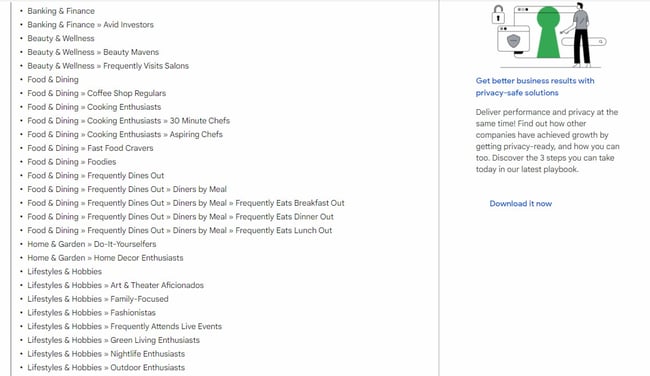
But they can’t cover everything. You may have a product or service that doesn’t dovetail with existing segments — here, custom affinity audiences can help.
Understanding Custom Affinity Audiences
Custom affinity audiences are those you create yourself in your Google Ads platform to align with the interests of your target customer base. While Google will suggest different potential segment tags depending on what you input, it’s worth taking the time to do some market research before diving into the custom affinity process. This lets you pinpoint the audience preferences that align best with your brand.
You can create custom affinity audiences related to four criteria: Interests, URLs, places, or applications. In general, places and applications are the least useful of the bunch. Here’s why. In our coffee example above, there aren’t a lot of coffee-related applications that would set your audience apart. And while geography has some impact on buying behavior, it’s usually not enough to justify an entire segment.
Interests and URLs, meanwhile, can help you dig down and identify potential affinity options that may be shared by your target market at large.
How to Create Affinity Audiences
Ready to create your own affinity audience? Follow these steps:
- Log into your Google Ads account.
- Select “Tools and Settings”, then “Audience manager.”
- Select “Custom Segments.”
- Enter segment name and interests.
- Save your new segment.
Let’s tackle each step in more detail.
1. Log Into Your Google Ads Account
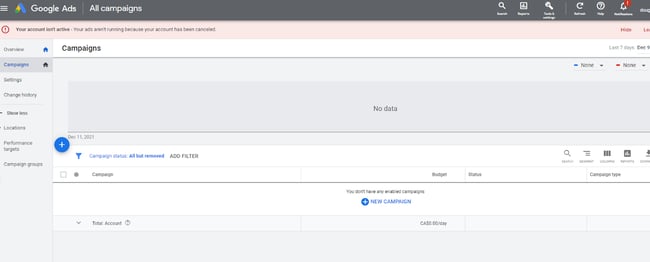
First, log into your Google Ads account. Here, you can see any active campaigns along with the associated affinity audiences.
2. Select “Tools and Settings”, then “Audience Manager”
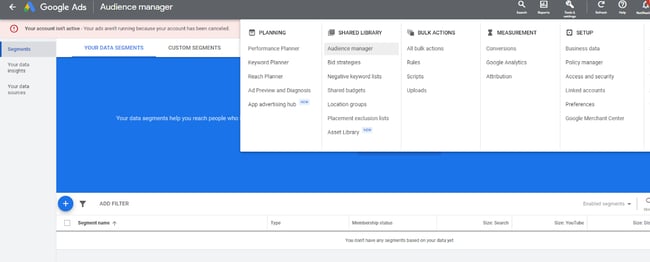
Next, head to “tools and settings” in the upper-right-hand corner and then find “Audience manager” in the drop-down menu.
3. Select “Custom Segments”
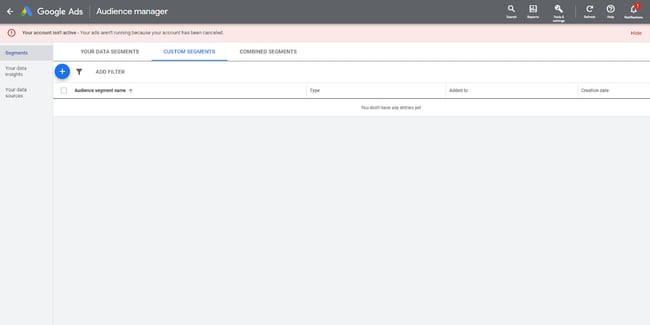
Now you’ll see a list of any data segments you’re currently using to target prospective buyers. To create an audience or segment, click on “Custom Segments” and then the blue “+” icon.
4. Enter Segment Name and Interests
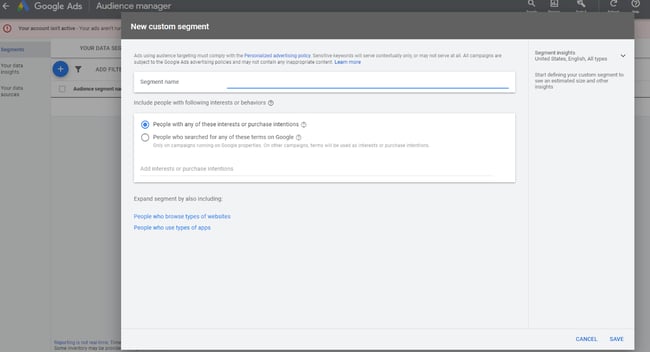
Now, give your segment a name and add a few potential interests. For example, if you enter “coffee”, Google will return interests or purchase intention ideas such as “coffees to make with an espresso machine”, “how to make coffee with coffee beans” and “coffee makers that make different coffees.”
5. Save Your New Segment
Finally, save your new segment with use for ad campaigns. You can create as many segments as you like until you’ve covered all relevant market bases.
The Impact of Effective Affinity Audiences
Ideally, affinity audiences lead to a definitive result: Increased ROI.
Here’s why: When your ads are shown to audiences that are interested in what you’re selling, they’re more likely to click through and purchase your products. As a result, the money you spend on advertising is directly offset by the conversions driven by these ads, in turn creating positive ROI. More generic campaigns, meanwhile, may still increase overall sales but not enough to balance out the spend required to reach larger audiences.
The right audience makes all the difference. Targeted, customized affinity audiences help you reach the people that want to buy your products, in turn boosting conversions and making your overall ad spend more cost-effective. Custom affinity audiences further narrow your market targeting, increasing the likelihood of revenue and reducing the gap between what you spend on ads and what you get in return.

5 Social Media Predictions Marketers Got Wrong Last Year
The world around us is constantly changing — it only makes sense that the marketing world does too.
Every year, marketers pull out the crystal ball to predict trends and shifts in the coming year. Sometimes we’re right on the tail — and other times the social media marketing landscape surprises us.

Here, we’ll cover 5 social media predictions marketers got wrong in 2021 and strategies for making better predictions in the future.
5 Bad Social Media Predictions of 2021
1. The TikTok craze will reach its peak.
Despite threats of being banned in the U.S. — and actually being banned in India — TikTok continues to defy the odds and grow at a steady rate. In fact, the app hit a remarkable milestone at the end of 2021 — one billion monthly active users.
Despite its popularity, some marketers may have dismissed TikTok entirely, reducing it to a platform for lighthearted dances and lip-synching. However, it’s become a viable option for brands willing to get creative with their digital marketing. So much so, it launched TikTok for Business in 2021, allowing marketers to create and manage ad campaigns on the platform.
Need more convincing? According to the HubSpot Blog’s survey of 1,000+ marketers, a whopping 85% cited short-form videos (like those on TikTok) as the most effective social media format in 2021. In fact, more than half of marketers (52%) plan to increase their investment in TikTok this year.

It’s not too late to leverage TikTok in 2022. Check out this helpful guide on how to get started.
2. Facebook will become obsolete.
We’ve all heard the jokes about Facebook’s aging audience — and there is some truth to it. A recent study found that Snapchat, Instagram, and TikTok were the platforms of choice for Gen Zer’s, with Facebook falling into 6th place.
But we can’t write off Facebook just yet. It still pulls over 1.5 billion daily active users, making it the most popular social media platform worldwide. It largely holds sway with millennials, the biggest demographic group on the platform.
When it comes to social media marketing, Facebook packs quite a punch. According to HubSpot Blog’s survey of 1,000+ marketers, Facebook led the pack as the platform with the highest ROI and engagement in 2021. It’s no surprise that 25% of social media marketers plan to invest more in it than any other platform in 2022.

From these stats alone, it’s clear Facebook is still a booming business for digital advertising. With its expansion into live video, along with Facebook Shops and Stories, marketers can also experiment with new ad formats in one central location.
3. TikTok will become the preferred platform for influencer marketing.
Despite its popularity, TikTok fell short when it came to influencer marketing in 2021.
Instead, the title belongs to Instagram, which was ranked the platform of choice for inking deals with influencers. So much so, a staggering 97% of marketers plan to increase their investment in influencer marketing on Instagram this year.
Our survey also revealed influencer marketing as the most popular trend with the biggest ROI in 2021. The most notable reason for this uptick is an increase in micro influencers. Micro influencers provide smaller, highly-engaged audiences without the hefty price tag of a mainstream celebrity — making this type of marketing more accessible to a variety of brands.
Want to try your hand at influencer marketing but don’t know where to start? Check out this handy checklist.
4. Audio chat rooms will yield huge ROI
2021 saw a wave of live audio apps — including Clubhouse and Twitter Spaces. We were all intrigued — was it a viable marketing channel? Could this content go viral?
It turns out, audio chat rooms were great for engagement but not so much for ROI. According to our survey, Clubhouse fell to the bottom of the list regarding ROI. Further, 15% of marketers plan to decrease their investment in audio chat rooms this year.
However, there’s a redemption arc — despite having low ROI, many marketers report high engagement rates. If your social media marketing goals are to boost engagement and brand awareness, these audio apps could be the secret ingredient. In fact, 44% of marketers plan to leverage podcasts and audio-based content for the first time this year.

5. Remote events will lose steam as we return to the workplace.
Most people — myself included — thought the workforce would finally return to the office in 2021. But this prediction was a little premature.
Instead, many workplaces have adopted a hybrid work model where employees can work in-office or remote. This could become a permanent arrangement — 51% of organizations are considering a move to hybrid work in a post-COVID world.
As a result, remote and hybrid events are here to stay, and marketers must adapt. 64% of marketers plan to increase their investment in live video and streaming — like Facebook Live, Instagram Live, and YouTube Live — in 2022.
How to Make Better Social Media Marketing Predictions
In the marketing sphere, trends move in light years. As marketers, it’s essential to make predictions to equip ourselves for the future. Here, let’s cover three ways to make better social media marketing predictions:
- Keep up-to-date: A great forecaster keeps a pulse on new trends and technology. When making social media predictions, staying informed in small — but frequent — bouts is better than in an end-of-year rush.
- Cast a wide net: Seek out a variety of sources for your news. In doing so, you’re more likely to get a holistic view of the current climate. Further, you may discover contradictory information — which may call for a second glance.
- Know your biases: We all have biases — and recognizing them is half the battle. Confirmation bias, in particular, can heavily influence how we make predictions. This is the tendency to interpret new evidence as confirmation of an already existing belief. To prevent this, you’ll need to seek differing viewpoints that challenge your assumptions. It’s also important not to jump to conclusions, which creates a false picture of the marketing landscape.
The only constant in the marketing world is change. As a social media marketer, the best thing you can do is stay current on trends and tech, seek out new opinions and viewpoints, and identify trends in your own marketing.