
What Is Content Seeding & How Does It Work? [Examples]
Every summer, I start a vegetable garden. I purchase seeds, plant them in various places in my backyard, tend to them, and with the help of the right weather conditions, help them grow. Why am I talking about gardening on a marketing blog?
Content seeding. But instead of planting zucchini seeds, marketers plant content to grow brand awareness and leads.

Let’s get into the specifics of what content seeding is and how it works.
Content seeding allows brands to highlight their content in places target audiences will see and engage with it. Influencers are a prime choice for content seeding because they usually have large audiences. These audiences have been proven to trust influencers more than their friends.
For instance, lifestyle subscription box FabFitFun has a target audience of women “ages 18-34, who love a good deal [and] want to hear about the latest and greatest trends in beauty, fitness, nutrition, and style.” When they work with influencers on content seeding, they choose platforms their target audience is interested in, like my favorite podcast, True Crime Obsessed (TCO).
When I heard ads for FabFitFun on TCO, I was immediately interested in the brand and what it offers, so I followed the link in the podcast subscription. The added bonus of hearing high praises from hosts I’ve come to connect with and trust solidified my interest and ultimately drove me to subscribe. That’s content seeding in motion.
When I heard ads for FabFitFun on TCO, I was immediately interested in the brand and what it offers, so I followed the link in the podcast subscription. The added bonus of hearing high praises from hosts I’ve come to connect with and trust solidified my interest and ultimately drove me to subscribe. That’s content seeding in motion.
Part of the reason content seeding is so successful is that the content shared by influencers or partners is relevant to the target audience. Market research shows brands, like FabFitFun, where their audience is and gives them clues as to where to seed content.
What is influencer seeding?
Often brands will give out products or services to influencers in the hopes that they will share favorable reviews or promote the product to their audience. This is referred to as influencer seeding. Like content seeding, utilizing influencers that align with the interests of your target audience will yield the best results.
Having industry leaders promote a brand through their social platforms or other networks increases the reach of the business, because they’ve built trust with their own audiences.
This doesn’t mean that you have to find the influencer with the most followers to do the job. Sure, someone with millions of followers will have a wide reach, but there is value in utilizing micro-influencers, too. Micro-influencers – those with roughly 10,000 to 50,000 followers – often serve more niche, but loyal audiences. This can be an advantage when you are looking to segment or narrow your target audience.
Micro-influencers also provide a level of authenticity influencers with higher follower counts lack due to their mass appeal. Social media platforms are inundated with marketing campaigns and ads. Make your product or service stand out by tapping into the networks of smaller influencers and take advantage of word-of-mouth cred.
However, influencers aren’t the only way to facilitate content seeding. You can also contact an agency that specializes in seeding, or reach out to thought leaders for a partnership on a blog post or email newsletter.
Where Content Seeding is Commonly Used
While blogging and editorial outlets previously served as the primary avenues for content seeding, social media platforms have become the dominant method of choice.
- TikTok
- YouTube
- Podcasts
All of these platforms are useless if you don’t have a plan in place to utilize them. Next, we’ll dig into tips for creating an effective influencer seeding campaign.
Creating an Influencer Seeding Strategy
Creating a plan will help you conserve resources and focus your energy on what’s most important for your brand. Here are some best practices to follow:
- Set your end goal: What would you like to accomplish? Are you looking to build brand awareness or boost sales? Once your goals are established, you can assess which platform would make the most sense to use to achieve them.
- Research ideal influencers: By now you should have clear personas identifying who your target audience is. With that information in hand, look into the types of people they would follow and their interests. Look at trending hashtags or topics related to your brand, and the influencers who follow them.
- Send relevant content, services, and products: You’ll want to make sure what you’re sending the influencer to promote is actually relevant to their brand and audience. For example, if you sell artisan chocolates, you may want to reach out to influencers that have content dedicated to chocolate sweets and desserts, instead of just sending products out to foodies in general. This is where going niche pays off.
- Engage and comment: If an influencer posts anything regarding your brand, engage with it. This can include liking the post, commenting, or sharing. Even if the feedback is negative, you can thank them for their honest review and find out how you can make improvements.
- Measure the outcome: Examine the reach of influencer posts, traffic statistics, and engagement (shares, comments, brand mentions). For ecommerce, track any promo codes or affiliate links used during the campaign. Looking at these metrics will help you figure out what worked and what didn’t.
If you’re starting to think of ways you can get into content seeding, which platforms to use, and what content to share — don’t worry, we’re going to look at more great examples of content seeding next.
Content Seeding Examples
1. Claire Saffitz x Coveteur

Claire Saffitz, host of series “Gourmet Makes,” has become a food influencer because of how much she connects with fans of the channel. Recently, Saffitz collaborated with magazine Coveteur on her Instagram.
This is a great example of content seeding because Coveteur’s partnership with Saffitz brought recognition to their magazine. Her Q/A with the lifestyle magazine could closely appeal to Saffitz’s fans: people who are interested in cooking and health. The closely running avenues of the publisher’s audiences mean a potential 971,000 new readers from Saffitz’s Instagram.
2. Mandy McEwen x LinkedIn Marketing
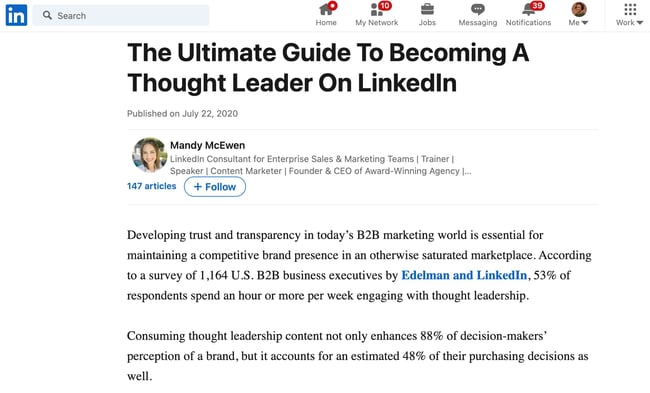
Founder of marketing company Mod Girl Marketing, Mandy McEwen, partnered with LinkedIn Marketing’s Thought Leadership campaign. This partnership aligns with McEwen’s following — professionals who are interested in working with thought leaders — and LinkedIn’s audience — professionals looking for workplace connections and advancements.
McEwen also gains new engagement from the partnership, while building her credibility as a marketer. This is a great example of how content seeding can work both ways to build brand awareness.
3. Lin-Manuel Miranda x Reddit
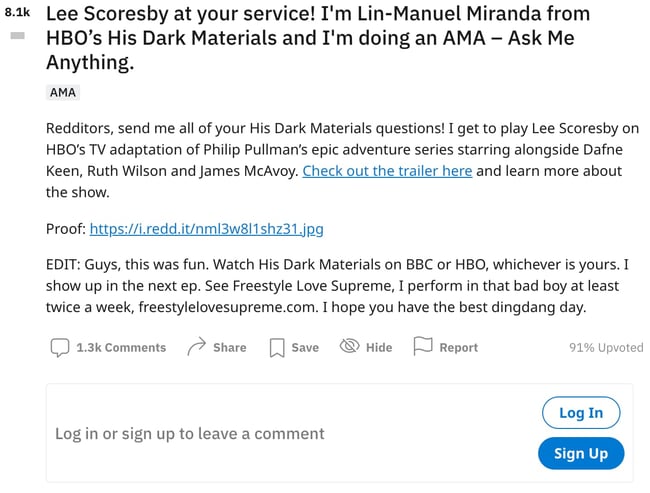
Social platform Reddit had actor Lin-Manuel Miranda (Hamilton, In the Heights) run an Ask Me Anything (AMA) on the site. The thing about AMAs is that you must have an account to participate. Fans had to sign up for an account to ask Miranda a question, then notice social communities for Miranda’s line of work, like Broadway and television.
Having Miranda post this on Twitter to three million followers is great exposure for Reddit. If the platform wanted to grow its theatre-based threads and community, this AMA was a perfect seed to plant.
4. Louis Tomlinson x GQ
Musician Louis Tomlinson collaborated with GQ to go undercover, answering comments from Twitter, YouTube, and Instagram. The Actually Me series not only gets celebrities to answer fun questions, but it’s a great way for them to engage directly with fans.
Tomlinson and GQ each have large audiences, but Tomlinson’s 35 million Twitter followers and 17.9 million Instagram followers would certainly expand GQ’s reach.
GQ partnering with Tomlinson to promote another channel of theirs is a smart way to attract potential subscribers. If fans find that more of their favorite artists have similar videos on GQ’s YouTube channel, they might tune in and share their finds to their own audience.
5. Sara Blakely x Masterclass

Founder and CEO of Spanx, Sara Blakely, worked with MasterClass on an entrepreneurship course. MasterClass is an online education platform offering courses in various industries. Learn tennis from 23-time title holder Serena Williams or get a crash course in fashion from Vogue Editor-In-Chief Anna Wintour.
Blakely’s partnership with MasterClass is an invitation for fans of the entrepreneur to get a look into how she built her empire. If 300,000 of Blakely’s followers are interested in her story, the website could benefit greatly from dropping their branded content on her Instagram.
Make Content Seeding Work for You
My vegetable garden thrives every year because of a combination of work from my end, the right soil, and favorable weather conditions. The same is true for content seeding. A perfect content seeding strategy is built from a combination of brands finding the right partners, a great platform, and a favorable product or service to promote.
You don’t have to invest huge amounts of money into content seeding. Choosing micro-influencers or guest bloggers and podcast interviews are more cost-effective ways of content seeding as well.
This article was originally published November 25, 2019 and has been updated for comprehensiveness.

5 Steps to Create an Outstanding Marketing Plan [Free Templates]
Do you take a good, hard look at your team’s marketing strategy every year?
You should. An annual marketing plan helps you set your marketing on the right course to make your company’s business goals a reality. Think of it as a high-level plan that guides the direction of your team’s campaigns, goals, and growth.
Without one, things can get messy — and it’s nearly impossible to put a number on the budget you’ll need to secure for the projects, hiring, and outsourcing you’ll encounter over the course of a year if you don’t have a plan.
Keep in mind there are variations to the marketing plan you need, depending on your industry and the goals of your marketing team. To make your plan’s creation easier, we’ve put together a list of what to include in your plan and a few different planning templates where you can easily fill in the blanks.

To start, let’s dive into how to create a marketing plan and then take a look at what a high-level marketing plan has inside.
In this article, we’re going to discuss:
- What a High-Level Marketing Plan Includes
- How to Create a Marketing Plan
- Marketing Plan Templates You Can Use
- Simplified Marketing Plan Template
- Plus — Social Media Plan Templates
Marketing Plan Outline
Marketing plans can get quite granular to reflect the industry you’re in, whether you’re selling to consumers (B2C) or other businesses (B2B), and how big your digital presence is. Nonetheless, here are the elements every effective marketing plan includes:
1. Business Summary
In a marketing plan, your Business Summary is exactly what it sounds like: a summary of the organization. This includes:
- The company name
- Where it’s headquartered
- Its mission statement
2. Business Initiatives
The Business Initiatives element of a marketing plan helps you segment the various goals of your department. Be careful not to include big-picture company initiatives, which you’d normally find in a business plan. This section of your marketing plan should outline the projects that are specific to marketing. You’ll also describe the goals of those projects and how those goals will be measured.
3. Customer Analysis
Here’s where you’ll conduct some basic market research. If your company has already done a thorough market research study, this section of your marketing plan might be easier to put together.
Ultimately, this element of your marketing plan will help you describe the industry you’re selling to and your buyer persona. A buyer persona is a semi-fictional description of your ideal customer, focusing on traits like:
- Age
- Location
- Title
- Goals
- Personal challenges
- Pains
- Triggering events
4. Competitor Analysis
Your buyer persona has choices when it comes to solving their problems, choices in both the types of solutions they consider and the providers that can administer those solutions. In your market research, you should consider your competition, what they do well, and where the gaps are that you can potentially fill. This can include:
- Positioning
- Market share
- Offerings
- Pricing
5. SWOT Analysis
Your marketing plan’s Business Summary also includes a SWOT analysis, which stands for the business’s strengths, weaknesses, opportunities, and threats. Be patient with your business’s SWOT analysis; you’ll write most of it based on your market research from the sections above and your strategy below.
6. Market Strategy
Your Market Strategy uses the information included in the above sections to describe how your company should approach the market. What will your business offer your buyer personas that your competitors aren’t already offering them?
In a full-length marketing plan, this section can contain the “seven Ps of marketing”:
- Product
- Price
- Place
- Promotion
- People
- Process
- Physical Evidence
(You’ll learn more about these seven sub-components inside our free marketing plan template, which you can download below.)
7. Budget
Don’t mistake the Budget element of your marketing plan with your product’s price or other company financials. Your budget describes how much money the business has allotted the marketing team to pursue the initiatives and goals outlined in the elements above.
Depending on how many individual expenses you have, you should consider itemizing this budget by what specifically you’ll spend your budget on. Example marketing expenses include:
- Outsourcing costs to a marketing agency and/or other providers
- Marketing software
- Paid promotions
- Events (those you’ll host and/or attend)
8. Marketing Channels
Lastly, your marketing plan will include a list of your marketing channels. While your company might promote the product itself using certain ad space, your marketing channels are where you’ll publish the content that educates your buyers, generates leads, and spreads awareness of your brand.
If you publish (or intend to publish) on social media, this is the place to talk about it. Use the Marketing Channels section of your marketing plan to lay out which social networks you want to launch a business page on, what you’ll use this social network for, and how you’ll measure your success on this network. Part of this section’s purpose is to prove to your superiors, both inside and outside the marketing department, that these channels will serve to grow the business.
Businesses with extensive social media presences might even consider elaborating on their social strategy in a separate social media plan template.
9. Financial Projections
Knowing the budget and doing analysis on the marketing channels you want to invest in, you should be able to come up with a plan for how much budget to invest in which tactics based on expected ROI. From there, you’ll be able to come up with financial projections for the year. These won’t be 100% accurate but can help with executive planning.
1. Conduct a situation analysis.
Before you can get started with your marketing plan, you have to know your current situation.
What are your strengths, weaknesses, opportunities, and threats? Conducting a basic SWOT analysis is the first step to creating a marketing plan.
Additionally, you should also have an understanding of the current market. How do you compare to your competitors? Doing a competitor analysis should help you with this step.
Think about how other products are better than yours. Plus, consider the gaps in a competitor’s approach. What are they missing? What can you offer that’ll give you a competitive advantage? Think about what sets you apart.
Answering questions like this should help you figure out what your customer wants, which brings us to step number two.
2. Define your target audience.
Once you better understand the market and your company’s situation, make sure you know who your target audience is.
If your company already has buyer personas, this step might just mean you have to refine your current personas.
If you don’t have a buyer persona, you should create one. To do this, you might have to conduct market research.
Your buyer persona should include demographic information such as age, gender, and income. However, it will also include psychographic information such as pain points and goals. What drives your audience? What problems do they have that your product or service can fix?
Once you have this information written out, it’ll help you define your goals, which brings us to step number three.
3. Write SMART goals.
My mother always used to tell me, “You can’t go somewhere unless you have a road map.” Now, for me, someone who’s geographically challenged, that was literal advice.
However, it can also be applied metaphorically to marketing. You can’t improve your ROI unless you know what your goals are.
After you’ve figured out your current situation and know your audience, you can begin to define your SMART goals.
SMART goals are specific, measurable, attainable, relevant, and time-bound. This means that all your goals should be specific and include a time frame for which you want to complete them.
For example, your goal could be to increase your Instagram followers by 15% in three months. Depending on your overall marketing goals, this should be relevant and attainable. Additionally, this goal is specific, measurable, and time-bound.
Before you start any tactic, you should write out your goals. Then, you can begin to analyze which tactics will help you achieve that goal. That brings us to step number four.
4. Analyze your tactics.
At this point, you’ve written down your goals based on your target audience and current situation.
Now, you have to figure out what tactics will help you achieve your goals. Plus, what are the right channels and action items to focus on.
For example, if your goal is to increase your Instagram followers by 15% in three months, your tactics might include hosting a giveaway, responding to every comment, and posting three times on Instagram per week.
Once you know your goals, brainstorming several tactics to achieve those goals should be easy.
However, while writing your tactics, you have to keep your budget in mind, which brings us to step number five.
5. Set your budget.
Before you can begin implementing any of the ideas that you’ve come up with in the steps above, you have to know your budget.
For example, your tactics might include social media advertising. However, if you don’t have the budget for that, then you might not be able to achieve your goals.
While you’re writing out your tactics, be sure to note an estimated budget. You can include the time it’ll take to complete each tactic in addition to the assets you might need to purchase, such as ad space.
Now that you know how to create your marketing plan, let’s dive into creating a marketing campaign outline that will help you reach the goals outlined plan.
One Page Marketing Plan Template
As demonstrated above, a marketing plan can be a long document. When you want to share information with stakeholders or simply want an overview of your plan for quick reference, having a shorter version on hand can be helpful. A one page marketing plan can be the solution, and we’ll discuss its elements below.
- Business Summary: Include your company name, list the names of individuals responsible for enacting the different stages of your plan, and a brief mission statement.
- Business Initiatives: A summary of your marketing plan goals and the initiatives to help you achieve them. This can include your marketing strategies.
- Target Market: Outline your target audience(s) that your efforts will reach.
- Budget: An overview of the money you’ll spend to help you meet your marketing goals.
- Marketing Channels: list the channels you’ll use to achieve your marketing goals.
Free Marketing Plan Template [Word]
Now that you know what to include in your marketing plan, it’s time to grab your marketing plan template and see how best to organize the six elements explained above. The following marketing plan template opens directly in Microsoft Word, so you can edit each section as you see fit:
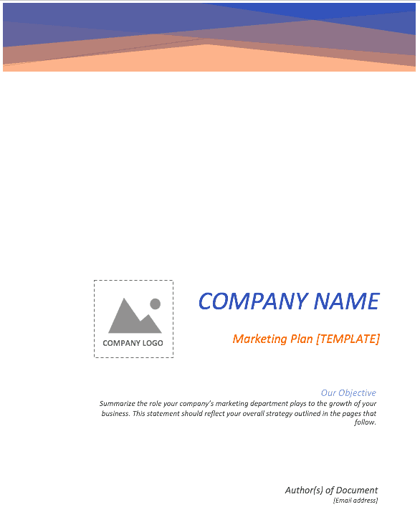
Download your marketing plan template here.
Marketing Campaign Template
Your marketing plan is a high-level view of the different marketing strategies you’ll use to meet your business objectives. A marketing campaign template is a focused plan that will help achieve those marketing goals.
A marketing campaign template should include the following key components:
- Goals and KPIs: Identify the end goal for each of the individual campaigns you’ll run and the metrics you will use to measure the results of your campaign when it ends. For example, conversion rates, sales, sign-ups, etc.
- Channels: Identify the different channels you’ll use to enact your marketing campaign to reach your audience. Maybe you run a social media campaign on Twitter to raise brand awareness or a direct mail campaign to notify your audience of upcoming sales.
- Budget: Identify the budget you’ll need to run your campaign and how it will be distributed, like the amount you’ll spend on creating content or ad placements in different areas. Having these numbers also helps you later on when you quantify the success of your campaign, like ROI.
- Content: Identify the type of content you’ll create and distribute during your campaigns—for example, blog posts, video ads, email newsletters, etc.
- Teams and DRIs: Identify the teams and people that will be part of enacting your marketing plan from start to finish, like those responsible for creating your marketing assets, budgets, or analyzing metrics once campaigns are complete.
- Design: Identify what your marketing campaigns will look like and how you’ll use design elements to attract your audience. It’s important to note that your design should directly relate to the purpose of your campaign.
Digital Marketing Plan Template
A digital marketing plan is similar to a marketing campaign plan, but, as the name suggests, it’s tailored to the campaigns that you run online. Let’s go over the key components of a digital marketing plan template to help you stay on track to meet your goals.
- Objectives: The goals for your digital marketing and what you’re hoping to accomplish, like driving more traffic to your website. Maybe you want to drive more traffic to your website, or
- Budget: Identify how much it will cost to run your digital marketing campaign and how the money will be distributed. For example, ad placement on different social media sites costs money, and so does creating your assets.
- Target audience: Which segments of your audience are you hoping to reach with this campaign? It’s essential to identify the audiences you want to reach with your digital marketing, as different channels house different audience segments.
- Channels: Identifies the channels that are central to your digital marketing campaign.
- Timeline: Explains the length of time your digital campaigns will run, from how long it should take to create your assets to the final day of the campaign.
Many people use social media in their digital campaigns, and below we’ll discuss some ideas you can use for inspiration.
Social Media Marketing Plan Templates
As marketing departments grow, so will their presence on social media. And as their social media presence grows, so will their need to measure, plan, and re-plan what types of content they want to publish across each network.
If you’re looking for a way to deepen your social media marketing strategy — even further than the marketing plan template above — the following collection of social media marketing plan templates is perfect for you:
Download 10 social media reporting templates here.
In the above collection of marketing plan templates, you’ll get to fill in the following contents (and more) to suit your company:
- Annual social media budget tracking
- Weekly social media themes
- Required social media image dimension key
- Pie chart on social media traffic sorted by platform
- Social media post calendar and publish time
Below, let’s review the social media reporting templates, and what you’ll find in each one.
1. Social Media Questions
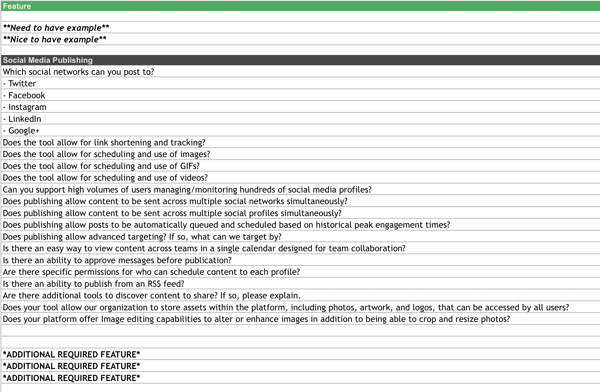
This template lists out questions to help you decide which social media management platform you should use.
Once you know what social media tactics you’re going to implement in your marketing plan, it’s time to figure out what channels are right for you. This template will help you do that.
2. Hashtag Holidays
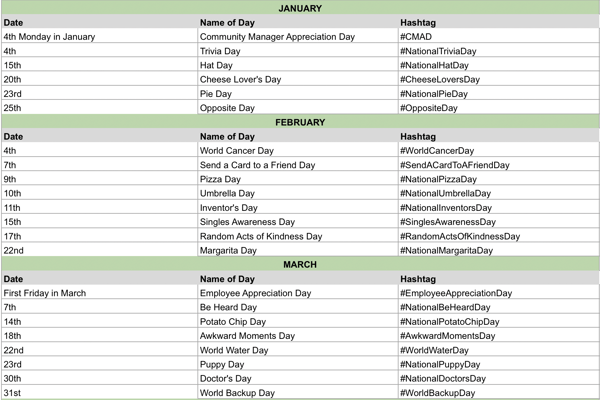
If you’re going to lean in to social media in your marketing plan, you can use hashtag holidays to generate ideas.
These holidays are a great way to fill out your social media publishing schedule. With this template, you’ll get a list of all the hashtag holidays for the year.
3. Facebook Live Schedule
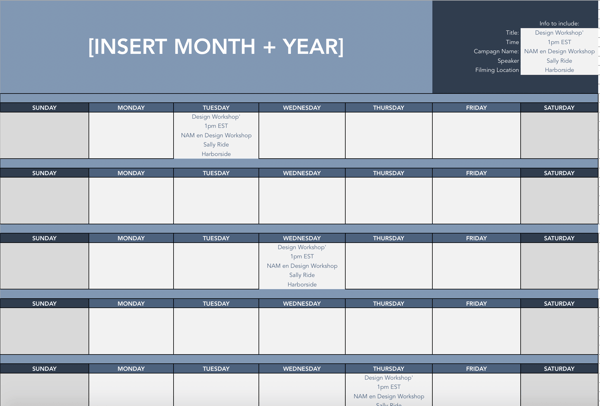
If Facebook live is one of the marketing tactics in your plan, this template will help you design an editorial calendar. With this template, you can organize what Facebook live’s you want to do and when.
4. Instagram Post Log
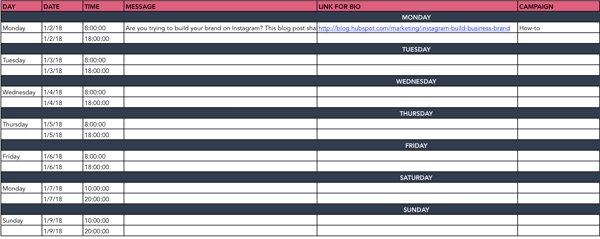
Are you going to begin using Instagram regularly? Do you want to increase your following? With this template, you can organize your Instagram posts, so everyone on your team knows what posts are going live and when.
Additionally, you can organize your assets and campaigns on this doc.
5. Paid Social Media Template
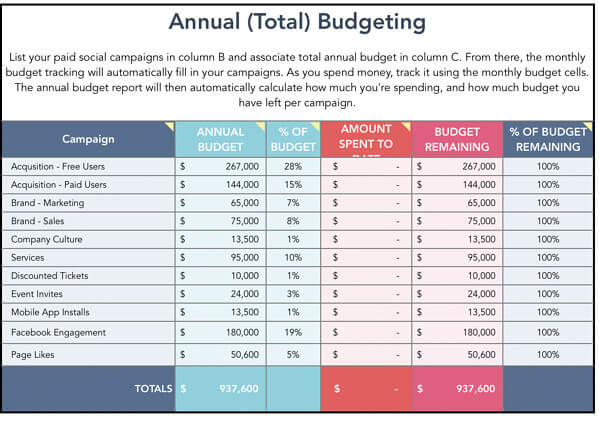
With this template, you can organize your annual and monthly budget for your paid social media calendar.
6. Social Media Audit
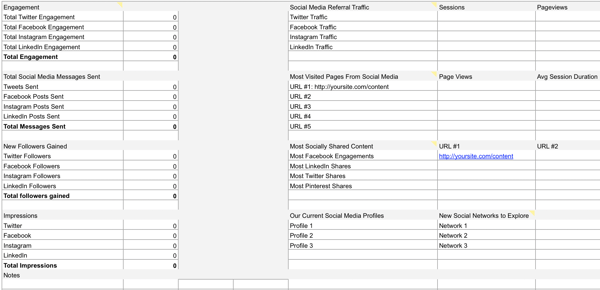
Conducting a social media audit? You can use this template to help you gather the right analytics.
7. Social Media Editorial Calendar
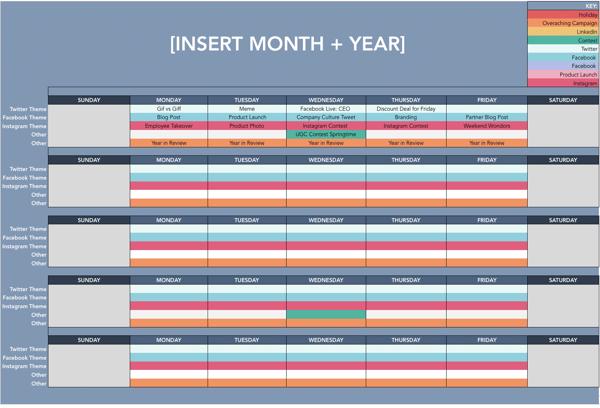
With this template, you can organize your social media editorial calendar. For example, you can include social media posts for each platform, so your team knows what’s going live on any given day.
8. Social Media Image Sizes
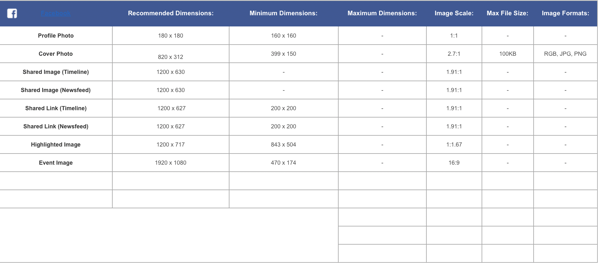
With this template, your team can have the latest social media image sizes handy. This template includes image sizes for all major social media platforms, including Facebook, Instagram, and Twitter.
9. Social Media Marketing Proposal
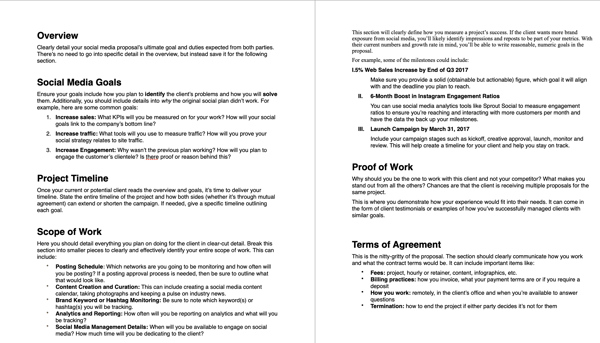
With this template, you can create an entire social media marketing proposal. This will outline the social media goals, scope of the work, and the tactics that you plan to implement.
10. Social Media Reporting Template
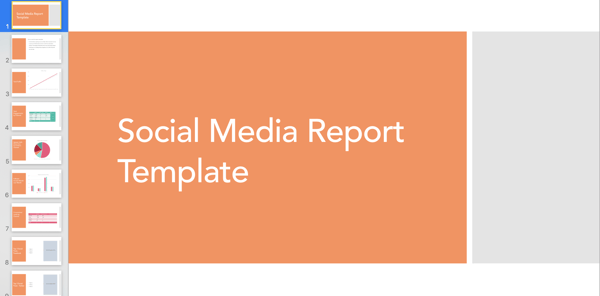
With this template, you’ll gain access to a slidedeck that includes templates for social media reporting. If you plan to implement social media in your marketing plan, these reporting templates can help you track your progress.
Simple Marketing Plan Template
Of course, this type of planning takes a lot of time and effort. So if you’re strapped for time before the holidays, give our new Marketing Plan Generator a try.
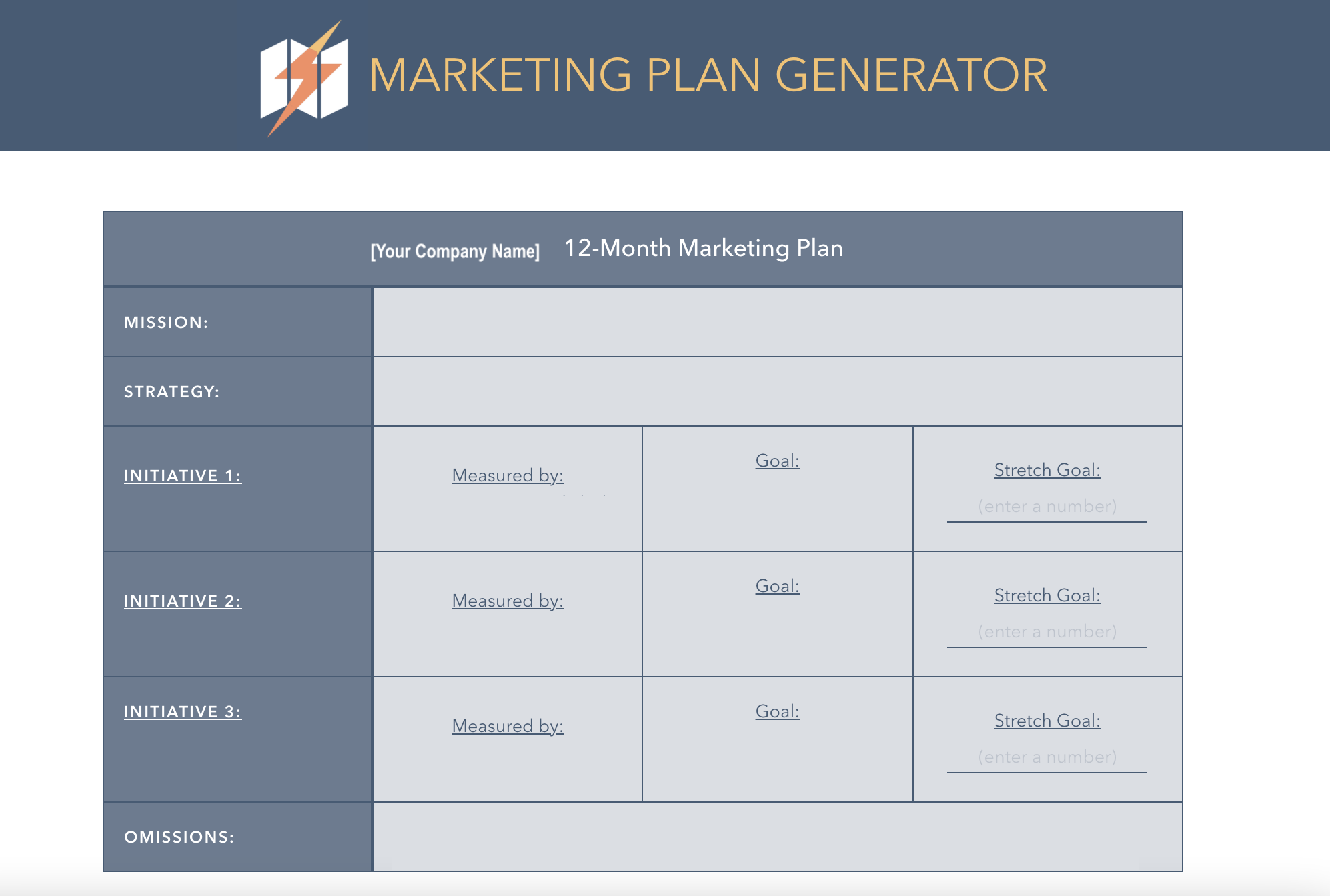
This tool simplifies yearly planning by asking prompted questions to help guide your process. You’ll be asked to input information about:
Try our free Marketing Plan Generator here.
- Your annual marketing mission statement, which is what your marketing is focused on for the year.
- The strategy that you’ll take with your marketing throughout the year to accomplish your marketing goals.
- Three main marketing initiatives that you’ll focus on during the year (i.e., brand awareness or building a high-quality pipeline) metrics you’ll use to measure your success.
- Your target goals for those marketing initiatives like generating 100 leads per week.
- Marketing initiatives that are not aligned with your current strategy to stay focused on your goals and activities that will help you be successful.
Once you input all information, the tool will spit out a table (as shown in the image below) that you can use to guide your processes.
Pro Tip: If the tool doesn’t work, clear your browser’s cache or access it in incognito mode.
Over To You
The best way to set up your marketing plan for the year is to start with quick wins first, that way you can ramp up fast and set yourself (and your team) up to hit more challenging goals and take on more sophisticated projects by Q4. So, what do you say? Are you ready to give it a spin?
Editor’s note: This post was originally published in December 2016 and has been updated for comprehensiveness.

10 Social Media Trends Marketers Should Watch in 2022 [Data + Expert Tips]
Over the past two years, we’ve seen a shift in the way brands promote their products or services on social media.
And, as social media popularity continues to grow — we reached over 3.7 billion social media users globally in 2021 — brands aren’t just wondering how they’ll engage huge social media audiences next year. They’re also asking, “What social media trends should I expect in this constantly changing landscape?”
To learn more about what brands can expect in 2022 and beyond, HubSpot’s Blog surveyed over 1,000 marketing professionals to learn which trends B2B and B2C businesses will leverage in 2022. Additionally, I spoke with social media experts and dug through HubSpot and Talkwalker’s 2022 Social Media Trends Report to uncover unique perspectives on the upcoming year.
Below, I’ve compiled ten expert or research-backed trends social media marketers should watch and leverage in 2022. Let’s dive in.

Trends to Watch in 2022
1. TikTok will dominate the social media space.
During the pandemic, I began hearing about one new commonality among most of my colleagues and friends: TikTok.
TikTok has seen undeniably fast growth. In fact, the term ‘TikTok’ saw a 61% increase in mentions year-over-year during the beginning of 2021, and was the first non-Facebook app to reach 3 million global downloads.
With fast growth, it’s easy to assume it’s a passing fad — but that doesn’t seem to be the case here. HubSpot’s social team believes TikTok offers unique opportunities to engage directly with consumers, and major brands such as the NBA and Dunkin’ are leveraging the app to reach new audiences.
Additionally, Ben Jeffries, CEO of Influencer.com, says that “in 2020, TikTok was the world’s most downloaded app and with more and more consumers choosing to use the creative and humorous entertainment platform, brands are waking up to the opportunity to capture a new audience and showcase their brand personality.”
Jeffries adds, “This popularity has also encouraged the more established social media platforms, including Instagram and YouTube, to experiment with new content forms that will grab the attention of the TikTok generation.”
Other social media businesses have used TikTok’s popularity as inspiration to alter their own platform’s features. For instance, Instagram employed TikTok lookalike features in its own version, called Reels, and Reddit just announced a similar short-form video feature on its own platform.
Elena Melnikova, CMO at Talkwalker, told me, “When the pandemic forced us online, social media became our lifeline — for shopping, communication, and work. Looking for entertainment, TikTok became the go-to channel. It made us smile. It made us laugh. It relieved the boredom of being stuck at home. We were eager to join the party.
Melnikova adds, “Lockdown supercharged TikTok. Having grown so quickly, brands can’t afford to ignore the platform’s potential. With an audience dominated by Millennials and Gen Z — tech-savvy generations, demanding innovation, creativity, personalization, and transparency — TikTok will help connect brands to a younger, more creative demographic.”
In 2022, we’ll continue to see the rise of TikTok as more brands explore how they can leverage the app’s popularity to expand brand awareness and reach new audiences. Additionally, we’ll watch TikTok’s ripple effect on the social media landscape at-large, as other platforms alter their features to expand emphasis on short-form, “snackable” content.
2. Reaching new audiences will become the number one social media goal for businesses.
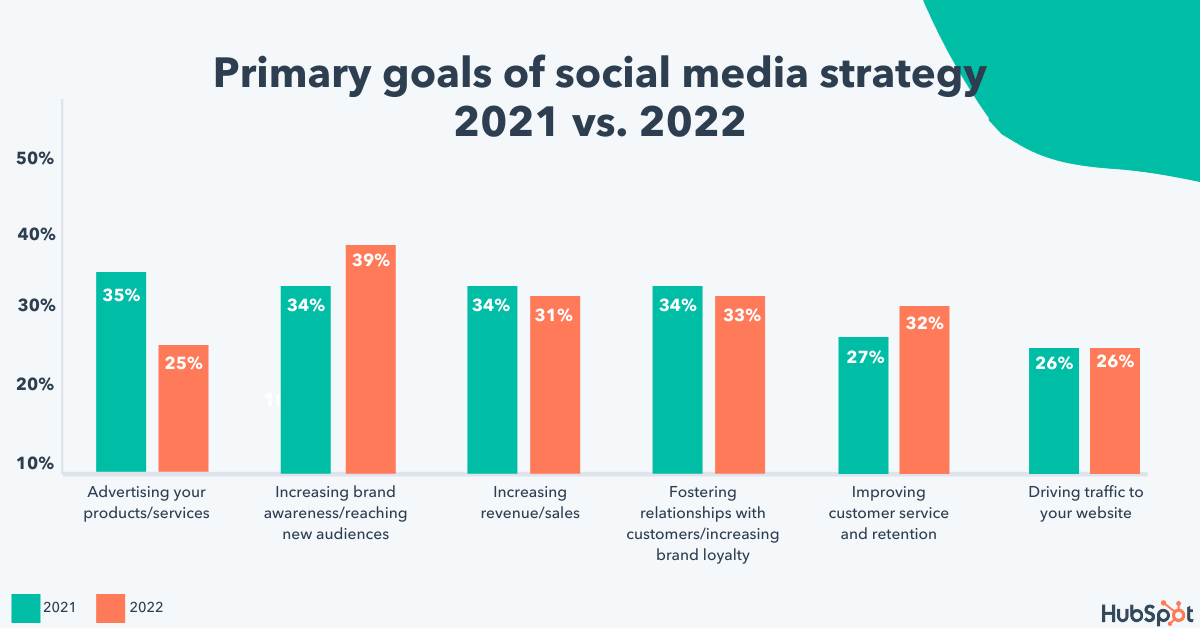
In 2021, HubSpot’s Blog Research found the primary goals of most marketers’ social media strategies were:
- Advertising products/services (35%)
- Increasing brand awareness/reaching new audiences (34%)
- Increasing revenue/sales (34%)
*(Select up to three.)
However, 76% of marketers say their goals will change in 2022.
As we enter 2022, most marketers primary goals include:
- Increasing brand awareness/reaching new audiences (39%)
- Fostering relationships with customers/increasing brand loyalty (33%)
- Improving customer service and retention (32%)
During the pandemic, most consumers needed to shift to an online-first purchasing experience.
As we head into 2022, then, it makes sense that brands are contemplating how they can reach new audiences through social media, foster deeper relationships with existing audiences, and improve customer service to ensure long-term customer loyalty.
To increase your social media presence, it’s critical you stay active and consistent in your posting, leverage trends and buzzy content, and invest in high-quality creative assets.
Additionally, to foster deeper relationships with your existing audiences, you’ll want to engage with your followers through interactive elements such as polls, Q&As, and live videos.
3. Companies will make more dedicated social media hires.
Social media is an undeniably powerful strategy for your business.
And social media isn’t just for brand awareness, either. It’s also an effective tool for generating revenue. In fact, 79% of people say that user-generated content on social media significantly impacts their purchasing decisions.
Which is why you’ll see more companies making dedicated social media hires in 2022, rather than tasking a busy marketing team with social media as a side project.
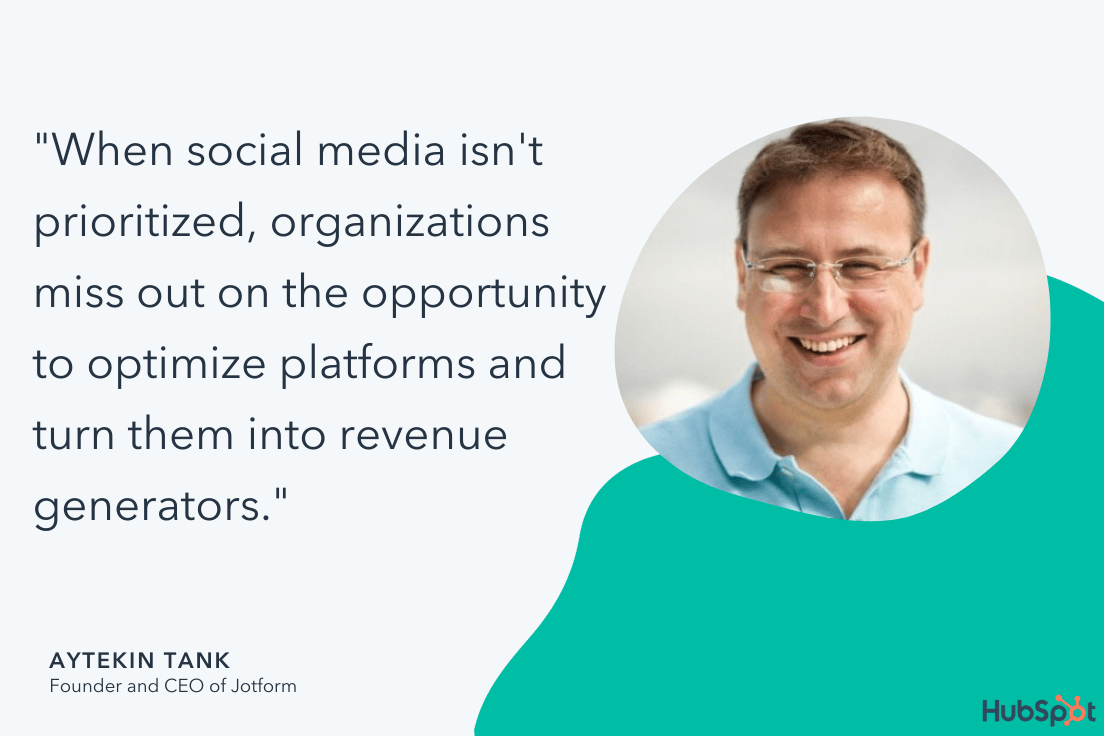
As Founder and CEO of Jotform, Aytekin Tank, told me, “One big trend for social media marketing in 2022 is to make a dedicated hire. Companies frequently manage social media by committee or pass it off to a marketing generalist. But the problem is when social media isn’t prioritized, organizations miss out on the opportunity to optimize platforms and turn them into revenue generators.”
“A dedicated social media hire can solve this problem and help organizations grow platforms, keep tabs on social analytics, be part of industry-specific conversations, experiment with new platforms and trends, and more — all of which contributes to a stronger brand and more leads for your company. We’ve done it at Jotform, and it’s worth it.”
If you haven’t already, consider hiring a social media community manager to build and engage with your online audiences. These managers are the tone, voice, and conversations behind your brand — so it’s worth it if your audience is eager to engage with your brand through social media.
4. Augmented Reality will become consumers’ preferred way to try-on products and interact with brands.
Augmented Reality (AR) has been around for a few years now, and it’s becoming increasingly common for brands to use AR to enable consumers’ to test products before purchase.
AR has proven effective for a business’ bottom line, as well. In fact, AR can improve click-through rates to purchase by upwards of 33%.
Carolina Arguelles Navas, Snap Inc.’s Head of AR Product Strategy and Product Marketing, told me she believes augmented reality (AR) will become consumers’ preferred option when trying on products in 2022.
As Navas puts it, “For brands, AR is the most personal way to reach people and is more effective at driving results compared to other forms of advertising and marketing.”
Navas says, “We’ve seen interest and engagement with AR explode over the last two years, and have over 200 million Snapchatters engaging with augmented reality every day. The trend is here to stay, and it’s only going to continue growing.”
If you think AR could be a good fit for your brand, Snapchat is an effective platform to test it — the social platform reaches over 90% of 13-24 year olds, and over 75% of 13-34 year olds in the U.S., including nearly one of every two smartphone users, so it’s a good opportunity to get your products in front of a large audience.
5. Businesses in the B2B space will increase their investments in Instagram and Twitter.
Instagram and Twitter aren’t new to the social scene, but many marketers are still seeing increases in ROI across both.
For instance, Twitter reached almost 200 million monetizable daily active users in Q3 of 2020, up 29% YoY.
Instagram, on the other hand, experienced a nearly 14% jump between 2019 and 2020 in its users’ time spent on the app, to an average of 30 minutes per day. This was higher engagement growth than all other social platforms.

As Twitter and Instagram continue to succeed, we’ll see more marketers invest in both platforms in 2022. HubSpot’s Blog found 70% of marketing professionals plan to invest more heavily in Twitter in 2022, and 63% plan to invest more heavily in Instagram.
In 2022, consider where you might increase your own investments to find more ROI from the platform(s) that are already serving your audiences.
6. Influencer marketing will mature in 2022.
The pandemic undoubtedly sped up the rise of “unfiltered” (or less scripted) content, as well as “everyday influencers” — such as micro-influencers and nano-influencers.
Many people trusted influencers more than brands during the pandemic. Which is why influencer marketing is a strong avenue to explore in 2022.
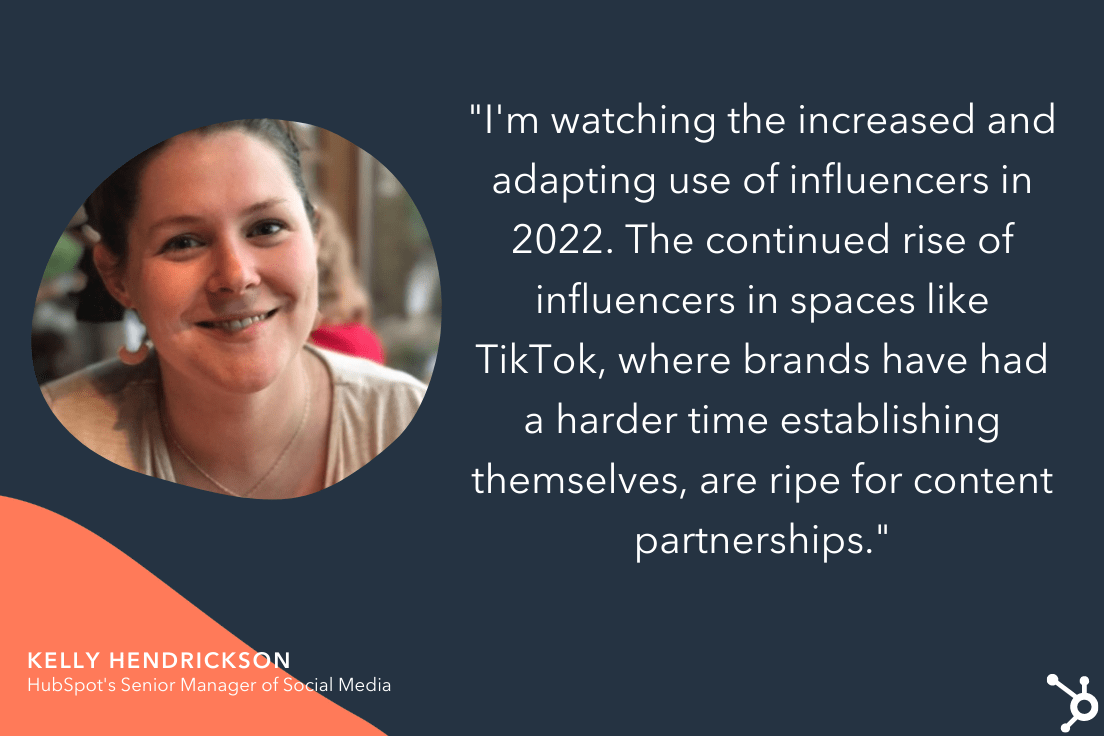
When asked which trend she’s watching in 2022, HubSpot’s Senior Manager of Social Media Kelly Hendrickson told me, “I’m watching the increased and adapting use of influencers in 2022. The continued rise of influencers in spaces like TikTok, where brands have had a harder time establishing themselves, are ripe for content partnerships.”
As alignment between social media and e-commerce strengthens, we’ll see more influencer partnerships used to increase businesses’ sales.
However, it will be important in 2022 to align with the influencers that make the most sense for your brand. This will include influencers with potentially smaller but more engaged audiences, as well as influencers who specialize in more niche topics that make the most sense for your brand.
Gaurav Sharma, founder and CEO of Attrock, adds, “To see great results, you can run an impact-oriented influencer marketing campaign with 10-30 micro-influencers for at least 6-12 months. If you get it right, you could skyrocket your business growth quickly.”
“[And] to get a higher ROI on social media marketing, I would suggest marketers leverage influencer marketing platforms to collaborate with the micro-influencers.”
7. Social advertising will become more sophisticated.
As Google plans to phase out cookie tracking by 2023, you’ll begin to see “the death of the third party cookie” happen in the upcoming year — which means many marketers will need to pivot their existing strategies as social advertising evolves.
Fortunately, there are plenty of highly effective advertising options that don’t require third-party cookies. To name a few: User-generated content, targeted and personalized ads across social media platforms, email marketing, and search engine retargeting campaigns.
Rather than using third-party cookies to define your advertising playbook, this is a good opportunity to develop a data-driven strategy using metrics to understand your users’ interests and preferences on a deeper and more personal level.
8. Businesses will invest in more long-form and short-form content, as well as live audio chat rooms.
It’s no surprise that video is an increasingly popular format across social channels, particularly with the rise of video-focused platforms like TikTok.
The HubSpot Blog found 64% of marketers plan to leverage more short-form videos in 2022. Snackable content has been proven effective, so these short-form videos will likely be brief, engaging, digestible pieces of content that span across social channels.
Additionally, 89% of marketers who leverage long-form videos plan to increase their investment or continue investing the same amount in 2022, according to HubSpot Blog Research.
All of which is to say: If you haven’t already invested in short or long-form video, try testing both as we enter the new year to determine which option your audience prefers.
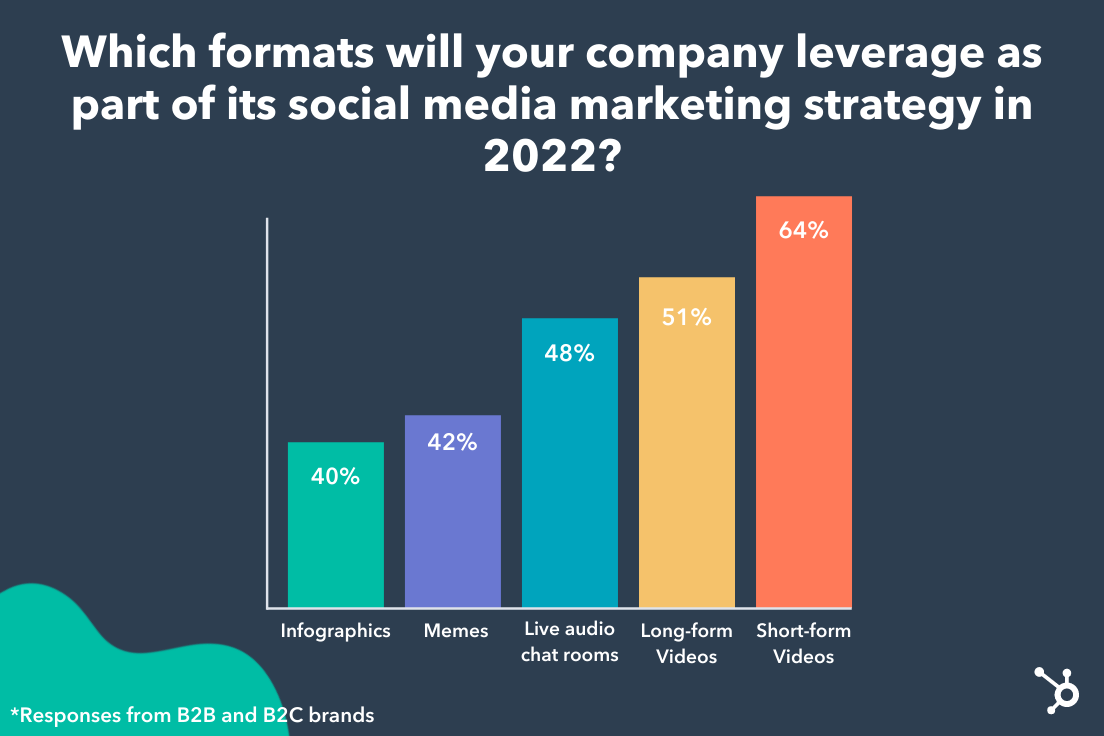
Additionally, roughly half of marketers plan to invest more in live audio chat rooms such as Clubhouse or Twitter Spaces in 2022.
Consider how you might leverage alternative forms of content in 2022. Beyond visual elements like videos and posts, test out audio content to see if there’s an interest from your buyer persona.
9. Social selling demands will grow.
Over the past few years, social platforms have worked hard to create native shopping experiences so users can purchase products without ever leaving their sites.
Consider, for instance, Instagram’s Shoppable Stories, where you can tap on a product sticker to purchase without leaving the app.
Other platforms have invested in native advertising to ensure a more seamless experience for users. TikTok, for instance, created an advertising format called Spark Ads, which allows brands to boost the profile of existing organic content.
As we enter 2022, we’ll see more brands leverage social selling to reach users whenever — and wherever — they’re ready to buy. If your users prefer purchasing your products from Instagram, why not let them?
10. Consumers will crave snackable content.
In 2020, we saw the rise of TikTok and Instagram Reels, continued engagement on Stories content from Facebook, Instagram, and Snapchat, and brands creating other short-form or “snackable” pieces of content to educate consumers about their brand.
As social media attention spans continue to shrink and more people scroll endlessly through feeds while bored at home, don’t expect snackable content to lose steam anytime soon.
To learn more about four types of snackable content your brand should leverage next year, check out this helpful post.
Which Trends are Losing Steam?
Now that we’ve covered a few trends that will take off in 2022, let’s explore a few trends that seem to be losing steam.
1. Ephemeral Content
HubSpot Blog Research found that 67% of B2B and 41% of B2C marketers say they’ll stop using ephemeral content (i.e. disappearing content, such as Instagram Stories) in 2022.
It’s difficult to create high-quality, engaging content, so some marketers might find it’s not worth the effort to create content that will disappear in 24 hours. If you find your ROI isn’t high enough for ephemeral content, consider testing out longer-term types of content, like videos or posts.
2. Interviews and Expert Discussions
Finally, HubSpot Blog Research found 48% of B2B and 56% of B2C marketers say they’ll stop conducting interviews, podcasts, or expert discussions.
Interviews, podcasts, and expert discussions can be incredibly effective for increasing brand awareness or reaching new audiences — but it’s also time-consuming, and it can be difficult to track metrics related to sales.
Some marketers may have decided that the cost for production wasn’t worth it for their businesses, particularly if their specific audience isn’t interested in listening to long-form audio content.
Starting a podcast makes a lot of sense for some brands, but others might find better ROI with other marketing strategies, such as video or email marketing. Ultimately, you’ll want to do what’s best for your audience.
How to Capitalize on 2022 Social Media Marketing Trends
Now that we’ve covered some of the most popular social media trends you’ll see in 2022, let’s recap steps you can take to leverage these trends to boost your own social activity.
Here are a few steps your social team can take to leverage these trends, attract new audiences, and build a larger following:
- Leverage video whenever possible. People love video right now, especially live video content, which feels especially authentic. Test out live video channels like IGTV or Facebook Live to see how they perform.
- Create relatable content. Don’t be afraid to show a different side to your brand. Highlight customer stories; talk about your company’s larger mission or purpose; give us a ‘day in the life’ of one of your employees. Go beyond your product or service to create a deeper connection with your audience.
- Use a conversational tone. Create social media captions like you’re speaking to a friend. Of course, you’ll want to stick to your brand’s voice, but play around with how you might converse with your audience through social channels. Consider asking your followers questions or telling stories to increase engagement levels.
- Use design elements for snackable content. Test out memes, gifs, short videos, quick quizzes, fun infographics, etc. to figure out how you might attract, and hold, an audience’s attention even when they’re scrolling quickly through their feeds.
- Quality over quantity. No need to post once a day. Audiences appreciate quality over quantity — consider how you might set up a schedule so you’re regularly posting content but not overposting. Use analytics to determine the right cadence for your own brand.
Finally, consider exploring new or unexpected social platforms to reach new audiences.
As HubSpot’s Senior Manager of Brand Social Kelly Hendrickson told me, “I expect we’ll see brands further exploring channels outside of the pay-to-play kingpins: Facebook and Instagram. With ongoing public scrutiny, a lengthy outage, and increased concern around data privacy when it comes to Facebook, brands may turn to channels that their audience trusts — channels like Reddit, Pinterest, and Discord.”
Navigating Social Media in 2022
Today, the world around us is constantly changing. And, although we think we know what to expect with social media, this list of trends is likely not exhaustive of what we’ll see in 2022.
As a social media marketer, the best thing you can do is to continue to research trends, online consumer behaviors, and your team’s social media data to determine which trends or strategies to lean into or how to navigate unprecedented online scenarios.
One great place to start doing this research could be our HubSpot and Talkwalker’s recent Social Media Trends Report.
Along with insights and quotes from social media experts, our Social Media Trends Report walks through all the major 2022 trend predictions to know about, and how your brand can keep up. To see the free report, click here or the banner below.

A Step-by-Step Guide to Advertising on Instagram
Instagram has finally surpassed 1 billion users. Yes — that’s a billion with a B.
If your audience is active on the platform, the right ad can captivate their attention, drive leads, and, ultimately, increase your revenue.
But advertising on Instagram is more than posting a great picture. You need to set up campaigns, target the right audience, build a budget and posting schedule, and monitor performance — just to name a few.
To simplify the process, we’ve pulled together a checklist to help you set up a campaign, one step at a time.

How to Create Instagram Ads: A Step-by-Step Guide to Advertising on Instagram
If you’ve ever set up a Facebook ad, you’re about 75% of the way there. After Facebook acquired Instagram back in 2012, the platforms conveniently merged, making setting up Instagram and Facebook ads merely the difference of a couple clicks. So even though your intent is to run ads on Instagram, all of the ad setup, budgeting, scheduling, and creation is done through Facebook’s platform.
To start, log into your company’s Facebook portal and select the account you wish to use. (Note: To run ads on Instagram you’ll need to use a Facebook Page. Pages are specifically for businesses, brands, and organizations, while regular Facebook accounts are for personal use.)
1. Select an editor and create your campaign.
You can create Instagram ads using a few different tools:
When choosing which tool to use, you’ll want to consider both your company size and the number of ads you plan to run at once. If you’re managing a large number of campaigns, or you’re looking for really precise control over your campaigns, you might want to lean towards the Power Editor. However, the Ad Manager suits most marketers’ needs, so that’s what we’ll use for the sake of this article. (For more on the Facebook Ads API option, check out this page.)
Once you’ve selected an editor, you’ll see an option to either view all campaigns, or create a new one. To get started with an Instagram ad, you’ll want to create a new campaign.
2. Determine an objective.
You’ll notice that there are several different campaign objective options to choose from here. However, in order for your ad to be eligible to appear on Instagram, you’ll have to choose from a slightly shorter list:
- Boost your posts
- Send people to your website
- Increase conversions on your website
- Get installs of your app
- Increase engagement in your app
- Get video views
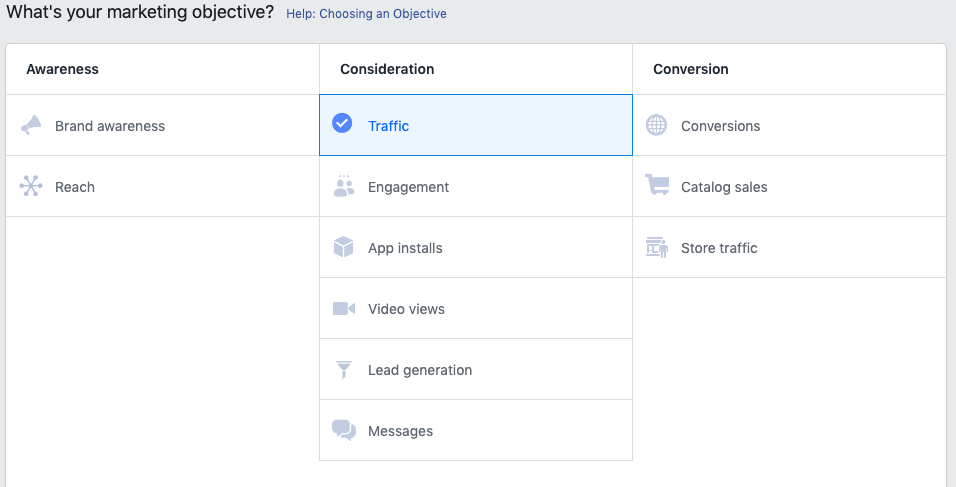 For this article, we’re going to select: “Traffic.”
When you select this option, you’ll be prompted to name your campaign. This may seem like a simple task (and it is) but it’s a good idea to have some sort of naming convention or set process within your company. This will make it easier for you to keep campaigns straight as you continue to create them.
Here at HubSpot, we like to name them in this format:
Company Department | Content/Offer/Asset Being Advertised | Date | Name of Creator
3. Choose your audience.
If you’re just starting out with Instagram advertising, odds are you won’t know exactly which audience you want to go after. This will come with time, and you may just have to play around with it at first. (If you want tips to help you choose the right audience, check out this page.)
During this step, you’ll find that the platform’s built-in targeting can be as simple or as extensive as you need it to be, with options such as:
- Location
- Age
- Gender
- Language
- Relationship
- Education
- Work
- Financial Status
- Home
- Ethnic Affinity
- Generation
- Parents
- Politics (U.S. only)
- Life Events
- Interests
- Behaviors
- Connections
You can create what’s called a custom audience to reach people who’ve already interacted with your business, or a lookalike audience to reach new people on Facebook who are similar to your most valuable audiences.
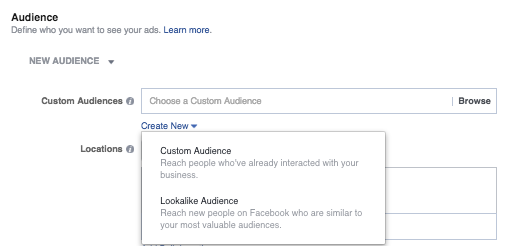
The ads platform also allows you to save the audience you create to be used again at a later time, which can be good if you’re experimenting and want to remember the exact audience you used for certain campaigns.
In terms of the objective we selected — “send people to your website” — we’ll want to target a more specific group of people: the type of people who are actually going to be interested in the content we present.
To do this, you’d jump down to the “Detailed Targeting” section, and search for different demographics, interests, or behaviors that apply to your target audience. Here’s an example of a (very small) audience, just to show you the different ways you can target certain people:
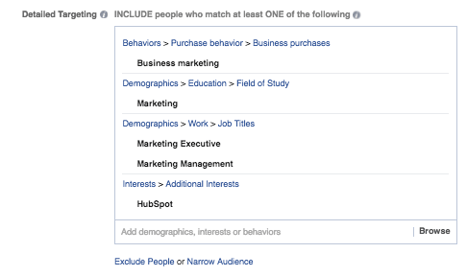
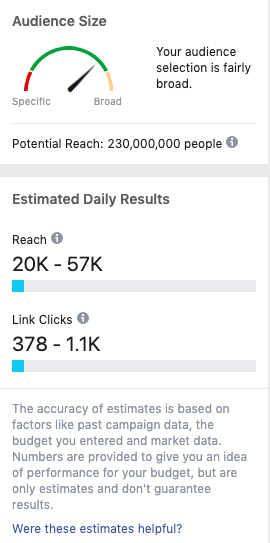
To give you a sense of the audience you’ve chosen, Facebook provides an “audience definition gauge.” This gives you immediate feedback on how narrow or broad your audience is, as well as the estimated reach number of your ad. Since we didn’t add very much criteria to our targeting, you’ll notice that the audience appears “fairly broad.”
4. Set your placement.
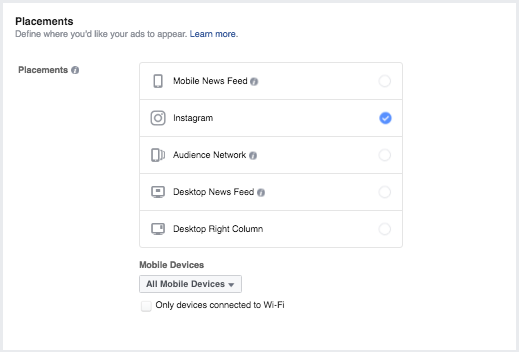
This step is the biggest differentiator between setting up Facebook ads vs. Instagram ads. To move forward with the Instagram ad, you’ll want to uncheck all the boxes except for “Instagram.”
5. Make your budget and schedule.
You have the option to select either a daily budget or a lifetime budget for your campaign. The difference is this:
- Daily budget sets your ad up to run continuously throughout the day, meaning that the algorithm will automatically pace your spending per day. Keep in mind that there is a minimum daily budget depending on different factors in your campaign, usually around $1.00.
- Lifetime budget sets your ad up to run for a specified length of time, meaning the ads algorithm paces your spending over that entire time period.
The other aspect to setting your budget is setting your schedule. You’ll need to choose exactly when you want your campaign to start and finish running, down to the minute. There are also options to set parameters so that your ad runs only during certain hours of the day or during specific days of the week. You can find these options in the “Ad Scheduling” section.
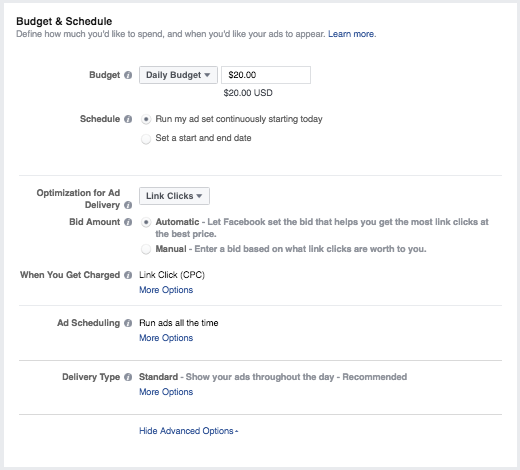
Then, you can set your ad up for delivery.Here, you have three options that will influence who sees your ads.
- Link Clicks: Your ads will be delivered accordingly to get the most clicks to your website at the lowest cost. This is all based on the platform’s algorithm.
- Impressions: Your ads will be delivered to people as many times as possible. Ever see the same ad on your newsfeed all day long? That company is most likely using this option.
- Daily Unique Reach: Your ad will be delivered to people up to once a day. People may see your ad multiple times, but at least not multiple times a day.
Then, after you choose your delivery method, you will have to figure out your bid amount.
This determines how effectively your ad is delivered. When you look “behind the scenes,” you’re competing with other advertisers trying to reach a similar audience in a constant auction.
You can choose either Manual or Automatic. Automatic leaves it up to Facebook’s algorithm to deliver your ad — ideally getting you the most clicks for the lowest cost. Manual allows you to set a price for link clicks. If a link click is worth a lot to you, try setting a higher than suggested bid, and your ad will be displayed over a competitor with a lower bid.
You can choose to pay based on impressions or link clicks. This is up to you.
After that, you can schedule your ads. Here are the options you have for delivery:
- Standard: shows your ads throughout the day.
- Accelerated: helps you reach an audience quickly for time-sensitive ads.
(Note: the accelerated delivery option requires manual bid pricing.)
Finally, you’ll have to name your ad set so you can identify it in Ads Manager later.
6. Curate your ad creative.
This is where your creativity comes in. Here you’ll decide what you want your ad to look like, which will depend on your original objective, of course.
(Psst — Want to get a stunning Story auto-magically created for your brand? Check out StoriesAds.com, a free Instagram Story generator from HubSpot and Shakr. Click here to get started.)
On Instagram, you have a couple different options for your ad:
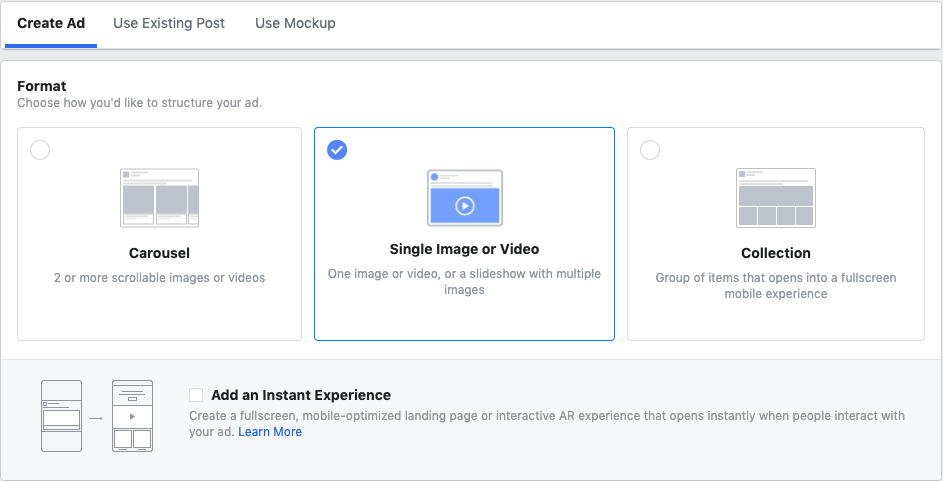
Single image or video, carousel, or collection.
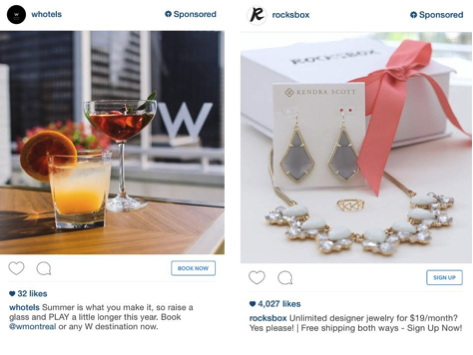
Up to five images or videos for the viewer to scroll through, at no extra cost.
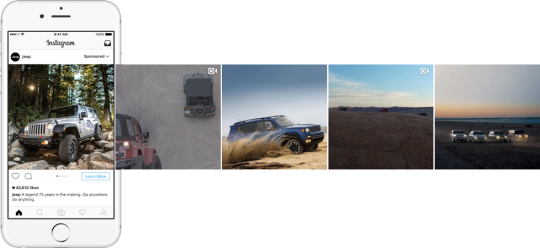
We actually ran some tests to see which type of ad performed the best for different purposes. Check out the results in here.
Once you pick your ad type, click on it and you’ll be prompted to browse and upload your imagery, whether that be images or a video.
For any ad type, the Facebook ads platform recommends you don’t include more than 20% of text. Previously, an ad with over 20% of text wouldn’t even be approved to run, but it has recently changed to more of a suggestion than anything. Learn more about the rules and guidelines here.
Some requirements for Instagram ad imagery:
File Type
- .jpeg
- .png
Text/Caption
- Recommended: 125 characters
- Maximum: 2,200 characters
Square Image or Video ad
- Recommended Image Size: 1080 x 1080 pixels
- Minimum Resolution Accepted: 600 x 600 pixels
- Image Aspect Ratio: 1:1
Landscape Image or Video ad
- Recommended Image Size: 1200 x 628 pixels
- Minimum Resolution Accepted: 600 x 600 pixels
- Image Aspect Ratio: 1:1
7. Build your page links.
The next step is to build your page and set up links. Select the Facebook Page of the account you want your ads to come from, even if you’re not planning on running them on Facebook. (If you’ve made it this far in the Ads Manager, you are already logged into a Facebook account.)
However, since our intent is to post ads on Instagram, you’ll need to connect your Instagram account to your Facebook ad account. To do so, click “Add Account” (you’ll need your Instagram username and password to do so).
If your business doesn’t have an Instagram account, you can still run ads on Instagram — they’ll just come from your business’ Facebook Page instead. In other words, your Facebook Page name and profile picture will be used to represent your business within your ad as it runs on Instagram.
Next is a very important step: putting in the website URL to which you’re trying to drive more traffic. If you’re using marketing automation software, be sure to create a unique tracking URL with UTM parameters for this to ensure that you’ll be able to keep track of traffic and conversions from this ad.
(HubSpot customers: Learn more about creating a tracking URL here.)
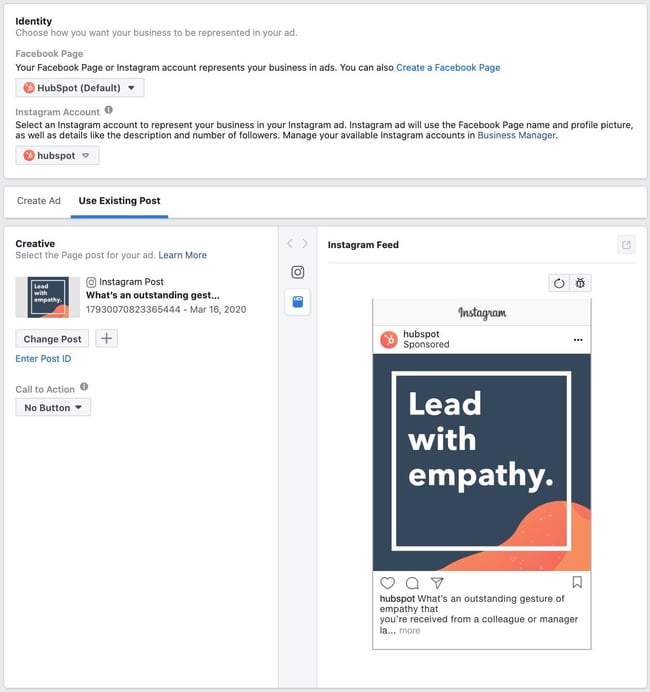
Next, you’ll add a headline. This is not usually displayed to viewers of your ad on Instagram, but it’s always a good idea to complete it just in case. Enter a brief headline describing where people will visit.
After making a headline, you’ll add a caption.
You have up to 2,200 characters — but you don’t have to use all of them.Facebook recommends you keep your text under 125 characters, which is the amount that’s displayed without needing to click “more.”
Select a Call-to-Action.
There are several different options for your CTA button, depending on what the page you’re taking visitors to looks like. You can choose to have no button, or select any of the following:
- Learn More
- Apply Now
- Book Now
- Contact Us
- Download
- Hope Now
- Sign Up
- Watch More
For our sake, we’ll stick with “Learn More,” as we’re just driving people to our website.
Once your image is uploaded and your text is set, check out the preview of your ad to make sure everything looks right.
At this point, you’ll have the option to edit the “Advanced Options,” but only if you wish. Advanced Options include adding tags, changing your display link, entering URL parameters, setting up sponsors, and opting in or out of pixel tracking.
Then, you’re ready to place the ad! Click the green button to confirm, and your ad will be presented to the world.
8. Report on the performance.
Once your ads are up and running on Instagram, it’s important to keep an eye on how they’re doing. You can go back in and tweak most aspects of the ad, so if you catch a mistake you made or your image isn’t doing as well as you’d like it to, you can go in and alter these things.
You can look at results of your ads in two places:
- The Facebook Ads Manager
- Your marketing software
In the Ads Manager:
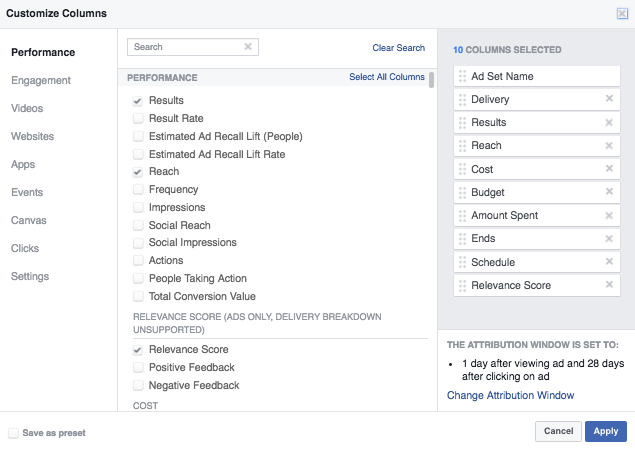
There’s a sophisticated and extensive dashboard that provides users with an overview of all their campaigns. Without customizing any settings, you’ll find data on reach, cost per result, and amount spent.
In the upper right-hand corner, you’ll see a button that says “Columns: Performance.” If you click the drop down menu, there’s an option to customize columns, which allows you to choose the specific data you want to see. There’s data ranging from CPC or CTR, to things much more specific like “Adds to Cart” for ecommerce stores.
Here are the categories that the available metrics fall into:
- Performance (reach, results, frequency, etc.)
- Engagement (post likes, post comments, post shares, etc.)
- Videos (video views, average percent of video viewed, etc.)
- Website (checkouts, payment details, adds to cart, etc.)
- Apps (installs, engagement, cost per app engagement, etc.)
- Events (event responses, cost per event response, etc.)
- Clicks (unique clicks, social clicks, CTR, CPC)
- Settings (start date, end date, ad set name, delivery, bit, ad ID, and objective)
With your marketing software:
With so many metrics to track, it can be easy to lose sight of the big picture. To truly track your success, take advantage of your marketing software and the UTM codes you used in your ads to measure your ads’ full-funnel effectiveness.
Looking at the specific tracking codes through your marketing software will help you keep track of how many leads (or better yet, customers) you actually generated through your Instagram advertising campaign. This ROI information can then be used to inform other campaigns down the line.
If you’re a HubSpot customer, you can create unique tracking codes for your Instagram campaign by following the instructions here. All you’ll need to do is plug in the URL, attach a campaign, and choose the source you want the URL to be attributed to in your Sources Report.
Once your ad launches and you start getting traffic and conversions to your website, you’ll be able to easily track how many visits, contacts, and customers you’re generating.
With over 1 billion monthly users, there’s no denying Instagram’s power and reach. In fact, it’s become the go-to place for businesses to engage with their audience. But to get the most bang for your buck, it’s essential to set up your ad campaigns correctly — and optimize them even after you click “Publish.”

5 Social Media Challenges Brands are Facing in 2022, According to 500+ Marketers
TikTok.
Clubhouse.
Twitch.
These are just some of the many new social media apps we’ve seen grow in popularity over the past year — and that’s along with all the ‘oldies but goodies’ like Instagram, Facebook, and Twitter.
The expanding list of popular social media platforms undoubtedly makes a social media marketer’s job harder: Which platforms will provide the highest ROI? Where’s your audience hanging out? And which ones aren’t worth the effort?
As the social landscape changes, HubSpot’s Blog team surveyed over 500 marketers to determine the biggest challenges social media marketers will face in 2022 — and how to prepare.
Let’s dive in.
5 Social Media Challenges Brands are Facing in 2022
1. Determining on which platform(s) you should market your brand.
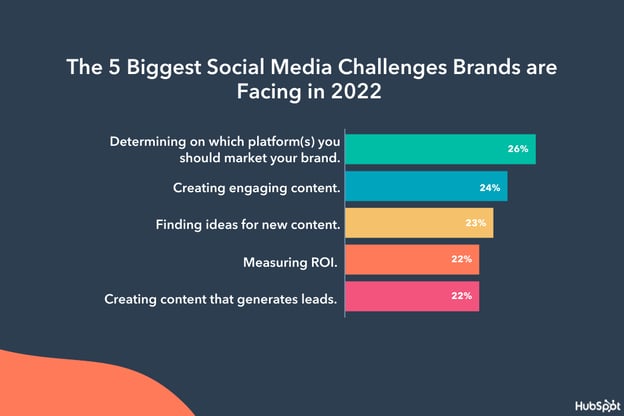
In 2022, 26% of marketers say their biggest challenge will be determining which platform(s) they should invest time and resources.
This makes sense: The most popular social platforms aren’t always the best fit for your brand or business goals, so it can be difficult to determine which apps you should include in your marketing strategy.
To choose the right platforms for your brand, HubSpot’s Senior Manager of Social Media Kelly Hendrickson told me, “It all comes down to your audience. Who is your audience, and where do they spend their time on social media?”
She adds, “[Most] platforms share broad audience demographics data, so even without a study, you may be able to figure out where your low hanging fruit is. If it’s a bit harder to test out a few hashtags related to your business on various platforms to see where your audience is already participating.”
Alternatively, it’s helpful to consider which types of content your audience prefers. For instance, if you’ve conducted market research and found your buyer persona enjoys video content, then you’ve narrowed down your platform(s) to video hosting apps like YouTube, TikTok, and Instagram Stories — to name a few.
Finally, keep in mind your social media goals when choosing your platform. For instance, if your primary goal is to increase sales, then perhaps you want to test out targeted, personalized Facebook ads. If, alternatively, you’re hoping to expand your brand awareness, you might test out some newer platforms like TikTok or Clubhouse.
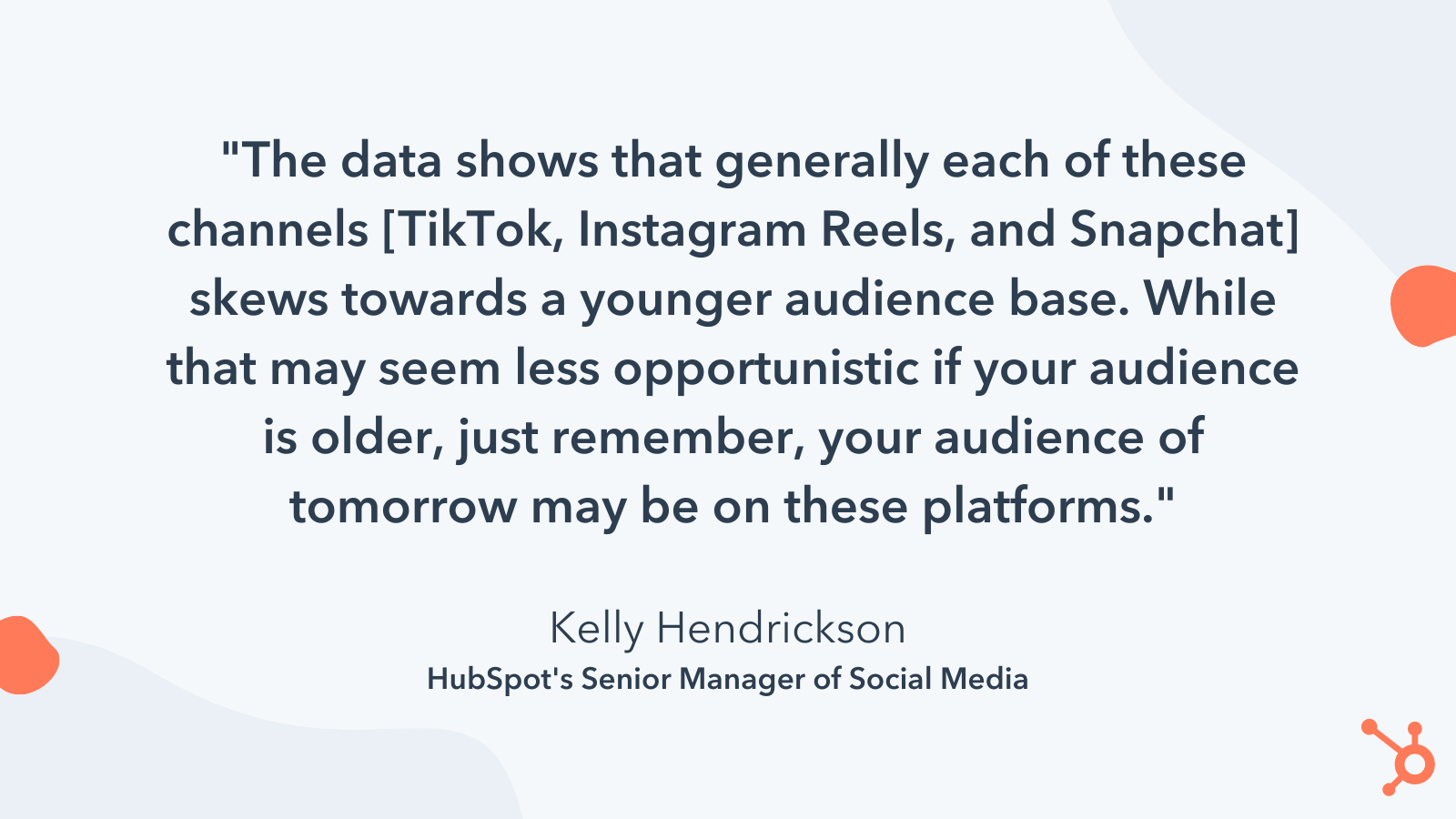
Additionally, in regards to TikTok, Instagram Reels, or Snapchat, Hendrickson told me, “The data shows that generally each of these channels skews towards a younger audience base. While that may seem less opportunistic if your audience is older, just remember, your audience of tomorrow may be on these platforms.”
2. Creating engaging content.
As a content creator, I can tell you firsthand: Creating content is hard.
And, apparently, most marketers agree. In fact, 24% of marketers say creating engaging content will be their biggest challenge in 2022.
Creating high-quality social media content is time-consuming, so consider how you might get the most bang for your buck by repurposing content across channels. For instance, if you take the time to create a 10-minute YouTube video on a topic, cut short snippets from the video to repurpose on short-form channels like Instagram Stories, Snapchat, or TikTok.
You can also create a social media post with some of the information you researched for the video.
Additionally, Rachael Samuels, the Senior Manager of Social Media at Sprout Social, believes dedicating time, resources, and headcount towards social media is vital for long-term success.
As she puts it, “The social landscape is becoming increasingly saturated with new networks and seemingly endless potential audiences to engage. Social teams of one are no longer enough to keep up with the demand.”
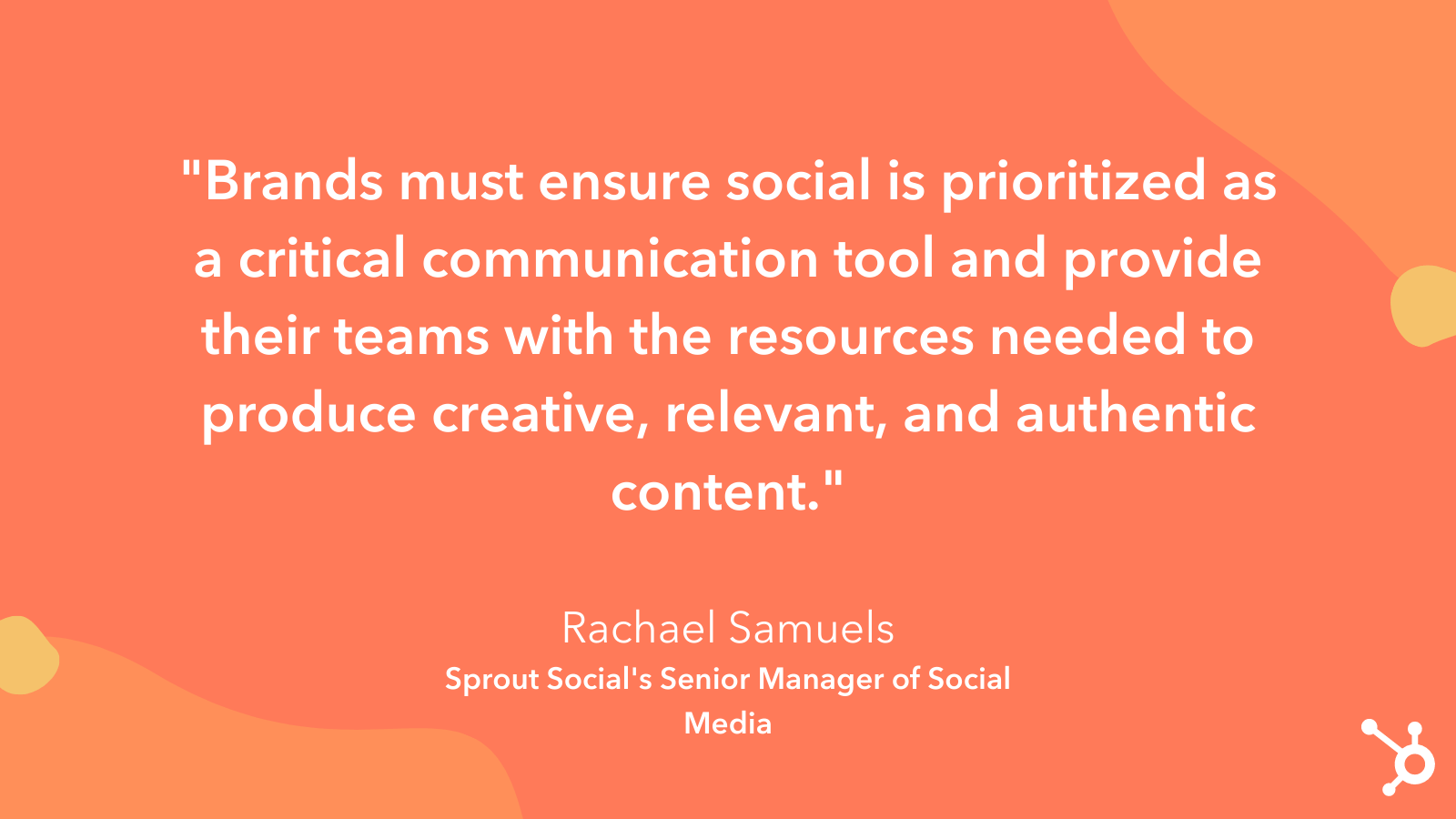
Samuels adds, “As consumer preferences and expectations continue to grow in the year ahead, social marketers require greater investment in their teams and resources to be successful. To get ahead of this challenge, brands must ensure social is prioritized as a critical communication tool and provide their teams with the resources needed to produce creative, relevant, and authentic content.”
Additionally, to truly see ROI from your social efforts, you’ll want to take the time to integrate it into every stage of the customer journey. Perhaps you can use certain platforms for support for existing customers, whereas you use others to reach new audiences.
Samuels says, “Having an integrated marketing plan that addresses social media at each touchpoint of the customer journey is critical for overall business success. When brands fail to invest in social and their respective teams, they run the risk of losing customers and perpetuating burnout.”
3. Finding ideas for new content.
23% of the marketers report that finding ideas for new content is their biggest challenge heading into 2022.
It can be tricky to consistently pitch new ideas for social platforms — particularly when social platforms feel overcrowded with content already.
While this isn’t an exhaustive list, here are a few social media content suggestions when brainstorming ideas for your 2022 calendar:
- Post your new blog on your Instagram Stories.
- Conduct a poll on Instagram.
- Share user-generated content on Twitter.
- Create and share website content on Facebook.
- On LinkedIn, post articles/stats about your industry.
- Highlight milestones of your company on LinkedIn.
- Create graphics for Instagram and Facebook.
- Show the faces behind the company on Snapchat or Instagram.
To combat this challenge, you also might consider using user-generated content to spruce up your pages. Alternatively, take the time to research what types of content are trending on which platform(s).
Christina Garnett, HubSpot’s Senior Marketing Manager, Offline Community & Advocacy, suggests researching what already exists when looking for new ideas. She told me, “In his book, The Creative Curve: How to Develop the Right Idea at the Right Time, Allen Gannett writes that ‘to create something novel you must know what already exists.'”
Garnett says, “When trying to find the new you must consume and see what kind of content is already available and then look for gap opportunities. Are there questions not being answered? Different perspectives not being shared? Maybe the content exists but not in a format that is tailored for a specific learner or audience.”
Garnett adds, “Once you determine what you can create, you need to determine who needs it, and how it can best be packaged to improve their experience. Content has the same need to find product-market fit as products and solutions do. In the pursuit of the novel, you not only need to determine what doesn’t exist, but why it doesn’t. Creating for the sake of creation isn’t enough when it needs an audience.”
While this research can be time-consuming, it can enable you to position your brand as a thought leader in your industry and will undoubtedly lead to new content ideas.
4. Measuring ROI.
In some instances, measuring ROI can be relatively easy — particularly when it comes to monetary value, such as how many sales you received from a specific Facebook ad.
But when your social media goals involve more abstract concepts, such as “increase brand awareness”, it can be difficult to quantify and measure your campaign’s success.
22% of those surveyed agree that measuring ROI is their biggest challenge as they enter 2022.
Fortunately, measuring ROI across social platforms can be done, but it’s not straightforward. Take a look at HubSpot’s free lesson, How to Measure Social Media ROI, to learn more about how to track social media ROI when it comes to building brand loyalty, retaining customers, protecting your reputation, and more.
5. Creating content that generates leads.
Finally, 22% of those surveyed report creating content that generates leads to be their biggest challenge as we enter the new year.
To create a strong social media lead generation strategy, consider driving your audience from certain social platforms back to dedicated landing pages, or track clicks on specific CTAs for each campaign.
For instance, if you’re running a campaign aimed at driving revenue towards a new product offering, you’ll want to create a product landing page that you link to on each of your social profiles. Then you can track how many clicks come from each page, and alter your strategy accordingly. (If you see most clicks coming from Facebook, perhaps you put paid advertising behind your Facebook strategy.)
Alternatively, if you’re hoping to drive sign-ups for an email newsletter, you’ll want to create a CTA for social pages that drives your social audience to sign-up for your newsletter.
Social media advertising is another powerful way to generate leads through social media.
However, it’s important to keep in mind — to create truly unique social media ads, you’ll want to ensure those ads seem spontaneous and casual.
As Talkwalker’s CMO Elena Melnikova puts it, “The challenge will be brands, used to producing highly-polished commercials, creating ads that come across as spontaneous.”
“Too commercial, and this young audience will scroll past your brand, looking for the next dance routine. Read the room. Follow the trends. Be spontaneous.”
Melnikova adds, “Savvy brands will work with influencers to create content. And with the majority of TikTok influencers being Gen Z, they’ll understand how to ensure their content stands out, and increase a brand’s engagement figures.”
And there you have it! The biggest five challenges facing social media teams in 2022.
Now that you know which challenges you might be up against, take the time to brainstorm unique solutions that will help you level up your social media strategy into 2022 and beyond.

A Brief History of Online Advertising
Remember when “surfing the net” meant traversing a minefield of unwelcome pop-up ads? When “digital advertising” referred almost exclusively to obnoxious flashing banners and random sidebar ads?
Online ads have matured a lot since those days, but it’s still important to look back at the flashy, gaudy, sometimes messy origins of internet advertising to better understand where we’re headed — and where there’s still room for improvement.
Check out a condensed history of online advertising below.

The History of Online Advertising
1994: The first banner ads appear

Image credit: Wired
On October 27, 1994, the world of advertising was forever transformed by a small graphic bearing the presumptive words, “Have you ever clicked your mouse right here? You will,” in a kitschy rainbow font. The age of banner ads had officially begun.
You can thank (or blame?) Wired magazine’s former online off-shoot HotWired for introducing the world to the enduringly ubiquitous banner ad. HotWired was a digital publication, and it needed a way to generate revenue to pay its writers.
The publication devised a plan to set aside portions of its website to sell space to advertisers, similar to how ad space is sold in a print magazine. They called the ad spaces “banner ads,” and charged advertisers an upfront cost to occupy the real estate for a set time period — very different from today’s pay-per-click model.
AT&T paid HotWired $30,000 to place the banner ad above on their site for three months. The ad enjoyed a click-through-rate of 44% — a number that would make most marketers balk in disbelief today. To put that in perspective, the average clickthrough rate on display ads today — 22 years later — is closer to 0.06%.
Users enticed to click the mysterious banner were transported to a very early landing page for AT&T. Visitors could click links to view information about landmarks and museums around the world to highlight the internet’s ability to transport you to different locations virtually.
Craig Kanarick, one of the digital consultants hired to work on the campaign, remembers the team’s goal was to make an ad that didn’t feel like an ad, and actually offered valuable content to users. “Let’s not sell somebody something,” he recalled thinking, “Let’s reward them for clicking on this thing brought to you by AT&T.”
The banner ad concept blew up as a way for websites to keep their content ungated and free for users, and it wasn’t long before other companies — such as Time Inc. and CMP’s Tech web — were seeking out advertisers to lease banner space as a sustainable way to scale their sites.
1995: Display ads become increasingly targeted
As banner ads continued to gain popularity, advertisers became increasingly interested in targeting specific consumer demographics, rather than just placing their ads wherever space was offered and hoping the right people would see it. This led to the beginning of targeted ad placement.
WebConnect, an ad agency that specialized in online ads, began helping their clients identify websites their ideal consumers visited. Now, companies could place ads where their target demographics were more likely to see them.
This was nothing short of revolutionary in the digital advertising space. Not only were companies reaching more relevant audiences, but websites hosting the ads were also able to display banners that were more applicable to their visitors.
WebConnect also introduced the CustomView tool, which capped the number of times a particular user was shown a single banner ad. If a user had already seen an ad a certain number of times, they would be shown another ad instead.
Users tend to stop noticing a banner ad after they’ve seen it before, so capping the number of times a user sees an ad helped early online advertisers prevent “banner fatigue.” Ad frequency capping is still a common display ad tactic advertisers use today.
1996: ROI tracking tools begin to improve
In 1996, banner ads plastered the internet, but advertisers still didn’t have a good process to determine if these ads were actually driving tangible results for their businesses. Marketers needed a way to more efficiently manage their display ad campaigns across multiple websites and report on how users were interacting with their ads.
Doubleclick emerged on the scene as one of the first ROI tools for banner ad campaigns. They offered advertisers a new service called D.A.R.T. (Dynamic Advertising Reporting & Targeting), which enabled companies to track how many times an ad was viewed and clicked across multiple websites.
The most impressive feature of D.A.R.T. was the fact that advertisers now had the ability to track how their ads were performing and make changes to a live campaign. Previously, advertisers needed to wait until a campaign was completed before they could analyze the results and optimize their next banner for better performance. If an ad was performing poorly, they were forced to wait it out.
With Doubleclick, advertisers could see if an ad’s performance was suffering midway through a campaign, and they had the option to make changes. For example, if a marketer noticed their ad was underperforming on one website, they could remove the ad and devote those resources to another website where the ad was performing better.
Doubleclick’s success also gave rise to a new pricing model for online advertising: Cost per impression (CPM). Previously, websites were paid a flat fee to host banner ads for a predetermined time period. With improved ad tracking, banner pricing transitioned towards an ROI-based model.
1997: Pop-up ads quickly rise and fall
It would be an understatement to say that pop-up ads suffer from a poor image problem. They’ve been called internet’s original sin and the most hated advertising technique, and one of the original developers has even apologized for creating the underlying code that unleashed them upon unsuspecting web surfers. Even so, these much-maligned ads hold an undeniable place in the history of online advertising.
So who created the very first pop-up? Before you get your pitchforks and torches out, you should know their intentions were good. Ethan Zuckerman, then a developer for Tripod.com, is widely credited with creating the code that enables pop-up ads to open up a new browser window.
“It was a way to associate an ad with a user’s page without putting it directly on the page, which advertisers worried would imply an association between their brand and the page’s content,” Zuckerman wrote in the Atlantic.
Amidst dwindling banner ad clickthrough rates in the late 1990s, pop-up ads first seemed like a way to save online advertising and capture the attention of increasingly ad-blind users. And while pop-ups did force users to pay attention, they didn’t actually translate to real ROI. By the early 2000s, it was standard for web browsers to come with pop-up blocking features.
1999 – 2002: Advertisers turn to paid search and pay-per-click
By this time, the web was expanding rapidly and users needed a better way to navigate the terrain. With search engines steadily gaining popularity, advertisers looking to create ads that were more targeted and less loathsome turned to sponsored search as the next digital advertising frontier.
In 1999, GoTo.com — an emerging search engine company that would later be acquired by Yahoo — introduced the first pay-for-placement search engine service. Advertisers were given the opportunity to bid for top search engine results on particular keywords. Despite some initial outcries that paid search would lead to corrupt results, GoTo.com was able to monetize their search engine through the model.
Pay-for-placement eventually evolved into pay-per-click. Companies bid on search result placement on a per-click basis: e.g., I’ll pay GoTo.com $1 per click if you put my company as the top search result. This led to search results that were largely determined by how much a company was willing to pay. The highest bidders were usually listed first, even above more relevant content, and it was unclear to users which results were paid and which were organic content.
The user experience of paid search was suffering, and one up-and-coming search engine thought they could fix it. Google introduced AdWords in 2000, originally under a pay-for-placement ad model. Google wanted to create a sponsored search experience that generated revenue without compromising the quality and relevancy of search results.
While previous paid search models like GoTo.com relied on bids from advertisers to determine search rankings, AdWords introduced a Quality Score model, which took into account an ad’s clickthrough rate when determining its placement on the search results page. Even if an ad had a lower bid, it would still appear above other, less relevant paid ads in search results thanks to its high clickthrough rate. The Quality Score model is still used today.
2006: Digital ads become hyper-targeted
As social media platforms picked up steam in the mid 2000s, advertisers sought a way to integrate ad content in a way that was both effective and non-intrusive. Marketers wanted a plan of action to reach younger internet users who were increasingly unswayed by banner ads and spending most of their internet time on social networks.
After previously resisting ads on its site, Facebook started working with advertisers in 2006 as a way to increase the young company’s profitability. They started with small display ads and sponsored links, and eventually moved onto ads targeted to a user’s demographics and interests. Despite some controversies along the way, Facebook has proven itself to be a targeted ad pioneer, changing the way that companies reach their desired audiences online.
“Our strategy is much less [about] increasing the volume of ads and much more about increasing the quality of the content and the quality of the targeting to get the right content to the right people,” Facebook founder Mark Zuckerberg said in 2014.
Targeting consumers with relevant ads — rather than bombarding them with a large volume of ad content — has become a standard practice for online advertisers, particularly on social media. Beyond Facebook’s targeting efforts, other social networks such as Twitter, YouTube, and Google+ focus on providing an advertising experience for users that doesn’t feel aggressive or impersonal.
2010 – present: Marketers find value in native ads
Around this time, a new group of media companies began to emerge. Websites like BuzzFeed and Mashable presented advertisers with new opportunities to connect with their audiences through sponsored content and native advertising.
Advertisers pay to produce articles, videos, and other types of content for news, media sites, and Google.
While the goal of the content is to promote the business, the format looks and feels less like an ad and more like a regular piece of content on the host’s website.
Instead of relying on ads that disrupt their target audience’s online experience, native advertising allows marketers to create promotional content that supplements a user’s online experience. “Marketers interested in targeting ads to specific consumers in an unobtrusive fashion should seriously consider spending some time on native,” Mimi An concluded in a HubSpot Research study on native advertising.
Websites that traditionally generated revenue from display ads began to realize that they could create a better user experience by relying primarily on native ads — rather than traditional display ads — without compromising on ad revenue.
The Future of Advertising
That’s a look back at the history of online advertising — but what about the future?
According to recent data from HubSpot Research, 91% of respondents say ads are more intrusive today compared to just two to three years ago. It’s clear that the future of digital advertising pivots on developing a targeted ad experience that offers consumers relevant content without feeling nosy or invasive.
To get the full scoop on the current state of digital advertising and how your company can keep its ad strategy relevant, download HubSpot’s State of Inbound report here.

A Brief History of Online Advertising
Remember when “surfing the net” meant traversing a minefield of unwelcome pop-up ads? When “digital advertising” referred almost exclusively to obnoxious flashing banners and random sidebar ads?
Online ads have matured a lot since those days, but it’s still important to look back at the flashy, gaudy, sometimes messy origins of internet advertising to better understand where we’re headed — and where there’s still room for improvement.
Check out a condensed history of online advertising below.
The History of Online Advertising
1994: The first banner ads appear
Image credit: Wired
On October 27, 1994, the world of advertising was forever transformed by a small graphic bearing the presumptive words, “Have you ever clicked your mouse right here? You will,” in a kitschy rainbow font. The age of banner ads had officially begun.
You can thank (or blame?) Wired magazine’s former online off-shoot HotWired for introducing the world to the enduringly ubiquitous banner ad. HotWired was a digital publication, and it needed a way to generate revenue to pay its writers.
The publication devised a plan to set aside portions of its website to sell space to advertisers, similar to how ad space is sold in a print magazine. They called the ad spaces “banner ads,” and charged advertisers an upfront cost to occupy the real estate for a set time period — very different from today’s pay-per-click model.
AT&T paid HotWired $30,000 to place the banner ad above on their site for three months. The ad enjoyed a click-through-rate of 44% — a number that would make most marketers balk in disbelief today. To put that in perspective, the average clickthrough rate on display ads today — 22 years later — is closer to 0.06%.
Users enticed to click the mysterious banner were transported to a very early landing page for AT&T. Visitors could click links to view information about landmarks and museums around the world to highlight the internet’s ability to transport you to different locations virtually.
Craig Kanarick, one of the digital consultants hired to work on the campaign, remembers the team’s goal was to make an ad that didn’t feel like an ad, and actually offered valuable content to users. “Let’s not sell somebody something,” he recalled thinking, “Let’s reward them for clicking on this thing brought to you by AT&T.”
The banner ad concept blew up as a way for websites to keep their content ungated and free for users, and it wasn’t long before other companies — such as Time Inc. and CMP’s Tech web — were seeking out advertisers to lease banner space as a sustainable way to scale their sites.
1995: Display ads become increasingly targeted
As banner ads continued to gain popularity, advertisers became increasingly interested in targeting specific consumer demographics, rather than just placing their ads wherever space was offered and hoping the right people would see it. This led to the beginning of targeted ad placement.
WebConnect, an ad agency that specialized in online ads, began helping their clients identify websites their ideal consumers visited. Now, companies could place ads where their target demographics were more likely to see them.
This was nothing short of revolutionary in the digital advertising space. Not only were companies reaching more relevant audiences, but websites hosting the ads were also able to display banners that were more applicable to their visitors.
WebConnect also introduced the CustomView tool, which capped the number of times a particular user was shown a single banner ad. If a user had already seen an ad a certain number of times, they would be shown another ad instead.
Users tend to stop noticing a banner ad after they’ve seen it before, so capping the number of times a user sees an ad helped early online advertisers prevent “banner fatigue.” Ad frequency capping is still a common display ad tactic advertisers use today.
1996: ROI tracking tools begin to improve
In 1996, banner ads plastered the internet, but advertisers still didn’t have a good process to determine if these ads were actually driving tangible results for their businesses. Marketers needed a way to more efficiently manage their display ad campaigns across multiple websites and report on how users were interacting with their ads.
Doubleclick emerged on the scene as one of the first ROI tools for banner ad campaigns. They offered advertisers a new service called D.A.R.T. (Dynamic Advertising Reporting & Targeting), which enabled companies to track how many times an ad was viewed and clicked across multiple websites.
The most impressive feature of D.A.R.T. was the fact that advertisers now had the ability to track how their ads were performing and make changes to a live campaign. Previously, advertisers needed to wait until a campaign was completed before they could analyze the results and optimize their next banner for better performance. If an ad was performing poorly, they were forced to wait it out.
With Doubleclick, advertisers could see if an ad’s performance was suffering midway through a campaign, and they had the option to make changes. For example, if a marketer noticed their ad was underperforming on one website, they could remove the ad and devote those resources to another website where the ad was performing better.
Doubleclick’s success also gave rise to a new pricing model for online advertising: Cost per impression (CPM). Previously, websites were paid a flat fee to host banner ads for a predetermined time period. With improved ad tracking, banner pricing transitioned towards an ROI-based model.
1997: Pop-up ads quickly rise and fall
It would be an understatement to say that pop-up ads suffer from a poor image problem. They’ve been called internet’s original sin and the most hated advertising technique, and one of the original developers has even apologized for creating the underlying code that unleashed them upon unsuspecting web surfers. Even so, these much-maligned ads hold an undeniable place in the history of online advertising.
So who created the very first pop-up? Before you get your pitchforks and torches out, you should know their intentions were good. Ethan Zuckerman, then a developer for Tripod.com, is widely credited with creating the code that enables pop-up ads to open up a new browser window.
“It was a way to associate an ad with a user’s page without putting it directly on the page, which advertisers worried would imply an association between their brand and the page’s content,” Zuckerman wrote in the Atlantic.
Amidst dwindling banner ad clickthrough rates in the late 1990s, pop-up ads first seemed like a way to save online advertising and capture the attention of increasingly ad-blind users. And while pop-ups did force users to pay attention, they didn’t actually translate to real ROI. By the early 2000s, it was standard for web browsers to come with pop-up blocking features.
1999 – 2002: Advertisers turn to paid search and pay-per-click
By this time, the web was expanding rapidly and users needed a better way to navigate the terrain. With search engines steadily gaining popularity, advertisers looking to create ads that were more targeted and less loathsome turned to sponsored search as the next digital advertising frontier.
In 1999, GoTo.com — an emerging search engine company that would later be acquired by Yahoo — introduced the first pay-for-placement search engine service. Advertisers were given the opportunity to bid for top search engine results on particular keywords. Despite some initial outcries that paid search would lead to corrupt results, GoTo.com was able to monetize their search engine through the model.
Pay-for-placement eventually evolved into pay-per-click. Companies bid on search result placement on a per-click basis: e.g., I’ll pay GoTo.com $1 per click if you put my company as the top search result. This led to search results that were largely determined by how much a company was willing to pay. The highest bidders were usually listed first, even above more relevant content, and it was unclear to users which results were paid and which were organic content.
The user experience of paid search was suffering, and one up-and-coming search engine thought they could fix it. Google introduced AdWords in 2000, originally under a pay-for-placement ad model. Google wanted to create a sponsored search experience that generated revenue without compromising the quality and relevancy of search results.
While previous paid search models like GoTo.com relied on bids from advertisers to determine search rankings, AdWords introduced a Quality Score model, which took into account an ad’s clickthrough rate when determining its placement on the search results page. Even if an ad had a lower bid, it would still appear above other, less relevant paid ads in search results thanks to its high clickthrough rate. The Quality Score model is still used today.
2006: Digital ads become hyper-targeted
As social media platforms picked up steam in the mid 2000s, advertisers sought a way to integrate ad content in a way that was both effective and non-intrusive. Marketers wanted a plan of action to reach younger internet users who were increasingly unswayed by banner ads and spending most of their internet time on social networks.
After previously resisting ads on its site, Facebook started working with advertisers in 2006 as a way to increase the young company’s profitability. They started with small display ads and sponsored links, and eventually moved onto ads targeted to a user’s demographics and interests. Despite some controversies along the way, Facebook has proven itself to be a targeted ad pioneer, changing the way that companies reach their desired audiences online.
“Our strategy is much less [about] increasing the volume of ads and much more about increasing the quality of the content and the quality of the targeting to get the right content to the right people,” Facebook founder Mark Zuckerberg said in 2014.
Targeting consumers with relevant ads — rather than bombarding them with a large volume of ad content — has become a standard practice for online advertisers, particularly on social media. Beyond Facebook’s targeting efforts, other social networks such as Twitter, YouTube, and Google+ focus on providing an advertising experience for users that doesn’t feel aggressive or impersonal.
2010 – present: Marketers find value in native ads
Around this time, a new group of media companies began to emerge. Websites like BuzzFeed and Mashable presented advertisers with new opportunities to connect with their audiences through sponsored content and native advertising.
Advertisers pay to produce articles, videos, and other types of content for news, media sites, and Google.
While the goal of the content is to promote the business, the format looks and feels less like an ad and more like a regular piece of content on the host’s website.
Instead of relying on ads that disrupt their target audience’s online experience, native advertising allows marketers to create promotional content that supplements a user’s online experience. “Marketers interested in targeting ads to specific consumers in an unobtrusive fashion should seriously consider spending some time on native,” Mimi An concluded in a HubSpot Research study on native advertising.
Websites that traditionally generated revenue from display ads began to realize that they could create a better user experience by relying primarily on native ads — rather than traditional display ads — without compromising on ad revenue.
The Future of Advertising
That’s a look back at the history of online advertising — but what about the future?
According to recent data from HubSpot Research, 91% of respondents say ads are more intrusive today compared to just two to three years ago. It’s clear that the future of digital advertising pivots on developing a targeted ad experience that offers consumers relevant content without feeling nosy or invasive.
To get the full scoop on the current state of digital advertising and how your company can keep its ad strategy relevant, download HubSpot’s State of Inbound report here.
2021 Advertising Stats You Need to Know
2021 was a big year with advertisers, as they managed the remnants of the COVID-19 crisis and pandemic along with growing data privacy concerns.

So, how exactly did advertisers fare in terms of strategy, challenges, and ad spend? To help you prepare for your 2022 strategy, we’ve gathered 27 stats.
You’ll learn which strategies advertisers are leveraging today, which ones they plan to invest in, and the challenges they faced and may face in 2022.
Current Ad Strategies
- 84% of marketers’ companies run marketing campaigns and for 42% of respondents, advertising products is one of their main goals. (HubSpot Blog Research)
- This year, print advertising was a low priority for marketers, with only 19% of marketers leveraging it. It was also one of the least effective channels for advertisers. (HubSpot Blog Research)
- Paid social is a top paid channel for marketers. (HubSpot Blog Research)
- In terms of account-based marketing (ABM), paid ads were one of the top three tactics marketers used, behind creating custom content and identifying target contacts/roles. (HubSpot Blog Research)
- In 2022, 21% of marketers plan to leverage paid social for the first time. (HubSpot Blog Research)
- In 2022, around 66% of advertisers plan to respond to data depreciation by 1) learning how to leverage their data in privacy-forward ways, 2) demanding more data transparency from partners, and exploring the adoption and experimentation of artificial intelligence. (Forrester)
- Advertisers plan to leverage AI for privacy-safe targeting, identifying conversion-ready audiences, and dynamic creative optimization (DCO). (Forrester)
- Around 18% of advertisers plan to divest from print advertising and direct mail (HubSpot Blog Research)
- Some advertisers will also divest from physical ads, such as signage and billboards. (HubSpot Blog Research)
Pro-tip: For your ABM needs, consider Terminus (formerly Sigstr). The platform allows you to create and target custom account segments, keep your team in the loop through connected data and insights, and measure your success in a user-friendly dashboard.
Advertising Challenges
In the past two years, data privacy has become a top concern for both consumers and marketers. In 2020, we faced the death of the third-party cookie, with Chrome blocking this type of data tracking. In September 2021, Apple announced that the IOS 15 update will affect marketers’ ability to track user behavior.
All of this has translated into challenges in paid media and many of them listed below relate to data privacy:
- 65% of advertisers are confident in their creative assets while only 26% are confident in their targeting abilities and only 10% in media. (Forrester)
- 87% of advertisers believe traditional targeting and tracking methods are at risk today due to data privacy concerns and policies. (Forrester)
- 64% of advertisers fear a loss of consumer trust in their ads, which can translate into a decrease in brand loyalty. (Forrester)
- Most advertisers (91%) believe consumers expect more personalized and engaging ads. However, 87% of advertisers say stricter data privacy implementations have made it harder to scale personalized ad experiences. (Forrester)
- 85% of advertisers say they have a ton of data but struggle to find privacy-friendly ways to use it. (Forrester)
- In 2021, U.S. advertisers spent $153.2 billion on internet ads, $81 billion more than on TV ads. (Statista)
- Paid media is the number one place advertisers plan to allocate their marketing budget in the next year. (Not Another State of Marketing Report)
- Total ad spending declined year-over-year by 1.2%, driven by a dip in traditional ad spending. (eMarketer)
- B2B digital advertising is expected to reach $12.6 billion in 2022. (Statista)
Ad Spend and Budgeting
- In 2021, U.S. advertisers spent $153.2 billion on internet ads, $81 billion more than on TV ads. (Statista)
- Paid media is the number one place advertisers plan to allocate their marketing budget in the next year. (Not Another State of Marketing Report)
- Total ad spending declined year-over-year by 1.2%, driven by a 15.7% contraction in traditional ad spending. (eMarketer)
- B2B digital advertising is expected to reach $12.6 billion in 2022. (Statista)
Looking Forward
With data privacy becoming a big part of the conversation surrounding paid media, recent data suggests that the big focus moving forward is finding privacy-friendly ways to target users and track performance.
- In 2022, around 66% of advertisers plan to respond to data depreciation by 1) learning how to leverage their data in privacy-forward ways, 2) demanding more data transparency from partners, and exploring the adoption and experimentation of artificial intelligence. (Forrester)
- Advertisers plan to leverage AI for privacy-safe targeting, identifying conversion-ready audiences, and dynamic creative optimization (DCO). (Forrester)
- Around 18% of advertisers plan to divest from print advertising and direct mail (HubSpot Blog Research)
- Some advertisers will also divest from physical ads, such as signage and billboards. (HubSpot Blog Research)
- In 2022, 21% of marketers plan to leverage paid social for the first time. (HubSpot Blog Research)
As you think about AI and its impact on your advertising strategy, consider the ad platform AdRoll. It uses AI to personalize product recommendations on various channels, including the web and email. AdRoll also supports other tools so you can connect your ad ecosystem simply and easily.

5 Things Gen Z Will Spend Money On & Why Marketers Need to Care
With a purchasing power of more than $143 billion, Gen Z is expected to shake up the retail industry.
Although many in Gen Z are earning their first paychecks, entering college, or just joining the workforce, studies show that the generation shops and spends money much differently than its millennial predecessor.

While millennials and past generations were more loyal to brands, Gen Z is more interested in buying products that will give them the best value based on their price. Gen Zers also admits to being more impulsive in their shopping habits than older generations.
A Breakdown of Generation Z’s Spending Habits
When it comes to the total share of spending, Gen Z accounts for an estimated five percent in the U.S., according to Afterpay’s 2021 Next Gen Index. However, that number is expected to grow 10% by 2030, as most will be entering the workforce.
With every age group, generation Z’s spending habits declined at the onset of the COVID-19 outbreak. However, the Afterpay report reveals that Gen Z recovered faster than older generations.
So what are they doing right now? Well, they’re shopping more online.
A 2021 Consumer Culture Report by 5WPR found that Gen Z is now spending 43 minutes more per on online shopping than they did before the COVID-19 outbreak.
They (77%) say online shopping allows them to discover products from new or small companies they wouldn’t find in person. Only 38% say they prefer in-store shopping.
The number one place Gen Z lives online is YouTube. It’s where they spend their time but also where nearly half (47%) research products they’re interested in purchasing, according to the report. Instagram comes next, followed by Snapchat, then TikTok.
The report also suggests that Gen Z is the most passionate when it comes to buying products from brands that align with their values. The study found that 45% of Gen Z have boycotted a business and 36% enjoy buying products that display their social and political beliefs.
Another thing we can expect from Gen Z is their reliance on influencers to recommend products.
A 2021 Survey Monkey report found that this generation trusts influencers the most, with 11% using them as their trusted source for product recommendations – compared to 7% in millennials and 3% and lower in 40+ consumers.
To help brands market to Gen Z when they reach full purchasing power, here’s what we expect them to invest in over the next year.
5 Things Gen Z Will Spend Money On
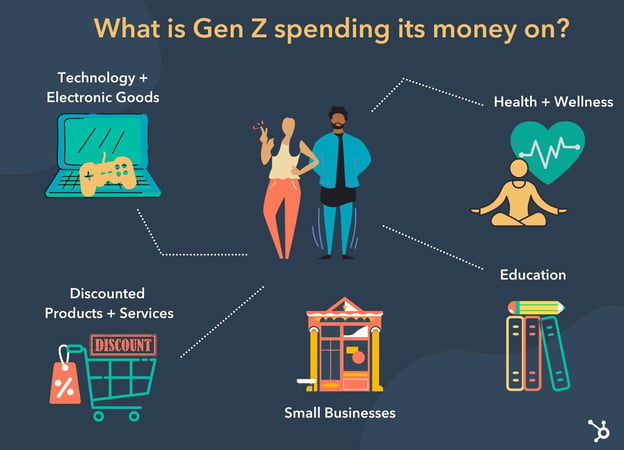
According to a 2021 Consumer Culture Report by 5WPR, Gen Z is prioritizing electronics and technology along with health and wellness.
Conversely, Millennials and those from older generations prioritize travel and experiences, home goods, and furniture.
Based on additional research, we also found that Gen Z also pays special attention to small businesses. They are also willing to wait for a good discount before making a purchase and take advantage of buy-now-pay-later purchasing options.
Let’s dive into each category below.
1. Electronics and Technology
Gen Z will occasionally splurge on technological experiences that help them have fun, such as video games. In fact, a 2019 study found that two-thirds of Gen Z men say gaming is a “core component” of who they are.
While you might worry that Gen Z isn’t worth marketing to because they won’t splurge on your products, this age group certainly can be persuaded to make larger purchases that offer fun experiences or improve their daily lives.
But, even though they will invest in higher-priced products, Gen Z will still need thorough convincing before pulling out their wallets. It’s incredibly important for brands targeting Gen Z to create content that demonstrates why the age group needs their product, how the product could solve daily boredom or woes, and why it’s better than a competitor’s.
For example, although some consumers might consider Fitbit fitness trackers frivolous, this brand does a great job of explaining why its product can be a necessary tool to use within a fitness routine.
On social media, Fitbit gives facts about why walking and cardio – two activities the bracelet can track – are important to health. And, in a November blog post, Fitbit more deeply connected its product to health needs by discussing how its reporting software could help people communicate better with their doctors.
While Fitbit doesn’t claim its product is necessary for health, the brand shows audiences how the product can be used to help them track their fitness needs and progress.
When a pessimistic or budget-conscious Gen-Z member researches Fitbit, they might find its content informative and helpful. From there, if they’re interested in a healthier lifestyle, they might realize that Fitbit is a credible brand that could help them with their fitness needs.
2. Discounted Goods
Eighty percent of Gen Z surveyed in 5WPR’s report say they will wait for an item to go on sale before buying it.
Why is Gen Z so conscientious about their spending habits? Mounting research suggests that the age groups’ thoughts on money link directly to the economic era they were raised in.
While millennials grew up in more stable financial times, most of Gen Z’s earliest memories took place during the U.S. recession. Much of this generation grew up in highly budgeted households or saw how their families were impacted by economic troubles.
Meanwhile, a large percentage of millennials, as well as those in other age groups, are able to recollect times where their economy was booming.
Organizations including the Pew Research Center say these eras have psychologically molded how each generation thinks differently about money. While researchers believe both millennials and Gen Z are money conscious, with goals of avoiding financial instability, millennials are considered to be “more optimistic” future finances.
As Gen Z ages, studies and purchasing behaviors hint that they haven’t been able to shake their concerns of financial instability. Much research shows that to get Gen Z to invest in a product or service, the offering needs to be so valuable to them that they can justify purchasing it.
A recent Business Insider report revealed that Gen Z isn’t easily persuaded by a logo when it comes to clothing. In fact, unlike other generations, brand loyalty is one of the last things they think about when making a purchasing decision. What the generation does focus on is price and value.
In the report, a 20-year-old named Amanda Chermin explained, “I can’t afford nicer brands of clothes – I like to save and would rather have money in the bank than be broke.”
Instead of splurging on the hottest brand from New York Fashion Week, the age group is more likely to purchase cheaper clothing that’s either not from a name brand, on clearance, or re-sold.
Or they’ll buy now and pay later (BNPL).
Millennials are the leaders of the BNPL model but Gen Z is growing the fastest, accounting for 14% of users on Afterpay in the U.S.
80% of Gen Zers who use the software spend it on fashion. However, wellness, beauty, and recreation are other top categories.
Although they aren’t loyal to the same stores and brands millennials zoned in on, Gen Z still feels pressure to buy and wear clothing that’s considered good quality or fashionable. Aside from purchasing affordable clothing, the need to look their best has also led to many in Gen Z to invest in clothing rental services or try-before-you-buy shopping experiences.
Although Gen Z is expected to spend less money on clothing than other generations, researchers believe they still feel pressure to look good in front of their peers. These pressures, which might stem from social media, school, work, or social environments will still drive the age group to clothing stores or ecommerce sites. While retail marketers should expect shifts in spending behaviors from this generation, Gen Z will still buy clothing that looks good on them, is good quality, and has an affordable price.
The themes related to clothing purchases are important to keep in mind — even if you aren’t marketing clothing products. As we’ve established, Gen Zers are always looking for a good bargain and won’t use just a brand name to justify a purchase.
Regardless of how popular or well-known your brand is, you’ll still need to highlight why your products are better than cheaper versions from competitors.
Although your logo might not persuade Gen Z to buy your product, you can still use authentic brand trust and popularity to your advantage. Although Gen Z is budget-conscious, they also care about what their peers think of them. This means that they might still feel a need to splurge on a product, such as a clothing item if they know that people in their age group have it.
If you’re marketing to Gen Z, consider asking popular influencers or happy young adult customers to discuss your product on social media. An authentic product review will not only build a sense of brand trust, but it will also show Gen Z audiences that the product is popular and being used by people they follow.
From there, a Gen Z member might research or purchase a product simply because it’s more popular or has better reviews than a cheaper alternative.
3. Health and Wellness
In 2019, a survey found that Gen Z was more concerned with mental and physical health than older generations. Today, that still rings true.
Health and wellness is the second-highest category Gen Z spends on, according to 5WPR’s 2021 consumer report mentioned earlier.
In fact, this group seems to be leaders in the wellness movement building over the past few years, which promotes awareness surrounding mental health, ethical food sourcing, other related wellness issues.
For instance, WSL reported that Gen Zers are more likely to use natural remedies than traditional medications, seven points higher than Millennials. They’re also less likely to eat fast food.
The article also highlights how Gen Z also invests more (5% to be exact) in wellness than Millennials, a data point that’s reflected in 5WPR’s 2021 Consumer Culture Report.
4. Small Businesses
Since January 2020, small business spending has increased more than 260% for Gen Z on Afterpay, 80% higher than Millennials.
This conscious effort likely stems in part from the recent pandemic, as many small businesses struggled to survive.
In a June 2021 survey conducted by Sendinblue and CITE Research, 46% of Gen Z consumers said they purchased more from small businesses than pre-pandemic.
Most were driven by the ability to build a strong bond between consumers and contribute to the local economy.
Another interesting reveal is that consumers are more willing to share their data with small businesses, in exchange for discounts and deals. Another caveat is that brands must share how the information will be used.
This is great news for small businesses that are figuring out how to reach Gen Z consumers. It’s an invitation to be more transparent about your business and not be afraid to show what’s happening behind the scenes.
5. Education
Another key component of generation Z’s spending habits is education.
While millennials are one of the most highly educated age groups, Gen Z is on track to have the highest level of education.
In 2020, the Pew Research Center reported that college enrollment is more likely in Gen Zers than Millennials and Gen Xers at a comparable age. They’re also more likely to have a college-educated parent.
At this point, Gen Z’s already been shown to start saving for college at a much younger age than millennials.
As members of the generation enroll in college or begin to spend their own money, news outlets have predicted and reported bursts in school-related purchases fueled by Gen Z shoppers.
Aside from purchasing supplies, Gen Z is also likely to invest in courses or educational programs that will advance their future earnings.
From 2019 to 2020, Gen Z learners watched 50% more hours of educational content on LinkedIn. They also spend 12% more time honing hard skills on LinkedIn Learning than the average learner on the platform.
Ultimately, many researchers believe that Gen Z’s interest in academia is rooted in their need for financial stability. Many in the age group believe that a good education will lead to a great job with high pay.
As a marketer, it’s important to keep Gen Z’s budgeting and educational goals in mind. This generation wants to learn new things, is saving for college, and prioritizes investments that better their future. You’ll need to convince them that your product is worth buying – even when they’re putting most of their money into a college fund.
As you create your product promotions or campaigns, consider how your product could help or benefit the experiences of someone planning for college, college students, or young professionals.
If your product isn’t specifically geared toward education, your campaigns could zone in on how it could improve a college or work-life experience.
For example, if you’re marketing furniture, you could create a promotion that highlights products that would fit in an apartment or dorm room. Or, if you market a clothing company, you could highlight clothing items that could be worn in a job interview in a blog post on your website.
Aside from creating content that directly links your product to career interests or academics, you can also lean into Gen Z’s need to learn new things by developing educational content that teaches audiences about your industry.
After viewing your educational content, audiences might want to learn more about your product and develop a stronger sense of trust for your brand. Later, if they’re interested in buying a product related to your brand’s industry, they might consider your brand first.
If you want to leverage educational content, keep the age range of your audience in mind. While younger members of Gen Z might be primarily interested in B2C brand content due to their college or high-school age, Gen Zers entering internships or the workforce might value educational B2B content that can show them how to get ahead in their industry.
How to Market Based on Gen Z’s Spending Habits
Based on research noted above, Gen Z is less likely to splurge on frivolous products or brand names. As a marketer, hearing about these mounting studies might make you nervous.
But, in the long run, the consumer trend of putting value first shouldn’t scare or shock you. In fact, it should motivate you to ask, “How can I provide better value to my customers?“
Although Gen Z might seem more budget-conscious, this doesn’t mean they won’t buy anything from you at all. In fact, many of your most frugal prospects will still buy, invest in, or splurge on your brand’s offerings if they seem valuable, help them solve pain points, or provide a positive, memorable experience.
Ultimately, bettering your brand, focusing on the customer experience, and promoting positive company reviews will go a long way with Gen Z and all other audiences.
Editor’s Note: This post was originally published in July 2020 and has been updated for comprehensiveness.

The Ultimate Guide to Database Marketing
No matter what your service or product is, you need to get in front of potential customers in order to make the sale. Many businesses put their faith in social media.
While social media platforms are an amazing way to get in front of people, they have two major drawbacks. First, you may have tens of thousands of followers on your platform of choice. However, thanks to algorithms that few (if any) humans understand, you only reach a small percentage of those followers with any given post.
Second, what happens if that platform ever goes away? Don’t think for a minute that you’ll receive a neat list of contacts. If a platform ever shuts down, your audience will evaporate in seconds.
Fortunately, knowing this is half the battle. Now that you understand that you don’t “own” your contacts through social media, it’s time to look at how to safeguard your audience and take ownership of and responsibility for their contact information and data.
This is called Database Marketing and you’re about to learn why it’s essential to your business as well as how to utilize it properly.
What is database marketing?
Before our digital landscape became as vast as it is, businesses would collect names and addresses and send out direct mail pieces like postcards, brochures, flyers, etc. to potential and existing customers.
While traditional direct marketing still exists and can be an asset to your business, digital options give business owners a world of choice when it comes to reaching their audience. It allows you to figure out how customers want to be marketed to and then give them what they want.
Database Marketing is where businesses collect customer data such as:
- Names
- Addresses
- Phone numbers
- Purchase history
- Customer support history
Once collected, this information is used to create personalized experiences for each customer and house personal and buying information about them.
The Benefits of Database Marketing
Now that you understand what database marketing is, you can determine if it’s right for you.
Hint: It’s probably right for you.
No matter the size of your business, keeping your database fresh, constantly adding to it, and nurturing it is absolutely essential to your business success. You’ll see a variety of benefits, such as:
1. “Own” your contacts.
Information is power, and when you put all of the power in the hands of social media platforms, you put your future in jeopardy. Social media is wonderful and should be a part of your marketing plan, but it shouldn’t be the whole plan.
2. Speak directly to your audience members.
It’s so loud out there! It’s impossible to turn on the television or the radio, or surf the web without being bombarded with marketing and sales messages touting the next best thing that you absolutely must have.
These messages are meant to cast a wide net and reel in any customers they can. You, however, are savvy. You know that in order to be “heard” above the noise, you’ll need to adjust your messaging to your specific audience. Database marketing allows you to do this.
3. Identify avatars or buyer personas.
Who is your best customer? How do they live? What keeps them awake at night? What problem of theirs have you been able to solve? Where can you find more people just like them?
Database marketing allows you to understand your ideal customer and then target individuals who “look” just like them on paper.
4. Segment your buyers.
Create different “audiences” based on their demographics, behaviors, and buying history. This helps you understand them better and offer them more of what they want and less of what will lose their attention.
5. Create loyalty programs that inspire repeat purchases.
Figure out what is the best channel and time to contact your customers so you receive maximum engagement.
6. Kick your customer service into high gear.
Give your staff the opportunity to view all of the interactions a customer has had with your brand.
Database Marketing could be the answer to your business prayers. Of course, like anything, you have to do it properly to see a good return on investment. For that, we need to look at building a database marketing strategy.
Avoid These Pitfalls of Database Marketing
Before we dive into strategy, let’s look at a few challenges you may encounter with database marketing.
1. Data Decay
People move, change jobs, change names, abandon email addresses, and start new ones. Life changes like these could render their information relatively useless.
2. Data Accuracy
Typos happen. Sometimes accidentally, but sometimes purposefully. Some customers know that you’ll be sending them marketing emails once they provide an email address, and they don’t want to hear from you.
That’s okay. If they don’t want to hear from you, you don’t actually want to reach them because they aren’t your ideal audience.
While there’s no easy way to avoid purposeful typos, avoiding accidental errors is possible with drop-down choices instead of blank comment boxes. You can also confirm people’s information when you speak with them.
It’s important to clean up your database frequently, purging contacts with out-of-date or inaccurate information, and merging contacts with multiple profiles. This allows you to focus on reaching the people who could be your next customer or client and take care of those who already are.
3. Using Customer Data Quickly and Appropriately
If you’ve ever received an email two years after doing business with someone, it’s probably come as a shock. Chances are, they don’t update their database in a timely fashion so they completely missed the window to build rapport with you after that first interaction.
Don’t make this mistake. Once you receive information, greet them in some manner and then touch base with them on a regular schedule to nurture the contact. You’ll also want to keep their information to yourself.
Tips for Building a Database Marketing Strategy
Without a strategy, you’ve just got a whole lot of pointless data. Put your database to work for you by creating a sound strategy from the very beginning. Here’s how:
1. Identify who you want to reach.
Who is it that you’d like to do business with and what do they look like on paper? This can include demographics like age and gender, marital status, income level, and location. It might also include psychographics such as their interests, activities, and opinions.
Create an ideal customer profile or persona and then use this to determine what information you need to capture for your database.
2. Make it a team effort.
While it may have “marketing” in the title, database marketing can be influenced by multiple departments in your organization. The marketing, sales, and customer service or support departments all have contact with potential and existing customers. Look for feedback from them to build the most effective database.
3. Use the right tools.
There are countless database marketing software options out there to meet your needs. Do some research, ask for recommendations, and find one that suits your business best. Once you’ve chosen a solution, provide your employees with the training they need to utilize it fully.
4. Gather customer data.
Now that you know how you’re collecting data, it’s time to decide what you need and get started. The options are endless, however here are a few things to consider:
- Demographic Data – This includes gender, age, marital status, parental status, health, and financial status.
- Psychographic Data – This includes interests, actions, and opinions. What do they value? What type of lifestyle do they lead?
- Acquisition Data – Through what channel did they enter?
- Technographic and Activity Data – How do they connect with your brand? Is it through a desktop or mobile device? Android or iOS? Do they use your website, social media pages, or a mobile app to interact with your brand?
- Transaction and Correspondence Data – How often do they purchase from you and what do they buy? Have they reached out outside of a sales situation for assistance of any kind?
5. Keep your data clean and safe.
As we mentioned before, it’s very easy for data to become outdated and useless. Review it frequently and back it up so if something happens to your database, your entire customer history is not lost.
6. Don’t be creepy.
You can find out a lot about people on the internet. Just because you can doesn’t mean you should. Respect your customer’s privacy and don’t collect or brandish information on them that won’t help serve the end goal of earning the customer and serving them better.
Examples of Database Marketing
Database marketing can be used in a number of ways and really depends on your needs and goals. Here are just a few of the ways you can incorporate database marketing into your business.
Provide amazing customer support.
Acquiring customers is important, but if you can’t keep them, you’re just spinning your wheels. Your customer service team should have access to your customer database. This allows them to review a customer’s buying history when they call in with an issue.
Imagine knowing exactly what product they are calling about and expressing your ability to help with that product before they even launch into the problem. Your approach will be personalized and will save them time explaining.
For example: “Thanks for calling. I see that you just purchased our new state-of-the-art alarm system. I can help you get that set up today.”
Know what products and services your customer needs.
Having a chat about the weather is a great way to build rapport with a customer or potential customer. Do you know what’s an even better way? Not trying to sell them things they don’t need.
For example: Looking at a customer profile, you can see that they live in a high-rise apartment, have no pets, and have small children. You can skip trying to sell them the latest doggie door.
Identify your best customers and potential upsells.
When you understand who buys frequently and in large amounts, it becomes easier to identify options for upsells.
For example: Perhaps your customer has received a wine-of-the-month for two years now. You’ve just started a cheese-of-the-month add-on. You can target them with emails designed to introduce this new product opportunity.
There are a variety of ways to reach your existing and potential customers. A well-rounded marketing plan will include many of these. However, if you’d really like to get the most bang for your marketing buck, make sure that you include database marketing.
You’ll reach the customers you want to reach, and learn how to speak to them in a way that helps them hear what you’re saying. Your database will be the gift that keeps on giving.
