Welcome to My Blog
80+ Essential Social Media Marketing Statistics for 2022
Social media is everywhere and over the last two decades, it’s become one of the primary marketing channels.
With a solid chunk of the world’s population on social media, it’s critical that your business has an effective social media strategy that helps you reach your intended audience.
Here, we’ve compiled a list of essential social media stats to ensure you know where to focus your marketing efforts in 2022 to get the highest ROI.
![Download Now: Social Media Trends in 2022 [Free Report]](https://no-cache.hubspot.com/cta/default/53/3dc1dfd9-2cb4-4498-8c57-19dbb5671820.png)
Social Media Marketing Report Statistics from HubSpot
In November 2021, the HubSpot Blog surveyed 300+ social media marketers to learn about the strategies they use, the formats they leverage, and the challenges they face.
Here are some of the most interesting stats we discovered:
- 77% of social media marketers say social media marketing has been somewhat to very effective for their company this year.
- What’s more, 37% of marketers who said social media marketing was somewhat to very ineffective cited COVID-19, likely due to the rapid change in strategy.
- The numer one goal marketers report having for their social media marketing strategy is advertising their products or services, following by increasing brand awareness.
- 82% of marketers say they repurpose content across social media channels.
- The majority of marketers surveyed say they post on most social media platforms four to six times a week.
- The platforms with the lowest reported engagement levels are Twitch, Snapchat, and Clubhouse.
- Short-form videos is the top social media format used by 54% of social media marketers, followed by live streaming, live audio chatrooms, and user-generated content.
- 80% of marketers say funny content is the most effective on social media.
- 68% of marketers’ companies work with influencers on social media.
- The most popular cadence to search for new social media platforms is once a month, followed by once a week.
- 84% of marketers target Millennials as part of their social media strategy.
- The biggest challenge marketers face on social media is creating engaging content, reported by 27% of respondents.
- 67% of marketers say they work with micro influencers with 10K-100K followers or subscribers. Conversely, only 29% say they work with mega influencers with more than 1 million followers.
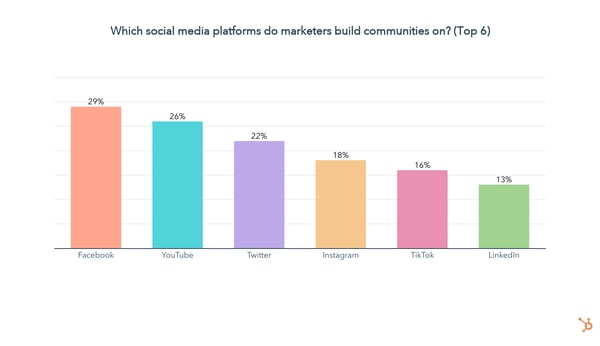
- 64% of marketers say they invest in building social media communities.
- 25% of respondents said they believe funny content is most effective with Gen Z.
Channel-Specific Social Media Statistics
Facebook Statistics
- In a 2021 HubSpot Blog poll, 79% of marketers report buying paid advertising on Facebook. (HubSpot)
- Users spend an average of 19.6 hours a month on Facebook. (HootSuite)
- Facebook is a popular source of news with 31% of Americans regularly getting their news from the platform. (Pew Research)
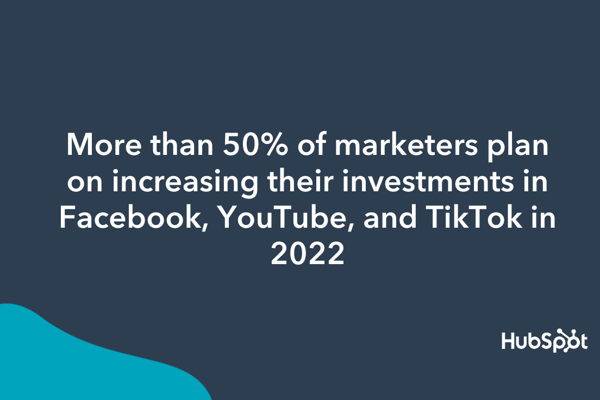
- According to the same poll, more than 50% of marketers plan on increasing their investments in Facebook, YouTube, and TikTok in 2022. (HubSpot)
- Facebook has 1.96 billion daily active users as of Q1 2022. (Statista)
- 98.5% of Facebook users access the platform on mobile devices. (Statista)
- In a 2021 survey conducted by the HubSpot Blog, Facebook was ranked #1 in social media investment, highest quality leads, and ROI for paid ads. (HubSpot)
- Facebook ads are used by 70% of marketers, and there were 10 million active advertisers on the platform in Q3 2021. (Social Media Examiner , Statista)
Twitter Statistics
- Twitter has reached 229 million daily active users as of the first quarter of 2022. (Statista)
- In a HubSpot Blog poll, 79% of marketers plan to continue investing in Twitter Spaces in 2022. (HubSpot)
- Link clicks account for 92% of all user interaction with tweets. (HubSpot)
- The best time to post on Twitter is at 9 AM, and the best days to post are Tuesdays and Wednesdays. (Sprout Social)
- Tweets with hashtags get 100% more engagement. (Twitter)
- 99% of marketers surveyed in a HubSpot Blog poll say they plan to continue to invest the same amount or increase their investment in Twitter. (HubSpot)
- 93% of Twitter community members are open to brands getting involved in conversation, such as providing help and support. (Twitter)
For more on Twitter, check out Twitter Marketing: The Ultimate Guide.
Instagram Statistics
- In a 2021 HubSpot Blog poll, 58% of marketers plan to leverage Instagram Reels in 2022. (HubSpot)
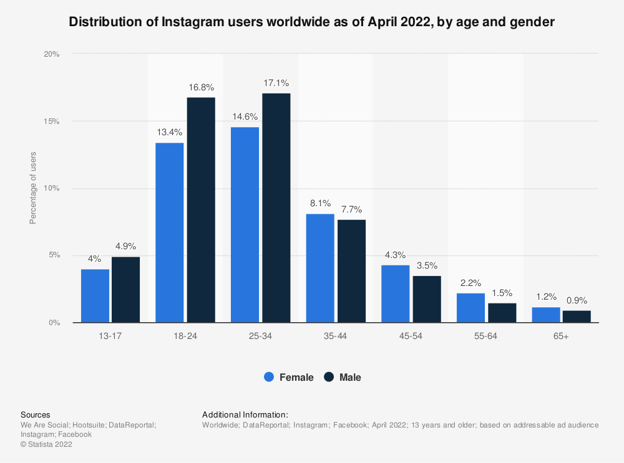
- 64% of Instagram users are under the age of 34. (Statista)
- 20% of marketers surveyed in a HubSpot Blog poll report generating the biggest ROI when working with influencers on Instagram, only behind Facebook. (HubSpot)
- 98% of marketers say Instagram is the most influential platform for influencer marketing, which is 44% higher than Facebook. (Sprout Social)
- Videos get 21.2% more interactions compared to images and 18.6% more interactions compared to carousels. (Sprout Social)
- 61% of social media marketers surveyed in a HubSpot Blog poll say they plan to increase their investment in 2022.
- 90% of people on Instagram follow a business. (Instagram)
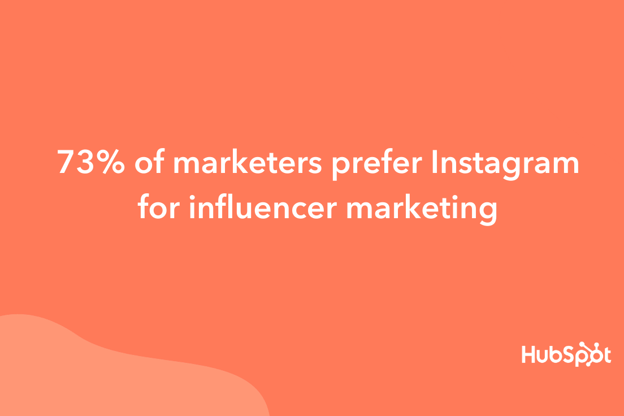
- In a 2021 HubSpot Blog poll, 73% of marketers prefer Instagram for influencer marketing. (HubSpot)
- The best times to post on Instagram are Wednesday at 11 AM, and Friday between 10-11 AM. Sunday is the worst day for engagement. (Sprout Social)
Check out more Instagram stats here.
LinkedIn Statistics
- LinkedIn has more than 830 million active users in 200 countries and regions worldwide. (LinkedIn)
- The most popular day to post on LinkedIn is on Saturdays and Sundays. (HubSpot)
- According to a HubSpot Blog survey, most marketers post on LinkedIn four to six times a week. (HubSpot)
- When it comes to B2B display ad spend, LinkedIn makes up the largest share at 32.2%. (eMarketer)
- As of January 2022, 59% of LinkedIn users were between 25 and 34 years old. (Statista)
- In Q3 2022, LinkedIn revenue is up 34% in YoY growth. (LinkedIn)
- 87% of marketers surveyed in a HubSpot Blog survey said LinkedIn offered average or high ROI. (HubSpot)
- 82% of B2B markers report finding the greatest success on LinkedIn. (LinkedIn Marketing Solutions)
- Over 46% of all social media traffic to company websites comes from LinkedIn. (LinkedIn)
- 40% of marketers surveyed in a HubSpot Blog survey say they plan to increase their investment in the platform in 2022. (HubSpot)
- The best times to post on LinkedIn are on Tuesdays from 10 a.m. to noon. The worst days are on weekends – with Saturdays and Sundays offering the lowest engagement levels.(Sprout Social)
Want to learn how to up your marketing game on LinkedIn? This post walks you through the ins and outs of using LinkedIn for business.
YouTube Statistics
- YouTube is the second-largest search engine globally. (Alexa)
- YouTube generates over 1.7 billion unique monthly visitors. (Hootsuite)
- 42.5% of marketers use YouTube for influencer marketing, according to a 2021 eMarketer report. (eMarketer)
- 50% of social media marketers surveyed by the HubSpot Blog say they plan to increase their investment in YouTube in 2022. In fact, 20% of respondents say they plan to invest in this platform the most. (HubSpot)
- The number of YouTube users is projected to reach 2.8 million by 2025. (Statista)
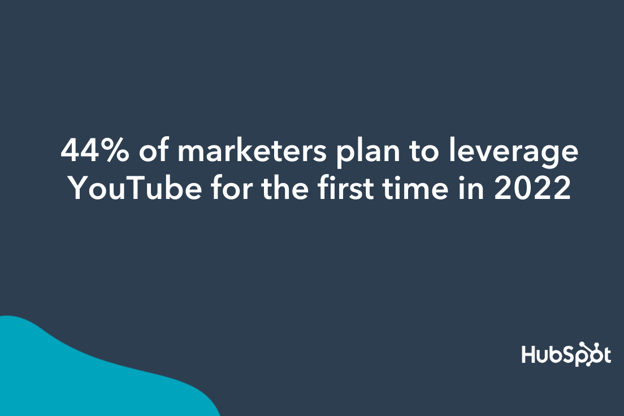
- In a 2021 HubSpot Blog poll, 44% of marketers plan to leverage YouTube for the first time in 2022. (HubSpot)
- On mobile devices alone, YouTube reaches more adults aged 18 to 24 than any TV network. (YouTube)
- YouTube accounts for more than 25% of total worldwide mobile traffic. (Sandvine)
- Users spend the most hours on YouTube than any other social network at 23.7 hours a month. (HootSuite)
TikTok Statistics
- 70% of TikTok users agree they feel a deeper connection to people they interact with on TikTok compared to other social networks. (TikTok)
- In a 2021 HubSpot Blog poll, 61% of marketers plan to increase their investment in TikTok marketing in 2022. (HubSpot)
- Douyin, TikTok’s original standalone app in China, had 300 million users at the time Musical.ly merged with TikTok. (The Verge)
- Two out of three users are likely to buy something on TikTok while using the app. (TikTok)
- TikTok was the most downloaded app of 2021. (HootSuite)
- 61% of marketers surveyed in a HubSpot Blog poll say they plan to increase their investment in TikTok in 2022. (HubSpot)
- 12% of marketers surveyed in a HubSpot Blog poll say they work with influencers the most on TikTok. (HubSpot)
- A majority of U.S. TikTok users are between the ages of 10 and 19. (Statista)
- Globally, users spend an average of 19.6 hours a month on TikTok on android phones. (HootSuite)
- 61% of U.S. TikTok users are female. (Statista)
- The most popular time to post on TikTok is between 3 p.m. and 9 p.m. (HubSpot)
- TikTok’s average engagement rate is high at all follower levels. (Influencer Marketing Hub)
Reddit Statistics (65)
- As of Q3 2021, the Reddit mobile app was counting more than 13 million daily active users worldwide on iOS. (Statista)
- 50% of marketers surveyed in a HubSpot Blog poll plan to increase their investment in Reddit. (HubSpot)
- The site receives more than 50 billion+ monthly screen views. (Reddit)
- 23% of marketers surveyed in a HubSpot Blog poll plan to leverage Reddit for the first time in 2022. (HubSpot)
- Most Reddit users in the U.S. are male, but 15% of U.S. adults say they use the platform. (Statista)
- Only 2% of social media marketers surveyed in a HubSpot Blog plan to invest in Reddit the most in 2022. (HubSpot)
- 49% of marketers surveyed in a HubSpot Blog poll buy paid ads on Reddit. (HubSpot)
- Reddit is an unlikely place for influencer marketing but 38% of marketers surveyed in a HubSpot Blog poll say they work with influencers on the platform. (HubSpot)
Social Media Consulting Services
Many businesses hire external social media consulting agencies to manage their voice and reputation online.
Alternatively, some businesses create roles in-house for a social media consultant — this is someone who is responsible for increasing brand awareness, responding to customer service complaints across social media platforms, and engaging with your audience online.
Whether you’re considering hiring an external social media consulting service or creating a role in-house, take a look at these trends that demonstrate the importance of social media consulting:
- Answering a complaint on social media can increase customer advocacy by 25%. (Convince & Convert)
- 79% of consumers expect brands to respond within a day of reaching out over social media, but average brand response rates across all industries is lower than 25%. (Sprout Social)
- 79% of people say that user-generated content on social media significantly impacts their purchasing decisions. (Stackla)
Pitching Social Media Consulting Services
All these stats have given you the data you need to work with — now it’s time to put your knowledge to use and create your own social media consulting proposal.
If you’re a social media consultant and you’re pitchinga branding, marketing, or advertising campaign to a client, it’s critical you’re able to show how you’ll help your client grow their business.
Here are six steps you’ll need to take to ensure your social media consulting proposal or business plan is effective:
- Set clear goals. Figure out exactly where your company or client wants to go as far as their business and social media numbers. The clearer and more detailed the vision, the better. Follow SMART Goal guidelines to ensure that you’re on the right track.
- Understand your customers. Know your target demographics because these are the people you’re trying to reach and engage. Gather your own social media statistics and use existing data your company or client might already have to figure out who’s interacting with the business and who might be good future prospects to reach. After you’ve done your research, you can create useful character personas to help you better understand and categorize customers.
- Understand your competition. Those “similar-but-different” companies are going to be out there. And, as with most aspects of the business world, the better you know them, the better you can know how to have a leg up on them. You can conduct this research at the same time you’re researching your customers, because chances are they’re interacting with competitors as well. Once you’ve gathered the data on your competitors, one of the most effective ways to use it is to figure out where there might be voids in their services that your business can fill.
- Be familiar with any existing social media presence. If you’re hired to run a company’s social media accounts, it’s critical you know about any previous social media postings, accounts, and experiments. By understanding what your client has already tried, you’re better equipped to take them where they need to go in the future.
- Don’t forget to pull your data. Before your new implemented strategies go underway, it’s important to collect a baseline of how it was before, so that you have something to measure against in the future. For example, if you take inventory of how many views you’re getting on Instagram Stories before the new strategy is in effect, you can see if the new ideas are improving these numbers or not. It’s important to keep a close eye on what is affecting your growth (positively or negatively) so that you know when you’re on the right track or when you need to try something new so your business can keep growing.
- Develop your strategy based on your findings. Define what your content will be, what platforms it will be distributed on, and how it will vary between platforms. Figure out smaller details at this stage too, like your client’s tone and voice on social media (either what it currently is or what it should be), along with design and style elements. Always be sure you’re staying true to your company or client’s brand by consulting with existing materials like mission statements, guides, or brand books.
Finally, take a look at HubSpot’s free Marketing proposal template (useful for both PDF & Word) to get you started creating a comprehensive social media consulting proposal.
Let Data Drive Your Social Media Strategy
Social media marketing statistics can show you the state of the business world today, where it might be going, and how you can ensure your business is continuously meeting customers where they want to be met. Use these statistics to your advantage to help you understand what you need to do to effectively use social media for your business today.
Editor’s Note: This blog post was originally published in August 2019, but was updated for comprehensiveness and freshness.

How to Write an Ecommerce Business Plan [Examples & Template]
If you have a promising idea for an online ecommerce business, it’s important to create an ecommerce business plan to ensure your vision has enough stock to be profitable.
Having a business plan for your online store will help you define your target market, establish your monthly and quarterly sales goals, and increase the likelihood of long-term ecommerce success.
In this post, we’ll go over what an online store business plan is and how you can create one for your ecommerce startup. Let’s get started.

Whether a company operates as a startup or has years of operations and growth under its belt, an ecommerce business plan is essential for evaluating a business and determining areas of improvement.
An ecommerce business plan is especially important, with an increasing number of shoppers conducting business online. It’s estimated this number has reached over 2 billion. Having an ecommerce business plan keeps you organized and is useful when seeking investors who need to understand your company.
So, let’s dive into some examples of ecommerce business plans and what goes into writing one using our free template.
Ecommerce Business Plan Template
Download Your Free Template Here
HubSpot’s template provides clear steps to structuring one for your ecommerce business. Throughout this section, I’ll use the example of a photography company specializing in online photo editing.
1. Give an executive summary.
An executive summary is a one-to-two page overview of your business. The purpose of an executive summary is to let stakeholders know what the business plan will contain. HubSpot’s free template offers some tips on how to write one, as I’ve done below:
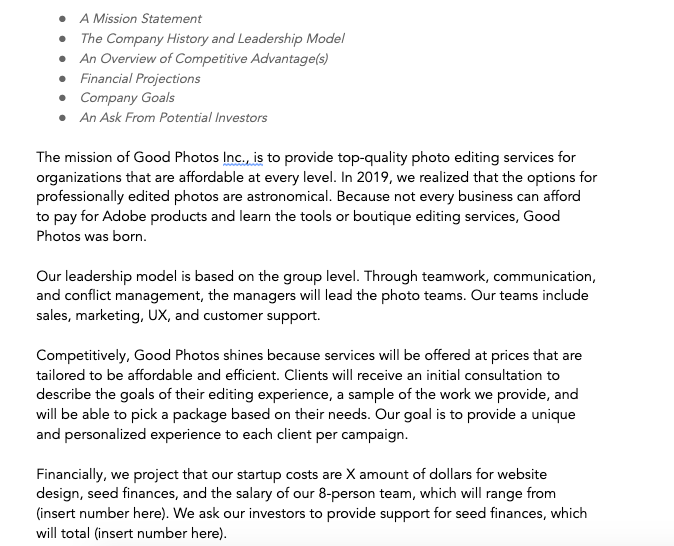
It’s important to provide an executive summary so that an investor or executive, who doesn’t have the time to read your full plan, can quickly see the most important highlights of your business.
2. List and describe your business.
This is the section that needs the most detail because it highlights what you’re selling. To begin, provide an overview of your product or service. For instance, a photography company would probably list their photo packages arranged by price and services, as I did below:
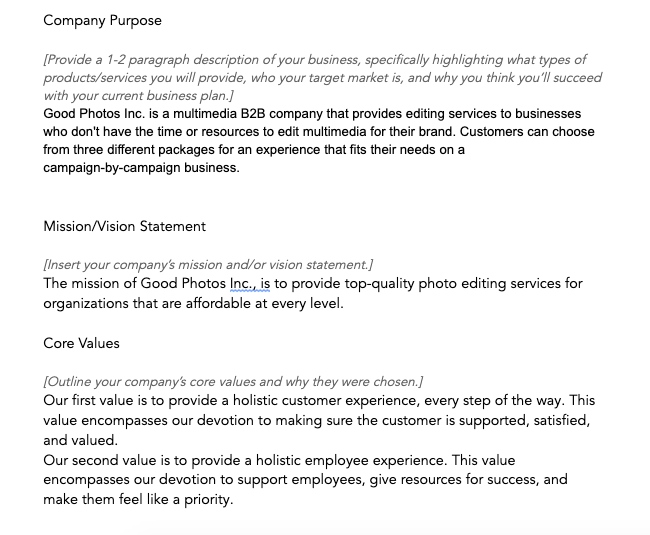
HubSpot’s template also provides direction on how to describe your company’s purpose and break down values. It also advises businesses to include team structure, if applicable. Below that, you should go into detail about your product and service lines.
3. Detail your products and services.
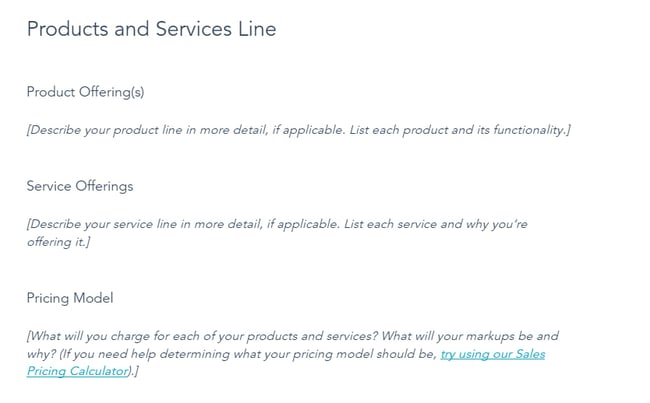
Once you have described your business and its purpose, you’re ready to dive deeper into your plan. What products and services do you or will you offer? This is an opportunity to list each item and its purpose, allowing you to answer the question ‘why?’ Why are you choosing to offer these specific products and services?
After detailing your products and services, outline your pricing model. What is the cost associated with each service? Determining price, especially as a startup, can be challenging. However, sales pricing calculators help determine the best pricing strategy.
4. Conduct a market analysis.
For the market analysis, provide the operational climate of the industry you’re in. To illustrate, at this step, the photography company would need to analyze its position in a world of rival companies like Adobe or online services like Canva. Below, I’ve done a quick competitor analysis, available in the template:
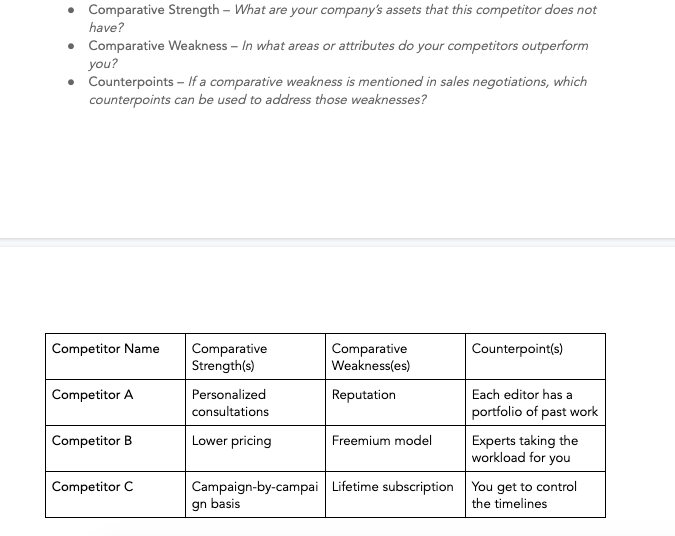
Using directions in the template as a guide, I was able to come up with more selling points of the company and how it stands out from competitors.
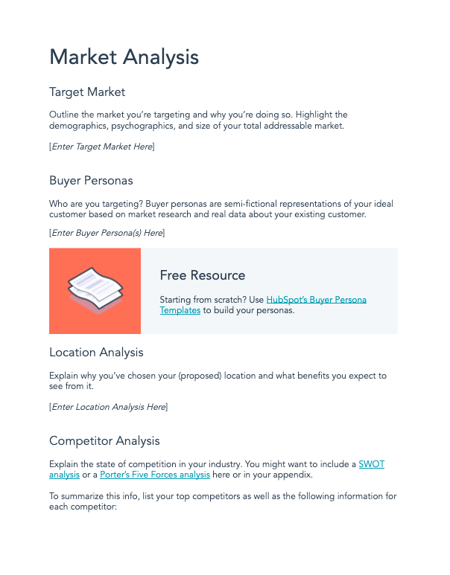
Filling out the market analysis section of the business plan assists with providing the framework for future campaigns. You’re able to define your target market and ideal customer. Refer to my example below for how to structure this analysis in your ecommerce plan.
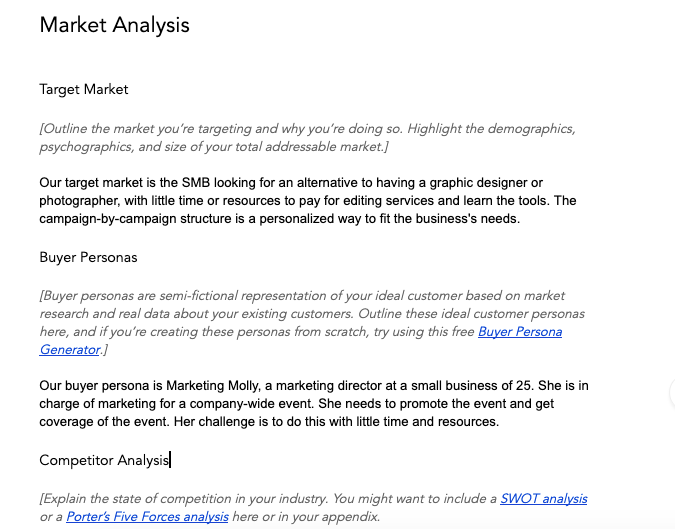
Good market analysis includes your target audience, projections of your company’s goals, and a breakdown of the competition’s goals and weaknesses. This is a counterpoint of how your business improves upon those weaknesses.
For a complete guide on how to create a market analysis, we have one here.
5. Strategize your marketing plan.
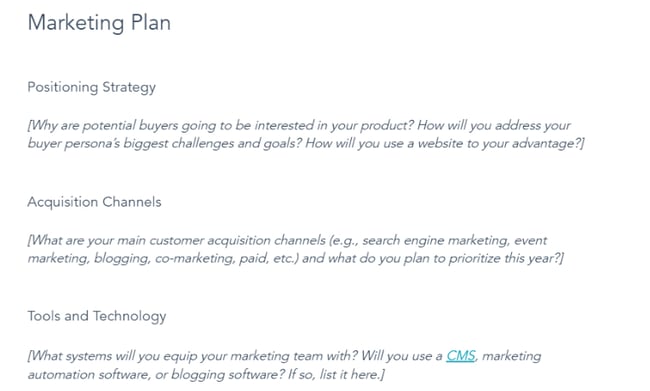
For any business, the marketing plan is crucial. It serves as a roadmap for how your company will build brand awareness, reach your target audience, and boost sales and revenue. As seen in this template, your marketing plan will focus on positioning strategy, acquisition channels, and tools and technology.
Positioning strategy fixates on how you will position yourself to your audience. How will you address their challenges and goals? How will you use the tools at your disposal to accomplish this?
The marketing plan will also require you to focus on where your customers come from. Are they finding your business through search engine marketing? Do they discover your business from your blog or social media accounts? Identifying your acquisition channels allows you to identify which ones to prioritize.
Lastly, your marketing plan should lay out the tools and technology your marketing team will need and use. Will you use a content management system (CMS) like CMS Hub? List all the software and programs your company will use to execute its marketing plan.
6. Create a sales plan.
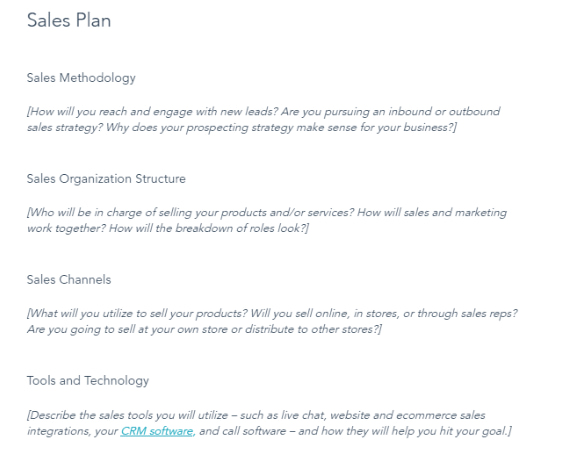
When creating your sales plan, describe your methodology, organization structure, sales channels, and tools and technology. For example, when discussing methodology, will you focus on an inbound strategy where you attract customers to your business through your content or an outbound strategy where you initiate contact with your prospects? This part of your ecommerce business plan will also require you to outline the people in charge of selling your products and services, as well as what channels they’ll use to sell your products.
Similar to creating your marketing plan, the sales plan will also require a brief on what tools you plan to use. While your marketing plan might need a CMS, your sales plan might need a customer retention management (CRM) software like HubSpot to manage your relationships with current and potential customers.
7. Outline legal notes and financial considerations.
In the following two sections of your business plan, describe the legal and financial structures. The photography company should provide detail on the legal considerations like online safety rules, ecommerce regulations, and the company’s costs.
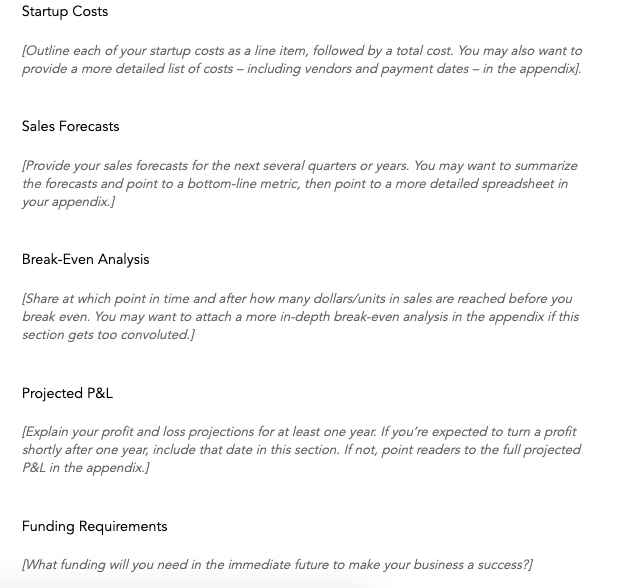
Listing legality and every cost needed to start ecommerce is crucial information for investors and stakeholders. In this section, it’s important to be honest and thorough to give partners a realistic idea of how to contribute.
Ecommerce Business Plan Examples
1. Maple Ecommerce Plan
This sample plan, provided on LinkedIn, is for a fictional company called Maple, an online store that sells exclusive Apple products. Maple’s sample plan is great because it provides easy-to-follow charts and graphics while highlighting the most important information. For example, their market analysis included a SWOT plan for the business.
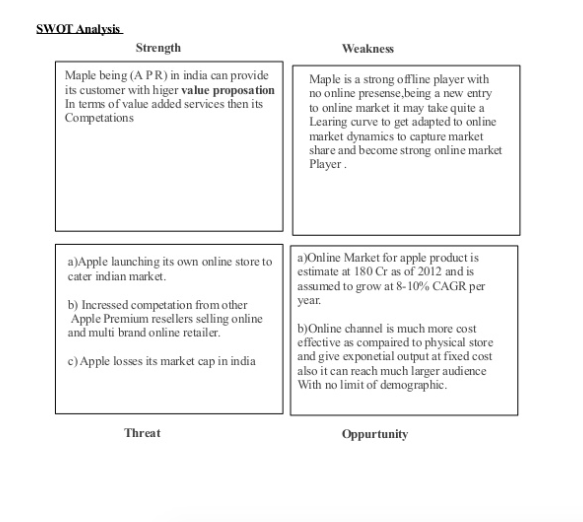
Outlining the strengths, weaknesses, threats, and opportunities of Maple in this format is easy for potential investors to follow. Notating each value with a letter keeps the format consistent, which is carried throughout the plan. For businesses that find their information is best presented in graphics, Maple is a good plan to follow.
2. Nature’s Candy Ecommerce Plan
Nature’s Candy is an online retailer that provides nutritional supplements. Its business plan is available online and is helpful in seeing how businesses go from planning to execution. Below is a preview of its plan in the financial forecasting section.
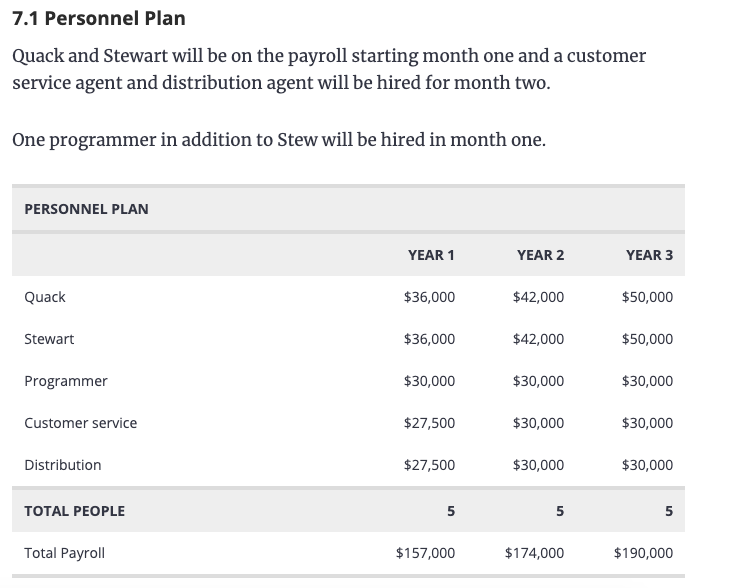
This example shows who will be on payroll yearly, giving investors an idea of how their investment will work in the long term. Planning ahead also shows stakeholders’ dedication to starting up your business.
3. NoHassleReturn Ecommerce Plan
Fictional company NoHassleReturn’s sample ecommerce plan is an expansive, detailed version of how ecommerce would translate to a completely online store. The company itself is structured to offer a way to make returning items bought from an online store a simple process, and the steps to take are featured below.
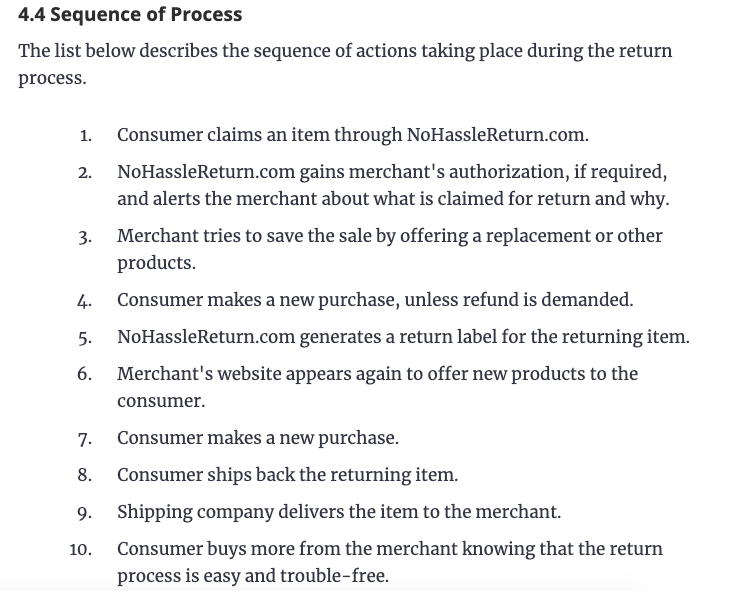
Having a sequence of processes like this is useful if your company is a niche idea. Investors and stakeholders need to know how your business will be new and unique for the market.
Even though writing out a business plan seems like a painstaking process, we have a step-by-step guide to help. This will keep you organized and keep you on track when structuring your business.
4. OGS Capital Ecommerce Plan
This sample ecommerce business plan comes from OGS Capital, where they created a test business plan for Botswana’s first private psychiatric hospital focused on inpatient and outpatient clinical health care. It features detailed sections for the business model, marketing plan, financial projects, and more. This level of detail is demonstrated below in their executive summary section.
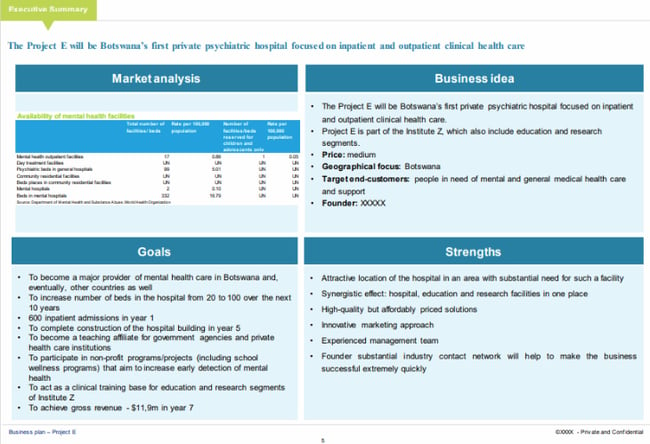
While some ecommerce business plans will explain the executive summary through a series of paragraphs, the layout in this sample makes the information more digestible. The project is separated into sections that detail the business idea, as well as its goals and strengths. The business idea includes price projects, geographical focus, and target customers. Goals for this project are created for 10 years with specific, individual goals built at one-, five-, and seven-year time markers. Lastly, this executive summary highlights the strengths of this business plan to solidify this project and its importance.
5. Egrocery Ecommerce Plan
For centuries, people have left their homes to buy groceries from stores, supermarkets, farmer’s markets, and more. At-home grocery delivery has grown in popularity and is reflected in this sample ecommerce plan for a fictional business named eGrocery. This sample plan establishes the company as an online grocery retail business with plans for connecting customers to distributors for fast, convenient at-home deliveries.
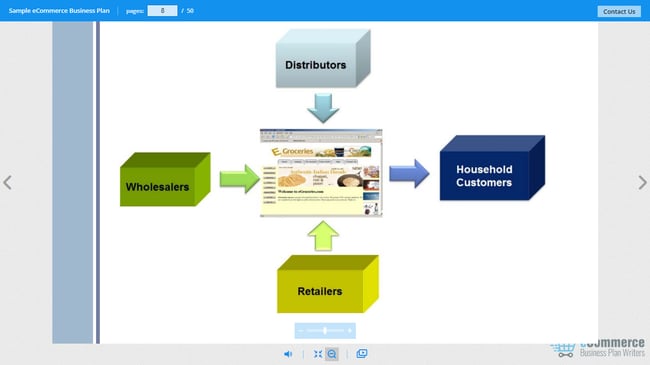
In its business model section, eGrocery outlines how it will implement both a business-to-business (B2B) and business-to-consumer (B2C) model to get products from distributors, retailers, and wholesalers to its household customers. This section provides an effective demonstration of the company’s overall function.
6. Shannon & Shavonne Inc. Ecommerce Plan
Shannon & Shavonne Inc. is a fictional United States-based online retailer that offers its customers an abundance of products in fashion, home appliances, electronics, and more. The depth seen in this plan is particularly helpful, especially with the detail seen in outlining the business structure and each job’s roles and responsibilities.
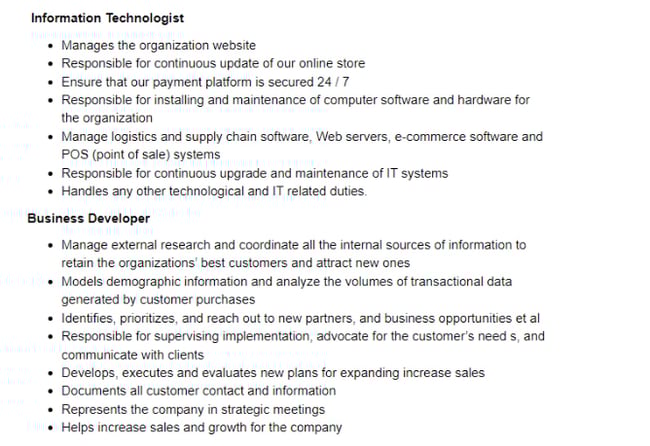
The plan first lists all the necessary roles, from the chief executive officer (CEO) to a call center agent. It then describes the responsibilities of each role. As displayed in the image above, an information technologist (IT) would be tasked with managing the organization’s website, updating the online store, and ensuring the security of the company’s payment platform. The clear distinction of roles helps manage employee expectations and accountability.
7. Firstcry.com Ecommerce Plan
In this sample, we have Firstcry.com — a fictional ecommerce site that creates eco-friendly baby and feminine hygiene products. Because the company is looking for funding to launch the business, its plan focuses on its financial highlights and projections, which is crucial information for investors.
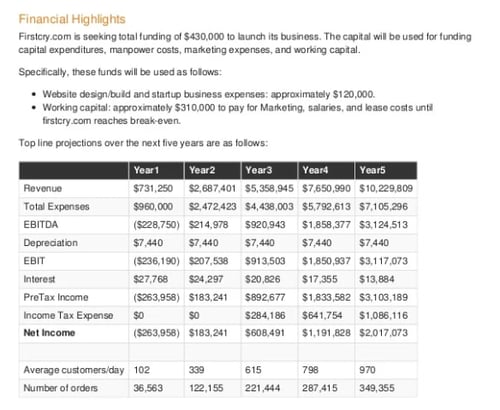
While disclosing what the startup funds will be used for, this plan also estimates its top-line projections over the next five years. As seen in the chart above, they include revenue, expenses, interest, and net income. The plan even breaks down how many customers per day and annual orders will be needed to reach this goal.
When it comes to building an ecommerce business plan, you’ll likely find that the more detail you include, the better.
Planning is the first step.
When starting a business, planning is always a crucial first step. If you find that you’ve launched a company without a concrete plan, it’s never too late. Successful businesses require strategy, and that’s what an ecommerce business plan gives you. It allows you to strategize what your business does, how it operates, and why it’s essential. Not only does it help you pinpoint who the key players of your company are, but it helps you identify who your target audience should be.
With the steps listed in this article and the examples to take inspiration from, you’re one step closer to building an ecommerce business plan for success.
Editor’s note: This post was originally published in November 2019 and has been updated for comprehensiveness.

Business Strategy: What It Is & How to Build an Effective One
In the business world, professionals are obsessed with tactics because they can help them meet their short-term goals. But if all you do is focus on the short-term, you won’t spend enough time or energy figuring out how you can succeed in the long-term.
Fortunately, building a strategy can help you achieve both your short-term and long-term goals. Strategy focuses on principles, which help you think, instead of tactics, which help you execute, so it allows you to concentrate on why your business does certain activities, not just how you do them or what you do. Read on to learn exactly what a business strategy is and how you can build an effective one today.
Your business strategy should be based on your overall vision for the company. For some brands it will be global market expansion. For others it may be more important to double down investing in existing markets they are already successful in. Regardless of your end goals, creating an effective business strategy will require thorough research beforehand.
1. Identify your business’ aspirations and values.
In business, traditional goal setting lets you measure what you do, but it doesn’t lend itself to gauging how you do it or why. And if you only focus on the results, it can sometimes incentivize you to take a course of action that prioritizes your organization’s needs over your customers’ needs.
To help you focus more on your purpose and process instead of just your results, consider setting and anchoring to an aspiration, or your vision for your business in the future when building your business strategy — it’ll inspire you to do work that better serves your customers. Once you set an anchor to an aspiration, you can add your goal to the equation, which will help you simultaneously produce customer-centric work and hit your numbers.
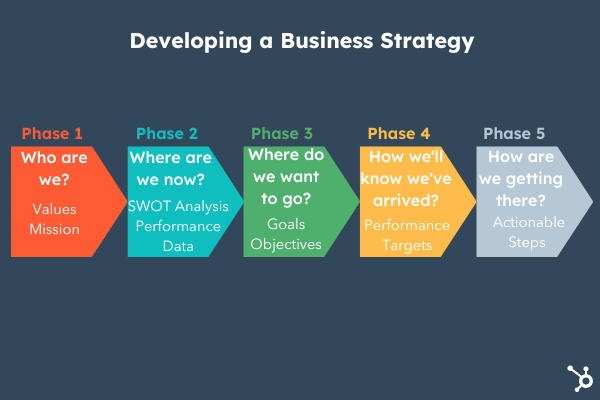
2. Conduct a self-assessment.
Once you’ve figured out your business aspirations and values, it’s time to conduct a self assessment to help you evaluate the best avenues for business growth and success.
You can do this by conducting a SWOT analysis to identify strengths, weaknesses, opportunities and threats to your business. What do you do well and how can you capitalize on that? What can be improved and how?
3. Pinpoint which segments of your market you want to capture.
Your product or service most likely isn’t the best fit for your entire market, so it’s crucial to pinpoint the segment or segments of your market that benefit the most from your product or service.
Customers who genuinely need and want your product or service are also the customers who retain the longest and are least likely to churn, boosting your customer lifetime value and lowering your customer acquisition costs.
4. Determine how you’ll beat your competition.
Ricky Bobby’s legendary saying that “If you ain’t first, you’re last” doesn’t necessarily apply to the business world, but it does have some bearing on it. Your customers won’t buy two of the same products or services, so if you want to capture as much of your segment of the market as possible, you need to place first in the majority of your target customers’ minds.
Some of the best ways to stay top-of-mind are crafting a creatively refreshing brand, differentiating your product or service from the rest of the crowd, and pricing your product relative to its perceived value.
5. Set clear goals.
Now that you’ve completed your research and established a vision for your business, it’s time to set some goals.
Think about what you want to accomplish and work backward to figure out the steps to get there. Setting business goals will help inform your strategy and how each department collaborates to achieve your objective. To start, you can come up with:
- Business goals: These are high level objectives you’d like the organization as a whole to accomplish.
- Department or team goals: These are key objectives delegated at the department level to help the organization achieve their overall goals.
- Employee-specific goals: Using departmental goals, establish goals for individual employees to contribute to reaching business goals.
These cascading goals will make sure that all stakeholders involved in executing your business strategy are on the same page and properly aligned.
6. Make a plan.
With your business goals defined, it’s time to make a plan to accomplish them. This plan should include actionable tasks your team can take and should outline the steps needed to achieve your mission or objective.
This plan can be rolled out as either a short-term or long-term plan or a combination of the two. Additionally you’ll want to check in with your plan often to make sure everything is still on track, and make adjustments as the business requires them.
7. Figure out which competencies are needed to beat your competition and sustain your business’ success.
Unfortunately, passion isn’t enough to beat your competition and rocket to the top of your industry. Talent and skill are just as crucial. Depending on your aspirations, goals, and market, you need to figure out which types of teams and employees you need to develop and recruit to not only beat your competition, but to also sustain your success.
For example you may need to recruit more engineering staff or hire a data science team with experience in your niche to achieve your goals.
8. Decide which management systems are needed to hone these competencies.
If your business is a team, then your managers are the coaches. They’re responsible for developing, supporting, and inspiring your employees to do their best work possible.
Establish check-ins with your team to ensure both employees and managers have what they need to succeed. Invest in technology that enables your team to work together more efficiently and propels your business goals forward. Because no matter how much raw talent your employees have,they’ll never reach their potential and, in turn, help the business reach its potential if they don’t refine the skills and discipline necessary to compete and succeed.
9. Measure your results.
It’s not enough to simply set goals and hope things work out. You’ll need to actively monitor your progress if you want to achieve greatness. As mentioned previously, you should be checking your plan monthly to make sure things are running as they should.
Evaluate your metrics to ensure your team is meeting key performance indicators (KPIs). If they are not meeting them, find out why and come up with a solution to get things back on track.
10. Be flexible and willing to adapt.
Along with measuring your results, it’s also a good to examine where your strategy is falling short and make changes.
Are their changes in the industry or external factors that impact your current strategy? This may be an opportunity for you to adjust your approach. Your plan is your roadmap, but it should also be flexible enough to pivot along with your business.
11. Consider hiring a business strategy consultant.
If all of the steps above seem overwhelming and you have the resources, consider hiring outside help. Business consultants can provide guidance and training to help you achieve your business goals.
Pros
- Expertise: Consultants often have a narrow area of focus — meaning when you hire one, you’re getting an expert in your selected field. They can help you build a framework or structure that aligns with your goals. They can also add a different perspective to tackling issues your team has tried and failed to resolve on their own.
- Unbiased: Since a consultant is not an employee of your company, they are not hindered by existing viewpoints or tradition and can look at your company with fresh eyes. This makes it easier for them to hone in on your goals and the best strategy to achieve them.
Cons
- Expensive: Hiring a consultant is definitely an added expense and will most likely cost more than paying an existing employee.
- No guarantees: Although consultants are experts, they don’t come with guarantees of success. Their is no guarantee of reaching a certain performance metric or number of sales. However, you can always vet consultants by asking for recommendations, looking at references and examining their work history.
Hiring a business strategy consultant is a great option if your team has been struggling with the steps above without success. A third party may pick up on business insights you may have missed.
Principles Over Tactics
We live in a day and age where the internet is overloaded with advice. You have access to countless amounts of tips and tricks that could potentially help you build a successful business. But without the ability to think critically about whether these tips and tricks actually apply to your specific situation, you’ll never reach long-term success.
That’s why strategy is so important. It grounds your business in principles that can apply to almost any situation and, in turn, help your business achieve both its short-term and long-term goals.
This article was originally published in May 2019 and has been updated for comprehensiveness.

18 Email Newsletter Examples We Love Getting in Our Inboxes
When you’re constantly inundated with social media, news, and emails, every day can seem like a case of information overload – trying to parse what’s important is a challenge. Subscribing to the right email newsletter can deliver the information you need. Done well, an email newsletter with a purpose is like a trusted source helping you cut through the clutter.
In this blog post, we provide tips and tricks for creating a newsletter that delivers value to subscribers and include examples of exemplary newsletters, explaining what makes them work.

The curation serves to up-level the journalistic quality of your content, which results in two things:
- Increases the value you provide
- Improves your authority and credibility in your audience’s eyes
When people first start doing email marketing, they often assume they need an email newsletter. However, newsletters are only effective when done well.
“It’ll have everything our customers care about, all in one place,” they rationalize. “Our list will be different — people will actually look forward to getting our newsletter,” they argue. “Since we’re only sending it once a month, it’ll be a breeze to put together,” they say.
And while all of those things may become true for a few lucky individuals, lots of email newsletters flop. They become an uninteresting mush of content people automatically ignore, archive, delete, or straight up unsubscribe from. And this isn’t great for you, your metrics, or your company’s success.
So if you’re thinking about creating an email newsletter, keep on reading. In this post, we’ll cover:
- Ideas to make your newsletter an effective one
- Design tips that help ensure a great reading experience
- Examples of newsletters that are crushing it (to draw inspiration from)
Email Newsletter Ideas
Email newsletters can include a weekly round-up of blog posts, case studies regarding your product or service, upcoming company events and webinars, or even a behind-the-scenes look at your company.
Of course, you don’t want to create a newsletter just for the sake of creating one — instead, you should do thorough research on what your audience might prefer, and what your company is well-suited to offer.
If you’re looking for general email newsletter inspiration, you’re in luck. Here’s a list of some of our favorite ideas for email newsletters:
- Round-up of popular or recent blog posts or videos
- New job openings at your company
- New case studies or product launches
- Membership/customer deals and promotions
- New best practices or tips
- Industry news
- Quotes
- Recent survey results related to your industry
- Internal employee news, including anniversaries, promotions, and birthdays
- Listicles (i.e. “10 Best Vacation Spots of 2020” if you work for a Travel publication)
- A team spotlight with pictures and bios
- Photos or stories customers have shared
- Behind-the-scenes at your company, or interviews with company executives
- Monthly business recap
- New training opportunities
- FAQ (Frequently Asked Questions) and answers
- Upcoming webinars, or recordings of past webinars
Next, let’s explore some newsletter designs to inspire the aesthetic of your newsletter.
Featured Guide: Email Newsletter Design Examples Lookbook
 Learn how to build an email newsletter from scratch, and see dozens of email newsletter examples from real businesses with this free guide.
Email Newsletter Design
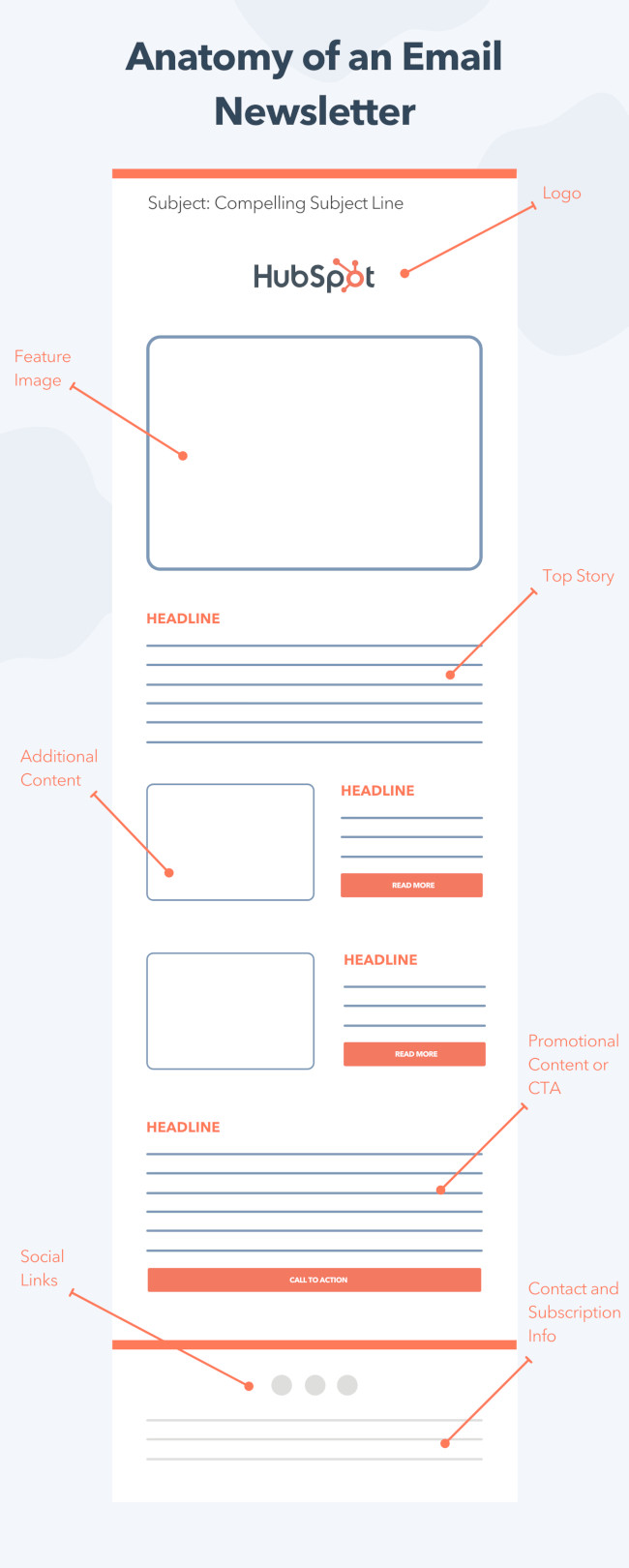
While you can get creative with the structure of your email newsletter, the general anatomy typically includes:
- Your logo or masthead
- A featured image and other eye-catching visuals
- Top stories featured at the top
- Additional content and promotions following
- An email footer with social links and subscription information
 From a design standpoint, your company’s newsletter should be a true reflection of your brand. For instance, if your website features minimalist design and clean, plain black-and-white text, then you don’t want to create a super colorful newsletter, which might confuse new subscribers.
There are a few best practices, however, you can employ to ensure your design is up-to-par regardless of your audience’s preferences:
- Clean, crisp images (no blurry images)
- Text (use same text throughout), company logo, and icons
- Try filters, memes, or video
- Make the CTA clear and obvious — and just have one (i.e. “Click here to shop” or “Click here to read”)
- Create a hierarchy with CTA early-on
- Mobile-responsive
- Test the length of your newsletter to ensure it’s not too short or too long for your audience
Of course, the design of your newsletter will depend on your brand, as well as the message. For instance, you might want to create a colorful, attention-grabbing newsletter if it largely focuses on visuals of new products — alternatively, if it’s a round-up of recent blog posts, perhaps you try a more minimalist look to mimic the appearance of a letter.
Of course, you’ll want to A/B test whichever design(s) you choose, to ensure they resonate with your audience.
I’d also recommend looking into pre-made templates if you’re not familiar with designing emails. If you’re a HubSpot customer, you’ll have a bunch of pre-made templates in the email tool.
However, if you’re still unsure about your newsletter design, there’s nothing better than looking at examples for further inspiration.
Take a look at the following newsletters that knocked it out of the park, and consider using some of their design elements as inspiration for your own.
Each newsletter on this list is fabulous for different reasons. Some have exceptional design, some have exceptional copy, some have exceptional calls-to-action … but all are exceptional at solving for their subscribers’ needs.
1. The Hustle
The Hustle is a daily newsletter that promises “business and tech in 5 minutes or less.”
While there are a ton of business and tech newsletters out there, what makes The Hustle remarkable is its tone at the intersection of informational and hilarious.
Take two of their most notable headlines from 2021 as an example:
- “Inside the world’s most booked Airbnb”
- “How Bob Ross paintings became a coveted investment”
The Hustle also allows subscribers to customize the content they receive to fit their interests (see the “Snippets” section in the example below).
The formula of great content + unique tone + personalization works well for The Hustle’s audience as they’ve grown to more than 1.5 million subscribers.
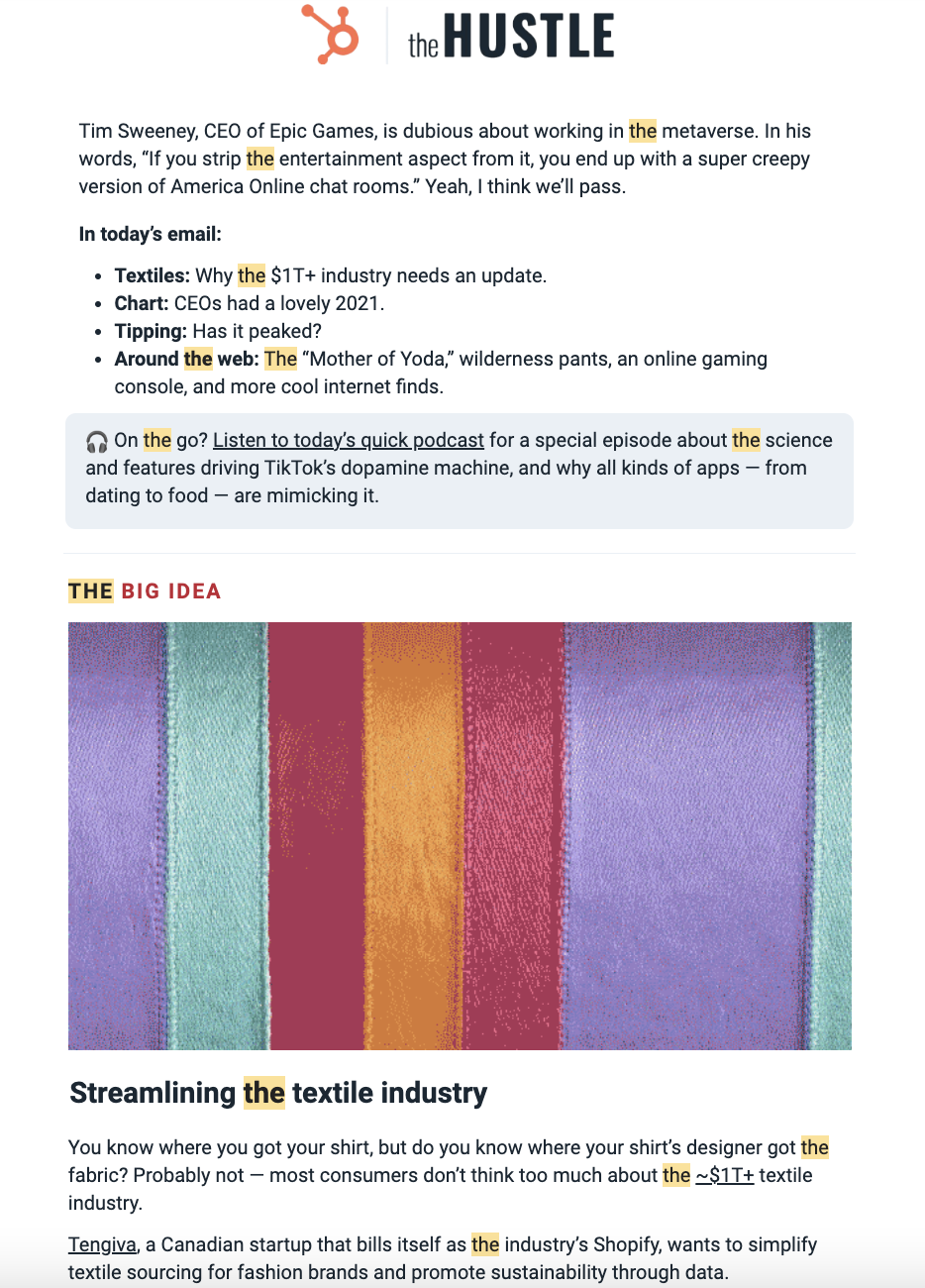 Image Source: The Hustle
2. Atlas Obscura
Atlas Obscura’s newsletter does more than provide travel recommendations – it also delivers compelling stories about the world to your inbox.
With stories like “Spotting Squid in the Tides of Oahu” and “Dreaming of Spaghetti and the Sea,” the Atlas Obscura newsletter is a portal for exploration. They do an excellent job of writing attention-grabbing headlines and finding unexpected, delightful details – library apartments, haunted coffee, and 19th century skulls are just a few examples.
Combining interesting stories, captivating photos, and incredible destinations, the Atlas Obscura newsletter reels in the reader.
See the Pen Newsletter – Arcana Obscura by HubSpot (@hubspot) on CodePen.
3. Buffer
Buffer does a great job at keeping the newsletter concise, making it easy for readers to get the knowledge they need with a skim. They understand that readers want to catch up on the fast-paced and ever-changing social media landscape, so they break down the latest news and trends.
The newsletter is packed with information without feeling overwhelming due to its simple and organized structure.
See the Pen Newsletter – Buffer by HubSpot (@hubspot) on CodePen.
4. The Washington Post The 7
The news is overwhelming and trying to scroll through Twitter to catch up on what’s happening can lead to distractions. The Washington Post understands this and created “The 7” to break down the seven most important stories of the day.
The newsletter is memorable because you can expect exactly seven stories to be sent to your inbox every weekday morning. The listicle format makes the newsletter skimmable. Under each story, they include bulleted points like “why this matters,” “why now,” and “the numbers” to get the point across succinctly. Complex news is made digestible.
See the Pen Newsletter – WaPo by HubSpot (@hubspot) on CodePen.
5. Phrasee
Phrasee’s weekly newsletter is as informative as it is delightful. They deliver curated articles accompanied by fun graphics, GIFs, and memes.
Their tone is personable and lively, almost like the newsletter could fit in on social media. With their unique and daring tone, they know how to stand out from the crowd.
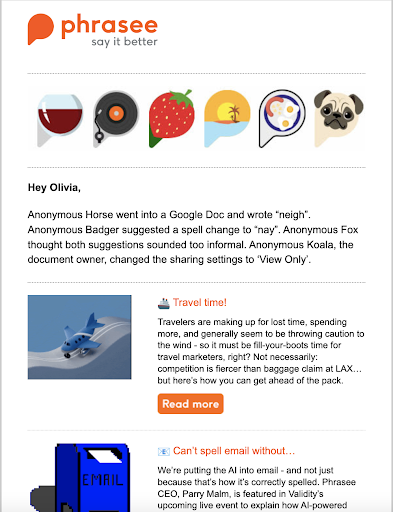 Image Source: Phrasee
6. The New York Times Cooking
A picture is worth a thousand words, says the adage. This couldn’t be truer for newsletters – if your content lends itself to imagery, use it to your advantage like The New York Times Cooking newsletter. The New York Times may be known for delivering news, but it also has a robust cooking section packed with creative, multicultural recipes that are beautifully photographed.
Highlighting new recipes from different chefs, Their New York Times Cooking newsletter is never stale. They expertly include a variety of recipes so readers get value out of finding something new to try.
See the Pen Newsletter – NYT Cooking by HubSpot (@hubspot) on CodePen.
7. Quartz Daily Brief
The Quartz Daily Brief provides a rundown of must-know news, Quartz’s most popular stories, and other interesting highlights about the economy.
The newsletter is straightforward like a brief without being dry, with visuals like charts to help pique the reader’s interest. Sections for need-to-know news, what to watch for, top reads, and surprising discoveries keep things organized. The breadth of material means the reader can choose from a variety of topics to further investigate.
See the Pen Newsletter – Quartz by HubSpot (@hubspot) on CodePen.
8. Moz Top 10
Moz Top 10 is a semi-monthly roundup of top pieces of content about marketing. Essential to any marketer, Moz Top 10 links to key marketing content with actionable insights. The content is not just their own; they link to external sources.
Examples of digital marketing and SEO content includes how brands can take stands on issues and backlink index comparisons.
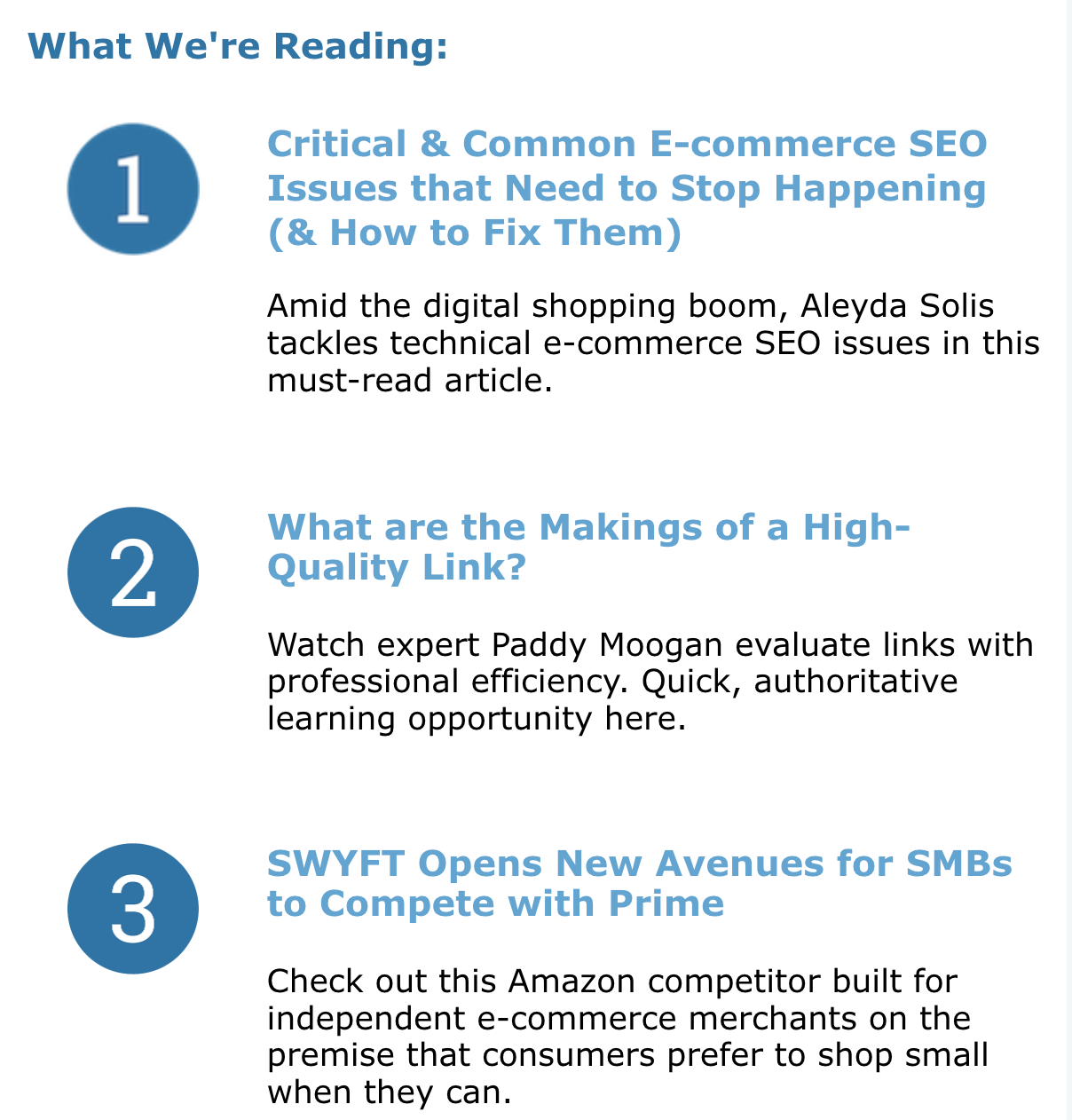
[Click here to see the entire email.]
9. Vox Sentences
Vox Sentences is a nightly email meant to quickly get its readers up to speed on the best stories from the day. The content ranges from the day’s top news to fun stories from all over the web. They do a great job balancing their own content with external sources, and the stories they choose are always really high quality.
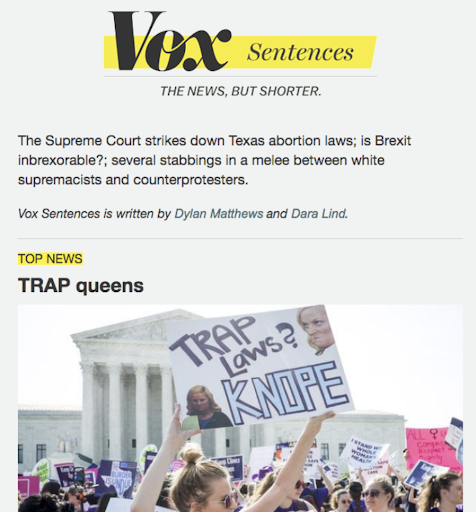 Image Source: Vox
10. TheSkimm
If you want to stay up on what’s happening in the world and have some delightful writing delivered to your inbox first thing in the morning, look no further than TheSkimm. It’s a daily roundup of what’s happened in the news in short, punchy paragraphs.
The best part? You don’t have to click out of the email to read the news if you don’t want to — although they do link to their sources if you want to read further.
For your own email marketing, TheSkimm is the place to go if you’re looking for writing inspiration or for emails without much visual content.
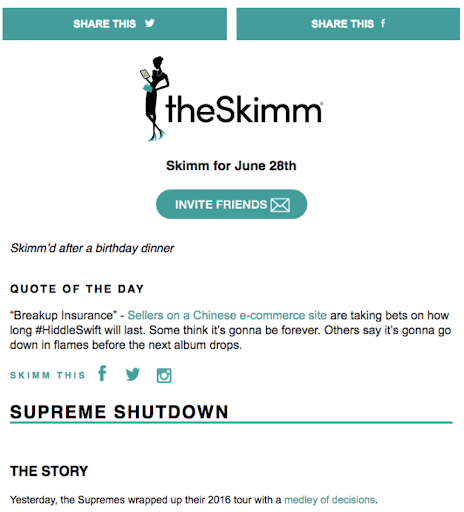 Image Source: TheSkimm
11. Below the Fold
Below the Fold is a weekly newsletter (from Acciyo) that surfaces important and interesting stories that simply aren’t making headlines due to the crowded, never-ending news cycle we all experience day in and day out.
Acciyo’s editorial team handpicks great news stories that they believe deserve “front-page love” but are being beaten out by an “infinite scroll of breaking headlines” — stories that range from how investors are profiting from emergency room bills, to how one Mexican company turned prickly pear into sustainable fuel.
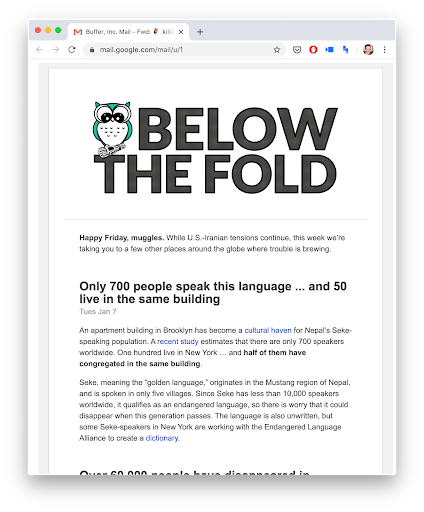 Image Source: Below the Fold
12. The Ringer
Remember Grantland, the sports and pop culture blog owned by ESPN that was started by sports journalist Bill Simmons? In October 2015, ESPN announced it would be ending the publication of Grantland. Shortly thereafter, Simmons formed Bill Simmon Media Group and recruited a whole bunch of former Grantland staffers to launch a brand new newsletter in March 2016 called The Ringer.
Although The Ringer is written and run by many former Grantland employees it’s a different project than Grantland was. Where Grantland focused on sports and pop culture, The Ringer branches out into other areas like tech and politics. Jon Favreau, a former speechwriter for President Barack Obama, is among the contributors. I like how focused they are on experimentation: “We want to have fun, take chances, analyze, theorize, obsess, and try not to take ourselves too seriously,” said Editor-in-Chief Sean Fennessey.
Another differentiator? The Ringer’s website was developed in partnership with publishing platform Medium – which means the newsletter reflects that clean, minimal design.
 Image Source: The Ringer
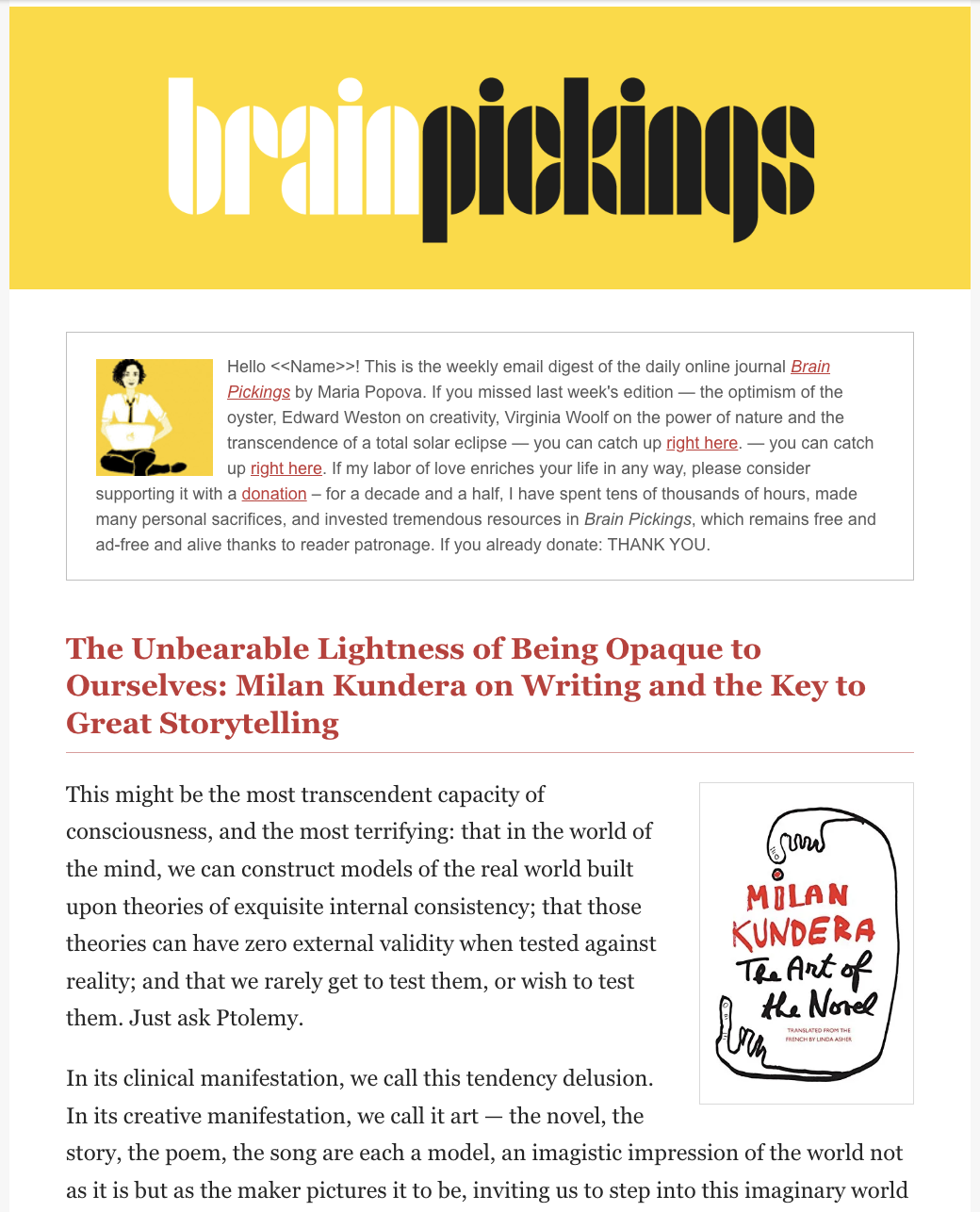
13. The Marginalian
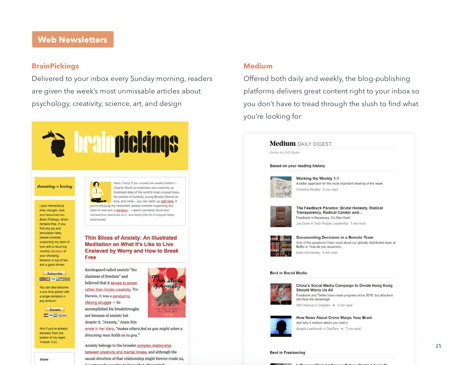
The Marginalian is one of the most interesting newsletters out there. In fact, the folks who write it call it an “interestingness digest.” Every Sunday morning, subscribers get the past week’s most unmissable articles about creativity, psychology, art, science, design, and philosophy — topics that are really appealing to a wide audience. At its core, it explores what it means to live a good life.
[Click here to see the full newsletter.]
14. The New Yorker Recommends
The New Yorker Recommends is a weekly newsletter highlighting what their staff reads, watches, and listens to. It is packed with curated recommendations for books, movies, TV shows, and music.
Having staffers select their own recommendations gives this newsletter a personalized, hand-curated feeling that helps readers connect with the content.
See the Pen Newsletter – The New Yorker Recommends by HubSpot (@hubspot) on CodePen.
15. Polygon Patch Notes
Polygon Patch Notes shares the staff’s picks for new movies, TV shows, video games, comics, manga, and tabletop RPGs. The newsletter also links to a free new game and highlights top stories on Polygon, ranging from reviews to guides.
The mix of curated staff picks and top stories in a simple format makes this an easy-to-digest newsletter. Polygon Patch Notes also employs a personable tone, making the read relatable and fun rather than overly businesslike and bland.
See the Pen Newsletter – Polygon by HubSpot (@hubspot) on CodePen.
16. Apple News+ Audio
The mobile-first format for Apple News+ Audio capitalizes on people’s increasing reliance on smartphones – according to Pew Research Center, 85 percent of Americans have a smartphone.
The format is also interesting – rather than solely delivering updates with text, subscribers can listen to audio. It makes sense, given that the newsletter highlights best Apple News+ Audio stories; including the icon with a link to listen makes it easy for subscribers to dive into a story.
See the Pen Newsletter – Apple News+ Audio by HubSpot (@hubspot) on CodePen.
17. Medium
Medium is a blog-publishing platform that has been continuously building momentum since its launch in 2012. Publishing on the site has really picked up in the past few years, and nowadays, there are a ton of people publishing posts on the site every day.
Of course, that means there’s a lot of content for the average person to filter through. To help bring great content to the surface, Medium uses email newsletters. And after I open this newsletter every day, I end up going to visit several Medium posts without fail. (Mission accomplished for Medium, right?)
Here’s why: The newsletter feels pretty minimal. Because of the way that Medium uses colors and section dividers, they’re able to give you a ton of content in one email without it feeling overwhelming. Plus, they offer both a daily and a weekly version of the digest, allowing users to opt in for the email frequency they feel most comfortable with.
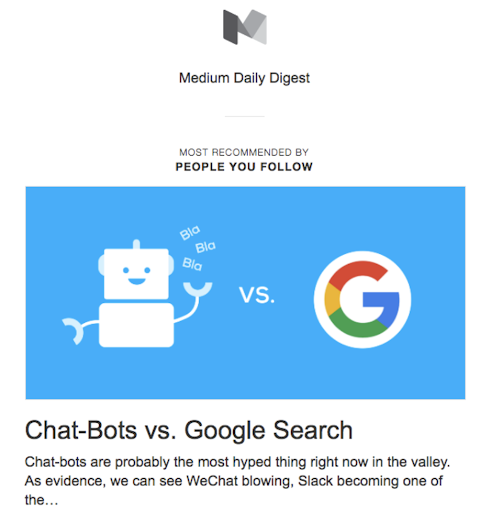 Image Source: Medium
18. The Strategist
From New York Magazine, The Strategist curates deals, shopping advice, and discounts.
The newsletter does a great job of including relevant shopping information, paying attention to the trends. The Strategist also includes a wide variety of products and services to shop for, casting a wide net.
See the Pen Newsletter – The Strategist by HubSpot (@hubspot) on CodePen.
Creating an Email Newsletter Your Subscribers Love
Even though newsletters are one of the most common types of emails to send, they are actually some of the hardest to do right. We hope these examples gave you some quality inspiration so you can create newsletters your subscribers love to get in their inboxes.

How to Calculate Your Web Traffic to Increase Website Revenue
You want to know how to calculate website traffic. That’s smart since your website’s value is both the traffic AND the revenue it can bring in.
Making sure your site works? Check your web traffic. Reacting to changes in your industry? Your website traffic data can help you see how you’re doing.
![Free Resource: Website Optimization Checklist [Download Now]](https://no-cache.hubspot.com/cta/default/53/00d9cc96-eff7-4cea-8ff3-583374c3dcd5.png)
Measuring web traffic can help you build realistic goals and strategies that lead to increased revenue for your business.
To get started, keep reading, or jump to the section you’re looking for.
- Why measure website traffic?
- Before You Start Collecting Web Traffic Data
- How to Calculate Website Traffic
- How to Calculate Traffic Goals to Increase Website Revenue
Why measure website traffic?
Measuring website traffic can help you pinpoint the performance of specific strategies and campaigns. This data can also help you see if leads are dropping off because of a drop in traffic, forecast annual trends, and notice when a page or link breaks on your site.
Your website traffic tool is like the thermometer in your house. You might think it feels cold, but that tool tells you exactly how cold it is. This helps you decide whether it’s worth turning the heater on.
So, maybe you think your website traffic is lower than it should be. Website traffic data can give you:
- Page views
- Referral sources
- Time on-page
This information can help you figure out where your website needs work and how to make it perform better.
It helps you answer both big-picture and granular questions about your marketing, sales, and growth strategies.
Before You Start Collecting Web Traffic Data
Many businesses claim to be data-driven. But 27% of surveyed small businesses don’t have a documented business strategy.
Without a clear strategy, you can’t use data to help your business grow. And if you’re not measuring current website performance, it will be difficult to set realistic goals.
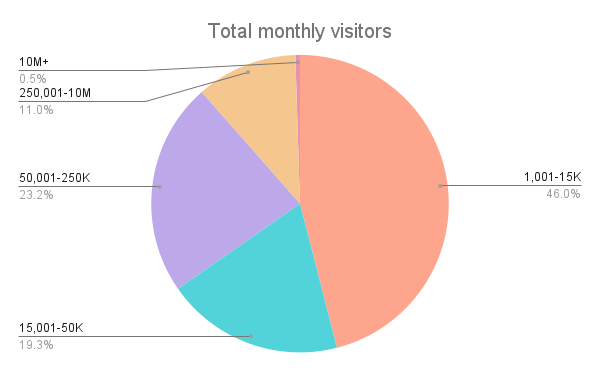
Comparing your website traffic with competitive benchmarks is one place to start. But even if you know how many visitors you think your website should be getting, this data won’t help you understand where your numbers are now. It also won’t help your team work together to reach your goals.
These three steps will help you create a useful web traffic strategy. They can help you make sure that your data analysis is meaningful to your lead, sales, and revenue goals.
1. Decide what questions you want to answer with your data.
Businesses often fail because they’re asking the wrong questions. So, before you start gathering data, it’s important to think about the questions your business wants answers to.
Keep in mind that your questions may change over time. A startup with a month-old website may have questions like:
- Why is the bounce rate so high?
- What sources will bring the most qualified leads?
- Why is blog traffic rising in May, but dropping in July?
- Where is most referral traffic coming from?
But once your site has been live for five years or more, you may have different questions. These might include:
- How accurate is this data?
- Why does this page generate so many conversions?
- Why have visits gone down on some pages but not others?
- Why are visitors exiting from the home page?
- Is the website getting good ROI?
These questions mostly point to one big question:
How much traffic does your site need for you to reach your revenue goals?
Your questions should be specific to your website, business, and your unique goals. While it may be tempting to jump to the next step, spend some time thinking about questions for your site.
You might want to speak to stakeholders across your organization to see if they have ideas too. A SMART goal-setting template can also simplify your goal-setting.
2. Choose the right key performance indicators (KPIs).
Website analytics tools can give you a lot of data, and quickly. A single tool may offer over a hundred different ways of measuring your website data.
So, before you get lost in all the options, it’s best to start with the KPIs that align with your business goals.
For example, say you want to increase pricing for your top tier of products. KPIs that could help you track how this decision has an impact include:
- Page views for product pages
- Revenue
- Traffic by source
- Bounce rates from pricing pages
- Sessions for returning customers
It’s a good idea to focus on a handful of key metrics. Measuring and tracking too much data can create a situation where you spend more time watching your data than acting on it.
If you’re not sure which data is right for your business goals, this post goes into more detail on choosing KPIs.
3. Figure out how often you will collect and analyze your data.
Before you begin collecting data, it’s a good idea to set a time frame for data collection.
Checking data can sometimes feel like checking your social media feed. If you check too often, you may be spending more time watching your data than acting on the insights it offers. If you check it infrequently, you may misinterpret the ups and downs of your website traffic.
So, set a consistent cadence for monitoring your web traffic. This can help you make sure that you have an accurate picture of what’s working and what’s not.
If you’re in a fast-moving industry or recently launched a new website or product, daily checks may be useful. But if you can’t act on insights quickly, a weekly schedule for checking website traffic may be a better fit.

It’s also smart to set aside time to do more detailed analysis of your site traffic. Many businesses will do this monthly or quarterly. Depending on the scale of your organization, you may want to create a separate data schedule for partnerships or campaigns. This can make it easier to isolate this specific data for review.
Once you set a schedule, stick to it. Then, create clear documentation for other members of your team so they can fill in or take over when it’s needed.
For example, if you’re compiling weekly reports, choose a set date for the week to begin and end. If your reporting for each business week starts on Saturday, then shifts to Sunday a few months later, you’ll end up with unreliable data.
1. Choose an analytics tool.
There are many great tools to analyze web traffic. These three tools are popular favorites.
Analytics Tool 1: HubSpot CMS
This tool collects website traffic information including:
- Page views
- Sessions
- Time on page
- Exit and entrance rates
- Bounce rates
Reporting in HubSpot connects to platform features including sales, marketing, and service software. This means that you can easily track data through the entire customer journey in one single tool.
Analytics Tool 2: Google Analytics
This popular analytics tool is a helpful tool for collecting website traffic data. It’s free to use and offers many different ways to organize and analyze website data.
This tool offers a range of detailed reports including:
- Real-time traffic reports
- Acquisition reports
- Engagement reports
- Monetization reporting
Analytics Tool 3: Mixpanel
Besides tracking web traffic, Mixpanel offers product usage and customer behavior data. This is an advanced tool that can give users real-time data across websites and apps.
Features for Mixpanel analytics include:
- Interactive reports
- Team dashboards
- Segmentation options
- Group analytics
If you’re just starting your research and want to dig deeper into your options, check out this list of top analytics tools.
2. Install the software’s tracking code.
While tracking code installation is different for each tracking tool, most use a special script to collect data. It’s simple to add this script to your site to start analyzing your traffic.
Here’s a step-by-step guide to adding the reporting tracking code with HubSpot. If you’re not a HubSpot customer, you can get started with HubSpot here.
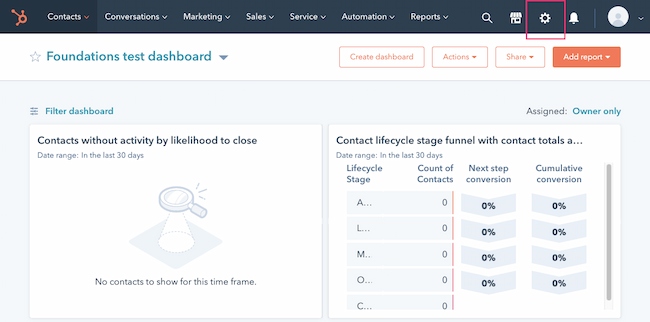
Step 1: Click the gear icon to access Settings after you’ve logged into HubSpot.
Step 2: Navigate to Tracking & Analytics in the left-hand menu.
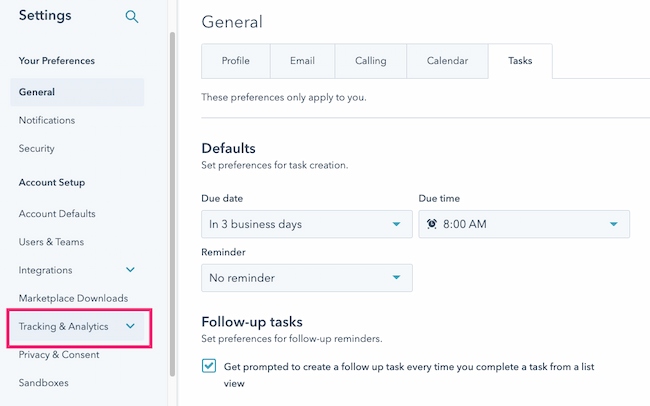
If you’re using Marketing Starter or HubSpot’s free tools, navigate to Tracking Code in the left sidebar menu.
For all other subscriptions, navigate to Tracking & Analytics > Tracking code in the left sidebar menu.
Step 3: Under the Tracking Code tab, in the Embed code section, click Copy.
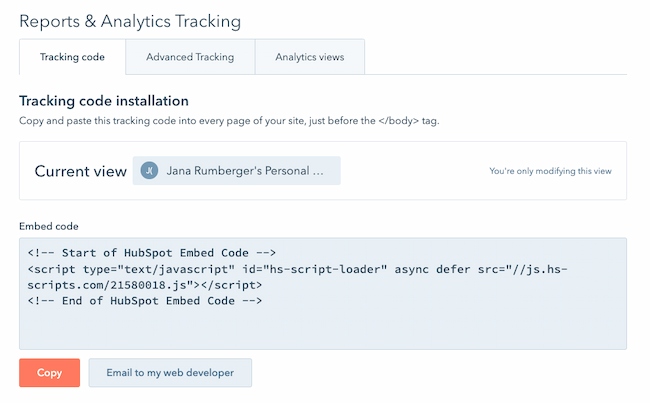
You can also click Email to my web developer to send the tracking code to the team member who will be installing it on your site.
Step 4: Install the tracking code on your website.
To install the tracking code, paste the code before the closing </body> tag in the HTML code on each page of your site.
Step 5: After you install the tracking code, learn how to verify installation and troubleshoot the code.
You may want to check with someone else on your team before adding and troubleshooting your tracking code. While this process is simple, these steps will vary based on how your business manages your website.
3. Use the software to track website sessions.
Once you add your tracking code to your site, it may take up to 24 hours for data to appear. Once data starts populating in your dashboard, it’s time to start analyzing.
Every tool will have different reporting options, but this is a quick overview for analyzing your data with HubSpot.
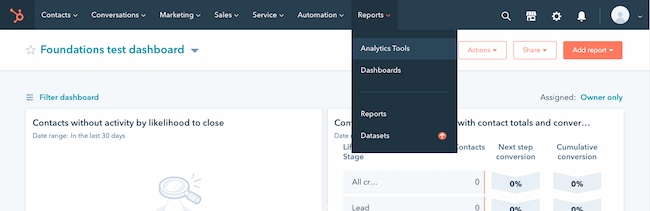
Step 1: In your HubSpot account, navigate to Reports > Analytics Tools.
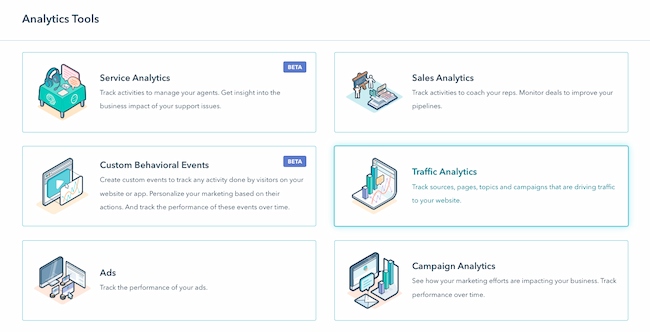
Step 2: Click Traffic Analytics.
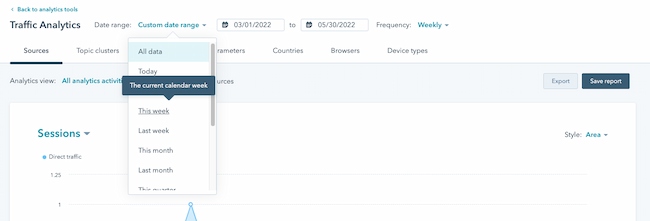
Step 3: The tabs at the top let you analyze different types of data.

Step 4: Filter your data by time range or frequency.
Step 5: Review the types of data and metrics that answer your questions.
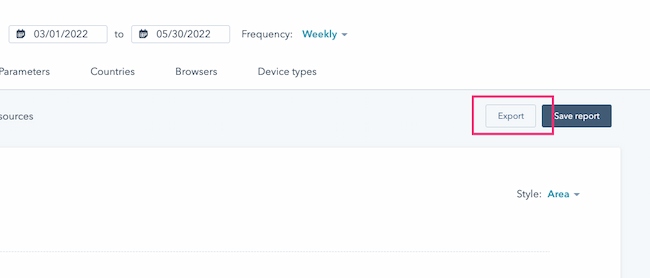
Step 6: Export the report to save your data.
4. Calculate change over time.
While most analytics tools are easy to use, data analysis can be tough. There are countless ways to parse web traffic data.
There are many ways that you can calculate change on your website. You might be a little overwhelmed by all the options, and that’s normal. If you’re new to web traffic analysis, this guide to commonly used website tracking terms can help.
The formula below is a great place to start as you begin to measure your website performance over time.
Traffic Growth
Let’s say we’re calculating traffic growth from February to March. A simple formula to calculate this change is:
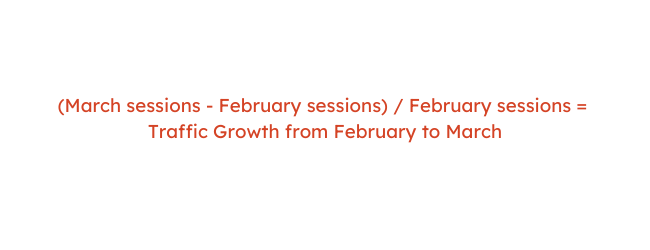
(March sessions – February sessions) / February sessions
Here’s a numerical example: (1,530-1090)/1,090 = 0.4036
Percentages are easier to read at a glance than decimals, so you may want to convert this number to a percentage by multiplying your result by 100.
For example, .4036 x 100 = 40.36%
5. Dive deeper on your traffic sources.
Once you have a clear picture of growth and other key KPIs, you may have already found some issues you want to work on.
One common question for sites with low visit and session numbers is where website traffic is coming from. There are many different sources that can contribute to your website traffic.
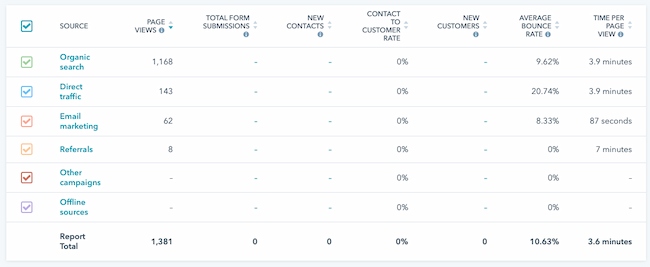
These four sources are the most common:
Direct
Direct traffic usually comes to a web page through other pages on your website. Traffic might also show up as “Direct” when a user types your URL directly into the browser. Direct can also act as a catch-all source for many analytics tools.
Organic search
This website traffic comes from search engines like Google, Bing, and DuckDuckGo. These sources usually show up in your analytics reports automatically.
That said, it’s a good idea to take a look at your settings to make sure that you understand the automatic settings in your tool. For example, DuckDuckGo shows up in organic search sources on some platforms, and in direct sources on others.
Referral
Referrals are site visits that come to you from other websites through backlinks. You can learn more about backlinks in this free lesson.
Social media
These sources show you how much traffic is coming from social media. Some tools will also separate paid and organic social media sources.
As you begin using your analytics to solve problems and troubleshoot to improve your strategies, you may want to learn more. To get you started, check out this guide to website traffic sources.
Now that you’ve learned the basics of measuring your website traffic, it’s time to talk goals.
How to Calculate Traffic Goals to Increase Website Revenue
You may already be familiar with revenue marketing. It’s a strategy that many of HubSpot’s prospects, customers, and partners use.
But it’s also complex and it takes a lot of work to put into action. Marketing analytics tools make it easier to get the data to run the model. But if you’re just learning how to predict and measure ROI from inbound marketing, you may want something simple.
These are the basics:
Revenue Goals Determine Sales Goals
Sales Goals Determine Lead Goals
Lead Goals Determine Traffic Goals
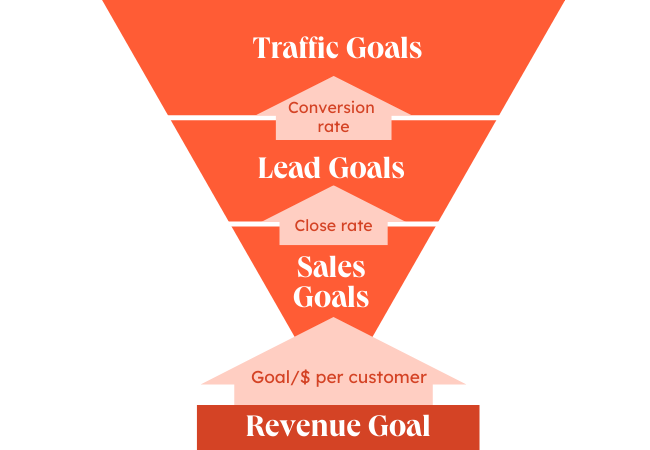
Let’s talk about how to convert website traffic to revenue step-by-step.
1. Calculate the number of new customers you need in a month.
Most companies have monthly or quarterly revenue goals. If you’re a small business owner or startup and you don’t have these goals, set your goals today. If you’re in marketing and you don’t know what the plans are, sit down with your leadership team and ask, “How can I better support the monthly revenue targets?”
Once you have that number, use this goal to calculate the number of new customers you need each month. The formula is simple:
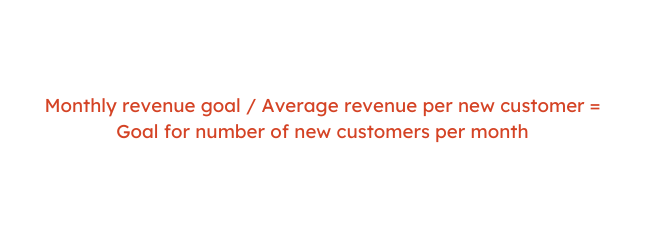
Monthly revenue goal / Average revenue per new customer = Goal for number of new customers per month
2. Calculate the number of leads you need to hit your new customer goal.
Now that you have a rough number of customers you’re looking for, it’s time to calculate how many leads you need.
To calculate this number you’ll need the average website lead to customer conversion rate for your business. Your conversion rate is the number of leads that take the action you want them to take.
If your business relies on cold calling, this could be tough to figure out. But most businesses will have an appointment to customer close ratio.
If your business doesn’t have a process for calculating your conversion rate, there are also tools that can help. This sales conversion calculator makes it easier for your team to decide conversion and drop-off rates for your sales leads.
Once you have this number, use the formula below to calculate your goal for leads.
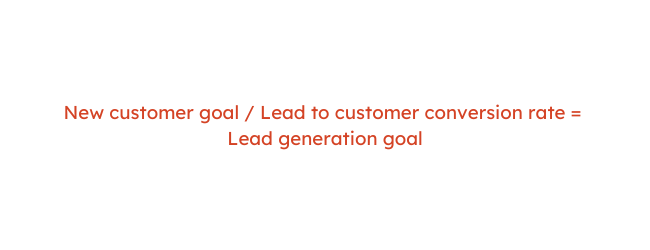
New customer goal / Lead to customer conversion rate = Lead generation goal
3. Calculate the traffic you need to meet your lead goal.
To calculate how much traffic you need, you’ll want to figure out your website visitor to lead conversion rate. If you just started tracking your website traffic it may be difficult to calculate this number.
That said, some businesses have lead tracking set up. With lead tracking you can automatically see:
- Lead sources
- Where leads are in the sales and marketing process
- Who is working with each lead
If you’re keeping track of the number of leads you’re getting from your website per month, you should be able to combine this figure with your most recent website traffic numbers.
If you’re not able to calculate your visitor to lead conversion rate, do an online search for averages in your industry. Companies that do online lead generation right can get a visitor to lead conversion rate that’s 10% or more in some industries.
Once you have this number, use the formula below to calculate how much website traffic you will need to meet your revenue goals.
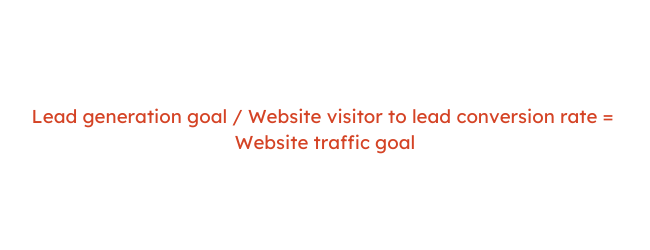
Lead generation goal / Website visitor to lead conversion rate = Website traffic goal
What Comes Next: How Do You Improve Your Website Traffic?
Calculating website traffic comes after you’ve built your website and started posting content. But this process isn’t an end, it’s a beginning. As you continue to check your site traffic, you’ll develop a better understanding of your customers and how they use your site. These insights will help you build better marketing, products, and strategies.
It’s easy to get overwhelmed once you start looking at your website data every month, but stay open. If you keep learning, your traffic, leads, sales, and revenue have nowhere to go but up.
This post was originally published in April 2010 and has been updated for comprehensiveness.

How Local Business Schema Can Boost Your Company’s Visibility Online
You’ve started a website for your local business, but with so much competition out there, you may be struggling to make your website more visible online. That lack of visibility could hinder potential customers from finding your company. To improve your visibility in search engine results, local business schema could be the tool you need.
By including local business schema in the code of your website, search engines like Google, Bing, and Yahoo will be able to better understand your business and rank it higher in search results. But before you can start implementing local business schema, you need to first learn what it is and how it works.
![→ Download Now: SEO Starter Pack [Free Kit]](https://no-cache.hubspot.com/cta/default/53/1d7211ac-7b1b-4405-b940-54b8acedb26e.png)
What is local business schema?
Local business schema is a kind of structured data markup code that can be added to your business’ website to make it easier for search engines to identify what type of organization you are and the products or services you provide.
Schema markup was created by search engines to better understand and display data using common groups of tags. Your business can benefit from schema markup because it can help you better optimize your website for local SEO — one of the deciding factors in how your content is ranked in SERPs.
How to Add Local Business Schema
To add local business schema to your website, first visit schema.org/LocalBusiness then follow the steps below:
Step 1: Determine the category for your company.
Identify the niche category you are optimizing your website for, and be as specific as possible. For example, if you own a burger restaurant, use the “FoodEstablishment” code. If your burger spot is considered fast food, you can further optimize by choosing the “FastFoodRestaurant Code.”

If you can’t find a category that fits your business, simply use a generic business schema like Local Business or Organization, then use the “sameAs” property to add a Wikipedia or Wikidata entry that is more specific to your type of business.
Step 2: Create or update your About page.
Your About page should be filled with information about your business and include a unique “AboutPage” schema item. Make sure the content is easily readable to visitors of your site, and add as many — or as few — related schema properties to better inform search engines about your organization.
Step 3: Test your code using Google’s Rich Results Test or the Schema Markup Validator.
You can enter your code into the Rich Results Test to see which Google rich results are generated by the structured data on your page. You can also use the tool to preview how rich results will look in Google search.

To test your structured data without Google feature-specific warnings, enter your code into the Schema Markup Validator.

Step 4: Add and Publish your local business schema to your website.
You can add your schema directly within your HTML code or use a managed user interface, schema app, or plugin.
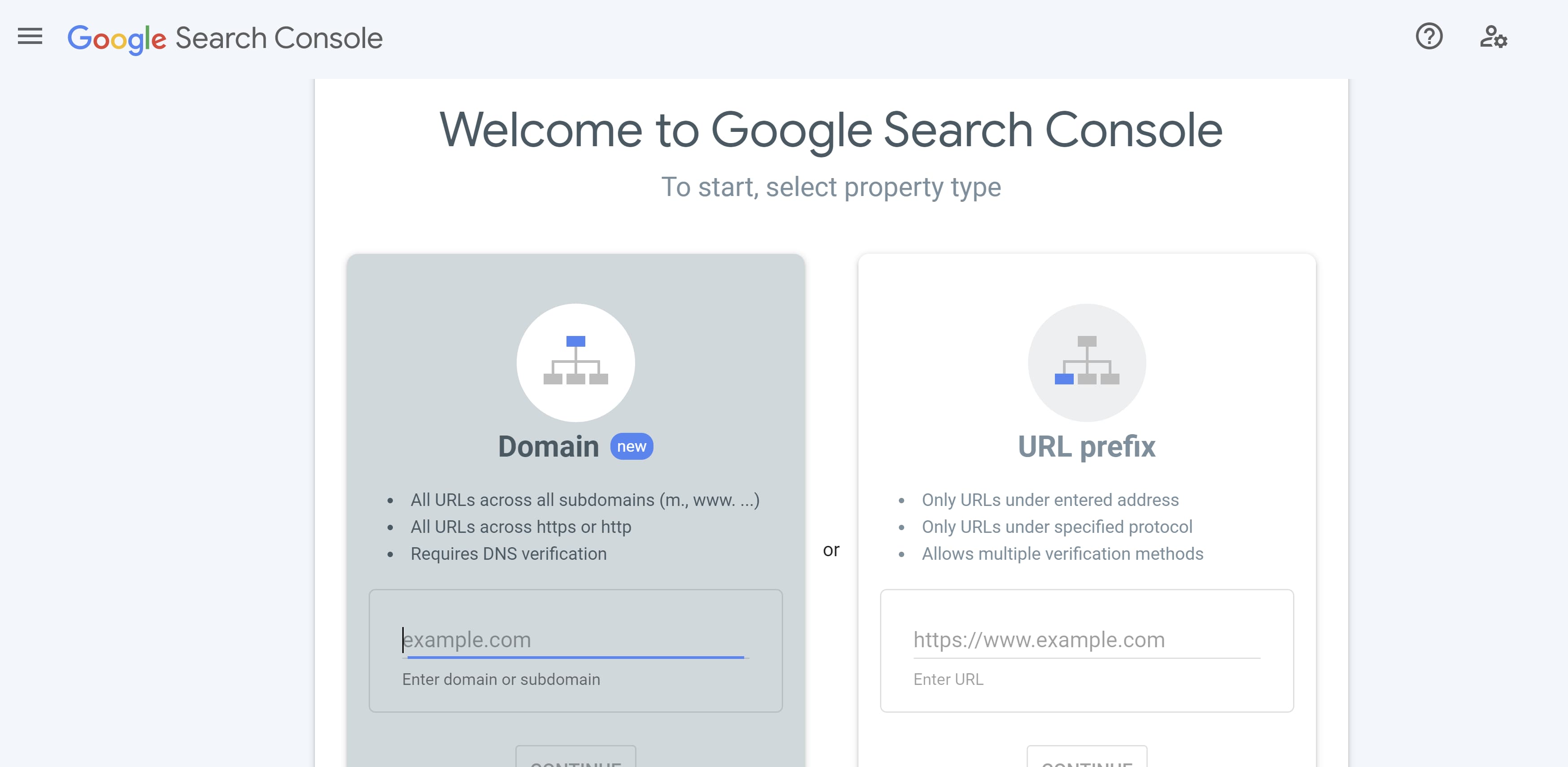
Step 5: Crawl and test your local business schema markup using Google’s Search Console.
Enter your domain or URL prefix to measure your website’s search traffic performance to see if there are any issues or improvements to be made.
Going forward, monitor the results of your schema and make adjustments as needed. You will likely have to repeat this process again in the future as Google changes its approach to schema and if anything in your business listing changes.
Local Business Schema Examples
Below is an example of a local business schema taken from schema.org/LocalBusiness. The example is in reference to a restaurant called GreatFood.
GreatFood Local Business Schema Example Without Markup
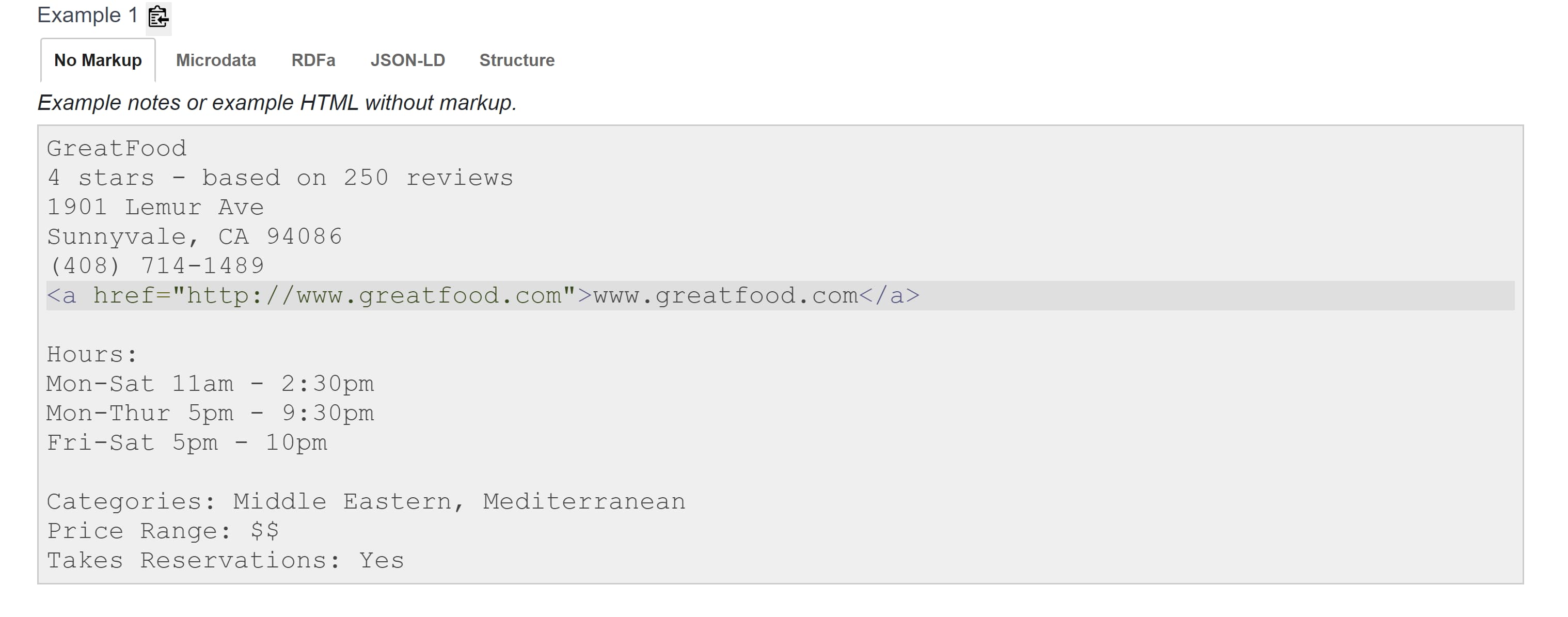
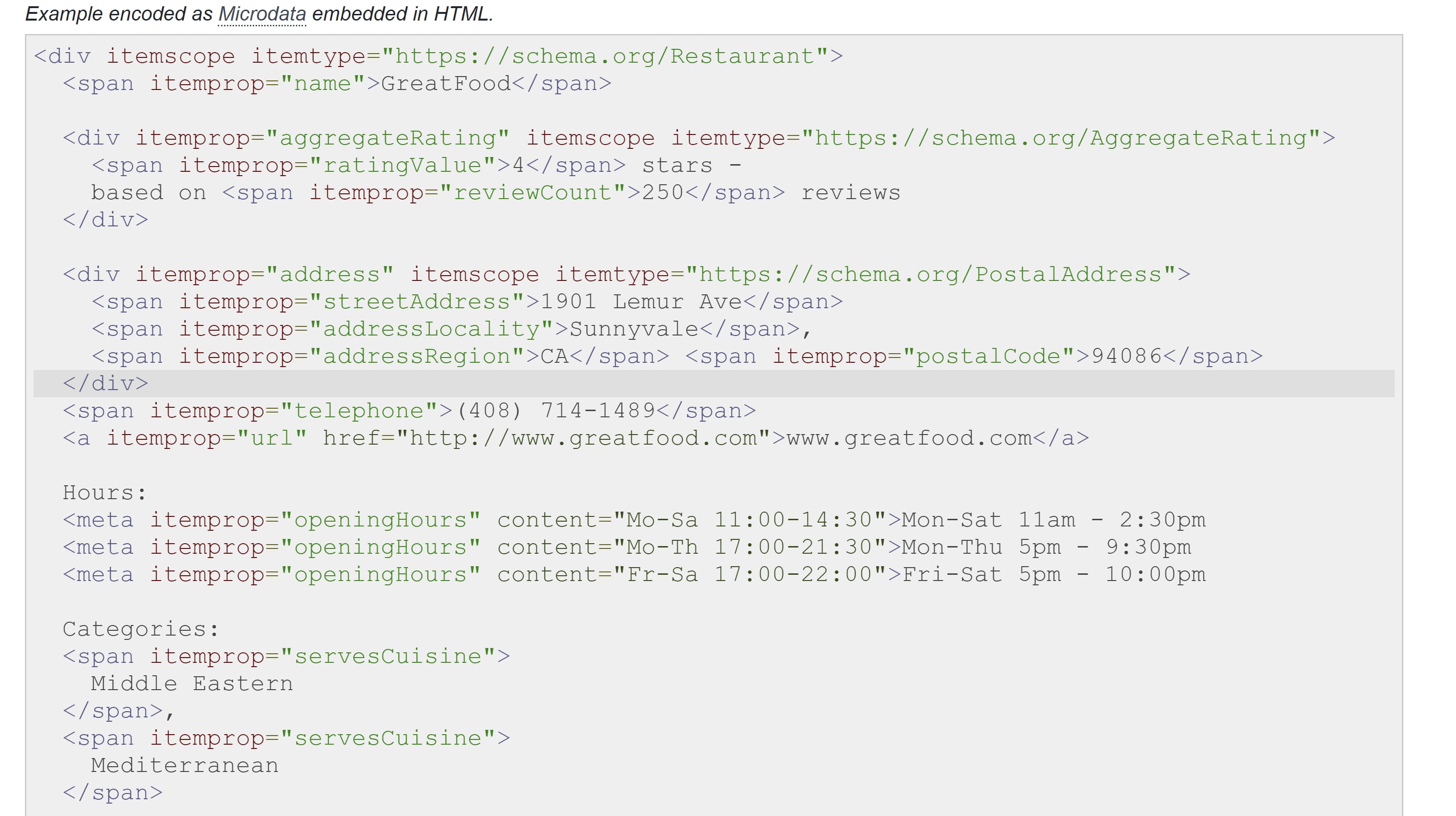
In the above HTML code, you can clearly see the name of the restaurant (GreatFood), the address, phone number, and hours of operation. In the example below from the same restaurant, you can see this information represented in the schema code. This format is the standard schema microdata format, the most common format that is the easiest to implement.
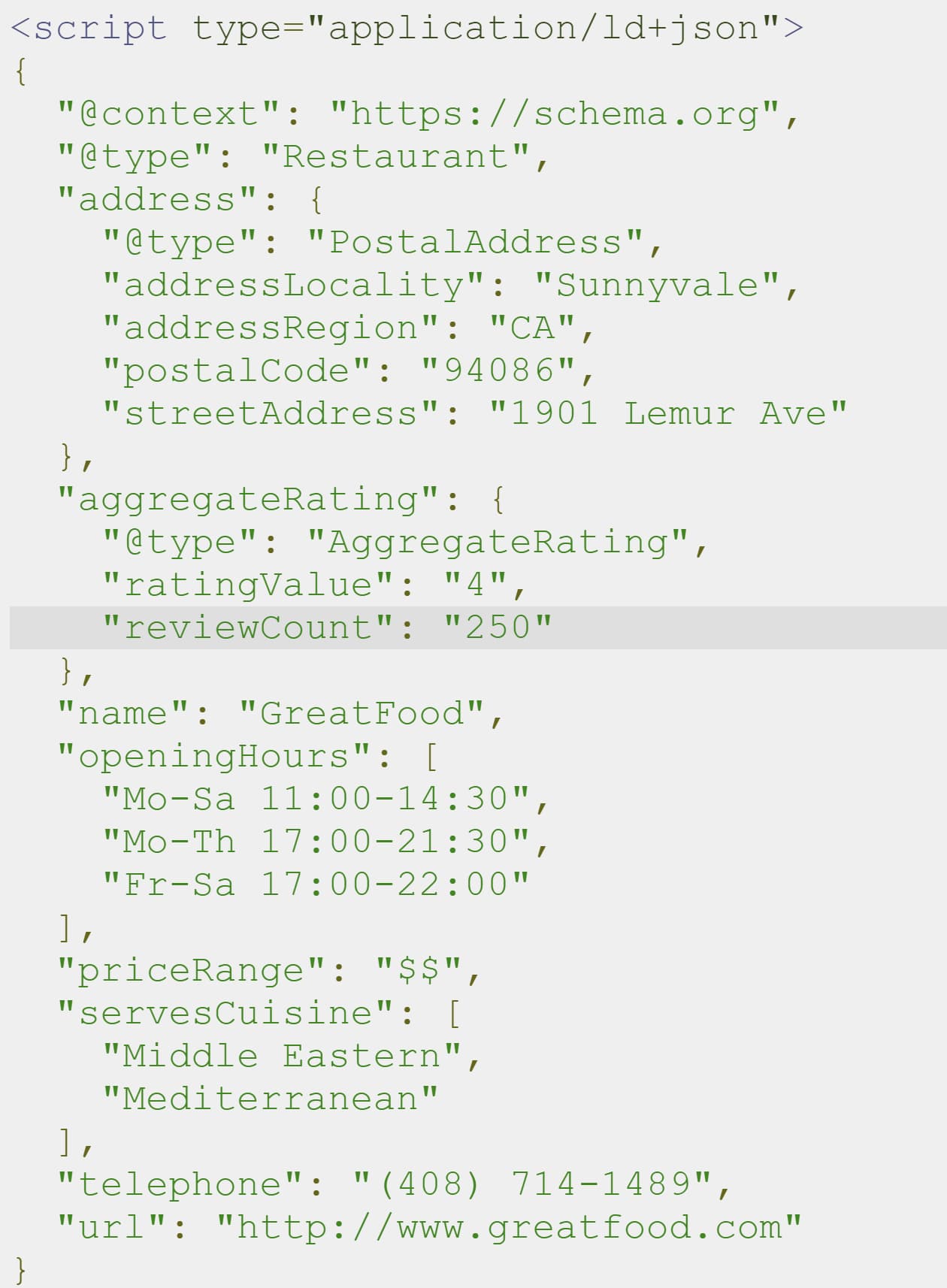
Below is the format you would use for JSON-LD format, which would be used for JavaScript.
Finally, the below example is the RDFa format, which works in a variety of documents — including XML, HTML 4, SVG, and more.
Incorporating local business schema can seem complicated. However, if you know the category your business falls into and include important information such as the name, address, phone number, and hours of operation, you can easily use local business schema to boost your website in search engine results.

What is Interactive Marketing [+ 15 Inventive Examples]
The content formats we rely on today have an uncanny resemblance to the content formats we relied on yesterday — our blog posts look like print articles, our offers look like books, and our slide decks look like presentations. While these formats are fine for the most part, marketers can take their content from “fine” to “exceptional” by using interactive marketing.
Interactive marketing gives marketers a huge opportunity to engage audiences at record levels. Its early adopters have proven that if marketers want to cut through the noise, they can’t just do what they’ve always been doing. They need to refresh their work.
But obviously, you can’t properly use interactive marketing if you don’t know what it is — so here’s everything you need to know about interactive marketing broken down into easy-to-navigate sections:
What is interactive marketing?
Common Types of Interactive Marketing Strategies
Benefits of Interactive Marketing
Interactive Marketing Examples
- User-Generated Content | Glass Animals
- Augmented Reality Shopping | Lancome
- Interactive Series | Sweet Digs by Eko and Refinery29
- Vimeo Virtual Courses That Get You Moving | Y7
- The Structure of Stand-Up Comedy | The Pudding
- Conversational Marketing | HubSpot
- A Personal Thank You with Vidyard | Amnesty International Canada
- Interactive Infographic| Family Fun in Scottsdale by Marriott
- Interactive Virtual Events | Built to Last by Wistia
- Interactive Slide Show | The New Media Message by Velocity Partners
- Interactive Article | The Big Gronkowski by Ceros
- Immersive Video | Scotland From the Sky by BBC Scotland
- Playable Video Game Ad | Narcos: Cartel Wars
- Interactive Voice Ad on Pandora | Doritos
- Interactive Idea Generation | Outgrow
Applying Interactive Marketing to Your Campaigns
![Download Now: 150+ Content Creation Templates [Free Kit]](https://no-cache.hubspot.com/cta/default/53/5478fa12-4cc3-4140-ba96-bc103eeb873e.png)
Common Types of Interactive Marketing Strategies
- Interactive videos: Using video is a great way to explain a topic or entertain viewers. Savvy marketers have found new ways to engage viewers by adding CTAs in videos prompting them to subscribe or participate in the conversation in real time. Some videos allow viewers to answer questions by clicking a set of multiple choice answers right on the screen. Other formats immerse the viewer in beautiful landscapes — a technique that’s becoming more popular as the use of 360-degree video becomes more prevalent.
- Quizzes, surveys, and polls: Quizzes and polls are a fun way to get visitors to interact with your site — and you can create them for just about any topic. Buzzfeed has excelled in this area, but it’s not uncommon to see them used for travel, home search, and interior design sites. They are popular tools for social media marketing as well.
- Personalized content: From addressing customers by name in email to curating specific ads targeted at their individual needs, adding a personal touch gives the impression that you are speaking directly to them. Ever abandoned an item in your cart and received an email reminder about it later? That’s personalized marketing at work.
- Interactive storytelling: Keeping readers engaged with a long-form article can be difficult — that’s why interactive storytelling can be a powerful resource for marketers. Uses infographics, gifs, video, clickable maps, charts, and other visual aids to help break up text and keep readers from getting burnt-out or bored.
- Calculators: While calculators don’t sound super interesting, they are incredibly useful for organizations that want to showcase data. Looking for a home? You’ve probably used a mortgage calculator to get a ballpark estimate of your monthly payment.
Benefits of Interactive Marketing
Interactive marketing offers several advantages, including:
Boosted Conversion Rates
Interactive marketing gives potential customers the chance to make a purchase immediately. For example, including a call-to-action at points of purchases is a common, effective interactive marketing tactic. I’m sure you’ve seen buttons during digital ads that say “purchase now” or different points on a website that include an “add to cart” button.
Increased Audience Engagement
Delighting your audience is the key to engaging it — that’s why tactics like online quizzes, personalized content, and interactive videos are so helpful. It gives audiences a unique experience that makes interacting with your business fun. If your audience is having fun, they’re more likely to stay loyal to and potentially evangelize your company.
Instant Feedback
You can easily and quickly gauge how your audience feels about your company through tactics like quizzes and polls. Is your website easily navigable? Do your products meet expectations? Are there any areas that need improvement? With interactive marketing, you can better connect to your audience and allow their voices to be heard so you can see what works and what doesn’t.
Interactive Marketing Examples
Capturing attention sounds great in theory, but you may be unsure of how to incorporate interactive marketing into your strategy. To get some great ideas, learn from some of these great examples of interactive marketing:
1. User-Generated Content | Glass Animals
Why we like it:
- The band’s website gives fans the opportunity to create music and art that the band will use for future projects, such as music videos, social media campaigns, and more.
- The website also includes an informal message from its lead singer explaining how the landing page is made to resemble his own desktop — giving fans a little insight into the mind of the singer and fostering a more personal connection.
England-based band Glass Animals took a fresh approach to its website’s landing page by making it appear like a computer desktop from the 90s/early 2000s. The website’s appearance entices visitors to click on different icons.
The band’s singer, Dave Bailey, also left a message to fans saying to “Dig around. Use the sounds, use the artwork … ” and to email the band anything they’ve made so it can be used in a special project. Clicking on the folder that says “Cherry stems” reveals sound files visitors can use to create their own music or projects.
There’s even an icon that says “MEME-IT” that allows users to generate their own memes of the band. The website provides a fun experience for visitors and gets fans involved in the band’s creative process. The website’s landing page almost feels like a game, and who doesn’t love games?
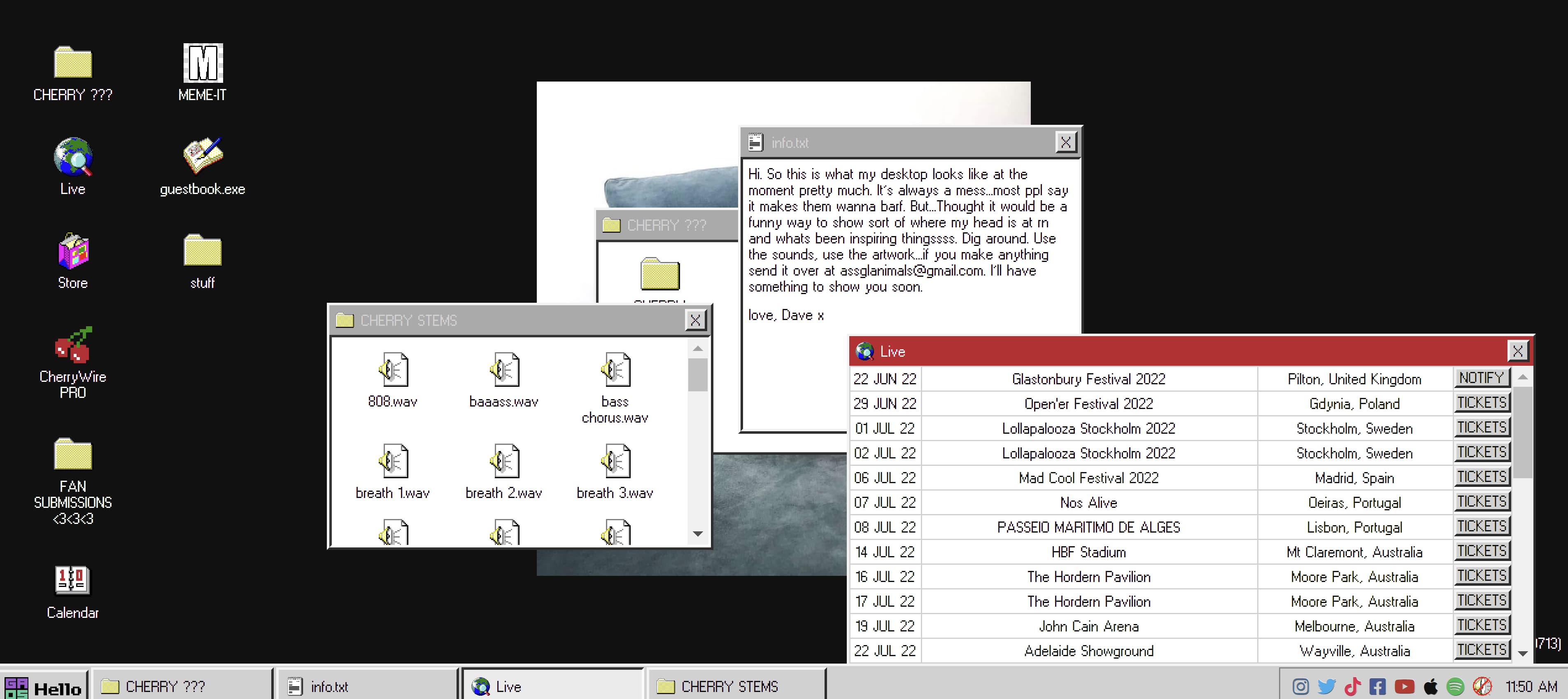
2. Augmented Reality Shopping | Lancome
Why we like it:
- The feature allows visitors to Lancome’s Instagram page to virtually “try on” some of the brand’s products before purchasing, giving them the opportunity to purchase with more confidence.
- The feature is easy to use and visitors can simply swipe through different shades the same way they would swipe through different filters on the app.
Online shopping is popular among many consumers and has only gotten more popular since the start of the pandemic. However, one of the downsides of online shopping is that customers aren’t always able to try on a purchase before buying.
Makeup company Lancome addresses this issue on its Instagram page by providing filters of different makeup shades users can access through their phone’s cameras. This allows customers to see how a shade would look on their face before deciding to buy.
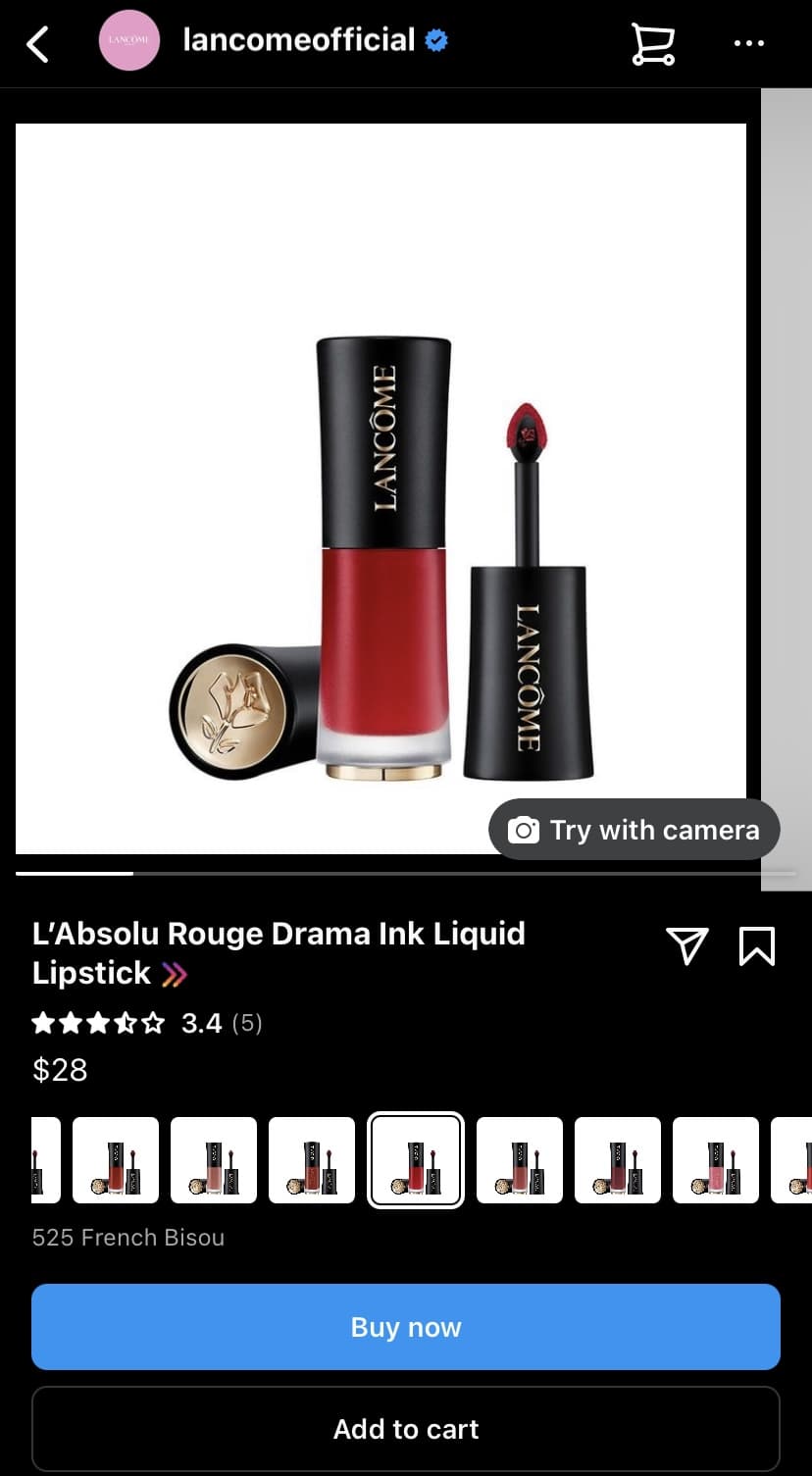
3. Interactive Series | Sweet Digs by Eko and Refinery29
Why we like it:
- This series gets viewers directly involved with the show by having them choose furniture or answer questions in real time.
- Additionally, it builds on Refinery29’s already successful content
If you’ve ever watched a house hunting or interior design show and either found yourself talking to the TV or gawking at the owner’s decor choices, Refinery29’s Sweet Digs is for you. It partnered with Eko, a platform known for creating interactive shows, to bring viewers inside the coolest and quirkiest homes — with a twist.
Instead of merely being a voyeur, viewers are prompted to interact with homeowners and renters. From recommending how they should redecorate to guessing how much certain furniture items cost, viewers can get in on the action. Even more satisfying, you’ll get to see if they chose the items you suggested at the end. It’s HGTV on steroids.
The best part is Refinery29 didn’t need to create a new marketing idea from scratch. Instead, it took a concept that already did well and improved upon it, using Eko’s interactive tools. This new content gives viewers a sense of agency over the content they’re consuming while also leveling up engagement.
4. Vimeo Virtual Courses That Get You Moving | Y7
Why we like it:
- Adding details like a studio playlist helped Y7 patrons create the studio atmosphere at home.
- Creating an online community not only helped the studio stay afloat, it provided patrons a sense of normalcy in uncertain times.
- The experience is user-friendly and easy to navigate thanks to small details like a video QR code.
Pandemic restrictions shuttered many businesses that required in-person interaction, like gyms and fitness studios. Those that survived adapted their offerings for the virtual market. But let’s face it — working out at home just isn’t the same as getting a boutique fitness experience.
Trendy Yoga studio Y7, rose to the occasion. Using Vimeo OTT, the brand known for its candlelit classes and trap soundtrack moved instruction for all 15 studios online. It then kicked the online experience up a notch by helping its students create the studio vibe at home, complete with an in video QR code to access the class playlist.
All the little details paid off. These improvements in virtual teaching kept students coming back for more, enabling Y7 to stay in business and retain its loyal fanbase.
5. The Structure of Stand-Up Comedy | The Pudding
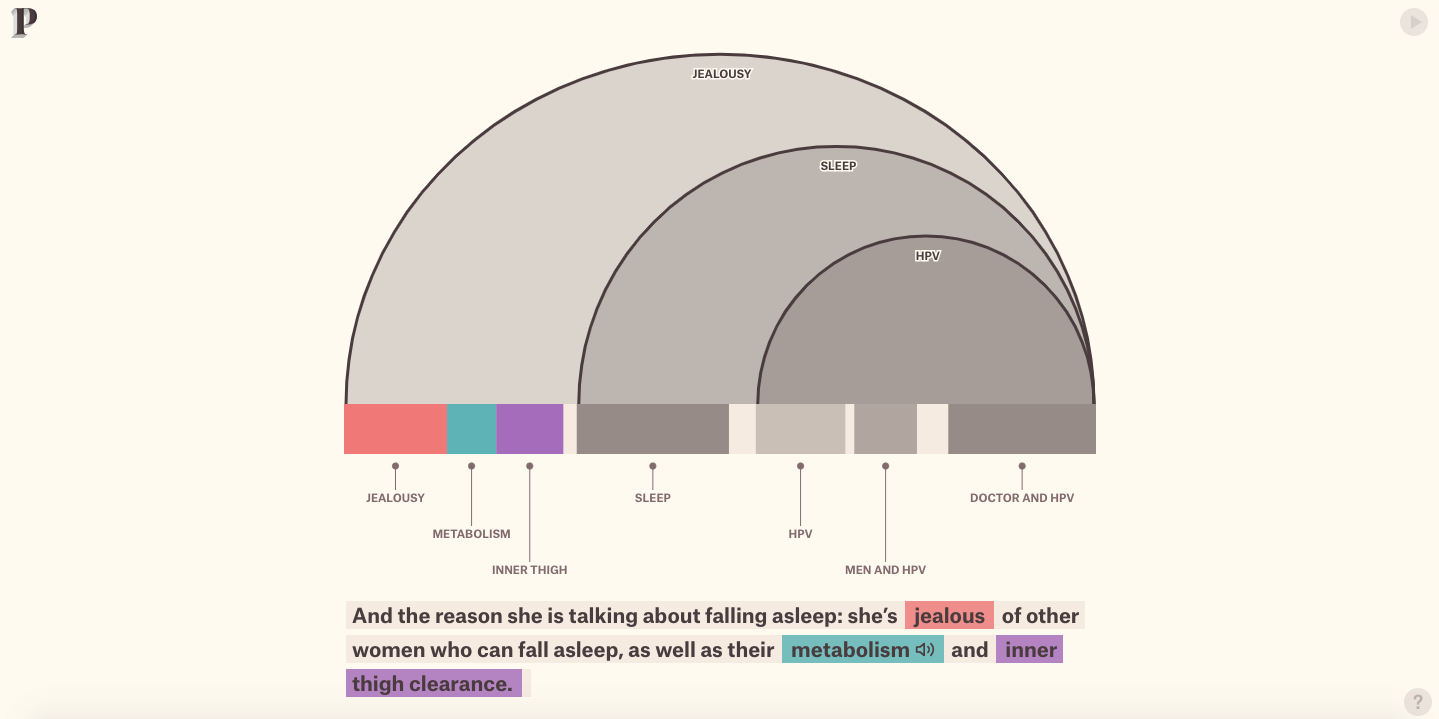
Why we like it:
- The visuals and diagrams dissecting Wong’s routine are like taking a class on performance and creative writing at the same time.
- It leaves the audience with a deeper understanding of not only how Wong crafts her routine, but also allows them to connect with her in an empathetic way.
- The diagram is easy-to-understand and gives fans a better understanding of the artistry behind comedy.
Stand-up comedians might seem like the lucky wisecrackers who are blessed with the talent to improvise some of the funniest jokes and bits you’ve ever heard, but in reality, they polish their performance with painstaking precision.
To crack their audiences up as much as possible, they make sure their routines’ stories seamlessly flow from one to the other. However, some comedians like Ali Wong take their stand-up preparation to an entirely different level.
In its interactive slideshow about how Ali Wong structured her Netflix special Baby Cobra, The Pudding, a digital publication that crafts visual essays about culture and entertainment, describes how she sculpts her routine into a narrative instead of just telling a bunch of separate jokes.
By visually outlining her entire routine, The Pudding reveals how Ali Wong weaved all her bits into a story, building her world and perception of life in a way that her audience can truly understand, which left them with a deeper feeling of empathy, meaning, and ultimately humor.
6. Conversational Marketing | HubSpot
Why we like it:
- The chatbot’s prompts allow users to customize their own experience on the site, ensuring that they quickly get the information they are looking for.
- Since the user is dictating their experience on the site, it eliminates any sales pressure, providing a better overall user experience.
- Most people are already familiar with chats, text messages, and direct messaging in their daily life, so the chatbot feature is easy for visitors to adapt to.
We rely on messaging apps to interact with friends and family, so it only makes sense that brands should incorporate them for communication to reduce friction in the buying journey. Despite this, marketers have been sluggish to adopt conversational marketing — using chatbots, live chat, Facebook Messenger, and other chat features — into their inbound marketing strategies.
In fact, according to Business 2 Community, only 36% of companies have adopted these tactics. At HubSpot, we hope to change that by offering new messaging tools that can integrate with your entire marketing suite and database.
We double down on this idea by using our own conversational marketing software on our homepage. Website visitors are asked a question and given several choices of potential answers. This allows the prospect to engage in website content almost like a “choose your own adventure” story. This improves the overall site experience and ensures that the site is serving up the content (or actions) that will benefit them the most… without any sales pressure.
7. A Personal Thank You with Vidyard | Amnesty International Canada

Why we like it:
- Giving donors a visual representation of how their donation aided Amnesty International’s various causes builds trust and establishes a personal connection.
- Donors will most-likely share the video with friends and family, which could lead to an increase in donations.
In social settings, getting too personal too quickly is intrusive. However, when it comes to marketing, getting a little personal can go a long way in building brand loyalty.
Take this carefully crafted thank you video created by Amnesty International Canada using Vidyard’s platform. Personalized videos like the one above were sent to all of the organization’s donors. After reviewing their metrics, the organization reported higher donor satisfaction and retention from the use of these videos.
Sending a thank you card or email is nice, but adding a personal touch in the form of a video really won their donors over. When customers are happy with your product or service, they will inevitably share it with their network, providing you with valuable word of mouth promotion and credibility.
8. Interactive Infographic | Family Fun in Scottsdale by Marriott
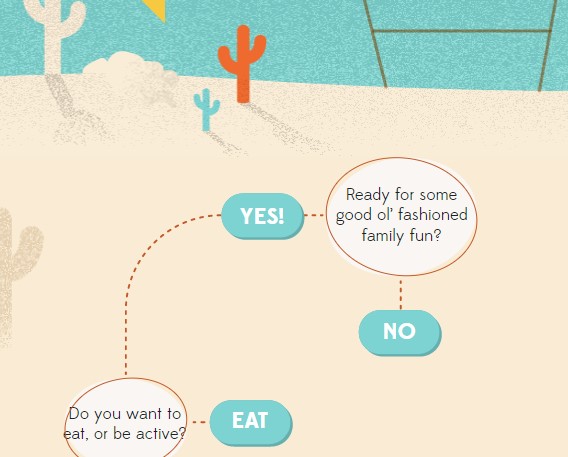
Why we like it:
- This interactive ad is a fun take on vacation planning.
- The clickable flowchart acts as a tool to help viewers customize their vacation activities to the parameters they set (e.g., interests, age)
Marriott Hotels manages to make vacation planning even more fun while positioning their brand in front of potential customers with an interactive infographic. Vacationers who are headed to Scottsdale are able to take a customized path through the flowchart to receive destination advice. Just a little bit of animation goes a long way, and it adds a touch of personalization that normal infographics don’t.
The beauty of this is that infographics are a great visual tool that have a ton of utility. By using lemonly.com, Marriott pushes the envelope just a step further, which provides unexpected delight.
9. Interactive Virtual Events | Built to Last by Wistia
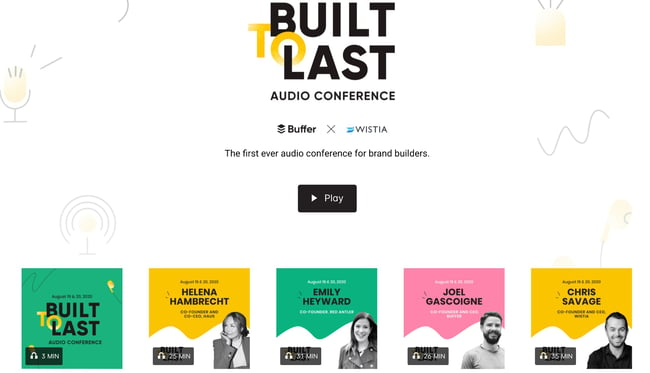
Why we like it:
- By having an audio conference instead of a traditional virtual one, Wistia freed up their audience to attend whenever was convenient for them (while running errands, at the gym, etc).
- Visitors could attend any session in whatever order they liked instead of being forced into a rigid schedule, making the event more accessible.
By now we’re all used to virtual events, but meeting and video fatigue is real. How do you keep guests engaged? By mixing it up. That’s what Buffer and Wistia set out to do when they created the first ever audio conference for brand builders.
That’s right, no staring at the screen or being stuck at a desk. The audio format allowed listeners to join in from wherever they were, be it during their commute or while taking an afternoon stroll by connecting to a podcast player.
Each session ranged in length from roughly 25-35 minutes, and gave listeners the option to “choose their own adventure” by simply selecting the sessions they wanted to attend. This reduced friction as listeners were free to attend only the sessions relevant to their interests instead of committing several hours of their time.
10. Interactive Slide Show | The New Media Message by Velocity Partners

Why we like it:
- This slideshow beautifully illustrates the importance of showing rather than telling audiences why they should care about a particular topic.
- The build-up from the basic slides walks us through the progression of how using more interactive and attention grabbing graphics changes the audience’s experience in real time.
In its interactive slideshow, which honestly looks like it belongs in Tron, Velocity Partners, a B2B marketing agency, explains why innovative marketers need to leverage new content formats in order to tell more refreshing stories.
Velocity Partners shows, not tells, how their interactive slideshow can captivate an audience. This is in stark contrast to how marketers have churned out so many blog posts, ebooks, and SlideShares that they’ve become dull and predictable. The end result of this message hammers home the point that the most engaging and surprising mediums are the best at delivering the most engaging and surprising stories.
11. Interactive Article | The Big Gronkowski by Ceros
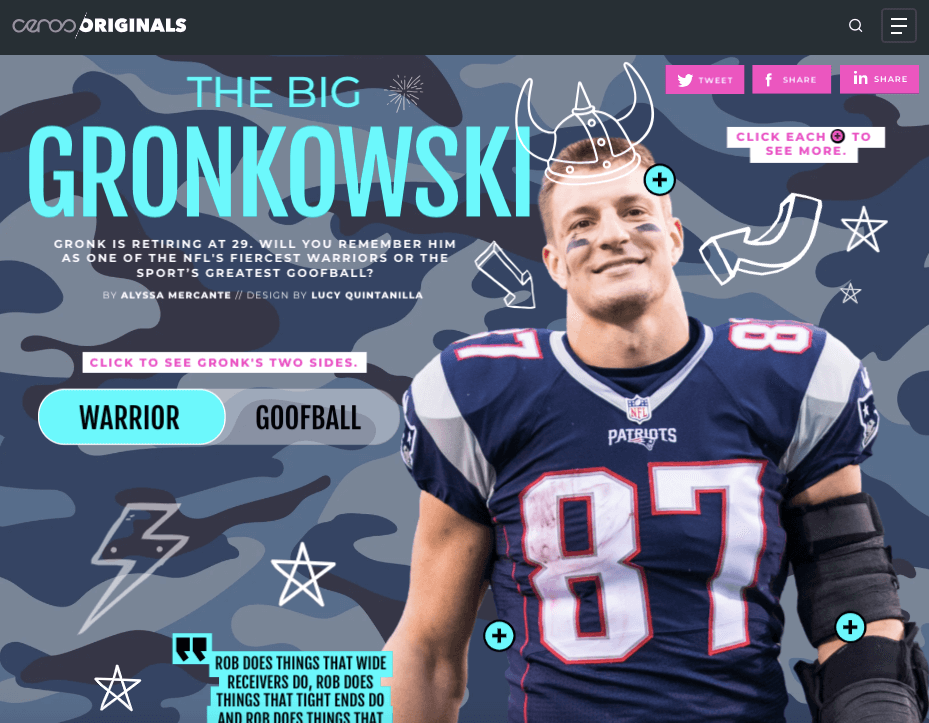
Why we like it:
- Ceros’ take on a visual representation of the article instead of traditional text is fresh, and immediately draws readers in.
- Bucking the norms of article structure, readers can quickly toggle to the information they want to know first, rather than having it dictated to them.
When Rob Gronkowski temporarily retired in 2019, Ceros, an experiential content creation platform, decided to create an interactive article that spotlights the two things Gronk will always be remembered for — his athletic prowess and goofy attitude.
When you visit the interactive article, you can toggle between Gronk’s “Warrior” and “Goofball” side, clicking on hotspots that reveal his impressive achievements, his laundry list of injuries, and some of the funniest things he’s ever done. Once you finish interacting with the article, you’ll truly understand how Rob Gronkowski is just as athletic as he is goofy.
12. Immersive Video | Scotland From the Sky by BBC Scotland

Why we like it:
- This 360-degree video nails the art of showing rather than telling.
- Using Scotland’s immersive landscapes as the backdrop, the viewer is made to feel like they are exploring Glen Coe with the filmmaker.
- The video’s like this are so visually stunning that they can encourage visitors to share the link with others, boosting engagement.
In 2019, Rough Guides, a renowned travel guidebook, named Scotland the most beautiful country in the world.
And a big reason why it’s such a spectacle is that Glen Coe, a Scottish valley that cuts through the ruins of an ancient supervolcano, is one of the most striking landscapes in the world.
With their immersive, 360-degree video of Glen Coe, BBC Scotland can grip viewers because they’re able to experience the landscape from an intimate point of view at every possible angle, making them feel like they’re actually there.
13. Playable Video Game Ad | Narcos: Cartel Wars

Why we like it:
- The ability for people to go from just viewing the game to participating in it is a great way to draw them in.
- Allowing potential customers to play the game before buying eliminates sales pressure and puts the customer in control of their experience.
In the past, video game apps had to use video or gif demos to advertise gameplay in hopes to attract new players and increase app downloads. The thing about watching videos, though, is that it’s a passive activity. The visuals of the game may be enough to attract prospective players’ attention, but it may fall short of giving them enough inertia to actually engage and play.
FTX Games found their way around this by partnering with Glispa for their game Narcos: Cartel Wars. Prospects are immediately drawn into the action of the game with the ability to try it before buying it. Rockets and explosions abound for a few rounds before the demo prompts the player to install the app and continue their game.
The good news is that this type of functionality is about to become much more mainstream with Facebook offering playable video ads on their platform. Much like the Cartel Wars example, these playable ads are composed of:
- A short video preview
- A playable demo to get people hooked on the gameplay
- A call-to-action to get the users to take the next step
14. Interactive Voice Ad on Pandora | Doritos

Why we like it:
- Doritos found a creative way to take the audience from passive to active listeners, complete with crunching chip sounds to get folks salivating.
- The ad serves up questions to the audience and then uses AI to tailor their experience based on their answers.
Pandora for Brands has recently begun testing a new interactive ad functionality on their platform that allows users to verbally engage with the ad. Doritos is one of the first brands utilizing this new interactive format on Pandora.
The audio uses the distinctive Doritos crunch and then prompts the user to answer a yes or no question. Using artificial intelligence, the ad can then serve up a personalized experience based on how the listener answered.
This is exciting for the same reason as the playable video game ads are: They disrupt passive listening in an attempt to get the listener to engage and actually process the information being conveyed to them. Plus, by being able to respond hands-free, there is less friction in order to learn more.
15. Interactive Idea Generation | Outgrow
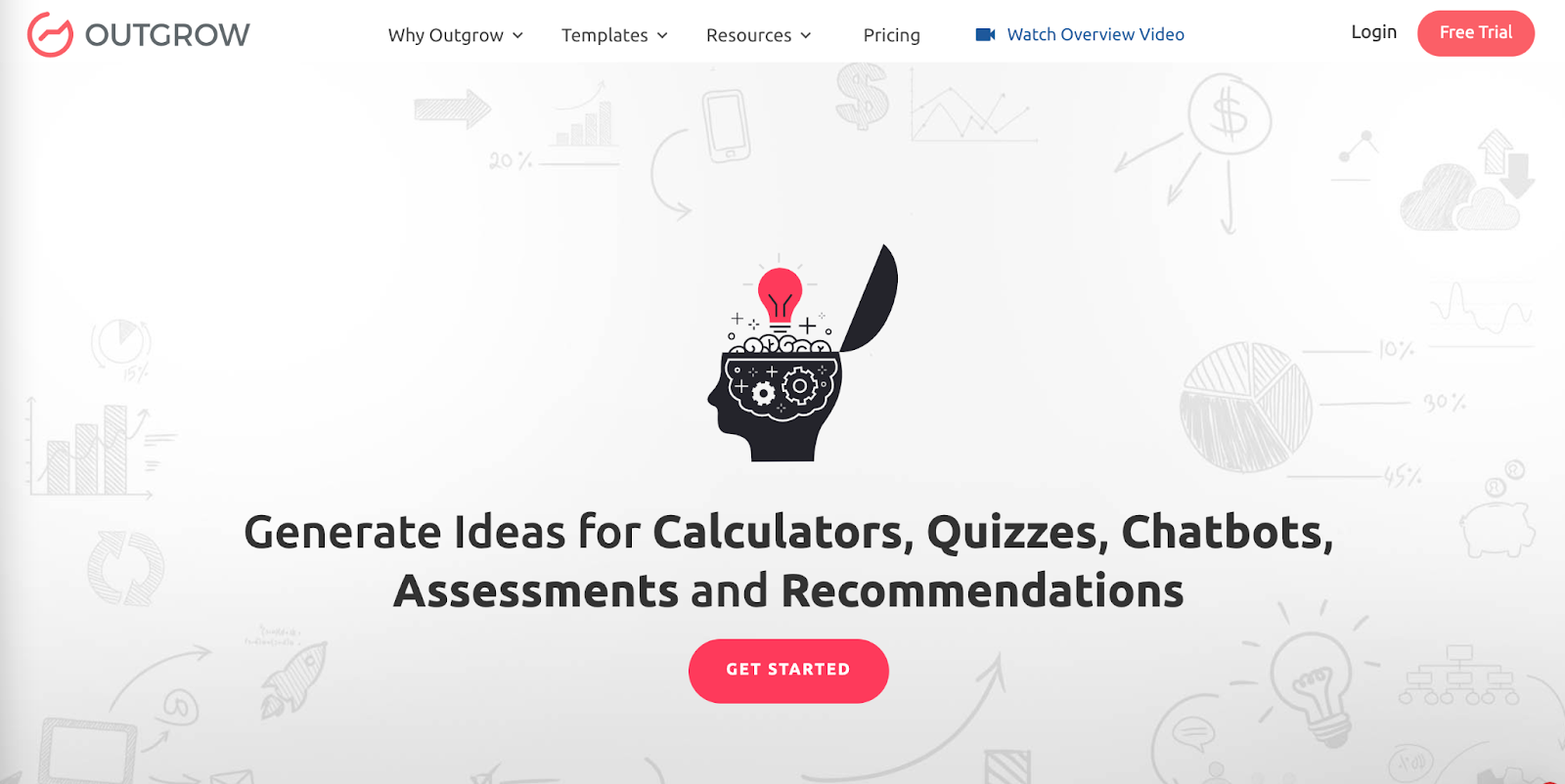
Why we like it:
- The idea generator allows any marketer to input their industry and business website and automatically get ideas for different types of interactive content.
- The results page shows personalized content and tools for specific industries, audiences, and positions in the conversion funnel.
In the past, idea generation required more generic statements or long calls because we could not easily personalize ideas and use cases for each customer at scale. The advantage of an idea generator is that it shows any marketer personalized sets of ideas for how they can use and better leverage your product or service immediately after they input a few data points.
Depending on the industry, audience, and position in the funnel, Outgrow will create a list of tools and content to help convert and attract website visitors. Depending on the need, it will suggest different quizzes, calculators, and chatbots to help engage traffic and provide more lead generation.
Applying Interactive Marketing to Your Campaigns
The campaigns in this article should give you a few takeaways to apply to your own marketing. As you create great content, you should also be thinking about:
- How to disrupt expectation to earn attention, engagement, and interest
- How to best personalize the experience for each individual prospect
- How to reduce friction as much as possible to increase momentum
By putting concepts like these in action, you’ll be in a position to generate buzz, make your content stickier, enhance the experience, and fuel your flywheel.
This article was originally posted April 3, 2020 and has been updated for comprehensiveness.

The 24 Best Websites to Cure Your Boredom in 2022
There’s a lot of content out there about productivity – everything from hacks to shortcuts to tips and tricks for how to get more done in less time.
![Download Now: How to Be More Productive at Work [Free Guide + Templates]](https://no-cache.hubspot.com/cta/default/53/5ab914ce-204e-40ef-acfe-d7bfec642e1a.png)
But what about those times when you’re bored? Well, there is no shortage of websites to cure your boredom.
Here’s a shortlist of the most wonderfully entertaining places to waste time on the internet outside of email and social media.
1. Wordle
In early 2022, people’s timelines on social media – particularly Twitter – started filling with green, yellow, and black squares.
It seemed like everyone was playing a game called Wordle – a game where you have six chances to guess the five-letter word of the day.
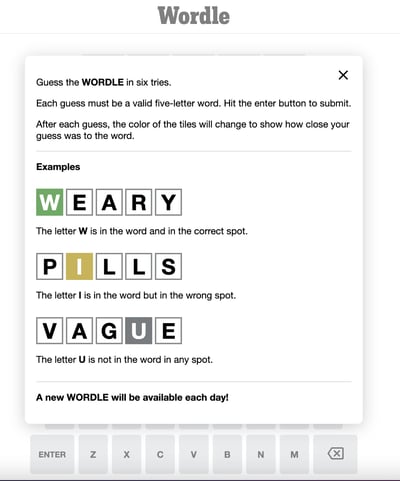
It’s the same word for all players, making it a fun way to connect with people around the world. In addition, you can only play it once a day, which builds anticipation and excitement for what’s to come.
What’s more, the game tracks players by device. As such, you can keep track of your streak every day and share it on social media to show others how many tries it took to make the right guess.
2. Heardle
If you love the concept of Wordle but wish there was a musical version, you’re in luck.
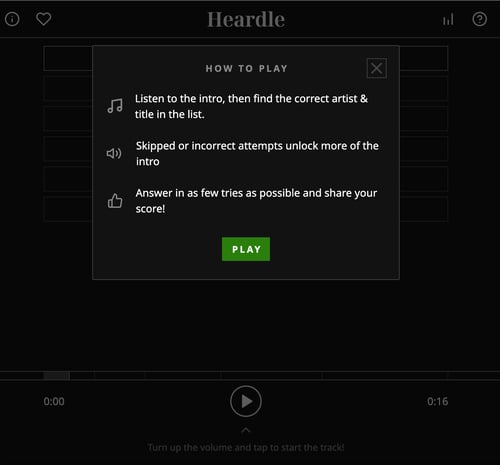 Heardle emerged shortly after Wordle blew up for music lovers and connoisseurs alike. It works by playing a short snippet of a song and giving you six tries to guess the right song.
It’s another great game to play when you have some extra time on your hands.
3. GeoGuesser
Ever wish you could take a trip around the world in a day or less? With GeoGuesser, you can.
This fun game tests your geography by showing you a randomized place around the world and having you guess where it is.

It’s not only a great way to test your knowledge but also discover new places to add to your travel bucket list.
Most of these locations are in tourist attractions, allowing you to get a 360-peek at these places before you even visit.
4. Know Your Meme
Memes go viral every day and it can be hard to track down where they originate from.
Know Your Meme answers that question by digging into every viral meme and finding out who is in the original image, who first posted it, and what it’s about.

You’ll find viral memes, trending memes, and likely memes you’ve never seen before. It’s a fun deep dive that at best, will arm you with a few fun memes to share on social media.
5. The Oatmeal
The Oatmeal is another one of my absolute favorite places to spend time online. It’s a huge library of awesome content – specifically graphics. Even if you’ve read everything already, it’s the kind of stuff you can read over and over again.
Some of my favorite posts include:
6. Supercook
If you want to surf the internet in a semi-productive way – but not so productive that you actually have to leave the house – then check out Supercook.
Here’s how it works: You tell it which ingredients you have in stock in your home, and it’ll give you a big list of recipes you can make using just those ingredients.
It’s a fun way to stay thrifty, clean out the fridge, and make sure food doesn’t go to waste.
7. OCEARCH Shark Tracker
Tracking sharks as they swim around the ocean may not be the most conventional way to waste time on the internet but it might be the coolest.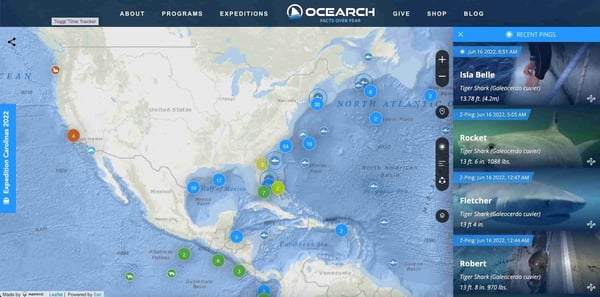
The Track Sharker tool by Marine Research Group OCEARCH lets you track tagged sharks – who all have names by the way – as they travel all over the world.
You can even zoom in on a specific location to see which sharks are hanging out there and where they’ve been swimming and traveling for the past year. Go, Rocket, go!
8. Apartment Therapy

If you’re even a little bit of a fan of home decor or DIY projects, this is a website you might find yourself spending hours and hours on. There’s a ton of awesome visual and written content on here.
My favorites include their “before and after” series, their “small spaces” series, and the tours of people’s actual apartments and homes.
Plus, they have a whole lot of helpful articles giving tips on everything from how to redo your stairs to ideas for using that awkward space above your fridge. There’s no shortage of useful and fun information on here, making it prime for endless browsing.
One of our own was recently featured on ApartmentTherapy too — check out INBOUND Elijah‘s adorable spot here.
9. Gravity Points

Gravity Points is a digital “pen” created by Akimitsu Hamamuro, and it is quite mesmerizing. The website simulates the effect of gravity by allowing you to plot small gravity centers across your screen. Then, even smaller floating objects will flock to these gravity centers and orbit them.
The more gravity centers you plot, the more these forces will start to compete, making your screen all the more chaotic. And yes, your gravity points can absorb one another to create a black hole.
It’s outer space right there on your computer screen.
10. Pottermore

As a marketer, you might dive so deep into branding your business, you have no time to brand yourself. Even if you’re not a massive Harry Potter fan, Pottermore can scratch that itch for you.
Pottermore is widely recognized as the official website for finding your Patronus, your wand type, the Hogwarts House you belong to (of course), and much more.
The quizzes you take to earn these identities are just obscure enough to hold your excitement for the result, and might even encourage you to read (or reread) the famous Harry Potter books — something you should definitely do to balance out your time-wasting website sessions.
11. The Toast

If you’re into great (and hilarious) fiction writing, then you’ll definitely want to bookmark this site. Every day, writers Nicole Cliffe and Mallory Ortberg publish a post on “everything from literary characters that never were to female pickpockets of Gold Rush-era San Francisco,” reads their About page.
To get an idea of whether it’s up your alley, start with their post, “A Day in the Life of Seth MacFarlane, Human Male (Definitely Not a Swarm of Hyper-Alert Bees and a Metal Jaw.)“
It’s just so good.
12. The Onion
If you haven’t spent some quality time reading the online satirical newspaper The Onion, then you’re seriously missing out on a good laugh.
The publication started in 1988 and they’ve managed to successfully maintain a high standard for humor and writing ever since.
Their headlines are laugh-out-loud funny in and of themselves — from “Free-Thinking Cat Sh**s Outside the Box” to “Archaeological Dig Uncovers Ancient Race of Skeleton People” to “Buyer Of $450 Million Da Vinci Painting Sort Of Assumed It Would Come With Frame.”
This awesome episode of NPR’s This American Life gives you a really cool peek into The Onion‘s editorial process.
13. Cracked

Similar to The Onion, Cracked is a pseudo magazine for your everyday life —and yes, it will crack you up.
While The Onion gives you a satirical take on a real news trend, Cracked makes snarky pop-culture observations that are ironic or just ridiculous by design. Sometimes the writers will say the one thing everyone’s thinking, but is afraid to say out loud. That’s Cracked for you.
You might just be passing time on this online magazine, but with respect to some of its most popular articles and pictures, it’s time well spent. Here are a few ridiculous think pieces from Cracked to whet your appetite:
- The Actual Answers to 6 Famously Unsolved Movie/TV Mysteries
- 7 Hilarious Ways Reality Would Ruin Famous Movie Scenes
- 5 Random Questions You Didn’t Know You Wanted Answered
- 6 Underrated (and Selfish) Benefits of Parenthood
14. Mental Floss

Mental Floss is a super addicting online magazine with articles covering a really wide range of topics. Their articles are really well written and researched, and usually on topics that don’t get a lot of airtime.
For example, in their “Big Questions” section, they tackle weirdly intriguing questions like why shells sound like the ocean and why yawns are contagious. Readers can even submit their own big questions.
15. HowStuffWorks
(Image)
This website is dedicated entirely to —you guessed it — how things work. And by “things,” they mean everything: from airbags to regenerative medicine to velocipede carousels.
They’ve covered so much on this website, it’ll be hard to run out of things to read about.
Plus, they have a whole bunch of really cool podcasts that have branched off the main site over the years and are worth checking out.
My favorites are “Stuff You Should Know,” “BrainStuff,” and “Stuff Mom Never Told You.”
16. Lifehacker
Lifehacker is a hub of productivity tips, tricks, and downloads. It’s basically an archive of all the information it would be incredibly useful to know, but nobody ever really teaches you.

Aside from productivity, they also cover topics such as money-saving tips, clever uses for household items, and so on.
For example, did you know there are four lengths of naps that’ll benefit you in different, very specific ways? Along with the fun articles, they have some pretty awesome, in-depth articles, like this one on how to plant ideas in someone’s mind, as well as helpful listicles like the top ten obscure Google Search tricks.
There’s so much content on there that it can be hard to find posts on specific topics. Use the Lifehacker Index for an introduction to their top-performing posts and tips on how to find posts on any topic on the website.
17. Mix
Sometimes you want to surf the internet, but don’t want to do all the paddling. For that, there’s Mix.
You might know the above website by its former name, StumbleUpon, a site (and an add-on to your internet browser) that allowed you to select topics that interested you and then served you various news and information that fit those interests. Today, it’s called Mix, and it puts a new spin on StumbleUpon’s popular content randomizer.
Mix lets you set your reader profile and then share the articles, photos, and videos you discover from your own personal “mix.” It’s a convenient way to entertain yourself and learn new things by simply telling the web to surprise you.
18. Space.com

As long as your head is in the clouds, raise it above Earth’s horizon and head on over to Space.com.
This website reports on astronomy news and trends through friendly, easy-to-digest content that, sometimes, just serves to quench your thirst for a cool nebulous shot of our solar system. Who knows? Maybe you’ll tap your inner space enthusiast.
Whether you want to see an object burn up in our atmosphere or get real into the weeds of how a black hole forms, Space.com has something for everyone. Get your fix today with this amazing picture of a green aurora seen from the International Space Station, part of Space.com’s “Image of the Day” series.
19. Imgur

Imgur collects the most viral images of the week and collects them all in one place for your mindless scrolling and enjoyment.
What I like about Imgur is it’s usually more timely than Twitter or Instagram — more popular sharing networks where funny pictures and memes might appear a week or two later.
Use Imgur to waste time and introduce your friends to the funniest stuff on the internet first.
20. Zillow
It’s fun to check out real estate in areas you might want to live — and it’s just as fun to check it out in places you’ll probably never live, but would love to in a dream world.
Go ahead and explore what’s out there.
You can set up saved searches (some more realistic than others) to relive your discoveries later.
21. Wikipedia
You didn’t think I’d write a post on where to waste time on the internet without including Wikipedia, did you? Of course not.
You’ve gotta love spiraling into the proverbial Wikipedia black hole: Look up one thing, and then check out something that’s interlinked to it.
Before you know it, you’ll have charted the entire Russian Revolution. (Read: This is an actual glimpse into my colleague Corey‘s Sunday morning.)
22. Giphy
When you need to find the perfect GIF, you can’t just stop at the first result you get for “dancing” or “awkward” or “animals being jerks.”
I could spend (… and have spent) hours on Giphy looking for juuust the right GIF.
23. Wayback Machine
Feeling nostalgic? Check out what websites have looked like over the years via Internet Archive’s famous Wayback Machine. It lets you pick a date and see exactly what any website looked like at that time. (For a real trip, compare how Facebook looked back in the 2000s to today. Remember the wall-to-wall?)
If you just want to take a quick peek, check out this roundup of what nine famous websites used to look like.
All the images in that post were taken from the Wayback Machine.
24. The Oregon Trail

Here’s a little gift for those of you who made it to the end of this post: Internet Archive — yes, the same one responsible for the Wayback Machine — made it possible for people to play “Oregon Trail,” a game beloved by many Millennials.
If “Oregon Trail” isn’t your cup of tea, the other games made available by Internet Archive include “Duke Nukem,” “Street Fighter,” “Burger Blaster,” “Indiana Jones and the Last Crusade,” “The Lion King,” and “Chuck Yeager’s Advanced Flight Trainer.” Check out the full library here.
Editor’s note: This post was originally published in August 2018 and has been updated for comprehensiveness.


Linktree for Instagram: How It Works + How to Create One [10 Steps]
Features come and go on Instagram – one thing that has stayed consistent is the restricted linking options, with brands and creators only able to share one link in their Instagram bio and on Instagram Stories.

One solution to this is creating and adding a Linktree to your Instagram. Discover how it can help you share multiple high-quality links.
Plus, discover high-quality examples from brands already using the tool.
- What is Linktree on Instagram?
- Should you use Linktree for marketing on Instagram?
- How to Create a Linktree for Instagram
- How to Add Linktree to Instagram
- Instagram Linktree Tips
- Instagram Linktree Examples
If you’re active on Instagram, you might have seen the phrase “link in bio.”
This means that someone is directing users to visit their Instagram profile page and click the URL located in their bio. Driving people to these links often helps Instagram users generate traffic on different websites, like a YouTube channel or website landing page.
You may be wondering why using this tool can make a difference on Instagram, and we’ll discuss this below.
Should you use Linktree for marketing on Instagram?
Linktree allows you to maximize your sharing potential on Instagram. In previous years, brands and creators had to prioritize one link and include that in their bio. Usually, it was a website.
Naturally, as the platform evolved, so did the need for more external linking opportunities.
Users want to link not only to their website, but perhaps to other social channels, recent campaigns, new product launches, or partners.
Although Instagram now offers linking opportunities in Instagram Stories, live streams, and the Shop tab, there are still no in-feed options. As such, users must rely on apps like Linktree to consolidate their most important links into one, easy-to-view landing page.
Otherwise, you’ll likely be constantly updating your bio and having to decide which link takes priority.
In addition, Linktree offers analytics, which you can use to see which links are generating the most clicks.
Did we also mention that it’s free? While the premium version offers additional features, such as custom landing pages, scheduled links, animation, and more, the free version is all you need to get started.
If driving traffic externally is not a top priority, Linktree likely isn’t for you, as it does require upkeep to ensure you don’t share so many links that users get overwhelmed by their choices.
If you want to leverage the tool in your Instagram strategy, let’s review how to create one in the next section.
How to Create a Linktree for Instagram
1. Navigate to linktr.ee/ to create your free account.
2. Follow the on-screen prompts to describe your account’s category.
3. Select your preferred business plan.
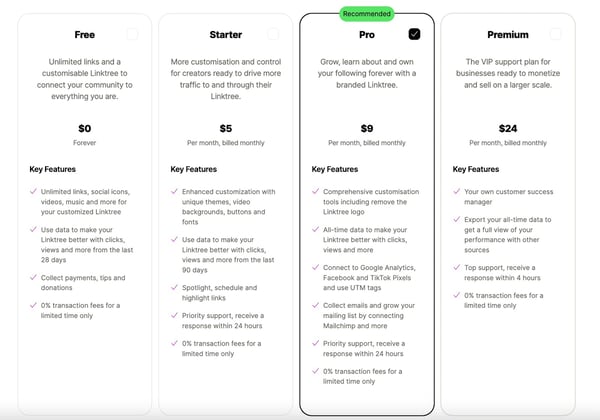
4. After selecting your plan, explore your dashboard and add new links.
5. To begin adding links to your Linktree, you have two options:
- Select Add New Link and a card (as shown in the image below) will appear where you fill in the relevant title and URL.

- Or, you can click on Explore Link to view various link options based on the content, such as music or video links.
Regardless of the method you choose, your completed link should look similar to the image below.
6. Once you’ve added all of your links, the icons at the bottom of the tiles allow you to make card-specific edits.
If you have a free account, you can upload your own tile thumbnail, gate the link for specific audiences, and view the number of times your tile has been clicked.
With a paid account, you can take all of the free actions, in addition to highlighting specific links as priority links, scheduling when certain links go live, and accessing more in-depth analytics.
7. Add all the relevant links you’re hoping to include in your Linktree.
Once you’ve added all your links, you can begin customizations.
Note: The creation tool shows live previews so you can see your final product.
8. Select the Appearance tab on your screen’s top left-hand corner.
9. In the profile window, insert relevant information to the links you’re offering, including profile title, a brief bio, and a business-relevant image.
10. In the Themes tab, select a Linktree theme that matches your preferences. The image below is an example of a customized Linktree.
 If you have a paid account, you can design your own theme, and edit background colors, button shapes, and fonts.
Under the settings tab on the top left header, you can further edit your Linktree and add support banners, ecommerce integrations, and social media icons to link to your other social profiles.
With a paid account, you can do everything previously mentioned in addition to adding mailing list integrations for email or SMS.
Once you’re satisfied with your Linktree and how it looks it’s time to put the link in your Instagram profile.
How to Add Linktree to Instagram
1. Within Linktree, find the Share button. 
2. Select the Add Linktree to your socials button in the Share dropdown menu.
3. Click Instagram.
4. From here, you have two options: 1) Copy the Linktree URL and add it yourself on Instagram by clicking “Edit Profile,” and paste the link into the Website field in your Instagram profile. Or 2) Clicking “Go to my Instagram” to be taken straight there.
Now that you know how to create your Linktree and add it to your Instagram profile, let’s go over some examples from brands that already use Linktree on Instagram to meet their business needs.
Instagram Linktree Tips
- Choose relevant names for your links: You want to use a Linktree to easily send your customers to different sites, so ensuring you name each link in a way that clearly says what it’s linking to increases effectiveness.
- Choose your title wisely: Write clear and concise descriptions that will entice your audience to click.
- Only include the most relevant links: While it may be tempting to have as many links as possible, it’s best to only place the most relevant links in your Linktree, so users aren’t overwhelmed with options. For example, if you’re running a new campaign, consider only linking to that one and removing links from older campaigns.
- Use branded tools: if you have a Linktree paid account, use the custom branded tools that will help your users content your Linktree to your brand assets that they already know and recognize, like custom icons and color schemes.
- Continuously monitor your Linktree: Continuously monitor your Linktree to ensure it’s up to date with your current business offerings. This means removing irrelevant links that will distract from what you’re hoping to center and monitoring analytics to see if you need to make any changes to your Linktree strategy.
Instagram Linktree Examples
1. Black Owned Everything
Black Owned Everything is an online marketplace that champions Black-owned businesses and the products and services they sell.
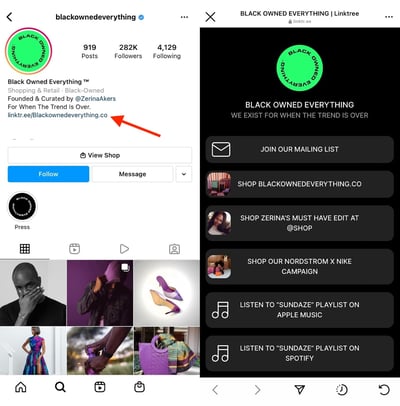
It uses a Linktree on its Instagram profile to call attention to its different offerings, as shown in the image below.
Why We Like This:
Black Owned Everything’s Linktree is successful because it includes links that are clearly labeled for users to understand and find what they are looking for, and there are also very few links.
As a result, viewers likely aren’t experiencing decision paralysis and can quickly find what they are looking for.
2. Patsy’s
Patsy’s is a dessert business based out of Brooklyn, NY that sells Caribbean rum cakes made from scratch. They use a Linktree to help profile browsers order their cakes and view recent collaborations.
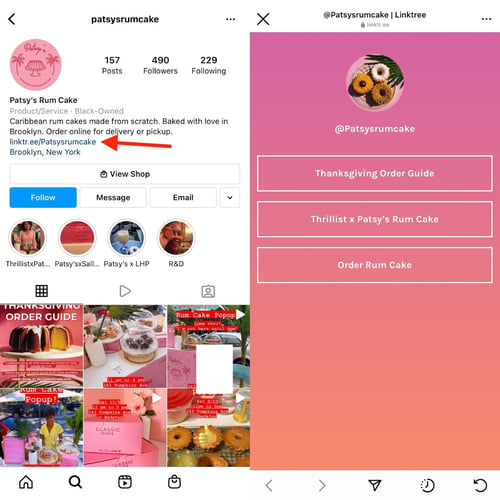
Why We Like This:
Patsy’s uses Linktree as a unique way to call user attention to a holiday ordering guide that walks users through the process of placing an order.
While it could simply share this information in an Instagram post, users may not want to read a lengthy caption. Instead, Patsy’s can direct users to the link in its bio to quickly navigate to the ordering landing page.
3. Sean Garrette
Sean Garrette is an esthetician and content creator who uses Instagram to share helpful content with their audience.
They also have a branded Linktree in their bio where they share links to recent collaborations and partnership discount links.
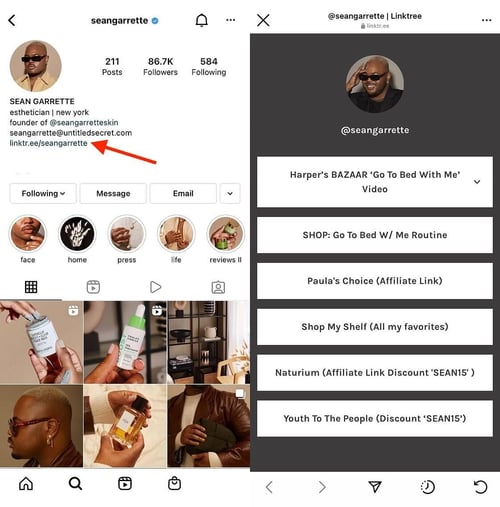
Why We Like This:
You can always post about the partnerships you have on Instagram, but if they’re long-standing, people might forget they exist.
You can place affiliate links in your Linktree to remind users that your partnerships are still running and, if you successfully drive users to your Linktree, all of your traffic will come across these links.
4. Golde
Golde is a business that sells superfood and wellness products. It uses Instagram to provide educational content and product photos and has a branded Linktree in its Instagram bio.
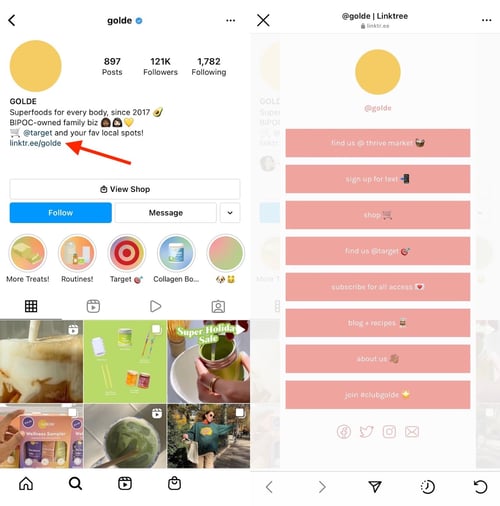
Why We Like This:
While Golde does have more links in its Linktree, users aren’t overwhelmed by choices because each link clearly states where it leads, and the emojis provide additional context. If you have multiple links that you want to share with your users without overwhelming them, use Golde’s Linktree as inspiration.
5. TikTok
TikTok uses Instagram to call attention to trends, updates, and high-performing videos on its app. In addition, it has a branded Linktree in bio, pictured below.
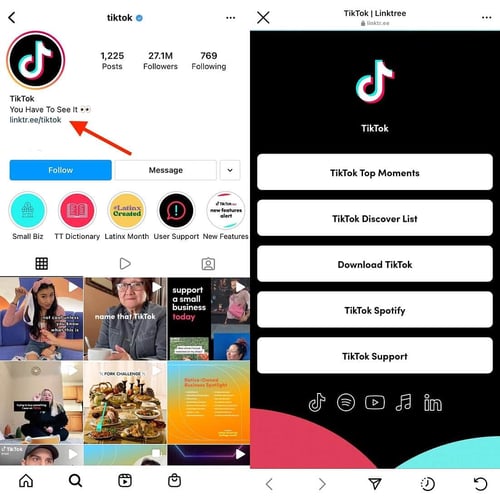
Why We Like This:
TikTok’s Linktree is a great inspiration because it drives users to critical actions related to the app: downloading the app, understanding trending moments and sounds, and contacting customer support.
It also contains branded links in the footer of the Linktree that users can navigate to and easily understand where clicking will land them.
Should you choose to use Linktree, you’ll be able to share multiple high-impact links with your audience all at once, giving them more ways to interact with your business and become engaged in what you have to offer.
Editor’s Note: This post was originally published in Dec. 2021 and has been updated for comprehensiveness.

11 Talent Acquisition Strategies to Find the Best Employees
It can be difficult to find the ideal candidate for a specific position. In fact, in 2021, 69% of companies have reported talent shortages and difficulty hiring — a 15-year high.
Regardless of the state of the economy and your talent pool, to succeed long-term, your business should be able to hire and retain the best, most talented employees.
![→ Click here to download our free guide to hiring and training a team of all-stars [Free Ebook].](https://no-cache.hubspot.com/cta/default/53/c42148d7-13dd-4c38-b907-cff1602ee62f.png)
But hiring can be a daunting task, which is why you need a talent acquisition strategy.
To succeed long-term, it’s critical you attract and retain talented employees regardless of vacant roles. Talent acquisition can help you do this, while solving for long-term organizational needs.
Now that you understand what talent acquisition is, let’s dive into the most effective talent acquisition strategies.
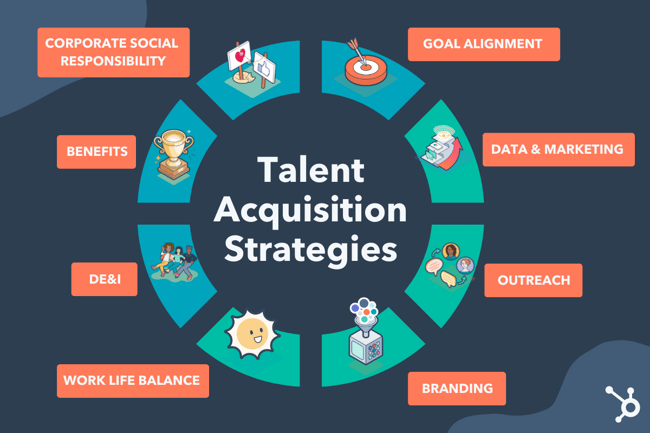
Here are several critical talent acquisition strategies you need to implement to ensure you’re finding the best people.
1. Align your talent acquisition strategy with your business goals.
Consider your business goals for the next one to five years, and use those objectives to tailor your acquisition strategy to meet those needs. While recruitment tends to focus on filling vacancies within departments, talent acquisition is more about considering how your company is going to expand long term and then finding employees who can help take you there.
For instance, are you planning on expanding into Latin America? If so, perhaps your HR department should focus on attracting candidates with international or regional experience. Or, maybe you’re planning on creating a new product, in which case, your HR efforts should focus on attracting talented software developers and coders.
Certain roles might not even exist yet, but you’ll want to consider what type of talent you’ll need to hit your business’s long-term goals. Remember, investing in the right candidates will pay off for your company, long-term.
2. Use data and marketing to create better acquisition material.
You wouldn’t create a marketing campaign without data, so why should you recruit without it?
Talent acquisition should be treated with just as much importance as any of your marketing campaigns. Convincing people to join your company is just as necessary as incentivizing people to buy your products.
There are plenty of different opportunities to use data to strengthen your talent acquisition strategy. For instance, you might use data to figure out where your top talent came from, and use that information to focus your talent acquisition efforts on certain academic programs or professional networking sites.
Additionally, your HR team should partner with your marketing department to refine job descriptions, career pages, emails, and more.
Using data, you can figure out if certain questions are deterring candidates from filling out job applications, and eliminate those questions. Alternatively, perhaps you’ll find adding images or videos to highlight company culture incentivizes more candidates to fill out job forms. Or, maybe more candidates apply for a job with description A over description B.
By using analytics and data, you’re able to ensure your job descriptions and career pages aren’t deterring qualified people from applying. But there’s no need to do this manually. You can use a software tool such as Bullhorn, which is specifically designed to tackle some of the biggest tasks of talent acquisition: recruiting candidates, sorting through the job pool, and analyzing candidate data. Their software was created to streamline applicant tracking systems and improve profitability for any size business.
3. Expand outreach strategies.
To find better talent, you’ll need to expand your sourcing strategies. Different skill sets require different methods of outreach. You’ll find your best marketers in a different place than your best programmers, so you’ll want to diversify your sourcing approach.
Rather than spending all your time on LinkedIn, consider other specialized job boards, academic programs, or networking events where you might find a specific group of talented professionals. You can also use a tool to help with this endeavor. For instance, SmartRecruiter is a CRM that is developed for recruiting candidates and coordinating calendars for potential new hires.
It’s critical you identify where you can find the vast majority of your top talent, whether that be professional events, conferences, online forums, or social networks. Then, focus on strengthening relationships and networking with the right people. Not only will you grow your pool of potential hires, but you’ll also grow brand awareness for your company, which will help you attract talent in the future, as well.
4. Build your company identity.
Millions of millennials and older Generation Z candidates make up the current job force. This group of potential employees came of age with the internet and social media. In researching your business, these individuals look at social media accounts, websites, and job boards to understand your work culture.
When looking into your company, candidates will have questions. What is the workplace atmosphere? Do their employees look happy? Is there potential for growth? Leverage your current employees and capitalize on the instant broadcast capabilities of your website and social media profiles. Post images and videos of your employees at work. Encourage employees to interact with your company on its platforms. Congratulate employees on internal promotions.
Note the focus on employees. A company that focuses on the well-being of its staff is a place where people will strive to work. Building your company identity to reflect a positive, expanding environment can be an effective tool in your talent acquisition strategy.
5. Emphasize the company’s corporate social responsibilities.
Companies have taken a step back from policies that only benefit them. Your company needs to focus on pursuing its goals while benefiting others. Your company’s corporate social responsibilities (CSR) are a considerable tool for attracting top candidates aligned with your organization’s values and beliefs.
Corporate social responsibilities lead to the betterment of your brand image, workplace culture, and general society. For example, while Ben & Jerry’s is known for its collection of ice cream flavors, the brand also stands out for its long-standing commitment to social responsibilities. Since 1985, Ben & Jerry’s has donated 7.5% of its pretax earnings to social causes like Greenpeace and Vietnam Veterans of America. Since then, the company has supported voting rights, racial justice, LGBTQ+ rights, and more. With a menu item dedicated to its values on the landing page of its website, the ice cream company emphasizes the importance of its CSR.
On the career landing page for your company, your CSR should be immediately noticeable through images and videos throughout the page. If your company focuses on diversity and inclusivity, demonstrate that. If your company stands behind sustainability, illustrate that through your content. Employees rarely want to work for a company that contradicts their values and beliefs. Use your corporate social responsibilities to attract like-minded candidates who will be passionate about working for your business.
6. Increase budget for the DE&I department.
Diversity, equity, and inclusion is critical for creating a successful talent acquisition strategy. In fact, Dan Schawbel a best-selling author and managing partner of a New York City-based HR research and advisory firm, says that “70% of jobseekers… want to work for a company that demonstrates a commitment to diversity and inclusion.”
The face of the workforce has changed drastically in the last fifty years. In 2022, there are more women and minorities applying for jobs, and as stated by Schawbel, the majority of jobseekers want to see this reflected in a company.
DE&I training is imperative and demonstrates that your company is willing to stay current and relevant with changing times. To see an ROI on your investment in training, prioritize retention. During the job application process, continue to eliminate biases in resume reviewing. Ways to remove biases include removing names and photos when sourcing candidates, making applications and resumes anonymous before review, and creating a diverse hiring team.
7. Offer updated work options.
The COVID-19 pandemic reshaped the American work model. Talent acquisition specialists adapted their work models to conduct online onboarding versus meeting candidates face-to-face. As the workforce evolves with more technological advances, workers will strive for more work/life balance.
A professional at Goldman Sachs posted a question on the finance message board of Blind, an anonymous professional network. They asked, “Would you rather make $30k more switching to a new job that requires you to work in the office, or would you rather keep your current salary but WFH anywhere after COVID?” The network found that 64% of professionals prefer to permanently work from home over a $30K compensation increase. Other professional groups who favored permanent work from home over a compensation increase include Airbnb (71%), Lyft (81%), Twitter (89%), and Zillow Group (100%).
Employees want to work from home. Remote work models lead to higher productivity. On average, workers are 13% more productive when working from home. As technology continues to advance, your company needs to adjust and consider incorporating remote or hybrid work models while also cutting costs in outdated recruitment techniques to funnel the money into talent acquisition software.
8. Design a competitive and comprehensive benefits plan.
When it comes to compensation packages, employees may be willing to accept a lower salary if balanced by comprehensive health benefits, e.g. medical, vision, and dental insurance. Employees want good health benefits, and that includes mental health, too. A company that invests in its workforce’s mental health with programs like an Employee Assistance Programs (EAP) understands the value of a healthy mind.
A survey conducted by Society of Human Resource Management found that “nearly one-fifth of HR professionals altered their benefits program to aid in the retention of employees over the past 12 months. Of these organizations, about three-fifths altered their health care benefits; more than one-third altered their flexible working, retirement savings and planning, leave, and professional and career development benefits as well.”
Life inside the workplace is not all that matters in talent acquisition. Consider what happens in an employee’s life outside the business. Does your business model allow for a healthy work/life balance? Are your employees able to receive sufficient healthcare? What kind of retirement or investment opportunities do you offer? Potential candidates will ask these questions about your company. It is necessary to provide the answers with a comprehensive benefits plan.
9. Promote internal diversity.
Many industries are dominated by men, leading to women feeling underrepresented within the company’s culture. While the number of women in the workforce has increased significantly over the last few decades, men still hold most positions of power. There is also a racial disparity in corporate America. When HR departments create internal coalitions to rally morale, it increases diversity and inclusion efforts from inside the workforce. To build a diverse and inclusive culture, your company needs to give a voice to people from a wide range of backgrounds.
Diversity should be a company-wide model; however, it begins at the top. Educate yourself on various cultural traditions and backgrounds. Create a workplace where different perspectives are valued and voiced. Employees tend to follow the example of their boss or manager, and setting this example can increase internal diversity across your company.
10. Partner with local universities to build an applicant pool.
To build a pipeline of potential candidates, companies partner with educational institutions. It helps establish a relationship between students and future employers.
Take IBM, for example. The technology corporation has partnered with The University of Notre Dame, Virginia Tech, and Florida State University to provide access to its systems for teaching and research. IBM has also planned joint-research collaborations with Duke University and Harvard University.
Instead of waiting for interested candidates to come across the company, IBM has started cultivating relationships with potential applicants. This strategy attracts candidates after graduation and boosts company retention.
11. Add other incentives.
Large to mid-size corporations use eye-catching bonuses and employee benefits to compete in a global market to attract top talent within the industry, but financial incentives aren’t the only things that matter.
When talented candidates are comparing companies, they’re going to consider values, culture, and work-life balance, too. By cultivating an impressive employer brand, you’ll attract better talent and find more long-term success.
To succeed with talent acquisition, you’ll need to be able to answer the question, “Why your company, over all the others?” This is why employer branding is a critical strategy for finding the best employees.
Consider how you can reframe your employer branding to focus on the best aspects of your company’s values and culture. It isn’t just about mentioning health benefits or compensation — you’ll also want to convey your impressive company culture, in which employees collaborate efficiently and enjoy spending time with one another. You might mention your flexible remote policy and other work-life balance perks, or your company’s emphasis on growth opportunities.
It’s important you broadcast these unique attributes through employee review sites like Glassdoor, as well as your “About Us” page on your company website. When highly qualified people are contemplating your company over your competitors, it just might be those reviews that end up convincing them.
As you create your talent acquisition strategy, you may wonder how it differs from recruitment — and whether there’s overlap between the two. They’re different, but they can complement each other.
To create a truly successful hiring process at your business, you need to use both talent acquistion strategies and short-term recruitment cycles. Mixing the two will empower you to attract and retain top talent.
Creating a Talent Acquisition Strategy is Only the Beginning
Your pursuit of top talent shouldn’t solely rely on traditional, short-term recruitment strategies like sending LinkedIn messages or attending job fairs. To ensure top talent acquisition and retention, you’ll need to devise a strategic long-term talent acquisition plan, which will lead to a better employee experience all around.
Editor’s note: This post was originally published in November 2018 and has been updated for comprehensiveness.


Improving Your Organic Position On Google: A How-To Guide For Small Businesses
In the U.S., only 49% of small businesses invest in search engine optimization (SEO). That means more than half of them are leaving traffic, customers, and revenue on the table by not improving their organic position on Google.
When you run a small business, especially one that’s brick and mortar, it can be hard to conceptualize the buyer’s journey to your business. Although word-of-mouth is still a popular form of marketing, it’s not the only way customers will find you. More often than not, they’re using Google searches to research the businesses they plan to buy from long before they make it into a store or the checkout page on a website.

This is why it’s important to improve your organic position on Google with SEO. The concept of SEO can sound scary, and there are a lot of opinions out there about whether it’s worth the effort. However, when you think about SEO as a way to help your customers before they make a purchase, you’ll see that the value pays dividends in the long run.
How to Improve Google Positioning
1. Update your Google Business Profile.
Google Business Profile is a free tool that helps customers find businesses online. This tool works for normal Google searches but it also integrates with Google Maps so customers can find businesses while they’re en route to a destination.
By verifying and updating your Google Business Profile, you can help your business stand out on the search engine results page (SERP) and garner more traffic to your website or your physical store. Here are the most important updates to make on your profile:
- Add the correct address, phone number, and store hours
- Add your website URL
- Include your social media profiles
- Update images with new offerings, promotions, and products
- Add a photo of your physical business location and building
Each of these points helps a potential customer make a decision about your business. They’ll know how far they need to travel (if at all), where they can find more information about your business, what your products and services look like, and they’ll have information about your latest promotions and sales.
Here’s an example of a Google Business Profile:
2. Get acquainted with ranking factors.
Google has identified four factors that its search algorithm takes into consideration when ranking content. These include:
- The words in the query
- The relevance and usability of the pages
- The expertise of the source
- The location and settings of a searcher’s Google account
Although some of these factors are out of your control as a business owner, you can create content with most of them in mind.
3. Optimize your existing content.
Optimizing existing content is typically a faster, more efficient way to target new customers without investing in brand new content. If your business’s website includes a blog or even a simple landing page, you can update these pages to appeal to people who are looking for the products and services you sell.
Well, how do you find those people? And how do you know what they’re searching for?
While it’s impossible to control the exact search terms a potential customer will type into the Google search bar, you can get an understanding of what users have searched for in the past and see predictions of what they’ll search for in the future.
To target specific words in a searcher’s query, you’ll first want to do keyword research on your business, industry, products, and services. You can use HubSpot’s Content Strategy Tool or paid tools like Ahrefs, Moz, or Semrush for detailed, granular keyword data. There are also free tools like Google Keyword Planner. To predict future search demand, you can use the free tool Google Trends.
Featured Resource: SEO Marketing Software
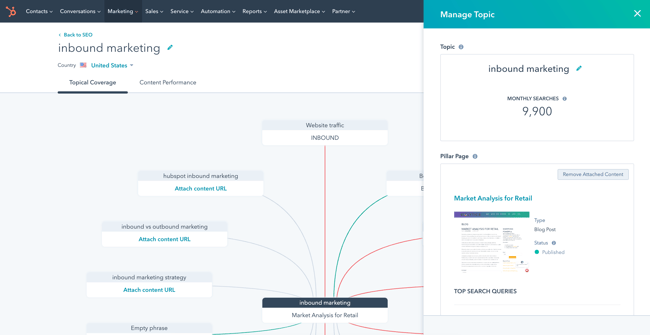
4. Identify content gaps.
A content gap is twofold. It may appear as a topic that is under explored or unexplored in your industry or niche, or it may be a stage in your customer’s journey that isn’t yet covered by content in your existing library.
Both types of content gaps are exciting opportunities to create new content that resonates with your audience and has the potential to generate revenue.
By using some of the same tools in the tip above, you can run a content audit to identify keywords that correspond to content gaps. This makes it simple to see them at a glance and incorporate them into your next blog post, product page, or even on your home page.
5. Include image alt text.
Whether they’re on your website, social media profiles, or Google Business Profile, images are a critical part of improving your organic position on Google. Why? Because of a simple (and often overlooked) field called alt text.
To understand why alt text is so important, we have to think like a search engine. Search engines can’t “see” images the way humans do, so they need another way to process them. Alt-text is a text-based description of an image that lets the search engine know what the image is about and how closely related it is to the topic or keyword it’s associated with on the page.

Without alt text, it’s almost impossible for search engines like Google to effectively recognize and rank your images. As a result, you could miss out on additional traffic and customers who may have found your website through an image pack or an image search.
6. Answer frequently asked questions.
If you have an FAQ section on your website, you’re already making strides to improve your Google ranking. To make it even better, take a look at your FAQ page and search for the same questions on Google. What do you see?
If you own a local hair salon and one of your FAQs is “What’s the difference between balayage and ombre?” you may see this box appear in the SERP:
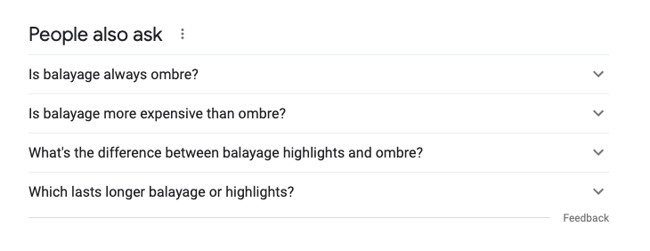
The “People Also Ask” box is a great way to see additional questions your customers may be curious about. You can add similar questions to your FAQs page which gives you even more opportunities to increase your Google ranking.
7. Take a peek at your competitors.
The final tip we have for improving your organic position on Google is to take a peek at your competitors. We don’t recommend you copy your competitors, though. The point of looking at their keyword strategy with tools like Ahrefs, Moz, or Semrush is to understand their content gaps (remember those from earlier?)
By understanding the topics your customers are looking for that your competitors aren’t covering, you can fill the void with your own content that takes ranking factors and keyword research into account.
Rank Higher in the Google SERP
As a small business, you’ve got to wear many hats, and Google guru is one of them if you want to drive more traffic to your website and more business to your stores. Luckily, you don’t have to know everything about how search engines work to see your business higher page 1 of Google. These tips are tried and true SEO basics that can help your business get more visibility from customers who are looking specifically for you.
Editor’s note: This post was originally published in December 2006 and has been updated for comprehensiveness.

What is Blockchain? | The Ultimate Guide
As cryptocurrency continues to be a hot topic, you may be wondering if your business can benefit from crypto like bitcoin.
But what if I told you the biggest opportunity for businesses of any kind is actually related to the technology that underlies bitcoin — blockchain. Blockchain, the public ledger that records all bitcoin transactions, is more than just a fad — it’s changing life as we know it.
Don’t believe me? Follow along to learn more about blockchain and how it works, who’s using it, and the future of the technology. Feel free to email, bookmark, or jump to the section that interests you most.
What is Blockchain?
Blockchain is a ledger system that uses an open, distributed record to keep track of transactions — transactions could mean cryptocurrencies, NFTs, medical information, voting or home records, and more.
These transactions get packaged into blocks — all of which get verified by other users in the system by completing math problems. Once a block gets verified, it cannot be altered and gets added to a chain of other permanent, previously verified blocks.
The records held within these blocks form a blockchain, and the blockchain’s users all keep track of this record. It’s basically a giant, shared ledger, but in practice, it’s much more exciting than that.
Let’s say the air fryer you bought last year isn’t all it’s cracked up to be and you hardly ever use it. You could use a third-party seller like eBay to sell it. These sellers act as the marketplace that connects you (the seller) to potential buyers — they make money by charging fees.
In this case, let’s pretend the buyer is from Germany. When you make a sale on eBay, the platform verifies the transaction with your bank and the purchaser’s bank. It also confirms your air fryer and the end buyer both exist. However, if you use blockchain technology to sell your air fryer, you can cut out all the middlemen while still maintaining a safe, speedy, and secure transaction — even internationally.
No eBay, no banks, no fees, and no exchange rate — it’s that easy.
History of Blockchain
Before we dive into exactly how blockchain makes this possible, let’s talk about the history of blockchain. In October 2008, the secretive founder of bitcoin Satoshi Nakamoto introduced the world to peer-to-peer electronic payments.
His cryptocurrency formed the world’s first blockchain. Because bitcoin’s software is open source — allowing anyone to see, reuse, and adapt the code behind it — it didn’t take long before users started modifying it for different purposes.
Early on, blockchain users mostly tried to make better versions of bitcoin. Litecoin, an alternative cryptocurrency developed by a former Google employee, aimed to provide faster transactions. Others, like the meme-inspired Dogecoin, were created for people turned off by bitcoin’s high price point.

Namecoin.org developed one of the first uses of blockchain for something other than cryptocurrencies. The technology uses blockchain to register .bit domain names as an alternative to the primary domain name management system.
Namecoin makes it extremely difficult for external players, like the government, to take control of websites. Because .bit domains get registered in a blockchain, they are nearly impossible to change without knowing the encryption key.
The next significant innovation came in 2013 when a small startup named Ethereum put out a paper outlining a way for developers to easily create entirely new blockchains without relying on bitcoin’s original code.
Two years later, Ethereum launched their new platform, allowing users to expand blockchain’s functionality beyond cryptocurrencies.
Currently, companies and individuals are exploring how to use blockchain technology in healthcare, energy, supply chain management, and many other industries —but more on that later.
How Does Blockchain Work?
There are different ways to set up a blockchain, Harvard Business Review laid out five principles that all blockchains have in common.
First, all blockchains use a distributed database — this means that every user in a blockchain can access the complete database, including its past transaction history.
This transparency allows users to verify any information they need and to complete transactions directly, without any intermediaries.
Secondly, any transactions or communications get conducted between peers. Each user stores records and sends information directly to all other parties in a blockchain.
Because of this technology, intermediaries and central storage institutions, like banks, are unnecessary. Users have all the information they need to vet other users, otherwise known as nodes.
Third, although blockchains are transparent, each user associated with a blockchain can remain anonymous. To protect users’ identities, each user has their own unique “30-plus-character alphanumeric address” that they use in place of a name. Users can choose to share their identity or remain anonymous with their blockchain address.
The alphanumeric addresses are also used to verify transactions. You may have heard the term “mining” associated with bitcoin. When someone “mines” bitcoin they aren’t digging around in the earth in search of a bitcoin filled hard drive … except for that one time.
Here’s how mining actually works: When someone wants to make a transaction and add a new record or “block” to the ledger, they first need to solve what is essentially a math problem.
Computers use their computing power to “mine” for the answer, which is vetted by the network of users. If the answer is correct, the new block is added to the ledger. A token, also known as a coin, is generated when this occurs —almost like a receipt to prove it happened.

Fourth, because blockchain uses a digital ledger, the entire transactional process can be automated using algorithms. For example, when you buy a house, you pay for a lot of other small costs like title registration, mortgage lenders, inspections, and legal fees.
There are all these other people involved to provide access, regulate, and administer a sale from one person to another. But a lot of this complexity disappears with blockchain.
You can record property data and even build in digital rules — called smart contracts — that, once fulfilled, allow the system to automatically transfer a property title or money for purchase.

Fifth, once a record gets created, it cannot change. When miners verify a transaction, that record is shared with every other party in the blockchain as part of the decentralized ledger.
Part of each verified transaction is also used to generate the math puzzle for the next block in the chain. This means each transaction gets linked to the ones that came before it and all those transactions get stored across multiple computers with no single point of failure.
Blockchains can also be public or private —both types of networks share the five characteristics listed here but have one major difference. A public blockchain is open to the general public and anyone can join, execute and verify transactions, and everyone maintains a copy of the decentralized ledger.
The bitcoin blockchain is currently one of the largest examples of a public blockchain network. In a private blockchain, participation is limited to users who receive an invitation to join the network and are granted permission to enter. Think of it like the early days of Facebook when users needed email addresses from certain schools.
Aside from the increased security offered by private blockchains, they are also much more cost efficient since much less computing power is required to verify transactions in a smaller network.
Still confused? I don’t blame you. Here are some talking points on how blockchain works for your next cocktail party.
- Blockchains are completely transparent. Any user can view any transaction from now until the end of time.
- All transactions get completed between individual users. Say goodbye to intermediaries.
- Even though blockchains are transparent, a user’s identity doesn’t have to be. All users are assigned a public address to use in place of a name during transactions.
- Because blockchains live online, we can use algorithms to automate future transactions — just like you automatically pay your Netflix subscription every month.
- Once a block gets added to a blockchain, it’s there forever — no ifs, ands, or buts.
Got it? Let’s move on.
Benefits of Blockchain
You may be thinking, if blockchain is basically just another way to organize records, why are people so excited about it? Don’t worry! This is the part of the article where we talk about the benefits of blockchain and how it has the potential to change the world.
Blockchain Security
One of the largest benefits of blockchain is its ultra-secure network. Because data transmitted using blockchain is inherently encrypted, it’s much more secure than the standard username-password security system. However, the real security benefits come from blockchain’s network of users.
Decentralized data stored using blockchain makes it extremely difficult to hack into because no “single point of failure” exists. What does all this mean? Let’s say you have all your documents backed up on a single hard drive.
If that hard drive is lost, stolen, or destroyed, all of your documents are gone … forever. But if all your documents are saved on thousands of different hard drives, it’s unlikely that you’ll ever lose your data. That’s the power of blockchain security.
Under usual circumstances, to break into a blockchain, hackers would need to overwhelm over 50% of the network in less time than it takes to create a new block. The amount of computing power required to do this in most blockchain networks is tremendous.
Larger networks are much harder to hack because they are more decentralized and have more computers working to verify transactions.
That’s not to say hacks are impossible. Going as far back as 2017, data shows hackers have managed to steal around $2 billion worth of cryptocurrency as they vulnerabilities in the system. In addition to the 51% rule, the hacks can also occur if errors were made during the creation of the blockchain or if there was insufficient security during an exchange.
Fortunately, it’s easy to detect when a block has been tampered with thanks to hash functions. Hashes from one block are added to the data in the next block. Anyone who tries to alter a block will end up changing the hash completely, setting off a red flag and disabling the block completely.
Blockchain also offers anonymity. Without blockchain, systems use a variety of information like names, addresses, card numbers, and social security numbers to verify transactions. All this personal information is vulnerable to being stolen. In a blockchain, only the private key matters.
Each blockchain user has two keys: a public key and a private key. Their public key is derived from their private key using a mathematical formula and then combined with other information to form their public address for transactions.
Without the private key, it is impossible to verify transactions to the public address. This private key never gets shared with outsiders which means multiple complex formulas stand between a user’s private key and their public address.
You may be wondering if it’s possible to reverse the formula and uncover someone’s private key from their public key? The bad news is that it is possible. The good news is that the chances are very slim.
A private key number is between 1 and 2^256, meaning a hacker has to find the right number between 1 and quattuorvigintillion — a 78 digit number that is estimated to be bigger than the number of atoms in the universe.
Decentralization and Smart Contracts
The second benefit of blockchain comes from decentralization and smart contracts. Presently, smart contracts may represent the most powerful application for blockchain.
HubSpot’s former director of acquisition and resident blockchain expert Matthew Howells-Barby states: “One of the more immediate ways in which blockchain technology is going to impact SMBs is through smart contracts.
Smart contracts facilitate the creation of trustless digital contracts that can be used for all kinds of applications — something that has never been possible before without a third party being involved.
Imagine being able to create digital contracts with contractors that would automatically pay them once work has been completed to a satisfactory standard. This is one of the many applications that smart contracts offer.”
Essentially, smart contracts use blockchain to automate payments and transfers based on a predetermined set of conditions. Using smart contracts, you could automatically pay your electric bill once your electricity usage hits a certain amount.
The transaction would be sent securely to the power company and verified using blockchain. No more late fees, no more stolen financial information — you would never have to think about scheduling a payment again.
Once again, as more and more transactions are automated using smart contracts, the need for middlemen and outside organizations will diminish. Because information gets distributed across the entire network, it’s extremely difficult for one group to seize control of it.
Governments and individuals in positions of power will no longer be able to shut down sources they wish to repress because the information will exist on many computers across the network.
Speed and Efficiency
Third, blockchain is fast and efficient. Manual data entry is tedious and prone to error. Think about it. How many typos do you typically make writing an email? Most organizations maintain multiple record systems for different tasks.
For example, an ice cream store may use one record to track the amount of ice cream and supplies they purchase, another to track hours their employees work, and another to track sales.
Reviewing separate records takes up a lot of time. With blockchain, all this information gets stored and verified as it gets generated.
Blockchain’s verification speed has vast benefits. For example, a simple stock purchase can take up to a week to verify using current methods. Several forms, organizations, and a ridiculous amount of acronyms are involved in the process.
With blockchain, there is no need for third-party verification because all the information needed to complete and verify the transaction gets included in the ledger. That means stock transfers can happen almost instantaneously instead of a full week later. Talk about some serious returns!
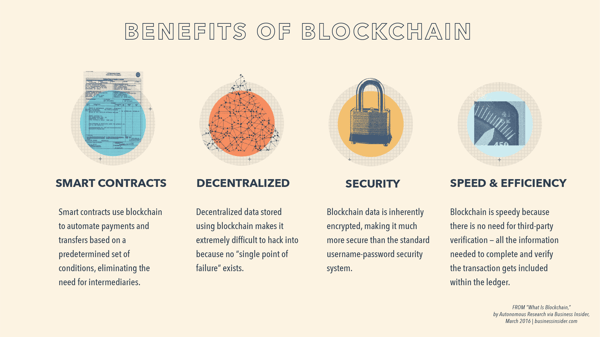
Applications of Blockchain
Okay, so we’ve talked about what blockchain is, how it works, and the benefits of using it, but is anyone actually using this technology? Like really using it — not just for trying to get bitcoin rich? The answer is an enthusiastic yes!
In simple terms, bitcoin is only one, tiny application supported by blockchain — there are endless possibilities for the technology. Let’s do a deeper dive on some other applications of blockchain.
FinTech
Payments and Cryptocurrencies
Let’s just get this out of the way — cryptocurrencies are indeed one of the most popular blockchain applications. I know, I know, I said I was going to talk about other applications of blockchain. I promise I will, but it’s impossible to talk about blockchain without taking a look at the application it was originally built for — bitcoin.
Partially because it was the first one and partially because it has the largest network of users, bitcoin is the most valuable cryptocurrency in terms of market capitalization.
In fact, bitcoin has become so popular that stores, restaurants, and even bars are starting to accept it as payment. In larger cities like New York, you can live your life only paying in bitcoin, though it isn’t always the most practical approach.
Because bitcoins trade on an open market, investors like the Winklevoss twins were able to make bets on future price movements. Before you go investing in bitcoin, don’t forget that the cryptocurrency is also infamous for its massive price swings.
Other cryptocurrencies like Ripple, Litecoin, and Ethereum can also be used to send payments or for market speculation, but these cryptocurrencies have their quirks. Ripple is positioned to speed up international transactions and reduce transaction fees.
The four to five seconds it takes Ripple to settle a transaction is faster than any other cryptocurrency and significantly faster than the expensive, multi-day process currently in use by most banks. For this reason, companies like top banks have started experimenting with Ripple for international transactions.
Litecoin is also useful for payments but is focused more on the everyday stuff than on purchases across borders. According to its founder Charlie Lee, “Litecoin is targeted more towards payments, faster transactions, and lower fees.”
Then there’s Ethereum and its cryptocurrency Ether. The smart contracts built into Ethereum’s code allow for a wide range of deals to occur automatically once pre-negotiated terms get met. This is a major stepping stone for using blockchain in industries outside of FinTech.
Trade
These cryptocurrencies and, more importantly, the blockchain behind them will have a tremendous impact on trade. Faster verification times, reduction or removal of exchange fees, and elimination of errors will make domestic and international trade easier than ever before.
By implementing blockchain within their internal financing unit, IBM was able to free up $100 million previously tied up in disputes. Imagine how much more could get done by using blockchain for the trillions of dollars in transactions that occur every day in the U.S. financial system alone.
Crowdfunding
Outside the worlds of insurance and international trade, blockchain will also create massive changes in the way businesses and startups raise capital. Sites like Kickstarter, founded in 2009, democratized fundraising by allowing just about anyone to find financial backing from a broad audience instead of traditional sources like banks and venture capital funds.
There’s also a built-in insurance policy since payment only gets collected for projects that meet their funding goal. For this service and for connecting entrepreneurs to potential funders, Kickstarter charges a 5% fee. As of April 2022, the platform has raised over $6.5 billion in funds for various projects.
With blockchain, these fees get eliminated since a network allows for immediate verification and smart contracts allow transactions to take place only once a project is fully funded. Some artists and startups are already experimenting with blockchain crowdfunding in the form of ICOs or initial coin offerings.
The virtual coins function the same way as bitcoin, and investors purchase these coins like shares of stock to invest in the business that offers them. However, unlike in the stock market, purchasing these coins does not mean a user purchased ownership rights — this makes ICOs an extremely risky investment.
Property and Identity
There are few things more important than protecting your identity and property records. Birth, marriage, and death certificates allow you to claim a variety of different rights, including citizenship, employment rights, and voting rights. Pretty important stuff, right?
But in many countries, personal and government records still exist only on paper. During the 2010 earthquake in Haiti, most of the country’s paper land registry files were destroyed — so there’s no way to know who owns what. This has opened the door for corruption and further loss. In the future, blockchain will provide stability during uncertainty.
In addition to being a digital fail-safe for important documents, blockchain is also an extremely secure identity management system. Think about how often you provide personal or financial information over the internet. Once a week? Once a day? Two hours ago when you bought those new boots during your lunch break? Hey, no judgment – I’m just looking out for your financial security.
Being able to accurately verify your identity is essential to all online transactions, but the data you provide can be vulnerable to attacks. Blockchain’s decentralized ledger and unique user addresses make it difficult for hackers to obtain your sensitive information.
Supply Chain
Thanks to smart contracts, many retailers are using blockchain to help simplify their supply chain processes. In early 2017, Maersk, one of the world’s largest container shipment operators, joined forces with IBM to create a digital blockchain-based supply chain system. The goal: To create a faster and more secure and cost-effective way to trade goods internationally.
IBM stated, “The costs associated with trade documentation processing and administration are estimated to be up to one-fifth the actual physical transportation costs. A single vessel can carry thousands of shipments, and on top of the costs to move the paperwork, the documentation to support it can be delayed, lost or misplaced, leading to further complications.” Talk about a logistical nightmare.
With blockchain, all parties involved in the supply chain can access any necessary documents and view transportation events in real time. All of the supply chain information is accurate and secure because no individual party can alter the blockchain without permission from others in the network. This transparency helps reduce shipment time, money, fraud, and errors — getting consumers the goods they need from around the world.
Healthcare
Healthcare – yeah, it’s complicated. It’s so complicated and confusing that I often find myself skipping the doctors just to avoid the massive amount of paperwork and stress that comes along with visiting the office. Don’t look at the screen like that – I know you’ve done it too.
Thankfully, blockchain is here to save the day or at least make these processes easier. Blockchain technology allows patients, insurers, and physicians to view and update medical records in a secure and timely fashion. This access to data can also help doctors recognize early indicators of disease or weakening health.
Blockchain can also help in other areas like reducing Medicare fraud, which has proven to be a costly issue. In 2021, the Department of Justice announced over 100 medical professionals were facing charges in connection to healthcare fraud schemes that cost about $1.4 billion in losses.
Blockchain even makes it possible to pay for procedures based on outcomes instead of predetermined rates. In fact, RoboMed Network other players in the healthcare market are already using blockchain to do this for thousands of patients.
Energy
Once energy enters into an electric grid, it’s impossible to tell if it was generated by a fossil fuel plant, nuclear power, or a renewable energy plant. To track the amount of energy coming from renewable sources, power plants use a complex, expensive system.
Cutting out intermediaries, reducing errors, and building a decentralized record for the sources of renewable energy with blockchain would remove many of these barriers — but it doesn’t end there.
Over the last several years, a new distributed grid has grown in size. This grid consists of solar panels on the roofs of homes and batteries from electric cars. When these systems produce more energy than they need, their owners can sell the excess power back to the power company, but it can take several months to see returns.
In 2017, LO3 Energy began experimenting with a blockchain powered microgrid in Brooklyn that lets users sell their excess energy to their neighbors. Because it’s easier to distribute electricity locally than to send it over long distances, decentralized blockchain microgrids could help prevent power outages and maximize energy use from distributed producers.
Investing in Blockchain
Blockchain is a tough topic to grasp, and it’ll likely be many years before the technology is widely adopted. Small- and medium-sized businesses should wait for blockchain technology to mature before worrying about how to adopt it.
However, there are some ways they can start experimenting with blockchain applications. In this section, we’ll walk through how businesses can start investing in blockchain in a smart, deliberate way.
According to Harvard Business Review, there are two factors to consider when thinking about how quickly new technology will impact a business: novelty and complexity. Novelty represents users’ familiarity with the application. The more novel or unfamiliar the technology is, the longer it’ll take to become commonplace.
Complexity is the number of people needed to adopt an application for it to have impact. For example, a dating app is useless unless a lot of people create profiles. How annoying would it be to swipe left on Chad 17 times before coming across an intriguing profile?
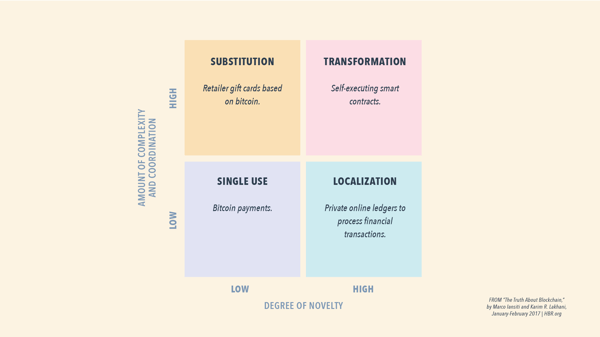
These two criteria help inform executives of the roadblocks they might face and the effort needed to implement a specific blockchain application. Take a look at the chart above. Businesses that are looking for a low barrier to entry should consider implementing single-use cases of blockchain. Single-use cases have a low degree of novelty and complexity.
So what exactly is a single-use case?
Accepting bitcoin payments. HBR states, “… bitcoin is growing fast and increasingly important in contexts such as instant payments and foreign currency and asset trading, where the present financial system has limitations.”
Accepting cryptocurrencies as a form of payment makes it easier for customers all over the world to quickly and securely purchase your products.
If you start accepting bitcoin as alternative payment, your business could then start experimenting with a blockchain application that is increasingly novel but still has a low level of complexity — a private blockchain ledger to record all transactions.
Once you have a good handle on these more simple applications, consider using more complex blockchain applications like smart contracts. The possibilities for how blockchain can help improve business processes are endless — it’s just a matter of how much effort and money you want to invest in an application right away.
Conclusion: The Future of Blockchain
That was a lot. And it’s okay if you don’t understand all of the intricacies of blockchain or aren’t ready to start incorporating it into your business strategy just yet. It’ll take many years and buy-in from numerous different industries before blockchain becomes commonplace. And while we don’t recommend SMBs worry too much about blockchain just yet, it’s important to keep an eye on the emerging tech as larger enterprise businesses start developing more blockchain applications.
So the next time you find yourself sinking into a deep hole of depression because you didn’t scoop up bitcoin while the iron was hot, remember the most rewarding technology — blockchain — is still to reach its full potential.
Editor’s note: This post was originally published in September 2019 and has been updated for comprehensiveness.

Trigger Marketing: 7 Steps to Use It in Any Campaign + Examples
Although you may have a desired path for your potential consumers to take when they interact with you online, the truth is you have no control over it.

Trigger marketing enables you to be at the ready, in whatever way your audience chooses to engage. In this article, we’ll cover all things trigger marketing, including its benefits, example, and the steps to leverage it.
- What is trigger marketing?
- The Benefits of Trigger Marketing
- How to Use Trigger Marketing
- Trigger Marketing Examples
When you hear about marketing automation, you often think of detailed diagram of emails sent to different segments, broken out by email engagement, drawing a line from lead to customer?
This has become the norm but there’s a flaw in this approach. It starts with the marketer’s timeline rather than the prospect’s.
The marketer sits down and defines what information the prospect will consume next, what actions the prospect will take next, and the path the prospect will take from becoming a lead to becoming a customer.
But if we’re honest with ourselves, we would admit that the world is not as straightforward as that.
Using the traditional stages of the funnel, from a lead to a customer, we often view things in a linear way. The leads download an ebook, then become an MQL once they start a trial, then an SQL when the sales person follows up with that prospect, an opportunity when they do a trial review call, and a customer when they purchase.
But what if they start a trial and then download an ebook? Or what if they get into a sales conversation after just downloading an ebook, never become a customer, and then go cold until they start a trial months later?
The reality is that you can’t control what your prospect does or in what order your prospect does it. What you can control, however, is how you react to your prospect’s behaviors.
This is where automation and trigger marketing becomes powerful.
The “triggering” event can be anything measurable by your CRM and automation software. Here are just a few examples:
- Form conversions
- Email opens (or lack thereof)
- Number of pages viewed
- Chatbot interactions
- Cart abandonment
Take this example below: On my birthday last year, wine brand McBride Sisters, one brand I’ve engaged with in the past, sent me birthday wishes along with a discount on their product.
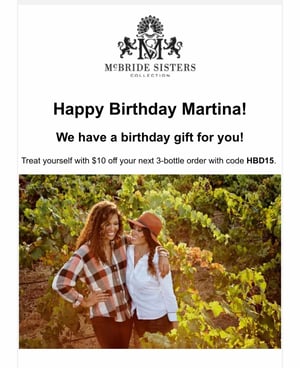
In this case, the triggering event was my birthday – a piece of data they collected at some point.
As a result of the triggering event, you can automate tasks and actions with your marketing automation software, such as:
- Send them an email (or sequence of emails).
- Update their CRM record.
- Add them to a list.
- Assign them to a sales rep.
- Start an internal ticket.
The Benefits of Trigger Marketing
The biggest benefit to trigger marketing is the ability to quickly respond to consumer behavior.
We can’t always predict how users will behave – however, we can make sure we’re prepared with a response that align with our goals.

Trigger marketing also allows you to automate certain marketing tactics so that you don’t miss the opportunity ot convert a lead.
In addition, this strategy is a great credibility, trust, and loyalty builder with your audience. From welcome messages and birthday wishes to order confirmations and discount reminders, all of these interactions enhance your customer experience and promote a positive relationship with your audience.
1. Understand your buyer persona.
It should go without saying in the context of any marketing activity, but in marketing automation, knowing your buyer persona is critically important.
If you think through the lifecycle stages, pains, and motivations of your target audience(s), you can craft better trigger marketing strategies to guide them along their path to purchase.
The goal of marketing automation is to provide a great experience at scale, and part of that means meeting them where they are.
That’s why collecting data early is so valuable as you can use those insights to craft an effective trigger marketing strategy.
2. Think in terms of ‘if’ and ‘then.’
Software is simple. It sees in black and white rather than the complex outcome that you’re moving toward.
However, you can reverse engineer a great trigger marketing strategy using automation by thinking through your outcome and the path to get there as a series of if/then statements:
- If X happens, then do Y.
- If the prospect fills out this form, then send them this email.
- If the prospect has visited the pricing page, then notify a rep.
The “if” is the criteria. The “then” is the action you want to take.
3. Figure out your triggering events.
In order to get your messaging to the right people at the right time, you must identify the “trigger.” (In HubSpot, it’s called “enrollment criteria.”)
This is the “if” part of the equation, the concrete indicator that the software can use as a green light to execute the actions.
Triggering events are limited to the information you have in your system and your marketing automation’s capabilities. Common ones include:
- Actions taken on the website.
- Criteria met in the database.
- Responses to past emails or campaigns.
For instance, if an email subscriber has been disengaged from your last four newsletters, you can trigger an automated unsubscribe button, followed by an email to the subscriber.
4. Determine the actions you want your system to perform.
Once you know your “trigger” or enrollment/starting criteria, then you can decide what happens next. This is the “then” part of the equation.
Common actions include:
- Sending an email.
- Enrolling in a sequence.
- Categorizing the contact in the database.
5. Craft personalized messaging.
Studies have shown that consumers are more likely to purchase after a personalized experience.
If your action (“then” statement) includes a marketing task such as email sends or campaign enrollment, it’s critical to know exactly how this contact is different from others in your CRM and what messaging will uniquely appeal to them. Ask yourself:
- Where are they at in their journey?
- How can I provide value and move them to the next step?
6. Identify and eliminate repetitive marketing tasks.
If you’re still not sure where to begin with marketing automation, start by creating a list of your most repetitive tasks.
For example, if you send the same email over and over again to multiple contacts, using automation to eliminate this task from your day will increase productivity and, as a result, performance.
This will help you focus on higher-impact tasks that can’t be automated.
7. Increase the value of your CRM.
Your marketing automation is only as limited as the CRM and the data that power it.
If you have messy data, marketing automation may hurt you. If you have incomplete data, you won’t be able to do the advanced personalization and segmentation that will make a world of difference.
With that in mind, understand how to make the most of your CRM. Part of this comes down to using automation to update CRM records and categorize contacts, but ultimately you’ll have to think about how your organization uses its CRM and ask yourself these questions:
- What data (and when) can you gather about your prospects to help the effectiveness of your campaigns?
- How can you use automation to ensure the cleanliness and accuracy of your database?
- How often can you audit your database to ensure the integrity of these efforts?
Trigger-Based Marketing Email Examples
Trigger: Downloaded an educational offer.
This is a great place to start if you don’t have any triggered emails set up, as this is the broadest trigger – engaging the prospects at the earliest stage of the buyer’s journey.
What to Send: Transactional Email With Next Step Call-to-Action
In this situation, your triggered email can be a transactional email — confirming the download and including any information related to that download.
For example, if this is a follow-up to downloading an ebook, include the name of the ebook and a link to the PDF.
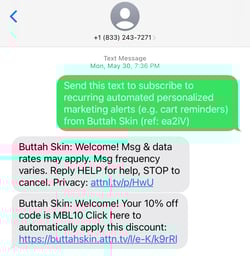
Once you’ve covered your bases on the transactional information, it’s time to think about what you want your prospect to do next. You have their attention — take advantage of it.
Do you want them to convert on a middle-of-the-funnel offer like a demo request or complimentary consultation?
Or do you want to encourage them to share this offer with their network, to expand the reach of your content?
Think about that ideal next step, and include a call-to-action for that in your follow-up email.
Trigger: Took one action in a series, but not the next.
Say your prospect gets close to taking the action you want – like making a purchase – but they don’t quite get to the finish line.
This is an opportunity for you to follow up to get them to cross that finish line.
What to Send: Related Content and an Alternative Action
Perhaps they didn’t complete that action because of some hesitation. They didn’t want to fill out the form, or they had some additional questions.
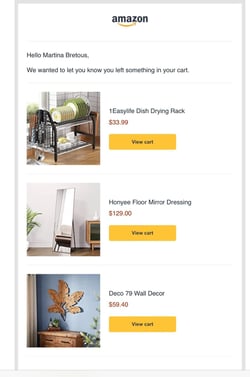
This is an opportunity to follow up with a cart abandonment email reminding them of their items and offering relevant items to consider.
Trigger: Viewed high-intent content.
Say you have high-intent content, for instance, product pages or product-focused blog articles. When website visitors view that content, you can leverage that data to use in future communication with your user.
What to Send: Tailored Follow-Up Content
Whether you trigger an email immediately or save this intelligence for future communications, the data you collect about which content people view can be used to make your marketing that much more relevant on a one-to-one basis.
In this case, a visitor viewing high-intent content could signal someone ready to view a demo or speak with a sales rep.
With this in mind, you can trigger a sequence of emails designed to lead that user further down the buyer’s journey.
The key takeaway here is to think about the various behavioral data points you have about your prospects, and what you can draw from them.
Trigger: Has been highly engaged (or disengaged).
Figure out what your bar is for a highly engaged prospect (perhaps they downloaded at least three ebooks and viewed at least ten blog articles) as well as an unengaged prospect, and respond and market to them accordingly.
What to Send: Timely Next Step Call-to-Action or Re-engagement Campaign
For your highly engaged prospects, you once again have the attention you can leverage. One great option is to encourage them to share the content they just downloaded.
When a prospect becomes highly engaged, this is a great opportunity to notify that prospect’s sales representative that this is a good time to follow up with the prospect. For your unengaged prospects, send a proactive re-engagement email.
You may even want to have multiple trigger points (e.g. haven’t clicked on an email in three weeks, three months, or more) where you send different campaigns to reengage these prospects or unsubscribe them.
When done right, trigger marketing can yield much higher results than the typical linear marketing automation campaign.
Using some of the same technology, you can reorient your marketing to work around your prospect’s timeline instead of your own, while continuing to drive the actions you desire.
Editor’s note: This post was originally published in April 2014 and has been updated for comprehensiveness.

20 Social Media Mistakes to Avoid in 2022
According to 2021 HubSpot Blog research on social media trends, 77% of social media marketers say social media marketing was somewhat to very effective for their company in 2021.
We often talk about the best strategies to use on social media but do you ever wonder about the top mistakes to avoid? In this article, we cover the top ones categorized by platform.
1. Ignoring new features.
Instagram is constantly evolving.
Just this year, the social network has announced several big features it’s either testing or fully rolling out, like the Creators Marketplace, supervision tools for teens, pinned posts, Reels up to 90 seconds – and that’s just to name a few.
What often happens when the platform rolls out new features is that it will prioritize accounts that use them. For instance, when Reels first launched, the algorithm would prioritize accounts that used them – earning them more reach and impressions – than those who posted videos on the feed.
With this in mind, it’s important that businesses stay updated on the latest features coming out and how they will impact the platform’s algorithm.
While a smaller change, like a new button on the Shop tab, may not affect your day-to-day, a new bigger change may warrant a strategy review.
2. Not live streaming.
Live streaming is one of the most powerful tools on Instagram.
In fact, the HubSpot Blog conducted a survey in November 2021 to discover social media marketing trends and found that it offers one of the biggest ROIs compared to other formats.
In fact, marketers surveyed ranked it #2 in the social media trends that brought in the biggest ROI in 2021, behind short-form videos.
In addition, 52% of marketers who invested in it last year say it performed better than expected.
Live streaming is a great way to engage your audience and get real-time feedback that can help you optimize your Instagram strategy.
3. Uploading videos with TikTok watermarks.
When Reels first launched, everyone believed it was in response to TikTok’s success.
This was unofficially confirmed when Instagram announced on its @creators account that it was making changes to its algorithm, specifically which Reels it recommended to users.
According to an article by The Verge, the network spokesperson said users have reported via survey that videos recycled from other platforms can provide a negative user experience. As such, Instagram will start deprioritizing videos that are clearly recycled.
One way to know a video’s recycled? The TikTok watermark. This appears when users upload a video to the short-form video platform, then save it. When it’s shared, the watermark appears.
The lesson here is if you’re going to cross-post on multiple social media platforms, make sure you upload the original content and customize it within the app. This will maintain your content’s quality and ensure it’s not shadow-banned when published.
4. Sharing low-quality content.
The head of Instagram recently said the platform is no longer a photo-sharing app.
While that may be true, visuals are still king and if you’re going to be successful on the platform, you have to produce high-quality content.
Just look at Twitter: Although you can upload images and videos, it is a text-based app. From threads to retweets, the main feed is designed to prioritize written content.
The same is true for Instagram. Visuals are everywhere on the platform and if yours is not up to par, you will struggle to retain your audience’s attention.
5. Forgetting about your bio.
Your Instagram bio is a very small section of your profile but it holds so much power.
For starters, it’s a major point of discoverability. When users search for accounts on the platform, the information on your bio will help them find you. From your username to your business category to your bio description.
Your bio is also a place to convert your users.
Instagram tries to keep users on the platform as long as possible. That’s why today, users can discover a brand and complete a purchase without ever leaving the app.
That’s also why the platform limits when and where you can share external links. One of two places is in your Instagram bio.
With a Linktree, you can include multiple links in your bio and lead your audience to your website, landing page, product page, and more.
6. Having a personal account instead of a business one.
Are you doing Instagram right if you don’t have a business account?
If you’re debating between a personal and a business one, here’s the reason why you should get it: Analytics.
When you have a business account, you have access to a slew of data that you wouldn’t know otherwise. Everything from how your users are finding you to which posts are driving the most traffic.
That insight will be invaluable in building out your Instagram strategy and gaining insights into what resonates with your audience.
7. Buying followers.
If you’re a small business on Instagram and you want to establish some credibility, or perhaps get more post engagement, you might consider buying followers.
After all, they don’t cost much and you can have thousands of followers overnight. But, there’s a catch – otherwise, everyone would be doing it.
Buying followers is like receiving a bad check – you’re promised something of value but in actuality, there’s nothing there.
While you may get a boost in followers, those followers will not help you in the long run. They’re often bot accounts that will not engage, share, or promote your content.
This will also significantly skew your data, making it difficult to know what strategies are actually working. The only way to ensure this is by growing your followers using organic methods.
8. Skipping captions.
If your picture or video is what grabs your user’s attention, your caption can get them to stay.
Many brands overlook the caption, focusing instead on creating great visual assets. However, both play an equal role in engaging the audience.
Your caption can offer more context to your post and drive conversions. So, as you’re prepping upcoming posts, make sure your caption isn’t an afterthought.
TikTok
9. Being too promotional.
TikTok is a place for authenticity.
In fact, a 2021 study by Nielsen revealed that 64% of TikTok users say they can be their true selves on TikTok. In addition, roughly 56% of TikTok users say they can post videos they wouldn’t post elsewhere.
If you go on the platform simply promoting your products and services, you may have a hard time getting any traction.
Focus instead on sharing a lifestyle – specifically the lifestyle of your target audience. Their challenges and pain points can make for relatable, funny content.
The more authentic your content is, the better it will perform on the app.
10. Using viral sounds in ads.
Viral sounds come and go quickly on the app.
The average sound has a shelf life of a week or two – that’s why it’s great to use in your posts. However, it’s not a great strategy for ads.
Why? Well, an ad will likely run for several weeks and by that time, the sound will no longer be popular. In fact, users may be tired of hearing the sound, and using it may hurt your likeability as a brand.
Don’t age your ad by including trends that are sure to die off. Instead, stick with evergreen content that will work any time.
11. Not using filters.
Just as sounds go viral on TikTok, so do filters.
From effects that expand your face to those that take you to space, there’s so much to choose from. For brands, this offers a lot of opportunities to be creative and have fun with your audience.
Of course, with any trend, it’s important to know when to join and when to skip. If something doesn’t align with your values or strategy, don’t participate – as there will be another one around the corner that will be a better bit.
12. Ignoring mentions.
Social media is a two-way street. You share, and your audience responds.
Too often, brands focus on sharing and forget to interact with their community. On Twitter, this is especially easy as a text-focused app.
Brands will Tweet away and forget to respond to mentions, which could hold valuable insights into brand perception.
This leads us to our next mistake, in the section below.
13. Retweeting too often.
When a user lands on your Twitter profile, they should have a good idea of what you’re about and know what to expect from your page.
If your page is 90% retweets, it makes it difficult to make that assessment.
Instead, have a healthy mix of tweets, retweets, replies, and threads.
14. Tweeting the same thing.
Imagine stepping into a store and seeing the same item displayed everywhere. Once you realize there’s nothing new to explore, you’ll lose interest and quickly walk out.
Think of your Twitter page like your store: The more variety you have, the more opportunities you have to attract your audience and encourage them to stick around.
While it’s valuable to repurpose high-performing content, the key is spreading it out over a long period so that it seems fresh every time. You should also try to find fresh angles to give a new life to your content.
15. Treating it like other social platforms.
Twitter is one of the few social networks where written content is king.
If you’re active on YouTube, TikTok, and Instagram, you may be tempted to use that same approach for Twitter.
However, the golden rule on social media is to adjust your content to the platform, not the other way around. This means that you’ll have to make sure you’ll likely have to swift from a video-first approach to a text- and audio-forward one on Twitter.
16. Having a low response rate.
When you land on a Facebook Page, one of the first things you’ll see is the page’s message response rate.
It creates an initial impression of the brand and its relationship with its potential customers.
A high response rate suggests that you have great customer service while a low rate signals that you are either not active on the platform or may struggle with customer service.
While this is a seemingly small part of your profile, it can leave a big impression.
17. Removing negative comments.
Negative comments are a part of every brand’s social presence.
There’s bound to be an unsatisfied customer or a frustrated follower somewhere and sometimes, they land right in your comments.
In an effort to protect your brand’s image, you may want to delete the comment altogether. However, having a solid response to your disgruntled follower may actually work in your favor.
Responding to negative comments shows your audience that you don’t shy away from difficult conversations. It can also appease other customers who may have similar concerns.
18. Not having a custom photo cover.
Everything on your Facebook Page can help or hurt your brand and as we know, the devil is in the details.
A custom photo cover is a great way to stand out from your competitors, who may use their logos or stock photos – or worse, nothing at all.
Instead, opt for something that says something about your brand, and speaks to your values or your culture. Using an image that has emotional appeal will likely have a much better impact than a simple stock photo that tells us about your product or service.
19. Neglecting your community.
Facebook is one of the best places to build community. From Facebook Groups to live streams, there are many ways to interact with your audience.
After all, that’s how you build brand loyalists. It’s not from sharing promotional content, it’s from consistent and genuine interactions.
Once you start seeing your Facebook Page as a community-building tool, you will start seeing results.
20. Ignoring your competitors.
One of the handiest tools on Facebook is the ability to learn about your competitors in your analytics dashboard.
Using inputs from data you’ve already shared, Facebook can compile a list of suggested competitors and tell you how you’re performing against them
This can then serve as a benchmark to determine how well you’re doing and what to strive for.
Knowing what not to do can be just as important as knowing what you should do. Although this list isn’t exhaustive, it’s a pretty good place to start and keep you on the right track.
Editor’s Note: This post was originally published in Feb. 2012 and has been updated for comprehensiveness.

Twitter Name Ideas: The Do’s and Don’ts of Choosing A Twitter Handle
With over 200 million daily users, using Twitter right offers you massive benefits as a new or existing business.
Just as you would spend a considerable amount of time choosing your business name, Having a good handle is always a plus for marketing on Twitter. It’s also crucial to take time to consider your options before choosing or changing your Twitter handle.
![Download Now: How to Use Twitter for Business [Free Kit]](https://no-cache.hubspot.com/cta/default/53/190da11f-58c6-41d5-a397-843618741e09.png)
This article will show you the do’s and don’ts of choosing a Twitter handle and 25 examples of great Twitter business names.
Twitter Name Do’s
Do use your full business name.
Making your Twitter handle as close to your business name as possible will make it easier for people to recognize you online.
Furthermore, whenever you tweet, you promote brand awareness for your business.
Do use short names.
Another tip is to use a short username. Why? Because it makes it easier to remember and spell for anyone that searches for your brand on the network.
If your business name is pretty long, then you can shorten it.
Do use taglines.
Sometimes it happens that your username has already been taken. When that happens, you could report the account for impersonation(if your business name is trademarked), or you can use an abbreviated form of your business tagline as the new handle.
Do be consistent.
If you already have a following on Facebook, Instagram, or some other social media, it’s a great idea to use the same username for your Twitter handle.
This way, it’ll be easier for your followers on those platforms to identify you on Twitter.
Twitter Name Don’ts
Don’t use numbers or symbols.
Unless a number is relevant to your business name, avoid using it on your Twitter handle. It isn’t a cool look and can be confusing for some users.
Don’t use witty names.
A witty username is excellent for a personal account, but it might not be the right fit for a business handle. Customers expect some level of professionalism, and funny names rarely give that impression.
Don’t overdo underscores.
Underscores separate characters in a username, which can be useful if two or more words make up your business name. However, be careful not to overdo using them. It’s recommended to use no more than a pair of underscores.
Good Twitter Name Examples
Here are 25 examples of great Twitter usernames. This list is divided into existing usernames and imaginary ones. Either option can serve as inspiration as you update your current Twitter handle.
| Brand name |
Twitter Name
|
| Real Madrid |
@realmadriden
|
| Wendys | @Wendys |
| Taco Bell | @tacobell |
| PlayStation |
@PlayStation
|
| Yves Saint Laurent | @YSL |
| Cristiano Ronaldo | @Cristiano |
| CNN Breaking News | @cnnbrk |
| Slack | @SlackHQ |
| PayPal Support |
@AskPayPal
|
| eBay | @eBay |
| Union | @JoinUnion |
| The New York Times | @nytimes |
| Notion | @NotionHQ |
| Carolina Hurricanes | @Canes |
| Bobby van’s Grill DC |
@BobbyVansDC
|
| Forever 21 | @Forever21 |
| Chipotle |
@ChipotleTweets
|
| Chick-fil-A | @ChickfilA |
| Arby’s Guest Support |
@ArbysCares
|
| Chili’s Grill & Bar | @Chilis |
| ReadWrite | @RWW |
| Oberto Specialty Meats |
@ObertoBeefJerky
|
| MADE.COM |
@madedotcom
|
| Netflix | @netflix |
| Cakes Decor |
@CakesDecor
|
Existing Twitter handles
1. Real Madrid – @realmadriden
Real Madrid FC is the biggest football club in the world and is loved by fans from different parts of the world.
The Real Madrid handle, with “en” indicates it’s the club’s official account in English, making it easy to remember and search.
This Twitter name can inspire you if your business exists in different locations around the world or communicates with customers in different languages,
2. Wendys – @Wendys
Wendys might not be your go-to fast-food chain, but they’re probably one of your favorite Twitter accounts. The burger joint is famous for its savage roasts and rivalries with other restaurants online.
We love this Twitter name because of its simplicity. It’s relevant to the brand’s name, which makes it very easy to find and identify.
3. Taco Bell – @tacobell
Using an underscore or number can differentiate your account, but it also makes it harder to find.
That’s why we like Taco Bell’s Twitter username.
Although the brand’s made up of two names, Taco Bell discards the underscore. Therefore, it’s easier to search for it on Twitter without wondering where the underscore appears.
4. PlayStation – @PlayStation
Playstation makes arguably the most popular gaming console on the planet, so it’s important that its customers can find it on Twitter and other social platforms.
It uses ‘PlayStation’ instead of ‘Playstation’ or ‘playstation,’ which we find interesting.
The capital ‘P’ and ‘S’ are synonymous with PlayStation, so it’s no surprise that it remains so even in its Twitter handle. If your business name has prominent features, something along the lines of PlayStation’s P and S, then you can also retain the feature in your username.
5. Yves Saint Laurent – @YSL
The designer apparel maker has an iconic, and lengthy name. Therefore, it might be rather tedious to find the official handle on Twitter.
Perhaps that’s why Yves Saint Laurent decided to use the ‘YSL’ username. It’s short, memorable, and definitely easier to find.
Do you have a long business name? Then take a leaf out of Yves Saint Laurent’s username.
6. Cristiano Ronaldo – @Cristiano
Cristiano Ronaldo is currently the most popular sportsman in the world, and his personal brand is worth millions of dollars.
It’s no wonder, then, that all his social media accounts, Twitter inclusive, use his easily recognizable name as their usernames.
If your business is tied to your name, you can use your first or last name (or the two). We like the ‘Cristiano’ handle because it’s pretty easy to recall and is quite unique.
7. CNN Breaking News – @cnnbrk
CNN has made a name as one of the most popular news networks in the world. The company has several departments, with some focusing on fashion, sports, politics, and more.
@cnnbrk is the account focused on releasing breaking news as it happens, so it needs to be different from the other official CNN accounts.
If your business runs a similar model, with different departments, then you can draw inspiration from this username.
8. Slack – @SlackHQ
Slack is a messaging platform, and more. It’s become a favorite messaging platform for companies across the world.
It would’ve been pretty easy for it to use the @slack handle — if it weren’t already taken. So, instead of paying off the current owner of the handle, it simply added HQ to the brand’s name.
With the HQ (Headquarters), Slack circumvents the ‘Slack’ username elegantly. You can copy Slack’s example if you face the same challenge.
9. PayPal Support – @AskPayPal
Paypal is a financial platform that facilitates sending and receiving money to and from almost everywhere in the world.
As such, it’s only proper to have a channel where users can reach it on Twitter.
Paypal uses ‘ask’ right before its brand name, which is a nice move for a handle that handles customer inquiries and issues. It’s a brilliant username you can copy when creating customer care Twitter handles for your brand.
10. eBay – @eBay
eBay is a hugely popular ecommerce platform that allows users to sell and buy goods.
Just as PlayStation mentioned earlier, eBay has an interesting Twitter handle. It continues the tradition of lowercase ‘e,’ and uppercase ‘B’ in its Twitter handle. Anyone who uses eBay won’t find it hard to find the Twitter handle.
So if your brand’s name has distinct features like capitalized letters, you can incorporate that into your Twitter handle.
11. Union – @JoinUnion
Union is a digital platform that connects startups to resources and networks across the world.
This handle works because the company is a service-based business, and ‘Join’ aligns with the community mandate of the business.
12. The New York Times – @nytimes
The New York Times is a popular news media company based in the United States.
The media company uses its already popular URL name ‘nytimes’ as its username. Thus, readers will find it easy to find.
You can also use your existing URL name as your Twitter handle to make it easy for people familiar with your website to find you on Twitter.
13. Notion – @NotionHQ
Notion is a tool that lets users manage files, save documents, schedule tasks and generally organize their work.
Like Slack, the Notion handle had already been taken. So what the Notion team did was to add HQ to the end of the brand’s name. Problem solved.
14. Carolina Hurricanes – @Canes
The Carolina Hurricanes is a professional ice hockey team based in North Carolina.
How’d you fit a lengthy brand name like the Carolina Hurricanes into a Twitter handle? By abbreviating it to ‘Canes.’ It’s a simple solution that can inspire business owners with long business names.
15. Bobby van’s Grill DC – @BobbyVansDC
Bobby Van’s is a restaurant that opened its doors in 1996 and is famous for its delicious steaks.
We like this handle because it includes the location of the business in the handle. An advantage of this is how the eatery appears in local searches for eateries on Twitter.
If you run a local business, adding your location in the handle can increase the chances of getting found by users.
16. Forever 21 – @Forever21
Forever 21 is a huge clothing company that sells trendy yet affordable clothing pieces.
Although we said you should avoid using numbers in your handle, this example works because ‘21’ isn’t a random pair of numbers but is part of the brand name.
So if the numbers in your brand name are tightly associated with the brand, then by all means add them to your username.
17. Chipotle – @ChipotleTweets
Chipotle is an American chain of fast casual restaurants in North America and Europe.
Chipotle had to resort to taking a lengthier Twitter handle because its first choice was already taken. This alternative handle works, though, as it reinforces that the handle belongs to an official account.
Adding ‘Tweets’ to your brand name can make your handle more recognizable to users.
18. Chick-fil-A – @ChickfilA
Chick-fil-A is the biggest American restaurant specializing in chicken sandwiches and is one of the biggest fast-food restaurants in North America.
Chick-fil-A could’ve gone for a handle like @Chick_fil_A, but we’re grateful they didn’t. The current handle is simple and doesn’t give searchers a hard time.
Editing a brand name to something simpler and easier to search for makes sense and pays off in the end.
19. Arby’s Guest Support – @ArbysCares
Arby’s is another fast-food company whose Twitter handle offers inspiration to any business looking to create a Twitter account.
The brand prides itself on an emotional connection with customers, and its customer service handle uses a username that conveys sympathy.
When creating a username for your business, you want to go with something that conveys positive emotions and puts the consumer at ease—like this handle.
20. Chili’s Grill & Bar – @Chilis
Like all great business Twitter usernames, this username does a great job of being simple and easy to find.
Users don’t have to search for ‘Chili’s Grill and Bar’ but can find the brand right away by just typing ‘Chilis.’ This is another hack you can use if your brand has a relatively long name.
21. ReadWrite – @RWW
ReadWrite aggregates professional communities dedicated to specific subjects of interest such as connected cars, smart homes, AR/VR, fintech, and APIs.
ReadWrite aggregates content from professional communities dedicated to interests like AI, fintech, APIs, and technology.
A shorter handle makes it easier for people to mention you in tweets without taking a lot of character space. The ReadWrite handle is an excellent example because they’ve abbreviated their name into just three letters.
As ReadWrite shows, abbreviations can be a cool way to create a memorable username.
22. Oberto Specialty Meats – @ObertoBeefJerky
Oberto is a specialty meats company that’s famous for its delicious cuts and beef jerky.
We like this handle because it uses keywords in the handle. Thus, the profile is likely to appear when someone searches for beef jerky on Twitter.
If you offer specific services or products, including it in your username like this example can boost your chances of popping up when people search for them.
23. MADE.COM – @madedotcom
Made designs and retails furniture and homewares online and in showrooms across Europe.
This is a cool handle because it makes it easy for users to remember the brand’s website.
If you’re looking for something non-generic and memorable, then copying this example can be what your username needs.
24. Netflix – @netflix
Netflix is arguably the most popular streaming platform on the planet with millions of subscribers paying for its content monthly.
The main account, @netflix, is simple and a no-brainer to remember. The brand name is consistent on every social platform, including Twitter.
If you’re setting up an account for your brand, it’s best to have a consistent username across all channels as Netflix has.
25. Cakes Decor – @CakesDecor
Cakes Decor is a community dedicated to showcasing beautiful cake decorations that inspire cake makers around the world.
The handle is great because it includes the keywords ‘cake’ and ‘decor,’ which means anyone searching for cake decoration inspiration on Twitter is likely going to come across the page.
So include keywords in your username to increase visibility.
The Perfect Twitter Name for Your Business
Twitter is one of the most popular social platforms on the web today, and how you show up isn’t limited to just what you say, but the name you say it under, too. Choosing the right Twitter name for your brand is key, so follow the tips in this guide and take inspiration from the list of businesses above that did it right. You’ll have the perfect Twitter handle in no time.
Editor’s note: This post was originally published in January 2009 and has been updated for comprehensiveness.

The Ultimate Guide to Storytelling
Storytelling is an art.
Not a process, method, or technique. And — like art — it requires creativity, vision, skill, and practice. Storytelling isn’t something you can grasp in one sitting, after one course. It’s a trial-and-error process of mastery.
Sounds like a lot of work, right? It is, and rightfully so because storytelling is a crucial part of the most successful marketing campaigns. It sets vibrant brands apart from simple businesses and loyal consumers from one-time, stop-in shoppers.
It’s also the heart of inbound marketing.
Storytelling is an incredibly valuable tool for you to add to your proverbial marketing tool belt. That’s why we’ve compiled this guide, to help you discover and understand storytelling and weave gorgeous, compelling tales for your audience.
Pick up your pen, and let’s dive in.

Because storytelling can take so many forms, it can be a challenge to create a good story. Here are some quick do’s and don’ts to get you started:
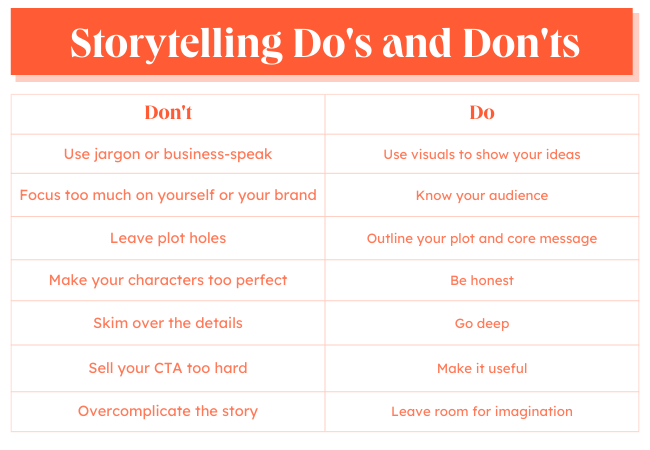
The Art of Storytelling

Since the dawn of human language, storytelling has been how cultures pass on shared beliefs and values. Some of the stories told today come from stories our ancestors were sharing over 6,000 years ago.
Every person has a story, but the art of storytelling can make a story transformative. There are a few qualities that can push a basic story into the art of storytelling.
Narrative
While the setting will influence what a story can be, all great stories have a narrative, a spoken or written account of events.
For example, stand-up comics sometimes tell stories during a set. The structure, setting, and details of this narrative may not feel the same as they do in a Shakespeare play. But both storytellers are sharing a narrative.
Attention-Grabbing
But it’s not enough to just tell the story. The storytelling that resonates with people grabs their attention. There are many ways to grab and keep an audience’s attention in a story.
Creating suspense is one option. Stories that are full of mystery are interesting because of their unanswered questions. Surprising your audience is also a great way to pull readers in.
Another way to captivate your audience is to add details that bring your story to life. A popular way to describe this storytelling technique is “Show. Don’t tell.”
For example, say your company is launching a new product. In your story, you can share details about the moment your team came up with the idea. This is more exciting than telling your customers that you’re about to release the best new product. Talk about the roadblocks and small wins that led up to launch. This makes your audience feel like they’re part of your process.
Interactive
Storytelling isn’t just the story that you tell. It’s also the way that your audience responds and engages. Some kinds of storytelling require the reader to take part in the story, like the Netflix interactive film Black Mirror: Bandersnatch.
But with most stories, the interaction comes from the relationship that the audience builds with the storyteller. Your audience might be a fan group for the latest Harry Potter movie. And your favorite storyteller could be a TikTok influencer.
That feeling of connection and interaction is essential to storytelling.
Imaginative
Many movies come from popular books. And it’s not unusual for viewers to rate the quality of a book-based movie on its ability to match what they imagined as they read the book.
When someone listens to storytelling they often run a picture show in their mind. This picture show can be incredibly detailed, including characters, setting, and events.
These imaginings often pull up memories for individual readers, or they might see their qualities in one of the story’s characters. No story is complete without the listener or reader adding these imaginative details on their own.
Telling a story is like painting a picture with words. While everyone can tell a story, certain people fine-tune their storytelling skills and become a storyteller on behalf of their organization, brand, or business. You might’ve heard of these folks — we typically refer to them as marketers, content writers, or PR professionals.
Every member of an organization can tell a story. But before we get into the how, let’s talk about why we tell stories — as a society, culture, and economy.
Why Do We Tell Stories?
There are a variety of reasons to tell stories — to sell, entertain, educate or brag. We’ll talk about that below. Right now, I want to discuss why we choose storytelling over, say, a data-driven PowerPoint or bulleted list. Why are stories our go-to way of sharing, explaining, and selling information?
Here’s why.
Stories solidify abstract concepts and simplify complex messages.
We’ve all experienced confusion when trying to understand a new idea. Stories offer a way around that. Think about times when stories have helped you better understand a concept. Maybe your favorite teacher used a real-life example to explain a math problem. Maybe a preacher illustrated a situation during a sermon or a speaker used a case study to convey complex data.
Stories help solidify abstract concepts and simplify complex messages. Taking a lofty, non-tangible concept and relating it using concrete ideas is one of the biggest strengths of storytelling in business.
Take Apple, for example. Computers and smartphones are a pretty complicated topic to describe to your typical consumer. Using real-life stories, they’ve been able to describe exactly how their products benefit users. They use storytelling instead of relying on technical jargon that few customers would understand.
Stories promote and shape ideas.
Throughout history, people have used stories to promote cooperation and influence social behaviors. And there is scientific evidence that stories can change our behavior.
This is because stories engage our emotions. So, even if you’re stressed out and overwhelmed, you can still connect with a story. That connection might lead you to be less critical about facts, less defensive, and more open to changing your ideas.
Data is powerful. But data without storytelling can result in confusion, frustration, and conflicts of opinion. This is because listening to stories engages different parts of the brain than data does.
When you tell a story, you’re asking someone to see a series of events from your perspective. The person listening to that story believes in the truth of what you’re saying.
If you’re good at storytelling, you might influence the future behavior of that person. And cultures often honor skilled storytellers. They appreciate brands that tell stories to promote wider societal values too, like this Ben & Jerry’s example in support of the People’s Response Act.
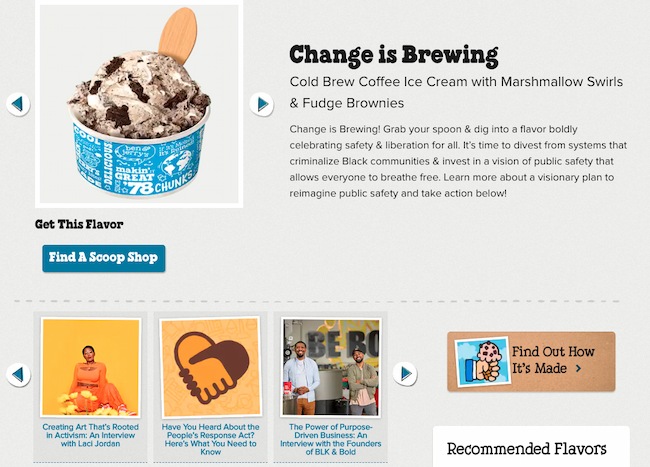
Stories bring people together.
Like I said above, stories are a universal language of sorts. We all understand the story of the hero, of the underdog, or of heartbreak. We all process emotions and can share feelings of elation, hope, despair, and anger. Sharing a story gives even the most diverse people a sense of commonality and community.
In a world divided by a multitude of things, stories bring people together and create a sense of community. Despite our language, religion, political preferences, or ethnicity, stories connect us through the way we feel and respond to them. Stories make us human.
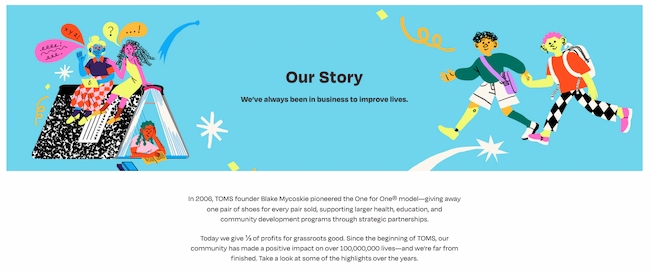
TOMS is a great example of this. By sharing stories of both customers and the people they serve through customer purchases, TOMS has effectively created a movement that has not only increased sales but also built a community.
Stories inspire and motivate.
Stories make us human, and the same goes for brands. When brands get transparent and authentic, it brings them down-to-earth and helps consumers connect with them and the people behind them.
Tapping into people’s emotions and baring both the good and bad is how stories inspire and motivate and eventually, drive action. Stories also foster brand loyalty. Creating a narrative around your brand or product not only humanizes it but also inherently markets your business.
Few brands use inspiration as a selling tactic, but ModCloth does it well. By sharing the real story of their business, ModCloth not only makes the brand relatable and worth purchasing, but it also inspires other founders and business owners.
What makes a good story?
Words like “good” and “bad” are relative to user opinion. But there are a few non-negotiable components that make for a great storytelling experience, for both the reader and teller.
Good stories are:
- Entertaining: Good stories keep the reader engaged and interested in what’s coming next.
- Believable: Good stories convince the reader of their version of reality and make it easy to trust and engage.
- Educational: Good stories spark curiosity and add to the reader’s knowledge bank.
- Relatable: Stories remind readers of the people and places they know. They help their audience recognize patterns in the world around them.
- Organized: Good stories follow a succinct organization that helps convey the core message and helps readers absorb it.
- Memorable: Whether through inspiration, scandal, or humor, good stories stick in the reader’s mind.
How to Tell Great Stories
According to HubSpot Academy’s free Power of Storytelling course, there are three components that make up a good story — regardless of the story you’re trying to tell.
1. Characters
Every story features at least one character, and this character will be the key to relating your audience back to the story. This main character is often called the protagonist.
Your characters form the bridge between you, the storyteller, and the audience. If your audience can put themselves in your character’s shoes, they’ll be more likely to follow through with your call-to-action.
2. Conflict
The conflict is the lesson of how the character overcomes a challenge. Conflict in your story elicits emotions and connects the audience through relatable experiences. When telling stories, the power is in what you’re conveying and teaching. If there’s no conflict in your story, it’s likely not a story.
3. Resolution
Every good story has a closing, but it doesn’t always have to be a good one. Your story’s resolution should wrap up the story, give context to the characters and conflict(s), and leave your audience with a call to action.
If you’re new to storytelling, there are a couple other elements you’ll want to think about as you build your first story.
4. Structure
Your plot is the structure of your storytelling.
A blog can have great writing and relatable characters. But if you don’t create a natural flow of events, your blog will confuse your reader.
Your “About” page on your website can run through the story of your business. But if you don’t break it into clear and useful segments, your site visitors might bounce before they get to the good part.
Plots don’t need to be in chronological order. There are many ways that you can experiment with the structure of your story.
But your story should have a beginning, middle, and end. This structure is familiar, so it makes your audience more comfortable and open to new information.
5. Setting
The context of your storytelling impacts how your audience takes in your story. The setting is more than where a story takes place. It’s how you can:
- Share the values and goals of your characters
- Shift the tone of conversations and action
- Make it easier to show instead of tell
For example, say you’re creating an ad campaign that features two main characters. One runs a small startup and the other works for a large enterprise. Where would it make sense for these two to meet up? How could their location impact the conversation?
Now that you know what your story should contain, let’s talk about how to craft your story.
The Storytelling Process
We’ve confirmed storytelling is an art. Like art, storytelling requires creativity, vision, and skill. It also requires practice. Enter: The storytelling process.
Painters, sculptors, dancers, and designers all follow their own creative processes when producing their art. It helps them know where to start, how to develop their vision, and how to perfect their practice over time. The same goes for storytelling – especially for businesses writing stories.
Why is this process important? Because, as an organization or brand, you likely have a ton of facts, figures, and messages to get across in one succinct story. How do you know where to begin? Well, start with the first step. You’ll know where to go (and how to get there) after that.
1. Know your audience.
Who wants to hear your story? Who will benefit and respond the strongest? To create a compelling story, you need to understand your readers and who will respond and take action.
Before you put a pen to paper (or cursor to word processor), do some research on your target market and define your buyer persona(s). This process will get you acquainted with who might be reading, viewing, or listening to your story. Understanding who your story is for will also offer crucial direction as you build out the foundation of your story.
2. Define your core message.
Whether your story is one page or twenty, ten minutes or sixty, it should have a core message. Like the foundation of a home, you need to set up your core message before moving forward.
Is your story selling a product or raising funds? Explaining a service or advocating for an issue? What is the point of your story? To help define this, try to summarize your story in six to ten words. If you can’t do that, you don’t have a core message.
3. Decide what kind of story you’re telling.
Not all stories are created equal. To decide what kind of story you’re telling, figure out how you want your audience to feel or react as they read.
This will help you figure out how you’re going to weave your story and what goal you’re pursuing. If your goal is to:
Incite Action
Your story should describe how you completed a successful action in the past and explain how readers might be able to create the same kind of change. Avoid excessive, exaggerated detail or changes in the subject so your audience can focus on the action or change that your story encourages.
Tell Your Story
Talk about your genuine, humanizing struggles, failures, and wins. Today’s consumer appreciates and connects to brands that market with authenticity. Your storytelling should reflect your authentic self.
Convey Values
Tell a story that taps into familiar emotions, characters, and situations so that readers can understand how the story applies to their own life. This is especially important when discussing values that some people might not agree with or understand.
Foster Community or Collaboration
Tell a story that moves readers to discuss and share your story with others. Use a situation or experience that others can relate to and say, “Me, too.” Keep situations and characters neutral to attract the widest variety of readers.
Impart Knowledge or Educate
Tell a story that features a trial-and-error experience, so that readers can learn about a problem and how you found and applied a solution. Discuss alternative solutions too.
4. Establish your call-to-action.
Your objective and call-to-action (CTA) are similar, but your CTA will establish the action you’d like your audience to take after reading.
What exactly do you want your readers to do after reading? Do you want them to donate money, subscribe to a newsletter, take a course, or buy a product? Outline this alongside your objective to make sure they line up.
For example, if your objective is to foster community or collaboration, your CTA might be to “Tap the share button below.”
5. Choose your story medium.
Stories can take many shapes and forms. Sometimes people read stories. Other times they watch or listen., Your chosen story medium depends on your type of story as well as resources, like time and money.
Here are four different ways you can tell your story:
Writing
Written stories take the form of articles, blog posts, or books. They’re mostly text and may include some images. Written stories are by far the most affordable, attainable method of storytelling as it just requires a free word processor like Google Docs or a pen and paper.
Speaking
You tell spoken stories in person, like in a presentation, pitch, or panel. TED talks are an example of spoken stories. Because of their “live”, unedited nature, spoken stories typically require more practice and skill to convey messages and elicit emotions in others.
Audio
Audio stories are spoken aloud but recorded — that’s what sets them apart from the spoken story. Audio stories are usually in podcast form, and with today’s technology, creating an audio story is more affordable than ever. (For great story-driven podcasts, check out The HubSpot Podcast Network.)
Digital
Digital storytelling comes in a variety of media, including video, animation, interactive stories, and games. This option is by far the most effective for emotionally resonant stories and active, visual stories. This is why they can be expensive to produce. But don’t fret: video quality doesn’t matter as much as conveying a strong message.
6. Plan and structure your story.
You have an idea of what you want to include in your story, how you want to organize it, and what medium is best. If you were doing some creative writing, your next step might be to jump right into writing and work on the structure of your story later.
But while storytelling in marketing is creative, it also has a goal in mind. This means it may need a more structured process because every step from intro to CTA needs to meet a specific goal.
Your storytelling should ignite imagination and emotion no matter where you share it. But marketing storytellers are also tracking metrics once their story goes out into the world.
With this in mind, you may want to create a detailed outline of your story. You might develop storyboards, wireframes, or a PowerPoint presentation. These can help you stay focused as you craft your story. They can also help you keep your original vision of your story as you move through the approvals, meetings, and pitches that often come with business storytelling.
7. Write!
Now it’s time to put pen to paper and start crafting your story.
You’ve done a lot of work to get to this point. For many storytellers, this is the fun part. It can also be the hardest part because it can be tough to create on cue.
As of this writing, there are over 215,000,000 links on Google for the search “writer’s block.” If you feel stuck, you’re not alone. But help is on the way.
You might want to check out some quotes about storytelling to get inspired. And these excellent tips for writer’s block can get you writing again if you feel stuck.
Remember, you’ve got this. Every person is a storyteller, and audiences aren’t just waiting for any old story. They want to hear from you.
7. Share your story.
Don’t forget to share and promote your story. Like with any piece of content marketing, creating it is only half the battle — sharing is how your audience can complete your story.
Depending on your chosen medium, you should definitely share your story on social media and by email. Promote written stories on your blog, Medium, or by guest posting on other publications. You can share digital stories on your website, YouTube, or a mobile app. While spoken stories are best conveyed in person, consider recording a live performance to share later.
The more places you share your story, the more engagement you can expect from your audience.
Storytelling Resources
Storytelling is a trial-and-error process, and no one tells a story perfectly on the first try. That’s why we’ve collected these resources to help you fine-tune your storytelling skills and learn more about the different ways you can tell a story.
For Writing
- Guide to Becoming a Better Writer
- OEDb’s writing resources
- How to Write a Blog Post
- Copywriting 101
- HubSpot’s list of writing tools
For Speaking
For Audio Stories
For Digital Storytelling
- Ultimate Guide to Video Marketing
- Examples of Interactive Storytelling
- Website Examples of Storytelling
- How Brands Are Reaching Gamers
- Animoto
- Ultimate Guide to Making Your Own App
Start Telling Your Story
Storytelling is an art. It’s also a process worth learning for both your business and your customers. Stories bring people together and inspire action and response. Also, today’s consumer doesn’t decide to buy based on what you’re selling, but rather why you’re selling it.
Storytelling helps you communicate that “why” in a creative, engaging way. You are a storyteller. So, pull together your ideas, find the right channel and tools, and share your story.
This post was originally published in November 2020 and has been updated for comprehensiveness.


Blogging Time Management: How to Blog When You Have No Time
Finding the time to blog is a frequent challenge for many marketers. Marketers often wear many hats and it can be difficult to focus long enough to churn out quality articles when you’re pressed for time.

How to blog when you have no time? We spoke with author and marketing expert David Meerman Scotton how to avoid common time management mistakes by developing a routine.
No matter what you’ve got on your marketing plate, it won’t get done without proper time management. Learning how to make the most of your time will greatly affect your productivity and overall success as a blogger.
Why is blogging time management important?
When it comes to creating content, maintaining consistency is key. This is why blogging time management is so important. You may not always feel motivated to create on a regular basis, but establishing a schedule will help you to stay consistent with your blog output.
For example, you may find that you’re better at writing in the mornings. So you can set aside 2 to 3 hours each morning to work on writing based on how many articles you’d like to produce each week.
Create a content calendar to help you plan your content in advance and set reasonable deadlines. Make note of holidays or seasonal events that may impact your content schedule.
Getting organized will help you set and achieve goals for your blog. If you’re starting from scratch, check out our guide to starting a blog.
How to Blog When You Have No Time
1. Use blog templates.
An easy way to jump-startyour creative process is to start with a template. Why suffer through writer’s block staring at a blank document if you don’t have to? HubSpot’s free blog post templatescan help you format your article and get started writing faster than starting from scratch.
[Include screenshot]
Templates function as an easy to follow outline where you can organize your thoughts and start to flesh out your content. HubSpot’s offer includes six templates ranging from how-to posts to pillar pages and infographics.
2. Develop a blogging routine.
In many ways blogging reminds David of exercising. In order to be successful at it, you will need to develop a routine. “It is programmed in,” David says. “It is about building it into your life and making it a second nature, like running in the mornings or doing yoga after work.”
Dedicate time each day to writing or allocate one to two designated writing days per week. Block time off on your calendar and turn off messaging apps to avoid interruptions while you write.
Once you’ve gotten organized and created a routine, you may find you had more time to write than previously thought.
3. Keep a list of ideas.
One way to save time coming up with content is to make sure you always have a running list of fresh ideas to work with. That way you’re not scrambling at the last minute for worthy topics.
Creating topic clusterscan help you flesh out your blog content strategy. A topic clusteris multiplearticles grouped by a shared topic or related topic. For example, you may have one pillar page that gives a broad overview of a topic. From there, you can create more in-depth, specific articles on related subtopics.
This will not only help you plan content but organize your site architecture as well.
4. Perform research prior to writing.
It’s much easier to write when you have all the pertinent information you want to include in one place. Research your chosen topic before sitting down to write and organize the information in a quick outline.
Include any keyword researchin this process so you can ensure your content aligns with what readers are searching for online. This way when you sit down to write, your only job is to write — not look up new facts.
5. Don’t edit while writing.
When writing it’s very tempting to want to stop and make corrections. Don’t do this. It breaks your writing flow.
Instead, write a rough draft withjust pops into your mind first. Follow your train of thought without stopping to fix typos or edit. The goal is to just get your thoughts on the page. Once your initial draft is written, you can always go back and make changes.
6. Perform article updates.
Another strategy is to build upon existing content by performing an article update. Giving your older content a refresh is not only good for SEO and your readers, but it can be a quick win for adding new content in a time crunch.
With older content, you may need to include additional research and update it for accuracy, but it generally takes less time than writing a new article from scratch. Review your existing content. Are there articles you can do a deeper dive on? Have there been industry advancements you can include? Is there a new angle to explore?
7. Find content ideas wherever you go.
By making blogging a life routine, you will come across creative content ideas much more frequently. Keep an open mind, observe new things that interest you personally and find ways to turn them into fodder for a blog post. By noticing world dynamics that get you excited and relating them to your audience, the process of blogging becomes a lot more natural and fun.
Accumulate content ideas from different situations in life and find ways to apply them to your industry.
8. Hire a freelancer.
Sometimes your workload is just too heavy and your efforts can be better used elsewhere. If you have the resources and budget to do it, hiring outside help may also be a great option.
Sites like Upwork, Contenta, and MediaBistro make it easy to find writing professionals. If looking to generate content on a larger scale, consider working with a content agency.
Blog Like A Pro
Creating content with a consistent cadence is an obstacle busy marketers frequently struggle with. Creating a schedule and mastering blogging time management will allow you to create even when you’re short on time.
This article was originally published in December 2010 and has been updated for comprehensiveness.


The Beginner’s Guide to the Competitive Matrix [Template]
Have you ever been playing a game and had to look around to check out the competition?
Whether you currently own or you’re looking to start your own business, you need to do the same thing. Luckily, there’s a methodical way to do that: by conducting a competitive analysis and creating a competitive matrix.
![Access Now: 10 Competitive Analysis Templates [Free Download]](https://no-cache.hubspot.com/cta/default/53/b3ec18aa-f4b2-45e9-851f-6d359263e671.png)
A competitive matrix will help you identify your competitors and lay out their products, sales, and marketing strategies in a visual format. By doing this, you’ll learn where you’re positioned in the market, how to differentiate yourself from your competition, and how to improve upon your processes so you can beat them in the marketplace.
Below, you’ll learn what a competitive matrix is and review some templates and examples.
Competitor Matrix Types
Before you dive into the world of competitive matrices, it’s important to understand that there are different types you can use to compare your company to your competitors:
- SWOT analysis
- Competitive Advantage Matrix
- Competitive Profile Matrix
- Sales Matrix
- Product Feature and Benefit Matrix
- Price Matrix
SWOT Analysis
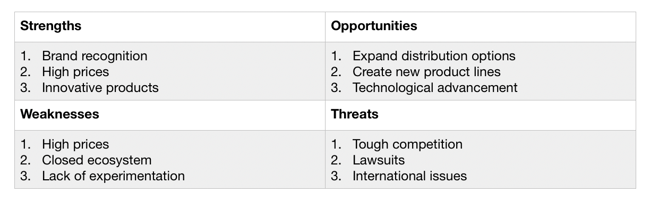
A SWOT analysis is a technique used to assess how your business compares to its competitors. The acronym stands for strengths, weaknesses, opportunities, and threats. It analyzes internal and external factors that affect the current and future potential of your business. By identifying these elements, you create a space to capitalize on your strengths, improve your weaknesses, take advantage of opportunities, and eliminate threats.
If your company has an excellent profit record, this is a strength. If your company offers a small variety of products to its customers, this could be seen as a weakness. How do you determine what information goes into your SWOT analysis? Below are some questions you can use to guide you.
Strength Questions
The following questions should help you discover where your company excels. This information will help you attract and draw in new customers as well as maintain existing ones.
- What are your assets?
- What is your unique selling proposition?
- Do you have a strong customer base?
- What resources do you have?
- What makes you better than your competitors?
- What do your customers like about your product/services?
Weakness Questions
It’s difficult for your organization to improve if you have no system to determine your weaknesses. To remain competitive within your industry, you need to discover these faults to correct them.
- What do your customers dislike about your products/services?
- What areas do your competitors have an advantage in?
- Do you or your employees lack knowledge or skill?
- What resources do you lack?
- Are you making enough profit?
Opportunity Questions
Keeping an eye on your competition is necessary; however, watching for available opportunities will give your business a competitive advantage. These opportunities can come from both monitoring your competitors as well as industry trends.
- What are the current trends?
- What is the market missing?
- Is there available talent that you could hire?
- Are your competitors failing to satisfy their customers?
- Is your target market changing in a way that could help you?
Threat Questions
Threats can come up within a business at any time. These can be internal or external factors that potentially harm your company and its operations. Identifying these threats will help your business run efficiently.
- Who are your competitors?
- Has there been an increase in your competition?
- What are the obstacles you are currently facing?
- Are your employees satisfied with their pay and benefits?
- Are government regulations going to affect you?
- Is there a product on the market that will make yours outdated?
As demonstrated by these questions, a SWOT analysis matrix can help your company identify elements that are often overlooked.
Competitive Advantage Matrix

A competitive advantage matrix analyzes your company’s competitive advantage by assessing volume production and differentiation. Its purpose is to determine how your company can grow.
This matrix has two axes — vertical and horizontal. The vertical axis evaluates the number of opportunities available for achieving a competitive advantage, while the horizontal axis measures the potential size of the competitive advantage. Using this information, the competitive advantage matrix is segmented into four boxes:
- Stalemate – Few advantages with small potential
- Volume – Few advantages with great potential
- Fragmented – Many advantages with small potential
- Specialized – Many advantages with great potential
Using this information gives you the tools to determine where your competitive advantage comes from.
Competitive Profile Matrix
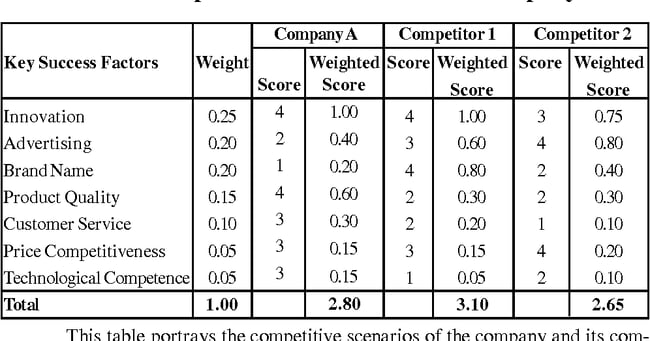
A competitive profile matrix is a tool your company can use to directly compare your strengths and weaknesses to industry competitors. For this matrix, you will use four elements: critical success factor, weight, rating, and score.
Critical success factors are areas that will determine your success. Examples are brand reputation, range of products, customer retention, and sales per employee. Once you have selected these factors, you will assign a weight. This is a measure of their importance, ranging from 0.0 (low importance) to 1.0 (high importance). Each factor should have its own weight, as each varies in importance. Avoid assigning a weight of 0.3 or more, as most industries are determined by many factors. This high value can decrease the number of factors you’re able to list in your matrix. When assigning weight, make sure the sum of all weights equals 1.0.
The third step is to rate your company and its competitors from 1 to 4 in each critical success factor. Rate:
1 – Major weakness
2 – Minor weakness
3 – Minor strength
4 – Major strength
The final step is to calculate the score. First, evaluate each critical success factor by multiplying the weight by the rating. Once this has been done for all, add each company’s score for the total score. This, when compared to your competitors, will show if you’re behind the curve, ahead of the curve, or on par with the industry.
Sales Matrix
A sales matrix is a tool used to help gauge the urgency and viability of sales opportunities. It evaluates potential customers’ interest in your business against their fit for your product or service.
%20(1).jpg?width=650&name=Sales%20Matrix%20(2)%20(1).jpg)
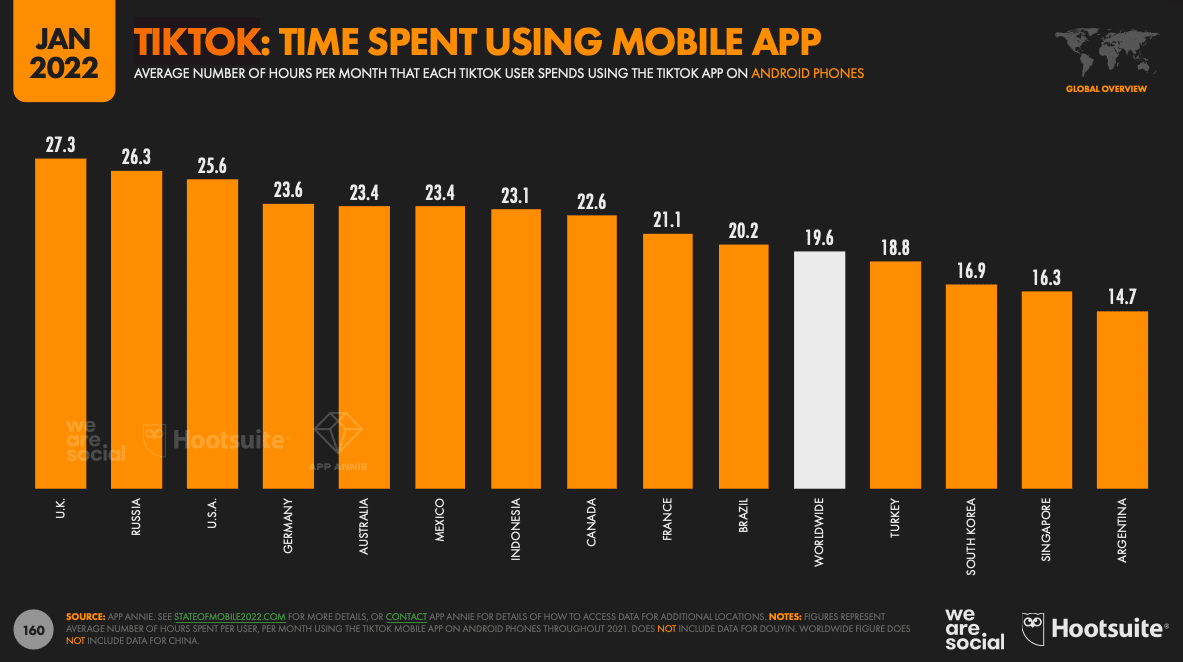

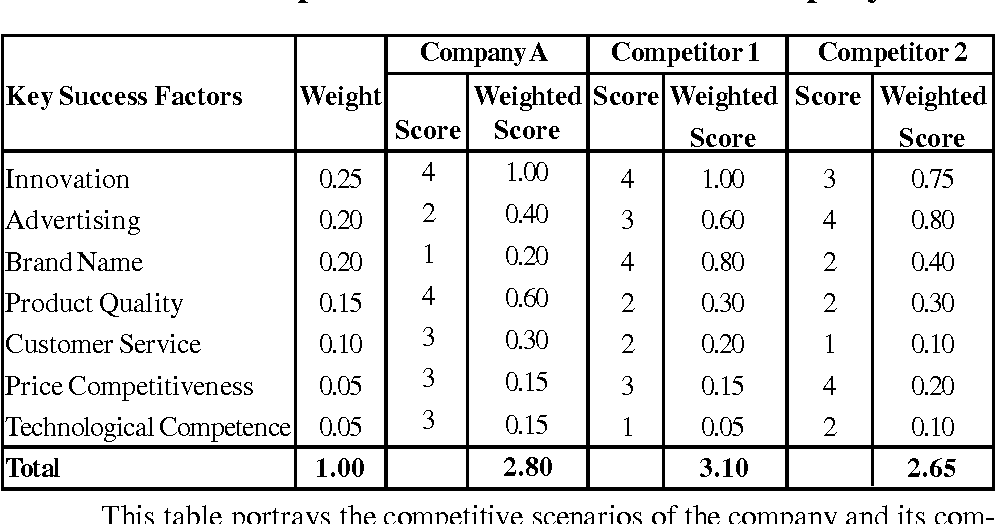
Imagine focusing all your efforts on a potential customer. You send content and numerous promotions only to discover that they aren’t interested in your company and are a bad fit. It’s unlikely you’ll get that sale, and it feels like time wasted. Now, imagine giving all that energy to someone interested and a good fit. The sale becomes a lot more likely. A sales matrix uses interest and fits to help you decide how much attention to give your potential clients at any given time.
Product Feature and Benefit Matrix
The product feature and benefits matrix evaluates how your offer matches customer needs. It’s weighted by its importance versus its perceived distinction or advantage. When using this matrix, your features fall into the following categories:
- Irrelevant – Low importance and low distinction
- Overinvested – Low importance and high distinction
- Key liabilities – Low importance and high distinction
- Key differentiators – High importance and high distinction
This information tells you what features to keep, what features to get rid of, and where you might be able to save money. Consider an iPad. Say Apple spends a large portion of the manufacturing budget to produce a high-quality camera, only to find out that most users don’t even use it. The camera has a high perceived distinction, yet it’s of low importance to iPad users. This information would tell Apple that they overinvested in this feature and could potentially reduce it to save costs in the future.
Price Matrix
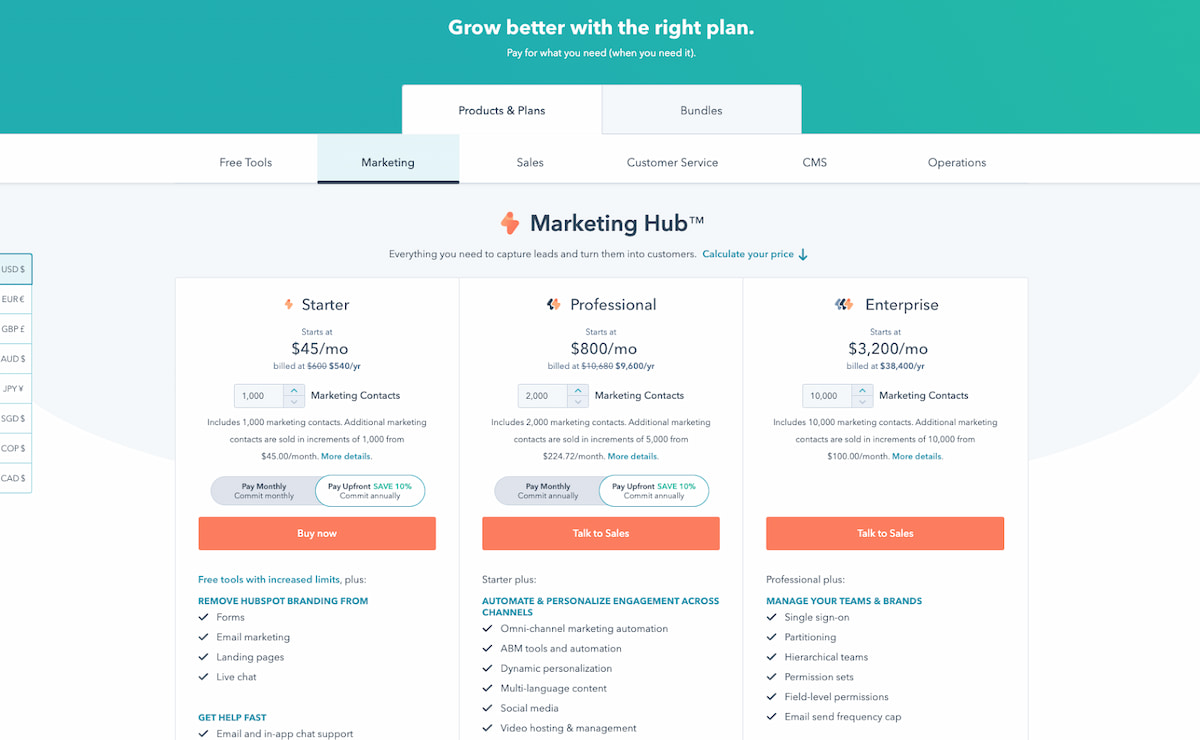 A price matrix is a tool used to define product costs, features, and tiers. It allows you to determine how much you will charge for specific levels of service. Unlike the other matrices on this list, a price matrix is a customer-facing competitive matrix type. You are creating it for your potential customer.
When building your price matrix, start with your tiers. It’s common to lay out two or three levels. Once you’ve named them, create a short description. Depending on the industry, you might find it easier to include a few features associated with the category. Once you do, list the prices. If not, create a call-to-action (CTA) for your potential customer to contact you for a quote.
Remember, as you build your tiers, the price will go up with each one. To stay on par with the perceived value, ensure you offer additional features or benefits to justify the cost.
The Benefits of Competitive Matrices
Essentially, you can use a competitive matrix to compare any characteristics of your company with a competitor.
Sometimes these matrices will be more visual in nature (a plotted graph), but sometimes it’s just an Excel document with the information listed in columns.
The goal of the competitive matrix is to see at a glance the competitive landscape and your position in the marketplace. This will help you see gaps in the marketplace and hone in on your unique value proposition.
Perhaps, after looking at a competitive matrix, you brainstorm new product ideas or new tools or features that you hadn’t considered before. Or maybe you come out of it with a ton of ideas on how to improve your content marketing strategy.
Regardless, you can use a competitive matrix for a lot of reasons. You can use it to develop new ideas, or you can use it to train sales staff on how to differentiate your company from the competition.
After figuring out what you’re going to do with the information, make sure you write down your ideas, develop KPIs, and regularly conduct this analysis to stay up to date with your strategy.
Now that you know what a competitive matrix is and how to use one, let’s review some templates you can use for your own strategy.
Competitive Matrix Templates
Competitive matrices are used to facilitate the process of comparing your business with other industry competitors. They help you take advantage of strengths and opportunities, while identifying weaknesses and threats before they become detrimental. Ultimately, a competitive matrix is an industry-analysis tool that makes your life easier. To make the process even easier, use the following competitive matrix templates.
1. Two-Feature Competitive Landscape Chart
One type of competitive matrix you can do is a simple comparison of features. You can use this information to plot where your company is compared to competitors.
The features could be something like price or customization potential. Then, you’d place the logos of each company (including yours) on the graph, depending on how well a company executes a certain feature. The point of this matrix is to visualize who does what better, so you can see what you have to work on and how to differentiate yourself against the competition.
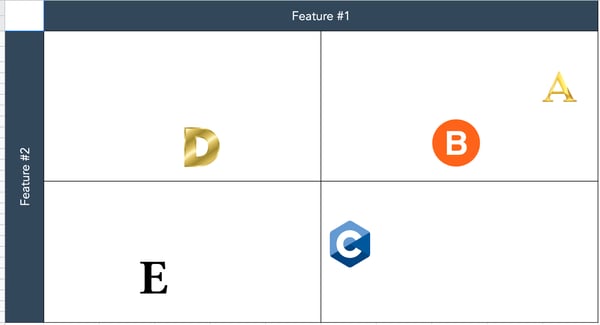
2. Content Marketing Analysis Template
As a content marketer, this is my favorite template. With this, you can compare social media followers, blog strategy, email strategy, SEO, etc. This will help you decide where you need to focus your content strategy. Should you place emphasis on Twitter rather than Facebook? If you download this template, it also includes a graph and more strategies to analyze.
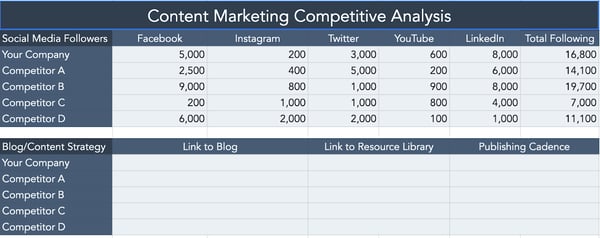
3. SWOT Analysis Template
A basic competitive matrix is the SWOT analysis. Conducting a SWOT analysis will help you identify areas where you could improve. You should conduct a SWOT analysis for yourself and your competition. Knowing what weaknesses your competition has will help your sales reps and help you make improvements in those areas.

4. Review Tracker
A review tracker matrix will help you see at a glance the types of reviews you get versus your competitors. It’s important not to forget about reviews because they can have a significant impact on a business. With this template, you can also use a scoring system to normalize the averages.
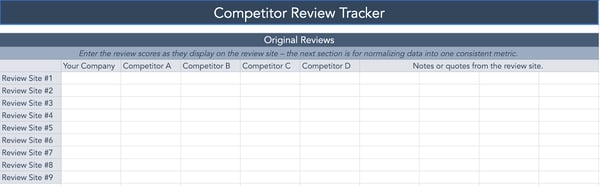
After reviewing those templates, it’s time to see what a competitive matrix looks like in action. Here are some examples below.
Competitive Matrix Examples
1. HubSpot
This is a public HubSpot competitive matrix comparing the overall pricing of our CRM versus Salesforce. It’s a standard matrix meant to help people see the difference between the CRMs at a glance.
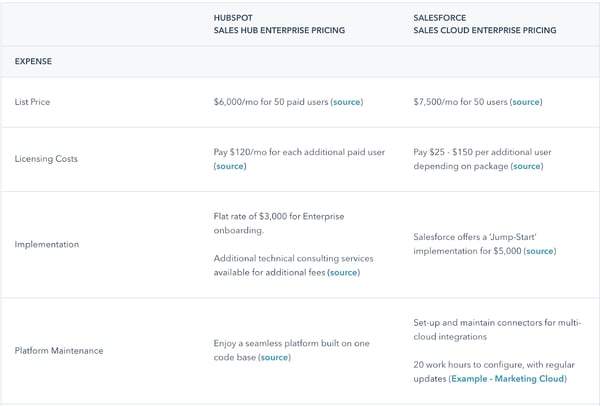
2. SugarSync
This is a great example of what a feature matrix might look like. SugarSync compares its feature offerings against the competition in an easy-to-understand visualization.
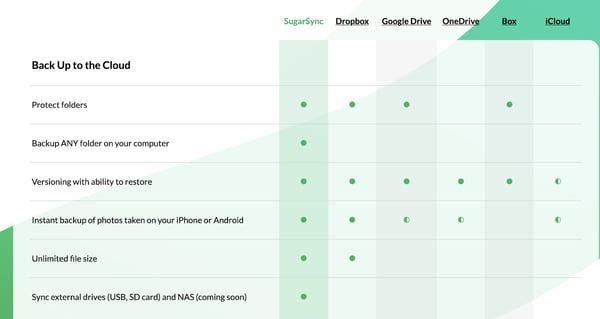
3. 360iResearch
In this example, 360iResearch reports on survey management software. This is a competitor grid showing which companies have the best product satisfaction and business strategy.
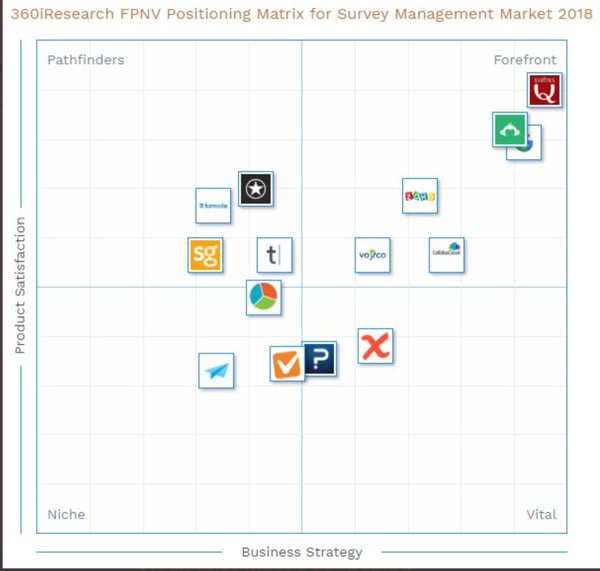
No competition, no progress.
Innately, competition feels unpleasant; however, that’s not all it has to be. It can lead to growth and make you look deeper into your business to find ways to improve. Competitive matrices are great tools to help you uncover how you’re different from your competitors. They show areas of improvement and where you excel. If you’re having trouble evaluating your company’s position in your industry, use this article and the above tools to help.
Editor’s note: This post was originally published in January 2021 and has been updated for comprehensiveness.