
Welcome to My Blog
Resume Format Tips You Need to Know in 2018 [Sample Formats Included]
Think of a really good print advertisement you’ve seen lately. What did you like about it? Chances are that while the content of that ad was important, the design played a big role in drawing you in.
It’s important to think of your resume like an advertisement to job recruiters. Writing a standout resume goes beyond the content you put in there — the format plays an important role, too. To recruiters, it speaks volumes about how you collect your thoughts and organize your ideas. So you’ll want to make sure it’s easy to read, easy to understand, and easy to digest. That means choosing the right sizing for your headers, picking the right fonts, bolding and italicizing where appropriate, and so on.
Get 10 free marketing resume templates right now.
To learn how to format a resume properly, check out the infographic below from Resume Templates 101. Then, under this infographic, see an example list of things a great resume format includes to truly stand out from the other candidates.

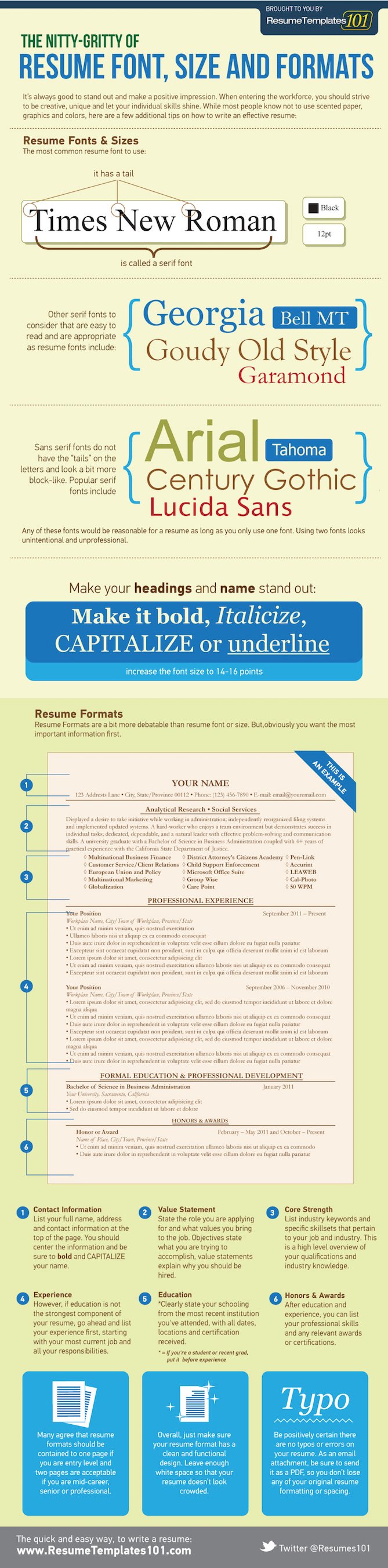
The Best Resume Format
There’s no such thing as a perfect resume. But depending on your industry, you can pick the right assortment of attributes above and create something the hiring manager won’t soon forget.
Here’s an example of a resume for an entry-level graphic designer — a role that some say faces the highest standards for resume format, given the expected skills of the applicant.
Font Type: Century Gothic
This font is a more wide-set sans-serif typeface. Modern design is all about clean typography, making tail-less fonts ideal. The wide-set appearance helps entry-level applicants make good use of empty space when they don’t have much experience to report on.
Font Size: 12pt
Anything bigger than 12pt body text in Century Gothic can risk looking a bit unprofessional. This size works well for those who have limited content, and continues to work well as his or her career grows.
Font Style: Bold Name and Job Title
Between underlines, boldface, and italics, boldface is this applicant’s best bet for the font type they’re using. Italicized Century Gothic isn’t distinguished enough from standard Century Gothic to use both in the same document, and underlines can dilute the clean appearance you get with this font type.
Bolding the first and last name at the top — and every job title, skill, and field of study beneath it — establishes a clean but obvious hierarchy from the top of the resume to the bottom.
Header Style: Standard, 15pt
Headers over Education, Experience, Skills, and similar resume sections should be visibly bigger than the body text, but not overpowering. A standard (unstylized) header in 15pt font governs each section of the resume nicely and doesn’t clash with the boldfaced skills and job titles beneath it.
Name Style: Standard, 17pt
The first and last name should be at least another 2 points larger than each header. No matter what your industry or experience level, it’s important that your name is the biggest text on your resume. Hiring managers look at a lot of these things every day, and you need them to remember your name — if nothing else.
Why standard and not bold? I happen to think Century Gothic looks best as is, especially as the font size increases.
Resume Layout
As for the resume’s layout, consider this order: Name, Contact Info, Education, Skills, Experience, and Awards. New professionals need to front-load their education because it’s the most relevant item on their resume, while their “Skills” section showcases the editing software and equipment that is critical to their qualifications for any job opening.
Even if you’re not an entry-level designer, the above infographic — and following example — is a model for how you can highlight the parts of your background that are most important to your employer. Now, get to writing!


Apple releases macOS 10.13.4 update for High Sierra with Mac Pro wallpaper, enhanced eGPU support

Apple has released the macOS 10.13.4 update to High Sierra for all compatible Macs. The new version includes the ‘Ink Cloud’ wallpaper previously only offered on the iMac Pro, enhanced support for external GPUs, and more.
First new 2018 iPad deliveries scheduled to arrive tomorrow

If you ordered a new 2018 iPad, you may want to check your shipment status, as we’ve received word via email that some deliveries are scheduled to arrive tomorrow, March 30th. more…
Under Armour reveals MyFitnessPal data breach affecting 150 million users

Popular food and nutrition logging app MyFitnessPal, owned by Under Armour, has suffered a massive data breach. The company announced today that an estimated 150 million have been affected by the breach and may have had their data compromised…
Apple releases Swift 4.1 with updates to the core language, new build options, more

Swift is Apple’s programing language designed from the ground up and coinciding with the other software releases today, Apple has pushed version 4.1 of Swift to developers…
Here’s What Facebook Says It’s Doing to Protect Election Security
Earlier today, members of Facebook’s staff held a small press event with a status update on efforts to prevent its platform from being weaponized to influence major national events like elections.
Last year, Facebook came under fire when it was revealed that it had been weaponized by foreign actors to spread misinformation and divisive content in hopes of influencing the 2016 U.S. presidential election.
Facebook published a transcript of today’s remarks, where VP of Product Management Guy Rosen indicated the network would be focusing on four core areas of election protections:
- “Combating foreign interference”
- “Removing fake accounts”
- “Increasing ads transparency”
- “Reducing the spread of false news”
Here’s a look at the work Facebook says it’s doing in each area.
1. “Removing Fake Accounts”
This might be the most complex and far-reaching area where Facebook will be putting new efforts into place. In order to remove fake accounts, Facebook’s Chief Security Officer Alex Stamos explained, the network will have to identify fake identities and audiences alongside false narratives and facts.
Doing so begins by identifying motives, which boils down to three main areas: influencing public debate, money, and what the “classic internet ‘troll,'” Stamos said.
Fake accounts motivated by the first item on the list range from what Stamos called “ideologically motivated groups” to state intelligence agencies, whose target audiences could exist within their own countries or others.
The second motivator, money, is the most common one. Many times, these bad actors stand to financially profit by driving traffic to their sites — even if it means, speculatively, doing so by linking to false or divisive content.
Countering that, Stamos said, will require decreasing the account’s profits by increasing its operational costs — which is how Facebook has previously curbed activity from spammers. Facebook has made similar efforts in the past to penalize content with “clickbait” link titles that don’t necessarily lead to quality or genuine content.
These motivations can vary or even be combined according to the event the actor is trying to influence. That’s why Stamos said Facebook will be enlisting the help of external experts who are familiar with the various geographical or cultural factors that could play a role in what different actors are trying to accomplish.
2. “Combating Foreign Interference”
Samidh Chakrabarti, a product manager at Facebook, spoke on how proactive measures to combat bad actors of foreign origin relate to some of the efforts to combat fake accounts — which, he said, is one of the most common ways such bad actors “hide”.
At this point, Chakrabarti explained, Facebook blocks “millions” of fake accounts on a daily basis as they’re being created, which can help stop them before they can create and distribute content. Machine learning is said to play a major role here, which has been trained to identify suspect activity without having scan actual content.
Previously, members of the Facebook community were responsible for reporting what looked like suspicious activity, especially anything that might pertain to an election. Now, Chakrabarti said, Facebook will deploy an “investigative tool” that proactively looks for this kind of activity, like the creation of Pages with foreign origin that are sharing misinformation. Once these Pages are identified, they are sent to Facebook’s security team for a manual review to determine if Community Standards or Terms of Service have been violated.
The efforts here appear to be two-fold: machine learning capabilities that stop the creation of these pages before they can distribute content, as well as technology that seeks out existing Pages engaging in such activity. For the latter, Chakrabarti said the manual process is quick, though he didn’t provide a specific average time frame.
These tools were utilized as recently as last December during a special Senate race in the state of Alabama, when efforts to identify foreign interference led to the discovery of politically-focused bad actors based in Macedonia, who seemed to be spreading misinformation leading up to that election. They were later blocked from Facebook.
3. “Increasing Ads Transparency”
Part of the effort to remove fake accounts also plays into actions that will verify the authenticity of the ads that accounts want to post.
That will include a new feature called View Ads, which has been tested in Canada and will be rolled out globally this summer. As the name suggests, it allows users to view any ads the Page is running under its “About” section.
The summer rollout will come in the months leading up to the 2018 U.S. midterm elections — and prior to that, said Product Management Director Rob Leathern, a new ad review and verification process will begin, which will require all Page admins to submit government-issued IDs and provide a physical mailing address before they can publish any promoted content.
That way, Facebook can confirm the physical location and identification of advertisers, in part by physically mailing a letter to the address provided with an access code that can only be used by that specific admin for that particular Page. In addition to this process, advertisers must declare which, if any, candidate, organization, or business they represent.
And once the verification process is complete, Leathern explained, ads pertaining to an election will be clearly labeled as such in both Facebook and Instagram feeds, including the individual, business, or organization that paid for it.
And this summer, he said, Facebook will unveil a public ad history archive that contains any such content with a political label. Each entry will include details like the amount spent on the ad, as well as the number of impressions it received and demographic information about the audience it reached. The archive will keep this information for up to four years after the ad ran.
4. “Reducing the Spread of False News”
Finally, Product Manager Tessa Lyons spoke to Facebook’s effort to curb the spread of such misinformation as false news, which will largely be powered by partnerships with fact-checkers.
To determine which content needs to be fact-checked, Lyons said, the platform will use various “signals” that include reports from Facebook users themselves. From there, fact-checkers can rate a story as false — and if they do, its ranking in the News Feed will be dropped, which leads to an average of 80% fewer views.
Anyone who’s shared the story in the past will be warned about this fact-check, as will anyone who tries to share it in the future — and if it does appear in someone’s News Feed, it will be displayed with information from those who fact-checked it. That information will help to teach a machine learning module to identify these stories quicker, without human intervention.
These efforts will apply to text, photos, and videos — and will also play into efforts to increase ad transparency and combat fake accounts. Any Page that habitually shares false news, Lyons said, will face reduced distribution, and lose its advertising and monetization privileges, “stopping them from reaching, growing, or profiting from their audience.”
Currently, Facebook has fact-checking partners in six countries, including the U.S., where the platform has joined forces with Associated Press reporters to identify misinformation and false news relating to the country’s upcoming elections, whether local, state, or federal. These reporters will also be tasked with disproving false claims made by such stories.
Lyons noted that these efforts are “a place to start.”
“Like any company that’s had a PR crisis, Facebook is trying to take control of and own the misinformation narrative,” said HubSpot Social Campaign Strategy Associate Henry Franco. “It looks like the company is taking some pretty serious steps to address it, too, both in terms of identifying and prohibiting bad actors.”
But as Lyons remarked — it’s a start. “What remains to be seen,” Franco said, “is whether it’s enough to earn back the trust of users.”

Apple releases iTunes 12.7.4 with new ‘Music Videos’ section for Apple Music users

Early today, Apple started rolling out a new Music Videos section to the Music app on iOS. The feature acts as a home for music videos for Apple Music subscribers, aggregating the best and most recent video content. Now, the new Music Video section is coming to desktop with iTunes 12.7.4…
Victim’s Apple Watch data leads to arrest in Australian murder case

While we’ve heard some neat stories about how Apple Watch has saved lives, the wearable is also making a difference in solving crimes. Apple Watch data has become key evidence in an Australian murder investigation and has resulted in an arrest. more…
9to5Mac Daily 053 | March 29, 2018

Listen to a recap of the top stories of the day from 9to5Mac. 9to5Mac Daily is available on iTunes and Apple’s Podcasts app, Stitcher, TuneIn, Google Play, or through our dedicated RSS feed for Overcast and other podcast players.
Large Sport Loop now available for 42mm Apple Watch, but only in one color for now

Facebook Will Limit Data Available to Advertisers
Facebook announced yesterday that it will be shuttering Partner Categories: the product that allows third-party data providers to supplement advertisers with targeting information directly through Facebook.
In the announcement, Facebook noted that “this is common industry practice,” but will still shutter the product to “help improve people’s privacy on Facebook.”
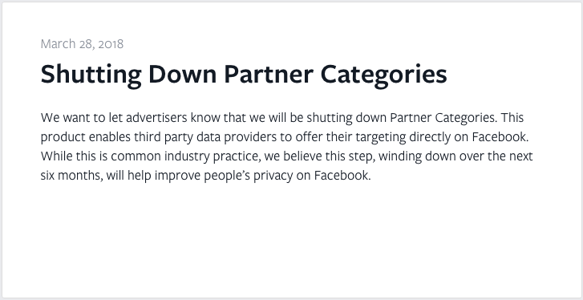
Source: Facebook
For Facebook and marketers alike, the announcement is what ProPublica reporter Julia Angwin called “a big deal.” Here’s what’s going on — and why it matters.
Where Facebook Advertisers Get Their Data
Prior to these recent changes, advertisers on Facebook had a few primary sources of user data that they could use for targeting purposes, including data that Facebook itself has from what users provide on their profiles, as well as their activity on the network. It’s not entirely unlike what’s available in your downloadable Facebook data archive file, which I wrote about here.
That data could be used in combination with other sources of information that the advertiser might have on its own, like email contacts or survey responses.
Finally, there are the third-party data providers, which are the ones Facebook has severed ties with. These companies possess and provide advertisers with data that are often based on non-social-media activities, like shopping history and income — which is part of what Angwin and her team discovered when ProPublica started investigating the breadth of Facebook user data in 2016.
We also found that 600 of the 29,000 categories Facebook offered to advertisers were from data brokers. They were extremely specific and often financial, such as income between $100k and $125k or frequent shopper at dollar stores. /6https://t.co/S4Yo2nEa1T
— Julia Angwin (@JuliaAngwin)
March 29, 2018
The data from these providers are often synthesized in tandem with information that Facebook has from user profiles, helping to match (or target) promoted content to the most relevant audiences. It’s a powerful combination that could be at least partially responsible for Facebook’s growth as a valuable advertising platform — to the point where 98% of its 2017 global revenue was rooted in advertising.
And again, as Facebook said itself, these practices are not limited to Facebook advertisers, and are frequently promoted as a value-add by some of the larger data providers involved, like Experian and Acxiom. The latter calls it a “data package” that can help advertisers “accurately identify relevant audiences for all of your media campaigns.”
It’s no secret, then, that providing these services is a source of revenue for the data providers, too. According to the Wall Street Journal, Acxiom stands to lose $25 million in fiscal 2019 revenue and profit. And while it seems possible for advertisers to still independently enlist these third-party services, a barrier to access is now in place that was previously removed by direct data availability through Facebook.
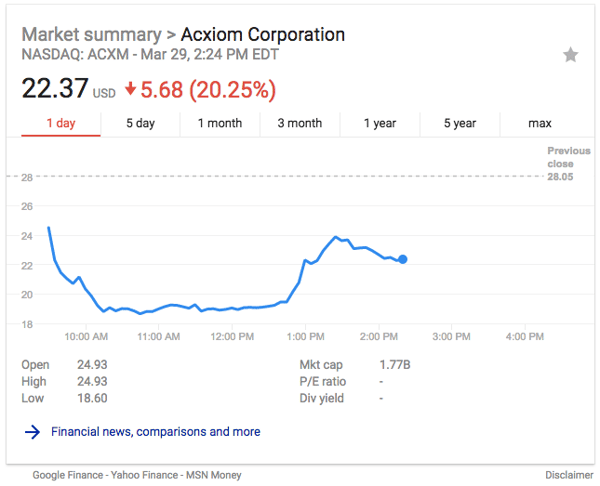
Acxiom’s stock price at 2:25 PM EDT March 29, within 24 hours of Facebook’s announcement. Source: Google
What This Means for Marketers
But how much do advertisers stand to lose from these changes? Well, that depends who you ask. When I first tweeted this news after it broke last night, one of my followers suggested that he’d be losing a major source of information for his work.
Of course that’s the targeting foundation of all my current campaigns…
— Scott DeRuyter (@SDMad)
March 29, 2018
The extent of the setback to marketers and advertisers also depends on the industry — those who depend on a consumer’s shopping habits and history, for example, could potentially lose out by not having access to detailed, third-party data on it.
But keep in mind that Facebook has quite the cache of user data entirely on its own. Remember that downloadable data file I alluded to earlier? Have another look.
The file shows that Facebook possesses a decent — if not confusing — amount of information on users’ interests and activities. And where that data really comes into play for most advertisers is in its own ad-targeting platform.
That doesn’t necessarily reveal individual user data, but it allows advertisers to customize promoted content audiences based on it — interests, location, and so forth. Here’s a page from my own file with some of the “interest” data Facebook uses to help target ads:
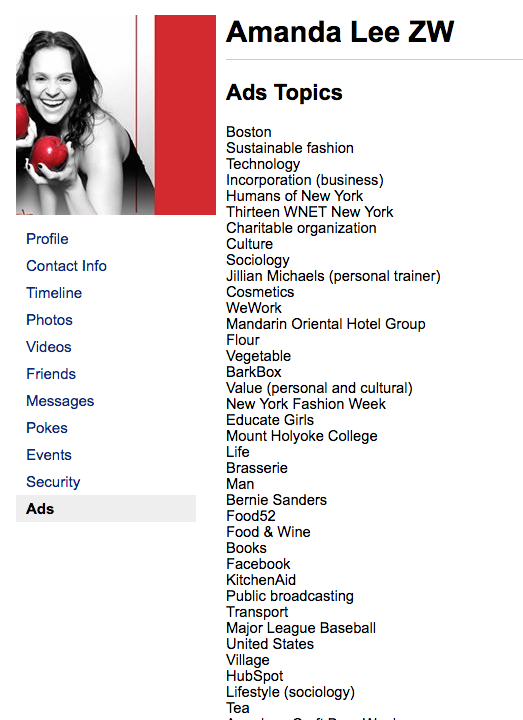
That data isn’t exactly minuscule, and some advertisers could still be able to effectively reach audiences with it. “The reality is that Facebook’s targeting tools are so powerful,” says Henry Franco, HubSpot’s Social Campaign Strategy Associate, “some analysts think this change won’t make much of a difference in overall targeting capabilities.”
Why Is Facebook Doing This?
Here’s the thing about the user data in Facebook’s possession (the kind that’s used within its own targeting tools): Most people don’t really want advertisers to have direct access to that information in a way that attaches it to specific people.
Instead, it seems, the widespread preference is for it to be anonymous and general enough that, for example, an advertiser can target Boston-based women in a certain age bracket who are interested in KitchenAid and BarkBox — but not be able to do is know who, specifically, the women are within that targeted audience.
That’s part of what got Facebook into this situation in the first place. Previous policies allowed third parties like app developers and academics to access user data for things like research purposes — but prohibited them from transferring that information to others. But when it came to light that one app developer may have violated that policy by supplementing data analytics firm Cambridge Analytica with that information, the social network began making changes to the availability of and policy clarity around user data.
The suspension of direct access within Facebook to data from third-party providers is just the latest in a series of changes. “More than anything else, it looks like Facebook is trying to clean up its act in the wake of the recent data scandal involving Cambridge Analytica,” says Franco. “While this change might be a little reactive, it’s a step in the right direction for a company of Facebook’s stature.”
Facebook isn’t alone in its recent onslaught of privacy and other policy changes. Companies ranging from Apple to Venmo have also been notifying users of modifications, at least partly in response to the heightened scrutiny of Facebook and some of its Big Tech counterparts. (In addition to Facebook CEO Mark Zuckerberg, chief executives from Twitter and Google have also been asked to testify before Congress in the wake of these ongoing events.)
Wow, Apple with the timely shade in OS update form. pic.twitter.com/YL34i4DKnn
— M.G. Siegler (@mgsiegler)
March 29, 2018
But it may not be entirely in response to this particular situation. On May 25, which is less than two months away, the General Data Privacy Regulation (GDPR) comes into force and will impact the way organizations obtain, store, manage or process the personal data of EU citizens — which some believe is also behind these recent policy changes and notifications.
But all things considered, this is likely not the last policy change expected from Facebook. And as the story continues to unfold, I’ll be monitoring it. Questions? Feel free to weigh in on Twitter.

How to update your HomePod to the latest software version [Video]

The first update for the HomePod, version 11.3 (15E217) was released today. In this post, we’ll walk through the steps of updating your HomePod to the latest available public release. more…
Fortnite releases major iOS update with guided missile, antialiasing, Party Text Chat, much more [Video]

Epic Games released a major update for its super popular iOS release of Fortnite. Along with the standard performance and bug fixes, the update brings new weapons and items, changes to gameplay, new features for mobile devices and more.
Review: The Insta360 ONE is a fantastic way to capture experiences with your iPhone [Video]

I love my drone, but I knew when I bought it that it was only going to be a matter of time before countries started clamping down on them. Sadly, that proved to be the case when I spent a few days in Iceland. Everywhere I went, there were No Drone signs. I carried it around with me, but didn’t get to use it even once.
Fortunately, I did have another interesting gadget on me – one currently exclusive to the Apple Store: the Insta360 ONE camera. This is a 360-degree 4K video camera that plugs into the Lightning socket of an iPhone. You can either shoot like this, or you can put the camera on a selfie stick and then plug it into the iPhone to edit and upload your footage.
This proved a fantastic way to capture experiences, and in terms of capturing unusual and engaging video, it’s the next best thing to a drone …
Apple rolling out overhauled privacy controls to users in May to meet GDPR laws

A fresh report from Bloomberg today details the news that Apple will be bringing refreshed privacy controls for its devices and iCloud services. These updates are coming as Facebook is embroiled in a data privacy snafu and new European data privacy laws that will begin in May.
Hulu Live TV adds The CW live channel in addition to previously available on-demand content

Popular video streaming service Hulu is adding The CW to its Live TV service today. This is in addition to the on-demand content the provider made available last September.
tvOS 11.3 for Apple TV 4 and Apple TV 4K now available, adds frame rate matching to fourth-gen

Apple has released tvOS 11.3 for both Apple TV 4 and Apple TV 4K. For Apple TV 4 users, the new update includes frame rate matching features that were previously only available on Apple TV 4K. Read on to see changes discovered (and removed) during the beta period:
9to5Toys Lunch Break: 10.5″ iPad Pro $160 off, SanDisk 32GB Lightning Drive $35, Life is Strange iOS FREE, more

Keep up with the best gear and deals on the web by signing up for the 9to5Toys Newsletter. Also, be sure to check us out on: Twitter, RSS Feed, Facebook, Google+ and Safari push notifications. more…