
Welcome to My Blog
Which Social Media Metrics Are Marketers Tracking? [New Research]
Social media metrics are imperative to social strategy. They give you an inside look at your channels’ performance and how your target audience perceives you. They can also provide you with ways to improve upon your strategy.
But what metrics should marketers track to ensure success or boost their strategy? To keep you from getting bogged down by all the numbers, we’ve made a list of the essential social media metrics to track.
These metrics will give you insight into customers, how to track ROI, improve your brand presence online, and walk away with happier customers.

Marketers can set their brand’s strategy up for growth and improvement by tracking and measuring social media metrics.
How to Measure Social Media Marketing Performance
There are several ways marketers can measure the performance of their social media marketing strategy. The most common methods are analyzing web traffic, impressions, engagement, and lead generation.
Let’s explore these different aspects of performance and more metrics marketers should track to ensure the success of their social media marketing efforts.
1. Web Traffic
Increasing traffic to your website should be a top priority depending on the nature of your business and the social media platforms your company focuses on. 27% of marketers surveyed by the HubSpot Blog listed traffic to their website as a high-priority metric for measuring the success of organic social media campaigns.
30% said the same for paid social media campaigns. If your company relies on web traffic as part of its business strategy, you’ll want to measure how many of your page views come directly from social media.
Key platforms for this focus include Facebook, Twitter, and Pinterest. You can use a web traffic tool such as Google Analytics to measure how much your traffic comes from organic social media.
2. Social Media Impressions
Social media impressions measure how many users were exposed to your content, and it’s a metric worth tracking.
Understanding your social media impressions is important because this data can provide valuable insight into how far your ad spend can go and can help inform future paid ad spending so you can maximize your budget.
However, even if paid ads aren’t a part of your strategy, you may still want to look into how many impressions your social media content is gathering over time. This data can tell you how different types of content resonate with your audience across platforms.
It’s also worth noting that each social media platform measures impressions differently. For example, on Twitter, each user that sees a tweet is considered an impression.
On Facebook, each time a paid ad is seen on screen, it is considered an impression. Instagram counts an impression each time a user views a piece of content (such as a static post, story, or Reel)).
On TikTok, no “impressions” measurement is in the app’s analytics section; however, you could consider each video view an impression for your own data.
3. Lead Generation
Lead generation means attracting prospects to your business and increasing their interest through nurturing, all with the end goal of converting them into customers. Marketers can generate leads through social media by creating compelling content that attracts and delights audiences.
To measure your social media’s success in generating leads, measure other metrics like web traffic, lead quality, and conversion rates from your social media channels.
For example, a significant amount of website traffic from Twitter can indicate your Twitter is a good source for lead generation.
4. Likes/Comments
Having a large following isn’t helpful if the audience isn’t regularly interacting with your content. Hence, measuring how often audiences like and comment on your social media is essential. Almost a quarter of the marketers we surveyed listed likes/comments as a crucial social media metric to track.
Likes show your audience viewed and enjoyed your content, while comments give insight into your audience’s reaction. Do they like your social media content? Do they have questions? What about your content resonated with them?
Likes and comments also fall under your brand’s overall social media engagement.
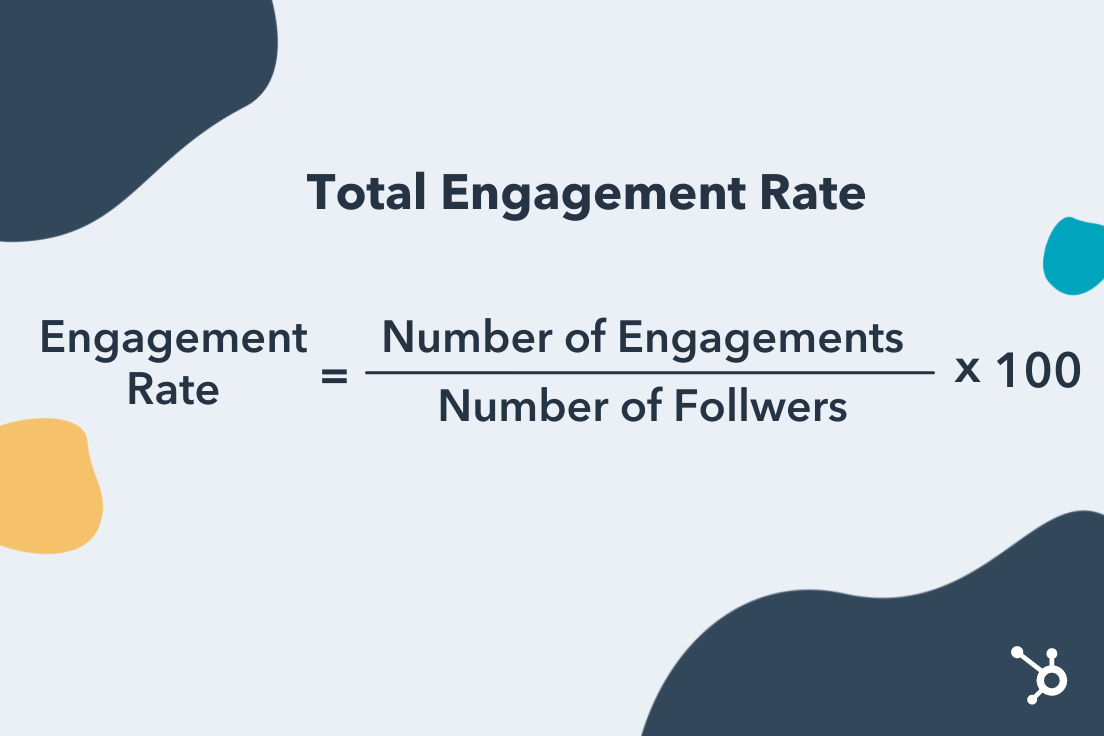
To measure the overall engagement rate of a social media account, you can use the following formula:
5. Overall Sales/Revenue
Is your social media campaign directly resulting in revenue and sales? What has your ROI been? Overall sales and revenue metrics are important in measuring the success of your campaign.
Many Social media platforms that offer monetization are transparent in how much marketers and creators can earn from their platforms, making it easy to track how your activity correlates to sales and revenue.
Now that you know what metrics marketers are tracking according to our survey — here are some tools you can use to make tracking easier.
1. Google Analytics
Price: Free
Why it’s great: Tracks web traffic analytics and provides business insights
The latest edition of Google Analytics collects website and app data to better understand the customer journey. The tool also includes privacy controls such as cookieless measurement as well as behavioral and conversion modeling.
2. HubSpot
Price: Start for Free, $800 – $3,600/mo for the Marketing Hub
Why it’s great: Monitors social media bran mentions and web traffic
HubSpot’s analytics software and dashboard tracks the complete customer lifecycle. We also help marketers monitor brand mentions, track engagements automatically, and make scheduling social posts a breeze.
3. NetBase Quid
Price: $300-$1,000/month
Why it’s great: Global insights and tracking
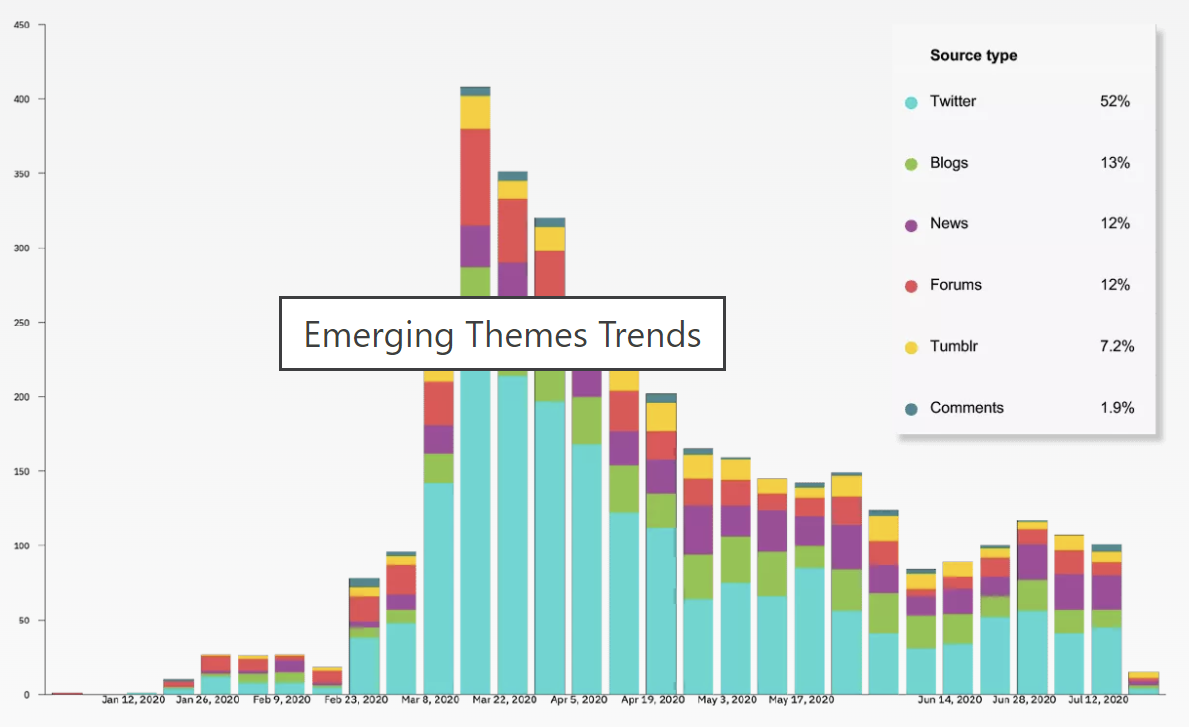
NetBase Quid provides analytics on conversations happening with your brand worldwide. They provide real-time analytics and give you insights that’ll help you track ROI. NetBase Quid provides data about how your campaigns carry weight with customers.
Users can also identify emerging trends to inform decisions and scope out the main drivers of conversation on social media.
4. quintly
Price: $345/mo
Why it’s great: See competitor performance
When using quintly, you can not only track your social media performance but gain insight into the performance of your competitors. This will help you see what you can do to improve your campaigns and what your competitors are doing that works. This photo is an example of the insights the software provides.

Quintly is also great for agencies with multiple clients. They can use it to manage their clients’ accounts and track their social media pages. Quintly also has reporting and benchmark data to measure campaigns.
There are so many numbers to keep track of when monitoring the success of your campaign, but getting bogged down by the wrong numbers can result in wasted time. Now that you know the metrics marketers are tracking, you can cut through the clutter and focus on the numbers that matter.


What is a CRO Test? [+ the 5 Steps to Perform Them Yourself]
Looking for a way to supercharge your marketing campaigns and boost conversions? Well, then it’s time to start running a conversion rate optimization test.

It’s an incredibly powerful toolset that can help marketers unlock valuable insights from user behavior – and significantly optimize their campaigns in the process.
In this blog post, we’ll explain what a CRO test is and the steps to run them for maximum impact.
CRO tests involve adding, re-arranging, and redesigning elements on your website. They can focus on optimizing the copy, design, or placement of your CTAs, or the length of your headlines, among other elements.
When done right, a CRO test will help you identify where to make improvements and maximize the return on your investment.
At worst, this test will serve as a gut check to ensure your current path is optimized and at the best, it will unlock new opportunities.
How to Perform CRO Tests
1. Research.
One step marketers often miss before running a CRO test is research, jumping straight from the idea to the test itself.
Once you have an idea for a test, you’ll first need to validate it through research. This can be both internal – reviewing past experiments, user research data, and analytics insights – and external by reviewing your competitors’ strategies.
The goal is to discover what has resonated with your audience in the past and if your suggested test aligns with that.
2. Design your experiment.
While you’re in the planning stage, it’s helpful to write an experiment doc.
It should include:
- Your objective – What do you aim to achieve with this CRO test?
- Your hypothesis – What do you anticipate will happen with this test? Be as specific as possible by stating the current state, what you want to test, the metric you’re measuring, and your anticipated outcome.
- Your design – This is where all the details of your experiment will live, such as:
- The type of test it is (E.g. A/B, A/B/n, multivariate)
- The pages on which the test will run
- The control and variant groups
- Duration Estimation
- Primary and secondary metrics
- Predicted impact
- Special considerations.
- Results – Once your test is complete, you can drop details of its performance in the document.
This document will serve as your source of truth for your CRO test and keep stakeholders in the know. Plus, you can reference it for future CRO tests.
3. Design your variants and build the test.
Now that you have all your ducks in a row, you can get started with building your experiment.
This step will likely take the most time as it will likely require cross-collaboration between your team, designers, and developers.
Timeline-wise, it can look something like this:
- Work with designers to develop the look and feel of the test.
- Develop copy, if necessary.
- Create tickets and assign them to team members.
- Work with developers, if applicable, to determine dev work and timeline.
- Set up the experiment in your testing tool (like HotJar or Convert) and the analytics to track results.
- Perform quality assurance (QA) tests to ensure it’s working as expected.
Once these steps are complete, you’re ready for launch.
4. Launch your test.
Once your experiment is live, the first thing you’ll want to do is QA it to ensure it’s still working as expected.
Even if you did this pre-launch, it’s not uncommon to catch bugs once the test is live. You’ll also want to check your analytics page to ensure your tracking is set up correctly.
Once that’s done, alert your stakeholders. Your test may impact other teams and their metrics so it’s important to let them know.
This also gives you an extra set of eyes who can report any issues they spot.
5. Review results.
Once your test has reached statistical significance, you can confidently review the results.
How were your metrics impacted? Was your hypothesis satisfied? What insights did you learn?
If your variation won, you can then work on implementing it. If it didn’t, there’s still opportunity there.
Even if your test produced negative results – i.e. your conversion rate decreased – you’re still gaining valuable insights about your audience.
Now that we’ve covered the steps to running a CRO test, see below a few brand examples.
CRO Test Examples
HubSpot’s Content Offer Form Design
The purpose of this experiment was to see if altering the submission form design affects users.
The hypothesis was that by redesigning forms, the user experience will improve and increase user clarity. In turn, form submission CVR would increase. The primary metric measured was form submission CVR.
The test featured four different variations of sign-up forms, which is an A/B/C/D/E design. The image below is the control variant.
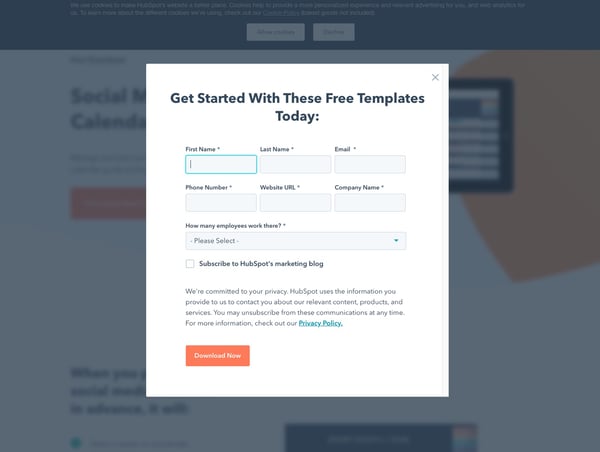
Results were significant as variations B and D outperformed the control variables at 96% and 100% confidence, respectively.
The image below shows variation B on the left and variation D on the right.
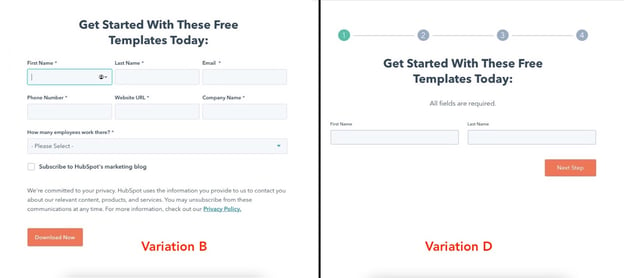
This demonstrates that, in the future, conversions on the blog could increase if winning form submission designs were applied to blog posts.
Optimizely’s Landing Page Headline
Optimizely was running a few PPC ads with several different types of messaging on one landing page. The landing page did not use the same terminology as the ad – instead, it read “Try it Out for Free.
So Optimizely decided to test the following theory: Aligning the copy on the landing page to the ad will result in more leads (AKA higher conversion).
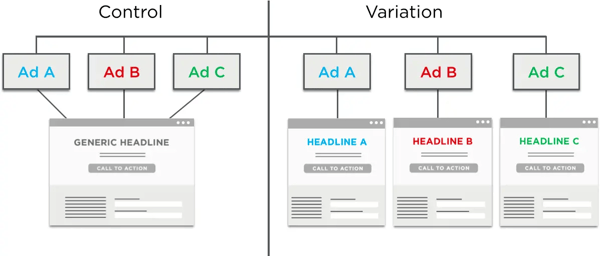
It worked! While the control had a 12% conversion rate, the variation led to a 39.1% increase in conversions.
HubSpot Blog’s Slide-In CTAs
Most successful blogs include a call-to-action at the end of their blog posts. It’s usually full-width – large enough for people to notice the offer and hopefully convert on it.
But are people noticing that CTA, or are they learning to tune them out?
Here at HubSpot, we were curious if our readers were developing static CTA blindness. So, we decided to run a test to see if we could increase our CTA clickthrough and conversion rates.
To accomplish this goal, we tested slide-in CTAs that would appear halfway to three-quarters of the way through a blog post.
Here’s an example of the slide-in:
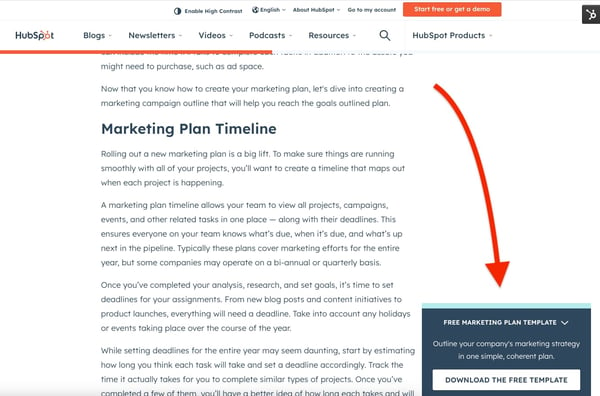
To test this out, we added slide-in CTAs to 10 of HubSpot’s highest-traffic blog posts. After reaching statistically significant results, we looked at the following stats for the slide-in CTA and the static CTA at the end of the post:
- Clickthrough rate (CTR) – What percentage of visitors clicked each CTA?
- Conversion rate (CVR) – What percentage of those visitors who clicked ultimately converted on the landing page form?
- Submissions – How many total leads did each CTA ultimately generate?
In this test, the slide-in CTA had a 192% higher CTR and generated 27% more submissions – mission accomplished.
Sidekick’s Landing Page Design
This test was done many moons ago when HubSpot Sales was still Sidekick but the value’s still there.
Back then, Sidekick was a chrome extension and the original landing page included a list of all the features from the software:
- See Who Opens & Clicks on Your Emails
- Schedule Emails to be Sent Later
- Access Valuable Information About Your Contacts
But the team was curious to know if those details actually mattered. For a product as low-touch as a Chrome extension, do consumers need a laundry list of features to convert?
To answer this question, the experiment involved replacing the feature list with user testimonials.
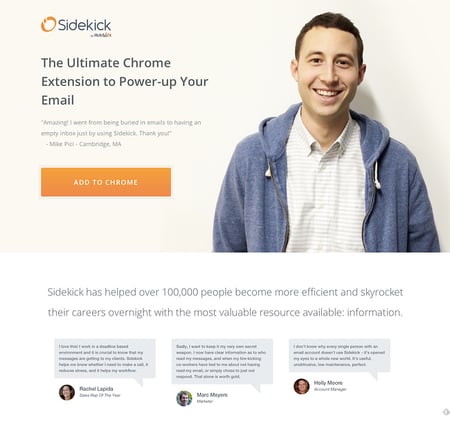
The testimonial beat out the feature list by 28%.
Their theory on why this change took place? The former didn’t make people curious enough to click through to the Chrome Extension installation page.
Another theory is that consumers wanted more social proof before downloading a new tool into their browser.
There you have it – a rundown of all things CRO testing. If you want more details on how to run a test of your own, check out our A/B test kit below.

How to Write a Blog Post: A Step-by-Step Guide [+ Free Blog Post Templates]
If you’ve ever read a blog post, you’ve consumed content from a thought leader that is an expert in their industry. Chances are if the blog post was written effectively, you came away with helpful knowledge and a positive opinion about the writer or brand that produced the content.
Anyone can connect with their audience through blogging and enjoy the myriad benefits that blogging provides: organic traffic from search engines, promotional content for social media, and recognition from a new audience you haven’t tapped into yet.
If you’ve heard about blogging but are a beginner and don’t know where to start, the time for excuses is over. Not only can you create an SEO-friendly blog, but we’ll cover how to write and manage your business’s blog as well as provide helpful templates to simplify your blogging efforts.
Let’s get started with an important question.
Blogging may mean different things depending on your niche — so let’s begin with this definition.
Blog posts allow you and your business to publish insights, thoughts, and stories on your website about any topic. They can help you boost brand awareness, credibility, conversions, and revenue. Most importantly, they can help you drive traffic to your website.
But in order to begin making posts for a blog — you have to learn how to start one, first. Let’s dive in.
1. Understand your audience.
Before you start writing your blog post, make sure you have a clear understanding of your target audience. To do so, take the following steps.
Ask yourself exploratory questions.
To discover your audience, ask questions like: Who are they? Are they like me, or do I know someone like them? What do they want to know about? What will resonate with them?
Jot down your notes in a notepad or a document. This is the time to brainstorm audience attributes from scratch, no matter how out of left field they may feel. You should also think about your audience’s age, background, goals, and challenges at this stage.
Carry out market research.
Doing market research sounds like a big task, but in truth, it can be as simple as accessing a social media platform and browsing user and blog profiles that match with your potential audience.
Use market research tools to begin uncovering more specific information about your audience — or to confirm a hunch or a piece of information you already knew. For instance, if you wanted to create a blog about work-from-home hacks, you can make the reasonable assumption that your audience will be mostly Gen Zers and Millennials. But it’s important to confirm this information through research.
Create formal buyer personas.
Once you’ve brainstormed and carried out market research, it’s time to create formal buyer personas. It’s important because what you know about your buyer personas and their interests will inform the brainstorming process for blog posts.
For instance, if your readers are Millennials looking to start a business, you probably don’t need to provide them with information about getting started on social media — most of them already have that down.
You might, however, want to give them information about how to adjust their social media approach (for example — from what may be a casual, personal approach to a more business-savvy, networking-focused approach). That kind of tweak is what helps you publish content about the topics your audience really wants and needs.
Don’t have buyer personas in place for your business? Here are a few resources to help you get started:
- Create Buyer Personas for Your Business [Free Template]
- Guide: How to Create Detailed Buyer Personas for Your Business
- [Free Tool] Make My Persona: Buyer Persona Generator
2. Check out your competition.
What better way to draw inspiration than to look at your well-established competition?
It’s worth taking a look at popular, highly reviewed blogs because their strategy and execution is what got them to grow in credibility. The purpose of doing this isn’t to copy these elements, but to gain better insight into what readers appreciate in a quality blog.
When you find a competitor’s blog, take the following steps:
Determine whether they’re actually a direct competitor.
A blog’s audience, niche, and specific slant determine whether they’re actually your competitor. But the most important of these is their audience. If they serve a completely different public than you, then they’re likely not a competitor. That is why it’s important to define your buyer personas before taking other steps in the blog creation process.
Look at the blog’s branding, color palette, and theme.
Once you determine that they’re your competitor, it’s time to take note of their techniques so that you can capture a similar readership. Colors and themes play a huge role in whether you seem like part of a niche — for instance, a blog about eco-friendly products should likely use earthy tones instead of bright, unnatural colors such as neon yellow or pink.
Analyze the tone and writing style of the competition.
Take note of your competition’s copywriting. Is it something you feel like you can successfully emulate? Does it ring true to the type of blog you’d like to create? What do readers most respond to? For most, creating a tech blog might be an excellent idea, but if journalistic, review-based writing doesn’t work for you, then that might not be a good fit. Be aware of what you can feasibly execute or hire freelance writers.
3. Determine what topics you’ll cover.
Before you write anything, pick a topic you’d like to write about. The topic can be pretty general to start as you find your desired niche in blogging.
Here are some ways to choose topics to cover.
Find out which topics your competitors often cover.
One easy way to choose topics for your blog is to simply learn what other blogs are writing about. After you determine your competitors, go through their archive and category pages, and try to find out which topics they most often publish content about. From there, you can create a tentative list to explore further. You might find, for instance, that a competitor only covers surface-level information about a subject. In your blog, you can dive more deeply and offer more value to readers.
Choose topics you understand well.
No matter what type of blog you start, you want to ensure you know the topic well enough to write authoritatively about it. Rather than choosing a topic you’ll need to research as you write, think about those that come most naturally to you. What has your professional experience been like so far? What are your hobbies? What did you study in college? These can all give rise to potential topics you can cover in depth.
Ensure the topics are relevant to your readership.
You may find that you hold deep expertise in various topics, but how relevant are they to the audience you understood back in step one? If you’re not serving their needs, then you’d be shouting into a void — or, worse, attracting the wrong readership. For that reason, after identifying the topics you can feasibly write about, ask yourself whether those are subjects your audience would like to explore.
Do preliminary keyword research.
Keyword research is the process of searching for topics using a keyword research tool, then determining whether there is demand by looking at each topic’s (or keyword’s) search volume. If you found the perfect topics that are the perfect cross between your expertise and your reader’s needs, you’ve struck gold — but the gold will have no value unless people are searching for those terms. Only then can you capture the audience that is waiting out there.
4. Identify your unique angle.
What perspective do you bring that makes you stand out from the crowd? This is key to determining the trajectory of your blog’s future, and there are many avenues to choose in the process.
Here’s how you can find your unique selling proposition in crowded blogging niches:
Write a professional and personal bio.
Knowing your own history and experience is essential to determine your unique slant. To get started, write a professional bio that explains, at length, who you are and which experiences most inform your blogging efforts. While I could write a lengthy exposition about my childhood, that history isn’t essential unless I’m launching a blog about raising children.
What unique experience makes you a trusted expert or thought leader on the topic? You can use your answers to that question to find your angle. Use this information to populate your “About me” page on your blog and share more about yourself.
Determine the special problem you will solve for readers.
Your readers won’t trust you or return to you unless you actively help them solve a problem. As you try to find your angle, think about ways you can help your audience surmount challenges typically associated with the topics you’ve chosen for your blog. For instance, if you’re creating a blog about sustainability, then you might help readers learn how they can compost organic materials in their home.
Choose an editorial approach.
Will you share your opinions on trending debates? Teach your readers how to do something? Compare or share original research? The editorial approach you choose will in part be informed by the topics you cover on your blog and the problems you’re helping your readers solve. If your blog is about marketing trends and your goal is to keep marketers up-to-date on the latest changes, then your editorial approach should be journalistic in nature. This is only one example of how to choose a technique.
5. Name your blog.
This is your opportunity to get creative and make a name that gives readers an idea of what to expect from your blog. Some tips on how to choose your blog name include:
Keep your blog name easy to say and spell.
No need to get complicated at all with your name, though it might be tempting, since there are so many blogs out there. While choosing a unique name is essential, it’s also important to choose one that is easy to memorize for readers. It should also be simple to remember as an URL (which will come into play in the next step).
Link your blog name to your brand message.
The more related your blog’s name is to the topics you cover, the better. For instance, DIY MFA is all about writers doing their own Master of Fine Arts in writing at home. The brand’s message is all about delving deep into one’s writing practice without needing a formal degree. Try to do something similar for your own blog name: Alluding to your blog’s message, value proposition, and covered topics in one sweep.
Consider what your target audience is looking for.
Your blog name should tie directly into what your readers want to achieve, learn, or solve. DIY MFA is about writers who don’t have the money for graduate school, but who still want to develop their writing skills. The HubSpot Marketing blog is — you guessed it — about marketing trends and tips.
It’s okay if your blog name feels “too straightforward.” Straightforward names accurately communicate what you’re about and effectively attract the right audience.
If you still need more assistance, try using a blog name generator. One last tip: Make sure the name you come up with isn’t already taken, as it could lessen your visibility and confuse readers looking for your content.
6. Create your blog domain.
A domain is a part of the web address nomenclature someone would use to find your website or a page of your website online.
Your blog’s domain will look like this: www.yourblog.com. The name between the two periods is up to you, as long as this domain name doesn’t yet exist on the internet.
Want to create a subdomain for your blog? If you already own a cooking business at www.yourcompany.com, you might create a blog that looks like this: blog.yourcompany.com. In other words, your blog’s subdomain will live in its own section of yourcompany.com.
Some CMS platforms offer subdomains as a free service, where your blog lives on the CMS, rather than your business’s website. For example, it might look like this: yourblog.contentmanagementsystem.com. However, to create a subdomain that belongs to your company website, register the subdomain with a website host.
Most website hosting services charge very little to host an original domain — in fact, website costs can be as inexpensive as $3 per month when you commit to a 36-month term.
Pro Tip: You can connect your custom domain to free hosting with HubSpot’s free CMS or in premium editions of CMS Hub. This includes access to built-in security features and a content delivery network.
Here are five other popular web hosting services to choose from:
7. Choose a CMS and set up your blog.
A CMS (content management system) is a software application that allows users to build and maintain a website without having to code it from scratch. CMS platforms can manage domains (where you create your website) and subdomains (where you create a webpage that connects to an existing website).
HubSpot customers host web content via CMS Hub. Another popular option is a self-hosted WordPress website on a hosting site such as WP Engine. Whether you create a domain or a subdomain to start your blog, you’ll need to choose a web hosting service after you pick a CMS.
Pro Tip: You can get started for free with HubSpot’s free blog maker. Our free CMS offers everything you need to get started– including hosting, a visual editor, and hundreds of free and paid themes to choose from.
8. Customize the look of your blog.
Once you have your domain name set up, customize the appearance of your blog to reflect the theme of the content you plan on creating and your brand.
For example, if you’re writing about sustainability and the environment, green might be a color to keep in mind while designing your blog.
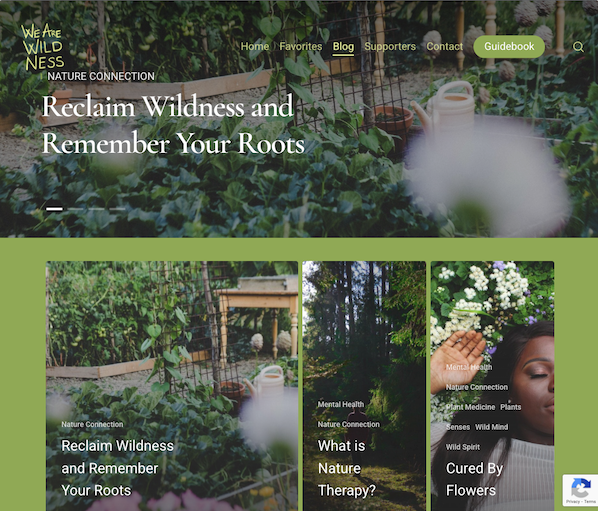
If you already manage a website and are writing the first post for that existing website, ensure the article is consistent with the website in appearance and subject matter. Two ways to do this are including your:
- Logo: This can be your business’s name and logo — it will remind blog readers of who’s publishing the content. (How heavily you want to brand your blog, however, is up to you.)
- “About” Page: You might already have an “About” blurb describing yourself or your business. Your blog’s “About” section is an extension of this higher-level statement. Think of it as your blog’s mission statement, which serves to support your company’s goals.
9. Write your first blog post.
Once you have your blog set up, the only thing missing is the content. While the design and layout are fun and functionally necessary, it’s the content that will draw your readers in and keep them coming back. So how do you actually go about writing one of these engaging and informational pieces?
Writing Your First Blog Post
You’ve got the technical and practical tidbits down — now it’s time to write your very first blog post. And nope, this isn’t the space to introduce yourself and your new blog (i.e. “Welcome to my blog! This is the topic I’ll be covering. Here are my social media handles. Will you please follow?”).
Start with “low-hanging fruit,” writing about a highly specific topic that serves a small segment of your target audience.
That seems unintuitive, right? If more people are searching for a term or a topic, that should mean more readers for you.
But that’s not true. If you choose a general and highly searched topic that’s been covered by major competitors or more established brands, it’s unlikely that your post will rank on the first page of search engine results pages (SERPs). Give your newly born blog a chance by choosing a topic that few bloggers have written about.
Let’s walk through this process.
1. Choose a topic you’re passionate and knowledgeable about.
Before you write anything, pick a topic for your blog post. The topic can be pretty general to start. For example, if you’re a company that sells a CRM for small-to-enterprise businesses, your post might be about the importance of using a single software to keep your marketing, sales, and service teams aligned.
Pro tip: You may not want to jump into a “how-to” article for your first blog post.
Why?
Your credibility hasn’t been established yet. Before teaching others how to do something, you’ll first want to show that you’re a leader in your field and an authoritative source.
For instance, if you’re a plumber writing your first post, you won’t yet write a post titled “How to Replace the Piping System in your Bathroom.” First, you’d write about modern faucet setups, or tell a particular success story you had rescuing a faucet before it flooded a customer’s house.
Here are four other types of blog posts you could start with:
- List (“Listicle”): 5 ways to fix a leaky faucet
- Curated Collection: 10 faucet and sink brands to consider today
- SlideShare Presentation: 5 types of faucets to replace your old one (with pictures)
- News Piece: New study shows X% of people don’t replace their faucet frequently enough
If you’re having trouble coming up with topic ideas, a good topic brainstorming session should help. In the post I’ve linked, my colleague walks you through a helpful process for turning one idea into many. Similar to the “leaky faucet” examples above, you would “iterate off old topics to come up with unique and compelling new topics.”
This can be done by:
- Changing the topic scope
- Adjusting your time frame
- Choosing a new audience
- Taking a positive/negative approach
- Introducing a new format
And if you’re still stuck, let’s take a look at some first blog post idea examples.
First Blog Post Ideas
The Difference Between [Niche Topic] and [Niche Topic], Explained by a [Niche Expert]
- The Difference Between SEM and SEO, Explained by a Marketing Expert
- The Difference Between Sedans and Coupes, Explained by a Car Mechanic
- The Difference Between Baking and Broiling, Explained by a Professional Baker
The 10 Best and Worst [Niche Tools] for [Niche Activity]
- The 10 Best and Worst Writing Software for Fiction Writing
- The 10 Best and Worst CRMs for Nurturing Prospects
- The 10 Best and Worst Family Cars for Cross-Country Roadtrips
8 [Niche Activity] Common Mistakes (+ Ways to Fix Them)
- 8 Non-Fiction Writing Common Mistakes (+ Ways to Fix Them)
- 8 Salmon Broiling Common Mistakes (+ Ways to Fix Them)
- 8 Car Maintenance Common Mistakes (+ Ways to Fix Them)
9 Proven Tips for [Niche Activity]
- 9 Proven Tips for Checking Plumbing Problems under Your Kitchen Sink
- 9 Proven Tips for Writing a Non-Fiction Bestseller
- 9 Proven Tips for Doing DIY Car Maintenance
Why We/I Switched from [Niche Tool] to [Niche Tool] (Comparison)
- Why We Switched from Pipedrive to HubSpot (Comparison)
- Why I Switched from Microsoft Word to Scrivener (Comparison)
- Why We Switched from iMacs to Surface Studio (Comparison)
[Niche Tool] vs [Niche Tool]: Which [Tool] is Best for You?
- Zendesk vs Freshcaller: Which Call Software is Best for You?
- Air Fryer vs Convection Oven: Which One is Best for You?
- Mazda Miata vs Toyota Supra: Which Sports Car is Best for You?
The Ultimate Roundup of [Niche Activity] Tips and Tricks
- The Ultimate Roundup of Novel Writing Tips and Tricks
- The Ultimate Roundup of Macaroon Baking Tips and Tricks
- The Ultimate Roundup of Solo Traveling Tips and Tricks
Want some real examples of blog posts? See what your first blog post can look like based on the topic you choose and the audience you’re targeting.
2. Target a low-volume keyword to optimize around.
Finding a keyword with low searches in Google (we recommend sticking to about 10 to 150 monthly searches). These topics offer less competition and should therefore allow your new blog post to rank more easily.
To choose a topic, you can either do a traditional brainstorming session or carry out keyword research. We suggest the latter because you can actually see how many people are looking for that topic.
Now, don’t be intimidated by the term “keyword research.” It’s not just for marketers, but for new bloggers, too. And it’s really easy to do.
To jumpstart your keyword research, first begin by identifying the general topic of your blog.
Say you’re a plumber. Your general, high-level topic might be “plumbing” (67K monthly searches).
Next, put this term into a keyword research tool such as:
When you run this term through the tool, a list of related keywords will appear. Scan the list and choose one with a lower search volume. For this example, we’ll use “under sink plumbing” (1.4K monthly searches).
Run that keyword in the keyword research tool again. Look at the related keywords. Find one with a lower search volume. Do that again.
For this example, we’ll settle on “plumbing problems under kitchen sink” (10 monthly searches). That’s the topic for our first post.
TLDR; Choose a low-volume, low-competition keyword that will ensure your first post ranks.
For more help on keyword research, here are more resources you can use:
- How to Do Keyword Research for SEO: A Beginner’s Guide
- How to Perform Keyword Research and Rank
- Top Tools For Finding Long-Tail Keywords
3. Google the term to understand your audience’s search intent.
You’ve got your topic — now, you need to check that the user’s search intent would be fulfilled by a blog post.
What does that mean?
If someone is looking for “plumbing problems under a kitchen sink,” they might be looking for a tutorial, a diagram, an article, or a product that can fix the issue. If they’re looking for the first three, you’re good — that can be covered in a blog post. A product, however, is different, and your blog post won’t rank.
How do you double-check search intent?
Google the term and look at the results. If other articles and blog posts rank for that term, you’re good to go. If you only find product pages or listicles from major publications, then find a new topic to cover in your first post.
Consider the term “under sink plumbing bathroom” (30 monthly searches). It seemed like a perfect fit because it had low monthly searches.
Upon Googling the term, we found product carousels, product pages from Home Depot and Lowes, and guides written by major publications. (You’ll also want to avoid topics that have been covered by major publications, at least for now.)
TLDR; Before writing your first blog post about a low-volume topic, double-check the user intent by Googling the keyword. Also, don’t forget to take a look at who’s written about that topic so far. If you see a major brand, consider writing about another topic.
4. Find questions and terms related to that topic.
You’ve got a highly unique topic that’s been covered by just a few people so far. It’s time to flesh it out by covering related or adjacent topics.
Use the following tools:
- Answer the Public: When you place your keyword into this tool, it will give you a list of questions related to that term.
- Google: Google is your best friend. Search for the term and look under “People also ask” and “People also search for.” Be sure to touch upon those topics in the post.
You can also use these keyword research tools we mentioned above in step one.
5. Come up with a working title.
You might come up with a few different working titles — in other words, iterations of approaching that topic to help you focus your writing.
For example, you may decide to narrow your topic to “Tools for Fixing Leaky Faucets” or “Common Causes of Leaky Faucets.” A working title is specific and will guide your post so you can start writing.
Let’s take a real post as an example: “How to Choose a Solid Topic for Your Next Blog Post.”
Appropriate, right? The topic, in this case, was probably “blogging.” Then the working title may have been something like, “The Process for Selecting a Blog Post Topic.” And the final title ended up being “How to Choose a Solid Topic for Your Next Blog Post.”
See that evolution from topic, to working title, to final title? Even though the working title may not end up being the final title (more on that in a moment), it still provides enough information so you can focus your blog post on something more specific than a generic, overwhelming topic.
6. Create an outline.
Sometimes, blog posts can have an overwhelming amount of information — for the reader and the writer. The trick is to organize the info in a way so readers aren’t intimidated by length or amount of content. This organization can take multiple forms — sections, lists, tips — whatever’s most appropriate. But it must be organized!
Featured Resource: 6 Free Blog Post Templates
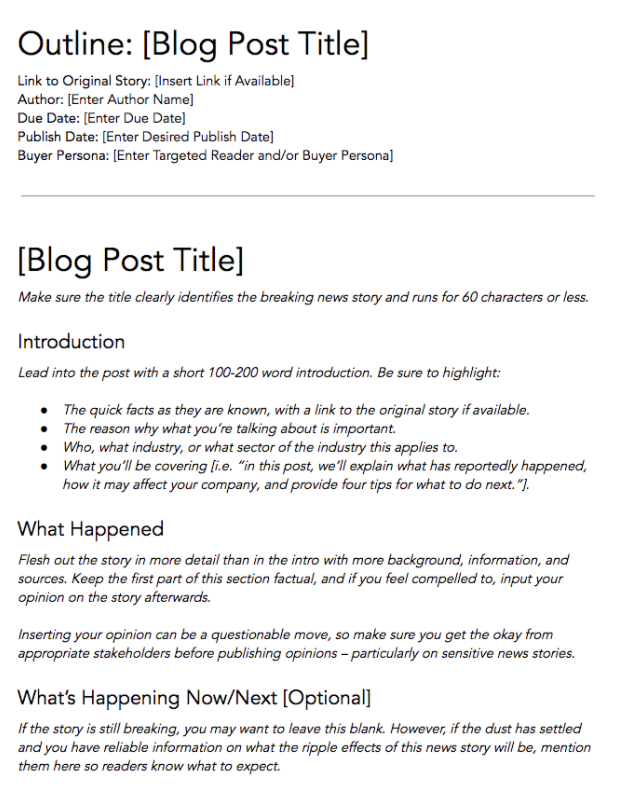
Download These Templates for Free
Let’s take a look at the post, “How to Use Snapchat: A Detailed Look Into HubSpot’s Snapchat Strategy.” There’s a lot of content in the piece, so it’s broken up into a few sections using descriptive headers. The major sections are separated into subsections that go into more detail, making the content easier to read.
To complete this step, all you really need to do is outline your post. This way, before you start writing, you’ll know which points you want to cover and the best order to do so. And to make things even easier, you can download and use our free blog post templates, which are pre-organized for six of the most common blogs. Just fill in the blanks!
7. Write an intro (and make it captivating).
We’ve written more specifically about writing captivating introductions in the post “How to Write an Introduction,” but let’s review, shall we?
First, grab the reader’s attention. If you lose the reader in the first few paragraphs — or even sentences — of the introduction, they’ll stop reading (even before they’ve given your post a fair shake). You can do this in a number of ways: tell a story or a joke, be empathetic, or grip the reader with an interesting fact or statistic.
Then, describe the purpose of your post and explain how it will address a problem the reader may be experiencing. This will give the reader a reason to continue reading and show them how the post will help them improve their work or lives.
Here’s an example of an intro we think does a good job of attracting a reader’s attention right away:
“Blink. Blink. Blink. It’s the dreaded cursor-on-a-blank-screen experience that all writers — amateur or professional, aspiring or experienced — know and dread. And of all times for it to occur, it seems to plague us the most when trying to write an introduction.”
8. Build out each section of your outline.
The next step — but not the last — is actually writing the content. We can’t forget about that, of course.
Now that you have your outline or template, you’re ready to fill in the blanks. Use your outline as a guide and expand on all points as needed. Write about what you already know, and if necessary, conduct additional research to gather more information, examples, and data to back up your points, while providing proper attribution when incorporating external sources. When you do, always try to find accurate and compelling data to use in your post.
If you’re having trouble stringing sentences together, you’re not alone. Finding your “flow” can be challenging for a lot of folks. Luckily, there are a ton of tools you can lean on to help you improve your writing. Here are a few to get you started:
- Power Thesaurus: Stuck on a word? Power Thesaurus is a crowdsourced tool that provides users with a number of alternative word choices from a community of writers.
- ZenPen: If you’re having trouble staying focused, check out this distraction-free writing tool. ZenPen creates a minimalist “writing zone” designed to help you get words down without having to fuss with formatting right away.
- Cliché Finder: Feeling like your writing might be coming off a little cheesy? Identify instances where you can be more specific using this handy cliché tool.
You can also refer to our complete list of tools for improving your writing skills. And if you’re looking for more direction, the following resources are chock-full of valuable writing advice:
- Copywriting 101: 6 Traits of Excellent Copy Readers Will Remember
- How to Write Compelling Copy: 7 Tips for Writing Content That Converts
- How to Write With Clarity: 9 Tips for Simplifying Your Message
- The Kurt Vonnegut Guide to Great Copywriting: 8 Rules That Apply to Anyone
- Your Blog Posts Are Boring: 9 Tips for Making Your Writing More Interesting
9. Publish and promote your first post any way you can.
As a new blogger, you likely don’t have a social media following yet. Thankfully, you don’t need a huge following before you can create a promotion strategy.
A promotion strategy is your master plan for how you create, post, and engage with your social media content. It helps you take advantage of social and digital technologies to share your business, or in this case, your content. Having a solid promotional strategy offers your audience from different marketing channels more ways to find your blog posts.
Here are more blog post promotion resources:
- 12 Tried-and-True Ways to Promote Your Blog Posts
- 10 Sites You Can Use for Free Blog Promotion
- 9 Link Building Email Outreach Templates That Actually Work
- Inbound Link Building 101: 34 Ways to Build Backlinks for SEO
- 11 Creative (But 100% White Hat!) Ways to Earn Backlinks
What makes a good blog post?
Before you write a blog, make sure you know the answers to questions like, “Why would someone keep reading this entire blog post?” and “What makes our audience come back for more?”
To start, a good blog post is interesting and educational. Blogs should answer questions and help readers resolve a challenge they’re experiencing — and you have to do so in an interesting way.
It’s not enough just to answer someone’s questions — you also have to provide actionable steps while being engaging. For instance, your introduction should hook the reader and make them want to continue reading your post. Then, use examples to keep your readers interested in what you have to say.
Remember, a good blog post is interesting to read and provides educational content to audience members.
(Want to learn how to apply blogging and other forms of content marketing to your business?
Check out HubSpot Academy’s free content marketing course.)
Quick Blog Writing Tips
- Conduct research if necessary to convey your point.
- Make your content skimmable; break it into digestible chunks.
- Include interesting quotes or facts for emphasis on the subject.
- Paint a full picture with images, graphics or video.
- Use Grammarly to catch mistakes.
- If you don’t know where to start, start by telling a story.
- Reference social media posts.
- Each sentence should convey a single idea.
While you have several tools and tips already, we wanted to provide you with some formatting guidelines to use before you publish your own.
1. Include H2s to arrange ideas.
When you begin typing your blog content, it’s important that you divide paragraphs into sections that make it easier for the reader to find what they need.
If you’re just starting out, then focus on the overarching H2s you want to talk about, and you’ll be able to branch off into subheaders and more naturally as you continue.
2. Center your images.
This is a simple practice that can help your content look more professional with little effort. Centering your images keeps the reader’s attention drawn to the subject — not searching for elsewhere.
Centering also looks better when translating from PC to mobile devices. As formatting transitions to small screens or windows, a centered image will remain the focal point.
3. Add alt text.
So those images you centered earlier, make sure you have descriptive alt text for them, too.
Image alt text allows search engines, like Google, to crawl and rank your blog post better than pages lacking the element. It also leads readers to your blog post if the keywords included are what they searched for in the first place.
Besides SERP features, image alt text is beneficial to readers by providing more accessibility. Image alt text allows people to better visualize images when they can’t see them, and with assistive technology, can be auditorially read aloud for people to enjoy.
4. Keep your sentences short and concise.
When you begin working on the body of your blog post, make sure readers can clearly understand what you’re trying to accomplish.
You shouldn’t feel pressure to elongate your post with unnecessary details, and chances are that if you keep it concise, readers will derive more value from your work.
5. Use media with a purpose.
Break up the monotony of your blog post with some multimedia content where seen fit.
Your reader will enjoy visiting a blog page with images, videos, polls, audio or slideshows as opposed to a page of black and white text.
It also makes it more interactive and improves your on-page search engine optimization (SEO).
Now, do you want some real examples of blog posts? See what your first blog post can look like based on the topic you choose and the audience you’re targeting.
1. List-Based Blog Post
List-Based Post Example: 17 Blogging Mistakes to Avoid in 2021, According to HubSpot Bloggers

List-based posts are sometimes called “listicles,” a mix of the words “list” and “article.” These are articles that deliver information in the form of a list. A listicle uses sub-headers to break down the blog post into individual pieces, helping readers skim and digest your content more easily.
As you can see in the example from our blog, listicles can offer various tips and methods for solving a problem.
2. Thought Leadership Post
Example: How HubSpot’s Customers Are Shaping the Next Normal
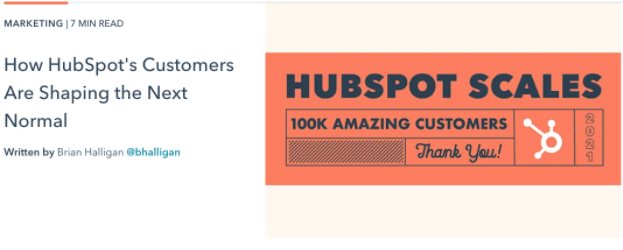
Thought leadership posts allow you to share your expertise on a particular subject matter and share firsthand knowledge with your readers.
These pieces — which can be written in the first person, like the post shown above — help you build trust with your audience so people take your blog seriously as you continue to write for it.
3. Curated Collection Post
Example: 8 Examples of Evolution in Action
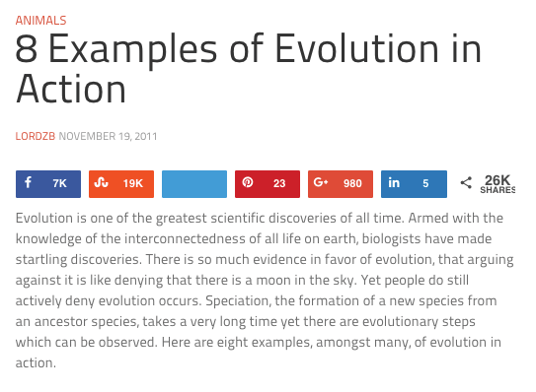
Curated collections are a special type of listicle blog post. Rather than sharing tips or methods for doing something, this type of blog post shares a list of real examples that all have something in common in order to prove a larger point.
In the example post above, Listverse shares eight real examples of evolution in action among eight different animals — starting with the peppered moth.
4. Slide Presentation
Example: The HubSpot Culture Code
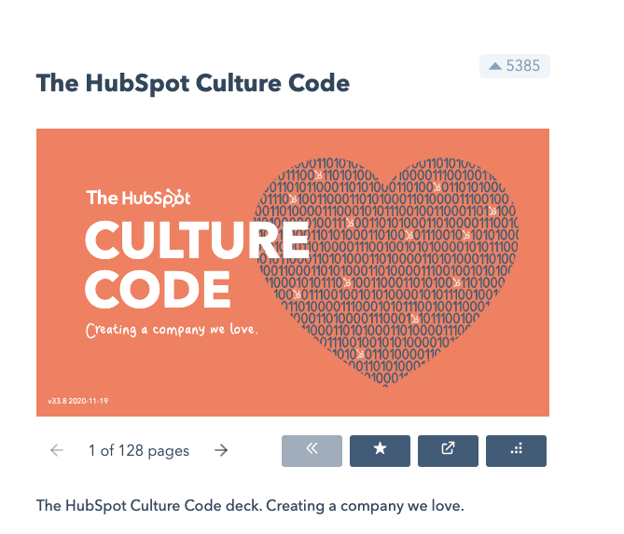
HubSpot Slides is a presentation tool that helps publishers package a lot of information into easily shareable slides. Think of it like a PowerPoint, but for the web. With this in mind, SlideShare blog posts help you promote your SlideShare so that it can generate a steady stream of visitors.
Unlike blogs, slide decks don’t often rank well on search engines, so they need a platform for getting their message out there to the people who are looking for it. By embedding and summarizing your SlideShare on a blog post, you can share a great deal of information and give it a chance to rank on Google at the same time.
Need some slideshow ideas? In the example above, we turned our company’s “Culture Code” into a slides presentation that anyone can look through and take lessons from, and then promoted it in a blog post.
5. Newsjacking Post
Example: Ivy Goes Mobile With New App for Designers

“Newsjacking” is a nickname for “hijacking” your blog to break important news related to your industry. Therefore, the newsjack post is a type of article whose sole purpose is to garner consumers’ attention and, while offering them timeless professional advice, prove your blog is a trusted resource for learning about the big things that happen in your industry.
The newsjack example above was published by Houzz, a home decor merchant and interior design resource, about a new mobile app that was launched just for interior designers. Houzz didn’t launch the app, but the news of its launching is no less important to Houzz’s audience.
6. Infographic Post
Example: The Key Benefits of Studying Online [Infographic]
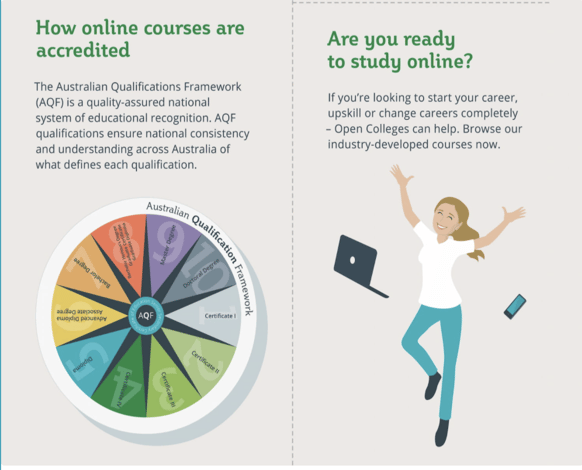 The infographic post serves a similar purpose as the SlideShare post — the fourth example, explained above — in that it conveys information for which plain blog copy might not be the best format.
For example, when you’re looking to share a lot of statistical information (without boring or confusing your readers), building this data into a well-designed, even engaging infographic can keep your readers engaged with your content. It also helps readers remember the information long after they leave your website.
7. How-to Post
Example: How to Write a Blog Post: A Step-by-Step Guide
For this example, you need not look any further than the blog post you’re reading right now! How-to guides like this one help solve a problem for your readers. They’re like a cookbook for your industry, walking your audience through a project step by step to improve their literacy on the subject.
The more posts like this you create, the more equipped your readers will be to work with you and invest in the services you offer.
8. Guest Post
Example: Your Bookmarkable Guide to Social Media Image Sizes in 2021 [Infographic]
 Guest posts are a type of blog post that you can use to include other voices on your blog. For example, if you want to get an outside expert’s opinion on a topic, a guest post is perfect for that.
Additionally, these posts give your blog variety in topic and viewpoint. If your customer has a problem you can’t solve, a guest post is a great solution.
If you begin accepting guest posts, set up editorial guidelines to ensure they’re up to the same standards as your posts.
So we’ve gone through the different types of blog posts you can make, but how do you consistently make quality blog posts that your viewers will enjoy?
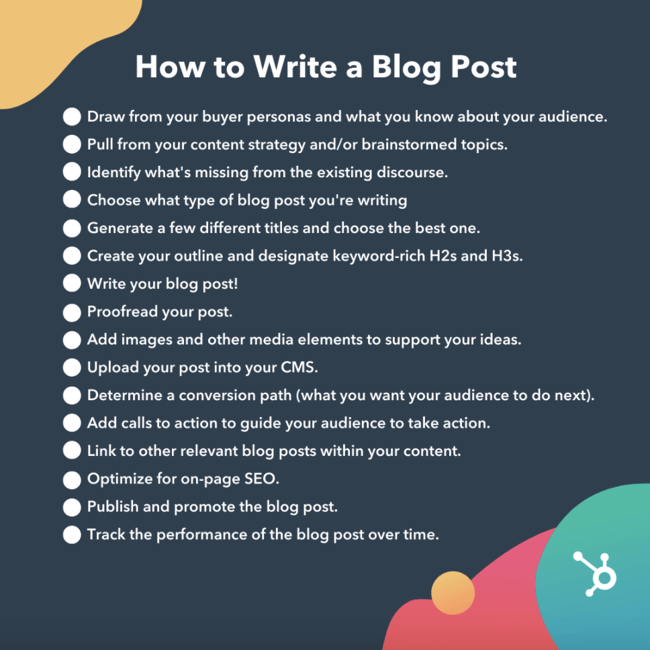
1. Draw from your buyer personas and what you know about your audience.
Before you start writing your blog post, make sure you have a clear understanding of your target audience.
Ask questions like: What do they want to know about? What will resonate with them?
This is where the process of creating buyer personas comes in handy. Consider what you know about your buyer personas and their interests while you’re coming up with a topic for your blog post.
For instance, if your readers are millennials looking to start a business, you probably don’t need to provide them with information about getting started in social media — most of them already have that down.
You might, however, want to give them information about how to adjust their social media approach (for example — from what may be a casual, personal approach to a more business-savvy, networking-focused approach). That kind of tweak is what helps you publish content about the topics your audience really wants and needs.
Don’t have buyer personas in place for your business? Here are a few resources to help you get started:
- Create Buyer Personas for Your Business [Free Template]
- Guide: How to Create Detailed Buyer Personas for Your Business
- [Free Tool] Make My Persona: Buyer Persona Generator
2. Pull from your content strategy and/or brainstormed topics.
If you already have a pre-existing portfolio to look back on, it would benefit you to pull from those brainstormed post ideas or previous content strategy.
3. Identify what’s missing from the existing discourse.
Fill in the gaps of the existing discourse in the topic of your choosing.
You want to meet a need that hasn’t already been met in your topic cluster. Otherwise, you run the risk of writing content for topics that are already over-saturated. It’s hard to beat saturated search queries when you’re trying to rank against high authority publications — but not impossible if your content is answering the queries the competition hasn’t.
4. Choose what type of blog post you’re writing.
There are several types of blog posts you can create, and they each have different formats to follow.
Six of the most common formats include:
- The List-Based Post
- The “What Is” Post
- The Pillar Page Post (“Ultimate Guide”)
- The Newsjacking Post
- The Infographic Post
- The “How-To” Post
Save time and download six blog post templates for free.
5. Generate a few different titles and choose the best one.
Your blog title should tell readers what to expect, yet it should leave them wanting to know more — confusing, right?
This is why when you’re coming up with a blog post title that you should brainstorm multiple ones instead of just one.
6. Create your outline and designate keyword-rich H2s and H3s.
When outlining, you need to center your main ideas with keyword-rich H2s and H3s. These are going to be your headers and subheaders that readers typically search for, and the information that Google crawls when indexing and ranking content.
7. Write your blog post!
We already told you how to build out your outline earlier in the post, so we’ll quickly go over the main points once more.
You’ve already outlined your main headings and subheadings, so now’s the time to add the body.
Write about what you already know, and if necessary, conduct additional research to gather more information, examples, and data to back up your points, while providing proper attribution when incorporating external sources. When you do, always try to find accurate and compelling data to use in your post.
This is also your opportunity to show personality in your writing. Blog posts don’t have to be strictly informational, they can be filled with interesting anecdotes and even humor if it serves a purpose in expressing your ideas. It also factors into creating and maintaining your blog’s brand voice.
Don’t be discouraged if you’re having trouble stringing sentences together, you’re not alone. Finding your “flow” can be challenging, but there are many tools to ease the process.
8. Proofread your post.
The editing process is an important part of blogging — don’t overlook it.
Ask a grammar-conscious co-worker to copy edit and proofread your post. You may also consider enlisting the help of The Ultimate Editing Checklist or using a free grammar checker like Grammarly.
If you’re looking to brush up on your self-editing skills, turn to these helpful posts for some tips and tricks to get you started:
- How to Become a (Better) Editor: 13 Editorial Tips
- How to Become a More Efficient Editor: 12 Ways to Speed Up the Editorial Process
- 10 Simple Edits That’ll Instantly Improve Any Piece of Writing
9. Add images and other media elements to support your ideas.
When you’re finished checking for grammar, shift your focus to adding other elements to the blog post than text. There’s much more to making a good blog post than copy, here’s some following elements to add in support of your ideas:
Featured Image
Choose a visually appealing and relevant image for your post. As social networks treat content with images more prominently, visuals are more responsible than ever for the success of your blog content.

For help selecting an image for your post, read “How to Select the Perfect Image for Your Next Blog Post” and pay close attention to the section about copyright law.
Visual Appearance
No one likes an unattractive blog post. And it’s not just pictures that make a post visually appealing — it’s the formatting and organization of the post, too.
In a well-formatted and visually-appealing blog post, you’ll notice that header and sub-headers are used to break up large blocks of text — and those headers are styled consistently.
Here’s an example of what that looks like:
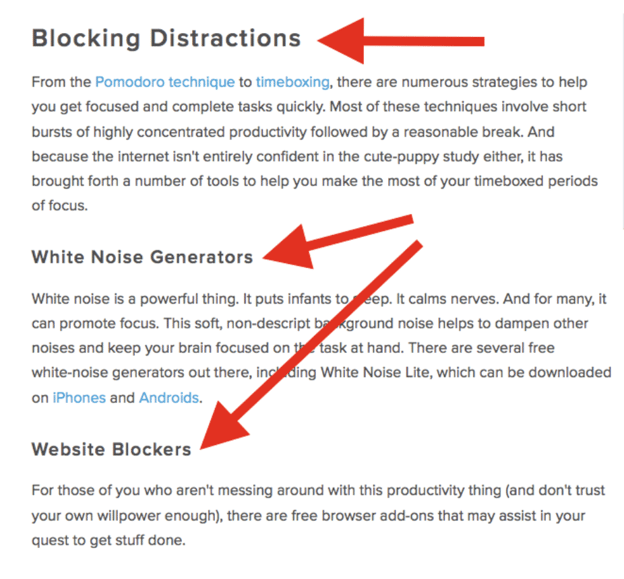
Screenshots should always have a similar, defined border so they don’t appear as if they’re floating in space — that style should stay consistent from post to post.
Maintaining this consistency makes your content look more professional and easier on the eyes.
Topics and Tags
Tags are specific, public-facing keywords that describe a post. They also allow readers to browse for more content in the same category on your blog. Refrain from adding a laundry list of tags to each post. Instead, put some thought into a blog tagging strategy.
Think of tags as “topics” or “categories,” and choose 10-20 tags that represent all the main topics you want to cover on your blog. Then stick to those.
10. Upload your post into your CMS.
You filled out your blog post with all the optimized content you can, now is the time to publish it in your content management system.
You can opt to post your content immediately, save it as a draft, or schedule when you want it to be posted live in case you adhere to a posting schedule.
11. Determine a conversion path (what you want your audience to do next).
A conversion path is a process by which an anonymous website visitor becomes a known lead. It sounds simple enough, but creating an effective conversion path requires a clear understanding of your target audience and their needs.
Having a conversion path is important because when you share your content on the web, you should have an idea of what your audience should do next, or in other words, provide them with a path forward.
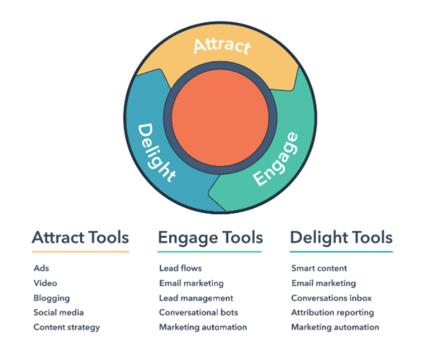
The HubSpot Flywheel model is a great example of this as it shows how our organization gains and maintains leads.
12. Add calls to action to guide your audience to take action.
Call to action (CTA) are a part of a webpage, advertisement, or piece of content that encourages the audience to do something. You can add them to your blog post to guide your reader with “next steps” or a conversion path.
Different types of call to actions include asking readers to:
- Subscribe to your newsletter to see when you publish more content.
- Join an online community in your blog domain.
- Learn more about a topic with downloadable content.
- Try something for free or discount to convert readers to customers.
To get a better idea of how to make a CTA that readers want to click, we have a whole list of effective call to action examples for you to check out.
13. Link to other relevant blog posts within your content.
When you’re completing your blog post, you should link relevant content throughout it. An effective way to do this is to link within the same content cluster.
Keeping relevant content throughout your post can provide your readers with more helpful information, and potentially boost search engine rankings with corresponding longtail keywords.
But we’ll talk more about how to improve your ranking in the next step.
14. Optimize for on-page SEO.
After you finish writing, go back and optimize the on-page elements of your post.
Don’t obsess over how many keywords to include. If there are opportunities to incorporate keywords you’re targeting, and it won’t impact reader experience, do it. If you can make your URL shorter and more keyword-friendly, go for it. But don’t cram keywords or shoot for some arbitrary keyword density — Google’s smarter than that!
Here’s a little blog SEO reminder about what you should review and optimize:
-
Write your meta description.
Meta descriptions are the descriptions below the post’s page title on Google’s search results pages. They provide searchers with a short summary of the post before clicking into it. They are ideally between 150-160 characters and start with a verb, such as “Learn,” “Read,” or “Discover.”
While meta descriptions no longer factor into Google’s keyword ranking algorithm, they give searchers a snapshot of what they’ll get from reading the post and help improve your clickthrough rate from search.
-
Optimize your page title and headers.
Most blogging software uses your post title as your page title, which is the most important on-page SEO element at your disposal. But if you’ve followed our formula so far, you should already have a working title that will naturally include keywords or phrases your target audience is interested in.
Don’t over-complicate your title by trying to fit in keywords where they don’t naturally belong. With that said, if there are clear opportunities to add keywords you’re targeting to your post title and headers, feel free to take them. Also, try to keep your headlines short — ideally, under 65 characters — so they don’t get truncated in the search engine results.
-
Consider anchor text best practices as you interlink to other pages.
Anchor text is the word or words that link to another page — either on your website or on another website. Carefully select which keywords you want to link to other pages on your site because search engines take that into consideration when ranking your page for certain keywords.
It’s also important to consider which pages you link to. Consider linking pages that you want to rank for a specific keyword. You could end up getting it to rank on Google’s first page of results instead of its second page — and that isn’t small potatoes!
-
Write alt text for all of your images.
Alt text conveys the “why” of an image as it relates to the content of your blog post to Google. By adding alt text correlating to the topic clusters and keywords of the post, Google can better direct users’ searches to you.
-
Check that all images are compressed for page speed.
When Google crawls different websites, a page’s load speed holds weight in page ranking. Make sure the images you include throughout the page aren’t unnecessarily large to shorten the duration it takes to load.
Use apps like Squoosh to minimize the size of your images without losing the quality.
-
Ensure that your blog post is mobile friendly.
More than 60% of organic visits are carried out on a mobile device. As such, having a website with a responsive design is critical. In addition to making sure your website’s visitors (including your blog’s visitors) have the best experience possible, optimizing for mobile will score your website some SEO points.
15. Publish and promote the blog post.
Share your post across all the marketing channels in your repertoire. The further the reach, the more of a possibility that readers will find it.
Channels to expand your blog post promotion strategy include:
- Social Media Marketing: Sharing your content on the most popular social media networks like Twitter, Instagram, TikTok, etc.
- Email Marketing: Sharing the newest post with your email subscribers to find.
- Boosted Posts or Paid Ads: Allocating budget toward advertisement on search engines inorganically.
- Word of Mouth Marketing: Actively influencing people to read your content organically.
16. Track the performance of the blog post over time.
Your post is published for the world to see, make sure you’re keeping an eye on its performance over time so you can see if your blog post strategy is working well enough for your goals.
There’s a plethora of website traffic analysis tools that you can take advantage of to better understand your audience’s behavior on your blog posts.
Ready to blog?
Blogging can help you build brand awareness, become a thought-leader and expert in your industry, attract qualified leads, and boost conversions. Follow the steps and tips we covered above to begin publishing and enhancing your blog today.
Editor’s note: This post was originally published in October 2013 and has been updated for comprehensiveness.
 Bl
Bl

40+ Resume Objective Examples to Help You Craft Your Own
With only six seconds to grab a recruiter’s attention, conventional wisdom might tell you to cut right to the chase when you write your resume. A lot of people say a resume objective just wastes precious space. But if you craft it in a way that highlights your qualifications, skills, and fit for a role, an objective can actually enhance your resume by giving recruiters a sneak peek of your background that prompts them to keep reading.
![→ Download Now: 12 Resume Templates [Free Download]](https://no-cache.hubspot.com/cta/default/53/4ec95757-585e-40cf-9189-6b3885074e98.png)
In this post we’ll teach you how to leverage a resume objective to your advantage as well as share some examples to help you craft your own.
Skip to:
- What’s a resume objective?
- When to use a resume objective
- Writing a resume objective
- Good resume objective examples
When to Use a Resume Objective
Including a resume objective, sometimes called a professional summary, in your resume gives the prospective employer a snapshot of your background and talent. They’re the perfect place to specify what you bring to the table for the role you are applying for. As a general rule, you should use a resume objective when you are targeting a specific position or are early in your career with little work experience.
Adding a resume objective is also especially helpful if you are changing careers or industries. It can give context to your transition and how your transferable skills are the perfect fit for the company, despite being new to the industry.
How to Write a Resume Objective
When recruiters read your resume, they want to know three things about you:
- Are you qualified for this job?
- Have you made an impact on your company in your current or previous roles?
- How will you make an impact on our company in this specific role?
If you can give them a clear and concise preview of these three answers within the first few lines of your resume, they’ll start thinking about your potential as an employee at their company. This’ll also give them a positive first impression of you and make them read the rest of your resume to confirm that you’re their best-fit candidate.
Pro tips:
- Keep it short: Objectives should be 1-3 sentences max.
- Be specific: Get specific about the role you are applying for, your skills, and how those skills and what impact those skills will have on the organization.
- Tailor it: Your resume objective should be tailored to fit the role or company you are applying to.
To show you how to craft a compelling resume objective at any stage of your career, we’ve provided some resume objective examples that anyone from a recent graduate to a proven professional can use. We’ll also break down the structure of each resume objective to give you a more concrete understanding of writing a gripping resume objective.
Good Resume Objective Examples
1. The Recent Graduate
Recent double major in English and Economics from Pomona College who has completed four content marketing internships in the MarTech space. Used creative and analytical skills to craft compelling content and refine content marketing strategies. Seeking a position as a Junior Growth Marketer to help HubSpot scale freemium marketing efforts and boost free product signups.
Structure:
Are you qualified for this job?
“Recent double major in English and Economics from Pomona College who has completed four content marketing internships in the MarTech space.”
How have you made an impact during your current or previous roles?
“Used creative and analytical skills to craft compelling content and refine content marketing strategies.”
How will you make an impact on our company in this specific role?
“Seeking a position as a Junior Growth Marketer to help HubSpot scale freemium marketing efforts and boost free product signups.”
2. The Ambitious Entry-Level Worker
Ambitious associate marketing manager with two years of experience strategizing and executing lead generation campaigns. Spearhead Sigstr’s co-marketing program and drove a 25% increase in program leads last year. Seeking a position as Marketing Manager of the Lead Optimization team at HubSpot to optimize blog lead generation strategy.
Structure:
Are you qualified for this job?
“Ambitious associate marketing manager with two years of experience strategizing and executing lead generation campaigns.”
How have you made an impact during your current or previous roles?
“Spearhead Sigstr’s co-marketing program and drove a 25% increase in program leads last year.”
How will you make an impact on our company in this specific role?
“Seeking a position as Marketing Manager of the Lead Optimization team at HubSpot to optimize blog lead generation strategy.”
3. The Career Switcher
Experienced journalist considering a career switch to content marketing. Spent five years digging up and breaking stories about business and technology for The Boston Globe. Hoping to apply my grasp of journalism and storytelling as a Staff Writer to strengthen HubSpot’s thought leadership in the MarTech space.
Structure:
Are you qualified for this job?
“Experienced journalist set on making a career switch to content marketing.”
How have you made an impact during your current or previous roles?
“Spent five years digging up and breaking stories about business and technology for The Boston Globe.”
How will you make an impact on our company in this specific role?
“Hoping to apply my grasp of journalism and storytelling as a Staff Writer to strengthen HubSpot’s thought leadership in the MarTech space.”
4. The Middle Manager Who Wants to Make it to the Top
Savvy marketing manager with five years of experience crafting social media videos, developing social video strategy, and optimizing social media advertising strategy. Lead Sprout Social’s social analytics team and doubled video views and cut CPM costs by 40% this year. Looking to join HubSpot as Director of Buzz to develop an overarching social media strategy that boosts views, engagement, and cuts costs.
Structure:
Are you qualified for this job?
“Savvy marketing manager with seven years of experience crafting social media videos, developing social video strategy, and optimizing social media advertising strategy.”
How have you made an impact during your current or previous roles?
“Lead Sprout Social’s social analytics team and doubled video views and cut CPM costs by 40% this year.
How will you make an impact on our company in this specific role?
“Looking to join HubSpot as Director of Buzz to develop an overarching social media strategy that boosts views, engagement, and cuts costs.”
5. The Proven Professional
Seasoned business operations and analytics veteran with an MBA and ten years of experience leading high-performing sales operations, marketing analytics, and business intelligence teams at Salesforce, Adobe, and Domo. Seeking to utilize my proven analytical, technical, and professional expertise to leverage data and drive crucial business decisions at HubSpot as Vice President of Business Intelligence.
Structure:
Are you qualified for this job?/How have you made an impact during your current or previous roles?
“Seasoned business operations and analytics veteran with an MBA and ten years of experience leading high-performing sales operations, marketing analytics, and business intelligence teams at Salesforce, Adobe, and Domo.”
How will you make an impact on our company in this specific role?
“Seeking to utilize my proven analytical, technical, and professional expertise to leverage data and drive crucial business decisions at HubSpot as Vice President of Business Intelligence.
General Resume Objective Examples
We’ve rounded up some of the best resume examples available to give you a bit of inspiration to get started writing your own. If you like more resume help, check out the best resume templates and grab the attention of recruiters.
Beginner Resume Objectives
1. Resume Lab
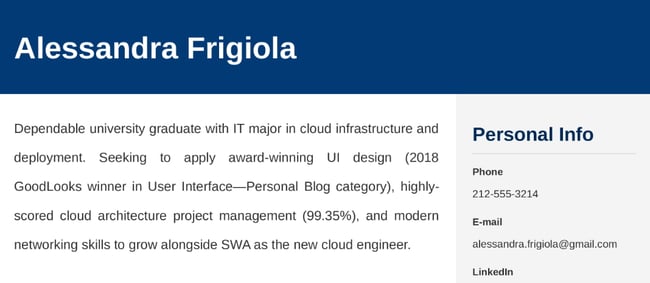
In this sample objective from Resume Lab, the writer chooses to play up her academic achievements to account for a lack in work experience.
What we like:
The writer makes specific reference to awards she’s won and skills related to the role she is seeking. She then makes the connection to how those skills will transfer to the new role.
2. Live Career
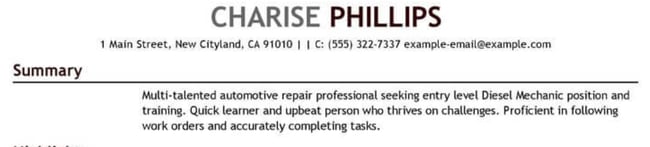
This mechanic objective is short and to the point, while still giving recruiters a bit of insight to their personality and skills (“Quick learner who thrives on challenges”).
What we like:
Since the author is relatively new to the field, they opted to shoot for an entry-level position, setting clear expectations for the recruiter.
3. Naukri
A certified Digital Marketer with a 6-month internship experience with XYZ agency. Excellent understanding of online marketing and an ability to help businesses boost their organic traffic as well as generate high quality leads through SEM Marketing. Looking for a relevant role.
This entry-level career objective from career advice blog Naukri uses past agency intership experience to demonstrate they can handle the new challenges of a full time role.
What we like:
Despite having a short work history (internship experience only), this applicant emphasizes their transferrable digital marketing skills. They also play up the contributions she made to the agency while interning.
4. Resume Builder
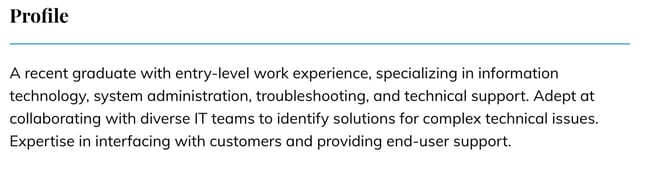
While this is a profile and not a resume objective, it does a good job of hilighting this recent grad’s skills. You can take this format and adjust it to create a persuasive resume objective.
What we like:
While the applicant is new to the workforce, we like that the first sentence highlights that they already has some entry-level IT experience. The profile then goes on to list their transferrable skills.
5. Resume Example
A 4.0 GPA digital marketing graduate looking for an entry-level marketing position at a top agency like Speedex Marketing. Hardworking and motivated to gain experience in social media and content marketing. Currently managing my personal Instagram with 10k+ followers and increased Terny Jewelry’s Facebook page followers by 20% after working with them for three months.
This objective taken from a Resume Example template shows how to showcase work you’ve done on personal projects to make the case for why you should be hired.
What we like:
This recent grad does an excellent job of highlighting their marketing talents running their own brand, complete with data to back it up.
6. Hloom
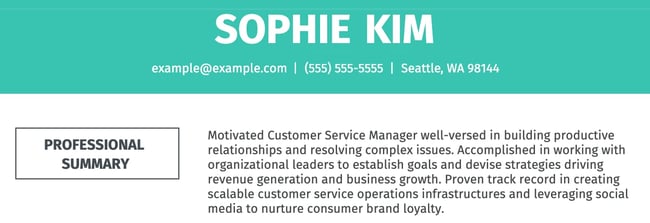
While this entry-level professional summary from Hloom isn’t an objective, it provides a good base to tailor it to the specific role you are applying for.
What we like:
This summary is really good at showing how their skills and actions in previous roles impacted the company. You can adopt this technique when writing your objective, getting specific about the results you delivered in previous roles and how you plan to deliver in the next.
7. Live Career
Looking to secure an entry-level Web UI Developer position with (company name) that will allow for the use of excellent user experience, technical and communication skills.
This short and sweet template from Live Career can easily be modified to craft yoru own objective. Just get more specific about what you bring to the table for the company you are applying to.
What we like:
A good resume objective doesn’t have to be wordy. If you can communicate your talents and intentions in one to two sentences, do it.
8. Resume Genius
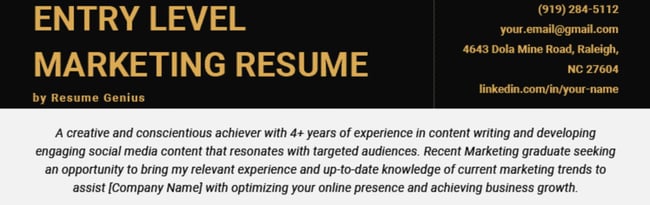
This objective from Resume Genius is a great teamplate for those pursuing a marketing role. you’ll just need to tailor it to your specific talents.
What we like:
Like previous examples, this objective is specific about the appliant’s experience and qualifications. It also focuses on outomes, which is a great way to demonstrate your qualifications for a role.
9. Springboard
As the daughter of small business owners, I’m really excited about the prospect of using my full-stack Python experience to further the Stripe mission of making payments accessible for companies of all sizes across the globe. I’ve built several projects in Django to scratch my own itch and I’d love to use that skill-set to start my software engineering career at Stripe.
This entry-level objective from Springboard demonstrates the effectiveness of adding a personal touch when relevant to the company you are applying to.
What we like:
This resume objective is so effective because it doesn’t just show off the applicant’s skills, but also her “why”. She’s passionate about helping small businesses succeed because her parents were small business owners — establishing a personal connection to Stripe’s mission.
10. Career Cloud
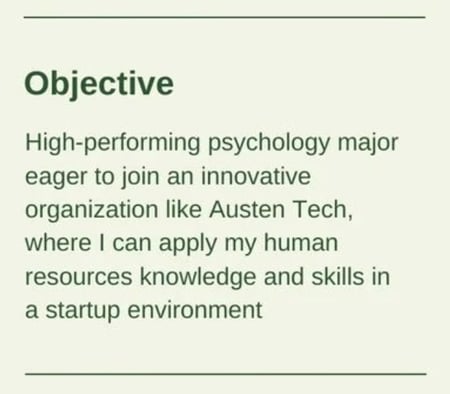
While this objective from Career Cloud is only one sentence, it quickly sums up the applicant’s background and the role they are applying for.
What we like:
This is a good-one sentence template for how to format a brief resume objective for new grads. If possible, take it a step further and describe how your skills will benefit the company.
11. Resume.com
Recent major in Marketing and Advertising from Blue University where I completed two internships at Global United Agency. Able to use critical thinking and communication skills to attract customers and implement new strategies. Seeking employment as a marketing associate to help Aerial Agency’s overall marketing efforts.
This entry-level marketng resume objective from Resume.com provides a good foundation for those looking to play up their internship experience.
What we like:
This objectibe is specific, showcasing not one, but two internships with relevant experience while also not making the whole paragraph about themselves. It brings everything back to the company with the last sentence “to help Aerial Agency’s overall marketing efforts.”
Professional Resume Objectives
12. Beam Jobs
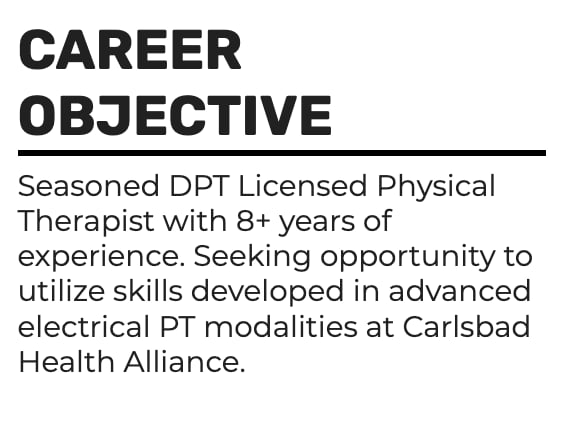
This objective is clear and to the point, quickly outlining their experience and what skills they intend to apply to the new position.
What we like:
This objective is succint and shows that you can craft one that is both concise and effective.
13. Zippia
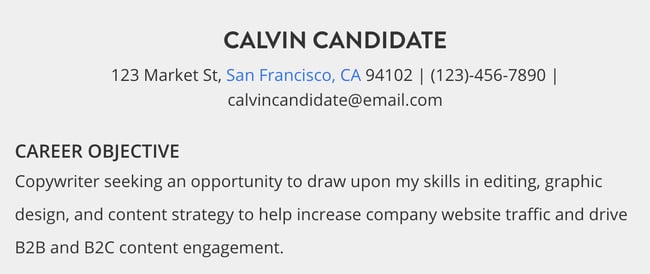
This objective manages to list the applicant’s skills and how they’ll be applied in just one sentence.
What we like:
Like the brief resume objective example above, this one gets the job done in one sentence while stating specifically what they intend to complish in the role (increasing traffic and driving engagement).
14. Resume.io
Motivated human resources professional with a drive for serving as a dedicated support specialist and energetic team member. Adept in assisting with the recruitment of employees, as well as the management of existing employees. Experienced in managing employee and community outreach programs, and dedicated to working towards the mission of a company.
The customizable career objective above is written for a human resources professional, but can be adapted to suit your industry. Simply swap out the role and your skills to craft your own.
What we like:
While this example clearly calls out the applicant’s recruiting skills and experience creating programming, it also ties the focus back to the company mission. If using this as a template, you can easily replace the company’s mission statement and tie it back to your own skills.
15. Resume Companion
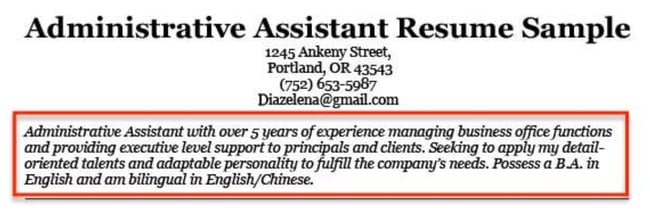
This resume objective has a heavy focus on the applicant’s professional experience and how their skills will apply to the new role they are applying for.
What we like:
While we wouldn’t normally suggest adding degree information in your objective unless you’re a recent grad, in this case it works to emphasize the candidate is fluent in multiple languages.
16. Beam Jobs

This resume objective does a great job of highlighting specifically what the applicant brings to the role in a concise way.
What we like:
While this is for a teaching role, you can apply the same level of specificity to your objective, emphasizing why you want the role and who benefits. In this case it’s cultivating student’s passion for a particular subject, but it can be applied to any industry you’re excited about making an impact in.
Sales Resume Objectives
17. Zety
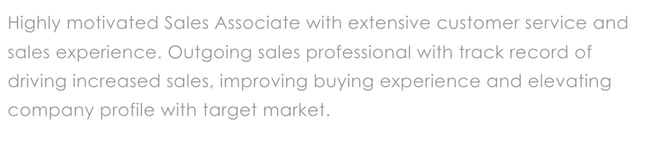
While the wording of this resume objective is a bit clunky, it can still serve as a template for your own with a few adjustments to tailor it to your industry.
What we like:
This resume objective places an emphasis on outcomes, which is great for any industry, but especially in sales. If you have a proven record of driving sales or similar impact, be sure to include it.
18. Resumeway
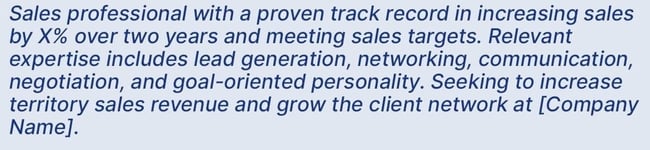
If you’re stuck gettng started, use this template from Resumeway to make writing an objective a little easier. Be sure to have the data points you’d like to include ready beforehand.
What we like:
As we’ve mentioned previously, anytime you can provide data to back up your claims, do so.
19. Resume Genius
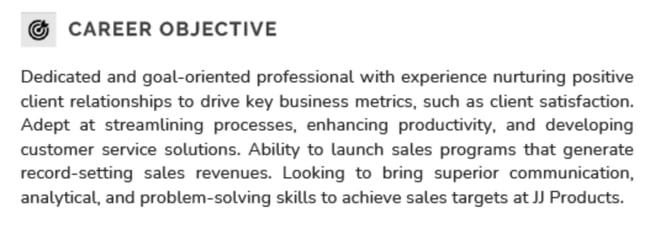
Coming in longer than most on this list, this objective is all about skills and the positive outcomes they spearheaded.
Management Resume Objectives
This objective focuses on what the candidate can do for the company, rather than just being a list of accomplishments.
20. The Ladders
Seeking a data analytics supervisor position where I can apply my 7+ years of data science and business analytics skills and experience. I’m eager to improve business intelligence for Company XYZ in a leadership role.
This objective from the Ladders demonstrates how you can leverage your individual contributor experinece to make the case for a management position. The applicant isn’t shy to display enthusiam for the potential new role.
What we like:
This objective is quick to point out years of relevant experience at the start to build the foundation for why they are the right fit for the role. Then they drive the point home by disclosing what they intend to do once hired.
21. Interview Kickstart
With years of proven excellence, I’m looking for the challenging position of a director to be an active initiator of organizational success at MNO Inc. Prolonged experience in full-cycle project management, 6years of experience at multiple clients handling business operation management is ideal for the post in a mutually benefitting work culture to achieve company missions.
This is another quick-start template you can use to save time writing your objective. Simply swap out the default information for your own.
What we like:
This template is easily customizeable while providing a solid format to help you create a resume objective that clearly defines your potential impact if hired.
22. Top Resume
Editor with extensive writing and management experience looking to fill the position ofSenior Editorwith [company name], utilizing my time-management skills to ensure all projects meet deadlines and supervisory experience to effectively manage a team of writers and editors.
This template from Top Resume is perfect for editors or those applying for a similar role.
What we like:
This objective plays to the applicant’s strengths as well as honing in on qualities needed for the position (time management, meeting tight deadlines).
23. Resume Lab
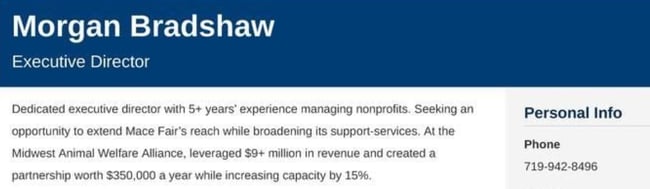
As we’ve previously discussed, getting specific about what you’ve accomplished and how you intend to help the company achieve its goals is key, especially when applying for a management position. This example shows the effectveness of providing data to back up your skills and accomplishments.
What we like:
We love the focus on tangible data and stats in this resume objective example. Use them whenever possible to make your case.
24. Tough Nickel
A highly recognized hotel management professional offering over ten years of enhancing organizations’ bottom lines through a customer-centric approach and excellent leadership and interpersonal skills. Seeking a challenging position as(specific role)in order to help grow(company)’s reputation as it continues to expand.
This template from Tough Nickel…will get your objective written in no time. It’s adaptable to any industry.
What we like:
This template emphasizes how you accomplished a particular goal, its impact, and what you intend to apply those skills in your next role.
Marketing Resume Objectives
25. Resume Companion
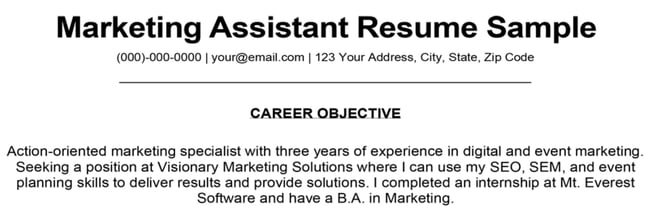
If you’re early in your marketing career, with a few years of experience, you can use this resume objective for a bit of inspiration. If you have enough work experience to fill the page, you may want to omit the degree info in your draft.
What we like:
We like how this objective highlights two different sectors within the marketing umbrella — event and digital marketing. If you have similar dual, but relavent talents that would be beneficial in your new role, highlight them.
26. Naukri
A resourceful individual with a proven track record in implementing successful marketing strategies, boosting organic traffic, and improving search rankings seeks a position of Marketing Associate at ABC company to maximize brand awareness and revenue through integrated marketing communications.
This objective from career advice blog Naukri provides a good starting point for those applying for marketing associate or assistant roles.
What we like:
While this obective is vague enough to be tailored to your needs, the format with specifics about your skills and how you would apply them provide a good outline for how you should structure your own.
IT & Developer Resume Objectives
27. Interview Guys

This brief but effective objective quickly highlights the applican’t most relevant skils and the impact they could potentially have in their new role.
What we like:
It’s easy to make a resume objective one-sided and all about yourself, but this one demonstrates that you can demonstrate your value to potential employers in a clear and concise way.
28. Resume Companion
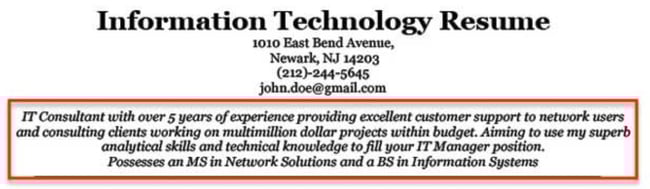
This is another resume objective example that demonstrates the power getting specific about your contributions and using numbers where appropriate to add context.
What we like:
In just a few sentences, this objective clearly conveys that this IT candidate has ample experience working on projects with large budgets. A recruiter would see this as a plus, if they are hiring for a large account as this person has already shown they are capable.
29. Evolution Coaching
Energetic, technical-minded professional seeking aposition as a (Software Engineer) at (Company Name) where knowledge of software development life cycles, a high technical aptitude, and unyielding commitment to work can effectively be utilized to contribute to the successful and profitable operation of the company.
This plug and play template from Evolution Coaching makes it easy for you to pop in your own accomplisments and contributions.
What we like:
Like other templates on this list, this one highlights the importance of including how your skills and attributes will benefit the company you are applying to. Always align yourself with the company’s goals.
30. Resume Giants
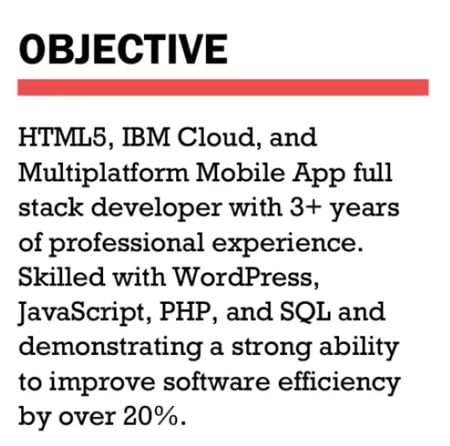
This objective quickly hones in on the software and skills needed for the role, making it easy for recruiters to skim and want to know more details about your experience.
What we like:
This objective likely used keywords from the job description, a good strategy for signaling to recruiters that you have the skills they’re looking for.
Career Change Resume Objectives
31. Resume.io
Leading Fintech marketing professional, seeking to make a move up to Marketing Director after eight years of award-winning campaigns. MBA-educated social marketeer, who will deliver triple-digit audience growth and double-digit sales increases.
This objective from Resume.io conveys confidence. While everyone may not be able to pull this one off, if you can back up your claims, go for it.
What we like:
This objective is bold and gets very specific about the value the applicant can provide to the company. The employer can read it and know exactly the value can provide once hired.
32. University of Pennsylvania

This objective makes the case for an inustry change by playing up the applicant’s transferrable skills.
What we like:
This objective is to the point and doesn’t try to disguise the industry swap with vague jargon. Instead it clearly states what the writer’s experience is and how they’ll apply it to their new pfrofession.
33. Career Contessa
Results-driven technology sales representative, seeking to use pipeline building and negotiation skills to increase revenue at XYZ healthcare company. Drove $2 million in sales revenue during FY20 and eager to increase the bottomline at XYZ company.
This career objective from Career Contessa is a great template to use if you’re applying for a similar role, but in a completely different field. In this case, it’s a sales position, but could be applied to any industry.
What we like:
Since the roles are similar, the writer was keen to play up their relevant experience and data-backed accomplishments. From there she succinctly expressed how she intends to increase revenue for the new company.
34. Federal Resume Guide

Teachers have a bunch of transferrable skills they may not even know they have. From time managment and public speaking to dealing with the public, to conveying ideas and concepts clearly, they have so much to offer when those skills are applied to other industries.
What we like:
This objective was able to connect the applicant’s 15-year experience teaching history to why they’re a great candidate to be a museum curator. They can easily draw on their existing knowlege and people skills to be succcesful in the role.
35. Sweet CV
Successful engineer aiming to change professions and move into business management. Seeking a chance to use project management and leadership skills in a fresh context and use my eye for detail to drive growth in a technology start-up.
This objective from Sweet CV showcases an engineer making the case for a business managment position at a start-up, highlighting their most relevant skills.
What we like:
Again, it’s important to play up any related skills or background that will give you an advantage when switching to a new career. Since the applicant already has engineering experience and is seeking to work for a technology startup, their backround is a bonus.
36. Jobscan
Passionate sales representative with over 5 years of experience working with customers and selling software. Looking to leverage my proven skills in seeing our customers’ pain points and providing solutions to whatever I write as an aspiring Content Manager.
This example from Jobscan shows how you could structure an objective if you are trying to move positions within the same company. Working in customer service gives the applicant useful insight into their audience’s needs.
What we like:
This resume objective plays to the applicant’s strength (insider customer knowledge) to demonstrate why she’s the perfect candidate to write for them. This could greatly improve the company’s content since they will have a better understanding of their audience and how to solve for them.
Write a Resume Objective That Gets Noticed
Now that you know how and when to write a resume objective and checked out a few examples, it’s time to craft your own. Use the tested strategies above to make sure your resume stands out among the crowd.
Editor’s note: This article was originally published in December 2018 and has been updated for comprehensiveness.

80+ Instagram Stats You Need to Know in 2023
It feels like Instagram, more than any other social media platform, is evolving at a dizzying pace. As it continues to roll out new features, updates, and algorithm changes, it can be hard to keep up.
That’s where the Instagram stats comes in. There’s a whole lot of research out there about Instagram — everything from the demographics of its users and its reach, to how negative space affects the performance of your posts (hint, hint: #68).
Read on to uncover more social media stats that’ll help you get ideas and improve your own Instagram posting strategy.
![Download Now: The State of Social Media Trends [Free Report]](https://no-cache.hubspot.com/cta/default/53/3dc1dfd9-2cb4-4498-8c57-19dbb5671820.png)
80+ Instagram Stats
Click on a category below to jump to the stats for that category:
- Instagram’s Growth
- Audience & Demographics
- Brand Adoption
- Instagram Post Content
- Instagram Posting Strategy
Instagram’s Growth & Usage
1. Instagram is expected to reach 1.44 billion users by 2025. (Source)
2. The Instagram app has over 78 million monthly active users. (Source)
3. 22% of marketers say Instagram has the most growth potential in 2023 than any other platform. (Source)
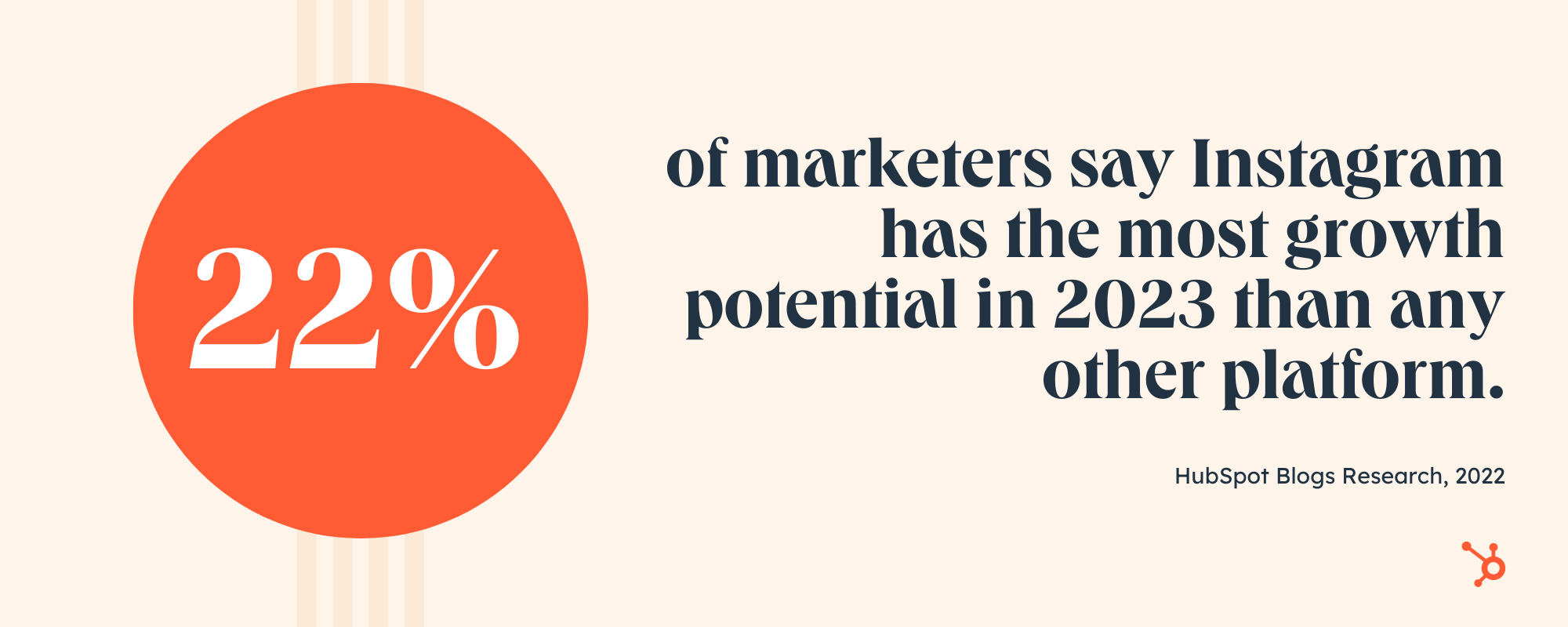
4. Instagram saw a 48% increase in ad reach from January 2020 to January 2022. (Source)
5. Almost a quarter of marketers (23%) predict that Instagram will offer brands the biggest potential to grow their audience in 2023. (Source)
6. Instagram is the most-used platform for influencer marketing in the U.S. (Source)
7. Marketers say Instagram is the social media platform they know how to use best. (Source)
8. There are an estimated 143 million Instagram users in the United States in 2023. (Source)
9. As of January 2023, India has a total of 229 million Instagram users, the largest Instagram audience in the world. (Source)
10. As of January 2022, Instagram was the fourth most popular social media platform in the world in terms of user numbers. YouTube and WhatsApp ranked in second and third place. (Source)
11. On average, U.S. adults spend 30.1 minutes a day on Instagram in 2022. (Source)
.png?width=2000&height=820&name=instagram%20statistics%20(4).png)
12. As of February 2023, the most-liked post on Instagram is a carousel of Argentine footballer Lionel Messi and his teammates celebrating the 2022 FIFA World Cup win. (Source)
13. Between January and June 2022, the fastest-growing content creator on Instagram was influencer Jorge Gomez, with 573% growth in six months. (Source)
14. Other than Instagram’s own account, the most-followed Instagram account as of January 2023 is professional soccer player Cristiano Ronaldo. (Source)
15. As of May 2022, Instagram’s own account has 504.37 million followers. (Source)
Audience & Demographics
16. More than half of the global Instagram population is 34 years of age or younger. (Source)
17. As of January 2023, almost 17% of global active Instagram users were men between the ages of 18 and 24 years. (Source)
18. Millennials ranked Instagram as their favorite social media app in 2022. (Source)
-1.png?width=2000&height=800&name=Is%20Instagram%20Dying%202022%20(3)-1.png)
19. Gen Z-ers also ranked Instagram as their favorite social media app in 2022. (Source)
20. TikTok and Instagram are the most used social media apps among Gen Z women. (Source)
21. In December 2022, 55% of Instagram users in the United States were women and 44% percent were men. (Source)
22. Only 7% of Instagram users in the U.S. belong to the 13 to 17 year age group. (Source)
23. Only 4.7% of Instagram users in the U.S. are 65 plus. (Source)
24. As of 2022, 82% of Instagram users also use Facebook. (Source)
25. 47% of U.S. Instagram users make more than 75,000 per year. (Source)
26. Instagram users worldwide spend an average of 11 hours per month on the Instagram app on Android phones. This number drops to 7 hours for U.S. users. (Source)
27. 72% of teens use Instagram, and 57 million U.S. teenagers say Instagram is their preferred social media platform. (Source)
28. 500 million+ accounts use Instagram Stories every day. (Source)
29. 35% of music listeners in the U.S. who follow artists on Facebook and Instagram do so to connect with other fans or feel like part of a community. (Source)

30. The average Instagram user spends 30 minutes a day on the app. (Source)
31. 45% of Instagram users live in urban areas. (Source)
Brand Adoption
32. 72% of marketers work with influencers/creators on Instagram. (Source)
33. 29% of marketers plan to invest the most in Instagram out of any social media platform in 2023. (Source)
34. In terms of brand safety, 86% of marketers feel comfortable advertising on Instagram. (Source)
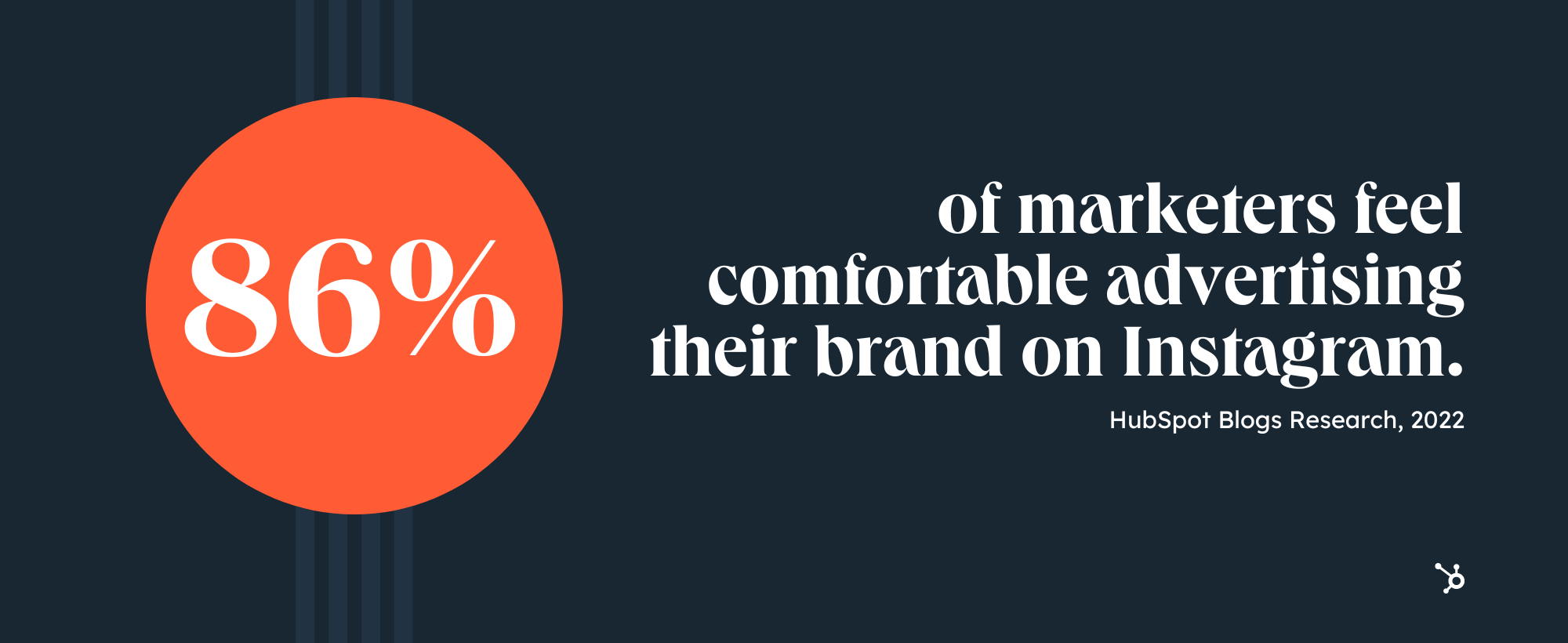
35. 53% of marketers say Instagram has high ROI. Only 7% of marketers say Instagram has low ROI. (Source)
36. 70% of shopping enthusiasts turn to Instagram for product discovery. (Source)
37. Marketers saw the highest engagement rates on Instagram out of any other platform in 2022. (Source)
38. 32% of marketers say Instagram is the easiest platform for working with influencers and creators. (Source)
39. 1 in 4 marketers say Instagram has resulted in the highest ROI out of any platform in 2022. (Source)
40. 27% of marketers plan to use Instagram the most for working creators and influencers in 2023. (Source)
41. More than half of marketers plan to increase their investment in Instagram in 2023. (Source)
.png?width=2000&height=820&name=Instagram%20statistics%20(5).png)
42. In 2022, marketers saw the highest engagement rates on Instagram for user generated content. (Source)
43. Only 8% of marketers plan to decrease their investment in Instagram in 2023. (Source)
44. 36% of marketers plan to leverage Instagram for the first time in 2023. (Source)
45. 90% of people on Instagram follow at least one business. (Source)
46. 50% of Instagram users are more interested in a brand when they see ads for it on Instagram. (Source)
47. When it comes to posting organic content, 27% of marketers say Instagram offers the highest ROI for this type of content. (Source)
48. 1 in 4 marketers say Instagram provides the highest quality leads out of any social media platform. (Source)
.png?width=2000&height=820&name=instagram%20statistics%20(1).png)
49. Nearly a quarter of marketers (23%) say Instagram is the most effective platform for brands looking to build a social media strategy for the first time in 2023. (Source)
50. 46% of marketers leverage Instagram Shops. Of the marketers who leverage Instagram Shops, 50% report high ROI. (Source)
51. 41% of marketers leverage Instagram Live Shopping. Of the marketers who leverage Instagram Live Shopping, 51% report high ROI. (Source)
52. In a 2021 report, the higher education industry currently has the highest engagement rate of any other industry per post on Instagram, at 3.19%. Second was sports teams at 1.79%, and third was influencers at 1.42%. (Source)
53. 67% of users surveyed have ‘swiped up’ on the links of branded Stories. (Source)
54. 130 million Instagram accounts tap on a shopping post to learn more about products every month. (Source)
Instagram Post Content
55. Engagement for static photos has decreased by 44% since 2019, around the time Reels made its debut. (Source)
56. The average engagement rate for photo posts is 1.18%. (Source)
57. The average engagement rate for carousel posts is 3.15% (Source)
58. As of January 2022, #love is the most popular hashtag on Instagram. Over two billion posts use this hashtag. (Source)
59. Marketers rank Instagram as the platform with the best in-app search capabilities. (Source)
60. The most popular Instagram Reel has 289+ million views. (Source)
61. Marketers rank Instagram as the platform with the most accurate algorithm, followed by Facebook. (Source)
.png?width=2000&height=820&name=Instagram%20statistics%20(2).png)
62. A third of marketers say Instagram offers the biggest ROI when selling products directly within the app. (Source)
63. As of 2021, 9 out of 10 users watch Instagram videos weekly. (Source)
64. A third of marketers say Instagram offers the best tools for selling products directly within the app. (Source)
65. 995 photos are uploaded on Instagram every second. (Source)
66. The median posting cadence across all industries is 4 posts per week. The median posting frequency declined by just 8% this year compared to last. (Source)
67. On Instagram, photos showing faces get 38% more Likes than photos not showing faces. (Source)
68. On Instagram, images with a high amount of negative space generate 29% more Likes than those with minimal negative space. (Source)
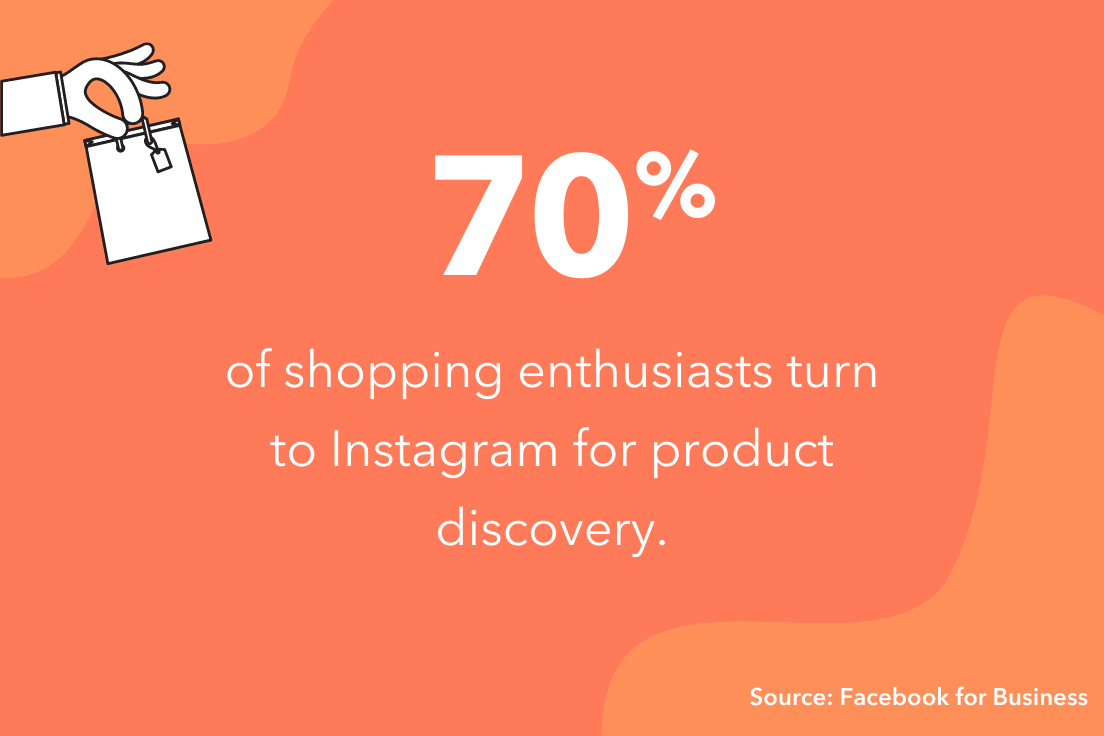
69. On Instagram, images featuring blue as the dominant color generate 24% more Likes than images that are predominantly red. (Source)
70. This is so much so that the latest Instagram statistics show that an average Instagram post contains as many as 10.7 hashtags. (Source)
71. Image posts received 27.55% more likes than permanent video posts. (Source)
72. An average image on Instagram gets 23% more engagement than one published on Facebook. (Source)
73. The most geo-tagged city in the world is Los Angeles, California and the tagged location with the highest engagement is Coachella, California. (Source)
Instagram Posting Strategy
74. The best time to post on Instagram is Friday between 6 p.m. and 9 p.m. in your respective time zone. (Source)
.png?width=2000&height=820&name=instagram%20statistics%20(3).png)
75. Posts with a tagged location result in 79% higher engagement than posts without a tagged location. (Source)
76. 20% of users surveyed post to Instagram Stories on their business account more than once a week. (Source)
77. 44% of users surveyed use Instagram Stories to promote products or services. (Source)
78. One-third of the most viewed Stories come from businesses. (Source)
79. More than 25 million businesses now use Instagram to reach and engage with audiences. (Source)
80. 69% of US marketers plan to spend most of their influencer budget on Instagram. (Source)
81. The industry that had the highest cooperation efficiency with Instagram influencers was Health Care, where influencer posts were 4.2x more efficient than brand posts. (Source)
82. Instagram is now the most popular social platform for following brands. (Source)

25 Slack Tips to Make You and Your Team More Effective
Slack changed workplace communication. It can be a helpful tool or an amusing diversion — and this makes Slack tips essential to cut through the noise.
Slack is capable of so much that it’s hard to uncover what features you really should be using. To help, we put together some of the best Slack tips and tricks below.

From creating to-do lists to customizing your theme, these pro tips are worth showing off to your team. Scan the full list of Slack tricks or jump to the section you’re looking for:
- Why You Need Tips for Using Slack
- Handy Slack Tips and Tricks
- Best Slack Tips for Productivity
- More Slack Tips and Tricks
Why You Need Tips for Using Slack
Any tool can make your workday more effective and productive. That’s the goal. But it doesn’t always work out that way.
In 2020, offices around the world went through a series of seismic changes. Many teams went remote for the first time. And workplace leaders found themselves looking for digital solutions that could help workers:
- Build and keep social bonds
- Answer quick questions
- Check in on each other
- Hold social workplace events
- Send quick thank yous
- Share updates
Slack was an answer to these questions and more.
This platform organizes chat conversations into channels. It makes it easy to have informal conversations or organized group conversations. This helps in-office and remote teams trade ideas and make decisions together. It can also give teams at-a-glance knowledge of office status, connect docs from different tools, and offer helpful reminders.
Slack is a great way to connect and collaborate. But it can take time to learn the most helpful features. A beginner’s guide to Slack is the best place to start.
Once you have the basics down, the tips below can help you advance your Slack game for more productivity, fun, and connection.
Best Slack Tips for Productivity
1. Sort Slack channels for easy scanning.
The larger your organization is, the more channels your team will have. This seems fine at first, and it lets teams create distinct conversations for work and play. But as channel notifications grow, so will the possibility of Slack overwhelm.
Businesses using Pro, Business+, or Enterprise Grid plans on Slack can add channels, direct messages, and apps to custom sections in the sidebar. Custom sections are just for you, and won’t impact anyone else on your team, so you can organize them in a way that works best for you.
To create a custom section, click the + at the top right of your top channel in the left navigation menu. Then select “Create a new channel” or “Create a new section.” You can select from the current options or add a unique emoji and name for a custom section.
Note: You can only create custom sections on a desktop computer. But once you’ve added them you’ll be able to use them on both desktop and mobile.
2. Pause notifications for focused work time.
Different work cultures have different expectations for availability on Slack. But there are times when employees need some uninterrupted work time. So, instead of closing a door or hanging a “Do Not Disturb” sign, pause your notifications.
This gives a simple signal to your team so you can get the focused time you need. To pause your notifications, click on your profile. Then, scroll to “Pause notifications” and choose the amount of time that’s best for you.
You can also set a notification schedule. This is extra helpful for teams that work across different time zones. It helps everyone understand when you’re available to respond quickly, and when getting a response may take more time.
3. Pin messages and links for easy recall.
Slack can also be the digital bulletin board at the center of your office. When you “pin” a message, you’re saving it for the full team in that conversation or channel. This makes it easy for everyone to revisit important learning, documents, and comments.
To pin a message, hover over the message, then click on the three dots in the top right-hand corner. Then, scroll down to “Pin to channel.” The selected message background will change color, and display a message at the top that says “Pinned by [your name].” You can also use the top bar to search for pinned posts.
4. Adjust your sidebar to show unread channels only.
As the number of channels you subscribe to grows, you may be looking for strategies to cut down on overwhelm. Some choose to mute channels, but that can mean missing important communication. Others make an update to the “Channels” section to highlight what they haven’t read yet.
To make this update, head to the “Channels” section in your left-hand sidebar. Hover over Channels, click the three dots to the right, then scroll to “Show” > “Unread channels only.”
5. Connect your tools to Slack.
Another feature of Slack that helps you ramp up productivity is its connectivity. Whether you’re sharing sensitive documents or running a fun icebreaker with your team, there are over 2000 Slack integrations you can use.
For example, many teams are already using Google Drive to create and store files online, so why not get the best of both worlds? When you connect your Google Drive with Slack, you have the ability to read and index imported files, and quickly search for them whenever you need them.
There are two ways to connect your Google Drive to Slack:
If you have a Google Drive link you want to share, simply paste it into a message box. This will prompt Slackbot to deliver the following message:

Click “Yes” to grant Google Drive permission to read the file.
If you don’t have a file you’re ready to share, but want to connect Google Drive for future use, visit the Google Drive app page. From here, click “Configure” next to your team name, then click “Authenticate your Google Drive Account” > “Allow.”
HubSpot customers: If you want to integrate Slack even deeper into your office processes, check out this article that shows you how to make the most of your Slack integration.
6. Use the /remind commands to create a to-do list.
Set a Slackbot reminder to help you keep track of what you need to get done. To get started, simply enter /remind into the text box, followed by your task. (Note: Only you will be able to see the command and the reminder.)
You can schedule a reminder for a specific time or set a date using the MM/DD/YYYY format. Slack recommends this structure for a reminder: /remind [@someone or #channel] “[what]” [when].
If you want to review your list of reminders, simply use the command /remind list. From there, you can mark certain tasks as complete or delete the ones you no longer need.
7. Quickly send a private message using the /msg command.
Sometimes we find ourselves with questions that call for the attention of everyone in a specific channel. You know, important things such as, “Does anyone have a stapler?” or “Who’s free for lunch?”
After you ask a question, avoid any further disruption by following up with people with a private message. For example, once you know Steve is free to grab a bite to eat, use the following command to quickly open up a private message to hash out the details: /msg @user [your message].
8. Jump to recent conversations in seconds.
If you’ve got a really big team, it’s likely that you’re involved with quite a few Slack channels. To quickly and easily switch from a channel to a private message back to a different channel, hit ⌘ + K (Mac) or Ctrl + K (Windows and Linux).
A pop-up will appear where you can begin typing a person or channel and select the correct option to open the conversation.
9. Create a to-do list using Saved Items.
Saved items on Slack are a way to mark a task as important, like pinned messages. But only you can see your saved items, so they can be useful for personal reminders.
To save an item, simply move your mouse to a message or file and select the flag outline to make it turn red. Then, to view your saved items, click Saved items at the top of the left navigation menu.
Saving requests and files that you need to work on makes it easy for you to create a to-do list on the fly.
10. Conduct advanced searches.
One of the great things about Slack is that messages and files are easily searchable. Because channels move so fast, you can use these advanced search commands to pull up exactly what you’re looking for without wasting any time.
Channels and Direct Messages
- in:channelname – Searches only the messages and/or files in a specific channel.
- in:name – Searches your direct messages with a specific user.
Messages or Files From a Specific Person
- from:username – Limits your search to messages from a specific person in any channel or direct message.
- from:me – Searches only messages you’ve sent, anywhere in Slack.
Links, Saved Items, and Emoji Reactions
You can narrow your search to messages that contain a URL, messages you’ve saved, or messages that contain a specific emoji using search results filters.
Dates and Times
- before: Use the pop-up to search for messages sent at a specific time.
- after: Use words like “week,” “month,” or “year.”
- on: or during: Use specific dates and range keywords, such as “Monday,” “February,” or “2023.”
Pro tip: To use specific dates, use the MM/DD/YYYY (United States) or YYYY/MM/DD (International) format.
11. Add notifications for keywords and phrases.
Managing a specific project? Trying to keep tabs on a department or activity? Adjusting your settings to enable custom notifications can be a huge time saver.
To get notified when a specific word or phrase is mentioned, start by selecting your name from the top left corner. Then, click “Preferences” from the drop-down menu. From there, select “Notifications” and scroll down to “My keywords.” In the text box, add words or phrases that you’d like to be notified about (making sure to separate them by commas).
12. Create naming conventions for channels.
Naming your channels in a way that’s simple and consistent helps you engage more users. No more sending an email, texts, AND Slack for every message. Instead, you’ll be able to trust that people on your team are seeing the content you need them to see.
To make this happen, make sure channel names are consistent with what your team already knows. Clever names and inside jokes can seem fun at first, but over time they can create confusion.
Instead, name channels for major departments and topics. Then, use Slack’s default prefixes as a guide when it’s time to add channels for new and more specific channels and sections.
For more productivity tips, check out this guide to being more productive.
More Slack Tips and Tricks
13. Toggle between statuses using /away or /active commands.
If you have to step away from your computer or head to a meeting, make it clear by adjusting your status. To quickly toggle between “away” and “active,” use the /away command.
For more quick commands, type /shortcuts to open the keyboard shortcuts panel.
14. React with a GIF.
Let’s face it: We all love GIFs. And thanks to the Giphy integration, you can share hilarious GIFs with your coworkers using the /giphy [emotion, word, or phrase] command.
To set up the Giphy app, visit this page. From here, all you’ll have to do is click “Install” next to your team name, then click “Add Giphy Integration.”
Note: Giphy can be a hit or miss. Sometimes the GIFs are NSFW or not quite right for the situation. But, if you don’t mind gambling with the results, this hack is easy to set up.
15. Create quick polls with emoji reactions.
Words are hard. Sometimes it’s a lot easier to let our coworkers know how we feel by reacting with an emoji. And on Slack, it’s easy. Simply hover over a message and select the smiley face icon with the plus sign to select an emoji.
Want to take things a step further? Reaction emojis make it really easy to quickly poll your team. Here’s a fun example:
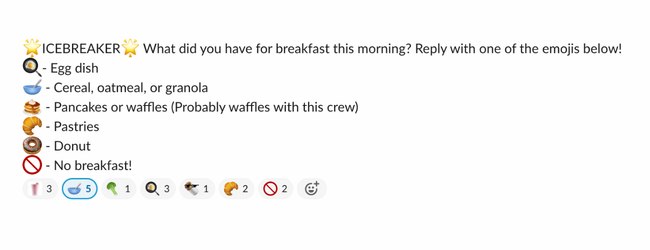
16. Add text and link formatting to your Slack messages.
Want to call out text, make edits, display a link, or share code? Reference the following syntax:
- Slack link formatting: To share a link with a preview image, just send a URL in a message. Slack will automatically create a preview unless a user has their preview settings turned off.
- Emphasis: To create bold text, surround your word or phrase with *asterisks.* To italicize text, place _underscores_ around a section.
- Strikethrough: To strike out certain words, use ~tilde~ to surround the text.
- Lists: To create lists, select “Shift” + “Enter” to add a new line. To add bullet points, select Opt+8 (Mac) or Alt+0149 (PC).
- Insert a paragraph break: If you want to break up words without using a list, use a soft return. Instead of hitting enter at the end of a sentence, which will send the message, hold shift and tap the enter key to start a new line.
- Blockquotes: To add angle brackets at the start of your message for indents and quotes, type “>” to indent a single line.
17. Edit messages you’ve already sent.
We’ve all said things we wish we could take back. And with Slack, you can — kinda. To quickly edit a message you’ve sent in a conversation, press the ↑ arrow key, edit your message, then press “Enter.”
This feature is especially useful when you do something terribly embarrassing, like use the wrong form of “their”:
18. Customize your Slack theme.
Whether you use Slack for different groups and want to stay organized, or you just want to personalize the look and feel of your account, you can adjust your theme by selecting your name in the top left corner.
From the drop-down menu next to your name, select “Preferences” > “Themes.” From here, you can explore and select themes or scroll down to “Custom Theme” to put in your own HTML color values.
19. Create your own emoji.
To get started, click the emoji icon in any Slack chat window. Then, click the “Add Emoji” button on the bottom left-hand side.
Fill out the form to create your custom emoji. First, you’ll need to upload an emoji image. Then, provide a name for the icon — this is what you will enter to display the emoji.
Slack asks that you use a square image no larger than 128px in width or height, with a file size smaller than 64K. To remove the background from the image (as seen in the Ryan Gosling example below), check out this tutorial.

20. Pull swatches using HTML color codes.
Collaborating with another team member on a design project? Make quick color suggestions using HTML color codes. When you type out a code — #F7761F, for example — you’ll see a tiny swatch appear, like this:

21. Shake it off with a shruggie.
Don’t know the answer? Made a little mistake? Need to signal to your coworker that you actually have no idea what’s going on at this meeting? Send ’em a shruggie.

Serving as the “default Internet feeling,” a shruggie will say everything you need to say without saying anything at all. To pull it up, enter the /shrug command.
22. Update your profile to show when you’re OOO.
Whether you’re OOO on vacation or out on parental leave, you can signal this to your coworkers by adjusting your status on Slack.
To edit your status, click your profile in the top right corner. Then, click the “Set a Status” button to choose a status option or create a unique status with the “What’s your status?” box at the top. Select your status, then click “Save.” This will open a second pop-up window where you can set the timing for your status. Click “Save” again, and you’re all set.
23. Use the /collapse and /expand commands to open and close files.
Weeding your way through a sea of GIFs to get to the comment you’re looking for? You can collapse all inline images and video by using the /collapse command.
When you need to reference the visuals again, simply enter /expand to make them reappear.

24. Try /mute to limit distractions.
Maybe you’re new and want to learn about a department, but don’t need to participate. Maybe you’re curious about a new channel, but aren’t sure how much time you’ll have to join the conversation. To update your channels so you have easy access but don’t get distracted by constant notifications, mute the channel.
To mute, click on the channel name. Then, click on the “Get Notifications” button in the center at the top of the pop-up. Scroll down and select “Mute channel.” You can also type /mute to silence a channel or DM, or type /unmute to activate it again.
25. Play games on Slack for remote team building.
Games and icebreakers are a way to bring members of a team together. They can help people loosen up, preparing them for creativity and collaboration. You can use apps like Polly to create trivia games or other apps to play chess, rock-paper-scissors, and more.
Want to learn more about Slack?
When the HubSpot team first made the switch to Slack, it was hard to get used to. But once we got more comfortable with the platform, we started to realize just how powerful it really is.
The more we used Slack, the better our discoveries got — GIFs, reminders, files — they were all just a click or two away.
We hope the 25 handy Slack tips above help you make your conversations more productive, efficient, and fun too.
Editor’s note: This post was originally published in February 2016 and has been updated for comprehensiveness.

A/B Testing on Facebook: How to Do It Right
Facebook offers many ways to test the performance of your Facebook ads before they go live.
One of the most popular tools Facebook offers is A/B testing, which allows you to find out which imagery and copy resonates most with your audience.
Here, let’s dive into how you can A/B test your marketing ads on Facebook step-by-step. Even if you’re a beginner, don’t fear — split testing on Facebook is easy, and the boost in ROI can be exponential. Let’s get started.
A/B Testing Facebook Ads
A/B testing, or split testing, is a term used to describe the process of running marketing experiments to see which version connects better with your audience. Usually, they’re tested simultaneously, and the variables can be anything from layout to copy to multimedia.
A/B testing on Facebook is popular because it gives marketers an idea of what types of ads earn the highest conversion rates. Essentially, if you run a split test on Facebook, you can identify patterns in your highest performing ads and posts. This allows you to publish better and better ads, boosting your ROI.
On Facebook, you can create A/B tests in multiple ways. This is dependent on your preferred workflow; the results are virtually the same.
First, you can create an A/B test within the Ads Manager Toolbar. The Toolbar will let you use an ad campaign you’ve already created as a jumping-off point for your new test. Alternatively, you can manually duplicate a campaign or use the Experiments tool.
First, let’s go over the Toolbar method.
The simplest way to split test Facebook ads is by using the Toolbar on your Ads Manager dashboard. Here’s how.
1. Go to Facebook Ads Manager.
Ensure you’re logged into your Facebook account when you access the web page. Then, click on “Go to Ads Manager.” You’ll arrive at your dashboard, which has several tabs: Campaigns, Ad sets, and Ads. Today, we’ll work exclusively in the Campaigns tab.
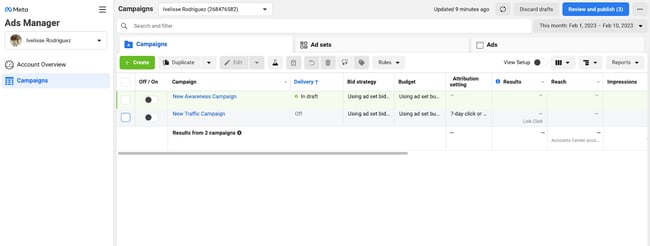
2. Select the campaign you’d like to A/B test.
To complete A/B tests, you’ll need to have an existing campaign. However, you can set up an A/B test as you create an ad, too. In the second screen of the ad creation process, toggle the “Create A/B test” button under “Campaign details.”
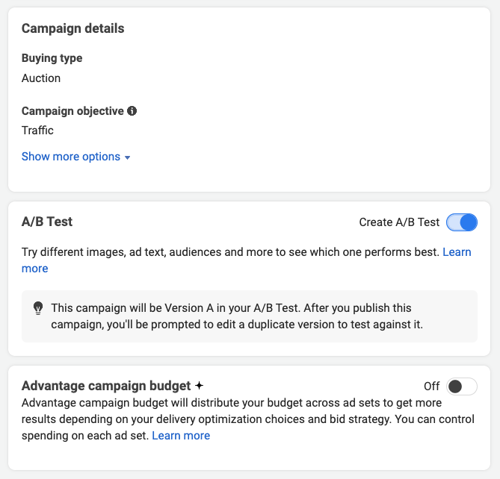
Otherwise, if you’re not creating a new ad, select the existing campaign you’d like to optimize from the list in the Campaigns tab.
3. On the toolbar, click “A/B Test.”
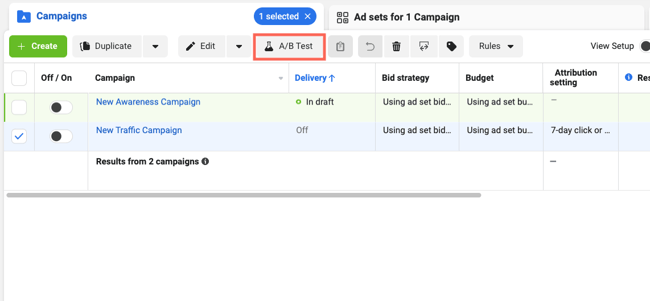
Once you’ve selected your campaign, you can begin creating your A/B test. At the top of your list of campaigns is a toolbar. Click the “A/B Test” button or beaker symbol, as shown below.
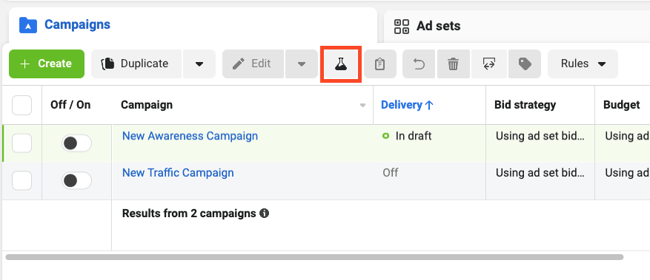
Alternatively, depending on your screen size, tap the button that reads “More”, then click “A/B Test” in the drop-down menu.
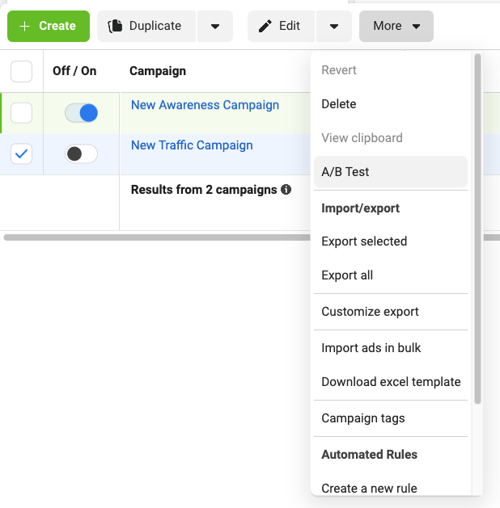
4. In the A/B test workflow, tap “Get Started.”
A pop-up will appear. Tap the blue “Get Started” button to begin. You’ll immediately be able to either make a copy of your ad to edit, or pick an existing ad you’ve already made.
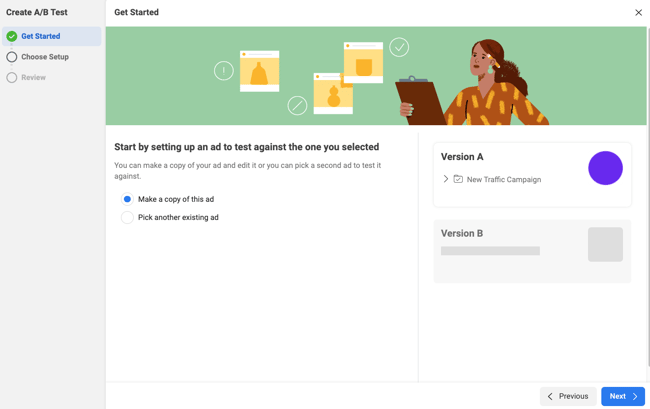
For this tutorial, we’ve chosen “Make a copy of this ad.” After you choose your preferred option, click “Next.”
5. Choose a variable to test.
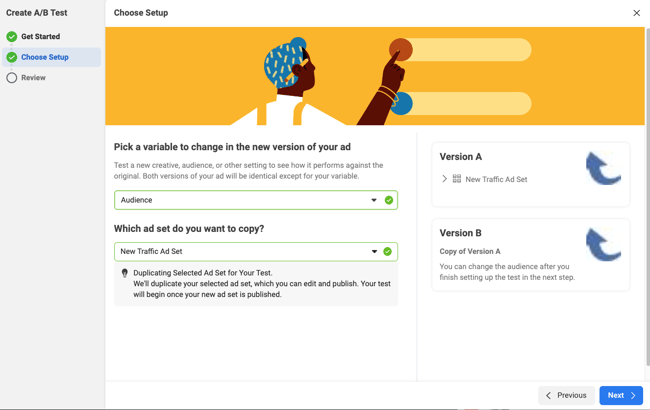
There are several different options for variable testing, and they’re categorized based on the goals of your campaign.
The variables are as follows:
-
Audience: This variable will look at the effectiveness of your ads based on the audiences you aim to reach. For instance, you can test different audiences based on region.
-
Creative: Creative A/B tests will focus on the visual assets of your ad. So if you want to test different images, videos, or carousels, you will choose the “Creative” option.
-
Placements: If you want to test where on Facebook your ad will be most effective, you’ll want to pick “Placements.” This option allows you to test automatic placements.
6. Name your test and determine the winning criteria.
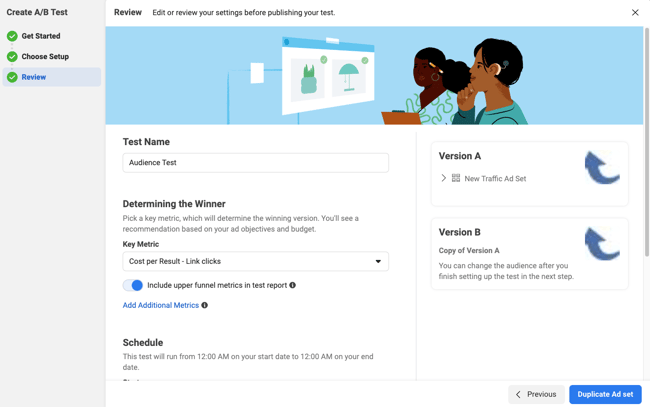
Name your test and choose the metrics you’ll use to determine the winner. You can also choose the time frame for how long your ad will run. After you’re done, tap “Duplicate Ad set.”
7. Edit and publish the alternate version of your ad.
In the next screen, you’ll be able to change your duplicate ad as desired. We recommend changing one variable, such as a single line of copy, an image, or another parameter. After you’re finished, click “Publish” in the bottom right-hand corner.
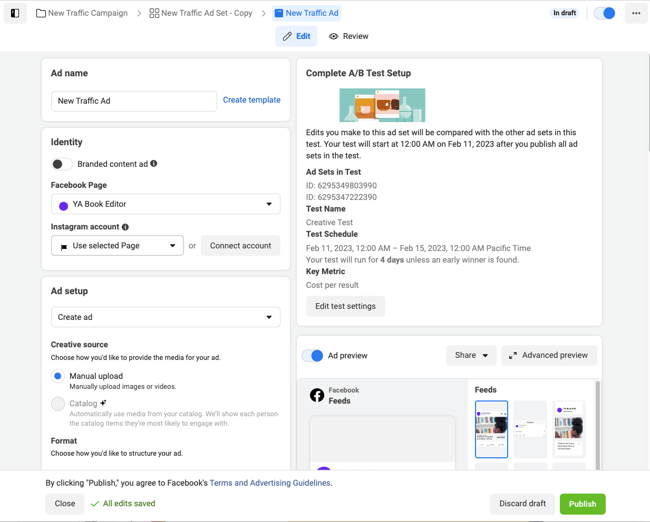
All done! You’re ready to perform your test. You can check the status of your test in Ads Manager.
If you find that you want to go with a different route for your A/B test, there are also options to set them up differently. For instance, let’s talk about duplication next.
Alternative Methods for Split Testing Facebook Ads
Method 1: Use Duplication to Create Facebook A/B Tests
When you choose this option, you can easily create a test by changing one variable in a nearly identical campaign or ad set. Note: This is for ads or campaigns that have already been created.
1. Access Ads Manager.
When you go to Ads Manager, go to your “Campaigns” tab. Here, you’ll see a list of your campaigns that are currently running. You’ll also see your drafted campaigns. You can choose either for duplication.
2. In the toolbar, select “Duplicate.”
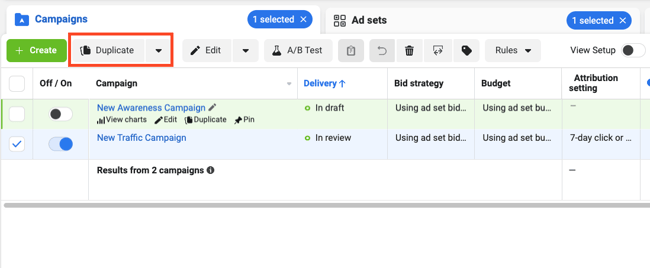
After you’ve decided which campaign or ad set you want to test, click the “Duplicate” button in the toolbar.
3. Click “New A/B test.”
In the pop-up, select the “New A/B test” option. Remember, this option will let you choose a variable to change to analyze performance, so choose a campaign that fits that criteria.
4. In the A/B test workflow, choose a variable to test.
From here, the steps are the same as in the previous method. If you’re choosing an ad set to duplicate, Facebook will provide suggestions of which variable to change for you, and you can pick from there.
5. Name your test and determine the winning criteria.
Give a name to your A/B test and choose how you’ll determine the winner. Then, click “Duplicate Ad set.”
6. Edit and publish the alternate version of your ad.
After choosing your variable, you’ll see your tests next to each other in a preview. After making any necessary changes in this stage, click “Publish.”
When you publish your test, audiences will be able to interact with them, so make sure you’ve ironed out all the details before finalizing. However, you’ll be able to check back on your test in Ads Manager to access the most current insights.
Next, we’ll cover how to create an A/B test using the Experiments tool.
Method 2: Use Experiments to Create Facebook A/B Tests
The Experiments tool lets you create or duplicate ad campaigns to test. The difference between using Experiments is minor — the results are the same. Only use this option if it feels more user-friendly.
First, create the campaigns you’d like to test by clicking the green “Create” button and going through the steps. Duplicate the first campaign, change a single variable, and then head over to Experiments. Here’s how:
1. Go to Experiments.
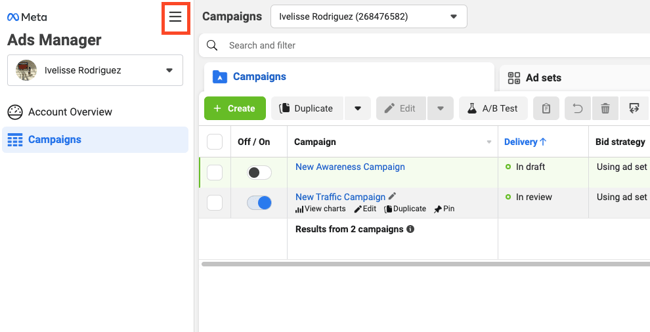
In your Ads Manager dashboard, tap the three vertical lines of the menu, which will show you the “All tools” pane. Then, tap “Experiments.”
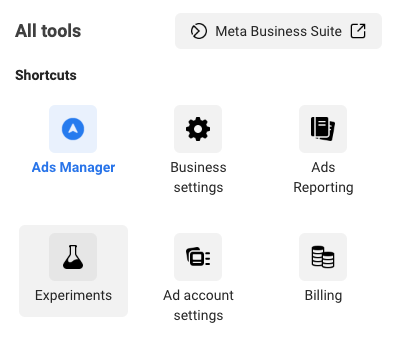
You can also search “Experiments” in Ads Manager’s built-in search tool.
2. Click “Get started” on the A/B Test card.
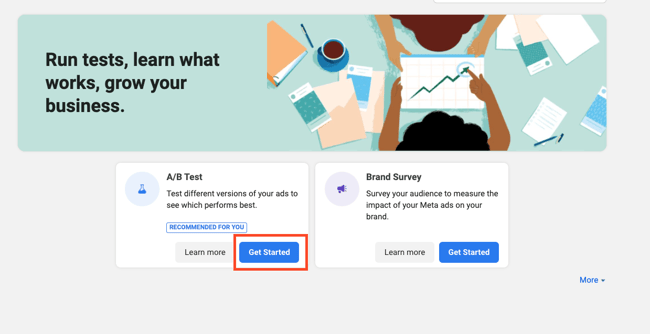
Click “Get Started.” When you do this, you’ll be taken to a page that lets you fill in the ad details.
3. Select your A/B test options.
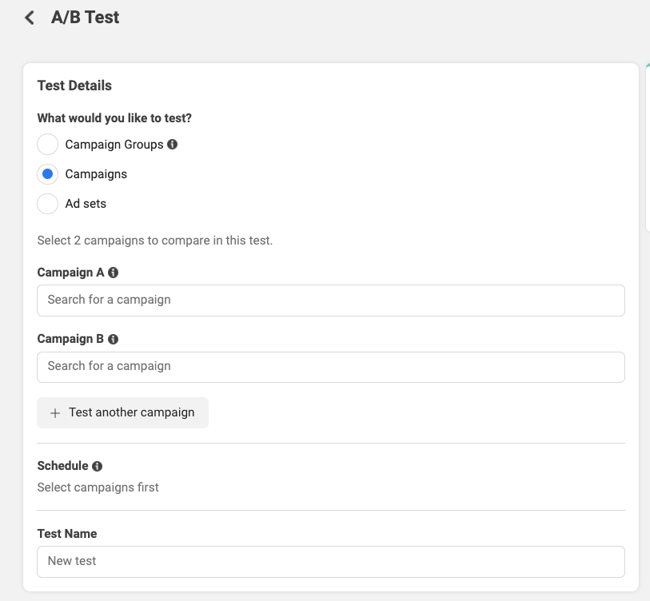
Choose the campaigns you’d like to test. It’s important to have created the campaigns you’d like to test beforehand, or they won’t appear in the list. You can also schedule the run time of your test and fill in the test name.
4. Determine the winning criteria.
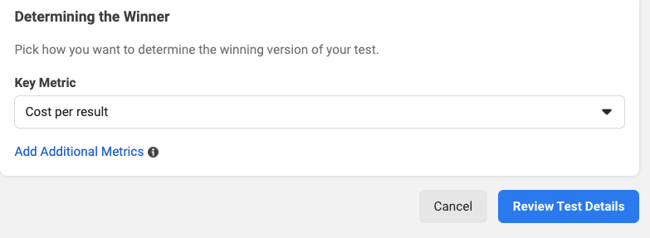
Choose which metrics Facebook should use to pick the winner. After you’re done, click “Review Test Details.”
5. Review your test and tap “Create Test.”
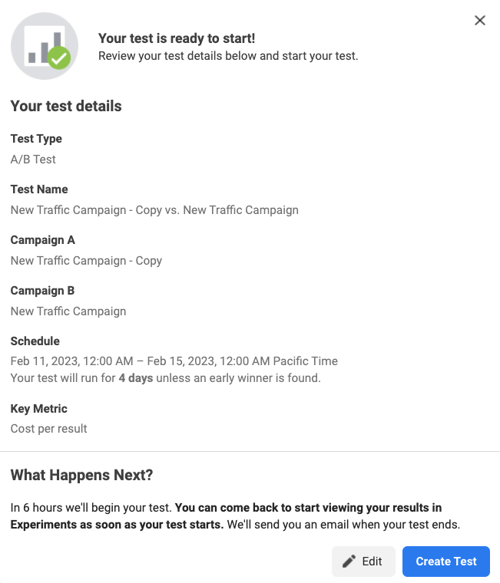
In the next screen, you’ll have an opportunity to see a summary of your test. If you’re happy with the results, click “Create Test.” If not, click “Edit” and make any necessary changes.
6. View all your experiments.
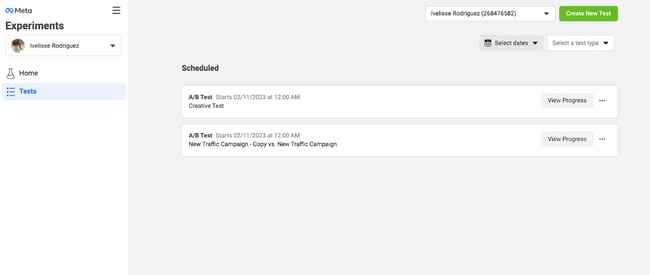
In the Experiments homepage, you can see all of your scheduled and running A/B tests. These include any you’ve created using the Experiments tool or through the Toolbar in the Campaigns dashboard.
Facebook uses the same base technology to run your A/B tests. The different versions of tests you can run help you make the best choices to optimize ad performance.
Next, let’s go over some best practices for running your A/B test on Facebook.
Facebook A/B Test Best Practices
Keep these best practices in mind before you begin your split test — they’ll help you run tests that are valuable and applicable to your next campaign.
1. Stay organized with tracking spreadsheets.
Because A/B tests can influence the future of your Facebook advertising strategy, it’s important to approach the process methodically and have clear goals and tracking in place. Utilizing an A/B test tracking spreadsheet ensures you can collect and analyze your data to make the most insightful, metrics-backed decisions.
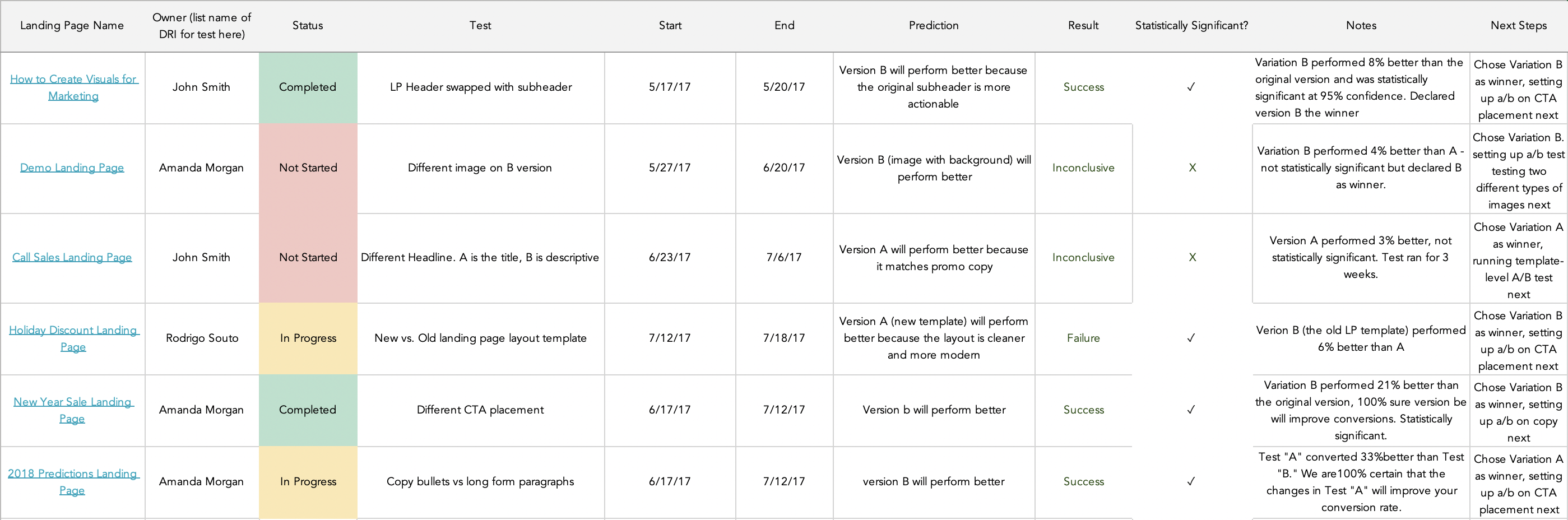
2. Choose one variable that’ll help you reach your goals.
When you A/B test on Facebook, make sure you’re only choosing one variable to test. There’s a separate multivariate test that you can run, but for A/B, one variable is key. Your test results will be more conclusive with only one variable.
3. Pick audiences that you want to reach with ads.
Choose a new audience for your test. They should be large enough to provide measurable results, but shouldn’t be the exact same audience as a campaign you’re already running. If they’re the same as a drafted campaign, that’s okay because they’re not published.
However, if you choose the exact same audience as a campaign you’re already running, Facebook’s system might mix up your ads and provide contaminated results.
4. Use hypotheses that are measurable and valuable.
In order to analyze your test results so they’re the most valuable to you, make sure your hypothesis is measurable. To put it another way: Make sure your hypothesis is clear, easy to understand, and able to be determined with an A/B test.
Your hypothesis can be as simple as, “Which method of delivery do my audience members respond the best to?” This question can be answered by using the Delivery Optimization A/B test on Facebook.
5. Make time frames that are ideal.
Recall that when you set up your A/B test, you can choose a time frame. You can choose to run your test for up to 30 days. Facebook’s Business Center suggests at least four days, which is enough time for the technology to produce accurate results.
6. Choose a budget that works for your business.
Facebook can provide an ideal budget for you based on your test details, or you can choose an ideal budget for yourself when you’re filling in test details. Setting an ideal budget will help you determine a winning strategy — it factors in Ad Spend into the success of your test.
According to one of HubSpot’s Paid Ads specialists, Nicole Ondracek, “A big value of split testing is being able to prevent audience overlap so you know that the same audience is not seeing multiple variants which could affect the results. That way, you can confidently say which one is the clear winner.”
A/B testing gives you a better understanding of audience behavior. Performing them on Facebook streamlines the process and gives you more comfortability with Facebook’s ad system.
Additionally, Ondracek mentions that depending on split testing results, advertisers can begin to shape what type of creative they need to use for the future.
This post was originally published in March 2013 and has been updated for comprehensiveness.

What is a Lead Magnet? 20 Lead Magnet Ideas and Examples [+ Step-by-Step]
Lead magnets, in marketing, are an effective technique for gaining a prospect’s contact information.
The problem is these magnets can take a lot of time and energy to produce. Podcasts, e-learning courses, video series, and contests all sound great – but who has time to create them all?
![→ Download Now: The Beginner's Guide to Email Marketing [Free Ebook]](https://no-cache.hubspot.com/cta/default/53/53e8428a-29a5-4225-a6ea-bca8ef991c19.png)
In this article, we’ll explain what a lead magnet is, as well as provide lead magnet ideas you can create today by repurposing content you already have.
Before I share lead magnet examples, let’s quickly review the conversion path that turns website visitors into leads – and the role email marketing plays in this process:
- Call to Action (CTA): This is the button that website visitors click to access the resource you’re offering.
- Landing Page: This is where your lead magnet captures information provided by the visitor. Once visitors click on the CTA, they’re brought to a landing page where they fill out a form with their name, email address, and any other relevant information you’ve deemed important.
- Thank-You Page: The visitor-turned-lead now lands on a thank-you page with information on where to access their resource and is added to your mailing list.
- Kickback Email: The kickback email is your follow-up message to the lead a short time after the exchange takes place. This email marketing campaign starts a conversation with the lead to keep them engaged with your business.
Every blog post in your archive has the potential to generate new leads for your company, so let’s make sure that your blog is a lead-generating machine.
What is a good lead magnet?
Not all lead magnets are created equal. Sure, you could quickly throw a checklist or reading materials together, but you may not get the payoff you were expecting. Taking your time to create something truly useful to your audience is key. A good lead magnet should:
1. Be relevant to your audience.
First and foremost, you’ll want to make sure the materials you’re offering are relevant to your audience or industry. Picking a broader topic may get you more contacts, but those contacts may not be quality leads interested in your product or service.
It’s important that your lead magnet is tailored toward your brand’s target audience or a specific segment of that audience.
2. Provide value to your audience.
Once you’ve nailed down who you’re marketing to, it’s time to craft a lead magnet that offers potential customers enough value that is worth trading their contact information for.
Provide your audience with information they can’t easily get elsewhere. Offer unique industry insights in an ebook or report. Perhaps you have a solution to help your audience perform a task quicker or solve common industry pain points. Whatever you choose to offer, it should be useful to your audience.
3. Be trustworthy.
Lead magnets like industry reports, studies, and ebooks help position your brand as an authority on a particular topic. However, your audience shouldn’t just take your word for it. Demonstrate your expertise by backing up your information with data and research whenever possible.
Additionally, make sure these are well-written and free of typos. While typos may seem minor, they can undermine your credibility. If readers suspect the materials haven’t been proofread, they may wonder what other steps you are skipping behind the scenes.
Paying attention to these details will boost your credibility and position your brand as an industry expert.
4. Make your audience want more.
Striking the right balance between giving your audience what they want, but also not giving away too much for free is difficult. You don’t want to lure them with a bait and switch, but you also don’t want to resolve their needs completely to the point they no longer have use for your product or service.
For example, you may offer a free tool as a lead magnet, but if users want access to all the features, they’ll need to sign up for a paid version. Look at what you can offer to strike the right balance.
5. Be shareable content.
Your lead magnet should be easily shareable so you can get more leads. If someone enjoys your offer and shares it, you just created a great word-of-mouth promotion.
In addition to having its own landing page, consider having a space on your brand’s social media accounts where users can easily access and share the offer. Like this course from Her First $100K.

It lives in a highlight on the brand’s Instagram where users can access the course and easily share it with their networks through the stories feature.
1. Figure out who you’re targeting and what they want.
The goal of a lead magnet is to offer something your audience wants in exchange for their contact information.
To do this, you have to know what user persona you’re targeting and what offer would entice them.
You may have one to three personas with different needs and pain points. That means one lead magnet likely won’t appeal to all three personas.
For instance, let’s say you are an influencer marketing agency. You may have two personas, each facing these issues:
- Influencer #1 doesn’t fully understand the inner workings of an influencer-brand relationship. They don’t have all the tools to brand themselves and foster relationships.
- Influencer #2 is overrun with brand partnerships and has reached a point in their success where they are so busy with managing administrative tasks that they have limited time to create content.
Knowing this, the agency could create knowledge-based lead magnets for influencer #1, focusing on ebooks and knowledge libraries. For influencer #2, the agency may offer resource-based magnets, such as templates and tools.
During this process, you can also get some ideas from your competitors. What offers are they creating? What are they including in their offers? Use that as your starting point.
In addition, look at your current content library. What has your audience responded most to? Are they asking questions on a particular topic? Are they more engaged in videos or blog posts? This can be a big indicator of what they’ll want in a content offer.
2. Create, design, and name your lead magnet.
Now that you know what your offer will be, it’s production time. You have to create and design your lead magnet.
If you don’t have an in-house designer, you can utilize a platform like Canva. Their platform offers hundreds of templates that you can customize to build your lead magnet, everything from books and presentation slides to worksheets and reports.
You can also outsource the work using an independent contractor with the skills to produce a high-quality offer.
Once the design work is done, name your lead magnet.
Think of something catchy that will pull in your audience and highlight its benefits, like “The Ultimate Worksheet Every Influencer Needs,” and “101 Ways to Monetize Your Brand.”
3. Build your conversion path.
The next step is building your conversion path, which must include your landing page, thank-you page, form, and email sequence.
Starting with your landing page, there are a few best practices to improve conversions:
- Have a dedicated landing page that doesn’t include a navigation bar. This will keep users’ focus on your offer and not the other pages on your website.
- Write a clear call to action. Your CTA should be clear, short, and to the point. It should also use words that will appeal most to your audience.
- Consider eye scanning patterns. Users in Western cultures typically follow F- and Z- reading patterns, which is why most landing pages are designed with key elements placed in those zones.
- Add social proof. Adding reviews and testimonials to your landing pages adds credibility to your offer and can increase your conversion rate.
For your form, the two pieces of information you’ll want to include are name and email. Everything else is optional. However, keep in mind that the more fields you include, the higher the chance a user may abandon the form.
Next up, your email sequence: Once you’ve acquired your lead, you can add them to a nurturing sequence that will lead them further down the funnel. This can include additional resources, such as webinars and newsletters.
Lastly, make sure to set up tracking on your conversion path to see how users are behaving on it and identify optimization opportunities.
4. Set a schedule to update regularly.
Depending on the type of lead magnet you create, you may need to update it every six months to a year.
For instance, let’s say you created a report on 2021 data science salaries. As you get closer to 2022, you’ll need to update the information on the report to reflect current data. Otherwise, your offer may no longer be valuable to your audience.
In addition, if you conduct feedback surveys on your offers, sift through your leads’ comments. Their comments could give you ideas on how to improve your current offer.
Lead Magnet Examples
1. The Sales Evangelist
The Sales Evangelist is a sales coaching and training business designed to help sales managers and their teams thrive.
The company offers a free ebook titled “How to Transform Your Small Business Sales,” which offers insights on how to generate more sales.
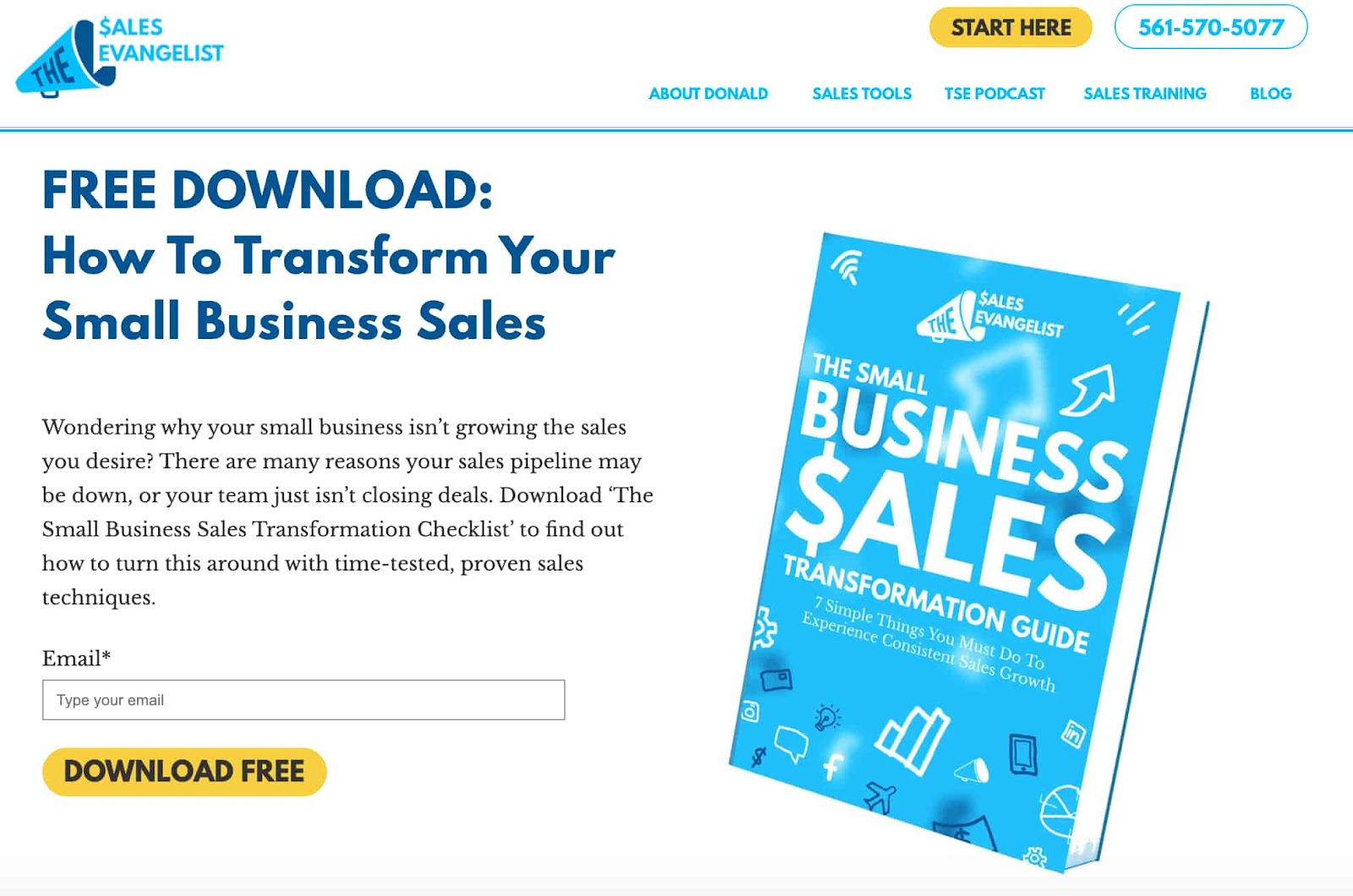
What’s clear is that this particular offer targets small business owners who may not have the proper sales process in place to make sales consistently.
What we like:
The copy addresses the user’s pain point, provides the potential reasons, and leads into why this offer will help resolve it – a classic and effective formula for landing page copy.
2. Her First $100K
Another lead magnet option is to offer a free course. In some cases, you may be able to repurpose video or written content you already have available.
Tori Dunlap, founder of Her First $100K offers an entire “freebie” page as a lead magnet where visitors can access a variety of courses and tools. One of the course options is a webinar aimed at helping people curb their emotional spending.
What we like:
Using a webinar or video format allows your audience to access the materials at their leisure and doesn’t require you to be available to host or teach. While this method may require more work upfront, the pay off is worth it.
3. Karmen Kendrick Creative
When you think of a lead magnet, you probably think of an ebook.
But here’s another quick and easy lead magnet you can develop that will only take you a few hours (at most): a quiz.
In this example, this brand, which offers WordPress maintenance services, tests its audience with their WordPress knowledge.
After answering a few questions, they must enter their email address to view the full results. Then, you land on a landing page with your knowledge level and the option to share your results on social media.
As a maintenance service, this is a great lead magnet strategy. It can serve as a signal to users who are considering outsourcing this service that they may not have the knowledge to manage their site on their own. And it’s interactive, which is already a win.
What we like:
This quiz will require little to no maintenance, as all the questions are based on historical facts – making it a simple but effective lead magnet.
3. HubSpot
Another interactive lead magnet you can consider is a grader or calculator.
HubSpot offers a website grader, which takes seconds to scan your website and provides a score based on performance, mobile experience, SEO, and security.
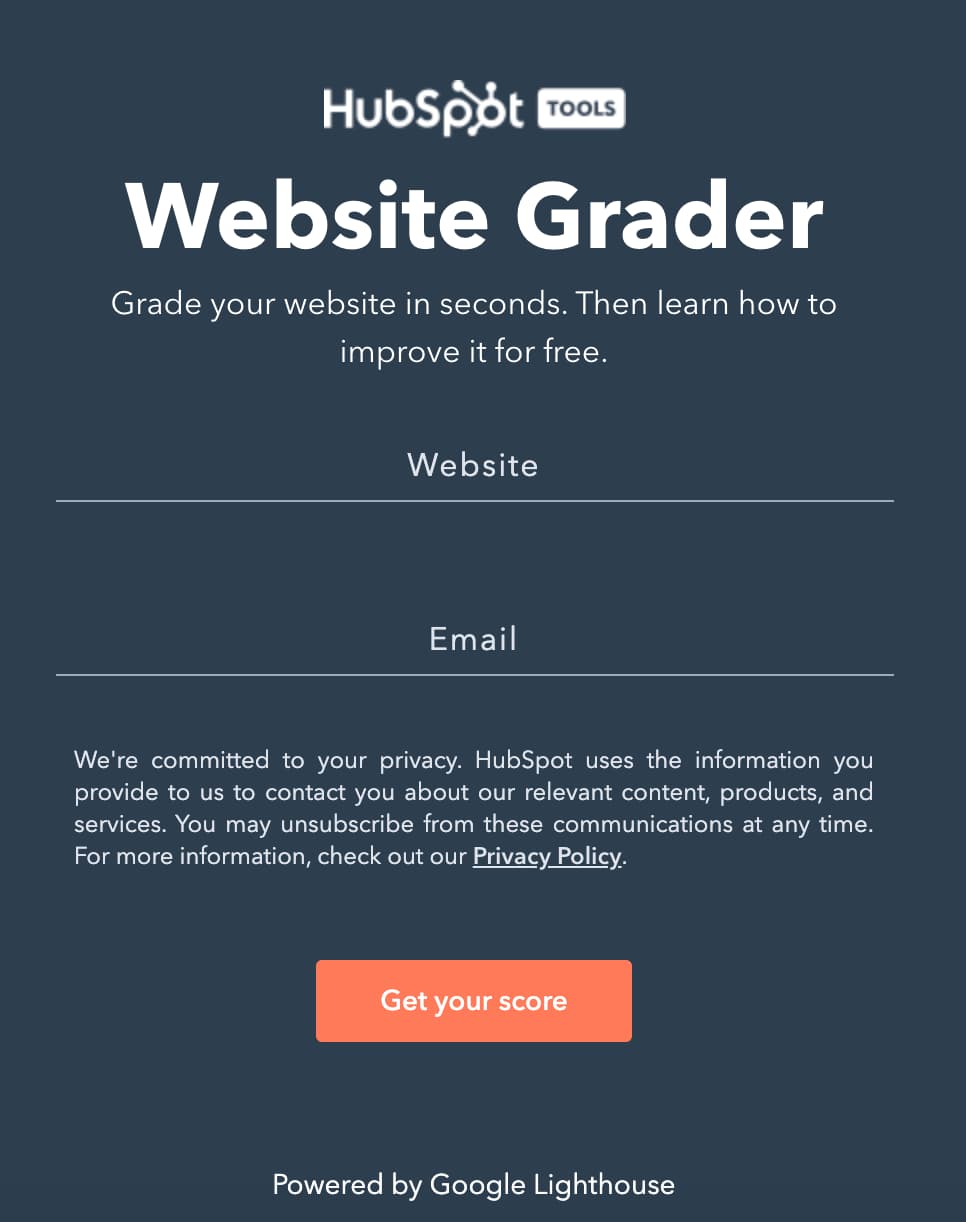
After providing your email and website, you get a detailed report about your website’s performance along with a corresponding course based on your results.
What we like:
The grader helps you identify potential issues with your website and offers a solution to resolve them.
4. Clever Girl Finance
Clever Girl Finance is a personal finance platform that empowers women to take charge of their finances.
Among the host of free resources on their site, this one, in particular, stands out.
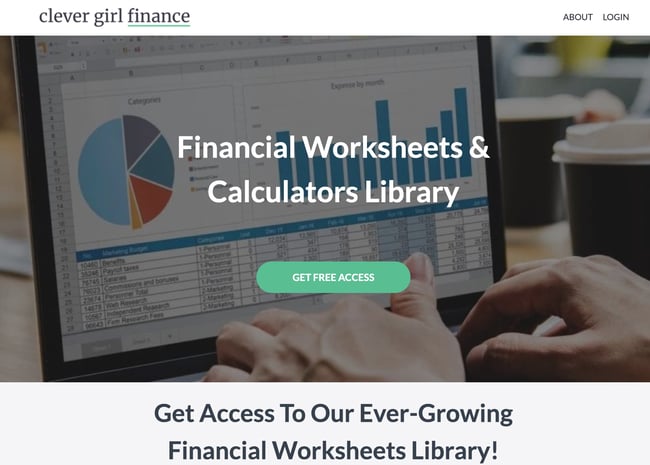
It’s a video library filled with recordings from personal finance coaching calls and when users sign up, they gain access to past and future recordings.
What’s great about this tactic is it answers a need.
Clever Girl Finance’s target audience likely wants a community in which to discuss financial topics, get their questions answered, and hear directly from experts. This lead magnet does just that.
What we like:
This is also one of those one-and-done magnets that require little maintenance beyond uploading new recordings. The team can then repurpose the content of those recordings for future blogs, video snippets, and more.
15 Additional Lead Magnet Ideas to Try
1. Ebooks
The ebook is perfect when you have a series of blog posts about a related subject.
For example, if you were running an online pet store, you might pick out the following five posts from your blog to combine into an ebook:
- “The 5 Pieces of Equipment That Every Puppy Needs”
- “The Ultimate Guide To Housetraining a Puppy”
- “The First 6 Months: What You Can Expect From Your New Puppy”
- “The Puppy Nutrition Guide: What Your Dog Should and Shouldn’t Eat”
- “The 7 Things You Should Never Do When Training a Puppy”
These posts could be logically compiled into an ebook entitled: “The Puppy Planner: Everything You Need To Know To Prepare for Your First Puppy.”
This type of ebook is effective because you’re making the lives of your website visitors easier – which should be the goal of any lead magnet you create. Rather than asking them to find all this content one article at a time, you’re packing it up into a convenient bundle that they can keep and refer back to.
The most successful lead magnets offer an irresistible and instant reward to your visitors, and the ebook checks off that box.
Featured Resource: 18 Free Ebook Templates

2. Guides
If you’re in an industry that is already well established, it can be hard to come up with original content.
Sometimes other people have covered a subject in such detail that it’s almost impossible to add extra value. In this situation, I’d recommend producing an ultimate guide.
An ultimate guide is a comprehensive collection of the best articles about a particular subject. The main difference between this and an ebook? You’re not recycling posts from your blog; you’re linking directly to other sites.
It’s important that you don’t copy and paste someone else’s content into your guide, but rather include a link back to the original article.
In the example below, Brian Dean from Backlinko.com produced “Link Building: The Definitive Guide.”
Link building is a complicated and broad subject. Dean’s definitive guide saves his audience a lot of time looking for this content.
And because so many other experts have written fantastic content about link building, Dean also saved himself the time of competing with content that already exists.
Rather than just listing the links, Dean adds extra value to his audience by categorizing them and including a brief introduction for each category.
This guide has also been well designed, reiterating that this is a valuable resource that should be kept and referred back to.
Do you work in an industry that is already bursting with quality content? Think about making your own ultimate guide.
Do you work in an industry that is already bursting with quality content? Think about making your own Ultimate Guide.
3. Bonus Packs
Offering additional content that is not included in the original blog post is the perfect way to reward readers who opt-in.
If you have an article titled, “The 5 Pieces of Equipment That Every Puppy Needs,” you could offer readers an exclusive PDF with a few more pieces of equipment that may have come on the market since the original post was published.

In his article, “SellMore Courses With This Online Course Sales Page Template and Guide,“blogger Bryan Harris took this one step further and combined a PDF version of the article along with five links that weren’t in the original post – people only received these bonuses when they subscribed.
4. Resource Libraries
If you’ve already written a strategic blog post, consider offering a resource library or guide as a lead magnet.
A resource library is a collection of tools that help people achieve results.
David Dean from Backlinko used this strategy in his post, “SEO Tools: The Complete List.” He offered a free download that detailed the 153 tools featured in his post – the perfect resource for a reader to keep and refer to whenever they need.
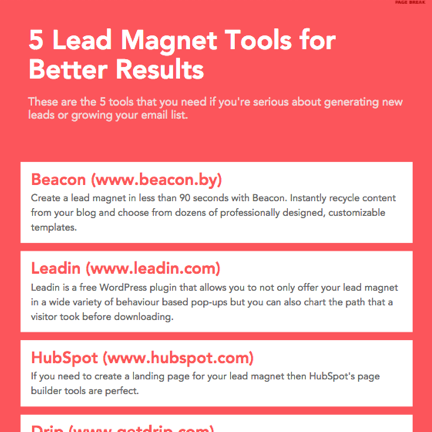
This library could be as simple as a list of five books or apps that you recommend.
What resources could you recommend to a potential customer that would help them to achieve better results?
5. Checklists
Instructional blog posts are just waiting to be turned into checklists – and they couldn’t be easier to create.
Just take your blog post and simplify it into a series of bullet points. Next, remove any points that don’t contain actionable advice. Split the list into several numbered steps to make the outcome more achievable.
Bonus points if you offer the checklist in a printable format so people can physically tick off each item on the list as they complete it. This sense of achievement is a great feeling that people will attribute back to your business.
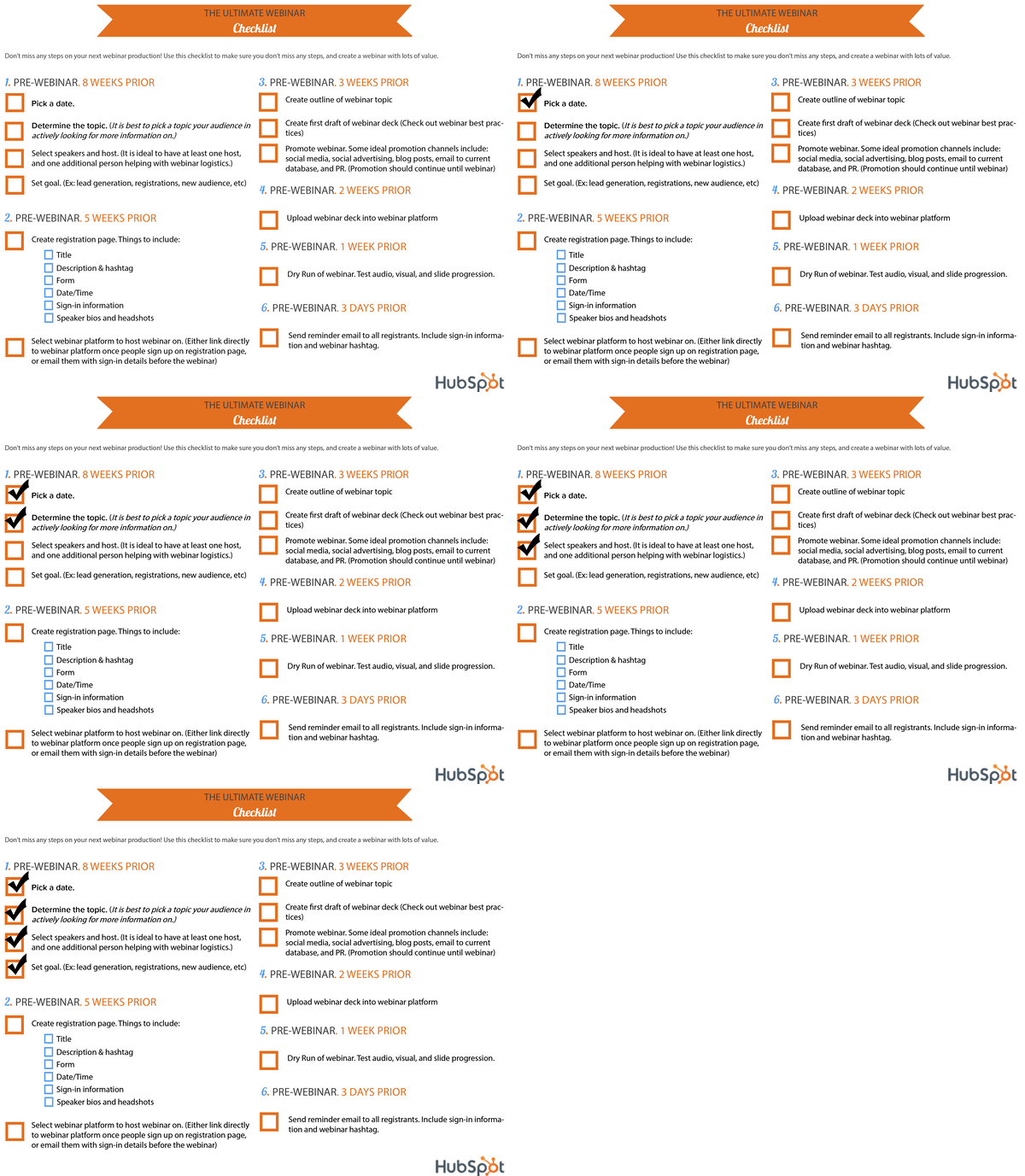
The “Ultimate Webinar Checklist” from HubSpot above is a valuable lead magnet because of how practical it is.
Hosting a webinar involves balancing a lot of different tasks coming together at the same time. This checklist informs you about everything you need to watch out for, from pre- to post-webinar.
6. Workbooks
In its simplest form, a workbook is a download-and-complete resource that helps people to apply the principles of your blog post to their own business.
The goal of a workbook is to have the participant learn by doing. As the teacher in this scenario, you’re positioning your business as an expert on the subject matter at hand.
With that in mind, you’ll want to choose the exercises included in your workbook carefully. Tease information out of the participant gradually, so that at the end of the workbook they can combine their short answers into a comprehensive piece of work.
A workbook is the perfect stepping stone to your premium products or services, so be sure to include a strong call to action at the end that tells the participant how you can help them to apply their newfound knowledge.
Is there a particular subject that you could help your audience understand more clearly with a workbook?
7. Case Studies
Case studies depend on very specific types of content, but the successes they reveal can entice a site visitor to take action.
If you have a blog post or interview clip that spotlights a real customer you’ve worked with, package this content into a written case study that expands on the need the client came in with and the metrics of their success.
Then, gate this case study behind a form that website visitors can fill out with their name and email address to access.
Keep in mind that you’ll need permission and approval from the client on which you’d like to create a case study.
Once you receive this approval, however, it’s a perfect lead magnet to host content that tells your readers about a customer success story.
Featured Resource: 3 Free Case Study Templates
8. Webinars
Webinars don’t have to be long, collaborative presentations with multiple colleagues or partners.
If you’ve got a blog post that merely touches on a subject you’re an expert in, use this blog post as a springboard into a live talk hosted by you and a coworker.
If you’ve written an article about the latest IOS cookie restrictions, for example, convert this article into a slide presentation and present it through a live conferencing platform, using helpful visuals.
You should also provide insight that listeners wouldn’t have gotten from just the blog post.
As a bonus, you can use the webinar recording as an additional offer.
9. Cheatsheets
If your blog post covers a complicated topic, it might be a good idea to offer readers a one-page sheet that they can refer back to when they need to refresh their memory. This could be a glossary of terms or just a summary of some key points.
This type of download-and-keep resource takes the pressure off readers so they don’t have to memorize or implement your strategy immediately. It does compel readers to opt-in to your list though, which is the ultimate goal.
In addition, the compact format means that people can quickly glance at it while they are going through the editing process. It’s a complementary tool for an existing process.
10. Guestbooks
Guest blogging is a terrific backlink strategy, but those who use it typically agree to not republish that particular post on their own blog.
This is fairly common, as Google punishes sites that duplicate content onto two publications – it’s in nobody’s interest to do so.
What you can do, though, is compile all these guest posts into a book format.
Since the content will be gated behind a lead capture form, there is no risk of Google flagging it as duplicate content and you get to squeeze a little bit of extra value from that content you worked so hard on.
11. Whitepapers
Have an interesting survey that your team recently ran? Or perhaps you know your audience is looking for specific information to inform their future strategy?
If so, leverage this knowledge to create downloadable reports based on your team’s research.
You may have talked about these findings in a blog post or a recent webinar. Repurpose that content for a detailed report.
This will position you as a credible resource in your industry and bring you that much closer to converting your target audience.
12. Templates
Templates are some of the most popular lead magnets out there.
Why? Because they help users streamline their processes and save time. But at the core of it, it solves the problem many of us have: creating and designing from scratch.
You can create templates for just about anything:
- Emails
- Social media
- Spreadsheets
- Graphic designs
It’s all about tapping into what your audience needs the most and creating that for them. Plus, it’s another low-maintenance magnet.
13. Email Course
Companies offer online courses all the time, but they’re not the only place to launch a course.
A Statista survey found that most people (over 80%) check their emails every few hours including outside of normal business hours.
We also know that email newsletters are very popular, with just about every company sending its top insights to your inbox every day.
With this in mind, starting an email course is a great lead magnet option.
An email course is a series of emails that can be anywhere from three to 10+ emails that cover a topic in depth.
The benefit for you? It’s a format most users are familiar with and it’s quick to launch.
In addition, you have multiple opportunities to nurture your audience and guide them down the buyer’s journey, compared to a one-and-done ebook that a user may or may not read.
14. Access to a Private Group
As a business, community management is a key aspect in gaining brand loyalists. It can also be an effective way to generate leads.
Platforms like Slack, Facebook Group, and LinkedIn allow you to do both.
For many businesses, their target audiences value community and want a space to discuss topics relating to their needs, goals, and challenges.
Creating that space will help you generate leads and get to know your audience better.
15. Behind-The-Scenes or “Secret” Insights
One of the best lead magnets I’ve ever seen was produced by Tim Soulo. It was so effective that I immediately opted-in without thinking twice. Suolo had written a blog post about sending an outreach email to well-known SEO expert Rand Fishkin. His call-to-action was the following:

This call-to-action was pitch perfect because it got me curious. I just had to know what the email subject was.
I also knew that it would be a relatively short read so I wouldn’t have to commit to a lengthy ebook – lazy, I know, but that’s human nature sometimes.
Suolo’s lead magnet is just one page and was made using a standard word processor. There was no point in spending time or money on the design in this case because the secret is the only thing that matters.
I blurred out the tell-tale image and text in the above screenshot – if you want to know Suolo’s secret, you’ll just have to download the lead magnet!
Do you have any behind-the-scenes insights to a blog post that are compelling enough to offer as a downloadable secret?
Add Lead Magnets to Your Marketing Strategy
There you have it, ways to recycle your existing content into lead-generating assets. You already have the blog content – all you have to do is implement lead magnets and an email campaign that gets them into your contact database.
Editor’s note: This piece was originally published in May 2018 and has been updated for comprehensiveness.

2022 Marketing Benchmarks: Web Traffic and Conversion Trends for 150,000 Businesses
In 2022, the marketing world continued to evolve.
Not only did we get the ability to shop directly on our favorite social media apps, but we also began to hear lots of the futuristic buzz around AR/VR, the metaverse, and Web3 development.
As we move into another unique year, marketers might wonder if and how other companies in their industry are keeping up with everything going on.
To help marketers like you keep a pulse on how other brands are doing, HubSpot analyzed data from 150,000+ companies. In this post, we’ll note the three key marketing themes we discovered and how they could impact you today.
Want a full view of how the bigger business performed and what you can do to keep your company up? Read our full-year Business Data Recap on the Hustle Blog now.

About this Data: These insights are based on data aggregated from 130,000+ HubSpot customers globally between July 2021 and September 2022. Because the data is aggregated from HubSpot customers’ businesses, please keep in mind that the performance of individual businesses, including HubSpot’s, might differ based on their own markets, customer base, industry, geography, stage and/or other factors.
3 Marketing Data Themes We Saw in 2022
2022 Web Traffic Struggled to Outpace 2021
In 2021, much of the world was still reopening following the worst of the pandemic. And, although people were starting to get out of the house and disconnect from their screens more often, others were still highly connected, working mostly remote, and doing everything from shopping to entertaining themselves from home.
In 2022, as the global events we went through seem farther and farther in the past, more people than ever are trying to get out of the house, get off their computers, and continue to trade Zoom calls and texts with real, in-person connections.
In 2021, we also saw people become more honest with themselves about work. Instead of spending 10 hours a day in the office or working from home, they opted to take more time off, set work-life balance boundaries, or even take part in quiet quitting.
Lastly, we saw in our quarterly analyses, and note in the section below, that marketers sent fewer emails which also received lower email open rates overall throughout the year. For some sites, email can be the biggest traffic source following search engine and direct traffic. And, when any channel sees these impacts, it could greatly impact year-over-year performance.
With the factors above in mind, it’s not too shocking that web traffic across all industries took a hit in 2022 compared to 2021, with a 6.7% YoY dip.
The only industry that didn’t see a dip was, unsurprisingly, Leisure and Hospitality. This industry, which saw major business impact during COVID travel and country-wide shutdowns, is now showing signs of picking back up with a 6.35% YoY traffic increase.
The industries that saw the biggest dips were Trade, Transportation, and Utilities, as well as Professional and Business Services, which both saw more than a 7% traffic tip in 2022.
Marketing Emails Struggled to Capture Subscribers
As we hinted above, email open rates took a tip in 2022. Across industries, email open rate dropped by a whopping 12.89% while email opens dropped by just under 4%.
|
Metric |
YoY (2022 vs. 2021) |
Sample size |
|
Email sends |
11.01% |
167,457 |
|
Email opens |
-3.32% |
167,457 |
|
Email open rate |
-12.89% |
167,457 |
While there could be many possibilities for this, a few impacts that seem likely are:
- Businesses sent too many emails. In 2022, companies sent 11% more marketing emails than usual, which could have easily fatigued subscribers, caused disengagement, or even hurt email subscription size. On top of this, sales reps also might have been sending emails more frequently as sales email open rates dipped by 11.6%, hinting that those who were subscribers AND prospects could’ve definitely gotten bloated inboxes.
- Email oversaturation from all sorts of brands (which also likely amped up email sends) could have caused higher competition in subscriber inboxes than in previous years. On top of marketing emails to compete with,
- Growing subscriber lists. While this shows people are investing in your brand and content, it can open rates harder to maintain. Because open rates decreased by a much larger percentage than that of opens, this could mean marketers added more contacts to their subscription lists, but only received opens from the same or slightly fewer people.
- Inboxes are continuing to improve organization, junk, and spam filters. While this is better for the consumer, these pivots could be moving emails out of sight, although this is less likely if spam rates for your email campaign are low.
- Competition from other mobile platforms: With the growth of social media and other mobile content-driven apps, emails could be feeling less relevant to some consumers, despite still being a solid marketing tactic.
If you leverage email marketing, keep track of your subscribers and your competition, as well as how email consumption and content is changing to ensure that you’re prioritizing sends with the highest potential impact. This will ensure that your content has a fighting chance of catching your subscriber’s eye in a busy list of unread messages.
Ultimately, your subscribers, prospects, and potential customers could reward you for understanding their needs with both engagements and even purchases.
Still, Marketing Efforts Yielded Lead & Conversion Impact
Although marketers aren’t closing deals like sales reps, they still drew in business impact despite lower traffic and email open engagements.
Leads and conversions, the biggest ties marketing departments often have to a business’s bottom line actually went up year-over-year.
While web conversions saw a nearly 11% increase, inbound leads went up by 6.66%
Although web conversions would be likely to go up due to the lower ratio of web visits (noted above), the number of inbound leads rising shows that companies are still growing their prospect lists.
Unsurprisingly, Leisure and Hospitality saw the largest growth in leads at a whopping 18.3% YoY, as well as the second-highest increase in website conversions at just over 12%.
Although they saw lowering traffic in 2022, other notable lead-growth industries were:
- Education & Health Services: 10.6% lead growth and an 11% rise in conversion rate.
- Professional & Business Service: 7.7% lead growth and a 13.7% rise in conversion rate.
These industries all make sense as top performers because the businesses within them often sell expensive or high-commital offerings (whether they be B2B or B2C). A random consumer won’t just pay for something like this after reading a single landing page, so the marketing teams within these areas are likely skilled in building robust lead-nurturing strategies.
One industry that seemed to struggle in 2022 was the Construction industry, which saw decreases in all metrics we looked at across the board, including inbound leads (-3.8%), web conversions (-0.65%), and web traffic (-6.84%). While we aren’t completely sure why this is, here are two of our best guesses (which would likely be temporary):
- Due to the rising costs of inflation, materials, and construction team talent, construction projects that consumers and businesses might have invested in within the last decade have gotten more expensive or unaffordable..
- During 2020, building and/or owners took advantage of their time at home or the lack of people in public/office buildings and used that time to invest in construction, remodels or maintenance. But beginning in 2021 and continuing on in 2022, construction has seen a less motion. Ultimately, as the cost of living rises and people return back to work, these projects might not be gaining as much interest or engagement online.
What’s Next for Marketers in 2023
While we can’t predict the future, we expect lead generation and conversion plays to be more important than ever to marketers as they aim to benefit their business’s bottom in still-unprecedented times. But, because people of the internet are still as hyperconnected as ever, anything could happen with traffic or email marketing.
Ultimately, what you do with your brand’s marketing plan is up to you. And, those decisions should be made with data from your company, your targets, and your own competitive analyses.
If you’re a marketing leader, entrepreneur, or just really interested in how overall businesses compared in 2022, check out this detailed business recap o all of the 2022 metrics we dug into. Or, get more tips on planning the most innovative marketing plan from our State of Marketing Report below.


Website Redesign: An 8-Step Checklist to Achieve Your Marketing Goals
Undergoing a website redesign can be an exciting time, as you’ll have a fresh chance at capturing a new market for your business. Since it can be a big project, we’ve compiled a checklist of things you need for your website redesign to achieve all your marketing goals.
![Download Now: 25 HTML & CSS Hacks [Free Guide]](https://no-cache.hubspot.com/cta/default/53/848be230-f06a-420e-9a24-82b45fe61632.png)
Feel free to click through the table of contents to jump to any particular section or scroll through.
- Step 0: Don’t Fix What Isn’t Broken
- Step 1: Benchmark Current Metrics
- Step 2: UX Research
- Step 3: Backlink Research
- Step 4: Set Expectations
- Step 5: Competitive Analysis
- Step 6: Strategy
- Step 7: Content Creation
- Step 8: Designing Your Website
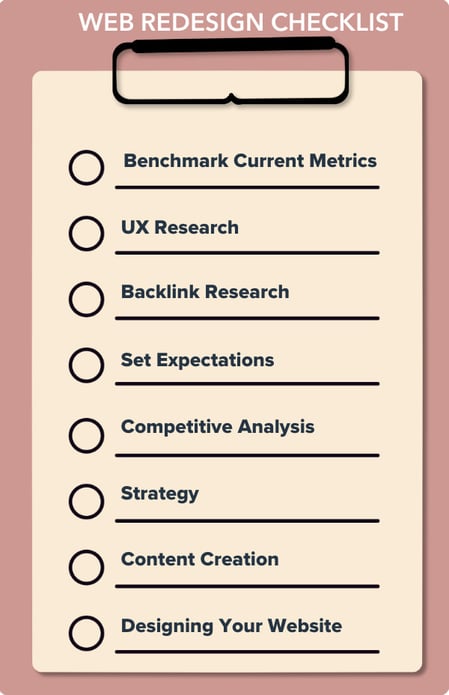
Step 0: Don’t Fix What Isn’t Broken
Before we get into the nitty-gritty of what you’ll need to do when redesigning your website, it’s good to consider whether you need a redesign in the first place.
If your website is consistently converting leads, gaining traffic year over year, and/or pacing expectations, you might not need to redesign your website at all.
Instead, look at ways you can improve your existing website, whether that’s through user experience, optimization, or re-examining your strategy.
Step 1: Benchmarking Current Metrics
Since you want to make your changes informed and effective, you need to benchmark your important site metrics before doing anything else. You can use any number of SEO auditing tools to find all of your important metrics.
Here’s an image of all the important metrics you should remember.
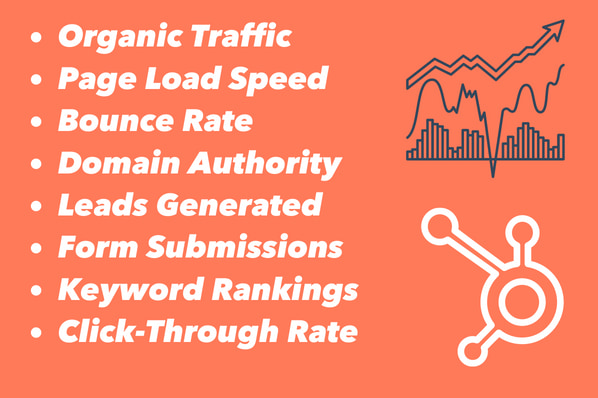
Step 2: UX Research
The most important part of any business is solving customer pain points. So before doing a website redesign, it is pivotal to figure out how to improve your user experience.
To optimize your web design for usability, keep things simple, easy to navigate, and easily accessible for your users. This could mean reducing page load speed, having a clear visual hierarchy, or using customer satisfaction surveys to collect feedback.
The important part is listening to your target audience and implementing design changes based on their feedback.
Step 3: Backlink Tracking and Research
The importance of backlink analysis when redesigning a website must be recognized.
Backlinks are a good source of traffic where other websites link back to yours. The more backlinks you earn, the better your domain authority, link-building is one of the most important parts of website SEO.
That’s why you must keep your website’s popular pages intact to avoid the dreaded 404 error page for web crawlers and people finding your website through Google or other pages linking to you.
Step 4: Set Expectations
If you’re redesigning your website, you don’t want to jump in without a plan. Here is where benchmarking your metrics can come in handy.
Make sure you set clear and quantifiable goals on where you want your website to be three months, six months, and twelve months from now.
Some suggestions on success metrics could be sales conversions, organic traffic, or improving your keyword rankings.
Step 5: Competitive Analysis
Conducting a competitive analysis can help you identify growth opportunities for your website based on what your competition is doing. Performing a website redesign is the perfect time to implement insights you gain from the competitive analysis.
While you shouldn’t obsess over your competitors (your focus should always be on the customer), it’s good to see what you could be doing or focusing on to solve customer pain points.
Here’s a helpful video showing you a quick guide on how to conduct a competitive analysis for your website.
Step 6: Strategy
Now it’s time to develop a strategy to accomplish your goals. Concrete metrics-based strategies could mean working with your SEO team so that you can improve rankings or working with sales to increase leads.
On a higher level, now is your chance to examine what your branding strategy is. What message do you want to send to customers when they visit your website?
Often, your website is the first time your customer will learn about your business. How would you design your website knowing you only have a few seconds to grab a visitor’s attention?
Whether your website is a bold statement or defined by its subtlety, it should ultimately be a reflection of your business and branding goals.
Step 7: Content Creation
While often an afterthought for some websites, content creation is the backbone of many businesses. Three strong forms of content are blogs, podcasts, and videos.
You should use content creation to leverage your business in a way that’s helpful for your customer. Think about what your business specializes in and how you can reach your audience through content.
HubSpot, for example, is a CRM company that uses blogs and podcasts to educate its target audience on marketing and sales strategies, customer service, and website building.
Step 8: Designing your website
Here’s where you take everything you’ve learned and start your website’s redesign.
Remember to design your website strategically in a way that improves user experience and is set up for success in terms of reaching your success metrics.
Above all else, you want to solve your customers’ needs, and a website redesign is a perfect time to do that.
Getting Started With Website Redesign
Now that you know what needs to be done for your website redesign, it’s time to put that knowledge to use. Study your website for the best growth opportunities, and find where you have room for improvement.
Website redesign is an ongoing process, so have a team dedicated to maintaining and improving your website.

70+ Social Media Demographics for Marketers in 2023
I get it, fellow marketers —sometimes, you just need the numbers.
The juggernaut known as social media only gets bigger with every new year, and because of that, demographics shift with it. And, ultimately, keeping on top of important numbers before your social media campaigns can help you with ROI in the long run.
Here, we’ve compiled the state of social media demographics, optimized with the most important data you need to know about your audience and shaping your personas for 2023.
General Social Media Demographics
- Roughly 82% of Americans between 18 and 49 years old use at least one social media site. (Pew Research Center)
- The top way marketers find their audience on social media is by researching relevant online communities, such as Facebook Groups and subreddits. (HubSpot Blog Research)
- 84% of marketers are targeting Millennials in their social media strategy, followed by Gen X (52%), then Gen Z at 22%. Only 14% of marketers target Baby boomers. (HubSpot Blog Research)
- Most marketers say that short-form video content is the most popular content format for Gen Z. (HubSpot Blog Research)
- Social media users use an average of 7.2 social media platforms per month. (Hootsuite)
Facebook Demographics
General
- As of 2021, Facebook has over 2 billion monthly active users. (Statista)
-
Facebook has almost 2 million daily active users and 2.9 monthly active users. (Meta)
-
Facebook is the most effective platform for community building. (HubSpot Blog Research)
-
The average adult in the U.S. spends 33 minutes on Facebook per day. (Statista)
-
Facebook is the most popular social media platform for marketers. (HubSpot Blog Research)
-
Facebook is the fourth most visited website in the U.S. (Semrush)
Age and Gender
Please note that audience data for individuals who do not identify within the binary are not reported.
- Globally, 56.4% of Facebook users identify as male while 43.6% identify as female. (Statista)
-
Facebook is Gen X and Baby Boomers favorite social media platform. (HubSpot Blog Research)
-
91% of Baby Boomers, 88% of millennials, and 83% of Gen X have visited Facebook in the last three months. (Hubspot Blog Research)
-
31% of U.S. adults regularly get news from Facebook. (Pew Research Center)
- Only 12% of Gen Z-ers say they use Facebook more than any other platform. (HubSpot Blog Research)
Geography
-
India has the most Facebook users at 329 million, with the United States in second place with 179 million users. (Statista)
Takeaways
As the most popular social media network, Facebook is definitely a platform worth investing in. Its largest user group is Gen X but it still has a wide range of users across all ages. Furthermore, Facebook is popular worldwide, making it a great social media network for brands of all industries and locations.
Instagram Demographics
General
- 500+ million users are active on the platform every day. (Instagram)
- Instagram has the highest ROI, engagement, and highest quality leads. (HubSpot Blog Research)
- The average amount of time per day spent on Instagram is 28 minutes. (Statista)
Age and Gender
Please note that audience data for individuals who do not identify within the binary are not reported.
- Males between the ages of 18 to 24 represent the largest demographic on Instagram, followed closely by males between 25 to 34 years old. (Statista)
- Most women on Instagram are between 18 and 34 years old. (Statista)
- The smallest age group on Instagram is senior males 65+. (Statista)
- In the past few months, 55% of Gen X-ers and 27% of Baby Boomers have visited Instagram. (HubSpot Blog Research)
Geography
- India and the U.S. lead the board as the countries with the largest Instagram audience sizes, similar to Facebook. (Statista)
- For two consecutive years, the most geo-tagged city in the world on Instagram has been Los Angeles, California. (Mention + Hubspot)
- The country with the most Instagram posts in 2020 was the the U.S., leading with 571K posts, followed by Brazil with over 300K posts. (Mention + HubSpot)
Takeaways
Instagram is another leading social media platform with a large user base spanning all age groups, and it offers advanced ecommerce features, making it incredibly popular among consumers and valuable to brands.
Twitter Demographics
General
- Twitter is the seventh most visited website in the U.S. (Semrush)
- There are 347,200 Tweets sent per minute on Twitter. (Statista)
- As of December 2022 Twitter’s audience is over 368 million monthly active users globally. (Statista)
- The average amount of time per day spend on Twitter is 31 minutes. (Statista)
Age and Gender
Please note that audience data for individuals who do not identify within the binary are not reported.
- Twitter’s user base heavily skews male with only 43.6% of users identifying as female. (Statista)
Geography
-
The U.S. is the country with the most Twitter users, at 77 million with Japan right behind at 58.2 million. (Statista)
Takeaways
If you’re looking to build a community surrounding your brand, Twitter is a great place to start. It’s particularly popular in the U.S., so if that aligns with your target audience, consider setting up your virtual shop there.
TikTok Demographics
General
- TikTok is the best platform for building an active community for Gen Z. (HubSpot Blog Research)
- TikTok users are twice as likely as users of other social channels to recommend something they found on the platform. (TikTok)
- 36% of consumers want to learn about products through short-form videos like TikTok. (HubSpot Blog Research)
Age and Gender
Please note that audience data for individuals who do not identify within the binary are not reported.
- 21.5% of TikTok’s global audience are women between the ages of 18 and 24 and 17% are male users between 18 and 24. (Statista)
- U.S. adults spend 31 minutes per day on TikTok. (Statista)
- Most TikTok users in the U.S. are 18-19, followed by 20-29. (Statista)
- 62% of Gen Z uses TikTok and spend the most time on TikTok. (HubSpot Blog Research)
Geography
-
In 2021, Asia-Pacific was the fastest-growing region for TikTok usage, with a 159% increase compared to 2020. (Statista)
Takeaways
TikTok’s audience heavily skews young, with a large Gen Z population. As such, it’s a great platform for B2C brands targeting this demographic. With short-form video taking off, it’s an opportunity for brands to not only hop on a growing trend but do it on a platform that caters to their target audiences.
YouTube Demographics
General
- YouTube is the second most effective platform for building a social media community. (HubSpot Blog Research)
- YouTube is the second most visited website in the U.S. (Semrush)
- YouTube has over 2 million monthly logged-in users. (YouTube)
- There are 500 hours of video uploaded to YouTube per minute. (YouTube)
Age and Gender
Please note that audience data for individuals who do not identify within the binary are not reported.
- A quarter of U.S. adults regularly get news from YouTube. (Pew Research Center)
- YouTube is almost equally as popular with Gen Z, Millennials, and Gen X audiences. (HubSpot Blog Research)
- YouTube is Baby Boomers second favorite social media app. (HubSpot Blog Research)
- Gen Zers (18-24)’s second most popular way they discover new products is from YouTube ads. (HubSpot Blog Research)
Geography
- India has 467 million active YouTube users, followed by the U.S. (245 million) and Indonesia (139 million). (Data Reportal)
Takeaways
YouTube is the leading video platform, with a wide range of users from Gen Z all the way to Baby Boomers. With the launch of YouTube shorts and popularity of short-form video, brands should develop a strategy to capitalize on growing interest to generate leads.
LinkedIn Demographics
General
- Marketers can reach 900 million users with LinkedIn ads. (Data Reportal)
- Approximately 10.7% of the global population has a LinkedIn. (Data Reportal)
Age and Gender
Please note that audience data for individuals who do not identify within the binary are not reported.
- 56% of LinkedIn users identify as male while 43.1% identify as female. (Statista)
- Roughly 60% of LinkedIn users are between 25 and 34 years of age. (DataReportal)
- 31% of LinkedIn users are between 30 and 39, 23% between 40 and 49, and 17% between 18 and 29. (Statista)
- 43.6% of LinkedIn’s global users are female and 56.4% are male. (Data Reportal)
Geography
- Over 75% of members are outside the US, followed by India and China. (LinkedIn)
- LinkedIn is used in 200 countries and regions worldwide, and the largest are North America, Asia-Pacific, and Europe. (LinkedIn)
Takeaways
LinkedIn’s still the number one social media platform for B2B brands. It’s full of decision-makers and young adults entering the workforce prime for social selling.
Reddit Demographics
General
- There are more than 100k active Reddit communities. (Reddit)
- Redditors created 430M+ posts in 2022. (Reddit)
- Reddit is the fifth most visited website in the U.S. (Semrush)
Age and Gender
Please note that audience data for individuals who do not identify within the binary are not reported.
- Gen Z makes up roughly 2% of Reddit users. (eMarketer)
- A majority of Reddit users are male. (Statista)
Geography
- 46% of desktop traffic to Reddit.com comes from the U.S. (SimilarWeb)
Takeaways
Reddit’s user base has grown significantly in recent years. This suggests that consumers are becoming more interested in what the network has to offer. From an audience perspective, it’s made up mostly of male Millennials, attracting most of its users from the U.S.
Snapchat Demographics
General
- 59% of U.S. users check Snapchat daily. (Pew Research Center)
- 25% of U.S. internet users use Snapchat. (Pew Research Center)
- Snapchat users spend over 30 minutes a day on the platform. (Snapchat)
- There are 364M daily active users worldwide. (Statista)
- There are 243M Snapchats shared per minute on the platform. (Statista)
Age and Gender
Please note that audience data for individuals who do not identify within the binary are not reported.
- 65% of U.S. adults between 18 and 29 years old use Snapchat. (Pew Research Center)
- About 53% of Snapchat users are female and 46% are male. (Statista)
Takeaway
One thing that’s clear with this Snapchat data is that young people love it. After Instagram introduced Stories, many thought Snapchat was on its way out. Turns out, it’s still a major player in the social media game.
Feel free to refer to this list periodically as you’re working through your editorial calendars and audits for the new year. As this time of year calls for a fresh slate, the research behind your next incredible campaign has to be fresh, as well. Happy planning!

The Types of Content on Social Media [New Data]
According to our 2023 Marketing Strategy Trends Report, 42% of marketers leverage social media, and it has the highest ROI of any channel. With this in mind, sharing content on social media is a no-brainer.
Whether you’re looking for a strategy refresh or leveraging the channel for the first time, this post is your guide to the different types of social media content and the benefits it’ll bring to your business.
Different Types of Social Media Content
1. Video (short form, specifically)
Short-form video is the top trend marketers will be leveraging in 2023, and HubSpot’s 2023 Social Media Trends Report found that it is the highest ROI format for social media marketing.
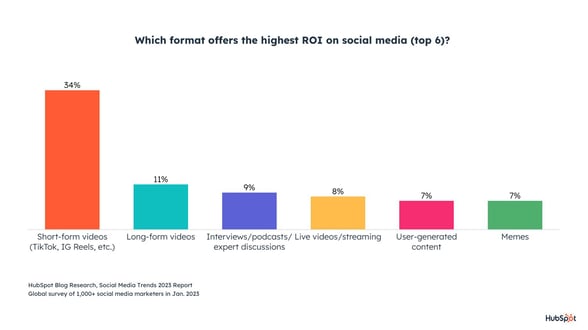 With this in mind, creating short-form videos is a worthwhile investment, and some common examples are TikTok videos, Instagram Reels, and YouTube shorts. The TikTok below is a video from Topicals, a skincare company, which talks about the different uses for one of its products.
Long-form video is also popular, but it doesn’t come close to the ROI of short-form. Live video gained steam during the pandemic, allowing people to participate in events remotely. Twitch is a popular live-streaming platform where people can interact with their favorite creators in real time.
2. Audio chat and live rooms.
Audio chat is another type of social media content, and many platforms have native features like Twitter Spaces, LinkedIn Live, or Facebook Live Audio. It’s also the top content type marketers plan to leverage for the first time in 2023.
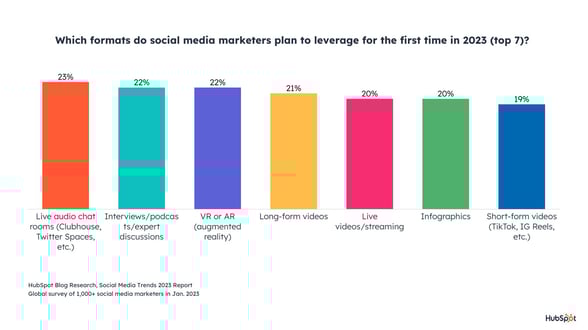 This makes sense, as audio chat rooms let brands directly communicate with audiences and develop closer relationships than seeing a billboard or watching a YouTube video. And, during a time when customers value connections with brands more than ever, audio chat rooms are a valuable tool.
Audio chat rooms are trendy among Gen Z. A Spotify study found that 80% of Gen Z enjoy audio content because it allows them to express their individuality and explore different sides of their personalities.
3. Content that represents brand values.
Content that represents brand values is anything that shares what your company stands for in addition to and outside of the products you sell, such as commitments to sustainable production practices, treatment of employees, or any causes you support.
Consumers care more than ever about what the brands they buy from stand for and the values they have. They want to know the causes that businesses support and the commitments made to bettering the world.
The image below is a Tweet from Ben & Jerry’s that expressed its commitment to environmentalism and combating climate change, which aligns with its stated core values of environmental protection.
Brand value content helps you draw in people whose values align with yours, and marketers also say that it has the 5th biggest ROI of any trend. 44% of marketers are also already posting this type of social media content.
4. User-generated content.
User-generated content (UGC) is content your audience creates that features your business/brand that is not paid for by your business. For example, someone shares a non-sponsored TikTok about how much they like your product or posts a picture wearing your clothing and tags your business.
This type of content is great to share on social media because it helps your audiences see that people use and like your products, vouching for you in a real-life way.
UGC pays off, as customers trust reviews from friends and family more than they trust branded ads, and 79% of people say UGC highly impacts their purchase decisions, considerably more so than branded content and influencer content.
When you do use UGC, the platforms it performs best on are Instagram, Facebook, and YouTube.
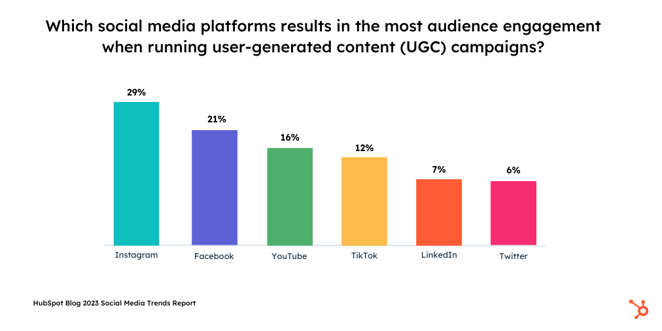
5. Funny, trendy, and relatable content.
Funny, trendy, and relatable content on social media can be hopping on viral memes, relating them to your business, and using trending hashtags or sounds. This type of content requires awareness of what’s happening on social media, cultural moments, and current events and creating buzzy content related to that.
36% of marketers already share funny, trendy, and relatable content on social media, and 66% say that funny content is the most effective, followed by relatable, trendy content. Consumers say that funny content is the most memorable.
6. Shoppable content.
Shoppable social media content allows consumers to browse through products on your accounts, discover things they like, and even make a purchase without leaving the app. The image below is an Instagram storefront for Ink Meets Paper, where someone can browse its products, find what interests them, and make a purchase.
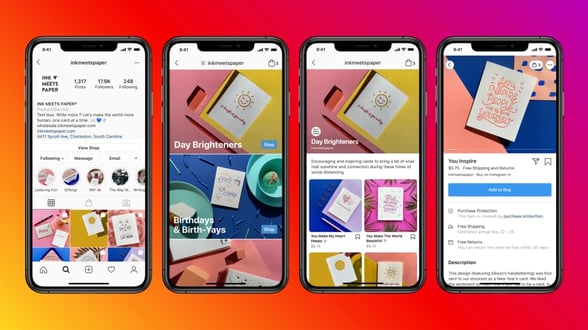
This is a valuable content type as social shopping is currently on the rise, and consumers are discovering new products and buying products on social media apps more than ever before.
In fact, social media is the most popular way for Gen Z, Millennials, and Gen X to discover new products, and over 1 in 5 have made an in-app purchase in the past three months. If you share shoppable content, the most effective platforms for selling in-app are Instagram and Facebook.
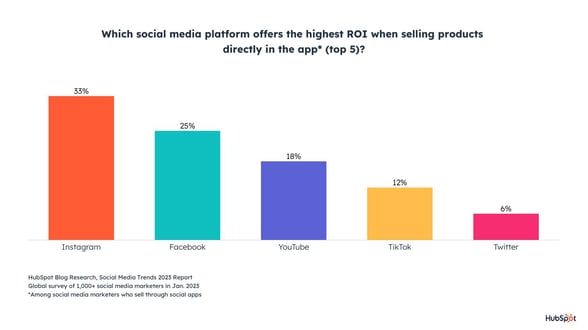
7. Educational content.
Educational content shares helpful information with audiences that helps them reach their goals and meet their needs. Educational content can come in infographics, videos, text-based posts, images — any of the content types we discussed in this post.
HubSpot often shares educational content through YouTube videos, where viewers can learn more about concepts of interest. The video below is a recent video that educates viewers on creating a brand style guide.
8. High-quality images
Images are a must on social media platforms, capturing attention and drawing people in. Images can be things like high-quality product photos or even a trending meme that relates to your business.
Our recent Marketing Strategy Report found that 47% of marketers leverage images as a media format and work well on all social media platforms.
9. Text-based content
We see text-based content on social media every day, like Tweets or thought-leadership posts on LinkedIn. The primary goal of text-based content is to share insight through text rather than an image or video. For example, you can pair a Tweet with an eye-catching image, but the point of the post is in the text.
Blogs are popular text-based content where people read longer posts and discover helpful information. Some popular types of blog posts are:
- How-to posts that introduce a problem, offer a solution, and discuss steps to reach a desired result.
- Lists posts that focus on a particular topic, offer several points, and provide a brief conclusion.
- What-posts that provide further information on a specific topic, with many articles surrounding comparisons of one thing to another.
- Why-posts that typically provide readers with a reason or purpose and provide details that support a focused conclusion.
10. Infographics
Infographics are a content type with the shareability and visual appeal of photos but are filled with helpful data and information. It’s an impactful form of social media content and educational content.
The image below is a post from HubSpot’s Instagram account that is an infographic that informs viewers about the most effective traits of a sales leader.
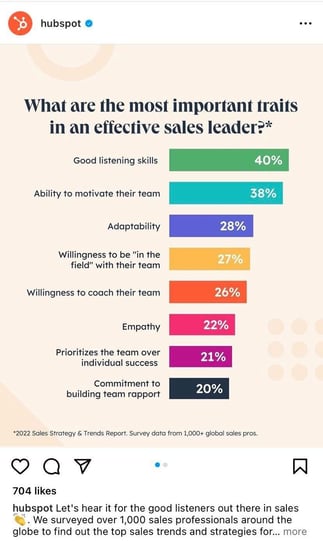
Infographics are effective, too, with 56% of marketers that regularly use them saying it’s their most effective content type.
11. Ephemeral/disappearing content.
Ephemeral/disappearing content is content that only stays up for a certain amount of time, like Instagram Stories that disappear after 24 hours. Users only have a set period to engage with it, so they might be more eager to keep track of your profiles and keep returning to experience what you share.
Creating quizzes and polls in your Stories is a great way to leverage this type of content. People only have a certain amount of time to respond, generating excitement and immediate action and inspiring respondents to come back and see results.
Repurposing Content Is Still A Valuable Strategy
Social media marketers say they use an average of four platforms, each with its best practices and norms to follow. It can be challenging to create individual pieces of content for every single platform, so many marketers share similar content on each platform but repurpose it to fit the tone and requirements of each one.
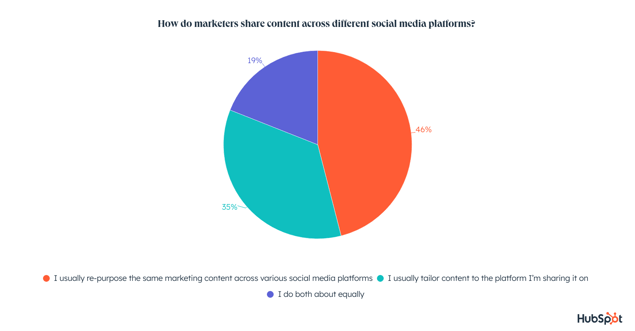 The key to success, however, is repurposing content, not resharing. People don’t look fondly at brands that share the exact same thing on each platform. 48% of marketers already share similar content across platforms with tweaks to make it more relevant to the platform’s demands.
Want More Social Media Insights?
Learn more about the State of Social media with more of this data, videos, and exclusive industry tips on our State of Social Media Hub— which will come with a free downloadable resource.

Which Social Media Channels See the Most ROI? [New Data + Expert Tips]
As any marketer knows, social media is an undeniably powerful tool to reach new audiences and connect with existing customers.
However, while it’s important to meet your audience where they are, it’s equally critical to know which social media channels offer the best ROI for your business.
Here, we’ll explore which channels provided marketers with the highest ROI in 2023. Plus, hear from experts at Talkwalker, Socialinsider, Casted, Brandfolder, LiveChat, Sprout Social, MarketingLabs, Rakuten Advertising, and HubSpot to learn how to leverage those channels to increase engagement and drive sales.
Let’s dive in.
Table of Contents
Which social media channels have the best ROI?
Which social media tactics or strategies have the best ROI?
What is social media ROI?
ROI stands for return on investment. When applied in the context of social media, it’s the return on investment from your social media activities and expenses.
One of the most popular ways to measure social media ROI is through paid advertising. That said, how you calculate ROI depends on the specific goals of your social media marketing and the metrics you use to measure it.
For instance, if your goal is to build brand awareness, you might prioritize metrics that demonstrate reach or engagement — such as new followers, impressions, audience growth rate, social shares, and more.
Check out this helpful guide to learn more about calculating social media ROI.
Which social media channels have the best ROI?
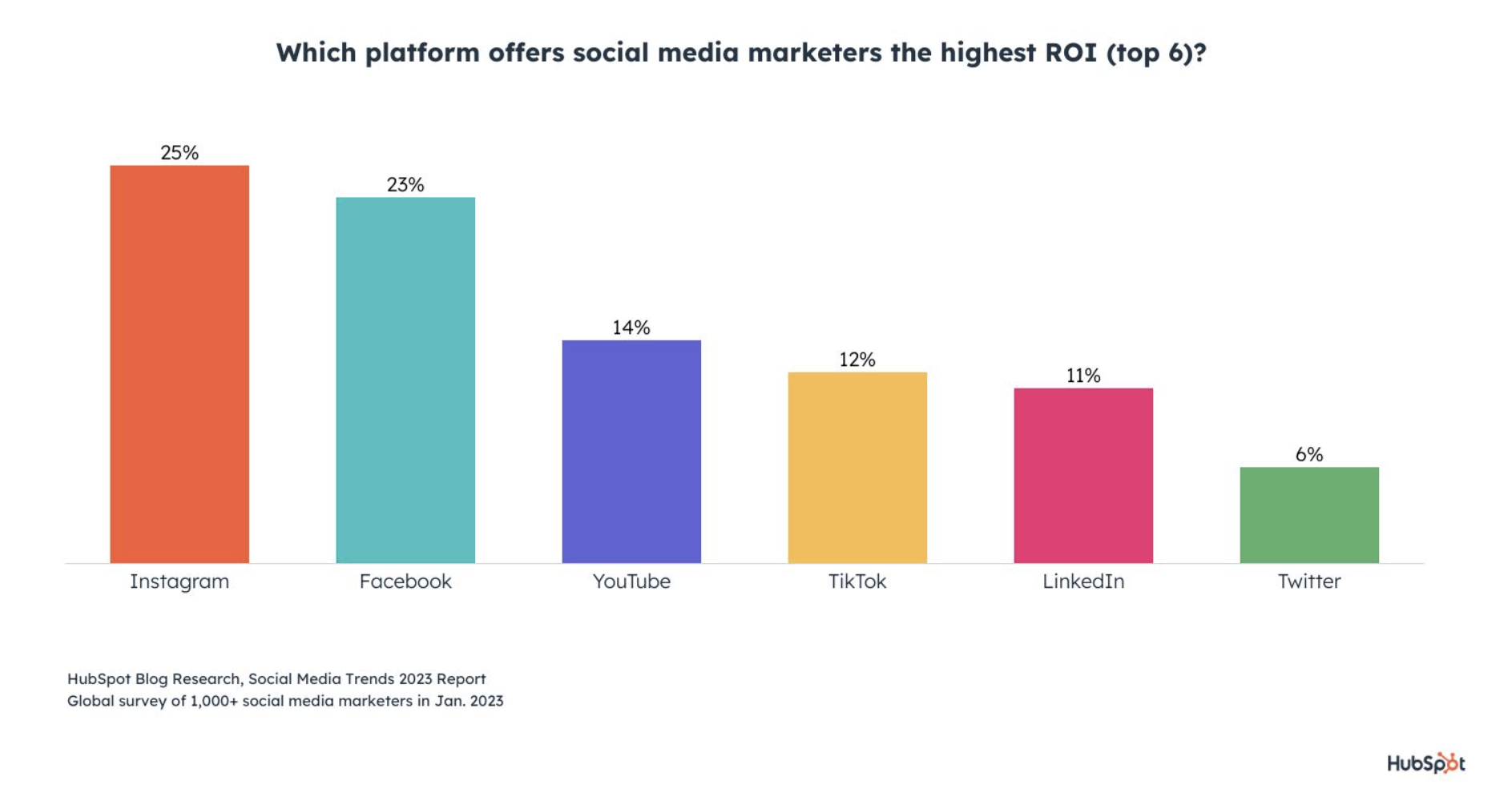
According to HubSpot’s 2023 Social Media Trends Report, Instagram is the social media channel that provides marketers with the highest ROI. Facebook, another Meta-owned platform, trails closely behind.
Marketers also cite Instagram as the most effective channel for engagement. It’s no surprise that more than half of marketers (52%) plan to increase their investment in the platform in 2023.
By comparison, other social channels in the list — including Twitter, Snapchat, and BeReal — all ranked much lower, with less than 10% citing each platform as the best channel for ROI.
Let’s dive into each of these platforms to uncover why the top 3 social media sites perform better than others when it comes to ROI — and how you can leverage them.
1. Instagram
Recently surpassing two billion monthly active users, Instagram lands the top spot for ROI. Let’s explore why.
Instagram offers marketers the ability to increase reach and boost sales from non-organic content, such as Instagram Ads and branded content. However, it also shines when it comes to generating ROI from organic content.
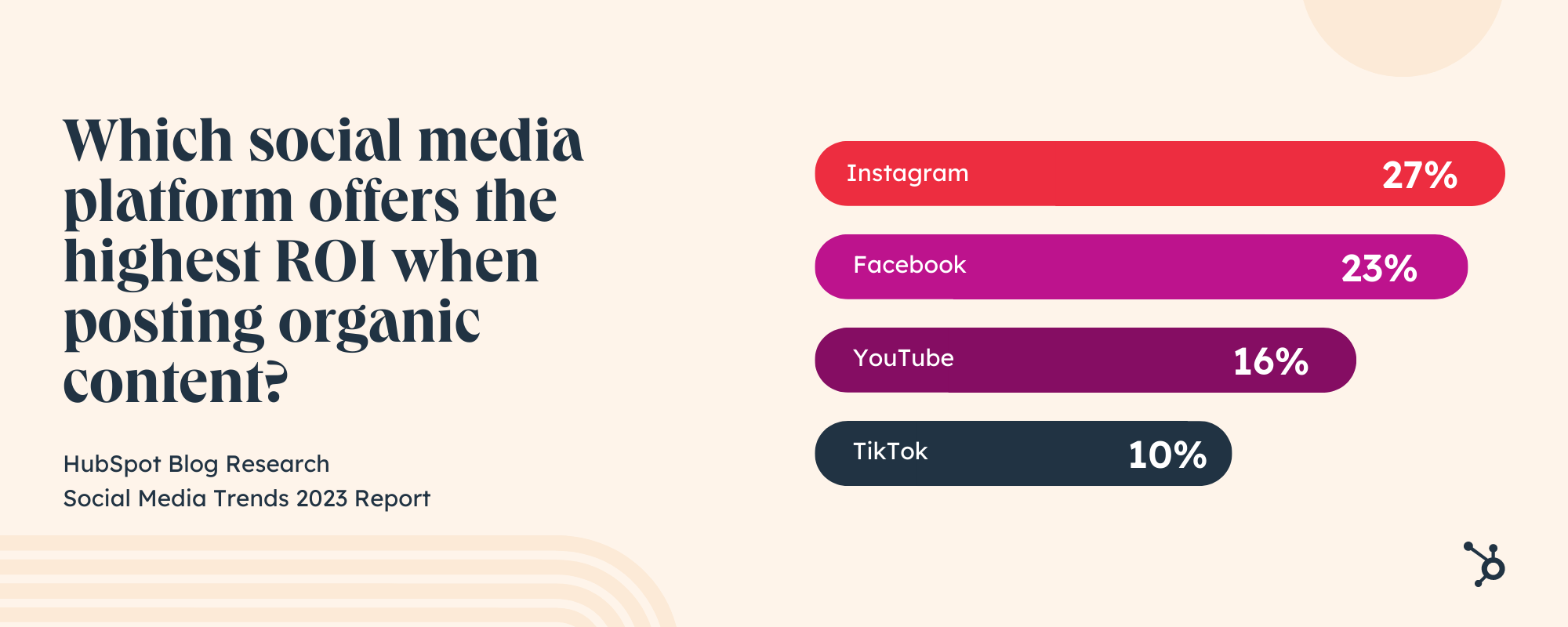
As Instagram continues to expand its e-commerce capabilities, it’s become an effective tool for generating business. In fact, 90% of users follow at least one business on Instagram, and 50% of users are more interested in a brand after seeing ads for it on Instagram.
Instagram is also top-dog in the influencer marketing space. Last year, it was the most popular platform for influencer marketing in the U.S. – and more marketers are planning to leverage Instagram for their campaigns in 2023.
2. Facebook
Facebook is the most popular social media platform worldwide right now, drawing more than 2.89 billion monthly active users. In short, Facebook has an undeniably impressive reach. It also offers advertising opportunities to more than 200 million businesses, making it one of the most popular advertising platforms.
With Facebook, marketers can advertise on a user’s News Feed, via Messenger or video, and more. Marketers can also leverage Facebook Lead Ads to encourage Facebook users to fill out a lead generation form without leaving the social platform.
One of the major benefits of Facebook’s advertising tools is its segmentation abilities. You can target your ads towards certain audiences depending on interests, demographics, behaviors, or even connection to your business — like whether they’ve attended one of your events, or have friends who’ve liked your Business Page.
Nicole Ondracek, HubSpot’s Paid Advertising Marketing Manager, agrees that Facebook is an incredibly viable channel.
“At HubSpot, Facebook is a valuable channel for us in driving return on ad spend. A main reason why is that we can provide our content to a relevant audience using Facebook’s audience targeting features. For instance, Facebook’s lookalike audiences allow us to go after people who look like our current customers,” she told me.
“Facebook’s algorithm is great at finding similar audiences who are likely to convert, which is why we see a positive return on investment going after these types of audiences.”
Take a look at HubSpot’s How to Run Facebook Ads: A Step-by-Step Guide to Advertising on Facebook to learn how to set up your own Facebook ads.
3. YouTube
YouTube receives a staggering 34 billion monthly visits and commands an audience of 2+ billion people. Based on these stats alone, there’s a good chance your audience is on YouTube.
Unsurprisingly, 47% of marketers plan to increase their investment in YouTube in 2023. It’s also no coincidence that more than half of marketers (54%) say long-form content is effective on social media – and YouTube is the undisputed hub for this type of content.
Another notable advantage of YouTube is its popularity across demographics. For instance, in the last three months, 83% of Millennials have visited YouTube, followed by 81% of Gen Z, and 79% of Gen X. For Baby Boomers, YouTube is their second favorite social media app.
4. LinkedIn
Despite only roughly 10% of marketers rating LinkedIn as their top channel for ROI, LinkedIn is an incredibly effective channel for lead generation and nurturing. Over 750 million professionals use LinkedIn for networking, career advancement, and more.
The platform offers a variety of tools designed to increase your business’ ROI, including Sponsored Content, Sponsored Messaging, Text or Video ads, and more.
To succeed on the platform, you’ll want to create valuable content that resonates with your LinkedIn audience. Conduct research to determine which types of content perform best on LinkedIn — and which content will perform best with your target audience — to ensure you’re hitting the mark here.
Additionally, try running experiments when you start using LinkedIn’s advertising tools. For instance, Cellular IoT Connectivity company Aeris set up an ad plan and tracker to determine which targeting combinations worked best for the brand, which failed, and which generated the highest-quality leads. As noted in this post, “It took rounds of testing and optimization to get to [the brand’s] 25% submission rates.”
Now that we’ve explored a few of 2023’s most popular social channels, let’s explore the strategies and best practices you can implement to increase your ROI across platforms, according to experts.
Which social media tactics or strategies have the best ROI?
1. Conducting extensive research to understand your audience.
First and foremost, it’s vital you understand your audience before creating any social media campaign. If you don’t do your research, you risk spending time, money, and resources on the wrong channels — and missing out on more profitable connections elsewhere.
As Dan Seavers, Content Marketing Manager at Talkwalker, told me, “No matter the social media channel, the best way to increase your ROI is by improving your consumer intelligence. Get to know your customers better than your family, and understand what they’re saying about your products, and where they’re discussing them.”
“That way, when you launch a campaign, you’ll be hyper-relevant. Not a jarring ad that interrupts a customer’s life, but a well-timed, well-targeted experience that people will engage with instantly.”
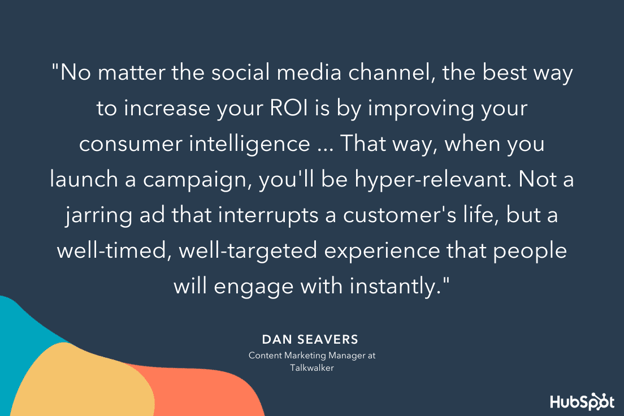
2. Creating more video content — and testing out vertical videos.
People love videos – and yet, it seems most brands rely on images when advertising their products or services, and that’s a mistake.
Adina Jipa, co-founder of Socialinsider, told me, “The most underused social media post is video content, which boosts engagement across all social media platforms.”
“Facebook wants to become a video-first platform and favors pages with video content, but for most brands, it is [primarily] a photo-sharing platform.”
Jipa adds, “A recent study about Facebook video strategy shows that only roughly 15% of the content [on Facebook] is video, while photos represent 38.58%.”
To stand out and increase ROI, consider how you might incorporate video into your social media efforts.
Additionally, consider testing out different types of video formats across your channels. For instance, Facebook offers brands the opportunity to create vertical video ads for the mobile-friendly user.
As Jipa points out, “you can use vertical videos on ads to get more clicks. According to this poll, almost 69% of marketers say video ads outperform image and plain text ads on Facebook. 81% of Facebook users only access the platform via mobile devices, so using the vertical video format allows you to get more visibility and increase the chances of getting more clicks. Facebook videos ads can increase the CTR by 2-3X.”
3. Re-using content across channels.
Most social teams create content in silos. Perhaps they tell one message via an Instagram post, and then create entirely different materials for a YouTube video or Tweet.
This undoubtedly requires a lot of time, effort, and resources — which can become frustrating when you don’t see the ROI you need from these channels.
“Far too often, content is created for one-and-done campaigns or promotions,” Casted’s CEO and Co-founder Lindsay Tjepkema says. “This means marketers are working harder and harder to constantly produce more and more, yet ROI and ROE (return on effort) results are disappointing — and social is no exception.”
She continues, “To change this, we must stop creating content for content’s sake and start focusing instead on creating content that educates, entertains, and delights and can be broken down and amplified across all other channels — like social — not just once, but many times over. When you focus on creating engaging content that can be used in multiple ways across channels, you’ll see improved ROI and ROE (return on effort) across your campaigns — including your social activation.”
To repurpose your content across channels, perhaps you post snippets of a full YouTube video on Facebook or Instagram. Alternatively, maybe you take text from a blog post and re-post on your channels to add value from your existing content, repurpose user-generated content across channels.
There are countless ways to refresh and re-use content to appeal to new audiences in unique ways without exhausting your social team.
4. Setting clear goals and devising a social strategy that works for your brand.
It’s difficult to achieve results on social without taking the time to set clear goals for your team, and ensuring you’ve all discussed an appropriate strategy to get you there.
As Brandfolder’s Senior Digital Marketing Manager Amanda Turcotte told me, “In order to achieve a return on your social media investment, you must have clear goals set before any tactical planning takes place. Various social media tactics can be applied differently to each of the platforms, meaning they’ll produce different outcomes. So your goals need to be determined up front to ensure they’re aligned with your social strategy.”
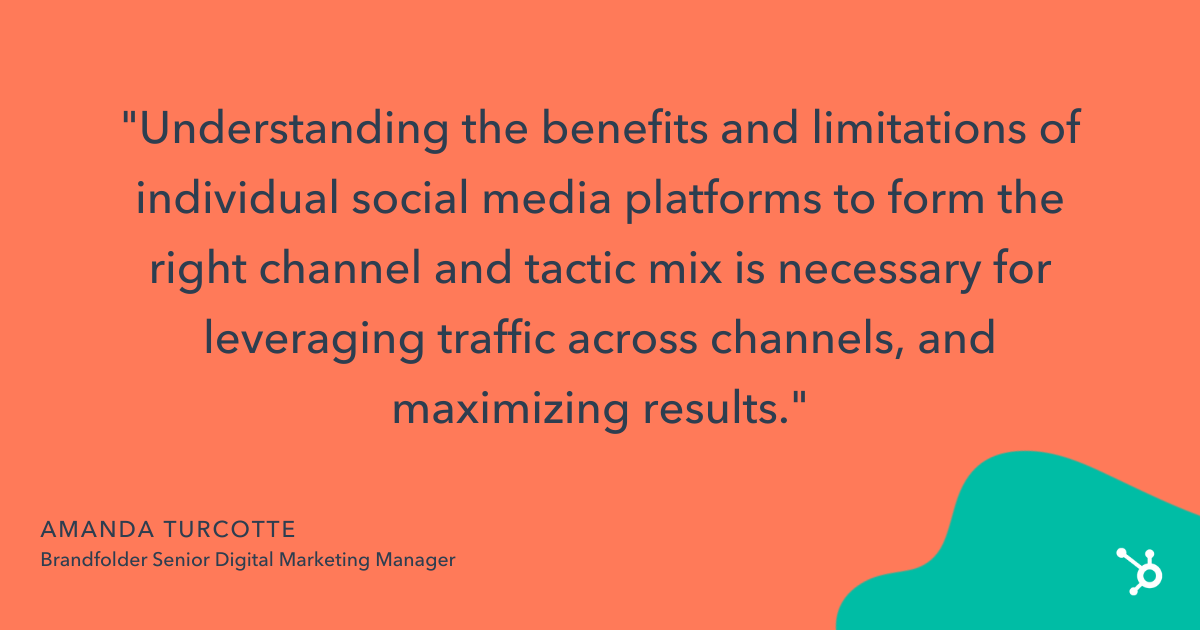
Once you’ve determined your social goals, you’ll want to create a consistent posting strategy so your audience knows when, and how often, they can expect content from your brand. To make this easier, try using a social posting tool like HubSpot’s Social Inbox Tool or Later.
Turcotte told me, “In order to move your team from strategy to action and keep everyone on the same page, it’s crucial to develop a regular posting plan that documents your approach across each channel, located where all team members have access. “
Agnieszka Jaśkiewicz, Head of Social Media & Community at LiveChat, agrees that creating a strategy and using tools to support your team’s goals is critical for finding success on social channels.
As she puts it, “The greatest area of ‘untapped potential’ for most brands comes in the form of streamlining creative workflows to support the volume needed for quality social activity. Digital workspaces that allow creatives and marketers to collaborate from a central location to stage, revise, and produce content limits back-and-forth communication and unnecessary steps in production.”
Additionally, Jaśkiewicz says, “Digital templates for creative assets — set to the specifications of the organization’s core social media platforms — can also add agility to social media managers’ ability to publish, allowing teams to be more timely and quickly act on new opportunities.”
5. Allow your users to purchase your products or services on social media platforms.
Over the past few years we’ve seen rise to a new trend: social commerce.
In essence, social commerce is the ability to purchase from a brand within a social platform without leaving the site. Examples include shoppable ads and chatbot checkout.
Rachael Samuels, Senior Manager of Social Media at Sprout Social, told me she sees social commerce as a great opportunity to increase ROI on social channels.
Samuels says, “Social media has quickly become a primary communication channel for brands and consumers alike. As a result, marketers must seek new ways to engage with audiences while keeping other goals, such as lead generation, top of mind.”
“One way we’re seeing this unfold is through offerings like social commerce, which not only provide more seamless buying experiences for customers, but equip marketers with the ability to show direct attribution and ROI as a result of their efforts.”
Samuels adds, “To maintain this momentum, marketers should ensure their tech stack enables them to integrate their CRM and social management tools so they can easily surface social insights with their broader sales and support teams.”
6. Use UTM tags for tracking.
One reason you might not be seeing the ROI you’re hoping for? Perhaps you’re just not tracking properly.
As Matt Janaway, CEO of MarketingLabs, told me: “Tracking is now more important than ever thanks to the complications of iOS privacy improvements, so to really yield the best ROI, you have to make sure you are using UTM tags on all links. This way, you can correctly track the performance of your campaigns in Analytics.”
Janaway adds, “This should give you the data you need to make decisions that can drive more engagement and ROI.”
7. Encouraging your employees to become brand ambassadors.
One area of major untapped potential? Your employees.
As Casted’s Tjepkema tells me, “Employee activation is a huge and mostly untapped resource for brands. As consumers, we’re far more driven to engage with user-generated content, yet so many brands spend too much time and money trying to only push content from their own brand instead of enabling their employees (and partners, brand fans, etc.) to amplify their content.”
“Rally your employees around the content you’re creating and encourage them to share it with captions that show their unique and personal perspectives. This is a great way to help each member of your team build their personal brand, while also amplifying your content to audiences in a more authentic way.”
LiveChat’s Jaśkiewicz agrees with this notion, saying, “[You should] give employee advocacy a bigger seat at the table in your social media strategy, especially when it comes to LinkedIn. It takes some time and effort to provide people with the knowledge and imply the ‘brand ambassadors’ mindset in the organization — however, employee engagement is a cost-effective way to increase your reach organically.”
HubSpot, for instance, created #HubSpotEmployeeTakeover on its HubSpot Life Instagram account. The campaign helps show audiences the faces behind the brand, and creates a sense of community and authenticity that you wouldn’t find with branded content alone.

8. Leverage Meta’s Advantage+ Shopping Campaigns.
It’s no secret that Meta’s suite of platforms — namely Instagram and Facebook — packs a huge ROI punch. Yomi Arokoyo, VP of Performance Solutions at Rakuten Advertising, attributes this to Meta’s powerful algorithm.
He tells me, “Each social platform has improved its algorithm over time to be more intuitive and automated, but none more than Meta. With Meta’s new tool Advantage+ Shopping Campaigns, brands can find new customers in places they never even thought to look.”
Launched globally in 2022, Advantage+ Shopping Campaigns largely rely on AI and automation to find the right audience for your ads (as opposed to manual targeting). On top of that, it even adjusts ad formats to understand which format performs best.
To take advantage of this new tech, Arokoyo recommends employing as much creative differentiation as possible. For instance, add old creatives into the mix, or cut up longer videos into smaller, more digestible clips. This gives the algorithm more data to determine which campaigns are effective.
Back to You
Increasing ROI across your social channels won’t happen overnight — but by applying these strategies and remaining dedicated to iterating on your strategy as you collect audience insights over time, you’ll surely begin to see stronger results from your social efforts.
Happy posting!

The 12 Best Cover Letter Examples: What They Got Right
Fun is not something typically associated with writing a cover letter. However, with a few tweaks, writing one doesn’t have to be a burden.
The cover letter examples below demonstrate that it is possible to have a little fun with your job search — and maybe even make yourself a better candidate in the process.
![→ Click here to access 5 free cover letter templates [Free Download]](https://no-cache.hubspot.com/cta/default/53/3f347702-d7e9-4e59-9fe4-be4cd7bad191.png)
It may be true that only 35% of recruiters admit that cover letters do not materially influence the hiring process for them, but that doesn’t mean yours has to contribute to that statistic. In fact, it might be that cover letters are deemed insignificant because so few of them stand out. Here’s an opportunity for you to exercise your creativity at the earliest stage of the recruitment process.
Personalization, after all, goes beyond replacing the title and company name in each letter you send to recruiters.
What’s on a cover letter?
Before you can get started writing your cover letter, there are a few components you must have.
Greeting: A simple, but pleasant greeting to address the recruiter or hiring manager.
Opener: Write a catchy introduction that explains why you’re interested in the role.
Summary of Skills/Qualifications: This is the heart of your cover letter. It outlines your relevant experience and why you’d be a great fit for the role. You can highlight special skills, experiences, professional achievements, or education to help make your case.
Closing: In this paragraph, provide a call-to-action by expressing interest in an interview. Provide your contact information and sign-off.
What does a cover letter look like?
In addition to showing off your skills and qualifications, cover letters give you the opportunity to present a clear, concise, and compelling writing sample that shows off your personality and ability to convey ideas. Check out our fillable examples below to see how you should organize the content of your cover letter.
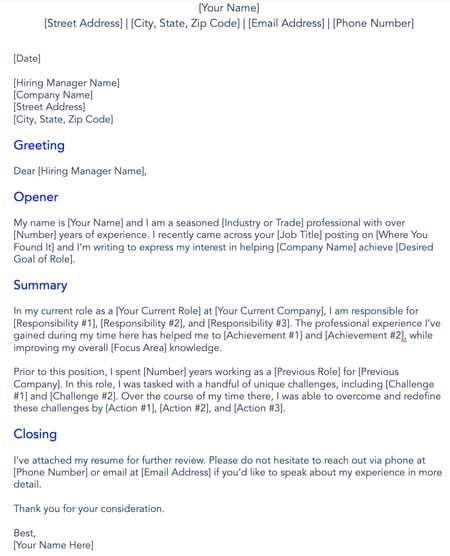 Customizable Cover Letter Examples
In a hurry for a cover letter example you can download and customize? Check out the ones below from HubSpot’s cover letter template kit.
1. Standard Cover Letter Example
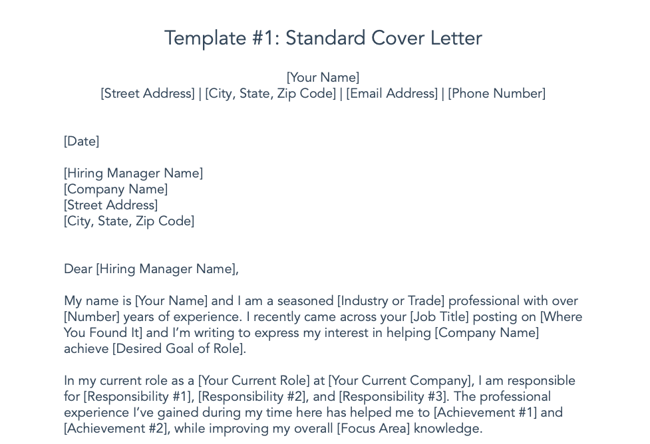 Download a Customizable Copy of This Cover Letter Example
This standard cover letter hits all the right notes: It includes a space to give a brief summary of your experience, as well as a space to delve in-depth into the specific responsibilities at your current role. You also have the chance to describe the challenges you’ve mastered at previous roles, showing that you’re capable of facing any problem that comes your way.
Why We Love It
We love this cover letter because it allows you to describe the high points of your career while still being professional, personalized, and succinct.
2. Data-Driven Cover Letter Sample
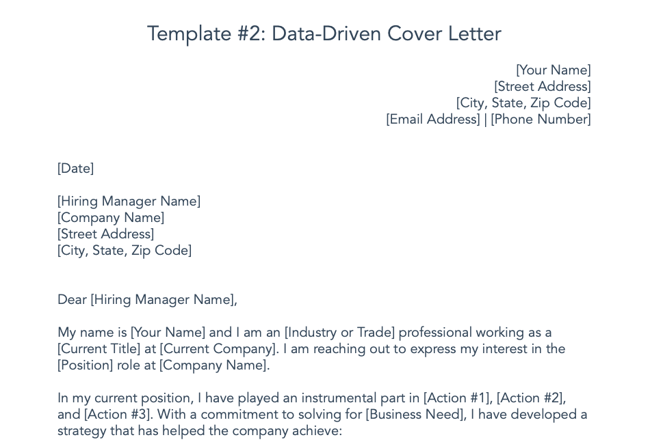 Download a Customizable Copy of This Cover Letter Example
Numbers are worth a million words — or that’s how the saying should probably go (if only we could include pictures in cover letters). Citing data and statistics about your achievements at your current company is an assured way to capture a hiring manager’s attention. Most hiring managers don’t read the entire letter, so a bulleted summary of your achievements can be a powerful way to increase the effectiveness and scannability of your message.
Why We Love It
We love this cover letter because it’s adaptable to any role. Even if you don’t work in a data-centric role, you can include any enumerable achievement. If you’re in a creative industry, for instance, you can include the number of creative assets you designed for your current company.
3. Entry-Level Cover Letter Example
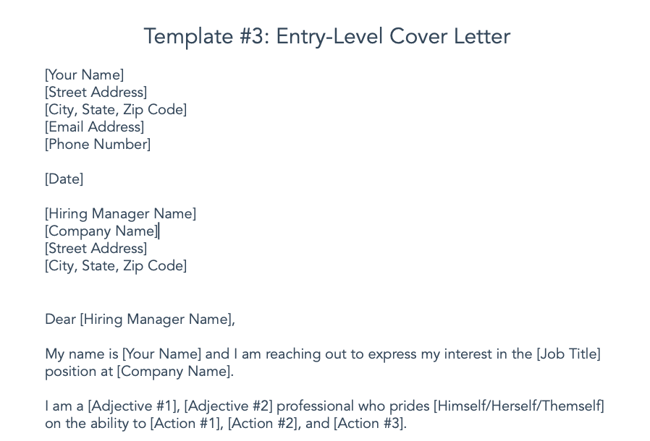
Download a Customizable Copy of This Cover Letter Example
Applying to your first job can be stress-inducing, to say the least. You can increase your chances of getting that first interview by including a cover letter that explains how your education can help you succeed in the role you applied for.
Look no further than this example from HubSpot. While other cover letter samples give experienced professionals the opportunity to share their experience at length, this one gives you the chance to describe your personal and professional attributes. You can then convey how you can leverage your knowledge to help your target company reach their goals.
Why We Love It
We love this cover letter because it’s easy and simple to use for a student who has little experience in their target industry — including those who haven’t yet completed an internship.
Looking for more? Download the entire kit below.
Best Cover Letter Examples
What does a good cover letter look like in practice, and how can you make yours stand out? We found six examples from job seekers who decided to do things a bit differently.
Note: Some of these cover letters contain real company names and NSFW language that we’ve covered up.
1. The Cover Letter That Explains ‘Why,’ Not Just ‘How’
We’ve already covered the importance of addressing how you’ll best execute a certain role in your cover letter. But there’s another question you might want to answer: Why the heck do you want to work here?
The Muse, a career guidance site, says that it’s often best to lead with the why — especially if it makes a good story. We advise against blathering on and on, but a brief tale that illuminates your desire to work for that particular employer can really make you stand out.
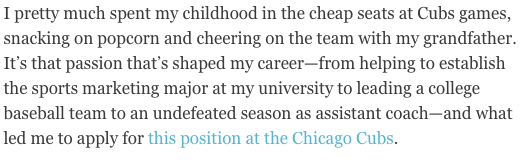
Here’s another instance of the power of personalization. The author of this cover letter clearly has a passion for this prospective employer — the Chicago Cubs — and if she’s lying about it, well, that probably would eventually be revealed in an interview.
Make sure your story is nonfiction and relatable according to each job. While we love a good tale of childhood baseball games, an introduction like this one probably wouldn’t be fitting in a cover letter for, say, a software company. But a story of how the hours you spent playing with DOS games as a kid led to your passion for coding? Sure, we’d find that fitting.
If you’re really passionate about a particular job opening, think about where that deep interest is rooted. Then, tell your hiring manager about it in a few sentences.
Why This Is A Great Cover Letter
This example demonstrates how effective personalization can be. The writer is passionate about the employer, drawing from her own childhood experience to communicate her enthusiasm.
2. The ‘We’re Meant for Each Other’ Cover Letter
This cover letter example is a special one because it was submitted to us here at HubSpot. What does the letter do well? It makes a connection with us before we’ve even met the letter’s author.
.png)
“Content Marketing Certified” indicates the applicant has taken the content marketing certification course in our HubSpot Academy (you can take the same course here). Our “records” indicate he/she did indeed give an interview with us before — and was a HubSpot customer.
The cover letter sang references to a relationship we didn’t even know we had with the candidate.
The letter ends with a charming pitch for why, despite him/her not getting hired previously, our interests complement each other this time around.
(Yes, the applicant was hired).
Why This Is A Great Cover Letter
This cover letter example does an excellent job of building rapport with the employer. Despite not getting hired for previous roles they applied for at HubSpot, the writer conveys exactly why they are right for this role.
3. The Cover Letter with H.E.A.R.T.
HubSpot has a lot of H.E.A.R.T. — Humble, Empathetic, Adaptable, Remarkable, Transparent. Our Culture Code is the foundation of the company’s culture, the driving force behind our mission to help millions grow better, and serves as the scaffolding for our hiring practices. Recruiters at HubSpot look for applicants that demonstrate how they embody the Culture Code and job description, paying extra attention to cover letters that are super custom to HubSpot.
In another HubSpot submission, a HubSpot applicant writes about how she found out about HubSpot, why she likes the company, and how her professional experience aligns with H.E.A.R.T.
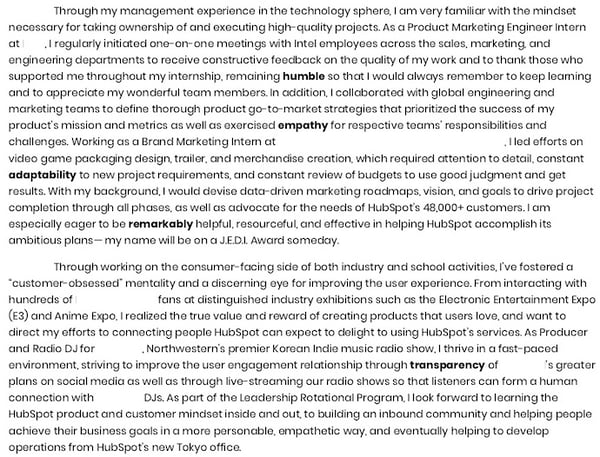
Why This Is A Great Cover Letter
HubSpot’s recruiting team was impressed with her dedication to the company and how she went beyond what was asked for by linking her portfolio in her closing paragraph.
Featured Resource: 5 Free Cover Letter Templates
Download our collection of 5 professional cover letter templates to help you summarize your professional journey and land your dream job – whether it’s at your first or fifth company.
Short Cover Letter Examples
4. The Short-and-Sweet Cover Letter
In 2009, David Silverman penned an article for Harvard Business Review titled, “The Best Cover Letter I Ever Received.” That letter contained three complete sentences, as follows:
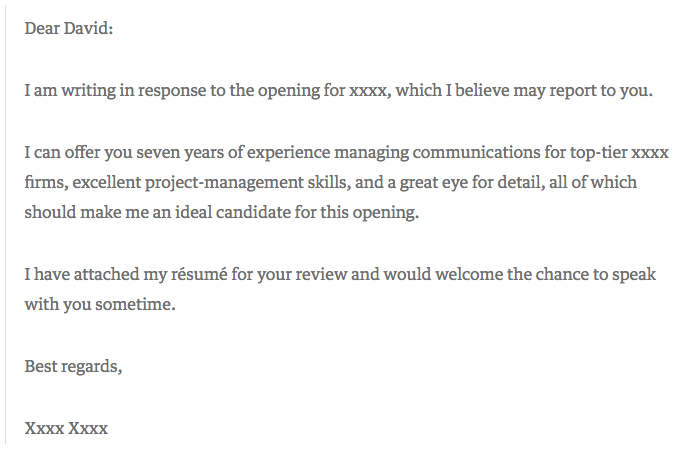
One might argue that this particular letter is less than outstanding. It’s brief, to say the least, and the author doesn’t go into a ton of detail about what makes him or her qualified for the job in question. But that’s what Silverman likes about it — the fact that the applicant only included the pieces of information that would matter the most to the recipient.
“The writer of this letter took the time to think through what would be relevant to me,” writes Silverman. “Instead of scattering lots of facts in hopes that one was relevant, the candidate offered up an opinion as to which experiences I should focus on.”
When you apply for a job, start by determining two things:
- Who might oversee the role — that’s often included in the description, under “reports to.” Address your letter to that individual.
- Figure out what problems this role is meant to solve for that person. Then, concisely phrase in your cover letter how and why your experience can and will resolve those problems.
Why This Is A Great Cover Letter
The key to this standout cover letter is research — by looking into who you’ll be reporting to and learning more about that person’s leadership style, you’ll be better prepared to tailor your cover letter to focus on how you provide solutions for them.
5. The Short Story
Basha Coleman began her cover letter with a short story. The goal of this short story is two-fold:
- Detail the experience she already has with the organization.
- Stand out to the hiring team.
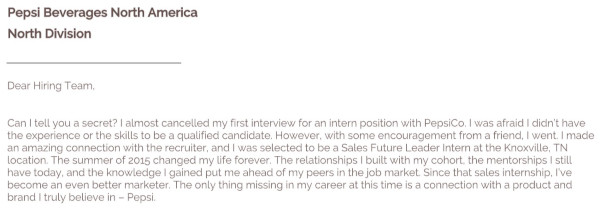
You’ll notice that her short story follows a typical narrative arc: It has a conflict/obstacle, a turning point, and a positive outcome, all created with a goal to emphasize a theme or point. In this case, Coleman is emphasizing her existing affinity with the brand and her triumphs within the program so that she can continue on her career path.
Why This Is A Great Cover Letter
Like the second example in our list, this cover letter does an excellent job of conveying the applicant’s existing affinity for the brand. If you are applying to a company you love, don’t be shy about showing it and explaining why.
6. The Bare Bones Cover Letter
In today’s job market, cover letters aren’t always necessary. Even though many recruiters won’t ask for or even read them, cover letters can still be effective and convey personality to a reader. Writing a strong cover letter can help you better convey your interest in the position and company.
This template from The Balance Careers puts together the essential components of a short cover letter: excitement about the position, your qualifications, and a call-to-action for the recruiter to follow up with you. Combining these central aspects in a well-written, compelling narrative will go a long way in convincing readers to hire you.
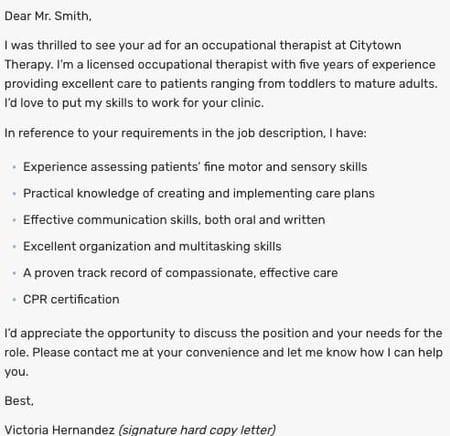
Why This Is A Great Cover Letter
This letter is organized and concise. The inclusion of bullet points to highlight key skills and help the recruiter skim the document is a nice touch.
7. The Breezy Follow-Up
In this cover letter, Amanda Edens is following the instructions the hiring manager gave by forwarding an email with resume and writing samples attached.
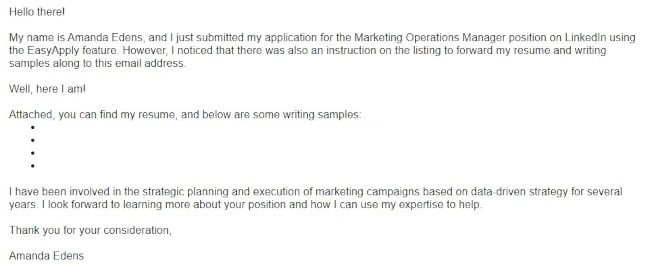 Edens knows that the body of the email is prime real estate to get the hiring manager’s attention, but she also doesn’t want to overwhelm the recipient with too much information since a cover letter was not requested. This short cover letter is the result. You’ll notice that she uses casual and breezy language to convey personality and enthusiasm, and she keeps her paragraphs succinct.
Why This Is A Great Cover Letter
Not only does Amanda provide links to relevant writing samples that are live on the web, but she also closes with a strong final paragraph that:
- Summarizes the expertise she has relevant to the posting
- Emphasizes that she doesn’t want to simply get a job but rather help the organization accomplish their goals
- The reader gets everything they need in an organized and thoughtful manner.
8. The Administrative Assistant Cover Letter
In this cover letter the candidate, Brenda, plays up her prior music industry experience to build a connection with Epic Music Group. If you have specific industry experience for the role you are applying for, be sure to highlight that.
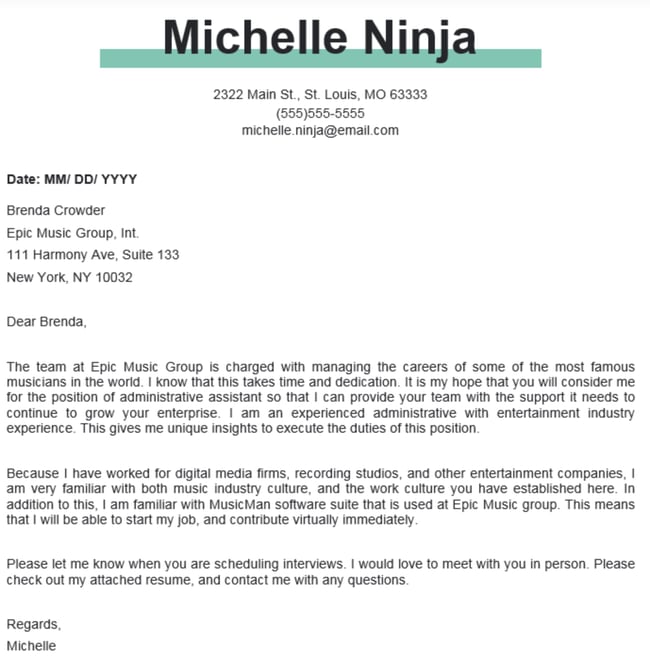
It’s clear that she’s passionate about not only the music industry, but Epic as a whole. She’s done so much research on the company that she knows what software programs they use, and happens to be proficient in it to help convey value to the hiring manager.
This example further illustrates the importance of research. Make sure you understand the culture of the company to which you’re applying before you send a completely unfiltered cover letter — if you don’t, there’s a good chance it’ll completely miss the mark.
Why This Is A Great Cover Letter
In just three short paragraphs, the applicant uses their company research to drive home why they are the perfect fit for the role — emphasizing industry experience as well as software knowledge specific to the company. All of this communicates that she’d be able to start with very few hiccups getting up to speed.
9. The Internship Cover Letter
Maybe you’re just getting started in your career and looking to land the right internship to gain experience in your field. In this case, you’ll need to highlight more of your educational background and transferable skills since you won’t have as much professional experience to highlight.
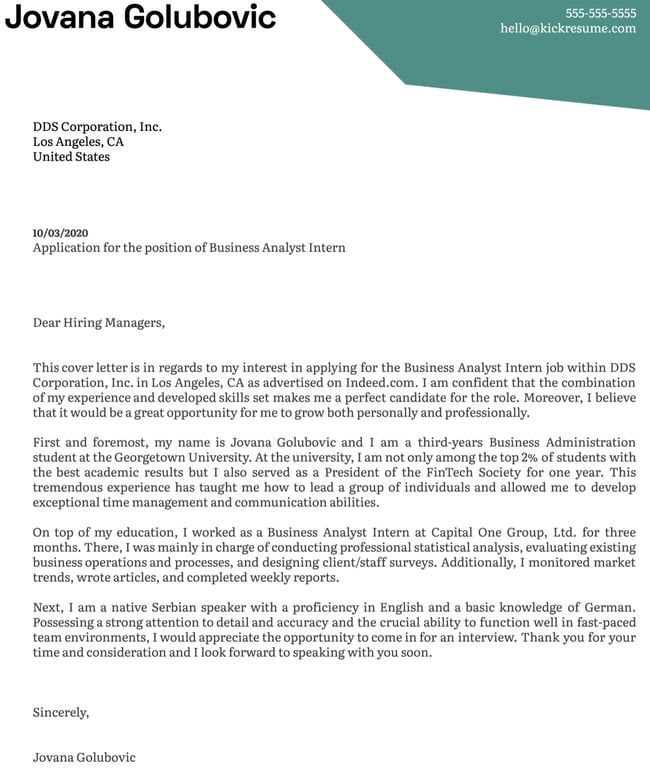
The cover letter above is a great example of how to emphasize your skills and accomplishments when applying to internships or entry-level positions. A few things the applicant does well:
- Highlights relevant extracurriculars and affinity networks. In this case, the applicant is applying to a business analyst position, so mentioning their involvement in a FinTech group makes sense.
- Previous internships in relevant fields: Our applicant points out that they’ve previously interned as a Business Analyst at another firm. Pointing out that they’ve done the role previously will help make their case for fit.
- Highlight other useful skills: This applicant is fluent in both English and German. If an international company or an organization needs bi-lingual support, knowing multiple languages is an asset.
Why This Is A Great Cover Letter
This cover letter example illustrates how you can leverage your education and background to get the gig even when you don’t have much working experience. Highlighting previous internships or experience in related fields can go a long way in convincing hiring managers you’re the perfect candidate for the role.
Creative Cover Letter Examples
10. The Brutally Honest Cover Letter
Then, there are the occasions when your future boss might appreciate honesty — in its purest form. Livestream CEO Jesse Hertzberg, by his own admission, is one of those people, which might be why he called this example “the best cover letter” (which he received while he was with Squarespace):
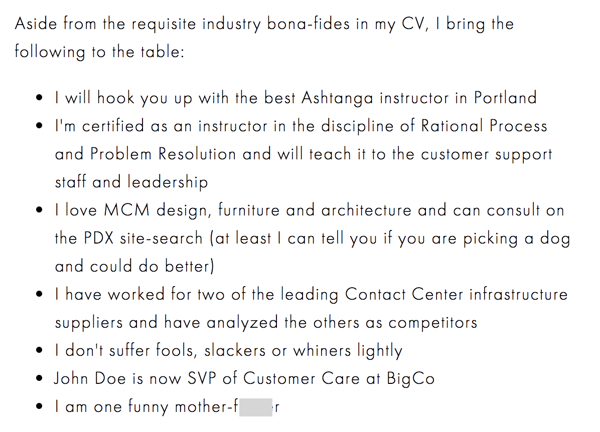
As Hertzberg says in the blog post elaborating on this excerpt — it’s not appropriate for every job or company. But if you happen to be sure that the corporate culture of this prospective employer gets a kick out of a complete lack of filter, then there’s a chance that the hiring manager might appreciate your candor.
“Remember that I’m reading these all day long,” Hertzberg writes. “You need to quickly convince me I should keep reading. You need to stand out.”
Why This Is A Great Cover Letter
The applicant did their research on the company’s culture and executed this cover letter flawlessly. It’s funny and shows off the applicant’s personality all while demonstrating why they are a good fit for the role.
11. The Pivot Cover Letter
Making a career switch? Your cover letter can be an excellent opportunity for you to explain the reasoning behind your career change and how your transferable skills qualify you for the role.
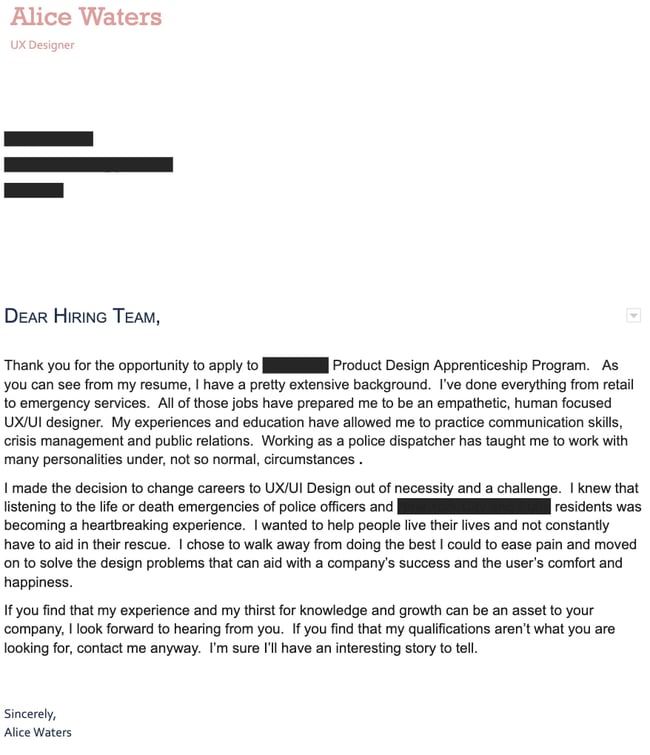 In this cover letter example, the applicant is pivoting to a career in UX. Not only does she make the case for why she should be hired, she shows the recruiter by using a simple, but effective design scheme that shows off her skills. It’s clean but effective.
Since the role she is applying for is more visual, it’s important to both show and tell why you’re a good fit.
Why This Is A Great Cover Letter
This cover letter strikes the perfect balance between creativity and simplicity in design while putting the applicant’s career change into context. The copy is clean, with a creative font choice that isn’t distracting from the content, but still demonstrates the applicant’s knack for design.
12. The Graphic Design Cover Letter
When applying for more creative roles, the design of your cover letter can say just as much as the words on the page. Take the graphic designer letter example below.
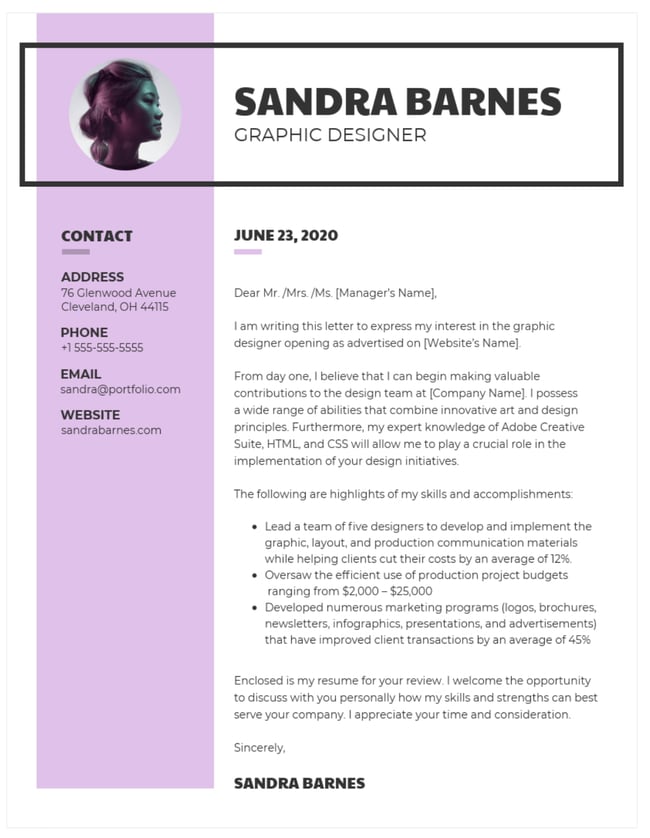
It’s got so much going for it:
- Pop of color
- Clean layout
- Interesting fonts
In addition to the style elements, this example also doesn’t skimp on the key skills recruiters are looking for. Using metrics, the applicant demonstrates their value and why they would be a great fit.
Why This Is A Great Cover Letter
This cover letter thoroughly conveys the applicant’s skills and qualifications using a variety of visual elements and by emphasizing their greatest achievements.
Take Cover
We’d like to add another stage to the job search: experimentation.
In today’s competitive landscape, it’s so easy to feel defeated, less-than-good-enough, or like giving up your job search. But don’t let the process become so monotonous. Have fun discovering the qualitative data we’ve discussed here — then, have even more by getting creative with your cover letter composition.
We certainly can’t guarantee that every prospective employer will respond positively — or at all — to even the most unique, compelling cover letter. But the one that’s right for you will. That’s why it’s important not to copy these examples. That defeats the purpose of personalization.
Editor’s note: This post was originally published in October 2020 and has been updated for comprehensiveness.

SWOT Analysis: How To Do One [With Template & Examples]
As your business grows, you need a roadmap to help navigate the obstacles, challenges, opportunities, and projects that come your way. Enter: the SWOT analysis.
This framework can help you develop a plan to determine your priorities, maximize opportunities, and minimize roadblocks as you scale your organization. Below, let’s go over exactly what a SWOT analysis is, a few SWOT analysis examples, and how to conduct one for your business.
What is a SWOT analysis?
Importance of a SWOT Analysis
How to Write a Good SWOT Analysis
SWOT Analysis Examples
How to Act on a SWOT Analysis
While it may seem simple on the surface, a SWOT analysis allows you to make unbiased evaluations on:
- Your business or brand.
- Market positioning.
- A new project or initiative.
- A specific campaign or channel.
Practically anything that requires strategic planning, internal or external, can have the SWOT framework applied to it, helping you avoid unnecessary errors down the road from lack of insight.
Importance of a SWOT Analysis
You’ve noticed by now that SWOT stands for Strengths, Weaknesses, Opportunities, and Threats. The framework seems simple enough that you’d be tempted to forgo using it at all, relying instead on your intuition to take these things into account.
But you shouldn’t. Doing a SWOT analysis is important. Here’s why.
SWOT gives you the chance to worry and to dream.
Adding the SWOT analysis is an important step in your strategic process. You’re giving yourself the space to dream, evaluate, and worry before taking action. Your insights then turn into assets as you create the roadmap for your initiative.
SWOT forces you to define your variables.
Instead of diving head first into planning and execution, you’re taking inventory of all your assets and roadblocks. These can help you create a more specific and effective roadmap.
SWOT allows you to account for mitigating factors.
As you identify weaknesses and threats, you’re better able to account for them in your roadmap, improving your chances of success.
SWOT helps you keep a written record.
As your organization grows and changes, you’ll be able to strike things off your old SWOTs and make additions. You can look back at where you came from and look ahead at what’s to come.
Here, we’ll tackle how to best do a SWOT analysis, provide you with a SWOT analysis template, and conduct SWOT analyses on major brands including Apple and Starbucks. When you’re done reading, you’ll have all the inspiration and tactical advice you need to tackle a SWOT analysis for your business.
How do you write a good SWOT analysis?
There are several steps you’ll want to take when evaluating your business and conducting a strategic SWOT analysis.
1. Download HubSpot’s SWOT Analysis Template.
There’s no need to start from scratch for your analysis. Instead, start by downloading a free, editable template from HubSpot. Feel free to use the model yourself, or create your own as it suits your needs.
Download a free, editable SWOT analysis template.
2. Arrange each section into a table with four quadrants.
Whether you use the template above or create your own, a table format can help you visualize your SWOT analysis. This can be done by arranging each of the four sections into separate quadrants.
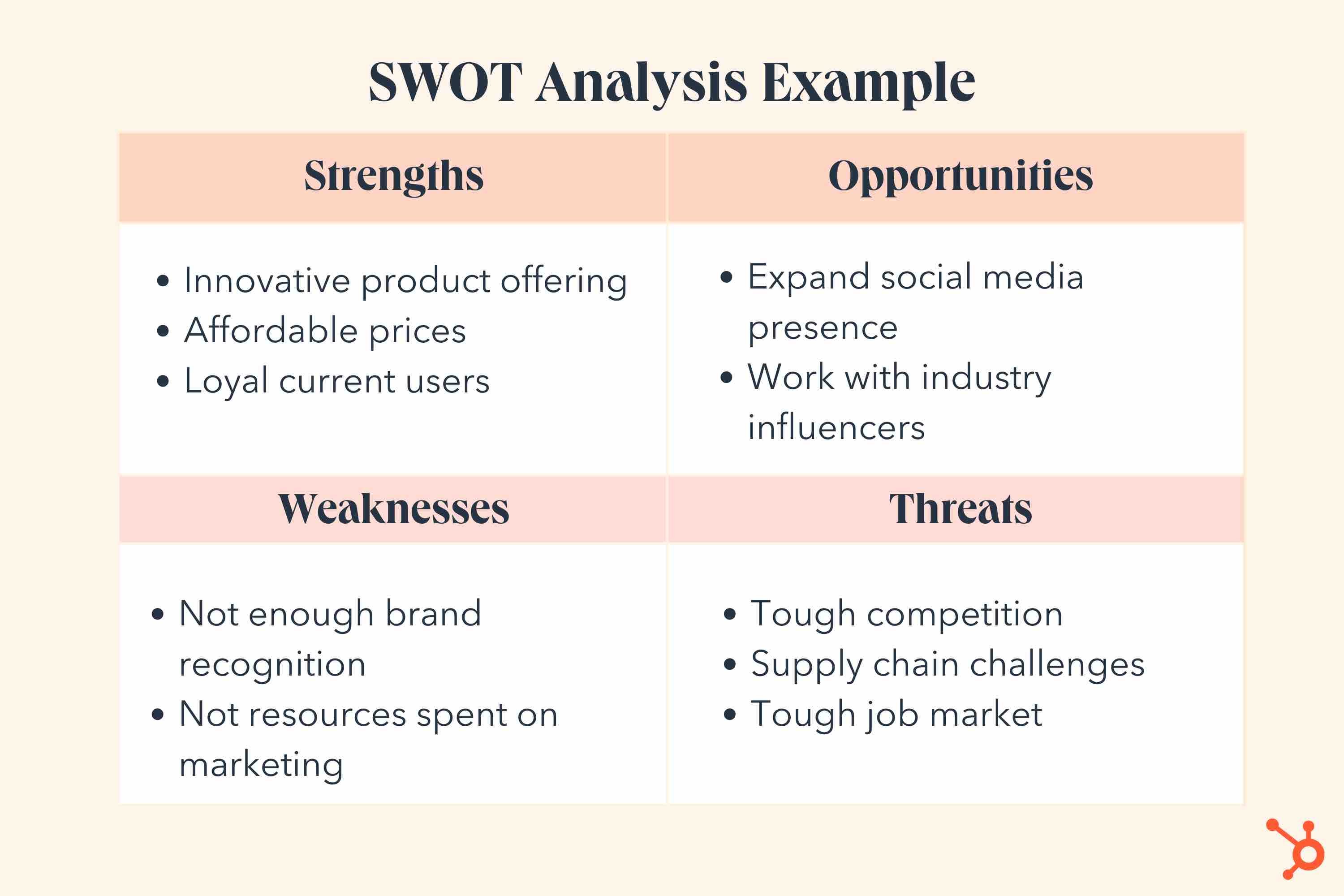
3. Identify your objective.
Before you start writing things down, you’ll need to figure out what you’re evaluating with your SWOT analysis.
Be specific about what you want to analyze. Otherwise, your SWOT analysis may end up being too broad, and you’ll get analysis paralysis as you are making your evaluations.
If you’re creating a new social media program, you’ll want to conduct an analysis to inform your content creation strategy. If you’re launching a new product, you’ll want to understand its potential positioning in the space. If you’re considering a brand redesign, you’ll want to consider existing and future brand conceptions.
All of these are examples of good reasons to conduct a SWOT analysis. By identifying your objective, you’ll be able to tailor your evaluation to get more actionable insights.
4. Identify your strengths.
“Strengths” refers to what you are currently doing well. Think about the factors that are going in your favor as well as the things you offer that your competitors just can’t beat.
For example, let’s say you want to use a SWOT analysis to evaluate your new social media strategy.
If you’re looking at a new social media program, perhaps you want to evaluate how your brand is perceived by the public. Is it easily recognizable and well-known? Even if it’s not popular with a widespread group, is it well-received by a specific audience?
Next, think about your process: Is it effective or innovative? Is there good communication between marketing and sales?
Finally, evaluate your social media message, and in particular, how it differs from the rest of the industry. I’m willing to bet you can make a lengthy list of some major strengths of your social media strategy over your competitors, so try to dive into your strengths from there.
5. Identify your weaknesses.
In contrast to your strengths, what are the roadblocks hindering you from reaching your goals? What do your competitors offer that continues to be a thorn in your side?
This section isn’t about dwelling on negative aspects. Rather, it’s critical to foresee any potential obstacles that could mitigate your success.
When identifying weaknesses, consider what areas of your business are the least profitable, where you lack certain resources, or what costs you the most time and money. Take input from employees in different departments, as they’ll likely see weaknesses you hadn’t considered.
If you’re examining a new social media strategy, you might start by asking yourself these questions: First, if I were a consumer, what would prevent me from buying this product, or engaging with this business? What would make me click away from the screen?
Second, what do I foresee as the biggest hindrance to my employees’ productivity, or their ability to get the job done efficiently? What derails their social media efforts?
6. Consider your opportunities.
This is your chance to dream big. What are some opportunities for your social media strategy you hope, but don’t necessarily expect, to reach?
For instance, maybe you’re hoping your Facebook ads will attract a new, larger demographic. Maybe you’re hoping your YouTube video gets 10,000 views and increases sales by 10%.
Whatever the case, it’s important to include potential opportunities in your SWOT analysis. Ask yourself these questions:
- What technologies do I want my business to use to make it more effective?
- What new target audience do I want to reach?
- How can the business stand out more in the current industry?
- Is there something our customers complain about that we could fix?
The opportunities category goes hand-in-hand with the weaknesses category. Once you’ve made a list of weaknesses, it should be easy to create a list of potential opportunities that could arise if you eliminate your weaknesses.
7. Contemplate your threats.
It’s likely, especially if you’re prone to worry, you already have a good list of threats in your head.
If not, gather your employees and brainstorm. Start with these questions:
- What obstacles might prevent us from reaching our goals?
- What’s going on in the industry, or with our competitors, that might mitigate our success?
- Is there new technology out there that could conflict with our product?
Writing down your threats helps you evaluate them objectively.
For instance, maybe you list your threats in terms of least and most likely to occur and divide and conquer each. If one of your biggest threats is your competitor’s popular Instagram account, you could work with your marketing department to create content that showcases your product’s unique features.
SWOT Analysis Examples
The template above helps get you started on your own SWOT analysis.
But, if you’re anything like me, it’s not enough to see a template. To fully understand a concept, you need to see how it plays out in the real world.
These SWOT examples are not exhaustive. However, they are a great starting point to inspire you as you do your own SWOT analysis.
Apple’s SWOT analysis
Here’s how we’d conduct a SWOT analysis on Apple.
Strengths
First off, strengths. While Apple has many strengths, let’s identify the top three:
- Brand recognition.
- Innovative products.
- Ease of use.
Apple’s brand is undeniably strong, and its business is considered the most valuable in the world. Since it’s easily recognized, Apple can produce new products and almost ensure a certain degree of success by virtue of the brand name itself.
Apple’s highly innovative products are often at the forefront of the industry. One thing that sets Apple apart from the competition is its product inter-connectivity.
For instance, an Apple user can easily sync their iPhone and iPad together. They can access all of their photos, contacts, apps, and more no matter which device they are using.
Lastly, customers enjoy how easy it is to use Apple’s products. With a sleek and simple design, each product is developed so that most people can quickly learn how to use them.
Weaknesses
Next, let’s look at three of Apple’s weaknesses.
- High prices
- Closed ecosystem
- Lack of experimentation
While the high prices don’t deter Apple’s middle- and upper-class customer base, they do hinder Apple’s ability to reach a lower-class demographic.
Apple also suffers from its own exclusivity. Apple controls all its services and products in-house, and while many customers become loyal brand advocates for this reason, it means all burdens fall on Apple employees.
Ultimately, Apple’s tight control over who distributes its products limits its market reach.
Lastly, Apple is held to a high standard when it comes to creating and distributing products. Apple’s brand carries a high level of prestige. That level of recognition inhibits Apple from taking risks and experimenting freely with new products that could fail.
Opportunities
Now, let’s take a look at opportunities for Apple.
It’s easy to recognize opportunities for improvement, once you consider Apple’s weaknesses. Here’s a list of three we came up with:
- Expand distribution options.
- Create new product lines.
- Technological advancement.
One of Apple’s biggest weaknesses is its distribution network, which, in the name of exclusivity, remains relatively small. If Apple expanded its network and enabled third-party businesses to sell its products, it could reach more people globally, while alleviating some of the stress currently put on in-house employees.
There are also plenty of opportunities for Apple to create new products. Apple could consider creating more affordable products to reach a larger demographic, or spreading out into new industries — Apple self-driving cars, perhaps?
Finally, Apple could continue advancing its products’ technology. Apple can take existing products and refine them, ensuring each product offers as many unique features as possible.
Threats
Finally, let’s look at threats to Apple.
Believe it or not, they do exist.
Here are three of Apple’s biggest threats:
- Tough competition.
- Lawsuits.
- International issues.
Apple isn’t the only innovative tech company out there, and it continues to face tough competition from Samsung, Google, and other major forces. In fact, Samsung sold more smartphones than Apple did in Q1 of 2022, shipping 17 million more units than Apple and holding 24% of the market share.
Many of Apple’s weaknesses hinder Apple’s ability to compete with the tech corporations that have more freedom to experiment, or that don’t operate in a closed ecosystem.
A second threat to Apple is lawsuits. Apple has faced plenty of lawsuits, particularly between Apple and Samsung. These lawsuits interfere with Apple’s reputable image and could steer some customers to purchase elsewhere.
Finally, Apple needs to improve its reach internationally. The company isn’t number one in China and doesn’t have a very positive relationship with the Chinese government. In India, which has one of the largest consumer markets in the world, Apple’s market share is low, and the company has trouble bringing stores to India’s market.
If Apple can’t compete globally the way Samsung or Google can, it risks falling behind in the industry.
Starbucks SWOT Analysis
Now that we’ve explored the nuances involved with a SWOT analysis, let’s fill out a SWOT template using Starbucks as an example.
Here’s how we’d fill out a SWOT template if we were Starbucks:
Download this Template for Free
Restaurant Small Business SWOT Analysis
Some small business marketers may have difficulty relating to the SWOTs of big brands like Apple and Starbucks. Here’s an example of how a dine-in Thai restaurant might visualize each element.
Small restaurants can lean into their culinary expertise and service skills to find opportunities for growth and brand awareness. A SWOT analysis can also help identify weaknesses that can be improved, such as menu variation and pricing.
While a restaurant might not be as worried about high-level lawsuits, a small business might be more concerned about competitors or disruptors that might enter the playing field.
Local Boutique SWOT Analysis
In another small business example, let’s take a look at a SWOT analysis for a local boutique.
This shop might be well known in its neighborhood, but it also might take time to build an online presence or get its products in an online store.
Because of this, some of its strengths and opportunities might relate to physical factors while weaknesses and threats might relate to online situations.
How to Act on a SWOT Analysis
After conducting a SWOT analysis, you may be asking yourself: What’s next?
Putting together a SWOT analysis is only one step. Executing the findings identified by the analysis is just as important — if not more.
Put your insights into action using the following steps.
Take advantage of your strengths.
Use your strengths to pursue opportunities from your analysis.
For example, if we look at the local boutique example above, the strength of having affordable prices can be a value proposition. You can emphasize your affordable prices on social media or launch an online store.
Address your weaknesses.
Back to the boutique example, one of its weaknesses is having a poor social media presence. To mitigate this, the boutique could hire a social media consultant to improve its strategy. They may even tap into the expertise of a social-savvy employee.
Make note of the threats.
Threats are often external factors that can’t be controlled, so it’s best to monitor the threats outlined in your SWOT analysis to be aware of their impacts on your business.
When to Use a SWOT Analysis
While the examples above focus on business strategy in general, you can also use a SWOT analysis to evaluate and predict how a singular product will play out in the market.
Ultimately, a SWOT analysis can measure and tackle both big and small challenges, from deciding whether or not to launch a new product to refining your social media strategy.
Editor’s note: This post was originally published in May 2018 and has been updated for comprehensiveness.


20 Valentine’s Day Marketing Campaigns We Love
Valentine’s Day is a time to celebrate love in all its forms, be it romantic love, platonic love, familial love — or your love for marketing. Okay, that last one might be a little out of place, but you get the point.
This year, we’re showing love to our favorite creative Valentine’s Day marketing campaigns from brands across various industries.
If you’re in need of some inspiration for your next Valentine’s Day campaign, you’ll love the following examples.
20 Effective Valentine’s Day Marketing Campaigns
1. Toblerone – The Love Insurance
2. Cadbury 5 Star – Valentine’s Day Alibi
4. Pandora – Real Couples Explain What Valentine’s Day Means to Them
5. Etsy – Show Love to Small Businesses
6. Stella Artois – Valentine’s Day
7. Dunkin – Valentine’s Day Trivia Promo Code
8. Hotels.com – Anti-Valentine’s Day
9. Cadbury Silk – How Far Will You Go to Make Them Blush?
10. Tyson – Chicken Nugget Bouquet Contest
11. Lancôme – Valentine’s Day Advent Calendar
12. El Paso Zoo – Valentine’s Day ‘Quit Bugging Me’ Event
13. Gü Desserts – Love-themed Packaging
14. Ranch Dressing – Customized Bottle
15. Pandora – Little Acts of Love Ad
16. 1-800-Flowers – Galentine’s Day
17. Target – Valentine’s Day Haul Instagram Post
18. MeUndies – Match Me Valentine’s Day
19. Winc – Be Wine Instagram Post
20. OpenTable – Millennial Experiences
Honorable Mention: Match.com’s “Match Made in Hell” campaign.
Valentine’s Day Campaign Takeaways

20 Effective Valentine’s Day Marketing Campaigns
Here are 20 Valentine’s Day marketing campaigns that stole our hearts.
1. Toblerone – The Love Insurance
To address the fear and uncertainty that can come witha new romance, Toblerlone’s 2023 Valentine’s Day marketing campaign offers consumers a little reassurance in the form of “love insurance.”

To get their “love insurance,” couples can visit Toblerone.co.uk to buy the brand’s special edition Valentine’s Day chocolate bar, which comes with its own insurance. If the relationship ends, the couple can register the purchase with @TobleroneUK on Instagram and they’ll receive a voucher to redeem online. This way, neither the Toblerone nor their relationship feels like a waste.
2. Cadbury 5 Star – Valentine’s Day Alibi
Those without a Valentine often find themselves struggling to dodge the dreaded question “What are you doing for Valentine’s Day?” Fortunately, Cadbury 5 Star’s 2022 Valentine’s Day campaign tooksome of the pressure off.
The Indian chocolate brand took over an island off the coast of Karnataka and renamed it “My cousin’s wedding.” So, consumers without a Valentine couldsay “I’m not in town, I’m going to my cousin’s wedding” when asked about Valentine’s Day plans.
For a chance to access the island, consumers could scan the special Cadbury 5 Valentine’s Day packs, which tookthem to a website to mine coins and gain an opportunity to bid for the island.
3. Gucci – Love Story Zine
For Valentine’s Day 2022, Gucci released a limited-edition zine that consisted of visually stunning photos telling the love story ofa fairy and giant. Each photo in the zine showcased items from the fashion house’s Valentine’s Day collection.
The marketing campaign intrigued customers, offered an exclusive item (a physical copy of the zine), and it showed the beauty of the brand’s clothes and accessories.

4. Pandora – Real Couples Explain What Valentine’s Day Means to Them
In 2021, Pandora asked real-life couples and friends to share the little (and not-so-little) things they’ve done to express their love. Some acts of love were tiny, such as a peck on the cheek or a hug; others were huge steps in the relationship, such as moving in together or adopting a dog.
The YouTube video included a link to the company’s website and a message that the company can help viewers show their loved ones how much they’re appreciated with Pandora charms and gifts.
5. Etsy – Show Love to Small Businesses
To show love and support to its community of sellers, e-commerce platform Etsy offered a ready-made graphic sellers could use to promote their Valentine’s Day products on social media. Sellers could also combine the graphic with the hashtag #MakeItMeaningful to draw attention to their Etsy store.
The pre-made graphic grabbed audience attention and fostered a sense of community among Etsy sellers.
6. Stella Artois – Valentine’s Day
In 2020, beer brand Stella Artois created a 15 second YouTube that shows the growth of a couple throughout the years and the role the brand’s beer played in their love.
The video is simple, heartfelt, and captures the spirit of Valentine’s Day. It was a huge hit and garnered almost 3 million views on YouTube.
7. Dunkin – Valentine’s Day Trivia Promo Code
For Valentine’s Day, Dunkin invited its followers to play a trivia game via Instagram Stories for a chance to unlock a secret promo code. The ad campaign delighted consumers with a fun game testing their knowledge of Dunkin and it rewarded customers with a chance to save on their favorite items.
8. Hotels.com – Anti-Valentine’s Day
Hotels.com’s Valentine’s Day marketing campaign took a clever approach to the holiday by urging users to visit its V-Day Dumpster Stay web page and write about an ex they believe should vacation in a dumpster.
All stories were entered into a competition for participants to win a $300 Hotels.com gift card.

9. Cadbury Silk – How Far Will You Go to Make Them Blush?
In 2022, Cadbury Silk placed QR codes on its Cadbury Silk Heart Blush chocolate pack which led consumers to its website where buyers can write a secret message to a loved one. Said loved on could then see the secret message by scanning any Cadbury ad.
10. Tyson – Chicken Nugget Bouquet Contest
A bouquet of flowers is the quintessential Valentine’s Day present, but food brand Tyson decided to put a fresh spin on a classic gift. In 2021, the company challenged consumers to create their own chicken nugget bouquet for Valentine’s Day.
The contest winner would win a package of Tyson Nuggets of Lovelimited edition heart-shaped chicken nuggets only available through the contest. To enter, participants had to create their best nugget bouquet and post a picture of the bouquet on Instagram or Twitter with the hashtags #NuggetBouquetContest and #TysonNuggetsofLove.
Other prizes included $5,000 and a year’s supply of Tyson chicken nuggets.

11. Lancôme – Valentine’s Day Advent Calendar
Every year, cosmetics company Lancôme releases a Valentine’s Day advent calendar filled with products for consumers to try and discover. From lotion to mascara to perfume — the advent calendar contains a wide variety of products. The idea is excellent because it introduces consumers to new products that they may want to buy more of going forward.
12. El Paso Zoo – Valentine’s Day ‘Quit Bugging Me’ Event
Every year, the El Paso Zoo holds a Valentine’s Day event where scorned lovers can name a cockroach after an ex. The cockroach would then be fed to a zoo animal. The event is so popular it’s been referenced on Saturday Night Live.
13. Gü Desserts – Love-themed Packaging
In 2020, British brand Gü Desserts released a series of love-themed packaging called “Love Notes” for selected desserts. The packaging was adorned with a love song title adapted to the brand.
For example, the brand’s salted caramel cheesecakes came with packaging that read “I’m in love with the shape of Gü.”

14. Hidden Valley Ranch Dressing – Customized Bottle
Nothing says Valentine’s Day like giving someone a bottle of — Ranch Dressing?
In 2021, while flower companies and B2C brands were highlighting the romantic gifts partners could give to each other, Hidden Valley took a funny approach to this strategy by offering audiences customized Valentine’s Day-themed bottles of Ranch salad dressing.
While this seems like an odd gift to some, Hidden Valley knows it has fans out there that just love to cover everything they eat with Ranch dressing. To those audiences, this gift is funny, personalized, and potentially useful.
15. Pandora – Little Acts of Love
In 2022, Pandora revisited its successful”Little Acts of Love” campaign with an ad placement featuring more couples doing small acts of love for each other.
The ad shows couples displaying acts of kindness towards one another that would be appreciated any day of the year. This ad reminds us all that thoughtful gestures can go a long way.
16. 1-800-Flowers – Galentine’s Day
Valentine’s Day isn’t just for significant others, and 1-800-Flowers wants friendships to be celebrated as well.
This ad depicts two friends talking about how they established their friendship, reminding the viewer that platonic love also deserves to be celebrated. The two friends in the ad ask each other thoughtful questions about their friendship and how much they mean to each other.
It’s an emotional ad that will inspire you to call your best friend, and maybe send them some flowers.
17. Target – Valentine’s Day Haul Instagram Post
Many people have experienced walking into Target without a list, relying on Target to tell them what they need. This user-generated post on Target’s Instagram account captures the spirit of what we all love about Target — how easy it is to load up on fun items (though our bank accounts may not share the love).
In the video, the original poster fills their cart with festive Valentine’s Day merchandise at their local Target. Though it isn’t a traditionally produced ad, it’s a relatable post for Target shoppers who may have been inspired to visit their local store and pick up some of the items they saw featured in the post to celebrate.
18. MeUndies – Match Me Valentine’s Day
This relatable MeUndies ad from 2021 captures the spirit of communicating via Zoom that many people have become familiar with since early 2020.
In the ad, couples talk about some of their pre-pandemic plans including travel and weddings. Though many of those events didn’t go as planned, the couples talked about ways they’ve grown closer despite the challenges and uncertainty brought on by the pandemic all while wearing matching merch from MeUndies.
19. Winc – Be Wine Instagram Post
Wine is a popular Valentine’s Day gift that is up there with roses and chocolate. Wine subscription company Winc typically devotes real estate on itssocial channels for Valentine’s Day-themed posts in the weeks leading up to the holiday.
In 2021, the Winc Instagram account had a series of posts consisting of unique and user-generated content related to Valentine’s Day. The “Be Wine?” post was among the most popular. We loved the punny caption and heart-themed visuals.
20. OpenTable – Millennial Experiences
If you’ve ever marketed to millennials, you may know that millennials value experiential gifts. Or, as OpenTable says in this 2020 ad, dates.
In 2020 OpenTable released 14 ads as part of a two-week countdown to Valentine’s Day, encouraging customers to make reservations early to avoid the holiday rush.
Each of the ads targeted a different audience that could benefit from using OpenTable to make Valentine’s Day reservations, with a clear call-to-action and messaging that appeals to the ideal viewer.
Honorable Mention: Match.com’s “Match Made in Hell” campaign.
Technically, this campaign wasn’t created for Valentine’s Day specifically. But, many of our marketers thought it had all the perfect elements of a great Valentine’s Day campaign.
In the commercial, directed by actor Ryan Reynolds, Satan sits in Hell using Match’s app when he sees he’s matched with a woman named 2020. When he meets up with her on Earth, he nervously says “Hi 2-0-2-0.” She replies, “Please, call me 2020” — pronouncing it like the year.
As the commercial continues, 2020’s character appears to be the epitome of everything that happened in 2020.
For example, the ad shows Satan and 2020 causing mischief, stealing toilet paper from store shelves, having a picnic in empty stadiums, and ultimately posing for a selfie in front of a dumpster fire.
The couple frolics to the familiar sounds of Taylor Swift’s hit song, “Love Story,” which also sparks a sense of rom-com nostalgia for millennials.
On the same day of this ad’s December release, Match and Reynolds also shared another commercial showing the pair explaining how they met in couple’s counseling.
In this video, Satan explains how he found 2020 on Match:
“I started by using the Match custom search filter. I filtered out joy, happiness, toilet paper, and reason,” Satan says in the video below:
Although this didn’t launch in February, it was a very clever newsjacking example that many of our marketers say they enjoyed when they were asked to share their favorite Valentine’s campaigns.
While 2020 was a difficult year for many, Match and Reynolds identified a tasteful way to create content that audiences could relate to. At the same time, they still told an epic, hilarious love story with a pleasant, entertaining tone. Although they discussed a truly terrible year, they did so in a way that felt like escapism for the viewer.
Valentine’s Day Campaign Takeaways
As you create and launch Valentine’s Day campaigns, take note of these strategies many of the brands above used:
- Grab your audience’s attention:Like with any holiday, marketers around the globe are churning out content around it. To compete with this overly saturated Valentine’s Day ad landscape, you’ll need to grab and keep your viewer’s attention with entertaining elements or valuable information.
- Be relatable: Around this time of year, many people are inundated with high-budget Valentine’s Day ads that offer them no useful information or value. Even if you want to tell a mushy romance-fueled love story with your content, make sure it still feels relatable or authentic. To do this, you can leverage tactics like telling a story your audience will relate to, or leveraging user-generated content from your followers — like Twitter has.
- Test out different platforms: While some companies on this list took to Instagram, others embraced physical campaign strategies like special products or billboard use.
Now that you have some ideas for your next Valentine’s Day marketing campaign, you’re ready to find new ways to make consumers fall in love with your brand.
Editor’s Note: This blog post was originally published in Feb. 2013, but was updated for comprehensiveness.


Are Brands Investing in Social Media Communities in 2023? We Asked 1,200+ Marketers
The ultimate goal of social media marketing is to generate revenue, and a crucial step to generating revenue via social media is creating engagement. If your followers don’t engage with your posts, they won’t engage with your business. And a sure way to boost engagement is by fostering a tight-knit social media community.
Social media communities are incubators for brand awareness, loyalty, and trust. They’re also a dime a dozen, so marketers must refine their approach to building and leveraging them correctly.
Let’s explore more about social media communities, their benefits and challenges, and where brands will invest their resources in 2023.
Are brands investing in social media communities?
Social Media Community Benefits
How are social media communities formed?
Social Media Community Examples
Building a Social Media Community
Challenges of Building a Social Media Community
Are brands investing in social media communities?
The Hubspot Blog surveyed 1,283 social media marketers around the globe to determine which trends they leverage, the channels they use, and their plans for 2023. Here’s what we found:
Social Media Community Trends
- 90% of social media marketers say building an active online community is critical to success in 2023.
- At the time of the survey, 1 in 5 social media users joined or participated in an online community in the past 3 months.
- Instagram and Facebook are the most effective platforms for community building.
- 88% of marketers say most brands will have an active social media community around their brand in 2023.
- Facebook is used by most (67%) social media marketers but takes second place behind Instagram for engagement and ROI.
- Facebook will see significant growth in 2023, with 23% of social media marketers investing more in Facebook than any other platform, 43% increasing their investment, and 41% continuing to invest in Facebook.
- Social media marketers see Facebook in third place behind both Instagram and TikTok regarding the platform with the highest potential to grow in 2023.
- Influencer marketers see the highest ROI through Instagram.
- Instagram is used by 65% of social media marketers, coming just behind Facebook at 67%.
- 29% of social media marketers plan to invest the most in Instagram over any other platform, and 52% plan to increase their investment in the platform in 2023 — while another 39% will keep it the same.
YouTube
- 55% of social media marketers use YouTube, making it the third most popular platform among social media marketers.
- 14% of social media marketers plan to invest more into YouTube than any other platform, and 15% plan to try it for the first time in 2023.
TikTok
- TikTok, alongside Instagram, is considered a platform with the highest potential to grow in 2023.
- While just 36% of social media marketers use TikTok, marketers think TikTok is a better bet for brands to grow their audience than other platforms.
- In 2023, 53% of social media marketers will increase their investment in marketing on TikTok in 2023, and another 36% will keep investing the same amount.
Social Media Community Benefits
As I mentioned, having a large social media following is not enough; you also need an engaged community. Here are a few reasons:
1. They are vehicles for personal recommendations.
In a sense, every social media community member is a micro-influencer, sharing real experiences and opinions that can influence other members. This is worth mentioning since nearly nine out of ten consumers read reviews before buying a product.
Customers who love your brand want to talk about it. They want to share reviews and pass on advice, and communities give them a place to do that.
But what about bad reviews? As an active participant in your community, you have an excellent opportunity to resolve any issues or complaints. And since members are already invested in your brand, they’re more apt to find solutions with you.
2. They can cut costs.
Active, self-sufficient communities can become hubs for customers to ask and answer questions, which alleviates pressure on customer support teams. They can also reduce support costs — one study found it was 72% cheaper to answer a question via a community than to submit a ticket to a support team.
Communities can also reduce your ad spending. In 2022 ad spending in the US was predicted to cross the $200 billion mark. Brands with active communities can spend less on social media advertising because they can reach customers in an owned space for free.
3. They create active participation with your brand.
We’ve all heard the statistic — it’s cheaper (arguably easier) to retain customers than convert new ones. This is why brand advocacy and retention are critical to any marketing strategy.
Brands can strengthen relationships with community members by encouraging active participation — with polls, surveys, contests, and user-generated content, to name a few. In essence, what was once a transactional relationship is now an active conversation. And every active engagement brings customers closer to your brand.
4. They offer insight into your consumers.
The most productive communities are strategically designed to spark conversations. You can take full advantage of these conversations by tracking common complaints, ideas for improvement, and unique ways they use your products to solve problems.
Remember to let your community know when you make a change based on member feedback. People love to know you’re listening and taking their suggestions seriously.
How are social media communities formed?
Social media communities are formed over shared interests, hobbies, goals, and topics that encourage participation and build connections. A company can build a social media community that centers around an interest that is relevant to its brand.
With that said, let’s explore a few examples of social media communities.
Social Media Community Examples
1. First Coast News Weather Watchers
Florida TV news station First Coast News started a social media community via Facebook called First Coast News Weather Watchers. The community is hosted on Facebook Groups and centers around viewers’ shared interest in local weather and meteorology.
Users ask questions about local weather within the community, share photos and videos of weather phenomena, and speak to First Coast News meteorologists. First Coast News will often take photos and videos shared in the group and feature them in live broadcasts.
2. Mad Rabbit
Mad Rabbit is a tattoo skin relief care brand that started a thriving social media community on Instagram that is focused on the subculture of tattoos. Followers of the company’s page share and receive information regarding tattoo aftercare and artistic creativity. Mad Rabbit’s Instagram page also frequently collaborates with tattoo influencers who help the brand further engage with users.
3. Official Crunchyroll Discord
Anime licensing and streaming company Crunchyroll started its own social media community on Discord. The community is a space for anime fans to discuss their favorite shows and anime-related content.

Building a Social Media Community
You’re probably familiar with the adage, “Rome wasn’t built in a day.” The same is true of social media communities.
Here are a few tips for building a thriving community:
1. Remember that communication = community.
If you want to build a thriving community, you can’t expect your customers to always start the conversation. You must do the heavy legwork to post content, ask questions, respond to comments, and keep communication lines open.
While you don’t need to be the center of the conversation, your members should know you’re there.
2. Focus on the audience first and brand second.
Social media communities are valuable tools for self-promotion — but if that’s all you’re using them for, you’ll eventually drive customers away.
Effective communities provide value. They educate, entertain, and solve problems for the audience. In other words, if you want to build a real sense of community, you need to provide value with the content you create or share.
Check out how Glow Recipe, a skincare brand, provides value by offering tips for healthy skin while subtly promoting their products:

Image source
3. Feature user-generated content.
A great way to boost engagement within a community is to encourage user-generated content. This is any content — like text, videos, or reviews — that your members create, which you can then share across your social communities.
Peloton does an excellent job featuring user-generated content by highlighting customer stories and fitness milestones. Not only does this give the audience a voice, but it also encourages members to share their stories and testimonials — effectively fueling word-of-mouth marketing.
4. Make your community findable.
Building a community is almost impossible if people aren’t aware it exists. Here are a few ways to spread the word:
-
Embed social icons on your website
-
Invite family, friends, and colleagues to follow and share your community
-
Use hashtags to expose your content to new audiences
-
Cross-promote your community on different channels
-
Run exclusive giveaways or discounts for community members
5. Don’t let your community collect dust.
Consistency is an important ingredient in successful social media communities. If you let your accounts collect dust, members will abandon ship. Creating a content calendar and publishing schedule is a good idea when planning ahead. And if your brand is juggling various platforms, check out HubSpot’s social media management tools.
Challenges of Building a Social Media Community
Running a social media community is similar to hosting a party — you’re in charge of the entertainment, creating a pleasant atmosphere, and keeping conversations friendly. That’s a lot of responsibility. Luckily, you’re also in control of the guest list.
When it comes to managing your members, start by establishing clear rules and guidelines for your community. This deters any troublemakers from joining and helps prevent future conflict.
For example, Facebook offers a variety of customizable rules that users have to accept before joining a Facebook Group. This is one way to pre-moderate a group without doing any work. Check out the rules below:

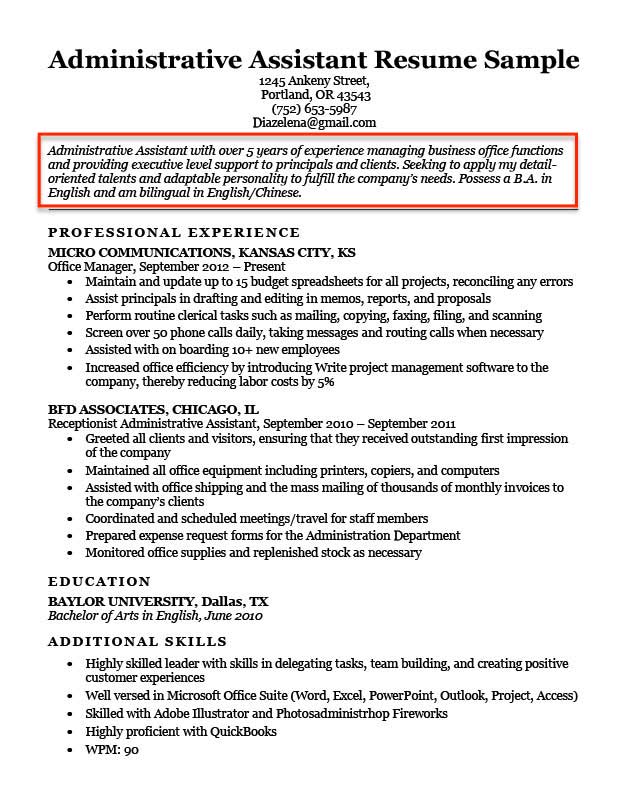
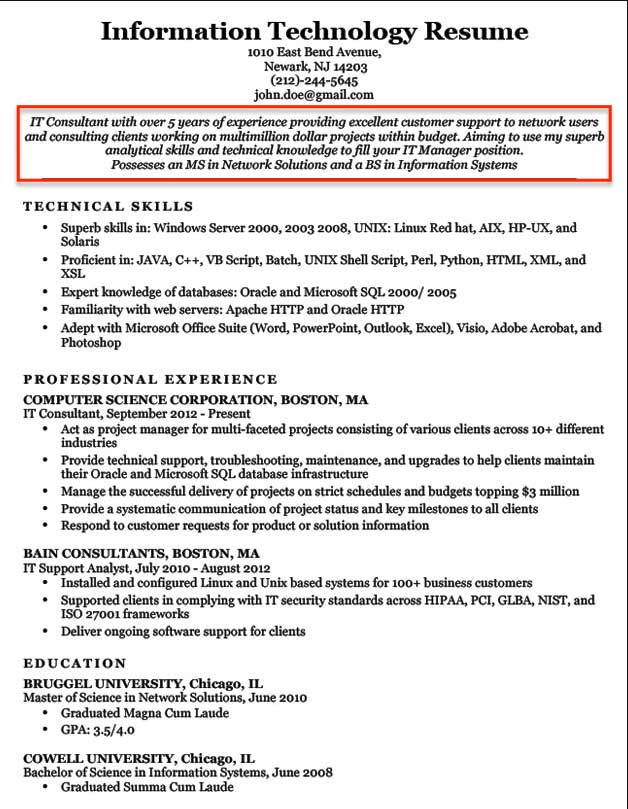
The next step is to follow through. When you see members veering from community guidelines, take appropriate action — whether that’s sending a private message to a user or removing them altogether. This alerts other members that you care about the culture in your group.
To help with this process, you may want to designate someone on your team to moderator your community. Or, hire a community manager or online moderation partner such as Hive Moderation or SupportNinja.
Another challenge is measuring the ROI from your community. In other words, are your community-building efforts paying off? For instance, you may have high engagement levels in your community, but your conversion rate is stuck at 0%.
Before doing anything else, ask yourself — how do I want my community to contribute to my businesses? Is it customer engagement? Retention? Product adoption?
Next, you’ll want to identify a few metrics to measure your goals. They should be community-specific and directly related to community activities, such as click-through, sign-up, or engagement rates.
You can take this one step further by tracking the same KPIs for both community members and non-members and then comparing the performance between the two. For instance, you may discover a 30% higher product adoption among community members than non-members.
Final Thoughts
By building a social media community, you can turn transactional relationships into meaningful ones and offer a place for customers to share, collaborate, learn, and provide feedback. But building one is no easy feat, so determine your goals, develop a strategy, and get ready to start the conversation.

30 Fashion Brands That Marketers Can Learn From on Instagram
Between carefully curated photos, expertly targeted ads, and decisive adoption of Instagram stories, no other B2C industry has thrived on Instagram, much like the beauty and apparel industry.
Some of the best clothing brands on Instagram are masters of consumer engagement, and businesses from any industry could learn something from these inspirational feeds. In this post, we’ve compiled a list of 30 clothing brands — both big and small — crushing the game. For a deeper dive into how to build a presence on Instagram, check out our complete guide to Instagram marketing.
30 of the Best Clothing Brands to Follow on Instagram
1. Telfar @telfar
Telfar is a luxury brand well known for its bags and clothing. Like many brands on the list, it uses Instagram to share information about its products paired with high-quality product photos, videos, and user-generated content.

2. J.Crew @jcrew
J.Crew has mastered the art of follower engagement on Instagram. Its vibrant feed inspires followers, whether via daily updated Stories, in-feed product announcements, or style inspo.
3. Anthropologie @anthropologie
With colorful images of its bright and patterned styles, Anthropologie’s feed is a visual smorgasbord of inspiration.
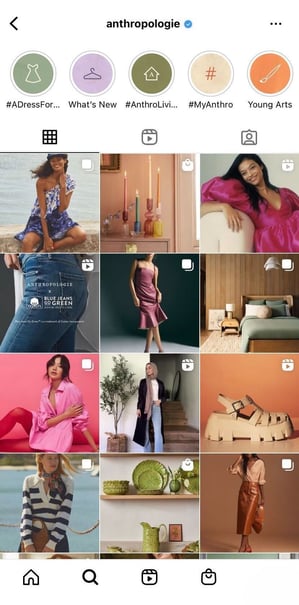
4. Girlfriend Collective @girlfriend
Girlfriend Collective experienced explosive social media growth after advertising a free leggings promotion. Its feed engages customers with stunning product photography of its minimal styles and funny memes related to its products.

5. BRKLN Bloke @brklynbloke
Brkln Bloke is a Brooklyn-based streetwear brand that has mastered the art of sharing its products in the wild, helping followers get styling inspiration for their purchases.

6.Nike @nike
The behemoth athletic brand has enthusiastically embraced video content and regularly shares clips with its impressive 263 Million followers. Its feed features a motivational mix of professional athletes and everyday people, which directly aligns with its brand mission that Nike is for everyone.
7. Paloma Wool @palomawool
>In the image below, Paloma Wool shares a carousel of photos showing audiences different ways to wear one of its products, the Berlin multi-position belt. This gives wearers and audiences inspiration for how to use the product and can also inspire a new purchase if someone sees a style they like.
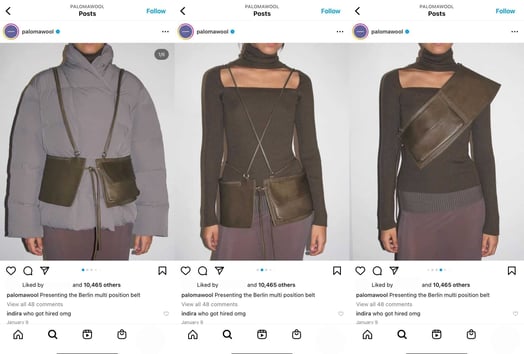
8. Kate Spade @katespadeny
Despite being a well-established label, Kate Spade’s Instagram has a distinct personal touch that sets it apart from similar brands. Its profile features outfit pictures, snaps from around New York, and behind-the-scenes shots of the design process at the Kate Spade Studio.
9. Hermoza @the_hermoza
Hermoza leverages one of Instagram’s impactful native features — shoppable posts and a storefront. Each post has a “View Shop” CTA, and clicking on it leads audiences to an Instagram storefront where they can discover more products or even make a purchase without leaving the app.
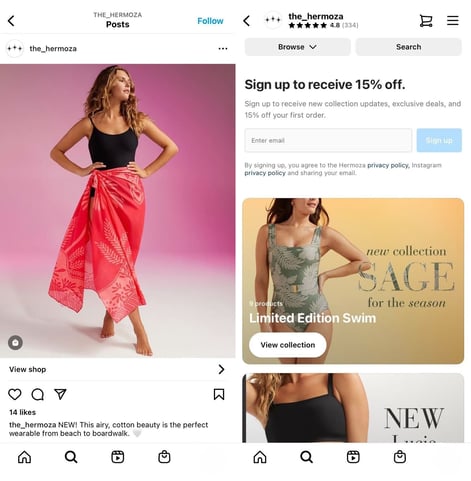
10. House of Sunny @houseofsunny
House of Sunny’s approach to Instagram is worth replicating as it ensures followers always have a source for inspiration for using its products. It specifically calls attention to styling opportunities with a permanent Story Highlight called “As Seen On,” where people can click through a series of UGC to discover unique ways to style its clothing.
11. Eileen Fisher @eileenfisherny
Eileen Fisher emphasizes its quality materials and environmentally friendly production processes on Instagram, and landing on its profile brings you to three pinned posts displaying the lifecycle of the products it uses and how it champions sustainability.
12. Sandy Liang @sandyliang
Sandy Liang is well known for creating unique versions of everyday staples. On Instagram, the brand shares lookbooks for its clothing and accessories, giving followers inspiration for what and how to wear its products. The image below is a lookbook giving inspo on what to wear when visiting a friend.
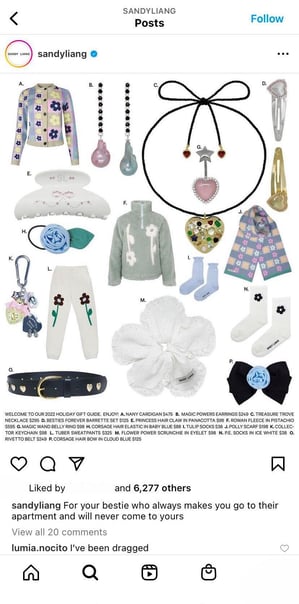
13. Asos @asos
British online fashion retailer ASOS updates its feed regularly with colorful and bold product features. It stands out from the crowd with a video-first Instagram strategy, only rarely sharing still photos, allowing followers to interact and engage with content.
14. Aerie @aerie
Scrolling through Aerie’s Instagram feed is like taking a tropical beach getaway. The lingerie and bathing suit brand has been applauded for its commitment to unretouched photos in its print ads, and it continues this effort on its Instagram, creating a cohesive brand image.
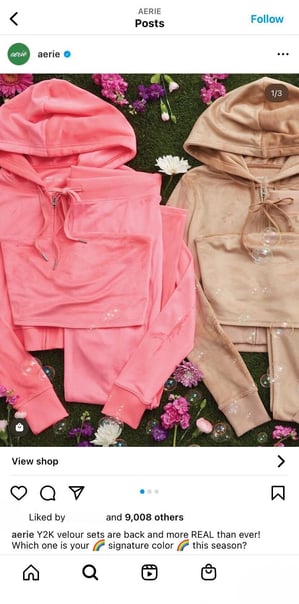
15. Ziran @theziran
Ziran merges ancient Chinese techniques, luxury fashion, and sustainable practices to create its clothing brand. On its Instagram, behind-the-scenes content about how the brand came to be, gives people a glimpse into the people and processes that bring their favorite brand to life.

16. Aime Leon Dore @aimeleondore
Aime Leon Dore shares product announcements in videos that align with the product’s intended use. For example, the video below announces an upcoming collaboration with Woolrich, a brand well-known for its durability. The video features models in activities that might cause wear and tear to everyday products, but not those from the Aime Leon Dore x Woolrich collab.
17. Lisa Says Gah @lisasaysgah
It often uses Instagram for restock announcements so its followers know when their favorite products are available for purchase again. Doing this also helps drive more followers to the platform, as people will see Instagram as a way to get the most up-to-date information on their favorite brand.

18. Tach @tach_clothing
>Tach uses Instagram to share exciting behind-the-scenes content. The image below is a sneak peek into its line sheets, which are usually only used as a sales tool to present products to buyers. Audiences are let in on its behind-the-scenes activity, which can be exciting.
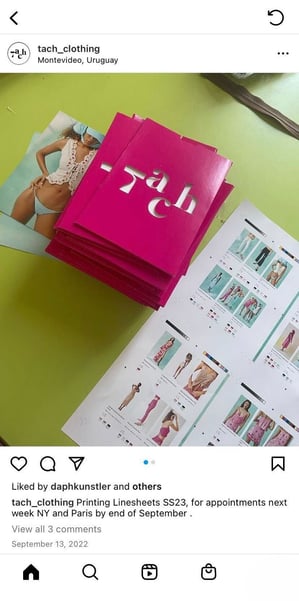
>19. Fossil @fossil
If you like photos of neatly organized items, then Fossil’s Instagram is for you. The accessories brand curates an impressive feed of food, fashion, and celebrities like James Phelps, generating audience excitement if they recognize their favorite actor.
20. Everlane @everlane
Everlane’s account has no shortage of beautiful product imagery, but it also features photos of customers wearing its clothes, inspiring travel photography, and tips on food and art destinations worldwide, giving audiences a well-rounded experience on its profile.

>21. Bode @bode
>Bode is well known for its quilted jackets and one-of-a-kind clothing items. On Instagram, it shares videos explaining the background and inspiration for its collections, giving followers insight into the brand, its values, and what it stands for.
22. Teva @teva
Teva’s Instagram feed is proof that it’s possible to give your brand a modern update without losing the spirit of what made you successful in the first place. Its feed includes user-generated content of its shoes out in the wild and sleek product photos highlighting new styles.

23. Zara @zara
Zara has made a name for itself by emulating the marketing of luxury brands, and its Instagram feed is no exception. Its account looks like a high-fashion magazine, with professional editorial shots of its varied clothing styles.

24. Fjällräven @fjallravenofficial
The Instagram feed for Swedish outdoor apparel brand Fjällräven is less about its products and more about the adventurous spirit that has defined the company for almost 60 years.

25. Madewell @madewell
Apparel brand Madewell is known for its relaxed, classic styles, and its Instagram clearly reflects this aesthetic. With bright sunny images of its latest products and collaborations, its feed is a fashion lover’s delight.
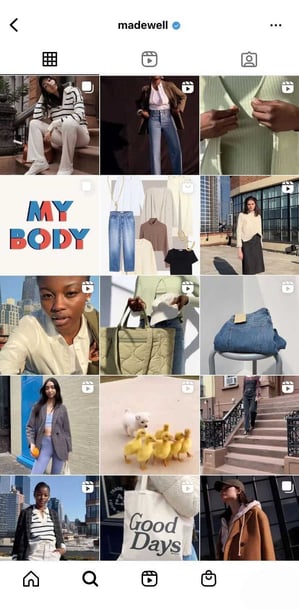
26. The Row @therow
Another account that focuses less on its products and more on visual inspiration, The Row features vintage photos of art, architecture, and fashion — only occasionally sharing images and actual products — where they share a brand aesthetic that is bigger than just what it sells.
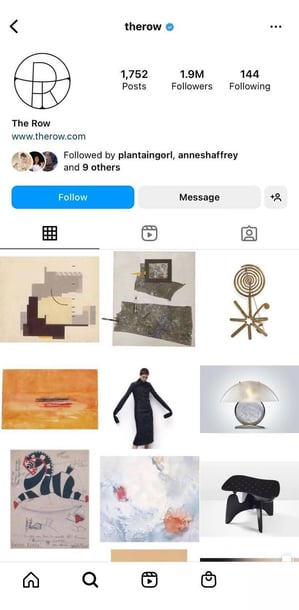
27. Santos by Monica @santosbymonica
Santos by Monica’s Instagram grid is eye-catching as every post uses the same color scheme and creates a pleasing browsing experience, building a cohesive brand identity and helping people develop brand recognizability for its specific color schemes and hues.
28. Carhartt WIP @carharttwip
Carhartt Work In Progress announces sales on its Instagram profile, a valuable way to ensure your different audiences are aware of your brand promotions. For example, if your Instagram followers aren’t subscribed to your mailing list, they won’t receive your newsletter announcing the sale, but they’ll see it in their feed.
