Welcome to My Blog
26 Companies With Really Catchy Slogans & Brand Taglines
Keep it simple, stupid.
We don’t mean to offend you — this is just an example of a great slogan that also bears the truth of the power of succinctness in advertising. It’s incredibly difficult to be succinct, and it’s especially difficult to express a complex emotional concept in just a couple of words — which is exactly what slogans and taglines do.

That’s why we have a lot of respect for the brands that have done it right. These are the companies that have figured out how to convey their value propositions to their buyer personas in just one, short sentence — and a quippy one, at that.
So if you’re looking to get a little slogan inspiration of your own, take a look at some of our favorite company slogans and taglines from both past and present. But before we get into specific examples, let’s quickly go over what a slogan is, how it differs from a tagline, and what makes these branded one-liners stand out.
What Is a Slogan?
In business, a slogan is “a catchphrase or small group of words that are combined in a special way to identify a product or company,” according to Entrepreneur.com’s small business encyclopedia.
In many ways, they’re like mini-mission statements.
Companies have slogans for the same reason they have logos: advertising. While logos are visual representations of a brand, slogans are audible representations of a brand. Both formats grab consumers’ attention more readily than a company’s name or product might. Plus, they’re simpler to understand and remember.
The goal? To leave a key brand message in consumers’ minds so that, if they remember nothing else from an advertisement, they’ll remember the slogan.
What Makes a Great Slogan?
According to
HowStuffWorks, a great slogan has most, or all, of the following characteristics:
1. It’s memorable.
Is the slogan quickly recognizable? Will people only have to spend a second or two thinking about it? A brief but strong few words can go a long way in advertisements, videos, posters, business cards, swag, and other places.
2. It includes a key benefit.
Ever heard the marketing advice, “Sell the sizzle, not the steak”? It means sell the benefits, not the features — which applies perfectly to slogans. A great slogan makes a company or product’s benefits clear to the audience.
3. It differentiates the brand.
Does your light beer have the fullest flavor? Or maybe the fewest calories? What is it about your product or brand that sets it apart from competitors? (
Check out our essential branding guide here.)
4. It imparts positive feelings about the brand.
The best taglines use words that are upbeat. For example, Reese’s Peanut Butter Cups’ slogan, “Two great tastes that taste great together,” gives the audience good feelings about Reese’s, whereas a slogan like Lea & Perrins’, “Steak sauce only a cow could hate,” uses negative words. We could argue that the former leaves a better impression on the audience.
Slogan vs. Tagline
Although both “slogan” and “tagline” tend to be used interchangeably, they actually serve two different purposes.
As we mentioned in Entrepreneur.com’s definition above, a slogan identifies a product or company. So does a tagline, for that matter. Where these terms differ is in how they position a company in its industry.
- A slogan encompasses a company’s mission, what it stands for, and even how it’s helping customers in the individual campaigns the company might run. Slogans can therefore be longer than taglines, as you’ll see in the list below.
- A tagline is a catchy quip that evokes an image of your brand in the minds of your customers. Taglines enable people to make lighthearted associations with your business: “When I see [tagline], I think [company].”
Featured Resource: 60 Slogan Writing Tips & Examples

Taglines are more often next to the company’s logo on official advertisements and are dedicated more specifically to brand awareness than slogans. Slogans carry a brand’s values and promises as the company grows and evolves, and can be promoted under an overarching company tagline.
Your organization doesn’t have to develop both a slogan and a tagline — it might succeed with just a solid, recognizable tagline. But as you develop new products and identify new types of customers, you might find your brand launching a campaign that is primed for its own slogan.
Now that we’ve covered what a slogan is and what makes one great, here are examples of some of the best brand slogans of all time.
When you want a brand slogan you want to make sure they are memorable and that they bring your brand to life. The right slogan will have key words that encapsulate what your brand is so that consumers will always have it in the back of their heads. Below we have listed some business slogans that range from fast food, cars, essential items, pet essentials, etc. to show that a good slogan encapsulates being concise, catchy, and classic.
1. Dollar Shave Club: “Shave Time. Shave Money.”
The folks at Dollar Shave Club have made their way onto quite a few of our lists here on the blog, and it’s safe to say that when it comes to marketing and advertising, this brand’s team knows what it’s doing. And its slogan — “Shave Time. Shave Money.” — is an excellent reflection of their expertise.
This little quip cleverly incorporates two of the service’s benefits: cost and convenience. It’s punny, to the point, and it perfectly represents the overall tone of the brand.
2. MasterCard: “There are some things money can’t buy. For everything else, there’s MasterCard.”
MasterCard’s two-sentence slogan was created in 1997 as a part of an award-winning advertising campaign that ran in 98 countries and 46 languages. The very first iteration of the campaign was a TV commercial that aired in 1997: “A dad takes his son to a baseball game and pays for a hot dog and a drink, but the conversation between the two is priceless,”
writes Avi Dan for
Forbes.
“In a sense, ‘Priceless’ became a viral, social campaign years before there was a social media,” Dan writes. Today, “Priceless” is widely considered MasterCard’s tagline — borne out of the longer mission-focused slogan stated above.
One key to this campaign’s success? Each commercial elicits an emotional response from the audience. That first TV commercial might remind you of sports games you went to with your dad, for example. Each advertisement attempted to trigger a different memory or feeling. “You have to create a cultural phenomenon and then constantly nurture it to keep it fresh,” MasterCard CMO Raja Rajamannar told Dan. And nostalgia marketing like that can be a powerful tool.
3. M&M: “Melts in Your Mouth, Not in Your Hands”
Here’s one brand that didn’t need much time before realizing its core value proposition. At the end of the day, chocolate is chocolate. How can one piece of chocolate truly stand out from another? By bringing in the convenience factor, of course.
This particular example highlights the importance of finding something that makes your brand different from the others — in this case, the hard shell that keeps chocolate from melting all over you.

Diamonds aren’t worth much inherently. In fact, a diamond is worth at least 50% less than you paid for it the moment you left the jewelry store. So how did they become the symbol of wealth, power, and romance they are in America today? It was all because of a brilliant, multifaceted marketing strategy designed and executed by ad agency N.W. Ayer in the early 1900s for their client, De Beers.
The four, iconic words “A Diamond is Forever” have appeared in every single De Beers advertisement since 1948, and AdAge named it the
best slogan of the century in 1999. It perfectly captures the sentiment De Beers was going for: that a diamond, like your relationship, is eternal. It also helped discourage people from ever reselling their diamonds. (Mass reselling would disrupt the market and reveal the alarmingly low intrinsic value of the stones themselves.) Brilliant.

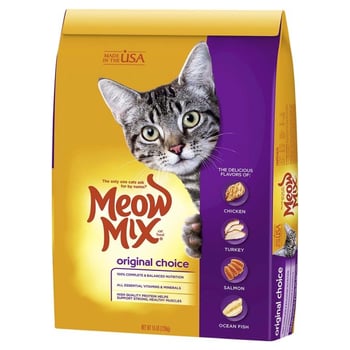
5. Meow Mix: “Tastes So Good, Cats Ask for It by Name”
Meow meow meow meow … who remembers this catchy tune sung by cats, for cats, in Meow Mix’s television commercials? The brand released a simple but telling slogan: “Tastes So Good, Cats Ask For It By Name.”
This slogan plays off the fact that every time a cat meows, s/he is actually asking for Meow Mix. It was not only clever, but it also successfully planted Meow Mix as a standout brand in a cluttered market.
6. Verizon: “We Can Hear You Now.”
Here’s another brand that took its time coming up with something that truly resonated with its audience. Verizon’s previous slogan “Can you hear me now” slogan was created in 2002 under the umbrella of the tagline, “We never stop working for you.” Now with Verizon switching up their classic slogan to answer the question “We can hear you,” was perfect because it shows this company keeps up with its consumers while moving forward.
While Verizon was founded in 1983, it continued to battle against various phone companies like AT&T and T-Mobile, still two of its strongest competitors. But what makes Verizon stand out? No matter where you are, you have service. You may not have the greatest texting options, or the best cell phone options, but you will always have service.
7. The U.S. Marine Corps: “Semper Fi”
Semper Fi, short for “Semper Fidelis,” is Latin for “always faithful” or “always loyal.” The saying has long been the official motto of the U.S. Marine Corps and is used to represent them in public appearances and the Marines’ official seal.
What makes “Semper Fi” a great slogan for the Marines? It reveals the Marines’ defining characteristics in the armed forces — faithfulness and loyalty. It’s also a memorable proverb that explains why this organization can be counted on by the public.

8. Ronseal: “It Does Exactly What It Says on the Tin.”
Ronseal is a wood stain and dye manufacturer from the United Kingdom, and its 20-year-old slogan is perfect for the humble message the company is known for.
Ronseal’s slogan doesn’t go above and beyond. It doesn’t make lofty promises to its customers. It simply endorses a functional product. So why is this slogan so catchy? Because its lack of volume actually speaks volumes to its audience. Too many companies try to break through the noise of their competitors by being so loud and ambitious, they forget what they stood for in the first place. Ronseal saw true value in basic reliability and founded a slogan that allowed the company to stay right where its customers like it.

9. The Mosaic Company: “We Help the World Grow the Food It Needs”
The Mosaic Company’s slogan also happens to be
its mission statement, which guarantees that this fertilizer maker’s brand strategy aligns with the company’s main interests.
Something all slogans should strive to do is look past the needs of the company, or even its users, and describe how the product or service helps the community. In this way, “We Help the World Grow the Food It Needs” is a heavy slogan that expresses not just what The Mosaic Company wants for its customers, but also what it wants for the public.
10. Pitney Bowes: “We Power Transactions That Drive Commerce”
Pitney Bowes, the mailing and shipping software provider, has a slogan that follows a similar theme as The Mosaic Company in the section above: It’s focused not on the end user, but on the industry.
Pitney Bowes’ slogan shows us that its products don’t just help businesses track and deliver merchandise — it makes the entire ecommerce community more efficient. It’s a good strategy, considering the alternative. How lame would the company’s slogan be if it were “We Power Transactions That Serve Our Clients’ Bottom Line”?
Taglines
When creating your brand tagline you want to have a tagline that explains the essence of the value you provide to your customer using one to two sentences. A tagline is a great way to understand what your business does for your customers. The right tagline will be concise yet brings out the essence of what the business is. Below we have listed some business taglines that encapsulate being concise while telling the value of the business.
11. Nike: “Just Do It.”
Now, for the more well-known Nike message. “Just Do It” hovers over every product and event Nike creates or sponsors, and that’s exactly what makes it the company’s official tagline.
It didn’t take long for Nike’s message to resonate. The brand became more than just athletic apparel — it began to embody a state of mind. It encourages you to think that you don’t have to be an athlete to be in shape or tackle an obstacle. If you want to do it, just do it. That’s all it takes.
But it’s unlikely Kennedy + Weiden, the agency behind this tagline, knew from the start that Nike would brand itself in this way. In fact, Nike’s product used to cater almost exclusively to marathon runners, which are among the most hardcore athletes out there. The “Just Do It” campaign widened the funnel, and it’s proof positive that some brands need to take their time coming up with a tagline that reflects their message and resonates with their target audience
12. Apple: “Think Different.”
This tagline was first released in the Apple commercial called “Here’s to the Crazy Ones, Think Different” — a tribute to all the time-honored visionaries who challenged the status quo and changed the world. The phrase itself is a bold nod to IBM’s campaign “Think IBM,” which was used at the time to advertise its ThinkPad.
Soon after, the tagline “Think Different” accompanied Apple advertisements all over the place, even though Apple hadn’t released any significant new products at the time. All of a sudden, people began to realize that Apple wasn’t just any old computer; it was so powerful and so simple to use that it made the average computer user feel innovative and tech-savvy.
According to
Forbes, Apple’s stock price tripled within a year of the commercial’s release. Although the tagline has been since retired, many Apple users still feel a sense of entitlement for being among those who “think different.”
13. L’Oréal: “Because You’re Worth It.”
Who doesn’t want to feel like they’re worth it? The folks at L’Oréal worked with the theory that
women wear makeup in order to make themselves appear “beautiful” so they feel desirable, wanted, and worth it. The tagline isn’t about the product — it’s about the image the product can get you. This message allowed L’Oréal to push its brand further than just utility so as to give the entire concept of makeup a much more powerful message.

14. California Milk Processor Board: “Got Milk?”
While most people are familiar with the “Got Milk?” campaign, not everyone remembers that it was launched by the California Milk Processor Board (CMPB). What’s interesting about this campaign is that it was initially launched to combat the rapid increase in fast food and soft beverages: The CMPB wanted people to revert to milk as their drink of choice in order to sustain a healthier life. The campaign was meant to bring some life to a “boring” product,
ad executives told
TIME Magazine.
The simple words “Got Milk?” scribbled above celebrities, animals, and children with milk mustaches, which ran from 2003 until 2014 — making this campaign one of the longest-lasting ever. The CMPB wasn’t determined to make its brand known with this one — it was determined to infiltrate the idea of drinking milk across the nation. And these two simple words sure as heck did.

15. BMW: “Designed for Driving Pleasure.”
BMW sells cars all over the world, but in North America, it was known for a long time by its tagline, “The Ultimate Driving Machine.” This phrase was created in the 1970s by a relatively unknown ad agency named Ammirati & Puris and was,
according to BMW’s blog, directed at Baby Boomers who were “out of college, making money and ready to spend their hard-earned dollars. What better way to reflect your success than on a premium automobile?”
The newer tagline, “Designed for Driving Pleasure,” is intended to reinforce the message that its cars’ biggest selling point is that they are performance vehicles that are thrilling to drive. That message is an emotional one and one that consumers can buy into to pay the high price point.

16. Tesco: “Every Little Helps.”
“Every little helps” is the kind of catchy tagline that can make sense in many different contexts — and it’s flexible enough to fit in with any one of Tesco’s messages. It can refer to value, quality, service, and even environmental responsibility — which the company practices
by addressing the impacts of their operations and supply chain.
It’s also, as Naresh Ramchandani wrote for The Guardian, “perhaps the most ingeniously modest” slogan or tagline ever written. Tesco markets itself as a brand for the people, and a flexible, modest far-reaching slogan like this one reflects that beautifully.
17. Bounty: “The Quicker Picker Upper.”
Bounty paper towels, made by Procter & Gamble, has used its catchy tagline “The Quicker Picker Upper” for almost 50 years now. If it sounds like one of those sing-songy play on words you learned as a kid, that’s because it is one: The tagline uses what’s called consonance — a poetic device characterized by the repetition of the same consonant two or more times in short succession (think: “pitter patter”).
Over the years, Bounty has moved away from this tagline in full, replacing “Quicker” with other adjectives, depending on the brand’s current marketing campaign — like “The Quilted Picker Upper” and “The Clean Picker Upper.” At the same time, the brand’s main web address went from quickerpickerupper.com to bountytowels.com. But although the brand is branching out into other campaigns, they’ve kept the theme of their original, catchy tagline.
18. Lay’s: “Betcha Can’t Eat Just One.”
Seriously, who here has ever had just one chip? While this tagline might stand true for other snack companies, Lay’s was clever to pick up on it straight away. The company tapped into our truly human incapability to ignore crispy, salty goodness when it’s staring us in the face. Carbs, what a tangled web you weave.
But seriously, notice how the emphasis isn’t on the taste of the product. There are plenty of other delicious chips out there. But what Lay’s was able to bring forth with its tagline is that totally human, uncontrollable nature of snacking until the cows come home.
19. Audi: “Vorsprung durch technik” (“Advancement Through Technology”)
“Vorsprung durch technik” has been Audi’s main German tagline everywhere in the world since 1971 (except for the United States, where the slogan is “Truth in Engineering”). While the phrase has been translated in several ways, the
online dictionary LEO translates “Vorsprung” as “advance” or “lead” as in “distance, amount by which someone is ahead in a competition.”
Audi roughly translates it as: “Advancement through technology.”
The first-generation Audio 80 (B1 series) was launched a year after the tagline in 1972, and the new car was a brilliant reflection of that tagline with many impressive new technical features. It was throughout the 1970s that the Audi brand established itself as an innovative car manufacturer, such as with the five-cylinder engine (1976), turbocharging (1979), and the quattro four-wheel drive (1980). This is still reflective of the Audi brand today.

20. Dunkin’: “America Runs on Dunkin”
In April 2006, Dunkin’ Donuts launched the most significant repositioning effort in the company’s history by unveiling a brand new, multi-million dollar advertising campaign under the tagline “America Runs on Dunkin.” The campaign revolves around Dunkin’ Donuts coffee keeping busy Americans fueled while they are on the go.
“The new campaign is a fun and often quirky celebration of life, showing Americans embracing their work, their play and everything in between — accompanied every step of the way by Dunkin’ Donuts,” read the official press release from the campaign’s official launch.
Ten years later, what the folks at Dunkin Donuts’ realized they were missing was their celebration of and honoring their actual customers. That’s why, in 2016, they launched the “Keep On” campaign, which they call their modern interpretation of the ten-year tagline.
“It’s the idea that we’re your partner in crime, or we’re like your wingman, your buddy in your daily struggle and we give you the positive energy through both food and beverage but also emotionally, we believe in you and we believe in the consumer,” said Chris D’Amico, SVP and Group Creative Director at Hill Holiday.
Fun fact: Dunkin’ Donuts rebranded itself — and named itself Dunkin’ in 2018 while releasing new packaging in 2019.
One store in Pasadena, California will be called, simply, Dunkin’.
21. McDonald’s: “I’m Lovin’ It.”
The “I’m Lovin’ It” campaign was launched way back in 2003 and still stands strong today. This is a great example of a tagline that resonates with the brand’s target audience. McDonald’s food might not be your healthiest choice, but being healthy isn’t the benefit McDonald’s is promising — it’s that you’ll love the taste and the convenience.
Fun fact: The jingle’s infamous hook — “ba da ba ba ba” — was originally sung by Justin Timberlake.

22. The New York Times: “All the News That’s Fit to Print.”
This one is my personal favorite. The tagline was created in the late 1890s as a movement of opposition against other news publications printing lurid journalism. The New York Times didn’t stand for sensationalism. Instead, it focused on important facts and stories that would educate its audience. It literally deemed its content all the real “news fit to print.”
This helped the paper become more than just a news outlet, but a company that paved the way for credible news. The company didn’t force a tagline upon people when it first was founded, but rather, it created one in a time where it was needed most.

23. General Electric: “Imagination at Work.”
You may remember General Electric’s former tagline, “We Bring Good Things to Life,” which was initiated in 1979. Although this tagline was well-known and well-received, the new tagline — “Imagination at Work” — shows how a company’s internal culture can revolutionize how they see their own brand.
“‘Imagination at Work’ began as an internal theme at GE,” recalled Tim McCleary, GE’s manager of corporate identity. When Jeff Immelt became CEO of GE in 2001, he announced that his goal was to reconnect with GE’s roots as a company defined by innovation.
This culture and theme resulted in a rebranding with the new tagline “Imagination at Work,” which embodies the idea that imagination inspires the human initiative to thrive at what we do.
24. State Farm: “Like a Good Neighbor, State Farm is There.”
The insurance company State Farm has a number of taglines, including “Get to a better State” and “No one serves you better than State Farm.” Recently, the company updated its tagline to “We’re here to help life go right.”
But State Farm’s most famous tagline is the jingle, “Like a good neighbor, State Farm is there,” which you’re likely familiar with if you live in the United States and watch television.
These words emphasize State Farm’s “community-first” value proposition — which sets it apart from the huge, bureaucratic feel of most insurance companies. And it quickly establishes a close relationship with the consumer.
Often, customers need insurance when they least expect it — and in those situations, State Farm is responding in friendly, neighborly language.
25. Maybelline: “Maybe she’s born with it. Maybe it’s Maybelline.”
Can you sing this jingle in your head? Maybelline’s former tagline, created in the 1990s, is one of the most famous in the world. It makes you think of glossy magazine pages featuring strong, beautiful women with long lashes staring straight down the lens. It’s that confidence that Maybelline’s makeup brand is all about — specifically, the transformation into a confident woman through makeup.
Maybelline changed its tagline to “Make IT Happen” in February 2016, inspiring women to “express their beauty in their own way.” Despite this change, the former tagline remains powerful and ubiquitous, especially among the many generations that grew up with it.
26. The U.S. Marine Corps: “The Few. The Proud. The Marines.”
While “Semper Fi” is one the U.S. Marine Corps’ most coveted slogans (or, more officially, mottos), it has had a handful of top-notch recruiting taglines over the decades as well. These include “First to fight” starting in World War I, to “We’re looking for a few good men” from the 1980s.
However, we’d argue that “The Few. The Proud. The Marines.” is among the best organization taglines out there.
This tagline “underscores the high caliber of those who join and serve their country as Marines,”
said Maj. Gen. Richard T. Tryon, former commanding general of Marine Corps Recruiting Command. In 2007, it even
earned a spot on Madison Avenue’s Advertising Walk of Fame.
A catchy slogan and tagline will make a difference in your business.
Now that you have delved into some classic and catchy slogans and taglines, it’s time to set your business up for success. Remember a slogan and a tagline are similar but a slogan is used to sell an item whereas a tagline brings awareness to the item while being concise, catchy, and classic. Both are essential when making sure your business will remain in the minds of consumers.
Editor’s note: This post was originally published in July 2020 and has been updated for comprehensiveness.

Why You Shouldn’t Buy Instagram Followers (& What Experts Say to Do Instead)
You might know your Instagram content is good, but imagine how much better it will seem if it looks like 10,000 people agree.
Whether you’re trying to become a social media celebrity or simply looking to spread brand awareness on Instagram, it can be tempting to take shortcuts wherever you can in order to expand your audience, including ‘buying’ Instagram followers.

Here, we’re covering all the questions you have about buying Instagram followers. We’ve also explored the pros and cons, so you can decide for yourself if it’s a good move for your brand.
Can you buy Instagram followers?
How to buy Instagram followers?
Alternatives to Buying Instagram Followers
1,000 followers seem like a good deal for the price of a small Starbucks latte. But of course, if it really was that cheap and easy, everyone would be doing it. So what’s the catch? Is buying Instagram followers legal and safe for your business? Is it a worthwhile investment? And how much do these fake followers cost anyway?
How much do Instagram followers cost?
The cost for Instagram followers can range from a few dollars to thousands of dollars depending on how many you plan to purchase. However, keep in mind that buying followers is against Instagram’s terms of service, so the price you pay could be more than monetary. Buying followers could cost you your Instagram account, at worst, and a decrease in engagement and reach, at best.
How to Buy Instagram Followers
The vast majority of purchasable followers are either bots or inactive accounts. Here’s how it works:
The Fake Follower Vendors
Buying fake followers on Instagram is much harder now than it was a few years ago. Why? Instagram has been cracking down on accounts that violate their terms of service. What used to be fairly above-board is now an enigma. In order to buy Instagram followers these days, you’ll need to know someone who can put you in contact with a vendor who will actually deliver the bots — I mean followers — they say they will (you’ll also want to choose someone that you trust with your credit card information).
But what happens once you’ve paid for your followers? Assuming the vendor is legitimate (as legitimate as can be for this type of service) you’ll wait anywhere from a few minutes to a few days for your followers to trickle in. The sellers roll out your followers over time so as not to alert Instagram that something fishy is going on. Once you have your brand new automated followers, don’t expect much. These followers won’t do anything for your engagement metrics.
When you buy Instagram followers, you’re paying for a number alone. Engagement is not guaranteed.
When you buy Instagram followers, you’re paying for a number alone. Engagement is not guaranteed, or even likely.
When you buy Instagram followers, you’re paying for a number alone. Engagement is not guaranteed, or even likely.
Instagram Bots
Instagram bots are everywhere — you’ve likely come across several of them today alone. There are companies out there that have automated the process of creating bots so well that they can then sell them as followers. In some cases, the bots may even assume the identity of a real person, using stolen images and names.
Depending on the service, these dummy accounts may even seem organic, running on automation to share and like content. Some can even be programmed to produce content. However, because they’re not real people, they will not have an organic-looking following-to-follower ratio. As a result, the engagement they do produce will have little impact.
Without real followers to engage with your content, your posts are essentially hidden from everyone except your inauthentic audience. Plus, your bot followers won’t discuss your brand in real life with friends or family, because, well … they don’t exist in real life (no offense, bots).
Inactive Accounts
However, not all fake followers are bots. Some companies sell followers with genuine accounts.
In this situation, the accounts are created either because they’re managed by users whose only goal is to get followed in return. And while these followers might show early engagement, they’ll ultimately become a drain on your Instagram account’s performance metrics when their accounts go dormant.
After all, if their account was created for the sole purpose of fulfilling sponsorship requests, the real person behind the account has little reason to dwell on the newsfeed, interact with content, or purchase the goods and services being advertised.
Without that interaction, your follower numbers are inflated with none of the value that organic followers would bring.
Demographic Accounts
In addition to buying followers directly, you can also pay services to strategically follow other accounts on your behalf based on your preferences (location, hashtag usage, account type, and gender). Ideally, those followed accounts will then follow you back.
With this option, your followers are more likely to be real people, but engagement is still unlikely. Since you can’t even guarantee these accounts will follow you back, it’s a risky investment. Most accounts won’t follow you back, and even if they do, they probably aren’t going to be long-term, loyal, or active followers.
Simply put — you’ll get early engagement that tapers off over time.
Purchased Instagram followers also provide no long-term value to your profile’s content. The followers you buy might give you views, likes, and comments early into acquiring them as a follower, but the attention they throw you now won’t be there later — when you start reporting on how your Instagram account is performing.
And how helpful are 10,000 followers that don’t engage with you? Engagement is key to how Instagram’s algorithm displays posts to users. Without likes or comments, your post probably won’t show up on your audience’s newsfeeds, and it also won’t show up on any Explore Pages.
Fake followers could hurt your credibility.
Having a lot of followers could convince users to follow you organically, but it’s not a guarantee.
Remember the risks: these followers will probably never like or comment on a post, and if you’re caught with a ton of fake followers, that could ruin your credibility with your real audience.
Users might notice you don’t have a ton of engagement on your posts, which could deter them from following you. If you have 10,000 followers but only four likes per post, it won’t take people long to realize something is up.
Think of it this way: would you keep following an account if you saw that most of its “loyal audience” was made up of inactive accounts or bots? I’m guessing not. It could seem deceitful, and lead you to believe the brand couldn’t get authentic followers through good content alone.
Purchased Instagram followers can distort your performance metrics.
It’s practically impossible to measure how well your target audience is connecting with your brand if a high percentage of that audience isn’t real. How will you measure posts that do well with your real audience if those bots and inactive accounts skew the ratio?
If you don’t know how well your posts are doing or what your real audience thinks, you’ll never convert your Instagram followers into real customers. And isn’t that the point?
Ultimately, if you pay for Instagram followers, you aren’t paying for quality, real-life followers. You’re paying for a blank number. And since Instagram’s algorithm is largely tied to engagement, not followers, buying followers isn’t a long-term solution. In fact, it isn’t a solution at all.
Take the time, energy, and money that you would’ve dedicated to buying followers, and focus instead on building genuine relationships with a real audience. If your content is engaging and authentic, your loyal followers will spread the word and engage with your brand without needing any bribes.
Instagram identifies and purges fake followers.
Recently, Instagram has updated its terms of use to identify and remove inauthentic accounts from its platform. Instagram is also removing likes, follows, or comments from third-party apps that are designed to artificially grow accounts’ audiences. By buying followers, you violate Instagram’s community guidelines and it may trigger a reaction from Instagram’s moderators.
Instagram is looking to maintain genuine interactions on its site, protecting real accounts and experiences. Fake activity infringes upon this mission and might result in consequences, so it’s better to grow your audience organically.
Alternatives to Buying Instagram Followers
Instagram’s new algorithm rewards engagement more than follower count, displaying content similar to posts users engaged with in the past. To drive engagement, there are many different actions you can try on the platform to get in front of your ideal audience.
By using good Instagram marketing practices — whether you are building your personal brand or a company account — you can better reach the nearly 800 million monthly Instagram users and build an authentic audience.
1. Make your account public.
First, make your account public so that users can see your profile and content. This way, you can grow your audience organically when your content pops up on users’ explore pages, attracting and delighting your target viewership.
You can easily make your account public by unchecking the Private Account Box in your Privacy and Security settings.
-Dec-20-2021-04-26-09-50-AM.png?width=650&name=Why%20You%20Shouldnt%20Buy%20Instagram%20Followers%20(%26%20What%20Experts%20Say%20to%20Do%20Instead)-Dec-20-2021-04-26-09-50-AM.png)
2. Give users a reason to follow you by publishing quality content.
Next, publish a variety of posts to your feed: you can post images, GIFs, Reels, videos, Boomerangs, quizzes on your story, how-tos, user-generated content, and so much more. Build trust and excitement among your followers by using high-quality photos, writing catchy captions, posting consistently, and keeping up a unique style overall to differentiate yourself from other accounts. Do your research on which hashtags generate a lot of buzz and which are aligned with your brand — hashtags can be a great way to reach new audiences if done correctly.
Depending on your brand personality, it can help to be funny or witty in your content. Having an awareness of how your brand is perceived and the trends going around Instagram will serve you when choosing content to post and how to interact with your Instagram community.
Quality Content in Action
HeytonyTV became an overnight viral sensation during the pandemic when he released skits where he plays the role of a school administrator. In a short period of time, he amassed hundreds of thousands of followers who couldn’t get enough of his creativity and wholesome, nostalgic humor.
-Dec-20-2021-04-26-09-15-AM.png?width=350&name=Why%20You%20Shouldnt%20Buy%20Instagram%20Followers%20(%26%20What%20Experts%20Say%20to%20Do%20Instead)-Dec-20-2021-04-26-09-15-AM.png)
You don’t have to be a comedian to gain followers, though. Being relatable and providing value to your audience is the number one goal.
3. Try Instagram Reels.
Instagram Reels has been known to increase the reach of a post beyond the audience that is following the account. This presents an opportunity for your content to attract people who are already engaging with posts similar to yours.
Start by recording a simple video using Instagram Reels. Include a few hashtags to the caption and choose a popular sound that people enjoy listening to. Even if you don’t see an immediate bump in followers, stay consistent and keep an eye on how many views your Reel gets. This will indicate how many people are watching your content.
Reels in Action
Hickory Lane Home uses Reels to show her followers more relatable content that draws the viewer in. As a result, the comments are flooded with relatable responses and amusement that you just can’t get from purchased followers.
.jpeg?width=350&name=Why%20You%20Shouldnt%20Buy%20Instagram%20Followers%20(%26%20What%20Experts%20Say%20to%20Do%20Instead).jpeg)
4. Use Hashtags.
Hashtags are like goldmines for finding new audiences. Users follow hashtags for updates about specific topics that interest them. If you use them intentionally in your captions, you have a great chance of showing up on the newsfeeds of people who’ve never seen your content before.
But don’t start adding random hashtags to all your content. You’ll need a hashtag strategy to ensure you’re targeting the right people. Moreover, the sweet spot for Instagram hashtags is 30. That might seem like a lot, but if you have a strategy for how you’ll use them, you’ll likely find more than 30 that would work for you. The key for hashtags is to be intentional with them. The reward will be well worth the effort.
Hashtags in Action
Take a look at the hashtag #dogsofinstagram for example. With over a quarter of a million posts, this hashtag has the potential to reach a wide audience.-4.png?width=650&name=Why%20You%20Shouldnt%20Buy%20Instagram%20Followers%20(%26%20What%20Experts%20Say%20to%20Do%20Instead)-4.png) However, it’s a great idea to pair that hashtag with a smaller, niche one like #ridgebackpuppy to reach people who love your particular breed of dog.
However, it’s a great idea to pair that hashtag with a smaller, niche one like #ridgebackpuppy to reach people who love your particular breed of dog.
-2.png?width=650&name=Why%20You%20Shouldnt%20Buy%20Instagram%20Followers%20(%26%20What%20Experts%20Say%20to%20Do%20Instead)-2.png)
5. Engage with other Instagram users.
A good rule of thumb on Instagram is to engage with other users. Whether you like, comment, save or share their posts, every interaction counts for you and them. Instagram’s algorithm favors engagement which means the more you interact (and the more people interact with you) the more likely it will be that your content appears on more and more news feeds. That means more visibility and growth for your page.
Engagement in Action
GoSimplified does a great job of responding to comments on its posts. This example shows that the comments don’t have to be detailed or long, but a simple acknowledgment goes a long way for engagement.
-1.png?width=450&name=Why%20You%20Shouldnt%20Buy%20Instagram%20Followers%20(%26%20What%20Experts%20Say%20to%20Do%20Instead)-1.png)
Pro Tip: Before you go overboard, remember that Instagram does have a limit to this “rule.” There have been cases where the social media platform blocked users from engaging with content if they liked and commented on more than a few hundred posts in an hour.
6. Use Instagram stories.
The audience for Instagram stories is simply waiting and watching for the next viral video or meme to slide across their screens. What makes stories arguably even better for growth than the traditional Instagram feed is the ability for users to interact with the content in a story.
Polls, quizzes, and questions are engagement magnets — the more people interact with those elements, the more people Instagram will share your story with.
Stories in Action
RMW.Home uses a series of stories to gauge her audience’s taste in home decor. Not only does this help her understand her audience better, but the polls are also helping expand the reach of her story and her profile to potential followers.
-3.png?width=450&name=Why%20You%20Shouldnt%20Buy%20Instagram%20Followers%20(%26%20What%20Experts%20Say%20to%20Do%20Instead)-3.png)
7. Conduct market research.
Each of the alternatives we mentioned above is native to the Instagram app. However, a solid Instagram strategy begins with comprehensive market research, and there’s no shortcut to hearing directly from your audience about what content they want to see.
Market Research in Action
Stephanie Morgan, Founder and CEO at Social Lock stands by market research as an alternative to buying followers and says, “The alternative to buying followers is doing market research on what your ideal customer will resonate with, then posting that content in order to naturally accumulate [a] large following.”
Check out her methods for conducting market research on Instagram in the image below.
.png?width=400&name=Why%20You%20Shouldnt%20Buy%20Instagram%20Followers%20(%26%20What%20Experts%20Say%20to%20Do%20Instead).png)
There’s a Better Way to Grow on Instagram
Instagram has been one of the fastest-growing social media platforms for several years and it’s showing no signs of slowing down any time soon. The pressure to keep up and with the growth can make buying followers tempting, but don’t succumb to that pressure. Between repercussions from the platform itself, lower engagement metrics, and the risk of spamming well-meaning users with bot comments, buying Instagram followers is simply not worth the trouble. The alternatives in this article can help you navigate a path toward organic follower growth that will be worth more than 10,000 fake followers could ever be.
Editor’s note: This post was originally published in March 2020 and has been updated for comprehensiveness.

These 20 A/B Testing Variables Measure Successful Marketing Campaigns
Contrary to widespread practice, marketing analytics expands beyond email marketing and can be applied to practically every other inbound marketing tactic — social media, blogging, landing pages, lead generation, and lead nurturing. The possibilities for testing your marketing campaigns are virtually endless.
While we believe marketers should constantly be testing their marketing efforts, the first step is identifying the different marketing variables you can test. And because so many of these variables are applicable across channels, you’ll likely never run out of tests to run or experiments to try.

The following testing variables can reveal valuable opportunities to optimize and improve the performance of your marketing initiatives.
20 Marketing Variables to A/B Test
1. Layout
Test the layout within individual content items like blog posts, email marketing messages, lead nurturing emails, and website pages like landing pages, your main website homepage, your blog homepage, etc. Move elements of your pages around, and test the performance of one layout vs. another.
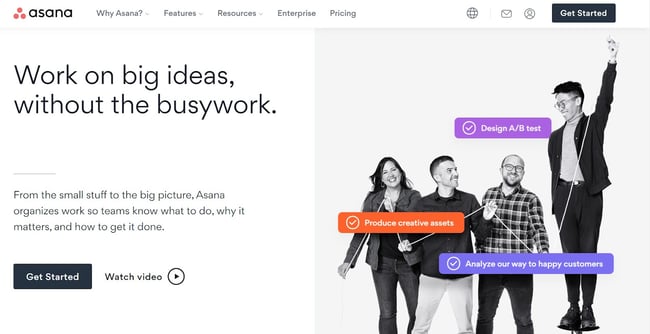
An example of a layout done right is on Asana’s website. With this type of layout, you can adjust which side of the screen the image is placed on, where the header appears, and the order of the CTAs.
2. Calls-to-Action (CTAs)
CTAs offer several testing opportunities. For example, you can test the performance of different CTAs based on their placement on various pages of your website and within certain pieces of content like blog posts, ebooks, and webinars.
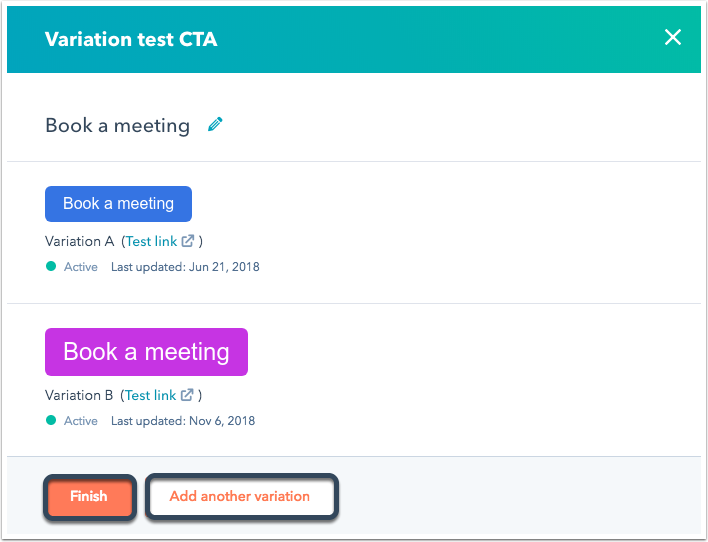
Hubspot offers tools that allow you to run an A/B test with multiple variants of your CTA. You can change the size, color, and text for the CTAs to narrow down exactly what works for your visitors.
3. Content Offers
Calls-to-actions are made up of different offers, such as an ebook, a webinar, a free trial, etc. Test calls-to-action in terms of varying content offer topics in your industry and various formats (video vs. webinar vs. ebook vs. free trial, etc.).
Do certain offers focused on a particular topic or in a specific format tend to resonate better with your audience? These types of tests can help you identify the wants and needs of your prospects and customers and help you create content your audience cares about.
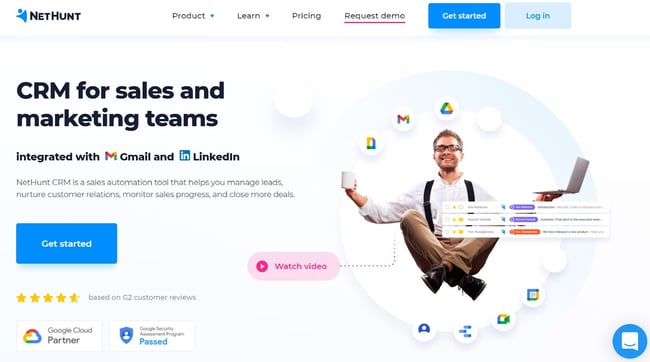
Nethunt’s homepage is an excellent example of different content offers in action. The page features “Log In,” “Start here,” and “Watch Video,” CTAs. Ideally, you’d want your visitor to focus on one or two tasks when they reach your homepage. By running an A/B test on various content types, you can figure out which one converts best.
4. Color
Test the color of the elements on your website. You can even test the overall color scheme of your website or blog. Do specific colors elicit a better response than others?
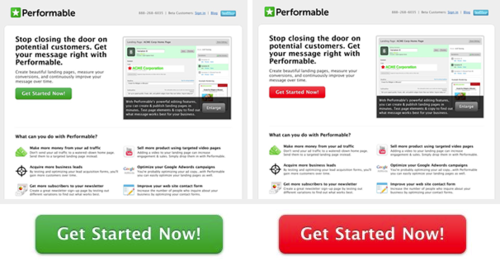
Take this case study as an example of how powerful colors can be. Performable, a marketing automation company acquired by HubSpot increased conversions by changing the color of their CTA button from green to red.
5. Size
Sometimes, making a CTA button, an image, or a headline a few pixels bigger can make a huge difference. Maybe your headline isn’t prominent enough to catch the site visitor’s attention. Or maybe your call-to-action is too small to stand out. Test how well these elements are working by adjusting their size.
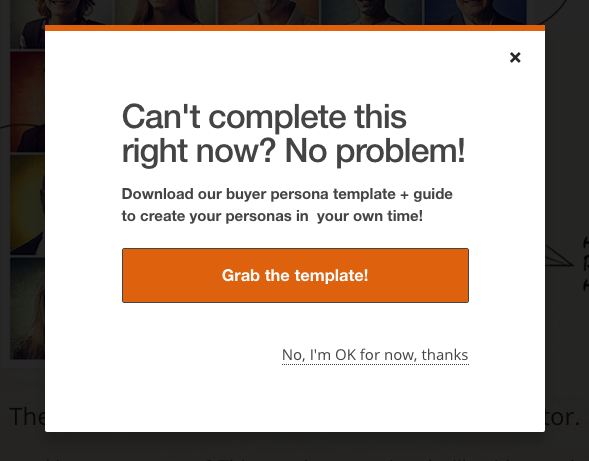
Toolbase’s MakeMyPersona has a pop-up with two CTAs. The design, size, and color of “Grab the template!” are much more attractive and clickable than the “No, I’m OK for now, thanks” CTA.
6. Email Subject Line
Test different versions of subject lines to determine which results in the best click-through rate in your email marketing and lead nurturing emails. Do you find that a more actionable or sensational subject line performs better than others?
In the example below, Teleflora simply used the recipient’s name in the cart abandoned email subject line. And it resulted in 3X more orders.

7. Headlines
Similarly, do some testing and analysis of headlines. Do numbers in your headlines produce better results? Over time, do you notice a pattern of specific words that have consistently attracted lots of views?
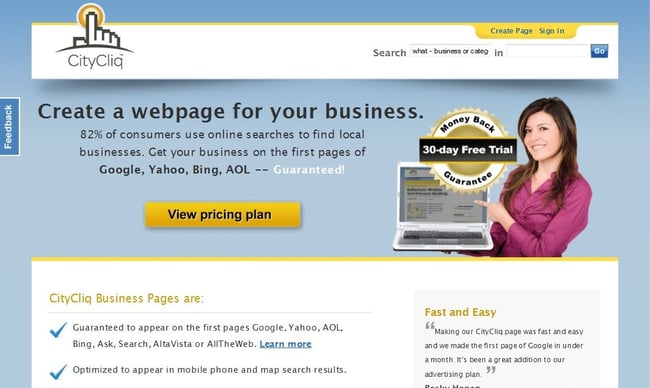
CitiCliq enjoyed a 90% increase in CTR by tweaking the headline.
8. Email Sender
Test various versions of how you present your email sender. For example, does a stand-alone name of one of your employees work better than your company name? What about a combination of the two?
Bamboo, a company that allows people to invest and trade U.S stocks, uses a personalized email send address to catch the reader’s eye.

9. Pricing Scheme
Vendors might offer a freemium, free trial, or time-dependent money-back guarantee pricing scheme. If you’re a vendor, a/b testing your pricing model will help you determine the prices that work best for your business.
Acuity Scheduling increased paid signups by over 250% when it changed from a freemium software model to a 14-day free trial model.

10. Copy Length
Test the length of your landing page copy and forms (shorter forms may be better for your business than longer forms, or vice versa), your content (do your readers prefer shorter or longer blog posts with more copy?), your email messages, and social media updates like tweets, Facebook, and LinkedIn updates.
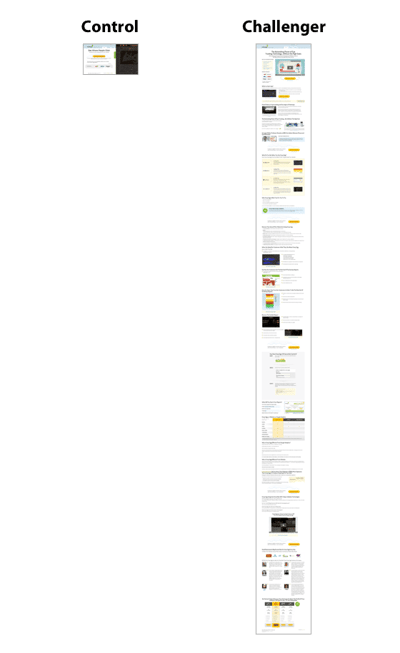
For example, Conversion Rate Experts A/B tested Crazy Egg’s short-form landing page with a long-form challenger — which eventually outperformed the control by 30%.
11. Landing Page
Have you varied the way you designed your landing page? If you’re having problems with conversions, try a different landing page design and check for improvements.
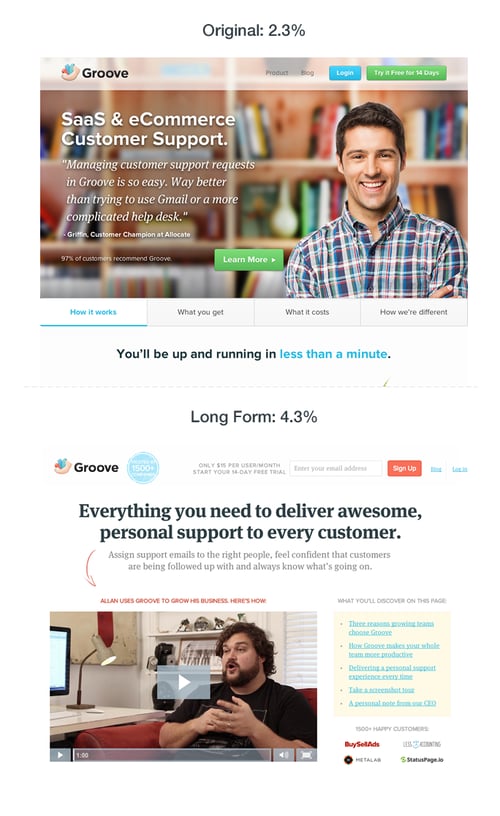
Groove had one of its landing pages converting at 2.3%. Tweaking and testing a new landing page doubled their conversions to 4.7%.
12. Tone
Test different tones in your writing and positioning. Does a more serious approach work better than an edgier one? Be careful with this one, though — once you’ve done some testing and defined your most effective tone, stick with it. Your company should have a recognizable, consistent voice across all your messages and content.
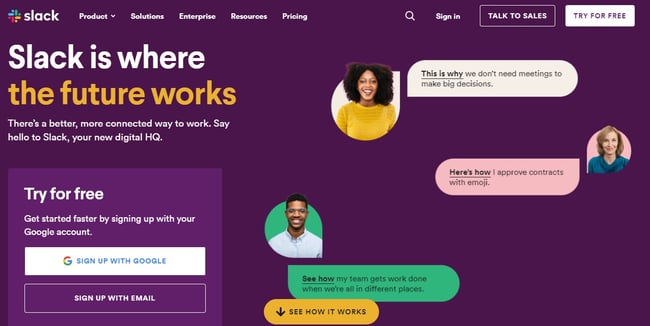
In 2019, Slack changed its logo and tone to become clearer and more friendly. The consistent voice across all their channels — website, social media, emails, and app — has helped Slack remain one of the fastest-growing B2B startups.
13. Images
Test how people respond to different types of images — in your blog posts, your email messages, your landing pages, your CTAs, etc.
ConstructConnect recorded a 35% increase in conversions by changing the background image on their landing page.

14. Timing
Do your tweets get retweeted more in the morning or the afternoon? Do certain days of the week make for better Facebook engagement? For example, perhaps your email marketing is more effective on Saturdays, and your blog posts generate more views during the middle of the week.
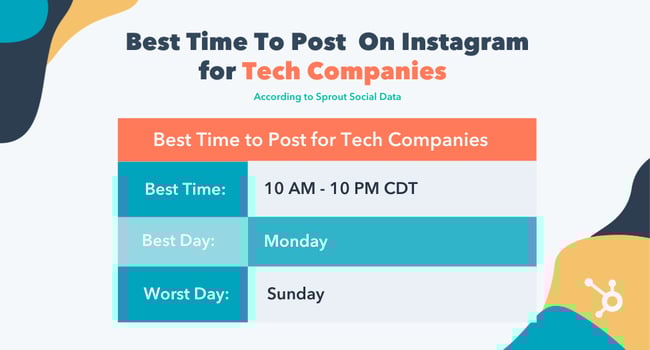
For example, a study found out that tech industry Instagram posts performed better on Mondays while Sunday was the worst day for these companies to post content.
15. Frequency
Is your particular audience receptive to more or fewer updates from you, whether it be via email, tweets, blog articles, Facebook posts, etc.? Test the frequency of your updates in various channels and take notice of what works best.
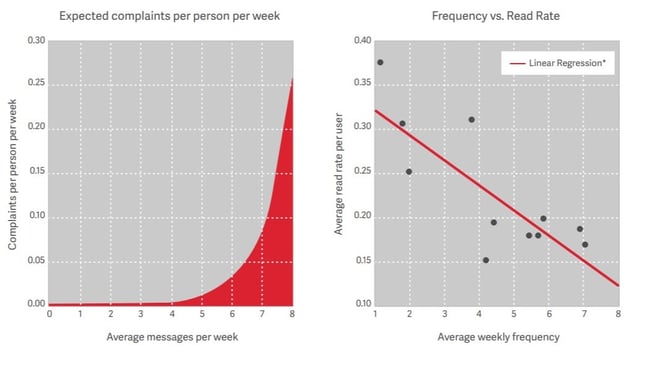
Return Path conducted a large-scale study on email campaign frequency and found that after five weekly emails, complaint rates rose substantially.
16. Video vs. Text Sales
Video is a very powerful marketing tool. For example, 83% of video marketers believe it helps them with lead generation, while 91% are satisfied with the ROI of video marketing.
While creating videos can be more complex and expensive, especially when compared with text-based copywriting, it might be just what your business needs to improve conversions and is worth a/b testing.
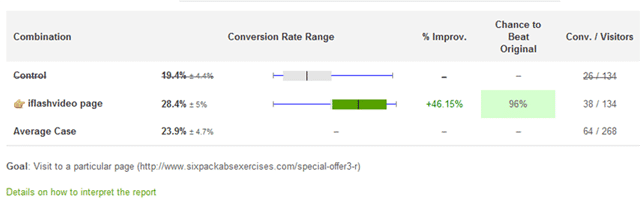
Dr. Muscle used a 1-minute professionally produced video to encourage visitors to check out more exercises in the manual and workouts. This video sales page increased the number of visitors that moved to the next sales funnel step by 46.1%.
17. Forms
A few changes to your form can improve your conversion rates measurably. A/B testing allows you to test form elements like buttons, design, length, and more against each other to see the best results.
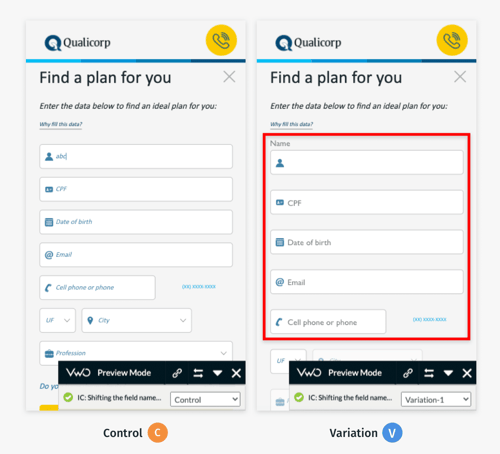
Qualicorp tweaked several forms on its website and ran these through A/B testing. In the end, these new forms increased overall conversion rates.
18. Targeting and Personalization
Another variable you can test in paid search is audience targeting. You can test different targeting methods on your homepage, on your landing pages, in your email marketing and lead nurturing, etc.
Shopify helps business owners build online stores for their websites. Its homepage does a great job of meeting the site visitor’s intent.
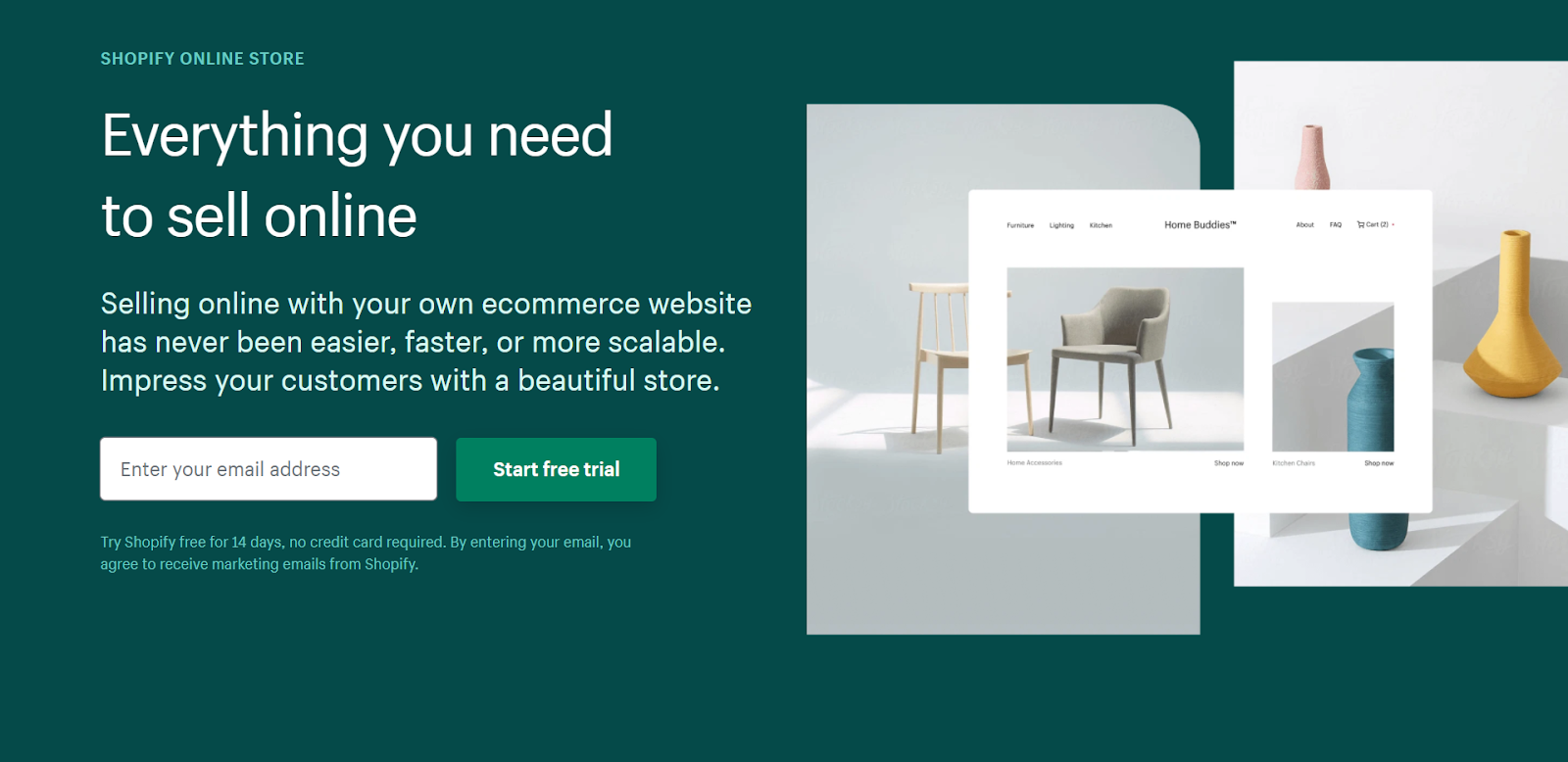 Image Source
19. Sales Copy
If you’re aren’t seeing enough conversions, your sales copy might be to blame. It might be bland, confusing, or daunting. A/B testing can help you to get the best sales copy version to use. You can even A/B test how the copy on your pricing page appears.
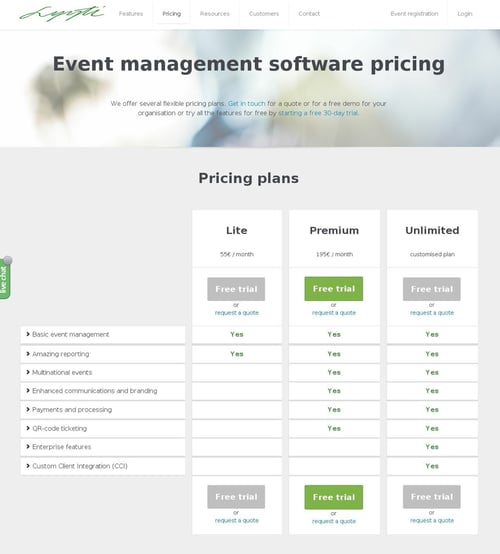
Lyyti redesigned its pricing page and observed over 90% more lead conversions.
20. Data Visualization
What’s the best way for you to present data? In a pie chart? A graph? An infographic? Try different ways to visualize your data, and see what works best!
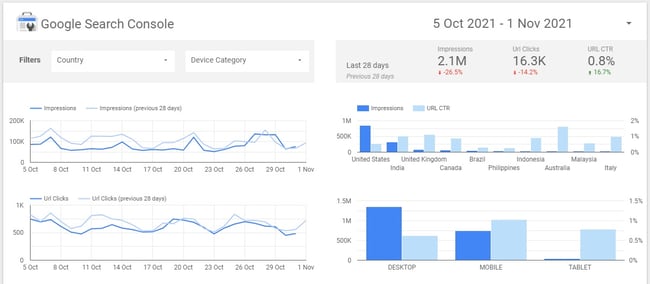
Google has nailed data visualization with their Search Console dashboard. The dashboard visualizes all the vital metrics from a website with easy-to-understand charts and graphs.
Final Thoughts
So there you have it: 20 of the most essential A/B testing variables to help you measure marketing campaign success.
So examine your current marketing campaign to identify ways to improve it. Some of these tests might require a considerable amount of effort, but the improvements that happen after are usually worth it.
Editor’s note: This post was originally published in October 2011 and has been updated for comprehensiveness.

The Ultimate Guide to Instagram Hashtags for 2022
Instagram hashtags are powerful.
They can help your posts reach a target audience, attract followers in your niche, increase engagement, and develop a more positive and recognizable brand image.
Here’s the thing, though: with great power comes great responsibility (#spiderman).
![Download Now: How to Use Instagram for Business [Free Guide + Templates]](https://no-cache.hubspot.com/cta/default/53/50132bc4-636b-4d26-9e40-61748d9618a9.png)
Hashtags can skyrocket your business to new heights, but if used too frequently or without a clear strategy in mind, they become pointless and inefficient.
While it can be hard to choose the right hashtags on Instagram, you don’t have to guess. Aside from this article, we’ve put together an ultimate course on using Instagram for marketing. In this course, we’ll teach you to not just attract followers, but to attract the right followers.
First, let’s go over Instagram hashtags specifically — and why they’re so important for your Instagram marketing strategy. We’ll cover the following topics:
- What is an Instagram hashtag?
- Why are hashtags important?
- Types of Instagram hashtags
- Best Instagram Hashtags
- Best practices for using hashtags on Instagram
- Top Instagram hashtags for 2021
- Trending Instagram hashtags
- How to use hashtags on Instagram for business
- How to search hashtags on Instagram
Why are hashtags important?
Hashtags are essentially Instagram’s sorting process. With around 95 million photos posted on Instagram every day, it’s difficult for Instagram to efficiently deliver the right content to the right people. Hashtags help your post get discovered by viewers most interested in seeing it.
Krystal Gillespie, HubSpot’s Social Media Community Manager, explains the importance of hashtags this way: “Hashtags are like a funnel. For instance, #marketing is incredibly broad and attracts all types of posts. We’ve found #digitalmarketing or #marketingmotivation gives us a more specific, targeted reach. The audience searching for these hashtags are also trying to narrow their search to what we offer related to marketing, so we’re actually reaching more of the right people.”
Essentially, hashtags are a better way to categorize your posts. They help you reach a target audience, and more importantly, they help your target audience find you. These users are more likely to engage with your post because it is exactly what they were looking for.
Types of Instagram Hashtags
Hashtags are highly versatile little pieces of text. They can build a community, make your account more visible, or simply attract like-minded individuals to your account.
Before choosing a group of hashtags for your posts, take a look at the most common ones you can use and their categorizations.
Best Instagram Hashtags for Companies
Whether you’re a social media manager at a company, an owner of a small business, or a sole proprietor, you can use the following hashtags to get more visibility on Instagram.
- Product or service hashtags. Companies use product hashtags for posts related to their product and service offerings. This will usually be general, such as #hairsalon or #knitwear.
- Industry niche hashtags. These hashtags are used to indicate the specific work you do and are narrower than your product or service hashtags. Examples include #blackhairsalon or #handmadeknits.
- Branded hashtags. Branded hashtags help you build a community specifically around your brand or business. This can be a slogan. It can also be the name of a specific product that you offer or even your business name.
- Campaign hashtags. If you’re running a sponsored ad, you can use a unique hashtag to keep track of activity relating to the campaign.
- User-generated content hashtags. This type of hashtag is created specifically for your customers. These are different from product, branded, and campaign hashtags because you, the company, can’t influence what gets posted. Other people can visit this hashtag to see unfiltered and unsponsored photos of your product.
- Instagram community hashtags for your industry. These hashtags are great for getting more visibility among other Instagrammers who do what you do. For example, if you were a knitter, you might post in #knittersofinstagram.

- Event or conference hashtags. As a company or business owner, you can use these hashtags to add to the conversation relating to a specific event or industry conference.
- Cultural movement hashtags. Cultural movements such as Black Lives Matter, LGBTQ+ Pride, and feminism have hashtags on Instagram (#BlackLivesMatter, #Pride, and #feminism, respectively). Use these hashtags to uplift voices, share information, and make your company’s stance clear.
- Location hashtags. These are great to target users in your area. Think #hairsalonnyc or #atlantabakery.
- Phrase hashtags. Phrase hashtags such as #writeeveryday and #bebrave can hint at what you do while inspiring users.
As individuals, you can also use daily, acronym, and holiday hashtags to engage in trending conversations.
Top Instagram Hashtags for Individuals
Do you use Instagram for personal use? Take a look at the hashtags that are available to you.
- Personal hashtags. You use these hashtags specifically in posts related to you. Think #me, #selfie, #lovemyself, #vacation, and #lovemylife.
- Daily hashtags. Daily hashtags usually have a theme, such as #workoutwednesday, #throwbackthursday, and #motivationmonday.
- Acronym hashtags. Think #ootd (outfit of the day), #potd (photo of the day), and #tbt.
- Holiday hashtags. Use these hashtags for specific holidays such as #DiaDeLosMuertos or #IndependenceDay to share how you’re spending time during these days.
Like companies, you can also use phrase, cultural movement, event, and location hashtags.
Best Instagram Hashtags
- #follow (675.8M posts)
- #love (2.1B posts)
- #instagood (1.5B posts)
- #fashion (1B posts)
- #photooftheday (972.4M posts)
- #art (863.8M posts)
- #photography (836.6M posts)
- #instagram (785.2M posts)
- #beautiful (779.7M posts)
- #picoftheday (682.5M posts)
- #nature (681.5M posts)
- #happy (661.6M posts)
- #cute (651.7M posts)
- #travel (600.4M posts)
- #style (595.3M posts)
- #followme (587.5M posts)
- #tbt (584.4M posts)
- #instadaily (570.8M posts)
- #repost (550.7M posts)
- #like4like (536.3M posts)
- #summer (521.1M posts)
- #beauty (482.8M posts)
- #fitness (476.7M posts)
- #food (467.4M posts)
- #selfie (460.7M posts)
- #me (459.9M posts)
- #instalike (454.5M posts)
- #girl (441.6M posts)
- #friends (429.7M posts)
- #fun (427.5M posts)
- #photo (427.4M posts)
- #smile (421.7M posts)
- #family (405.5M posts)
- #life (402.2M posts)
- #music (390.3M posts)
- #ootd (388M posts)
- #makeup (361.4M posts)
- #likeforlike (358.1M posts)
- #likeforlikes (335.4M posts)
- #model (328.7M posts)
- #dog (325.8M posts)
- #design (302.1M posts)
- #follow4follow (300.1M posts)
- #amazing (299.1M posts)
- #lifestyle (297.2M posts)
- #motivation (297.1M posts)
- #sunset (295.1M posts)
- #igers (294.3M posts)
- #explore (290.4M posts)
- #handmade (290.2M posts)
- #nofilter (285.7M posts)
- #beach (279.2M posts)
- #foodporn (275.4M posts)
- #instamood (266.3M posts)
- #sun (264.6M posts)
- #artist (262.7M posts)
- #dogsofinstagram (260.3M posts)
- #일상 (255.8M posts)
- #cat (253.6M posts)
- #drawing (250M posts)
- #sky (248.5M posts)
- #followforfollow (245.3M posts)
- #f4f (243.8M posts)
- #l4l (241M posts)
- #hair (233.4M posts)
- #flowers (229.9M posts)
- #followforfollowback (227.8M posts)
- #funny (227.4M posts)
- #gym (222.4M posts)
- #moda (221.7M posts)
- #photographer (219.4M posts)
- #likeforfollow (218.4M posts)
- #tagsforlikes (218.4M posts)
- #wedding (218.2M posts)
- #bestoftheday (215.2M posts)
- #baby (214.1M posts)
- #memes (213.8M posts)
- #inspiration (213.4M posts)
- #instafood (211.2M posts)
- #vsco (205.9M posts)
- #foodie (203.6M posts)
- #vscocam (203M posts)
- #instapic (200.3M posts)
- #girls (200.2M posts)
- #workout (194.2M posts)
- #pretty (189.3M posts)
- #yummy (184.3M posts)
- #home (183.8M posts)
- #fit (182.8M posts)
- #party (180.5M posts)
- #lol (180.1M posts)
- #healthy (179.6M posts)
- #naturephotography (179.6M posts)
- #nails (178.9M posts)
- #illustration (178.3M posts)
- #landscape (175.7M posts)
- #blackandwhite (175.1M posts)
- #catsofinstagram (173.6M posts)
- #cool (172.9M posts)
- #puppy (172M posts)
-
#night (135.4M posts)
- #catsofinstagram (133.2M posts)
- #nails (132.9M posts)
-
#tattoo (132.4M posts)
- #happiness (132.1M posts)
-
#instafashion (132.0M posts)
-
#work (130.6M posts)
- #architecture (128.9M posts)
-
#japan (128.5M posts)
-
#weekend (127.5M posts)
Best Practices for Using Hashtags on Instagram
Using hashtags on Instagram is a relatively simple process, but you’ll want to adhere to a few rules to get the most out of your hashtagging.
We’ve compiled best practices under the following frequently asked questions.
How many hashtags can I use on Instagram?
Thirty hashtags are the maximum number you can use.
The average is eleven, with half of Instagram accounts using between one and three. You can use more or less depending on your Instagram marketing goals. More doesn’t necessarily mean better.
Should I add hashtags to every Instagram post?
Yes! Absolutely you should.
Try to choose hashtags that are as narrow or as niche as possible. The less volume of posts a hashtag has, the more likely you’ll be seen by people who follow them. Plus, if the subject matter is highly specific, people are more likely to engage with your post.
All of my posts are similar. Can I use the same hashtags over and over again?
No. Instagram’s algorithm may penalize you for consistently using the same hashtags, pushing your posts down so they don’t show up for those tags.
Even more, they might ban your account, because using identical hashtags could make it look like you’re spamming users — or worse — like an Instagram bot.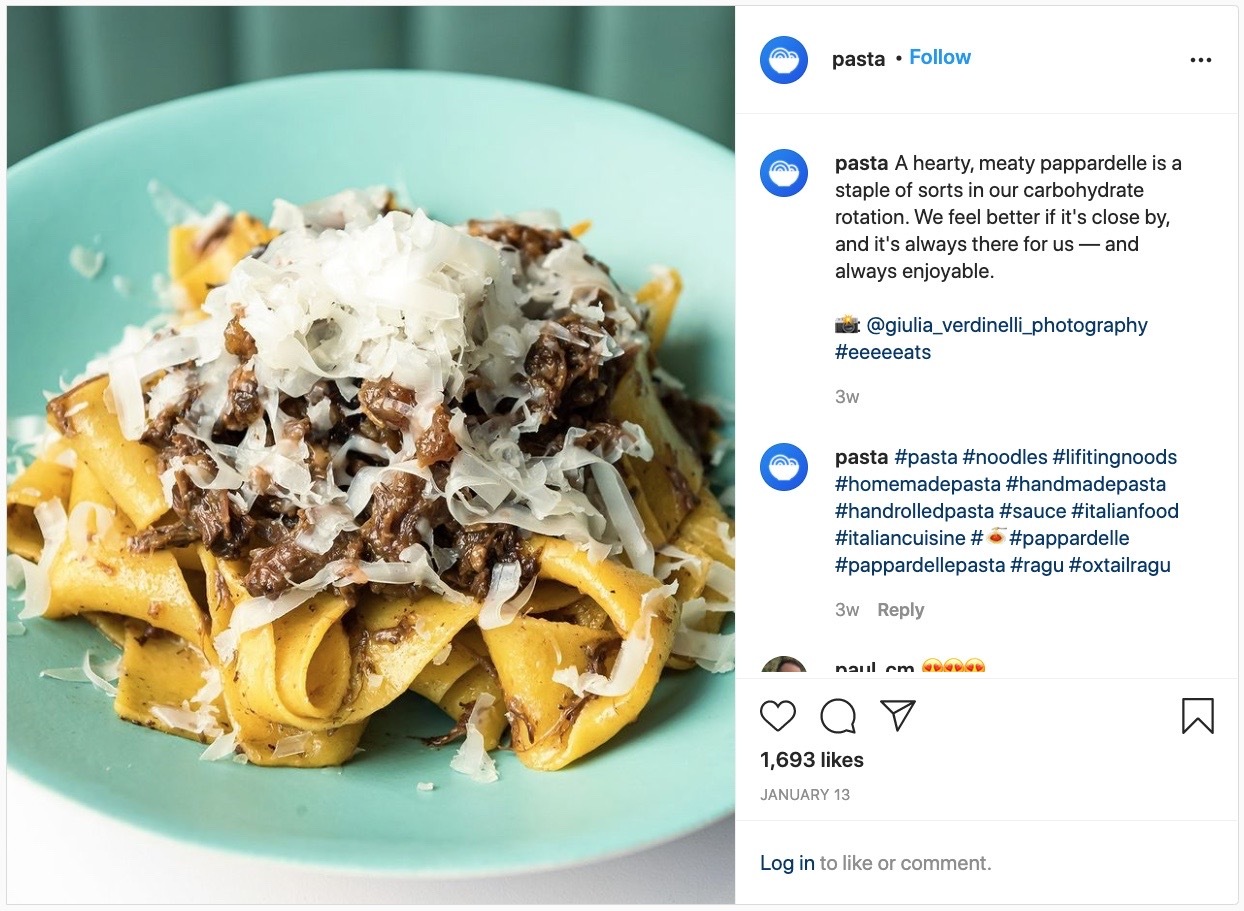
Try rotating out your hashtags so that they’re highly relevant to that specific post, even if the posts are similar. Let’s say that you own a handmade pasta business. If you always use the hashtag #spaghetti but post photos of linguini, macaroni, and penne, Instagram may flag your account, and users won’t engage.
Can I hide the hashtags in a comment?
Absolutely. You can hide your hashtags in a comment. Instagram doesn’t distinguish between caption hashtags and comment hashtags.
Simply write your caption as you would. After that, navigate to the published post and leave a comment with your hashtags. They will be hidden completely until users navigate to the comment section.
How do I hide hashtags in the caption?
Don’t want to post the hashtags in a comment? No worries.
You can hide the hashtags in the caption by either 1) writing a caption that’s more than three lines long or 2) adding 3 to 5 line breaks with a punctuation mark.
To add a line break, place the text cursor at the end of your caption and hit Return. Don’t forget to add either a period, a dash, an asterisk, or a tilde to ensure that that line stays there. (If there’s no punctuation, Instagram may treat it as accidental extra space, and delete those line breaks upon publication.)
Are there any hashtags I should avoid using?
Yes. Instagram maintains a list of banned hashtags. However, they don’t publish this list, and there’s no authoritative source.
Some are intuitive, such as NSFW and self-harm hashtags, while others, such as #pushups and #mustfollow, aren’t as self-evident. If you have any doubt about your hashtags, be sure to look them up using the app’s Search function.
If it doesn’t show up, it’s banned. If it does show up, navigate to the hashtag feed and check for a message like this:
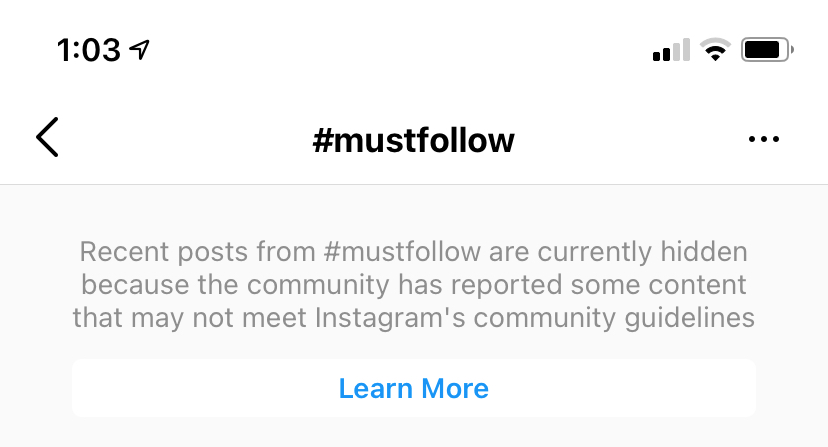
If your prospective hashtag doesn’t have a message like this, you’re all good to go.
Now that you know some basic dos and don’ts, let’s take a look at the top Instagram hashtags for the year.
Adding one of the most popular Instagram hashtags to your post doesn’t necessarily mean you’ll see more interaction. Since the hashtags below are so popular, they are being used by millions of people, so your post will most likely be obscured by the competition. Narrowing your hashtag topic is important, but we’ll get to that next.
Here are the top Instagram hashtags for this year.
1. #love (2B posts)
Instagram users build their photo galleries on good feelings. For this reason, the #love hashtag is ever-present next to the pics of friends, family, vacations, and beautiful scenery.
Top Instagram hashtags related to #love:
#love #lovely #loveit #loveyourself #lovelife #lovequotes #loveislove #lovefood #lovemylife #lovewhatyoudo #lovethis
2. #instagood (1.2B posts)
Occurrences of this hashtag are inspired by the @instagood Instagram account, which scours the Instagram community for excellent photos and videos that are just too #instagood not to share. Add this hashtag to your content for a chance to be reposted.
Top Instagram hashtags related to #instagood:
#instagood #instalife #instalike #instapic #insta #instacool #instafollow #instaphoto #instagramers #instamoment #instagramhub
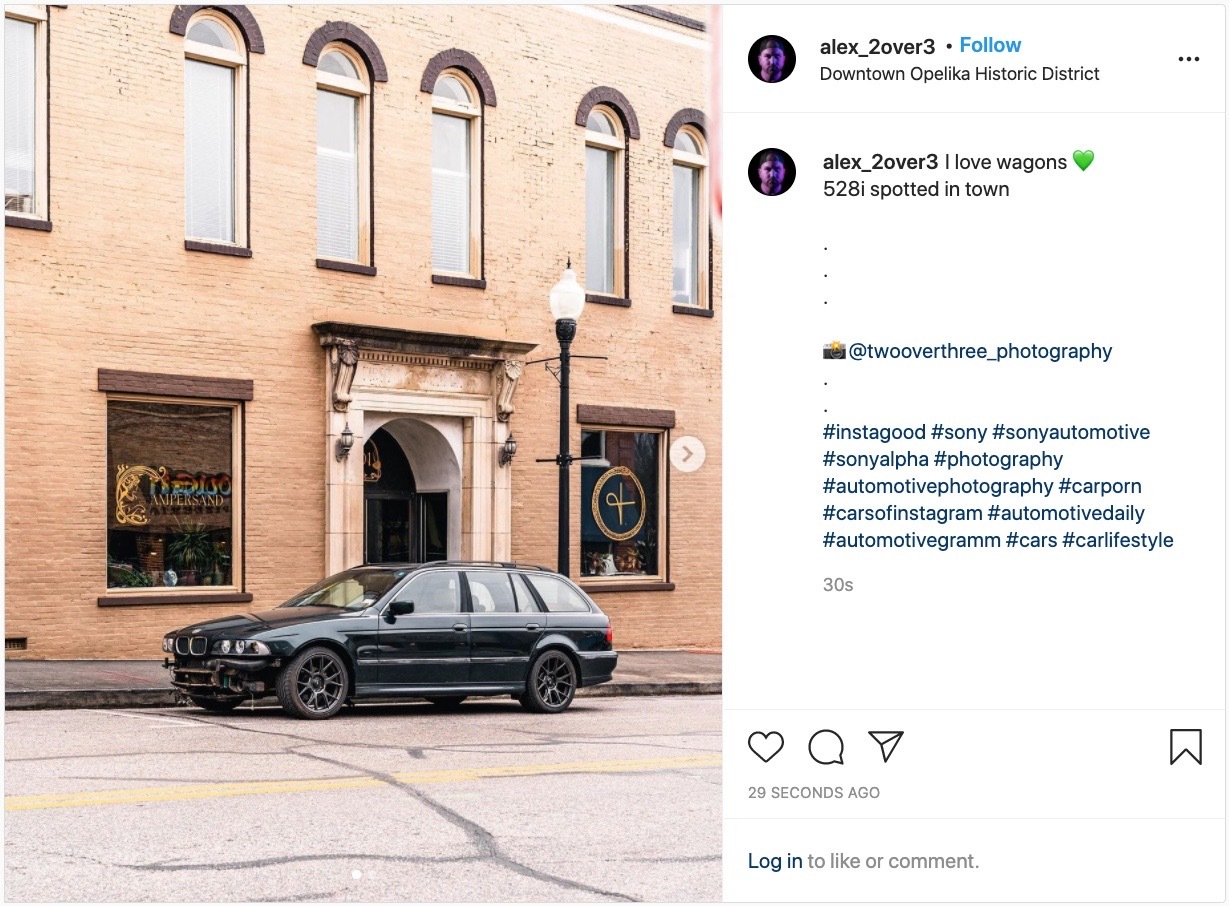
3. #fashion (900M posts)
People often turn to Instagram to see what styles are “in”, looking at posts ranging from fashion week to everyday outfit inspirations. This means that a significant portion of the content on Instagram revolves around fashion — in fact, there are nearly one billion #fashion posts on Instagram. You will find celebrities, luxury brands, clothes, makeup, and other aspirational images tagged with #fashion.
Top Instagram hashtags related to #fashion:
#fashion #fashionblogger #fashionista #fashionable #fashionstyle #fashionblog #fashiongram #fashionaddict #fashionweek #fashiondiaries
4. #photooftheday (883M posts)
Managing a business account? This hashtag is a surefire way to attract more followers and repeat visitors. If you plan to post daily content, all-around a common theme, add the #photooftheday hashtag to increase your exposure.
Top Instagram hashtags related to #photooftheday:
#photooftheday #potd #picoftheday #photography #photographyeveryday #photographyoftheday #bestoftheday
5. #art (750M posts)
Artists of all kinds have always flocked to Instagram, and this hashtag holds pictures or process videos of all of their paintings, sculptures, and quirky creations.
Top Instagram hashtags related to #art:
#art #artist #artwork #instaart #arte #streetart #digitalart #artofvisuals #artistsoninstagram #artoftheday #artsy #artistic #arts #artgallery #modernart
6. #beautiful (717M posts)
Instagram is the place to go to put your best foot forward — whether it be your amazing getaway, a new hairstyle, or a breath-taking sunset, #beautiful photos encompass the best of what the platform has to offer.
Top Instagram hashtags related to #beautiful:
#beautiful #beautifuldestinations #beautifulday #beautifulview #beautifulplace #beautifulcuisines #beautifulplaces #beautifuldestination #beautifulnature
7. #photography (700M posts)
At its core, Instagram is a photo-sharing media, so it makes sense that there are some stunning and artistic images shared in #photography. Instagram is unique in that a user could be scrolling through the #photography posts and see National Geographic and professional photos next to amateur photographers.
Top Instagram hashtags related to #photography:
#photography #travelphotography #naturephotography #streetphotography #foodphotography #portraitphotography #landscapephotography #weddingphotography #blackandwhitephotography
8. #follow (620M posts)
This hashtag — currently tagged on more than six hundred million posts — is a tactic used by public accounts looking to gain more followers. It’s a ubiquitous tag, non-specific to any one type of content creator, so you’ll see #follow on fashion accounts, travel blogs, makeup tutorials, celebrity fan pages, and much more. The idea is that if a user comes across content that they like on your explore page, they might be motivated to follow the account for more of that content.
Top Instagram hashtags related to #follow:
#follow #f4f #followme #followforfollow #follow4follow #teamfollowback #followbackteam #followall #followalways #followback #pleasefollow #follows #follower #following
9. #happy (615M posts)
Sometimes the best part of feeling good is sharing that sunshine with others. The #happy group of posts is full of radiant people and lighthearted content that brings us joy. Tag a photo of a cute kitten or one of yourself after getting a promotion with #happy.
Top Instagram hashtags related to #happy:
#happy #happyday #happylife #happyfriday #happyhour #happyme #happymonday #happysunday #happytime #happydays #happydog #happyplace
10. #cute (610M posts)
#Cute puts your content in a pool of Instagram photos and videos that elicit “awes” from all over the Instaverse. If you think your puppy is the cutest puppy that ever lived, it deserves a photo with this esteemed hashtag.
Top Instagram hashtags related to #cute:
#cute #cutedog #cutebaby #cuteness #cuteanimals #cutecat #cutepetclub #cutenessoverload #cuteboy #cutedogs #cutecouple #cutepuppy #cutest
11. #instagram (600M posts)
Navigate to this hashtag and you’ll find everything from selfies to photos of food to pet pictures to vacation shots. Use this hashtag to signal that you’re on Instagram and that you have something worth sharing.
Top Instagram hashtags related to #instagram:
#instagram #instagramers #instagramhub #instagrammers #instagramer #instagramanet #instagramdogs #instagrammer #instagramjapan #instagramcats #instagramfitness

12. #nature (600M posts)
Nature is all around us. It’s also on Instagram. This hashtag is used to post everything related to nature, including mountains, rivers, and wild animals.
Top Instagram hashtags related to #nature:
#nature #naturephotography #naturelovers #naturelover #nature_perfection #naturegram #nature_brilliance #natureaddict #nature_shooters #naturephoto #naturelove
13. #tbt (560M posts)
#Tbt stands for “Throwback Thursday,” and encourages Instagram users to post an old photo of themselves or an event they’re reminiscing over. Everyone likes content from the good old days — here’s your hashtag for enjoying the nostalgia.
Top Instagram hashtags related to #tbt:
#throwbackthursday #tbthursday #tbtphoto
14. #followme (560M posts)
A close cousin to #followforfollow and #likeforlike, #followme is used by Instagrammers looking to grow their follower base.
Top Instagram hashtags related to #followme:
#follow #f4f #followme #followforfollow #follow4follow #teamfollowback #followbackteam #followall #followalways #followback #pleasefollow #follows #follower #following
15. #travel (544M posts)
Away for the weekend? Show your followers where you are, using this hashtag to indicate you’re traveling somewhere new.
Top Instagram hashtags related to #travel:
#travel #travelgram #instatravel #travelphotography #traveling #travelling #travelblogger #traveler #traveller #travelingram #traveltheworld #travelblog #travels #traveladdict
16. #style (500M posts)
This hashtag has more than 500 million posts associated with it, making it one of the top tags on Instagram. It’s used for beautifully edited photos of outfits, vacations, luxury products, and anything aesthetically stunning. Tag #style on a gorgeous outfit inspiration or new product, and Instagram users looking to add a little glamour to their lives will find you.
Top Instagram hashtags related to #style:
#style #styleinspo #styleblogger #styleinspiration #styleoftheday #stylefashion #stylegoals #stylediary #stylegram #styleguide #styleblog
17. #repost (500M posts)
Reposting is a common function on Instagram that allows you to share content from other users, with credit back to the original user. Use the hashtag, #repost, to tell others on Instagram that you were inspired by this photo or video.
Top Instagram hashtags related to #repost:
#repost #reposter #repostapp #reposting #repostthis #reposted
18. #instadaily (500M posts)
This hashtag is similar to #photooftheday and is perfect for Instagrammers who post every day.
Top Instagram hashtags related to #instadaily:
#photooftheday #potd #picoftheday #photography #photographyeveryday #photographyoftheday #bestoftheday
19. #summer (490M posts)
The summertime is the best season to enjoy fun vacations, fruity drinks, and time by the pool. This tag is full of Instagram users enjoying the long summertime hours on the beach or showing off the breezy outfits keeping them cool under the hot #summer sun.
Top Instagram hashtags related to #summer:
#summer #summertime #summervibes #summerfun #summernights #summerdays #summerstyle #summerfashion #summerday

20. #selfie (442M posts)
This is the quintessential selfie hashtag, indicating to the Instagram community that the photo its captioning is a picture of you.
Top Instagram hashtags related to #selfie:
#me #selfies #selfietime #selfienation #selfiesunday #selfiegram #selfielove #selfieaddict #selfiesaturday #selfiemania
21. #fitness (433M posts)
Get in on a trending community of workout warriors with photos and videos from your best exercise sessions, using the #fitness hashtag to share the moment.
Top Instagram hashtags related to #fitness:
#fitness #fitnessmotivation #fitnessmodel #fitnessaddict #fitnessgirl #fitnessjourney #fitnesslife #fitnesslifestyle #fitnessgoals #fitnessfreak #fitnessfood #fitnessgear #fitnessinspiration
22. #beauty (431M posts)
The hashtag #beauty is mainly used by beauty bloggers — professional make-up artists and hobbyists — but you’ll also find some pet shots and nature shots in there, too.
Top Instagram hashtags related to #beauty:
#beauty #beautyblog #beautycare #beautytips #beautyaddict #beautysalon #beautybloggers #beautyqueen #beautyguru #beautyproducts #beautyofnature #beautygram
23. #food (428M posts)
Meal pics are the bread and butter (no pun intended) of a people-oriented Instagram account. Use the #food hashtag to caption your next delicious Instagram photo.
Top Instagram hashtags related to #food:
#food #foodporn #instafood #foodie #healthyfood #foodstagram #foodgasm #foodphotography #foodblogger #foodlover #foodpics #foodpic #foodies
24. #fun (400M posts)
If it’s not fun, it’s not Instagram-worthy. Make it known to millions of Instagram users that you had a blast in your latest photo or video with this popular hashtag.
Top Instagram hashtags related to #fun:
#fun #funny #lol #lmao #hilarious #laugh #laughing #tweegram #friends #wacky #crazy #silly #witty #instahappy #joke #jokes
25. #likeforlike (345M posts)
#Likeforlike is similar to the #followforfollow hashtag. Use this hashtag if you want to increase engagement on your Instagram account, telling users that you’ll like their photo or video if they like yours.
Top Instagram hashtags related to #likeforlike:
#likeforlike #followme #like4like #liker #likes #l4l #likes4likes #love #likesforlikes #liketeam #likeback #likebackteam #likeall #likealways
The above hashtags might have helped define Instagram over the last year, but there are still plenty more that end up trending every year. The following hashtags can help inspire photos and videos that Instagram users always find captivating.
1. #life (366M posts)
This one goes out to all the photos and videos that encompass the essence of your life — whether in quarantine or not.
Top Instagram hashtags related to #life:
#life #lifestyle #healthylifestyle #lovelife #luxurylifestyle #lifeisgood #lifestyleblogger #lifequotes #loveofmylife #luxurylife #lifeofadventure
2. #music (350M posts)
This hashtag is for those who love music and the people who create it.
Top Instagram hashtags related to #music:
#music #musica #musician #musically #musicvideo #musical #musicians #musicislife #musicproducer #musiclife #musiclover #musicfestival #musicphotography #musicproduction
3. #amazing (289M posts)
The hashtag #amazing is used for everything you find, well, amazing — places, art, beautiful homes, awe-inspiring videos, and more.
Top Instagram hashtags related to #amazing:
#beautiful #cute #awesome #amazingview #amazingfood #amazingplaces
4. #nofilter (280M posts)
Instagram offers so many different filters to help enhance photos, it’s practically assumed that any picture on Instagram has been edited. But if you’re posting a pic that was beautiful all by itself, let the world know that this gem didn’t need a filter to look so nice.
Top Instagram hashtags related to #nofilter:
#nofilter #nofilterneeded #nofilters #nofiltersneeded #nofilternecessary #nofilterneededforthisbeauty
5. #sunset (272M posts)
Who doesn’t love a good sunset? Users add posts to this hashtag to show off a beautiful sunset near them.
Top Instagram hashtags related to #sunset:
#sunset #sunsets #sunsetlovers #sunsetporn #sunsetlover #sunsetsky #sunsetphotography #sunsetbeach #sunsethunter #sunsetmadness
6. #motivation (258M posts)
On Twitter, #MondayMotivation encourages inspiring quotes and messages to help people start the week off on the right foot. On Instagram, the #motivation hashtag has come to caption anything from a photo of a user after a big gym session, to a computer screen right before he or she gets to work.
Top Instagram hashtags related to #motivation:
#motivation #motivationalquotes #motivational #motivationmonday #motivationalquote #MotivationalSpeaker #motivationalmonday #motivations #motivationquotes
7. #instamood (251M posts)
#Instamood is all about the vibe or emotion a photo or video elicits. Pretty scenery, a day at the beach, or a night out with good people are all prominent under the #instamood hashtag. Landscapes are a popular starting point when figuring out what to post on Instagram, according to Jumper Media, and they fit into this hashtag perfectly.
Top Instagram hashtags related to #instamood:
#instamood #instagood #instalife #instalike #instapic #insta #instacool #instafollow #instaphoto #instagramers #instamoment #instagramhub
8. #foodporn (250M posts)
I hope you’re hungry! The #foodporn tag is brimming with mouthwatering posts of desserts, pizza, recipe videos, and so much more. This hashtag is for the best of the best when it comes to delectable treats on Instagram — find the most original, delicious, and tantalizing food pictures on the internet under this hashtag.
Top Instagram hashtags related to #foodporn:
#food #foodporn #instafood #foodie #healthyfood #foodstagram #foodgasm #foodphotography #foodblogger #foodlover #foodpics #foodpic #foodies
9. #handmade (245M posts)
The hashtag #handmade is like the #art hashtag for handmade wares, clothing, and novelties. The rise of slow fashion and a growing interest in sustainably-made products makes this one of the top trending hashtags this year.
Top Instagram hashtags related to #handmade:
#handmade #handmadejewelry #handmadewithlove #handmadeisbetter #handmadefont #handmadegifts #handmadejewellery #handmadeshoes #handmadesoap #handmadeaccessories
10. #dogsofinstagram (225M posts)
We all know that the internet loves cute puppies, so it shouldn’t be surprising when a hashtag for our beloved doggos trends on Instagram. It’s always a good idea to include man’s best friend in an Instagram post — your followers will love it and you’re almost guaranteed dozens of heart emojis in your comments.

Top Instagram hashtags related to #dogsofinstagram:
#dogsofinstagram #dogs #dog #dogstagram #dogsofinsta #dogsofig #dogsitting #dogslife #doglife #dogsofinstaworld #dogoftheday
11. #bestoftheday (210M posts)
The #bestoftheday tag offers a glimpse into the massive amount of varied content that is posted to Instagram every day. Here, you’ll find some of the most noteworthy images on the platform — images of beautiful spots around the world, award-winning photos, yummy recipes, adorable animals, and so much more.
Top Instagram hashtags related to #bestoftheday:
#bestoftheday #instadaily #potd #picoftheday #photography #photographyeveryday #photographyoftheday
12. #instafood (190M posts)
This popular tag is different from other food hashtags because it accompanies food pictures that are gorgeous, creative, and, most importantly, worthy of Instagram. Instagram posts are known for being aesthetically appealing, and #instafood is no different. Use this tag if you’re posting a photo of a colorful, unique, and sumptuous dish!
Top Instagram hashtags related to #instafood:
#instafood #food #foodporn #foodie #healthyfood #foodstagram #foodgasm #foodphotography #foodblogger #foodlover #foodpics #foodpic #foodies
13. #explore (185M posts)
Instagram has always had an explore section, but only recently have Instagrammers started to use this hashtag to win a highly coveted but elusive spot on this page.
Top Instagram hashtags related to #explore:
#instagrammers #igers #instalove #instamood #instagood #followme #follow #comment #shoutout
14. #memes (180M posts)
A classic but a goodie. Throughout the years, humor has taken different forms — comedy sitcoms, stand-ups, knock-knock jokes, and more. But none of these forms come near the Instagram-worthiness of memes. Use this hashtag to share a unique meme or repost one from another account.
Top Instagram hashtags related to #memes:
#memes #meme #dankmemes #funnymemes #memesdaily #edgymemes #offensivememes #fortnitememes #dailymemes #spicymemes #memestagram #btsmemes #memes😂 #memepage #memelord
15. #followforfollowback (160M posts)
Interested in building a fast list of followers on Instagram? #Followforfollowback tells everyone who browses this hashtag that you’ll follow users who choose to follow you. This hashtag is always trending highly.
Top Instagram hashtags related to #followforfollowback:
#followforfollowback #follow #f4f #followme #followforfollow #follow4follow #teamfollowback #followbackteam #followall #followalways #followback
16. #tweegram (95M posts)
There is plenty of multi-platform sharing across social media sites, and in #tweegram, you’ll find images taken from Twitter, Pinterest, and more. #Tweegram is best known for quotes, screenshots of Tweets, and memes.
Top Instagram hashtags related to #tweegram:
#tweetgram #tweet #twitter #twitterposts #twitterweek #twittermarketing #twittermemes #twitterpost #twittermeme #twitterquotes #twitterwhy
17. #instagramhub (65M posts)
This hashtag isn’t specific to one type of post — #instagramhub is a place for active Instagram users to demonstrate their presence on the platform and reach larger audiences. By including this popular hashtag, influencers on Instagram can connect with as many users as possible.
Top Instagram hashtags related to #instagramhub:
#instagramhub #igers #instagram #instadaily #instamood #instagood #instalife #instalike #instapic #insta #instacool #instafollow #instaphoto #instagramers #instamoment
18. #quarantine (30M posts)
#Quarantine is the quintessential COVID-19 hashtag and has no defined aesthetic or subject matter. Instead, it encompasses everything that we see, experience, and do — or don’t do — during quarantine. You can find pet photos, cooking videos, memes, and, most shockingly, shots of people on vacation.
It’s worth noting that there’s no #COVID hashtag because Instagram wants to prevent the spread of misinformation.
Top Instagram hashtags related to #quarantine:
#quarantine #quarantinelife #quarantineandchill
19. #BlackLivesMatter (26M posts)
The Black Lives Matter movement swept through the United States in 2020 and has been at the forefront of the cultural imagination since the killing of Trayvon Martin in 2012. Use this hashtag to add value to the movement or uplift voices that differ from your own.
Top Instagram hashtags related to #blacklivesmatter:
#blm #blackhistorymonth #blackownedbusiness #blackgirlmagic #blackouttuesday #blackexcellence
Read HubSpot’s stance on Black Lives Matter here.
20. #newmusic (20M posts)
The hashtag #newmusic is one of the many tags people use to share either their own original music or let others know who they’re jamming to today.
Top Instagram hashtags related to #newmusic:
#music #hiphop #rap #artist #spotify #producer #rapper #soundcloud #musician #beats
21. #whatiwore (18M posts)
What better way to show off your OOTD than to tag #whatiwore. This hashtag is commonly used by people interested in the latest fashion trends, often tagging where they found it for sponsorships or for the chance of brand recognition.
Top Instagram hashtags related to #whatiwore:
#ootd #outfitoftheday #fashion #instastyle #style #instafashion #fashionblogger #fashionista #styleinspo
22. #workinprogress (16M posts)
The #workinprogress hashtag gives users a glimpse of some of the coolest projects being shared on the app. From art, architecture, or even fitness, this tag helps people post about reaching their goals and the steps along the way.
Top Instagram hashtags related to #workinprogress:
#wip #drawing #artwork #painting #handmade #workout #design #fitness #artistsoninstagram #motivation
23. #space (15M posts)
There’s something so interesting and beautiful about outer space, and talking about it on social media never gets old either. Posting in the #space hashtag will lead you to find amazing shots of stars far and wide.
Top Instagram hashtags related to #space:
24. #technology (14M posts)
With technologic innovations taking place every day across industries, the #technology hashtag is where you’ll find the newest development or gadget.
Top Instagram hashtags related to #technology:
#tech #innovation #engineering #technews #science #design #gadgets #electronics #smartphone #programming
25. #engaged (13M posts)
Love is in the air — or in this case it’s trending. The #engaged hashtag is there for all your proposal inspiration, wedding ideas, and even more content for all the lovers out there.
Top Instagram hashtags related to #engaged:
#wedding #bride #bridetobe #love #weddinginspiration #engagement #weddingplanning #weddingphotography #weddingday #weddingdress
26. #travelbug (10M posts)
Influencers all around the world can use the #travelbug hashtag to document their coolest destination vlogs and photos. Take advantage of this hashtag whether you’re hitting the road or flying overseas.
Top Instagram hashtags related to #travelbug:
#travel #wanderlust #travelgram #travelphotography #traveltheworld #travelblogger #traveladdict #instatravel #traveling
1. Keep your hashtags organized.
To create an efficient hashtag system, you can use Excel or an Instagram analytics tool. If you choose an excel sheet, you’ll need to manually keep track of which hashtags you use, how often, and which ones correlate to your most popular posts. Over time, you’ll see relationships between certain hashtags and your most popular posts, and this can help you decide which hashtags work best for your brand.
If you have a more advanced social media team, you might want to consider a tool like Iconosquare, which automatically stores top hashtags and provides reports on which hashtags reach the most people.
For smaller businesses with limited budgets, Krystal Gillespie says that, “an excel sheet is the best way to start. Once you get more advanced I would highly recommend using a tool to track the data. A manual system can get overwhelming when you’re posting three times a day and using about 20 hashtags per post.”
2. Figure out your magic number.
Most top brands use seven or fewer hashtags per post, so it’s easy to assume that’s the magic number for everyone … right? Krystal explains that this isn’t always the case: She told me HubSpot has been more successful with hashtags ranging in the low 20s.
The point is, you can’t know how many hashtags work best for you until you test it. For HubSpot, it took the team several months to find a number that worked best, and during our trial period, we ranged from seven to 30. Give yourself the same flexibility for trial and error.
3. Narrow your hashtags.
There are two big reasons more specific, smaller-volume hashtags are better for your brand: first, you can compete in a smaller pool. HubSpot, for example, doesn’t typically use the hashtag #marketing because it’s too broad. If you search #marketing, you’ll find pictures of restaurants, inspirational quotes, before-and-after hairstyle pictures, and memes.
The randomness of #marketing leads me to the second reason specific hashtags are a good idea: as a user, I’m more likely to find what I need if I search for something specific, and when your business comes up for my specific search request, I’m more likely to be happy with what I found.
Krystal explains: “Keeping a hashtag close to the interests of your brand really helps. We try to use hashtags tailored for a specific topic and then narrow it down further — for instance, we’d use #SEOTips if our marketing post was mostly about SEO.”
Think of it this way: #dogs is more popular, but it has a wide demographic. If I search #goldenretrieverpuppies and I find your post, I’m more likely to engage with it because it’s exactly what I wanted.
4. Research what other people are hashtagging.
An easy way to generate hashtag ideas is to make a list of your followers or competitors and research what they’re hashtagging on their own photos. It can also be particularly helpful to research what influencers in your industry are hashtagging — by definition, influencers are people with a large social media following, so they must be doing something right.
5. Test out related hashtags.
When you type a hashtag into Instagram’s search bar, Instagram shows you related hashtags in the scroll-down menu. Instagram also delivers related hashtags on the next page after you click on a hashtag. This is a simple way to create a longer list of hashtags to try out.
6. Follow your own hashtag.
Another way to use Instagram hashtags for your marketing purposes is to follow your own hashtag. Krystal explains, “On Instagram, I actually follow the hashtag #hubspot so I can find anyone who talks about us and connect with them. As long as your account isn’t private, people will be able to find you via the hashtag.”
Following your own hashtag is an effective way to engage with other people talking about your brand and develop better relationships with them.
7. Create a brand campaign hashtag.
This is the trickiest item on the list, but if done successfully, it can pay off big time. Some businesses have successfully attracted followers by creating their own campaign hashtags. A campaign hashtag needs to be funny, clever, or at least memorable to work.
Campaign hashtags are particularly useful for promoting a new product or upcoming event, or even just inspiring people. Red Bull, for example, encouraged followers to post Red Bull pictures with a #putacanonit hashtag (see what I mean about clever?). LuLuLemon, rather than running a more traditional ad campaign, developed a positive connotation for their brand by asking followers to post real, active pictures of themselves with a #sweatlife hashtag.
Now that we’ve covered the importance of using Instagram hashtags for your business, you might be wondering how to search for Instagram hashtags within the app, or how to use the search function to find related ideas. If you’re unsure of the technical process for hashtag searching, here’s how:
How to Search Hashtags on Instagram
To search hashtags on Instagram, tap the magnifying glass at the bottom of your screen, then tap the search bar at the top. Selecting the “Tags” option will enable you to search hashtags and related hashtags based on the popularity of each one.
1. Open Instagram and tap the search icon.
Instagram wants you to use hashtags and has made it extremely easy to find the perfect ones for your post. To start, open the Instagram app on your mobile device and tap the magnifying glass at the bottom of your screen.
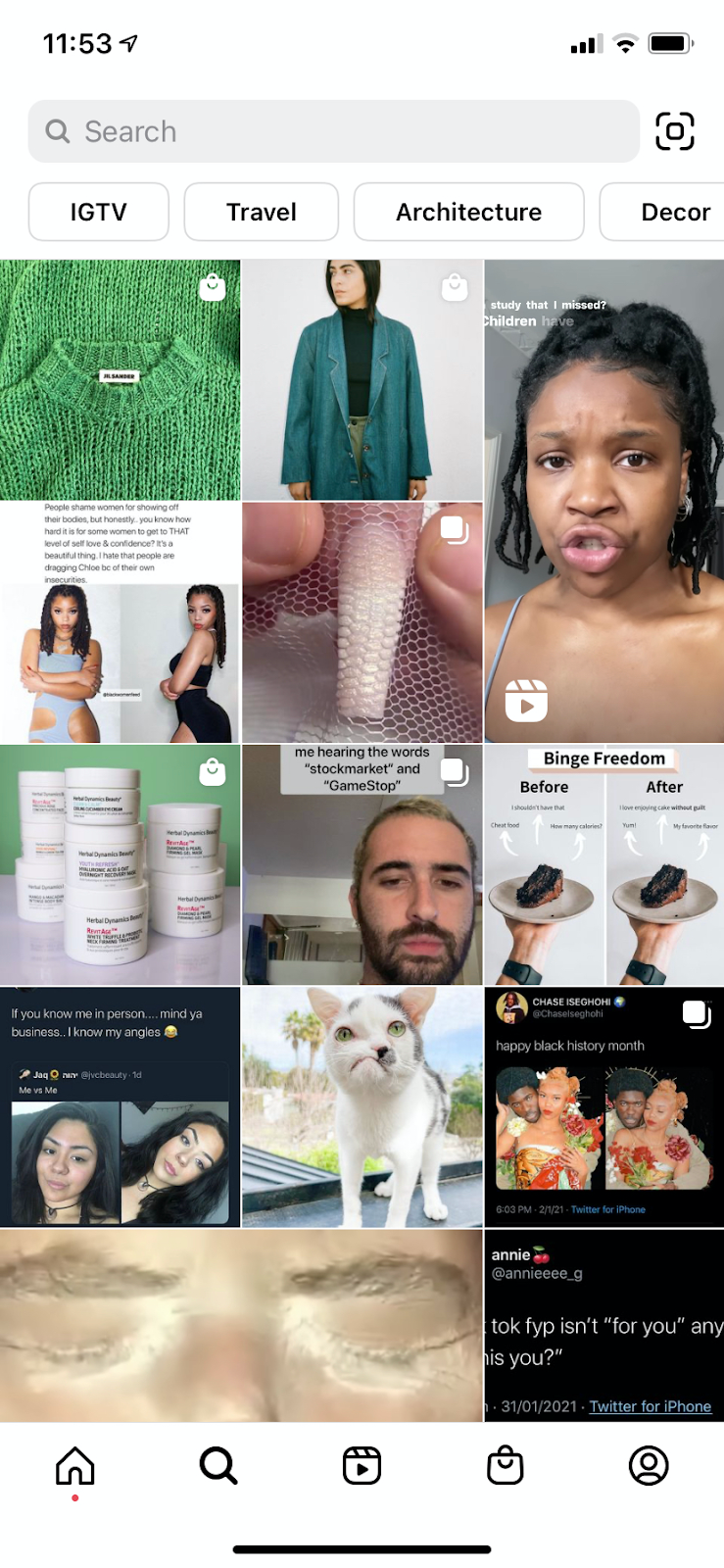
2. Tap the search bar at the top of your screen.
The search screen on your Instagram might first send you to a newsfeed-style page (the Explore page) with suggested content based on topics you’ve demonstrated an interest in on social media. To switch to a hashtag search, tap the search bar at the top of this page, as shown in the screenshot above.
3. Tap “Tags.”
Once you’ve tapped the search bar at the top of your screen, Instagram will give you four options with which to filter your search. Instagram refers to hashtags as simply “Tags,” as shown in the screenshot below. Tap this “Tags” option, then tap the search bar above it, and begin searching topics for which you want to find a trending hashtag.
You don’t have to include the pound sign (#) in your search — your results will be the same with or without it — but you will need to use this pound sign in the caption of your photo once you choose a hashtag.
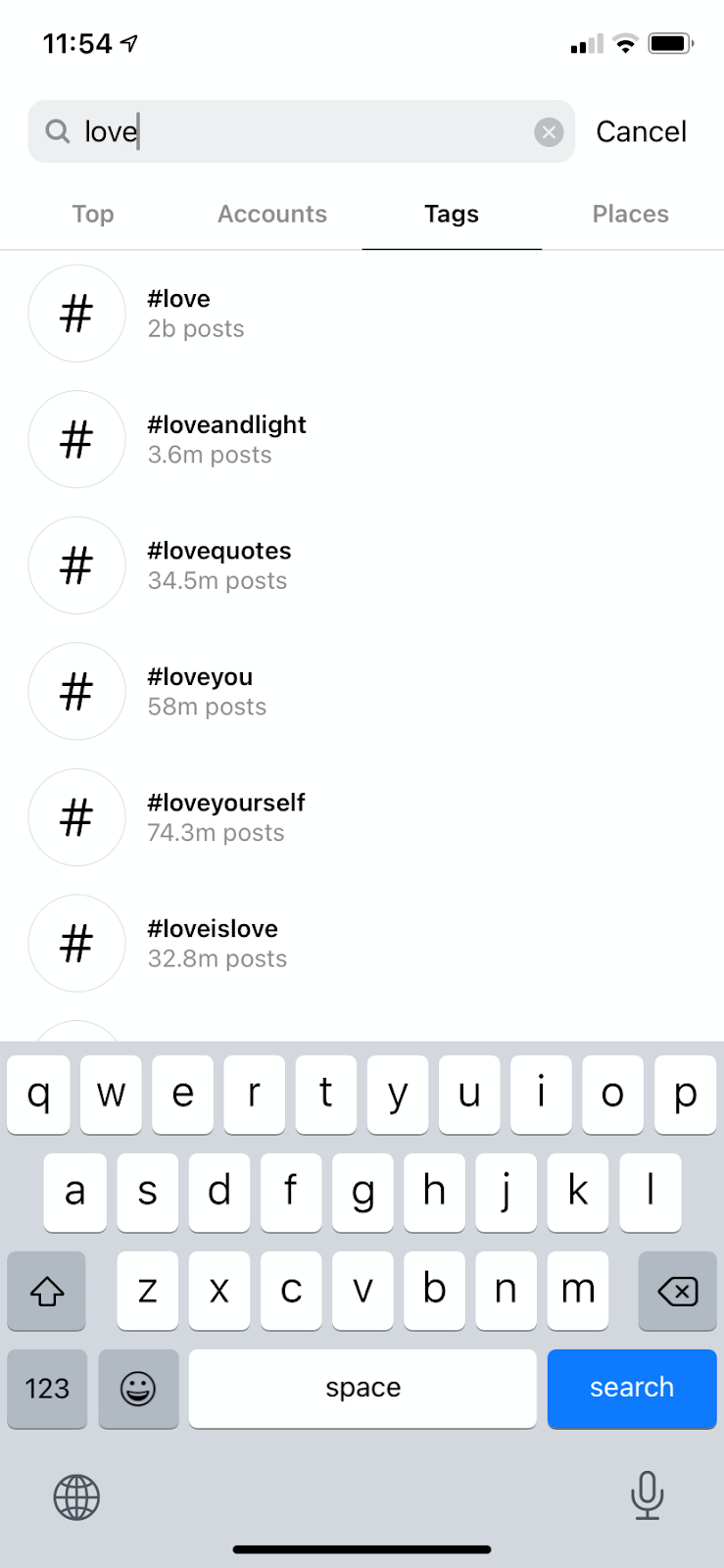
4. Browse hashtags based on post count and current content.
Voila! You should see multiple options for hashtags based on your search. Browse around at each related hashtag that Instagram suggests for you — you might find that a hashtag with slightly fewer posts includes photos or videos that are more in line with the content you’re posting.
After finding the best hashtags for your account, you’ll be sure to create a winning hashtag strategy.
Use Hashtags on Instagram to Gain More Followers
Using hashtags is a critical part of a strong Instagram marketing strategy. Following best practices, you can increase your follower count and boost the number of leads coming from Instagram. Happy hashtagging!
Editor’s note: This post was originally published in July 2019 and has been updated for comprehensiveness.

15 Marketing Job Titles + The Roles That Leaders Plan To Invest In Next Year
According to a 2021 HubSpot Blog Research survey, 19% of marketers believe finding the right candidate for a role will be more difficult in 2022. For nearly half of marketers surveyed, finding candidates with the right skill set is the biggest challenge.
![→ Click here to download our free guide to hiring and training a team of all-stars [Free Ebook].](https://no-cache.hubspot.com/cta/default/53/c42148d7-13dd-4c38-b907-cff1602ee62f.png)
2021 LinkedIn research shows that the top three in-demand marketing roles are digital marketing specialists, digital account executives, and social media managers. But some businesses struggle with knowing which roles to hire for and when it’s the right time to add to the team.
To help with this, we’ve compiled a list of the top marketing roles brands are investing in today.
Challenges Marketers are Facing
According to 2021 HubSpot Blog Research, the biggest challenge marketers face is training their team.
Large organizations often have the infrastructure set in place to ensure both managers and new employees have a smooth onboarding and training process which can last a few weeks to several months. Newer, smaller businesses can struggle in this aspect.
Training doesn’t only happen when an employee starts the job. In an ideal world, training happens at a regular interval based on business and/or team needs. However, that’s not always the case.
A recent study showed that 11% of UK workers say they’ve never received formal workplace training while 30% say they haven’t done it in the last five years. This can lead to larger issues relating to performance, career development, and job satisfaction.
Another challenge 28% of marketers admitted facing in the HubSpot Blog Research survey is measuring the ROI of their marketing activities. This is an age-old problem for marketing teams.
Teams develop elaborate campaigns but then when the results (i.e., data) come in, they’re not exactly sure how to measure its success.
As for 2022, 21% of marketers still anticipate training and ROI measuring being major challenges, along with traffic and lead generation.
Additionally, marketers are equally worried about hiring top talent. To help with this, we’ve compiled a list of the top marketing job titles and in the next section, we cover their roles.
You have a list of titles, but do you understand the skill sets and tasks associated with each? We can help there, too.
These titles mean nothing if you don’t know how they support the initiatives your company wants to tackle. With that in mind, here are five types of people whose skill sets are critical to marketing today, and how their talents map to the titles above.
Marketing Job Titles and What They Do
1. Content Marketing Roles
Content marketing is on every brand’s mind.
LinkedIn says it’s the second-fastest-growing skill and according to HubSpot Blog Research, it’s the number one strategy marketing teams are hiring for this year and in 2022.
A few years ago, it was common to see “blogger” as a job title on Indeed and other job search websites. Today, brands are looking for candidates with more technical, brand-oriented skills as search engines get more competitive.
Content marketing has also expanded, which means brands are hiring candidates for every aspect, from ideation and strategy to production and promotion.
Lisa Toner, director of content at HubSpot, has some tips on this.
“In today’s world, the publishing business is democratized, favouring creators across all content platforms,” says Toner, “so I would encourage brands to start building their creator strategy for 2022 and not restrict their content efforts to what they can build with their internal team.”
So, try one of these on for size:
- Content Creator (entry-level)
- Content Strategist (mid-level)
- Content Marketing Manager (management)
What They Do
Content marketing encompasses all the consumable media you publish to drive the conversation in your industry, often including but not limited to blog posts, newsletters, and podcasts.
Your content team is responsible for developing the strategy behind your content, producing the content and the lead-generating offers, and monitoring the results. They work across the entire funnel, creating content that will appeal to those who are newly introduced to the brand as well as those considering a purchase, or post-purchase.
The size of your team will determine how these tasks are divided. While a content creator will focus on producing marketing materials to attract the audience, your content strategist will be in charge of determining core editorial themes and devising how to approach SEO in each post (More on SEO later).
The content marketing manager can then oversee the editorial calendar and package content into newsletters to subscribers, helping you grow your contact list and generate leads from all your content creator’s hard work.
2. Brand Marketing Roles
This role can be tougher to define, but it’s just as important to your content strategy.
Although “videographer” and “graphic designer” can suffice for freelancers and those who specialize in a certain medium, these titles don’t hold much weight for full-time candidates who are increasingly doing it all.
Here are some suggestions:
- Creative Assistant (entry-level)
- Digital Brand Manager (mid-level)
- Creative Director (management)
What They Do
You’ve likely noticed a pattern forming: Just as writers associate with “content,” your visual content and multimedia folks are fond of marketing job titles rooted in “creative” and “brand.” These keywords help bundle the many types of marketing collateral your creatives may tackle under one umbrella.
Breaking down the specific tasks associated with each role, creative assistants and digital brand managers produce photos, videos, logos, infographics, and similar visual content that give your brand style and storytelling power.
Creative directors, on the other hand, work cross-functionally with design, marketing, and sales teams to create a vision for the products and/or services offered. They are also responsible for developing new ideas relating to ad campaigns, messaging, and branding.
After you determine what level of expertise you need, be sure to research the design and editing software that best fits your company’s needs and include it in the job description. This ensures you’re reaching candidates who are proficient in the tools you use to be successful.
3. Marketing Analyst Roles
How do you know if your marketing efforts are producing a return on investment, or even being seen by the right people?
Information related to page views, how users found your content, how long they stayed, and other consumption metrics can help you determine value and discover opportunities for optimization, but the roles that manage this data are a bit more complicated than the above two.
Here are three great titles for your more analytical marketers:
- Marketing Data Analyst (entry-level)
- Marketing Technologist (mid-level)
- Digital Marketing Manager (management)
What They Do
Although each of these people should be well-versed in content analytics, they actually specialize in different things.
While marketing data analysts study industry conditions to refine product positioning, marketing technologists develop an operational strategy for executing on these conditions then pursue the necessary technology to support it.
Digital marketing managers, on the other hand, oversee the analytics related to your content so you can optimize your existing assets and create smarter campaigns in the future.
This personnel is very helpful to companies that outsource their writing needs to freelancers and need to analyze the ROI on their content spend. Or maybe they have a less-technical content team in-house, and prefer to hire a designated analytics team to work alongside them.
If you don’t have the budget or inclination to hire two separate teams, however, it’s common to build analytics into the daily duties of the content strategist or content marketing manager.
Keep in mind not every data-focused job title relates to marketing, so be careful when recruiting an analytics buff. A broad title like “data analyst,” for example, may attract operations generalists who design systems to help the business itself become more efficient, instead of your marketing campaigns specifically.
4. Social Media Marketing Roles
According to 2021 HubSpot Blog Research, 51% of marketers plan to increase their social media investments in 2022. Out of that group, 88% plan to continue investing the same amount or increase their investment in 2022.
Along with content marketing, social media is another buzzing department that businesses are prioritizing.
Similar to how “blogger” is often too narrow for your content folks, “Facebook manager” would have the same effect for social media. You want to pick a title that isn’t too restrictive and allows your candidate to expand and grow into other responsibilities.
Better options include:
- Social Media Coordinator (entry-level)
- Social Media Strategist (mid-level)
- Community Manager (management)
What They Do
Social media coordinators handle the day-to-day responsibilities of managing social media platforms. This includes scheduling posts, engaging with followers, and responding to inquiries. Social media strategists assess which social networks will offer the maximum reach and best ROI, then develop plans for each one.
Strategies for each network can vary wildly depending on where your audience hangs out and what content they consume (insights your marketing data analyst may help you uncover.)
So, what about a community manager? They focus on the following:
- Helping your social media team manage its relationship with current and future followers of the brand.
- Engaging your audience by starting and monitoring conversations relating to your industry and brand.
- Answering queries, promoting positive reviews and other valuable audience contributions, and mitigating or de-escalating negative commentary.
5. SEO Marketing Roles
Any marketer can tell you how important it is to show up on the first page. Unfortunately, search engines like Google, Bing, and Yahoo! Aren’t giving out handbooks on the formula you need to follow to land on that first page.
Their ranking algorithms also change regularly, making an SEO expert an incredibly valuable asset on your team. Here are three marketing job titles that’ll resonate with the search crowd:
- SEO Specialist (entry-level)
- SEO Strategist (mid-level)
- SEO/Marketing Manager (management)
What They Do
As you can see, there’s a pretty obvious pattern here. And just like your social media team, the difference between each role is in strategy versus execution.
SEO specialists coordinate with content creators to ensure the SEO tactics you’ve agreed to are followed in your content. Strategists work with your analytics buffs to refine your approach to SEO as Google’s algorithm, or your own content strategy, changes.
SEO/marketing managers are particularly helpful if you’re tracking SEO performance – also known as organic performance – of more than one blog or website.
Keep in mind not every marketing position you see here is critical to an effective growth strategy. Some titles may be most useful to incorporate in the job description of another role you’re hiring for, rather than its own position (for example, putting “coordinates social media” in the description for a “content marketing manager” title).
Which marketing roles will leaders invest in next year?
In 2021, marketers mostly invested in content marketing and social media, according to HubSpot Blog Research.
The top role marketers hired for this year was content creators, followed by content marketing managers. In 2022, 32% of marketers said content marketing managers will take priority in recruitment efforts, followed by content strategists then content creators.
Toner says it’s no surprise to see companies investing in their content marketing initiatives next year.
“Media consumption is at an all-time high and brands are spending massive budgets to advertise on the most successful media publications, whether that’s on podcasts, newsletters, YouTube, or websites,” says Toner.
“But buying ad inventory is a short term play and smart companies are thinking about building their own media empires for long term success.”
There are also some roles marketing teams will be recruiting for the first time in 2022.
“Creative assistant” takes the top spot, followed by “creative director.” Interestingly enough, 22% of marketers surveyed say they’ll be recruiting content marketing managers for the first time.
Which marketing roles will be lower priority in 2022?
In 2022, only 2% of marketers plan to prioritize recruiting acquisition marketing managers, according to HubSpot Blog Research. Other roles that aren’t priority include:
- SEO Strategist
- SEO Marketing Manager
- Product Marketing Manager
- Growth Marketing Manager
This would suggest that marketers are focused on building out their organic channels beyond just websites and placing content before product, a great way to build brand loyalty and gain consumer trust.
With that said, this doesn’t mean you shouldn’t recruit these roles. It just provides some insight into where the industry is headed and how marketers are navigating.
Editor’s Note: This post was originally published in Feb 2018 and has been updated for comprehensiveness.

Chief Operating Officer (COO): Everything You Need to Know About This Important Role
Most companies have goals related to growth. I’m not sure of many companies that want to make less money or reach fewer people over time.
However, a company can’t just magically make more money, reach new customers, or grow a team overnight. It takes intention and strategy from an experienced leader to facilitate this type of growth.
![→ Click here to download leadership lessons from HubSpot founder, Dharmesh Shah [Free Guide].](https://no-cache.hubspot.com/cta/default/53/4e634041-e1ce-4a85-8e65-aea12fc10b84.png)
As a company looks to scale, having a qualified chief operating officer is a critical aspect of making those growth goals a reality. Leading this type of change as a chief operating officer can be a dynamic opportunity for budding business leaders. Let’s discuss the significance of the role, what a chief operating officer does, and the qualifications you’ll need to become one.
If a company has a chief operating officer in place, this individual likely knows the ins and outs of the business and industry and is often responsible for making sure the company’s operational model is functioning properly.
The COO needs to know how key functions of the company (including product, finance, marketing, service) all work together to deliver a positive experience for the customer while reaching key business goals.
In 2021, the average base salary of a chief operating officer was $145,467 per year, though this figure can vary depending on the company and the experience level of the candidate.
It’s worth noting how this role differs from the chief executive officer (CEO). Once a company experiences a period of substantial growth and has public-facing activities, the CEO may begin focusing on external management of the company affairs and representing the company to the public. That’s when a COO may be brought on board to ensure the company’s internal affairs are being handled properly.

Now that you know what a COO is and how the role differs from that of a CEO, let’s cover what a COO does in their day-to-day.
What does a chief operating officer do?
At a high level, the chief operating officer is responsible for making sure all of the internal systems that make a company run smoothly are in good working order so the business can run optimally. They’re tasked with integrating the company’s mission, vision, goals, and operations for strategic alignment and execution.
Key tasks for a COO can include:
- Overseeing the management and optimization of the company’s daily operations
- Working directly with the CEO and other members of the c-suite to establish and implement the organizational vision, business strategy, and staffing plans
- Creating business budgets for financial growth and proper resource management
- Analyzing key data to understand the company’s progress to key goals and objectives and make recommendations as needed to improve performance
How to Become a COO
Do you have your eye on a chief operating officer position? Or are you looking to build the skills to become one in the future? Let’s talk about what you need to qualify for the role.
Though there is no specific educational track that guarantees landing a COO role, 65% of chief operating officers in the US have a bachelor’s degree and 20% have earned a master’s degree.
It’s important to note that many COO roles are filled internally. That means leaders are typically promoted or appointed into the position from within the company. That certainly doesn’t mean you won’t see or have the opportunity to apply for external chief officer position roles, but it is an important practice to be aware of if you have aspirations to become a COO.
With that in mind, you may want to consider working under an existing COO to gain the necessary experience and to put yourself in a better position to be appointed into the role down the line.
For potential COO’s, experience can be a differentiating factor during the hiring process. According to research by Indeed, the average COO had 10 to 15 years of relevant experience before landing the role.
Successful chief operating officers need experience in business operations, data analysis, problem-solving, leadership, and management, as these are all skills that will be used daily on the job. As you embark on becoming a COO, make sure you have relevant experience optimizing and integrating organizational processes.
Here are some more skills and qualifications chief operating officer candidates need:
- Expert-level industry knowledge
- Strong communication skills
- The ability to make strategic decisions for the company
- Experience identifying organizational challenges and implementing effective solutions
- Proven track record of successfully leading and managing teams
- Cross-functional collaboration
- Project management skills
The role of chief operating officer provides a unique opportunity to leverage business expertise, strategic leadership, and operational support within one executive-level role to support the growth and future trajectory of a company.

Hourly vs. Salary Employees: What’s Better for Your Business?
Before hiring the right person for the job, you need to decide how you’ll pay them. Two of the most common ways to pay employees is with a salary or an hourly wage.
You’re probably wondering which option is better: the flexibility of an hourly employee or the stability of a salaried one. Of course, the answer is never as straightforward as we’d like.

Let’s compare the pros and cons of hourly vs. salary workers, the different laws for each, and what to look for when determining the right fit for your business.
What is a salaried employee?
A salaried employee earns an annual wage regardless of when they clock in and out. In other words, whether you work 20 hours or 60 hours per week, the number on your paycheck stays the same.
To state the obvious, an employee isn’t paid their entire salary on the first day. Instead, it’s divided by the number of pay periods, often on a weekly, biweekly, or monthly basis. For example, an employee with a salary of $60,000 a year, paid twice a month, would receive $2,500 per paycheck.
Pros of Salaried Employees
Even if an employee clocks additional hours during the week, they receive the same rate per paycheck. Meaning, you don’t need to compensate employees who go beyond the standard 40-hour workweek.
Another advantage of salaried employees is the predictability of payroll. Every salaried employee signs an employment contract outlining their base salary and frequency of payment. When it comes time for payroll, you know exactly how much to pay since there is no fluctuation from week to week.
Cons of Salaried Employees
Since salaried employees aren’t clocking in and out each day, or filling out a timesheet each week, there’s a possibility they’ll work less than 40 hours during some weeks. That said, most salaried employees are critical players in their organization and strive to meet expectations.
What is an hourly employee?
Hourly employees account for a whopping 55.5% of all wage workers in the U.S.
Here’s how it works – an hourly employee earns a certain rate per hour of work. This rate must match or exceed the minimum wage, which will vary depending on your state. If your state’s minimum wage is different from the federal minimum wage, you’re required to pay the higher of the two.
You can pay hourly employees at the same frequency as salaried employees, but their paychecks will fluctuate to reflect the number of hours they work per week. For example, let’s say you’re an hourly employee working at a rate of $10 per hour. You clock in 40 hours one week, which is $400 worth of work. The following week you only work 20 hours — earning a total of $200.
Pros of Hourly Employees
Unless covered in a contract, hourly employees aren’t guaranteed a certain number of hours each week. This means you have the flexibility to set hours based on demand, securing coverage when you need it.
Also, you have no obligation to make an hourly worker a full-time employee. By hiring an hourly worker, you can offset the benefit costs for full-time employees, like healthcare and paid time off.
Cons of Hourly Employees
Arguably the biggest con of hourly employees can be boiled down to one word — overtime. If an hourly worker surpasses the 40-hour threshold, they are eligible for overtime, which accounts for one and a half times their regular pay. This becomes costly if the nature of the position requires more hours than the standard workweek.
Another con is tracking how many hours your employees work, which takes time and careful review. You can verify the hours with timecards, or invest in a time and attendance system. Either way, expect to spend some time crunching the numbers.
Exempt vs. Non-exempt Employees
Salaried and hourly employees have different laws and regulations, which can guide you to determine the best fit for your business.
Hourly employees have non-exempt status — therefore, if they work more than 40 hours a week, they must be compensated under the provisions of the Fair Labor Standards Act. Employers must abide by the law to avoid fines, fees, and even prosecution.
On the flip side, most salaried employees have exempt status. An exempt employee must earn a minimum of $455 per week, or $23,660 per year, in the form of a salary. And, if you haven’t already guessed, exempt employees are exempt from overtime pay.
Let’s consider this example to demonstrate the difference between exempt and non-exempt employees:
Elizabeth, an exempt employee, is working over the weekend to meet a Monday morning deadline. Despite working “off the clock,” she’s not compensated for these hours.
Meanwhile, Lucas, a non-exempt employee, picks up an extra shift at a retail store over the weekend. He could take the weekend off, but he knows he will get compensated for working overtime.
Determining the Right Fit for Your Business
Back to the question on everyone’s mind: is it better to hire hourly or salaried workers? The answer depends on a variety of factors:
1. Relevant federal and state laws.
Familiarize yourself with relevant federal and state laws. Even if employees are exempt on a federal level, state laws may classify them as nonexempt.
2. The nature of the position.
Consider the type of work an employee will be doing. For example, if you anticipate an employee will need to work more than 40 hours per week, it could be more cost-efficient to pay them a salary.
3. Your business and its needs.
Does your business need flexibility or predictability? Do you have the resources to track hourly workers? Do you need to offset the costs of benefits for full-time employees? These questions, among others, can determine whether your workforce should be salaried or hourly.
Final Thoughts
As you prepare to expand your team, it’s important to decide how to pay the new players. While you must abide by federal and state laws, there is still room to weigh your decision based on your business and its needs.

International SEO: How to Optimize Your Website for Other Countries
Search engine optimization (SEO) is critical to help your brand reach the first page of search results and ideally climb into the top 5 positions for your primary keyword.
But what happens when you want to expand outside of local markets? With Google now seeing more than 3.5 billion searches per day, there’s a massive opportunity for brands to capture new customers. The caveat is that existing SEO practices may not translate — and in some cases, may actually hurt your brand in other countries.

To avoid this potential pitfall, a robust international SEO strategy is critical. Here’s what you need to know about what it is, how it works, how it’ll benefit you, and what steps you can take to create an effective plan.
Ready? Shkojme! Idemo! Vámonos! Let’s go!
Effective strategies leverage a combination of geographic and language data to develop SEO plans that drive reliable ROI. A strong international SEO strategy will help your company reach new markets and multiply revenue.
What does international SEO do for company websites?
An international SEO strategy for websites focuses on creating content that’s applicable to local markets, as well as developing a website structure that makes it easy for search engines to find and serve the right webpages to the right users at the right time.
Consider a company that sells window shades in the United States and is making a move into Canada. First, you’ll want to ensure Canadian customers are sent to the right pages on your website — pages that contain information about Canadian locations, Canadian shipping times, and fees and costs in CAD.
You’ll need a website structure that includes both U.S. and Canadian pages and leverages enough metadata that search requests from users will direct them to the right page for their current location.
Does my business need an international SEO strategy?
It depends.
If you have no plans to expand beyond local markets — such as your current city or state — international SEO probably isn’t worth the time and resources required. In fact, international SEO can backfire if your business is entirely local. Customers who land on international pages won’t be happy when they discover you serve a very small geographic area.
On the other hand, if you’re looking to expand beyond country borders, it’s worth spending on international SEO. Given the sheer number of companies competing on the global stage and the increased challenge in ranking highly for relevant keywords, a comprehensive strategy is critical.
Still not sure whether you should go for a local SEO strategy or international SEO strategy?
There are four primary differentiators between local SEO and international SEO:
- Cost: Owing to their scale and scope, international SEO efforts come with significant costs.
- Content: To ensure international reach, you’ll need to create significantly more content than you would for a local SEO strategy.
- Capture: International SEO expands the target market you’re trying to capture, which necessitates in-depth research to ensure your brand aligns with customer expectations.
- Competition: Competition for keywords and customers is much greater for international SEO efforts. Instead of simply competing with other businesses in the same local sphere of influence, you could be up against multinational corporations.
Questions to Ask About International SEO
Not sure how to get your international SEO efforts off the ground? Start with these questions.
- Where are you headed?
- Should you target language or country?
- What localization factors matter most?
- How can you build local links?
- Does social media matter?
- Are current keywords good enough?
- Do you have the right tools and talent?
1. Where are you headed?
Depending on the part of the world you’re targeting, your international SEO approach will change. For example, if you’re headed to China, the most popular search engine is Baidu, while Yandex is the preferred choice in Russia. Each of these engines have their own approach to SEO, meaning it’s worth doing your research to find out what matters most for rankings.
2. Should you target language or country?
This is a common international SEO question: Are you better-served targeting a specific language or a country? The answer depends on your goals. If you’re looking to appeal to a broad audience regardless of where they live, language optimization may be the answer. If you’re looking to grow brand awareness in a specific part of the world, opt for country-based SEO.
3. What localization factors matter most?
Localization is the process of optimizing your website and content to reflect the local language and culture. Two of the most important factors here are accuracy and common use: First, it’s critical to make sure that translations of any keywords or slogans are accurate — direct translations can open your brand and services to misinterpretations, such as the always-classic “Come alive with Pepsi” slogan translated as “Pepsi brings your ancestors back from the dead” in Chinese markets.
Common use is the other concern. The words and phrases used to describe your business and what it does may not be the same in other languages, even if the literal translation of words gives that impression. Find out what words locals use to describe your products and services and use those instead.
4. How can you build local links?
Building local links back to your site also helps with international SEO. Here, it’s a good idea to write articles for local blogs, get a sponsored mention on websites that offer advice or useful information, connect with local social media influencers, and sponsor local events.
5. Does social media matter?
While Google has expressly stated that social media doesn’t factor into international SEO rankings, you can increase brand awareness and local influencer connections with a strong social media presence.
6. Are current keywords good enough?
While your current keywords may help you rank in the top 5 locally, the sheer number of companies competing for these keywords in global markets means you need to take a look at who’s using these keywords, where they rank, and whether other similar keywords might drive better results.
7. Do you have the right tools and talent?
Finally, consider if this is something you can take on yourself or if you’re better off hiring an experienced international SEO company.
Factors That Affect International SEO
Multiple factors affect international SEO, including:
Customer Reviews
Customer reviews on your website or on local review sites can positively or negatively impact your SEO efforts. Better reviews mean better connection with your primary keyword, in turn boosting your visibility.
Mobile Responsiveness
The responsiveness of your website on mobile also matters to overall search rankings. As a result, it’s worth finding a content delivery network (CDN) capable of providing a top-tier website experience no matter where users are in the world.
Google My Business Account
Your Google My Business Account can help boost your SEO efforts — so long as you ensure to update where your company is operating. This acts as a starting point for Google to seek out geographic and language metadata on your site.
Link Building
The more links heading back to your site from international sources, the better. As mentioned above, it’s a good idea to write for local blogs or connect with influencers to point links back to your website.
How to Develop an International SEO Strategy
Ready to develop your international SEO strategy? Start here.
1. Decide where and who you’ll target.
First, pick your target market and target audience. For example, you might decide to target the larger market of Brazil, then hone in on a subset of that market that has the means and motive to buy your product. The more focused your decisions around “where” and “who,” the better your results.
2. Determine whether you’ll hire an international SEO agency.
Do you want to do the heavy lifting of international SEO yourself or outsource this effort? There are advantages to both — you know your brand better than anyone else, but SEO experts are skilled at understanding local customs and preferences and creating a strategy to match.
3. Conduct international keyword research.
Keywords that work for you at home may not work abroad. This may simply be down to keyword volume, or it may be linked to how customers in your target market refer to your business. For example, trial lawyers in the United States are known as barristers in the United Kingdom — if you’re a legal firm looking to expand operations, this is a critical keyword difference.
4. Choose the right international domain structure.
The domain structure of your website makes it easier (or harder) for visitors and search engines to find your content. Different options include:
ccTLD
Country code Top Level Domains (ccTLDs) are two-letter domains assigned to specific countries. For example, .us is for the United States, .ca is for Canada, and .uk is for the United Kingdom. To improve international SEO, you may choose to create a unique ccTLD site for each country where your products or services are available.
Example: mybusiness.ca, mybusiness.uk
gTLD
A generic Top-Level Domain (gTLD), meanwhile, refers to domain extensions with three or more characters; these TLDs are maintained by the Internet Assigned Numbers Authority (IANA). Common examples include .com, .gov and .org.
Using a gTLD means that search engines won’t restrict results based on region, but it may reduce total traffic since many users prefer sites that include their country code TLD.
Example: mybusiness.com
ccTLD or gTLD with subdomains
You can also choose to create subdomains for your site which combine aspects of both ccTLDs and gTLDs.
Example: ca.mybusiness.com
This offers the benefit of a country code and the advantages of a gTLD.
ccTLD or gTLD with subdirectories
Subdirectories, meanwhile, change the location of the country code:
Example: mybusiness.com/ca/
5. Optimize content for the region and language
Finally, make sure all your content is optimized for both your target region and its local language. This includes double-checking all TLDs, translations, and content assets to ensure they’re aligned with local expectations.
Oh, and don’t forget the hreflang tag. This HTML attribute specifies the geographic area and language of a webpage. It’s used to differentiate similar webpages aimed at different audiences so that search engines don’t count them as duplicate content, and it looks like this:
Tools for International SEO
The right tools can also help you maximize the impact of international SEO by providing actionable data around traffic, click-throughs, and time spent on your site. Some of the most popular tools include:
HubSpot
HubSpot’s SEO software allows you to create an international content strategy, gives you live tips to improve your on-page SEO, and lets you organize your website in a way that’s easy for both search engines and users to understand.
Google Search Console
Google Search Console lets you see what queries are driving traffic to your site, determine your position on Google Search, and analyze global site impressions.
Ahrefs
Ahrefs is an all-in-one SEO toolset that lets you optimize your site, analyze your competitors’ rankings, and find the best keywords for your brand.
Moz
Moz offers site audits to determine potential issues, tracks keyword rankings across more than 170 search engines, analyzes backlink profiles to evaluate performance, and offers keyword research tools to find out how you stack up against the competition.
Semrush
Semrush lets you identify high-value local and national keywords, analyze the backlink profile of any domain, and track your site’s SERP positions daily.
Google Analytics
Google Analytics is an interconnected suite of tools that helps you analyze the impact of your website content worldwide.
International SEO Best Practices
No matter what approach you take to international SEO — language-focused or country-based, outsourced or in-house — the same best practices apply. Let’s take a look at them below.
1. Answer questions in the region’s native language and in the right context.
If there’s one thing to get right for international SEO, it’s making sure you’re speaking the same language as your customers. This means doing your research to ensure you’re always answering questions in their native language and in the appropriate context.
2. Translate existing content carefully.
While translation tools provide a literal conversion of words and phrases, they’re often not used this way by locals, meaning customers will quickly recognize that something isn’t quite right. Instead of translation, what you’re really looking for is “transcreation” — you want to recreate the same content but using the culture and language of your target market as a guide.
3. Consider the entire user experience in your strategy.
International SEO isn’t just about keywords and content. It’s also about making sure the entire user experience — from filling out forms to viewing prices in local currency or accessing multimedia assets that include native speakers — is seamlessly aligned across your site.
4. Avoid automatically redirecting users based on their IP address.
While it’s critical to serve content that matches local user expectations, don’t make the decision for them. Instead of automatically redirecting where they land based on their IP address, give them the option to choose their preferred region.
SEO: Improving Your International Impact
The right SEO strategy sets your brand apart from the crowd. And while this is important in home markets, it’s even more critical if you decide to go international, because it will ensure your website is optimized to support high-value content and keywords across regions and countries. By considering local customs, language, and context, you can boost consumer engagement, improve search engine results, and maximize your international impact.
Editor’s note: This post was originally published in March 2018 and has been updated for comprehensiveness.


10 of the Coolest YouTube Banners We’ve Ever Seen
I’m always inspired by the creativity that goes into YouTube banners, but if you’re anything like me, you’ve probably wondered how you can create one for your own channel. Well, you’re in luck!I’m here to uncover some of the best-kept secrets about YouTube banners.

In this article, you’ll learn what makes the best YouTube banners so eye-catching, and how you can create your own gorgeous channel art. To answer those questions, I’ve included some excellent resources for YouTube banner templates (spoiler alert: they’re free), as well as 10 creative channel banners that inspire us as content creators.
What makes a good YouTube banner?
A good YouTube banner is eye-catching, readable, and conveys the brand of the YouTube channel. The best YouTube banners include the brand’s logo and channel name. Some great YouTube banners include high-quality photos and graphics to create visual interest.
No matter how good your YouTube banner looks, the last thing you want is for yours to look the same as someone else’s. That’s why the guidelines I mentioned for great channel art are pretty simple. You can build the foundation of your design using those best practices, but your unique creativity is what will set your banner apart from the crowd.
To see these tips in action, let’s look at some fun and creative YouTube channel art examples.
YouTube Channel Art Examples
1. Jillian Harris

Simple, chic, and feminine. Jillian Harris’ YouTube channel art conveys exactly what her brand represents. The banner photo keeps things simple and includes only two pieces of information: her name and the date she established her brand. With a banner like this, the typeface stands out and becomes the design.
Simple channel art works if you’ve got a core following already. Jillian is quite popular on other social networks, and she’s currently migrating her audience to YouTube. The majority of people watching her videos are already familiar with who she is and the content she creates. If they’re not, there’s a welcome video right below the banner where she introduces herself to the new crowd.
2. Learn With Shopify

Shopify understands that building an online business isn’t easy. So, the company offers new and experienced entrepreneurs a library of video content to help them scale to the next level. Learn With Shopify’s banner is straightforward and draws attention to the channel’s goal.
You might think that the YouTube banner dimensions don’t provide enough room to create a dynamic design, but Shopify shows some interesting possibilities in its channel art. The name of the channel is prominent so the viewers know they’re in the right place for all things Shopify, and the green gradient gives this banner depth and creates visual interest.
3. HubSpot Marketing

Maybe I’m a little biased, but our YouTube channel has a pretty cool banner! What we haven’t seen in the first two channel art examples are faces. HubSpot’s banner features full-color images of the creators who present the video content on the channel. Our signature brand art (aka the blobs) are thoughtfully placed behind the creators’ photos so they pop on the banner.
Another fun feature of our channel art is the icon on the far right that points to our free digital marketing certification. If your brand offers more types of content, this is a great way to drive traffic to those other marketing offers.
4. Alphonso Dunn

Alphonso Dunn is a talented and well-respected artist who’s authored several art books. He’s transitioned his passion for educating students to the YouTube screen where he teaches aspiring artists how to hone their craft.
His banner includes samples of his art, his name, logo, and latest books with a link to purchase them. The composition of this banner fits everything in without overcrowding the space which allows the viewer to focus on the rest of his home page.
5. Justin Brown-Primal Video

Justin Brown is the creator of Primal Video on YouTube — a channel dedicated to teaching entrepreneurs how to amplify their businesses with video content. If this is your first time seeing Justin Brown’s YouTube home page, you’ll know exactly what to expect from his content after seeing the banner.
What I like most about this channel art is how energetic it feels without looking too busy. There’s dimension built into the image by stacking the blue and black blocks of color, then breaking that up with a color-graded photo in the middle. Font sizing and colorful backgrounds create a cohesive feel while keeping the design clean and organized.
6. Bright Side

Bright Side provides more than 40 million people with the answers to questions that they never asked, but absolutely have to know. Its YouTube channel art is bright, punchy, and bold — a perfect backdrop for inspirational, creative, and wonderful video content.
If you take inspiration from Bright Side’s banner, choose a vibrant color as your background and think carefully about your typeface. Since those two design elements will be the only aspects of your banner, you’ll want to spend time finding the right balance that represents your brand and draws the viewer in.
7. Epicurious

Whether you’re looking for easy-to-follow recipes, food science education, or cooking comparisons, Epicurious is the channel to watch. The spotlight of this brand’s content is always the food, and that goes for its banner, too. The use of a high-resolution, detailed photo of a common food — broccoli — creates a relevant and intriguing background for the brand name.
To incorporate this banner style into your channel art, choose a subject that’s small enough to be recognized close up.
8. TripAdvisor

TripAdvisor is a resource used by millions of travelers to discover and rate lodgings, restaurants, and much more information about endless destinations.
That’s represented in the YouTube banner by portraying what the site is all about — travel. The banner features beautiful photography of different locations which puts the viewer’s focus solely on travel.
This is a great YouTube banner to take inspiration from if you’re just getting started. Simply choose a high-res photo that speaks to your personality and brand, and you’re done.
9. Refinery29

Showcasing the people that make your brand amazing is a great way to form a connection with your viewers. That’s one thing that Refinery29 does well by frequently featuring its writers, editors, and content producers in its videos. As it turns out, they’ve all become quite popular personalities — which is why the brand put them front-and-center in its channel art.
Creating a banner of this nature is two-fold. First, find a way to incorporate your company’s talent into video content in a way that’s engaging and appealing to your target audience. Then, once you’ve produced enough of that media consistently — and if it’s gaining the right kind of attention — you can use those personalities to promote your channels.
10. The Action Lab

Physicists and high school science students alike come to The Action Lab’s YouTube channel for DIY experiments performed by Dr. James J. Orgill. On this channel, you’ll see everyday objects through a new lens thanks to his demonstrations.
The banner for the Action Lab’s YouTube channel is fitting for this type of content. It includes the logo and channel name in the safe zone, along with a photo of Dr. Orgill himself. Similar to HubSpot’s channel art, his photo stands out with a patterned background to really show him in action.
YouTube Banner Size
A YouTube channel banner will take on different dimensions depending on what platform is being used to view it. For example, a banner will have different dimensions when viewed on a TV, desktop, or mobile device.
The YouTube banner dimensions are:
- Recommended “TV”: 2560 x 1440 px
- Minimum for upload: 2048 x 1152 px
- Minimum “Viewable On All Devices”: 1546 x 423 px
- Maximum “Viewable On Desktop”: 2560 x 423 px
- File size: 6MB or smaller
The recommended resolution seems pretty large for a single file, but think about how YouTube banners would appear on a 30″ smart TV or higher. With a growing number of options to view YouTube videos in this way, you’ll want to make sure your channel art is large enough to display with quality on larger screens.
Here’s a helpful visual representation of those dimensions:

Take note of the “Viewable On All Devices” I alluded to in the first section. Your banner is essentially the biggest branding opportunity when people land on your channel. You’ll want to make sure your logo and supporting text is clearly represented in the channel art. That’s why it’s a good idea to place your company name and logo in that center space.
If you’re not sure how to fill the entire frame with visual content, video production company MiniMatters suggests “build[ing] the image from the middle out,” putting the most important assets in the center, and expanding the design from there.
Finally, follow these best practices to create a professional YouTube banner:
- Use a high-resolution image. A pixelated or blurry banner doesn’t exactly signal that there’s a high-quality video to follow.
- Keep your banner on-brand. While your channel art doesn’t have to be a carbon copy of your logo or tagline, it should incorporate visual elements that you want associated with your brand, like certain colors, fonts, or keywords.
- Update your banner regularly. For example, if you run a bakery and you’re gearing up for summer, an eye-catching banner might be a high-res photo of a brightly-colored work surface covered with flour and a rolling pin, along with accompanying text like, “April showers bring May flours,” but remember to update the banner once the season is over so viewers know you’re consistent.
YouTube Banner Template
By now, you might be thinking, “Where the heck am I supposed to get these beautiful design assets?”
Check out these free channel art templates that will speed up your workflow. And they’re completely customizable, so you don’t have to worry about your channel art looking exactly like someone else’s. Download them now and follow the steps below to upload them to your channel.
How To Make a YouTube Banner
Step 1: Log in to your YouTube account and click on your profile photo. Then select Your channel.
Step 2: Click the blue Customize Channel button. A new tab will open and you’ll see a Channel customization screen.
Step 3: Click Branding in the top menu.
Step 4: Under the banner image section, select Upload.
Then, you’ll see the option to upload a file for your YouTube banner photo.
Step 5: Review the image preview to ensure that your banner image is displayed properly.
Step 6: Click Publish and review your YouTube channel’s new banner image.

That’s it! Easy enough right?
Channel Your Creativity
It’s important to note that cool YouTube channel art is just one part of a comprehensive video content strategy. It doesn’t matter how beautiful your banner is if your channel lacks quality video, or hasn’t added anything new in several weeks. So as you create your YouTube banner, go ahead and create two or three more that you can use throughout the year to keep things fresh and interesting.
And remember, you can always come back to these examples and tips for more inspiration.
Editor’s note: This post was originally published in November 2020 and has been updated for comprehensiveness.

What is a QR Code + How Does It Work? Everything Marketers Should Know
I’ll never forget the first time dining at a restaurant after my pandemic-induced hibernation. Before I could ask for a menu, the waitress nodded towards a piece of paper with a barcode on it. “Open your phone camera and scan it. The menu should pop up.”
QR codes have become a common sight almost overnight — from cereal boxes and billboards to even employee uniforms. With a 94% increase in interactions from 2018 to 2020, there’s no denying QR codes are seeing an epic revival in a new touch-free world.

Let’s explore the origins of the QR code, learn how it works, and discuss ways it can refresh your marketing strategy.
Table of Contents
The Origins of the QR Code [+ Its 2020 Revival]
What is a QR code?
Short for quick response, QR codes are scannable barcodes that store data. In the marketing sphere, they’re commonly used to redirect users to landing pages, websites, social media profiles, or store coupons.
For instance, someone can place a QR code on the back of their business card to direct you to their LinkedIn profile. A QR code on a billboard may send you to a landing page.
QR codes vary in design and function, and primarily fall into one of the following categories — static or dynamic.
Static vs. Dynamic QR Codes
A static QR code contains information that cannot be modified once it’s live. This means any typo or misstep will require you to create a brand new one. The good news is that static codes don’t expire — so once the content is set, your work is done.
Static QR codes are ideal for storing fixed or sensitive info — think Wi-Fi passwords, employee ID numbers, or access codes. But they’re not so helpful if you need to update your data regularly.
Dynamic QR codes allow you to change your info as many times as you want. This is because the information isn’t ingrained into the code itself. Instead, it redirects users to a specific URL that can be changed at any time. For example, a restaurant can redirect users to a menu on their website.
A major benefit of dynamic QR codes is the ability to gather scanning metrics. While you can’t access personal information from users, you can see the time, location, and device used for each scan. And as marketers, we know these metrics are crucial to gauging campaign effectiveness.
How do QR codes work?
A QR code works similarly to barcodes at the supermarket. Each QR code consists black squares and dots which represent different pieces of information. When scanned, the unique pattern on the barcode translates into human-readable data. This transaction happens in seconds.
Users must scan the code with a QR reader or scanner, although nowadays most people scan QR codes with smartphones. On the off chance your phone doesn’t have the capability, there are plenty of free apps for QR scanning like NeoReader and QuickMark Barcode Scanner.
The Origins of the QR Code [+ Its 2020 Revival]
Invented in 1994 by Masahiro Hara, chief engineer of Denso Wave, the original purpose of the QR code was to track vehicles and parts moving through the assembly line.
Despite being a mid-90s invention, the QR code didn’t gain any substantial momentum until the era of smartphones. But even then, users had to download a third-party app to scan the codes. A real breakthrough came in 2017 when Apple integrated a QR reader into its phones, and other manufacturers quickly followed suit.
Thanks to accessibility, a new wave of hype followed, then quickly dissipated as marketers’ interest fell to the wayside. That is, until 2020. You can probably guess where I’m going with this.
In the US alone, 11 million households scanned a QR code in 2020 — a significant jump from 9 million in 2018.
With the COVID-19 pandemic in full swing, the QR code gave businesses a new way to communicate with customers in a suddenly touchless society. From hospitality and food to retail and manufacturing, a variety of companies used them for the first time.
And for marketers, QR codes can strategically bridge the gap between offline and online media. They’ve quickly turned into dynamic, two-dimensional call-to-action buttons — operating as vehicles to engage customers, inspire action, drive traffic, and share info without having to invest a lot of money.
So, are QR codes here to stay? Whether or not they’ve earned a permanent spot in a post-pandemic world is still up for debate, but there’s no denying its incredible journey since its debut on the assembly line.
Here are a few ways to use QR codes to refresh your marketing strategies.
QR Codes for Marketing
1. QR codes can help you stand out from the crowd.
Differentiating your business from your competitors is definitely a marketing 101 lesson. If used correctly, QR codes can spike the curiosity of your customers and prospects alike. Use this opportunity to link QR codes to exclusive offers or valuable content to carry that curiosity through to a sale.
For example, check out SparkPlug Coffee who ran a giveaway where users could enter by scanning a QR code.

2. QR codes let you target consumers on the go.
Retailers, don’t you wish there were a way to interact with customers on the go? Integrate QR codes into your store signage and other print advertising. Whether you’re providing coupons for shopping in-store or an easy way to sign up for your newsletter, QR codes make it super easy for customers and prospects to access your information fast on their phones.

REI, an outdoor sports apparel retailer, had this signage on the front door of one of their stores to pique interest about their frequent shopper program. Instead of calling out the program, they focused on the benefit (dividends) and provided a QR code linked to a list of products people could purchase with their dividends.
3. QR codes make real life interactive like the web.
Many businesses are shifting their time and budgets to digital advertising, which is more interactive and easier to track than traditional advertising.
QR codes add an interactive component by turning static content into dynamic call-to-action buttons. From asking customers to leave a Google review to redirecting them to a branded Facebook page, you have many options to engage customers.
Even museums, libraries, and parks are leveraging QR codes to breathe life into displays and park benches. Check out this example from the Whitney Museum of American Art in New York City:

4.QR codes are free and easy to set up.
There are multiple resources businesses can access that will allow them to insert a landing page URL and create a QR code that will direct users to that URL with the click of a button.
Sites like QRCode Monkey and Flowcode allow you to set up QR codes in a matter of minutes and provide you with proper image formats to use in your designs.
QR codes are certainly having a moment in the marketing sphere. If you’re thinking about adding them to your strategy, remember that the best practice is to create value. Make sure each code leads to a source of value — such as a coupon or promotion — and requires as few clicks as possible.

7 Best Practices for Lead Nurturing Emails
Lead nurturing emails allow you to build a relationship with your leads and move them down the sales funnel until they are ready to become a customer. It’s one of the best lead nurturing tactics you can use and an essential part of an email marketing strategy.
Why? Because lead nurturing emails radically increase the chances of your leads making a purchase. You no longer have to hope that they will buy your products. Rather, you’ll slowly warm them up until they make that decision.
In this post, you’ll learn best practices for creating high-performing lead nurturing emails to drive your leads to make a purchase.

How does lead nurturing work?
A potential customer may have several types of interactions with your business. They may add something to their cart, subscribe to a mailing list, take advantage of a promotion, or set up a meeting with one of your salespeople.
Lead nurturing refers to the process of staying in contact with your customer throughout each of these stages. You provide valuable resources, discount codes, or reminders to make a purchase.
Overall, to nurture a lead is to build and maintain a helpful, mutually beneficial relationship with them. The goal is to guide them toward making a purchase.
(Tip: If you’re unfamiliar with lead nurturing, we encourage you to take our free lead nurturing course.)
Are lead nurturing emails effective?
Yes. As social media has grown over time, using lead nurturing emails to market your business can sometimes feel like the less fun or hip option. But, it’s still an effective way to expand your market, convert leads, and connect to your target audience, especially if it’s done correctly. 99% of email users check their inbox on a daily basis, often multiple times a day or first thing in the morning. This makes using email a great tool to nurture a lead toward conversion.
As time passes, the lead may not click on your CTA, interact with your business, or make a purchase. Certain leads with an interest in your business will need ongoing engagement to continue down the sales funnel toward conversion. For that, you’ll need to create a lead nurturing email sequence.
Lead Nurturing Email Sequence
A lead nurturing email sequence is a series of emails that is automatically triggered when the lead takes a certain action. For example, once a customer adds an item to their cart, a lead nurturing email sequence could include a purchase reminder, a limited time offer, or a list of similar products they may like.
These sequences keep the lead engaged until they are ready to go forward with a purchase. See this example of a sequence after a lead has abandoned their cart.
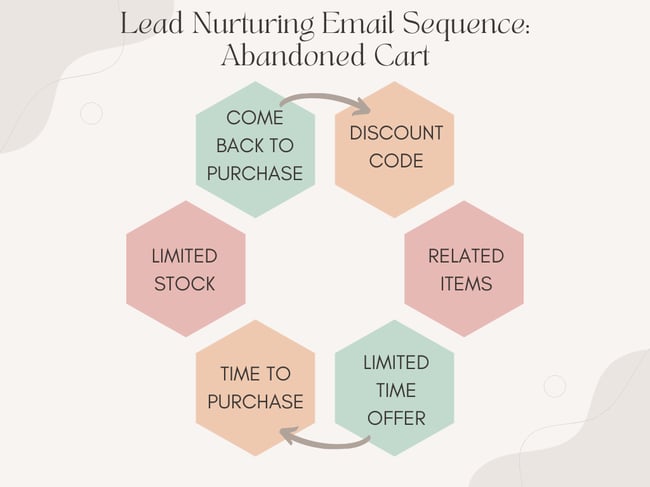
The process of lead nurturing occurs over some time with your continuous effort. Building that relationship needs trust, understanding, and consistency. Using emails to nurture your relationship with potential leads can be highly effective. Follow these best practices to make them work best for you:
1. Provide valuable content with include expert insights.
The first priority is to make sure you have something valuable to teach your leads. Think of your lead nurturing emails as mini blog posts. For example, if you sell data backup software, your first nurturing email might focus on the “top six considerations to make before purchasing data backup software.” Remember, you are an expert within your industry. Continue teaching your leads something new, and they will be more than happy to receive your emails and continue engaging with your business.
2. Focus on one relevant topic per email.
Each nurturing email should be focused around one topic and include a call to action. Put yourself in your lead’s shoes when creating your emails, as they are bombarded by messages all day long. Keep the content of your email tied directly to the topic the lead initially converted on. For example, if your lead downloaded a FAQ white paper on data backup software, they are likely near the top of the funnel, researching a future purchase. Your first email’s topic could be “selling the importance of data backup software to your management team.” Speak directly to the problem your lead is trying to solve.
3. Keep it short.
This is not the time to worry about fonts, or adding images or custom HTML. The lead should be able to glance at your email and know within five seconds the value it provides to them. Information overload happens quickly in an email. Adding secondary calls-to-action or unrelated links will increase your unsubscribe rate and subtract from the effectiveness of your campaign. While data suggests that emails should be between 50 and 125 words, it’s okay to extend your message to fully connect with your leads. But keep it concise whenever possible.
4. Ensure the emails progress naturally.
Carefully planning the flow of your emails will help you create well-rounded campaigns that pull your leads through the sales funnel. The first email after the initial conversion might be educational, while subsequent emails should continue to educate while giving the lead an opportunity to convert a second time. This is a perfect opportunity to promote a free trial or the download of a demo. Work with your sales team to determine what qualifies as a “sales-ready lead” and craft your lead nurturing campaigns accordingly.
5. Test your emails and track key metrics.
Email testing is key to fine-tuning your campaigns. As you test your emails, be sure to track key metrics to measure the success of your efforts. Click-through-rate (the percentage of people who clicked a link in your email) and unsubscribe rate are two of the key metrics to track on a regular basis. A strong campaign will generally have an unsubscribe rate of less than 5%. If your unsubscribe rate climbs above 5%, it’s time to re-evaluate your campaign. Try testing new content or a stronger subject line, or adjusting the timing of your emails.
6. Personalize the emails.
You should be sending different emails to different types of leads and personalizing them to who they are specifically. This not only includes who they are as a consumer, but also what their interactions have been with your business thus far. Did they sign up for updates? Have they gotten an automated welcome email? Did they purchase from you once already? How long has it been since you acquired their email address or last had contact? Those are all things that should influence and change the content of the email.
7. Stay consistent to your brand.
Your business has an image, a voice, and a brand. The emails that you send to leads should continue to represent all of those things about your business. Continuing to establish your brand to a lead helps build a relationship that pushes them toward becoming a customer. The familiarity over time will build valuable trust and brand loyalty.
Before you start writing a lead nurturing email, focus on who your lead is and what your goal is for contacting them. Spamming leads with countless emails is more off-putting than it is nurturing. So, ensure your content is worthwhile for leads to read and for your business to send. Follow these tips to get started:
1. Choose a purpose.
Have a goal in mind for your message, whether it is answering an FAQ, delivering on a promised reward, introducing a new product, offering a discount, or sharing other content to engage the lead.
2. Personalize the greeting and subject line.
An attention-grabbing subject line and a personalized greeting are the initial hooks of a lead nurturing email.
3. Address pain points.
How can this product or service improve this lead’s life if they were a customer? Point out a problem that they have that you can solve.
4. Include testimonials.
Knowing that someone else was pleased with your product or service grows the lead’s trust in your business.
5. Share a knowledge bomb.
Including a striking piece of information or research will give your lead something that they’ll remember later on their path to becoming a customer.
6. Use a CTA.
Encouraging your lead to interact with your business through a call-to-action pushes them toward a conversion.
7. Include an unsubscribe button.
Leads that have no interest in your business, product, or service can’t be nurtured into customers. Allow those to unsubscribe so that you can focus on the good-fit leads.
8. Follow up.
Once the email is sent, track what happens next. Did the lead click on your CTA? Did they continue interacting with your business? Did they do nothing? Use that information to determine the effectiveness of the email and to influence what you send to them next.
Make a Seamless Lead Nurturing Strategy
A potential customer’s first interaction with your business is just the beginning. As they proceed down the sales funnel from lead to repeat customer, you will need to continuously engage them. Lead nurturing emails build trust between leads and your business. The sales funnel you create through nurturing emails should smoothly guide your leads into doing business with you.
Editor’s note: This post was originally published in May 2010 and has been updated for comprehensiveness.

The Ultimate Guide to Marketing Strategies & How to Improve Your Digital Presence
Would it be correct to assume a major part of your marketing strategy today is digital? Probably.
Consumers and businesses alike are almost always online and on the go – and you want to be able to reach them and observe their behavior where they spend their time.

But when you’re growing a business, this ever-changing digital landscape can quickly become an overwhelming one. With a number of other responsibilities and tasks that you need to do, how can you also efficiently create, fine-tune, and maintain an agile digital marketing strategy?
We’ve put together this guide about marketing strategies to help you improve your digital presence and grow better.
If you’re a small business and you’re unsure how to jumpstart your strategy, this digital marketing strategy template will help you get there. It includes actionable tips and templates to set you up for success.
Now back to this — are you confused about the difference between a marketing strategy and marketing tactics? We cover that below.
Marketing or not, there are three parts of any strategy:
- A diagnosis of your challenge
- A guiding policy for dealing with the challenge
- A set of targeted actions that are necessary to accomplish the policy
Depending on the scale of your business, your marketing strategy may include several moving parts, each with different goals. With that said, working on your strategy can become daunting at times.
So, if you’re ever feeling overwhelmed about your marketing strategy, refer to these three steps to keep you focused on achieving your objectives.
To provide a better understanding of what they may entail, check out the following list of basic marketing strategies commonly utilized by teams across a range of industries.
Marketing Basics
- Publish a blog.
- Advertise on specific social media platforms (e.g. Facebook Ads or Instagram Ads).
- Offer free educational resources.
- Search engine optimize your digital content.
- Create a giveaway and/ or contest.
- Test different campaign types to determine what works best for your audience.
- Organize a webinar.
- Produce a podcast.
- Create an email campaign.
Now, let’s look at digital marketing strategy.
Similar to marketing strategies versus marketing tactics, “digital marketing strategy” and “digital marketing campaign” are also often interchanged. So, how do they differ?
We cover that in the following sections.
What is a digital marketing campaign?
Digital marketing campaigns are the building blocks and actions within your digital marketing strategy that move you toward a specific end goal.
For instance, if the overarching goal of your digital marketing strategy is to generate more leads through social media, you might run a digital marketing campaign on Twitter. You may share some of your business’s best-performing gated content on Twitter to generate more leads through the channel.
1. Build your buyer personas.
For any marketing strategy – digital or not – you need to know who you’re marketing to. The best digital marketing strategies are built upon detailed buyer personas, and your first step is to create them.
 Buyer personas represent your ideal customer(s) and can be created by researching, surveying, and interviewing your business’s target audience.
It’s important to note that this information should be based upon real data whenever possible, as making assumptions about your audience can cause your marketing strategy to move in the wrong direction.
To get a rounded picture of your persona, your research pool should include a mixture of customers, prospects, and people outside your contacts database who align with your target audience.
But what kind of information should you gather for your own buyer persona(s) to inform your digital marketing strategy?
That depends on your business — it’s likely to vary depending on whether you’re B2B or B2C, or whether you sell a high-cost or low-cost product.
Here are some starting points that you can fine-tune and tailor to your particular business.
Quantitative and Demographic Information
- Location: Use web analytics tools to easily identify what location your website traffic is coming from.
- Age: Depending on your business, this may or may not be relevant information. But if it is, it’s best to gather this data by identifying trends in your existing prospect and contact database.
- Income: It’s best to gather sensitive information like personal income through persona research interviews, as people might be unwilling to share these details via online forms.
- Job Title: This is something you can get a rough idea of from your existing customer base and is most relevant for B2B companies.
Qualitative and Psychographic Information
- Goals: Depending on what challenge your product or service solves, you may already have a good idea of the goals of your buyer persona. Cement your assumptions by speaking to real customers and internal sales and customer service reps.
- Challenges: Speak to customers, sales and customer service reps, and any other customer-facing employees to get an idea of the common challenges your audience members face.
- Hobbies/Interests: Ask customers and those who align with your target audience about their hobbies and interests. If you’re a fashion brand, for example, it’s helpful to know if large segments of your audience are also interested in fitness and well-being to inform future content and partnerships.
- Priorities: Talk to customers and target audience members to find out what’s most important to them in relation to your business. For example, if you’re a B2B software company, knowing your audience values customer support over a competitive price point is very valuable information.
By combining all of these details, you’ll be able to create buyer personas that are accurate and highly valuable for your business.
2. Identify your goals and the digital marketing tools you’ll need.
Your marketing goals should always be tied back to the fundamental goals of your business.
For example, if your business’s goal is to increase online revenue by 20%, your marketing team’s goal might be to generate 50% more leads via the website than the previous year to contribute to that success.
Download the Template
Whatever your overarching digital marketing goal is, you must be able to measure the success of your strategy along the way with the right digital marketing tools.
For instance, the Reporting Dashboard in HubSpot brings all of your marketing and sales data into one place, so you can quickly determine what works and what doesn’t to improve your strategy for the future.
3. Evaluate your existing digital channels and assets.
When reviewing your existing digital marketing channels and assets to determine what to incorporate in your strategy, it’s helpful to first consider the big picture — this will prevent you from feeling overwhelmed or confused.
Gather what you have, and categorize each vehicle or asset in a spreadsheet, so you have a clear picture of your existing owned, earned, and paid media.
Owned, Earned, Paid Media Framework
To do this effectively, use the owned, earned, and paid media framework to categorize the digital “vehicles,” assets, or channels you’re already using and decide what’s a good fit for your strategy.
Owned Media
This refers to the digital assets your brand or company owns — whether that’s your website, social media profiles, blog content, or imagery. Owned channels are what your business has complete control over.
This can also include some off-site content you own that isn’t hosted on your website (e.g. a blog you publish on Medium).
Earned Media
Earned media refers to the exposure you earn through word-of-mouth marketing. Whether that’s content you’ve distributed on other websites (e.g. guest posts), PR work you’ve been doing, or the customer experience you’ve delivered. Earned media is the recognition you receive as a result of these efforts.
You can earn media by getting press mentions and positive reviews as well as by people sharing your content via their networks (e.g. social media channels).
Paid Media
Paid media refers to any vehicle or channel you spend money on to catch the attention of your buyer personas.
This includes things like Google AdWords, paid social media posts, native advertising (e.g. sponsored posts on other websites), or any other medium through which you pay in exchange for increased visibility.
Since you have a better grasp of what this framework entails, let’s look at an example.
Say you have an owned piece of content on a landing page on your website that’s been created to help you generate leads. You know you want to incorporate different parts of the framework rather than just working with owned, earned, or paid media alone.
To amplify the number of leads the content generates, you make an effort to ensure it’s shareable so your audience can distribute it via their social media profiles. In return, this will increase traffic to your landing page. This is the earned media component.
To support your content’s success, you might post about the content on your Facebook page and pay to have it seen by more people in your target audience.
This is how the three parts of the framework are able to work together — although, it’s not necessary for success. For instance, if your owned and earned media are already both successful, you might not need to invest in paid. So, evaluate the best solution to help you meet your goal, and then incorporate the channels that work best for your business into your digital marketing strategy.
Now you know what’s already being used, you can start to think about what to keep and what to cut.
Keep track of your paid media efforts with this free Paid Media Template.
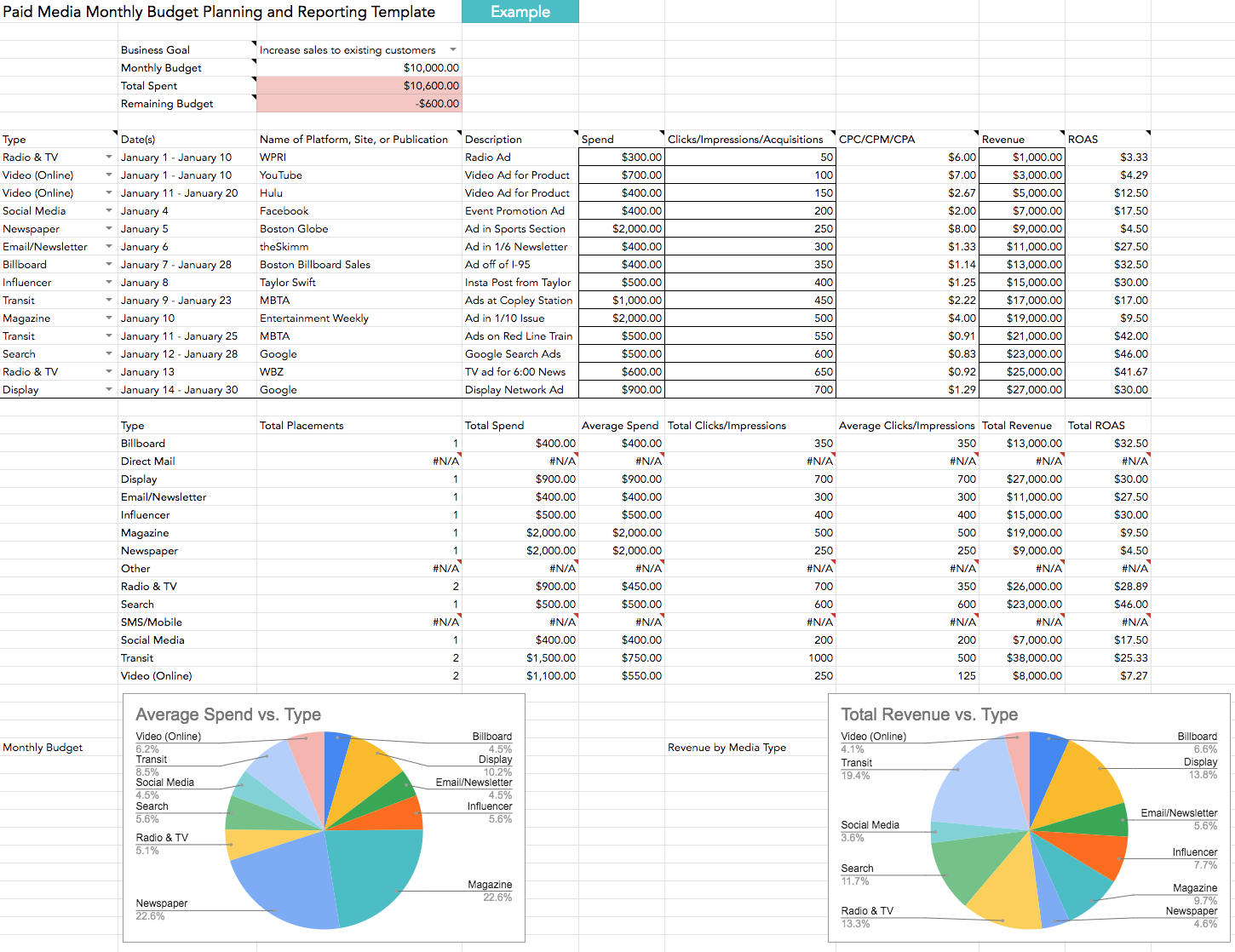
4. Audit and plan your owned media campaigns.
At the heart of digital marketing is owned media — and it almost always comes in the form of content. That’s because nearly every message your brand broadcasts can be classified as content, whether it’s an About Us site page, product descriptions, blog posts, ebooks, infographics, podcasts, or social media posts.
Content helps convert your website visitors into leads and customers while improving your brand’s online presence. And when this content is search engine optimized (SEO), it can boost your search and organic traffic.
Whatever your digital marketing strategy goal is, you’ll want to incorporate owned content. To start, decide what content will help you reach your goals.
If your goal is to generate 50% more leads via the website than last year, your About Us page is most likely not going to be included in your strategy, unless that page has somehow been a lead-generation machine in the past.
Here’s a brief process you can follow to work out what owned content you need to meet your digital marketing strategy goals.
Audit your existing content.
Make a list of your existing owned content, and rank each item according to what has previously performed best in relation to your current goals.
For example, if your goal is lead generation, rank your content according to which pieces generated the most leads over the last year (such as a blog post, ebook, or site page).
The idea here is to figure out what’s currently working, and what’s not so that you can set yourself up for success when planning future content.
Identify gaps in your existing content.
Based on your buyer personas, identify any gaps in the content you have.
For example, if you’re a math tutoring company and know through research that a major challenge for your personas is finding effective ways to study, create some.
By looking at your content audit, you might discover that ebooks hosted on a certain type of landing page convert really well (better than webinars, for example).
In the case of this math tutoring company, you might make the decision to add an ebook about “how to make studying more effective” to your content creation plans.
Create a content creation plan.
Based on your findings and the gaps you’ve identified, make a content creation plan outlining the content that’s necessary to help you hit your goals.
This should include:
- A title
- Format
- A goal
- Promotional channels
- Why you’re creating the content
- The priority level of the content
This can be a simple spreadsheet, and should also include budget information if you’re planning to outsource the content creation, or a time estimate if you’re producing it yourself.
5. Audit and plan your earned media campaigns.
Evaluating your previous earned media against your current goals can help you get an idea of where to focus your time. Look at where your traffic and leads are coming from (if that’s your goal) and rank each earned media source from most effective to least effective.
You can obtain this information using tools like the Sources reports in HubSpot’s Traffic Analytics tool.
You may find a particular article you contributed to the industry press drove a lot of qualified traffic to your website, which boosted conversions. Or, you may discover LinkedIn is where you see most people sharing content, which increases traffic.
The idea is to build a picture of what types of earned media will help you reach your goals (and what won’t) based on historical data. However, if there’s something new you want to experiment with, don’t rule it out just because it’s never been done before.
6. Audit and plan your paid media campaigns.
This process involves much of the same process: You need to evaluate your existing paid media across each platform (e.g. Google AdWords, Facebook, Twitter, etc.) to figure out what’s most likely to help you meet your current goals.
If you’ve spent a lot of money on AdWords and haven’t seen the results you’d hoped for, maybe it’s time to refine your approach, or scrap it altogether and focus on another platform that seems to be yielding better results.
Use this free guide for more on how to leverage AdWords for your digital marketing strategy.
By the end of the process, you should have a clear idea of which paid media platforms you want to continue using, and which (if any) you’d like to remove from your strategy.
7. Bring your digital marketing campaign together.
You’ve done the planning and the research, and you now have a solid vision of the elements that will make up your digital marketing strategy.
To review, here’s what you should have solidified so far:
- Clear profile(s) of your buyer persona(s)
- One or more digital marketing-specific goals
- An inventory of your existing owned, earned, and paid media
- An audit of your existing owned, earned, and paid media
- An owned content creation plan or wish list
Now it’s time to bring all of this together to form a cohesive marketing strategy document. Your strategy document should map out the series of actions you’re going to take to achieve your goals, based on your research up to this point.
Let’s discuss how our digital strategy template can help.
Digital Marketing Strategy Template
While a spreadsheet can be an efficient format for mapping your digital marketing strategy, that approach can quickly become messy and overwhelming.
To plan your strategy for the long-term – typically between six to 12 months out, you need a reliable digital marketing strategy document. But, where to start? With our free digital marketing plan template.
This template will walk you through your business summary and initiatives, help you build your target market and competitor information, and flesh out your marketing strategy — including your budget and specific channels and metrics.
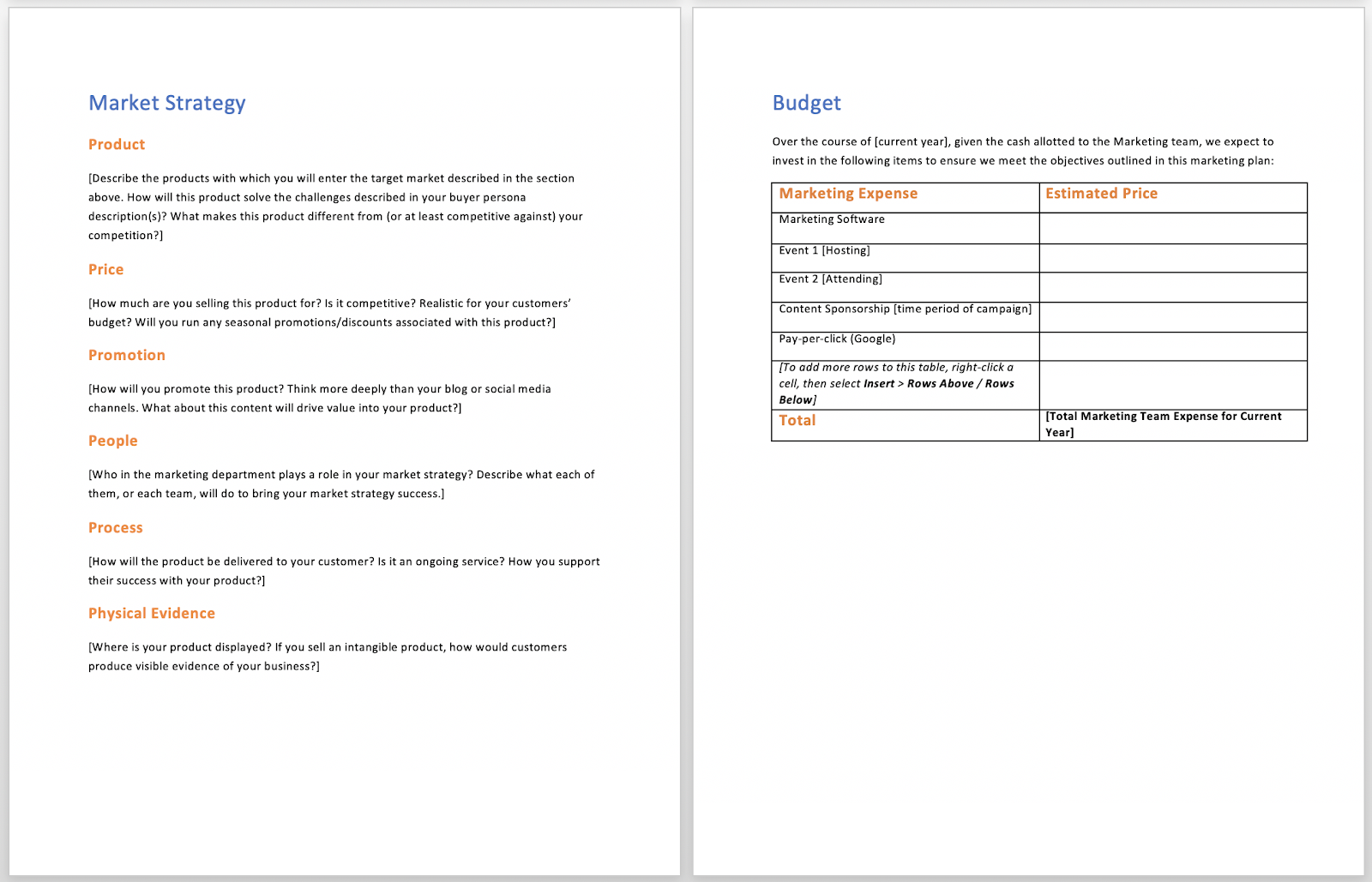
Use this digital strategy template to build out your annual digital marketing strategy and tactics. By planning out these yearly plans, you can overlay when you and your team will be executing each action. For example:
- In January, you’ll start a blog that will be continually updated once a week, for the entire year.
- In March, you’ll launch a new ebook, accompanied by paid promotion.
- In July, you’ll prepare for your biggest business month — what do you hope to have observed at this point that will influence the content you produce to support it?
- In September, you’ll focus on earned media in the form of PR to drive additional traffic during the run-up.
This approach provides a structured timeline for your activity which will help communicate plans among colleagues.
Finally, here are some examples of digital marketing campaigns and their strategies to inspire you.
1. Béis: Paid Ad
Travel accessory brand, Béis, recently launched a social media campaign to announce feature updates to one of its products. And they did it in the best way: by showing instead of telling.

In a 34-second clip, the brand showed how their product performed before and how it performs now following some changes to the material.
This is a fantastic campaign as it not only highlights an improvement on a product but it also shows customers that the brand is constantly iterating and improving. Secondly, they make sure to include captions in the video to ensure that it’s accessible without sound.
2. Omsom: Social Media
Asian food brand Omsom leverages its TikTok profile to share behind-the-scenes content, recipes, and culturally relevant content.
In a recent video, the brand’s co-founder shared how it sources one of its key ingredients and how they chose the more difficult route to preserve the integrity of the food.
here’s why we choose to make our lives harder as food founders! #business #sourcing
Here’s what Omsom did right: They highlighted their brand’s values while still building excitement around the product.
Sharing behind-the-scenes content is a great way to connect with your audience and share details that will simultaneously highlight your mission and/or values.
3. The General: Paid Advertising
After reports that consumers thought the brand was untrustworthy due to its low-budget ads, The General decided to revamp its entire marketing strategy.
In a commercial featuring basketball superstar, Shaq, the brand addressed the elephant in the room and introduced a new-and-improved look.
In addition, they also emphasize their credibility by mentioning how long they’ve been in business and how many people they’ve helped.
By addressing negative perceptions head-on, brands can not only change how consumers view them but also show that they are in tune with their target audience.
Grow Better With Marketing Strategies That Improve Your Digital Presence
Your strategy document will be very individual to your business, which is why it’s almost impossible for us to create a one-size-fits-all digital marketing strategy template.
Remember, the purpose of your strategy document is to map out the actions you’re going to take to achieve your goal over a period of time — as long as it communicates that, then you’ve nailed the basics of creating a digital strategy.
If you’re eager to build a truly effective strategy to help grow your business, check out our free collection of content marketing templates below.
Editor’s note: This post was originally published in October 2019 and has been updated for comprehensiveness.

What Is the Average Time Spent On a Website? [+ How to Improve It]
According to a Pew Research Center survey, 85% of Americans say they go online on a daily basis, with 31% reporting that they go online “almost constantly.”
With people spending more time online than ever before, it’s important that your website is optimized for visitors to browse and stick around. But longer isn’t necessarily better. You want visitors to stay on your website because they’re enjoying the content and experience — not because they can’t find the information that they’re looking for or can’t complete a desired action, like making a purchase.
In this post, we’ll cover what a “good” average time on page and average session duration benchmark is, and how to improve these metrics on your website.

Average Time On Page Benchmark
According to Contentsquare’s 2021 Digital Experience Benchmark report, the average time on page across all industries is 54 seconds. While you can use that as a benchmark, meeting it doesn’t necessarily mean your average time on page is optimal.
Like page views, bounce rate, and other website metrics, average time on page is contextual. What’s “good” depends on the type of website you have, the industry you’re in, and the web page you’re tracking, among many other factors.
For example, in their 2021 Digital Experience Benchmark report, Contentsquare analyzed data
from over 20 billion user sessions from across the globe. They were able to track average time on page across 10 industries, and found major differences.
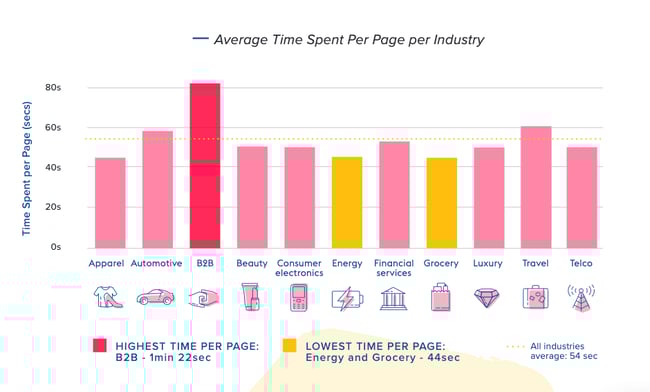
B2B, for example, had the highest average time spent on page with 1.37 minutes. This was at least 20 seconds higher than the other industries. The industries on the other end of the spectrum were grocery and energy, with an average time spent per page of 44 seconds. This gap emphasizes the importance of using an average time on page benchmark that’s specific to your industry.
A “good” average time on page also depends on the type of content. For example, you ideally want visitors spending more time on your product pages and blog posts. In fact, in a survey by Databox, 45% of respondents said that the average time on page for their blog posts is 3-5 minutes. A higher time on page indicates that the content is relevant, easy to read and understand, and targeted at the right audience.
On landing and checkout pages, however, higher time on page could mean that there are obstacles to conversion. The content, CTAs, or form might be confusing, for example.
Average Time on Page Google Analytics
Google Analytics is one of the most widely used tools to measure average time on page, among other performance metrics. It’s therefore important to explain how Google Analytics calculates this metric.
Google Analytics tracks average time on page by measuring the difference between the timestamps of hits. That means if a user lands on a web page and then closes their browser window or tab, or types another URL into their address bar, their visit is not counted.
So average time on page is calculated from the non-exits and non-bounces only, which is a smaller percentage than the total hits for a page.
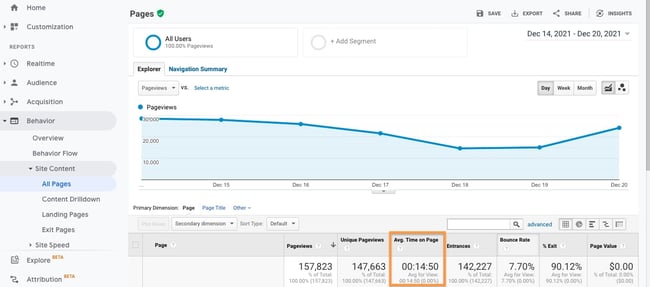
That’s why this average is typically higher than average session duration, which we’ll talk about more in the next section.
Google Analytics also keeps tracking time on page even if the user’s browser window or tab is hidden. So while this metric is not the most accurate, it is still a valuable indicator of how engaging and effective your content is.
Now that we have a better understanding of how to calculate and benchmark the average amount of time users spend on individual pages, let’s take a look at how to figure out how long visitors are spending on your entire website.
Average Time Spent on a Website
Average time spent on a website, like average time on page, is dependent on a range of factors. Industry, the type of website, and even the device that users are on impact this average.
For example, Statista calculated the 20 most popular websites worldwide as of June 2021, by time per visit. Users spent approximately 22 minutes and 44 seconds per visit on Google, the most popular website, and only .54 minutes on VK.com, the 20th most popular.
To calculate how long visitors are staying on average on your entire website instead of individual web pages, look at average session duration.
Average session duration measures the average length of sessions on a website. Google Analytics begins counting the length of a session from the time the user lands on a site until the user exits the site, or is inactive for a predetermined amount of time. (In Google Analytics, a session can last for up to 30 minutes without a user interacting with your pages.)
That means a session can consist of a user viewing a single page or viewing multiple pages, and can range anywhere from a few seconds to a few hours.
Average session duration is calculated as: total duration of all sessions (in seconds) / number of sessions.
This is a key difference between average time on page and average session duration. Whereas average time on page excludes visits that end in exits or bounces, average session duration counts all bounces as zero seconds. This can lower the average session duration significantly if your website has a high bounce rate.
The Google Analytics dashboard below, for example, is tracking the same website as above. So while its average time on page last week was 14 minutes and 50 seconds, its average session duration was 1 minute and 37 seconds.
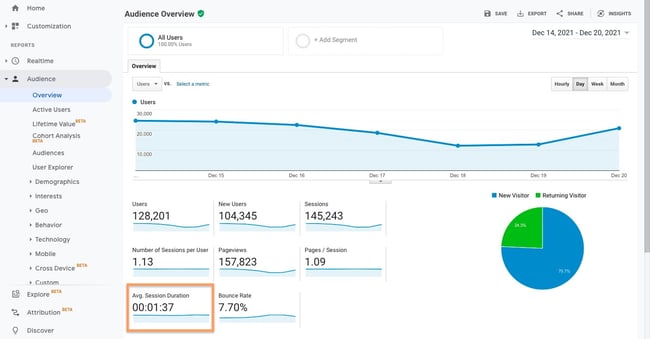
To improve average session duration, or the average time spent on a website, try the best practices below.
1. Decrease load time.
Decreasing load time can help reduce your site’s bounce rate, which can significantly improve average session duration.
In a study commissioned by Google and conducted by 55 and Deloitte, decreasing mobile site load times by just one tenth of a second resulted in significant decreases in bounce rate: 0.6% for homepages, 5.7% for product listing pages, and 1.9% for product details pages.
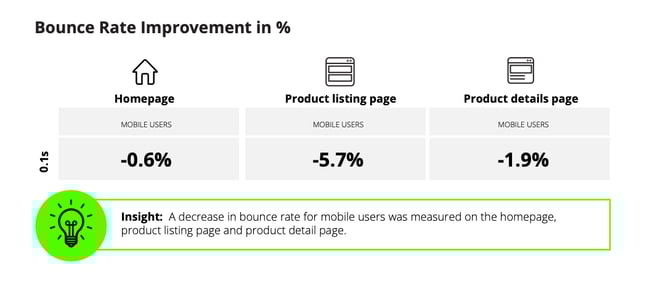
Using a CDN, optimizing images, reducing redirects, and compressing files are just a few ways to decrease load time. To learn more, check out our full guide on optimizing your website speed.
2. Optimize your navigation.
Website navigation enables visitors to quickly and easily find the information they’re looking for, like a blog post, and important information that they weren’t looking for, like pricing info. A good navigation system can improve the chances of visitors taking action and browsing your site longer.
When designing a navigation menu, follow these best practices:
- Put your most important items at the beginning of the navigation menu.
- Use navigation labels that align with your type of business and are SEO-optimized.
- Include a search box.
- Add navigation links in the header, sidebar, and footer of your site.
3. Add internal links.
Another way to enable visitors to easily find and read relevant content on your site is adding internal links. Internal linking makes your site easier to navigate, which increases the chances that readers look at more content and stay on your site longer.
Here’s an example of a blog post with lots of internal links encouraging visitors to dive into these subtopics in more depth:
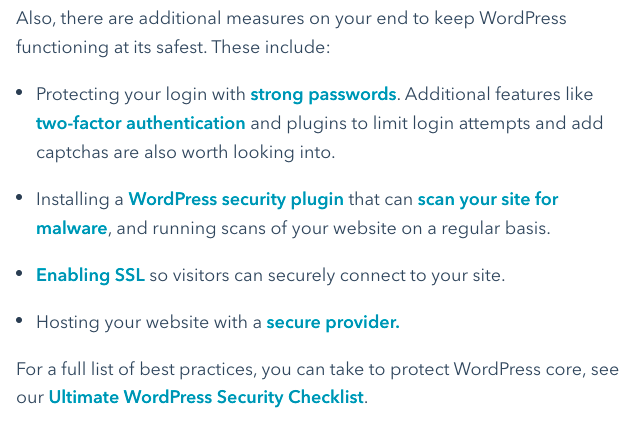
4. Improve the readability of your posts.
When evaluating the readability of your content, you need to consider what the words are on the page and how they look.
To improve the flow of the post, remove any instances of passive voice, shorten long sentences or paragraphs, and add transition words. To improve the look of the post, try adding headings, subheadings, and bullet points to break up chunks of texts. Also make sure you’re using an easy-to-read font and accessible color scheme.
A tool like Yoast SEO can help automate this process. In fact, it has a readability analysis tab where it provides actionable feedback to make your post or page easier to read.
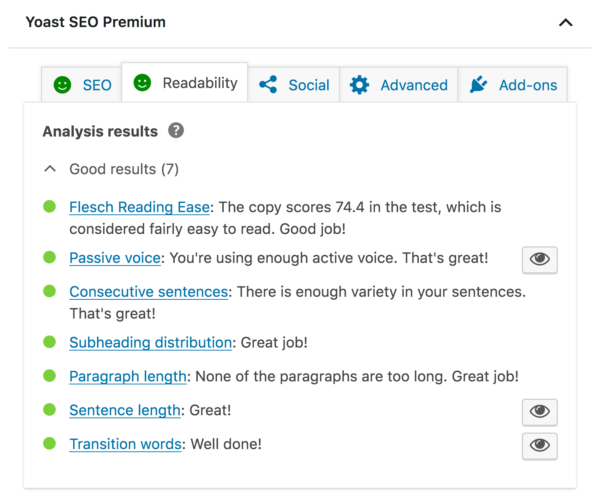
5. Add images and videos.
Adding multimedia content, like images, videos, and infographics, is another way to improve the readability of your content. Not only do they break up chunks of text — they can also illustrate complicated ideas (like APIs, for example) and appeal to different types of learners.
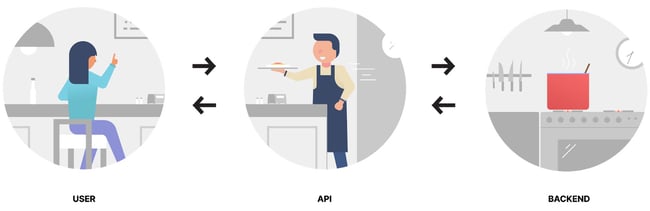
Images and videos enhance the overall user experience and encourage visitors to stay on the page longer.
6. Optimize for all devices.
According to a study by Perficient, 68.1% of all website visits globally in 2020 came from mobile devices and only 28.9% and 3.1% came from desktops and tablets, respectively. However, desktops drove 46.4% of total time on site globally and tablets drove more total time on site than mobile devices.
This emphasizes the importance of having a fully responsive website that’s optimized for all devices. Sizing and styling buttons, SVGs, images, and fonts are especially important when creating a responsive site. For more best practices, check out our complete guide to responsive web design.
7. Use exit intent popups.
Exit intent popups appear when a visitor is about to bounce from a website. These contain an offer or message that’s designed to keep them on the page. Briogeo, for example, has an exit intent popup encouraging visitors to take their hair quiz before leaving the site.
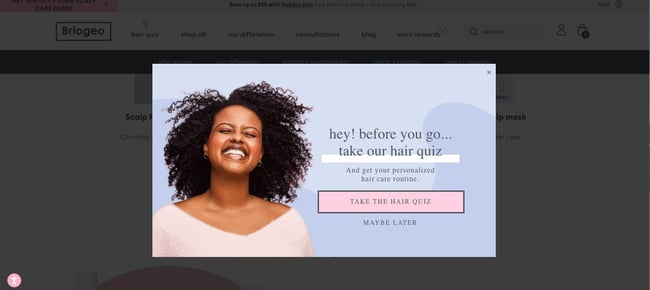
While this won’t convince every visitor to stay, it may convince some, which will ultimately help improve your average session duration.
Encouraging Visitors to Stay on Your Site
Average time on page and average session duration are excellent indicators of how engaging and effective your content is and whether you’re attracting quality traffic. Now that you understand what these metrics mean and what benchmarks to use to evaluate your performance, you can focus on optimizing your site to have visitors browse for longer.
Editor’s note: This post was originally published in March 2014 and has been updated for comprehensiveness.

How to Create An Action Plan: A Straightforward Guide for Marketers
Have you ever sat down at your desk first thing in the morning and spent a good 45 minutes browsing social media or getting lost in your inbox because you can’t focus on what you need to do? At the end of the day, you feel as if you’ve wasted 8 hours of your life that you’ll never get back.
On the other hand, have you ever sat down, opened your calendar app or a to-do list, and jumped right into work, knocking out task after task in a matter of minutes? When you shut your computer at the end of the day, you feel accomplished and know that you’ve done everything possible to move towards your professional goals.
What’s the difference between these two scenarios? A plan. Having your day (or week, or project) mapped out with a concrete action plan will help you feel more focused and accomplished in less time. When it comes to marketing, an action plan could mean the difference between a campaign that sizzles and a campaign that fizzles.
Now that you know there’s a way to ensure more days end with the satisfaction of work done well, let’s take a closer look at what these plans actually are and how they can benefit you.
What is an action plan?
An action plan is a proposed strategy for whatever you want to accomplish. It’s a clear, detailed list of all the steps you need to take to reach your goal, along with a proposed timeline of when you’ll complete each step or task.
Perhaps you’ve heard of action plans in the past, but never tried to create one of your own, Or maybe, this is a brand new concept to you and you’re pretty sure you just heard a choir of angels in the background.
What is the purpose of an action plan?
Action plans are designed to help you reach your goals faster. By breaking down projects into smaller steps, you can ensure that you:
- Meet your goal in a timely fashion
- Don’t skip a step
- Communicate effectively with team members
- Set reasonable expectations for what you can accomplish in a specific period of time
While they will vary in complexity, action plans are good for small projects, large projects, projects that you complete on your own, and projects that involve other team members or individuals outside of your organization.
Convinced you need action plans in your life? Good. Let’s take a look at the steps necessary to implement them.
How to Write an Action Plan
Action plans can be as simple or complex as they need to be. However, before you start writing out the steps to reach your goal, you’ll need to identify something very important… your goal, of course!
What is it that you’d like to accomplish? Is there a new campaign you need to prepare before a specific launch date? Maybe you’re teaming up with another business or a nonprofit for cross-promotion. Perhaps you’re looking to increase brand awareness through various channels.
Whatever your goals, get very clear on what it is you want, why it’s important, and when you need it done. You may wish to create a SMART Action Plan by incorporating SMART goals into it. SMART stands for: specific, measurable, attainable, relevant, and timely. This framework helps you determine if your goals are realistic, identify what actions are needed to reach your goals, and defines what success looks like.

Once you’ve determined what you want to accomplish and when it will need to be done, it’s time to start devising your plan. Follow these easy steps to create your plan of action.
- Use a template or tool to capture your action plan and share it with anyone who needs to be involved. (You’ll find some options in the next section)
- Brainstorm. Consider all the steps that need to get done to complete your project. You may find it helpful to start with larger aspects of the project and then break those down into smaller tasks. No task is too small to be listed (let’s be honest, checking things off a to-do list feels amazing).
- Delegate and assign responsibilities to team members. You don’t have to go it alone! Hopefully, you have a trustworthy team standing by to help complete tasks and inch you closer and closer to the finish line. This also allows you to identify what resources you need to achieve the goal.
- Schedule due dates. If your project needs to be done by a specific day (which it should or it could stretch on indefinitely), then each task will have its own due date. Keep in mind that some tasks can be worked on at the same time, while others will require that a previous task has been finished before you can start the new one.
- Set up alerts to keep yourself (and your team) on track. It’s very easy to get caught up in the day-to-day grind and forget about a larger project looming in the distance. Use your scheduled due dates to set up reminders and pencil in time to work on specific tasks.
- Track your progress and check in with your team. Your action plan may have looked top-notch when you wrote it, but as you work through it, you may discover that things need to change. If you see that you’re falling behind in the tasks, it may be time to re-evaluate and potentially tweak your action plan.
- Celebrate. Completing a project is often cause for celebration, but don’t forget to review what worked and what didn’t for a smoother project next time.
Leadership action plans will not only help you achieve your goals, but will also help your team be clear on what they need to do, and feel accomplished once they’ve done it. They will also serve to identify any weak links in your organization.
Action plan Formats may differ depending on the needs of our specific project, however, as long as you include the goal, the steps, the people involved, and the due dates, you’ll have a solid plan to work with.
Action Plan Templates
When you’re ready to create an action plan, there’s no need to start from scratch. There are a number of templates and examples available that will provide the framework you need to devise your marketing strategy.
Below, is an action plan example for a 30-60-90 Day onboarding plan. This can always be tweaked to onboard individuals into a marketing position, or to create a marketing plan for your organization.

A marketing action plan may be as simple as this template:

You can also use Hubspot’s Marketing Plan Generator to guide you along the way.
No matter how you do it, an action plan may take a little bit of time to create, however, you’ll save time, energy, and resources when you have a clear plan of action for your next project or campaign.

How to (Easily) Make Perfect Content Calendars in Google Sheets
What do you use spreadsheets for? If you’re anything like me, you likely use them to collect data, track campaign or blog post analytics, or keep track of weekly assignments.
But have you ever thought about using spreadsheets to make a calendar? If not, let me tell you why Google Sheets is the perfect tool for your content calendar.

If you often work on campaigns for a few different clients, creating individual calendars in Google Sheets could be uniquely useful for ensuring the client understands when certain content will go live. Alternatively, perhaps you need to create an internal Google Sheet calendar for your team to keep track of upcoming projects.
Making a calendar in a tool that’s commonly used for spreadsheets sounds a little intimidating, but don’t worry, the process is actually pretty intuitive. And with the help of some tips, you can easily make a functional calendar that you can sync your schedule with.
Below, we’ll go over how to make a calendar in Google Sheets and include some tips that’ll help you elevate the design. At the end, your calendar will look something like this:
 Open up Google Sheets and get ready to create your very own calendar. 📅
1. Open a new spreadsheet and choose your month.
First, open a new spreadsheet.
Then, choose your month. For this example, I decided to do January 2022, so I filled that into the first cell. What’s great about Google Sheets is that it automatically recognizes dates, so typing in a month, followed by the year in YYYY format will tell Google that you’re going to be working with dates.
2. Begin to format your calendar.
Next, format your calendar. I selected the text, January 2022, in Column A, Row 1. I highlighted seven columns (A-G), and clicked Merge to make that cell span across the entire column. You can find this button to the right of the Fill tool.
Here, I also center-aligned my text using the tool next to Merge. Then, I increased the font size and bolded the month.
3. Use a formula to fill in the days of the week.
Next, fill in the days of the week in each column (A-G). You can do this manually but I decided to use a formula. Sheets has a function that lets you type in formulas to complete certain actions at once.
To fill in days of the week, in the cell where you want your first weekday to be, type: =TEXT(1, “DDDD”). What this tells Google is that your number will be replaced by a date or time and the format you’re using is weekdays.
.jpg?width=1162&name=sunday-google-sheets-calendar%20(1).jpg) Highlight the number 1 in the formula and replace it with: COLUMN(). Then, press enter and select your first day. You’re going to copy the formula in Sunday’s cell by dragging the selector to the end of your row, (A-G), and pressing enter again.
Highlight the number 1 in the formula and replace it with: COLUMN(). Then, press enter and select your first day. You’re going to copy the formula in Sunday’s cell by dragging the selector to the end of your row, (A-G), and pressing enter again.
 Pressing enter should automatically fill in the rest of the week. Remember, if this doesn’t work for you, you can always fill in the days manually.
Pressing enter should automatically fill in the rest of the week. Remember, if this doesn’t work for you, you can always fill in the days manually.
4. Fill in the numbers.
Excellent! You have your days of the week. Now we’re going to fill in the numerical values. Before this step, I took the time to add color to the days row and changed the font to one I liked a little more.
For the numerical values, we’ll simply identify the first day of the month and click and drag to fill in the rest.
How?
Place the number 1 on the box right underneath the first day of the month, then click and drag horizontally. Depending on the day of the week, you may need to follow this process using the second day of the month so you can click and drag horizontally.
5. Fill in the rest of the numbers.
Note: In this step, I filled in the calendar numbers every other row to help with my formatting later.
Now that you’ve filled out your first row, it’s time to fill in the rest. Manually insert the next number under “Sunday,” then click and drag horizontally to fill in the rest.
Note: Make sure to end the month on the right number! For January, that would be the 31st.
6. Reformat your calendar if necessary.
Everything is starting to look like a calendar, right? At this stage, I reformatted things to clean up the look of my calendar a little.
Remember those extra rows in between the numbered rows? I expanded those rows to create boxes underneath the numbers. To do this, I simply dragged the rows down to make those cells bigger.
 Here are some additional formatting tips:
- Select the empty rows underneath your numbers and center them using the center text alignment tool.
- Select your entire calendar and vertically align all elements so that they’re in the center of their cells. To do this, use the vertical alignment tool.
- Bold your day numbers.
- If desired, lightly shade your numbered rows.
- If desired, gray out the Saturday and Sunday columns so that your workdays stand out.
7. Add design elements to professionalize the look.
Finally, you can add in some fun design elements to personalize the look and feel of your calendar. If it’s for a client or upcoming project, you’ll want to incorporate the necessary launch days here.
 For this step, I added in a few fun images, included a few hypothetical calendar events, and played with font sizes.
8. Repeat the process from February to December.
It’s time to repeat for the month of February to December. Simply duplicate your January calendar once you’ve designed it how you want it to look. To do this, right-click the sheet’s tab and select Duplicate from the menu.
 To fill in the numbers, you’ll only need to know the beginning day, then click and drag to fill in the rest of the rows. Here are the first days for every month for the year 2022:
- January: Saturday
- February: Tuesday
- March: Tuesday
- April: Friday
- May: Sunday
- June: Wednesday
- July: Friday
- August: Monday
- September: Thursday
- October: Saturday
- November: Tuesday
- December: Thursday
Next, you’ll want to know how many days you’ll need to fill in. Here are the number of days you’ll need for each month:
- January: 31
- February: 28 or 29
- March: 31
- April: 30
- May: 31
- June: 30
- July: 31
- August: 31
- September: 30
- October: 31
- November: 30
- December: 31
And then, you’re done!
It’s handy to use Sheets because you can open your calendar right on your browser. You can also keep track of your schedule in a place that’s separate from your phone.
Alternatively, you can create important business documents such as social and editorial calendars. Below, I share a template that’s perfect for the task.
Google Sheets Calendar Template
Here’s an editorial calendar template for all of your editorial planning needs. This template helps you lay out a strong editorial strategy on a daily basis.
Featured Resource: Free Editorial Calendar Templates
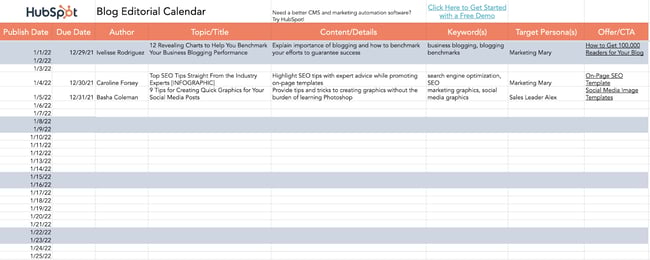
Use a Google Sheets Calendar to Organize Your Tasks
If you’re handy with Sheets and want to give it a shot, create a Google Sheets calendar. It’s a great option if you need to create a clean calendar to track an internal marketing campaign, organize a client’s upcoming projects, or share an event calendar with key stakeholders. But if you don’t want to create one from scratch, use our editorial calendar template to jumpstart your planning and organization efforts immediately.
Editor’s note: This post was originally published in May 2020 and has been updated for comprehensiveness.

Podcasting in 2022: What You Need + 9 Steps To Get Started
I first discovered podcasts a few years ago when I was commuting for work two to three hours a day, every day.
The first podcast that got me hooked was NPR’s “How I Build This” show on entrepreneurship.

Today, I listen to a wide range of podcasts on business, pop culture, and current events, like The Nod and “Louder Than a Riot.” So, what does it take to start a podcast in 2022? We’ll cover that in more in this article.
- What is a podcast and how does it work?
- What is a podcast host?
- What equipment is needed to start a podcast?
- How to Start a Podcast
- Find a unique and compelling topic or theme.
- Set up your show format.
- Leverage your network.
- Record and edit your episode.
- Finalize your creative assets.
- Set up a website.
- Build a promotion strategy.
- Track your metrics.
- Learn how to monetize your podcast.
What is a podcast and how does it work?
A podcast is an audio series that a user can download to a personal device and listen at their leisure. It centers around one theme or topic, with each episode typically ranging from 20 to 60 minutes.
Think of a podcast as the audio version of any television series. It follows the same production format: It follows a specific theme or topic, t’s episodic and can have several seasons, and can be reality- or fiction-based.
One thing that sets podcasts apart from TV series is the use of a podcast host. Every podcast needs a host who can narrate the story and guide the listener through the episode. In addition, podcasts are only audio. Otherwise, the two mediums are very similar.
The most popular platforms to listen to podcasts include Apple Podcasts, Spotify, and Google Podcasts.
Google Trends shows that podcasts have gradually become more popular, peaking around the fall of 2019 and the spring of 2020 worldwide.
Today, 28% of the U.S. population over 12 years old listens to podcasts on a weekly basis, according to the 2021 Infinite Dial study – a 17% year-over-year increase.
Podcasts vs Standard Audio Files
The difference between a podcast and standard audio files is the same as the difference between a video and a television series.
An audio file is a file format used to store audio on a digital device. A podcast, on the other hand, is a produced show that involves storytelling, formatting, and audio sourcing. You need audio files to create a podcast, but the same is not true the other way around.
What is a podcast host?
A podcast host is a platform that stores your podcast and distributes it to publishing platforms like Apple Podcasts and Spotify. Here’s how it works: You first upload your audio file to your hosting platform, then they create an RSS feed and send your episodes to various directories (AKA publishers).
The most popular podcast host platforms include Casted, Buzzsprout, Captivate, Libsyn, and PodBean. Here are the top features you should look for as you evaluate your options:
- Transcription integration
- Unlimited storage and bandwidth
- Custom website
- Analytics
- Text editor for show notes
What equipment is needed for a podcast?
One of the best things about starting a podcast is that it doesn’t take much to get started. All you need are these high-quality items:
- A microphone – While you might be tempted to use your computer’s or phone’s built-in microphone, invest instead in an XLR or USB mic that will offer better sound quality. If you’re just starting out, you might opt for a dynamic mic that’s less sensitive to ambient noise. If you have a studio set up, a condenser mic might be better.
- A studio or soundproof room – When recording a podcast, you should minimize ambient noise as much as possible as that can distract listeners. Because of this, it’s important to create a quiet, soundproof space to record.
- Editing software – Once you record your episode, you will need to edit it to add in music and ad spots and remove any content that may not fit. There are various audio editing software that you can use, including Audacity, Adobe Audition, and Descript – each ranging in editing features.
- Noise-canceling headphones – Headphones are important both during production and in post-production as they allow you to monitor and detect sounds during the recording.
- A hosting platform subscription – Before you can distribute your episodes, you must first upload your files to a hosting platform first.
1. Find a unique and compelling topic/theme to cover.
The first thing you need to start a podcast is an idea. For an individual, it can stem from a passion for or expertise in a particular topic/industry. For a brand, this can come from research you’ve gathered about your audience.
At the core, your podcast should speak to a particular audience. Because if there’s no interest in it, then you’ll be speaking into an empty room. And if you’ve ever done an 8 a.m. PowerPoint presentation in college, you know exactly what that’s like.
If you’re reading this article, there’s a good chance you already have an idea for a podcast. In this case, the goal is to dive deeper into your idea and see if it’s worth pursuing.
To do this, here are the questions you want to ask yourself:
- Has this been covered before in another podcast? If so, is there another angle I can take?
- Is this idea relevant and timely?
- Is there an audience for this? If so, what type of listeners will it attract?
- Is there enough content to create a season?
You’ll know you have a winning idea when you have a clear answer to these questions. Your idea may go through some changes as you develop it but the foundation starts here.
During this step, you may be tempted to secure your name and logo but we recommend waiting on that. More on that in step five.
Want some inspiration? Check out these marketing podcasts.
2. Set up your show format.
The great thing about podcasts is that they can follow just about any format.
Some are interview-based and conversational with one or several hosts bringing on guests while others focus on storytelling (fictional and non-fiction). It’s up to you to decide which format will suit your theme the best.
From there, start brainstorming your episode segments, which break down your show into sections to make it easier for listeners to follow.
Segments aren’t always clearly stated either. Sometimes, it’s as simple as act one, two, and three. It’s all about finding the best way to tell the story in a way that captures and maintains the audience’s attention.
3. Leverage your network.
Once you’ve figured out which format you want to follow, you might need to reach out to your network.
Perhaps you need a co-host, or you need to line up a few high-profile guests for upcoming shows. This is when you reach out to your network.
In addition to posting on your social platforms, you should also reach out to your network in shared interest groups, like Facebook Groups, as members may have a special interest in your project.
4. Record and edit your episode.
Now that you’ve worked out all the editorial details of your podcast, it’s time to record your first episode.
While this may seem nerve-racking, see it as a dry run. Once you review the recording, you can work out any kinks in the episode regarding segments, flow, storytelling, etc.
Don’t be afraid to ask for feedback from others. While you’re in the early stages of developing your podcast, this is the perfect time to get notes on where you can improve and implement them before it officially launches.
5. Finalize your creative assets.
So, earlier I mentioned not finalizing your name and logo during the initial development stages. That’s because, from idea to production, your idea may have evolved into something different from what you originally thought.
In addition, you may get more inspiration after creating your first episode and having a clear product to name.
You may find that you had a name for your podcast from day one, and that’s great. But if you need something more concrete to get your juices flowing, that’s fine too.
6. Set up a website.
Consider your website as your home base for your podcast.
It’s where all information surrounding your podcast will live, including show notes, transcripts, episode descriptions, host descriptions, and more. It also allows you to get more listeners by increasing organic traffic to your website.
By following SEO best practices, you can reach consumers who may be interested in your content and make them convert once they land on your website.
7. Build a promotion strategy.
Having a great podcast concept won’t be enough to attract users. You have to build a robust promotion strategy to get it in front of your target audience. Because how will they listen to something they don’t even know exists?
First, the pre-launch. Promotion doesn’t start after your first episode has aired, it should start before.
Why? It builds anticipation surrounding your show and can help you start out with a strong listenership right out of the gate. Share on platforms you’re already on along with those you haven’t yet explored.
For instance, you might start by securing your handle on social media and sharing a few posts to count down the air date for your first episode. If you already have a captive audience elsewhere, like a newsletter or a blog, prioritize promotion on those channels as well.
Once your show launches, be consistent about promoting the episodes, and don’t be afraid to test various methods.
You may find that posting audio snippets from episodes get higher engagement rates than posting about your guests. Or vice versa.
Once you identify what your audience responds to, stick with it.
Pro-tip: Reviews can go a long way in gaining new listeners. During your post-launch strategy, consider incentivizing your audience to leave a show review by hosting a giveaway.
8. Track your metrics.
If you’re not tracking it, did it even happen?
Once your podcast launches and is in full swing, start monitoring its performance. Here are the metrics you want to keep an eye on:
- Subscriber count
- Monthly episode downloads
- Unique page views to the podcast page
- Average listening time
Every piece of data you track will offer insight into your listeners and inform your strategy for future episodes.
For instance, say your top episode is on a particular topic, you could cover that more. Here’s an in-depth piece on how to grow a podcast.
9. Learn how to monetize your podcast.
Finally, it’s important to figure out how to earn an income based on your podcasting.
The most straightforward way is through sponsorship. Ever heard “This episode is brought to you by [insert brand]”? Well, it means the show has set up a partnership with the brand to increase brand awareness or meet another marketing goal.
In some cases, the sponsorship will also include ads pre-roll (at the beginning of the episode) and mid-roll (in the middle of the episodes). However, that’s not always the case.
Affiliate marketing, which refers to the process of promoting a product or service in exchange for a commission on the sale. Podcasts hosts will often do this by offering a unique discount code that includes the show name.
With both strategies, you’ll have to actively seek out these brands in the beginning. Create a pitch explaining the benefits of partnering with you. It’s easy to do this once you have a few episodes under your belt and can show metrics to support your points.
Another podcast monetization strategy is offering paid membership tiers for exclusive, bonus content through services like Patreon and Stitcher Premium. For instance, say your podcast is interview-based.
You could promote extended interviews at the end of each episode and encourage your listeners to join your membership platform.
If you join a podcast network or advertising network, some of this work is done for you. But it also means you don’t have full control over which ads are placed on your show. Additionally, you may not receive the full profit from the ad, as that may be split between you and the network.
Lastly, you can also maximize your podcast by publishing it on YouTube. If you have a good at-home setup or a studio setup, consider recording both video and audio – particularly if your show is educational or conversational.
This way, you can publish it on YouTube, access a wider audience, monetize your channel, and diversify the ways in which you promote your show.


What Is Bounce Rate? (And How Can I Fix Mine?)
Luckily, you’re not alone. Many marketers have asked those questions and might not have found a solid answer yet. We’re here to demystify bounce rate with an overview of what constitutes a bounce rate — what doesn’t — and exactly how you can fix it.
Keep in mind that bounce rate is different from an exit rate. Bounce rates only measure “one-and-done” visits — the ones in which people arrive and leave your website without navigating away from a single page. Here’s what they look like in your HubSpot Web Analytics Dashboard, for example:
-1.png?width=650&name=What%20Is%20Bounce%20Rate%3F%20(And%20How%20Can%20I%20Fix%20Mine%3F)-1.png)
Exit rates, on the other hand, are a little more complicated. They include the percentage of people who leave your website from a certain page — but, that’s not necessarily the only page they’ve visited on your website. The page from which they exited could be the last in a long sequence of page visits. That’s why the exit rate isn’t always as troubling as bounce rates.
But a high exit rate, on the other hand, wouldn’t be cause for concern. It would mean that this page was the last in a chain of visits — people exiting from that page probably arrived from its preceding landing page, downloaded the offer on the thank-you page, and left to go make use of the content they just downloaded.
Keep in mind that this scenario is hypothetical, and these takeaways can differ based on other page metrics — but it serves as a simple illustration of the difference between bounce and exit rates.
For example, if 100 people visit your site and 10 of them only visit one page, then your bounce rate would be 10%. This number will likely change over time, so using an analytics provider to track all the changes is beneficial for understanding what’s affecting your bounce rate.
What is a good bounce rate?
If you’ve recently taken a look at your website’s bounce rate, you might find yourself discouraged at the number. But if you then decide to aim for a 0% bounce rate, you’ll probably find yourself even more discouraged. The average bounce rate is somewhere between 26% and 70%, with the optimal range being between 26% and 40%. To land anywhere under 20% is generally unlikely, so if that’s what your data is showing then you may want to double-check some things. Duplicate code, incorrectly implemented tracking, and third-party add-ons can all result in an inaccurately reported bounce rate.
The average bounce rate can also change depending on the viewer’s device. Mobile devices, for instance, have the highest bounce rate across all industries at 51%. Whereas the average bounce rate on a desktop is 43% and the average for tablets is 45%. So, take into account where the traffic is coming from as you’re judging your site’s bounce rate.
High Bounce Rate
A bounce rate over 70% is above average, but it’s not necessarily on the high side until it’s reaching 56%. If it’s over 90%, that’s a major cause for alarm but it’s usually easy to decrease because there’s something specific scaring everyone off. Things like bad design, errors in your tracking code, excessive bots, or browser incompatibility could be the culprit. Also be aware that high traffic from social media or paid ads, as well as a lot of mobile visitors can be increasing your bounce rate as well.
How to Reduce High Bounce Rates
Now you know what a bounce rate is. But what can you actually do about it?
In general, high bounce rates might indicate that the page is irrelevant or confusing to site visitors. But don’t jump into drastic actions like deleting a page or undertaking a redesign right away. There are some important steps you need to take before you figure out which action to take.
Remember: Bounce rates only tell you that someone landed on a web page and left it without visiting any other page on your website. It doesn’t tell you how someone interacted with your page. That’s why it’s important, says Director of Product Marketing at Iterable Jeffrey Vocell, to take “practical steps” to examine other metrics and pieces of your web presence to see what might be behind the bounce rates. We’ve outlined these steps below.
1. Ensure your website is mobile-friendly.
Mobile users account for about half of web traffic globally. That makes it crucial, says Vocell, “to not only provide a mobile-ready experience,” but to make sure that experience is engaging. How annoying is it when you arrive at a mobile site, only to have to zoom in to read its content? Having a responsive site is no longer enough — engagement with the mobile version has to be user-friendly and interactive.
Video is one particularly engaging type of content. It can often explain complex topics more concisely than text, which might be why 4X as many customers would rather watch a video about a product than read about it. But when it comes to mobile usage, long videos require a significant amount of data and might therefore slow the user experience — causing the visitor to bounce. For that reason, Vocell suggests eliminating these longer videos from your mobile site or creating more concise versions that still address the most important points.
This kind of improvement, however, isn’t limited to video. Take a holistic approach to evaluating your mobile experience, and consider how you’ll address contingencies like these.
2. Look at your bounce rate based on different sources.
Sometimes, the sources directing traffic to a given page might have something to do with its bounce rate. That’s why the HubSpot Web Analytics Dashboard allows you to break down the bounce rate according to source:
.png?width=650&name=What%20Is%20Bounce%20Rate%3F%20(And%20How%20Can%20I%20Fix%20Mine%3F).png)
Let’s say your bounce rate is particularly high from direct traffic — take a close look at the URL to make sure it’s easy to read, remember, and type in. Then check to see that the visitor isn’t being greeted with a 404 error or a home page that isn’t very inviting. The headline should be clear and signal to the person that they’re in the right place.
You have to meet the expectations of the visitor — regardless of source.
3. Avoid other disruptions that might hurt the user experience.
We’ve already discussed the importance of a good mobile user experience, and that goes for all platforms. Things like full-screen pop-ups, for example, are not only annoying but can also result in search penalties.
The key thing to consider is the user. “You want visitors to be drawn into your page and stay for as long as needed to convert,” says Vocell, and while “some pop-ups are good,” — like well-crafted inbound messages that add context to a site — avoid any that significantly disrupt the user experience in a way that might cause visitors to leave.
4. Determine which keywords this page ranks for — and if your content sufficiently covers those topics.
Remember how we cautioned against misleading visitors about your site’s content in social distribution? The same goes for keyword rankings. “Matching keyword intent to your content is important to ensure organic visitors get the content they expect,” explains Vocell.
Let’s say someone is searching for “marketing automation software solutions” — it’s likely that this person is looking for software to help nurture leads into customers. But if someone is using the query, “What is marketing automation?”, she’s probably not at a stage where she’s looking to buy a product. Rather, this person is looking for content that’s more informative than anything else.
So when you evaluate the keywords for which your page is ranking, make sure they’re aligned with the actual content. Once you’ve done that, try looking at a topic-cluster framework — the kind that groups your site’s pages into clusters according to subject — to help attract organic traffic to the right pages.
Let’s Bounce
When you’re investigating bounce rates, make sure you’re looking at the full picture. Take a look at the time people spend on your site, where they’re coming from, and what device they’re using — and if your content and experience are aligned with all of those factors. You might uncover patterns that show how you can fix the bounce rate problem.
Think of bounce rates like your car’s “check engine” light. When it goes on, you know there might be a problem — but you need to check all of the car’s systems to accurately diagnose the issue. There’s no one-size-fits-all fix for bounce rates, but knowing what they are and how they can inform your marketing strategy can help ensure your website’s success.
Editor’s Note: This post was originally published in April 2014 and has been updated for accuracy and comprehensiveness.

6 Types of Advertising Brands Are Investing In This Year
And just like that, another year is (almost) in the books. As marketers begin to map out their 2022 marketing plans, it’s the perfect time to dust off the crystal ball and predict what will shape the industry over the coming year.

There’s certainly a lot to consider — the continuing impact of the global pandemic, the massive shift to digital advertising, and the rise of platforms like TikTok — to name a few. Simply put, what worked for your marketing strategy in the past might not fly in 2022.
Ready to explore the future of marketing? Let’s look at all different types of advertising, and the 6 types brands are investing in this year.
1. Video Advertising
As marketers look for innovative ways to engage audiences, video has become an integral part of the conversation. Video advertising uses videos to promote products and services, educate or entertain consumers, and reach new audiences in an engaging way.
But let’s be honest — video isn’t a new, “up-and-coming” strategy. It’s here, and its impact is already undeniable. And with the popularity of video-related platforms like YouTube and TikTok, it remains a top priority for marketers.
2. Social Media Advertising
It’s hard to imagine any company successfully marketing its offerings today without a social media account. With over 4 billion people on social media, it’s easy to see why companies gravitate to this medium.
Social media advertising serves paid ads to your target audience on social media platforms like Twitter, Facebook, LinkedIn, and Instagram. Aside from its reach, it also offers a wealth of opportunities to boost brand awareness, generate and convert leads, and foster customer relationships.
Social media is also great for retargeting, which is the process of targeting audiences who have previously interacted with your website or social media. SharpSpring Ads is one retargeting platform that lets users recapture lost viewers by sending them targeted ads on Facebook, Twitter, and across the web.
3. Mobile Advertising
Digital advertising is all about meeting people where they are, and more often than not, they’re on their phones. In fact, as of July 2021, 56% of all web traffic came from mobile phones. If we jump back to 2011, this number was just over 6%.
Mobile advertising encompasses all forms of advertising on mobile devices — anything from banner ads and popups to SMS text messages. When done correctly, marketers can take their campaigns mobile to reach audiences exactly where they are.
4. Display Advertising
Display advertisements are mostly found along the top or sides of third-party websites. And due to their flashy style and placement, they aren’t exactly subtle. However, display ads can offer impressive reach, and they are easy to create and track in Google AdWords.
During a time where consumers want less intrusive ad experiences, it can be easy to write off display ads. Although it may take some trial-and-error, marketers can create effective displays ads while providing consumers a great experience. Plus, if the ads are enticing enough, they can build brand awareness and capture leads.
5. Print Advertising
When I think of print advertising, I picture the infamous poster of Rosie the Riveter, recruiting women for defense industries in World War II. While the ad industry has evolved since the 40s, print is still an effective and universally-used medium. It’s now migrated to the digital space, encompassing digital magazines, newspapers, and brochures, among others.
Unlike digital ads, print advertising is nearly impossible to track and analyze as accurately. However, many businesses have found innovative ways to incorporate print into digital ad campaigns.
6. Broadcast Advertising
Broadcast advertising uses TV and radio to promote products and services. TV ads, in particular, have a broad reach and can provide a more engaging, multi-sensory experience. But, these ads are expensive and the audience may avoid them (by clicking to another channel).
A cheaper alternative is radio, which plays spoken advertising spots between music and programs. It’s particularly powerful for local and regional advertising. But if you’re looking for national reach, podcast advertising is a similar method.
7. Native Advertising
Have you ever seen an advertisement on Instagram that looks exactly like a normal post from someone you’re following? That’s one example of native advertising.
Native ads often resemble the design, style, position, and functionality of the content around them. They’re undoubtedly harder to spot, but that’s actually a good thing. Because native ads naturally integrate with other content, they’re almost impossible to spot and skip — capturing three times more time and attention than other digital ads.
For example, you may run an ad campaign across TV, print, and social media to promote a new product launch. Regardless of the medium, the singular message is there — we have a new product, and we want you to know about it.
Types of Advertising Campaigns
Here are three main types of advertising campaigns:
1. Promotional Campaigns
Promotional campaigns focus on promoting products or services and building awareness in new markets or locations. In other words, the name of the game is customer acquisition. For example, you may run a Facebook campaign to promote an upcoming business event.
2. Engagement Campaigns
Engagement campaigns have a simple goal: provide enough value that people complete an action (make a purchase, sign up for an e-newsletter, download an eBook, etc.). It’s an excellent way to attract, retain, and, ultimately, convert leads and build brand awareness.
3. Advocacy or Retention Campaigns
We’ve all heard the statistic — it’s cheaper (and arguably easier) to retain customers than to convert new ones. This is why advocacy and retention campaigns are so important. These campaigns keep your business top-of-mind for your existing client white boosting repeat business long-term.
6 Types of Advertising Brands Are Investing In This Year
Ad spending in the US will surpass the $200 billion mark in 2022. Let’s find out where marketers are investing their time and money next year:
1. Short-Form Videos
Short-form videos are everywhere nowadays. In a 2021 HubSpot Blog poll of 1,000+ global marketing professionals, 85% of marketers ranked short-form videos as the most effective type of content in 2021. Additionally, 64% of marketers surveyed plan to invest their ad spend into video in 2022.
The popularity of short-form videos has continued to rise since the introduction of TikTok, and it has no signs of slowing down. Unlike its digital marketing counterparts, short-form video can create immersive experiences for users. They’re more “sticky,” shareable, and, in my opinion, way more addicting than other formats.
A variety of social media platforms have tried to emulate TikTok’s format. This creates a lot of ground for marketers to cover — from Stories on YouTube to Reels on Instagram. For marketers who have the budget for creating, producing, and editing video content — and the creativity to make engaging videos — the iron is hot for the striking.
2. TikTok and YouTube
Since short-form videos are skyrocketing in popularity, it only makes sense that video-sharing platforms are too.
Marketers are certainly setting their sights on YouTube and TikTok next year. In a 2021 HubSpot poll, 44% of marketers plan to leverage YouTube for the first time in 2022. And 61% of marketers plan to increase their investment in TikTok marketing in 2022.
When it comes to video marketing, YouTube has become the go-to destination for marketers. It now has over 1 billion active users, and is the second most popular website behind Google (which owns YouTube). All this to say, your audience is probably on there.
Then there’s TikTok. It’s climbed the ranks over the past few years, becoming the most downloaded app in 2020 and 2021, respectively. Not only is it the app of choice for Gen-Z’ers, but it’s also quickly growing in popularity among Millennials. The app has yet to plateau, so there’s still time to leverage it.
3. Live Video Streaming
Before the COVID pandemic, I’d never heard of Zoom. Now, I use the app a few times per week. Turns out I’m not alone — many marketers did experiments with live video in 2020 and realized its power as a customer acquisition and retention tool.
In terms of expenses, live video is typically more cost-effective than producing and editing an actual business video. Additionally, many social media platforms like Facebook and Twitter have live video capabilities, presenting a great opportunity to expand your reach.
We predict live video streaming will become a default for marketers moving forward. Whether that means refining your presentation skill or learning to engage views on stream, marketers will need to keep a pulse on best practices and industry standards in this space.
4. Conversational Marketing
Conversational marketing and chatbots are becoming commonplace online. In 2021, 47% of marketers report using bots for marketing efforts, up from 45% the year before — and this trend isn’t slowing down.
Here’s why we’re hedging our bets on conversational marketing in 2022 — first, chatbots are now much easier to use and add to websites. Second, AI powers many of these tools — which significantly impact (and improve) the way we connect with customers and manage leads.
Marketers should expect to see AI powering a growing number of customer support, ad targeting, campaign management, and automation tools. This leads to our next trend…
5. Marketing Automation
Odds are, you have at least one marketing automation tool in your wheelhouse — and we predict this number will grow in the next year.
76% of companies in 2021 report using automation. Of those that don’t, 26% plan on adopting automation in 2022.
The trend is clear — marketers are turning to automation to make their life easier. For instance, AdStage offers automation for scheduling and tracking digital ads — which frees up valuable time for other tasks.
When nearly 90% of agencies say their marketing automation strategy is successful, it’s clear why it’s here to stay.
6. Hybrid Events
Hybrid events occur both in-person and “virtually” through a streaming platform.
Engagement is what distinguishes a hybrid event from, say, a Ted talk on YouTube. Hybrid events cater to both in-personal and online attendees by using technology to spark participation between them. Virtual attendees can typically still ask questions (if applicable) and engage with presentations with no issues.
A report found that 93% of event professionals plan to invest in virtual events post-pandemic. That’s a staggering number, and we predict it will continue to rise.
Final Thoughts
Marketers are always learning to evolve in a world where consumer preferences are ever-changing. As we inch closer to 2022, it’s important to revisit the past year, pinpoint areas for improvement in your advertising efforts, and leverage emerging trends and shifts.