Welcome to My Blog
26 Examples of Brilliant Email Marketing Campaigns [Template]
On any given day, most of our email inboxes are flooded with a barrage of automated email newsletters that do little else besides giving us another task to do on our commutes to work — namely, marking them all as unread without reading or unsubscribing altogether.
It may not seem like a good idea to add to all the noise. However, according to Constant Contact, the average ROI for email marketing is $42 for every $1 spent. Needless to say, email is an important component of a marketing strategy, and its success relies largely on how well you craft your email campaigns.

Email campaigns are an important part of inbound marketing, an ongoing process where marketers meet buyers in whatever stage of the journey they’re in.
Inbound marketing acknowledges that not everyone is ready to buy from you at this exact moment. That’s why email is such an important channel.
Through email, you’re able to stay top-of-mind by providing communication to their personal inbox, and you can do it at scale with marketing automation software. It’s important that an email campaign’s recipients have opted in to receive this content and that each piece offers something valuable.
Here are some examples of different purposes your email campaign may set out to accomplish:
- Traffic generation – Email can be an effective promotion channel for the high-value content you create on your website.
- Awareness – Not everyone who opts into your email list is ready for a purchasing decision. You can use email marketing to stay top of mind while providing the educational content that is most relevant to them.
- Lead nurturing – As you stay top of mind, you may also consider ways to identify the leads you have with the highest purchase intent and provide conversion-focused content that “nurtures” them toward a sale (or at least toward becoming sales-ready).
- Revenue generation – You can create email marketing campaigns for your existing customers to promote upsell and cross-sell opportunities. You can also create campaigns to capture a sales conversion from leads who are close to a purchasing decision. (One example might be creating “abandon cart” campaigns for recovering lost sales conversions.)
The options for effective email marketing are endless. Check out these 10 email marketing tips in 60 seconds:
Ready to take a deeper dive? Effective email marketing campaigns need to be cleverly written to attract attention in busy inboxes. Let’s get into how to create an effective email marketing campaign of your own.
1. Use an email planning template.
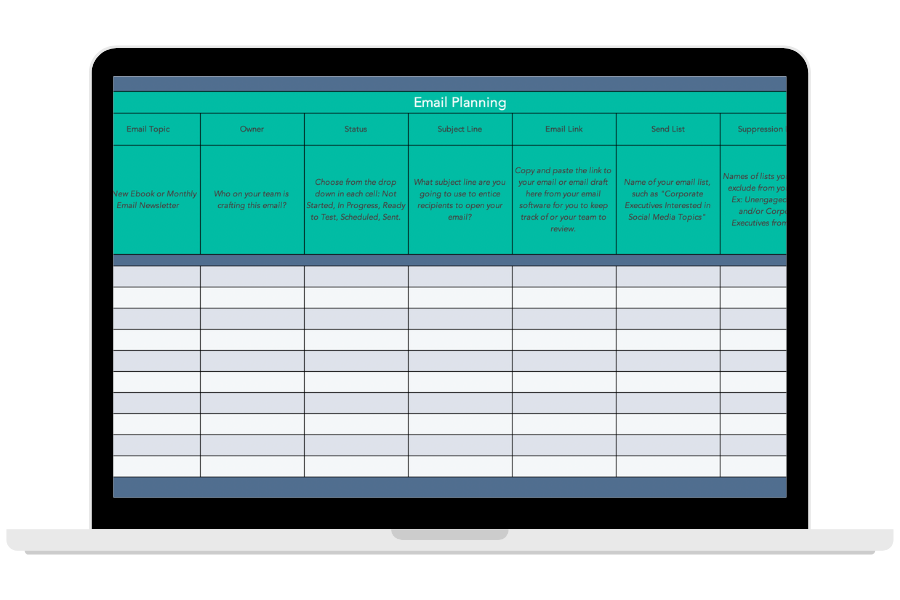
Download This Planning Template
It’s imperative to make a plan before you start emailing your entire customer database. That’s why HubSpot created this free email planning template to help you iron out who you’re emailing, who you’re suppressing from your contact list, and what the email’s message is. Download the template now to get your email campaign planning organized.
2. Identify your goal for the campaign.
Figure out the outcome that you want:
- Is it to clean up your list?
- Promote a new product?
- Follow-up from an abandoned cart event?
- Stay top of mind with your audience?
Different email campaigns will have different outcomes, requiring different tactics to get there. Once you determine the purpose of your campaign, you can then create the targets you want to hit. Include specific metrics in your goal so that you can determine if your campaign was a success based on quantitative data.
3. Understand who you’re emailing.
Have you ever heard the saying from Meredith Hill, “When you speak to everyone, you speak to no one”? What Hill is getting at here is that if you’re watering down your message to apply to your entire audience, you’re leaving opportunity on the table — opportunity for creating high-value, specific, relevant content that speaks directly to the recipient.
With this in mind, the key to a great email marketing campaign is identifying your audience and using email segmentation to ensure you’re delivering to the right people at the right time. If you can accomplish this and build it into your strategy, you can get more creative and specific with your messaging.
4. Put yourself in the shoes of the buyer persona.
After you’ve identified the outcome and the goals you want to hit, you now need to strategize how to provide value to your buyer persona so that they convert, engage, or take the action you want them to take. Some things to ask yourself might include:
- How did they subscribe in the first place?
- What matters to them?
- What can I provide that will engage and delight them?
5. Build a targeted list and define enrollment criteria.
You know who you’re targeting and what you want them to do. From there, you must build the segment. Thinking about your buyer persona, what properties do they all have in common? How does your CRM describe those properties?
Your software is smart, but it’s not smart enough to automatically know which recipients you’re sending to. Will the recipients receive the emails at the same time, or is there certain criteria they have to meet before they are enrolled in the sequence or campaign?
6. Determine the timeline you want the campaign to run.
You may be running a seasonal campaign that only requires one or two emails, or you might be building a long-term top-of-mind nurturing campaign. Tailor the length of your email sequence to the length of the buying cycle and stage the persona is at in the buyer’s journey. In other words, deliver the right message at the right time.
7. Plan your emails and follow-ups.
Once you know who you’re emailing and why, it’s time to strategize how to move them from A (where they are) to B (where you want them to be, the goal of the campaign).
Over the course of the campaign’s timeline, you may want multiple touchpoints. You may also even consider follow-ups based on the actions that each recipient takes. Plan these emails out, outlining the core message and take-away for each email.
Keep in mind that you can’t expect a single email to do everything. Your email campaign can be made up of multiple emails, so consider taking your email recipients on a journey with each email serving a single purpose. This will increase the odds of each email being successful in its role toward reaching your goal.
For example, if you’re doing a lead nurturing campaign, you might have a few educational emails to take them from the awareness stage to the consideration stage before providing more conversion-focused content.
The longer the buying process and sales cycle, the more emails you’ll need.
8. Write click-worthy subject lines.
The subject line is the gate keeper of the rest of your email. Your buyer persona will not be exposed to your content unless they first click the subject line. With that in mind, use this precious real estate for copy that compels them to read further. You can do that by:
- Piquing their interest
- Promising value
- Opening a loop (that will be closed in the body of the email)
- Using your unique voice to start the conversation
- Using personalization
9. Write copy that’s suited for them.
Once you know the purpose of each email you’re sending and you have the subject lines, you can write the copy that will engage your list. Consider where your audience is in their buying journey and provide the type of content that they’ll find useful. For example, it doesn’t make sense to promote products if you’re emailing a segment of subscribers who are largely in the awareness stage of the buying journey.
10. Create your brand assets.
Few people want to read an email that simply gives them a wall of text. Visuals help your recipients quickly understand the point of the email. In fact, intentional and well-placed imagery can increase click-through rates, so put thought into not just what you want to say but how you want to say it, using visuals to support your message.
11. Put it all together with a comprehensive email builder.
Once you’ve written the copy for your emails, you’ll want to build them out in the email software client you’re intending to use.
There are several options depending on your needs, including HubSpot, MailChimp, Pabbly Email Marketing and Constant Contact.
With a comprehensive email builder, you can create, optimize, and personalize your own email campaigns without needing any technical or graphic design experience.
12. Include clear calls to action.
Remember, if you’re taking up your audience’s time — and inbox space — with another email, your message must have a point to it. Consider what you want your email recipients to take away from the email.
In most cases, you’ll want to add a call-to-action (CTA) for them to take further action.
Don’t confuse your email contacts by providing too many options. For each email you send, there should be a single action that you want the reader to take. Then, instruct them to take that action and set expectations for what will happen when they do.
Your goal behind the CTA may vary depending on the audience’s buyer’s journey stage and what you want to accomplish with your email campaign. For example, you may simply want to engage them further with another piece of content, or you might want to get them to make a purchase.
Regardless of what it is, you should follow CTA best practices such as making the ask with clear language and emphasizing it with contrasting design elements.
13. Include personalization elements.
Consider the experience. Do your email recipients want to feel like one among hundreds of other people in your database? Or do they want a personalized experience as though you’re talking directly with them?
Automation helps save time, but it should never be at the cost of the experience. Marketing emails need to be personalized to the reader and contain information that is relevant to them.
At the very least, swap out the “Dear Sir/Madam” in favor of their name using personalization tokens.
14. Always provide a way for them to opt out.
People who don’t want to read your emails don’t belong on your list. Keeping them only skews your open rates down and increases the number of people marketing your emails as spam. Besides, according to CAN-SPAM guidelines, you should always provide a way for them to opt out of email if they no longer want to receive communications from you. Typically, this opt-out link lives in the footer of each email you send.
15. Test your emails and make sure they work on all devices.
Once your emails are built out, check them over before hitting the send button. Effective email marketing campaigns are designed for all devices on which users can read their emails — desktop, tablet, and mobile. Consider sending them as a test to a colleague and checking them across multiple devices and email clients.
16. Monitor your metrics.
As the campaign runs, take notes. Are your open rates and click rates what you expected? What went well vs. not well? Are you on track to hitting your goals with the campaign?
The more you pay attention to the data, the more you can understand what’s working and what’s not for your audience, leading to more effective campaigns in the future.
Want a quick refresher on how to master marketing email? Check out this helpful video:
Now that you know how to responsibly wield email marketing, grab some inspiration from the masterful email marketing campaigns below.
Best Email Marketing Campaign Examples
If you’re reading this, you probably have an email address (or two, or three …). In fact, you’ve probably been sending and receiving emails for years, and you’ve definitely received some questionable deliveries in your inbox.
Whether they were unexpected, uninformative, or had a subject line tHaT wAs fOrmAtTeD liKe tHiS, we bet you didn’t hesitate to direct them towards the trash, right?
While email has managed to stand the test of time, many marketers have failed to update their strategies since its inception. So to ensure you’re sending modern emails that warrant some of your recipients’ precious time and attention, we’ve compiled a list of effective email examples to inspire your next campaign.
1. ModCloth
Marketing Campaign: Email Preferences
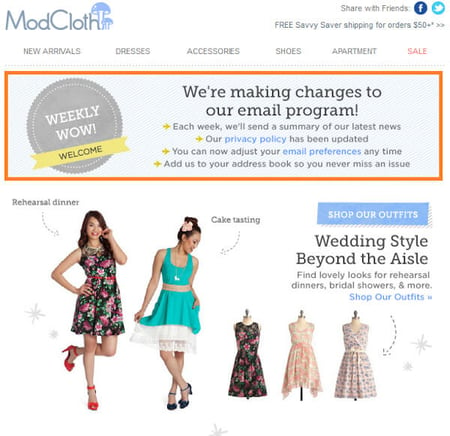
Great companies are always evolving, and your customers expect to experience change. What they don’t expect (because too many companies haven’t lived up to this end of the bargain) is to be told about those changes.
That said, this email from ModCloth serves as a refreshing change of pace. If you’re going to change the way you communicate with a lead or customer, give them clear, fair warning so, if they aren’t on board, they can make the necessary adjustments to keep their inbox clean.
Why It Works
It sets expectations for communication moving forward so that the buyer persona can choose what’s best for them.
2. Tory Burch
Marketing Campaign: Promotion
Did you see that? Did you see it move? Pretty cool, right? This small bit of animation helps to separate this email from Tory Burch from all of the immobile emails in their recipient’s inboxes. They also leverage exclusivity by framing the promotion as a “private” sale. Oftentimes, this type of positioning makes the recipient feel like they’re specially chosen, which encourages them to take advantage of the special opportunity they’ve been presented with.
Why It Works
Emails can get static, boring, and impersonal. This email subverts those expectations without going overboard.

3. RunKeeper
Marketing Campaign: Re-Engagement Campaign
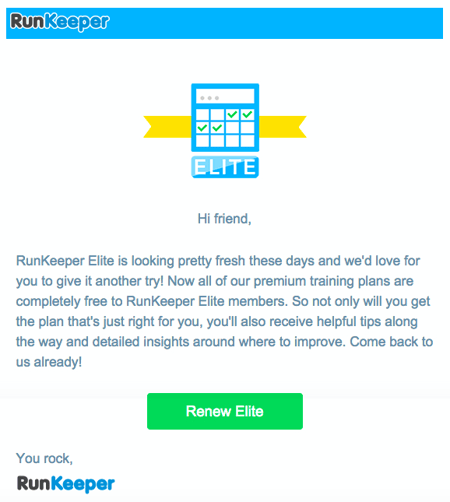
RunKeeper makes an effort to reengage lost users with this friendly, informational email. By highlighting their app’s most recent changes and benefits, the copy works to entice recipients to give the app another chance. It also discusses benefits that the recipient may not know about since the last time they used the service.
Why It Works
Small inclusions like the “Hi friend” greeting and the “You rock” closing makes the content feel welcoming and less aggressive.
4. Litmus
Marketing Campaign: Promotion
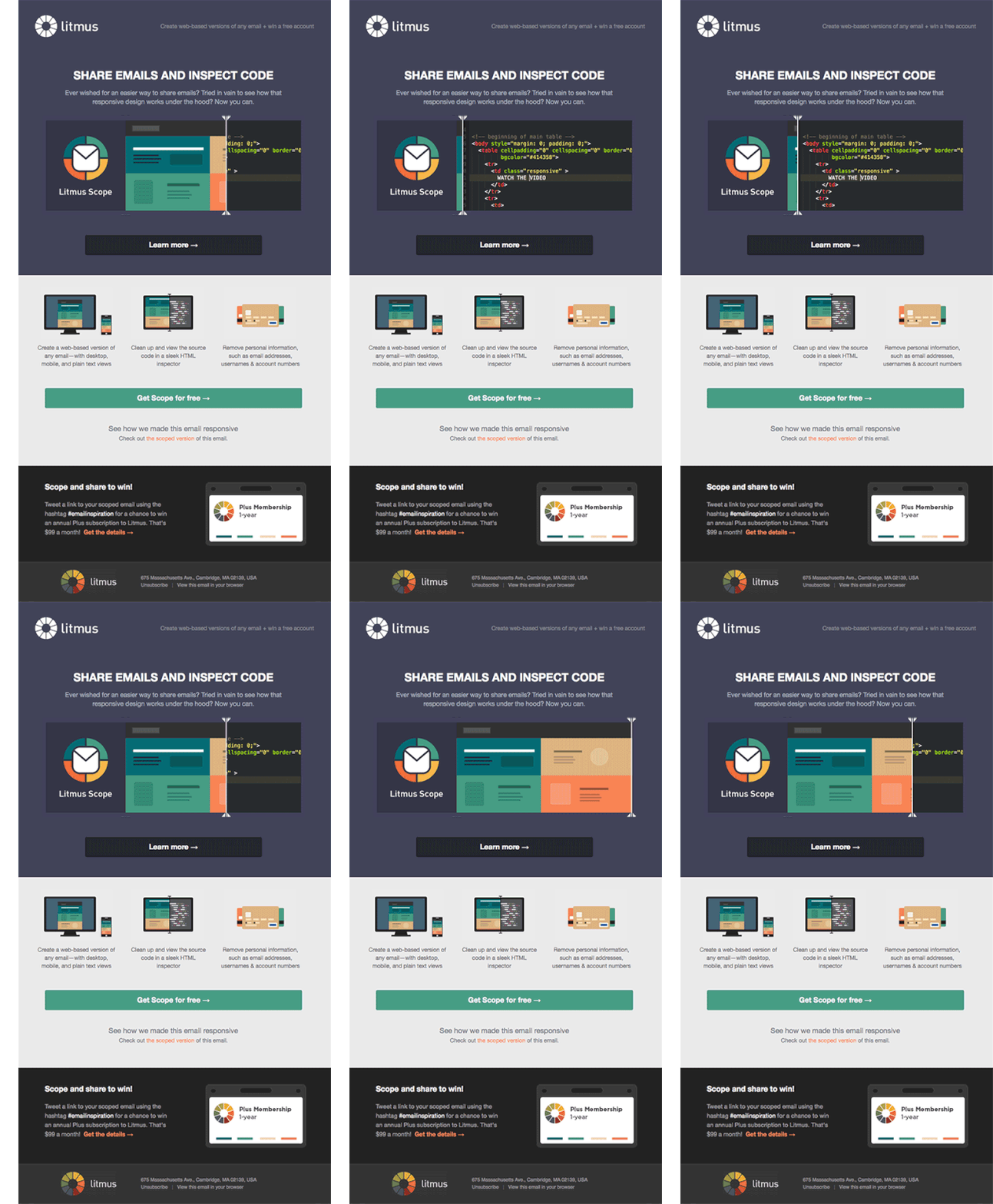
Here’s another great example of animation being used to create a more interesting email marketing design. Unlike static text, the swipe motion used to provide recipients with a look “under the hood” of their email tool is eye-catching and encourages you to take a deeper dive into the rest of the content. Not to mention the header does an excellent job of explicitly stating what this email is about.
Why It Works
The animation is subtle, and it’s executed in a way that serves to enhance the email’s body copy. Even better, it works well with the design of the email, creating a matching but contrasting focal point before the reader dives into the rest of the copy below.
5. Loft
Marketing Campaign: Email Preferences
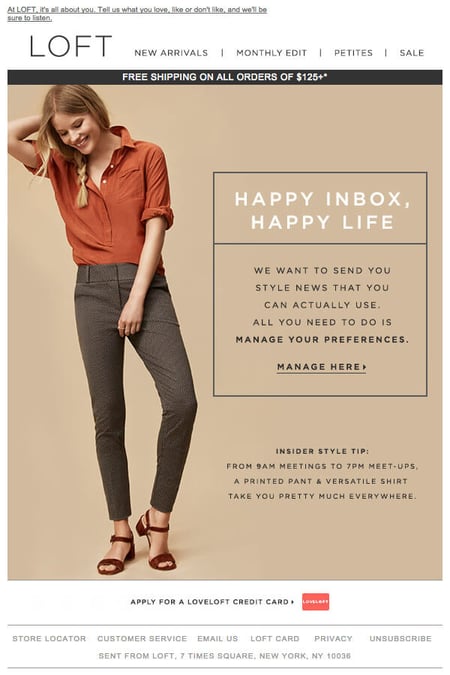
This email from Loft aims to demonstrate their understanding of your crazy, mixed-value inbox. In an effort to provide you with emails that you actually want to open, Loft asks that their recipients update their preferences to help them deliver a more personalized experience. This customer-focused email is super effective in making the recipient feel like their likes, dislikes, and opinions actually matter.
Why It Works
It centers the recipient’s needs with the slogan “Happy Inbox, Happy Life.” Paired with a low-friction CTA, the copy is simple and effective.
6. UncommonGoods
Marketing Campaign: Promotion
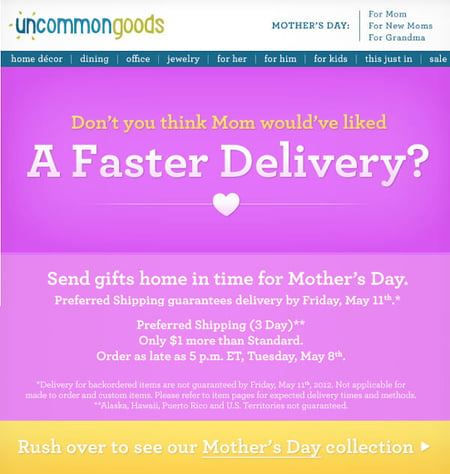
You’ve heard it a million times (and a few thousand of those times may have been from us): You should create a sense of urgency with your calls-to-action. That’s what makes a lead take action, right? Well, this email from UncommonGoods succeeds in creating a sense of urgency by focusing on the value of acting now.
Why It Works
Instead of saying, “Order your Mother’s Day gift NOW before Preferred Shipping ends!”, this email asks, “Don’t you think Mom would’ve liked a faster delivery?” Why yes, she would. Thank you for reminding me before it’s too late — I don’t want to be in the dog house because my gift arrived after Mother’s Day.
7. JetBlue
Marketing Campaign: Customer Delight
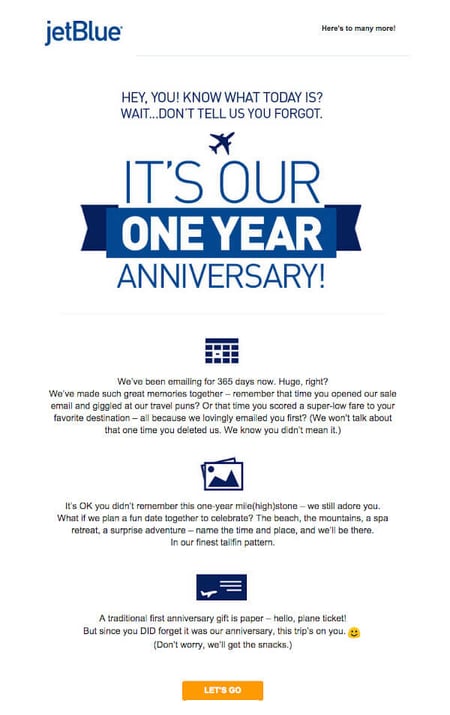
Confession: We have a serious email marketing crush on JetBlue. And they continue to deliver their lovable marketing in this cheeky email campaign that aims to humorously reengage customers. Every element from the header, to the three witty points, to the actionable, contrasting CTA work together to create a lovable campaign that’s promotional without being pushy.
Why It Works
This copy is bursting with friendly personality and airline jokes. The email is relatable and reads as though it comes from a friend, which will help earn a positive reaction.
8. Harpoon Brewery
Marketing Campaign: Customer Delight
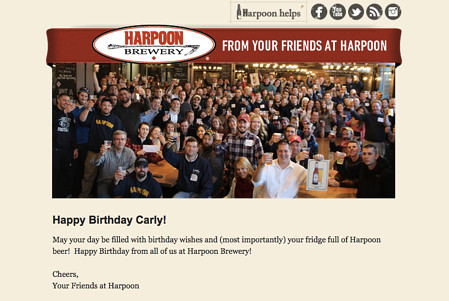
My friends at Harpoon are so thoughtful, aren’t they? This simple, timely email really does feel like it’s coming from a friend, which is why it’s so effective. In an age of email automation, it’s easy for email campaigns to feel a little robotic. And while I’m certain that this email was, in fact, automated, it feels really human.
If you’re looking to strengthen the relationship you have with your existing customers, consider taking the time to set up a quick email like this to let them know you’re thinking of them.
Why It Works
Personalization: From the timing of the email (birthday) to the personalized salutation, this email was sent to the right person at the right time.
9. Rip Curl
Marketing Campaign: Promotion
“JOIN THE REVOLUTION.”
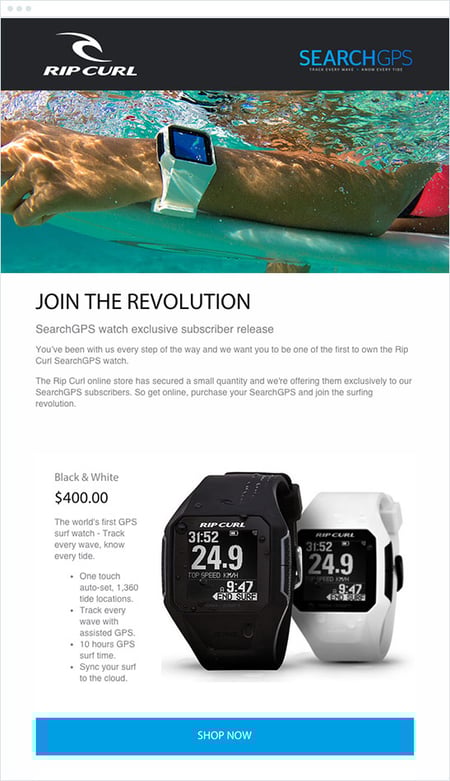
That’s quite powerful, wouldn’t you agree? Rip Curl, an Australian surfing sportswear retailer, combines urgency and our psychological need to be part of something to create an email headline that jumps off the page. This positioning is designed to lead people to believe that there’s a “revolution” taking place and it’s their turn to get in on the action.
Why It Works
At the end of the day, people want to be part of something that’s bigger than themselves, and this email aims to motivate them to do so by purchasing this sleek watch.
10. J.Crew Factory
Marketing Campaign: Promotion
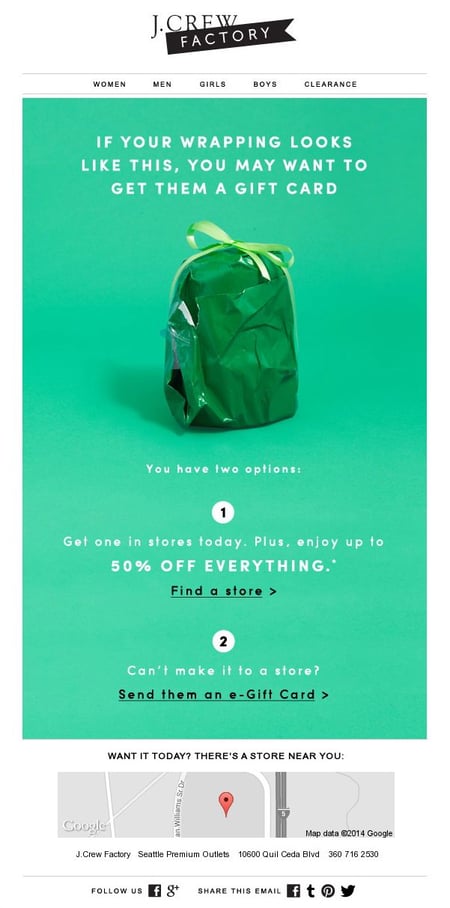
For many of us, when it comes to wrapping gifts, the struggle is real. J.Crew Factory recognized this problem and then created this email to serve as a solution for those incapable of pulling off a Pinterest-esque wrap job: gift cards. The email offers up two different ways to pick up a gift card — in store or online — in an effort to avoid excluding anyone.
They’ve also included a map of the nearest store location at the end of the email to lower the purchasing barrier even further.
Why It Works
It combines humor with a low-stress, low-friction solution.
11. charity: water
Marketing Campaign: Engagement
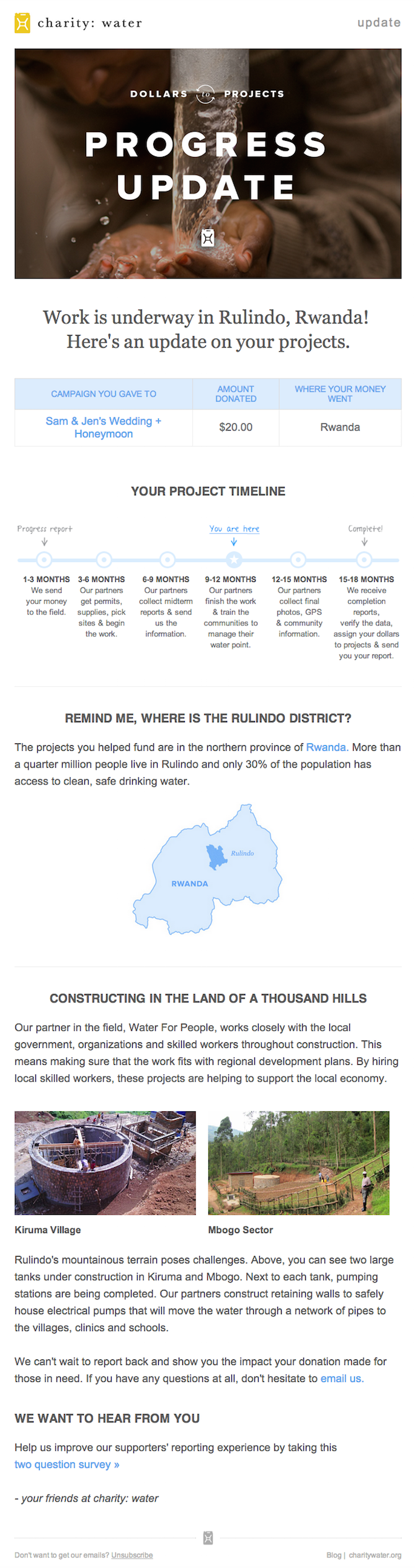
When people talk about email marketing, lots of them forget to mention transactional emails. These are the automated emails you get in your inbox after taking a certain action on a website. This could be anything from filling out a form to purchasing a product to updating you on the progress of your order. Often, these are plain text emails that marketers set and forget.
Well, charity: water took an alternate route. Once someone donates to a charity: water project, her money takes a long journey. Most charities don’t tell you about that journey at all — charity: water uses automated emails to show donors how their money is making an impact over time. With the project timeline and accompanying table, you don’t even really need to read the email — you know immediately where you are in the whole process so you can move onto other things in your inbox.
Why It Works
It keeps the audience engaged and shows the impact that their actions have made on the organization in the effort of staying top-of-mind and increasing future participation.
12. Brooks Sports
Marketing Campaign: Engagement
When Desiree Linden won the 2018 Boston Marathon, she became the first American woman to win the race in more than 30 years. To her shoe and apparel sponsor, Brooks Sports, it was an opportunity to celebrate their long partnership together. The resulting email campaign focuses almost entirely on the Olympic marathoner’s amazing accomplishment.
Email campaigns like this one allow companies to demonstrate their loyalties and add value to the products their best users have chosen. Not pictured is a blue CTA button at the bottom of the email that reads, “See Desiree’s go-to gear.” What better products to call attention to than the stuff worn by America’s latest legend?
Why It Works
After Desiree’s victory, everyone knew her name. Brooks Sports struck while the iron was hot with a proud email that was sure to be opened and forwarded.

13. Uber
Marketing Campaign: Engagement
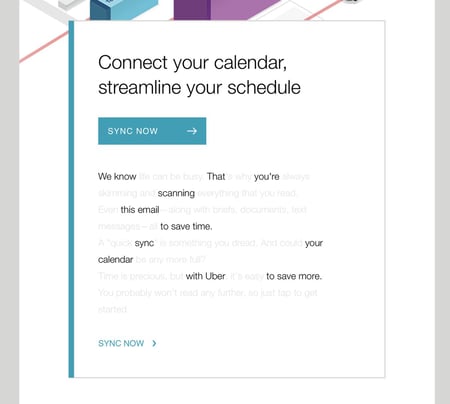
The beauty of Uber’s emails is in their simplicity. Email subscribers are alerted to deals and promotions with emails like the one you see below. We love how brief the initial description is, paired with a very clear CTA — perfect for subscribers who are quickly skimming the email.
For the people who want to learn more, these are followed by a more detailed (but still pleasingly simple), step-by-step explanation of how the deal works.
We also love how consistent the design of Uber’s emails is with its brand. Like its app, website, social media photos, and other parts of the visual branding, the emails are represented by bright colors and geometric patterns.
Why It Works
All of its communications and marketing assets tell the brand’s story — and brand consistency is one tactic Uber’s nailed in order to gain brand loyalty.
14. TheSkimm
Marketing Campaign: Customer Delight
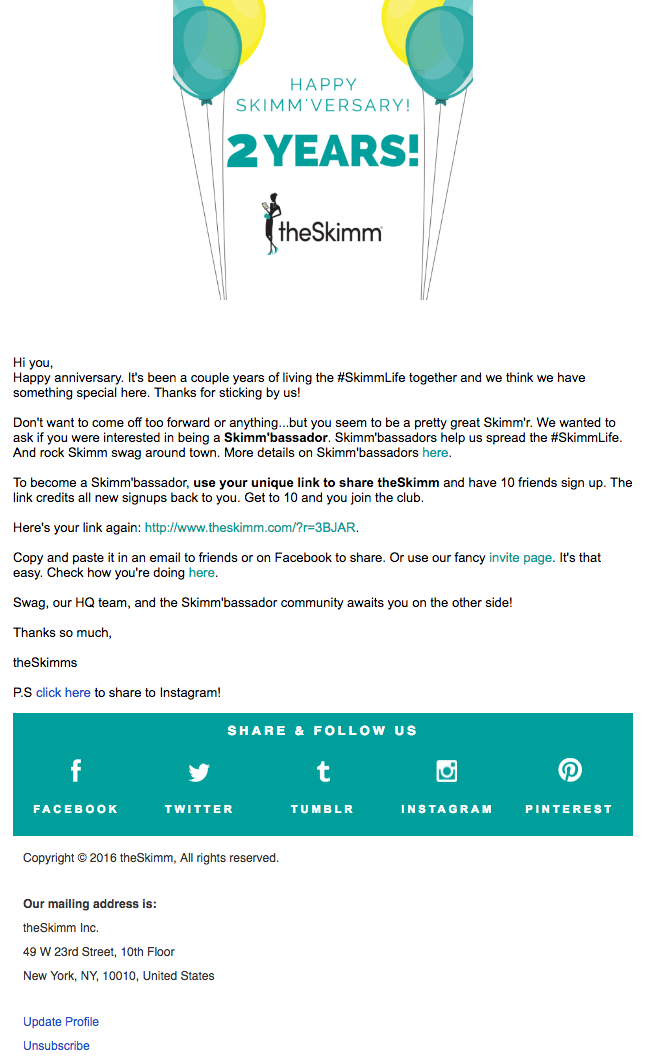
We love TheSkimm’s daily newsletter — especially its clean design and its short, punchy paragraphs. But newsletters aren’t TheSkimm’s only strength when it comes to email. Check out its subscriber engagement email below, which rewarded one of their subscribers for being subscribed for two years.
Emails triggered by milestones, like anniversaries and birthdays, are fun to get — who doesn’t like to celebrate a special occasion? The beauty of anniversary emails, in particular, is that they don’t require subscribers to input any extra data, and they can work for a variety of senders. Plus, the timeframe can be modified based on the business model.
Why It Works
The folks at TheSkimm took it a step further by asking Mineo if she’d like to earn the title of brand ambassador as a loyal subscriber — which would require her to share the link with ten friends, of course.
15. Mom and Dad Money
Marketing Campaign: Questionnaire
Think you know all about the people who are reading your marketing emails? How much of what you “know” about them is based on assumptions? The strongest buyer personas are based on insights you gather from your actual readership, through surveys, interviews, and so on — in addition to the market research.
That’s exactly what Matt Becker of Mom and Dad Money does — and he does it very, very well.
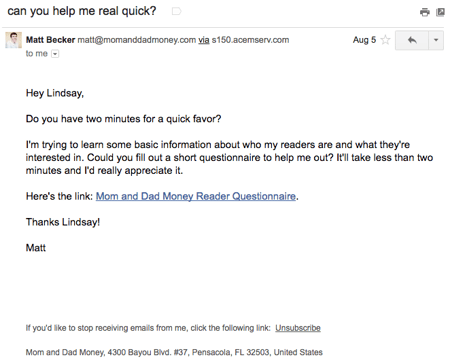
Here’s an example of an email I once received from this brand. Design-wise, it’s nothing special — but that’s the point. It reads just like an email from a friend or colleague asking for a quick favor.
Why It Works
Not only was this initial email great, but his response to my answers was even better: Within a few days of responding to the questionnaire, I received a long and detailed personal email from Matt thanking me for filling out the questionnaire and offering a ton of helpful advice and links to resources specifically catered to my answers. I was very impressed by his business acumen, communication skills, and obvious dedication to his readers.
16. Birchbox
Marketing Campaign: Promotion
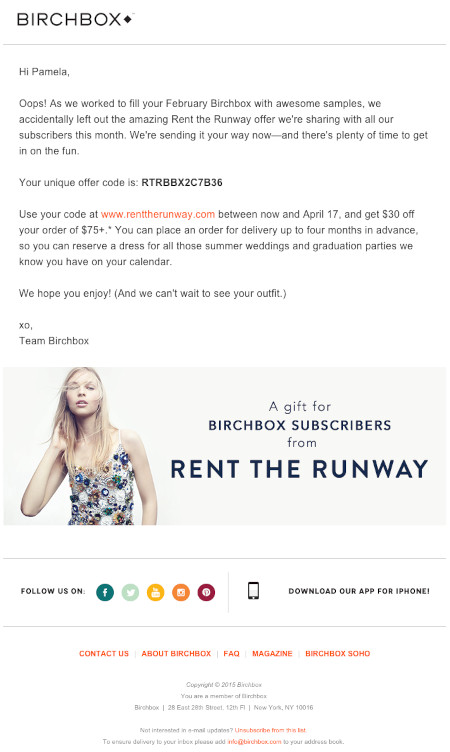
The subject line of this email from beauty product subscription service Birchbox got my colleague Pam Vaughan clicking. It read: “We Forgot Something in Your February Box!” Of course, if you read the email copy below, Birchbox didn’t actually forget to put that discount code in her box — but it was certainly a clever way to get her attention.
As it turned out, the discount code was actually a bonus promo for Rent the Runway, a dress rental company that likely fits the interest profile of most Birchbox customers — which certainly didn’t disappoint. That’s a great co-marketing partnership right there.
Why It Works
It gained her attention and delivered some unexpected delight.
17. Postmates
Marketing Campaign: Promotion
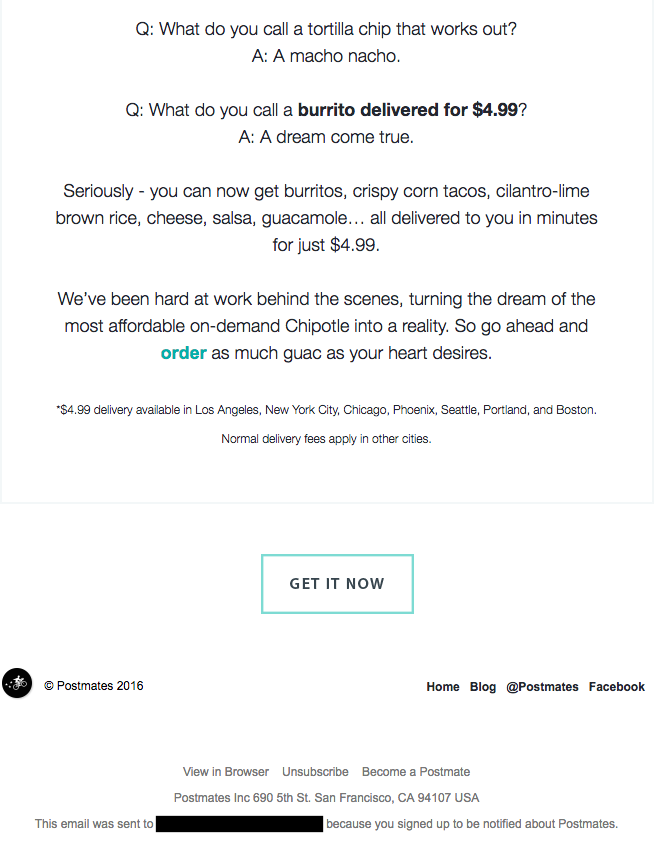
I have to say, I’m a sucker for GIFs. They’re easy to consume, they catch your eye, and they have an emotional impact — like the fun GIF in one of Postmates’ emails that’s not only delightful to watch, but also makes you crave some delicious Chipotle.
You, too, can use animated GIFs in your marketing to show a fun header, draw people’s eyes to a certain part of the email, or display your products and services in action.
Why It Works
It centers the product in a fun, attractive way.

18. Dropbox
Marketing Campaign: Re-Engagement
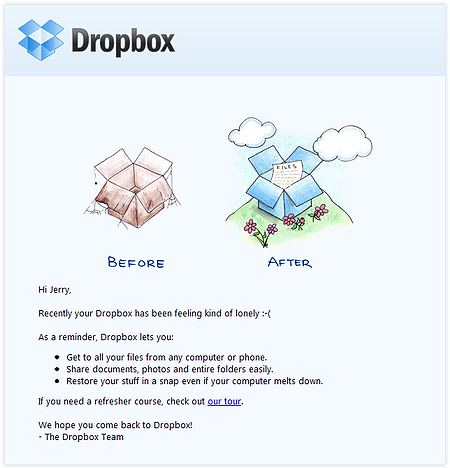
You might think it’d be hard to love an email from a company whose product you haven’t been using. But Dropbox found a way to make its “come back to us!” email cute and funny, thanks to a pair of whimsical cartoons and an emoticon.
Plus, the email was kept short and sweet, to emphasize the message that Dropox didn’t want to intrude — it just wants to remind the recipient that the brand exists, and why it could be helpful. When sending these types of email, you might include an incentive for recipients to come back to using your service, like a limited-time coupon.
Why It Works
It uses the Dropbox logo in a way that’s creative and unique to demonstrate their product as a solution.
19. InVision App
Marketing Campaign: Newsletter
Every week, the folks at InVision send a roundup of their best blog content, their favorite design links from the week, and a new opportunity to win a free t-shirt. (Seriously. They give away a new design every week.) They also sometimes have fun survey questions where they crowdsource for their blog. This week’s, for example, asked subscribers what they would do if the internet didn’t exist.
Why It Works
Not only is InVision’s newsletter a great mix of content, but I also love the nice balance between images and text, making it really easy to read and mobile-friendly — which is especially important, because its newsletters are so long (below is just an excerpt). We like the clever copy on the call-to-action (CTA) buttons, too.

20. Cook Smarts
Marketing Campaign: Newsletter
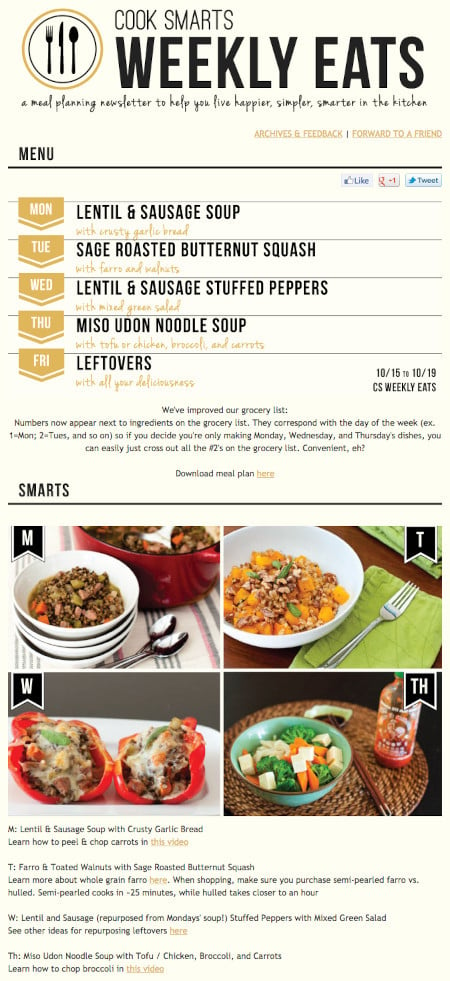
I’ve been a huge fan of Cook Smarts’ “Weekly Eats” newsletter for a while. The company sends yummy recipes in the form of a meal plan to my inbox every week. But I didn’t just include it because of its delicious recipes — I’m truly a fan of its emails.
I especially love the layout of Cook Smarts’ emails: Each message features three distinct sections: one for the menu, one for kitchen how-to’s, and one for the tips. That means you don’t have to go hunting to find the most interesting part of its blog posts — you know exactly where to look after an email or two.
I also love Cook Smarts’ “Forward to a Friend” CTA in the top-right of the email.
Why It Works
Emails are super shareable over — you guessed it — email, so you should also think about reminding your subscribers to forward your emails to friends, family, or coworkers.
21. HireVue
Marketing Campaign: Email Preferences
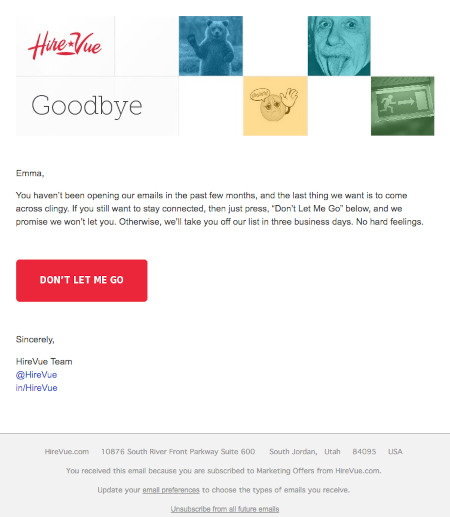
“Saying goodbye is never easy to do… So, we thought we’d give you a chance to rethink things.” That was the subject of this automated unsubscribe email from HireVue. We love the simple, guilt-free messaging here, from the funny header images to the great CTA button copy.
Not only are the design and copy here top-notch, but we applaud the folks at HireVue for sending automated unsubscribe emails in the first place. It’s smart to purge your subscriber lists of folks who aren’t opening your email lists, because low open rates can seriously hurt email deliverability.
Why It Works
The button copy is a pattern interrupt that will prompt the recipient to pause and think if they want to take the action.
22. Paperless Post
Marketing Campaign: Promotion
When you think of “holiday email marketing,” your mind might jump straight to Christmas, but there are other holidays sprinkled throughout the rest of the year that you can create campaigns around. (Download these email marketing planning templates to keep yourself organized throughout the year.)
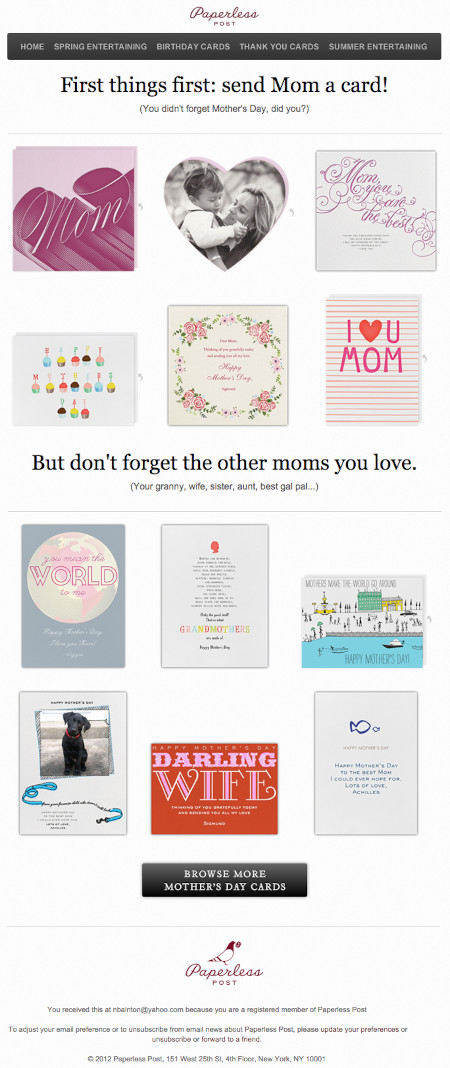
Take the email below from Paperless Post, for example. I love the header of this email: It provides a clear CTA that includes a sense of urgency. Then, the subheader asks a question that forces recipients to think to themselves, “Wait, when is Mother’s Day again? Did I buy Mom a card?”
Below this copy, the simple grid design is both easy to scan and quite visually appealing. Each card picture is a CTA in and of itself — click on any one of them, and you’ll be taken to a purchase page.
Why It Works
It earns a positive sentiment by prompting the recipient to do something they may have forgotten (send a card). This provides a solution and saves the recipient the pain of feeling guilty about forgetting Mother’s Day.
23. Stitcher
Marketing Campaign: Engagement
I love on-demand podcast/radio show app Stitcher’s “Recommended For You” emails. I tend to listen to episodes from the same podcast instead of branching out to new ones. But Stitcher wants me to discover (and subscribe to) all the other awesome content it has — and I probably wouldn’t without this encouragement.
I think this email also makes quite a brilliant use of responsive design. The colors are bright, and it’s not too hard to scroll and click — notice the CTAs are large enough for me to hit with my thumbs. Also, the mobile email actually has features that make sense for recipients who are on their mobile device. Check out the CTA at the bottom of the email, for example: The “Open Stitcher Radio” button prompts the app to open on your phone.
Why It Works
As humans, we tend to crave personalized experiences. So when emails appear to be created especially for you, you feel special — you’re not just getting what everyone else is getting. You might even feel like the company sending you the email knows you in some way, and that it cares about your preferences and making you happy.

24. RCN
Marketing Campaign: Update
Internet providers and bad weather are natural enemies. You’d think telecommunications companies wouldn’t want to call attention to storm-induced power outages — the one thing that sets off customers’ impatience. Then, there’s RCN.
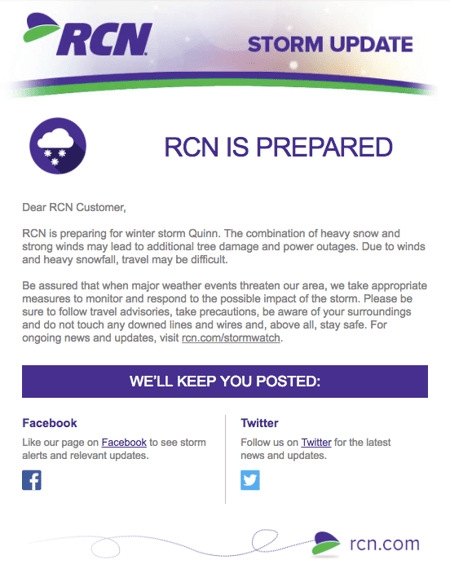
RCN, a cable and wireless internet service, turned this email marketing campaign into a weather forecast just for its customers. This “storm update” got the company out ahead of an event that threatened its service, while allowing its users to get the weather updates they need right from the company they count on for Wi-Fi.
As you can see below, the email even advises personal safety — a nice touch of care to go with the promise of responsive service. At the bottom of the email, RCN also took the opportunity to highlight its social media channels, which the company appropriately uses to keep users informed of network outages.
Why It Works
It simply offers an update. No promoting, no selling. The recipient’s best interests are in mind, and they’re setting expectations for something that they may imminently care about.
25. Trulia
Marketing Campaign: Newsletter
I’m a huge advocate of thought leadership. To me, some of the best companies gain customer loyalty by becoming the go-to source for expertise on a given topic. Trulia — a property search engine for buyers, sellers, and renters — is that expert in the real estate biz. How do I know? Just read their emails, much like the one below.
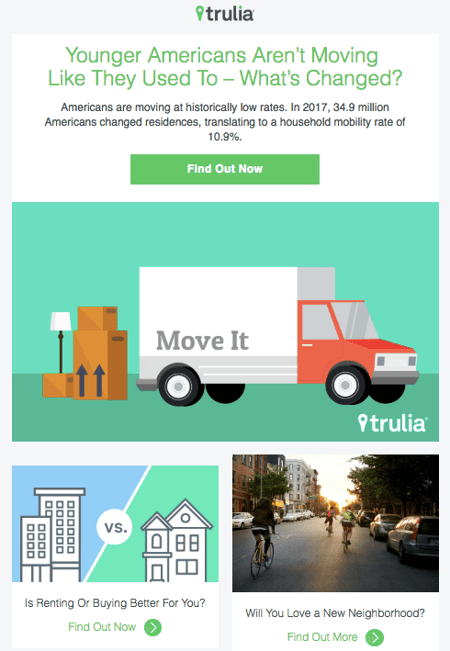
“Why aren’t millennials moving?” The subject line of this email campaign reads before citing interesting data about relocation trends in the U.S. Trulia doesn’t benefit from people who choose not to move, but the company does benefit from having its fingers on the pulse of the industry — and showing it cares which way the real estate winds are blowing.
Why It Works
It opens a loop by posing a question that the recipient needs to take action to get the answer to.
26. RedBubble
Marketing Campaign: Promotion
This email marketing campaign crushes it, and for so many reasons.
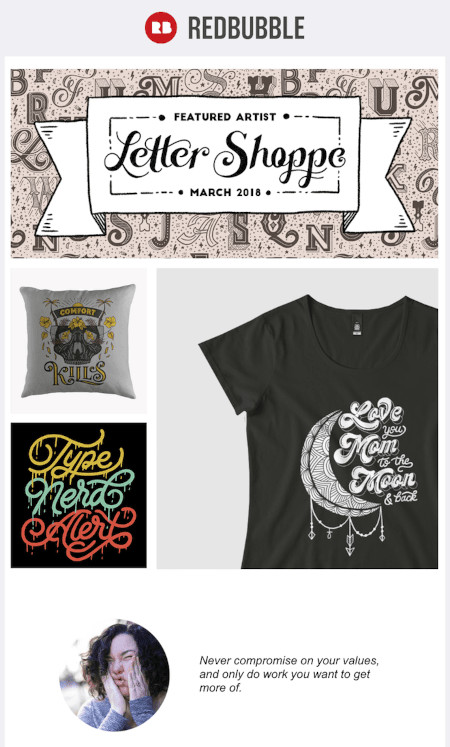
Not only is the design below super eye-catching — without looking cluttered — but the artwork is user-made. RedBubble sells merchandise featuring designs from artists all over the world. This presents a golden opportunity to feature popular submissions across the RedBubble community.
The example below showcases artwork from “Letter Shoppe,” and when that artist sees RedBubble featuring her content, she’s more likely to forward it to friends and colleagues.
In addition to linking to Letter Shoppe’s designs (available on merchandise that is ultimately sold by RedBubble), the email campaign includes an endearing quote by the Featured Artist: “Never compromise on your values, and only do work you want to get more of.” RedBubble’s customers are likely to agree — and open other emails in this campaign for more inspiring quotes.
Why It Works
The email lets the items speak for themselves, showcasing them as art rather than products.
These are just some of our favorite emails. Don’t just follow best practices when it comes to your marketing emails. Every email you send from your work email address also can be optimized to convert with a little planning.
Editor’s note: This post was originally published in October 2013 and has been updated for comprehensiveness.

10 Ways to Reach Customers Who Don’t Know They Need You
Event planner, lawyer, daycare owner, tow truck driver. Regardless of our chosen professions, it’s fair to say that we all want to build our businesses’ customer bases. It’s how we thrive. So it’s only natural for us to want to market our products or services to everyone, in hopes of capturing a larger audience and thus making more money.
But every business has a few “unreachables.” Now, some of these people are placed in that category for a reason. If you sell retirement plans, for instance, your unreachables might be children because they’re simply too young to purchase your product. But that doesn’t mean they have to remain that way forever. Even the most unexpected groups of people could be your biggest advocates later on. You just need to know how to speak to them.
Here are some tips for successfully reaching your unreachables.
![Download Now: State of Marketing Report [2021 Version]](https://no-cache.hubspot.com/cta/default/53/6baeae42-e710-4ecd-beb9-ceb2fb9f0877.png)
How to Reach Customers
1. Make a list of your unreachables.
This is an important step you won’t want to skip. Before you start trying to reach all different types of groups, you’ll want to find out who your individual unreachables actually are. They may or may not be whom you think they are. That’s why researching and surveying are important parts of this process.
You might look at your current demographics for visitors to your website or social media platforms and determine which audiences aren’t connecting with you. You might also try comparing your demographics to your competitors’ to see if they’re reaching an audience you might not be. Or, you could conduct interviews and send out questionnaires to gather additional information. Whatever methods of obtaining this data, be sure that in the end, you have answers to questions like:
- Why are these groups uninterested/uninformed about my business?
- Are they also uninterested/uninformed about the products/services I sell, too?
- Do they know they might want/need what I’m offering?
2. Develop a persona for your unreachables.
At this point, you’ve narrowed down exactly who your unreachables are, but the research stage isn’t over just yet. You still want to find out what their likes and dislikes are, where they live, where they work, etc.
Researching the specifics of their day-to-day lives can be helpful when brainstorming the message and channels to reach them. It can help you create a story that appeals to multiple audiences.
You can create campaigns that are effective because they appeal to multiple audiences by finding common ground through storytelling.
3. Customize your approach to appeal to them, not your current customers.
This is a continuation of the previous action. When brainstorming ways to speak to your unreachables, it’s important to remember that the same message that works really well for your current audience probably won’t be received well by another—or at least not as effectively.
A successful example of this is Dollar Shave Club’s marketing efforts. Marketers realized that they could reach a lot of the younger generations with humorous and quick-witted branding. The success of the brand stemmed from the viral nature of the ads that spoke to a much broader group of people than ever before.
4. Offer them something truly unique.
As wisely stated by Entrepreneur contributor Murray Newlands in his article, “The 8 Fundamentals for a Successful Inbound-Marketing Strategy”, “Think of your website as a hub, not a megaphone.” This applies to all areas of your brand’s presence—both online and offline. Treat your unreachables as if they are already your most loyal customers, rewarding them with valuable resources they can really use. Because if you can provide them with something they can’t find elsewhere, it will build trust and credibility—two things that give you an instant leg up on your competition.
Some valuable, yet still free/affordable resources you can offer include:
- Educational information, like e-books, guides, infographics, blog articles, webinars, tips, downloadable templates, etc.
- Coupons/exclusive discounts for first-time customers
- Product/service samples
- Branded merchandise
As many in the industry may know already, this method of marketing (inbound marketing) has proven to be one of the most successful ways to promote your brand or business.
5. Generate awareness of the want/need for what you have to offer.
Your unreachables are most likely in the awareness stage of the buyer’s journey—unsure whether or not they even want or need the product/service you’re offering, let alone if they want it from your specific company. That’s why you have to create reasons why someone might need you.
Let’s say you’re a hotel that’s running a special vacation package. An example of the awareness-stage buyers would be a mother and father who just found out they’re able to take a vacation with their family soon but aren’t yet sure if they want to stay local, travel abroad, or go on a cruise. By marketing your vacation package as the most all-inclusive, affordable, and family-friendly offer available, you’re successfully generating awareness and a desire for your offer.
6. Demonstrate how your product/service could be the only solution they need.
Maybe your business offers a variety of products or services (i.e. multi-platform digital solutions). Or, maybe it offers something a little more niche (i.e. all-organic coffee). But no matter what you offer, there’s always a way to position yourself as their all-purpose solution.
Your unreachables might not even know your business can handle multiple problems they’re experiencing. They might not know that just how well you’ve mastered your very specific product/service. Or, they might not know they need you. Either way, you’ll want to demonstrate how you’re the only solution.
7. Position your business in the most positive light possible.
Though it may hard to conceive, most people want to find out how you can help them, even if they’re not actively seeking you out. If you’ve piqued their interest in some way, they’ll want to find the good in your business, so they can have a product or service that provides a solution or added convenience to their lives.
A few suggestions for keeping your efforts upbeat and positive:
- Use up-to-date content, design, and resources in your marketing efforts
- Use language that is confident and inviting, not cocky or abrasive
- Avoid negative messaging that puts down specific competitors (it’s tacky)
- Highlight what specifically makes you better than the rest, but say it in a way that makes you look like the hero
8. Find ways to get your advocates to promote to them.
What’s better than having happy customers who love your products/services? Having happy customers who willingly promote your products/services to others. If they’re happy enough, they’ll do it for free, too. It’s like free advertising.
This is your opportunity to reward your #1 fans with things like:
- Refer-a-friend offers/discounts/coupons
- Exclusive content
- Donations to fan-favorite charities
- Answered questions/concerns, personalized shout-outs, and Q&A sessions on social media platforms
- Fan-appreciation events
- Featured fan videos/photos/etc.
- Project involvement
Whether your business is able to spend a lot or a little toward rewarding your advocates, remember that there’s a huge benefit in having people promote your business for you.
9. Show many forms of credibility.
In addition to having testimonials on top-rated review sites (or on your own website), there are a lot of ways to demonstrate that you are credible and trustworthy.
Find unique (yet still truthful) ways to display this in your marketing efforts, such as:
- Noteworthy awards or certifications (place a badge on your website, post a link to your social media platforms with information about the award/certification, etc.)
- Support a local charity (display information about it on a dedicated landing page on your site, post about it on social media, etc.)
- Mention any environmentally sustainable efforts you make at your business (recycling, volunteering for eco-friendly organizations, etc.
- Case studies and testimonials
Though this is certainly helpful for your current customers to confirm they’ve made the right choice with you, those who might not know they need you yet might find your business more desirable than another, simply for your credibility. Research the industry-specific materials you can provide your potential customers to let them know you are not just a viable option, but the best option.
10. Do all of this in stages—not all at once.
Last, but certainly not least, make sure you do these things in different phases. Because it’s not realistic to believe anyone’s effort will magically attract everyone to your business, you should set goals, follow a strategic plan, and measure your results. Rinse and repeat as necessary for each audience.
There are plenty of ways to speak to those who seem unreachable. You just have to find ways to make it about them and why they (specifically) would want or need you. If you’re not sure how to get started, try these tips for expanding your reach.
Editor’s note: This post was originally published in April 2015 and has been updated for comprehensiveness.


How to Write an Introduction: A Simplified Guide
You only get one chance to make a first impression on your website or blog — which means you need an introduction that stands out. But what do you say? How do you say it? Should it be long? Short? Funny? Serious?
For many of us, the stress of creating a great introduction drives the dreaded cursor feedback loop: Blink. Blink. Blink. The cursor-on-a-blank-screen sits, waiting for your brilliance but you just can’t find the words. It’s something that all writers — amateur or professional, aspiring or experienced — know and dread. And of all times for it to occur, it seems to plague us the most when trying to write an introduction.

I mean, you already have a blog post you want to write. Can’t you just dive in and write it? Why all the focus on getting the introduction right?
Here’s the thing: Intros set the stage. They establish the tone and let visitors know what to expect.
And it’s not all bad — introductions don’t have to be long or complex. In fact, most people prefer them to be quite quick. They also don’t have to be so difficult.
Let’s break down exactly how to write an introduction that’s short, effective, and relatively painless. And if you’re ever having trouble churning out those intros, come back here and re-read this formula to lift yourself out of that writing rut.
How to Write an Introduction
Writing an introduction that captures your audience can help your website traffic (and ultimately, your business) grow better, but doing it right is just as important. Here’s how to write an introduction in three simple steps.
To write an introduction, be mindful of what it’s supposed to achieve. The main goals here are to draw in your reader — a relative stranger, most of the time — and concisely let her know what the article is about. Generally, that consists of three key components:
Step 1) Grab the reader’s attention. That looks different for every piece of writing, but we’ve provided some suggestions below.
Step 2) Present the reason for the post’s existence.
Step 3) Explain how the post will help address the problem that brought your reader to it.
As a lover of all things meta, I will, of course, use this post’s introduction as an example of how to write an intro. It contains different components that create the above introduction “formula,” which you can refer to that when you get stuck with your own.
Below, we’ve gone into more detail on each component.
Writing an Introduction Paragraph
1. Grab the reader’s attention.
There are a few ways to hook your reader from the start. You can be empathetic (“Don’t you hate it when…?”), or tell a story, so the reader immediately feels some emotional resonance with the piece. You could tell a joke (“Ha! This is fun. Let’s read more of this.”). You could shock the reader with a crazy fact or stat (“Whoa. That’s crazy. I must know more!”).
For this intro, I went the “empathetic” route.

Writer’s block stinks. Blank screens and taunting cursors — the worst. Who’s with me?
2. Present the reason for the post’s existence.
Your post needs to have a purpose. The purpose of this post is to address a specific problem — the pain in the butt that is writing intros. But, we have to do it, and therein lies the approach to something important: making writing introductions easier.
Just because you know the purpose of your post, doesn’t mean the reader does — not yet, anyway. It’s your job to validate your post’s importance and give your audience a reason to keep reading.
3. Explain how the post will help address the problem.
Now that the reader is presented with a problem that he or she can relate to — and obviously wants a solution — it’s time to let the audience know what the post will provide, and quickly.
In other words, the introduction should set expectations. Take this post, for example. I don’t want the reader to dive in and expect to see a list of reasons why introductions are important. I want you to expect to read about what makes a good introduction.
But if I hadn’t clarified that in the introduction, you might have expected the former. After all, be honest — did you skim over or forget the title of this post already? That’s okay. That’s why we tell the reader exactly what the post will provide, and why it’s valuable.
Of course, there are other valid ways to write introductions for your marketing content — don’t feel the need to follow this formula for every single piece of content, as some are more casual than others. But, this guide should help provide a solid framework to follow if you’re just getting started, or if it’s just one of those days when the words aren’t flowing.
What makes a good introduction?
While format is fundamental to consistently capture visitor attention, it’s also worth considering stylistic frameworks that can help boost engagement from the first moment users land on your site. These include:
1. Telling a compelling story.
Great stories sell books — and they’re also a fantastic way to open a website blog. Storytelling is part of the human experience and if your intro can tee up a solid story, visitors are more likely to keep reading past the first paragraph.
The caveat? Don’t give it all away up-front. Not only should intros be kept short, but the idea is to have people read all the way through to the end. Instead, start with a great hook about something interesting that happened — “The one time I…”, “It all started when…”
2. Cultivating empathy.
We’re also naturally predisposed to empathy, especially when we can relate to what someone else is saying on a personal level.
Let’s say you’re running a money-saving advice blog. By starting your post with a few of your own experiences with debt and how it impacted your life, you can cultivate empathy from those in similar positions and simultaneously lend your blog greater authority.
3. Establishing common pain points.
There’s no trait more universally human than complaining. We do it about small things — like the weather — and big things, like challenges at work or home. This creates an opportunity for content creators: Establish common ground with familiar pain points.
Consider a home maintenance and repair blog. You could introduce homeowners communally dislike — such as clogged gutters or peeling paint — quickly discuss why it’s so frustrating, and then assure readers you can offer a viable solution.
4. Crafting a human connection.
If you’re running any type of product or service website, expect natural skepticism from visitors. They know you’re trying to sell something and their guard is naturally up, especially against hyperbolic or superfluous claims.
Here, it’s worth considering calling out a company shortfall — “we’re not the best, but”, “we don’t have all the answers” — and then highlighting what sets you apart from the competition. Done right, you can disarm cynical users with honesty, craft a human connection and encourage them to consider your pitch.
5. Asking interesting questions.
You can never go wrong with questions — so long as they’re interesting. Intros that start with “did you know that…” or “ever wondered why…” are great starters if you have relevant information to share.
This can’t be overstated: If your blog doesn’t (or can’t) answer the question you pose in the introduction, choose a different approach. Nothing frustrates visitors faster than discovering that blog intro and body are a content mismatch.
5 Introduction Examples
Curious about what a great introduction looks like in the wild? Let’s break down five great examples.
1. PetaPixel
Photography site PetaPixel offers news, insights, and advice about all things photo-related. In their post “This Free 2.5 Hour Tutorial Covers All Aspects of Wedding Photography,” PetaPixel uses their introduction to highlight the experience of tutorial creator Taylor Jackson, who shoots “60 to 70 weddings every year.”
This quick-hitter introduction helps establish Jackson’s credibility as an expert and cultivates confidence among readers, in turn encouraging them to read the post and click through to the tutorial.
2. Apartment Therapy
Apartment Therapy is all about helping visitors organize, clean, and streamline their apartment space, while also highlighting specific product categories. In their recent post “This Unique Tray is What Your Living Room is Missing,” the site uses one of the techniques mentioned above: Pain points.
“Even maximalists can’t stand clutter,” reads the first intro line. “The reality is that nobody likes to open a cabinet only to be faced with a messy avalanche of knick-knacks and accessories.” By establishing common grounds for complaint, the blog helps set up the benefits of the product it’s trying to sell.
3. Greatist
Greatist is a health and wellness blog that offers advice and tips for readers. Their recent starter toolkit post — “Stop Using Your Shoe as a Hammer: 17 Items for Your Starter Tool Kit” helps cultivate a connection with a simple introductory line: “You don’t have to be a DIY pro to need a tool kit around.”
By highlighting the near-universal need for a simple, streamlined toolkit, the site sets up readers to continue on and discover which tools are critical for starter kits.
4. The Friendly Teacher
Educational advice site The Friendly Teacher opens her “10 Tips for Organizing Your Classroom at the End of the Year” with a simple question: “What do teachers do in the summer?”
The answer is easy: Relax. But as the post points out, leaving classrooms in a state of disrepair only makes more work for the following year — and she’s here to help with 10 simple tips for pre-summer cleanup. The introduction works because it helps put readers in the right frame of mind — a relaxing summer — and then offers actionable tips to reach that goal.
5. BloggingTips.com
BloggingTips.com is exactly what you’d expect: A site dedicated to useful blogging tips that help improve your site. In their recent post, “How To Choose A Blog Name – A New Blogger’s Guide to Selecting a Domain Name And URL”, they don’t waste any time getting to the point of their introduction, noting that, “Once you’ve decided to launch a blog – whether for personal or business purposes – one of the first decisions you have to make involves your domain name selection.”
The biggest benefit of this introduction? Brevity. It gets right to the point. If you’ve got a blog, you need a domain name. This is a great approach when the subject matter you’re tackling is relevant and useful but not inherently compelling: Rather than trying to force a connection or create a convoluted narrative, straight and to the point works best.
Let’s Get Started
Feeling inspired? Good. Next time you find yourself face-to-face with the dreaded blinking cursor, use these resources and compelling examples to find motivation and write simpler, smarter, and stronger introductions.
Editor’s Note: This post was originally published in September 2013 and has been updated and for freshness, accuracy, and comprehensiveness.

{cta(‘fb3b8e61-2ce1-4097-9a49-c423a0a54ac3’)}}

5 Steps to Build an Enterprise Data Strategy, Straight From an Expert
Data can be a scary word.
It shouldn’t be, but it is. Mostly because people struggle with how to manage it.
Many companies have reached the point where they have so much data, they don’t know where to go next. Others believe they are so small, there’s no need to invest in an enterprise data strategy.

The truth is, regardless of the size of your company and the current state of your data, you will benefit from implementing a data strategy.
To help you get started, we’ve enlisted the expertise of Zosia Kossowski, the group product manager for the business intelligence team at HubSpot (i.e. our in-house data strategy expert.)
By the time you finish reading this article, you’ll have a better idea of your company’s current data maturity level, what factors to consider before you build your strategy, and some steps to help along the way.
Despite popular belief, an enterprise data strategy isn’t solely for big companies with large volumes of data. In fact, small businesses can benefit from investing in a data strategy early on and set the foundation that will help them scale.
Benefits of an Enterprise Data Strategy
The common pitfall many organizations face is that while they are collecting a lot of data, every team is interpreting it in their own way. There’s no standard reporting method and each team might be reporting a different value for the same metric.
This means that everyone ends up with different data with no clear understanding of what’s accurate. When there’s no single source of truth, it becomes incredibly difficult to trust your data and pull valuable insights.
“Data doesn’t just exist in a silo,” said Kossowski. “The marketing team is not just going to use marketing-specific data that no other team has any influence over. They’re going to want to pull information from different areas as well.”
She continues, “And so, an element of governance and standardization and a common language is really important in making sure that those teams can communicate with one another.”
So, by implementing an EDS, you prevent information silos, allow for trust in the data, and enable decision making.
What To Consider When Building an Enterprise Data Strategy
1. Your Current Data Maturity Level
The first thing Kossowski recommends doing before building out your strategy is a self-assessment.
Ask yourself: Where does your company fall in the data maturity stage?
Dell has a widely used “Data Maturity Model” that helps companies determine how data-driven their company actually is. There are four stages:
- Data aware – Your company has not standardized its reporting system and there’s no integration between your systems, data sources, and databases. Plus, there’s a lack of trust in the data itself.
- Data proficient – There’s still a lack of trust in the data, specifically its quality. You may have invested in a data warehouse but there are still some pieces missing.
- Data savvy – Your company is empowered to make business decisions from your data. However, there are still some kinks to work out between business leaders and IT, as IT works to provide reliable data on demand.
- Data driven – IT and business are working closely together and are on the same page. Now, the focus is on scaling the data strategy because the foundation work (particularly integrating data sources) has already been successfully implemented.
What’s most important here is being realistic about where your company falls.
“I think the biggest pitfall that I see is not being really honest with yourself about where your company is in the data maturity stage,” said Kossowski.
She adds that it’s not enough to look at the feelings you have about how data driven you think your company is. Look at the facts.
Start by identifying the data problems your company currently faces, as that is a great indicator of where you stand.
2. Your Industry and Company Size
The industry you’re in and the size of your company will determine whether you take a centralized or distributed approach to your data strategy.
But before we break down those approaches, let’s talk about two data strategy frameworks: offense and defense.
During my conversation with Kossowski, she brought up how this framework (explained in detail here) has helped HubSpot develop its own strategy.
Data defense prioritizes things like data security, access, governance, and accuracy while data offense focuses on gaining insights that will enable decision making.
Every company needs a balance of offense and defense. However, some lean more on one end of the spectrum based on their industry.
A healthcare organization or financial institution, for instance, likely deals with highly sensitive data, where data privacy and security is paramount.
Getting real-time data and quick insights is likely not a top priority whereas providing guardrails for who can access data probably is. As such, they will lean more toward a defense framework.
On the flip side, you have tech companies, an industry that tends to move quickly and relies more heavily on a quick turnaround of data insights.
So, they lean more on offense. With that said, there are certainly departments within tech companies (and other fast-moving industries) that will focus more on defense, such as finance.
Now back to centralized and distributed strategies.
The framework you use will inform which strategy serves your company best.
In a centralized structure, you have a centralized reporting or business intelligence (BI) team that manages and prepares the data as well as the reports.
“That [structure] can work a lot better at a smaller organization, and especially in an organization that’s prioritizing defense because you’re going to move slower,” said Kossowski. “You’re going to be the bottleneck but you also have tight control over every piece of it.”
A distributed model, on the other hand, works better for larger teams who take the offensive approach. This way, each team can move quickly and is empowered to do work in a way that works for them.
In this model, BI simply is responsible for the platforms and setting the guardrails while the teams do the development work, Kossowski explains.
“If you think about an organization, as the company gets larger, with a more centralized team, it becomes more and more difficult to scale,” she said. “You end up having to just hire more and more people to be able to achieve that.”
“So I think at a certain size of the company, you’re going to end up moving more and more toward [a] decentralized [strategy] anyways.”
So, once you understand which framework works best for your industry and size, you can implement the appropriate strategy.
3. Your Data Management Team
Data science is the hot topic right now in data management, according to Kossowski. And she’s not wrong.
In 2012, Harvard Business Review named it the sexiest job of the 21st century. Nearly 10 years later, Glassdoor has named it the second best job in America.
But if you’re debating what role to add to your data management team, a data scientist shouldn’t be your first option.
Kossowski highlights that your data science is only going to be as good as the data that’s powering it. And if that data isn’t trustworthy, you’re not going to get valuable insights.
“Data science is not a magic wand that magically turns bad data into insights. Regardless, you’re still going to need that data foundation,” she adds. “So, jumping into doing something because it’s the next big thing, I think that’s a big concern.”
If you’re in the earlier stages of the data maturity model, Kossowski has a suggestion on where to focus your efforts.
“A data warehouse architect or even a data analyst who is experienced in writing SQL and building out SQL tables,” she says. “If you’re only going to hire one person and you don’t have that much data, that can be a really powerful hire because there’s a lot that one person can do when you’re at a smaller scale. They can wear many different hats and learn different things.”
When it comes to the more technical tasks, like ingesting data into the warehouse, there are third-party tools you can use to do that for you.
At this stage, what you really need is someone to help you with structuring your data.
1. Outline your data architecture.
The first thing you want to do is understand your data at a granular level.
Ask yourself these questions:
- Where will the data live?
- What type of data will you be collecting and from what sources?
- How will the data be organized?
The goal here is to understand the structure of your data.
If there’s no understanding of the structure, you can’t build a comprehensive plan on how to manage your data.
2. Define the relationship between BI and your teams.
When it comes to data strategy, one of the most important steps is defining the teams involved in the process and setting expectations for BI.
In a large organization that hasn’t thought about data strategy before, you’ll often find that every team follows a different model and has a different relationship with BI, making it hard for BI to operate in a streamlined and standard fashion.
It also blurs the lines between the roles of the data analyst and BI.
The data analyst should know the business logic that is specific to their team and the structure of the data being collected. BI, on the other hand, shouldn’t need to have specific knowledge on the operational area it is supporting, and should instead be focusing on the data source and managing the platform to support the analyst.
When BI is regularly adjusting its process to match the team’s specific business logic, it slows everything down and creates a constant need for relearning.
Kossowki’s suggestion? Strip the business logic out of the BI layer and work on things that are relevant to as many teams as possible.
In addition, come up with a standard analyst profile and a model for the relationship between BI and teams.
“There are still going to be some places where we’re working on data sets and not the whole platform,” said Kossowski, “but as much as we can, it’s cleaning up the base data, making it easy to join, but not actually doing those joins and the logic for them.”
3. Assign ownership.
After establishing the relationship between your teams and BI, the next step is defining who will own what.
It’s typical to have a different owner for each part of the data. For example, one person or team may own the operational data while another owns the reporting data.
You may also need to assign owners at different stages in the pipeline. The BI team may own the data at a particular stage then pass it on to the analysts.
Kossowski believes ownership starts with the teams who are producing the data.
“They need to feel some level of ownership over the data and have some level of accountability if something’s wrong,” she said. “Because if it’s wrong at the source, there’s very little that BI can do.”
She continues, “And if you try to put in patch patches at that level, you’re just going to run into more problems down the line, so that relationship is important as well.”
4. Establish data governance.
Data governance is a set of policies and regulations that inform how data will be collected and stored to ensure accuracy and quality.
In simple terms, data governance is saying “Hey, you want to use and be a part of this source of truth data we’ve created? Then you’ve got to meet this criteria.“
This can include meeting coding standards, having a certain number of reviewers, and following a specific documentation process.
“When we think about governance and adoption, it’s really about the mechanisms you can put into place toward adherence,” said Kossowski.
There are two pieces that you have to consider when it comes to governance: the cultural piece and the technological aspect.
From a cultural perspective, how do you get your teams to adopt these standards? And from a technical perspective, which processes can you automate so that everything does not require behavior modification?
As you think of these two pieces, you have to consider both the analyst side and the engineer (or source team) side.
Kossowski explains that for engineering teams, it can be hard to think about what data looks like when it comes into the warehouse because it’s not a core part of their product or responsibility.
They may not see the tangible benefits of the data unless it’s a data-driven organization that works tightly with its analysts. In this case, the analysts can relay that the data is powering X decision, so until the data means Y requirements, decisions can’t be made.
For analysts, it’s easier to see the benefits because they’re closer to the business and can see the direct impact. They can realize that following data governance standards means less reliance on BI, which makes things move more quickly.
“The insights from the data have to be powering decisions being made about the product because that’s the only way you’re going to get the product and engineering teams
bought into the value of data and thinking about their data as it is exported,” said Kossowski.
5. Reassess regularly.
Wherever you fall on the data maturity model, your data strategy will always need some tweaking.
“[At HubSpot], we have a three-year plan and all these ideas of what happens in each of those years,” said Kossowski. But I fully expect that a year from now, when we look at it, there are things we’re going to want to tweak based on how things have changed.”
For instance, say you introduce a new feature in your product or service and now are collecting more sensitive customer data. This may require taking a more defensive approach. If your company grows exponentially, you may need to shift toward a distributed strategy instead of a centralized one.
Even if there are no changes in how your company operates, you may still need to reassess. Here are two major indicators it’s time to review your data strategy:
- There is frustration with how long things are taking.
- There’s a lack of trust in the data.
Kossowski says finding the balance between those two is key.
“You don’t want BI doing everything because then it’s just going to take a long time,” she said, “but you also don’t want to have so much freedom in the analyst population that you can’t really rely on any data.”
A good rule of thumb is to review your strategy every six months to a year. Speak with business leaders, IT, and your teams to understand how everyone feels about your progress and determine what changes need to be made.
The process for building an EDS will vary from one company to the next, as your data maturity level, industry, and company size all play a role in the steps you take.
By taking stock of where your company currently stands, you can develop a strategy that meets the specific needs of your business.

What Does it Mean to Use Concatenate in Excel [+ Why It Matters]
Copy and paste shortcuts are handy until you have hundreds of data points to manually combine and reformat.
Fortunately, you can use the CONCATENATE Excel function to save time (and curb carpal tunnel) when joining information from cells, rows, or columns.
Meaning “to join together” or “to combine,” concatenate is a way to unite the contents of two or more cells into one cell.
The function allows you to combine data from columns, cells, ranges, and rows into whatever format you desire, making it easy to quickly join names and addresses or properly display dates and times.
There are various ways to set up the CONCATENATE formula in Excel, so we’ll walk through the steps required to use this function and achieve your worksheet goals.
![Download 9 Excel Templates for Marketers [Free Kit]](https://no-cache.hubspot.com/cta/default/53/9ff7a4fe-5293-496c-acca-566bc6e73f42.png)
How to Concatenate in Excel
While there are several ways to combine text in Excel worksheets, we’ll be focusing on the CONCATENATE function.
It combines the contents of two or more cells into one cell without physically changing the shape of the cell and is often used to join pieces of text (called text strings or strings) from individual cells into one cell. The resulting text string is the combination of all strings in your CONCATENATE formula.
Here’s a look at how to concatenate in Excel:
Let’s say you have a list of customers whose first and last names are separate. You need everyone’s full names to build a retargeting campaign, so you want to join text from column A (First Name) with the text from column B (Last Name).
Before using the CONCATENATE function, you have to create a new column for your combined text. In the example below, it’s column C (Full Name).
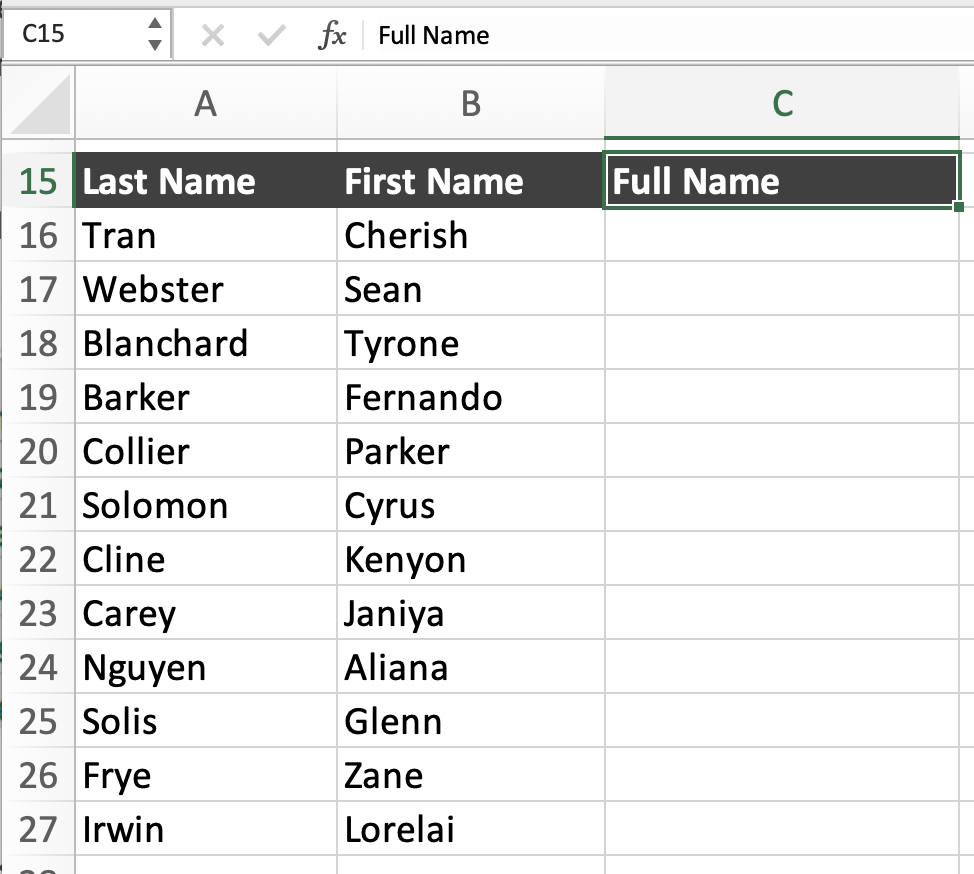
Now, you’re ready to concatenate the first and last names. To do that, you need to understand both the syntax of the function and how to format the text strings that make up the formula.
Excel Concatenate Formula
Like all Excel functions, the CONCATENATE formula starts with the equals sign (=), followed by the function name, an open parenthesis, and the text arguments. No need to get heated – in this context, arguments simply tell the formula what cells to combine.
=CONCATENATE(text1, [text2], …)
=CONCAT(text1, [text2], …)
text1: This is the first argument to join and can be a number, text, or cell reference.
text2, text3, etc: These are the additional items to combine. The CONCATENATE formula can join up to 255 items, with a total of 8,192 characters.
Note: In all versions of Excel 2016 and beyond, the CONCATENATE function has been replaced with the CONCAT function. This function works in the exact same way, with the added ability to combine text over a range of cells (i.e., =CONCAT(A2:D8)). While you can still access the CONCATENATE function for compatibility reasons, Microsoft warns that CONCATENATE may not be available in future versions of Excel.
Excel Concatenate with Space
Double quotations (” “) include a space between the text arguments wherever you want one to appear. Just remember to insert a comma before and after each set of quotations or else an error message will pop up and the formula won’t run. You’ll know your formula is correct if you hit “Enter” and the new text string appears exactly how you want.
In the name example, you want to combine the text in cells A16 and B16, so add those arguments to the formula. Make sure to place the arguments in the order you want them to appear. To get “First Name Last Name,” set up the CONCATENATE formula like this:
=CONCATENATE((B16, ” “, A16)
Note: If at least one of the CONCATENATE function’s arguments is invalid, the formula will return a #VALUE! Error.
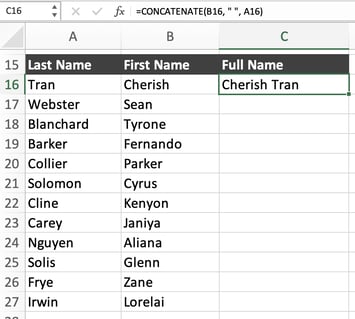
Now it’s time to apply the CONCATENATE formula to every name in the list. Simply hover over the combined cell until a plus sign (+) appears in the bottom right-hand corner. Then click and hold while dragging the cursor down column C, highlighting all of the cells you want to join.
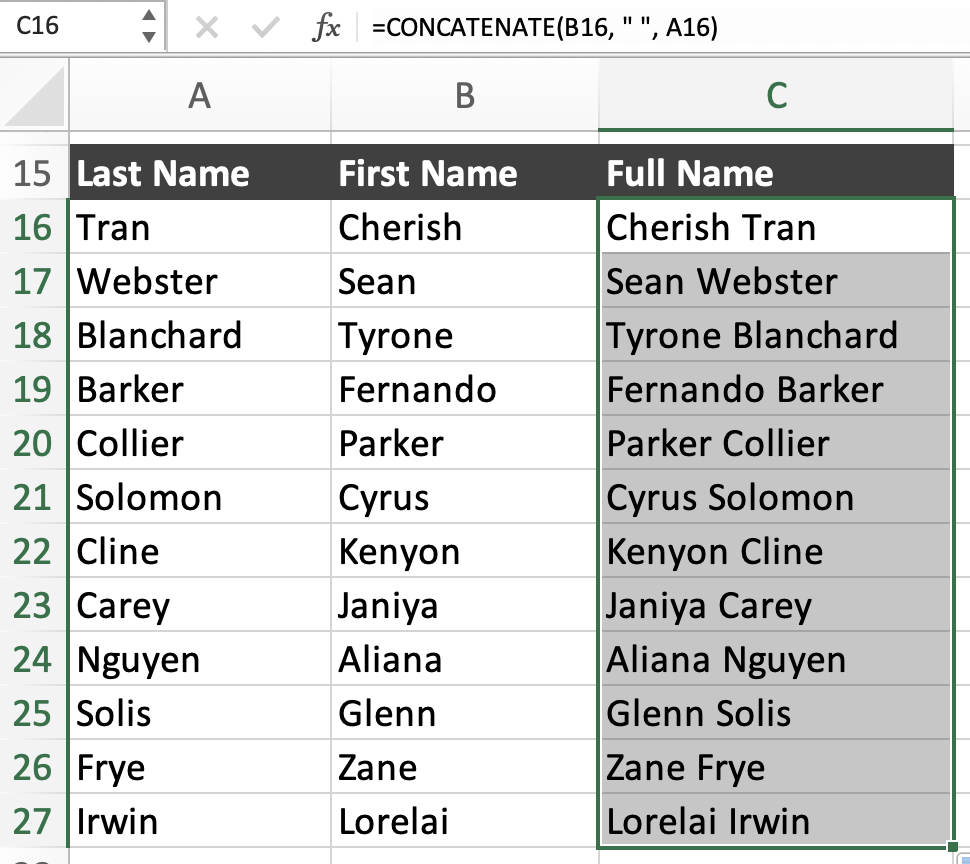
When you release the cursor, voila! The formula is applied to each cell. This prevents you from having to type out the formula for each cell by letting you concatenate dozens of text strings in an instant.
Excel Concatenate Strings
Whether you combine text and numbers, the result of the CONCATENATE function is always a text string. The naming example above is a fairly simple example, but it’s possible to create longer, more meaningful text strings in Excel. The key to doing so is to ensure your results provide value to whoever is using the information.
Let’s say you’re working on an email campaign and want to personalize the subject line with each customer’s name. Instead of manually typing out name after name, you can use the CONCATENATE function to combine the text strings. For this example, I used a catchy email subject line from Warby Parker.
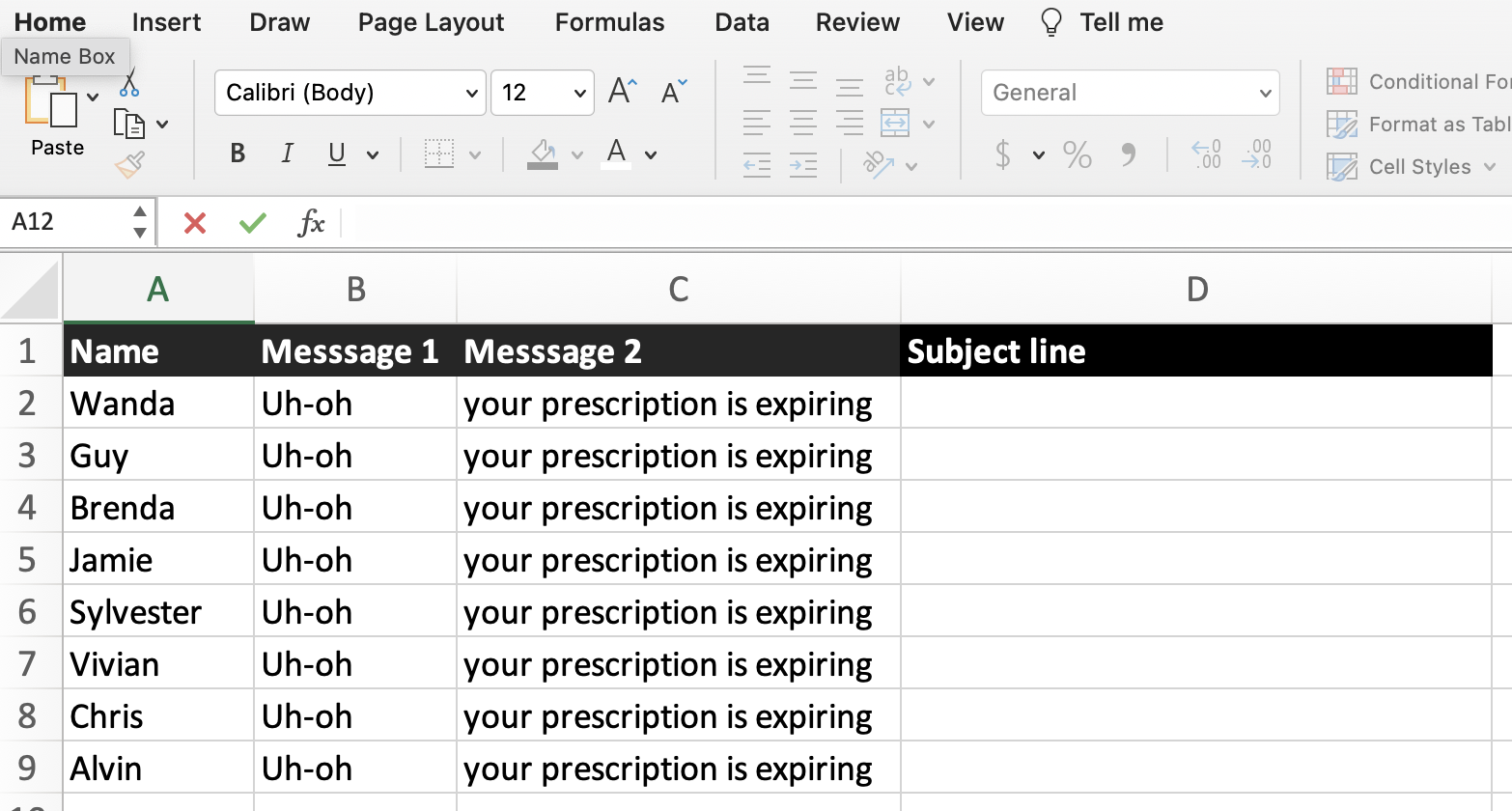
I write the following formula, making sure to include commas and spaces where I want them to appear.
=CONCATENATE(B2,” ,”, A2, “,”,” “, C2)

I then apply the formula to the entire column to generate my list of personalized subject lines.
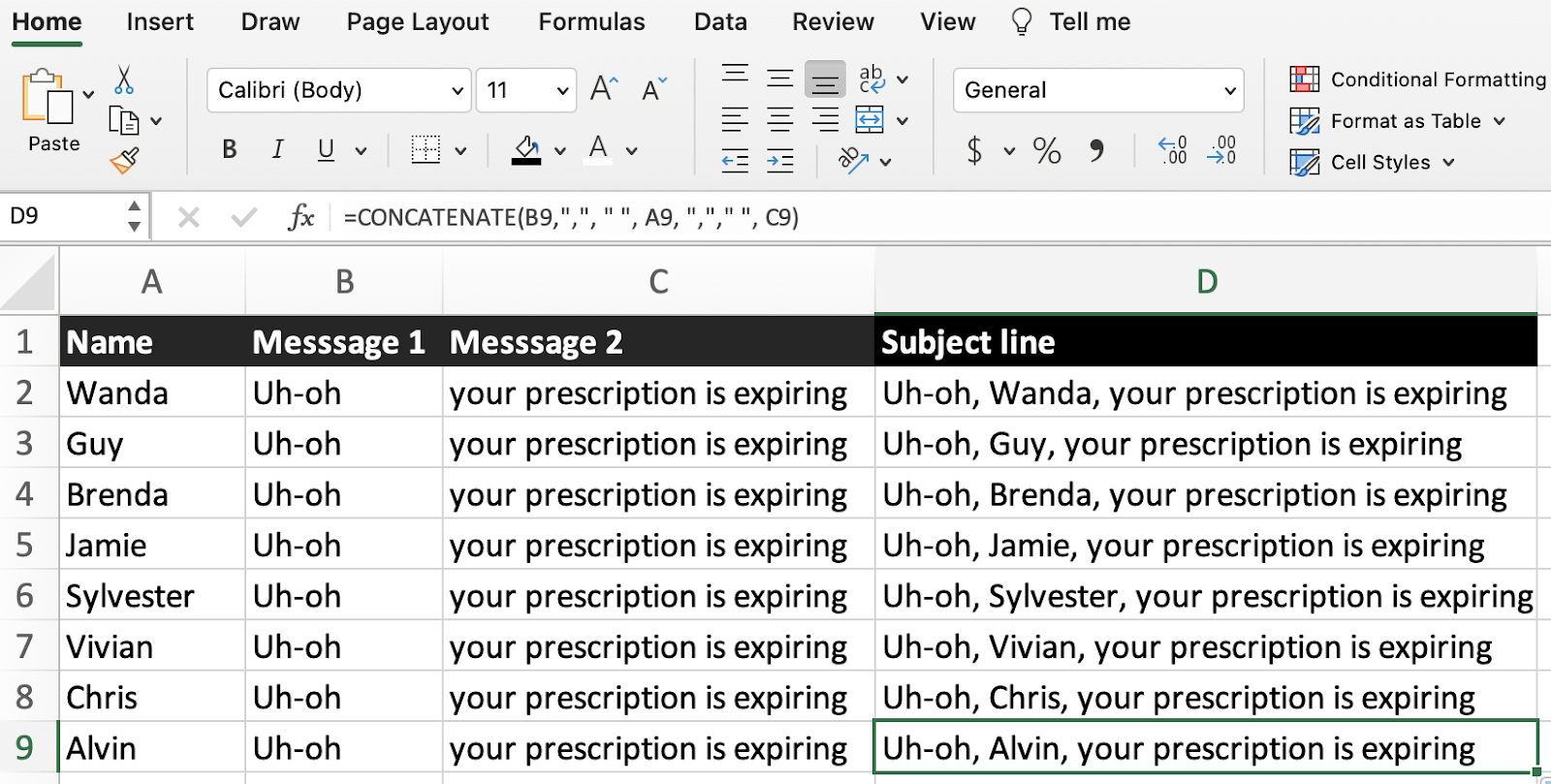
As you experiment with longer text strings, know that every cell reference in the CONCATENATE function must be listed separately because it can’t recognize arrays. For instance, your formula should look like =CONCATENATE (B1, B2, B3, B4) rather than =CONCATENATE(B1:B4).
Combining text is simple enough, but throwing dates and times into the mix can result in a messy formula and error-ridden results.
Concatenate Date and Time in Excel
You can prevent issues with time and dates by embedding the TEXT function into the CONCATENATE Excel formula. This will let you control the formatting when combining text with a number or a date.
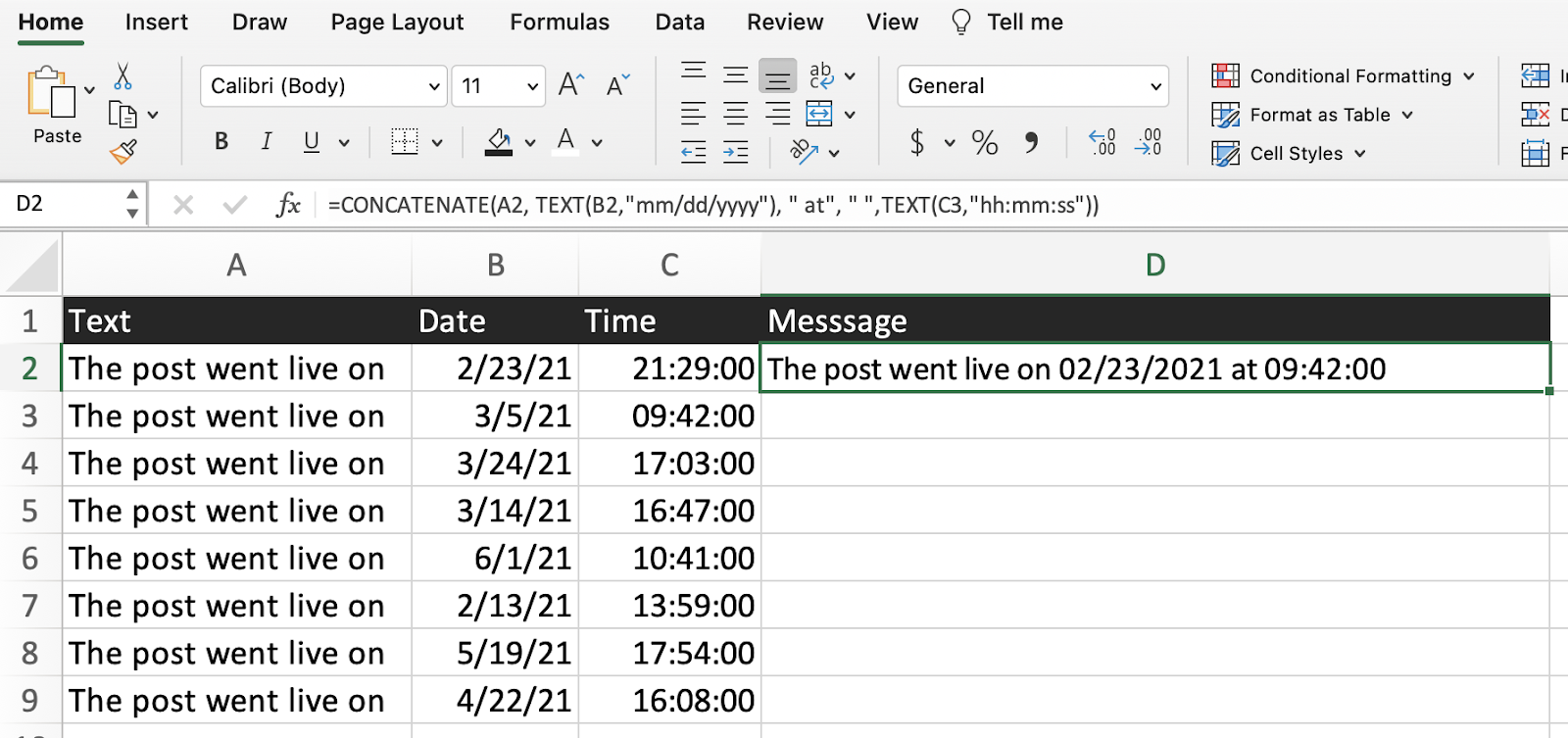
Let’s look at how to combine all of this information. In this worksheet, I want to record the date and time each blog post went live so I can reference the information during my monthly performance analysis.
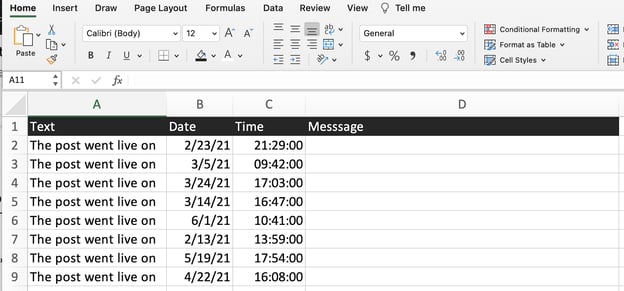
The formula needed to join these three strings may look complicated, but it’s simple once you decide how to format the date and time. I want to leave the dates and times as they are, so I include the date (mm/dd/yyyy) and time (hh:mm:ss) formatting into the CONCATENATE formula.
=CONCATENATE(A2, TEXT(B2,”mm/dd/yyyy”), ” at”, ” “,TEXT(C3,”hh:mm:ss”))
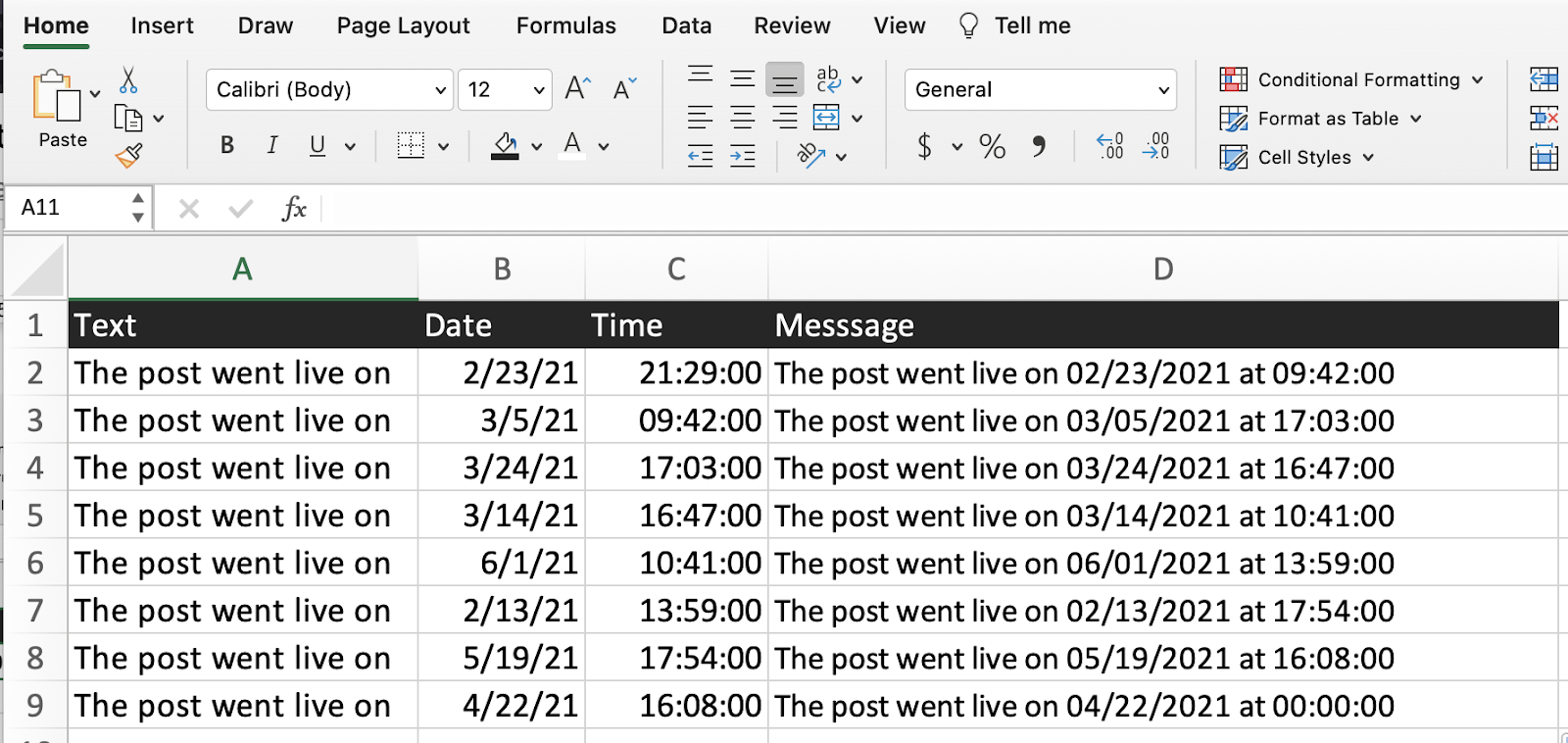
The result is a text string that provides meaningful context by sharing what date and time the posts went live.
Apply the function to the rest of the worksheet using the same steps as before. Drag the plus (+) sign in the bottom right-hand corner of the combined cell down the column, highlighting the cells you want to concatenate.
Excel Concatenate Range
If you’re excited about your new Excel skills, you may have the urge to jump in and organize worksheets with thousands of data points. Using the CONCATENATE function can speed up your work, but know that there are limitations.
Excel only allows you to combine 255 items, up to a total of 8,192 characters, using the CONCATENATE function. So you have to work in sections if you want to create hundreds (or thousands) of new text strings.
The CONCATENATE function doesn’t accept arrays (A3:E5), so make sure to list out each argument you want to include in the formula. If you need to combine a massive range of tens or hundreds of cells, try out one of these shortcuts.
Use the CONTROL key.
- Type in the first part of your formula =CONCATENATE(
- Hold down the CONTROL key and select the individual cells you want to combine.
- Release the CONTROL key, type a closing parenthesis, and hit ENTER.
Use the TRANSPOSE function.
If you need to combine hundreds of cells, you don’t want to waste time clicking on each cell. Instead, use the TRANSPOSE function to create an array before swapping it out with the individual cells.
- Select the cell you want to use the CONCATENATE function.
- Type in the TRANSPOSE formula to generate an array of cells. It will look similar to this: =TRANSPOSE(A1:A10)
- With the TRANSPOSE cell selected, press the F9 key in the formula bar to replace the array with the individual values to be concatenated.
- Delete the brackets around the values so you’re left with only a list.
- Enter the CONCATENATE formula before the values, and close the formula with a parenthesis.
- Hit enter to see your new text string.
While certain heavy Excel users say the CONCATENATE function is becoming outdated, it’s still a useful shortcut for combining text strings without impacting the rest of your worksheet. If you’re new to the program, take the time to learn more about how to use Excel and check out these helpful keyboard shortcuts. You’ll be whizzing your way around worksheets and working more efficiently in no time.

How to Calculate Standard Deviation in Excel, and Why It Matters for Marketers
If you’ve ever taken a statistics class, the words ‘standard deviation’ might intimidate you. This complex formula provides insightful information for datasets that averages alone cannot reveal, and thankfully, Excel makes calculating this statistic easier than putting pencil to paper.
Standard deviation is frequently used by financial professionals as it can help determine risks in stock portfolios and is often applied to return on investment (ROI).
For marketing professionals, standard deviation can reveal variabilities and risks in datasets that will ultimately help guide campaign decisions.
What is standard deviation?
Simply put, standard deviation is a mathematical term that measures the variation in a set of values. In marketing, standard deviation can help account for widely varying costs or sales. If the numbers in a data set are spread far apart, they have a higher standard deviation.
This measurement can help assess risk when deciding how much budget can be allocated toward certain campaigns based on the standard deviation of the ROI, just to name one example.
How to Calculate Standard Deviation in Excel
There are six standard deviation formulas in Excel, which will be used based on whether you need to calculate sample standard deviation or population standard deviation. This is easy to identify in Excel, as the three formulas for population standard deviation include a P (.P, PA, or P at the end of STDEV).
- STDEV.S
- STDEVA
- STDEV
- STDEV.P, STDEVPA, STDEVP
STDEV.S
If you are dealing with sample standard deviation and do not need to account for text or logical values, STDEV.S is the formula you will use to calculate standard deviation in Excel.
STDEVA
Alternatively, if you do need to account for text and logical values, use STDEVA, which will consider text and FALSE logical values to 0, while TRUE logical values will be read as 1.
STDEV
STDEV is simply the sample standard deviation formula that will work with older forms of Excel (2007 and before). It is the same as STDEV.S.
STDEVP, STDEVPA, STDEVP
You will almost exclusively use STDEV.S, STDEVA, or STDEV. When determining population standard deviation, you would have to include all datasets for the entirety of the population.
This can actually be far more data and much less useful than examining a smaller portion of the data, or a sample, in which case you would use one of the sample standard deviation formulas.
If you did, for some reason, need to determine the population standard deviation, you could still retrieve sample standard deviations and apply them to the larger dataset. The likelihood of needing these population standard deviation formulas is slim.
As stated by Microsoft, “[STDEVP] has been replaced with one or more new functions that may provide improved accuracy and with names that better reflect their usage. Although this function is still available for backward compatibility, you should consider using the new functions from now on, because this function may not be available in future versions of Excel.”
Sample of Standard Deviation in Excel
STDEV.S, STDEVA, or STDEV will be the most common formulas to use for marketers looking to calculate sample standard deviation in Excel.
These formulas specifically calculate standard deviation for a sample of a dataset, so the result will determine the amount of variability from the average (mean) of the data.
Next, we will determine how to find and use standard deviation formulas in an Excel spreadsheet.
Standard Deviation Excel Formula
As mentioned above, there are a total of six standard deviation Excel formulas, although you’ll only need one or two of them (depending on the version of Excel you use).
The syntax of the standard deviation formula in Excel for STDEV.S is
STDEV.S(number1,[number2],…)
Number1 is required and refers to “The first number argument corresponding to a sample of a population. You can also use a single array or a reference to an array instead of arguments separated by commas,” as explained by Microsoft.
Number2, … is optional. You can include up to 254 number arguments that refer to sample sets or data of a population, or you can use an array or reference to an array instead of number arguments.
This is the STDEV.S formula used by Excel:

x is the sample mean AVERAGE(number1,number2,…) and n is the sample size. Excel thankfully makes light work of applying this formula to data to calculate standard deviation.
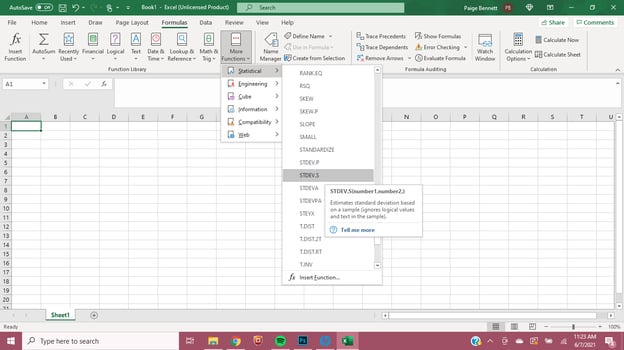
Image via Paige Bennett
Excel Standard Deviation Function
How does one find the Excel standard deviation function that they need? In Excel, navigate to the “Formulas” header in the topmost navigation bar. For Excel versions after 2007, the second navigation bar offers a list of popular formulas, and at the end, “More Functions.” Click “More Functions” then “Statistical” and finally scroll down to the STDEV.S or other standard deviation formula for which you need. You can then input Number1 and Number2, ….
Those using an older version of Excel will not have the STDEV.S formula, but they will similarly be able to navigate to STDEV.
Why Standard Deviation is Important to Marketers
Perhaps this seems simple to some marketing professionals, or maybe this is a lot of statistical speak that sounds complex. Either way, mastering this formula and Excel function is crucial for marketers.
In marketing, discussing averages for datasets is commonplace, and this can be insightful. But it can also leave out some crucial information that could impact a campaign.
Standard deviation can show risks, volatility, or variability in a dataset. An average might show a promising campaign to allocate money toward, but standard deviation can show the potential risk and reward of a campaign. Together, averages and standard deviations can offer a comprehensive look at a dataset, so marketers can make the best decisions based on all of the information at hand.
For example, let’s say we have two companies with different order averages.
Company one has an order average of $1,000. Company two has an order average of $1,500.
But Company two has a standard deviation of $500, while Company one has a standard deviation of $50. Company two has a higher order average on the surface, but a deeper dive shows that it is riskier.
Standard Deviation Can Help Marketers Assess Risk
Averages can be meaningful in showing marketers promising campaigns and to forecast their results. But what averages don’t show are the risk and variability within the data.
A higher average sales number might not show a huge range of variability, and ultimately, risk. While standard deviation has long been used in finance to assess risk of stock portfolios and help professionals determine where to invest or what to expect for ROI, marketers can also benefit from using this statistical analysis in their own work.
They just might find some profitable surprises and avoid risky, volatile campaigns or companies by looking at both averages and standard deviation when making decisions.

Sitemaps: What They Are, How to Create One & Submit it to Google
Sitemaps are one of SEO’s oldies but goodies.
In fact, they’re one of the most important elements of SEO, because they help Google and other search engines find the pages on your website.
Not to mention they also help you rank better, because Google is able to locate new pages and identify updates to old pages much more quickly.
In a nutshell: you can’t live without ’em.
I’ve often heard that they can feel overwhelming and quite technical to understand.
But don’t let the frustration of their technicality make you throw your computer out the window — I’ve got your back!
I will show you what sitemaps are, how to create one, how to submit them to Google, and all the essential best practices.
![→ Download Now: SEO Starter Pack [Free Kit]](https://no-cache.hubspot.com/cta/default/53/1d7211ac-7b1b-4405-b940-54b8acedb26e.png)
What is a sitemap?
To start off with the basics, a sitemap is a file that provides information about the pages, videos, images, and other files on your website. It’s important for various reasons, including:
- Acting as a roadmap for Google and other search engines to find and better understand your content.
- Leading search engines through your website to crawl and index the essential pages.
- Helping search identify when new pages and updates to old pages are available.
- Helping search engines find alternate language versions of your page.
But before I go further, you must know that there are two types of sitemap formats: HTML and XML. Here’s the basic difference:
HTML sitemaps: This is more like your content sitemap that users can see and use to navigate your site. They’re also commonly referred to as your “website archive.” Some marketers view HTML sitemaps as outdated or even entirely unnecessary.
XML sitemaps: This is the sitemap that’s purely used for indexing and crawling your website and is manually submitted. It’s the more modern form of handling how all your content is stored across your website.
While HTML sitemaps might help users find pages on your site, as John Mueller said, your internal linking should take care of that anyways. So the focus from an SEO perspective should be on XML sitemaps.
Types of Sitemaps
From these two types of sitemaps described above, there are also subsections within them. I’ll now go over these in more detail.
1. Page Sitemap
A page sitemap or regular sitemap improves the indexations of pages and posts. For sites that are not image-focused or video-focused, like photography and videography sites, a page sitemap can also include the images and videos on each page.
A page sitemap without an image would look like this:
<?xml version=”1.0″ encoding=”utf-8″?>
<urlset xmlns=”https://ift.tt/3jucoc7″ >
<url>
<loc>https://ift.tt/2UUH8sv>
<lastmod>2020-09-17</lastmod>
<changefreq>daily</changefreq>
<priority>0.9</priority>
</url>
</urlset>
Include your URLs in <loc> tags. <lastmod> indicates when the page was last edited. <changefreq> indicates how often the page is edited and <priority> indicates how important the page is to other pages on the website as a whole. You can take a look at Sitemaps XML format for more information on these parameters.
2. Video Sitemap
An XML video sitemap is similar to a page sitemap, but of course focuses largely on video content, which means they are only necessary if videos are critical to your business. If they aren’t, save your crawl budget (the finite amount of crawlable pages and resources across your site) and add the video link to your page sitemap.
But if you do need a video sitemap, it would look like this:
Note: This is what a video sitemap looks like. Implement it only if videos are critical to your business.
3. News Sitemap
If you publish news and want to get those news articles featured on top stories and Google News, you need a news sitemap. There’s a crucial rule here: do not include articles that were published longer than the last two days in the file.
Google News sitemaps aren’t favored in regular ranking results, so make sure you only add news articles. Also, they do not support image links, so Google recommends you use structured data to specify your article thumbnail.
4. Image Sitemap
Like the video sitemaps, image sitemaps are only necessary if images are critical to your business, such as a photography or stock photo site. If they aren’t, you can leave them in your page sitemap and mark them up with the image object schema, and they will be crawled along with the page content/URL.
If you believe an image sitemap is needed, it will look like this:
<?xml version=”1.0″ encoding=”utf-8″?>
<urlset xmlns=”https://ift.tt/3jucoc7″ xmlns:image=”https://ift.tt/3AhSjLR” >
<url>
<loc>https://ift.tt/2UUH8sv>
<image:image>
<image:loc>https://ift.tt/3yeUDlf>
</image:image>
<image:image>
<image:loc>https://ift.tt/3x7wJaV>
</image:image>
</url>
</urlset>
5. Sitemap Index
There are a few limitations you’ll want to keep in mind for sitemaps:
- Having too many URLs will only lead to no indexation of some of your pages.
- All sitemaps, except the news sitemap, should have a maximum of 50,000 URLs.
- News sitemaps should have a maximum of 1000 URLs.
- A sitemap should be a maximum of 50MB in uncompressed file size.
As a result of those limitations, you might need to have more than one sitemap. When you use more than one sitemap file, you need an index file that lists all of those sitemaps. It’s the index file that you submit in Google Search Console and Bing Webmaster Tools. That file should look like this:
XML Sitemap Example
So far, you have seen each sitemap’s structure. Most websites will only need the page sitemap that includes the images on each page. That looks like this:
Sitemap Priorities
Adding priorities to your sitemap is one of the things many people do to differentiate between how important different pages are, but Google’s Gary Illyes mentioned that Google ignores these priorities. In his exact words:

Generally speaking, as long as you are honest about when your content was actually modified, include it in your sitemap so that Google and other search engines know to re-crawl the modified page and index the new content.
How to Create a Sitemap
In this section, I will show you how to create a sitemap without using any generator or plugin. If your website is on WordPress or you’d rather use a generator (which makes this easy), skip to the next section.
These are the exact steps to follow to create a sitemap manually:
1. Decide which pages on your site should be crawled by Google, and determine the canonical version of each page.
Canonical versions are necessary when you have duplicate pages. For example, suppose you serve an international community and have pages for each location with the same language and content, like example.com/us/page and example.com/ca/page for US and Canada visitors, respectively.
In that case, it’s important that you point to the original, which might be example.com/page or one of the two as the canonical. If you’d like to learn more about how this works, this post explains canonicalization in depth.
Furthermore, do not include URLs that are blocked by robots.txt files, require a login to access, or are password-protected, as search bots can’t crawl them. You’ll only get coverage errors in GSC if you add them.
2. Determine if you need more than one sitemap.
Several websites use separate files for pages, posts, and categories. Remember that if you have more than 50,000 URLs, you need multiple sitemaps.
3. Code all your URLs in XML tags to look like the type of sitemap you want to create.
This page explains how to use XML tags in further detail.
4. If you have multiple sitemap files, create a sitemap index file and include the links to the individual sitemaps you created.
This one is already described in the section titled “Sitemap Index”.
Sitemap Generators
Most of us marketers do not have a web development background, so we can’t code to save our lives. If the thought of manually crafting a sitemap gives you a headache, use a sitemap generator and save yourself 12 days of looking through complex coding.
There are several sitemap generators that you can use:
- TechnicalSEO by Merkle has one where you can upload a CSV file with your URLs. It’s especially great if you have different language versions of your pages (hreflang tags).If your website is custom-coded and is not on any CMS or builder that generates a sitemap, you need to use a generator like TechnicalSEO.
- Screaming Frog SEO Spider also has one that I like to use with simple custom-built sites. In Screaming Frog, ensure you are using the spider mode. You can do that by clicking on “Mode” and selecting “spider”. Then type the URL of your home page and let it crawl. When it’s done, click on “Sitemaps.”
For clarification on how to use Screaming Frog, take a look at the image below:
In order to save the XML file to your computer, tick all the options that matter to your site and click on “export”. Then, upload that file to your server in the root directory.
Both tools do not automatically update the sitemap file. Some tools do but are premium, so you pay for the service.
However, you won’t need to deal with any of the above if your website is on WordPress or an ecommerce platform like Shopify.
For WordPress sites, Yoast and Rank Math are popular SEO plugins that generate sitemaps and update them when you edit your posts and pages and Shopify even generates sitemaps automatically.
How to Submit Your Sitemap to Google
The best way to submit your sitemap to Google is through Google Search Console (GSC). There are other ways and additional steps as well, but I will start with GSC, because it’s the most common method.
Follow these steps:
1. Go to Google Search Console and click on “sitemap.”
2. Type your sitemap URL and click Submit. If you have multiple sitemaps with a sitemap index file, you only need to type the URL for the index file.
As an alternative, if you haven’t submitted it to GSC, there is another way to let Google know you have one by adding this line in your robots.txt:
Sitemap: https://ift.tt/3jsBasS
But of course the URL here with the one you actually have. And if you have an index file, include only your index file here.
If (for some weird reason) you aren’t using GSC, use the ping service to let Google know it should crawl your file. To do that, type the URL below in your browser:
https://ift.tt/3cQT7um
Replace https://ift.tt/2pqahKF with your sitemap URL.
And it’s done!
Sitemap Best Practices
Now that you understand the importance of sitemaps, how they work, and your options for submitting them, let’s make sure the final one you create is in tip-top shape by following these best practices.
1. Use tools to generate automatic sitemaps.
Manually creating and updating an XML sitemap will cost you a lot of time (and is unnecessarily complex). To save time so you can focus on other things like your next Netflix binge, it’s best to use an automatic sitemap generator.
The ones mentioned for WordPress above come with that feature for free. For custom-built sites, you will have to pay, but in my opinion it’s absolutely something worth paying for.
2. Do regular sitemap maintenance checks and updates.
All parts of SEO are an ongoing effort, so check your sitemaps regularly. Search console does an excellent job of letting you know if your submitted URLs have issues with crawling or indexing.
Check the ‘Coverage’ section in GSC regularly and update your site or sitemap when there are errors. The great thing about this is that it tells you what the exact error is with suggestions on how to fix it.
You can also use Screaming Frog for sitemap maintenance. After crawling your website or sitemap URL, check the response code tab for 404 or 5xx errors.
If you are using an automatic sitemap generator tool or plugin, update it when updates are available. Furthermore, periodically view the sitemap by going to your sitemap URL and checking if any page is missing or the last updated time is incorrect.
3. Prioritize high-quality pages in your sitemap.
Although Google no longer pays attention to the priority tag (or so they say), you can still add it because there’s more than Google out there (yes, as an SEO I will admit it). Bing might pay attention to that tag, so it’s still good practice to prioritize high-quality pages in your sitemap.
Sitemap priority shows which pages to crawl and index faster, so you can set priorities using values ranging from 0.00 to 1.00. But make sure not to use the same value for all pages or else Google won’t be able to tell which is most important.
For values, you can go with something like this:
- Homepage – 1.00
- Main landing pages – 0.90
- Other landing pages – 0.85
- Main links on navigation bar – 0.80
- Other pages on site – 0.75
- Top articles/blog posts like hub pages – 0.80
- Blog category pages – 0.75
- Other posts – 0.64
4. Include only canonical versions of URLs in your sitemap.
Your sitemap should only contain URLs that you want search engines to index. That means if a URL points to another as its canonical version, you shouldn’t include it, as it’s a statement to Google and other search engines that you don’t wish for that URL to be indexed.
Ignoring that and including that URL in your sitemap provides conflicting information to Google. The unintended URL might get indexed, or you will get coverage errors in GSC. So, only include the canonical versions, so you can consolidate your position in search engine results.
5. Split up your large sitemaps.
I mentioned this above already that you need to split your sitemap into multiple files if it exceeds 50MB or has more than 50,000 URLs. Never submit large XML files to Google, otherwise some of your URLs will not be indexed – and you know well that every URL matters!
One quick tip here is to save each file with easy to understand names (for you) like page_sitemap1.xml and page_sitemap2.xml.
And with that, I wish you happy sitemapping!

The Best Video Formats on Instagram [New Data]
As a millennial, it’s no surprise that Instagram is one of my favorite social media platforms. This network is the third most popular social media site for Gen Z and millennial audiences.
While scrolling through the site is the easiest thing to do, posting the right content for your audience isn’t.
As a marketer, you’ve probably wondered what type of Instagram content would perform the best for your audience. To help you, we decided to ask consumers what type of video formats they watch the most.
In this post, you’ll learn what video format users like to watch on Instagram, and what size, length, and aspect ratio those videos should be.
![New Data: Instagram Engagement Report [2021 Version]](https://no-cache.hubspot.com/cta/default/53/9294dd33-9827-4b39-8fc2-b7fbece7fdb9.png)
Best Video Format for Instagram
Instagram is extremely popular, but did you know there is more than one kind of video format you could use for your content?
To find out which is the most popular we surveyed more than 300 people to see which videos they watch the most.
Ultimately, Instagram Story videos were the most popular video format to watch on the social media site, with 43% of those surveyed watching this type of video content the most.
Besides survey respondents who didn’t use Instagram, the next highest video format to watch were live videos and then videos shared directly in the feed.
The least popular video formats to watch on Instagram were Instagram Reels and IGTV, with only 19% and 13% of respondents watching them respectively.
To view the results, see the graphic below.
Now that we know what kind of video formats users like to see, let’s find out how you can post the best video content on Instagram.
This is the proper video quality for a post on the Instagram feed. It will look something like the screenshot below.

For an Instagram Story, the video should be 1080 x 1080 pixels, with an aspect ratio of 9:16. The maximum file size should be 250MB.
It will look something like this screenshot:

While these are the main types of videos to upload on Instagram, you can explore other spec requirements on the Instagram site.
While all these stats are important, one of the ways to keep file size down is to shorten the video. You can’t just upload 24 hours of video content on the platform. Now you might be wondering, “How long can my Instagram videos be?” Let’s dive in below.
How Long Can Instagram Videos Be?
- Instagram Feed — 60 seconds
- Stories — 15 seconds
- Livestream Videos — 60 minutes
- IGTV — 15 seconds – 10 minutes. Verified accounts can post up to 60 minutes of video on IGTV.
- Instagram Feed ads — 2 minutes
- Instagram Carousel Video ads — 60 seconds
Instagram videos are a great way to reach Gen Z or millennial audiences. However, it’s important to think about the type of video content that performs best on the platform. Additionally, knowing the right size and video specifications before filming your videos can help you reach success quicker.


The Ultimate Collection of Free Content Marketing Templates
Does any aspect of your job intimidate you?
For content creators, sometimes the most stressful part of the role can be opening a completely blank document to start a new project.
Whether it’s writing a blog post, designing an infographic, or creating an ebook, starting a new piece of content from scratch can be a challenge — especially if you’ve never done it before.
![Download Now: 150+ Content Creation Templates [Free Kit]](https://no-cache.hubspot.com/cta/default/53/5478fa12-4cc3-4140-ba96-bc103eeb873e.png)
Here at HubSpot, we want to help you do all the challenging, fun parts of the work with less stress. Instead of trying to master how to create every type of content in existence, cut down on the stress and inefficiency and get inspired by our collection of nearly 400 free, customizable content creation templates.
We’ve broken this list down by each type of content marketing template represented. Jump ahead if you specifically want:
- Content Management & Calendar Templates
- Written & Editorial Content Templates
- Design Content Templates
- Social Media Content Templates
- Email Content Templates
- Video Content Templates
Content Management & Calendar Templates
A Content Planning/Goal-Setting Template
(Download the content planning template here.)
HubSpot teamed up with Smart Insights to create a content planning template that will help you put together an effective content marketing plan for either your business or those of your clients. These templates will help you complete a SWOT analysis on your content marketing efforts (and develop a plan to improve them), define the right objectives and KPIs for that plan, brainstorm content ideas and map these across your funnel, and create a timeline for your content plans.
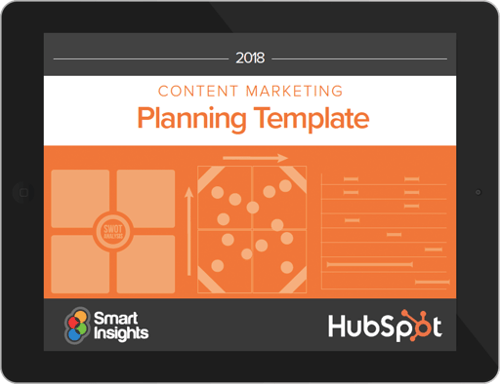
A Content Mapping Template
(Download the content mapping template here)
You’re aware that you need a content marketing strategy in place to support the success of your inbound marketing and sales organizations. But how do you get started? We’ve created a content mapping template so you can experience your target audience’s buyer’s journey. This template helps you identify buyer personas, their challenges and needs, and brainstorm content that provides solutions. You’ll have plenty of targeted blog post ideas to attract your audience to your site and convert them into leads.

A Buyer Persona Template
(Download the buyer persona content template here.)
Marketing with buyer personas means marketing smarter. This buyer persona template will help you easily organize your research to create your very own buyer personas. Use it to create beautiful, well-formatted buyer personas that you can share with your entire company while learning best practices for persona research along the way.
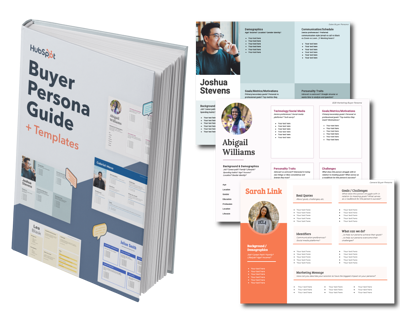
Blog Editorial Calendar Templates
(Download the blog editorial calendar templates here.)
Having an editorial calendar for your marketing content will save you a whole lot of time — not to mention sanity — as you plan your content release timeline. We realize there isn’t a one-size-fits-all solution, so we’ve created three editorial calendar templates to use at your leisure: one for Google Calendar, one for Excel, and one for Google Sheets. (Read this blog post for a step-by-step guide for using the Google Calendar template.)

Social Media Content Calendar Template
(Download the social media content calendar templates here.)
With so many different social networks to manage, a social media manager’s life becomes a lot easier when they can plan which content to share on each account — and when. This easy-to-use social media content calendar for Microsoft Excel lets you organize your social media activities far in advance. Use it to plan your updates and learn how to properly format your content for the six most popular social networks: Facebook, LinkedIn, Twitter, and Instagram.
On-Page SEO Template
(Download the on-page SEO template here.)
The more content you publish to your website, the more traffic sources you’ll want to prioritize. One of those sources is organic traffic. To make on-page SEO easier, we’ve rolled out a handy planning template to help you create a website structure that organizes each webpage, what its purpose is, how long it should be, and how to optimize the metadata associated with each new page you publish.
Written & Editorial Content Templates
6 Blog Post Templates
(Download the blog post templates here.)
Here’s the thing with blogging: There isn’t one, easy template you can fill in to produce a quality content offering. You need to spend some time researching, brainstorming a title, outlining core content, and so on. Our templates will walk you through the critical steps for creating the following six blog post types:
- How-To Post
- List-Based Post
- Pillar Post
- Infographic Post
- Newsjacking Post
- What is? Post
We’ve seen these formats crush it on our blogs, and we know you can use them to hit your own goals.
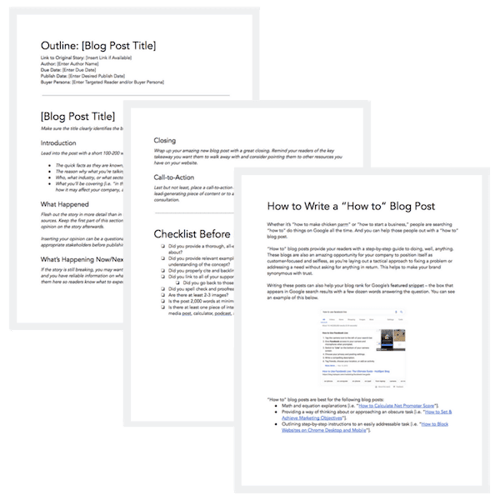
18 Ebook Templates
(Download the ebook templates here.)
Year after year, marketers cite lead generation as one of their top content marketing goals for the year. If you want to succeed at lead gen, then you need content offers — like ebooks — to help you get there. Our internal creative design team went to work building 18 beautiful ebook templates — for use in either InDesign, PowerPoint, or Google Slides — for you to download, customize, and publish.
4 Free Memo Templates
(Download the memo templates here.)
Memos are essential content for effective internal communication. While they might not be customer-facing, they can align your team to ensure better, more aligned content is created by everybody on your team.

28 Call-to-Action Templates
(Download the call-to-action templates here.)
To help you design clickable calls-to-action, we’ve built 28 pre-designed CTAs for you. These CTAs are super easy to customize, so you don’t need to know any fancy design programs — just PowerPoint or Google Slides.
Bonus: There’s also a handy free tool in there that lets you track your CTA clicks in real-time so you can see the exact number of clicks that your designs are reeling in.

A Press Release Template
(Download the press release template here.)
While public relations has adapted to be more lovable and less spammy, press releases can be effective when used correctly. Our press release template takes this into consideration and provides an inbound-optimized version. This means the template can help you script press releases and do so in a format optimized for sharing on your company blog. You can easily adapt and customize as needed for your PR needs.
Design Content Templates
12 Pinterest Templates for Business
(Download the Pinterest templates here.)
With more than 478 million monthly active users, Pinterest continues to bring businesses tremendous value. Whether you’re bringing leads to your website, sharing infographic content, or promoting a blog post, Pinterest is a great platform to leverage for content marketing. Download these 12 Pinterest business templates that you can tailor to your product or service offering.
150+ Content Creation Templates
(Download the visual marketing templates here.)
Not a designer? Not a problem. We created over 150 visual marketing templates that are easy-to-use, work for any industry (finance, dentistry, agriculture, law — we’ve got ’em all), and are completely free. The templates include…
- Infographics templates
- Facebook ad templates
- Facebook post templates
- Twitter post templates
- Email header templates
- Blog title templates
- Facebook cover photo templates
- Twitter header templates
- LinkedIn cover photos templates
15 Infographic Templates
(Download the infographic templates here.)
Skip the frustrations and start creating the graphics right away. We’ve created several pre-designed infographic templates that you can customize in PowerPoint or Adobe Illustrator. Within each template, you’ll get guides to teach you how to use the templates effectively.
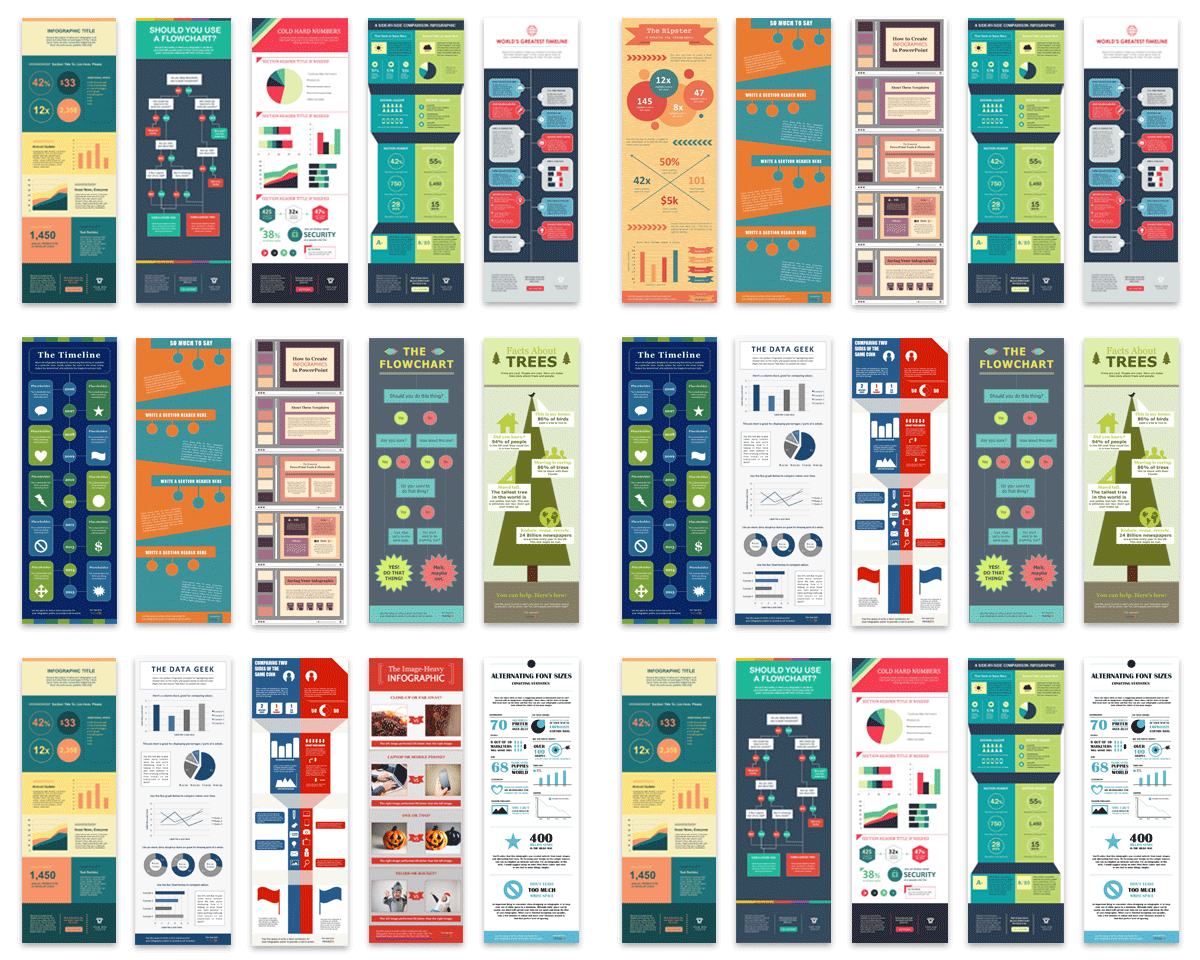
Social Media Content Templates
50 Social Media Graphics Templates
(Download the social media graphics templates here.)
People remember visual information 6x more than written or audio. But we know well that creating visual content takes more time and resources — which is why we’ve created these 50 customizable templates for you. These templates are in Google Slides, so they’re very easy to edit — no Photoshop skills required. Simply customize the text on an image, save it, and post it to social media.
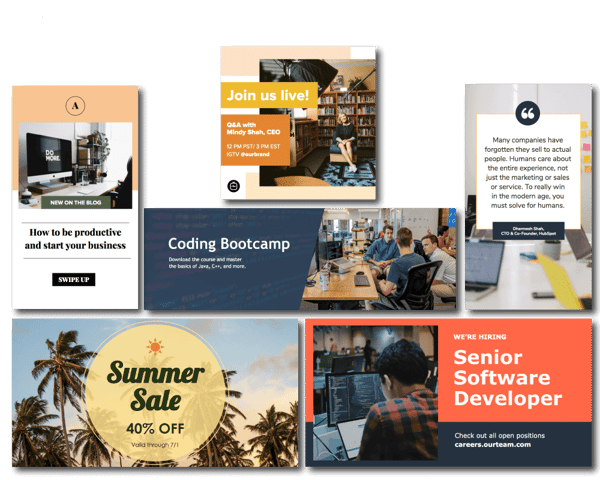
11 Facebook Cover Photo Templates for Businesses
(Download the Facebook cover photo templates here.)
With how frequently businesses change and improve on their Facebook pages today, it’s crucial that you have new material in the pipeline. Double down on your Facebook designs with these 11 templates dedicated to your Facebook cover photo. Get these designs by clicking the link above or the graphic below.
Email Content Templates
15 Email Templates for Marketing and Sales
(Download the email templates for marketing and sales here.)
If you’re like most marketers, you probably spend way more time than you’d like to admit reading and responding to emails. There are many ways you can streamline your inbox to save time, but you ultimately will still have to create and send emails. That’s where these content templates come in. We’ve written the copy for 15 emails marketers and sales reps are likely to send over and over again to save you time and get you results.
Email Marketing Planning Template
(Download the email marketing planning template here.)
Set goals for your email marketing planning with this free template. Available via Excel and Google Sheets, this template can help your marketing team plan an effective email marketing campaign.
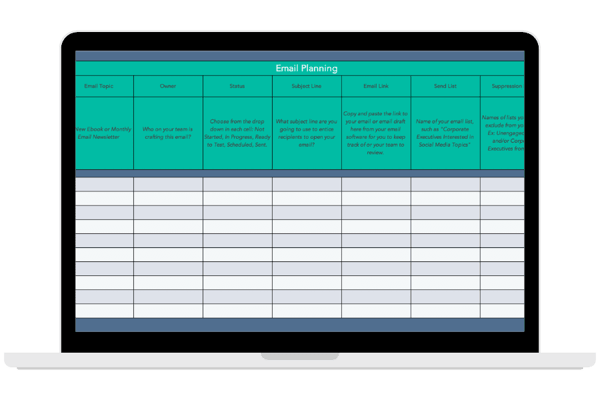
Video Content Templates
10 YouTube Business Templates for Banners and Thumbnails
(Download the YouTube Business Templates here.)
Depending on your role as a content creator, you may be responsible for video content, too. A striking thumbnail and banner are a couple of the factors viewers rely on to determine what videos to watch. However, you don’t need to spend hours creating the perfect channel art for each video. These 10 YouTube video content templates make this task simple so you can focus on more important things, like filming, editing, and promoting your videos.

Content Marketing Made Simple
Content marketers are expert storytellers, but designing visual guides and tinkering with excel spreadsheets may not be your favorite part of the job. With hundreds of templates included in this blog post, you can spend more of your precious time doing the work you love.
So, there you have it, content marketers: nearly 400 templates to help you start creating content easily and quickly and further your inbound success.
Editor’s note: This post was originally published in December 2020 and has been updated for comprehensiveness.

The Best Time to Send an Email [Research]
Here’s a little exercise for you: Check the timestamps on the emails you’ve gotten in the past day. What have you found? For me, I noticed that most of my emails, especially my subscription emails, were sent between 9-10 AM, or 5-6 PM.
This isn’t a coincidence, either.
While the answer to “What’s the perfect time to send an email to my customers?” isn’t an exact science, there are some key findings we’ve discovered through heavy research, and those times listed above are right in line with what we found. Keep reading to find out the best time to send an email, according to our findings.
If you’re sending emails that include a sale or promotion, try sending them during the times your audience tends to take their lunch breaks simply because they may be more likely to check their emails at this time.
If you want something more specific when it comes to what time and day you should send an email, we found some researched-backed best practices.
The following numbers are from GetResponse, an email marketing software that combed its data to compile a report of email marketing benchmarks. They analyzed 4 billion emails from 1,000 active senders.
-5.png?width=579&name=The%20Best%20Time%20to%20Send%20an%20Email%20(Research-Backed)-5.png)
The highest line of the graph represents the open rate. The purple line (i.e., the one below it) represents the click-to-open rate. Below that, the dark blue line, represents the click-through rate. The almost transparent data counts the number of messages sent in percent value.
This gets into the best day to send through an email. CampaignMonitor collected data from millions of emails used on their service. They put together the best day as it pertains to data collection.
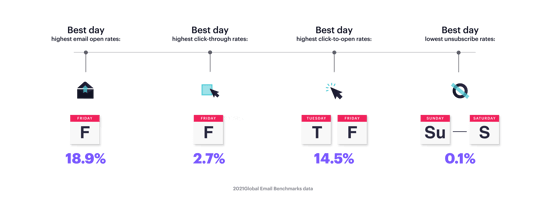
From this data, it looks like the best days for seeing a good blanket of success fall during the workweek. People are mostly opening and reading through emails in the middle of the week. It’s also good to keep in mind the lowest unsubscribe rate: during the beginning of the week.
Keeping your audience in mind is a good tip for figuring out the time to send your emails. If your buyer persona is a professional with a nine-to-five job, sending emails during their ideal downtimes is the best. For instance, HubSpot sends emails between 8-9:30 AM ET to match our audience’s daily routines.
Why Email Matters For Your Business
Automated email marketing provides a chance for you to improve sales conversions — maybe even by 14%. It’s a way to send customers unique offers — such as product sales or newsletters updates — with information your reader can’t get anywhere else.
Emails should be personalized with what your customers want to see, allowing you an instant way to communicate with them. Your emails should contain information your customers are interested in learning more about, such as discount offers, business updates, or product/service launches.
HubSpot‘s marketing email tool allows users to create and send automated emails for free. It also gives you the option to schedule your emails according to the preferences you’ve set. Then, your emails will be sent to the list(s) of contacts you select.
-4.png)
When you reach this option in your automated email tool, you probably spend some time wondering when exactly your audience would like to receive your email, especially if it includes a limited-time offer. You want to make sure the highest number of customers possible are reading your emails.
How to Measure the Performance of Your Email Sends
If you’re wondering about the best time to send a marketing email, there’s something you should know first. There’s a lot of data out there on the subject that provides differing answers, and one reason is that it depends on your audience and, more importantly, how you’re measuring success.
For example, the best time for people to open your emails could differ from the best time for people to take action. Here is a breakdown of the most important email metrics:
Click-through rate
Click-through rate refers to the number of people who open a link or image in an email. This number will always be smaller than the total number of emails opened since some people will open your email but then abandon it without engaging with it any further.
Click-to-open rate
When comparing the number of people that opened your email and the number that clicked on any links, that data is called click-to-open rate. This metric helps you identify which information in your emails is relevant to consumers. Finding CTOR is done by diving CTR by the open rate and multiplying it by 100%. For example, if your email receives 200 clicks and 120 opens, your click-to-open rate is 60%.
Open rate
The open rate, then, is the percentage found from the number of subscribers who opened your email campaign. Emails that have great open rates have short, effective subject lines. Plus, they’re optimized for previews and preheader text.
Entrepreneur concurs with the GetResponse data above but breaks it down further based on audience type:
The big takeaway here is that you’ll want to segment your B2B audience down even further, perhaps by job function or seniority, to accommodate different behaviors and modes of working with your email sends. You may even find that other times work better for your list.
B2B is great and all, but does the time you send an email matter when marketing consumer and personal goods?
Again, keep in mind that studies differ, consumer behavior is always changing, and performance varies based on which metric you’re using as your ultimate goal. Continue experimenting and seeing what works best with your audience. One way to do this is by using an automation tool like Seventh Sense which will fine-tune your email sends using artificial intelligence.
Email marketing can be a tricky subject. There are so many industries taking advantage of it in their own way and making an impact.
Your subscribers are already interested in your content. They appreciate what you are offering as a company, and as long as you’re sending them emails that relate to that, you have a good chance of obtaining great metrics.
Editor’s note: This post was originally published in November 2019 and has been updated for comprehensiveness.

The Top 7 Free Alternatives to Adobe Illustrator of 2021
Adobe Illustrator is a popular tool for designing vector graphics, logos, icons, and more.
But when you’re a web or graphic designer with a small budget, you probably can’t afford Adobe Illustrator’s steep $239.88/yr pricing.
Luckily, there are plenty of top-notch free alternatives on the market, some of which offer features unparalleled by Illustrator. In this post, we’re sharing the top seven free alternatives to Adobe Illustrator so you can produce beautiful designs on a budget.

If you’re shopping for a program that offers features comparable in quality to Adobe’s product, check out our list of the top free alternatives to Illustrator.
1. Inkscape
One of the most comparable substitutes to Adobe Illustrator, Inkscape has plenty of similar sketching, illustrating, and editing tools, including keys to move and rotate by screen pixels, bitmap tracing, color painting over objects, and edit gradients with handles.
You can create complex textures and gradients in Inkscape, too. Unlike some free tools, this tool allows layering, grouping, and locking objects so you can completely customize the look and feel of a project while maintaining a streamlined workflow.
Inkscape is a quality product for pro- or semi-pro web designers working within SVG file format. It also offers an open source vector graphics package, so if you have the technical skills, you can incorporate Inkscape into your other software programs.
Best for:
Pro and semi-pro illustrators and web designers
Platform:
Mac, Windows, Linux

2. GIMP
GIMP, which stands for GNU Image Manipulation Program, has limited vector functions but has similar tools to Photoshop, making it an impressive image editor with powerful image manipulation options. Better still, GIMP provides options for customization and third party plug-ins, so if your image editing needs are somewhat unique, you might want to check this tool out.
GIMP is free and open source, so there is a market of third party plugins to enhance your productivity and design capabilities. If this sounds technically advanced, GIMP offers tutorials for newcomers to the tool so you get the most out of it.
Best for:
Advanced designers who need a custom tool to create illustrations and graphics
Platform:
Mac, Windows, Linux

3. BoxySVG
BoxySVG runs as an extension in Google Chrome, so it’s easy to store vector graphics including icons, charts, and illustrations on the web. It provides options for Google Fonts integration and has an Open Clip Art Library, as well as illustrator tools including pens, bezier curves, groups, shapes, text, and more.
Ultimately, BoxySVG is simpler than Illustrator, and while this means less advanced tools, it also means a quicker and easier process for creating vector graphic files.
The intuitive user interface gives you a clean workspace so you can complete your workflow without clutter or overlapping toolboxes. Keyboard shortcuts keep tools accessible without switching between tabs or searching through several icons.
The 15-day free trial includes these features. After that, you’ll have the option to purchase either the premium or standard plan.
Best used for:
Designers who produce a low volume of designs, but still need a quality tool
Platform:
Mac app, Windows app, Chrome app, Web app
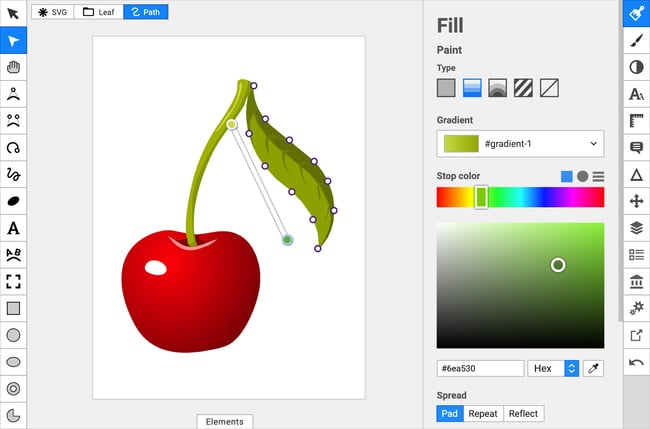
4. Pixlr
Pixlr offers plenty of features for editing, creating, and sharing creative images. While it’s less advanced in function than Illustrator, it’s cloud-based and supported on mobile, desktop, or the web.
Pixlr has two options: Pixlr E for photo editing and Pixlr X for graphic design. Pixlr X includes regularly updated templates for social media, presentations, resumes, business cards, newsletters, and event invitations. Pixlr E includes a photo collage maker that combines your favorite photos into a clean, cohesive design.
Best used for:
Individuals whose position requires them to work from different devices to create images
Platform:
Windows, Mac, Web, Mobile

5. Gravit
You’ll find plenty of your basic vector-editing tools in Gravit, including pen, line, knife, slice, bezigon, gradient editor. It also has more advanced features, such as boolean operations, symbols, international text support, and more.
Plus, it’s designed in a user-friendly interface and offers video tutorials. Gravit works from right within any browser, which means you can edit and export your files anywhere with wifi. It also supports cmyk rendering, so you can print quality images without downloading anything.
You can also import and export files in a variety of formats including pdf, png, jpg, svg, and sketch — which makes this option more flexible than Illustrator.
Best used for:
Freelance illustrators and designers who need a robust design tool
Platform:
Mac, Linux, Windows, Chrome, Any Browser
6. Affinity Designer
With rasterizing controls, infinite zooming, a precision-engineered pen tool, automatic snapping points, colors that pop, and an extensive array of vector editing tools, this system truly compares in design and function to Adobe Illustrator. The full version is $49.99, but the 90-day trial version is free and offers plenty of the full version tools.
What’s unique about this tool is that it supports vector and raster workspaces — with the click of a button you can switch between the two for a versatile design experience.
Your workflow is the foundation of a great design, so Affinity Designer gives you unlimited artboards, detailed version history, customizable keyboard shortcuts, and the ability to save your file in the most popular vector and raster formats.
Best used for:
Experienced designers with a need for advanced vector and raster tools
Platform:
Mac, Windows, iPad

7. DesignEvo
Although this design tool is free, it brings a lot of value. With over 10,000 design templates to get you started, this app is ideal for the designer who’s just starting out. DesignEvo helps you perfect your style, develop your workflow, and build your portfolio — all without spending a penny on expensive software.
You’ll have access to royalty-free fonts, color schemes, and an easy-to-use logo editor (plus dozens of logo categories). When you’ve designed the perfect vector, logo, or icon, export it from DesignEvo and into your preferred storage cloud in the most popular high-resolution formats.
Best used for:
Individuals starting a business who need a logo and other assets
Platform:
Mac
Adobe Alternatives for Any Budget
Creating professional vector graphics doesn’t have to be an expensive line item in your budget. If you’re just starting out in the graphic design field or if you’re an experienced designer looking for budget-friendly tools, one of these free alternatives is sure to work well for you.
Editor’s note: This post was originally published in June 2018 and has been updated for comprehensiveness.


12 Tips on How to Become a Manager: From 5 People Who Did
So, you want to become a manager.
The million-dollar question is, how do you get noticed?
Some say it’s by taking on big projects. Others believe face-to-face interactions with upper management are key. The truth is, it’s a combination of those two steps and many others.
![→ Click here to download leadership lessons from HubSpot founder, Dharmesh Shah [Free Guide].](https://no-cache.hubspot.com/cta/default/53/4e634041-e1ce-4a85-8e65-aea12fc10b84.png)
We’ll cover them all in this article, featuring five HubSpot managers who share their journeys to becoming managers and what they now look for in managerial candidates.
1. Add value to your team.
The number one way to get noticed as management material is by adding value to your team in your current role.
What does that look like? Well, it depends on your position.
For Diversity, Inclusion, and Belonging Team Manager at HubSpot Ashley Ladd, it started by volunteering for presentation slides on diversity and inclusion during quarterly meetings.
“It’s very easy for our leadership team to be like, ‘I can do that,’ or ‘our chief legal officer can do that,’ or ‘somebody could do it,'” said Ladd, then program manager, “but I was able to raise my hand and say ‘Hey, I’m willing to take on this part of the presentation’ or ‘I’d love to have that opportunity.'”
Ladd said it pushed her outside of her comfort zone but also gave her visibility with upper management. Furthermore, it allowed her to share more about what she did, and show why she was passionate about her work.
“Those were some of the things earlier on that set me up for being seen as a leader in our space,” said Ladd.
Carina Carlos, product expert manager at HubSpot, added value by identifying a problem in her previous company’s ticket management system and solving for it.
“Solutions aren’t just waiting,” said Carlos. “They’re not just there, you have to think about them, be creative and cover them.”
And that’s exactly what she did. After brainstorming and developing a solution, Carlos pitched it to management and reduced ticket volume by around 40%.
“Taking ownership [is what gets you noticed for management roles], leading projects and thinking of projects that can have a bigger impact in terms of scalability and solving for the root,” she said.
Christopher Simmons, small business sales manager at HubSpot, says adding value looks like a combination of the following:
- Being successful in your role
- Aligning with the company strategy
- Filling in gaps leadership may have
- Giving your perspective proactively
- Speaking up on behalf of people
He believes it requires shifting from an individual contributor mindset to a team one. But as you identify these opportunities, make sure you’re not stepping on other people to do it.
“A key to adding value is dropping pretense,” Simmons says. “What often happens is that people can feel like you are using them as a piece to get to wherever you’re trying to go.”
Whether you start small or go big, there’s always an opportunity for you to add value without pushing others to the side.
2. Volunteer for projects that give you visibility.
One of the best ways to be noticed by upper management is by working on projects your leadership team cares about.
“I was always raising my hand for something because I knew it would give me experience as well as exposure to what I wanted to do and what I didn’t want to do,” said Customer Success Manager at HubSpot Davey Jones.
“So, I had my shortlist of non-negotiables for whatever my next opportunity would be, even if I was leading people,” she continued, “and that came from raising my hand and volunteering.”
Your first step is identifying what those projects are, through company meetings and conversations with your managers and other leaders. Next, break the projects up into two categories: small, low-commitment versus long, high-impact.
Jones emphasizes the importance of having measurable goals to prevent overextending yourself. Because then, you end up underperforming.
The formula is this: Identify projects you’d like to work on and decide how many you will work on per quarter.
“It circles back to leveraging those additional opportunities because a lot of that has a leadership undertone in its own right,” said Jones. “And when you take advantage of those opportunities, you realize ‘Do I want to manage people?'”
During this process, Ladd offers a key piece of advice: zoom out and up.
“As a manager, you have to be able to take yourself out and up and be like, ‘Who is this impacting? Who else do I need to talk to and who else do I need to collaborate with?’ she said.
She continued, “I think sometimes in those moments where I felt that sense of urgency to get something done, I definitely missed the opportunity to say ‘How else can I think about this from a global perspective or a manager perspective?'”
Being solution-oriented is great, but make sure you don’t rush. Have conversations with your colleagues about the best ways to move forward, get their input, and go from there.
Jones adds one more thing to keep in mind when volunteering for projects: Don’t be afraid to change your mind in the middle of it, if it goes beyond the original scope.
“Having a conversation or ongoing conversations with your manager helps because then, they can say, ‘What’s on your plate and what do you want to take off of your plate?'” said Jones. “And then, you look at your projects and say, ‘I don’t like this one, so I’m going to take it off.'”
This is where leveraging your manager’s help is key.
3. Take calculated risks.
When I asked Vrnda LeValley, customer training manager at HubSpot, if there’s a particular moment that stands out to her as a manager-making moment, this is what she answered.
“Yes, a lot of them do and usually they were linked to ‘This might be the day I lose my job,'” she says.
Needless to say, risky moves get you noticed.
“I actually prefer people who do too much. I would rather reel you back instead of push you out there because leadership is a vulnerable position,” said Simmons. “When you’re a leader, you’re going to have to step out and be vulnerable and be exposed.”
He continues, “And it’s a lonely place so, I want people who kind of push the boundaries a little bit. Then, we can teach, tailor, and cultivate.”
However, taking risks doesn’t mean being reckless or a bully.
You need to have a pioneering spirit to be an effective leader, Simmons says, so shrinking back isn’t the answer.
Pay attention to what the business needs and be ready to act on it. This can mean having difficult conversations or stepping up when it’s the right thing to do.
“Ask yourself, ‘How can I do this in a way that is authentically who I am and honors people at the same time?” says Simmons.
If it seems scary to take the risk, Carlos suggests looking at the bigger picture and framing it as a service to the company, your customers, and the team.
And if you mess up, own up to it.
“There needs to be a self-awareness there and an opportunity for you to raise your hand and say ‘I didn’t do something well,'” said Ladd. “Being able to apologize as a manager – it’s humbling work and you have to be able to say, ‘I totally messed that up’ and ‘Here’s my action plan going forward,’ I think that builds trust.”
4. Mentor and be mentored.
Every manager I interviewed spoke of a commitment to mentor and/or be mentored.
Why is mentorship vital to becoming a manager? LeValley says it helps you broaden your thinking.
“You won’t know when you’re thinking small cause you don’t know what big is, so you need a sounding board for that,” she said.
The question is, how do you identify the right people to seek out mentorship from? LeValley suggests asking yourself who impresses you.
“Who do you see that is making the moves that matter and that is coming up with the ideas that are implemented?” says LeValley.
From there, she has a pro-tip: Meet with the leaders’ executive assistants within your first 90 days because they know what matters most to their supervisors.
“They’re designed to have their finger on the pulse,” LeValley says. “They’re designed to assist, so it’s right up their alley.”
However, that’s not the only route toward mentorship. Simmons got informal mentoring at first.
“I went to a group, had a leader – she was amazing, phenomenal [and] she mentored me but it wasn’t labeled as a mentoring relationship,” he said. “Once I decided to move toward management, I went and got formal mentoring.”
He reached out to his then-VP for advice on how to take the next step in his career and asked for mentorship.
Figuring out who to meet with is only one step of the process, the next step is having an action plan for these conversations.
“Whenever I would work with him (my mentor), I would bring what I wanted to talk about. I was proactive,” said Simmons. “I didn’t want to be another deduction from his time, another liability. I wanted to be an asset.”
Simmons didn’t necessarily want answers to specific tactical questions but instead, learn how a leader thinks.
“I wanted to first connect to the story. We learn best through stories,” he said. “So, I want to hear their career path, what their journey has been like. If I can figure out how you think, I can replicate the results.”
He also leveraged peer mentors.
“That really is the secret sauce for me,” said Simmons. “We would kind of mentor each other informally and teach each other things. And I adopted that throughout my career.”
When Simmons came to HubSpot, he adds that his first step wasn’t meeting with the directors, it was networking across with his fellow managers. In particular, those who could offer diversity of thought.
“I am trying to think with people who can supplement my weaknesses or development areas. I know I’m strong in the art of leadership so, I like talking to people who like being in that space,” he said.
“But I am also trying to think like a person who loves systems. So, I’m trying to find people who can think about the business systems, [and learn about] the processes they used.”
With mentoring, there’s humbleness in knowing that you don’t know everything and a willingness to learn from both your peers and your leaders.
5. Speak up and be bold.
Speaking up can be hard, especially at work. But, these five managers agree it’s necessary to become a manager.
“You need to be the voice of reason and fairness on the team you’re on,” said LeValley. “You need to be the person who says, ‘Hey, that’s not nice and that’s not necessary,’ and ‘Let’s hear the idea out.'”
Simmons echoes this sentiment and thinks back to his own experience.
“There were moments early in my career when I had a platform and I didn’t say what I know I needed to say, my gut was saying ‘Say something’ but I was like, ‘Oh they can’t handle this,'” he said. “Those were missed opportunities because leaders have a pioneering spirit, that’s part of the DNA of the best leaders that I’ve studied.”
Simmons’ point is that leaders can handle a little pushback.
If you feel scared, Ladd says it helps to think of the bigger picture.
“it’s very easy to get very granular and be like ‘This impacts me and this is the issue I’m having’ but what I try to do is take a step back and realize that this can’t be just a me thing,” she says. “I could be feeling this way, but I bet you, eight or 10 other people are feeling this way, too.”
It’s about lending your voice to be that bridge between all these voices, she says, and articulating it in a way that feels it doesn’t feel like an attack but empowering instead.
Ladd recalls last year being a pivotal moment for her to speak up when the conversation around social justice was at the forefront.
“I could just continue to do my job, keep doing what I’m doing and giving feedback here and there,” she said, “but I was able to step up and say ‘It’s not just about me anymore, it’s about our community here.”
Speaking up can (and should) also extend to your customers.
In her role in customer success, Jones fiercely advocated for her customers.
“When I think back to my role as an individual contributor, it was mostly around doing what was right for the customer, no matter how many people disagreed with me,” she said, “and being able to advocate for them in a way that somebody else, who was a little bit shyer or didn’t think they had enough buy-in or support, would.”
And because she did that, customers returned the favor by singing her praises to upper management.
One thing you want to keep in mind though is your timing. LeValley had to learn that lesson.
“I would ask these questions in a group and the whole group would reel and I’d be like ‘I just wanted to know’ and not realizing the impact,” said LeValley. “So, be very aware of your influence as you’re building your brand.”
It won’t always be clear when the right time is, but consider what stage the company is in and what its priorities are.
6. Connect with your leadership team.
Part of becoming a manager is forging connections with the leaders at your company and understanding the bigger picture.
“Put yourself in the rooms that matter when you can,” said LeValley, “even if it’s ‘Hey I just want to touch base for 15 minutes,’ or ‘I had an idea about this,’ ‘Can you explain the strategy behind this?'”
This requires some visibility, which some would say it’s harder to get these days as working remotely is the new norm. You can’t exactly start a conversation with upper management after a meeting, or have a quick word while getting coffee in the communal kitchen or get to know them at a happy hour.
But LeValley thinks it’s actually easier now: fewer interruptions and distractions.
Set up an initial coffee chat with those key people you’re interested in speaking with and go from there.
LeValley pro-tip: Call your first meeting a coffee chat and everything thereafter a strategic touch base or something similar.
“Don’t marginalize yourself by calling it a coffee chat after the first one.”
It’s all about framing your conversations in a strategic light because that’s how you want to be viewed.
7. Be a resource to others.
One thing Simmons learned from his mentors is the importance of supporting your peers.
“My leader would say, ‘Whenever we promote someone, we want everybody in the org to say, ‘OK, that makes sense,” he said. “It makes sense for that person to be in that role because they’ve been adding value for so long.'”
Jones did it by always making herself available to assist her colleagues.
“I was called somewhere between like the ‘mama bear’ on the team and then also be a first responder,” said Jones, “because whenever there was an issue, somebody would call me in and say, ‘Davey, I know you’re not a part of this thing, but can you help us put this fire out?’ And I’m like, ‘OK, give me the problem.'”
She also got involved with new hire onboarding, unofficially mentoring others on her team.
“Typically, what happens before somebody goes into leadership, you’re going to ask somebody else, ‘Hey, tell me about X. Have you worked with them before? What were your experiences?’ Simmons said. “And if you’re a person who burns bridges because you’re not people-smart, then we should know that before.”
Wondering what are some actions you can take today to support your colleagues? Listen to their concerns, offer to help when you can, and provide resources.
8. Have career conversations with your manager.
As you start making plans to become a manager, leverage your manager’s insight and support.
“Every single day, I would ask my manager, ‘What can I do to make your job easier,?’ which is different from ‘How are you?'” said LeValley. “I asked my manager and my skip-level, whom you should definitely be meeting with at least once a quarter, ‘What could I learn or be good at that would make this organization better?’ and then you do it.”
This is an opportunity to make your aspirations clear with your manager and find opportunities to show what you’re made of.
“Being able to make the space and time for conversations with your manager is the thing that helps move the needle,” said Ladd.
Start by asking your manager for quarterly career chats. Then, prepare talking points and areas of focus. Lastly, keep your manager informed on your progress, the projects you’re working on, and leverage their help to identify career development opportunities.
9. Act with empathy and vulnerability.
Now more than ever, having empathy is central to being a good manager.
“I think companies tend to hire managers because they’re functional, right? You can get the job done right. You had experience in this thing for three to six years,” said Jones, “but they never really have the behavioral questions in there like, how do you manage your people and how do you manage the culture of your team?”
During the height of the COVID-19 pandemic and the fight for social justice, Jones was hiring managers and she looked for people who made concessions for their team, ones that weren’t mandated by HR.
“How do you show up for somebody in a way that you may not have considered had you not gotten to know them a little bit more?” she says.
Managing people is a very delicate balancing act, adds Carlos, so it requires someone who can be vulnerable, create psychological safety, and show up for their team.
“Being able to bring out the best performance in them is a dance you have to learn to do each time,” she says.
So, how do you practice empathy? It starts in your role. Look at how you speak to customers. Do you understand their struggles? Do you prioritize their needs?
What about your peers, do you listen actively to their ideas and concerns? Do you ask questions to get to the root of their problems?
These are all ways to lead with empathy before you step into a managerial role.
10. Know the bigger picture.
1When you become a manager, your priorities take a backseat and the company’s needs take the wheel.
This requires understanding the company’s broader strategy and investing in projects that align with them.
It begs the question: Does your purpose align with your company’s?
That’s why before you seek out that management role, LeValley recommends getting clear on your ‘why.’
“If you ask me why I want to get promoted and why I want to become a manager, [the answer is] because before I retire, I want to be responsible for supporting 15 people from marginalized communities to senior manager level,” she says. “You can’t argue with that answer.”
Once you identify your ‘why,’ mean it, voice it, and take action.
“I look for why they come to work, why they say the things that they do, why they support the decisions they support, why they speak up on behalf of others,” LeValley says. “If they do, I look a lot of what really motivates them, because if it’s money, you’re not my type of manager.”
For LeValley, your ‘why’ should go beyond yourself. It should be a desire to elevate others and support their success.
A big red flag is me-statements.
Phrases like: “I can do it but I don’t see how this is going to get me noticed,” or personal success stories that don’t mention anyone else.
“People that see the train heading off the tracks, and maybe they get off, but they don’t bring anybody else with them,” says LeValley.
Carlos says another concern is someone focused on just hitting their own goals.
“It would be a little concerning if someone was not looking at things holistically, [saying things like] ‘I hit like this metric of X tickets, therefore, I should be a manager,’ she said. “It’s not just about that, there’s a lot more to consider.”
She adds that you have to focus on empowering those around you.
“What the mindset shift for a manager is, how do you multiply your impact through these people and empower them, work through them, lead them toward this conclusion and this performance?” says Carlos.
11. Learn and practice.
Who better to learn from than people who have done it before?
You already know this, of course, that’s why you’re reading this article. But let’s explore how our HubSpot managers learned and practiced leadership before they stepped into their roles.
“One of my mentors would say the call to leadership is a call to preparation,” Simmons said. “So, one of the things I would do, and I’m kind of maniacal about this, is read everything I could on leadership, watch videos, listen to talks.
Simmons’ favorite books on leadership include “Start With Why” by Simon Sinek, “Multipliers” by Liz Wiseman, “Extreme Ownership” by Jocko Willink and Leif Babin, and “The Ideal Team Player” by Patrick Lencioni. Oh, and anything by John Maxwell.
Simmons also volunteered for leadership roles outside of his company.
“Following the 10,000-hour rule, I was spending two hours every Saturday for eight years,
not only facilitating conversation within the group but also taking leadership roles, organizing community service projects,” he says.
“[Part of that preparation] is volunteering out the time to become a better leader because again, you are a leader before you actually have the role.”
On her end, Ladd leaned on her colleagues who exhibited behaviors she wanted to replicate.
“Doing the work before you get there is so important,” she says. “For me, it was ‘What’s that thing Maggie does to ensure that folks feel psychologically safe in meetings?’ I want to make sure I do that, too.”
She continued, “How do you facilitate an in-depth conversation like Alex does and make sure that it’s something that folks want to engage with?”
Learning from your peers is as valuable as learning from the greats. Once you learn the strategies, practice, practice, practice.
12. Network across.
One of the biggest missed opportunities you can make on your journey to becoming a manager is not connecting with your peers.
LeValley recalls her own experience with this.
“I was in an environment where I was considerably older than the colleagues in my office and I wasn’t into what they were into. So, I did a lot of separating myself because look, I’m here to do a job [and] I’m going to go to work,” she says, “but that wasn’t good because I didn’t receive feedback like ‘Are you a fit?’ That shouldn’t matter, but it does. Are you a fit for management?”
She was trustworthy, professional, and capable, but one thing she hadn’t thought about was the social aspect of being a manager.
“When we go out for beers as a management team, do we want you there? And I contrast that with my friend who doesn’t drink at all, but they still wanted her there,” LeValley adds. “So it’s not that you have to drink.”
Not only is networking important for getting that approval from your peers, but also getting to know them.
“One indication of a good manager is what they know individually about all the other people that they used to work with,” Jones says. “If you don’t know much about them, like their individual working styles, then that tells me that you are managing them in a one-size-fits-all approach.”
Being a manager means understanding that it takes different tactics to manage different people. You’ll only know what those are by getting to know everyone on a personal level.
At the core of all these tips is a commitment to elevating those around you and being aligned with the company’s needs.
By using a combination of the tactics outlined above, you’ll become a manager in no time – just as these five managers did.


4 Easy Steps to Get a Custom Email Domain [+ Key Features to Look For]
There are a few things in life that can earn you that “official” status.
For me, it’s anytime I see someone with a blazer or suit. I think “Oh, that person is definitely handling business today.” Probably because in Miami, the only time anyone subjects themselves to multiple layers in this heat is for official business.
![→ Download Now: The Beginner's Guide to Email Marketing [Free Ebook]](https://no-cache.hubspot.com/cta/default/53/53e8428a-29a5-4225-a6ea-bca8ef991c19.png)
Online, a verification badge gives you some official points. A great-looking website takes it that much further. But a custom email domain? Well, that’s peak official. It signals structure and organization.
Let’s talk about the benefits of getting a custom email domain and how to get one.
Personalized email domains can be used for both your employees and the departments in your company.
There are two types of personalized email domains:
- A regular custom email domain – This includes an inbox and has all the features of a regular email service.
- A forwarding email domain – This is only a customer-facing alias used to forward emails and doesn’t have an inbox. Ex: You set up support@yourcompany.com and have all emails sent to that address forwarded to martina@yourcompany.com or martina@gmail.com.
If you’re a small business and don’t anticipate a high volume of emails, you can start out with a forwarding custom email domain. It looks professional and you don’t have to sift through a separate inbox, as all emails will go to another inbox.
However, as your company grows, you’ll likely need to invest in a separate inbox for your business emails.
Benefits of a Custom Email Domain
We’ve already covered how a personalized email domain looks “official,” but let’s talk about what that means in concrete terms.
Back in 2016, GoDaddy ran a survey and found that 75% of Americans think a domain-based email is a key factor in trusting a small ecommerce business. They even ranked it as three times more important than having an active social media channel.
The report also revealed that some consumers (about 24%) would hesitate to share their personal information with a seller using a personal email address.
It’s likely that these figures have gone up recently, given the prevalence of email phishing attacks. Today, consumers may be a little bit warier of a business without a custom email domain and with one that doesn’t match its website.
When you have a custom email domain, it adds to your credibility and serves as another way to show consumers that you are a reputable company.
In addition, a personalized email domain helps you organize your incoming emails based on the various departments within your company.
For instance, you can have info@yourcompany.com for consumers to send their general inquiries. You could have shipping@yourcompany.com for order-specific inquiries, and countless others based on your business needs.
This can be incredibly helpful in managing incoming and outgoing emails, especially as your company grows. You may also want to designate a team member to be the directly responsible individual (DRI) for that email account.
Lastly, it’s important to have a separate email domain for your business to streamline your email marketing efforts. As you develop a plan for your email communications with your consumers, You’ll likely invest in email marketing software to manage, track and analyze your activities.
Having a custom email domain will ensure your personal data doesn’t get mixed in with your business analytics and dirty your data.
Before you select your email provider, here are a few things to know and features to consider:
- The cost per user – Some email providers charge by user while others offer unlimited users for one monthly price.
- The storage size – Email providers typically offer various packages, each with a different storage amount, ranging from 5GB to unlimited. Consider the volume of emails you expect to receive and use that to guide which one you select.
- Aliases – If you want to use a forwarding email, look for an email provider that allows you to create domain aliases that can be sent to other inboxes.
- Spam filter – Look for a provider with advanced filtering capabilities to avoid filling up your inbox with spammy emails.
- Your website domain – Most providers require you to have a website domain associated with your custom email domain.
1. Select an email provider.
There are many email providers to choose from, including Google Workspace (formerly G Suite), Microsoft 365, Hostinger, and Ionos.
Many web hosting and designing companies like Wix and GoDaddy allow you to create your own custom domain right on the platform (usually from Google Workspace and Microsoft 365) and connect it with your website.
This feature can be included in your current package or available at an additional monthly cost, depending on the platform.
2. Purchase or connect your domain.
Once you select a provider, you’ll likely have to connect it to your website domains.
Google Workspace, for instance, requires users to have a linked website to create a custom email domain.
In most cases, you can connect the provider to an existing domain or purchase one on the spot.
3. Select your users and/or aliases.
Now that you have your personalized email domain, it’s time to select your users.
Let’s say you have employees, you may need to create accounts for them. This is something only an administrator can manage through your admin dashboard. Some providers only allow a certain number of users per plan.
Now, onto the departments. Decide if you want to create aliases for specific departments that get forwarded to other email addresses or want designated email addresses.
For instance, if you’re a small team, you may create a support@yourcompany.com email that goes right in your personalemail@gmail.com inbox. If the volume gets high, you may want to make support@yourcompany.com its own user to have a designated inbox for all support-related inquiries.
Knowing what you’ll need ahead of time will help decide which provider and plan best suits your business needs.
4. Choose an email address format.
When you have custom email addresses, consistency and simplicity are key. This makes it easy for people to reach you.
For your employees, you can have the following formats:
Select the one that makes the most sense for your business.
For your departments, try to keep it to one or two words. Here are a few examples:
- General inquiries – info@, contact@, hello@, questions@
- Customer service – support@, billing@, shipping@, returns@, orders@
- Sales – sales@, demo@
- Marketing – press@, media@, pr@
- Human Resources – hr@, jobs@, careers@
Getting a personalized email domain for your business is a key step in achieving an “official” stamp from your audience online. It’s a worthy investment that can strengthen consumer trust in your brand and make them more likely to purchase from you.

How Consumer Spending Habits Could Change in 2021 [New Data]
As businesses and economies closed down due to the COVID-19 pandemic in 2020, consumers also tightened up their budgets.
According to data from McKinsey, most consumers were more conscientious about purchases than before the pandemic. Because of this, most households primarily budgeted around essential products and services.
But, now, as economies begin to swiftly reopen following mass vaccinations, business owners and marketers might also be wondering what this could mean for the next year of revenue.
Specifically, many business leaders are asking, “Will consumers continue to spend cautiously, or will they spend more freely in 2021?”
To help businesses prepare and navigate for the coming months, I asked nearly 300 random consumers, “Which best describes your budgeting plan for the next year?”
Here’s what they said and tips for how to navigate future spending behaviors.

How Consumers Will Spend Money in the Next Year
As economies reopen, people return to work, and household revenues start to rise again, you might think that people will be racing to online or physical stores to shop for all the things they didn’t have the budget for in 2020.
However, when looking at the results of our small survey, it seems that people are cautiously optimistic about their 2021 budget.
Although one-third of respondents say they plan to “loosen” their budgets and spend more money than they did in 2020, a whopping 43% plan to keep the same budget they had in 2020. Meanwhile, nearly one-quarter of respondents will tighten their budget and spend less money in the next year.
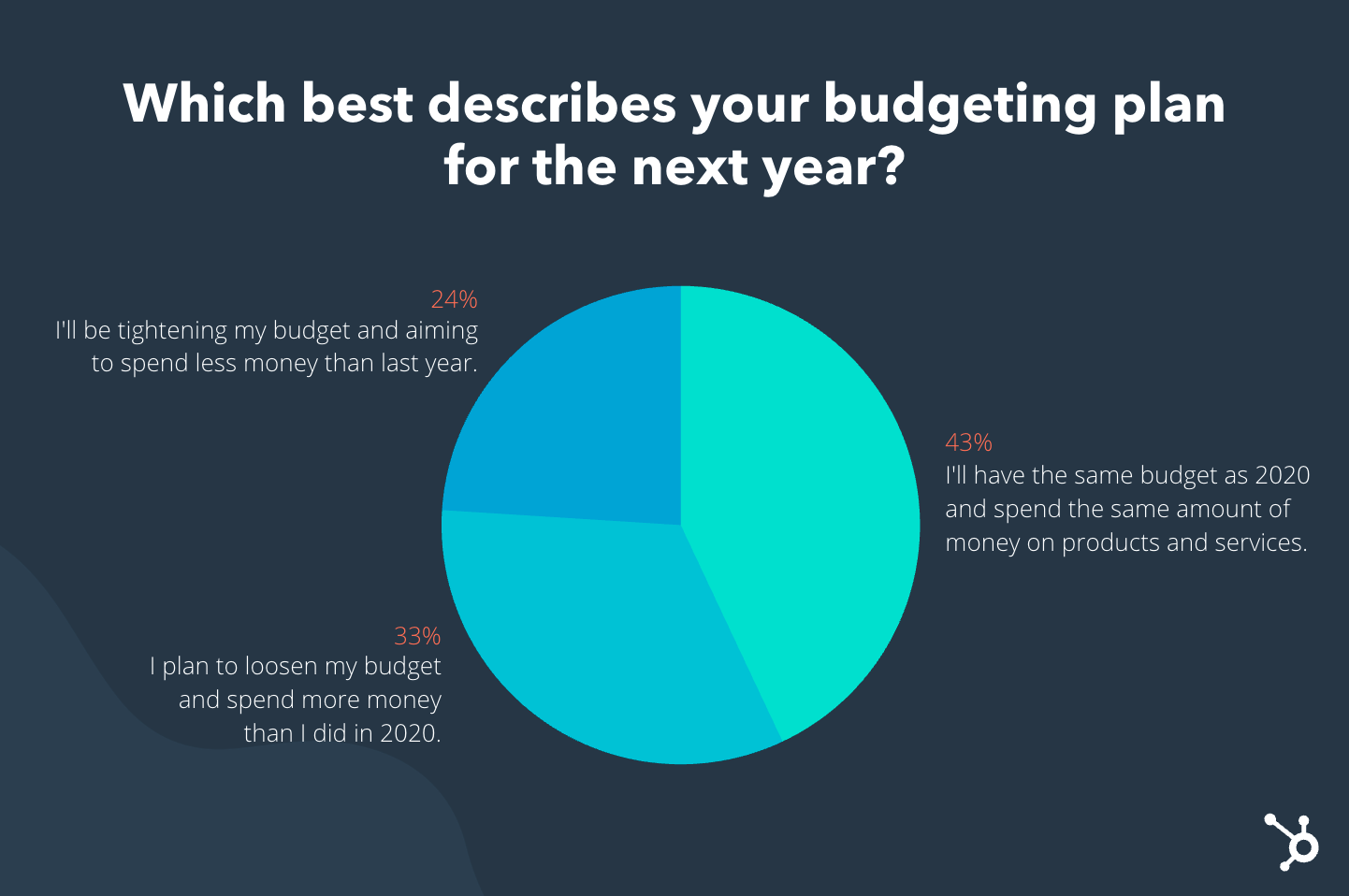
If you sell non-essential products or services or rely on your customers to have a larger budget, you shouldn’t panic just yet. Keep in mind that this is just one small survey of a random consumer group. Additionally, had we polled people in different industries, locations, or age ranges, the results might have been different.
However, what this survey does remind us of is that people are still more conscientious than ever about the products and services they’re purchasing — and likely will remain that way for months to come.
Ultimately, to turn audiences into customers, it’s still more important than ever to market your offering’s value — even if you don’t sell something that’s considered “essential.”
Tips for Marketing Your Product or Service in Uncertain Financial Times
1. Make your value proposition a priority.
When someone is on a tight budget, each dollar they spend has to be worth it. This means that the products or services they buy have to help them do something essential, solve a common pain point, save them time or money, or fulfill other major needs.
As a marketer or business owner, it’s important to learn the ins and outs of your buyer persona, their needs, and what motivates them to make a purchase. Then, you must use your messaging to explain why your offering will be worth their money.
2. Differentiate yourself from competitors.
As a budget-minded person myself, I — like many others — do detailed research before purchasing a product or service. When I decide I need to buy something, I look at all the brands that sell it, their reviews, and the product’s cost. While I might buy the cheapest version of something, I also might consider a higher-end version of a product if something about it is better quality than the more affordable option.
For example, I recently helped my parents pick out their first smart TV. While almost all of today’s smart TVs have similar apps and features, we chose a Roku TV because Roku’s marketing emphasized a simple, easy-to-understand user interface and setup. While it was also quite affordable, the UX alone was the reason for purchasing it over other competitors.
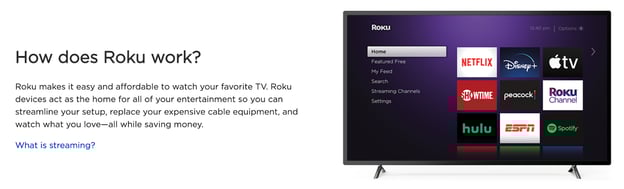
As a marketer, it’s important to remember that people look into many different factors when making a purchase decision — especially when it will be a larger investment. And, sometimes, the price of the product isn’t the only deciding factor. That’s why it’s important to market elements of your product that are different or better than a competitor’s.
3. Leverage customer-generated content.
If you’re struggling to differentiate your product or service, but know you have loyal customers who love your brand, leverage them in your marketing.
Research shows that prospects trust customer reviews, videos, how-tos, and other user-generated content similarly to how they’d trust a word-of-mouth recommendation. Ultimately, when a prospect sees that someone like them has benefited from your brand’s offerings, they trust that you sell something of good quality and value and might be more motivated to buy your product than a cheaper alternative from a competitor with poor or minimal reviews.
Need some examples of how to collect and market excellent UGC, testimonials, or reviews? Check out this guide.
4. Consider discounts or sales.
If your brand can afford to offer small discounts or sales, this can be a great way to attract people with tighter budgets to your brand. Even if your discounts or sales are temporary, a prospect might purchase an on-sale product, love its quality, and return to the brand later because they’ve gained a sense of trust and loyalty to it.
If it isn’t possible to offer sales or discounted services, you could also consider a customer loyalty or rewards program that allows frequent shoppers to eventually receive a free or heavily discounted product. This way, they might feel like every penny they spend could go towards a reward in the future.
5. Highlight your brand’s mission or purpose.
In 2020, the same McKinsey survey mentioned at the beginning of this post, also found that people were beginning to also shop at brands that shared a similar set of values to their own. With this in mind, it’s becoming more common for brands to invest in purpose-driven marketing, or campaigns that highlight a mission, purpose, or set of values the company is serious about.
For example, Kréyol, a Black woman-run fashion brand, embraces Haitian culture and global female empowerment with its clothing and product lines. The company’s “For women, by women” mission aims to improve the lives of women, artisans, and entrepreneurs around the globe by featuring their clothing and designs on the Kréyol site.
“The whole idea behind Kréyol was for me to be able to provide a platform for artisans, specifically women of color, to be able to highlight the wonderful work that they do,” CEO Joelle Wendy Fontaine said in an interview.
While Kréyol’s marketing and business strategy spreads awareness of beautiful artisan fashion, prospects might also be more driven to support the brand because of its trustworthy and authentic mission to improve the lives of women around the world.
Navigating Changing Purchasing Behaviors
As the world continues to reopen and evolve following the pandemic, so will spending habits. While some people will start to begin spending more, others will remain cautious for the next year or beyond.
As a marketer or business owner, you’ll need to listen to your audiences and continue to follow data about your target persona’s to learn how their approaches to money are changing and what efforts you’ll need to take on to continue to win them over.
To learn more about the latest marketing trends and consumer behaviors, check out our recently published State of Marketing Report.

15 Stunning Examples of Small Business Website Design
If you’re a small business, your website has a big impact on your success. Research shows that roughly a third of people use the web to find local businesses. Honestly, I’m surprised that number isn’t higher.
As a small business, you might not have the budget to hire a designer, bring in a development team, or pay for a suite of design tools for your new site. A basic brochure site will probably have to do for now, right?
But here’s the thing: You don’t need a design portfolio or a branding team to make an effective website. A lot of what makes websites work boils down to clear and intuitive navigation, well-written copy, and tasteful use of color, typography, and images — no design degree necessary.
Still, it’s one thing to talk about good design, and another to actually build a website that delivers on all design fronts. Lucky for us, there are many fascinating websites that have figured out what works. So, to help in your design journey, we’ve compiled our favorite examples of excellent small business website design to inspire your own.

Small Business Website Design Examples
There are, of course, thousands of small business websites you can draw from, but we think these 15 serve as a good starting point whether you’re planning a redesign or wireframing your first iteration. By the way, these are all real businesses, so you can click each link to explore the website yourself. Let’s dive in.
1. Bennett Tea
Starting off our list is a gorgeous example of what you can accomplish with color palettes, animated page transitions, scrolling effects, and creative layouts. The Bennett Tea shop offers just a handful of premium tea options, but each is presented elegantly through this online store’s unconventional format.
Typically, stores display their products as grids with links to product pages. On the Bennett Tea website, however, users scroll down to explore each offering, with a life-sized image of the tea box and descriptions of the taste, aroma, and mouthfeel. It’s the perfect visual palette to complement the company’s variety of tastes.
Also notable is the site’s navigation experience. Upon landing on the website, visitors are shown a splash page stating the company’s mission. They then have the option to continue to the store or go to the About or Contact pages. It may require one additional click to get to the store page, but this choice puts the branding front and center for potential customers.
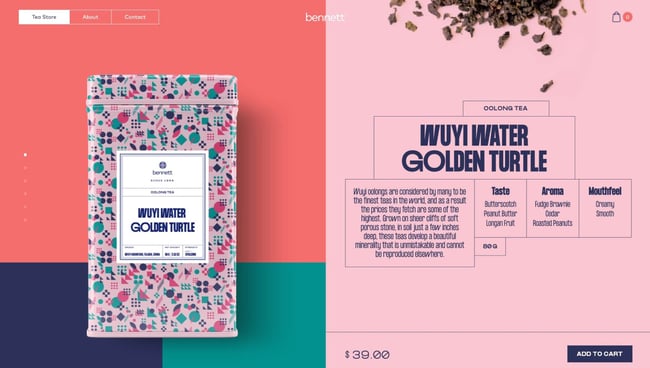
2. Aroz Jewelry
Belgium-based jeweler Aroz has constructed an immaculate website to showcase and sell their items. Offering a variety of accessories, Aroz first greets visitors with a full-width image, below which they present their pieces in a grid slider.
As users continue scrolling, the website makes frequent use of zoom-in animation, slide-in animation, and fade-in effects for greater visual impact. Each text section establishes the store’s offerings, capped off with a contact form and a social media CTA.
For those looking to learn more about Aroz, the website also includes a blog featuring new collections as well as customer and designer stories. All of these components work to conjure a professional, sophisticated, and unique brand image — a great example of what an ecommerce site can be.

3. Chicago French Press
If a tea shop can have a fantastic website, why not a coffee roaster? Chicago French Press sells a variety of rotating flavors while donating a portion of its proceeds to nonprofits and charitable organizations.
Like Bennett Tea, this website emphasizes the aesthetics of the product packaging. It also implements color backgrounds to distinguish between flavors, as seen in the full-width image slider on the homepage.
The Chicago French Press store is easy to navigate, as visitors can search by different criteria including flavor, brewing method, and bag size. And, if you want to incorporate their flavors with food, the website’s blog includes recipe posts too.
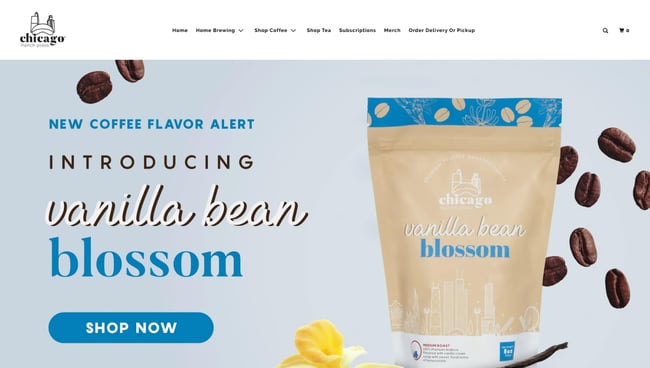
4. Wildwood Bakery
Wildwood Bakery’s website incorporates illustrations in small but stunning ways. The Australian bakery has made a simple but captivating website with little more than some delicate illustrations, a nice orange-and-green color palette, and mouth-watering close-ups of their creations.
On the homepage, visitors can learn about the bakery and click away to the website’s online store or sourdough subscription service. The bottom of the page sports a footer with social links and other useful resources. Note that the footer is more prominent than usual — the large text draws the eye to other important aspects of the business like sustainability and wholesale.
Wildwood’s store page is also worth checking out. Customers can filter products by flavors and quickly add anything to the cart. It’s clear that the designers considered everything, as even the card icon itself is a custom illustration. It’s these details that make this site exceptional.

5. AÃRK Collective
The website for watchmaker AÃRK Collective leaves no question as to what it does — from the start, its timepieces are displayed in full-page, aesthetically pleasing images. The whole thing resembles more of a gallery than an ecommerce site and establishes the brand’s commitment to simple and elegant designs.
But, this is ultimately an online store, and scrolling down reveals AÃRK’s product lines in a masonry grid style. The presentation is quite minimal, but this lets visitors focus solely on the designs themselves. There’s no other information until you click on an item, which sends you to a product page with all the relevant information, plus many more images to be sure you’re making the right watch purchase.

6. Cleenland
Not all websites have to be visually elaborate — this is proven with Cleenland’s online store. The Boston-based company sells low-waste home care and personal hygiene products, and the site wastes no time nudging visitors to visit the physical location.
Visitors can also shop online in Cleenland’s online store, which lists its product categories with images of each product and information about the supplier. This way, you know products are sourced sustainably. There’s even a “popular products” category serving up the best this store has to offer.
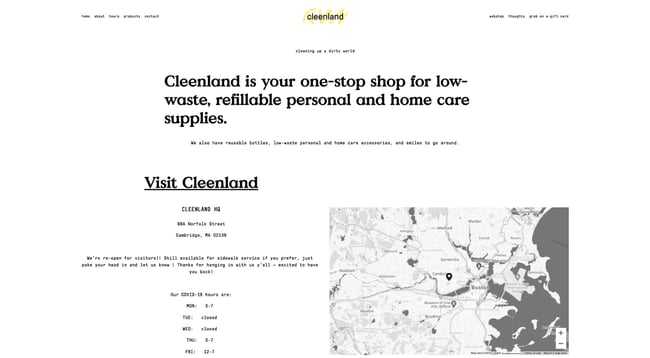
7. Ladies Get Paid
Ladies Get Paid is a membership website that offers financial and professional education courses for women. There are online classes, speaker events, and networking events, as well as job postings and online communities, all to fuel career advancement and financial confidence.
From a visual perspective, Ladies Get Paid does a fantastic job of presenting its variety of benefits in a straightforward manner. Its mission is clear from the start, and the page header lets guests view each offering in more detail.
The website also effectively incorporates hints of color in its interactive items. Its cards and buttons match each other for a cohesive feel and incorporate subtle hover effects for a pleasing user experience. Overall, the website is bold but inviting, a difficult but certainly achievable balance.

8. Good Vibes All Purpose Cleaner
Maybe I’m just biased toward sustainable cleaning products, but Good Vibes All Purpose Cleaner presents a simple, effective ecommerce site that manages to convey its philosophy and offerings seamlessly.
Good Vibes has no frill with its product displays — products are shown in a grid format as you might expect. However, the website also prominently features reviews and testimonials from customers below to instill confidence in new buyers.
Each product page includes a description as well as cleaning instructions, ingredients, reviews, and recommended products. It’s enough to make a positive impression without relying on visual gimmicks.

9. Wisr
I never expected to have this much fun on a financial services website, but here we are — Wisr offers personal loans, financial planning, and, above all, an incredibly amusing homepage. As you scroll, you follow the path of a simulated marble course from start to end. With each obstacle, you learn more about what Wisr does.
Whether you think this design choice serves as a metaphor for the often unpredictable financial road ahead, or just a cool thing to look at, this website definitely stands out among the rest.
As another cool secondary feature, the website remembers what page you exit from. So, upon a return visit, you’ll see a prompt inviting you back to the page where you left off. It’s a clever use of cookies that can help get prospects back on the conversion path.

10. Cafe con Libros
Intersectional Feminist bookstore Cafe con Libros (Coffee with Books) not only offers espressos with your purchase — it also boasts a fantastic website with everything you need under one domain name.
This site manages to pack its book inventory, merch store, event calendar, and mission onto the homepage alone without overcomplicating things. Visitors can also order any book from the store — physical, e-book, or audiobook — for pickup or delivery through the site.
As if that weren’t enough, the website also maintains an active blog with reflections and book reviews, a newsletter, a monthly book subscription service, and a podcast with an on-site player. It’s an excellent balance of quantity of offerings with quality of design.
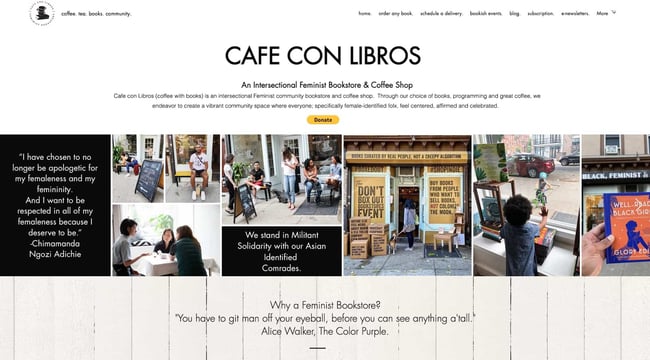
11. Reform Collective
Design agency Reform collective features one of the most cinematic scrolling experiences I’ve seen on a website. It combines fixed scrolling with horizontal scrolling to showcase each section in chunks while keeping visitors on the same page.
Each individual section mentions some piece of the company, be it their design style and philosophy, a case study, testimonials, or a contact form. If you’re looking for a long-scrolling website that presents information to visitors in a specific linear sequence, try emulating this trick — it ensures users see what you want them to and in what order.

12. Sweet Dreams
Sweet Dreams may create CBD and melatonin products for better rest, but don’t sleep on this website. Combining 2D and 3D illustrations, scrolling animation effects, customer reviews, and even interactive graphics, the homepage for this small business does a great job getting visitors in the mindset of their product before promoting the products themselves.
Informational sections are interspersed with product links so that new customers, whether sold or skeptical, know what they’re buying and how these products work. To learn more, the About page includes masterful visuals and copy to put visitors at ease. Given what they’re selling, that seems like the right approach.
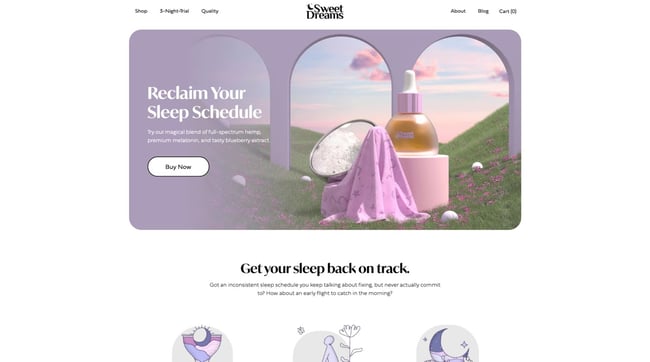
13. Panache
The graphic design and branding experts and Panache have proven their abilities with their one-page informational website. This is another example of how scrolling can be much more than a way to traverse the page — here, it triggers colorful transitions and animations that leave a strong impression.
Panache makes this list because, rather than including a separate gallery for showcasing the work, it blends its aesthetic approach into the construction of the site itself. This ultimately gets potential clients down to the contact form more quickly. There are also navigational links along the left side of the page in case visitors wish to return to a particular section.
14. Scott’s Cheap Flights
The goal of Scott’s Cheap Flights is to help U.S. travelers easily and cheaply book vacations to international destinations. Its membership website is suitably simple: Just sign up and start getting daily emails with the latest discounted flight offerings.
Once signed in, the website places its offers front-and-center — each one occupies a card with a colorful image of the destination. Clicking a card takes you to a page with information about the destination, instructions on how to book, and ticket prices by airport. Some cards are premium, and the “Upgrade” button lingers in the top right tempting users to subscribe.
Additionally, this website also provides a ton of extra value to free and premium users in its blog section. In it, there are tips for booking flights, travel advice, and guides for exploring new cities.

15. Music Audience Exchange
Finally, Music Audience Exchange (MAX) creates partnerships between brands and musical artists for promotional purposes, with a website that conveys class and professionalism.
Since it caters to both artists and companies, it features two pages for both types of clients, with step-by-step guides explaining how the process works. It’s an efficient means to channel both brands and musicians alike toward an application form and a conversion.

Big Design Ideas for Small Businesses
Designing a website is, without a doubt, a challenge for small businesses. But after some perusing, you can come up with a list of your favorite inspiration sites and what makes them pop, then incorporate these features into your own site. Plus, you probably spend a good deal of time on sleek sites already and have a good sense of what you’ll want.
Looking for more inspo? Check out all of our website design resources, including our Website Design lookbook — just click below.


21 of the Best Brands on Instagram Right Now
Contrary to what your friends’ photos suggest, Instagram isn’t just a social network for selfies and brunch pics. In fact, Instagram has over 200 million businesses that use its platform and 90% of users follow at least one of them, according to 2019 data.
In a time when visual content remains a crucial part of any brand’s marketing strategy, Instagram marketing presents a unique opportunity to showcase your brand identity.
Ready to get inspired? Check out this list of brands that are thriving on Instagram right now, and why their posts set them apart.
Best Brands on Instagram
What makes a brand great on Instagram?
We polled 301 users across the United States, and asked “Which of the following describes the brands you follow and enjoy on Instagram?”
These were their top answers:
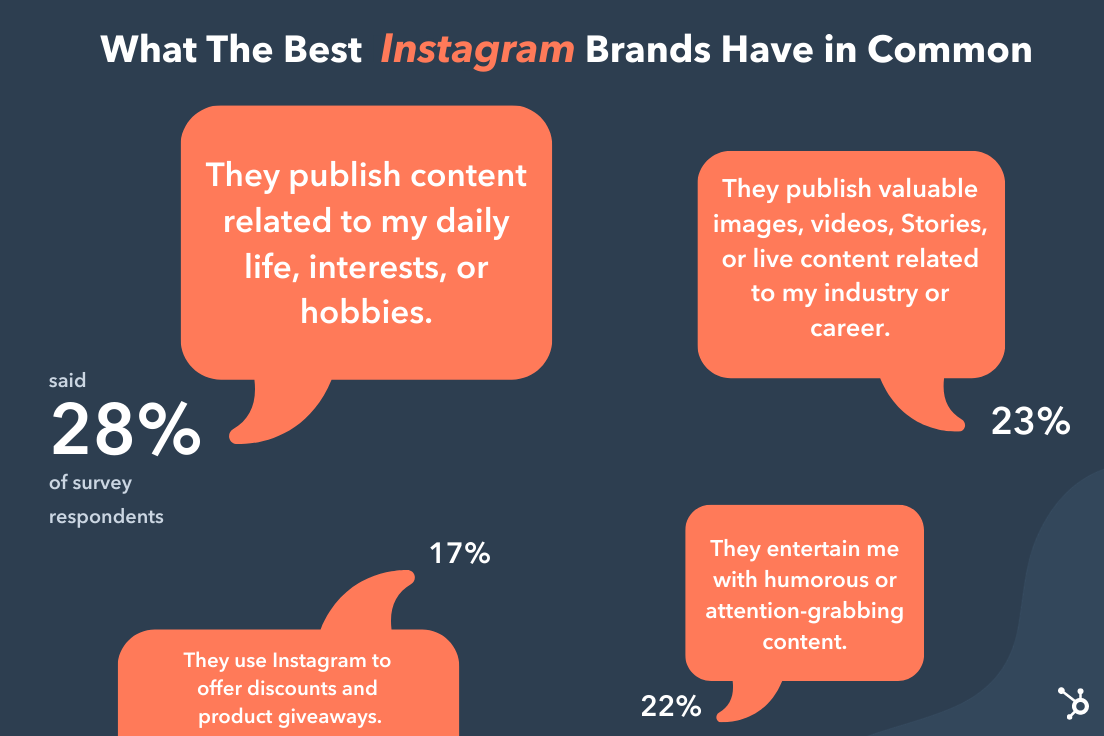
While this data is from a small sample, it does highlight what we already know about Instagram audiences. They look for:
- Content that relates to their lives: both personal and professional.
- Eye-catching, fun content.
- Product promotions
What you’ll see in the next section is that every brand featured meets these needs, earning them high follower counts and high engagement rates.
Psst – Want to get a stunning Instagram Story auto-magically created for your brand? Check out StoriesAds.com, a free Story generator from HubSpot and Shakr. Click here to get started.
1. Netflix’s Strong Black Lead
Followers: 682k
Here is an example of a brand that has mastered the art of having its own identity while remaining connected to its parent brand.
Strong Black Lead is a sub-brand under Netflix dedicated to amplifying Black stories in media.
The brand’s Instagram page mainly features screen grabs and short clips from TV shows, movies, and documentaries available on Netflix that feature Black actors and/or directors. They stay on-trend, posting relevant content based on current events, holidays, and buzzy topics.
In addition to its appreciation posts for widely loved TV characters, Strong Black Lead also promotes content the brand hosts on other platforms, such as podcasts and YouTube content.
2. Califia Farms
Followers: 303k
Warning: If you’re hungry, don’t head to Califia Farms’ Instagram page.
The brand’s food photography makes it stand out among the rest, showing users how Califia Farms’ products can be used to create dishes ranging from pancakes and nice cream to artichoke dip and fettuccine alfredo. 
The brand doesn’t shy away from featuring its product in the images either. You can usually find it somewhere in its visual content, whether it’s the main subject of the photo or more in the background.
3. Anima Iris
Followers: 33.4k
You probably thought this list would only feature enterprise-level brands, huh?
Well, there are a ton of brands that have found the magic recipe on Instagram and Anima Iris is one of them.

What sets this brand apart is the transparency of its CEO.
If you watch one of Anima Iris’ Instagram Stories, you’ll probably see its CEO, Wilglory Tanjong, showing the behind the scenes of running a luxury purse brand, which helps its audience feel more connected.
You’ll probably also see Q&As, surveys, and user-generated content – all strategies that have helped the company build a strong online community and gain brand loyalists.
4. Lorna Jane
Followers: 1M

If your brand were a person, how would you describe its personality? Australian activewear company Lorna Jane has done an awesome job answering this important branding question with its Instagram content.
Spend just a few seconds scrolling through these photos, and you’ll quickly be able to name the target Lorna Jane buyer: a young, sporty, twenty- or thirty-something woman who values looking good while maintaining an active lifestyle.
The images posted by Lorna Jane, which often show the brand’s clothing and accessories, as well as images of women who embody its target buyer persona, are colorful, playful, and inspirational, which is a perfect representation of the brand’s essence.
5. Letterfolk
Followers: 353k
Letterfolk is a small business run by a couple who create and sell beautiful, handcrafted felt letterboards. Each letterboard comes with a full set of characters so people can personalize the walls of their homes, which means endless room for creativity.
Instagram is the perfect platform for them to inspire customers and aspiring customers with real customers’ boards, as well as ideas they’ve come up with and staged themselves. Their Instagram content is funny and relatable – a great recipe for shareability.
Not only is this photo showing a funny and clever message, but it’s also very relatable. That’s why the comment section is rife with Instagram users saying things like, “No truer words have been said” and “The struggle is real.“
6. Apartment Therapy
Followers: 3.1M
Apartment Therapy’s Instagram account really is a source of therapy, if you love the sight of cozy homes.
Here are a few recent posts to Apartment Therapy’s Instagram feed. 
From home decor inspiration to fun challenges like their #SmallCoolChallenge contest and trendy user-generated content (UGC), this brand gives its followers plenty of inspiration to personalize their own space and “live happy, healthy lives at home,” as written in their profile bio.
7. Sunday II Sunday
Followers: 20.1k
Sunday II Sunday is another small business with a robust social media presence.
The brand describes itself as “haircare for active women.” As such, its content revolves around having and managing an active lifestyle.
Sunday II Sunday also does a great job of engaging its followers, asking them questions about their routines, workouts, and hair care habits.
8. Tentsile
Followers: 203k

“Stunning” is the first word that comes to mind when I scroll through Tentsile’s Instagram photos.
Tentsile sells tree tents, what they call “portable treehouses” to elevate your camping experience. Its Instagram page is full of beautiful lifestyle images of their products in just about anywhere in the world: rainforests, mountains, beaches… you name it.
What the brand does well is leveraging its UGC. This saves time and resources, plus giving the brand some social proof.
9. Desenio
Followers: 1.8M

The first thing you’ll notice when you land on Swedish online art print company Desenio’s Instagram page is color blocking.
Every image blends beautifully with the one next to it, creating a cohesive, visually appealing page you never want to leave.
Even when using user-generated content, the brand ensures it fits within its aesthetic. Establishing consistency in your creative assets is key in ensuring brand recognition (i.e., when people see your image anywhere, they know it’s you.)
However, from time to time, Desenio will stray away from its usual look, which creates even more intrigue.
The post above was a simple holiday card from Desenio, but it was so dramatically different from the look and feel of the business’s usual interior design, followers just had to click through to see more.
Many of the comments included exclamations of how beautiful and evocative the post is. One commenter was inspired enough to describe what winters are like where they live.
10. Bolden USA
Followers: 32.1k
Instagram is all about visuals. This means that within minutes of being on Instagram, a user can be bombarded with images.
So, the question is: How do you make sure your brand stands out and is memorable?
One way is by developing a unique aesthetic and remaining consistent. Bolden USA has done just that.

To mirror its green logo, the theme of Bolden USA’s Instagram is green. While the brand features other colors in its images, green is always the primary, standout color – an effective tactic to aid brand recall and recognition.
11. Vans
Followers: 17.4M
Vans is known for its stylish shoes and its Instagram business account is no exception.
The maker of the classic checkered slip-on sneakers has a flashy Instagram feed, featuring both standalone product shots and action photos of people expressing themselves in their favorite Vans gear.
One thing that’s clear by looking at Vans’ Instagram account is that its identity is no longer tied solely to skateboarding. While you’ll still see lifestyle images with skateboarders, you’ll also see surfers, cyclists, and other young, fashionable kids.
So, as your brand identity and messaging evolve, your content should also follow suit.
One of Vans’ most interesting posts was this.
Just because you’re promoting an ordinary product launch doesn’t mean the social media post supporting the launch should be equally ordinary.
Vans’ recent video, above, endorses a line of shoes called ComfyCush, but the video itself is a little, well, weirder. And for a business so dependent on style, the right amount of weird can give Vans an awesome amount of engagement.
12. Grass-Fields
Now, here’s a brand that knows how to show its personality.
This Cameroon-based clothing brand isn’t playing it safe on Instagram with static model shots and sale promotions.
Instead, Grass-Fields showcases its products through fun, vibrant dance videos, and behind-the-scenes content.
The brand also highlights Black business owners, creators, and artists on its page, which caters to Black women.
The key takeaway here is: Don’t be afraid to do things differently than it has been done if that’s what your audience responds to.
13. Finfolk Productions
Followers: 316k
Ever wanted to be a mermaid? You can come pretty close, thanks to companies like FinFolk Productions. Believe it or not, silicone mermaid tails you can put on and swim around in are quite trendy.
Finfolk Productions’ Instagram feed is full of beautifully shot photos that play into the mermaid fantasy by looking more like mythical art than real people.
One of the brand’s most engaging posts had a personal touch.
The post above is two things in one: a new product and a sentimental announcement by the company founder, Bryn Roberts.
For most of Finfolk’s followers, the white mermaid fin above isn’t just a different color from the typical fins made by the company. It’s also emblematic of Bryn’s recent wedding, for which she wanted to make a bridal-style mermaid fin that all of Finfolk’s customers would appreciate.
14. Shiseido
Followers: 660k
Shiseido started as Japan’s first Western-style pharmacy 140 years ago and has since developed into selling high-quality brightening and anti-aging skincare, makeup, and fragrance products.
Its mission is to inspire a life of beauty and culture – a mission it portrays beautifully through Instagram content.

Back in late March 2016, Instagram started rolling out the ability to upload 60-second videos – and we’ve seen some amazing Instagram videos from brands ever since, like the one below from Shiseido.
The one above lasts nearly all 60 seconds and its product demo is curiously satisfying to watch.
Hot tip: Posts featuring faces, especially for a skincare brand, are ideal for boosting social media engagement.
Don’t be intimidated by highly professional Instagram videos like theirs. You can post highly engaging videos on Instagram without a huge video team or a bottomless budget. Here’s a step-by-step guide for making great videos on Instagram without breaking the bank.
15. Sephora Collections
Followers: 835k
Sephora Collections’ brand personality is playful, colorful, and feminine. It does a wonderful job of characterizing this personality in its Instagram content, using bright colors, patterns, and fun captions.
In addition to partnering with beauty influencers, the brand also promotes content from everyday makeup users, featuring their tutorials and looks on its feed.
16. Clare
Followers: 93.1k
If you’re renovating or simply moving into a new home, you’re likely looking for inspiration on social media sites like Instagram and Pinterest.

Clare’s Instagram features a collection of carefully curated images that meet that exact need. You’ll find everything from new product promotions to home decor tips – everything in between.
There’s also a beautiful balance of colors on Clare’s Instagram page, creating a cohesive profile that’s s inviting, warm, and inspiring.
17. HoneyBook
Followers: 82.9k
What we love about HoneyBook is how accessible its content is.
Instagram, like many social media platforms, has been slow to develop and promote its accessibility features.
Thankfully, brands like HoneyBook have taken an active approach to make their content accessible by adding captions to their videos and adding image IDs that describe every image the company posts.
For deaf, hard of hearing, and visually impaired users, these extra steps go a long way.
18. Design Essentials
Followers: 139k
Design Essentials knows that hair is more than just something that grows on your body. It can speak to a community, a culture.
That’s why the brand does more than just promote products on its Instagram page. In addition to product shots, you’ll find inspirational quotes about hair, playful memes about everyday life, and fun reposts from Design Essentials’ audience.
19. Flodesk
Followers: 36.5k
Flodesk’s Instagram is everything you want to see on social from an email marketing platform: beautiful designs and inviting content.
When you land on Flodesk’s page, you’ll gain tips on how to use its platform as well as general tips to optimize your email marketing strategy. With the use of vibrant colors and playful designs, every post is an attention grabber.
What’s more, almost every post includes a call-to-action that invites the audience to engage. Whether it’s to drop an emoji in the comments or answer a question – engagement done right.
20. Omsom
Followers: 35k
Omsom is another small business that has leveraged its CEOs, two first-generation Vietnamese sisters, to build a community on Instagram.
As you scroll through Omsom’s Instagram, yes, you’ll find beautifully crafted images showcasing the dishes you can make using the brand’s food products. However, that’s only one piece of the puzzle.
You’ll also see many posts celebrating Vietnamese culture, and debunking Asian-American stereotypes and biases.
This strategy helps consumers connect with the Omsom beyond the delicious food and understand its broader mission and purpose.
21. Chipotle
Followers: 1.1M
Instead of reeling in consumers with food pictures, Chipotle has chosen another route: hilarious memes.
While you may find the occasional food post, the brand has focused its Instagram strategy on showing its personality.
Here’s why it works: Memes are shareable and tag-friendly, which helps Chipotle reach new consumers as people tag their friends in funny, relatable posts.
The common thread in all the brands featured is that they had a consistent brand identity that was reflected in their visuals and a deep understanding of what resonated with their audience.
Ready to populate your Instagram timeline with pics and videos that are as captivating as the content above? We believe in you!

38 Fun Corporate Team-Building Activities & Outing Ideas Everyone Will Enjoy
Are you starting to notice some droopy shoulders around the office? It sounds like it’s time to plan a team outing.
Team outings are a great way to facilitate bonding with your team members, reduce employee stress, and give them the chance to get to know one another outside of the office.
And, you know, they’re entertaining.
But how do you find ideas for a great team outing? Maybe you start with a Google search for “team outing ideas” and stumble upon an article that suggests “field trips” and “professional development activities.” It sounds like a starting point, but where’s the real excitement?

Next time you plan an outing for your team, cut the trust-falls and get one of these ideas on the calendar instead. We have something for everyone — from perfect activities for remote teams to large or small in-house groups to events that enhance teamwork and events that all team members can enjoy outdoors.
Why should you do team-building activities for work?
Team building activities can be embarrassing for coworkers, and some don’t even add anything that relates to the workplace. For example, while ‘trust falls’ seems like an excellent idea, forcing it doesn’t improve trust among coworkers, and what is worse, it can result in injuries when pairings are not even.
However, not all team-building activities are detrimental to your workers, as you would see from the ideas we highlight in this post.
One of the most significant advantages of the right team-building activities is that it boosts morale among your workforce. Team members get to work together on exciting and challenging activities and can display their skills and talents.
Team-building activities and games that boost morale can break down barriers among employees and create an environment that is nice to work in, which is vital to a successful and well-functioning business.
The ultimate goal of team-building activities is to get your team members to bond and build trust with each other. People with different backgrounds, needs, ambitions, and personalities make up teams.
By engaging in the right team-building activities, you can bring these different people together to build a bonded, trusting team.
When your team bonds, it results in several benefits for the company. Some of these benefits include:
1. Improved Communication Skills
Communication between staff and departments is essential to a company’s success. Team-building exercises put people in a relaxed environment and encourage them to communicate while completing tasks.
2. Improved Productivity
Better communication skills will have a domino effect on productivity levels. When your employees work together and communicate, there is less work duplication and less friction between workers.
3. Identifies Leaders
Another benefit from team-building exercises is that managers can discover leaders within the workforce while engaging in team-building activities.
Regardless of the type of event that you want to enjoy, here are eight essential things to consider:
1. Define your goals.
You must determine clear areas of focus that you want to enhance during team-building events. Only after selecting the activity’s goals can you successfully choose the activities and challenges that would best fit the occasion.
2. Set a budget.
A budget needs to be determined after you have decided on your priorities. With a realistic budget, you can ensure that the price of the event doesn’t run out of control.
3. Set up a planning team.
As you begin planning, you will discover how difficult it can be for one person to organize a team-building event. There are so many things you need to prepare for, and the best way to deal with these things is to delegate responsibilities.
4. Invite and involve the right people.
Sometimes, it is easy to determine who to invite. Some other times, it can be challenging choosing who to invite. To help you, ask yourself (or the planning team these questions):
- Is it a compulsory event?
- What is the maximum number of people that the budget and venue can accommodate?
- Will remote employees be invited?
- Can anyone attend the event?
Answering these questions can make it easier for you to invite the right people.
5. Select the right activities.
After determining the goals of the team-building event, you should have a clear idea of activities that will align with these goals.
It is best to choose activities that are interactive, engaging and that build collaboration among employees.
6. Choose a great time.
The best time for a team-building event depends on the schedule and personal lives of those you plan to invite. Ensure that invitees are free before you commit to a day and time. You also need to take the weather and season into account when choosing a date – especially if organizing an outdoor activity.
7. Choose a good location.
The location is one of the factors that can make or mar your event. You need to avoid places that’ll not accommodate enough people or that aren’t suitable for the activities you’ve planned.
8. Market the event internally.
Marketing the event internally will likely build excitement among employees. Developing and distributing an “Event Day Agenda” that highlights all the activities employees will enjoy will increase expectations for the day and get folks excited.
Remote Team Building Activities
1. Virtual Break Room
The simple chats that happen on the office floor are sorely missed. Since most members of your team still work remotely, a virtual break room is an excellent team-building activity.
You can create this via Zoom or some other platform where staff can log in and join over their lunch or break – allowing them to catch up with coworkers as they would in a physical office.
You can also keep water cooler moments alive by encouraging workers to share interesting photos or videos.
2. Virtual Escape Room
Since the pandemic made physical escape rooms impossible to visit, a Virtual Escape Room brings the mystery to your workers right in their homes!
Depending on the Escape Room you choose, team members have to pass through different rooms, solve the puzzles they encounter, solve a murder, and so much more!. It is just as fun as it sounds, and what is more, it builds collaboration and communication among staff.
3. Beer Making
In this team-building exercise, team members become brewers for a day right from their homes. The process does not require prior knowledge as Beer Making Experience walks participants through each step of the journey. Kits are also delivered to interested staff.
4. Virtual Scavenger Hunt
You can quickly organize this team-building activity over a Zoom call. On the call, challenge team members to collect different items from around their homes.
The first person to show all the required items wins the hunt!
5. Set Competitive Challenges
A little friendly competition never hurts any team – on the contrary, it can strengthen the bonds of unity.
Setting up challenges for your teams can give them a goal to work towards. One popular challenge is the fitness challenge. It provides healthy competition between teams and improves their health.
6. Icebreaker Quizzes
These quizzes are an exciting and safe way to do team-building weekly. You can choose an online ice-breaker quiz like Quizbreaker, which sends out a new round of quizzes weekly to the team. It can work wonders to bringing remote teams closer as they learn more about each other while having loads of fun.
7. Visit Paris Virtually
One challenge many HR departments face is onboarding new hires. Virtually visiting new places with tools like Woyago is a unique and exciting ice-breaker. The virtual tour offered by Woyago has real-life Parisian guiding participants while throwing challenges along the way.

Large Group Team Building Activities
8. Scavenger Hunt
Find a beautiful day, break everyone out into groups, and have a scavenger hunt around the city. You can organize one yourself or use a creative service like The Go Game (which lists companies like Netflix, Facebook, and HBO among clients) or Stray Boots.
Your team members will feel nice and rejuvenated after some fresh air and fun challenges. Be sure to take plenty of silly pictures — you can even have a slideshow when everyone regroups at the end.
Alternatively, you might try a “Random Acts of Kindness” hunt. For instance, Outback Team Building & Training offers this team building activity, which requires teams to split up into groups, download Outback’s app, and complete a series of challenges to benefit strangers in the community.

Image credit: The Go Game
9. What’s My Name?
You might have seen this game played before. It goes by different names, and the more people who play, the better it is.
What’s My Name is an activity where each player is assigned the name of a person — dead or alive — and displays that name on their back, head, or part of their body such that only the other players can read the name. You can write these names on index cards or Post-it notes.
Once team members have been assigned a name, the players mingle with one another, treating their coworkers the way they’d treat the person listed on that coworker’s card. They can also ask questions about their own hidden identity until they correctly guess who they are.
What’s My Name has no complicated rules or potential for competitiveness. It’s simply an empathy-builder — a critical ingredient of good company culture — allowing team members to find out what it would be like to be treated the way someone very different from them might be treated every day.
10. Cook-Off
Here’s a culinary team-building activity that could end in dessert or disaster — in a fun way. Creating new dishes together requires creativity and will require everyone to put their team and leadership skills into action.
Divide your team into smaller teams, pick a food category, and challenge each team to whip up something delicious. The category could be anything from ice cream, to salsa, to pizza.
One fun twist you could add? Pick a single ingredient that all teams must use, like maple syrup or Oreos. Or, have each team get creative thinking caps on with the shape of its food — you can make pizzas into almost any shape.
11. Sneak a Peek
What do you get when you add a test of memory to a game of Pictionary? Sneak a Peek. In this game, team members break off into groups of at least four and take turns recreating objects from memory.
Using LEGOs, clay, building blocks, or a similar set of construction items, one game leader will craft an object or structure for every group to recreate. A member of each group then has 10 seconds to “sneak a peek” at the structure (which is hidden), return to their groups, and describe what they saw to the rest of the group so they can recreate it.
Each group has its LEGOs, clay, or building blocks. If it isn’t complete after a minute of recreating the structure, another member of each group sneaks a 10-second peek at the game leader’s object and comes back to instruct the group further.
This rotation continues until a group is confident they have recreated the item. The object of the game? Be the first group to recreate it.
Not only does this game help team members practice project management, but it shows you how to accomplish tasks using input from a variety of sources. It’s also just a fun way to see how good your coworkers are at retaining information.
12. Board Game Tournament
Here’s one way to spark your team members’ competitive sides without having to leave the office. Organize a team-wide board game tournament.
Especially if your team is pretty big, it might be easiest to pick a single game, then have one team member sign up for specific time slots when they’re free to leave their desks and spend some time playing the game.
Some great games with reasonable play times include Boggle, Jenga, or even games using good ol’ playing cards. Don’t forget to incentivize with prizes for first, second, and third place.
13. Office Trivia
Who says trivia night only takes place at the bar? Office trivia is the perfect way to bring a large group of colleagues together and challenge the brain in areas that don’t necessarily apply to their daily jobs. Break the company into teams of four or more and offer small prizes for the teams who score the most points.
Want to write your own trivia questions? For reference, trivia questions are generally sorted into categories — four or five trivia questions per category — with optional bonus questions at the end of the game.
While you can give each question a point value, you can also assign each team a certain amount of points per category that they can bet, instead. Each team can then bet as many or as few points as they want per question until they’ve used all their points for that category.
Not prepared to create your own trivia questions? Hire a trivia organization to host a trivia night at your office. There are tons of national trivia companies who’d be happy to host an event right on site — District Trivia, The Trivia Factory, and the Big Quiz Thing are just a few of them.
14. 4-Question Mingle
This activity has each team member moving around and meeting each person individually. It is excellent for teams that have spent some time apart or groups that have just been formed. Armed with four questions, each person gets to know coworkers better.
Small-Group Team Building Events
15. Improv Workshop
Comedy and improv events are fun, interactive experiences that’ll have your employees roaring with laughter while teaching them useful communication and soft skills, like focus and trust.
Depending on your budget, you could do anything from simply playing improv games with your employees to bringing in professionals to run competitive, fast-paced activities.
16. Two Truths and One Lie
This is a classic house party fun activity, but it’s also an excellent ice-breaker when integrating coworkers who don’t yet know one another.
Two Truths and a Lie is simple: Start by organizing the entire group into a circle and give each person the floor to introduce themselves. In addition to providing their name, however, every team member also says three things about themselves —only two of which are true. It’s up to the rest of the group to guess which statement is the lie.
17. Karaoke Night
What better way to get your employees to break out of their shells than to have them get up and sing some karaoke? You can even have a contest for the best group karaoke performance.
Bonus points if there are feather boas and cowboy hats involved. This activity works best for a more extroverted group, so if your team isn’t into strutting their stuff on stage, consider an idea on this list that caters more to those personalities.

Source: derekgavey
18. The “Suddenly” Story
If you’ve ever told stories around a campfire, you might have narrated a variation of The “Suddenly” Story. This activity is the choose-your-own-adventure book of team-building.
However, putting activities. You’re not just telling a story — you’re piecing a story together using the (often hilarious) imaginations of your coworkers.
To tell The “Suddenly” Story, gather your team in a circle, and offer the opening three sentences to a story about anything. At the end of the three sentences, say “Suddenly …” and pass the story onto the person next to you.
It’s their job to take your three sentences and build on the story with another three sentences, followed by “Suddenly …” Each mention of “Suddenly” allows the story to take a turn. What that turn looks like is up to the next person in the circle.
The “Suddenly” Story helps people find ways of building on existing content while also being creative when all ears are on them. Try it the next time you want to get your department together for a break, and you’re sure to get everyone laughing.
19. Go-Kart Racing
There’s nothing like a bit of competition to bond a group together. An adrenaline-pumping activity like kart racing is a great way to get employees to interact with one another in a totally new and fun way. Just make sure everyone pays attention during the safety lecture.
20. Concentration (Marketing Edition)
Here’s a professional spin on the 1960s game show. The original game show, called Concentration, put 30 numbered tiles up on a board, each tile with an identical tile somewhere else on the board. What made them similar? They had matching prizes on the back.
Over time, as contestants opened up more tiles, they had the opportunity to select tiles they knew would match up and win the prize written on the back.
Businesses — especially marketing departments — can have a field day putting logos, slogans, and company names on the back of their own tiles and having players match up every piece of the brand.
As your business grows, you can even put the names of your products, employees, and job titles on the backs of your tiles to see how well your coworkers know the company they work for.
21. Sales Exercise
This activity is perfect for your marketing team but can still be enjoyed by all types of teams and encourages creative thinking. In this building exercise, each group is given an item, from the mundane to the strange. The teams each have five minutes to come up with a creative advert. The team with the most creative advert wins each round.
Teamwork Team Building Activities
22. Professional Development Workshop
Want to encourage team bonding while providing each team member with an opportunity to learn and further their career?
Offer a shared learning experience either at your office or at an off-site workshop or conference. The activity could be specifically related to your employees’ jobs, or it could be something broader, like a negotiation or leadership skills workshop.
23. Jigsaw Puzzle Race
Jigsaw puzzles can be a tedious thing to put together alone. Maybe you have one set up at home and make progress on it for a couple of hours every weekend.
However, putting your numerous brilliant colleagues on the case makes a jigsaw puzzle an enjoyable problem-solving activity. Break the company into teams for a multi-puzzle race, and suddenly you have a test of teamwork that electrifies the entire office.
Grab several copies of the same puzzle and turn your weekend activity into a contest to see which team can complete the puzzle first. Offer prizes just like you would in a game of office trivia.
Just be sure each team has the same number of people and choose your puzzle size wisely. A 1000-piece puzzle, for example, might be a bit time-consuming for a team of just five or six people.
24. Room Escape Games
Here’s a great bonding activity that requires leadership skills, teamwork, logic, and patience. Room escape games — Escape the Room, Puzzle Break, AdventureRooms, etc. — have become a wildly popular team-building exercise for groups around the globe.
Here’s how it works: A group of people gets “locked” in a room for one hour. During that time limit, they have to find hidden objects, solve puzzles, and figure out clues to locate the key that will set them free. And it’s not easy: Only 20% of players actually make it out before the hour is up.
If you’re not sure how to convert your office space into an escape room, you can always hire a service to do it for you. Companies like Outback Team Building & Training host events that turn your office into a team-building escape challenge. And, this can invoke some great, positive memories into a space where your team works every day.
25. The Egg Drop Challenge
Chances are, you played this in school or summer camp. The Egg Drop Challenge is a beloved tradition that challenges teams of kids to create small structures around an uncooked egg to protect the egg from a high fall onto hard ground.
Each group is given specific items to build the structure that protects the egg, but nothing more. So, why not offer the same challenge to your coworkers?
Straws, newspaper, tape, and cardboard are just some everyday items provided during the Egg Drop Challenge — as you can see in the sample egg fortress below. However, consider making it even more challenging for your coworkers and allow them to use simply anything available in the office.
The height of the fall is up to you. But ensure to set an altitude that’s consistent with the materials each team has to work with.

Source: Buggy and Buddy
26. Laser Tag
Another great way to get your adrenaline pumping? A good old game of laser tag. Not only is it great fun, it’s also an opportunity for employees to exercise their strategy and logic skills, as well as teamwork skills. Bonus: Determine teams ahead of time and have people dress up.
27. Catch Phrase
In this classic party game, players team up and take turns describing words and phrases to their teammates without saying the word or phrase itself. Phrases can include celebrities, expressions, or just simple things found around the house.
If my phrase is “needle in a haystack,” for example, a clue I might give to my teammates could be “a pointy object buried inside farm equipment.”
Catch Phrase is the perfect way to get your employees together and teach them how to communicate with one another. (Don’t worry, everyone will be having so much fun, they won’t realize that’s what you’re doing.)
This game is often played with a basket of phrases on slips of paper, but it became so popular, Hasbro made an electronic version.
28. Game of Possibilities
To play this game, give an object to anyone in each group. Then ask each person to demonstrate in front of their group — without talking — what the object is used for. The rest of the team has to guess what object the person is demonstrating. Demonstrations must be creative and original. It can be played in small groups and only requires random objects.
Outings and Events Team Building Activities
29. Volunteer
Giving time to support a good cause isn’t just good for the soul; it’s also an excellent way for your team members to bond. Place-based volunteering ideas include volunteering at a local soup kitchen, helping build a Habitat for Humanity house, or delivering gifts to children’s hospitals during the holidays.
Skill-based volunteering is a terrific way to stretch your employees’ expertise: It’s when your team volunteers its time and uses its professional skills — anything from marketing to app development to writing — to help a nonprofit.
Try VolunteerMatch.org for either type of volunteering opportunity and Catchafire.org for skill-based volunteering opportunities.
30. Mystery Dinner
Mystery dinners are one of the most beloved traditions here at HubSpot. On a single night, you send a group of folks from different teams within your company to dinner somewhere in your city (or at someone’s house).
The dinner is hosted by one of your company’s leaders and paid for by the company. These dinners allow random groups of people from the same company to spend an evening chock full of good food and conversation together.
What makes them a mystery dinner? The only thing participants should know about the dinner ahead of time is the date and time. Send each group an email with the name of the restaurant they’re going to and who they’ll be going with, so they can arrange transportation together.
Optional: Give every dinner host the name of a restaurant or bar to invite everyone to congregate once the dinners are over.

31. Kayaking/Canoeing
Nothing says “let’s work together,” quite like trying not to end up in the water. Want to take advantage of the outdoors? Grab a paddle and head down to the closest river for a great spring or summer outing.
Many public rivers and ponds have boat houses where you can rent kayaks and canoes — and you can encourage folks to rent multi-person ones and pair up with people they don’t usually work with.

32. Trampoline Park
Hey, who says trampolines are just for kids? Take your team to a trampoline park for some jumping fun and a chance to work off the day’s stress. Many cities have local places with trampoline activities — if you’re in the Boston area, check out Skyzone for trampoline dodgeball and basketball games.
33. Something Touristy
Embrace your city! Pick a hot tourist destination and go as a team. You can even do a Segway tour. (Fanny packs: optional.) It’ll be nice to laugh at how silly it feels to be a tourist in your own city, and you might even learn something new.
34. Painting Class
If you’re looking for a slightly more relaxing activity, take a group painting class. Paint Nite hosts painting classes by local artists at various bars throughout major cities for painting on canvases, wine glasses (like in the picture below), and so on. It’s a great way to let your team members unwind, catch up over some drinks, and express their creativity.

35. Cooking Class
In the mood for something a little more culinary? Change up the usual outing to a bar or your local restaurant, and try a cooking class. Through a service such as Kitchensurfing, you can hire a professional chef to cook a fancy meal for you in your home or office kitchen.
Between the multiple courses prepared before your eyes, your team will have plenty of time to strike up a conversation and enjoy the delicious aromas.

36. Explore a New Place
Few things are more fun than getting out of the city and exploring for a day. So, why not do it with your team?
For bigger events — maybe every quarter, when you have more budget to use for outings — charter a bus and take your team to a new place. You can all take a historical tour of the new place, grab lunch at a restaurant serving the town’s finest, or take in a local attraction together.

37. Sports Game
Round up the team and head out to a sports game. What a fantastic way to rev up team spirit while combining both competition and camaraderie.
38. Go Camping
Get away from the hustle and bustle of work and city life by heading out to a camping site in your area.
Bond with your coworkers over camp stories, marshmallows, and campfires. Walk into the woods as coworkers and come out as friends!
Bring Fun To The Workplace!
These are just some fun team-building activities that you can use to get the best out of your team. Be sure to use any of the activities listed above to build a firm foundation of trust and purpose between your employees.
Now you’re ready to show your team a great time while increasing their happiness and creating a great company culture. And hey, you might just be the “cool boss” now. How cool would that be?
Editor’s note: This post was originally published in August 2018 and has been updated for comprehensiveness.

Best Goal Setting Worksheet to Help You Plan & Achieve
Accomplishing your goals is an incredibly gratifying feeling.
However, it can sometimes be challenging to get that feeling, as achieving your goals takes time, effort, and a structured process. This is why it’s important to create plans of action for meeting the goals that will help you stay motivated and ensure you’re on the right path.
In this post, we’ll go over a goal-setting worksheet created by HubSpot to help you outline your goals with the SMART framework and create a plan for achieving them. The template is broken down into relevant sections to help you through the process, and if you download it, you can follow along throughout the post.

Goal Setting Steps
1. Identify your initial goal.
The first step of the process is to simply identify what your goal is. It doesn’t have to be convoluted, just merely the objective you’re hoping to achieve. For example, if you’re hoping to grow your website, your baseline goal could be “I want to generate more site traffic.”
2.Define your SMART goals.
The second step in the process is to use the SMART framework to elaborate your goals to ensure that they’re clear, measurable and that the process will help you get there. Here are is what each of the element in the acronym stands for:
- Specific: A specific goal clearly outlines what you’re hoping to improve. If you share your specific goals with your team, it should be clear what your intention is.
- Measurable: Making your goal measurable means attaching numbers to your objective that will help you understand what you have to meet, track your progress, and see how long it will take you to reach your end goal.
- Attainable: Making sure that your goals are attainable means that they are realistic and that you have a chance of achieving them. Your goal is not too out of left field or so unrelated to your current practices that you wouldn’t be able to succeed.
- Relevant: Ensuring that your goal is relevant involves answering the question of “Why are you setting the goal that you’re setting?” Your goal should directly relate to your business’ needs and help your business grow.
- Time-Bound: The final aspect of your goal-setting process is to set a timeline. It helps you understand what your schedule should be and stay on track in terms of achieving your ultimate goal.
Goal Setting Template
It’s always helpful to have a worksheet guide you through your process, and the image below is an example.
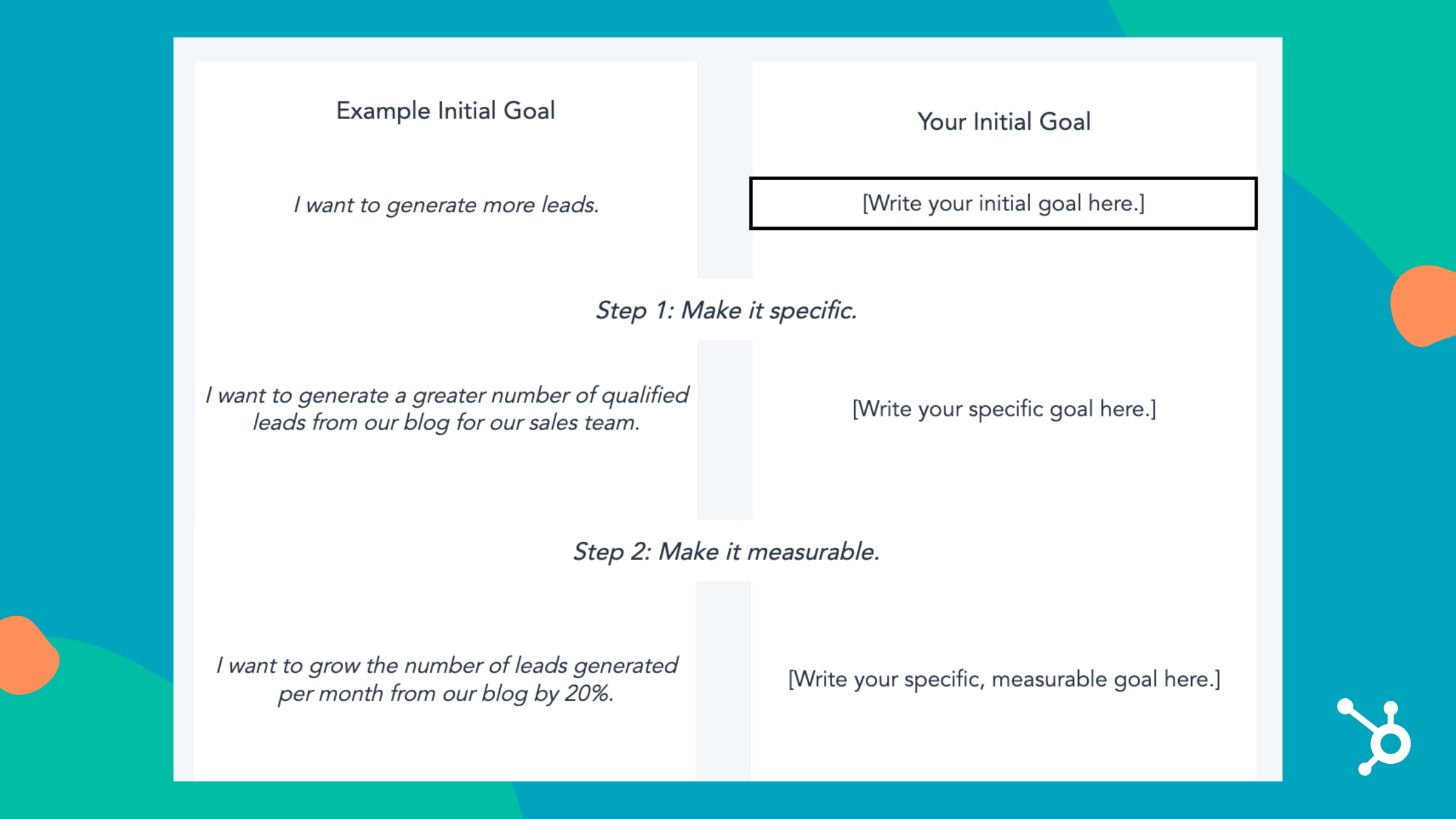
Once you’ve finished defining your goals, the next step is to calculate your targets so you know what your final numbers should be and so you can plan your process accordingly, so you’re able to meet those final numbers.
2. Calculate your goal outcomes.
The most challenging part of your plan might be coming up with numerical targets that coincide with achieving your goals. You can just say, “We want to increase blog leads by 25%,” but what would the 25% increase be in numerical form?
When you have these numbers, you can set milestones for yourself and monitor your progress and make changes along the way if necessary.
The image below is an example of a SMART goal calculation.
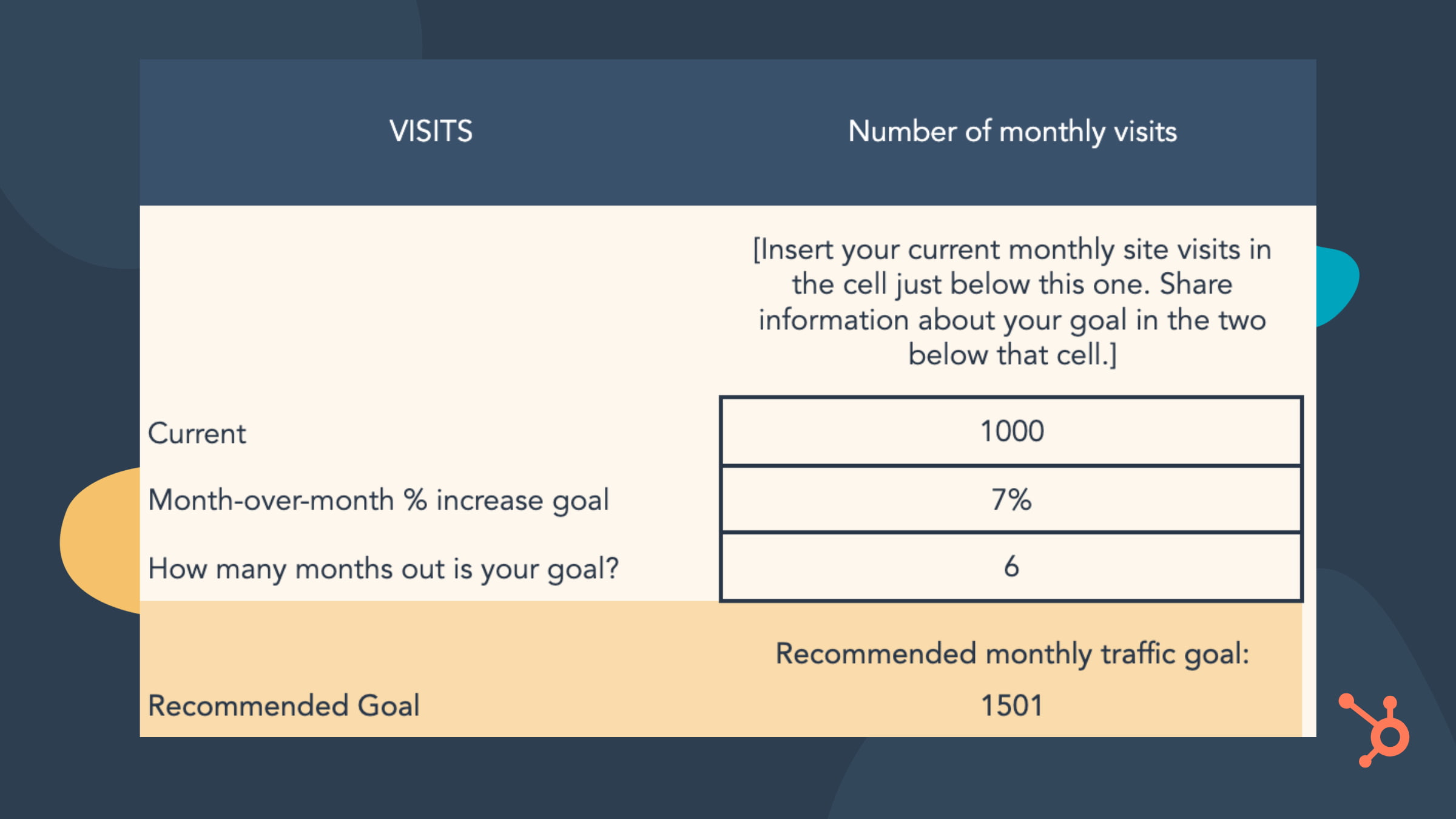
3. Evaluate your SMART goals.
The template’s final step is to evaluate your goals, which helps you anticipate possible roadblocks and develop action plans for dealing with them. If you have multiple goals, aim to ask these questions for each one that you have:
- What is your SMART marketing goal?
- Do you feel that this goal is realistically attainable in the time frame you’ve set?
- How many hours per week can you dedicate to achieving your goal/your goal process?
- What is the biggest challenge preventing you from achieving this goal? What are possible challenges you may face in achieving this goal? What is the biggest roadblock(s) to achieving this goal?
- What three steps can you take to reduce or remove that challenge and succeed in reaching this goal?
All in all, following this framework makes your goals explicitly clear for yourself and helps you communicate their importance to all necessary stakeholders, so everyone is on the same page. To get started, download our template for free and start achieving your goals.