Welcome to My Blog
12 Free Personality Tests You Can Take Online Today
Personality tests are a great way to explore different aspects of who you are and uncover layers you perhaps hadn’t recognized about yourself before.
Keep reading to learn more about the purpose of taking personality tests. Then, take a look at the best free personality tests we’ve compiled and discover aspects of who you are, why you make certain decisions, and more.

The Purpose of Personality Tests
Being truly self-aware is hard. While personality tests might not always be 100% accurate, they work well as a starting point for self-discovery by providing results you might not have concluded on your own. These insights are invaluable for one’s personal and professional growth.
Pros of Personality Tests
Personality tests can be used for self-reflection and help you gain better insight on how to play to your strengths and combat your weaknesses.
Personality tests are also widely used in the workplace because they can be a great way for you and your coworkers to better understand each other’s communication and collaboration styles.
These tests are great conversation starters, especially among groups of people who don’t know each other very well. They can help create connections and establish common ground at work.
Learning about your colleagues’ personality traits can reveal how each team member prefers to receive feedback and criticism. This can help your team avoid unnecessary miscommunication down the road, as well as lead to more productive projects and meetings.
Cons of Personality Tests
While there are many pros to taking personality tests, there are also some cons.
Test results can be vague, depending on which test you are taking. Shorter personality tests, though convenient, are often not as comprehensive and accurate as the longer tests. Plus, some tests require a higher level of self-awareness and understanding of how others perceive you – not having this understanding may skew your test results.
Now, let’s learn more about the different types of personality tests, so you can determine which one is right for you.
Types of Personality Tests
With so many personality tests to choose from, it can be difficult to narrow down which one is right for you. Some focus on assessing your communication style, while others may look at your emotional intelligence, behavior, and more. Here, we’ve compiled a list of common types of personality tests you can take for free online.
1. Myers-Briggs Personality Tests
Myers-Briggs is a widely respected and popular personality assessment tool — first used in the 1940s, the test was developed by Katharine Cook Briggs and her daughter, Isabel Briggs Myers. Initially inspired by Carl Jung’s personality theory, the Myers-Briggs test conveniently separates people into 16 categories of personalities, providing each person with a four-letter acronym.
The following four tests are broad-stroke indicators of who you are, using inspiration from Myers-Briggs. Among other things, the tests cover your communication styles, your strengths and weaknesses, your desires and ambitions, how you see the world, and how people perceive you.
If you’ve never taken a test based on Jung’s psychological traits, or Myers-Briggs’ 16 categories of personalities, you may be surprised by the accuracy of some of the statements. More importantly, you could gain insight into how your behavior is perceived by others, helping you improve both professional and personal relationships.
2. DISC Personality Tests
The DISC assessment determines where you lie on four DISC factors: dominance, influence, steadiness, and compliance. DISC is one of the most popular and authoritative career assessments out there, and many companies encourage their employees to take it.
Undoubtedly, personality affects our career ambitions, as well as how we perform in different workplace environments. If you’re particularly extraverted, maybe you’ve chosen a career path that enables you to work daily with large groups of people. If you have certain communication styles that rely on passivity and emotion, perhaps your boss’s direct statements sometimes offend you.
Arming yourself with a sense of self-awareness could help you find your optimal career path, foster better work relationships, and mitigate work conflict more effectively.
3. Emotional Intelligence Tests
Psychology Today defines emotional intelligence as, “the ability to identify and manage your own emotions and the emotions of others.” Arguably, having emotional intelligence is the most important factor in dealing with conflict and communicating with others.
It’s undeniable that emotional intelligence is important — in fact, research has shown success is 80-90% attributable to emotional intelligence (EI), and only 10-20% to your IQ.
In the workplace, whether you’re around coworkers in the midst of a stressful project, or dealing with a tough performance review from your boss, it’s critical you know how to both identify and handle your own emotions; it’s equally important you know how to read other people’s emotions, and manage them appropriately.
What is the most accurate type of personality test?
Unfortunately, there isn’t a personality test that is completely accurate. The validity of the Myers-Briggs Type Indicator and the DISC assessment have been called into question by behavioral scientists over the years due to their oversimplification of behavior and personality traits.
Emotional intelligence tests are also divisive among scientists due to the potential for bias against groups outside the norm since one’s emotional recognition and regulation often depends on their cultural background.
That said, personality tests can be valuable tools for understanding personality similarities and differences among members of the same organization.
Free Personality Tests
1. 16 Personalities
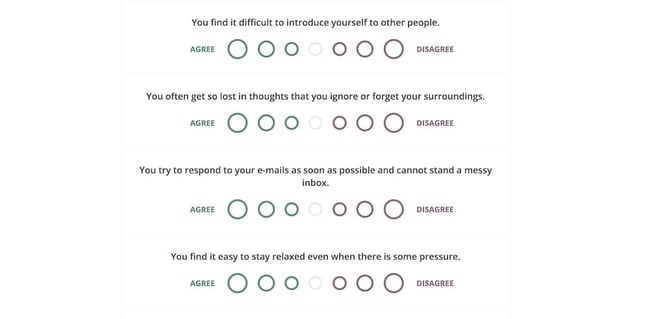
Best for: Learning how your personality type influences many different areas of your life, as well as how it impacts your relationships.
16 Personalities covers five broad personality aspects: mind, energy, nature, tactics and identity. The test is based on Carl Jung’s study of psychological traits (e.g. extroversion vs. introversion) and the Myers-Briggs test, two popular personality theories meant to determine an extensive overview of who you are.
Among other things, the test will cover how you communicate and relate to others — both professionally and personally — what you value and strive for, and how you make decisions. 16 Personalities has been taken over 126 million times, and is available in 30 languages.
Pros: Once you’ve gotten your results, you’ll find extensive information on your personality type including strengths and weaknesses, relationships, friendships, parenthood, and workplace habits. The test is incredibly accurate and can tell you how your personality type plays out in specific situations.
Cons: With seven bubbles varying from “Agree” to “Disagree”, it can be difficult and time-consuming to figure out where exactly you fall on each question. A “Strongly agree,” “Agree”, “Neutral”,”Disagree”, and “Strongly disagree” chart might’ve been easier to answer.
2. Personality Perfect
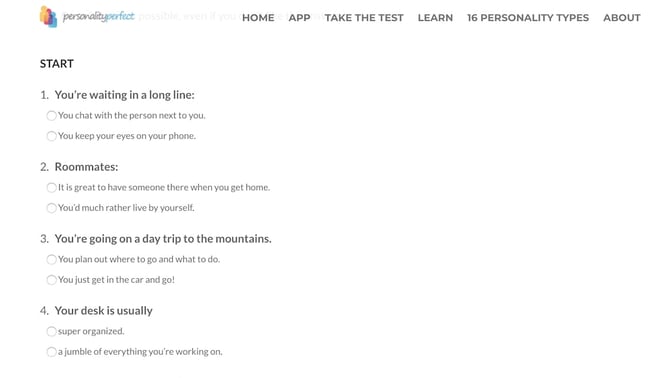
Best for: Learning how others perceive you or how they might misinterpret your behaviors, and finding out what you value most.
Similar to 16 Personalities, Personality Perfect is also based on Jung’s and Myers-Briggs’ personality theories, and uses four broad categories — extraversion vs. introversion, sensing and intuition, thinking and feeling, and judging and perceiving — to compile a four-letter abbreviation of your personality type (e.g. “INFP”).
The test provides a broad overview of how you connect with others, how you behave, and, perhaps most surprising, how you’re likely seen by others.
Pros: Once you know your four-letter personality abbreviation, you can apply that label to various situations, like work and love, and determine how others’ perceive your behaviors in those settings.
Cons: Tests that are based on Jung’s personality theories are typically considered rough tendencies, and not strict classifications — and many researchers say Myers-Briggs tests are unscientific due to the different results you might get if you take the test twice.
3. Human Metrics
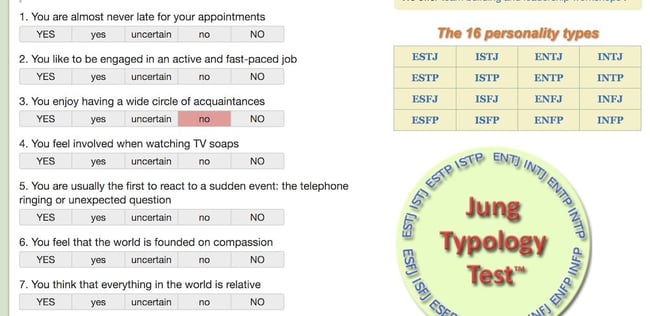
Best for: Determining a career path that is most well-suited for your personality.
If you’ve ever wondered which famous personalities share your personality type, you’re in luck — Human Metrics shows you that information, along with your four-letter personality type (again, based on Jung and Myers-Briggs theories).
With this test, you’ll get information about which career paths are most suitable for your personality type. If you’re having trouble choosing a career path or doubting the one you’ve chosen, maybe this test can help you figure it out.
Pros: This specific test allows you to see all 64 questions on one screen, which makes it easier to scroll back and change an answer if you’d like to.
Cons: Many of these responses can feel situation-dependent. “You feel involved when watching TV soaps”, for instance, could depend on the show you’re watching, how you’re feeling that day (relaxed? overwhelmed?) and simply might not be a strong predictor of who you are as a person.
4. TestColor
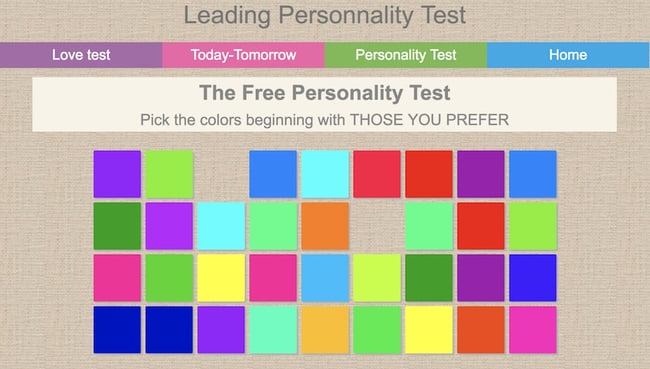
Best for: Finding out the ratio of extroverted to introverted you are, plus getting short descriptions of the qualities that most characterize your personality.
Test Color, a test validated by a team of clinical psychologists, psychoanalysts and mathematicians, asks you just two questions: “Click on the colors you like most,” and “Click on the colors you like least.”
Test Color tells you about your emotional intelligence, your creativity and imagination, your social skills, and your work style, including organization and management styles. I found it to be surprisingly accurate: in two questions, it nailed how I communicate with others and how I act in group settings.
Pros: It’s incredibly quick and easy — taking roughly 5 minutes to complete.
Cons: The results are relatively vague and general, and the test doesn’t divide your personality into categories depending on the situation. (For instance, it doesn’t tell you the difference between your personality in work settings and romantic situations.)
5. Crystal
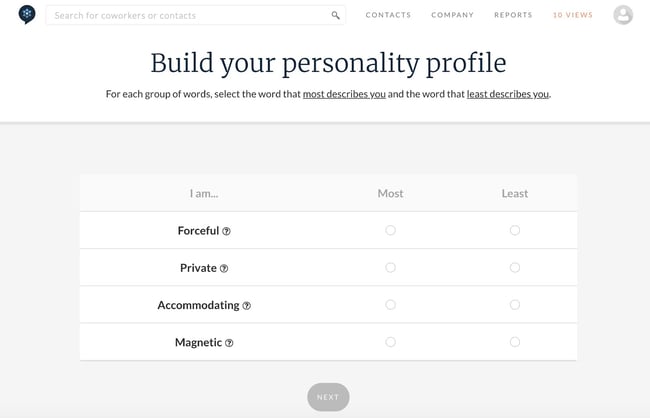
Best for: Learning how your personality biases you towards colleagues’ behavior, and gaining a deeper understanding of your coworkers’ personalities.
Crystal provides a free DISC assessment, which tells you (among other things) how your personality fits into your work environment, who you work well with, who you might have conflict with, how you perceive others behaviors, and how others perceive yours.
The test helps you understand how your own personality biases you towards certain colleagues (i.e. your personality might take another coworker’s comments offensively, while the coworker just believes in being direct), which could strengthen your work relationships.
Best of all, Crystal also offers an accurate personality test, enabling you to build an extensive personality profile on one website. Plus, when you input your company, Crystal lets you see your colleague’s personality profiles — undeniably critical information when you’re looking to empathize with a coworker.
Pros: Can be a useful tool for identifying areas to focus on for professional development and coaching.
Cons: There has been no correlational study to show that test results match real-world job performance.
6. 123Test

Best for: Analyzing and improving your relationships with coworkers.
123Test offers a DISC personality test you can take in five minutes, so there’s really no excuses. You’ll get a score to find out which DISC factors predict your behaviors towards other people.
The test offers critical information for understanding why you might get along better with one employee, and have more conflict with another. It identifies how you perceive other people’s actions (i.e. “You’re sensitive to her blunt nature, even though she believes she’s just being straightforward”), which can help you improve work relationships.
Pros: It’s incredibly quick and straightforward, and will give you a general sense for how you could misinterpret colleagues’ behaviors.
Cons: With a few simple images (like the example, below), this test is less advanced than others in the list, and could provide different results every time you take it depending on your mood.
7. Truity Career Personality Profiler
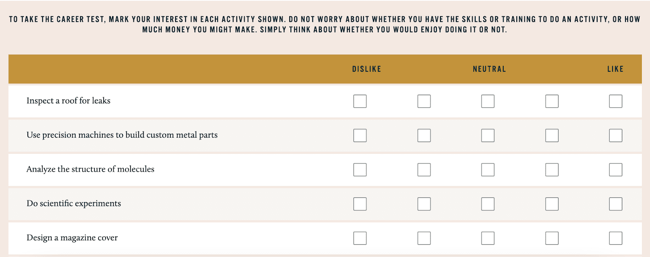
Best for: Figuring out an ideal career path, and learning which skills are required to excel in that career.
This test, based on the Holland Code and Big Five theories, will analyze your interests and personality traits and tell you careers (and college majors) that are a good match for you. It also lets you know about specific tasks and projects you’d love, what motivates you, and provides advice to help you maximize your strengths.
Even if you’re happy with your current career track, the test provides suggestions for specific skills you could learn to get ahead in your career.
Pros: If you’re early in your career (or a college student), this is a good test for uncovering your interests and discovering potential career paths. Best of all, it lets you know which projects or tasks you’d enjoy — allowing you to mix-and-match and determine the ideal career based on your personal interests.
Cons: It can be difficult to know what you’d enjoy doing if you’ve never done it. For instance, as a college student, I might not know how to answer whether or not I’d enjoy designing a magazine cover, if I’ve never experienced design work.
8. Interpersonal Skills assessment
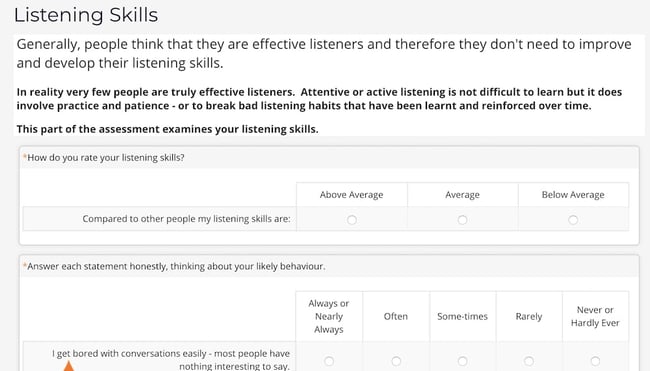
Best for: Improving your communication and listening skills.
Having well-developed interpersonal skills is critical to forming deep and meaningful personal and professional relationships. Interpersonal Skills assesses your listening skills, verbal communication skills, ability to work in teams, and emotional intelligence.
Better yet, the test identifies areas of weakness and provides tactical advice on how to improve those skills.
Pros: After you’ve completed the test, Interpersonal Skills provides you with helpful resources to level-up your communication or listening skills. Resources include “An Introduction to Communication Skills” and “Advanced Communication Skills” ($13 each). And even without the resources, this is a quick and easy test for evaluating areas for improvement in your own communication style.
Cons: To evaluate your listening skills, you might need to ask other people how they perceive you. Maybe you think you’re a good listener, but others disagree — if that’s the case, it can be difficult to accurately self-analyze your own skills for this test (or any others).
9. Sokanu
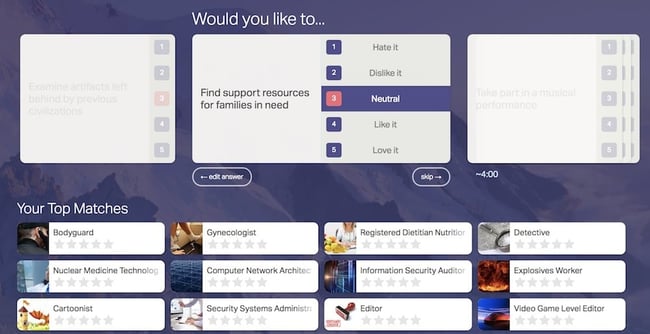
Best for: Determining a few different career paths that could make you happy — and then having the opportunity to pick-and-choose from there.
Major companies including General Assembly, NYU, and Redfin use Sokanu, a career assessment tool that tests you on your personality, background, interests, and goals to determine an ideal career path.
After you take the test, it provides you with multiple matches, which you can sort through to explore different careers and workplaces before choosing an ideal match.
Pros: The test provides you with multiple options for careers that could fulfill you — which I appreciate, since it can be stressful to get to the end of a test and find out there’s only one job that would make you happy. Plus, Sokanu offers a library filled with over 1,000 careers, and explains what type of people thrive in them — and why.
Cons: If you don’t know much about what interests you professionally, it can be a difficult test to take. Question one, for instance, is “Would you like to… Advise organizations on how to meet their business goals?” As a high school student, I wouldn’t have any idea how to answer that question.
10. Berkeley Emotional Intelligence
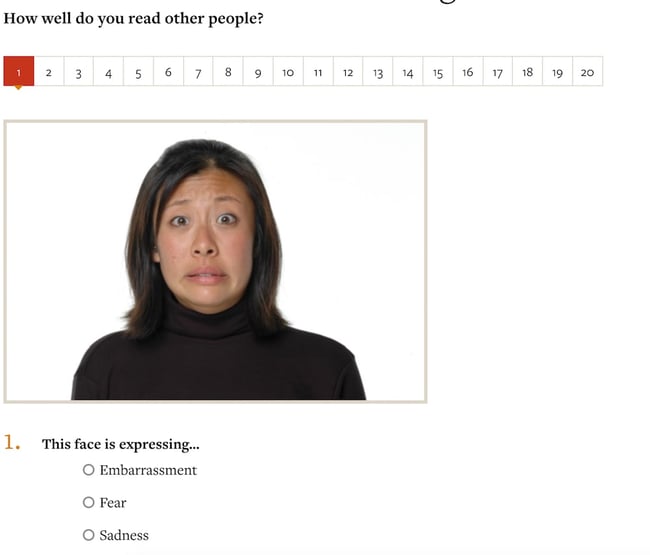
Best for: Figuring out how well you analyze and interpret other people’s emotions — a vital component of strong emotional intelligence.
This test, designed by Berkeley, shows you 20 pictures and asks you to recognize the facial expression on each person’s face. It’s easy, quick, and fun, and an informative way to learn how well you read other people’s emotions — which is a critical skill for assessing and mitigating conflict.
Pros: It’s fun and easy, and correctly identifying people’s facial expressions is a scientifically-proven way to evaluate someone’s emotional intelligence (EI).
Cons: 20 questions is a relatively short test to determine emotional intelligence, so the test is a good starting point, but might not offer a comprehensive view of your EI.
11. VeryWellMind
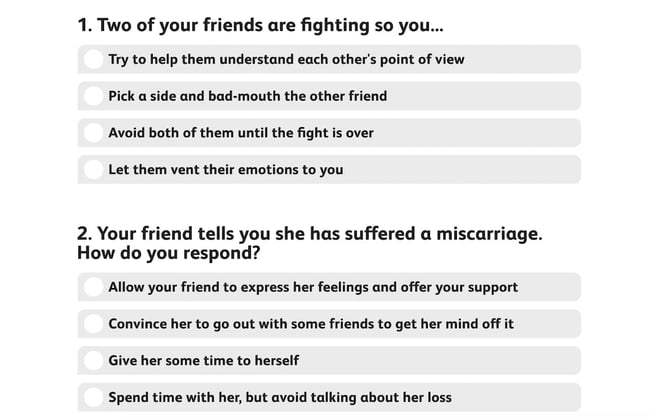
Best for: A speedy gut-check on how emotionally intelligent you are, with resources to further your understanding.
If you don’t have the time for anything more in-depth, this test only asks you 10 quick questions before delivering your results.
It’s admittedly not medical or scientific by any means, but does offer other articles depending on your score. If you score low, for example, VeryWellMind.com includes a link to another one of their articles, “Emotions and Types of Emotional Responses.”
Pros: Takes only a few minutes to complete, and the questions are straightforward and easy to answer.
Cons: It’s easy and fun, but isn’t necessarily as accurate or scientific as the others in this list.
12. Empathy Quotient
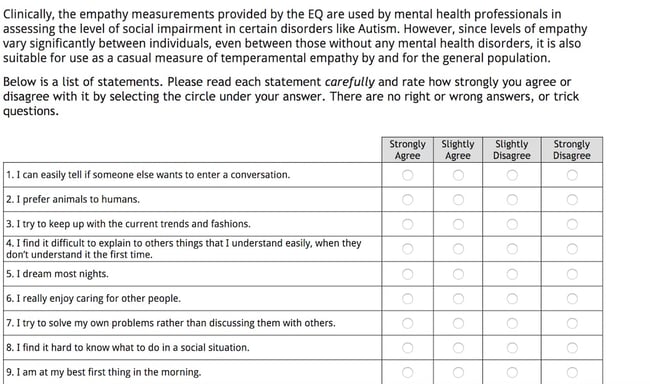
Best for: A more in-depth test to accurately analyze how emotionally intelligent you are.
Unlike the tests above, this one is designed to clinically assess you — the test was developed by Simon Baron-Cohen at the Autism Research Center at the University of Cambridge, and uses the same emotional measurements mental health professionals use to diagnose social impairment.
It’s a 60-item questionnaire and is suitable to measure “temperamental empathy” in adults.
Pros: It uses the same measurements that mental health professionals use to diagnose social impairments — meaning it’s accurate and scientifically-backed, and should provide you with a deeper understanding of your own empathy (and areas for improvement).
Cons: The test requires you to have a certain level of self-awareness and understand how others’ perceive you. For instance, one statement is, “I am very blunt, which some people take to be rudeness, even though this is unintentional” — it might be difficult for someone to know whether their bluntness comes across as rudeness.
Editor’s note: This post was originally published in May 2018 and has been updated for comprehensiveness.

How to Develop a Content Strategy in 7 Steps: A Start-to-Finish Guide
Whether you’re just starting out with content marketing or you’ve been using the same approach for a while, it never hurts to revisit your content strategy plan and make sure it’s up-to-date, innovative, and engaging for your prospects and customers — no matter when or how they intend to buy.
If you’re having trouble planning for the upcoming year or need some fresh ideas to include in your plan, read on.
In this post, we’ll dive into what content strategy is, why your business needs a content marketing plan, and what steps you need to teake to create your strategy. Plus, we’ll explore some examples of effective content marketing strategies for inspiration.
Say your business goals include increasing brand awareness. To achieve this, you might implement a content strategy that focuses on SEO to increase your website’s visibility on the search engine results pages (SERPs) and drive traffic to your products or services.
New business owners might assume a content strategy is a nice-to-have, but not necessary early on. However, producing high-quality content can be invaluable in building trust with new audiences and succeeding in the long haul.
In essence, a good content strategy is the foundation of your Attract and Delight stages in a buyer’s journey that follows the inbound marketing framework. Along with attracting prospects to your brand, you can leverage a content strategy for sales enablement and customer satisfaction.
Plus, with 70% of marketers actively investing in content marketing, it’s critical to develop a good content strategy to compete in your industry.
When you develop a content strategy, there are a few questions to answer. Let’s dive into those, now.
1. Who will be reading your content?
Who’s the target audience for your content? For how many audiences are you creating content?
Just as your business might have more than one type of customer, your content strategy can cater to more than one type of user.
Using a variety of content types and channels will help you deliver content that’s tailored to each persona.
2. What problem will you be solving for your audience(s)?
Ideally, your product or service solves a problem you know your audience has. By the same token, your content coaches and educates your audience through this problem as they begin to identify and address it.
A sound content strategy supports people on both sides of your product: those who are still figuring out what their main challenges are, and those who are already using your product to overcome these challenges.
Your content reinforces the solution(s) you’re offering and helps you build credibility with your target audience.
3. What makes you unique?
Your competitors likely have a similar product as yours, which means your potential customers need to know what makes yours better — or, at least, different.
Maybe your main asset is that your company has been established for many years. Or perhaps you have a unique brand voice that makes you stand out from your competitors.
To prove why you’re worth buying from, you need to prove why you’re worth listening to. Once you figure that out, permeate that message in your content.
4. What content formats will you focus on?
To figure out what formats to focus on, you need to meet your audience where they are.
While you may to tempted to launch a podcast since it’s grown so much in the last few years, or launch a YouTube channel, find out first where your audience lives.
Otherwise, you may waste time creating content that either won’t reach your audience or capture their attention.
Once you identify the best formats, start creating a budget to assess what resources you can allocate to execute this strategy.
5. What channels will you publish on?
Just as you can create content in different formats, you’ll also have various channels you can publish to, from your website to social media.
This, again, will reflect where your audience lives. If your audience prefers long-form video content, you may opt to publish your content on YouTube. If you have a younger audience that likes quick content, you may opt for TikTok and Instagram.
We’ll talk more about social media content strategy in the step-by-step guide later in this article.
6. How will you manage content creation and publication?
Figuring out how you’ll create and publish all your content can be a daunting task.
Before you execute, it’s important to establish:
- Who’s creating what.
- Where it’s being published.
- When it’s going live.
In a small team, this may be easy enough as you may be the sole decision-maker. As your company grows, you may need to collaborate with several content teams to figure out an effective process.
Today’s content strategies prevent clutter by managing content from a topic standpoint. When planning a content editorial calendar around topics, you can easily visualize your company’s message and assert yourself as an authority in your market over time.
Why Marketers Need to Create a Content Marketing Strategy
Content marketing helps businesses prepare and plan for reliable and cost-effective sources of website traffic and new leads.
If you can create just one blog post that gets a steady amount of organic traffic, an embedded link to an e-book or free tool will continue generating leads for you as time goes on — long after you click “Publish.”
HubSpot‘s blog team found this to be key to increasing traffic to the Sales Blog over time — read about our blog strategy here.
The reliable source of traffic and leads from your evergreen content will give you the flexibility to experiment with other marketing tactics to generate revenue, such as sponsored content, social media advertising, and distributed content.
Plus, your content won’t just help attract leads, it will also educate your prospects and generate awareness for your brand.
Now, let’s dive in to learn the specifics of how to create a content marketing plan. Curious how former HubSpot Head of Content SEO Aja Frost put together our content strategy? Here it is.
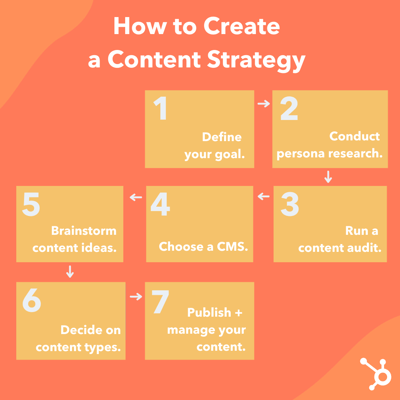
1. Define your goal.
What’s your aim for developing a content marketing plan? Why do you want to produce content and create a content marketing plan?
Know your goals before you begin planning, and you’ll have an easier time determining what’s best for your strategy.
Download this goal planning template for help figuring out the right content goals.
2. Conduct persona research.
To develop a successful plan, you need to clearly define your content’s target audience — also known as your buyer persona.
This is especially important for those who are starting out or are new to marketing. By knowing your target audience, you can produce more relevant and valuable content that they’ll want to read and convert on.
If you’re an experienced marketer, your target may have changed. Do you want to target a new group of people or expand your current target market? Do you want to keep the same target audience? Revisiting your audience parameters by conducting market research each year is crucial to growing your audience.
Featured Tool: Buyer Persona Generator
3. Run a content audit.
Early on, most brands start with blog posts. If you want to venture out into different formats, you can run a content audit to assess your top-performing and lowest-performing content. Then, use that information to inform which direction you take next.
If you’ve been in business for a while, you should review your content marketing efforts and last year’s results.
Figure out what you can do differently in the upcoming year and set new goals. Now is a great time to align your team’s goals with the rest of your organization’s goals.
Whatever stage you’re in, a content audit will help you determine what resonates best with your audience, identify gaps in your topic clusters, and brainstorm fresh content ideas.
4. Choose a content management system.
A few vital parts of content management include content creation, content publication, and content analytics.
You want to invest in a CMS to create, manage, and track your content in an easy and sustainable way.
With the HubSpot CMS, you can plan, produce, publish, and measure your results all in one place.
Another popular CMS is WordPress, to which you can add the HubSpot WordPress plugin for free web forms, live chat, CRM access, email marketing, and analytics.
5. Determine which type of content you want to create.
There are a variety of options out there for content you can create, from written content like ebooks and blog posts to audio content like podcasts.
In the next section, we’ll discuss some of the most popular content formats marketers are creating, including some tools and templates to get you started.
6. Brainstorm content ideas.
Now, it’s time to start coming up with ideas for your next content project.
Here are some tools to get the juices flowing.
1. Feedly
The Feedly RSS feed is a wonderful way to track trendy topics in your industry and find content ideas at the same time.
You start by telling the software what topics you’re most interested in and its AI tool will do the rest.
You won’t need to scour the internet to find new content ideas anymore. Instead, you can go through your curated list, compiled from news sites, newsletters, and social media.
2. BuzzSumo
Want to discover popular content and content ideas? This company offers several market research tools, one of which uses social media shares to determine if a piece of content is popular and well-liked.
This information helps you see which content ideas would do well if you were to create content about them.
3. BlogAbout
Get your mind gears going with IMPACT’s blog title generator. This tool works a bit like Mad Libs, but instead of joke sentences, it shows you common headline formats with blanks where you can fill in the subject you have in mind.
This brainstorming technique helps you put general ideas in contexts that would be appealing to your target audience. Once you have a headline you like, BlogAbout lets you add it to your “Notebook” so you can save your best ideas.
4. CoSchedule Headline Analyzer
You can get blog post ideas for an entire year with HubSpot’s Blog Ideas Generator. All you need to do is enter general topics or terms you’d like to write about, and this content idea generator does all the work for you.
This tool analyzes headlines and titles and provides feedback on length, word choice, grammar, and keyword search volume.
If you have an idea in mind, run a few title options through the Headline Analyzer to see how you could make it stronger, and to move your idea further along in the brainstorming process.
5. HubSpot’s Website Grader
This is a great tool to use when you want to see where you’re at with your website and SEO efforts. The Website Grader grades you on vital areas of your website performance and sends you a detailed report to help you optimize.
With this tool, you can figure out how to make your website more SEO-friendly and discover areas of improvement.
7. Publish and manage your content.
Your marketing plan should go beyond the types of content you’ll create — it should also cover how you’ll organize your content.
With the help of an editorial calendar, you’ll be on the right track to publishing a well-balanced and diverse content library on your website. Then, create a social media content calendar to promote and manage your content on other sites.
Featured Tool: Free Editorial Calendar Templates

Many of the ideas you think of will be evergreen (i.e.: just as relevant months or years from now as they are today). That being said, you shouldn’t ignore timely topics either. While they may not be the bulk of your editorial calendar, they can help you generate spikes of traffic.
Most people count on incorporating popular holidays, like New Year’s, in their marketing efforts, but you don’t have to limit yourself to these important marketing dates.
If there are niche holidays that might appeal to your audience, it could be worth publishing content on your blog or social media. Check out this ultimate list of social media holidays — keep an eye on it when you’re planning your calendar.
Content Strategy Template
Ready to get started with your own content marketing strategy? Download this helpful workbook.
It includes key readings and activities to help you fine-tune your plan and develop a robust strategy. You’ll learn how to:
- Generate content ideas.
- Create topic clusters and pillar pages.
- Promote your content.
- Repurpose your content based on your needs.
Content Marketing Strategy Examples
To understand what a content strategy is, let’s explore some examples of real-life content strategies based on a few business goals.
Let’s start with Evernote, a note-taking app, that developed an SEO-driven content strategy to attract new prospects to their website.
I’m a huge fan of Evernote’s blog, which offers a wealth of knowledge on the topic of productivity. The blog post, How To Stay Disciplined When Times Are Tough, made me laugh out loud — and incentivized me to grab a pen and write down some of the tips I liked best.
But why is a company that sells a note-taking app writing about discipline?
Because it’s how I found their website when I searched “How to stay disciplined” on Google.
People interested in reading content related to productivity are likely the same people interested in downloading Evernote’s note-taking product.
On the contrary, if Evernote’s marketing team simply created content for the sake of increasing traffic — like publishing “Our 10 Favorite Beyonce Songs” — it wouldn’t be considered a content strategy at all, it would just be content.
A strategy needs to align content with business goals. In Evernote’s case, the strategy aligns content (blog posts on productivity) with the business goal of attracting leads (people interested in note-taking) to their site.
Let’s take a look at another example to see how a good content strategy can help businesses with sales enablement.
Consider the following scenario: A prospect calls a sales representative at Wistia and asks questions related to Wistia’s video hosting service. As the Wistia sales rep speaks with her, he learns her business is using a few other tools to convert leads into sales, including Intercom.
Bingo.
Once the call ends, the sales rep sends the prospect a follow-up email with a blog post about Wistia’s integration with Intercom, which enables Intercom users to further personalize messages to prospects based on video-watching data they collect through Wistia.
This is a prime example of how you might use a content strategy as a sales enablement tool.
On the surface, it might seem odd that Wistia has dedicated content regarding another business tool. However, this content is a great resource for Wistia’s sales team, particularly when prospects have concerns regarding how Wistia’s product can integrate with their existing software or processes.
Now that we’ve explored a few examples of content strategies, let’s dive into the types of content marketing assets you can develop.
These are the eight most popular types of content marketing you can create for your readers and customers.
1. Blog Posts
If you haven’t already noticed, you’re currently reading a blog post. Blog posts live on a website and should be published regularly to attract new visitors.
Posts should provide valuable content for your audience that makes them inclined to share posts on social media and across other websites.
We recommend that blog posts be between 1,000 and 2,000 words in length, but you should experiment to see if your audience prefers longer or shorter reads.
Featured Tool: 6 Free Blog Post Templates
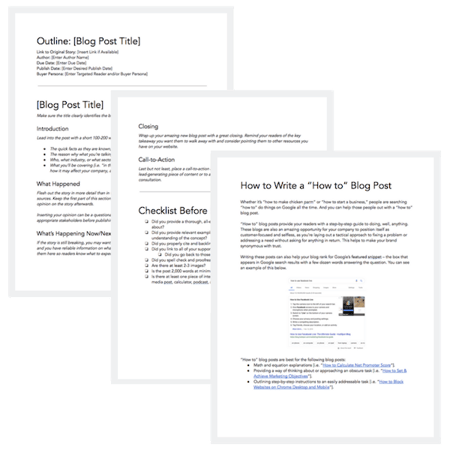
Check out our free blog post templates for writing great how-to, listicle, curation, SlideShare presentation, and newsjacking posts on your own blog.
2. Ebooks
Ebooks are lead-generation tools that website visitors download after submitting a lead form with their contact information. They’re typically longer, more in-depth, and published less frequently than blog posts, which are written to attract visitors to a website.
But ebooks aren’t only effective for the top of the funnel.
As Nora Leary, Growth Director at Ironpaper, Inc., notes, “Ebooks serve different purposes at varying stages in the buyer’s journey.”
She told me, “Awareness-level ebooks help educate the prospect about a certain pain point and are an excellent lead capture tool. The content should remain introductory and informational.”
Leary adds, “Ebooks can convert leads in the funnel by offering them useful tools as prospects consider their needs more in-depth. An ebook here might dive deeper into a particular problem and solution options and include templates or calculators.
[Lastly,] ebooks further down the funnel should become more personalized and offer more sales content. Comparison guides or an ebook of case studies are beneficial for prospects at this stage.”
Ebooks are the next step in the inbound marketing process. After reading a blog post, such as this one, visitors might want more information.
This is where calls-to-action (CTAs) come into play, directing people to a landing page where they can submit their contact information and download an ebook to learn more valuable information for their business. In turn, the business producing the ebook has a new lead for the sales team to contact.
Featured Tool: 18 Free Ebook Templates

3. Case Studies
A case study allows you to tell a customer story and build credibility in the process.
A case study is perhaps your most versatile type of content marketing because it can take many different forms — some of which are on this list. That’s right, case studies can take the form of a blog post, ebook, podcast, or even an infographic.
The goal is to demonstrate how your product helped real-life companies succeed. Before choosing a customer for a case study, you should determine to which business area you’re trying to drive value.
Featured Tool: 3 Free Case Study Templates
4. Templates
Templates are effective content marketing examples to try because they generate leads while offering tremendous value to your audience.
When you provide your audience with content strategy template tools to save them time and help them succeed, they’re more likely to engage with your content in the future.
5. Infographics
Infographics can organize and visualize data in a more compelling way than words alone.
These are great content formats to use if you’re trying to share a lot of data in a way that is clear and easy to understand.
Featured Tool: 15 Free Infographic Templates
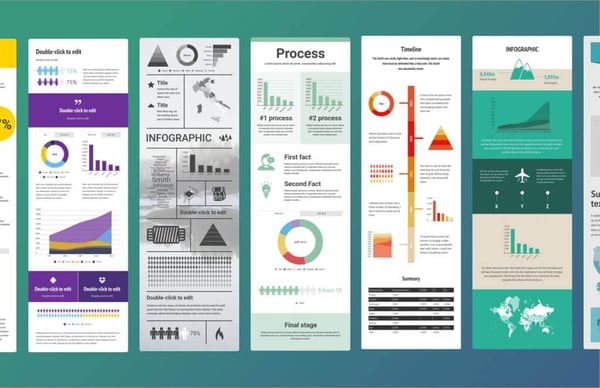
If you’re ready to get started, get our templates for creating beautiful infographics in less than an hour.
6. Videos
Videos are a highly engaging content medium and are shareable across social media platforms and websites alike.
Videos require a bigger investment of time and resources than written content, but as visual content continues to offer big ROI, it’s a medium worth exploring.
Featured Tool: Free Video Marketing Starter Pack + Templates
7. Podcasts
Starting a podcast will help audiences find your brand if they don’t have time or interest in reading content every day.
The number of podcast listeners is growing — in 2021, there was a 10% year-over-year increase in U.S. podcast listeners.
If you have interesting people to interview or conversations to host, consider podcasting as another content format to experiment with.
Featured Tool: How to Start a Podcast [Guide + Templates]

8. Social Media
Once you’ve been regularly publishing content on your own site for a while, start thinking about a social media strategy to distribute your content on social media.
In addition to sharing your content, you can also repurpose it into new formats and create original content specifically for each platform.
Posting on social media is pivotal to amplifying your brand’s reach and delivering your content to your customers where you know they spend their time. Popular social networks include:
When launching a business account on any of the social networks above, adjust your content to the platform.
On Instagram, for example, users want aesthetically pleasing visuals. With feeds, IGTV, Stories, you have a lot of room to play with. TikTok, on the other hand, appeals to a younger demographic that wants trendy, funny, and creative short-form videos.
Do some market research to discover which platforms your buyers are on, and mold your content to their expectations.
It takes time, organization, and creativity to grow a successful content marketing strategy. From building the foundation of your content marketing plan to adding tools to better manage your content, setting up your strategy for the new year won’t be a hassle if you follow the steps and explore the resources here.
Editor’s note: This post was originally published in September 2018 and has been updated for comprehensiveness.

How to Go Live on TikTok + Top Features You Should Use
Are you interested in going live on TikTok but have a few reservations? If you are curious about TikTok LIVE, its features, and how to go live — this article is for you! To help you navigate TikTok LIVE, we’ll dive into the top TikTok LIVE features, the requirements to go live, and a few tips to keep in mind before you start your first broadcast.
How to Join Someone’s TikTok LIVE
Why can’t I go live on TikTok?
![Free Ebook: The Marketer's Guide to TikTok for Business [Download Now]](https://no-cache.hubspot.com/cta/default/53/2c7242e4-ad54-4f63-8627-a15aa6a2ea50.png)
What is TikTok LIVE?
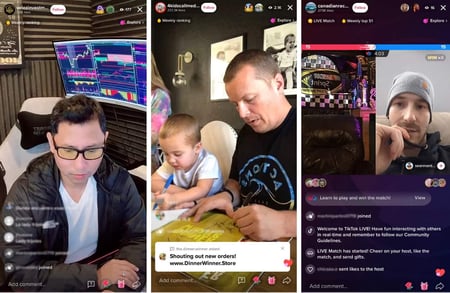
TikTok LIVE is a feature that allows users to interact with creators in real-time via livestreams. Users 16 years old or older can launch livestreams on TikTok, and users18 years old or older can send and receive gifts during a live.
Of course, all users must abide by TikTok’s community guidelines, or their account will be banned, and they will no longer have access to TikTok LIVE.
TikTok LIVE Features
Going live on TikTok allows you to engage with your followers on the platform and build community. The app offers ways to maximize the experience for creators and viewers when going live.
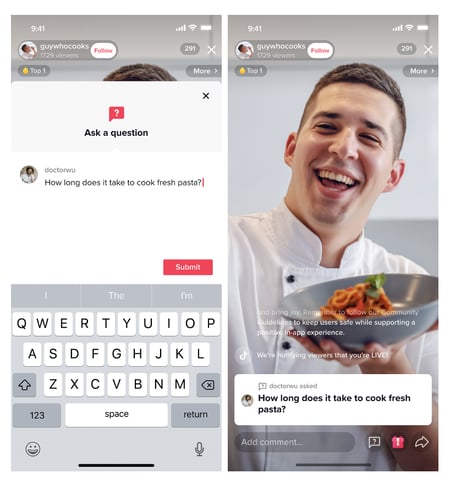
Here are some of the top features:
Q&A
The Q&A feature allows creators to respond to audience questions directly during the livestream. Creators are given access to various tools to select, display, and respond to only the questions they want to answer.
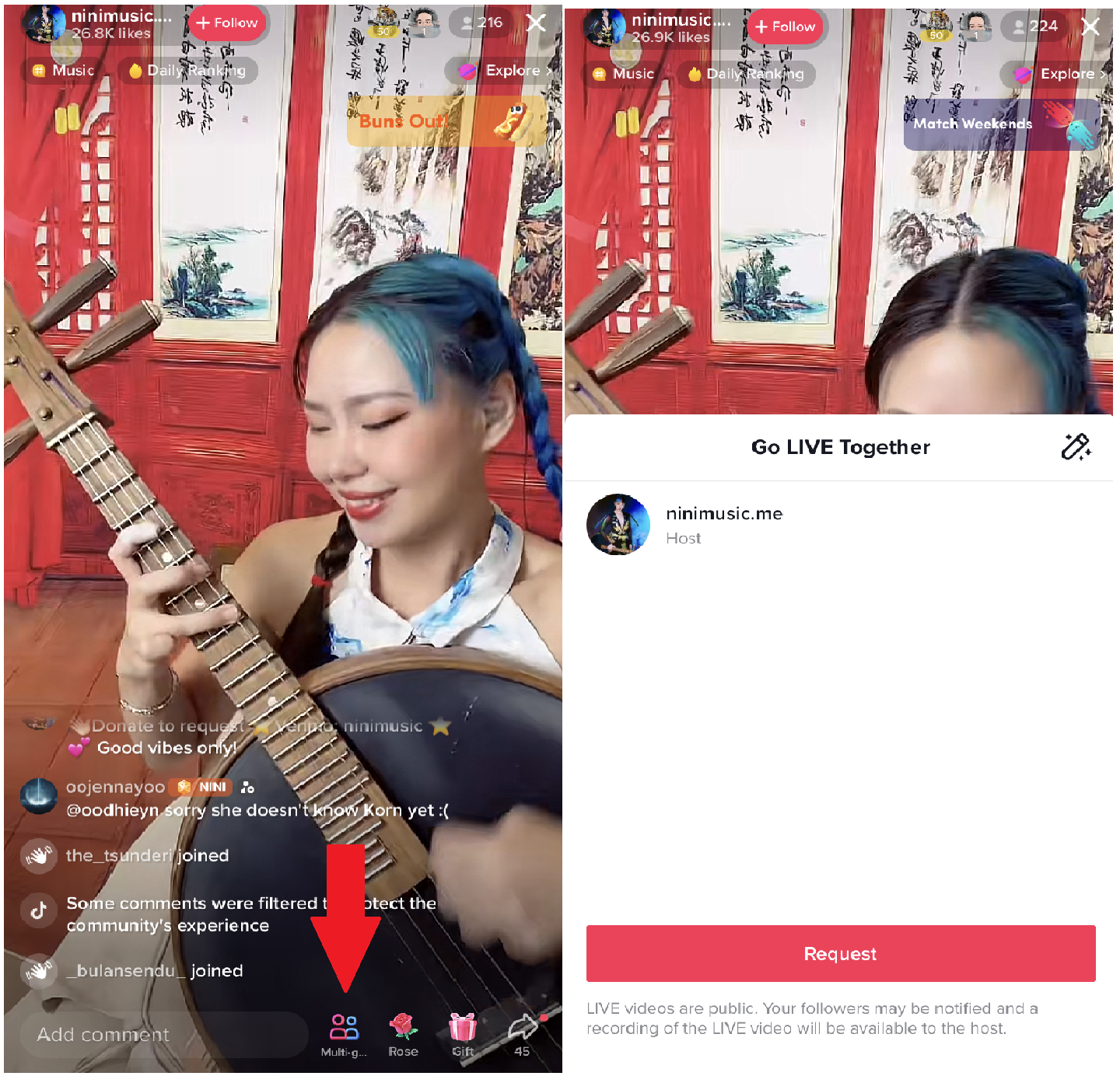
Multi-Guest
TikTok’s multi-guest feature allows users to go live with up to five guests using a panel or grid layout. This feature is excellent for hosting panel discussions, live how-to videos, and other community-based events.
Live events
To build anticipation around your Live, you can schedule, manage, and promote your livestream ahead of time to your followers.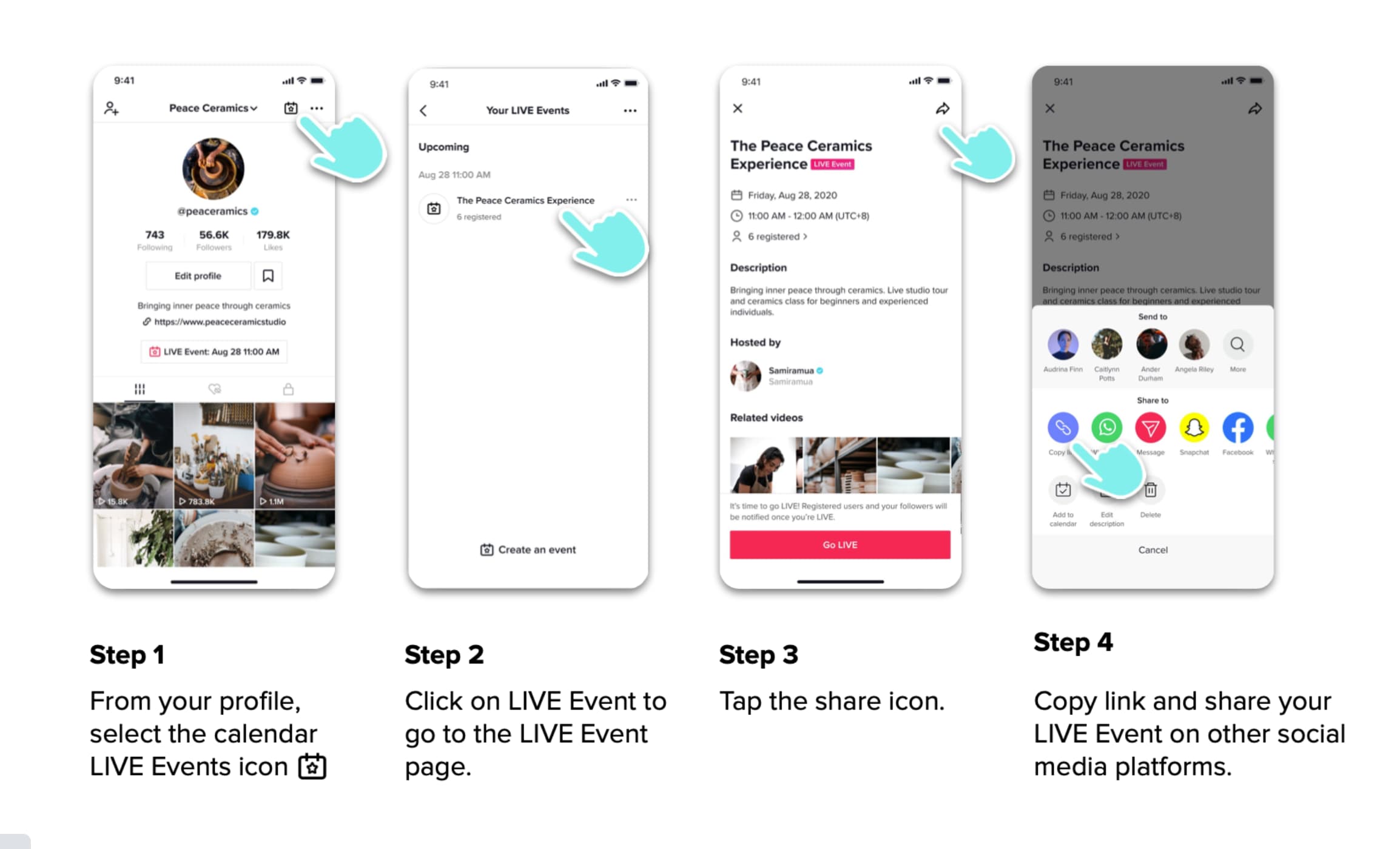
Image source
Gifts
If you are a part of TikTok’s Creator Next Program, viewers can give you badges that hold monetary value during a live stream if they enjoy your content. Only non-business accounts and users 18 years or older can accept these rewards unless you live in South Korea, where the minimum age requirement is 19, or in Japan, where it’s 20.)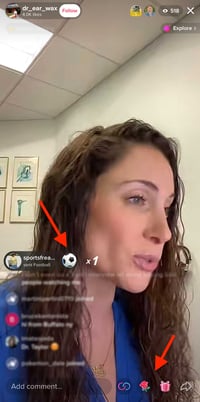
Moderators
When going live, you can assign other users to moderate the chatroom to ensure it’s safe and in line with the content you share.
LIVE Donations
TikTok’s LIVE Donations button allows your audience to donate to your chosen charity. You can select your cause either before or during your stream. To set up donations before the stream:
- Select the anchor link that says “Select Non-Profit” in the top left corner.
- Select the non-profit you’d like to support and add to your livestream.
- Press “Go LIVE” once the nonprofit you select appears in the top left corner.
To set up donations during the stream:
- Click the bottom right arrow for more options.
- Click “Support Non-Profit.”
- Select a non-profit to add.
- Place the donations sticker wherever you prefer on the live screen.
LIVE Topics
This feature gives your audience an idea of what to expect in your livestream. LIVE Topics include music, sports, food, gaming, and DIY categories. LIVE Topics also boosts the discoverability of your livestream by enabling new viewers to discover and join your stream based on the LIVE Topic you’re covering.
Keyword Filters
Another way to protect your live stream is by automatically removing comments that feature words or phrases you’ve flagged.
How to Go Live on TikTok
1. Open the app and click on the ‘+’ sign.
2. Slide to the ‘LIVE’ tab.
3. Add a title.
4. Click ‘Go Live.’
After your live, you can access the recording for up to 90 days by going to your “settings and privacy” tab and selecting “LIVE replay.” From there, you can download your live video or delete it.
How to Join Someone’s TikTok LIVE
Send a request to join someone else’s TikTok LIVE. To do this, click on the livestream you want to join. Then, head to the comments section and click the icon that looks like two people. Finally, hit the ref request button. If the host of the TikTok Live accepts your request, you’ll join their livestream.
Why can’t I go live on TikTok?
There are several reasons why you may not see the option to go live on TikTok, such as:
- You’re under 18 years old.
- You have less than 1,000 followers.
- You have recently violated one of TikTok’s policies and are under review or suspension.
If you meet the requirements and can’t go live, you can report this issue to TikTok.
Tips for Going Live on TikTok
1. Know when your audience is most active on the app.
You want to ensure you reach your target audience by providing a more personalized experience and relevant advertising. This means knowing exactly when most are active on the app.
Check your “Followers” tab in your Analytics to find this out. It will tell you what times and days your followers are most active, along with other insights, like videos and sounds that are most popular with your followers.
All of this information will be valuable when planning your live.
2. Set the stage.
Nothing makes me click out of a live quicker than lousy lighting.
The first thing you want to do is make sure your lighting is arranged ahead of time. This can mean setting up before a window that gets great natural light or investing in artificial lights.
The next thing you’ll need is a quiet room. Make sure there isn’t a ton of background noise, as that can distract viewers and make it hard to maintain their attention. You can also invest in an external mic to improve your sound quality.
In addition, consider investing in a tripod. This will allow you to move freely as you are on the live.
Lastly, make sure your wi-fi connection is strong. You can quickly lose viewers if they struggle to hear or see you on the app.
3. Have a clear goal and outline.
Any time you plan on interacting with your audience, you should have a clear goal. It can be building brand awareness, learning more about your audience, leading users to your website, generating leads, etc.
Once you know what your goal is, outline your broadcast. This will ensure you communicate your key points and meet your end goal.
Here’s an example of a simple outline for a brand that’s announcing a new product:
- Welcome the audience and shout out specific usernames.
- Announce the new product.
- Dive into product specifics, such as benefits, features, and initial customer reviews
- Share discount code.
- Direct viewers to the website for purchase.
- Answer questions about the new product.
- Direct users to the website and sign off.
4. Have a moderator.
A moderator is a user you assign to ensure the chatroom is safe and enjoyableduring your broadcast.
Chats are notorious for having bots and trolls that can distract users and keep you from seeing important messages from your audience. The moderator will help you manage the live and allow you to focus on engaging your audience and sharing your message.
Going live on TikTok is a great way to connect with your audience and strengthen that brand loyalty. If you’re not yet at 1,000 followers, gather ideas for broadcasts by looking at your competitors and seeing which live strategy will most effectively meet your goal.
This way, you’ll be more than ready when your account meets the requirements.

HubSpot to Continue Delivering the Promise of Connection
Platform solutions have always been known as a one-stop shop for all of a marketer’s needs.
At their core, platforms are meant to help marketers, whether that’s understanding their customers’ journeys, optimizing the path to purchase, or quantifying the revenue that a campaign produces.
And, as I discussed last year, HubSpot delivered on the promise of platform through our world-class solution that doesn’t sacrifice power for ease of use.
Last year we focused on what it meant to be a valuable platform for our customers. Since then, we’ve made a number of product enhancements to double down on this promise.
Here at HubSpot, we’ve intentionally built our platform to meet the needs of organizations regardless of where they are in their journey. Our customers have always taken comfort in our easy-to-use tools and freedom to scale when they’re ready to.
That said, a lot has changed in the last few years and as a result, our customers’ needs are shifting. Although platform solutions are still the answer, customers need more than just the promise of strong technology.
They need connection.
Facing the Crisis of Disconnection
We’re living in a disconnected world – disconnected from one another, from the people we work with, or in this case, from the companies we do business with. In a time when connection matters now more than ever – this is a huge problem.
At INBOUND 2022, our CEO Yamini Rangan introduced this concept, that we’re suffering from a crisis of disconnection – disconnected data and systems, disconnected customers, and disconnected people.
As a result of that, our customers are interacting with products and businesses differently – they’re cautious and slow to trust brands.
They’re not only taking back ownership of their personal data, but they’re placing more trust in one another and expecting more flexibility and value from the companies they do business with. And it’s our job to fix that, keep them connected, and continue to trust our brand. But how?
If you ask our Chief Customer Officer, Rob Giglio, he would say that in order for your customers to feel valued, they need tools to evolve as they do. Empowering our customers to grow better by building deep and lasting connections with their customers is a top priority for HubSpot.
Give them those tools and they’ll naturally orchestrate stronger, more efficient processes.
United teams working on united systems translate into connected and consistent experiences for customers. Creating this is what translates to trust, and ultimately loyal customers.
Entering the Age of the Connected Customer
Creating connection matters. Customers want to feel known and valued, with the power, ease, and support to help them scale.
Our customers are facing difficult financial headwinds and are finding themselves needing to do more with less.
This is why the value that marketers are able to receive from their technology investment is more important than ever – whether that’s consolidated views into campaigns, sharper analytical tracking, or more powerful targeted ad capabilities, all while respecting customer privacy.
More on that here.
Marketing Hub gives marketers access to their customer data and tools in real-time, so they can create personalized experiences that attract, engage and delight customers in a more connected way.
HubSpot has always put the customer first, and we’re doubling down on that commitment by prioritizing genuine connection and continuing to build products that meet the ever-changing needs of growing businesses.
Built on our commerce-powered CRM and supported by a robust support network, partner ecosystem, and integration marketplace, Marketing Hub unifies our customers’ data right out of the box and gives them flexibility to grow within the platform as the business grows.
Continuing to Provide Connection
Creating a trustworthy environment with your customers is more important than ever. When making a purchase decision, customers need to trust that they can adopt our brand for not only ease of use, but also that we are here to support their needs.
Customer feedback will always be an important indicator of our performance. From our perspective, true magic happens when the market and industry experts also recognize that success.
This is why I’m extremely proud that, for the second year in a row, HubSpot has been named a Leader in the Gartner® Magic Quadrant™ for B2B Marketing Automation Platforms with Marketing Hub being evaluated.
We feel that being recognized as a Leader in B2B marketing automation by Gartner® is another point of validation that we’re doing what’s right for our customers, and a true testament to our continued commitment to delivering the best possible product, and trustworthy user experience, for our customers.
Source: Gartner, Magic Quadrant for B2B Marketing Automation Platforms, Rick Lafond, Julian Poulter, Matthew Wakeman, Jeffrey Cohen, Jeff Goldberg, 20 September 2022.
GARTNER and MAGIC QUADRANT are registered trademarks and service marks of Gartner, Inc. and/or its affiliates in the U.S. and internationally and are used herein with permission. All rights reserved.
Gartner does not endorse any vendor, product, or service depicted in its research publications, and does not advise technology users to select only those vendors with the highest ratings or designation. Gartner research publications consist of the opinions of Gartner’s research organization and should not be construed as statements of fact. Gartner disclaims all warranties, expressed or implied, with respect to this research, including any warranties of merchantability or fitness for a particular purpose.

The Top Marketing Trends of 2023 & How They’ve Changed Since 2022 [Data from 1000+ Global Marketers]
The marketing world moves at the speed of light.
As a marketer at any experience level, keeping up with these changes isn’t always easy. But, to succeed in the fast-paced marketing world — and maintain a sense of relevance with your audience — it’s vital to stay ahead of them.
To help businesses build cutting-edge and competitive marketing strategies in 2023, the HubSpot Blog surveyed more than 1,000 global marketing professionals — and talked to a handful of industry experts — to create this bookmarkable guide of marketing trends to watch in the next year.
![Download Now: Free State of Marketing Report [Updated for 2022]](https://no-cache.hubspot.com/cta/default/53/b0f73a5e-16e4-41fd-9511-8564efc560a7.png)
1. Influencer marketing will evolve into a common marketing tactic.
Influencer marketing really picked up steam in 2022, and we predict this trend will keep pace in 2023. Why? 89% of marketers who currently engage with influencer marketing will increase or maintain their investment next year.
On top of that, 17% of marketers are planning to invest in it for the first time next year.
When marketers collaborate with influencers and industry thought leaders in their industry, they can expand brand awareness and gain fans from the influencer’s own audience.
Can’t afford to hire a celebrity influencer with millions of followers? That’s okay. In fact, more than 56% of marketers who invest in influencer marketing work with micro-influencers.
Micro-influencers are social media promoters with a smaller following (typically, thousands to tens of thousands of followers). Although they have fewer followers, their posts often pack more punch due to their higher level of engagement.
These influencers have found a niche in their industry, too — which is why they’ve started to play a bigger role in converting leads, connecting with audiences, and boosting brand awareness.
Because micro-influencers are still considered “everyday” people (unlike hard-to-reach celebrities), their audiences are actually more likely to trust their opinions and recommendations.
For example, Rosie, who’s known as The Londoner, is a popular travel and lifestyle influencer with over 330k loyal followers who interact and engage with her posts. The below image of a post on profile shows that with almost 36,000 likes, Rosie is garnering almost 11% engagement.

Although it’s tempting to only look at just follower count when determining if an influencer is right for your brand, remember that true influence lives in engagement rates (clicks, subscribes, and purchases).
Featured Resources
- How to Become an Influencer in Your Industry
- The 6-Step Process to Maximize Your Influencer Outreach
2. Video marketers will keep content short.
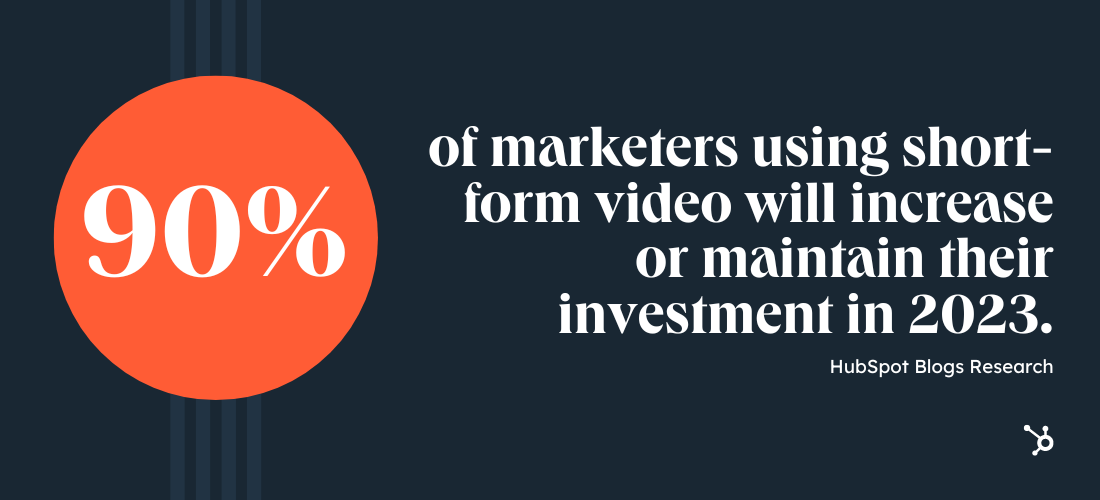
Short-form video has taken the marketing world by storm, and we predict it will carry over in 2023. A staggering 90% of marketers using short-form video will increase or maintain their investment next year, and 1 in 5 marketers plan to leverage short-form video for the first time in 2023.
While long-form videos can offer depth and large amounts of information about a product, brand, or services to audiences, both B2C and B2B marketers have learned that getting to the point with short-form videos can actually be much more effective.
Not only does it take less bandwidth to create a short-form video, but this type of format aligns well with the fast-paced attention spans of online audiences in a variety of demographics. This is likely why platforms like TikTok, Reels, and — in previous years — Snapchat have gained quick growth and marketing interest.
Still not convinced that short-form videos can be effective in your marketing strategy? Check out this great example of a TikTok video from Canva that informs viewers of just how easy it is to make professional-looking graphics with the website.
Featured Resources
- The Ultimate Video Marketing Starter Pack
- YouTube for Business: A 30-Day Roadmap for Channel Growth
- How to Use Video in Every Stage of the Buyer’s Journey
3. Social media will become a customer service tool.
Leveraging social media as a customer service tool is relatively new, but this trend is quickly gaining steam. So much so, more than a quarter of marketers use direct messages (DM’s) to offer customer support, and 15% of marketers plan to try it for the first time in 2023.
It’s no coincidence that this trend is emerging at a time when many social media platforms — namely Instagram and Facebook — are expanding its e-commerce capabilities. For this reason, providing customer service on these platforms will become even more crucial.
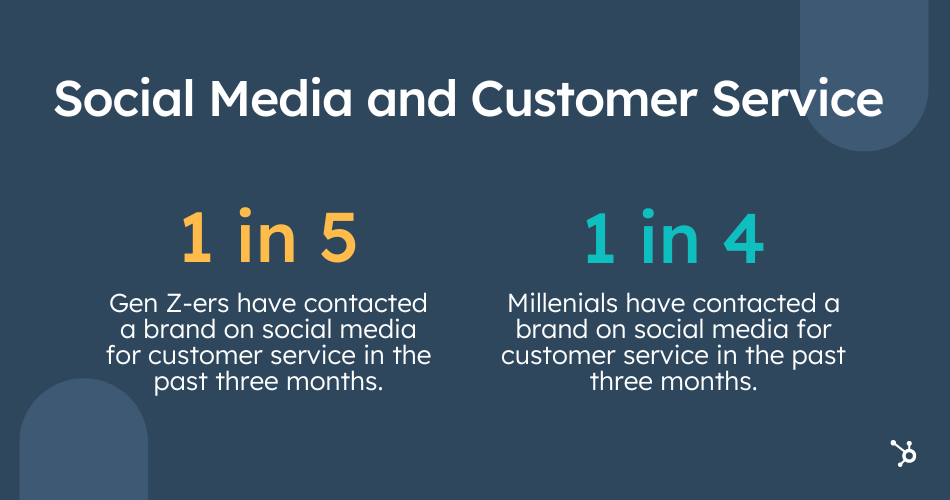
It’s also worth noting that consumers want to communicate with brands via DM’s — especially the Millennial and Gen Z crowd. HubSpot’s 2022 Consumer Trends Survey found that 20% of Gen Z-ers and nearly 25% of Millennials have contacted a brand on social media for customer service in the past three months.
4. More businesses will leverage SEO to concur search traffic.
As marketers, we must ensure that our websites and content are as discoverable as possible — especially on Google — which can provide both long-term and short-term traffic returns. And, while SEO is not new, it’s strategies are becoming even more ingrained within modern day marketing strategies.
When it comes to the trend marketers will invest the most money in for 2023, SEO ranks third behind short-form video and influencer marketing. Further, 88% of marketers who have an SEO strategy will increase or maintain their investment in 2023, which is a slight uptick from the year before (84%).
As the interest and need for SEO strategies grow, so do all search optimization opportunities. As Google algorithms have evolved, SEO has become about much more than churning out basic posts that answer simple search queries. Now, brands are investing in SEO experts who can help them with everything from search insights reports, to multimedia optimization.
5. Mobile optimization will be even more important.
Consumers are spending more and more time on mobile devices. In fact, more than half of annual online website traffic comes from mobile devices, including tablets.
As millennials and Gen Z audiences continue to grow buying power, mobile-optimized digital experiences will be even more vital to consider as a business owner who markets to these fast-paced, highly connected generations.
Above are just some of the reasons why:
- 33% of global marketers invest in mobile web design,
- 64% of SEO marketers call mobile optimization an effective investment
And, mobile experiences aren’t just important on brand websites, they’re also important in other key marketing strategies. For example, 56% of marketers who work with email are focused on delivering mobile email experiences to subscribers.
Featured Resource
6. More companies will prioritize social responsibility.
89% of marketers who create social responsibility content plan to increase or maintain their investment in 2023, which is almost double from the year before.
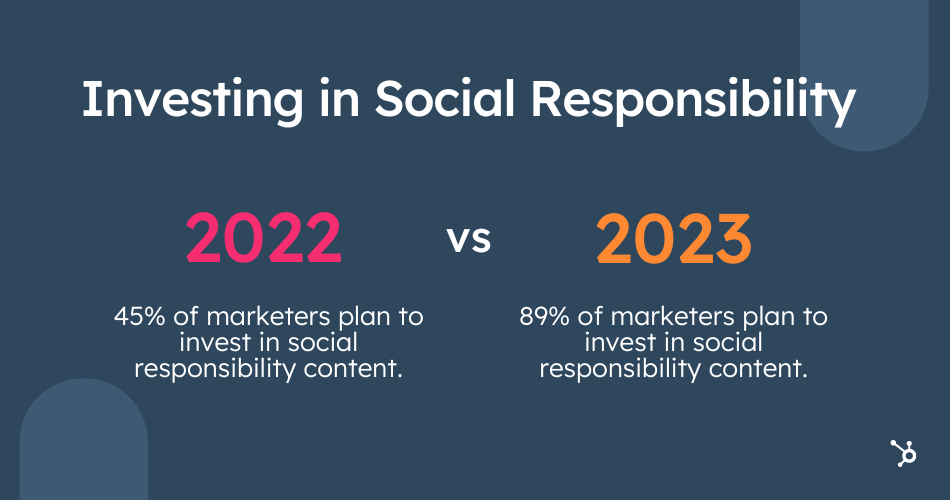
The trend is clear: social responsibility, ethics, and transparency matter to the modern consumer.
For instance, 50% Gen Z-ers and 40% of Millennials want companies to take a stance on social issues, specifically racial justice, LGBTQ+ rights, gender inequality, and climate change. When companies advocate for these issues, it has a strong impact on their purchase decisions
With all of this in mind, companies have begun to pivot social media strategies to focus more on inclusive initiatives, promotions, and offerings, while highlighting causes or missions they support. Although this might not sell products immediately, showing a sense of social responsibility is still both thoughtful and effective.
Senior Lecturer in Leadership and Innovation, Hal Gregersen, shares his perspective on the subject:
“If there can be a perfect storm of opportunity for strengthening D&I [diversity and inclusion] in organizations, I believe it is happening now.,” Gregersen says. “With the pandemic, traditional ways of doing business and of working were upended, and now, barriers to the idea of change are dissolving.”
7. Aligned marketing and sales teams will win.
As we inch closer to 2023, it’s becoming increasingly crucial for sales and marketing teams to work together. When these teams are aligned, marketers can get a more complete picture of their customers, including their interests, hobbies, and demographics.
But when this doesn’t happen, it creates a flurry of problems for everyone involved. Most notably, it’s more challenging to share and access data across teams — which 1 in 5 marketers currently struggle with.
Worryingly, only 31% of marketers say their sales and marketing teams are strongly aligned. It’s no surprise that almost half of marketers are shifting their goals in 2023 towards sales and marketing alignment.
8. Experiential marketing could make a comeback.
Experiential marketing campaigns enable audiences to step into an immersive experience that is often in a physical place or via an AR/VR platform.
One example of an experiential campaign you might have seen in the past was M&M’s Flavor Room pop-up.

Image Source
The experience included orb-shaped “rooms,” which were each complete with decor and fragrances unique to a certain candy flavor. The pop-up, which was based in NYC back in 2018, also included snack and drink lounges with M&M-themed cocktails — which, I’m willing to bet, we’re great opportunities for M&M to appear on different attendees’ social pages.
Although immersive experiences like these were fun, effective, and highly shareable on social media, they ran into barriers in 2020 and 2021 as businesses, public venues, and entire countries were forced to shut down public operations in the global pandemic.
And, because producing a branded AR/VR experience is a high-budget bet that can also rely on audiences to have tools like AR/VR headsets or the latest smartphone technology to access the content — fewer small brands have invested in digital experiential marketing.
But, now, as digitally immersive platforms continue to get more accessible to larger audiences, the possibility of experiential marketing back on the table again for 2023.
9. Inbound marketing will remain a best practice for growing brands.
In a time of digital transformation, embracing inbound marketing is an incredibly smart move.
Throughout the last two years, the world’s dealt with unprecedented change, and outbound marketing tactics have become even less effective in reaching prospects and leads.
The shift from in-person to hybrid work from home (WFH) business practices have made inbound marketing come to the forefront of effective tactics. For example, there’s been a significant rise in virtual events due to COVID-19 forcing marketers to get creative to catch the attention of customers.
John Hazard, the founder and content strategist at digital marketing agency Lighthouse Creative Group, sees this as a place of opportunity to generate interest despite their typical formulaic production. “Screen fatigue is a big issue for brands.”
Hazard adds, “As virtual events have exploded as a replacement for in-person engagement, every business has tried to roll out events, webinars, and virtual conferences. But most are just PowerPoint presentations or an executive talking with their kitchen in the background. That’s not interesting … So, the race is on in 2021 for polish and production value — graphics, directors, professional hosts, equipment, and no kitchen backdrops.”
Inbound marketing can be a valuable asset to create brand awareness and build trust digitally through refocusing strategy to drive customers to seek out your content.
The process of inbound marketing requires you to produce quality, valuable content tailored towards your target audience and buyer personas and their needs.
Why Brands Are Adopting the Flywheel
The marketing funnel is old news. Today, the flywheel — and a subsequent focus on service — have replaced the one-way direction of the funnel and lives at the center of many inbound marketing strategies.
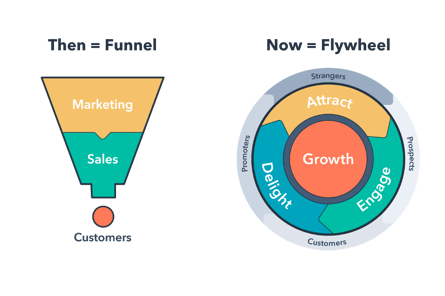 In the world of the marketing funnel, customers were an afterthought. Once they became a paying customer, businesses considered them obsolete — until, of course, it was time re-sign that contract.
The flywheel, on the other hand, places the customer in the center. Since word-of-mouth marketing is one of the most powerful marketing tactics, it’s wise to not only serve your customers but also equip them to become advocates for and promoters of your brand. The flywheel illustrates this process: excellent service as its own marketing strategy.
By keeping the flywheel at the center of your marketing efforts, you’ll delight and empower your customers. It’s worthwhile to place a heavy emphasis on customer service and train your team to handle requests and issues.
This will lead to customers who can market for you — they can promote and advocate for your business via their networks both online and in-person.
Featured Resource
10. Virtual reality (VR) and augmented reality (AR) will experience slow adoption in the marketing sphere.
We initially had high hopes for VR and AR in the marketing space. Back in 2021, 35% of marketers were leveraging AR or VR in their strategies, and of those marketers, almost half planned to increase their investment in 2022.
But in 2023, it could fall lower on the list as less marketers plan to invest in it. More than a quarter (27%) of marketers are planning to stop using VR and AR next year.
Generally speaking, this is a trend marketers have been slower to adopt due to pricey equipment and bulky headsets. But, as VR glasses and AR apps become more accessible, this could turn around.
11. More brands will test out native ads.
This year, almost a quarter (23%) of marketers planned to leverage native ads for the first time, and we predict this number will continue to grow in 2023.
Why the growing interest in this strategy? Well, it works. Of the marketers who use native ads, more than 36% say it’s effective, while nearly 50% say it’s their top ROI-generating tactic.
When your brand pays to feature content on a third-party website, you’re investing in native advertising. Unlike traditional advertising, which is designed to interrupt and stand out, native advertising is designed to blend in and promote your brand to a new audience who might otherwise never learn about you.
Because native ads don’t “feel” like traditional ads, consumers are more likely to consume them — in fact, consumers view native ads over 50% more than banner ads.
Examples of native advertising can be found on social media, through search engine results, content recommendation platforms (those links to various other content you can click at the bottom of the page to read more on or related to the topic), or in campaigns.
For example, Instagram is a popular social media network that routinely partners with brands for native advertising. By taking advantage of the Instagram Story or Shop features, brands are able to share posts that look similar to the average user’s followers posting style, while subtly advertising a product.
Content Marketing Trends
At least 47% of buyers view three to five pieces of content prior to engaging with a sales rep, and the majority of them expect brands to create content to gain their interest. That’s why brands all around the world have only grown their investments in content marketing.
But what content strategies are brands investing in? Below are just a few trends you’ll want to follow in 2022.
Featured Resources
12. Video will remain the top marketing content format.
Video dominated the marketing space in 2022 – and we predict 2023 will be no different. Why? Because marketers plan to invest in short-form video more than any other trend next year. What’s more, a whopping 90% of marketers who currently leverage short-form video will increase or maintain their investment in 2023.
“Video creates a deeper connection with your potential customer base and it is easy for brands to repurpose video content into podcasts and text-based content,” Neil Patel CMO and Co-Founder of NP Digital, says.
In the past, video creation and marketing strategies were limited due to costly resources and production. Today, it’s much more accessible. With a lower-cost barrier, video has become less intimidating to incorporate into your marketing efforts.
“Our company, Jotform, has been ramping up our video efforts on YouTube. We have over 16,000 subscribers and have seen a huge increase in site traffic and signups from investing in video on this platform,” says Aytekin Tank, Founder & CEO of Jotform.
You don’t have to hire a production team or marketing agency; all you need is a smartphone, such as an iPhone, and affordable editing software. Don’t believe us? This post highlights how our own video marketers created video content from home at the beginning of the COVID-19 pandemic.
13. Blogging isn’t going anywhere.
Blogging has been a commonly used marketing strategy since brands started building their own websites. But, the age of this tactic shouldn’t be a sign that it’s out-of-date. In fact, blogging has been used for so long simply because it works. So much so, one in three marketers leverage their own blog or website
On top of that, our research suggested that most consumers read blogs multiple times per week and have purchased something from a brand after reading the company’s blog.
Aside from providing consumer engagement and potentially conversion, blogs also provide a major key benefit to your website or online pages: search discoverability.
Ultimately, sites with robust blogs have more search potential and can implement SEO strategies much easier than sites that don’t.
Think about it this way. If a prospective client wants to hire a virtual accountant, and your firm’s site has a blog post that highlights tax tips or strategies your accountants use, this person might find your post or website via Google search, read your post and explore your website, and then decide that they want to contact you for a consultation or accounting assistance.
If you haven’t considered a blog by this point, but are intrigued by this data, check out these resources to help you build out your own strategy:
14. Case studies will continue to drive leads and brand credibility.
Longer-form case studies offer prospects an incredibly deep and exclusive look into how people or brands benefit from a product, service, or strategy. While some businesses place them publicly on their web pages to persuade a potential buyer as quickly as possible. others might gate them as free PDFs that require a lead conversion to be downloaded.
Although many marketers, such as those in B2C industries, don’t leverage case studies, those that do find them effective. Additionally, case study usage in content marketing is only growing: 37% of marketers planned to use case studies in their marketing strategy for the first time this year.
15. Marketers will embrace data with infographics.
If a picture paints a thousand words, infographics could paint at least double.
Infographics not only have the shareability and visual appeal of a nice photo — but they’re also packed with helpful data and informative information. This makes them incredibly engaging to web visitors and social media audiences alike.
Of the marketers who regularly use infographics in their content strategy, 56% say they are their most effective content type.
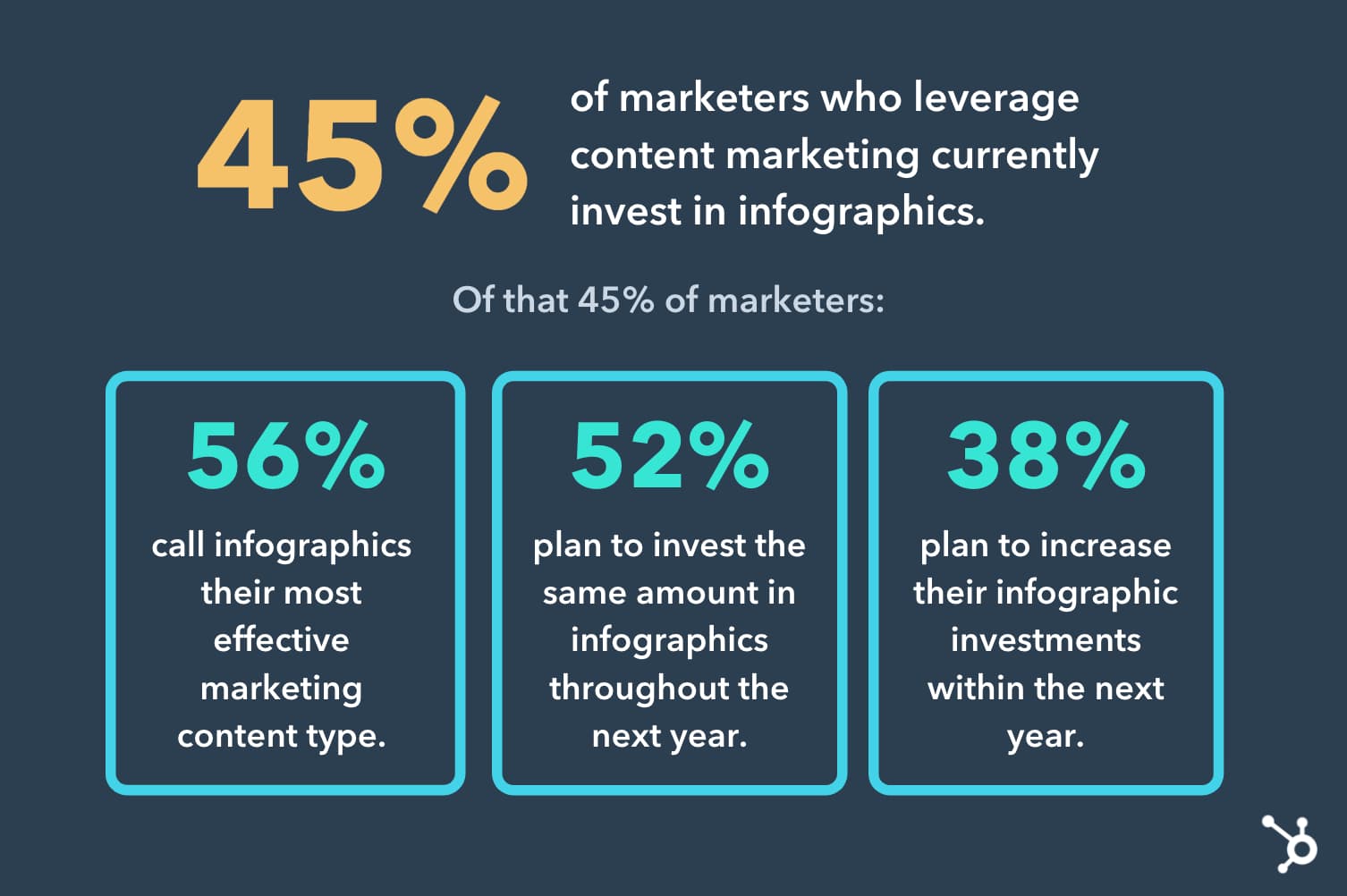
Ultimately, credible data can help marketers, bloggers, and content creators tell compelling and persuasive stories. Why else do you think we surveyed hundreds of marketing professionals to create this content?
Featured Resources
- How to Start a Successful Blog [Free eBook]
- The Complete Collection of Content Marketing Templates
- Free Editorial Calendar Templates
Social Media Marketing Trends
In the U.S. alone, 79% of people have some type of social media account — and globally, there are over 3.7 billion social media users.
This is why social media marketing is a popular channel that’s become a part of almost every business’s greater marketing strategy. Social media marketing allows you to authentically connect with your audience on a personal level, humanizing your brand.
16. Selling on social media.
Many social media platforms are vying to become the next go-to shopping destination. Instagram has Instagram Shopping; Facebook has Facebook Shops; and TikTok is testing new e-commerce and partnership features.
This shift is already having an impact on consumer shopping habits For instance, 71% of Gen Z-ers prefer to discover new products on social media. The same is true for 51% of Millennials.
If this trend continues to grow, you may want consider focusing on social media for your lead generation efforts.
17. TikTok will continue to gain brand interest.
TikTok will experience even more growth in 2023, as 56% of marketers who currently leverage the platform are planning to increase their investment in 2023, the highest of any social media app.
Brands have been trying to tap into the true power of TikTok since it first began to go viral three years ago. Now, with well-over 1 billion global users, TikTok has positioned itself as an app for a wide variety of audiences and marketers.
Of course, if you think TikTok is just for younger demographics, think again. 50% of Millennials report visiting TikTok in the last three months along with 38% of Gen X-ers, according to HubSpot’s 2022 Consumers Trends Report. We predict these numbers will continue to rise as TikTok becomes more mainstream.
18. Most marketers will focus on just three to five social media platforms.
On average, marketers leverage four social media platforms in their roles. Facebook is the most used social media platform, used by 64% of marketers, followed by Instagram (58%), YouTube (57%), Twitter (43%), and TikTok (42%).
Managing three to five platforms is realistic. This range allows brands of all sizes to expand their reach to different audiences while also giving social media marketers a realistic list of platforms to master without stretching their bandwidth during the work week.
Here are a few questions that can help you determine how many platforms you should really be on:
- How many social media marketers are on your team?
- Which social media platforms have audiences that best align with your targets?
- How much time will it take to master a strategy on each of the platforms you’re targeting?
- Are there any platforms that won’t benefit your overall marketing strategy right now?
- Are there any platforms you can easily repurpose engaging content between? (such as TikTok and YouTube Shorts)
By asking yourself some of the questions above, you can determine how much time your social team and brand will need to build an effective and engaging strategy on each platform, and prioritize which platforms you should really focus on.
Featured Resources
- How to Use Twitter for Business (+ Follower Growth Tracking Template)
- 30 Days of Instagram: A Guide for Businesses
- How to Attract Customers With Facebook
Search Engine Optimization Marketing Trends
61% of marketers say improving search engine optimization (SEO) to grow their organic presence online is their top inbound marketing priority.
Are you one of these marketers? If so, have you figured out how exactly you plan to improve your SEO and organic presence? When you optimize for specific types of consumer behavior, you’ll help your business become more discoverable online.
19. Keyword optimization will be a key priority.
By far, one of the HubSpot Blog’s most vital tactics is our Search Insights Report. This report highlights all the keywords we would like to leverage and all the blog posts we’ll need to create or update to rank for those keywords on Google.
But, we’re no longer one of the only blogs using a SIR anymore. In fact, 47% of marketing professionals who leverage SEO say their companies use search insights reports in their strategy.
For example, you can use tools like Ahrefs or SEMRush to do some quick SEO keyword research related to your business, products, or upcoming content to learn where you can boost your content with keyword-optimized titles, subheads, body text, or descriptions.
20. Web teams won’t forget about video and image SEO.
SEO doesn’t just involve changing the text on a page. It can also involve choosing and optimizing the right videos or images for a page to help it rank in Google images or search engine video carousels.
While optimizing images could involve compressing files to increase page speed and adding keyword optimized alt text to an image, video optimization strategies could involve embedding an video with a similar topic or keyword into a blog post.
Currently, 53% of marketers who leverage SEO have a strategy for optimizing videos and images. Of those marketers, 49% say image and video optimization is their most effective SEO tactic.
21. Link-building will help brands grow authority — and search rankings.
When sites with solid rankings begin to link to yours, Google’s crawlers note that your site might be credible and also have solid authority in your space. This can then tricker your Google ranking to go up. This, ultimately, is the goal of link-building — or getting other sites to link to yours.
Although writing highly shareable content, reaching out to share it with other websites, or ensuring that your post gets links can be time-consuming and challenging, research shows that this time and effort pays off. Of the 48% of SEO marketers that use backlinking and link building, 63% say its their brand’s most effective SEO tactic,
22. Historical optimization will help old web pages get new traffic.
Instead of coming up with new ideas, marketers are going to be taking what’s worked in the past and optimizing it for the present.
In SEO, keeping your content up to date and full of rich, engaging content will outweigh older work that is lacking in keyword relevancy with old statistics and links. Not only that, but taking existing content and repurposing it for a new podcast, webinar, or blog post can be an efficient way to keep it relevant in search engines.
While one in four SEO marketers leverage historical optimization in their strategy, 29% say of those marketers say it’s an effective SEO strategy.
23. Voice search optimization is less of a priority
Back in 2021, 41% of marketers planned to increase their investments in voice search optimization in the coming year. However, it seems this trend is less of a priority for marketers these days.
More than a quarter (28%) of marketers say they will stop leveraging voice search optimization in 2023.
While that may seem bleak, there is a portion of marketers who plan to explore this trend for the first time in 2023 (13% of marketers, to be exact). How will they do this? By framing their content around questions.
Think about it: these digital assistants answer short, informational queries such as “Who is the actor in Mission: Impossible?” or, “What’s the weather in Boston today?”, but they’ve also started to process more local, conversational, and customized searches. These may sound like, “Where’s a nearby coffee shop I can work from today?”, “How late is it open?”, and “Do they serve iced coffee?”
Aja Frost, Head of English SEO at HubSpot, says: “Businesses should look at a topic and say, ‘What questions could users ask about this?’ Then, they should plan sub-topics accordingly and look for opportunities to insert questions as headers. This will allow voice assistants to easily grab questions and recognize content as solutions.”
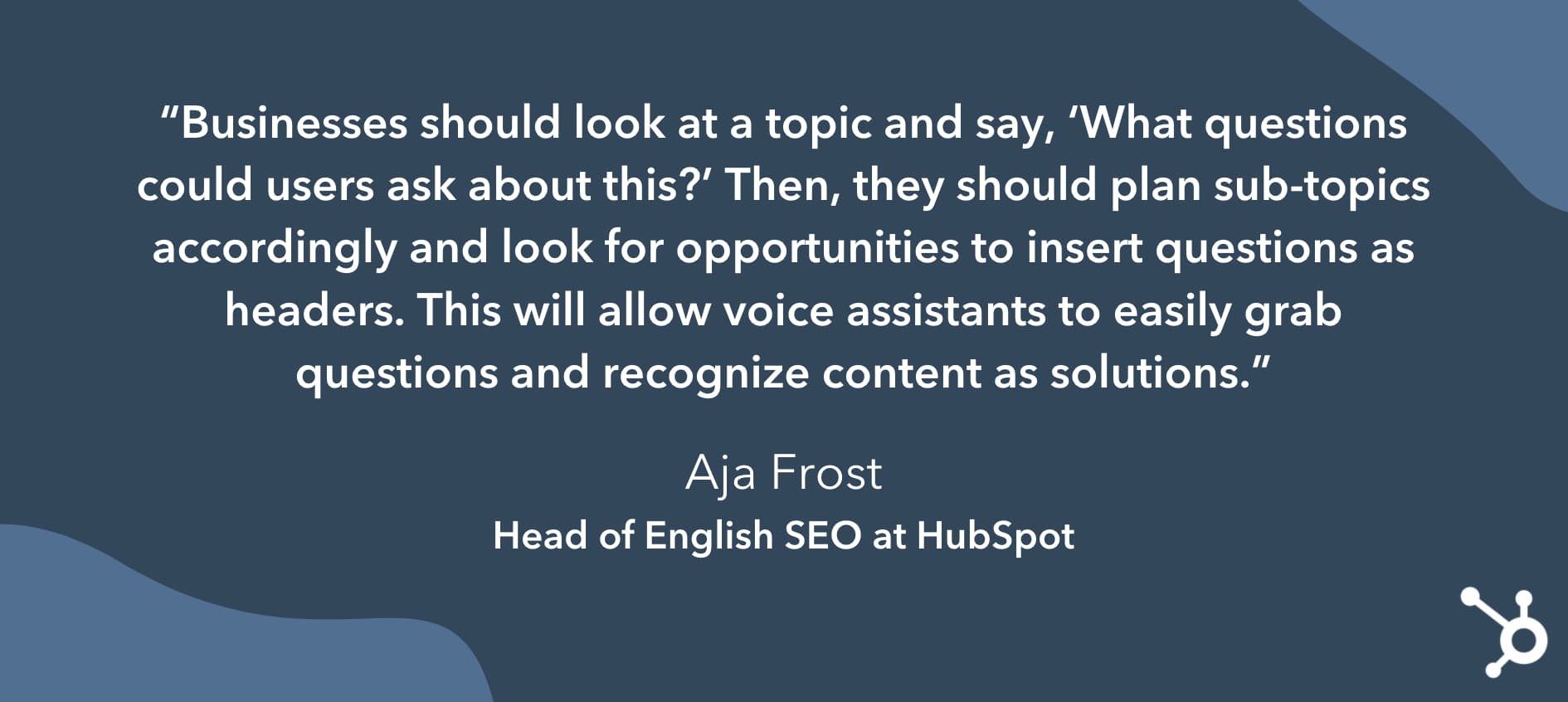
Featured Resource
24. Chatbots will continue to streamline conversational marketing.
Did you know that more than half of consumers expect a response within 10 minutes to any marketing, sales, or customer service inquiry? How can this be humanly possible?
It’s not… for humans, anyway. This is probably why 40% of marketers who use automation leverage chatbots.
Bots are powered by a computer program that automates certain tasks, typically by chatting with a user through a conversational interface. Bots are made possible by artificial intelligence which helps it understand complex requests, personalize responses, and improve interactions over time.
Bots provide the perception and dedication of a 1:1 service experience while working with hundreds of customers — something that no customer service representative or team would ever be able to do.
To the consumers who hate repeating themselves to multiple sales or service representatives (33%, to be exact), listen up — chatbots are and will continue making your lives much easier. If used correctly, they manage conversations at scale and aggregate data from multiple sources of data, from calendars to knowledge bases to blog posts and videos.
Jon Dick, SVP of Marketing at HubSpot, says: “It’s on you to make things as easy as possible.”
“Do your buyers want to use live chat? You should give it to them. They’ve had the same problem three times in the last month? You should already know, and have a plan to fix it,” Dick concludes.
Featured Resource
- How to Stay Current on Emerging Technology Trends
- How to Implement Affordable AI, According to Marketing AI Institute’s Director
Privacy Marketing Trends
25. Brands will need to give customers more control over their data.
In the marketing world, data is highly valuable — and not just valuable to you, as a marketer or business owner. Whether it’s an email address, credit card information, or smartphone location, consumers also view their data as precious and privileged — and it’s your responsibility to take care of it.
Whether a software company, bank, government agency, or lemonade stand, every business operates using data. It’s the lifeblood of all things marketing, sales, service, and more.
But, when precious information is misused or siphoned into the wrong hands, it leads to a strong distrust in businesses and potentially exploited consumers
That’s why the General Data Protection Regulation (GDPR) was enacted.
GDPR is an effort by the EU to give greater control to consumers over their data. Under the GDPR, organizations must ensure that their data is collected legally and safely and that those who collect and manage said data will protect it and respect consumers’ rights.
Following the GDPR guidelines might seem like a burden, but being fined for non-compliance will feel much heavier; fines range from 10 million euros to 4% of a company’s annual global revenue.
And — GDPR isn’t the only entity enforcing privacy mandates in 2022. In fact, companies like Google and Apple are now taking stands for user data as well.
In 2021, an Apple IOS launch enabled IPhone and IPad users to determine which apps could track their third-party data, which is often used for hyper-targeted ads.
In 2022, Apple will finish rolling out another IOS update with additional email privacy protections features for Apple Mail users. Meanwhile, Google will be discontinuing the use of third-party cookies on Chrome, while encouraging advertisers to leverage its Privacy Sandbox instead.
Ultimately, brands and governing bodies are increasingly aiming to give users more choice when it comes to releasing their data. And, while it is great for the consumer, businesses who leverage personal data to run campaigns will need to create alternative strategies and pivot plans incase they lose access to crucial datapoint.
Use Marketing Trends to Grow Better
You’re up to speed… for now. And, as long as you’re keeping a thumb on the pulse of marketing trends — and always remain open to change — your business won’t fall behind.
But, if you’re feeling overwhelmed by the idea of keeping up with all these insights, don’t worry. The HubSpot Blog will be publishing regular Marketing Strategy research pieces with data from hundreds of marketing professionals in the coming months and will continue to update this post as new trends emerge.
Editor’s note: This post was originally published in August 2019 and was updated in November 2021 with updated HubSpot Blog trends data.


What is Twitter Spaces? [+Why Marketers Should Care]
Following months of beta testing, Twitter made its new audio feature, Twitter Spaces, permanent.
Today, the highly-discussed feature is finally available to all users.
Spaces, which allows Twitter users to listen to and participate in public audio conversations, entered its beta test shortly after the launch and $100-million valuation of the app Clubhouse – which similarly offers an audio chat room experience.
![Download Now: Social Media Trends in 2022 [Free Report]](https://no-cache.hubspot.com/cta/default/53/3dc1dfd9-2cb4-4498-8c57-19dbb5671820.png)
Now that it’s here to stay, many brands with solid Twitter followings are also beginning to pay more attention to the marketing opportunities of Spaces.
- What is Twitter Spaces?
- Why Marketers Are Watching Twitter Spaces
- How to Use Twitter Spaces
- How to Join Spaces on Twitter
- Navigating Audio Social Media
Why Marketers Are Watching Twitter Spaces
Looking for a way to determine whether Twitter Spaces or Clubhouse is a better fit for your business? Check out our video guide comparing the pros and cons of the two social audio spaces below.
1. Twitter has major audience reach.
Twitter has well over 200 million daily active users. That user base includes audiences that fit into many different demographics all over the world. Because of this, brands can reach target audiences from all sorts of industries and backgrounds.
While Clubhouse’s user base quickly grew, it doesn’t offer comparable reach to Twitter due to its somewhat exclusive nature.
The audio social app was initially designed to be invite-only and started with a small user list of “elite” industry thought leaders, celebrities, and influencers. Only recently did every-day users start to get invited and expand its app to Android users.
2. Twitter Spaces could provide a shorter learning curve.
Learning how to use and experiment with a completely new social media app – like Clubhouse – can be time-consuming. Not only do you need to learn how to navigate it, but you also have to study its top users, brands, and trends to learn how to reach audiences there.
With learning curves in mind, marketers who are experienced Twitter users might turn to Spaces over Clubhouse simply because they already have a following on Twitter and only need to learn how to use one additional feature, rather than an entirely new platform.
3. Twitter Spaces could be more inviting to brands.
While Clubhouse’s live audio platform has pulled in users looking for authentic interpersonal conversation rather than brand information, Twitter’s audience is accustomed to seeing content from brands, such as ads, marketing videos, and promotional Fleets.
Because brand promotion feels more natural and common to Twitter users, these audiences might be more likely to accept or engage with brand-owned Space.
4. Twitter Spaces is visually interactive.
Twitter offers a number of features to make Spaces more visually appealing.
For example, Spaces listeners can use emojis to react to speaker comments. They can also share the Space while it’s live or recorded version to their newsfeed – allowing others to keep up with them.
“[The reaction feature]’s great because I see it as the perfect balance of being accessible for introverts and extroverts. If you’re not comfortable speaking, use an emoji,” said Krystal Wu, former HubSpot social media community manager, and Spaces beta tester.
5. Spaces provides a more casual environment than other streaming platforms.
Because of Spaces’ casual nature, marketers and audiences might not have to feel as intimidated when speaking in or launching Spaces, which could lead to engaging conversations between brands and their followers.
“The pressure is off when joining a Space. In all the discussions I’ve been part of, people are much more laid back no matter how casual or important the topic is that’s being discussed,” Wu explained. “I enjoy this because it removes the feeling of being ‘on,’ like most of us have been on Zoom during this pandemic.”
To learn how to use this feature and others within Spaces, keep reading for a quick how-to guide.
How to Use Twitter Spaces
How to Make a Space on Twitter
1. Start from the homepage or the Spaces tab.
There are two ways to start a Space:
- From the homepage – Click on the + icon to start a post then tap the purple Spaces icon.
- From the Spaces tab – Click on the purple Spaces icon on the bottom right of this tab to start a space.
From there, you’ll have to:
- Give your event a title, ideally related to the topic you’ll be discussing.
- Add up to 3 related topics to help relevant users find your event.
- Decide if you’ll record the Space.
- Start it immediately or schedule a date and time up to 30 days out.
Then, you can share your event with others in your feed to invite them to join.
2. Start your Space event.
As a host, you’ll be tasked with a few things:
- Designating speakers and/or moderators
- Accepting participation requests
- Sharing relevant Tweets during the conversation.
Read more about Twitter Spaces etiquette here.
3. Look for speaker requests.
When you first start a Space, the default setting will be to limit speakers to the ones you designate. However, you can change it to people you follow or anyone who joins.
Note that you can only designate up to 10 speakers at a time and have one co-host.
When someone requests to speak, you’ll get a notification and can choose to give them speaking privileges or ignore the request. If you unmute the listener, be sure to introduce them to the audience.
4. Remove or change speakers.
If you have more than 10 guests that would like to speak, you can tap one of your current speakers to remove their privileges.
This will allow you to minimize the potential speakers or add more speakers. This can be especially helpful if you’re holding a longer chat and want multiple listeners to contribute to the discussion.
Additionally, if the conversation goes awry or someone says something unexpected, Twitter allows Space creators to report or block speakers if they say or do something inappropriate.
This can help moderators create a safe and respectful environment for all listeners and participants.
5. End the Space.
A Twitter Space can only be ended by the person who launched it. To end a Space you created, all you have to do is tap the End icon.
6, Download your Space’s data.
According to Twitter, the social media platform retains data about the Space including recordings and transcriptions for up to 30 days after the event for review in case of policy violations.
Space creators can only access and download that data within 30 days of hosting, while speakers can download audio transcriptions. Spaces are ephemeral to non-speakers and conversations will disappear from the app as soon as they end.
How to Join Spaces on Twitter
7. Attend a Space.
When someone you follow is in a Space, you’ll see a purple circle around their profile picture on your timeline. A Twitter Space can also appear as a banner on the top of your feed.
When you tap on it, you’ll be given more details about who is in the Space and see a “Start listening” button. If the Space creator allows anyone who joins to speak, you’ll be asked if you want to enter the Space.
8. Attempt to speak.
Every Space you join is different. Some will allow any user to speak while others require attendees to request the ability to speak in the Space.

You’ll know by looking at your microphone icon. It’ll either say “Request” or “Speak.”
Once you’ve submitted your request, the host will be notified and will either approve or deny it. Once it’s your turn to speak, you’ll be notified.
9. Share the Space.
From the bottom navigation of each Space, you can tap the icon showing two people to invite specific followers to join, or the share button to Tweet a link to the Space you’re in.

10. React to the conversation.
If you want to respond to something a speaker says in a Space, but don’t want to speak, you can tap the heart-shaped icon in the Space’s lower navigation to see a list of emojis that you can tap to show a visual reaction.
11. Share Tweet-based conversation starters.
Wu says one of her favorite things about Spaces is that attendees can share public tweets directly in a Space.
“Any [speaker] in the Space can share a tweet, which will appear at the top of the Space,” Wu explains. “We can use it as reference points while chatting so that people can be more interactive in the discussions.”
Below is a look at Twitter’s own “Space’s” space. During the chat, which enables Twitter users to give feedback on the Space feature, a speaker shared a tweet from someone about how Spaces prioritizes attendees in its visual format.
To share tweets in a space, Wu says you just need to minimize the space you’re in, find a public tweet, tap the Share button, and tap the Spaces option. From there, the tweet will appear at the top of your space until the space host removes it or another tweet is shared.
12. Leave or minimize a Space.
Not interested in a discussion you’re listening to? All you need to do to exit is tap the “Leave” button in the upper-right corner of the screen.
If you’d like to go back to your Twitter feed, but want to keep listening to the Space conversation, you can tap the down arrow in the upper-left corner to shrink it into a small player that allows you to see tweets without leaving the Space.
Navigating Audio Social Media
If you’re a community-centric marketer, Twitter Spaces or Clubhouse could be worth experimenting and a great way to reach your audience on a more conversational level.
While you’ll certainly want to consider testing out Twitter Spaces, you should also continue to
Ultimately, if you decide audio social media is right for your brand, you’ll want to look at each platform’s pros, cons, and audience to determine which fits your target best.
To learn more about Clubhouse, which started the audio social media phenomenon, check out this post on the app’s growth. You can also check out this detailed how-to guide to see how Clubhouse’s features compare to Twitter Spaces.
More interested in growing your overall Twitter following and strategy? Click below to download a helpful free resource.
Editor’s Note: This post was originally published in May 2021 and has been updated for comprehensiveness.

The Ultimate Guide to Nonprofit Fundraising
Nonprofit fundraising is exciting. It’s the lifeblood of charitable organizations and can serve as a way to raise awareness of a cause and drum up interest among donors.
Fundraising is also a massive undertaking. Because it’s likely your primary means of income as a charitable organization, raising money can be a burdensome, never-ending effort. It can even seem scary.
But it shouldn’t. Great fundraising can (and should!) be learned and mastered. Building a nonprofit fundraising plan is the best way to equip your volunteers, avoid fundraising pitfalls, and create a sustainable organization.
![Download Now: Nonprofit Marketing & Fundraising Trends for 2022 [Free Report]](https://no-cache.hubspot.com/cta/default/53/6193b715-2ba9-4c6d-add0-681edfcae689.png)
That’s why we built this guide. Below, you’ll read about the legalities of nonprofit fundraising, the different ways to raise money, and how to build a simple fundraising strategy. Keep reading to get started or use the chapter links to jump ahead.
Nonprofit organizations can be philanthropic, religious, educational, artistic, or scientific in nature. Some churches and universities qualify as nonprofit organizations as they don’t keep a profit — any money received is spent on its cause or on maintaining the organization itself.
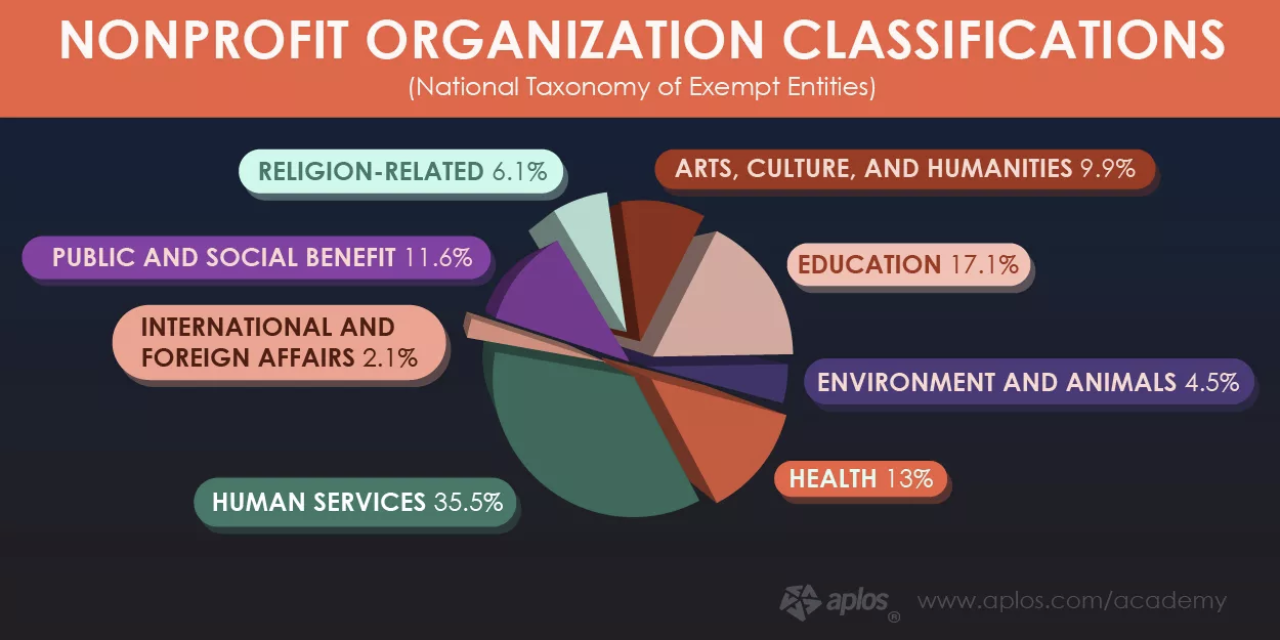
Fundraising is often the primary means of revenue for these organizations. That’s one reason why nonprofits and charitable organizations dedicate so many resources to it.
The other reason is to meet the requirements of the public support test, among other nonprofit fundraising rules.
To qualify as a 501(c)(3) tax-exempt organization (meaning, donations are tax-deductible with a donation receipt), a nonprofit organization has to receive a “substantial portion of its income” from the public … hence the public support test. Non-exempt organizations can still raise money, but their donors won’t be able to write off their donations as a tax deduction.
Nonprofit fundraising is heavily regulated by state law. This holds organizations accountable for how they approach and treat donors, and it ensures donors are giving money to the proper parties.
Before soliciting any donations, organizations must register with the state government in whichever state they’re operating. If the organization goes to another state to fundraise, they’ve got to register there, too. Also, if an organization hires a fundraising consultant or grant writer, he or she must also register with the state. (TL;DR: Fundraising requires lots of registration.)
Cause-related marketing, also known as commercial co-ventures, are also regulated by law. Commercial co-ventures exist when a nonprofit organization makes an arrangement with a business to receive a percentage of sales. This also refers to when two charitable nonprofits that agree to sell something together and jointly benefit from profits. We talk more about these below.
Overall, all nonprofit organizations should follow ethical fundraising practices. The IRS doesn’t enforce specific structural policies, but it highly encourages certain management and operational practices so organizations can better “obey the tax laws, safeguard charitable assets, and serve charitable interests”.
Note: This legal information is not the same as legal advice, where an attorney applies the law to your specific circumstances, so we insist that you consult an attorney if you’d like advice on your interpretation of this information or its accuracy. In a nutshell, you may not rely on this as legal advice, or as a recommendation of any particular legal understanding.
Understanding the legalities of nonprofit fundraising can help you navigate the wide variety of fundraising methods — which ones you can and can’t do, and which ones are best for your charitable organization and donors.
Nonprofit Fundraising Ideas
There are many options when it comes to raising money for a nonprofit — however, there are two major ways to raise money: individual fundraising or company and corporation fundraising.
As you review these types of fundraising — and the different ideas behind how to raise money within both categories — don’t be afraid to combine some of the methods, or use the multi-channel fundraising approach.
By using this multi-channel approach, you diversify your fundraising methods so donors have more ways to contribute. Also, donors might be motivated by one method but submit their donation via another method (such as seeing a direct mail piece but donating via text).
Note: Many of the following fundraising ideas can be used for both individual or corporate fundraising — we’ve placed them in the category they’re most frequently used in. For example, you’ll notice we have events listed under both individual and corporate fundraising below.
Also, before you implement any of these ideas, don’t forget to review the fundraising guidelines from the IRS.
1. Individual Fundraising
Individuals account for about two-thirds of all donations made to nonprofits.
With individual fundraising — also known as personal fundraising — you can ask people within your network, such as friends, family, or colleagues, to donate to your cause. The process allows you to share your story and ask these people to help and support your cause (or whoever/ whatever you’re raising money for).
Why use individual fundraising tactics?
A few reasons why you may implement individual fundraising tactics include the need to raise money for an emergency or natural disaster, trips, life events, education, or medical expenses.
Here are some ideas for how you can implement individual fundraising tactics within your nonprofit:
Direct Mail Donations
Direct mail is a tried-and-true fundraising tactic. It’s cheap, quick, and can be repeated time and time again. The key? Writing a great fundraising letter.
In today’s world, direct mail should only be one of many fundraising tactics you use due to the fact so much content is digital. So, don’t forget to provide a way for your mail recipients to donate online, too (versus mailing in a check … which seems a bit old school these days, doesn’t it?).
Online Donations
Online donations refer to any donations made online — through your website, social media, or on a crowdfunding site.
Online giving is pretty straightforward. It also serves as the primary donation method for most other fundraising tactics. And even if your donors don’t hear about your fundraiser online first, there’s still a large chance they’ll end up visiting your website to learn more and make their donation online.
Social Media Donations
Social media has become a booming, online fundraising tactic due to the sheer number of people on various platforms — over 3.5 billion people globally, to be exact.
For example, Facebook allows individuals to run fundraisers on their news feed and for their birthdays. The platform has also released a “Donate Now” button for organization’s Pages. On Instagram, you can share a URL in your Bio that takes your followers directly to your fundraising site/ web page — you can even write a short description of your nonprofit, cause, or fundraiser in your bio to pair it with the URL.
Lastly, no matter the platform, social media makes it very easy to share content about your cause, why you’re fundraising, and who’s already involved to get others excited to become involved.
Mobile Donations
These days, people are rarely without their phones — and charitable organizations know it. Nowadays there are multiple ways to donate using your mobile device.
Some charities have apps through which you can give. Apps like Charity Miles, Feedie, and Walk for a Dog allow people to give back while doing everyday activities like running, walking their dog, or posting their food on social media. Companies can sign up to sponsor nonprofits through these apps.
Let’s not forget about texting, the most popular way to give using your smartphone. In 2018, almost 50% of donations came from a text link. You can send out links via text or encourage your donors to give through a text message.
Individual Event Donations
Events are a popular way to raise money. Events are a common individual and peer-to-peer (p2p) fundraising method — meaning your supporters (not volunteers) are encouraged to raise money on your behalf. Examples of these events include silent auctions, charity dinners, craft sales, and talent shows.
Note: Remember: corporations can also raise money through events, too.
2. Company and Corporation Fundraising
About $5 billion dollars are raised through workplace giving annually. You can use company and corporation fundraising if you’re looking to raise money from businesses that are willing to partner with your nonprofit.
Why use corporate fundraising tactics?
A few reasons why businesses may be looking to partner with a nonprofit include supporting or fulfilling their corporate social responsibility, reputation, and public relations.
Here are some ideas for ways you can implement corporate fundraising for your nonprofit:
Matching Gifts
The process of matching gifts is when a company matches employee donations. 90% of companies offer some kind of matching gift program. This is because these programs help companies give back while helping donors give twice as much. If you’re interested in matching gifts, consider using a tool like Double the Donation to make these programs easy to market and implement.
Volunteer and Corporate Grants
Companies give volunteer grants when their employees have volunteered a certain number of hours. This encourages employees to donate their time and holds businesses accountable for charitable giving. Volunteering can serve as a great team (or company) outing, too.
Corporate grants are sums of money that companies and corporations give to nonprofit organizations. Companies can either give these grants directly to an organization or choose from a pool of grant applicants. Nonprofits should look out for grant opportunities and ways to apply for corporate funding.
In-Kind Donations
In-kind donations describe non-monetary items given to nonprofits from companies and businesses. They usually include food, drinks, or supplies for an event, free professional services like accounting or legal services, or equipment for a construction project. In-kind donations are typically accepted from businesses with which a nonprofit already has a relationship.
Note: In-kind donations are often used as part of fundraising events, like silent auctions.
Commercial Co-Venture Donations
Commercial co-ventures, or cause-related marketing, is when a nonprofit organization partners with a business to raise money. Examples of commercial co-venture are when a restaurant donates a portion of its proceeds for an evening, or when a retail store gives a percentage their sales, to a nonprofit.
5K Walk and Run Race
Host a 5K race for employees (and community members) to participate in. To raise money, charge a race entry fee. You can also give participants the option of getting sponsorships and/ or fundraising themselves to participate in the race.
Corporate Cookbook
Ask employees to provide one of their favorite recipes to create a corporate cookbook. You can charge the employees who submit their recipes a small fee — then, once the book is printed, you can see the books to the employees as well as local community members.
Employee Events
Give employees a reason to bond, have fun, and raise money for a good cause. Accept donations throughout the night and charge an entry fee — you can also organize a raffle. You might even encourage employees to bring their family and/or friends depending on the type of event you choose.
Here are some employee event ideas for you:
- Bowling
- Karaoke
- Art show
- Wine tasting (partner with a local winery)
- Golf outing
- Silent auction
Creating a nonprofit fundraising plan or strategy for your next campaign will help you focus your efforts and guide your day-to-day fundraising efforts when things get tough. It’ll also ensure your fundraising team is aligned on certain tactics or events that may be part of your strategy.
Walk through the steps below to start piecing together your nonprofit fundraising strategy.
1. Set your fundraising goals, mission, and story.
Start with the end in mind. What’s your fundraising campaign goal? Better yet, what’s your overall goal for this year? For the next three years?
This number should be rooted in the needs of your organization. To figure out those needs, return to your mission statement. If your fundraising goal answers the question of “How much money do you need?”, your mission answers “What do you need the money for?”
Defining your mission statement will guide your fundraising “asks”. What do you plan to do with the money from your fundraiser? How will it contribute to your organization’s mission and purpose? Donors will ask these questions, so outline the answers now.
A recent study found that transparency among charities could increase donations by 50%. Also, two-thirds of donors say that understanding the impact of their donation would encourage them to give more. If you’re open about how you spend your funds, people may give more to your cause.
Lastly, don’t be afraid to tell your organization’s story, as well as the stories of those whom you help. A 2010 study found that “charitable choices are largely driven by the donor’s own inclinations and preferences, a desire to help people they feel some affinity with, and a partiality for certain causes as a result of personal experiences.” A donor’s similarity to your cause or people you help can also motivate them to give.
Also, 62% of donors research charities before they give. Be sure to publish your story on your website for donors to read and connect with.
2. Identify your fundraising team or specialist.
Fundraising campaigns involve a lot of moving parts. Even if your entire organization will be involved in the campaign, it’s best to appoint an individual or small team to manage the fundraising efforts.
These folks will be in charge of tasks like:
- promoting the fundraiser
- organizing fundraising-specific events
- training and leading any volunteers
- managing and analyzing the funds received
- measuring the fundraiser’s performance and looking for ways to improve
Some nonprofit organizations hire a fundraiser specialist to help with these tasks, too.
All of HubSpot’s nonprofit content, in one place. Check out HubSpot’s free nonprofit content today.
3. Build your prospect list.
Who are you targeting for your fundraiser? What communities, companies, organizations, neighborhoods, and groups of people will you approach for donations? Can your volunteers, board members, and beneficiaries of your organization help you compile a list of potential donors?
This list will guide your campaign promotion. Whether you decide to fundraise via direct mail, social media, crowdfunding, events, sponsorships, in-kind donations or all of the above, having a prospect list will help you know exactly who to target.
4. Create a fundraising campaign plan.
This is your most actionable step and will define precisely how you’ll raise money. First, define which tactics you’ll use for your fundraising. (We cover these in the previous section.) Remember, providing a variety of ways to donate will likely increase the number of donations you receive.
Next, decide how you’ll promote your fundraising campaign as a whole. How will you market your organization and its drive to raise money? How will people hear about your events, sponsorships, commercial co-ventures, and more?
Note: How you receive your funds (fundraising tactics) and how you promote your fundraiser (fundraising marketing) are two separate things. This step of your nonprofit fundraising strategy helps you define both.
Lastly, consider how to establish recurring donations so that your organization doesn’t have to fundraise so actively and so often. Almost 50% of donors are enrolled in a monthly giving program, like this one for Charity: Water. Providing a recurring donation option can actually help you raise more money — the average monthly online donation is $52 ($624 per year) compared to the average one-time gift of $128.
5. Say thank you.
Regardless of how you choose to raise money for your nonprofit, always remember to say thank you. Sending a thank-you note and donation receipt is good practice per the IRS, but it’s also beneficial to build relationships with your donors and supporters.
Donor loyalty is just as important as customer loyalty. Fostering relationships by maintaining transparency can alleviate the pressures of non-stop fundraising. Put your donors first (alongside the people helped by your organization), and your nonprofit will see long-term success.
Over to You
Nonprofit fundraising is critical for charitable organizations. By researching tactics and building a nonprofit fundraising strategy, organizations can set themselves up for long-term fundraising success — and impact.


Are Seasonality & the Economy Impacting Marketers in Q4? [Traffic & Conversion Data from 150K+ Companies]
This time each year, nature – as well as marketing – slows down as we head into colder seasons.
As we enter Q4, marketing departments are preparing for a slowdown in business that comes as people tune out towards the end of the year.
But, while seasonal change is expected and inevitable, this year’s economic shifts might cause some marketers to worry that this year could bring a flurry of poor numbers.
As you see dips or bumps in early Q4, you might wonder, “Is my marketing department experiencing seasonality or an impact of outside events, or are our numbers solely based on the work we’ve been doing?”
To help you gather evidence that proves or disproves the possibility of outside impacts in Q4, here’s a look at how businesses across industries entered the first month of it in October.
About this Data: These insights are based on data aggregated from 158,000+ HubSpot customers globally between July 2021 and October 2022. Because the data is aggregated from HubSpot customers’ businesses, please keep in mind that the performance of individual businesses, including HubSpot’s, might differ based on their markets, customer base, industry, geography, stage, and/or other factors.
How Marketing Metrics Are Shifting (or Staying the Same) in Early Q4
To learn how metrics were shifting, we looked at data from sample sizes of 120,000+ businesses.
Overall, we’re seeing that most inbound marketing metrics are down year-over-year. Luckily, the good news is that one major, hard-to-win metric, website conversion rate, is trending upward.
When looking month-over-month, numbers seem to be flatter with a mixed bag of small increases and decreases, which could hint that we’re heading into a seasonal time of slow growth, or starting to see some sluggishness due to the economic climate.
Below, I’ll break down each key marketing metric and walk through what we’ve seen across industries in Q4 so far.
Q4 Web Traffic So Far
Month-over-month, we see that fall and winter seasonality hasn’t harmed websites quite yet with most industries seeing flat, low-change in traffic. Only Technology, Information and Media (up 2% MoM) as well as Trade, Transportation and Utilities (up nearly 3%) saw any real change.
While seasonality might not be impacting the industries below, year-over-year data shows significant dips in traffic across industries (a theme we’ve seen throughout the last few months). Professional and Business Services (down 10%) saw the most significant annual loss, while Leisure and Hospitality saw the reverse with a nearly 7% YoY increase.
|
Industry |
MoM |
YoY |
Sample size |
|
All |
1.30% |
-10.80% |
145,150 |
|
Construction |
-1.21% |
-5.39% |
1,405 |
|
Education and Health Services |
-0.42% |
-3.74% |
3,659 |
|
Financial Activities |
1.32% |
-11.12% |
4,084 |
|
Leisure and Hospitality |
-1.31% |
6.99% |
1,114 |
|
Manufacturing |
-0.19% |
-6.43% |
4,463 |
|
Professional and Business Services |
-0.55% |
-9.65% |
12,999 |
|
Technology, Information and Media |
2.32% |
-4.62% |
14,934 |
|
Trade, Transportation and Utilities |
2.92% |
-5.58% |
3,480 |
Why is this happening? Are we continuing to see solid annual traffic drops? We can’t be certain, but a few things that could be causing impacts are:
- More and more, audiences spend time discovering and even shopping for products on social media directly – no longer relying on standalone company sites.
- In 2021, many regions were still at least partially quarantined due to COVID-19. While the pandemic continues, most of the world’s lightened precautions, enabling economies to re-open and allowing more people to go out and spend less time surfing the web.
- Search engines get more and more competitive daily as hundreds of sites aim to rank for the same keywords as their competitors. More competition directly impacts search traffic and, today, search result pages are more saturated than ever..
Website Conversions Grow Despite Traffic Dips
While traffic seems to be a tad sluggish in October, we’re seeing significant YoY gains (+10.95%) overall with Technology, Information and Media leading the pack (+22.1%) and only Trade, Transportation and Utilities, and Construction seeing decreases.
Across the board, we’re seeing a very slight MoM decrease overall, except for Technology, Information and Media which saw a large increase and Trade which saw the greatest decrease (aligning with slow tech business growth reports we’ve seen all over the news.)
|
Industry |
MoM |
YoY |
Sample size |
|
All |
-1.76% |
10.95% |
124,836 |
|
Construction |
-5.36% |
-5.36% |
1,166 |
|
Education and Health Services |
2.26% |
19.35% |
3,316 |
|
Financial Activities |
-4.59% |
7.47% |
3,542 |
|
Leisure and Hospitality |
5.00% |
9.70% |
939 |
|
Manufacturing |
-6.27% |
12.95% |
3,905 |
|
Professional and Business Services |
0.31% |
15.41% |
11,451 |
|
Technology, Information and Media |
17.27% |
22.10% |
13,504 |
|
Trade, Transportation and Utilities |
-8.41% |
-4.39% |
2,984 |
Inbound Leads Stay Fairly Flat… Except in a Few Key Industries
In October, Inbound Leads were a mixed bag. However, the evidence of both positive and negative seasonality patterns become more obvious when looking at this metric.
Month-over-month, inbound leads remained flat with an overall 0.65% decrease. Manufacturing (-6.48%), as well as Transportation and Utilities (-5.6%), saw the biggest dips. Meanwhile, Construction (-8.75%) and Trade, Transportation and Utilities (9.82%) saw significant YoY losses.
Where did inbound leads grow? Technology, Information and Media saw a sizable MoM and YoY increase of 5.22% each. Additionally, inbound leads overall saw a small annual increase with Education and Health Services (16.76%) and Leisure and Hospitality (17.15%) seeing the greatest gains. These boosts contributed to year-over-year growth of 1.63% for overall industries.
|
Industry |
MoM |
YoY |
Sample size |
|
All |
-0.65% |
1.63% |
132,820 |
|
Construction |
-4.48% |
-8.75% |
1,345 |
|
Education and Health Services |
1.70% |
16.76% |
3,636 |
|
Financial Activities |
-2.80% |
-1.97% |
3,876 |
|
Leisure and Hospitality |
2.74% |
17.15% |
1,031 |
|
Manufacturing |
-6.48% |
4.31% |
4,287 |
|
Professional and Business Services |
0.15% |
8.02% |
12,648 |
|
Technology, Information and Media |
5.22% |
5.22% |
14,592 |
|
Trade, Transportation and Utilities |
-5.61% |
-9.82% |
3,251 |
What can we make of this data?
While we can expect year-over-year conversion rate growth with web traffic going down annually, some of the substantial losses and gains are due to more than just web traffic. A few potential impacts could be:
- Products or services sold within manufacturing, trade, transportation, and utilities can be quite expensive or impacted by inflation. As people tighten their budgets with conflicting economic news, high-priced industries could be seeing some sluggish lead generation as people might only be focusing on just the products or services they need.
- Seasonality is likely beginning to take effect as people begin to focus more on experiences driven by education, media, and holiday travel, while putting other industries on the back burner.
- As we keep seeing news of career changes, recession-based company shifts, and the continuing pandemic, people might be more fixated on Education and Health Services industries than in previous quarters, leading to nearly-17% annual lead growth.
Are Marketing Emails Struggling to Be Seen?
In our previous reports, we noted that while marketers have been sending fewer emails – likely to meet the needs of today’s subscribers with heavily cluttered inboxes – they’re still seeing opens and open rates dip.
It’s tricky to guess what the problem could be, but as the HubSpot Blog’s former email manager, one suspicion I have is that email inboxes are far too saturated and competitive these days.
|
Metric |
MoM |
YoY |
Sample size |
|
Email sends |
1.42% |
-1.97% |
141,791 |
|
Email opens |
-1.14% |
-15.85% |
141,791 |
|
Email open rate |
-2.19% |
-13.71% |
141,769 |
Ultimately, if your email isn’t seen in an inbox no one will open it. And, if you’re sending emails with great content, but non-competitive, non-eye-catching subject lines, your readers might not click into them.
Odds are, your subscriber subscribes to many other emails related to your industry. And, because of this, they compare you to competitors sending similar content with similar goals each day. This is why it’s so important for your brand’s emails to seem as interesting, unique, and eye-catching as possible – without looking too desperate.
To learn more about how to boost your open rate and opens, check out this helpful post.
Further Reading
When it comes to key marketing metrics, keeping a pulse on how the business world and your industry are doing can help you determine when and how to get ahead of competition.
For even more helpful data, check out our previous reports, plus a few additional research studies, as you plan your strategies for Q4 and beyond.
- The Top Traffic, Conversion & Lead Trends in Q3: Data & Takeaways from 120,000 Businesses
- Your Guide to Summer Web Traffic, Conversion & Lead Performance Across Industries
- A Crisis of Disconnection: 3 Business Trends Stifling Business Growth in 2022
Lastly, be sure to check out our free, downloadable 2022 State of Marketing Report below – with data and tips from experts across the global marketing industry.

10 Events and Conferences for LGBTQ+ Entrepreneurs
Welcome to Breaking the Blueprint — a blog series that dives into the unique business challenges and opportunities of underrepresented business owners and entrepreneurs. Learn how they’ve grown or scaled their businesses, explored entrepreneurial ventures within their companies, or created side hustles, and how their stories can inspire and inform your own success.
LGBTQ+ people often face higher rates of isolation and discrimination, meaning that this community can especially benefit from gatherings that foster support and connection.
This is especially true for LGBTQ+ entrepreneurs and professionals, as finding opportunities to learn from people who share similar life experiences can be challenging.
In this post, we’ve curated a list of annual events and conferences for LGBTQ+ entrepreneurs and professionals. Whether you’re seeking mentorship, training from experts, or just some old-fashioned socializing with like-minded business owners, these events are made for you. While most have already taken place for 2022, keep your eyes peeled for the 2023 dates.
Events and Conferences for LGBTQ+ Professionals
1. Lesbians Who Tech & Allies Summit
Despite the name, the annual Lesbians Who Tech & Allies Summit is inclusive of all techies, centering LGBTQ women, women of color, and non-binary leaders. The ninth summit was in October in San Francisco, with in-person and virtual options.
Their summits feature networking and mentorship opportunities, career fairs, leaders and celebrity speeches, parties, and educational sessions. While much of the content is geared toward the tech world, many sessions focus on broader topics like leadership, diversity, politics, and advocacy, which may appeal to any LGBTQ entrepreneur.
2. Out & Equal Summit
The Out & Equal Summit has been held for over 20 years, creating a place for LGBTQ+ professionals and allies to learn how to create more inclusive workspaces. The latest was in October 2022 in Las Vegas, with a digital livestream option.
This conference is intended for any professional interested in LGBTQ+ workplace equality — especially executives, HR and DEI experts, Employee Resource Group leaders and members, and more. In addition to hosting learning sessions and keynote speeches, this event provides attendees with networking opportunities, workshops, and social events.
3. NLGCC International Business & Leadership Conference
The NLGCC, or the National LGBT Chamber of Commerce, is the only organization that offers a certification for LGBTQ-owned businesses (Certified LGBT Business Enterprise®).
It also provides business owners with networking and business opportunities year-round — and at their annual conference. Despite being U.S.-based, their International Business & Leadership Conference claims to be “the largest LGBT business event on the planet.”
In addition to networking and keynote speeches, attendees get access to leadership programming, speeches, B2B bootcamps, expos, matchmaker meetings between suppliers and companies, and more. The 2022 event was in Las Vegas in August.
4. Out Leadership Summit
This organization aims to drive equality and advocate for inclusion in business. They have several talent development programs for emerging leaders, women, and board-level executives.
Out Leadership also hosts yearly summits worldwide to unite leaders and business owners. The 2023 US summit will be on May 15 in New York in partnership with Lambda Legal.
5. StartOut Chapter Events or National Awards
StartOut exists to support LGBTQ entrepreneurs and accelerate their businesses. The organization has chapters in several major cities, such as Austin, Chicago, San Francisco, and New York, where local LGBTQ+ business owners can connect and attend frequent educational and social events.
StartOut also puts on a national gala, the StartOut Awards, which celebrates LGBTQ entrepreneurs and is an ideal opportunity to socialize and network with peers. The 2022 event took place in October in New York City.
6. The ROMBA Conference
Reaching Out MBA’s annual ROMBA Conference is a massive event for LGBTQ+ business students and post-MBA professionals.
The conference features social receptions, career fairs, panels, workshops, and competitions. LGBTQ+ entrepreneurs with business backgrounds can utilize this event for professional development, networking, and recruiting talent. The 2022 conference was in October in Washington, D.C.
7. Out Professionals Events
This organization for LGBTQ+ professionals hosts virtual events, but if you’re fortunate enough to live in a city with a chapter, you can attend local events and connect with other entrepreneurs.
Cities such as Houston, Philadelphia, San Diego, and Washington, D.C. have Out Professionals chapters and host monthly in-person events to help LGBTQ+ people build their careers and network. The organization is expanding and seeking more cities where people want to start chapters.
Industry-Specific LGBTQ+ Conferences
We included Lesbians Who Tech & Allies in this general list since technology touches nearly everything these days, and its sessions appeal to a broad range of professionals.
However, there are also many smaller, industry-specific LGBTQ+ events and conferences. If you want to network, socialize, and learn with your peers in your field, see if your industry has something specifically for LGBTQ people. Here are just a few of the ones out there:
- The NLGJA (The Association of LGBTQ Journalists) annual convention for those in journalism
- The Midwest LGBTQ+ Health Symposium for those in medicine and healthcare
- NAGLREP’s yearly convention for LGBTQ real estate professionals
Local LGBTQ Events
Chamber of Commerce
Some cities, regions, and states have their own LGBTQ chambers of commerce, where LGBTQ-owned businesses and allies can become members.
This not only links LGBTQ entrepreneurs with an affirming local business community, but it makes them visible to those seeking to patronize LGBTQ-friendly businesses. These local chambers frequently host community events, from social and networking opportunities to business training sessions. The NLGCC has a list of local affiliated chambers nationwide; check to see if there’s one in your area, and scope out their website for upcoming events.
Local Pride Festivals
Every year, more cities, counties, and regions host annual Pride celebrations. While you’ll typically find parades and marches, many Pride events also feature festivals with booths for rent. Entrepreneurs often use this opportunity to sell goods, create a local presence, or promote their business with freebies or giveaways. If your area has a Pride celebration, consider renting a booth.
Get Ready to Mingle
LGBTQ+ professionals have many opportunities available to connect with and learn from other entrepreneurs at events. All of the summits on this list are valuable opportunities to learn and grow — select one that speaks most to your needs and get ready to mingle.

YouTube Analytics: The 15 Metrics That Actually Matter
Some of us marketers have an unhealthy obsession with YouTube analytics — we track too many of them. Maybe we think we can prove any video marketing campaign is producing results if there’s an eye-catching percentage by its name. But, deep down, we all know that some metrics are more revealing than others.
There are a ton of KPIs we can look at that provide minimal insights. Fortunately, though, we created this guide to help you navigate YouTube Analytics and measure the metrics that actually matter. It’ll save you from drowning in the sea of analytics that most marketers only have a lifebuoy in, helping you not only stay afloat but swim safely to land.
![→ Free Templates: How to Use YouTube for Business [Download Now]](https://no-cache.hubspot.com/cta/default/53/b33cfd44-133a-49e3-a943-086c5679d485.png)
Read on to learn about the YouTube metrics that actually matter, and how they’ll enhance your video strategy.
YouTube Analytics: The 15 Metrics That Actually Matter
1. Watch Time
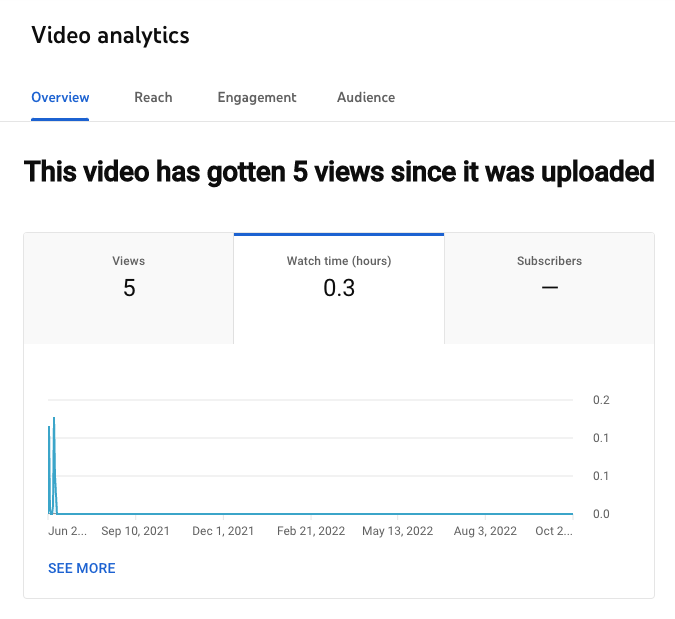
Watch time is the total amount of minutes viewers have spent watching your videos. It’s a key metric because YouTube elevates videos and channels with higher watch times in their search results and recommendations section. YouTube does this because the more watch time a video has, the more engaging their algorithm presumes it is.
In the Watch time report, you can see the amount of watch time your videos have accumulated. You can also rank each of your videos by watch time and group your videos by themes, styles, and lengths to determine your most engaging types of videos.
How to find Watch time in YouTube Studio:
Analytics > Overview > Watch Time
2. Average Percentage Viewed
Average percentage viewed is the percent of each video the average viewer watched. It measures your video’s ability to hold viewers’ attention for its entirety. And when YouTube realizes your videos can hold people’s attention, they’ll reward it with higher search and recommendation rankings. You can find this metric in your watch time report.
How to find Average Percentage Viewed in YouTube Studio:
Analytics > Overview > Watch time > See More > Content > Watch time > More Metrics > Overview > Average percentage viewed
3. Average View Duration
Average view duration is the total watch time of your video divided by the total number of video plays, including replays. This metric measures your video’s ability to engage viewers. If your video can’t engage viewers, they’ll bounce from your video quickly, leaving you with an unimpressive average view duration. But if your video can engage viewers, your average view duration and total watch time will increase at the same time, boosting your search and recommendations rankings. You can also find this metric in your watch time report.
How to find Average View Duration in YouTube Studio:
Analytics > See More > Watch time > More Metrics > Overview > Average view duration
4. Audience Retention
Audience retention shows you the percentage of viewers who watch and leave your video at every single moment of the video. YouTube elevates videos with high audience retention in their search rankings and suggestions because these videos can effectively capture viewers’ attention.
Audience retention can also inform your future video strategy. The most engaging parts of your video could be your next best video topics. And watching your video during steep dips of engagement will tell you what might be boring your viewers, allowing you to scrap those elements from current and future videos.
When you have enough data to generate YouTube’s audience retention report, there will be two graphs: the absolute retention curve and the relative retention curve. The absolute retention curve shows you how well your videos retain viewers. And the relative retention shows you how well one of your videos retains viewers compared to all other YouTube videos of similar length.

How to find Audience Retention in YouTube Studio:
Analytics > Engagement > Audience retention
5. Re-watches
Re-watches are the amount of times viewers re-watch certain parts of your video. If a lot of people are re-watching a specific part of your video, then they’re probably interested in the topic your video is covering during that moment. These topics can be fodder for your future video strategy. You can find this data in the absolute audience retention graph. Re-watches are usually indicated by rising curves in the graph.

How to find Rewatches in YouTube Studio:
Analytics > Engagement > Audience retention > Absolute audience retention
6. Engagement
Comments, shares, likes, and dislikes provide marketers with a lot of valuable qualitative data.
Comments can paint a clear picture of your video’s emotional effect on viewers. Shares can gauge how much viewers value your content and brand — since people share content that confirms their ideal self-persona, people who share your video are publicly displaying that they trust and support your brand. Likes and dislikes can help you determine what video topics work best with your particular audience. You can find your videos’ engagement metrics in YouTube’s Interactions Report.
How to find Engagement in YouTube Studio:
Analytics > Engagement > Likes (vs. dislikes) > See More
7. Impressions Click-Through Rate
Impressions click-through rate measures your video’s ability to prompt people to watch your video after seeing it on their homepage, recommendation section, or trending section. A high click-through rate means your title was compelling and your video’s topic resonates with a lot of relevant audiences on YouTube.
A common trend for impression click-through rates is that they usually spike immediately after you release your video — your subscribers will see the video at the top of their home page and probably click on it. But once your video spreads beyond your core audience, your click-through rate will decline and then stay at a stable rate.
You can also couple this metric with average percentage viewed and average view duration to see if people actually watch your video after they click on it. A high click-through rate is great, but if people are leaving right at the beginning of your video, your title or thumbnail could be misleading. Preparing viewers for what’s to come is crucial because if your title or thumbnail is inaccurate, they’ll feel deceived and lose trust in your brand.
A low click-through rate but high engagement could mean that the video has a small yet specific audience that is enamored by the content.
How to find Engagement in YouTube Studio:
Analytics > Reach > Impressions click-through rate

8. Card Clicks
Cards are slide-in panels that encourage people to take a desired action during a video like watch another video, subscribe to a channel, or click through to a different website. Each of your cards’ click-through rate tells you which action your viewers prefer to take while watching your videos. This can help you place the most engaging card in each of your videos, potentially boosting your watch time, subscriber growth, or website traffic.
Analyzing card clicks can also help you uncover the optimal timing, placement, and duration of your cards in future videos.
How to find Card Clicks in YouTube Studio:
Analytics > Reach > See More > Impressions by: Content > More Metrics > Cards > Card Clicks
9. Playlist Engagement
Playlists are a great way to organize your videos in a digestible way. It helps your viewers easily consume videos about their favorite topics and prompts them to keep watching, which racks up watch time for your channel.
You can uncover your playlist engagement by analyzing two metrics in YouTube’s Playlist Report: views per playlist start and average time in playlist. Views per playlist start is the average number of video views your playlists gather, and average time in playlist is the average amount of time that viewers viewed the videos in your playlist. If these two metrics are underperforming, try starting your playlist with videos that have the highest retention rate.
How to find Playlist Engagement in YouTube Studio:
Analytics > Engagement > See More > Watch Time > More Metrics > Playlists
10. Unique Viewers
Unique viewers is the estimated number of individuals who watch your videos over a certain period of time. This metric really helps you understand the actual size of your audience.
You can also use this metric to gauge your subscriber’s engagement with your videos. If your unique viewers are lower than your subscriber count, then your subscribers aren’t watching as much of your video as they could be. To get them to be more active, ask them to set up notifications for your new videos. You can find this metric under the Reach Views and Audience tab in YouTube Studio.
How to find Playlist Unique Viewers in YouTube Studio:
Analytics > Audience > Unique viewers
11. Views Per Unique Viewers
Views per unique viewers is the amount of times the average viewer watches your video. This metric tells you if people can’t get enough of your video and keep rewatching it. Video topics with a lot of views per unique viewers could also be your most popular content topics, and if you cover them more, you could generate more views, watch time, and subscribers.
How to find Playlist Unique Viewers in YouTube Studio:
Analytics > Audience > Unique viewers > See More > Average views per viewer
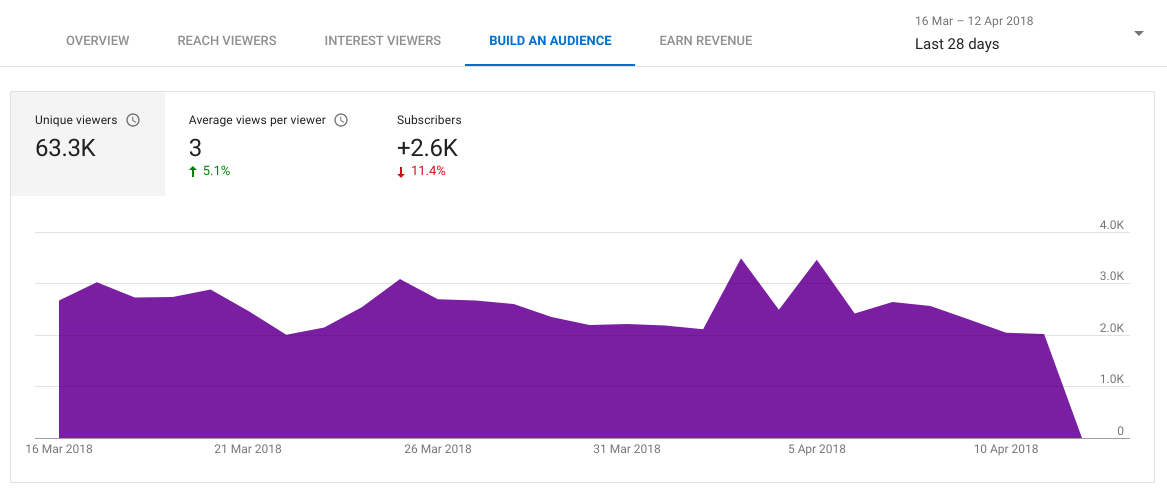
12. Who’s Watching Your Videos
In YouTube’s demographics report, you can see the different types of people who watch your videos, segmented by age, gender, and geography. This data tells you who your most engaged audience is and who your target audience should actually be. You can take the opposite approach with this data too. If you’re not reaching the audience you want, try pivoting your video strategy and cover topics that would attract them.
How to find Demographics in YouTube Studio:
Analytics > Audience > Age and Gender
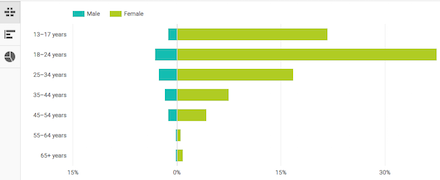
13. Subscriber Growth
Subscribers are your most loyal fans. They’ve made a public commitment to your brand, content, and values. And they’re most likely to be your evangelists too. Subscribers are also important to your channel because YouTube will send them notifications about your new videos and feature them on their homepage. This means they’ll see your videos more frequently, which will help generate more views. Subscribers also watch twice as much video as non-subscribers, so the more subscribers you have, the more watch time your videos will collect.
YouTube’s Subscribers Report will show you which videos, locations, and time periods gain and lose subscribers. This data will tell you what video topics resonate with your subscribers and where to target new subscribers. And by prioritizing your subscribers’ needs, you’ll create videos that they crave, increase your watch time, and boost your search rankings.
How to find Subscribers in YouTube Studio:
Analytics > Audience > Subscribers
14. Traffic Sources
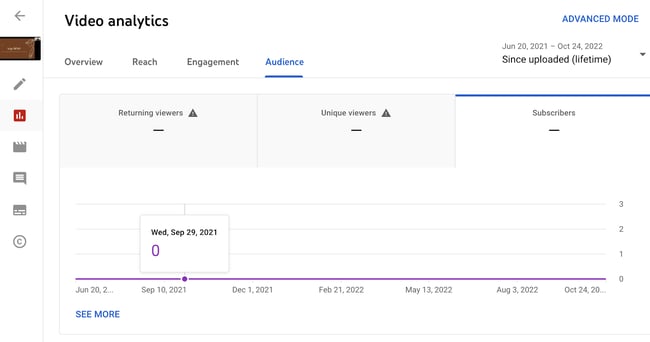
External referrals like social media or sites that embed your videos and YouTube referrals like search, the recommended section, and the homepage are all traffic sources. The Traffic Sources report shows you how viewers found your videos and what sources rack up the most views and watch time. You can use this data to better optimize your video promotion strategy.
How to find Traffic Sources in YouTube Studio:
Analytics > Audience > Subscribers > See More > Traffic Source
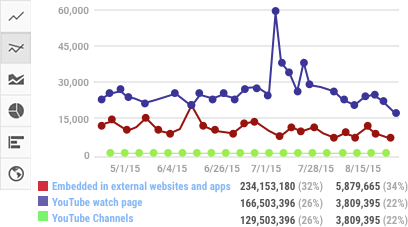
15. Keywords
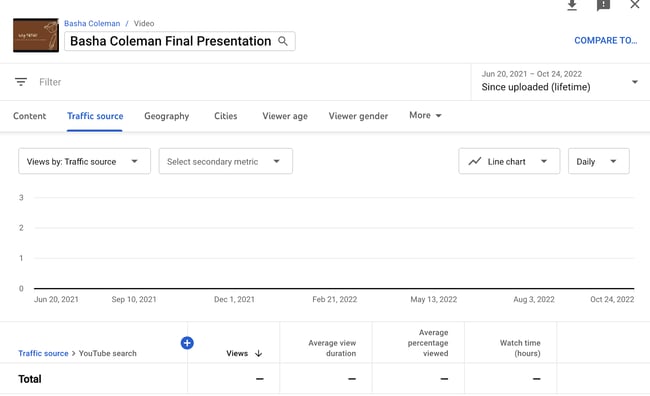
In YouTube’s Reach Report, which is under the Traffic Sources Report, you can see the most popular queries guiding viewers to your videos. If these queries are slightly different from your video’s topic, consider updating your video to fill these content gaps and add the keywords to your metadata. If there’s a stark difference, consider making a new video about these popular queries.
How to find Keywords in YouTube Studio:
Analytics > Reach > YouTube Search terms
Editor’s note: This post was originally published in July 2018 and has been updated for comprehensiveness.

What HubSpot’s Highest Performing Blog Posts Have in Common & Why These Elements Work
Wondering what elements make up a successful blog post? We reviewed our top 8 blog posts on the Marketing Blog in 2022.
Traffic-wise, each of these posts has received over 500,000 organic views since publishing and earns at least 40,000 views monthly.

Let’s see what they have in common and what marketers can learn from them.
- 445 Best Instagram Captions for 2022: Good, Cool, Funny, & Cute
- 12 Incredible Answers to “What Is Your Greatest Weakness?” — That Aren’t “Perfectionism”
- 70 Fun (Not Cheesy) Ice Breaker Games & Activities Your Employees Will Enjoy in 2022
- 45 Quotes That Celebrate Teamwork, Hard Work, and Collaboration
- 20 of the Best Professional Bio Examples We’ve Ever Seen [+ Templates]
- 27 Mission and Vision Statement Examples That Will Inspire Your Buyers
- How to Type the Shrug Emoji ¯\_(ツ)_/¯ in 2 Seconds Flat
- The 11 Best Free (and Private) Email Accounts and Service Providers of 2022
1. Eye-Catching Headlines
What you’ll notice with all of our top-performing posts is that they have an attention-grabbing headline.
Some of the components of an eye-catching headline are:
- Numbers
- Action verbs
- Descriptive adjectives
In 2013, Moz ran a study that found that articles with numbers in the headlines outperformed those that didn’t. Our data suggests that the same is still true nearly a decade later.
All but one of our top-performing posts features numbers, at the beginning of the headline. One reason why numbers are effective is that they set expectations. Blog posts can be a bit overwhelming and when you add a number in your post, it removes some uncertainty and lets the reader know exactly what they’ll get.
2. Descriptive Intros
When a user lands on your blog post, the first thing they’ll likely read is your introduction.
Your intro should cover three areas:
- Who this article is for or about
- What will be covered in the article
- Why the reader should care
Your intro can also be a good place to present a new piece of data or an anecdote that leads into your topic. You can also present a situation or a question that invites the reader to keep reading.
For instance, the 20 of the Best Professional Bio Examples We’ve Ever Seen [+ Templates] post starts by posing a question: “Be honest, does your professional bio make a statement?”
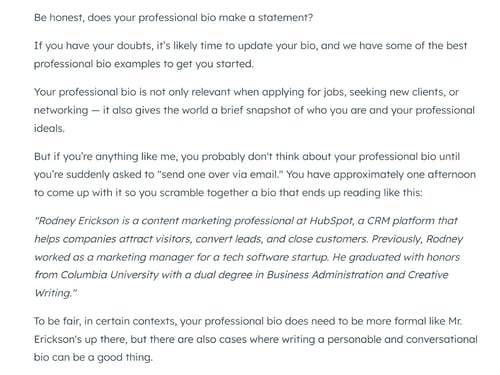
From there, the writer outlines a common challenge that many readers have likely experienced and then highlights the importance of a professional bio.
There are so many ways to approach an intro but as long as it covers those three Ws and has an empathetic lens, it will surely keep your readers engaged.
3. Comprehensive Listicles
In 2020, a study by one blogger found that 41% of the top Medium articles in 2020 were listicles. Similarly, our top 8 performing blog posts from this year are also listicles.
Listicles are great because they are inherently scannable. The reader can quickly navigate to the section(s) they’re most interested in.
These listicles are also very comprehensive, serving as a detailed guide that readers can bookmark for future use.
Take the “445 Best Instagram Captions for 2022: Good, Cool, Funny, & Cute” blog post. When it was originally published, the article did not feature 445 examples. However, with every update, we consider the SERPs and how they will fare against competitors.
From there, we decide what content updates will be most valuable for readers. For this post, in particular, that meant adding more captions to make the post more comprehensive.
4. Table of Content
When you have a lengthy blog post, one of the best elements you can add to the page is a table of contents with jump links. A jump link is a link that, when clicked, will take the user straight to a section on the page.
However, a table of content can be just as valuable as a short post for readers who are looking for specific information.
In the 445 Best Instagram Captions for 2022: Good, Cool, Funny, & Cute article, the table of contents section is broken down by category.
5. Featured Snippets
A featured snippet is a Google search feature in which an excerpt from a website is shown at the top of the SERP if it matches the search query.
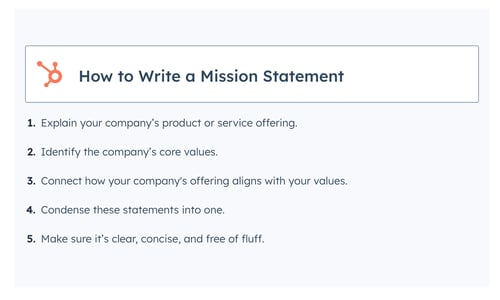
Because a featured snippet will appear at the top of the page, it leads to more clicks – making it a coveted feature that every website wants. But to gain a featured snippet for a particular query, your webpage has to be optimized and beat out other web pages.
Although this can happen organically, bloggers can optimize sections on their page to increase their chances, such as:
- Schema markup
- Headings and paragraph tags
- Paragraphs that are 50 to 60 words long
6. Scannable Sections
Another common element in all of our top-performing posts is an emphasis on scannability.
Every post features short paragraphs and bullet points – and that’s not by chance, it’s by design.
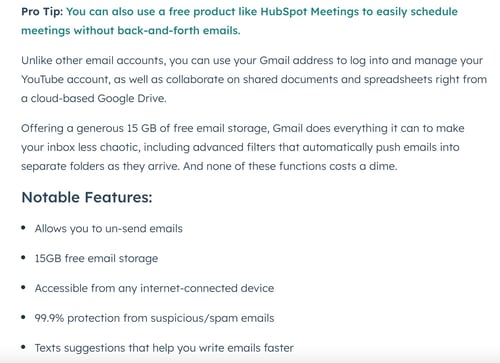
We know readers often scan blog posts to find the most relevant information. Large text blocks can be visually intimidating and lead to high bounce rates. To prevent this, we opt for bite-size paragraphs that work on both desktop and mobile.
7. Visual and Interactive Elements
With so many distractions at our fingertips, it’s not enough to have a blog post with just words. The more interactive and visually rich elements you can add to your post, the more engaged your readers will be.
This can range from video embeds, jump links, and images to quizzes and polls.
In addition to increasing engagement, these elements also help to break up the visual monotony of written text. They give the readers something new to see, read, and engage with.
There you have it – seven elements that have contributed to the success of our top-performing posts. Although every reader is different, these are universal elements that will provide a better user experience and higher engagement rate.


Multicultural Marketing: What It Is and How to Do It The Right Way [According to Experts]
Growing up as a first-generation Asian American, I lived between two cultures. One was the East-Asian culture my parents brought from Taiwan, which prioritizes the needs and desires of the family and emphasizes academic excellence. The other was the Western culture that surrounded me outside the house, which prioritizes the needs and desires of the individual and emphasizes extracurricular activities.
Needless to say, these two cultures clashed, and I spent the early part of my childhood confused about my identity. My parents taught me certain values and principles to help guide me through life, just like their parents did, but whenever I hung out with my friends, they would show me a completely different way of living. At the end of the day, I didn’t really know which group to side with. But once puberty hit, I did what every other hormone-filled tween would do — I rebelled against my parents and followed my friends.
From the beginning of middle school to the end of high school, I mostly identified as an American not just because the vast majority of my friends were American, but because I realized I was different. And I didn’t like that.
Desperate to fit in, I tried my hardest to blend in with my peers. I immersed myself in football and baseball, deriving all my value in being a jock — the opposite of your typical Asian American. Sadly, I also looked down on other Asian kids who weren’t as American as me, sparingly ate Chinese food, and didn’t like inviting my friends over because I was scared they’d think my house smelled weird. In a nutshell, I was embarrassed to be Asian.

This mentality bled over to college, where I studied economics and business, played baseball, and joined a fraternity — all of which a typical Asian American wouldn’t do. As a senior, I decided to study abroad in Scotland, and my goal was to befriend as many lads and lasses from across the pond. But by the end of the semester, barely any of my friends were European. And none of them were American. Most of them were actually asian.
One of the biggest reasons why I loved studying abroad, in addition to traveling the world and never going to class, was that I befriended a group of Asian guys who were extremely proud of our ethnicity and culture. And it taught me how important it is to be proud of my own identity. Before I studied abroad, I’d never met an Asian person who claimed they were proud of who they were, and I didn’t really take pride in it either. But after meeting my asian friends in Scotland, who were from Asian countries, like Singapore, Malaysia, The Philippines, Bhutan, and India, I was inspired to flip my mentality.
When I returned home from Scotland, my parents were both shocked and thrilled at how Asian cuisine had become my favorite type of food and how much pride I took in being Asian. In my mom and dad’s eyes, I could see the joy in their hearts. I’d finally done something they’d always wanted me to do — be proud of who I truly am.
Even though the world is a melting pot today, most brands market in a way that only appeals to a country’s majority ethnicity or culture. That means there’s a huge pool of people that brands aren’t resonating with.
However, generating more sales shouldn’t be the only reason you market to minority groups. Acknowledging their ethnicities and cultures should be another huge driving factor.
Because, ultimately, letting minority groups know that it’s not only okay to be different, but it’s also amazing that they bring such different perspectives to the places they immigrate to, will move society forward and help immigrant children like me be proud of who they truly are.
How to Do Multicultural Marketing The Right Way
Hire a diverse multicultural marketing team.
If your brand truly wants to practice empathy, then your employees need to actually know what it’s like to be in your customers’ shoes. Otherwise, if you don’t have someone on your team who can contextualize your marketing campaign to a specific ethnicity or culture, your content might seem it was created with an ulterior motive.
So whichever minority group you target during your multicultural marketing campaign, just make sure someone on your team has the practical knowledge and life experience to vet it for accuracy.
Interview people from minority groups that aren’t represented on your multicultural marketing team.
If you’re not able to hire a person who can represent the minority group your multicultural marketing campaign targets, your next best option is to interview people who can. To do so, reach out to people in your network, social circle, or family and ask them some questions about the challenges they face as a minority.
Triple-check your multicultural marketing campaign’s accuracy and authenticity.
There’s nothing worse than a self-serving marketing campaign masquerading as social justice (I’m looking at you Kendall Jenner). Even if you have the right intentions, poor execution can turn your campaign into an SNL Cheetos’ commercial.
So before you green light your multicultural marketing campaign, run the creative and distribution strategy by some colleagues or friends who represent the minority group your campaign is targeting and see if they can poke holes through it.
Acknowledging Diversity Matters More Than Ever Today
As an Asian American, Mulan, Jeremy Lin, and Jon Cho are my heroes because even though Asians are grossly underrepresented and misrepresented in pop culture, these three overcame that adversity and put themselves in a positive light, which greatly benefited the Asian American community.
With this in mind, if your multicultural marketing campaign can shed light on the challenges a minority group faces and highlight their benefit to society, you’ll not only grow the group’s loyalty for your brand, but you’ll also make them feel like they have a genuine, empathetic ally.
Photo by Omar Lopez on Unsplash

The 7 Best Practices for Building Fantastic Lead-Capture Forms
So you’ve created the perfect offer and built a web page to promote it. You now need a lead-capture form to collect information. So, what is a lead capture form?
In this post, you’ll learn the benefits of lead capture forms, as well as seven best practices that will help you attract prospects. This guide includes the following:
A lead-capture form helps you generate prospects who download resources from your landing page. These forms are common when promoting ebooks, case studies, research reports, and webinars.
Customers see a clear value in the offering. This value proposition compels them to trade their personal information for access.
Seven Best Practices for Building Lead Capture Forms
While lead-capture forms have many use cases, the best forms include the same components. See the seven elements your form must have and best practices for generating results.
1. Choose the right position on your landing page.
There’s no hard and fast rule on where to place your lead-capture form. Regardless, you’ll always want to keep your form above the fold. This means the form is prevalent and easy to spot without scrolling. Visitors then know the intent of your landing page immediately.
To ensure your lead-capture resource is the primary appeal of your landing page, consider using these four form positions.
Beside the Landing Page Offer
The form below is an example of one that’s above the fold. However, it’s not the most eye-catching element on the page — the content is.
Putting the form beside the landing page copy is a brilliant way to remind users of the valuable resource they’ll receive if they submit their basic information.
Within the Landing Page
If you have a lengthy landing page, including your form in at least three positions is ideal. We see this at play in this report, which contains over 1,000 words of content.
Pro Tip: As a rule of thumb, include a lead-capture form after every 350 words on your landing page.
In a Chatbot
Besides using chatbots to automate responses and communicate with your visitors, you can use them to share your lead-capture form. For instance, when you click “Get Report” on the landing page below, the form pop-ups, requesting your email to “Download the Full Report.”
At the Bottom of an Auto-Scroll Landing Page
Placing a lead-capture form at the bottom of your landing page offers one more chance to acquire a visitor’s information. This position also allows your content to take center stage, allowing visitors to determine if it’s worth downloading.
If visitors decide they want the content, clicking the “Download the Full Report” button automatically scrolls them down to a brief form at the bottom of the page.
Once they fill out the form, they can confirm their download and retrieve their content.
2. Determine the right length for your lead-capture form.
The next — and probably biggest — concern when designing your forms is the length. The number of form fields you use creates a tradeoff between the quantity and quality of leads you get.
Shorter forms usually generate more leads since people can fill them quickly. However, your leads from short forms vary widely in quality.
Longer forms require that visitors provide more details of their needs, meaning they show a better purchasing intent. So you may get fewer leads, but they’ll be of better quality.
When creating your form, find a good balance between collecting enough information and not asking for excess information that your visitors are reluctant to give.
Pro Tip: Prospects tune off when they see a long lead-capture form. To get around this, use a progressive lead-capture form that includes steps. This gives visitors a mental picture of how quickly they can complete the form and download your resource.
3. Choose relevant form fields.
Irrespective of your preference for short or long forms, it’s best practice to only ask essential questions that’ll help you contact and qualify your lead.
For instance, if you spend over $10,000 to create a marketing report, you’ll want to generate high-intent leads from this resource. Meaning you’ll have to go beyond the name and email of those who want to download the report.
You may need to know their company, website, role, and number of employees. Asking these questions allows you to assess their fit for your company, gauge their need for your product, and know their likelihood of purchasing your product. With this info, you can decide whether to add a lead to your sales flywheel.
Pro Tip: Ask as few questions as possible with your lead-capture form. This will significantly increase your conversion rates. You can also ask more questions after the lead enters your funnel.
4. Include your privacy policy.
Laws in the United States, European Union, Canada, and Australia you must include a privacy policy when collecting “personally identifiable information” (PII). PII covers sensitive information like the full name and mailing address of your visitors. It also encompasses non-sensitive information, like zip code, race, date of birth, etc.
Irrespective of a form’s location on your website, you should place your privacy policy where it’s easily noticeable. This puts prospects at ease if they are skeptical about sharing their information.
For example, our lead-capture forms show a privacy policy preview right above the download button.
Pro Tip: Have client testimonials, authority endorsement, third-party security certification, or a guarantee seal beside your privacy policy. This helps reduce the objections of visitors who are concerned about filling out your form.
5. Change the text in your submission button.
The last major component of your lead-capture form is the submission button. The default text for this button is “submit.” However, this isn’t the best messaging.
How do we know? Well, we studied the landing pages of over 40,000 HubSpot customers. What did we find? Buttons labeled “submit” had lower conversion rates.
The top-performing variations in this study were “click here” and “go,” which had 5% to 12% more conversions than “submit.”
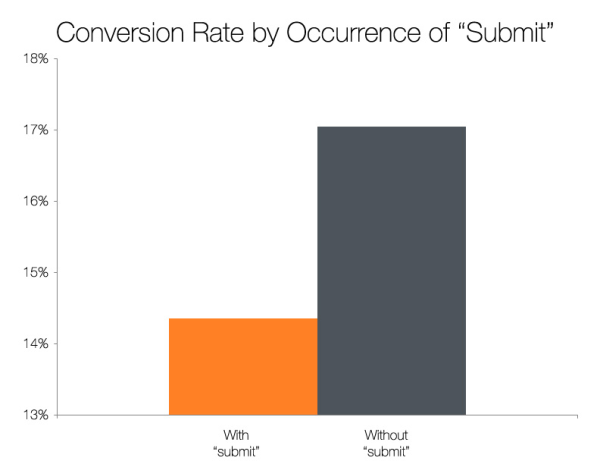
Pro Tip: Besides the text in your button, further research shows you can get amazing results by tweaking the color of your button. This is where A/B testing shines.
6. A/B test your lead-capture form.
Conducting A/B tests is a brilliant way to identify the most effective variation of your form’s design, copy, and calls-to-action. Put another way, A/B tests allow you to get better conversions.
When testing your form, ensure you test one element at a time. For instance, if you’re testing the color, shape, or size of your submission button, don’t simultaneously test the form length.
7. Automatically email visitors after they submit your form.
Whether people are applying for a role in a company, downloading a free resource, or contacting you about your services, they want a response once they hit your submit button.
This is where autoresponders come in handy. Many form builders have this functionality, so take advantage of it. Besides providing an excellent experience, having an autoresponder in place helps you begin your relationship with prospects on the right foot.


How to Network Effectively: 15 Tips You Can Start Using Today
“Networking” is a buzzword that many of us have a serious love/hate relationship with.
Whether you’re trying to develop your personal career or forge new business relationships, making offline, personal connections has become even more critical as online social networking becomes the norm.
This guide will help you navigate those uncomfortable face-to-face networking situations, so the next time you step into a room of potential connections, you’ll feel ready to dive right into relationship-building conversations.
- Network before job searching.
- Come prepared with a clear goal in mind.
- Have some conversation starters ready.
- Introduce yourself to someone more experienced.
- Ask people about themselves.
- Practice active listening.
- Write notes after each meaningful conversation.
- Ask for what you want.
- Exit a conversation gracefully.
- Follow up every time.
![→ Download Now: 80 Professional Bio Examples [Free Templates]](https://no-cache.hubspot.com/cta/default/53/4eb63650-d315-42e5-9ac7-8d0fcba29324.png)
1. Network before job searching.
As anyone who has ever looked for a job can attest, the process can be daunting. Knowing who to reach out to can make all the difference.
One way to make the process a little easier is to start networking with people before you even begin looking for a job. That way, when the time comes, you will already have contacts to leverage.
Building relationships with people in your industry can help you to get your foot in the door, and it can also give you an inside look at what companies are hiring.
In addition, you can identify mentors who can provide guidance and support throughout your career.
2. Come prepared with a clear goal in mind.
Next time you’re going to an event, ask yourself: “Who do I want to meet, and why?”
Certain event registration platforms will share attendee lists on the registration page. If a guest list like this is available, take a moment to scan it.
You might discover potential clients, mentors, or employees you want to connect with.
For instance, let’s say you’re the CMO of a successful lawn-mowing business and your goal is to leave the event with 10 leads.
Having a specific goal in mind will allow you to prepare effectively and keep you focused during networking events.
It will make your conversations less ambiguous and lead to better alignment with your connections.
3. Have some conversation starters ready.
Approaching a big or small group can be intimidating. With the right approach, you can join an existing conversation or start your own successfully.
Ease into the evening by introducing yourself to one person who is also flying solo and looking for someone to talk to.
Ahead of time, read up on industry news and trends so you’ll be prepared to spark conversation and ask for other people’s thoughts on topics that are interesting to both of you.
Other great conversation starters include:
- What do you do for work?
- What brought you to this event?
- What do you think about the event so far?
- Are you familiar with any of the speakers?
Your first connection at an event is your gateway to meeting more people. Maybe they came with friends they can introduce you to, or maybe you’ll decide to break into bigger groups together.
Whoever you approach first, relieve some of the awkwardness with informed, relevant conversation starters to get in the swing of things together.
Once your first conversation goes smoothly, it’ll give you the confidence to interact with others.
4. Introduce yourself to someone more experienced.
We sometimes walk into networking events with high hopes of meeting the CEO of a company we admire, or the author of a book that kickstarted our career.
We’re so thrilled to be in the same place as them, but suddenly, you spot them across the room and become nervous, awkward, and maybe a little bit sweaty.
So how can you successfully strike up a conversation?
First and foremost, make sure you have a purpose. Butting into their conversation to tell them you love their work or admire their approach will not invite stimulating conversation. It’s more likely to evoke a simple “thank you.”
Consider what it is about this person that resonated with you, and tie it into your work, projects, or philosophy.
Approach them with confidence, and introduce yourself not as a fan, but as an equal – because you are – and say something thought-provoking that they can relate to.
Like this: “Your application of inbound marketing for nonprofits was helpful for me at my last job, but I’m transitioning into a job in the pharmaceutical industry. Would you change your inbound marketing approach if you were me?“
Remember that you admire this person because you respect their thought leadership. Give them a chance to admire you, too, by sparking an interesting and relevant conversation.
5. Ask people questions about themselves.
Often, we meet someone and exchange our names, company, job title, and where we grew up in about three minutes. Then we smile, look at the ground, and say something like “I love your shirt.”
When the small talk is up, it’s easy for the conversation to go south.
I’ve learned to avoid this by making them the topic of conversation.
You may be thinking, how can I make connections if we just talk about them the whole time? Well, showing genuine interest in another person can say more about you than talking about yourself could.
Besides, if a person doesn’t reciprocate the behavior and encourage you to tell them about yourself afterward, then they probably weren’t a valuable connection to begin with.
Next time a conversation is flailing, ask for them to elaborate or tell you more about themselves and you’ll find talking points you’ll be able to expand on.
6. Practice active listening.
One of the biggest challenges of networking is learning how to actively listen to others.
When we’re networking, we’re often so focused on sharing that we might not take the time to really listen to the other person.
This is essential for building strong relationships – it shows that we’re interested in what the other person has to say and that we’re paying attention.
One way to practice active listening is to paraphrase the other person’s statement. This signals to the other person that we understand them and shows that we’re engaged in the conversation.
Another technique is asking questions, which shows a genuine interest in others and invites them to keep engaging in conversation.
Active listening is a key skill for networking and will build the foundation for strong and productive relationships.
7. Write notes after each meaningful conversation.
Have you ever been in a situation where you meet someone new, have a great conversation, and then forget their name when you go to follow up?
It happens to the best of us, but there is a solution: write a personal note after each meaningful conversation.
This doesn’t have to be anything formal, just a few quick sentences about who the person is and what you talked about. That way, when you go to follow up, you’ll have all the information you need right at your fingertips.
Not only will this make you look more professional, but it will also help you build stronger relationships with the people you meet.
8. Ask for what you want.
The highlight of networking events we all fantasize about is leaving with a concrete exchange that will move our business or career forward. Maybe it’s a job offer, getting an investor on board, locking down a recommendation letter, or landing a client you’ve been after for months.
Whatever the highlight, it isn’t going to fall in our lap. We can play all the right cards to set us up for the big moment, but a time will come when we need to put ourselves out there and firmly express what we want.
The question is, how should you do this without coming across as aggressive?
Consider your answer to the classic job interview question “Why should we hire you over the other candidates?” You come up with a true, succinct, humble, and exemplary answer of why you’re the right person for the job.
Your approach to getting what you want from networking isn’t all that different, except it’s important to express your flexibility.
This combination of flexibility and confidence in getting the job done is a brilliant way to frame your next big ask: Be firm on what you want, but present it in a way that highlights the benefits for your listener.
9. Exit a conversation gracefully.
It’s important to remember that networking isn’t like speed-dating. The goal isn’t to meet as many people as you can – it’s to make valuable connections.
While it’s important not to rush through conversations for this reason, there are times when we need to jump ship. Whether you’re chatting with someone who won’t let you get a word in, or someone who is wasting time whining about their boss, you should still be polite when ending the conversation.
If there’s a lull in the conversation, say “Please let me know how that project goes, I’d love to see it and hear how it turns out.” This will show you were engaged, and though it ends the conversation in the moment, they won’t feel offended.
Alternatively, consider asking them “Have you seen anyone from [company name] tonight? I’ve been meaning to chat with them.” This will kindly express that it’s important to you to expand your network.
10. Follow up every time.
Networking can be a great way to make professional connections, but it’s only effective if you follow up. After all, exchanging business cards is only the first step in building a relationship.
If you want to make a lasting impression, you need to take the time to follow up with the people you meet.
So how do you follow up effectively? First, send a personalized email or LinkedIn message within 24 hours of meeting someone. This shows that you’re interested in keeping in touch.
Second, invite the person you met to coffee or lunch so you can further connect. After that, it’s just a matter of staying in touch by sending occasional emails, reaching out via social media, or meeting up.
Plan on attending a networking event soon? Leave awkwardness at the door by walking in with full confidence. Use the tips and remember: The outcome of the evening is up to you.
Editor’s Note: This post was originally published in Aug. 2019 and has been updated for comprehensiveness.

Google Ad Grants: Everything You Need to Know (+ 10 Helpful Tips)
If you’re a nonprofit, you should be a member of Google for Nonprofits, a program that includes a free membership and access to various products. One product that should be on your radar is Google Ad Grants.
With Google Ad Grants, qualifying nonprofits have access to up to $10,000 per month in search ads shown on Google.com. Nonprofits like DonorsChoose, Days for Girls, and We Care Animal Rescue all use Google Grants in their campaigns and drive more traffic through organic search.
You can use Google Grants to:
- Reach donors, volunteers, and consumers when they’re searching keywords relevant to your nonprofit
- Raise awareness by choosing relevant keywords and creating unique ads to highlight your work
- Track online donations, newsletter sign-ups, and volunteer registrations
- Promote your organization’s website on Google with in-kind AdWords advertising
According to Google Support, there are a few limitations to Google Ad Grants, including a $2.00 max cost per click — but that can be circumvented by using the Maximize conversions strategy. Another rule is that your ads will be shown below paying AdWords advertisers.
Many Google Ad Grant members under-spend their budget, with an average recipient spending approximately $330 a month (out of $10,000). To help you get the most out of Google Ad Grants, here is what you need to know about eligibility, plus 10 helpful tips.
Who is eligible for Google Ad Grants?
Tip #1: Create a campaign for every organizational goal or project.
Tip #2: Use keyword research tools to expand your list of core words.
Tip #3: Use all three match-type options when creating your keyword list.
Tip #4: Write compelling and succinct copy.
Tip #5: Drop users on the most relevant page within your website.
Tip #6: Keep subscription and contact forms as short as possible.
Tip #7: Direct traffic to a targeted landing page instead of your homepage.
Tip #8: Use statistics to introduce the problem.
Tip #9: Share information that potential supporters want.
Tip #10: Keep forms as short as possible.

Who is eligible for Google Ad Grants?
To be eligible for Google Ad Grants, a nonprofit must:
- Be registered as a charitable organization in a country where Google for Nonprofits is available.
- Meet the requirements in its country
- Agree to the Google for Nonprofits Additional Terms of Service
A nonprofit is ineligible if:
- It is a government entity or organization
- A hospital or healthcare organization but charitable arms or foundations associated with healthcare organizations are eligible.
- A school, academic institution, or university, but philanthropic arms of educational organizations are eligible.
Now that you know who’s eligible, here are some tips to keep in mind:
Tip #1: Create a campaign for every organizational goal or project.
Your ad groups should have 15-30 similar keywords that align with a specific page on the website. The more focused the ad group, the better the ad targeting. To get the right traffic to your website, here are a few do’s and don’ts when developing your keyword lists for your campaign(s):
- Do: Create a robust keyword list. You never know what users will respond to.
- Don’t:Start with a small keyword list and wait to expand.
- Do: Leverage all variations of the brand, product, and service terms as keywords.
- Don’t: Assume target users are familiar with your brand.
- Do: Include problem- and solution-oriented keywords.
- Don’t: Assume all target users have the same search tendencies.
Tip #2: Use keyword research tools to expand your list of core words.
Your keywords should be particular to the content on the website or landing page to which you’re sending your visitors. Using a keyword research tool will allow you to pinpoint the keywords that will give you the best results and higher ranking in Google. Get a good mix of short- and long-tail keywords to help capitalize on the traffic that’s difficult to rank for and highly qualified traffic that will help your conversions.
Tip #3: Use all three match-type options when creating your keyword list.
Use broad match, phrase match, and exact match to find keywords with higher search volume. Different match types for your keywords will trigger your ad for a potential visitor’s search in different ways. It’s a good idea to use these three match types so you can attract a variety of audiences.
Tip #4: Write compelling and succinct copy.
Do not assume that all of your target audience will respond to the same creative language. Ads with high-level language should be tested alongside ads with language geared toward more savvy users. Test 3-4 variations targeted to different types of audiences and see which performs the best.
Tip #5: Drop users on the most relevant page within your website.
Before creating your ads, consider all your organization’s assets — blog articles, landing pages, and annual reports. Provide the information your visitor is looking for when they click your ad by dropping them on the most relevant page. This will increase your landing page conversion rate and reduce your AdWords campaigns’ bounce rate.
The bounce rate is the rate at which visitors leave your site without clicking on another page on your website.
Tip #6: Keep subscription and contact forms as short as possible.
For a newsletter or blog subscription form, asking for just an email address is enough. Contact Us forms should ask for the person’s full name, email, phone number, and possibly where they live, if necessary. But before you add more fields to your forms, ask yourself, “Do I need this information at this point in the relationship?” Don’t require fields unless it’s for a good reason, as it can negatively impact your submission rate.
Tip #7: Direct traffic to a targeted landing page instead of your homepage.
Ensure the page you’re sending visitors to is relevant to the ad. Nonprofit Futures Without Violence’s homepage conversion rate was 0%. However, its ad that led to a targeted landing page resulted in a conversion rate of 12.59% for that page — getting the nonprofit 1,000 new email addresses.
Tip #8: Use statistics to introduce the problem.
Since targeted landing pages have a higher conversion rate for email acquisition, you should focus on optimizing them for your ad campaigns. Statistics make a significant impact and are digestible pieces of content that will help visitors understand a bit more about your cause and what you’re trying to accomplish. They are also attention grabbers that draw new visitors in to learn more.
Tip #9: Share information that potential supporters want.
Your AdWords campaigns aim to bring in new traffic, so providing basic information about your cause and organization is a great way to educate your new audience. Also, ensure that the information provided on the landing page is relevant to the headline of your ad. If you’re offering a fact sheet about your organization, make sure the landing page you send the visitor to is where the fact sheet is located.
Tip #10: Keep forms as short as possible.
When providing educational information in the form of a download, requiring more than an email address can drastically impact your conversion rate when working with PPC ads. But, if you are planning to nurture individuals who download your content via email, ensure you collect their first name, last name, and email address. Four form fields are a reasonable maximum for your landing page forms for new visitors from PPC.
Google Ad Grants is only available to Google for Nonprofit members. Signing up as a Google for Nonprofits member is free, with some restrictions that you can review online before applying. There are other products to take advantage of, including Google’s new mobile application One Today. You can also see all the organizations using Google Grants in the Google for Nonprofits community.
How has your organization used Google Grants?

Nostalgic Websites: What 32 Popular Sites Used to Look Like
It’s no secret that website design trends (and best practices) have changed dramatically since the internet’s debut. Reflecting on nostalgic websites and comparing them to their present-day counterparts is an excellent way to understand why updating your site is so necessary.

With the help of the Wayback Machine, we can see what our favorite websites looked like in years past. Whether you’re planning a website redesign and could use some inspiration, or you’d enjoy reflecting on nostalgic websites, we’ve rounded up 32 sites to peruse.
1) Google
.jpg?width=650&height=325&name=nostalgic-websites-google%20(1).jpg)
While Google essentially maintains its branding with its colorful logo and whitespace on the homepage, there are other aspects of the site that look entirely different today. In the 1990s, Google had unique offerings underneath the search bar. Today, the company leans into creating a personalized homepage for users by bookmarking their frequently visited websites.
2) Apple
Apple always takes a product-centric approach to its homepage. Even in 2001, you’ll notice that the company’s items were the website’s primary focus. In 2022, Apple chooses to keep branding minimal yet distinctive. It features just one product to make the center focus of the homepage. The current homepage is also a testament to compelling copy; in just three adjectives, Apple paints a complete picture of why you should get an iPad.
3) Microsoft
In 2000, Microsoft’s website was clunky and over-complicated. The abundance of words on the website and lack of whitespace made for an overwhelming user experience. Today, Microsoft’s site takes a cue from Apple and centers on its products. The site, as a result, is less dizzying and more digestible for visitors.
4) Mashable
Once upon a time, Mashable had a gradient background — not to mention a serious lack of imagery. Now, the site balances visuals with text. The company branding also no longer takes center stage and focuses on featured stories.
5) HubSpot
In 2006, the tech and marketing world was focused heavily on surviving and succeeding in a web 2.0 world. Small businesses were popping up worldwide, and HubSpot’s website was focused on showing how the product could add value for these companies. Today, HubSpot still caters to small businesses but also medium and enterprise corporations. Now, our website focuses more on the product and features a lot more color than it initially did.
6) BuzzFeed
BuzzFeed was created to help users find their favorite things, including movies, music, fashion, ideas, and technology. The site still achieves this with a more visual and interactive approach. Today, the website balances images and text more seamlessly, but the site’s overall feel is still intact.
7) The White House

In 2000, Bill Clinton was the President of the United States, Al Gore was Vice President, and the White House’s website had a very different look and feel. Then, the website featured a Declaration of Independence-esque script font and didn’t emphasize imagery — or storytelling, considering the text just welcomed visitors to the page. When you visit the site today, you’ll notice a large image and copy that focuses on current initiatives. We also love how the refreshed site focuses on accessibility with options to change the text contrast and size.
8) TED
Though TED’s 2003 website still looks outdated by today’s standards, it was ahead of its time, with most of the homepage featuring visual content. In 2022, their site still features various images but also balances copy — and there’s only one main image above the fold. The site’s overall feel today is less cramped and overwhelming than it was in years past.
9) Skype
In the early 2000s, Skype’s homepage featured several colors and lacked hierarchy. (And who knew the video call platform once had a red logo?) Today, Microsoft owns Skype, and the latter takes a cue from the larger organization’s look and feel. The site features whitespace, excellent visual hierarchy, and offers a compelling image of the product in action.
10) AOL
In 2000, AOL’s site had a variety of colors that weren’t cohesive, ultimately making the site appear messy. Today, the site features enough whitespace to balance the amount of copy and imagery it has. We’re also fond of the site’s new font, as it’s visually appealing and easy to read.
11) Ask
Ask Jeeves rebranded as Ask. In 2000, the site lacked whitespace and featured a character — part of the site’s unique branding. Since dropping the second half of the name, there’s no longer a character on the site’s homepage. Today, the site looks much more like a news or publication site than a platform to ask questions and get quick answers.
12) Blockbuster
Remember the good old days of going to Blockbuster to pick out your movie and grab a few snacks? We sure do. What Blockbuster’s 1996 site lacked in hierarchy, it made up for in personality. Today, Blockbuster’s site is out of commission — and features a cheeky note that the company is working on rewinding your movie.
13) Coca-Cola
We’ll give it to Coca-Cola: Their branding is timeless. Coca-Cola’s website from 2000 doesn’t look too shabby compared to many of the outdated websites on this list. The brand understood the importance of visual content and simplicity in 2000, and they still do today. In 2022, their site focuses more on imagery and features less red than in the past, but it still feels cohesive with the rest of their branding.
14) Pepsi
Pepsi’s site in 2000 was cluttered, lacked visual hierarchy, and had too much going on. Today, we’re huge fans of Pepsi’s nostalgic homepage. It features a font that’s easy to read, plus the site doesn’t feel too cluttered. The company has also since moved its menu to the top of the page and cut back on how many tabs there are which is much better from a user experience standpoint.
15) Macy’s
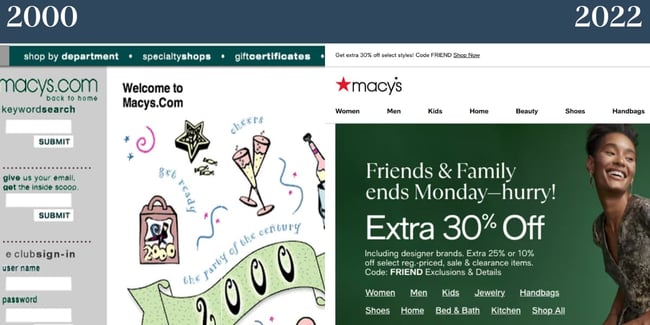
While Macy’s 2000 website doesn’t conform to today’s standards, we appreciate how cohesive the colors are. Interestingly, products aren’t at the forefront of Macy’s nostalgic site. Today, however, the Macy’s website tells an extremely different story. The website has a neatly organized menu and excellent visual hierarchy.
16) Amazon
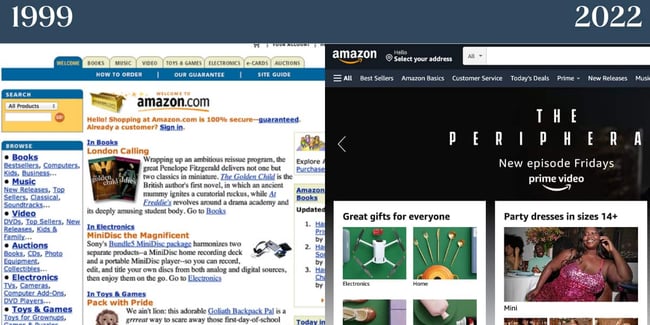
In 1999, Amazon’s website was highly text-heavy, making it dizzying to look at. The vertical menu was also cluttered and difficult to digest. Today, Amazon’s menu appears on the top of the page, and the site seems significantly less overwhelming despite the fact that it still advertises various products.
17) Yahoo
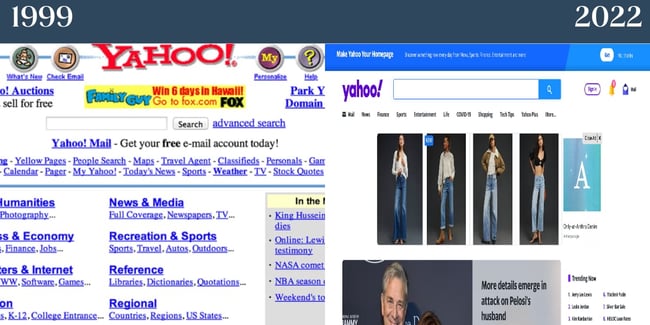
In 1999, Yahoo’s website focused mainly on text and featured no imagery. Today, a very different story is told when you visit the platform’s site. Because Yahoo is a news site, there are images to accompany every story, plus a summary of what you can expect when you read the piece. We’re also a fan of the trending column on the right side of the site, as it makes it easy for users to understand what’s in the news at a glance.
18) Tumblr
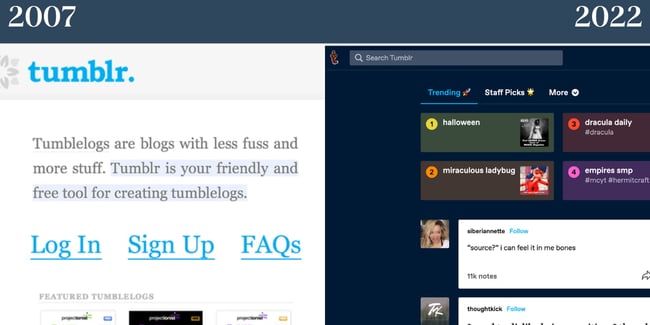
In its infancy, Tumblr referred to blogs as Tumblelogs and had a text-centric website. Today, if you visit Tumblr while not logged in, you’ll see a mock dashboard that shows visitors what theirs could look like if they create an account. Today’s Tumblr site is also significantly more image-focused.
19) Pinterest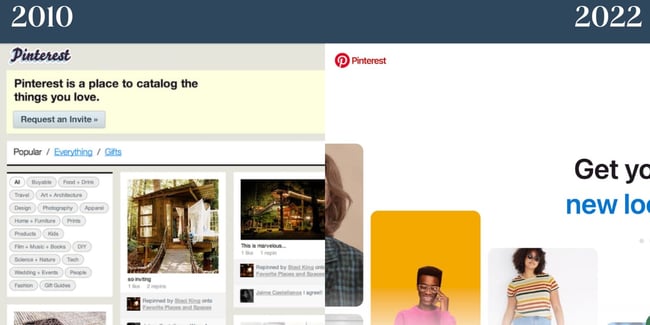
Remember when Pinterest was invite-only? As you can see from the screengrab of the 2010 Pinterest site, the platform had a completely different logo and a less sleek appearance. If you visit Pinterest today, you can create an account instantly — no request necessary. In addition, the platform features a live image that changes yet loads quickly. The copy is simple yet compelling.
20) Reddit
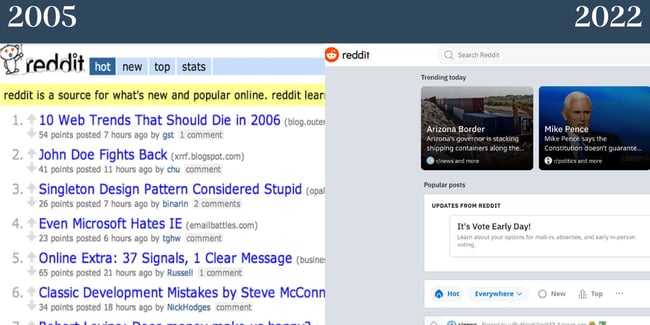
In 2005, Reddit was all about text. Reddit is still more text-focused than most modern sites. However, it does feature a balance of images. We like how the font Reddit uses today is still semi-nostalgic but is easier to read than it has been in the past. The site is also more visually compelling as it appears more like a news site.
21) Barnes & Noble
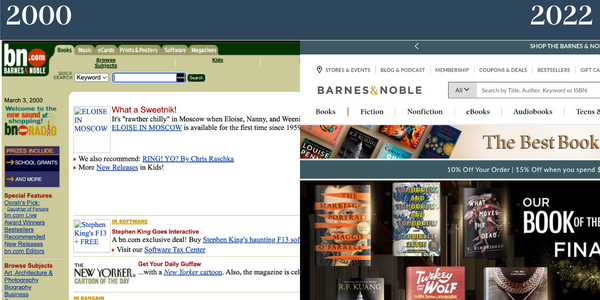
You’re probably starting to notice a theme at this point: The websites of years past were text-focused. Barnes & Noble is no exception. In 2000, the bookseller had a dense, visually unappealing vertical menu. The images took a long time to load — if they did. There’s also a lack of visual hierarchy, so it’s difficult for visitors to decide where to look. Today, the company’s site is significantly more digestible. It balances whitespace with imagery and text, and the designers cleaned the menu up.
22) Dunkin’
.jpg?width=650&height=325&name=nostalgic-websites-dunkin-donuts%20(1).jpg)
We’ll hand it to Dunkin’: They’ve stayed true to their signature color scheme for decades. This screengrab from their site in the 2000s is one of our favorites on this list. It’s shockingly minimalistic and features an image that wasn’t standard for the time. Today, Dunkin’ has plenty of whitespace, features cohesive branding, and balances graphics with the copy. The website also has an easy-to-follow menu and includes the company’s striking pink and orange colors.
23) Starbucks
.jpg?width=650&height=325&name=nostalgic-websites-starbucks%20(2).jpg)
In 2000, Starbucks got a few things right: Their menu is straightforward, and they featured images on their site, though they didn’t load. (Psst: These plugins can help ensure your content loads quickly if you have a “heavy” page so your website avoids a similar fate.) You’ll also notice their consistent logo. In 2022, Starbucks effortlessly offers a pop of color on its site without overwhelming visitors. The site features Starbucks’ signature font and includes an image promoting a recent collaboration with another company. The image itself also feels on-brand. We also want to call out Starbucks’ sparse yet effective navigation at the top of the page.
24) Walmart
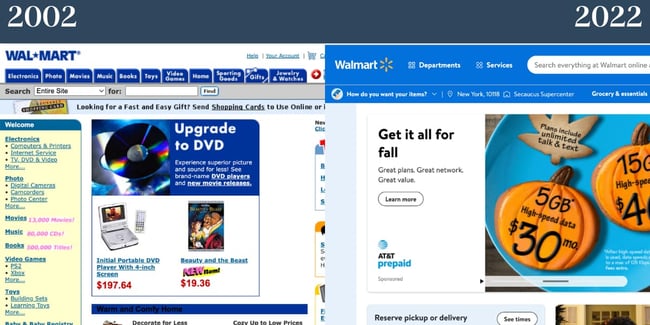
For its time, Walmart’s site in 2002 was quite successful. It featured images and text which still dominate the website today. In addition, it had a better visual hierarchy than some of the other examples we’ve investigated. Similar to Dunkin’, one thing that Walmart does incredibly well is translating its famous color scheme to its site. In 2022, Walmart’s website has plenty of imagery and concise copy that enhances the graphics.
25) Target
There are also plenty of things Target got right in 2004. For one, the brand used its well-known color scheme. The site features images, too, and its branding is still largely the same. In 2022, Target’s site puts a much larger emphasis on visuals than it does on text. The branding is minimal yet effective, and the site features a simple menu that expands when visitors click on it.
26) The New York Times
We’re impressed: While New York Times has reworked its website since 2000, the website is remarkably similar. Even in 2000, figuring out where to direct attention was easy. The New York Times scores major points because its 2022 website resembles a newspaper. It features visual hierarchy, balances images with copy well, and we like how the font is distinctive yet easy to read.
27) Lay’s
In 2008, Lay’s website was green and featured very poor text color contrast. This makes it difficult for people to read the copy. Luckily, Lay’s has since reworked its site. Today, it’s still colorful but features better contrast. You’ll also notice the site has plenty of Lay’s illustrious yellow. The 2022 site seems far more on-brand than it has in the past.
28) McDonald’s
In 2001, McDonald’s website featured a red background and yellow text, which wasn’t exactly optimal for readers. Now, McDonald’s site is minimalist. It features few colors aside from the brand’s distinct yellow and offers a variety of options for visitors to select from on the menu section. However, the menu isn’t overwhelming because the rest of the website is so straightforward. The brand also taps its signature font for the 2022 website.
29) Sephora
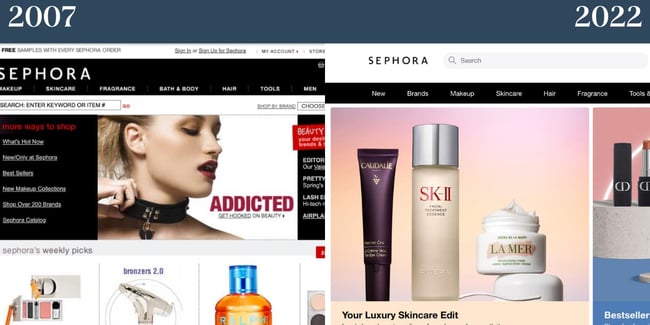
Sephora’s website in the early 2000s featured a balance of images and text. For its time, it was an example of a compelling website design. Today, the site adheres to modern web design trends. It has large images that are visually appealing and includes straightforward copy.
30) Netflix
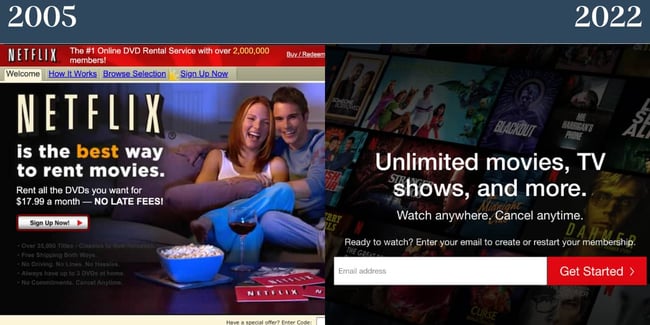
In 2005, Netflix featured an image-focused homepage, which is quite different from today. In 2022, copy is the star of the show on Netflix’s homepage. The company also cleverly places a call to action at the center, so you’ll provide your email address and get started. In both 2004 and 2022, the main focus of the homepage was a call to action, which is noteworthy. We like the image in the background, which the text overlays as it features shows and movies you can enjoy with a Netflix subscription.
31) eBay
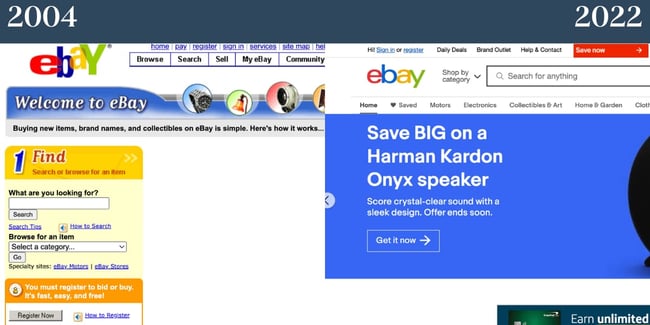
In the early 2000s, there was a lack of hierarchy on eBay’s site, which made it tricky for visitors to understand where to begin. This is also detrimental from a user experience standpoint. That has since changed, however. In 2022, eBay has a carousel above the fold on its site. It features a few products and promotions the company is currently offering. The site also features more whitespace than in the past, and the menu is paired back by comparison.
32) Burger King
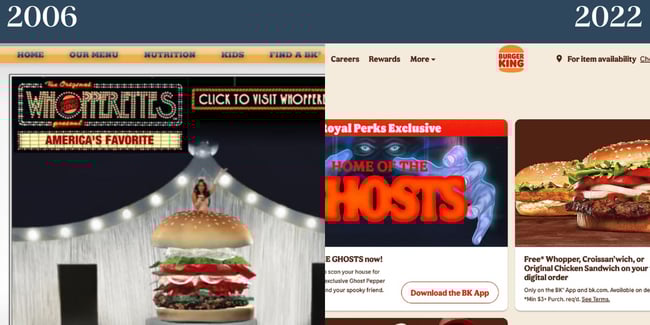
In 2006, Burger King did feature a primary image on their site. The menu was also at the top of the site, but the font was difficult to read. In 2022, Today, Burger King features a neutral background and keeps the focus on its imagery. Copy is sparse yet effective. In addition, the company uses a font that offers a pop of personality yet is readable.
Take Site Redesign Inspiration from These Nostalgic Websites
If you’re seeking inspiration for your site redesign, look at these nostalgic websites to get an idea of how you can rework your landing page. These nostalgic websites prove that by using your unique branding, balancing images and text, and including a clear visual hierarchy, your site will look great for years to come.
Editor’s note: This post was originally published in April 2014 and has been updated for comprehensiveness.
![Blog - Website Redesign Workbook Guide [List-Based]](https://no-cache.hubspot.com/cta/default/53/4b5bb572-5d0e-45b8-8115-f79e2adc966b.png)

The Best B2B Lead Gen Campaigns for Every Channel
As a marketer, you’re always on the hunt for more leads. However, building the best lead generation strategy involves an in-depth understanding of tried-and-tested channels. Then, you’ll need to find the most effective combination of tactics for your unique goals.
In this post, you’ll gain insights into each major channel for B2B lead generation, including social media, PPC, blogging, and email. Best of all, you’ll learn effective strategies and impressive real-world examples for each.
Table of Contents
- Social Media Marketing Strategies
- PPC Lead Generation Strategies
- Blogging Lead Generation Strategies
- Email Marketing Lead Generation Strategies
- Top 10 Lead Generation Best Practices
What is B2B lead generation?
B2B lead generation is the process of bringing prospective customers to your organization. These leads should be potential buyers who would benefit from your business’ product or service.
The types of leads generated vary by campaign and marketing platform. Disciplined B2B marketers understand the different dynamics, budgets, and expectations typical of each lead generation channel.
Learn more about B2B lead generation in the video below.
Social Media Marketing Strategies
Social media is a critical component of B2B marketing. Social media marketing is typically less expensive than traditional advertising costs and offers broad mileage. In fact, 44% of marketers identified social media as their top channel for acquiring new customers, according to 2022 HubSpot Research.
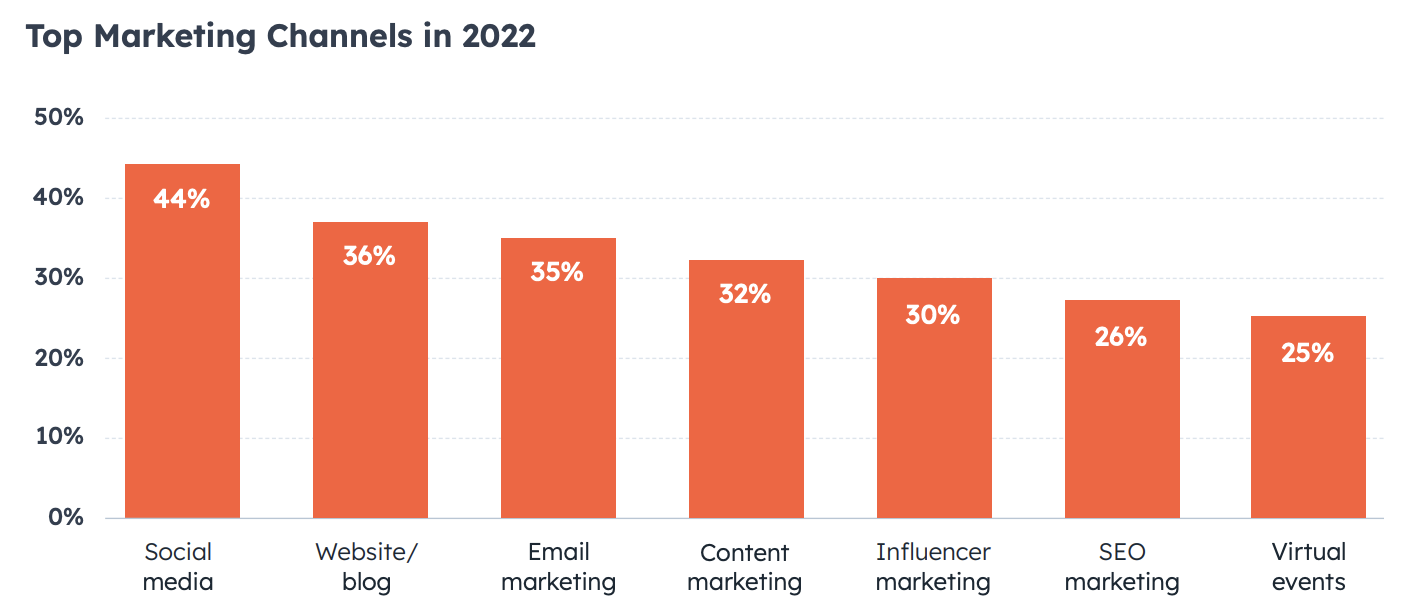
Here’s how your team can perfect your social media strategy.
What is the conversion rate of social media?
While there’s no single answer for B2B social media conversion rates, there are some calculated assumptions you can use to gauge efficacy. For B2B companies, social media conversion rates fall around 1.55% on average, according to 2021 research from Ruler Analytics.
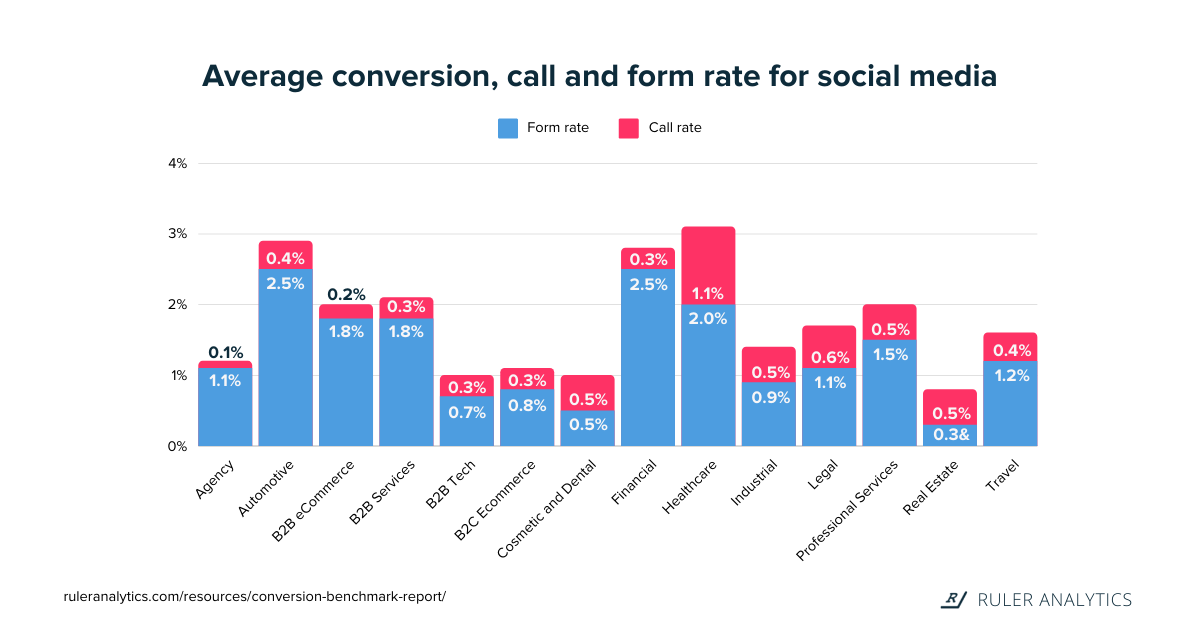
While social media is an important means of generating leads, these platforms have a lower conversion rate compared to other B2B digital channels. Ruler Analytics found that social media had the lowest average conversion rate for B2B companies when compared to paid marketing, organic search, email marketing, and referrals.
Remember: Social media is an important channel for top-of-the-funnel awareness. Even if you see higher conversion rates elsewhere, social media can keep your brand top-of-mind for potential buyers.
To increase conversion rates, focus on promoting helpful content behind lead capture forms. For example, you might promote a downloadable ebook to capture quality leads with an initial offer.
There are two main channels you should focus on:
- LinkedIn Ads.
- Facebook Lead Ad.
Let’s dive into each of these primary B2B social media channels now.
LinkedIn Ads
It’s no surprise that LinkedIn, the go-to B2B social network, has above-the-board figures when it comes to social media conversion. LinkedIn is the top social media platform for B2B marketers, so it’s a viable channel to pursue.
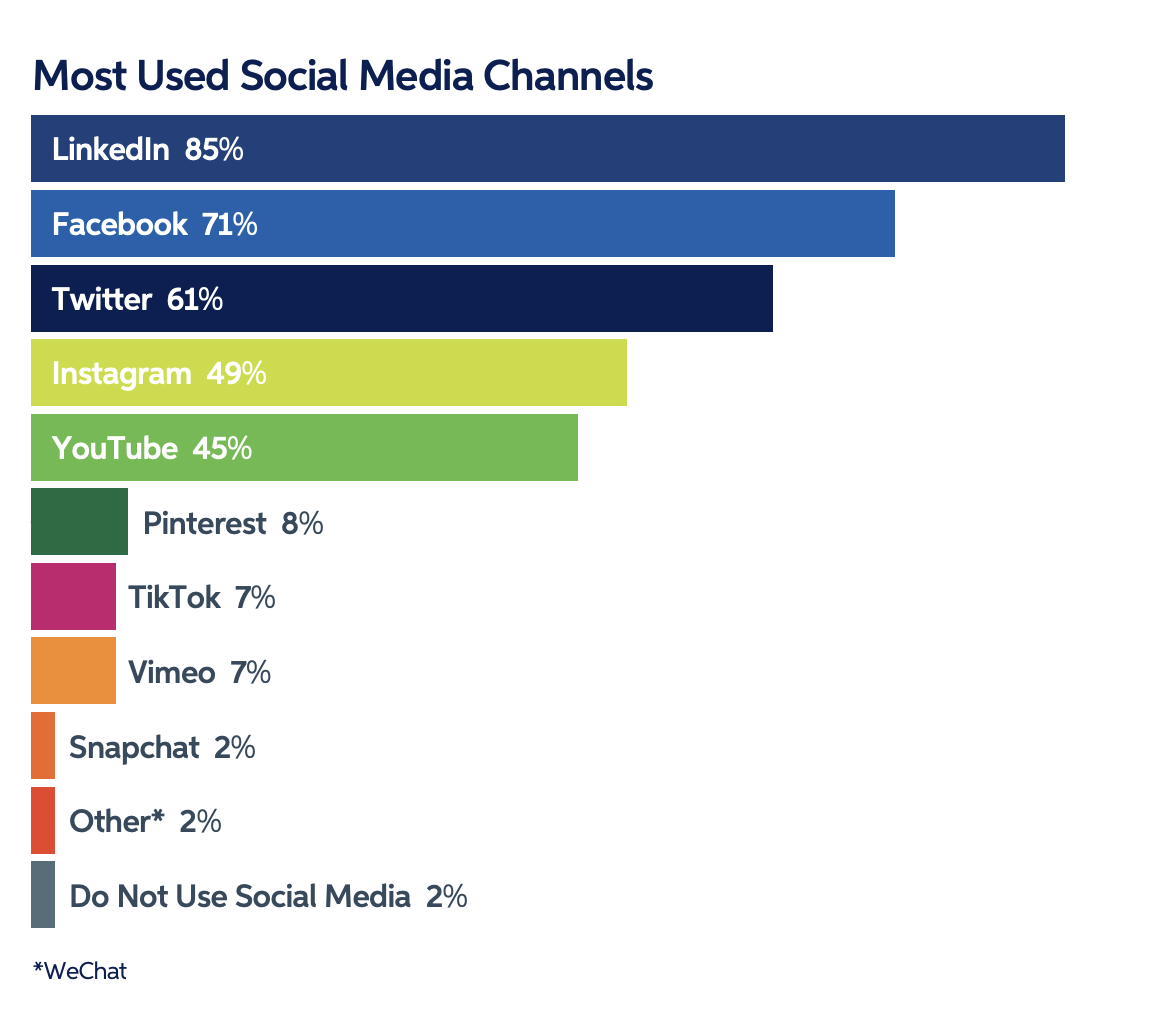
However, investing your energy in a channel with high engagement rates doesn’t automatically guarantee success. On LinkedIn, you must:
- Target your audience based on buyer persona.
- Make sure your ads have a newsworthy, topical angle.
- Continuously test CTAs, images, and copy.
Pro tip: LinkedIn can be a helpful platform to display social proof. Consider sharing testimonials or case studies. Potential customers can then see which brands in their network you’ve already helped with your offering.
You can learn more about the nitty-gritty of LinkedIn Ad strategies from this LinkedIn-HubSpot 2-week free course.
Facebook Lead Ads
Ninety-one percent of B2B buyer searches are carried out on a mobile device, according to 2022 research from Frost & Sullivan. Using Facebook lead ads in your marketing strategy can help you navigate the shift to mobile.
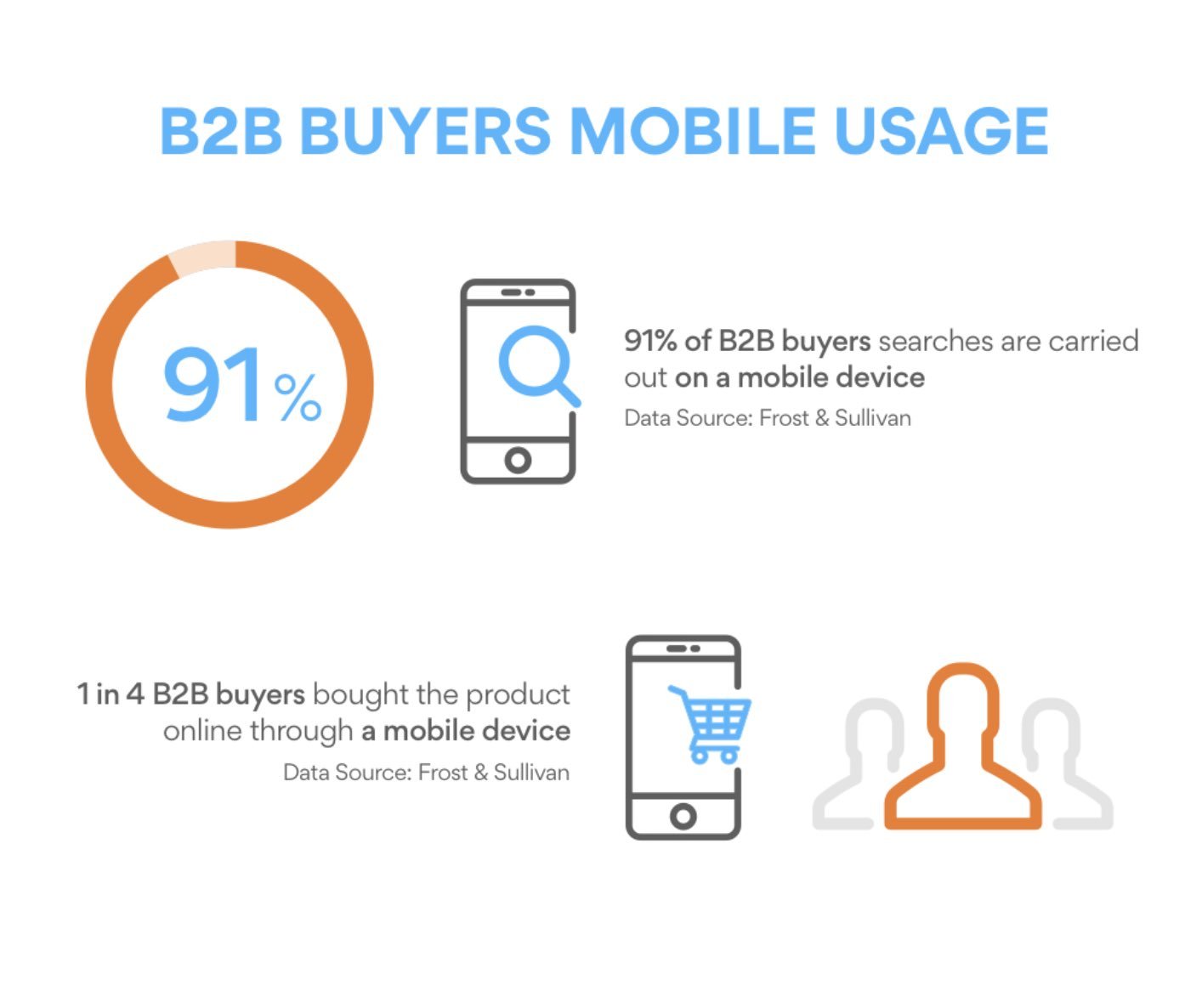
Facebook lead ads allow your prospects to sign up for offers inside a mobile interface. These ads also allow you to generate leads generation inside the world’s largest social media channel.
Designed to be both targeted to your audience and highly customizable, Meta launched this service in 2015. Customers can now sign up for your offer in just two taps, without leaving the social network.
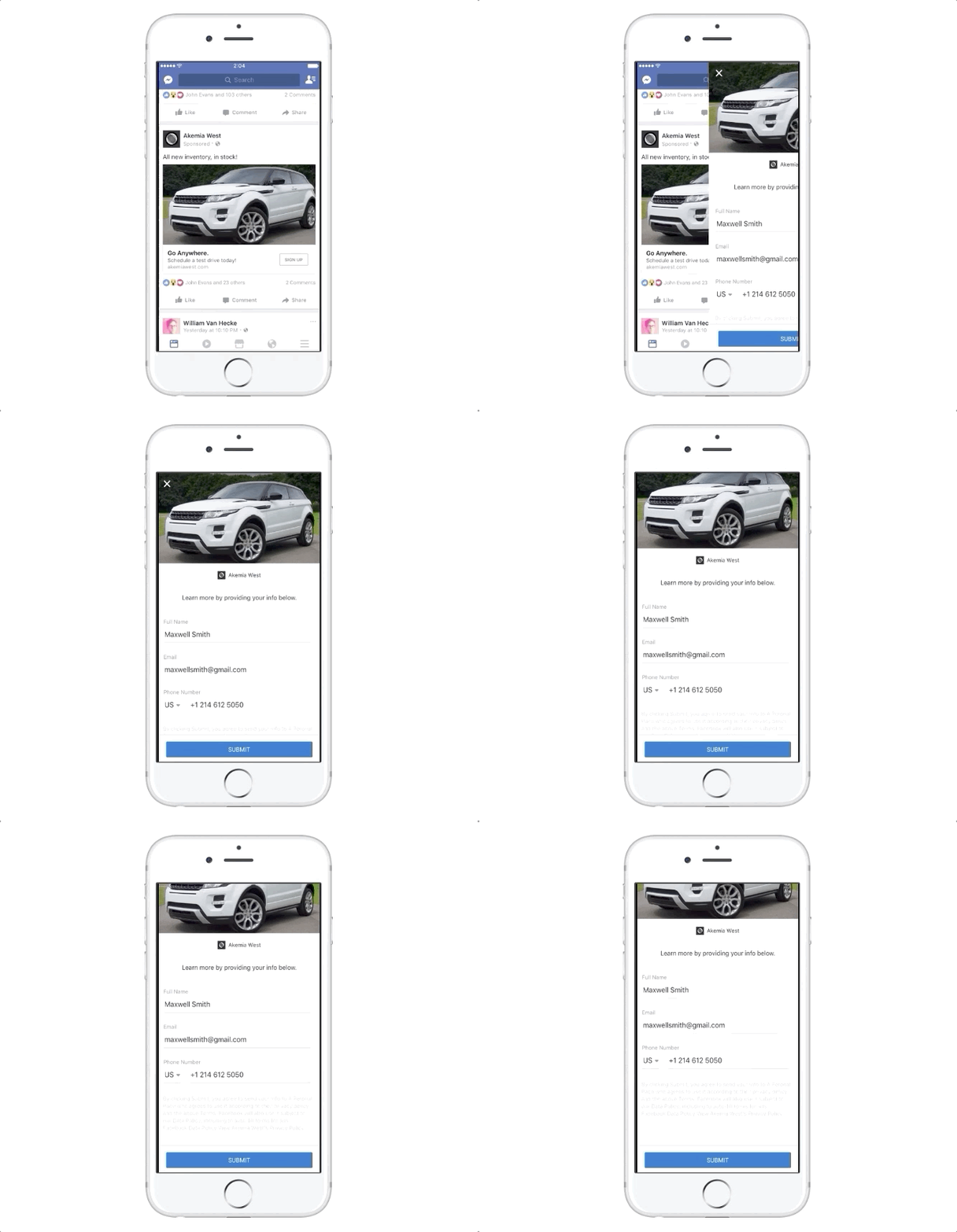
Remember: Facebook lead ads aren’t designed to replace your landing pages. While Facebook Lead Ad helps you capture leads inside Facebook, your landing pages are still necessary for capturing leads from organic search and PPC.
For more details, check out this step-by-step procedure on how to create Facebook Lead Ads.
Tip for Running Great Social Media Lead Generation Campaigns
Case 1. Using Scarcity and Exclusivity
Virgin Active South Africa used scarcity (a limited-time offer) to increase the value of their offer. Their slogan — “Is summer ready for you?” — rings of seasonality. The question, along with the related offer, is only for the summer season.
What we like: In addition to seasonal messaging, the accompanying image emphasizes summer fun. The key messages and CTAs are also clearly highlighted.

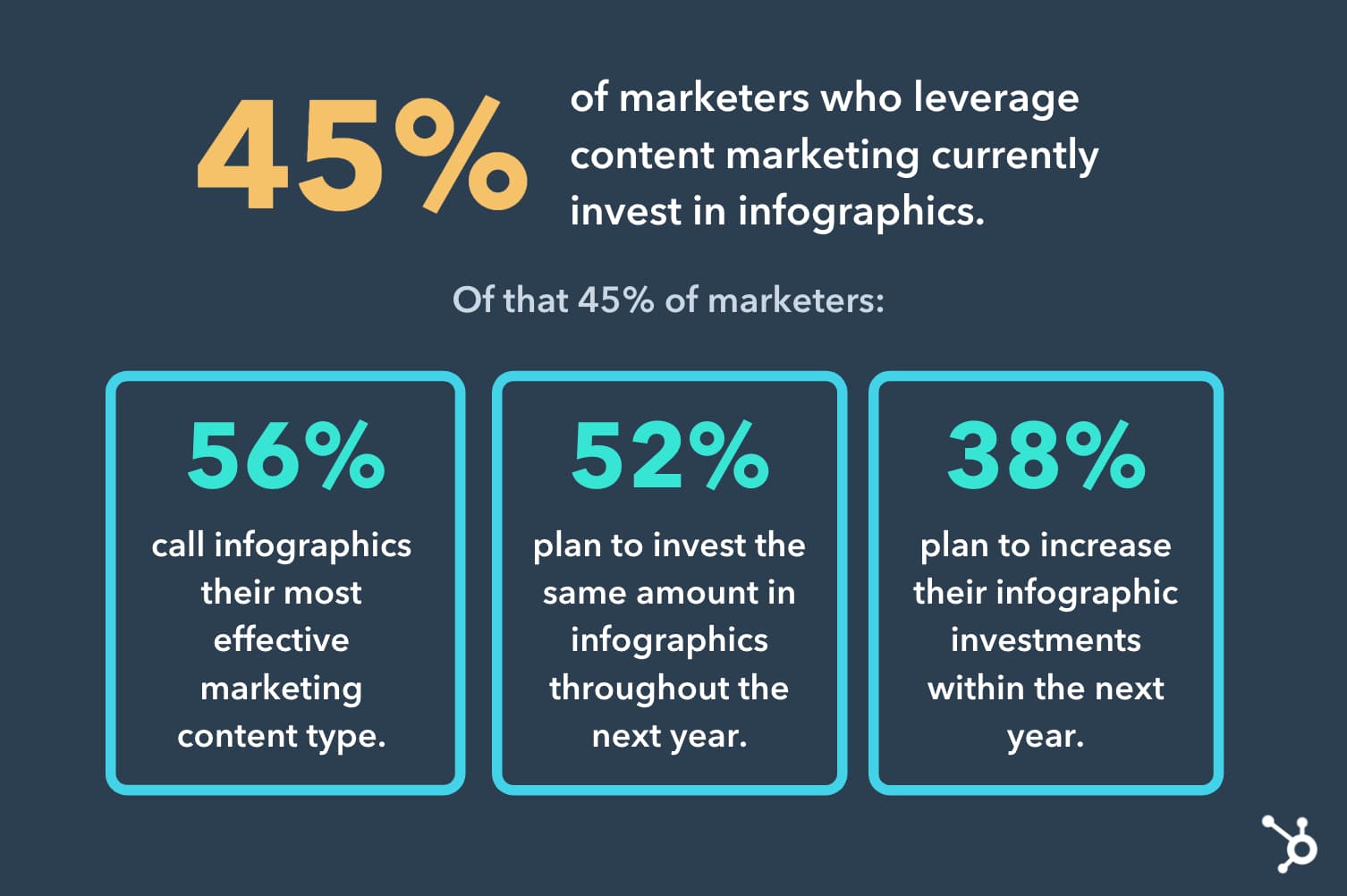
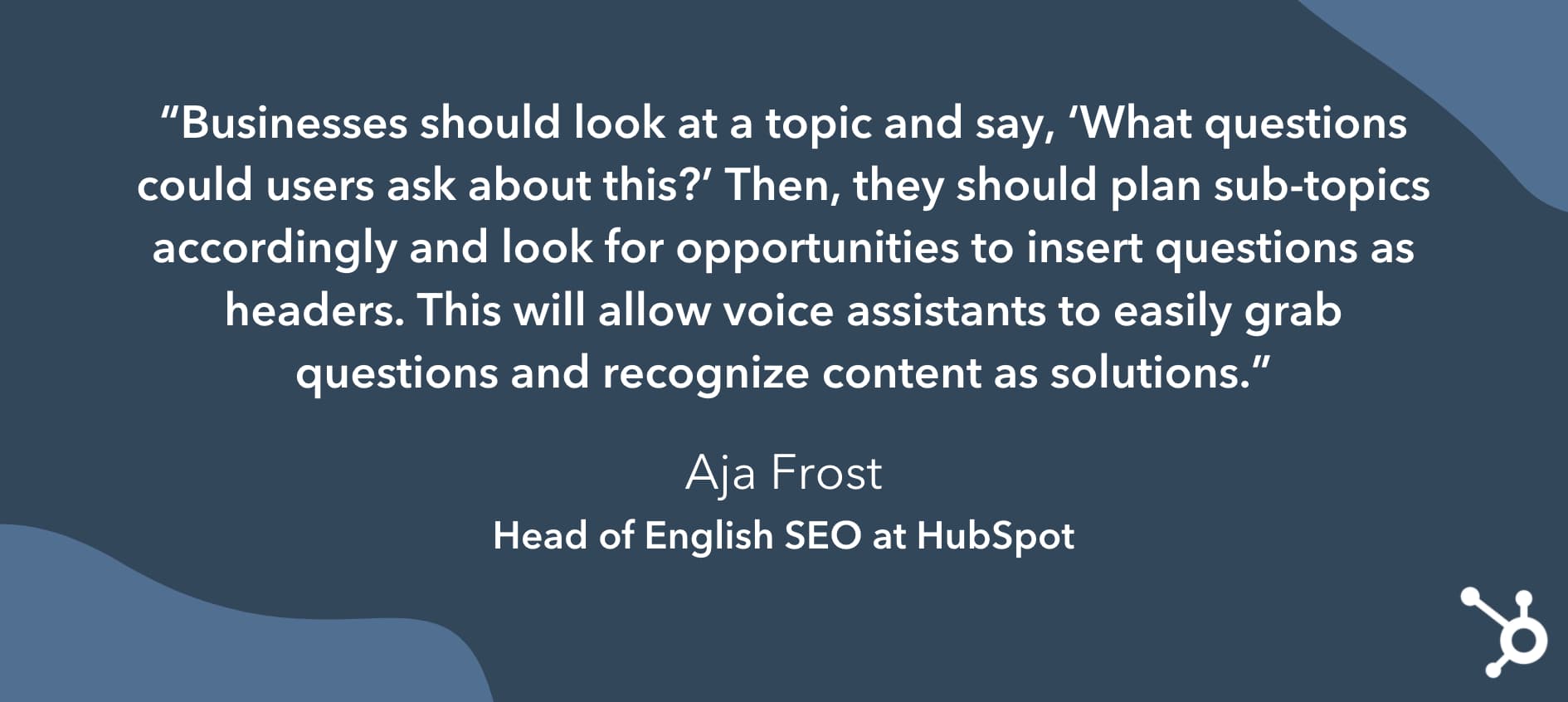
Case 2. Giving Before You Get
DigitalMarketer doesn’t sell — it gives something valuable away for free. That’s a compelling deal. By creating a clear value proposition, leads are more likely to share information with DigitalMarketer.
Their image amplifies the message and the CTA is clear but subtle. DigitalMarketer hooks leads through the law of reciprocity, which makes users feel they should return the favor through a later engagement.
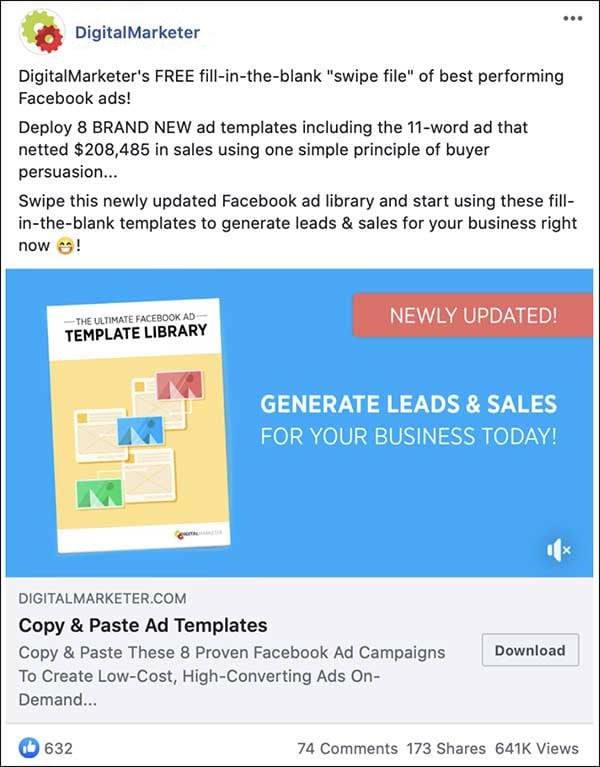
What we love: Digital Marketer’s copy emphasizes how templates can both save time and generate sales. Find ways to demonstrate your value ad to entice leads to your offering.
Case 3. Finding the Right CTA
Your call-to-action should be enticing and tell readers exactly what will happen when they click. The phrase “Book Now” creates a sense of urgency. The viewer feels like they should book their ticket for the Van Gogh event before time runs out.

What we love: This ad describes the art installation in the text and shows the experience visually. The viewer can picture the experience in their head when they click “Book Now.”
PPC Lead Generation Strategies
Pay-per-click (PPC) lead generation campaigns focus on a wide range of paid advertising platforms — the most popular being Google AdWords and Display Network. However, you’ll find a wide range of PPC lead generation options outside of Google, including:
- B2B review directories or comparison sites.
- Trade media display ads.
- Social media advertising.
- Affiliate marketing.
What is the conversion rate in PPC lead generation?
Adwords conversion rates fall around 2.41% for B2B companies, according to 2021 data from WordStream. Meanwhile, display conversion is averaged at 0.77%. However, rates vary depending on your industry.
It’s important to know your industry benchmarks. A good starting point is to ask each PPC vendor for their average conversion ratio across the board. This lets you evaluate your campaign results better.
Should PPC replace organic marketing? No — they complement each other. For instance, many high-value keyword searches have only PPC ads above the fold like this.
In other words, even if you have a good organic ranking, it may be buried under PPC ads.
An Example of an Efficient PPC Lead Generation Channel
Among the PPC platforms mentioned above, B2B review directories and comparison sites can provide a uniquely fresh lead source. Other PPC channels are likely already saturated by big players in your space, the ones with deep pockets.
For instance, in SaaS, a highly competitive industry across verticals, AdWords bidding is highly competitive. To win, you’ll need to target a lot of relevant keywords. Sometimes competitors even bid for keywords against your own brand — like this example, where Netsuite ranks higher for “Intuit Accounting.”
For many SaaS startups and SMBs, having another lead source like B2B review sites provides the option to meet and even surpass monthly lead quotas.
Let’s take a closer look at which popular marketing tools are used for lead generation by such sites. For example, here’s what FinancesOnline, one of the top software review platforms, offers:
- Lead generation campaigns: The review site can link directly to a vendor’s sign-up landing page, encouraging people who read your review to try out your free trial next. These campaigns can generate as much as a 24% conversion rate.
- Premium placement: In an increasingly commodified SaaS category, like a CRM where features are more standardized than unique, being included in a premium placement can make or break your sales opportunity. You have a much higher chance of attracting new leads if you’re listed among the most popular solutions, as prospects will usually only try out a few products. Make sure you get on such a list, because your competitors are probably already there.
- Industry awards: When buyers are comparing your product to your closest competitors, having your product stand out thanks to a featured quality award can have a critical impact on your sales. FinancesOnline, like many other review platforms, can give your product an edge with such awards.
Look for a third-party online marketplace in your industry, and get in touch with these intermediaries to ensure your product is listed.
Blogging Lead Generation Strategies
Blogging is at the core of content marketing. This strategy focuses on creating content that is interesting or valuable to your defined audience. The goal is to attract and sustain online engagement for leads down the road.
A lot has been said about the benefits of business blogging. Let’s reiterate the major benefits.
- You can drive traffic to your website. With the right SEO planning, your blog gives you search presence, linking you to keywords relevant to prospects. Every blog post you write is one additional indexed page that helps get your content on Google.
- You can convert traffic to leads. A well-placed CTA in a compelling blog post can direct prospects to your landing page for leads.
- You can gain repeat business. A blog can delight existing customers with fresh content for repeat business or referrals.
Blogging also establishes niche authority and places prospects within your sphere of influence. Blogging is a large part of the HubSpot Strategy. Just search “inbound marketing” or its derivatives, and you’ll come across HubSpot consistently.
How effective is blogging in the long run? At HubSpot, about 90% of the leads our marketing team generates each month come from blog posts that were published many months — or sometimes years — ago.
Which content types drive lead generation?
If you’re planning on just writing a blog or only working with video, you’re out of luck. Robust content marketing strategies use a variety of formats to engage their audiences. Video, blogs, and images are among the top media that marketers use.
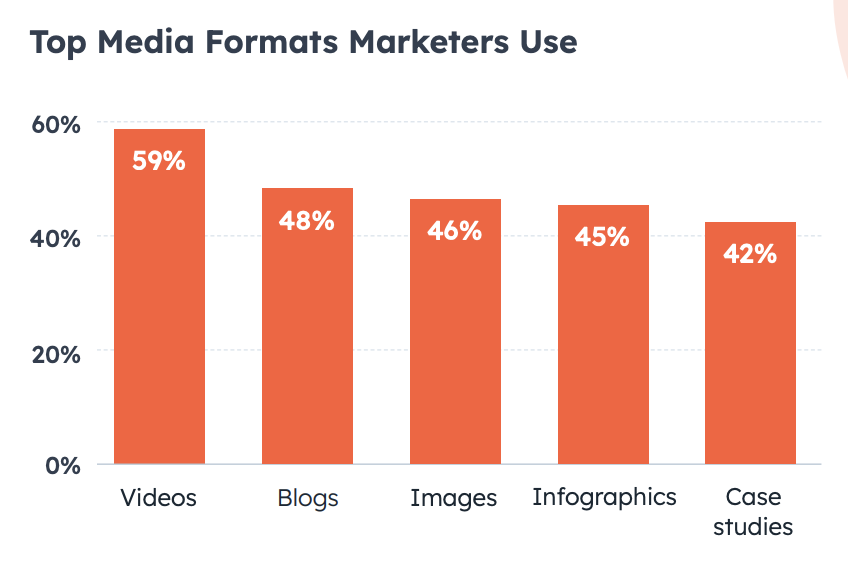
When building your content marketing strategy, consider including the following content.
- Authoritative posts are blog posts about subjects you’re an expert in. Readers should leave understanding with a better understanding of the topic at hand.
- Solid opinion pieces can help you spread brand awareness. However, this shouldn’t just be your ideas and thoughts. Persuading option pieces are backed by data and research.
- Original research is commissioned for industry consumption. Focus on questions that have yet to be answered or data sets that need a refresh.
- How-tos provide tips and tutorials to address prospects’ problems. By the end, they’ll have their issue resolved and you to thank.
- Trending content can help you capitalize on popular topics. Have any headlines and trends been related to your business? Consider a blog post that connects the dots.
- Infographics turn information into digestible visual bits for easy consumption. Encourage your audience to share these images where applicable.
- Videos on the upswing in content marketing. In fact, 72% of prospects prefer to watch a video over reading about a product. If your company does not have video talent in-house, consider contracting a team to help you produce this content.
Remember: These content types are most effective when they align with your marketing goals. In short, the hard work is still on you — you have to develop topics that are lead magnets to your audience.
Examples of Great B2B Blogging Campaigns
Case 1: Running Your Blog Like a Media Pro
HubSpot is influential when it comes to inbound marketing. But it didn’t happen by accident — HubSpot’s marketing team works hard to run its blog as a media site with a full editorial calendar.
HubSpot’s blog publishes tips, listicles, ideas, inspiration, insights, reports, ebooks, white papers, videos, and more. All of this content relates to inbound methodology across its niche segments in marketing, sales, website, and service. The blog even outperforms entrenched business media like Forbes and CNN Money in SERPs about inbound marketing.
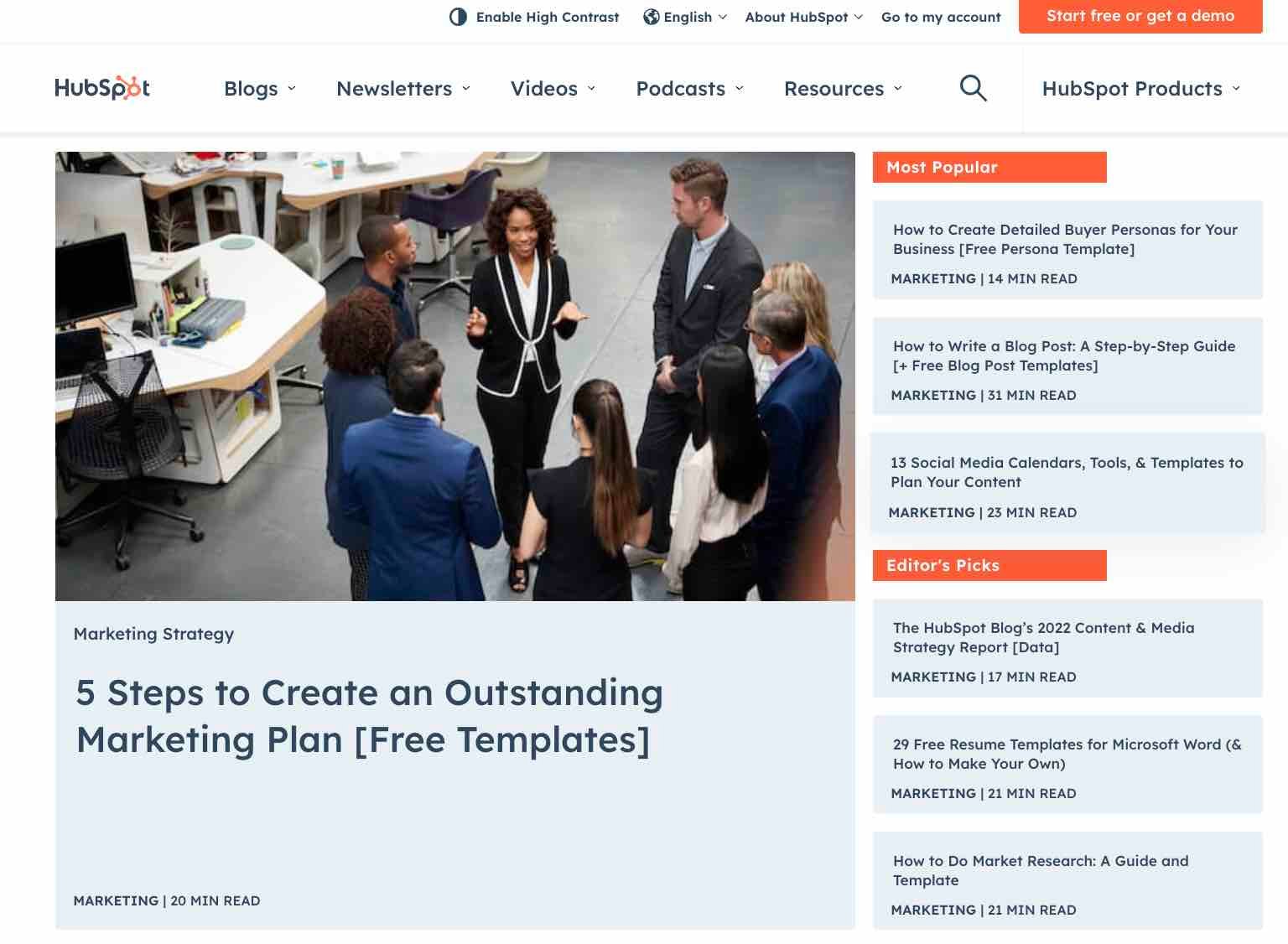
Case 2: Knowing Your Audience
FreshBooks is clear about its target audience. In fact, the first step to having great content is to know your audience (your “Ideal Customer” personas). For FreshBooks, this means delivering “actionable insights into all aspects of running a small business.”
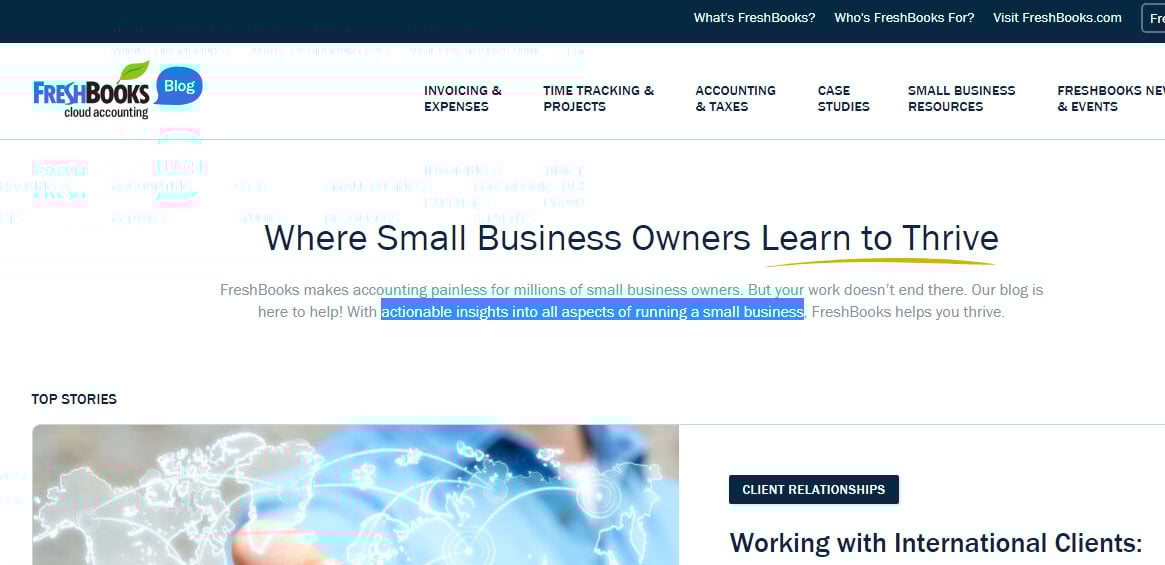
Case 3: Leveraging Thought Leaders
Have any die-hard supporters or thought leaders in your base? Have them put their insights and opinions about your industry in your blog posts.
Your thought leader should be writing regular posts to leverage SEO and brand association, both of which can result in more leads down the road.
Email Marketing Lead Generation Strategies
Email is often the bridge between marketing automation and CRM, two cloud solutions most widely used by marketers today. The email opt-in is still the starting point of lead generation and email marketing is the core of lead nurturing.
How does email marketing hold up today? Actually, it was the best B2B digital marketing channel in 2019, according to a Statista study. 99Firms released its B2B Marketing Statistics report, which showed email marketing is right at the top of digital channels driving leads and revenues for U.S. B2B marketers in 2022.
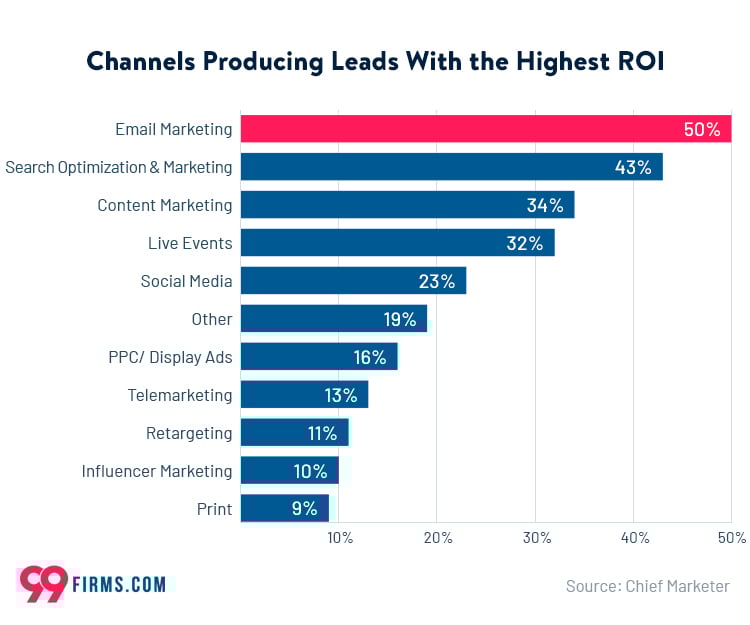
The advent of automated lead scoring, predictive analytics, and AI algorithms only reinforces email marketing with laser-focused, personalized touches, and real-time delivery. In short, email marketing is still one of your best tools to engage intent signals, distribute content, and deliver pitches.
What is the conversion rate of email marketing?
You’re looking at two variables when it comes to email marketing:
- Open rate.
- Click-through rate (CTR).
A GetResponse study puts the overall email open rate average at 82.20% and CTR at 21.69%. The report further divided the figures by location, with North America at a 23.53% open rate and 3.86% CTR.
By industry, internet marketing has a 14.97% open rate and 1.66% CTR, as of 2022.
Meanwhile, Marketing Insider Group puts email marketing conversion into another perspective: You earn $44 for every dollar spent on email marketing. The consensus is, yes, email marketing has one of the highest conversion rates, corroborating the DemandWave findings above.
Which factors influence email marketing conversion?
It takes creativity to brainstorm your content or offer, but with that aside, email marketing is more of a science. You can measure it, analyze it, and improve it. Here are the key factors that affect your email marketing conversion rates:
- Value offers. You must have a lead magnet to attract email sign-ups, whether it’s value content, freebies, deals, or anything that is interesting to your audience.
- Landing pages. Optimize these pages by having a clear offer of your lead magnet, compelling CTA, permission, and appealing visuals.
- Email subject lines. Keep your subjects short, crisp, and compelling with clear benefits to the recipient.
- Segmentation. Split your list into sublists for more targeted messages, which will allow you to increase your open and click-through rates.
- Analytics. Run analytics to do regular clean-up of your lists and update it as necessary based on past recipient actions.
Examples of Great B2B Email Marketing Campaigns
Case 1: Storytelling
At its core, email marketing is about your message, and here’s where your skill in storytelling can weave magic into a bland topic like a business workshop, captivating the prospect’s interest.
Perry Marshall, the best-selling author of Ultimate Guide to Google AdWords, is a master of storytelling. He can hook seemingly unrelated subjects together, all leading to his value offer.
Case 2: Use of Humor/Allegory
Email marketing favors the clever, and this message from Grammarly is a great example. To emphasize the benefit of spell-checking software, the email visually alludes to the alphabet. By turning the “A” into rocket exhaust, the brand emphasizes the importance and adventure of your grammar journey. Grammarly is witty and helps engage readers for those few critical seconds.
Remember: The use of humor is tricky and can backfire if executed poorly. Make sure any humor or allegory is something everyone can understand.
Case #3: Housekeeping
Email marketing isn’t all about the welcome — some goodbyes are in order, too. Cleaning up your list is one step toward qualifying leads for higher conversions down the funnel.
Framebridge makes sure its list is updated by sorting out inactive subscribers.
Pro tip: Breakup emails like the one above are a great way to reengage folks on your list and clean out inactive emails.
The 10 Best Lead Generation Strategies
In this post, we’ve shared best practices for different types of lead generation. Below are best practices that work across channels. Put these best practices into action, and maximize your lead generation.
1. Target the right audience.
Know your buyer personas. In B2B, your audience could be different people in different departments. Often, you don’t have a single audience, but micro-audiences with varying interests and pain points.
2. Create lead magnets.
Develop content or offers that pique the interest of your target audience. The best lead magnets use NLP techniques in marketing, such as, clear, tangible benefit, urgency, exclusivity, social proof, authority, and immediate gratification.
3. Explore new lead channels.
Search, social media, and top media sites are unsurprisingly crowded with high-value sponsorships. You can, however, discover unique PPC channels and similar third-party marketplaces for your industry. Because these sites cater to your customers, they tend to have higher conversion rates and dominate high-value general organic search keywords.
4. Capture the right information.
The rule of thumb is to get only the most basic customer data at the initial stage (e.g., name and email address) and, as you work the lead down the pipeline, ask for a little more data.
5. Score, sort, and segment leads.
Not all leads are valuable and not all have the same value. Based on your metrics, run a lead scoring tool to sort leads into proper segments. This will let you target your micro-audiences with personalized messages and offers. Today’s marketing automation software, like HubSpot, are very powerful and can automate this important process.
6. Blog consistently.
Regularly posting content improves your SEO, authority, brand awareness, industry stickiness, and, generally, your web presence.
7. Integrate organic and PPC.
These two marketing channels complement each other. When executed together, they can fill in the gaps. For example, you can run paid search for any organic keywords for which you’re not ranking highly.
8. Benchmark your conversion rates.
Don’t be content with seeing your rates improve month-to-month or year-to-year. Compare them with the competition. That’s the true picture of your business’ competitiveness.
9. Automate.
The best marketing automation will put your lead generation into a workflow. The software can then capture leads from your campaign, score them, nurture them throughout the lead pipeline, and qualify them. Then, your leads will be ready for your sales team.
10. Go mobile.
Mobile marketing is the next battlefield for B2B leads. More business buyers are using their smartphones in the purchase journey. Make sure your forms, emails, websites, and ads are optimized for mobile.
Those are some of the best B2B lead generation campaigns and techniques at your fingertips. Apply or reapply these time-tested techniques and share with us how much they improve your lead volume.

What to Do if Your Email is Hacked (+ Sample Messages To Send)
If you’ve received an email from someone claiming to have hacked your account, don’t panic. It’s important to stay calm and take the necessary steps to protect yourself and your data.
This blog post will provide sample emails you can send to your contacts after being hacked. We will also share tips on protecting yourself from future hacking attempts.

What To Do if Your Email is Hacked
You can’t always tell if you were hacked immediately. Some hackers may send corrupted emails to your contacts without leaving a trail.
Other times, filter settings might catch suspicious messages and automatically place them in “Spam” or “Trash,” so you never even see them.
Luckily, there are a few signs to watch out for if you suspect someone has hacked your account:
- You receive strange or unsolicited emails from someone with your own name or a third-party name. Look for blurred images, poor grammar, and strange email addresses.
- People you know tell you they’ve received unusual emails from you. They’ll likely delete them immediately, so don’t be surprised if no one has any to show you.
- Your password stops working out of nowhere. One day, you just can’t log into your account anymore.
- You see unexpected activity on your account, such as new contacts or messages you didn’t write.
If all signs point to hacking, keep calm. Hacking is a hassle, but it’s nothing you can’t resolve in a few steps.
Steps to Follow After You’ve Been Hacked

1. Change your password.
If you think someone’s hacked your email, the first thing you should do is change your password. It might seem obvious, but it’s an effective way to stop the hacker from further accessing your account.
2. Set up two-factor authentication.
After you’ve changed your password, we recommend enabling two-factor authentication (if it’s not already enabled). Two-factor authentication adds an extra layer of security to your account by requiring you to enter a code from a second device when you sign in.
If you’re unsure how to change your password or enable two-factor authentication, contact your email provider for help.
3. Keep your software up-to-date.
Another way to protect yourself from hackers is to ensure that your software is always up-to-date. This includes your operating system, web browser, antivirus software, and any other programs you use.
Outdated software can have security vulnerabilities that hackers can exploit to gain access to your account. Keeping your software up-to-date can help close these security holes and make it harder for hackers to get into your account.
4. Email your contacts.
Once you’ve changed your password and enabled two-factor authentication, email your contacts, letting them know someone hacked your account. They’ll know to be cautious of any emails they received from you.
Doing this as soon as possible ensures they remain on high alert and protect them from future attacks.
Sample Letters for Hacked Email
Messages in this situation serve two purposes: to inform people of what happened and to provide directions on how to protect themselves. Being brief and apologetic will allow them to quickly turn their attention to the necessary steps, such as remaining vigilant.
Use the templates below if you ever are hacked.
1. Hello, This is [Your Name], and I’m writing to let you know that my email account was hacked.
Hi [Recipient Name],
I wanted to let you know that my email account was recently hacked. I’ve changed my password and taken steps to secure my account, but I wanted to warn you in case you received any suspicious emails from me.
If you received any suspicious messages, please delete them, and do not click on any links.
I’m sorry for the inconvenience. Thank you for understanding.
Take care,
[Your Name]
2. Sorry, my account was hacked.
Hey [Recipient Name],
If you got any weird emails from me over the past few days, I’m sorry. My account was hacked, but I’ve since changed my password and added two-factor authentication.
Delete any suspicious emails you’ve received, and don’t click on any links.
Sorry about this, and thanks for bearing with me.
[Your Name]
3. Hey, it’s [Your Name] ― I got hacked.
![sample letter for hacked email: subject line, Hey, it’s [Your Name] ― I got hacked; tone, professional; best for acquaintances.](https://blog.hubspot.com/hs-fs/hubfs/sample-letter-for-hacked-email-acquaintances.jpg?width=2000&name=sample-letter-for-hacked-email-acquaintances.jpg)
Hi [Recipient Name],
Today, I discovered that someone had hacked my email and social media accounts. Any unwanted emails and messages you’ve received are spam — many of my contacts have gotten spam emails from my account.
My apologies for any inconvenience this may have caused you. I have taken steps to ensure that it won’t happen again.
Thanks for your patience!
[Your Name]
4. Sorry [Recipient Name], I was hacked.
![sample letter for hacked email: subject line, Sorry [Recipient Name], I was hacked; tone, professional, apologetic; best for acquaintances and new contacts.](https://blog.hubspot.com/hs-fs/hubfs/sample-letter-for-hacked-email-acquaintences-2.jpg?width=2000&name=sample-letter-for-hacked-email-acquaintences-2.jpg)
Hello,
I apologize for any unwanted emails you might have received in the last [timeframe]. My email account was hacked around [date], and spam messages were sent to my contacts, including you.
I’d never voluntarily sent this out to anyone, so I’m sorry if it made a wrong impression. Rest assured, I’ve secured everything already, so things should be secure moving forward.
Thanks for understanding,
[Your Name]
5. Team, my email was hacked.
Hey Team,
I got hacked on [date], and I think spam messages have been going out [timeframe]. Sorry about that — I just noticed it and took the necessary steps to fix everything on my end.
Keep an eye out for anything suspicious, and let me know if you continue getting any strange messages.
Thanks,
[Your Name]
Stay protected with HubSpot
Getting hacked is never fun, but it doesn’t have to be the end of the world. By taking some simple steps, you can quickly get your account back under your control. Plus, you can help protect yourself and your contacts from future attacks.
At HubSpot, your security and safety are paramount. Our CRM platform for front office teams ensures the privacy of the data you entrust to us. Check out our site to learn more about how we keep you protected.