
The 10 Best Free Email Marketing Tools in 2019
In case you didn’t know, email usage is at an all-time high. More than 3.7 billion people use email worldwide.
With email usage so high, it’s no wonder you likely constantly receive marketing emails from businesses. Email marketing works — even in the B2B space.
In fact, 86% of B2B marketers rely on email marketing campaigns to promote new business, which begs the question — are you using email marketing effectively for your business?
More importantly, are you using email marketing consistently at all?
There are a ton of email marketing service tools out there to help you with your email marketing, some of which are completely free. But, it’s important to note, not all free email marketing tools offer the same features.
As a new business, you’re probably most concerned with how many emails you’re able to send, which features you have access to, and whether you can upgrade your account as your business grows.
You’re probably also thinking about deliverability, and whether your emails will be consistently delivered to your contacts’ inboxes. Plus, you likely want a tool that’s both easy-to-use and doesn’t require advanced technical skills.
Fortunately, we have you covered — here, we’ve ranked the best free email marketing tools that you can use for your business in 2019.

The 10 Best Free Email Marketing Tools in 2019
- HubSpot
- SendPulse
- Mailchimp
- Zoho Campaigns
- Moosend
- SendInBlue
- Mailjet
- Benchmark
- MailerLite
- ExpressPidgeon
1. HubSpot’s Free Email Marketing Tool
HubSpot offers a reliable and feature-packed email marketing tool that’s suited for growing businesses — for free. You can create professional marketing emails that engage and grow your audience with the easy drag-and-drop email builder. With the drag-and-drop email builder, you don’t need to wait on IT or designers for help. Instead, you can easily create beautiful emails that your audience will love. HubSpot’s tool helps you achieve incredible marketing results with little effort.
On top of the free email tool, you can use the HubSpot CRM for free to create tailored touch-points for your customers. HubSpot email is automatically connected with the HubSpot CRM, so you can tailor relevant emails based on any details you have — such as form submissions and website activity.
Using the CRM, you can include personalized content in your emails, like first name and company name, to ensure your contacts feel like they are being personally addressed, all while tracking email activity in the CRM. This contributes to efficient scaling opportunities should your business outgrow the free tools and require more robust automation features, such as workflows.
Optimizing your emails has never been easier. Using the tool’s email reporting analytics, you’ll learn how to send more relevant and optimized emails to your audience.
The HubSpot email tool is free for up to 2,000 email sends per month, with upgrade solutions starting at $50 with Marketing Hub Starter.

2. Send Pulse
Send Pulse has over 130+ templates to choose from, or you can create your own using drag-and-drop functionality. Under the free plan, you’ll have access to Send Pulse’s highly regarded support team, including support via live chat.
In terms of functionality, Send Pulse has a “Resend” feature that allows you to resend unopened emails with different subject lines, which is valuable for time scrapped marketers. What’s great about Send Pulse is that it has prices for all its services. For example, if you need to send SMS, you can add an SMS package to your email marketing service package.
They also offer web pushes, SMTP, Viber, and more. Since the service started in 2015, there still isn’t a ton of API support, but that’s something Send Pulse is working on improving for marketers who are in need of technical functionality.
SendPulse offers 15,000 emails per month for free for up to 2,500 subscribers. Pricing starts at $9.85 per month for unlimited emails and up to 2,500 subscribers.

Image source: SendPulse
3. MailChimp
MailChimp’s email tool is particularly useful for small and medium-sized businesses, since the free plan offers up to 12,000 email sends per month for up to 2,000 subscribers. Plus, you get access to features such as list segmentation, A/B testing, contact profiles and more. However, it’s important to note you’ll have MailChimp branding in your email footers with the free plan, and won’t have access to premium support.
If you use e-commerce software, you’ll be happy to know that MailChimp integrates with e-commerce providers including WooCommerce and Magento. You’ll also be able to integrate Mailchimp with WordPress if your business uses WordPress as its content management system. MailChimp offers reporting for emails, but the details may not be as robust as you would like for optimal improvements.
The MailChimp Free Forever plan allows up to 12,000 email sends per month to a subscriber limit of 2,000. The next tier upgrade tier costs $10 per month for unlimited email sends to a maximum of 500 subscribers.
4. Zoho Campaigns
Zoho Campaigns is a good option for small to enterprise-sized businesses, depending on how quickly you’re scaling. With the Zoho Campaigns free plan, you get access to features such as A/B testing, reports, and templates. If you’re already using the Zoho CRM, it makes sense to check out Zoho campaigns to see how email and the CRM work together.
It’s important to note — while the free version provides a lot of features, most of these features have limitations. Additionally, it can be difficult to get started using Zoho Campaigns because it requires customization before sending emails.
Zoho offers 12,000 emails per month for up to 2,000 subscribers. Pricing starts at $5 per month for up to 500 subscribers.

Image source: Zoho
5. Moosend
Moosend is ideal for people looking to get their feet wet in email marketing. The free tier comes feature-packed, but you’re maxed at 1,000 subscribers and won’t have a dedicated IP address.
Moosend offers an easy to use drag-and-drop editor, email marketing automation triggers, real-time analytics, and list segmentation features. Moosend doesn’t offer a CRM, but if you’re looking to solely do email marketing, it might be a good start for your business.
The company is ranked as having great support and satisfaction scores. If you’re a growing business, you’ll only need to pay for subscribers. The next upgrade is $10, and you’ll get up to 2,000 subscribers.

Image source: Moosend
6. SendInBlue
If your business relies heavily on transactional emails, such as forgotten password help and invoice receipts, then SendInBlue might be ideal for you. With their extensive developer APIs, you’ll be able to integrate with their email system to achieve custom and required technical processes. Plus, while the service was initially known for having issues with delivery rates, SendInBlue has since improved upon its deliverability.
With SendInBlue’s free plan, you’ll have access to a vast array of templates, personalization, A/B testing, contact management, workflow editor, and real-time reporting. Like the other tools mentioned, the software is easy to use, although the main interface can sometimes offer too many options and feel overwhelming.
SendInBlue offers up to 300 email sends per day (which is roughly 9,000 emails/month) for free with unlimited contacts. Upgrade solutions start at $25/month for 40,000 emails and no daily sending limit.

Image source: SendInBlue
7. Mailjet
With Mailjet’s free plan, you’ll have access to unlimited contacts, APIs and webhooks, an advanced email editor, and advanced statistics. However, you won’t have access to A/B testing or automation features. The Mailjet interface is also simple to use, so you won’t have to spend a ton of time getting familiar with the service. Since you get full API access as part of the free plan, Mailjet is suited for businesses that require technical adjustments.
Mailjet’s free plan offers up to 200 emails per day (that’s roughly 6,000 emails per month). You can upgrade starting at $8.69 per month for 30,000 emails and no daily sending limit.

Image Source: Mailjet
8. Benchmark
If you work for a business that is experiencing incredible growth, yet isn’t already using an email marketing service, you might want to check out Benchmark’s free email tool. The tool is well-equipped with premium features, and designed to cater to the enterprise-level business.
With the free version of Benchmark, you can use the drag-and-drop editor, select from various templates, use sign-up forms, build basic drip campaigns, and use the list hygiene feature. Benchmark is user-friendly and easy to implement.
However, there’s no option for A/B testing or automation features on the free tool. Furthermore, contacts can’t be added via list import in the free plan. You can only email contacts who fill out Benchmark subscriber forms.
Benchmark offers a free Starter Plan with up to 2,000 subscribers and 14,000 emails per month. The next upgrade plan starts at $13.99 for up to 600 subscribers and unlimited email sends per month.

Image source: Benchmark
9. MailerLite
Although it has “lite” in the name, MailerLite is actually a good solution for businesses starting out and looking to grow. The service is ideal for small businesses needing to send bulk marketing emails. It’s also well equipped with preview features so you can preview your email on desktop and mobile before sending it. However, the API and integration capabilities are not as robust as some of the other options in this list.
Mailerlite offers 12,000 emails per month with up to 1,000 subscribers. The next upgrade tier costs $10, and it unlocks all features for up to 1,000 subscribers.

Image source: Mailerlite
10. ExpressPigeon
ExpressPigeon provides a good solution for businesses using small list sizes but sending to very high-priority subscribers. With ExpressPigeon, you can effortlessly build and personalize emails, automate email responses, and send high volume emails.
Best of all, you get access to all of the premium features with the free plan — however, there are low send and subscriber limits. ExpressPigeon is regarded as having some of the best customer satisfaction scores in the industry.
ExpressPigeon offers a free plan that allows 1,000 messages for up to 500 subscribers, and one user only. The price of each additional user is $100 per month. The next upgrade tier is a huge price jump: $1,000 per month for up to 100,000 subscribers and two million emails.

Image source: ExpressPigeon
Now, you have a better sense of the best free email marketing tools at your disposal. Fortunately, you don’t need to commit to any service. You can try these tools out depending on your business’ needs, then select the one most ideal for you.
If you’re looking to get started building incredible email marketing campaigns, we recommend that you try HubSpot Free CRM and Email. You’ll be able to see the power of the CRM behind every email interaction with your customers, so that you deliver remarkable experiences.

2019 YouTube Demographics [New Data]
Conventional wisdom tells you that every organization’s target audience gets a consistent dose of video content from YouTube. But, in reality, assuming your exact buyer persona frequents the video platform is a risky move to make.
To truly build a presence on YouTube, you need to know if your target audience actually watches content on the video platform. Otherwise, you could waste a ton of precious time and resources creating content that your buyer persona will never see.
If you want to avoid this mishap and make sure YouTube is a viable marketing channel for your brand, we’ve got you covered. Read on to learn about the video platform’s age, geography, gender, education, and household demographics.
2019 YouTube Demographics
YouTube Age Demographics
- Over 90% of 18-44 year old American internet users watch videos on YouTube.
- Over 80% of 45-64 year old American internet users watch videos on YouTube.
- Over half of American internet users who are aged 65 and over watch videos on YouTube.
- 59% of Generation Z (16-24-year-olds) have increased their YouTube usage since last year.
- 46% of millennials (25-34-year-olds) have increased their YouTube usage since last year.
- 70% of millennial YouTube users watched a YouTube video to learn how to do something new or learn about something they’re interested in.
YouTube Geography Demographics
- 15.5% of YouTube’s visitors are from the United States, 8.2% from India, 4.7% from Japan, 4.5% from Russia, and 3.4% from China. These are also the countries that YouTube attracts the most visitors from.
- YouTube is available in more than 91 countries.
- YouTube is available in 80 different languages.
YouTube Gender Demographics
YouTube Education Demographics
- YouTube users are more likely to have a college degree than the general population.
YouTube Household Demographics
- YouTube users are more likely to have children than non-users.

Buzz Marketing: What It Is & How to Do It Right
On Sunday, the first episode of the last season of Game of Thrones not only made its fans the happiest people in the world for an hour, but it also shattered HBO’s record for the most amount of viewers a single episode of a show has ever attracted — 17.4 million.
What’s arguably more impressive than the amount of viewers Game of Thrones’ season eight premiere captivated, though, is how long its fans have been waiting to watch this episode — 20 months.
Game of Thrones is considered one of the best television shows ever made. It boasts a gripping and sophisticated storyline that’s chock full of twists, turns, and your favorite characters’ deaths, so there’s no wonder why the series has created a cult-like following and an irrational fear of admitting you’ve never seen a single episode of the show in your life.
However, Game of Thrones’ masterful storytelling isn’t the only reason why it’s season eight premiere broke HBO’s ratings record. The show’s marketing & advertising team also generated huge amounts of buzz for its final season and successfully sustained it for nearly two years.
What is buzz marketing?
Buzz marketing is a viral marketing strategy that leverages refreshingly creative content, interactive events, and community influencers to generate word-of-mouth marketing and anticipation for the product or service the brand is about to launch.
Two months before the final season of Game of Thrones premiered, Bud Light aired one of their Bud Knight advertisements during Super Bowl 53. But half way through the commercial, audiences immediately realized that this wasn’t just another hilariously witty Bud Knight ad. It was actually an intensely dramatic Game of Thrones ad.
Since almost every Game of Thrones fan recommends the show to all their friends, which generates a lot of word-of-mouth marketing, the series doesn’t really need any influencers promoting it.
However, Bud Light’s willingness to share one of their most-watched ads of the year with HBO and kill off the Bud Knight, one of their most popular mascots, to endorse Game of Thrones reveals how much the Beer company truly loves the show. And this amount of support not only skyrocketed the already astronomical level of hype for Game of Thrones’ final season, but it also convinced the airheads like me who hadn’t watched a single episode of the show to start binging its first seven seasons.
Game of Thrones also built hype for its final season by launching a Game of Thrones Live Concert Experience, running an influencer marketing campaign with celebrities, like Jimmy Kimmel, T-Pain, and Aaron Rodgers, encouraging fans to rewatch the first seven seasons of the show to fully prepare themselves for season eight, and setting up Game of Thrones-themed blood drives and meet-the-cast events that supported autism research and physical rehabilitation programs.
How Buzz Marketing Can Backfire On Your Brand
Buzz marketing might seem like the most effective way to build as much hype as possible for your new product launch. But, before you start strategizing your next buzz marketing campaign, it’s crucial to remember that the new product or service you’re generating buzz for needs to meet the expectations your campaign sets. Otherwise, you’ll disappoint your customers, make them lose trust in you, and damage your brand equity.
For instance, in 2017, entrepreneur Billy McFarland and rapper Ja Rule organized a music festival called Fyre Festival in the Bahamas. To generate as much buzz as possible for the event, they paid some of the most notable social media influencers, like Kendall Jenner, Bella Hadid, and Emily Ratajkowski, to fly down to the Bahamas, act in their promo video, and post the video to their Instagram profiles. With the help of some promotion of the festival’s stellar acts, luxury villas, and gourmet meals, Fyre Festival sold over 4,000 tickets.
Unfortunately for the attendees, Fyre Festival’s marketing materials and the event itself were a complete scam. Instead of the luxury villas and gourmet meals their guests paid thousands of dollars for, McFarland and Ja Rule gave them tents and cheese sandwiches. Worst of all, there was no cell phone service, portable toilets, or running water at the festival, so thousands of people were basically left stranded on the island. And once the truth about Fyre Festival started circulating throughout social media, all of the festival’s acts cancelled.
Shortly after Fyre Festival’s epic failure, its parent company, Fyre Media, shut down and Billy McFarland was sentenced to six years in prison and forced to repay $26 million to his company’s investors.
Your spectacle needs substance.
Game of Thrones’ and Fyre Festival’s buzz marketing campaign reveals an absolute truth about the viral marketing strategy: you can build all the hype in the world for your new product or service, but if it doesn’t meet the expectations your buzz marketing campaign sets, your customers will feel duped and lose trust in you, wreaking havoc on your brand. Even worse, Netflix could make a documentary about your artful deception.

6 Tips to Stop Thinking About Work After Work Hours [Infographic]
We all know the feeling — it’s 11 p.m., your laptop is off, and you’re lying in bed thinking, Shoot … did I remember to send that email?
Or maybe, out to dinner with friends, you get a fantastic idea for your new marketing campaign and can’t wait to tell your boss, so you slack her immediately, even though it’s 6:15.
Work inevitably sneaks into our lives, even after traditional work hours are over. But without good work-life balance, you’ll ultimately burnout.
Plus, not thinking about work for a span of time can actually make you more productive at the office — so it’s critical you learn how to stop thinking about work after hours.
Fortunately, CashNetUSA put together this complete guide to help you properly recharge during your off-hours. Take a look, and use these tips to stop thinking about work when you’re not, well, at work.


7 Tips for Running Engaging Instagram Giveaways, Plus Examples and Ideas
With 80% of Instagram users following at least one business, it makes sense you want to increase your own visibility and reach on the platform — but with such immense competition, it can be a difficult task to accomplish.
Fortunately, there are a few specific Instagram marketing strategies you can implement that have proven effective. For instance, you might optimize your posting times to ensure maximum engagement, partner with an influencer to spread awareness, or designate a content creator to craft more compelling content.
Additionally, to delight your current followers and attract new visitors to your page, you might consider hosting an Instagram giveaway.
Simply put, an Instagram giveaway allows you to offer something for free in exchange for an Instagram like, comment, or other pre-determined requirement.
For instance, take a look at this giveaway from Fabletics:

Image courtesy of Fabletics.
There are a few reasons why this giveaway works — first, Fabletics partnered with Blissworld, which enables both businesses to reach the other brand’s audience. Second, Fabletics asked viewers to “tag your bestie” and follow both brands. This doubles the reach they might’ve had if they’d only asked one follower to comment.
When done correctly, giveaways can help you establish your brand on Instagram, cultivate a loyal following, and share your impressive products or services with a larger audience then you could organically.
Here, we’ve created a complete guide on how to run your own giveaway, to ensure you’re able to delight and engage both new and existing followers on Instagram.
How to do a giveaway on Instagram
- Choose the prize for your giveaway.
- Determine the entry-criteria for your contest.
- Decide on a goal for your Instagram contest.
- Consider a brand partnership.
- Select a campaign hashtag.
- Put a time-limit on your contest.
- Launch and promote your Instagram contest.
1. Choose the prize for your giveaway.
The first thing you’ll want to do is decide on the product, service, or experience you’ll giveaway as your prize. This will vary depending on your goal — if you want to spread awareness around a product launch, for instance, you’ll likely want to giveaway that specific product as your prize.
Alternatively, perhaps you want to partner with a brand and create a unique prize that will appeal to each of your audiences.
Lastly, you might try offering an experience instead of a specific product or service — like a weekend trip, a spa day, or the chance to meet a leader in your industry.
2. Determine the entry-criteria for your contest.
Your entry-criteria depends, again, on your ultimate goal. For instance, if you simply want to spread brand awareness, you might ask each participant to like your post and comment with the name of a friend — this allows you to increase your reach quickly, and could result in new followers.
Alternatively, maybe you want to draw attention to your blog, or another page on your website. If this is the case, you might ask participants to go to your blog or web page to find entry-criteria there — such as a question you then want them to answer in your Instagram comments section.
Lastly, perhaps you’ve partnered with a brand and, in exchange for one of their products as a prize, they’ve asked you to include a request to follow their brand as part of your entry-criteria.
3. Decide on a goal for your Instagram contest.
By determining a specific goal, you’re able to tailor your strategy more specifically and keep track of whether or not your giveaway was successful.
Your goal might be an increase in website traffic, more followers, an increase in engagement, or a boost in sales — it’s to you to choose what makes the most sense for your brand.
4. Consider a brand partnership.
To explore the benefits of brand partnerships for Instagram giveaways, I spoke with Conor Janda, an Associate Manager of Marketing Partnerships at Chomps. He told me, “A giveaway is a nice way to align with peer brands and partners, and drive traffic to your account.”
Janda also mentioned giveaways are particularly successful when new brands partner together. “For instance, a brand might post a recipe, and then mention specific brands in the ingredients section,” He told me. “A successful giveaway is typically when a brand partners with a content creator or influencer to make something specific, and then they push that prize out through both of their channels.”
Ultimately, a giveaway could allow you to reach a similar brand’s followers, and vice-versa — a win, win.
5. Select a campaign hashtag.
On Instagram, hashtags help your content surface on Explore channels, and oftentimes increase visibility on the platform. Consider creating a compelling and unique campaign hashtag to help spread awareness of your giveaway. For instance, along with #giveaway, you might include #winitwednesday #[yourbrand]giveaway #[yourbrand]contest, or something of similar nature.
6. Put a time-limit on your contest.
Tell your participants how long they have to complete your requirements by putting a time limit in your caption, and then adding “Giveaway Closed” at the end of that time. For instance, you might put, “Giveaway! Over the next 24 hours, please tag a friend in the comments and include your favorite place to travel for a chance to stay overnight at one of our resorts.”
The time-limit will ideally create a sense of urgency, and incentivize followers to engage with your post more quickly — which will also help your giveaway stay at the top of your followers’ Instagram feeds.
7. Launch and promote your Instagram contest.
Once you’ve chosen your prize, entry-criteria, potential partners, hashtag, time-limit, and goal, you’re finally ready to launch and promote your post! Remember, Instagram users favor posts during a certain time in the day, so you’ll want to plan wisely.
Additionally, you’ll likely attract further attention to your giveaway if you also post giveaway details on a blog post, Facebook page, or another social channel. Consider where else you can promote your giveaway for optimal results.
Instagram Giveaway Rules
Instagram’s rules are relatively simple when it comes to giveaways.
First and foremost, it’s critical you include a statement like the following, so viewers know your promotion is not tied to Instagram:
“Per Instagram rules, this promotion is in no way sponsored, administered, or associated with Instagram, Inc. By entering, entrants confirm that they are 13+ years of age, release Instagram of responsibility, and agree to Instagram’s terms of use.”
Additionally, you’ll want to ensure you don’t ask participants to tag themselves in your content, or tag something that isn’t in the photo — Instagram will penalize you for this.
Take a look at Instagram’s promotion guidelines for a full list of rules and regulations.
Instagram Giveaway Ideas
Once you’re ready to post your giveaway, there are a few different action items you might ask your participants to accomplish in exchange for the chance to win.
Here’s a list of some of the more common giveaway ideas:
- Like to win: Have followers like your post for a chance to win a free product or service. This helps you boost engagement.
- Tag a friend to win: Have followers tag one of their friends in the comments section for a chance to win. This allows your brand to reach new potential leads on Instagram and grow your audience.
- Like and share to win: You might ask followers to like your giveaway and repost it on their own channels for the chance to greatly expand your brand’s reach — if ten followers with 100 followers each re-post, that’s a chance to reach 1,000 new people.
- Follow to win: Ask followers to follow your brand, or a partner (or both) for the chance to win. This is a popular tactic since it’s an easy way to increase your follower count.
- Photo contest: Ask participants to upload a photo of themselves using your product or service. This is another easy opportunity to spread brand awareness, since your participants’ posts will be seen by their own network of followers and friends. You should ask participants to include your brand’s hashtag, or tag your brand, for optimal visibility.
- Caption this: Some brands post images and leave the caption section blank with a “Caption this for a chance to win” command. Your participants will enjoy the chance to offer creative captions for your image, and you’ll be able to add the caption to your post with credit to the winner once your giveaway ends.
Instagram Giveaway Picker Tools
Once you’ve closed your giveaway contest, it’s time to pick a winner — but how can you do that and ensure fairness?
There are a few tools you can use to truly randomize your winner. Here are a few options:
1. Use a free number generator.
While admittedly tedious, particularly if you have hundreds of entries, you might consider counting the total number of participants who engaged with your giveaway, and then using a number generator to select your winner.
For instance, let’s say you count 500 participants in your comments section. Go to Google and type “random number generator” into the search box, and Google’s number generator will appear as a box in the search results (you can also use another number generator tool, if you want).
Your minimum should stay 1, and your maximum should be the total number of participants. When you click “Generate”, the tool will provide a random number. Now, simply go back to your comments section and count until you land on the username that matches that number.

2. Use Easypromos’ Instagram Sweepstakes App.
You might consider using a tool like Easypromos’ Instagram Sweepstakes App to organize your giveaway, which can help you ensure fairness and efficiency when choosing a winner.
With Easypromos’ app, you can filter finalists based on number of mentioned friends. Once you’ve closed your giveaway, the tool can randomly select between one and 1,000 winners, and alternate winners automatically. The tool provides a test run that you can try before the final draw.
Best of all, Easypromos’ offers a link to a certificate of validity that guarantees the draw has been random, ensuring a level of transparency and honesty between you and your participants. You can customize the certificate for your brand.
3. Use a random name picker.
This last option is likely the most tedious, but if your giveaway participant pool is relatively small, you could consider using a random name picker to choose your winner by username instead of number. Particularly if you’ve already compiled your list of names into a spreadsheet, this could be a good option for you.
To use a random name picker, go to a website like Miniwebtool.com and input all usernames, each on a separate line, into the text box. Then click the “Pick a name” button.
Instagram Giveaway Examples
1. Domino’s
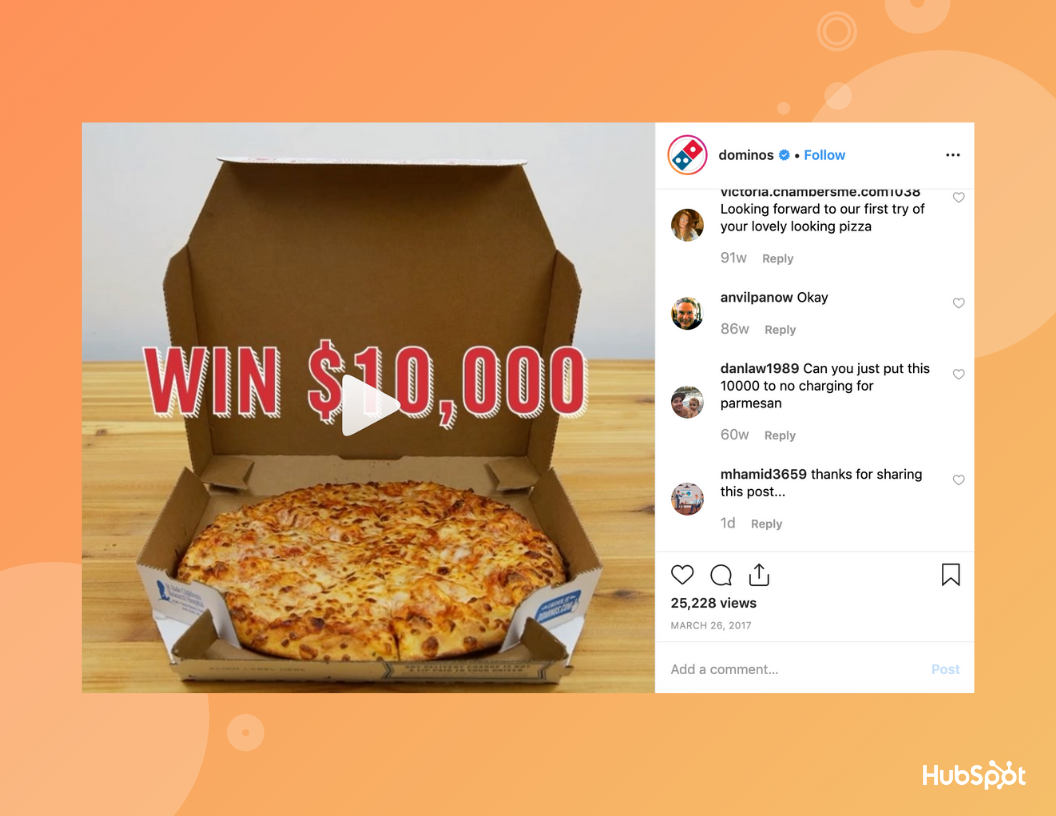
One of the more impressive giveaways in this list, Domino’s offered the chance to win $10,000 for any participant who followed @Dominos, posted a picture to prove they’re a superfan, and used the hashtag #PieceofthePieContest. With simple, clear instructions, I’m willing to bet this was a successful giveaway as followers quickly spread the word about their love for Dominos — and likely incentivized followers to order a pizza from the brand.
2. Ali Fedotowsky
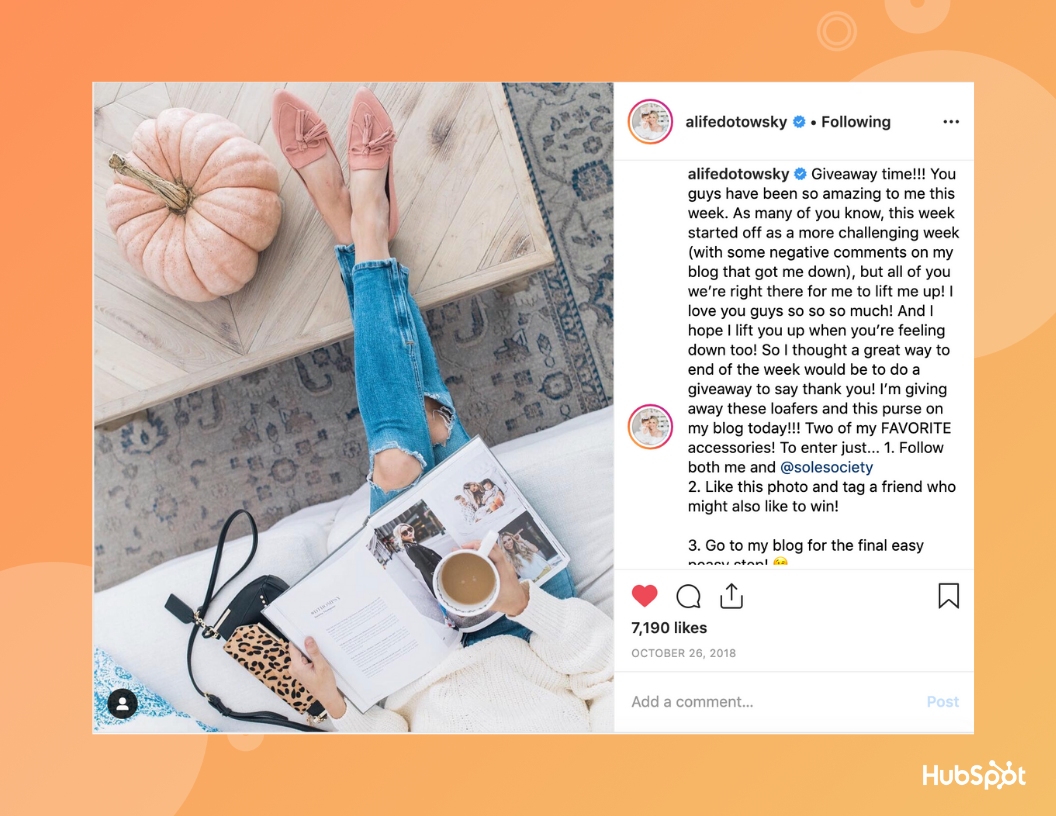
Ali Fedotowsky, a lifestyle and fashion blogger and ex-Bachelorette, partnered with Sole Society to giveaway a pair of loafers and a purse. Since she’s also well-known as an affordable fashion influencer, the partnership makes sense, and likely resulted in new followers for both Ali and Sole Society. Additionally, Ali wisely instructed participants to check out her blog for the final requirement, likely resulting in an up-tick in traffic.
3. Cakesmiths
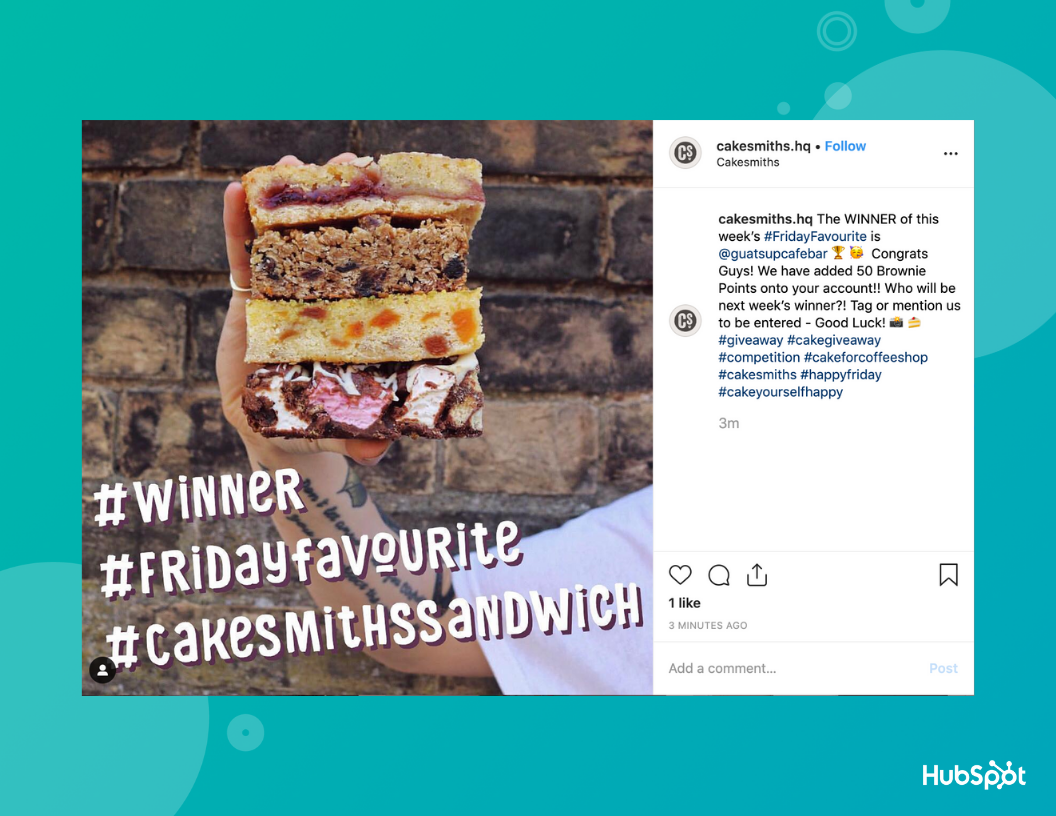
Cakesmiths does a giveaway every Friday and uses the same hashtag, #FridayFavourite, to evoke loyalty and engagement from their Instagram followers. Cakesmiths is proof you don’t need any outrageous prizes for a giveaway — sometimes, a simple treat will do.
4. Dig Local Asheville

Dig Local Asheville partnered with @findyourspiritfest to inspire people to visit distilleries in the local Asheville, N.C. area. This is a good example of how you might use your giveaway to increase awareness and excitement regarding one of your company’s upcoming events.
5. SojoS Vision
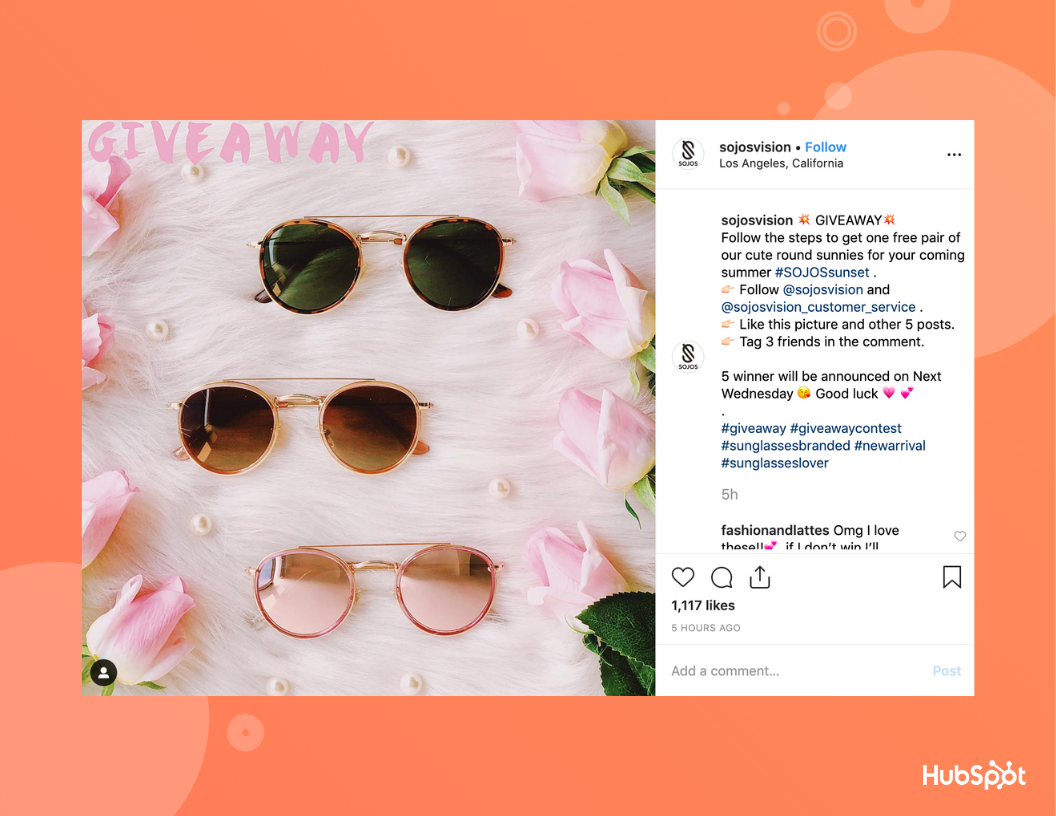
SojoS Vision cleverly asked participants to like six of their photos instead of just one, which likely helped them increase their Instagram engagement rates. Additionally, SojoS included ‘Giveaway’ text at the top of the image — if your followers don’t often stop to read captions, this is a smart way to draw more attention to your giveaway.

The 18 Best Advertisements of All Time
I’ve always been a little leery of proclaiming anything “the best.” I never declared anyone my best friend as a kid because I was afraid my other friends might assume I thought less of them.
So it was a little difficult for me to come up with just one “best” advertisement of all time — which is why there are 18 in this post instead.
Why are these campaigns some of the best ads of all time?
Because of the impact they had on the growth of the brand, and because they manage to hit on some universal truth that allows us to remember these campaigns years after they first began. In fact, some of us might not have even been alive when these campaigns first aired.
But to know what makes an advertisement great, you first need to know how an advertisement is defined.
Advertisements
Advertisements are written or visual messages dedicated to promoting a specific product, service, or campaign. Businesses can pay the owner of a channel or platform that reaches a similar audience to broadcast this message. Two of the biggest challenges in advertising are measuring the value of the advertisement and ensuring it resonates with the right people.
As you can imagine, there are numerous types of advertisements — all of which run in different mediums, on different channels, and have different goals in mind for their business. People can advertise anywhere, and today’s best type of ad might not be the best type tomorrow. Here are four basic examples of advertising from the past few centuries (yikes), from earliest to latest.
Types of Advertisements
1. Print Advertising
The first print ad ran in England in 1472, according to Infolinks. Since then, this type of advertising has become available in newspapers, magazines, brochures, billboards, flyers, and similarly portable methods of carrying a brand’s message to its ideal end user. In this ad method, the advertiser pays the publisher to place their ad in the publication.
2. Radio Advertising
Radio advertising dates back to 1920, when the first commercial radio stations were launched in the United States. Today, radio is still a relevant marketing and advertising platform for expanding the reach of a sponsored event or new product. In this ad method, the advertiser pays the radio station to play their ad during designated breaks between music or a radio show.
3. Television Advertising
Television ads originated in the 1940s with the promotion of practical items and political campaigns. Advertisers can now use television to promote food, toys, stores, business services, and more — both to local TV channels and to national broadcast networks. In this ad method, the advertiser pays the regional or national TV network to show their ad during designated breaks in the network’s regular programming.
4. Internet Advertising
Internet advertising took root in the mid 1990s with the launch of “banner” advertisements for various telecommunications companies. These ads are placed in interstitial spots on a webpage. In this ad method, the advertiser pays the website owner to place their ad in exposed spaces that are peripheral to the website’s own content. Internet advertising has gone on to include video, search engine marketing, sponsored social media posts, and more.
But, as you know, the advertising types above have evolved dramatically since their respective origins. What were once quite one-dimensional messages now carry clever, funny, or profound undertones that make the ads memorable years after they first ran.
This blog post is dedicated to the ones we’ll never forget.
And now, without further do, here they are, in no particular order (but feel free to let us know which one is your favorite in the comments): 18 of the best advertisements of all time, and the lessons we can learn from them.
The Best Advertising Campaigns of All Time (And What Made Them Successful)
1. Nike: Just Do It.
Type of ad: Print, Television, Internet
Source: brandchannel
Did you know that, once upon a time, Nike’s product catered almost exclusively to marathon runners? Then, a fitness craze emerged — and the folks in Nike’s marketing department knew they needed to take advantage of it to surpass their main competitor, Reebok. (At the time, Reebok was selling more shoes than Nike). And so, in the late 1980s, Nike created the “Just Do It.” campaign.
It was a hit.
In 1988, Nike sales were at $800 million; by 1998, sales exceeded $9.2 billion. “Just Do It.” was short and sweet, yet encapsulated everything people felt when they were exercising — and people still feel that feeling today. Don’t want to run five miles? Just Do It. Don’t want walk up four flights of stairs? Just Do It. It’s a slogan we can all relate to: the drive to push ourselves beyond our limits.
The Lesson
When you’re trying to decide the best way to present your brand, ask yourself: What problem are you solving for your customers? What solution does your product or service provide? By hitting on that core issue in all of your messaging, you’ll connect with consumers on an emotional level that is hard to ignore.
2. Coke: Share a Coke
Type of ad: Print
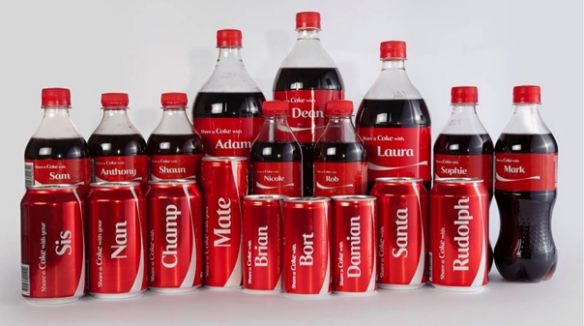
Big brands are often hard-pressed to do something ground-breaking when they’re already so big. So, what did Coca-Cola do to appeal to the masses? They appealed to individuals — by putting their names on each bottle.
The Share a Coke campaign began in Australia in 2011, when Coca-Cola personalized each bottle with the 150 most popular names in the country. Since then, the U.S. has followed suit, printing first names across the front of its bottles and cans in Coke’s branded font. You can even order custom bottles on Coke’s website to request things like nicknames and college logos.
It was a breaking story across the marketing and advertising industry. Many consumers were enchanted by it, while others were confused by it — why make a temporary item so personal? Pepsi even released counter-ads shortly after the campaign launched.
Nonetheless, Coke received immediate attention for it.
The Lesson
Coke fans are regular buyers, and the company leaned into that sense of individual ownership with full force. Wondering what name you’ll get out of the vending machine was a fun thrill in and of itself — even if it isn’t yours, it encourages you to “share a Coke” with whomever’s name is on the front.
3. Absolut Vodka: The Absolut Bottle
Type of ad: Print
Source: Burning Through Journey Blog
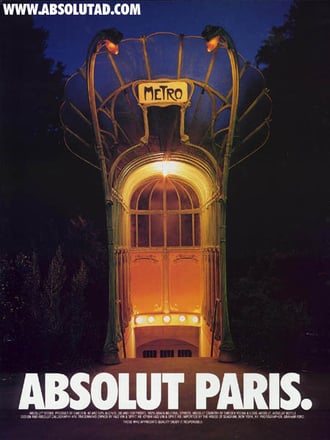
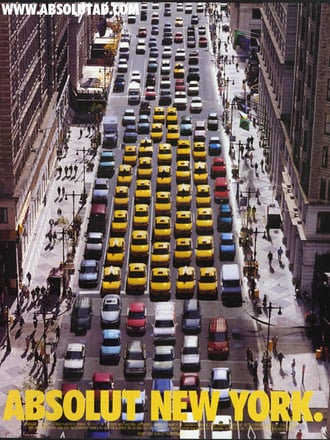
Despite having no distinct shape, Absolut made its bottle the most recognizable bottle in the world. Its campaign, which featured print ads showing bottles “in the wild,” was so successful that they didn’t stop running it for 25 years. It’s the longest uninterrupted ad campaign ever and comprises over 1,500 separate ads. I guess if it ain’t broke, don’t fix it.
When the campaign started, Absolut had a measly 2.5% of the vodka market. When it ended in the late 2000s, Absolut was importing 4.5 million cases per year, or half of all imported vodka in the U.S.
The Lesson
No matter how boring your product looks, it doesn’t mean you can’t tell your story in an interesting way. Let me repeat: Absolut created 1500 ads of one bottle. Be determined and differentiate your product in the same way.
4. Anheuser-Busch: Whassup (1999)
Type of ad: Television
When’s the last time an advertisement literally changed the way we talk to one another? Allow me to answer that question with another question: “Whassup?!”
This series of commercials, which first appeared in late 1999, features a group of friends connecting on a group phone call (we don’t do those much anymore, do we?) while drinking beer and “watching the game” on TV.
It starts gently: “What are you doin’?” Someone asks. “Watching the game, havin’ a Bud” (a Budweiser), someone replies. As more friends pick up the phone, the hilarity ensues: “WHASSUP!?” is yelled back and forth, becoming a classic catchphrase and an icon of beer-drinking culture that ran constantly on sports networks over the next few years.
The Lesson
The ad took pop culture by storm during the Super Bowl in 2000, and you can still hear its echoes today. Why? Anheuser-Busch showed us just how silly and informal an ad can be without ruffling feathers or going off-brand. Dare to celebrate your audience’s absurdities. The more genuine your ad is, the more valuable your product is.
5. Miller Lite: Great Taste, Less Filling (1974)
Type of ad: Print, Television
Source: BuildingPharmaBrands blog
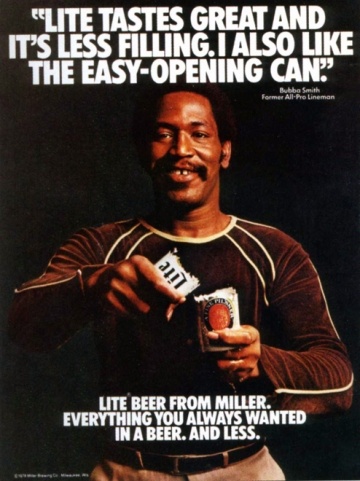
Think it’s easy to create a whole new market for your product? The Miller Brewing Company (now MillerCoors) did just that with the light beer market — and dominated it. The goal of the “Great Taste, Less Filling” campaign was getting “real men” to drink light beer, but they were battling the common misconception that light beer can never actually taste good.
Taking the debate head-on, Miller featured masculine models drinking their light beer and declaring it great tasting.
The Lesson
For decades after this campaign aired, Miller Lite dominated the light beer market it had essentially created. What’s the lesson marketers can learn? Strive to be different. If people tell you there isn’t room for a product, create your own category so you can quickly become the leader.
6. Always: #LikeaGirl (2015)
Type of ad: Television, Internet
My eyes are still wet while writing this blurb.
The Always brand hit a home run with this advertisement, not because it went viral after the commercial ran in the 2015 Super Bowl, but because it was a groundbreaking message that hundreds of millions of people repeated long after the campaign was over.
The campaign began as a commercial explaining the stigma behind playing sports “like a girl” — implying that the boy’s way is better or correct. By the end of the ad, the message is both clear and inspiring: Girls are just as fit and capable as boys are, particularly during puberty — a stage of life that is extremely important to Always and its women’s products.
The message is now a holistic initiative by Always you can learn about here, and a hashtag that’s still used on social media today.
The Lesson
Acknowledge not just your audience, but the challenges they face — especially the ones that reflect your time or culture. Not every societal issue is off limits to marketers and advertisers. Take a stand on the ones you know your audience supports, and you’ll access a customer base that identifies with your passion.
7. Volkswagen: Think Small (1960)
Type of ad: Print
Source: design shack
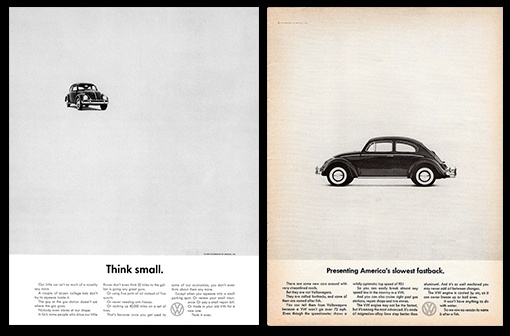
Many marketing and advertising professionals like to call Volkswagen’s “Think Small” campaign the gold standard. Created in 1960 by a legendary advertising group at Doyle Dane & Bernbach (DDB), the campaign set out to answer one question: How do you change peoples’ perceptions not only about a product, but also about an entire group of people?
See, Americans always had a propensity to buy big American cars — and even 15 years after WWII ended, most Americans were still not buying small German cars. So what did this Volkswagen advertisement do? It played right into the audience’s expectations. You think I’m small? Yeah, I am. They never tried to be something they were not.
The Lesson
That’s the most important takeaway from this campaign: Don’t try to sell your company, product, or service as something it’s not. Consumers recognize and appreciate honesty.
8. Google: Year in Search (2017)
Type of ad: Internet
This isn’t the oldest or most well-known advertisement on our list, but it’s become the most powerful over its nine-year (and still going) existence. So powerful and so true, you forget it’s an advertisement.
Year in Search began in 2009 as “Zeitgeist,” a written report of the public’s most common Google searches over the previous 12 months. The following year, Google adapted it for a three-minute video. Since then, it’s been a bold, yearly reminder of how much we depend on Google for information on the news and events that give the entire world pause. Check out the company’s latest video from 2017 above.
The Lesson
Remind your customers how much you care that they care. These stories elicit a variety of emotions, but ultimately unite everyone — no matter what Google products they might like — through an uplifting message of how our usage of the company reflects the best in all of us.
9. Dos Equis: The Most Interesting Man in the World (2006)
Type of ad: Television, Pre-roll
Source: The Open Field
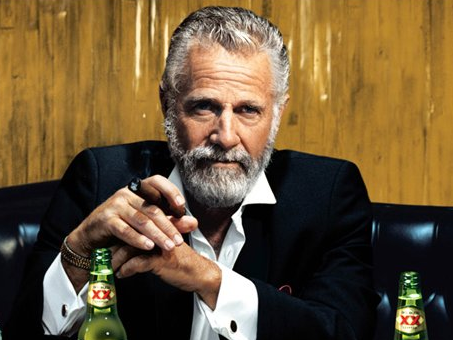
You know who he is. He smokes Cuban cigars, is always surrounded by beautiful women, and — most importantly — he drinks Dos Equis beer.
A key component of a strong campaign for an indulgent vice — like beer, desserts, or luxury items — is to make it cool. And when it comes to The Most Interesting Man in the World, he’s one of the coolest commercial guys there is.
And at the end of every commercial, he says: “I don’t always drink beer, but when I do, I prefer Dos Equis. Stay thirsty my friends.”
The Lesson
The hilarious hyperbole employed in this campaign makes it memorable the next time viewers head out to buy some beer. And even though Dos Equis recently replaced The Most Interesting Man with a new actor, he is forever immortalized in meme culture and in liquor stores due to this short, sweet, and memorable tagline — and the cool dude vibe it makes viewers harken back to.
10. California Milk Processor Board: Got Milk? (1993)
Type of ad: Print
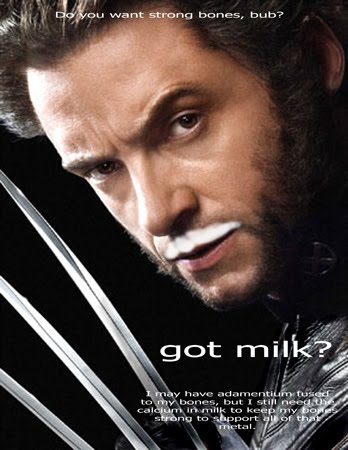
Source: Broward Palm Beach New Times
Thanks to the California Milk Processor Board’s “Got Milk?” campaign, milk sales in California rose 7% in just one year. But the impact ran across state borders, and to this day, you still can’t escape the millions of “Got [Fill-in-the-Blank]?” parodies.
Note, though, that the ad didn’t target people who weren’t drinking milk; it instead focused on the consumers who already were.
The Lesson
It’s not always about getting a brand new audience to use your products or services — sometimes, it’s about getting your current audience to appreciate and use your product more often. Turn your audience into advocates, and use marketing and ad content to tell them why they should continue to enjoy the product or service you are already providing for them.
11. Metro Trains: Dumb Ways to Die (2012)
Type of ad: Internet
Yes, you read that right: Dumb Ways to Die.
In Melbourne, Australia, Metro Trains wanted to get across a simple message: No horsing around near train tracks. Disorderly conduct could lead to injuries, or even death, but instead of typical warning signs or announcements inside train stations, Metro Trains came up with Dumb Ways to Die, a song that has garnered 157 million YouTube views since it debuted in 2012.
The song is about dumb ways to die — for example, by poking a grizzly bear with a stick, or taking your helmet off in outer space — and it features a catchy little chorus you won’t be able to stop humming to yourself (because singing it is a little morbid): “Dumb ways to die, so many dumb ways to die.”
At the end of the video, after you’ve watched adorable cartoon characters dying in the dumbest of ways, you get to the moral of the story: There are many dumb ways to die, but the dumbest possible way would be if you died while standing on the edge of a train platform, drove through a railroad sign, or tried to cross over a train track.
The Lesson
This beloved, now-famous campaign communicates a simple idea in a creative and memorable way — and you don’t feel like you’re being nagged, the way some public service announcements do. If your subject matter is grim or boring, consider using creativity to get your message across.
12. Apple: Get a Mac (2006)
Type of ad: Television
While there have been many great Apple campaigns, this one takes the cake. The video above is just one of a series of iterations of this campaign, and the Mac vs. PC debate ended up being one of the most successful campaigns ever for Apple. The company experienced 42% market share growth in its first year with its help. These commercials tell Mac’s audience everything they need to know about the product without being overt — and in a clever way.
The Lesson
Just because your product does some pretty amazing things doesn’t mean you need to hit your audience over the head with it. Instead, explain your product’s benefits in a relatable way so consumers are able to see themselves using it.
13. Clairol: Does She or Doesn’t She? (1957)
Type of ad: Print
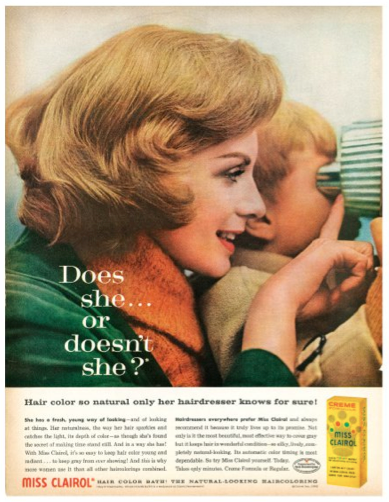
Source: Current360
The first time Clairol asked this question in 1957, the answer was 1 to 15 — as in, only 1 in 15 people were using artificial hair color. Just 11 years later, the answer was 1 of 2, according to TIME Magazine. The campaign was apparently so successful that some states stopped requiring women to denote hair color on their driver’s license. When your ad campaign starts changing things at the DMV, you know you’ve hit a nerve.
Clairol did the opposite of what most marketers would do: They didn’t want every woman on the street running around saying they were using their product. They wanted women to understand that their product was so good that people wouldn’t be able to tell if they were using it or not.
The Lesson
Sometimes, simply conveying how and why your product works is enough for consumers. Showing becomes more effective than telling.
14. De Beers: A Diamond is Forever (1999)
Type of ad: Print, Television
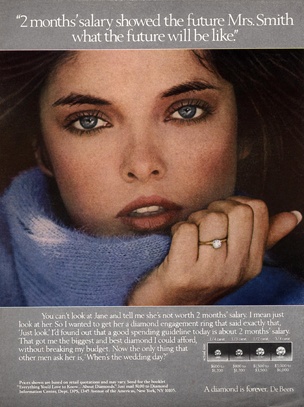
Source: BBC News
In 1999, AdAge declared De Beers’ “A Diamond is Forever” the most memorable slogan of the twentieth century. But the campaign, which proposed (pun very much intended) the idea that no marriage would be complete without a diamond ring, wasn’t just riding on the coattails of an existing industry. De Beers actually built the industry; it presented the idea that a diamond ring was a necessary luxury.
According to the New York Times, N.W. Ayer’s game plan was to “create a situation where almost every person pledging marriage feels compelled to acquire a diamond engagement ring.”
The Lesson
Advertising can make a relatively inexpensive product seem luxurious and essential.
15. Old Spice: The Man Your Man Could Smell Like (2010)
Type of ad: Television
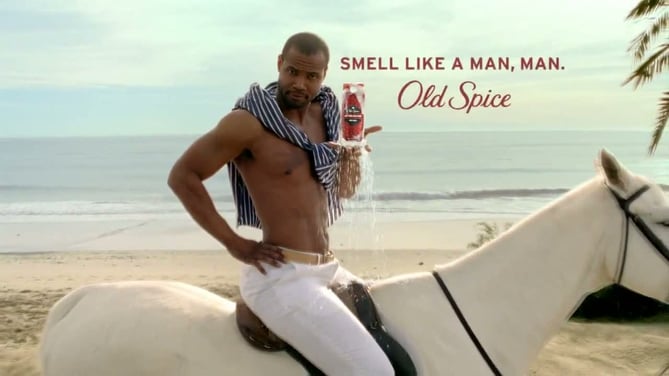
Source: Coloribus
The very first part of Old Spice’s “The Man Your Man Could Smell Like” campaign, created by Wieden + Kennedy and launched in February 2010, was the following commercial. It became a viral success practically overnight:
That video has over 51 million views as of this writing. Several months later, in June 2010, Old Spice followed up with a second commercial featuring the same actor, Isaiah Mustafa. Mustafa quickly became “Old Spice Guy,” a nickname Wieden + Kennedy capitalized on with an interactive video campaign in which Mustafa responded to fans’ comments on Facebook, Twitter, and other social media websites with short, personalized videos.
In about two days, the company had churned out 186 personalized, scripted, and quite funny video responses featuring Mustafa responding to fans online. According to Inc, these videos saw almost 11 million views, and Old Spice gained about 29,000 Facebook fans and 58,000 new Twitter followers.
“We were creating and sending miniature TV commercials back to individual consumers that were personalized, and we were doing it on a rapid-fire basis,” Jason Bagley, creative director at Wieden + Kennedy and a writer for the campaign, told Inc. “No one expects to ask a question and then be responded to. I think that’s where we broke through.”
The Lesson
If you find your campaign’s gained momentum with your fans and followers, do everything you can to keep them engaged while keeping your messaging true to your brand’s voice and image.
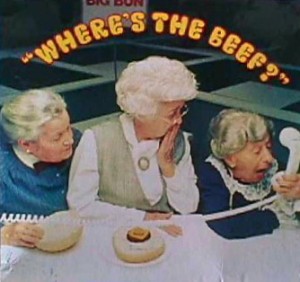
16. Wendy’s: Where’s the Beef? (1984)
Type of ad: Print, Television
Source: AdSoft Direct
Is it enough to say this campaign was successful because it featured a giant hamburger bun and a cute set of old ladies? No? I didn’t think so.
Wendy’s took a more gutsy approach in this advertising campaign: It targeted its competitors. The simple phrase “Where’s the beef?” was used to point out the lack of beef in competitors’ burgers — and it quickly became a catchphrase that encapsulated all that was missing in their audience’s lives.
While you can’t predict when a catchphrase will catch on and when it won’t, Wendy’s (wisely) didn’t over-promote their hit phrase. The campaign only ran for a year, and allowed it to gently run its course.
The Lesson
Be careful with your campaigns’ success and failures. Just because you find something that works doesn’t mean you should keep doing it over and over to the point it’s played out. Allow your company to change and grow, and you may find that you can have even greater success in the future by trying something new.
17. Procter & Gamble: Thank You, Mom (2012)
Type of ad: Television
I’ll give you a minute to dry your eyes after that one.
Seriously — you wouldn’t expect a household and cleaning products company commercial to pull at the heartstrings like that, would you? Lately, though, Procter & Gamble (P&G) has launched some of the best ads we’ve ever seen from the consumer goods industry.
That’s because P&G identified the story behind the story of Olympic athletes — the stories of the supportive moms who pushed these world-class athletes throughout their entire lives leading up to that crowning moment. And yes, they probably had to do a lot of laundry and cleanup along the way — presumably using P&G products.
The Lesson
Make your audience cry (just kidding). The season or time period of your ad is important. But even if you run an ad during the Olympic Games, like P&G did, make sure it has longevity, and a message that can influence people no matter when or where they see it.
Emotional and nostalgia marketing are powerful tactics to get people to make buying choices, so if there’s a bigger, more universal story behind your product or story, tap into it — and showcase it front-and-center.
18. KFC: “FCK” (2018)
Type of ad: Print
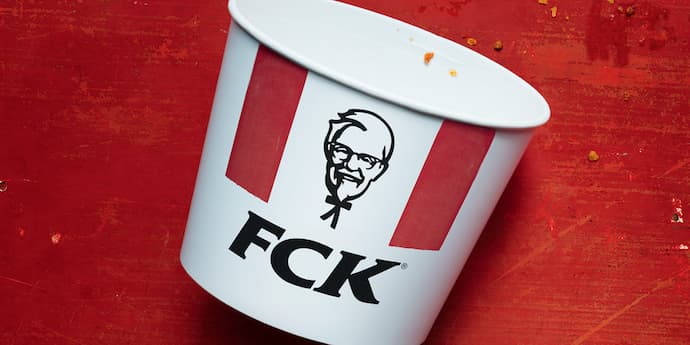
The ad above isn’t just an empty bucket of KFC with the company’s letters jumbled around. It’s also not a normal, unprompted promotion of fried chicken.
This ad is an apology, and perhaps the most creative one of all time.
In February 2018, KFC’s business in the U.K. ran out of chicken. You read that right: A poultry company ran out of poultry. It’s not every day that a business stumbles upon the most ironic PR crisis in company history, so when it happens, all eyes are on the business’s response. Well, we’re happy to report that KFC stuck the landing.
With the help of the creative agency Mother London, KFC took out a full-page ad in Metro, the U.K.’s newspaper, rearranging its three famous initials to create a hilarious albeit explicit response to its product shortage. The ad depicts a KFC bucket that reads, “FCK” — as if to say, “FCK, this is embarrassing.” (You can fill in the missing letter …)
Beneath this design, the company goes on to apologize for what it realizes is an inexcusable, if not slightly funny failure.
The Lesson
No business is above a good old-fashioned sorry. And if you can laugh at yourself in the process, you’ll only make it better. KFC’s ad demonstrates how to combine humility, class, humor, and ultimately company pride in a message that can help you bounce back from bad press — and even come out the other side with a net-positive result for your brand.

7 of the Best Blogging Platforms for 2019
As a baseball player turned blogger, my blogging platform is just as important to me as my bat was to me. If I went up to the plate with a quality bat that I personally preferred swinging, I would feel more confident, boosting my chances of getting a hit. If I didn’t, I would most likely tap a dribbler back to the pitcher.
Similarly, when blogging eventually replaced baseball in my life, I discovered using a blogging platform I was comfortable with and liked enabled me to produce better work and, in turn, results. If I didn’t, I wouldn’t execute as well.
But, just like baseball bats, there are countless blogging platforms you can use. Fortunately, if you’re looking for one that’s ideal for your specific situation, we’ve got you covered. Read on to find the best-fit blogging platform for your content creation team and start knocking some blog posts out of the park.
Best Blogging Platforms
- HubSpot
- Squarespace
- WordPress
- Wix
- Weebly
- Craft CMS
- Contently
1. HubSpot
G2 Rating: 4.0/5.0 (2,161 Reviews)
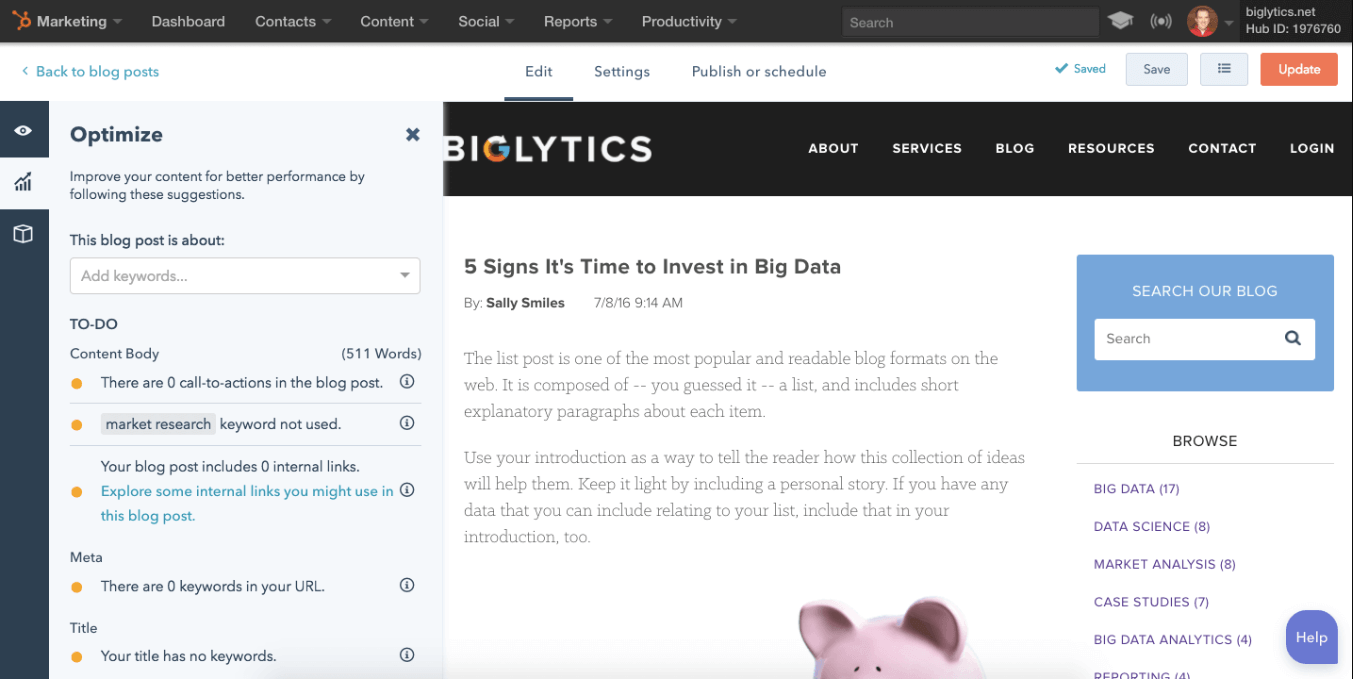 HubSpot offers one of the most robust blogging platforms around. When drafting your blog posts, you can use their composer to craft content from scratch or with one of their pre-made blog post blueprints. You can also integrate your G Suite Account with HubSpot’s blogging platform to import your Google Docs right into their composer.
Additionally, you can edit your blog posts directly in their composer by adding comments, offering feedback, and collaborating with other writers or editors on your team.
After you finish drafting your blog post, HubSpot’s blogging platform features an SEO recommendations checklist and a topic cluster tool that helps you optimize your blog posts for search engines.
You can then schedule your blog posts with HubSpot’s calendar tool, connect to and promote them through your social media accounts and email, and analyze their performance with HubSpot’s analytics tools.
2. Squarespace
G2 Rating: 4.4/5.0 (768 Reviews)
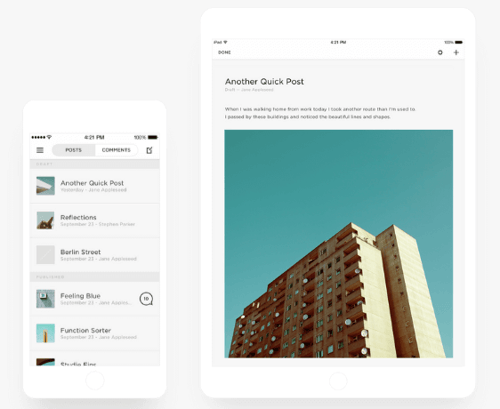 If you want to build a truly beautiful blog, Squarespace is the blogging platform for you. With their award-winning, fully customizable designer templates and integrations with Getty Images, Unsplash, Google AMP, and more, you can improve your content’s design and boost its ability to grab and hold your audience’s attention.
You can also collaborate with multiple writers and editors on your content, integrate and promote your blog with your social media accounts, and manage your blog posts’ comments.
Additionally, Squarespace offers some other robust marketing tools that can help you increase your reach and refine your content strategy, like email campaigns, SEO features, analytics, and lead capture features.
3. WordPress
G2 Rating: 4.3/5.0 (6,808 Reviews)
 Powering over 30% of the websites on the internet, WordPress is one of the most popular blogging platforms out there. If you’re creating a new blog, you can register a domain for your site right on the platform. If you already have a website, you can transfer your current domain to your new WordPress site.
When creating blog content, WordPress offers hundreds of themes that you can customize with your own branding and content. You can also leverage their SEO tools, social media integrations, and sharing tools to amplify your blog posts’ reach.
When it’s time to analyze your blog posts’ performance, WordPress offers metrics and data visualization, like charts and graphs, that’ll help you grasp your readers’ topic preferences and referral source.
4. Wix
G2 Rating: 4.2/5.0 (985 Reviews)
 Wix is one of the most versatile blogging platforms on the market. Whether you own a business or a food review website, Wix has a wide range of templates any blogger can use.
After you’ve picked your blog’s template, Wix lets you write and edit posts on desktop and mobile, organize your posts into topics, display Wix’s stock photos and videos or your own media on your blog posts, and create a community of audience members who can make profiles on your blog and interact with each other.
To promote your blog posts, you can leverage Wix’s SEO tools to boost your organic reach, push your content to your subscribers with their email tool, and connect and share them through your social media accounts. If you want to measure your content’s performance, Wix also offers an advanced analytics tool.
5. Weebly
G2 Rating: 4.2/5.0 (383 Reviews)
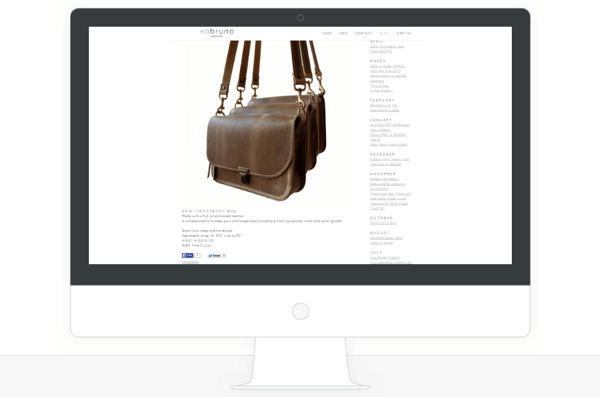 Trusted by over 30 million people across the globe, Weebly is one of the most popular blogging platforms because it’s incredibly intuitive. With their drag and drop editor, free blog templates, completely customizable design, and a wide range of media options and integrations, you can easily create a blog that’s easy on the eyes.
To amplify your blog’s reach, you can leverage Wix’s SEO tools to improve your organic rankings, their RSS feed to update your subscribers with every new blog post you publish, and their social sharing tools to schedule your content on your social media profiles.
6. Craft CMS
G2 Rating: 4.2/5.0 (25 Reviews)
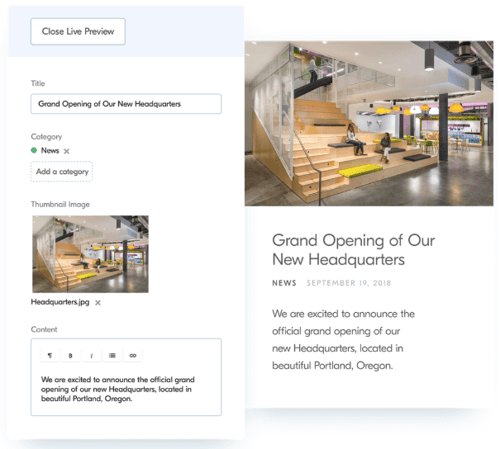 Craft CMS is a blogging platform that lets you completely customize your blog, manage your content, and analyze its performance. With its personalized content modeling, custom control over your blog’s code, and powerful templating, you can build your very own dream blog.
Craft CMS also offers an image editor, collaboration tools, and a localization feature that can translate your content to specific languages. To analyze your content’s performance, you can integrate Craft CMS’ dashboard with Google Analytics.
7. Contently
G2 Rating: 4.0/5.0 (17 Reviews)
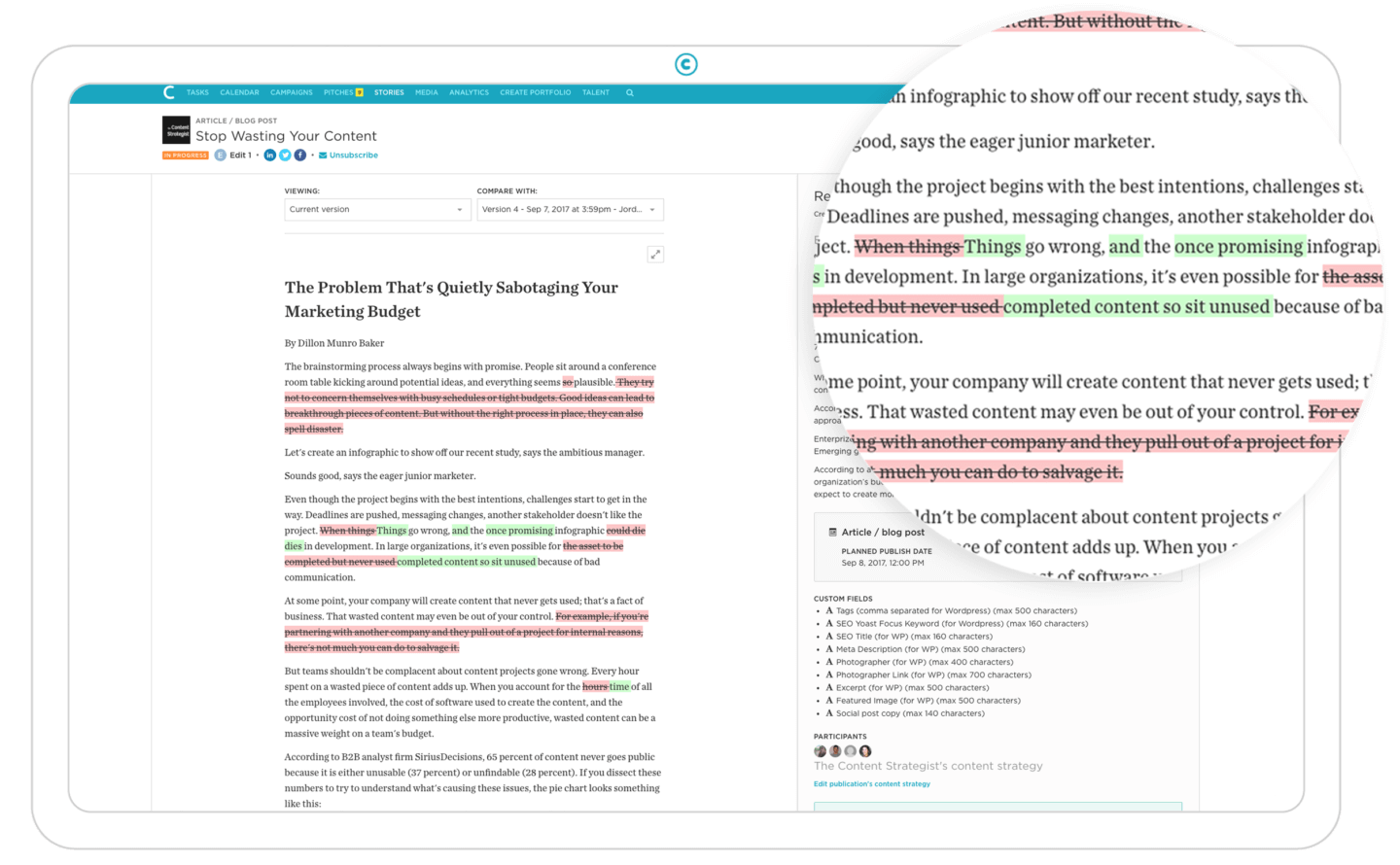 Tailored for enterprise companies, Contently is a robust blogging platform that allows you to run your entire content creation process in one place. To develop your content strategy on Contently, you can organize your blog posts with their tagging tool and flesh out your editorial strategy with their customizable production calendar to.
After that, you can effectively collaborate with your team on projects by commenting on and tagging colleagues in your drafts and leveraging Contently’s advanced workflow tools.
When it’s time to ship your content, you can use their smart content review tools to ensure your content is aligned with your brand, optimized for search, and legally compliant.
If you want to gauge your content’s performance and use that data to refine your content strategy, you can compare your content’s performance against industry benchmarks and measure its performance by topic, format, and sources in the platform.

The 11 Best Marketing Automation Software Tools in 2019
A majority of businesses are using some form of marketing automation nowadays — in fact, studies cite around 51% of businesses currently use the technology, and that number continues to grow.
According to a 2018 Forrester report, 55% of marketing decision-makers plan to increase their spending on technology, with one-fifth of the respondents expecting to increase by 10 percent or more.
All of which is to say — if you’re not using marketing automation software in 2019, you might want to reconsider.
Despite the necessity of automation software, it’s a complicated space, full of different software solutions with various features, and use cases.
Here, we’ve cultivated a list to help you sort through your options and feel confident choosing the best marketing solution for you and your team.

The 11 Best Marketing Automation Software in 2019
- HubSpot Marketing Automation
- Ontraport
- SendinBlue
- ActiveCampaign
- Prospect.io
- InfusionSoft
- Autopilot
- Marketo
- GetResponse
- Drip
- Mautic
1. HubSpot Marketing Automation
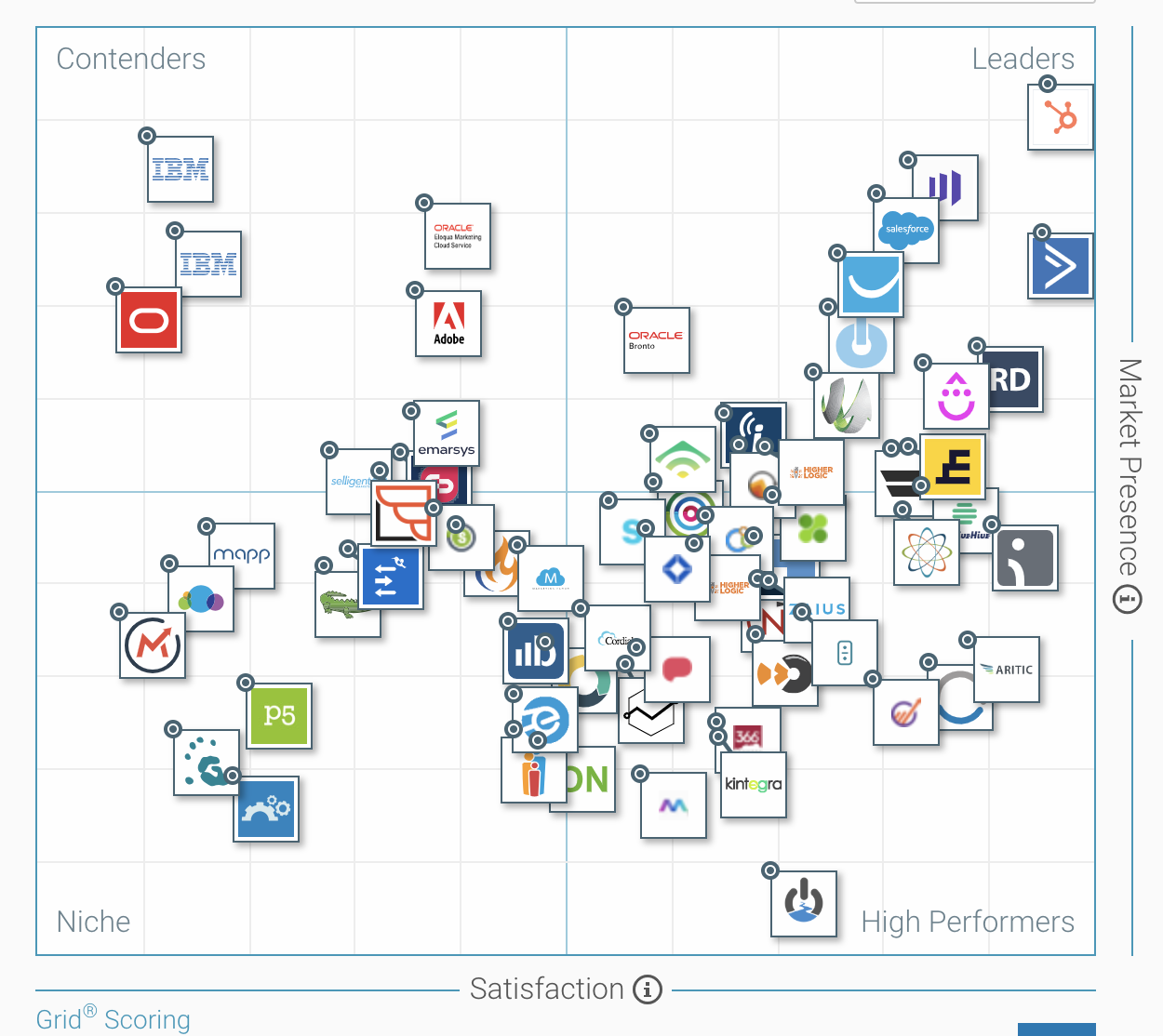
HubSpot’s marketing automation functionality is one of the most powerful tools in this list in terms of features. It’s also one of the most popular in terms of customer sentiment, occupying the upper right portion of the G2 Crowd quadrant:
Of course, HubSpot has a full growth suite that includes sales software, marketing software, and support software, which all integrate automatically with HubSpot’s free CRM. The combination effect of having all of your data and growth activity in one place can unleash tons of creative automation possibilities that would be difficult or impossible if you use separate tools.
As a standalone, HubSpot’s marketing automation functionality includes an easy-to-use visual board where you can craft simple or highly sophisticated conditional workflows:
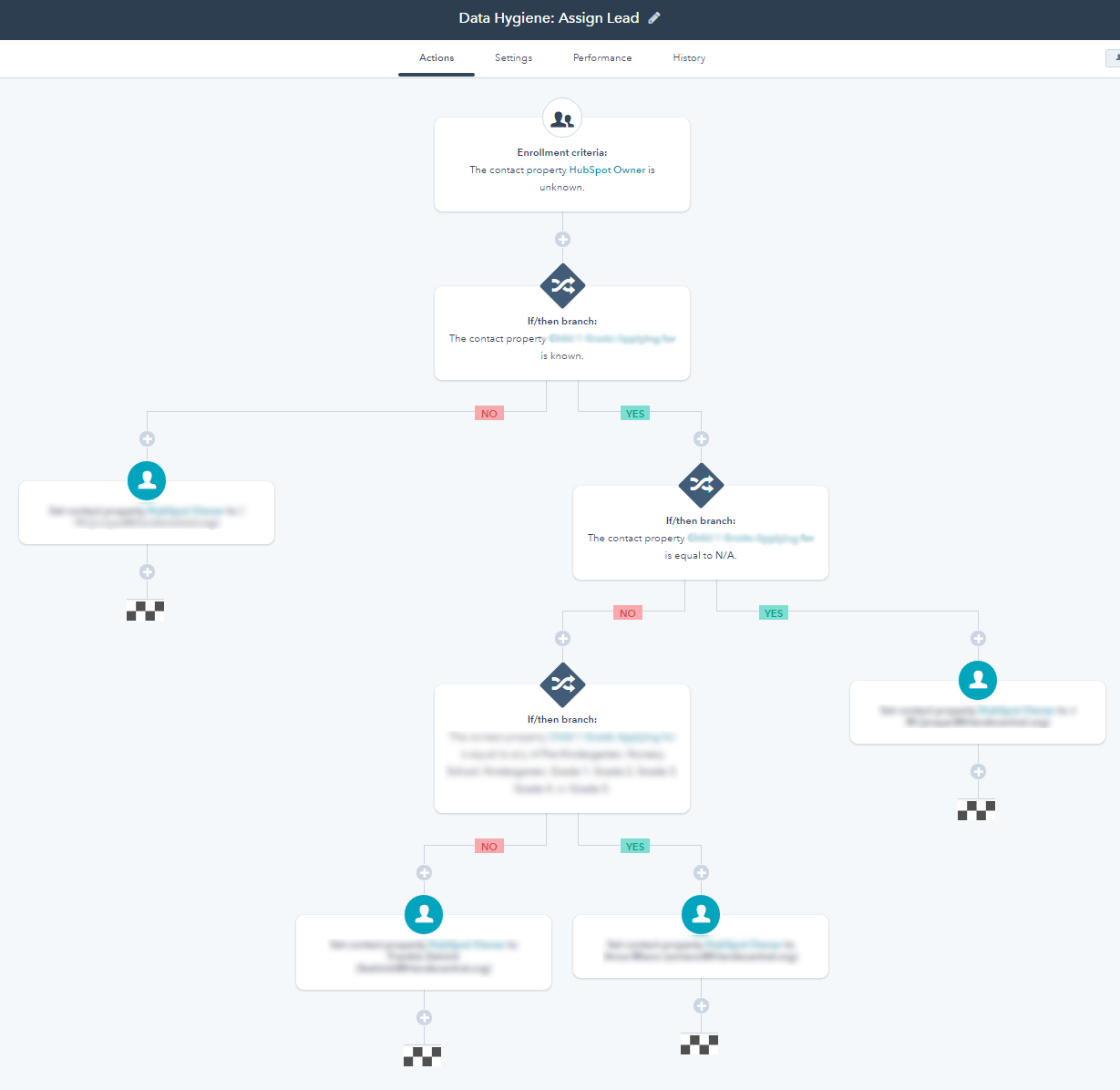
It can take time to master the tool (you’ll scale-up more quickly with the help of HubSpot Academy), but once you get a grasp on it, the creative possibilities are endless. You can set up simple email list autoresponders, or build a smart and complex network of rules designed to target specific users with the exact right email, live chat, website experience, and more.
Basically, the workflows tool is automation beyond email, so you can scale your growth and spend less time on repetitive tasks.
2. Ontraport
Ontraport is a business automation software for entrepreneurs, solopreneurs, and small businesses.
While they have a CRM and marketing automation functionality, they also have several other features to run and grow a small business, including but not limited to:
- Email marketing
- Landing pages
- Reporting
- Ecommerce
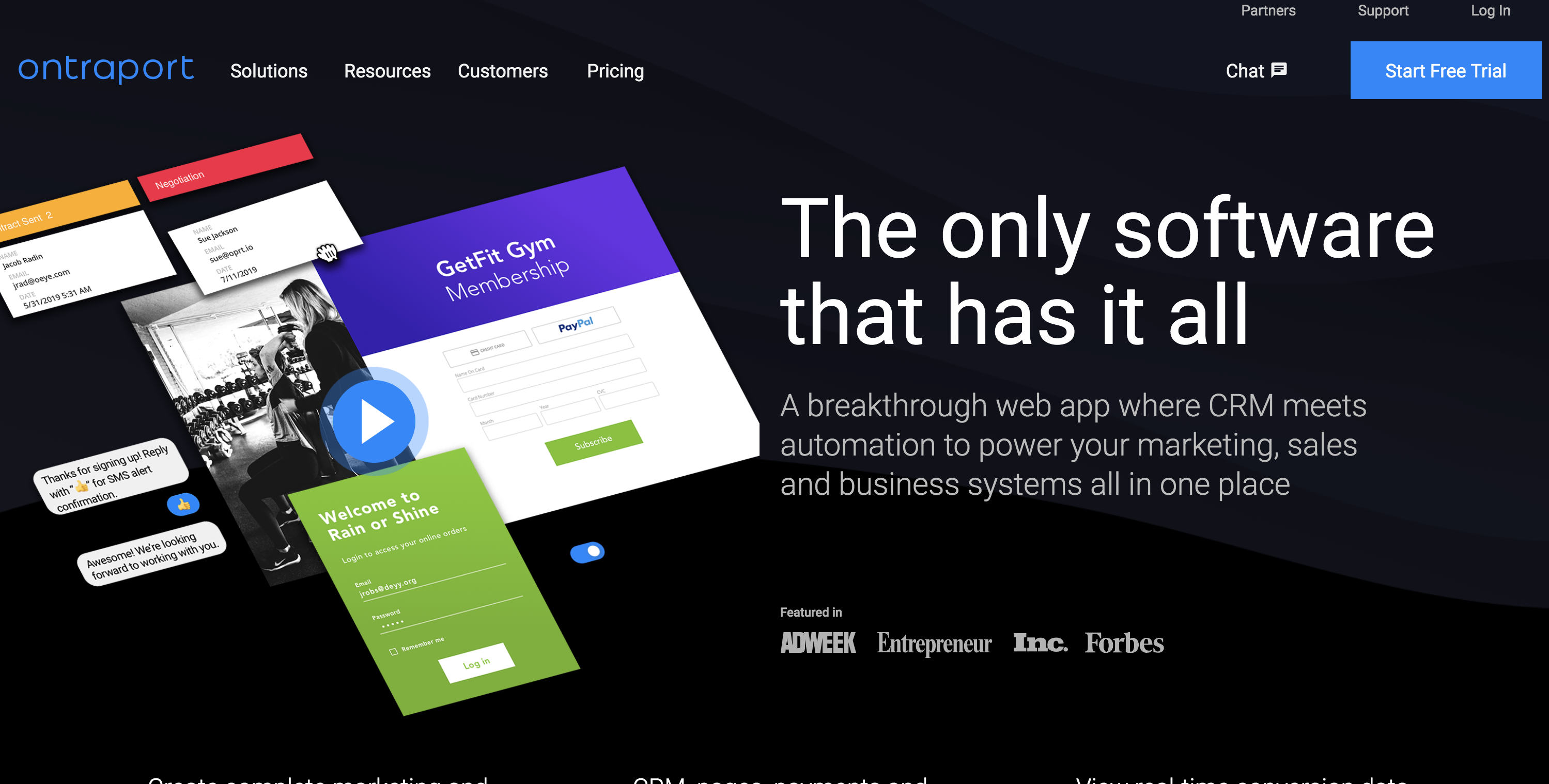
One of the most valuable things Ontraport offers is their focus on reporting and insights. While some tools can be a bit of a black box, Ontraport gives you a clear look at the performance of your campaigns.
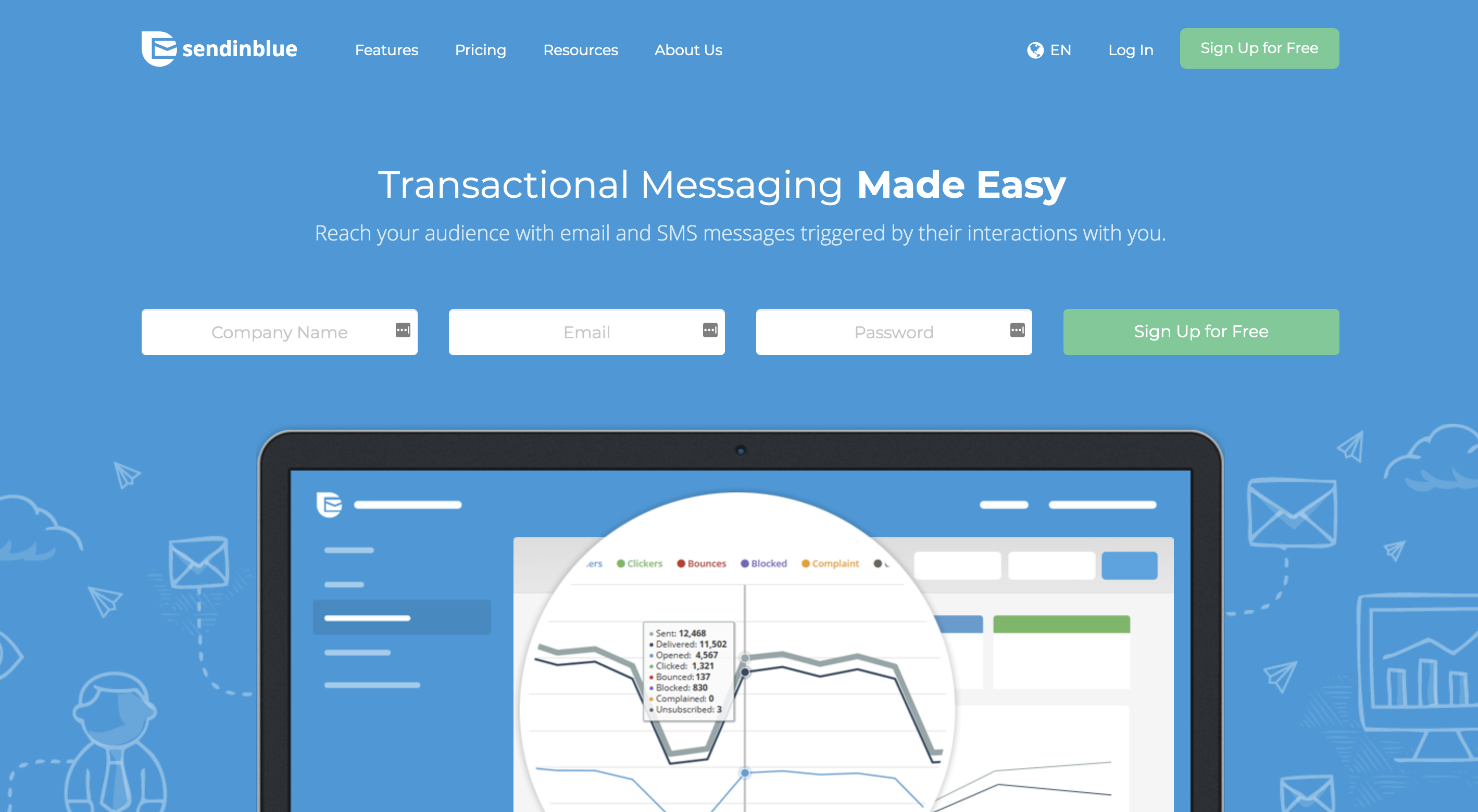
3. SendinBlue
SendInBlue started as a digital agency but ended up building quite a powerful email marketing tool, which, with time, transformed into a well-liked marketing automation software.
They have some advanced features, such as their reporting and lead scoring. Additionally, SendinBlue offers a pretty impressive free plan, which includes basic marketing automation functionality, phone support, and up to 300 emails per day.
You can also run SMS campaigns from SendInBlue.
4. ActiveCampaign
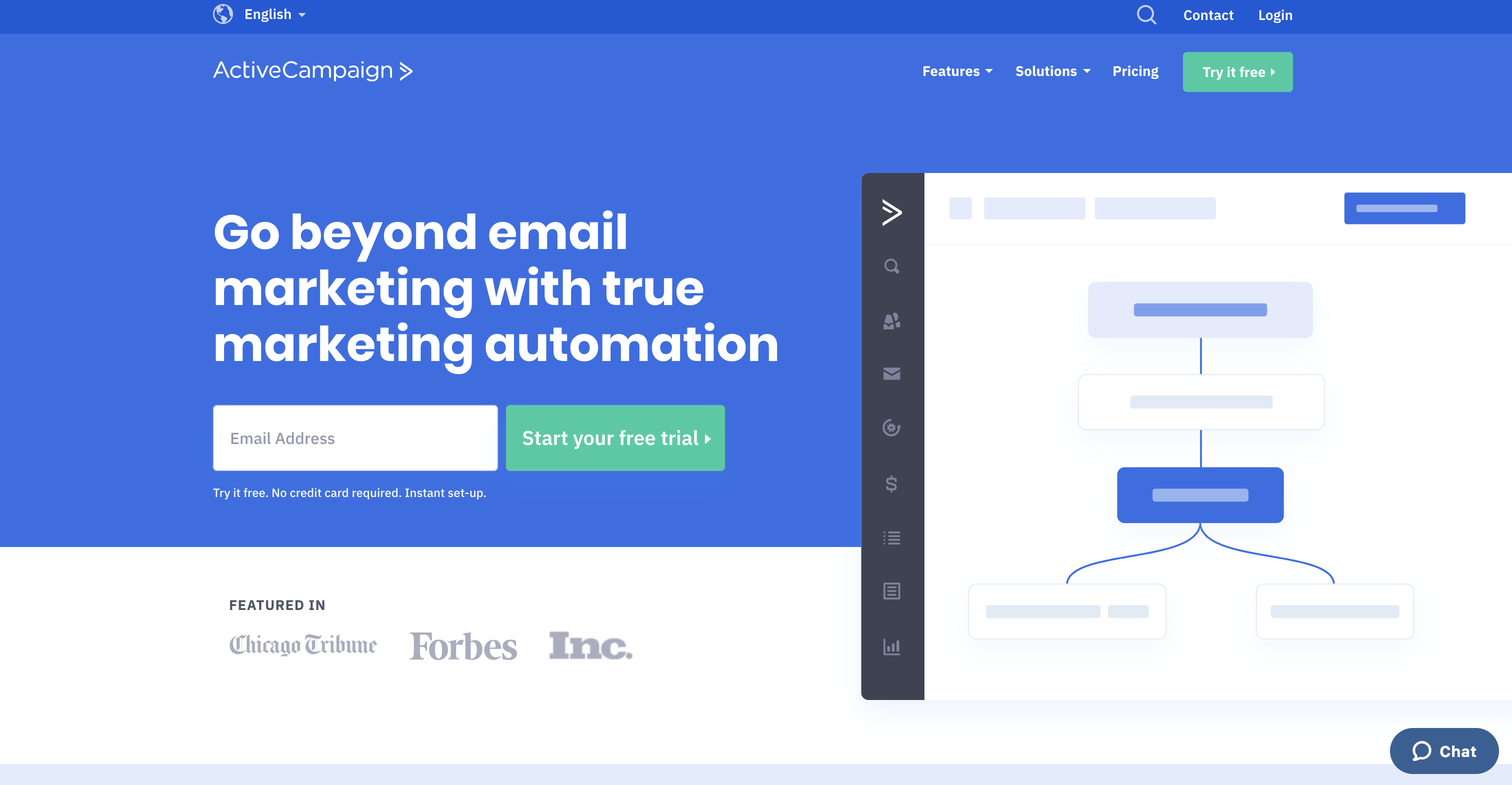
ActiveCampaign is an integrated email marketing, marketing automation, and small business CRM.
The strongest point of ActiveCampaign is their powerful and flexible marketing automation functionality. It’s one of the most comprehensive solutions on the market. Their deliverability is rated as one of the top on the market, as well.
This probably isn’t a good tool for beginners, or those with low technical capabilities. It takes a bit more time and effort to learn — but when you do learn the platform, it’s pretty powerful.
5. Pardot
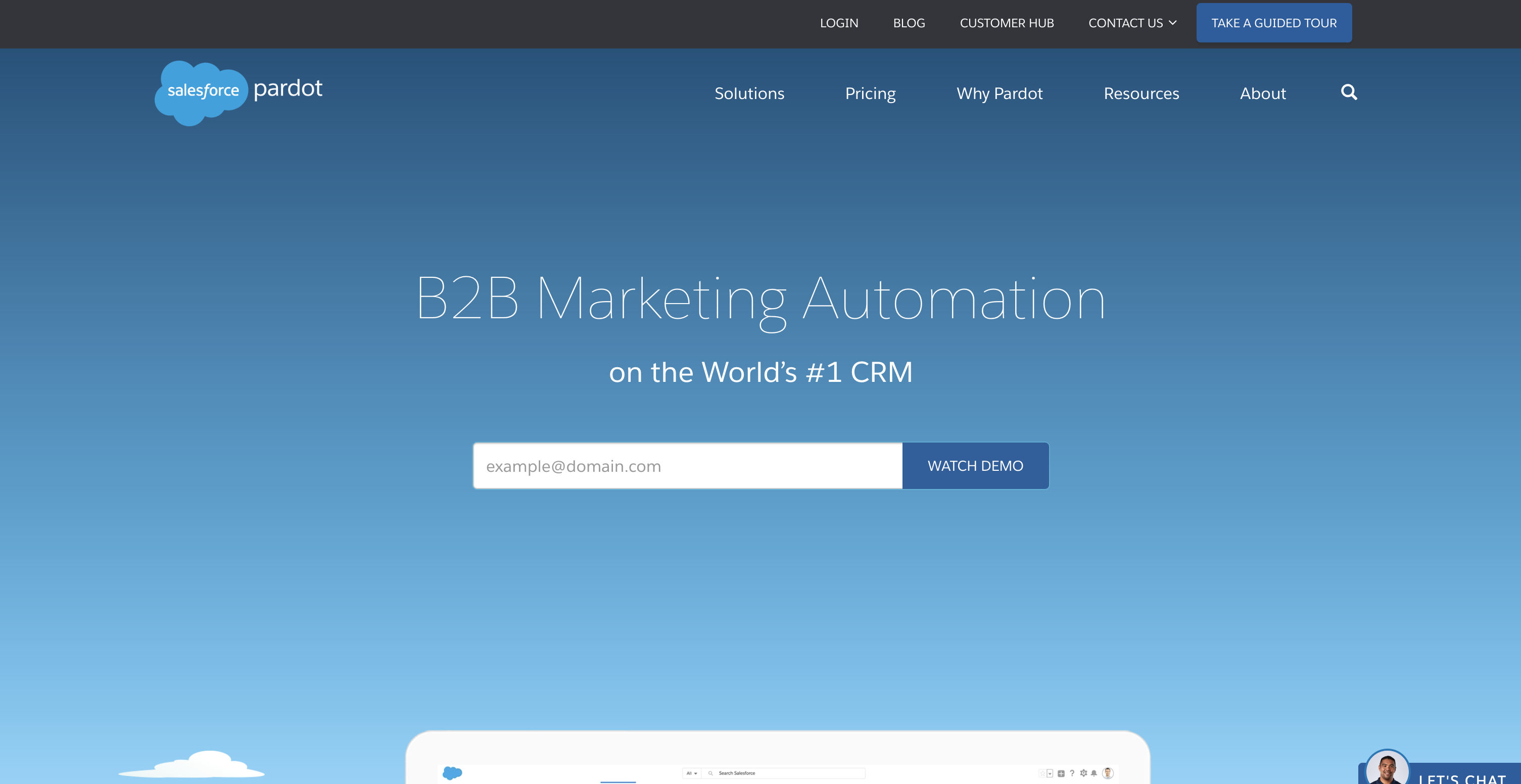
Pardot, part of the SalesForce empire, is a powerful cloud automation solution that mostly serves enterprise clients that have the technical resources and time to learn the platform.
They have a ton of powerful features, from CRM integration to email marketing, lead nurturing, lead scoring, and a valuable ROI reporting functionality to make sure your campaigns are working.
You can track all interactions on your website and build predictive lead scoring based on the parameters you set. All of this helps improve marketing efficiency and remove wasted time and effort from your sales team.
It’s important to note, Pardot is a powerful enterprise but may not be as accessible or affordable for smaller businesses, or entrepreneurs.
6. InfusionSoft
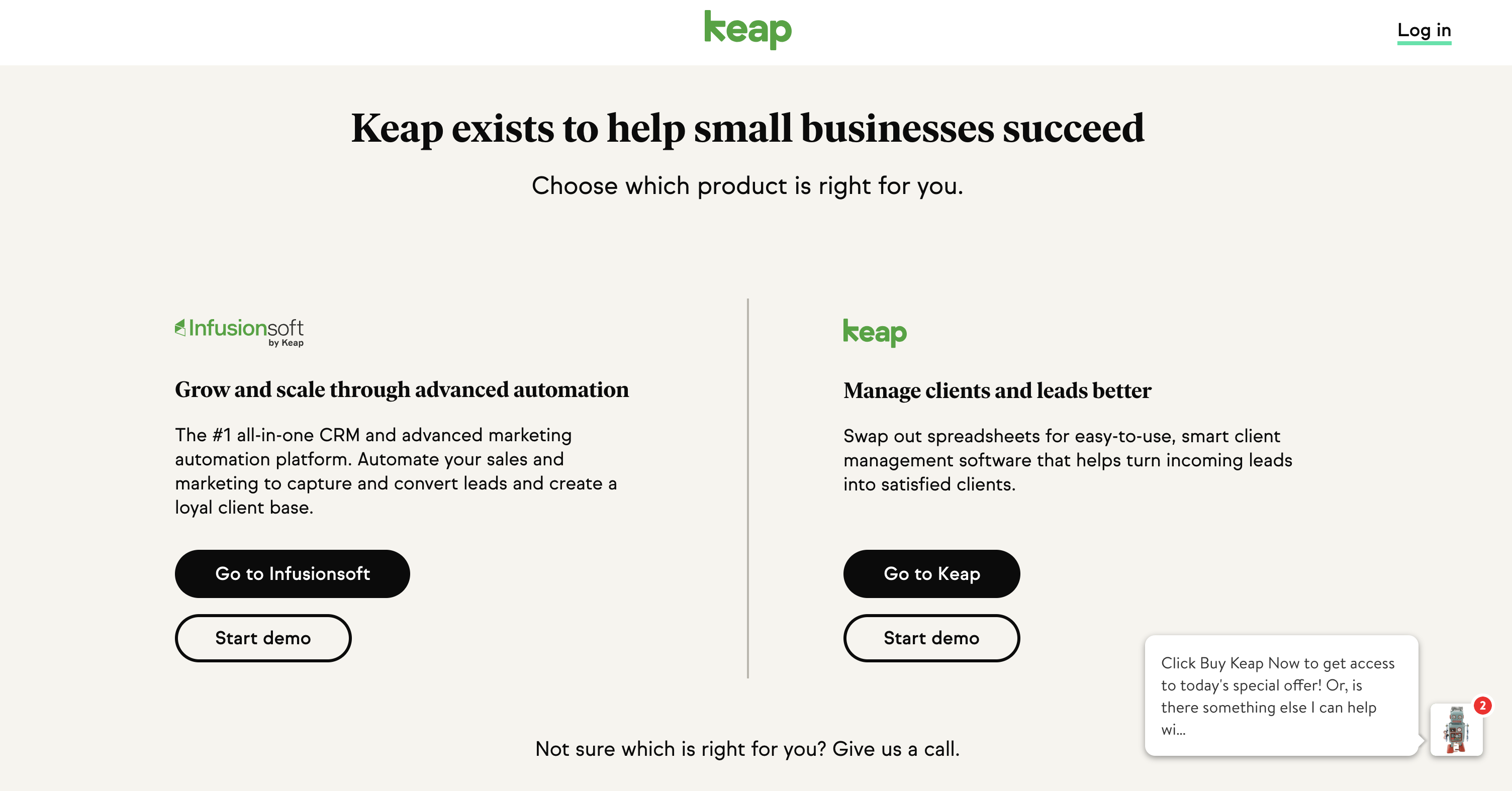
InfusionSoft (now Keap) has been around for a while (15+ years, I believe) and has helped thousands of marketers deliver on leads, revenue, and customer acquisition targets.
They really flourish in the small business and solopreneur crowd, and in my experience, I’ve noticed they have a pretty sophisticated user base.
You can set up relatively complex decision trees depending on which lead magnet someone signs up for, how many (and which) emails they open and click, or other contact property data.
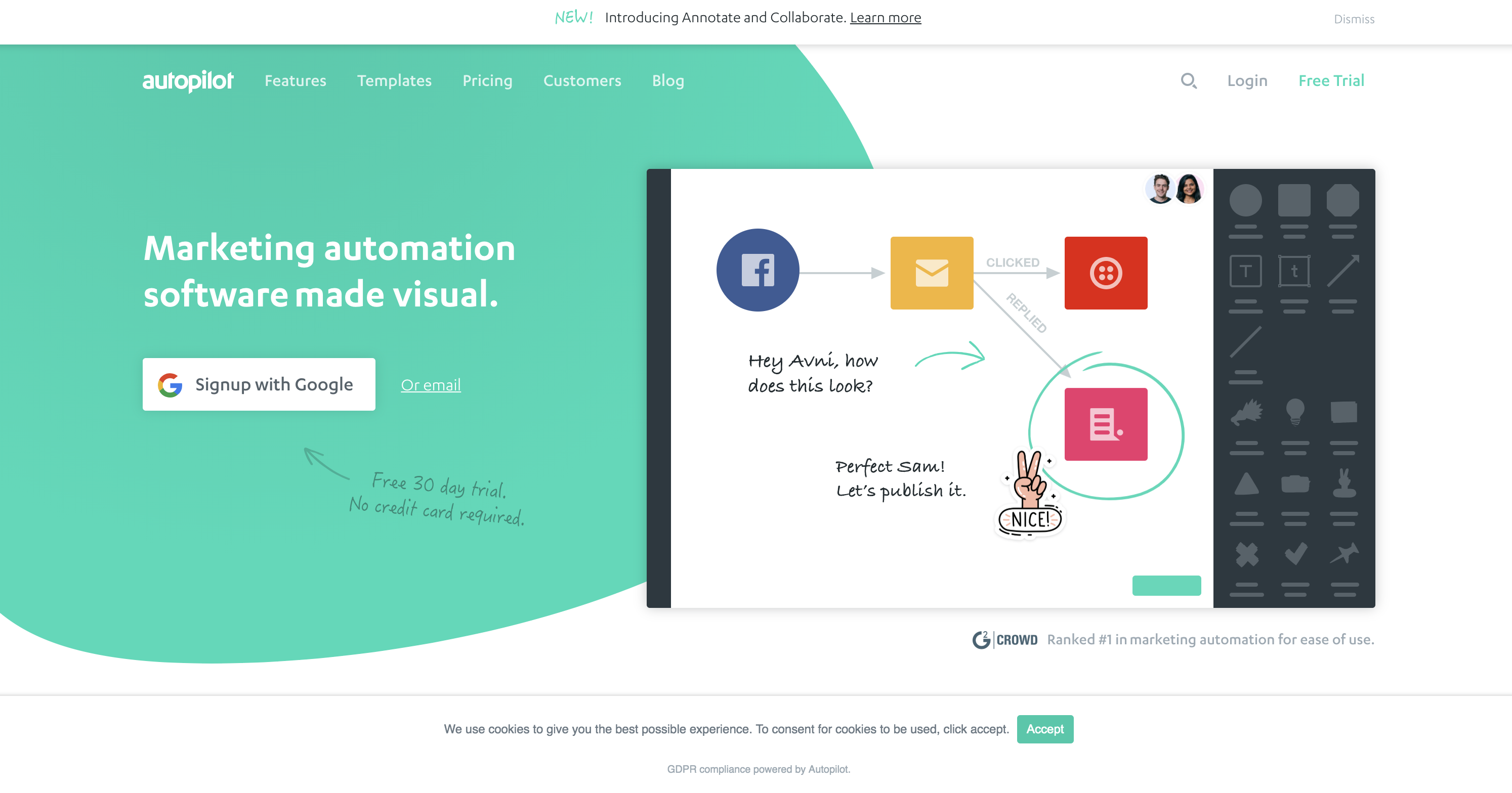
7. Autopilot
Autopilot is one of the most visually appealing marketing automation solutions on the market.
They make an email marketing, messaging, and automation platform, and they bill themselves as the easiest marketing automation platform to use. As mentioned above, their visual editor is clean, easy-to-understand, and frankly fun to use.
Of course, their platform is typically used for more sophisticated messaging and targeting, but you can also create a simple autoresponder based on a time-sequence.
8. Marketo
Marketo has been around for a while, and was recently acquired by Adobe and incorporated into their enterprise marketing cloud.
The Adobe integration means that, if you use Adobe Analytics for data measurement and Adobe Target for experimentation and personalization, you’ll have a powerful enterprise marketing automation and optimization suite.
However, the tool is typically geared towards enterprise customers — it’s a bit out of range for most small business owners.
9. GetResponse
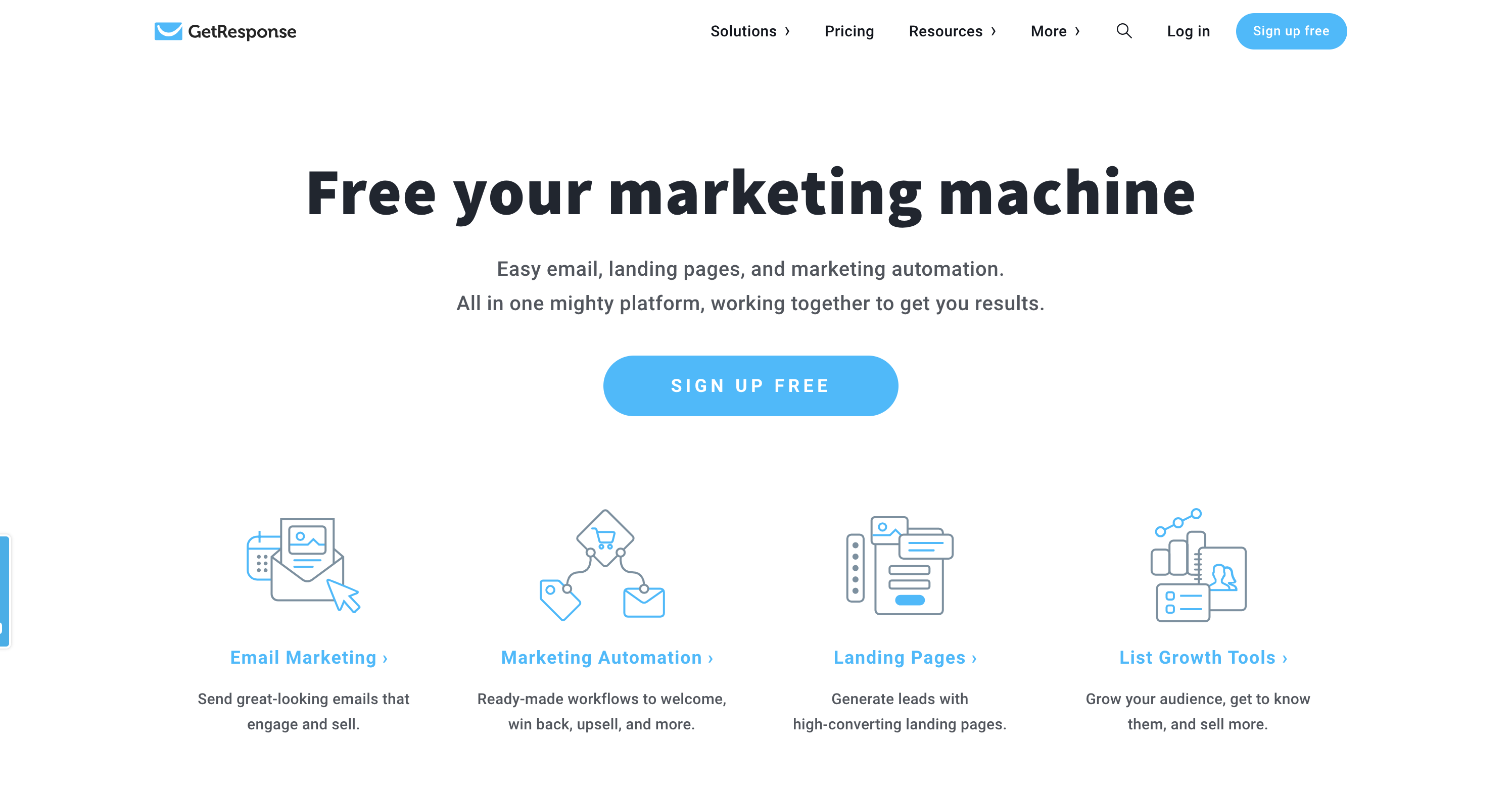
GetResponse is a marketing automation software that has many different layers and features. They start out very affordably, at around $10 per month (which includes basic autoresponders and a list size of 1,000), but their more expensive plans include powerful features like:
- Email marketing
- CRM
- Landing pages
- Autoresponders
- Ecommerce tools
- List building tools
GetResponse is easy-to-use and you’ll typically find good results from the tool, although it works best with the simpler features, like email newsletters. It can become trickier to work with the platform if you plan on implementing complicated conditional logic and marketing automation.
10. Drip
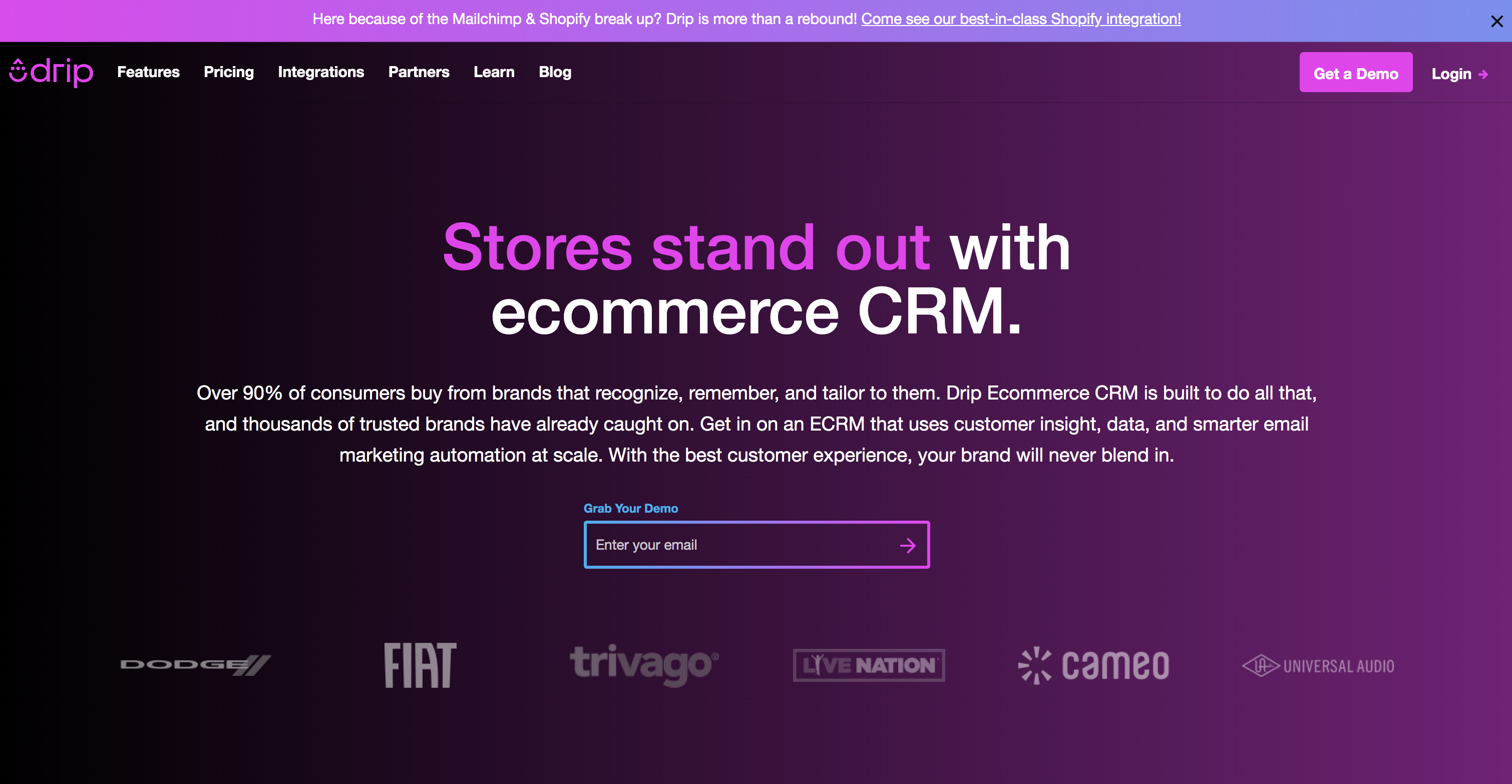
Drip is one of the few marketing automation tools in this list that is primarily focused on e-commerce marketing automation. They provide one of the more “open” platforms, claiming that they play well with “pretty much any marketing strategy you want to put in motion.”
Additionally, email is one of their strengths. Some email marketing and automation features include:
- Email Builders
- Automation Workflows
- Multi-channel Marketing
- Email Campaigns
- One-off Emails
They also excel in personalization and analytics. Overall, Drip is a powerful tool for e-commerce marketing automation.
11. Mautic
Mautic is the only open-source marketing automation platform in this list. It’s also a relatively new player, only founded in 2014. They’ve grown quickly, though, and are seemingly picking up steam with high tech companies.
Currently, over 200,000 organizations use Mautic.
There are tons of options for marketing automation software. It’s all about choosing the right one for your business purposes, budget, and technical expertise.
Want something incredibly powerful and limitless? It may end up costing more, and taking time and effort to learn. The cheaper options, by comparison, might have too limited a scale. Ultimately, it’s a trade-off.
Whatever you end up choosing, I’d be remiss to neglect suggesting you check out HubSpot, or at least start with one of our free marketing tools.

The Plain-English Guide to Data Deduplication
Nowadays, with so much critical information saved on our computer systems, we’ve learned to backup data regularly — including our email inboxes, our Word documents, our photos, and entire folders of old work.
It’s typically a ton of data. And, since we usually backup and save our data on auto-pilot, we might not realize just how much has been re-copied and re-saved, time and time again.
Unfortunately, over time, our data storage becomes unnecessarily burdened with redundant copies of data — this could cost your company money, as data requirements become larger, or time, as processing time becomes slower.
This is where data deduplication comes in.
What is data deduplication?
Data deduplication is the process of eliminating redundant copies of data and reducing processing time for a software system. Every time you backup your software system, you’re copying and storing large data sets. After a while, this requires an unmanageably large amount of data storage. Data deduplication optimizes your data storage by ensuring only one unique instance of data is copied and stored.
Andrew Le, an IT Helpdesk Technician at HubSpot, further explains the importance of data deduplication for a business looking to grow — “[Data deduplication] really improves scaling and efficiency when pulling data from one source. If you have lots of the same data in different spaces, your entire system can be slowed down.”
To ensure you’re optimizing your data backup storage, we’ve cultivated a list of the best data deduplication software you can use to minimize unnecessary data copies, today.
Data Deduplication Software
1. HubSpot’s Deduplication Feature
If you use HubSpot’s CRM to manage your contacts, you’ll be impressed to find out you can also use HubSpot’s machine learning-powered deduplication feature to keep your contact database clean. HubSpot contacts can be deduplicated by a usertoken set with a cookie in their web browser or email address — additionally, contacts, companies, deals, and tickets can be deduplicated using a unique object ID.
2. Barracuda Backup Deduplication
With a 9.1 user rating out of 10 on TrustRadius, Barracuda Backup is a good option, offering a robust, secure, fully-integrated data deduplication solution. Their tool can help your business reduce bandwidth requirements and backup costs. Additionally, Barracuda is a good option if your business needs to protect multiple sites, since its cloud storage technology helps distributed networks stay protected.
3. Avamar
Avamar, a solution from Dell EMC, provides variable-length deduplication, which reduces backup time by only storing unique daily changes while simultaneously maintaining daily backups. Avamar is an efficient, secure option and is particularly useful for virtual environments, remote offices, and enterprise applications.
4. HPE StoreOnce
HPE StoreOnce, a solution from Hewlett-Packard Enterprise, offers disk-based backup, deduplication, and secure long-term data storage. Their deduplication software is equipped for virtual backup machines in small remote offices, and equally capable of handling high-performance dedicated applications for larger businesses. Ultimately, this is an impressive tool to help you keep your data secure and efficient as you scale-up.
5. Exagrid EX Series
Exagrid implements a highly efficient approach to data deduplicaton that allows six times the backup performance, and up to 20 times the restore and VM boot performance. With Exagrid, you can backup your data straight onto a disk without inline deduplication processing, enabling a shorter backup window.

The Ultimate List of Marketing Quotes for Digital Inspiration
“Success is making those who believed in you look brilliant.”
This is one of my favorite quotes in regards to my job at HubSpot. It inspires and motivates my work and, no matter my mood, I find it to be an uplifting message to ponder and drive my performance. Not to mention, it’s a quote from (and often repeated by) one of our co-founders, Dharmesh Shah.
There is an endless number of quotes and phrases people use for inspiration at work, in their personal lives and relationships, and to drive community efforts. There are even industry-specific quotes — the marketing industry is no exception.
Why use marketing quotes?
Whether it’s a generic marketing quote to inspire your team, a content marketing quote to provoke discussion about one of your strategies, or an inspirational marketing quote to fuel your approach to a project, there’s a quote to help guide you and your team achieve your goals.
The abundance of marketing quotes include content marketing quotes, famous marketing quotes, branding marketing quotes, inspirational marketing quotes, storytelling marketing quotes, social media marketing quotes, and digital marketing quotes.
We’ve curated this list of our favorite ten quotes within each of these eight categories to inspire you. As a bonus, each section also includes at least one quote from a HubSpot employee who’s considered an expert in their field.
Let’s dive in.
The following marketing quotes are universal — meaning, no matter the type of marketing you do or the type of business you work for, they’re here to help guide you and your team towards success.
Content Marketing Quotes
The following quotes provide new ways for you and your team members to approach the creation, publication, and distribution of your content and ideas — no matter the products or services your company produces and sells.
Check out our Content Marketing Strategy: A Comprehensive Guide for Modern Marketers to learn more about content marketing for your business.
- “When it comes to content, the best marketers know that self-promotion is good!” — Kieran Flanagan, VP Marketing, HubSpot
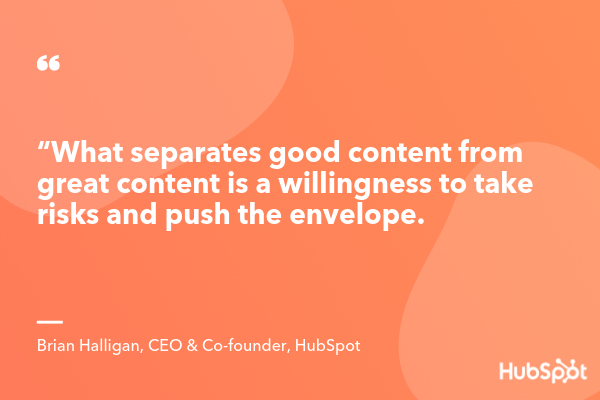
- “What separates good content from great content is a willingness to take risks and push the envelope.” — Brian Halligan, CEO & Co-founder, HubSpot
- “Quality content means content that is packed with clear utility and is brimming with inspiration, and it has relentless empathy for the audience.” — Ann Handley, CCO, MarketingProfs
- “Marketing is telling the world you’re a rock star. Content Marketing is showing the world you are one.” —Robert Rose, Chief Strategy Officer, The Content Advisory
- “Content marketing is really like a first date. If all you do is talk about yourself, there won’t be a second date.” – David Beebe, Founder & CEO, Storified Hospitality Group
- “Focus on the core problem your business solves and put out lots of content and enthusiasm and ideas about how to solve that problem.” — Laura Fitton, INBOUND & Influencer Relations, HubSpot
- “Content builds relationships. Relationships are built on trust. Trust drives revenue.” — Andrew Davis, Author & Keynote Speaker, Monumental Shift
- “Content marketing is the gap between what brands produce and what consumers actually want.” — Michael Brenner, CEO, Marketing Insider Group
- “One of the best ways to sabotage your content is to not tie it to your goals. Know why you’re creating content.” — Ellen Gomes Sr. Content Marketing Manager, Glint Inc.
- “There are three objectives for content marketing: reach, engagement, conversion. Define key metrics for each.” — Michael Brenner, CEO, Marketing Insider Group
Sometimes, you might want to lean on the words and experiences that a successful person you admire once said or described. Here are some famous quotes you can apply to your business’ marketing efforts to help you do just that.
Branding Marketing Quotes
Branding marketing quotes will help you consider the ways in which you share and promote your content as well as think of new and exciting ways to establish your business’ image.
Read our Ultimate Guide to Branding to learn more about branding your business and content.
- Don’t push people to where you want to be; meet them where they are.” — Meghan Keaney Anderson, VP Marketing, HubSpot
- “People will ignore or skip anything they don’t like. So brands have to start making things they love.” — Steve Pratt, Partner, Pacific Content
- “Smart marketers and smart brand managers understand the importance of leveraging frame of reference to build their brands.” — Mark Shapiro, Chair, Vistage Worldwide, Inc.
- “Brand equity is the sum of all the hearts and minds of every single person that comes into contact with your company.” — Christopher Betzter, Brand Strategist
- “A brand is the set of expectations, memories, stories, and relationships that, taken together, account for a consumer’s decision to choose one product or service over another.” — Seth Godin, Founder & CEO, Do You Zoom
- “Products are made in the factory, but brands are created in the mind.” — Walter Landor, Founder, Landor
- “Branding is about signals — the signals people use to determine what you stand for as a brand. Signals create associations.” — Allen P. Adamson, Co-Founder, Metaforce
- “A lesson learned once again through ‘the school of hard knocks’ … never lose sight of your brand, its value, and its inherent need to be fed and nurtured and placed above all else! Saving your way there is a fool’s errand.” — Chet Baker, SVP Corporate Development, Entrinsic Health Solutions
- “Your brand is what people say about you when you’re not in the room.” — Jeff Bezos, Founder & CEO, Amazon
- “Your brand is a story unfolding across all customer touch points.” — Jonah Sachs, Author
Inspirational marketing quotes exist to help you spark new ideas and excite your team members about the endless number of opportunities in the field. They also have the power to positively motivate your team to produce unique marketing content for your audience.
Storytelling Marketing Quotes
Storytelling marketing quotes can be used to improve the impact of the stories you and your fellow marketers tell about your business, branding, and products on your customers and target audience.
Develop your storytelling skills with our Ultimate Guide to Storytelling.
- “Nothing sticks in your head better than a story. Stories can express the most complicated ideas in the most digestible ways.” — Sam Balter, Sr. Marketing Manager of Podcasts, HubSpot
- “If your stories are all about your products and services, that’s not storytelling. It’s a brochure. Give yourself permission to make the story bigger.” — Jay Baer, Content Marketer & Co-Author
- “The most powerful person in the world is the storyteller. The storyteller sets the vision, values, and agenda of an entire generation that is to come.” — Steve Jobs, Co-Founder, Apple
- “You can’t sell anything if you can’t tell anything.” — Beth Comstock, Former CMO & Vice Chair, GE
- “The purpose of a storyteller is not to tell you how to think, but to give you questions to think upon.” — Brandon Sanderson, Author
- “If your stories are all about your products and services, that’s not storytelling. It’s a brochure. Give yourself permission to make the story bigger.” — Jay Baer, Content Marketer & Co-Author
- “At its very core, marketing is storytelling. The best advertising campaigns take us on an emotional journey — appealing to our wants, needs, and desires — while at the same time telling us about a product or service.” — Melinda Partin, Senior Director of Marketing & Digital Strategy, UW Medicine
- “Storytelling is the most powerful way to put ideas into the world today.” — Robert McKee, Author
- “And do you know what is the most-often missing ingredient in a sales message? It’s the sales message that doesn’t tell an interesting story. Storytelling … good storytelling … is a vital component of a marketing campaign.” — Gary Halbert, Author
- “The brands that win are the brands that tell a great story. When it comes to transmedia storytelling, the brands that win are the brands that tell many great stories and are able to connect them all together.” — Mitch Joel, Author & Founder, Six Pixels Group
Social Media Marketing Quotes
Social media marketing quotes are a great way to influence the strategies you implement at your company as well as provide thoughts about the ways in which social media can positively impact your marketing efforts.
Learn everything you need to know about social media marketing in our Ultimate Guide to Social Media Marketing Campaigns.
- “Social media marketing is about creating content that brings your audience together as a community and inspiring authentic conversations while increasing your brand’s awareness.” — Krystal Wu, Social Media Community Manager, HubSpot
- “It’s important to be where your audience of potential customers is today, and where they might be tomorrow.” — Andrew Delaney, Senior Manager of Social Media, HubSpot
- “Social media requires that business leaders start thinking like small-town shop owners. This means taking the long view and avoiding short-term benchmarks to gauge progress. It means allowing the personality, heart, and soul of the people who run all levels of the business to show.” — Gary Vaynerchuk, CEO, VaynerMedia
- “Social media was designed to SHARE what you’re doing and who you are, not BE what you’re doing and be who you are.” — Richie Norton, Author
- “I use social media as an idea generator, trend mapper, and strategic compass for all of our online business ventures.” — Paul Barron, CEO, Foodable Network
- “Going viral is not an outcome; it’s a happening. Sometimes it happens; sometimes it doesn’t. Just remember, fans are vanity and sales are sanity.” — Lori R. Taylor, Founder, Rev Media Marketing
- “Social media is about the people! Not about your business. Provide for the people and the people will provide you.” — Matt Goulart, Founder, Ignite Digital
- “Social marketing eliminates the middlemen, providing brands the unique opportunity to have a direct relationship with their customers.” — Bryan Weiner, Board of Directors, Cars.com
- “Our head of social media is the customer.” — McDonald’s
- “Don’t use social media to impress people; use it to impact people.” — Dave Willis, Writer & Pastor
Digital Marketing Quotes
The world of digital marketing is ever-changing — the following quotes will help you think about ways in which you can ensure your digital strategy remains relevant and impactful for your target audience.
- “Businesses get blinded by the allure of a large subscription list, but unengaged subscribers aren’t just not interested in what you’re sending, they’re actually harming your deliverability.” — Meghan Keaney Anderson, VP Marketing, HubSpot
- “Marketers need to build digital relationships and reputation before closing a sale.” — Chris Brogan, President, Chris Brogan Media
- “ Less is more. Keeping it simple takes time and effort.” — Jeff Bullas, CEO, Jeffbullas.com Pty Ltd.
- “Instead of one-way interruption, web marketing is about delivering useful content at just the right moment that a buyer needs it.” — David Meerman Scott, Keynote Speaker & Author
- “Content, in all its forms, is the single most critical element of any marketing campaign.” — Rebecca Lieb, Founding Partner & Analyst, Kaleido Insights
- “Inspiration is the most important part of our digital strategy.” — Paull Young, Charitable GIving Lead, Facebook
- “Digital marketing is not an art of selling a product. It is an art of making people buy the product that you sell.” — Hecate Strategy
- “Don’t build links. Build relationships.” — Rand Fishkin, Founder, SparkToro
- “Discoverability equals sales in the digital world.” — Dev Chandan, Founder, Dev Chandan
- “Before you create any more ‘great content,’ figure out how you are going to market it first.” – Joe Pulizzi & Newt Barrett, Co-authors
Start Using Marketing Quotes to Inspire Your Team
Marketing quotes have the power to inspire your team members to produce their best work, drive home the points you make in meetings, and help you shed light on any type of situation at work. No matter what your company does, there are a number of quotes you can use to help you work towards your specific marketing goals both individually and with your team. So, review the sections above and find some quotes to save on your desktop, write down in your notes, or share with your co-workers today.
