
Welcome to My Blog
Apple retracts comment that it was first major open source company after criticism
Last week Apple’s open sourcing of Swift naturally saw the spotlight thrown over Apple’s open source pages. This included a paragraph that claimed Apple was “the first major computer company to make Open Source a key part of its strategy”. Unsurprisingly, this riled some members of the developer community as being disingenuous and untrue.
So Apple has since changed the text to retract the rather outlandish statement with something a bit more muted. Although this statement is technically qualitative and open to many interpretations, Apple isn’t exactly known for its open source contributions. The page now reads as follows:
‘Open source software is at the heart of Apple platforms and developer tools, and Apple continues to contribute and release significant quantities of open source code’.
The claim has been posted on Apple’s site for some time, but received fresh attention last week following the Swift release.
Whether Apple was right or wrong in what is said is actually hard to ascertain. It is true that Apple has maintained open source releases of UNIX all the way back to OS X 10.10 and now manages a host of open source projects including Bonjour, ResearchKit and perhaps most famously WebKit. However, Apple is not the best open source citizen in any of these cases. Apple is slow to release source code in many instances and often holds back code for a big ‘dump’ once the software has shipped, often weeks or months later. Case in point: Apple has not yet released the open-source elements for OS X 10.11 which was released in September.
These kind of ‘code bombs’ are frowned upon as being bad practice for open source, which is part of the reason people rejected Apple’s ‘open source first’ messaging so strongly. Open source advocates want public codebases to be more community oriented, with daily commits being published as the project progresses.
This is exactly how Swift is governed; WebKit is now on this path too although it wasn’t initially. Nowadays, LLVM, WebKit and (looking ahead) Swift mean that Apple is spearheading open source development in a big way. The written claim mentioned Apple’s historic approach to open source however, where the record is not as concrete.
Regardless of subject matter, claims about being the ‘first’ of anything are going to be controversial without sufficient evidence. The open source scene is so widespread and distributed that Apple’s best option was to change the phrasing, even if they believed it to be true themselves, to quell the criticism.
Filed under: AAPL Company, Developers, iOS, iOS Devices, Tech Industry Tagged: Apple Open Source, Open source, Swift
Visit 9to5Mac to find more special coverage of AAPL Company, iOS Devices, and Tech Industry.
What do you think? Discuss “Apple retracts comment that it was first major open source company after criticism” with our community.
Poll: Help us choose the award winner for Apple Product of the Year 2015!
Apple has had a busy year for product launches. In addition to the Apple Watch going on sale as a whole new product category, there wsa the 12-inch MacBook and iPad Pro, each representing quite a radical new take on an existing product category.
But Apple also made some notable improvements to existing lines. The iMac got a 4K and 5K display; the Retina MacBook Pro got Force Touch; and the Apple TV got opened up to a whole new range of software.
We also saw a new iPad mini which was essentially a smaller iPad Air 2, and a refreshed MacBook Air with Broadwell CPU and faster graphics.
Additionally, Apple launched five new peripherals – the Apple Pencil, Smart Keyboard, Magic Keyboard, Magic Trackpad 2, Magic Mouse 2 – and we have a separate poll for those.
So it’s time to ask you to name your Apple Product of the Year and Apple Peripheral of the Year …
You can only choose one product and one peripheral, which may prove tricky for some! First, the main event:
And then the peripherals:
Please do share the reasons for your choices in the comments – and if it was a close-run thing for you, let us know which were the products you found it hard to choose between.
Filed under: AAPL Company, Apple TV, Apple Watch, iOS Devices, Mac Tagged: Apple TV, Apple watch, iMac, iPhone, MacBook, MacBook Air, MacBook Pro
Visit 9to5Mac to find more special coverage of AAPL Company, iOS Devices, and iPhone.
What do you think? Discuss “Poll: Help us choose the award winner for Apple Product of the Year 2015!” with our community.
True Confessions: Are You Guilty of These Marketing & Sales Pitfalls? [Video]
Sometimes, it’s really tempting to cut corners.
It’s the end of the month. You’ve got an aggressive goal to hit. Will anyone really be that mad if you buy that list or make a couple cold calls? You promise — it’s just this once.
But we all know how easy it is for that excuse to fall by the wayside. That thing you did just once spirals out of control, and pretty soon you’re relying on that tactic every single month.
Turns out, there is a better way to market and sell. And for us to actually work toward making that inbound vision a reality, we’ve got to fess up to our mistakes.
We’ll start. Check out the video below to see some pitfalls marketers and salespeople face — and get resources for avoiding them in the future.
Want to confess your own prospecting pitfalls? Use the meme generator below.
Mini Review: Twelve South’s ParcSlope gives your iPad Pro or any MacBook a little lift
Twelve South is probably best known for its extremely cute BookBook cases for MacBooks, for iPads and even for iPhones. But it offers a range of other products, including the ParcSlope MacBook stand released earlier this year. Designed for those who don’t want a full desktop docking system but want to raise both keyboard and screen to a more comfortable angle, the device is now seeing a new application: as a stand for the iPad Pro …
It’s a very simple, all-in-one unit. Essentially a single piece of aluminum, bent twice, and with rubber coatings where both the front and back of your device rests on it. It’s sized so that it works for anything from an 11-inch MacBook Air upward.
Although created before the iPad Pro was even confirmed, it could be made for the device, even allowing room to rest the Apple Pencil at the top.
When used with a MacBook, it holds the machine at quite a steep angle (18 degrees), which is necessary if it’s to lift the screen to any meaningful degree.
This does mean the keyboard is sloped rather a lot. When I first tried it, it felt very strange, but I have to say I did very quickly get used to it.
I’m unusual in that I don’t actually like a raised monitor. Indeed, when it came to having a desk made for my office, I actually had a cutout put in so I could drop the level of the monitor down to just above desk level.
But most people do prefer a raised screen, and the ParcSlope is a simple way to achieve it. It also keeps devices cooler by allowing air to circulate underneath. So if you’re looking for a simple way to lift a MacBook to a more ergonomic height on your desk, or want to lift an iPad Pro to the kind of angle many hold a sketchpad, the ParcSlope may well be for you.
The Twelve South ParcSlope costs $49.99. BookBook cases start at $39.98 for iPhones, $59.75 for iPads and $79.95 for MacBooks.
Filed under: Reviews Tagged: iPad Pro, iPad Pro stand, MacBook stand, Twelve South, Twelve South ParcSlope, Twelve South ParcSlope review
Check out 9to5Mac for more breaking coverage of Reviews, iPad Pro, and Twelve South.
What do you think? Discuss “Mini Review: Twelve South’s ParcSlope gives your iPad Pro or any MacBook a little lift” with our community.
12 Businesses With Fantastic LinkedIn Company Pages
Over the past several years, LinkedIn quickly evolved from a cocktail party for recruiters and job seekers to something much more substantial: an epicenter for content — particularly branded content.
LinkedIn’s evolution began in May 2012 with the acquisition of SlideShare, and it continued with the purchase of news reader app Pulse. Later that year, the social network got into the original content game with the launch of the LinkedIn Influencer Program, which features posts from the likes of Richard Branson and Suze Orman. And by February 2014, they opened up their publishing platform to all members.
All of those moves have turned LinkedIn into a place where people come to consume professional content. That’s been great news for brands, since it’s given them a new audience to reach with their content — via their Company Pages on LinkedIn.
Let’s look at 12 businesses that are capitalizing on the opportunity and rocking it. I think you might be surprised to find that both B2B and B2C companies are working to get the most out of their pages.
Click here to download our free guide about how to create a fantastic LinkedIn Company Page of your own.
12 of the Best LinkedIn Business Pages (And What Makes Them Great)
1) Coca-Cola
Coca-Cola’s LinkedIn Page regularly highlights content from Coca-Cola Journey, the company’s digital magazine that’s churned out over 2,000 stories since its launch in November 2012 and seen huge success, especially on social. Though 59% the magazine’s audience is in the 18–35 year-old demographic, they see a lot of interaction from the company’s 917,000+ followers on LinkedIn.
“LinkedIn is a huge traffic driver for us,” explains Co-Managing Editor Jay Moye. “That’s obviously a different audience. It’s a professional audience. It’s professional social network versus more of a social network. We see great clickthrough rates on story links that we publish on LinkedIn. The percentage of clickthroughs is markedly higher than it is on Facebook, and to a degree, Twitter.”
Moye and the Coca-Cola team choose which content to share on LinkedIn with that professional audience in mind.
“You’ll see more consumer-focused content go up on our Facebook page,” explains Moye, “whereas you’ll see more business innovation, jobs, workplace stuff go up on LinkedIn. That’s kind of a no-brainer. It’s obviously an older, more professional audience on LinkedIn.”
2) AppleOne
As an employment agency, AppleOne could simply push their job openings on LinkedIn and call it a day. Instead, they share awesome advice for job seekers both from their blog and from other outlets like The Muse and PopSugar. Their LinkedIn description also includes information that differentiates them from other, similar companies, while touching on their core mission. For example, they write:
AppleOne Employment Services is unique in that we view the career seeker as a client. Other employment agencies see you as a commodity to be sold, and it shows in the way they treat you. Our services are always free to our associates, and we encourage you to take full advantage of them.”
Mission and vision statements are great differentiators to add to your LinkedIn Page’s description.
3) Mashable
Mashable made LinkedIn’s list of the Best LinkedIn Company Pages of 2013 (which was presented, of course, in a SlideShare) and it’s easy to see why. Mashable has tons of potential content to share, but on LinkedIn, they primarily dish out business and productivity tips, such as “How to Succeed at Business Without Becoming a Workaholic.”
And while they publish a lot of articles on “sillier” topics (like “adorkable” pandas) on their main website, they stick to business-related topics when posting updates on LinkedIn to appeal to the more professional audience that spends time there.
Their social media-focused content generates a lot of engagement, too: A post featuring “If ‘House of Cards’ Characters Used LinkedIn,” for example, hits all the right notes.
4) L’Oréal
For businesses that have multiple entities under one name, LinkedIn Showcase Pages make it easy to segment content to spotlight a specific business brand or product. L’Oréal, for example, owns a lot of different, popular brands like Lancôme, Yves Saint Laurent, and Redken. By creating different Showcase Pages for each one, L’Oréal can engage and share relevant content with each of their specific target audiences.

5) Four Seasons Hotels and Resorts
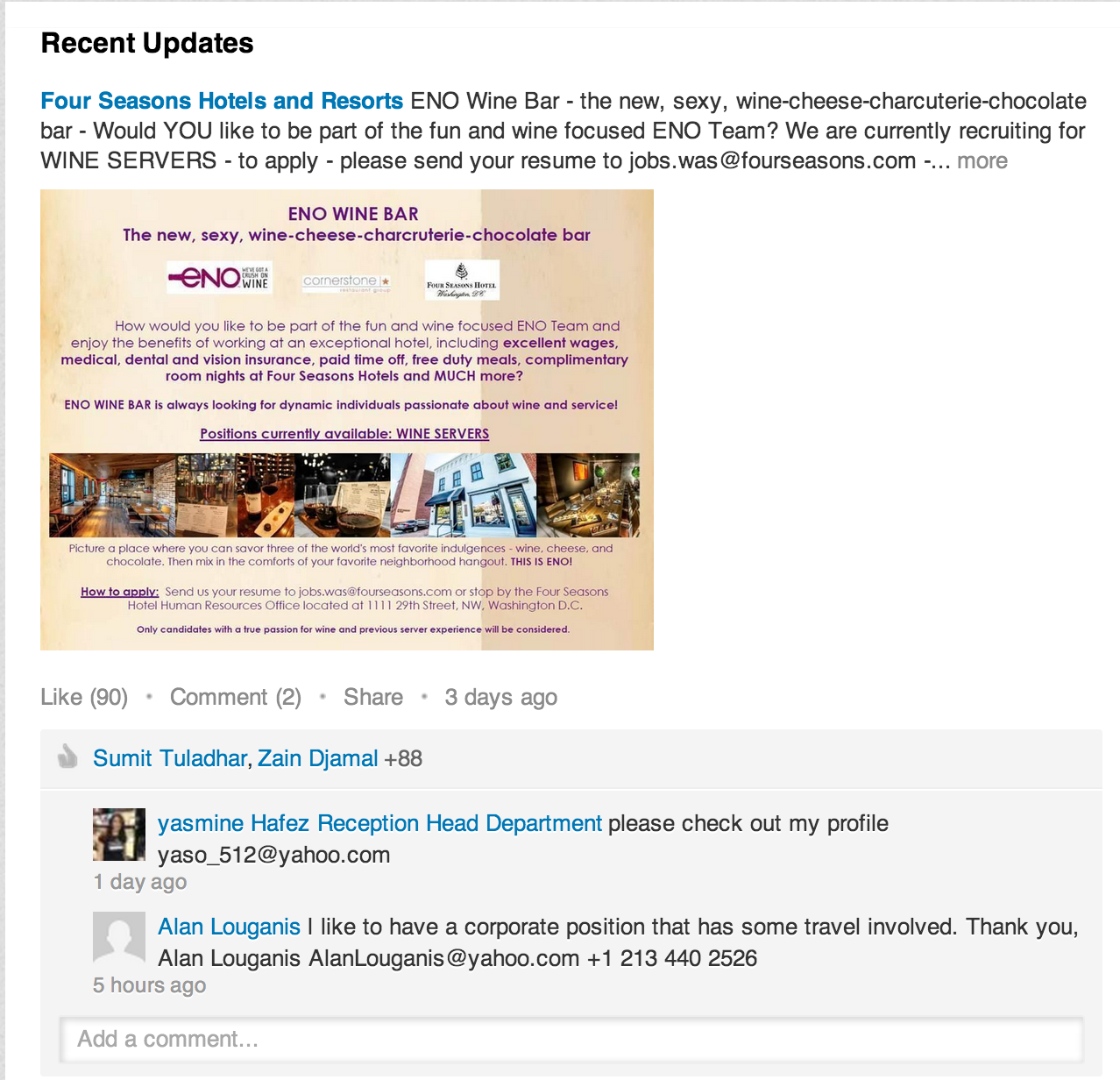
The purpose of the Four Seasons Hotels and Resorts LinkedIn Page seems to be to make me really regret studying writing in college instead of studying hotel and restaurant management. Yes, Four Seasons, I do wish that I could work at your sexy new wine, cheese, and chocolate bar on the beach.
They also mix in some fun content, like this caption contest:
Overall, the Four Seasons goal on LinkedIn is pretty obvious: Make the hotel chain look both like a company that you’d like to work for, and a place you want to stay.
6) The Nature Conservancy
Like AppleOne, The Nature Conservancy puts their mission statement front-and-center in their LinkedIn Company Page description to let professionals visiting their Page know what they’re all about. They also drive engagement by posting compelling rich media and thumbnails in updates that link back to blog posts from their own blog, as well as other blogs whose content resonates with their target audience.
7) BlackRock
At a LinkedIn conference in 2013, BlackRock’s then-Global Director of Social Media Eileen Loustau estimated that LinkedIn was driving $17-18 million dollars of revenue for the financial investment company. That’s because of the sophisticated pieces of investment advice that BlackRock shares on their LinkedIn Page, such as “Your Core Portfolio: The Case for ETFs.”
“We sometimes call it chapter four,” Loustau said of the investment company’s strategy and skipping the basics and focusing on more complex content.
8) Evernote
The folks at Evernote publish a lot of great content to their Company Page, but their pinned updates are especially noteworthy here. Whenever Evernote releases a new feature, they post an update and then pin it to the top of their Recent Updates section. That way, anyone visiting their Page can see the news right away, even if they’ve published other updates since. This move helped them earn a spot on LinkedIn’s “Best of Company Pages” in 2014.
9) IBM
IBM topped the LinkedIn rankings with 1.8 million interactions back in 2012, and they haven’t slowed down since. They’ve added nearly a million and a half followers, and over 2.5 million people now subscribe to the company’s updates. The technology giant shares a nice mix of stories from around the web and their own content hub.
They also do a great job of cross-promoting IBM’s other online assets, like their Tumblr posts and hashtag campaigns that span multiple social platforms. Here’s a recent post featuring their #HackAHairDryer campaign, which you’ll notice follows brief, compelling copy:
10) Marketplace Home Mortgage
Despite having just 872 followers at the time, Marketplace Home Mortgage made LinkedIn’s list of best company pages of 2013. Why? Because the relatively small company does a great job of curating useful and interesting content for home buyers, and curating it with strong hooks — evidence that small businesses can excel on LinkedIn, too. Now they have over 1,600 followers and follow a lot of great LinkedIn best practices, including pinning a simple, succinct status to the top of their Company Page that lets visitors know they’re hiring:
11) HP
HP rocks LinkedIn with a pretty fascinating and diverse array of content: thought leadership, big data analysis, and even simple, branded graphics. They post a lot of these simple graphics, like this one:
Their posts consistently draw hundreds of interactions from their 2.1+ million followers, and their Career tab is chock-full of videos and testimonials from current employees. This is LinkedIn done right.
12) Hays
If you’ve got it, why not flaunt it? Hays makes their claim as the #1 recruiting firm in the world right on their LinkedIn banner. They also use that space to promise to delivery helpful, relevant content to their followers — and they practice what they preach. Their status updates are often links to their own blog posts on great topics like “A Simple Guide to Writing the Perfect Resume/CV,” from which they draw a lot of engagement from their followers.
Another thing Hays does well? They acknowledge their followers directly, and even ask what they want to see more of. Here’s an example of a recent post, in which they thank their YouTube viewers and ask them what types of videos they’d like to watch next. Bonus: They included a hashtag (#WhatCouldYouBe) with this ask so that folks can share their thoughts either on LinkedIn or another social channel.
Which other companies are rocking LinkedIn? Share with us in the comments.
Editor’s Note: This post was originally published in May 2014 and has been updated for freshness, accuracy, and comprehensiveness.
Bomb scare closes Tokyo Apple Store as handwritten note demands talk be cancelled
Apple cancelled a talk scheduled to be held yesterday at its Tokyo Ginza retail store after a handwritten bomb threat was received, reports Public Slate. The store was closed for an hour while police searched for explosives, but nothing was found.
The event was to feature guest, Isao Yukisada, a Japanese film director. The director was scheduled to speak at 2 p.m.
It’s not known why the event was targeted.
The store previously made the news when it opened its doors early to allow queuing iPhone customers in before an approaching typhoon hit.
Via CoM
Filed under: AAPL Company Tagged: Apple Retail Store, Apple Store, Apple Store Tokyo, Bomb threat, Japan, Tokyo
Continue reading more about AAPL Company, Apple Store, and Japan at 9to5Mac.
What do you think? Discuss “Bomb scare closes Tokyo Apple Store as handwritten note demands talk be cancelled” with our community.
Craig Federighi promotes Hour of Code workshops, saying programming is “the next level of literacy”
In an interview to promote Apple’s Hour of Code workshops for kids aged 6 and up, SVP of software engineering Craig Federighi has told the BBC that introducing young children to programming is so important because programming is “the next level of literacy.”
“These devices are so much a part of our lives, we have a computer in some form wherever we go, that the ability to create in that medium is as fundamental as the ability to write,” he said […]
He says programming should be seen as a “language and a way of thinking”. And while many young people have a great facility in using devices, he says being able to programme them is the “next level of literacy”.
Federighi, who first began to experiment with code when he was ten years old, said that Apple also wanted to dispel one of the myths of life as a software engineer …
He said that the geeky image of poorly-dressed programmers in a very solitary occupation was out-dated.
People sometimes have a view of programming that is something solitary and very technical. But programming is among the most creative, expressive and social careers.
It’s an incredibly creative medium, not unlike music, and there’s a tremendous cross-over between people who programme and musicians.
Federighi rejected an OECD claim that the use of technology in education offered no discernable benefit.
There’s no question in my mind of the value in technology in fuelling young minds.
Like any other tool, if you simply throw it in the classroom, and don’t consider how best to take advantage of that tool, and you try the old ways with a new piece of technology on the desk, it’s no panacea.
But the potential of the technology when well applied is phenomenal.
Apple was keen, he said, to use its retail stores more extensively for training and education.
Photo: An Hour of Code workshop in a Shanghai Apple Store last year
Filed under: AAPL Company Tagged: Apple Retail Store, Apple Store, craig federighi, Hour of Code, Hour of Code workshops, Programming, software development
Visit 9to5Mac to find more special coverage of AAPL Company, Apple Store, and Apple Retail Store.
What do you think? Discuss “Craig Federighi promotes Hour of Code workshops, saying programming is “the next level of literacy”” with our community.
The Kurt Vonnegut Guide to Great Copywriting: 8 Rules That Apply to Anyone
Kurt Vonnegut was not a copywriter … but he could have been.
That’s what dawned on me after reading “How to Write with Style,” an essay Vonnegut published in the 1985 anthology, How to Use the Power of the Printed Word. In it he outlines the eight rules for great writing — rules that can be applied to any type of writing, including copywriting.
How’s this possible? How can a novelist and a copywriter base their work off of the same standard principles?
Because every writer is working with the human condition. That’s why you’re gonna want to read this.
To prove it, let’s take a closer look at Vonnegut’s rules. You’ll notice that I’ve outlined a takeaway under each to highlight how copywriters can use it to command attention and influence action.
The Kurt Vonnegut Guide to Great Copywriting
1) “Find a subject you care about.”
Vonnegut writes:
Find a subject you care about and which you in your heart feel others care about. It is genuine caring, and not your games with language, which will be the most compelling and seductive element in your style.”
Takeaway: Whether you’re composing a sales letter, writing a blog article, or sculpting a landing page, if you’re not passionate about the product or service you’re selling, it will come through in your copy.
How can a copywriter force himself or herself to care about teakettles if they hate tea? Or cat food if they love dogs? Or boat propellers if they’re plagued by seasickness? Here’s what I recommend:
- Be selective about the projects you take on. If you don’t like guns, writing web copy for a hunting site might not be a good fit for you. That’s a personal call — and it’ll require your brutally honest evaluation.
- Research like crazy. If you do choose to tackle an unfamiliar topic, get your hands dirty. Dive into your new product, service, or industry headfirst. The more you know, the more you’ll care.
2) “Do not ramble, though.”
Vonnegut writes:
I won’t ramble on about that…”
Takeaway: Good copy is concise. Don’t use three words when one will do.
3) “Keep it simple.”
Vonnegut writes:
Simplicity of language is not only reputable, but perhaps even sacred.”
Takeaway: Good copy is also clear. Don’t make the reader think. Your message should be easy to understand. If it’s not, you run the risk of losing your prospect. So, how can copywriters keep their message simple?
- Use clean, short, understandable words. Be incredibly clear. Don’t write “utilize” when you can say “use,” or don’t write “tenebrous” when you can say “dark.”
- Use clean, short, understandable sentences. Don’t fear periods, go easy on the adverbs, and avoid the passive voice. Here’s a great site that can help you do this.
Keeping it simple isn’t easy, but it’s the right thing to do for your reader.
4) “Have the guts to cut.”
Vonnegut writes:
If a sentence, no matter how excellent, does not illuminate your subject in some new and useful way, scratch it out.”
Takeaway: It doesn’t matter how beautiful your sentence is, if it doesn’t speak to your target audience and make the reader crave the next sentence, it’s probably best to delete it. A copywriter’s end goal is to fluidly move prospects down the page until they reach a call-to-action, which, then, asks them to move on to the next step of the buying process. Fluff will only serve to disrupt that process. And that negates the whole purpose of copy. So go ahead, cut.
5) “Sound like yourself.”
Vonnegut writes:
I myself find that I trust my own writing most, and others seem to trust it most, too, when I sound most like a person from Indianapolis, which is what I am.”
Takeaway: Write naturally. Pick a persona to target and write as if you’re speaking to that one individual and no one else. Sound like yourself and the copy will take on a unique, one-of-a-kind tone.
6) “Say what you mean to say.”
Vonnegut writes:
“I used to be exasperated by such teachers, but am no more. I understand now that all those antique essays and stories with which I was to compare my own work were not magnificent for their datedness or foreignness, but for saying precisely what their authors meant them to say. My teachers wished me to write accurately, always selecting the most effective words, and relating the words to one another unambiguously, rigidly, like parts of a machine. The teachers did not want to turn me into an Englishman after all. They hoped that I would become understandable — and therefore understood.
And there went my dream of doing with words what Pablo Picasso did with paint or what any number of Jazz Idols did with music. If I broke all the rules of punctuation, had words mean whatever I wanted them to mean, and strung them together higgledy-piggledy, I would simply not be understood. So you, too, had better avoid Picasso-style or jazz-style writing if you have something worth saying and wish to be understood.”
Takeaway: Good copy is, first and foremost, understood. That’s why good, conversion-driven copywriters won’t be caught dead distracting readers with fluff. Respect your readers’ time. Minimize their cognitive expenditure.
7) “Pity the readers.”
Vonnegut writes:
“Readers have to identify thousands of little marks on paper, and make sense of them immediately. They have to read, an art so difficult that most people don’t really master it even after having studied it all through grade school and high school — twelve long years.
So this discussion must finally acknowledge that our stylistic options as writers are neither numerous nor glamorous, since our readers are bound to be such imperfect artists. Our audience requires us to be sympathetic and patient teachers, ever willing to simplify and clarify, whereas we would rather soar high above the crowd, singing like nightingales.”
Takeaway: You may be a wordsmith and an artist. Your prose may sing. And that’s great … but it doesn’t make it okay to write wordy copy. Successful copywriters know that long-winded copy won’t get the job done. It’s all about being clear and concise because catering to the reader will be rewarded with trust, credibility, and action. So do your readers — and yourself — a favor: Show mercy.
8) “For really detailed advice.”
Vonnegut writes:
“For a discussion of literary style in a narrower sense, a more technical sense, I commend to your attention The Elements of Style, by Strunk, Jr. and E.B. White. E.B. White is, of course, one of the most admirable literary stylists this country has so far produced.
You should realize, too, that no one would care how well or badly Mr. White expressed himself if he did not have perfectly enchanting things to say.”
Takeaway: Always provide readers with value. Fail to do so and all the other rules on this list become obsolete. Value is born when your copy solves a specific problem for your reader. Or when it assuages a fear. Or when it meets a desire.
Informative content is valuable. So is entertaining content. Ultimately, providing value is fundamental to the success of any piece of copy because in its absence, what’s there to care about?
So next time you sit down to write your next blog article or sales letter or landing page, ask yourself: Who’s this for? What do they want or need? And, perhaps, what would Kurt do?
What do you think of these writing rules? Share your thoughts in the comments section below.
14 Video Tools for Social Media Marketers
Do you want to add video to your social media marketing? Are you looking for tools to simplify your video production? Today’s tools make it easy to record and edit videos for social media marketing and ad campaigns. In this article I’ll share 14 tools marketers can use to create screencasts, montages and slideshows. Why Video for Ads? Facebook gives priority to […]
This post 14 Video Tools for Social Media Marketers first appeared on Social Media Examiner.
Social Media Examiner – Your Guide to the Social Media Jungle
from Social Media Examiner http://ift.tt/1lnpw1t
via socialmediaexaminer
5 Ways to Improve Your Social Media Results
Is your social media audience losing interest? Do you want to tap into your followers’ emotions? Using psychology to connect with your target audience is a powerful way to engage and motivate them to take action. In this article you’ll discover five psychology principles you can use to improve your social media marketing results. #1: People Prefer Stories to Stats In Made […]
This post 5 Ways to Improve Your Social Media Results first appeared on Social Media Examiner.
Social Media Examiner – Your Guide to the Social Media Jungle
from Social Media Examiner http://ift.tt/1NdjsiY
via socialmediaexaminer
Apple raises iTunes Match iCloud Music Library limit to 100k songs, up from 25k
As promised by Eddy Cue earlier in the year, Apple has now raised the limits on iTunes Match and Apple Music library for matched songs from 25,000 to 100,000 songs.
Cue had previously announced on Twitter that Apple was aiming for 100k for iOS 9 and just in time for the holidays, that promise has been fulfilled. This means users with larger music libraries can now enjoy the benefits of matching songs in the iTunes Cloud to make them available on all their devices. Matching songs gives another option for people who cannot afford the more expensive 64 GB and 128 GB iPhone models by offloading local music storage to the cloud.
It is not unusual for home music collections to surpass 25,000 songs so the initial limits were unfeasible for many users. Most, but admittedly not all, libraries should fall in the 100k quota however. iCloud Music Library access is available through either Apple Music or iTunes Match. Both services offer the same match/upload music locker feature, with Apple Music building on top of that a full streaming subscription service for $9.99 a month.
Apple is bolstering its Apple Music service significantly in the last few months of the year. It rolled out Apple Music for Android in November and has announced support for Sonos home speaker systems beginning December 15th. The full rollout for Apple Music + Sonos will launch in 2016.
Thanks Stephanie for the heads up.
Filed under: AAPL Company, Apple Music, iOS, iOS Devices, Tech Industry Tagged: Apple Music, iOS, itunes limits
Continue reading more about AAPL Company, iOS Devices, and Tech Industry at 9to5Mac.
What do you think? Discuss “Apple raises iTunes Match iCloud Music Library limit to 100k songs, up from 25k” with our community.
Nothing is Original: Why the Most Talented People Copy (And Why That’s OK)
This post originally appeared on Agency Post. To read more content like this, subscribe to Agency Post.
We have an insatiable thirst for the new.
In business, we want new products, new campaigns, and new ways of reaching consumers.
The shiny object syndrome isn’t just about being easily distracted. It’s also the result of thinking that what is new — and seemingly unique — is better.
So how can we meet the increasing demands to come up with new ideas under shorter deadlines?
Mark Earls believes we need to get better at copying — badly.
“Copying lies at the heart of creativity,” writes Earls in Copy, Copy, Copy: How to Do Smarter Marketing by Using Other People’s Ideas, which was released earlier this year.
Why Copying Makes Us Uncomfortable
Earls’ background is in planning — previously at St Luke’s and as the executive planning director for the EMEA division at Ogilvy & Mather in London. He also has published three other books, including Herd: How to Change Mass Behaviour by Harnessing Our True Nature and I’ll Have What She’s Having: Mapping Social Behavior. These previously published books deal more with insights on how people are social beings and how that relates to consumer behavior. Copy, Copy, Copy is the playbook for applying those insights to come up with new ideas, which is based on copying the success of others.
But this idea of copying is uncomfortable for many people — especially those in agencies whose value to clients lies in the ideas it produces.
He writes:
Our culture has a very strong individualist strand: we prize the individual over the group and distrust those who don’t have a strong sense of authentic self, who don’t ‘know their own mind’, ‘self-actualize’, ‘sing their own song’ or whatever metaphor is popular down the dark self-help aisle in the bookstore.
We pride ourselves on the uniqueness of our ideas, our thoughts, and our expressions. So the thought of saying that we copied someone else’s ideas would mean that we are not smart enough or creative enough or inventive enough to develop our own ideas.
We worship originality, but actually, copying is an innate human skill — one we need for survival. We copy to learn, to understand, and to gain social status by mimicking others.
And this focus on individualism is mostly a product of North American and European cultures.
“We’re the unusual ones,” Earls said. “We’re the ones that think almost everything in human behavior is going to be explained by individuals and what goes on between and individual and peers. Everyone else seems to think human beings are, first and foremost, social creatures, and that much of what shapes human behavior is between them, not in between their ears.”
In the book he points to the idea of Ubuntu, a South African philosophy, that is described as: “which sees man as a fundamentally social being, rather than a ‘host of individual entities that cannot help being in constant conflict.’”
While many marketers think of consumers as concerned about “me,” much of the world thinks in terms of “we.” And this is often how people actually make decisions.
“Without people copying each other, things don’t spread very fast or very far,” Earls said. “It’s human-see, human-do.”
Why You Should Copy — Badly
There are two types of copying. The first is replication or machine-like copying.
Copying with the intention to “exploit the intellectual and financial effort involved in making something new and better” is how copying gets a bad rap, writes Earls.
The second type is human copying, which Earls says naturally creates error — this is the kind of copying you need to master.
The point is to copy badly (or loosely), to copy with the point of including variations or to fix known problems. You can also copy from “far away” — studying other industries and applying these to your own.
Earls mentions an example of this “from a distance” copying: In the early 1800s, Joseph Marie Jacquard invented the Jacquard loom, which used laced together wooden punch cards to simplify the creation of complex textile designs. This system made it possible to created highly detailed, intricate weaving patterns quickly and accurately. This machine is inspired early computer technology that used punch cards to control data processing.
How to Copy to Create Better Ideas Faster
Copy, Copy, Copy isn’t about using someone else’s idea as the foundation of a new idea. And it certainly doesn’t condone copy cat advertising or blatant plagiarism.
Instead, Earls provides a pattern book, a term originally used in architecture, for copying previously used and successful strategies.
“We live in an agile age,” Earls said. “We’ve got to move faster than we’ve ever done before. Traditional strategy and creative strategy thinking isn’t yet equipped to do that. I found myself bemused by why it would take 6 months to come up with a fairly original and vague idea. That’s not good enough anymore. We have to work much harder.”
Here are three examples from Copy, Copy, Copy to show how copying an approach to problem solving can lead to unique insights for a brand problem:
“Dramatically Over-Engineer Better: This is one of the signature trends in modern marketing: 20 years ago, SUVs were a minority working vehicle, now few school runs are without vehicles capable of competing in and completing the Paris-Dakar Rally. The same is true of the wristwatch business – while the elegantly simple and the cheap and simple are still around, the explosion of diving or aviator watches worth thousands of dollars (often worth more than a car) is remarkable. Indeed, the over-engineering of leisure clothing is legion – from sportswear to expeditionary equipment. These ‘extreme’ outdoor clothing brands are popular at a local North London bus stop: North Face, Annapurna and Patagonia. Being good enough to climb mountains in or wade mighty rivers in makes them ideal for any challenges you might encounter on the 29 bus (or even the 253).”
“Promote an Unusual and Irrelevant Feature: The mainstream beer market has been prone to this for some time. In the US, there was a phase when the nature Appalachian water used to brew with was a point of difference. In the UK, we had ‘widgets’ in cans to recreate the qualities of draught beer.”
“Make Packaging a Badge of Identity: Few packaging designs have real social identity. Coke’s classic bottle shape is an exception. As Martin Lindstrom points out, it is unmistakeable, even when broken and denotes both product qualities and authenticity but more importantly the shared identity of Coke drinkers Gateway computers used Friesian-patterned boxes to signal a different kind of computer was being delivered to a different kind of user – someone who clearly knows what’s what. Department stores like Selfridges and Bloomingdales have both created highly visible (and expensive) bags in order to use the fashion-set as walking endorsements of their brands.”
He also suggests drawing as a way to come up with ideas or to reveal connections.
People — especially those in our industry — tend to rely on jargon and what he calls “verbal fireworks.” Drawing forces us to be precise and to show the steps and connections in a real way.
He writes:
Time and again in our work we come back to the truth of this – to the importance of drawing as a mode of thinking, rather than a complement to it, or an afterthought. Drawing and thinking are closely related. Indeed, in many important ways, it’s worth assuming drawing IS thinking.
In addition, these strategy frameworks and the mapping tool he provides make it possible for anyone on a team to be involved in ideation. You don’t need a psychology degree or an understanding of neuroscience.
“I think that anything that excludes the talent we’ve got in the room from making contributions should be stopped,” Earls said. “This approach seems to bring into the strategy that player who’s not normally been allowed a voice.”
Copy the Starting Problem for More Creative Results
Copying has long been the go-to tool for the most innovative and creative people — from scientists to athletes to artists to musicians.
Most problems are like other problems, which means most solutions requires similar approaches. It’s the errors, the small variations, made by the hands of a person newly approaching the issue, that makes anything truly unique.
As Earls’ writes, “It’s what we learn from each other — what we copy — that allows us to create new things.
7 Body Language Mistakes You Should Never Make in a Meeting
This post originally appeared on HubSpot’s Sales Blog. To read more content like this, subscribe to Sales.
Stop me if you’ve heard this one before.
“Mabel, Mabel, sweet and able, get your elbows off the table!”
Whether the lesson stuck with you or not, the rhyme’s message is clear: Etiquette and body language are important. And this is especially true in business.
Any time you’re in a face-to-face meeting with a customer, colleague, or partner, your body language is crucial. What you say is just as important as how you say it — and how you look when you say it. Don’t let these mistakes derail your next meeting or distract from your message.

Share This Image on Your Site
<p><strong>Please include attribution to Blog.HubSpot.com with this graphic.</strong><br /><br /><a href=’http://ift.tt/1Xax3wa’><img src=’http://ift.tt/1Qw5Gh5′ alt=’7 Cringeworthy Body Language Mistakes Salespeople Make During Meetings’ width=’600px’ border=’0′ /></a></p>
Quick Review + Giveaway: BSX Audio Basix earphones go beyond basic
Inexpensive basic earphones are very common, but not all of them actually deliver in terms of sound and build quality. The BSX Basix earphones actually offer reasonably high quality audio performance for their cost. Continue reading for the quick review (plus rules for the giveaway) …
In the box there are the earphones, storage pouch, clothing clip and an additional 2 different sized ear tips for a total of three different sizes: small, medium and large.
The earphones are constructed out of aluminum, giving them a shiny appearance and makes them feel tough and durable. They are extremely light weight at 1.6 ounces, despite being constructed out of aluminum.
The Basix have 8mm drivers which deliver deep bass and has clear, crisp timbre. Mid range sound is very balanced. They are noise isolating and do a great job at blocking out the background noise, and out beats Beats in ear headphones in audio performance for the price. While I was testing them, running at the gym on the treadmill, I had to take them completely out of my ears in order to catch up with friends. Once I put them back in immediately could not hear anything in the background.
The Basix fit me nicely and felt very light on my ears. While working out they did stay in my ears, without me having to fidget with. Usually when I run I use Bluetooth headphones and have my iPod nano strapped onto my arm, so I’m not use to dealing with long headphone cords. Occasionally, somehow I got my arms tangled in the cords while running and instead of completely yanking the earphones out of my ear or yanking the earphones and ear tips out separately, the ear tips stayed securely in my ears with the headphones popping out, indicating how secure and snug they fit. (Yes, I’ve learned my lesson: use the clothing clip).
Even though the cable doesn’t have the remote and mic on it, the cable is sleek. It consists of a dual-flat cable, which prevents them from tangling. With many earphones in the past, I’ve always experienced tangled cables. It was always frustrating and time-consuming trying to untangle them, or sometimes the cables broke due to being tangled, which prevented me from using them.
The benefits of the BSX Basix include noise isolating, with deep bass and balanced mid range, tangle free cords and featherlight weight. If you are looking for in-ear headphones under $40 price range, I recommend the BSX Basix. Normally $39.00, street prices currently go as low as $14.96 with three colors options available: white/red, black/red, and black/white. Bonus: share this article on Twitter over the next 48 hours to enter our giveaway for US readers; be sure to follow @9to5Mac to be notified if you win.
Filed under: Reviews Tagged: BSX Audio Basix, earphones, giveaway, review
For more information about Reviews, review, and giveaway continue reading at 9to5Mac.
What do you think? Discuss “Quick Review + Giveaway: BSX Audio Basix earphones go beyond basic” with our community.
Facebook Brings Facebook Messenger to Websites: This Week in Social Media
Welcome to our weekly edition of what’s hot in social media news. To help you stay up to date with social media, here are some of the news items that caught our attention. What’s New This Week Facebook Introduces New Page Plugin Features for Messages and Events: With these two new Facebook Page Plugin features, […]
This post Facebook Brings Facebook Messenger to Websites: This Week in Social Media first appeared on Social Media Examiner.
Social Media Examiner – Your Guide to the Social Media Jungle
from Social Media Examiner http://ift.tt/1R0QCrZ
via socialmediaexaminer
New drone flyover gives up-close look at Apple’s rapidly progressing Campus 2
This latest drone flyover of Apple’s under construction Campus 2 project is perhaps our best look yet at the site that will soon become Apple’s main headquarters and home to around 13,000 of its employees. The footage comes courtesy of Duncan Sinfield (via MR).
Since last checking in, you can see that Apple has now completed erecting most of the four stories that make up the main, circular structure. And if you’ve been keeping track (we have in our continually updated construction progress timeline), you’ll also notice that much of the surrounding campus taking shape with the underground auditorium, parking structure, R&D facilities and more all starting to look real.
If all goes to plan and Apple sticks to its general construction schedule posted on the City of Cupertino’s website (below), it will wrap up construction by the end of 2016 and begin moving its employees onto the campus from its current HQ down the road and elsewhere.
If you want to check out how the project has progressed so far, you can head over to our construction progress timeline that includes drone videos, official aerial shots from Apple and City of Cupertino, and news surrounding the project since before construction began.
Filed under: AAPL Company Tagged: 2016, auditorium, campus 2, City of Cupertino, Cupertino, December, duncan sinfield, flyover, footage, video
Continue reading more about AAPL Company, video, and Cupertino at 9to5Mac.
What do you think? Discuss “New drone flyover gives up-close look at Apple’s rapidly progressing Campus 2” with our community.
Review: Beats Pill+ packs portable sound & Lightning charging in an Apple-designed speaker
At the start of the week we saw Apple officially pull the plug on Beats Music after using it as the foundation for Apple Music which includes a streaming radio station dubbed Beats 1 as a salute. On the hardware front, Apple is totally marching forward with the headphone and speaker business it acquired after buying Beats for $3 billion a year and a half ago. The first totally new product to come from Apple under the Beats brand is the recently announced Beats Pill+ ($195, reg. $229), a portable Bluetooth speaker that recharges over Lightning like iPhones and iPads.
The Pill+ marks Apple’s first real step back into the speaker business since briefly entering it in with the iPod Hi-Fi from 2006 to 2007; aside from color variations and wireless models, all other Beats hardware has been designed before the Apple move. Still, Apple’s new portable speaker resembles previous versions of Beats hardware more than you might expect from the iPhone maker in 2015. There’s even a companion Pill+ app for both iOS and Android. And even though this is clearly a Beats-branded product and not purely Apple, there’s something for fans of both to like, but is it the best speaker in its class?
|
Key Details:
|
The short story is that Pill+ ($195, reg. $229) shares a lot more DNA with the Beats Pill 2.0 ($179, reg. $199) that it replaces than either the recalled Pill XL (was $299) or discontinued iPod Hi-Fi (was $349) speakers. Pill+ is bump up in size and sound from the similarly priced Pill 2.0.
The design has changed from an upward-facing capsule one to a forward-facing body that’s more symmetrical but still clearly pill-shaped. The shape change from Benadryl to Tylenol means those Beats Dude Stands won’t work anymore, and that’s probably okay.
Pill+ is still a pretty small speaker at 8″ x 2.5″ x 2.25″ and 1.65 pounds. Compare that to the old Pill 2.0 at 7.6″ x 2″ x 2″ and 0.7 pounds. Although it’s a bit heavier, the new shape fits well in the hand with the plastic grill on either side of the grippy top and bottom.
The top of Pill+ features an illuminating Beats logo’d button that lets you play and pause tracks. Hold it down to add a second connected device without disconnecting from the first device. Dedicated volume up and volume down toggles are placed on the top right, while a power button/battery status plus LED indicator light are placed on the left.
Out of the back under a flap you’ll find a traditional USB port for the Pill+ charge out feature to power iPhones and iPads, a line-in port for wired playback over a stereo cable, and a standard Lightning port for recharging the built-in battery.
Also included in the packaging, which resembles that of the Apple Watch Sport and feels very much like Apple’s, you’ll find a color matched cloth carrying case and three colored Beats logo stickers. The cloth bag is big enough to carry Pill+ and the included black 12.5W power supply and black Beats-branded 1.5m Lightning cable.
Unlike Apple’s new Magic Keyboard, Mouse 2, and Trackpad 2 for Mac, there’s no magical instant pairing process between iPhones and Pill+. Open Settings, look for Pill+ under Bluetooth, and connect to it like similar Bluetooth speakers. There’s no Wi-Fi or NFC radios that enable AirPlay connectivity or instant pairing here; the Apple hardware influence aside from design is limited to the Lightning port.
There’s also the companion Beats Pill+ app for iPhones and Android phones, but curiously not iPads. The app does fully function on iPads, just scaled up especially large on iPad Pros which still benefit from dedicated portable speakers. So what exactly does the app do?
Beats Pill+ for iPhone and Android has three main functions: DJ, Stereo, and Amplify. The first feature will likely be the most popular as the next two require having a second Pill+ around. Install the app on one of two connected phones, then enter DJ mode to let Pill+ change between which paired phone is actively playing music. UE recently added a similar ‘Block Party’ feature to their speaker, so this seems to be the thing to do with Bluetooth speakers with apps although I’m not sure how useful it is in practice.
The other two features require a second Pill+ and let you pair them together. Stereo creates left and right channels for playback while Amplify boosts the sound on both speakers together. Pretty cool if you and a friend both have the Pill+ speaker, but I wouldn’t recommend spending $460 to try it out on your own.
The companion app also has a few unadvertised features. You can register the Pill+ to your email address for warranty information, check (and presumably update) the firmware version and serial number of the Pill+, disable the cue sounds that Pill+ makes when powered on and off, and check the battery level of the speaker.
Curiously, the iOS version shows battery level both in the app and with the Notification Center widget in increments of 10, while the Android Pill+ app shows the exact level. Unlike with Apple Music where each app has a dedicated design, the Pill+ app is nearly identical on both platforms.
Battery life on Pill+ is easy to live with and delivers around the promised 12 hours of continuous playback on a single 3 hour charge using the included 12.5W power supply. Pill+ also features the popular charge out feature found on many Bluetooth speakers which lets you connect any USB cable to refuel iPhones, Android phones, and even iPads including the Pro as a backup portable power source. The included Lightning port will not recharge the Apple Pencil, however, although it does fit.
You can check Pill+ battery life by pressing its power button to activate the 5 LED indicator or through a paired device. iPhones and iPads can use iOS 9’s new battery widget to check battery life in Notification Center; this also works with other Apple and Beats products like Pencil, Watch, and wireless headphones. Android phones can get a more specific battery level using the companion for whatever reason as mentioned before.
Beats Pill+ & iPod Hi-Fi
Everything else aside, Beats Pill+ is a solid portable speaker and a better product than the Beats Pill 2.0 that it replaces. Pill+ is louder, fuller, and has a few more bells and whistles than the Pill 2.0, but I wouldn’t rush out to upgrade from one to the other unless the new design and Lightning connection really appeal to you. The charging port will obviously appeal more to iPhone owners than Android owners which likely have the same connector as the Pill 2.0 with micro-USB.
While volume is no issue for Pill+, I was especially surprised by the (wait for it) lack of bass (yes, I know, unheard of for Beats). Pill XL was priced $70 higher but had a much larger body; Pill 2.0 was $30 less and similarly sized. Sound-wise, Pill+ is an upgraded Pill 2.0 and not at all a replacement for the recalled Pill XL.
Pill+ doesn’t strike out though. Place Pill+ along a wall and the bass is amplified naturally by the output coming from the rear side for a much better sound. Treble tones are sharp, mids are clear, and deep sounds are distinctive for a speaker its size. It’s also super portable even though it’s a bump up in size from Pill 2.0, but you can find more impressive sounds from similarly or lesser priced Bluetooth speakers.
Pill+ is much easier to recommend at sales prices between $150-$200 than at $230. Apple’s $60 iTunes gift card bundle for the next few weeks effectively brings the price to $170 when you factor the credit, but Amazon’s $195 deal is the best 9to5Toys has spotted yet.
Jawbone Big Jambox & Beats Pill+
If you like the Apple-inspired white aesthetic but want upgraded sound, Jawbone’s Big Jambox ($209, reg. $299) is an easy recommendation. Both do speakerphone with built-in mics and have Bluetooth range that exceeds the promised 30-60 feet, while Big Jambox is only a step up in size with a noticeable step up in sound. There’s also 3 more hours of battery life, but you trade Lightning for micro-USB and drop the charge out feature.
You can also find Pill 2.0 new from $179 and open-box from $129 if you’re targeting a Beats speaker without the higher price tag. You lose Lighting and the DJ feature through the app, but you can still pair two Pill 2’s for stereo or louder sound and more colors are offered.
On its own, Pill+ is a solid little speaker and Lightning makes charging it very convenient for iPhone and iPad owners. The look is also a fair balance between Apple and Beats, still edgy but a bit cleaner than past products from the lineup.
My own needs are quite limited but likely common: I just want something reliable that looks good and plays louder than my iPhone or iPad during showers and washing dishes. Pill+ does that for me albeit at a premium price.
I could take or leave the app features, some sort of AirPlay special connection to iPhones would be desired, and dropping NFC that instantly paired past models with Android phones is curious now that iPhones have the radios, but that all leaves room for a more ambitious sequel that could warrant an even higher asking price.
While you can get a better sound for a similar or even lower cost, the convenience of Lightning charging and the fresh look of the Beats Pill+ overall is very appealing to me, especially at lower street prices than Apple’s asking price.
| Manufacturer: Apple/Beats |
MSRP / Sale Prices: $229 / $195 (Amazon) |
Compatibility: iPhone, iPad, Mac, Apple Watch, Apple TV |
|---|
Filed under: Reviews Tagged: Apple, Beats, Beats Pill, Bluetooth, bluetooth speakers, Lightning, portable speakers, speakers
For more information about Apple, Reviews, and Bluetooth continue reading at 9to5Mac.
What do you think? Discuss “Review: Beats Pill+ packs portable sound & Lightning charging in an Apple-designed speaker” with our community.
7 Essential Metrics Healthcare Marketers Need to Focus On
When we talk about data analytics and measuring ROI, there are several standards that we use to categorize success—website visits, number of new contacts and revenue gains or losses. These are all helpful metrics and should be taken into consideration in any marketing report. However, there are loads of different ways to measure success in digital marketing, and success looks different from industry to industry—particularly in the healthcare industry.
If you’re in healthcare, the majority of your marketing efforts are likely focused on gaining and keeping new patients. In order to effectively evolve your digital marketing strategy over time, your data analysis should also focus on customer (patient) acquisition and retention.
Here’s a breakdown of the top 7 metrics you should be analyzing on a regular basis.
1) Patient Acquisition Cost
This is probably the most relevant metric, as your whole marketing budget will be based around this number. How much does it cost to acquire a new patient? Take into account that different sources – referrals, paid search, social media, etc. – may have different costs per lead, but that all are valuable ways of generating new patients. Don’t forget to factor in the lifetime value of a patient, in order to see the full view. It may seem like a lot to spend $500 per acquisition, but if the patient’s lifetime value is over $10,000, then the initial investment is worth it.
How to calculate:
Traditional marketing would have you divide all the costs for marketing within a certain period of time by the number of new patients acquired. This method, though, only gives you a surface-level look and it doesn’t allow for a deep analysis into which activities are most effective at bringing in new patients. However, with digital marketing, you can actually track a lead from a PPC ad to a landing page conversion to becoming a patient. Or, from a social post to a “Contact Us” form submission to becoming a patient. Each of these activities will have different costs-per-customer and will allow you to see where you need to allocate your budget based on what’s most effective in your market.
2) Patient Retention
It’s not enough to gain a lot of new patients—you need to keep them coming back. One loyal patient will do more good for your bottom line than 10 new patients. Loyal patients not only spend more over their lifetime, they also are great brand evangelists and will likely recommend you to their friends and family if you continue to delight them with your treatment and services. In your analytics, be sure to highlight returning patients.
How to calculate:
To calculate patient retention rates, you’ll need to know how many existing patients you have and how many you gained or lost over a set period of time. If math isn’t your thing, Inc.com has a great formula to easily calculate your retention rate.
3) Customer Service Response Time
This is a metric that often trips healthcare organizations up. Customer service is for shopping, right? Wrong. Great customer service is the best way to make your healthcare organization stand out from the crowd. It’s especially important in today’s digital age as it becomes easier for complaints and bad reviews to be spread far and wide online.
Patients care about how they’re treated and their experiences at each of their appointments, but it doesn’t end there – they also care about how they’re treated outside of your office, through appointment reminders, follow-ups and response time to their questions and concerns. The level of service and treatment they receive can make or break your relationship with them. Give your staff goals and don’t simply think about email and phone call response times, make sure you’re taking social media response times into account, as well. And remember, social media users expect responses within an hour.
How to calculate:
Facebook is now starting to track customer service response time for brand pages. You can also have your digital team log the time of each incoming inquiry and the time of each response.
4) Engagement
Engagement metrics are often considered “soft metrics,” meaning they don’t show a definitive ROI. Yet, engagement metrics can be incredibly helpful in evaluating your overall brand awareness and message penetration into the market. Plus, with marketing automation platforms, you can attribute patients to certain sources and gain insight into how they originated in your database.
With HubSpot, for example, you can use the “Sources” report to show which social media leads became customers. You can also set up custom lead scoring to assign a certain number of points to each contact for certain actions they take – such as downloading a checklist or clicking on an email. This is another great way to measure engagement, as you can quickly see which leads are interacting with your content the most based on their score.
How to calculate:
Set up Lead Scoring in HubSpot, track leads and analyze their scores over time to see if there is an optimal score which signifies someone will soon become a patient or customer.
5) Effectiveness of Premium Content
Speaking of content, be sure to do ongoing analysis into your most effective pieces of premium content. Which ones are downloaded the most? Which ones have a higher lead-to-customer conversion rate? Knowing this will help guide your future content strategy. It can also help you pinpoint which resources should be reworked or retired.
If your checklist, “Things to Know Before Surgery,” brings you the most leads on social media, it might also be a good resource to test in PPC (pay per click) ads. If your infographic, “Top Tips for a Healthy Heart,” brought in hundreds of leads two years ago but has dropped off lately, it may be time to redesign it with fresh graphics.
How to calculate:
Track the submission rate for each landing page (percentage of views which resulted in a form submission). If you’re getting a ton of views but have a low submission rate, rethink the design of your landing page or analyze whether your copy aligns with what the resource actually offers.
New content is great, and you should always be thinking about creating new premium content pieces, but don’t forget to continue to optimize and refresh your existing pieces. To go even deeper, track the customer rate (the percentage of views that became customers) and run campaigns around your strongest performing content.
6) Search Engine Rankings
This is an important metric in any industry, but is especially important in healthcare, where local search ranking is key to attracting new patients. Monitor your ranking for branded and non-branded keywords relevant to your organization.
Additionally, keep your eye on each keyword’s difficulty and the number of monthly searches it collects. In some cases, there might be a keyword we like to call the “low hanging fruit” – one that has a low difficulty score and high number of monthly searches – that you can easily rank for. Then, adjust your website keyword optimization strategy as needed.
How to calculate:
There are several great tools out there which will allow you to see how you rank for keywords and how you stack up against your competition. Try HubSpot’s Keyword Tool or Moz Local.
7) Overall Campaign Evaluation
Think of this as almost a mini report unto itself. At the end of each campaign, do a recap to evaluate how successful it was. Different campaigns will have different goals. Some, such as an April “Heart Health” campaign, may be more about raising awareness around an issue, so metrics to track should be engagement-based.
Others, such as a “Schedule Your Annual Check-up” campaign, may be about raising awareness and about increasing the number of scheduled appointments, so the metrics you track should be both engagement- and revenue-based. Evaluating your campaign based on your original goals will help you to determine its success, as well as make suggestions for and strategize future campaigns.
Digital marketing has opened up a vast influx of data and the trick is making sense of it all. What metrics have you used in the past and how are you adapting your analysis?
To learn more about how to reach and engage with different audiences, download our Next Generation Healthcare Marketing white paper.