
Welcome to My Blog
Beyond Responsive Design: How to Optimize Your Website for Mobile Users
Everyone can acknowledge the importance of a mobile-friendly website, especially after Google’s Mobilegeddon algorithm update.
Mobile optimization is here to stay, and it’s demanding more and more of businesses and their websites. But mobile optimization is about more than just a responsive website design.
In this article, we tell you why and how to adopt a mobile-first mindset for your website.
Google’s mobile-friendly algorithm change in 2015 (and a few more since then) was evidence that the search engine recognizes its responsibility to surface websites that painlessly get users what they need at the time that they need it.
Google doesn’t want to send mobile users to websites that provide a frustrating browsing experience — that would damage its promise to its users to always deliver helpful, relevant content.
Moreover, this algorithm change was and is a signal of a much larger shift that’s afoot — consumer behavior is changing, and it’s your job to adapt.
Building a mobile-friendly website is step one, but tweaking your website will not keep you ahead of consumers’ changing behavior and expectations.
In short, you have to infuse your marketing strategy with a mobile-first mindset. Here’s how.
1. Map your customer journey.
Imagine the experience of Sally, a young marketer who has just moved to Chicago. While out for a walk, Sally passes by a hair salon and realizes she needs a haircut. She pulls out her phone a search for hairstylists in Chicago who specialize in curls and color. Her Google search pops up Joann’s Stylez.
She flips through the website quickly and wants to research more, but it’s too hard while on the move — so she texts herself a link. When she gets home, she opens her texts on her tablet and quickly checks Yelp reviews, examines her calendar, and then books an appointment using the simple form on the Joann’s website.
When Sally loads up her laptop later that night to check her email, she discovers an email from Joann’s that confirms her appointment and gives her the option to add it to her calendar. The next day, 30 minutes before her appointment, she receives a push notification on her work computer reminding her of the appointment.
The next day, Sally receives a mobile email asking for feedback on the cut and offering to set up a recurring appointment at a discounted rate. She’s sold.
Sally’s experience is illustrative of the cross-device, omnichannel journey that many customers now make as they move through the marketing funnel. Every day, consumers switch a handful of different devices when completing common tasks such as online shopping, readying blog posts, booking appointments, or communicating with each other.
Consumers now expect this type of experience from all of their digital interactions. They want to be able to accomplish whatever fits their fancy on whatever device is at hand. This means that simply adapting your site to look nice on different devices is not enough. As a marketer, you must dig deeper into your customers’ and prospects’ lives.
For example, at HubSpot, we know that a visitor on a mobile device is very unlikely to fill out a long form on one of our landing pages. So we started using Smart Content to automatically shorten the form when a mobile viewer is looking at it. By doing this, our mobile prospects increased by 5x.
2. Seize intent-rich micro-moments.
You’ve likely already developed a strong set of buyer personas. You’ve conducted user research and testing to understand which content and CTAs to present to each persona as they move down the funnel. You must now go a step further. You must understand both the rhythm and rhyme to when, why, with what, and from where people are interacting with your website and content.
Google encourages marketers to identify the “micro-moments” in a customer’s journey:
Micro-moments occur when people reflexively turn to a device — increasingly a smartphone — to act on a need to learn something, do something, discover something, watch something, or buy something. They are intent-rich moments when decisions are made and preferences shaped.
A number of brands have figured out how to anticipate and capitalize on these micro-moments. Apple Passbook loads up your Starbucks card when you’re near a coffee shop. Hertz sends you an email when your plane lands to let your know that your car is ready. Starwood allows you to check in and open your hotel room with your smartphone.
Consumers are increasingly becoming acclimated to companies offering such intimately responsive experiences. 59% of shoppers say that being able to shop on mobile is important when deciding which brand or retailer to buy from, and 39% of smartphone users are more likely to browse or shop a company or brand’s mobile app because it’s easier or faster to make a purchase.
How can you figure out these micro-moments and design your content to meet prospects’ intent? Tap into your data. Here are three analyses you should start with:
- Search: Which queries, ads and keywords are bringing users on different devices to your website and landing pages? Once they land on your site, what types of searches are users on different devices performing?
- Content: Examine the content that users access by stage in the funnel and by device. Is there a trend around what prospects on their phones are downloading? Sharing?
- Flow: Dig into a flow analysis segmented by device. What is the path mobile-using prospects follow? What is the path tablet-using customers follow? From what sites and sources are these visitors arriving?
After building your trove of micro-moments, it would be easy to think: “Okay, we just need to strip our website down to the specific things our visitors will mostly likely want to access on the go.”
But mobile users are not limited to completing short, simple tasks. The device does not directly imply location or intent.
A busy professional may use her commute time to conduct in-depth industry research on her phone, process her email inbox on her tablet while watching a movie with her family, and browse the websites of potential contractors while flying across the country.
Confirming this intuition, the Pew Research Center’s study of U.S. smartphone found that 99% of smartphone owners use their phone at home, 82% use their phones while in transit, and 69% use their phone at work each week. (This study was conducted in 2015, but we believe it’s still relevant, if not more so, today.)
People don’t want a stripped down set of content. Instead, they want quick and easy access to the materials they need on whatever device they happen to be using.Thus, while you want to optimize your site, landing pages, emails, etc. for micro-moments, you do not want to force visitors into a box from which they cannot escape.
3. Consider (and reconsider) your metrics.
The metrics you established in the desktop-centric days may not seamlessly translate to our new multi-device, micro-moment world. For example, you might have fought tirelessly to find ways to increase visitors’ time on your site, recognizing that more time means higher engagement, which translates to higher conversion.
The micro-moments you identify for mobile visitors, however, might suggest that you want a lower time-on-site. A prospect visiting the website of a consulting firm may be looking for:
- An infographic they want to show a coworker
- The bio of a partner with whom they are about to meet
- A case study to read while traveling
In order to meet this prospect’s expectations for their mobile experience, you must design your website to quickly and intuitively help them find the specific piece of information for which they are looking. If their mobile visit is distracting, frustrating, or too time consuming, you’ve damaged their perception of your brand.
4. Embrace the intimacy of mobile.
For better or worse, I go to bed with my phone (reviewing tomorrow’s schedule and reading a nighttime meditation) and I wake up with my phone (silencing the alarm and checking the weather). I communicate with my partner and my best friends everyday — all through my phone. When my MBA classmate sends a GIF of Tyra Banks being sassy, I turn my phone to the person next to me, and we have a good laugh together.
Day-in and day-out, these interactions create an intimate connection between my phone and me. And I’m not alone: Most consumers imbue their mobile experiences with more intimacy than desktop experiences. The Pew Research Center found that Americans view their smartphones as freeing, connecting, and helpful, and associate their phones with feelings of happiness and productivity. These associations can inspire greater engagement with and interest in content.
As marketers, we should take advantage of these trends and consider how to make our prospects’ mobile experience more personal and social. Perhaps change your website to increase the proportion of social CTAs you display when someone arrives on mobile.
5. Remember the basics and think ahead.
Overall, embracing the mobile mindset means ensuring that the entire customer journey is responsive, relevant, actionable, and frictionless. As a marketer, you want to help consumers quickly and easily find what they want to find and do what they want to do. Again, this means thinking ahead, understanding when, with what device, and from where your prospects will interact with your content.
This can seem daunting, but mostly it means diligently applying the basics across channels. For example, since nearly half of all emails are opened on mobile, ensure your emails are mobile optimized. We recommend doing the following:
- Use large, easy-to-read text.
- Use large, clear images and reduce file sizes.
- Keep layouts simple and invest in responsive templates.
- Use large, mobile-friendly calls-to-action and links.
Recognizing the personal associations people have with their phones, you’ll want to ensure that the “From” name is familiar and that the preview text is inviting. And think ahead: Don’t email a link to a form or an event registration landing page that is not mobile-friendly.
Over to You: Time to Optimize
Follow these tips and you will be well on your way to living the mobile mindset and weathering the change in consumers’ digital behavior. Move quickly and your organization could be at the head of the pack.
Editor’s note: This post was originally published in June 2015 and has been updated for comprehensiveness.

150 Power Words to Add Some Oomph To Your Copy & Deliver Results
I can guarantee you that this article will be absolutely eye-opening.
It will provide actionable, research-backed insight that’s proven to take your marketing copy from mind-numbing to mind-blowing.
I know what you’re thinking — “Wow! The language you just used was absolutely electric! I’m totally engaged and emotionally invested! I need to read this article and learn more about whatever it’s discussing! Wow!”
Well, the words I used there — the ones that have you totally spellbound and intrigued — are designed to trigger emotional responses and capture attention. They’re known as power words, and they’re strong resources for getting more out of your marketing copy.
Here, we’ll explore the concept of power words a bit further and see a list of 150 of the most effective ones.
Power words are evocative — that’s the key to their appeal and efficacy. They subconsciously urge readers to take action. Words like “amazing”, “definitive”, and “jaw-dropping” give some extra oomph to your copywriting.
They’re over-the-top enough to play on strong feelings and trigger high-arousal emotions. Taken together, those factors can put a certain urgency behind your copy — one that consumers have been known to respond to.
It’s also worth noting that power words’ utility extends beyond traditional marketing copy. These words can be used in sales or marketing emails, to urge consumers to read blog posts, or to flesh out successful CTAs. In all those cases — among several others — power words have been known to prompt action and increase conversion.
Power words tend to play on emotions related to fear, encouragement, anger, lust, greed, safety, and taboos. For the sake of our list, we’ve condensed those components into three categories that are immediately relevant to business — urgency words, affirmation words, and security words.
Without further ado, here’s our list of the most effective business power words.
Urgency Words
Urgency words are meant to create the impression of an immediate, pressing need behind an offering. They’re used to push concepts like scarcity and value — to lead consumers to believe they only have so much time to capitalize on an excellent deal.
1. Bargain
2. Before
3. Big
4. Big Deal
5. Big Time
6. Billion
7. Bonus
8. Cash
9. Cheap
10. Deadline
11. Dollar
12. Double
13. Exclusive
14. Expiring
15. Extra
16. Fast
17. Final
18. First
19. Frenzy
20. Giveaway
21. Huge
22. Hurry
23. Immediate
24. Instant
25. Jackpot
26. Limited
27. Luxurious
28. Massive
29. More
30. New
31. Now
32. Premiere
33. Prize
34. Profit
35. Quick
36. Reduced
37. Rich
38. Running low
39. Running out
40. Save
41. Savings
42. Scarce
43. Special
44. Surge
45. Ultimate
46. Value
Affirmation Words
Affirmation words can be used in two main contexts — highlighting a product or service’s high esteem or boosting consumers’ self-perception. They can show that an offering goes above and beyond its competition or lead prospects to believe that a product or service will improve how they’re perceived by the world around them.
47. Amazing
48. A-Plus
49. Astonishing
50. Astounding
51. Awesome
52. Beautiful
53. Blissful
54. Breathtaking
55. Brilliant
56. Celebrate
57. Celebrated
58. Colossal
59. Courage
60. Daring
61. Delight
62. Effortless
63. Empower
64. Epic
65. Excellent
66. Excited
67. Extraordinary
68. Eye-Opening
69. Fabulous
70. Fantastic
71. Fearless
72. Fierce
73. Flawless
74. Glorious
75. Greatest
76. Grit
77. Happy
78. Heart
79. Hero
80. Hope
81. Incredible
82. Jaw-Dropping
83. Life-Changing
84. Lovable
85. Magic
86. Mind-blowing
87. Miraculous
88. Next-Level
89. Perfect
90. Phenomenal
91. Remarkable
92. Sensational
93. Spectacular
94. Splendid
95. Staggering
96. Striking
97. Stunning
98. Terrific
99. Thrive
100. Unbeatable
101. Unbelievable
Security Words
These words are generally used to put consumers at ease. They show that a product or service is well-tested, trusted, and safe. Security words are designed to show, first and foremost, that several other consumers reliably use the product or service in question.
102. Above and beyond
103. Accredited
104. Anonymous
105. Approved
106. Authentic
107. Automatic
108. Authoritative
109. Authority
110. Best
111. Best-selling
112. Better
113. Bonafide
114. Cancel anytime
115. Certified
116. Definitive
117. Dependable
118. Detailed
119. Endorsed
120. Ensured
121. Expert
122. Fail-proof
123. Foolproof
124. Genuine
125. Guaranteed
126. Guilt-free
127. Legit
128. Legitimate
129. Obvious
130. Patented
131. Professional
132. Protected
133. Proven
134. Refund
135. Reliable
136. Research-Backed
137. Results
138. Risk-Free
139. Scientific
140. Secure
141. Sensible
142. Surefire
143. Tested
144. Thorough
145. Trustworthy
146. Unconditional
147. Verified
148. Well-beyond
149. World Class
150. Worry-Free
If you want your copy to have some extra gusto and impact, consider referencing this list when writing it. Because now that you have an unequivocal, bonafide, authoritative understanding of power words, you can use them to elevate your copy to phenomenal, jaw-dropping, awesome, astounding heights.

7 of the Best Ad Management Tools for 2020
Time is one of the most valuable resources we have — that’s why efficiency is something so many people strive for. The good news is that there are a plethora of marketing tools available today with the power to help you boost productivity and streamline monotonous processes or tasks — ad management tools are among the many options.
Ad Management Tools
In this blog post, we’ll talk about what ad management tools are, why they’re beneficial for all businesses, and which ones you may want to use. Let’s dive in.
What are ad management tools?
Ad (advertising) management tools have the power to streamline and automate different aspects of advertising including ad and campaign planning, collaboration, execution, sharing, monitoring, and analysis.
Why use ad management tools?
Ad management tools have many benefits. Here are some examples:
- Save advertisers and marketers valuable time.
- Improve productivity and efficiency.
- Make collaboration simple.
- Run cross-channel campaigns with ease.
- Optimize your campaign structure.
- Create insightful and customized reports with powerful analytics and reporting tools.
- Visualize your data in a way that makes sense for your business and goals.
- Increase the chances of successful ads and campaigns among your target audience.
Now, let’s review seven powerful ad management tools, meant for different types of ads, goals, and teams.
7 Best Ad Management Tools
1. HubSpot Ad Tracking Software
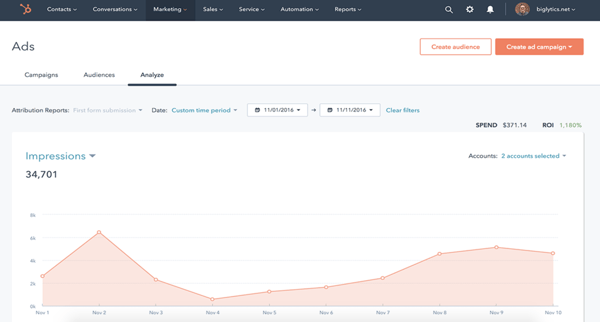
HubSpot’s Ad Tracking Software helps you with your inbound marketing strategy and campaigns. You can run all of your campaigns out of this tool from start to finish — meaning, the HubSpot supports ad creation, management, and reporting across different networks.
Other unique and notable features you get from HubSpot’s Ad Tracking Software are:
- Automate ad targeting using Lists which will sync your leads and audience for targeting opportunities.
- Manage ad campaigns on Facebook, Instagram, LinkedIn, and Google.
- Report on ROI and leads from the platforms you share your ads on (e.g. LinkedIn, Google).
- Understand audience behavior by identifying which contacts took action and engaged with your ads.
- Align ads with your other marketing efforts — this is simple because HubSpot Ads live with Marketing Hub.
- Use data from your HubSpot CRM to inform your campaigns and help you determine which ads are most likely to convert contacts into paying customers.
Price of HubSpot Ad Tracking Software
Free, or you can start with/ upgrade to a paid plan depending on your needs and goals.
2. AdRoll
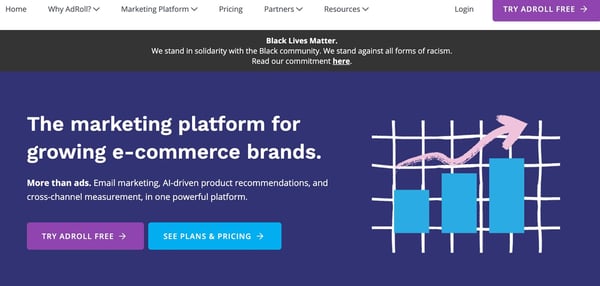
AdRoll is a platform for ecommerce businesses that focuses on ads, email marketing, AI-based product recommendations, and cross-channel measurement. The platform acts as a home base for all of your business’s marketing and advertising activity. Here are some of AdRoll’s other notable capabilities:
- Personalize dynamic ads using AI-powered product recommendations to target your audience members.
- Share targeted videos and display ads to foster emotional connections with your audience.
- Create relevant product offers, dynamic ads, emails, and other forms of outreach using data you’ve collected about your customers along with AdRoll’s 1.2 billion shopper profiles.
- Use advanced measurement and attribution to identify growth opportunities and determine customer lifetime value (CLV).
- Target your audience with paid digital media and account-based ad campaigns by integrating AdRoll with your CRM.
Price of AdRoll
Plans range from $0-$19 depending on your needs.
3. RollWorks
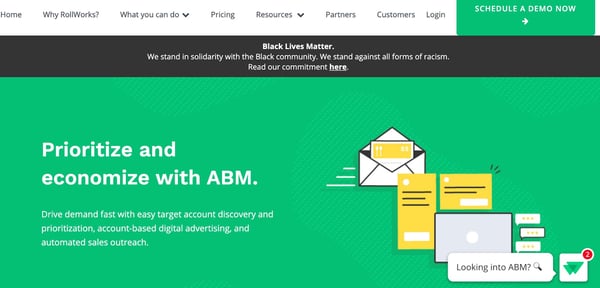
RollWorks is an account-based platform meant to help you identify target accounts, engage them via ads and various channels, and measure your impact and success in doing so. The tool is capable of target account identification, target account prioritization, automating various sales tasks, and account-based advertising. Here are some more things you can do with RollWorks:
- Reach and engage highly-qualified accounts with ads, lead-gen tactics, and targeted account-based marketing (ABM) programs.
- Use account-based ads to identify your target audience and encourage those people to visit your website.
- Create retargeting ads to bring leads back to your site.
- Integrate RollWorks with your HubSpot CRM to reach contacts that matter most to your business and view RollWorks data within the CRM.
- Use dynamic messages to personalize your ads and make them relevant.
- Automate your sales emails and follow-ups to save time and increase chances of engagement.
- Easily track the success of your campaigns, account-based programs, sales automation sequences.
Price of RollWorks
The Starter plan costs $975 per month, and you can upgrade from there.
4. Influ2

Influ2 is a person-based ad platform meant specifically for B2B. With the tool, show your ads to specific people and then measure the success of the ads among those targeted. Here are some other things you can do with Influ2:
- Select individuals to see your ads so they’re highly-relevant and targeted.
- Improve brand awareness and recognition by only displaying curated ads and information to hand-selected audience members.
- Connect Influ2 with your HubSpot CRM to sync contacts and targeting efforts with Sales and Marketing.
- Use the Name-by-Name Tracker feature to see the names, emails, titles, companies, LinkedIn profiles of the people who interact with your ads.
- Determine the best time to reach out to a prospect by tracking their engagement via views and clicks.
- Keep your current customers engaged with person-based ads by offering relevant and informative content when they need it.
Price of Influ2
Contact Influ2 for demo and quote.
5. Adstream
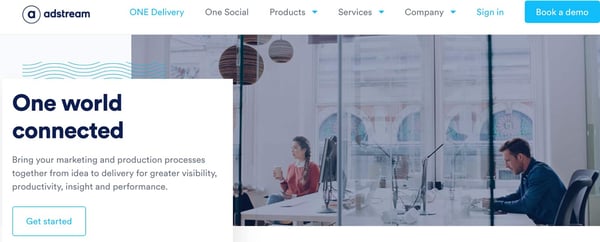
Adstream is an all-in-one digital asset management and ad delivery solution for broadcasters, publishers, and online services. It’s a Connectivity Suite, meaning it integrates and connects all aspects of your marketing including digital asset management and delivery, traffic management, media automation, and analytics. Here are some more notable capabilities:
- Use a single workflow across marketing teams for total transparency and easy collaboration while organizing, creating, and sharing digital content.
- Distribute your digital content among Adstream’s 79,000 global media destinations that the platform can connect you to.
- Auto-adjust your content so it suits the different areas it’s being shared in around the world.
- Add your incoming ads to the Traffic Management Inbox — here, you can easily review those ads as well as make edits, approve, and send them to another individual or team (e.g. Production).
- Automate different workflows, or aspects of your workflows, to increase efficiency such as processes related to clearance or usage rights.
- Measure the success of your digital campaigns and processes behind them with analytics, real-time reports, and tracking.
Price of Adstream
Contact Adstream for a quote.
6. 6Sesnse
6Sense is an account-engagement platform with account-based advertising capabilities. The platform uses AI, big data, and machine learning to help you understand and identify your target audience’s buying behavior, prioritize accounts for Sales and Marketing, as well as create and share personalized and engaging campaigns/ content. Let’s look at some more features:
- Engage your target audience members at scale with highly-relevant, unique, cross-channel messages.
- Use account data to create targeted display ads that help you reach key players at target accounts.
- Align Sales and Marketing as a single revenue team on the platform to accurately measure your account-based success.
- Segment data about your target accounts for insight into the success of your campaigns among those specific accounts.
- Use AI to help you predict prospect and account behavior throughout the buyer’s journey so you know when to target them with your ads, campaigns, and personalized messaging.
- Refer to the platform’s Intent Data to discover which accounts are in the market for a product or service like yours with buying signals on first and third-party websites.
Price of 6Sense
Contact 6Sense for pricing information.
7. Celtra
Celtra is a cloud-based software that automates creative production. With the platform, all aspects of collaboration will be streamlined and more efficient thanks to its cloud-based nature — team members can design, approve, and share digital assets among markets, campaigns, and more. Here are some more features to be aware of:
- Use the Ad Builder’s templates to design unique and branded ads without any code — these ads can include ecommerce features as well as video and animation.
- Get real-time reports that include over 100 metrics and dimensions to better understand the success of your creative work, campaigns, and ads.
- Build user-friendly ad products to help you engage prospects.
- Customize your ad products to suit your business with features like shoppable video, product galleries, and text and graphic overlays.
- Gain access to Celtra’s support team and hundreds of on-demand videos and tutorials to help you achieve your goals on the platform.
Price of Celtra
Contact Celtra for pricing information.
Grow Better With Ad Management Tools
Your marketing team is bound to grow better with an effective ad management tool — don’t be afraid to experiment with various options to find the one that meets your needs and goals.

How to Repost Instagram Feed Posts, Stories, IGTV, and Reels
Want to repost and reshare your Instagram content? Wondering how to reshare (regram) Instagram posts without using third-party tools? In this article, you’ll discover in-app features that let you reshare Instagram feed posts, stories, IGTV, and reels. You’ll also find tips to obtain permission to reshare Instagram content legally. To learn how to repost images […]
The post How to Repost Instagram Feed Posts, Stories, IGTV, and Reels appeared first on Social Media Examiner | Social Media Marketing.
from Social Media Examiner | Social Media Marketing https://ift.tt/32bxrqo
via socialmediaexaminer
The 4 Key Signs Your Marketing and Sales Teams Aren’t Aligned
I like to think of marketing and sales as the leads in a buddy cop movie.
Sales is the grizzled veteran on the force who keeps reiterating that they’re “too old for this” whenever some zany misadventure gets started. And marketing is the hot-headed rookie with a chip on their shoulder looking to prove to everyone that they have what it takes to become the department’s first-ever bow-legged sergeant or something.
There’s a lot of potential for a pretty compelling story if the two of them get along, but let’s imagine a movie where they don’t.
In this film, the two have no chemistry nor mutual respect. They let most criminals get away due to lack of communication, and they don’t riff any back-and-forth wisecracks throughout the movie.
And worst of all, they don’t end the movie on a freeze-frame of them jumping in the air, locking into a perfect high-five before the credits roll.
No one would want to see that kind of dysfunction on film — just like no one wants to see that same kind of misalignment between sales and marketing in business. That’s why it’s crucial to stay on top of it when it comes to your company.
Here we’ll cover the key signs of marketing and sales misalignment and see some of the best ways to help remedy it.
1. Your marketing department only cares about MQLs.
According to Troy Arias, Marketing Operations Manager at Daxko, marketing departments often prioritize the wrong KPIs for optimal sales and marketing alignment. He says, “If your marketing team is solely focused on an MQL metric, it’s a huge barrier to alignment between departments.”
MQLs (or marketing qualified leads) are often hailed as a gold standard for measuring marketing teams’ performance, but that mentality isn’t fair to sales departments. A sales team isn’t judged by its ability to receive leads — it’s judged by its ability to convert those leads into customers.
A sales team’s success is measured by closed bookings, above all else — and there’s a sizable gap between those two KPIs in the context of most sales pipelines. Once an MQL is passed off, it has to transition to an SQL, be deemed an opportunity, and receive a proposal before closing.
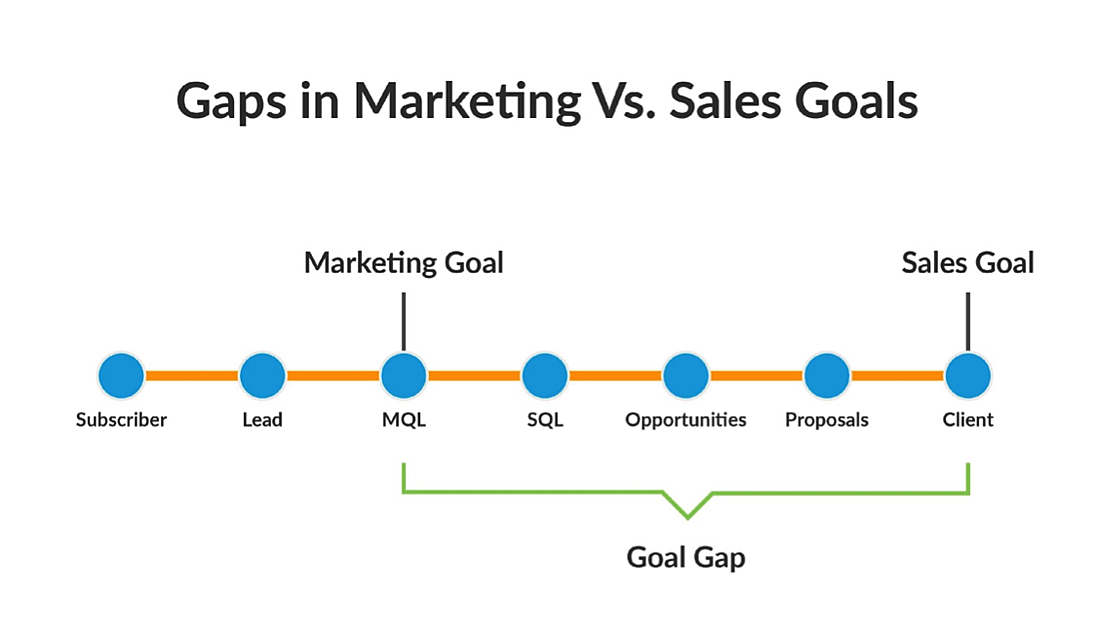
That makes for a massive discrepancy in departmental goals — one that burdens sales more than marketing. If your marketing department only cares about generating MQLs and not closed bookings, it won’t be held accountable for producing mediocre leads.
In this case, it can help to have your marketing department set a revenue goal, based on closed bookings, to ensure that your marketers keep your sales team in mind when gauging leads and go the extra mile to stay on the same page.
2. You don’t have consistent interdepartmental syncs to address results and planned campaigns.
Communication is key when trying to align your sales and marketing efforts. If you want your teams to be on the same page, you can’t keep them siloed. They have to meaningfully interact with each other consistently.
Your sales team needs to be able to discuss the results it’s seeing from the leads marketing is passing along. And both have to understand each other’s respective plans and strategies when it comes to messaging. Additionally, if you’re planning specific campaigns, both departments need to know what to expect from each other.
Ultimately, you need to maintain a mutual understanding between departments. If you don’t, you might create a rift that can lead to wayward smarketing efforts and tension between your sales and marketing teams.
3. Your marketers never ask, “What can I do to make the sales process easier for you?”
Sometimes a little thoughtfulness and legitimate interest can help smooth out some discord and misalignment between sales and marketing departments. One way to get there is for your teams to actively hash out ways to improve or expedite your company’s sales process and pipeline.
Marketers are in control of the first few stages of any smarketing efforts, so the onus is often on them to initiate discussions on how to improve the process. If your marketing team takes a second to better understand how your sales team is handling the MQLs it passes along, it might be able to adjust its efforts to help make the sales process a bit smoother.
From there, your teams can start an active and constructive dialogue on what they want or expect from each other. At the very least, it shows that your marketing team wants to hear your sales team out and keep both departments working as a cohesive unit.
4. Your sales department creates and uses its own sales content exclusively.
Marketing teams are often tasked with creating content to support sales efforts — including case studies, presentation decks, and one-pagers. That kind of collateral, known as sales content, is different from marketing content.
Where marketing content is more general and attention-grabbing, sales content is more pointed and brand-specific. That said, the term “sales” in “sales content” is a bit misleading — marketing departments often have a significant role in creating that kind of collateral. And if your marketing team has no place in that process, your departments probably aren’t on the same page.
Marketers are generally better-equipped to create content — that’s a big part of what they do — so if your sales department is monopolizing that role, it might mean there’s some tension or a lack of communication between teams.
Three Ways to Fix Poor Alignment
1. Encourage teams to listen to each other.
If you want your sales and marketing efforts to align, your teams need to listen to one another and — corny as this sounds — actually hear each other. Both departments need to have a comprehensive understanding of your sales process.
If they don’t, neither can make the kind of thoughtful, actionable recommendations needed to improve each department’s role in it. Sales and marketing both need to consider the other’s perspective — to listen and learn until they can thoroughly explain both sides of your sales process in full.
Doing so can at least partially remedy any of the points listed above. If your teams are willing and able to legitimately hear each other out, they can develop the empathy, knowledge, collaboration skills, and strategic vision necessary to bring the departments together.
2. Push for consistency in expectations, data, and technology.
One of the bigger parts of successfully aligning marketing and sales is promoting and sustaining consistency. You need to ensure that your teams are operating with an understanding of the same ultimate goals, from a baseline of the same information.
That point begs the question, “How do you keep things that cohesive?” Well, you can start by keeping lines of constant contact open — supplemented by frequent meetings and briefings between departments.
As I mentioned earlier, it’s important to have routine syncs between sales and marketing to keep both teams on the same page in terms of overall goals and day-to-day operations.
It’s also important that both sales and marketing have access to the same data as a reference point for their mutual and individual efforts. It helps a marketing department to see how its work is impacting sales and vice versa.
That kind of visibility can come from mutually accessible technology — like a CRM that covers both sales and marketing.
3. Consider your sales team’s input in content marketing.
There’s a solid chance that your content marketing efforts are more bloated than they need to be. You might be holding onto and promoting content that doesn’t actually help your sales reps.
You want to produce content that enriches your customers’ professional lives. Provide them with insight that educates and intrigues them, and that often takes an intimate understanding of your prospects’ interests and wants — salespeople can provide you with that information.
It’s their job to understand what makes your prospects and customers tick, so if you want your marketing department to produce solid content that your sales team can ultimately take advantage of, it’s important to involve some salespeople in your content creation process.
In doing so, you’re letting your salespeople steer your subject matter in the right direction, providing them with leads that they know have a personal interest in your offering, fostering interdepartmental collaboration, and giving both departments a stake in the other’s operations.
Marketing and Sales Alignment is a Must for Businesses
You might be wondering, “Is marketing and sales alignment really that important? Does my company actually need to go through the effort to make sure those departments are in sync?”
The answer is “Absolutely! Yes! Yes! A thousand times yes! Yes, again!”
Marketing and sales alignment is every bit as important as this article makes it out to be. It hurts your business across the board if you don’t have a grasp on it, and it doesn’t just hit one of your departments.
It undermines the effectiveness of both your marketing and sales efforts as a whole. A study from Forrester found that 43% of CEOs believed that misalignment had cost them sales.
If you want to get the most out of either of your teams, you have to make sure they’re on the same page and in constant contact. There are certain tips and tricks you can employ to get there — all of which are underlaid by one fundamental strategy: creating an environment that encourages openness and collaboration.
You need to have your sales and marketing departments constantly interacting with and learning from each other. If you can facilitate that kind of environment in your office, you’ll put yourself in the best position possible to have a consistent, fluid interchange of ideas and strategies between departments to get as much as possible from both teams.
Editor’s note: This post was originally published in June 2014 and has been updated for comprehensiveness.

No Spam: cómo enviar campañas de Email Marketing sin salir de Gmail
Una pregunta recurrente en los emprendedores es si existe la posibilidad de enviar campañas de email marketing desde Gmail.
Gmail no es un servicio pensado para llevar a cabo este tipo de envíos masivos.
Pero lo cierto es que sí existen maneras de hacerlo.
Además, pueden realizarse con buenas prácticas para evitar ser catalogados como spam y evitar los límites de envío que existen.
En este post voy a explicarte cómo hacerlo.
>>> Email marketing gratis: plataformas para navegar en un mar de leads.
¿Se pueden enviar Campañas de Email Marketing desde Gmail?
En primer lugar, hay que aclarar que Gmail no está pensado para enviar campañas de email marketing masivas. Se trata de un servicio de mensajería personal.
No es exagerado afirmar que se ha convertido en el más popular entre los usuarios, por encima de servicios similares como Outlook.
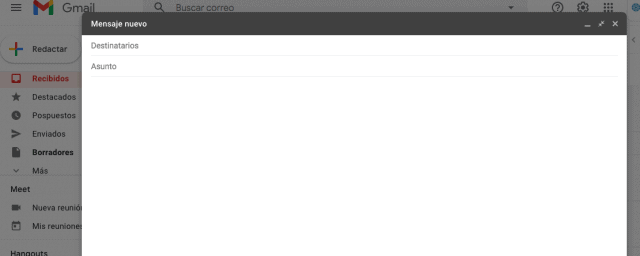
Como su uso está tan extendido, y los usuarios están familiarizados con él, surge la pregunta de si podrían utilizarlo para marketing por correo electrónico.
A continuación abordaré algunos aspectos del por qué no y del cómo sí.
Problemas al enviar Campañas de Email Marketing desde Gmail
En primer lugar hay que dejar claro que enviar campañas de email marketing directamente desde Gmail plantea diversos problemas.
Por eso es recomendable no hacerlo sin contar con una alternativa.
Algunos de los problemas a los que te vas a enfrentar son los siguientes:
Listas de Correo: límite de envío de Gmail
Gmail establece un límite de envío diario de 500 correos. Esto acota la capacidad para enviar campañas de email marketing a listas de correo con grandes volúmenes de suscriptores.
En el caso de contar con una cuenta de empresa, este límite asciende a 2000 correos diarios.
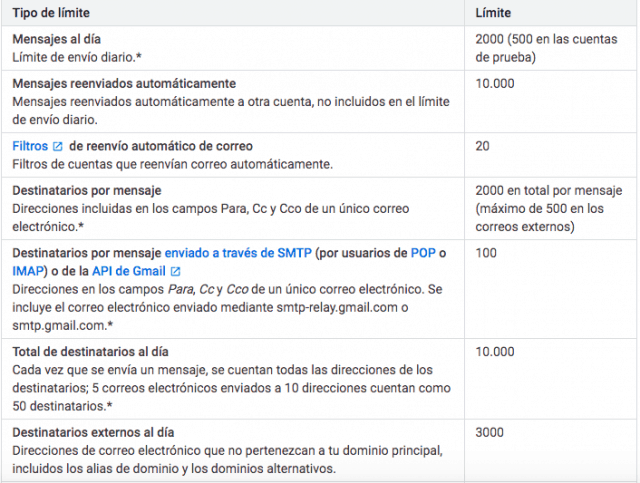
Debes tener en cuenta que deben pasar 24 horas entre un envío y otro una vez que alcances el límite.
Sé que 500 y 2000 correos diarios parecen números abultados, sin embargo, en el email marketing se quedan cortos.
Baja entregabilidad y no spam en campañas de email marketing
La entregabilidad es una de las claves fundamentales para que el marketing por correo electrónico funcione.
La entregabilidad es:
La posibilidad que tiene un correo electrónico de llegar a la bandeja de entrada y no irse al spam.
Si los correos no se entregan en su mayoría, difícilmente podrán cumplir con su objetivo. Uno de ellos es tener una buena tasa de apertura.
La tasa de apertura es:
Los correos electrónicos de una campaña de email marketing que fueron abiertos por el usuario.
Al no estar pensado como servicio de envío masivo, y con unos filtros de no spam bastante estrictos, la entregabilidad de un envío numeroso a través de Gmail será baja.
Si pasa esto, solo habrás conseguido desperdiciar tiempo y recursos.
Campañas de Email Marketing sin estadísticas
Otro de los grandes inconvenientes es que no contarás con ninguna estadística si envías campañas de email marketing desde Gmail.
Las métricas (tasa de apertura, CTR, emails entregados, etc.) son indicadores muy importantes para saber si las campañas están funcionando.
Te ayudan a mejorar las siguientes campañas para aumentar su rendimiento.
Hay herramientas como Acumbamail que, incluso en la licencia gratuita, te ofrecen estadísticas útiles.
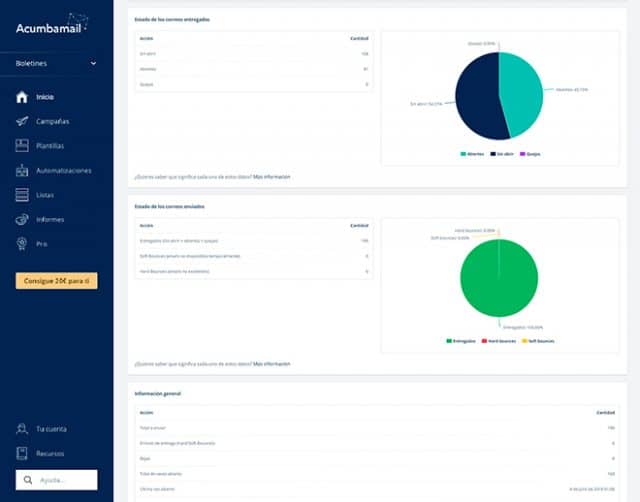
Por el contrario, si llevas a cabo los envíos a través de Gmail, no contarás con ningún dato.
Por lo tanto, estarás trabajando totalmente a ciegas.
Gestión de bajas al Enviar Campañas de Email Marketing
Otro grave problema es que la gente a la que envíes no podrá darse de baja para dejar de recibir tus envíos.
Además de ser una mala práctica a la hora de enviar campañas de email marketing, esto podría traerte problemas legales con las regulaciones de tratamiento de datos personales.
Alternativas para Enviar Campañas de Email Marketing desde Gmail
La buena noticia es que existen formas de enviar campañas de email marketing desde Gmail con buenas tasas de entregabilidad, estadísticas y cumpliendo con las regulaciones de tratamiento de datos.
A continuación, detallaré algunas.
Extensiones de Chrome para realizar envíos desde Gmail
En Chrome Store, el marketplace de Google para extensiones, existen múltiples opciones que pueden ayudarte a enviar campañas de email marketing a través de Gmail sin sufrir los problemas antes mencionados.
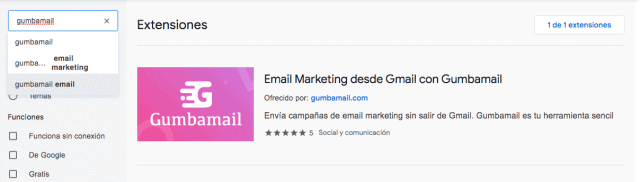
Algunas de las opciones más habituales son aplicaciones como Gmass, MailKing o Gumbamail, que puedes instalar desde aquí.
Las extensiones de Chrome para enviar campañas de Gmail ofrecen planes gratuitos o de pago que puedes seleccionar según tus necesidades.
Ventajas de usar extensiones de Chrome para enviar a través de Gmail
Al utilizar una extensión de Chrome para enviar campañas de email marketing a través de Gmail, podrás encontrar las siguientes ventajas:
#1. Gestionar las campañas de mailing dentro del propio Gmail
Este tipo de aplicaciones te permiten obtener una funcionalidad muy similar a la de una plataforma de email marketing, pero sin abandonar la interfaz de Gmail.
Pudiendo, de este modo, además, utilizar otras aplicaciones del ecosistema de Google como Google Sheets o Google Contacts.
#2. Plantillas prediseñadas personalizables
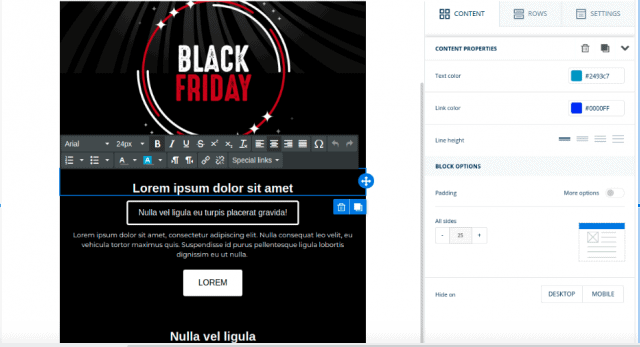
El apartado visual es muy importante a la hora de enviar campañas email marketing.
Es una ventaja añadida contar con un buen editor que te permita personalizar plantillas.
Gumbamail, por ejemplo, tiene más de 100 plantillas prediseñadas personalizables.
#3. Entregabilidad
Al realizar el envío a través de estas extensiones, con sus IP’s dedicadas al respecto, y cumpliendo con las buenas prácticas, la tasa de entregabilidad será mucho mayor.
Tus suscriptores recibirán los envíos sin problemas.
#4. Sin límite para enviar campañas de email marketing
Al realizarse los envíos a través de dichas aplicaciones, no quedarán supeditados al límite impuesto por Gmail.
Podrás enviar tantos correos quieras de acuerdo a la tarifa que hayas seleccionado.
La versión gratuita de Mailking, por ejemplo, permite hacer 2000 envíos al día.
#5. Email Merge
Otra de las ventajas, que no podrías conseguir enviando directamente desde tu cuenta de Gmail sin ayuda de una de estas aplicaciones, es el poder personalizar diversos campos del email, como el nombre y otros datos de tus suscriptores con los que cuentes.
GMass y Gumbamail tienen esta funcionalidad, que se llama Email Merge.
#6. Gestión de listas de suscriptores
Mediante la integración con otros servicios como Google Sheets o Google Contacts, te será muy fácil gestionar tus listas de suscriptores.
#7. Estadísticas completas

Por último, pero no menos importante, estas extensiones, en su mayoría, ofrecen informes completos.
Te permitirán analizar las campañas, medir sus resultados y optimizar futuros envíos para obtener el máximo rendimiento.
Conclusión sobre Enviar Campañas de Email Marketing con Gmail
Como ves, enviar campañas de email marketing sin salir de Gmail es posible siempre y cuando uses las herramientas adecuadas.
Esto es útil si no quieres salirte de la suite de Google para hacer tus envíos.
Las extensiones de Chrome como Gumbamail tienen una curva de aprendizaje sencilla, por lo que será fácil comenzar a usarlas.
Por último, te recuerdo las ventajas de hacer envíos masivos desde Gmail a través de alguna extensión para Chrome:
- No es necesario salir de Gmail para enviar campañas de email marketing.
- Tendrás plantillas personalizables que le darán a tus envíos un aspecto profesional.
- Como cumples con ciertas reglas antispam, la entregabilidad aumenta.
- Evitas las limitaciones en la cantidad de envíos que tienen las cuentas personales y de empresa de Gmail.
- Puedes personalizar tus envíos con el nombre del receptor y otros datos con los que cuentes.
- Tendrás acceso a otras herramientas como Google Sheets para importar tus contactos.
- No enviarás campañas de mailing a ciegas porque contarás con estadísticas.
Si pruebas cualquiera de estas herramientas, me gustaría saber qué te parecieron. Te leo en los comentarios.
from Socialancer https://ift.tt/2TRtWRc
via
Pro Speakers on How to Give a Perfect Keynote Presentation
Two years ago, I was asked to give a presentation about my HubSpot article on emotional marketing. It was by far the both exhilarating and nerve wracking experience of my professional life.
I don’t necessarily hate public speaking. However, leading up to the event, I felt the full responsibility of not only delivering a good presentation but also teaching the audience valuable, actionable information — and that was very intimidating.
I wanted to do a good job, and I wanted to be a good teacher.
Therein lies the importance of keynote presentations: to be effective, they should be educational and entertaining. Do you have a keynote presentation in your future? Read on for some advice from professional speakers.
First, what is a keynote presentation? Glad you asked.
You may also be tasked with a keynote presentation in order to secure funding, make a sale, or update stakeholders or executives. Whatever stage you find yourself on, delivering a keynote presentation is an important responsibility as a public speaker.
How to Give a Perfect Keynote Presentation, According to the Experts
I spoke with four professional speakers on how to deliver a near-perfect presentation. Here are five pieces of advice they shared.
1. Rehearse, rehearse, rehearse.
When it comes to public speaking, practice quite literally makes perfect. Every expert I spoke with mentioned how frequently they rehearse their presentations.
“However much you think you need to rehearse, rehearse 10 times more than that. When you show up to a concert, you expect that the musicians know their songs, and you certainly don’t want the first time they try to play it to be right there on stage. You owe your audience and the folks hiring you to speak the same respect,” said Melanie Deziel, international keynote speaker and founder of StoryFuel. (She received this advice herself from Michael and Amy Port at Heroic Public Speaking.)
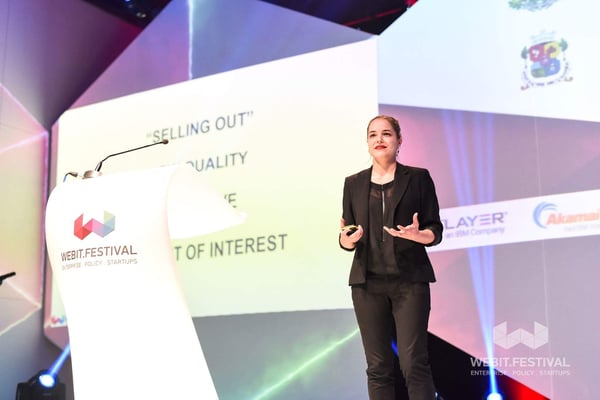
Provided by Melanie Deziel
As more presentations and events become fully virtual, the likelihood of technical difficulties also grows. Rehearsing your content can help you weather any interruptions or last-minute changes.
Rehearsal not only leads to content mastery; it allows freedom in your presentations. “The more you rehearse and become comfortable with the content, the freer you’ll be to take chances, experiment, and truly focus on your delivery, rather than trying to remember what comes next,” shared Deziel.
How do these experts recommend practicing your presentations? “[Use] a mirror,” said Olivia Scott, keynote speaker and founder of Omerge Alliances. “I take the time to see how I’m being received, I look at my body posture, and I look at everything to make sure that I feel good about what I’m delivering. This isn’t exactly a tool or technology, but it’s a way to practice and rehearse.”

Additionally, consider asking friends, family, and trusted colleagues to listen to your practice runs and provide feedback on your presentation.
2. Ask for feedback.
Speaking of feedback, expert orators know to ask for it on a regular basis — from friends, peer groups, mentors, audience members, and clients. “Find a support crew and connect with other speakers in the industry,” mentioned Karen Hopper, keynote speaker and data strategist at M+R. Hopper personally recommends Shine Bootcamp, which provided her with lifelong friendships, helpful feedback, and a priceless education about public speaking.

Provided by Karen Hopper
“We help each other with feedback on our pitches, topics, outlines, and presentations, and we celebrate each others’ wins,” said Hopper. “ … It’s well worth surrounding yourself with people who will cheer for you and who will give you honest feedback — the fastest way to get better is to ruthlessly seek out that feedback.”
Clients can also be an incredibly helpful source of feedback. If you’re asked to speak at an event or conference, consider asking the people who hired you. “I ask my client for their reaction immediately after every presentation. It’s important to know how they felt, and whether the presentation achieved their goals. Every time my client is happy, that’s my most successful presentation,” said Jeff Toister, keynote speaker, author, and customer service expert.

Lastly, the best feedback often comes from the source — in this case, your audience. Whether you ask questions during your presentation (which we’ll discuss next) or ask for feedback following your presentation, it’s never a bad idea to know what your audience thought about your keynote.
Feedback may look different if giving a remote keynote presentation, but it’s still possible.
“It’s been a creative challenge to adapt a talk I’d hoped to give in person to work in a virtual environment. It’s much harder to tell how your talks are received online, without being able to see nodding and note-taking and hear laughter and clapping. But all the feedback I have received [over email] indicated that my talk successfully changed the way many people are thinking about their content idea generation process, and that was the ultimate goal of the talk: to change how people think,” shared Deziel, referring to her recent keynote at Content Marketing World 2020.
3. Engage your audience.
Nobody likes being talked at. Sure, delivering a keynote presentation involves you doing most of the talking, but it doesn’t have to be a one-way conversation. Many of the experts I interviewed encouraged some sort of audience engagement or interaction to enhance your presentation.
“People love to be involved in a presentation. Rather than explain a concept to my audience, I find a way to have them experience it,” said Toister. “For example, when I share how multitasking hurts productivity and causes us to make more errors, I have the audience try a brief multitasking exercise so they can experience the problem themselves.”
Did you know that audience engagement levels drop considerably (14%) if a presenter does most of the talking, versus if the audience talks just as much? Moreover, 64% of people believe that a presentation with two-way interaction is much more engaging than a one-way presentation.
Presentation engagement also takes practice — just like your presentation content itself. “ … Entertainment comes from the performance itself: the way in which you deliver that content and the energy you bring to that delivery. This is a separate skill you need to practice. Work with a coach, watch back recordings of yourself to identify opportunities to improve your craft, and watch videos of top-notch comedians, poets and other speakers to see what you can learn from them,” encouraged Deziel.
Lastly, as important as engagement is, don’t let technology stand in the way. While smartphones and polling software can make audience interaction easier, they can also get in the way of you connecting with your audience. “I prefer to just have people stand up, raise their hand, or clap to participate in the poll. It gets the audience moving, and I don’t have to worry about WiFi connections or whether the polling software is working,” said Toister.
4. Prioritize your content as much as the delivery.
While entertaining and interacting with your audience is helpful and exciting, it shouldn’t take precedence over your presentation content itself. “Nearly all of what the audience can learn from you comes from the content: the stories you tell, the examples you share, the facts you cite and the other information you explain. Carefully crafting those materials and testing it out ensures that the audience will get the information they were promised from your session,” said Deziel.
Tools like PowerPoint, Keynote, Google Slides, and Canva can help you hone your content and develop a story within your presentation. A 2018 Prezi study (another presentation tool option) showed that 90% of people believe a strong narrative makes for a more engaging, interesting presentation. Data can help form arguments and explain facts, but stories stay with your audience long after your time on stage.
Storytelling is yet another way to engage with your audience, especially by evoking emotions like humor. “It’s entertaining to ask questions, saying, ‘Can anyone relate to this? Has anyone ever had this type of experience before?’ and then getting them involved with some laughter around those experiences. Laughter always helps,” said Scott, who presented at INBOUND 2020.
Hopper, who was also a Breakout Speaker at INBOUND 2020, agreed: “Don’t be afraid to be funny or drop in jokes — there are studies that show that laughing actually helps your brain retain information better, so not only will your audience have a good time laughing with you, but they’ll also get more out of your presentation. It’s a win-win!”
5. Focus on the audience.
Finally, everyone can agree that public speaking is either revered or feared. If you relate to the latter and find yourself nervous when giving presentations, turn your focus on the audience.
“Speakers easily get nervous when they focus on themselves and worry too much about their own performance. Focusing on your audience first takes the nerves away and redirects your attention to making sure your audience gets something of value from your keynote,” shared Toister.
That’s the goal of a keynote presentation — to provide value to your audience. Regardless of what story you’re telling, what tools you’re using, or how you’re engaging the crowd, as long as you deliver a presentation that inspires your audience to think differently — even for 30 minutes — you’ve given a perfect keynote presentation.
Note: HubSpot Marketing teams reserve the right to use guest blog author’s likeness across our content as we see fit, including but not limited to HubSpot’s social media channels.

How to Promote Your Content via Social Media
Do you create written content? Wondering how to drive more traffic to your articles, eBooks, or white papers with less effort? In this article, you’ll discover a system for easily promoting each piece of content you produce. #1: Start With an Optimized Title You’ve written an article, eBook, or white paper so you’ve done the […]
The post How to Promote Your Content via Social Media appeared first on Social Media Examiner | Social Media Marketing.
from Social Media Examiner | Social Media Marketing https://ift.tt/3oRH4US
via socialmediaexaminer
13 Simple (But Critical) Tips for Creating Better Landing Pages
There’s no question that landing pages — and the lead-capture forms that come with them — are two of the most important elements of lead generation. Without them, marketers would be much more limited in their ability to convert website visitors into leads — and generate reconversions, too.
That’s because landing pages enable us to direct site visitors to better targeted pages that have the ability to capture leads at a much higher rate than forms on other web pages.
Landing pages also focus your visitors’ attention on one particular offer, limiting the distractions of everything else on your website. Visitors are on a landing page for just one single purpose: to obtain an offer by completing a lead-capture form.
But converting visitors into leads, even with landing pages, is much easier said than done. In fact, there are quite a few best practices every marketer should consider when setting up and optimizing landing pages.
So to keep you on track, here is your landing page tip list, excerpted from our newest ebook, The 30 Greatest Lead Generation Tips, Tricks & Ideas.
1. Include all critical elements of an effective landing page.
Landing pages, sometimes also called “lead-capture pages,” are used to convert visitors into leads by completing a transaction or by collecting contact information from them. In order to make these transactions happen, it’s critically important that your landing pages consist of the following components:
- A headline and (optional) sub-headline
- A brief description of the offer that clearly emphasizes its value
- At least one supporting image
- (Optional) supporting elements such as testimonials or security badges
- And most importantly, a form to capture visitors’ information

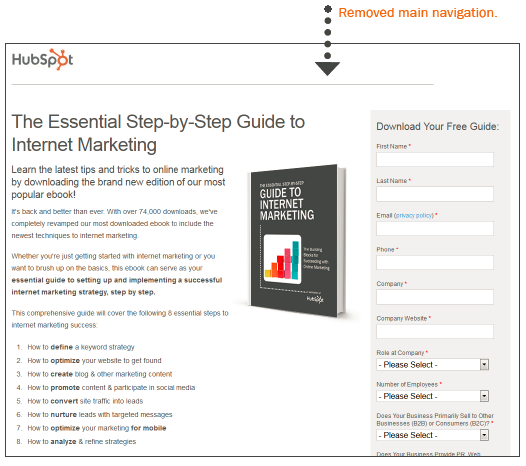
2. Remove the main navigation.
Once a visitor arrives on a landing page, it’s your job to keep them there. So if there are links on the page that enable visitors to move about your website, you run the risk of distracting them, which creates lead generation friction and increases the chance they’ll abandon the page before even converting. And, let’s face it: No respectable marketer wants that. One of the best ways to reduce this friction and increase your landing page conversion rates is to simply remove the main navigation from the page. Simple as that!
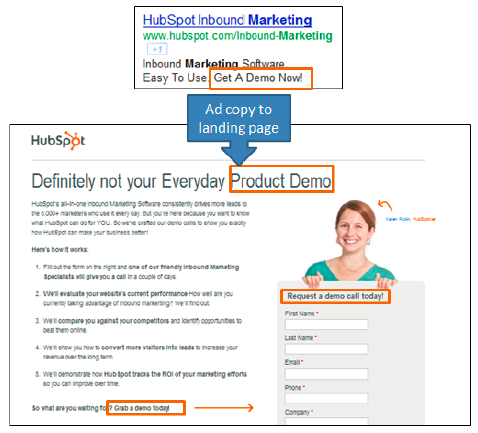
3. Match the headline of the landing page to its corresponding CTA.
Keep your messaging consistent in both your call-to-action (CTA) and the headline of the landing page. If people click on a CTA for a free offer only to find out there’s a catch on the landing page, you’ll instantly lose their trust. Similarly, if the headline reads differently than the CTA, it might lead to confusion, and the visitor might wonder if the CTA is linked to the wrong page. Eliminate any and all confusion, and make sure your landing page consistently reflects what you promised in your call-to-action — and vice versa.
4. Remember: Less is more.
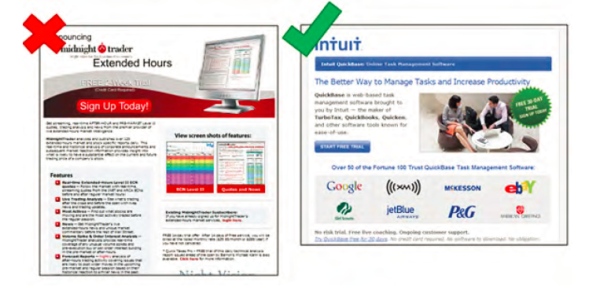
Many of you are probably aware of the phrase “keep it simple, stupid.” Apply that same philosophy to your landing pages. A cluttered page usually results in a distracted, confused, and/or overwhelmed visitor. Talk about landing page friction! Instead, embrace white space, and keep the text and images on the page simple and to-the-point.
5. Emphasize the offer’s value.
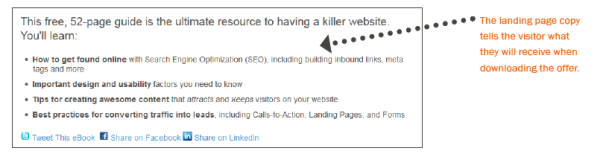
Highlight the benefits of the offer with a brief paragraph or a few bullet points. The best landing page description offers more than just a list what comprises the offer; it also clearly highlights the value of the offer and gives visitors a compelling incentive to download. For example, instead of “Includes specifications of product XYZ,” say something along the lines of, “Find out how XYZ can increase productivity by 50%.” In other words, emphasize how the offer addresses a specific problem, need, or interest your target audience cares about.
6. Encourage social sharing.
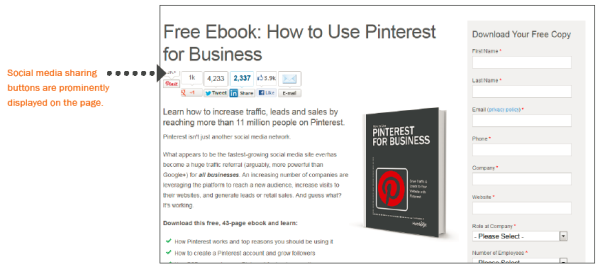
Don’t forget to include social media sharing buttons that enable your prospects to evangelize your content and offers. To limit cluttering, just be sure to only include buttons for the social platforms your audience uses. And don’t forget to add an email forwarding option, since people have different sharing preferences. Keep in mind that even if your social media contacts never buy from you, there’s always a possibility that someone in their personal network will!
7. Create more landing pages to generate more leads.
According to HubSpot’s Marketing Benchmarks Report, companies see a 55% increase in leads when increasing their number of landing pages from 10 to 15. The takeaway is simple: The more content, offers, and landing pages you create, the more opportunities you have to generate leads for your business. More landing pages also usually means more targeted content that better appeals to your various buyer personas, which can help to increase your conversion rates. To increase the number of landing pages you have on your site, invest in an easy-to-use landing page creation tool, create more offers, tweak the offers you already have to cater to individual personas, and repurpose content you already have. In fact, we elaborate on all of the above in this blog post about why you (yes, you) need to create more landing pages.

8. Only ask for the information you really need.
You might be wondering how much or how little information you should require in your forms. There is no magic answer to this, but the best balance is to collect only the information you really need to qualify leads. In general, the fewer fields you have on a form, the higher the conversion rate. This is because, with each new field you add to a form, it creates more work for the visitor, and thus fewer conversions. A longer form looks like more work and will often be avoided altogether. On the other hand, the more fields you require, the better quality those leads will likely be, because they thought your offer was valuable enough to warrant a form completion. Essentially, the best way to determine what form length works best for your business is to test it for yourself.
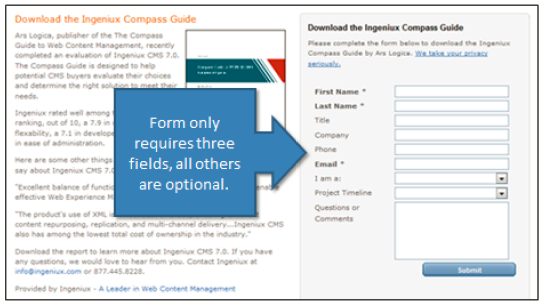
9. Consider whether “To Submit, or Not to Submit?”
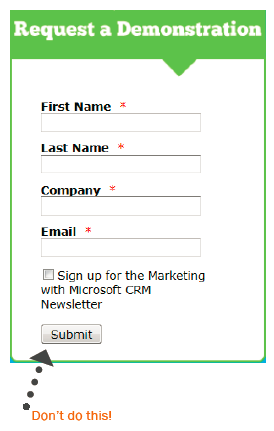
That is the question most of your visitors are probably asking. That’s why one simple yet effective way to increase form conversion rates is to avoid using the default word “Submit” on your form button. If you think about it, no one wants to “submit” to anything. Instead, turn the statement into a benefit that relates to what prospects will be getting in return. For example, if the form is to download a brochure kit, the submit button should say, “Get Your Brochure Kit.” Other examples include “Download Whitepaper,” “Get Your Free Ebook,” or “Subscribe to Our Newsletter.” Here’s another helpful tip: Make the button big, bold, and colorful, and make sure it looks like a button, which is usually beveled and appears “clickable.”
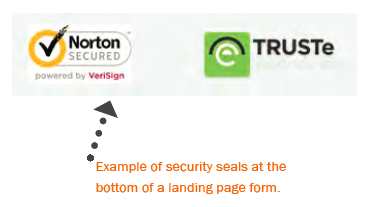
10. Reduce anxiety with proof elements.
People are even more resistant to give up their personal information now than ever before. It’s understandable, considering all the spam out there. Luckily, there are a few different features you can add to your landing pages to help reduce visitors’ form completion anxiety:
- Add a privacy message (or a link to your privacy policy) that indicates visitors’ email addresses will not be shared or sold.
- If your form requires sensitive information, include security seals, a BBB rating, or certifications so visitors know their information is safe and secure.
- Add testimonials or customer logos. It’s a great way to leverage social proof. For example, if your offer is for a free trial of your product or service, you might want to include a few customer testimonials about that particular product or service.
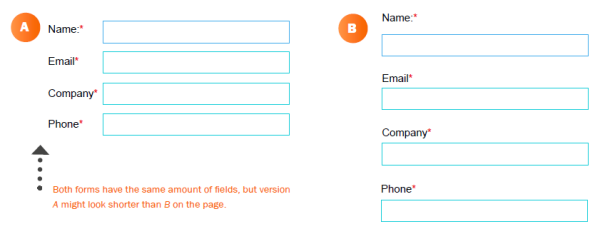
11. Make the form appear shorter.
Sometimes people won’t fill out a form just because it looks long and time-consuming. If your form requires a lot of fields, try making the form appear shorter by adjusting its styling. For example, reduce the spacing in between fields or align the titles to the left of each field instead of above it so that the form appears shorter. If the form covers less space on the page, it may seem as if you’re asking for less. And whenever possible, implement Smart Fields — dynamic form fields that automatically adjust to a shortened version if a visitor has already been entered into your marketing database.
12. Include rich media on your landing pages.
In this day and age, one of the ways to make your landing pages stand out is to include rich media.
For example, you can have moving GIFs, videos, and interactive images. While design isn’t necessarily the most important component of a landing page, it’s important that your design helps your landing pages stand out.
The goal is to entice the user to feel compelled to download your content offer. Design can help with this.
13. Pay attention to the copy.
The most critical component of your landing pages is to have copy that inspires users to download your offer. How do you do this?
Well, the best way is to write copy that is targeted toward your persona. This means that your target market should feel like they could’ve written the copy themselves. When your target market feels like you understand their problems, they’re more likely to download your offer.
HubSpot’s landing page builder, you can integrate with companies like
briX and
Ceros to make your landing pages stand out.

How to Remove Render-Blocking JavaScript From Your WordPress Website
Have you ever finished creating a WordPress website and loved everything about it? Then, promptly began to hate it after realizing it takes forever to load?
Not only are slow loading speeds a nuisance for you and your visitors, but they can also cost you significantly when it comes to SEO. Since 2010, Google algorithms have
accounted for loading speed in ranking decisions, so slow pages appear lower on results pages.
You might be familiar with the common culprits of poor page performance — uncompressed image files, insufficient hosting, and lack of caching to name a few. But, there’s another often-overlooked perpetrator in play: render-blocking JavaScript.
Don’t be mistaken — JavaScript is awesome. It helps to add dynamic, interactive, engaging elements that improve the functionality and usability of your website. But, too much of it can be a huge time hog.
Here’s why: When a web browser first loads a web page, it parses all the page’s HTML before displaying it onscreen to a visitor. When the browser encounters a link to a JavaScript file or an inline script (i.e., JavaScript code written within the HTML document itself) while parsing, it pauses the HTML parsing while fetching and executing this JavaScript code, which slows everything down.
If you’ve optimized your pages in WordPress and are still experiencing problems, JavaScript may very well be the culprit. Sometimes this code is important to run on the first load, but much of the time it can be removed or delayed until the very end of the loading queue.
In this post, we’ll show you how to remove this pesky code from your WordPress website and give your performance a boost.
1. Identify the render-blocking JavaScript code.
Before making any changes, you first need to locate the offending JavaScript. The best way to do this is by using Google’s PageSpeed Insights tool. Simply plug in your site’s URL, and click Analyze.
When the scan is complete, Google assigns your website an aggregate speed score, from 0 (slowest) to 100 (fastest). A score in the 50 to 80 range is average, so you’ll want to land in the upper part of this range or above it.
To identify render-blocking JavaScript files that are slowing your page, scroll down to Opportunities, then open the Eliminate render-blocking resources accordion.
.png?width=1500&name=remove%20render%20blocking%20javascript%20(update).png)
You’ll see a list of files slowing the “first paint” of your page. In other words, these files affect the loading time of all content that appears in the browser on the initial page load. This is also called “above-the-fold” content.
Take note of any files ending with the .js extension, as these are the ones you’ll want to focus on.
2. Remove the identified JavaScript manually or with a plugin.
Now that you’ve identified the issue, there are two ways to go about fixing it in WordPress: manually, or with a plugin. We’ll cover the plugin solution first.
Several WordPress plugins can reduce the effect of render-blocking JavaScript on WordPress websites. Let’s discuss two popular solutions, Autoptimize and W3 Total Cache.
How To Remove Render Blocking JavaScript With the Autoptimize Plugin
Autoptimize is a free plugin that modifies your website files to deliver faster pages. Autoptimize works by aggregating JavaScript files (and inline JavaScript code if you choose), minifying the JavaScript (i.e., reducing file size by removing redundant or unnecessary code), and delaying its loading.
Since you’re modifying the backend of your site, remember to use caution with this plugin or any similar plugin. To remove render-blocking JavaScript with Autoptimize:
1. Install and activate the Autoptimize plugin.
2. From your WordPress dashboard, select, Settings > Autoptimize.
3. Under the JS, CSS & HTML tab, check the box next to Optimize JavaScript code?.
4. If the box next to Aggregate JS-files? is checked, uncheck it.
-1.png?width=1500&name=remove%20render%20blocking%20javascript%20(update)-1.png)
5. At the bottom of the page, click Save Changes and Empty Cache.
6. Scan your website again with PageSpeed Insights and check for an improvement.
7. If PageSpeed Insights still reports render-blocking JavaScript files, return to Settings > Autoptimize and check the box next to Aggregate JS-files?.
8. Click Save Changes and Empty Cache.
How To Remove Render Blocking JavaScript With the W3 Total Cache Plugin
W3 Total Cache is another widely-used caching plugin that helps address laggy code. If you’re already using the solution, it’s easy to implement this additional feature. To remove render-blocking JavaScript with W3 Total Cache:
1. Install and activate the W3 Total Cache plugin.
2. A new Performance option will be added to your WordPress dashboard menu. Select Performance > General Settings.
3. In the Minify section, check the box next to Minify, then set Minify mode to Manual.
-Nov-02-2020-05-55-09-44-PM.png?width=1500&name=remove%20render%20blocking%20javascript%20(update)-Nov-02-2020-05-55-09-44-PM.png)
4. Click Save all settings at the bottom of this section.
5. In the dashboard menu, select Performance > Minify.
6. In the JS section next to JS minify settings, make sure the Enable box is checked. Then, under Operations in areas, open the first Embed type dropdown and choose Non-blocking using “defer”.
-3.png?width=1500&name=remove%20render%20blocking%20javascript%20(update)-3.png)
7. Under JS file management, choose your active theme from the Theme dropdown.
8. Refer back to your PageSpeed Insights results from your earlier scan. For each item under Eliminate render-blocking resources ending in “.js”, click Add a script in the JS minify settings area. Then, copy the full URL of the JavaScript resource from PageSpeed Insights and paste it into the File URI field.
-2.png?width=1500&name=remove%20render%20blocking%20javascript%20(update)-2.png)
9. Once you’ve pasted in all render-blocking JavaScript resources reported by PageSpeed Insights, click Save Settings & Purge Caches at the bottom of this page area.
10. Scan your website again with PageSpeed Insights and check for an improvement.
How to Remove Render-Blocking JavaScript Manually
Plugins can handle the backend work for you. Then again, plugins themselves are just more files added to your web server. If you want to limit these extra files, or if you’d just rather handle the programming yourself, you can address the render-blocking code manually.
To do this, locate the <script> tags in your website files for the resources identified in your PageSpeed Insights scan. They will look something like this:
<script> tags tell the browser to load and execute the script identified by the src (source) attribute. The problem with this process is that this loading and executing delays the browser’s parsing of the web page, which impacts the overall load time:
-Nov-02-2020-05-55-09-57-PM.png?width=1500&name=remove%20render%20blocking%20javascript%20(update)-Nov-02-2020-05-55-09-57-PM.png)
To resolve this, you can add either the async (asynchronous) or the defer attribute to the script tags for render-blocking resources. async and defer are placed like so:
While they have similar effects on load times, these attributes tell the browser to do different things.
The async attribute signals the browser to load the JavaScript resource while parsing the rest of the page and executes this script immediately after it has been loaded. Executing the script pauses HTML parsing:
-4.png?width=1500&name=remove%20render%20blocking%20javascript%20(update)-4.png)
Scripts with the defer attribute are also loaded while the page is parsed, but these scripts are delayed from loading until after the first render or until after the more essential portions have loaded:
-Nov-02-2020-05-55-09-35-PM.png?width=1500&name=remove%20render%20blocking%20javascript%20(update)-Nov-02-2020-05-55-09-35-PM.png)
The defer and async attributes should not be used together on the same resource, but one may be better suited for a particular resource than the other. Generally, if a non-essential script relies on a script to run before it, use defer. The defer attribute ensures that the script will run after the preceding necessary script. Otherwise, use async.
3. Re-run a site scan.
After making your changes, conduct one final scan of your website through PageSpeed Insights and see what impact your changes had on your score.
Hopefully, there’s a noticeable improvement, but don’t worry if not. Many factors can inhibit page performance, and finding and eliminating them is worth the effort.
4. Check your website for bugs.
In addition to a rescan, check your pages to make sure your site works. Does the page load correctly? Are all elements showing up? If something has broken or fails to load properly, revert your changes and troubleshoot the issue.
If you’ve reached a point where you’ve repeatedly tried various measures with minimal speed gains, it might be best to consider other ways to speed up your pages, rather than risk breaking your site.
Optimizing Your Site for Users
Many factors contribute to your users’ experience on your website, but few are more important than load time. Whenever you make big changes to content or appearance on your WordPress site, you should always consider how such changes affect performance.
Now that you’ve removed the render-blocking JavaScript, you should continue to optimize your website’s speed by analyzing other features that are known to slow down performance. Try to incorporate regular speed testing into your site maintenance schedule — staying ahead of any potential issues will be critical to your success.

The Who, What, Why, & How of Digital Marketing
With how accessible the internet is today, would you believe me if I told you the number of people who go online every day is still increasing?
It is. In fact, “constant” internet usage among adults increased by 5% in just the last three years, according to Pew Research. And although we say it a lot, the way people shop and buy really has changed along with it — meaning offline marketing isn’t as effective as it used to be.
Marketing has always been about connecting with your audience in the right place and at the right time. Today, that means you need to meet them where they are already spending time: on the internet.
Enter digital marketing — in other words, any form of marketing that exists online.
At HubSpot, we talk a lot about inbound marketing as a really effective way to attract, engage, and delight customers online. But we still get a lot of questions from people all around the world about digital marketing. So, we decided to answer them. Click the links below to jump to each question, or keep reading to see how digital marketing is carries out today.
- What is digital marketing?
- Why digital marketing?
- Digital Marketing Examples
- What does a digital marketer do?
- Inbound Marketing vs. Digital Marketing: Which is it?
- Does digital marketing work for all businesses?
- Why is digital marketing important?
- How to Do Digital Marketing
- I’m ready to try digital marketing. Now what?
So, how do you define digital marketing today?
A seasoned inbound marketer might say inbound marketing and digital marketing are virtually the same thing, but there are some minor differences. And conversations with marketers and business owners in the U.S., U.K., Asia, Australia, and New Zealand, I’ve learned a lot about how those small differences are being observed across the world.
At this stage, digital marketing is vital for your business and brand awareness. It seems like every other brand has a website. And if they don’t, they at least have a social media presence or digital ad strategy. Digital content and marketing is so common that consumers now expect and rely on it as a way to learn about brands.
Long story short, to be competitive as a business owner, you’ll need to embrace some aspects of digital marketing.
Because digital marketing has so many options and strategies associated with it, you can get creative and experiment with a variety of marketing tactics on a budget. With digital marketing, you can also use tools like analytics dashboards to monitor the success and ROI of your campaigns more than you could with a traditional promotional content — such as a billboard or print ad.
How does a business define digital marketing?
Digital marketing is defined by the use of numerous digital tactics and channels to connect with customers where they spend much of their time: online. From the website itself to a business’s online branding assets — digital advertising, email marketing, online brochures, and beyond — there’s a spectrum of tactics that fall under the umbrella of “digital marketing.”
The best digital marketers have a clear picture of how each digital marketing campaign supports their overarching goals. And depending on the goals of their marketing strategy, marketers can support a larger campaign through the free and paid channels at their disposal.
A content marketer, for example, can create a series of blog posts that serve to generate leads from a new ebook the business recently created. The company’s social media marketer might then help promote these blog posts through paid and organic posts on the business’s social media accounts. Perhaps the email marketer creates an email campaign to send those who download the ebook more information on the company. We’ll talk more about these specific digital marketers in a minute.
Here’s a quick rundown of some of the most common digital marketing tactics and the channels involved in each one.
Search Engine Optimization (SEO)
This is the process of optimizing your website to “rank” higher in search engine results pages, thereby increasing the amount of organic (or free) traffic your website receives. The channels that benefit from SEO include websites, blogs, and infographics.
There are a number of ways to approach SEO in order to generate qualified traffic to your website. These include:
- On page SEO: This type of SEO focuses on all of the content that exists “on the page” when looking at a website. By researching keywords for their search volume and intent (or meaning), you can answer questions for readersand rankhigher on the search engine results pages (SERPs) those questions produce.
- Off page SEO: This type of SEO focuses on all of the activity that takes place “off the page” when looking to optimize your website. “What activity not on my own website could affect my ranking?” You might ask. The answer is inbound links, also known as backlinks. The number of publishers that link to you, and the relative “authority” of those publishers, affect how highly you rank for the keywords you care about. By networking with other publishers, writing guest posts on these websites(andlinking back to your website), andgenerating external attention, you can earn the backlinks you need to move your website up on allthe right SERPs.
- Technical SEO: This type of SEO focuses on the backend of your website, and how your pages are coded. Image compression, structured data, and CSS file optimization are all forms of technical SEO that can increase your website’s loading speed — an important ranking factor in the eyes of search engines like Google.
Content Marketing
This term denotes the creation and promotion of content assets for the purpose of generating brand awareness, traffic growth, lead generation, and customers. The channels that can play a part in your content marketing strategy include:
- Blog posts: Writing and publishing articles on acompanybloghelps you demonstrate your industry expertise and generates organic search traffic for your business. This ultimately gives you more opportunities to convert website visitors into leads for your sales team.
- Ebooks and whitepapers: Ebooks, whitepapers, and similar long-form content helps further educate website visitors. It also allows you toexchange content for a reader’s contact information, generating leads for your company and moving peoplethrough the buyer’s journey.
- Infographics: Sometimes, readers want you to show, not tell. Infographics are a form of visual content that helps website visitors visualize a concept you want to help them learn.
Want to learn and apply content marketing to your business? Check out HubSpot Academy’s free content marketing training resource page.
Social Media Marketing
This practice promotes your brand and your content on social media channels to increase brand awareness, drive traffic, and generate leads for your business. The channels you can use in social media marketing include:
- Facebook.
- Twitter.
- LinkedIn.
- Instagram.
- Snapchat.
- Pinterest.
If you’re new to social platforms, you can use tools like HubSpot to connect channels like LinkedIn and Facebook in one place. This way, you can easily schedule content for multiple channels at once, and monitor analytics from the platform as well.
On top of connecting social accounts for posting purposes, you can also integrate your social media inboxes into HubSpot, so you can get your direct messages in one place.
Pay Per Click (PPC)
PPC is a method of driving traffic to your website by paying a publisher every time your ad is clicked. One of the most common types of PPC is Google Ads, which allows you to pay for top slots on Google’s search engine results pages at a price “per click” of the links you place. Other channels where you can use PPC include:
- Paid ads on Facebook:Here, users can pay to customize a video, image post, or slideshow, which Facebook will publish to the newsfeeds of peoplewho match your business’s audience.
- Twitter Ads campaigns: Here, users can pay to place a series of posts or profile badges to the news feeds of a specific audience, all dedicated to accomplish a specific goal for your business. This goal can be website traffic, more Twitter followers, tweet engagement, or even app downloads.
- Sponsored Messages on LinkedIn: Here, users can pay to send messages directly to specific LinkedIn users based on their industry and background.
Affiliate Marketing
This is a type of performance-based advertising where you receive commission for promoting someone else’s products or services on your website. Affiliate marketing channels include:
- Hosting video ads through the YouTube Partner Program.
- Posting affiliate links from your social media accounts.
Native Advertising
Native advertising refers to advertisements that are primarily content-led and featured on a platform alongside other, non-paid content. BuzzFeed-sponsored posts are a good example, but many people also consider social media advertising to be “native” — Facebook advertising and Instagram advertising, for example.
Marketing Automation
Marketing automation refers to the software that serves to automate your basic marketing operations. Many marketing departments can automate repetitive tasks they would otherwise do manually, such as:
- Email newsletters: Email automation doesn’t just allow you to automatically send emailsto your subscribers. It can also help you shrink and expand your contact list as needed so your newsletters are only going to the people who want to see them in their inboxes.
- Social media post scheduling: If you want to grow your organization’s presence on a social network, you need to post frequently. This makes manual posting a bit of an unruly process. Social media scheduling tools push your content to your social media channelsfor you, so you can spend more time focusing on content strategy.
- Lead-nurturing workflows: Generating leads, and converting those leads into customers, can be a long process.You can automate that process by sending leads specific emails and content once they fit certain criteria, such as when they download and open an ebook.
- Campaign tracking and reporting:Marketing campaigns can include a ton of different people, emails, content, webpages, phone calls, and more. Marketing automation can help yousort everything you work on by the campaign it’s serving, and then track the performance of that campaign based on the progress all of these components make over time.
Email Marketing
Companies use email marketing as a way of communicating with their audiences. Email is often used to promote content, discounts and events, as well as to direct people toward the business’s website. The types of emails you might send in an email marketing campaign include:
- Blog subscription newsletters.
- Follow-up emails to website visitors who downloaded something.
- Customer welcome emails.
- Holiday promotions to loyalty program members.
- Tips or similar series emails for customer nurturing.
Online PR
Online PR is the practice of securing earned online coverage with digital publications, blogs, and other content-based websites. It’s much like traditional PR, but in the online space. The channels you can use to maximize your PR efforts include:
- Reporter outreach via social media: Talking to journalists on Twitter, for example, is a great way to develop a relationship with the press that produces earned media opportunities for your company.
- Engaging online reviews of your company: When someone reviews your company online, whether that review is good or bad, your instinct might be not to touch it. On the contrary, engaging company reviews helps you humanize your brand and deliver powerful messaging that protects your reputation.
- Engaging comments on your personal website or blog: Similar to the way you’d respond to reviews of your company, responding to the people who are reading your content is the best way to generate productive conversation around your industry.
Inbound Marketing
Inbound marketing refers to a marketing methodology wherein you attract, engage, and delight customers at every stage of the buyer’sjourney. You can use every digital marketing tacticlisted above, throughout an inbound marketing strategy,to create a customer experience that workswith the customer, notagainst them. Here are some classic examples of inbound marketingversustraditional marketing:
- Blogging vs. pop-up ads
- Video marketing vs. commercial advertising
- Email contact listsvs. email spam
Sponsored Content
With sponsored content, you as a brand pay another company or entity to create and promote content that discusses your brand or service in some way.
One popular type of sponsored content is influencer marketing. With this type of sponsored content, a brand sponsors an influencer in its industry to publish posts or videos related to the company on social media.
Another type of sponsored content could be a blog post or article that is written to highlight a topic, service, or brand.
To learn more about sponsored content, check out this blog post.
What does a digital marketer do?
Digital marketers are in charge of driving brand awareness and lead generation through all the digital channels — both free and paid — that are at a company’s disposal. These channels include social media, the company’s own website, search engine rankings, email, display advertising, and the company’s blog.
The digital marketer usually focuses on a different key performance indicator (KPI) for each channel so they can properly measure the company’s performance across each one. A digital marketer who’s in charge of SEO, for example, measures their website’s “organic traffic” — of that traffic coming from website visitors who found a page of the business’s website via a Google search.
Digital marketing is carried out across many marketing roles today. In small companies, one generalist might own many of the digital marketing tactics described above at the same time. In larger companies, these tactics have multiple specialists that each focus on just one or two of the brand’s digital channels.
Here are some examples of these specialists:
SEO Manager
Main KPIs: Organic traffic
In short, SEO managers get the business to rank on Google. Using a variety of approaches to search engine optimization, this person might work directly with content creators to ensure the content they produce performs well on Google — even if the company also posts this content on social media.
Content Marketing Specialist
Main KPIs: Time on page, overall blog traffic, YouTube channel subscribers
Content marketing specialists are the digital content creators. They frequently keep track of the company’s blogging calendar, and come up with a content strategy that includes video as well. These professionals often work with people in other departments to ensure the products and campaigns the business launches are supported with promotional content on each digital channel.
Social Media Manager
Main KPIs: Follows, Impressions, Shares
The role of a social media manager is easy to infer from the title, but which social networks they manage for the company depends on the industry. Above all, social media managers establish a posting schedule for the company’s written and visual content. This employee might also work with the content marketing specialist to develop a strategy for which content to post on which social network.
(Note: Per the KPIs above, “impressions” refers to the number of times a business’s posts appear on the newsfeed of a user.)
Marketing Automation Coordinator
Main KPIs: Email open rate, campaign click-through rate, lead-generation (conversion) rate
The marketing automation coordinator helps choose and manage the software that allows the whole marketing team to understand their customers’ behavior and measure the growth of their business. Because many of the marketing operations described above might be executed separately from one another, it’s important for there to be someone who can group these digital activities into individual campaigns and track each campaign’s performance.
Inbound Marketing vs. Digital Marketing: Which Is It?
On the surface, the two seem similar: Both occur primarily online, and both focus on creating digital content for people to consume. So what’s the difference?
The term “digital marketing” doesn’t differentiate between push and pull marketing tactics (or what we might now refer to as ‘inbound’ and ‘outbound’ methods). Both can still fall under the umbrella of digital marketing.
Digital outbound tactics aim to put a marketing message directly in front of as many people as possible in the online space — regardless of whether it’s relevant or welcomed. For example, the garish banner ads you see at the top of many websites try to push a product or promotion onto people who aren’t necessarily ready to receive it.
On the other hand, marketers who employ digital inbound tactics use online content to attract their target customers onto their websites by providing assets that are helpful to them. One of the simplest yet most powerful inbound digital marketing assets is a blog, which allows your website to capitalize on the terms which your ideal customers are searching for.
Ultimately, inbound marketing is a methodology that uses digital marketing assets to attract, engage, and delight customers online. Digital marketing, on the other hand, is simply an umbrella term to describe online marketing tactics of any kind, regardless of whether they’re considered inbound or outbound.
Does digital marketing work for all businesses?
Digital marketing can work for any business in any industry. Regardless of what your company sells, digital marketing still involves building out buyer personas to identify your audience’s needs, and creating valuable online content. However, that’s not to say all businesses should implement a digital marketing strategy in the same way.
B2B Digital Marketing
If your company is business-to-business (B2B), your digital marketing efforts are likely to be centered around online lead generation, with the end goal being for someone to speak to a salesperson. For that reason, the role of your marketing strategy is to attract and convert the highest quality leads for your salespeople via your website and supporting digital channels.
Beyond your website, you’ll probably choose to focus your efforts on business-focused channels like LinkedIn where your demographic is spending their time online.
B2C Digital Marketing
If your company is business-to-consumer (B2C), depending on the price point of your products, it’s likely that the goal of your digital marketing efforts is to attract people to your website and have them become customers without ever needing to speak to a salesperson.
For that reason, you’re probably less likely to focus on ‘leads’ in their traditional sense, and more likely to focus on building an accelerated buyer’s journey, from the moment someone lands on your website, to the moment that they make a purchase. This will often mean your product features in your content higher up in the marketing funnel than it might for a B2B business, and you might need to use stronger calls-to-action (CTAs).
For B2C companies, channels like Instagram and Pinterest can often be more valuable than business-focused platforms LinkedIn.
There are a few major benefits to digital marketing. Let’s dive into four of them, now.
1. You can target only the prospects most likely to purchase your product or service.
If you place an advertisement on TV, in a magazine, or on a billboard, you have limited control over who sees the ad. Of course, you can measure certain demographics — including the magazine’s typical readership, or the demographic of a certain neighborhood — but it’s still largely a shot in the dark.
Digital marketing, on the other hand, allows you to identify and target a highly-specific audience, and send that audience personalized, high-converting marketing messages.
For instance, you might take advantage of social media’s targeting features to show social media ads to a certain audience based on variables such as age, gender, location, interests, networks, or behaviors. Alternatively, you might use PPC or SEO strategies to serve ads to users who’ve shown interest in your product or service, or who’ve searched specific keywords that relate to your industry.
Ultimately, digital marketing enables you to conduct the research necessary to identify your buyer persona, and lets you refine your marketing strategy over time to ensure you’re reaching prospects most likely to buy. Best of all, digital marketing helps you market to sub-groups within your larger target audience. If you sell multiple products or services to different buyer personas, this is especially helpful.
2. It’s more cost-effective than traditional marketing methods.
Digital marketing enables you to track campaigns on a daily basis and decrease the amount of money you’re spending on a certain channel if it isn’t demonstrating high ROI. The same can’t be said for traditional forms of advertising. It doesn’t matter how your billboard performs — it still costs the same, whether or not it converts for you.
Plus, with digital marketing, you have complete control over where you choose to spend your money. Perhaps rather than paying for PPC campaigns, you choose to spend money on design software to create high-converting Instagram content. A digital marketing strategy allows you to continuously pivot, ensuring you’re never wasting money on channels that don’t perform well.
By and large, digital marketing is a more cost-effective solution, and provides you unique opportunities to ensure you’re getting the most bang for your buck.
For instance, if you work for a small business with a limited budget, you might try investing in social media, blogging, or SEO – three strategies that can give you high ROI even with minimal spend.
3. Digital marketing lets you outrank bigger players in your industry.
If you work for a small business, it’s likely difficult for you to compete with the major brands in your industry, many of which have millions of dollars to invest in television commercials or nationwide campaigns. Fortunately, there are plenty of opportunities to outrank the big players through strategic digital marketing initiatives.
For instance, you might identify certain long-tail keywords that relate to your product or service, and create high-quality content to help you rank on search engines for those keywords. Search engines don’t care which brand is biggest — instead, search engines will prioritize content that resonates best with the target audience.
Additionally, social media enables you to reach new audiences through influencer marketing. I don’t personally follow any big brands on social media, but I do follow influencers who will occasionally showcase products or services they like — if you work for a small-to-medium sized company, this could be a good avenue to consider.
4. Digital marketing is measurable.
Digital marketing can give you a comprehensive, start-to-finish view of all the metrics that might matter to your company — including impressions, shares, views, clicks, and time on page. This is one of the biggest benefits of digital marketing. While traditional advertising can be useful for certain goals, its biggest limitation is measurability.
Unlike most offline marketing efforts, digital marketing allows marketers to see accurate results in real time. If you’ve ever put an advertisement in a newspaper, you’ll know how difficult it is to estimate how many people actually flipped to that page and paid attention to your ad. There’s no surefire way to know if that ad was responsible for any sales at all.
On the other hand, with digital marketing, you can measure the ROI of pretty much any aspect of your marketing efforts.
Here are some examples:
Website Traffic
With digital marketing, you can see the exact number of people who have viewed your website’s homepage in real time by using digital analytics software, available in marketing platforms like HubSpot.
You can also see how many pages they visited, what device they were using, and where they came from, amongst other digital analytics data.
This intelligence helps you to prioritize which marketing channels to spend more or less time on, based on the number of people those channels are driving to your website. For example, if only 10% of your traffic is coming from organic search, you know that you probably need to spend some time on SEO to increase that percentage.
With offline marketing, it’s very difficult to tell how people are interacting with your brand before they have an interaction with a salesperson or make a purchase. With digital marketing, you can identify trends and patterns in people’s behavior before they’ve reached the final stage in their buyer’s journey, meaning you can make more informed decisions about how to attract them to your website right at the top of the marketing funnel.
Content Performance and Lead Generation
Imagine you’ve created a product brochure and posted it through people’s letterboxes — that brochure is a form of content, albeit offline. The problem is that you have no idea how many people opened your brochure or how many people threw it straight into the trash.
Now imagine you had that brochure on your website instead. You can measure exactly how many people viewed the page where it’s hosted, and you can collect the contact details of those who download it by using forms. Not only can you measure how many people are engaging with your content, but you’re also generating qualified leads when people download it.
Attribution Modeling
An effective digital marketing strategy combined with the right tools and technologies allows you to trace all of your sales back to a customer’s first digital touchpoint with your business.
We call this attribution modeling, and it allows you to identify trends in the way people research and buy your product, helping you to make more informed decisions about what parts of your marketing strategy deserve more attention, and what parts of your sales cycle need refining.
Connecting the dots between marketing and sales is hugely important — according to Aberdeen Group, companies with strong sales and marketing alignment achieve a 20% annual growth rate, compared to a 4% decline in revenue for companies with poor alignment. If you can improve your customer’s’ journey through the buying cycle by using digital technologies, then it’s likely to reflect positively on your business’s bottom line.
What types of digital content should I create?
The kind of content you create depends on your audience’s needs at different stages in the buyer’s journey. You should start by creating buyer personas (use these free templates, or try makemypersona.com) to identify what your audience’s goals and challenges are in relation to your business. On a basic level, your online content should aim to help them meet these goals, and overcome their challenges.
Then, you’ll need to think about when they’re most likely to be ready to consume this content in relation to what stage they’re at in their buyer’s journey. We call this content mapping.
With content mapping, the goal is to target content according to:
- The characteristics of the person who will be consuming it (that’s where buyer personas come in).
- How close that person is to making a purchase (i.e., their lifecycle stage).
In terms of the format of your content, there are a lot of different things to try. Here are some options we’d recommend using at each stage of the buyer’s journey:
Awareness Stage
- Blog posts. Great for increasing your organic traffic when paired with a strong SEO and keyword strategy.
- Infographics. Very shareable, meaning they increase your chances of being found via social media when others share your content. (Check out these free infographic templates to get you started.)
- Short videos. Again, these are very shareable and can help your brand get found by new audiences by hosting them on platforms like YouTube.
Consideration Stage
- Ebooks. Great for lead generation as they’re generally more comprehensive than a blog post or infographic, meaning someone is more likely to exchange their contact information to receive it.
- Research reports. Again, this is a high value content piece which is great for lead generation. Research reports and new data for your industry can also work for the awareness stage though, as they’re often picked-up by the media or industry press.
- Webinars. As they’re a more detailed, interactive form of video content, webinars are an effective consideration stage content format as they offer more comprehensive content than a blog post or short video.
Decision Stage
- Case studies. Having detailed case studies on your website can be an effective form of content for those who are ready to make a purchasing decision, as it helps you positively influence their decision.
- Testimonials. If case studies aren’t a good fit for your business, having short testimonials around your website is a good alternative. For B2C brands, think of testimonials a little more loosely. If you’re a clothing brand, these might take the form of photos of how other people styled a shirt or dress, pulled from a branded hashtag where people can contribute.
1. Define your goals.
When you’re first getting started with digital marketing, it’s critical you start by identifying and defining your goals, since you’ll craft your strategy differently depending on those goals. For instance, if your goal is to increase brand awareness, you might want to pay more attention to reaching new audiences via social media.
Alternatively, perhaps you want to increase sales on a specific product — if that’s the case, it’s more important you focus on SEO and optimizing content to get potential buyers on your website in the first place. Additionally, if sales is your goal, you might test out PPC campaigns to drive traffic through paid ads.
Whatever the case, it’s easiest to shape a digital marketing strategy after you’ve determined your company’s biggest goals.
2. Identify your target audience.
We’ve mentioned this before, but one of the biggest benefits of digital marketing is the opportunity to target specific audiences – however, you can’t take advantage of that benefit if you haven’t first identified your target audience.
Of course, it’s important to note, your target audience might vary depending on the channel or goal(s) you have for a specific product or campaign.
For instance, perhaps you’ve noticed most of your Instagram audience is younger and prefers funny memes and quick videos — but your LinkedIn audience tends to be older professionals who are looking for more tactical advice. You’ll want to vary your content to appeal to these different target audiences.
If you’re starting from scratch, feel free to take a look at How to Find Your Target Audience.
3. Establish a budget for each digital channel.
As with anything, the budget you determine really depends on what elements of digital marketing you’re looking to add to your strategy.
If you’re focusing on inbound techniques like SEO, social media, and content creation for a preexisting website, the good news is you don’t need very much budget at all. With inbound marketing, the main focus is on creating high quality content that your audience will want to consume, which unless you’re planning to outsource the work, the only investment you’ll need is your time.
You can get started by hosting a website and creating content using HubSpot’s CMS. For those on a tight budget, you can get started using WordPress hosted onWP Engine, using a simple them from StudioPress, and building your site without code using the Elementor Website Builder for WordPress.
With outbound techniques like online advertising and purchasing email lists, there is undoubtedly some expense. What it costs comes down to what kind of visibility you want to receive as a result of the advertising.
For example, to implement PPC using Google AdWords, you’ll bid against other companies in your industry to appear at the top of Google’s search results for keywords associated with your business. Depending on the competitiveness of the keyword, this can be reasonably affordable, or extremely expensive, which is why it’s a good idea to focus building your organic reach, too.
4. Strike a good balance between paid and free digital strategies.
An digital marketing strategy likely needs both paid and free aspects to truly be effective.
For instance, if you spend time building comprehensive buyer personas to identify the needs of your audience, and you focus on creating quality online content to attract and convert them, then you’re likely to see strong results within the first six months despite minimal ad spend.
However, if paid advertising is part of your digital strategy, then the results might come even quicker.
Ultimately, it’s recommended to focus on building your organic (or ‘free’) reach using content, SEO, and social media for more long-term, sustainable success.
When in doubt, try both, and iterate on your process as you learn which channels — paid or free – perform best for your brand.
5. Optimize your digital assets for mobile.
Another key component of digital marketing is mobile marketing. In fact, smartphone usage as a whole accounts for 69% of time spent consuming digital media in the U.S., while desktop-based digital media consumption makes up less than half — and the U.S. still isn’t mobile’s biggest fan compared to other countries.
This means it’s essential to optimize your digital ads, web pages, social media images, and other digital assets for mobile devices. If your company has a mobile app that enables users to engage with your brand or shop your products, your app falls under the digital marketing umbrella, too.
Those engaging with your company online via mobile devices need to have the same positive experience as they would on desktop. This means implementing a mobile-friendly or responsive website design to make browsing user-friendly for those on mobile devices. It might also mean reducing the length of your lead generation forms to create a hassle-free experience for people downloading your content on-the-go. As for your social media images, it’s important to always have a mobile user in mind when creating them, as image dimensions are smaller on mobile devices and text can be cut-off.
There are lots of ways you can optimize your digital marketing assets for mobile users, and when implementing any digital marketing strategy, it’s hugely important to consider how the experience will translate on mobile devices. By ensuring this is always front-of-mind, you’ll be creating digital experiences that work for your audience, and consequently achieve the results you’re hoping for.
6. Conduct keyword research.
Digital marketing is all about reaching targeted audiences through personalized content — all of which can’t happen without effective keyword research.
Conducting keyword research is critical for optimizing your website and content for SEO and ensuring people can find your business through search engines. Additionally, social media keyword research can be helpful for marketing your products or services on various social channels, as well.
Even if you don’t have a full-time SEO strategist, you’ll still want to conduct keyword research. Try creating a list of high-performing keywords that relate to your products or services, and consider long-tail variations for added opportunities.
7. Iterate based off the analytics you measure.
Finally, to create an effective digital marketing strategy for the long-term, it’s vital your team learn how to pivot based off analytics.
For instance, perhaps after a couple of months you find your audience isn’t as interested in your content on Instagram anymore — but they love what you’re creating on Twitter. Sure, this might be an opportunity to re-examine your Instagram strategy as a whole, but it might also be a sign that your audience prefers a different channel to consume branded content.
Alternatively, perhaps you find an older web page isn’t getting the traffic it used to. You might consider updating the page or getting rid of it entirely to ensure visitors are finding the freshest, most relevant content for their needs.
Digital marketing provides businesses with incredibly flexible opportunities for continuous growth — but it’s up to you to take advantage of them.
I’m ready to try digital marketing. Now what?
If you’re already doing digital marketing, it’s likely that you’re at least reaching some segments of your audience online. No doubt you can think of some areas of your strategy that could use a little improvement, though.
That’s why we created Why Digital Marketing? The Essential Guide to Marketing Your Brand Online — a step-by-step guide to help you build a digital marketing strategy that’s truly effective, whether you’re a complete beginner or have a little more experience. You can download it for free here.
Editor’s Note: This blog post was originally published in September 2019, but was updated for comprehensiveness in October 2020.

The Ultimate Guide to Sales and Marketing
Peanut butter and jelly.
Puppies and the park.
Beach days and ice cream.
Some things just obviously go together — but what if I put sales and marketing together in that list? Would you still think they worked better as a pair?
More than likely, you haven’t quite considered your sales and marketing to be the “peanut butter and jelly” of your company. But, sales and marketing alignment is more critical than you think.
Simply put, alignment between marketing and sales is really about focusing on the customer — and, today, the customer’s buying behavior has changed significantly.
Fortunately, the better you can align your sales and marketing teams, the more likely you are to delight a prospect. In fact, organizations with tightly aligned sales and marketing teams are 6% more likely to exceed revenue goals.
Here, we’re going to explore why sales and marketing matter to a company — and, equally importantly, why they matter together.
To start, let’s explore the advantages of both sales and marketing to your organization.
Sales is ultimately critical to your company’s bottom line. You cannot have scalable growth without an impressive sales team. At its most basic, your sales team’s goal is to first qualify prospects, reach out and build relationships with them, and ultimately, provide a solution that will benefit the prospect. When done well, a sales transaction results in a sale, a satisfied customer, and revenue for your company.
For sales teams to excel, your salespeople must be invested in the success of your customers. They must understand your prospects’ pain points and obstacles, and demonstrate how your product or service is a solution — the best solution — to those problems.
Alternatively, marketing is all about igniting interest in potential consumers, and telling the world your company, and its products or services, exists. Marketing uses both emotion and analytics to reach an audience, and convert curious viewers into qualified leads.
Here’s the thing, though — today, a buyer isn’t following the traditional “marketing to sales to customer” funnel.
Instead, each individual prospect follows a unique path. One prospect might know they want to purchase your product before even speaking with a sales rep, because they’ve already been convinced by your Instagram account.
Alternatively, another prospect might speak with a sales rep first, and then require additional marketing in the form of webinars or blog posts, before closing the deal.
Your buyer has unlimited information at her fingertips — she can check out your Facebook page, blog posts, website, and customer product reviews before even speaking with a sales rep.
When a prospect who has already read thirteen customer reviews gets in touch with your sales rep, she’s going to require a different conversation than a prospect who’s only heard of your company from a Facebook ad.
That is why your marketing and sales teams need to be in tight alignment — because your buyer needs to be communicated with, and sold to, wherever and whenever she wants. The traditional sales and marketing tactics no longer work.
To find scalable growth, it’s critical your marketing team communicate all the information they have about a prospect to your sales team before a salesperson even gets on the phone.
Sales and marketing alignment can help your company become 67% better at closing deals, and can help generate 209% more revenue from marketing.
Not aligning your sales and marketing teams isn’t just unhelpful for the customer — it’s also damaging to your bottom line.
But it’s easier said than done. Aligning sales and marketing, particularly when you have a growing company, can feel like an incredibly difficult process.
Fortunately, there are a few strategies you can implement to ensure a smoother relationship between the two teams, immediately.
1. Ask your marketing and sales team to create a buyer persona together.
Your marketers have a firm pulse on the consumer — they’ve conducted extensive research, they’ve engaged with prospects via social media and email, and they’ve held focus groups.
But, more than likely, your marketers haven’t spoken directly to these prospects. They might not fully understand your prospects biggest pain points, or the challenges they face that your product or service currently can’t solve. These insights can only be obtained from your sales team.
Ultimately, to get a full picture of your consumer, it’s critical that each team help craft the buyer persona. For instance, perhaps you have your marketing team create an initial buyer persona through research and brainstorming sessions — but then you gather input from salespeople to modify and refine that persona.
Getting initial input from salespeople, as well as asking for final approval on a buyer persona, is critical to ensure each team is working together with the same consumer in mind.
2. Document content gaps along a buyer’s journey.
Your sales and marketing teams should take the time to compile everything both teams have created to help solve for the customer — including white papers, infographics, e-books, case studies, and email streams.
Then, employees from each team should have a candid discussion about what’s missing. Maybe a sales rep notices your marketing team hasn’t created any e-books on an issue most of her prospects’ face. Alternatively, maybe your marketing team needs your sales team to provide input to craft a more useful customer case study.
Additionally, both teams should take the time to organize and understand what content works best for which stage of the buyer’s journey. While likely a tedious process, this will help both teams become more effective in their strategies over the long-term.
3. Keep track of every interaction your customer has with your company.
Nowadays, this is one of the most critical strategies you need to implement. It eliminates friction for the customer, and it also helps your sales reps close more deals.
For instance, consider how you’d feel if you spoke with a sales rep for the first time, and he already knew where you worked, how long you’d been there, which email newsletters you’d subscribed to, and which company networking events you’d attended. You’d likely be more impressed than if you spoke to a sales rep who’d never heard of you before, right?
It’s vital you find a way to keep track of each interaction your customer has with your company — a free CRM is incredibly useful for this.
4. Be customer-centric with your language.
All too often, marketers and salespeople use different language and rely on different analytics to measure success. For instance, a marketer’s measure of success might be based on blog traffic, Facebook likes, email subscriptions, or YouTube viewers.
Alternatively, a salesperson’s ultimate measure of success is revenue.
However, there is one goal both teams share — and that’s to be customer-centric.
To align both teams, it’s critical your salespeople and marketers consider, first and foremost, the customer. When a marketer emails a prospect, she should consider the person on the other end — and whether they want to receive that email, and how that email could be helpful for them.
Additionally, when a salesperson picks up the phone, she needs to remember the conversation isn’t about making a sale — it’s about solving a problem for a prospect.
With this in mind, your teams will have an easier time blurring the lines between their individual tasks and responsibilities, and recognizing their very unified desire to solve for the customer, even over their own processes.

What is TikTok For Business & Should You Use It in Your Marketing?
Musical.ly, created in 2014, was a music sharing app whose users would share short videos of themselves lip-synching to different music snippets. The platform was among the top 100 downloaded apps for two years straight, and users posted around 13 million videos per day.
In 2018, Musical.ly was purchased by Chinese tech firm Bytedance and merged with the firm’s new app, TikTok. TikTok, like Musical.ly, is a video sharing social network where users share short clips of themselves lip-synching and dancing to trending music. It’s since expanded to house more diverse videos, like short comedy skits and how-to home improvement videos.
After the merger, TikTok’s active user base grew by almost 800%. With such sizable user activity, marketers have realized that the advertising potential on the app is high. The creators of TikTok have also realized this and recently launched a new platform called TikTok For Business.
The platform’s stated goal is to help businesses unleash their creative side by teaching them how to use the app through their e-learning service and guiding them through making advertisements on the Ads Manager platform.
Marketing Options on TikTok For Business
The sole marketing format for businesses to use on TikTok is video advertisements. The TikTok For Business Ads Manager platform helps marketers create these advertisements, and they can choose from five different formats.
TopView Ads
TopView ads on TikTok are videos that appear once a day, immediately after a user opens their app for the first time. Here’s an example of a TopView ad by candy company M&M that they’ve created to advertise a virtual Halloween experience.

In-Feed Ads
In-Feed ads are videos that appear on a user’s discovery page, otherwise known as a For You page. This is where users land when they open the app. The For You page features videos that the TikTok algorithm believes are of interest to the user based on their app activity.
These ads are the fourth video users see as they scroll through their feed. For reference, this type of advertisement is similar to those that appear in a user’s Instagram feed. Here’s an example of an In-Feed ad created by food delivery service GrubHub.
In-Feed ads are especially valuable for marketers looking to use TikTok to drive sales conversions, as the videos can feature a call-to-action (CTA). Acorns, a finance business, has used the In-Feed CTA feature to prompt viewers to download their app.

Some brands have created their own version of In-Feed ads by partnering directly with influencers. For example, Raising Cane’s Restaurant partnered with famous TikTok influencer Chase Hudson to promote their business (you can check it out in the video below).
For You feed.
Branded Hashtag
Branded Hashtags are advertisements that businesses use to inspire TikTokers to create content around a brand-related hashtag of their choice. Businesses using this ad format have exclusive access to the hashtag, which is not the case on other social media sites. Its exclusivity comes along with a high price tag, and reported average costs are around $150,000 USD for six days.
For example, say you’re a sportswear company that has just launched a new athletic shirt called Blue Shirt. You may create a branded hashtag called #InMyBlueShirt, where you encourage TikTok users who have your product to post videos of them doing physical activities in the shirt.
Jennifer Lopez, a music artist, has used the Branded Hashtag feature to advertise her song, Pa Ti. The hashtag is called #PaTiChallenge, and Lopez posted a video of herself dancing where she encouraged other TikTok users to take part in the challenge by replicating her dance.
Hashtag Challenges can be featured on TikTok’s Discover page, where users can find new creators and browse trending hashtags. The Discover page is similar to Instagram’s Explore page.
The hashtag challenge #WorldSeries, sponsored by Major League Baseball, is featured on TikTok’s Discover feed, and the hashtag encourages users to post videos showing how they’ve celebrated baseball games. Clicking on the hashtag brings users to an internal landing page that features the sponsors’ logo, challenge description, and other videos using the hashtag.
Brand Takeovers
Brand Takeovers are an ad format that can include TopView, In-Feed, and Branded Hashtags all at once. They can also be videos, gifs, or still images. The takeover aspect of these ads is that TikTok only features one business per day, and the starting cost is around $50,000 USD per day.
Guess, a fashion company, ran a Brand Takeover on TikTok to advertise their denim jeans. Over six days, their TikTok account gained over 12 thousand new followers and generated a 14.3% total engagement rate. Their Brand Takeover included Top View, Branded Hashtag, and In-Feed ads.
Branded Effects
Branded Effects ads use 2D, 3D, or AR to add images of your products into TikTok videos. Brands typically create stickers of their products or create filters that TikTokers can use when creating their videos. These filters and stickers increase engagement and brand awareness, as using them typically involves playing brand-specific games.
Puma, a clothing company, used the Branded Effects feature to advertise their new soccer shoes. Their 3D sticker prompted users to play a virtual reality game with a soccer ball. They paired their Branded Effects sticker with a hashtag challenged that generated over 100,000 videos of user generated content.
Should you use TikTok For Business in your marketing strategy?
TikTok For Business comes at a time when it’s evident that businesses have had success with advertising on TikTok.
Take Dunkin’, for example. Dunkin’, also known as Dunkin’ Donuts, is an American coffee company. They’ve capitalized on the advertising abilities of TikTok and partnered with a popular influencer, Charli D’amelio, who often drinks their coffee in her videos.
At only 16-years-old, D’amelio has over 7 million followers on TikTok. While her platform is primarily centered around dancing videos, she announced her partnership with Dunkin’ in a TikTok video that has been viewed over 59 million times in less than two months. Dunkin’ reported that they saw a 45% sales boost the day after the announcement.
Ultimately, the decision to use TikTok For Business in your marketing strategy depends on your overall business goals and desired campaign outcomes. To make the decision easier, we’ve compiled a pro and cons list for marketers to use when making this decision.
TikTok For Business Pros and Cons
pros |
Cons |
|
TikTok Ads Manager will help you expose your content to new audiences. The ‘similar audiences’ feature helps you select lookalike audiences that are similar to your target ones. TikTok has over 600 million active monthly users and is available in 155 different countries. If your brand is smaller or less well-known, this could bring significant awareness to new audiences. 32.5% of TikTok’s user base is between 10 and 19, and 29.5% are between 20 and 29. If your target audiences are of different age groups, you could gain exposure to a new type of customer. |
TikTok’s largest user base is not representative of all demographic groups. Since its primary user base is very young, the audiences that businesses market to on the platform may be significantly younger than intended target audiences. Advertising on the app may require you to tap into a user base that may not understand the need for your product or service. |
|
TikTok thrives off of informal, ‘behind-the-scenes’ content. Authenticity matters to Generation Z, and they tend to shy away from the ‘ sales-to-drive ’ leads marketing ads. If your brand or business typically creates sales-driven formal content, utilizing the platform can help you diversify your content types and display a new, creative side of your business. |
TikTok requires niche content. The type of content that TikTok calls for may not be in-line with your brand mission. If you’re a more serious, sales-focused business, learning to adapt to the fun and exciting content required for TikTok versus just driving sales conversions may be a difficult skill to learn. |
|
44.81% of the world’s population owns a smartphone. As the number of mobile users worldwide continues to grow, having a mobile-first marketing strategy is worth considering. You can use TikTok for Business to create advertisements on your phone and essentially run a portion of your marketing strategy from your pocket. |
It’s not easy to link your website to your TikTok videos. If your website is your primary way of converting leads, you’ll need to get creative and develop additional ways to drive leads. |
|
TikTok has higher engagement rates than Instagram and Twitter. In 2019, TikTok’s average engagement rate at all follower levels was higher than both Instagram and Twitter. Small accounts with just 1,000 had an average engagement rate of 9.38% . Even if you’re a smaller brand just starting on TikTok, you’re guaranteed to have an engaging audience. |
TikTok For Business reporting tool can’t be integrated with other platforms. All marketers know that data is crucial to understanding the success of marketing campaigns. At the moment, it doesn’t seem as though the platform can integrate with your preferred insights tool. While the Ads Manager is convenient, it will require an additional step for collecting data that you can use to understand your campaign engagement and ROI. |
TikTok For Business can be a valuable tool.
Should you choose to incorporate TikTok’s new service into your marketing strategy, it can be a valuable tool for growth. While the app does call for niche types of content, brands and businesses can diversify their strategy and advertise to a new audience.
Whatever your final decision is, TikTok For Business is available to those who want to harness the app’s advertising potential.

Holiday Marketing on Instagram: 6 Tips for Marketers
Looking for ways to market your products on Instagram during the holidays? Want to generate more seasonal sales? In this article, you’ll find six tips for holiday marketing on Instagram. #1: Drive Sales and Generate Leads With Shoppable Instagram Posts and Holiday Gift Guides Finding the right gifts for friends and family can be a […]
The post Holiday Marketing on Instagram: 6 Tips for Marketers appeared first on Social Media Examiner | Social Media Marketing.
from Social Media Examiner | Social Media Marketing https://ift.tt/3mEzwCM
via socialmediaexaminer
13 Businesses With Brilliant Global Marketing Strategies
Guess what? Global marketing is no longer reserved for brands with deep pockets, nor is it a huge hassle for already over-burdened marketing managers.
In fact, a global presence is possible for any business with a creative strategy and an understanding of world markets.
What Is Good Global Marketing?
Global marketing is the act of focusing a product on the needs of potential buyers in other countries.
Like most types of marketing, though, a global marketing strategy comes down to one thing: audience. Knowing who needs your product, in what form to deliver it to them, and how to do it in a way that strengthens the brand are core ingredients of awesome global marketing.
Typically, a global marketing strategy requires a business to do new market research, identify countries where the business’s product might be successful, and then localize the brand to reflect the needs of those communities. However, localization is not always necessary. Some brands adopt a global standardization strategy instead.
In contrast to localization, where there’s a more differentiated marketing approach to each market, global standardization provides significant cost benefits as a result of less messaging and fewer campaigns.
However, the key is in knowing when a global standardization strategy will be effective. Because it banks on a universal appeal despite cultural or locational differences, you’ll need to research whether customers use or think about your products differently depending on their market. If there’s no difference between the usage and understanding from country to country, a global standardization approach is practical.
Choosing localization or global standardization is one aspect of creating a great global marketing strategy.
To give you an idea of what a great global marketing strategy looks like, we’ve compiled a list of brands that totally “get it.”
From adapting their social strategies to translate across multiple languages to adjusting their menus to appeal to the cravings of a diverse group of people, these brands are taking positive steps toward creating a solid presence across the globe.
So, if you’re looking for inspiration on how to craft a successful international marketing strategy and expand your business’ reach, check out these examples from these successful companies.
Global Marketing Strategies
- Red Bull
- Airbnb
- Dunkin Donuts
- Domino’s
- Rezdy
- World Wildlife Foundation
- Pearse Trust
- Nike
- McDonald’s
- Innocent Drinks
- Unger and Kowitt
- Coca-Cola
- Spotify
1. Red Bull
Austrian company Red Bull does such a great job with global marketing that many Americans assume it’s a local brand. How?
One of its most successful tactics is to host extreme sports events all over the world. From the Red Bull Indianapolis Grand Prix to the Red Bull Air Race in the United Kingdom to the Red Bull Soapbox Race in Jordan, the brand’s powerful event marketing strategy takes them here, there, and everywhere.
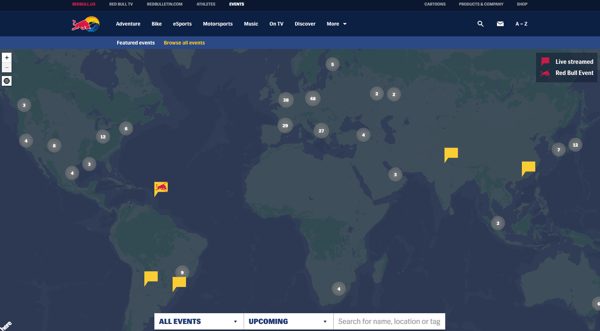
Aside from events, Red Bull’s packaging also plays a part in its global appeal.
“Red Bull really looks like a product from a global economy. It doesn’t look like a traditional American soft drink — it’s not in a 12-ounce can, it’s not sold in a bottle, and it doesn’t have script lettering like Pepsi or Coke. It looks European. That matters,” explains Harvard Business School professor Nancy F. Koehn in a 2001 article. Though it’s since diversified its product selection since that article was published, the fact remains that Red Bull’s consistent packaging has helped this brand go global.
2. Airbnb
Airbnb, a community marketplace for people to list and book accommodations around the world, was founded in 2008 out of San Francisco, California.
Since then, Airbnb has grown to 1,500,000+ listings in 34,000+ cities worldwide. A large contributor to the company’s explosive global success? Social media.
In January 2015, Airbnb launched a social media campaign around the hashtag #OneLessStranger. The company referred to the campaign as a “global, social experiment,” in which Airbnb asked the community to perform random acts of hospitality for strangers, and then take a video or photo with the person and share it using the hashtag.
Just three weeks after the launch of the campaign, over 3,000,000 people worldwide engaged, created content, or were talking about the campaign.
3. Dunkin Donuts
In case you missed it, National Donut Day was last June. And while we were getting our hands dirty with a Boston creme (or two) here in the states, Dunkin Donuts China was serving up a fresh batch of dry pork and seaweed donuts.
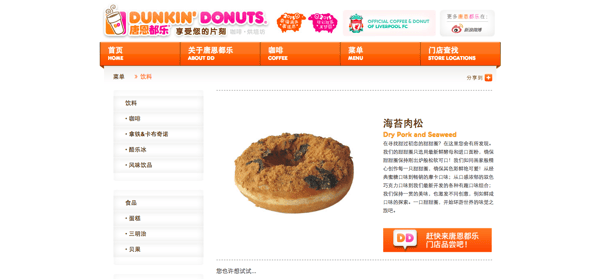
With over 3,200 stores in 36 countries outside of the U.S., Dunkin Donuts has evolved its menu to satisfy the sweet tooth of its global customers.
From Korea’s Grapefruit Coolata to Lebanon’s Mango Chocolate Donut to Russia’s Dunclairs, it’s clear that Dunkin Donuts isn’t afraid to celebrate cultural differences in an effort to strengthen its international presence.
4. Domino’s
Similar to Dunkin Donuts, Domino’s has prioritized menu innovation as a means of increasing international interest and awareness.
“The joy of pizza is that bread, sauce, and cheese works fundamentally everywhere, except maybe China, where dairy wasn’t a big part of their diet until lately,” explains Domino’s CEO J. Patrick Doyle.
“And it’s easy to just change toppings market to market. In Asia, it’s seafood and fish. It’s curry in India. But half the toppings are standard offerings around the world.”
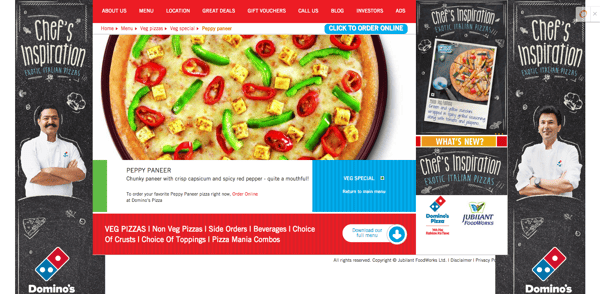
By making a conscious effort to gain a better understanding of the preferences of the markets it’s trying to break into, Domino’s can deliver pies diverse enough to gain international attention.
5. Rezdy
Some companies may not be trying to attract global markets directly, but if their clients are, they better know how. Rezdy is an Australian-based reservation software designed to make online booking smoother for tourists and agents alike.
Though Rezdy’s clients are Australian-based, the company needs to cater to its clients’ international visitors. Click on the screenshot to check out this fun video on Rezdy’s homepage:
The first feature the video spotlights is “Internationalisation.” The video walks us through how easy the service is for users, but is sure to emphasize the language and currency customization tool upfront. Even if your company is marketing to other regional companies, consider their global customers as if they were your own.
6. World Wildlife Foundation
WWF took its Earth Hour initiative — a voluntary worldwide event where participants turn off their lights for an hour to show how easy it can be to battle climate change — and brought it to Norway’s mobile audience.
Scandinavian countries like Norway experience extreme daylight hours in different seasons, making the country a prime candidate for WWF’s Blackout campaign. Using digital agency Mobiento, the nonprofit placed the Blackout Banner across Norway’s top media sites to promote Earth Hour. With one tap of the banner, the screen went black. Finger swiping the black screen slowly revealed the Earth Hour countdown. The banner attracted roughly 1,000,000 impressions and the campaign received three MMA Global Mobile Marketing Awards back in 2012.

Have a cool idea? Don’t be afraid to try it out on one international market — just make sure it’s the appropriate audience. (Also, don’t be afraid of the dark.)
7. Pearse Trust
With offices in Dublin, London, Vancouver, Atlanta, and Wellington, Pearse Trust has grown to be an international authority on corporate and trust structures. But it takes more than offices all over the map to reach an international audience.
That’s why Pearse Trust keeps content flowing on its Facebook page that engages its various markets. In this screenshot below, you can see Pearse Trust posts lots of content featuring international affairs relating to the company’s practice.
It also levels out external articles with Pearse Trust content, featuring news from places like Germany, Ireland (where it has a Dublin office), and the U.K. (where it has a London office). This is a great example of focusing on common interests shared among your company’s various markets while also making the content relatable to customers by region.
8. Nike
Nike has been able to evolve its global presence through the careful selection of international sponsorships such as its previous long-standing relationship with Manchester United.
Although sponsorship spending can be fairly unpredictable — demand costs tend to surge due to triggers like championships and tournaments — these partnerships have certainly helped the brand capture the attention of a global audience.
Nike’s NikeID co-creation platform serves as another strategy that the company is using to appeal to international markets.
By putting the power of design into the hands of the consumer, Nike is able to deliver customized products that align with different cultural preferences and styles.
9. McDonald’s
We all know McDonald’s is a successful global brand, so unlike its menu, I’ll keep it light.
While keeping its overarching branding consistent, McDonald’s practices “glocal” marketing efforts. No, that’s not a typo. McDonald’s brings a local flavor, literally, to different countries with region-specific menu items. In 2003, McDonald’s introduced the McArabia, a flatbread sandwich, to its restaurants in the Middle East.

McDonald’s has also introduced macaroons to its French menu:
And added McSpaghetti to its menu in the Philippines:
This “glocal” approach has helped put McDonald’s at
#9 on Interbrand’s Best Global Brands 2014.
10. Innocent Drinks
Innocent Drinks is the leading smoothie company in the U.K., but that’s not the only place you’ll find its products. In fact, Innocent products are now available in 15 countries across Europe.
And despite its widespread reach, the company’s “chatty branding” remains consistent across the board. For instance, the website is very bubbly, with contact information that reads “call the banana phone” or “visit the fruit towers.”
While global expansion and rapid growth can sometimes distract a company from consistent branding, Innocent Drinks has managed to remain true to itself. By ensuring that the brand’s voice is interpreted the same way around the world, Innocent is able to create a more recognizable brand.
11. Unger and Kowitt
The phrase “glocal” can be defined as “Think Globally, Act Locally.” But what happens when you switch the two around.
Whoa, fasten your seat belts — literally. Unger and Kowitt is a traffic ticket law firm based in Fort Lauderdale defending drivers in the state of Florida. Not very global, right? Well, Unger and Kowitt understands that America is a melting pot and that Florida is bursting at the seams with different cultures and languages.
Though a domestic service, the firm’s website is available in English, Spanish, Portuguese, and Creole. With these options, Unger and Kowitt can cater to Florida’s nearly 3.5 million Floridians who speak Spanish, Portuguese, or Creole. Don’t miss out on expanding your client base — sometimes you don’t have to look far to attract international business.
12. Coca-Cola
Coca-Cola is a great example of a brand using international marketing efforts. Though a large corporation, Coca-Cola focuses on small community programs and invests a lot of time and money in small-scale charity efforts.
For example, in Egypt, Coca-Cola has built 650 clean water installations in the rural village of Beni Suef and sponsors Ramadan meals for children across the Middle East. In India, the brand sponsors the Support My School initiative to improve facilities at local schools. Not to mention, the brand sticks with selling an emotion that can’t get lost in translation: happiness. Now, tell me this doesn’t look like fun:
13. Spotify
As of 2018, Spotify was newly considered one of the best global companies in the world, according to Interbrand. We’ve all heard of Spotify (no pun intended), but how did it suddenly, and so quickly, expand from Sweden into other countries?
Spotify’s business model is focused on helping you find something new.
 It’s one thing to select a genre of music to listen to — it’s another thing to select a “mood” to listen to. The screenshot above is part of Spotify’s “Browse” page, where you can listen not just to “country” and “hip-hop,” but also music that caters to your “workout” or “sleep” preferences.
By changing how they describe their content, Spotify gets users to listen to music that goes beyond their favorite genres, and instead satisfies habits and lifestyles that people share all over the world. This allows international artists to access listeners from other countries simply because their product is being categorized a different way.
Spotify now has offices in 17 countries around the world.
If you have global aspirations for your business, you need to find out what customers in different communities have in common — and how to localize your product for these different markets. Your first step? Take inspiration from one of the businesses above.
Editor’s note: This post was originally published in January 2019 and has been updated for comprehensiveness.

What Video Marketers Can Learn from 5 Memorable Australian Commercials
By September of 2019, nearly 60% of Australia’s population was on YouTube.
With internet and social media usage increasing in Australia, the percentage above is likely to grow.
Like people in many other countries, Australians embrace video when it comes to learning new things, entertaining themselves, or even researching new products. Now, with growing access to the web, mobile data, and all sorts of online video platforms, video is more readily at Australian fingertips than ever before.
At this point, if you’re a marketer for an Australian company or an international brand looking to gain awareness in the region, video content or video ads could be solid tactics for you.
But, if you’ve never made a commercial or marketing video for your brand before, you might ask yourself, “Where do I even start?”
One of the best ways to learn how to effectively sell your brand or product through video could be watching commercials from your region’s most successful brands.
By looking at some of the most iconic Australian commercials, you can learn about storytelling styles and other video marketing tactics that nurture national or global audiences from the TV or computer screen to stores.
And, even if you don’t have the same video budget as a big brand, you can still use their content to consider similar, but more scaleable video strategies.
To help Australian or international marketers in their quest to create compelling video marketing content, here are five great Australian commercials that you can use for inspiration.
5 Iconic Australian Commercials Marketers Can Learn From
“Big Ad” – Carlton Draught (2006)
Carlton Draught‘s biggest commercial, produced by Young & Rubicam — formerly George Patterson & Partners, places the viewer in the middle of a blockbuster movie war scene with the mountainous Australian landscape in the background.
As Big Ad begins, one large group of men in red robes walks swiftly towards an incoming group of men in yellow robes. As they get closer to each other with a quickening pace, they sing the words, “It’s a big ad. Very big ad. It’s a big ad we’re in,” to the tune of Carl Orff’s epic work, “O Fortuna.”
As the ad and song reach their climax, the men run towards each other at full speed as they loudly sing, “It’s a big ad! For Carlton Draught! It’s just so freaking huge! It’s a big ad. Expensive ad. This ad better sell us some bloody beer!”
As the thousands of men run closer to each other, viewers see that they’re not actually rushing into a huge battle. Instead, from a sky view, viewers can see that the men wearing red are shaping the image of a man drinking beer, while the men in yellow are shaping the beer glass and the beverage going into the man’s stomach. The ad ends with close-up shots of the robes men in the group holding out Carlton Draught beer.
The Carlton Draught commercial so memorable because it hilariously and tastefully mocks the ridiculously high-budget commercials, as well as the advertising world, while still spreading huge awareness for Carlton Draught.
When reflecting on Big Ad and the ad industry, a post from O’Reilly notes the epic TV commercial style has “been a central feature of advertising for decades. Its defining characteristics are a dramatic setting, a huge cast, significant dollops of post-production, and a rather po-faced disposition. All of which makes it ripe for satire.”
The spot was also part of a broader spoof campaign that mocked the grandeur and masculinity in beer industry advertising. Two other ads within the campaign, titled “Made From Beer,” told stories of how science, technology, and horses were involved in the brewing process as well as how all men needed a canoe to seem masculine.
Big Ad, which might be the most memorable commercial in the George Patterson campaign, went on to win a Gold Lion and was nominated for the Grand Prix at the 2006 Cannes Lions Festival.
“Not Happy, Jan!” – Yellow Pages Australia (2000)
Before the internet, brands around the world relied on the Yellow Pages, a book filled with local business ads and phone numbers of individuals with landlines in the immediate area. And, even though some regions don’t rely on the Yellow Pages to find all the local contact information we need any more, we can still get an idea of just how important it was to local businesses from the ad below.
In the commercial, a frustrated boss played by comedian Deborah Kennedy flips through the Yellow Pages and calls a scared employee named Jan into her office. Kennedy’s character asks Jan why their company’s ad isn’t featured in it. Jan panics, runs out of the office, and down the street realizing she forgot to order the Yellow Pages ad.
Kennedy tries to remain calm, counting to ten until she runs to the window bursting with anger. She stares out the window at Jan running away and yells, “Not happy, Jan!”
The ad, produced by Clemenger BBDO, wasn’t just funny and entertaining to viewers. It also became iconic in Australian culture. Shortly after airing, the phrase, “Not happy, Jan” became heavily used in vernacular when Australians wanted to jokingly show disappointment related to someone’s incompetence.
In a Daily Telegraph interview, Kennedy explained that the phrase “Not happy, Jan,” was “like swearing at your kids without swearing. It just took on a life of its own … it was everywhere.”
Although people in some areas barely use the Yellow Pages, this ad’s storyline still feels timeless and entertaining. Why? Because it cleverly uses humor and relatability to show a need for its product.
Odds are many people have dealt with a bad boss, forgetting to do something important at work, or a need to use the Yellow Pages to learn more about a local business. Similarly, many entrepreneurs and marketers in the 1980s through the early 2000s considered or purchased ads in the Yellow Pages. This ad tells a story that most of its viewers could relate to.
“I Can See the Pub from Here” – XXXX (1988)
Before it was rebranded as XXXX, Castlemaine XXXX’s early beer commercials often showed rural Australian residents, farmers, and construction workers getting into humorous, but dangerous, situations just to get ahold of XXXX beer.
After a wild scene, a narrator would read the edgy tagline, “Australians Wouldn’t Give a Castlemaine XXXX for Anything Else.” Since the tagline was a play on a commonly used phrase curse word, the ads insinuated that Australians wouldn’t care so much about any other beer or thing.
Below is one memorable 1986 ad where two cowboys are riding through the Australian landscape when one’s horse gets spooked by a snake and tosses him off a cliff.
The cowboy’s friend jumps off his horse and clumsily falls down the cliff trying to find his friend who’s loudly calling out to him. After the friend continues to fall dramatically down the cliff to reach the other cowboy, he gains his footing and yells, “I’m coming, Snowie!” He then falls down a hill, faceplanting into a tree. At that point, the cowboy who fell off the cliff first yells “Up here!” as the other cowboy looks up confused.
In a funny turn of events, the cowboy who first fell off the cliff is shown nearly unscathed, pleasantly holding on to a tree. He looks at his disheveled friend who’s just fallen hundreds of feet down a cliff to save him, smiles, points, and says, “I can see the pub from here.”
The camera then points to a middle-of-nowhere pub as Castlemaine’s iconic tagline appears:
This campaign, conceived by the agency Saatchi & Saatchi, is effective because it tells an exhilarating story that pulls viewers in, makes them laugh, and ultimately ties back to the main product: beer.
This is a great example of how marketers can use creativity to produce a fairly simple add that gains memorability and awareness all around the country.
“Louie the Fly” – Mortein (1962)
For years, Australians have followed Louie the Fly, an insect who constantly gets killed off in Mortein bug spray commercials. But, decades before the fly was modernized as a full-color cartoon, he was just a basic, hand-drawn animation in the classic black and white ad that introduced him below.
In the commercial, Louie the Fly introduces himself with a fun jingle. He sings, “Louie the Fly, I’m Louie the fly. Straight from rubbish, tip to you. Spreading disease with the greatest of ease. Straight from rubbish, tip to you.”
As the fly sings, he also digs through garbage and dances around a messy house.
In the climax of the ad, he sings, “I’m bad and mean and mighty unclean. Afraid of no one, except for the man with the can of Mortein.” Then, he turns around to see a can of Mortein spraying him. He looks scared, fades off-screen, and then dies as another singer enters the jingle with, “Poor dead Louie. A victim of Mortein.”
After the jingle, Mortein’s products are shown as the spokesperson explains that its ingredients safely and effectively kill pests in the home.
While this ad’s animation and jingle might feel pretty basic today, it was innovative for its time — and incredibly risky due to large production expenses. To bring Louie the Fly to life, Mortein’s agency, McCann-Erickson, needed help from musicians, sound engineers, animators, and voice actors.
Luckily, audiences enjoyed Louie the Fly — enabling him to be a notable fictional character in advertising. Even in recent years, Mortein has created ads that continue to show him getting killed off by bug spray products. They even dedicated a page of their website to him in the early 2000s.
Most recently, Louie the Fly’s jingle was inducted in the National Film And Sound Archive of Australia’s Sounds of Australia registry,
“Mortein ads still feature the unmistakable tune of the original jingle. And while everyone’s favourite gangster fly shows no sign of disappearing …, the fact that the jingle is now part of Sounds of Australia means it will live on at the NFSA for future generations to enjoy,” states a post on NFSA’s site.
While Mortein’s ad required a high-budget decades ago, marketers with smaller budgets can still take a note from them today. The commercial above is a great example of how a creative storyline or simple jingle can highlight the value and need for a product.
“Happy Little Vegemites” – Vegemite (1956)
Although Vegemite was invented and sold in Australia as early as 1922, it didn’t get its first commercial until the 1950s, after it had already become a common Australian ingredient eaten by residents and members of the Australian military during World War II.
While many of the commercials on this list use humor to draw audiences, Vegemite’s iconic 1956 ad, produced by Wunderman Thompson (formerly J Walter Thompson), thrived on circus entertainment. In the commercial, children dressed like animals, clowns, and “little Vegemites” sing, dance, and do light circus stunts to Vegemite’s original jingle. Behind them sits a large jar of Vegemite.
Vegemite’s jingle explained how commonly Vegemite was used as a meal spread and the health benefits it could provide to children. Here’s just one excerpt.
“We all enjoy our Vegemite for breakfast, lunch, and tea. Our mummies say we’re growing stronger every single week. … We all adore our Vegemite. It puts a rose in every cheek.”
As the children finish singing the jingle, a girl sings, “It puts a rose in every cheek.” The camera cuts from a close up of her in costume to a close up of her at the dining table eating a meal covered with Vegemite. Then, a narrator explains that Vegemite is a great source of vitamin B12, adding, “Be sure you put Vegemite next to the pepper and salt whenever you set the table!”
Today, Australian marketers still look back at this commercial for how iconic it was. While middle-aged Australians might know parts of the song by heart, others have adopted the term, “Happy little Vegemites” as an ironic way to describe a group of people who are satisfied with something.
Although Vegemite’s ad was made nearly 70 years ago, it’s still timeless and effective.
First, it pulls a viewer into the action by showing them a fun circus-like song and dance. Then, it educates viewers on the health and taste benefits of the product. Finally, it ends with a clip of a happy girl enjoying Vegemite with her meal, which might have been relatable to the many Australians who had already eaten or heard of Vegemite by this point.
Creating Memorable Content
Whether you’re a marketer in Australia or any other country, you can learn a thing or two from all of the iconic Australian ads above. Even if you don’t have an agency or a huge video budget to produce content, here are a few tips you can scalably follow:
- Be relatable: One thing Australian commercials do well is create situations that viewers can relate to, such as a pesky fly in the house or the stress of an angry boss. Consider content or video storylines that will allow your audience to identify with your brand.
- Leverage humor: One great way to develop a sense of relatability, while also entertaining your audiences is with humor. This is why many Australian marketers emphasize it within their content.
- Present a value proposition: An ad is no good if people don’t understand your product or what it does. Although the ads above place viewers in entertaining scenes or storylines, they still weave in descriptions of what their product is, why people need it, and what makes it unique.
Want to see more effective examples of Australian advertising campaigns and marketing tactics? Check out this post which highlights some of Australia’s recent award-winning campaigns.
To learn more about video marketing, you can also download the free resource below.

What Are The 4 P’s of Marketing?
If you’ve been a marketing professional for years now, learning about the four P’s of marketing might seem like a throwback to you.
However, for those of us who work in the industry but didn’t study marketing in college, it’s entirely possible you haven’t heard of the marketing mix.
Below, let’s learn about the four P’s of marketing and how they’re still relevant in today’s marketing landscape.
The four P’s are meant to help marketers consider everything about a product or service when they’re deciding how to market something for their business. Framing your marketing around the four P’s will help you learn what the competition is doing and what customers want from you.
You can use the four P’s to answer questions about the product, price, place, and promotion of your product or service.
For example, you can ask yourself:
- How does your product meet your customer’s needs?
- Where are customers looking for your product?
- What is the value of your product?
- How can you differentiate your product from competitors?
Thinking about your marketing in terms of the four P’s will help you strategize how to reach your customers.
Featured Resource: Marketing Mix Templates
Need a way to visualize your marketing mix to share it with your employees or investors? Use these four marketing mix templates to organize your initiatives and activities by the right section. Click here to download them now.
Let’s dive into the details below.
1. Product
When you think about your product, consider exactly what you’re selling. Is it a specific product? Or is it a service? Your product can be a physical product, an online app, or a service such as house cleaning. Really, anything that you’re selling is the product.
Then, think of your brand messaging, the services you offer, and even packaging. When you define your product, think about what problem your product solves for your customers. Consider how your product is different from competing products. What features are unique to your product?
It’s important to know your product intimately so you can market it.
2. Price
When it comes to price, you have to consider how much you’re going to charge customers for your products or services. Of course, you need to make a profit. But you also need to think about what competitors are charging for the same product or service and how much customers are willing to pay.
Additionally, you can think about what discounts or offers you can use in your marketing.
When you decide on a price, you want to think about perception. Do you want to be known as a cost-effective option in your industry? Or perhaps you’re a luxury brand and the price is slightly higher than competition on the market.
Either way, the language you use to market your product will be greatly impacted by the price of your product.
3. Place
When it comes to place, this might mean the physical location of your company, but it could also be defined as anywhere you sell your product, which might be online.
The place is where you market and distribute your product.
Remember, that not every place makes sense for every product. For example, if your target market is seniors, then it won’t make sense to market on TikTok. It’s important to choose the right places to market your product and meet your customers where they’re at.
Think about possible distribution channels, what outlets you could sell your product, whether you’re B2B or B2C, etc.
At this point, you’ll need to think about how to market your product on all the various channels that make sense for your company.
4. Promotion
Promotion is the bread and butter of marketing. This is when you’ll think about how to publicize and advertise your product.
Additionally, you’ll discuss brand messaging, brand awareness, and how to generate leads and revenue.
When it comes to promotion, keeping communication in mind is of the utmost importance. What messages will resonate with your target market? How can you best promote your product to them?
Think about where, when, and how you’ll promote your brand.
To develop a marketing mix, you’ll need to think about how you can uniquely position your brand amongst the competition. The most important part of thinking about the four P’s of marketing is to understand the customer, the competition, and your company. You’ll evaluate your product and how to promote it.
Even though marketing has changed since the four P’s were developed, the foundational elements of the industry haven’t. You can apply the concepts of the marketing mix to any type of marketing.

YouTube Video Strategy: How to Grow a Business With YouTube
Want more leads and sales from your YouTube channel? Wondering how to use different types of videos for different objectives? To explore YouTube content strategy, I interview Sunny Lenarduzzi on the Social Media Marketing Podcast. Sunny is a YouTube marketing expert who helps entrepreneurs next-level their awareness online. Her YouTube channel has 500,000 subscribers. Her […]
The post YouTube Video Strategy: How to Grow a Business With YouTube appeared first on Social Media Examiner | Social Media Marketing.
from Social Media Examiner | Social Media Marketing https://ift.tt/3oIzTy3
via socialmediaexaminer