
Welcome to My Blog
4 Talent Acquisition Strategies to Find the Best Employees
It’s can be difficult to find the ideal candidate for a specific position — in fact, in 2018 almost 75% of employers struggled to fill positions with the right candidates.
Regardless of the state of the economy and your talent pool, to succeed long-term, your business should be able to hire and retain the best, most talented employees.
But it can be a daunting task, which is why you need a talent acquisition strategy.
Your pursuit of top talent shouldn’t solely rely on traditional, short-term recruitment strategies like sending LinkedIn messages or attending job fairs. To ensure top talent acquisition and retention, you’ll need to devise a strategic long-term talent acquisition plan.
To succeed long-term, it’s critical you attract and retain talented employees regardless of vacant roles. Talent acquisition can help you do this, while solving for long-term organizational needs.
Here, we’ve cultivated four critical talent acquisition strategies to ensure you’re finding the best people.
1. Align with your business goals.
Consider your business goals for the next one to five years, and use those objectives to tailor your acquisition strategy to meet those needs. While recruitment tends to focus on filling vacancies within departments, talent acquisition is more about considering how your company is going to expand long-term, and then finding employees who can help take you there.
For instance, are you planning on expanding into Latin America? If so, perhaps your HR department should focus on attracting candidates with international or regional experience. Or, maybe you’re planning on creating a new product, in which case, your HR efforts should focus on attracting talented software developers and coders.
Certain roles might not even exist yet, but you’ll want to consider what type of talent you’ll need to hit your business’s long-term goals. Remember, investing in the right candidates will pay off for your company, long-term.
2. Use data and marketing to create better acquisition material.
You wouldn’t create a marketing campaign without data, so why should you recruit without it?
Talent acquisition should be treated with just as much importance as any of your marketing campaigns. Convincing people to join your company is just as necessary as incentivizing people to buy your products.
There are plenty of different opportunities to use data to strengthen your talent acquisition strategy. For instance, you might use data to figure out where your top talent came from, and use that information to focus your talent acquisition efforts on certain academic programs or professional networking sites.
Additionally, your HR team should partner with your marketing department to refine job descriptions, career pages, emails, and more.
Using data, you can figure out if certain questions are deterring candidates from filling out job applications, and eliminate those questions. Alternatively, perhaps you’ll find adding images or videos to highlight company culture incentivizes more candidates to fill out job forms. Or, maybe more candidates apply for a job with description A over description B.
By using analytics and data, you’re able to ensure your job descriptions and career pages aren’t deterring qualified people from applying.
3. Expand outreach strategies.
To find better talent, you’ll need to expand your sourcing strategies. Different skillsets require different methods of outreach. You’ll find your best marketers in a different place than your best programmers, so you’ll want to diversify your sourcing approach.
Rather than spending all your time on LinkedIn, consider other specialized job boards, academic programs, or networking events where you might find a specific group of talented professionals. For instance, to attract talented coders, Deloitte’s recruiters attended a hackathon and found prospective candidates.
It’s critical you identify where you can find the vast majority of your top talent, whether that be professional events, conferences, online forums, or social networks. Then, focus on strengthening relationships and networking with the right people — not only will you grow your pool of potential hires, but you’ll also grow brand awareness for your company, which will help you attract talent in the future, as well.
4. Focus on better employer branding.
Employer branding is critical for creating a successful talent acquisition strategy — in fact, a 2017 LinkedIn study found that 80% of talent acquisition managers believe that employer branding has a big impact on their ability to hire remarkable talent.
When talented candidates are comparing companies, they’re going to choose the one with the best values, culture, and work-life balance. By cultivating an impressive employer brand, you’ll attract better talent and find more long-term success.
To succeed with talent acquisition, you’ll need to be able to answer the question, “Why your company, over all the others?” This is why employer branding is a critical strategy for finding the best employees.
Consider how you can reframe your branding to focus on the best aspects of your company’s values and culture. It isn’t just about mentioning health benefits or compensation — you’ll also want to convey your impressive company culture, in which employees collaborate efficiently and enjoy spending time with one another. You might mention your flexible remote policy and other work-life balance perks, or your company’s emphasis on growth opportunities.
It’s important you broadcast these unique attributes through employee review sites like Glassdoor, as well as your “About Us” page on your company website. When highly qualified people are contemplating your company over your competitors, it just might be those reviews that end up convincing them.
Editor’s note: This post was originally published in November 2018 and has been updated for comprehensiveness.

How to Create and Execute a Successful Lead Gen Strategy
Your audience no longer wants you to buy their attention — they want you to earn it.
This means lead generation strategies need to be revamped across the industry to better meet the needs of target markets.
The first step in this evolution is to create compelling content, and the second is to use that content to convert visitors into leads. Of course, this is easier said than done.
To highlight the importance of a powerful lead generation strategy, we are going to backtrack a little bit first.
Are you familiar with the analogy of the professor who presented his class with the challenge of trying to fit rocks, pebbles, sand, and water into a jar as efficiently as possible?
By prioritizing the biggest items and placing them in the jar first, he was able to optimize the amount of space used. Your business should take a similar mindset when implementing today’s lead generation tactics into your inbound marketing strategy.
The Rocks, Pebbles, and Sand of Inbound Marketing
Like the professor who challenged his class to neatly fit rocks, pebbles, and sand into a jar, your inbound marketing strategy consists of rocks, pebbles, and sand. Here’s what I mean by this:
- What are the large rocks that are the most essential to your strategy?
- What are the pebbles that serve as secondary, supportive tools for your business?
- What small stuff or distractions are the sand of your business?
Most businesses would argue that their customers are their “rocks”, but I have another approach.
While it’s indisputable to say that customers are essential to any business, I want you to instead think of them as the water that was used to finally fill the jar. The water was poured in only after everything else was firmly compacted in the jar.
Your business can benefit from taking this same mindset in your inbound marketing strategy.
The 4 L’s of a Lead Generation Strategy
Your content is your rocks. Fill your jar first with content, as compelling content plays a huge role in generating leads. This includes the tools used to generate traffic, such as your blog, SEO, PPC, and social platforms.
Approximately 96% of business-to-business customers want content from industry thought leaders to inform their buying decisions. Creating compelling content is your key to establishing yourself as that go-to, educational leader in your industry.
You know what they say: you can catch a lot of flies with honey, but you can catch more honeys being fly. Try that cliche in a bar and it might end with a drink thrown in your face, but adapting that mindset in your inbound marketing strategy could not only improve lead generation rates but also increase the number of qualified leads your business attracts.
So, we’ve got our rocks — our content — in place. This article will focus primarily on the step that comes after that step — your pebbles, or the best practices for generating leads using your content.
You will quickly understand how companies that are hopping aboard the content train are generating 67% more leads per month than those who don’t. Let’s unpack the four L’s of lead generation.
1. Lead Capture
Odds are that about half of your visitors will never return to your site if you do not adequately capture some bit of information from them. A working email address is the best thing a marketer can ask for here, but visitors are not always willing to give this kind of personal information up. Call-to-action (CTA) buttons like “Sign Up Here” have practically become synonymous with “We are Going to Spam You”, which is why marketers need to find new ways to obtain this information.
Nicholas Kusmich, a Strategic Marketing Consultant and Facebook Ads Specialist, suggests a new rule of thumb for obtaining visitors’ information. Kusmich suggests 2 golden rules be taken into account:
- We must give before we ask.
- Every step of the marketing process (advertisements and promotions) must be valuable in and of itself.
Kusmich goes more in-depth with these concepts in his article, “2 Golden Rules for The New Era of Marketing,” but for now let’s focus on that first rule.
Can you believe there was once a time, many years ago, where the opt-in email box was practically a luxury? It meant all the information you wanted would be delivered right to the comfort of your home. “What a time to be alive,” we all thought. That day is now long gone. We now find ourselves fending off information from all angles.
Somewhere between installing pop-up blockers and dumping our spam folders, we made an oath to never “Sign Up Here” again. It’s time marketers start gradually breaking down those walls that potential buyers have put up, by using new, mutually-beneficial opt-in methods to acquire their information. The best marketing method for this technique of “giving before we ask” includes using lead magnets.
2. Lead Magnets
A successful client lifecycle requires optimizing the process for converting visitors into leads. Unfortunately, a hole exists between the traffic generation phase and the lead generation phase that often results in one-time visitors who neglect your attempts to capture their information and never hear from you again.
You can seal up that hole with lead magnets. Lead magnets are tools that provide value for your visitors in exchange for their contact information. Businesses use lead magnets such as email opt-ins, subscriptions, and social media follows to fish for some sign of interest from their site’s visitors.
The goal of this is to receive permission from visitors to follow up. Some examples of lead magnets include free:
- Training video series
- Free trial
- Webinars
- eBooks
- White papers
- A set of bonus tips
- An interview with an expert on a relevant topic
These free-of-charge educational tools will confide your visitors in your offering, allowing you to both obtain their email address and educate them on your business.
3. Landing Page Conversion Techniques
Another huge asset to your business when trying to convert visitors into leads are landing pages. This can be any page that someone lands on after clicking on an advertisement or other online marketing elements. It is also important to note that landing pages exist separately from your company’s website, and typically are used as a tool for a single marketing campaign.
A free, basic course on creating successful landing pages can be found on thelandingpagecourse.com. You can also learn lots of landing page tips and best practices from HubSpot’s existing blog posts on landing pages. We will go over some of the basics of effective landing page design right now, but definitely check out those resources later on for a more in-depth breakdown of the different components involved.
Landing pages serve the dual purpose of capturing leads and warming up potential customers. Both of these are essential stepping-stones before moving a customer further down your sales funnel. Additionally, there are two types of landing pages:
Lead generation landing pages are used to capture a user/company’s information in exchange for something. This relates back to the concept discussed earlier, of “giving before we ask.”
Click-through landing pages are used to attract the visitor to the specific product or service that you are trying to sell. The goal is to educate your visitor with enough information that they proceed to make a purchase.
Landing pages have one call-to-action in mind. Instead of overwhelming visitors with information regarding your business and all the products and services you offer, it is essential that you narrow the focus down to one specific goal in mind. Be sure to cut out any excess information that isn’t essential to the campaign, and be sure to include only one form or CTA link for them to utilize.
The most important element of your landing page is that it delivers the promise that your ad source made. If your ad says “Get 50% off computers here,” you need to reassure the visitor as soon as possible on your landing page that you will deliver that.
One way to do this is to make the CTA on your ad source the headline on your landing page. Another way is to make sure the font, coloring, and images used in your ad are duplicated on your landing page to some degree.
4. Lead Scoring
Lead scoring is a component of marketing automation software that helps prioritize your leads according to their levels of engagement with your inbound marketing content and ultimately help you figure out who is ready to buy. It can also help you identify what they are interested in if setup correctly.
This technique is used to quantify interactions that prospects have with your content by assigning points for different types of engagement. An example of the different types of engagements and their point values might look like this:
- Download an ebook: Add 5 points
- Watch a product overview video: Add 7 points
- Job role not a good match: Deduct 10 points
- Fill out opt-in form: Add 7 points
- Unsubscribe from a list: Deduct 7 points
Surprisingly enough, 79% of B2B marketers have not established a lead scoring strategy. Lead scoring provides your company with real-time feedback on how responsive your leads are to your marketing efforts. It can also indicate people who are ready to buy from you, but haven’t yet been in contact with you.
This point-based approach to recognizing and analyzing a company’s hottest leads will save your business time and money when reaching your target market and capitalizing on sales opportunities. With your hottest leads identified, your business can communicate with these leads confidently knowing that they are already aware of and interested in your business.
Lead generation plays a role in every business’s marketing strategy. Think about how many business sites you have visited since the dawn of the internet that you will never return to again. Not only did those businesses fail to capture your attention at that given time, but they failed to reconnect with you in the future.
This is a result of neglecting the lesson discussed in the jar analogy — prioritizing the different elements of your marketing strategy so that a foundation is in place for you to build an efficient and effective approach around.
With your content in place, your business can begin using lead magnets, lead capture, effective landing page design, and lead scoring to optimize lead generation rates and create an overall better-performing inbound marketing strategy.
Editor’s note: This post was originally published May 2018 and has been updated for comprehensiveness.

19 Lead Nurturing Email Examples You’ll Want to Steal
You’ve done it. You provided valuable content to your readers and they’ve converted into leads. Now, it’s time to nurture these leads into opportunities for your sales team.
Trouble is, cutting through the inbox clutter isn’t an easy feat. And many of these folks just aren’t ready to buy yet.
That’s where lead nurturing comes in: It’s a way to stay connected to the leads you collect that aren’t ready to buy from you yet, and build up trust until they are ready.
If you want to learn more about lead nurturing in general, you can check out this guide. But for the sake of this post, we’re going to dive deep into one of the best channels for carrying out your lead nurturing efforts: email.
To help you better understand how to pair the two concepts, check out the lead nurturing email examples below. From ecommerce to product marketing, there’s something for everyone — no matter what industry you operate in.
Pro tip: Use the following anchor links to jump to examples within the industries that interest you most: Ecommerce, B2B, Retail, Travel, Food & Beverage, Services, Product Marketing.
19 Lead Nurturing Email Examples to Inspire Your Strategy
Here are the top lead nurturing examples that you can refer to and review while developing your emails.
Ecommerce Lead Nurturing Email Examples
1. Framebridge
Not all lead nurturing emails need to be strictly promotional. Engagement will lead to sales, so it’s important to send recipients something they’ll want to open and read. Framebridge does something in their nurturing emails that works like a charm: education. By teaching the reader a helpful skill, they are providing value in exchange for an ask from their recipient (reading the guide).
It’s also worth mentioning that they only use one clear call-to-action — “Educate Me.” According to WordStream, simply using one call-to-action (CTA) in an email increases clicks by 371% and sales by 1617%.

2. Casper
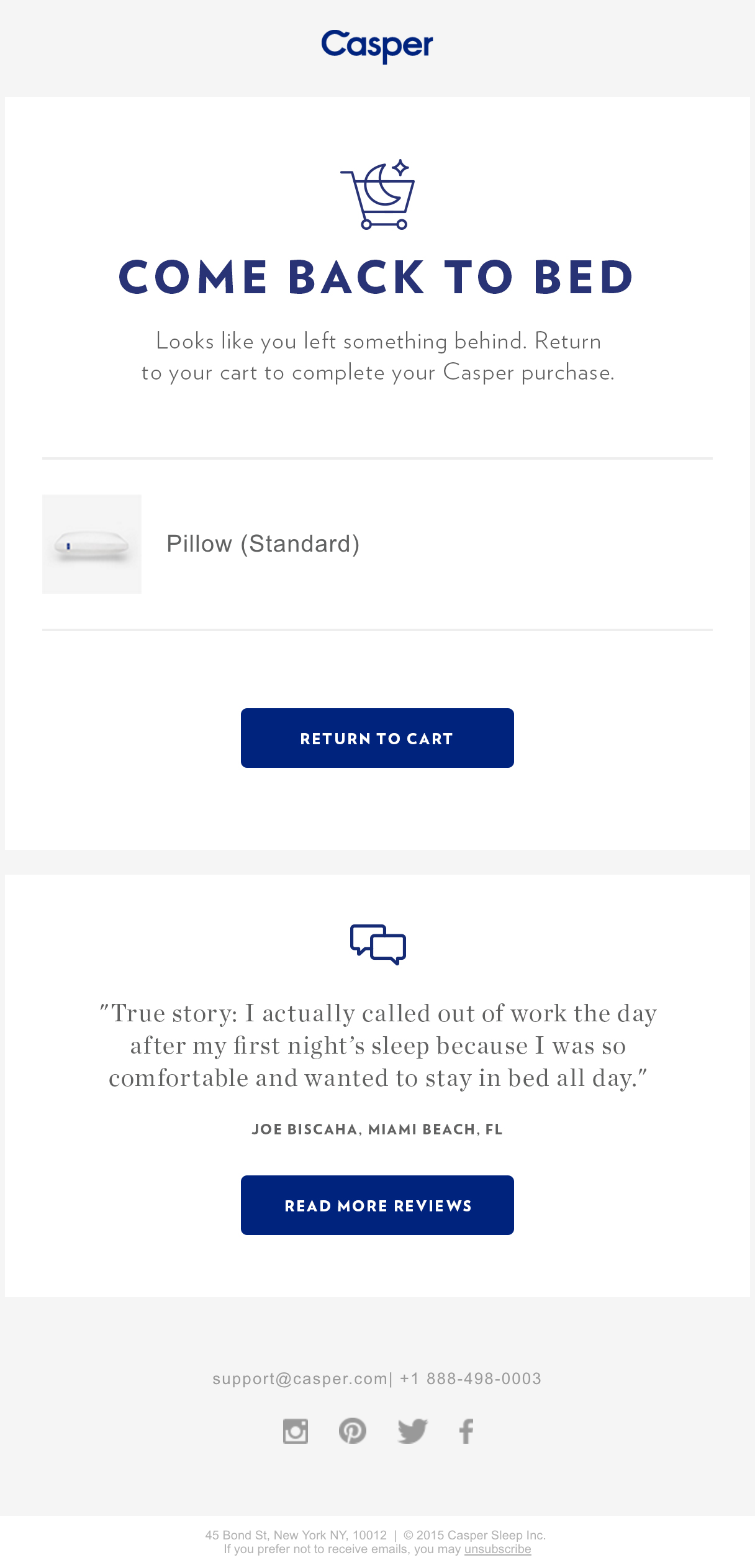
Your product is only as good as its reviews — in fact, most customers read a review or testimonial before making a purchase. In this traditional abandoned cart email, Casper adds a bit of social proof with a fun customer testimonial.
Casper’s abandoned cart email is clever and to-the-point. It asks the reader if they’d like to revisit a cart they have added to, shows what they were shopping for, and includes two simple CTAs.
3. Sephora
For visual products, video is a great method of communicating or explaining. Sephora includes a fun video from an employee with educational content as well as product offerings. They do have a lot of calls-to-action, however, the main focus is to watch the tutorial which is helpful to the reader. A visual email for a visual brand, it grabs your attention and shows off the products in a unique and interesting way.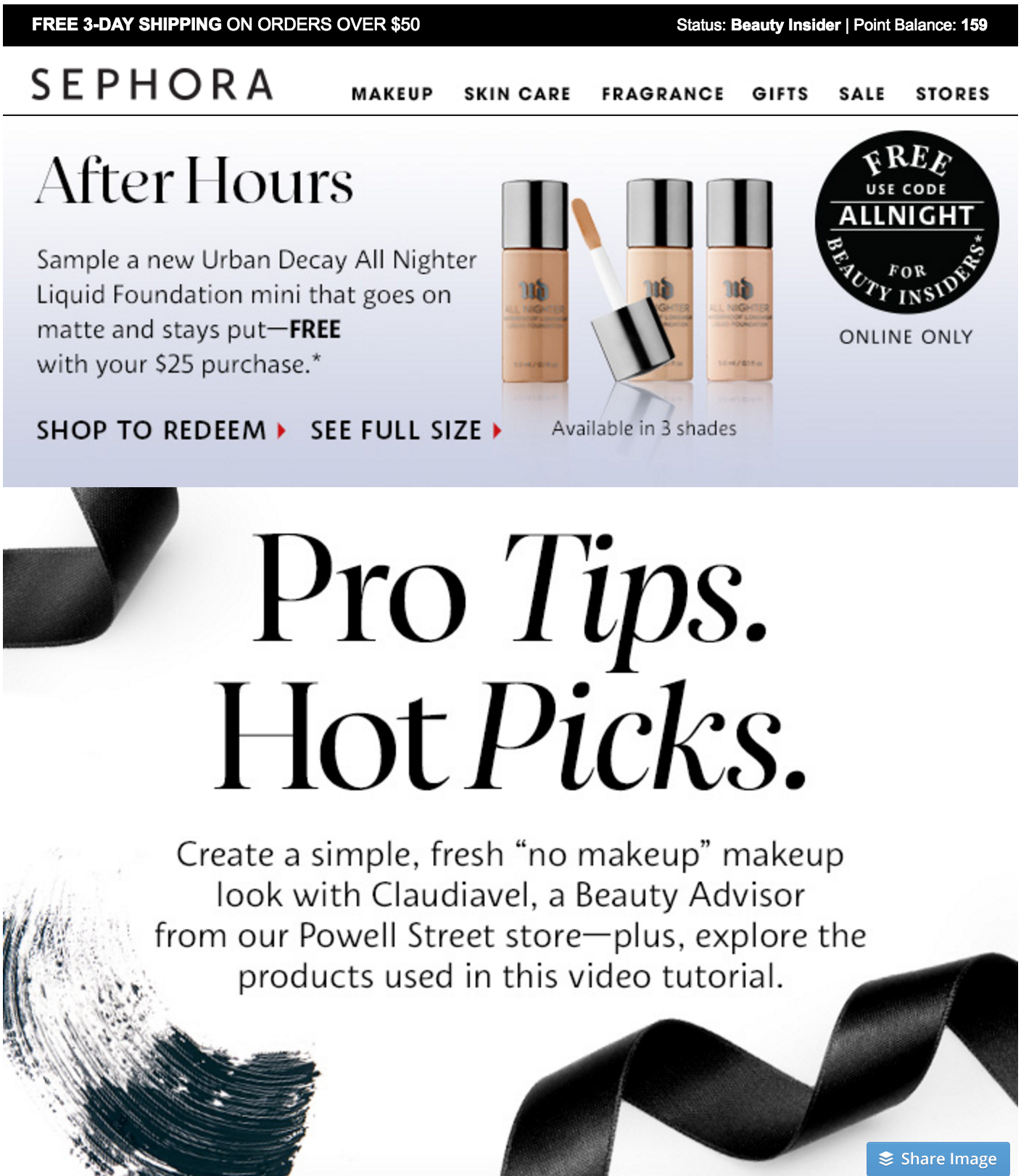
B2B Lead Nurturing Email Examples
4. Litmus
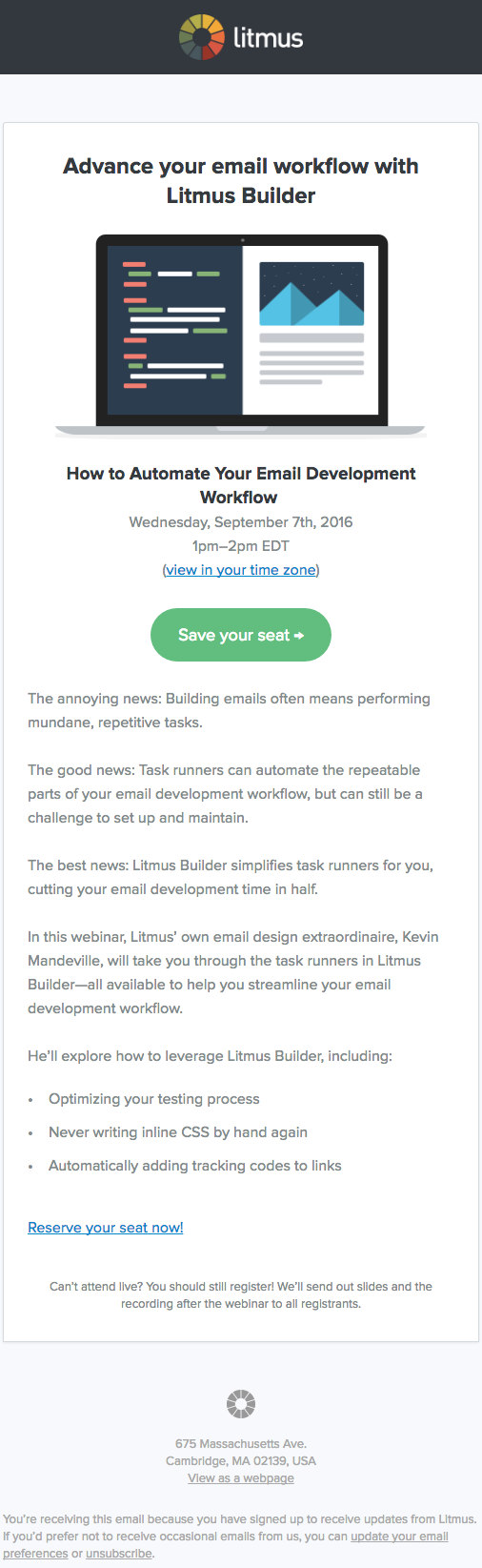
Triggered email messages yield 67.9% higher open rate and 241.3% higher click rates than standard email messages, according to Epsilon. In other words, when you use a person’s behavior — lets say that downloaded content about email workflows — to trigger a relevant email based on that action, it will perform well.
Here’s a great example from Litmus that demonstrates how to use clever, clear copy to provide recipients with a relevant email that adds provides even more value.
Retail Lead Nurturing Email Examples
5. Uncommon Goods
Uncommon Goods shows their products in context and creates a Pinterest-inspired section for each different aesthetic. Each collection has a featured CTA and the email feels more like a curated pinboard than a sales email.
Not to mention, this email is also very mobile-friendly, which can play a big part in the success of an ecommerce lead nurturing email: 56% of email is opened on mobile devices, according to Litmus.

6. Chubbies
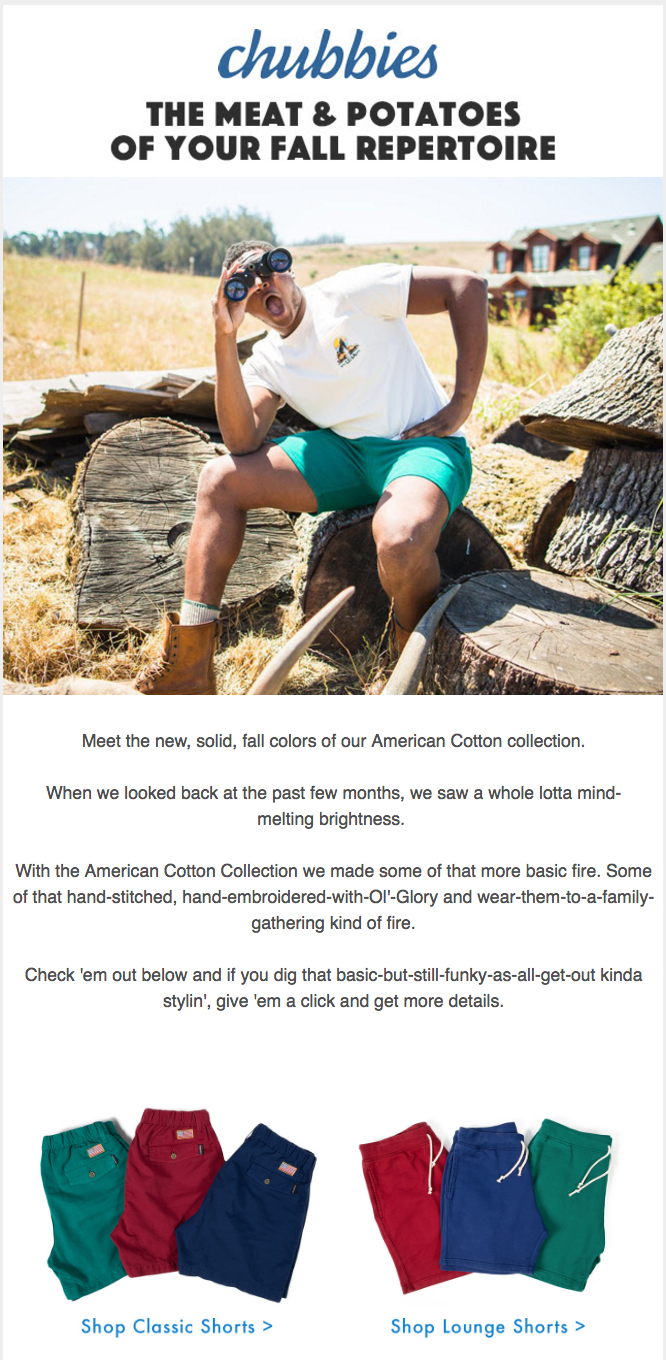
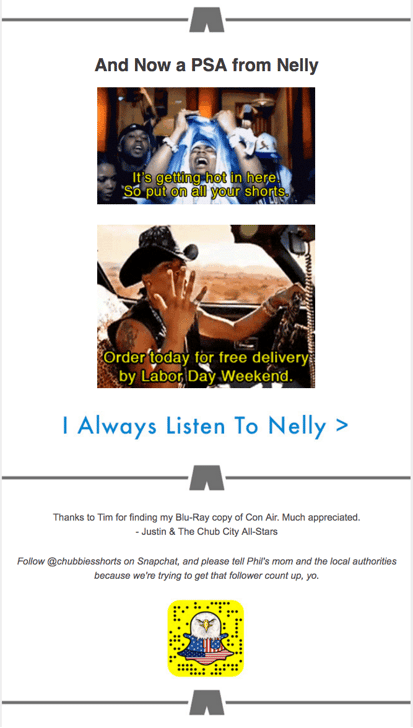
Chubbies is well known for their cheeky marketing and their emails do not disappoint. With over 1.68 million Facebook Likes, they put the social, fun aspect of content first. Their email newsletter serves as a hub for user-generated content, promotions, and all-around humor.
Part information, part fun, this email encourages its reader to enjoy reading it even if they aren’t planning to buy anything in that moment. The copy relates to its audience, the visuals are on-brand, and they offer multiple CTAs (purchase clothing & follow on Snapchat).
Travel Lead Nurturing Email Examples
7. JetBlue
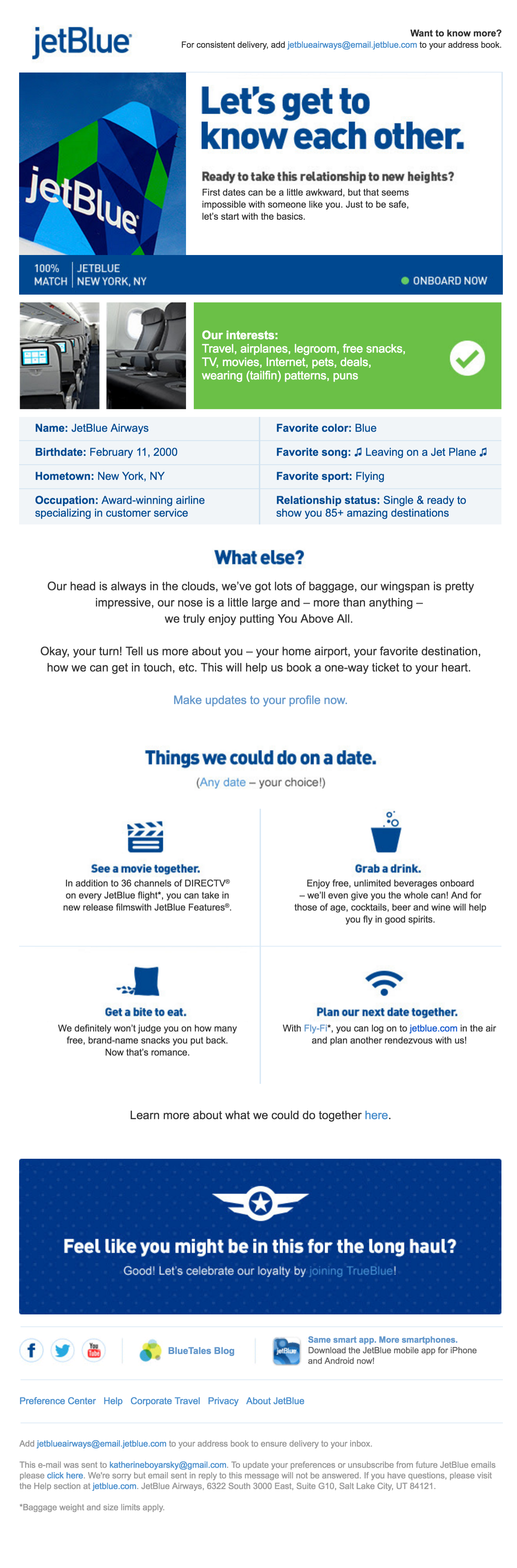
JetBlue has some of the best email copy around. Not only is this email funny, helpful, and full of great puns, but it also reflects JetBlue’s commitment to engaging and retaining customers through email. One of JetBlue’s email objectives is to convert current or past customers into TrueBlue members, as demonstrated below.
(Want to learn how long your emails should be? Check out this helpful blog post that takes audience and message into consideration.)
8. Airbnb
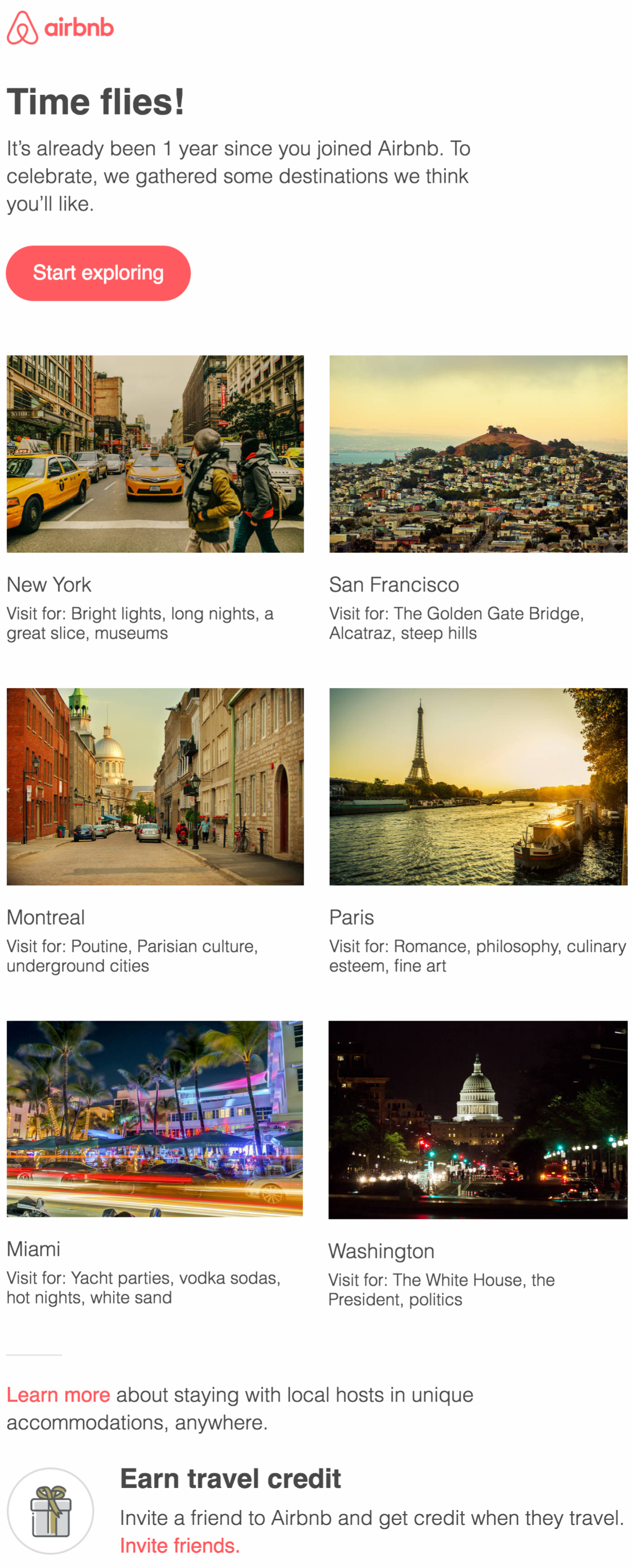
Airbnb’s emails have one goal in mind: give their readers wanderlust.
This email has a clear CTA, highlights beautiful travel destinations, and doesn’t ask too much of the recipient. Not to mention, company anniversaries are always a good opportunity to reach out to subscribers without seeming pushy. It feels personal and curated.
Services Lead Nurturing Email Examples
9. Handy
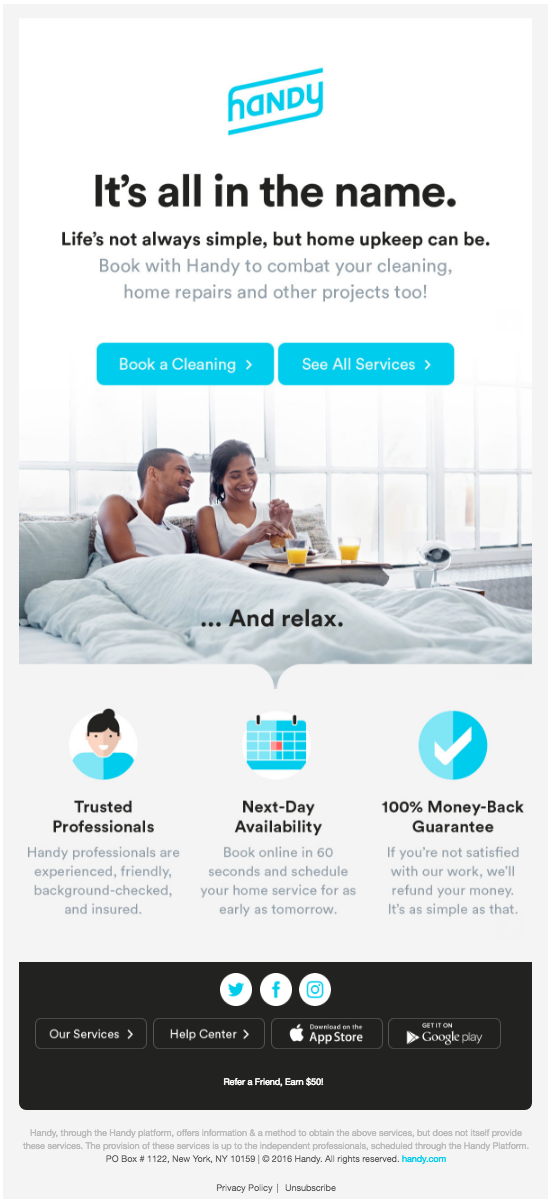
The combination of clear buttons, information about the service, and a nice photo make this email from Handy feel uncluttered and effective. More specifically, the photo of smiling customers is a smart move for two reasons:
- It helps to draw attention to the effect their product has on those who buy it: happiness.
- Human photos saw 95% higher conversion than object photos, according to VWO.
10. Freelancer
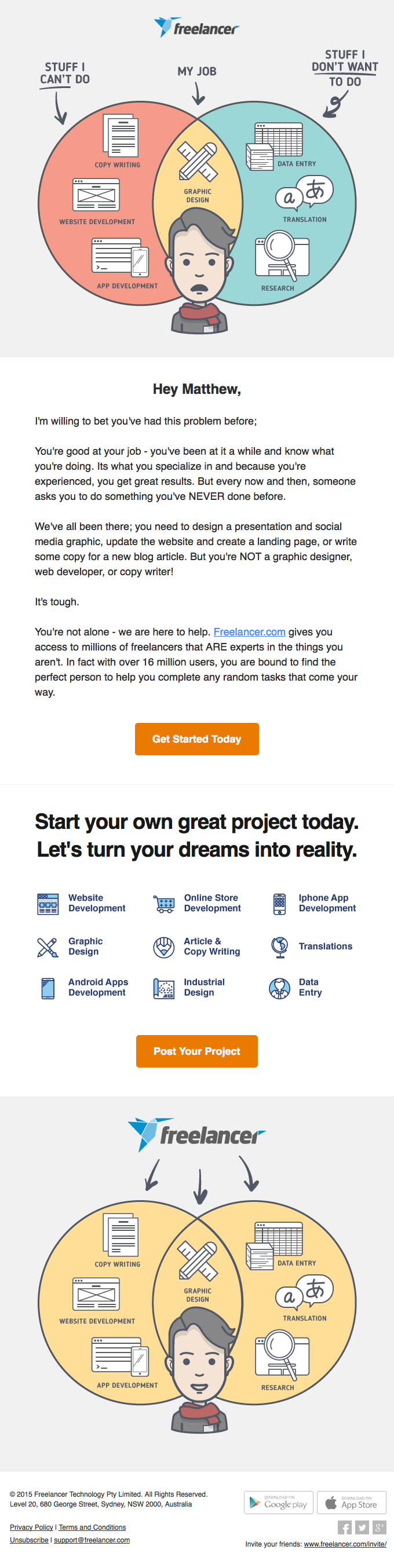
I’m a sucker for a good illustration and Freelancer’s caught my attention immediately. They prove the value of the service through a drawing, then provide a clear ask in the CTA: “Get Started Today.” If you can align images in your email while educating your readers, the message will stick with them for longer and have a higher impact.
11. Skillshare
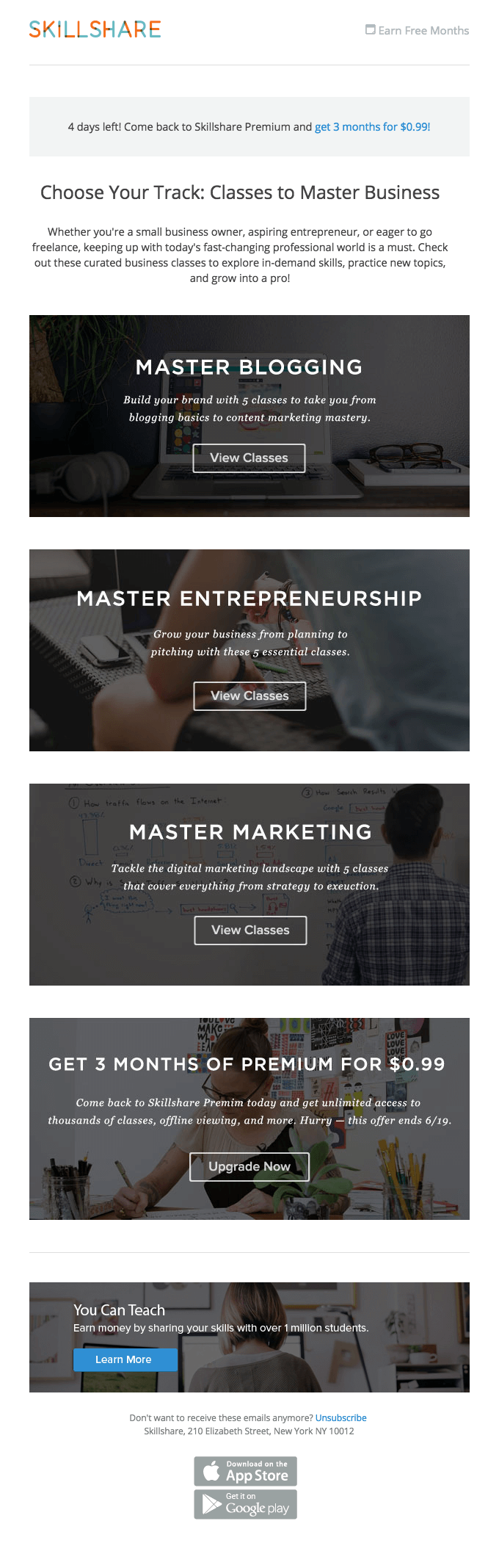
At the top of this email, Skillshare includes a nice reminder to its recipients that their trial is about to expire — a smart move that’ll hopefully result in a renewal or purchase.
The reminder is accompanied by some unobtrusive, helpful CTAs for various educational classes. Notice how the simple, stylish boxes stand out as an alternative to a traditional button.
Food & Beverage Lead Nurturing Email Examples
12. Thrive
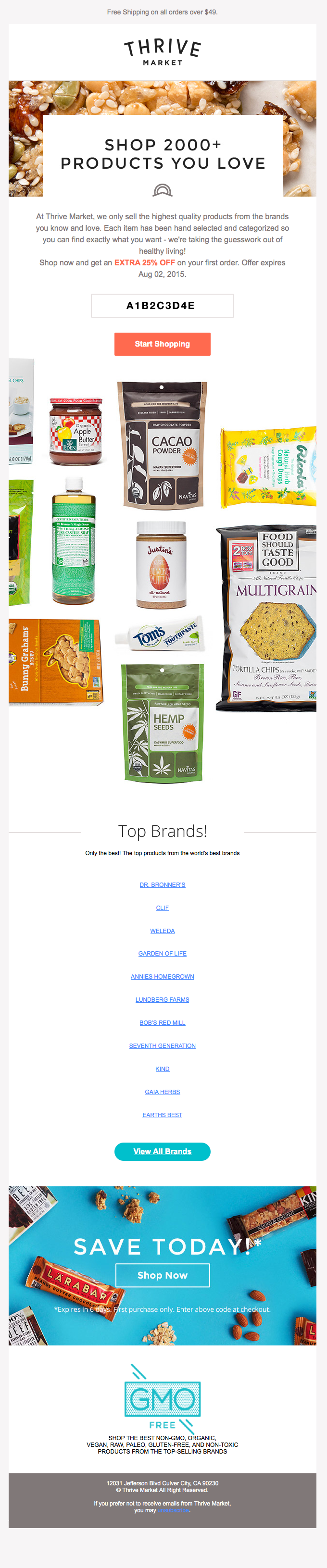
When a person hears something, they’ll remember 10% of that content three days later. However, when paired with a relevant image, they will remember 65% of the information three days later. This concept is referred to as the picture superiority effect.
Thrive takes advantage of this theory through their use of product images. They highlight their products in an attractive way, include a good amount of content, and encourage the reader to start shopping.
13. Dunkin Donuts
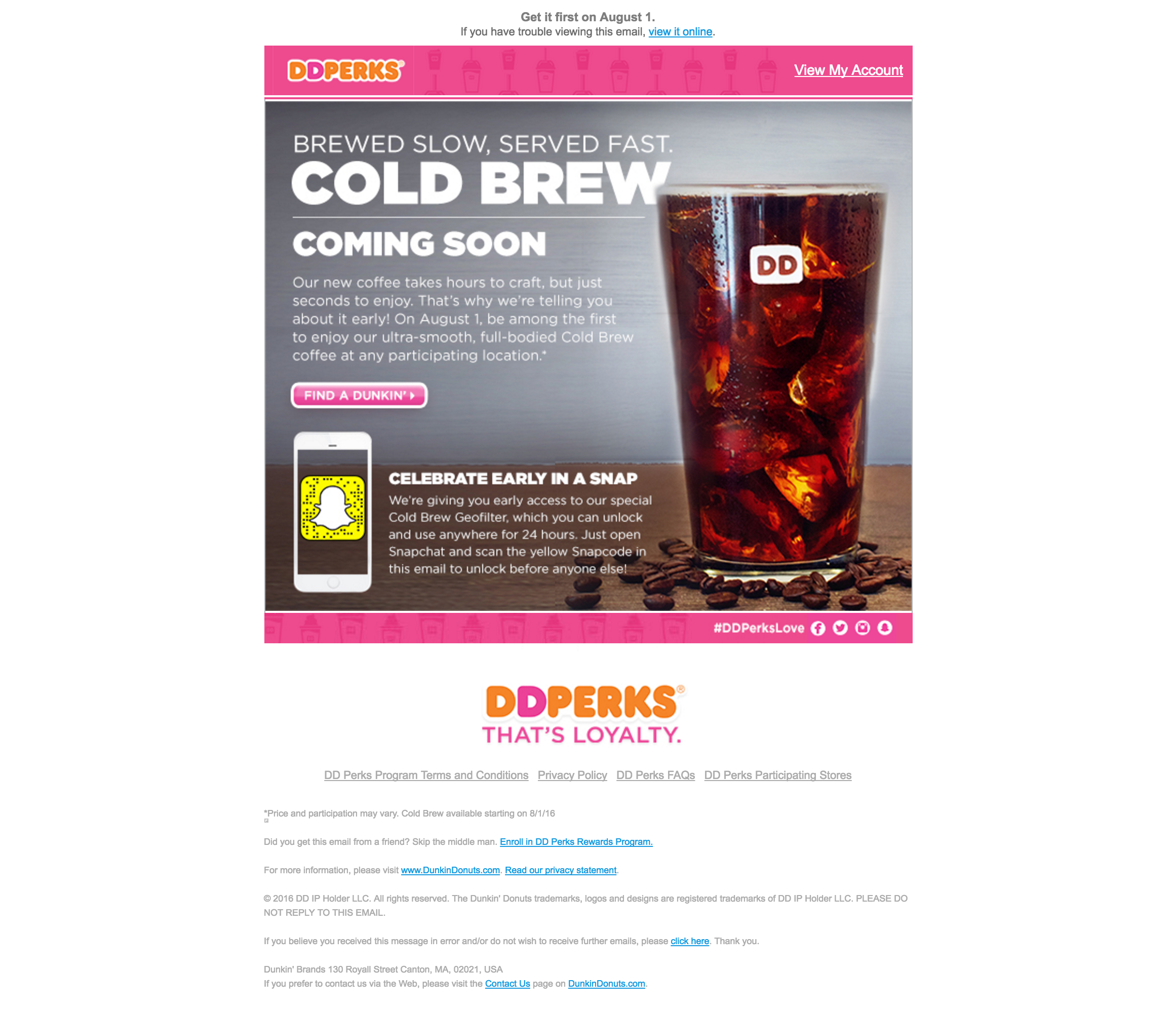
Dunkin Donuts used an announcement for a new item as a way to reach out to its audience. This simple email asks its readers to find the location nearest them, showcases the new drink, and has a secondary CTA to add them on Snapchat. (Speaking of which, check out this guide to Snapchat for business.)
Product Marketing Lead Nurturing Email Examples
14. InVision App
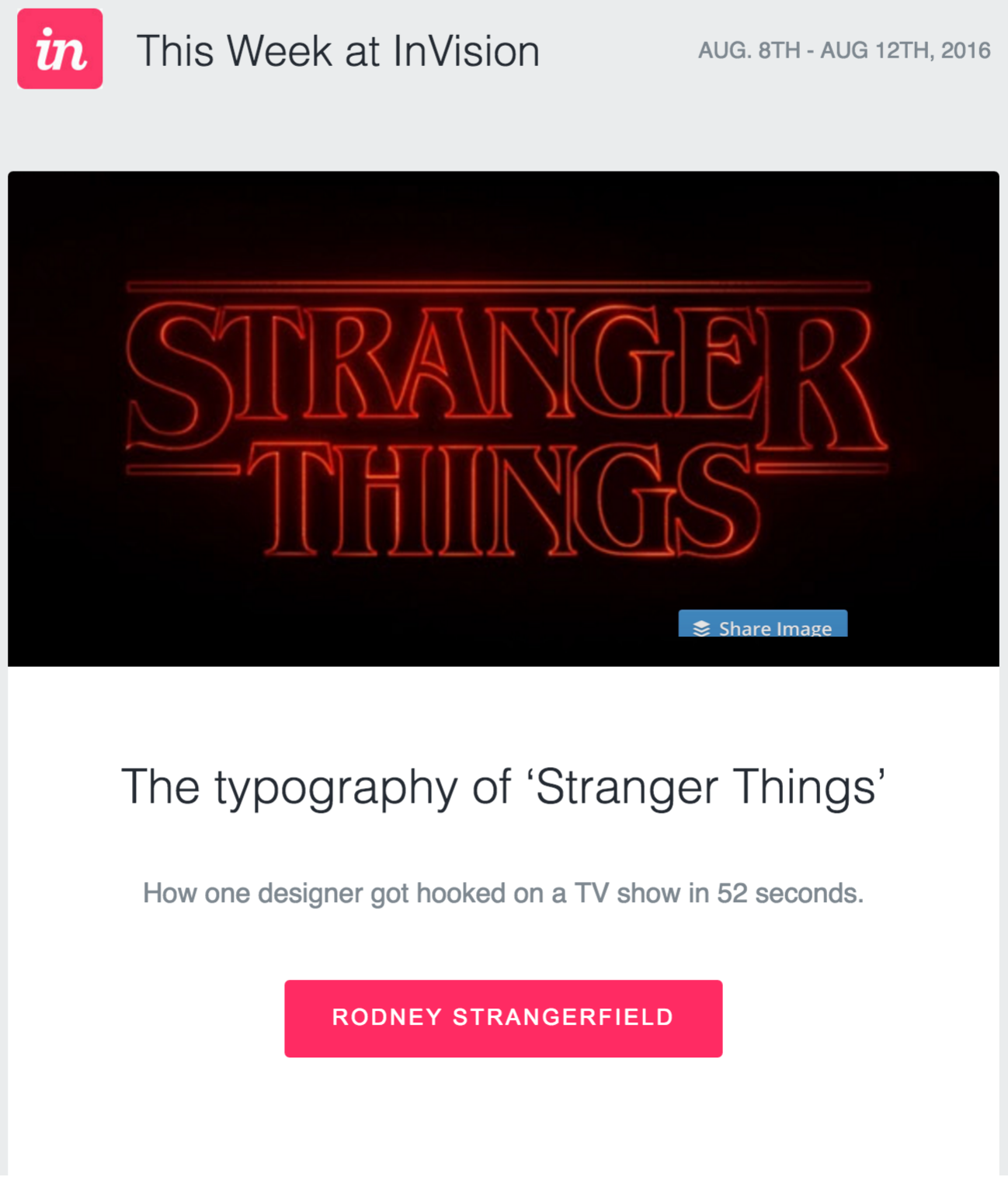
Newsjacking is defined by HubSpot as “the practice of capitalizing on the popularity of a news story to amplify your sales and marketing success.” By mentioning a current, trending topic into your marketing, you can bring in a new audience and engage with your current users.
InVision monopolized on the “Stranger Things” trend by highlighting its typography in this email and relating it back to the design industry. They also used it as an excuse to teach their newsletter recipients through workshops and training.
15. Zapier
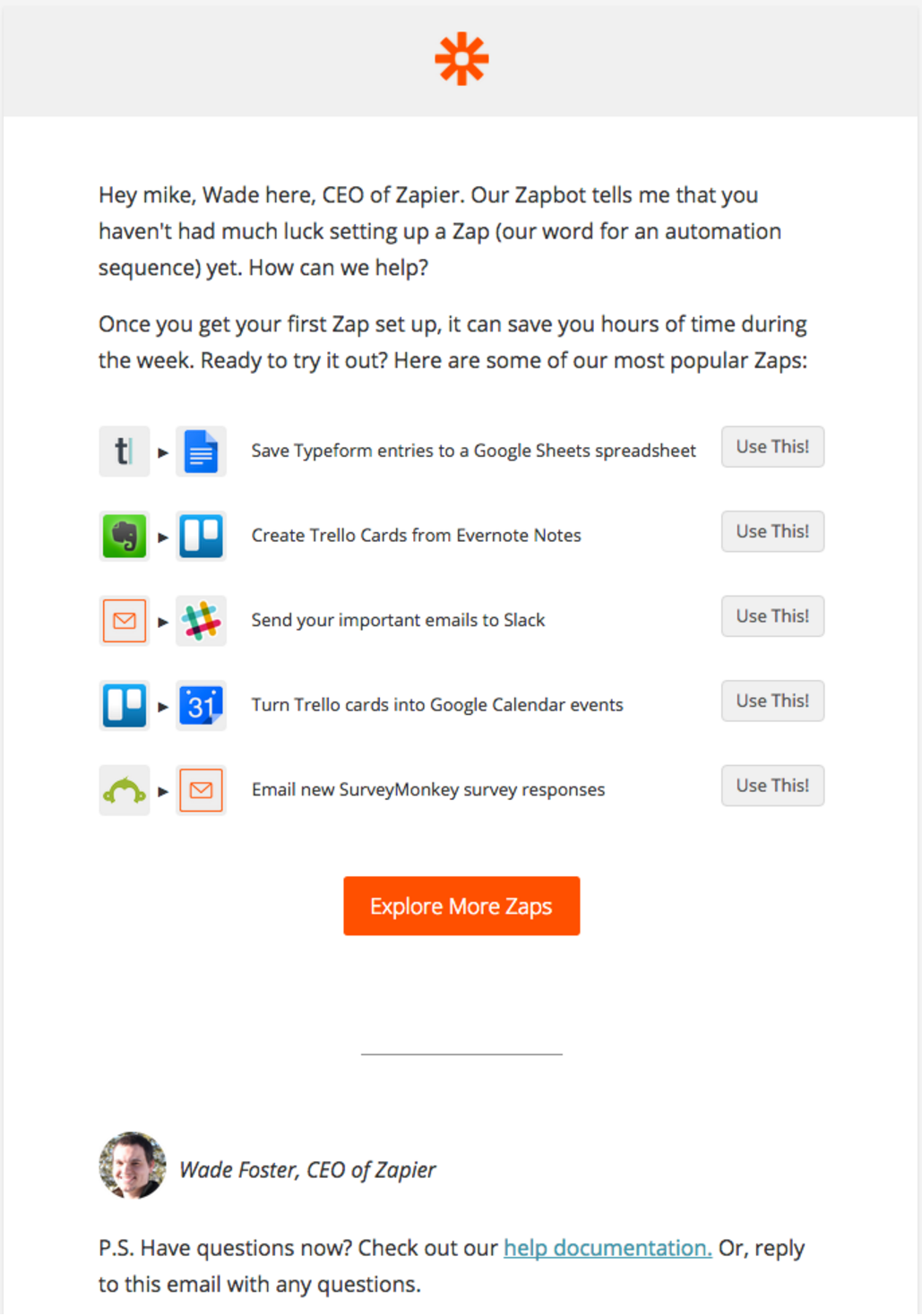
According to DemandGen, leads that are nurtured with personalized content convert into sales at 20% higher than those who aren’t.
This email is from the CEO of Zapier asking how he can help them get setup proves that they’ve got a handle on the whole personalization thing. This user is being targeted with a name personalization token as well as a trigger indicating that they are yet to setup the product.
For technical products, friendly, helpful emails based on activity can perform extremely well. Notice how they even include a link to their help documentation for added value and clarity.
16. Sprout Social
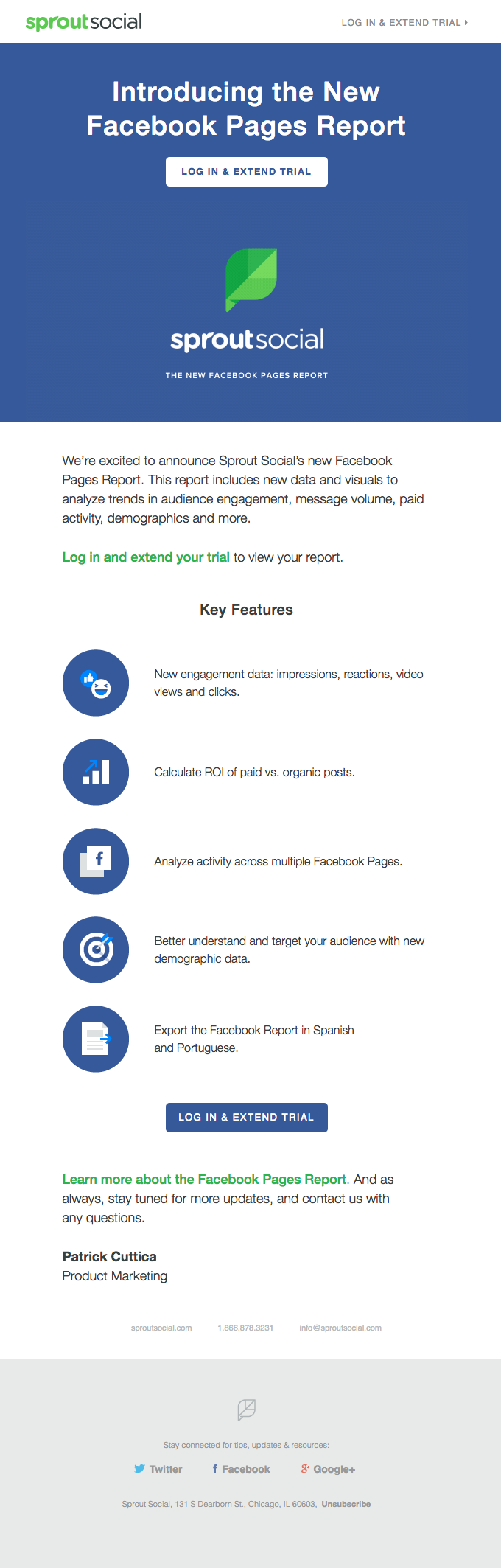
Sprout Social uses a new feature as a reason to reach out to leads. They teach the audience about this new feature, let them know that their trial is expiring, and provide helpful feature descriptions to inform their decision.
By giving your readers a taste of your new products and services, they will be inspired to learn more, so be sure to also include relevant links and information for them to continue their research.
17. Typeform
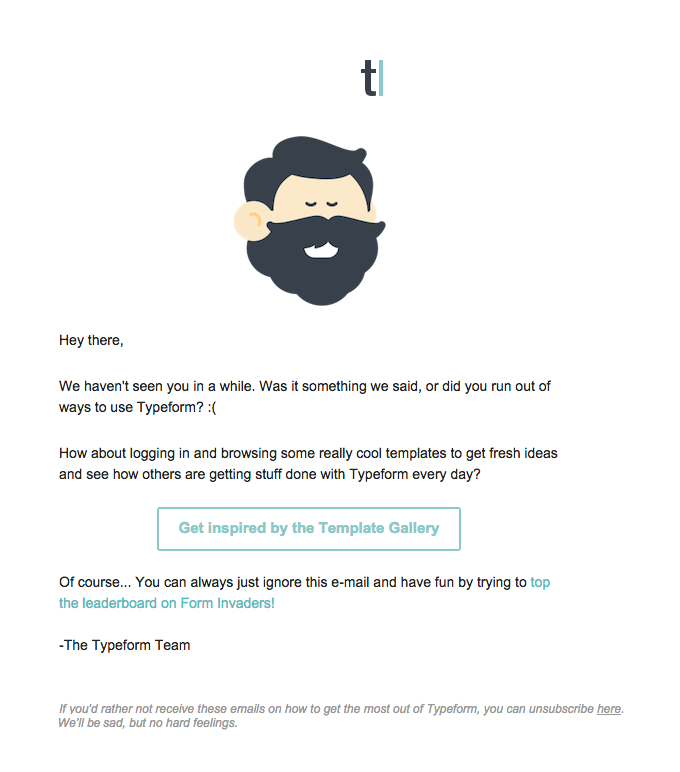
Writing email copy is difficult. It’s important to be friendly, helpful, and straightforward.
That’s why Typeform really hit the nail on the head with this email. In the example below, you’ll see that they’re not only being relatable and honest, but they are also strategically taking advantage of their user’s inactive status to position the outreach. And the challenge to look at their leaderboard is a nice secondary CTA that doesn’t ask too much.
18. Square
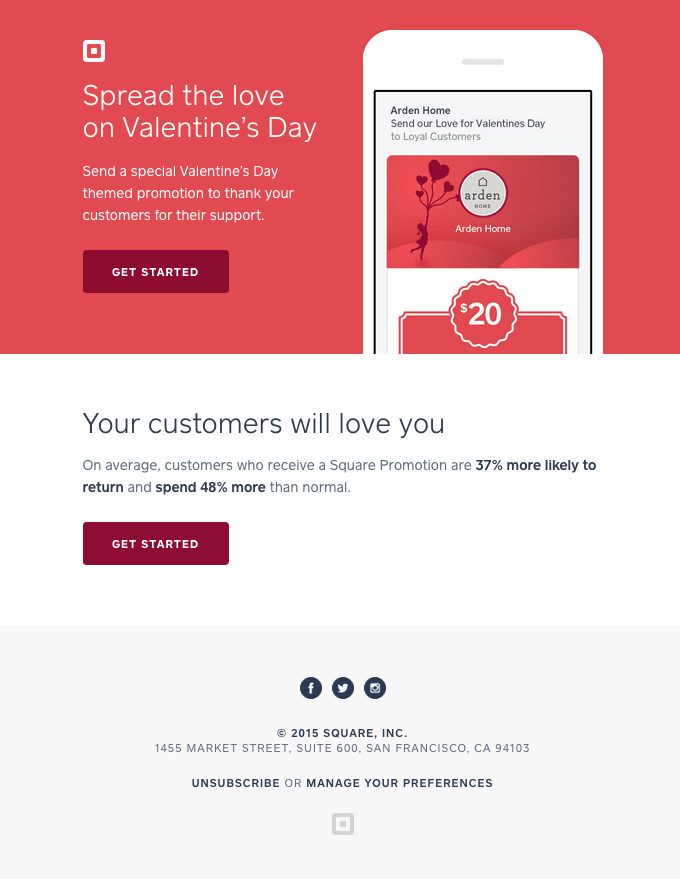
Holiday marketing is a common type of lead nurturing. Both B2B and B2C companies take full advantage of running holiday-themed campaigns throughout the year.
Square leverages the Valentine’s Day holiday to encourage its recipients to take action with their own customers. They provide a helpful and powerful statistic to prove value, and keep it short and sweet.
19. Duolingo
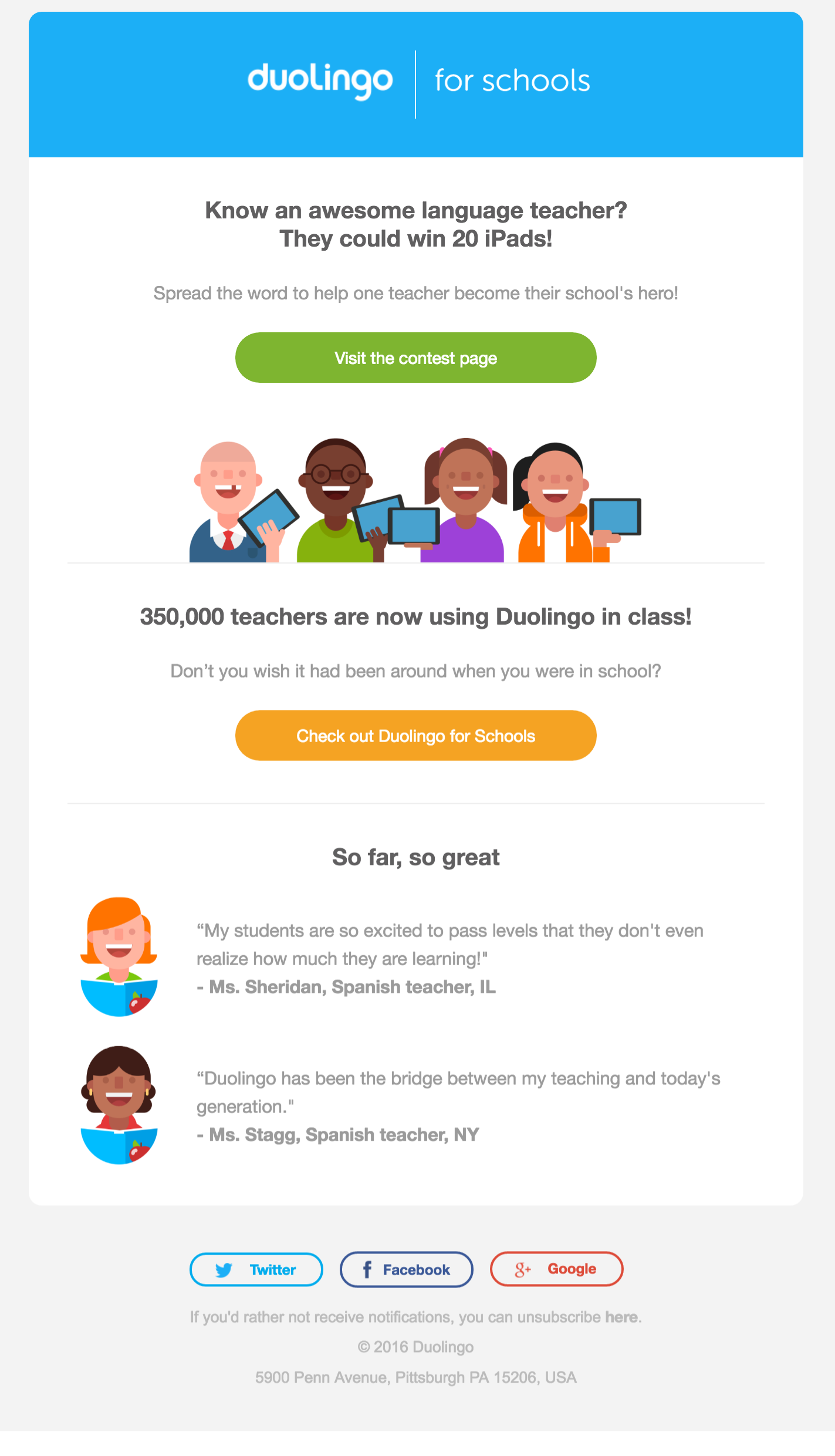
Duolingo taps into their users’ affinity for learning by asking them to nominate a favorite teacher for a contest. This is a great way of engaging with your audience while providing a helpful and fun reason to click.
They also make use of two different types of testimonials. They tell the reader to join “350,000 teachers” as well as including two quotes from teachers using the product. What a great use of social proof.
Now that you’ve been inspired by these great brands and products, learn how to write email copy like a pro and create compelling images.
Editor’s note: This post was originally published in August 2016 and has been updated for comprehensiveness.

7 Amazingly Effective Lead Nurturing Tactics
As companies adopt inbound marketing as a way to generate more leads, the importance of having an effective lead nurturing strategy becomes very clear. In most cases only a relatively small percentage of your inbound leads will be ready to make an immediate purchase, leaving upwards of 90% of your inbound leads on the table.
Implementing an effective lead nurturing strategy can have a huge impact on the results of your inbound marketing strategy, customer loyalty, customer retention, revenue, and more .
In this guide, we’ll cover seven of the most effective lead nurturing tactics you can implement at your company.
Nurturing leads is critical to your business’s success because these tactics directly impact a customer’s decision about whether or not they want to convert into paying customers. There are a number of ways to nurture leads including targeted content, multi-channel nurturing, multiple touches, timely follow-ups, and personalization.
Despite the clear benefits of lead nurturing, marketers can struggle to build the right strategy around it. According to the 2019 Lead Nurturing & Acceleration Survey, 60% of respondents gave their nurture programs a failing grade.
There’s a huge opportunity for savvy marketers (like you) to implement effective lead nurturing strategies and gain an advantage over your competition.
Let’s get started.
7 Amazingly Effective Lead Nurturing Tactics
Although there are a number of lead nurturing strategies out there, here are seven of the most effective, no matter what type of business you work for.
1. Leverage targeted content.
When it comes to lead nurturing, one size certainly does not fit all. As the research proves, strategically nurturing your leads with targeted content can significantly improve results.
Start by working to understand each of your unique buyer personas. Then, create an assortment of targeted content designed to nurture each of your personas based on their characteristics like interests, goals, objectives, and marketing triggers.
You should also have a marketing automation platform in place to help you identify, segment, and target your unique buyer personas as you scale your strategy.
2. Use multi-channel lead nurturing techniques.
In the past, most lead nurturing strategies involved setting up a simple email drip campaign that would send out generic emails to a list of prospects.
Today, marketers like you are looking for new tactics and technologies that include and go beyond email nurturing. With the help of powerful marketing automation platforms, savvy marketers are now executing multi-channel lead nurturing strategies.
Effective multi-channel lead nurturing most commonly involve a combination of marketing automation, email marketing, social media, paid retargeting, dynamic website content and direct sales outreach. Because there are so many tactics involved, to execute this properly, you really need to ensure that your sales and marketing teams are well aligned and working cohesively.
3. Focus on multiple touches.
While the buyers journey for every product and service can be quite different, research has suggested that on average, prospects receive ten marketing touches from the time they become aware of your company til the time they convert into customers.
As you can imagine, the most successful lead nurturing strategies deliver content that helps prospects progress through the buyer’s journey by addressing common questions and concerns. In addition to email tactics, consider how you can use a mix of content types like social media, blog posts, whitepapers, interactive calculators, or even direct mail, to nurture your prospects into customers.
4. Follow up with leads in a timely manner.
The benefits of immediate follow up calls seem quite evident, but most organizations still aren’t acting very quickly.
Automated lead nurturing can help you reach large groups of prospects, but a timely follow-up email or a phone call is still often the best way to convert inbound leads into qualified sales opportunities. That’s because the odds of converting a lead into a sales opportunity are exponentially higher when the lead is contacted immediately following a website conversion.
When you make a timely, well-planned call to an inbound lead, it’s far more effective than any volume of cold calling. You know exactly what the prospect is researching based their recent browsing behavior — plus, you have enough information about the prospect to do some initial research about the organization they work for and their role within the company.
5. Send personalized emails.
Email marketing continues to be a highly-effective tactic for lead nurturing — and the personalization of those emails tends to produce better results. A study by Accenture found that 41% of consumers switched businesses due to a lack of personalization.
There are many ways to personalize emails to improve your lead nurturing strategy. You can send triggered emails when a visitor completes an action like downloads your gated content, clicks on links in your emails, visits certain pages on your website, or demonstrates a high level of engagement.
When you combine the power of marketing personalization with behavioral triggered emails you can deliver the right marketing messages to the right people, at exactly the right times.
6. Use lead scoring tactics.
For those who are new to the concept of lead scoring, this methodology is used to rank prospects on a scale that represents the perceived value each lead represents to the organization.
Lead scoring can be implemented in most marketing automation platforms by assigning numeric values to certain website browsing behaviors, conversion events, or even social media interactions.
The resulting score is used to determine which leads should be followed up with directly by a sales rep and which leads need to be nurtured more.
7. Align your sales and marketing strategies.
When sales and marketing align, lead nurturing strategies are more successful and customer retention rates improve.
For both sales and marketing to contribute to lead nurturing identify the exact points in the buyer’s journey that prospects should be transitioned between teams — to do so, consider different triggers like lead scoring, workflow enrollment, and conversion events.
The shared expectations, responsibilities, and goals for this cross-team collaboration should be outlined in a sales and marketing service level agreement (SLA). Creating a SLA will help the two teams hold each other accountable for converting leads and effectively nurturing them into paying customers.
Leverage Lead Nurturing Tactics
To wrap up, let’s summarize what these seven effective lead nurturing tactics entail.
1. Targeted content: Tailor intriguing, entertaining, and delightful content to target audience members so you can identify the most-qualified leads.
2. Multi-channel lead nurturing:Reach and nurture your audience where they are — on multiple channels — rather than just email.
3. Multiple Touches: Boost touches with a mix of content types and channels to increase your interactions and engagement among target audience members.
4. Timely Follow Ups: Follow up with your leads in a timely manner to keep them engaged and interested as well as keep your brand top of mind.
5. Personalized Emails: Personalize your emails (and all lead nurturing tactics, when possible) to promote customer retention.
6. Lead Scoring: Implement a lead scoring strategy to help you determine which leads you should focus your time on.
7. Sales and Marketing Alignment: Align sales and marketing teams to improve your lead nurturing tactics and boost customer retention.
By using some or all of these tactics, your lead nurturing efforts are bound to be effective — so, start experimenting with them on your team today.
Editor’s Note: This blog post was originally published in March 2016, but was updated for comprehensiveness in March 2020.

6 Fundamental Video Marketing Tips for Every Skill Level
Nowadays, most marketers obsess over how they can amplify their content’s reach as much as possible. More views means more leads and customers, right? While this convention can be true, it’ll only pan out if you optimize your videos for your audience before you optimize them.
Resonance is the most important determinant of whether your audience will take action, and your video’s creative is the most important determinant of whether your video will resonate with your audience. So even if your video reaches a million people, if it doesn’t resonate with them, it won’t persuade anyone to take your preferred action, let alone remember your brand.
With this insight in mind, let’s go over six fundamental video marketing tips that’ll help you craft videos that resonate with as many people as they reach.
Video Marketing Tips
- Hook your audience.
- Tell stories.
- Evoke positive emotions.
- Make your videos “sticky”.
- Rely on visuals.
- Add appropriate soundtracks to your videos.
1. Hook your audience.
When Facebook analyzed their users’ video consumption data, they discovered that 45% of people who watch the first three seconds of a video will keep watching it for at least 30 seconds.This continues to ring true in 2020.
Data indicates that sparking your audience’s curiosity with an attention-grabbing title isn’t enough to engage them. You also need to instantly hook your viewers within the first three seconds of your video — lets face it, the human attention span isn’t long enough to be entertained by sluggish content.
But what actually hooks people? What we’ve discovered at HubSpot is that an effective video hook visually engages viewers and previews the video’s core message. Creating these types of hooks can simultaneously grab your viewers’ attention and generate interest in the rest of the video.
2. Tell stories.
In the neuroscience field, researchers have proven that storytelling is the best way to capture people’s attention, bake information into their memories, and resonate emotionally with them. The human brain is programmed to crave, seek out, and respond to well-crafted narrative.
When someone tells you a story, they can plant their personal experiences and ideas directly into your mind — often, you then start to feel what they feel. For instance, if someone describes eating a plate of lobster mac and cheese, your sensory cortex lights up. If someone recounts scoring their first touchdown, your motor cortex enlivens.
In other words, powerful stories evoke emotion and resonate with audience members.
3. Evoke positive emotions.
Psychology tells us that emotions drive our behavior, while logic justifies our actions after the fact. Marketing confirms this theory — humans associate the same personality traits with brands as they do with people. So choosing between two alternatives is like choosing your best friend or significant other. We go with the option that makes us feel something.
If you want your videos to resonate with your viewers, consider kindling warm feelings rather than fear, anger, or disgust. In fact, happiness, hope, and excitement are some of the most common emotions that drive viral content, so if your video can evoke these emotions, it could rake in a ton of views and generate a lot of engagement.
4. Make your videos “sticky”.
In their book, Made to Stick, brothers Chip and Dan Heath taught readers a model for making ideas “sticky”, or, in other words, making ideas digestible, memorable, and compelling.
By analyzing countless amounts of “sticky” ideas, like JFK’s “Man on the Moon” speech and even some conspiracy theories, the Heath Brothers noticed that a “sticky” idea usually follows six principles:
- Simple: Easy-to-grasp core message.
- Unexpected: Break cliché and evoke enough curiosity to grab someone’s attention and hold it.
- Concrete: Remain vividly painted in people’s minds.
- Credible: Supported by evidence.
- Emotional: Have a purpose and relate to people.
- Story-driven: Tell a story that inspires people to act.
The Heath Brothers recommend following as many of these principles as possible when devising your ideas. (Also, check out this blog post about this blog post to learn how five brands followed these principles with one of their videos and succeeded.)
5. Rely on visuals.
When we were babies, we relied on our vision to associate objects with behaviors, like a ball meaning playtime. That’s why you can understand visual information in 250 milliseconds and why your visual system activates over 50% of the brain.
Visual storytelling helps people grasp concepts and data easily, so consider complementing your video’s text and narration with dynamic graphics, popular movie and TV scenes, and footage of real people. If you do this, your viewers can listen to the information and watch a visual representation of it to help them form a concrete understanding of your video’s core idea.
6. Add appropriate soundtracks to your videos.
Choosing the right soundtrack can be the difference between a video that grips your audience from start to finish and one that they can barely get through.
Play a fitting soundtrack or jingle in your video to grab your audience’s attention and evoke the specific emotions and feelings you want them to associate with your brand. Neglect the musical aspect of your video, and people might actually think less of your brand.
Music can make your videos much more captivating, impactful, and, in turn, convincing. So whether you’re creating fun social media videos, persuasive product videos, or even serious training videos, you must remember that music can separate your video from the rest of the pack.
Reach and Resonate With More Audience Members Through Video
For many marketers, reach is a metric that they want to see growing on a consistent basis when it comes to video. But without strong emotional resonance, having a great reach isn’t as impactful. So, before you start optimizing your videos, remember to optimize them for your target audience first and craft the most compelling content you possibly can.
Editor’s note: This post was originally published in April, 2019 and has been updated for comprehensiveness.

4 Education Marketing Trends to Keep an Eye on in 2020
Marketing trends in the world of education have the power to get prospective students excited about applying, visiting, or accepting their invitation to your school. They’re critical to staying top-of-mind among your target audience now and for years to come.
Similar to other trends under the (large) umbrella of marketing, education marketing trends are critical to stay on top of and deploy regularly if you want to be relevant and sought-after. In this blog post, we’ll help you discover how you can achieve just that.
Education Marketing Trends
There are a number of education marketing strategies to experiment with, but here are four recommendations we have for you to help you stay ahead of the curve.
1. (Live) Video
Today, engagement stats for video content only continue to grow. Incorporating video into your marketing strategy is no longer optional. And these days, it’s not just about offering any type of video content — it’s about tapping into live video content.
When considering how to incorporate live video, tools like Facebook Live are a great place to start.
Fortunately, campuses are natural hives for creating compelling live video. Any school event, in-class experience, or lecture can be live-streamed (as long as your school policies permit this). Other ideas include a quick “student on the street” live interview about a hot topic of the day or a day-in-the-life video for a specific student persona.
Not to mention you can repurpose video that was recorded as part of a live stream into future content like Northeastern University did with their commencement video — once the ceremony was over, they shared the graduation on their YouTube channel for anyone interested to watch.
To piggyback off of our suggestions of using Facebook Live and Youtube, there are a number of other social media sites you can take advantage of when it comes to live and previously-recorded video including Instagram and Snapchat. These channels are highly relevant among millennials and generation Z — who are most likely members of your target audience as an educational institution.
In fact, every day Snapchat reaches 41% of all 18-to-34 year-olds in the U.S. and allows you to get creative with video.
The platform lets you share images and short videos that you can curate them into longer “Stories”. For example, you could make an experience out of a campus tour or as a channel for student ambassadors and faculty to share personal perspectives on campus life. Like Instagram and Twitter, Snapchat works with hashtags — so, research your student personas to find the hashtags that will ensure your Snapchat content is found by them.
2. Memorable Experiences
Nothing reaches audience members like sharing real experiences. People want experiences that make them feel something — when this happens, they’ll be more likely to make a purchase, invest in, or strive to have that experience as well.
For example, a video about move-in day on campus should make prospective students feel excited, welcome, and motivated about the opportunity to be a part of that experience. Meanwhile, the same video should make current and past students feel proud and fortunate to be a part of the community.
Experiential marketing and content resonate with people and make them want to have the same experience and/ or invest in whatever the experience is. It also makes them want to share the content among their personal networks via social media, word of mouth, and more.
Experiential marketing strategies allow you to offer a look into your school that people who know nothing about it or have never visited want and need to make a decision about whether they want to apply, visit, attend, donate, and more.
3. Personalized Content
For years, e-commerce and social media sites have been customizing web experiences. But today, we expect all of our digital engagements to provide that sort of personalization. Think about it — with all of the schools out there today, there is so much content floating around among prospective, current, and past students. Personalization is how you make it relevant and tailored in a way that the content stands out and becomes something worth consuming and sharing.
But this personalization requires more than simply inserting a prospect’s name into an email. Effective personalization is providing the most relevant content to a specific member of your target audience that meets their needs.
To do this, you’ll need to learn about the online behavior, challenges, interests, and routines of your target audience members This includes understanding the type and format of content they prefer to consume. An effective way to do this is by creating personas for different students or conducting surveys.
To personalize, think big and go beyond email. For example, you can tailor headlines that visitors see when they visit your site or offer the most relevant blogs for their desired education path and interests. And remember, the more data you collect, the more precise your personalization can become.
4. Influencer Marketing
Influencer marketing is a form of word-of-mouth marketing (WOMM) but with an added bonus for your efforts. WOMM is so effective because it’s a third-party opinion that prospects feel they can relate to and trust — because, let’s face it, prospects know that even when you’re providing valuable and relevant content, you’re still biased as the promoter.
The process of influencer marketing is about identifying an individual who fits your persona, is well-known among members of your target audience, has an impressive following, and exerts a powerful influence on your shared target audience. You can use influencers to share your content or they can create content relevant to your school.
Editor’s note: This post was originally published in September 2019 and has been updated for comprehensiveness.

6 Instagram Managers Share Their Trade Secrets
The first thing I do when I wake up is turn off the alarm on my phone and then scroll through Instagram.
While I wish I was kidding, I’m definitely not.
As a consumer, Instagram is one of my favorite platforms. I get to see fun and inspiring content that’s also helpful and entertaining.
However, as a marketer, nailing Instagram isn’t as easy as waking up and being inspired.
That’s why we talked to six Instagram managers to give us their best tips and tricks on managing an Instagram account.
Below, let’s dive into trade secrets that Instagram managers swear by.
Instagram Managers Share Their Top Tips and Tricks
1. Focus on engagement.
Instagram’s main value proposition is that the platform brings people and things they love together. That’s why engagement is a top metric for this platform.
According to Vana Korrapati, a digital marketing strategist and social media manager, “I always try to engage my audience by including some of them in my posts. This brings my audience together for a meaningful conversation.”
I love this tip because Korrapati uses a specific tactic for a specific goal. This means that she’s created a SMART goal — one that’s specific, measurable, attainable, relevant, and time-bound.
You’re more likely to attain goals with those qualities.
For example, your goal on Instagram can’t just be to raise awareness. You need to know what tactics you’re going to use and how you’re going to measure that specifically, whether it’s through follower count, impressions, reach, or engagement.
Korrapati measures her goal of brand awareness through engagement metrics. She says, “My main motive on Instagram is to build awareness, so I track follower count, impressions, and reach.”
Additionally, she also evaluates her process continuously.
She says, “I use Instagram analytics actively on my campaigns to understand the engagement and continuously tweak my strategy. Not evaluating your Instagram analytics could lead to targeting the wrong audience and driving irrelevant visitors.”
2. Build an emotional connection.
On HubSpot’s Skill Up Podcast, Matthew Brown, a senior podcast producer at HubSpot, discusses how to use Instagram to drive awareness and purchase intent.
One of the main takeaways is to build an emotional connection. Instagram makes this easy because you can have direct communication with consumers and potential customers.
You can do this by using interactive features such as polls or by replying to comments in a timely manner.
Additionally, building an emotional connection will help you increase trust with your audience.
To track the emotional connection with your audience, you can look at your comments. These are a good metric to use because it takes a lot of time for the user to do and it shows the algorithm that people are engaging with your content.
3. Be consistent with your visual branding.
Although we’re past the days of perfectly planning out your Instagram grid, visual branding is still important.
According to Leslie Green, a campaign manager on HubSpot’s social media team, “Don’t ignore the importance of consistent visual branding across Instagram — which includes Feed posts, Stories, IGTV, live video, and your highlight covers.”
As more people are searching for products and brands within the platform, you should think about your Instagram profile like you do any other landing page.
That means that you should use brand guidelines, as we do at HubSpot, to help achieve consistent branding on Instagram.
Green adds, “You want your page to visually communicate your brand as soon as someone reaches your page. Instagram is a highly visual platform so use that to your advantage with a consistent look and feel to increase brand recall.”
4. Use Instagram Stories.
With Instagram Stories, you can show up for your audience every single day — and you should because Stories are one of the best ways to be noticed by your audience.
In fact, if your Stories become one that your audience is consistently watching, you’ll show up more often in their feed.
According to Kelsi Yamada, who’s on the HubSpot social media team, “We love Instagram Stories, and your audience probably does too. Meet them there by posting your own, and engage them with the platform’s poll, quizzes, and questions. These stickers help make your Stories fun, memorable, and something to look forward to in the feed.”
5. Test everything.
Just like any trend, you shouldn’t immediately buy-in to every fad that comes along.
According to Kelly Hendrickson, a social media manager at HubSpot, “Don’t buy into the trends, test them. Everyone you talk to (including everyone in this blog post!) will have their tips and tricks. The important thing to remember is that what works for one account, may not work for yours.”
That’s why you need to test, learn, and repeat.
And remember, for every strategy you test and implement, you never want to lose focus of your customer.
Hendrickson says, “Never forget your audience. People opt-in to be part of your conversation on Instagram. Give them a reason.”
6. Provide value to your audience while working smarter, not harder.
Jennifer Stefancik, a social media manager of the HubSpot Academy Instagram account, says the best thing to do on Instagram is to provide value to your audience.
She says, “Make sure each post — both the creative and the caption as standalone elements — provide value to your audience.”
Once you’ve nailed that, you should also work smarter, not harder. But how can you do that?
Stefancik says, “Use Canva (or a similar tool) to create your posts and Stories in advance. Creating them on the fly can be unnecessarily stressful and leaves room for typos.”
When you create posts in advance, you can use the same fonts, colors, and plan for interactive features like polls or questions. This helps you make your feed look consistent.
Additionally, Stefancik recommends using a link in bio solution (HubSpot uses LinkTree) so you can drive followers to different parts of your website. This also helps create value for your audience.
These are some of the most successful strategies we’ve used. But you don’t have to take our word for it. You can see how our HubSpot Academy Instagram account conversions grew by 475% for only $6 a month.
While these trade secrets from social media managers are helpful to anyone getting started on Instagram, remember to test them on your account. It’s important to test any strategy you use for your social media team to see what works.

How to Set Up Instagram Gift Cards Stickers
Want to offer gift cards on Instagram? Wondering how to set up and use Instagram Stories gift card stickers? In this article, you’ll discover how to sell gift cards on Instagram. About Selling Gift Cards via Instagram To support businesses in selling online, Instagram has made it easier to sell directly to their audience (and […]
The post How to Set Up Instagram Gift Cards Stickers appeared first on Social Media Marketing | Social Media Examiner.
from Social Media Marketing | Social Media Examiner https://ift.tt/3b2PmBd
via socialmediaexaminer
The 10 Most Engaging Topics on LinkedIn in 2020 [+Viral Examples]
It’s no secret that LinkedIn operates one of the largest professional networks on the Internet.
In fact, the platform has 690+ million members in over 200 countries and territories.
That’s why it’s important for marketers to be active on LinkedIn. But how do you get your network to engage with your posts?
Below, we’ll discuss the top 10 most engaging topics on LinkedIn, how certain content types go viral, and the science behind why. Plus, we’ll dive into examples that show you how to execute posts like this.
1. Sensational Info-tainment Videos Posts
Video content has been increasing in popularity on social media sites like Facebook and Instagram over the last few years. On LinkedIn, it’s no different.
In fact, 75% of marketers polled said LinkedIn video content is a successful way of reaching target audiences.
Example: LinkedIn Live (Mall Edition)
This example really pushes the boundaries of LinkedIn video content creation.
In this viral video, I literally approached hundreds of strangers at the mall and asked them for “15 minutes on their calendar to discuss synergies that may exist.” This is perhaps the single most dreaded phrase of all-time on LinkedIn, so I decided to take it from the inbox to the streets.
For context, I lead demand generation at Nextiva, a cloud communications company. This video has absolutely nothing to do with Nextiva, or our products and services. So what’s the point then?
It’s simple — to remain top of mind among the B2B community and become an evangelist for the Nextiva brand.
LinkedIn is no longer about just selling and prospecting. Driving brand presence and audience engagement is the new normal.
Content Overview
- Info-tainment based video, with supporting text
- 1,467 reactions
- 607 comments
Why did it go viral?
- Communicates a highly relatable concept with a comedic twist.
- It’s a new breed of social media content for B2B labeled as “info-tainment.”
- Brings attention to a widespread issue — LinkedIn spam.
- Offers practical takeaways for a clearly defined audience (B2B sales professionals).
- Has an element of sensationalism. Not many people have the courage to approach strangers at the mall and ask them for “15 minutes on their calendar to discuss synergy.“
2. Relatable Humor Posts
When people are scrolling through social media, they like to see content that they can relate to. Even more, they like to see content that makes them laugh.
If you can do both of those things in a LinkedIn post, you’ll see plenty of engagement.
In the example below, Corporate Bro does exactly that.
Example: Things New Sales Reps Say
Ah, good old Corporate Bro. What would a LinkedIn post be without him? He’s arguably one of the biggest internet sensations in the world of B2B social media marketing. His hilarious take on sales rep office banter has earned him prominent placing on this list.
Content Overview:
- Video post with supporting text
- 1,197 reactions
- 398 comments
Why did it go viral?
- Flat out, this video is just hilarious and supremely creative.
- It’s widely relatable and addresses a specific audience (B2B sales professionals).
- The video is pure “info-tainment.” This is a proven strategy for LinkedIn.
- It’s shocking. This content is radically different from what’s out there, so it stands out.
- Exaggerated sensationalism — it highlights many stereotypes behind the “bro” sales culture.
3. Heartwarming Story Posts
Everyone loves a heart-warming story. If you use emotion in your posts, you can keep readers engaged and leave them wanting more.
Example: $4 In My Bank Account
Shay Rowbottom is one of the most prolific B2B content creators on LinkedIn. Her strategy is simple, yet genius. She takes highly relatable and easily digestible concepts, and recreates them with humor and info-tainment.
In this post, she shares a flashback to where she was 8 years ago — with just $4 in her bank account.
Content Overview:
- Image post with emotional headline
- 1,502 reactions
- 310 comments
Why did it go viral?
- Everyone loves a good, old success story with an emotional spin. This delivers just that.
- Most entrepreneurs have been broke before. This is widely relatable among that audience.
- She actually saved the screenshot from that day, and shared something deeply personal.
- It’s surprising, and also highlights that success doesn’t just happen overnight.
- It evokes encouragement and positive emotion. Heart-warming stories tend to perform well on LinkedIn.
4. Challenging Conventional Wisdom Posts
As you saw in the examples above, info-tainment and humor-based videos with some controversy tend to perform well and grab lots of engagement.
Text-based posts that challenge conventional wisdom see similar results.
Example: Lead Generation vs. Demand Generation
Chris Walker is a rising star on LinkedIn. He’s got a truly unique and outside-the-box perspective on B2B marketing. Walker is becoming a voice of reason, calling out broken and outdated marketing tactics that don’t work anymore. People love him for his ruthless ability to say what everyone is thinking, but doesn’t want to admit.
In this post, Walker serves up an epic breakdown of lead generation versus demand generation. He gives a fresh perspective that suggests companies should stop creating content purely for lead captures, and should shift to a more buyer centric strategy that focuses on lower lead velocity, but higher close rates.
Check out this 90 minute “State of Demand Gen” interview for deeper insight on this topic.
Content Overview:
- Old school vs. new school theme
- 1,378 reactions
- 243 comments
Why did it go viral?
- This content addresses tons of existing confusion between two distinct marketing concepts.
- Walker offers highly tactical examples of how the two concepts work: old school versus new school.
- Unquestionably, this is a controversial topic among B2B sales & marketing.
- It challenges conventional wisdom, it creates an arena for healthy debate.
5. Question Posts
Asking questions can get your readers engaged. Everyone wants to chime in and be a part of the conversation.
That’s why you should ask questions at the end of your posts. This is a sure-fire way to drive high engagement.
Example: Wrong Email to 1 Million Recipients
Adam Goyette is a leader in B2B marketing, serving as the CMO of Help Scout. This impressive post grew to become a total atomic bomb. It nearly broke the internet with such an extraordinary response purely driven by prompting the audience to share their most embarrassing and shameful work stories.
Content Overview:
- Question based content with a strong emotional hook
- 5,025 reactions
- 474 comments
Why did it go viral?
- Incredibly engaging topic, spark fired by a question.
- Flips the narrative by focusing on failures (people on LinkedIn tend to brag about their wins).
- Goyette offers vulnerability by sharing an embarrassing work story. Most people don’t do that.
- Use of numerical figures. 1 million email recipients. This creates a bigger impact in his story.
6. Data-driven Perspective Posts
Content with numbers that prove a point, or data points from experiments/case studies always make for an intriguing read.
In fact, data-driven posts tend to perform better than rants and opinion pieces.
Example: The Value of SDRs
Tito Bohrt is a top voice in B2B sales, specifically focusing on sales development. He’s a numbers wizard and an expert in behavioral economics. You won’t beat him in a math battle, so don’t try it.
This was an absolute value bomb of a post that completely made people rethink how to place value on sales development reps, perhaps the most under-appreciated role in sales.
Content Overview:
- Numbers-driven breakdown: the monetary value of an SDR
- 1,332 reactions
- 217 comments
Why did it go viral?
- Data-driven perspective that calculates the real value of an under-appreciated sales job.
- Flips the narrative by highlighting the financial upside of an SDR.
- Powerful use of numbers — e.g. turning $300k into $7.5M.
7. How-To Posts
Just like with blog posts, how-to posts work well on LinkedIn.
According to a study byOkDork, which analyzed more than 3,000 LinkedIn posts, how-to and list posts perform best on LinkedIn.
The example below follows that format.
Example: 3 Things to Avoid in Enterprise Sales
Amy Volas is an emerging voice in B2B sales, specifically focusing on hiring and talent acquisition.
She’s known for her remarkably honest and authentic approach to content creation and networking.
This post, which breaks down three pitfalls to avoid in enterprise sales, earned some healthy engagement. Let’s examine why.
Content Overview:
- Text based post, classic list style content
- 430 reactions
- 132 comments
Why did it go viral?
- Amazing opening line which includes numbers and creates curiosity.
- 3 key takeaways that are powerful and easy to follow.
- Explanation behind why each takeaway is important.
- Addresses the “elephant in the room” — Volas shares an honest and real, no BS take on bad trends that are emerging in enterprise sales.
8. Personal Story Posts
At the core of the inbound methodology is being human. This practice is just as popular on LinkedIn. That’s why sharing personal stories is one of the top ways to attract engagement to your posts on LinkedIn.
In the example below, Scott Leese shares a personal, vulnerable story with a message.
Example: Health Is More Important Than Your Job
Scott Leese is a sales veteran with an impressive track record of success with companies of all sizes.
He’s a sales guru with tons of life experience and unique perspectives. With no surprise, his wisdom-based posts often earn widespread reaction and engagement.
This post from Leese is a heart-felt plea to the business community. He urges everyone to drop their obsession with work, and to make health a top priority. He leaves us with an amazing reminder that health truly is wealth.
Content Overview:
- Story based post with an emotional hook
- 2,615 reactions
- 227 comments
Why did it go viral?
- Powerful opening line that addresses the “workaholic” problem among B2B professionals.
- Scott shares a deeply personal experience regarding his own health, which may serve as a wake up call to others.
- He makes you question your perspective on money. If you’re sick, what good is money anyway?
9. Tactical Tips Posts
When people come across actionable tips, they’re excited to implement them. Additionally, they’re usually grateful that they came across the tips in the first place.
That’s why tactical tip posts perform well on LinkedIn.
Example: 1st Time Working From Home Tips
John Barrows is unquestionably one of the world’s best sales trainers. He’s worked with the most recognizable software companies of the last decade, like Google, Salesforce, Okta, Box, and LinkedIn — just to name a few.
He’s a prolific content creator, often recognized for his incredibly authentic and “no BS” tone of voice on LinkedIn. He’s also the host of the Make It Happen Podcast, where he regularly interviews the top minds in B2B sales & marketing.
This post from Barrows offers very tactical advice for those making the transition to remote work for the first time.
Content Overview:
- Tactical list-style post with timely and actionable advice
- 1,567 reactions
- 147 comments
Why did it go viral?
- This post is relevant and timely, as he addresses the crisis many people are facing.
- This post is highly tactical, offering step-by-step advice for B2B professionals who have never worked from home before.
- He offers a unique perspective on the most underrated working from home elements, such as the importance of taking walks and creating agreements with your spouse.
- He uses the listicle/dashes format, which is a proven method for maximizing engagement.
10. Failure Content Posts
Again, people love content that is human and vulnerable. That’s why posting about failures can actually go viral more than posts that brag about your success.
Additionally, once these posts go viral, people are much more likely to visit your site.
According to Econsultancy, LinkedIn is now responsible for64% of all visits from social media channels to corporate websites.
In the example below, after James Carbary recounted a story about failure, I’ll bet people wanted to watch the Tedx Talk he references.
Example: I Completely Botched My Tedx Talk
James Carbary is one of the most respected voices in B2B. He’s an outside-the-box type of content creator, and a well-known podcast enthusiast.
One mind-blowing statistic, is that Carbary has personally interviewed over 1,000 B2B sales & marketing professionals on his podcast.
This post from him offers a brutally honest perspective on failure.
He explains how he recovered from a disaster of epic proportion while delivering a presentation on stage during his first Tedx Talk.
He completely blanked and forgot everything. He was forced to take out his iPhone and deliver the rest of his presentation while reading notes off the screen.
Content Overview:
- Storytelling post with emotional hook (failure)
- 1,158 reactions
- 333 comments
Why did it go viral?
- Carbary shares a brutally honest perspective on failure, and how to recover from it.
- The story drags you in. The opening line is so good, you want to keep reading it.
- The takeaway is powerful. “My worst fear happened, and I’m still alive.”
Bonus: Ask Me Anything Posts
Although this is a new format, ask me anything posts are becoming more popular across social media sites.
That’s why Instagram features a question box on Stories and recently came out with a Q&A style of live video.
The same concept holds true on LinkedIn. When people are more likely to get a response, they’re more likely to ask question in the first place. That’s why using the ask me anything format is helpful in driving engagement.
Example: Ask Me Anything During a Crisis (for SMBs)
Tomas Gorny is the definition of the American Dream. Born and raised in Poland, he moved to the United States at the age of 20 without speaking any English. Today, he’s an entrepreneur, philanthropist and serves as the CEO of Nextiva.
Many SMBs are facing an extremely difficult road ahead, as thousands of SMBs could be forced into closures as a result of the economic collapse which is unfolding right before our eyes.
In this post, Gorny offers entrepreneurs, startup founders and SMB companies the opportunity to ask him anything. He’s been in their shoes before. He’s launched companies during recessions, and knows what it’s like to fail.
Content Overview:
- Ask me anything, with emotion-driven CTA
- 550 reactions
- 105 comments
Why did it go viral?
- Gorny shares his personal perspective on recessions and crisis situations with fellow entrepreneurs and startup founders.
- He solicits questions and offers advice, explaining how he overcame the challenge of running a business during a recession.
- The takeaway is powerful. Don’t let go of your passion, drive and dreams.
If you’ve been doing LinkedIn wrong, now is your opportunity to turn things around. Ditch the sales pitch, and start optimizing for engagement.
LinkedIn is now a broadcasting and content amplification platform. Use it to enhance your personal brand and drive friendly conversations (that may evolve into opportunities later). If you’re still treating LinkedIn as a pure lead gen platform, you will undoubtedly fail.

How to Run LinkedIn Ad Campaigns: A Beginner’s Guide
LinkedIn is a highly valuable tool to network with like-minded professionals. But here’s something we don’t talk about as much as we should: LinkedIn is also a highly useful inbound marketing platform.
It might seem a little bit intimidating. You have enough on your plate … do you really need to figure out another way to create targeted content? Actually, yes. You have more power at your disposal with LinkedIn than you might realize.
That’s because LinkedIn has a powerful ads platform. If you’re already using pay-per-click (PPC) techniques to power your presence on Facebook, Twitter, or Google, consider yourself lucky — you can add LinkedIn to that list, too. This is especially easy to do if you’re using the HubSpot ads tool.
But if you’re new to LinkedIn ads, fear not — we’ve put together a step-by-step guide to setting up your first LinkedIn ad campaign. Bookmark this post and refer to it when you’re ready to get started.
Advertising on LinkedIn is a two-step process: 1) setting up your LinkedIn campaign, and 2) creating your LinkedIn ad(s).
In this section, we walk through how to set up a campaign and build your ad(s) — plus some best practices and tips for each.
1. Create your LinkedIn ad campaign.
Your LinkedIn advertising campaigns will live on a platform separate from the LinkedIn you see every day — the LinkedIn Marketing Solutions platform. Visit this page to get started with your campaign, and select Create Ad.
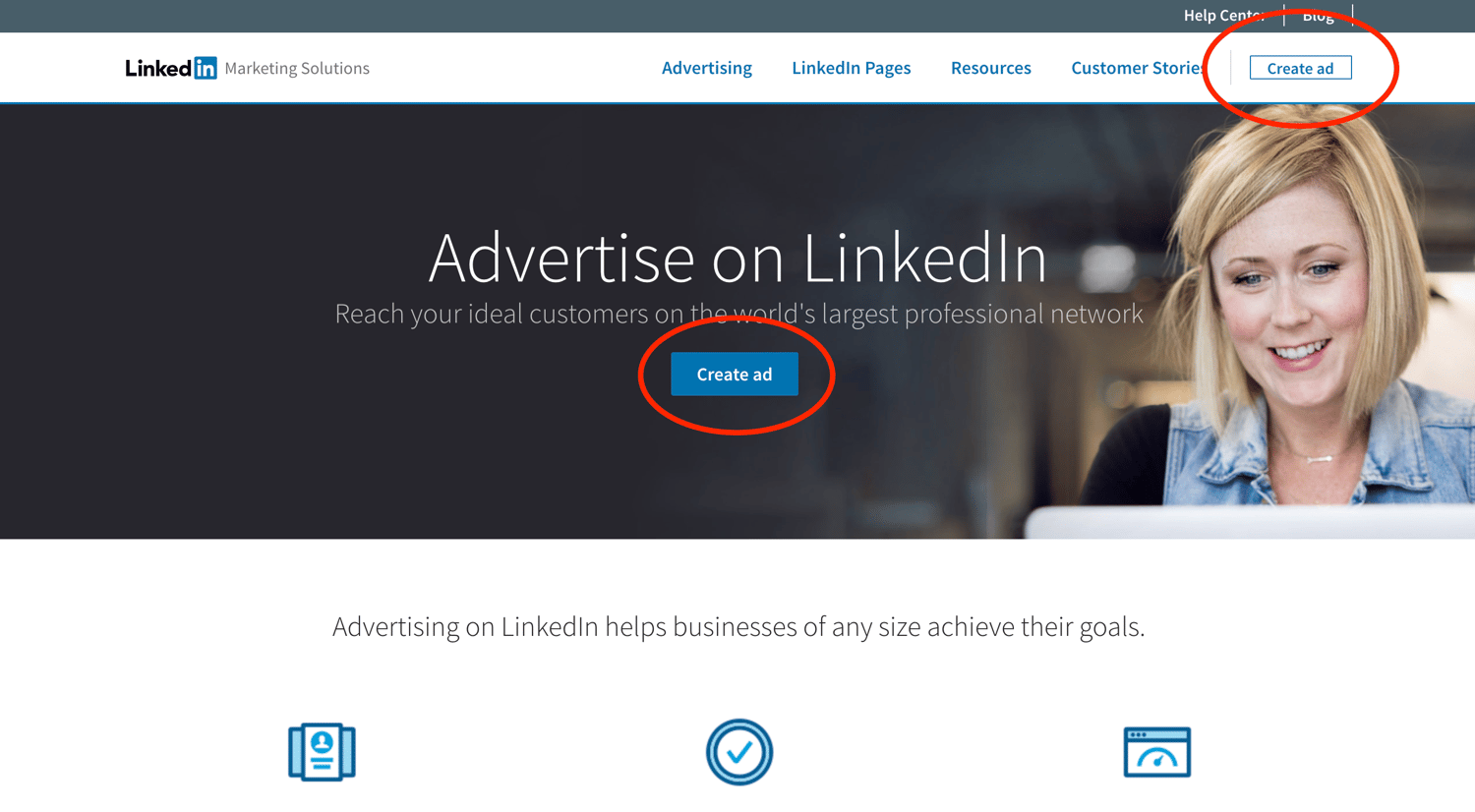 From there, you’ll be prompted to create a LinkedIn Campaign Manager account (if you haven’t yet). Make sure you enter your associated LinkedIn Company Page if you have one.
Next, you’ll be taken to your member dashboard. If you haven’t entered your billing information, you’ll need to do so to unlock your account. (Don’t worry — you won’t be charged until your campaign is live, and from there, you’ll be charged periodically for ad clicks and other engagements.)
On your dashboard — or “Campaign Manager,” as it’s formally called — you’ll see a call-to-action (CTA) to Create Campaign. Click that button, and you’ll be redirected to a page where you can start setting up your campaign.
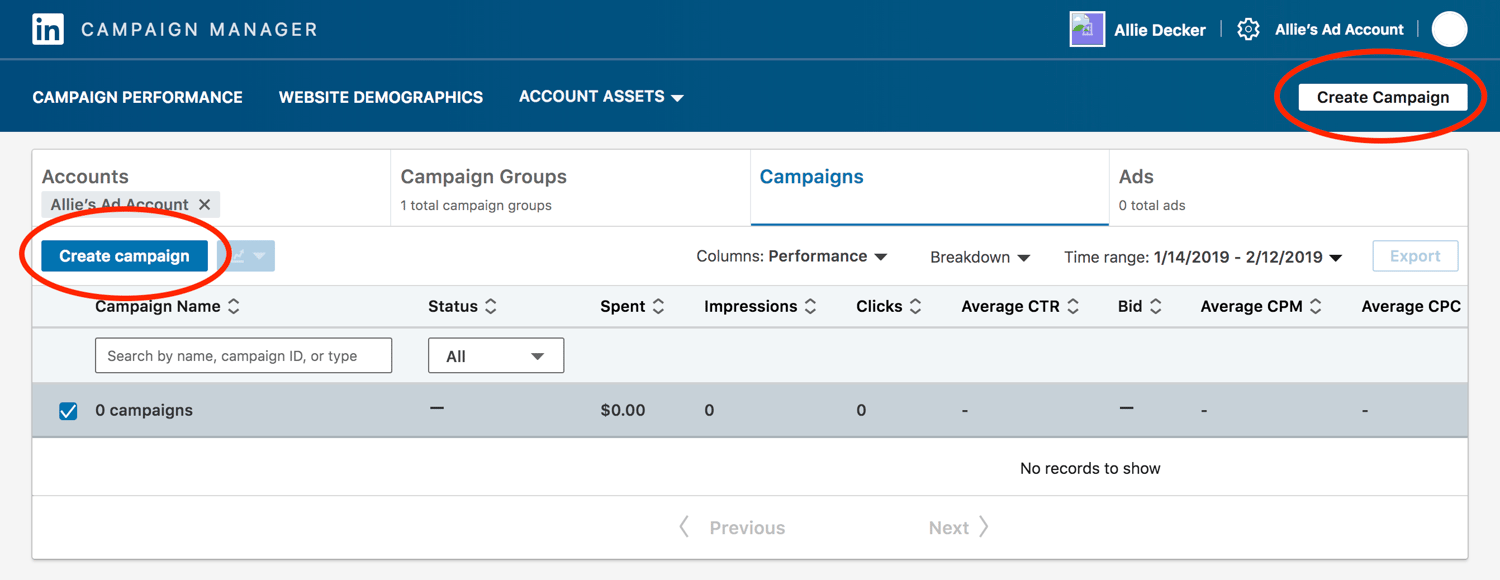
Note: As of 2019, LinkedIn introduced a “new objective-based campaign creation experience”. We’ll be covering that new process in this article — to learn more, check out this page.
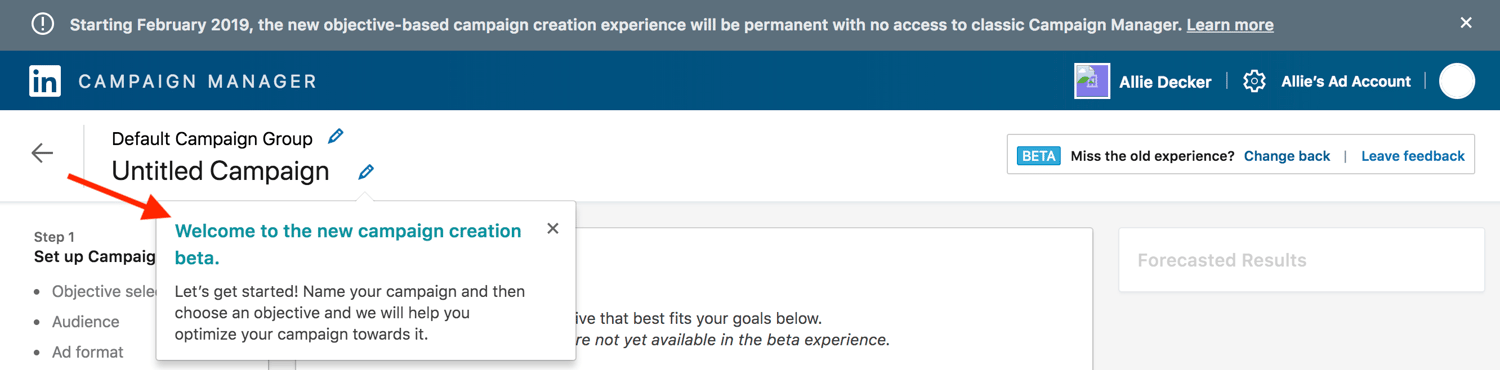
First, indicate a Campaign Group and name your campaign. Campaign Groups help you organize your campaign. You can leave the Default Campaign Group as-is or create a new Group.
As for the campaign name, these are only visible internally, so we recommend you choose a highly informative name — especially if you have a few different folks working on the campaign.
For example, if I was doing a test to determine the best type of demographic targeting, I might use the title, “Unicorn Food Ad Test — North America, 18 to 24, Female.” That name describes exactly who I’m targeting, without having to view its details. Compare this to something like “Unicorn Food Test 1,” which doesn’t indicate anything about who the ad is targeting.
Once you choose your Campaign Group and name, you can start setting up your LinkedIn campaign.
2. Set your LinkedIn ad campaign objective.
First, choose your campaign objective. Your objective is what you want people to do when they see your ads. According to LinkedIn, choosing an objective helps them “customize your campaign creation, deliver the best ROI for your stated goal, and show you relevant reporting.”
There are three overarching campaign themes: Awareness, Consideration, and Conversions. Under those themes, some available campaign objectives are:
-
Website visits will drive traffic to your website and landing pages. According to LinkedIn, this type of campaign will also boost brand awareness (at least while that objective option remains unavailable).
-
Engagement will increase engagement on your content and boost followers on your LinkedIn Company Page.
-
Video views will increase exposure of your videos to people who are likely to engage with them.
-
Lead generation will show a LinkedIn lead generation form with pre-filled LinkedIn profile data to those LinkedIn users most likely to engage with the form.
3. Designate your LinkedIn ad audience.
Next, choose the parameters of your target audience. Targeting who sees your ad can help it fulfill its campaign objective — the more specific and relevant it is to your audience, the better it’ll perform. LinkedIn allows you to target according to a few different categories, which we’ve outlined below.
You don’t have to use all of these options, but the more specific your targeting criteria, the more relevant it’s likely to be to the audience you select — and, therefore, the more likely you are to have a better ROI.
First, answer a few basic questions, like the language in which you’d like your ad to appear. It can be written in any of the 20 languages LinkedIn supports, including Spanish, French, and German.
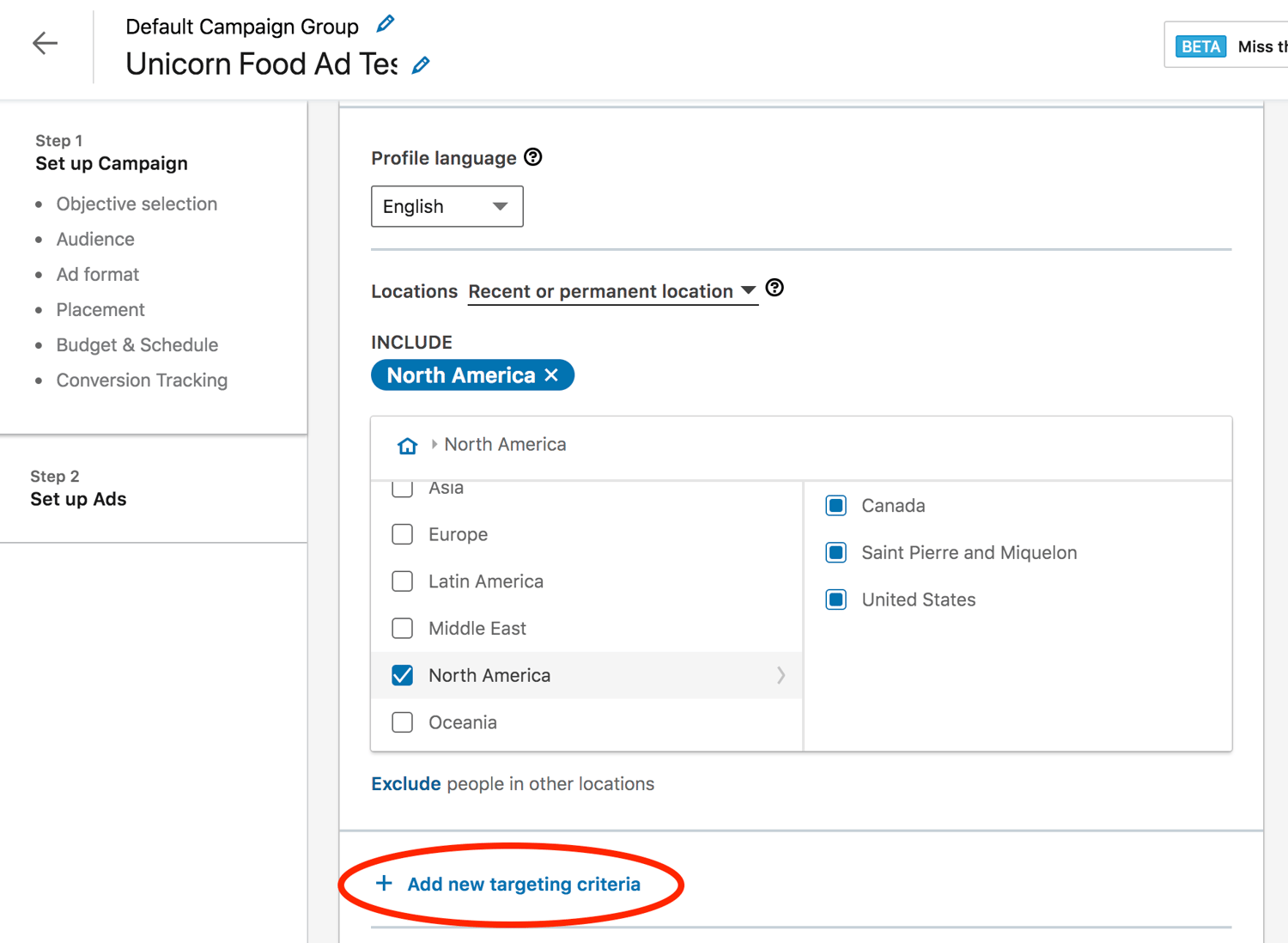
You must also select at least one location for your ads. Depending on your business, more specific targeting may be helpful. You can select a location as broad as North America, or as specific as the San Francisco Bay Area. Consider excluding any nearby locations from your campaign so your budget isn’t wasted on locations where your ad isn’t relevant.
Next, click + Add new targeting criteria.
Company
If your target audience has a certain employer, you can target it directly — even by name. You don’t need to have specific names in mind, though; LinkedIn allows you to also target companies based on the industry (like Legal, Non-Profit, or Finance) and company size.
Demographics
If your audience is heavily skewed toward one gender and/or age group, target your ad toward them.
Education
If you are looking to target people who have a particular educational background, you can target your ads based on schools. For example, perhaps you’re trying to target a certain alumni association — you can reach out to it through a LinkedIn ad. You can also customize the targeting according to the field of study and degree.
Job Experience
If your product or service is best for CFOs, targeting only people with “CFO” in their titles will increase your conversions, and, ultimately, save you money. You can choose specific job titles or choose from job functions, seniority, and years of experience. From the CEO of manufacturing companies to the entry-level associates at an accounting firm, you can target a specific group of people for your ads.
Your target audience may also have a certain skill set, such as email marketing, financial planning, or risk management. Think about what your target audience does well or where it aspires to excel. Then, use the ad to target people with similar capabilities.
Interests
One of LinkedIn’s best attributes is the ability to join groups with like-minded professionals in which you can discuss industry trends and topics. If your audience is very vocal on a topic, or you’re trying to gain thought leadership in a certain area, this type of targeting might be a good option for you.
Once you establish your ad targeting criteria, you can save it as a template for future campaigns. You can also enable LinkedIn to expand your audience to include people similar to your target audience.

4. Decide on your LinkedIn ad format.
Next, choose your ad format. In the next section, we unpack the different types of LinkedIn ads you can create as part of your campaign.
When you toggle between the ad types, you’ll see that the Forecasted Results box on the right-hand side will change. This feature analyzes your campaign parameters (bid, budget, targeting, start/end dates, etc.) and takes into account similar campaigns and advertisers. It also simulates the ad auction to generate the numbers displayed.
Keep an eye on this box as you choose your LinkedIn ad type. If you’re first starting out, deciding what ad type to choose might come down to your budget. Outline your priorities, and then you can decide which type works best for you.
Additionally, some ad types require you to link your LinkedIn Company Page, and some tap into LinkedIn translation services.
5. Choose your LinkedIn ad placement.
Next, decide whether you want your ad to be displayed on the LinkedIn Audience Network, which gives your campaign more reach and exposure among LinkedIn’s third-party platforms and sites. Note: This option isn’t available for every ad type.
You can also choose to exclude or block certain categories, applications, and sites in the Network if you so choose.
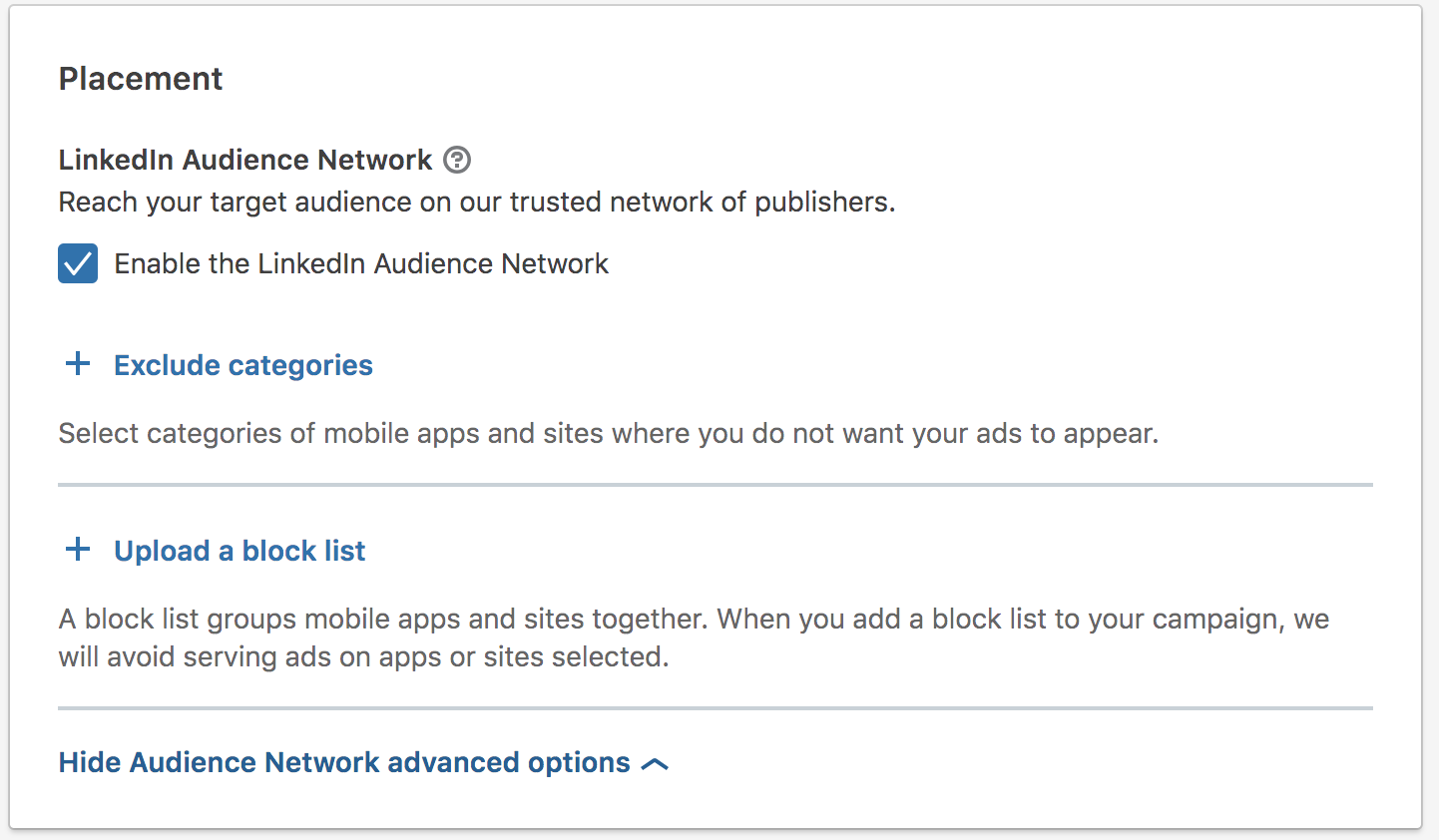
6. Set your ad budget and schedule.
Next, set up the budget, scheduling, and bidding options that work best for you.
Budget
Set a daily budget for what works best for your company’s marketing spending. Before investing a lot into one campaign, test and measure the success of each campaign and ad variation. You don’t want to put thousands of dollars, for example, into an ad that doesn’t resonate with your target audience.
Let’s say you’re the VP of Marketing at a high-end floral company. You assume that most of your target market is made up of soon-to-be brides, so you direct your LinkedIn ads to bridal groups. But after spending thousands of dollars, you only generate 10% of the leads you were hoping for.
Your subsequent research shows this was the wrong move, and you later learn that people near your store who are on LinkedIn are actually looking for flowers for corporate events. It would have been nice to know that before spending a large amount of your budget on LinkedIn ads, right?
That said, because of its extensive targeting opportunities, LinkedIn ads can successfully target niche markets. But the cautionary experimentation is crucial to do early on — if you observe a campaign performing well, then you can put a larger budget toward it.
Schedule
Choose a date for your campaign to start. You can indicate for your campaign to be shown continuously or ‘til an end date.
Bid Type
In this section, the three options you have are:
-
Automated bid, which allows LinkedIn to determine what amount will maximize your campaign objective and whatever option you choose (Clicks, Impressions, or Conversions).
-
Maximum cost-per-click (CPC) bid, where you’ll be charged each time someone clicks on your ad. LinkedIn will suggest a bid range depending on your budget and the competition for your ads — the more advertisers bidding on a similar campaign, the higher your bid will need to be. This bid is the maximum you will be charged. If the current rate is lower than your max bid, you will only be charged the current rate.
-
Maximum pay-per-1,000 Impressions (CPM) bid, where you’ll be charged a certain amount each time your ad is viewed by every 1,000 people on LinkedIn. This option is unavailable if you’re using the LinkedIn Audience Network option.
Deciding on the best maximum bid can be tricky. When deciding between CPC and CPM, think about your end goal. Are you trying to get as many people as possible to see your ad to help with something like a branding campaign? If so, CPM might be your best option.
On the other hand, if you want more people to click on your ads to drive traffic to your website or generate new leads, CPC might be better for you.
As for your optimal maximum bid, some trial and error might be necessary. LinkedIn will give you a suggested bid, which is a good place to start. Then, think about when your audience is most likely online. You’ll want to bid higher during that particular time to be sure that your ads are the ones being seen.
And make sure LinkedIn is actually the best place to reach them, too — different populations use different types of social media. Play around with your bids and see when you get the most return for your dollars spent.
7. Don’t forget conversion tracking.
Lastly, you have the option to set up conversion tracking for your LinkedIn campaign, which will track and measure the actions people take after clicking on your ads.
Conversion tracking is an optional part of setting up your LinkedIn advertising campaign but is highly valuable for your business.
If you choose to set up conversion tracking, click + Add conversions.
A new window will pop up, where you’ll name your conversion, choose your conversion settings, and decide how you’ll track the conversions. Note: The information on the right-hand side of the window is super helpful — it’ll answer any questions you have and walk you through the process.
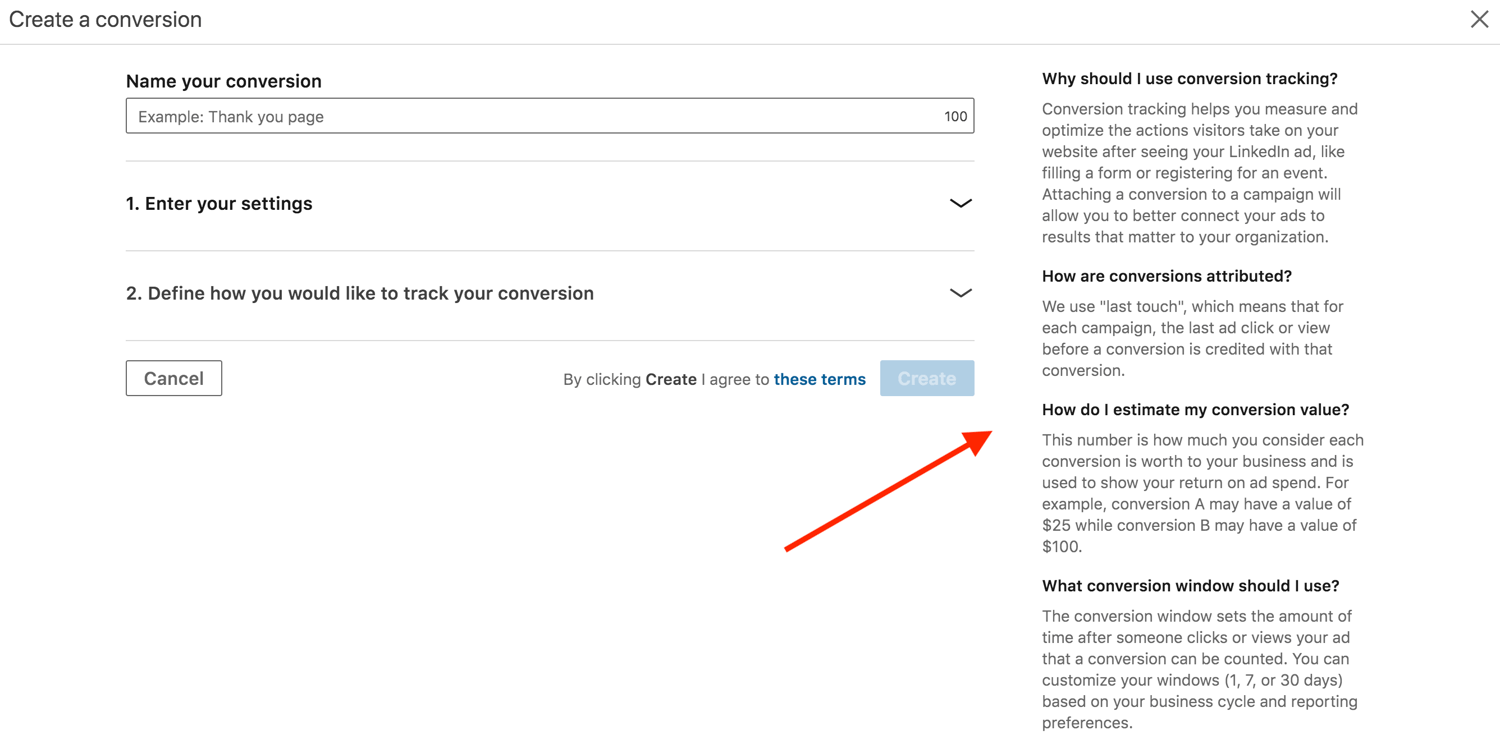
For more help on implementing and managing your LinkedIn Conversions, visit their help page here.
Bravo! You’ll officially set up your LinkedIn advertising campaign … but you’re not done yet. When you’re ready to move on, click “Save.” Beware: Your objective and ad format cannot be changed once you save, so be sure about your choices before moving forward.
8. Build your LinkedIn ad.
This section corresponds to what type of LinkedIn ad you chose for your campaign. Once you establish the basic parameters for your ad in step one, you’ll be prompted to start building it and choose how LinkedIn will display and rotate your ad variations — if you create more than one.
To get started, click Create new ad.
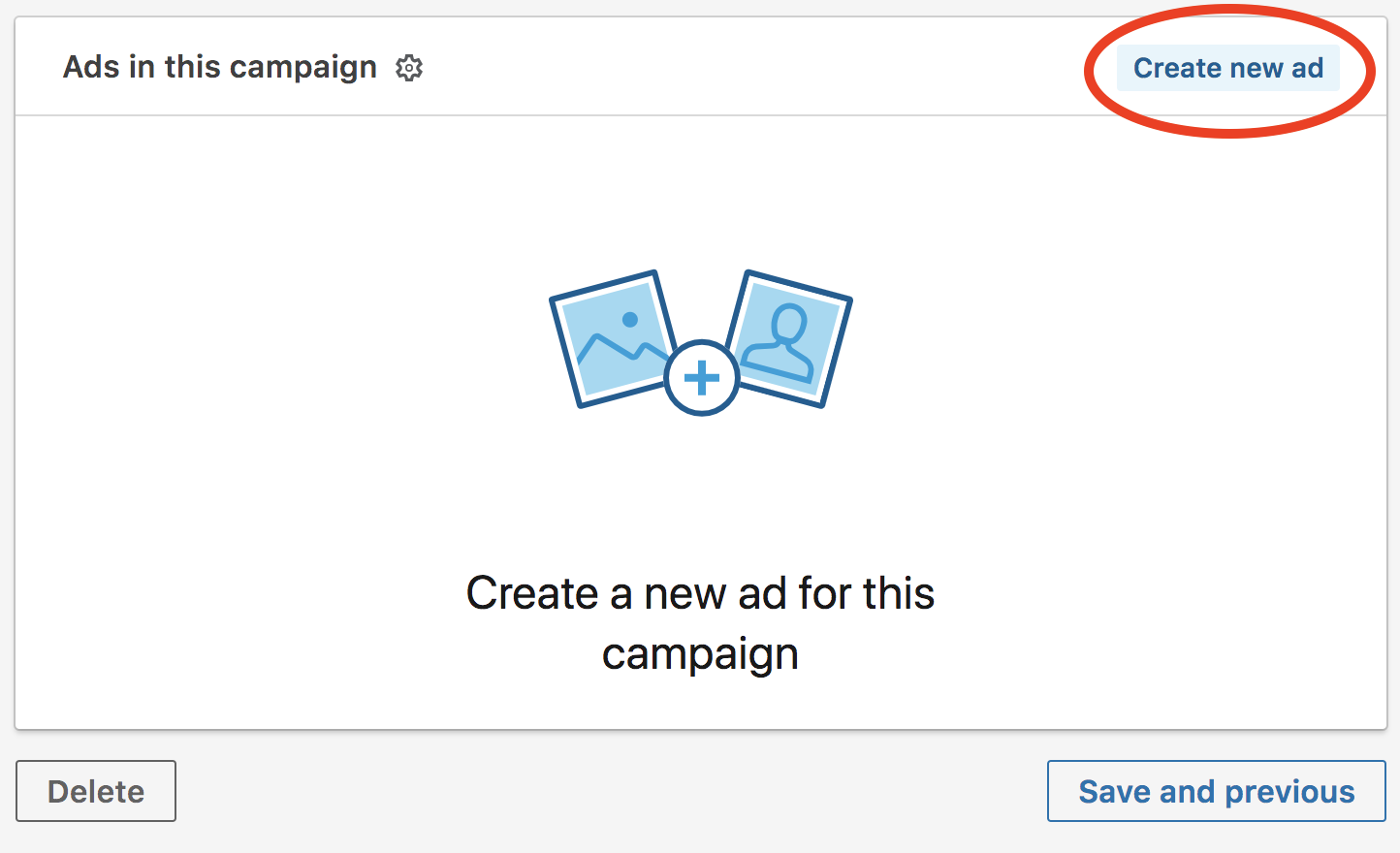
A screen will pop up with the title “Create a new [Your chosen ad type] for this campaign” on which you’ll create the copy for your ad, pair it with an image, and preview the different layout options.
Of course, there are a few guidelines around the copy that we suggest:
-
Ad image, which is the artwork or graphic that your audience will see for your ad. It must be 100×100 pixels and uploaded as a .jpg or .png file that is 2MB or smaller.
-
Ad headline, which is the main message your audience will see. It cannot be more than 25 characters.
-
Ad description, which is the body of your ad. It can be up to 75 characters long and should be relevant both to the person viewing the ad and the offer or page to which you’re sending them.
-
Destination URL, which is where your audience will go when they click your ad. Double check that the URL is accurate.
Once you input this information, you’ll see it reflected in the Preview box to the right.
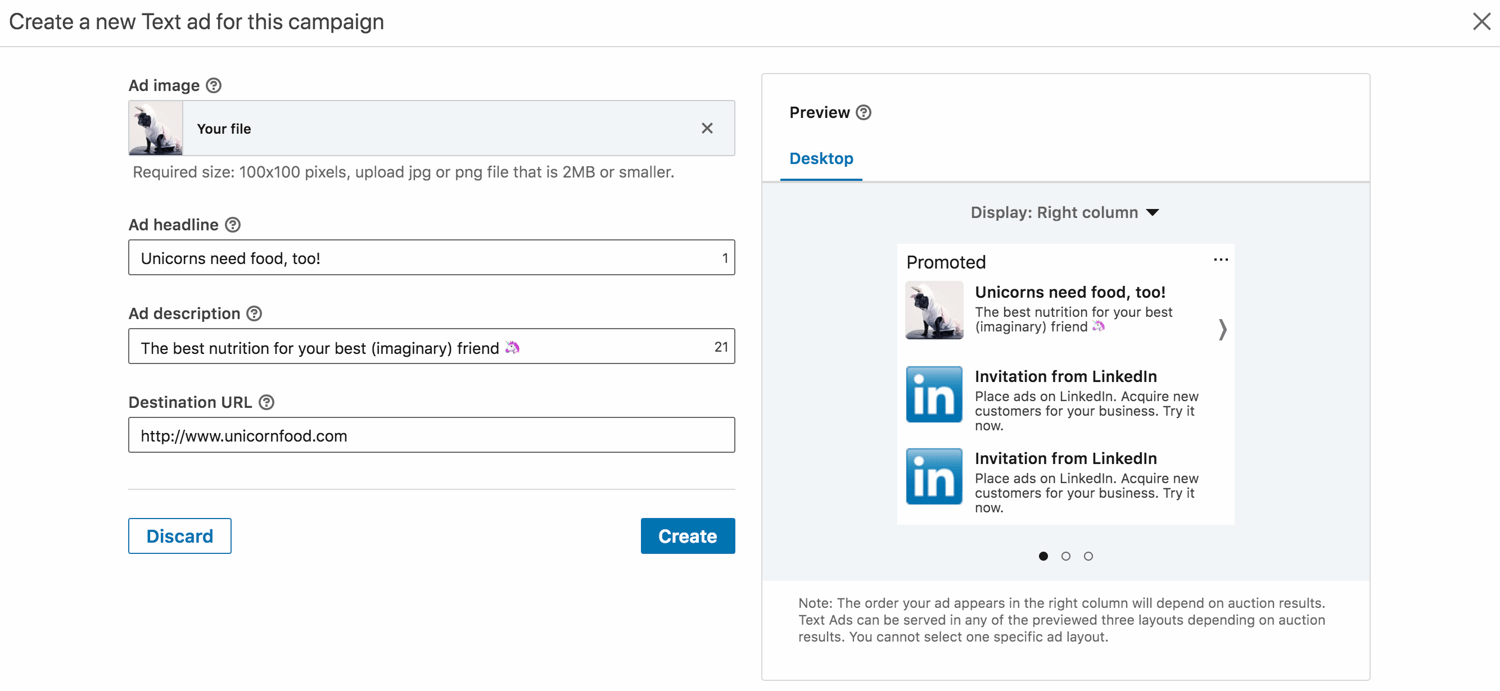
Once you click Create, you’ll be directed back to the previous Campaign Manager screen. From there, you can create more ads and, eventually, review and submit your order. Note: LinkedIn does review every submitted campaign order, so don’t expect to see your ads published right away.
To see the best results for your ads, consider creating a different ad for each of your buyer personas and tweak the copy accordingly. For example, when promoting a book to college professors, leading the title with the words “College Professor’s Guide to …” may generate a higher CTR than generic, un-targeted headlines and copy.
Here are a few of our best copywriting tips for LinkedIn ads.
Call-to-Action (CTA)
Including an actionable CTA within your ad copy will also help you improve your ad’s click-through rate (CTR). Consider asking people to “Download your e-book now,” or “Click now for free samples” instead of writing copy that’s devoid of actionable next steps.
Value
Incorporate your value proposition into your ad copy — this can make people more likely to click on your ad. By boasting something like “20% off your first purchase” or “Clearance sale ends today — Shop now,” you’re sending a clear signal of what someone will specifically gain when he or she clicks your ad.
Testing
Don’t be afraid to test your ad copy. You can create multiple variations of your ad in each campaign, which allow you to test different images and copy within ads to find what works best for your audience.
As we said above, deciding on what type of LinkedIn ad is best for your campaign can come down to many factors: budget, audience, campaign objective — just to name a few.
When building your LinkedIn ads, you have four main types from which to choose. Within those formats, you can choose different formats based on your ad content and purpose.
1. Sponsored Content
Sponsored Content shows up in your audience’s news feed among organic LinkedIn content.
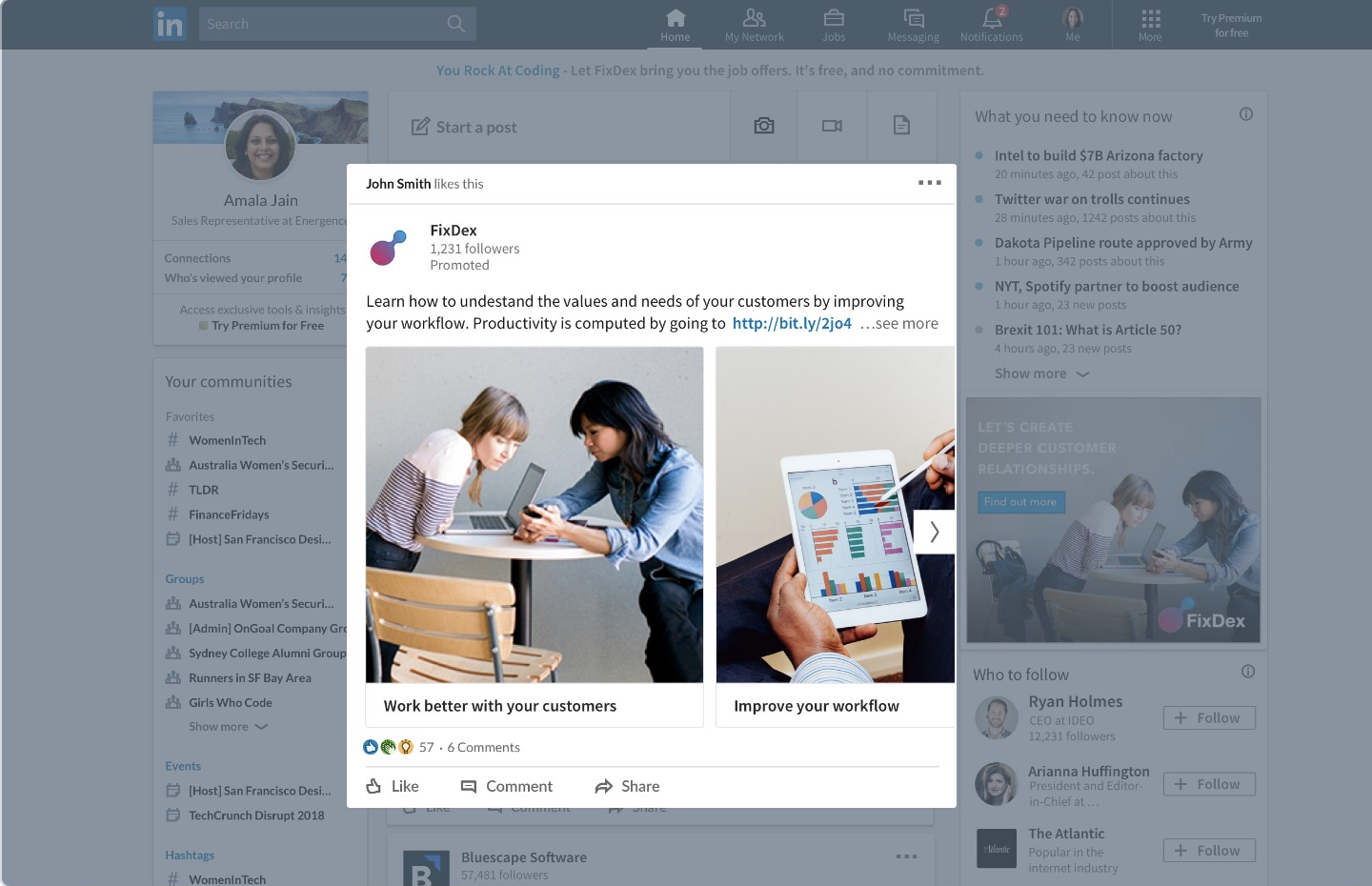
These ads are similar to promoted posts that blend into social media feeds. Sponsored Content is available in three formats:
-
Single image ads, which feature one image
-
Carousel ads, which feature two or more images
-
Video ads, which feature one video
This type of LinkedIn ad typically has the highest average cost-per-click (CPC).
Learn more about the advertising specifications for Sponsored Content according to LinkedIn.
2. Message Ads
Message ads are delivered to your target audience’s LinkedIn inbox.
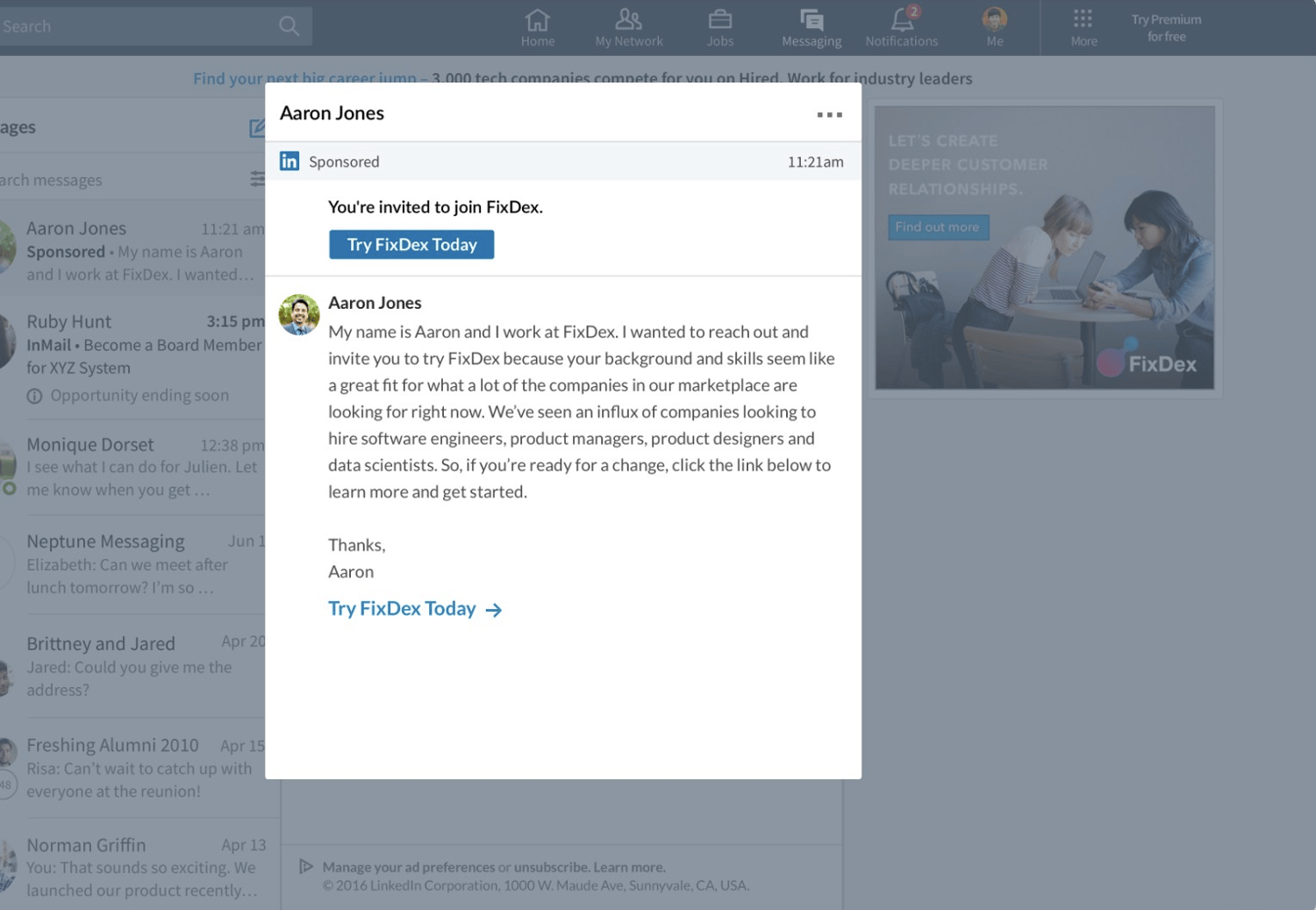
With this type of LinkedIn ad, you can send content directly to your audience from a personal account and better measure engagement based on recipient response and action.
Learn more about the advertising specifications for Message Ads according to LinkedIn.
3. Dynamic Ads
Dynamic Ads are personalized ads that change content based on which audience member is viewing them. This type of LinkedIn ad uses member personal data to tailor its creative content.
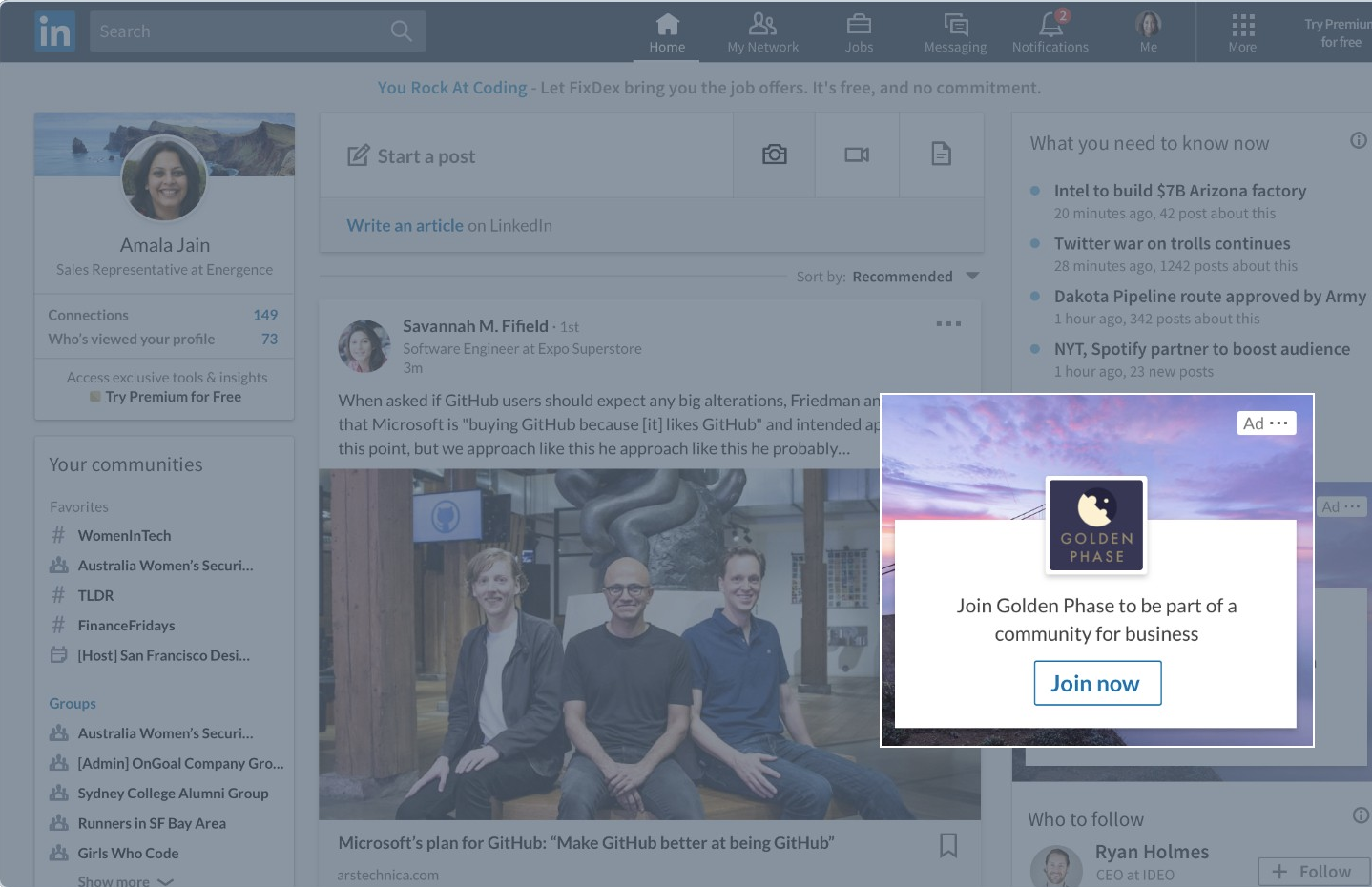
(Each LinkedIn member sees his or her own personal data; data isn’t shared with other members.)
Dynamic Ads are available in three formats, which are only available on the LinkedIn desktop platform:
-
Follower ads, which promote your LinkedIn Company Page
-
Spotlight ads, which promote a special offering
-
Job ads, which promote open jobs
Learn more about advertising specifications for Dynamic Ads according to LinkedIn.
4. Text Ads
Text Ads show up on the right column or top of the page on LinkedIn.
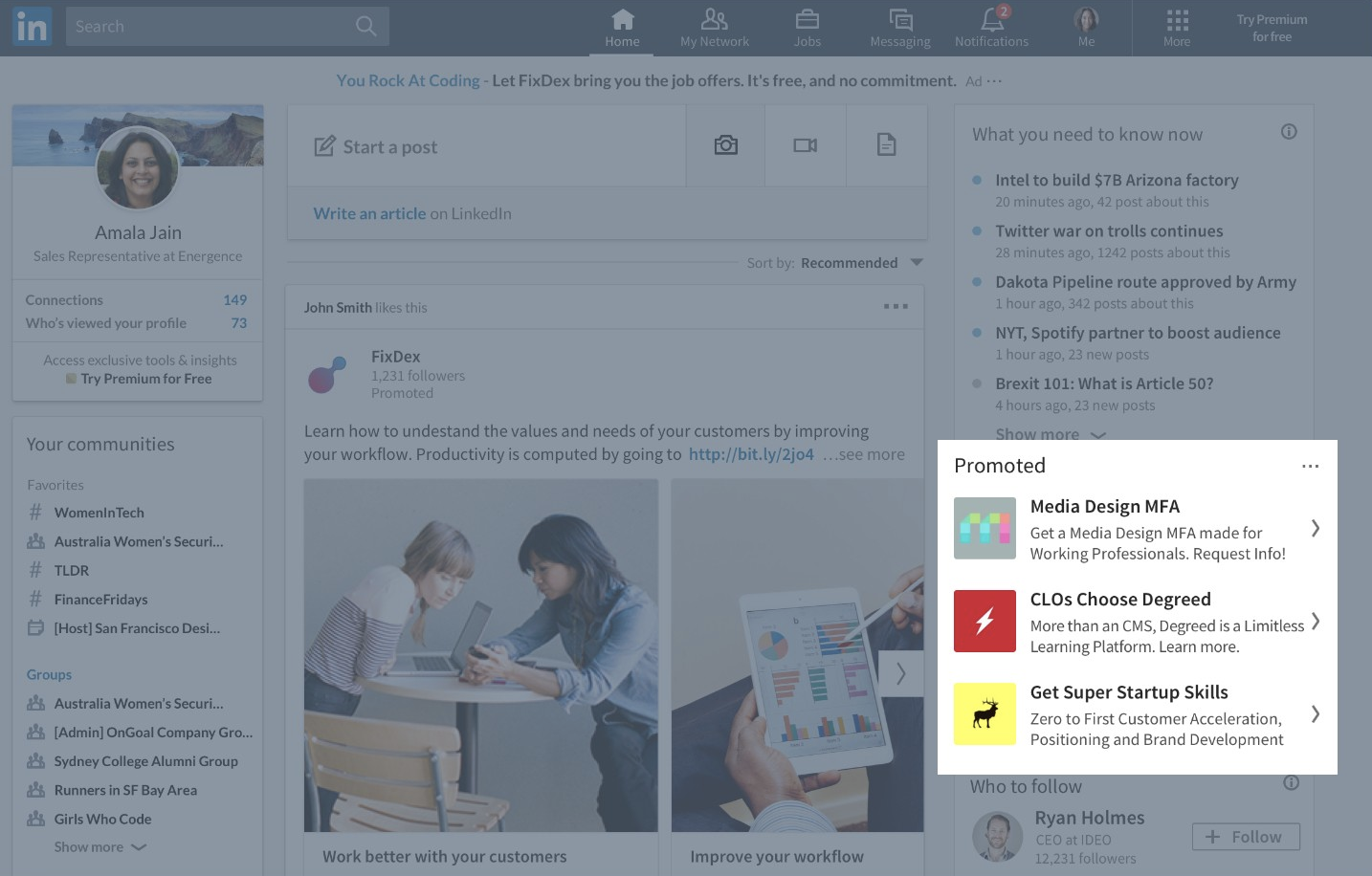
They’re the simplest type of LinkedIn ad but are still effective for boosting awareness and reaching your audience. Pay per click or per impression for Text Ads.
Learn more about advertising specifications for Text Ads according to LinkedIn.
Social ad campaigns can always be improved. Remember, your audience and content are always changing — as well as the platform itself. Here are some best practices to optimize your LinkedIn ad campaign.
Tip: Set a reminder for yourself to analyze and optimize your campaigns each month.
1. Analyze your LinkedIn ad campaign.
LinkedIn makes it easy to track your progress in the Campaign Manager dashboard (under “Campaign Performance”), where you’ll see various charts that measure performance like clicks, expenditures, and CTR. You can also keep track of conversions in the graphs toward the bottom of the dashboard.
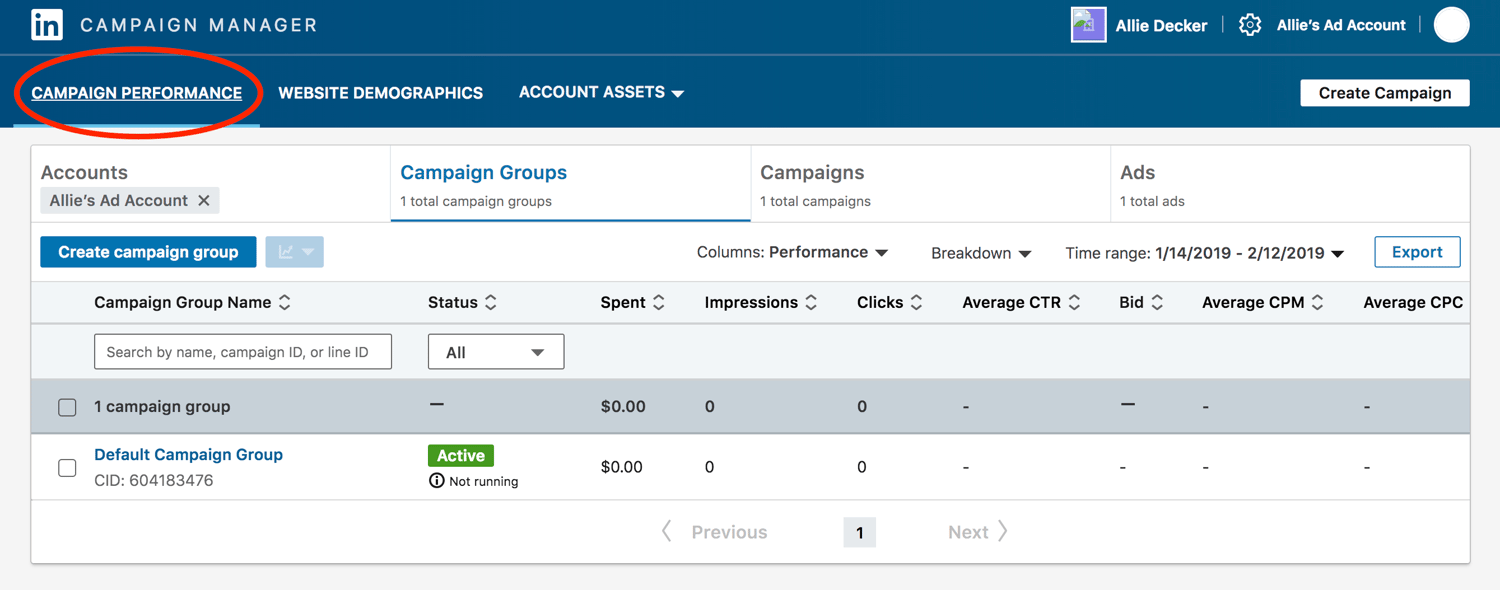
When you finish setting up your first campaign, you’ll see a lot of “0”s at first. Don’t worry, that’s only because your campaign is new (and don’t forget that LinkedIn usually has to approve your ads before they go live).
LinkedIn Ads is available within all HubSpot Marketing Hub Professional and Enterprise accounts! Track visitor and contact engagement, run reports on closed-loop marketing, sync leads from LinkedIn lead generation forms, and MORE — all within your HubSpot account.
2. Look at each campaign click-through rate.
Is one campaign outperforming the other(s)? If so, you may want to pause the less successful campaign(s).
LinkedIn will automatically display less successful campaigns with lower frequency, so it makes sense to minimize any resources spent on them. Instead, putting more resources into successful ad variations and campaigns is more likely to accomplish your marketing goals.
3. Tweak one variable at a time.
Just because your LinkedIn ad is under-performing doesn’t mean you need to scrap the whole thing. Test different variations of the same ad to see what factor is contributing to or hindering its success.
Edit the copy in your headline, change your feature image, tweak the target audience attributes, or update your bids — just don’t do these all at the same time or you won’t know which one is the fix.
4. Get — and stay — familiar with your audience.
Take a refresher on your target audience every month. Check out your buyer persona and conduct new research on the audience attributes that might need to be tweaked on your campaign.
Update these attributes regularly so the very best people are always seeing — and hopefully engaging — with your ads.
5. Qualify LinkedIn ad leads with post-click reporting.
Once your ads are running and people begin clicking on them, it’s time to determine if they’re actually driving qualified traffic to your website. That isn’t something LinkedIn can tell you, so you’ll need to do some closed-loop reporting on these campaigns to get more details on the makeup of this traffic.
How can you figure that out? It’s all about “gated” offers and forms — when someone clicks on your ad and lands on your website, “gating” the content you are offering with a lead form will help you collect data that qualifies that person as a good lead (or not). Connect that lead capture form to your customer relationship management (CRM) software, so that once the information is imported, your sales team can act upon them.
But don’t neglect your LinkedIn ad campaigns in favor of the landing page form data in your CRM. Is the traffic to your website generated by LinkedIn ads qualified? Is it generating customers? If not, you might need to further optimize your campaigns.
For example, if your LinkedIn ads are targeting people in companies with 1 to 10 people, but you find that the majority of your closed deals are from leads with companies with 100 to 200 — stop paying to target those smaller companies on LinkedIn.
The targeting options we covered above allow you to change any of your criteria, so use it to your advantage.
Ready to Try a New Ad Strategy?
With the right amount of patience and strategy, LinkedIn ad campaigns can be a huge factor in your company’s marketing success. LinkedIn has a very powerful advertising platform; don’t leave this off your social campaign marketing list.
A well-researched, optimized campaign has the potential to bring in thousands of new leads — and sales.
Editor’s Note: This post was originally published in January 2013 and has been updated for accuracy and comprehensiveness.

Facebook Live Video Updates: What Marketers Need to Know
Welcome to this week’s edition of the Social Media Marketing Talk Show, a news show for marketers who want to stay on the leading edge of social media. On this week’s Social Media Marketing Talk Show, we explore improvements to Live video on Facebook and Instagram, paid live streams in Facebook Events, and Messenger Rooms […]
The post Facebook Live Video Updates: What Marketers Need to Know appeared first on Social Media Marketing | Social Media Examiner.
from Social Media Marketing | Social Media Examiner https://ift.tt/3aViuua
via socialmediaexaminer
25 Live Video Stats Marketers Need to Know in 2020
In the past year or so, live video has quickly become one of the most popular types of online content, especially on social media.
Not only is Facebook Live thriving, with one in five videos being live streams, but other major platforms like Instagram, Twitter, YouTube, and — most recently — LinkedIn, have embraced similar features.
Aside from the older social media platforms allowing live streams, some emerging platforms, like Twitch.tv, now cater specifically to live stream viewers.
While people find live streams entertaining because they offer them a chance to see raw, authentic footage, view behind-the-scenes video from their favorite influencers, or interact in live Q&As with industry experts, brands also find this content beneficial for boosting awareness.
For example, many companies have sponsored or hosted the live Q&As I noted above. Alternatively, they’ve also sponsored live product tutorials from social media influencers. Aside from smaller Q&As and tutorials, some brands have even created entire virtual events that rely on live streams.
When it comes to live video, there are many creative opportunities that could allow brands to reach and interact with their audiences. But, because this tactic is still somewhat new, many companies might not know where to start when brainstorming live content.
Like with any new trend, brands might also wonder, “Is streaming live video worth my time, or is this strategy just built on hype?”
To give you a bird’s eye view of the live video landscape, here are 25 stats that you should keep in mind if you’re considering live video.
25 Live Video Stats That Marketers Need to Know
Growth in Live Video
- In 2019, internet users watch 1.1 billion hours of live video. (StreamElements)
- The video streaming market is projected to hit 184.3 billion by 2027. (Grand View Research)
- In 2018, 47% of live streaming video viewers worldwide are streaming more live video compared with the year before. (IAB)
- Also in 2018, 44% of live video viewers said they watch less live TV “as a result of live streaming.” (IAB)
- 67% of consumers were streaming live video worldwide by the end of 2018. (IAB)
- By the end of 2020, live streaming is expected to account for 82% of all internet traffic. (Go-Global)
How Live Streaming Benefits Brands
- More than 35% of marketers use live video as part of their social media strategy. (Social Media Examiner)
- 52% of live stream viewers prefer free, ad-supported content over subscription content. (IAB)
- 82% of people prefer live video from a brand over standard social media posts. (Livestream)
- 67% of audiences who watch a live stream event will purchase a ticket to a similar event. (Livestream)
- 80% of people would rather watch live video from a brand than read a blog. (Livestream)
Live Streaming Platforms
- In May 2019, YouTube Live videos were watched for 284 hours. This was a monthly record for YouTube. (StreamElements)
- Non-gaming content has been a major growth driver for Twitch representing 11% of the hours watched in December 2019 compared to 8% in December 2018. (StreamElements)
- In Q2 of 2019, Twitch users watch 2.9 trillion hours of live content. (StreamElements)
- In Q1, Twitter hosted more than 1,200 live-streamed events. (Twitter)
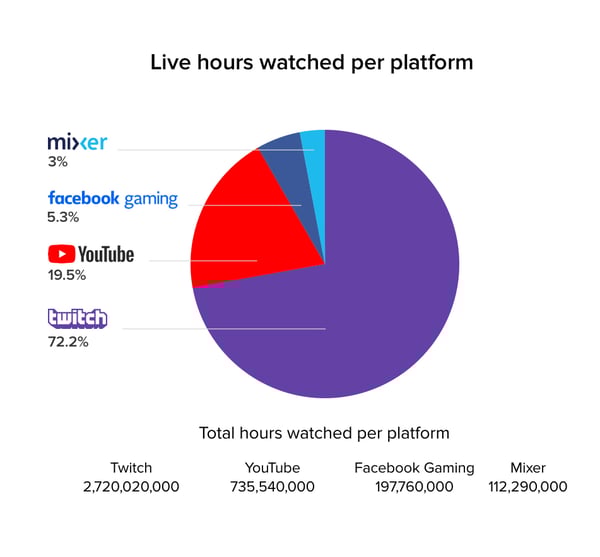
- 70% of consumers prefer to watch live video on YouTube over other platforms. (Livestream)
- 60 of the most-viewed YouTube live streams happened in the last two years. (Think With Google)
- “Facebook Live Stream” saw a 330% increase in searches between 2016 and 2018. (Mediakix)
- One in five Facebook videos is a live broadcast. (Facebook)
Live Stream Audience Behaviors and Content Preferences
- On average, 1.05 million viewers were on Twitch at any given time in Q4 of 2019. (Statista)
- 70% of consumers who live stream do so at least once per day. (IAB)
- 67% of people say the quality of the video they’re watching is the most important factor of a live stream. (Livestream)
- The most-watched live streams have to do with news coverage, while concerts and live conferences tie in second. (Livestream)
- 87% of people will watch a live stream if it includes behind-the-scenes content. (Livestream)
- Almost half of Gen Z watches their favorite shows live on social media. (eMarketer)
Planning Your Live Video Strategy
From the stats above, we can see that live video isn’t going away any time soon.
But, before you start your first live video, you’ll want to plan out your live event ahead of time to ensure that it’s both valuable and professional looking to your audience.
You’ll also want to determine which platform will allow you to reach audiences that most align with your brand. For example, if you’re interested in gaining awareness from a more general audience, Facebook Live might be a great option due to the platform’s age and its number of users. On the other hand, if you want to reach gamers or Gen Z, you might want to test out a Twitch stream.
If you’re interested in creating your own live campaigns, but don’t know where to start, here’s a great guide to help you.
Trying to pick out the right live streaming platform for your brand? Check out this post that directly compares Facebook Live and YouTube. You can also read up on one of the fastest-growing live platforms, Twitch, here.

How to Reclaim Lost Habits and Start New Ones
Need to develop better habits? Wondering how uncertainty or change impacts your habits? To explore how to reclaim lost habits and build new ones, I interview James Clear on the Social Media Marketing Podcast. James is the author of Atomic Habits: An Easy and Proven Way to Build Good Habits and Break Bad Ones. He […]
The post How to Reclaim Lost Habits and Start New Ones appeared first on Social Media Marketing | Social Media Examiner.
from Social Media Marketing | Social Media Examiner https://ift.tt/2Yo6Ipx
via socialmediaexaminer
How to Improve Your Corporate Marketing Strategies [+ Examples]
I know I’ve talked about this before (if you’ve read some of my other blog posts, you might know this already), but I love Taco Bell’s marketing.
The quick-wit on Twitter, the upheaval in their branding a few years ago … I love it all.
The main reason I admire their corporate marketing is because it has a real brand story that I can relate to as a customer.
As a marketer, we should all strive to achieve that result from our messaging. That’s why we’re going to discuss corporate marketing today.
Below, let’s review what corporate marketing is and how to improve your strategy.
When corporate marketing is working correctly, it’ll keep the flywheel spinning. It should attract new customers, while engaging leads, and delighting current customers.
Usually, the corporate marketing team will decide what type of messaging tactics to use to appeal to your target audience. Those tactics could include a corporate newsletter, blog, email campaign, ad, radio spot, direct mail campaign, or even just your social media channels.
Ultimately, the main goal of corporate marketing is to improve your brand image, while strengthening relationships with your customers so they become brand advocates.
To be successful, your messaging should clearly communicate your unique value proposition. For example, brands like Tesla have a strong, recognizable brand that differentiates the company from its competitors.
Now that we know more about corporate marketing, let’s dive into eight tactics you can use to improve your corporate marketing strategy.
8 Ways to Help Improve Your Corporate Marketing Strategies
1. Alleviate pain points.
One of the main ways to improve your corporate marketing strategy is to alleviate your customer’s pain points with your content offers. If your brand is known for being helpful in this way, your customers will surely become brand advocates.
For example, your content can include free ebooks, educational YouTube videos, or bootcamp style lessons.
These types of offers will help people get to know your brand better and convince them that they need to use your product.
Additionally, it can help establish you as an authority in your industry, while building trust with your audience, and obtaining new leads.
2. Focus on your customers.
At the center of your corporate marketing strategy should be your customers. You have to understand your target audience to deliver what they want and communicate with them effectively.
In fact, if you don’t truly understand your audience, it’ll be harder for you to come up with corporate marketing objectives. Once you have a clear understanding of your audience, you can figure out what your goals are, whether that’s generating traffic or raising brand awareness.
One way to get to know your audience better is to send customer satisfaction surveys. This will help you learn more about your audience and what they like and dislike about your product. With this information in hand, you’ll be able to market your product in a way that differentiates you from your competitors, which brings us to our next tip.
3. Be unique.
Your corporate marketing strategy should include a plan for how you’re going to stand out among your competitors. You need to know your unique value proposition and communicate that through your messaging.
If you aren’t sure what makes you unique, do a competitive analysis and look for the gaps in your competitor’s marketing strategy. What do you offer that they don’t? Figure out what makes your brand special, and talk about that.
4. Know your brand.
Not to reiterate the point above, but you need to know who you are as a brand. Customers like to make purchases from brands that align with their lifestyle.
For example, Trader Joe’s is known for carrying organic, fresh products. If buying organic products is important to a consumer, they’re always going to choose Trader Joe’s over another grocery store option that doesn’t have a clearly defined brand or lifestyle.
Your corporate marketing isn’t just selling your company as a whole, but a lifestyle as well.
5. Be intentional with your brand’s voice.
Your brand should have a voice that’s apparent in every form of communication your company puts out. The language and words you choose to use are important. Speaking the same language (literally and figuratively) helps people connect with your brand.
For example, when TheSkimm, a daily newsletter, was created, the founders decided to create a fictitious persona of the “Skimm Girl” that was sending the newsletter. This helped them define their brand’s perspective and voice.
Ultimately, having a strong brand voice will help people personify your brand. Additionally, it can help set you apart from the crowd with your own unique style.
6. Provide great customer service.
Corporate marketing isn’t just about the messages your marketing department delivers. It’s about your brand identity as a whole.
That’s why your customer service shouldn’t be forgotten when you’re thinking about your corporate marketing strategy.
Providing excellent customer service will delight your customers so they become brand advocates.
When people experience good customer service, they talk about it. People might even know you have great customer service, even if they aren’t a customer.
For example, I know that Zappos provides great customer service, even though I’ve never bought anything from the site because their customers talk about it.
That’s a great reputation to have and great messaging for potential customers to hear.
7. Have a social media presence.
Social media is one of the main channels you’ll use to communicate with your audience. That’s why you need to have a strong social media presence as a part of your corporate marketing strategy.
On social media, you can let your brand personality shine. People can truly get to know you as a brand.
Additionally, social media can help strengthen your relationships with your customers and understand their needs better since it’s a form of two-way communication.
8. Write a blog.
Are you looking for a way to establish trust with your audience? Creating a blog is the best way to do this.
On a blog, you can provide free, helpful, educational content for your customers. Doing this will help you create a brand identity that’s authoritative in your industry.
Before you get started with these strategies, it’s important to consider whether you have the right tools. Enterprise marketing software, like HubSpot’s Marketing Hub Enterprise, can help you implement these corporate marketing strategies.
Corporate marketing is the way that your company communicates with your audience as a whole. It’s how you build brand awareness, and establish credibility, and trust with your audience.

How to Drive Traffic with Content Amplification
61% of marketers say that generating leads and traffic is their biggest challenge.
It can be frustrating — when you post that amazing blog that took hours, or finally finish a product page, you can’t wait to see the engagement you earn from your audience.
And then … you don’t get much.
We’ve all been there, and the feeling of not connecting to your customers isn’t great. So, what do you do when you create content you know your audience wants to see, but they aren’t finding it? How do you raise traffic organically?
The answer may be a method that you’re most likely already using, but with a more expansive lens — content amplification.
If you’ve shared a blog post on social media, or have done an ad campaign for your new product launch, then you’re already familiar with content amplification. The strategy is used to raise traffic to your content.
But how does content amplification work? Here, we’re going to discuss everything you need to know.
How to Use Content Amplification
Before we get into the full details of content amplification, let’s put some description to the phrase.
Content amplification describes the method for using online platforms or channels to promote content. Marketers can use content amplification to boost ROI and brand awareness.
Amplifying content is especially useful if one of your current goals is to boost the session times on your website or lower the bounce rate. When content is promoted through a different channel, there’s a higher chance your audience will interact with it. For instance, if you have a content offer you want to pull more people towards, try incorporating a promotion into your email marketing strategy.
You may already be using some content amplification tactics. If you promote blog posts on a social media account, you are amplifying your content.
Social media and email marketing aren’t the only ways to promote your content online, though. Next, let’s discuss some other ways you can amplify content.
1. Consider using paid ads.
Paid advertising is one method you can try when amplifying your content. There are so many different paid ad opportunities, but let’s talk about three that are wonderful for content exposure.
For example, search engines use pay-per-click (PPC) advertising, which means bidding on keywords to earn a placement at the top of search engine results pages (SERPs). Product pages and blog posts are excellent content for PPC ads.
Next, paid social media ads are great for brand awareness. Generally, social media advertising tools are made to reach large audiences that you might not be able to organically. For instance, Twitter Ads lets you post promoted tweets that can land on the timelines of audiences you choose. So, if you are releasing a new product, or want to get more people talking about your brand, think about running social media ads.
Finally, you can take out paid ads on video platforms, like YouTube. A commercial that has been running on social media but isn’t performing that well is great for this. Keep in mind that video ads might perform differently on Twitch than Facebook, so market research and social listening are essential to be sure the platform you choose will allow you to effectively reach your target audience.
2. Use your blog posts for lead generation.
As marketers, we know that blog posts provide helpful content to your customers. But you can also use blog posts to promote your content. For instance, you might write a how-to about how to use your product, or an advertorial or guest post that drives traffic back to your blog.
Let’s start with fitting blog posts into your own content plan. If a product launch is coming up, you can write a tutorial-style blog post that explains how to use that product.
For instance, let’s say you’re creating a new feature in your email marketing tool in which users can add GIFs to email. To amplify your content, you might consider writing a blog post and detailing how the function will delight readers.
Alternatively, you can write a guest post or advertorial for another publication. Guest posts give you a different platform to show your industry expertise, and if you link your content or include it in the post, that’s amplification. Think of publications in your industry that could have a similar audience to yours and ask to contribute.
An advertorial is basically the paid version of a guest post. What you’re paying for is guaranteed content amplification. This is because the name on the byline will include your company, and advertorials have some sort of promotional element for a business or product.
3. Partner with influencers.
If you leverage an influencer partnership, you can amplify your content to their followers. For instance, if you are a marketer for a business in the fashion industry, and you want to promote your new collection, consider messaging an influencer for a post.
If an influencer agrees to post about your collection, your content will be seen by their audiences. Most likely, they’ll tag your business, and those audience members will then be exposed to your social media channels and the content you’ve created.
Alternatively, you can start an influencer partnership before you finalize the collection. Generally, a partnership allows the influencer to have their name on a product. The influencer would share any commercials or promotional items you’ve created, which can help amplify your content.
4. Make a content offer.
Let’s say that your company invests in data collection. If so, you can leverage that data and share it in an online course or data report, and offer that content to customers.
Think about how often you need to refer to data in your day-to-day. Compiling that data and making a content offer is wonderful for lead generation. When you share this data, maybe through email or on a networking site like LinkedIn, you diversify the content you’re amplifying.
Alternatively, you can use content offers on your website. For instance, if you reference data points from your report in a product page, backlinking those data points is a form of amplification.
So, we’ve gone over how to amplify your content: use social media channels, create offers, use backlinks, or use a paid option, like ads and influencers. Next, let’s dive into some of the platforms that are great for amplification.
1. Quora
Quora is a forum-based platform that lets users ask, answer, or edit questions that are related to any topic or industry. Marketers can use Quora to get to know their audience and show their industry expertise. When showing off that expertise, you can share related content that will support the questions asked.
For instance, if you came across a question on Quora like “What is one the fastest tools for data integration?”, and you work for a software company that specializes in data, you could answer that question while boosting your newest product marketing message.
2. Medium
When you access Medium, you’ll see the headlines, “Get smarter about what matters to you,” and “We’ll help you find great things to read.” That sums up the platform — it’s a place where people can write about certain topics in order to find new audiences.
This website is a great choice for content amplification because you can connect with a targeted audience. Since Medium users have to pick categories or topics they want to read about, like technology or neuroscience, you’ll know the readers who come across your content will be interested in your industry.
On Medium, you can share blog posts you’ve written or a thought leadership piece you want more eyes to see.
3. PR Newswire
This is a cool platform for people in PR and media industries, so it’s a great channel to amplify your content. PR Newswire is a base for various press releases. You can view and share press releases, including any supporting multimedia content.
If your company has an incredible press release that’s been successful in the past, think about mirroring it for your latest campaign and posting it on PR Newswire. That way, it has the chance to be seen by journalists and potential leads who use the site.
4. Facebook Ads
We’ve talked a little about using social media platforms to amplify your content on a broad spectrum, but there’s a few, such as Facebook Ads, that are optimal. One of the reasons Facebook Ads is an awesome method is its emphasis on retargeting.
While other social media platforms offer retargeting tools and features, Facebook offers an array of personalization options and audience targeting to improve conversion. They also have a variety of ad types that lets you hone in on the goal you’re trying to achieve.
For example, to amplify content, you’ll probably want to make a lead generation ad and beef it up with retargeting features. Since Facebook lets you personalize each ad, you can share different types of content that, for example, email subscribers have seen, but Facebook followers haven’t.
5. Pinterest Ads
Pinterest is a platform for content sharing, so it’s a great place for distribution and web traffic. Pinterest also has an Ads function, but you don’t have to pay to distribute content — just make sure you use relevant hashtags when you’re posting.
A huge benefit of Pinterest Ads is the ability to showcase products and content. Posts, known as “pins,” are often highly visual, like glossy images or stunning infographics. Using hashtags that are industry keywords helps audiences discover your brand.
6. Reddit
Reddit is a base for news and content sharing. Its members can post questions, links, or any type of content, which are then rated positively or negatively by users. Marketers can use Reddit in a similar vein to using Quora — they can answer questions in their wheelhouse and support it by amplifying content.
You might want to consider Reddit because of its audience. The bulk of Reddit users are adults, and use the platform as a medium to obtain news and entertainment. So if you’re seeking out a channel with a broader audience for content amplification, consider using Reddit.
7. Instagram Ads
When using Instagram Ads for amplification, keep in mind that there are many different types available for use, so if amplification is one of your goals, try going with Explore Ads or running one within the app.
If you use Explore Ads, you’ll want to pick a post you’ve already shared and tap the “Promote” option. This isn’t a specific ad type, but it gives your previously shared post a visibility boost, so it amplifies content for you. Note that this function, as well as Ads in general, are only available for Instagram Business accounts.
However, Instagram has ample opportunities for content sharing, so you don’t necessarily need to use their Ads system to get found. For instance, Instagram’s Explore page was created so users can find more content based on their interests. So, if you’re using your best SEO skills for Instagram, you have a high chance of earning traffic from content amplification.
Now that you have a better understanding of some platforms you can use to amplify your content, let’s talk about some tools you can use to make sure that content really stands out above the competition.
1. HubSpot
Price: $800/mo. For Marketing Hub Professional
HubSpot’s Social Media Software tools are great to use when amplifying content. When you’re choosing the platforms to use, HubSpot lets you manage all of those channels in one place, so you don’t have to hop between platforms to monitor performance.
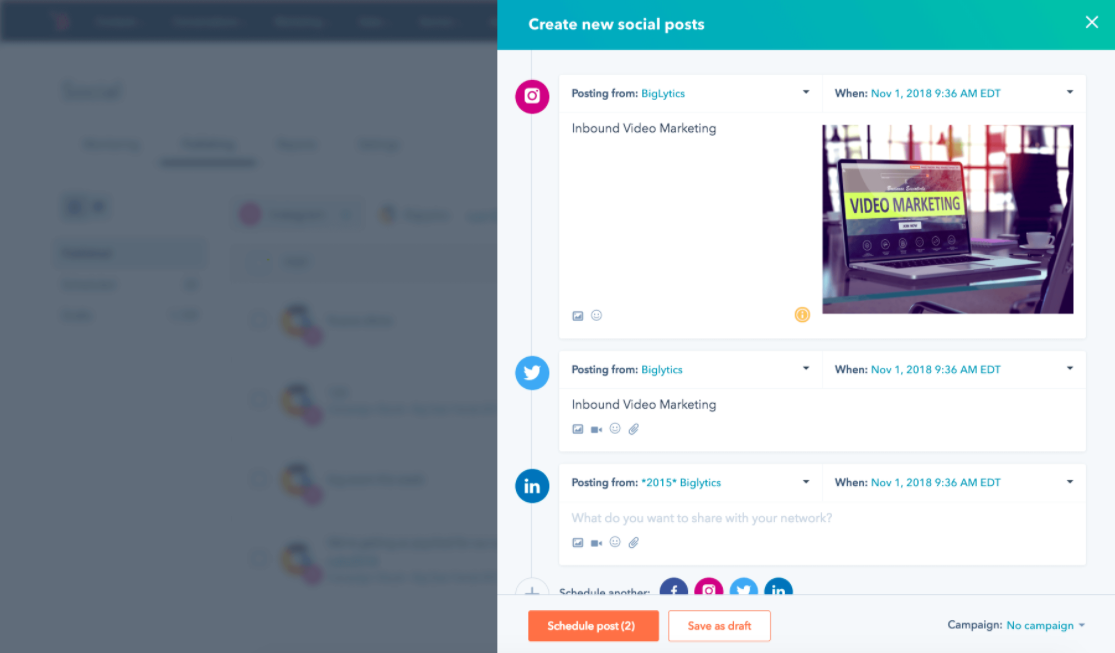
You can also use the blogging and email tools as channels for distribution. For instance, if your business doesn’t already have an email newsletter, you can set those up within HubSpot’s software and use the newsletters as a base to share exclusive content with subscribers.
2. GaggleAMP
Price: $300/mo.
GaggleAMP is a tool designed to save marketers time. It’s social amplification software that lets you post company content on the social networks of colleagues (pictured below). It turns your coworkers into brand advocates and aides with content distribution.
Instead of trying to remember to post about your company, or always asking your colleagues to, this tool eliminates those worries. You can also use this tool to aggregate the social networks of partners and customers. (And, for HubSpot customers, GaggleAMP is offered as an integration).
3. Outbrain
Price: Pay-per-click
When you use Outbrain, your content gets advertised at the bottom of articles related to your business’s industry. You’d do this by uploading content campaigns via RSS feed, and the tool then combs the web for relevant content to place your content at the bottom.
Your content will show up on feeds and look like this:
For instance, if you have a content campaign related to social media marketing, Outbrain might find a social media roundup blog post to place your content on, and encourage readers to engage with it. Outbrain is a PPC tool, but it’s a good way to automate content amplification.
4. Wisestamp
Price: $5.80/mo.
This tool is for email marketing, and is a method of content amplification that’s more lowkey than including your content in the body of the newsletter. Instead, Wisestamp lets you make creative, dynamic signatures that allow you to link to your content in the signature:
Think about how many emails you send in a given day — if someone comes across a hyperlink in your email signature with a title that’s eye-catching, they may be inclined to follow the link. For instance, if I came across an email signature from one of my favorite musicians that read, “Click here to download my new single!” I would definitely, definitely engage.
5. Meet Edgar
Price: $49/mo.
Meet Edgar is social media scheduling and posting software that comes with all the features you’d expect — content creation (shown below), posting, and metrics. However, a feature about Edgar App that’s especially cool is that it automatically posts and reshares content if your queue reaches its end.
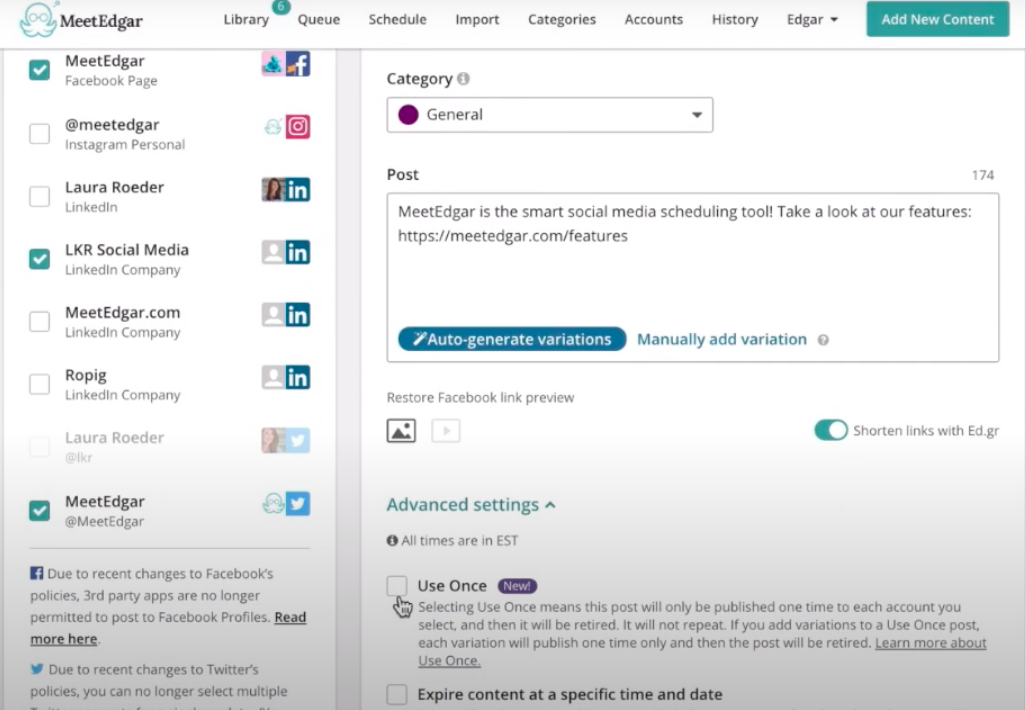
The reposting feature gives you continuous content amplification (don’t worry, you can schedule posting times and choose which posts should only be shown for a limited time). Additionally, the tool’s exclusive link shortener helps your backlinks appear shorter, and the performance of those links is tracked by the app.
The next time you finish your campaign planning, how are you going to amplify it? Which channels are you going to use in order to reach your traffic goals? A great thing about content amplification is that you can choose your own adventure, based on the goals of your company and campaign — and now, you’re ready to make informed decisions about promoting that stellar content you’re working on.

11 Sample Business Plans to Help You Write Your Own
Ask any successful sports coach how they win so many games, and they’ll tell you they have a unique plan for every single game they coach. To have a fighting chance against any of their opponents, they need to prepare a specific game plan tailored to each of their opponents’ strengths and weaknesses. Otherwise, they’ll get crushed.
The same logic applies to business. If you want to build a thriving company that can pull ahead of the competition, you need to prepare yourself for battle before you break into a market. Because companies who can find gaps in your business model will quickly learn how to fill those gaps and solve your customers’ problems better than you can.
The business world moves fast, and it’s full of ambitious companies scrambling to gain the majority of their industry’s market share. So how do you keep up? Writing a viable business plan and following it religiously is one of the most important first steps.
Business plans guide you along the rocky journey of growing a company. Referencing one throughout your voyage will keep you on the path toward success. And if your business plan is compelling enough, it can also convince investors to give you funding.
But how do you actually write a viable and convincing business plan?
Below, let’s review the format of a business plan and sample business plans you can use to inspire your own.
Business Plan Format
Before you get started on your business plan, you might be wondering, “Where do I start? How should I format this?”
Typically, a business plan is a document that will detail how a company will achieve its goals.
Most business plans include the following sections:
- Executive summary: This section will include an overview of the company, your unique value proposition, and a team overview.
- Market opportunity: This is where you’ll detail the opportunity in the market. Where is the gap in the current industry and how will your product fill that gap?
- Key features and benefits: At some point in your business plan, you’ll review the key features and benefits of your products and/or services.
- Pricing and revenue: This is where you’ll discuss your cost structure and various revenue streams.
- Target audience: This section will describe who your customer segments are in detail. What is the demographic and psychographic information of your audience?
- Marketing strategy: Here, you’ll discuss how you’ll acquire new customers with your marketing strategy.
- Competitive landscape: This is where you’ll detail who the top competitors are.
- Financials: This is where you’ll detail the funding that’s required and discuss investment opportunities.
While some business plans might include more or less information, these are the key details you’ll want to include.
Keep in mind, that each of these sections will be formatted differently. Some may be in paragraph format, while others will be in charts.
Now that you know what’s included and how to format a business plan, let’s review some templates.
Sample Business Plan Templates
1. HubSpot’s Downloadable Business Plan Template
We created a business plan template for entrepreneurs.
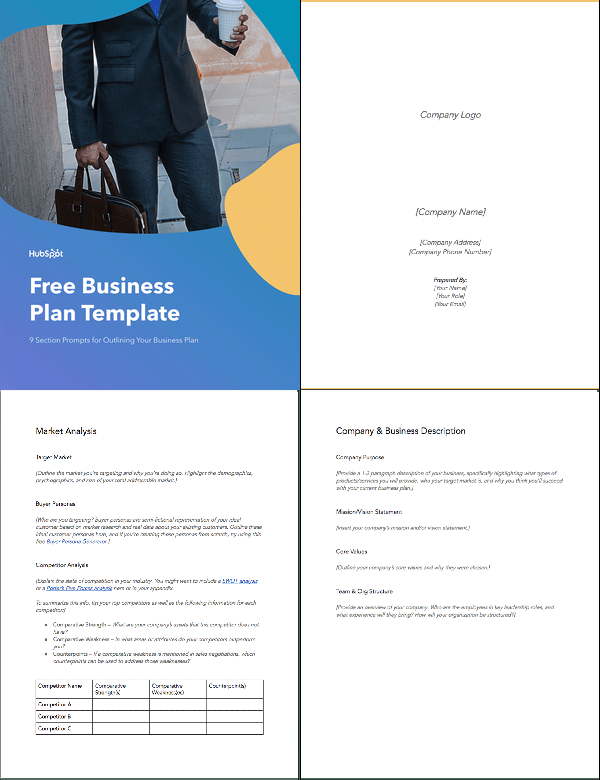 Click here to download the template.
The template is designed as a guide and checklist for starting your own business, so you’ll learn what to include in each section of your business plan and how to do it. There’s also a list for you to check off when you finish each section of your business plan.
Strong game plans help coaches win games and help businesses rocket to the top of their industries. So if you dedicate the time and effort required to write a viable and convincing business plan, you’ll boost your chances of success and even dominance in your market.
2. HubSpot’s One-Page Business Plan
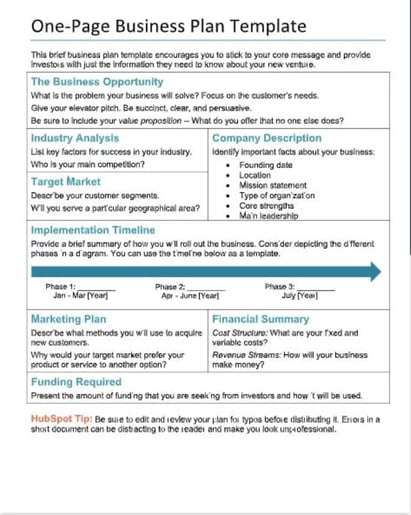
The business plan linked above was created here at HubSpot, and is perfect for businesses of any size — no matter how much strategy they still have to develop.
Including fields such as Company Description, Required Funding, and Implementation Timeline, this one-page business plan gives businesses a framework for how to build their brand and what tasks to keep track of as they grow. Then, as the business matures, it can expand on its original business plan with a new iteration of the above document.
3. ThoughtCo’s Sample Business Plan
If you want to reference an actual business plan while writing your own, ThoughtCo’s got you covered. They created a fictional company called Acme Management Technology and wrote an entire business plan for them.
Using their sample business plan as a guide while filling out your own will help you catch and include small yet important details in your business plan that you otherwise might not have noticed.
4. BPlan’s Free Business Plan Template
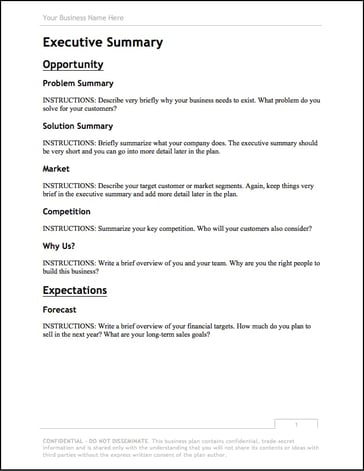
One of the more financially oriented sample business plans in this list, BPlan’s free business plan template dedicates many of its pages to your business’ financial plan and financial statements.
After filling this business plan out, your company will truly understand its financial health and the steps you need to take to maintain or improve it.
5. Harvard Business Review’s “How to Write a Winning Business Plan”
Most sample business plans teach you what to include in your business plan, but this Harvard Business Review article will take your business plan to the next level — it teaches you the why and how behind writing a business plan.
With the guidance of Stanley Rich and Richard Gumpert, co-authors of Business Plans That Win: Lessons From the MIT Enterprise Forum, you’ll learn how to write a convincing business plan that emphasizes the market demand for your product or service and the financial benefits investors can reap from putting money into your venture, rather than trying to sell them on how great your product or service is.
6. HubSpot’s Complete Guide to Starting a Business
If you’re an entrepreneur, you know writing a business plan is one of the most challenging first steps to starting a business. Fortunately, with HubSpot’s comprehensive guide to starting a business, you’ll learn how to map out all the details of your business by understanding what to include in your business plan and why it’s important to include them. The guide also fleshes out an entire sample business plan for you.
If you need further guidance on starting a business, HubSpot’s guide can teach you how to make your business legal, choose and register your business name, fund your business, gives information about small business tax, and provides marketing, sales, and service tips.
7. Panda Doc’s Free Business Plan Template
Panda Doc’s free business plan template is one of the more detailed and fleshed out sample business plans on this list. It describes what you should include in each of its sections, so you don’t have to come up with everything from scratch.
Once you fill it out, you’ll fully understand your business’ nitty gritty details and how all of its moving parts should work together to contribute to your business’ success.
8. Small Business Administration Free Business Plan Template
The Small Business Administration offers several free business plan templates that can be used to inspire your own plan. Before you get started, you can decide what type of business plan you need — a traditional or lean start-up plan.
Then, you can review the format for both of those plans and view examples of what they might look like.
9. Culina Sample Business Plan
Culina’s sample business plan is a great template to use if you just want to fill in your information. You can also use this template as a guide while you’re gathering important details. After looking at this sample, you’ll have a better understanding of the data and research you need to do for your own business plan.
10. Plum Sample Business Plan
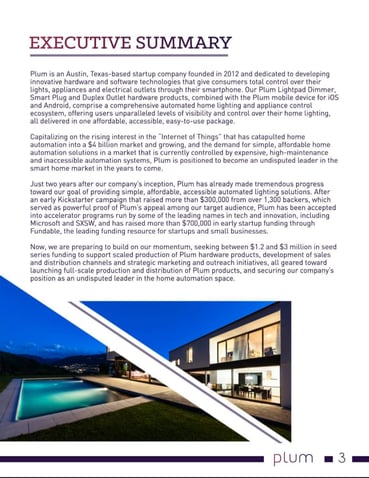
This is one of my favorite sample business plans, because you can see how implementing visuals can help tell the story of your brand. The images in this template are cutting edge, which makes sense for an innovative company like Plum. When you create your own business plan, make sure that the pictures and design you use make sense for your branding.
Additionally, the financial charts included are incredibly helpful if you’re not sure what financial information to include.
11. LiveShopBuy Sample Business Plan
With this business plan, the focus is the investment opportunity. This is an excellent template to use if you’re going to use your business plan as a means to receive funding. The investment opportunity section is placed right up front and is several pages long. Then, the plan goes into more detail about the company synopsis industry analysis.
When you’re first getting starting on your business plan, it can be daunting. That’s why it’s important to make sure you understand the format and information you’ll want to include. Then, you can use a template to guide your process.
Editor’s note: This post was originally published in November 2018 and has been updated for comprehensiveness.

After Weeks of Decline, Sales Metrics Showing Signs of Recovery [COVID-19 Benchmark Data]
The economic impact of COVID-19 is undeniable. Businesses all across the globe are learning how to adapt to these new circumstances and we’re all learning how to operate in a “new normal” that’s constantly changing.
That’s why we’ll be publishing week-over-week trend data for core business metrics like website traffic, email send and open rates, sales engagements, close rates and more. We hope to establish useful benchmarks to measure your business against, and serve as an early indicator of when short- or long-term adjustments may be needed in your strategy.
While this post focuses on the highlights of last week, you can explore all the data we’re publishing here.

About the Data
- These insights are based on aggregated data from over 70,000 HubSpot customers globally.
- The dataset includes weekly trend data for core business metrics in 2020, focusing on changes occurring during and after March 2020.*
- Charts depict the performance of a given metric against pre-COVID benchmarks, calculated using weekly averages from January 13, 2020, to March 9, 2020. They do not depict week-over-week percentage changes.
- Because the data is sourced from HubSpot’s customer base, it reflects benchmarks for companies that have invested in an online presence and use inbound as a key part of their growth strategy.
*The spread of COVID-19 has had a different timeline in different regions, so we are using the World Health Organization’s declaration of a global pandemic on March 11, 2020 as our “official” start date.
NOTE: Because the data is aggregated from HubSpot customers’ businesses, please keep in mind that individual businesses, including HubSpot’s, may differ based on their own markets, customer base, industry, geography, stage, and/or other factors.
What We’re Seeing
After several weeks of concerning declines in deals created and deals closed, we are cautiously optimistic about this week’s data. While it’s certainly too early to call these trends a “rebound,” the numbers suggest that companies that had paused “business as usual” in the last seven weeks are beginning to move forward in a new normal.
Last week saw the highest volume of deals closed since the start of the pandemic, even though deals created and closed are still trending below pre-COVID levels. Deal creation increased 8% the week of April 20, compared to the prior week, with increases in every region. Deals closed saw an upward trend as well with a 9% increase the week of April 20.
Buyer engagement reached historic highs last week. Marketing email open rates continue setting new records despite volume of email sends trending far above pre-COVID averages, and the data shows that salespeople are booking more meetings. We saw increases in average contacts added to customer portals as well.
But there’s still a major disconnect in how salespeople are prospecting. Thus far, sales teams have struggled to convert buyer interest via email — send volume is a staggering 67% above pre-COVID averages, and hasn’t been accompanied by an equivalent increase in response rates or meetings booked.
However, our deep dive on sales activity suggests that salespeople are starting to book more meetings. With some adjustments to prospecting strategy, we’re hopeful that there’s opportunity for sales performance to improve.
This week, we’re adding two new cuts of data:
- A deep dive on sales activity, highlighting call volume and meetings booked. Weekly average call volume has maintained an approximate 20% decrease from pre-COVID averages, while the volume of meetings booked has rebounded to a level higher than pre-COVID averages.
- Country-specific cuts for our core dataset for Australia and Germany. These countries have begun to reopen their economies or have done a good job containing the spread of COVID-19. Over time, we plan to add more countries, and will be watching these granular cuts closely to understand what the early signs of recovery could look like.
There’s still work to be done, but last week’s movement on these trends is a bright spot. After several weeks of steady declines in these metrics, recent data suggests that buyers are entering a new normal. There’s gold in the hills, if sales teams just have the patience to find it — salespeople would do well to take a breath and rethink their prospecting and outreach now, to ensure they’re able to connect with the right buyers at the right time.
How Metrics Changed Last Week
Despite remaining below pre-COVID levels, the volume of created and closed deals is trending in the right direction.
We can’t call it a rebound yet, but sales pipeline data from last week revealed the second straight week of growth after sharp declines across all regions and company sizes in March and early April.
Last week, sales teams created 8% more deals than the week of April 13. This is still trending 15% below pre-COVID levels, but last week was the highest volume of deals created since the start of the pandemic.
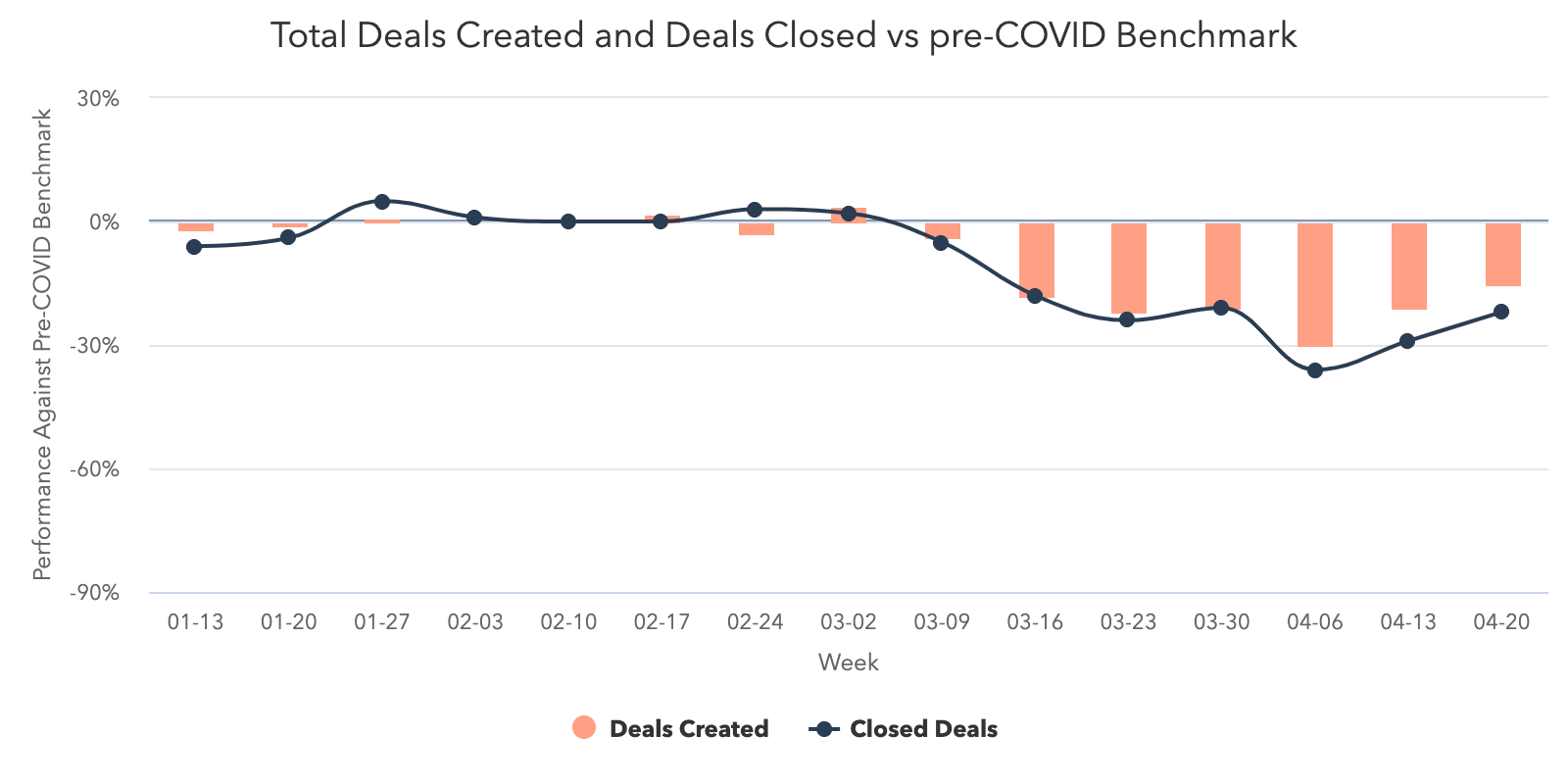
This increase was seen across all regions with EMEA seeing the largest increase week-over-week (18%) and NORTHAM following suit at 7%. APAC and LATAM each saw a small 2% gain.
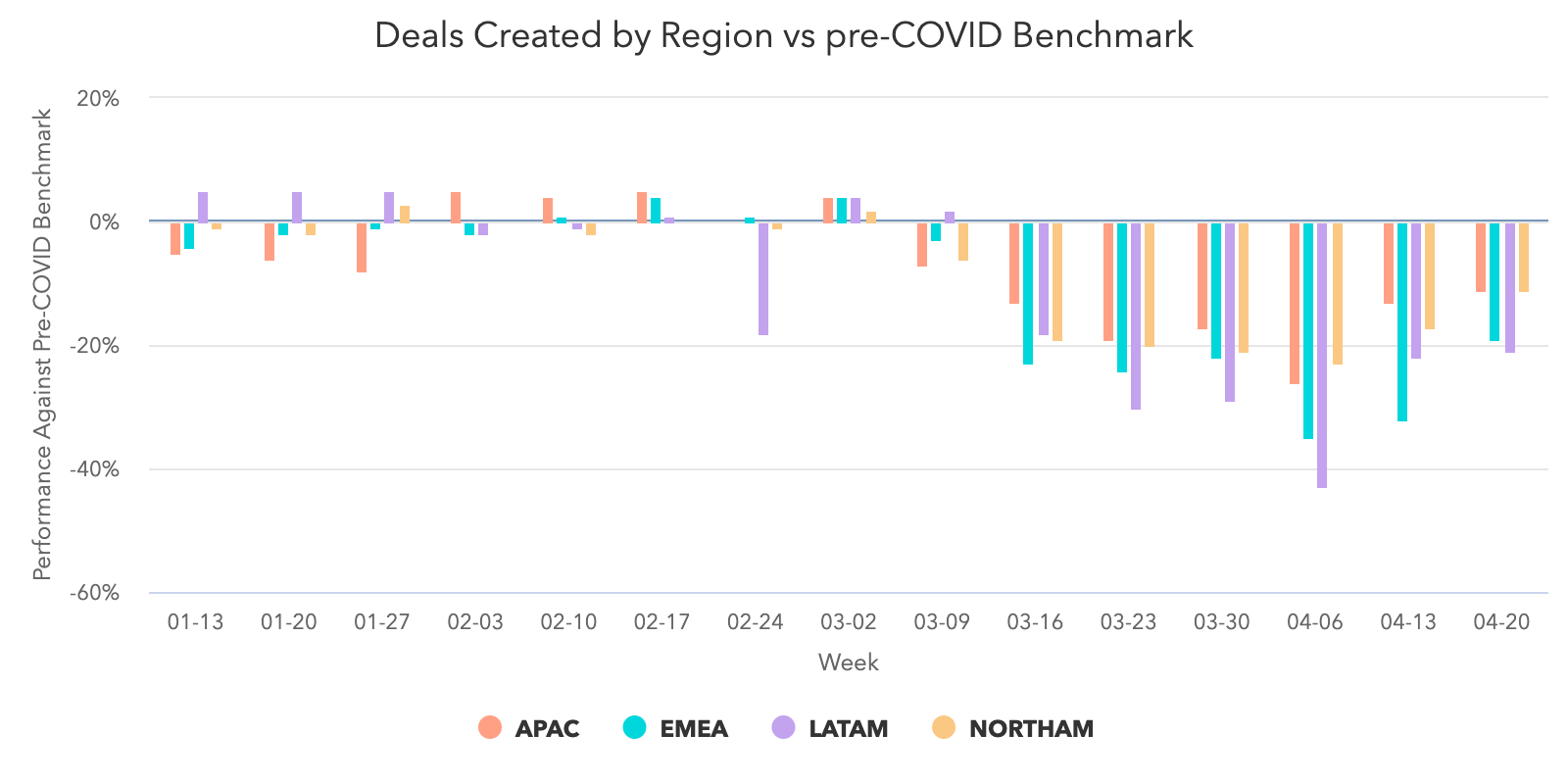
All company sizes followed the same trend. Companies with 201 or more employees are leading the pack with the biggest improvement in performance compared to the start of the pandemic.
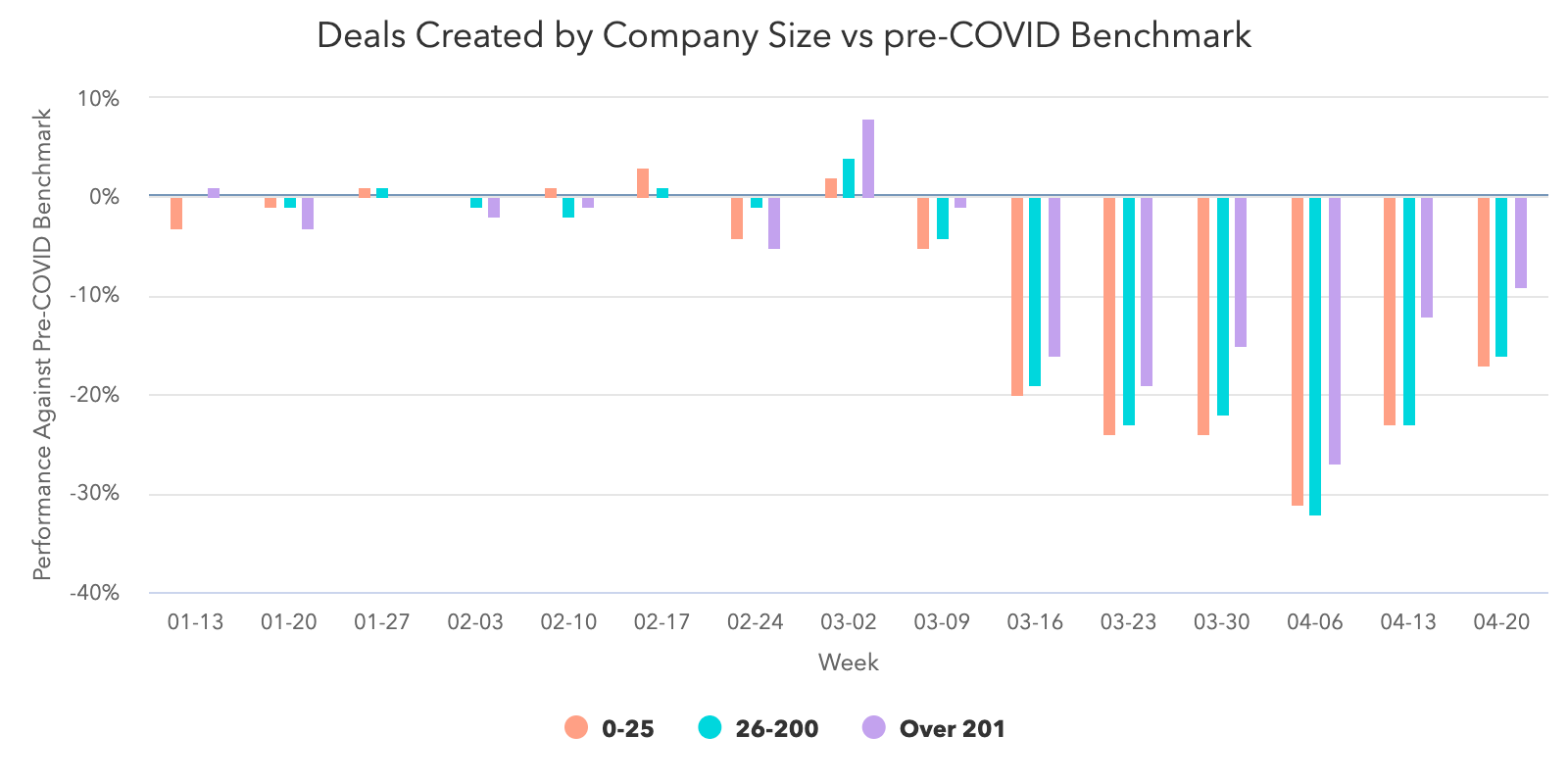
Deals closed improved 9% week-over-week. While the volume of deals closed is still 22% lower than pre-COVID averages, we’re encouraged that this metric has improved two weeks in a row.
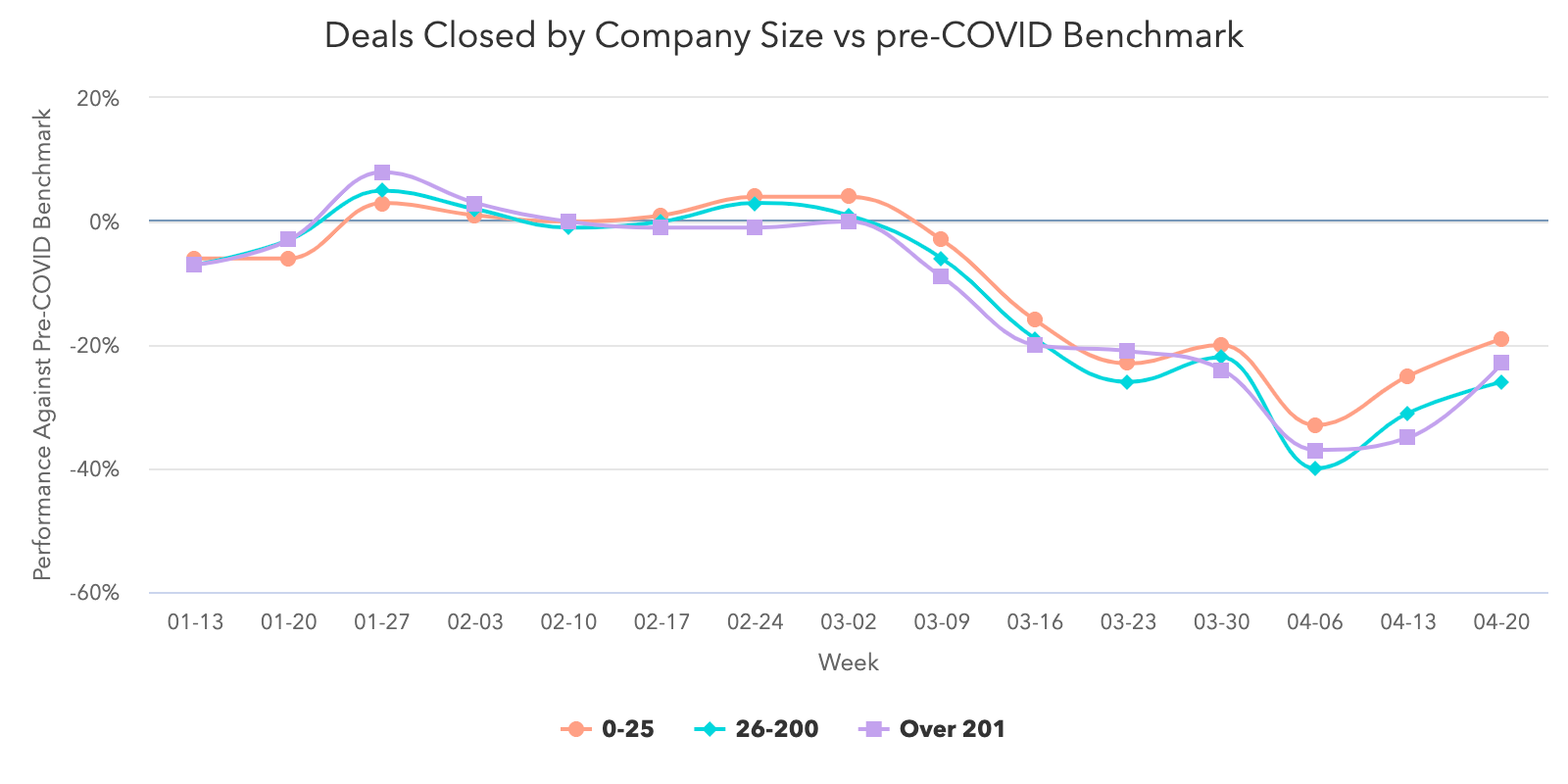
APAC, EMEA, and NORTHAM followed the global trend. LATAM was the exception to the rule but largely held steady, closing 32% fewer deals than pre-COVID averages the week of April 20, compared to 31% below pre-COVID benchmarks the week of April 13.
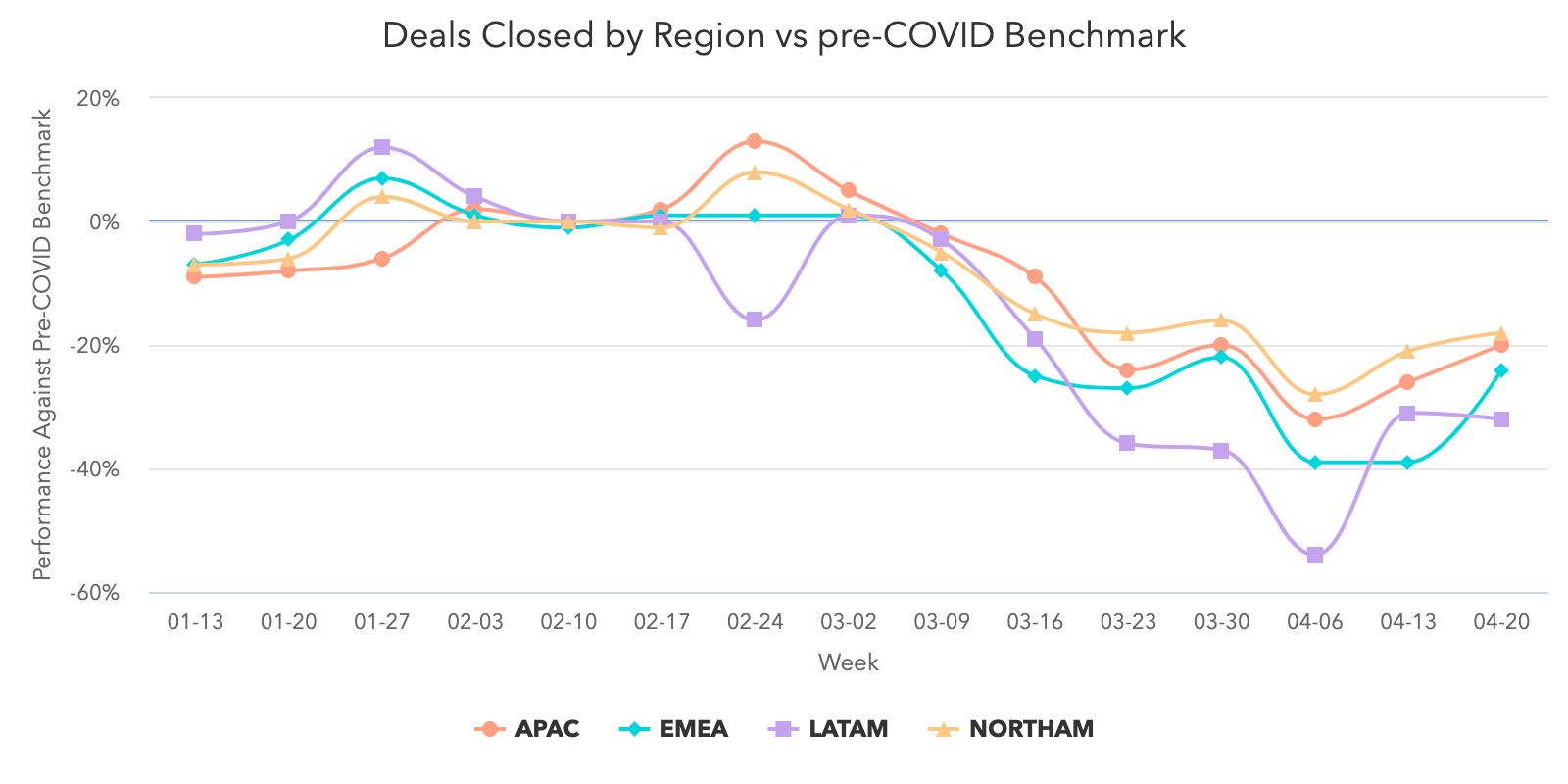
Engagement with marketing content reached record levels
Buyers continue engaging with marketing content at levels equal to or higher than pre-COVID averages. Marketing teams that have invested in providing helpful, relevant content, deserve credit for reaching buyers in an incredibly noisy time.
Consumers are still researching and connecting with businesses at high levels. Website traffic increased last week to 24% higher than pre-COVID averages, the highest volume we’ve seen all year.
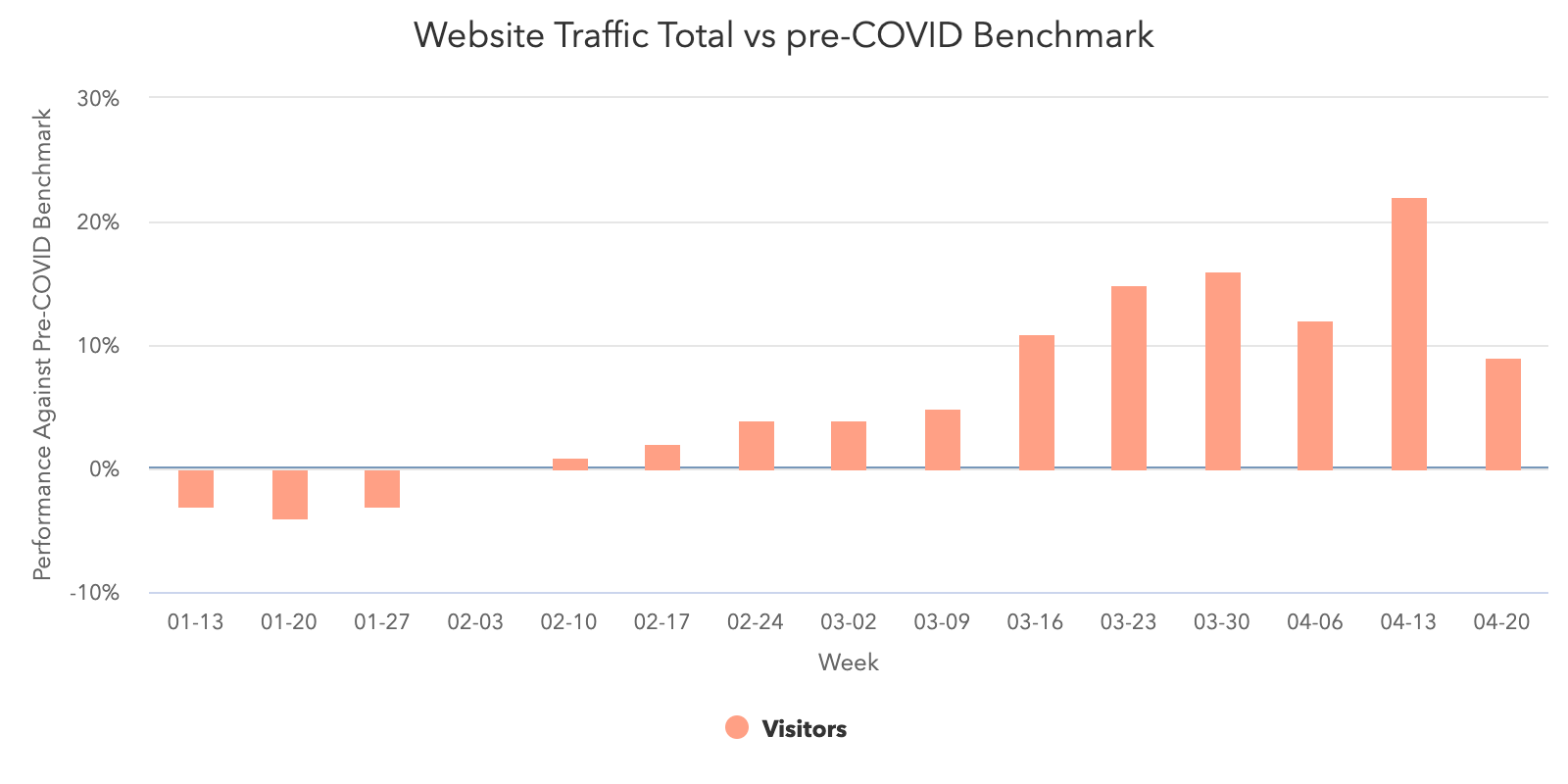
Marketing email volume held steady again, by less than 1% week-over-week, and remains 25% higher than pre-COVID averages. This increase is accompanied by a staggeringly high open rate that is 25% higher than pre-COVID levels, a record for the year.
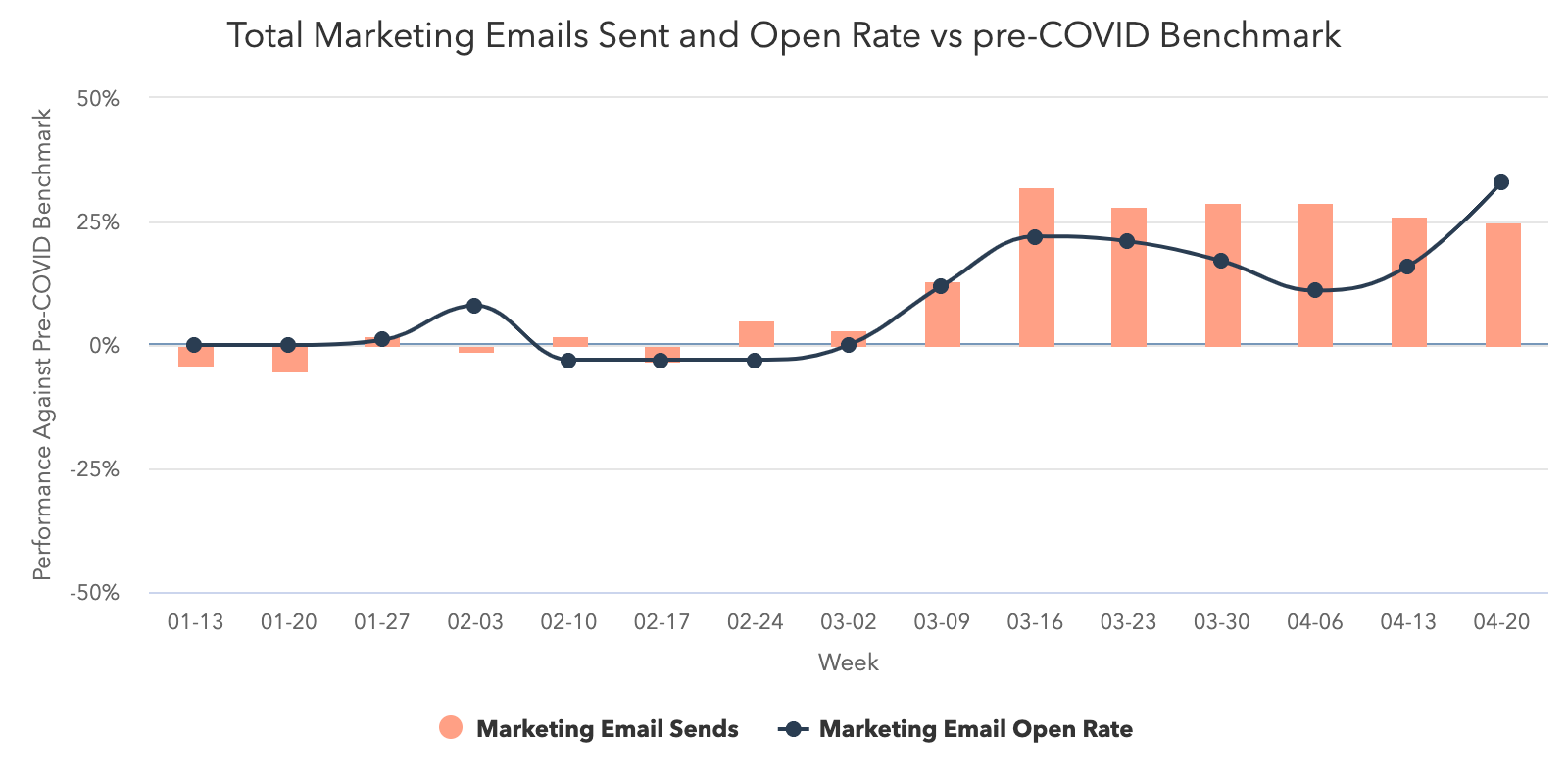
Engagement with sales outreach is no longer in free fall, but reveals opportunities for improvement.
Sales engagement metrics show slight improvement over the past weeks though they have not recovered to pre-COVID levels. In the coming weeks, sales teams’ success will depend on whether they are able to identify and connect with the pool of engaged buyers who have expressed interest in a business’ offerings. The data suggests that there’s still a significant disconnect between where sales teams are focusing their time, and where buyer interest exists.
Total sales emails increased by 6% the week of April 20, and are trending at 67% above pre-COVID averages — the highest level this metric has reached all year. However, after five straight weeks of decline, sales open rates increased marginally, an indication that more total buyers are responding to sales teams this week.
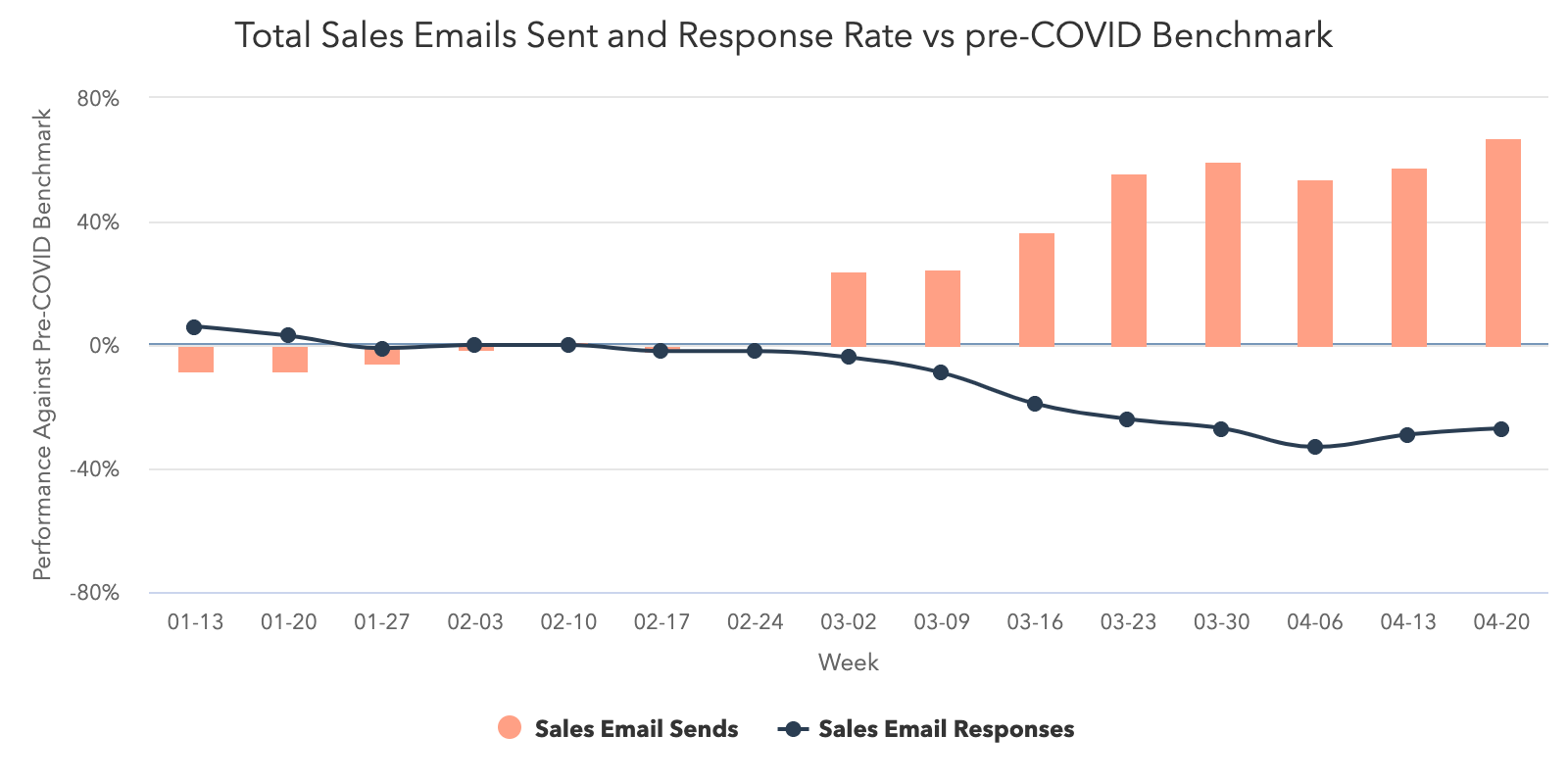
Things get really interesting when we zoom in on two additional parts of the sales process — call prospecting and meetings booked.
Weekly average call volume has maintained a 20% decrease compared to pre-COVID benchmarks. Sales teams are reallocating time they’d ordinarily use to call prospects toward emailing them in order to reach more buyers, a tactic that will not be sustainable as companies attempt to return to pre-COVID performance.
Encouragingly, another metric appears to be genuinely rebounding. The number of meetings booked was trending at around 7% below pre-COVID averages, but last week increased to 10% above pre-COVID averages. Companies that may have frozen new investments while assessing their financial outlook seem to be reentering the market and restarting stalled deals — a promising sign. We hope to see this increase reflected in the volume of deals created and booked in the coming weeks.
Countries that have begun to reopen are generally seeing positive movement in the core dataset.
Germany has begun a phased reopening of the economy, starting with allowing some small businesses to reopen on April 20. Australia has been widely praised for containing the spread of the virus, and states have begun relaxing isolation rules for some public spaces and social visit. Both these countries may provide a hint of what the early signs of economic recovery look like.
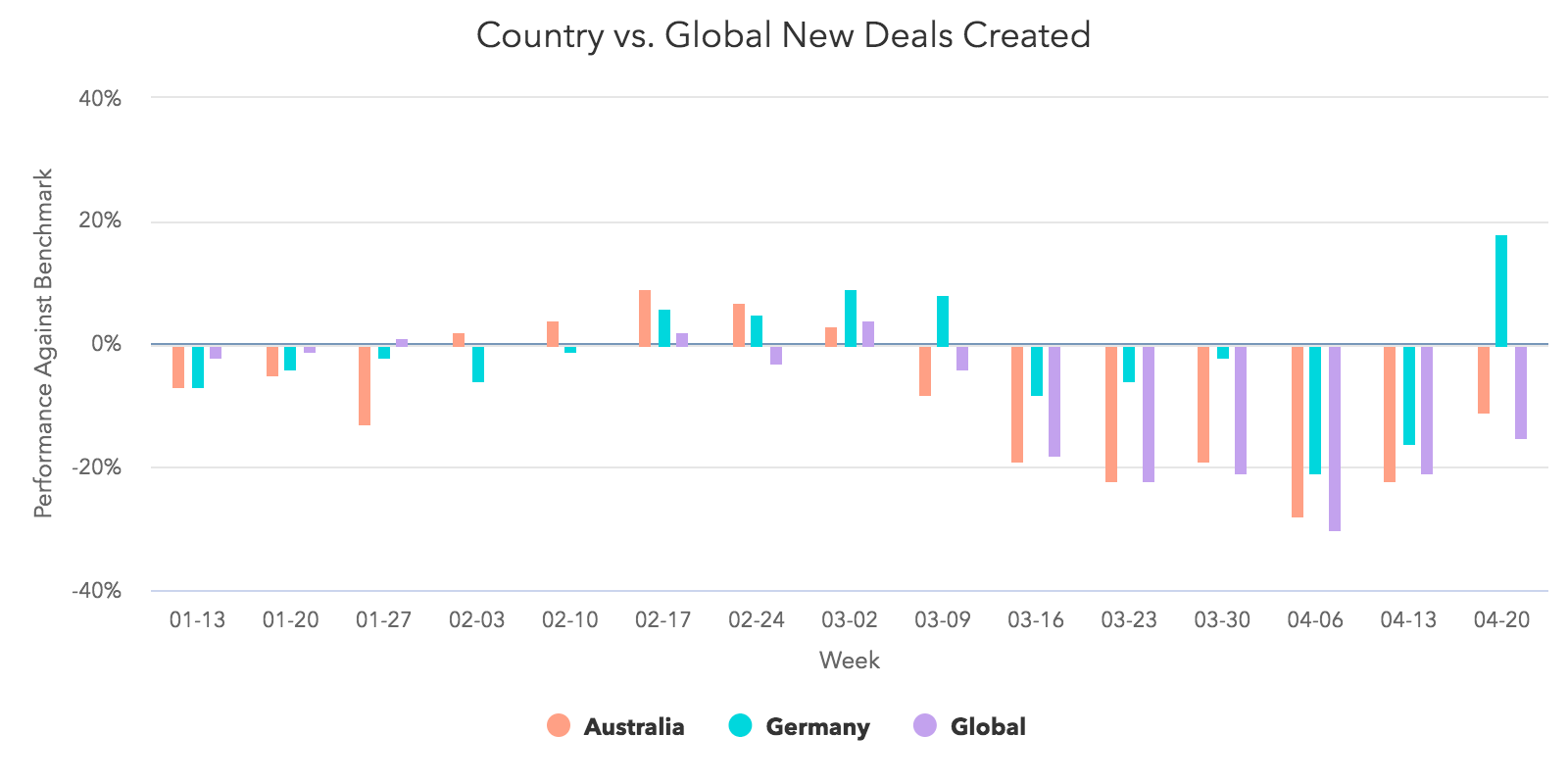
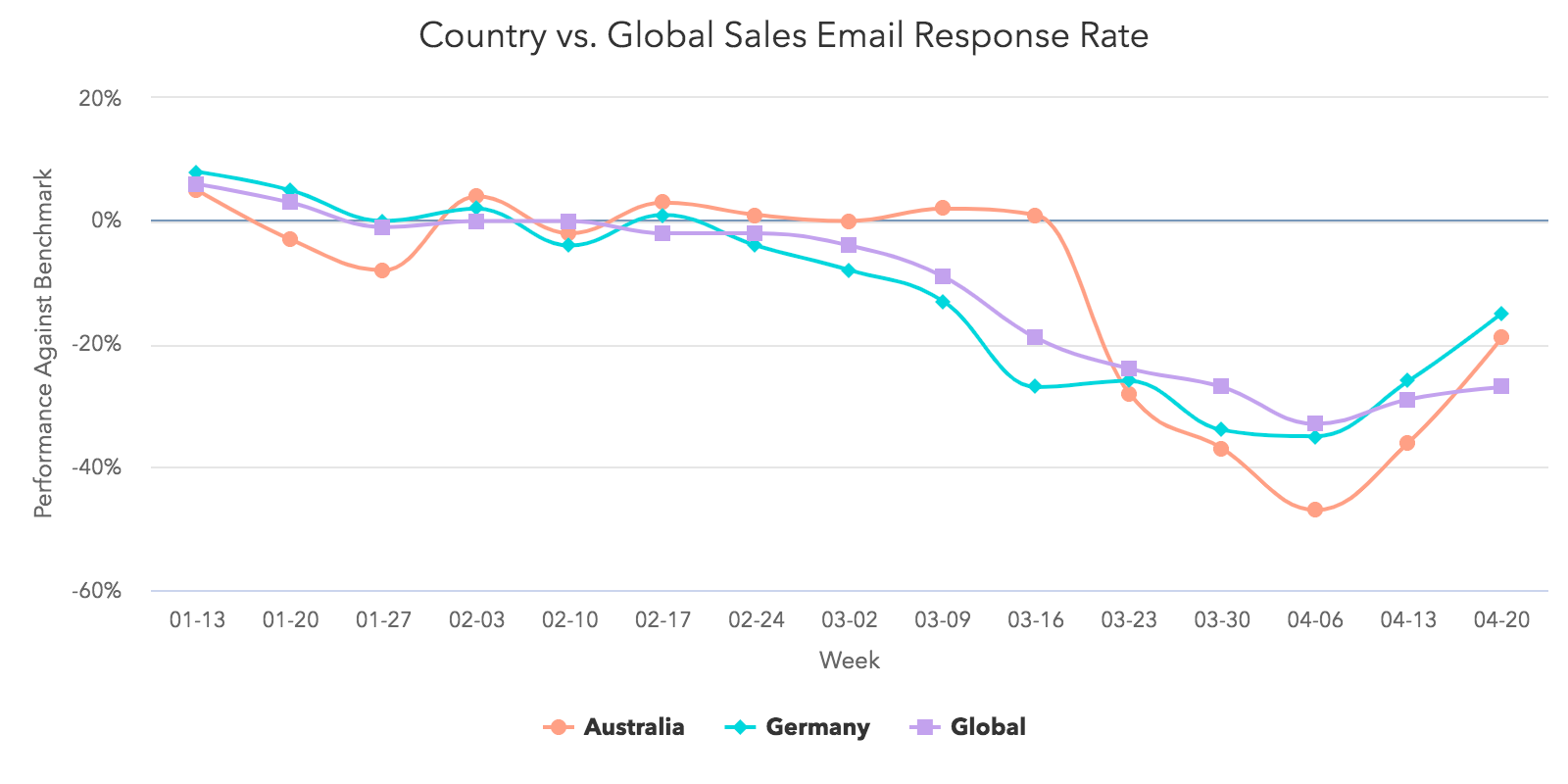
In Germany, marketing email volume kept with global trends, while open rates dipped slightly last week, though both metrics surpass pre-COVID levels. On the sales side, Germany saw a 14% increase in response rate, a 39% increase in deals created, and an 11% increase in closed-won deals the week of April 20. Germany is creating and closing more deals than the global average, with a higher response rate to sales emails as well.
In Australia, marketing engagement held with global trends as well. Sales email response rates increased 28%, deals created increased 15%, and closed-won deals increased 20% the week of April 20. Australia is creating slightly more deals than the global average, holding with global trends for deals closed, and is also seeing a better open rate than the global average.
We’ll be watching these countries (and adding additional cuts) closely to track what economic recovery looks like in countries where the impacts of COVID-19 are starting to lessen. We’re hopeful we will see continued improvement in these metrics, and are particularly interested in whether they will settle above or below pre-COVID levels in the coming weeks.
What This Means for Businesses
Transition from outside sales to inside sales.
The last few weeks have doubtless been a time of tremendous change for companies that employ an outside sales model. Temporarily adjusting to an inside sales model is virtually a requirement for businesses hoping to maintain or grow.
In times like these, knowing how to build strong relationships remotely is key. Invest in videoconferencing software to have “face-to-face” conversations online, and build trust by starting conversations with educational content instead of a generic pitch.
Ensure the quality of your sales conversations don’t suffer by taking essential parts of the sales process online. If you don’t already have a CRMWhether it’s training your sales teams on cloud communications so they’re able call prospects without physical phones, working with your marketing team to digitize educational content that prospects use to research your products, or learning how to conduct demos online, you’ll need to create online equivalents for formerly offline processes. And of course, you’ll need the right tools to keep your sales team running — see below for a dedicated analysis of the technology your team needs.
The last piece of the puzzle is integrating sales enablement with your inside sales engine. Build workflows that ensure the right information is reaching your sales team and that they can easily access it, whether it’s through a project management platform, team wiki, etc.
Resources to Help
- Learn to run an online demo with this list of do’s and don’ts
- Transition your sales process online with this sales kit
- Learn best practices for sales enablement in this certification
Improve prospecting with targeted, creative outreach.
Our data shows that historic numbers of buyers are visiting and engaging with businesses. Yet we haven’t seen a corresponding increase in sales volume. Why?
Part of this decline was inevitable. Companies across the world are tightening their belts and cutting down on nonessential investments. But that can’t fully explain historic lows in sales engagement.
The answer lies in prospecting — the root of most good and bad sales outcomes. The huge increase in email prospecting accompanied by decrease in call volume is both troubling and revealing. Instead of maintaining their standard balance of activities, sales professionals are prioritizing the technique that allows them to touch the largest number of prospects in the least amount of time. Not only has this change had the opposite intended effect, it may also hamstring salespeople who find they’ve burned through their database by blasting irritating emails to prospects who may have been a good fit down the line.
It’s time to get back to basics. Buyer interest is at historic highs, and sales teams that take the time to target buyers who have expressed interest in their products will be better at capturing their interest than teams who are merely emailing as many people as possible.
Encourage your sales team to add a human touch to outreach. For example, recording personalized videos to attach to email messages is a way to stand out in crowded inboxes. Leading with relevance and empathy is more important than ever, and incorporating personalization into your outreach process will drive sales teams to slow down and focus on good-fit prospects.
Resources to Help
- Refresh your email outreach with these sales templates
- Start using video in your sales outreach to engage more prospects
- Lead with empathy in sales emails to build rapport and increase response rates
Remove friction from your sales process with the right technology.
Friction is never good. But in an economic downturn, friction can be deadly. Our data shows that record numbers of buyers are turning to company websites and chat to conduct research. There are a number of ways you can remove friction from your sales process to form more connections between these prospects and your sales team.
Automate and digitize interactions that formerly took place in person. Many steps of the sales process that used to happen face-to-face will need to move online. Chatbots are a useful way to automate parts of the qualification process. Invest in self-service resources like prerecorded demos, and ensure your sales team has the right technology to add a human touch to email outreach, and run sales calls online.
Invest in conversational marketing. Conversational marketing offers a real-time way to answer customer questions and automates the lead routing process so your business can serve prospective and existing customers even when your team is out of the office. Additionally, chatbots can help your company meet the increase in inquiries by providing customers with lightning-fast answers, automating lead qualification, and booking meetings on behalf of your sales and service teams.
Enable self-service. Whether it’s through chatbots, online meeting booking, eSigning, or self-service meetings links, implementing technology that allows prospects to engage with your business on their schedule will make the process easier on your prospects and more efficient for your team.
Resources to Help
- Equip your team with these essential inside sales technologies
- Streamline your sales process with this guide to frictionless selling (and this course)
Free Software to Get Started
- HubSpot CRM is free and comes with included sales acceleration tools, including free 1:1 video, meetings, and chatbot tools
- Gmail and Google Calendar integrations with HubSpot
- Zoom integration with HubSpot
- LinkedIn Sales Navigator integration with HubSpot


The Top 3 Reasons Consumers Read Blogs in 2020 [New Research]
In 2020, there’s no question of whether or not blogs generate leads.
In fact, marketers who prioritize blogging as a marketing strategy report 13-times the ROI of companies that don’t.
However, many marketers still worry that blogging’s effectiveness could be losing steam.
Fears that “blogging is dead” haven’t been eased by research. Recently, when we polled over 300 people to ask them how often they read blogs, roughly 40% said “never.” This followed HubSpot’s 2020 State of Marketing Report, which revealed that blogging fell from the first to third-most-common content strategy between 2018 and 2020.
But, before you get wrapped up in all the negative data, it’s important to remember that blogging is still incredibly valuable to marketers — but the way you approach blogging matters more than ever. And, while our past survey found that 40% of people never read blogs, it conversely revealed that 60% of consumers read this content regularly.
The truth is, blogging is alive and well. You’ll just need to work a tiny bit harder to persuade people to read your content in 2020.
So, what’s one way to get into a consumer’s head and figure out how to motivate them to read your blog? Performing another survey.
Rather than asking more than 300 people, “Do you read blogs?”, I launched a second Lucid survey that more deeply asked, “Why do you most commonly read blog posts?”
In the survey, which asked participants to select the most common reason that they consume blog content, answer options included, “To learn how to do something new,” “To be entertained,” “To learn more about products or brands,” and “To learn about news and trends in my job industry.”
With the number of leads that business blogs are known to generate, you might assume that a large chunk of people read blogs to learn about brands or products. But, actually, you might be surprised — and a little concerned — by the highest and lowest-ranking reasons for blog readership:
In fact, only four percent of consumers say they read blogs to learn about brands or products.
According to the results of the survey, more people are actually driven to read blogs that teach them how to do something new. While 34% selected this reasoning, 20% said they read blogs to be entertained, while 12% read blogs to learn about news or trends in their job industry.
Additionally, 9% said they’re driven to read blogs for all of the reasons given.
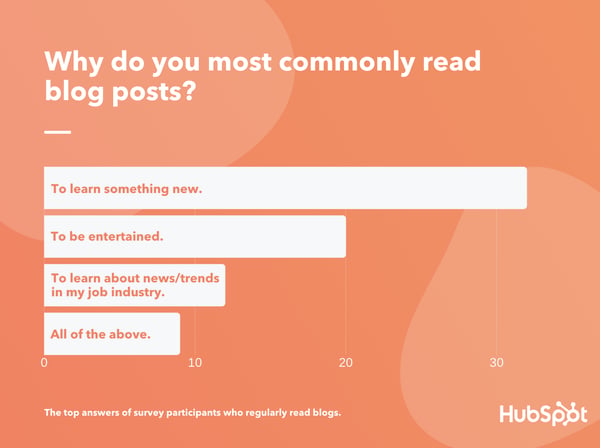
Data Source: Luc.id
What exactly do the results above mean?
To win over blog readers, you’ll need to create content that provides some type of informative value or entertainment, rather than purely using your blog to discuss your brand or product.
In this blog post, I’ll walk you through the top three reasons why the general consumer population is driven to read blogs. I’ll also show you how to create blog content that fulfills your reader’s needs while still subtly spreading brand awareness.
3 Reasons People Read Blogs
1. People read blogs to learn something new.
By far, the most common reason that people will read a blog post is to learn something new. This result doesn’t surprise me at all.
Why? Posts that include guides, step-by-step processes, tutorial videos, or fast-facts often gain a large amount of search traffic. This is because people are looking up instructions for how to do things on Google every day.
Even when posts aren’t informing people of how to do something on a granular level, blogs that discuss complex topics such as studies, trends, or topics people are less familiar with can pique a person’s curiosity.
Psychologically, people crave new information similarly to how they crave food. As a blogger, you can harness this to create content that both piques curiosity, while discussing topics related to your brand, service, or products.
For example, on the Marketing Blog, we might show our readers how to publish an Instagram Story. By doing this, marketers or social media users who want to learn how to do this could find our content in search or on social media and read it to learn how to create this content.
On a broader scope, our blog might create multiple pieces of content that discuss a trend from multiple angles. For example, when the app TikTok emerged, we wrote a few blog posts to answer common marketer questions like, “What is TikTok?”, “How do brands market themselves on TikTok?”, or “How do you leverage influencer marketing on TikTok?”
Aside from helping our readers, guide or trend-related blogs allow us to highlight the level of research and knowledge we’ve gained as marketers. This could also demonstrate to a prospect that HubSpot is a credible company that sells quality products within the marketing industry.
2. People read blogs to be entertained.
While people crave knowledge, they also like to be entertained. Each day, people might read blogs that tell interesting stories, make them laugh, or intrigue them in some other way.
But, as a business blogger, You might be asking yourself, “How can I entertain my readers while still keeping my blog professional?”
The truth is, when you think creatively, there are a number of ways you can entertain your audience while still staying on brand.
For example, you could create a fun infographic or photo post about a viral trend in your industry, While your readers might not be willing to invest in this viral trend, the imagery and information about the trend might entertain them. In one of our posts, we highlighted funny memes that marketers used in their actual campaigns.
Alternatively, you could also create a fun, but informative, video or podcast to go with your blog post. With this added layer of content, you could dive deeper into discussing a viral marketing trend, or interview an industry expert that people in your field follow. While this might not be “entertaining” for people outside of your industry, it might be more interesting than the average blogs people in your field might be reading.
Here’s an example of a blog post that combines text and video for a better reader experience:
3. People read blogs to learn about trends related to their job industry.
While people might not be interested in reading blogs that specifically discuss your product or brand, they could be more intrigued by a blog that discusses an industry your product is affiliated with.
While the poll result noted in the introduction came from general consumers with mixed professional backgrounds, it’s likely that those in the workforce will read a blog if it educates them or provides them with valuable information about their industry.
One example of a brand that discovered how industry experts read its industry-themed blog is American Scientist. Recently, the science blog conducted a study to learn about what motivated its blog readers to visit its site. They found that the average reader was either highly educated in science and technology or was actively working in STEM fields.
American Scientist also discovered that these readers, who already had some expertise on the topic, weren’t interested in general science news. They were actually interested in reading the American Scientist blog for specific “nuggets” of new scientific information, studies, or findings.
From the above study, and what we’ve learned when developing HubSpot’s Marketing, Sales, and Service blogs, industry experts or professionals will read blogs to learn something more specific about their industry. Here’s an example of one of our own high-performing blog posts where an industry thought leader discusses the ins and outs of organic growth.
To zone in on your particular industry, experiment with tactics like thought leadership, similarly to the post noted above. You can additionally write about news or trends related to your field. For example, here’s a post where we discussed how a third-party cookie phaseout could impact marketers.
Creating Content That Fulfills Multiple Reader Needs
So, how do you create engaging content that pulls in audiences with all different reading motivations while still spreading brand awareness about your product or service? Consider publishing blog posts that combine industry trends, how-tos, and entertainment. After all, nine percent of the survey recipients polled above said they read blogs for all of the reasons on the list I gave.
Here are two examples of how you can create content that fulfills the interests of multiple groups of blog readers.
Teach your readers how to do something in your industry.
At the HubSpot Blog, each of our posts teaches readers about something specific. For example, the post you’re currently reading highlights the research we’ve done about how people read blogs and shows you how to leverage these results.
In other posts, we’ll also inform marketers by giving them a step-by-step guide to a marketing tactic or examples of how brands leverage promotional trends. Regardless of what we write about, we’re always trying to teach readers something valuable.
When you create content that educates people about strategies related to your industry, it’s also easier to subtly discuss your product in a way that doesn’t seem shameless of over promotional.
For example, when we’re discussing a strategy that HubSpot can help with, we might subtly link readers to a tool or resource we offer that can help them. Here’s an example of a HubSpot mention in a post about form building tools:
We also like to include free offers related to our content at the end of each blog post. When we do this, a reader can learn more about the topic we’ve just taught them about. And, when they fill out a simple form requesting the free resource, they can choose whether or not they’d like to be contacted about one of our products. This allows the reader to feel like they are receiving valuable information without being forced to learn about our products.
Even when you don’t specifically acknowledge a product, an industry blog focused on informing readers can show off your company’s level of expertise. When your brand is seen as highly knowledgeable about your industry, readers might think that your products were also created by your staff of industry experts.
Entertain industry readers while still informing them.
Even though an industry blog will likely target company employees or leaders, this doesn’t mean your content can’t be informative and entertaining. For example, you can use videos, GIFs, imagery, or interactive blog assets to add to your content while keeping it interesting for the reader.
For example, you could consider embedding a trivia or personality quiz related to your industry, as we did in this blog post:
On occasion, you could also create a fun, suitable for work posts that your industry readers can relate to. For example, here’s a Service Blog post where we highlight GIFs related to working on a customer service floor:
Entertaining blog content on an industry blog can similarly show off your expertise. But, importantly, this content also allows your reader to relate to your brand on a more human level.
Building an Effective Blog Strategy
While it can be great to run with one successful content type, the blogs with the most credibility and quickest growth often have a mix of content that entertains or informs readers, makes them aware of brands or products, or teaches them something new. And, with 9% of consumers in the poll above saying that they’ll read blogs for “all” reasons listed, there’s a good chance that a mix will intrigue and fulfill the reading needs of multiple different groups.
To learn more about how to drive internet users to your blog, check out this post. For tips on how to be a blogger, check out this post with advice from our own blog team.
