
Welcome to My Blog
HomePod Diary: Stereo pairing took an age, but it was worth the wait

It was a frustratingly long wait for Apple to finally launch AirPlay 2, adding stereo pairing to HomePod – along with multi-room playback from an iOS device and more.
If you haven’t already updated, you’ll need to upgrade to iOS 11.4, and then update your speakers. I did that yesterday, finding it a largely painless process, through there were a couple of glitches which I’ll get to.
That done, I was finally able to find out how a pair of HomePods sound …
Angela Ahrendts to speak about Apple’s retail vision at Cannes Lions 2018

Apple’s Senior Vice President of Retail Angela Ahrendts will participate in an interview next month in France according to a schedule posted on the Cannes Lions website.
Fortnite upgrading game with Turbo Build, voice chat, and shopping cart vehicles

Plex overhauls mobile app with customizable home screen, podcast playback

Plex is out with a major new app update today that includes two major changes. First up is a new personalization feature that lets you arrange your home screen within the app as well as top-level navigation. And second is podcast support with subscribing to shows and playing back episodes.
Analysts question whether Apple can adopt all-OLED iPhone lineup by 2019

Yesterday’s supply chain report that Apple would be moving to an all-OLED iPhone lineup next year was taken sufficiently seriously that it caused significant share price movements.
However, some analysts are today questioning whether it would be possible for Apple to complete the shift quite so quickly …
Apple’s move into original television content will be ‘very challenging,’ says Fox CEO

Apple’s move into original television content will be ‘very challenging,’ suggests 21st Century Fox CEO James Murdoch.
Murdoch made the comment at Re/code‘s Code conference, while describing Apple’s involvement in TV production as ‘dabbling’ …
Imgur allows iOS users to upload videos with sound, ahead of other platforms

iPhone owners are first to get access to a new Imgur feature: the ability to upload videos with sound.
We’re here to bring you some ribetting news. Starting today, your posts can shine in all their full sound glory with video upload for Imgur on iOS …
Snap CEO continues to defend Snapchat redesign as he takes potshots at Facebook

Snap CEO Evan Spiegel has continued to defend the unpopular redesign of the Snapchat app, despite the billion dollars it wiped off the company’s market value.
He has also taken the opportunity of speaking at Re/code’s Code conference to take a couple of digs at Facebook …
Unriddled: Facebook in Brussels, Launch of the GDPR, and More Tech News You Need
Welcome back from a long Memorial Day weekend, and an equally long week of data security-related news that applies directly to you — and me. It’s another edition of “Unriddled,” our mid-week digest of the tech news you need to know.
Also worth noting, this is the first edition of Unriddled under GDPR, a massive European data privacy regulation that went into effect last Friday (keep reading, it’s a big deal).
It’s our Wednesday tech news roundup, and we’re breaking it down.
Unriddled: The Tech News You Need
1. Zuckerberg Grilled by Parliament
Last month, Facebook CEO Mark Zuckerberg appeared in front of Congress to discuss Facebook’s position on the recent mishandling of Facebook users’ data by the (recently liquidated) data analytics firm, Cambridge Analytica. Last week, Zuckerberg answered similar questions before the European Parliament’s Conference of Presidents in Brussels. And the roundtable was neither easy on him nor pleased with the format of his answers.
Before Zuckerberg spoke at all, each member of European Parliament (MEP) posed their questions one after the other. Their questioning lasted just over an hour, leaving Zuckerberg with roughly seven minutes to address all their concerns at once. And according to the MEPs present and those who watched online, it was not seven minutes well spent. Read the full story on this controversial hearing >>
2. Facebook Plans Privacy Options ‘Similar’ to Europe
In light of a newly launched European data privacy law — and the heat on Facebook for the misuse of its users’ data by analytics firm Cambridge Analytica — Facebook has revamped its privacy options for all users. But it’s not quite the same as the regulation that took effect across the pond last week (which we’ve unriddled for you further down this report).
Facebook’s rollout to all users was more of an alert, rather than a full teardown of its privacy policy. The alert’s main difference from Europe’s new policy is that it’s optional to read. Facebook’s rollout is merely an “interruption” to users when logging on — something they can skip if they’d like. In this way, users can passively review how Facebook stores data related to ads, their profile info, and facial recognition. Read the full story >>
3. All Past Facebook Political Ads Revealed
Earlier this month, the U.S. House of Representatives released a record of more than 3,000 political ads the Internet Research Agency (IRA) in Russia bought and ran on Facebook to influence the outcome of the 2016 U.S. Presidential Election. To demonstrate the same transparency, Facebook has now launched a public archive of every political ad ever run on the platform.
Facebook’s political ad archive produces information on each ad’s cost, target audience, and performance. However, the tool only allows users to search for ads based on the subject or person featured in the ad, rather than the ad’s date or sponsor — two things that many people are disappointed they won’t be able to see, given the thousands of ads originating from the IRA. Read the full story >>
4. GDPR Takes Effect
If you missed the General Data Protection Regulation’s (GDPR) rollout, check your inbox. Every company you’ve interacted with lately likely emailed you with updates to their privacy policies. The GDPR officially took effect on Friday, May 25th, and businesses everywhere — not just in Europe — have adjusted their terms of service to comply with the GDPR to protect customers who might live and do business in Europe.
While changes to data protection laws might connote rough road for advertisers, who depend on insight into their customers’ profiles and behaviors, some see it as a necessary measure to make their marketing content that much more respectful of the buyer’s journey. Read HubSpot CEO Brian Halligan’s recent note on GDPR >>
5. Airbnb ‘Stories’ Now Available
Beyond developments in data security, Big Tech was as eventful as always. This week, Airbnb subtly released a new feature called “Stories,” heralded as the company’s expansion from simply home rentals to a broader suite of travel services.
Facebook, Instagram, WhatsApp, and Snapchat all have similar “Stories” features that allow users to share disappearing photos and videos. Airbnb’s Stories launch will work the same way: Users can write and shoot short videos of their experiences, not just in a particular room rental, but across the city to which they’re traveling. Read the full story on Recode >>
That’s a wrap for today. Until next week, tap me on Twitter with your thoughts on the now-active GDPR and what tech news you’d like to see us cover in the future.

Analyst predicts 2018 iPhones will kick-start up to 350M iPhone sales

GBH Insights analyst Daniel Ives has predicted that the new iPhone models expected to be launched this year could kick-start a new sales boom of up to 350M units over the next 12-18 months.
There is, he says, ‘a massive iPhone upgrade opportunity’ in the making …
How to Become a More Adaptable Leader
When I was asked to write on this topic, adaptable leadership, I started shaking my head. I am not a huge fan of putting an adjective in front of leadership and making it a new thing. Let’s just call it leadership and then talk about how to be better at it, one day at a time.
If you are a leader and you don’t have the capacity to shift, change, or pivot from a plan or a position, frankly, I don’t know how long you’ll last in your role.
So, if you are an aspiring leader, this article is for you.
If you see yourself as a student of leadership, this article is for you.
If you don’t think you need to be adaptable in how you lead, you must read this.
At the heart of leadership is an inherent need to react to changes in your environment.
As we think about adaptability in leadership, we need to first understand its importance — why do we need to adapt?
Then, we need to look at some techniques that allow us to transform ourselves into leaders who can actually adapt.
Think about the situations you face everyday. Did everything go according to plan?
If you’re like me, the answer is: Of course not.
Business and the world in general is an incredibly complex system with so many different factors that affect on another. If we think it is possible to succinctly plan our day or lead our teams in the exact same way, I direct you to Mike Tyson:
“Everyone has a plan till they get punched in the mouth.”

All of those unforeseen things that occur in your day are like being punched in the mouth. So, how do we deal with this?
As former President Dwight D. Eisenhower once said:
“Plans are worthless, but planning is everything.”
If we can train ourselves to understand that plans will always change, but continue to work through planning exercises — for work we are doing and in terms of growth as leaders — we are ready to get punched in the mouth.
Here are some thoughts on how you can begin the effort of planning to allow you to be a more adaptable leader — or a leader who understands that one plus one doesn’t always equal two.
How to Be a More Adaptable Leader
Be Intent-Based and Outcome-Focused
When I was commissioned in the Army in the early 2000s, the Army’s leadership/command philosophy was Command and Control. It was very hands-on and directive, not very adaptive or flexible. As my career progressed, the Army doctrine changed to Mission Command.
Mission Command was a more intent-based and outcome-focused doctrine. Commander’s relied on their intent to drive operations, meaning they only told you the destination, the goal, not necessarily how to get there.
Trust was a huge part of this approach. It was reminiscent of how the Union won the Battle of Gettysburg.
Brigadier General Joshua Chamberlain’s regiment was told if they were overrun, the Union Army would be defeated. When Chamberlain’s regiment was basically out of ammunition, he didn’t lose his cool. He ordered one of the most heroic battlefield exploits in US History; an all-out bayonet charge.
He wasn’t told exactly what to do, rather, he was enabled and an empowered to know what to do to reach the goal.
His ability to understand the intent and outcome his commander desired not only allowed for the Union to win the day but led to Chamberlain being awarded the Congressional Medal of Honor.
Here’s what this story means for you:
Lead with the Goal
If you’re a leader, before you issue instructions or hand out tasks, take the time to think through what you actually want to achieve.
What is the intent behind the work you want done? What is the outcome you desire? Does it matter how your team attacks it?
Once you’ve identified the answers to these questions, make sure your team understands exactly what is expected of them. Hammer home that the outcome is what you care about, and the intention behind why that outcome is huge.
This will allow both you and your team to adapt and overcome the obstacles we all know you will encounter.
Leading this way is tough, though. It takes a certain mental toughness to be ok with not knowing exactly how your team is going to attack the problem set, but it’s worth it.
You will find it easier over time to do this.
If you are ensuring your intent and desired outcome are known and understood and trust in the people on your team, you will not only grow into a more adaptive leader, you will build an adaptive team.
Do this today: Identify at least one task and the intent and outcome you want that task to achieve. Write it down and delegate it to your team.
Read Team of Teams by General Stanley McChrystal, Tantum Collins, David Silverman, Chris Fussell.
Now, if you’re an aspiring leader, ensure that you understand your boss’ intent and the outcome she/he has set.
Confirm, back brief, truly understand what that is and then get after it.
This is where initiative comes in.
Don’t be the person that wants everything told to them — do this, then that, then this, etc.
If you operate this way, you will most likely become irrelevant and not grow in your career.
Do this today: Read A Message to Garcia by Elbert Hubbard and become Garcia. If you understand the intent and outcome desired, attack it like Chamberlain did with his historic bayonet charge!
Understand You’re Not the Smartest Person in the Room
When you meet with your team are you allowing yourself to learn from them?
To do this, you must enter the interaction with a growth mindset, being open to other points of view, and recognizing they may know something you don’t.
If we enter an interaction thinking our opinions and perspectives are the only ones of value, your team sees it. They get discouraged, knowing they aren’t being heard.
When this happens, you hurt the morale and overall effectiveness of the team.
In contrast, when you show your team you are capable of listening and abandoning your positions for someone else’s, you accelerate what it can accomplish.
You demonstrate that you respect your team members as experts in their positions and that trust them to bring the right ideas to the table.
This happens at IMPACT all the time.
Bob and I work on a 30,000-foot view of how to tackle something and then we bring it to our team.
More often than not, the team comes back to us with a significantly more effective approach. Then, when we adopt the ideas (in whole or in pieces), we have a team that knows they were listened to.
They own the decision and take it on at full speed.
When we make decisions and work through planning in a collaborative way, we set ourselves up for success when we have to pivot — which we know is going to happen.
By being truly open and receptive to the knowledge, ideas, and thoughts of others, you naturally become more adaptive — and in turn, your team does as well.
Practice in Action
Again, if you’re a leader, embrace that you have smart people on your team and that it is ok to not always be the smartest or best at your craft.
You’re a leader now. Your role is to lead, not be the best widget maker.
Actively listen, ask questions, and be open to others points of view. This will not make you less of a leader, it will make you a better leader.
Don’t focus on who has the best idea, simply find it and understand that you and your team must be flexible enough to make changes on the fly.
Do this today: In your next team meeting, only ask questions. Let the team get to the solution.
For future leaders, challenge assumptions, ask hard questions, and don’t be afraid to give a different point of view.
Don’t be insubordinate, but challenge your boss from the perspective of trying to find the best solution to achieve the outcome they have clearly identified.
Do this today: Speak up!
I also suggest reading Multipliers by Liz Wiseman and Mindset by Carol Dweck.
Grow a Culture that Lives in Solutions
In my past career, I had the honor of leading some of America’s best — paratroopers in the 82nd Airborne Division. If you’re looking for an example of a team that must be adaptable, I can’t find a better example.
Our main mission, we trained for airport seizure, by way of airborne assault.
(Personal note, this is one of the coolest missions in the world!)
We would go through extensive planning efforts from the individual level up to the brigade level. Commanders and troopers of all levels were involved.
We would develop great plans, but as General Eisenhower said, “Plans are worthless …”
This planning effort allowed us to live in solutions. We all knew the commander’s intent and knew the outcome we needed to achieve.
With this knowledge, everyone was able to adapt to the ever-changing situation we would encounter.
You see, there is no precision in a mass tactical airborne assault. You are being delivered to the battlefield and where you end up probably isn’t where you thought you’d be.
This is brought to life in Band of Brothers when we see how Paratroopers from the 82nd and 101st Airborne were dropped all over Normandy.
These troopers and their leaders needed to adapt and find solutions pretty much instantly rather than wallow in the misery of not being where they were “supposed” to be.
They took initiative, understood the intent, and got after it, allowing for a successful sea invasion on the beachheads of Normandy.
As Paratroopers, we had to continually reinforce and nurture the culture of the airborne community. We had to get everyone comfortable with being uncomfortable and solving for yes.
How do we attack this?
Leaders, force your teams to have hard discussions.
Talk about the elephant in the room, but ensure you are moving the conversation to a solution. As ideas of why something won’t work are brought up, ask what will work.
Set the example. Always project a sense of calm and optimism that will allow you to find a solution.
Remember, you don’t need to have the answer right away. Simply have the mindset and attitude that highlights that a solution will be found.
In your planning efforts, you’ve likely identified possible issues and potential solutions. Get back into this mindset and work on the next one.
Do this today: When presented with the next problem don’t react, respond. Ask questions that lead your team to solutions.
Future leaders, as you identify problems, don’t simply bring them to your boss. Think about a potential solution. Feel empowered to lead the assault on the problem and make it go away.
Your boss will appreciate your efforts. Even if they don’t utilize your solution, you have given them a path to the answer they need.
Do this today: Think through the issue, develop at least one course of action, and then talk to your boss.
Here are a few others books I recommend: Never Split the Difference by Chris Voss and Motivation Myth by Jeff Haden.
Plans Are Worthless
To be an effective leader, you must be adaptable. Change is going to happen daily. If you can’t adapt and remain flexible, you will struggle to achieve your goals.
By being intent-based and outcome-focused, having a growth mindset, and growing a culture that lives in solutions, you become more of an adaptable leader who will be able to attack the challenges thrown in your direction.
As an aspiring leader, take note of what your boss is doing.
If they aren’t doing these things, figure out how to bring them to the reality they that need to adapt. Work towards being an adaptable subordinate, have resilience, and, at some point, lead your team as an adaptive leader.

6 Tools for Social Media Content Inspiration

Need more ideas to fill the gaps in your social media posting calendar? Looking for tools to help? In this article, you’ll discover six tools and websites that will help keep your social media content interesting, timely, and relevant. #1: Discover Unofficial Holidays and Popular Events With Forekast Forekast is one of the best places […]
The post 6 Tools for Social Media Content Inspiration appeared first on .
from https://ift.tt/2xpuOEq
via socialmediaexaminer
How to Take a Screenshot on Windows: Quick Guide
Screenshots are undeniably useful, whether you’re writing a how-to guide or putting together a training presentation for your team.
Sometimes, the simplest way to teach someone how to do something is through visual images, and in those cases, screenshots are your best bet.
But if you’re working on a PC and you’re more used to working on a Mac, it can be tricky to figure out how to take a screenshot.
Here, we’ll show you a few different ways to take screenshots on different Windows versions — best of all, our easy guide will show you how to do this in five minutes or less.
How to take a screenshot on Windows 10, Windows 8.1, Windows 7
Microsoft created a Snipping Tool specifically for capturing screenshots. There are four types of screenshots you can take with the Snipping Tool:
- Free-form snip: Capture a free-form screenshot around an object.
- Rectangular snip: Capture a rectangular screenshot around an object.
- Window snip: Capture a browser window or dialog box.
- Full-screen snip: Capture the full screen.
When you’re finished capturing a screenshot, there are a few things you can do with the image besides simply saving it:
- Annotate it: Write or draw on the screenshot by selecting “Pen” or “Highlighter” buttons. Use the “Eraser” tool to remove lines you’ve drawn.
- Remove the URL: If you’ve taken a screenshot of a browser window and saved it as an HTML, the URL automatically appears below the snip. If you don’t want this, select “Options” in your Snipping Tool, and then uncheck the “Include URL below snips (HTML only)” box. Then, click “OK”.
- Share a snip: Select the arrow next to “Send Snip”, and then select an option from the list to share your screenshot.
Now, let’s take a look at the basics of capturing a screenshot on Windows 7, 8.1, or 10.
1. Open your Snipping Tool. For Windows 7 and 10, select “Start” and type “snipping tool” into the search box, and then select the tool from the results. For Windows 8.1 and Windows RT 8.1, swipe from the right edge of your screen, select “Search” and type “snipping tool” into the search box, and select the tool from the results.
2. Within the Snipping Tool, click “Mode” and then select the kind of snip you want. Then, select the area of your screen you want to capture.
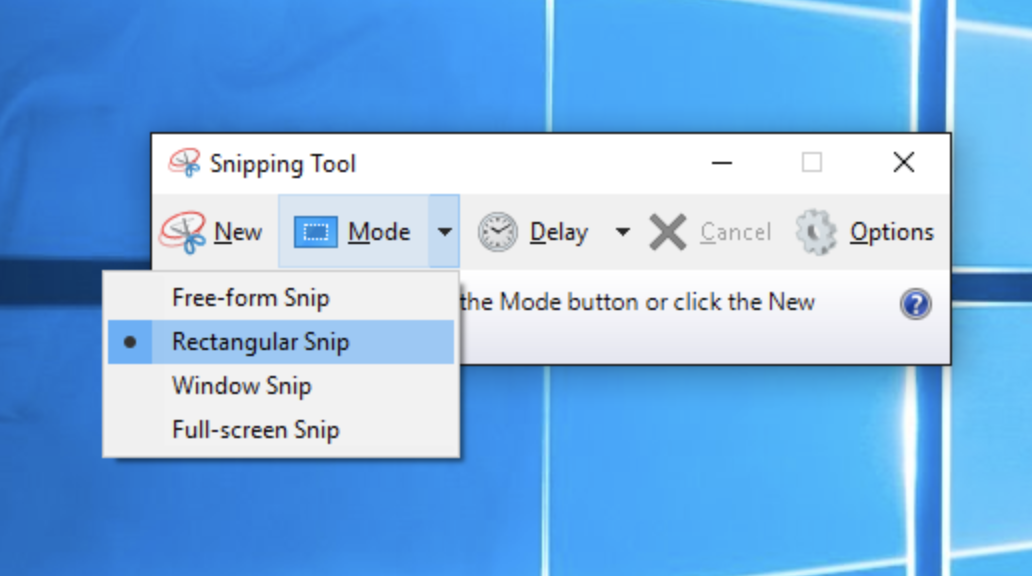
Image courtesy of Microsoft Support.
3. After you capture your snip, select the “Save Snip” button. Type a file name, location, and type, and then click “Save”.
How to take a screenshot of your active window
There’s a shortcut to the above process if you want to take a screenshot of your current active window. Just press “Alt” + “PrtScn”. Your active window will be captured, but it won’t automatically save — to do this, find the screenshot in your clipboard, open an image editor, and save it from there.
How to take a screenshot of your entire screen on Windows
If you want to take a screenshot of your entire screen and save the screenshot automatically, hit the “Windows Key” + “PrtScn”.
Your screen should dim for a moment, and then the screenshot will be saved in Pictures > Screenshots folder.

Apple Events app updated on Apple TV ahead of June 4 WWDC keynote live stream

As expected, the Apple Events app has now been updated so Apple TV owners can easily tune into the WWDC keynote announcements. For tvOS devices, the fourth- and fifth-generation Apple TV, you need to download/update the Apple Events from the App Store. Users of older Apple TVs will notice the Apple Events channel shows up automatically.
Nintendo announces new ‘Pokémon Quest’ game coming to iOS next month, more

The Pokémon Company has made a pair of announcements tonight, including a brand new game available now for Nintendo Switch and coming to iOS next month. The game is called Pokémon Quest and is free-to-play…
Here’s the new Apple Watch Pride face that will become available next Monday

We have posted before about Apple’s new pride face for the Apple Watch, with strings found on a beta version of iOS 11.3. After that release, Apple removed all assets related to the new face from iOS and watchOS. That, however, has changed today with the release of iOS 11.4 and watchOS 4.3.1.
Snap planning new ‘Snapkit’ developer platform to expand login & AR camera to more apps

According to a new report from TechCrunch, Snapchat is planning the launch of its first developer platform, referred to as Snapkit. The platform would allow other applications to offer a “Login with Snapchat” option, as well as access key Snapchat features…
