
Welcome to My Blog
13 Free Personality Tests You Can Take Online Today
Personality tests are a great way to explore different aspects of who you are, and uncover layers you perhaps hadn’t recognized about yourself before. Being truly self-aware is hard — while they might not be always 100% accurate, personality tests work well as a starting point for self-discovery by providing results you might not have concluded on your own.
There are hundreds of personality tests out there — some label you with a general personality type, while others delve into your best potential career paths. Some challenge you to look at ink blots, while others ask you detailed multiple choice questions.
While many of these tests are unreliable and don’t offer any real scientific validation, others can provide potentially astute, psychologically-based insight into your behaviors, ambitions, and temperament in times of conflict.
In fact, some online personality tests are thought-provoking indicators into why you make decisions, who you work well with, and how to modify your attitude towards people whose personalities clash with yours. In both your work and personal life, this information can be invaluable.
When you’ve got some downtime and want to explore aspects of who you are, or get some guidance on potential career paths, take a look at the best free online personality tests we’ve compiled. Whether you’re interested in general information about your personality, or emotional intelligence-related insight, you’re bound to learn something.
Free Myers-Brigg Personality Tests
Myers-Briggs is a widely respected and popular personality assessment tool — first used in the 1940s, the test was developed by Katharine Cook Briggs and her daughter, Isabel Briggs Myers. Initially inspired by Jung’s personality theory, the Myers-Briggs test conveniently separates people into 16 categories of personalities, providing each person with a four-letter acronym.
The following four tests are broad-stroke indicators of who you are, using inspiration from Myers-Briggs. Among other things, the tests cover your communication styles, your strengths and weaknesses, your desires and ambitions, how you see the world, and how people perceive you.
If you’ve never taken a test based off Carl Gustav Jung’s psychological traits, or Myers-Briggs’ 16 categories of personalities, I’d suggest you take at least one of these. You’ll be surprised by the accuracy of some of the statements, and more importantly, you could gain insight into how your behavior is perceived by others, helping you improve both professional and personal relationships.
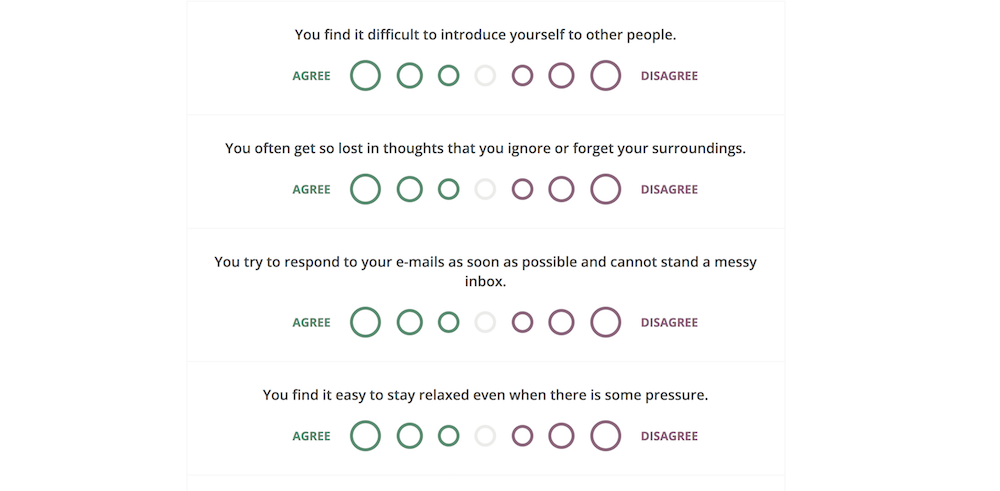
1. 16 Personalities
16 Personalities covers five broad personality aspects: mind, energy, nature, tactics and identity. The test is based on Carl Gustav Jung’s study of psychological traits (e.g. extroversion vs. introversion) and the Myers-Briggs test, two popular personality theories meant to determine an extensive overview of who you are. Among other things, the test will cover how you communicate and relate to others — both professionally and personally — what you value and strive for, and how you make decisions. 16 Personalities has been taken over 126 million times, and is available in 30 languages.
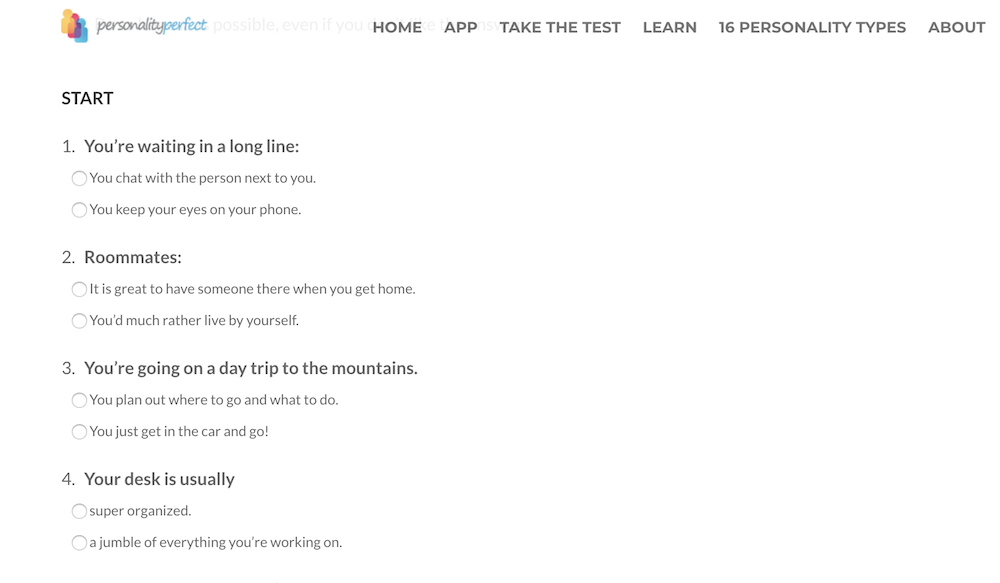
2. Personality Perfect
Similar to 16 Personalities, Personality Perfect is also based on Jung’s and Myers-Briggs’ personality theories, and uses four broad categories — extraversion vs. introversion, sensing and intuition, thinking and feeling, and judging and perceiving — to compile a four-letter abbreviation of your personality type (e.g. “INFP”). The test provides a broad overview of how you connect with others, how you behave, and, perhaps most surprising, how you’re likely seen by others.
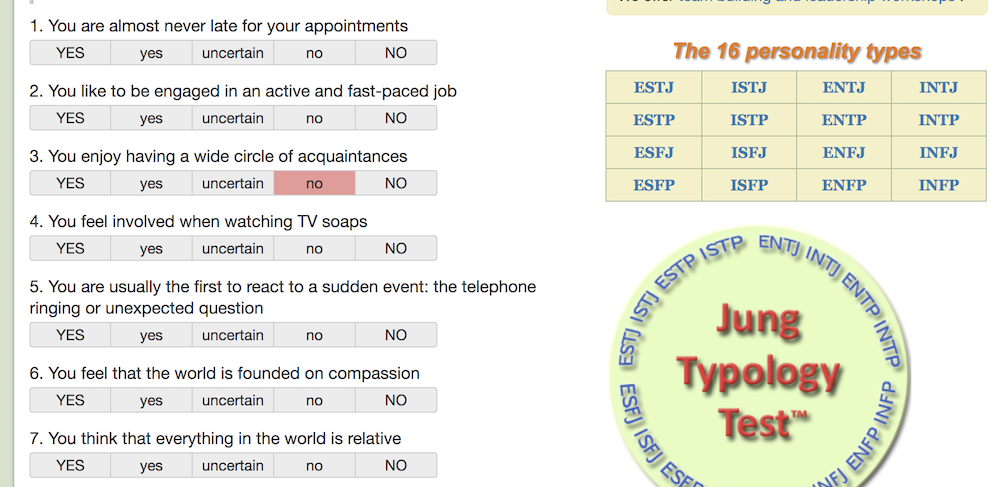
3. Human Metrics
If you’ve ever wondered which famous personalities share your personality type, you’re in luck — Human Metrics shows you that information, along with your four-letter personality type (again, based off Jung and Myers-Briggs theories). With this test, you’ll get information about which career paths are most suitable for your personality type. If you’re having trouble choosing a career path or doubting the one you’ve chosen, maybe this test can help you figure it out.
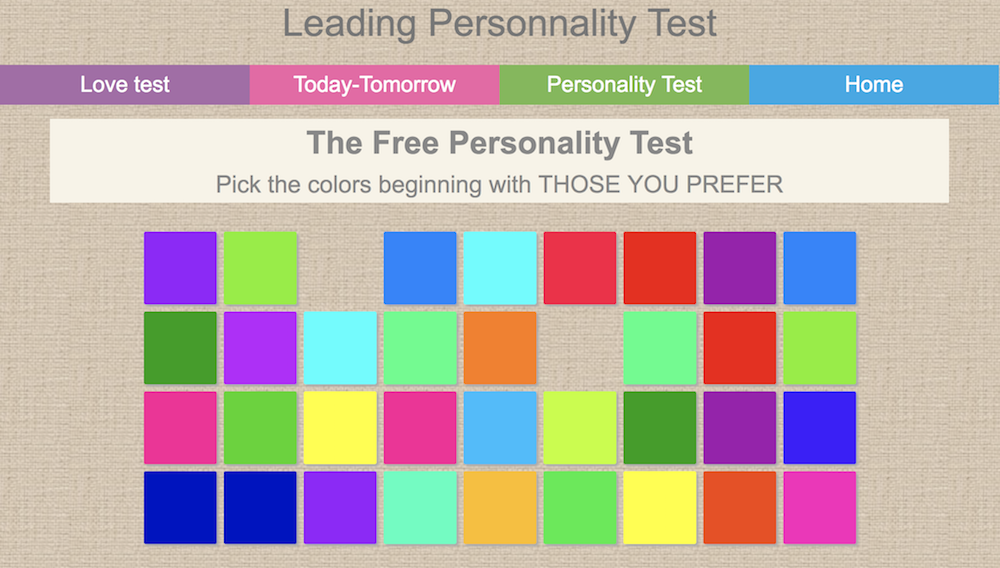
4. TestColor
Test Color, a test validated by a team of clinical psychologists, psychoanalysts and mathematicians, asks you just two questions: “Click on the colors you like most,” and “Click on the colors you like least.” Test Color tells you about your emotional intelligence, your creativity and imagination, your social skills, and your work style, including organization and management styles. I found it to be surprisingly accurate: in two questions, it nailed how I communicate with others and how I act in group settings.
Free Disc Personality Tests
The DISC assessment determines where you lie on four DISC factors: dominance, influence, steadiness, and compliance. DISC is one of the most popular and authoritative career assessments out there, and many companies encourage their employees to take it.
Undoubtedly, personality affects our career ambitions, as well as how we perform in different workplace environments. If you’re particularly extraverted, maybe you’ve chosen a career path that enables you to work daily with large groups of people. If you have certain communication styles that rely on passivity and emotion, perhaps your boss’s direct statements sometimes offend you.
Arming yourself with a sense of self-awareness could help you find your optimal career path, foster better work relationships, and mitigate work conflict more effectively. Here are four career-focused tests to help you achieve higher work satisfaction.
1. 123 Test
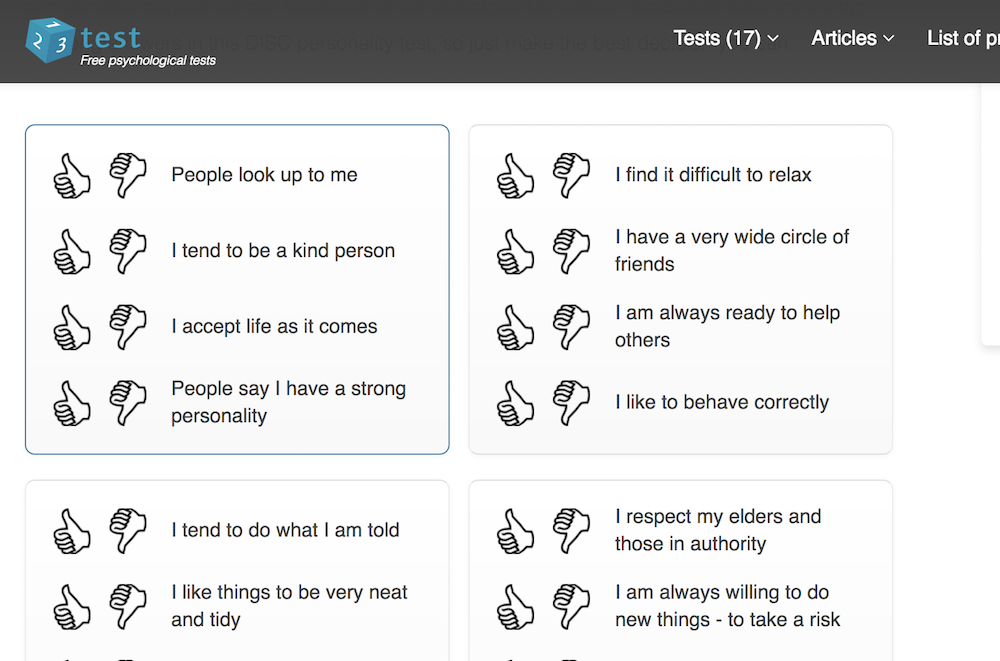
123 Test provides a free DISC assessment. The results, in both graph and text form, tell you how your personality fits into your work environment, who you work well with, who you might have conflict with, how you perceive other’s behaviors, and how other’s perceive yours. The test helps you understand how your own personality biases you towards certain colleagues (i.e. your personality might take another coworker’s comments offensively, while the coworker just believes in being direct), which could strengthen your work relationships.
2. TestQ.com
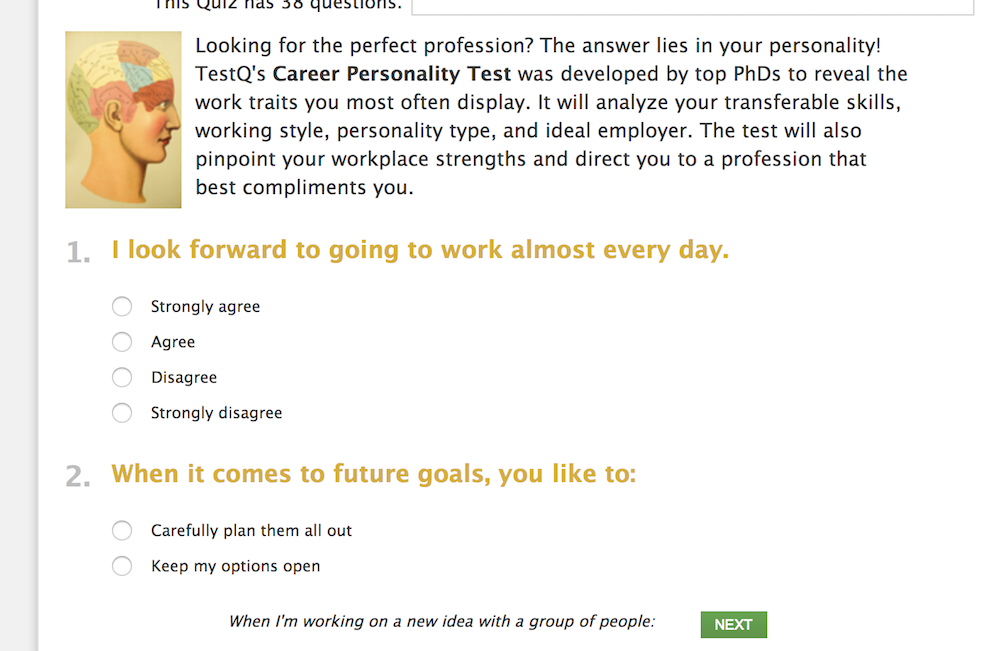
This tests asks 38 multiple-choice questions to analyze your skills, working style, and even your ideal employer. TestQ, developed by top PhDs, offers you insight into your strengths and weaknesses, and even suggests careers best suited for your personality. If you’re happy with your current career track, the test provides suggestions for specific skills you could learn to get ahead in your career.
3. Interpersonal Skills assessment
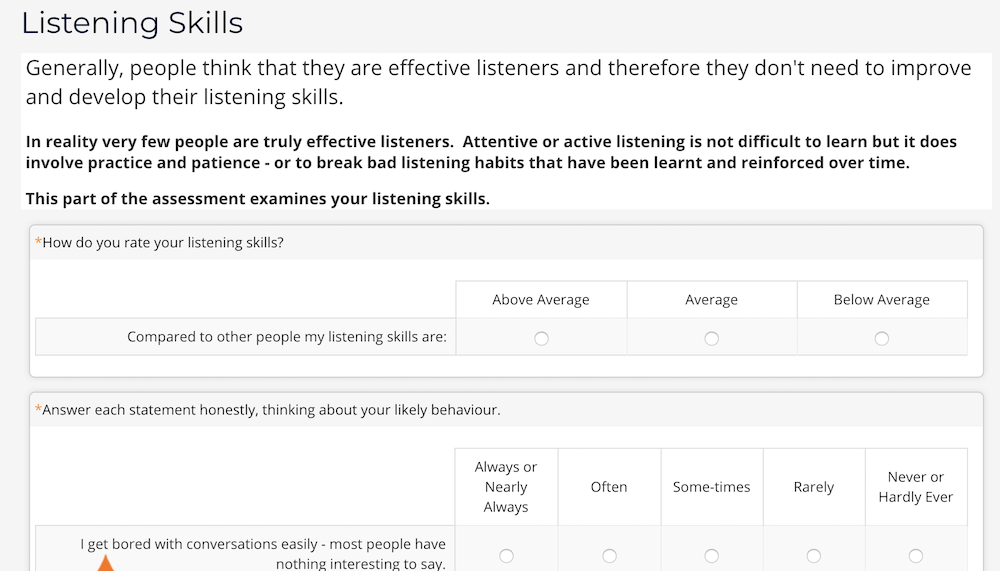
Having well-developed interpersonal skills is critical to forming deep and meaningful personal and professional relationships. Interpersonal Skills assesses your listening skills, verbal communication skills, ability to work in teams, and emotional intelligence. Better yet, the test identifies areas of weakness and provides tactical advice on how to improve those skills.
4. Sokanu
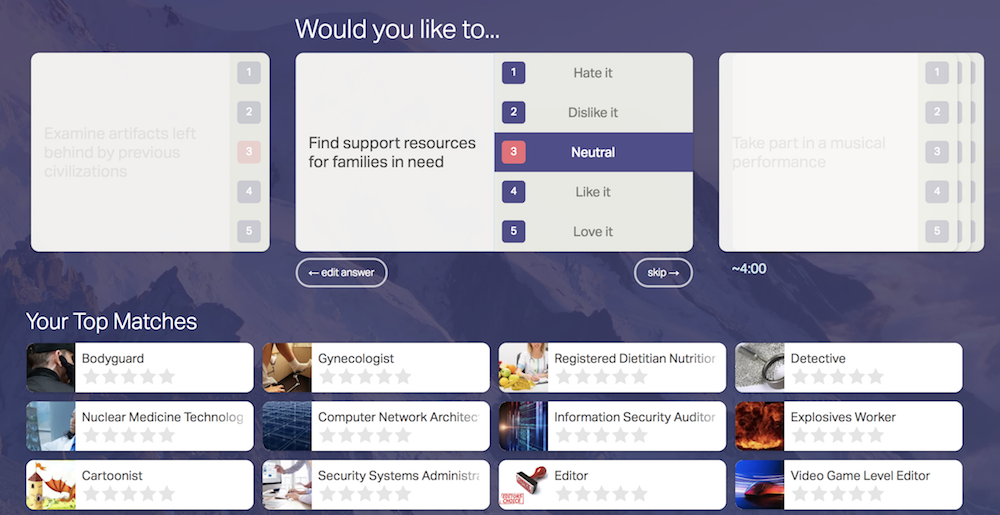
Major companies including General Assembly, NYU, and Redfin use Sokanu, a career assessment tool that tests you on your personality, background, interests, and goals to determine an ideal career path. After you take the test, it provides you multiple matches, which you can sort through to explore different careers and workplaces before choosing an ideal match.
Free Emotional Intelligence Tests
Psychology Today defines emotional intelligence as, “the ability to identify and manage your own emotions and the emotions of others.” Arguably, having emotional intelligence is the most important factor in dealing with conflict and communicating with others.
It’s undeniable that emotional intelligence is important — in fact, research has shown success is 80-90% attributable to emotional intelligence (EI), and only 10-20% to your IQ.
In the workplace, whether you’re around coworkers in the midst of a stressful project, or dealing with a tough performance review from your boss, it’s critical you know how to both identify and handle your own emotions; it’s equally important you know how to read other people’s emotions, and manage them appropriately.
So let’s dive in. Below are four emotional intelligence tests to help you recognize your level of emotional intelligence, and also how to improve it.
1. Berkeley Emotional Intelligence
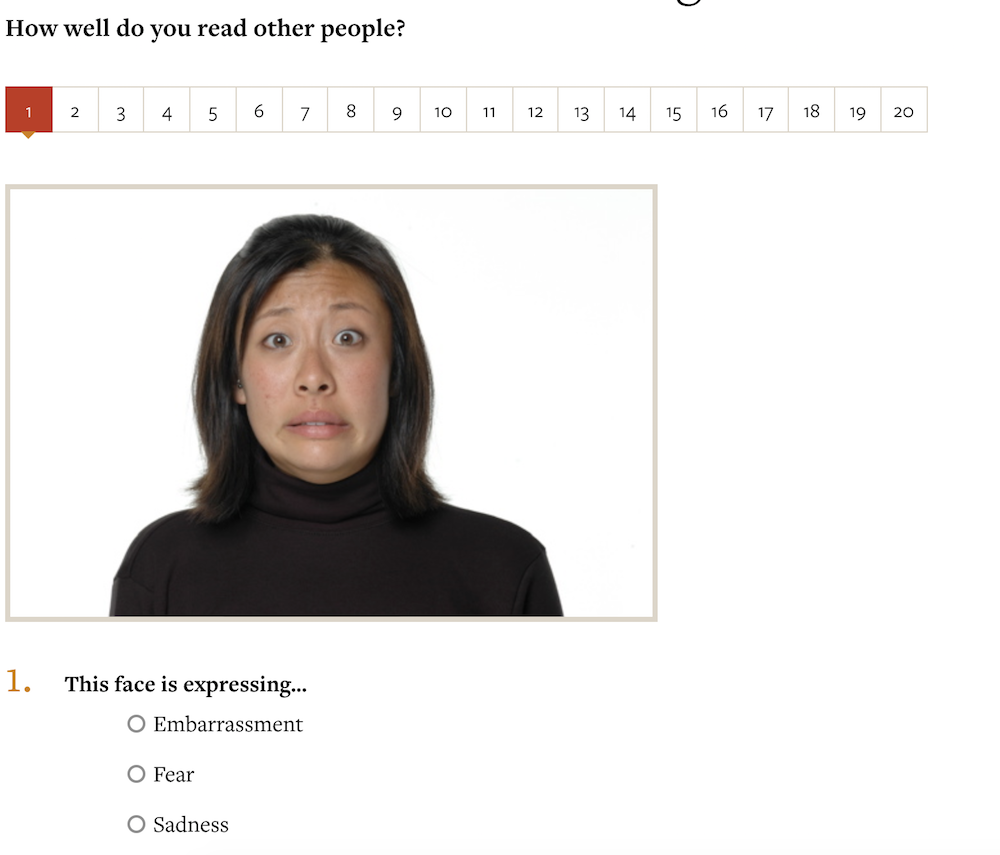
This test, designed by Berkeley, shows you 20 pictures and asks you to recognize the facial expression on each person’s face. It’s easy, quick, and fun, and an informative way to learn how well you read other people’s emotions — which is a critical skill for assessing and mitigating conflict.
2. VeryWellMind
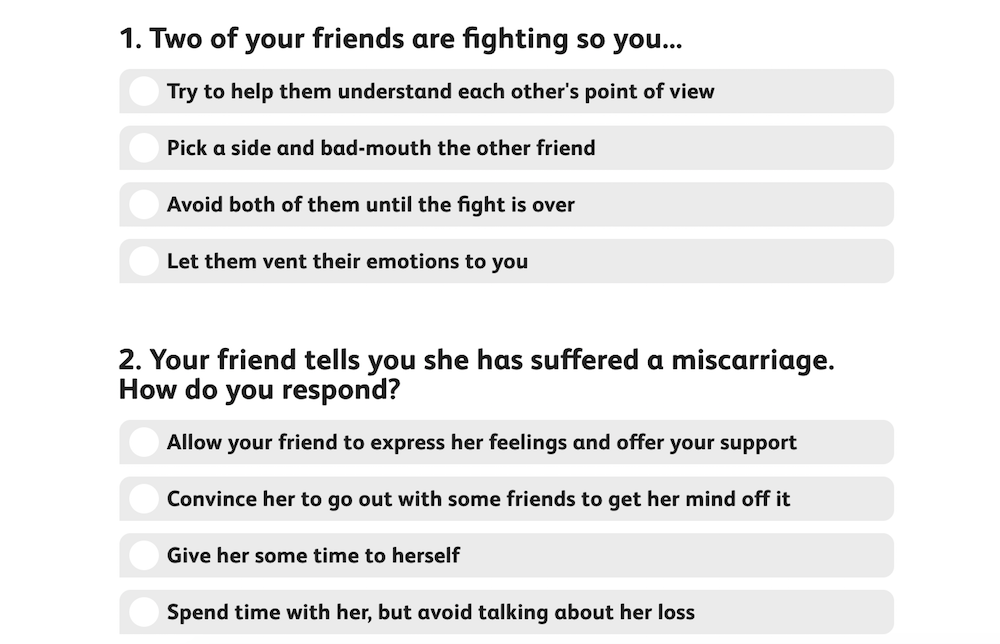
If you don’t have the time for anything more in-depth, this test only asks you 10 quick questions before delivering your results. It’s admittedly not medical or scientific by any means, but does offer other articles depending on your scor: if you score low, for example, VeryWellMind.com includes a link to another one of their articles, “Emotions and Types of Emotional Responses.”
3. Empathy Quotient
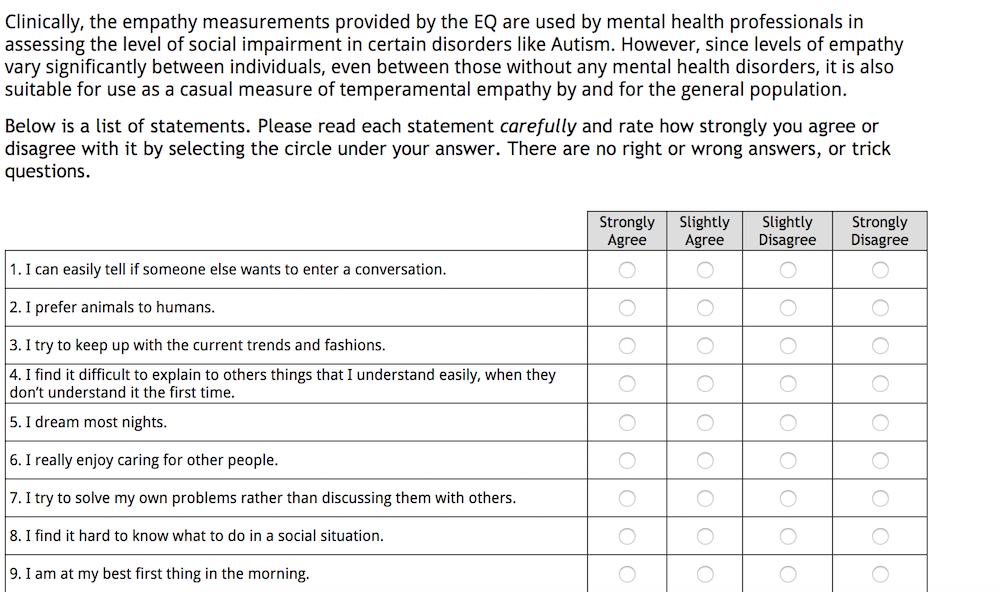
Unlike the tests above, this one is designed to clinically assess you — the test was developed by Simon Baron-Cohen at the Autism Research Center at the University of Cambridge, and uses the same emotional measurements mental health professionals use to diagnose social impairment. It’s a 60-item questionnaire and is suitable to measure “temperamental empathy” in adults.

Tim Cook commemorates 20 years of iMac: ‘It set Apple on a new course’

20 years ago today, Apple officially introduced the world to the iMac. It’s easy to look at the iMac today and take it for granted – but Steve Jobs’ introduction is one that’s worthy of rewatching two decades later. In honor of the anniversary, Tim Cook took to Twitter today to share a clip of that event…
Warren Buffett says he wants to buy even more AAPL, praises $100B share buyback announcement

Earlier this week, we reported that Berkshire Hathaway, the conglomerate founded and run by Warren Buffett, had purchased an addition 75 million AAPL shares during the first quarter of this year. Now, Buffett says he wants to buy even more of the company…
Apple now performing rear camera repairs for iPhone X Face ID issues

In a new support document sent to retail stores and Authorized Service Providers this weekend, Apple has outlined an updated repair process for instances where customers are experiencing issues with Face ID on the iPhone X.
Apple Watch deals abound for Mother’s Day Week: Series 3 from $279 or Series 1 from $149

We’re officially a week away from Mother’s Day, and the Apple Watch discounts are starting to roll in. While Macy’s is still taking $50 off select models, you can now find even more deals at Best Buy for the same discount. That includes the smaller 38mm variety for $279 and the larger 42mm for $309. Free shipping is available across the board. This matches or previous mention for some of the best offers we’ve seen all-time.
Looking to save even further? Walmart is once again offering Series 1 for $149 and $179, respectively in each size. Multiple colors are available there as well with free shipping. This is good for up to $100 off the regular going rate. Need a new Apple Watch band? Check out our roundup for a few low-cost ways to deck out your new wearable.
Apple Music vs Spotify: Which should you choose?

Apple Music and Spotify are the dominate players in the streaming music industry. Spotify just announced they have 75 million paid subscribers with 170 million total active users. Apple recently hit 40 million subscribers. It’s clear that both companies are a hit with consumers. In fact, the streaming music industry has revitalized the music business. I often get asked, which is the better service?
PSA: You can now watch Disney & Marvel films in 4K HDR on the Apple TV with Vudu

Popular streaming movie and TV platform Vudu has been updated with support for UHD playback on Apple TV. This means you can now watch 4K HDR content on your Apple TV through the Vudu application…
Vectornator Pro, the powerful vector graphic design software for iPad & iPhone is now free

Vectornator Pro has quickly made a name for itself among vector graphic design software for iOS devices, and recently the developers made the Pro version of the software available entirely for FREE on the App Store.
Vectornator offers an incredible amount of value, especially now that it’s available at no cost and still has all of the great pro features the company used to charge for. That includes Adobe Creative Cloud integration to seamlessly hop from Illustrator CC to Vectornator and back again. Check out our hands-on video with Vectornator Pro below:
This week’s tops stories: AAPL earnings, a MacBook Pro keyboard petition, iOS 11.4 beta 3, and more

In this week’s top stories: Apple may drop the 3.5mm adapter, a petition aims to force Apple to recall MacBook Pro keyboards, AAPL earnings, and much more. Read on for all of this week’s top stories…
Fortnite crosses $50M in earnings thanks to latest ‘Season Four’ update

Nearly two months after its initial release, Fortnite for iOS continues to bring in jaw-dropping revenue. According to new data from Sensor Tower, Fortnite has crossed its latest milestone, hitting $50 million in revenue…
Making The Grade: Which case do I recommend for iPad deployments?

Making The Grade is a weekly series from Bradley Chambers covering Apple in education. Bradley has been managing Apple devices in an education environment since 2009. Through his experience deploying and managing 100s of Macs and 100s of iPads, Bradley will highlight ways in which Apple’s products work at scale, stories from the trenches of IT management, and ways Apple could improve its products for students.
One of the most common questions I get from other schools is not about what device to buy, but rather which case they should get. This question is always a complicated one because while my answer is simple, it does take a few minutes to explain.
Unofficial Nvidia eGPU support on macOS arrives w/ impressive results for gamers [Video]

Unofficial Nvidia eGPU support is now a reality for Mac users. It’s all thanks to the developers and researchers that congregate over at eGPU.io, a community for eGPU coverage and support across Mac, Windows, and other platforms.
While not perfect, the results of my testing look very promising. Let me preface this post by saying that Nvidia eGPU support for macOS is still not officially supported by Apple, and the workaround script used to provide support is still in its alpha stages. Even so, I’ve been impressed by the script’s ease of use, and the performance that I’ve seen thus far.
It means that macOS users can now enjoy eGPU setups with cards from Nvidia’s Pascal lineup, including the GTX 1070, 1080, and venerable 1080 Ti. And it’s not just for Thunderbolt 3 Mac users, either. The script allows Mac owners to work around restrictions that eliminated support for Thunderbolt 2 eGPUs as well, allowing more users to join in on the graphics-accelerated fun. Watch our video for a hands-on look. more…
Facebook F8 Announcements: What Marketers Need to Know
Welcome to this week’s edition of the Social Media Marketing Talk Show, a news show for marketers who want to stay on the leading edge of social media. On this week’s Social Media Marketing Talk Show, we explore Facebook F8 announcements, new Facebook Group features, Instagram video calling, Messenger updates, and other breaking social media […]
This post Facebook F8 Announcements: What Marketers Need to Know first appeared on Social Media Examiner.
from https://ift.tt/2whEYX4
via socialmediaexaminer
Apple Watch: How to pair with new iPhone

Whether you’re new to the Apple Watch, or are upgrading from the previous generation, it’s unclear how to pair an Apple Watch with a new iPhone.
iPhone: How to block texts

Whether it’s someone you know, someone you don’t, or someone you’d like to forget, unwanted text messages can be a drag. Follow along for how to block texts on iPhone.
Eddy Cue to be deposed in Qualcomm vs. Apple iPhone patent battle

9to5Mac Daily 067: May 4, 2018

Listen to a recap of the top stories of the day from 9to5Mac. 9to5Mac Daily is available on iTunes and Apple’s Podcasts app, Stitcher, TuneIn, Google Play, or through our dedicated RSS feed for Overcast and other podcast players.
Would You Pay for an Ad-Free Facebook Subscription? 64% of Consumers Say “No”
When Bloomberg reported that Facebook was conducting market research to gauge interest in an ad-free, paid subscription model — we decided to do a bit of our own research.
Facebook — to most consumers, at least — has long-served as a free product. Advertisers, content creators, and publishers have enlisted the platform’s various services for a fee, accounting for roughly 98% of its annual revenue in 2017.
But for those of us who use the network to consume content — whether it’s from friends and family, or publishers — it’s essentially been a monetarily “free” product. That is, until revelations of personal user data being improperly obtained and used by analytics firm Cambridge Analytica came to the surface in March.
The company has faced a high degree of scrutiny and fallout since then — even more than it experienced after it was revealed that the network was weaponized to spread divisive and false information by foreign actors seeking to influence the 2016 U.S. presidential election.
So maybe the network wasn’t really “free,” after all. Maybe, to certain parties and Facebook itself, what we shared and engaged with on the site had a dollar amount attached to it. That’s been the case for a while in the vein of the company’s ad revenue: marketers and advertisers can target promoted content to users based on the data Facebook has about them — criteria like age, location, gender, interests — without attaching personally identifiable information to it.
But is it worth paying to opt out of those ads?
Measuring Public Interest in an Ad-Free Facebook Subscription
How Many Would Pay?
According to Bloomberg‘s report, any plans for an ad-free subscription model at Facebook are currently speculative — and may not come to fruition at all. And, writes reporter Sarah Frier, these plans are not new, though the recent fallout over data and how it’s used to shape ads has re-ignited the internal conversation.
We surveyed a panel of 893 consumers — almost evenly divided among the U.S., UK, and Canada — to find out how many people would pay for a subscription to an ad-free version of Facebook.
The response indicated a fairly widespread disinterest in such a subscription, with an average 64% of participants saying that they would not pay for one.
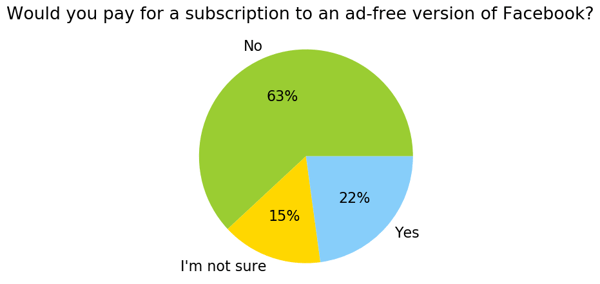
U.S. results — 304 responses
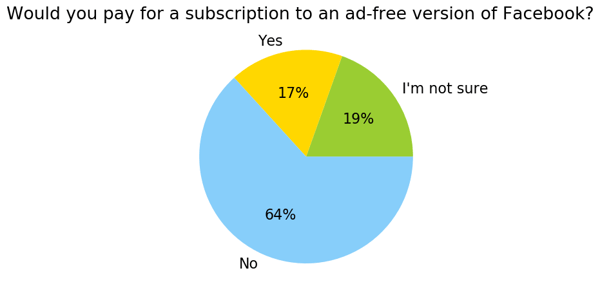
UK results — 302 responses
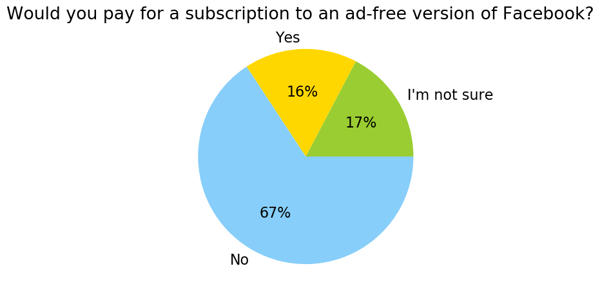
Canada results — 287 responses
What is interesting to note is that, within the U.S., 22% of consumers would be willing to pay for an ad-free Facebook subscription, versus just 17% and 16% in the UK and Canada, respectively.
That could be due to a lack of strict, formalized data privacy laws in the U.S., which could cause a greater perceived value of paid protections. The UK will be subject to the General Data Privacy Regulation (GDPR) when it comes into force on May 25th, and Canada
But here’s a crucial discrepancy: Even if users paid for an ad-free subscription service, it’s not clear if the data used to personalize ads would still be collected and stored.
At F8 — Facebook’s annual developer conference, CEO Mark Zuckerberg did announce a “Clear History” feature to be rolled out in the next several months that would allow users to see which websites and apps send Facebook information on when they’re used, and delete that information from their accounts.
And while the announcement indicated that users will also be able to turn off Facebook’s access to and storage of that information in their accounts moving forward, it’s not clear the nature of what data will be accessed and stored.
It’s also important to note that even if users delete their Facebook accounts entirely, your online behavior can still be tracked via the Facebook Audience Network, which equips advertisers on the network with various tools and pieces of code to “extend their campaigns beyond Facebook.”
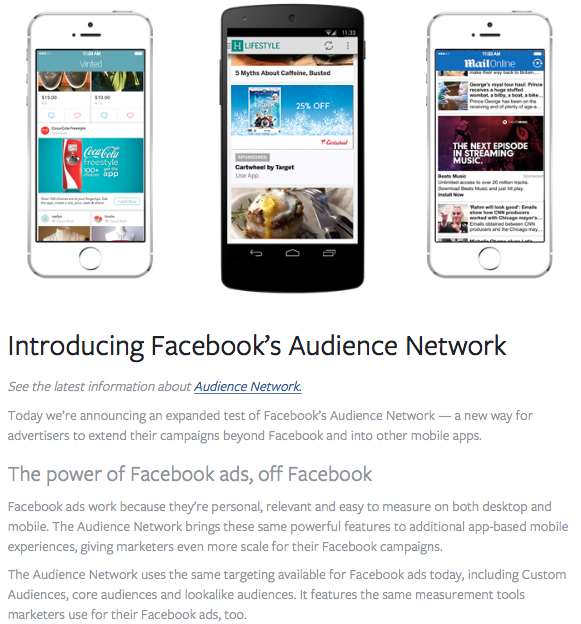
Source: Facebook
It was something that Representative Joe Kennedy asked during Zuckerberg’s testimony before the U.S. House of Representatives last month — in what The Atlantic called “the most important exchange” of the hearing — when he called the Facebook CEO repeated claims of users having complete control over their data into question.
“One of the challenges with trust here is that there is an awful lot of information that’s generated that people don’t think that they’re generating and that advertisers are being able to target because Facebook collects it,” Kennedy said. “I don’t understand how users then own that data.”
It’s unclear, therefore, if a paid, ad-free subscription would resolve that.
How Much Would They Pay?
For those who are willing to pay, however, what cost are they willing to assign to an ad-free experience?
We posed that question to 907 consumers — again, almost equally divided among the U.S., UK, and Canada — and found that, once again, most people (an average of 71%) would not be willing to pay for an ad-free Facebook subscription.
But out of those, most — an average of 15% — would be willing to pay up to $10 a month (or £10 in the UK) for such a service.
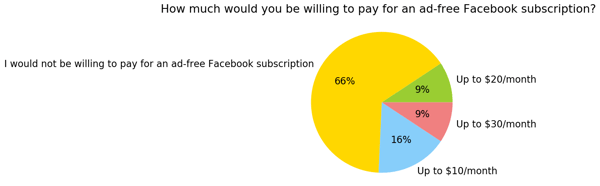
U.S. results — 299 responses
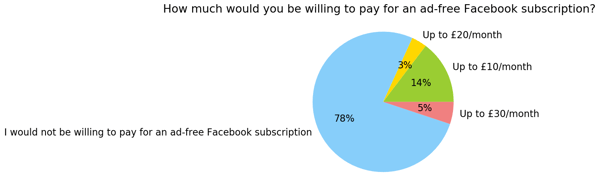
UK results — 312 responses
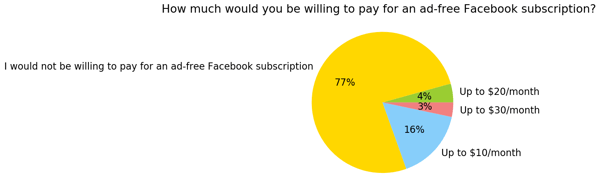
Canada results — 296 responses
That aligns with the ad-free subscription models with many other players within the tech realm. Music streaming service Spotify offers an ad-free premium membership for $9.99 per month, while Pandora, one of its chief competitors, offers ad-free plans ranging between $4.99 and $9.99 per month.
Hulu, a TV-streaming service, offers a limited commercial plan for $7.99 per month, and a commercial-free subscription for $11.99 per month. And Netflix, another TV- and movie-streaming service, offers subscriptions for up to $13.99 per month.
Where We Go From Here
Even if Facebook does introduce a paid subscription model, its executives have repeatedly emphasized that there will always be a free version of it. COO Sheryl Sandberg previously told Bloomberg as much, and Zuckerberg did the same in his Congressional testimony.
ZUCKERBERG: “There will always be A VERSION of Facebook that will be free.”
— Amanda Zantal-Wiener (@Amanda_ZW)
April 10, 2018
“I wouldn’t be surprised if some users would be interested in this experience — it’s the same experience we have with Netflix, Spotify, Amazon, and other modern tech companies that offer ad-free options,” says Henry Franco, HubSpot’s social campaign strategy associate. “The question is how much of a value people put on their data. Would the average person be willing to pay $10 per month if it meant advertisers couldn’t use their data?”
If so, at that price point, Facebook could stand to earn a fair amount. With an estimated 214 million users in the U.S., for example, if 16% of them (34.24 million) are willing to pay $10 per month for an ad-free subscription, it adds up to $342.4 million in revenue each month, or $1.0272 billion per quarter.
However, that number still somewhat pales in comparison to the $11.795 billion in ad revenue that Facebook reported in its Q1 2018 earnings call.
And even with all these factors, the question of how user data would be leveraged, if at all, still lingers in Franco’s mind.
“Would Facebook still collect data on these users even if they didn’t use it for advertising?” he asks. “Your data might be worth $100 each year to Facebook, but you have to wonder if the average user would be willing to pay $100/year for Facebook not to get it.”
