
Welcome to My Blog
Apple says booming ‘Services’ revenue should boost margin but depends on mix

Apple’s chief financial officer Luca Maestri has said that the company expects its growing revenue from services like iCloud and Apple Music to boost Apple’s overall profit margin, but the exact impact will depend on the product mix within the category …
Variable Cost Explained in 200 Words (& How to Calculate It)
There’s a frustrating truth every business deals with early into its growth. To reveal that truth, I’ll start with a song title by hip-hop legend, The Notorious B.I.G.:
“Mo money, mo problems.”
The Notorious B.I.G. is literally saying “more money, more problems.” And although this hit song doesn’t dive into the intricacies of accounting, it does support a frustrating truth about business: the more revenue you generate from sales, the more you’ll have to spend to keep selling.
Let’s unpack why that’s the case with one of the most important and useful financial figures to a growing business today: variable cost.

Variable Cost Formula
Variable costs are the sum of all labor and materials required to produce a unit of your product. Your total variable cost is equal to the variable cost per unit, multiplied by the number of units produced. Your average variable cost is equal to your total variable cost, divided by the number of units produced.
Variable costs vary because they can increase and decrease as you make more or less of your product. The more units you sell, the more money you’ll make, but some of this money will need to pay for the production of more units. So, you’ll need to produce more units to actually turn a profit.
And because each unit requires a certain amount of resources, a higher number of units will raise the variable costs needed to produce them.
A kitchenware maker might sell 10 knife sets for a total of $300, for example, but maybe $100 of this revenue goes into crafting the next 10 knife sets. If the business sells 20 knife sets for $600, it pays $200 of this revenue to make the next 20. The kitchenware maker’s net revenue only increased by $100, while its variable costs rose by $300.
Hence the words of rapping sensation The Notorious B.I.G., “mo money, mo problems.”
Variable costs aren’t a “problem,” though — they’re more of a necessary evil. They play a role in several bookkeeping tasks, and both your total variable cost and average variable cost are separate calculations. With that in mind, here’s what you need to know about variable cost in fewer than 200 words:
Variable Cost Defined in 200 Words
Variable cost denotes the money your business specifically spends on the development of goods and services. Businesses can use variable costs to calculate more complex financial values, such as their contribution margin and break even point.
You can represent your variable cost two different ways: by total variable cost or by average variable cost.
Total Variable Cost
Your total variable cost is the sum of the variable cost of each individual product you’ve developed. Calculate total variable cost by multiplying the cost to make one unit of your product by the number of products you’ve developed.
For example, if it costs $60 to make one unit of your product, and you’ve made 20 units, your total variable cost is $60 x 20, or $1,200.
Average Variable Cost
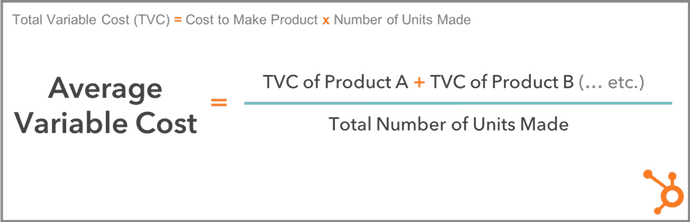
Your average variable cost uses your total variable cost to determine how much, on average, it costs to produce one unit of your product. You can calculate it with the formula below (for reference, the equation to the top left of the box is your total variable cost).
Total Variable Cost vs. Average Variable Cost
If the average variable cost of one unit is found using your total variable cost, don’t you already know how much one unit of your product costs to develop? Can’t you work backwards, and simply divide your total variable cost by the number of units you have? Not necessarily.
While total variable cost shows you how much you’re paying to develop every unit of your product, you might also have to account for products that have different variable costs per unit. That’s where average variable cost comes in.
For example, if you have 10 units of Product A at a variable cost of $60/unit, and 15 units of Product B at a variable cost of $30/unit, you have two different variable costs — $60 and $30. Your average variable cost crunches these two variable costs down to one manageable figure.
In the above example, you can find your average variable cost by adding the total variable cost of Product A ($60 x 10 units, or $600) and the total variable cost of Product B ($30 x 15 units, or $450), then dividing this sum by the total number of units produced (10 + 15, or 25).
Your average variable cost is ($600 + $450) ÷ 25, or $42 per unit.
Variable Cost Examples
So, what’s considered a variable cost to the business?
Depending on the goods or services you develop, you can classify many of your expenses as variable costs. In general, any recurring cost that doesn’t fluctuate as the business grows or shrinks is a fixed cost. A classic fixed cost is rent on office space: no matter what happens within the business, you still pay the same building rent. So, any cost that doesn’t fall into this category is likely a variable cost.
To make it easier for you to identify which of your costs you should factor into your total variable cost calculation, we’ve put together a brief list of variable cost examples below.
- Physical materials: this can include parts, cloth, and even food ingredients required to make your final product.
- Production equipment: if you automate certain parts of your product’s development, you might need to invest in more automation equipment or software as your product line gets bigger.
- Sales commissions: the more products your company sells, the more you might pay in commission to your salespeople as they win you customers.
- Staff wages: The more products you create, the more employees you might need, and the bigger your payroll.
- Credit card fees: businesses that receive credit card payments from their customers will incur higher transaction fees as they deliver more services.
- Packaging and shipping costs: you might pay to package and ship your product by the unit, and therefore more or fewer shipped units will cause these costs to vary.
It can be daunting to calculate expenses that change as your company evolves. Sometimes, you just want to know exactly what you’re paying to run your business. Using the formulas above, however, you’ll be able to easily track your variable costs no matter what stage of life your business might be in.


The 8 Best Excel Alternatives
Excel is one of the world’s most popular spreadsheet programs, with an estimated 750 million people using it for data summary and organization, analysis, and reporting.
While it’s a commendable data system for teams within a business, it’s not free — a standalone copy of Excel 2016 is $129.99, and the Office personal subscription is $69.99 per year for one user.
Equally important to note, Excel has its fair share of shortcomings, and there are some alternatives that might work better for your team or project.
If you feel you could be better off using a different data spreadsheet system, or if you simply don’t have the means to pay for one, take a look at our list of the eight best Excel alternatives.
Best Excel Alternatives
- Google Sheets
- Numbers
- Thinkfree
- Birt Spreadsheet
- Zoho Sheet
- FreeOffice2016
- Apache OpenOffice
- Quip
1. Google Sheets
Price: Free
If you have a Gmail account, you already have access to Google Sheets. Google Sheets, an almost equal competitor to Excel in both layout and features, has a few benefits that Excel lacks. For one thing, your files on Google Sheets are saved in the Cloud. That means if you use multiple devices for business purposes, you can’t beat the automatic accessibility of Sheets.
Second, you can share your Sheets with anyone on Slack or email and make edits simultaneously, allowing for optimal collaboration and teamwork on projects. Lastly, with Sheets, you have the advantage of other Google tools, like Google Translate, GoFinance, and Import Feed/Import Data functions, which enable you to pull data straight from web page’s URLS.
2. Numbers
Price: Free (for Mac users)
This program comes free with every Mac, and is essentially Mac’s own version of Microsoft’s Excel. Numbers provides high-quality data analysis and reporting functions, as well as plenty of visual tools. The program uniquely provides pre-built templates, dynamic donut charts and graphs, and a library with more than 600 shapes to turn your data into presentation-ready visuals. Since it’s in the iOS system, you can use the program on any Mac device, making it easy to access your data on the go or from home. In a show of great sportsmanship, Numbers also enables you to save your spreadsheet as an Excel file, to share with anyone who prefers to stick with Excel.
3. Thinkfree
Price: 2/months free trial; Enterprise version $79.99
ThinkFree offers three primary features, which are compatible with office programs: Write, Calc, and Show. The Excel alternative, Calc, lets you create spreadsheets and presentations and provides 1 GB of free online storage, and like Google Sheets, you can collaborate with colleagues on ThinkFree documents. Most notably, ThinkFree allows you to edit and view your documents on your mobile device, if you want to make changes to your spreadsheet away from your computer. ThinkFree doesn’t require any Office installation.
4. Birt Spreadsheet
Price: Free
This Excel alternative is particularly helpful for data analysis, with features including live formulas, pivot tables, hyperlinks, and data-driven layouts. Birt Spreadsheet (formerly Actuate e.Spreadsheet) automates and centralizes all your spreadsheet production, maintenance, and security. Birt also provides a Spreadsheet Designer, which creates reports to retain formulas, formatting, live charts, and data connections.
5. Zoho Sheet
Price: Free for teams of up to 25 users
One of the biggest perks of Zoho is that it’s Cloud-based, so you can access your data wherever and whenever you want. It offers functions including charts and pivot tables comparable to Excel, and you can also switch easily between .xlsx, .xls, .csv, and .ods. Plus, Zoho allows you to edit a spreadsheet with colleagues simultaneously, making collaboration easy. Along with functions to simplify formulas, and filters to analyze data, Zoho also provides visual charts and tools to create presentation-ready graphics.
6. FreeOffice 2016
Price: Free
The features in FreeOffice’s Excel alternative, PlanMaker, are very similar to Excel, including conditional formatting, pivot tables, and data visualization tools to create presentations. Best of all, FreeOffice’s programs are compatible with Microsoft Office file formats, so if you tend to use Microsoft Office, this alternative makes for easy transfers to any Microsoft product. The FreeOffice tools are clean and intuitive, and they’re also fast, even with dense data. However, if you want to save files as .doc, .xlsx, or .ppt., you’ll need to purchase a paid plan.
7. Apache OpenOffice
Price: Free
Apache OpenOffice, used on over 100 million computers, offers free software for word processing, spreadsheets, presentations, graphics, and more. It’s an open-source program, which means you can modify the program to meet your business’s needs, and it’s downloadable, which means you can work on your spreadsheets without wifi. Data is stored in an open standard format, and Calc, Excel’s alternative, performs data analysis.
8. Quip
Price: Free trial/$30 yearly for five members
If your team collaborates on budgeting or data reporting, Quip is a useful tool — it enables your team to operate and manage spreadsheets together, simultaneously. With over 400 functions, the Excel alternative has the capability to handle complex projects, and is used by companies including Facebook, CNN, and Pinterest. If you’re hesitant, Quip offers a free trial so you can try it out.

How to Build an Ecommerce Business Amazon Can’t Compete With
Today, giants define our world. A few big companies like Apple, Facebook, and Google shape our social lives, curate how we consume information, and influence what we buy. For the most part, this isn’t a bad thing: these titans offer wonderful products and services that make our lives better and help our businesses run smoothly.
But, as those of you who run small, ecommerce-powered businesses know very well, there is one giant who makes things very complicated. It’s impossible to be an online merchant and not have a point of view on Amazon. Love them, hate them, or something in-between — you all have a relationship with Amazon. Frankly, they can make it a real challenge for small businesses to grow past a certain point. But they don’t make it impossible.
Lately we’ve seen more and more HubSpot customers thrive in ecommerce, even though Amazon sells similar or even identical products as them. How can this be? I’ll tell you, but first let’s start from the beginning.
Nashua, New Hampshire is a quintessential New England city. It’s full of folks who love their Dunkins, wear Bean Boots 10 months out of the year, and pledge allegiance to Red Sox nation. It’s not a place you’d imagine one of the most influential technologies of the last 100-years might be born. But it is.
In August of 1994 21-year-old Dan Kohn put his new encryption technology to work to securely sell a Sting CD to Phil Brandenberger. It was the first sales transaction in the history of the internet, and it set off a series of events that would change the world forever.
That same summer, Jeff Bezos left his job on Wall Street to move to Seattle and found Amazon. Over the next 20+ years, the ecommerce industry would grow exponentially. A trend that is still up-and-to-the-right today.
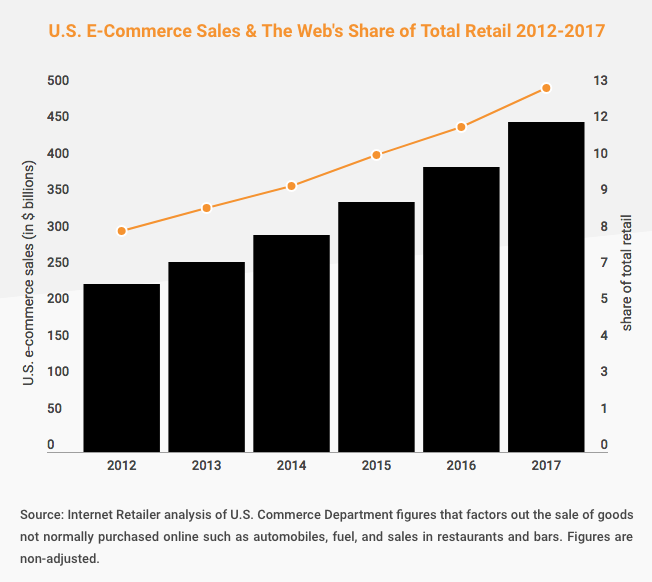
Today, there’s nothing people won’t buy online. The internet has challenged us to buy things on the internet that we used to think had to be purchased in person. But now, no one thinks twice about buying eyeglasses, food, or even cars online. The convenience and speed of making purchases online means the majority of us check there first before buying anything.
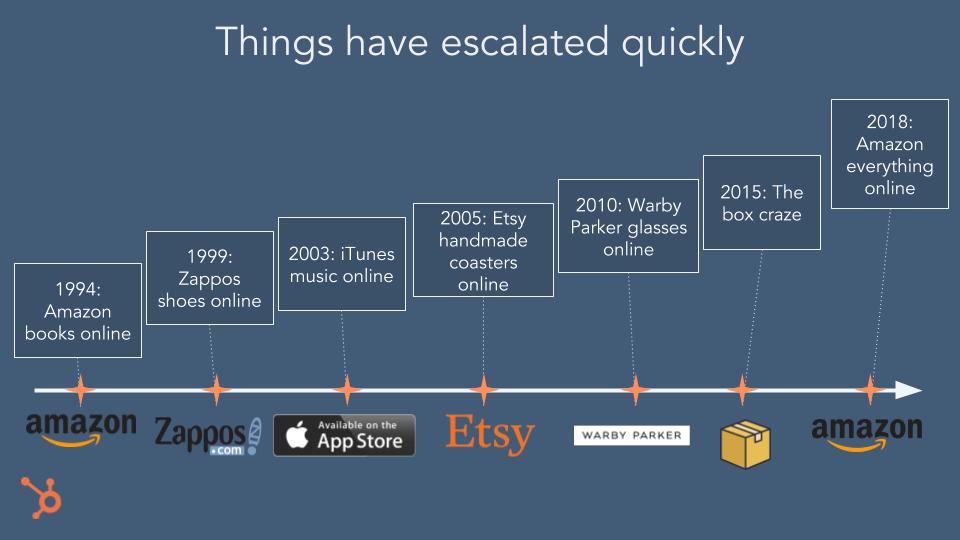
The ability to buy and sell online has been a win for everyone involved. Consumers love the convenience, speed, prices, and accessibility ecommerce delivers, and entrepreneurs love that they can now turn limited passion projects into full time careers and viable businesses.
It’s a good time to be an Ecommerce SMB.
The ability to sell online has created thousands of new businesses — and there’s still plenty of room to grow. The increasing demand to buy everything online has made it easy to find an initial audience, software like Shopify makes it simple for non-technical people to create a web store, and powerfully targeted ads from Google and Facebook make it easy to expand your audience.
Getting started has never been easier — the challenge now is figuring out how to scale.
There are plenty of big, scary challenges for a small ecommerce business, but none are quite as terrifying as the elephant in the room: Amazon.
Amazon and a few others eat up the majority of the world’s ecommerce demand. They sell everything imaginable online and are only expanding. They offer the best prices, the fastest shipping, excellent customers service, and have massive brand awareness. For small ecommerce businesses, they can feel like a major roadblock. Some SMBs have managed to cultivate mutually beneficial relationships with Amazon, but many worry about getting permanently stuck on the wrong side of a losing battle.
What’s next in ecommerce marketing?
Most ecommerce entrepreneurs know that quickly after product market fit they’ll need to adapt their marketing strategy to compete with the giants. Competing with the likes of Amazon is obviously a challenge, but it can be done — and while all businesses are different, there is a common three-part formula to making it happen.
1. Meet modern buyers’ expectations.
You may not always be able to compete with the giants on price, but you have to rise to meet or exceed their level of service. The giants generally offer 24-7 support, fast shipping, and are generous on returns. Their level of service has become the industry standard. If you’re not already investing in building a great customer experience, now is the time.
Customers will understand if you can’t ship as fast as Amazon, but they won’t forgive you for not answering their questions quickly.
Start using tools like Facebook Messenger and live website chat to help customers in real-time in addition to email. Make sure you’re aware of customer issues through surveys like Net Promoter Score (NPS), and are encouraging customers who love you to leave positive reviews. Future customers trust those reviews more than your marketing message.
2. Modernize and personalize your marketing.
With the rising popularity of ecommerce, you’re not the only player in town –regardless of what niche your business occupies, you’re probably already facing competition. One-size-fits-all marketing emails and ads aren’t going to resonate with the modern buyer. Targeting your ideal buyers with standard, largely impersonal marketing messages won’t work. You need to make your messages as personal as possible to get their attention.
Look for signals you can use to make your marketing efforts more targeted. For instance, if you know a customer came to your site, put a product in their cart, but left before buying, you have a very strong signal that person is interested in that product. Target them with emails and ads that remind them why your option is the best.
This abandoned cart tactic is low-hanging-fruit and very effective. But it’s just one way of using data to improve your marketing. If you know a customer typically only buys from you during the holidays, make sure you email them with a special offer right before they typically buy to try and increase their purchase size. If a customer recently purchased a product, and you have a complimentary service you think they should know about, target them with ads for the service.
Make sure your ecommerce data and marketing tools are talking to each other — it’s the secret to unlock more powerful, more effectively targeted marketing strategies.
To make that happen, HubSpot now integrates with Shopify. It’s easier than ever for you to sync your data from Shopify into HubSpot, using it to seamlessly personalize your marketing campaigns.
If you’re able to use your web store data for marketing purposes, you can automate these new personalization tactics: abandoned cart nurturing happens automatically soon after someone leaves a cart, and you’re constantly welcoming new customers with a dedicated on-boarding email.
3. Build a brand that Amazon can’t touch.
The online retail giants do a lot right, but the one thing they can’t do is be the single best player in any one given space. They offer everything, which limits them from truly going deep in anyone area. This gives SMBs space to build a brand and be the experts in their niche in a way that differentiates them from the giants.
HubSpot customer and Shopify merchant Kettlebell Kings sells kettlebells, and Amazon also sells kettlebells. But Kettlebell Kings has also built a community — something Amazon simply can’t do for every single category they occupy. Kettlebell Kings are active in the gym scene in their local community of Austin, Texas, offer workout plans, blog posts, videos, and Instagram content on working out with their products that their community loves. They’ve positioned themselves as experts and leaders in the workout and kettlebell space, and their branded product is a signal to their tribe of the companies’ quality and dedication.
They’ve built a memorable, community-driven brand around their product, and people are willing to wait a bit longer and pay a little more for it.
The same goes for HubSpot customer and Shopify merchant Love Your Melon. The company sells hats, and Amazon also sells plenty of hats. But Love Your Melon also stands for something that their audience cares deeply about. The company is dedicated to giving a hat to every child battling cancer in America. It’s something that drives their work, and they’re committed to telling the world about it. Their social media content celebrates the lives of families impacted by cancer, and their distinctive hats have become a product intertwined with a social mission. Their genuine passion isn’t something the giants can recreate.
Both of these companies have fully adopted inbound marketing. They aren’t just trying to get their product in front of people, they’re building a brand that pulls people in. It’s their secret to growth, and it’s applicable to every small ecommerce business today. Inbound marketing works for ecommerce, and it’s how you’ll grow.
Today we’re living in a world defined by giants. But it doesn’t mean there isn’t plenty of room for small, savvy businesses to grow.

Cambridge Analytica filing for bankruptcy after Facebook scandal, but may re-emerge

Latest Apple Pay promo offers $15 off 1-800-Flowers orders in time for Mother’s Day

How to Easily Change 16×9 Video to Square Video on Your Phone

Want to use more square videos in your social media marketing? Concerned you filmed in the 16×9 format? In this article, you’ll discover how to change landscape video into square video using your mobile device. #1: Shoot Your Video If you already have some video you want to transform into a square format, feel free […]
This post How to Easily Change 16×9 Video to Square Video on Your Phone first appeared on Social Media Examiner.
from https://ift.tt/2jqrTBi
via socialmediaexaminer
Kantar: iPhone X outsold by iPhone 8 + 8 Plus combined, Apple growing quickly in China

Following Apple’s earnings release yesterday, Kantar today is out with its newest data for the quarter ending in March 2018. Kantar’s data offers an interesting perspective on how Apple’s numbers for the quarter compare to other manufacturers, as well as how iPhone 8 and iPhone 8 Plus sales stack up to iPhone X…
How to manage Face ID access for specific apps

Apple’s iPhone X is an ambitious device that changed the fundamentals on how to use an iPhone. It got rid of the big bezels and the Home button, which also means losing Touch ID.
Apple Watch again credited with saving a life as it leads New York man to discover erupted ulcer

Time and time again, Apple Watch has been credited with warning users of severe health problems. Now, a new story out of New York shows yet another case where a person’s Apple Watch was first to tell them to seek medical attention…
Video: 25 iPad multitasking tips – do you know them all?

In this step-by-step video walkthrough, we discuss and demonstrate a multitude of iPad-centric multitasking tips for iOS. Most iPad users will be aware of the existence of some of these features, but there are probably a handful of tips that have flown under your radar. Watch our hands-on video walkthrough and see for yourself. more…
Apple stops signing iOS 11.3 following the release of iOS 11.3.1

Following the release of iOS 11.3.1 last week, Apple today has stopped signing iOS 11.3. Following the release of a new version of iOS, Apple routinely stops signing older ones to ensure the highest numbers of users are up to date.
How to remove or switch your iPhone SIM card

You may need to remove or switch your iPhone’s SIM card for a variety or reasons. Whether you’re selling or trading your device, switching carriers, or need to swap it out while traveling, follow along for how to easily do this below and tips on keeping track of multiple SIM cards.
And on the Second Day of F8, Facebook Said, ‘Let There Be AI Ethics’
If there’s one thing that Facebook wants everyone to know it’s taking seriously, it’s the topic of ethics.
The general idea of an ethical approach to everything it does — its innovations, initiatives, and new products — is executed with and undercurrent of ethics, user control, and privacy.
That’s what CEO Mark Zuckerberg said in his opening keynote on Day 1 of F8, Facebook’s annual developer conference. The new products and features unveiled yesterday, including its up-and-coming Facebook-for-dating services, was built “with privacy and safety in mind.“
Today, ethics was one topic that took center stage, especially when it comes to Facebook’s highly-boasted investment in AI to help combat things like hate speech and other moderation activity on the site. Here’s what company executives had to say.
Ethics and AI Take Center Stage on F8 Day 2
While it’s nice to know that your friends won’t see if you’re using Facebook’s dating services and you won’t be matched with them, according to yesterday’s keynote, the privacy and ethical specifics weren’t revealed in much data, and actually left great room for interpretation.
the dating app sounds like has some awfully handy functionality for stalkers .. why is there no one in the right place in FB to point out obvious probs like this? must be folks who can see potential problems (surely?) is it the internal comm process that’s gone awry?
— eleanorina (@_eleanorina)
May 2, 2018
Today, the company chose to elaborate a bit on its efforts in the “ethical” arena.
AI Ethics
When Zuckerberg appeared before Congress in April, one initiative he repeatedly emphasized throughout his testimony was the advances Facebook has made in the realm of artificial intelligence (AI) and how it can be used to combat the misuse and weaponization of the network.
But one area where it would be difficult to perfect that technology is detecting hate speech. The AI has a long way to go, he said — though he didn’t go into tremendous detail on the company’s plans to improve it.
Some problems “lend themselves to AI tools more than others. Hate speech is one of the toughest. … Contrast that with an area of something like battling terrorist propaganda,” says Zuckerberg, listing the times Facebook has successfully done the latter.
— Amanda Zantal-Wiener (@Amanda_ZW)
April 10, 2018
Today, Facebook Director of Machine Learning and AI Srinivas Narayanan acknowledged that, displaying cases where a machine might not understand the nuance of what might make a given sentence hateful or abusive. Using examples like, “Look at that pig” and “I’m going to beat you,” he said that understanding the context of such statements requires human review.
More from Srinivas Narayanan about the nuances of hate speech and how AI isn’t enough detect context. That requires human review, he says. #F8 pic.twitter.com/kuPkUR1MYc
— Amanda Zantal-Wiener (@Amanda_ZW)
May 2, 2018
The Fairness Flow
Which is where the area of focus known as AI ethics comes in, said Facebook Data Scientist Isabel Kloumann. Humans, she pointed out, have implicit biases — using herself as an example, she said most people in the audience would deduce that she is a white female. What they might not consider, she noted, is that she’s part Venezuelan, for instance.
And since machines are trained using the data given to them by humans, AI might learn to have these same biases, Kloumann said, which introduces the need for ethics and standards when it comes to building it.
That’s why Facebook created the Fairness Flow, which is to help determine how much bias has been built into Facebook’s algorithm, whether intentional or not. There’s a need now, Kloumann said, to ensure that the company’s AI is “fair and unbiased,” especially since the company has come under especially intense scrutiny over what content it deems in violation of its standards.
But we have implicit biases, says Isabel Klouman, and so do the machines that learn from the data it’s trained with. So there’s a need for “AI Ethics,” and thinking about how to create “fair and unbiased AI” #F8 pic.twitter.com/npuRDmXg5l
— Amanda Zantal-Wiener (@Amanda_ZW)
May 2, 2018
At the April hearings, for instance, many lawmakers accused Facebook of improperly moderating content, allowing some that could have severe impacts — like ads for narcotics, for instance — to remain live for far too long, while other content might be improperly deemed in violation.
Not long after Zuckerberg’s testimony, The New York Times profiled the way this imbalance has manifested in grave violence in Sri Lanka.
A reconstruction of Sri Lanka’s 2017 descent into violence found that Facebook’s newsfeed played a central role in nearly every step from rumor to killing. Facebook declined to respond in detail to questions about its role in the violence. https://t.co/IaA9EGJEIy pic.twitter.com/jPkw3RcOXZ
— The New York Times (@nytimes)
April 21, 2018
But Is It Enough?
But overall, Facebook has many (potentially PR-related) reasons to place the concept of ethics at the center of its messaging. The company came under fire in March when it was revealed that data analytics and voter profiling firm Cambridge Analytica — which it was today announced will be shut down by its parent company, SCL, as well as SCL Elections Ltd. — improperly obtained and used personal user data.
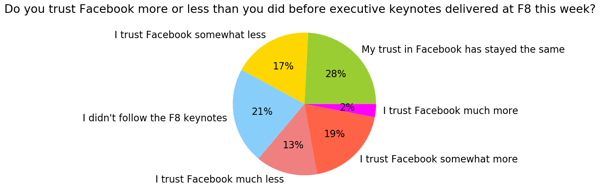
It would appear that, in addition to the questions and accusations mentioned above, people still don’t entirely trust the network in terms of protecting their data and privacy. And after Zuckerberg’s Congressional hearings, it seems, our survey of 300 trust in the company actually fell.
And among those who paid attention to them, the remarks made at F8 thus far had a mixed impact on overall trust in Facebook. In a HubSpot survey of 303 U.S. internet users, just under a third said they trust the company less, while roughly one-fifth of respondents said the keynotes improved their trust in the company.
That has yet to show up financially, however — and as of the NASDAQ closing bell today, Facebook’s stock price was strong.
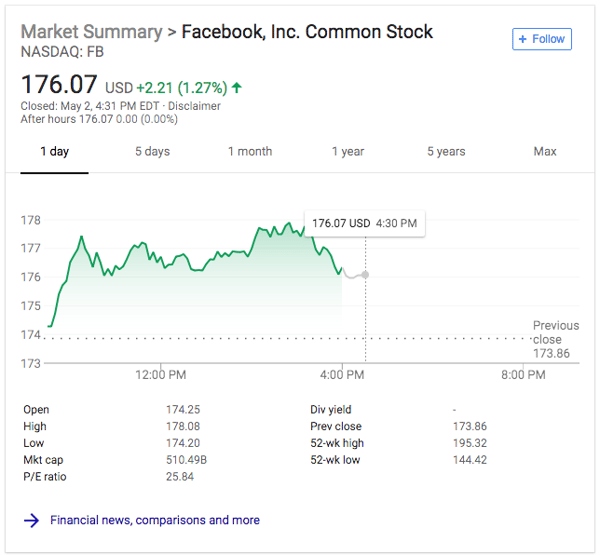
Source: Google
How all of this plays out in the long-term remains to be seen. But the stark contrast between last year’s F8 — when Facebook announced innovative progress in the area of reading people’s minds through their skin — and this year’s event is evident.
The type of pressure and scrutiny faced by the social network continues to evolve, as well. Despite reporting strong Q1 2018 earnings, UK Parliament still demands testimony from Zuckerberg — and recently stated that if he does not appear before members of parliament for questioning during his next visit to the UK, he shouldn’t enter the region at all.
And as for the ethics — that seems like it will be a slow, gradual road to fruition, if that’s the conclusion that actually takes form.

Spotify now has 75 million paying subscribers, with a total of 170 million active users as of March

Akitio partners with Intel for new super fast Optane-powered Thunderbolt 3 SSD enclosure

Today, Thunderbolt 3 peripheral specialist Akitio announced a new partnership with Intel that has resulted in a special edition version of the Akitio Node PCIe box. The collaboration sees Intel contributing its just-released Optane 905P, a 960GB PCIe SSD — the current king of SSDs from a speed perspective — to the fire engine red Thunderbolt 3 enclosure. more…
Rumor: New iPhones may be first to bundle USB-C fast charging

iPhone 8 and iPhone X support fast charging via a Lightning to USB-C cable, but Apple opted not to ship fast charging accessories in the box. Instead, iPhone customers have to fork over nearly $80 for a charging cable and brick that offers fast charging. That may change with the next flagship iPhones…
Apple and other tech companies swat down new proposals to create secure backdoors in encrypted services

Reform Government Surveillance is a coalition of major tech companies that looks to guide legislation for how the government can surveil individuals and access their information. Apple joined RGS back in 2013 and the coalition has recently issued a statement as talks have begun again about US officials pushing for a mandate to make tech companies build backdoors into their devices and services.